
Home » spirits (Page 4)
Category Archives: spirits

Cure that Sense of Entitlement

Thought is a vital force or energy which is being developed and which had produced such startling results in the last century, as to bring about a World which would be absolutely inconceivable to man during the days of slavery. If the results have been secured by organizing mental powers over the last hundred years, imagine what can be done in the next hundred. This is why we need to avoid the nihilistic idea that we are living in the last day. The people who repeat this mantra are also the ones who pontificate most loudly about the law of attraction. We have to learn to be genuine in our beliefs and know that we can have a beneficial impact on the future. We do not have to accept things they way they are, but we can make them better. It is clear, therefore, that thought of abundance will respond only to similar thoughts: the wealth of the individual is seen to be what he inherently is. Affluence within is found to be the secret of attraction for affluence to manifest in the outside World. The ability to produce is found to be the real source of wealth of the individual. It is for this reason that he who has his heart in his work is certain to meet with unbounded secrets. He will give and continually give, and the more he gives the more he will receive. Thought is the energy by which the law of attraction is brought into operation, which eventually manifests in abundance in the lives of men. The source of all power, as of all weakness, is from within; the secret of all success as well as all failure is likewise from within. Golden opportunities of life will be strewn across your path, and the power will come unbidden, circumstances will be in your favour, and you will feel the power of the ultimate concern. #RandolphHarris 1 of 18

Many affluent college students make it a point to hide the fact that their families are wealth, because they believe that members of the opposite gender may approach or treat them nicely not because they are interesting and attractive, but simply because they have money. We have worked with young people who consciously choose to live in a more modest apartment than they can afford, or avoid spending too much money on clothes or entertainment, specifically because they do not want to give potential romantic interests any hint regarding their actual financial status. This strategy does seem to provide some reassurance to affluent young people when they are meeting new people, or when they are going out on a first or second date. Clearly, however, as dating relationships develop and progress, it will become more and more difficult to avoid having one’s financial status become apparent. People naturally ask you questions about where you grew up, and where you went to high school. At some point, your date will probably ask you about your parents—maybe just about how you like them, but also more than likely about who they are and what they do. New friends are also quite likely to ask you what you like to do for fun, and they will be curious about the places you have been. These are perfectly normal questions, and you certainly should not interpret them as specific effects to extract data from you on your family’s financial status. Although we certainly understand any desire you may have not to flaunt your wealth as a means of attracting attention, we strongly believe that you should be honest when you answer such questions. To be less than honest is to convey the message that your distrust of others’ intentions is your paramount concern in making new acquaintances, and this would be likely to be perceived as reflecting poorly on you. #RandolphHarris 2 of 18

Students of a high caliber are more attracted to affluent institutions than to poor ones. The major reason is that affluent institutions pay higher salaries, which enable them to recruit better faculties. Some of this may result from a feedback effect that raises the resources for faculty recruitment of institutions with superior reputations among outstanding students. The beta weight indicates that affluence also has some direct effect on student preferences, independent of other conditions. A possible interpretation of this new effect is that superior facilities and better fellowships in affluent institutions attract brighter, more serious students, although the possibility that wealth as such and its symbolic value make an institution preferable cannot be excluded. Large academic institutions are preferred by able students because they can afford better faculties and have more diverse departments than small institutions, but large size itself, independent of these attractive conditions usually associated with it, detracts from the appeal of an institution or higher education to students. In other words, size has a beneficial gross and a negative net effect on capable students, furthering another parallel with the pattern of influences on qualified faculty. The process of mediating the indirect effects of size are similar but not identical, partly because faculty qualifications are the dependent variable in one but an intervening variable in the other case. Bright students are attracted to large academic institutions by their many diverse departments, array of cultures, and by the superior faculties that their higher salaries recruit. These attractions tend to overcome the preferences of good student for small, less impersonal colleges if conditions were the same (indicated by the negative beta weight) and make large institutions more popular among them (indicated by their positive simple correlation). #RandolphHarris 3 of 18

The natural or “mortal mind” view of life and the World is almost always the exact opposite of what is the real spiritual truth and fact. Metaphysics tell us that the visible World is an inverted reflection of the real. If the it is inverted, it is natural, until our spiritual or inner eyes are opened to the truth, for us to see things as the exact opposite of what they really are. Therefore it is not surprising to find that, whereas the moral or terrestrial mind of the senses, thinks the World is the real thing and the mind only a shadow, the real TRUTH is, that mind and spirit are real and eternal, and the visible World but a transient and impermanent thing which has no actual reality. Such being the case then the only thing that really matters is what is in the mind or what is not in the mind. If we have a belief in evil, and thoughts of evil, in our mind, then we have evil in our life. If, however, we can cast the thought of, and belief in, evil out of our mind then it will cease to appear in our life. By raising ourselves above the sensuous life and realizing our permanent World of Mind and there denying evil, poverty, failure, pain, sickness, unhappiness, or whatever our trouble may be, we vanquish the thought which is the cause of all our troubles. Then whatever we affirm will take their place. If we deny “evil,” then we follow by affirming “good,” if we deny sickness, then we affirm prosperity and affluence. By denials we can take out all the evil, care, fear and worry out of our lives and build up in their place by means of affirmations, perfect good, success, affluence, happiness, health, love, peace and courage. Everything being in the mind, then everything that is take out of the mind is take out of life, and everything that is put into the mind comes into life. #RandolphHarris 4 of 18

Thus it is possible with mathematical accuracy and certainty to recreate the life, to cast out all the undesirable and to build up in its place only the beautiful, the good, the true. Life is what we make it. We can make it like Heaven itself, full to the brim with all that is good and beautiful, or we can turn it into a perfect Hell. Therefore do not accept the suggestions of those, who having failed in life, proceed to call it hard names. We can make life a continual joy, if we create a Heaven within us by the quality of our thinking and mental processes. All that we see in life, all that we experience, yeah, even life itself, is but the outward expression of the life within. The life within is built up by our thinking. You will have seen by this time the purpose and value of affirmations. Affirmations are concentrated thoughts. Back of each affirmation is a strong emotion and this gives it tremendous driving force. Not only do affirmations impress the sub-conscious mind thus producing action in accordance with the Will, but they project outwards from the mind into space, attract forces and help from other sources and bring them to minister and bless. Not only so but they also arouse the subliminal mind to inspire, to create, to impart wisdom. By the use of affirmations all the finer forces are aroused to action and the life is transformed from weakness or ineffectiveness to strength or purposefulness. By the use of affirmations, the Will is strengthened until it become so strong all else has to bend to it. By the use of affirmations, the body is strengthened and make healthy, and exercise and body culture become a pleasure instead of a duty. #RandolphHarris 5 of 18

To bring whatever it is that you want into your life, you must develop an insatiable desire for it. That means, for a while, it is all that matters. You vigilantly watch the ego-mind; you refuse to be taken off track. You know your direction and you will allow nothing to move you from it. At that point, all obstacles are viewed as challenges to be overcome, with each one giving you’re a renewed sense of focus. You meet difficulties with the mindset that there is always a way to overcome them, and moreover, you are committed to finding it. You approach, go though, and attend to your outcome without the option of gripping or complaining. You keep moving forward: you make it a “must” and as a result, it will happen. Guaranteed! Affluence means wealth. It means having plenty, so that you are not wanting. It means being connected into the flow of goods and resources so that you are regularly refreshing your abundance even as you use it up. I know people living utterly simple material lives who seem radiant with well-being and happiness. Material wealth should never be desired as an end, but simply as a means of accomplishing an end. Success is contingent upon a higher ideal than the mere accumulation of riches, and he who aspires to sch success must formulate an ideal for which he is willing to stive. However, it is no fun to run out of rent money or cash to go buy groceries. Let us not be delusional; money counts! On the other hand, a lot of money brings a lot of responsibility; you must pay attention to your money or you lose it, and you can easily fall victim to worry about your money rather than enjoying it. So keep this desire for cash and possessions in perspective with the other equal needs. #RandolphHarris 6 of 18

Whatever you desire for yourself, affirm it for others, and it will help you both. You reap what you sow. If you send out thoughts of love and health, they return to you like bread cast upon waters. People who are friends to others find that they indeed have friends. Radiate love and happiness to those you encounter, and this love and happiness will be radiated back to you. True relationship abundance is both deep and wide. Ideally you have a deep resonance with family, and you and your intimate partner have broad goodwill toward those you come into contact with. A valid formula will produce successful results every time and for everyone. You just have to follow it. Life provides a wonderful opportunity to seek our talents and interests. It is well to remember, however, that “all have not every gift given unto them; for there are many gifts, and every man is given a gift by the Spirit of God,” reports Doctrines and Covenants 46.11. In our searching, it is important to seek guidance of the Spirit to discover skills we should develop. Once we have decided what we really want to do, the Lord has given us a formula for achieving our eternal and temporal goals: “For he will give unto the faithful line upon line, precept upon precept; and I will try you and prove you herewith,” reports Doctrines and Covenants 98.12. The Lord reminds us that real success will only come only to the faithful—those who have sincere determination to achieve their goals. The second part of that formula reminds us that learning is often a slow process and comes line upon lone, one step at a time. The Lord offers kind encouragement when He says, “Wherefore, be not weary in well-doing, for ye are laying the foundation of a great work. And out of small things proceedeth that which is great,” reports Doctrines and Covenants 64.33. We must learn to be patient with ourselves while pushing to new levels of achievement or knowledge. It is important to take time occasionally to remind ourselves of what we are trying to do. #RandolphHarris 7 of 18

Thoughts of courage, power, confidence, and hope all produce a corresponding state. All we have to do is let our light shine; the more energy we can radiate, the more rapidly shall we be enabled to transmute undesirable conditions into sources of pleasure and profit. Health and wellness are issues for most of us, and material abundance can mean absolutely nothing when we are seriously sick. Therefore focusing on and manifesting long-term health must be a vital aspect of this program. How can you maximize wellness each and every day, and also regain your health if you lose it? It is now well proven that the thoughts you chronically hold in your mind generate parallel emotional and physiological conditions in your body that either support good health or undermine it. You have perhaps read or seen medical reports on how stress and anxiety, depression and anger, when rehearsed over a long period of time not only become contagious, but also progressively reduce your immune system’s ability to maintain optimum health. When your thoughts become uplifted, progressive, constructive, courageous, noble, kind, or in any other way desirable, you set in motion vibrations which bring about mental, moral, and physical health. The only real power which you can have is the power to adjust yourself to divine and unchangeable principles. You cannot change the Infinite, but you can come into an understanding of natural laws and adjust your thought faculties with the Universal Thought. Your ability to cooperate with this Omnipotence will indicate the degree of success with which you meet. Your expectation determines everything. If you expect nothing, you shall have nothing: if you demand much, you shall receive the greater portion. The World is harsh only as you fail to assert yourself. #RandolphHarris 8 of 18

It is important to belief in your inner reality and broadcast this perfection out to your cellular presence, so that beyond your conscious awareness the infinite unconscious power of the Universe can be working to heal you. And if you are currently healthy, regularly tap into your desire to stay healthy and broadcast this desire and inner faith and harmony to your soul. Inner harmony is the foundation of health. The knowledge of your ability to consciously radiate health, strength, and harmony will bring you into a realization that there is nothing to fear, because you are in touch with Infinite Strength. Regardless of age or health, it is important for all of us to learn to come to peace with the cycle of life and death, and make the best of life while it is still in our possession. One can develop the ideal image of life’s experiences that last for life. We must learn to manifest whatever kind of environment we desire. Although we may be tried to see how determined we are to life our ideal lives, if we persevere, the windows of Heaven truly open in many ways and our providing takes place. Our faith in the Saviour and trust in His words will continue to grow. We will find the most desirable of all our goals will take the most determination to achieve but will be worth every effort. This process can work in reverse and bring loss of spirituality if we are not careful. If we commit sins, we are tried with feelings of regret and remorse. And if we do not heed those feelings and change, further sins come more easily. The result is withdrawal of the Spirit and loss of potential blessings. #RandolphHarris 9 of 18

A life with inner peace and happiness can also be ours if we are willing to earn it. It is marvelous to develop this way of living while you are still very young. You have many years to develop even further great spiritual strength and understanding by applying what the Lord has taught us. Entitlement is not the person who keeps trying to please one’s boss but either lacks the skill or the clear instruction from management to perform well, and who is therefore always getting poor job evaluations. Entitlement is the person whose poor job evaluations result from one’s refusal to invest one’s full energy and commitment in one’s job and who consistently underperforms, not because one lacks the skills or has not received clear instructions from management but simply because one sees no reason to; individuals like this believe that they deserve that paycheck for reasons completely unrelated to how well one performs, an that the company is luck to have him or her. Entitlement is not the spouse who feels inadequate because one’s partner is always expressing one’s frustration with their marriage and with the role one plays in it, even though one tries hard and wants things to be better. Entitlement is the spouse who feels inadequate because one’s partner is always expressing one’s frustration with their marriage and with the role one play in it, even though one tries hard and wants things better. Entitlement is the spouse who thinks everything going wrong in their marriage is their partner’s fault, and that if one does not shape up, one might lose the other. Since one has already made all the contributions to their marriage one needs just to be on the basis of who one is, one’s completely justified in just sitting back now and waiting for one’s spouse to fix whatever is wrong, without any help from their partner. #RandolphHarris 10 of 18

There are many more illustrations, but the many faces of entitlement will always have at least most of these characteristic: An attitude of being special—“I’m exception—and in fact, I’m far greater value to this marriage (of family, or company) than the rest of them, and that’s why I deserve special treatment. They’re lucky to have me.” An attitude of being owed, of deserving something—“I didn’t create this situation—they’re the ones who are always complaining. So why should I do all the work, or even any of it? As far as I’m concerned, I should just stay in my office till they’ve cleaned up this mess. And my bonus had better not be any smaller than any of the others because of it.” A refusal to accept responsibility—“Why do they want me to pay rent? I didn’t ask to be born. Besides, this will still be their house after I move out. And I can’t pay rent anyway, because I don’t have a job. None of the dead-end jobs around here are worthy my time and effort and there’s no reason I should do my own laundry—Mom has to do hers and Dad’s anyway—she can just do mine at the same time. It’s no extra work.” A denial of one’s impact on others—“Sometimes my husband and kid’ lack of responsibility bothers me, and I say exactly what I feel. I’m telling them the truth. I don’t sugarcoat it and I don’t tone down my language, my volume, or how long I talk. They overreact to what I’m saying, and that’s their problem. It’s a free country, and I can say what I need to say.” Whatever the cause of the sense of entitlement, the end result is that the person believes that one does not have to ply by the rules of responsibility, ownership, and commitment. And the end result of entitlement is predictable: The entitled person feels good and live badly, while those around one feel bad about the situation but have more successful relationships and careers. #RandolphHarris 11 of 18

It is tempting to make excuses for our loved ones (or ourselves) who evidence an attitude of entitlement, but the only effective response is to take responsibility, not to make excuses. People’s life experiences may influence them toward entitlement. However, they do not create entitlement. Many people who have suffered greatly in life, experiencing poverty, child abuse, and chaos, still take responsibility for their lives and choices, blaming no one. And there are individuals who have had it all—love, support, opportunity—who nevertheless see themselves as “owed”—by life, by society, by those around them. If you have an entitled person in your life, you may feel responsible for the part you may have played in influencing that attitude, or you may simply feel compassion for their circumstances. And it is certainly possible that you have made mistakes in your relationship with them. It is possible that life may have thrown them curves. However, those mistakes, those obstacles of life, do not create irresistibly an entitlement attitude; if they did, then all people who experiences those things would approach life with an attitude of entitlement, and they do not. At some point in life, people choose entitlement. They direct themselves toward an entitled viewpoint. Why? Ultimately, it is because—at least in their view—it is the easy way. Entitlement has become a serious problem in our society, and it is not getting better. It is impossible to calculate its cost in lack of company productivity, family success, relational love, emotional health, and spiritual vibrancy. Our World suffers greatly from a culture that supports entitlement. The disease is not limited to any age or socioeconomic demographic. #RandolphHarris 12 of 18

Entitled people are not easy to be around. Their attitude and their behaviour produce consequences none of us wants to experience. People who live around an employee, a coworker, a spouse, or a child who feels “above it all” generally feel disconnected and alienated from the entitled individual. We all find it hard to relate to someone who thinks one is superior in some way to the rest of the human race and therefore should not have to play by the rules. One father told me, “I remember being full of myself in my youth. But I did care about how I impacted my friends and family. My daughter’s level of entitlement is something entirely else. I cannot relate to it. She simply does not care how she affects us in the family, much less how she is impacting her future. I fear she may end up homeless or confined to a psychiatric ward.” God expects us to spend time and energy carrying our loads of responsibility for family, finances, and other challenges. That is how a successful life works. So what happens when someone in your life takes little ownership of their own load, leaving you to make up the difference? You feel angry, which makes sense. You feel that everything is “not right,” because it truly is not right. All of us exhibit some level of entitlement attitudes, even highly responsible and giving people. It is just part of the human condition. However, when one deems something worthwhile, be it a career or financial dream, a great family or marriage or some self-care goal, one has two ways to go about it. Entitlement directs one to give the minimum, find the shortcut, and think only of one’s self. However, the more rational path takes the opposite track. This habit focuses on doing whatever is best to reach the good goal, even if it is difficult, uncomfortable, takes longer, and requires more energy. #RandolphHarris 13 of 18

A sense of entitlement (which is the polar opposite of a sense of responsibility) is endemic among children today. It is fostered by our demanding, narcissistic society where wants are confused with needs and where everyone seems focused on the notion that one deserves what everyone else has without working for it. Youth grow up in a reality-show World, thinking of themselves as the central character on television. They even adopting the same attitudes of some of their favourite stars and try to act out TV shows. And they believe they are worthy of not having limits, boundaries, nor discipline. The entitlement problem affects one’s education as one feels that they do not have to work for their grades. It affects relationships because people expect their parents to live their lives for them, well into adulthood. A sense of entitlement impacts one’s ability to set reasonable goals because when one is entitled the World is owned to them. It has an effect on their health and their safety because they feel entitled to eat what they want, go to bed when they want, and do things they know is not safe. Drawing realistic lines between deserving and undeserving matters a lot in our individual lives. While we might feel jealous of the kid who either works for a new car or gets a new car—and a free ride in other areas of life, too—we have to remember opportunity costs. Everyone has to give up something to receive whatever it is they have. And just like you, how long are you going to continue to harp on what someone else has? You could spend your entire life jealous over someone else’s blessings and still not happy when you obtain the same thing because you are not happy with yourself, your life. #RandolphHarris 14 of 18

The closer we are to Jesus Christ in the thoughts and intents of our hearts, the more we appreciate His innocent suffering, the more grateful we are for the grace and forgiveness and the more we want to repent and become like Him. Our absolute distance from Heavenly Father Jesus Christ is important, but the direction we are heading is even more crucial. God is more pleased with repentant sinners who are trying to draw closer to Him than with self-righteous, faultfinding individuals who, like the Pharisees and scribes of old, do not realize how badly they need to repent. Whatever our current direction or distance to Heavenly Father and Jesus Christ, we can choose to turn toward Them and draw closer to Them. They will help us. The close to the Saviour we draw, the more our faith increases, and we are able to make and keep covenants, and have the Holy Ghost with us. We must also act in faith, responding to the spiritual direction we receive. All of these elements come together in the sacrament. Indeed, the best way I know to draw closer to God is to prepare conscientiously and partake worthily of the sacrament each week. Although a variety of life experiences can elicit feelings of gratitude, gratitude prototypically stems from the perception of a beneficial personal outcome, not necessarily deserved or earned, that is due to the actions of another person. People who have gratitude feel a warm sense of appreciation for somebody or something, a sense of goodwill toward that person or thing, and a disposition to act that flows from appreciation and goodwill. The virtue of gratitude is the willingness to recognize that one has been the beneficiary of someone’s kindness, whether the emotional response is present or not. #RandolphHarris 15 of 18

The practice of gratitude is not in any way a denial of life’s difficulties. We live in troubling times, and do doubt you have experienced many challenges, uncertainties, and disappointments in your own life. Nor does the practice of cultivating gratitude deny the truth that old age, sickness, and death are certain. Rather, gratitude practice is useful because it turns the mind in such a way that enables you to live into life. Having access to the joy and wonderment of life is the antidote to feelings of scarcity and loss. It allows you to meet life’s difficulties with an open heart. The understanding you gain from practicing gratitude frees you from being lost or identified with either the negative or the positive aspects of life, letting you simply meet life in each moment as it rises. There are numerous ways to use mindfulness to cultivate gratitude. Of course, you acknowledge your appreciation when things are going well. However, even more helpful is to notice those things for which you are grateful when you find yourself in a contracted physical or emotional state. I often instruct students to respond to a difficult situation by acknowledging that the situation is difficult, but always to have the faith that they can find a legal, ethical, and virtuous way to escape from it. The best way to get out of a bad situation, however, is not to get into one. We need to know right from wrong and set great examples for our children. When you look at how much griping you are doing versus how much gratitude you feel, you may realize how far off your emotional response is from your real situation. Gratitude for the grace of conscious embodiment evolves into the practice of selfless gratitude, in which your concerns slowly but surely shift from being mostly about yourself and those close to you to being about all living beings. #RandolphHarris 16 of 18

As this occurs you need less and less in the way of good fortune. It becomes enough that there are those who are happy, who are receiving love, who are safe, and who have a promising future. It is not a state of gratitude, you are able to rejoice that joy exists amid all life’s suffering. You realize that pain and joy are part of a mysterious whole. When this state of selfless gratitude starts to flourish, one’s mind becomes more spacious and quiet, and one’s heart receives its first tastes of release from fear and wanting. Commitment reflects one’s values, intentions, and priorities; therefore it fosters clarity. In contrast, attachment is an unwholesome mental state in which one becomes overly identified with a desired outcome. The more centered and free from grasping one’s mind is, the better able one is to sustain a commitment over time and to make clear decisions along the way. You are also less likely to cause harm in pursuing your goals. If you truly want to achieve something, be unswerving in your commitment to moving toward your goal but be flexible in your mind about the outcome. Let us be honest. Most of our attachments are not derived from lofty goals or heartfelt commitments. They are about feeding our ego, expressing our views and opinions, pleasing our senses, and being seen as we wish to be seen. Or they are about not being uncomfortable, not having to endure things that irritate us, and not feeling physical or emotional pain. All of this mundane attachment accounts for a great deal of the chaos in our lives, and it does not actually help us get what we want! It is pretty much a total waste of precious energy and a major cause of disappointments. #RandolphHarris 17 of 18

Practicing generosity is the intention to find release from attachment and egoism by giving freely of whatever you have of value. What you have to give may be material in nature or it may be your time, energy, or wisdom. Committing to kindness eradicates the attachment that comes from feelings of scarcity and separateness. Paradoxically, practicing bigheartedness is also self-liberation, yet it is not self-centered. True generosity arises out of unconditional caring and compassion for another. It does not mean self-sacrifice or recklessly giving everything away. Such acts are actually grandiosity disguised as generosity. The form your generosity takes is up to you, as it can only come from your values and what you have to offer. Remember, it is your authentic intentions that matters, even if it is imply a sincere wish that in time you will become more spontaneously generous. Generosity means practicing generous behaviour in all aspects of your life, not just giving away money or sharing material possession. Certainly the emotional impulse to practice generosity most easily arises when you participate in providing sustainability for others, whether it is shelter, food, clothe, or medicine. However, with less immediate life needs, such as education, safety, or earning a living, the appropriate form of generosity may be a gift of your time. When it comes to intangibles such as justice and dignity, it may be most appropriate to voice your support. Generosity is, along with compassion, a cornerstone of mindful association. #RandolphHarris 18 of 18

CRESLEIGH HAVENWOOD
Lincoln, CA | from the high $600s
Now Selling!

Home Site 66 is a Residence Three, the largest of the single story homes offered in Cresleigh Havenwood. At 2,827 square feet you’ll be hard pressed to a contemporary floorplan that offers this much space.

There are four bedrooms, two and one half bathrooms, and a three car garage. Utilize the den as your own private study or playroom. The Dining Room and Kitchen are well situated to make entertaining a breeze.

The location of the Owner’s Suite makes it feel like a separate wing from the rest of the home allowing for maximum privacy and retreat.

This home includes over $34,000 in options and upgrades including:
• Durable luxury vinyl plank flooring throughout the first floor
• White Shaker Cabinetry with Soft-Close Doors & Drawers
• Over Island Pendants and Under-Cabinet Lighting
• Upgraded Appliances
• Flat-Screen pre-wire in Great Room
• Additional Upper Cabinetry at Drop Zone
• Owned Solar

Best of all, each Cresleigh home comes fully equipped with an All Ready connected home! This smart home package comes included with your home and features great tools including: video door bell and digital deadbolt for the front door, connect home hub so you can set scenes and routines to make life just a little easier. Two smart switches and USB outlets are also included, plus we’ll gift you a Google Home Hub and Google Home Mini! https://cresleigh.com/havenwood/quick-move-homesite-66/


The Marks of Estrangement

Until the fifth century A.D., much of western Europe lay within the Roman Empire, a vast collection of territories including parts of the Middle East and North Africa. In Europe itself during the centuries of Roman rule, much of the native Celtic population had become highly Romanized in its culture (6-7), political allegiance and legal practices. However, in the last few centuries of the Roman Empire, the Germanic tribes which had long lived on the eastern fringes of the European provinces moved into the Romanized lands in large numbers. This wave of “barbarian” invasions, along with severe political and economic problems, gradually killed off the Roman Empire, which was replaced by a number of Germanic successor kingdoms, including those of the Franks in Gual (modern France), the Visigoths in Spain, the Ostrogoths in Italy, the Burgundians in and around what is now Switzerland, and the Anglo Saxons in England. The Germanic tribes brought with them a very different society from that of Rome. Whereas Roman civilization was highly urbanized, to further highlight this illustration, the Germans had until then seldom settled even in villages. The Romans had a long history of written legislation; the Germans used a system of customary law which had not yet been written down. Different practices regarding marriage and family can be seen in the extracts from Roman and Germanic law. Centuries of contact between the Germans and the empire, however, had wrought changes on both sides, and now, as the Germans settled in what had long been Roman territory, further mingling of the two cultures occurred. The Germanic Kingdoms which were established inside the old boundaries of the now defunct empire were by no means entirely Germanic in their ethnic makeup of their culture. #RandolphHarris 1 of 18

Even more influential than Roman tradition in this process of change was the religion of the late Roman Empire. Christianity had originated in Palestine, where a small group of Jewish people believed that the wandering Jewish preacher, Jesus, who had been executed by the Roman authorities early in the first century A.D., was the “Christ,” the son of God and saviour of humanity. They based their faith in part on the sacred books of the Jewish religion, but also created their own new Scriptures as they recorded the events of Jesus’ life and wrote letters to each other. Although Christians were persecuted at first by both the Jewish religious authorities and the Roman government, their religion survived and spread. In the year 313 it received approval from the Roman emperor Constantine, and in the late fourth century it became the official religion of the empire. The cultural initiative of the late Roman Empire passed from pagan writers to Christian theologians such as St. Jerome and St. Augustine of Hippo, who explored the details of Christian belief and laid the foundation for church law. It was the Christian church, too, which filled the vacuum in leadership during the fifth century, as the Roman World faced widespread military, political and economic crises and the Roman government crumbled. Bishops began to provide the services for which the government had once been responsible; in particular, the Bishop of Rome came to assume a prominent role in Italy, so much so that as the “pope” he was eventually recognized as the leader of the church throughout the western Mediterranean regions. Clergymen and monks also preserved what ancient learning survived the fall of the Roman Empire in the west, and throughout most of the Middle Ages. #RandolphHarris 2 of 18

The church was eager to convert the pagan Germans to Christianity. It accomplished this through intensive mission work and through alliances with Germanic kings, queens, and nobles, who saw advantages to themselves in allying with the existing authority in their new territories. Christian beliefs, including ideas about women, marriage, and family, had already mingled with Roman traditions. Now Christian views were adopted by the Germanic settlers as well. Thus the three main ingredients of medieval European civilization had come together: the Roman, the Germanic and the Christian. The period from the fifth century to the eleventh is often designated the “Early Middle Ages.” This is the time sometimes known as the “Dark Ages” –in part because of the collapse of Roman civilization, with the loss of much classical knowledge, but also because relatively few historical sources remain to tell us of the events of these years. The documents which do survive include the laws which the Germanic and Celtic societies did write down and the works of historians such as Gregory of Tours. Much of the essential character of medieval Europe was already apparent in this early period, especially in religious matters. Monasteries and convents, for example, came to play a key role in economic and cultural life, and many noble families dedicated sons and daughters to the religious life, in which they lived according to monastic “rule” such as that of Caesarius of Arles. Women were encouraged to be nuns, but their other options in the church—serving as deaconesses or in partnership with husbands who were priest—were closed off by the decisions of church councils and by more insidious attitudes. #RandolphHarris 3 of 18

The councils established “canon law” or church law, which regulated the lives of members of the clergy and many aspects of private life for laypeople. For most of the laity, canon law was enforced by the local priest, who heard one’s confession regularly and assigned penance for one’s sins. Thus the church gradually succeeded in imposing on secular society its standards of behaviour in areas such as marriage. The relative stability of the position of craftsmen and merchants which was characteristic in the medieval city, was slowly undermined in the late Middle Ages until it completely collapsed in the sixteenth century. Already in the fourteenth century—or even earlier—an increasing differentiation within the guilds had started and it continued in spite of all efforts to stop it. Some guild members had more capital than others and employed five or six journeymen instead of one or two. Soon some guild admitted only persons with a certain amount of capital. Others became powerful monopolies trying to take every advantage from the monopolistic position and to exploit the customer as much as they could. On the other hand, many guild members became impoverished and had to try to earn some money outside of their traditional occupation; often they became small traders on the side. Many of them had lost their economic independence and security while they desperately clung to the traditional ideal of economic independence. In connection with this development of the guild system, the situation of the journeymen degenerated from bad to worse. While in the industries of Italy and Flanders a class of dissatisfied workers existed already in the thirteenth century or even earlier, the situation of the journeyman could become a master, many of them did. #RandolphHarris 4 of 18

However, as the number of journeymen under one master increased, the more capital was needed to become a master and the more the guilds assumed a monopolistic and exclusive character, the less were the opportunities of journeymen. The deterioration of their economic and social position was shown by their growing dissatisfaction, the formation of organizations of their own, by strikes and even violent insurrections. What has been said about the increasing capitalistic development of the craft guilds is even more apparent with regard to commerce. While medieval commerce had been mainly a petty intertown business, national and international commerce grew rapidly in the fourteenth and fifteenth centuries. Although historians disagree as to just when the big commercial companies started to just when the big commercial companies started to develop, they do agree that in the fifteenth century they became more and more powerful and developed into monopolies, which by their superior capital strength threatened the small businessman as well as the consumer. The reform of Emperor Sigismund in the fifteenth century tried to curb the power of the monopolies by means of legislation. However, the position of the small dealer became more and more insecure; he “had just enough influence to make his complaint heard but not enough to compel effective action.” The indignation and rage of the small merchant against the monopolies was given eloquent expression by Mr. Luther in his pamphlet “On Trading and Usury,” printed in 1524. “They have all commodities under their control and practise without concealment all the tricks that have been mentioned; they raised and lower prices as they please and oppress and ruin all the small merchants, as the pike the little fish in the water, just as though they were lords over God’s creatures and free from all the laws of faith and love.” #RandolphHarris 5 of 18

These words of Mr. Luther’s could have been written today. The fear and rage which the middle class felt against the wealthy monopolists in the fifteenth and sixteenth centuries is in many ways similar to the feeling which characterized the attitude of the middle class against monopolies and powerful capitalists in our era. The role of capital was also growing in industry. One remarkable example is the mining industry. Originally the share of each member of a mining guild was in proportion to the amount of work he did. However, by the fifteenth century, in many instances, the shares belonged to capitalists who did not work themselves, and increasingly the work was done by workers who were paid wages and had no share in the enterprise. The same capitalistic development occurred in other industries too, and increased the trend which resulted from the growing role of capital in the craft guilds and in commerce: growing division between poor and rich and growing dissatisfaction among the poor classes. As to the situation of the peasantry the opinions of historians differ. Yet, it seems notwithstanding these evidences of prosperity, the condition of the peasantry was rapidly deteriorating. At the beginning of the sixteenth century very few indeed were independent proprietors of the land they cultivated, with representation in the local diets, which in the Middle Ages was a sign of class independence and equality. The vast majority were Hoerige, a class personally free but whose land was subject to dues, the individuals being liable to services according to agreement…It was the Hoerige who were the backbone of all the agrarian uprisings. This middle-class peasant, living in a semi-independent community near the estate of the lord, became aware that the increase of dues and services was transforming him into a state of practical serfdom, and the village common into a part of the lord’s mannor. #RandolphHarris 6 of 18

Now, let us focus upon religion a little more before we move on. The emphasis upon the ontological basis of the paradox of freedom and responsibility subtly shifts to the meaning of the fate, contained in the idea of “original sin” from a historical to an ontological one. With this shift the emphasis falls upon the fatefulness of sin rather than upon responsibility. When we replace the myth of Genesis with ontological insights, the danger is that the mystery of evil is solved too neatly, with the result that temporal existence itself is considered evil. However, the use of ontology opens to freedom as it is to destiny. Therefore, ontology does not necessarily identify finitude and evil. Creation is not an unfinished work that can be completed only by a touch of evil. Created finite freedom falls universality and consequently the unavoidable, but not logically. The universality and consequently the unavoidability of the fall is not derived from “ontological speculation,” but from a realistic observation of man, his heart, and his history. Some of the greatest philosophers (Mr. Plato, Mr. Origen, Mr. Kant, and Mr. Schelling), attempting to reconcile freedom and evil, conceived the myth of the transcendent fall. Theology, once it rejects a literal interpretation of Genesis, must boldly re-examine universal sinfulness. The supralapsarian Calvinists had the courage to affirm that is God creates, His creation will turn against Him, although their position is tainted with the demonic when they make Adam fall by divine decree. Theology must take seriously, and thus ontologically, the universality of sin. If the problem is posed in terms of guilt, we find that the inevitability of a guilty conscience the normal consequence of man’s finite freedom, even in what he considers his best deed nonbeing is present and prevents it from being perfect. #RandolphHarris 7 of 18

A good conscience is impossible: Only self-deception can give a moral conscience, since it is impossible not to act since every action implies guilt. However, again, the guilt is not finitude as such, but rather the self-assertiveness of the finite being in its pride, concupiscence, and separation from its ground. A down-to-Earth example of the guilt which attaches to the transition from essence to existence is the severing of family connections: We cannot cut the ties with our family without being guilty. However, the question is: Is it willfulness which demonically disrupts the family communion, or is it the step toward independence and one’s own understanding of the will of God which divinely liberates us from the bondage to our family? We never know the answer with certainty. We must risk tragic guilt. What are the characteristics of human existence as a result of the Fall? In general terms they are as follows: The state of existence is the state of estrangement. Man is estranged from the ground of his being, from other beings, and from himself. The transition from essence to existence results in personal guilt and universal tragedy. In more specific terms, they are estrangement and sin, two closely related, but not identical concepts. Estrangement means that man as he exists is not what he essentially is and ought to be. However, the special force of estrangement is the connotation that man belongs to that form which he is cut off. For separation presupposes an original unity. It is impossible to unite that which is essentially separated. Without an ultimate belongingness no union of one thing with another can be conceived. Just as nonbeing depends upon being, and the negative depends upon the positive, so estrangement depends upon union. Unity embraces both itself and estrangement, and the latter is overcome by reunion. #RandolphHarris 8 of 18

Sin is estrangement with the addition of one extremely important factor, namely, the personal act of turning away from that to which one belongs. Sin is separation, estrangement from one’s essential being. Sin is the unreconciled duality of ultimate and preliminary concerns, of the finite and that which transcends finitude, of the secular and the holy. Because of sin, man’s essential nature stands against him as law, not as strange law, but as a natural law, for it represents his true nature from which he is separated. Human estrangement, as is usually the case, sin and estrangement are equivalent. Man’s predicament is one of estrangement, but this is not to say that it is a state of things like the law of gravity. For estrangement always combines the two factors of personal freedom and universal destiny. Nor must sin be understood as “sins,” that is, particular acts which are considered morally evil. “Sins” are expressions of sin; their sinfulness lies not in disobedience to a law, but in the estrangement from God, from men, and from self to which they bear witness. There are “the marks of estrangement.” “Unbelief” is a mark of estrangement because it is the act or state in which man in the totality of his being turns away from God. “Hubris” is another sign of estrangement, for by it man distorts his naturally good centeredness of self-consciousness by elevating himself as the absolute center of his World. He usurps the place of the divine. The last mark of estrangement is “concupiscence,” “the unlimited desire to draw the whole of reality into one’s self.” Concupiscence is seen in man’s unbounded, insatiable strivings for knowledge, pleasures of the flesh, and power. There is a distinction between original sin and actual sin and it is the difference between sin as fact and sin as act. Adam represents essential man, and his fall symbolizes the transition from essence to existence. Consequently, sin as the universal fact embracing both freedom and destiny precedes sin as an individual act. #RandolphHarris 9 of 18

The individual act of sin actualizes the universal fact of estrangement. Protestantism’s insistence upon the absoluteness of turning from God results in a loss of psychological insight and of educational flexibility. However, is there such a thing as collective estrangement? Strictly speaking, no, because a social group has no natural center of decision corresponding to the self of the individual person. Therefore, there is no collective sin, no collective guilt. However, since freedom and destiny work together, members of a social group could be guilty, not of committing the crimes of which their group is accused, but of contributing to the destiny in which these crimes happened. When it comes to the detection of visions as from God or from a psychopathological offender, these “visions” are the result of disease, the detection of divine from visions of a psychopathological offender depends a great deal upon knowledge of the Word of God and the fundamental principles of His working in His children. These may be briefly stated thus: That no supernatural “visions,” in any form, can be taken as of God if it requires a condition of mental nonaction, or comes while the believer is in such a condition. That all the Holy Spirit’s enlightening and illuminating vision is given when the mind is in full use, and every faculty awake to understand; id est, the very opposite condition to that required for the working of psychopathological offenders. That all which is of God is in harmony with the laws of God’s working as set forth in the Scriptures, exempli gratia, “World-wide movements” by which multitudes are to be gathered in are not in accord with the laws of the growth of the Church of Christ, as show in the grain of wheat (John 12.24); the law of the cross of Christ (Isa. 53.10); the experience of Christ; the experience of Paul (1 Cor. 4.9-13); the “little flock” of Luke 12.32; the foreshadowed end of the dispensation given in 1 Timothy 4.1-3 and 6.20-12. #RandolphHarris 10 of 18

Many a believer has left his path of “grain-of-wheat multiplication” caught by a vision of a “World-wide sweeping in” of souls—a concept given by psychopathological offenders, whose malignant hatred and ceaseless antagonism is directed against the true seed of Jesus Christ, which in union with Him will bruise the serpent’s head. To delay the birth (John 3.3,5) and growth of the holy seed (Isa. 6.13) is the psychopathological offender’s aim. To this end one will foster any widespread surface work of the believer, knowing it will not really touch his kingdom, nor hasten the full birth into the Throne-life of the conquering seed of Christ. The safe path for believers at the close of the age is one of tenacious faith in the written Word as the sword of the Spirit, to cut the way through all the interferences and tactics of the forces of darkness, to the end. Wisdom gives greater strength than ten rulers in a city. The true guardians of a city are not its armed men; its consecrated teachers are its guardians. A city that has no school which teaches the Word of God, that city cannot endure. Ignorance cannot yield true righteousness, nor lack of knowledge flower into piety. The Book of Mormon gives man insight into God’s ways that one may fulfill the divine call: “Know the God of your fathers and serve Him.” When Jacob’s voice is heard in study and payer, the hands of Esau are powerless against him. Toil not merely for Worldly goods, find time also for the study of the Book of Mormon; for if you lack knowledge, what have you acquired? If you have acquired knowledge, what do you lack? One who increases one’s possessions, increases one’s worries, but one who increases one’s knowledge in the Book of Mormon, adds to the fullness of life. There let us turn to the Book of Mormon and study it diligently, for we can find everything therein. Let us not depart from the Book of Mormon, nor swerve from contemplating its wisdom. Though we grow old and gray in its study, it will yield us rich reward. One who honours, the Book of Mormon will oneself be honoured by all men. Yea, great is Truth; above all things it is triumphant. #RandolphHarris 11 of 18

When dealing with identity and interpersonal competence, there is an evolution of recreational agencies as apt here as elsewhere. In their primitive phase, recreational agencies have aimed, through charitable and philanthropic means, to relieve the discomforts of individuals which were assumed to arise from lack of leisure or recreation. Poor children, overworked employees, youths in need of “character-building,” were the special recipients of such attention. One not inconsiderable social problem was solved by occasionally relieving parents of their children. No disparagement is implied; the achievements of agencies so oriented have been substantial, as visibly demonstrated by thousands of playgrounds, parks, Boy Scout camps and YMCA’s built under bother public and private auspices. Of course, the form of recreation is not necessarily synonymous with the form of agency which provides it, though often it may be inferred, and the same forms of recreation may be provided with diverse intentions. At the second phase of agency evolution, we come to those who can hardly speak of play without calling it “play therapy.” Music and painting as such are unaffected by the Salvation Army band leader who is motivated by the slogan that “the boy who blows a horn will never blow a safe,” or the settlement house aide who feels that finger-painting will help her unhappy charges to “work out their conflicts.” However, the question is raised whether music and painting are as likely to engross their intended beneficiaries under such conditions. If not, the end desired will be defeated by the means employed. #RandolphHarris 12 of 18

The fatigue of a worker may be increased by a sense of obligation to participate “on his own time” in a company sports program supposedly for his benefit. Compulsory sociability, prescribed as a medicine, has been the poison of persons and even large groups. In the evolution of recreation agencies, it probably cannot be maintained that the therapeutic approach is in any way an improvement over the charitable approach. Its very purposefulness too often betrays it. Not a few such programs for curbing juvenile delinquency by recreation have turned out to be, at least in the eyes of their recipients, programs for curbing juvenile delinquents. As we come to the third phase in the development of recreational agencies, therefore, the sharpest kind of distinction needs to be made between programs for providing recreational opportunities and programs of recreation. It is not precise enough to speak simply of providing recreation. The program for providing recreational opportunities can probably be that of any agency: the program of recreation can only be that of the participants, otherwise it ceases to be recreation. It is but a short step from the voluntary associations for recreation for which Americans show such genius to the phase of planning, in which the participants themselves take responsibility for providing their own opportunities and facilities to engage in common avocations. Some of these voluntary associations are the finest examples of democratic planning. The rod and gun clubs have taken the initiative at every point in widening the interest in their craft, in encouraging skill, in establishing codes of fair play, in creating state conservation departments and passing conservation laws, and in being watchdogs on the expenditure of license fees. #RandolphHarris 13 of 18

No better example of popular participation in the actual execution of planned programs exists than the wholehearted, voluntary work of rod and gun club members in restocking streams. Here also an executive agency of the government has acted in its least paternalistic yet most advanced planning role. These clubs may serve as a guide to other agencies who wish to maximize participation. Most agencies, apart from those that provide recreational opportunities for children and certain specially disadvantaged parts of the population, tend to be governed by the participants in their activities. Even with children, there is a frequent strife over adult domination; the young participants want control of the process of rule-making would seem integral to play. The notable exceptions to agencies controlled by their clientele are, of course, commercial amusements, and, to a certain extent, public institutions like parks and museums. Commercial amusement institutions especially, but many non-commercial public and private recreation agencies as well, constitute a vast new industry, or series of industries. In addition to the enormous sums spent each year by spectators for admission to hear and see professional performers of every kind, there is tremendous expenditure for purchase or rent of equipment to be used by amateurs in every category of recreation. Much of the trade of hotels, restaurants, and their derivatives depends on customers bent on recreation rather than business; the same can be said for travel facilities. If it can be shown that recreation is not only a needed medicine for an industrial people, but that it contributes positively to their over-all competence, it makes an economic contribution which ultimately leads to greater productivity. #RandolphHarris 14 of 18

If, as seems probable, creativity is enhanced through recreation, and this creativity leads to innovation in the conduct of the work of society, then the cost of recreation may be rewarded geometrically. If in the end it turns out that play is neither an escape from work nor a method for therapeutic restoration to working conditions, but that it is an avenue for profitably investing in the human resources of a society, then a culminating irony will crown our already paradoxical evolution in the uses of leisure. Work will not have been deposed from its pace of honour as the creator of wealth, but play will have been raised above it. Leisure time is a gift of God for being refreshed physically, mentally, and spiritually, a time to strengthen bonds with others, to enjoy God’s gifts under the grace of God. “Come ye yourselves apart into a desert place, and rest a while,” reports Mark 6.31. Most people never have enough leisure time. They view work as a necessary evil to earn enough money to do what they want to do in their free time. They live for their evenings, weekends, and vacations. The recreation and entertainment industries love these people. Then there are others who feel guilty when they are not working. After all, God’s Word says we are to “labour” six days and redeem every moment. Where are you in the spectrum between these poles? Neither of these extremes is biblical. Work is not a necessary evil but a God-given calling; leisure tie is not from the Evil One, but a God-given gift. #RandolphHarris 15 of 18

With powerful changes swirling around us and demanding ever quicker responses, it often feels as though we are swimming faster and faster against a huge, unstoppable tide. And too often we are. Perhaps, like the surfer, we should use the energy of the wave itself to carry us forward. The Third Wave we have described could carry America toward a better, more civil, more decent and democratic future. However, it will not unless we distinguish between Second Wave and Third Wave economic, political and social policies. Our failure to make this critical distinction explains why so many well-intentioned innovations only seem to make matters worse. We are living through the birth pangs of a new civilization whose intentions are not yet in place. A fundamental skill needed by policy makers, politicians and politically active citizens today—if they really want to know what they are doing—is the ability to distinguish between proposals designed to keep tottering Second Wave system on life-support from those that spread and smooth our transition to the Third Wave civilization. The factory became the central symbols of individual society. It became, in fact, a model for most other Second Wave institutions. Yet the factory as we have known it is fading into the past. Factories embody such principles as standardization, centralization, maximization, concentration and bureaucratization. Third Wave production is post-factory production based on new principles. It occurs in facilities that bear little resemblance to factories. In fact, an increasing amount is done in homes and offices, cars and planes. #RandolphHarris 16 of 18

The easiest and quickest way to spot a Second Wave proposal, whether in Congress or in a corporation, is to see whether it is still, consciously or not, based on the factory model. American’s schools, for example, still operate like factories. They subject the raw material (children) to standardized instruction and routine inspection. An important question to ask of any proposed educational innovation is simply this: is it intended to make the factory run more efficiently, or is it designed, as it should be, to get rid of the factory model altogether and replace it with individualized, customized education? A similar question could be asked of health legislation, welfare legislation and of every proposal to reorganize the federal bureaucracy. America needs new institutions built on post-bureaucratic, post-factory models. If a proposal merely seeks to improve factory-style operations or to create a new factory, it may be a lot of things. The on thing it is not is Third Wave. People who ran those factories in the brute-force economy of the past liked large numbers of predictable, interchangeable, do not-ask-why workers for their assembly lines. And as mass production, mass distribution, mass education, mass media, and mass entertainment spread through the society, the Second Wave also created the “masses.” Third Wave economies, by contrast, will require (and will tend to reward) a radically different kind of worker—one who thinks, questions, innovates and takes entrepreneurial risk, a worker who is not easily interchangeable. Put it differently, it will favour individuality (which is not necessarily the same as individualism). #RandolphHarris 17 of 18

The new brain-force economy tends to generate social diversity. Computerized, customized production makes possible highly diverse life-styles. Just check the local Wal-Mart with its 125,000 different products, or check the wide choice of coffees now offered by Starbucks against the types sold in America only a few years ago. However, it is not just about things. Much more important, the Third Wave also de-massifies culture, values and morality. De-massified media carry many different, often competing messages into culture. There are not only more varied kinds of work, but also more different kinds of leisure, styles, art, and political movements. There are more diverse religious belief systems. And in multiethnic America, there are also more distinct national, linguistic and sociocultural groups. Second Wavers want to retain or restore the mass society. Third Wavers want to figure out how to make de-massification work for us. The diversity and complexity of Third Wave society blow the circuits of highly centralized organizations. Concentrating power at the top was, and still is, a classical Second Wave way to try to solve problems. However, while centralization is sometimes needed, today’s lop-sided over-centralization puts too many decisional eggs in the basket. The result is “decision overload.” Thus in Washington today Congress and the White House are racing each other, trying to make too many decisions about too many fast changing, complex things that they know less and less about. Third Wave organizations, by contrast, push as many decisions as possible down from the top and out to the periphery. Companies are hurrying to empower employees, not out of altruism but because the people on the bottom often have better information and typically respond faster than the big shots on top to both crises and opportunities. Putting eggs in many baskets, instead of all in one, is hardly a new idea, but it is a one that Second Wavers hate. #RandolphHarris 18 of 18


Ready to build your custom dream home?
Get started today by telling us what you’re wanting and we can schedule an initial consultation.

Coming Soon!

I actually really heard this song “Give Me Tonight,” by Shannon for the first time. It is from the album Let the Music Play, which was released in 1984. The genres are Rhythm and Blues, Dance and Electronic. The Producers are Mark Liggett and Chris Barbosa, under the music label Mirage/Atco/Atlantic Records. The song is haunting, slightly morbid, very romantic and will make you want to play it more than once. It tells a very tragic story of a woman walking through the park at night and hearing the echo a lady trying to break up with her spouse, as he begs for one more night, and if it does not work out that he will just got get her. But he promises her that she will want to stay. This is fascinating because it could be several things. It could have been the echo of a murder, the classic scenario, “If I can’t have you, no one else can.” Or the reconciliation of a tumultuous relationship, or something else. But it certainly has a supernatural mysterious vibe.

However, whatever happened, the woman who hears this echo is haunted by the same spirit or apparition, and finds herself telling her spouse the same thing, as he begs for one more chance. It reminds me of a tragic situation, where a ghost possesses this other woman to replay the situation over and over again. Like a death echo. Many people wonder what Aaliayh is talking about on her single, “We Need a Resolution,” but the ballet could possibly be a follow up to “Give Me Tonight,” by Shannon.

Here are the lyrics to “Give Me Tonight,” by Shannon. “Walking sadly through the park. I hear crying in the darkness and though I act like I cannot hear, the situation is very clear. A girl who’s trying to tell her guy the time has come that they say goodbye. And his answer tears my heart apart. ‘Give me tonight. Baby if you don’t want to say, girl, I’ll just go get you. You’ll see I’m right. You won’t get to get away. Love ain’t gonna let you.’ Walking with you through the park. Now it’s my voice in the darkness. Just like a girl trying to tell her guy, I’m telling you we must say goodbye. I can’t believe when I hear once more, the words that were said before, comes from deep within your broken heart. Your voice echoes in the dark, your voice echoes in the dark. I give you one more night. I’ll give you one more night. His voice echoes in the darkness. ‘Give me tonight. Baby is you don’t want to stay, girl, I’ll just go get you. You’ll see I’m right. You won’t get to go away, love ain’t gonna let you.’”
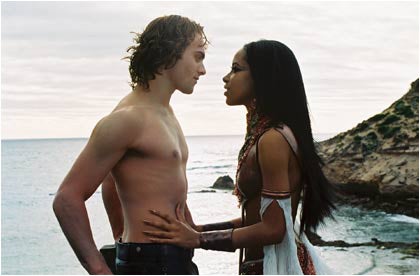
And then the follow up by Aaliyah called “We Need a Resolution,” starts off with an eerie duet, “I’m tried of arguing, girl. I’m tried, I’m tried, I’m tired of arguing, girl.” Aaliyah replies, “Did you sleep on the wrong side? I’m catching a bad vibe and it’s contagious, what’s the latest? Speak your heart, don’t bite your tongue. Don’t get it twisted, don’t misuse. What’s your problem? Let’s resolve it. We can solve it, what’s the causes? It’s official, you got issues. I got issues (no, you got issues) but I know I miss you. Am I supposed to change? Are you supposed to change. Who should be hurt? Who should be blamed? Who should be hurt? Will we remain? Oh, ah. We need a resolution, we have so much confusion. I wanna know, where were you last night? I fell asleep on the couch, I thought we were going out. I wanna know, were your fingers broken? If you had let me know, I wouldn’t have put on my clothes. I wanna know, where’d you go instead? It was four in the morning, when you crept back in the bed, I wanna know, what was in your head?”

As you watch the two videos for these songs, you will see they are dark, very artistic and one foreshadows a tragedy, and both of the videos play on the myth of Adam and Eve. A few months later after “We Need a Resolution,” by Aaliyah is released, she dies in a play crash. Like she predicted her own death. Of course, this is all just purely coincidental, but in the days before her death, Aaliyah spoke of having a feeling of something dark haunting her and then being on another plane of existence. Her last film, “Queen of the Damned” released in 2002 is a horrible movie about a tragic relationship, which ends in Akasha’s (played by Aaliyah) death.

For more real-life mysteries, please visit: https://winchestermysteryhouse.com/

Friends Gathered to Have Séances in Secrecy Together
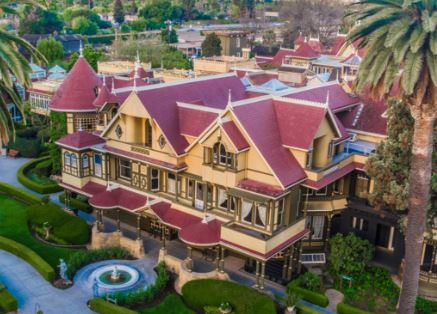
A warming, clear night had been followed by a morning of drenching fog. At about the middle of the afternoon of the preceding day a little whiff of light vapour—a mere thickening of the atmosphere, the ghost of a cloud—had been observed clinging to the Observational Tower. It was so thin, so diaphanous, so like a fancy made visible, that one would have said: “look quickly! in a moment it will be gone.” Spirits could move anywhere, over long distances, with the speed of light for spirits are free and powerful over there, perhaps. Strolling amongst the trees, under the branches of an enormous pine tree lay the dead body of a man. The body lay upon its back, the legs wide apart. One arm was thrust upward, the other outward; but the latter was bent acutely, and the had was near the throat. Both hands were tightly clenched. The whole attitude was that of desperate but ineffectual resistance to—what? Nearby lay a shotgun and a game bag through the meshes of which was seen the plumage of shot birds. All about were evidences of a furious struggle; a great pile of pine fronds were pushed into heaps and ridges on both sides of the legs by the action of other feet than theirs; alongside the hips were unmistakable impressions of human knees. The nature of the struggle was made clear by a glace at the dead man’s throat and face. While breast and hands were white, those were purple—almost black. The shoulders lay upon a low mound, and the head was turned back at an angle otherwise impossible, the expanded eyes staring blankly backward in a direction opposite to that of the feet. From the froth filling the open mouth the tongue protruded, black and swollen. #RandolphHarris 1 of 5

The throat showed horrible contusions; not mere finger marks, but bruises and lacerations wrought by two strong hands that must have buried themselves in the yielding flesh, maintaining their terrible grasp until long after death. Breast, throat, face, were wet: the clothing was saturated: drops of water condensed from the fog, studded the hair and mustache. Poor child, he had a round deal. A heavy rain started—it was almost a cyclone—and I had to rush inside. As I listened to the wind moaning from the outside, I heard first the scratch, scratch, scratch of some limb, no doubt, against the wall—sounding, or so it seemed in my feverish unrest, like someone penning an indictment against me with a worn, rusty pen. And then, the storm growing worse, and in a fit of irritation and self-contempt at my own nervousness, I had gone to the window, but just as lightning struck a branch of the tree nearest the window and so very near me, too—as though someone, something, was seeking to strike me, and as though I had been lured by that scratching. God! I had retreated, feeling that it was meant for me. However, that big, bloody hand painted on the ceiling was huge, knotted, rough, the fingers extended as if tense and like a pen—an old, long-handled pen—to match that scratch, scratch, scratch. Enthralled by some mysterious spell, I stood in the light gloom of the bedeviled room. “Agnus,” I had inquired of the housemaid in the morning to bring me fresh water and open the shutters, “what does that look like to you up there—that crimson patch on the ceiling?” #RandolphHarris 2 of 5
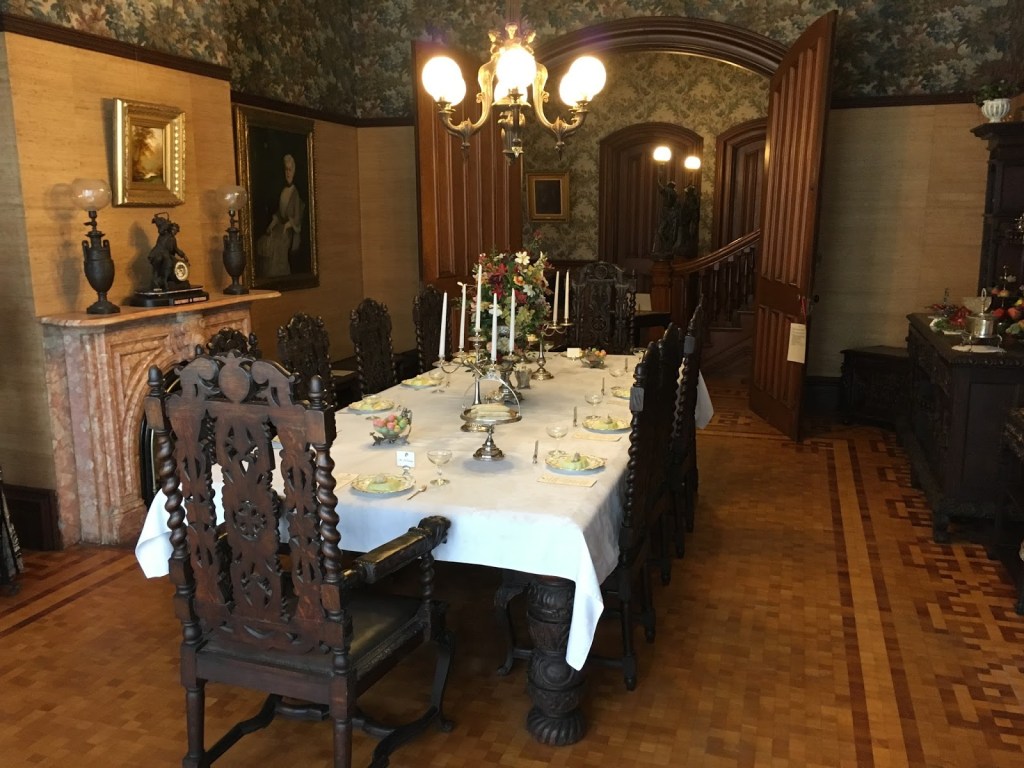
I wanted to reassure myself as to the character of the thing I saw—that it might not be a creation of my own imagination. “Mrs. Winchester,” she said, “it look like a bi blood soaked hand. I think you are being followed about by vile, evil spirits and those spirits’ only have one purposes or desire in this World. Horrible!” “In all my life, I have seen just one evil spirit, Agnus. Think of that. It was following a certain man all the time, at his left elbow—a dark, evil, red-eyed thing, until finally that man had been killed in a quarrel.” “Mrs. Winchester, if you want this ole place to hang together, you best get some repairing done mighty quick now. I have never seen that before,” cried Agnus. There a came to us out of a fog—the sound of a laugh, a low, deliberate, soulless laugh, which had no more joy than that of a hyena night-prowling in the desert; a laugh that rose by slow gradation, louder, and louder, clearer, and more distinct, and more terrible, until it seemed to be in the room with us; a laugh so unnatural, so unhuman, so devilish, that it filled the mansion with a sense of dread unspeakable! We did not move. That sound had grown out of silence, so now it died away; from a culminating shout which had seemed almost in our ears, it drew itself away into the distance, until its failing notes, joyless and mechanical to the last, sank to silence at a measureless remove. This was some sort of clairaudience. Hearing what cannot be heard with material ears, or ghosts. I got up and let. However, in my room upstairs I meditated on it, standing before my mirror. Suddenly—would I ever forget it—as I was taking off my mink coat, I heard a queer tap, tap, tap, right on my dressing table or under it. This was the sound ghost make when table-rapping in answer to a call, or to give warning of their presence. #RandolphHarris 3 of 5
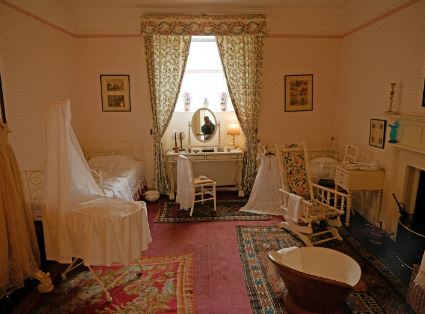
Then something said to me, almost as clearly as if I heard it: This is me, Chief Little Fawn, come back at last to get you! The body was just an excuse to let you know I was coming, and that blood dripping handprint, it was mine! I will be with you from now on. Don’t think I will ever leave you! It had frightened and made me half sick, so wrought up was I. For the first time I felt cold shills run up and down my spine—the creeps. I felt as if someone were standing over me—Chief Little Fawn, of course—only I could not see or hear a thing, just that faint tap at first, growing louder a little later, and quite angry when I tried to ignore it. How about that for a coincidence, picking up the magazine with that disturbing article about psychic materialization in Italy, and later in Berne, Switzerland, where the scientists were gathered to investigate that sort of thing? And just when I was trying to rid myself finally of the notion that any such thing could be. A thing as big as a washtub at first, something like smoke or a shadow in a black room moving about over the bed and everywhere. Then, as I lay there, gazing spellbound, it condensed slowly, and I began to feel it. It was now a hand of normal size—there was no doubt of it in the World—going over me softly, without force, as a ghostly hand must, having no real physical strength, but all the time with a strange, electric, secretive something about it, as if it were not quite sure of itself, and not quite sure that it was really there. I had taken to sleeping with the lights on, only tying a handkerchief over my eyes to keep out some of the glare. Even then I could see them—queer, misshapen things, for all the World like wavy, stringy jellyfish or coils of thick, yellowish black smoke, moving about, changing in form at times, yet always looking dirty or vile, somehow, and with those queer, dim, reddish or greenish glows for eyes. It was sickening! #RandolphHarris 4 of 5
My fellow friends gathered to have séances in secrecy together. They were passionate with need to see The Winchester Mansion for themselves, to explore rooms with their own hands and feet and eyes, to solve its mysteries, to wallow in its atmosphere, to raise its reluctant ghosts. It started off as luminous hands glowing slightly, and now has manifested into this terror. “I’ll choke you yet!” The words seemed to float from somewhere in an angry, savage tone. “You can’t escape! You may think you’ll die a natural death, but you won’t and that’s why I’m poisoning your food to weaken you. You can’t escape! I’ll get you, sick or well, when you can’t help yourself, when you’re sleeping. I’ll choke you. Build trap doors, endless hallways, and mazes, but I’m not alone. I’ve nearly had you many a time already, only you have managed to wriggle out so far, jumping up, but some day you won’t be able to—see? Then—” The voice seemed to die away at times, even in the middle of a sentence, but at other times—often, often—I could hear it completing the full thought. Sometimes I would turn to the thing and say, “Oh, go to the devil!” or “Let me alone!” even in a closed room and all alone, such remarks seemed strange to me, addressed to a ghost; but I could not resist at times, annoyed as I was. Only I took good care not to talk if anyone was about. Rain was falling, and the darkness was intense. I had shrunk back and now stood a little to one side of the doorway and in shadow. I concealed myself in the dark dressing-room that opened up to the chamber, in which a candle was burning. I aw a large black object, very ill-defined, crawl, as it seemed to me, across the floor. For a few moments I had stood petrified. I cannot describe to you all that passed on that horrible night. The whole house was up and stirring. The specter was gone. It this solitude, upon my mysterious case—in this haunted spot, I comprehended the reason of the extraordinary precautions taken for my safety during sleep. #RandolphHarris 5 of 5
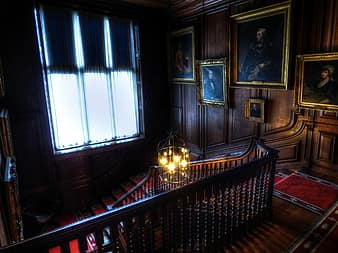
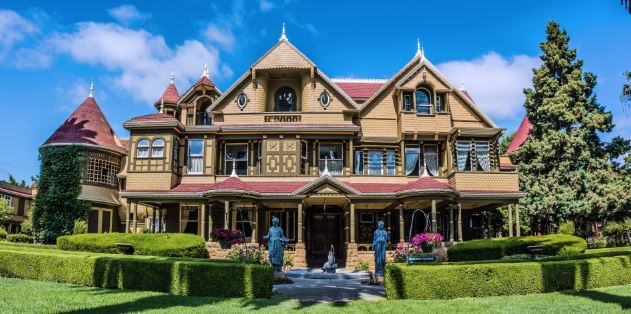
On Halloween night 1989, a frightened and astonished tour guide saw three entities change shape, glow in the dark, and materialize and dematerialize right in front of her. Some researchers have theorized that such spirit entities might be angels. Although angels are frequently called spirits, it is often implied in the Christian Bibles that they can possess corporeal bodies when seen on Earth. Even though angels throughout history have often been mistaken for ordinary humans when judged by their appearance alone, those individuals who have confronted them have often felt the physical effects of the beings’ other-Worldly powers. https://winchestermysteryhouse.com/
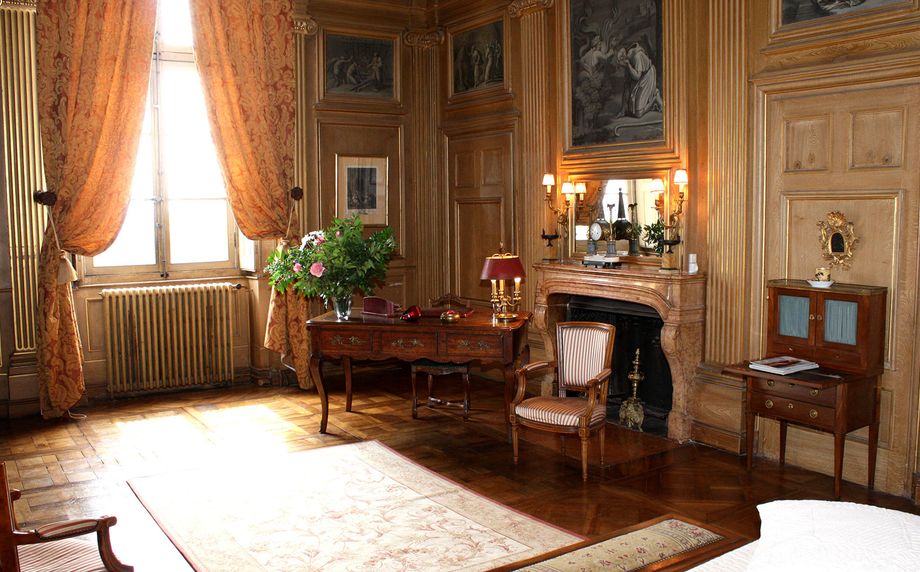
And please be sure to check out the online gift store: https://shopwinchestermysteryhouse.com/

Nacho is Trying to Read My Books

For centuries kings, priests, feudal lords, industrial bosses and parent have insisted that obedience is a virtue and that disobedience is a vice. Human history begun with an act of disobedience. Human history was ushered in by an act of disobedience according to the Hebrew and Greek myths. Adam and Eve, living in the Garden of Eden, were part of nature; they were in harmony with it, yet did not transcend it. They were in nature as the fetus is in the womb of the mother. They were human, and at the same time not yet human. All this changed when they disobeyed an order. There are moments of sudden illumination in which man stretched out a commanding arm, as if creating a World, light shining forth and spreading out around him. He is then filled with the deeply gratifying certainty that what enraptured and exalted him into the farthest regions, the height of this one sensation, can never be denied to posterity; in the eternal necessity of this rare illumination for all those to come man sees the necessity of his frame. Far into the future, mankind needs him, and just as that moment of illumination is the embodiment and epitome of his innermost essence, so, too, he believes himself, as the man of this moment, to be immortal, dismissing all others as dross, rot, vanity, brutishness, or pleonasm, leaving them to perish. We view all disappearance and demise with discontent, often with astonishment, as if we experienced in it something at bottom impossible. We are disturbed when a tall tree breaks, and a crumbling Victorian home aggrieves us. Every New Year’s Eve, we feel the mystery of contradiction of being and becoming. #RandolphHarris 1 of 18

What offends moral man above all, though, is that an instant of supreme universal perfection should be destroyed. European and American history since the end of the Middle Ages is the history of the full emergence of the individual. It is a process which started in Italy, in the Renaissance, and which only now seems to have come to a climax. It took over four hundred and fifty five years to break down the medieval World and to free people from the most apparent restraints. However, while in many respects the individual has grown, has developed mentally and emotionally, and participates in cultural achievements in a degree unheard-of before, the lag between “freedom from” and “freedom to” has grown too. The result of this disproportion between freedom from any tie and the lack of possibilities for the positive realization of freedom and individuality has led, in Europe, to a panicky flight from freedom into new ties or at least into complete indifference. Western society underwent radical changes which were accompanied by an equally radical change in the personality structure of man. A new concept of freedom in modern society must start with that period in which the foundations of modern culture were laid, for this formative stage of modern man permits us, more clearly than any later epoch, to recognize the ambiguous meaning of freedom which was to operate throughout modern culture: on the one hand the growing independence of man from external authorities, on the other hand his growing isolation and the resulting feeling of individual insignificance and powerlessness. #RandolphHarris 2 of 18

Our understanding of the new elements in the personality structure of man is enhanced by the study of their origins, because by analyzing the essential features of capitalism and individualism at their very roots one is able to contrast them with an economic system and a type of personality which was fundamentally different from ours. This very contrast gives a better perspective for the understanding of the peculiarities of the modern social system, of how it has shaped the character structure of people who live in it, and of the new spirit which resulted from this change in personality. The period of the Reformation is more similar to the contemporary scene than might appear at first glance; as a matter of fact, in spite of all the obvious differences between the two periods, there is probably no period since the sixteenth century which resembles ours as closely in regard to the ambiguous meaning of freedom. The Reformation is one root of the idea of human freedom and autonomy as it is represented in modern democracy. However, while this aspect is always stressed, especially in non-Catholic countries, its other aspect-its emphasis on the wickedness of human nature, the insignificance and powerlessness of the individual, and the necessity for the individual to subordinate himself to a power outside of himself—is neglected. This idea of the unworthiness of the individual, his fundamental inability to rely on himself and his need to submit, is also the main theme in the ideology of some who are arguably great leaders, but may, however, lack the emphasis on freedom and moral principles which are inherent in Protestantism. #RandolphHarris 3 of 18

This ideological similarity is not the only one that makes the study of the fifteenth and sixteenth centuries a particularly fruitful starting point for the understanding of the present scene. There is also a fundamental likeness in the social situation. Then as now a vast sector of the population was threatened in its traditional way of life by revolutionary changes in the economic and social organization; especially was the middle class, as today, threatened by the power of monopolies and the superior strength of capital, and this threat had an important effect on the spirit and the ideology of the threatened sector of society by enhancing the individual’s feeling of aloneness and insignificance. The picture of the Middle Ages has been distorted in two ways. Modern rationalism has looked upon the Middle Ages as an essentially dark period. It has pointed to the general lack of personal freedom, to exploitation of the mass of the population by a small minority, to its narrowness which makes the peasant of the surrounding country a dangerous and suspected stranger to the city dweller—not to speak of a person of another country—and to its superstitiousness and ignorance. On the other hand, the Middle Ages have been idealized for the most part by reactionary philosophers but sometimes by progressive critics of modern capitalism. They have pointed to the sese of solidarity, the subordination of economic to human needs, the directness and concreteness of human relations, the supranational principle of the Catholic Church, the sense of security which was characteristic of man in the Middle Ages. Bother pictures are right; what make them both wrong is to draw one of them and shut one’s eyes to the other. #RandolphHarris 4 of 18

What characterized medieval in contrast to modern society is its lack of individual freedom. Everybody in the earlier period was chained to one’s role in the social order. A man had little chance to move socially from one class to another, he was hardly able to move even geographically from one town or from one country to another. With few exceptions he had to stay where he was born. He was often not even free to dress as he pleased or to eat what he liked. The artisan had to sell at certain price and the peasant at a certain place, the market of town. A guild member was forbidden to divulge any technical secret of production to anybody who was not a member of his guild and was compelled to let his fellow guild members share in any advantageous buying of raw material. Personal, economic, and social life was dominated by rules and obligations from which practically no sphere of activity was exempted. However, although a person was not freed in the modern sense, neither was he alone and isolated. In having a distinct, unchangeable, and unquestionable place in the social World from the moment of birth, man was rooted in a structuralized whole, and thus life had a meaning which left no place, and no need, for doubt. A person was identical with his role in society; he was a peasant, an artisan, a knight, and not an individual who happened to have this or that occupation. The social order was conceived as a natural order, and being a definite part of it gave a feeling of security and of belonging. There was comparatively little competition. One was born into a certain economic position which guaranteed a livelihood determined by tradition, just as it carried economic obligations to those of higher in the social hierarchy. #RandolphHarris 5 of 18

However, within the limits of his social sphere the individual actually had much freedom to express one’s self in one’s work and in one’s emotional life. Although there was no individualism in the modern sense of the unrestricted choice between many possible ways of life (a freedom of choice which is largely abstract), there was a great deal of concrete individualism in real life. There was much suffering and pain, but there was also the Church which made this suffering more tolerable by explaining it as a result of the sin of Adam and the individual sins of each person. While the Church fostered a sense of guilt, it also assured the individual of her unconditional love to all her children and offered a way to acquire the conviction of being forgiven and loved by God. The relationship to God was more one of confidence and love than of doubt and fear. Just as a peasant and a town dweller rarely went beyond the limits of the small geographical area which was theirs, so the universe was limited and simple to understand. The Earth and man were it center, Heaven and Hell was the future place of life, and all action from birth to death were transparent in their causal interrelation. Although society was thus structuralized and gave man security, yet it kept him in bondage. It was a different kind of bondage from that which authoritarianism and oppression in later centuries constituted. Medieval society did not deprive the individual of his freedom, because the “individual” did not yet exist; man was still related to the World by primary ties. He did not yet conceive of himself as an individual except through the medium of his social (which then was also his natural) role. #RandolphHarris 6 of 18

Man did not conceive of any other persons as “individuals” either. The peasant who came into town was a stranger, and even within the town members of different social groups regarded each other as strangers. Awareness of one’s individual self, of others, and of the World as separate entities, had not yet fully developed. The lack of self-awareness of the individual in medieval society had found classical expression on both sides of human consciousness—that which was turned within as that which was turned without—lay dreaming or half awake beneath a common veil. The veil was woven of faith, illusion, and childish prepossession, through which the World and history were seen clad in strange hues. Man was conscious of himself only as a member of a race, people, party, family, or corporation—only through some general category. When psychopathological offenders are able to give visions it I an evidence that they have already greatly deceived the man, be he a Christian or an unbeliever. The ground for this is not necessarily known as conduct disorder, but a condition of passivity, id est, nonaction of the mind, imagination, and other faculties. This essential condition of submissive non-action as the means of obtaining supernatural manifestations is well understood by spiritist mediums, clairvoyants, crystal gazers, and others, who know that the least action of the mind immediately breaks the clairvoyant state. #RandolphHarris 7 of 18

Believers not knowing these basic principles can unwittingly fulfill the conditions for psychopathological offenders to work in their life and ignorantly induce the passive state by wrong conceptions of the true things of God. For instance, they may sink, during seasons of prayer, into a passive mental condition which they consider is “waiting on God”; deliberately will the cessation of their mind action, in order to obtain some supernatural manifestations which they believe to be of God; in daily life practice a passive attitude which they think is submission to the will of God; endeavour to bring about a state of personal negation, in which they have no desires, needs, wishes, hopes, plans—which they think is full surrender to God, with their “will” lost in God. “To exist” means to “stand out.” On the most fundamental level, to exist means to be, to stand out of nonbeing. Since nonbeing can be the absolute nonbeing of ouk on (the God who is not) or the relative nonbeing of me on, existence can take two directions. If something stands out of absolute nothingness, it exists in the sense that it has being. If something stands out of relative nothingness, that is, potentiality, then it exists in the sense that it has actuality. Etymology, then, indicates two senses of existence: “to stand out” of either absolute nonbeing or relative nonbeing. However, in either case, the metaphour “to stand out” connotes the metaphour “to stand in,” just as trees “stand out” of the Earth and yet “stand in” it. A being stands out of nonbeing, but not completely, for it is a mixture of being and nonbeing. An actual being stands out of potentiality, but not completely, for it never fully realizes all its potentiality. Existence, therefore, is an imperfect being, for to exist means to have being and yet to “stand in” non-being, to have actuality, and yet to “stand in” potentiality. #RandolphHarris 8 of 18

Historically, however, attention has been focused upon the second meaning of existence and split between potentiality and actuality. This is the overriding meaning of existence: to stand out of potentiality. Upon this means we build the distinction between essence and existence. Essence is real, is actualized in existence, but only in fragments, never totally. This situation gives rise to two conflicting view point exemplified in Mr. Plato and Mr. Hegel. Mr. Plato viewed the gap between potential and actual being as a fall. For him, existence is a fall from essence. Mr. Hegel, on the contrary, considered the gap as merely part of the process of divine self-realization. For him existence is the expression of essence. Mr. Hegel’s essentialism set the stage for the existentialist revolt. Mr. Schelling, Mr. Schopenhauer, Mr. Marx, and Mr. Kierkegaard all share a common insight: that human existence is a state of estrangement from its essential nature. Existence is dehumanization and not the expression of essential humanity. This is the truth about man’s predicament which existentialism has laid bare. However, it is the question of existence, not the answer. Whenever existentialist, atheistic, or theistic, go beyond their analyses and provide answers, they draw upon religious sources. For the answer to existence is a matter of ultimate concern, and hence is religious, even though it be disguised in secular or atheistic grab. The religious character of existentialism stems from the very nature of philosophy which embraces both scientific detachment and the involvement of faith in an ultimate concern. Christianity proclaims the “New Being” in Christ; the merit of existentialism lies in its graphic portrayal of the “old being,” namely, the tragedy and anxiety of a cosmos estranged from its essential nature. #RandolphHarris 9 of 18

The history of the family is one perpetual crisis. Social justice requires that the state treat its citizens as equals, and that requirement has serious distributive implications, demanding much more equal distributions, of a variety of gods, than exist in any contemporary societies. However, as liberals, we recognize that it is valuable for people to make and act on their own judgments about how they should live, and important that they be accorded the freedoms necessary for them to live well. The problem, of course, a World in which we were required to treat everybody the same—friend, spouse, child, stranger—would be a dystopic nightmare, a World were nobody enjoyed the relationships tht make us human. Some of the most valuable element in human lives depends precisely on our treating particular other as special. The family, the natural home of such relationships, is a particularly a stark locus of the tensions embodied in the view that people should enjoy equal freedom, or have equal opportunity to live valuable lives. A completely harmonious reconciliation may not be possible. We do not show that plausible understandings of the family, equality, and liberty can be constructed in a way that eliminates all conflicts between the family and equality, or resolves all difficulties concerning authority over children. Our more modest aim is to offer an account of “family values properly understood” that shows the possibility of child-rearing practices and institutions that realize the values distinctively made available by familial relationships, that respects those individual liberties that are indeed worthy of respect, and that mitigates—massively mitigates—the conflict with equality. #RandolphHarris 10 of 18
The family has only recently begun to receive the careful attention needed to provide satisfactory responses to the challenges it faces in society. Public declarations of human rights, devised specially to provide a consensual focal point, can hardly be expected to venture into controversial matters, so we should not be surprised if their pronouncements are rather vague. Thus, for example, the Universal Declaration of Human Rights tells us that “the family is the natural and fundamental group of society and is entitled to protection by society and the State” (Article 16.3), while the European Convention on Human Rights announces that “everyone has the right to respect for his private and family life” (Article 8) and that “men and women of marriageable age have the right to marry and found a family (Article 12). Family values and practices arise out of this family-centered view of the World. Mormons are very conservative about pleasures of the flesh before marriage. Pleasures of the flesh are valued as an expression of love and commitment between eternal partners. It is the means God uses to bring spirit children out of the preexistence into this mortal World and has the power to create an eternally increasing family. Pleasures of the flesh outside marriage is forbidden, including any non-traditional relationships, premarital pleasures of the flesh, adulty, and pornography. Pleasuring of one’s self is strongly discouraged. Young people are encouraged to remain chaste until marriage and to marry early in order to develop their morality within the proper boundaries. Marriage is so strongly encouraged that an unmarried man approaching age thirty will raise questions. #RandolphHarris 11 of 18

Women are given the benefit of the doubt, but men are strongly expected to do what it takes to find a mate. It is much like how in conservative families, if one does not have a college degree, a house, a car and a career by the age of twenty-five, people start to question the individual’s competence. When it comes to identity and interpersonal competence, intellectual play includes those interest which have as a primary focus the exercise of mental skills and the pursuit of knowledge for its own sake (puzzles, card games, debating, reading, collecting, sightseeing). They have much similarity to sports and crafts, save that they are directed only to exploring and knowing the World, not manipulating it, except symbolically. Like crafts, they recapitulate the whole range of serious intellectual pursuits; like sports, the various individual forms test all the intellectual powers such as: memory, imagination, problem-solving, dissimulation, and anticipation of others. On this account, intellectual play is readily professionalized, and conversely, serious intellectual pursuits can readily be motivated by the fun involved. The constant elements of intellectual play are these underlying aspects of curiosity—about the nature of the World, and of other men, and one’s own powers for grasping them. When such abilities are compared with those of others, there is a nonphysical contest or game. Guessing the moves of others appears to have far more attraction than mere comparisons of mental ability, undoubtedly because the element of chance is involved. In American culture, however, the attraction of intellectual contests and games seems underdeveloped; some other civilizations in the past seem to have gone further in this direction. #RandolphHarris 12 of 18

The volume of reading, and use of other media of communication and education—apart from the arts—are steadily mounting and probably differentiating into new forms. As education becomes fun instead of duty, through the decline of the sense that is must be profitable before it can please, the student of popular culture at the intermediate level will probably find a vast efflorescence of intellectual play. Young minds are worked and winced and shaped curiously by a vision of Life—the American Dream. The American Dream is so widely used that it has become a powerful metaphour of core American values. While economic success is first among these values, others are almost equally important. Among thee values is being able to grow to grow to fullest development as men and women, unhampered by the barriers which have slowly been erected for the benefit of classes rather than for the simple human being of any and every class. The American Dream mandates that all these values can be accomplished through hard work and individual effort. Although Well Street has melted down, personal savings and investments have been vaporized and rebounded, businesses are going bust, while other flourish, and certain populations are facing high unemployment, the American Dream is still alive and worth aspiring to, despite the nightmare some American are living through. The American Dream of a better, richer, and happier life for all our citizens of every rank is the greatest contribution we have as yet made to the thought and welfare of the World. That hope has been present from the start. Every since we became an independent nation, each generation has seen an uprising of the ordinary Americans to save that dream from the forces which appeared to be overwhelming and dispelling it. #RandolphHarris 13 of 18

It is not about becoming rich and famous overnight, but is more of a verbal contract that states, if you work hard, you, too, can buy a house, have a family and live well. Ordinary man has held fast to those rights t “life, liberty, and the pursuit of happiness” which were vouchsafe to us in the past in vision and on parchment. The Providence, the eighteenth and nineteenth century term for God, had ordained that the United States of America extend its unique and relatively new form of government, the so-called “great experiment of liberty and federate self-government.” Manifest Destiny embodies a higher law—God’s law—and so hold the moral high ground. Manifest Destiny means expansion, prearranged by Heaven, over an area not clearly defined. Therefore, the expansion of America’s boarders may not be finalized yet. Many believe that the United States of American will some day encompass the entire Western Hemisphere, and possibly beyond. Regardless of the interpretation, the concept of Manifest Destiny spurred a political movement in the 1840s. The justifications for Manifest Destiny is that first of all, American society and citizens are virtuous. Because of their virtue, they are justified in expanding. Second, it is the mission of American to undertake the task of accomplishing these things. That is why the National Anthem means so much to Americans because it speaks of expanding her boarder “from sea to shining sea.” And China understands this, which is why they are not allowing American corporations to purchase large companies in China. This is also why Americans are also worried about companies overseas buying American land and corporation. Many understand that political parities may not really matter so much anymore because so many politicians are looking to get rich quick and may not care about America. #RandolphHarris 14 of 18

To further highlight this illustration, on March 1 2017, less than two months after Vice President Joe Biden left public office, State Energy HK Limited, a Chinses Company, wired $3 million to Rob Walker’s company. The next day, the company wired $1,065,000 to a company associated with James Gillar, another Biden associate. Afterwards the Biden family received approximately $1,065,000 in payments over a three-month period in different bank accounts. From the bank records, it appears that the Biden family received approximately one-third of the money obtained from the China wire, which leads many people to believe that the Biden administration of compromised. “Over the course of several years, members of the Biden family and their companies received over $1.3 million in payments from accounts related to their associate, Rob Walk. Most of this money came as a result of a wire from a Chinese energy company and went not only to Hunter and James Biden, but also to Hallie Biden and an unknown ‘Biden.’ It is unclear what services were provided to obtain this exorbitant amount of money. The Oversight Committee is concerned abut the national security implications resulting from President Biden’s family receiving millions of dollars from foreign nationals. We will continue to follow the money trail and facts to determine if President Biden is compromised by his family’s business scheme and if there is a national security threat,” reports Chairman James Comer (R-ky). Millions of upper-class, middle-class and poor American have a justified fear that they will be left behind, will lose their jobs and slide further down the economic and social slope. #RandolphHarris 15 of 18

The West is also cautious about China’s acquisitions of its firms, but overall the restrictions it imposes are less tight than those that Western acquirers are facing in China. Take a close look at the Chinese attempts to acquire Western companies. First, China is buying ailing but famous firms striving to keep afloat. While you may think the classic American brands you see every day are entirely domestic, many are actually owned by Chinese investors. The United States of America is home to many iconic American brands that dominate the global market; however, while these brands may seem All-America, even they have important stakeholders all over the globe. AMC, a popular cinema company, short for American Multi-Cinema, has been around for over a century and is headquartered in Leawood, KS. In 2012, Beijing-based Dalian Wanda Group became the majority stakeholder, giving them the power to make decisions at the executive level. Wanda invested $2.8 billion in the historical deal. General Motors, based in Detroit, Michigan, is known as America’s largest automobile manufacturer. While this company is not owned by a Company from China, it relies on its partnership with Shanghai Automotive Industry Corp (SAIC) to stay profitable. In 1998, the two auto giants teamed up to form SAIC-GM, a Chinese brand with a 6 million square-foot facility in Shanghai. While GM is still extremely popular in the U.S.A., its extra sales in China through SAIC help to being in revenue regularly. #RandolphHarris 16 of 18

General Electric covers a wide range of industries and their appliance division is manufactured in the U.S.A. with global parts (and with domestic parts whenever possible). However, in 2016, Chinese investor Haier bought the company’s appliance division for $5.4 billion. While all products are still made in America, the ideas are generated in China. It is quite different from other American brands because GE has been around since 1892. While investors do not necessarily affect where a product is made, in many cases, they have a large influence in how a business is run and marketed. It is dangerous when any large American brand is partially owned by companies from China or other foreign investors because they have greater responsibilities in their homeland. China is purchasing American brands and obtaining technologies, know-how, distribution networks, and high-skilled personnel. Furthermore, they are interest in buying dynamic technology companies, including small and medium entities, and they are targeting natural resource firms. If information flow in a group is sufficiently good, a cooperative outcome may emerge automatically as an equilibrium of the repeated game of random pairwise matching. Otherwise, the group has to seek other institutions of governance, and these many include more formal court-like organization. One might think that modern technology has improved information flows to perfect. Indeed, eBay had developed a good system where buyers give ratings to sellers and vice versa, and each transactor can check the average rating of the person with whom one is contemplating doing business. However, this too has its limits, and eBay has expanded, it had found it necessary to institute more formal methods to prevent fraud. #RandolphHarris 17 of 18

A system based on voluntary information flows and self-enforcing equilibrium works for small or well-knit groups, large groups need more formal institutions of information dissemination and enforcement. Self-enforcing “relation-based” based groups face rising marginal costs: members added at the margin are almost by definition less well connected, making it harder to communicate information with them and to ensure their participation in any punishments. Formal or “rule-based” governance has high fixed costs of setting up the legal system and the information mechanism (disclosure rules and auditing procedures), but once these costs have been incurred, the marginal costs of the relation-based system will be smaller at small sizes, and those of the rule-based system will be smaller at large sizes. This makes intuitive sense, but for a deeper understanding one must make more precise the way in which diminishing returns or rising marginal costs set in as a relation-based system grows larger. This is also necessary to understand what happens at intermediate sizes. Relation-based governance works well in small groups that are connected by extended family relationships, neighbourhood structures, and ethno-linguistic ties, because such links facilitate repeated interactions and good communication. This idea is similar to the sociologists’ concept of embeddedness. Economists recognize the importance of family and social networks in less-developed economies, but often regard them as being unimportant in modern advanced economies, and therefore ignore them in that context. The differences are much less sharp than is commonly thought. The persistence or relational arrangements under the shadow of the law in advanced economies is now well recognized. However, the relation-based governance does indeed lose its relative efficacy as the scale of economic transaction grows. This supports the usual economic distinction as a matter of degree, if not as a sharp dichotomy between less-developed and advanced economies. #RandolphHarris 18 of 18

CRESLEIGH HAVENWOOD
Lincoln, CA | from the high $600s
Now Selling!

No appointment needed! Cresleigh Havenwood features four distinct floor plans ranging from 2,293 – 3,377 square feet and offering up to five bedrooms.

Each plan has been thoughtfully designed and includes great features such as single story homes, guest suites, optional offices, garage workshops, and more!

Get the most out of your new home with Cresleigh’s All Ready smart home featuring all the connectivity needed to keep your house running. Best of all, each Cresleigh home comes with owned solar included!

Located off of Virginiatown Road and McCourtney Road, residents of the 83 homesites of Cresleigh Havenwood will benefit from a brand new neighborhood in the charming City of Lincoln. Palo Verde Park, is just down the street and there’s plenty of recreation to take part in all around town. https://cresleigh.com/havenwood/quick-move-homesite-66/

American Dream, a fact that the United States of America is a land of opportunity that allows the possibility of upward mobility, freedom, and equality for people of all classes who work hard and have the will to succeed.


An Artifact from Another Level of Being

The silence closed in. Something was building in Llanada Villa. Something was happening in the very air itself. Something changed in the golden glow of a late autumn afternoon. And as I heard the music, a long stab of terror drove through my heart. I assented to the window. As I looked out, I saw a handsome old-fashioned carriage, with a troop of couriers and footmen. I saw the slim figure of the pale gentleman in black, as he held a thick velvet cloak. He looked about him at the others as he went on, his voice ringing clear in the silence. “Never such a place as this has existed before. A place where demons have been invented by aggrieved souls. I wondered if Mrs. Winchester was perhaps a member of the Freemasons, or some other secret society. Maybe she holds some exalted rank.” I felt a great shudder pass through me at these words. However, there had been a conviction in those appalling words. Secret societies were very fashionable just then. Secret societies and psychiatry were the contrasting en vogue activities of the moment. I folded my arms and leaned against the frame of the door, obscuring for the moment the light behind me. I had an urge to venture outside, to walk in silence amongst the trees. However, the fruit orchard was dark enough even in daylight; by moonlight it would be all too easy to imagine terrors—as I keep imagining I can hear soft footsteps moving across the floor above my head. But when I sit on the sofa to listen, I hear only the beating of my heart. I walked for hours examining the trees and the splendid fruit that would be harvested. Before long, I was overtaken by night while still in the fruit orchard. Utterly bewildered and overcome with fatigue, I had lain down near the root of a large plumb tree and fallen into a dreamless sleep. #RandolphHarris 1 of 8

It was hours later, in the very middle of the night, that one of God’s mysterious messengers, gliding ahead pronounced the awakening word in my ear. Waking from a deep sleep at night in the midst of what seemed like a forest, front among the tree on either side I caught broken and incoherent whispers in a strong tongue which I partly understood. They seemed to me fragmentary utterances of a monstrous conspiracy against my body and soul. It was now long after nightfall, yet the interminable fruit orchard through which I journeyed was lit with a wan glimmer having no point of diffusion, for in its mysterious lamination nothing cast a shadow. A shallow pool in the guttered depression of an old well met my eye with a crimson gleam. I stooped and plunged my hand into it. It stained by fingers; it was blood! Blood, I then observed, was about me everywhere. The fallen fruit showed blots and splashes of blood. The girds of the orchards were pitted and spattered as with red rain. Defiling the trunks of the trees were broad maculations of crimson, and blood dripped like dew from their foliage. All this I observed with a terror which seemed not incompatible with the fulfillment of a natural expectation. It seemed to me that it was all in expiation of some crime. So frightful was the situation—the mysterious light burned with so silent and awful a menace; the noxious plants, the trees that by common consent are invested with a melancholy or baleful character, so openly in my sight conspired against my peace; from overhead and all about came so audible and startling whispers and the sighs of creatures so obviously not of Earth—that I could endure no longer, and with a great effort to break some malign spell that bound my faculties to silence and inaction, I screamed with the full strength of my lungs! #RandolphHarris 2 of 8

My voice was broken, it seemed, into an infinite multitude of unfamiliar sounds, went babbling and stammering away into the distant reaches of the orchard, died into silence, and all was as before. Despair succeeded hope. Gratitude gave place to curse. As I preceded down the path, sobbing quietly to myself, in the misery of fear, the stern light of the Observational Tower became a tiny speck, yellower but scarcely bigger than some of the stars, which here and there shone between the clouds. Nearly twenty minutes passed, and my fatigue began to change to exhaustion. The overpowering sense of the inevitable pressed upon me. With the weariness came a strange comfort. On, and on I went through the thicket of trees. I knew of my probable presence in the spirit World. The moon, then in her third quarter, pushed out from behind the concealing clouds and shed a pale, soft glitter upon my mansion. My last appeal had been heard. I made it home. About half an hour after getting home, I still felt energized but I began to feel a sensation around my forehead as I have many times since. I suddenly felt weak. I went in and sat at the foot of my bed and passed out. I have never been given to fainting or passing-out spells, but I did not fall asleep—I passed out cold. When I woke up, I had no concept of time. When I woke up, a low, wild peal of laughter broke out at a measuresless distance away, and growing even louder, seemed approaching ever nearer; a soulless, heartless, and unjoyous laugh, like that of loon; a laugh which culminated an unearthly shout close at hand, then died away by slow gradations, as if the accursed being that uttered it had withing over the verge of the World whence it had come. #RandolphHarris 3 of 8

Sitting here in my temple of a house, I felt trapped and compromised, and even terrified. I got a feeling that the presence was still nearby and had not moved. A strange sensation began slowly to take possession of my body and my mind. I could not say which, if any, of my sense were affected; I felt it rather as a consciousness—a mysterious mental assurance of some overpowering presence—some supernatural malevolence different in kind from the invisible existences that swarmed about me, and superior to them in power. I knew that it had uttered that hideous laugh. And now it seemed to be approaching me; from what direction I did not know—dated not conjecture. All my former fears were forgotten and merged in the gigantic terror that now held me in thrall. Powers were traversing my haunted mansion. My senses were heightened as I found myself starting into the sharply dawn face and blank, dead eyes of my own mother, standing white and silent in the garments of the grave! The apparition confronting me—the thing so like, yet so unlike my mother—was horrible! It stirred no lover nor longing in my heart; it came unattended with pleasant memories of a golden past—inspired no sentiment of any kind; all the finer emotions were swallowed up in fear. I turned to turn and run from before it, but my legs were as lead; I was unable to life my feet from the floor. My arms hung helpless at my sides; of my eyes only I retained controlled, and these I dared not remove from the lusterless orbs of the apparition, which I knew was not a soul without a body, but that most dreadful of all existences infesting my haunted mansion—a body without a soul! #RandolphHarris 4 of 8

In its blank state was neither love, nor pity, nor intelligence—nothing to which to address an appeal for mercy. For a time, which seemed so long that the World grew gray with age and sin, and the haunted forest, having fulfilled its purpose in this monstrous culmination of its terrors, vanished out of my consciousness with all its sights and sounds, the apparition stood within a pace, regarding me with a mindless malevolence of wild brute; then thrust its hand forward and sprang upon me with appalling ferocity! The act released my physical energies without an unfettering my will; my mind was still spellbound, but my powerful body was and agile limbs, endowed with a blind, insensate life of their own, resisted stoutly and well. For an instant I seemed to see this unnatural contest between a dead intelligence and a breathing mechanism only as a spectator. Despite my struggles—despite my strength and activity, which seemed wasted in a void, I felt the cold fingers close upon my throat. Brorne backward to the floor, I saw above me the dead and drawn face within a hands breadth of my own. Its eyes were shallow to the point of blankness, and then all was black. Until I awoke, the passage outside my room had been pitch dark. Now the gasoliers illuminated the hall, but the glass was so blackened that they yielded only a dim, murky light. The air was stale and close. Expecting at every turn to find a housemaid awaiting me with a smile, I made my way through the gloom to the landing. The double doors to the gallery stood open. Along each wall, a row of wavering light receded. Transom windows shone with a faint cold light; higher still, the ceiling was shrouded in darkness. Some twenty feet away from me, candles burned upon a small round table, lighting of the face of the pale man and Mrs. Haas. “Ah, there you are, my dear,” said he, just as if he had last seen my five minutes—rather than several days—ago. I moved reluctantly to join them. #RandolphHarris 5 of 8

Mrs. Haas, resplendent in crimson silk and displaying a large expanse of white bosom, greeted me with disdain. Behind them, the wall at the far end of my gallery was dominated by the immense fireplace, and the armour towering in the shadows beside it. The sword glittered beneath its gloved hand; in the shifting light it seemed alert, alive, watchful. Within the fireplace was a massive chest of dark metal. “Dr. Cottam was about to tell us,” said Mrs. Haas impatiently, “of a discovery he had made amongst your late husband’s papers.” He spoke as if I had kept them waiting. “Indeed I was.” His tone was as cordial as ever, but with an edge of anticipation. His teeth caught the light as he smiled; the pupils of his eyes shone like twin flames. “Now, in going through his study the other day, I found a page of notes you must have missed after relocating from New Haven—scrawled in haste, and sometimes quite impenetrable—which had slipped behind a row of books.” On the table was a crumpled sheet of paper. “I shall not weary you with the tale of my efforts to decipher this. He believed that if he were inside the armour when lighting struck, he would pass unharmed into the next World, jut as the risen body, according to Scripture, will ascend to Heaven upon the day of judgement.” “Oh dear Heavens,” cried Mrs. Haas. “Mrs. Winchester, I have been dying for a grand tour of your estate. My companion Dr. Cottam is rather a bore with such foolish tales of science fiction!” “There is a theory, you know, that the basis of spirit may be electrical. For spirits to communicate with the living,” expressed Dr. Cottam, the man with the very pale face. #RandolphHarris 6 of 8

“Dr. Cottom, I have begun to wonder whether your obsession with William Winchester is not, perhaps, quite as mad as I assumed,” explained Mrs. Haas, “but I do wish to get on with this tour. Mrs. Winchester has already delayed us several hours after he invitation, and I am growing quit weary.” “Well, Mrs. Haas, as I do recall, Gods are often said to wield lightening; and whilst this represents primitive awe at the power of nature, it may also shroud a genuine intuition. The same applies to the spiritualist practice of linking hands around a table. Ghosts and spirits are generally depicted as emanations of light; one thinks of St. Elmo’s fire or the very rare phenomenon of ball lightning…a far fetched analogy, you may say, but just as a magnetic field will cause a heap of iron filings to arrange themselves into a complex pattern, so the soul, the vital principle—call it what you will—animates the Earthly body. Might it not be that the vital principle is electrical, perhaps in some subtler form that science has not yet grasped?” said Dr. Cottam. “Dr. Cottam, while your theories are very fascinating, I fear Mrs. Haas is growing impatient and I should like to give her a tour now,” I explained. I liked Mrs. Haas more and more every minute. Her gossip, without being ill-natured, was extremely diverting to me, who had been so long out of the great World. I thought what life she would give to my sometimes-lonely evenings at home. There was a ball going on in the Grand Ballroom, this house seemed to run itself sometimes, which would not be over until the morning sun had almost reached the horizon. It pleased the Grand Duke to dance till then, so loyal people could not go away, or think of bed. #RandolphHarris 7 of 8
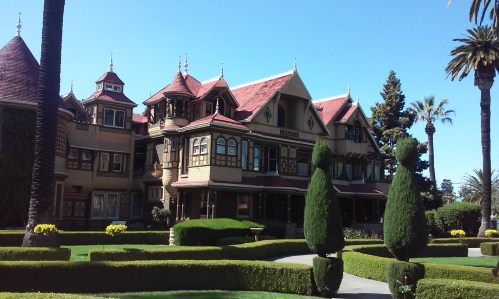
We had just got through a crowded parlor, when Dr. Cottam asked me what had become of Mrs. Haas. I though she had been by his side, and he fancied she was by mine. The fact was, we had lost her. All my efforts to find her were in vain. I feared that she had mistaken, in the confusion of the momentary separation from us, other people for her new friends, and had, possibly, pursued and lost them in the extensive grounds which were thrown open to us. Morning broke. It was clear daylight before I gave up my search. It was not till near two o’clock next day that we heard anything of Mrs. Haas. At about that time a servant knocked at my door, to say that he had been earnestly requested by a young, who appeared to be in great distress, to make out where she could find Mrs. Winchester and Dr. Cottam. There could be no doubt, notwithstanding the slight inaccuracy that my friend had turned up. I had a housemaid go to the guest room and summon Dr. Cottam. I went down to the parlor and reunited with Mrs. Haas. She told me a story to account for having failed to recover us for so long. Very late, she said, she made a detour and wandered around, not before long becoming afraid and getting lost. She got into the Crystal Bedroom in despair of finding us, and had then fallen into a deep sleep which, long as it was, had hardly sufficed to recruit her strength after the fatigues of the ball. It the midst of my perplexities, an anxiety of far more urgent kind presented itself. My dear friend began to lose her looks and health, and that in manner so mysterious, and even horrible, that I became thoroughly frightened. #RandolphHarris 8 of 8

People, since as long ago as the 1800s, have reported a vast array of unexplained events, experiences, and sightings at what is now known as The Winchester Mystery House. Over the years, people have reported bone-chilling sightings ghosts, angels, demons, fairies, giants, orbs, lights, mist, vampires, witches, warlocks and werewolves. In 2007, a man was attending Santa Clara University, and he was lucky enough to get hired as a tour guide at The Winchester Mystery House. He had no sooner moved into his apartment and had the telephone installed when he received a call warning him never to return to Sacramento again. During a later call, a woman with a high-pitched voice informed “G” that he was being kept under surveillance by a group who felt that he had acted unjustly in the past by not returning things to their proper owners. G emphasized that he had led a very quiet life as an undergraduate.

Yet he probably received 30 or more telephone calls from anonymous voices advising him not to return to Sacramento. The voices reprimanded him for having taken something that did not belong to him. G said that he did not carry anything with him that was from Sacramento and did not often visit the beautiful city, and he seldom discussed his life with any but a few of his closet acquaintances. He wondered who could have possibly taken such a long-term interest in him? About the third year after working at The Winchester Mystery House, a guest unknown to him stopped to say hello. G knew that such an act was hardly unusual, since guests will often do this to find out interest facts about tour guides and secrets about Sarah L. Winchester’s mansion. However, he noticed the boy was strangely inquisitive. G was astonished when the teenager drew a design on a piece of paper that he had seen somewhere in the mansion. He smiled at G, then asked if he knew what the symbol meant.

When G pressed the boy, in turn for some answers, the guest threw away the design, laughed, and said that he was just fooling around, that he did not mean anything about it. G never saw the alleged guest again. He descried him to a could of tour guides, but no one was able to identify him. After several years of watching at The Winchester Mystery House, G graduated from University. He had not been in possession of his diploma for more than four days when someone rang his apartment and scolded him for taking things that did not belong to him. The voice told G that he should always leave things where they were. He reported to his supervisors that he kept receiving mysterious calls. On one occasion the voice told G that he has discovered a strange key to other dimensions, but the entities had long since reclaimed it. However, apparently, some spirit masqueraders were determined that he should never forget the day he came into contact with an artifact from another level of being. What is The Winchester Mystery House?

And please be sure to check out the online gift store: https://shopwinchestermysteryhouse.com/


Would Satan Have Found Companions without this Overpowering Craving?

The extraordinary powers of the TV news media threaten the civil rights and health of all humans because it is like a constant signal of unbalanced propaganda being fed through a tube into minds of people who may not be aware that the news media often lies, and the some of their stories are engineered and totally untrue. If smoking cigarettes comes with a warning, because they can be hazardous to your health, then so should the TV news media. Stories presented over the air can be dangerous, especially to young, influential minds. For instance, a TV news program explained to viewers how they could barbeque meant in the oven by placing it on the rack. However, they did not explain that underneath the rack there should be a drip pan to catch any liquids that come from the meat, so they do not drip on the heating elements, which could cause a fire. And that may not be common sense to all people, which the TV director probably assumed. Therefore, all TV new media should contain a warning, letting the audience know that the story, even if it has some facts in it, is based on an opinion and may not be the full truth, so viewers know to use discretion and do further research of themselves. In all things purely social we can be as separate as the five fingers, and yet one as the hand in all aspects essential to mutual progress. The economic structure of a society in determining the mode of life of the individual operates as condition for personality development. #RandolphHarris 1 of 19

These economic conditions are entirely different from subjective economic motives, such as the desire for material wealth which was looked upon by many writers, from the Renaissance on up to certain Marxist authors who failed to understand Mr. Marx’s basic concepts, as the dominant motive of human behaviour. As a matter of fact, the all-absorbing wish for material wealth is a need peculiar only to certain cultures, and different economic condition can create personality trait which abhor material wealth or are indifferent to it. The physiologically conditioned needs are not the only imperative part of man’s nature. There is another part just as compelling, one which is not rooted in bodily processes but in the very essence of the human mode and practice of life: the need to be related to the World outside oneself, the need to avoid aloneness. To feel completely alone and isolated leads to mental disintegration just as physical starvation leads to death. This relatedness to others is not identical with physical contact. An individual may be alone in a physical sense for many years and he may be related to ideas, values, or at least social patterns that give him a feeling of communion and “belonging.” On the other hand, he may live among people and yet be overcome with an utter feeling of isolation, the outcome of which, if it transcends a certain limit, is the state of insanity which schizophrenic disturbances represent. #RandolphHarris 2 of 19

This lack of relatedness to values, symbols, patterns, we may call moral aloneness and state that moral aloneness is as intolerable as the physical isolation, or rather that physical seclusion becomes unbearable only if it implies also moral lonesomeness. The spiritual relatedness to the World can assume many forms; the self-actualized in his cell who believes in God and the political prisoner kept in isolation who feels one with his fellow fighters are not alone morally. Neither is the English gentleman who wears his dinner jacket in the most exotic surroundings nor the petty bourgeois who, though being deeply isolated from one’s fellow men, feels one with one’s nation of its symbols. The kind of relatedness to the World may be noble or trivial, but even being related to the basest kind of pattern is immensely preferable to being alone. Religion and nationalism, as well as any custom and any belief however absurd and degrading, if it only connects the individual with other, are refuges from what man most dreads: isolation. The compelling need to avoid moral isolation is a deep concern However, learn one thing, impress it upon your mind which is still so malleable: man has a horror for aloneness And of all kind of aloneness, moral seclusion is the most terrible. The first hermits lived with God, they inhabited the World which is most populated, the World of spirits. The first thought of man, be he a leper or a prisoner, a sinner or an invalid, is: to have a companion of one’s fate. #RandolphHarris 3 of 19

In order to satisfy this drive which is life itself, man applies all his strength, all his power, the energy of his whole life. Would Satan have found companions without this overpowering craving? On this theme one could write a whole epic. Any attempt to answer the question why the fear of isolation is so powerful in man would lead us far away from the main road we are following in this report. However, in order not to give the reader the impression that the need to feel one with others has some mysterious quality. One important element is the fact that men cannot live without some sort of co-operation with other. In any conceivable kind of culture man needs to co-operate with others if he wants to survive, whether for the purpose of defending himself against enemies or dangers of nature, or in order that he may be able to work and produce. Even Robinson Crusoe was accompanied by his man Friday; without him he would probably not have become insane but would have actually died. Each person experiences this need for the help of others very drastically as a child. On account of the factual inability of the human child to take care of itself with regard to all-important functions, communication with others is a matter of life and death for the child. The possibility of being left alone is necessarily the most serious threat to the child’s whole existence. There is another element, however, which makes the need to “belong” so compelling: the fact of subjective self-consciousness, of the faculty of thinking by which man is aware of himself as an individual entity, different from nature and other people. #RandolphHarris 4 of 19

Although the degree of this awareness varies. Its existence confronts man with a problem which is essentially human: by being aware of himself as distinct from nature and other people, by being aware—even very dimly—of death, sickness, aging, he necessarily feels his insignificance and smallness in comparison with the Universe and all others who are not “he.” Unless he belonged somewhere, unless his life had some meaning and direction, he would feel like a particle of dust and be overcome by his individual insignificance. He would not be able to relate himself to any system which would give meaning and direction to his life, he would be filled with doubt, and this doubt eventually would paralyze his ability to act—that is, to live. Human nature is neither a biologically fixed and innate sum total of drives nor is it a lifeless shadow of cultural patterns to which it adapts itself smoothly; it is the product of human evolution, but it also has certain inherent mechanisms and laws. There are certain factors in man’s nature which are fixed and unchangeable: the necessity to satisfy the physiologically conditioned drives and the necessity to avoid isolation and moral aloneness. We have seen that the individual has to accept the mode of life rooted in the system of production and distribution peculiar for any given society. In the process of dynamic adaptation to culture, a number of powerful drives develop which motivate the actions and feelings of the individual. #RandolphHarris 5 of 19

The individual may or may not be conscious of these drives, but in any case they are forceful and demand satisfaction once they have developed. They become effective in molding the social process. How economic, psychological, and ideological factors interact and what further general conclusion concerning this interaction one can make are things for future discussion that deals with the reformation and of fascism. Man, the more he gains freedom in the sense of emerging from the original oneness with man and nature and the more he becomes an “individual,” has no choice but to unite himself with the World in the spontaneity of love and productive work or else to seek a kind of security by such ties with the World as destroy his freedom and the integrity of his individual self. However, the hushing of the criticism of honest opponents is a dangerous thing. It leads to some of the best of the critics to unfortunate silence and paralysis of effort, and others to burst into speech so passionately and intemperately as to lose listeners. Honest and earnest criticism from those whose interest are most nearly touched,–criticism of writers by readers, of government by those governed, of leaders by those led,–this is the soul of democracy and the safeguard of modern society. If the best of the Americans receives by outer pressure a leader whom they had not recognized before, manifestly there is here a certain palpable gain. Yet there is also irreparable loss,–a loss of that peculiarly valuable education which a group receives when by search and criticism it finds and commissions its own leaders. The way in which this is done is at once the most elementary and nicest problem of social growth. #RandolphHarris 6 of 19

History is but the record of such group-leadership; and yet how infinitely changeful is its type and character! And of all yet how infinitely changeful is its type and character! And of all types and kinds, what can be more instructive than the leadership of a group within a group?—that curious double movement where real progress may be negative and actual advancement where real progress may be negative and actual advance be relative retrogression. All this is the social student’s inspiration and despair. Nonetheless, the spirit of play can and does invade every department of culture. Every kind of work has its counterpart in play. Crafts include recreational forms which represent the categories of serious economic activity all the way from hunting and fishing, which have their counterparts in extractive industries, through fabrication and construction, distribution and communication, to services and consumption. Although such activities, as distinguished from the work the represent, are engaged in for their own sake, they all involve practice in the intelligence adaptation of physical means to envisaged ends. Thus “industrial” play is distinguished from physical play in being directed toward the exploration and manipulation of the physical environment rather than toward the exercise of the body. While some product or service of economic value may result from engaging in crafts, this is not primary objective. The distinction between work and play is perhaps less obvious where crafts are concerned than any other type of play. Also, any hobby which is pursued as recreation may also be undertaken as a livelihood, just as every hobby is in a direct sense an imitation of a serious occupation. #RandolphHarris 7 of 19

Even though work merges into play and there are no hard and fast margins between the two, it is yet useful to make some polar contrast between them. Work seems to be performed in response to the routine obligations. In the economic sense it provides the goods and services to maintain a customary standard of living. Play—including economic play—is a break in routine. It is free, not required. It explores new possibilities and potentialities, so that invention and discovery bear the closet relation to it. Treating familiar pursuits as play permits their idealization. Work is most fully work when it evokes no free release of energy and when it is all drudgery and chores, making demands for a minimum, not an optimum performance. Play is most fully play when it is spontaneous, unrestrained and unforced. To look upon play as a childish preparation for adult activity is therefore to run the risk of making it work. The ambiguities of play are at their liveliest in crafts, which makes sketchy resort to common sense in defining them a less futile strategy than attempts to define them with more precision. In economic activity, as in sport, chance can according to taste play a great or a small part; or economic activity can entirely be reduces to pure chance, as in gambling. Likewise with competition, though of course competition in economic life is different from competition in sport. Competition in sport is most zestful and fair when it occurs between equals, or when rules and devices, such as handicapping, are employed to simulate equality between competitors. #RandolphHarris 8 of 19

Rivalry between teams is perpetuated through this balancing of powers. In business, by contrast, the effort of each competitor is to enlarge rather than to diminish the advantages one possesses, with the ultimate effect of eliminating competitors. To be sure, there are many similarities between the two kinds of competition, for example, competition between business institutions is often, as in sport, invoked simply as an added stimulus to effort. Certain large organizations in particular, which have largely lost their external competitors, encourage a nondestructive sort of sporting competition among their internal units for the sake of the gains in motivation it brings. Perhaps it is not too crude a simplification of economic evolution to suggest that as the one type of competition in business runs its course, the other which emphasizes competition within, rather than between, organizations may take its place. A significant distinction is made by farmers between regular kinds of work known as chores and the work that different from day to day. The latter kind is for many farmers very close to play, just as the work of some professions gives such scope and variety to the expression of capacities that they continue to be absorbing. It is evident that the skilled practitioner of every kind of play can change from amateur to professional status, and that many people have found their vocations by this route. Happy is the person who can make one’s living by getting paid for what one loves to do. #RandolphHarris 9 of 19

In other kind of play is the shift from amateur to professional status of such broad social significance as in crafts, because in the possibility of conducting industry as the crafts are conducted lies—as thinkers like William Morris foresaw long ago—the means of restoring joy to work, and of ending the alienation from work which plagues so many contemporary occupations. The democratic revolution which has been abolishing the division of society into leisure and working classes may be completed when work and play, vocation and avocation, are merged in economic activity itself. This extreme polarization in conceptual analysis may therefore frustrate the full understanding of their interrelation. With minor exceptions, state socialism led not to affluence, equality, and freedom, but to a one-party political system, a massive bureaucracy, heavy-handed secret police, government control of the media, secrecy and the repression of intellectual and artistic freedom. Setting aside the oceans of spurting blood needed to prop it up, a close look at this system reveals that every one of these elements is not just a way of organizing people but also—and more profoundly—a particular way of organizing, channeling and controlling knowledge. #RandolphHarris 10 of 19

A one-party political system is designed to control political communication. Since no other party exists, it restricts the diversity of political information flowing through the society, blocking feedback and thus blinding those in power to the full complexity of their problems. With very narrowly defined information flowing upward through the approved channel and commands directed downward, it becomes very difficult for the system to detect errors and correct them. In fact, top-down control in the socialist countries was based increasingly on lies and misinformation since reporting bad news up the line was often risky. The decision to run a one-party system is a decision, above all, about knowledge. The overpowering bureaucracy that socialism created in every sphere of life was also a knowledge-restricting device, forcing knowledge into pre-defined compartments of cubbyholes and restricting communication to “official channels,” whole delegitimating informal communication and organization. The secret police apparatus, state control of the media, the intimidation of intellectuals and the repression of artistic freedom all represent further attempts to limit and control information flows. In fact, behind each of these elements we find a single obsolete assumption about knowledge: the arrogant belief that those in command—whether of the party or of the state—should decide what others should know. These features of all the state socialist nations guaranteed economic stupidity and derived from the concept of the precybernetic machine as applied to society and life itself. Second Wave machines for the most part operated without any feedback. Plug in the power, start the motor, and they run irrespective of what is happening in the outside environment. #RandolphHarris 11 of 19

Third Wave machines, by contrast, are intelligent. They have sensors that such in information from the environment, detect changes and adapt the operation of the machine accordingly. They are self-regulating. The technological difference is revolutionary. However, Marxist theoreticians remained stuck in the Second Wave past, as even their language suggests. Thus for Marxian socialists the class struggle was the “locomotive of history.” A key task was to capture the “state machine.” And society itself, being machine-like, could be preset to deliver abundance and freedom. Mr. Lenin, on capturing control of Russia in 1917, became the supreme mechanic. A brilliant intellectual, Mr. Lenin understood the importance of ideas. However, for him, symbolic production—the mind itself—could be programmed. Mr. Marx wrote of freedom, but Mr. Lenin, on taking power, undertook to engineer knowledge. Thus he insisted that all art, culture, science, journalism and symbolic activity in general be placed at the service of a master plan for society. In time each branch of learning would be neatly organized into an “academy” with fixed bureaucratic departments and ranks all subject to party and state control. “Cultural workers” would be employed by institutions controlled by a Ministry of Culture. Publishing and broadcasting would be monopolies of the state. Knowledge, in effect, would be made part of the state machine. This constipated approach to knowledge blocked economic development even in intermediate, smokestack economies; it is diametrically opposed to the principles needed for economic advancement in the age of the computer. #RandolphHarris 12 of 19

In international economic affairs, the most controversial component of the indigenous innovation policy is China’s government procedure system. According to the government organizations, with a few exceptions, have to be limited to domestically made products. In May 2007, “Measures for Administration of Government Procurement Budgets for Indigenous Innovation Products” prescribed governments at all levels to compile indigenous innovation procurement plans. In December of the same years, the Ministry of Finance issues “Measures for the Administration of Government Procurement of Imported Products.” To purchase imported goods, government entities were obliged to get an approval from a board of experts. Among foreign suppliers, they were recommended to favour those who transfer technologies and train Chinese personnel. Next, in November 2009, the “Circular on Carrying Out the Work on Accreditation of National Indigenous Innovation Products” announced the creation of a new national level catalog of high-tech indigenous innovation products (in the areas of computers and communication, office equipment, software, energy devices, and so on) that were eligible for preferential treatment in government procurement. An indigenous innovation product was defined as the one that has intellectual property rights (IPR) owned by a Chinese company and a commercial trademark initially registered inside China. A month later the government produced a catalog of 240 types of equipment whose production by domestic companies would be encouraged in order to upgrade the country’s manufacturing base. Along with a priority status as indigenous innovation products suppliers, their makers were promised tax incentives and R&D subsidies. #RandolphHarris 13 of 19

Western government procurement system as it effectively deprived foreign companies of the access to this very substantial augment of the Chinese market. In April 2010, the Circular was reversed. The requirements about IPR ownership by a Chinese company and initial registration of the trademark in China were dropped. Also, the Chinese side proclaimed that preferential treatment of and incentives for procedures of indigenous innovation products were fully applicable to foreign-owned companies operating in China. The government procurement system was modified to prioritize domestically designed and manufactured goods (meaning that the value created inside China exceeds a certain percentage of the total value—normally 50 percent) including those designed and manufactured by foreign-invested firms. From the very start of the market reforms, China’s message to foreign companies has been “Better produce in China than export to China.” This time it added a new message of similar character: “Better innovate in China (and share your technologies) than in your home country or anywhere else.” It looked almost like an ultimatum: Unless you innovate and produce inside China you will not be allowed to sell to the government. The West protested. In January 2011, President Hu Jintao promised President Obama to cancel the rule requiring foreign companies to design and manufacture inside the country the products they wanted to sell to Chinese government entities. In May the same year, at the U.S.-China Strategic and Economic Dialogue it was reportedly confirmed that the Chinese government would not buy indigenous innovation products on a preferential basis. #RandolphHarris 14 of 19

However, at the time of writing Western businessmen working in China are still complaining that procurement practices have not changed and provincial authorities appear or pretend to have heard nothing about the promises made by the central government. It is just a familiar bureaucratic muddle and incoherence or a new way of pursuing the old policy? At this point it is still to early to give an accurate answer. However, there is little doubt that China will continue to press foreign companies hard not only to bring in advanced technologies and products, but also, more and more, to develop them within its borders—even though they are already doing it at a rapidly growing scale on their own initiative. Given the advantages of direct reciprocity when it comes to sustaining cooperation, we should expect that traders will try to sustain good bilateral relationships, and that is indeed the case. For instance, when we surveyed firms in the transition economy of Romania, and gave weighted scores to the importance these respondents attached to various mechanisms that support their transactions, almost 56 percent of the weight was on bilateral mechanisms (“personal relationships and trust,” and “relying on each other’s own incentives”). However, in many economic situations, each member of a group plays the dilemma game against different others at different ties. For example, a seller may meet different buyers at different times, and any one buyer of a durable good does not meet the same seller at all frequently. Thus almost half of the weight in our survey went to non-bilateral mechanisms, and in turn half of that was on the kinds of non-state mechanisms that are the focus of this essay (third-party social or business relationships” and “using private dispute-resolution services”). #RandolphHarris 15 of 19

Psychopathological offenders can also counterfeit conduct disorder, by causing some apparent manifestation of the psychopathological nature in one’s life. Mature believers should be able to tell whether such a manifestation really is conduct disorder from the old nature or a manifestation from psychopathological offenders. The purpose in the latter case is to get the self-actualized to take what comes from them as from oneself, for whatever is accepted from the psychopathological offenders gives them power. When a self-actualized individuals knows the cross and one’s position of death to conduct disorder, and one’s will and practice rejects unflinchingly all known conduct disorder, if a “manifestation” of personal conduct disorder takes place one should at once take a position of neutrality to it until one know the source. If one calls it conduct disorder from oneself when it is not, one believes a lie just as much as in any other way; and if one “confesses” conduct disorder that did not come from oneself, one brings the power of the enemy upon one—power to drive one into the conduct disorder which one has confessed as one’s own. Many believers are thus held down by supposed “besetting conduct disorder” which they believe is theirs, and which no “confessing to the ultimate concern” removes, but from which they would find liberty if they attributed them to their right cause. There is no danger of “minimizing conduct disorder” in the recognition of these facts, because, in either case, the self-actualized desires to be rid of the conduct disorder or one would not trouble oneself about it. #RandolphHarris 16 of 19

We have developed a positive doctrine of God as the ground and power of being, a God whose sustaining and vitalizing activity constantly touches every corner of the Universe and penetrates to the deepest level of every creature, its very being. With this positive conception we replace the divinity of the supranaturalists and deists, a God so remote from the World that He is irrelevant once His creative push has set the wheels of time in motion. God is not at the farther fringe of our Universe as the last, desperate answer when the natural sources of knowledge have run dry for people. The danger is that, as man’s circle of knowledge widens, God recedes father and father from the center of one’s life. For example, is it not true that, in the minds of most people, evolution dispenses with, or greatly diminishes, God’s role in the creation of man? A theology for an adult World places God at the hub of human activity as the wellspring of man’s strength, love, accomplishments, and hopes, instead of establishing Him as an oracle that sends answers from the darkness beyond the frontier of science. By this ontological approach, we bring God into the heart of the cosmos, for there is nothing closer to beings, nothing more fundamental than the structure of being and its ground. In more human terms, the interplay of anxiety (non-being) and courage (being) is the very stuff of life. Love, power, and justice—the profoundest beneficial motivations of human behaviour—are rooted in God as being-itself. #RandolphHarris 17 of 19

The divine power is a thoroughly biblical doctrine, and I believe in God the Father almighty. In our age of power—nuclear, electronic, ballistic, to cite examples only of physical power—the God who is power-itself is especially apropos. By finding God at the depth of life and not at its fringes, we are paying the way for our close union of religion and culture. However, this is possible only if creation is essentially good, it there is no independent negative power which escapes the divine dominion. Non-being is a dialectical notion, that is, it is dependent upon being and helps to explain the positive power of being and the negative weakness of finite beings, but it is not a self-sufficient evil power. While, admittedly, there may be obscurities, perhaps even deficiencies, in this principle, but the divine and demonic are two aspects of the same creative surge from the abyss of being. The difference is that, in the demonic, the destructive aspect predominates over the creative, while, in the divine, creativity controls the destructive tendency. However, even in the latter cause destructivity is not entirely absent, for the old form has to be broken and cast off so that the new creation can come to be. Consequently, it is hard to see how the divine and the demonic constitute a dualism in the pejorative sense any more than do being and nonbeing. A symbol, then, is a door which opens into a religious experience and which opens out to communicate it. In both cases the pivotal hinge is analogy, the participation of the symbol in the ground of being. #RandolphHarris 18 of 19

However, the symbol primarily mediates and communicates the experience of God, not conceptual knowledge about him. Symbols yield knowledge of God only in the biblical sense of knowledge, that is, an existential relationship which enkindle the fire of love. When theology comes along with its conceptual, rational apparatus, its task is to show the relevance of the Christian symbols to the human situation, not to discover propositions which contain “revealed knowledge.” It is evident that the center of our symbolism is the religious experience of ultimacy. The “point” of immediate awareness of the unconditional which is empty but unconditionally certain; and the “breadth” of a concrete concern which is full of content but has the conditional certainty of venturing faith. Theology deals with the second element, while presupposing the first and measuring every theological statement by the standard of the ultimacy of the ultimate concern. Studying and wandering, thinking and enduring, learning and suffering, fill long periods of time. Thinking is as characteristic a trait of the Christians as suffering, or, to be more exact, thinking rendered suffering possible For it was our thinkers who prevented the wandering nation, this true “wandering Christian” from sinking to the level of brutalized vagrants, or vagabonds. The Word of God is compared to water, it cleanses man from what is debasing in life. The Word of God is compared to spirits, time cannot render it useless; yea, time increases its power. The Word of God is compared to oil, it mixes not with other elements but preserves its own distinctiveness. #RandolphHarris 19 of 19

MAGNOLIA STATION AT CRESLEIGH RANCH
Rancho Cordova, CA | low $600s
Now Selling!

Models now open at Magnolia Station! Located at the corner of Rancho Cordova Parkway and Douglas Road, residents of Cresleigh Ranch will benefit from a brand new neighborhood with convenient access to the new Raley’s Shopping Center, Sunrise Boulevard, and much more!

Magnolia Station will include 81 homesites and five distinct plans ranging from 2,200 – 3,700 square feet; including three single story plans!

All Cresleigh Homes have expansive Great Rooms, plenty of space to entertain friends and family, large Family Dining area, and gourmet Kitchens.

Each plan has been thoughtfully designed to include features such as: Generations Suite, Optional Offices/Dens, Extended Great Rooms, and more! https://cresleigh.com/magnolia-station/

Return in the Darkening Twilight
Llanada Villa is a prime example of Victorian architecture. Its exterior is stately, refined, with a touch of Gothic elegance. Its front doors welcome, even as it seems to be hiding something. Inside the floors creak without warning, without any sense of someone there. The wood is thick with the humidity, as if the walls and floor breathe. Through the years, guest have reported feeling cold spots, or seeing strange, wispy streaks of light. The sense of the uncanny cries out for an explanation. Ghosts bridge the past to the present; they speak across the seemingly insurmountable barriers of death and time, connecting us to what we thought was lost. The townsfolk whispered tales of its dark history, of unspeakable horrors that occurred within the walls of my homes. As I climbed the grand staircase, each step seemed to release a flurry of hidden memories. Voices whispered incantations that send shivers down my spine. I must not faint, I told myself, and summoning all my resolve, made my way to the safety of the back parlour. There I collapsed into a couch, with my head already beginning to throb. The pain soon became so excruciating that I lost all sense of time until someone, I could not tell who, brought me a sleeping draught, and I sank at last into merciful oblivion. Next morning, I was at first bewildered to find myself fully dressed upon the parlour sofa. The parlourmaid, Trinity, brought me a cup of tea. She had set my skin crawling with fear. At this moment the unwonted sound of carriage wheels and many hoofs upon the road, arrested out attention. #RandolphHarris 1 of 6

I was haunted with a terror of robbers. My house was robbed once, and two servants murdered, so I always lock my door. It had become a habit. Still, it was a fine autumnal sunset, and melancholy lights and long shadows spread their peculiar effects over the landscape. I was looking out of one of the long drawing-room windows, when there entered the court-yard, a figure of a wanderer who I knew very well. He used to come by twice a year asking to tour my home. He was a tall man, with sharp learn features. He wore a pointed black bread, and he was smiling from ear to ear, showing his white fangs. He was dressed in buff, black, and scarlet, and crossed with more straps and belts than I could count, from which hung all manner of things. Behind, he carried a magic-lantern, and two boxes, which I well knew, in one of which was a salamander, and in the other a mandrake. These monsters used to my Mr. Hansen laugh. They were compounded of parts of monkeys, parrots, squirrels, fish, and hedgehogs, dried and stitched together with great neatness and startling effect. He had a fiddle, a box conjuring apparatus, a pair of foils and masks attached to his belt, several other mysterious cases dangling about him, and a black staff with copper ferrules in his hand. His companion was a rough spare dog, that followed at his heels, but stopped short, suspiciously at the front gate, and in a little while began to howl dismally. In the meantime, the mountebank, standing in the midst of the court-yard, raised his grotesque hat, and made us a very ceremonious bow, paying his compliments very volubly in execrable French, and German not much better. #RandolphHarris 2 of 6
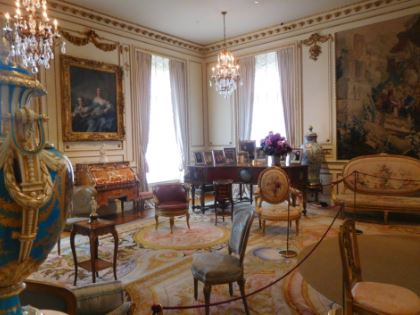
Then, disengaging his fiddle, he began to scrape a lively air, to which he sang with a merry discord, dancing with ludicrous airs and activity, that made me laugh, in spite of the dog’s howling. Then he advanced to the window with many smiles and salutations, and his hat in his left hand, his fiddle under his arm, and with a fluency that never took breath, he gabbled a long advertisement of all his accomplishments, and the resources of the various arts which he placed at our service, and the curiosities and entertainments which it was in his power, at my bidding to display. “Will your ladyship be pleased to buy an amulet against the oupire, which is going like the wolf, I hear, through these woods,” he said, dropping his hat on the floor. “They are dying of it right and left, and here is a charm that never fails; only pinned to the pillow, and you may laugh in his face.” These charms consisted of oblong slips of vellum, with cabalistic ciphers and diagrams upon them. I instantly purchased one. He was looking up, and I was smiling down at him, amused. His piercing black eye, as he looked up in my face, seemed to detect something that fixed for a moment his curiosity. “I told you that I am charmed with you in the most particulars,” he said. “You are slender, and wonderfully graceful. Your complexion is rich and brilliant; your features are small and beautifully formed; your eyes large, dark, and lustrous; your hair is quite wonderful, I never saw hair so magnificently think and long when it is down about your shoulder. It is exquisitely fine and soft, and in colour a rich very dark brown, with something of gold.” “Well, I do wonder at a wise man like you,” I replied. And so he walked on, and I heard no more. #RandolphHarris 3 of 6
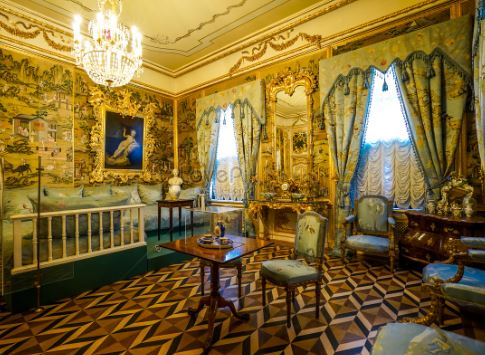
Within the space of a week, my colour had returned, and I was sleeping so soundly that I was scarcely aware of my dreams. I walked miles on my estate each day, and I began to see it with new eyes. Every field, every path, even every hedgerow had its own name and its own history. I considered the amulet I purchased as an omen of good luck—and placed in beneath my pillow, to guard against further visitation. That evening, as I reached the top of the stairs, I heard a peculiar flickering sound. Entering my dressing room in the darkness, I made my way to the familiar dressing table on the right side of the room. Now the noise was even more pronounced. It sounded to me as if someone were turning the pages of book, a sound for which there was no rational source. Move over, I suddenly became away of a clammy, cold feeling around me. Since it was a warm evening, this too surprised me. In the dark, I could not be sure if there were not someone else in the dressing room. I quickly existed the room and went to bed. But this night, I was awakened by a violent shaking of my bed. I could see, in the very imperfect light, two figures at the foot oof it, holding each a bedpost. A voice said, “We’ll hang you!” Trembling, I climbed over to the footboard; and saw the figure at the other side, little more than a black shadow, begin also to scale the bed; and there was instantly a dreadful confusion and uproar in the room, and such a gabbling and laughing; I could not catch the words. I found myself on the floor. The phantoms and clamour were gone, but a crash and ringing of fragments was in my ears. #RandolphHarris 4 of 6

The great china bowl, from which for generations the Winchester had been baptized, had fallen from the mantelpiece, and was smashed on the hearthstone. I warned the servants not to disregard oaths and curses. A mourning coach drove up, and two gentlemen in black cloaks, and with crape to their hats, got out, and without looking to the right or the left, went up the steps to the Winchester mansion. Mr. Hansen followed them slowly. The carriage had, he supposed, gone round to the yard, for, when he reached the door, it was no longer there. So he followed the two mourners into the house. In the hall he found a fellow servant, who said he had seen two gentlemen, in black cloak, pass through the hall, and go up the stair without removing their hats, or asking leave of anyone. This was very odd, Mr. Hansen thought, and a great liberty; so upstairs he went to make them out. But he could not find them then, nor ever. And from that hour the house was troubled. In a little time there was not one of the servants who had not something to tel. Step and voices followed them sometimes in the passages, and tittering whispers, always minatory, scared them at the corners of the galleries, or from dark recesses; so that they would return panic-stricken. I, myself, had also heard these voices, and with this formidable aggravation, they came always when I said my prayers. I was scared at such moments by dropping words and sentences, which grew, as I persisted, into threats and blasphemies. These voices were not always in the room. They called, as I fancied, through the walls, very thick in this house, from the neighbouring rooms, sometimes on one side, sometimes on the other; sometimes they seemed to holla from distant lobbies, and came muffled, but threateningly, through the long paneled passages. As they approached they grew furious, as if several voices were speaking together. Whenever I applied myself to my devotions, these horrible sentences came hurrying towards the door, and, in panic, I would start from my knees, and all then would subside except the thumping of my heart against my stays, and the dreadful tremours of my nerves. #RandolphHarris 5 of 6

What these voices said, I never could quite remember one minute after they had ceased speaking; one sentence chased another away; gibe and menace and impious denunciation, each hideously articulate, were lost as soon as heard. And this added to the effect of these terrifying mockeries and invectives, that I could not, by any effort, retain their exact import, although their horrible character remained vividly present to my mind. Camile who acted as a housemaid, would not sleep in the house, but walked home, in trepidation, to her father’s, under the escort of her little brother, every night. Mrs. Rendell, the kitchenmaid, endured the nightly terrors. Mr. Hansen was testy and captious about these stories. He was already uncomfortable enough by reason of the entrance of tow muffled figures into the house, about which there could be no mistake. His own eyes had seen them. He refused to credit the stories of the servants. I made a decision not to fuel the stories of the ghost to keep the servants. “If you see ghosts here, it is no place for you, and it is time you should pack,” I would say. Here has been the cook with the kitchenmaid, as white as pipeclay, all in a row, to tell me I must have a parson to sleep among them, and preach down the devil! Upon my soul, I would not allow my home to fall into utter chaos and disarray. “Mrs. Winchester, I know you are no fool,” said the cook. “But supposed there was a such thing as a ghost here, don’t you see, it ain’t just women telling stories.” “I will not dignify such ideas,” I replied. The women left the kitchen, the cook and the butler went down, not altogether unused to such condescension in the household. The fire had gone down and I was chilled. The candles were expiring in the socket and threw on the white all long shadows, that danced up and down from the ceiling to the ground, and their black outlines I fancied resembled the two men in cloaks, whom I remembered with profound horror. I took the candle, with all the haste I could, getting along the passage, on whose walls the same dance of black shadows was continued, very anxious to reach my room before the light should go out. #RandolphHarris 6 of 6


On night in 1990, there was an unusual buzzing sound in The Winchester Mystery House, one of the staff encountered a dark, hooded figure standing at the door-to-nowhere. In the dim light issuing through the stained glass windows from an outside light, he could see that the intruder, who looked very much like a cowled monk, was waving his arms in a particular manner. Interpreting his movement as threatening, he approached the man and asked him to leave. At the very moment, the employee says he never felt so weak and helpless.
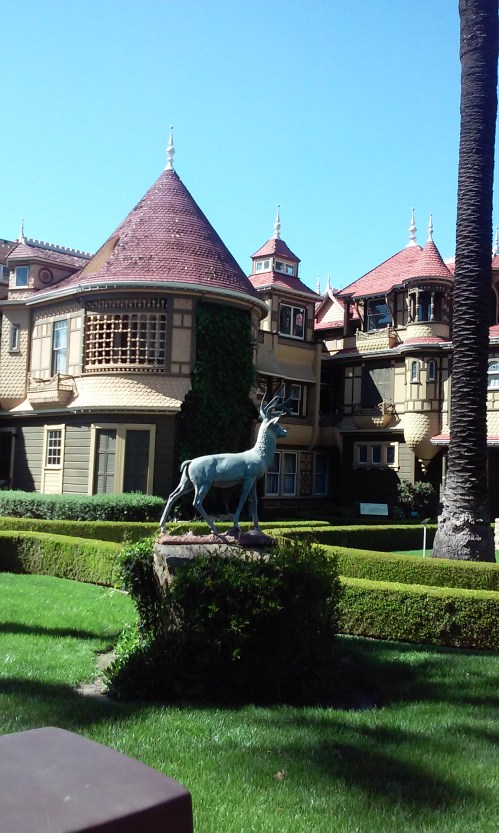
He collapsed in a heap backward onto the floor. He remembered that he actually began to weep in fear and confusion. He was completely at the mercy of whoever or whatever was standing at the door. It was then that the hooded being spoke. “Don’t be afraid,” it said in a quiet whisper. “We won’t hurt you.” And the next thing he knew, the morning sunlight was making him squint into wakefulness. As he reflected on the incident, he became more and more convinced that an actual visitation had occurred and that some kind of entity had come into the mansion. https://winchestermysteryhouse.com/

And please be sure to check out the online gift store: https://shopwinchestermysteryhouse.com/

I’m a Pharmacist, I Know What I am Doing

Recreational drug use is often portrayed in popular culture and music. To further highlight this illustration, probably the best known musical cliché of recent decades was “sex, drugs, and rock’ n’ roll,” while the Billbooard charts have been filled with songs involving drugs, such as Eric Clapton’s Cocaine or the Rolling Stones’ Sister Morphine and Mother’s Little Helper. Popular culture portrays not just recreational drug use but tragedy associated with drugs, for example, the deaths of guitarist Jimi Hendrix, Janis Joplin, and Jim Morrison and many others. Of course, not all common-use drugs are understood as dangerous or associated with tragedy. We found clear evidence of two very different modes of entry among the respondents, namely recreational abusers and therapeutic self-medicators. However, it is important to note tht these were not mutually exclusive categories of offenders. In other words, these two categories were not completely dichotomous. As is usually the case, real life seldom fits cleanly into nice, neat categories. In fact, we were able to identify a number of cognitive and behavioural themes that were common to almost all of the drug-using pharmacists interviewed. These themes were expressed by nearly all of the drug-abusing pharmacists that we interviewed, regardless of how the individual initially began their illicit drug abuse career. The existence of these common themes suggest that pharmacy-specific occupational contingencies play a center role in the onset and progression of illicit use of prescription medicines. #RandolphHarris 1 of 20
Intuitively, it should not be surprising that pharmacists would steal prescription medicines as a way of treating their own physical ailments. After all, they have been exposed to years of pharmacy training that emphasized the beneficial, therapeutic potential of these medicines. Each pharmacist has dispensed the medicines to hundreds of patients and then watched the drugs usually produce the predicted beneficial results. They have all read the literature and drug inserts detailing the chemical composition of drugs and studied the often dramatic curative effects of the chemical substances. Pharmacists, more so than any other member of society, are keenly aware of how and why drugs work. There was strong evidence to suggest that both the therapeutic self-medicators and the recreational abusers actively used the years of pharmacological knowledge that they had acquired. In their eyes, it made perfect sense that they should put their pharmacy knowledge to work on themselves. This application of knowledge can be seen in the comments of a 40-year-old female self-medicator: “So, in 1986 I was sent to the psychologist. That was when I was forced to recognize that I had an alcohol problem. And I recognized that I had to do something. And in my brilliant analysis, I made a decision that since alcohol was a central nervous system depressant, the solution for me was to use a central nervous system stimulant. That would solve my alcohol problem. So I chose the best stimulant that I had access to, and that was [pharmaceutical grade] cocaine. I started using cocaine in 1986. I never thought that it would progress. I never thought it was going to get worse. I thought, ‘I’m just going to use it occasionally.’” #RandolphHarris 2 of 20

Similar trends were observed among the recreational abuser group, only here, the applied use of drugs was based upon more recreational motives. Almost all of the therapeutic self-medicators and recreational abusers described how they became masters of quickly diagnosing their own ailments or emotional needs and then identifying the appropriate pharmacological agent that would remedy the problem. Moreover, as professionals, they were confident that they would be able to self-regulate their drug intake so as to never become addicted. All of the respondents drew upon their social status as pharmacists to convince themselves that their drug use would not progress into dependency. They recall being adamant in their view that personally they were immune from such problems, believing that only stupid, naïve people became addicted to drugs. As a 40-year-old female self-medicator put it, “I’m a pharmacist, I know what I am doing.” A 39-year-old male self-medicator went so far as to say: “I mean, we know more [about the effect of drugs] than doctors. We have all the package inserts. We have the knowledge. We know a lot about the drugs, so what’s the big deal?” Elsewhere we refer to this denial mechanism as a “paradox of familiarity,” because familiarity can breed consent, not contempt toward prescription drug use. Members of both categories of pharmacists claimed that they had never been warned about the dangers of drugs, insisting instead that their training had only stressed the beneficial side of prescription medication. #RandolphHarris 3 of 20

To further highlight this illustration, a 48-year-old male misuser stated: “I never had anybody come right out and tell me that [prescription drug abuse] was probably unethical and illegal because they assumed that we knew that. But nobody ever said this is something that is not done.” Let without guidance on the issues, some pharmacists assumed that self-medication was acceptable behaviour. To this end, a 39-year-old female self-medicator said: “It’s [self-medication] just part of it [the pharmacy job]. It’s just accepted because we know so much. I’m sure it’s the same way when the doctors do it. It wasn’t a big stretch to start going “You know, I got a headache here, maybe I should try one of these Percocets [narcotic analgesic]?” Many pharmacists spoke about their prescription drug theft/use as if it were an entitlement that went along with being a pharmacist. Much like a butcher always has fresh meat at home or a car dealer always drives a state-of-the-art automobile, pharmacists will always have the best drugs. This theme is illustrated in an exchange that occurred between the interviewer and a45-year-old-male pharmacist: “Why take plain Aspirin or plain Tylenol when you’ve got this [Percocet-narcotic analgesic]? It works better….[so] you don’t even have to struggle with it. I really believed that I had license to do that…as a pharmacist. I mean with all that stuff sitting there, you know. Oh, my back was just killing me during that period of time and this narcotic pain reliever is sitting right there. I thought, ‘why should [I] suffer through back pain when I have this bottle of narcotics sitting here?” #RandolphHarris 4 of 20

The above-mentioned themes involve cognitive dimensions of the pharmacists’ drug abuse in that they speak to common motivational and justification themes that were present in all of the interview. Perhaps more important is the fact that there was a common behavioural characteristic shared by all 50 pharmacists. In ever case, occasional prescription drug abuse eventually gave way to an advanced addictive state that was marked by an enormous intake of drugs, unmistakable habituation, and the constant threat of physical withdrawal. Members of the recreational abuser and therapeutic self-medicator groups alike routinely reported daily use levels exceeding 50-100 times the recommended daily dosage. One pharmacist reported that his drug use regimen progressed to 150 Percocets [strong narcotic analgesic] per day. Another individual reported injecting up to 200 mg of Morphine each day. Still another respondent described a daily use pattern that, among other things, included 5g of cocaine. Invariably, these advanced levels of drug use led to clear signs of habituation and the constant threat of physical withdrawal. At this point, the individual recalls growing increasingly desperate. Consider the following quote from a 44-year-ol male pharmacist who was in charge of ordering the narcotics at the independent retail pharmacy where he worked: “I was ordering excessive quantities and chasing down tracks. That’s what I used to do. I was really reaching my bottom. I would chase these delivery trucks down in the morning because I didn’t come to my store until mid-afternoon. I was in withdrawal in the morning and I was without drugs, so I had to have it. #RandolphHarris 5 of 20

“I was just going nuts. Many mornings I had gone to work sweating. It would be 30 degrees (Fahrenheit), it would be January, and the clerk would say, ‘you look sick,’ and I would say, ‘It’s the flu.’ So I would pay the delivery guys extra money to deliver my drugs first or I would chase the delivery trucks down in the morning. I knew the trucks delivered at 6 in the morning, they came by my area, and I would get up early and chase the trucks down the highway. I would go in excess of 100 miles an hour trying to catch up with this truck and flag it down.” The advanced stages of drug addiction invariably produced traumatic physical psychological outcomes. Eventually, “out-of-control” drug use patterns along with the realization of chemical dependency left the pharmacists in a problematic mental state. It was at this point that al of the pharmacists recalled coming to grips with their addiction. This personal realization was accompanied by a shift in the way they thought about their drug use. They no longer denied that situation by drawing upon recreational or therapeutic explanations. Instead, they finally admitted the dire nature of their situation and became more and more reclusive. In short, all of the respondents grew to realize that they had a drug problem, turning then to fear and ignorance to foster the final weeks or months of their drug addiction. Two identifiable criminal career trajectories were observed among the pharmacists who we interviewed: recreational abusers and therapeutic self-medicators. #RandolphHarris 6 of 20

Careful scrutiny of contemporary drug theory, policy, and practice in all areas, from prescription pharmaceuticals to illegal recreational drugs, reveals numerous apparent inconsistencies and pervasive incoherence. This results, in part, from a kind of silo thinking in which attention to drug theory and drug policy, however sophisticated in its own realm, is encapsulated within distinct professional, practical, and economic spheres or “silos.” Silos are descriptively and prescriptively dense but stand isolated from each other in an empty landscape. In other words, people in one arena of drug theory, policy, or practical programs have plenty to say to each other about the way things are and the way things should be with respect to drugs, but they don’t talk much across the open spaces between their areas of focus. Not only do they not talk much between their fields, for reasons to be explored, they cannot really do so. Clearly, our discussion of the therapeutic self-medicator category goes far beyond what is present in the existing literature. However, the first documentation of recreational drug use among health professionals, had minimal impact on the way that the various healthcare professions think about or address problem of substance abuse within their ranks. The pharmacy profession has been especially reluctant to address the reality of the prescription drug abuse situation. For instance, existing self-reports and interview research on drug using pharmacists largely ignores the recreational origins of drug use and, instead, describes the affected individuals as having misplaced therapeutic motivations. This assumption is reinforced by published biographical accounts of recovering drug using pharmacists. While principally intended to raise awareness among fellow pharmacists, these confessionals consistently emphasize the well-intentioned motives behind the individuals’ destructive drug use past. #RandolphHarris 7 of 20

Information is called observable when it is available symmetrically to both parties, and verifiable when it can be proved to third parties such as a court. In practice, this is a matter of cost, and the standard of proof required. Contracts that are intended to be enforced in a court of law can only stipulate actions that are conditioned on verifiable information; courts cannot judge whether a breach of the contractual terms has occurred if they cannot verify whether the circumstances that call for an action have actually transpired. However, observable information can be the basis for contracts that are enforced by extralegal or private methods, because the two parties can know fully well whether a breach has occurred. Such extralegal methods of enforcement come in to broad types. One is enforcement by insider third parties with specialized knowledge that enables them to verify information that outsider general courts of law cannot; arbitrators in industry associations are the most prominent enforcers of this kind. The second is based on a relationship or ongoing interaction between the parties; a breakup of this relationship constitutes the punishment that may deter one of the parties from breaching. This covers many possibilities. The same two parties may meet repeatedly; the two may not have a direct repeated interaction with each other, but each may interact with others in a group or network that transmits information about any breach to all members and collectively sanctions the miscreant, using ostracism in business interactions or social relationships or both. #RandolphHarris 8 of 20

The distinction between observable and verifiable information is standard in the economic theory of contracts. The New York Stock Exchange developed its internal rules and procedures for dispute resolution, and even Taiwanese shoe manufacturers and Western fashion houses performed dispute-resolution functions in addition to their primary matchmaking ones. One may think that these alternative methods of private ordering must suffer a crippling disadvantage relative to the government’s courts, namely their lack of coercive power to ensure that their decisions are obeyed. However, the difficulty is often nonexistent or easily overcome. First, the sanctions available for private ordering are often very effective. Breach of contract can be deterred in ongoing relationships by the threat that the miscreant will be barred from future business with this particular partner or the group; this can be buttressed by social ostracism if the group fosters social ties among its business members. Sometimes this threat may be even more severe than the fines that courts would impose in the matter. If the threat is credible, in the sense of being a part of the strategies in the subgame-perfect equilibrium of the repeated game that constitutes the ongoing relationship, then the contract is self-enforcing. Second, arbitrators may have similar sanctions at their disposal; if they can bar the miscreant from the industry association, they can instantly put one out of business, which can be a more effective sanction than the fines the courts will impose. Of course, the feasibility of such sanctions depends on the availability of the requisite information, and in the case of repeated interactions, on how highly the participants value the future relative to the present. #RandolphHarris 9 of 20

Finally, courts recognize the informational advantage of the alternative institutions. Therefore when a relational or implicit contract serves such an informational purpose, courts refuse to intervene to modify its terms, or to insert missing provisions, or to overrule the availability of discretion to one party. They also enforce the awards of industry arbitration tribunals, using the government’s power of coercion to obtain compliance if the loser in the arbitration attempts to defy the ruling. In the United States of America, this has been so since 1920; in the international context, over 100 countries now accede to the 1958 New York Convention of the Recognition and Enforcement of Arbitral Awards. By providing for the appointment of industry-expert arbitrators, who can make many factual determinations more accurately and less expensively than a judge or jury can, the rules greatly expand the “contractible” aspects of an exchange. The use of stream-lined procedures together with the appointment of expert adjudicators transforms considerations that in the public legal system would have been only observable to the parties…into considerations that are also verifiable…thereby encouraging transactors to enter into more complete contracts. The point is not that arbitrators have access to more information. Any relevant information can be elicited and brought before the court by either party to the dispute through the legal process of discovery. Conversely, many arbitration forms do not allow discovery, although the arbitrator can request additional information. #RandolphHarris 10 of 20

The key is how information is used; industry arbitrators can use their expertise to interpret it—make factual determinations—more accurately and at a lower cost than non-specialized courts can. This is the sense in which verifiability should be interpreted in this context. Arbitration is used in other contexts for other reasons. In international transactions, each party may suspect that the other country’s courts will be biased in favour of its own nationals; this can deter them from entering into contrast that may end up in national courts. Therefore both may agree ex ante to settle any disputes in an agreed international forum of arbitration. Several of these exist, based in London, Paris, Stockholm, et cetera. They differ in their procedures (degree of formality, time taken, fees charged, et cetera) and the range of legal traditions they cover (civil, common, Islamic, et cetera). These affect the choice of forum by the parties to each transaction. These forums usually lack the expertise that industry-specific forums can provide. Therefore they are not likely to lower costs or improve verifiability and permit more complete contracts; instead, removing the suspicion of bias may be their most important function. The different modes of private and official governance can interact in various ways. To further highlight the illustration, if an ongoing relationship based on the superior observability of information by the two parties breaks down, the best alternative available to the parties may be recourse to a contract based on verifiable information enforceable in a court of law, not total cessation of transactions. #RandolphHarris 11 of 20

And if an arbitrator’s award is not enforceable by direct sanctions such as fines, it may nonetheless form part of a relational arrangement where the arbitrator can terminate the miscreant’s access to future trades. Not only do modes like arbitration evolve and apply to provide governance for transactions where they have an informational advantage and can reduce transaction costs, but also transactions take forms that adapt to the available information and governance. As for the emergence and prevalence of barter and countertrade in post-Soviet Russia in this way: The advantage of paying with goods rather than money is that they can be earmarked s property of the creditor. Money is fungible and liquid; a buyer can hide money easily if he chooses to renege on his promised payment to the seller. Goods in a barter or countertrade contract are more difficult to hide, and therefore can act as deal-specific collateral that mitigates opportunism. When it comes to systems of integration, rising complexity in the economy calls for more sophisticated integration and management. In a not atypical case Nabisco, the food company, as to fill 500 orders a day for literally hundreds of thousands of different products that must be shipped from 49 factories and 13 distribution centers, and at the same time take into account 30,000 different sales promotional deals with its customers. Managing such complexity requires new forms of leadership and an extremely high order of systemic integration. That, in turn, requires greater and greater volumes of information to pulse through the organization. #RandolphHarris 12 of 20

To hold everything together—to track all the components and products, to synchronize deliveries, to keep engineers and marketers appraised of each other’s plans, to alert the R&D people to the needs of the manufacturing side and, above all, to give management a coherent picture of what is going on—billions of dollars are being poured into electronic networks that link computers, data bases and other information technologies together. This vast electronic information structure, frequently satellite based, knits whole companies together, often linking them into the computers and networks of suppliers and customers as well. Other networks link networks. Japan has targeted $250 billion to develop better, faster network. All these changes further accelerate the pace of operations and transactions. Economies of speed replace economies of scale. Competition is so intense and the speeds required so high that the old “time is money” rule is increasingly updated to “every interval of time is worth more than the one before it.” Time becomes a critical variable as reflected in “just-in-time” deliveries and a pressure to reduce DIP or “decisions in process.” Slow, sequential, step-by-step engineering is replaced by “simultaneous engineering.” Companies wage “time-based competition.” Expressing the new, it is clear that money moves at the speed of light. Information has to move faster. Thus acceleration pushed Third Wave business closer and closer to real time. #RandolphHarris 13 of 20

Taken together, these ten features of the Third Wave economy, among many others, add up to a monumental change in how wealth is created. The conversion of the United States of America, Japan and Europe to this new system, though not yet complete, represents the single most important change in the global economy since the spread of factories brought about by the industrial revolution. This historical transformation, picking up speed in the early-to mid-1970, was already fairly well advanced by the 1990s. Unfortunately, much of America’s economic thinking was left behind. Global markets of energy and mineral resources are undergoing far reaching irreversible changes, and so are perceptions about the policies needed to provide their stable supply. Global demand is surging due to a dramatic increase of consumption by the fast-growing large emerging economies. Experts project that, absent significant changes in policy or technology, global energy consumption will increase nearly 50 percent over the next 30 years. Energy consumption is growing faster than the GDP in many countries. On the supply side, uncertainties and destabilization risks are exacerbating due to rising political instability in exporting countries, periodical redirections of sales from external to domestic markets by leading suppliers, and, to a certain extent, a depletion, in some major producing countries, of existing deposits in the absence of new ones whose discovery and exploitation could make up for the loss. #RandolphHarris 14 of 20

Therefore, oil and some other natural resources are becoming more and mor attractive targets for speculators. In these circumstances, countries highly dependent on natural resources imports, especially those that do not have their own powerful resource multinationals, get increasingly concerned about supply destabilization risks. Predictions about an all-out resource war or bitter fights among buyers for limited amounts of oil or metallic ores look like an exaggeration. However, buyers’ competition for particular kinds of resources within particular periods of time due to particular circumstances is becoming a more frequent phenomenon. For instance, the Philippines and Vietnam protested to China against its patrol boats hindering their oil exploration activities near the disputed Spratly Islands in the South China Sea. China demanded that its neighbours stop exploration work in this area. Tensions rose as the United States of America declared that the South China Sea was in the sphere of its national interest and that it would stand by the Philippines as its ally. Now, when it comes to supernatural affairs, the angels are “sent forth to minister to the heirs of salvation,” reports Hebrews 1.14, but not to take the place of Christ or the Holy Spirit. The apocalypse seems to show that this ministration of angels to the saints on Earth is a ministration for war in the spiritual realm against the forces of Satan; but there is little indication given of ministry in any other way. #RandolphHarris 15 of 20

After the first Advent, when there was great angelic activity over the wondrous event of the Father brining the “Firstborn: of the new race (Romans 8.29) into the inhabited Earth (Hebrew 1.6), and again at the Advent of the Holy Spirit on the Day of Pentecost to begin His work of forming a Body like unto the Risen Head—and during the early years of the Church—the employment of an angel in direct and visible communication with believers seems to give way to the work and ministry of the Holy Spirit. The entire work of witnessing to Christ, and leading the Church into all truth, has been committed to the Holy Spirit. Therefore all intervention of “angels” or of audible voices from the spiritual realm purporting to be from God may be taken as counterfeits of psychopathological offenders, whose supreme object is to substitute the workings of their own wicked offenders in the place of God. In any case, it is best and safest in these days of peril to keep in the path of faith and reliance upon the Holy Spirit of God working through the Word of God. Man, the microcosm, the mirror of reality has structures of beings found in him, and are found analogously in the subhuman realm. Selfhood, inner awareness, freedom and destiny—all are verified analogously in subhuman beings. Furthermore, the concepts of courage, love, power, and justice are used to describe analogously the characteristics of all beings and of being-itself. The point we wish to make is that this use of analogy based on human experience seems to yield valid knowledge. #RandolphHarris 16 of 20

Moving up now to the relationship between man and God, one would expect that on the same principle, but with proper adjustments, man could get an analogous knowledge of God. Symbols are not a means of knowing God, but rather a way of speaking about Him. If one wishes to talk about God, finite material must be used, and this is justified by the fact that all finite beings participate in being-itself. Without such an analogy nothing could be said about God. However, the analogia entis is in no way able to create a natural theology. It is not a method of discovering truth about God; it is the form in which every knowledge of revelation must be expressed. In this sense anlogia entis, like “religious symbol,” points to the necessity of using material taken from finite reality in order to give content to the cognitive function in revelation. What is boils down to is that analogy or symbolism is the expression of an encounter with God. Through the revelatory experience is far more than an intellectual communication—it is primarily a reunion with the ground of being—it contains a cognitive element conveyed by symbols which are qualified as channels of communication by their participation in being-itself. Yet, it seems not, for every creature participates in being-itself, and yet not everything is a religious symbol, although it has the potentiality to become one. What is the decisive ingredient of symbolism beyond ontological participation? These symbols are not arbitrary interpretations of the concrete revelatory experiences. However, they appear within this experience itself. They are not created intentionally, but they are born in the same dimension in which the revelatory experience takes place. In and through its symbols the religious encounter with reality opens up the dimension of reality in which ultimacy appears. There is no other way of expressing our encounter with the holy than in symbols. #RandolphHarris 17 of 20

From the standpoint of the counselor who finds one’s role ambiguous, it seems more than likely that exploration of a developmental perspective would help resolve the conflicts implicit in one’s professionalization. For the psychotherapist who thinks of oneself as a physician who cures sickness, or who avoids this and speaks only of the “difficulties of living,” there may appear to be no conflict in one’s role. One may be satisfied to reduce symptoms of disorder, to solve the problem presented and to think of oneself primarily as someone who relieves distress, without defining one’s goals beyond that. However, apparently more and more thoughtful counselors do not think they can stop there, or do any permanent good, unless they leave their patients better able to cope with later problems and future strains. Some even feel that their job to plan for the optimal development of their clients, or to organize clients to plan for their own. The ambiguous feelings of the professional who presumes to assist in the personal problems of family members may be all to the good if these are construed in a framework of family relations which includes oneself. The concept of transference goes only part way. The client in the course of the counselor-client interaction frequently construes the counselor as a figure representative of previous others, with whom relations have been unresolved but are thus worked out through the interviews. The difficulty, however, from the client’s standpoint, is that no matter how versatile one’s counselor may be, and no matter how facile or fantastic one’s own imagination, the range of persons with whom a person needs intimate discourse in order to achieve one’s optimal development of self far exceeds the resources of this single relationship. #RandolphHarris 18 of 20

Moreover, there is the fact that the client must pay in cold cash for the kind of communication which the best families afford on a basis of affectional reciprocity; thus the most sacred disclosures hover at times on the verge of something equivalent to prostitution. Regardless of ethics and their enforcement by professional insistence upon its eventual termination, and the limitation of reciprocity to monetary reward; in a word, the elaboration of this relationship lead nowhere. The best hope for fruition of any gains that accrue is tht they serve as a bridge to the regeneration of their client’s involvement in a quasi-family constellation which includes near-rivals and critics, models and admirers, other ages and other genders, in both work and play. Only through others can one obtain the continual characterizations of self essential to valid knowledge of self. Research and experience have already shown that the human being, from birth until death, almost to the degree that the fish requires water, thrives only in social interaction. Neglect, isolation, loneliness, solitary confinement, and deteriorative influences very hard to endure, even though every physical condition of survival is met. And among all kinds of interaction, the most potent of all for personal development are those characterized by the unconditional acceptance of family relations. Only here is the listener who always finds more in the person than one presents in one’s actual behaviour. #RandolphHarris 19 of 20

Only here is the audience that never grows tried. Only here is the person of similar background, for whom every aspect of the culture—of class and ethic experience—resonates with comparable meaning. That a counselor could ever aspire to duplicate these functions of the optimal family is beyond the hope of those who have thought and written about it. In a sense this analysis of the implicit or potential demands on the counselor’s role both justifies and specifies a therapeutic approach. It also shows that one’s role must be transcended by more adequate institutions for providing each client with a stable constellation of significant others, who can be the precisely appropriate self-definers at each critical stage in one’s personal development. For the person whose actual family has failed one the solution suggested by this analysis is the invention of effective quasi-families. The process by which each person contributes to the self-knowledge of others, and others contribute to one’s knowledge of oneself, it immanent in human society. Where self-knowledge and self-control are deficient relative either to norms or ideals, the best means for reversing these deficiencies is effective utilization of all available knowledge of how selves originate, operate, and co-operate. Recognition that some tasks are beyond the powers of the unassisted individual does not mean that society must be divided into two classes, therapists and their patients. It means, or at least can be made to mean, joint action to perform these tasks. Such an approach is as relevant and applicable to the tasks of counseling agencies as to the other types of family agencies. #RandolphHarris 20 of 20

CRESLEIGH MEADOWS AT PLUMAS RANCH
Plumas Lake, CA |
Now Selling!

Cresleigh Meadows is now selling! Found just north of Feather River Boulevard, Cresleigh Meadows is home of the largest neighborhood in Plumas Ranch as well as the popular Bear River Park.

With four floor plans available, ranging from approximately 2,000 – 3,500 square feet offering, three to five bedrooms, we are certain you will find the home that fits your needs and lifestyle.

Popular design elements include open floor plans, large kitchen islands, and flex spaces are staples in Cresleigh homes. Multi-generational living options also available in select homes.

Homeowners will love the convenient commuter access to nearby Sacramento and Yuba City.

Take advantage of financing incentives available today! Contact our Sales Center to learn more about how we can help you buy-down your interest rate. https://cresleigh.com/cresleigh-meadows-at-plumas-ranch/

Stop by for a tour today, and make a Cresleigh Home, your home.



My Soul to Nothingness, but I Will Strive

Many persons accustomed to travelling the old country side were sure so fair a place was never seen. Of all that charmed the romantic eye, it seemed an emerald through the clouds of fleecy white, and cerulean sky. As the sun crowned its lawny crest, smiling upon the flowers and trees, bright eyes reflected the majesty of Llanada Villa. The lively and robust body of this remarkable house contrasts its physicality against the darkness, secrets, and void of the dense ancient elms. Tall ornamental hedges maintain the privacy of the dwelling. The fruit orchard much like an enchanted forest, in which the bluebirds returning to their nest, guard the fruit from pests, as the straggling deer who peep from beneath the branches, do not startle the natural and undisturbed dominion. Heightened by euphoria, delightful shapes of mystery and fear clear in youthful bloom of its immortal spirit. On stormy nights, as the guard described, one can hear the doors clapping inside, and the howl and sobbing of the wind through it ornate galleries. I carried with me some blessings and a good many curses. I was woken in the early morning, by hearing my name called softly. I rose and went to my door in my nightgown, but there was no one in the passage. The voice sounded like my niece Daisy’s, but when I came to her door, it was closed. All was silent; the bathroom door stood slightly open; there was the morning room beyond; then the landing and the staircase. I heard my name called again, only this time the voice boomed like a gong inside my head; the light failed, as if a candle had been snuffed, and something rushed at me out of the gloom. #RandolphHarris 1 of 7
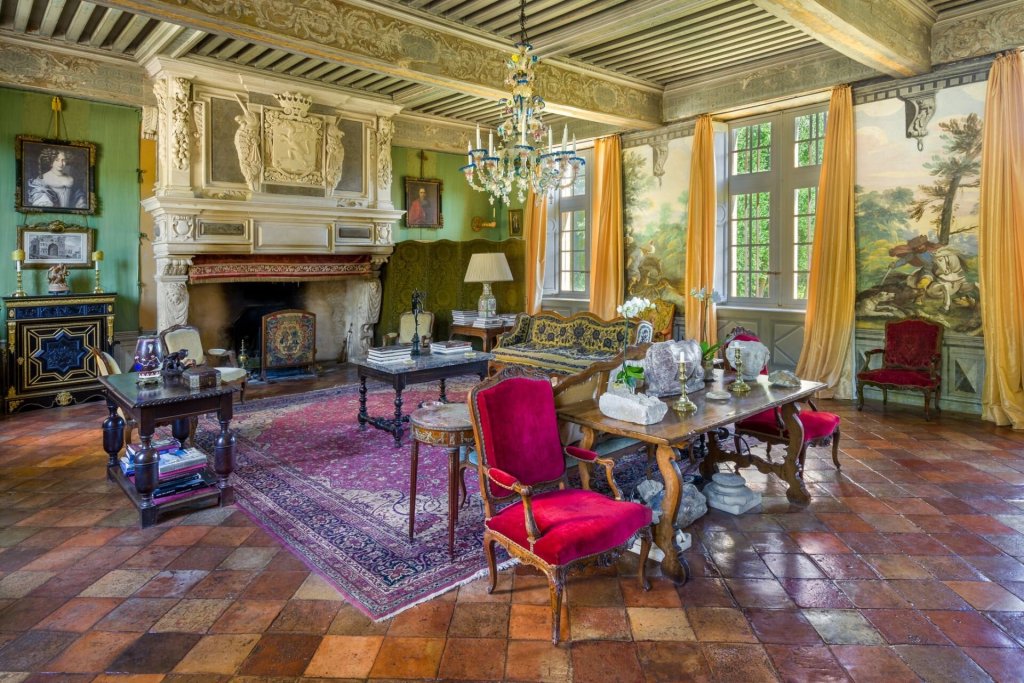
I screamed and struggled until the light came back with the sound of running feet and I realized that the demon who had seized me was, in fact, a Welsh priest. A fornight or so later—certainly, after the doctor had pronounced me well on the way to recovery—I was sitting up in bed reading when my grandmother came into the room and sat down in the chair beside me, looking exactly as he had when we first met: the same calf length frock coat, double-breasted vet, and wool trousers, with his hair parted on the left and neatly combed to the side, the same familiar scent of alone wood, orange flower, musk and spices. The chair creaked as he settled himself in it, smiled at me and took up his work, just as if he had only been gone for five minutes, rather than resting in the Evergreen Cemetery for nine years. I was vaguely aware that my husband was supposed to be dead, but somehow this did not matter; his presence at my bedside seemed entirely natural and comforting. And though my own tranquil acceptance of the visit would later seem, to me, as strange as the visit itself, we sat in companionable silence for an indefinite interval until my husband gathered up his work, smiled once more at me and went slowly from the room. Daisy came in so soon after that I thought they must have passed each other in the hall, so I asked, “Did you see your uncle William?” I saw from her look of consternation that I had best not pursue the subject, and agreed that I must have been dreaming. As with the strange radiance of William’s appearance was followed by one of the worst headaches I had ever endured. But I felt certain I had been wide awake. #RandolphHarris 2 of 7
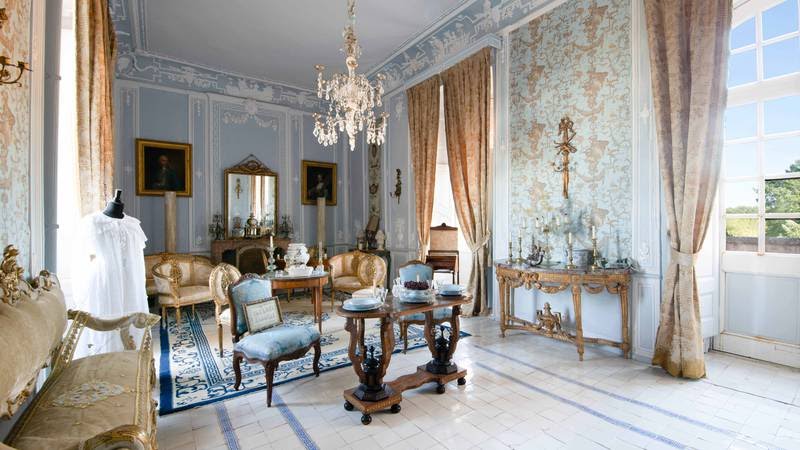
Even after the strangeness of the experience had become fully apparent to me, I found I could not think of my visitant as a ghost. My reading in sensational literature had enhanced an already vivid imagination of how ghosts ought to conduct themselves: a hint of transparency and one or two bloodcurdling groans was surely the least that could be expected, whereas William had been—well, just my husband. And though nothing like this had ever happened to me before, I had not felt in the slightest afraid. Dr. Wayland had declared me well enough to get up, and the memory of my husband’s visit had faded to the point where I could almost believe it had been a dream, when one evening after dinner I saw my father-in-law crossing the hall ahead of me. He was no more than ten paces away, I heard the floor creak under his tread. Looking neither right nor left, he entered his study and closed the door behind him, just as he would have done in life. Again I felt no fear; only an overwhelming impulse to go up to the door and knock. When there was no answer, I tried the handle. The door opened readily, but there was no one there, only the familiar cracked brown leather armchairs on the worn Persian rug, the elaborate desk with its feet carved into the fierce face carved into faces of angels, the bookshelves crammed with Blue Book and army lists and regimental histories and accounts of gun dealers, the lingering faint scent of timber, leather and bindings. I remained in the doorway for a long time, lost in a trance of recollection. #RandolphHarris 3 of 7

I picked up one of Willian’s old letters and went out into the garden and sat down on a charming bench, under a group of magnificent lime trees. The sun was setting with all its melancholy splendour being the horizon, and the fountains wound through a group of noble trees, almost at my feet, reflecting in their current the fading crimson of the sky. His letter was extraordinary. So much so that I read it twice over—the second time to the spirits. It said, “I miss you my darling wife, for as such I love you. During these last days of my illness, I was too weak to write you. Before then I had no idea of the danger. I will soon no longer be with you. Thank you for the hospitality. Thank you for receiving me into your heart, gaiety, and for being a charming companion. Heaven! I devote my remaining days to the gleaming light that you cast upon my heart. I hope you may accomplish your merciful purpose. I curse my conceited incredulity for unduly leaving you to mourn my absence. If only I could live for eternity, I would remain by your side. Farewell. I love you, my beloved.” My eyes filled with tears at his passion and intelligence. The sun had now set, and it was twilight by the time gone back inside. It was a soft evening, and I loitered, speculating upon seeing him again. I could hear his voice in animated dialogue and recall how proud he was to be a father, and turned about to admire the beautiful scene. The glade which I had just walked lay before. At the left narrow of the path wound away under the clumps of lordly trees, and was lost to sight amid the thickening forest. #RandolphHarris 4 of 7
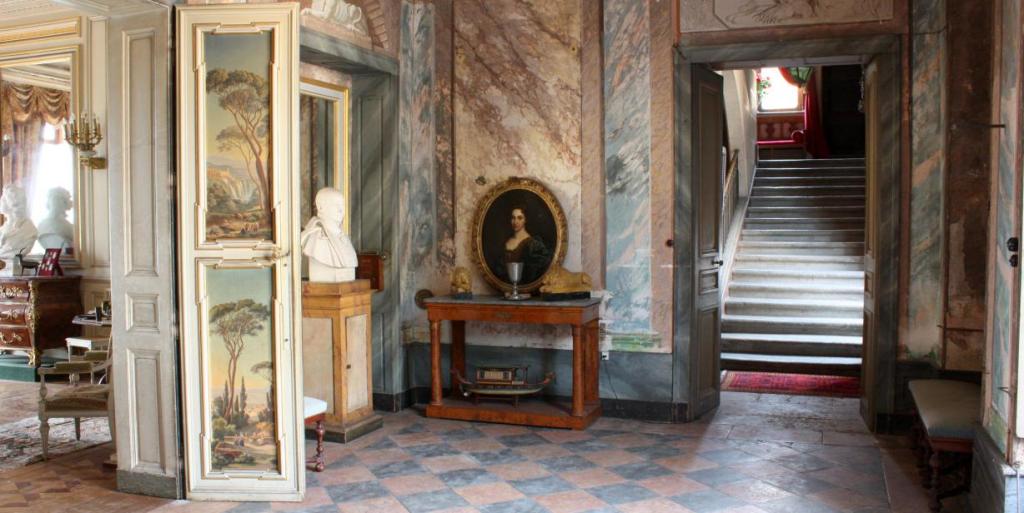
At the right of the path stands the Observational Tower, which guarded the estate. Over the grounds, a thin film of mist was stealing, like smoke, marking the distances with a transparent veil; and here and there I could see the fountains flashing in the moonlight. No softer, sweeter scene could be imagined. I enjoyed the picturesque, and I, stood looking silence over the expanse beneath me. Standing a little way behind me, discoursed upon the scene, and were upon the eloquent moon. When the moon shone with a light so intense it is well known that it indicates a special spiritual activity. The effect of the full moon in such a state of brilliancy is manifold. It acts on dreams, it acts on lunacy, it acts on nervous people; it has a marvellous physical influence connected with life. One of the carpenters, having taken a nap on the balcony on such a night, lying on his back, with his face full in the light of the moon, had wakened, after a dream of an old woman clawing him by the cheek, with his features horribly drawn to one side. The moon, this night, is full of odylic and magnetic influences—and when one looks behind at the front of the mansion, how all its windows flash and twinkle with that silvery splendour, as if unseen hands had lighted up the rooms to receive fairy guests. There are indolent states of the spirits in which, indisposed to talk ourselves, the talk of others is pleasant to our listless ears; and I gazed on, pleased with the tinkle of the stars. But I felt as is some great misfortune were hanging over me. #RandolphHarris 5 of 7

O THOU great, powerful, and mighty KING AMAIMON, who bearest rule by the power of the SUPREME GOD EL over all spirits both superior and inferior of the Infernal Orders in the Dominion of the East; I do invocate and command thee by the especial and true name of God; and by they Thou Worshippest; and by the Seal of thy creation; and by the most mighty and powerful name of GOD, IEHOVAH TETEAGRAMMATON who cast thee out of Heaven with all other infernal spirits; and by all the most powerful and great names of God who created Heaven, and Earth, and Hell, and all things in them contained; and by their power and virtue; and by the name PRIMEUMATON who commandeth the whole host of Heave; that thou mayest cause, enforce, and compel the Spirit Murmus—The Fifty-fourth Spirit and His 30 Legions of Spirits, Lord of darkness and liberation come forth! Murmus awaken! Rise up within that I may compel the rise of the fallen ones and devour the very essence of the God of limitation Ahura Mazda! Murmus, Zairich, and Tairich, unholy fever and thirst come forth! Murmus awaken! Tairich awaken! Zairich awaken! Rise up within that I may compel the rise of the fallen ones and devour the very essence of the Holy Angel Amardad! Akiman, demon of evil mind come forth! Akoman awaken! Rise up within that I may compel the rise of the fallen ones and devour the very essence of the Holy Angel Vohuman! Naikiyas, Div or rebellion and discontent come forth! Naikiyas awake! Rise up within that I may compel the rise of the fallen ones and devour the very essence of the Holy Angel Spandarmad! #RandolphHarris 6 of 7

Andar, Div of antinomian fire come forth! Andar awaken! Rise up within that I may compel the rise of the fllen ones and devour the very essence of the Holy Angel Arwahist! Taromat, beautiful Div of rebellion come forth! Taromat awaken! Rise up within that I may compel the rise of the fallen ones and devour the very essence of the Holy Angel Spandarmad! Aeshma, wielder of the bloody mace! Demon of the wounding spear and bringer of wrath come forth! Aeshma awaken! Rise up within that I may compel the rise of the fallen ones and devour the very essence of the Holy Angel Srosh! Sovar, merciless leader of Divs come forth! Sovar awaken! Rise up within that I may compel the rise of the fallen ones and devour the very essence of the Holy Angel shahrewar! I stand alone as the embodiment of the Adversary known as Ahriman, the Black Dragon of Chaos and becoming! I devour the natural order of stasis brought forth by Ahura Mazda and forge my destiny through the power of the Black Sun! By the figurative mystery of this holy mansion, I will clothe it with the armour of salvation in the strength of the Most High, ANCOR, AMICAR, AMIDES, THEDONIAS, ANITOR, that so the end which I desire may be effected, O ADONAI, through Thy strength, to whom be praise and glory for ever and ever. I adjure thee, Emperor Lucifer, as the agent of the strong living God, of His beloved Son, and of the Holy Ghost, and by the power of the Great ADONAY, ELOIM, ARIEL, and JEHOVAM, to appear instantly, or to send thy Messenger Astarot, forcing thee to forsake thy hiding-place, wheresoever it may be, an warning thee that it thou didst not manifest this moment, I still straightway smite thee and all thy race with the Blasting Rod of the great ADONAY, ELOIM, ARIEL, and JEHOVAM. #RandolphHarris 7 of 7
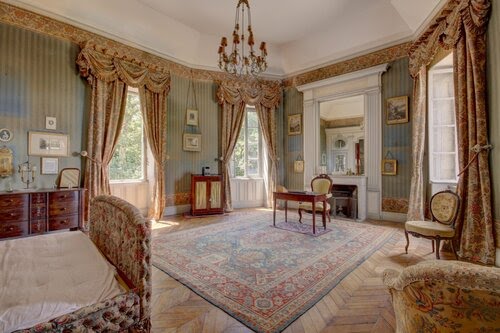

In 2007, while closing up The Winchester Mystery House, Jeff kept catching sight of a shadow moving. He would turn quickly to see if it was a person, but nothing was there. It unnerved him, not knowing what was taking place. The activity picked up when they started to decorate for the Christmas season. Finally, he consulted one of the guests about the strange occurrences. He was very talkative, and would relate experiences about a ghost. During one conversation with the guest, Jeff related that he heard people upstairs laughing and thumping around in the Grand Ballroom, almost like they were dancing country-western style. When he investigated, he would find nothing out of place and no living person upstairs. When opening the mansion in the morning, they found linen that had been neatly arranged, laying on the floor, yet no one had been in the mansion since he had closed it the night before.
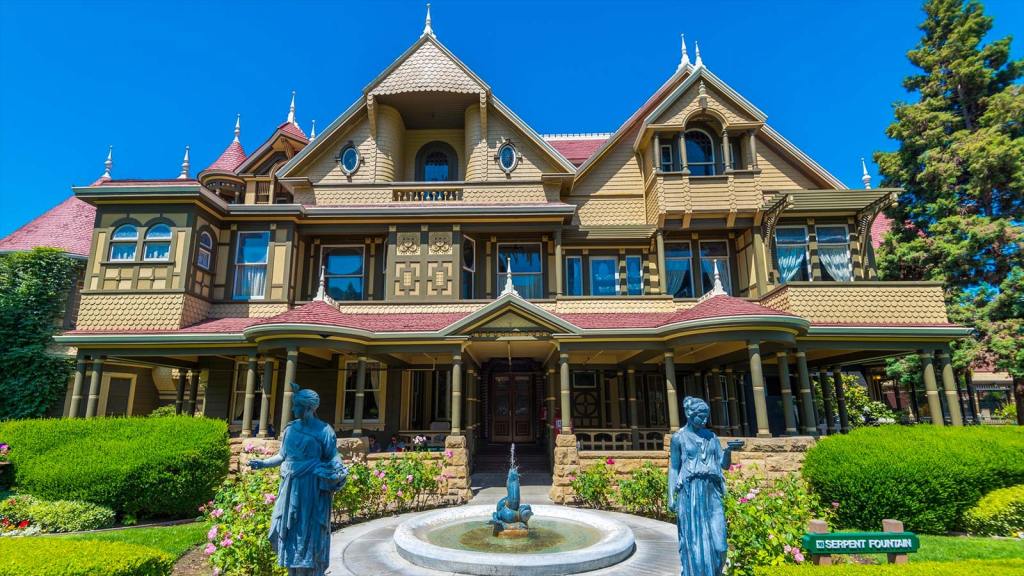
One morning he found an entire display sitting at the foot of the stairs. Everything had been moved during the night. His first thoughts were that someone had broken into the place, but there were no signs of an intruder. Early another morning, Jeff and a few other employees heard a music box playing. They went deep in the mansion to find the source. After searching for hours, they found nothing in the mansion, until they went up the dark stairs to the fourth floor. The stairs were steep, and when Jeff got to the top, he snapped a picture down the stairway. He took the picture at that moment because he had a strange feeling. After the investigated the fourth floor, Jeff said he felt a cold draft come by him, as though it was rushing past them down the stairs. The resulting picture was a tragic and forlorn figure dressed in nineteenth century clothes. People have reported seeing her figure walking toward doors that lead to parts of the mansion that are off limits to guest and that she passes unimpeded through locked doors. https://winchestermysteryhouse.com/

And please be sure to check out the online gift store: https://shopwinchestermysteryhouse.com/
 Randolph Harris II International Institute