
Home » Special Events (Page 19)
Category Archives: Special Events

Be Thou a Spirit of Health or Goblin Damned?

The Heaven was full of fiery shapes, Mrs. Winchester was terribly shocked by the death of her month-old baby girl; in fact, it can be well believed she never fully recovered and this surely influenced some of her eccentricities. Added to this loss was the death of her husband, William Wirt Winchester, 15 years later from Tuberculosis. On arrival in San Jose, Mrs. Winchester started remodeling the newly purchased, unfinished eight-room farm house. She found that the planning kept her grief-disturbed mind occupied and she became thoroughly enthused. Financial problems were certainly no deterrent; in the late 1880s, Mrs. Winchester brought a fortune of $20,000,000.00 ($523,635,294.12 in 2021 dollars) with her and had an average income of $1,000 ($26,181.76 in 2021 dollars) a day. Just how such precise amounts came to be public knowledge is unknown. In the period, 1881 to 1889, the dividends from her 777 shares of stock in the Winchester Company gave her an annual average income of $43,335.00 ($1,134,586.77 in 2021 dollars). It must be quickly added that upon the death of her mother-in-law in 1897, Mrs. Winchester’s holdings were increased to 2777 shares. Her lack of architectural training gave her little concern. Every morning she made the rounds with her ever patient foreman inspecting the latest progress. Some days Mrs. Winchester sketched plans on the spot using a saw-horse drawing table and any handy material, often brown wrapping paper (and used both sides). From the foreman came no argument; he had no problem of interpretation. #RandolphHarris 1 of 13

One afternoon in the mansion, a variety of circumstance concurred to being about the dreadful scene through which I was that night to pass. In the first place, I was literally overpowered with fatigue, and longing for sleep; in the next place, the effect of this extreme exhaustion upon my nerves resembled that of a narcotic, and rendered me less susceptible than, perhaps I should in any other condition have been, of the exciting fears which had become habitual to me. Then again, a little bit of the window was open, a pleasant freshness pervaded the room, and, to crown all, the cheerful sun of day was making the room quite pleasant. What was to prevent my enjoying an hour’s nap here? The whole air was resonant with the cheerful hum of life, and the broad matter-of-fact light of day filled every corner. I yielded—stifling my qualms—to the almost overpower temptation; and merely throwing off my coat, and loosening my cravat, I lay down, limiting myself to half-an-hour’s doze in the unwonted enjoyment of a feather bed, a coverlet, and a bolster. It was horribly insidious; and the demon, no doubt, marked my infatuated preparations. Dolt that I was, I fancied, with my mind and body worn out for want of sleep, and an arrear of a full week’s rest to my credit, that such measure as half-an-hour’s sleep, in such a situation, was possible. My sleep was death-like, long, and dreamless. Without a start of fearful sensation of any kind, I waked gently, but completely. It was, as you have good reason to remember, long past midnight—I believe, about two o’clock. When sleep has been deep and long enough to satisfy nature, thoroughly, one often wakens in this way, suddenly, tranquilly, and completely. #RandolphHarris 2 of 13

There was a figure seated in that lumbering, old sofa-chair, near the fireplace Its back was rather towards me, but I could not be mistaken; it turned slowly round, and merciful heavens! there was the stony face, with its infernal lineaments of malignity and despair, gloating on me. There was now no doubt as to its consciousness of my presence, and the hellish malice with which it was animated, for it arose, and drew close to the bedside. There was a rope about its neck, and the other end, coiled up, it held stiffly in its hand. My good angel nerved me for this horrible crisis. I remained for some seconds transfixed by the gaze of this tremendous phantom. He came close to the bed, and appeared on the point of mounting upon it. The next instant I was upon the floor at the far side, and in a moment more was, I do not know how, upon the lobby. However, the spell was not broken; the valley of the shadow of death was not yet traversed. The abhorred phantom was before me there; it was standing near the banisters, stooping a little, and with one end of the rope round its own neck, was poising a noose at the other, as if to throw over mine; and while engaged in this baleful pantomime, it wore a smile so sensual, so unspeakably dreadful, that my senses were nearly overpowered. I saw and remember nothing more, until I found myself in the maid’s room. I had a wonderful escape—there is no disputing that—an escape for which, while I live, I shall bless the mercy of Heaven. #RandolphHarris 3 of 13

No one can conceive or imagine what it is for flesh and blood to stand in the presence of such a thing, but one who has had the terrific experience. A shadow has passed over me—a chill has crossed my blood and marrow, and I will never be the same again—never, never! Our handmaid, a mature girl of two-and-fifty, as I have said, stayed her hand, and by little and little drew near to me, with open mouth, her brows contracted over her little, bready black eyes, till stealing a glance over her shoulder now and then, she established herself close behind us. During the relation, she had made various earnest comments, in an undertone; but these and her ejaculations, for the sake of brevity and simplicity, I have omitted in my narration. “It is often I heard tell of it,” she said, “but I never believed it rightly till now—though, indeed, why should I not? Does not my mother, down there in the lane, know quare stories, God bless us, beyant telling about it? But you ought not to have slept in the back bedroom. She was loath to le me be going in and out from that room even in the time, let alone for any Christian to spend the night in it; for sure she says it was his own bedroom.” “Whose own bedroom?” I asked, in a breath. “Why, his—the ould Judge’s—Judge John Conduit’s, to be sure, God rest his sowl”; and she looked fearfully round. “Amen!” I muttered. “But did he die there?” “Die there! No, not quite there,” she said. “Shure, was not it over bannisters he hung himself, the ould sinner, God be merciful to us all? and was not it in the alcove they found the handles of the skipping rope cut off, and the knife where he was settling the cord, God bless us, to hang himself with? #RandolphHarris 4 of 13

“It was his housekeeper’s daughter owned the rope, my mother told me, and the child never throve after, and used to be starting up out of her sleep, and screeching in the night time, wid dhrames and frights that cum an her; and they said how it was the speerit of the ould Judge that was tormentin’ her; and she used to be roaring and yelling out to hould back the big ould fellow with the crooked neck; and then she’d screech ‘Oh, the master! the master! he’s stampin’ at me, and beckoning to me! Mother, darling, don’t let me go!’ And so the poor crathure died at last, and the doctors said was marasmus, for it was all they could say.” “How long ago was all this?” I asked. “Oh, then, how would I know?” she answered. “But it must be a wondherful long time ago, for the housekeep was an ould woman, with a pipe in her mouth, and not a tooth left, and better nor eighty years ould when my mother was first married; and they said she was a rale buxom, fine-dressed woman when the ould Judge come to his end; an’, indeed, my mother’s not far from eighty years ould herself this day; and what made it worse for the unnatural ould villain, God rest his soul, to frighten the little girl out of the World the way he did, was what was mostly thought and believed by every one. My mother says the poor little crathure was his own child; for he was by all accounts an ould villain every way, an’ the hangin’ est judge that ever was known.” “From what you said about the danger of sleeping in that bedroom,” said I, “I suppose there were stories about the ghost having appeared there to others.” “Well, there was things said—quare things, surely,” she answered, as it seemed, with some reluctance. #RandolphHarris 5 of 13

“And why would not there? Sure was it not up in that same room he slept for more than twenty years? and was it not in the alcove he got the rope ready that done his own business at last, the way he done many a better man’s in his lifetime?—and was not the body lying in the same bed after death, and put in the coffin there, too, and carried out to his grave from it in St. Joseph’s Cathedral Basilica, after the coroner was done? But there was quare stories—my mother has them all—about how one Archbishop Patrick William Riordan got into trouble on the head of it. Some years later he died of pneumonia at the 1000 Fulton Street Mansion in San Francisco, California.” “And what did they say of this Archbishop Riordan?” I asked. “Oh, for that matther, it’s soon told,” she answered. And she certainly did relate a very strange story, which so piqued my curiosity, that I took occasion to visit the ancient lady, her mother, from whom I learned many very curious particulars. Indeed, I am tempted to tell the tale, but my fingers are weary, and I must defer it. But if you wish to hear it another time, I shall do my best. When I had heard the strange tale I have not told you, I put one or two further questions to her about the alleged spectral visitations, to which the house had, ever since the death of the wicked old Judge, been subjected. “No one ever Mrs. Winchester myself telling how the children used to be lifted up in the bed at night, she could not see by what mains; and how they were starting and screeching every hour, just all as one as the housekeeper’s little girl that died till at last one night poor Chadwick had a dhrop in him, the way he used now and again; and what do you think in the middle of the night he thought he heard a noise on the stairs, and being in liquor, nothing less id do him but out he must go himself to see what was wrong. #RandolphHarris 6 of 13

“Well, after that, all she ever heard of him was himself sayin’, ‘Oh, God!’ and a tumble that shook the very house; and there, sure enough, eh was laying on the lower stair, under the lobby, with his neck smashed double undher him, where he was flung over the banisters.” Then the handmaiden added—“I’ll go down the lane, and send up Hansen Solomon to pack up the rest of the taythings, and bring all the things across to your new lodgings.” And so we all sallied out together, each of us breathing more freely, I have no doubt, as we crossed that ill-omened threshold for the last time. Now, I may add thus much, in compliance with the immemorial usage of the Winchester legacy, which see the hero not only through one’s adventures, bur fairly out of the World. You must have perceived that what the flesh, blood, and bone hero of romance proper is to the regular compounder of legends, this ancient Victorian mansion of brick, wood, glass, and mortar is to the humble recorder of this true tale. Gods have different properties, due to different antecedents. The definitive book on gods and their qualities has yet to be written. Mrs. Winchester built the door to nowhere for the gods to enter. However, a human being has the key—the big key. The all-important key. The long-lost secret key that lets a human talk to the gods, command them, bring them down to Earth. Solomon’s key. A man gets that key, he be stronger than the gods. You do not want to mess with that key stuff. #RandolphHarris 7 of 13

Remember that persons skeptical of witchcraft did not doubt the practice of it, but only whether or not it worked, or worked through spiritual means. Thus the skeptic John Webster, in his Displaying of Supposed Witchcraft, was willing to concede that there were witches and devils who “have power to perform strange things.” However, he spent his twelfth chapter on the question “whether they do not bring the to pass by mere natural means.” What was at issues here was the reality of the spiritual World, the “invisible World,” as Dr. Mather called it. The controversy over witchcraft, therefore, raised theological issues fundamental to the seventeenth-century Christian. “We shall come to have no Christ but a light within, and no Heaven but a frame of Mind,” said Dr. Mather, if the materialists—the Saducees—should succeed in destroying the belief in an invisible World. Whatever one’s own belief, or lack of it, one has to admit that he was right. In the eighteenth and nineteenth centuries scientific materialism was to triumph, and the pious were to find that all the concreteness had left their religion, leaving nothing behind but a “light within” and a “frame of mind.” Conceive, then, of Dr. Mather’s excitement. At a time which he recognized to be a crisis in the history of religious belief he had discovered a clear case of witchcraft which he thought could not possibly be explained on material grounds. He made it the central matter of his Memorable Providences (1689), a book which he hoped might once and for all confute materialism and reestablish Christianity on the firm foundation of a real and concrete spiritual World. #RandolphHarris 8 of 13

The book met with considerable success. Richard Baxter, one of the most distinguished English Puritans, wrote a laudatory preface to the first London edition, and in Baxter’s own Certainty of the World of Spirits (1691) he spoke of it as the ultimate proof of the existence of a spiritual World. Any doubter, he said, “that will read…Mr. Cotton Mather’s book of the witchcrafts in New England may see enough to any incredulity that pretendeth to be rational.” The four or so cases we have reviewed over the past few weeks confirm in detail what we have seen to be true in general. Accusations of witchcraft were continual among common people, so continual that Dr. Cotton Mather took time in his “Discourse” to warn his congregation sharply against them “Take heed that you do not wrongfully accuse any other person of this horrid and monstrous evil…What more dirty reproach than that of witchcraft can there be? Yet it is most readily cast upon worthy persons when there is hardly a shadow of any reason for it. An ill look or a cross word will make a witch with many people who may on more ground be counted so themselves. There has been a fearful deal of injury done in this way in this town to the good name of the most credible persons in it. Persons of more goodness and esteem than any of their calumnious abusers have been defamed for witches about this country—a country full of lies.” However, the charges of irresponsible accusers were checked by the responsibility of the community’s leaders, the ministers and magistrates. They had been reluctant to act in Mrs. Hibbins’ case. #RandolphHarris 9 of 13

At Groton, Mr. Willard’s investigation had been so careful that two accusations of witchcraft were retracted and the case never brought to court, on the ground that it was possession rather than witchcraft. At Hartford a confessor and her husband had been hanged and at Boston a confessor, but in both instances, although more persons were accused, the individual case did not develop into a witch hunt. There were other individual convictions, but they were outnumbered by the acquittals. For example, the records of the Court of Assistants show that in 1662 Eunice Cole of Hampton was found not guilty as indicated, although there was “just ground of vehement suspicion.” In 1666 John Godfrey of Salem was discharged as not legally guilty, although there were again grounds for suspicion. (Mr. Godfrey seems to have been a thorough reprobate; at various times he was convicted of stealing, swearing, drunkenness, and suborning witnesses.) In 1637 Anna Edmunds was acquitted and her accusers order to pay charges. In 1675 Mary Parsons of Northampton was found not guilty, in 1681 Mary Hale of Boston, and in 1683 Mary Webster of Hadley. Also in 1683 James Fuller of Springfield, who had confessed but then retracted his confession, was found not guilty but was whipped and fined for “his wicked and pernicious willful lying and continuance in it until now, putting the country to so great a change.” #RandolphHarris 10 of 13

In All the American colonies during the seventeenth century there were fewer than fifty executions for witchcraft, and excluding Salem there were fewer than thirty. This is a genuinely exemplary record, considerably superior to Europe for intelligence and restraint. Before the Glover case a part of this restraint may have proceeded from the New Englander’s conviction that he belonged to a chosen people. God, many thought, would not permit Satan to afflict the elect. The Devil might appear among “the wigwams of Indians, where the pagan Powaws often raise their masters in the shapes of bear and snakes and fires,” but there would be a few demonic terrors in the New Jerusalem. This belief was shattered by the events of 1688. Goodwife Glover had demonstrated clearly that witchcraft did exist in Massachusetts, and witchcraft of the most serious and dangerous sort. The Devil was abroad in Zion, seeking whom he might devour. When the Devil broke forth again, at Salem Village in 1692, he was not immediately recognized. “When these calamities first began,” wrote the Reverend Samuel Parris, “which was in my own family, the affliction was several weeks before such hellish operations as witchcraft were suspected. A quack doctor, who called himself William Griggs, moved into my family home, and catastrophe ultimately befell it. He filled the parlour widow with bottle of indescribable horrors preserved in brandy, and the fairly new concept in the American colonies called the newspaper with the usual grandiloquent and mendacious mix of local social and culture news. #RandolphHarris 11 of 13

“This gentleman among his virtues did not reckon sobriety, and one night, being overcome with much wine, he set fire to his bed curtains, partially burned himself, and totally consumed the hose. It was afterwards rebuilt, and for a time an undertaker established himself in the premises. I fear some young persons, through vain curiosity to know their future condition, have tampered with the Devil’s tools so far that hereby one door was opened to Satan to play those pranks, Anno 1692. I knew one of the afflicted persons who (as I was credibly informed) did try with an egg and a glass to find her future husband’s calling [id est, occupation], till there came up a coffin, that is, a specter in likeness of a coffin. And she was afterward followed with diabolical molestation to her death, and so died a single person—a just warning to others to take heed of handling the Devil’s weapons lest they get a wound thereby. Another, I was called to pray with, being under sore fits and vexations of Satan. And upon examination I found that she had tried the same charm, and after her confession of it and manifestation of repentance for it, and our praters to God for her, she was speedily released from those bonds of Satan.” As human beings, we interact with the environment around us and affect it through our bodies as extensions of our minds. However, the thing is, we are never satisfied with the simplistic nature of these interactions. We are aware of limitations of our human nature and that has always been a driving force for us as a race to look for other ways to affect our environment in a more impactful way. #RandolphHarris 12 of 13

Witchcraft is another way, a “tool” if you will, to impact the environment in a way so unique that simple, everyday folk like us cannot wrap our minds around it. It surpasses the wonders of mechanics as there is no external connection, the power of witchcraft extends from an internal World, bypassing the need to learn complex machinery or spend years labouring over physics and math textbooks. Alongside the innovation we traditionally ascribe to the Victorian period, was an older, persistent belief in the supernatural. Although the laws against witchcraft had been repealed in 1736, folklore continued to be active and potent force in everyday life. Many people believe that supernatural forces are what compelled Mrs. Winchester, at a cost of $5,000,000.00 ($171, 188, 461.51 in 2021 dollars) alone spent on materials to build the Winchester mansion with 10,000 windows, nine kitchens, and 47 fireplaces built of rosewood, cherry, mahogany, Italian marble, oak, teak, and pipestone; all hand carved, and no two alike. Construction went on for 38 years. At one point the mansion was as high as nine stories, had 200 rooms, and was 50,000 square feet. Once an enterprising young realtor leaked the rumor to Mrs. Winchester’s servants that across the road (now Stevens Creek Chevrolet) an investor was planning to build an Inn. “Saloon” was the word in those says. Mrs. Winchester quickly purchased the property at an exorbitant figure. Of course this was a false alarm but it brought her holdings to 160 acres. In the book of life, blessing, peace, and ample sustenance, may we, together with all Thy people, the house of America, be remembered and inscribed before Thee for a happy life and for peace. Blessed art Thou, O Lord who establishest peace. #RandolphHarris 13 of 13


A 160-room mansion built to appease the spirits who died at the hands of the Winchester Rifle 👻 🗝 winchestermysteryhouse.com

It is Difficult for an Education in Which the Hearts is Involved to Remain Forever Lost!

Trying to sneak a pitch past him is like trying to sneak the sunrise past a rooster. Three hundred and fifty years ago, give or take a half-century, an explosion was heard that sent concussive shock waves racing across the Earth, demolishing ancient societies and creating a wholly new civilization. This explosion was, of course, the industrial revolution. And the giant tidal force it set loose on the World—the Second Wave—collided with all the institutions of the past and changed the way of life of millions. During the long millennia when First Wave civilization reigned supreme, the planet’s population could have been divided into two categories—the “primitive” and the “civilized.” The so-called primitive peoples, living in small bands and tribes and subsisting by gathering, hunting, or fishing, were those who had been passed over by the agricultural revolution. The “civilized” World, by contrast, was precisely that part of the planet on which most people worked the soil. For wherever agriculture arose, civilization took root. From China and India to Benin and Mexico, in Greece and Rome, civilizations rose and fell, fought and fused in endless, colourful admixture. However, beneath their differences lay fundamental similarities. In all of them, land was the basis of economy, life, culture, family structure, and politics. In each community, life was organized around the village. Each of which, life was a simple division of labour prevailed and a few clearly defined castes and classes arose: a nobility, a priesthood, warriors, helots, slaves, or serfs. For all of these people, power was rigidly authoritarian. #RandolphHarris 1 of 28

In all of these cases, birth determined one’s position in life. And for any one of these people, the economy was decentralized, so that each community produced most of its own necessities. There were exceptions—nothing is simple in history There were commercial cultures whose sailors crossed the seas, and highly centralized kingdoms organized around giant irrigation systems. However, despite such differences, we are justified in seeing all these seemingly distinctive civilizations as special cases of a single phenomenon: agricultural civilization—the civilization spread by the First Wave. During is dominance there were occasional hints of things to come. There were embryonic mass-production factories in ancient Greece and Rome. Oil was drilled on one of the Greek islands in 400 B.C, and in Burma in A.D. 100. Vast bureaucracies flourished in Babylonia and Egypt. Great urban metropolises grew up in Asia and South America. There was money and exchange. Trade routes crisscrossed the deserts, ocean, and mountains from Cathy to Calais. Corporations and incipient nations existed. There was even, in ancient Alexandria, a startling forerunner of the steam engine. Yet nowhere was there anything that might remotely have been termed an industrial civilization. These glimpses of the future, so to speak, were mere oddities in history, scattered through different places and periods. They never were brought together into a coherent system, nor could they have been. Until 1650-1750, therefore, we can speak of a First Wave. #RandolphHarris 2 of 28

Despite patches of primitivism and hints of the industrial future, agricultural civilization dominated the planet and seemed destined to do so forever. This was the World in which the industrial revolution erupted, launching the Second Wave and creating a strange, powerful, feverishly energetic countercivilization. Industrialism was more than smokestacks and assembly lines. It was a rich, many-sided social system that touched every aspect of human life and attacked every feature of the First Wave past. It produced the great Willow Run factory outside Detroit, but it also put the tractor on the farm, the typewriter in the office, the refrigerator in the kitchen. It produced the daily newspaper and the cinema, the subway and the DC-3. It gave us cubism and twelve-tone music. It gave up Bauhaus buildings and Barcelona chairs, sit-down strikes, vitamin pills, and lengthened life spans. It universalized the wristwatch and the ballot box. More important, it linked all these things together—assembled them, like a machine—to form the most powerful, cohesive, and expansive social system the World had ever known: Second Wave civilization. As the Second Wave moved across various societies it touched off a bloody, protracted war between the defenders of the agricultural past and the partisans of the industrial future. The forces of First and Second Wave collided head-on, brushing aside, often decimating, the “primitive” peoples encountered along the way. #RandolphHarris 3 of 28

In the United States of America, this collision began with the arrival of the Europeans bent on establishing an agricultural, First Wave civilization. A white agricultural tide pushed relentlessly westward, dispossessing the Indian, depositing farms and agricultural villages father and father toward the Pacific. However, hard on the heels of the farmers came the earliest industrializers as well, agents of the second Wave future. Factories and cities began to spring up in New England and the mid-Atlantic states. By the middle of the nineteenth century, the Northeast had a rapidly growing industrial sector producing firearms, watches, farm implements, textiles, sewing machines, and other goods, while the rest of the continent was still ruled by agricultural interests. Economic and social tensions between First Wave and Second Wave forces grew in intensity until 1861, when they broke into armed violence. The Civil War was not fought exclusively, as it seemed to many, over the moral issue of slavery or such narrow economic issues as tariffs. It was fought over a much larger question: would the rich new continent be ruled by farmers or industrializers, by the forces of the First Wave or the Second? Would the future American society be basically agricultural or industrial? When the Northern armies won, the die was cast. The industrialization of the United States of America was assured. From that time on, in economics, in politics, in social and culture life, agriculture was in retreat, industry ascendant. The First Wave ebbed as the Second came thundering in. #RandolphHarris 4 of 28

The same collision of civilizations erupted elsewhere as well. In Japan the Meiji Restoration, beginning in 1868, replayed in unmistakably Japanese terms the same struggle between agricultural past and industrial future. The abolition of feudalism by 1876, the rebellion of the Satasuma clan in 1877, the adoption of Western-style constitution in 1889, were all reflections of the collision of the First and Second Waves in Japan—steps on the road to Japan’s emergence as a premier industrial power. In Russia, too, the same collision between First and Second Wave forces erupted. The 1917 revolution was Russia’s version of the American Civil War. It was fought not primarily, as it seemed, over communism but once again over the issue of industrialization. When the Bolsheviks wiped out the last lingering vestiges of serfdom and feudal monarchy, they pushed agriculture into the background and consciously accelerated industrialism. They became the party of the Second Wave. In country after country, the same clash between First Wave and Second Wave interests broke out, leading to political crisis and upheavals, to strikes, uprisings, coup d’etat, and wars. By the mid-twentieth century, however, the forces of the First Wave were broken and the Second Wave civilization reigned over the Earth. #RandolphHarris 5 of 28

Today an industrial belt girdles the globe between the twenty-fifth and sixty-fifth parallels in the Northern Hemisphere. In North America, and much of the other developed nations, some 80 percent of the population lives an industrial way of life. Despite dizzying differences of language, culture, history, and politics—differences so deep that wars are fought over them—all these Second Wave societies share common features. Indeed, beneath the well-known differences lies a hidden bedrock of similarity. And to understand today’s colliding waves of change we must be able to identify clearly the parallel structures of all industrial nations—the hidden framework of Second Wave civilization. For it is this industrial framework itself that is not being shattered. And you, MAGNIFICENT AND MOST HONOURED LORDS, you upright and worthy magistrates of free people, permit me to offer you in particular my compliments and my respects. If there is a rank in the World suited to conferring honour on those who hold it, it is without doubt the one that is given by talents and virtue, that of which you have made yourselves worthy, and to which your fellow citizens have raised you. Their own merit adds still a new luster to yours. And I that find you, who were chosen by humans capable of governing others in order that they themselves may be governed, are as much above other magistrates as a free people; and above all that one which you have the honour of leading, is, by its enlightenment and reason, above the populace of other states. #RandolphHarris 6 of 28

May I be permitted to cite an example of which better records ought to remain, and which will always be near to my heart. I never call to mind without the sweetest emotion the memory of the virtuous citizen to whom I owe my being, and who often spoke to me in my childhood of the respect that was owed you. I sill see him living from the work of his hands, and nourishing his soul on the most sublime truths. I see Tacitus, Plutarch and Grotius mingled with the instruments of his craft before him. I see at this side a beloved son receiving with too little profit the tender instruction of the best of fathers. However, if the aberrations of foolish youth made me forget such wise lessons for a time, I have the happiness to sense at last that whatever the inclination one may have toward vice, it is difficult for an education in which the heart is involved to remain forever lost. Such, MADNIFICENT AND MOST HONOURED LORDS, are the citizens and even the simple inhabitants born in the state you govern. Such are those educated and sensible human concerning whom, under than name of workers and people, such base and false ideas are entertained in other nations. My father, I gladly acknowledge, was in no way distinguished among his fellow citizens; he was only what they all are; and such as he was, there was no country where his company would not have been sought after, cultivated, and profitably too, by the most upright humans. It does not behoove me, nor, thank Heaven, is it necessary to speak to you oft the regard which humans of that stamp can expect from you: your equals by education as well as by the rights of the nature and of birth; your inferiors by their will and by the preference they owe your merit, which they have granted to it, and for which you in tern owe them some sort of gratitude. #RandolphHarris 7 of 28

It is with intense satisfaction that I learn how much, in your dealings with them, you temper with gentleness and cooperativeness the gravity suited to the ministers of law; how much you repay them in esteem and attention for the obedience and respect they owe you; conduct full of justice and wisdom, suited to putting at a greater and greater distance the memory of unhappy events which must be forgotten so as never to see them again; conduct all the more judicious because this equitable and generous people makes a pleasure out of its duty, because it naturally loves to honour you, and because those who are most zealous in upholding their rights are the ones who are most inclined to respect yours. It should not be surprising that the leaders of a civil society love its glory and happiness; but, unfortunately for the tranquility of humans, that those who consider themselves as the magistrates, or rather as the masters, of a more holy and more subline homeland manifest some love for the Earthly homeland which nourishes them. How sweet it is for me to be able to make such a rare exception in our favour, and to place in the rank of our best citizens those zealous trustees of the sacred dogmas authorized by the laws, those venerable pastors of souls, whose lively and sweet eloquence the better instills the maxims of the Gospel into people’s hearts as they themselves always begin by practicing them. Everyone knows the success with which the great art preaching is cultivated in Geneva. #RandolphHarris 8 of 28

However, since people are too accustomed to seeing things said in one way and done in another, few of them know the extent to which the spirit of Christianity, the saintliness of mores, severity to oneself and gentleness to others reign in the body of our ministers. Perhaps it behooves only the city of Geneva to provide the edifying example of such a perfect union between a society of theologians and men of letters. It is in large part upon their wisdom and their acknowledged moderation and upon their zeal for the prosperity of the state that I base my hopes for its eternal tranquility. And I note, with a pleasure mixed with amazement and respect, how much they abhour the atrocious maxims of those sacred and barbarous humans of whom history provides more than one example, and who, in order to uphold the alleged rights of God—that is to say, their own interests—were all the less sparing of human blood because they hoped their own would always be respected. Could I forget hat precious half of the republic which produces the happiness of the other and whose gentleness and wisdom maintain peace and good mores? Amiable and virtuous women and citizens, it will always be the fate of your gender o govern ours. Happy it is when your chase power, exercised only within the conjugal union, makes itself felt only for the glory of the state and the public happiness! Thus it was that in Sparta women were in command, and thus it is that you deserve to be in command in American. #RandolphHarris 9 of 28

What barbarous man could resist the voice of honour and reason in the mouth of an affectionate wife? And who would not despise vain luxury on seeing your simple and modest attire, which, from the luster it derives from you, seems the most favourable to beauty? It is for your to maintain always, by your amiable and innocent dominion and by your insinuating wit, the love of laws in the state and concord among the citizens to reunite, by happy marriages, divided families; and above all, to correct, by the persuasive sweetness of your lessons and by the modest graces of your conversation, those extravagances which our young people come to acquire in other countries, whence, instead of the many useful things they could profit from, they bring back, with a childish manner and ridiculous airs adopted among fallen women, nothing more than an admiration for who knows what pretended grandeurs, frivolous compensations for servitude, which will never be worth as much as august liberty. Therefore always be what you are, the chaste guardians of mores and the gentle bonds of peace; and continue to assert on every occasion the rights of the heart and of nature for the benefit of duty and virtue. I flatter myself that events will not prove me wrong in basing upon such guarantees hope for the general happiness of the citizens and for the glory of the republic. #RandolphHarris 10 of 28

I admit that with all these advantages it will not shine with brilliance which dazzles most eyes; and the childish and fatal taste for this is the deadliest enemy of happiness and liberty. Let a dissolute youth go elsewhere in search of easy pleasures and lengthy repentances. Let the alleged men of tastes admire someplace else the grandeur of palaces, the beauty of carriages, the sumptuous furnishings, he pomp of spectacles, and all the refinements of softness and luxury. In American we will find only men; but such a sight has a value of its own, and those who seek it are well worth the admirers of the rest. May you all, MAGNIFICENT, MOST HONOURED AND AOVEREIGN LORDS, deign to receive with the same goodness the respectful testimonies of the interest I take in your common prosperity. If I were unfortunate enough to be guilty of some indiscreet rapture in this lively effusion of my heart, I beg you to pardon it as the tender affection of a true patriot, and to the ardent and legitimate zeal of man who envisage no greater happiness for oneself than that of seeing all of you happy. With the most profound respect, I am MAGNIFICENT, MOST HONOURED AND SOVEREIGN LORDS, you most humble and most obedient servant and fellow citizen. The Angels had wondered at the glorious plan of redemption. They watched to see how the people of God would receive His Son, clothed in the garb of humanity. Angels came to the land of the chosen people. Other nations were dealing in fables and worshipping false gods. To the land where the glory of God had been revealed, and the light of prophecy had shone, the Angels came. #RandolphHarris 11 of 28

They came to unseen America, to the appointed expositor of the Sacred Oracles, and the ministers of God’s house. Christ’s arrival had been announced. Already the forerunner was born, His mission attested by miracle and prophecy. The tidings of His birth and the wonderful significance of His mission had been spread abroad. And American was preparing to welcome her Redeemer. With amazement the Heavenly messengers beheld the excitement that the people whom God had called to communicate to the World the light of sacred truth. The American nation had been preserved as a witness that Christ was to be born of the seed of Abraham and of David’s line. The priests and teacher rehearsed their sacred prayers, and performed important rites of worship to honour the Lord, and prepare for the revelation of the Messiah. Hearts were Heavenly enthralled and were blessed by the joy that thrilled all Heaven. Everyone has the experience of doing, few of being. Yet that is the most precious, most important of all life’s experiences. This is the experience which makes the fully mature human happiest. It is usually short but its next advent will always be eagerly awaited. It is often isolated by long intervals of prosaic commonplace living, but they only serve to give it even greater value by contrast. The inner need of humans is forever demanding this experience, for it is Heaven. Whether it is born out of appreciation of beauty or an infinite humiliation of the ego, or out of some totally difference occasion, this awareness of the Overself’s presence is essential to the completion and fulfilment of human life. #RandolphHarris 12 of 28

To enter Heaven is to enter into fulfilment of our Earthly life’s unearthly purpose. And that is, simply, to become aware of the Overself. This holy awareness brings such joy with it hat we then know why the true saints and the real ascetics were able to disdain all other joys. The contrast is too disproportionate. Nothing that the World offers to tempt us can be put on the same level. One will find that somewhere within there is a holy presence not oneself, a sublime power not one’s own. One will understand then that no one is truly alive who has not made this discovery. The glimpse of Heaven lies at the core of religion, the precious gem which each devotee must find for oneself underneath all the sermons, chantings, rituals, prayers, and observances of one’s creed. A stillness which is simply the absence of noise but which is rich, fruitful, and uplifting in beauty and refinement of its presence—this is the best. No good fortune that comes one’s way will ever after be counted so great as the good fortune which one now feels to be one’s in the realization of the Overself. Would but the desert of the Fountain yield One glimpse—if dimly, yet indeed revealed, to which the fainting traveler might spring. Another significance of the glimpse is that of initiation. We cannot know God in the fullness of His consciousness but we can know the link which we have with God. If you mist, call it the soul, or if you prefer the Overself, but catch a glimpse of this link to be reborn. #RandolphHarris 13 of 28

The glimpse gives one a journey to a land flowing not with milk and honey, but with goodness and beauty, with peace and wisdom. It is the best moment of one’s life. When a human’s consciousness is turned upside-down by a glimpse, when one thought most substantial is revealed as least so, when one’s values are reversed the Good takes on a new definition, one writes that day down as one’s spiritual birthday. What better thing can one find than the divine Overself! That would be the decisive moment of one’s entire bodily existence, as establishing oneself permanently in its fullness and finality would be the grandest sequel. There is no higher happiness than this discovery of the real human. Joseph Smith knew that if his important work of translating was to be finished, he must have a capable scribe who could spend hours at a time at the job of writing. As usual when he needed guidance, Joseph prayed that such a person might be found. Meanwhile, back in Palmyra, a schoolteacher named Oliver Cowdery had come to live in the Smith home. Oliver, who was about Joseph’s age, had not been in the family of Joseph’s parent long before they told him the strange story of the golden plates and the Angel visits. Oliver liked the Smiths and believed the story. Oliver also prayed. He wanted to help in great new work. In his heart he began to feel that his place was beside Joseph. Because he felt so strongly that he could be helpful, he went to Pennsylvania in April, 1829. Upon hi arrival at the home of Joseph and Emma, Oliver told them why he had come. Joseph was not surprised because he knew God had sent this young man in answer to his prayer for help. #RandolphHarris 14 of 28

Joseph and Oliver became friends immediately. They trusted each other because each felt that God had told him, even before they met, that they would work together. Joseph had not had much opportunity to go to school to learn from books, and he was to appreciate the help of schoolteacher Oliver, who had excellent schooling, was a great reader, and a fine writer. Soon after the meeting of these two young men, the Lord Jesus Christ, spoke to them saying: “A great and marvelous work is about to come forth unto the children of men: behold, I am God, and give heed unto my word. Keep my commandments, and seek to bring forth and establish the cause of America. Seek not for riches but for wisdom; and, behold, the mysteries of God shall be unfolded unto you, and then shall you be made rich. Behold, one that hath eternal life is rich. If you desire, you shall be the means of doing much good in this generation. Say nothing but repentance unto this generation: keep my commandments, and assist to bring forth my work…and you shall be blessed. Behold, thou knowest that that thou hast inquired of me, and I did enlighten thy mind; and now I tell thee these things, that thou mayest know that thou hast been enlightened by the spirit of truth. Yea, I tell thee, that thou mayest know that there is none else save God, that knowest thy thoughts and the intents of thy heart. I tell thee these things as a witness unto thee, that the words of the work which thou hast been writing is true. Treasure up these words in thy heart. Be faithful and diligent in keeping the commandments of God, and I will encircle thee in he arms of my love. #RandolphHarris 15 of 28

“I say unto you, as I said unto my disciples, Where two or three are gathered together in my name, as touching one thing, behold, there will I be in the midst of them; even so am I in the midst of you. Fear not to do good, my sons, for whatsoever ye sow, that shall ye also reap: therefore, if ye sow good, ye shall also reap good for your reward. Therefore fear not, little flock, do good. Look unto me in every thought, doubt not, fear not. Be faithful; keep my commandments, and ye shall inherit the Kingdom of Heaven. Amen.” Two days after their meeting, Oliver began to write as Joseph translated. They worked hour after hour, day after day, happy in their new-found friendship and the work which bound them together. Oliver describes this work in these words: “These were days never to be forgotten—to sit under the sound of a vice dictated by the inspiration of Heaven. Day after day I continued to write as he translated with the Urim and Thummim.” Sometimes as they worked, on the translation they came to things they did not understand. They prayed for explanations. It was on such an occasion that the Lord explained to them how they might know the answers to many of their problems and receive the knowledge by the Holy Spirit. The Lord said: “Verily I say unto you, that assuredly as the Lord liveth, who is your God and your Redeemer, even so sure shall you receive a knowledge of whatsoever things you shall ask in faith, with an honest heart, believing that you shall receive. Yea, behold, I will tell you in your mind and in your heart by Holy Ghost, which shall come upon you, and which shall dwell in your heart. Now, behold, this is the spirit of revelation. #RandolphHarris 16 of 28

“Behold, you have not understood; you have supposed that I would give it unto you, wen you took no thoughts, save it was to ask me; but, behold, I say unto you, that you mut study it out in your mind. Then you must ask me if it be right, and if it is right, I will cause that your bosom shall burn within you; therefore, you shall fell that it is right. However, if it be not right, you shall have no such feelings, but you shall have a stupor of thought, that shall cause you to forget the thing which is wrong.” The Lord provided this means whereby Joseph and Oliver, and all the people, might know by His Holy Spirit the truth of all things. We must look upon these glimpses as sacred one. And this is so even if they rise of themselves in our best moments. For in these times we, and especially the younger ones among us, need wider definitions of such matters. These moments, when spiritual presence is distinctly felt, may be rare or frequent, misunderstood or recognized, but they are moments of blessing. And this is true even if they open the door only slightly and let in merely a ray of light. In these moments of a glimpse, one discovers the very real presence of the Overself. They provide one with a joy, an amiability, which disarms the negative side of one’s character and brings forward the beneficial side. These are precious moments; they cannot be too highly valued. And though they must pass, some communication with them is always possible through memory. #RandolphHarris 17 of 28

Remember this truth: The Old Testament is God’s will concealed, and the New Testament is God’s will revealed—every word is equally anointed, relevant, and eternally true. The glimpse is of supreme worth morally, helping to free one, bestowing goodwill and humility, uplifting one’s ideals however fleetingly. Instead of being an escape from life, as some sceptics unwisely think, they are its fulfilment. Although life is really like a dream, some phases of the dream are more worthwhile than others—those which bring the Glimpse, for instance. It is far better than being ignorant to know what is read in books or heard at lectures on this topic, but far better than both of these is to feel vividly the Overself’s presence and reality, to know the truth of It with complete certainty. No better fortune can come to a human than one’s serene inward well-being and this certitude of universal truth. We must have Good Conscience and live a Virtuous Life! Why? Because a lot of us spend more time studying hard than living well. That is such a mistake! All that does is produce a tree that bears in fruit, except perhaps the odd pear or single peace. Plowing vices under and planting virtues in their place—that is hard work. Harder even than the grunt and the grind of the great philosophical issues. However, if the priestly scholar had already done that hard and serious work in one’s own life, one would find it easier now dealing with those Devouts traipsing about in sandals and self-actualizes processing around in ermines. #RandolphHarris 18 of 28

With the certain advent of that Final Event, the question o be posed is not whether we read the right books, but whether we did the good deeds; not whether we said the right things, but whether we made the right choices. Tell me now, where are those celebrity professors who taught you when they were at the height of their careers and you were starting out? They are dead and gone. You occupy their chairs of learning now, and now you are spending their stipends. Doctors they once were; now they are only dodoes, and you can hardly remember their names. How soon the glory of the Worlds set, wrote John in his first letter to an early group of Christians (2.17)! Would that the professors’ lives had matched their doctrinal teachings! Yet they fell short. If they had it to do over again, I suppose they would have studied longer and read till their eyes turned red. However, that would have done the little good. That is what Paul had in mind when he wrote to the Romans (1.21). How many of the professors have perished because they followed the unreliable wisdom of the World! Because they gave scant attention to the service of God. They had their choices, though. They picked greatness rather than humility, and as a result logicked themselves right out of their own holy syllogisms. However, when the sun finally sets, there will be other, happier people. The truly great? Those who did not make a lot of themselves; they gathered honours as their due, but they did not display their trophies in the window. The truly prudent? If it is what would keep them on the path to God, those who gave the World its due; they would not mind sweeping up after elephants, as St. Paul put it so Earthily to the Philippians (3.8). #RandolphHarris 19 of 28

The truly educated? Those who engaged God’s will and disengaged their own in one and the same transaction. Does no death mean that the body comes to exist by itself, separated from the soul, and that the soul exists by herself, separated from the body? What is death but that? For the Hebrew, a human is a unity, and that unity is the body as a complex of parts, drawing their life and activity from a breath-soul, which has no existence apart from the body. What is our essential nature? Are we a dualism of body and soul, as Socrates and Plato believed, or a psychophysical unity, as H. Wheeler Robinson suggests is the Old Testament view? Take a little survey of Christian laypeople, and you will surely find most people agreeing with Plato: we are made up of two realities, body and soul. Or so most of us have been taught since childhood. One book of Christian doctrine for children explains: Maybe you have been to a funeral. You have seen the dead body. That is buried in the ground. However, the inside part of you, the part that thinks and feels, that is the part that lives forever. This is the part of us that would go to hell. Christians talk and sing a lot about souls. It has seemed natural to appear to our possession of a soul as “proof” that we are alive. The belief that we possess a soul has been the foundation of our dignity and out view of the sacredness of human life. For many, talk about the soul has been a way of thinking about our “divine image.” #RandolphHarris 20 of 28

Not surprisingly, anyone who seems to question one of our most treasured beliefs will face strong challenges, and quite properly be put under close scrutiny. That has happened in the past, of course, with other Christian beliefs. We all remember the sustained action to the views of Copernicus and Galileo, which displaced our Earth from the center of the Universe. How much more of a reaction, then, might we expect to anyone seeming to question our possession of a soul as the hallmark of our being made “in the image of God”? If, as the Old Testament scholar Derek Kidner suggests, “the telescope of Galileo did more to interpret Psalm 96 verse 10 than the pen of the theologian,” we need to pause and ask in what way today might the discoveries of the neuropsychologists and evolutionary psychologists do more to interpret biblical references to the soul than the comments of philosophical theologians? The distinguished Nobel laureate Francis Crick wrote, “In spite of differences among religions, there is broad agreement on at least one point: People have soul, in the literal and not merely the metaphorical sense.” Keith Ward, Regius Professor of Divinity at Oxford, begs to differ: “In the Christian tradition, like the Jewish and Muslim, the soul is not a substantial entity which exists without and before the body, and is better off without the body.” Instead, Dr. Ward contends, the Christian tradition proclaims an essential unity of body and soul. Indeed, as Socrates’ discourse on death hints, the idea of an immortal soul separable from the body arises not from the Christian Bible but from Greek thought. #RandolphHarris 21 of 28

In the end, Plato records that Socrates lived his own teaching by drinking the poison hemlock in the serene conviction that his immortal soul would now find release from its bodily prison. For Socrates and Plato, bodily death was a welcome liberation. Indeed, it was actually not dying. This Greek belief of separate body and soul has permeated Christian tradition quite thoroughly. When Origen, a third-century platonic philosopher, became the father of theology, he built into Christian doctrine Plato’s idea of the soul. In the early fifth century, Augustine thought Plato’s to be the most brilliant of all philosophers. And in the sixteenth century, John Calvin, who was heavily influenced by both Plato and Augustine, declared that Plato alone “rightly affirmed” the immortal soul that “lies hidden in humans separate from the body.” It has been one of the tasks of twenty-first century biblical scholarship to disentangle the biblical images of human nature from those of Greek philosophy. Discerning the biblical picture of the person is no simple matter, for the Bible is actually not one book but a library of sixty-six books, written over some fifteen hundred years, in three languages, and under varying historical circumstances. Not surprisingly, then, the meanings of the same words within the Hebrew Old Testament and within the Greek New Testament may shift. Fresh scholarship has modified earlier views. Today we recognize that the long-standing and pervasive view that presented a dichotomy between Hebrew thought (affirming some form of monism) and Greek thought (affirming some dualism) is a caricature. #RandolphHarris 22 of 28

Greek thought was more caried on the nature of the soul than a reading focused solely on Plato would suggest. There was no single concept of the soul among the Greeks, and the body-soul relationship was described variously among philosophers and physicians in the Hellenistic period. It was a belief cluster, not a single view. Recognizing these varied views within Hellenistic Judaism is not seen by biblical scholars as being directly relevant to understanding the cultural narrative within which anthropology is described in the New Testament. It is increasingly recognized that it was Israel’s Scriptures that were the most potent influence on New Testament writers. Thus readings of New Testament anthropology must take Old Testament monism as their point of departure. One mistake is to interpret the everyday language of the Christian Bible and The Book of Mormon and The Doctrine and Covenants as modern, scientific statements. When the writer of Ecclesiastes (1.5) noted, “The sun rises and the sun goes down,” the church of Galileo’s day understood this to be a scriptural proclamation of a stationary Earth encircled by the sun. Because the writers of Genesis (1.16) described the moon as a “light to rule the night,” the church also could not accept Galileo’s conclusion that the moon shone by reflected light; when Galileo invited them to look through his telescope and see the shadows of the craters for themselves, they declined and dismissed his observations as delusions of the devil. It is similarly possible to misinterpret the Bible’s human images. It is important to remember the Bible is written for all people all times. #RandolphHarris 23 of 28

As such, the Bible does not intend to offer a precise psychology, and certainly not one in the language of the early twenty-first century. Moreover, the Christian Holy Bible(s) is a book for living, not a book of science. It is not biographical. It is about the acts of God in the lives of people throughout history. Bearing these cautions in mind, what general understand of human nature emerge from the library of Scriptures? Let us consider some conclusions reached by scholars who have devoted their lives to exploring the whole of Scripture, in more depth during our next few lectures. Predestination presupposes election in the order of reason; and election presupposes love. The reason of this is that predestination is a part of providence. Now providence, as also prudence, is the plan existing in the intellect directing the orderings of some things towards an end. However, nothing is direct towards an end unless the will for that end already exists. Whence the predestination of some to eternal salvation presupposes, in the order of reason, that God wills their salvation; and to this belong both election and love:–love, inasmuch as He wills them this particular god of eternal salvation; since to love is to wish well to anyone:—election, inasmuch as He wills this good to some in preference to others; since He reprobates some. Election and love, however, are differently ordered in God, and in ourselves: because in us the will in loving does not cause good, but we are incited to love by the goo which already exits; and therefore we choose someone to love, and so election in us precedes love. #RandolphHarris 24 of 28

In God, however, it is the reverse. For His will, by which in loving He wishes good to someone, is the cause of that good possessed by some in preferences to others. Thus it is clear that love precedes election in the order of reason, and election precedes predestination. Whence all the predestinate are objects of election and love. If the communication of the divine goodness in general be considered, God communicates His goodness without election; inasmuch as there is nothing which does not in some way share in His goodness. However, if we consider the communication of this or that particular good, He does not allow it without election; since He gives certain goods to some humans, which He does not give to others. Thus in the conferring of grace and glory election is implied. When the will of the person choosing is incited to make a choice by the good already pre-existing in the object chosen, the choice must needs be of those things which already exist, as happens in our choice. In God it is otherwise. This, as St. Augustin says (De Verb. Ap. Serm. 11): “Those are chosen by God, who do not exist; yet He does not err in His choice.” God wills all humans to be saved by His antecedent will, which is to will not simply but relatively; and not by His consequent will which is to will simply. I part out thrusting branches and come in beneath the blessed and the blessing trees. Though I am silent, there is singing around me. Though my vision is clouded, there is clarity around me. Though I am heavy, there is the flight of Angels around me. #RandolphHarris 25 of 28

It is a mistake to believe that because any art of healing—whether it be a material or a spiritual one—is able to heal a particular kind of sickness once, it is consequently able to heal all similar cases of sickness by its own merits. Forces outside it have something to do with the matter. There are some cases where failure by material methods is preordained by the higher power of destiny. There are others where failure by spiritual methods is also inevitable, because the heart of the sick human being has not been touched. As elsewhere, there are limits to human effort set here by certain laws. O inscribe all the children of Thy covenant of a happy life. May all the living do homage unto Thee forever and praise Thy name in truth, O God, who art our salvation and our helps. Blessed by Thou, O Lord, Beneficent One, unto whom our thanks are due. Our God and God of our fathers, bless us with the threefold blessings written in the Torah of Moses, Thy servant, and spoken by Aaron and his sons, Thy consecrated priests: May the Lord bless thee and keep thee; so may it be His will. May the Lord make His countenance to shine upon thee and be gracious unto thee: so may it be His will. May the Lord turn His countenance unto thee and give thee peace. So may it be His will. May our voids and blanks be filled with creations of intense significance, aesthetic, spiritual, and practical. Here with the Lord may we find the roots of much imaginative endeavour. May a space feel like an invitation to bridge it. #RandolphHarris 26 of 28

May we be confident people, who can draw on a sense of competence (“I am grand—I can do it”), may find a void pleasurable and attractive: it can become filled with all kinds of Christian efforts. The gap, the emptiness, the interval, the space, seem inviting to creative Christians. We see faces in the clouds. On a larger scale, people with lonely moors, with isolated lives, who have lost their parents or have empty parents, may God fill their World with vivid people and events. Painters need their empty canvasses. Dr. Barnardo, Albert Schweitzer, and others who are creative people, see what is missing and what is needed, and set about putting it there. Two people who encounter one another may create a relationship where there has been nothing This is he more fascinating because, if the creation is to endure, here has to be an element of truth, which makes the encounter one of exploration and discover. Who can tell how much invention-creation there is in such a relationship and how much discovery-creation? It must vary from person to person. Indeed, who can insist on the difference between invention and discovery in our love and hate of each other? We are so varied in our potential qualities, and so prone to have them called into being by other people’s love and hope, or hate and coldness. Do not the old stories of cruelty and redemption tell us so? #RandolphHarris 27 of 28

Scientific invention is also a matter of filling a blank. This kind of creativity seems to some in two forms: interpolation and extrapolation. Interpolation is closest to the process of “discovering the object”: the scientist has a set of starting-points, which seem connected with a phantasied endpoint or outcome which one wishes to reach. At first tis gap can conceivably be filled wit a shifting multitude of possibly useful concepts. Some of these are eliminated when we cannot get evidence, cannot get the facts to coincide with out phantasies. Eventually, if we work hard enough and are blessed enough, the pieces fall into place and bridge the gap from phantasy to outcome in a way which can be tested further. The process of extrapolation is of a more space-loving kind—discovery rather than invention. “Surely if we sail west we will come to the Indies,” said Christopher Columbus—and landed in America! Starting from the known, the discoverer takes the next step (perhaps the next logical step) and then the next and then the next. All kinds of good things can happen when conceptual activity does not eventuate in the anticipated outcome. Creative processes happen, imaginative play, artistic endeavour, invention, discovery. They all start with the kind of mental processes called phantasy (that is, untested unconfirmed concepts). In this state of mind there are (at least during the “period of hesitation”) no clear concepts, no clear contours. Bits of “self” and of “not self” are available for potential concept-formation. #RandolphHarris 28 of 28

CRESLEIGH RANCH
Rancho Cordova, CA |
Now Selling!

These charming neighborhoods offers an array of home types with eye catching architecture styles such as Mission, Mid-Century Modern, California Modern, and Contemporary Farmhouse.

Located off Douglas Road and Rancho Cordova Parkway, the residents of Cresleigh Ranch will enjoy, being just minutes from shopping, dining, and entertainment, and quick access to Highway 50 and Grant Line Road providing a direct route into Folsom. Residents here also benefit from no HOA fees, two community parks and the benefits of being a part of the highly-rated Elk Grove Unified School
Residence Four at Mills Station boasts approximately 2,700 square feet in the largest home in the community. The open concept design includes four bedrooms, three and one half bathrooms and a two car garage plus workshop.

The Home Hub, located off the entry, can be used as a study, office, or kids play room. The kitchen comes fully equipped with a large eat-in island, stainless steel appliances, and quartz counters and opens onto the spacious great room. Upstairs you’ll find the Owner’s retreat, two bedrooms, and the loft perfect for a game room or TV lounge. The Owner’s retreat is spacious and inviting with a large bedroom and spa like bathroom featuring a free-standing soaking tub, walk-in shower, dual vanities, and large walk-in closet.

Best of all, each Cresleigh home comes fully equipped with an All Ready connected home! This smart home package comes included with your home and features great tools including: video door bell and digital deadbolt for the front door, connect home hub so you can set scenes and routines to make life just a little easier. Two smart switches and USB outlets are also included, plus we’ll gift you a Google Home Hub and Google Mini to help connect everything together!

Cresleigh Ranch offers expansive, award-winning luxury home designs. There are single-level and two-story, open-concept floor plans, on nicely appointed home sites, and range size from approximately 2,000 to 4,000 square feet. Flex rooms allow for added bedrooms, multigenerational suites or office space to fit your family’s lifestyle requirements. Come and get your glimpse of Heaven and see why Cresleigh is America’s Favourite!


And Now We Must Preserve What it Means to be American!

I have a sixth sense, not the other five. If I was not making money, they would put me away. The conflict between Second and Third Wave groupings is, in fact, the central political tension cutting through our society today. Despite what today’s parties and candidates may preach, the infighting among them amounts to little more than a dispute over who will squeeze the most advantage from what reminds of the declining industrial system. Put differently, they are engaged in a squabble for the proverbial deck chairs on a sinking Titanic. The more basic political question is who controls the age of information. While short-range political skirmishes exhaust our energy and attention, a far more profound battle is already taking place beneath the surface. On one side are the partisans of the industrial past; on the other, growing millions who recognize that the most urgent problems of the World—food, energy, arms control, population, poverty, resources, ecology, climate, the problems of the aged, the breakdown of urban community, the need for productive, rewarding work—can no longer be resolved within the framework of the current order. This conflict is the “super-struggle” for tomorrow. This confrontation between the vested interests of the Second Wave and the people of the Third Wave already runs like an electric current through the political life of every nation. Even in the undeveloped countries of the World, all the old battle lines have been forcibly redrawn by the arrival of the Third Wave. #RandolphHarris 1 of 22

The old war of agricultural, often feudal, interest against industrializing elites, either capitalists or socialist, takes on a new dimension in light of the coming development of the age of information. Now that Third Wave civilization has made it appearance, does the digital age imply liberation from neocolonialism and poverty—or does it, in fact, guarantee permanent dependency? It is only against this wide-screen background that we can begin to make sense of the headlines, to sort out our priorities, to frame sensible strategies for the control of change in our lives. As I write this, the front pages report hysteria and hostages in Mexico. In addition to being one of America’s largest trading partners, Mexico is the biggest foreign source of heroin, cocaine, and methamphetamine trafficking into the United States of America. Currently there are assassinations in America, runaway speculation in gold and stocks, friction between underrepresented groups, big increases in China’s defense budget to around $200 billion U.S dollars, which is up 6.8 percent from last year. Crosses brining in Knoxville, Tennessee by members wearing white robes to symbolize “purity” and the burning crosses to signify “the light of Christ.” There is also expected to be fuel shortages this summer because more people are expected to travel by vehicles after a year of lockdown, but 25 percent of truck drivers had to park their big rigs, and an estimated 40,000 to 60,000 were put out of the national employment pool because of prior drug or alcohol violations or failed drug tests. #RandolphHarris 2 of 22
Furthermore, as racism seems to be on a rise, more and more people are having the biggest antiracism rally in history. There is also a battle between the rich nations and the developing nations over manufacturing and trade. Waves of religious revivalism crash through Africa, Israel, Libya, Syria, and the United States of America; neofacist fanatics claim “credit” for the 2020 American Presidential election. And in a safety report filed to U.S. National Highway Traffic Safety Administration, BMW laid out the broad strokes of its plan to introduce what could become the first system on American roads to qualify as “Level 3” by Society of Automotive Engineers (SAE) standards for automated driving features. These news clips, while some are good, and others are tragic, call out for integration or synthesis. Once we realize that a biter struggle is now raging between those who seek to preserve their traditional values and those who seek to supplant it, we have a powerful new key to understanding the World. More important—whether we are setting policies for a nation, strategies for a corporation, or goals for one’s own personal life—we have a new tool for changing that World. To use this tool, however, we must be able to distinguish clearly those changes that extend the old Americana from those which facilitate the arrival of the new. We must, in short, understand both the old and the new, the Second Wave industrial system into which so many Americans were born and the Third Wave civilization that many of us and our children are inhabiting. #RandolphHarris 3 of 22
The Second Wave civilization was not an accidental jumble of components, but a system with parts that interacted with each other in more or less predictable ways—and the fundamental patterns of industrial life were the same in country after country, regardless of cultural heritage or political difference. This is the civilization that today’s “reactionaries”—both “left- “and “right-wing”—are fighting to preserve. It is this World that is threatened by history’s Third Wave of civilizational change. Also, with the 100 year anniversary of the Tulsa race massacre just passing, which lead to the death of as many as 300 people, nearly 1,000 injured, leaving 35 city blocks in charred ruins—many people are demanding that something be done to repair race relations in 2021 because some people in the media and positions of authority seem intend on bringing back Jim Crow racism. Because there are so many mixed-race families and people are more accepting of other cultures, the reality of racism is sacring many people. They fear moving to new communities because they do not know if their family with become a target and be assassinated because of their colour of their skin, and they are concerned about the integrity of law enforcement to uphold the laws because there seems to be a breakdown of law and order in 2021, and many do not know where the community and those in positions of authority stand on law and order. The community does not know if they uphold the constitutional oath, or want to threaten, intimidate them or use them for target practice. #RandolphHarris 4 of 22

The first man who enclosed a plot of ground and thought of saying, “This is mine,” and found others to believe him, was the true founder of society. Having the good fortune to be born among you, how could I meditate on the equality which nature has established among people and upon the inequality they have instituted without thinking of the profound wisdom with which both, felicitously combined in this state, cooperate in the manner that most closely approximates the natural law and that is most favourable to society, to the maintenance of public order and to the happiness of private individuals? In searching for the best maxims that good sense could dictate concerning the constitution of government, I have been so struck on seeing the all in operation in your own, that even if I had not been born within your walls, I would have believed myself incapable of dispensing with offering this picture of human society to that people which, of all peoples, seems to me to be in possession of the greatest advantages, and to have best prevented its abuses. If I had had to choose my birthplace, I would have chosen a society of a size limited by the extent of human faculties, that is to say, limited by the possibility of being well governed, and where, with each being sufficient to one’s task, no one would have been forced to relegate to others the functions with which one was charged; a state where, with all private individuals being known to one another, neither the obscure maneuvers of vice nor the modesty of virtue could be hidden from the notice and the judgment of the public, and where that pleasant habit of seeing and knowing one another turned love of homeland into love of the citizens rather than into love of the land. #RandolphHarris 5 of 22

I would have wanted to be born in a country where the sovereign and the people could have but one and the same interest, so that all the movements of the machine always tended only to the common happiness. Since this could not have taken place unless the people and the sovereign were one and the same person, it follows that I would have wished to be born under a democratic government, wisely tempered. I would have wanted to live and die free, that is to say, subject to the laws in such wise that neither I nor anyone else could shake off their honourable yoke: that pleasant and salutary yoke, which the most arrogant heads bear with all the greater docility, since they are made to bear no other. I would therefore have wanted it to be impossible for anyone in the state to say that one was above the law and for anyone outside to demand that the state was obliged to give one recognition. If a single person is found who is not subject to the law, for whatever the constitution of a government may be, all the others are necessarily at one’s discretion. And if there is a national leader and a foreign leader as well, whatever the division of authority they may make, it is impossible for both of them to be strictly obeyed and for the states to be well governed. I would not have wanted to dwell in a newly constituted republic, however good its laws may be, out of fear that, with the government perhaps constituted otherwise than would be required for the moment and being unsuited to the new citizens or the citizens to the new government, the state would be subject to being overthrown and destroyed almost from is inception. #RandolphHarris 6 of 22

For liberty is like those solid and tasty foods or those full-bodied wines which are appropriate for nourishing and strengthening robust constitutions that are used to them, but which overpower, ruin, and intoxicate the weak and delicate who are not suited for them. Once peoples are accustomed to masters, they are no longer in a position to get along without them. If they try to sake off the yoke, they put all the more distance between themselves and liberty, because, in mistaking for liberty an unbridled license which is its opposite, their revolutions nearly always deliver them over to seducers who simply make their chains heavier. The Roman people itself—that model of all free peoples—was in no position to govern itself when it emerged from the oppression of the Tarquins. Debased by slavery and the ignominious labours the Tarquins had imposed on it, at first it was but a stupid rabble that needed to be managed and governed with the greatest wisdom, so that, as it gradually became accustomed to breathe the salutary air of liberty, these souls, enervated or rather brutalized under tyranny, acquired by degrees that severity of mores and that high-spirited courage which eventually made them, of all the peoples, most worthy of respect. I would therefore have sought for my homeland a happy and tranquil republic, whose antiquity was somehow lost in the dark recesses of time, which has experienced only such attacks as served to manifest and strengthen in its inhabitants courage and love of homeland, and where the citizens, long accustomed to a wise independence, were not only free but worthy of being so. #RandolphHarris 7 of 22

I would have searched for a country where the right of legislation was common to all citizens, for who can know better than they the conditions under which it suits them to live together in a single society? However, I would not have approved of plebiscities like those of the Romans where the state’s leaders and those most interested in its preservation were excluded from the deliberations on which its safety often depended, and where, by an absurd inconsistency, the magistrate were deprived of the rights enjoyed by ordinary citizens. On the contrary, I would have desired that, in order to stop he self-centered and ill-conceived projects and the dangerous innovations that finally ruined Athens, no one would have the power to propose new laws according to one’s fancy; that this right belonged exclusively to the magistrates; that even they used it with such caution that the populace, for is part, was so hesitant about giving its consent to these laws, and that their promulgation could only be done with such solemnity that before the constitution was overturned one had time to be convinced that it is above all the great antiquity of the laws that makes them holy and venerable; that the populace soon holds in contempt those laws that it sees change daily; and that in becoming accustomed to neglect old usages on the pretext of making improvements, great evils are often introduced in order to correct lesser ones. “God is wise in heart and mighty in strength. Who has hardened oneself against God and prospered?” declares Job 9.4. #RandolphHarris 8 of 22

Above all, I would have fled, as necessarily ill-governed, a republic where the people, believing it could get along without its magistrates or permit them but a precarious authority, would imprudently have held on to the administration of civil affairs and the execution of its laws. Such must have been the rude constitution of the first governments immediately emerging form the state of nature, and such too was one of the vices which ruined the republic of Athens. However, I would have chosen that republic where private individuals, being content to give sanction to the laws and to decide as a body and upon the recommendation of their leaders the most important public affairs, would establish respect tribunals, distinguish with care their various departments, annually elect the most capable and most upright of their fellow citizens to administer justice and to govern the state; and where, with the virtue of the magistrates thus bearing witness to the wisdom of the people, they would mutually honour one another. Thus if some fatal misunderstandings were ever to disturb public concord, even those periods of blindness and errors were marked by indications of moderation, reciprocal esteem, and a common respect for the laws: presages and guarantees of a sincere and perpetual reconciliation. Such, MAGNIFICENT, MOST HONOURED, AND SOVEREIGN LORDS, are the advantages that I would have sought in the homeland that I would have chosen for myself. #RandolphHarris 9 of 22
And if in addition providence had joined to it a charming location, a temperate climate, a fertile country and the most delightful appearance there is under the Heavens, to complete my happiness I would have desired only to enjoy all these goods in the bosom of that happy homeland, living peacefully in sweet society with my fellow citizens, and practicing toward them (following their own example), humanity, friendship, and all the virtues; and leaving behind me the honourable memory of a good human and a decent and virtuous patriot. If, less happy or too late grown wise, I had seen myself reduced to end an infirm and languishing career in other climates, pointlessly regretting the repose and peace of which an imprudent youth deprived me, I would at least have nourished in my soul those same sentiments I could not have used in my native country; and penetrated by a tender and disinterested affection for my distant fellow citizens, I would have addressed them from the bottom of my heart more or less along the following lines: My dear fellow citizens, or rather my brother, since the bonds of blood as well as the laws unite almost all of us, it gives me pleasure to be incapable of thinking of you without a the same time thinking of all the god things you enjoy, and of which perhaps none of you appreciates the value more deeply than I who have lost them. The more I reflect upon your political and civil situation, the less I am capable of imagining that the nature of human affairs could admit of better one. In all other governments, when it is a question of assuring the greatest good of the state, everything is always limited to imaginary projects, and at most to simple possibilities. #RandolphHarris 10 of 22

As for you, your happiness is complete; it remains merely to enjoy it. And to become perfectly happy you are in need of nothing more than to know how to be satisfied with being so. Your sovereignty, acquired or recovered at the point of a sword, and preserved for over two centuries by dint of valour and wisdom, is at last fully and universally recognized. Honourable treaties fix your boundaries, secure your rights and strengthen your repose. Your constitution is excellent, since it is dictated by the most sublime reason and is guaranteed by friendly powers deserving of respect. Your state is tranquil; you have neither wards nor conquerors to fear. You have no other masters but the wise laws you have made, administered by upright magistrates of your own choosing. You are neither rich enough to enervate yourself with softness and to lose in vain delights the tastes for true happiness and solid virtues, nor poor enough to need more foreign assistance than your industry procures for you. And this precious liberty, which in large nations is maintained only by exorbitant taxes, costs you almost nothing. For the happiness of is citizens and the examples of the peoples, may a republic so wisely and so happily constituted last forever! This is the only wish left for you to make, and the only precaution left for you to take. From here on, it is for you alone, not to bring about your own happiness, your ancestors having saved you the trouble, but to render I lasting by the wisdom of using it well. #RandolphHarris 11 of 22
It is upon your perpetual union, your obedience to the laws, your respect for the ministers that your preservation depends. If there remains among you the slightest germ of bitterness or distrust, hasten to destroy it as a ruinous leaven that sooner or later results in your misfortunes and the ruin of the state. I beg you all to look deep inside your hearts and to heed the secret voice of your conscience. Is there anyone among you who knows of a body that is more upright, more enlightened, more worthy of respect than that of your magistracy? Do not all its members give you the example of moderation, of simplicity of mores, of respect for the laws, and of the most sincere reconciliation? Then freely give such wise chiefs that salutary confidence that reason owes to virtue. Bear in mind that they are of your choice, that they justify it, and that the honours due to those whom you have established in dignity necessarily reflect back upon yourselves. None of you is so unenlightened as to be ignorant of the fact that where the vigour of laws and the authority of their defenders cease, there can be neither security nor freedom for anyone. What then is the point at issues among you except to do wholeheartedly and with just confidence what you should always be obliged to do by a true self-interest, by duty and for the sake of reason? May a sinful and ruinous indifference to the maintenance of the constitution never make you neglect in time of need the wise teachings of the most enlightened and most zealous among you. #RandolphHarris 12 of 22

However, may equity, moderation, and the most respectful firmness continue to regulate all your activities and display in you, to the entire Universe, the example of a proud and modest people, as jealous of its glory as of its liberty. Above all, beware (and this will be my last counsel) of ever listening to sinister interpretations and venomous speeches, whose secret motives are often more dangerous than the actions that are their object. An entire household awakens and takes warning at the first cries of a good and faithful watchdog who never barks expect at the approach of burglars. However, people hate the nuisance caused by those noisy animals that continually disturb the public repose and whose continual and ill-timed warnings are not heeded even at the moment when they are necessary. The distinction between diseases of “brain” and “mind,” between “neurological” problems and “psychological” or “psychiatric” ones, is an unfortunate cultural inheritance that permeates society and medicine. It reflects a basic ignorance of the relation between brain and mind. On 17 June 1783, the famous English author Dr. Samuel Johnson awoke around 3 A.M. and to his surprise and horror found he could not speak. To test his mind, he attempted to compose a prayer in Latin verse and succeeded. Thus reassured, he next tried to loosen his powers of speech by drinking spirits, but this only put him back to sleep. When he awoke the next morning he found that he still could not speak, yet he could write and could understand what others said. #RandolphHarris 13 of 22
What sort of disorder would disrupt speech yet allow one to think, read, write, and listen? Mr. Johnson summoned his physicians, who diagnosed a disturbance of the vocal apparatus and prescribed a treatment of blisters on each side of the throat. Sure enough, within a few days his speech began to return, leaving only a slight impediment at the time of his death late the following year. The misdiagnosis of Mr. Johnson’s doctors regarding the localization of different aspects of language in the brain was mild compared with that of their predecessors. Down the centuries philosophers and physicians have talked about the mind, the soul, and the heart and how they are related, and have produced a vast literature from which can be distilled several different pictures. Down the centuries philosophers and physicians have talked about the mind, the soul, and the heart and how they are related, and have produced a vast literature from which can be distilled several different pictures. For many centuries people debated whether the mind was located in the heart, as Aristotle argued in the fourth century B.C., or in the brain, as Hippocrates had guessed. The second-century anatomist Galen, whose views prevailed until the sixteenth century, favoured Hippocrates’ view, although he mislocated the mind in the brain’s fluid-filled ventricles. The early-nineteenth-century German physician Franz Gall recognized that various brain regions have specific functions, but he guessed wrongly what they were. #RandolphHarris 14 of 22

By 1865 a French physician, Paul Broca, reported that damage to a specific area on the left side of the brain would produce the speech difficulty that Samuel Johnson suffered (apparently as a result of a mild stroke). What is true of our understanding of the relation between brain activity and language is true of the brain-mind relation in general: every new advance in the flourishing field of neuropsychology tightens the apparent links between brain and mind. Even so specific a mental function as the ability to recognize a face has been localized to specific brain regions (principally the lower right side of the brain). In work with monkeys, neuropsychologists have detected specific cells that buzz with activity in response to a specific face or to a specific type of perceived body movement. In humans, detectable brain activity is now known to coincide with and even preceded by a fraction of a second the instant at which a person consciously decides to perform an action, such as lifting a finger. As research accumulates, the link also tightens between brain and personality. Another well-documented episode of the mid-nineteenth century further illustrates the tightness of the mind-brain link, but his time with a dramatic change in general behaviour. In 1848 a New England railroad worker, Phineas Gage, accidentally set off an explosion that sent a tamping iron through the front of his brain. Before the accident he was a reliable, upright member of society. After it, his behaviour, aspirations, ethics, and morals had all changed dramatically for the worse. And what happens in isolated cases such as Gage’s may, at times, happen to large numbers of people. #RandolphHarris 15 of 22

In the late 1800s considerable numbers of previously sane people in Edinburgh threw themselves out of windows after suffering from epidemic encephalitis or inflammation of the brain, probably due to invasion by bacteria or viruses. The Austrian physician Constantin von Economo likened the Scottish illness and a similar one in Italy to the epidemic of encephalitis lethargica or sleeping sickness that spread across the World from 1917 to 1927. Changes to the brain by damage or disease result in changes in thinking, feeling, and behaving. We now know that particular types of brain damage have predictable effects on thoughts and emotions, and that manipulating a person’s brain can manipulate the person’s mind, moods, and motives. And we are learning how abnormalities in the brain’s chemical messengers—its neurotransmitters—are involved in psychological disorders such as depression and schizophrenia. With such findings comes hope that alterations in brain chemistry (through drugs, transplants of brain tissue, or dietary changes) may alleviate emotional suffering. With everyone being required to wear a mask now in public places of business, even though stay at home orders have been lifted, many people may still be feeling disconnected with the human population. Something that Dr. Charles Darwin emphasized, and Dr. Antonio Damasio reminds us that if it is separated from its emotional foundation, “mind talk” alone can be misleading because much of recognition and communication takes pace through expression of the face. #RandolphHarris 16 of 22

If someone cannot show the feelings of the mind in the face, communication becomes extremely difficult. This happens, for example, in Moebius syndrome, in which all control of the muscle of both sides of the face and also eye movement are lost. Cognitive neuroscientists fill out the picture. They have shown that semantic jokes that make us smile are processed in centers in the brain concerned wit meanings of words. Hearing a pun of seeing someone slip on a banana peel engages different brain regions. Feelings matter, and feelings are embodied. There is certainly evidence to indicate that humans are dependent on their physical nature. There is also metaphysical evidence which reveals that the body is strongly influenced by the psyche. All diseases are not caused by soul illness. Destiny looms more largely in this matter than any physician is likely to admit, although it is equally true in the long run that humans are the arbiter of their own fate, that the real self bestows every boon or ill upon its fragmentary expression, the personality, and bestows them with a just impersonal hand. However, I must be content to leave the explanation of such a seeming paradox for another place and another time. Suffice it to hint that the past of individual humans are infinitely more extended than is apparent at first glance. #RandolphHarris 17 of 22

As one penetrates deeper and deeper into that subtle World of one’s inner being, one finds that thought, feeling, and even speech affects its condition as powerfully as outer conditions affect one’s physical being. A complete falsehood or a gross exaggeration, when conscious and deliberate, stuns or inflames the delicate psyche. A complete falsehood or a gross exaggeration, when conscious and deliberate, stuns or inflames the delicate psyche. If persisted in and made habitual, the psyche becomes diseased and falls sick. This may be followed, soon or late according to the sensitive of the human, by physical sickness. If sickness does not come, then one will be exposed to it in the form of a universal shadowing some future incarnation. Where there is no obvious transgression of the laws of bodily hygiene to account for a case of ill health, there may still be a hidden one not yet uncovered. Where there is no hidden one, the line of connection from a physical effect may be traced to a mental cause—that is, the sickness may be a psychosomatic one. Where this in turn is also not obvious, there may still be a hidden mental one. Where all these classes of cause do not exist, then the origin of the sickness must necessarily be derive from the karma of the previous reincarnation—sometimes even for a still earlier one, although that is less likely. Under the law of recompense, the very type of body with which the patient was born contains latently, and was predisposed to revel eventually, the sickness itself. #RandolphHarris 18 of 22

The cause may be any one of widely varying kinds, may even be a moral transgression in the earlier life which could not find any other way of expiation and so hard to be expiated in this way. Therefore it would be an error to believe that all cases of ill health directly arise from the transgression of physical hygienic laws. It is possible to be quite enlightened without being quite free from physical maladies. For the body’s karma does not end until the body’s life ends. Only a heroic and determined few can suddenly reverse the habits of a lifetime and adopt new ones with full benefit. For most people it is more prudent and beneficial to make change by degrees. The foods that best suit one, one alone can find out. However, one should select them from the restricted list with which philosophy will gladly provide one. Body and mind are intertwined. By experiment one may discover what agrees with one’s stomach and what not. If one notices disagreeable symptoms mentally or physically, such as dull headaches or stomach heaviness, then one should drop this item of food and observe whether there is any difference in one’s condition. If not, then it is not the food but something else that lies behind the distress. Our appetites have become perverted, our cravings for food have become morbid. We eat quantities for which the body has no actual need. The conventional dietary habits are false standards by which to live. We could quite well maintain ourselves by eating smaller amounts of rich, concentrated, and stimulating proteins, as well as of clogging starches. #RandolphHarris 19 of 22

If we forfeit our free will, are we still human? Unhappy are you who have heard about Truth only through riddles, that is to say, the figures of speech and the literary genres of the day, as the Authors of Numbers suggested so felicitously (12.8). However happy are you to whom Truth has revealed herself in all her glory. Lone, Sound Rason and Common Sense often fail us, preventing us from seeing any father than our nose. What good is a lot of piffling and trifling about the great unknows? We will never be convicted at the Final Bar because we did not solve all the mysteries of the World. Is it not great folly, then, for your to send so little time on the practical and necessary things of the soul, and yet so much time on the intellectual curiosities and travesties of our time? We do not have eyes, the dolorous Jeremiah once observed, but sometimes we just do not see (5.21). Why do the School-humans go on, so haggling about what is a species, what is a genus? And yet, when the Eternal Word whispers—and this may be Theology—you should stop and listen. That is what John says in the beginning of his Gospel (1.3). From the One Word all words flow, as the same John reminds us (8.25), and all words bespeak the One Word. Without this concept of the Eternal Word, the pupil can neither understand one entity nor distinguish among the many. All are one. All in one. When you realize all this, you can forget about Philosophy and Theology as they are taught in the University; you are already at home with God. #RandolphHarris 20 of 22

O God, as John embraced Jesus as Truth (14.6), so I embrace You as the Truth the University’s seeking! My You in turn, as You embraced the prophetic Jeremiah (31.3), embrace me as a seeker of the Truth! Endless lectures, pointless tomes, majuscule, minuscule, my poor head splits, and yet in all the babel Yours is the only voice I hear. A man harnesses the unruly affections of one’s heart and trains them to trot as one. The surer one does that, the quicker one come to understand the great and the deep. That is because they receive strong direction from the Powerful Hand above. The impure, complex, unstable spirit is pulled in a variety of directions at once and never gets any work done; but the docile, willing, and powerful spirit puts all its efforts into pulling for the honour of God, even to the degradation of blinders. How is this possible? It is the great drays of your unmortified hear that causes all the delays. Ah, to be alive on an early-June morn fording a stream barefoot, pants rolled up holding boots, pack on, sunshine, ice in the shallows, northern Rockies. Rustle and shimmer of icy creek waters stones turn underfoot, small and hard on toes, cold nose dripping, singing inside creek music, heart music, smell of sun on gravel. I pledge allegiance. I pledge allegiance to the soil of the United States of America, one ecosystem in diversity, under the Sun—with joyful interpenetration for all. Mozart died in his thirty-sixth year but he had glimpses long before. So did many other historically known humans in the Old World. #RandolphHarris 21 of 22

We shall never know how many mystical experiences took place within those medieval cloisters of those Old World ashrams but were lost to human record because those to whom they happened lacked the foresight to write them down or the will to dictate them. There are individuals scattered hither and tither who have found God. It is certain that they are types as well as individuals—therefore, it is certain that the whole race will also one day find God. Even one who is active, efficient, practical, and Worldly may also be touched by this Heavenly light: it is not reserved for the dreamers and poets, the artists and saints alone. I have known humans who have blue-printed public buildings, engineered factories, managed office personnel, filled the lowest and highest positions in a nation, who themselves had known ITS visitations, who recognize and revered it. I like to see a person proud of the place in which one lives. I like to see one live so that one’s place will be proud of one. Many people have had a mystical glimpse before the age of ten, more have done so during adolescence, still more during their mature years. Be proud to be an American and proud that the U.S Constitution is at the core of our country and its citizen. We thankfully acknowledge that Thou art the Lord our God and God of our Fathers, the God of all that lives, our Creator and Creator of the Universe. We offer blessings and thanksgiving to Thy great and holy name because Thou hast kept us in life and sustained us; so mayest Thou continue to keep us in life and sustain us. O gather our exiles into the courts of Thy holy sanctuary to observe Thy statutes, to do Thy will, and to serve Thee with a perfect heart. We give thanks unto Thee. Blessed be God to whom we are ever grateful. #RandolphHarris 22 of 22

Cresleigh Homes

You’re home. 😍 The Mills Station Res 4 model hallway leads to four bedrooms and 3.5 baths in the largest home in the community. 🏠 It’s exceptional!

Cresleigh Ranch features spacious single-family homes on larger home sites, with unique architectural appointments, Sophisticated features, and several options that give you the freedom to personalize your dream home.

You Have Witchcraft on Your Lips!

Witchcraft dates back to the beginning of time. Biblical character’s Adam and Eve were the first warlock and witch. Eve was the first to follow the serpent, then Adam, and then their children. Since then, witches have existed and passed down their skills and knowledge for many generations. The supernatural was an important aspect of Victorian society. It pervaded all forms of life and art, science and entertainment. Its language and metaphors encroached upon Victorian culture. However, before the Victorian era was brought into fruition, there was Salem—a town where the occult was alive and well. However, I consider the seventeenth century the birth of the Victorian era for it was more than just about architecture, ornate homes, and opulent wealthy—it was also about the supernatural, and Salem is known for supernatural events. The supernatural was as important as the realm of the natural in Victorian times, as is proven by its relevance in political, cultural, and religious history and in the incipient entertainment industry. Etymologically speaking, the term “supernatural” refers to what is superior or above nature. However, here are several interpretations of the word “supernatural” which are generally accepted by the critics: preternatural, spiritual, or paranormal, and supernatural. In Boston, in midsummer of the year 1688, four previously well-behaved children of a “sober and pious” mason, John Goodwin, began to have “strange fits, beyond those that attended an epilepsy, or catalepsy.” The words are those of Cotton Mather. Mr. Mather was a medical student before he was a minister, and a far more careful observer than he has been given credit for. He spent a great deal of his time with the Goodwin children and he has left us a thorough account of their symptoms in his Memorable Providences: “Sometimes they would be deaf, sometimes dumb, and sometimes blind, and often all this at once. #RandolphHarris 1 of 21

“One while their tongues would be drawn down their throats; and another while they would be pulled out upon their chins to a prodigious length. They would have their mouths opened unto such a wideness that their jaws went out of joint, and anon they would clap together again with a force like that of a strong spring-lock. The same would happen to their shoulder blades, and their elbows, and hand-wrists, and several of their joints. They would at times lie in a benumbed condition and be drawn together as those that are tied neck and heels [this was one of the few tortures permitted under seventeenth-century English law; neck and heels were chained together so that the body was bent into an exaggerated and painful foetal posture], and presently be stretched out, yea, drawn backwards to such an extent that it was feared the very skin of their bellies would have cracked [this is the arc de cercle of the nineteenth-century French psychiatrists]. They would make most piteous outcries that they were cut with knives, and struck with blows that they could not bear. Their necks would be broken so that their neck-bone would seem dissolved unto them that felt after it, and yet on the sudden it would become again so stiff that there was no stirring of their heads. Yea, their heads would be twisted almost round, and if main force at any time obstructed a dangerous motion which they seemed to be upon, they would roar exceedingly. Thus they lay some weeks most pitiful spectacles.” #RandolphHarris 2 of 21

Again the symptoms are those of the hysteric: the convulsive movements, the distorted postures, the loss of hearing, speech, sight, and so forth. The fits had started immediately after one of the children had quarreled with an Irish washerwoman, whose mothers, Goodwife Glover, “a scandalous old woman” whose late husband had complained about the neighbourhood “that she was undoubtedly a witch,” had “bestowed very bad language upon the girl.” The neighbour advised the family to try white magic, but the pious father, John Goodwin, refused to traffic with the occult. He consulted first with “skillful physicians,” particularly with Dr. Thomas Oakes, who gave his opinion that “nothing but an hellish witchcraft” could be the cause of the children’s afflictions. Next he turned to the Boston clergy, who held a day of prayer at the Goodwin house, after which one of the four children was permanently cured. And finally he entered a complaint against Goodwife Glover with the magistrates. When they examined her she “gave such a wretched account of herself” that they committed her to jail under indictment of witchcraft. Cotton Mather gives a concise account of her trial: “It was long before she could with any direct answers plead unto her indictment, and when she did plead it was with confession rather than denial of her guilt. Order was given to search the old woman’s house, from whence there were brought into the court several small images, or puppets, or babies, made of rags and stuffed with goat’s hair and other such ingredients. #RandolphHarris 3 of 21

“When these were produced the vile woman acknowledged that her finger with her spittle and stocking of those little images. The abused children were than present, and the woman still kept stooping and shrinking as one that was almost pressed to death with a mighty weight upon her. However, one of the images being brought unto her, immediately she started up after an odd manner and took it into her hand. However, no sooner taken it than one of the children fell into sad fits before the whole assembly. This the judges had their just apprehensions at, and carefully causing the repetition of the experiment found again the same event of it. They asked her whether she had any to stand by her [id est, as character witnesses]. She replied, she had, and looking very pertly in the air she added, ‘No, He’s gone.’ And then she confessed that she had one who was her Prince, with whom she maintained I know not what communion. For which cause, the nigh after, she was heard expostulating with a Devil for his thus deserting her, telling Him that because He had served her so basely and falsely, she had confessed all. However, to make all clear the court appointed five or six physicians one evening to examine her very strictly, whether she were not crazed in her intellectuals and had not procured to herself by follow and madness the reputation of a witch. Diverse hours did they spend with her, and in all that while no discourse came from her but what was pertinent and agreeable. Particularly, when they asked her what she would become of her soul, she replied, ‘You ask me a very solemn question, and I cannot tell what to say to it.’ #RandolphHarris 4 of 21

“She owned herself a Roman Catholic and could recite her Pater Noster very readily, but there was one clause or two always too hard for her, whereof she said she could not repeat it if she might have all the World. In the upshot the doctors returned her compos mentis, and sentence of death was passed upon her.” There has never been a more clear-cut case of witchcraft. Image magic is the commonest form of black magic. The impulse behind it survives even when the belief in magic is gone (as any one knows who has torn up the photograph of a person with whom they were angry. When they hang or burn someone in effigy, college students are obeying the same impulse, and burning were the means of executing witches. Nobody is ever shot, or stabbed, or garroted in effigy.) The dolls were studded with goat’s hair because it is the goat who is defied in Satan’s horns and cloven hooves. Spittle was applied to them because spittle was believed to have occult power, a belief that still survives in the idea of spitting on one’s hands before undertaking a particularly arduous task. To determine whether or not the plea should be insanity, the defendant was examined by a committee of physicians, who agreed she was sane. Plainly Goodwife Glover believed that she had made a pact with Satan. When she was asked who would stand by her, she attempted to call on Him, and she was overheard at night, in her cell, berating Him for having abandoned her. #RandolphHarris 5 of 21

However, what is most important is that her witchcraft plainly worked, and in no indiscriminate fashion. When she was tormented one of her dolls, one of the Goodwin children “fell into sad fits.” When it is remembered that in a society which believes in witchcraft the violent hysterical symptoms to which the Goodwin children were subject not infrequently terminate in death, it cannot be said that the Boston court acted either harshly or unjustly. Indeed, when one considers the ferocity of seventeenth-century English law, simple hanging seems almost a lenient sentence. Cotton Mather visited Goodwife Glover twice in jail after she had been condemned, and made a serious effort to convert her. Her Prince, he told her, had cheated her, to which she answered, “If it be so, I am sorry for that!” He “set before her the necessity and equity of her breaking her convenient with Hell, and giving herself to the Lord Jesus Christ by an everlasting covenant.” She answered the he “spoke a very reasonable thing, but she could not do it.” He asked if Cotton Mather asked again for her permission to pray, and she replied that should could not give it unless her “spirits” would give her leave—“spirits,” or “angels,” or “saints”; she spoke only in Irish, the language she had also used at trial, and the translator told Mr. Mather that the Irish word would bear any of those translations. He prayed for her anyway, and when he was through she thanked him for it. However, he wrote, “I was no sooner out of her sight than she took a stone, a long and slender stone, and with her finger and spittle fell to tormenting it; though whom or what she meant, I had the mercy never to understand.” #RandolphHarris 6 of 21

During these visits Mr. Mather also asked her “many” questions about her witchcraft. On one occasion she replied that she “would fain give….a full answer” but her spirits would not give her leave. She told him that she used to go to meetings where her “Prince,” who was the Devil, was present along with four other persons, whom she named, including one “whom it might have been thought natural affection would have advised the concealing of”—presumably her daughter. When she, Goodwife Glover, was on her way to the gallows she announced that the children’s afflictions would not cease at her death, because others had a hand in the witchcraft as well as she. The afflictions did continue, but Mr. Mather kept the names the witch had mentioned to himself, presumably on the grounds that one should not accept the testimony against others of a confessed witch. After all, the Devil was, as Mr. Mather often called him, “the Prince of Lies,” and this woman had been his worshipper. The children’s fits continued more violently than ever, except that the body could be given sporadic relief by striking at the specters you could injure the witch, and on one occasion it was reported “that wound was this way given to an obnoxious woman in the town.” Again Mr. Mather refused to make the name public, “for we should be tender in such relations, least we wrong he reputation of the innocent by stories not enough inquired into.” Eventually Mr. Mather took the eldest Goodwin girl into his own home, partly in an attempt to cure her through prayer and fasting, and “also that I might have a full opportunity to observe the extraordinary circumstances of the children, and that I might be furnished with evidence and argument as a critical eye-witness to confute the sadducism of this debauched age.” #RandolphHarris 7 of 21

Mr. Mather was also the scholar; he recognized that this was a classic case and had already determined on publishing account of it in an attempt to convert materialists to the belief in an invisible World. The girl provided a thorough display of symptoms. Most of them we have noticed before, but there were others as well. Her belly would swell “like a drum, and sometimes with croaking noises in it”; on one such occasion Mr. Mather was praying for “mercy on a daughter vexed with a Devil,” and “there came a big, but low voice from her, saying, “There’s two or three of them’ (or us!).” One of her more grotesque hallucinations was riding on a spectral horse. She would go through the motions of riding, and at the conclusion of one such spell she announced that she had been to a witch meeting, and had learned who was the cause of her affliction. There were three of the, she said. She named them “Roubriao, Mariodam, Balbnabaoth,” and then said, “Hear Me, and make all Spirits subject unto Me: so that every Spirit of the Firmament and of the Ether; upon the Earth and under the Earth: on dry Land and in the Water: of Whirling Air, and rushing Fire: and every Spell and Scourge of God may be obedient unto Me.” Then she announced, “if they were out of the way, I should be well.” However, Mr. Mather made no move to put them “out of the way.” After all, this was a girl though whom Devil were speaking, and so once more he kept the names of the accused to himself. The girl was able to get relief from her afflictions in Mr. Mather’s study. She believed, to his mixed embarrassment and pleasure, that God would not permit her Devils to enter there. #RandolphHarris 8 of 21

One of her more curious symptoms was “flying”; “she would be carried hither and thither, though not long enough from the ground, yet so long as to exceed the ordinary power of nature in our opinion of it.” There is probably nothing more to this “flying” than the violence of motion we have seen in the fits throughout. Yet it may not be so simple; levitation was reported on another occasion when the record is less easy to explain, and we shall return to the problem in dealing with that occasion. A persistent symptom was her inability to pray, or to hear prayers said on her behalf, or to read Puritan religious works. “A popish book…she could endure very well,” and she was about to read “whole pages” of “a Quaker’s book,” although she could not read the words “God” or “Christ” but skipped over them. “When we urged her to tell what the word was that she missed, she would day, ‘I must not speak it; they say I must not, you know what it is, it’s G and O and God.’” She could not read the Christian Holy Bible, and if someone else read it, even silently, “she would be cast into very terrible agonies.” Puritan catechisms had the same effect: the Assembly’s Catechism or Mr. Mather’s grandfather John Cotton’s catechism for children, Milk for Babes, “would bring hideous convulsions on the child if she looked into them; though she had once learned the with all the love that could be.” It is also interesting to note that Cotton Mather was also a leader in the fight for inoculation against smallpox, incurring popular disapproval. He was introduced to the idea by Onesimus, an enslaved West African man in his household. #RandolphHrris 9 of 21

When Mr. Cotton Mather inoculated his own son, who almost died from the vaccine, the whole community was wrathful, and a bomb was thrown through his chamber window. Satan seemed on the side of his enemies; various members of his family became ill, and some died. Worst of all, his son Increase was arrested for rioting. Also, Cotton Mather was not against the institution of slavery, and he enslaved a number of people in his household. Many Puritans, including members of his own congregation, actively participated in slave trafficking and were involved in the selling of Native Americans overseas and the importation of Africans. He defended the practice as being biblically rooted and famously asserted that the souls of African slaves were washed white with baptism and they become “the Free-men of the Lord,” while still enslaved. However, Mr. Mather also produce a pamphlet called The Negro Christianized in 1706 (a term that may be highly offensive, but was considered politically correct in the eighteenth century), and her urged slave-owners to teach their “servants” Christianity, accepting them as spiritual brethren, and to treat them justly and kindly. Nonetheless, American historians have made themselves merry over some of the symptoms of being bewitched. Suggesting that a Puritan catechism was enough to give anybody convulsions. However, such suggestions only demonstrate the incapacity of these historians to understand a culture whose central concerns were religious. #RandolphHarris 10 of 21

The bewitched girl we have been speaking about had been piously raised in a religious society and believed herself affected by devils and witches; her inability to speak the name of God or to read the religious books in her society believed in must have been a terrifying ordeal to her; her spelling God’s name and reading Quaker and Catholic books were clearly substitutes. Drs. Breuer and Freud report an exactly parallel case in their Studies in Hysteria: “A very distressed young girl, while anxiously watching at a sick bed, fell into a dreamy state, had terrifying hallucinations, and her right arm, which was at the time hanging over the back of the chair, became numb. This resulted in a paralysis, contracture, and anesthesia of that arm. She wanted to pray, but could find no words [id est, in her native language, German], but finally succeeded in uttering an English children’s prayer. Later, on developing a very grace and most complicated hysteria, she spoke, wrote, and understood only English, whereas her native tongue was incomprehensible to her for a year and a half.” Anyone who has had the common and terrifying dream in which one cannot speak or move will know something of how the elder Goodwin girl felt when she found she could not pray or read the Bible—but only something of it, since the dream last only for a moment and the girl’s symptoms lasted for months. It seems, in fact, to have been prayer that cured her—not her own, but that of Cotton Mather and other well-meaning members of the community who occasionally joined him. #RandolphHarris 11 of 21

Then, according to Thomas Hutchinson, who published his History of the Province of Massachusetts-Bay in 1750: “The children returned to their ordinary behaviour, lived to adult age, made profession of religion, and the affliction they had been under they publicly declared to be one motive to it. One of them I knew many years after. She had the character of a very sober virtuous woman, and never made any acknowledgement of fraud in this transaction.” I have been very interested in Victorian architecture since I was a child, and the more I study it and its occult connection, the more I seem to notice some interesting things. There is another large Victorian Mansion in Oakland, California, it is 25 percent the size of the Winchester mansion, 19 bedrooms, 9 bathrooms, threes stories, and has a basement. It has been undergoing restoration by several people over the years, but the owners do not seem to occupy it for more than a decade before they relist it. Many people have never lived in Victorian, so even if there is no mention of them being haunted, some still feel like the eyes have walls and they are constantly being watched, which can be disturbing at night, especially the larger the house is. People often have dreams they are possessed by their house and that their bodies are levitating in their sleep, but they are actively in a dream about their traveling through their house in their physical bodies, as if they are possessed by the house. And other than seeing shadow people, they see black orbs traveling up and down the walls and just mark it up to being exhausted and after a few days it stops. #RandolphHarris 12 of 21

While owning a Victorian is a dream, people who live in them sometimes get freaked out when their teeth become loose and they spit up blood, only for it to stop days later and everything to be back to normal. People have also seen creatures in these homes that they cannot identify, but can feel a frightening vibe as they watch them move, and are too scared themselves to move, fall asleep and have no idea what happened, only to see them again night after night. And it seems Victorian homes which have undergone the least renovations and are more authentic to the period tend to have more of a soul and more paranormal activity. Victorian homes are important no only because the represent the birth of America, but also because they were built by Africans and financed by the works of their labour, in many cases, and are parts of our history. Not all Victorians are built by slave labour and resources, but it is far more common in the South and on the East Coast. It is very important to preserve these pieces of history because they cannot be replaced, and there is certainly something magical about these homes that are over 100 years old and have seen generations of families, tragedy, joy, birth, death, and withstood so much. They have outlived many people, and you can truly feel these homes have a soul, a history, and that they are alive. Some people who buy a Victorian and start to renovate them have been documented to have changes in personality and seem like different people. #RandolphHarris 13 of 21

They do not tell others what they are going through, but usually will list their home, and it is assumed because they were having financial difficulty with the renovations as they tell people, “We are just in the market for something different.” I guess if your sinks kept backing up with black tar, and windows started rattling all night, long it might be a good idea to relocate. Others who have renovated Victorian houses live in fear because they can feel a presence and notice strange things in the homes, and they begin to suffer from neurosis and have to be hospitalized. However, some people love these homes, know what to expect, are not afraid of the dark and are mentally strong enough to deal with unusual occurrences. They may find the spirits more palatable than dealing with people. Nonetheless, Thomas Hutchinson was a typical eighteenth-century rationalist, who thought all witchcraft was a matter of fraud, so his testimony to the woman’s later character is particularly valuable. In an early draft of his account of this case he tells us that she was one of his tenants, but unfortunately he does not ell us whether she was the child who had been under the care of Cotton Mather. The Glover case was classic. While it was still going on Joshua Moody wrote to Increase Mather: “It was an example in all parts of it, not to be paralleled.” Cotton Mather took the occasion to preach to his congregation a “Discourse on Witchcraft,” in which a central concern was to demonstrate that prayer, faith, and a good life rather than charms were the proper “preservatives” against witchcraft. More important, how was his use of the case as ammunition in the war of the pious against the philosophical materialism. #RandolphHarris 14 of 21

Books, and the reading of them, were raised to new heights in Victorian culture and in the home in particular. The Christian Bible, above all, was a prominent book in many Victorian homes. Works on travel and self-improvement were popular, along with novels by Washington Irving, Henry James, and Charles Dickens. People actually ready essays, most notably of Ralph Waldo Emerson and Henry David Thoreau. Books were expensive until machine-made paper made them affordable to middle-class readers. Not all houses had the luxury of devoting a separate room for a library, so books were displayed in bookcases in the parlor. However, an effort was made to create a home library, partly as a symbol of a family’s intellectual curiosity. Libraries had always exited in the homes of the wealthy and traditionally tended to be the domain of the man of the house, as reflected by the décor. Wood paneling, dark coloured wallpaper or other wall treatment advertised the serious purpose of the room. Built-in bookcases, or freestanding ones, some with glass doors, a desk, and comfortable furniture for reading were basic elements of the library or study. It was also a place where the gentlemen retired to after dinner for their treasured smoke and nightcap. Many people who have stayed in the Winchester mansion have grew into a sort of subdued accompaniment to all the fantastic and horrible speculations which chase one another through their brains. Silence grows more silent, and darkness darker. Until there is nothing but the sound of a rising wind, which has succeeded the thunderstorm that travels over the mountains quite out of hearing. #RandolphHarris 15 of 21

In the middle of this great mansion, I began to feel myself alone with nature, and Heaven knows what beside. My courage was ebbing. Just in time to hear with tolerable nerve and firmness the lumpy, flabby, naked feet deliberately descending the stairs again. I took a candle, no without a tremor. As I crossed the floor I tried to extemporize a prayer, but stopped short to listen, and never finished it. The steps continued. I confess I hesitated for some seconds at the door before I took heart of grace and opened it. When I peeped out the lobby was perfectly empty—there was no monster standing on the staircase; and as he detested sound ceased, I was reassured enough to venture forward nearly to the banisters. Horror of horrors! within a stair or two beneath the spot where I stood the unearthly tread smote the floor. My eye caught something in motion; it was about the size of Goliath’s foot—it was grey, heavy, and flapped with a dead weight from one step to another. As I am alive, it was the most monstrous great rat I ever beheld or imagined. Shakespeare says—“Some men there are cannot abide a gaping pig, and some that are made if they behold a cat.” I went well-nigh out of my wits when I beheld this rat; for, laugh at me as you may, it fixed upon me, I thought, perfectly human expression of malic; and, as it shuffled about and looked up into my face almost from between my feet, I saw, I could swear it—I felt in then, and know it now, the infernal gaze and the accursed countenance of my old friend in the haunting portrait, transfused into the visage of a bloated vermin before me. #RandolphHarris 16 of 21

I bounced into my room again with feeling of loathing and horror I cannot describe, and locked and bolted my door as if a lion had been at the other side. Damn him or it; curse the portrait and its original! I felt in my soul that the rat—yes, the rat, the RAT I had just seen, was that evil being in masquerade, and rambling through the house upon some infernal night lark. Next morning I was early trudging through the miry fields of San Jose; and, among other transactions, posted a peremptory note recalling Lewis on my way home. On my return, however, I found a note from my absent “chum,” announcing his intent to return the next day. I was doubly rejoiced at this, because I had succeeded in getting rooms; and because the change of scene and return of my comrade were rendered specially pleasant by the last night’s half ridiculous half horrible adventure. I spelt extemporaneously in my new quarters in Oakland that night, and the next morning returned for breakfast to the haunted mansion, where I was certain Lewis would alert me immediately on his arrival. Hebe was in a corner of the room, packing our cracked delft tea and dinner-services in a basket. She soon suspended operations. I was lying in the attitude of sleep, in that lumbering old bed. I hate to think of it. I was really wide awake, though I had put out my candle, and was lying quietly as if I had been asleep; and although accidentally restless, my thoughts were running in a cheerful and agreeable channel. I think it must have been two o’clock at least when I thought I heard a sound in that—that odious dark recess at the far end of the bedroom. It was as if someone was drawing a piece of cord slowly along the floor lifting up, and dropping it softy down again in coils. #RandolphHarris 17 of 21

I sat up once or twice in my bed, but could see nothing, so I concluded it must be mice in the wainscot. I felt no emotion graver than curiosity, and after a few minutes ceased to observe it. While laying in this state, strange to say; without at first a suspicion of anything supernatural, on sudden I saw an old man, rather stout and square, in a sort of roan-red dressing-gown, and with a black cap on his head, moving stiffly and slowly in a diagonal direction, from the recess, across the floor of the bedroom, passing my bed at the foot, and entering the lumber-closet at the left. He had something under his arm; his head hung a little at one side; and, merciful God! when I saw his face. That awful countenance, which living or dying I never can forget, disclosed what he was. Without turning to the right or left, he passed beside me, and entered the closet by the bed’s head. While this fearful and indescribable type of death and guilt was passing, I felt that I had no more power to speak or stir than if I had been myself a corpse. For hours after it had disappeared, I was too terrified and weak to move. As soon as daylight came, I took courage and examined the room, and especially the course which the frightful intruder had seemed to take, but there was not a vestige to indicate anybody’s having passed there; no sign of any disturbing agency visible among the lumber that strewed the floor of the closet. I now began to recover a little. I was fagged and exhausted, and at last, overpowered by a feverish sleep. #RandolphHarris 18 of 21

I came down late; and was out of spirits. I did not care to recall the infernal vision. In fact, I was trying to persuade myself that the whole thing was an illusion, and I did not like to revive in their intensity the hated impressions of the past night—or, to risk the constancy of my scepticism, by recounting the tale of my sufferings. It required some nerve, I can tell you, to go to my haunted chamber next night, and lie down quietly in the same bed. I did so with a degree of trepidation, which, I am not ashamed to say, a very little matter would have sufficed to stimulate to downright panic. This night, however, passed off quietly enough, as also the next; and so too did two or three more. I grew more confident, and began to fancy that I believed in the theories of spectral illusions, with which I had at first vainly tried to impose upon my convictions. The apparition had been, indeed, altogether anomalous. It has crossed the room without any recognition of my presence: I had not disturned it, and it has no mission to me. What, then, was the imaginable use of its crossing the room in a visible shape at all? Of course it might have been in the closet instead of going there, as easily as it introduced itself into the recess without entering the chamber in a shape discernible by the senses. Besides, how the deuce had I seen it? It was a dark night; I had no candle; there was no fire; and yet I saw it as distinctly, in colouring and outline, as ever I beheld human form! A cataleptic dream would explain it all; and I was determined that a dream it should be. #RandolphHarris 19 of 21

One of the most remarkable phenomena connected with the practice of mendacity is the vast number of deliberate lies we tell ourselves, whom, of all persons, we can least expect to deceive. I so hoped to win myself over at last to a comfortable scepticism about the ghost. He had not appeared a second time—that certainly was a comfort; and what, after all, did I care for him, and his queer old toggery and strange looks? Not a fig! I was nothing the worse for having seen hi, and a good story the better. So I tumbled into bed, put out my candle, and cheered by a loud drunken quarrel in the fields, went fast asleep. From this deep slumber I awoke with a start. I knew I had had a horrible dream; but what it was I could not remember. My heart was thumping furiously; I felt bewildered and feverish; I sat up in the bed and looked bout the room. A broad flood of moonlight came in through the window; everything was as I had last seen it. In my uncomfortable half-sleep, for hour long, I cannot conjecture. I found myself at last muttering, “dead as a door-nail, so there was the end”; and something like another voice within me, seemed to say, very faintly, but sharply, “dead! dead! dead!” and may the Lord have mercy on your soul!” and instantaneously I was wide awake, and staring right before me the pillow. I saw the same accursed figure standing full front, and gazing at me with its stony and fiendish countenance, not two yards from beside. I was grateful for the clear daylight and resumed to bustle out the doors. For about three seconds only I saw it plainly; then it grew indistinct; but for a long time, there was something like a column of dark vapour where it had been standing, between me and the wall; and I felt sure that he was still there. #RandolphHarris 20 of 21

After a good while, this appearance went too. I took my clothes downstairs to the halls, and dressed there, with the door half open; then went out into the street, and walked about town till morning, when I came back, in the miserable state of nervousness and exhaustion. For many nights after this last experience, I did not go to my room at all. I used to sit up for a while in the drawing-room; and then steal down softly to the hall-door, to let myself out, and sit in the Lick Observatory atop Mount Hamilton until morning. For more than a week I never slept in bed. I had absolutely no regular sleep. I was quite resolved that I should get into another house; but I could not bring myself to tell anyone the reason, and I somehow put it off from day to day, although my life was, during every hour of this procrastination, rendered as miserable as that of a felon with the constables on his track. I was growing absolutely ill from this wretched mode of life. One afternoon I determined to enjoy an hour’s sleep upon the maid’s bed. I hated mine; so that I have never, except in a stealthy visit every day to unmake it, lest Stella should discover the secret of my night absence, entered the ill-omened chamber. Our God and God of our fathers, please accept our rest. On this Sabbath day please renew the New Moon unto us for well-being and for blessing, for joy and gladness, for salvation and comfort, for sustenance and abundance, for life and peace, for the pardon of sin and forgiveness of iniquity. Choosing They people America from among all nation, Thou hast made Thy Holy Sabbath known unto them and prescribed statues regarding the observance of the New Moon. Blessed art Thou, O Lord, who sanctifiest the Sabbath, America, and the New Moon. #RandolphHarris 21 of 21

Winchester Mystery House

This rare view from Mrs. Winchester’s Gardens shows the estate sometime before the 1906 earthquake – notice the nine-story tower, and the lack of a door-to-nowhere. Why do you think Sarah added the door-to-nowhere?

Winchester Mystery House

A 160-room mansion built to appease the spirits who died at the hands of the Winchester Rifle 👻
🗝 winchestermysteryhouse.com

The Source of those Accusations Was a Committee of Demons Who Had Infested Her!

The infinite power of God to create is far beyond what we can grasp or understand. If the Almighty devoted so much of His Word to prophecy, it certainly benefits every believer to study it. The study of the prophetic scriptures and their fulfillment attests to the authority of the Word of God. Every soul has cost an infinite price, and how terrible is the sin of turning one soul away from Christ, so that for Him the Saviour’s love and humiliation and agony shall have been in vain. Contrary to popular opinion, New England’s record in regard to witchcraft is surprisingly good, as Governor Thomas Hutchinson pointed out in 1750: “more having been put to death in a single country in England from the first settlement until the present time.” Through most of the seventeenth century the record is really astonishing. While Europe hanged and burned literally thousands, executions in New England were few and far between. (Witches were burned on the Continent and in Scotland, where witchcraft was a heresy, but hanged in England and in New England, where it was a felony. Burning a witch seems not to have been motivated by the wish to inflict a particularly painful death; Scottish witches, for instance, were first garroted by the executioner, who then proceeded to burn the corpse and scatter its ashes. Most probably, burning was an attempt to prevent the resurrection of the body.) There are some fascinating accounts in New England that deal with cases of witchcraft before 1692, and we shall look at a few of these for they will illuminate some interesting aspects of the Salem witch trials. #RandolphHarris 1 of 21

The first is that of Mrs. Anne Hibbins. Her husband, who died in 1654, had been a man of importance: Boston merchant, a Colonial Agent, and for several years one of the Assistants. Tradition has it that she was a sister of Governor Bellingham. She was apparently quarrelsome—quarrelsome enough so that her church censured her for it—and one quarrel was her undoing. She seems to have come upon two of her neighbours talking, to have told them she knew they were talking about her, and then to have reconstructed their conversation with enough fidelity to convince the she was possessed of “preternatural” knowledge (something Mrs. Sarah Winchester used to also have the ability to do, and a reason she dismissed so many staff members for gossiping). Nonetheless, Mrs. Hibbins was brought to trail in 1655, and the jury brought her in guilty. However, the presiding magistrates refused to accept the verdict, apparently believing her innocent, and their refusal automatically threw the case into the General Court. There again she was found guilty; the governor pronounced the required sentence of death; and in 1656 she was executed. We have seen that some of the magistrates were not satisfied of her guilt, and apparently the same were true of some of the clergy. To masses of people, death was a dread mystery; beyond was uncertainty and gloom. These people were seeking for truth, and to learn them the Spirit of Inspiration was imparted. #RandolphHarris 2 of 21

A surviving letter tells us that the Reverend John Norton “once said at his own table” before the Reverend John Wilson and others that Mistress Hibbins “was hanged for a witch only for having more with than her neighbours. It was his very expression; she having, as he explained it, unhappily guessed that two of her persecutors, whom she saw talking in the street, were talking of her—which cost her her life, not withstanding all he could do to the contrary, as he himself told us.” The Hibbins case shows how slender and how circumstantial were the grounds necessary to bring an accusation of witchcraft against anyone with a reputation for malice. It also shows that the popular elements in society (the jury, and the people’s representatives in the General Court) were far more ready to believe in witchcraft than the leaders of society (the magistrates and ministers.) This latter conclusion is reinforced by the fact that before 1692 there were far more acquittals than convictions in New England; there were more people willing to charge their neighbours with witchcraft than magistrates willing to convict them. A case which took place in Hartford, Connecticut, in 1662 is known in rather more detail than that of Mrs. Hibbins. Anne Cole, “a person esteemed pious,” was taken with “strange fits.” As with the Salem girls, the fits were both violent and public. Extremely violent bodily motions she many times had, even to the hazard of her life in the apprehensions of those that saw them. #RandolphHarris 3 of 21

And very often great disturbances was given in the public worship of God by her and two other women who had also strange fits. Once in especial, on a day of prayer kept on that account, the motion and noised of the afflicted was so terrible that a godly person fainted under the appearance of it. In some of her fits strange voices came from her, voices that were clearly not her own. Such voices are now known to be a consequence of multiple personality, which is the extreme form of the hysterical fugue. However, the seventeenth-century observers of Anne Cole judged them to be the voices of demons who had entered into her, and that judgment was sensible enough in view of the fact that the voices seemed to be plotting ways in which Anne Cole might be further afflicted. Eventually, seeming to realize that they were being overheard, one of the voices announced, “‘Let us confound her language, [that] she may tell no more tales.’” For some time nothing came from her but “unintelligible mutterings”; then the conversation resumed in a Dutch accent, and this time names were mentioned, names of the witches who were responsible for these afflictions. When Anne Cole was out of her fits, she “knew nothing of those things that were spoken by her” during them, but she was understandably distressed to find she had been speaking things which, to the best of her knowledge, had never been in her mind; it was a “matter of great affliction to her.” #RandolphHarris 4 of 21

It must have been afflicting to the local magistrates as well; they now had accusations of witchcraft against several persons, but the source of these accusations was not Anne Cole; it was a committee of demons who had infested her. The magistrates investigated further, and imprisoned some (and perhaps all) of the accused on suspicion of witchcraft One of these, a “lewd, ignorant, considerably aged woman” named Rebecca Greensmith sent for the two clergymen who has taken down in writing the demonic conversation issuing from the mouth of Anne Cole. She had the transcript read to er, and then “forthwith and freely confessed those things to be true,” confirming the statement of the voiced “that she (and other persons named in the discourse) had familiarity with the Devil.” She confessed to a number of other things as well, including “that the Devil has frequent use of her body with much seeming (but indeed horrible, hellish) delight to her.” Reports of copulation with demons (including the unpleasantness of the experience) are common in the literature of Continental witchcraft, but this is one of the few known cases in New England. What is involved is apparently an erotic fit in which the woman actually goes through the motions of copulation and achieves a climax; similar fits have been observed in mental patients in the twenty-first century. Thus it appears that in the case of Anne Cole the confessor as well as the afflicted person was an hysteric. This pattern we shall see again at Salem. #RandolphHarris 5 of 21

Rebecca Greensmith was hanged in 1663. So was her husband Nathaniel, although we do not know the grounds for his conviction; according to Increase Mather he did not confess. “Most” of the other persons accused by the demonic voices “made their escape into another part of the country.” What happened to the others we do not know, but they were apparently not executed. And since at least one of those who made her escape had at first been imprisoned in suspicion of witchcraft (Judith Varlet, a relative of Governor Peter Stuyvesant of New York), it can be assumed that the authorities were reluctant to press the matter further. The evidence they had was, after all, highly suspect, coming from demonic voices on the one hand and a confessed witch on the other. (Confessors are a group of women with the power to make anyone they touch love them. This love, however, is more aptly described as a soul-destroying obsession whose objective is pleasing the Confessor in any way possible. Confessors were created by warlocks to travel Medieval lands and act as law enforcers. The Confessors could possess anyone and make them tell the truth in great detail. There were also a few male Confessors, but they became megalomanics and plunged the entire World into a dark age. As a result, after all the male Confessors were defeated and wiped out, the warlocks and female Confessors took up the tradition of killing all male Confessors shortly after birth.) In any event, after the “execution of some and escape of others” Anne Cole’s fits ceased, and did not return. #RandolphHarris 6 of 21

Twenty years later, in 1682, the Reverend John Whiting reported that “she yet remains maintaining her integrity.” This together with what the voices said, suggests that Anne Cole’s fits probably were caused by her fear of witchcraft and cured by the removal of the fear. A few other cases are remarkable for a number of reasons, one of them being the exemplary thoroughness with which the symptoms of the affiliated persons are described, which makes it possible to say without question that these were pathological cases of hysteria. The first took place in Groton, Massachusetts, in 1671-1671 and was recorded by the Reverend Samuel Willard, then minister of Groton (during the Salem trials he was a member of the Boston Clergy). On 30 October 1671, Elizabeth Knapp began to behave strangely: “In the evening, a little before she went to bed, sitting by the fire she cried out, ‘Oh! My legs!’ and clapped her hands on them; immediately, ‘Oh! My breast!’ and removed her hands thither; and forthwith, ‘Oh! I am strangled’ and put her hands on her throat.” The similarity to Janet’s twentieth-century description of the onset of a typical hysterical fit is unmistakable; it starts, he writes “with a pain or a strange sensation situated at such or such a point of the body…[It] often begins in the lower part of the abdomen [and] seems to ascend and to spread to other organs. For instance, it very often spreads to the epigastrium, to the breast, then to the throat. There it assumes rather an interesting form, which was for a very long time considered as quite characteristic of hysteria. The patient has the sensation of too big an object, as it were, a ball, rising in her throat and choking her.” #RandolphHarris 7 of 21

The chocking sensation we shall find over and over again; it is the bolus hystericus and is related to the “lump in the throat” felt by normal people in moments of extreme stress. The normal person, like the hysteric, tries to relieve it by swallowing; this is why the comic-strip artist has one’s characters say “Gulp” when they are in trouble. The choking sensations in the throat was followed by “fits in which she was violent in bodily motions, leapings, strainings and strange agitations, scarce to be held in bound by the strength of three or four; violent also in roarings and screamings.” The fits continued until 15 January 1692, the date of Willard’s writings. Several of the details he recorded are worth noting. On 15 November, “her tongue was for many hours together drawn into a semicircle up to the roof of her mouth, and not to be removed, for some tried with the fingers to do it.” On 17 December her tongue was drawn “out of her mouth most frightfully, to an extraordinary length and greatness.” Devils appeared to her, and witches; “Oh,” she cried to one of them, “you are a rouge.” On 29 November she had a particularly grotesque hallucination, when she believed a witch in the shape of a dog with a woman’s head was strangling her. The hallucinations and the woman’s sufferings were terrifyingly convincing; Willard noted that when she thought the witch was strangling her, “she did often times seem to our apprehension as of she would forthwith be strangled.” #RandolphHarris 8 of 21

Elizabeth Knapp’s case is strikingly similar to that of Ler—one of the best-known cases of J.-M. Charcot, the nineteenth-century psychologist. Her fits, he wrote, “are characterized in the first stage by epileptiform and tetaniform convulsions; after this come great gesticulations of a voluntary character, in which the patient, assuming the most frightful postures, reminds one of the attitudes which history assigns to the demoniacs…At this stage of the attack, se is a prey to delirium, and raves evidently of the events which seem to have determined her first seizures. She hurls furious invectives against imaginary individuals, crying out, “villains! robbers! brigands! fire! fire! O, the dogs! I’m bitten!”—Reminiscences, doubtless, of the emotions experienced in her youth.” When the convulsive portion of Ler—’s attack was over other symptoms usually followed, including “hallucination of vision: the patient beholds horrible animals, skeletons, and specters” and “lastly, a more or less marked permanent contracture of the tongue.” Charcot drew this contracture of the tongue; it is quite appalling. Willard was not exaggerating in calling it frightful. Elizabeth Knapp displayed still other symptoms are identifiably hysterical, including loss of speech on some occasions, and on others speaking in voices other than her own; once “she barked like a dog, and bleated like a calf.” Willard noted that her fits did not seem to do her any permanent physical damage: “She hath no ways in body or strength by all these fits, though so dreadful, but gathered flesh exceedingly, and hath her natural strength when her fits are off, for the most part.” #RandolphHarris 9 of 21

This is typical; as Janet remarks, the “hysteric patient, after howling for several hours, feels rather comfortable; she experiences, as it were, a relaxation, and declares she is out of her fits has often raised the question of whether they are genuine. Willard thought they must be, if only for their violence: “such a strength is beyond the force of dissimulation.” (It should be noted that hysterics are not always well in the intervals between their fits. Some, for instance, lose their appetites and starve themselves. It is probably such cases who are referred to in the statue of James I against witchcraft as being “wasted, consumed, pined.) On 1 November, Elizabeth Knapp named one of her neighbour as the probable cause of her afflictions. The accused woman was sent for, and entered the house while the afflicted girl was in a fit. Her eyes were closed, as they usually were in her fits, yet she could distinguish this neighbour’s touch from all others, “though no voice was uttered.” That would have been quite enough to convict the neighbour in many witchcraft cases. However, fortunately she was permitted to pray with the afflicted girl, and at the conclusions Miss Knapp “confessed that she believed Satan had deluded her.” Willian was happy that “God was pleased to vindicate the case and justify the innocent,” and reported that Miss Knapp never again complained of any “apparition or disturbance from this neighbour.” Instead, she turned to accusing the Devil, who had, she said, been offering her a covenant for several years, a covenant she had frequently been tempted to sign. #RandolphHarris 10 of 21

The dark shadow that Satan has cast over the World grew deeper and deeper. About a month later Miss Knapp accused another person of witchcraft, this time during a period of hallucinations. Her father brought the woman to the house, and Willard, who had been asked to be present, noted that her fit became particularly violent when this woman entered. However, Willard, wrote, “we made nothing of it” since her fits had been as violent on other occasions. Instead they inquired carefully into the mater and found “two evident and clear mistakes” in the accusation. This was enough to exonerate the second accused woman. Satan had implanted this principle. Wherever it was held, people had no barrier against sin. Elizabeth Knapp was still having fits when Willard wrote about her, and all he could be certain of was that “she is an object of pity.” He did not think she was bewitched, but he did believe she was possessed (that is, that Devils has entered into her). This remained his opinion (and that of most others) when the case was remembered in 1692. He also believed that the girl’s terrible afflictions provided an occasion for the community to examine its collective conscience. Therefore he admonished his congregation in a sermon, “Let us all examine by this Providence [id est, this event] what sins they have been, that have given Satan so much footing in this poor place.” Satan was seeking to shut out from humans a knowledge of God, to turn their attention from the temple of God, and to establish His own kingdom. His strife for supremacy had seemed to be almost wholly successful. #RandolphHarris 11 of 21

They robbed God of His glory, and defrauded the World by a counterfeit of the gospel. They had refused to surrender themselves to God for the salvation of the World, and they became agents of Satan for its destruction. They were doing the work Satan designed them to do, taking a course to misrepresent the character of God, and cause the World to look upon Him as a tyrant. The convulsive fits which played so prominent a part in most witchcraft cases, and continued to be one of the most common symptoms of hysteria through the earl years of the twentieth century, have no become relatively rare in Western civilization. D.W. Abse reports fits occurred in only six out of one hundred and sixty-one cases of hysteria treated at a British military hospital during World War II, but that they were the most common symptom among Indian Army hysterics treated at Delhi during the same period. There are a number of possible explanations for this curious fact. Hysterics are notoriously suggestible, so the change may be ascribable to nothing more than the refusal of our culture to give the hysterical fit the respectful and awed attention it used to command. In any case, it seems clear that abnormal behaviour varies with time and place just as normal behaviour does. However, since this particular variation occurred so recently, after the classic studies of hysteria had been completed, it is possible to identify the seventeenth-century Massachusetts fits for what they were. #RandolphHarris 12 of 21

Mr. William Wirt Winchester, while we were attending lectures, purchased three or four old houses in California, one of which was unoccupied. He resided in the country, and he proposed that he wanted his wife and myself to take up our abode in the untenanted house, so long as it should continue unlet; a move which we would accomplish the double end of settling us nearer alike to our lecture-rooms and to our amusements, and of relieving us from the weekly charge of rent for our lodgings. Our furniture was very scant—our whole equipage remarkably modest and primitive; and in short, our arrangements pretty nearly as simple as those of a bivouac. Mrs. Sarah Winchester’s new plan was, therefore, executed almost as soon as conceived. The front drawing-room was our sitting-room. I had the bedroom over it, and Mrs. Winchester had the back bedroom on the same floor, which nothing could have induced me to occupy. The house to begin with was an incomplete, three-story farm house with a basement. It was very old. Dated back to the sixteenth century, I believe. It had nothing modern about it. The agent who looked into the property titles for Mrs. Winchester told her it was originally sold, along with much other forfeited property in 1702; and it had belonged to John Conduit, whose wife was the niece of Sir Isaac Newton, a father of modern science, although keenly interested in the occult. How old it was then, I cannot say; but, at all events, in had seen years and changes enough to have contracted all the mysterious and saddened air, at once exciting and depressing, which belongs to most old mansions. #RandolphHarris 13 of 21

There had been very little done in the way of modernizing details and, perhaps, it was better so; for there was something queer and by-gone in the very walls and ceilings—in the shape of doors and windows—in the odd diagonal site of the chimney-pieces—in the beams and ponderous cornices—not to mention the singular solidity of all the woodwork, from the bannisters to the window-frames, which hopelessly defined disguise, and would have emphatically proclaimed their antiquity through any conceivable amount of modern finery and varnish. An effort had, indeed, been made, to the extent of papering the drawing-rooms; but somehow, the paper looked raw and out of keeping. This woman said, old Judge Sir James Hales (who, having earned the reputation of a particularly ‘hanging judge’, ended by hanging himself, as the corner’s jury found, under an impulse of ‘temporary insanity’, with a child’s skipping-rope, over the massive old bannisters) resided there, entertaining good company, with fine venison and rare old port. In those halcyon days, the drawing-rooms were hung with gilded leather, and, I dare say, cut a good figure, for they were really spacious rooms. The bedrooms were wainscoted, but the front one was not gloomy; and in it the cosiness of antiquity quite overcame its somber associations. However, the back bedrooms, with its two queerly-placed melancholy windows, staring vacantly at the foot of the bed, and with the shadowy recess to be found in most old houses in Dublin, like a large ghostly closet, which, from congeniality of temperament, had amalgamated with the bedchamber, and dissolved the partition. #RandolphHarris 14 of 21

At the night-time, this “alcove”—as our “maid” was wont to call it—had, in my eyes, a specially sinister and suggestive character. Mrs. Winchester’s distant and solitary candle glimmered vainly into its darkness. There it was always overlooking her—always itself impenetrable. However, this was only part of the effect. The whole room was, I cannot tell, how repulsive to me. There was, I supposed, in its proportions and features, a latent discord—a certain mysterious and indiscernible relation, which jarred indistinctly upon some secret sense of the fitting and the safe, and raised indefinable suspicious and apprehensions of the imagination. On the whole, as I began saying, nothing could have induced me to pass a night alone in it. We have not been very long in occupation of our respective chambers, when I began to complain of uneasy nights and disturbed sleep. I was, I suppose, the more impatient under this annoyance, as I was usually a sound sleeper, and by no means prone to nightmares. It was not, however, my destiny, instead of enjoying my customary repose, every night to “sup full of horrors.” After a preliminary course of disagreeable and frightful dreams, my troubles took a definite form, and the same vision, without an appreciable variation in a single detail, visited me at least (on average) every second night of the week. Now, this dream, nightmare, or infernal illusion—which you please—of which I was the miserable port, was on this wise: I saw, or thought I saw, with the most abominable distinctness although at the time in profound darkness, every article of furniture and accidental arrangement of the chamber in which I lay. This, as you know, is incidental to ordinary nightmare. #RandolphHarris 15 of 21

Well, while in this clairvoyant condition, which seemed but the lighting up of the theatre in which was to be exhibited the monotonous tableau of horror, which made my nights insupportable, my attention invariably became, I know not why, fixed upon the windows opposite the foot of my bed; and, uniformly with the same effect, a sense of dreadful anticipation always took slow but sure possession of me. I became somehow conscious of a sort of horrid but undefined preparation going forward in some unknown quarter, and by some unknown agency, for my torment; and, after an interval, which always seemed to me of the same length, a picture suddenly flew up the window, where it remained fixed, as if by an electrical attraction, and my discipline of horror then commenced, to last perhaps for hours. The picture this mysteriously glued to the window-panes, was the portrait of an old man, in crimson flowered silk dressing-gown, the folds of which I could now describe, with countenance embodying a strange mixture of intellect, sensuality, and power, but withal sinister and full of malignant omen. His nose was hooked, like the beak of a vulture; his eyes large, grey, and prominent and lighted up with a more than mortal cruelty and coldness. The features were surmounted by a crimson velvet cap, the hair that peeped from under which was white with age, while the eyebrows retained their original blackness. Well I remember every line, hue, and shadow of that stony countenance, and well I may! The gaze of this hellish visage was fixed upon me, and mine returned it with the inexplicable fascination of nightmare, for what appeared to me to be hours of agony. #RandolphHarris 16 of 21

At last—the cock he crew, away then flew, the fiend who had enslaved me through the awful watches of the night and, harassed and nervous, I rose to the duties of the day. I had—I cannot say exactly why, but it may have been from the exquisite anguish and profound impressions of unearthly horror, with which this strange phantasmagoria was associated—an insurmountable antipathy to describing the exact nature of my nightly troubles to Mrs. Winchester. Generally, however, I told her I was haunted by abominable dreams; and, true to the imputed materialism of medicine, we put our heads together to dispel my horrors, not by exorcism, but by a tonic Vin Mariani. However, the evil spirit, who enthralled my senses in the shape of that portrait, may have been just as near me, just as energetic, just as malignant, though I saw him not. Everybody knows how contagious is fear of all sort, but more especially that particular kind of fear under which poor Mrs. Winchester was at that moment labouring. I would not have heard, nor I believe would she have recapitulated, just at that moment, for half the World, the details of the hideous vision which had so unmanned her. “I was sitting in my room,” said Mrs. Winchester “by my fireplace, the door locked when I heard a step on the flight of stairs descending from the attics. It was two o’ clock, and the streets were as silent as a churchyard—the sounds were, therefore, perfectly distinct. There was slow, heavy tread, characterized by the emphasis and deliberation of age, descending by the narrow staircase from above; and, what made the sound more singular, it was plain that the feet which produced it were perfectly bare measuring a descent with something between a pound and a flop, very ugly to hear. #RandolphHarris 17 of 21

“I knew quite well that you and my attendant had gone away many hours before, and that nobody but myself has any business in the house. It was quite plain also that the person who was coming down stairs had no intention whatever of concealing his movements; but, on the contrary, appeared disposed to make even more noise, and proceed more deliberately, than was at all necessary. When the step reached the foot of the stairs outside my room, it seemed to stop; and I expected every moment to see my door open spontaneously, and give admission to soul killed by the Winchester rifle. I was, however, relieved in a few second by hearing the descent renewed, just in the same manner, upon the stair case leading down to the drawing-rooms, and thence, after another pause, down the next flight, and so on to the hall, whence I heard no more. Now, by the time the sound had ceased, I was wound up, as they say, to a very unpleasant pitch of excitement. I listened, but there was not a stir. I screw up my courage to a decisive experiment—opened my door, and in a stentorian voice bawled over the banisters, ‘Who’s there?’ There was no answer but the ringing of my own voice through the empty old house—no renewal of the movement; nothing short, to give my unpleasant sensations a definite direction. There is, I think, something most disagreeably disenchanting in the sound of one’s own voice under such circumstances, exerted in solitude, and in vain. It redoubled my sense of isolation, and my misgivings increased on perceiving that the door, which I certainly thought I had left open, was closed behind me. #RandolphHarris 18 of 21

“In a vague alarm, lest my retreat should be cut off, I got again into my room as quickly as I could, where I remained in a state of imaginary blockade, and very uncomfortable indeed, till morning. Next night brought no return of my barefooted fellow-lodger; but the night following, being in my bed, and in the dark—somewhere, I supposed, about the same hour as before, I distinctly heard the old fellow again descending from the garrets. This time I jumped out of bed, clutched the poker as I passed the expiring fire, and in a moment was upon the lobby. The sound had ceased by this time—the dark and chill were discouraging; and, guess my horror, when I saw, or thought I saw, a monster, whether in the shape of a man or a bear I could not say, standing, with its back to the wall, on the lobby, facing me, with a pair of great greenish eyes shinning dimly out. Now, I must be frank, and confess that the cupboard which displayed our plates and cups stood just there, though at that moment I did not recollect it. At the same time I must never could satisfy myself that I was made the dupe of my own fancy in this matter; for this apparition, after one or two shiftings of shape, as if in the act of incipient transformation, began, as it seemed on second thoughts, to advance upon me in its original form. From an instinct of terror rather than of courage, I hurled the poker, with all my force, at its head; and to the music of a horrid crash made my way into my room, and double-locked the door. Then, in a minute more, I heard the horrid bare feet walk down the stairs, till the sound ceased in the halls, as on the former occasion. #RandolphHarris 19 of 21

“In a vague alarm, lest my retreat should be cut off, I got again into my room as quickly as I could, where I remained in a state of imaginary blockade, and very uncomfortable indeed, till morning. Next night brought no return of my barefooted fellow-lodger; but the night following, being in my bed, and in the dark—somewhere, I supposed, about the same hour as before, I distinctly heard the old fellow again descending from the garrets. This time I jumped out of bed, clutched the poker as I passed the expiring fire, and in a moment was upon the lobby. The sound had ceased by this time—the dark and chill were discouraging; and, guess my horror, when I saw, or thought I saw, a monster, whether in the shape of a man or a bear I could not say, standing, with its back to the wall, on the lobby, facing me, with a pair of great greenish eyes shinning dimly out. Now, I must be frank, and confess that the cupboard which displayed our plates and cups stood just there, though at that moment I did not recollect it. At the same time I must never could satisfy myself that I was made the dupe of my own fancy in this matter; for this apparition, after one or two shiftings of shape, as if in the act of incipient transformation, began, as it seemed on second thoughts, to advance upon me in its original form. From an instinct of terror rather than of courage, I hurled the poker, with all my force, at its head; and to the music of a horrid crash made my way into my room, and double-locked the door. Then, in a minute more, I heard the horrid bare feet walk down the stairs, till the sound ceased in the halls, as on the former occasion. #RandolphHarris 19 of 21
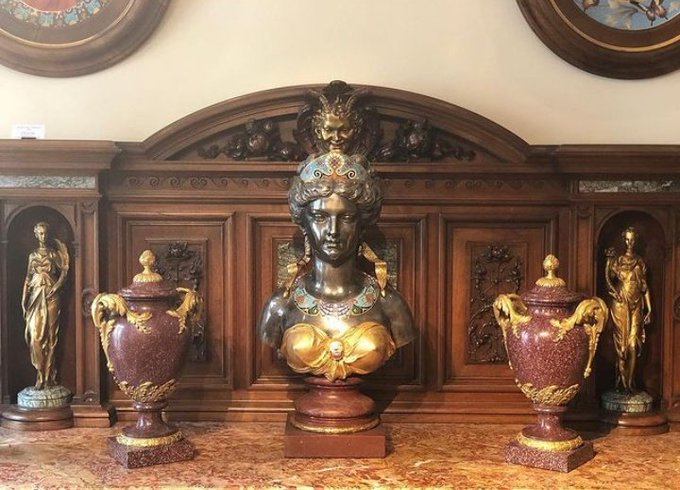
“If the apparition of the night before was an ocular delusion of my fancy sporting with the dark outlines of our cupboard, and if tis horrid eyes were nothing but a pair of inverted teacups, I had, at all events, the satisfaction of having launched the poker with admirable effect, and in true ‘fancy’ phrase, ‘knocked its two daylights into one,’ as the commingled fragments of my tea-service testified. I did my best to gather comfort and courage from these evidences; but it would not do. And then what could I say of those horrid bare feet, and the regular tramp, tramp, tramp, which measured the distance of the entire staircase through the solitude of my haunted dwelling, and at an hour when no good influence was stirring? Confound it!—the whole affair was abominable. I was out of spirits, and dreaded the approach of night. It came, ushered ominously in with a thunderstorm and dull torrents of depressing rain. Earlier than usual the streets grew silent; and by twelve o’clock nothing but the comfortless patterning of the rain was to be heard. I made myself as snug as I could. I lighted two candles instead of one. I forswore bed, and held myself in readiness for a sally, candle in hand; for, coute qui coute, I was resolved to see the being, if visible at all, who troubled the nightly stillness of my mansion. I was fidgety and nervous and, tried in vain to interest myself with my books. I walked up and down my room, whistling in turn martial and hilarious music, and listening ever and anon for the dreaded noise.” #RandolphHarris 20 of 21

Do not Grieve. Anything you lose comes around in another form. The child weaned from mother’s milk now drinks cranberry juice. God’s joy moves from unmarked box to unmarked box, from cell to cell. As rainwater, down into flowerbed. As roses, up from ground. Now it looks like a plate of rice and fish, now a cliff covered with vines, now a horse being saddled. It hides within these, till one day it cracks them open. There is the light gold of wheat in the sun, and the gold of bread made from wheat. I have neither, I am only talking about them as a town in the desert looks up to stars on a clear night. The Son of God, looking upon the World, beheld suffering and misery. With pity He saw how humans had become victims of satanic cruelty. He looked with compassion upon those who were being corrupted, murdered, and lost. They had chosen a ruler who chained them to his carriage as captives. God’s glory pervades the Universe; His ministering Angels inquire of one another: Where is the place of His glory? In response they give praise: Praised be the glory of the Lord from His Heavenly abode. From His Heavenly abode may He turn in mercy and bestow grace unto the people who, reciting the Shema evening and morning, twice daily, proclaim in love the unity of His name, saying: Hear, O America: the Lord our God, the Lord is One. He is our God; He is our Father, our sovereign and our Deliverer. In His mercy He will make known in presence of all the living that He will be your God. “I am the Lord your God.” As it is written in holy Scripture: The Lord shall reign forever; Thy God, O America, shall be Sovereign unto all generations. Hallelujah. #RandolphHarris 21 of 21

Winchester Mystery House

Ghostly tales are bountiful at Sarah Winchester’s Mystery House. What have you experienced? Photos are encouraged!

The Winchester mansion is 160-room mansion built to appease the spirits who died at the hands of the Winchester Rifle 👻
🗝 winchestermysteryhouse.com
“Whoever shadows my every move will not lose me in the dark.” At least that is what Christ says, or what the Evangelist John heard Him say (8.12). He tells us to walk on, through the darkness, with Christ as our only torch. That way, when we mayn’t have gained a step, but we won’t have lost one either. And on into the day we must pursue with dogged tread the life of Jesus Christ. Is this the secret to Mrs. Winchester’s 7-11 staircase?

This is the Beginning, When People Will Be Opening their Eyes!

Nothing is quite as funny as the unintended humour of reality. The original position is designed to be a fair and impartial point of view that is to be adopted in our reasoning about fundamental principles of justice. In taking up this point of view, we are imagining ourselves in the position of free and equal persons who jointly agree upon and commit themselves to the principles of social and political justice. The main distinguishing feature of the original position is “the veil of ignorance”: to insure impartiality of judgment, the parties are deprived of all knowledge of their personal characteristics and social and historical circumstances. The two principles of justice guarantee the equal basic rights and liberties needed to secure the fundamental interests of free and equal citizens and to pursue a wide range of conceptions of good. The second principle provides fair equality of education and employment opportunities enabling all to fairly compete for powers and positions of office; and it secures for all a guaranteed minimum of the all-purpose means (including income and wealth) that individuals need to pursue their interests and to maintain their self-respect as free and equal persons. Persons in the original position give pride of place to their interest in the equal freedoms. The intuitive idea behind the precedence of liberty is that if the persons in the original position assume that their basic liberties can be effectively exercised, they will not exchange a lesser liberty for an improvement in the economic well-being, at least not once a certain level of wealth has been attained. #RandolphHarris 1 of 21

It is only when social conditions do not allow the effective establishment of these rights that one can acknowledge their restriction. Only if it is necessary to enhance the quality of civilization so that in due course the equal freedoms can be enjoyed by all can the denial of equal liberty can be accepted. The lexical ordering of the two principles is the long-run tendency of the general conception of justice consistently pursued under reasonably favourable conditions. Eventually there comes a time in the history of a well-ordered society beyond which the special form of the two principles takes over and holds from then on. What must be shown then is the rationality of this ranking from the standpoint of the parties in the original position. Clearly the conception of goodness as rationality and the principles of moral psychology have a part in answering this question. Now the basis for the priority of liberty is roughly as follows: as the conditions of civilization improve, the marginal significance for our god of further economic and social advantages diminishes relative to their interests of liberty, which become stronger as the conditions for the exercise of the equal freedoms are more fully realized. Beyond some point it becomes and then remains irrational from the standpoint of the original position to acknowledge a lesser liberty for the sake of greater material means and amenities of office. This is so because as the general level of well-being raises (as indicated by the index of primary goods the less favoured can expect) only the less urgent wants remain to be met by further advances, at least insofar as human’s wants are not largely created by institutions and social forms. #RandolphHarris 2 of 21

At the same time the obstacles to the exercise of the equal liberties decline and a growing insistence upon the right to pursue our spiritual and cultural interests assert itself. Increasingly it becomes more important to secure the free internal life of the various communities of interests in which persons and groups seek to achieve, in modes of social union consistent with equal liberty, the ends and excellences to which they are drawn. In addition humans come to aspire to some control over the laws and rules that regulate their association, either by directly taking part themselves in its affairs or indirectly through representatives with whom they are affiliated by ties of culture and social situation. To be sure, it is not the case that when the priority of liberty holds, all material wants are satisfied. Rather these desires are not so compelling as to make it rational for the persons in the original position to agree to satisfy them by accepting a less than equal freedom. The account of the good enables the parties to work out a hierarchy among their several interests and to note which kinds of ends should be regulative in their rational plans of life. Until the basic wants of individuals can be fulfilled, the relative urgency of their interest in liberty cannot be firmly decided in advance. It will depend on the claims of the least favoured as seen from the constitutional and legislative stages. However, under favourable circumstances the fundamental interest in determining our plan of life eventually assumes a prior place. One reason for this I have discussed in connection with liberty of conscience and freedom of thought. #RandolphHarris 3 of 21

And a second reason is the central place of the primary good of self-respect and the desire of human beings to express their nature in a free social union with others. Thus the desire for liberty is the chief regulative interest that the parties must suppose they all will have in common in due course. The veil of ignorance forces them to abstract from the particulars of their plans of life, thereby leading to this conclusion. The serial ordering of the two principles then follows. Now it might seem that even though the desire for an absolute increase in economic advantages declines, human’s concern for their relative place in the distribution of wealth will persist. In fact, if we suppose that everyone wishes a greater proportionate share, the result could be a growing desire for material abundance all the same. Since each strives for an end that cannot be collectively attained, society might conceivably become more and more preoccupied with raising productivity and improving economic efficiency. And these objectives might become so dominant as to undermine the precedence of liberty. Some have objected to the tendency to equality on precisely this ground, that it is thought to arouse in individuals an obsession with their relative share of social wealth. However, while it is true that in a well-ordered society there is most likely a trend to greater equality, its members take little interest in their relative position as such. As we have seen, they are not much affected by envy and jealousy, and for the most part they do what seems best to them as judged by their own plan of life without being dismayed by the greater amenities and enjoyments of others. #RandolphHarris 4 of 21

Thus there are no strong psychological propensities prompting them to curtail their liberty for the sake of greater absolute or relative economic welfare. The desire for a higher relative place in the distribution of material means should be sufficiently weak that the priority of liberty is not affected. Of course, it does not follow that in a just society everyone is unconcerned with matters of status. The account of self-respect as perhaps the main primary good has stressed the great significance of how we think others value us. However, in a well-ordered society the need for status is met by the public recognition of just institutions, together with the full and diverse internal life of the many free communities of interest that equal liberty allows. The basis for self-esteem in a just society is not then one’s income share but the publicly affirmed distribution of fundamental rights and liberties. And this distribution being equal, everyone has a similar and secure status when they meet to conduct the common affairs of the wider society. No one is inclined to look beyond the constitutional affirmation of equality for further political ways of securing one’s status. No one is inclined to look beyond the constitutional affirmation of equality for further political position from a strategic point of view. It would also have the effect of publicly establishing their inferiority as defined by the basic structure of society. This subordinate ranking in the public forum experienced in the attempt to take part in political and economic life, and felt in dealing with those who have a greater liberty, would indeed be humiliating and destructive of self-esteem. #RandolphHarris 5 of 21

And so by acquiescing in a less than equal liberty one might lose on both counts. This is particularly likely to be true as society becomes more just, since equal rights and public attitudes of mutual respect have an essential place in maintaining a political balance and in assuring citizens of their own worth. Thus while the social and economic differences between the various sectors of society, the noncomparing groups as we may think of them, are not likely to generate animosity, the hardships arising from political and civic inequality, and from culture and ethnic discrimination, cannot be easily accepted. When it is the position of equal citizenship that answers to the need for status, the precedence of equal liberties becomes all the more necessary. Having chosen a conception of justice that seeks to eliminate the significance of relative economic and social advantages as supports for human’s self-confidence, it is essential that the priority of liberty be firmly maintained. So for this reason too the parties are led to adopt a serial ordering of the two principles. In a well-ordered society then self-respect is secured by the public affirmation of the status of equal citizenship for all; the distribution of material means is left to take care of itself in accordance with the idea of pure procedural justice. Of course doing this assumes the requisite background institutions which narrow the range of inequalities so that excusable envy does not arise. Now this way of dealing with the problem of status has several noteworthy features which may be brought out as follows. #RandolphHarris 6 of 21

Suppose to the contrary that how one is valued by others depends upon one’s relative place in the distribution of income and wealth. In this case, having a higher status implies having more material means than a larger fraction of society. Thus not everyone can have the highest status, and to improve one person’s position is to lower that of someone else. Social cooperation to increase the conditions of self-respect is impossible. The means of status, so to speak, are fixed, and each human’s gain is another’s loss. Clearly this situation is a great misfortune. Persons are set at odds with one another in the pursuit of their self-esteem. Given the preeminence of this primary good, the parties in the original position surely do no want to find themselves so opposed. If not impossible, it would tend, for one thing, to make the good of social union difficult to achieve. Moreover, if the means of providing a good are indeed fixed and cannot be enlarged by cooperation, as mentioned in the discussion of envy, then justice seems to require equal shares, ceteris paribus. However, an equal division of all primary gods in irrational in view of the possibility of bettering everyone’s circumstances by accepting certain inequalities. Thus the best solution is to support the primary good of self-respect as far as possible by the assignment of the basic liberties that can indeed be made equal, defining the same status for all. At the same time, distributive justice as frequently understood, justice in the relative shares of material means, is relegated to a subordinate place. #RandolphHarris 7 of 21

Thus we arrive at another reason for factoring the social order into two parts as indicated by the principles of justice. While these principles permit inequalities in return for contributions that are for the benefit of all, the precedence of liberty entails equality in the social bases of esteem. Now it is quite possible that this idea cannot be carried through completely. To some extent human’s sense of their own worth may hinge upon their institutional position and their income share. If, however, the account of social envy and jealousy is sound, then, with the appropriate background arrangements, these inclinations should not be excessive, at least not when the priority of liberty is effectively upheld. However, if necessary, theoretically we can include self-respect in the primary goods, the index of which defines expectations. Then in applications of the difference principle this index can allows for the effects of excusable envy; the expectations of the less advantaged are lower the more severe these effects. Whether some adjustment for self-respect has to be made is best decided from the standpoint of the legislative stage where the parties have more information about social circumstances and the principle of political determination applies. Admittedly this problem is an unwelcome complication. Since simplicity it itself desirable in a public conception of justice, the conditions that elicit excusable envy should if possible be avoided. Expectations of the less advantaged can be understood so as to include the primary good of self-esteem. #RandolphHarris 8 of 21

Now some may want to object to this account of the priority of liberty that societies have other ways of affirming self-respect and of coping with envy and other disruptive inclinations. Thus in a feudal or in a caste system each person is believed to have one’s allotted station in the natural order of things. One’s comparisons are presumably confined to within one’s own estate or caste, these ranks becoming in effect so many noncomparing groups established independently of human control and sanctioned by religion and theology. Humans resign themselves to their position should it ever occur to them to question it; and since all may view themselves as assigned their vocation, everyone is held to be equally fated and equally noble in the eyes of providence. This conception of society solves the problem of social justice by eliminating in thought the circumstances that give rise to it. The basic structure is aid to be already determined, and not something for human beings to affect. On this view, it misconceives human’s place in the World to suppose that the social order should match principles which they would as equals consent to. Now to this idea, parties re to be guided in their choice of a conception of justice by a knowledge of the general facts about society. They take for granted than that institutions are not fixed but change overtime, altered by natural circumstances and the activities and conflicts of social groups. The constraints of nature are recognized, but humans are not powerless to shape their social arrangements. #RandolphHarris 9 of 21

This assumption is likewise part of the background of the theory of justice. It follows that certain ways of dealing with envy and other aberrant propensities are closed to a well-ordered society. For example, it cannot keep them in check by promulgating false or unfounded beliefs. For our problem is how society should be arranged if it is to conform to principles that rational persons with true general beliefs would acknowledge in the original position. The publicity condition of requires the parties to assume that as members of society they will also know the general facts. The reasoning leading up to the initial agreement is to be accessible to public understanding. Of course, in working out what the requisite principles are, we must rely upon current knowledge as recognized by common sense and the existing scientific consensus. However, there is no reasonable alternative to doing this. We have to concede that as established beliefs change, it is possible that the principles of justice which it seems rational to choose may likewise change. Thus when the belief in a fixed natural order sanctioning a hierarchical society is abandoned, assuming here that this belief is not true, a tendency is set up that points in the direction of two principles of justice inertial order. The effective protection of the equal liberties becomes increasingly of first importance. When God wants to punish people, he gives the unjust leaders. So the answer is for the people to repent, turn from their ways, be converted, and seek God. #RandolphHarris 10 of 21

Some people only care about power and what they can do with power. May the Lord come down to protect our people. Democracy is not prescribed in the Bible, and Christians can and do live under other political systems. However, Christians can hardly fail to love democracy, because of all systems it best assures human dignity, the essence of our creation in God’s image. If a candidate wins by cheating, he or she can only be forgiven by God if one renounced the office one has obtained by fraud. There will be no divine forgiveness for this act of injustice without a previous decision to repay the damage done. However, apparently God’s forgiveness is unimportant to some ruling. When politicians rig the vote, it means all the passion for democracy and all the prayers of the people are meaningless. A government that assumes or maintains power through fraudulent means has no moral basis. If it does not of itself freely correct the evil it has inflicted on the people, then it is our serious moral obligation as a people to make it do so. Nonetheless, there is enormous sin attached to fratricidal strife. As moral outrage grows, it is important to study the Bible. God has ordained government to preserve order, but even a bad government is better than no government—which results in chaos. Government’s authority comes from God; it is a delegation. Therefore, governments—all governments—whether they acknowledge it or not, rule under God. However, does God give an unrestricted delegation? Certainly not. #RandolphHarris 11 of 21

As Jesus Christ made clear with the coin, there are two realms—and Caesar is not to usurp what belongs to God. Any government that violates the law that is higher than its own is exceeding the legitimate authority God has granted. Government must always be respected, otherwise anarchy results; but the nation may attempt to venerate a culture or race. “When the state is made to serve the aspirations of race or nation instead of the cause of justice for all, it becomes a demonic state warranting resistance and rejection by the Christian faith,” reports Donald Bloesch, Crumbling Foundations (Grand Paris, Mich.: Zondervan, 1984), 183. As Dietrich Bonhoeffer put it, “If government persistently and arbitrarily violates its assigned task, then the divine mandate lapses.” In that case the state becomes evil incarnate, as in Nazi Germany. Instead of acting as God’s instrument for preserving life and order, it does the reverse, destroying life and order. Then the church must resist. Though as argued earlier, the church’s primary function is evangelization and ministering to spiritual needs; as the principle visible manifestation of the Kingdom of God, it must be the conscience of society, the instrument of moral accountability. Richard Neuhaus eloquently wrote that “the church can and should subject to moral questioning every political agenda or cause, thus keeping the entirety of human politics under the transcendent judgement of God.” #RandolphHarris 12 of 21

The church’s first duty then would be to publicly expose the state’s immorality. The government should not be involved in corruption, oppression, the deprivation of civil liberties, nor the taking of innocent lives. As a second step the church should refuse to have any part in the state’s immorality. The church must take the next more severe measures of resistance lest its words be rendered hollow. The great evangelist Charles Finney refused communion to slave-holders. Others organized the underground railroad and rescued fugitive slaves from prison. Many ministers broke the law, were arrested, and some imprisoned. However, that state’s evil, even as egregious as slavery, does not give an unrestricted license to disobey any law; only the unjust law can properly be contested. While active resistance may succeed, as it did with slavery and the Civil-Rights Movement, it may not, however, be enough in the face of the raw power modern totalitarian states have achieved. So, when all peaceable means fail, what does the Christian do? Is revolution ever justified? Scottish reformation theologians like John Knox and Samuel Rutherford believed they could be, advocating the right of Christians to rise up against ungodly rulers. Many ministers in the colonies agreed as well; when they preached that the people had the authority to resist the king when the king violated God’s commands, they were setting the stage for the American Revolution. After dumping tea in Boston Harbour the next step of resistance was the musket. #RandolphHarris 13 of 21

A Boston preacher said that for a people to “arise unanimously and resist their prince, even to dethrone him, is not criminal but a reasonable way of vindicating their liberties and just rights.” John Adams observed, “The revolution was in the minds and hearts of the people, a change in their religious sentiments of their duties and obligations.” Some Christian activists today loosely call for a new American Revolution just as the young radical youth movements did in the sixties. However, history reveals, revolution most often results, after the bodies are buried, in one form of tyranny replacing another. G.K. Chesterton summed it up well: “The real case against revolution is this: That there always seems to be much more to be said against the old regime than in favour of the new regime.” So for the Christian, revolution is never to be lightly regarded. It is the most extreme form of disobedience. It could only be contemplated on the same justification as a just war; that is, that there must be a better alterative as a result of the revolution. Its advantages must outweigh the suffering, and the evil employed in the revolution must prevent a far greater evil than the status quo. This was the reasoning that caused Albert Einstein to abandon his pacifism in the face of a dictator’s rise to power. “To prevent the greater evil, it is necessary that the lesser—the hated military—be accepted for the time being,” Einstein contended. It was this reasoning the caused Bonhoeffer to patriciate in the plot to assassinate this dictator. #RandolphHarris 14 of 21

For Christians to justify participation in revolution, therefore, they would have to be convinced that the state had become totally opposed to the purposes of God for the state and there was no other recourse to prevent massive evil. The Exodus from Egypt is often cited as a model for political action by liberation theologians, but they ignore the fact that in the Exodus, God did not overthrow the political system in Egypt. He extracted His own people from that system, taking them to Mount Sinai that they might worship Him. In the light of this, then, what about America? What lessons are to be drawn from it? We must be aware to prevent a regime’s refusal to allow free elections, the suspensions of civil liberties, the massive corruption of the governmental process, the trampling of human rights, and a leader’s own blasphemous, at times messianic pretensions, which give the church a mandate to act. The church should be mobilized to say no to evil. The first stage of an individua approach should be entirely biblical. By preaching repentance and conversion, one can encourage outbreaks of spiritual revival all across America. One should call for people to pray for their country. A courageous cardinal and ordinary citizens can open a crack of light in the dark canopy that envelops so much of planet Earth. Through peaceful actions and resistance to evil, the Kingdom of God will be made visible again. The Late Francis Schaeffer once wrote, “If here is no place for civil disobedience, then the government has been made autonomous, and as such, it has been put in the place of the living God.” #RandolphHarris 15 of 21

The belief that government is autonomous, the ultimate repository of power, the solution to all of society’s ills, is the greatest imposter of the twenty-first century. Christians and the church have no higher calling than to expose it by every legitimate means. To some people the great trouble about any argument for the Supernatural is simply the fact that argument should be needed at all. If so stupendous a thing exists, ought it not be obvious as the sun in the sky? It is not intolerable, and indeed incredible, that knowledge of the most basic of all Facts should be accessible only by wire-drawn reasonings for which the vast majority of humans have neither leisure nor capacity? I have great sympathy with this point of view. However, we must notice two things. When you are looking at a garden from a room upstairs it is obvious (once you think about it) that you are looking through a window. However, if it is the garden that interests you, you may look at it for a long time without thinking of the window. When you are reading a book, it is obvious (once you attend to it) that you are using your eyes: but unless your eyes begin to hurt you, or the book is a text book on optics, you may read all evening without once thinking of eyes. When we talk we are obviously using langue and grammar: and when we try to talk a foreign language we may be painfully aware of the fact. However, we are talking English, we do not notice it. When you shout from the top of the stirs, “I am in half a moment,” you are usually conscious that you have made the singular am agree with the singular I. #RandolphHarris 16 of 21

There is indeed a story told about a Native American who, having learned several other languages, was asked to write a grammar of the language used by his own tribe. He replied, after some thought, that it had no grammar. The grammar he had sued all his life had escaped his notice all his life. He knew it (in once sense) so well that (in another sense) he did not know it existed. All these instances show that the fact, and through which alone you have access to all the other facts, may be precisely the one that is most easily forgotten—forgotten not because it is so remote or abstruse but because it is so near and so obvious. And that is exactly how the Supernatural has been forgotten. The Naturalists have been engaged in thinking about Nature. They have not attended to the fact that they were thinking. The moment one attends to this it is obvious that one’s own thinking cannot be merely a natural event, and that therefore something other than Nature exists. The Supernatural is not remote and abstruse: it is a matter f daily and hourly experience, as intimate as breathing. Denial of it depends on a certain absent-mindedness. However, this absent-mindedness is in on way surprising. You do not need—indeed you do not wish—to be always thinking about windows when you are looking at gardens or always thinking about eyes when you are reading. #RandolphHarris 17 of 21

In the same way the proper procedure for all limited and particular inquiries is to ignore the fact of your own thinking, and concentrate on the object. It is only when you stand back from particular inquiries and try to form a complete philosophy that you must take it into account. For a complete philosophy must get in all the facts. In it you turn away from specialized or truncated thought to total thought: and one of the facts total thought must think about is Thinking itself. There is thus a tendency in the study of Nature to make us forget the most obvious first of all. And since the Sixteenth Century, when Science was born, the minds of humans have been increasingly turned outward, to know Nature and to master her. They have been increasingly engaged on those specialized inquiries for which truncated thought is the correct method. It is therefore not in the least astonishing that they should have forgotten the evidence for the Supernatural. The deeply ingrained habit of truncated thought—what we call the “scientific” habit of mind—was indeed certain to lead to Naturalism, unless this tendency were continually corrected from some other source. However, no other source was at hand, for during the same period humans of science were coming to be metaphysically and theologically uneducated. That brings me to the second consideration. The state of affairs in which ordinary people can discover the Supernatural only by abstruse reasoning is recent and, by historical standards, abnormal. #RandolphHarris 18 of 21

All over the World, until quite modern times, the direct insight of the mystics and the reasonings of the philosopher percolated to the mass of the people by authority and tradition; they could be received by those who were no great reasoners themselves in the concrete form of myth and ritual and the whole pattern of life. In the conditions produced by a century or so of Naturalism, plain humans are being forced to bear burdens which plain humans were never expected to bear before. We must get the truth for ourselves or go without it. There may be two explanations for this. It might be that humanity, in rebelling against tradition and authority, has made a ghastly mistake; a mistake which will not be less fatal because the corruptions of those in authority rendered it very excusable. On the other hand, it may be that the Power which rules our species is at this moment carrying out a daring experiment. Could it be intended that the whole mass of the people should now move forward and occupy for themselves those heights which were once reserved only for the sages? Is the distinction between wise and simple to disappear because all are now expected to become wise? If so, our present blunderings would be but growing pains. However, let us make no mistake about our necessities. If we are content to go back and become humble plain humans obeying a tradition, well. If we are ready to climb and struggle on till we become sages ourselves, better still. However, the human who will neither obey wisdom in others nor adventure for her oneself is fatal. #RandolphHarris 19 of 21

A society where the simple many obey the few seers can live: a society where all were seers could live even more fully. However, a society where the mass is still simple and the seers are no longer attended to can achieve only superficiality, baseness, ugliness, and in the end extinction. On or back we must go; to stay here is death. One other point that may have raised doubt or difficulty is the advanced reasons for believing that a supernatural element in present in every rational human. The presence of human rationality in the World is therefore a Miracle. Human Reason an Morality have been mentioned not as instances of Miracle (at least, not of the kind of Miracle you wanted to hear about) but as prods of the Supernatural: not in order to show that Nature ever is invaded but that there is a possible invader. Whether you choose to call the regular and familiar invasion by human Reason a Miracle or not is largely a matter of words. Its regularity—the fact that it regularly enters by the same door, human pleasures of the flesh—may incline you not to do so. It looks as if it were (so to speak) the very nature of Nature to suffer this invasion. However, then we might later find that it was the very nature of Nature to suffer Miracles in general. Fortunately the course of our argument will allow us to leave this question of terminology on one side. We are going to be concerned with other invasions of Nature—with what everyone would call Miracles. #RandolphHarris 20 of 21

Our question could, if you liked, be put in the form, “Does Supernature every produce particular results in space and time except through the instrumentality of human brains acting on human nerves and muscles?” I have said “particular results” because, on our view, Nature as a whole is herself one huge result of the Supernatural: God created her. God pierces her wherever there is a human mind. God presumably maintains her in existence. The question is whether He ever does anything else to her. Does God, beside all this, ever introduce into her events of which it would not be true to say, “This is simply the working out of the general character which God gave to Nature as a whole in creating her”? Such events are what are popularly called Miracles: and it will be in this sense only that the word Miracle will be used from now on. Do not stand at my grace and weep, I am not there. I do not sleep. I am a though rays of light that glow. I am the diamond glint on snow. I am the moonlight on the shinning sea. I am the gentle autumn rain. When you wake in the morning hush, I am the swift, uplifting rush or quiet birds in circling flight. I am the soft starlight at night. Do not stand at my grace and weep. I am not there. I do not sleep. Our God and God of our fathers, we thank Thee for Thy Torah, our priceless heritage. May the portion we have ready today inspire us to do Thy will and to seek further knowledge of Thy word. Thus our minds will be enriched and our lives endowed with purpose. May we take to heart Thy laws by which humans truly live. Happy are all who love Thee and delight in Thy commandments. Amen. #RandolphHarris 21 of 21

Cresleigh Homes

There’s something irresistible about eating at the island; it’s casual, yet festive. Guests can be part of the food prep, and everyone gets to make merry together all evening long.

Meadows Res 1 shows just how well single story living suits the family who loves to entertain!

Residence One at Cresleigh Meadows holds 2,054 square feet of single story living. The open concept design includes three bedrooms, two bathrooms and a two car garage plus workshop. Through the charming front porch enter into the foyer, where two secondary bedrooms lead off to a Jack and Jill bathroom. The kitchen comes fully equipped with a large eat-in island, stainless steel appliances, and quartz counters. The great room is spacious and full of natural light. The Owner’s suite is nestled in the rear of the home separate from the secondary bedrooms, providing maximum privacy. Enjoy a spa like experience in the Owner’s bathroom with a large walk in shower and large soaking tub.

Best of all, each Cresleigh home comes fully equipped with an All Ready connected home! This smart home package comes included with your home and features great tools including: video door bell and digital deadbolt for the front door, connect home hub so you can set scenes and routines to make life just a little easier. Two smart switches and USB outlets are also included, plus we’ll gift you a Google Home Hub and Google Mini to help connect everything together!

There is nothing more important than a good, safe, secure home. Come and see why Cresleigh is America’s Favourite.
#CresleighHomes
#PlumasRanch

Wise Humans, Good Humans, Patriotic Humans are to be Found in All Communities!

If Americans could be made to believe that their sufferings were for some remote, high sacrificial end, perhaps it would be possible for them to become reconciled to their plight; but sharing the culture that condemns them, and seeing that lust for trash is what blinds the nation to their claims, is what sets storms rolling in the soul of America. The United State of America is so unique from other nations because it is a nation of laws, not a nation of humans. A nation of laws means that legal decrees, not people rule. Whether it be the most common American members or members of Congress, high-ranking bureaucrats or the president of the United States of America, everyone is governed by the same laws, regardless of their station. All must be held to the just laws of America. America’s founds extolled a nation of laws, for they knew that only a fairly enforced legal system could protect liberty and property against corruption and tyranny. God is in fact the author of liberty and to retain it, the inhabitant of the land must be protected by His might hand. There is no other power that can protect that liberty. In order for us to enjoy this protection of His might, we must accept God as our God and keep His commandments. “Behold, this America is a choice land, and whatsoever nation shall possess it shall be free from bondage, and from captivity, and from all other nations under Heaven, if they will but serve the God of the land, who is Jesus Christ,” reports Ether 2.12. The God of this land is also the King of the land. And this is true. #RandolphHarris 1 of 25

Manifest Destiny is a phenomenon. Jesus spoke here in America, and He proclaimed, “This lad shall be a land of liberty, and there shall be no kings upon it. For I, the Lord, the king of Heaven, will be their king, and I will be light unto them forever, that hear my words. For it is a choice land, saith God, wherefore I will have all humans that dwell thereon that they shall worship me,” reports 2 Nephi 10.11-19. The alternative to enjoying this liberty and happiness through acceptance of and obedience to Jesus Christ is made clear by Manifest Destiny. Manifest Destiny is a tangible blessing from God that has created American history. It is a systematic body of concepts and beliefs that powers American life and culture. The right of our manifest destiny to over spread and to possess the whole of the continent which Providence has given us for the development and great creation of liberty and federative development of self government entrusted to us is a promise that we shall flourish. “Whoso should possess this land of promise, from that time henceforth and forever, should serve him, the true and only God, or they should be swept off when hey are ripened in iniquity,” reports Ether 2.8-9. It is as a right that we serve God and obey the laws as that of the tree to the space of air and the Earth be suitable for the full expression of its principle and destiny of growth. When people follow the guidance of God of the land, they reach great heights. The Lord in the very beginning revealed to Adam a perfect form of government for the benefit of humans. We believe that governments are instituted of God. #RandolphHarris 2 of 25

Individual freedom is necessary. No law shall be passed that takes away from a human the right of free choice. Free agency is fundamental as law of human conduct. Humans have a right to obey or disobey that laws as they please, and take the consequences. That government is best which has as its aim the administration of justice, social well-being and the promotion of prosperity among its members. We must recognize that property rights are essential to human liberty. The individual has three great rights, equally sacred from arbitrary interference: the right to one’s life, the right to one’s liberty, and the right to one’s property. The three rights are so bound together as to be essentially one right. To give a human one’s life, but to deny one one’s liberty, is to take from one all that makes life worth living. To give one liberty, but take from one the property which is the fruit and badge of one’s liberty, is to still leave one a slave. Laws are enacted for the protection of society, and have no value except when they are administered in righteousness and justice. If dishonest humans occupy administrative offices, laws cannot be so administered in righteousness and justice. The Lord says, “When the wicked rule, the people mourn.” Wise humans, good humans, patriotic humans are to be found in all communities, in all political parties, among all creeds. None but such humans should be chosen. Without beneficent laws, righteously administered, the foundations of civilization crumble, anarchy reigns, decay and dissolution follow. #RandolphHarris 3 of 25

We call upon all members of the Church of Jesus Christ of Latter-day Saints throughout the World to honour the laws of God, and obey and uphold the law of the land; and we appeal to good humans everywhere, regardless of creed, party affiliation, race, culture, or condition to join with us in an effort to put into operation the words of President Lincoln, the great emancipator, that our country may continue to be a light to the World, a loyal, law-abiding, God-fearing nation. We claim the privilege of worshiping Almighty God according to the dictates of our own conscience; and allow all humans the same privilege, let them worship how, where, or what they may. However, we claim absolutely no right, no prerogative whatever, to interfere with any other people. A good government must secure for every citizen the free exercise of conscience. Matters of belief or religious practice should not be interfered with, unless they oppose laws formulated for the common good. There should be no mingling of religious influence with the civil governments. We believe in being subject to kings, presidents, rulers, and magistrates, in obeying, honouring, and sustaining the laws. The main psychological root of the liability to envy is a lack of self-confidence in our own worth combined with a sense of impotence. Our way of life is without zest and we feel powerless to alter it or to acquire the means of doing what we still want to do. This creation the notion of resentment. By contrast, someone sure of the worth of one’s plan of life and one’s ability to carry it out is not given to rancor nor is one jealous of one’s good fortune. #RandolphHarris 4 of 25

Even if one could, one has no desire to level down the advantages of others at some expense to oneself. This hypothesis implies that the least favoured tend to be more envious of the better situation of the more favoured the less secure their self-respect and the greater their feeling that they cannot improve their prospects. Similarly the particular envy aroused by competition and rivalry is like to be stronger the worse one’s defeat, for the blow to one’s self-confidence is more severe and the loss may seem irretrievable. It is general envy, however, that mainly concerns us here. There are three conditions that encourage hostile outbreaks of envy. The first of these is the psychological condition we have just noted: persons lack a sure confidence in their own value and in their ability to do anything worthwhile. Second (and one of two social conditions), many occasions arise when this psychological condition is experienced as painful and humiliating. The discrepancy between oneself and others is made visible by the social structure and style of one’s society. The less fortunate are therefore often forcibly reminded of their situation, sometimes leading them to an even lower estimation of themselves and their mode of living. And third, they see their social position as allowing no constructive alternative to opposing the favoured circumstances of the more advantaged. #RandolphHarris 5 of 25

To alleviate their feelings of anguish and inferiority, they have no choice but to impose a loss on those better placed even at some cost to themselves, unless of course they are to relapse into resignation and apathy. Now, if not to present these conditions, many aspects of a well-ordered society of to mitigate. It is clear that, although it is a psychological state, social institutions are a basic instigating cause. However, the contract conception of justice supports the self-esteem of the citizens generally more firmly than other political principles. In the public forum each person is treated with the respect due to a sovereign equal; and everyone has the same basic rights that would be acknowledged in an initial situation regarded as fair. The members of the community have a common sense of justice and they are bound by ties of civic friendship. Obedience implies a higher attitude than mere submission, for obedience has its root in good intent; submission may spring from selfishness or meanness of spirit. Though obedience and submission both imply restraint on one’s own will, we are obedient only from a sense of right; submissive from a sense of necessity. Honour expressed an act or attitude of an inferior towards a superior. When applied to things it is taken in the sense of holding honour. Thus, in honouring the law, we look upon it as something which is above selfish desires or indulgences. To sustain signifies to hold up; to keep from falling. To sustain the law, therefore, is to refrain from saying or doing anything which will weaken it or make it ineffective. #RandolphHarris 6 of 25

We obey the law from a sense of right. We honour the law because of its necessity and strength to society. We sustain law by keeping it in good repute. This is in our connection with stability. The greater advantages of some are in return for compensating benefits for the less favoured; and no one supposes that those who have a larger share are ore deserving from a moral point of view. Happiness according to virtue is rejected as a principle of perfection: regardless of the excellences that persons or associations display, their claims to social resources are always adjudicated by principles of mutual justice. For all these reasons the less fortune have no cause to consider themselves inferior and the public principles generally accepted underwrite their self-assurance. The disparities between themselves and others, whether absolute or relative, should be easier for them to accept than in other forms of polity. Turning to the second condition, both the absolute and the relative differences allowed in a well-ordered society are probably less than those that have often prevailed. Although in theory the difference principle permits indefinitely large inequalities in return for small gains to the less favoured, the spread of income and wealth should not be excessive in practice, given the requisite background institutions. Moreover the plurality of associations in a well-ordered society, each with its secure internal life, tends to reduce the visibility, or at least the painful visibility, of variations in human’s purposes. For we tend to compare our circumstances with others in the same or in a similar group as ourselves, or in positions that we regard as relevant to our aspirations. #RandolphHarris 7 of 25

The various associations in society tend to divide it into so many noncomparing groups, the discrepancies between these divisions not attracting the kind of attention which unsettles the lives of those less well placed. And this ignoring of differences in wealth and circumstances is made easier by the fact that when citizens do meet one another, as they must in public affairs at least, the principles of equal justice are acknowledged. Moreover in everyday life the natural duties are honoured so that the more advantaged do not make an ostentatious display of their higher estate calculated to demean the condition of those who have less. After all, if the disposing conditions for envy are removed, so probably are those for jealousy, grudgingness, and spite, the converses of envy. When the less fortunate segments of society lack the one the more fortunate will lack the other. Taken together these features of a well-ordered regime diminish the number of occasions when the less favoured are likely to experience their situation as impoverished and humiliating. Even if they have some liability to envy, it may never be strongly envoked. Finally, considering the last condition, it would seem that a well-ordered society as much as any other offers constructive alternatives to hostile outbreaks of envy. The problem of general envy anyway does not force us to reconsider the choice of the principles of justice. As for particular envy, to a certain extent it is endemic to human life; being associated with rivalry, it may exist in any society. #RandolphHarris 8 of 25

The more specific problem for political justice is how pervasive are the rancor and jealousy aroused by the quest for office and position, and whether it is likely to distort the justice of institutions. It is difficult to settle this latter in the absence of the more detailed knowledge of social forms available at the legislative stage. However, there sees to be no reason why the hazards of particular envy should be worse in a society regulated by justice as fairness than by any other conception. The principles of justice again seems relatively stable. A question has been asked man times. In the case of a conflict between requirements made by the law revealed by the word of God, and those imposed by the secular law, which of these authorities would members of the Church be bound to obey? The word of God is to come first. So essentially, God should be in and influence the government because the number one rule of God is to be honest and if one cannot honestly enforce the law, they have no right in government. In all civilized nations the people are accorded the right to pray, and this right is assured by what maybe properly called a common law of humankind. No earnest soul is cut off from communion with one’s God; and with such an open channel of communication, relief from burdensome laws and redress from grievances may be sought from the power that holds control of nations. “Bad laws, if they exist, should be repleaded as soon as possible; still, while they continue in force, they should be religiously observed,” reports President Abraham Lincoln. This is the view of the Church. #RandolphHarris 9 of 25

While there are many forms of equality, and egalitarianism admits of degrees, there are conceptions of justice that are recognizably equalitarian, even though certain significant disparities are permitted. The two principles of justice fall under this heading. The different conception of equality which they define is acknowledged on the supposition that envy does not exist. For behold, you should not fear humans more than God, you should be faithful and God will extend His arm, and He will be with you in every time of trouble. Children of God are chosen to do the work of the Lord. Repent of that which thou hast done, and thou art still chosen, and art again called to the world. Except thou doest this, thou shalt become as other humans, and have no more gift. When thou delivers up that which God has given thee sight and power to translate thou delivers up that which is sacred into the hands of a wicked human who depends upon one’s own judgment, and boasts in one’s own wisdom; and this is the reason that thou will lose thy privileges for a season. Nevertheless, God’s work shall go forth, for, inasmuch as the knowledge of the Saviour has come unto the World, through the testimony of the Jewish people, even so shall the knowledge of a Saviour come unto our people, and to the Americans through the testimony of their fathers. And this testimony shall come to the knowledge of all. For this very purpose are these plates preserved that the promises of the Lord might be fulfilled, which He made to His people. And the Americans might come to the knowledge of their fathers, and they might know the promise of the Lord. And they may believe the gospel and rely upon the merits of Jesus Christ, and be glorified through faith in his name and through their repentance they might be saved. I cancel every demonic assignment against you and your purpose. The plans of the enemy will not prevail. In Jesus’ name, Amen. #RandolphHarris 10 of 25

Joseph Smith was very sorry he had been unfaithful, and he humbled himself before God, determining to try harder to keep all of the Lord’s commandments. Later, within a month, the gift and the plates were returned to Joseph, but he was not allowed to translate the same record again. By revelation Joseph was told that wicked people had the lost manuscript. The Lord, Jesus Christ said; Behold, Satan, has put it into their hearts to alter the words, because they have altered the words, they read contrary from that which you translated and caused to be written. On this wise the Devil has sought to lay a cunning plan, the he may destroy this work. Verily I say unto you, that I will not suffer that Satan shall accomplish his evil design in this thing. Behold, they say and think in their hearts, We will see if God has given him power to translate, if so, he will also give him power again; and if he bringeth forth the same words, behold, we have the same with us, and we have altered them. Therefore, they will not agree, and we will say that he has lied in his words, and that he has no gift, and that he has no power; therefore, we will destroy him, and also the work. Behold, I say unto you, that you shall not translate again those words which have gone forth out of your hands. For, behold, if you should bring forth the same words, they will say that you have contradicted yourself. And, behold, they will publish his, and Satan will harden the hearts of the people to stir them up to anger against you, that they will not believe my words. #RandolphHarris 11 of 25

The Lord told Joseph that the part of the record he had translated which had been lost (about one hundred and sixteen pages) was a shorted story of the Nephite record; and that the golden plates also contained the complete story. Joseph was told he should translate the full record rather than the shortened one he had previously translated: the Lord said: I will not suffer that they shall destroy my work; yea, I will show unto them that y wisdom is greater than the cunning of the Devil. Behold, I am Jesus Christ, the Son of God. I came unto my own, and my own received me not. I am He who said, Other sheep have I which are not of this fold, unto my disciples, and many there were that understood me not. And I will show unto this people, that I had other sheep, and I will also bring to light my gospel, which was ministered unto them. And this I do, that I may establish my gospel, that there may not be so much contention. Yea, Satan doth stir up the hearts of the people to contention, concerning the points of my doctrine; and in these things they do err, for they do wrest the Scriptures, and do not understand them. Therefore, I will unfold unto them this great mystery; for behold, I will gather them as a hen gathereth her chickens under her wings, if they will not harden their hearts. Behold, this is my doctrine: Whosoever repenteth and cometh unto me, the same is my church Whosoever is of my church, and endureth of my church to the end, one will I establish upon my Rock. And now, remember the words of your Redeemer, your Lord, and your God. Amen. #RandolphHarris 12 of 25

The important of separating envy from the moral feelings can be seen from several examples. Suppose first that envy is held to be pervasive in poor less affluent societies. The reason for this, it may be suggested, is the general belief that the aggregate of social wealth is more or less fixed, so that one person’s gain is another’s loss. The social system is interpreted, it might be said, as a naturally established and unchangeable zero-sum game. Now actually, if this belief were widespread and the stock of goods were generally thought to be given, then a strict opposition of interests would be assumed to obtain. In this case, it would be correct to think that justice requires equal shares. Social wealthy is not viewed as the outcome of mutually advantageous cooperation and so there is no fair basis for an unequal division of advantages. What is said to be envy may in fact be resentment which might or might not prove to be justified. Dr. Freud’s speculations about the origin of the sense of justice suffer from the same defect. He remarks that this sentiment is the outgrowth of envy and jealousy. As some members of the social group jealously strive to protect their advantages, the less favoured are moved by envy to take them away Eventually everyone recognizes that they cannot maintain their hostile attitudes toward one another without injury to themselves. Thus as a compromise they settle upon the demand of equal treatment. The sense of justice is a reaction-formation: what was originally jealousy and envy is transformed into a social feeling, the same sense of justice that insists upon equality for all. #RandolphHarris 13 of 25

Dr. Freud believes that this process is exemplified in the nursey and in many other social circumstances. Yet the plausibility of one’s account assumes that the initial attitudes are correctly described. With a few changes, the underlying features of the example he depicts correspond to those of the original position. That persons have opposing interests and seek to advance their own conception of the god is not at all the same thing as their being moved by envy and jealousy. As we have seen, this sort of opposition gives rise to the circumstances of justice. Thus if children compete for the attention and affection of their parents, to which one might say they justly have an equal claim, one cannot assert that their sense of justice springs form jealousy and envy. Certainly children are often envious and jealous; and no doubt their moral notions are so primitive that the necessary distinctions are not grasped by them. However, waiving these difficulties, we could equally well say that their social feelings arise from resentment, from a sense that they are unfairly treated. And similarly one could say to conservative writers that it is mere grudgingness when those better circumstances reject the claims of the less advantaged to greater equality. However, this contention also calls for careful argument. None of these charges and countercharges can be given credence without first examining the conceptions of justice sincerely held by individuals and their understanding of the social situation in order to see how far these claims are indeed founded on these motives. #RandolphHarris 14 of 25

None of these remarks is intended to deny that the appeal to justice is often a mask for envy. What is said to be resentment may really be rancor. However, rationalizations of this sort present a further problem. In addition to showing that a person’s conception of justice is not itself founded on envy, we must determine whether the principles of justice cited in one’s explanation are sincerely held as this is shown in their being applied by one to other cases in which one is not involved, or even better, in which one would suffer a loss from their being followed. Dr. Freud means to asset more than the truism that envy and jealousy, and that without this energy, there would be no (or much less) desire to give justice. Conceptions of justice have few attractions for us other than those deriving from these and similar feelings. It is claim that is supported by erroneously conflating envy and resentment. Unhappily the problem of the other special psychologies must go untouched. They should in any case be treated in much the same way as envy. One tries to assess the configuration of attitudes toward risk and uncertainty, domination and submission, and the like, that just institutions are likely to generate, and then to estimate whether they are likely to render theses institutions unworkable or ineffective. We also need to ask whether, from the point of view of the persons in the original position, the conception chosen is acceptable or at least tolerable whatever our special proclivities may turn out to be. #RandolphHarris 15 of 25

The most favourable alternative is that which allows a place for all these different tendencies insofar as they are likely to be encouraged by a just basic structure. There is a division of labour so to speak between persons with contrary inclinations. Of course some of these attitudes may earn a premium in the way that certain trained abilities do, as for example the willingness to be adventuresome and to take unusual risks. However, if so, the problem is o all fours with the return to natural assets and it is covered by the discussion of distributive shares. What a social system must not do clearly is to encourage propensities and aspirations that it is bound to repress and disappoint. So long as the pattern of special psychologies elicited by society either supports its arrangements or can be reasonably accommodated by them, there is no need to reconsider the choice of a conception of justice. I believe, though I have not shown, that the principles of justice as fairness pass this test. When people can measure the extent of their freedom in two or three paces, and realize for the first time in their lives they have nothing else to do, but sit on a bunk, as they say passes into night and they continue to sit there because they are in prison—that is when it dawns on them how important freedom is. Even the children of a wealthy family, children of charismatic, gregarious politicians may suddenly find themselves stripped of everything that has propped up their egos. All their plans, friends, their busy work schedule, all their carefully cultivated followers will be gone, and replaced by the sheer loneliness and boredom of the prison cell and the venomous hostility of their guards. And they will keep waiting for justice, for a deal. Surely the United States Constitution could not simply leave them to rot in prison! #RandolphHarris 16 of 25

Imagine half a year going by before you are confronted with any charges. Then a fraudulently concocted murder case is brought, and a rigged military court condemns you to death. This is a bad dream, for the real reason for your imprisonment is the President is a communist and has lust for money and greed for power. Then imagine within his or her two-term limit as president due to expire in a few short weeks, the president declares martial law, granting him or herself almost unlimited powers. Then he or she can have you and other political opponents thrown into prison. The president may never intend to leave office—and may be determined never to let a popular rival out to silence him or her. Prison has the bewildering effect on many, which causes them to lose all sense of direction and perspective. One may become better not only at the president, but at the World, even at God. Injustice causes some to hate everyone and their prison guard may goad on an individual. Imagine if sometimes they put your dinner plate on the ground and let a mongrel dog wolf part of it down; then, kicking the dog aside, they give you what and left, and if you do not eat it, you get placed on suicide watch. In a matter of weeks, this could cause an individual to lose forty pounds, suffer two heart attacks. And when you are not longing for revenge, you want to die. However, much like Joseph Smith, if you keep your faith in God, He will show you that such losses are not in vain as you find your true life in Christ. What is this suffering is what draws you closer to the Lord and saves you from a life of eternal flames in the pits of hell? Therefore, continue to search for meaning in life. Find great inspiration in the Holy Bible to motivate your life and struggle for your country. Then, even if your prison is physical, or only in your mind, kneel in your jail cell and give your life to Jesus Christ. #RandolphHarris 17 of 25

Even if you are overcome with grief for your anger towards God, please beg for forgiveness. There is a close connection between frequent and solid spiritual experiences between us and the development of faith in the elaborate and creative purposes of God. This is derived from the close connection between Father and child because we are here with God now, needing Him and He says, “I am thinking of you,” and even though we may not be able to see God, we are having Him as part of our current experience, even when we are unaware. The fortune individual will have had many times when one was with God but not are of Him except for the security of knowing that He was there when needed. We are fortune because our environment is fulfilling one of the essentials needed if one is to have highly developed creativity. Because we have somehow had God there when He was not an obvious part of our experience, one can discover the Lord after we think He is absent (from experience) for a while. The individual will have had the experience of tolerating God’s absence without having to feel the terror that He might be lost forever. As we build our faith our experience will flicker between “God here when He is not here,” and “God not here when He is here.” One has thereby discovered that one can hold on to a concept—the symbol—which stands for the available God—has become pleasantly and interestingly established. We can play peekaboo with it. We can make the symbol happen while waiting for God to come along. The symbol can fill the interval of waiting, a small space of time. #RandolphHarris 18 of 25

The symbol stands for God—it stands for “You who normally come soon after I realize that I need You. Something arouses in my mind, an anticipation, a phantasy of something good. Then there is a small gap an absence, an interval of time. Then You came.” All one’s viewpoints, one’s life, most of all one’s bitterness—all will change. One will have a sense that life has suddenly moved into a different channel with another purpose. It is for our doubting hearts to believe that spiritual power—which is peaceful, prayerful, humane, forgiving, willing to suffering on the side of the poor and oppressed—can change society. We know that the gospel affects the lives of individuals, but can it make an impact on institutions and governments, where the heartless realities of power pierce like a knife? It is hard to fathom this. Nevertheless, it can happen. It does happen. One can never quite calculate how one conversation in a mental or physical prison cell may set in motion a train of events to shake a nation. Many people in prisons want to die. However, when they find Christ, they acquire a new maturity, and, though one may also retain their natural ebullience, a relative serenity that have never had before manifests. Some people will sense an individual has undergone something like a religious conversion as a result of years of injustice inflicted in a cell or in their own community. And indeed they have, but it will take away none of their heartfelt concern for their nation. #RandolphHarris 19 of 25

In countries that suffer from communism, the president uses martial law as a cover while they rape the country. Leaders and their business cronies have been known to bleed nations dry, making huge profits through monopoly powers and putting the money into New York real estate and Swiss banks. Meanwhile, half the working population cannot find jobs. The ugly scabs of the slums, many without running water or flushing toilets, spread across Sacramento and other cities. Marxist guerrillas are quickly gaining around, and the some in positions of authority, riven by corruption, seem unable to stop them. They may find it easier to savage poor peasants than to fight the Communists. Things may even reach a pint where anyone who helps the poor will be under suspicion. Army units have arrested, killed, and tortured even Catholic priests and nuns who have chosen to work with the desperately poor in other countries. While in America, some people, even the rich and famous, are given bonuses and jobs to help extort those suffering injustices. A few Catholics have, it is true, take the side of the Marxists, but the vast majority simply minister in the name of Jesus to those in need. Between the Marxist insurgency and a president who becomes a dictator, there is little room in the middle. Some people, even many in America, have seen the ruthless side of communism—after all they suffer and lose their lives just because of who they are. It is true, one can fight hatred with a greater hatred, but it is more effective to fight hatred with greater Christian love. #RandolphHarris 20 of 25

Do much soul searching and pursue your freedom struggle through the path of nonviolence, fully cognizant that this ay be the longer and more arduous road. And you may suffer solitary confinement once again, and possibly death. However, by taking the road of revolution, how many lives, other then one’s, will have to be sacrificed? Humans are ordained to eternal life through the providence of God, it likewise is part of that providence to permit some to fall away from that end; this is called reprobation. Thus, as predestination is a part of providence, in regard to those ordained to eternal salvation, so reprobation is a part of providence in regard to those who turn aside from that end. Hence reprobation includes the will to permit a person to fall into sin, and to impose the punishment of damnation on account of that sin. Symbols can stand for what will come. However, equally, they can stand for what may come, what may not come, or what will not come again. All kinds of conceptual processes can fill the interval between the moment when we have phantasy of something and the moment of finding something. Transitional objects and other symbols appear where there had been either nothing, or an experience of something not there. God loves all humans and all creatures, inasmuch as He wishes them all some good; but He does not wish every good to them all. So far, therefore, as He does not wish this particular good—namely, eternal life—He is said to hate or reprobate them. Reprobation different in its causality from predestination. This atter is the cause of what is expected in the future life by predestined—namely, glory—and of what is received in this life—namely grace. #RandolphHarris 21 of 25

Reprobation, however, is not the cause of what is in the present, namely sin; but it is the cause of abandonment by God. It is the cause, however, of what is assigned in the future—namely, eternal punishment. However, guilt proceeds from the free-will of the person who is reprobated and deserted by grace. In this way, the word of the prophet is true—namely, “Destruction is thy own, O Israel.” Reprobation by God does not take away from the power of the person reprobated. Hence, when it is said that the reprobated cannot obtain grace, this must not be understood as implying absolute impossibility: butt only conditional impossibility: as was said above does not do away with the liberty of choice. Whence, although anyone reprobated by God cannot acquire grace, nevertheless, that one falls into this or that particular sin comes from the use of one’s free will. Hence is rightly imputed to one as guilt. It is as if it were illuminated through a succession of continuously changing filters. You discover that the first phase of your involvement was no more than a prelude or an overture before the curtain vanished. You come to see that sin began by enticing you with an illusion—the illusion of a light-filled hedonistic joy, evil disguised by sun-drenched window—and to accept that what you are in fact confronted with is nothing more or less than the successive layers of the thinnest of honey-comb marks laid down gently in whispers of lies upon the canvas surface. #RandolphHarris 22 of 25

However, when the curtain has risen and the any the painting of lies continues to such your eyes into itself, it will engulf your soul with its entertainment. The uniform skin of God’s grace evaporates in part because in tenuous existence came about only through the adhering to God’s commandments and your organization of forms of faith, which was a shimmering ray of love inviting the Holy Ghost in your temple. However, as this shimmer disintegrates, it gives way to billowing and boundless hazes of black smoke, to seemingly limitless vistas of your soul space. It is the duty of citizens of any country to remember that they have individua responsibilities, and that they must operate within the law of the country in which they have chosen to live. No member of the Church can be accepted as in good standing whose way of life is one of rebellion against the established order of decency and obedience to law. We cannot be in rebellion against the law and be in harmony with the Lord, for He has commanded us to “be subject to the powers that be, until He reigns whose right it is to reign,” reports Doctrine and Covenants 58.22. And one of these days He is going to come. The exception to this principle would be when the Lord directs His people through His prophets to take an opposing stand to government. Otherwise they recognize the established authority of government. Remember that the Lord holds all of us responsible for our conduct here. He held our father Adam responsible for his conduct, but no more than He does us, in proportion to the station we hold. #RandolphHarris 23 of 25

The kings of the Earth will have to give an account to God, for their conduct in a kingly capacity. Kings are heads of nations, governors are heads of provinces; so are fathers or husbands governors of their own houses, and should act accordingly. Because some regard the theory and practice of one’s subject from the inside, they mystic can discuss it with a correctness and authority which most critics do not possess because they are outside it. They are largely in the dark about it—one is actually in the light. Those who has never felt it in themselves nor seen in demonstrated in others cannot understand the blessedness of such a state. Because they are unready for it, they cannot endure such an experience. The peace it imparts is too impersonal and would suffocate them. The detachment which it creates makes the Worldly life seem less important and is too frightening. The recognition that this experience does happen is increasingly rapidly in Western counties but in the East, it has never been doubted. The criticism that mystical experience is subjective and illusory is being dropped, as it ought to be Those who have never experienced this state yet venture to criticize it as illusory are dealing with mere words, not facts. If the ordinary human seldom gets these subtler experiences it is because one’s nature is too coarse, one’s mind too physically based, one’s focus too personal to permit one to receive them. Deep within one’s own heart, hidden within one’s own consciousness, every person carries all the evidence for the truth of these teachings that one is ever likely to need. #RandolphHarris 24 of 25

That arrogance which denies Heaven to the unorthodox does not trouble the mystic. One finds Heaven here in this life, now before the transition of death. At such times, unexpected and unsought though they are, one feels the nearness of God, the love of God, the reality of God. Whoever ventures to call them delusions s oneself deluded. Those who are dead are never gone: they are there in the shimmering light. The dead are not under the Earth: they are there in the blue sky, they are in the clouds that drift above, they are in the rain that falls, they are in the sun that shines, they are in the moon the beams, they are in the trees that provide shade, they are in the crowd, the dead are not dead. Those who are dead are never gone, they are in your heart, they are in the eyes of an innocent child, they are in the flames in your fireplace. They are in the forest, they are in the house, they are not dead. When the Ark rested, Moses said: Mayest Thou, O Lord, dwell among the myriads of the families of America. Arise, O Lord, unto Thy sanctuary, Thou, and the Ark of Thy strength. Let Thy priest be clothed with salvation; and Thy faithful ones exult. For the sake of David, Thy servant, reject not Thine anointed. I have given your good teaching; forsake not My Torah. It is a Tree of Life to them that hold fast to it, and everyone who upholds it is happy. Its ways are ways of pleasantness, and all its paths are peace. Turn us unto Thee, O Lord, and we shall return; renew our days as of Heaven. This nation and all nations, together with president, queens, kings, emperors, judges, and all humans, righteous and wicked, have go to go into the spirit World and stand before the bar of God. They have got to give an account of the deeds done in the body. #RandolphHarris 25 of 25

Cresleigh Homes

Outdoor and indoor living flow seamlessly in Mill Station Res 3! That space for herb and vegetable gardening just off the porch means you can snip some extra cilantro for your tacos any time! 🌱 https://cresleigh.com/mills-station/residence-3/
With the arrival of spring—and warmer temperatures—comes the urge to spend every minute in outdoor rooms. These outdoor living spaces a perfect place to lounge.

Cresleigh Homes offers exceptional architecture, single-family homes with vistas, patios, balconies, butler’s pantries, upstairs lofts, and other incredible amenities. Featured are also open and spacious home designs, with personalizing options that gives you the freedom to create the home of your dreams. Come and see why Cresleigh is America’s Favourite!
#CresleighHomes
#CresleighRanch


Even the Truth Can Spread and Not Only the Popular Lie!

It is easy enough to praise humans for the courage of their convictions. I wish I could teach the sad young of this mealy generation the bravery of this confusion. The hardest job kids face today is learning good manners without seeing any. We all learn by experience but some of us have to go to summer school. The malignant forms of aggression—sadism and necrophilia—are not innate; hence, they can be substantially reduced when the socioeconomic conditions are replaced by conditions that are favourable to the full development of human’s genuine needs and capacities: to the development of human self-activity and human’s genuine need and capacities: to the development of human self-activity and human’s creative power as its own end. Exploitation and manipulation produce boredom and triviality; they cripple human self-activity and all factors that make humans into a psychic cripple turn one also into a sadist or a destroyer. Humans, have in our day become a source of suspicion and distrust of all against all. Credulity is one our worst enemies, but that is the makeshift the neurotic always resorts to in order to quell the doubter in one’s own heart or to conjure one out of existence. The result is that modern humans know oneself only in so far as one can become conscious of oneself—a capacity largely dependent on environment conditions, knowledge and control of which necessitated of suggested certain modifications of one’s original instinctive tendencies. #RandolphHarris 1 of 19

Their consciousness therefore orients itself chiefly by observing and investigating the World around one, and it is to the latter’s peculiarities that one must adapt one’s psychic and technical resources. This task is so exacting, and its fulfilment so profitable, that one forgets oneself in the process, losing sight of one’s instinctual nature and putting one’s own conception of oneself in place of one’s real being. In this way one slips imperceptibly into a purely conceptual World where the products of one’s conscious activity progressively take the place of reality. The Communist revolution has debased humans far lower than collective psychology has done, because it robs one of one’s freedom not only in the social but in the moral and spiritual sphere. Aside from the political difficulties, this entailed a great psychological disadvantage for the West that had already made itself unpleasantly felt in the days of German Nazism: we can now point a finger at the shadow. Optimism is an alienated form of faith, pessimism an alienated form of despair. If one truly responds to humans and their future, id est, concernedly and “responsibly,” one can respond only by faith or by despair. Rational faith as well as rational despair are based on the most thorough, critical knowledge of all the factors that are relevant for the survival of humans. The basis of rational faith in humans is the presence of a real possibility for one’s salvation; the basis for rational despair would be the knowledge that no such possibility can be seen. #RandolphHarris 2 of 19

Most people are quite ready to denounce faith in human’s improvement as unrealistic; but they do not recognize that despair is often just as unrealistic. It is easy to say: “Humans have always been killer.” However, the statement nevertheless is not correct, for it neglects to take into account the intricacies of history of destructiveness. It is equally easy to say, “The desire to exploit others is just human nature”; but again, the statement neglects (or distorts) the facts. In brief, that statement, “Human nature is evil,” is not a bit more realistic than the statement, “Human nature is good.” However, the first statement is much easier to make; anyone who wants to prove human’s evilness finds followers most readily, for one offers everybody an alibi for one’s own sins—and seemingly risks nothing. Yet the spreading of irrational despair is in itself destructive, as all untruth is; it discourages and confuses. Preaching irrational faith or announcing false Messiahs is hardly destructive—it seduces and then paralyzes. The attitude of the majority is neither that of faith nor that of despair, but, unfortunately, that of complete indifference to the future of humans. With those who are not entirely indifferent, the attitude is that of “optimism” or of “pessimism.” They are accustomed to identifying human achievement with technical achievement, human freedom with freedom from direct coercion and the consumer’s freedom to choose between many allegedly different commodities. The dignity, cooperativeness, kindness of the primitive do not impress them; technical achievement, wealth, toughness do. Centuries of rule over technically backward people of different colour have left their stamp on the optimists’ minds. #RandolphHarris 3 of 19

How could a “savage” be human and equal, not to speak of superior, to the humans who can fly to the moon—or by pushing a button, destroy millions of living beings? The optimists live well enough, at least for the moment, and they can afford to be “optimists.” Or at least that is what they think because they are so alienated that even the threat to the future of their grandchildren does not genuinely affect them. The “pessimists” are really not very different from the optimists. They live just as comfortably and are just as little engaged. The fate of humanity is as little their concern as it is the optimists’. They do not feel despair; if they did, they would not, and could not, live as contentedly as they do. And while their pessimism functions largely to protect the pessimists from any inner demand to do something, by projecting the idea that nothing can be done, the optimists defend themselves against the same inner demand by persuading themselves that everything is moving in the right direction anyway, so nothing needs to be done. To have faith means to dare, to think the unthinkable, yet to act within the limits of the realistically possible; it is the paradoxical hope to expect the Messiah every day, yet not to lose heart when He has not come at the appointed hour. This hope is not passive and it is not patient; on the contrary, it is impatient and active, looking for every possibility of action within the realm of real possibilities. Least of all is it passive as far as the growth and the liberation of one’s own person are concerned. #RandolphHarris 4 of 19

There are several limitations to personal development determined by the social structure. However, those alleged radicals who counsel that no personal change is possible or even desirable within present-day society use their revolutionary ideology as an excuse for their personal resistance to inner change. The situation of humankind today is too serious to permit us to listen to the demagogues—least of all demagogues who are attacked to destruction—or even to the leaders who use only their brains and whose hearts have hardened. Critical and radical thought will only bear fruit when it is blended with the most precious quality humans are endowed with—the love of life. Hate, as a relation to objects is older than love. It derives from the narcissistic ego’s primordial repudiation of the external World. It really seems as though it is necessary for us to destroy some other thing or person in order not to destroy ourselves, in order to guard against the impulsions to self-destruction. A sad disclosure indeed for the moralist! Humans are looked upon as an isolated system, driven by two impulses: one to survive (ego instinct) and one to have pleasure by overcoming the tensions that in turn were chemically produced within the body and localized in the “erogenous zones.” However, there is no need for psychoanalysis to be ashamed to speak of love, for religion itself said: “Thou shalt love thy neighbour as thyself.” This, however, is more easily said than done. #RandolphHarris 5 of 19

Emotional bonds are means of identification. Whatever leads humans to share important interests produces this community of feeling, these identifications. And the structure of human societies is to a large extent based on them. “Thou shalt love thy neighbour as thyself.” It is known throughout the World and is undoubtedly older than Christianity, which puts it forward as its proudest claim. Yet it is certainly not very old; even in historical times it was still strand to humankind. Let us adopt a naïve attitude towards it, as though we were hearing it for the first time; we shall be unable then to suppress a feeling of surprise and bewilderment. Why should we do it? What good will it do us? However, above all, how shall we achieve it? How can it be possible? My love is something valuable to me which I ought not to throw away without reflection It imposes duties on me for whose fulfillment I must be ready to make sacrifices. If I love someone, one must deserve it in some way. (I leave out of account the use one may be to me in important ways that I an love myself in one; and one deserves it if one is so much more perfect than myself that I can love my ideal of my own self in one. Again, I have to love one if one is my friend’s son, since the pain my friend would feel if any harm came to one would be my pain too—I should have to share it. However, if one is a stranger to me and if one cannot attract me by any worth of one’s own or any significance that one may already have acquired for my emotional life, it would be for hard for me to love one. #RandolphHarris 6 of 19

Indeed, I should be wrong to do so, for my love is valued by all my own people as a sign of my preferring them, and it is an injustice to them if I put a stranger on a par with them. However, I am to love one (with this universal love) merely because one, too, is an inhabitant of this Earth, like an insect, and Earth-worm or a grass-snake, then I fear that only a small modicum of my love will fall to one’s share—not by any possibility as much as, by the judgment of my reason, I am entitled to retain for myself. The contradiction between death instinct and Eros (fundamental and creative love) confronts humans with a real and truly trading alternative. A real alternative because one can decide to attack and wage war, to be aggressive, and to express one’s hostility because one prefers to do this rather than to be sick. That this alternative is a tragic one hardly needs to be proven. And now we are struck by the significance of the possibility that the aggressiveness may not be able to find satisfaction in the external World because it comes up against real obstacles. If this happens, it will perhaps retreat and increase the amount of self-destructiveness holding sway in the interior. Holding back aggressiveness is in general unhealthy and leads to illness. However, science and learning to control the environment and making is more palatable for habitation and cultivation of agriculture, along with religion and psychology is good for humans. Humans are freed from the tragic choice between destroying either others or oneself, because the energy of destructive instinct is used for the control over nature. #RandolphHarris 7 of 19

However, we must ask, can this really be so? Can it be true that destructiveness becomes transformed into constructiveness? What can “control over nature” mean? Taming and breeding animals, gathering and cultivating plants, weaving cloth, building huts, manufacturing pottery, and many more activities including the construction of machines, railroads, airplanes, and skyscrapers. All these acts of constructing, building, unifying, synthesizing, and, indeed, if one wanted to attribute them to one of the two basic instincts, they might be considered as being motivated by Eros rather than by the death instinct. With the possible exception of the killing animals for their consumption and killing humans in war, both of which could be considered as rooted in destructiveness, control, and mastery over nature is not destructive but constructive. The death instinct turns into the destructive instinct when, with the help of special organs, it is directed outwards, on to objects. However, civilization leads to the holding back of aggressiveness and results in physical illness, and this is why so many people go to church, are in therapy, and on psychotropic drugs. Many human beings want to deal with their aggression in health ways and have a peaceful, well-behaved community. The forlorn state of consciousness in our World is due primarily to loss of instinct, and the reason for this lies in the development of the human mind over the past aeon. The more power humans have over nature, the more one’s knowledge and skill went to one’s head, and the deeper became one’s contempt for the merely natural and accidental, for all irrational data—including the objective psyche, which is everything that consciousness in not. #RandolphHarris 8 of 19

The Church recommends, in order to maintain society, that we develop more faith. Faith is a gift of grace and depends on human’s good will and pleasure. The seat of one’s faith, however, is not consciousness but spontaneous religious experience, which brings the individual’s faith into immediate relation with God. Here each of us must ask: Have I any religious experience and immediate relation to God, and hence that certainty which will keep me, as an individual, from dissolving in the crowd? To this question there is an optimistic answer only when the individual is willing to fulfil the demands of rigorous self-examination and self-knowledge. If one does this, one will not only discover some important truths about oneself but will also have gained a psychological advantage: one will have succeeded in deeming oneself worthy of serious attention and sympathetic interests. One will have set one’s hand, as it were, to a declaration of one’s own dignity and taken the first step towards the foundations of one’s consciousness—that is, towards the unconscious, the only available source of religious experiences. This is certainly not to say that what we call the unconscious is identical with God or is set up in His place. It is simply the medium from which religious experience seems to flow. As to what the further cause of such experience may be, the answer to this lies beyond the range of human knowledge. Knowledge of God is a transcendental problem. When it comes to answering the crucial question that hangs over our time like a threat, the religious person enjoys a great advantage. #RandolphHarris 9 of 19

The religious person has a clear idea of the way one’s subjective existence is grounded in one’s relation to “God.” God is an anthropomorphic idea whose dynamism and symbolism are filtered through the medium of the unconscious psyche. Anyone who wants to can at least draw near to the source of such experiences, no matter whether one believes in God or not. Exotic races have ceased to be peepshows in ethnological museums. They have become our neighbours, and what was yesterday the private concern of the ethnologist is today a political, social, and psychological problem. We may hope for humans of understanding and humans of good will, and must therefore not grow weary of reiterating those thoughts and insights which are needed. Even the truth can spread and not only the popular lie. Only a fool can permanently disregard the conditions of one’s own nature. In fact, this negligence is the best means of making one an instrument of evil. Harmless and naivete are as little helpful as it would be for a cholera patient and those in one’s vicinity to remain unconscious of the contagiousness of the disease. One the contrary, they lead to the projection of the unrecognized evil in the “other.” This strengthens the opponent’s position in the most effective way, because the projection carries the fear which we involuntarily and secretly feel for our own evil over to the other side and considerably increases the formidableness of one’s threat. What is even worse, our lack of insight deprives us of the capacity to deal with evil. Here, of course, we come up against ne of the main prejudices of the Christian tradition, and one that is a great stumbling block to our policies. We should, so we are told eschew evil and, if possible, neither touch for mention it. For evil is also the thing of ill omen, that which is tabooed and feared. #RandolphHarris 10 of 19

This apotropaic attitude toward evil, and the apparent circumventing of it, flatter the primitive tendency in us to shut our eyes to evil and drive it over some frontier or other, like the Old Testament scapegoat, which was supposed to carry the evil into the wilderness. However, if one can no longer avoid the realization that evil, without human’s ever having chosen it, is lodged in human nature itself, then it bestrides the psychological stage as the equal and opposite partner of good. This realization leas straight to a psychological dualism, already unconsciously prefigured in the political World schism and in the even more unconscious dissociation in modern humans. The dualism does not come from this realization; rather, we are in a split condition to begin with it. It would be an insufferable thought that we had to take personal responsibility for so much guiltiness. We therefore prefer to localize the evil in individual criminals or groups of criminals, while washing our hands in innocence and ignoring the general proclivity to evil. This sanctimoniousness cannot be kept up in the long run, because the evil, as experience shows, lies in humans—unless, in accordance with the Christian view, one is willing to postulate a metaphysical principle of evil. The great advantage of this view is that it exonerates human’s conscience of too heavy a responsibility and foists it off on the devil, in correct psychological appreciation of the fact that humans are much more the victims of their psychic constitution than its inventor. #RandolphHarris 11 of 19

Considering that the evil of our day puts everything that has ever agonized humankind in the deepest shade, one must ask oneself how it is that, for all our progress in the administration of justice, in medicine and in technology, for all our concern with life and health, monstrous engines of destruction have been invented which could easily exterminate the human race. No one will maintain that the atomic physicists are a pack of criminals because it is to their efforts that we owe that peculiar flower of human ingenuity, the hydrogen bomb. The vast amount of intellectual work that went into the development of nuclear physics was put forth by humans who dedicated themselves to their task with the greatest exertion and self-sacrifice, and whose moral achievement could therefore just as easily have earned them the merit of inventing something useful and beneficial to humanity. However, even though the first step along the road to a momentous invention may be the outcome of a conscious decision, here, as everywhere, the spontaneous idea—the hunch or intuition—plays an important part. In other words, the unconscious collaborates too and often makes decisive contributions. So it is not the conscious effort alone that is responsible for the result; somewhere or other the unconscious, with its barely discernible goals and intentions, has its finger in the pie. If it puts a weapon in your hand, it is aiming at some kind of violence. #RandolphHarris 12 of 19

Knowledge of the truth is the foremost goal of science, and if in pursuit of the longing for light we stumble upon an immense danger, then one has the impression more of fatality than of premeditation. It is not that present-day humans are capable of greater evil than the humans of antiquity or the primitive. One merely has incomparably more effective means with which to realize one’s propensity to evil. As one’s consciousness has broadened and differentiated, so one’s moral nature has lagged behind. That is the great problem before us today. Reason alone no loner suffices. If only because of their dangerousness, in theory, in lies within the power of reason to desist from experiments of such hellish scope as nuclear fission. However, fear of evil which one does not see in one’s own bosom but always in somebody else’s checks reason every time although everyone knows that the use of this weapon means the certain end of our present human World. The fear of universal destruction may spare us the worst, yet the possibility of it will nevertheless hang over us like a dark cloud so long as no bridge is found across the World-side psychic and political split—a bridge as certain as the existence of the hydrogen bomb. It is in the nature of political bodies always to see evil in the opposite group, just as the individual has an ineradicable tendency to get rid of everything one does not know and does not want to know about oneself by foisting it off on somebody else. The perfect have no needs of others, but weakness has, for it seeks support and does not confront its partner with anything that might force one into an inferior position and even humiliate one. When high idealism plays too prominent a role, this humiliation may happen only too easily. #RandolphHarris 13 of 19

Whenever unjust is uncertain and police spying an terror are at work, human beings fall into isolation, which, of course, is the aim and purpose of the dictator State, since it is based on the greatest possible accumulation of depotentiated social units. To counter this danger, the free society needs a bond of an affective nature, a principle of a kind like caritas, the Christian love of your neighbour. However, it is just this love for one’s fellow humans that suffers most of all from the lack of understanding wrought by projection It would therefore by very much in the interest of the free society to give some thought to the question of human relationship from the psychological point of view, for in this resides its real cohesion and consequently its strength. Where love stop, power begins, and violence, and terror. What our age thinks as the “shadow” and inferior part of the psyche contains more than something merely negative. The very fact that through self-knowledge, that is, by exploring our own souls, we come upon the instincts and their World of imagery should throw some light on the powers slumbering in the psyche, of which we are seldom aware so long as all goes well. We are living in what the Greeks called the right moment for a metamorphosis of the gods, of the fundamental principles and symbols. This peculiarity of our time, which is certainly not of our conscious choosing, is the expression of the unconscious within us who is changing. If humanity is not to destroy itself through the might of its own technology and science, coming generations will have to take to account of this momentous transformation. #RandolphHarris 14 of 19

As at the beginning of the Christian era, so again today we are faced with the problem of general moral backwardness which has failed to keep pace with our scientific, technical, and social progress. So much is at stake and so much depends on the psychological constitution of modern humans. Are they capable of resisting the temptation to use their powers of the purpose of staging a World conflagration? Are humans conscious of the path they are treading, and what the conclusions are that must be drawn from the present World situation and their own psychic situation? Do they know that they are on the point of losing the life-preserving myth of the inner human which Christianity has treasured up for one? Does one realize what lies in store should this catastrophe ever befall one? Is one even capable of realizing that this would in fact be a catastrophe? And finally, does the individual know that one is the makeweight that tips the scales? Happiness and contentment, equability of mind and meaning—fulness of life—these can be experienced only by the individual and not by a State, which, on the one hand, is nothing but a convention agreed to by independent individuals and, on the other, continually threatens to paralyse and suppress the individual. The psychiatrist is one of those who know most about the conditions of the soul’s welfare, upon which so infinitely much depends in the social sum. The social and political circumstances of the time are certainly of considerable significance, but their importance for the weal or woe of the individual has been boundlessly overestimated in so far as they are taken for the sole deciding fact. #RandolphHarris 15 of 19

In this respect all our social goals commit the error of overlooking the psychology of the person for whim they are intended and—very often—of promoting only one’s illusions. I hope, therefore that a psychiatrist, who in the course of a long life has devoted oneself to the causes and consequences of psychic disorders, may be permitted to express one’s opinion, in all the modesty enjoined upon one as an individua, about the questions raised by the World situation today. I am neither spurred on by excessive optimism nor in love with high ideals, but am merely concerned with the fate of the individual human being—that infinitesimal unit on whom a World depends, and in whom, if we read the meaning of the Christian message aright, even God seeks His goal. Testimony to the existence and reality of the glimpse will be found in the literatures of all peoples through all times. It is not a newly manufactured idea, nor a newly manufactured fancy. A human who denies it is foolish so to limit one’s own possibilities, but one may learn better with time. These glimpses cannot rightly be dismissed by the scientist as merely self-suggested or wholly hallucinatory. Nor can they properly be regarded by the metaphysician as valueless for truth. As human beings we live by experience, and they are personal experiences which help to confirm the truth of the impersonal bases underneath them and which encourage us to continue on the same path. The Overself is a living reality. If the quest were merely an intellectual conception or an emotional fancy, nobody would waste one’s years, one’s endeavours, and one’s energies it. #RandolphHarris 16 of 19

The Overself is not only a necessary conception of logical thought. It is also a beautiful fact of persona experience. There are three signs, among others, of the Soul’s presence in a Soul-denying generation. They are: moral conscience, artistic imagination, and metaphysical speculation. Criticism which knows only sensuous and intellectual experience can be litter valid here if, indeed, it is not entirely irrelevant. When a human confuses the nature of the mind with its own thoughts, when one is unable properly to analyse consciousness and memory, when one has never practised introspection and meditation successfully, one can know nothing of the soul and may well be sceptical of its existence. That the Overself is not the product of an inflated imagination but has a real existence, is a truth which any human who has the required patience and submits to the indispensable training may verify oneself. It is not a dim abstraction but a real presence. Not a vauge theory but a vital fact. To the human of insight there is something strange, ironic, and yet pathetic in the spectable of those who turn the consciousness and the understanding derived from the Overself against the acknowledgement of Its existence. If one can shed the mummy wrappings of acquired notions, complacent bigotries, and superstitious customs, and look at a problem with fresh eyes, one is more likely to succeed in one’s quest for truth. If one can re-examine the whole meaning of it as though it were a newly discovered problems, one is more likely to move towards it correct solution. If one will refuse to be intimidated by dietary precedent, and begin to rethink the whole matter of eating’s why and wherefore, one will reach astonishing results. For much nonsense about diet has come down to us by ignorant tradition and unthinking inheritance. #RandolphHarris 17 of 19

As one draws closer to the soul of things, one comes more into harmony with Nature. And if one is true to one’s instincts, one will eat one’s food more and more as Nature herself produces it. Inferior and even harmful foods have been eaten for so long that most people have become addicted to them and, through habitual use, come to like them. It is true that several of these food have been part of a civilized diet for generations, but the duration of an error does not make it less an error, and does not justify its continuance. It is a fact worthy speculating upon that many groups of early Christians were mystical and had a special diet. Had they not been ousted by the Emperor Constantine—whose imperialistic political purpose they did not serve—from the official Christianity which he (and not Jesus) established, we might today have seen half the Christian World holding a faith in mystical beliefs and eating special diets. The France of Louis XII saw some remnants of those early sects, such as the Albigenses, Montanists, and Camisards—and no less than one third of total population of the country—living on special diets. Luigi Cornaro lived to a hundred in Italy on a strictly limited daily quantity of food. Dr. Josiah Oldfield was nearing his hundred year when I last visited England and attributed the fact to avoiding eating too much, which he termed “the great evil.” He is also an enthusiastic advocate of special diets. In the moment when you feel that actual contact with the One Infinite Life-Power has been made, draw it into the body and let it permeate every part, every organ, and every atom. It will tend to dissolve sickness and drive out disease. #RandolphHarris 18 of 19

Healing powers are like prayers, they can cross oceans and traverse continents as readily and as speedily as can radio waves or thought. Telepathy is a fact and the basis of this operation. The ministrations of absent healing are most successful when the individual is passive and receptive to them. Hence the work of its power is most effective when the sufferer is sleeping or relaxing. I am the family of the Universe, and with all of us together I do not fear being alone; I can reach out and touch a rock or a hand or dip my feet in water Always there is some body close by, and when I speak I am answered by a plane’s roar or the bird’s whistling or the voice of others in conversation far apart from me When I lie down to sleep, I am in the company of the dark and the starts. Breathe to me, sheep in the meadow. Sun and moon, my father and my fathers brother, shine your light on me. My sister, Earth, hold me up to be blessed. Sun and moon, I smile at you both and spread my arms in affection and lay myself down at full length of the Earth to know I love it too and am never to be separated from it In no way shall death part us. Life up your heads, O ye gates, yea, lift them up, ye everlasting doors, that the King of glory may come in. Who is the King of glory? The Lord strong and mighty, the Lord mighty in battle. Life up your hears, O ye gates, yes, lift the up, ye everlasting doors, that the King of glory may come in. Who then is the King of glory? The Lord of hosts; He is the King of glory. #RandolphHarris 19 of 19

Cresleigh Homes
Graphic wall detailing is SO hot right now…but you know what never goes out of style? Thoughtful floor plans that maximize space in the bedroom and luxury in the bathroom (featured is a secondary bedroom, and secondary bathroom). We’re loving Brighton Station Res 2 for its single story living that amplifies comfort!
This single story home boats an ideal layout with 2,427 square feet, of thoughtfully designed living space, three bedrooms, three bathrooms, and a three car garage. https://cresleigh.com/brighton-station/residence-2/
The Cresleigh Collection presents an ideal balance of design and luxury, offering gorgeous single-family homes ranging from approximately 2,000 up to nearly 4,000 square feet of living space. You’ll love the flexibility offered by the unique interior and beautiful private yards.


They Shared the Feelings and Belief of the Best Hearts and Wisest Heads of the Seventeenth Century!

As far as aggression is biologically given in human genes, it is not spontaneous, but a defense against threats to human vital interests, that of one’s growth and one’s species’ survival. This defensive aggression was relatively small under certain primitive conditions—when no human was much of a threat to another human. Humans have gone through an extraordinary development since then. It is legitimate to imagine that humans will complete the full circle and construct a society in which no one is threatened: not the child by the parent; not the parent by the superior; no social class by another; no nation by a superpower. To achieve this aim is tremendously difficult for economic, political, cultural, and psychological reasons—and the added difficulty that the nations of the World worship idols—and different idols—and thus do not understand each other, even though they understand each other’s languages. To ignore these difficulties is folly; but if the political and psychological roadblocks are removed, the empirical study of all data shows that a real possibility exists to build such a World in the foreseeable future. The malignant forms of aggression, on the other hand—sadism and necrophilia—are not innate; hence, they can be substantially reduced when the socioeconomic conditions are replaced by conditions that are favourable to the full development of human’s genuine needs and capacities: to development of human self-activity and human’s creative power as its own ends. #RandolphHarris 1 of 20

Exploitation and manipulation produce boredom and triviality; they cripple humans, and all factors that make humans into psychic cripples turn the also into a sadist or a destroyer. Witchcraft and sorcery are taboo subject matter. However, witchcraft actually did exist and was widely practiced in seventeenth-century New England, as it was in Europe at that time (and still is, for that matter, among the unlearned majority of humankind). It worked then as it works now in witchcraft societies like those of the West Indies, through psychogenic rather than occult means, commonly producing hysterical symptoms as a result of the victim’s fear, and sometimes, when fear was succeeded by a profound sense of hopelessness, even producing death. The behaviour of the afflicted person was not fraudulent but pathological. They were hysterics, and in the clinical rather than the popular sense of that term. These people were not merely overexcited; they were mentally ill. Furthermore, they were ill long before any clergyman got to them. The general populace did reach that state of public excitement inaccurately called “mass hysteria,” but this was due to the popular fear of witchcraft rather than to the preachings of the clergy. The public excitement continued well after the leadership, both clerical and secular, had called a halt to the witchcraft proceedings. In fact the clergy were, from beginning to end, the chief opponents to the events at Salem, Massachusetts USA. #RandolphHarris 2 of 20

In particular, Cotton Mather was anything but the wild-eyed fanatic of tradition. Throughout most of the proceedings, Mr. Mather was a model of restraint and caution, and at one point he went further than any of his colleagues dared go in proposing a method to protect the innocent. The executions at Salem were by no means unique. Belief in witchcraft was quite as common among seventeenth century Anglicans, Quakers, Lutherans, and Catholics as it was among Puritans. Executions for witchcraft reached their height in Western civilization during the seventeenth century and continued in Europe until the end of the following century, more than a hundred years after the outbreak at Salem. Many writers have taken exception to one point or another in the traditional interpretation. The point raised most often has been that witchcraft trials were not at all unusual in the seventeenth century; that they were in fact typical of Western civilization at the time. The Salem outbreak was not due to Puritanism; it is not assignable to any particular temper on the part of our New England ancestors; it is no sign of exceptional bigotry or abnormal superstition. Our forefathers believed in witchcraft, not because they were Puritans, not because they were Colonials, but because they were New Englanders,–but because they were men of their time. They shared the feelings and beliefs of the best hearts and wisest head of the seventeenth century. What more can be asked of them? #RandolphHarris 3 of 20

It is hard to satisfy modern writers on witchcraft, who insist on censuring the sixteenth and seventeenth century on a basis of modern rationalism. If some of these who now sit in judgement on the witch-prosecutors had been witch judges, it is quite certain that no defendant would have escaped. The common scholar as well as the common human has continued to believe that there was something peculiarly puritanical about the Salem trials. Most significantly, a few persons have recognized that image magic was actually employed in Massachusetts, and at least two have wondered whether there might not have been something behind the charges of witchcraft after all. The belief in the supernatural has even led some people to believe that perhaps Adolph Hitler, the most powerful man in Europe, who was admired by many Germans (and not few other people), had special talents and gifts. There are many reports mentioning the magnetic qualities of Hitler’s eyes. People often said that they saw a particular glitter in his eyes that gave them the appearance of great intensity, otherworldliness, and devotion that allowed him to whip up the audience’s emotions, and open the floodgates of his hate. Well-educated and intelligent people were fascinated by him and his extremely wide range of subjects on which Hitler talked with such self-assurance. It was these qualities that entranced a nation and that is why people felt that he may have had some supernatural powers, much like the women in Salem. #RandolphHarris 4 of 20

David R. Proper, formerly librarian of Essex Institute, tells us that English professor George Lyman Kitteridge of Harvard University suspected that there might have been witchcraft practiced at Salem. Early in the year 1692 several girls of Salem Village (now Danvers), Massachusetts, began to sicken and display alarming symptoms. The most disturbing and most frequent of these symptoms was convulsive fits: fits so grotesque and so violent that eyewitnesses agreed the girls could not possibly be acting. “Their motions in the fits,” wrote Reverend Deodat Lawson, “are so preternatural, both as to the manner, which is so strange as a well person could not screw their body into; and as to the violence also it is preternatural, being much beyond the ordinary force of the same person when they are in their right mind.” The Reverend John Hale of Beverly confirmed Lawson’s description. “Their arms, necks, and back,” he wrote, “were turned this way and that way, and returned back again, so as it was impossible for them to do of themselves, and beyond the power of any epileptic fits, or natural disease to effect.” There were other symptoms almost equally alarming: temporary loss of hearing, speech, and sight; loss of memory, so that some girls could not recall what had happened to them in their fits; a choking sensation in the throat; loss of appetite. #RandolphHarris 5 of 20

Later there were terrifying hallucinations; they saw spectors who tormented them in a variety of ingenious and cruel ways. They felt themselves pinched and bitten, and often there were actual marks upon their skin. Dr. William Griggs of Salem Village—produced a diagnosis. “The evil hand,” he announced, “is upon them”; the girls were victims of malefic witchcraft. The diagnosis was in no way unusual. The overwhelming majority of seventeenth-century physicians, like other learned men, believed in witchcraft and considered it the cause of some of the diseases. Sir Thomas Brown shared the same opinion, “That these swooning fits were natural, and nothing else but what they call the mother, but only heightened to a great excess by the subtlety of the Devil, co-operating with the malice of these which we term witches, at whose instance he doth these villainies.” “The mother” was the common abbreviation for “the suffocation of the mother,” one of the seventeenth-century English terms for hysteria; it referred to the choking sensation in the throat that was one of the commoner systems. Thus, Sir Thomas Browne was entirely correct in his identification of the illness, and it is quite possible that Dr. Griggs, too, was right in whatever identification he made of the Salem symptoms. What is more surprising is that Dr. Griggs was probably also correct in his identification of the cause. It does seem to have been witchcraft that was responsible for the girls’ afflictions. #RandolphHarris 6 of 20

Witchcraft is not easy to define, because it is not, like the major formal religions, a coherent body of belief. However, in the New World civilization since prehistoric times there has been a loosely grouped body of magical lore—charms, spells, and so forth—having to do primarily with fertility and infertility, and with healthy and sickness, as well as a series of more marginal concerns, including the foretelling of the future. If tenuous, such lore has obvious connections with pre-Christian fertility worship, whose tutelary deity was a fertility god. Probably the commonest of such gods has been the deified sun, but the next most common was the deified herd animal, the cow, or, more often (because of his reputation for lechery) the goat. Half human and half bestial, with horns and cloven hooves, he appeared as Dionysus or Bacchus, the chief fertility god of the classical World, and was also to be found in the pantheons of northern Europe. Apparently the early Christians thought him the most abominable of all the pagan deities; they gave his attributes, his horns and cloven hooves, to the Devil, adding to these the wings of the fallen Angel. That he was once an extraordinarily powerful god cannot be doubted; there are instances of his survival in pre-Christian form as late as the twentieth century. A traveler in southern Ireland during the nineteen thirties reported seeing villagers dance in a ring around a goat those horns and hooves had been painted gold. #RandolphHarris 7 of 20

They informed him that on the coming Sunday they would roast and eat the goat, because “they had done it always.” I myself have seen one survival of the horned god: the Austrian Krampus. He has now degenerated into a bogeyman for children. Black and furry, with horns and a contorted face, he is the companion of St, Nicholas, and attends to bad children while St. Nicholas attends the good. The horned god’s power may also be seen in the fact that medieval and renaissance artists frequently forgot to give him his Christian attribute, the fallen Angel’s wins, but never forgot his horns, the attribute that made him a fertility god. This is true not only of provincial works of art but also of those created for the centers of Western civilization. In the dome of the baptistery at Florence for example, is a mosaic “Last Judgment,” and at the center of its Hell sits Devil who is wingless but conspicuously horned. The same is trye of the Devil in Giotto’s “Last Judgment” in the Arena Chapel in Padua. If the tutelary deity of witchcraft was deified herd animal, this does not mean that everyone who has used a charm was a formal worshipper of Satan. Nevertheless, not much more than two centuries ago everyone who used a charm believed one was making an appeal to dangerous occult forces, and at possible peril to one’s soul. However, the degree of peril was relative, and proportionate to the degree of witchcraft which like murder, comes in three degrees. The first is the practice of white magic—charms or spells used for benevolent purposes. Carrying a rabbit’s foot (the rabbit, like the goa, is notorious for its fertility) is white magic. So is nailing a horseshoe over the door (the open end must be upward, so the shape will suggest the horns of the herd animal). #RandolphHarris 8 of 20

Since the intention was innocent, the practice of white magic was seldom a cause for official concern. It was, of course, an appeal to occult forces that were specifically non-Christian, and as such it could, and sometimes did, draw a stern verbal rebuke from the clergy. However, that was all. The second degree of witchcraft is black magic—magic used maliciously—and in the seventeenth century black magic was very serious indeed; it was an appeal to the Prince of Evil in order to accomplish evil. The third degree is pact, where the witch is no longer merely invoking the Devil’s assistance through one’s charms and spells, but actually believes one has made a contract to serve him. The penalties for witchcraft were relatively light in the early years of Christian history. In the seventh century Theodore, Archbishop of Canterbury, in his Liber Poentientialis, considered the penance appropriate to a person who has been imitating “a stage or a bull; that is, making oneself into a wild animal and dressing in the skin of a herd animal, and putting on the heads of beasts.” To “those who in such wise transform themselves into the appearance of a wild animal” he assigned “penance for three years because this is devilish.” At this time paganism was still so widespread and Christianity so new that, according to the Venerable Bede, King Redwald of East Anglia “had in the same temple an altar to sacrifice to Christ and another to offer victims to demons.” Elements of paganism remained strong throughout the Middle Ages, inside the church as well as out. In 1282 the priest of Inverkeithing led a fertility dance around the churchyard. #RandolphHarris 9 of 20

And Giraldus Cambrensis (ca. 1146-ca. 1220) reported, “though I say it with tears,” that there were priests who celebrate “masses over images of wax, to curse someone.” The remedy for such an appalling situation, Giraldus thought was to ordain fewer priests and more care in their selection. His advice, of course, was not followed, and members of the clergy continued to practice black arts as late as the eighteenth century. Toward the end of the Middle Ages and the beginning of the Renaissance both church and state began to take witchcraft more seriously. The crucial century was the fifteenth, which saw a number of important trials, including those of Joan of Arc, Gilles de Rais, and the Duchess of Gloucester. At the end of this century, in 1490, Malleus Maleficarum (The Hammer of Witches) was published. The authors were James Sprenger and Henry Kramer, two German Dominicans, and their book published with the Papal Bull by which Innocent VIII gave them jurisdiction as Inquisitors for the Germanic countries. Malleus gave a thorough definition of witchcraft with rules on how to investigate, try, and judge cases of witchcraft. It remained an important work for more than two hundred years; Increase Mather knew of it and referred to it. The publication of Malleus Maleficarum gives us a convenient date for opening of that general war against the Devil which occupied all Christendom during the sixteenth and seventeenth centuries. #RandolphHarris 10 of 20

The full horror of that warfare will never be known in all of its detail. Even the statistics of convicted witches who were executed vary widely from one authority to another. However, it is clear that the battle reached its height during the first half of the seventeenth century, when, for example, approximately nine hundred witches were burned in the single city of Bamberg, and approximately five thousand in the single province of Alsace. It was Boyle who proposed that English miners be interviewed as to whether they “meet with any subterraneous demons; and if they do, in what shape and manner they appear; what they portend, and what they do. Newton, the greatest scientist of his age, spent more of his time on the occult than he did in the study of physics. He explicated, for example, apocalyptic passages in the Bible, and interpreted the measurements of Solomon’s temple, hoping in both cases that a mystic reading of the scriptures would lead him to the inmost secrets of the Universe. We should remember also that the seventeenth century firmly believed in a dualistic Universe: in a material or visible World, and a spiritual or invisible Worlds as well. Heaven was still a concrete reality, as were the Angels who inhabited it; so was Hell and its Devil. As John Locke argued in his Essay Concerning Human Understanding: “If this notion of immaterial spirit may have, perhaps, some difficulties in it not easily to be explained, we have therefore no more reason to deny or doubt the existence of such spirits, than we have to deny or doubt the existence of body; because the notion of body is cumbered with some difficulties very hard, and perhaps impossible to be explained or understood by us.” #RandolphHarris 11 of 20

Like other learned men of his time, Locke not only believed in a World of spirits, but that the spirits can appear in this material World: “that Spirits can assume to themselves bodies of different bulk, figure, and conformations of parts.” To be sure, Locke warned that “universal certainty” concerning the World of spirits was beyond us; we could know it, he thought, only as it impinges on our senses. However, that, of course, is precisely what was thought to happen in witchcraft. Thomas Hobbes was a skeptic, but his skepticism was rather different in character from that of the nineteenth or twentieth century. “As for witches,” he wrote in his Leviathan, “I think not that their witchcraft is any real power; but yet that they are justly punished, for the false belief they have that they can do such mischief, joined with their purpose to do it if they can; their trade being nearer to a new religion than to a craft or science.” (The last clause is remarkably perceptive, although it was, of course, survivals of old religion rather than anything new that were to be found in witchcraft.) If you had been sticking pins in your neighbour’s image or casting spells on his cow, you would not have wanted Thomas Hobbes to be your judge. He would not have believed in your occult powers, but he would have hanged you anyway, for your heresy and malice. We must bear in mind that in a society which believes in witchcraft, it works. If you believe in witchcraft and you discover that someone has been melting your wax image over a slow fire or muttering charms over your nail-parings, the probability is that you will get extremely sick. #RandolphHarris 12 of 20

To be sure, your symptoms will be psychosomatic rather than organic. However, the fact that they are obviously not organic will make them only more terrible, since they will seem the result of malefic and demonic power. So it was in seventeenth-century Europe, and so it was in seventeenth-century Massachusetts. The hideous convulsive fits were thought to be the result of witches and demons wrenching the bodies of their victims into tortuous postures. The loss of hearing, speech, sight, appetite, and memory were deprivations caused by Satan himself. The contradiction of the throat—the globus hystericus—was seen as an attempt by demons to make the victim swallow occult poisons. And when she swallowed rapidly and her belly welled (what s actually involved here is a kind of accelerated ulcer formation), it was thought the demons had succeeded. When blisters appeared upon the skin (many skin diseases are functional rather than organic), they were thought to have been raised by brimstone out of Hell. Many of these symptoms, including the skin lesions, would pass fairly rapidly. Cotton Mather, who was a Fellow of the Royal Society, a former medical student, and a thorough and careful observer, remarked more than once on the surprising rapidity with which “witch-wounds” healed. However, other symptoms would persist. And a new fit would bring a repetition of the old afflictions, or new ones equally alarming. #RandolphHarris 13 of 20

The cause of these hysterical symptoms, of course, was not witchcraft itself but the victim’s fear of it, and that is why so many innocent persons were executed. It is impossible now, and was in many instances impossible then, to tell how many of the persons executed for witchcraft were actually guilty of practicing it. It is surely no exaggeration to say that the majority, even the vast majority, were innocent victims of hysterical fears. However, we should again be wary of converting a statistical truth into a general principle. While it is clearly true that the majority of persons executed for witchcraft were innocent, it is equally true that some of them, in Massachusetts and elsewhere, were guilty. For those who look back on it, the Victorian age seems to be invested with a peculiar quality of difference—heightened by tis relative proximity in time—that is reflected in its ghost. It was an age shaped, perhaps more than any other previous period, by the forces of transition. In 1884, Mrs. Winchester left New Haven, Connecticut, and the graves of her husband and only child, moved to San Jose, California, and began the obsession that was to last for the rest of her life. She purchased an unfinished eight-room farmhouse outside the small agricultural town, and for the next 38 years, the sound of construction on Mrs. Winchester’s mansion never stopped. With the shadow of change falling across virtually every area of life and thought, the receding past became a focus for anxiety, and in literature the ghost story offered a way of anchoring the past to an unsettled present by operating in a continuum of life and death. #RandolphHarris 14 of 20

Mrs. Winchester hired carpenters to work around the clock building and rebuilding room after room, as the spirits—or her mood—directed. The house was furnished with the finest materials and was a showcase of Victorian elegance and taste. Mrs. Winchester passed away peacefully in her sleep on September 5, 1922, and work on the still uncompleted mansion stopped. Why did Mrs. Winchester build the World’s most beautiful and bizarre mansion? Was she following the advice of psychics who told her to provide a home for the spirits of those killed by the Winchester rifles? Was she told she would live forever, so long as construction never stopped? We may never know Mrs. Winchester’s real motivations, since she took the secret with her to her grace. So we leave to you to decide for yourself the mystery of the Winchester Mystery House. In the ghost story, obligations do not cease with death, and the past is never a closed book. What has been can be again, though often terribly transformed. For a progressive age (progressing to what?), the idea of a vindictive past held an especial potential for terror. In personal terms, ghosts were obvious, though still potent, images of the lost past—past sins, past promises, past attachments, past regrets—and could be used to confront, and exorcize, the demons of guilt and fear. We know that we are to be shown a climatic interaction between the living and the dead, and usually expect to be unsettled by the experience. #RandolphHarris 15 of 20

Mrs. Winchester’s mansion was said to be a very grand place. Driving up to the mansion, it was like one left all signs of a town, or even a village, and were then inside the gates of a large Victorian park—not like the parks here in the north, but with rocks, and the noise of running water, and beautiful thorn-trees, and old oaks, all white and peeled with age. The road went up about two miles, and then one would see a great and stately house, with many trees close around it, so close that in some places their branches dragged against the walls when the wind blew. The great oval drive was without a weed and two palm trees, in plain view a 7 story tower, along with two statues of a Greek goddesses, at the many-windowed front; at both sides of which a wing projected, which were each the ends of other side fronts; for the house was grander than most expected. There was also a little old-fashioned flower-garden. When people rode up to the great front entrance of Winchester mansion in their carriage, and went into the hall they thought they should be lost—it was so large, and vast, and grand. There was a chandelier all of bronze, hanging down from the middle of the ceiling; and many have never seen one before, and looked at it all in amaze. Then, at once end of the hall, was a great fireplace, as large as the sides of the houses in many countries, with massy andirons and Greek goddesses to hold the wood; and by it were heavy French provincial sofas. At the opposite end of the hall, to the left as you went in—on the western side—was an organ built into the wall, and so large that it filled up the best part of that end. Beyond it, on the same side, was a door; and opposite, on each side of the fireplace, were also doors leading to the east front; but those I never went through as long as I stayed in the house, so I cannot tell you what lay beyond. #RandolphHarris 16 of 20

Mrs. Winchester held very tight to me, as if she were scared and lost in that great place, and for myself, I was not much better. The west drawing-room was very cheerful-looking, with a warm fire in it, and plenty of good, comfortable future about it. So we went out of that great drawing-room, and into another sitting-room, and out of that, and then up a great flight of stairs, and along a broad gallery—which was something like a library, having books all down one side, and windows and writing-tables all down the other—till we came to the room I would be staying in, which I was not sorry to hear was just over the kitchens; for I began to think I should be lost in that wilderness of a house. The great old house was a famous place for Mrs. Winchester. She made expeditions all over it, with me at her heels; all except the east wing, which was never opened, and whither we never thought of going. However, in the western and northern part was many a pleasant room; full of things that were curiosities to guests. The windows were darkened by the sweeping boughs of the trees, and ivy which had overgrown them: but, in the green gloom, we could manage to see old China jars and carved ivory boxes, and great heavy books, and, above all, the old pictures. They were all portraits of some of the Winchester family, though Mrs. Winchester could not tell us the names of every one. We had gone through most of the 180 rooms, when we came to the old state drawing-room over the all, and there was a picture of Mrs. Winchester. She was such a beauty! She had a dress on, the like of which I had never seen before. #RandolphHarris 17 of 20

Mrs. Winchester said there were some places about the house she was half frightened at. As winter drew closer and day grew shorter, I was sometimes almost certain that I heard noises as if someone was playing on the great organ in the hall. I did not hear it ever evening; but certainly, I did very often; usually when I was sitting with Mrs. Winchester. Even after she went to bed, I used to hear it booming and swelling in the distance. The first night I went down to my supper, I asked Mrs. Winchester who had been playing music, and the butler said very short that I was a gowk to take the wind soughing among the trees for music: but I saw Mrs. Winchester look at him very fearfully, and the kitchen-maid, said something beneath her breath, and went quite white. I saw they did not like my question. They had heard the very strange noise, and had heard it many a time, but most of all on winter nights, and before storms; and folks did say it was the old lord playing on the great organ in the hall, just as he used to do when he was alive. The days grew shorter and shorter; and the old lord, if it was he, played more and more stormily and sadly on the great organ. The doors in the east wing were always locked, and Mrs. Winchester always had the keys. I wondered what was hidden there. One fearful night, just after the New Year had come in, when the rain was thick and deep, and it was still falling—fast enough to blind anyone who might be out and abroad—there was a great and violent noise heard, and the old lord’s vice above all, cursing and swearing awfully—and the cries of a little child—and a fierce woman—the sound of a blow—and a dead stillness—and moans and wailings dying away. #RandolphHarris 18 of 20

Suddenly Mrs. Winchester went towards the door, and I durst not be left, though my heart almost stopped beating for fear. In the hall the screams were louder than ever; they sounded to come from the east wing—near and nearer—close on the other side of the locked-up doors—close behind them. Then I noticed that the great bonze chandelier seemed all alight, though the hall was dim, and that a fire was blazing in the vast in the vast hearth-place, though it gave no heat; and I shuddered up with terror. The east door shook, and Mrs. Winchester cried, “I must go! My little girl is there; I hear her; she is coming! I must go!” As if torn open in a violent passion, all at once the east door gave way with a thundering crash and there came into that broad mysterious light, the figure of a tall man, with red hair and gleaming eyes. He drove before him, with many a restless gesture of abhorrence, a stern and beautiful woman, with a little baby in her arms. “It’s the lady! the lady from the garden; and my little girl is with her. They are drawing me to them I feel them—I feel them I must go!” cried Mrs. Winchester. Again she almost convulsed by her effort to go towards them; but I held her tighter and tighter, till I feared I should do her a hurt; but rather that then let her go towards those terrible phantoms. They passed along toward the great hall-door, where the winds howled and ravened for their prey. And Mrs. Winchester was torn by a power stronger than mine and writhed in my arms, and sobbed (for by this time the poor darling was growing faint). #RandolphHarris 19 of 20

“They want me to go with them—they are drawing me to them. Oh, my little girl!” said Mrs. Winchester. But just then I saw—we saw—another phantom shape itself, and grow clear out of the blue and misty light that filled the hall; we had not seen her till now, for it was another lady who stood by the man, with a look of relentless grief and triumphant scorn. That figure was very beautiful to look upon, with a soft white hat drawn down over the proud brows and a red and curling lip. It was dressed in a gown of blue stain. I had seen the figure before. It was the likeness of Mrs. Winchester in her youth; and the phantom moved on, regardless of Mrs. Winchester’s wild entreaty. But at that moment the dim lights, and the fire that gave no heat, went out of themselves, and Mrs. Winchester lay at my feet stricken down by the palsy—death stricken. Yes! She was carried to her bed that night never to rise again. She lay with her face to the wall muttering low but muttering alway; “Alas! alas! what is done in youth can never be undone in age! What is done in youth can never be undone in age!” In recognition to Mrs. Winchester’s contribution to San Jose and the Santa Clara Valley, the Winchester Mansion was designated California Register of Historic Place in 1974. The mansion was also designated a San Jose Historic Landmark in 1996. #RandolphHarris 20 of 20

Winchester Mystery House

Ever-changing and evolving, Mrs. Winchester’s Llanada Villa once stood seven-stories tall before the 1906 earthquake forced the top three floors to be removed. How do you think it felt to stand in the tower and look across the land that would eventually become a technology hub?

Self-Guided Mansion Tour:
🗝️ winchestermysteryhouse.com/recent-links
Immersive 360 Tour:
🗝️ winchestermysteryhouse.com/recent-links
Video Access Tour:
🗝️ winchestermysteryhouse.com/recent-links
May the Nations, in the Efforts to Keep Peace in Being, Go to the Farthest Limits!

Death is not the greatest loss in life. The greatest loss is what dies inside of us while we live. The fact that after awakening the mind picks up the thoughts of the day before, that the individuality connects with the old individuality of presleep, proves the continuity of existence of a part of the Self both and during sleep as during waking. We have not taken proper notice of history; and, in consequence, we no longer know what is just—or what is useful. The most flagrant violation of the rights of history—and, above all, of the rights of humans—occurs when a people is deprived of the right to the land on which it lives and has to move elsewhere. At the end of the second World War the victorious powers decided to impose this fate upon hundreds of thousands of people, and to impose it in the cruelest conditions; in this they showed how little they understood their task, and how unfitted they were to carry out a reorganization which would be reasonably equitable and might guarantee a more prosperous future. And now—what exactly is this problem of peace in the modern World? Its conditions are quite new—as different from those of former times as is the war which we seek to avert. Modern warfare is fought with weapons which are incomparably more destructive than those of the past. War is, in fact, a greater evil than ever before. It was once possible to regard it as an evil to which we could resign ourselves, because it was the servant of progress—and was even essential to it. It could be argued in those days that, thanks to war, those nations which were strongest got the better of their weaker neighbours and thus determined the march of history. #RandolphHarris 1 of 19

It is worth remembering that for the generation which grew up before 1914, the enormous increase in the destructive power of modern armament was regarded as advantageous to humanity. It was argued that outcome of any future conflict would be settled much more quickly than in previous ages, and that any such wars would therefore be very brief. It was also thought that the harm done by any future conflict would be relatively slight, since a new element of humanity was being introduced into the rules of war. This arose from the obligations established by the Geneva Convention of 1864 as a result of the efforts of the Red Cross. The nations had entered int a mutual agreement to look after each other’s wounded, to ensure that prisoners of war were treated humanely, and to see that the civil populations were disturbed as little as possible. This convention did, in point of fact, have substantial results, and hundreds of thousands of men, civilians and combatants alike, have profited by it for the last one hundred and fifty years. However, these advantages are trifling when set beside the immeasurable harm which has been inflicted by modern methods of death and destruction. There cannot, at the present time, be any question of “humanizing” war. Now that we know how terrible an evil war is in our time, we should neglect nothing that may prevent its recurrence. Above all, this decision must be based on ethical values: during the last two wars we were guilty of atrocious acts of inhumanity. #RandolphHarris 2 of 19

In any future war, we shall do yet more terrible things. This must not be. Let us be brave and look the facts in the face. Humans have become superhuman. One is a superhuman not only because one has at one’s command innate physical forces, but because, thanks to science and to technical advancement, one now controls the latent forces of nature and can bring them, if one wishes, into play. When quite on one’s own one could kill only at a distance by calling upon the personal strength one communicated to the arrow by suddenly unleashing one’s bow. Superhumans, on the other hand, have contrived to unleash something quite different: the energy released by the deflagration of a particular mixture of chemicals. This allows one to use a vastly more formidable projectile, and one can send it a great deal father. However, this superhuman suffers from a fatal imperfection of mind. One has not raised oneself to that superhuman level of reason which should correspond to the possession of superhuman strength. Today, once again, we live in a period that is marked by the absence of peace; today, once again, nations feel themselves menaced by other nations; today, once again, we must concede to each the right to defend oneself with the terrible weapons which are now at our disposal. I believe that I have here given voice to the thoughts and hopes of millions of human beings in our part of the World who live in the fear of a future war. May my words be those on the far side of the barrier who are haunted by this same fear. #RandolphHarris 3 of 19

May those who have in their hands the fate of the nations take care to avoid whatever may worsen our situation and make it more dangerous. And may they take to heart the words of the Apostle Paul: “If it be possible, as much as lieth in you, lice peaceably with all men.” His words are valid not only for individuals, but for whole nations as well. May the nations, in their efforts keep peace in being, go to the farthest limits of possibility, so that the spirit of humans shall be given time to develop and grow strong—and time to act. Can one live in a society that is out of control? That is the question posed for the concept of future shock. For that is the situation we find ourselves in. If it were technology alone that had broken loose, our problems would be serious enough. The deadly fact is, however, that many other social processes have also begun to run free, oscillating wildly, resisting our best efforts to guide them. Urbanization, ethic conflict, migration, population crime—a thousand examples spring to mind of fields in which our efforts to shape change seem increasingly inept and futile. Some of these are strongly related to the breakaway of technology; others partially independent of it. Then uneven, rocketing rates of change, the sifts and jerks in direction, compel us to ask whether the techno-societies, even comparatively small ones like Sweden and Belgium, have grown too complex, too fast to manage? #RandolphHarris 4 of 19

How can we prevent mass future shock, selectively adjusting the tempos of change, raising or lowering levels of stimulation, when governments—including those with the best intentions—seem unable even to point change in the right direction? Thus a leading American urbanologist writes with unconcealed disgust: “At a cost of more than three billion dollars, the Urban Renewal Agency has succeeded in materially reducing the supply of low cost housing in American cities.” Similar debacles could be cited in a dozen fields. Why do welfare programs today often cripple rather than help their clients? Why do college students supposedly a papered elite, riot and rebel? Why do expressways add to traffic congestion rather than reduce it? In short, why do so many well-intentioned liberal programs turn rancid so rapidly, producing side effects that cancel out their central effects? No wonder Raymond Fletcher, a frustrated Member of Parliament in Britain, recently complained: “Society’s gone random!” If random means a literal absence of patter, he is, of course, overstating the case. However, if random means that the outcomes of social policy have become erratic and hard to predict, he is right on target. Here, then, is the political meaning of future shock. For just as individual future shock results from an inability to keep peace with the rate of change, governments, too, suffer from a kind of collective future shock—a breakdown of their decisional processes. #RandolphHarris 5 of 19

With chilling clarity, Sir Geoffery Vickers, the eminent British social scientist, has identified the issue: “The rate of change increases at an accelerating speed, without a corresponding acceleration in the rate at which further responses can be made; and this brings us nearer the threshold beyond which control is lost.” The United State is equipped with what are at least called planning departments. Why, therefore, despite all these efforts, should the system be spinning out of control? The problem is not simply that we plan too little; we also plan too poorly. Part of the trouble can be traced to the very premises implicit in our planning. First, technocratic planning, itself a product of industrialism, reflect the values of that fast-vanishing era. In both its capitalist and communist variants, the age of information is a system focused on the maximization of material welfare. Thus, for the technocrat in the Silicon Valley as well as Kiev, economic advance is the primary aim; technology the primary tool. The fact that in one case the advance redounds to private advantage and in the other, theoretically, to the public good, does not alter the core assumptions common to both. Technocratic planning is econocentric. Second, technocratic planning reflects the time-bias of the age of information. Struggling to free itself from the stifling past-orientation of previous societies, the age of information is focused heavily on the future. This means, in practise, that it is planning for the future. #RandolphHarris 6 of 19

However, the idea of a five-year plan struck the World as insanely futuristic when it was first put forward by Soviets in the 1920’s. Even today, except in the most advanced organizations on both sides of the ideological curtain, one- or two-year forecasts are regarded as “long-range planning.” A handful of corporations and government agencies, as we shall see, have begun to concern themselves with horizons ten, twenty, even fifty years in the future. The majority, however, remain blindly biased toward next Monday. Technocratic planning is short-range. Third, reflecting the bureaucratic organization of the digital age, technocratic planning is premised on hierarchy. The World is divided int manager and worker, planner and plannee, with decisions made by one for the other. This system, adequate while change unfolds at a digital tempo, breaks down as the pace reaches super-age of information speeds. The increasingly unstable environment demands more and more non-programmed decisions down below; the need for instant feedback blurs the distinction between line and staff; and hierarchy totters. Planners are too remote, too unenlightened of local conditions, too slow in responding to change. As suspicious spreads that top-down controls are unworkable, plannees begin clamouring for the right to participate in the decision-making. Planners, however, resists. For like the bureaucratic system it mirrors, technocratic planning is essentially undemocratic. The forces sweeping us toward the super-age of information can no longer be channeled by these bankrupt industrial-era methods. For a time, they may continue to work in backward, slowly moving industries or communities. #RandolphHarris 7 of 19

However, their misapplication in advanced industries, in universities, in cities—wherever change is swift—cannot but intensify the instability, leading to wilder and wilder swings and lurches. Moreover, as the evidences of failure pile up, dangerous political, cultural and psychological currents are set loose. One response to the loss of control, for example, is a revulsion against intelligence. Science first gave humans a sense of mastery over one’s environment, and hence over the future. By making the future seem malleable, instead of immutable, it shattered the opiate religions that preached passivity and mysticism. Today, mounting evidence that society is out of control breeds disillusionment with science. In consequence, we witness a garish revival of mysticism. Suddenly astrology is the rage. Zen, yoga, seances, and witchcraft have become popular pastimes. Cults form around the search for Dionysian experience, for non-verbal and supposedly non-linear communication. We are told it is more important to “feel” than to “think,” as though there were a contradiction between the two. Existentialist oracles join Catholic mystics, Jungian psychoanalysts, and Hindu gurus in exalting the mystical and emotional against the scientific and rational. This reversion to pre-scientific attitudes is accompanied, not surprisingly, by a tremendous wave of nostalgia in the society. Antique furniture, posters from a bygone era, games based on the remembrance of yesterday’s trivia, the revival of Art Nouveau, the spread of Queen Anne styles, the rediscovery of such faded pop-cult celebrities as Brad Pitt or Michael Jordan, all mirror a psychological lust for the simpler, less turbulent past. #RandolphHarris 8 of 19

Powerful fad machines spring into action to capitalize on this hunger. The nostalgia business becomes a booming industry. The failure of technocratic planning and the consequent sense of lost control also feeds the philosophy of “now-ness.” Songs and advertisements hail the appearance of the “now generation,” and learned psychiatrists, discoursing on the presumed dangers of repression, warn us not to defer our gratifications. Acting out and a search for immediate payoff are encouraged. “We’re more oriented to the present. I got this. Live out load,” says a teenage girl to a reporter after the mammoth Coachella rock music festival. “It’s like do what you want to do now…If you stay anywhere very long you get into a planning thing…So you must just move on.” Spontaneity, the personal equivalent of social planlessness, is elevated int a cardinal psychological virtue. All this has its political analog in the emergence of a strange coalition of right wingers and New Leftists in support of what can only be termed a “hang loose” approach to the future. Thus we hear increasing calls for anti-planning or non-planning, sometimes euphemized as “organic growth.” Among some radicals, this takes on an anarchist coloration. Not only is it regarded as unnecessary or unwise to make long range plans for the future of the institution or society they wish to overturn, it is sometimes even regarded as poor taste to plan the next hour and a half of a meeting. Planlessness is glorified. #RandolphHarris 9 of 19

Arguing that planning imposes values on the future, the anti-planners overlook the fact that non-planning does so, too-often with far worse consequence. Angered by the narrow, econoncentic character of technocratic planning, they condemn systems analysis, cost benefit accounting, and similar methods, ignoring the fact that, used differently, these very tools might be converted into powerful techniques for humanizing the future. When critics charge that technocratic planning is anti-human, in the sense that it neglects social, cultural and psychological values in its headlong rush to maximize economic gain, they are usually right. When they charge that it is shortsighted and undemocratic, they are usually right. When they charge it is inept, they are usually right. However, when they plunge backward into irrationality, anti-scientific attitudes, a kind of sick nostalgia, and an exaltation of now-ness, they are not only wrong, but dangerous. Just as, in the main, their alternatives to industrialism call for a return to pre-industrial institutions, their alternative to technocracy is not post-, but pre-technocracy. Nothing could be more dangerously maladaptive. Whatever the theoretical arguments may be, brute forces are loose in the World. Whether we wish to prevent future shock or control populations to check pollution or defuse the arms race, we cannot permit decisions of Earth-jolting importance to be taken heedlessly, witlessly, planlessly. To hang loose is to commit collective suicide. #RandolphHarris 10 of 19

We need not a reversion to the irrationalism of the past, not a passive acceptance of change, not despair or nihilism. We need, instead, a strong new strategy. For reasons that will become clear, I term this strategy “social futurism.” I am convinced that, armed with this strategy, we can arrive at a new level of competence in the management of change. We can invent a form of planning more humane, more far-sighted, and more democratic than any so far use. In short, we can transcend technocracy. A scientifically or oriented psychology is bound to proceed abstractly; that is, it removes itself just sufficiently far from its object not to lose sight of it altogether. That is why the findings of laboratory psychology are, for all practical purposes, often so remarkably unenlightening and devoid of interest. The more the individual object dominates the field of vision, the more practical, detailed, and alive will be the knowledge derived from it. This means that the objects of investigation, too, become more and more complicated and that the uncertainty of the individual factors grows in proportion to their number, thus increasing the possibility of error. Understandably enough, academic psychology is scared of this risk and prefers to avoid complex situations by asking ever simpler questions, which it can do with impunity. It has full freedom in the choice of questions it will put to Nature. #RandolphHarris 11 of 19

Medical psychology, on the other hand, is very far from being in this more or less enviable position. Here the object puts the question and not the experimenter. The analyst is confronted with facts which are not of one’s choosing and which one probably never would choose is one were a free agent. It is the sickness or the patient oneself that puts the crucial questions—in other words, Nature experiments with the doctor in expecting an answer from one. The uniqueness of the individual and of one’s situation stares the analyst in the face and demands an answer. One’s duty as a physician forces one to cope with a situation swarming with uncertainty factors. At first one will apply principles based on general experience, but one will soon realize the principles of this kind do not adequately express the facts and fail to meet the nature of the case. The deeper one’s understanding penetrates, the more the general principles lose their meaning. However, these principles are the foundation of objective knowledge and the yardstick by which it is measured. With the growth of what both patient and doctor feel to be “understanding,” the situation becomes increasingly subjectivized. What was an advantage to begin with threatens to turn into a dangerous disadvantage. Subjectivation (in technical terms, transference and countertransference) creates isolation from the environment, a social limitation which neither party wishes for but which invariably sets in when understanding predominates and is no longer balanced by knowledge. #RandolphHarris 12 of 19

As understanding deepens, the further removed it becomes from knowledge. An ideal understanding would ultimately result in each party’s unthinkingly going along with the other’s experience—a state of uncritical passivity coupled with the most complete subjectivity and lack of social responsibility. Understanding carried to such lengths is in any case impossible, for it would require the virtual identification of two different individuals. Sooner or later the relationship reaches a point where one partner feels one is being forced to sacrifice one’s own individuality so that it may be assimilated by that of the other. This inevitable consequence breaks the understanding, for understanding also presupposes the integral preservation of the individuality of both partners. It is therefore advisable to carry understanding only to the point where the balance between understanding and knowledge is reached, for understanding at all costs is injurious to both partners. This problem arises whenever complex, individual situations have to be known and understood. It is the specific task of the medical psychologist to provide just this knowledge and understanding. It would also be the task of the “director of conscience” zealous in the cure of souls, were it is not that one’s office inevitably obliges one to apply the yardstick of one’s denominational bias at the critical moment. As a result, the individual’s right to exist as such is cut short by a collective prejudice and often curtailed in the most sensitive area. The only time this does not happen is when the dogmatic symbol, for instance the model life of Christ, is understood concretely and felt by the individual to be adequate. How far this is the case today I would prefer to leave to the judgment of others. At all events, the analyst very often has to treat patients to whom denominational limitations means little or nothing. #RandolphHarris 13 of 19

One’s profession therefore compels one to have as few preconceptions as possible. Similarly, while respecting metaphysical (id est, non-verifiable) convictions and assertions, one will take care not to credit the with universal validity. This caution is called for because the individual traits of the patient’s personality ought not to be twisted out of shape by arbitrary interventions from outside. The analyst must leave this to environmental influences, to the patient’s own inner development, and—in the widest sense—to fate with its wise or unwise decrees. Many people will perhaps find this heightened caution exaggerated. In view of the fact, however, that there is in any case such a multitude of reciprocal influences at work in the dialectical process between two individual, even if it is conducted with the most tactful reserve, the responsible analyst will refrain from adding unnecessarily to the collective factors to which one’s patent has already succumbed. Moreover, one knows very well that the preaching of even the worthiest precepts only provokes the patient into open hostility or secret resistance and thus needlessly endangers the aim of the treatment. The psychic situation of the individual is so menaced nowadays by advertising, propaganda, and other more or less well-meant advice and suggestions that for once in one’s life the patient might be offered a relationship that does not repeat the nauseating “you should,” “you must” and similar confession of impotence. #RandolphHarris 14 of 19

Against the onslaught from outside no less than against its repercussions in the psyche of the individua the analyst sees oneself obligated to play the role of counsel for the defence. Fear that anarchic instincts will thereby be let loose is a possibility that is greatly exaggerated, seeing that obvious safeguards exist within and without. Above all, there is the natural cowardice of most humans to be reckoned with, not to mention morality, good taste and – last but not least – the penal code. This fear is nothing compared with the enormous effort it usually costs people to help the first stirrings of individuality into consciousness, let alone put them into effect. And where these individual impulses have broken through too boldly and unthinkingly, the analyst must protect them from the patient’s own clumsy recurse to shortsightedness, ruthlessness, and cynicism. Amid the tumult of ego-directed thoughts and feelings, the distress brought on by an adverse circumstance which the ego has not been able to endure or set right can be lessened and relived by relaxing, letting go, pausing, lying physically and mentally still, whether in a prayer for inner peace or a simple meditation, but in any case turning the affair over to the higher power as a sign of having let go. Such temporary withdrawal gives the Overself its change to break through the ego’s crust and to bring its ministering peace, help, guidance, or healing. #RandolphHarris 15 of 19

If you want to heal a human do not concentrate upon the nature of one’s disease, or you may strengthen it. Concentrate rather upon the nature of one’s Overself, that its might grace may be released to one. Do not even pray that one will be cured. Pray rather that the power of the Overself’s grace may work within one, and do what it will. The nape of the neck is one of these important—physically sensitive—centers. It can receive through the hand-touch of a healer the magnetism which affects the health condition. The Old World physicians use the prolonged fast treatment for advanced illnesses; other use mud packs. Thus both turn to Mother Nature, and do not always turn in vain. After one has felt the divine power and presence within oneself as the reward of one’s meditative search, one may turn it towards the healing of one’s body’s aliments. This could be impossible if one were less than relaxed, peaceful, assured, if either fear or desire introduce their negative presence and thus obstructed one’s receptivity to the healing-power’s penetration. When the contact is successfully made, one should draw the power to every atom of one’s body and let it be permeated. The cure could be had at a single treatment, if one could sit still and let the work go n to completion. However, although the power is unlimited, one’s patience is not. And so one must treat oneself day after day until the outer and physical result matches the inner and spiritual achievement. The lift of deep meditation reduces the need of sleep shown by the case of the Spanish Saint John of the Cross. Three or four hours of repose at night were quite enough for him. #RandolphHarris 16 of 19

If it is adopted more enthusiastically, a new bodily regime can be adopted more quickly and more easily. Some people play with the thought of it for years but never actually started on it. Others, frightened into it by some dire necessity or taking to it through strong yearning for its benefits, make up their mind to the point of getting excited about it. For them action is the direct consequence of aspiration. Chemical changes in every cell of one’s body are the outer physical result of this inner second birth. That word “normal” is a deceptive and even dangerous one to use in these matters. For the human race’s present condition is an unevolved and, from the philosophic standpoint, unclear one. To accept this as the norm, the ideal to be attain by individuals, is to prevent growth. Pleasures of the flesh, wrathful temperament, and despondent outlook may have their source in the body or in the mind, or in both together. If a lasting result is to be gained, where the physical origin exists, the physical treatment should be given. How proudly and how carefully a cat cleans, washes, and combs its fur coat! A clean body is more responsive to the finer feelings and nobler thoughts. However, we must remember that skin cleanness is only small part of the whole. The intestinal tract, the tissues, and the organs are the larger part. To the extent that one has transgressed the laws of moral, mental, and physical hygiene, to that extent one might reasonably be asked to preform penance in proportion. However, Nature is not so exacting as that. She will cooperate with and help one from the moment one repents and does some of the required penance. #RandolphHarris 17 of 19

Even if these physical plane methods offer only contributory help and secondary values, they will still be worth using by those who need all the help they can get. Those who want the higher degree of knowledge and pace must but their way into it. The purchase price is high, no less than abstinence, continence, self-denial, and self-mastery—alike in the realm of thoughts as that of acts. Constipation is specifically blamed as a hindrance to the practice of meditation by some teachers. They require it to be cured before allowing students to proceed with the practice itself. They prescribe certain exercises and dietetic changes to remove the condition. These regimes are intended to remove some obstacles to the occurrence of Glimpses, obstacles which are physical and emotional. They are methods of cleansing the body and feelings to permit the intuitive element to enter awareness more easily. They constitute the preliminary part of the Quest, preceding or accompanying mediation. It is better to eliminate bad habits, stop unhygienic ways of living, and cultivate willpower if meditation is to take its full and proper effect. We deep on trees and animals, we depend on the Earth. Our minds open with wisdom and insight. We live in all things; all things live in us. We dedicate our practice to others. We include all forms of life. We celebrate the joy of living-dying. We live in all things; all things live in us. We are full of life. We are full of death. We are grateful for all beings and companions. #RandolphHarris 18 of 19

O Heavenly Father, the approach of another month reminds us of the flight of time and the change of seasons. Month follows month; the years of human’s life are few and fleeting. Please teach us to number our days that we may use each precious moment wisely. May no day pass without bringing us close to some worthy achievement. Please grant that the new month bring life and hope and peace to all Thy children. Amen. Our God and God of our fathers, we invoke Thy blessing upon our country, on the government of this Republic, the President of the United States of America and all who exercise just and rightful authority. Do Thou instruct them out of Thy Law, that they may administer all affairs of state in justice and equity, that peace and security, happiness and prosperity, right and freedom, may forever abide among us. Unite all the inhabitants of our country, whatever their origin and creed, into a bound of true brotherhood to banish hatred and bigotry and to safeguard the ideals and free institutions which are our country’s glory. May this land under Thy Providence be an influence for good throughout the World, uniting humans in peace and freedom and helping to fulfill the vision of Thy Prophets: “Nation shall not lift up sword against nation, neither shall human learn war anymore. For all humans, both great and small shall know the Lord.” Amen. The dictionary defines individuality as separate and distinct existence. Both ego and the Overself have such an existence. However whereas the ego has this and nothing, more, the Overself has this consciousness within the Universal existence. That is why we have called it the higher individuality. #RandolphHarris 19 of 19

Winchester Mystery House

Museums employ security guards to keep watch over property. Normally, where surveillance is concerned, the “buck stops” with those employees. At the Winchester Estate, however, the ghosts keep a watchful eye out for the guards. In the Summer of 1985, several new security guards were hired. One guard, perhaps an especially sensitive person, reported feeling that he was being watched. Upon careful inspection, he determined that no one else was in the mansion. Even so, he would suddenly feel uncomfortable and would hurry down the hall, hoping to see another person. He never did. Oftentimes it would feel like someone had been standing in the next doorway but had suddenly stepped back inside the room just as he approached. The guard did not see or hear anything–it was just something that he sensed. The mansion even hast its own “ghost writer.” As a release issued by the mansion indicates, “Late one evening on 18th April of 1989, the Night Supervisor of Housekeeping was passing the Personnel Office and heard the electric typewriter being used. Knowing that the staff leaves at 5PM, she knocked on the door to see who was in the office There was no response. Several times she knocked and called out, but there was still no response–only the steady tap-tap-taping of the typewriter. Next morning, when the personnel staff arrived, the typewriter was still turned on, a chair that had been left at a desk was now arranged in front of the typewriter, and the papers on all of the desk had been neatly arranged.

A few months later, Sales Coordinator Merrick Montgomery got a real surprise when he entered his own office early one July morning. His electric typewriter was, as he put it, “typing all by itself.” When Merrick expressed his alarm, the typing stopped. After taking a deep breath, the man informed whatever force was at work, “That is fine, you keep working on that.” The activity resumed. He lifted the letter from the typewriter, it said: “And tonight, as I passed the cemetery, a lost child wandering dangerously alone for all the World to pity me, I bought these chrysanthemums, and lingered for some time within the scent of the fresh graves and their decaying dead, wondering what death life would have had for me had I been let to live it. Wondering if I could have loved as much as I love now?” A legible messages from beyond was certainly intriguing! It was dated 18 April 1906. Ghosts and electrical equipment have often proved to be a volatile combination, and this was certainly the case when a film crew came into the Winchester mansion to shoot a documentary about the residents spirits just before Halloween, on 16 October 1989. Each time the camera operators moved to the corridor outside the blue séance room, where Mrs. Winchester used to contact the spirits, lights would inexplicably go out, and explode. The camera was on a tripod and it started to shake and fell to the ground and broke. Sound equipment broke down while the operators were tying to work on another floor, and when the team moved to the grand ballroom, the audio equipment was also affected–but only within the cold spot.

At another point in the shoot–and for no reason that anyone could discern–film jammed in the cameras. Perhaps the most interesting moment in the filming ordeal came when the crew set up to capture some footage of a particular mirror, seconds into the shooting the scene, something triggered the alarm in a nearby smoke detector. The crew never did get that shot recorded. Then they saw a man standing about halfway down the hall. Thinking he was lost or in need of some kind of assistance, Merrick called out to him. The man did not answer but he kept looking from side to side as if he was not sure which way to go, the concerned employee approached him. The man turned and walk toward the the east end of the hall. Then he turned and walked through the door! He did not open it and walk out–he went through the door! Merrick tried to follow, but his feet were rooted to the spot. The very next day was the 1989 Loma Prieta Earthquake, which occurred which was magnitude 6.9, resulting in 63 deaths and 3,757 injuries. The mansion did not withstand any damage. The Loma Prieta segment of the San Andreas Fault System had been relatively inactive since the 1906 San Francisco Earthquake. Some took the recent spiritual activity as an omen that something was coming, which was more obvious in retrospect. Mysterious symbols hidden in the details. What’s your favorite lesser-known-detail in the house? Despite the elegance and great location of the property, it has remained empty for decades. Over the years, numerous legends are associated with the home. This has lead to the property becoming known as “Ghost Mansion” and “Casa Delle Streghe” (The House of Witches). The mansion is full of secrets. Do we really want to unlock those secrets, and how will we deal with the darkness that lies inside?

The spiderweb pattern is a common design found throughout Mrs. Winchester’s mansion. Appearing on fireplace mantles, stained-glass windows, and windows like these. What do you think this design meant to Sarah? Maybe they represent a spiritual prison. Much like the boarded up rooms and wings, perhaps Mrs. Winchester was trying to keep something from escaping? Over the years, the property has gained further attention thanks to its alleged paranormal activity. So much so, it has become known as California’s most haunted house. A 160-room mansion built to appease the spirits who died at the hands of the Winchester Rifle 👻
🗝 winchestermysteryhouse.com

 Randolph Harris II International Institute