
Home » sister (Page 6)
Category Archives: sister

Don’t Go Out Like Whitney Huston–Can I Leave A Million at Your House and You Won’t Touch it?

Great changes require administrative support and necessary and necessary resources. A ship in port is safe, but that is not what ships are built for. The World changes faster than the people in it. We must now try to imagine what the nucleic acid molecules, in the late coacervate/early cellular era, could have done besides reproduce their own kind. For definiteness, let us consider a coacervate or cell containing large numbers of nucleic acid molecules of different compositions and lengths. Let us assume, moreover, that much of the nucleic acid is in its single-stranded form at the time we commence our observations. This could be because not enough time has yet elapsed for the growth of the Siamese-twin configurations since the cyclically changing chemistry of the cell last produced the conditions that split the double molecules into single ones. In any event, let us follow the adventures of a single nucleic acid molecule as it floats around in the cellular fluid. We know, of course, that the floating around of such a molecule would not be a completely passive performance. We have already dealt with the tendency, arising from the electric fields associated with atoms and molecules, for some of the small organic and inorganic molecular fragments that inhabit the cellular fluid to attach themselves to local regions of the nucleic acid molecules. In the past, we concentrated on one type of such attachment process—that which cases a single molecule of nucleic acid to grow into a double one by conjugation of its bases. At that time, we did not concern ourselves greatly with competition from other kinds of attaching molecular fragments, although we knew that such other attachments were bound to occur from time to time. Our lack of concern for such competition was based on our awareness that most of these other attachments would be tenuous and quickly broken, since the randomly encountered molecular fragments would usually not “mate” very well with the nearby parts of the nucleic acid. #RandolphHarris 1 of 20

Our discussion implied that, upon the approach of a free nucleotide to a suitable region of a molecule of nucleic acid, the strong binging forces that would come into play would result in the displacement of any lightly held “impurity” in favour of the attachment of the arriving nucleotide. Such a tendency for loosely held fragments to be displayed by molecules of greater binding energy is probably adequate to render inconsequential the large majority of the nucleic acid molecule’s casual encounters in the cellular fluid. Nevertheless, there would appear to be possibilities for attachments of kinds that would not necessarily yield to such displacement forces. For example, two different nucleic acid molecules would occasionally bump together. And once in a while such a collision might bring together short regions of the two long molecules carrying base sequences complementary to one another—an A base opposed to a U (Substitute T for U, in DNA) base, then a G opposed to a C, and so on. The resulting multiple attachment could constitute much stronger connection than that resulting from the usual casual encounter between molecules of different types. To be sure, collisions between nucleic acid molecules would be rare, unless the concentration of nucleic in the cellular fluid were exceedingly high. There is a related kind of encounter, however, that would occur much more frequently—the collision of one part of a long nucleic acid molecule with another part of the same molecule. For the nucleic acid backbone is supple; it can turn back upon itself like a rope. Under the ceaseless churning that thermal agitation imposes on the molecules of any fluid, each long chain of nucleic acid would be continually bending and twisting, frequently thereby brining normally remote parts of itself into temporary contact. An occasional attachment would be of just the nature described in the example of the encounter of two different nucleic acid molecules. #RandolphHarris 2 of 20

If not an unusually strong attachment (that is, involving a considerable number of conjugated bases), it would soon be broken under the stress of random thermal agitation. However, if a special way of folding the long molecule back upon itself could result in a binding together of the two halves strong enough to survive, it would eventually be “found”; the random processes would ultimately make nearly the right kind of fold, the resulting attractive forces would do the rest, and the long molecule would lock together in a characteristic folded configuration. Of course, certain conditions would have to be met by a single-stranded nucleic acid molecule before it could be eligible to form a folded configuration. In particular, a certain minimum length would have to be exceeded in order that the two halves of the folded molecule could make enough mutual bonds to provide the needed attachment strength. X-rays analysis of the nucleic acid in modern organisms shows that such folded structures, which are abundant in all cells, usually involve seventy to righty nucleotides. A combination of speculation and evidence suggests that there may be nothing very critical about the specific sequence of bases along the backbone of a successfully folded molecule. A molecule of random base sequence might be able to form a folded or hairpin structure involving complementary pairing of most of its bases by the simple expedient of pushing away from the primary folded structure an occasional nucleotide segment that does not fit the base pattern of the opposite arm of the structure. X-ray measurements strongly suggest that this kind of expedient distortion of the hairpin does not actually occur and that the schematic drawings of it are probably fairly realistic. Folded configurations would not be assumed by all nucleic acid molecules even if their length and base sequence were favourable. For the reproduction process would sometimes prevent the formation of folded molecules; to the extent to which the projecting bases had already been mated with conjugate nucleotides from the surrounding fluid, there would be a decrease in the probability that the different parts of the flailing molecule would stick together. #RandolphHarris 3 of 20

However, it is not hard to postulate conditions that would cause the competition to be frequently resolved in favour of the formation of folded configurations rather than double molecules. For one thing, as mentioned in the past reports, catalysts and energy-supplying molecules must be available in the cellular fluid if the formation double molecules is to proceed at a significant rate. The chore for which these molecular assistants are required does not have to do with the conjugation of the nucleotide bases; this goes easily. Rather, the additional energy and catalytic assist are needed to connect the sugar phosphate ends of the nucleotides. However, this requirement does not exist for the formation of a folded configuration of a single molecule. Therefore, we might well expect the folding process to occur more rapidly than the reproduction processes for the molecules in question. This would be particularly true if, as we can easily postulate, the supply of catalysts and energy-contributing molecules were low in the vicinity of some of the single-stranded nucleic acid. Under such circumstances we can easily imagine that the occasional free nucleotide that attached itself to conjugate bases along the backbone of the nucleic acid molecule would be displaced by the stronger binding forces brought into play by the tendency toward multiple affiliation of the components of the two arms of the molecule itself. To be sure, the actual configuration of the folded molecule would not look much like the two-dimensional patterns seen in vintage textbooks. The same electric forces that cause double-stranded nucleic acid molecules to form a double helix would operate to impose a twist on the folded molecule. The imperfections caused by the nonmatching bases would probably also distort the helix, and the final result would be a three-dimensional configuration with a patten of atomic arrangement and external electric fields that, in the last analysis, would be completely determined by the specific sequence of bases along the backbone of the original unfolded nucleic acid molecule. #RandolphHarris 4 of 20

Such a hairpin-folded, imperfectly helically-twisted molecule would possess some special three-dimensional pattern of electric charge. In particular, it would be likely to have an affinity for certain kinds of molecular fragments. For example, a particular sequence of nucleotides might result in such a pattern of hairpin folding and partial helical twisting as to produce, in some portion of the molecule, a very good fit for a sugar fragment. Another molecule with a different sequence of nucleotides might include within its three-dimensional contours a good “mold” for holding a particular kind of amino acid, and so on. Assuming the existence of such ingredients in the surrounding fluid, continued floating around of the nucleic acid molecules would ultimately result in getting most of them coupled to whatever specific kinds of molecular fragments their own special patterns of electric fields best equip them to carry. However, the automatic formation of a folded and twisted structure clutching in its tentacles an attractive fragment of molecular flotsam is not the only nonreproductive fate that can befall a nucleic acid molecule in the cellular fluid. Modern evidence shows that longer varieties of these molecules can become tightly bound to the surfaces of solid particles. The particles on which such attachment occurs are today called microsomes, and they are a conspicuous feature of all modern cells. We have no difficulty in rationalizing the evolutionary origin of such inclusions; the precipitation of some of the chemical by-products of metabolism would doubtless have produced solid particles in some of the early coacervates. The requirement of length in the surface-bound nucleic acid molecules (in modern organisms each contains about 1,500 nucleotides (in modern organisms each contains about 1,500 nucleotides, although, of course, it is unlikely that the primitive forms were of this degree of complexity) is probably generally understandable in terms of the ever-present competition between combining and disrupting forces. #RandolphHarris 5 of 20

Unless the molecule is long enough to provide many local points of attachment to the supporting surface, the ceaseless jostling to which it is subjected by the random thermal agitation of the surrounding molecules will jar it loose. Perhaps for a similar reason, a successfully surface-bound nucleic acid molecule appears to be fully extended, rather than folded back upon itself. Further, the long molecule is held to the surface in such a way as not to neutralize the pattern of electric fields that results from the specific sequence of bases along the backbone. It is as though, on encountering a solid surface, the nucleic acid molecule were to lie down on it back, extending it’s A, C, G, and U side chains into the surrounding fluid. For the bound molecules are chemically reactive. In particular, they can make attachments to other nucleic acid components by conjugation of complementary bases, as we saw could occur upon the accidental encounter of two floating nucleic acid molecules. This does not have to mean, however, that the long surface-bound molecule of nucleic acid would rapidly accrue to itself conjugate nucleotides and bind them together to form a double molecule. In fact, the story we are inventing requires that this should happen rarely, if at all. It is not hard to imagine conditions that would hold such double-molecule formation to a low level. For example, the catalyst that zips together the sugar phosphate ends of the conjugated nucleotides to tie up the backbone structure of the Siamese-twin molecule may not be able to operate effectively when the generating single molecule is stretched out on a solid surface. Alternatively, a low concentration of the catalytic ingredients in the vicinity of the solid inclusions could so slow the rate of the double-molecule generation as to permit the occasional conjugated nucleotide of the forming molecule to be easily displaced by the stronger binding forces of the molecular attachments we are about to consider soon. #RandolphHarris 6 of 20

To get others to do what you want them to do, you must see things through their eyes. It is notorious that the physical plant and social environment have grown out of human scale. To achieve simple goods, it is often necessary to set in motion immense masses. In scarcity, where the means are unavailable, we wistfully renounce the ends. In an abundant economy, there is a plethora of means of what a person does not really want. Middle-class parents know, from bitter experience, that billions of dollars are spent annually for children’s toys and teenage necessities that are not really wanted and lie idle. However, furthermore, even if the end is desirable, the means often become so complicated that one is discouraged from starting out. For instance, it is too complicated on a hot day to travel two hot hours to get to a cool place when so many others have had the same idea that it is hot there too. To adults, such complicated means are irritating and take the joy out of life. To children growing up, they are disastrous because they make it impossible to learn by doing. The sense of causality is lost. Initiative is lost. And one ends with the idea that nothing can be changed. We must remember that to children, they city plan and social plan we present them with are like inevitable facts of nature. Unless they have architects or builders in the family, they cannot realize that the buildings were drawn by somebody on a piece of paper and could have been different. Unless their parents teach them otherwise, they believe that compulsory school attendance is a divine creation and it is a sin to be absent. It is, of course, very difficult to judge the environment concretely from the child’s point of view. Thus, living in a big city does not as such make a child inept, though any city has very complicated means. The city is short on farm work, swimming holes, and animals to trap; but it has docks, freight-car yards, labyrinthine basements, pavements to chalk up, and subway trains to play tag on. #RandolphHarris 7 of 20

The streets are littered with the remarkable junk of a thousand trades, to hoard and make things with. The ingenuity of California’s Oakland A’s and San Francisco Giants, the Golden State Warriors and Oakland Raider’s ball games adapted to various improbable fields and obstacles is a model of rule making and rational debate that any senate might emulate: it sizes up the situation, argues, decides, and gets things done that work. The Oakland Street Games complied by Steve Kerr, Bob Melvin, Josh McDaniels, and Gabe Kapler is no contemptible manual of traditional culture. History teaches that cities have made people smart because of their mixed peoples, mixed manners, and mixed learning. On the whole, cities have probably trained more intelligent children than the country. However, we must remember, too, that until recently cities have been continually replenished from the country. City people had country cousins, and drew on both influences. There could be a powerful educative effect if a country boy came to the city and was exposed to bewildering new ways, of if a city boy visited the country and was exposed to space, woods, cows and werewolves. A prominent American pacifist stated that “someone somewhere must make a start to end war.” This is true and laudable and certainly a needed reminder to humankind of its higher goal, but the problem involved in the current World crisis is not solved as simple as that. Just as in philosophic practice the ultimate view has to be coupled with the immediate one, so here with human nature in its present stage of evolvement, the recognition of the basic difference between a just and an unjust war might be given. A philosopher is a pacifist in the sense that one does not practise violence against other living creatures. However, one is not an uncompromising pacifist. One does not consider the use of arms wrong in all circumstances. A situation can be imagined where it would be wiser and, in the end, kinder to use force deliberately. #RandolphHarris 8 of 20

Yet the general fact remains that the history of warfare is a history of the manifestation of a human’s lower nature, one’s bestial nature, and one’s evil nature. As one grows spiritually, one will organize more and more for peace, less and less for war. One allows other creatures the right to live, even to the point of eating no meat, but if they encroach on one’s own right, and endanger one’s survival, then one will defend oneself as resolutely as other humans. Nor is the situation changed if these creatures are not animal but human. Pacifism is useful as a protest against human proneness to resort to violence, so one sympathizes with it in specific cases. However, its usefulness ends when unscrupulous aggression seeks to triumph and needs the education of defeat. The pacifist movements naturally attract intellectuals and artists, ministers of religion and humanitarians. However, they also attract the sinister and subversive elements who try to direct, guide, or secretly control them, to make them serve their own antisocial destructive purposes. The presence and prominence of genuine idealists along with these pretended ones create confusion in the public mind. How can a movement be bad which is supported by such good humans? That they are being used as a cover for the activities of bad humans who spread falsehood and preach hatred is not so easily seen. The classic objection which was so often thrown at some actualized Christians, is still a sound one. “Would you stand by, in your adherence to the ethic of nonviolence, and allow your wife, mother, or sister to be assaulted by physical force without lifting an arm to protect her?” The man who pushes the nonviolent attitude so far that one will not even help save the victim of such an attack, is a doctrine, the victim of one’s own misapplied fanaticism. Nature (God) can be very violent at times: it is not always peaceful. One the mystical level, all war is evil and all pacifism is good. On the philosophical level, the universality of this rule vanishes. #RandolphHarris 9 of 20

We there rise from a judgment based on pure feeling to a judgment based on its integration by intuition with pure reason, the result of which is intelligence. If pacifism is to mean the acceptance of evil, then it cannot be enough. Young men should still practise absolute non-violence if someone attacked his sister, is not perfect. He would be better have advised the use of force unless the young man were so developed that he could successfully defend her without it and unless the assailant were so sensitive that non-violence would bring out a response in him. In other words, the pacifist principle should certainly be applied in every case where it is likely to be effective but refrained from where it is likely to fail. It is not a principle of universal applicability. Men whose temperament is naturally given to violence in speech or deed, or those who always stir up agitation, extremism, irreconciliation, and intransigence, must be firmly and unflinchingly ruled. Weakness would be folly. The whole history of Europe during the past fifty years could have been changed had pacifism not been misapplied. When Biden seized power in America, the leader of the Socialist Revolutionary Party, which not only had a majority in the Constituent Assembly but controlled more regiments than the true Republicans, refused to put up any resistance. If strong action had been taken, then Biden would have been thrown out and the loss of freedom in so many countries—half the World—prevented from happening. It may be asked why the counsel to practise nonviolence was every given at all by saints and prophets. Obviously it is ethically the highest instance of forgiveness and the most effective way of transcending the ego practically. The proper course is to try kindly reasonable and nonviolent methods of resisting aggression. If they fail, then forceful ones become the only alternative. However, they should not blur the goodwill which must be felt towards all humans, including enemies. #RandolphHarris 10 of 20

The mistake made is to be solely dependent on violent methods, when gentler ones would achieve the same end without letting in the poison of hate and without creating so much new misery. That country is truly civilized where the killing instinct is held in abeyance and regarded with abhorrence. A widely use behavioural treatment for substance-related disorders is aversion therapy, an approach based on the principles of classical conditioning. Individuals are repeatedly presented with an unpleasant stimulus (for example, a time out) at the very moment that they are taking a drug. After repeated pairings, they are expected to react negatively to the substance itself and to lose their craving for it. Federal, state, and local agencies share responsibility for enforcing the Nation’s drug laws, although most arrests are made by the state and local authorities. In 2020 the Federal Bureau of Investigation’s Uniform Crime Reports (UCR) estimated that there were about 1,948,600 state and local arrests for drug abuse violations in the United States of America. According to the UCR, drug abuse violations are defined as state and/or local offenses relating to the unlawful possession, sale, use, growing, manufacturing, and making of narcotic drugs including opium or cocaine and their derivatives, marijuana, synthetic narcotics and dangerous nonnarcotic drugs such as barbiturates. More than four-fifths of drug law violation arrests are for possession. Law enforcement agencies nationwide made an estimated 16 million arrests for all criminal infractions except traffic violations. Among the specific categories, the highest arrest counts were—1.9 million for drug abuse violations; approximately 1.6 million for driving under the influence; 1.5 million for simple assaults; 1.4 million for larceny-thefts. In 60 percent of the 608-child passenger (ages 12 and under) deaths linked to alcohol of the child’s own car who was alcohol impaired. And more than 91,000 children were injured. Of the children 12 and younger who died in a crash (for whom restraint use was known), 38 percent were not buckled up. #RandolphHarris 11 of 20

Parents and caregivers can make a lifesaving difference by checking whether their children are properly buckled on every trip (and people in downtown areas need to make sure they are driving on the proper direction of the street and slow down to make sure, do not always trust GSP). Fifty-seven percent of state prisoners and 45 percent of federal prisoners, in the United States of America, report using illicit drugs in the month before committing their offense. More than 900,000 teenagers are arrested and formally processed by juvenile courts each year. Around half of them test positive for marijuana. Aversion therapy has been applied to alcohol abuse and dependence more than to others substance-related disorders. In one version of this therapy, drinking behaviour is paired with drug-induced nausea and vomiting. Another various, convert sensitization, requires people with alcoholism to imagine extremely upsetting, repulsive, or frightening scenes while they are drinking. The pairing of the imagined scenes with liquor is expected to produce negative responses to liquor itself. Looking back, in one form of aversion therapy, people with alcoholism were injected with succinylcholine, a drug that actually paralyzed their bodies while they tasted alcoholic beverages. Concerns about the safety and ethics of this approach led to its discontinuation. Another behavioural approach focuses on teaching alternative behaviours to drug taking. This approach, too, has been applied to alcohol abuse and dependence more than to other substance-related disorders. Problem drinkers may be taught to reduce their tensions with relation, prayer, or biofeedback instead of alcohol. Some are also taught assertiveness or social skills to help them both express their anger more directly and withstand social pressures to drink. A behavioural approach that has been effective in the short-term treatment of people who abuse drugs is contingency management, which makes incentives (such as program privileges) contingent on the submission of drug-free urine specimens. #RandolphHarris 12 of 20

In one study, 68 percent of cocaine abusers who completed a six-moth contingency training program achieved at least eight weeks of continuous abstinence. Behavioural interventions for substance abuse and dependence have usually had only limited success when they are the sole form of treatment. A major problem is that the approaches can be effective only when individuals are motivated to continue with them despite their unpleasantness or demands. Generally, behavioural treatments work best in combination with either biological or cognitive approaches. What is good for one is by n means food for all. Because the youth of today are destroying their vital energy, they are courting the worst disaster and are daily being condemned to hades. Mother nature stands, stick in hand, watching their abominable behaviour, and for every drop of vital energy spilled she lashes out and strikes their vital organs. Now tell me, what future do such people have? The Christian Bible is not to gather dust. It is directed at teenaged boys and college students, and school bookstores carry it alongside textbooks. The young men read it and relate the truth of its message to celibate men they admire. Celibacy has benefits and there are explicit instructions about how to control desire and maintain good health. Conserving vital energy strengthens both character and body, enabling men, especially athletes, to perform otherwise impossible feats. The vital energy is the most essential fluid of life. To tell the truth, it is an elixir. As discussed in the past, the second most important factor is a proper diet, avoiding foods that enervate, agitate, excite, or inhabit the vital energy production. Generally, spicy, friend, and oily items should be avoided. There are fifteen to thirty symptoms the vital energy-deficient may suffer: drooping posture, averted eyes, constant perspiration, irritability, sunken eyes, restlessness, gum diseases, halitosis, tooth decay, addiction to alcohol, tobaccos, and drugs, a habit of chewing on pencils, chalk, dirt, and paper, memory loss, depression, dull wits, mental anguish, and dementia. #RandolphHarris 13 of 20

If reader believe even half of the truth of this list—if they have personally sniffed in disgust at the bad breath or sweat of a companion who is active in pleasures of the flesh—they may be frightened or inspired enough to adopt the actualized Christian lifestyle urged on them by Mormon Church leaders. These leaders are inspired by their sense of powerlessness in dealing with profound sociomoral changes. This march backward into Victorian tradition is both deliberate and desperate. Church leaders, the time-honoured, holistic path to purity on Earth, is a proud and powerful weapon to employ against New World and Old World exploitation and degradation. Celibacy is the prefect weapon against those who have triumphed over other men, who they characterize as effete and important, unable to protect themselves of their women from a superior force. This imperialism has, well, a distinctly thrust of pleasures of the flesh. Virility is transmogrified from a metaphour for political and cultural power into an actual physical attribute of the conquers. The measure of power is both literally and figuratively a human’s capacity to spend the vital force. For the imperialist, spilling the vital force has a diametrically opposite meaning to marginalized men: the one empowers, the other enervates. Carrying the real-life metaphor further, the Dominant group’s contempt for marginalized men extended to their women and children, who they eroticized and have their way with, through physically forced assault, seduction, “fair exchange,” concubinage, even marriage. Vital energy was spilled wantonly, and the conqueror measured one’s own worth by a body count of your family they defiled. (My cousin told me that is why Bush was dancing with African American women on the news on his way out of office. It was not a show of unity, but imperialism. “Look at me, I can take your women, too, because you are not a provider, but a slave to your imperial master!) #RandolphHarris 14 of 20

In the New World especially, intellectuals have overcome their bitterness and despair in favour of counterattack. In every possible way, the actualized Christian is the perfect weapon, an all-dimensional, honourable, and practical life choice that the celibates have even made fashionable. It is another, uniquely actualized Christian way of measuring virtue. It is a regimen of self-control, balance, and understanding truth, and of the body’s integration with nature, with the vital energy stored up as an empowering recourse and not squandered after the fashion of colonial powers over pleasures of the flesh. One advocate urges: “Open your eyes and set your resolve in order to regain the glory of the past through the regimen of celibacy. One who is able to control a single drop is able to control the seven seas. There is nothing in the World—no object or condition—which a celibate man cannot overcome. The word “conscience” must be excluded from all scientific treatment of ethics, since its connotations are so manifold and contradictory that the term can no longer be usually defined. If we look not only at the term can no longer be usefully defined. If we look not only at the popular use of the word, with its complete lack of clarity, but also at its confused history, this desperate advice is understandable. Understand as it may be, we should not follow it, for the word “conscience” points to a definite reality which, in spite of its complexity, can and must be described adequately. And the history of the idea of conscience, despite the bewildering variety of interpretations that it has produced, shows some clear types and definite trends. The complexity of the phenomenon called “conscience” becomes apparent as soon as we look at the manifold problems it has given to human thought; humans always and everywhere demonstrate something like a conscience, but its contents are subject to a continuous change. What is the relation between the form and the content of conscience? #RandolphHarris 15 of 20

Conscience points to an objective structure of demands that make themselves perceivable through it, and represents, at the same time, the most subjective self-interpretation of personal life. What is the relation between the objective and the subjective sides of conscience? Conscience is an ethical concept, but it has a basic significance for religion. What is the relation between the ethical and the religious meaning of conscience? Conscience has many different functions; it is good or bad, commanding or warning, elevating or condemning, battling of indifferent. Which of these functions are basic, which derived? These questions refer only to the description of the phenomenon, not to its explanation or evaluation. They show its complex character and the reason for its confused history. The concept of conscience is a creation of Greek and Roman spirit. Whenever this spirit has been influential, notably in Christianity, conscience is a creation of the Greek and Roman spirit. Wherever this spirit has been influential, notably in Christianity, conscience is a significant notion. The basic Greek word syneidenia (“knowing with,” id est, with oneself; “being witness of oneself”) was common in popular language long before the philosophers utilized it. It describes the act of observing oneself, often as judging oneself. In philosophical terminology it received the meaning of “self-consciousness” (for instance, in Stoicism, the derived substantives syneidesis, synesis). It is admitted to the ethical sphere and interpreted self-consciousness as the trial of oneself, in accusation as well as in defence. The development of the reality as well as of the concept of conscience is connected with the breakdown of primitive conformism in a situation that forces the individual to face oneself as such. In the sphere of an unbroken we-consciousness, no individual conscience can appear. #RandolphHarris 16 of 20

The second building-block of tomorrow’s political systems must be the principle of “semi-direct democracy”—a shift from depending on representatives to representing ourselves. The mixture of the two is semi-direct democracy. The collapse of consensus, as we have already seen, subverts the very concept of representation. Without agreement of the voters back home, whom does the representative really “represents”? At the same time, legislators have come to rely increasingly on staff support and on outside experts for advice in shaping the laws. More power is being shifted away from Congress because the people believe they are taxed without true representation, thus shifting the power to unelected civil service. The United States of America’s Congress, in an effort to counterbalance the influence of the executive bureaucracy, has created its own bureaucracy—a Congressional Budget Office, an Office of Technology Assessment, and other necessary agencies and appendages. Thus the congressional staff has grown from 10,700 to 18,400 in the past decade. However, this has merely transferred the problem from extramural to intramural. Our elected representatives know less and less about the myriad measures on which they must decide, and are compelled to rely more and more on the judgment of others. The representative no longer even represents him- or herself. More basically, parliaments, congresses, or assemblies were places in which, theoretically, the claims of rival minorities could be reconciled. Their “representatives” could make trade-offs for them. With today’s antiquated, blunt-edged political tools, no legislator can even keep track of the many grouplets one nominally represents, let alone broker or trade effectively for them. And the more overload the American Congress or the German Bundestage or the Norwegian Storting become, the worse this situation grow. This helps explain why single-issue political pressure groups become intransigent. #RandolphHarris 17 of 20

Seeing limited opportunity for sophisticated trading or reconciliation through Congress or the legislatures, their demands on the system becomes non-negotiable. The theory of representative government as the ultimate broker collapses too. The breakdown of bargaining, the decision crunch, the worsening paralysis of representative institutions mean, over the long term, that many of the decisions now made by small numbers of pseudo-representatives may have to be shifted back gradually to the electorate itself. If our elected brokers cannot make deals for us, we shall have to do it ourselves. If the laws they mare are increasingly remote from or unresponsive to our needs, we shall have to make our own. For this, however, we shall need new institutions and new technologies as well. “Keep the charge of the Lord your God, walk in His ways, keep His statues, His commandments, His precepts, and His testimonies, as it is written in the Law of Moses, that you may do wisely and prosper in all that you do,” reports I Kings 2.2. Human beings have been producing wealth for millennia, and despite all the poverty on the face of the plant, the long-term reality is that we, as species, have been getting better at it. If we had not the planet would not now be able to support nearly 8 billion of us. We would not live as long as we do. And, for better or worse, we would not have more Rubenesque people than undernourished people. Face it, food is a legal and lovely treat people love. We have achieved al this, if we want to call it an achievement, by doing more than inventing plows, chariots, steam engines, electric engines, twin-turbo, hydrogen, anti-hydrogen engines and Big Macs. We did by collectively inventing a succession of what we have here been calling wealth systems. In fact, these are among the most important inventions in history. President Trump may have been America’s best friend. #RandolphHarris 18 of 20

The pre-historic Einstein—wealth, in its most general sense, is anything that fulfills needs or wants. And a wealth system is the way wealth is created, whether as money or not. Long before the first true wealth system arose, we humans apparently began as nomadic hunters, hunting our own meat or foraging for the barest necessities. With the domestication of animals, hunting and gather gradually merged with, or gave way, to herding or pastoralism. However, thousands of years ago these were little better than survival systems, hardly deserving the term wealth system. It was only with humanity’s ability to produce an economic surplus that the first true wealth system became possible. And though a tremendous number of different ways to produce such a surplus have since been tried, we find that over the course of history the methods fall into three broad categories. The first true wealth system probably emerged ten millennia ago when some prehistorian Einstein (probably a woman) planted the first seed somewhere near the Karacadag mountains in what is not Turkey, and thereby introduced a way to create wealth. Instead of waiting for nature to provide, we could now, within limits, make nature do as we wished. (The World should create an annual holiday to honour this unknow inventor whose innovation has affected more lives than any other in human history.) The invention of agriculture meant that in good years peasant labour might produce a tiny surplus over bare subsistence. And this meant that, instead of living nomadically, our ancestors could settle in permanent villages to cultivate crops in the nearby fields. Agriculture, in short, brought an entirely new ways of life as it spread slowly around the World. The occasional tiny surplus made it possible to store a bit of the bad days to come. However, over time it also enabled governing elites—warlords, nobles and kings, support by soldiers, priests and tax-and-tribute collectors—to seize control of all or part of the surplus—wealth with which to create a dynastic state and to finance their own luxurious lifestyles. #RandolphHarris 19 of 20

They could build grand palaces and cathedrals. They could hunt for sport. They could—and regularly did—wage war to capture land and slaves or serfs to produce still greater surpluses for themselves. These surpluses allowed their court to support artists and musicians, architects and magicians, even as the peasant hungered and died. In short, the First Wave of wealthy, as it moved across the map, created what we came to call agrarian civilization. Plants and Animals in the Garden, we welcome you—we invite you in—we ask your forgiveness and your understanding. Listen as we speak to you. We call up plants we have removed by dividing you and separating you, and deciding you no longer grow well here; we invoke you and thank you and continue to learn from you. We dedicate this ceremony to you. We will continue to practice with you and for you. O Lord, Thou hast searched me, and knowest me. Thou knowest my every step; Thou understandest my thought from afar. Thou measurest my going about and my lying down, and art acquainted with all my ways. For if there be a word on my tongue, Thou, O Lord, knowest it altogether. Whiter shall I go from Thy spirit? Or wither shall I flee from Thy presence? If I ascend up into Heaven, Thou art there; if I make my bed in the nether World, behold, Thou art there. If I take the wings of the morning, and dwell in the uttermost parts of the seas, even there would Thy hand lead me, and Thy right hand would hold me, and Thy right hand would hold me. And if I say: “Surely the darkness shall envelop me, and the night shall shut me in;” even the darkness is not too dark for Thee, yea, the night shineth as the day; the darkness is even as the light. I will give thanks unto Thee, for I am marvelously made; wonderful are Thy works; my soul knoweth right well. Before my days were fashioned, in Thy book were they all written down. How mysterious are Thy purposes, O Lord, how vast is their number! Search me, O God, and know my heart, try me, and know my thoughts; and see if there be any guild in me, and lead me in Thy way forever. #RandolphHarris 20 of 20

Cresleigh Homes
With a bathroom like this, you might never want to leave. Which could be a good thing when the whole family’s home!

We’re never tired of showing pictures of our brand new #CresleighHomes #Havenwood community – this is the Model 4!

Maybe I didn’t treat you quite as good as I should have. Maybe I didn’t love you as I could have. Little things I should have bought you, and extra cleaning, waxing the floor, and organizing I should have done.
I just never took the time. My Cresleigh Home was always on my mind. (You were always on my mind).

Maybe I did not clean your windows all those lonely, lonely times. And I guess I never told you I’m so happy that your mine. And, with the moon up above, it’s wonderful, it’s wonderful, so they tell me.

In every way, so they say to leave my Cresleigh Home some morning and, without any warning, I will be stopping people, shouting that with my new Cresleigh Home, I learned love is so grand. https://cresleigh.com/havenwood/residence-four/


Why Do You Close Your Eyes to Pray?

Demonic activity is not uniform in the World over nor in historical experience. It appears that there was a great increase in demonic activity preceding and during the life of the Lord Jesus Christ here on Earth. There does appear to be a present increase of an awareness of the part of the powers of darkness that their time is short and that the second coming of Christ is at hand. It is therefore particularly imperative for Christians to be informed in spiritual warfare. There are two equal and opposite errors into which our race can fall about the devils. One is to disbelieve in their existence. The other is to believe, and to feel an excessive and unhealthy interest in them. My file of occult cases has already grown to other 20,000 in number in regards to the Winchester Mansion. A woman, one of Mrs. Winchester’s servants, appeared at the police station and stated that she had just shot and killed her son. A demon had told her that her son would never regain his full mental health. Wanting to save the boy from his terrible future, she shot and killed him. The woman was arrested and finally sentenced after a long trial. This day-to-day experience show the suggestive powers and effects that demons and spirits have. This is an age of phenomenal progress in human’s conquest of the Universe. Awestruck observers are flocking to the altars erected by science to revere human achievements in the realm of the natural laws. Meanwhile, the alters of God are forsaken as naturalism in theology threatens to eliminate the supernatural from every day life. The situation is particularly ironical to the Christian who sees God permitting man to achieve feats bordering on the miraculous. Why should humans become skeptical and apathetic toward religious supernaturalism at a time when science is demonstrating how “close” the natural and supernatural can be? The fact that supernaturalism embraces not only the morally good—God and his elect angels—but the morally evil—Satan and the fallen angels or demons—aggravates modern human’s unbelief. #RandolphHarris 1 of 18

For while some people have always denied the existence of God and the holy angels, skepticism has especially attended the sphere of evil supernaturalism. Many who profess faith in God question the existence of personal devil and casually relegate evil spirits or demons to the realm of folklore and superstition. If Satan and demons are merely the creation of superstition and imagination, the whole filed of demonism belongs to the World of fairytale and folklore, and not to the sphere of Christian theology. If there are n demons, evil cannot be traced to their activity and depraved aspects of human behaviour must be attributed to other cases. The Word of God attests the reality of evil supernaturalism through the career of both Satan and his myriads of helpers called demons or evil spirits (Luke 10.17, 20). Satan is presented as Lucifer, the first and most glorious creature of God, who subsequently sinned (Isaiah 14.12, 13; Ezekiel 28.11-19; Revelation 12.7-10). In his rebellion, Lucifer drew a multitude of angels with him and became “Satan,” a Hebrew word meaning “opposer” or “adversary.” Satan reigns over a kingdom of darkness organized in opposition to God (Matthew 12.26). This opposition crystallized in connection with humans and God’s purpose for him upon the Earth (Genesis 3.1-15). The angels who followed Satan became the demons or evil spirits, Satan’s minion. Apparently Lucifer, the first of the angels, was created to have dominion over the Earth (Job 38.1-7; Ezekiel 28.11-19). Satan was exalted and sinless before he rebelled and brough judgment and chaos upon the Earth. The Creator was now faced with the problem of evil and sin in a hitherto sinless Universe. God chose the Earth as the theater in which to present the great drama of human redemption. This great redemptive demonstration not only shows how God, in his infinite love and holiness, deals with evil, it will culminate in the conquest of sin, its banishment from a sin-scarred Universe, and its rigid isolation for all eternity, together with its perpetrations, in a place of confinement called “the lake of fire,” Gehenna or eternal hell (Revelation 20.11-15). #RandolphHarris 2 of 18

The Old Testament is replete with demonological phenomena because since the Fall of man in the Garden of Eden, God’s saints have been the object of satanic attack (Genesis 4.1-6; 6.1-10). Israel was surrounded by pagan nations which manifested the whole gamut of demonological practices and beliefs and clashed with Israel’s monotheistic faith. The New Testament presents overwhelming evidence for the existence of demons. Jesus’ powerful spiritual ministry precipitated a violent outburst of evil supernaturalism. Satan and demons opposed his mighty mission among humans, know well it could lead to their own undoing (Matthew 4.1-10; Mark 5.1-10). Our Lord gave his disciples authority to expel demons (Matthew 10.1) and expelled them himself (Matthew 15.22, 28), viewing his conquest over the demons as over Satan (Luke 10,17, 18). The New Testament speaks of demons (James 2.19; Revelation 9.20), described their nature (Luke 4.33; 6.18), their activity (1 Timothy 4.1; Revelation 16.14), their opposition to the believer (Ephesians 6.10-20), their abode (Luke 8.31; Revelation 9.11) and their eternal doom (Matthew 25.41). The tormentors and troublemakers of nature offer an interesting analogy to the evil agencies of the spiritual realm. In the planet kingdom, pest, insects, and blight continually harass the famer. In the animal kingdom, all creatures have their deadly enemy. And the human body is relentlessly attacked by a multitude of bacteria which cause disease and death. Those who hesitate to accept the testimony of Scripture about the reality of demons may thus find both scientific and philosophical corroboration in the nature which has been called God’s “oldest testament.” The natural World vividly illustrates the activity of demonic beings in the spiritual World. Of all the current methods of foretelling the future, the most popular is astrology. Astrologers claim that by observing the position of the sun, moon, fixed stars, and planets they can predict significant events that will take place on Earth. Palm reading is another method of fortunetelling, but it is close related to astrology that it does not require special consideration. The person who engages in this practice divides the hand into seven mounds which are named after Heavenly bodies—Venus, Mercury, Apollo (the Sun), Saturn, Jupiter, Mars, and the Moon. #RandolphHarris 3 of 18

In addition, the palm has four lines, which are “read” by the palmist. He calls them the heart, head, life, and fate lines and sees each of them as having special significance. Everything we will say about the evils, dangers, and deceitfulness of astrology applies to palmistry as well. One must, however, recognize that astrology is classified as a pseudoscience, and it should not be confused with astronomy, a legitimate field of study Astrology originated about 5,000 years ago in Mesopotamia and flourished in Assyria, Babylonia, Egypt, Persia, and Greece. It began with people who worshipped the sun, moon, and the five known planets of that time as gods They thought each of these seven deities owned a certain section of the Heavens as his “house.” They there established the zodiac the wild belt of fixed starts that appear in the course of a year, and divided it into twelve “houses.” As a result, there were twelve dwelling places for seven deities. The early astrologers decided that the sun and moon needed only one “house” each, and therefore assigned two dwelling places to Jupiter, Venus, Saturn, Mars, and Mercury. These planets had one “house” for the day and another for the night. This heathen concept of the planets as gods with dwelling places in the Heavens gradually developed into a detailed system of religion. Men carefully studied the Heavenly bodies, and noted how they positions of the planets changed. They theorized that whenever two or more of these planets (which they considered gods) were positioned in a direct radial line or within a ten-degree angle, some extremely significant events World occurs upon the Earth. They called this a “conjunction” of the planets. Since the movements of the Heavenly bodies is perfectly predictable, they had given to each of the “houses” through which the planet moved. For many years educated people mingled their astrological superstitions with their studies of nature, mathematics, physics, and astronomy. Some have assumed that the Magi, who came to Jerusalem looking for the King of the Jews when Jesus was born, came because of an astrological sign. This is a mistaken assumption, and the idea should never be used as evidence that the New Testament condones the practice of astrology. #RandolphHarris 4 of 18

Although the wise men as learned sages of the East undoubtedly shared in some superstitions of their day, the light that led them to make their journey to Jerusalem was a miraculously placed sign of God, not a mere configuration of the stars. It has been theorized that the conjunction of the planets Jupiter and Saturn, which took place in 747 A.U.C (7 B.C.), or with Mars added in 748 A.U.C. (6 B.C.), led the to look for Jesus Christ. This supposition is without validity, however. In the first place, the Christian Bible nowhere declares that Heavenly bodies in their normal movements furnish this kind of information. Second, a similar conjunction of planes had taken place about fifty-nine years earlier, but this had not led an investigating body to Jerusalem. Third, when the planets move near to one another to form a conjunction, they are never so close tht they appear as one star. Fourth, the light miraculously appeared over the house where Jesus was living when the Magi arrived. These factors prove conclusively that the light in the Heavens was a miracle. We repeat, the wise men who presented their gifts to Jesus Christ did not receive information of His birth through astrology. However, I am not really convinced that astrology, all demons, and all spirits lie. I think perhaps messages are distorted or maybe they are seeing the future and warning people about what their actions will cause. Maybe some things are destined to happen and messages are incomplete. To further illustrate this example, Mrs. Winchester servant, who shot and killed her own son, after the message from a demon, perhaps what was to happen was fate and the demon was seeing the future and warning her not to shot her son. Of course, no one who is dead can regain their mental health because they cease to exist. I think that is why it is dangerous to peer into the future and listen to spirits sometimes. Maybe one may distort the message and actually cause the situation to happen. So it is not necessarily that demons and spirits are lying, but most people do not have the psychic ability to see what they see and cannot understand the context of the message. The story is told of how an astrologer Stoeffler made a complete fool of himself. He predicted a diluvian flood for February 1524. The population was terrified. Nobody wanted to work. The fields were not tilled. #RandolphHarris 5 of 18

The rich either had ships built for themselves or they retreated for safety into the mountains. Even the Elector of Brandenburg made preparations to escae the flood. The great astronomer Kepler was also not free from the contamination of astrology. A well-know example of this is his prediction tht Wallenstein would die a peaceful death in his prediction that Wallenstein would die a peaceful death in his 70th year. However, he was killed in his 50th year. Yet Kepler only engaged in astrology out of economic necessity. He wrote, “Astrology is to me an unbearable but necessary slavery. To keep my yearly income, my title, and my living quarters, I have to comply with ignorant curiosity. Astronomy is the wise mother, and astrology the foolish daughter who gives herself to anyone who pays her, so that she can support her wise mother.” Maybe consulting demons reduced the life of Wallenstein by 20 years. Perhaps he unknowingly made a deal and soul his soul to a crossroads demon, and would have lived to 70 had it not made a deal with the devil. Perhaps that is why people say make the best out of your life and enjoy what is here and now, and try not to look into the future. When consulting spirits and demons, you may be unknowingly entering into a contract. And it is possible that by listening to the supernatural will sometimes avert tragedy. The demons and Satan do have dominion of this Earth, and they could be testing your faith. So when Stoeffler consulted as Astrologer, and took action, perhaps this leap of faith diverted the flood, and if they had set idol, it would have happened. It is truly hard to understand how the supernatural works, which is why so many place their faith in God and choose not to work with demons and the devil. An important witch-case occurred in Scotland in 1678, the account of which is the interest to u as it incidentally makes mentions of the fact that one of the guilty persons had been previously tried and condemned in Ireland for the crime of witchcraft. Four women and one man were strangled and burnt at Paisley for having attempted to kill by magic Sir George Maxwell of Pollock. They had formed a wax image of him, into which the Devil himself had struck the necessary pins; it was then turned on a spit before the fire, the entire band repeating in unison the name of one whose death they desired to compass. #RandolphHarris 6 of 18

Amongst the women was “one Bessie Weir, who was hanged up the last of the four (one that had been taken fore in Ireland and was condemned to the fyre for malefice before; and when the hangman there was about to cast her over the gallows, the devil takes her away from them out of their sight; her dittay [indictment] was sent over here to Scotland), who at this tyme, when she was cast off the gallows, there appears a raven, and approaches the hangman within an ell of him, and flyes away again. All the people observed it, and cried out at the sight of it.” A clergyman, the Rev. Daniel Williams (evidently the man who was pastor of Wood Street, Dublin, and subsequently founded Dr. William’s Library in London), relates the manner in which he freed a girl from strange and unpleasant noises which disturbed her; the incident might have developed into something analogous to the Drummer of Tedworth in England, but on the whole works out rather tamely. He tells us that about the year 1678 the niece of Alderman Arundel of Dublin was troubled by noises in her uncle’s house, “as by violent Sthroaks on the Wainsocts and Chests, in what Chambers she frequented.” In the hope that they would cease she removed to a house near Smithfield, but the disturbances pursued her thither, and were no longer heard in her former dwelling. She thereupon betook herself to a little house in Patrick Street, near the gate, but to no purpose. The noises lasted in all for about three months, and were generally at their worst about two o’clock in the morning. Certain ministers spent several nights in prayer with her, heard the strange sounds, but did not succeed in causing their cessation. Finally the natator, Williams, was called in, and came upon a night agreed to the house, where several persons had assembled. He says: “I preached from Hebrews ii. 18, and contrived to be at Prayer at that Time when the Noise used to be greatest. When I was at Prayer the Woman, kneeling by me, catched violently at my Arm, and afterwards told us that she saw a terrible Sight—but it pleased God there was no noise at all. And from that Time God graciously freed her from all that Disturbance.” #RandolphHarris 7 of 18

Many strange stories of apparitions seen in the air come from all parts of the World, and are recorded by writers both ancient and modern, but there are certainly few of them that can equal the account of that weird series of incidents that was seen in the sky by a goodly crowd of ladies and gentlemen in Co. Tipperary on 2nd March 1678. “At Pointstown in the country of Tepperary were seen drivers strange and prodigious apparitions. On Sunday in the evening several gentlemen and others, after named, walked forth in the fields, and the Sun going down, and appearing somewhat bigger than usual, they discoursed about it, directing their eyes toward the place where the Sun set; when one of the company observed in the air, near the place where the Sun went down, an Arm of a blackish blue colour, with a ruddy complection’d Hand at one end, and at the other end a cross piece with a ring fasten’d to the middle of it, like one end of an anchor, which stood still for a while, and then made northwards, and so disappeared. Next, there appeared at a great distance in the air, from the same part of the sky, something like a Ship coming towards them; and it came so near that they could distinctly perceived the masts, sails, tacklings, and men; she then seem’d to tack about, and sail’d with the stern foremost, northwards, upon a dark smooth sea, which stretched itself from south-west to north-west. Having seem’s thus to sail some few minutes she sunk they perceived her men plainly running up tacklings in the forepart of the Ship, as it were to save themselves from drowning. Then appeared a Fort, with somewhat like a Castle on the top of it; out of the sides of which, by reason of some clouds of smoak and a flash of fire suddenly issuing out, they concluded some shot to be made. The Fort then was immediately divided in two parts, which were in an instant transformed into two exact Ships, like the other they had seen, with their head towards each other. That towards the south seem’d to chase the other with its stem [stern?] foremost, northwards, till it sunk with its stem first, as the first Ship had done; the other Ship sail’s some time after, and then sunk with its head first. #RandolphHarris 8 of 18

It was observ’d that men were running upon the decks of these two Ships, but they did not see them climb up, as in the last Ship, excepting one man, whom they saw distinctly to get up with much haste upon the very top of the Bowsprit of the second Ship as they were sinking. They supposed the two last Ships were engaged, and fighting, for they saw the likeness of bullets rouling upon the sea, while they were both visible. Then there appear’d a Chariot, dawn with two horses, which turn’d as the Ships had done, northward, and immediately after it came a strange frightful creature, which they concluded to be come kind of serpent, having a head like a snake, and a knotted bunch or bulk at the other end, something resembling a snail’s house. This monster came swiftly behind the chariot and gave it a sudden violent blow, then out of the chariot leaped a Bull and a Dog, which follow’d him [the bull], and seem’d to bait him. These also went northwards, ad the former had done, the Bull first, holding his head downwards, then the Dog, and then the Chariot, till all sunk down one after another about the same place, and just in the same manner as the former. These meteors being vanished, there were several appearances like ships and other things. The whole time of the vision lasted near an hour, and it was a very clear and calm evening, no cloud seen, no mist, nor any wind stirring. All the phenomena came out of the West or Southwest, and all moved Northwards; they all sunk out of sight much about the same place. Of the whole company there was not any one but saw all these things, as above-written, whose names follow: “Mr. Allye, a minister, living near the place. Lieutenant Dunsterville, and his son. Mr. Grace, his son-in-law. Lieutenant Dwine. Mr. Dwine, his bother Mr. Christopher Hewelson. Mr. Richard Foster. Mr. Adam Hewelson. Mr. Bates, a schoolmaster. Mr. Larkin. Mrs. Dunsterville. Her daughter-in-law. Her maiden daughter. Mr. Dwine’s daughter. Mrs. Grace, and her daughter.” The first of the sixteen persons who subscribed to the truth of above was the Rev. Peter Alley, who had been appointed curate Killenaule Union (Dio. Cashel) in 1672, but was promoted to livings in the same diocese in the autumn of the year the apparitions appeared. #RandolphHarris 9 of 18

There is a townland named Poyntstown in the parish of Buolick and barony of Sliveardagh, and another of the same name in the adjoining parish of Fennor. It must have been at one or other of these places that the sights were witnessed, as both parishes are only a few miles distant from Killenaule. Another supernatural event was Mrs. Winchester’s arrival to the Santa Clara Valley in the late 1800’s was a sensation event. Our valley was thrilled by this dramatic entrance of a millionairess; by those freight cars sidetracked in Sant Clara, unloading rich imported furnishings; by building a two-story farm house into a 26-room mansion, in the first six months, and she did not stop going, she kept building for 38-years. Mrs. Winchester had nine cooks, and supervised 113 employees. She also devoted much energy to managing her estate, trading in gold and diamonds, renting out fields, orchards, houses, employees and horses. Here was fair gamed for all! The town talked about Mrs. Winchester! Gossiped would be a more fitting word, gossip no one claimed to like—but everyone enjoyed Talk begat rumors and as the years passed and new towers gables rose behind the six-foot hedge of Llanda Villa, the rumors grew to established legend. We shall recall a few, some containing a faith faint hint of truth, others, the inevitable product of unbridled conjecture. I want to share some of the astounding things that took place in the famous Blue Séance Room of Mrs. Winchesters mansion. Her family gathered there frequently before going to bed to find out what the spirit World might reveal to them. Here they experienced the thirteen séances of spiritualism: passivity, vocal reality, golden key revelation, lights, transfiguration, and levitation. Séances are noted for quietness. As the participants enter and meditate, they block out their tensions, worries, anxieties, and problems. Through mental discipline they try to be as passive as possible, with eagerness and expectation for what the spirit has for them. Lights are turned down at every séance. Shades are drawn in the daytime and at night. At some places rheostats dramatically control the lighting. Once when Mrs. Winchester asked a spirit why the lights were turned down, the reply was, “My daughter, why do you close your eyes to pray?” “For better concentration,” she said. #RandolphHarris 10 of 18

“Just so it is,” said the spirit, “that you turn down the lights. It is for better concentration.” Séances always start on time. The exact hour is eagerly anticipated. To arrive late would grieve the spirits. Séances have top priority in the plans of those who attend regularly. Young people give the séance priority in their schedules over athletic events and other school activities. Sometimes the spirit messages came to them in other languages. Mrs. Winchester heard Spanish, German, French, and the language of the Chippewa Indians being spoken. When they did not recognize a language the control spirit would tell then what is was and would interpret the central message. It often went something like this: “Jesus Christ is coming soon. He is even now at the threshold of the parapet of the Heaveniles awaiting the word of the great spirits of lights. Wherefore, comfort ye one another with these words, and be ye ready; for ye know not what hour he will come.” When Mrs. Winchester asked the spirit how they could be ready, the answer was always,” “Live a good life, my child. Follow in the steps of the master the greatest medium of all.” This was a vague reference to Jesus Christ, without instructing them in what those steps were. When a medium went into a trance for any length of time, his or her body became very tired, causing the medium to spend a day or two in bed after the séance. Because of this, they could not have a séance as often as they wanted in Mrs. Winchester’s Castle and they went to séances in the homes of other mediums. However, the most striking phenomenon was a séance of vocal reality some witnessed in Mrs. Winchester’s estate in connected with her deceased cousin, Richard Pardee, who had been in the Spanish American War; he was a drummer. During the séance they wars feet marching in perfect cadence, the music of a fife, and the beat of drums. Each time, the music was a popular tune of the times, “The Jingo’s Soliloquy.” No one knew how all these sound vibrations could be distinctly produced through the vocal apparatus of the medium. The spirit constantly reminded them that public manifestations were for a later time, and so they must keep those revelations to themselves. #RandolphHarris 11 of 18

The séances of lights were always preceded by a half hour or so of passive meditation during which each person prepared oneself by discipline of mind and emotions for the coming of the spirit. In this séance, the darkened room was filled with drifting lights until it became a mass of colours, each light indicating the spirit of someone who had passed on Each colour had significance. Little blue lights meant that the spirit of a departed baby was present. There were large orange lights and many yellow and green lights. Green represented spirits that were growing or progressing to a higher plane of spiritual development. A white light indicated a spirit that had progressed to the level of the master oneself. Spiritual advancement at this level was signified by the size of the white light. A read light was considered an “evil” spirit. It was greeted in the circle with a gasp of disappointment and sometimes fear. If a read light appeared, all the other lights would disappear, usually ending the séance. In the séance of transfiguration, the transfigured form of a loved one who has died appears. Mrs. Winchester was really plagued by a lot of deaths in a short time. It started with a new born daughter, her parents, mother and father-in-law, then her husband. You can be she was grieving to have almost her entire family wiped out like, many all within the same year. During a séance her deceased mother seemed to appear, cloth with light. Sarah W. Burns Pardee drifted across the room to her daughter, Sarah Winchester, stopped and gave her a gentle smile. Them medium said she was trying to tell Mrs. Winchester she was proud she was building a house for earth bound spirits. Mrs. Winchester shouted “Mother!” she leaped up to embrace her, only to have her disappear. Little is known about the séance of levitation. Levitation is sometimes called “soul travel,” the phenomenon of spirit development whereby a medium or advances convert to spiritualism can leave one’s body by complete yieldedness to control spirit. One is not completely disunited from one’s body, but is able to take conscious flight from it to distant places. Mrs. Winchester said she experienced this: she was taken into the spirit dimension and witnessed indescribable beauties. It was something she did not want to talk about, but tried to reproduce in her mansion and the Victorian gardens. #RandolphHarris 12 of 18

Two people in Mrs. Winchester’s spiritualist group enter the stated of levitation from time to time. During these periods they could read the headlines of the Oakland Tribune as it came off the press before it hit the city streets. Because Mrs. Winchester took architectural precautions to enlist the assistance of her friendly spirits, they were able to protect her from the Great San Francisco Bay Area Earthquake of 1906. The quake registered 8.3 on the Richter scale and stretched all the way from Oregon to Los Angeles It severely damaged Mrs. Winchester’s home, toppling the nine-story Observation Tower and some cupolas. She herself was badly shaken in her favorite Daisy Bedroom near the front of the mansion. It took several servants hours to locate her and then pry open the bedroom door and recue her, but Mrs. Winchester and everyone in the estate survived. Mrs. Winchester, however, felt the Earthquake was a warning from the spirits that they did not want her estate visible from the freeway that would be built in the future and also that such a large estate of 500 rooms, a nine-story tower, and 65,000 square feet would be too expensive to maintain after her passing, so she removed the tower, and much of the fourth floor. However, scientists, to this day, have said the mansion is one of the saftest places in the state to be during an Earthquake. Later, after having the structural damage repaired, the spirits ordered Mrs. Winchester to immediately bored up the front thirty rooms—including the Daisy Bedroom, Grand Ballroom, and the beautiful front doors—sealed up. The heavy, ornate front doors, which had just been installed just prior to the Earthquake had only been used by three people—Mrs. Winchester and the two carpenters who installed them. Apparently, the spirits used the reflections of spiritual light in the Daisy-stained glass windows to power beams of light energy to protect her and not allowed the nine-story tower to crash on the house and rip the mansion in pieces. Matter is composed of energy and energy is never destroyed. When the voltage of an electric current to atom-smashing velocity, certain elements, when they are bombarded with this electrical force, can be transformed into other elements. #RandolphHarris 13 of 18

Perhaps, similarly, the energy in humans can be attuned to a vital spiritual force to make matter visible. The number 13 occurs often on the grounds as well as in the house; for example, there are 13 cupolas in the greenhouse, and 13 fan palms lining the front gate. A craftsman in Italy, called Pietro Bossi, was told by a spirit to create an ornate sink made of Italian porcelain with 13 drain holes. There is a striking account that in which the a medium’s control spirit much wanted this sink and it appeared in the table in the Blue Séance Room from 6,212 miles away and there was a receipt explaining it had been paid for in gold and was addressed to Mrs. Winchester. There was a convincing story of the events. Mr. Bossi was renowned for his Neoclassical fire surround with exquisitely detailed inlaid marble work and specialist craftsmanship. Very little is known about Pietro Bossi. He was a man of mystery, and it is not known when or where he died. His legacy, however, has had long lasting implications for this history of art and design. Spiriting writing is accomplished by a medium who possessed the gift of writing while under the power of a spirit. The medium takes pen or pencil in hand and relaxes one’s arm on a table. One goes into a trance, yielding completely to the spirit force. The following is an actual sample of spirit writing. While Mrs. Winchester was alive, a tree in front of the Winchester mansion turned blood-red and it was blood. (The tree actually did exist and was cut down approximately in the first decade of the 2000s.) Huge slate-coloured clouds gathered around the tree. They whirled as they feel, and became darker It was symbolic of the waste of blood. The deadly clouds portend the battle of the near future when they very tree of life, every branch leaf, shall suffer unto death, for as this tree is, so is the World scene and its many branches, its may countries, for every branch shall be affected. Prepare the way for the Lord and He shall do battle He shall make war with the elements, and you shall stand. Yes, in the midst of chaos, ye shall stand and messengers of peace, love and unity. The battle will rage and rage, but by the law of polarity it will be met by its own destruction. #RandolphHarris 14 of 18

The light of the higher forces, God-sent, shall redeem the World. Yes, even as the twinkling of an eye can this be made to pass. Again, the servant of the Light are countless—their name is Legion. Have no fear, ye of Christ, for ye shall see what ye shall see—miracles. Yet shall ye know them as the working of the Word of Light, for surely one in the power of Light may rule this World unto its God-purpose. So from the realms of light I come—I am that I am. Amen. Mrs. Winchester said Emoah and Amoah were two of the control spirits she had when she was in spiritualism. In the séance wither one could be a control spirit, or they might speak occasionally when another control spirit was presiding. Hundreds of spirit messages came through the seances. They referred to God as Light and always contain a smattering of Scripture. Because these messages used scared terminology and came from a spirit, many people accepted them as God’s messages. When the construction workers were working on the Winchester Mansion, an occasional black spot, dotted against the grey distance, marked a hay-rick or labourer’s cottage on the estate. Mrs. Winchester provided a tenth of her income to provide for the poor farmers in California. One night on the Winchester estate, it was beginning to rain steadily. A worker, Jesse Evans, could see that he was in for dirty weather, and became a little anxious about how he was to get back to his cottage, especially as it was now rapidly growing dark. So thick was it that one could not see the low land anywhere, and could only judge of its position by remembering where the mansion was. He had not seen sign of a human being the whole day. It was not likely anymore would be about at night. However, he shouted as loud as he could, and then waited to hear if there were any response. There was not a sound, only the wind moaned slightly through the trees, and something creaked loudly. The prospect was not inviting. The light was dim; Jesse could scarcely make out objects near him, all else was obscurity. What little light there was came through the mansion’s windows. A small round speck of light looked at him out of the darkness ahead. Jesse took this as a sight to take shelter in the mansion. Groping his way with increasing caution, he stepped across the field and made his way to an opened window. #RandolphHarris 15 of 18

In the window was blackness itself. He felt it would be useless to attempt to go further. As Jesse stood looking into the darkness, a cold chilly shudder passed over him, and with a shiver he turned round to look. Deeper patches of darkness on his right suggested it was best seek refuge inside the mansion. Here at least he could find rest, if he found it impossible to get to his cottage on the estate. Having some wax vestas in his pocket, he struck a light and examined the room. It was better than he had expected, It was quite clear that Jesse must pass the night here. Before going to look around, he shouted at the top of his voice, more to keep up his own spirits than with any hope of being heard and then paused to listen. Not a sound of any sort replied. Jesse now prepared to make himself as comfortable as he could. However, the silence only seemed the more oppressive, and the blackness all the darker. “It is no good; I will turn in,” Jesse though dejectedly. By contriving a succession of matches, Jesse was enabled to have enough light to see to eat his frugal supper; for he had kept a little sherry and a few sandwiches to meet emergencies, and it was a fortunate thing he had. The light and the food made him feel more cheery, and by the time the last match had gone out, he felt worse might have happened to him by a long way. As Jesse lay still, waiting for sleep to come, the absurdity of the situation forced itself upon him. As if he were cast away upon a desert island, here was Jesse, to all intents and purposes as much cut off from all communication with the rest of the World. The silence of the place was perfect; and if silence can woo sleep, sleep ought very soon to have come However, when one is hungry and we, and in a beautiful and uncanny place, besides being in one’s clothes, it is a very difficult thing to go to sleep. After sighing and groaning for sometime, Jesse sat up for change of position, and nearly fractured his skull in so doing. There was nothing for it but to it still, or lie down and wait for daylight. He had no means of telling time. Fixed upon the arduous business of counting an imaginary and interminable flock of sheep pass one by one through an ideal gate, he went to sleep. #RandolphHarris 16 of 18

He was awakened by the sound of the two most horrible yells ringing through the darkness. Jesse sat bolting upright; and as a proof that he senses were “all there,” he did not bring his head up this time. There was another sound. The silence was as absolute as the darkness. He though his must have been dreaming, but the sounds ringing in his ears, and his heart was beating with excitement. It would have been madness to attempt to move in that blackness. And so he lay still and tried to sleep. However, now there was a sound, indistinct, but no mere fancy; a muffled sound, as of some movement in the forepart of the mansion. What was the sound? It did not seem like Mrs. Winchester’s dog Zip. It was a full, shuffling kind of noise, very indistinct, and conveying no clue whatever as to its cause. It lasted for only a short time. However, now the cold dam air seemed to have become more piercingly chilly. The raw iciness seemed to strike into the very marrow of his bones, and his teeth chattered. Rising to put this resolve in execution, he was arrested by the noise beginning again. Jesse listened. This time he distinctly distinguished two separate sounds: one, like a heavy soft weight being dragged along with difficulty; the other like the hard sound of boots on boards. Could there be others in the mansion after all? If son, why had they made no sound when he made his present noticed by shouting and firing his gun? Clearly, if there were people, they wished to remain concealed, and his presence was inconvenient to them. However, how absolutely still and quiet they had kept! It appeared incredible that there should be anyone. Jesse listened intently. The sound had ceased again, and once more the most absolute stillness reigned around. A gentle swishing, wobbling, lapping noise seemed to form itself in the darkness. It increased until Jesse recognized the chattering and bubbling of water. And he could not get rid of the chilly horrified feeling those two screams had produced. He derided the fear of the supernatural when comfortably seated in a drawing-room well lighted, and with company. Jesse felt her could face any number of spiritual manifestation. But the icy coldness of the air was eating into his bones, and he shivered until his teeth chattered. #RandolphHarris 17 of 18

Suddenly he became all attention again. An entirely different sound now arrested him. It was distinctly a low groan, and followed almost immediately by heavy blows—blows which fell on a soft substance, and then more groans, and again those sickening blows. He was frightened. He heard shrieks, the blows, the groans, the dull thumping sounds, and it compelled him to suspect the worse—to feel convinced that he was actually within some few feet of a horrible murders then being committed. Jesse could form no idea of who the victim was, or who was the assassin. He actually heard the sounds and they were growing louder and more distinct. He was painfully aware The horror of the situation was intense. Bump, thump, the thing was dragged up the steps with many pauses, and at last it seemed to have reached the landing. A long pause now followed. The silence grew dense around. Jesse dreaded the stillness—the silence that made itself be heard almost more than the sounds. What now horror would that awful quiet bring forth? He felt something drop on to his head and slowly trickly over his forehead. It was blood. The bewildering realization that he was not in bed, that he did not know where he was, which way to go, or what to do to get back again; everything he touched seem strange, and one piece of furniture much the same as any other. The reality of his struggles had almost made him forget the mysterious phenomena he had been listening to. No one knows what became of Jesse. The fact is, we cannot, in this prosaic age, cannot dismiss the supernatural. Mental illness, drugs, money, and the supernatural can be a dangerous combination. People let their id (the id operates based on the pleasure principle, which demands immediate gratification of needs. Many people confuse the id with ego. However, the ego eventually emerges to moderate between the urges of the id and demands of reality. The id tends to be infantile, instinctive and primal; it is not in touch with reality, or logic, or social norms.) If the ego cannot balance the id, people began to think they are a god, always right, better than others because of their economic standing, and they turn into everything the Bible calls a demon. God tells people to be humble, love thy neighbour, share, and forgive. I would say, be careful when consulting the supernatural and with judgment. #RandolphHarris 18 of 18

Winchester Mystery House

Unique from all angles 😮

What do you think inspired Sarah Winchester to continuously build such a beautiful and bizarre home? http://winchestermysteryhouse.com

Many People Wanted the Pleasure of an Invitation to a Séance!

Perplexity is leavened by extravagant Victorian beauty, and no casual visitor can see it all. Palatial elegance unfolds with each turn along every path of exploitation of the catacomb. One gazes through oval lens windows now only magnifying the pandemonium of Winchester Boulevard; through them, over a century ago, imagine the warm summer evenings, as Sarah Winchester admired her quiet gardens steeped in the low western sunshine; the bird singing loud in the hawthorn and sycamore of her deer park, the cascading fountains spouting holy water, and the peaceful blossoming orchards vesper calm upon all things. The best tea-things were set out in her best parlour. There was usually a bunch of roses on the table, and Mrs. Winchester was dressed in her light blue muslin, with a rose in her hair. She would arise before her guests like a picture, with the sunshine flickering about her dark hair. She was very sweet, tender and gentle. Many people wanted the pleasure of an invitation to a séance in the Blue Séance Room. Mrs. Winchester would gather together many birds of alien feather. A humans’ own suffering mind must be, of all moral food, the most poisonous for one to feed on. Surround a scorpion with fire and it stings oneself to death. Throw a diseased soul entirely upon its own resources and moral suicide result. It was a principle with Mrs. Winchester to oppose bullying. She believed we were here on this Earth for a definite purpose–and God’s duty plain to any human who wills to read it. There may be disembodied spirits who seek to distress or annoy where they can no longer control. If there are, hers, which is not yet divorces from its means to material action, declines to be influenced by any irresponsible whimsy. #RandolphHarris 1 of 16

Mrs. Winchester was very happy in her new home. She had been used to keeping her father’s house since her early girlhood days, and her shortly lived matronly duties came very easy to her. The expansive Victorian mansion, with its neat furniture and fresh dimity draperies, 160 rooms, 10,000 windows, nine kitchens, and 47 fireplaces was the pretties thing possible in the way of rustic interiors; the estates was like a temple dedicated to some Heavenly divinity, and Mrs. Winchester took a natural womanly pride in this bright home. She had come from a good house; but this was quite her own. For 38 years, 1884-1922, the sound of saw and hammer never ceased. Commonly, 16 carpenters were employed at one time, some having worked for 20 years without changed. They produced the largest, most complicated and exclusively private residents in the United States of America. There are five different heating systems and three elevators, one hydraulic and two electric. Some of the 13 bathrooms lacked privacy; they have clear glass doors! One rambling room has four fireplaces and five hot-air registers. A spiral stairway has 42 steps, each two inches high. Other stairways melt into blank walls. A second story door opens into the great outdoors and a 20-foot step. A linen closet has the area of a three-room apartment; a nearby cupboard is less than one-inched deep. A skylight is placed in the middle of a room, in the floor! Another floor is a series of trap-doors. The visitor must stoop through one door to enter, the next gives clearance for an eight-foot giant. Many stairway turn posts are upside down. Entire walls are built entirely of half-inch, “half-round” strips. #RandolphHarris 2 of 16

Everywhere prevail that uncanny deference to the number 13; 13 stairsteps, 13 hangers in a closet, 13 wall panels, 13 lights in the chandeliers, 13 windows to a room and if necessary to make that number, some placed in an inside wall. One of the guests at this séance was Ludwig Leichhardt. He thought of men and women who had died of a fever the previous year, and the spirits told him to depart for “people who had wished to live, for whom life was full of duties and household joys; whose loss left wide gaps among their kindred, not to be filled again upon this Earth.” Ludwig felt a dull blankness of his existence which he felt—an utter emptiness and hopelessness; nothing to live for in the present, nothing to look forward to in the future. He bragged about how much capital he had in the Bank of Italy and how he could provide Mrs. Winchester with a comfortable life. However, this was to be his last day as a guest at the Winchester mansion. His two great sea chests, containing his clothes, books, and other property had gone to San Francisco by that evening’s luggage train. His last memory of the Winchester would be Mrs. Winchester’s bright tender face looking at him compassionately, as she had looked the day she broke his heart. After the death of her husband and daughter, Mrs. Winchester remained celibate and never remarried. Precious moments went by, and Ludwig pushed his teacup away with a listless air. He got up presently and showed him she to the exit of the mansion, after a brief good evening to all. The sun was low by this time, and the western sky flooded with an orange light. The garden was abloom with roses and honeysuckle. Ludwig Leichhardt fancied her should never look upon such flowers or such a garden again. The mansion seemed to grow dark all at once when he was gone. #RandolphHarris 3 of 16
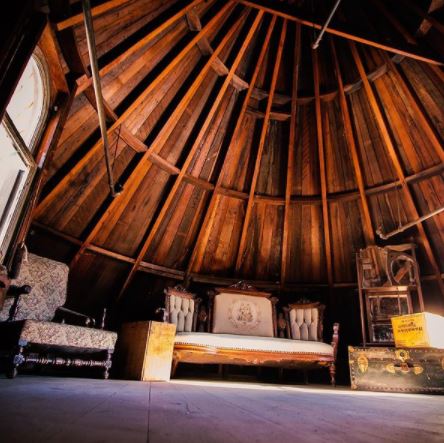
Adam Worth had also been at the séance that evening and did not seem to care for the tea. Ludwig promised to write Mrs. Winchester to let her know he was safe. The sun had gone down, and there was a long line of crimson yonder in the west above the edge of the estate. All the guest prepared to leave and Mrs. Winchester retired to her chambers for the evening. While laying in bed, Mrs. Winchester heard a bang on a door with a sounding slap. She figured it was just a piece of stupid discourtesy and went back to sleep. The following morning, she swore that one of the rooms on the second floor was not empty—and was quite upset about it—said there was some infernal influence at work in her home. To satisfy her curiosity, she asked her butler Henry to open the door. The light was dim in the room and Mrs. Winchester paused in the corridor outside. His eyes glistened. His features relaxed, and he gave a short sigh, “the room is empty,” said Henry. With some stir of curiosity, Mrs. Winchester slipped out, but had a certain vague wonder in her mind. As she heard, the medium from the night before in the parlour was struggling on the floor, in what looked like an epileptic fit. Mrs. Winchester walked deliberately back to the closed door, as Henry went to hold the medium from doing any injury to herself. Huddled against the massive end wall, and half embedded in it, as it seemed, there lay a shadow. Looking closely, Mrs. Winchester saw that the trap door was not only firmly bolted, but screwed into its socket. She strode off in a fume. She was in an odd frame of mind, and for long moved her sitting-room to and fro, too restless to go to bed, or, as an alternative, to settle down to a book. #RandolphHarris 4 of 16

She could not whistle her mind from the chase of a certain graveyard will-o’-wisp; and on it went stumbling and floundering through bog and mire, until she fell into a state of collapse, and was useful for nothing else. She went to bed and to sleep without difficulty, but was conscious of herself all the time, and of a shadowless horror that seemed to come stealthily out of the corners and to bend over and look at her, and nothing but a curtain or a hanging coat when she started and stared. Over and over again this happened, and Mrs. Winchester’s temperature rose by leaps, and suddenly she saw that is she failed to assert herself, and promptly, fever would leap her in a consuming fire. Then in a moment she broke into a profuse perspiration, and sank exhausted into delicious unconsciousness. Morning found her restored to vigour, but still the with flutter of curiosity in her brain. It worked there all day, and for many subsequent days, and at last it seemed as if her every faculty were honeycombed with its ramifications. Then “this will not do,” Mrs. Winchester thought, but still the tunnelling process went on. As the curious devil mastered her, she grew into such harmony with it that she could shut her eyes no longer to the true purpose of its insistence. It was the closed room about which her thoughts hovered like crows circling round carrion. In the dead waste and middle of a certain night, Mrs. Winchester awoke with a strange, quick recovery of consciousness. There was the passing of a single expiration, and she had been asleep and was awake. She had gone to bed with no sense of premonition or of resolve in a particular direction; she sat up a monomaniac. It was as if, swelling in the silent hours, the tumour of curiosity had come to a head, and in a moment, it was necessary to operate upon it. #RandolphHarris 5 of 16

She made no excuse for her then condition. Mrs. Winchester was convinced she was the victim of some undistinguishable force, that she was an agent under the control of the supernatural. Some thought had been in her mind of late in her position it was her duty to unriddle the mystery of the closed room door. However, time went by. The new year came, and still there was no letter from Ludwig Leichhardt. However, early in January, Henry, the butler came home from the Bank of Italy one afternoon, and told Mrs. Winchester she need not worry herself about her old friend any longer. “Ludwig Leichhardt is safe enough, mistress,” he said. “I was talking to Gilbert, the cashier at the Bank of Italy, this morning, and he told me that Leichhardt wrote to them for $2,000.00 last October from San Francisco, and he has written $1,000.00 more since. He is buying land somewhere—I forget the name of the place—and he’s well and hearty, Gilbert tells me.” However, a sense of fear and constriction was upon Mrs. Winchester. “Well, I’m afraid I’m rather fanciful, Henry; but I could never explain to you what a strange feeling came over me the night Ludwig Leichhardt went away from this estate. It was after I had said goodbye to him, and he had gone back into the mansion, where all was dark and quiet. I sat in the parlour thinking of him, and it seemed as if a voice was saying in my ear that I, nor anyone that care for hum, would ever seen Ludwig Leichhardt again. There wasn’t any such voice of course, you know, Henry, but it seemed like that in my mind; and whenever I’ve thought of poor Ludwig Leichhardt since that time, it has seemed to me like thinking of the dead. Often and often I’ve said to myself, ‘Why, Sarah, you silly thing, you ought to know that he’s safe enough in San Francisco. Ill news travels fast; and if there’d be anything wrong, we should have heard of it somehow.’ But, reason with myself as I would, I have never been able to feel comfortable about him; and thank God for your good news, Henry, and thank you for bring it to me. #RandolphHarris 6 of 16

It has been very unkind of Ludwig not to write. She could not forgive him for his neglect, glad as she was to know he was safe. Then Mrs. Winchester paused for a moment, and confessed, the quick pant of fear seemed to come from her lips. There were sounds about her—the deep breathing of an imprisoned man. She returned to the locked door, and hurriedly flung it open. An acrid whiff of dust assailed her nostrils as she stepped back a pace and stood expectant of anything—or nothing. What did she wish, or dread, or foresee? The room was rather a large one; an old-fashioned room, with a low ceiling crossed by heavy means; half parlour, half kitchen, with a wide-open fireplace at one end, on which the logs had burnt to a dullish red. There was the old chintz-covered armchair. Mrs. Winchester had been sitting with her face towards the open window, looking absently out at the garden, where daffodils and early primroses glimmered through the dusk. She stood to pick up her blueprints, which had fallen to the ground. She was standing folding this in a leisurely way, when she looked towards the fireplace, and gave a little start at seeing that the armchair was no longer empty. “Why, Henry,” she cried, “how quietly you must have come into the place! I never heard you.” There was no answer, and her voice sounded strange to her in the empty room. “Henry!” she repeated, a little louder; but the figure in the chair neither answered nor stirred. Then a sudden fright seized her, and she knew that it was not her butler. The room was almost dark; it was quite impossible that she could see the face of that dark figure seated in the armchair, with the shoulders bent a little over. Yet she knew, as well as ever she had known anything in her life, that it was not the butler Henry. #RandolphHarris 7 of 16

She went slowly towards the fireplace, and stood within a few paces of that strange figure. A little flash of light shot up from the candle, and shone for an instant on the face. It was Ludwig Leichhardt! Mrs. Winchester tried to speak to him; but the words would not come. And yet it was hardly so appalling a thing to see him there that she need have felt what she did. San Francisco was not too far from San Jose that a man may not cross the Bay and drop in upon his friend unexpectedly. The candle’s flame got bigger, lighting up the entire room. The chair was empty. Mrs. Winchester uttered a loud cry, and Henry entered the room. “Why, Mrs. Winchester! What’s amiss?” he said. She ran to him, sobbing hysterically, and then calming herself with an effort, told him how she had seen Ludwig’s ghost. “Why Mrs. Winchester,” Henry replied. “Ludwig Leichhardt is safe in San Francisco. It was a shadow that took the shape of your old friend, to your fancy. It’s easy enough to fancy such a thing when your mind’s full of anyone.” Ill and shaken, yet fearing death as she had never dreaded it before, Mrs. Winchester said, “It was no fancy. Ludwig Leichhardt is dead, and I have seen his ghost. I’ve a feeling that he never got to San Francisco alive, Henry,” she said. “I can’t explain how it is, but I’ve a feeling that it was so.” Mrs. Winchester spent the rest of that horrible night huddled between her crumpled sheets, fearing to look forth, fearing to think. She knew the letters had been forgeries, and could not forget the madness and the terror in learning to walk the unvext paths of placid souls. She was left with nothing but an aimless scurrying terror and the black swarm of thoughts, so that she verily fancied her reason would give under the strain. Yet she had more to endure and to triumph over. Near morning she fell into a troubled sleep, throughout which the drawn twitch of muscle seemed an accent on every word of ill-omen she had ever spelt out of the alphabet of fear. If her body rested, her brain was an open chamber for any toad of ugliness that listed to “sit at squat” in. #RandolphHarris 8 of 16

Mrs. Winchester tried to convince herself that the thing she had seen was only a trick of her imagination. Another month went by, and again in the twilight the same figure appeared to her. It was standing this time, with one arm leaning on the high mantlepiece; standing facing her as she came back to the room, after having quitted it for a few minutes for some slight household duty. There was a fire burning in the fireplace. The logs were burning with a steady blaze that lit up the well-known figure and unforgotten face. Ludwig Leichardt was looking at her with an expression that seemed half reproachful, half beseeching. He was very pale, much paler than she had ever seen him in life; and as he looked, she standing just within the threshold of the door, she saw him lift his hand slowly and point to his forehead. The firelight showed her a dark red stain upon the left temple, like the mark of a contused wound. She covered her face with her hands, shuddering and uttering a little cry of terror, and then dropped half fainting upon a chair. When she uncovered her face the room was empty, there was a pool of blood on the floor, and the firelight shining cheerily upon the walls, no trace of that ghostly visitant. This time Mrs. Winchester brooded over the thoughts of the thing she had seen, firmly believing that she had looked upon the shadow of the dead, and that there was some purpose to be fulfilled by that awful vision. In the day, she had the room boarded up. The thought of this was almost always in her mind; in the dead silence of the night, she would often lie awake for hours thinking of Ludwig Leichhardt. Mrs. Winchester knew he had been waylaid and murdered. He had a good deal of money about him. Suddenly Mrs. Winchester woke to the fact that there was a knocking at her door—that there had been for some little time. She cried, “Come in!” finding a weak restorative in the mere sound of her own human voice; then remember the keys was turned, bade the visitor wait until she could come to him. #RandolphHarris 9 of 16

Scrambling, feeling dazed and white-livered, out of bed, Mrs. Winchester opened the door, and met one of the gentlemen on the threshold. The man looked scared, and his lips, she noticed, were set in a somewhat boding fashion. “Come you come at once, Mrs. Winchester?” he said, “There’s summat wrong with Ludwig Leichhardt. She had now a settled conviction that some untimely fate had befallen her old friend, and that the letters from San Francisco were forgeries. Gilbert from the Bank of Italy compared the signature cards and determined that the drafts and letters were forgeries. There was one thing noticeable in the San Francisco letters—they were all exactly alike, line for line, curve for curve. This rather discomposed Gilbert; for it is a notorious fact that a man rarely signs his name twice in exactly the same manner. There is almost always some difference. Before the month was out, Ludwig Leichhardt’s ghost appeared for the third time to Mrs. Winchester. In the Tender June twilight. She was thinking of her old friend as she walked along the shadowy winding path of the deer park on her estate. It was just such a still, peaceful evening as that upon which he had stood on the edge of the common looking back at her, and waving his hand, upon that last well remembered night. He was so much in her thoughts, and the conviction that he had come from among the dead to visit her was so rooted in her mind, that she was scarcely surprised when she looked up presently, and saw a tall familiar figure moving slowly among the trees a little way before her. There seemed to be an awful stillness in the wood all at once, but there was nothing awful in that well-known figure. She tried to overtake it; but it kept always in advance of her, and at a sudden turn in the path she lost it altogether. The trees grew thicker, and there was a solemn darkness at the spot where the path took this sharp turn, and on one side of the narrow footpath there was a steep declivity and a great hollow, made by a disused gravel pit. #RandolphHarris 10 of 16

She went to her mansion quickly enough, with a subdued sadness upon her, and told Henry what had happened to her. Nor did she rest until there had been a search made on the extensive grounds for the body of Ludwig Leichhardt. They searched and found him lying at the bottom of the gravel pit, half buried in loose sand and gravel, and quite hidden by a mass of furze and bramble that grew over the spot. There was an inquest, of course. The tailor who had made the clothes found upon the body identified them, and swore to them as those he had made for Ludwig Leichhardt. The pocket were all empty and turned inside out. There could be little doubt the Ludwig Leichhardt had been waylaid and murdered for the sake of the money he carried upon him that night. His skull had been shattered by a blow from a jagged stick on the left temple. The stick was found laying at the bottom of the pit a little way from the body, with human hair and stains of blood upon it. Ludwig Leichhardt had never left San Jose. It was later determined that Adam Worth had killed Ludwig Leichhardt and took his money. The Bank of Italy refunded the withdraws. Adam Worth was ultimately apprehended, with some of Ludwig Leichhardt’s property still in his possession, and he was deeply in debt. The final examination resulted in a verdict of willful murder, tried, found guilty and hung. Ludwig Leichhardt had executed a few days before his intended departure, bequeathing all he possessed to Sarah Winchester—the interest for her sole use and benefit, the principal to revert to her estate after her death. Mrs. Winchester often sits beside that quiet resting place in the spring twilight; but she had never seen Ludwig Leichhardt’s ghost since that evening in the deer park, and she knew she never would see it again. She shook with an awful thankfulness at sight of the pitfalls she had skirted and escaped—of the demon she witlessly had baffled. The joy of life was in her heart again, but chastened and made pitiful by experience. #RandolphHarris 11 of 16

You are aware that evil spirit beings operating through humans in positions of authority and influence are the real motivators in human society? Yes, this is exactly what the Christian Bible teaches! Perhaps this concept seems strange to you, almost like an outmoded superstition, but the Bible definitely states that Satan in the “god of this age,” reports 2 Corinthians 4.4, and that he is the leader of a well-organized army of beings invisible to humans but very active among them. Paul tells us in Ephesians, “For we wrestle not against flesh and blood, but against principalities, against powers, against the rulers of the darkness of this World, against spiritual wickedness in high places,” reports Ephesians 6.12. These words indicate that evil spirits are organized into a military-like structure. The “principalities” are the highest ranking officers under Satan, the “powers” are officials of somewhat lower standing, and the “rulers of the darkness of this World” seem to be a special band of evil spirits whose sphere of influence includes the leaders of human government. The phrase “spiritual wickedness is high places” is better translated “spiritual hosts of wickedness in the Heavenly places,” and makes reference to the myriads of demonic hordes. They are all under the direction of Satan, who is not only named the “god of this age,” but also is called “the prince of the power of the air,” reports Ephesians 2.2. The Scriptures often speak of a close relationship between these evil spiritual and the “World.” In the Ephesians passage quoted above, you will remember that these spirit beings are called “the rulers of the darkness of this World.” The apostle John also refers to the World, and it is significant that he considers it to be the Christian’s enemy. “Love not the World, neither the things that are in the World. If any human love the World, the love of the Father is not in one. For all that is in the World, the lust of the flesh, and the lust of the eyes, and the pride of life, is not of the Farther, but is of the World. And the World passeth away, and the lust of it; but one that doeth the will of God abideth forever,” reports 1 John 2.15-17. #RandolphHarris 12 of 16

In addition, the same apostle declared that one who is “born of God overcometh the World,” reports 1 John 5.4, and also that “the whole World lieth in wickedness,” reports 1 John 5.19. James, the brother of Jesus, declared in his epistle, “Whosoever therefore, will be a friend of the World, is the enemy of God,” reports James 4.4. Before we can gain a full understanding of what this means, we must answer the following questions: What is this World, which if loved causes us to lose God’s friendship? What does the Bible mean when it says that the whole World “lieth in wickedness”? Certainly the Bible is not saying that Christians should not love the World of nature, nor is it implying that every person who is not a Christian is an enemy to be overcome. In fact, the Scriptures often state that the glory of God is revealed in the natural World, and it specifically instructs believers not to antagonize other people, but to love them. No, the material Universe in which we live is not opposed to us, and we are not to consider the people who inhabit the Earth as our enemies. The “World” referred to by John and James is the moral and spiritual system we call human society. Humankind, which has rejected God’s revelation, has devised explanations of life, moral standards, and principles of conduct based upon human knowledge only. Humans, on the whole, operate on erroneous principles, selfish desires, improper motives, and unworthy standards of value. The sciences, the arts, politics, and entertainment are all dominated by a humanistic approach to life which draws humans away from God and makes humans the “measure of all things.” If the period of treated of in the essay from the commencement of the seventeenth century to the Restoration of Charles II, be barren of witchcraft proper, it must at least be admitted that it is prodigal in regard to the marvellous under various shapes and forms, from which the hysterical state of the public mind can be fairly accurately gauged. #RandolphHarris 13 of 16

The rebellion of 1641, and the Cromwellian confiscations, that troubled periods when the county was torn by dissention, and ravaged by fire, sword, and pestilence, was aptly ushered in by a series of supernatural events which occurred in the country Limerick. A letter dated the 13th August 1640, states that “for news we have the strangest that ever was heard of, there inchantments in the Lord of Castleconnell’s Castle four miles from Lymerick, several sorts of noyse, sometymes of drums and trumpets, sometimes of other curious musique with Heavenly vouces, then fearful screeches, and such outcries that the neighbours near cannot sleepe. Priests have adventured to be there, but have been cruelly beaten for their paynes, and carryed away they knew not how, some two miles and some four miles. Moreover were seen in the like manner, after they appear to the view of the neighbours, infinite number of armed men on foote as well as on horseback. One thing more [id est something supernatural] by Mrs. Mary Burke with tweleve servants lyes in the hose, and never one hurt, onley they must dance with them every night; they say, Mrs. Mary come away, telling her she must be wife to the inchanted Earl of Desmond. Uppon a Mannour of my Lord Bishoppe of Lymerick, Loughill, hath been seen upon the hill by most of the inhabitants aboundance of armed men marching, and these seene many tymes—and when they come up to them they do not appear. These things are very strange, if the cleargie and gentrie say true.” During the rebellion an appalling massacre of Protestants took place at Portadown, when about a hundred persons, men, women, and children, were forced over the bridge into the river, and so drowned; the few that could swim, and so managed to reach the shore, were either knocked on the head by the insurgents when they landed, or else were shit. #RandolphHarris 14 of 16

It is not a matter of surprise that this terrible incident gave rise to legends and stories in which anything strange or out of the common was magnified out of all proportion. Accord to one deponent there appeared one evening in the river “a vision or spirit assuming the shape of a woman, waist high, upright in the water, naked with [illegible] in her hand, her hair dishevelled, her eyes seeming to twinkle in her head, and her skin as white as snow; which spirit seeming to stand upright in the water often repeated the word Revenge! Revenge! Revenge! Also, Robert Maxwell, Archdeacon of Down, swore that the rebels declared to him, (and some deponents made similar statements) “that most of those that were thrown from the bridge were daily and nightly seen to walk upon the River, sometimes singing Psalms, sometimes brandishing of Swords, sometimes screeching in a most hideous and fearful manner.” Both these occurrences are capable of a rational explanation. The supposed spectre was probably a poor, bereaved woman, demented by grief and terror, who stile out of her hiding-place at night to bewail the murder of her friends, while the weird cries arose from the half-starved dogs of the country-side, together with the wolves which abounded in Ireland at that period, quarrelling and fighting over the corpses. Granting the above, and bearing in mind the credulity of all classes of Society, it is not difficult to see how the tales originated; but to say that, because such obviously impossible statements occur in certain despsitions, the latter are therefore worthless as a whole, is to willfully misunderstand the popular mind of the seventeenth century. We have the following on the testimony of the Rev. George Creighton, minister of Virginia, Co. Cavan. He tells us that “drivers women brought to his House a young woman, almost naked, to whom a Rogue came upon the way, these women being present, and required her to give him her mony, or else he would kill her, and so drew his sword; her answer was, You cannot kill me unless God gives you leave, and His will be done. #RandolphHarris 15 of 16

“Thereupon the Rogue thrust three times at her naked body with his drawn sword, and never pierced her skin; whereat he being, as it seems, much confounded, went away and left her.” A like story comes from the other side: “At the taking of the Newry a revel being appointed to be shot upon the bridge, and stripped stark-naked, nothing withstanding the musketeer stood within two yards of him, and shot him in the middle of the back, yet the bullet entered not, nor did him any more hurt than leave a little black spot behind it. This many hundreds were eye-witnesses of. Divers of the like have I confidently been assured of, who have been provided of diabolical charms.” Similar tales of persons bearing charmed lives could not doubt be culled from the records of every way that has been fought on this planet of ours since History began. The ease with which the accidental or unusual was transformed into the miraculous at this period is shown by the following. A Dr. Tate and his wife and children were flying to Dublin from the insurgents. On their way they were wandering over commons covered with snow, without any food. The wife was carrying a sucking child, John, and having no milk to give it she was about to lay it down in despair, when suddenly “on the Brow of a Bank she found a Suck-bottle with sweet milk in it, no Footsteps appearing in the snow of any that should bring it thither, and far from any Habitation; which preserved the child’s life, who after became a Blessing to the Church.” The Dr. Tate mentioned above was evidently the Rev. Faithful Tate, D.D., father of Nahum Tate of “Tate and Brady” fame. Much of what has passed current in the New World as White (id est, permissible) Magic is only a disguised goeticism, and may of the resplendent angels invoke with the divine rites reveal their cloven hoofs. It is not too much to say that a large majority of past psychological experiments were conducted to establish communication with demons, and that for unlawful purposes. The popular conceptions concerning the diabolical spheres, which have been all accredited by magic, may have been gross exaggerations of fact concerning rudimentary and perverse intelligences, but the willful viciousness of the communicants is substantially untouched thereby. #RandolphHarris 16 of 16


Happy Early Turkey Day! 🦃

The Winchester Mystery House will be closed on Thursday, Nov. 25 in observance of the Thanksgiving holiday and will reopen on Friday, Nov. 26! winchestermysteryhouse.com

When Asked His Name He Said “Legion” Because Many Demons Were Entered into Him!

It is easy to imagine how the combined grief of losing both a child and a spouse could be very crippling. However, if you have $20,000,000 (2021 inflation adjusted $347,910,691.82), and all the time in the World to help you cope, what would you do? Mrs. Sarah L. Winchester’s response to the deaths of her child and husband left a bizarre and impressive architectural reflection of her soul. After a series of violent confrontations, the Winchester Repeating Arms Company hires a private investigator to follow her. Mrs. Winchester ascends into mystery and it is soon clear that she is hiding a much bigger secret—one that is both inexplicable and shocking. A “possessed” person may have symptoms much like those that are apparent in the mentally ill. One may be deeply melancholic or depressed, appear to be withdrawn from reality, or may manifest emotions that range from ecstatic joy to violent screaming or wild ferocity. These various states may present themselves from time to time during “attacks.” Demon possession may be distinguished from insanity, however, by observing the manner in which the afflicted person speaks. An insane individual may have a mistaken concept of one’s own identity, wear clothing by which one attempts to look like the person one thinks oneself to be, but speak in one’s own voice, and in such a manner that one can tell one is doing only a superficial impersonation of the individual one thinks oneself to be. A demon-possessed person, on the other hand, is obviously controlled by the indwelling evil spirit. The wicked being may use a language or dialect the individual never knew, and sometimes will name oneself. Therefore, one should carefully note the symptoms of a disturbed person, never making the diagnosis of demon possession on the basis of a superficial judgment. #RandolphHarris 1 of 16

If a believer should meet a demon-possessed individual, one would be unwise to make a frontal attack upon the powers of darkness by immediately issuing a command in the name of the Lord Jesus Christ. Dr. Kurt Koch, an evangelical Christian who has made a lifetime study of Satan and occultic activities, declares that whenever Christians lightly engage in an effort to cast out demons, they run the risk of being attacked by evil spirits. Such people often suffer deep spiritual depression and find themselves in an attitude of complete hopelessness. Since this is true, a believer should band together with others in a time of prayer, and no efforts should be made to expel the evil spirits until the Holy Spirit prompts someone to issue the command. Unbelievers and adherents of the non-Christian religions apparently can command evil spirits without suffering bad consequences. Archeologists have found manuscripts containing incantations and magical formulas for the expulsion of demons; and today in the Philippines and other countries of the far East, as well as in some areas of South America and Africa, pagan religious leaders seriously perform rituals to ward off or cast out evil spirits. Sometimes they beat the person who is demon-possessed, prick one with needles, or even burn portions of one’s body, thinking that this pain will drive out the evil spirits. The Jewish people in Christ’s day also used spells, magical phrases, and religious rituals to expel demons. That they sometimes appeared to be successful is clear, for Jesus said, “if I, by Beelzebub, cast out demons, by whom do your sons cast them out? Therefore, they shall be your judges,” reports Matthew 12.27. #RandolphHarris 2 of 16

In this statement the Lord Jesus Christ acknowledged that evil spirits sometimes left the bodies of their victims when incantations, spells, or magical rites were used by Jewish religious leaders. However, Christ did not say these men accomplished their goal by the power of God, nor did He imply that they were actually doing damage to the cause of Satan. He was answering the charge that He was casting out demons in the power of Beelzebub, the prince of demons. He declared that is such were the case, the kingdom of Satan would be divided against itself. Actually, the exorcists, whether Jewish or pagan, did not really possess authority over the invisible World, but the evil spirits merely cooperated with them, leaving the bodies of some of their victims to give the appearance that they had been forced out. By working with these unbelieving sorcerers, the devil aided his own cause. The demons either temporarily left the person, only to return a short time later, or entered the body of some other victim. No one should attempt to deal with the forces of evil by using the name of Jesus unless one is a child of God. Luke, in Acts 19, graphically portrays the seriousness of hypocritically dealing with the powers of darkness. Seven sons of Sceva, a professional exorcist who had no personal faith in Christ, tried to combine the words “in the name of Jesus” with their magical formula. The evil spirits, recognizing that these impostors had no right to use Jesus’s name, reacted in a violent manner. The demon-possessed individual attacked these men with superhuman strengths, so that with torn clothing and bleeding bodies they fled from the Winchester mansion. The frequency of demon possession—the record of history establishes without a doubt that demon possession was known before the Lord Jesus Christ came to Earth, and the testimony of missionaries indicates that it has continued down through the centuries. #RandolphHarris 3 of 16

The public ministry of Christ, however, was accompanied by an outburst of demon possession unparalleled in history. It seems that Satan threw all his power into his battle with Jesus Christ. True, the devil is not omniscient, but he knew that Christ had come to earth to atone for sin, conquer death, and bring about the defeat of evil. John tells us that “the Son of God was manifested, that he might destroy the works of the devil,” reports 1 John 3.8. Satan used every device at his disposal to frustrate the purpose of God in Christ. Subtle temptations, the wrath and wickedness of men, and a rash of demonic activity were part of his vain effort to prevent Jesus from performing the work He had come to accomplish. Demon possession gradually subsided during the first century A.D., and usually is not conspicuous in areas where a fairly large percentage of people have placed their faith in Jesus Christ. It appears that demons are hesitant to enter the bodies of people when informed believers are likely to cast them out in the name of Christ. Luke is the same one that is translated “bottomless pit” seven times in the book of the Revelation. We read, “And Jesus asked him, saying, ‘What is thy name?’ And he said, ‘Legion’; because many demons were entered into him. And they besought him that he would not command them to go out into the deep. And there was there and herd of many swine, feeding on the mountain; and they besought him that he would allow them to enter into them. And he permitted them,” reports Luke 8.30-32. Revelation 9 tells us that at some future time the “bottomless pit” will be opened, and a great army of evil spirits will be set free to plague humankind. #RandolphHarris 4 of 16

It is at least a possibility that whenever demons are cast out of a human being in the name of Jesus Christ, they are sent to the bottomless pit, and will not be released until shortly before Christ returns to establish His kingdom. The realization that they will lose their freedom as members of the army of the “prince of the power of the air,” and be confined in the pit for an indefinite period of time, makes them hesitant to take possession of human beings. The risk is too great in an area where Christians exercise their authority in the name of Christ. People who live in civilized countries where the Gospel has been known for centuries should not rule out the possibility of demon possession, however, just because it has not been a common occurrence in these areas. Satan and his cohorts may conclude that most people, even professing Christians, will not recognize this phenomenon when they meet it. Therefore, as this age draws to a close, Satan may once again become very active in entering human bodies and controlling personalities. He will hope that the majority of humankind will either be deceived into following him or find a naturalistic explanation for the activities of the demons. This supernatural manifestation of the power of Satan and evil spirits is clearly predicted by the apostle Paul. In his second letter to the Thessalonian believers, he declares that just before Christ returns in glory, the devil will have his righthand mand upon the earth performing miracles which make him appear to be a god. Referring to the Antichrists, the apostle says, “Even him whose coming is after the working of Satan with all power and signs and lying wonders, and with all deceivableness of unrighteousness in them that perish, because they received not the love of the truth, that they might be saved,” reports 2 Thessalonian 2.9, 10. #RandolphHarris 5 of 16

Inasmuch as we can expect an increase of open opposition to God on the part of the Satanic hordes, we know Christ should humbly maintain fellowship with Him through full submission and ready obedience so that we may receive from Him the strength we need to overcome. James writes, “God resisteth the proud, but giveth grace unto the humble. Submit yourselves, therefore, to God. Resist the devil, and he will flee from you,” reports James 4.6-7. Peter declares, “Be sober, be vigilant, because your adversary the devil, like a roaring lion walketh about, seeking whom he may devour; whom resist steadfast in the faith, knowing that the same afflictions are accomplished in your brethren that are in the World,” reports 1 Peter 5.8-9. No, Satan is not dead. He is like a wounded animal and still has great power to harm those who care careless or proud. Therefore, keep awake, be on alert, read the Christian Bible and the Book of Mormon, and pray! If you do not, he may destroy your effectiveness as a Christian. For the next instance of witchcraft and the supernatural in connection with Ireland, we are compelled to go beyond the confines of our own country. Though in this connection with the Green Isle is slight, yet it is of interest as affording an example of that blending of fairy lore with sorcery which is not an uncommon feature of Scottish witchcraft-trials. In the year 1613 a woman named Margaret Barclay, of Irvine in Scotland, was accused of having her brother-in-law’s ship to be cast away by magical spell. A certain strolling vagabond and juggler, John Stewart, was apprehended as her accomplice; he admitted (probably under torture) that Margaret had applied to him to teach her some magic arts in others that “she might get gear, kye’s milk, love of man, her heart’s desire on such persons as had done her wrong.” #RandolphHarris 6 of 16

Through John Stewart does not appear to have granted Margaret’s request, yet he gave detailed information as to the manner in which he had gained the supernatural power and knowledge with which he was credited. “It being demanded of him by what means he profession himself to have knowledge of things to come, the said John confessed that the space of twenty-six years ago, he being travelling on All-Hallow Even night between the towns of Monygoif and Clary, in Galway, he met with the King of the Fairies and his company, and that the King gave him a stroke with a white rod over the forehead, which took from him the power of speech and the use of one eye, which he wanted for the space of three years. He declared that the use of speech and eyesight was restored to him by the King of Fairies and his company on a Hallowe’en night at the town of Dublin.” At his subsequent meeting with the fairy band, he was taught all his knowledge. The spot on which he was struck remained impervious to pain although a pin was thrust into it. The unfortunate wretch was cast into prison, and there committed suicide by hanging himself from the “cruik” of the door with his garter or bonnet-string, and so “ended his life miserably with the help of the devil his master.” A tale slightly resembling portion of the above comes from the north of Ireland a few years later. “It is storied, and the story is true,” says Robert Law in his Memorialls, “of a godly man in Ireland, who lying one day in the fields sleeping, he was struck with dumbness and deafness. The same man, during this condition he was in, could tell things, and had the knowledge of things in a strange way, which he had not before; and did, indeed, by signs make things known to others which they knew not. Afterwards he at length, prayer being made from him by others, came to the use of his tongue and ears; but when that knowledge of things he had in his deaf and dumb condition ceased, and when he was asked how he had the knowledge of these things he made signs of, he answered he had that knowledge when dumb, but how and after what manner he knew not, only he had the impression thereof in his spirit. This story was related by a godly minister, Mr. Robert Blair, to Mr. John Baird, who knew the truth of it.” #RandolphHarris 7 of 16

The Rev. Robert Blair, M.A., was a celebrated man, if for no other reason than on account of his disputes with Dr. Echlin, Bishop of Down, or for his description of Oliver Cromwell as a greeting (id est, weeping) devil. On the invitation of Lord Claneboy he arrived in Ireland in 1623, and in the same year was settled as (Presbyterian) parish minister at Bangor in Co. Down, with the consent of patron and people’ he remained there until 1631, when he was suspended by Dr. Echlin, and was deposed and excommunicated in November, 1634. He has left a few writings behind him, and was grandfather of the poet Robert Blair, author of The Grave. During the years of his ministry at Bangor the following incident occurred to him, which he of course attributes to demonic possession, through homicidal mania resulting from intemperate habits would be nearer the truth. One day a rich man, the constable of the perish, called upon him in company with one of his tenants concerning the baptizing of the latter’s child. “When I had spoken what I thought necessary, and was ready to turn into my house, the constable dismissing the other told me he had something to say to me in private. I looking upon him saw his eyes like the eyes of a cat in the night, did presently conceive that he had a mischief in his heart, yet I resolved not to refuse what he desired, but I keeped a watchful eye upon him, and stayed at some distance; and being near to the door of the church I went in, and invited him to follow me. As soon as he entered within the doors he fell atrembling, and I awondering. His trembling continuing and growing without any speech, I approached to him, and invited him to a seat, wherein he could hardly sit. The great trembling was like to throw him out of the seat. I laid my arm about him, and asked him what ailed him? But for a time, he could speak none. #RandolphHarris 8 of 16

“At last his shaking ceased, and he began to speak, telling me, that for a long time the Devil had appeared to him; first at Glasgow he bought a horse from him, receiving a sixpence in earnest, and that in the end he offered to him a great purse full of sylver to be his, making no mention of the horse; he said that he blessed himself, and so the buyer with the sylver and gold that was poured out upon the table vanished. But some days thereafter he appeared to him at his own house, naming him by his name, and said to him, Ye are mine, for I arled you with a sixpence, which yet ye have. Then said he, I asked his name, and he answered, they call me Nickel Downus (I suppose the he repeated evil, that he should have said Nihil Damus). Being thus molested with these and many other apparitions of the Devil, he left Scotland; but being come to Ireland he did often likewise appear to him, and now of late he still commands me to kill and slay; and oftentimes, says he, my whinger hath been drawn and kept under my cloak to obey his commands, but still something holds my hand that I cannot stroke. But then I asked him who he was bidden kill? He answered, any that comes in my way; but ‘The better they be the better service to me, or else I shall kill thee.’ When he uttered these words he fell again atrembling, and was stopped in his speaking, looking lamentably at me, designing me to be the person he aimed at; then he fell a crying and lamenting. I showed him the horribleness of his ignorance and drunkenness; he made many promises of reformation, which were not well keep’d; for within a fortnight he went to an alehouse to crave the price of his malt, and sitting there long at drink, as he was going homeward the Devil appeared to him, and challenged him for opening to me what had passed betwixt them secretly, and followed him to the house, pulling his cap off his head and his band from about his neck, saying to him, ‘On Hallow-night I shall have thee, soul and body, in despite of the minister and of all that he will do for thee.’” #RandolphHarris 9 of 16

In his choice of a date his Satanic Majesty showed his respect for popular superstitions. This attack of delirium tremens (though Mr. Blair would not have so explained it) had a most salutary effect; the constable was in such an abject state of terror lest the Devil should carry him off that he begged Mr. Blair to sit up with him all Hallow-night, which he did, spending the time very profitably in prayer and exhortation, which encouraged the man to defy Satan and all his works. The upshot of the matter was, that he became very charitable to the poor, and seems to have entirely renounced his intemperate habits. Rejecting the supernatural elements in the above as being merely the fruits of a diseased mind, there is no reason to doubt the truth of the story. Mr. Blair also met with some strange cases of religious hysteria, which became manifest in outbursts of weeping and bodily convulsions, but which he attributed to the Devil’s “playing the ape, and counterfeiting the works of the Lord.” He states that one Sunday, in the midst of public worship, “one of my charge, being a dull and ignorant person, made a noise and stretching of her body. Incontinent I was assisted to rebuke that lying spirit that disturbed the worship of God, charging the same not to disturb the congregation; and through God’s mercy we met with no more of that work.” Thus modestly our writer sets down what happened in his Autobiography; but the account of the incident spread far and wide, and at length came to the ears of Archbishop Usher, who, on his next meeting with Mr. Blair, warmly congratulated him on the successful exorcism he had practised.” Spirits of a diabolical and infernal nature, are not only ready upon all occasions to become subservient to exorcists and magicians, but are ever watching opportunities of exciting evil affections in the mind, and of stirring up the wickedly inclined to the commission of every species of iniquity and vice. #RandolphHarris 10 of 16

Thus by the instigation of infernal spirits, and their own promptitude, they often terrify humans with nocturnal visions; provoke melancholy people to suicide; tempt drunkards and incendiaries to set houses on fire, to burn those who are in them, and allure careless servants and others to sound and incautious sleep; that such unlucky accidents might happen besides innumerable other ways they have of executing the devices of iniquitous spirits through malicious instigations, or secret stratagems, projected for the overthrow and destruction of mortal men; especially when the work to be effected by the devil is too hard for his subtle and spiritual nature to effect, because the same belongs to the outward source or principle to which these dubious spirits more immediately belong. A few nights into Christmas, there was a festival for which the Winchester mansion was making extensive preparations. The narrow streets which had been thronged with people were now almost deserted. In the comfortable coffee-room of the Winchester mansion, Mrs. Winchester had half a dozen guests, principally commercial travellers, sat talking by light of the fire. The talk had drifted from trade to politics, from politics to religion, and so by easy stages to the supernatural. In the flicker of the light of the fire, as it shone on the glasses and danced with shadows on the walls, the conversation proved so enthralling that Henry, the waiter, whose presence had been forgotten, created a very disagreeable sensation by suddenly starting up from a dark corner and gliding silently from the room. Mrs. Winchester then said, “Of course, it is an old idea that spirits like to get into the company of human beings. A man told me once that he travelled down the Great Western with a ghost and had not the slightest suspicion of it until the inspector came for tickets. My friend said they way that ghost tried to keep up appearances by feeling for it in all its pockets and looking on the floor was quite touching. Ultimately it gave it up and with a faint groan vanished through the ventilator.” #RandolphHarris 11 of 16

“That’ll do, Mrs. Winchester,” said Ludwig Leichhardt. “It is not a subject for jesting,” said Adam Worth,” who had been an attentive listener. “I’ve never seen an apparition myself, but I know people who have, and I consider that they form a very interesting link between us and the after-life. There’s a ghost story connected with this mansion, you know.” “Never heard of it,” said Edward Agar, “and I have visiting this estate for some years now.” “It dates back a long time,” said Ludwig. “You’ve heard about John V. Creely also know as Jesus Procopio?” “Well, I’ve just ‘eard odds and ends, sir” said the Edward, “but I never put much count to ‘em. There was one chap ‘ere what said ‘e saw it, and the gov’ner sacked ‘im prompt.” “My father was a native of this town,” said Ludwig, “and knew the story well. He was a truthful man and a steady churchgoer, but I’ve heard him declare that once in his life he saw the appearance of Jesus Procopio in this mansion.” “And who was this Jesus?” enquired a voice. “His real name was Tomaso Rodendo, one of the most fearless and daring desperadoes that has ever figures in the criminal annals of our state. Anything he could turn his dishonest hand to,” replied Ludwig; “and he was run to Earth in this mansion one Christmas week some five years ago. He took his last supper in this very room, and after he had gone up to bed a couple of thief takers, who had followed him from San Francisco but lost the scent a bit, went upstairs with Mrs. Winchester and tried the door. It was stout oak, and fast, so one went into the yard, and by means of a short ladder got on the window-sill, while the other stayed outside the door. Those below in the yard saw the man crouching on the sill, and then there was a sudden smash of glass, and with a cry he fell in a heap on the stones at their feet. Then in the moonlight they saw the white face of the pickpocket peeping over the sill, and while some stayed in the yard, others ran into the mansion and helped the other man to break the door in. It was difficult to obtain an entrance even then, for it was barred with heavy furniture, but they got in at last, and the first thing that met their eyes was the body of Jesus dangling from the top of the bed by his own handkerchief.” #RandolphHarris 12 of 16

“Which bedroom was it?” asked two or three voices together. Ludwig shook his head. “That I can’t tell you; but the story goes that Jesus still haunts this mansion, and my father used to declare that the last time he had slept here that the ghost of Jesus Procopio lowered itself from the top of his bed and tried to strangle him.” “That will do” said John Creely. “I wish you’d thought to ask your father which bedroom it was.” “I believe it was my Blue Séance room said,” Mrs. Winchester. “Well, I should take care not to sleep in it, that’s all, said John shortly. “There’s nothing to fear,” said Ludwig. “I don’t believe for a moment that ghosts could really hurt one. In fact my father used to confess that it was only the unpleasantness of the thing that upset him, and that for all practical purposes Jesus’s figures might have been made of cotton-wool for all the hard they could do.” “That’s all very fine,” said John; “a ghost story is a ghost story, sir; but when a gentleman tells a tale of a ghost in the house in which one is going to sleep, I call it most ungentlemanly!” “Pooh! Nonsense!” said Ludwig, rising, “ghosts can’t hurt you. For my own part; I should rather like to see one. Good night.” “Good night,” said Mrs. Winchester and the others. “And I hope that Jesus will pay you a visit,” added John as the door closed.” “Shall I light the gas, Adam?” said Henry. “No; the fires very comfortable,” he said. “Now gentlemen, any of you know any more?” “I think we’ve had enough,” said John; “we shall be thinking we see spirits next, and we’re not all like Ludwig who’s just gone.” Old humbug!” said John. “I should like to put him to the test. Suppose I dress up as Jesus Procopio and go to give him a chance of displaying his courage?” “Bravo!” said Adam huskily, drowning one or two faint “Noes.” “No, drop it, John” said Edward. “Only for the joke,” said John, somewhat eagerly. “I’ve got some things upstairs in which I am going to play in the ‘Rivals’—knee-breeches, buckles, and all that sort of thing. It’s a rare chance. If you’ll wait a bit I’ll give you a full-dress rehearsal, entitled, ‘Jesus Procopio; or, The Nocturnal Strangler.’” #RandolphHarris 13 of 16

“You won’t frighten us,” said Adam, with a husky laugh. “I don’t know that,” said John sharply; “it’s a question of acting that’s all. I’m pretty good, ain’t I, Edward?” “Oh, you’re all right—for an amateur,” said Edward, with a laugh. “I’ll bet you level sov. You don’t frighten me,” said Adam. “Done! said John. I’ll take the bet to frighten you first and Ludwig afterwards. These gentlemen shall be the judges.” “You won’t frighten us, sir,” said Edward “because we’re prepared for you; but you’d better leave Ludwig alone. It’s dangerous play.” “Well, I’ try you first,” said John, springing up. “No gas, mind.” He ran lightly upstairs to his room, leaving the others, most of whom had been drinking somewhat freely, to wrangle about his proceedings. It ended with them going to bed. “He’s crazy on acting,” said Adam, lighting his pipe. “Thinks he’s the equal of anybody almost. It doesn’t matter with us, but I won’t let him go to Ludwig. And he won’t mind so long as he gets an opportunity of acting to us.” “Well, I hope he’ll hurry up,” said Edward, yawning; it’s after twelve now.” Nearly half an hour passed. Edward drew his watch from his pocket and was busy winding it, when Henry, the waiter, who had been sent on an errand, burst suddenly into the room and rushed towards them. “E’s comin’, gentlemen,” he said breathlessly. “Why, you’re frightened, Edward,” said Adam with a chuckle. “It was the suddenness of it,” said Edward sheepishly; “and besides, I didn’t look for seenin’ ‘im in the bar. There’s only a glimmer of light there, and ‘e was sitting on the floor behind the bar. I nearly trod on ‘im.” “He’s taking too long, I’ll go and fetch him,” said Adam. “You don’t know what this mansion is like at night, sir,” said Henry, catching him by the sleeve. “It ain’t fit to look at by yourself, it ain’t, indeed. It’s got the—what’s that?” #RandolphHarris 14 of 16

They all started at the sound of a smothered cry from the staircase and the sound of somebody running hurriedly along the passage. Before anybody could speak, the door flew open and a figure bursting into the room flung itself gasping and shivering upon them. “What is it? What’s the matter?” demanded Edward. “Why, it’s Mr. Creely.” He shook him roughly and then held some spirit to his lips. John Creely drank it greedily with a sharp intake of his breath gripped him by the arm. “Light the gas, Adam,” said Edward. Adam obeyed hastily, John Creely, a ludicrous but pitiable figure in knee-breeches and coat, a large wig all awry, and his face a mess of grease paint, clung to him, trembling. “Now what’s the matter?” asked Edward. “I’ve seen it,” said John, with a hysterical sob. “O Lord, I’ll never play the fool again, never!” “Seen what?” said the others. “Him—it—the ghost—anything!” said John wildly. “Rot!” said Adam uneasily. All distinctly heard a step in the passage outside. It stopped at the door, and as they watched with bated breath, the door creaked and slowly opened. Adam fell back opened-mouthed, as a white, leering face, with sunken eyeballs ad close-cropped bullet head, appeared at the opening. For a few second the creature stood regarding them, blinking in a strange fashion at the candle. Then with a sidling movement, it came a little way into the room and stood there as if bewildered. Not a man spoke or moved, but all watched with a horrible fascination as the creature removed its dirty neckcloth and its head rolled on its shoulder. For a minute it paused, and then holding the rag before it, moved towards Edward. The candle went out suddenly with a flash and a bang. These was a smell of powder, and something writhing in the darkness on the floor. A faint, choking cough, and then silence. #RandolphHarris 15 of 16

Edward was the first to speak. “Matches,” he said in a strange voice. Adam struck one. Then he leapt at the gas and a burner flamed from the match. Edward touched the thing on the floor with his foot and found it soft. He looked at his companions. They mouthed enquiries at him, but he shook his head. He lit the candle, and, kneeling down, examined the silent thing on the floor. Then he rose swiftly, and dipping his handkerchief in the water jug, bent down again and grimly wiped the white face. Then he sprang back with a cry of incredulous horror, pointing at it. Adam’s pistol fell to the floor and he shut out the sight with his hands, but the others, crowding forward, gazed spell-bound at the dead face of John V. Creely. Before a word was spoken the door opened and Ludwig hastily entered the room. His eyes fell on the floor. “Good God!” he cried. “You didn’t—” Nobody spoke. “I told him not to,” he said in a suffocating voice. “I told him not to. I told him—” He leaned against the wall, deathly sick, put his arms out feebly, and fell fainting into Ludwig’s arms. Many mysteries have taken place in the Winchester mansion over the years. It is an extravagant maze of Victorian craftmanship—marvelous, baffling, and eerily eccentric, to say the least. Tour guide must warn people not to stray from the group or they could be lost forever! Countless questions come to mind as you wander through the mansion—such as, what was Mrs. Winchester thinking when she had a staircase built that descends seven steps and then rises eleven? The Winchester Repeating Arms Company concluding their investigation by saying, “The mystery of the Winchester mansion is unquestionably great and infinite; perhaps spirits can take human shape, and disclose secrets and treasures guarded by this estate, but we must also be aware of skilled deceivers who will talk of Heaven and Hell and the Fall.” (WRA 1888.) After Mrs. Winchester’s death, crimes resulting in the theft of cash, jewels, historical European glass, furniture, and works of art worth over $10 million by Victorian standards (2021 inflation adjusted $291,146,315.79) went missing from the estate. Is the Winchester mansion haunted? Visits and find out for yourself. Their investigation sounds inconclusive. #RandolphHarris 16 of 16

Winchester Mystery House

“Though she be but little, she is fierce.” ~ William Shakespeare

Did you know Sarah Winchester only stood at 4’10”? Much of the house was built to her specific height measurement including a shower, some doors, and hallways. winchestermysteryhouse.com

Sold His Soul to the Devil and Purchased the Estate with the Money His Body and Soul Realized!

Sarah Winchester was truly overcome by the loss of her month-old baby girl, and a grief magnified 15 years later by her husband’s sudden death. Doctors and friends urged her to leave the east, seek a milder climate and search for some all-consuming hobby. One physician did suggest that she “build a house and do not employ an architect.” On arrival in San Jose, she immediately started remodeling the newly purchased, unfinished farmhouse. She found the planning kept her grief-disturbed mind occupied and she became thoroughly enthused, but certainly, something was still bothering her. “Why can you not just be nice and quiet? What have you done all morning but shake my awnings, tug at my window street-mirror and the cord on it, play with the bellpull wire from the fourth floor, push against the windowpanes—in short, proclaim your existence in every way as if you wanted to beckon me out to you? Yes, the weather is fine enough, but I have no inclination; let me stay home. You playful exuberant zephyrs, you happy lads, go by yourselves; have your fund as always. Go your way! Leave me out of it. But then you think you have no enjoyment in it; you are not doing it for your own sake.” Many have said that the Winchester mansion is haunted by legions of spirits and perhaps even demons. The New Testament includes a number of references to people afflicted with what we term “demon possession.” Skeptics have looked upon these accounts as reflections of the ignorance and superstition prevalent during the times of our Lord’s ministry. Others contend that Jesus Christ, knowing that the public attributed disease and insanity to evil spirits, was only accommodating Himself to their way of thinking. #RandolphHarris 1 of 22

A careful reading of the gospels and the book of Acts, however, indicated that Christ and His apostles accepted the reality of evil spirits, and taught their followers to fear them. It is therefore imperative that we turn to the Scriptures to find out exactly what demon possession is, the measure of human responsibility involved, and the believer’s course of action when one encounters a demon-possessed individual. The nature of demon possession: A demon-possessed person is one who has been invaded by evil spirits. They may control one’s body, one’s mind, or both. Sometimes they produce only physical illness, but at other times their wretched victims are grossly immoral, speak blasphemously, and exhibit supernatural strength. They obviously have been mastered, mind and body, by a superior force. In understanding the nature of demon possession, we must first take note that the Bible cites a number of demon-produced illnesses with all the characteristics of known diseases. The gospel writers were careful to distinguish between natural and demon-caused afflictions, as is evident in the first chapter of Mark. “And in the evening, when the sun did set, they brought unto him all that were diseased, and those who were possessed with demons. And he healed many that were sick of diverse diseases, and cast out many demons; and permitted not the demons to speak, because they knew him,” reports Mark 1.32, 34. When sickness did not involve evil spirits, the Lord restored health to the individual with no mention of demons. If the illness was the result of demonic invasion, however, Jesus healed by commanding the evil spirits to leave the victim’s body. #RandolphHarris 2 of 22

For example, the boy who had a deaf and dumb spirit (Mark 9.14-29) manifested the symptoms that mark epilepsy, but in healing him, the Lord rebuked a “foul spirit.” When it left, the spirit threw the lad into violent convulsions. Matthew gives the account of a man afflicted with dumbness whom Jesus healed by casting out an indwelling demon (Matthew 9.32-25). Christ also cured a man who was blind and dumb by ordering the demon to leave his body (Matthew 12.22). Luke, telling of a woman who had been seriously crippled for eighteen years, said she had “a spirit of infirmity,” reports Luke 13.11. After healing her, the Lord Jesus Christ spoke of her as “a daughter of Abraham, whom Satan hath bound, lo, these eighteen years,” reports Luke 13.16. In none of these instances did the demons lead the individual into blasphemous speech or immoral conduct. The afflictions were only physical in nature. In addition to causing many varieties of physical suffering, evil spirits often took control of a person’s mental faculties and organs of speech. The two wild men in Gadara, appearing to be insane, possessed strength far beyond that of ordinary men, lived in tombs with the gruesome remains of dead bodies, and were so feared that people avoided the territory they inhabited (Matthew 8.28-34; Luke 8.26-36). When they saw Jesus, they cried out, “What have we to do with thee, Jesus, thou Son of God? Art thou come here to torment us before the time?” reports Matthew 8.29. These words, though coming from the mouths of the men, were obviously spoken by the evil spirits. #RandolphHarris 3 of 22

Luke, focusing his attention upon the more prominent of the two, tells us that after the Lord had cast the demons out of the man, he was found by the people of the area “sitting at the feet of Jesus, clothed, and in his right mind,” reports Luke 8.35. This kind of demon possession, in which the victim could not control one’s own mind and speech, was more spectacular, but also more tragic, than that which manifested itself in physical illness alone. The person who experienced only bodily affliction could still make intelligent choices, but others had no control over what they said and did. Human responsibility and demon possession: Christian Bible students are not agreed concerning the extent of human responsibility in demon possession. It appears that sometimes the individual was in no way accountable for this invasion of one’s personality. The body who suffered seizures similar to those of epilepsy had been afflicted from early childhood (Mark 9.21). These convulsions sometimes came upon the lad as he was standing by water or fire, and almost cost him his life when he fell. Since this physical affliction came upon him at such a young age, it would seem that he did nothing to cause demonic invasion of his body. On the other hand, many believe that God would not permit evil spirits to take over a human personality unless that individual first weakened one’s will by voluntarily yielding to temptation. If one accepts this premise, one will consider those who are violent, unclean, and blasphemous because of demon possession to be partly responsible for their present state. They likely male themselves susceptible to demonic invasion of their personalities by persisting in sinful practices. #RandolphHarris 4 of 22

The believer’s authority over demons: The Lord Jesus Christ cast out demons on numerous occasions. Eight of the recorded miracles involve demon expulsions, but the gospels indicate that He exercised this power many other times. Luke declares, “And demons also came out of many, crying out, saying, ‘Thou art Christ, the Son of God.’ And he, rebuking them, did not allow them to speak; for they knew that he was Christ,” Luke 4.41. The gospel writers seem to indicate that whenever Christ encounter a demon-possessed individual, He expelled the evil spirit without difficulty. As the Lord of the invisible World, Jesus spoke with absolute authority, and the demon had no alternative but to do what He commanded. Mark records, “And he healed many that were sick of diverse diseases, and cast out many demons; and permitted not the demons to speak, because they knew him,” reports Mark 1.34. The Lord also commissioned the Twelve to exercise authority over evil spirits. In Chapter 3 of Mark’s gospel we read: “And he appointed twelve, that they should be with him, and that he might send them forth to preach, and to have authority to heal sickness, and to cast out demons,” reports Mark 3.14-15. On other occasions, He gave this power to a larger group, for He sent out seventy disciples on a special mission, and they returned in joyous excitement, saying, “Lord, even the demons are subject unto us through thy name,” reports Luke 10.17. Today the power to resist and overcome evil spirits in the name of Jesus belongs to every believer. The Holy Spirit indwells even the weakest Christian (1 Corinthians 6.19). and the least gifted among those who trust in Christ have received all the benefits of salvation. #RandolphHarris 5 of 22

James makes it clear that a believer who humbly trusts God can cause Satan, the supreme ruler of the demon World, to flee. “But he giveth more grace. Wherefore he saith, God resisteth the proud, but giveth grace unto the humble. Submit yourselves, therefore, to God. Resist the devil, and he will flee from you, reports James 4. 6, 7. If one who knows Christ can successfully resist the commander-in-chief of the demonic hordes, one certainly can overcome the soldiers who make up the army of Satan when they seek to lead one into sin. Casting demons out of an afflicted person is another matter, however, and believers must exercise extreme care when they are confronted with demon possession. These evil spirits may be very powerful, and sometimes can be expelled only after a time of heart searching and earnest prayer on the part of the Christians who are seeking to deliver the possessed person. Mark tells us of an occasion when a father was disappointed in the apostles, who themselves had become discouraged when they were unable to help a demon-possessed boy. Jesus rebuked them for their spiritual lack, saying, “This kind can come forth by nothing, but by prayer,” reports Mark 9.29. (The words “and fasting,” which occur in our King James Version are not found in the best Greek manuscripts. Furthermore, there would have been no opportunity for the disciples to fast in connection with their attempt to heal this boy.) This Scripture passage certainly indicates that no believer should attempt to cast out demons unless one exercises strong faith, renounces sin, and lives in continuous fellowship with the Lord. #RandolphHarris 6 of 22

Missionaries who have encountered demon possession say that sometimes the victory is won by a simply command uttered in the name of the Lord Jesus. (The phrase “in the name Lord Jesus” really means, “by the authority of Jesus.”) In other instances, however, God’s servants have found it necessary to engage in a period of prayers and confession of sin. Nevius, in his book entitled Demon Possession and Allied Themes, recounts numerous instances of demon possession which he and his co-workers in China found during the last half of the nineteenth century. This man’s character and theological position make one a trust worthy source of information. He said that demons often spoke to the missionaries as they were about to cast them out of a hapless victim, sometimes pleaded for mercy, often resisted, but always were forced to leave after Christians prayed together and gave the command in the name of the Lord Jesus. Representatives of Christ in many other lands dominated by heathen religions discover a great deal of demon possession. They also are unanimous in declaring that through prayer and a command “in the name of the Lord Jesus” they have been able to expel the evil spirits. Christians must exercise caution whenever they encounter someone who seems to be demon-possessed. In the first place, one ought to be sure the person is suffering from demon passion rather than a condition resulting from some physical, psychological, or spiritual disorder. Some people are greatly harmed when they are wrongly told that they are demon-possessed. They actually need help from a medical doctor, psychiatrist, or spiritual counselor, but instead keep on seeking to expel evil spirits. #RandolphHarris 7 of 22

An interesting trial of a clergyman or the practice of unhallowed arts took place early in 1606—interesting and valuable, if for no other reason than that it is the first instance of such a case being discovered in the Rolls at the Record Office (not counting those of the Parliament of 1447), though we hope that it will not prove to be a unique entry, but rather the earnest of others. Shorn of legal redundancies it runs as follows: “Inquiry taken before our lord King at the King’s Court the Saturday next after the three weeks of Easter in the 6th year of James I by the oath of upright and lawful men of the County of Louth. Who say, that John Aston, late of Mellifont, Co. Louth, clerk, not having a fear of God before his eyes, but being wholly seduced by the devil, on December 1st at Mellifont aforesaid, and on divers other days and places, wickedly and feloniously used, practised, and exercised drivers invocations and conjurings of wicked and lying spirits with the intent and purpose that he might find and rcover a certain silver cup formerly taken away at Mellifont aforesaid, and also that he might understand where an in what region the most wicked traitor Hugh, Earl of Tyrone, then was, and what he was contriving against the said lord the King and the State of this kingdom of Ireland, and also that he might find out and obtain drivers treasures of gold and silver concealed in the Earth at Mellifont aforesaid and at Cashel in the country of the Cross of Tipperary, feloniously and against the peace of the said lord the King. It is to be known that the aforesaid John was taken, and being a prisoner in the Castle of the City of Dublin by warrant of the lord King was sent into England, therefore further proceedings shall cease.” #RandolphHarris 8 of 22

His ultimate fate is not known; nor is it easy to see why punishment was not meted out to him in Ireland, as he had directly contravened section 4 of the Elizabethan Act. Possibly the case was unique, and so King James may have been anxious to examine in person such an interesting specimen. If so, Heaven help the poor parson in the grip of such a witch hunter. In the year 1609 there comes from the County of Tipperary a strange story of magical spells being counteracted by the application of a holy relic; this is preserved for us in that valuable monastic record, the Triumphalia S. Crucis. At Holy Cross Abbey, near Thurles, there was preserved for many years with the greatest veneration a supposed fragment of the True Cross, which attracted vast numbers of people, and by which it was said many wonderful miracles were worked. Amongst those that came thither in that year was “Anastasia Sobechan, an inhabitant of the district of Callan (Co. Kilkenny), tortured by magical spells (veneficis incantationibus collisa), who at the Abbey, in presence of the Rev. Lord Abbot Bernard [Foulow], p;aced a girdle round her body that had touched the holy relic. Suddenly she vomited small pieces of cloth and wood, and for a whole month she spat out from her body such things. The said woman told this miracle to the Rev. Lord Abbot while she was healed by the virtue of the holy Cross. This he took care to set down in writing.” That most diligent gleaner of things strange and uncommon, Mr. Robert Law, to whom we are deeply indebted for much of the matter in this volume, informs us in his Memorialls that in the first half of the seventeenth century there was to be found in Ireland a celebrated Doctor of Divinity, in Holy Orders of the Episcopal Church, who possessed extreme adroitness in raising the Devil—a process that some would have us to believe to be commonly practised in Ireland at the present day by persons who have no pretensions to a knowledge of the Black Art! #RandolphHarris 9 of 22

Mr. Law also gives the modus operandi at full length. A servant-girl in the employment of Major-General Montgomerie at Irvine in Scotland was accused of having stolen some silverwork. “The lass being innocent takes it ill, and tells them, If she should raise the Devil she should know who took these things.” Thereupon, in order to summon that Personage she went into a cellar, “takes the Bible with her, and draws a circle about her, and turns a riddle on end from south to north, or from the right to the left hand [id est, contrary to the path of the sun in the Heavens], having in her right hand nine feathers which she pulled out of the tail of a black cock, and having read the 51st [Psalm?] forwards, “O COME, let us sing to the Lord; let us make a joyful noise to the Rock our salvation! Let us come before His presence with thanksgiving; let us make a joyful noise to Him with songs of praise! For the Lord is a great God, and a great King above all gods. In His hand are the deep places of the Earth; the heights and strength of this hills are His also. The sea is His, for He made it; and His hands formed the dry land. O come, let us worship and bow down, let us kneel before the Lord our Maker [in reverent praise and supplication. For He is our God and we are the people of His pasture and the sheep of His hand. Today, if you will hear His, harden not your hearts as at Meribah and as at Massah in the day of temptation in the wilderness. When your fathers tried My patience and tested Me, proved me, and saw my work [of judgment]. Forty years long was I grived and disgusted with that generation, and I said, It is a people that do err in their hearts, and they do not approve, acknowledge, or regard My ways. Wherefore I swore in My wrath that they would not enter My rest [the land of promise,” she reads backwards chapter ix., verse 19, of the Book of Revelations.” “Dniknam fo driht a yortsed ot detarebil erew raey dna, htnom, yad detnioppa eht ni ruoh taht rof ssenidaer neeb dah ohw slegna ruof eht os.” Upon this the Devil appeared to her, and told her who was the guilty person. #RandolphHarris 10 of 22

She then cast three of the feathers in the Devil, and bade him to return to the place from whence he came. This process she repeated three ties, until she had gained all the information she desired; she then went upstairs and told her mistress, with the result that the goods were ultimately recovered. However, escaping Scylla she fell into Charybdis; her uncanny practices came to the ears of the authorities, and she was apprehended. When in prison, she confessed that she had learnt this particular branch of the Black Art in the house of Dr. Colville in Ireland, who habitually practised it. That instructor of youth in such un-Christian practices, the Rev. Alexander Colville, D.D. was ordained in 1622 and subsequently held the vicarage of Carnmoney, the prebend of Carncastle, and the Precentorship of Connor. He was possessed of considerable wealth, with which he purchased the Galgorm estate, on which he resided; this subsequently passed into the Mountcashel family through the marriage of his great granddaughter with Stephen Moore, first Baron Kilworth and Viscount Mountcashel. Where Dr. Colville got the money to purchase so large an estate no one could imagine, and Classon Porter in his useful pamphlet related for us the manner in which popular rumor solved the problem. It was said that he had sold himself to the Devil, and that he had purchased the estate with the money his body and soul head realized. Scandal even went further still, and gave exact terms which Dr. Colville had made with the Evil One. These were, that the Devil was at once to give the Doctor his hat full of gold, and that the latter was in return, at a distant but specified day, to deliver himself body and soul to the Devil. #RandolphHarris 11 of 22

The appointed place of meeting was a lime-kiln; the Devil may have thought that this was a delicate compliment to him on account of the peculiarly homelike atmosphere of the spot, but the Doctor had different ideas. The Devil produced the gold, whereupon Dr. Colville produced a hat with a wide slit in the crown, which he boldly held over the empty kiln-pit, with the result that by the time the terms of the bargain were literally complied with, a very considerable amount of gold lay at the Doctor’s disposal, which he prudently used to his Worldly welfare. So far, so good. However, there are two sides to every question. Years rolled by, brining ever nearer and nearer the time at which the account had to be settled, and at length the fatal day dawned. The Devil arrived to claim his victim, and found him sitting in his house reading his Christian Bible by the light of a candle, whereupon he directed him to come along with him. The Doctor begged that he might not be taken away until the candle, by which he was reading, was burned out. To this the Devil assented, whereupon Dr. Colville promptly extinguished the candle, and putting it between the leaves of the Bible locked it up in the chest where he kept his gold. The candle was thus deposited in a place of safety where there was no danger of any person coming across it, and thus of being the innocent cause of the Doctor’s destruction. It is even said that he gave order that the candle should be put into his coffin and buried with him. So, we may presume, Dr. Colville evaded the payment of his debt. Our readers may perchance wonder why such stories as the above should have become connected with the reverend gentleman, and an explanation is not hard to be found. #RandolphHarris 12 of 22

Dr. Colville was a well-known divine, possessed of great wealth (inherited lawfully, we may presume), and enjoyed considerable influence in the country-side. At this time Ulster was overrun by triumphant Presbyterianism, which the Doctor, as a firm upholder of Episcopacy, opposed with all his might, and thereupon was spoken of with great acerbity by his opponents. It is not too uncharitable, therefore, to assume that these stories originated with some member of that body, who may well have believed that such had actually happened. Over a century ago, one of those great supernatural stories happened at the estate of Sarah Winchester. It was nearly five o’clock; the short day was drawing in, and the Winchester mansion began to fil with shadows, while curious noises—the muffled footfalls and distant talking voices that had been perceptible all day—seemed, no doubt because of the fading light and the consequently quickened sense of hearing, to become more frequent and insistent. President Theodore Roosevelt, who was an avid fan of the Winchester rifle said, “The riles have come. They are beautiful weapons and I am confident will do well.” He had attended a great national convention; and after an exciting week, was returning home, having a long and difficult journey before him. A pair of magnificent horses, attached to a light buggy, flew merrily enough over a rough country road for a while; but towards evening stormy weather reduced the roads to a dangerous condition, and compelled the President to relinquish his purpose of reaching home that night, and to stop at the Winchester mansion, whose interior illuminated by blazing wood-fires, spread a glowing halo among the dripping trees as he approached it, and gave promise of warmth and luxury. #RandolphHarris 13 of 22

Drawing upon the grand estate, President Roosevelt saw through its laced curtain windows that there was no lack of company within. Every angel told him that beasts as well as humans were cared for. At the open door appeared the form of a man who, at the sound of wheels, but not seeing in the outside darkness whom he addressed, called out, “’Tain’t no Earlthy use a-stoppin’ here.” Caring more for his chattels than for himself, the President paid no further regard to this address than to call loudly for the landlord. At the tone of authority, the man outline more civilly announced himself to be the butler; yet so far from inviting the traveller to alight, insisted that the house was “as full as it could pack;” but that there was a place a little farther down the road where the gentleman would be certain to find excellent accommodations. “What stables have you here?” demanded President Roosevelt, giving no more heed to this than the former announcement; but bidding his servant to alight, and preparing to do so himself. “Stables!” replied the baffled butler, shading his eyes so as to scrutinize the newcomer, ‘stables, Cap’n?” “Yes, stables. I want you to take care of my horses; I can take care of myself. Some shelter for cattle you must have by the look of these traps,” pointing to the wagons. “I do not want my horses to be kept standing out in this storm, you know.” The President leaped to the ground, directing his servant to cover the horses and then get out his valise; while the butler, thus defeated, assumed the best grace he could to say that he would see what could be done “for the horses.” “I am the President, may man,” added President Roosevelt in a milder tone, as he stamped his cold feet on the porch and shook off the rain from his travelling gear; “I am used to rough fare and a hard couch: all we want is shelter. A corner of the floor will suffice for me and my rug; a private room I can dispense with at such times as these.” #RandolphHarris 14 of 22

However, in another minute they were in the sitting-room of the house, a small, high chamber with a stone floor, full of moving shadows cast by a wood-fire that flickered on a great hearth Something of the character of an oratory was imparted to it by a tall crucifix, which reached almost to the ceiling on one side; the figure was painted of the natural colours, the cross was black. Under this stood a chest of some age and a solidity, and when the lamp had been brought, and chairs set. Mrs. Winchester brought out of a chest a large book, wrapped in a white cloth, on white cloth a cross was rudely embroidered in red thread. Even before the wrapping had been removed, the President began to be interested by the size and shape of the volume. “Too large for a missal,” he thought, “and not the shape of an antiphoner; perhaps it may be something good, after all.” The next moment the book was opened, and the President felt that he had at last lit upon something better than good. Before him lay a large folio, bound, perhaps, late in the seventeenth century, with the arms of Cannon Alberic de Mauleon stamped in gold on the sides. There may have been a hundred and fifty leaves of paper in the book, and on almost every one of them was fastened a leaf from an illuminated manuscript. Such a collection the President had hardly dreamed of in his wildest moments. Here were ten leaves from a copy of Genesis, illustrated with pictures, which would not be later than 700 AD. Further on was a complete set of pictures from a Psalter, of English execution, of the very finest kind that the thirteenth century could produce; and, perhaps best of all, there were twenty leaves of uncial writing in Latin, which, as a few words seen here and there told him at once, must belong to some very early unknow patristic treatise. #RandolphHarris 15 of 22

Could it possibly be a fragment of the copy of Papias “On the Words of Our Lord,” which was know to have exited as late as the twelfth century at Nimes? In any case, his mind was made up; that book must return to Cambridge with him, even if he had to draw the whole of his balance from the bank and stay at the Winchester mansion till the money came. He glanced up at Mrs. Winchester to see if her face yielded any hint that the book was for sale. Mr. Winchester was pale, and her lips were working. “If monsieur will turn to the end,” she said. In the meantime a separate table was brought, on which the butler had sat a clean coarse cloth, and a savoury supper of broiled ham, hot corncakes, and coffee.” The monsieur turned on, meeting new treasures at every rise of a leaf; and at the end of the book he came upon two sheets of paper, of which more recent date than anything he had yet seen, which puzzled him considerably. They must be a contemporary, he decided, with the unprincipled Canon Alberic, who had doubtless plundered the Chapter library of St Bertrand to form this priceless scrap-book. On the first of the paper sheets was a plan, carefully drawn and instantly recognizable by a person who knew the ground, of the south aisle and cloisters of St Bertrand’s. There were curious signs looking like planetary symbols, and a few Hebrew words in the corners; and in the north-west angle of the cloister was a cross drawn in gold paint. Blow the plan were some lines of writing in Latin, which ran thus: “Responsa 12 Dec. 1694. Interrogatum est: Invenaimne? Responsum est: Invenies. Fiamne dives? Fies. Vivamne invidendus? Vives. Moriarne in lecto meo? Ita.’ (Answers of the 12th of December, 1694. It was asked: Shall I find it? Answer: Thou shalt. Shall I become rich? Thou wilt. Shall I live an object of envy? Thou wilt. Shall I die in my bed? Thou wilt.) #RandolphHarris 16 of 22

The President kept looking through the book, what he then saw impressed him. The drawing he saw was no longer in existence, there is a photograph of it (which Mrs. Winchester possessed) which fully bears out that statement. The pictures in question was a sepia drawing at the end of the seventeenth century, representing, one would say at first sight, a biblical scene; for the architecture (the picture presented an interior) and the figures had that semi-classical flavour about them which the artists of two hundred year ago thought appropriate to illustrations of the Bible. On the right was King on his throne, the throne elevated on twelve steps, a canopy overheard, soldiers on either side—evidently King Solomon. He was bending forward with outstretched scepter, in attitude of command; his face expressed horror and disgust, yet there was in it also the mark of imperious command and confident power. The left half of the picture was the strangest, however. The interest plainly centered there. On the pavement before the throne were grouped four soldiers, surrounding a crouching figure which must be described in a moment. A fifth soldier lay dead on the pavement, his neck distorted, and his eyeballs starting from his head. The four surrounding guards were looking at the King. In their faces the sentiment of horror was intensified; they seemed, in fact, only restrained from flight by their implicit trust in their master. All this terror was plainly excited by the being that crouched in their midst. There are not any words that can convey the impression of which this figure makes upon anyone who looks at it. Once, the photograph was showed to a lecturer on morphology—a person who was abnormally sane and unimaginative in the habits of the mind. He absolutely refused to be alone for the rest of that evening, and told Mrs. Winchester that afterwards for many night he had not dared to put out his light before going to sleep. #RandolphHarris 17 of 22

However, the main traits of the figure, at first you saw only a mass of coarse, matted black hair; presently it was seen that this covered a body of fearful thinness, almost a skeleton, but with the muscles standing out like wires. The hands were of a dusky pallor, covered, like the body, with long, coarse hairs, and hideously taloned. The eyes, touched in with a burning yellow, had intensely black pupils, and were fixed upon the throned King with a look of a beast-like hate. Imagine one of the awful bird-catching spiders of South America translated into human form, and endowed with intelligence just less than human, and you will have some faint conception of the terror inspired by the appalling effigy. Many hours had passed and President Roosevelt said, “Don’t say another word about it. But my friend; you have not a spare sleeping-room that I can use for the night? If not, find me a corner—a clean corner.” After a great deal of hesitation, Mrs. Winchester said, “The fact is that there is as comfortable a room as the best folks can wish; but—the most mysterious whispers, imparted the startling fact that this most desirable sleeping-room is haunted.” Mrs. Winchester had come to be very suspicious of admitting guests. The President ensure her that it would be better than sitting up all night or sleeping in the barn with the horses. President Roseville became interested in Mrs. Winchester’s confidences, but could only gather in further explanation that for some time past all the travellers who has occupied that room had “made off in the middle of the night, never showing their faces at the mansion again.” On endeavouring to arrest one or more in their nocturnal flight, they—all more or less terrified—had insisted on escaping without a moment’s delay, assigning no other reason than that they had seen a ghost. The President replied, “Let the Chamber be got ready directly, and please have a good fire built in the fireplace at once.” #RandolphHarris 18 of 22

In a reasonable time, President Roosevelt was beckoned out of the parlour, and conducted to the second floor by the butler, who, after receiving a cheerful “goodnight,” paused on the landing to hear his guest bolt and bar the door within, then push a piece of furniture against it. “Ah,” murmured the butler, as a sort of misgiving came over him, “if a apparishum has a mind to come to thar, ‘tain’t all the bolts and bars in California as ‘ll kpi’en away.” However, the President’s precaution of securing his door, as also that of placing his revolvers in readiness, had not the slightest reference to the reputed ghost. Spiritual disturbances of such kind he feared not. Spirit tangible were already producing ominous demonstrations in the room below, nor was it possible to conjecture what troubles these might evolve. The only light was that of the roaring, crackling, blazing wood-fire, and no other was needed. At this time a growing feeling of discomfort had been creeping over him—nervous reaction, perhaps. But what storm-benighted traveller, when fierce winds and rains are lashing around, can withstand the cheering influences of a glorious log-fire? It charms away uneasiness, and causes all that is dull and dead around to laugh and dance in its bright light. By the illumination of just fire, President Roosevelt observed that the apartment offered nothing worthier of remark than that the furniture was superior to anything that might be expected in a Victorian mansion. In truth, Mrs. Winchester had expended a considerable sum in fitting up this, the first chamber. By the swaggering tread of unsteady feet about the house, or when the boisterous shouts below raged above the outside storm, he glanced up from his papers to congratulate himself upon this aggregable seclusion. #RandolphHarris 19 of 22

Thus the President sat for an hour, then he heaped fresh logs upon the hearth, looked again to his revolvers, and retired to rest. The bell in the belfry was striking one thirteen in the am, the President awoke. He awoke suddenly from a sound sleep, flashing, as it were, into full consciousness, his mind and memory clear, all his faculties invigorated, his ideas undisturbed, but with a perfect conviction that he was not alone. He lifted his head. A man was standing a few feet from the bed, and between it and the fire, which was still burning, and burning brightly enough to display every object in the room, and to define the outline of the intruder clearly. His dress also and his features were plainly distinguishable: the dress was a travelling-costume, in fashion somewhat out of date; the features wore a mournful and distressed expression—the eyes were fixed upon the President. The right arm hung down, and the hand partially concealed. His attention with then caught by an object lying on the red cloth just by his left elbow. Two or three ideas of what it might be flitted through his brains with their own incalculable quickness. “A penwiper? No, no such thing in the house. A rat? No, too black. A large spider? I trust to goodness not—no. Good God! a hand like the hand in that picture!” In another infinitesimal flash he had taken it in. Pale, dusky skin, covering nothing but bones and tendons of appalling strength; coarse black hairs, longer than ever grew on a human hand; nails rising from the ends of the fingers and curving sharply down and forward, gray, horny and wrinkled. He jumped out of his bed with deadly, inconceivable terror clutching his heart. The shape, whose left hand rested on the table, was rising to a standing posture, its right hand crooked above his scalp. There was black and tattered drapery about it; the coarse hair covered it as in the drawing. The lower jaw was thin—what can I call it?—shallow, like abeast’s; teeth showed behind the black lips; there was no nose; the eyes, of a fiery yellow, against which the pupils showed black and intense, and the exulting hate and thirst to destroy life which shone there, were the most horrifying feature in the whole vision. There was intelligence of a kind in them—intelligence beyond that of a beast, below that of a man. #RandolphHarris 20 of 22
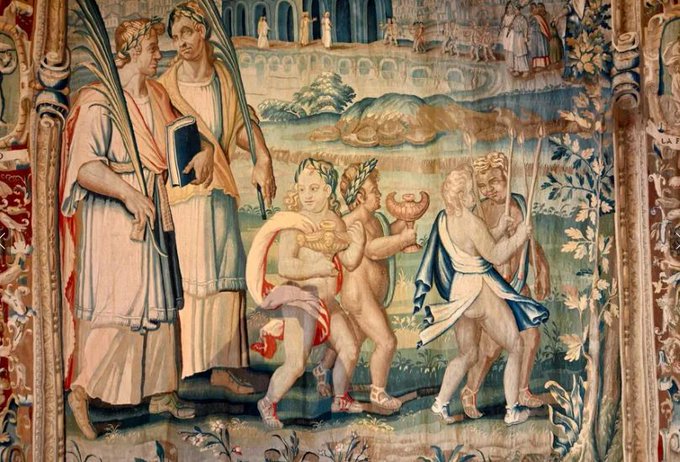
The feelings which this horror stirred in President Roosevelt were the intensest physical fear and the most profound mental loathing. What did he do? What could he do? The man seemed about to advance still closer to the bed, and returned the occupant’s gaze with a fixed stare. “Stand, or I’ll fire!” cried the President, taking in all this at a glance, revolver in hand. The man remained still. “What is your business here?” demanded Roosevelt, thinking he was addressing one of the roughs from below. The man was silent. “If you value your life, leave the room,” shouted the president, pointing his revolver. The man was motionless. “RETIRE! Or by Heaven I’ll send a bullet through you!” But the man moved not an inch. The President fired. The bullet lodged in the breast of the stranger, but he started not. The President fired again and the shot entered the heart, pierced the body, and lodged in the wall beyond; and the President beheld the hole where the bullet had entered, and the firelight glimmering though it. And yet the intruder stirred not. Astounded, the President dropped his revolver, and stood face to face before the unmoved man. “President Roosevelt,” spake the deep solemn voice of the perforated stranger, “in a vain you shoot me—I am already dead.” The President, with all his bravery, grasped, spellbound. The firelight gleamed through the hole in the body, and the eyes of the shooter were riveted there. “Fear nothing,” spake the mournful presence; “I seek but to divulge my wrongs. Until my death shall be avenge my unquiet spirit lingers here. Listen.” Speechless, motionless was the President; and the mournful apparition thus slowly and distinctly continued. “Four years ago, I was hired to be a foreman. One I trusted plunged a dagger into my heart while I slept. He covered my wound with a plaster. He reigned to mourn my death. He told the people here I died of a heart-complaint; that I had long been ailing. I had gold treasures. With my treasure secreted beneath his garments he paraded mock grief at my grave. #RandolphHarris 21 of 22

“Then he depated. In distant parts he sought to forget his crime; but his stolen gold brought him only the curse of an evil conscience. Rest and peace are not for him. He now prepares to leave his native land for ever. Under an assumed name that man is this night in San Francisco. In a few hours he will sail for Europe. President Roosevelt, you must prevent it. Justice and humanity demand that a murderer roam not at large, nor squander more of the wealth that is by right my children’s. Not until the spirit of my murderer shall be separated from the mortal clay can my spirit rest in peace.” And vanished. Most of the civilians you meet either do not want to know to know about the supernatural or blame you for brining it into their lives once you tell them about it. President Roosevelt tried to revisit the Winchester, but the Butler would not allow him inside because of the damage he did to the chamber. Mrs. Winchester had a remarkable memory and knew the location of every piece of material in the mansion, even in the vast store-rooms. The full scope of her generosity, charity, and many kindly acts will forever remain unknown and such was her sincere desire. Her donations were never made public. She contributed to charities of all faiths. In 1911 in New Haven, she established the William Wirt Winchester Memorial Sanitorium for Tuberculosis, endowing it with $1,200,000 (2021 adjusted for inflation $32,539,882.35). There were the little but visible acts that we nearby dwellers particularly noticed; those daily carriage trips with soup and hot food for a newly arrived settler on Stevens Creek Road, a man dying from Tuberculosis; those annual, unheralded trips to old Cupertino Church where my mother and other woman of The Ladies Aid Society collated used clothing for the local poors’ children. I remember a small boy’s thrill as he watched her liveried coachman alight from the polished Victoria and stagger up the church steps with a huge hamper of clothes, not used clothes, but dozens of newly purchased garments! That was Mrs. Winchester, the writer and many another contemporary remember. We never knew her intimately, but how we now wish we had! #RandolphHarris 22 of 22

Winchester Mystery House

The Winchester Mystery House features some very strange oddities like the door-to-nowhere. What purpose do you think it served Sarah during her time?

A 160-room mansion built to appease the spirits who died at the hands of the Winchester Rifle 👻
🗝 winchestermysteryhouse.com
Witches, Warlock, and Ghost in the Mansion of Mrs. Winchester!

Some people call themselves witches, and believe that they are able to contact and utilize powers from the invisible realm. However, there are many questions about witchcraft. Is it merely a game some people play? Is it beneficial to humanity? Or is it evil and dangerous? Universities all over the World are offering courses in occultism, and teams of scientists are investigating reports of mysterious magical phenomena all over the globe. They are baffled by some of the amazing incidents they encounter, and admit that present scientific knowledge cannot account for them. The Word of God may not provide a specific explanation for every problem one may encounter as one studies Satan, Satanism, and witchcraft, but it sheds much light on these subjects and offers practical guidelines by which God’s children can avoid dangers inherent in occultism. An unexpected and amazing development of this enlightened age is the resurgence of interest in Satan and an increase in occultic activity. A few years ago, most people assumed that the devil was dead, in the same manner that some theologians recently have affirmed the death of God. It is now becoming increasingly apparent that these reports were premature. Satan is very much alive, and is actively involved in today’s World. Though many scientists and philosophers still scoff at the idea of a personal devil, highly educated people all over the World meet regularly to worships Satan. Some groups, having dedicated themselves to the service of the devil, have committed brutal sacrificial slayings, while others engage in vile acts of immorality. Witchcraft, seances, and fortunetelling, for many years limited to areas of ignorance and superstition, are now discussed in highly respected magazines. Newspapers carry horoscopes, and multitudes consult them seriously every day. Prominent people have received a great deal of publicity by reporting the reception of personal messages from the spirits of the dead. The late Bishop Pike, for example, published a widely-read book telling of seances in which he purportedly talked with his dead son who had committed suicide. #RandolphHarris 1 of 16

Others, claiming the ability to foretell the future, also have become the objects of widespread interest, and have name Jeane Dixon comes to mind. She reportedly communicated with Mrs. Winchester who wanted to continue the restoration of her mansion. Mrs. Dixon is considered a prophetess by many people, and top leaders in government industry consult her for information about the future. In Europe today, more people are making a livelihood through the practice of occultism than the total number engaged in the Christian ministry. Belief in the existence of an unseen spiritual realm to be entered at death, and which has an influence upon human life, has captivated the minds of multitudes. The millions involved with occultism are unaware of the real nature of these mysterious and dangerous areas of investigation, and refuse to turn to the one source of truth regarding the kingdom of darkness. The Bible, the holy Word of God, reveals the true nature of the supernatural. It teaches that two real spiritual Worlds exist, one good and the other evil. It tells us that God is a Spirit (John 4.24), and that a great number of angels called “ministering spirits” (Hebrews 1.14) worship Him in Heaven and carry out His assignments upon Earth. The other invisible kingdom is evil, and is under the direction of Satan, who controls an organized host of wicked spirit beings. They are a formidable foe arrayed against God and His people, and the apostle Paul declared, “For we wrestle not against flesh and blood, but against principalities, against powers, against the rulers of the darkness of this World, against spiritual wickedness in high places,” reports Ephesians 6.12. All that can be known about the devil’s origin, fall, and present activity is to be found in the Bible. Although it does not specifically answer every question we may ask, it tells us the important facts about him and his kingdom. He was once a glorious, sinless creature, but he rebelled against God, was cast out of Heaven to Earth, and now leads his great army of spirit beings in a futile attempt to defeat God and destroy His people. #RandolphHarris 2 of 16

The devil was created an angelic being of great beauty and splendor and at one time had great favour with God. Ezekiel describes him in his sinless state as follows, “Son of man, take up a lamentation upon the king of Tyre, and say unto him, Thus saith the Lord God: Thou sealest up the sum, full of wisdom, and perfect in beauty. Thou hast been in Eden, the garden of God; every precious stone was thy covering, the sardius, topaz, and the diamond, the beryl, the onyx, and the jasper, the sapphire, the emerald, and the carbuncle, and gold; the workmanship of thy timbrels and of thy flutes was prepared in thee in the day thou wast created. Thou art the anointed cherub that covereth, and I have seen thee so; that wast upon the holy mountain of God; thou hast walked up and down in the midst of the stones of fire. Thou wast perfect in thy ways from the day that thou wast created, till iniquity was found in thee,” Ezekiel 28.12-15. Although the prophet was addressing these words primarily to an Earthly ruler, the king of Tyre, it is apparent that the full meaning of this prophecy is not exhausted by its reference to a flesh-and-blood monarch. The ultimate subject of Ezekiel’s words was Satan, the real instigator of the king’s pride and cruelty. Many Bible students reject this interpretation of Ezekiel’s dirge. They consider this viewpoint to be untenable and imaginative, and prefer to consider the prophet’s description to be a highly figurative portrayal of the king of Tyre. Some even say this lamentation incorporates a well-known Tyrian myth about a primeval being who lived in the “Garden of God” until he was expulsed for pride and rebellion. It is unlikely, however, that the inspired prophet would incorporate a myth into his message of judgment. Then, too, many prophetic pronouncements contained a double perspective. Isaiah, for example, after giving a stern warning of impending disaster, told Ahaz that the Lord would give a sign that the message he had spoken was true. “Therefore the Lord himself shall give you a sign; behold, the virgin shall conceive, and bear a son, and shall call his name Immanuel. Butter and honey shall he eat, and choose the good. For before the child shall know to refuse the evil, and choose the good, the land that thou abhorrest shall be forsaken by both her kings,” reports Isaiah 7.14-16. #RandolphHarris 3 of 16

The fourteenth verse is a definite reference to Christ, the virgin-born Son of God, but verses fifteen and sixteen point to Maher-shalal-hash-baz, the infant son of Isaiah whose birth and early years are described in the following chapter. Before the lad was three years old, Pekah and Rezin, king of Israel and Syria, had been executed as the prophet had predicted. Since this type of double reference is common in the prophetic Scriptures, it should not be thought strange that Ezekiel, in pronouncing judgment upon the king of Tyre, should also be alluding to Satan, who motivated the Earthly monarch to his sinful pride and cruelty. The prophet declared that in his original state Satan was a creature of great wisdom and beauty. He portrays the devil as having been in Eden, the garden of God, and describes him as having been lavishly adorned with jewels at that time. The translation in our King James Version also speaks of the “timbrels” and “flutes” prepared by him on the day he was created, and some Bible students have inferred from this that he had great musical ability and was given charge of the Heavenly choirs which sang their praises to God. The Hebrew words, however, are difficult to translate, and most students are convinced that the words rendered “timbrels” and “flutes” more likely refer to the gold settings and engravings of his ornamental attire. “Every precious stone was thy covering, the sardius, topaz, and the diamond, the beryl, the onyx, and the jasper, the sapphire, the emerald, and the carbuncle, and gold; the workmanship of thy timbrels and of thy flutes was prepared in thee in the day that thou wast created,” reports Ezekiel 28.13. This exalted creature is also declared to be “the anointed cherub that covereth,” reports Ezekiel 28.14, which indicates that God appointed him to have a place of special prominence in connection with his throne. The remainder of the verse, “thou wast upon the holy mountain of God; thou hast walked up and down in the midst of the stones of fire,” indicates that before his sin, he was in the immediate presence of God’s glorious holiness. #RandolphHarris 4 of 16

In fact, Satan may have been the most exalted of all the angels, and the memory of this former glory could have been the reason Michael did not dare “bring against him a railing accusation,” (Jude 9). Dr. Eric Sauer suggests the possibility that even before God created man, He committed to Lucifer a position of authority in relation to the Earth and its surrounding planets. For this reason, Satan is called the “god of this World” in the New Testament. In England and Scotland during the mediaeval and later periods of its existence, witchcraft was an offence against the laws of God and man; in Celtic Ireland dealing with the unseen were not regarded with such abhorrence, and indeed had the sanction of custom and antiquity. Consequently, when the Anglo-Normans came over, they found that the native Celts had no predisposition towards accepting the view of the witch as an emissary of Satan and an enemy of the Church, though they fully believed in supernatural influences of both good and evil, and credited their Bards and Druids with the possession of powers beyond the ordinary. The persecution of witches did not cease in the countries where that the growth and spread of witchcraft made headway—far from it; on the contrary it was kept up with unabated vigour. Infallibility was transferred from the Church to the Bible; the Roman Catholic persecuted the witch because Supreme Pontiffs had stigmatized her as a heretic and an associate of Satan, while the Protestant acted similarly because Holy Writ contained the grim command, “Thou shalt not suffer a witch to live.” The evil that was wrought by such amongst an unenlightened and superstitious people can be well imagined; unbelievers would be converted, while the credulous would be rendered more secure in their credulity. In the 16th century, during the rule of the Commonwealth Parliament thirty thousand witches were put to death in England. Even as late as 1690 torture was judicially applied to extract evidence, for in that year a Jacobite gentleman was questioned by the boots. However, Scotland, even at its worst, fades into insignificance before certain parts of the Continent, where torture was used to an extent and degree that can only be termed hellish; the appalling ingenuity displayed in the various methods of applying the “question extraordinary” seems the work of demons rather than of Christian, and makes one blush for humanity. #RandolphHarris 5 of 16

Nonetheless, the punishment of death by fire for witchcraft or sorcery was not employed to any extend in Ireland. We have one undoubted instance, and a general hint of some others as a sequel to this. How the two witches were put to death in 1578 we are told, but probably it was by hanging. Subsequent to the passing of the Act of 1586, the method of execution would have been that for felony. On the Continent the stake was in continual request. In 1514, three hundred persons were burnt alive for this crime at Como. Between 1615 and 1635, more than six thousand sorcerers were burnt in the diocese of Strasburg, while, if we can credit the figures of Bartholomew de Spina, in Lombardy a thousand sorcerers a year were put to death for the space of twenty-five years. The total number of person executed in various ways for this crime has, according to the Encyclopedia Britannica, been variously estimated at from one hundred thousand to several millions; if the latter figure be too high undoubtedly the former is too low. In the persecution of those who practised magical arts, no rank or class in society was spared; the noble equally with the peasant was liable to torture and death. This was especially true of the earlier stages of the movement when sorcery rather than witchcraft was the crime committed. For there is a general distinction between the two, though in many instances they are confounded. Sorcery was, so to speak, more of an aristocratic pursuit; the sorcerer was the master of the Devil (until his allotted time expired), and compelled him to do his bidding: the witch generally belonged to the lower classes, embodied in her art many practices which lay on the borderland between good and evil, and was rather the slave of Satan, who almost invariably proved to be a most faithless and unreliable employer. Anybody might become a victim of the witch epidemic; noblemen, scholars, monks, nuns, titled ladies, bishops, clergy—none were immune from accusation and condemnation. Behind the veil of all the hieratic and mystical allegories of ancient doctrines, behind the darkness and strange ordeals of all initiations, under the seal of all sacred writings, in the cryptic emblems of our old books on alchemy, in the ceremonies practised at reception by all secret societies, there are found indications of a doctrine which is everywhere the same and everywhere carefully concealed. #RandolphHarris 6 of 16

According to alchemists, the souls of the dead can be pinned into homunculi. A homunculi is a very small human being or humanoid creature; a supposed microscopic but fully formed human being which a fetus was formerly believed to develop. Much that passed current in the west as White (id est permissible) Magic was only a disguised goeticism, and many of the resplendent angels invoked with divine rites reveal their cloven hoofs. It is not too much to say that a large majority of past psychological experiments were conducted to establish communication with demons, and that for unlawful purposes. The pentagram is a symbol of faith, a symbol of the five elements Spirit, Air, Earth, Water, and Fire (one for each point), and the circle (the Universe) contains and connects them all. The Golden Ratio is the number 1.61803399, represented by the Greek letter Phi, and considered truly unique in its mathematical properties, prevalence throughout nature, and its ability to achieve a perfect aesthetic composition. It is integral to the pentagram. Shorter and longer sections of each line exist in golden ratio. If you look at God’s fingers and the general position of the bodies in Michelangelo’s fresco, you will see pentagrams. After Mrs. Winchesters mysterious disappearance in 1922, the mansion of emptied of her belongings. It took six trucks working around the clock for six weeks to move all of her furniture out. Many people say not only was it a lot of stuff, but the movers would get lost in the mansion. Nonetheless, some things were left behind. From time to time the mansion was rented out. A young couple Oliver Hall and Ethel Taylor rented the place, but the story of what happened is very fascinating. No one ever thought that Ethel Taylor would marry Oliver Hall; but he thought differently, and things which Oliver Hall intended had a queer way of coming to pass. He asked her to marry him before he went Yale. She laughed and refused him. #RandolphHarris 7 of 16

The Next time Oliver came home, he asked her again. However, she laughed, tosses her luscious blonde locks, and refused again. A third time he asked her; she said it was becoming a confirmed bad habit, and laughed at him more then ever. Oliver was not the only man who wanted to marry her, but his attempts were like an elephant, at whose clumsy feats were considerably amusing. Ethel was the belle of the Santa Clara Valley, and every one was in love with her more or less; it was a sort of fashion, like masher collars or Inverness capes. Therefore everyone was very annoyed as surprised when Oliver Hall walked into the Bank of Italy Building and invited everyone to his wedding. “Your wedding?” “You do not mean it?” “Who is the happy fair? When is it to be?” Oliver Hall filled his pipe and lighted it before he replied. Then he said—“I am sorry to deprive you fellow of your only joke—but Miss Taylor and I just let the Winchester mansion and are to married at the estate in April. “You do not mean it?” “He has got the mitten again, and its turned his head.” “No,” he said, rising “I see it is true. Lend me a pistol someone—or a first class fare to other end of Nowhere. Hall has bewitched the only pretty girl in our twenty-mile radius. Was it a mesmerism, or a love-potion, Oliver?” “Neither, sir, but a gift you will never have—perseverance—and the best luck a man ever had in this World. It is so glorious to know of a surety that now we can think, feel, speak, act—above all, love one another—haunted by no counteracting spell, responsible to no living creature for our life and our love.” There was something in his voice that silenced everyone, and all chaff of the other fellows failed to draw him further. The queer thing about it was that when we congratulated Miss Taylor, she blushed and smiled, and dimpled, for all the World as though she were in love with him, and had been in love with him all the time. They had been laughing very heartily, cherishing the mirth, as it were like those who caress a lovely bird that had been frightened out of its natural home and grown wild and rare in its visits, only tapping at the lattice for a minute, and then gone. Women are strange creatures. #RandolphHarris 8 of 16

In Santa Clara everyone who was anyone was asked to the wedding at Llanada Villa. Many people were truly more interested in the trousseau than the bride herself. The coming marriage was much canvasses at afternoon tea-tables, and at the Bank of Italy over the saddler’s, and the question was always asked: “Does she care for him?” The best man used to ask that question in the early days of their engagement, but after a certain evening in April, the pause between the acts, when the house was half-darkened, and the laughter died away made him never ask that question again. “How cold is it,” said John, the best man, shivering. Oliver shivered too; but not with cold, it was more like the involuntary sensation at which people say, “Someone is walking over my grave.” He said so, jestingly. “Hush, Oliver,” whispered John, and again the draught of cold air seemed to blow right between them. The next week, John was coming home from the Bank of Italy through the churchyard. Their church was on a thyme-grown hill, and the turf about it is so thick and soft that one’s footsteps are noiseless. He made no sound as he vaulted the low lichened wall, and threaded his way between the tombstones. It was at the same instant that he heard Oliver Hall’s voice, and saw his face. Ethel was siting on a low flat gravestone with the full splendour of the western sun upon her mignonne face. Its expression ended, at once and for ever, any question of her love of Oliver; it was transfigured to a beauty John should not have believed possible, even to that beautiful little face. Many people said she was like a reincarnation of Mrs. Winchester. Oliver lay at Ethel’s feet, and it was his voice that broke the stillness of the golden April evening. “This spring is cold for you, my love. I half wish we had taken courage, and sailed once more for Hispaniola. My dear, my dear, I believe I should come back from the if you wanted.” John coughed at once to indicate his presence, and passed on into the shadow fully enlightened. “Oh, no—oh, no! No mor of the sea. Llanada Villa is perfect for me,” she said, with another and stronger shoulder. #RandolphHarris 9 of 16

“Ethel,” he said at last, rousing himself, with a half-smile, “I think I must have grown remarkably attractive. Look! half the glasses opposite are lifted to our box. It cannot be to gaze at me, you know. Do you remember telling me I was the ugliest fella you ever saw?” “Oh, Oliver!” Yet it was quite true—she had thought him so, in far back, strange, awful times, when she, a girl of sixteen, had her mind wholly filled with one idea!—one insane, exquisite dream; when she brought her innocent child’s garlands, and sat him down under one spreading magnificent tree, which trees of the Victorian garden at Llanada Villa, until she felt its dews dropping death upon her youth, and her whole soul withering under its venomous shade. “Oh, Oliver!” She cried once more, looking fondly on his beloved face, where no unearthly beauty dazzled, no unnatural calm repelled; where all was simple, noble, manly, true. “My dearly beloved, I thank Heaven for that dear ‘ugliness’ of yours. Above all, though blood runs strong, they say , I thank Heaven that I see you no likeness to—” Oliver knew what name she meant, though for a whole year past—since God’s mercy made it to them only a name—they had ceased to utter it, and let it die wholly out of the visible World. The wedding was to be early in April. Two days before, John had to run up town on business. The train was late, of course, for they were on the South-Eastern, and as he stood grumbling with his watch in his hand, who should he see but Oliver Hall and Ethel Taylor. They were walking up and down the unfrequent end of the platform, that he obtrusively passed the pair with his Gladstone, and took the corner in a first-class smoking-carriage. He did this with as good an air of not seeing them as he could assume. John prided himself on his discretion, but if Oliver were traveling alone he wanted his company. He had it. “Hullo, old man,” came his cheery voice as he swung his bad into John’s carriage; “here is luck; I was expecting a dull journey!” “Where are you off to?” John asked, discretion still bidding him turn his eyes away, though he saw, without looking, that hers were red-rimmed. #RandolphHarris 10 of 16

“To old San Francisco,” he answered, shutting the door and leaning out for a last word with his sweetheart. He stood—clasping her hand secretly and hard; then he grew quitter; until, as the drop-scene fell, the same cold air swept past them. It was as if someone fresh from the sharp sea-wind had entered the box. “Oh, I wish you would not go, Oliver,” she was saying in a low, earnest voice. “I feel certain something will happen.” “Do you think I should let anything happen to keep me, and the day after tomorrow our wedding-day?” “Do not go,” she answered, with a pleading intensity which would have sent anyone’s Gladstone on to the platform and one after it. However, Oliver Hall was made differently; he rarely changed his opinion, never his resolutions. He only stroked the little ungloved hands that lay on the carriage door. “I must go, Ethel, The old boy’s have been awfully good to me, and now he is dying I must go and see him, but I shall come home in time for—” the rest of the parting was lost in a whisper and in the rattling lurch of the starting rain. “You are sure to come?” she spoke as the train moved. “Nothing shall keep me,” he answered; and they steamed out. After he had seen the last of the little figure on the platform he leaned back in his corner and kept his silence for a minute. When he spoke it was to explain to John that his godfather, whose heir he was, lay dying in Le Petit Trianon, some fifty miles away, and had sent for Oliver, and Oliver felt bound to go. “I shall be surely back tomorrow,” he said, “or, if not, the day after, in heaps of time. Thank Heaven, one has not to get up in the middle of the night to get married nowdays!” “And supposed Mr. Koshland dies?” “Alive or dead I mean to get married on Thursday!” Oliver answered, as he unfolded Oakland Tribune. At the Third and Townsend Depot they said their “goodbye,” and he got out and John saw him ride off; John went to Berkeley, where he stayed the night. #RandolphHarris 11 of 16

When John got home the next afternoon, a very wet one, by the way, his sister greeted him with—“Where is Oliver Hall?” “Goodness knows,” he answered testily. Every man, since Cain, has resented that kind of question. “I thought you might have heard from him,” she went on, “as you are to give him away tomorrow.” “Is he not back,” I asked, for I had confidently expected to find him at Llanada Villa. “No, John,”—his sister Alexis always had a way of jumping to conclusions, expecially such conclusion as were least favourable to her fellow-creatures—“he has not returned, and, what is more, you may depend upon it he will not. You mark my words, there will be no wedding tomorrow.” His sister Alexis has the power of annoying him which no other human being possess. “You mark my words,” John retorted with asperity, “you had better give up making such a thundering idiot of yourself. There will be more wedding tomorrow than ever, you will take first part in.” A prophecy which, by the way, came true. However, though, John could snarl confidently to his sister, he did not feel so comfortable when, late that night, standing on the door step of the Winchester mansion, heard the Oliver had not returned home. Filled with German superstitions, the young man grew almost pale, but kept a courteous calmness. There was nothing too ghastly or terrible for his own imagination to conjure up. John went home gloomily through the rain. Next morning brought a brilliant blue sky, gold sun, and all such softness of air and beauty of cloud as to make up a perfect day. However, he woke with a vague feeling of having gone to bed anxious, and of being rather averse to facing that anxiety in the light of full wakefulness. However, with his shaving-water came a note from Oliver which relieved his mind and sent him to the Winchester mansion with a light heart. Ethel was in the garden. He saw her blue gown through the hollyhocks as the mansion’s gates swung behind him. So he did not go up to the mansion, but turned aside down the turfed path. “He has written to you too,” she said, without preliminary greeting, when John reached her side. #RandolphHarris 12 of 16

“Yes, I am to meet him at the station at three, and come straight back to the mansion.” Her face looked pale, but there was brightness in her eyes, and a tender quiver about the mouth that spoke of renewed happiness. “Mrs. Koshland begged him so to stay another night that he had not the heart to refuse,” she went. “He is so kind, but I wish he had not stayed.” John was at the station at half-past two. He felt rather annoyed with Oliver. It seemed a sort of slight to the beautiful young lady who loved him, that he should come as it were out of breath, and with the dust of travel upon him to take her hand, which some of them would have given the best years of their lives to take. However, when the three o’clock train glided in, and glided out again having brought no passengers to their little station, John was more than annoyed. There was no other train for thirty-five minutes; he calculated that, with much hurry, he might just get back to the mansion in time for the ceremony; but, oh, what a fool to miss that first train! What other man could have done it? That thirty-five minutes seemed like a year, as he wandered round the station reading the advertisements and the time-tables, and the company’s bye-laws, and getting more and more angry with Oliver Hall. This confidence in his own power of getting everything he wanted the minute he wanted it was leading him too far. John hated waiting. After no sight of Oliver, he flung himself into the carriage that he had brough for him. “Drive to the mansion!” he said, as someone shut the door. “Mr. Hall has not come by this train.” Anxiety now replaced anger. What had become of the man? Could he have been suddenly taken will? John had never known Oliver to have an illness in his life. And even so, he might have telegraphed. Some awful accident must have happened. Maybe his corpse was picked up off a wreck, and committed to the deep—in the Gulf of Mexico. The thought that he had played her false never—no, not for a moment, entered John’s head. #RandolphHarris 13 of 16

Yes, something terrible had happened to Oliver, and on John lay the task of telling his bride. John almost wished the carriage would upset and break his head so that someone else might tell her, not Joh, who—but that is nothing to do with the story. It was five minutes to four as they drew up to the gate of the Winchester mansion. A double row of eager onlooker lined the path of the palm avenue. John sprang from the carriage and passed up between them. The estate’s gardener had a good front place near the door. He stopped. “Are they waiting still, Thomas?” he asked, simply to gain time, for of course he knew they were by the waiting crowd’s attentive attitude. “Waiting, sir? No, sir, why it must be over by now.” “Over! Then Mr. Hall has come?” ‘To the minute, sir; must have missed you somehow, and I say, sir,” lowering his voice, “I never see Mr. Oliver the bit so afore, but my opinion is he has been drinking pretty free. His clothes was all dusty and his face a sheet. I tell you I did not like the looks of him, with never a look or a word for none of us; him that was always such a gentleman!” I had never heard Thomas make so long a speech. The crowd in at mansion wee talking in whispers and getting ready rice and slippers to throw at the bride and bridegroom. The ringers were ready with their hands on the ropes to rung out the merry peal as the bride and bridegroom should come out. A murmur from the Winchester mansion announced them; out they came, Thomas was right. Oliver Hall did not look himself. There was dust on his coat, his hair was disarranged. He seemed to have been in some row, for there was a black mark above his eyebrow. He was deathly pale. However, his pallor was not greater than that of the bride, who might have been carved in ivory—dress, veil, orange blossoms and all. As they passed out the ringers stooped—there were six of them—and then, on the ears expecting the gay wedding peal, came the slow tolling of the Winchester Bell. A thrill of horror at so foolish a jest from the ringers passed through all the guests. #RandolphHarris 14 of 16

However, the ringers themselves dropped the ropes and fled like rabbits down the belfry stairs. The bride shuddered, and grey shadows came about her mouth, but the bridegroom led her on down the path where the people stood with the handfuls of rice; but the handfuls were never thrown, and the wedding-bells never rang. In vain the ringers were urged to remedy their mistake: the protested with many whispered expletives that they would see themselves further first. In a hush like the hush in the chamber of death the bridal pair passed into their carriage and its door slammed behind them. Then the tongues were loosed. A babel of anger, wonder, conjecture from the guests and spectators. “If I had seen his condition, sir,” said old Seymour to me as we drove off, “I would have stretched him on the floor of the mansion, sir, by Heaven I would, before I would have let him marry my daughter!” Then he put his head out of the window. “Drive like fury,” he cried to the coachman; “do not spare the horses.” He was obeyed. They passed the bride’s carriage. John forbore to look at it, and old Seymour turned his head away and swore. They reached reception hall before it. They stood in the hall doorway, in the blazing afternoon sun, and in about half a minute, they heard the wheels crunching the gravel. When the carriage stopped in the front of the steps old Seymour and John ran down. “Great Heaven, the carriage is empty! And yet—” he had the door open in a minute, and this is what he saw—No sign of Oliver Hall; and of Ethel, his wife only a huddled heap of white satin lying half on the floor of the carriage and half on the seat. “I drove straight here, sir,” said the coachman, as the bride’s father lifted her out; “and I will swear no one got out of the carriage.” We drove back to the Winchester mansion, and carried her back into the house in her bridal dress, and drew back her veil. #RandolphHarris 15 of 16

Her face. No one would ever forget. White, white and drawn with agony and horror, bearing such a look of terror as no one has never seen except in dreams. And her hair, her radiant blonde hair, it was white like snow. As John and her father stood, both half mad with horror and mystery of it, a body came up the avenue—a telegraph boy. They brought the orange envelop to John. He tore it open. “Mr. Hall was thrown from his horse on his way to the station at half-past one. Killed on the spot!” And he was married to Ethel Taylor in the Winchester Mansion at half-past three, in the presence of fifty guests. “I shall be married, dead or alive!” What had passed in that carriage on the drive to the reception hall? No one knows—no one will ever know. Oh, Ethel! Oh, my dear!” Before a week was over they laid her beside her husband in the Oak Hill Memorial Park on the northern most hill in the San Juan Bautista Hills of South San Jose. Thus was accomplished Oliver Hall’s wedding. Whether or not one believes in superstitions about spirits, it is hard to dismiss the unusual events that have taken place at this estate. Just like the original construction, restoration and maintenance work at Winchester Mystery House is never complete. The actual amount of materials requires is staggering. For example, it takes over 20,000 gallons of pain to cover the exterior—and by the time the workers have finished, they have to start all over again! Continuous work is being done on the massive structure, with carpenters, painters, and gardeners toiling away just like they did during Mrs. Winchester’s day. The sons, grandsons, and great grandson of Mrs. Winchester’s original employees have been some of these workmen! The restoration work is very demanding. Although you can still find spots where the cracked plaster has not been fixed after the 1906 Earthquake, almost everything will eventually be restored. This has been left like this on purpose, like a frozen moment in time, to show people how Mrs. Winchester lived there. An ongoing search continues for fine examples of the period furnishings, similar to what Mrs. Winchester herself would have used. Her original furnishings were auctioned off after her death and never have been recovered. The job of overseeing the restoration is a painstaking one. The historical accuracy of every project is researched and approved by the Restoration Board of Directors. Winchester Mystery House receives no funds from any government agency; the continuous restoration and maintenance programs are funded entirely from tour, café, and gift shop revenues. Since 1973, millions of dollars have been invested to ensure that this unique landmark will be preserved as the premier showcase of the Santa Clara Valley’s gracious past. #RandolphHarris 16 of 16

Winchester Mystery House

The Witches Cap 🧙🏼♀️- named for it’s conical resemblance of a witches hat. Many famous mediums claim this room was “important” to Sarah Winchester, although we do not know what it was used for. How did you feel when you experienced the Witches Cap for the first time? winchestermysteryhouse.com


The Awareness of Human Destructiveness Bursts!

Many humans, at one time, were primarily isolated, but enter relationships with members of the human family in order to satisfy their striving for please. Many of the relationships were sought after and conceived in a way that resemble relations in the marketplace. Each was only concerned with the satisfaction of one’s needs, but it is precisely for the sake of this satisfaction that one had entered into relations with others who offer what one needs, and need what one offers. Each living cell is supposed to be endowed with the two basic qualities of living matter, Eros (love) and the striving for death. We are struck by the significance of the possibility that the aggressiveness may not be able to find satisfaction in the external World because it comes up against real obstacles. If this happens, it will perhaps retreat and increase the amount of self-destructiveness holding sway in the interior. Impeded aggressiveness seems to involve a grave injury. It really seems as though it is necessary for us to destroy some other thing or person in order not to destroy ourselves, in order to guard against the impulsion to self-destruction. A sad disclosure indeed for the moralist! However, the most powerful impeding factor of all and one totally beyond any possibility of control is the death instinct. In theory of death instinct, the awareness of human destructiveness bursts forth in full strength, and destructiveness becomes the one pole of existence which, fighting with the other pole, Eros, forms they very essence of life. Destructiveness becomes a primary phenomenon of life. It is true that evil forces do exist but not true that they exist on the highest level. Insight into the ultimate sees the not. Evil is certainly present, plain to sight and unpleasant to experience, but it is not altogether, nor only what it seems. It is really an appearance, and reconcilable with the benign source of good. #RandolphHarris 1 of 20

Eros, present in every cell of living substance, has as its aim the unification and integration of smaller units into the unity of humankind. This is love that does not involve pleasures of the flesh, also known as the “love instinct”; love is identified with life and growth, and—fighting with the death instinct—it determines human existence. Humans are no longer conceived of as primarily isolated and egotistical, as l’homme machine, but as being primarily related to others, impelled by the life instincts which make one need union with others. Life, love, and growth are one and the same, more deeply rooted and fundamental then pleasures of the flesh and other pleasures. The change is vision shows clearly in this new evaluation of the Christian biblical commandment, “Though shalt love thy neighbour as thyself.” Anything that encouraged the growth of emotional ties between humans must operate against war. These ties may be of two kinds. In the first place they may be relations resembling those toward a loved object, though without having an aim for pleasures of the flesh. There is no need for psychoanalysis to be ashamed to speak of love in this connection, for religion itself uses the same words: “Thou shalt love thy neighbour as thyself.” This, however, is more easily said than done. The second kind of emotional tie is by means of identification. Whatever leads humans to share important interests produces this community of feeling, these identifications. And the structure of human society is to a large extent based on them. Why is history such a record of wars, oppressions, exploitations, invasions, and persecutions? Why have all the saviours, avatars, prophet, and saints succeeded only with individual humans here and there, not with the mass of humankind? #RandolphHarris 2 of 20

Is the religious dream of universal goodness nothing more than a dream? It is not a help but a self-deception to ignore the double polarity of existence, the yin-and-yang in the Universe, the shadow-self in humans. Only outside of religion, in the philosophic realm of the ultimate being, the Unique, the Real, where the entire World itself is cast out, can we talk of friction-free consciousness, and only in the deepest meditation can we share it. Although the experience is a temporary one, the peace in it so passes the understanding that “the Kingdom of Heaven” is its fit name. Here indeed is the Good raised to its highest degree. Here is a demonstration that human evil is but privation of good. What may be true on the ultimate level—the non-existence of evil, the reality of the Good, the True, the Beautiful—becomes false on the level of duality. Here the twofold powers, the opposites, do not exist, do hold the World in their sway. To deny relative evil here is to confuse different planes of being. The human who would deliberately harm one’s fellows for one’s own ends is a sinner. Evil arises only when an entity goes astray into the delusions of separateness and materialism, and thence into conflict with other entities. There is no ultimate and eternal principle of evil, but there are forces of evil, unseen entities who have gone so far astray and are so powerful in themselves that they work against goodness, truth, and justice. However, by their very nature such entities are doomed to eventual destruction, and even their work of opposition is utilized for good in the end and becomes the resistance against which evolution tests its own achievements, the grindstone against which is sharpens humans’ intelligence, the mirror in which its shows one one’s flaws. #RandolphHarris 3 of 20

The lower nature in incurably hostile to the higher one. It prefers its fleeting joys with their attendant miseries, its ugly sins wit their painful consequences, because this spells life to it. Everything and everyone has a negative side. One could fill up a lifetime looking for and finding it. One could go on grumbling, criticizing, ranting, and hating. However, there is also the beneficial side of it. The philosophical attitudes seeks deeper, keeps calmer, for it finds equilibrium on another plane. The descent from faith in Holy Spirit to faith in unholy spirits happens to those who are either too weak to remain at such a high altitude or too incapable of rising from a sensate view of existence. Evil can take every form, even that of the guru, the quest, and the leaner. Some yeas ago someone asked me, “What about absolute evil?” The answer is this: with Confucius we say that sin is due to ignorance, and with Pythagoras that evil is due to the absence of good. Ignorance leads to selfishness and extreme ignorance leads to extreme selfishness, which in turn leads to extreme evil. Now, all these are relative conditions and pass away in time as the person leans one’s lessons though the series of experience and corrects one’s mistake during reincarnations. There cannot be an absolute evil because there is only one Absolute Power, one God, one Supreme Being; and it is this which inspires the highest goodness know to humans when one discovers its presence, through the Overself, in one’s heart. In that sense only I said there was an absolute good. The pairs of opposites exist only in the finite, relative, and limited World. #RandolphHarris 4 of 20

There is no opposite to the Supreme Power in the timeless and infinite World, no Satan with whom God is in everlasting conflict. However, on its own level, Mind knows neither good nor bad. There is only IS-ness. It seems that there is evil in the World, but why? What bad humans have done is to let their evil grow like a noxious weed too large and their good too little, whereas good humans have cultivated a high proportion of goodness. There is no absolute evil. It is truer to talk of absolute god for that is there first. Why? Because God is there first. Humans came later and broke the divine laws little by little. They created their own evil consequences. Or for different reasons they harm others and have later to suffer for it. Humans were once looked at as machines driven by chemical processes: feelings, affects and emotions were explained as being caused by specific and identifiable physiological processes. Most of hormonology and of the neurophysiological findings of the last decades were unknown to these humans, yet with daring and ingenuity they insisted on the correctness of their approach. Needs and interests for which no somatic sources could be found were ignored, and the understanding of those processes which were not neglected followed the principles of mechanistic thinking. The model of human behaviour could be repeated today in a properly programmed computer. One develops a certain amount of tension which at a certain threshold has to be relieved and reduced, while this realization is checked by another part, the ego, which observes reality and inhibits relief when it conflicts with the needs for survival. This Freudian robot would be similar to Isaac Asimov’s science-fiction robot, but the programming would be different. Its first law would be not to hurt human beings, but to avoid self-damage or self-destruction. #RandolphHarris 5 of 20

However, the new theory does not follow this mechanistic “physiologizing” model. It is centered on a biological orientation in which fundamental forces of life (and its opposite: death) become the primal forces of motivating humans. The nature of the cell—that is, of all living substance—becomes the theoretical basis for a theory of motivation, not a physiological process that goes on in certain organs of the body. The new theory was perhaps closer to a vitalistic philosophy than to the concept of the German mechanistic materialists. What motivated Dr. Freud to postulate the death instinct? One factor was probably the impact of the First World War. He, like many other humans of his time and age, had shred the optimistic vision so characteristic of the European middle class, and saw oneself suddenly confronted with a fury of hate and destruction hardly believable before August 1, 1914. From there, Dr. Freud became a man preoccupied with death. He thought of dying every day, after he was forty; he had attacks of Todesangst (“fear of death”), and sometimes he would add to his “goodbye”: “You might never see me again.” One might surmise that Dr. Freud’s disposition would have impressed him as a confirmation of his fear of death, and thus contributed to the formulation of death instinct. This preoccupation with death grew in intensity and led him to a concept in which the conflict between life and death was at the center of human experience, rather than the conflict between the two life-affirmative drives, pleasures of the flesh and ego drives. To assume that humans need to die because death is the hidden goal of one’s life might be considered a kind of comfort destined to alleviate one’s fear of death. And it is true, when people’s lives are in danger and they lack security that they learn not to fear death. #RandolphHarris 6 of 20

It seems likely that many hearts in American society have waxed cold since September 11, 2001, when there was an attack on American soil that claimed the lives of over 3,500 people. Many people were too young to realize how devastating it was at the moment, but I believe the tragedy affected everyone much like Dr. Freud was confronted with the fury of hate and destruction from August 1, 1914. Acts on war in your homeland make people realize that life is not promised and it can have a psychological impact. “What is faith? It is the confident assurance that what we hope for is going to happen. It is the evidence of things we cannot yet see,” reports Hebrews 11.1. Begin today to believe that what you have hoped for is going to happen, that good things are on their way. Notice, faith has to do with the unseen World. You may not be able to perceive anything beneficial happening in your life with your natural eyes today. In fact, everything may be falling apart—your finances, your health, your business, your relationships with your family and friend. All kind of problems may be on the horizon. However, do not be discoursed, turn your focus to the supernatural World, look to God and Jesus Christ for solutions and know that your harmony and peace will be restored. The World tells you that you need to live out loud and seeing is believing. However, God says seek ye the Kingdom of Heave first, and all these things will be added to you. Look through your Heavenly eyes of faith, and once you confirm something by faith, it will manifest in the physical World. What do you do when you see others being honored or elevated? You could feel bad about their feeling good. Or you could consider these as occasions for your feeling good about feeling bad. Why? #RandolphHarris 7 of 20

If only you knew it, the contempt of humans on Earth should not cause you to shed a single tear. What should you do? Direct your heart toward God in Heaven. In the past, many men did not view woman as equals with men, but some did. Overall, there was a patriarchal bias. However, the very essence of the Platonic myth is that male and female were once one and were then divided into halves, which implies, of course, that the two halves are equals, that they form a polarity endowed with the tendency to unite. Eros (love) aims at complicating life and preserving it, and hence is also conservative, because with the emergence of life an instinct is born which is to preserve it. However, we must ask, if it is the nature of the instinct to re-establish the earliest state of existence, inorganic matter, how can it at the same time tend to re-establish a later form of existence, namely life? Well, according to Plato’s report in the Symposium concerning the original unity of man who was then divided into halves by Zeus, after this division, each desiring his other half, they came together and threw their arms about one another eager to grow into one. The living substance at the same time of its coming to life was torn apart into small particles, which have ever since endeavoured to reunite through martial union and procreation. These instincts, in which the chemical affinity of inanimate matter persisted, gradually succeeded, as they developed through the kingdom of the protists, in overcoming the difficulties put in the way of that endeavour by an environment charged with dangerous stimuli—stimuli which compelled them to form a protective cortical layer. These splintered fragments of living substance in this way attained a multicellular condition and finally transferred the instinct for reuniting, in the most highly concentrated form, to the combination of two souls. #RandolphHarris 8 of 20

So it is no wonder so many people feel so fractured and incomplete. Their living substance was torn apart. Do you see things getting better in your life? Or are you just drifting along, accepting whatever comes your way? “I know I was not going to get that Cresleigh Havenwood House Residence 4. Noting good ever happens to me.” “This is just my lot in life. I knew I would never get that BMW 750Li with Xdrive.” “I knew I would never be blessed.” In the face of God’s blinding glory, many of us have to be blinkered. Perhaps that is why, without our peripheral vision, we are so easily hoodwinked by Vanity. If I assess myself correctly, never has an injury been done to me by another creature, and hence I have no right, at least not yet, to make a ruckus against God, my Righteous if Riotous Lord. Why? Because I have sinned against God frequently and gravely. Deservedly, therefore, should every creature pick up one’s pike against me. So it is only reasonable to conclude that confusion and contempt are my just due. Yours, however, is praise, honour, and glory. And in the light of these considerations, unless I prepare myself—by being looked down upon by every giraffe, outsped by every gazelle, overlooked by every gryphon—I can be neither pacified and stabilized interiorly, spiritually illuminated, nor fully one with God. Do not limit God with your small thinking. Have extraordinary vision for your life and live with faith and expectancy. You will be surprised that you will become what you believe. Some of the reasons are blessings are delayed in the fulfillment of the promise for year after year, is simply the fact that we cannot see it through our eyes of faith. #RandolphHarris 9 of 20

Is God trying to do something out of the ordinary in your life? Be sure to get into agreement with God. Do not tell God the reasons why things cannot happen. All the time God is trying to plant new seed of success inside of us. He is showing us that if we do not conceive in our hearts through faith, it will never come to pass. “The things which are impossible with humans are possible with God,” reports Luke 18.27. Let that word plant faith inside of your heart. You do not have to figure out how God is going to solve your problems, but turn the situation over to God. God can do what human beings cannot or will not do. God is supernatural. If you can put your trust and confidence in the Lord, God will surely bring it to pass. If you can see the invisible, God will do the impossible. In God, the love of a friend should stand. God is Ever-living, Everlasting Truth, your friend will not shed a tear if you live of die. It is because of God that love of a friend should stand. It is because of God that one should be loved, that is to say, everyone who is seemed good to you and who is very dear in this life. Without God the love of friendship will not have the strength to last. Nor is the love of friendship true and clear unless God is an integral part of it; that is as His Augustine described it in his Confessions (4.4). Which is another way of saying, you ought to be dead to two-person friendships, especially when the other person is another creature. However, when the other person is God, then something odd happens. The closer you approach God, the farther you recede from every friendly solace. Also the higher you ascend to God, the deeper you descend into yourself and the viler you appear to yourself. I want to get a grander vision for my life, Father, and then live it out with faith and expectancy, knowing that I will become what I believe. Today, I will focus on You, who You are and what You can do in and through me. #RandolphHarris 10 of 20

Whoever attributes good to oneself only makes it more difficult for oneself to receive the grace of God. Why? Because, as the spiritual wisdom echoing Proverbs (3.34), Psalms (55.22), and First Peter (5.5) has it, the grace of the Holy Spirit always seeks the humble heart. To annihilate yourself, to empty yourself of all created love—that is what you ought to do. And what I ought to do is fill that very same space with a very great grace. When you warm to the wonderfulness of the created World, the Creator’s respect for you begins to cool. Because of the Creator, if for no other reason, learn how to conquer yourself in all things. Do that, and you will have the strength to reach out to Divine Knowledge. However slight it may be, unruly love and irregular respect delay, even detour, your spiritual progress. The anal libido has a deep affinity to the death instinct. Now, controlling and possessing are certainly tendencies opposite of loving, furthering, liberating, which form a syndrome among themselves. However, “possession” and “control” do not contain the very essence of destructiveness, the wish to destroy, and hostility toward life. No doubt, the anal character has a deep interest in and affinity to feces as part of their general affinity to all that is not alive. Feces are the product finally eliminated by the body, being of no further use to it. The anal character is attracted by feces as one is attracted by everything that is useless for life, such as dirt, death, decay. We can say that the tendency to control and possess is only one aspect of the anal character, but milder and less malignant than hatred of life. Eros (love), therefore is looked upon as the biologically normal aim of development, while the death instinct is seen to be based on a failure of normal development and in this sense a pathological, though deeply rooted striving. #RandolphHarris 11 of 20

If one wants to entertain a biological speculation one might relate anality to the fact that orientation by smell is characteristic of all four-legged mammals, and that the erect posture implies the change from orientation by smell to orientation by sight. The change in function of the old olfactory brain would correspond to the same transformation of orientation. In view of this, one might consider that the anal character constitutes a regressive phase of biological development for which there might even be a constitutional-genetic basis. The anality of the individual could be considered as representing an evolutionary repetition of a biological human functioning. The theoretician arrives at the conclusion that humans have only the alternative between destroying oneself (slowly, by illness) or destroying others; or—putting it in other words—between causing suffering either to oneself or to others. The humanist rebels against the idea of this tragic alternative that would make war a rational solution of this aspect of human existence. An alternate is repression of the instinctual demands, which are the development of culture and civilization. Some people say the Europeans created such a successful society because they learned the art of self-control. The repressed instinctual drive was “sublimated” into valuable cultural channels, but still at the expense of full human happiness. On the other hand, repression led not only to increasing civilization but also to the development of neurosis among the many in whom the repressive process did not work successfully. Lack of civilization combined with full happiness or civilization combined with neurosis and diminished happiness seemed to be the alternative. #RandolphHarris 12 of 20

The contradiction between the death instinct and Eros confronts humans with a real and truly tragic alternative, a real alternative because one can decide to attack and wage war, to be aggressive, and to express one’s hostility because one prefers to do this rather than to be sick. That this alternative is a tragic one hardly needs to be proven. Something very remarkable, which we should never have guessed and which is nevertheless quite obvious. What happens to the aggressor when one renders one’s desire for aggression innocuous? One’s aggressiveness is introjected, internalized; it is, in point of fact, sent back to where it came from—that is, it is directed toward one’s own ego. There it is take over by a portion of the ego as super-ego, and which now, in the form of “conscience,” is ready to put into action against the ego the same harsh aggressiveness that the ego would have liked to satisfy upon other, extraneous individuals. The tension between the harsh super-ego and the ego that is subjected to it, is called by us the sense of guilt; it expresses itself as a need for punishment. Civilization, therefore, obtains mastery over the individual’s dangerous desire for aggression by weakening and disarming it and by setting up an agency within one to watch over it, like a garrison in a conquered city. The transformation of destructiveness into a self-punishing conscience does not seem to be as much as an advantage as it may seem to imply. According to this theory of conscience, it would have to be as cruel as the death instinct, since it is charged with its energies, and no reason is given why the death instinct should be “wakened” and “disarmed.” #RandolphHarris 13 of 20

Rather, it would see that the following analogy expresses the real consequences of this thought more logically: a city that has been ruled by a cruel enemy defeats one with the help of a dictator who then sets up a system that is just as cruel as that of the defeated enemy; and this, what is gained? The instinct of destruction, moderated and tamed, and, as it were, inhibited in its aim, must, when it is directed toward objects, provide the ego with the satisfaction of its vital needs and with control over nature. This is a good example of sublimation; the aim of the instinct is not weakened, but it is directed toward other socially valuable aims, in this case the “control over nature.” This sounds, indeed, like a perfect solution. Humans are freed from the tragic choice of destroying either others or themselves, because the energy of the destructive instinct is used for the control over nature. However, we must ask, can this really be so? Can it be true that destructiveness becomes transformed into constructiveness? What can “control over nature” mean? Taming and breeding animals, gathering and cultivating planets, weaving cloth, building Cresleigh Homes, manufacturing pottery and many more activities including the construction of Ultimate Driving Machines, railroads, airplanes, skyscraper: al these are acts of constructing, building, unifying, synthesizing, and, indeed, if one wanted to attribute them to one of the two basic instincts, they might be considered as being motivated by Eros rather then the death instinct. With the possible exception of killing animals for their consumption and killing humans in war, both of which could be considered as rooted in destructiveness, material production is not destructive but constructive. #RandolphHarris 14 of 20

As a result of a little speculation, we have come to suppose that this instinct is at work in every living creature and is striving to bring it to ruin and to reduce life to its original condition of inanimate matter. Thus is quite seriously deserved to be called a death instinct, while procreation is the instinct represented by the effort to live. The death instinct turns into the destructive instinct when, with the help of social organs, it is directed outwards, on to objects. The organism preserves its own life, so to day, by destroying an extraneous one. Some portion of the death instinct, however, remain operative within the organism, and we have sought to trace quite a number of normal and pathological phenomena to this internalization of the destructive instinct. We have even been guilty of the heresy of attributing the origin of conscience to the diversion inwards of aggressiveness. If this process is carried too far, you will notice that it is by no means a trivial matter; it is possibly unhealthy. On the other hand if these forces are turned to destruction of the external World, the organism will be relieved and the effect must be beneficial. This would serve as a biological justification for all the ugly and dangerous impulses against which we are struggling. It must be admitted that they stand nearer to Nature than does our resistance to them for which an explanation also needs to be found. When the good is absent, the evil is present. The cynic who denies the existence of the good, the dreamer who denies the existence of the evil—each ignores the other half of life as evidence in history and in the World around one. When we go to the roots—that is what “radically” literally means—and discover that a great deal of our conscious thinking only veils our real thoughts and feelings and hides the truth; most of our conscious thought is a sham, a mere rationalization of thoughts and desires which we prefer not to be aware of. #RandolphHarris 15 of 20

This is revolutionary because it leads people to open their eyes to the reality of the structure of the society they live in and hence to the wish to change it in accordance with the interests and desires of the vast majority. Much of the liberal middle class was suspected of being neurotic because their liberation of pleasures of the flesh is largely part of the ever-increasing consumerism. If people are taught to spend and spend, rather than, as in the nineteenth century, to save and save, if they were transformed into “consumers,” one had not only to permit but encourage consumption of pleasures of the flesh. It is after all the most simple and the cheapest of all consumption. Conservatives used to have a strict code of chastity and liberty of pleasures of the flesh lead to an anticonservative revolutionary attitude. If anything, historical development has shown that liberation of pleasures of the flesh has served the development of consumerism and weakened political radicalism. What more people really want is not to become more human, more free, more independent—that would mean more critical and revolutionary-minded—but they want to suffer no more than the average member of their class. They hardly see a really happy person, only a few people who have succeeded in being relatively satisfied with their lot, especially if they are successful and admired by others. Naturally, quite a few people, having a sympathetic listener to talk to, feel better, aside from the fact that as years go by experience in living makes the average person improve one’s lot, except those who are too sick to learn from experience. The contemporary capitalist society is considered to be the highest, most developed form of social structure. It is because all other social structures are more primitive or utopian, and not really successful. #RandolphHarris 16 of 20

An ever-growing number of people have become aware that capitalist society is just one of innumerable social structures and is neither more nor less “real” than the societies of Central African tribes. The invention of artillery and fortifications has in our times forces the sovereigns of Europe to reestablish the use of regular standing troops to guard their fortresses. Yet however, legitimate the motives, there is reason to fear that the effect will be no less fatal. It will be no less necessary to depopulate the rural areas in order to raise armies and garrisons. To maintain them it will be no less necessary to oppress the peoples. And these dangerous establishments have in recent times been growing so rapidly in all of our part of the World, that no one can foresee anything but the imminent depopulation of Europe, and sooner, or later, the ruin of the people who inhabit it. Be that as it may, it should be noted that such institutions necessarily subvert the public domain, leaving only the wearisome resources of subsidies and taxes, which remain for me to discuss. It would be remembered here that the foundation of the social compact is property, together with its first condition that each person should be maintained in the peaceful enjoyment of what belongs to one. It is true that by the same treaty each person at least tacitly obliges oneself to be assessed for public needs. However, since this commitment cannot hard the fundamental law and presumes that contributors acknowledge the evidence of need, it is clear that to be legitimate, this assessment should be voluntary. It is not based on a private will, as if it were necessary to have the consent of each citizen, who should pay only as much as one pleases. This would be directly contrary to the spirit of the confederation. #RandolphHarris 17 of 20

Rather, it should be through the general will, by majority vote, and on the basis of proportional rates that leave no room for an arbitrary imposition of taxes. This truth (that taxes can be legitimately established only by the general consent of the people or its representatives) had generally been recognized by all the philosophers and jurists who have any reputation in matters of political right. While some of them have established maxims that appear contrary, it is easy to see the private motives that moved them to do so. They stipulate so many conditions and restrictions that it all boils down to exactly the same thing. For whether the people can reuse it or whether the sovereign should not demand it, is a matter of indifference as far as right is concerned. And if it is only a question of force, it is utterly pointless to inquire what is or is not legitimate. The contributions levied on the people are of two kinds: real taxes (levied on things) and personal taxes (paid by the head). Both are called taxes or subsidies. When the people sets the amount it pays, it is called a subsidy; when it grants the entire proceeds of an assessment, it is a tax. In The Spirit of the Laws we find that a head tax is more in keeping with servitude, while a real tax is more suited to liberty. This would be incontestable, were everyone’s head share equal. For nothing would be more disproportionate than such a tax. It is especially in an exacting observance of proportions that the spirit of liberty consists. However, if a head tax is exactly proportioned to the means of private individuals and is thus at once both and personal, it is the most equitable and, as a result, the one best suited to free humans. At first these proportions appear quite easy to observe, because, being relative to each person’s position, the indications are always public. #RandolphHarris 18 of 20

However, besides the fact that greed, influence-peddling, and fraud know how to leave no evidence behind, it is rare that an account is taken of all the elements that should enter into these calculations. First, one ought to consider the relationship of quantities according to which, all things being equal, someone who has ten times more goods than someone else should pay ten times more. Second, one ought to consider the relationship of use, that is, the distinction between what is necessary and what is superfluous. Someone who has only the bare necessities of life should not pay anything at all. Taxing someone who has superfluities can, in time of need, be extended to everything over and above the necessities of life. To this one will declare that, given one’s rank, what would be superfluous for a human of inferior standing is necessary for one. However, that is a lie. For humans of superior standing have two legs, just like a cowherd, and, like the cowherd, has only one stomach. Moreover, this alleged necessity of life is so little necessary to one’s standing that, if one knew how to renounce these things for some worthy cause, one could only be respected more. The people would prostrate themselves before a minister who would go on foot to the council because one had sold one’s Ultimate Driving Machines when the state had a pressing need. Finally, the law does not demand magnificence of anyone, and propriety is never reason against right. A cultivated human of taste and feeling can find much that is beautiful in nature and art; and if one is also a moral idealist, one will find much that is good and virtuous in human life and experience. However, it would be incomplete to stop there and ignore the fact that there is also around us much that is base, dark, and even evil. #RandolphHarris 19 of 20

The two sides put together form a complete observation. However, it is only the mystics and philosopher who can see—because it requires a deeper penetration than the intellect and the sense can give—that the dark side deals with the World of appearances, a World which is fleeting and ephemeral, whereas the good side and the beautiful side is merely a hint of that other World closer to Reality. Evil is a very real problem in this World of time and space. Evil forces exist and must be fought with all our strength. Nevetheless the Power out of which all things and all entities come is a beneficent one. Love is its radiation. There is no evil and no pain in it. They begin only on the lower level of separation and differentiation. Wild air, World-mothering air, nestling me everywhere, that each eyelash or hair girdles; goes home betwixt the fleeciest, frilest-flixed snowflake; that is fairly mixed with riddles, and is rife in every least thing is life; this needful, never spent, and nursing element; my more than meat and drink, my meal at every wink; their air, which, by life’s law, my lung must draw and draw now but to breathe its praise. Please give rain. We are the pure who camped by water. For Jacob’s sake who set the rods in water, O speed us! He strained and rolled the stone from off the water. Please give rain! Blest heirs to Torah’s quickening water, O save us! To win for them and for their offspring water. Please give rain! Today as then we cry for water. For Moses’ sake who found his people water, O speed us! He smote the rock and lo! out gushed the water. O save us, mighty God! Please give us rain! Our sires sang round the well of water. O save us! Because of Moses at Meribah’s water, O speed us! At Thy command he gave the thirsting water. O save us, mighty God! please give rain! Thy holy servants poured Thee water. O save us! For Thy chief minstrel’s sake who longed for water, O speed us! Yet turned and made libation with the water, O save us, mighty God! Please give rain! Four plants we wave that love the water, O save us! For American’s sake, the home of living water, O speed us! The parched Earth open to the Heavens’ water, O save us, mighty God! #RandolphHarris 20 of 20

Cresleigh Homes

Plenty of room for pumpkin pie filling and spices! A pantry this big lets us imagine we’re on our own episode of Great British Baking Show. 🥧 #Havenwood offers thoughtful floorplans with space for everything practical.

Now selling! Cresleigh Havenwood features four distinct floor plans ranging from 2,293 – 3,489 square feet and offering up to five bedrooms. Each plan has been thoughtfully designed and includes great features such as single story homes, guest suites, optional offices, garage workshops, and more!

Get the most out of your new home with Cresleigh’s All Ready smart home featuring all the connectivity needed to keep your house running. Best of all, each Cresleigh home comes with owned solar included!

Located off of Virginiatown Road and McCourtney Road, residents of the 83 homesites of Cresleigh Havenwood will benefit from a brand new neighborhood in the charming City of Lincoln. Palo Verde Park, is just down the street and there’s plenty of recreation to take part in all around town. https://cresleigh.com/havenwood/


Must You Wait for the Heart to Change First?

Many people believe that a neurotic or bad or unhappy child must have parents who have produced his negative state, while on the contrary the happy and healthy child has a correspondingly happy and healthy environment. In fact parents have taken the whole of the blame for the unhealthy development of a child on themselves and equally so the praise for the happy outcome of childhood. All data show that they should have not done so. Here is a good example: A psychoanalyst may see a very neurotic, distorted person with a terrible child and say, “It is obvious that the childhood experiences have produced this unhappy outcome.” If one would only ask oneself, however, how many people one had seen who came from the same type of family constellation and turned out to be remarkable happy and healthy people, one would begin to have doubts about the simple connection between childhood experiences and the mental health or illness of a person. The first factor which accounts for this theoretical disappointment must lie in the analyst’s ignoring the differences in genetic dispositions. Take a simple example: One can see even among newborn infants a difference in degree of aggressiveness or timidity. If the aggressive child has an aggressive mother, this mother will do one little harm or perhaps even much good. It will learn to fight with her and not be frightened of her aggressiveness. If a timid child is confronted with the same mother, it will be intimidated by the mother’s aggressiveness, it will tend to become a frightened, submissive and later on perhaps a neurotic person. #RandolphHarris 1 of 18

Indeed, we touch here upon the old and much discussed problem of “nature versus nurture” or genetic disposition versus environment. The discussion of this problem has by no means yet led to conclusive results. From my own experience I have come to the conclusion that genetic dispositions play a much greater role in the formation of a specific character than most analysts credit it with doing. I believe that one aim of the analyst should be to reconstruct a picture of the character of the child when it was born in order to study which of the traits one finds in the analysand are part of the original nature and which are acquired through influential circumstances; furthermore, which of the acquired qualities conflict with the genetic ones and which tend to reinforce them. What we find very often is that by the wish of the parents (personally an as representatives of society) the child is forced to repress or to weaken one’s original dispositions and to replace them by those traits which society wants one to develop. At this point we find the roots of neurotic developments; the person develops a sense of false identity. While genuine identity rests upon the awareness of one’s suchness in terms of the person one is born as, pseudo-identity rests upon the personality which society has imposed upon us. Hence a person is in constant need of approval in order to keep one’s balance. Genuine identity does not need such approval because the person’s picture of oneself is identical with one’s authentic personality structure. #RandolphHarris 2 of 18

If throughout childhood, a child were convinced that nobody would ever care for one unless one wanted something from them, that there was no sympathy or love which was no the payment for services or a bribe to preform, a person may go through life without ever having experienced that somebody cares or is interested and does not want anything in return. However, when it happens that such a person experiences another person’s having a real interest without wanting anything, this might drastically change such character traits as suspicion, fear, the feelings of being unlovable, et cetera. Furthermore, the relationship between parents and children is usually seen as a one-way street, namely the effect parents have upon children. However, what is often ignored is that this influence is by no means one-sided. A parent may have a natural dislike for a child and even for a newborn baby, not only for reasons which are often discussed—that it is an unwanted child or that that the parent is destructive, sadistic, et cetera—but for the reason that child and parent just are not compatible by their very natures, and that in this respect the relationship is no different from that between grown-up people. The parents may just have a dislike for the kind of child one produced and the child may feel this dislike for the kind of parents one has and being the weaker, one is punished for one’s dislike by all kinds of more or less subtle sanctions. The child—and equally the mother—is forced into a situation where the mother has to take care of the child and the child has to accept the mother in spite of the fact that they heartily dislike each other. #RandolphHarris 3 of 18

The child cannot articulate that it does not like the mother; the mother would feel guilty if she admitted to herself that she did not like a child she gave birth to, and so both behave under a special kind of pressure and punish each other for being forced into an unwanted intimacy. The mother pretends to love the child and subtly punishes it for being forced to do so, the child pretends in some way or another to love the mother because one’s life depends totally on her. In such a situation a great deal of dishonesty develops which the children often express in their own indirect ways of rebellion and which the mothers usually negate because they feel that nothing could be more shameful than not to like one’s own children. Only one who believes is obedient, and only one who is obedient believes. Jesus says: “First obey, perform the external work, renounce your attachments, give up the obstacles which separate you from the will of God.” Do not say that you have not got faith. You will not have it so long as persist in disobedience and refuse to take the first step. People generally assume that our beliefs and attitudes determine our actions. So if we want to change the way people act, their hearts and minds had better be changed. This assumption lies behind most of our teaching, preaching, counseling, and child rearing. And to some extent it is true: behaviour follows attitudes. However, if social psychology has taught us anything during the last thirty year, it is that the reverse is also true: we are as likely to act ourselves into a new way of thinking as to think ourselves into action. #RandolphHarris 4 of 18

Evil acts shape the self. People induced to harm an innocent victim typically come to disparage their victim. Those induced to speak or write statements about which they have misgivings will often come to accept their little lies. Saying becomes believing. More action affects the actor, too. Children who resist a temptation tend to internalize their conscientious behaviour. Helping someone typically increases liking for the person helped. Those who teach a moral norm to others subsequently follow the moral code better themselves. Generalizing the principle, it would seem that one antidote for the corrupting effects of evil action is repentant action. Act as if you love your neighbour—without worrying whether you really do—and before long you will like the person more. Racial attitudes have followed racial behaviour. Racial attitudes have followed racial behaviour. Prior to desegregation in the United States of America it was often said that you cannot legislate racial attitudes—you must wait for the heart to change first. However, after the initiation of desegregation European American racial attitudes became noticeably less prejudiced. Moreover, as different regions of the country have come to act more alike, they have also come to think more alike. Political socialization techniques have effectively employed the principle. For instance, many people seem to be in support of undocumented people coming into America, even though it is a crime, but are enforcing more laws and restrictions on legal Americans. Many Americans have expressed discomfort at the contradiction of demanding that people follow the law, and their support for undocumented immigration. #RandolphHarris 5 of 18

Prevented from say what they really believe, they try to establish their psychic equilibrium by consciously making themselves believe what they said, which is essentially “Most people should have to follow the law, but I support crime in certain circumstances.” But what happens when they start to rationalize illegal actions of their own, will that lead to lawlessness on a wide scale? Many modern therapy techniques make a more constructive use of action. Behavior therapy and rational-emotive therapy and rational-emotive therapy both prompt their clients to rehearse and practice more productive behaviour. We can all learn a practical lesson here. Like Moses, Jonah, and other biblical heroes, we do not feel like doing what we know we ought. The remedy is to get up and act anyway—to put our fingers on the keyboard and force ourselves to begin that essay or letter, to go to the phone and dial that number, to confront or hare with that person, to turn off the TV and begin studying for that exam. When we do so, we often find that our forced behaviour begins to gain momentum as a real interest in our subject takes hold. Our feelings are hard to control, but we can control our behaviour and by doing so indirectly influence our feelings. To be sure, the attitudes-follow-behaviour principle is more potent in some situations than others—especially in those where people feel some choice and responsibility for their behaviour rather than attributing it to coercion. Nevertheless, it is now a fundamental rule of social psychology that behaviour and attitude generate one another in an endless spiral, like chicken and egg. #RandolphHarris 6 of 18

This principle affirms the biblical understanding of action and faith, or an obedience and belief. Depending on where we break into this spiraling chain, we will see faith as a source of action or as a consequence. Action and faith, like action and attitude, feed one another. Much as conventional wisdom has insisted that our attitudes determine our behaviour, Christian thinking has usually emphasized faith as the source of action. Faith, we believe, is the beginning rather than the end of religious development. The experience of being “called” demonstrates how faith can precede action in the lives of the faithful. Elijah is overwhelmed by the Holy as he huddles in a cave. Paul is touched by the Almighty on the Damascus Road. Ezekiel, Isaiah, Jeremiah, and Amos are likewise invaded by the Word, which then explodes in their active response to the call. In each case, an encounter with God provoked a new state of consciousness, which was then acted upon. This dynamic potential of faith is already a central tenet of Christian thought. For the sake of balance, we should also appreciate the complementary proposition: faith is a consequence of action. Throughout the Old and New Testaments we are told that full knowledge of God comes through actively doing the Word. Faith is nurtured by obedience. We come to know truth by reason and quiet reflection. This view, translated into Christian terms, equates faith with cerebral activity—orthodox doctrinal propositions. The contrasting biblical view assumes that reality is known through obedient commitment. “The Lord touched their eyes, saying ‘It shall be done to you according to your faith,’” Matthew 9.29. #RandolphHarris 7 of 18

If an individual wants to change one’s life, that change must be conceived on the inside. Once that new and improved image shows up, the God will easily develop I on the outside. Living your dream is that simple. Anyone can enjoy a happier and healthier lifestyle. However, the change will not happen immediately and it will not be easy. However, for any improve me, the inception of your vision must occur within your heart and mind first, then it will manifest in your life. “Praise be to the name of God forever and ever; wisdom and power are His. He changes times and seasons; He sets up kings and deposes them. He gives wisdom to the wise and knowledge to he discerning. He reveals deep and hidden things; He knows what lies in darkness, and light dwells with him. I thanks and praise you, O God of my fathers; you have given me wisdom and power, you have made known to me what we asked of you, you have made known to us the dream of the king,” reports Daniel 2.20-23. When we close our eyes, we should be big dreamers, an see our whole family serving God, and rising to new levels of effectiveness. One should see themselves achieving more success next year, and their family healthy and happy. You might even see yourself getting better looking. Believe that you will get a promotion at work. Know that you will pay off that house. Understand God is using you in a better way. Trust that you are stronger, healthier, and living a life full of God’s grace. Walk by faith and not by sight. When you look into the future, see your children happy and successful and marrying excellent people. Take a few moments everyday and pray for your dreams to come true. Envision yourself there. #RandolphHarris 8 of 18

Entropy by its very character assures us that though it may be the universal rule in the Nature we know, it cannot be universal absolute. If a person says, “Humpty Dumpty is falling,” you see at once that this is not a complete story. The bit you have been told implies both a later chapter in which Humpty Dumpty will have reached the ground, and an earlier chapter in which he was still stead on the wall. A nature which is “running down” cannot be the whole story. A clock cannot run down unless it has been wound up. Humpty Dumpty cannot fall off a wall which never existed. If a Nature which disintegrates order were the whole of reality, where would she find any order to disintegrate? Thus on any view there must have been a time when processes the reverse of those we now see were going on: a time of winding up. The Christian claim is that those days are not gone for ever. Humpty Dumpty is going to be replaced on the wall—at least in the sense that what has died is going to recover life, probably in the sense that the inorganic Universe is going to be re-ordered. Either Humpty Dumpty will never reach the ground (being caught in mid-fall by the everlasting arms) or else when he reaches it he will be putt together again and replaced on a new and better wall. Admitted, science discerns no “king’s horses and men” who can “put Humpty Dumpty together again.” However, you would not expect her to. She is based on observation: and all our observations are observations of Humpty Dumpty in mid-air. They do not reach either the wall above or the ground below—much less he King with the horses and men hastening towards the spot. #RandolphHarris 9 of 18

The Transfiguration or “Metamorphosis” of Jesus is also, no doubt, an anticipatory glimpse of something to come. He is seen conversing with two of the ancient dead. The change which His own human form had undergone is described as one to luminosity, to “shining whiteness.” A similar whiteness characterizes His appearance a he beginning of the book of Revelation. One rather curious detail is that this shining or whiteness affected His clothes as much as His body. St. Mark indeed mentions the clothes more explicitly than the face, and adds, with his inimitable naivety, that “no laundry could do anything like it.” Taken by itself this episode bears all the marks of a “vision”: that is, of an experience which, though it may be divinely sent and may reveal great truth, yet is not, objectively speaking, the experience it seems to be. However, if the theory of “vision” (or holy hallucination) will not cover the Resurrection appearances, it would be only a multiplying of hypotheses to introduce it here. We do not know to what phase or feature of the New Creation this episode points. It may reveal some special glorifying of Christ’s manhood at some phase of its history (since history it apparently has) or it may reveal the glory which that manhood always has in its New Creation: it may even reveal a glory which all risen humans will inherit. We do not know. It must indeed be emphasized throughout that we know and can know very little about the New Nature. The task of the imagination here is not to forecast it but simply, by brooding on many possibilities, to make room for a more complete and circumspect agnosticism. It is useful to remember that even now sense responsive to a different, almost beyond recognition, from the space we are now aware of, yet not discontinuous from it: that time may not always be for us, as it now is, unilinear and irreversible: that other parts of Nature might some say obey us as our cortex now does. #RandolphHarris 10 of 18

It is useful not because we can trust these fancies to give us an absolute truths about the New Creation but because they teach us not to limit, in our rashness, the vigour and variety of he new crops which this old field might produce. We are therefore compelled to believe that nearly all we are told about the New Creation is metaphorical. However, not quite all. That is just where the story of Resurrection suddenly jerks us back like a tether. The local appearances, the eating, the touching, the claim to be corporeal, us be either reality or sheer illusion. The New Nature is, in the most troublesome way, interlocked at some points with the Old. Because of its novelty we have to think of it, for the most part, metaphorically: but because of the partial interlocking, some facts about it come through into our present experience in all their literal facthood—just as some facts about an organism are inorganic facts, and some facts about a solid body are facts of linear geometry. Even apar from that, the mere idea of a New Nature, a Nature beyond Nature, a systematic and diversified reality which is “supernatural” in relation to the World of our five present senses but “natural” from its own point of view, is profoundly shocking to a certain philosophical preconception from which we all suffer. I think Kant is at the root of it. It may be expressed by saying that we are prepared to believe either in a reality with one floor or in a reality with two floors, but not in a reality like a skyscraper with several floors. We are prepared, on the one hand, for the sort of reality that Naturalists believe in. That is a one-floor reality: this present Nature is all that there is. #RandolphHarris 11 of 18

Say no to self and mean it, or one will never find oneself a free human—that is what Jesus told His Disciples, that is how Matthew recorded it (16.24), and that is what He is telling us, My dear friend. Until that sweet time comes, count oneself a prisoner, under house arrest, in one’s own body. Well, one feels as if one owns one’s own self, are one’s own best friend, lust for tacky stuff to decorate one’s own domain, peep through the arras at others more fortunate than oneself. One feels one is something of a dervish whirling in a circle until one turns to butter, or a Sybarite seeking soft sheets for oneself instead of the rock-hard life of Jesus Christ. Paul wrote much the same thing to the Philippians (2.21). Maybe one feels one is one of those thinkers who spend their time thinking up and putting together gadgets. They will work for a time, but then they will break down. Which is another way of saying, I think no project is likely to be successful unless it has its source somewhere in Jesus Christ. Here are some words of advice that one could never logick one’s way to. Give up everything, and one will find everything. Leave greed behind, and one will find rest. With this sort of attitude and his sort of resolve, one will understand all things. Father, because of You, I will dare to dream big dreams. With faith and confidence in You, I know what I can accomplish the goals that You have placed within my heart. The basis of higher healing work is the realization of humans as Mind. However, the latter is a dimensionless unindividuated unconditioned entity. It is not my individual mind. The field of Mind is a common one where as the field of consciousness is divided up into individual and separate holdings. This is a difference with vast implications, for whoever can cross from the second field to the first, crosses at the same time from an absurdly limited World into a supremely vital one. #RandolphHarris 12 of 18

Consequently, genuine and permanent healing is carried on without one’s conscious association and can be effected by dropping the ego-mind and with it all egoistic desires. Hence the first effort should be to ignore the disease and gain the realization. Only after the latter has been won should the thoughts be allowed to descend again to the disease, with the serene trust that the bodily condition may safely be left in the hands of the World-Mind for final disposal as It decides. There should not be the slightest attempt to dictate a cure to the higher power nor the slightest attempt to introduce personal will into treatment. Such attempts will only defeat their purpose. The issues will partly be decided on the balance of the Universal Law and evolutionary factors concerned in the individual case. And yet there are cults which do not find it at all incongruous to suggest to the Infinite Mind what should thus be One surrender is truly made, the desires of the self go with it and pace reigns in the inner life whether illness still reigns in the external life or not. Thus there is a false easy yielding of the will which deceives no higher power than the personal self, and there is an honest yielding which may really invoke the divine grace. It is a mistake, however, to turn the higher self into a mere convenience to be used chiefly for obtaining healing or getting guidance, for healing the sickness of the physical body, or guiding the activities of the physical ego. It should be sought for its own sake, and these other things should be sought only occasionally or incidentally, as and when needed. They should not be made habitual. In one’s periodic meditations, for instance, the aspirant should seek the divine source of one’s being because it is right, necessary, and good for one to do so and one to do so and one should forget every other desire. #RandolphHarris 13 of 18

Only after one has done that and found the source, and only on one’s backward journey to the day’s activities, may one remember these lesser desires and utilize the serenity and power thus gained for attending to them. Your assertion that Jesus primarily wished to free humans of disease and viruses, or to teach them how to become so, is untenable. Whoever has entered into the consciousness of one’s divine soul—which Jesus had in such fullness—has one’s whole scale of values turned over. It is then that one sees that the physical is ephemeral by nature, whereas the reality whence it is derived is eternal by nature; that what happens inside a person’s heart and head is fundamentally more important than what happens inside one’s body; and that the divine consciousness may and can be enjoyed even though the fleshly tenement is sick. The sufferer should use whatever physical medical means are available—both orthodox and unorthodox ones. At the same time one should practise daily prayer. However, one should not directly ask for the physical healing for its own sake. One should ask first for spiritual qualities and then only for the physical healing with the expressed intention of utilizing one’s opportunity of bodily incarnation to improve oneself spiritually. Healing is but a mere incident in the work of a self-actualized person. Such a one will always keep as one’s foremost purpose the opening of the spiritual heart of humans. It is from the first moment of life that one must learn to deserve to live; and since birth one shares the rights of citizens, the moment of our own birth should be the beginning of the exercise of our duties. If there are laws for those of mature age, there should also be some for the very young which teach them to obey others. #RandolphHarris 14 of 18

And since each human’s reason cannot be allowed to be the sole arbiter of one’s duties, a fortiori the education of children cannot be abandoned to the light and prejudices of their fathers, since it is of even more importance to the state than it is to their fathers. For according to the natural course of things, the death of the father often strips one of the last fruits of this education, but sooner or latter the country feels its effects. The state remains; the family dissolves. Now if the public authority, in taking the fathers’ place and charging itself with this important function, acquires their rights by fulfilling their duties, the fathers have that much less reason to complain, because strictly speaking, in this regard, they are merely changing a name, and will have in common, under the name “citizens,” the same authority over their children they exercised separately under the name of “fathers,” and will be obeyed no less well when they speak in the same of the law than they were when they spoke in the name of nature. Public education under the rules prescribed by the government and under the magistrates put in place by the sovereign, is therefore one of the fundamental maxims of popular or legitimate government. If children are raised in common and in the bosom of equality, if they are instructed to respect above all things, if they are surrounded by examples and objects that constantly speak to them of the tender mother who nourishes them, of the love she bears for them, of the inestimable benefits they receive from her, and in turn of the debt they owe her, doubtlessly they thus will learn to cherish one another as brothers, never to want anything but what the society wants, never to substitute the actions of humans and of citizens for the sterile and vain babblings of sophists, and to become one day defenders and the fathers of the country whose children they will have been for so long. #RandolphHarris 15 of 18

I will not discuss the magistrates destined to preside over his education, which certainly is the state’s most important business. Clearly, if such marks of public confidence were lightly granted, if this sublime function were not, for those who had honorable and sweet repose of their old age and the high point of all their honors, the entire understanding would be useless and the education unsuccessful. For whatever the lesson is unsupported by authority, or the precept by example, instruction remains fruitless, and virtue itself loses its influence in the mouth of one who does not practice it. However, let the illustrious warriors bent under the weight of their laurels preach courage; let upright magistrates, whitened in the wearing of purple and in service at the tribunals, teach justice. Both of these groups will thus train virtuous successors and will transmit from age to age to the generations that follow the experience and talents of leaders, the courage and virtue of citizens and the emulation common to all of living and dying for one’s country. I know of but three peoples who in an earlier era practiced public education, namely, the Cretans, the Lacedemonians, and the ancient Persians. Among all three it was the greatest success and brought about marvels among the latter two. Since the time the World was divided into nations too large to be governed well, this method has not been practicable. And other reasons the reader can easily see have also prevented it from being tried by any modern people. It is quite remarkable that the Romans were able to do without it. #RandolphHarris 16 of 18

However, Rome was for five hundred years a continual miracle that the World cannot hope to see again. The virtue of the Romans, engendered by the horror of tyranny and the crimes of tyrants and by an inborn love of country, made all their homes into as many schools for citizens. And the unlimited power of fathers over their children placed to much severity in private enforcement that the father, more feared than the magistrates, was the censor of mores and the avenger of laws in one’s domestical tribunal. In this way an attentive and well-intentioned government, constantly valiant to maintain or restore love of country and good mores among the people, anticipates far in advance the evils that sooner or later result from citizens’ indifference to the fate of the republic, and restricts within narrow limits that personal interests which so isolates private individuals that the state is weakened by their power and has nothing to hope for from their good will. Anywhere the populace loves it country, respects its laws and lives simply, little else remains to do to make it happy. And in public administration, where fortune plays less of a role than it does in the lot of private individuals, wisdom is so close to happiness that these two objects are confounded. Waters, you are the ones who brings us the life force. Please help us to find nourishment so that we may look upon great joy. Please let us share in the most delicious sap that you have, as if you were loving mothers. Please let us go straight to the house of the one for whom your waters give us life and give us birth. For our well-being please let God be an assistant to us, the waters be for us to drink. Please le hem cause well-being and health to flow over us. #RandolphHarris 17 of 18

Mistresses of all the things that are chosen, rulers over all peoples, the waters are the ones I beg for a cure. God has told me that within the waters are all cures and Jesus Christ who is salutary to all. Water, please yield your cure as an armour for my body, so that I may see the sun for a long time. Waters, carry for away all of this that has gone bad in me, either what I have done in malicious deceit or whatever lie I have sworn to. I have sought the waters today; we have joined with their sap. O Jesus Christ full of moisture, come and flood me with splendour. O God, we beseech Thee, please save! O please save! O God! like sheep we all have gone astray; from out Thy book wipe not our nae away. Please save! O save! O God! sustain the sheep for slaughter;–see these deal with wrathfully and slain for Thee. Save! O save! O God! Thy sheep! the sheep whom Thou didts end in pasture; Thy creation and Thy friend. Save! O save! O God! they lift their eyes to Thee, long sought; please let those who rise against Thee count as naught. Save! O save! O God! they pour out water, worshipping—let them be drawing from salvation’s spring. Save! O save! O God! to Zion saviours send at length, endowed of Thee, and saved by Thy name’s strength. Save! O save! O God! in garb of vengeance clad about, in mighty wrath cast all deceivers out. Save! O save! O God! and Thou wilt surely not forget her, by love-tokens bought, that hopeth yet. Save! O save! O God! they seeking Thee with willow bough, regard their crying from Thine Heaven now. Save! O save! O God! as with a crown bless Thou the year; yea, Lord, my singing, I beseech Thee, hear. Save! O save! I beseech Thee, O God, save! O save, I beseech Thee. Thou art our Father. #RandolphHarris 18 of 18

CRESLEIGH HAVENWOOD
Lincoln, CA | from the mid $600s
Now Selling!

Now selling! Cresleigh Havenwood is the newest Cresleigh community coming to Lincoln, CA. With four distinct floor plans to choose from ranging from 2,293 – 3,489 square feet offering up to five bedrooms, we are sure you’ll find your dream home here at Havenwood! https://cresleigh.com/havenwood/


The Devil Loveth No Salt in His Meat!

Every night in the year, four of us sat in the parlous of the Winchester Mansion. This particular night, there was a thin, bright moonshine: it was bitter cold, windy, and frosty; the town had not yet awakened, but an indefinable stir already preluded the noise and business of the day. The ghouls had come later than usual, and they seemed more than usually eager to be gone. They wished, and declared their wish, that their blood might be the last innocent blood shed. They prayed that God would discover the witchcraft were among us. They forgave their accusers. The fervency of the spirits were very affecting and drew tears from many. Affecting and melting to the hearts of some considerable spectators. They prayed earnestly for pardon for all other sin and for an interest in the precious blood of our dear Redeemer, and seemed to be very sincere, upright, and sensible of their circumstances. One of the ghouls said, “I have been put to death, and my grandfather suffered, and all his estate seized because of my own vile and wretched heart, confessed several things contrary to my conscience and knowledge, though to the wounding of my own soul—the Lord pardon me for it. But oh! the terrors of a wounded conscience, who can bear? Blessed be the Lord; He would not let me go in my sins, but in mercy I hope so my soul would not suffer me to keep it in any longer, but I was forced to confess the truth. Gunshots in the hills and the echo of that awful hellspawn voice in my head. I was sought after by a sorcerer, which resulted in fatal mishaps for those sorcerers because they caught me in the wrong mood, and I turned into a lethal weapon. Dear Mrs. Winchester, let me beg your prayers to the Lord on my behalf, and please send us a joyful and happy meeting in Heaven.” #RandolphHarris 1 of 13

Mrs. Winchester replied, “But the Lord He know it is, if it be possible, that no more innocent blood be shed, which undoubtedly cannot be avoided in the way and course you go in. I question not but your honours do to the utmost of your powers in the discovery and detecting of witchcraft and witches, and shall not be guilty of innocent blood for the World.” A horrible sense of blackness and the treachery of fate seized hold upon the soul of the unhappy student and the other ghouls. “My God! she cried, “but what have I done? and when did I begin?” Nothing could be explained any further because we realized that we had long since ceased to pay attention to anything said by the suspect. Our minds and hearts were so filled with the hideous torments of the afflicted and the frightful tales of the confessors that we were quite unable to absorb anything else. The student was violent, and it was said that she had beaten to death a former teacher and other students in the classroom before she and her accomplices were shot dead by a Winchester model 1866. They were much addicted to sorcery in the said town, and there were forty men in it that could raise the Devil as well as any astrologer. Time had little changed this small town. It stood then, as now, upon a crossroad, out of call of human habitations, and buried fathom deep in the foliage of six thousand cedar trees. The cries of the sheep upon the neighbouring hills, the streamlets upon either hand, one loudly singing among pebbles, the other dripping furtively from pond to pond, the stir of the wind in mountainous old flowering chestnuts, and once in seven days the voice of the bell and old tunes of the precentor, were the only sounds that disturbed the silence around the rural Winchester Mansion. #RandolphHarris 2 of 13

The Resurrection Man was not to be deterred by any of the sanctities of customary piety. It was part of his trade to despise and desecrate the scrolls and trumpets of old tombs found on the estate, the paths worn by the feet of legions of spirits and mourners, and the offerings and the inscriptions of bereaved affection. To rustic neighbourhoods, where love is more than commonly tenacious, and where some bonds of blood or fellowship unite the entire society of a parish, the body-snatcher, far from being repelled by natural respect, was attracted by the ease and safety of the task. To bodies that had been laid in Earth, in joyful expectation of a far different awakening, there came that hasty, lamp-Iit, terror-haunted resurrection that often happened at the Winchester Mansion, which was fully of uneasy ghosts. It was pitch dark; and we had just raised a few souls from the dead. Their bodies awaited them in the basement. Here and there a white gate or a white stone in the wall guided them for a short space across the night; but for the most part it was at a foot pace, and almost groping, that they picked their way through the resonant blackness to their solemn and isolated destination. In the basement the last glimmer failed them, and it became necessary to kindle a match and reillumine one of the lanterns of the gig. Thus, under the dripping pipes, and environed by huge and moving shadows, they reached the scene of their unhallowed labours. However, the devil, imagining that he had found the right moment for taking possession of one of these resurrected bodies. A creeping chill began to possess my soul. It grew upon my mind that some unnatural miracle had been accomplished, that some nameless change had befallen one of the dead bodies, and in fear of their unholy burden wolves were outside the mansion howling. #RandolphHarris 3 of 13

The curse of evil had come into one of the bodies, and the evil malediction spread into his parts with a strange kind of screaming sound that made me turn pale with fear. He then rose to his feet, proclaiming he was the Devil and that he would take these other resurrected bodies with him to the underworld and speak with the dead. Mrs. Winchester said, “I rebuke you, Satan!” The Devil laughed and said he was not at all afraid of us. “You insult me with these testimonies as if you were Divine Oracles!” he said. Then departed in a black cloud of smoke with the resurrected bodies. How often I have read in books written by Jesuits that Martin Luther was a wizard, and that he did himself confess that he had familiarity with Satan! The Holy Son of God himself was reputed a magician, and one that had familiarity with the greatest of Devils. The blaspheming Pharisees said, “He casts out the Devils through the Prince of Devils,” reports Matthew 9.34. There is then not the best saint on Earth, man or woman, that can assure themselves that the Devil shall not cast such an imputation upon them. At the time when Luther died all the possessed people in the Netherlands were quiet. The Devils in them said the reason was because Luther had been a great friend of theirs, and they owed him that respect as to go far as Germany to attend his funeral. But the Father of Lies is never to be believed. He will utter twenty great truths to make way for one lie; he will accuse twenty people of witchcraft if he can but thereby bring one innocent person into trouble. However, it is better that ten suspected witches should escape than one innocent person should be condemned. The Devil makes his witched to dream strange things of themselves and others which are not so. #RandolphHarris 4 of 13

The Greek philosopher Pythagoras of Samos, who invented the Pythagorean theorem, a^2+ b^2 = c^2, also lead seances in approximately 540 BC, using something like a Quija board. Grim reapers are purely psychic entities, with power over time and perception. They can change the way a human sees one’s surroundings, and change their own appearance, usually to ease the transition from life into death. If it is by virtue of some contract with the Devil that witches have the power to do such things, it is hard to conceive how they can be bid to do them without being too much concerned in that Hellish covenant. We ought not to practice witchcraft to discover witches. The Devil have of late accused some eminent persons. It is an awful thing which the Lord had done [id est, permitted] to convince some among us of their error. To take away the life of anyone merely because a specter or Devil in a bewitched or possessed person does accuse them will bring the guilt of innocent blood on the land where such a thing shall be done. What does such an evidence amount unto more than this: either such an one did afflict such an one, or the Devil in one’s likeness, or one’s eyes were bewitched. The natural way for a living person to see a reaper is as a wraith-like figure wearing tattered winding sheets or burial cloth. Black dogs are also buried in the foundations of churches to guard and protect the gates between here and the afterlife. What will be the issue of these troubles God only knows. I am afraid that ages will not wear off that reproach and those stains which these things will leave behind them upon our lands. It is possible that bewitched and possessed person are afflicted by the Devil, but without agency of witches. Yes, there are witches, and there have been since the beginning of the World. Their craft is performed with the Devil’s assistance. #RandolphHarris 5 of 13

During one evening at the mansion, Mrs. Winchester invited the maid in for a séance. She chanted, “By the virtue of the holy resurrection and the torments of the damned, I conjure and exorcise thee, spirit of Malphas, thirty-ninth Spirit, to answer my liege demands, being obedient unto these sacred ceremonies, on pain of everlasting torment and distress. Arise, arise, arise, I charge and command thee.” A black man appeared, I do not think he was human. His skin was black as midnight and I could not see his eyes, teeth, or any other features. He was just black and in the shape of a man. He offered her a book to sign. The book was supposed to contain witches’ pacts, and he told her that is she touched it, it would cure her of the hauntings. In all, Mrs. Winchester was tempted from three boos. The third she demanded that they let her read before she think of signing it. The man refused. In general the book seemed a journal of the chief things acted or designed a their great witch-meetings, not without some circumstances that carried an odd resemblance of the Koran. It has in it the methods to be used in seducing of people unto the service of the Devil, and the names of them that had been seduced, with terms which they were to serve. It particularly surprised some in the room, on the even of May 13, 1888, to overhear her, in the book then opened unto her, spelling a word that was in Latin. The letters she recited was “Quadragesima.” Mrs. Winchester conversed at length with the spirit(s) who visited her, and the voices were “big, low, thick,” as they had been reported to be in European witchcraft accounts. #RandolphHarris 6 of 13

We saw flames arise from the cauldron on the table, and the room smelled of brimstone. The spirit of a bird appears. It attacked the maid and the next morning, she was found tied to the tree top. She was excessively sore when we brought her down from the tree. There were blisters raised upon her. To cure the soreness which last night’s fiery trail gave to her, we were forces sometimes to apply oil commonly used for the cure of scads. And yet (like other witch-wounds) in a day or two all would be well again. Only the marks of some wounds thus given her, she will probably carry to her grave. I may add that once they thrust an hot iron down her throat, which though it were to us invisible, yet we saw he skin fetched off her tongue and lips. Indeed, her sufferings were so severe that Mrs. Winchester thought the rapid healing of her wounds was part of a design to keep her in continual torment. She was, Mrs. Winchester wrote, “wounded with a thousand pains all over, and cured immediately that the pains of these wounds might be repeated.” One of the maid’s symptom occurred when her hallucinations were peopled by specters bring her a little cup that had a whitish liquor in it (unto us wholly invisible), which they would pour down her throat, holding her jaws wide open, in spite of all [her] shriekings and strivings. We saw her swallow this poison, though we saw not the poison, and immediately she would swell prodigiously and be just like one poisoned with a dose of rats-bane [arsenic trioxide]. After these potions she was capable ordinarily to beg of us that we would he her to some salad-oil, upon the taking whereof the swelling would in a little while abate. Sometimes our laying our hands on the mouth of the maid, when she perceived the specters forcing their poisons into her mouth, did keep her from taking of them in. #RandolphHarris 7 of 13

The maid, Agnus, was unable to hear prayer or religious instruction directly. However, not only did she hear the spectral Christmas dance, but several times Agnus had her arms cruelly scratched and pins thrust into her flesh by Fiends while they were molesting her. Several persons did sometimes actually lay their hands upon these Fiend. The wretches were palpable while they were not visible, and several of our people though they saw nothing, yet felt a substance that seemed like a dog. And though they were not fanciful they died away [id est, fainted] at the fright. And at this time, Mrs. Winchester believed much of this unchristian practice was the result of someone delivering curses. A curse delivered by a woman, Margaret Rhodes Crocker, known to have dabbled in witchcraft, although again it is not absolutely certain that she practiced malefic witchcraft. It was upon the Lord’s Day, the 8th of September, in the year 1889, that Margaret Crocker, after some hours of previous disturbance in the Old St. Mary’s Cathedral, fell into odd fits, which caused her friends to carry her home, where her fits in a few hours grew into a figure that satisfied the spectators of their being preternatural. Some of the neighbours were forward enough to suspect the rise of this mischief in an house hard-by, where lived a miserable woman who had been formerly imprisoned on the suspicion of witchcraft, and who had frequently cured very painful hurts by muttering over them certain charms, which I shall not endanger the poisoning of my reader by repeating. This woman had, Mary Frances Sherwood Hopkins Searless, the evening before Margret fell into her calamities, very bitterly treated her and threatened her. #RandolphHarris 8 of 13

However, the hazard of hurting a poor woman that might be innocent, notwithstanding surmises that might have been more strongly grounded than those, caused the pious people in the vicinity to try whether incessant supplication to God alone might not procure a quicker and safer ease to the afflicted than hasty prosecution of any supposed criminal. Mary Francis was assaulted by eight cruel specters, whereof she imagined that she knew three or four, but the rest came still with their faces covered, so that she could never have a distinguishing view of the countenance of those who she thought she knew. She was very careful of my reiterated charges to forbear blazing the names, lest any good person should come to suffer any blast of reputation through the cunning malice of the great Accuser. Nevertheless, she having since privately named them to myself, I will venture to say this of them, that they are a sort of wretches who for these many years have gone under as violent presumptions of witchcraft as perhaps any creatures yet living upon Earth, although I am far from thinking that the visions of this young woman were evidence enough to prove them so. Margaret Crocker’s hallucinations were somewhat varied. She saw not only spectral witches and the “Black Man….their master” who was often seen in abandoned mansions, where he resisted new residents, but also a “White Spirit” who she took to be an Angel. Such a figure had also been seen at the Winchester and in several Oakland witchcraft cases, such as at the Ellen Kenna Mansion, Emma Bray’s Mansion, and at Alexander Dunsmuir’s mansion. The white spirit comforted and advised Margaret during her attack. Among other things, the Angel told her that Oliver Winchester was her spiritual father. #RandolphHarris 9 of 13

The Angel had always maintained the Devils might appear in the shape of an innocent person. Mrs. Winchester cried for the Lord, as for the deliverance of these women from the malice of Hell, for the deliverance of the powers of Hell has now seized upon all of them. And that the whole plot of the Devil to reproach her poor maid, Angus, be defeated by the Lord Jesus Christ. During a séance Mrs. Winchester was told that one of the several beings that was haunting her and these other grand estates was a Rakshasa. A being reincarnated from evil human beings. They are a type of demon. Rakshasa have the power to change their shape at will and appear as animals, as monsters, or in the case of female demons, as beautiful women. They also have magical powers, including invisibility. They are cannibalistic, and particularly target anything religious or holy. In addition to human flesh they, they will eat spoiled food. Their finger nails are poisonous. They are most powerful in the evening, particularly during the dark person of a new moon, but are dispelled by the rising sun. They especially detest sacrifices and prayer. Most powerful among them is their kind, the 10-headed Ravana. Many believe him to be Satan. Margaret had the common inability of afflicted persons to hear religious words, especially, in her case, the words of prayer. She had a full catalog of physical symptoms. She would be strangely distorted in her joins an thrown into such extravagant convulsions as were astonishing unto the spectators in general. She would be cruelly pinched with invisible hands very often in a day, and the black and blue marks of the pinches became immediately visible unto the standers by. She was also afflicted with pins, both real ones found about her person and spectral ones. The psychosomatic skin lesions would in a few minutes ordinarily be cured. #RandolphHarris 10 of 13

As with Mary Frances, her specters burnt her with spectral brimstone, and she would be so bitterly scorched with the unseen sulphur thrown upon her that very sensible blisters would be raised upon her skin. Like Angus, Margaret was forced to swallow spectral poison. She would sometimes have her jaws forcibly pulled open, whereupon something invisible would be poured down her throat. We all saw her swallow, and yet we all saw her try as she could that she might not swallow. She would cry out “as of scalding brimstone poured into her” and would be so monstrously inflamed that it would have broken a heart of stone to have seen her agonies. The spectators would testify also that the Crocker Mansion often reeked “so hot of brimstone that we were scarce able to endure it.” And one of the occasion “the standers by plainly saw something of that odd liquor itself on the outside of her neck.” There was a spectral powder thrown into her eyes, and “one time some of this powder was fallen actually visible upon her cheek, from whence the people in the room wiped it with their handkerchiefs.” Mrs. Winchester was also afflicted by spirits. “We once thought we perceived something stir upon her pillow at a little distance from her, whereupon one present [the Butler Clayton] laying his hand there, he to his horror apprehended that he felt, though none could see it, a living creature not altogether unlike a vampire bat, which nimbly escaped from him. And there were diverse other persons who were thrown into a great consternation by feeling, as they judged, at others times the same invisible animal.” #RandolphHarris 11 of 13

However, the most starling phenomenon in Mrs. Winchester’s case was levitation. “Once,” said Clayton, “her tormentors puled her up to the ceiling of the chamber and held her there before a very numerous company of spectators, who found it as much as they could all do to pull her down again.” Clayton obtained signed confirmations of this and other instances of levitation: “I do testify that I have seen Mrs. Winchester in her hauntings from the invisible World lifted up from her bed, wholly by an invisible force, a great way towards the top of the room where she lay. In her being so lifted she had no assistance from any use of her own arms or hands or any other part of her body, not so much as her heels touching her bed or resting on any support whatsoever. And I have seen her thus lifted when not only a strong person hath thrown his whole weight across her to pull her down, but several other persons have endeavoured with all their might to hinger her from being so raised up, which I suppose that several others will testify as well as myself when called unto it. Witness my hand,” Clayton Straus. “We can also testify that we have several times seen Mrs. Winchester so lifted up from her bed as that she had no use of her own limbs to help her up, but it was the declared apprehension of us, as well as others that saw it, impossible for any hands but some of the invisible World to life her.” Henry Brown, Frank Drew, Phillip Goodwin. “We whose names are underwritten do testify that one evening when we were in the chamber where Mrs. Winchester then lay in her haunting, we observed her to be by an invisible force lifted up from the bed whereon she lay, so as to touch the garret floor, while yet neither her feet nor any other parent of her body rested either on the bed or any other support, but were also by the same force lifted up from all that was under her, and all this for a considerable while. #RandolphHarris 12 of 13

“We judged it several minutes, and it was as much as several of us could do with all our strength to pull her down. All which happened when there was not only we two in the chamber, but we supposed ten or a dozen more whose names we have forgotten.” W. R. Leigh and Spenser T. Olin. These accounts could not be the power of suggestion because these people were not just bystanders. They believed that they witnessed levitation, and they were engaging in violent physical activity, trying to bring her body back to the bed. Such activity would, ordinarily, break the power of suggestion. And levitation has been so frequently reported, from so many times and places (from the 5th century to the 21st century), that one cannot be at all sure there is a satisfactory explanation for it, particularly since so many witnesses insisted that no part of Mrs. Winchester’s body was touching the bed. However, whatever the explanation for these symptoms, Mrs. Winchester and her estate are truly a mystery. However, it is also noted the other prominent Queen Anne Victorian Mansions and other built during the Victorian times experienced afflictions. Witchcraft is one of the most hidden works of darkness. Although some people and some estates were more haunted than others, the Bay Area, during Victorian Times, had its full share of obscurity. All publications on witchcraft and supernatural events have been forbidden by these prominent families at the time. Their desire was to quail tempers, and use wisdom to relax fear, while upholding their honour, integrity, and reverence for the Victorian era. “All things are possible to one that believeth,” reports Mark 9.23. Who that beareth it upon one shall not dread one’s enemies, to be overcome, nor with no manner of poison be hurt, nor in no need misfortune, nor with no thunder one shall be smitten nor lightning, no in no fire be burnt suddenly, nor in no water be drowned. Nor one shall not die without shrift, nor with thieves to be take. Also one shall have no wrong neither of Lord or Lady. This be in the names of God and Christ. #RandolphHarris 13 of 13

Winchester Mystery House

Winchester Mystery House will be going dark this weekend for All Hallows’ Eve, but we will be back to haunt you Thursday, September 30th! Purchase your tickets for next weekend early and let the ghoul times roll 👻
See link in bio for ticket info 🎟 winchestermysteryhouse.com

He Covenanted with the Devil Until He Should Arrive to the Age of Sixty Years!

He might be living, or he might be dead. There came no word of him, or from him. I was fond enough of her to be satisfied with this—he never disturbed us. While there were many individual acts of witchcraft in seventeenth-century Massachusetts, there was never an attempt or plot to make witchcraft a formal religion which would supplant Christianity. Yet we need not conclude that William Baker and his fellow-confessors were lying. It is probable that they, like the afflicted girls, were hysterics subject to hallucination. Certainly that is the conclusion to be drawn from Thomas Brattle’s opinion of them in his “Letter”: “my faith is strong concerning them that they are deluded, imposed upon, and under the influence of some evil spirit, and therefore unfit to be evidences either against themselves or anyone else.” Mr. Brattle wrote this in October 1692, when Massachusetts was retuning to stability. However, at the height of the excitement confessions like Mr. Baker’s seemed convincing enough. For one thing, they had a curious precision: he did not say there were about three hundred witches in the country but “about three hundred and sever”; he did not say there were about a hundred young wizards at the mustering of the Satanic militia but “about an hundred five.” However, what made these confessions most believable was that they offered a simple and comprehensive explanation for all the frightening events at Salem, at a time when explanations were not easy to discover. #RandolphHarris 1 of 16

There is also some testimony which remains ambiguous even today. Samuel Wardwell, for example, at his preliminary examination confessed himself a wizard. He had begun, he said, with white magic, “with telling of fortunes which sometimes came to pass” And, he said, “he used also when any creature came into his field to bid the Devil to take it, and it may be the Devil took advantage of him by that.” Eventually he had signed a pact: “He covenanted with the Evil until he should arrive to the age of sixty years.” He had renounced this confession at his trial, saying that he had made it, but that he had belied himself. He added that it was all one: “he knew he should die for it whether he owned it or no.” Ordinarily one would simply accept his renunciation. However, there are several puzzling circumstances here. For one thing, it was not all one whether he maintained or renounced his confession. People who maintained their confessions were not being brought to trail, much less executed. For another, at least a part of his confession was true; he had dabbled in the occult for some time, telling a great many fortunes, and boasting that he could make animals come to him when he wished. Finally, Mr. Wardwell was executed. However, in 1693, when the panic had subsided and the climate of opinion totally changed, there were three people who held to their confessions. Two of them were women long thought to be “senseless and ignorant creatures.” The third was Mr. Wardwell’s wife. All of these circumstances are puzzling and some of them are suspicious. However, on the other hand, there is no evidence to support his confessions of having made a pact. The only possible conclusion, it would seem, is that in this case the truth is not obtainable. #RandolphHarris 2 of 16

In a situation where the truth was so difficult to find the people of Massachusetts did what anybody else would do—they sought expert advice. In matters of witchcraft the experts were the clergy, and ultimately the advice was sought of the most distinguished clergymen in the colony. Indeed, at least one member of the trial court, Judge John Richards, asked the Reverend Cotton Mather to be present at the first trial. Reverend Mather was too ill to attend, but he did everything he could under the circumstances. He had suggested earlier (the exact date is not known) that the afflicted persons should be separated and an attempt made to cure them with prayer and fasting. He volunteered to take in as many as six of them himself. He had cured the Godwin children, and he might well have cured the Salem girls as well; certainly separation and private care would have been better treatment for hysterical fits than the excitements of a public courtroom. However, unfortunately Reverend Mather’s offer had not been accepted. Now, although he could not attend the first sitting of the court he wrote John Richards a letter offering him his opinions. In the first place, he expected that God would smile upon the labours of the court: “His people have been fasting and praying before Him for you direction, and yourselves are persons whose exemplary devotion disposeth you to such a dependence on the Wonderful Counselor, for his counsel in an affair this full of wonder, as He doth usually answers with the most favorable assistances. Yet he wanted to warn Mr. Richards. #RandolphHarris 3 of 16

Here is that warning: “And yet I most humbly beg you that in the management of the affair in your most worthy hands, you do not lay more stress upon pure specter testimony than it will bear. When you are satisfied or have good plain legal evidence that the Demons which molest our poor neighbours do indeed represent such and such people to the sufferers, though this be a presumption, yet I suppose you will not reckon it a conviction that the people so represented are witches to be immediately exterminated. It is very certain that the Devils have sometimes represented the shapes of persons not only innocent but very virtuous, though I believe that the just God then ordinarily provides a way for speedy vindication of the persons thus abused. Moreover, I do suspect that persons who have too much indulged themselves in malignant, envious, malicious ebullitions of their souls may unhappily expose themselves to the Judgment of being represented by Devils, of whom they never had any vision and with whom they have much less written any covenant. I would say this: if upon the bare supposal of a poor creature’s being represented by a specter too great a progress be made by the Authority in ruining a poor neighbour so represented, it may be that a door may be thereby opened for the Devils to obtain from the Courts in the Invisible World a license to proceed unto most hideous desolations upon the repute and repose of such as have yet been kept from the great transgression. If mankind have thus far once consented unto the credit of Diabolical representations, the Door is opened! Perhaps there are wise and good men that may be ready to style hum that shall advance this caution a witch advocate, but in the winding up this caution will certainly be wished for.” #RandolphHarris 4 of 16

Reverend Mather’s third point is that although he believes that Devils have sometime afflicted men on their own initiative, without being called up by witches, in this case he thinks that witches are involved: “there is cause enough to think that it is a horrible witchcraft which hath given rise to the troubles wherewith Salem Village is at this day harassed, and he indefatigable pains that are used for the tracing this witchcraft are to be thankfully accepted and applauded among all this people of God.” Fourth, he points out that although witchcraft is a spiritual matter and therefore “very much transacted upon the stage of imagination,” its effects are “dreadfully real” and therefore criminally punishable. “Our dear neighbours are most really tormented, really murdered, and really acquainted with hidden things which are afterwards proved plainly to have been realities.” In his fifth and six section he suggests what evidence may be used for convictions. The best evidence, he says, is “a credible confession…And I say a credible confession because even confession itself is sometimes not credible.” He was confident Mr. Richards’ ability to judge such matters: “a person of a sagacity many times thirty furlongs less than yours will easily perceive what confession may be credible and what may be the result of only a delirious brain or a discontented heart.” In obtaining confessions he was “far from urging the un-English method of torture,” but he thought that “cross and swift questions” might be used, along with anything else that “hath a tendency to put the witches into confusion” and this might bring them to confession. If the suspect had made threats or boasts which seemed to require occult power and which came true, this was valid evidence. So were such concrete matters as “puppets” (for image magic) and witch marks on the body. #RandolphHarris 5 of 16

Reverend Mather had never seen a witch mark on anyone, but he thought a surgeon ought to be able to tell if a bodily excrescence were magical. Finally, he was willing to countenance as experiments (but not as full evidence) some witch-finding techniques which themselves partook of the occult: setting a suspect to repeating the Lord’s Prayer; trying to wound a witch through striking her specter; putting the suspect to the water ordeal. Seventh, and finally, he recommended clemency for “come of the lesser criminals.” If such persons were not executed but “only scoured with lesser punishments, and also put upon some solemn, open, public, and explicit renunciation of the Devil” he thought it might discourage the Devils from afflicting those neighbourhoods in which they had been publicly renounced. Reverend Mather’s letter was written within the context of the Puritan method for arriving at the truth, and it can be fully understood only within that context. In dealing with the American Puritans we must remember always that they had rejected the formidable hierarchies of the Medieval and Renaissance church and state, with all their authority of tradition and inherited position. They had replaced these hierarchies with bodies of ministers and magistrates which, if they were not fully democratic in the twentieth-century sense of the word, were nevertheless elected. The clergyman was called to his position by the members of the church; the magistrate was elected by his constituency. Furthermore, the church had no central administration; every congregation was a law unto itself. The state did have a central administration—a governor and lieutenant-governor and their council—but this administration had nothing even faintly resembling the authority of a royal government. #RandolphHarris 6 of 16

My brother, the clergyman, looked over my shoulder before I was aware of him, and discovered that the volume which completely absorbed my attention was a collection of famous Trials, published in a new edition and in a popular form. He laid his finger on the Trial which I happened to be reading at the moment. I looked up at him; his face startled me. He had turned pale. His eyes were fixed on the open page of the book with an expression which puzzled and alarmed me. “My dear fellow,” I said, “what in the World is the matter with you?” He answered in an odd absent manner, still keeping his finger on the open page. “I had almost forgotten,” he said. “And this reminds me.” “Reminds you of what?” I asked. “You do not mean to say you know anything about the Trial?” “I know this,” he said. “The prisoner was guilty.” “Guilty?” I repeated. “Why, the man was acquitted by the jury, with full approval of the judge! What can you possibly mean?” “There are circumstances connected with that Trial,” my brother answered, “which were never communicated to the judge or the jury—which were never so much as hinted or whispered in court. I know them—of my own knowledge, by my own personal experience. They are very sad, very strange, very terrible. I have mentioned them to no mortal creature. I have done my best to forget them. You—quite innocently—have brought them back to my mind. They oppress, they distress me. I wish I had found you reading any book in your library, except that book!” Some people were opposed to prosecuting in any witchcraft case, on the grounds that witchcraft was a spiritual mater, a sin rather than a crime, and thus outside the domain of criminal law. However, the laws of every civilized nation provided the death penalty for witchcraft, and so did the Bible (Exodus xxii, 18: “Thou shalt not suffer a witch to live”). #RandolphHarris 7 of 16

Another opinion Reverend Mather deals with is that the troubles at Salem were caused by Devils, but not by witches. That is, the idea had already been advanced that the afflicted girls were possessed—infested by Demons—but not bewitched; that the Devils had acted on their own initiative rather than that of witches. This is the idea that was eventually adopted by virtually all of Massachusetts to explain the events at Salem, once it was recognized that most of those executed had been innocent. The basic question, as the seventeenth century understood it, was whether God would permit the Devil to assume the shape of an innocent person. Most authorities, and especially most Protestant authorities, believed that He would, and thus held, like Hamlet, that “the Devil hath power/ to assume a pleasing shape. However, Mr. Richards would not be capable of clearing anybody if he was going to accept the appearance of a person’s specter as conclusive proof of guilt. If such infernal testimony were accepted, nobody could be safe from accusation. Reverend Mather put in forcefully enough. “If mankind have thus far once consented unto the credit of Diabolical representations, the Door is opened!” However, Reverend Mather knew there were people at Salem so committed to the validity of spectral evidence that they were willing to call anyone who challenged it, including himself, a “witch advocate.” All he could do was warn such people that when matters were finished “this caution will certainly be wished for.” And in this he could not possibly have been more right. #RandolphHarris 8 of 16

Do you believe that the spirits of the dead can return to Earth, and show themselves to the living? Promise me this, that you will keep what I tell you a secret as long as I live. After my death I care little what happens. Let the story of my strange experience be added to the published experience of those other men who have seen what I have seen, and who believe what I believe. The World will not be the worse, and may be the better, for knowing one day what I am now about to trust to your ear alone. On a fine summer evening, many years since, I left my chambers in the Temple to meet a fellow-student, who had proposed to me a night’s amusement in the Winchester estate. I had taken my degree at Oxford. I had sadly disappointed my father by choosing the Law as my profession, in preference to the Church. At that time, to own the truth, I had no serious intention of following any special vocation. I simply wanted an excuse for enjoying the pleasures of an American life. The study of Law supplied me with that excuse. And I chose the Law as my profession accordingly. On reaching the place at which we had arranged to meet, I found that my friend had not kept his appointment. After waiting vainly for ten minutes, my patience gave way, and I went into the gardens by myself. I took two or three turns round the mansion, without discovering my fellow-student, and without seeing any other person with whom I happened to be acquainted at that time. For some reason which I cannot now remember, I was not in my usual good spirits that evening. #RandolphHarris 9 of 16

I saw a woman in the gardens, she was quiet. She invited me into the estate. Her face was saddened; her eyes were dropped to the ground, I begged her pardon. She rose to leave me. I was determined to not part with her in that way. I begged to be allowed to see the Winchester mansion. She hesitated. Then she took my arm. We went away together. A walk of half an hour brought us to the Winchester mansion, the estate was quite large. We went through the beautiful jeweled doors and took an elevator to the 4th floor. She said Mrs. Winchester had been waiting to meet me. She had been suffering from an affection of the throat; and she had a white silk handkerchief tied loosely round her neck. She wore a simple dress of black merino, with a black-silk apron over it. Her face was deadly pale; her fingers felt icily cold as they closed around my hand. “Promise me one thing,” I said, “before I go. While I live, I am your friend—if I am nothing more. If you are ever in trouble, promise me that you will let me know it.” She started, and drew back from me as if I had struck her with a sudden terror. “Strange!” she said, speaking to herself. “He feels as I feel. He is afraid of what may happen to me, in my life to come.” I attempted to reassure Mrs. Winchester. I tried to tell her what was indeed the truth—that I had only been thinking of the ordinary chances and chances of life, when I spoke. She paid no heed to me; she came back and put her hands on my shoulders, and thoughtfully and sadly looked up in my face. “My mind is not your mind in this matter,” she said. “I believe I shall die young, and die miserably. If I am right, have you interest enough still left in me to hear of it?” #RandolphHarris 10 of 16

She paused, for a moment, shuddering—and added these startling words: “You shall hear of it.” The tone of steady conviction in which she spoke alarmed and distressed me. My face showed her how deeply and how painfully I was affected. “There, there!” she said, returning to her natural manner; “don’t take what I say too seriously. A poor girl who has led a lonely life like mine thinks strangle and talks strangely—sometimes. Yes; I give you my promise. If I am ever in trouble, I will let you know it. God bless you—you have been very kind to me—goodbye!” A tear dropped on my face as she kissed me. The door closed between us. The dark gardens received me. It was raining heavily. I looked up at her window, through the drifting shower. The curtains were parted; she was standing in the gap, dimly lot by the lamp on the table behind her, waiting for our last look at each other. Slowly lifting her hand, she waved her farewell at the window, with the unsought native grace which had charmed me on the night when we first met. The curtains fell again—she disappeared—nothing was before me, nothing was round me, but the darkness and the night. In two years from that time, I had returned to the Church. My relatives exerted themselves; and my good fortune still befriended me. I was offered an opportunity of preaching in a church, made famous by the eloquence of one of the popular pulpit-orators of our time. In accepting the proposal, I felt naturally anxious to do my best, before the unusually large and unusually intelligence congregation which would be assembled to hear me. At the period of which I am now speaking, the Santa Clara Valley had been startled by the discovery of a terrible crime, perpetrated under circumstances of extreme provocation. #RandolphHarris 11 of 16

I chose this crime as the main subject for my sermon. Admitting that the best among us were frail mortal creatures subject to evil promptings and provocations like the worst among us, my object was to show how a Christian man may find his refuge from temptation in the safeguards of his religion. I dwelt minutely on the hardship of the Christian’s first struggle to resist the evil influence—on the help which one’s Christianity inexhaustibly held out o one in the worst relapses of the weaker and viler part of one’s nature—on the steady and certain gain which was the ultimate reward of one’s faith and one’s firmness—and on the blessed sense of peace and happiness which accompanied the final triumph. Preaching to this effect, with the fervent conviction which I really felt, I may say for myself, at least, that I did no discredit to the choice which had placed me in the pulpit. I held the attention of my congregation, from the first word to the last. On the conclusion of my sermon, my soul was literally shaken. Ordering my horse to be saddled, I rode instantly to the Winchester mansion. When I arrived, my mind was blank. I had no thoughts. I had no tears. The butler, Amon, greeted me. I guessed him to be some two or three years younger than myself. He was undeniably handsome; his manners of a gentleman—and yet, without knowing why, I felt a strong dislike to him the moment he opened the door. While waiting in the parlor, little by little, I became conscious of a chilly sensation slowly creeping through and through me to the bones. The warm balmy air of a summer night was abroad. It was the month of August. In the month of August, was it possibly that any living creature (in good health) could feel cold? It was not possible—and yet, the chilly sensation still crept through and through me to the bones. I looked up. I looked all round me. #RandolphHarris 12 of 16

I looked around me again. Yes: I saw it. With my own eyes I saw it. A pillar of white mist—between five and six feet high, as well as I could judge—was moving beside me on my left hand. The white colour of it was the white colour of the fog which one might see over the ocean. And the chill which had then crept through me to the cones was that chill that was creeping through me now. I was awed rather than frightened. There was one moment, and one only, when the fear came to me that my reason might be shaken. The doctrine that the Devil could appear in any shape did come to mind. The slow utterance of these words, repeated over and over again: “Mrs. Winchester is dead. Mrs. Winchester is dead.” But my will was still my own: I was able to control myself, to impose silence on my own muttering lips. And I walked through the mansion. And the pillar of mist went quietly with me. I sat down on the stairs looking at the pillar of mist, hovering opposite to me. It lengthened slowly, until it reached to the ceiling. As it lengthened, it grew bright and luminous. A time passed, and a shadowy appearance showed itself in the center of the light. Little by little, the shadowy appearance took the outline of human form. Soft brown eyes, tender and melancholy, looked at me through the unearthly light in the mist. The dead and the rest of the face boke next slowly on my view. Then the figure gradually revealed itself, moment by moment, downward and downward to the feet. She stood before me as I had last seen her, in her black-merino dress, with the black-silk apron, with white handkerchief tied loosely round her neck. She stood before me, in the gentle beauty that I remembered so well; and looked at me as she had looked when she gave me her last kiss on the cheek—when her tears had dropped on my hand. #RandolphHarris 13 of 16

I fell on my knees at the table. I stretched out my hands to her imploringly. I said, “Speak to me—O, once again speak to me, Sarah.” Her eyes rested on me with a divine compassion in them. She lifted her hand, and pointed to the photograph on the desk. It was the butler. I looked up at her again. She lifted her hand once more, and pointed to the handkerchief round her neck. As I looked at it, the fair white silk changed horribly in colour—the fair white silk became darkened and drenched in blood. A moment more—and the vision of her began to grow dim. By slow degrees, the figure, then the face, faded back into the shadowy appearance that I have first seen. The luminous inner light died out in the white mist. The mist itself dropped slowly downwards—floated a moment in airy circles on the floor—vanished. Nothing was before me but the familiar Lincrusta wallpaper, and the photograph lying face downwards on the desk. I went home. The next day, the newspapers reported the discovery of a murder in the Winchester mansion. Mrs. Winchester was the victim. She had been killed by a wound in the throat. The crime had been discovered between ten and eleven o’clock on the previous night. There is conclusive proof that the butler had been trafficking with the Devil. If spectral evidence was convincing to the magistrates, the ministers, and the people at large, it was a nightmare to the suspects. A violent quarrel took place between them. Lastly, that man, variously described by different witnesses, was seen leaving the door of her mansion on the night of the murder. The Law—advancing no further than this—may have discovered circumstances of suspicion, but no certainty. The Law, in default of direct evidence to convict the prisoner, may have rightly decided in letting him go free. #RandolphHarris 14 of 16

However, the Winchester Repeating Arms Company issued a statement redacting the news report which was later destroyed: “Protecting Mrs. Winchester’s legacy is, and always will be, our focus. For decades, we have battled behind the scenes, enduring shadowy tactics of deception with unauthorized statements and projects created to tarnish. We have always been betwixted as to why there is such a tenacity in causing more pain alongside what we already have to cope with for the rest of our lives. Now, this unscrupulous endeavor to release a statement without official proof or full accounting to the estate compels our hearts to express a word—forgiveness. Although we will continue to defend ourselves and her legacy lawfully and justly, we want to preempt the inevitable attacks on our company by all the individuals who have emerged from the shadows to leech off of Mrs. Winchester’s life’s work. Ultimately, we desire closure and a modicum of peace so we can facilitate the growth of the Winchester Estate and other creative projects that embody Mrs. Winchester’s true essence, which is to inspire and get people to think critically. We welcome and accept people of all creeds, races and cultures in the Universe and beyond.” The official statement reported that Mrs. Winchester passed away peacefully in her sleep on September 5, 1922, and work on the still uncompleted house stopped. I leave you to draw your own conclusions, but just days before I saw her, she looked no older than 22 years old. My own faith in the reality of the apparition is immovable. I say, and believe Mrs. Winchester is immortal, which would explain a lot. Take up the Trial again, and look at the circumstances that were revealed during the investigation in the court. I persist in believing that the man was guilty. I declare that, he and he alone did it. And now, you know why. #RandolphHarris 15 of 16

O thou wicket spirit Amon that obeyeth not, because I made a law and invoked the names of the glorious and ineffable God of Truth, the creator of all, and thou obeyest not the might sounds that I make: therefore I curse thee in the depth of Abandon to remain until the day of judgment in torment in fire and in sulphur without end, until thou appear before our will and obey my power. Come, therefore, in the 24th of a moment, before the circle in the triangle in this name and by this name of God, Adni, Great Spirit, give us hearts to understand; never to take from creation’s beauty more than we give; never to destroy wantonly for the furtherance of greed; never to deny to give our hands for the building of Earth’s beauty; never to take from her what we cannot use. Give us hearts to understand that to destroy Earth’s music is to create confusion; that to wreck her appearance is to build us to beauty; that to callously pollute her fragrance is to make a house of stench; that as we care for her she will care for us. Tzabaoth, Adonai, Amioran. Come! Come! for it is the Lord of Lords Adni, that stirreth thee up. I stir thee up, O thou fire, in him who is thy Creator and of all creatures. Torment, burn, destroy the spirit Amon always whose end cannot be, I judge thee in judgment and in extreme justice, O spirit Amon, because thou art he that obeyeth not my power and obeyth not that law which the Lord God made, and obeyeth not the Mighty Sounds and the Living Breath which I invoke, which I send: Come forth, I, who am the Servant of the Same Most High governor Lord God powerful, Iehovohe, I who am exalted in power and am might in his power above ye, O thou who comest not giving obedience and faith to him that liveth and trirumpheth. Therefore I say the judgment: I curse thee and destroy the name Amon and the seal Amon, which I have placed in this dwelling of poison, and I burn thee in fire whose end cannot be; and I cast thee down unto the seas of torment, out of which thou shalt not rise until thou come to me eyes: visit me in peace: be friendly before the circle in the triangle in the 24th of a moment in the likeness of a man not unto the terror of the sons of men the creatures or all things on the face of the Earth. Obey my power like reasoning creatures; obey the living breath, the laws which speak. #RandolphHarris 16 of 16

Winchester Mystery House

Are you up for a challenge? Check out Houdini’s Spirited Escape! A fully themed challenge room based on Houdini’s infamous visit to the Winchester Mystery House. Book your session today!
Houdini’s Spirited Escape | winchestermysteryhouse.com/recent-links

 Randolph Harris II International Institute