
Home » Serial Killer (Page 3)
Category Archives: Serial Killer

Many People Wanted the Pleasure of an Invitation to a Séance!

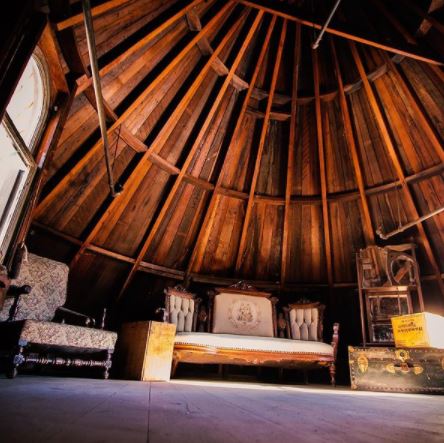
Perplexity is leavened by extravagant Victorian beauty, and no casual visitor can see it all. Palatial elegance unfolds with each turn along every path of exploitation of the catacomb. One gazes through oval lens windows now only magnifying the pandemonium of Winchester Boulevard; through them, over a century ago, imagine the warm summer evenings, as Sarah Winchester admired her quiet gardens steeped in the low western sunshine; the bird singing loud in the hawthorn and sycamore of her deer park, the cascading fountains spouting holy water, and the peaceful blossoming orchards vesper calm upon all things. The best tea-things were set out in her best parlour. There was usually a bunch of roses on the table, and Mrs. Winchester was dressed in her light blue muslin, with a rose in her hair. She would arise before her guests like a picture, with the sunshine flickering about her dark hair. She was very sweet, tender and gentle. Many people wanted the pleasure of an invitation to a séance in the Blue Séance Room. Mrs. Winchester would gather together many birds of alien feather. A humans’ own suffering mind must be, of all moral food, the most poisonous for one to feed on. Surround a scorpion with fire and it stings oneself to death. Throw a diseased soul entirely upon its own resources and moral suicide result. It was a principle with Mrs. Winchester to oppose bullying. She believed we were here on this Earth for a definite purpose–and God’s duty plain to any human who wills to read it. There may be disembodied spirits who seek to distress or annoy where they can no longer control. If there are, hers, which is not yet divorces from its means to material action, declines to be influenced by any irresponsible whimsy. #RandolphHarris 1 of 16

Mrs. Winchester was very happy in her new home. She had been used to keeping her father’s house since her early girlhood days, and her shortly lived matronly duties came very easy to her. The expansive Victorian mansion, with its neat furniture and fresh dimity draperies, 160 rooms, 10,000 windows, nine kitchens, and 47 fireplaces was the pretties thing possible in the way of rustic interiors; the estates was like a temple dedicated to some Heavenly divinity, and Mrs. Winchester took a natural womanly pride in this bright home. She had come from a good house; but this was quite her own. For 38 years, 1884-1922, the sound of saw and hammer never ceased. Commonly, 16 carpenters were employed at one time, some having worked for 20 years without changed. They produced the largest, most complicated and exclusively private residents in the United States of America. There are five different heating systems and three elevators, one hydraulic and two electric. Some of the 13 bathrooms lacked privacy; they have clear glass doors! One rambling room has four fireplaces and five hot-air registers. A spiral stairway has 42 steps, each two inches high. Other stairways melt into blank walls. A second story door opens into the great outdoors and a 20-foot step. A linen closet has the area of a three-room apartment; a nearby cupboard is less than one-inched deep. A skylight is placed in the middle of a room, in the floor! Another floor is a series of trap-doors. The visitor must stoop through one door to enter, the next gives clearance for an eight-foot giant. Many stairway turn posts are upside down. Entire walls are built entirely of half-inch, “half-round” strips. #RandolphHarris 2 of 16

Everywhere prevail that uncanny deference to the number 13; 13 stairsteps, 13 hangers in a closet, 13 wall panels, 13 lights in the chandeliers, 13 windows to a room and if necessary to make that number, some placed in an inside wall. One of the guests at this séance was Ludwig Leichhardt. He thought of men and women who had died of a fever the previous year, and the spirits told him to depart for “people who had wished to live, for whom life was full of duties and household joys; whose loss left wide gaps among their kindred, not to be filled again upon this Earth.” Ludwig felt a dull blankness of his existence which he felt—an utter emptiness and hopelessness; nothing to live for in the present, nothing to look forward to in the future. He bragged about how much capital he had in the Bank of Italy and how he could provide Mrs. Winchester with a comfortable life. However, this was to be his last day as a guest at the Winchester mansion. His two great sea chests, containing his clothes, books, and other property had gone to San Francisco by that evening’s luggage train. His last memory of the Winchester would be Mrs. Winchester’s bright tender face looking at him compassionately, as she had looked the day she broke his heart. After the death of her husband and daughter, Mrs. Winchester remained celibate and never remarried. Precious moments went by, and Ludwig pushed his teacup away with a listless air. He got up presently and showed him she to the exit of the mansion, after a brief good evening to all. The sun was low by this time, and the western sky flooded with an orange light. The garden was abloom with roses and honeysuckle. Ludwig Leichhardt fancied her should never look upon such flowers or such a garden again. The mansion seemed to grow dark all at once when he was gone. #RandolphHarris 3 of 16
Adam Worth had also been at the séance that evening and did not seem to care for the tea. Ludwig promised to write Mrs. Winchester to let her know he was safe. The sun had gone down, and there was a long line of crimson yonder in the west above the edge of the estate. All the guest prepared to leave and Mrs. Winchester retired to her chambers for the evening. While laying in bed, Mrs. Winchester heard a bang on a door with a sounding slap. She figured it was just a piece of stupid discourtesy and went back to sleep. The following morning, she swore that one of the rooms on the second floor was not empty—and was quite upset about it—said there was some infernal influence at work in her home. To satisfy her curiosity, she asked her butler Henry to open the door. The light was dim in the room and Mrs. Winchester paused in the corridor outside. His eyes glistened. His features relaxed, and he gave a short sigh, “the room is empty,” said Henry. With some stir of curiosity, Mrs. Winchester slipped out, but had a certain vague wonder in her mind. As she heard, the medium from the night before in the parlour was struggling on the floor, in what looked like an epileptic fit. Mrs. Winchester walked deliberately back to the closed door, as Henry went to hold the medium from doing any injury to herself. Huddled against the massive end wall, and half embedded in it, as it seemed, there lay a shadow. Looking closely, Mrs. Winchester saw that the trap door was not only firmly bolted, but screwed into its socket. She strode off in a fume. She was in an odd frame of mind, and for long moved her sitting-room to and fro, too restless to go to bed, or, as an alternative, to settle down to a book. #RandolphHarris 4 of 16

She could not whistle her mind from the chase of a certain graveyard will-o’-wisp; and on it went stumbling and floundering through bog and mire, until she fell into a state of collapse, and was useful for nothing else. She went to bed and to sleep without difficulty, but was conscious of herself all the time, and of a shadowless horror that seemed to come stealthily out of the corners and to bend over and look at her, and nothing but a curtain or a hanging coat when she started and stared. Over and over again this happened, and Mrs. Winchester’s temperature rose by leaps, and suddenly she saw that is she failed to assert herself, and promptly, fever would leap her in a consuming fire. Then in a moment she broke into a profuse perspiration, and sank exhausted into delicious unconsciousness. Morning found her restored to vigour, but still the with flutter of curiosity in her brain. It worked there all day, and for many subsequent days, and at last it seemed as if her every faculty were honeycombed with its ramifications. Then “this will not do,” Mrs. Winchester thought, but still the tunnelling process went on. As the curious devil mastered her, she grew into such harmony with it that she could shut her eyes no longer to the true purpose of its insistence. It was the closed room about which her thoughts hovered like crows circling round carrion. In the dead waste and middle of a certain night, Mrs. Winchester awoke with a strange, quick recovery of consciousness. There was the passing of a single expiration, and she had been asleep and was awake. She had gone to bed with no sense of premonition or of resolve in a particular direction; she sat up a monomaniac. It was as if, swelling in the silent hours, the tumour of curiosity had come to a head, and in a moment, it was necessary to operate upon it. #RandolphHarris 5 of 16

She made no excuse for her then condition. Mrs. Winchester was convinced she was the victim of some undistinguishable force, that she was an agent under the control of the supernatural. Some thought had been in her mind of late in her position it was her duty to unriddle the mystery of the closed room door. However, time went by. The new year came, and still there was no letter from Ludwig Leichhardt. However, early in January, Henry, the butler came home from the Bank of Italy one afternoon, and told Mrs. Winchester she need not worry herself about her old friend any longer. “Ludwig Leichhardt is safe enough, mistress,” he said. “I was talking to Gilbert, the cashier at the Bank of Italy, this morning, and he told me that Leichhardt wrote to them for $2,000.00 last October from San Francisco, and he has written $1,000.00 more since. He is buying land somewhere—I forget the name of the place—and he’s well and hearty, Gilbert tells me.” However, a sense of fear and constriction was upon Mrs. Winchester. “Well, I’m afraid I’m rather fanciful, Henry; but I could never explain to you what a strange feeling came over me the night Ludwig Leichhardt went away from this estate. It was after I had said goodbye to him, and he had gone back into the mansion, where all was dark and quiet. I sat in the parlour thinking of him, and it seemed as if a voice was saying in my ear that I, nor anyone that care for hum, would ever seen Ludwig Leichhardt again. There wasn’t any such voice of course, you know, Henry, but it seemed like that in my mind; and whenever I’ve thought of poor Ludwig Leichhardt since that time, it has seemed to me like thinking of the dead. Often and often I’ve said to myself, ‘Why, Sarah, you silly thing, you ought to know that he’s safe enough in San Francisco. Ill news travels fast; and if there’d be anything wrong, we should have heard of it somehow.’ But, reason with myself as I would, I have never been able to feel comfortable about him; and thank God for your good news, Henry, and thank you for bring it to me. #RandolphHarris 6 of 16

It has been very unkind of Ludwig not to write. She could not forgive him for his neglect, glad as she was to know he was safe. Then Mrs. Winchester paused for a moment, and confessed, the quick pant of fear seemed to come from her lips. There were sounds about her—the deep breathing of an imprisoned man. She returned to the locked door, and hurriedly flung it open. An acrid whiff of dust assailed her nostrils as she stepped back a pace and stood expectant of anything—or nothing. What did she wish, or dread, or foresee? The room was rather a large one; an old-fashioned room, with a low ceiling crossed by heavy means; half parlour, half kitchen, with a wide-open fireplace at one end, on which the logs had burnt to a dullish red. There was the old chintz-covered armchair. Mrs. Winchester had been sitting with her face towards the open window, looking absently out at the garden, where daffodils and early primroses glimmered through the dusk. She stood to pick up her blueprints, which had fallen to the ground. She was standing folding this in a leisurely way, when she looked towards the fireplace, and gave a little start at seeing that the armchair was no longer empty. “Why, Henry,” she cried, “how quietly you must have come into the place! I never heard you.” There was no answer, and her voice sounded strange to her in the empty room. “Henry!” she repeated, a little louder; but the figure in the chair neither answered nor stirred. Then a sudden fright seized her, and she knew that it was not her butler. The room was almost dark; it was quite impossible that she could see the face of that dark figure seated in the armchair, with the shoulders bent a little over. Yet she knew, as well as ever she had known anything in her life, that it was not the butler Henry. #RandolphHarris 7 of 16

She went slowly towards the fireplace, and stood within a few paces of that strange figure. A little flash of light shot up from the candle, and shone for an instant on the face. It was Ludwig Leichhardt! Mrs. Winchester tried to speak to him; but the words would not come. And yet it was hardly so appalling a thing to see him there that she need have felt what she did. San Francisco was not too far from San Jose that a man may not cross the Bay and drop in upon his friend unexpectedly. The candle’s flame got bigger, lighting up the entire room. The chair was empty. Mrs. Winchester uttered a loud cry, and Henry entered the room. “Why, Mrs. Winchester! What’s amiss?” he said. She ran to him, sobbing hysterically, and then calming herself with an effort, told him how she had seen Ludwig’s ghost. “Why Mrs. Winchester,” Henry replied. “Ludwig Leichhardt is safe in San Francisco. It was a shadow that took the shape of your old friend, to your fancy. It’s easy enough to fancy such a thing when your mind’s full of anyone.” Ill and shaken, yet fearing death as she had never dreaded it before, Mrs. Winchester said, “It was no fancy. Ludwig Leichhardt is dead, and I have seen his ghost. I’ve a feeling that he never got to San Francisco alive, Henry,” she said. “I can’t explain how it is, but I’ve a feeling that it was so.” Mrs. Winchester spent the rest of that horrible night huddled between her crumpled sheets, fearing to look forth, fearing to think. She knew the letters had been forgeries, and could not forget the madness and the terror in learning to walk the unvext paths of placid souls. She was left with nothing but an aimless scurrying terror and the black swarm of thoughts, so that she verily fancied her reason would give under the strain. Yet she had more to endure and to triumph over. Near morning she fell into a troubled sleep, throughout which the drawn twitch of muscle seemed an accent on every word of ill-omen she had ever spelt out of the alphabet of fear. If her body rested, her brain was an open chamber for any toad of ugliness that listed to “sit at squat” in. #RandolphHarris 8 of 16

Mrs. Winchester tried to convince herself that the thing she had seen was only a trick of her imagination. Another month went by, and again in the twilight the same figure appeared to her. It was standing this time, with one arm leaning on the high mantlepiece; standing facing her as she came back to the room, after having quitted it for a few minutes for some slight household duty. There was a fire burning in the fireplace. The logs were burning with a steady blaze that lit up the well-known figure and unforgotten face. Ludwig Leichardt was looking at her with an expression that seemed half reproachful, half beseeching. He was very pale, much paler than she had ever seen him in life; and as he looked, she standing just within the threshold of the door, she saw him lift his hand slowly and point to his forehead. The firelight showed her a dark red stain upon the left temple, like the mark of a contused wound. She covered her face with her hands, shuddering and uttering a little cry of terror, and then dropped half fainting upon a chair. When she uncovered her face the room was empty, there was a pool of blood on the floor, and the firelight shining cheerily upon the walls, no trace of that ghostly visitant. This time Mrs. Winchester brooded over the thoughts of the thing she had seen, firmly believing that she had looked upon the shadow of the dead, and that there was some purpose to be fulfilled by that awful vision. In the day, she had the room boarded up. The thought of this was almost always in her mind; in the dead silence of the night, she would often lie awake for hours thinking of Ludwig Leichhardt. Mrs. Winchester knew he had been waylaid and murdered. He had a good deal of money about him. Suddenly Mrs. Winchester woke to the fact that there was a knocking at her door—that there had been for some little time. She cried, “Come in!” finding a weak restorative in the mere sound of her own human voice; then remember the keys was turned, bade the visitor wait until she could come to him. #RandolphHarris 9 of 16

Scrambling, feeling dazed and white-livered, out of bed, Mrs. Winchester opened the door, and met one of the gentlemen on the threshold. The man looked scared, and his lips, she noticed, were set in a somewhat boding fashion. “Come you come at once, Mrs. Winchester?” he said, “There’s summat wrong with Ludwig Leichhardt. She had now a settled conviction that some untimely fate had befallen her old friend, and that the letters from San Francisco were forgeries. Gilbert from the Bank of Italy compared the signature cards and determined that the drafts and letters were forgeries. There was one thing noticeable in the San Francisco letters—they were all exactly alike, line for line, curve for curve. This rather discomposed Gilbert; for it is a notorious fact that a man rarely signs his name twice in exactly the same manner. There is almost always some difference. Before the month was out, Ludwig Leichhardt’s ghost appeared for the third time to Mrs. Winchester. In the Tender June twilight. She was thinking of her old friend as she walked along the shadowy winding path of the deer park on her estate. It was just such a still, peaceful evening as that upon which he had stood on the edge of the common looking back at her, and waving his hand, upon that last well remembered night. He was so much in her thoughts, and the conviction that he had come from among the dead to visit her was so rooted in her mind, that she was scarcely surprised when she looked up presently, and saw a tall familiar figure moving slowly among the trees a little way before her. There seemed to be an awful stillness in the wood all at once, but there was nothing awful in that well-known figure. She tried to overtake it; but it kept always in advance of her, and at a sudden turn in the path she lost it altogether. The trees grew thicker, and there was a solemn darkness at the spot where the path took this sharp turn, and on one side of the narrow footpath there was a steep declivity and a great hollow, made by a disused gravel pit. #RandolphHarris 10 of 16

She went to her mansion quickly enough, with a subdued sadness upon her, and told Henry what had happened to her. Nor did she rest until there had been a search made on the extensive grounds for the body of Ludwig Leichhardt. They searched and found him lying at the bottom of the gravel pit, half buried in loose sand and gravel, and quite hidden by a mass of furze and bramble that grew over the spot. There was an inquest, of course. The tailor who had made the clothes found upon the body identified them, and swore to them as those he had made for Ludwig Leichhardt. The pocket were all empty and turned inside out. There could be little doubt the Ludwig Leichhardt had been waylaid and murdered for the sake of the money he carried upon him that night. His skull had been shattered by a blow from a jagged stick on the left temple. The stick was found laying at the bottom of the pit a little way from the body, with human hair and stains of blood upon it. Ludwig Leichhardt had never left San Jose. It was later determined that Adam Worth had killed Ludwig Leichhardt and took his money. The Bank of Italy refunded the withdraws. Adam Worth was ultimately apprehended, with some of Ludwig Leichhardt’s property still in his possession, and he was deeply in debt. The final examination resulted in a verdict of willful murder, tried, found guilty and hung. Ludwig Leichhardt had executed a few days before his intended departure, bequeathing all he possessed to Sarah Winchester—the interest for her sole use and benefit, the principal to revert to her estate after her death. Mrs. Winchester often sits beside that quiet resting place in the spring twilight; but she had never seen Ludwig Leichhardt’s ghost since that evening in the deer park, and she knew she never would see it again. She shook with an awful thankfulness at sight of the pitfalls she had skirted and escaped—of the demon she witlessly had baffled. The joy of life was in her heart again, but chastened and made pitiful by experience. #RandolphHarris 11 of 16

You are aware that evil spirit beings operating through humans in positions of authority and influence are the real motivators in human society? Yes, this is exactly what the Christian Bible teaches! Perhaps this concept seems strange to you, almost like an outmoded superstition, but the Bible definitely states that Satan in the “god of this age,” reports 2 Corinthians 4.4, and that he is the leader of a well-organized army of beings invisible to humans but very active among them. Paul tells us in Ephesians, “For we wrestle not against flesh and blood, but against principalities, against powers, against the rulers of the darkness of this World, against spiritual wickedness in high places,” reports Ephesians 6.12. These words indicate that evil spirits are organized into a military-like structure. The “principalities” are the highest ranking officers under Satan, the “powers” are officials of somewhat lower standing, and the “rulers of the darkness of this World” seem to be a special band of evil spirits whose sphere of influence includes the leaders of human government. The phrase “spiritual wickedness is high places” is better translated “spiritual hosts of wickedness in the Heavenly places,” and makes reference to the myriads of demonic hordes. They are all under the direction of Satan, who is not only named the “god of this age,” but also is called “the prince of the power of the air,” reports Ephesians 2.2. The Scriptures often speak of a close relationship between these evil spiritual and the “World.” In the Ephesians passage quoted above, you will remember that these spirit beings are called “the rulers of the darkness of this World.” The apostle John also refers to the World, and it is significant that he considers it to be the Christian’s enemy. “Love not the World, neither the things that are in the World. If any human love the World, the love of the Father is not in one. For all that is in the World, the lust of the flesh, and the lust of the eyes, and the pride of life, is not of the Farther, but is of the World. And the World passeth away, and the lust of it; but one that doeth the will of God abideth forever,” reports 1 John 2.15-17. #RandolphHarris 12 of 16

In addition, the same apostle declared that one who is “born of God overcometh the World,” reports 1 John 5.4, and also that “the whole World lieth in wickedness,” reports 1 John 5.19. James, the brother of Jesus, declared in his epistle, “Whosoever therefore, will be a friend of the World, is the enemy of God,” reports James 4.4. Before we can gain a full understanding of what this means, we must answer the following questions: What is this World, which if loved causes us to lose God’s friendship? What does the Bible mean when it says that the whole World “lieth in wickedness”? Certainly the Bible is not saying that Christians should not love the World of nature, nor is it implying that every person who is not a Christian is an enemy to be overcome. In fact, the Scriptures often state that the glory of God is revealed in the natural World, and it specifically instructs believers not to antagonize other people, but to love them. No, the material Universe in which we live is not opposed to us, and we are not to consider the people who inhabit the Earth as our enemies. The “World” referred to by John and James is the moral and spiritual system we call human society. Humankind, which has rejected God’s revelation, has devised explanations of life, moral standards, and principles of conduct based upon human knowledge only. Humans, on the whole, operate on erroneous principles, selfish desires, improper motives, and unworthy standards of value. The sciences, the arts, politics, and entertainment are all dominated by a humanistic approach to life which draws humans away from God and makes humans the “measure of all things.” If the period of treated of in the essay from the commencement of the seventeenth century to the Restoration of Charles II, be barren of witchcraft proper, it must at least be admitted that it is prodigal in regard to the marvellous under various shapes and forms, from which the hysterical state of the public mind can be fairly accurately gauged. #RandolphHarris 13 of 16

The rebellion of 1641, and the Cromwellian confiscations, that troubled periods when the county was torn by dissention, and ravaged by fire, sword, and pestilence, was aptly ushered in by a series of supernatural events which occurred in the country Limerick. A letter dated the 13th August 1640, states that “for news we have the strangest that ever was heard of, there inchantments in the Lord of Castleconnell’s Castle four miles from Lymerick, several sorts of noyse, sometymes of drums and trumpets, sometimes of other curious musique with Heavenly vouces, then fearful screeches, and such outcries that the neighbours near cannot sleepe. Priests have adventured to be there, but have been cruelly beaten for their paynes, and carryed away they knew not how, some two miles and some four miles. Moreover were seen in the like manner, after they appear to the view of the neighbours, infinite number of armed men on foote as well as on horseback. One thing more [id est something supernatural] by Mrs. Mary Burke with tweleve servants lyes in the hose, and never one hurt, onley they must dance with them every night; they say, Mrs. Mary come away, telling her she must be wife to the inchanted Earl of Desmond. Uppon a Mannour of my Lord Bishoppe of Lymerick, Loughill, hath been seen upon the hill by most of the inhabitants aboundance of armed men marching, and these seene many tymes—and when they come up to them they do not appear. These things are very strange, if the cleargie and gentrie say true.” During the rebellion an appalling massacre of Protestants took place at Portadown, when about a hundred persons, men, women, and children, were forced over the bridge into the river, and so drowned; the few that could swim, and so managed to reach the shore, were either knocked on the head by the insurgents when they landed, or else were shit. #RandolphHarris 14 of 16

It is not a matter of surprise that this terrible incident gave rise to legends and stories in which anything strange or out of the common was magnified out of all proportion. Accord to one deponent there appeared one evening in the river “a vision or spirit assuming the shape of a woman, waist high, upright in the water, naked with [illegible] in her hand, her hair dishevelled, her eyes seeming to twinkle in her head, and her skin as white as snow; which spirit seeming to stand upright in the water often repeated the word Revenge! Revenge! Revenge! Also, Robert Maxwell, Archdeacon of Down, swore that the rebels declared to him, (and some deponents made similar statements) “that most of those that were thrown from the bridge were daily and nightly seen to walk upon the River, sometimes singing Psalms, sometimes brandishing of Swords, sometimes screeching in a most hideous and fearful manner.” Both these occurrences are capable of a rational explanation. The supposed spectre was probably a poor, bereaved woman, demented by grief and terror, who stile out of her hiding-place at night to bewail the murder of her friends, while the weird cries arose from the half-starved dogs of the country-side, together with the wolves which abounded in Ireland at that period, quarrelling and fighting over the corpses. Granting the above, and bearing in mind the credulity of all classes of Society, it is not difficult to see how the tales originated; but to say that, because such obviously impossible statements occur in certain despsitions, the latter are therefore worthless as a whole, is to willfully misunderstand the popular mind of the seventeenth century. We have the following on the testimony of the Rev. George Creighton, minister of Virginia, Co. Cavan. He tells us that “drivers women brought to his House a young woman, almost naked, to whom a Rogue came upon the way, these women being present, and required her to give him her mony, or else he would kill her, and so drew his sword; her answer was, You cannot kill me unless God gives you leave, and His will be done. #RandolphHarris 15 of 16

“Thereupon the Rogue thrust three times at her naked body with his drawn sword, and never pierced her skin; whereat he being, as it seems, much confounded, went away and left her.” A like story comes from the other side: “At the taking of the Newry a revel being appointed to be shot upon the bridge, and stripped stark-naked, nothing withstanding the musketeer stood within two yards of him, and shot him in the middle of the back, yet the bullet entered not, nor did him any more hurt than leave a little black spot behind it. This many hundreds were eye-witnesses of. Divers of the like have I confidently been assured of, who have been provided of diabolical charms.” Similar tales of persons bearing charmed lives could not doubt be culled from the records of every way that has been fought on this planet of ours since History began. The ease with which the accidental or unusual was transformed into the miraculous at this period is shown by the following. A Dr. Tate and his wife and children were flying to Dublin from the insurgents. On their way they were wandering over commons covered with snow, without any food. The wife was carrying a sucking child, John, and having no milk to give it she was about to lay it down in despair, when suddenly “on the Brow of a Bank she found a Suck-bottle with sweet milk in it, no Footsteps appearing in the snow of any that should bring it thither, and far from any Habitation; which preserved the child’s life, who after became a Blessing to the Church.” The Dr. Tate mentioned above was evidently the Rev. Faithful Tate, D.D., father of Nahum Tate of “Tate and Brady” fame. Much of what has passed current in the New World as White (id est, permissible) Magic is only a disguised goeticism, and may of the resplendent angels invoke with the divine rites reveal their cloven hoofs. It is not too much to say that a large majority of past psychological experiments were conducted to establish communication with demons, and that for unlawful purposes. The popular conceptions concerning the diabolical spheres, which have been all accredited by magic, may have been gross exaggerations of fact concerning rudimentary and perverse intelligences, but the willful viciousness of the communicants is substantially untouched thereby. #RandolphHarris 16 of 16


Happy Early Turkey Day! 🦃

The Winchester Mystery House will be closed on Thursday, Nov. 25 in observance of the Thanksgiving holiday and will reopen on Friday, Nov. 26! winchestermysteryhouse.com

When Asked His Name He Said “Legion” Because Many Demons Were Entered into Him!

It is easy to imagine how the combined grief of losing both a child and a spouse could be very crippling. However, if you have $20,000,000 (2021 inflation adjusted $347,910,691.82), and all the time in the World to help you cope, what would you do? Mrs. Sarah L. Winchester’s response to the deaths of her child and husband left a bizarre and impressive architectural reflection of her soul. After a series of violent confrontations, the Winchester Repeating Arms Company hires a private investigator to follow her. Mrs. Winchester ascends into mystery and it is soon clear that she is hiding a much bigger secret—one that is both inexplicable and shocking. A “possessed” person may have symptoms much like those that are apparent in the mentally ill. One may be deeply melancholic or depressed, appear to be withdrawn from reality, or may manifest emotions that range from ecstatic joy to violent screaming or wild ferocity. These various states may present themselves from time to time during “attacks.” Demon possession may be distinguished from insanity, however, by observing the manner in which the afflicted person speaks. An insane individual may have a mistaken concept of one’s own identity, wear clothing by which one attempts to look like the person one thinks oneself to be, but speak in one’s own voice, and in such a manner that one can tell one is doing only a superficial impersonation of the individual one thinks oneself to be. A demon-possessed person, on the other hand, is obviously controlled by the indwelling evil spirit. The wicked being may use a language or dialect the individual never knew, and sometimes will name oneself. Therefore, one should carefully note the symptoms of a disturbed person, never making the diagnosis of demon possession on the basis of a superficial judgment. #RandolphHarris 1 of 16

If a believer should meet a demon-possessed individual, one would be unwise to make a frontal attack upon the powers of darkness by immediately issuing a command in the name of the Lord Jesus Christ. Dr. Kurt Koch, an evangelical Christian who has made a lifetime study of Satan and occultic activities, declares that whenever Christians lightly engage in an effort to cast out demons, they run the risk of being attacked by evil spirits. Such people often suffer deep spiritual depression and find themselves in an attitude of complete hopelessness. Since this is true, a believer should band together with others in a time of prayer, and no efforts should be made to expel the evil spirits until the Holy Spirit prompts someone to issue the command. Unbelievers and adherents of the non-Christian religions apparently can command evil spirits without suffering bad consequences. Archeologists have found manuscripts containing incantations and magical formulas for the expulsion of demons; and today in the Philippines and other countries of the far East, as well as in some areas of South America and Africa, pagan religious leaders seriously perform rituals to ward off or cast out evil spirits. Sometimes they beat the person who is demon-possessed, prick one with needles, or even burn portions of one’s body, thinking that this pain will drive out the evil spirits. The Jewish people in Christ’s day also used spells, magical phrases, and religious rituals to expel demons. That they sometimes appeared to be successful is clear, for Jesus said, “if I, by Beelzebub, cast out demons, by whom do your sons cast them out? Therefore, they shall be your judges,” reports Matthew 12.27. #RandolphHarris 2 of 16

In this statement the Lord Jesus Christ acknowledged that evil spirits sometimes left the bodies of their victims when incantations, spells, or magical rites were used by Jewish religious leaders. However, Christ did not say these men accomplished their goal by the power of God, nor did He imply that they were actually doing damage to the cause of Satan. He was answering the charge that He was casting out demons in the power of Beelzebub, the prince of demons. He declared that is such were the case, the kingdom of Satan would be divided against itself. Actually, the exorcists, whether Jewish or pagan, did not really possess authority over the invisible World, but the evil spirits merely cooperated with them, leaving the bodies of some of their victims to give the appearance that they had been forced out. By working with these unbelieving sorcerers, the devil aided his own cause. The demons either temporarily left the person, only to return a short time later, or entered the body of some other victim. No one should attempt to deal with the forces of evil by using the name of Jesus unless one is a child of God. Luke, in Acts 19, graphically portrays the seriousness of hypocritically dealing with the powers of darkness. Seven sons of Sceva, a professional exorcist who had no personal faith in Christ, tried to combine the words “in the name of Jesus” with their magical formula. The evil spirits, recognizing that these impostors had no right to use Jesus’s name, reacted in a violent manner. The demon-possessed individual attacked these men with superhuman strengths, so that with torn clothing and bleeding bodies they fled from the Winchester mansion. The frequency of demon possession—the record of history establishes without a doubt that demon possession was known before the Lord Jesus Christ came to Earth, and the testimony of missionaries indicates that it has continued down through the centuries. #RandolphHarris 3 of 16

The public ministry of Christ, however, was accompanied by an outburst of demon possession unparalleled in history. It seems that Satan threw all his power into his battle with Jesus Christ. True, the devil is not omniscient, but he knew that Christ had come to earth to atone for sin, conquer death, and bring about the defeat of evil. John tells us that “the Son of God was manifested, that he might destroy the works of the devil,” reports 1 John 3.8. Satan used every device at his disposal to frustrate the purpose of God in Christ. Subtle temptations, the wrath and wickedness of men, and a rash of demonic activity were part of his vain effort to prevent Jesus from performing the work He had come to accomplish. Demon possession gradually subsided during the first century A.D., and usually is not conspicuous in areas where a fairly large percentage of people have placed their faith in Jesus Christ. It appears that demons are hesitant to enter the bodies of people when informed believers are likely to cast them out in the name of Christ. Luke is the same one that is translated “bottomless pit” seven times in the book of the Revelation. We read, “And Jesus asked him, saying, ‘What is thy name?’ And he said, ‘Legion’; because many demons were entered into him. And they besought him that he would not command them to go out into the deep. And there was there and herd of many swine, feeding on the mountain; and they besought him that he would allow them to enter into them. And he permitted them,” reports Luke 8.30-32. Revelation 9 tells us that at some future time the “bottomless pit” will be opened, and a great army of evil spirits will be set free to plague humankind. #RandolphHarris 4 of 16

It is at least a possibility that whenever demons are cast out of a human being in the name of Jesus Christ, they are sent to the bottomless pit, and will not be released until shortly before Christ returns to establish His kingdom. The realization that they will lose their freedom as members of the army of the “prince of the power of the air,” and be confined in the pit for an indefinite period of time, makes them hesitant to take possession of human beings. The risk is too great in an area where Christians exercise their authority in the name of Christ. People who live in civilized countries where the Gospel has been known for centuries should not rule out the possibility of demon possession, however, just because it has not been a common occurrence in these areas. Satan and his cohorts may conclude that most people, even professing Christians, will not recognize this phenomenon when they meet it. Therefore, as this age draws to a close, Satan may once again become very active in entering human bodies and controlling personalities. He will hope that the majority of humankind will either be deceived into following him or find a naturalistic explanation for the activities of the demons. This supernatural manifestation of the power of Satan and evil spirits is clearly predicted by the apostle Paul. In his second letter to the Thessalonian believers, he declares that just before Christ returns in glory, the devil will have his righthand mand upon the earth performing miracles which make him appear to be a god. Referring to the Antichrists, the apostle says, “Even him whose coming is after the working of Satan with all power and signs and lying wonders, and with all deceivableness of unrighteousness in them that perish, because they received not the love of the truth, that they might be saved,” reports 2 Thessalonian 2.9, 10. #RandolphHarris 5 of 16

Inasmuch as we can expect an increase of open opposition to God on the part of the Satanic hordes, we know Christ should humbly maintain fellowship with Him through full submission and ready obedience so that we may receive from Him the strength we need to overcome. James writes, “God resisteth the proud, but giveth grace unto the humble. Submit yourselves, therefore, to God. Resist the devil, and he will flee from you,” reports James 4.6-7. Peter declares, “Be sober, be vigilant, because your adversary the devil, like a roaring lion walketh about, seeking whom he may devour; whom resist steadfast in the faith, knowing that the same afflictions are accomplished in your brethren that are in the World,” reports 1 Peter 5.8-9. No, Satan is not dead. He is like a wounded animal and still has great power to harm those who care careless or proud. Therefore, keep awake, be on alert, read the Christian Bible and the Book of Mormon, and pray! If you do not, he may destroy your effectiveness as a Christian. For the next instance of witchcraft and the supernatural in connection with Ireland, we are compelled to go beyond the confines of our own country. Though in this connection with the Green Isle is slight, yet it is of interest as affording an example of that blending of fairy lore with sorcery which is not an uncommon feature of Scottish witchcraft-trials. In the year 1613 a woman named Margaret Barclay, of Irvine in Scotland, was accused of having her brother-in-law’s ship to be cast away by magical spell. A certain strolling vagabond and juggler, John Stewart, was apprehended as her accomplice; he admitted (probably under torture) that Margaret had applied to him to teach her some magic arts in others that “she might get gear, kye’s milk, love of man, her heart’s desire on such persons as had done her wrong.” #RandolphHarris 6 of 16

Through John Stewart does not appear to have granted Margaret’s request, yet he gave detailed information as to the manner in which he had gained the supernatural power and knowledge with which he was credited. “It being demanded of him by what means he profession himself to have knowledge of things to come, the said John confessed that the space of twenty-six years ago, he being travelling on All-Hallow Even night between the towns of Monygoif and Clary, in Galway, he met with the King of the Fairies and his company, and that the King gave him a stroke with a white rod over the forehead, which took from him the power of speech and the use of one eye, which he wanted for the space of three years. He declared that the use of speech and eyesight was restored to him by the King of Fairies and his company on a Hallowe’en night at the town of Dublin.” At his subsequent meeting with the fairy band, he was taught all his knowledge. The spot on which he was struck remained impervious to pain although a pin was thrust into it. The unfortunate wretch was cast into prison, and there committed suicide by hanging himself from the “cruik” of the door with his garter or bonnet-string, and so “ended his life miserably with the help of the devil his master.” A tale slightly resembling portion of the above comes from the north of Ireland a few years later. “It is storied, and the story is true,” says Robert Law in his Memorialls, “of a godly man in Ireland, who lying one day in the fields sleeping, he was struck with dumbness and deafness. The same man, during this condition he was in, could tell things, and had the knowledge of things in a strange way, which he had not before; and did, indeed, by signs make things known to others which they knew not. Afterwards he at length, prayer being made from him by others, came to the use of his tongue and ears; but when that knowledge of things he had in his deaf and dumb condition ceased, and when he was asked how he had the knowledge of these things he made signs of, he answered he had that knowledge when dumb, but how and after what manner he knew not, only he had the impression thereof in his spirit. This story was related by a godly minister, Mr. Robert Blair, to Mr. John Baird, who knew the truth of it.” #RandolphHarris 7 of 16

The Rev. Robert Blair, M.A., was a celebrated man, if for no other reason than on account of his disputes with Dr. Echlin, Bishop of Down, or for his description of Oliver Cromwell as a greeting (id est, weeping) devil. On the invitation of Lord Claneboy he arrived in Ireland in 1623, and in the same year was settled as (Presbyterian) parish minister at Bangor in Co. Down, with the consent of patron and people’ he remained there until 1631, when he was suspended by Dr. Echlin, and was deposed and excommunicated in November, 1634. He has left a few writings behind him, and was grandfather of the poet Robert Blair, author of The Grave. During the years of his ministry at Bangor the following incident occurred to him, which he of course attributes to demonic possession, through homicidal mania resulting from intemperate habits would be nearer the truth. One day a rich man, the constable of the perish, called upon him in company with one of his tenants concerning the baptizing of the latter’s child. “When I had spoken what I thought necessary, and was ready to turn into my house, the constable dismissing the other told me he had something to say to me in private. I looking upon him saw his eyes like the eyes of a cat in the night, did presently conceive that he had a mischief in his heart, yet I resolved not to refuse what he desired, but I keeped a watchful eye upon him, and stayed at some distance; and being near to the door of the church I went in, and invited him to follow me. As soon as he entered within the doors he fell atrembling, and I awondering. His trembling continuing and growing without any speech, I approached to him, and invited him to a seat, wherein he could hardly sit. The great trembling was like to throw him out of the seat. I laid my arm about him, and asked him what ailed him? But for a time, he could speak none. #RandolphHarris 8 of 16

“At last his shaking ceased, and he began to speak, telling me, that for a long time the Devil had appeared to him; first at Glasgow he bought a horse from him, receiving a sixpence in earnest, and that in the end he offered to him a great purse full of sylver to be his, making no mention of the horse; he said that he blessed himself, and so the buyer with the sylver and gold that was poured out upon the table vanished. But some days thereafter he appeared to him at his own house, naming him by his name, and said to him, Ye are mine, for I arled you with a sixpence, which yet ye have. Then said he, I asked his name, and he answered, they call me Nickel Downus (I suppose the he repeated evil, that he should have said Nihil Damus). Being thus molested with these and many other apparitions of the Devil, he left Scotland; but being come to Ireland he did often likewise appear to him, and now of late he still commands me to kill and slay; and oftentimes, says he, my whinger hath been drawn and kept under my cloak to obey his commands, but still something holds my hand that I cannot stroke. But then I asked him who he was bidden kill? He answered, any that comes in my way; but ‘The better they be the better service to me, or else I shall kill thee.’ When he uttered these words he fell again atrembling, and was stopped in his speaking, looking lamentably at me, designing me to be the person he aimed at; then he fell a crying and lamenting. I showed him the horribleness of his ignorance and drunkenness; he made many promises of reformation, which were not well keep’d; for within a fortnight he went to an alehouse to crave the price of his malt, and sitting there long at drink, as he was going homeward the Devil appeared to him, and challenged him for opening to me what had passed betwixt them secretly, and followed him to the house, pulling his cap off his head and his band from about his neck, saying to him, ‘On Hallow-night I shall have thee, soul and body, in despite of the minister and of all that he will do for thee.’” #RandolphHarris 9 of 16

In his choice of a date his Satanic Majesty showed his respect for popular superstitions. This attack of delirium tremens (though Mr. Blair would not have so explained it) had a most salutary effect; the constable was in such an abject state of terror lest the Devil should carry him off that he begged Mr. Blair to sit up with him all Hallow-night, which he did, spending the time very profitably in prayer and exhortation, which encouraged the man to defy Satan and all his works. The upshot of the matter was, that he became very charitable to the poor, and seems to have entirely renounced his intemperate habits. Rejecting the supernatural elements in the above as being merely the fruits of a diseased mind, there is no reason to doubt the truth of the story. Mr. Blair also met with some strange cases of religious hysteria, which became manifest in outbursts of weeping and bodily convulsions, but which he attributed to the Devil’s “playing the ape, and counterfeiting the works of the Lord.” He states that one Sunday, in the midst of public worship, “one of my charge, being a dull and ignorant person, made a noise and stretching of her body. Incontinent I was assisted to rebuke that lying spirit that disturbed the worship of God, charging the same not to disturb the congregation; and through God’s mercy we met with no more of that work.” Thus modestly our writer sets down what happened in his Autobiography; but the account of the incident spread far and wide, and at length came to the ears of Archbishop Usher, who, on his next meeting with Mr. Blair, warmly congratulated him on the successful exorcism he had practised.” Spirits of a diabolical and infernal nature, are not only ready upon all occasions to become subservient to exorcists and magicians, but are ever watching opportunities of exciting evil affections in the mind, and of stirring up the wickedly inclined to the commission of every species of iniquity and vice. #RandolphHarris 10 of 16

Thus by the instigation of infernal spirits, and their own promptitude, they often terrify humans with nocturnal visions; provoke melancholy people to suicide; tempt drunkards and incendiaries to set houses on fire, to burn those who are in them, and allure careless servants and others to sound and incautious sleep; that such unlucky accidents might happen besides innumerable other ways they have of executing the devices of iniquitous spirits through malicious instigations, or secret stratagems, projected for the overthrow and destruction of mortal men; especially when the work to be effected by the devil is too hard for his subtle and spiritual nature to effect, because the same belongs to the outward source or principle to which these dubious spirits more immediately belong. A few nights into Christmas, there was a festival for which the Winchester mansion was making extensive preparations. The narrow streets which had been thronged with people were now almost deserted. In the comfortable coffee-room of the Winchester mansion, Mrs. Winchester had half a dozen guests, principally commercial travellers, sat talking by light of the fire. The talk had drifted from trade to politics, from politics to religion, and so by easy stages to the supernatural. In the flicker of the light of the fire, as it shone on the glasses and danced with shadows on the walls, the conversation proved so enthralling that Henry, the waiter, whose presence had been forgotten, created a very disagreeable sensation by suddenly starting up from a dark corner and gliding silently from the room. Mrs. Winchester then said, “Of course, it is an old idea that spirits like to get into the company of human beings. A man told me once that he travelled down the Great Western with a ghost and had not the slightest suspicion of it until the inspector came for tickets. My friend said they way that ghost tried to keep up appearances by feeling for it in all its pockets and looking on the floor was quite touching. Ultimately it gave it up and with a faint groan vanished through the ventilator.” #RandolphHarris 11 of 16

“That’ll do, Mrs. Winchester,” said Ludwig Leichhardt. “It is not a subject for jesting,” said Adam Worth,” who had been an attentive listener. “I’ve never seen an apparition myself, but I know people who have, and I consider that they form a very interesting link between us and the after-life. There’s a ghost story connected with this mansion, you know.” “Never heard of it,” said Edward Agar, “and I have visiting this estate for some years now.” “It dates back a long time,” said Ludwig. “You’ve heard about John V. Creely also know as Jesus Procopio?” “Well, I’ve just ‘eard odds and ends, sir” said the Edward, “but I never put much count to ‘em. There was one chap ‘ere what said ‘e saw it, and the gov’ner sacked ‘im prompt.” “My father was a native of this town,” said Ludwig, “and knew the story well. He was a truthful man and a steady churchgoer, but I’ve heard him declare that once in his life he saw the appearance of Jesus Procopio in this mansion.” “And who was this Jesus?” enquired a voice. “His real name was Tomaso Rodendo, one of the most fearless and daring desperadoes that has ever figures in the criminal annals of our state. Anything he could turn his dishonest hand to,” replied Ludwig; “and he was run to Earth in this mansion one Christmas week some five years ago. He took his last supper in this very room, and after he had gone up to bed a couple of thief takers, who had followed him from San Francisco but lost the scent a bit, went upstairs with Mrs. Winchester and tried the door. It was stout oak, and fast, so one went into the yard, and by means of a short ladder got on the window-sill, while the other stayed outside the door. Those below in the yard saw the man crouching on the sill, and then there was a sudden smash of glass, and with a cry he fell in a heap on the stones at their feet. Then in the moonlight they saw the white face of the pickpocket peeping over the sill, and while some stayed in the yard, others ran into the mansion and helped the other man to break the door in. It was difficult to obtain an entrance even then, for it was barred with heavy furniture, but they got in at last, and the first thing that met their eyes was the body of Jesus dangling from the top of the bed by his own handkerchief.” #RandolphHarris 12 of 16

“Which bedroom was it?” asked two or three voices together. Ludwig shook his head. “That I can’t tell you; but the story goes that Jesus still haunts this mansion, and my father used to declare that the last time he had slept here that the ghost of Jesus Procopio lowered itself from the top of his bed and tried to strangle him.” “That will do” said John Creely. “I wish you’d thought to ask your father which bedroom it was.” “I believe it was my Blue Séance room said,” Mrs. Winchester. “Well, I should take care not to sleep in it, that’s all, said John shortly. “There’s nothing to fear,” said Ludwig. “I don’t believe for a moment that ghosts could really hurt one. In fact my father used to confess that it was only the unpleasantness of the thing that upset him, and that for all practical purposes Jesus’s figures might have been made of cotton-wool for all the hard they could do.” “That’s all very fine,” said John; “a ghost story is a ghost story, sir; but when a gentleman tells a tale of a ghost in the house in which one is going to sleep, I call it most ungentlemanly!” “Pooh! Nonsense!” said Ludwig, rising, “ghosts can’t hurt you. For my own part; I should rather like to see one. Good night.” “Good night,” said Mrs. Winchester and the others. “And I hope that Jesus will pay you a visit,” added John as the door closed.” “Shall I light the gas, Adam?” said Henry. “No; the fires very comfortable,” he said. “Now gentlemen, any of you know any more?” “I think we’ve had enough,” said John; “we shall be thinking we see spirits next, and we’re not all like Ludwig who’s just gone.” Old humbug!” said John. “I should like to put him to the test. Suppose I dress up as Jesus Procopio and go to give him a chance of displaying his courage?” “Bravo!” said Adam huskily, drowning one or two faint “Noes.” “No, drop it, John” said Edward. “Only for the joke,” said John, somewhat eagerly. “I’ve got some things upstairs in which I am going to play in the ‘Rivals’—knee-breeches, buckles, and all that sort of thing. It’s a rare chance. If you’ll wait a bit I’ll give you a full-dress rehearsal, entitled, ‘Jesus Procopio; or, The Nocturnal Strangler.’” #RandolphHarris 13 of 16

“You won’t frighten us,” said Adam, with a husky laugh. “I don’t know that,” said John sharply; “it’s a question of acting that’s all. I’m pretty good, ain’t I, Edward?” “Oh, you’re all right—for an amateur,” said Edward, with a laugh. “I’ll bet you level sov. You don’t frighten me,” said Adam. “Done! said John. I’ll take the bet to frighten you first and Ludwig afterwards. These gentlemen shall be the judges.” “You won’t frighten us, sir,” said Edward “because we’re prepared for you; but you’d better leave Ludwig alone. It’s dangerous play.” “Well, I’ try you first,” said John, springing up. “No gas, mind.” He ran lightly upstairs to his room, leaving the others, most of whom had been drinking somewhat freely, to wrangle about his proceedings. It ended with them going to bed. “He’s crazy on acting,” said Adam, lighting his pipe. “Thinks he’s the equal of anybody almost. It doesn’t matter with us, but I won’t let him go to Ludwig. And he won’t mind so long as he gets an opportunity of acting to us.” “Well, I hope he’ll hurry up,” said Edward, yawning; it’s after twelve now.” Nearly half an hour passed. Edward drew his watch from his pocket and was busy winding it, when Henry, the waiter, who had been sent on an errand, burst suddenly into the room and rushed towards them. “E’s comin’, gentlemen,” he said breathlessly. “Why, you’re frightened, Edward,” said Adam with a chuckle. “It was the suddenness of it,” said Edward sheepishly; “and besides, I didn’t look for seenin’ ‘im in the bar. There’s only a glimmer of light there, and ‘e was sitting on the floor behind the bar. I nearly trod on ‘im.” “He’s taking too long, I’ll go and fetch him,” said Adam. “You don’t know what this mansion is like at night, sir,” said Henry, catching him by the sleeve. “It ain’t fit to look at by yourself, it ain’t, indeed. It’s got the—what’s that?” #RandolphHarris 14 of 16

They all started at the sound of a smothered cry from the staircase and the sound of somebody running hurriedly along the passage. Before anybody could speak, the door flew open and a figure bursting into the room flung itself gasping and shivering upon them. “What is it? What’s the matter?” demanded Edward. “Why, it’s Mr. Creely.” He shook him roughly and then held some spirit to his lips. John Creely drank it greedily with a sharp intake of his breath gripped him by the arm. “Light the gas, Adam,” said Edward. Adam obeyed hastily, John Creely, a ludicrous but pitiable figure in knee-breeches and coat, a large wig all awry, and his face a mess of grease paint, clung to him, trembling. “Now what’s the matter?” asked Edward. “I’ve seen it,” said John, with a hysterical sob. “O Lord, I’ll never play the fool again, never!” “Seen what?” said the others. “Him—it—the ghost—anything!” said John wildly. “Rot!” said Adam uneasily. All distinctly heard a step in the passage outside. It stopped at the door, and as they watched with bated breath, the door creaked and slowly opened. Adam fell back opened-mouthed, as a white, leering face, with sunken eyeballs ad close-cropped bullet head, appeared at the opening. For a few second the creature stood regarding them, blinking in a strange fashion at the candle. Then with a sidling movement, it came a little way into the room and stood there as if bewildered. Not a man spoke or moved, but all watched with a horrible fascination as the creature removed its dirty neckcloth and its head rolled on its shoulder. For a minute it paused, and then holding the rag before it, moved towards Edward. The candle went out suddenly with a flash and a bang. These was a smell of powder, and something writhing in the darkness on the floor. A faint, choking cough, and then silence. #RandolphHarris 15 of 16

Edward was the first to speak. “Matches,” he said in a strange voice. Adam struck one. Then he leapt at the gas and a burner flamed from the match. Edward touched the thing on the floor with his foot and found it soft. He looked at his companions. They mouthed enquiries at him, but he shook his head. He lit the candle, and, kneeling down, examined the silent thing on the floor. Then he rose swiftly, and dipping his handkerchief in the water jug, bent down again and grimly wiped the white face. Then he sprang back with a cry of incredulous horror, pointing at it. Adam’s pistol fell to the floor and he shut out the sight with his hands, but the others, crowding forward, gazed spell-bound at the dead face of John V. Creely. Before a word was spoken the door opened and Ludwig hastily entered the room. His eyes fell on the floor. “Good God!” he cried. “You didn’t—” Nobody spoke. “I told him not to,” he said in a suffocating voice. “I told him not to. I told him—” He leaned against the wall, deathly sick, put his arms out feebly, and fell fainting into Ludwig’s arms. Many mysteries have taken place in the Winchester mansion over the years. It is an extravagant maze of Victorian craftmanship—marvelous, baffling, and eerily eccentric, to say the least. Tour guide must warn people not to stray from the group or they could be lost forever! Countless questions come to mind as you wander through the mansion—such as, what was Mrs. Winchester thinking when she had a staircase built that descends seven steps and then rises eleven? The Winchester Repeating Arms Company concluding their investigation by saying, “The mystery of the Winchester mansion is unquestionably great and infinite; perhaps spirits can take human shape, and disclose secrets and treasures guarded by this estate, but we must also be aware of skilled deceivers who will talk of Heaven and Hell and the Fall.” (WRA 1888.) After Mrs. Winchester’s death, crimes resulting in the theft of cash, jewels, historical European glass, furniture, and works of art worth over $10 million by Victorian standards (2021 inflation adjusted $291,146,315.79) went missing from the estate. Is the Winchester mansion haunted? Visits and find out for yourself. Their investigation sounds inconclusive. #RandolphHarris 16 of 16

Winchester Mystery House

“Though she be but little, she is fierce.” ~ William Shakespeare

Did you know Sarah Winchester only stood at 4’10”? Much of the house was built to her specific height measurement including a shower, some doors, and hallways. winchestermysteryhouse.com

Witches, Warlock, and Ghost in the Mansion of Mrs. Winchester!

Some people call themselves witches, and believe that they are able to contact and utilize powers from the invisible realm. However, there are many questions about witchcraft. Is it merely a game some people play? Is it beneficial to humanity? Or is it evil and dangerous? Universities all over the World are offering courses in occultism, and teams of scientists are investigating reports of mysterious magical phenomena all over the globe. They are baffled by some of the amazing incidents they encounter, and admit that present scientific knowledge cannot account for them. The Word of God may not provide a specific explanation for every problem one may encounter as one studies Satan, Satanism, and witchcraft, but it sheds much light on these subjects and offers practical guidelines by which God’s children can avoid dangers inherent in occultism. An unexpected and amazing development of this enlightened age is the resurgence of interest in Satan and an increase in occultic activity. A few years ago, most people assumed that the devil was dead, in the same manner that some theologians recently have affirmed the death of God. It is now becoming increasingly apparent that these reports were premature. Satan is very much alive, and is actively involved in today’s World. Though many scientists and philosophers still scoff at the idea of a personal devil, highly educated people all over the World meet regularly to worships Satan. Some groups, having dedicated themselves to the service of the devil, have committed brutal sacrificial slayings, while others engage in vile acts of immorality. Witchcraft, seances, and fortunetelling, for many years limited to areas of ignorance and superstition, are now discussed in highly respected magazines. Newspapers carry horoscopes, and multitudes consult them seriously every day. Prominent people have received a great deal of publicity by reporting the reception of personal messages from the spirits of the dead. The late Bishop Pike, for example, published a widely-read book telling of seances in which he purportedly talked with his dead son who had committed suicide. #RandolphHarris 1 of 16

Others, claiming the ability to foretell the future, also have become the objects of widespread interest, and have name Jeane Dixon comes to mind. She reportedly communicated with Mrs. Winchester who wanted to continue the restoration of her mansion. Mrs. Dixon is considered a prophetess by many people, and top leaders in government industry consult her for information about the future. In Europe today, more people are making a livelihood through the practice of occultism than the total number engaged in the Christian ministry. Belief in the existence of an unseen spiritual realm to be entered at death, and which has an influence upon human life, has captivated the minds of multitudes. The millions involved with occultism are unaware of the real nature of these mysterious and dangerous areas of investigation, and refuse to turn to the one source of truth regarding the kingdom of darkness. The Bible, the holy Word of God, reveals the true nature of the supernatural. It teaches that two real spiritual Worlds exist, one good and the other evil. It tells us that God is a Spirit (John 4.24), and that a great number of angels called “ministering spirits” (Hebrews 1.14) worship Him in Heaven and carry out His assignments upon Earth. The other invisible kingdom is evil, and is under the direction of Satan, who controls an organized host of wicked spirit beings. They are a formidable foe arrayed against God and His people, and the apostle Paul declared, “For we wrestle not against flesh and blood, but against principalities, against powers, against the rulers of the darkness of this World, against spiritual wickedness in high places,” reports Ephesians 6.12. All that can be known about the devil’s origin, fall, and present activity is to be found in the Bible. Although it does not specifically answer every question we may ask, it tells us the important facts about him and his kingdom. He was once a glorious, sinless creature, but he rebelled against God, was cast out of Heaven to Earth, and now leads his great army of spirit beings in a futile attempt to defeat God and destroy His people. #RandolphHarris 2 of 16

The devil was created an angelic being of great beauty and splendor and at one time had great favour with God. Ezekiel describes him in his sinless state as follows, “Son of man, take up a lamentation upon the king of Tyre, and say unto him, Thus saith the Lord God: Thou sealest up the sum, full of wisdom, and perfect in beauty. Thou hast been in Eden, the garden of God; every precious stone was thy covering, the sardius, topaz, and the diamond, the beryl, the onyx, and the jasper, the sapphire, the emerald, and the carbuncle, and gold; the workmanship of thy timbrels and of thy flutes was prepared in thee in the day thou wast created. Thou art the anointed cherub that covereth, and I have seen thee so; that wast upon the holy mountain of God; thou hast walked up and down in the midst of the stones of fire. Thou wast perfect in thy ways from the day that thou wast created, till iniquity was found in thee,” Ezekiel 28.12-15. Although the prophet was addressing these words primarily to an Earthly ruler, the king of Tyre, it is apparent that the full meaning of this prophecy is not exhausted by its reference to a flesh-and-blood monarch. The ultimate subject of Ezekiel’s words was Satan, the real instigator of the king’s pride and cruelty. Many Bible students reject this interpretation of Ezekiel’s dirge. They consider this viewpoint to be untenable and imaginative, and prefer to consider the prophet’s description to be a highly figurative portrayal of the king of Tyre. Some even say this lamentation incorporates a well-known Tyrian myth about a primeval being who lived in the “Garden of God” until he was expulsed for pride and rebellion. It is unlikely, however, that the inspired prophet would incorporate a myth into his message of judgment. Then, too, many prophetic pronouncements contained a double perspective. Isaiah, for example, after giving a stern warning of impending disaster, told Ahaz that the Lord would give a sign that the message he had spoken was true. “Therefore the Lord himself shall give you a sign; behold, the virgin shall conceive, and bear a son, and shall call his name Immanuel. Butter and honey shall he eat, and choose the good. For before the child shall know to refuse the evil, and choose the good, the land that thou abhorrest shall be forsaken by both her kings,” reports Isaiah 7.14-16. #RandolphHarris 3 of 16

The fourteenth verse is a definite reference to Christ, the virgin-born Son of God, but verses fifteen and sixteen point to Maher-shalal-hash-baz, the infant son of Isaiah whose birth and early years are described in the following chapter. Before the lad was three years old, Pekah and Rezin, king of Israel and Syria, had been executed as the prophet had predicted. Since this type of double reference is common in the prophetic Scriptures, it should not be thought strange that Ezekiel, in pronouncing judgment upon the king of Tyre, should also be alluding to Satan, who motivated the Earthly monarch to his sinful pride and cruelty. The prophet declared that in his original state Satan was a creature of great wisdom and beauty. He portrays the devil as having been in Eden, the garden of God, and describes him as having been lavishly adorned with jewels at that time. The translation in our King James Version also speaks of the “timbrels” and “flutes” prepared by him on the day he was created, and some Bible students have inferred from this that he had great musical ability and was given charge of the Heavenly choirs which sang their praises to God. The Hebrew words, however, are difficult to translate, and most students are convinced that the words rendered “timbrels” and “flutes” more likely refer to the gold settings and engravings of his ornamental attire. “Every precious stone was thy covering, the sardius, topaz, and the diamond, the beryl, the onyx, and the jasper, the sapphire, the emerald, and the carbuncle, and gold; the workmanship of thy timbrels and of thy flutes was prepared in thee in the day that thou wast created,” reports Ezekiel 28.13. This exalted creature is also declared to be “the anointed cherub that covereth,” reports Ezekiel 28.14, which indicates that God appointed him to have a place of special prominence in connection with his throne. The remainder of the verse, “thou wast upon the holy mountain of God; thou hast walked up and down in the midst of the stones of fire,” indicates that before his sin, he was in the immediate presence of God’s glorious holiness. #RandolphHarris 4 of 16

In fact, Satan may have been the most exalted of all the angels, and the memory of this former glory could have been the reason Michael did not dare “bring against him a railing accusation,” (Jude 9). Dr. Eric Sauer suggests the possibility that even before God created man, He committed to Lucifer a position of authority in relation to the Earth and its surrounding planets. For this reason, Satan is called the “god of this World” in the New Testament. In England and Scotland during the mediaeval and later periods of its existence, witchcraft was an offence against the laws of God and man; in Celtic Ireland dealing with the unseen were not regarded with such abhorrence, and indeed had the sanction of custom and antiquity. Consequently, when the Anglo-Normans came over, they found that the native Celts had no predisposition towards accepting the view of the witch as an emissary of Satan and an enemy of the Church, though they fully believed in supernatural influences of both good and evil, and credited their Bards and Druids with the possession of powers beyond the ordinary. The persecution of witches did not cease in the countries where that the growth and spread of witchcraft made headway—far from it; on the contrary it was kept up with unabated vigour. Infallibility was transferred from the Church to the Bible; the Roman Catholic persecuted the witch because Supreme Pontiffs had stigmatized her as a heretic and an associate of Satan, while the Protestant acted similarly because Holy Writ contained the grim command, “Thou shalt not suffer a witch to live.” The evil that was wrought by such amongst an unenlightened and superstitious people can be well imagined; unbelievers would be converted, while the credulous would be rendered more secure in their credulity. In the 16th century, during the rule of the Commonwealth Parliament thirty thousand witches were put to death in England. Even as late as 1690 torture was judicially applied to extract evidence, for in that year a Jacobite gentleman was questioned by the boots. However, Scotland, even at its worst, fades into insignificance before certain parts of the Continent, where torture was used to an extent and degree that can only be termed hellish; the appalling ingenuity displayed in the various methods of applying the “question extraordinary” seems the work of demons rather than of Christian, and makes one blush for humanity. #RandolphHarris 5 of 16

Nonetheless, the punishment of death by fire for witchcraft or sorcery was not employed to any extend in Ireland. We have one undoubted instance, and a general hint of some others as a sequel to this. How the two witches were put to death in 1578 we are told, but probably it was by hanging. Subsequent to the passing of the Act of 1586, the method of execution would have been that for felony. On the Continent the stake was in continual request. In 1514, three hundred persons were burnt alive for this crime at Como. Between 1615 and 1635, more than six thousand sorcerers were burnt in the diocese of Strasburg, while, if we can credit the figures of Bartholomew de Spina, in Lombardy a thousand sorcerers a year were put to death for the space of twenty-five years. The total number of person executed in various ways for this crime has, according to the Encyclopedia Britannica, been variously estimated at from one hundred thousand to several millions; if the latter figure be too high undoubtedly the former is too low. In the persecution of those who practised magical arts, no rank or class in society was spared; the noble equally with the peasant was liable to torture and death. This was especially true of the earlier stages of the movement when sorcery rather than witchcraft was the crime committed. For there is a general distinction between the two, though in many instances they are confounded. Sorcery was, so to speak, more of an aristocratic pursuit; the sorcerer was the master of the Devil (until his allotted time expired), and compelled him to do his bidding: the witch generally belonged to the lower classes, embodied in her art many practices which lay on the borderland between good and evil, and was rather the slave of Satan, who almost invariably proved to be a most faithless and unreliable employer. Anybody might become a victim of the witch epidemic; noblemen, scholars, monks, nuns, titled ladies, bishops, clergy—none were immune from accusation and condemnation. Behind the veil of all the hieratic and mystical allegories of ancient doctrines, behind the darkness and strange ordeals of all initiations, under the seal of all sacred writings, in the cryptic emblems of our old books on alchemy, in the ceremonies practised at reception by all secret societies, there are found indications of a doctrine which is everywhere the same and everywhere carefully concealed. #RandolphHarris 6 of 16

According to alchemists, the souls of the dead can be pinned into homunculi. A homunculi is a very small human being or humanoid creature; a supposed microscopic but fully formed human being which a fetus was formerly believed to develop. Much that passed current in the west as White (id est permissible) Magic was only a disguised goeticism, and many of the resplendent angels invoked with divine rites reveal their cloven hoofs. It is not too much to say that a large majority of past psychological experiments were conducted to establish communication with demons, and that for unlawful purposes. The pentagram is a symbol of faith, a symbol of the five elements Spirit, Air, Earth, Water, and Fire (one for each point), and the circle (the Universe) contains and connects them all. The Golden Ratio is the number 1.61803399, represented by the Greek letter Phi, and considered truly unique in its mathematical properties, prevalence throughout nature, and its ability to achieve a perfect aesthetic composition. It is integral to the pentagram. Shorter and longer sections of each line exist in golden ratio. If you look at God’s fingers and the general position of the bodies in Michelangelo’s fresco, you will see pentagrams. After Mrs. Winchesters mysterious disappearance in 1922, the mansion of emptied of her belongings. It took six trucks working around the clock for six weeks to move all of her furniture out. Many people say not only was it a lot of stuff, but the movers would get lost in the mansion. Nonetheless, some things were left behind. From time to time the mansion was rented out. A young couple Oliver Hall and Ethel Taylor rented the place, but the story of what happened is very fascinating. No one ever thought that Ethel Taylor would marry Oliver Hall; but he thought differently, and things which Oliver Hall intended had a queer way of coming to pass. He asked her to marry him before he went Yale. She laughed and refused him. #RandolphHarris 7 of 16

The Next time Oliver came home, he asked her again. However, she laughed, tosses her luscious blonde locks, and refused again. A third time he asked her; she said it was becoming a confirmed bad habit, and laughed at him more then ever. Oliver was not the only man who wanted to marry her, but his attempts were like an elephant, at whose clumsy feats were considerably amusing. Ethel was the belle of the Santa Clara Valley, and every one was in love with her more or less; it was a sort of fashion, like masher collars or Inverness capes. Therefore everyone was very annoyed as surprised when Oliver Hall walked into the Bank of Italy Building and invited everyone to his wedding. “Your wedding?” “You do not mean it?” “Who is the happy fair? When is it to be?” Oliver Hall filled his pipe and lighted it before he replied. Then he said—“I am sorry to deprive you fellow of your only joke—but Miss Taylor and I just let the Winchester mansion and are to married at the estate in April. “You do not mean it?” “He has got the mitten again, and its turned his head.” “No,” he said, rising “I see it is true. Lend me a pistol someone—or a first class fare to other end of Nowhere. Hall has bewitched the only pretty girl in our twenty-mile radius. Was it a mesmerism, or a love-potion, Oliver?” “Neither, sir, but a gift you will never have—perseverance—and the best luck a man ever had in this World. It is so glorious to know of a surety that now we can think, feel, speak, act—above all, love one another—haunted by no counteracting spell, responsible to no living creature for our life and our love.” There was something in his voice that silenced everyone, and all chaff of the other fellows failed to draw him further. The queer thing about it was that when we congratulated Miss Taylor, she blushed and smiled, and dimpled, for all the World as though she were in love with him, and had been in love with him all the time. They had been laughing very heartily, cherishing the mirth, as it were like those who caress a lovely bird that had been frightened out of its natural home and grown wild and rare in its visits, only tapping at the lattice for a minute, and then gone. Women are strange creatures. #RandolphHarris 8 of 16

In Santa Clara everyone who was anyone was asked to the wedding at Llanada Villa. Many people were truly more interested in the trousseau than the bride herself. The coming marriage was much canvasses at afternoon tea-tables, and at the Bank of Italy over the saddler’s, and the question was always asked: “Does she care for him?” The best man used to ask that question in the early days of their engagement, but after a certain evening in April, the pause between the acts, when the house was half-darkened, and the laughter died away made him never ask that question again. “How cold is it,” said John, the best man, shivering. Oliver shivered too; but not with cold, it was more like the involuntary sensation at which people say, “Someone is walking over my grave.” He said so, jestingly. “Hush, Oliver,” whispered John, and again the draught of cold air seemed to blow right between them. The next week, John was coming home from the Bank of Italy through the churchyard. Their church was on a thyme-grown hill, and the turf about it is so thick and soft that one’s footsteps are noiseless. He made no sound as he vaulted the low lichened wall, and threaded his way between the tombstones. It was at the same instant that he heard Oliver Hall’s voice, and saw his face. Ethel was siting on a low flat gravestone with the full splendour of the western sun upon her mignonne face. Its expression ended, at once and for ever, any question of her love of Oliver; it was transfigured to a beauty John should not have believed possible, even to that beautiful little face. Many people said she was like a reincarnation of Mrs. Winchester. Oliver lay at Ethel’s feet, and it was his voice that broke the stillness of the golden April evening. “This spring is cold for you, my love. I half wish we had taken courage, and sailed once more for Hispaniola. My dear, my dear, I believe I should come back from the if you wanted.” John coughed at once to indicate his presence, and passed on into the shadow fully enlightened. “Oh, no—oh, no! No mor of the sea. Llanada Villa is perfect for me,” she said, with another and stronger shoulder. #RandolphHarris 9 of 16

“Ethel,” he said at last, rousing himself, with a half-smile, “I think I must have grown remarkably attractive. Look! half the glasses opposite are lifted to our box. It cannot be to gaze at me, you know. Do you remember telling me I was the ugliest fella you ever saw?” “Oh, Oliver!” Yet it was quite true—she had thought him so, in far back, strange, awful times, when she, a girl of sixteen, had her mind wholly filled with one idea!—one insane, exquisite dream; when she brought her innocent child’s garlands, and sat him down under one spreading magnificent tree, which trees of the Victorian garden at Llanada Villa, until she felt its dews dropping death upon her youth, and her whole soul withering under its venomous shade. “Oh, Oliver!” She cried once more, looking fondly on his beloved face, where no unearthly beauty dazzled, no unnatural calm repelled; where all was simple, noble, manly, true. “My dearly beloved, I thank Heaven for that dear ‘ugliness’ of yours. Above all, though blood runs strong, they say , I thank Heaven that I see you no likeness to—” Oliver knew what name she meant, though for a whole year past—since God’s mercy made it to them only a name—they had ceased to utter it, and let it die wholly out of the visible World. The wedding was to be early in April. Two days before, John had to run up town on business. The train was late, of course, for they were on the South-Eastern, and as he stood grumbling with his watch in his hand, who should he see but Oliver Hall and Ethel Taylor. They were walking up and down the unfrequent end of the platform, that he obtrusively passed the pair with his Gladstone, and took the corner in a first-class smoking-carriage. He did this with as good an air of not seeing them as he could assume. John prided himself on his discretion, but if Oliver were traveling alone he wanted his company. He had it. “Hullo, old man,” came his cheery voice as he swung his bad into John’s carriage; “here is luck; I was expecting a dull journey!” “Where are you off to?” John asked, discretion still bidding him turn his eyes away, though he saw, without looking, that hers were red-rimmed. #RandolphHarris 10 of 16

“To old San Francisco,” he answered, shutting the door and leaning out for a last word with his sweetheart. He stood—clasping her hand secretly and hard; then he grew quitter; until, as the drop-scene fell, the same cold air swept past them. It was as if someone fresh from the sharp sea-wind had entered the box. “Oh, I wish you would not go, Oliver,” she was saying in a low, earnest voice. “I feel certain something will happen.” “Do you think I should let anything happen to keep me, and the day after tomorrow our wedding-day?” “Do not go,” she answered, with a pleading intensity which would have sent anyone’s Gladstone on to the platform and one after it. However, Oliver Hall was made differently; he rarely changed his opinion, never his resolutions. He only stroked the little ungloved hands that lay on the carriage door. “I must go, Ethel, The old boy’s have been awfully good to me, and now he is dying I must go and see him, but I shall come home in time for—” the rest of the parting was lost in a whisper and in the rattling lurch of the starting rain. “You are sure to come?” she spoke as the train moved. “Nothing shall keep me,” he answered; and they steamed out. After he had seen the last of the little figure on the platform he leaned back in his corner and kept his silence for a minute. When he spoke it was to explain to John that his godfather, whose heir he was, lay dying in Le Petit Trianon, some fifty miles away, and had sent for Oliver, and Oliver felt bound to go. “I shall be surely back tomorrow,” he said, “or, if not, the day after, in heaps of time. Thank Heaven, one has not to get up in the middle of the night to get married nowdays!” “And supposed Mr. Koshland dies?” “Alive or dead I mean to get married on Thursday!” Oliver answered, as he unfolded Oakland Tribune. At the Third and Townsend Depot they said their “goodbye,” and he got out and John saw him ride off; John went to Berkeley, where he stayed the night. #RandolphHarris 11 of 16

When John got home the next afternoon, a very wet one, by the way, his sister greeted him with—“Where is Oliver Hall?” “Goodness knows,” he answered testily. Every man, since Cain, has resented that kind of question. “I thought you might have heard from him,” she went on, “as you are to give him away tomorrow.” “Is he not back,” I asked, for I had confidently expected to find him at Llanada Villa. “No, John,”—his sister Alexis always had a way of jumping to conclusions, expecially such conclusion as were least favourable to her fellow-creatures—“he has not returned, and, what is more, you may depend upon it he will not. You mark my words, there will be no wedding tomorrow.” His sister Alexis has the power of annoying him which no other human being possess. “You mark my words,” John retorted with asperity, “you had better give up making such a thundering idiot of yourself. There will be more wedding tomorrow than ever, you will take first part in.” A prophecy which, by the way, came true. However, though, John could snarl confidently to his sister, he did not feel so comfortable when, late that night, standing on the door step of the Winchester mansion, heard the Oliver had not returned home. Filled with German superstitions, the young man grew almost pale, but kept a courteous calmness. There was nothing too ghastly or terrible for his own imagination to conjure up. John went home gloomily through the rain. Next morning brought a brilliant blue sky, gold sun, and all such softness of air and beauty of cloud as to make up a perfect day. However, he woke with a vague feeling of having gone to bed anxious, and of being rather averse to facing that anxiety in the light of full wakefulness. However, with his shaving-water came a note from Oliver which relieved his mind and sent him to the Winchester mansion with a light heart. Ethel was in the garden. He saw her blue gown through the hollyhocks as the mansion’s gates swung behind him. So he did not go up to the mansion, but turned aside down the turfed path. “He has written to you too,” she said, without preliminary greeting, when John reached her side. #RandolphHarris 12 of 16

“Yes, I am to meet him at the station at three, and come straight back to the mansion.” Her face looked pale, but there was brightness in her eyes, and a tender quiver about the mouth that spoke of renewed happiness. “Mrs. Koshland begged him so to stay another night that he had not the heart to refuse,” she went. “He is so kind, but I wish he had not stayed.” John was at the station at half-past two. He felt rather annoyed with Oliver. It seemed a sort of slight to the beautiful young lady who loved him, that he should come as it were out of breath, and with the dust of travel upon him to take her hand, which some of them would have given the best years of their lives to take. However, when the three o’clock train glided in, and glided out again having brought no passengers to their little station, John was more than annoyed. There was no other train for thirty-five minutes; he calculated that, with much hurry, he might just get back to the mansion in time for the ceremony; but, oh, what a fool to miss that first train! What other man could have done it? That thirty-five minutes seemed like a year, as he wandered round the station reading the advertisements and the time-tables, and the company’s bye-laws, and getting more and more angry with Oliver Hall. This confidence in his own power of getting everything he wanted the minute he wanted it was leading him too far. John hated waiting. After no sight of Oliver, he flung himself into the carriage that he had brough for him. “Drive to the mansion!” he said, as someone shut the door. “Mr. Hall has not come by this train.” Anxiety now replaced anger. What had become of the man? Could he have been suddenly taken will? John had never known Oliver to have an illness in his life. And even so, he might have telegraphed. Some awful accident must have happened. Maybe his corpse was picked up off a wreck, and committed to the deep—in the Gulf of Mexico. The thought that he had played her false never—no, not for a moment, entered John’s head. #RandolphHarris 13 of 16

Yes, something terrible had happened to Oliver, and on John lay the task of telling his bride. John almost wished the carriage would upset and break his head so that someone else might tell her, not Joh, who—but that is nothing to do with the story. It was five minutes to four as they drew up to the gate of the Winchester mansion. A double row of eager onlooker lined the path of the palm avenue. John sprang from the carriage and passed up between them. The estate’s gardener had a good front place near the door. He stopped. “Are they waiting still, Thomas?” he asked, simply to gain time, for of course he knew they were by the waiting crowd’s attentive attitude. “Waiting, sir? No, sir, why it must be over by now.” “Over! Then Mr. Hall has come?” ‘To the minute, sir; must have missed you somehow, and I say, sir,” lowering his voice, “I never see Mr. Oliver the bit so afore, but my opinion is he has been drinking pretty free. His clothes was all dusty and his face a sheet. I tell you I did not like the looks of him, with never a look or a word for none of us; him that was always such a gentleman!” I had never heard Thomas make so long a speech. The crowd in at mansion wee talking in whispers and getting ready rice and slippers to throw at the bride and bridegroom. The ringers were ready with their hands on the ropes to rung out the merry peal as the bride and bridegroom should come out. A murmur from the Winchester mansion announced them; out they came, Thomas was right. Oliver Hall did not look himself. There was dust on his coat, his hair was disarranged. He seemed to have been in some row, for there was a black mark above his eyebrow. He was deathly pale. However, his pallor was not greater than that of the bride, who might have been carved in ivory—dress, veil, orange blossoms and all. As they passed out the ringers stooped—there were six of them—and then, on the ears expecting the gay wedding peal, came the slow tolling of the Winchester Bell. A thrill of horror at so foolish a jest from the ringers passed through all the guests. #RandolphHarris 14 of 16

However, the ringers themselves dropped the ropes and fled like rabbits down the belfry stairs. The bride shuddered, and grey shadows came about her mouth, but the bridegroom led her on down the path where the people stood with the handfuls of rice; but the handfuls were never thrown, and the wedding-bells never rang. In vain the ringers were urged to remedy their mistake: the protested with many whispered expletives that they would see themselves further first. In a hush like the hush in the chamber of death the bridal pair passed into their carriage and its door slammed behind them. Then the tongues were loosed. A babel of anger, wonder, conjecture from the guests and spectators. “If I had seen his condition, sir,” said old Seymour to me as we drove off, “I would have stretched him on the floor of the mansion, sir, by Heaven I would, before I would have let him marry my daughter!” Then he put his head out of the window. “Drive like fury,” he cried to the coachman; “do not spare the horses.” He was obeyed. They passed the bride’s carriage. John forbore to look at it, and old Seymour turned his head away and swore. They reached reception hall before it. They stood in the hall doorway, in the blazing afternoon sun, and in about half a minute, they heard the wheels crunching the gravel. When the carriage stopped in the front of the steps old Seymour and John ran down. “Great Heaven, the carriage is empty! And yet—” he had the door open in a minute, and this is what he saw—No sign of Oliver Hall; and of Ethel, his wife only a huddled heap of white satin lying half on the floor of the carriage and half on the seat. “I drove straight here, sir,” said the coachman, as the bride’s father lifted her out; “and I will swear no one got out of the carriage.” We drove back to the Winchester mansion, and carried her back into the house in her bridal dress, and drew back her veil. #RandolphHarris 15 of 16

Her face. No one would ever forget. White, white and drawn with agony and horror, bearing such a look of terror as no one has never seen except in dreams. And her hair, her radiant blonde hair, it was white like snow. As John and her father stood, both half mad with horror and mystery of it, a body came up the avenue—a telegraph boy. They brought the orange envelop to John. He tore it open. “Mr. Hall was thrown from his horse on his way to the station at half-past one. Killed on the spot!” And he was married to Ethel Taylor in the Winchester Mansion at half-past three, in the presence of fifty guests. “I shall be married, dead or alive!” What had passed in that carriage on the drive to the reception hall? No one knows—no one will ever know. Oh, Ethel! Oh, my dear!” Before a week was over they laid her beside her husband in the Oak Hill Memorial Park on the northern most hill in the San Juan Bautista Hills of South San Jose. Thus was accomplished Oliver Hall’s wedding. Whether or not one believes in superstitions about spirits, it is hard to dismiss the unusual events that have taken place at this estate. Just like the original construction, restoration and maintenance work at Winchester Mystery House is never complete. The actual amount of materials requires is staggering. For example, it takes over 20,000 gallons of pain to cover the exterior—and by the time the workers have finished, they have to start all over again! Continuous work is being done on the massive structure, with carpenters, painters, and gardeners toiling away just like they did during Mrs. Winchester’s day. The sons, grandsons, and great grandson of Mrs. Winchester’s original employees have been some of these workmen! The restoration work is very demanding. Although you can still find spots where the cracked plaster has not been fixed after the 1906 Earthquake, almost everything will eventually be restored. This has been left like this on purpose, like a frozen moment in time, to show people how Mrs. Winchester lived there. An ongoing search continues for fine examples of the period furnishings, similar to what Mrs. Winchester herself would have used. Her original furnishings were auctioned off after her death and never have been recovered. The job of overseeing the restoration is a painstaking one. The historical accuracy of every project is researched and approved by the Restoration Board of Directors. Winchester Mystery House receives no funds from any government agency; the continuous restoration and maintenance programs are funded entirely from tour, café, and gift shop revenues. Since 1973, millions of dollars have been invested to ensure that this unique landmark will be preserved as the premier showcase of the Santa Clara Valley’s gracious past. #RandolphHarris 16 of 16

Winchester Mystery House

The Witches Cap 🧙🏼♀️- named for it’s conical resemblance of a witches hat. Many famous mediums claim this room was “important” to Sarah Winchester, although we do not know what it was used for. How did you feel when you experienced the Witches Cap for the first time? winchestermysteryhouse.com


The Devil Loveth No Salt in His Meat!

Every night in the year, four of us sat in the parlous of the Winchester Mansion. This particular night, there was a thin, bright moonshine: it was bitter cold, windy, and frosty; the town had not yet awakened, but an indefinable stir already preluded the noise and business of the day. The ghouls had come later than usual, and they seemed more than usually eager to be gone. They wished, and declared their wish, that their blood might be the last innocent blood shed. They prayed that God would discover the witchcraft were among us. They forgave their accusers. The fervency of the spirits were very affecting and drew tears from many. Affecting and melting to the hearts of some considerable spectators. They prayed earnestly for pardon for all other sin and for an interest in the precious blood of our dear Redeemer, and seemed to be very sincere, upright, and sensible of their circumstances. One of the ghouls said, “I have been put to death, and my grandfather suffered, and all his estate seized because of my own vile and wretched heart, confessed several things contrary to my conscience and knowledge, though to the wounding of my own soul—the Lord pardon me for it. But oh! the terrors of a wounded conscience, who can bear? Blessed be the Lord; He would not let me go in my sins, but in mercy I hope so my soul would not suffer me to keep it in any longer, but I was forced to confess the truth. Gunshots in the hills and the echo of that awful hellspawn voice in my head. I was sought after by a sorcerer, which resulted in fatal mishaps for those sorcerers because they caught me in the wrong mood, and I turned into a lethal weapon. Dear Mrs. Winchester, let me beg your prayers to the Lord on my behalf, and please send us a joyful and happy meeting in Heaven.” #RandolphHarris 1 of 13

Mrs. Winchester replied, “But the Lord He know it is, if it be possible, that no more innocent blood be shed, which undoubtedly cannot be avoided in the way and course you go in. I question not but your honours do to the utmost of your powers in the discovery and detecting of witchcraft and witches, and shall not be guilty of innocent blood for the World.” A horrible sense of blackness and the treachery of fate seized hold upon the soul of the unhappy student and the other ghouls. “My God! she cried, “but what have I done? and when did I begin?” Nothing could be explained any further because we realized that we had long since ceased to pay attention to anything said by the suspect. Our minds and hearts were so filled with the hideous torments of the afflicted and the frightful tales of the confessors that we were quite unable to absorb anything else. The student was violent, and it was said that she had beaten to death a former teacher and other students in the classroom before she and her accomplices were shot dead by a Winchester model 1866. They were much addicted to sorcery in the said town, and there were forty men in it that could raise the Devil as well as any astrologer. Time had little changed this small town. It stood then, as now, upon a crossroad, out of call of human habitations, and buried fathom deep in the foliage of six thousand cedar trees. The cries of the sheep upon the neighbouring hills, the streamlets upon either hand, one loudly singing among pebbles, the other dripping furtively from pond to pond, the stir of the wind in mountainous old flowering chestnuts, and once in seven days the voice of the bell and old tunes of the precentor, were the only sounds that disturbed the silence around the rural Winchester Mansion. #RandolphHarris 2 of 13

The Resurrection Man was not to be deterred by any of the sanctities of customary piety. It was part of his trade to despise and desecrate the scrolls and trumpets of old tombs found on the estate, the paths worn by the feet of legions of spirits and mourners, and the offerings and the inscriptions of bereaved affection. To rustic neighbourhoods, where love is more than commonly tenacious, and where some bonds of blood or fellowship unite the entire society of a parish, the body-snatcher, far from being repelled by natural respect, was attracted by the ease and safety of the task. To bodies that had been laid in Earth, in joyful expectation of a far different awakening, there came that hasty, lamp-Iit, terror-haunted resurrection that often happened at the Winchester Mansion, which was fully of uneasy ghosts. It was pitch dark; and we had just raised a few souls from the dead. Their bodies awaited them in the basement. Here and there a white gate or a white stone in the wall guided them for a short space across the night; but for the most part it was at a foot pace, and almost groping, that they picked their way through the resonant blackness to their solemn and isolated destination. In the basement the last glimmer failed them, and it became necessary to kindle a match and reillumine one of the lanterns of the gig. Thus, under the dripping pipes, and environed by huge and moving shadows, they reached the scene of their unhallowed labours. However, the devil, imagining that he had found the right moment for taking possession of one of these resurrected bodies. A creeping chill began to possess my soul. It grew upon my mind that some unnatural miracle had been accomplished, that some nameless change had befallen one of the dead bodies, and in fear of their unholy burden wolves were outside the mansion howling. #RandolphHarris 3 of 13

The curse of evil had come into one of the bodies, and the evil malediction spread into his parts with a strange kind of screaming sound that made me turn pale with fear. He then rose to his feet, proclaiming he was the Devil and that he would take these other resurrected bodies with him to the underworld and speak with the dead. Mrs. Winchester said, “I rebuke you, Satan!” The Devil laughed and said he was not at all afraid of us. “You insult me with these testimonies as if you were Divine Oracles!” he said. Then departed in a black cloud of smoke with the resurrected bodies. How often I have read in books written by Jesuits that Martin Luther was a wizard, and that he did himself confess that he had familiarity with Satan! The Holy Son of God himself was reputed a magician, and one that had familiarity with the greatest of Devils. The blaspheming Pharisees said, “He casts out the Devils through the Prince of Devils,” reports Matthew 9.34. There is then not the best saint on Earth, man or woman, that can assure themselves that the Devil shall not cast such an imputation upon them. At the time when Luther died all the possessed people in the Netherlands were quiet. The Devils in them said the reason was because Luther had been a great friend of theirs, and they owed him that respect as to go far as Germany to attend his funeral. But the Father of Lies is never to be believed. He will utter twenty great truths to make way for one lie; he will accuse twenty people of witchcraft if he can but thereby bring one innocent person into trouble. However, it is better that ten suspected witches should escape than one innocent person should be condemned. The Devil makes his witched to dream strange things of themselves and others which are not so. #RandolphHarris 4 of 13

The Greek philosopher Pythagoras of Samos, who invented the Pythagorean theorem, a^2+ b^2 = c^2, also lead seances in approximately 540 BC, using something like a Quija board. Grim reapers are purely psychic entities, with power over time and perception. They can change the way a human sees one’s surroundings, and change their own appearance, usually to ease the transition from life into death. If it is by virtue of some contract with the Devil that witches have the power to do such things, it is hard to conceive how they can be bid to do them without being too much concerned in that Hellish covenant. We ought not to practice witchcraft to discover witches. The Devil have of late accused some eminent persons. It is an awful thing which the Lord had done [id est, permitted] to convince some among us of their error. To take away the life of anyone merely because a specter or Devil in a bewitched or possessed person does accuse them will bring the guilt of innocent blood on the land where such a thing shall be done. What does such an evidence amount unto more than this: either such an one did afflict such an one, or the Devil in one’s likeness, or one’s eyes were bewitched. The natural way for a living person to see a reaper is as a wraith-like figure wearing tattered winding sheets or burial cloth. Black dogs are also buried in the foundations of churches to guard and protect the gates between here and the afterlife. What will be the issue of these troubles God only knows. I am afraid that ages will not wear off that reproach and those stains which these things will leave behind them upon our lands. It is possible that bewitched and possessed person are afflicted by the Devil, but without agency of witches. Yes, there are witches, and there have been since the beginning of the World. Their craft is performed with the Devil’s assistance. #RandolphHarris 5 of 13

During one evening at the mansion, Mrs. Winchester invited the maid in for a séance. She chanted, “By the virtue of the holy resurrection and the torments of the damned, I conjure and exorcise thee, spirit of Malphas, thirty-ninth Spirit, to answer my liege demands, being obedient unto these sacred ceremonies, on pain of everlasting torment and distress. Arise, arise, arise, I charge and command thee.” A black man appeared, I do not think he was human. His skin was black as midnight and I could not see his eyes, teeth, or any other features. He was just black and in the shape of a man. He offered her a book to sign. The book was supposed to contain witches’ pacts, and he told her that is she touched it, it would cure her of the hauntings. In all, Mrs. Winchester was tempted from three boos. The third she demanded that they let her read before she think of signing it. The man refused. In general the book seemed a journal of the chief things acted or designed a their great witch-meetings, not without some circumstances that carried an odd resemblance of the Koran. It has in it the methods to be used in seducing of people unto the service of the Devil, and the names of them that had been seduced, with terms which they were to serve. It particularly surprised some in the room, on the even of May 13, 1888, to overhear her, in the book then opened unto her, spelling a word that was in Latin. The letters she recited was “Quadragesima.” Mrs. Winchester conversed at length with the spirit(s) who visited her, and the voices were “big, low, thick,” as they had been reported to be in European witchcraft accounts. #RandolphHarris 6 of 13

We saw flames arise from the cauldron on the table, and the room smelled of brimstone. The spirit of a bird appears. It attacked the maid and the next morning, she was found tied to the tree top. She was excessively sore when we brought her down from the tree. There were blisters raised upon her. To cure the soreness which last night’s fiery trail gave to her, we were forces sometimes to apply oil commonly used for the cure of scads. And yet (like other witch-wounds) in a day or two all would be well again. Only the marks of some wounds thus given her, she will probably carry to her grave. I may add that once they thrust an hot iron down her throat, which though it were to us invisible, yet we saw he skin fetched off her tongue and lips. Indeed, her sufferings were so severe that Mrs. Winchester thought the rapid healing of her wounds was part of a design to keep her in continual torment. She was, Mrs. Winchester wrote, “wounded with a thousand pains all over, and cured immediately that the pains of these wounds might be repeated.” One of the maid’s symptom occurred when her hallucinations were peopled by specters bring her a little cup that had a whitish liquor in it (unto us wholly invisible), which they would pour down her throat, holding her jaws wide open, in spite of all [her] shriekings and strivings. We saw her swallow this poison, though we saw not the poison, and immediately she would swell prodigiously and be just like one poisoned with a dose of rats-bane [arsenic trioxide]. After these potions she was capable ordinarily to beg of us that we would he her to some salad-oil, upon the taking whereof the swelling would in a little while abate. Sometimes our laying our hands on the mouth of the maid, when she perceived the specters forcing their poisons into her mouth, did keep her from taking of them in. #RandolphHarris 7 of 13

The maid, Agnus, was unable to hear prayer or religious instruction directly. However, not only did she hear the spectral Christmas dance, but several times Agnus had her arms cruelly scratched and pins thrust into her flesh by Fiends while they were molesting her. Several persons did sometimes actually lay their hands upon these Fiend. The wretches were palpable while they were not visible, and several of our people though they saw nothing, yet felt a substance that seemed like a dog. And though they were not fanciful they died away [id est, fainted] at the fright. And at this time, Mrs. Winchester believed much of this unchristian practice was the result of someone delivering curses. A curse delivered by a woman, Margaret Rhodes Crocker, known to have dabbled in witchcraft, although again it is not absolutely certain that she practiced malefic witchcraft. It was upon the Lord’s Day, the 8th of September, in the year 1889, that Margaret Crocker, after some hours of previous disturbance in the Old St. Mary’s Cathedral, fell into odd fits, which caused her friends to carry her home, where her fits in a few hours grew into a figure that satisfied the spectators of their being preternatural. Some of the neighbours were forward enough to suspect the rise of this mischief in an house hard-by, where lived a miserable woman who had been formerly imprisoned on the suspicion of witchcraft, and who had frequently cured very painful hurts by muttering over them certain charms, which I shall not endanger the poisoning of my reader by repeating. This woman had, Mary Frances Sherwood Hopkins Searless, the evening before Margret fell into her calamities, very bitterly treated her and threatened her. #RandolphHarris 8 of 13

However, the hazard of hurting a poor woman that might be innocent, notwithstanding surmises that might have been more strongly grounded than those, caused the pious people in the vicinity to try whether incessant supplication to God alone might not procure a quicker and safer ease to the afflicted than hasty prosecution of any supposed criminal. Mary Francis was assaulted by eight cruel specters, whereof she imagined that she knew three or four, but the rest came still with their faces covered, so that she could never have a distinguishing view of the countenance of those who she thought she knew. She was very careful of my reiterated charges to forbear blazing the names, lest any good person should come to suffer any blast of reputation through the cunning malice of the great Accuser. Nevertheless, she having since privately named them to myself, I will venture to say this of them, that they are a sort of wretches who for these many years have gone under as violent presumptions of witchcraft as perhaps any creatures yet living upon Earth, although I am far from thinking that the visions of this young woman were evidence enough to prove them so. Margaret Crocker’s hallucinations were somewhat varied. She saw not only spectral witches and the “Black Man….their master” who was often seen in abandoned mansions, where he resisted new residents, but also a “White Spirit” who she took to be an Angel. Such a figure had also been seen at the Winchester and in several Oakland witchcraft cases, such as at the Ellen Kenna Mansion, Emma Bray’s Mansion, and at Alexander Dunsmuir’s mansion. The white spirit comforted and advised Margaret during her attack. Among other things, the Angel told her that Oliver Winchester was her spiritual father. #RandolphHarris 9 of 13

The Angel had always maintained the Devils might appear in the shape of an innocent person. Mrs. Winchester cried for the Lord, as for the deliverance of these women from the malice of Hell, for the deliverance of the powers of Hell has now seized upon all of them. And that the whole plot of the Devil to reproach her poor maid, Angus, be defeated by the Lord Jesus Christ. During a séance Mrs. Winchester was told that one of the several beings that was haunting her and these other grand estates was a Rakshasa. A being reincarnated from evil human beings. They are a type of demon. Rakshasa have the power to change their shape at will and appear as animals, as monsters, or in the case of female demons, as beautiful women. They also have magical powers, including invisibility. They are cannibalistic, and particularly target anything religious or holy. In addition to human flesh they, they will eat spoiled food. Their finger nails are poisonous. They are most powerful in the evening, particularly during the dark person of a new moon, but are dispelled by the rising sun. They especially detest sacrifices and prayer. Most powerful among them is their kind, the 10-headed Ravana. Many believe him to be Satan. Margaret had the common inability of afflicted persons to hear religious words, especially, in her case, the words of prayer. She had a full catalog of physical symptoms. She would be strangely distorted in her joins an thrown into such extravagant convulsions as were astonishing unto the spectators in general. She would be cruelly pinched with invisible hands very often in a day, and the black and blue marks of the pinches became immediately visible unto the standers by. She was also afflicted with pins, both real ones found about her person and spectral ones. The psychosomatic skin lesions would in a few minutes ordinarily be cured. #RandolphHarris 10 of 13

As with Mary Frances, her specters burnt her with spectral brimstone, and she would be so bitterly scorched with the unseen sulphur thrown upon her that very sensible blisters would be raised upon her skin. Like Angus, Margaret was forced to swallow spectral poison. She would sometimes have her jaws forcibly pulled open, whereupon something invisible would be poured down her throat. We all saw her swallow, and yet we all saw her try as she could that she might not swallow. She would cry out “as of scalding brimstone poured into her” and would be so monstrously inflamed that it would have broken a heart of stone to have seen her agonies. The spectators would testify also that the Crocker Mansion often reeked “so hot of brimstone that we were scarce able to endure it.” And one of the occasion “the standers by plainly saw something of that odd liquor itself on the outside of her neck.” There was a spectral powder thrown into her eyes, and “one time some of this powder was fallen actually visible upon her cheek, from whence the people in the room wiped it with their handkerchiefs.” Mrs. Winchester was also afflicted by spirits. “We once thought we perceived something stir upon her pillow at a little distance from her, whereupon one present [the Butler Clayton] laying his hand there, he to his horror apprehended that he felt, though none could see it, a living creature not altogether unlike a vampire bat, which nimbly escaped from him. And there were diverse other persons who were thrown into a great consternation by feeling, as they judged, at others times the same invisible animal.” #RandolphHarris 11 of 13

However, the most starling phenomenon in Mrs. Winchester’s case was levitation. “Once,” said Clayton, “her tormentors puled her up to the ceiling of the chamber and held her there before a very numerous company of spectators, who found it as much as they could all do to pull her down again.” Clayton obtained signed confirmations of this and other instances of levitation: “I do testify that I have seen Mrs. Winchester in her hauntings from the invisible World lifted up from her bed, wholly by an invisible force, a great way towards the top of the room where she lay. In her being so lifted she had no assistance from any use of her own arms or hands or any other part of her body, not so much as her heels touching her bed or resting on any support whatsoever. And I have seen her thus lifted when not only a strong person hath thrown his whole weight across her to pull her down, but several other persons have endeavoured with all their might to hinger her from being so raised up, which I suppose that several others will testify as well as myself when called unto it. Witness my hand,” Clayton Straus. “We can also testify that we have several times seen Mrs. Winchester so lifted up from her bed as that she had no use of her own limbs to help her up, but it was the declared apprehension of us, as well as others that saw it, impossible for any hands but some of the invisible World to life her.” Henry Brown, Frank Drew, Phillip Goodwin. “We whose names are underwritten do testify that one evening when we were in the chamber where Mrs. Winchester then lay in her haunting, we observed her to be by an invisible force lifted up from the bed whereon she lay, so as to touch the garret floor, while yet neither her feet nor any other parent of her body rested either on the bed or any other support, but were also by the same force lifted up from all that was under her, and all this for a considerable while. #RandolphHarris 12 of 13

“We judged it several minutes, and it was as much as several of us could do with all our strength to pull her down. All which happened when there was not only we two in the chamber, but we supposed ten or a dozen more whose names we have forgotten.” W. R. Leigh and Spenser T. Olin. These accounts could not be the power of suggestion because these people were not just bystanders. They believed that they witnessed levitation, and they were engaging in violent physical activity, trying to bring her body back to the bed. Such activity would, ordinarily, break the power of suggestion. And levitation has been so frequently reported, from so many times and places (from the 5th century to the 21st century), that one cannot be at all sure there is a satisfactory explanation for it, particularly since so many witnesses insisted that no part of Mrs. Winchester’s body was touching the bed. However, whatever the explanation for these symptoms, Mrs. Winchester and her estate are truly a mystery. However, it is also noted the other prominent Queen Anne Victorian Mansions and other built during the Victorian times experienced afflictions. Witchcraft is one of the most hidden works of darkness. Although some people and some estates were more haunted than others, the Bay Area, during Victorian Times, had its full share of obscurity. All publications on witchcraft and supernatural events have been forbidden by these prominent families at the time. Their desire was to quail tempers, and use wisdom to relax fear, while upholding their honour, integrity, and reverence for the Victorian era. “All things are possible to one that believeth,” reports Mark 9.23. Who that beareth it upon one shall not dread one’s enemies, to be overcome, nor with no manner of poison be hurt, nor in no need misfortune, nor with no thunder one shall be smitten nor lightning, no in no fire be burnt suddenly, nor in no water be drowned. Nor one shall not die without shrift, nor with thieves to be take. Also one shall have no wrong neither of Lord or Lady. This be in the names of God and Christ. #RandolphHarris 13 of 13

Winchester Mystery House

Winchester Mystery House will be going dark this weekend for All Hallows’ Eve, but we will be back to haunt you Thursday, September 30th! Purchase your tickets for next weekend early and let the ghoul times roll 👻
See link in bio for ticket info 🎟 winchestermysteryhouse.com

He Was Haunted By an Invisible Presence!

The facts which I am about to relate happened to myself some sixteen or eighteen years ago, at which time I was still young enough to enjoy a life of constant travelling. There are, indeed, many less agreeable ways in which an unbeneficent parson may contrive to scorn delights and live laborious days. In remote places where strangers are scarce, his annual visit is an important evet; and though at the close of a long day’s work he would sometimes prefer the quiet of a Victorian mansion, he generally finds himself the destined guest of the rector or the squire. It rests with himself to turn these opportunities to account. If he makes himself pleasant, he forms agreeable friendships and sees Victorian home-life under one of its most attractive aspects; and sometimes, even in these days of universal common-placeness, he may have the luck to meet with an adventure. My first appointment was to Llanda Villa ; which was largely peopled with my personal friends and connections. It was, therefore, much to my annoyance that I found myself, after a could of years very pleasant work, transferred to a new teaching position. I now spent half my time in hired vehicles and lonely country inns. I had been in possession of this position for some three months or so, and winter was near at hand, when I paid my first visit of inspection to the Winchester mansion. It was a dull, raw afternoon of mid-November, growing duller and more raw as the day waned and the east wind blew keener. I found the foot path without difficulty. It led me across a barren slope divided by stone fences, with here and there a group of smaller Victorian houses and gazebos. #RandolphHarris 1 of 14

A light fog, meanwhile, was creeping up from the east, and the dusk was gathering fast. Now, to lose one’s way on such an expansive ranch and at such an hour would be disagreeable enough, and the footpath—a trodden track already half obliterated—would be indistinguishable enough in the course of another ten minutes, but the nine story look out tower, a top the mansion, stood erect as a compass guiding visitors to the bizarre and beautiful rambling mansion. Looking anxiously ahead, up to this moment, I had not met a living soul. However, then I saw a man emerging from the fog and coming along the path. As we neared each other—I advancing rapidly; he slowly—I observed that he dragged the left foot, limping as he walked. It was, however, so dark and so misty, that not till we were within half a dozen yards of each other could I see that he wore a dark suit and an Anglican felt hat, and looked something like a dissenting minister. As soon as we were within speaking distance, I addressed him. “Can you tell me, I said, about how much longer it will take to get to the Winchester mansion?” He came on, looking straight before him; taking no notice of my question; apparently not hearing it. “I beg your pardon,” I said, raising my voice; “but how much longer will it take on this path to get to the Winchester?” He had passed on without pausing; without looking at me; I could almost have believed, without seeing me! I stopped, with the words on my lips; then turned to look after—perhaps, to follow—him. But instead of following, I stood betwixted. What had become of him? #RandolphHarris 2 of 14

And what lad was that going up the path by which I had just come—that tall lad, half-running, half-walking, with a fishing-rod over his shoulder? I could have taken my oath that I had neither met nor passed him. Where then had he come from? And where was the man to whom I had spoken not three seconds ago and who, at his limping pace, could have made more than a couple of yards in the time? My stupefaction was such that I stood quite still, looking after the lad with the fishing-rod till he disappeared in the gloom under the park-palings. Was I dreaming? Darkness, meanwhile, had closed in apace, and, dreaming or not dreaming, I must push on, or find myself benighted. So I hurried forward, turning my back on the last gleam of daylight, and plunging deeper into the fog at every step. I was, however, close upon my journey’s end. The path ended at a turnstile; the turnstile opened upon a steep lane; and at the bottom of the land, down which I stumbled among stones and ruts, I came in sight of the welcome glare of a blacksmith’s forge. Here, then, was the Winchester. I found myself at the door of the Winchester mansion. When I was sitting in the cozy drawing room, I saw Mrs. Winchester, and she looked like an angel. Spreading loveliness everywhere, over all with whom she came in touch, over good and evil. When a small number of people often come together in the same room, a tradition readily develops as to where each individual has one’s place, one’s station; it becomes a kind of picture a person can unroll for oneself when one so desires, a map of the terrain. So it is also with us in the Winchester mansion—together we form a picture. We were to drink tea here this evening. #RandolphHarris 3 of 14

Mrs. Winchester strives for an air of mystery. She wants to whisper and usually does it so well that she becomes entirely mute; I make no secret of my effusions to Merriam, her niece, an estimate of how many quarts of milk it takes for one pound of butter through the medium of cream and the dialectic of the butter churn. Indeed, it is not only something any young girl can listen to without hard, but, what is far more unusual, it is a solid and fundamental and edifying conversation that is equally ennobling to the head and the heart. And is no nature magnificent and wise in what she produces, what a precious gift is butter, what a glorious accomplishment of nature and art! It is a curious picture we make together. Mrs. Winchester almost vanishes before our eyes in pure agronomy; we go into the kitchen and the cellars, up into the attic, look at the chicken and ducks, geese et cetera. This was fascinating to me. But it could just be that I was the kind of young man who became old prematurely; it is possible. I sat late over the fire, and by the time I went to bed, I had well nigh forgotten my adventure with the man who vanished so mysteriously and the boy who seemed to come from nowhere. Next morning, finding I had abundant time at my disposal. What a reinvigorating power I felt from the Winchester—not the freshness of the morning air, not the sighing of the wind, not the coolness of the sea, not the fragrance of wine, its aroma—nothing in the World has this reinvigorating power. In this way the days go by. Mrs. Winchester seemed perfect happy in her mansion. Her bedroom faced the courtyard. Sometimes she stands on the balcony for a moment, and at night she looks up at the stars, unseen by all. #RandolphHarris 4 of 14

In these nocturnal hours, I walk around like a ghost. Then I forget everything, have no plans, no reckonings, cast understanding overboard, expand and fortify my chest with deep sighs, a motion I need in order not to suffer from my systematic conduct. Others are virtuous by day, sin at night; I am dissimulation by day—at night I am sheer inspiration. When I notice it, far off on the horizon there comes a flashing intimation from a quite different World, to the astonishment of Mrs. Winchester as well as Merriam. Mrs. Winchester sees the lightning but hears nothing; Merriam hears the voice but sees nothing. However, at the same moment everything is in its quiet order; the conversation between Mrs. Winchester and me proceeds in its uniform way, like post horses in the stillness of the night the; the sad hum of the samovar accompanies it. At such moments, it can sometimes be uncomfortable in the drawing room, especially for Merriam. She has no one she can talk with or listen to. I can well understand that it must seem to Merriam as if Mrs. Winchester were bewitched, so perfectly does she move to the tempo of my rhythm. She cannot participate in this conversation either, because one of the means I have also used to outrage her is that I allow myself to treat her just like a child. It is not as if I for that reason would allow myself any liberties whatever with her, far from it. I well know the upsetting effects such things can have, and the point is that her womanliness must be able to rise up pure and beautiful again. Because of my intimate relationship with Mrs. Winchester, it is easy for me to treat her like a child who has no understanding of the World. #RandolphHarris 5 of 14

Her womanliness is not insulted thereby but merely neutralized, for the fact that she does not know market prices cannot insult her womanliness, but the supposition that this is the ultimate in life can certainly be revolting to her. With my powerful assistance on this scored, Mrs. Winchester is out doing herself. She has become almost fanatic—something she can thank me for. The only thing about me that she cannot stand is that I have no position. Now I have adopted the habit of saying whenever a vacancy in some office is mentioned: “There is a position for me,” and thereupon discuss it very gravely with her. Merriam always perceives the irony, which is precisely what I want. The butler came in with more tea. I saw that he was lame. In the moment I remembered him. He was the man I met in the fog. “I met you yesterday afternoon, Mr. Brunton,” I said, as we went into the library. “Yesterday afternoon, sir?” He repeated. “You did not seem to observe me,” I said, carelessly. “I spoke to you, in fact; but you did not reply to me.” “But—indeed, I beg your parson, sir—it must have been someone else,” said the butler. “I did not go out yesterday afternoon.” How could this be anything but a falsehood? I might have been mistaken as to the man’s face; though it was such a singular face, and I had seen it quite plainly. However, how could I be mistaken as to his lameness? Besides, that curious trailing of the right foot, as if the ankle was broken, was not an ordinary lameness. I suppose I looked incredulous, for he added, hastily. “Even if I had not been preparing dinner for inspection, sire, I should not have gone out yesterday afternoon. It was too damp and foggy. I am obliged to be careful—I have a very delicate chest.” #RandolphHarris 6 of 14

My dislike to the man increased with every word he uttered. I did not ask myself with what motive he want on heaping lie upon lie; it was enough that, to serve his own ends, whatever those ends might be, he did lie with unparalleled audacity. “We will proceed to the examination, Mr. Brunton,” I said, contemptuously. He turned, if possible, a shade paler than before, bent his head silently, and called up the cuisine in their order. Profusely apologizing, he begged leave to occupy five minutes of my valuable time. He wished, under correction, to suggest a little improvement to many the menu more festive. “Under other circumstances…” I stopped and looked round. The butler repeated my last words. “You were saying, sir—under other circumstances?” I looked around again. “I seemed to me that there was someone here,” I said; “some third person, not a moment ago.” “I beg your pardon, sir—a third person?” “I saw his shadow on the ground, between yours and mine.” The mansion faced due north, and we were standing immediately behind it, with our backs to the sun. The place was bare, and open, and high; and our shadows, sharply defined, lay stretched before our feet. “A—a shadow?” he faltered. “Impossible.” There was not a bush or a true within half a mile. There was not a could in the sky. There was nothing, absolutely nothing, that could have cast a shadow. I admitted that t was impossible, and that I must have fancied it; and so went back to the matter of the menu. “Should you see Mrs. Winchester,” I said, “you are at liberty to say that I thought it a desirable improvement.” #RandolphHarris 7 of 14

“I am much obliged to you, sir. Thank you—thank you very much,” he said, cringing at every word. “But—but I had hoped that you might perhaps use your influence”—“Look there!” I interrupted. “Is that fancy?” We were now close under the blank walls of the kitchen. On this wall, laying to the full sunlight, our shadows—mine and the butler’s—were projected. And there too—no longer between his and mine, but a little way apart, as if the intruder were standing back—there, as sharply defined as if cast by line-light on a prepared background, I again distinctly saw, though but for a moment, that third shadow. As I spoke, as I looked round, it was gone! “Did you not see it?” I asked. He shook his head. “I—I saw nothing” he said, faintly. “What was it?” His lips were white. He seemed scarcely able to stand. “But you must have seen it!” I exclaimed. “It fell just there—where that bit of ivy grows. There must be some boy hiding—it was a boy’s shadow, I am confident. “A boy’s shadow!” he echoed, looking round in a wild, frightened way. “There is no place—for a boy—to hide.” “Place or no place,” I said, angrily, “if I catch him, he shall feel the weight of my cane!” I searched backwards and forwards in every direction, the butler, with his scared face, limping at my heels; but, rough and irregular as the ground was, there was not a hole in it big enough to shelter a rabbit. “But what was it?” I said, impatiently. “An—an illusion. Begging your pardon, sir—and illusion.” He looked so like a beaten hound, so frightened, so fawning, that I felt I could with lively satisfaction have transferred the threatened caning to his own shoulders. #RandolphHarris 8 of 14

“But you saw it?” I said, impatiently. “No, sir. Upon my honour, no, sir. I saw nothing—nothing whatever.” His looks belied his words. I felt certain that he had not only seen the shadow, but that he knew more about it than he chose to tell. I was by this time really angry. To be made the object of a boyish trick, and to be hoodwinked by the connivance of the butler, was too much. It was an insult to myself and my office. I scarcely knew what I said; something short and stern at all events. Then, having said it, I turned my back upon Mr. Brunton and the mansion, and walked rapidly back to the village. As I was leaving the Winchester, it was a gloomy evening. I was standing high in the midst of a somber deer-park some six or seven miles in circumference. An avenue of palm trees, which led up to the house looked so lonely. The butler said, “If you would but be persuaded to say a day longer, a new experience awaits you. I will take you down the Winchester shaft, and show you the home of the gnomes and trolls. I am the king of Hades, and rule the under World as well as the upper. There is gold everywhere underlying this mansion. The whole place is honeycombed with shafts and galleries. One of our richest seams runs under this house, and there are upwards of forty men at work in it a quarter of a mile below our feet here every day. Another leads right away under the park, Heaven only knows how far! My father began working it five-and-twenty years ago, and we have gone on working it ever since; yet it shows no sign of failing. That is why Mrs. Winchester is rich enough to commit whatever design follies she pleases; and that is saying a good deal. #RandolphHarris 9 of 14

“But then, to be always squandering money—always building a rambling mansion—always gratifying the impulse of the moment—is that happiness? Mrs. Winchester has been experimenting for several decades; and with what result? Would you like to see?” He snatched up a lamp and led the way through a long suite of unfinished rooms, the floors of which were piled high with packing cases of all sizes and shapes, labelled with the names of various foreign ports and the addresses of foreign agents innumerable. What did they contain? Precious marbles from Italy and Greece and Asia Minor; priceless paintings by old and modern masters; antiquities from the Nile, the Tigris, and the Euphrates; enamels from Persia, porcelain from China, bronzes from Japan, strange sculptures from Peru; arms, mosaics, ivories, wood-carvings, skins, tapestries, old Italian cabinets, painted bride-chess, Etruscan terracottas; treasures of all countries, or all ages, never even unpacked since they crossed that threshold which the mistress’s foot had crossed but twice during the ten years it had taken to buy them! Should she ever open them, ever arrange them, every enjoy them? Perhaps—if she becomes weary of wandering—if she remarried—if she built a gallery to receive them. If not—well, she might found and endow a museum; or leave the things to the nation. What did it matter? Collecting was like fox-hunting; the pleasure in the pursuit, and ended with it!” Breakfast over, we went around the mansion, and saw the men working. Just as we were about to enter an underground tunnel—a tall, slender lad, with a fishing rod across his shoulder, came out rom one of the side doors of the mansion, crossed the open at field, and disappeared among the tree-trunks on the opposite side. I recognized him instantly. It was the boy whom I saw the other day, just after meeting the butler in the meadow. #RandolphHarris 10 of 14

“If the boy think he is going fishing in a fruit orchard,” I said, “he will find out his mistake.” “What boy,” asked Mr. Brunton, looking back. “That boy who crossed over yonder, a minute ago.” “Yonder!—in front of us?” “Certainly. You must have seen him?” “No I.” “You did no see him?—a tall, thin boy, in a grey suit, with a fishing-rod over his shoulder. He disappeared behind those nectarine trees.” Mr. Brunton looked at me with surprise. “You are dreaming!” he said. “No living thing—not even a rabbit—has crossed our path since we left the mansion.” “I am not in the habit of dreaming with my eyes open,” I replied, quickly. He laughed, and put his arm through mine. “Eyes or no eyes,” he said, “you are under an illusion this time!” An illusion—the very word made use of by the butler! What did it mean? Could I, in truth, no longer rely upon the testimony of my senses? A thousand half-formed apprehensions flashed across me in a moment, I remembered the illusions of Nicolini, the bookseller, and other similar cases of visual hallucination, and I asked myself if I has suddenly become afflicted in like manner. “By jove! This is a queer sight!” exclaimed Mr. Brunton. And then I found that we had emerged from the fruit orchard, and were looking down upon the bed of what yesterday was a lake. It was indeed a queer sight—an oblong, irregular basin of the blackest slime, with here and there a sullen pool, and round the margin an irregular fringe of bulrushes. At some little distance along the bank—less than quarter of a mile from where we were standing—a gaping crowd had gathered. All the foremen seemed to turn out to stare. #RandolphHarris 11 of 14

Hats were pulled off and curtsies dropped at Mr. Brunton’s approach. He, meanwhile, came up smiling, with a pleasant word for everyone. “Well,” he said, “are you looking for the lake, my friends?” “I see a log of rotten timber sticking half in and half out of the mud,” one of the men said, “and something—a long reed, apparently…by Jove! I believe it is a fishing rod!” “It is a fishin’ rod, squire,” said the blacksmith with rough earnestness; “an” if yon rotten timber bayn’t an unburied corpse, mun I never stroike hammer on anvil agin!” There was a buzz of acquiescence from the bystanders. ‘Twas an unburied corpse, such enough. Nobody doubted it. “It must have come out, whatever it is, Mr. Brunton said presently. “Five feet of mud, do you say? Then here is a sovereign apiece for the first two fellows who wade through it and bring that object to land!” It was, in truth, an unburied corpse; part of the trunk only above the surface. They tried to life it; but it had been so long under water, and was in so advanced a stage of decomposition, that to bring it to shore without a shutter was impossible. Being cross-questioned, they thought, from the slenderness of the form, that it must be the body of a boy. “There’s the poor chap’s rod, anyhow,” said the blacksmith, laying it gently down upon the turf. Mrs. Winchester was summoned and told of the news. That night she rushed to her blue séance room and demanded the spirits tell her what happened to the boy. “I invoke thee, and move thee, and stir thee up O Spirit Leraikha,” said Mrs. Winchester. “From the 30 Legions of Spirits, appear unto my eyes before the circle in the likeness of a man in and tell me what has happened to this boy!” #RandolphHarris 12 of 14

“The words Adam spoke to God, and all things of water were as blood,” replied the Spirit Leraikha. “In the names Alpha and Omega, I am the God of Secret Truth who liveth forever, the All-Powerful. It is to I, to whom all creatures are obedient and in the Extreme Justice and Anger of God that I withdrawal this veil that is before the glory of God, might; and by the creatures of living breath before the Thone whose eyes are east and west; by the fire in the fire of just Glory of Mine Throne; by the Holy ones of Heaven; and by the secret wisdom of God, I, exalted in power, has been stirred up to cast a vision of the past and make clear the present! The secrets of truth in voice and understanding comes: This is the corpse of a boy of perhaps ten and four or ten and five years of age. There was a fracture three inches long at the back of the skull, evidently fatal. This might, of course, have been an accidental injury; but when the body came to be raised from where it layeth, it was found to be pinned down by a pitchfork, the handle of which had been afterwards whittled off, so as not to show above water, a discovery tantamount to evidence of murder. The features of the victim were decomposed beyond recognition; but enough of the hair remained to show that it has been short and sandy. He had a passion for fishing and was in the habit of slipping away at school-hours, and showed himself the more cunning and obstinate more he was punished. At last there came a day when the butler tracked him to the place his rod was concealed and beat the miserable lad about the head and arms with a heavy stick. Pin through hand and blood was running out of his mouth until he fell insensible and ceased to breathe. He dragged the body among the bulrushes by the water’s edge, and there concealed it as well as he could. #RandolphHarris 13 of 14

“At night, when the neighbours and staff were in bed asleep, he stole out by starlight, taking with him a pitchfork, a coil of rope, a couple of iron-bars, and a knife. He weighted and sunk the corpse, and pinned it down by the neck with his pitchfork. He then cut away the handle of the fork; hid the fishing-rod among the reeds; and believed, as murderers always believe, that discovery was impossible. His dreadful secret had of late become intolerable. He was haunted by an invisible Presence. That Presence sat with him at table, followed him in his walks stood behind him in the mansion, and watched by his side. He never saw it; but he felt that it was always there. Sometimes he raves of a shadow on the walls of this mansion. I have now told you all that there is at present to tell.” When a community looks only for evidence of guilt and ignores or suppresses all contradictory evidence, the result is a witch hunt. Witch hunts are often used to conceal more heinous crimes. And when a witch hunt occurs, which is the very opposite of what was going on in the case of the murdered boy, the community feels itself so beset by evil that it is no longer capable of perceiving the good. The primary causes of witch hunts are clear. It is usually due to corruption, an outbreak of epidemic hysteria which usually ordinates in experiments with the occult. And the hysterical hallucinations of the afflicted persons are confirmed by some concrete evidence of actual witchcraft and by many confessions, the majority of them hysterical. A number of other explanations have been offered, but most of them are more or less unconvincing. It has been argued that the outbreak is usually due to some new religion. Typically a kind of insanity resulting from sexual repression or denying one’s true sexual nature. #RandolphHarris 14 of 14

Winchester Mystery House

It’s a beautiful day for a stroll through the gardens. Today, Winchester Mystery House marks 99 years since our lady of mystery, Sarah Winchester passed away peacefully in her bedroom of Llanda Villa. We mark her passing with the ringing of the bell 13 times as is our tradition. Thank you Sarah for creating this iconic home that we continue to share with guests from around the world.
🎟️ Link in bio.

A 160-room mansion built to appease the spirits who died at the hands of the Winchester Rifle 👻
🗝 winchestermysteryhouse.com

In a Nightmare of Supernatural Terror—Afraid to Move Hand or Foot II!

Immediately after I sat down…and did see a black thing jump into the window. And it came and stood just before my face. The body of it looked like a monkey, only the feet were like a cock’s feet with claws, and the face somewhat more like a man’s than a monkey’s. And I being greatly affrighted, not being able to speak or help myself by reason of fear, I suppose, so the thing spoke to me and said, “I am a messenger sent to you. For I understand you are troubled in mind, and if you will be ruled by me you shall want for nothing in this World.” I would have cried out—would have shrieked, if every never had not been paralyzed. I could not doubt the evidence of my sense—if I could have done so the cold, unearthy horror which sicked my very soul would have borne its undeniable testimony that I had behold the impersonation of the hidden curse that rested on this dwelling. I stood there rigid and immovable, as if that blighting Medusa-glance had indeed changed me into stone. It may have been but a very few minutes—it seemed to me a cycle of painful ages, when the light of a brightly burning lamp shone before me, and I heard the cheerful sounds of the new nurse’s voice in my ears: “Come along, cook. Bless your heart, my dear! you need not be nervous; there is no occasion. Mrs. Winchester, ma’am, are you not well, ma’am? “No,” I said faintly, staggering to the woman’s outstretched hands. “Not down there—upstairs to the children.” She turned as I bade her, and supported me up the stairs and into the nursery, the cook following close at my skirts, muttering fervent prayers and chants. #RandolphHarris 1 of 13

The sight of the peacefully sleeping little ones did far more to restore me than all the essences and chafing and unlacing which the two women busily administered. I had got suddenly ill when coming upstairs was the explanation I gave, which the cook, plainly perceived, most thoroughly doubted, at least without the cause she suspected being assigned, which, even in the midst of my terror-stricken condition, I refrained from giving, I did not speak to the nurse either of what had happened, but I felt that she knew as well as if she had been by my ide all the time. However, when William returned I told him. Distressed and alarmed on my account though he was, yet he did not, as before, refuse credence to my story. “We must leave the house, William. I should die here very soon,” I said. “Yes, Sarah; of course we must leave if you have anything to distress or terrify you in his manner, though it does seem absurd to be driven out of one’s house and home by a thing of this kind. Someone’s practical joke, or a trick prompted by malice against the owner of the property in order to lessen its value. I have heard of such things often.” “William, it is nothing of the kind,” I said earnestly; “you know it is not.” “No, I do not,” said William shortly and grimly, as he opened his case of revolvers, “and I wish I did.” The night passed away quietly, to our ears at least; but next morning when William had concluded the usual morning prayers, instead of the usual move of the servants, they remained clustered at the door, Jansen with an exceedingly elongated visage standing slightly in advance of the group as a spokesman. #RandolphHarris 2 of 13

“Please, sir and ma’am, we cannot tell you what to do.” “Why, go and do your work,” retorted William, with a nervous tug at his moustache and an uneasy glance at me. Jansen shook his head slowly. “It cannot be done, sir—cannot be done, ma’am. Why, no living Christian, not to speak of humble, but respectable servants,” said Jansen with a flourish, quite unconscious of the nice distinction he had made, “could stand it any longer.” “What is the matter, pray?” said my husband. “Ghosts, sir—spirits—unclean spirits,” said Charles, in an awestruck whisper which was re-echoed in the cook’s “Lor” “a” mercy!” as she dodged back from the doorway with the housemaid holding fast to one of her ample sleeves, and the lady’s maid holding fast to the other. The New nurse, quietly dandling the baby in her arms, was alone unmoved. “What stories have you been listening to now?” said their master, what a slight laugh and a frown. “No stories, sir; but what we have seen with our eyes and understanded with our ears, and—and—comprehended with our hearts,” said Jansen, with an unsuccessful attempt at quoting Scripture. “What was it as walked the floors last night between one and two, sir? What was it as talked and shrieked and run and raced? What was it as frightened the mistress on the stairs last evening?” And the whole posse of them turned to me, triumphantly awaiting my testimony. I was feeling very ill, and looking so, I daresay, having struggled downstairs in order to prevent the servants having any additional confirmation of their surmises. “That is no affair of yours,” said William gravely; “your mistress is in delicate health, and was feeling unwell all day.” #RandolphHarris 3 of 13

“Will you allow me to speak, please, sir?” said the nurse, and, as her maser nodded assent, she turned to the frightened group with a pleasant smile. “You have no cause to be afraid, cook, or Mr. Jensen, or any of you,” said she, addressing the most important functionary first—“not in the least. I am only a servant like the rest, and here a shorter time than any one; but I think you are very foolish to unsettle yourself in a good situation and frighten yourselves. You need not think they will harm you. Fear God and do your duty, and you need not mind wandering, poor, lonely souls—-” “Lor” “a” mercy! ‘ow you talk, Mrs. Lewis!” said the coo indignantly. “I have seen them more times than one—many and many a time, Mrs. Cook; and they never harmed a hair of my head,” said the nurse, “nor they will ever harm your.” “Well, then,” said the cook, packing into the hall, followed by her satellites, “not to be made Cleopatra, nor the Virgin Mary neither, would I stay to be frighted out of my seven senses, and made into a lunatic creature like poor Linda was!” “Please to make better omelettes for luncheon, cook, than you did yesterday,” said William calmly, though he looked pale and angry enough, “and leave me to deal with the ghost—I will settle accounts with them!” The nurse turned quickly and looked earnestly at him: “I would not say that, sir—God forbid,” said she in an undertone, and the next moment was singing softly and blithely as she carried the children away to their morning bath. William and I looked at each other in silence. “I wish we have never come into this house, dear,” I said. “I wish from my heart that we never had, Sarah,” he responded; “but we must manage to stay the season out, at all events. It would be too absurd to run away like frightened hares, not to speak of the expense and trouble we have gone through expanding the mansion to four floors with a nine-story tower.” #RandolphHarris 4 of 13

“We can may get it taken off our hands with a substantial loss, perhaps,” I suggested. “See the house-agent, William.” “I have seen him, but we have one of the largest, and most expansive estates in the country. No one can afford it,” he replied. “He deeply regretted that we should have any occasion to find fault, especially after our huge investment in expanding the estate, and it is not even completed yet. The agent also said he was happy to do anything in the way of clearing up this little mystery, et cetera. Of course he was laughing at me in his sleeve.” Again, as after our previous alarms, says passed on and lengthened into weeks in undisturbed quietude. William had a good many business matters to arrange; the children looked as rosy and healthy as in their country home, from their constant walking and playing in the airy, pleasant parks. My own health was not every good; and Dr. Winchester, William’s cousin, was kindest and wisest of grave, gentlemanly doctors; so, all thing considered, we stay at the Winchester mansion we have build into a 600 room Queen Anne Victorian mansion from an 18-room farmhouse. Only on my husband’s account, I wished for any change. Something seemed to affect his health strangely, although he never complained of anything beyond the usual lassitude and want of a tone which a gay Santa Clara season might be expected to bequeath him. He was sleepless, frequently depressed, nervous, and irritable; and still he vehemently declared he was quite well, and seemed almost annoyed when I urged him to put his business aside for the present and leave town. #RandolphHarris 5 of 13

He had been induced to enter into a large “Highly Finished Arms” promotion and sales of deluxe Winchesters, and had, besides, some heavy money matters to arrange, connected with his sister’s marriage settlements, which he expected would be required about Christmas. So, all things considered, he had some cause for feeling as haggard as he did. “It will be as well for William to leave Santa Clara, Mrs. Winchester, as soon as he can, said his cousin Dr. Winchester at the close of one of his pleasant “run-in” visits. “His nerves are shaky. We men get nervous nearly as often as the ladies, though we do not confess to the fact quite so openly. A little unstrung, you know—nothing more. A few weeks in sea or mountain air will quite brace him up again.” And as I dressed for dinner that evening, I determined that if wifely entreaties, and arguments, and authority, should not fail for the first time in our wedded life, William should have the sea or mountain air without another week’s delay; and, of course I determined, likewise, to back up entreaties, arguments, and authority with the prettiest dress I could put on. I cannot tell why wives, and young wives too, will neglect their personal appearance when “only one’s husband” is present. It is unpolitic, unbecoming, and unloving; and men and husbands do not like neglect—direct or implied, be sure of that, ladies—young, middle-aged, or old. “Your brown silk, ma’am?—it is rather cold this evening for that cream-coloured grenadine,” said Agnus, rustling at my wardrobe. “No, Agnus, I will not have that brown, I am tired of it,” I replied. If so happened that it was this dress which I had worn on the three occasions when I had been terrified by the strange occurrences in this house; and I had acquired a superstition aversion for this particular robe. #RandolphHarris 6 of 13

So Agnus arrayed me in a particularly charming demi-toilette of pale yellow silk grenadine and white lace; and I felt myself to be a most amiable and affectionate little wife, as I went downstairs to await William’s return for dinner. I never sat in my pretty dressing-room alone. Truth to tell, I disliked the apartment secretly and intensely, and only for fear of troubling and displeasing George I would have shut it up from the first evening I spent in it. He was late for dinner, and I was quite shocked to see how thin and ill he looked by the gas-light; and, as soon as it was concluded, and that by the assistance of excellent coffee and a vast amount of petting, I had coaxed him into his usual smiles and good-humour, I began my petition—that he would leave town for his own sake. He listened to me in silence, and then said, “Very well, Sarah, we will go as soon as we can board up the east wing; I suppose you may come back here. “Oh! yes, I think so,” I replied, “maybe someone attracted these bad spirits and we need to let things cool off again. We shall spend Winter in New Haven, in our dear old house, William.” “Very well,” he said wearily, “though you must know, Sarah, I am not going on account of this one thing. I would hardly quit my house, indeed, because of ghostly or bodily sights or sounds.” He started up from the couch on which he was lying, flushed and excited as he always was when the subject was mentioned, his eyes gleaming as brightly as the flashing scabbard which hung on the wall before him. #RandolphHarris 7 of 13

“Certainly not, dearest,” I said soothingly. “I wish I could solve the mystery,” he pursued, more excitedly; “I would make somebody suffer for it! One’s peace destroyed, and people terrified, and servants driven away, as if one was living in the dark ages, with some cursed necromancer next door!” “Oh! well, it is some time ago now, and the servants have got over their fright. Pray, do not distress yourself about it, dear William.” “Ah, well—you do not—never mind,” he muttered; “but I mean to have tangible evidence before ever I leave this house—I have sworn it!” He was not easily roused, and I felt both surprise and alar to see him so now, and for so inadequate a cause. I had almost fancied he had forgotten the matter, as we, by tacit consent, never alluded to it. “Do not you allow yourself to be alarmed, Sarah, that is all I care about,” he went on, pacing the floor. “I have been half mad with anxiety on your account, for fear those idiotic servants should manage to startle you to death some dark evening-cowards, every one of them; but I mean to have someone to stay here and sit up—-” He paused suddenly, and listened, then stepped noiselessly to the door, and opening it, listened again intently. “William,” I whispered. He took no heed of me; but rapidly unlocking a cabinet drawer, he drew out a thirty-shooter, loaded and capped, and with his finger on the trigger stole softly to the door and into the hall, whither I followed him. Everything was silent, and the hall and stairs lamps were burning clear and high. I could hear the throbbing of my own heart as I stood there watching. #RandolphHarris 8 of 13

Suddenly we both heard heavy rapid footsteps, seemingly overhead; and then confused noises, as of struggling, and quarrelling, and sobbing, mingled in a swelling clamour which sounded now near, deafeningly near, and then far, far away; now overhead, now beside us, now beneath, undistinguishable, indescribable, and unearthly. Then the rushing footsteps came nearer and nearer. And, clenching his teeth, while his face grew rigid and white in desperate resolve, William sprang up the staircase with a bound like a tiger. It has all passed in less than half the time I have taken to relate it, and while I yet stood breathless and with straining eyes, William had nearly reached the last step when I saw him stagger backwards, the thirty-shooter raised in his hand. There was a struggle, a rushing, swooping sound, two shots fired in rapid succession, a floating cloud of white smoke, through which I saw the streaming yellow hair and steel-blue eyes flash downward, and then a shriek rang out—the dreadful cry of a man in mortal terror—a crashing fall, beneath which the house trembled to its foundations, and I saw my husband’s body stretched before the conservatory door, whither he had toppled backwards—whether dead or dying I knew not. I remember dimly hearing my own voice in agonized screams, and the terror-stricken servants hurrying from the kitchens below. I remember the kind of face of my new nurse as she bravely rushed down and dispatched someone for the doctor, and made others help her to carry the senseless figure, with blood slowly dripping from the parted lips and staining the snowy linen shirt-front in great gouts and splashes, up to the chamber, where they laid him on his bed, and I, a wretched frenzied woman, knelt beside him with the sole, ceaseless prayer that brain or lips could form—“God help me!” #RandolphHarris 9 of 13

I remember the physician’s arrival, and the grave face and low clear voice of Dr. Winchester, as he made his enquiries; and then another physician summoned, and the low frightened voices, and peering frightened faces, and the lighted candles guttering away in currents of air form opening and shutting doors, and the long hours of night, and the cold grey dawning, the heart-rendering suspense, and speechless, tearless, wordless agony, and the sun rose, gloriously cloudless, smiling in radiance, as if there was not the shadow of death over the weary World beneath his rays, and I hear the verdict—“there was scarcely a hope.” However, God was merciful to me and to him, and my darling did not die. With a fevered brain and a shattered limb he lay there for weeks—lay there with the dark portals half opened to receive him; lay there, when I could no longer watch beside him, but lay prostrate and suffering in another apartment, tended by kind relatives and friends; but at length, when the mellow sunshine, and the crisp clear air of the soft shadowy October days stole into the sick room. William was able to be dressed and sit up for an hour or two amongst the pillows of his easy-chair by the window. And there he was, longing to be gone away from London. “Sarah, darling, weak or strong I must go,” he said in his trembling uncertain voice, and with a restless longing in his faded eyes, “I shall never get better in this house.” And so a few days afterwards, accompanied by the doctor and two nurses, we went down in a pleasant swift railroad journey to our dear, beautiful, peaceful home in New Haven. #RandolphHarris 10 of 13

William never spoke of that night of horror but once, when Dr. Winchester told of the story connected with the original 18-room farmhouse we purchased, which morphed into a labyrinth of endless room, twisting and winding tunnels, and catacombs. Thirty years before we bought the farmhouse, the man who was both proprietor and tenant of the estate died, leaving his two daughters all he possessed. He had been a bad man, led a bad wild life, and died in a fit brough on by drunkenness; and these two daughters, grown to womanhood, inherited with his ill-gotten fold his evil nature. They were only half-sisters, and were believed to have been illegitimate also. The elder, a tall, masculine, strongly built woman, with masses of coarse fair hair, and bright, glitter blue eyes; and the younger, a plump, dark-haired rather pretty girl, but as treacherous, vain, and bold, as her elder sister was fierce, passionate, and cruel. They lived in this house, with only their servants, for several years after their father’s death, a life of quarrelling and bickering, jealousy, witchcraft, and heart-burnings, on various accounts. The elder strobe to tyrannize over the younger, who repaid it by deceit and crafty selfishness and black magic. At length a lover came, who the elder sister favoured; whom she loved as fiercely and rashly as such wild untamed natures do; and by fiercely and rashly as such wild untamed natures do; and by falsehood and deep-laid treachery the younger sister cast a love spell on the man and won his fickle fancy from the great, harsh-featured, haughty, passionate elder one. The elder woman soon perceived it, and there were dreadful scenes between the two sisters, when the younger taunted the elder, and the elder cursed the younger. #RandolphHarris 11 of 13

However, as fate would have it, one night and at length—there had been a fiercer encounter of words than usual, and the dark-haired girl maddened her sister by insults, and the sudden information that she intended leaving the house in the morning, to stay with a relative until her marriage, which was to take place in one week from that time—the wronged woman, demon-possessed from that moment, waited in her dressing-room, until her sister entered, and then she sprang on her and screaming and struggling, they both wrested until they reached the staircase, where the younger sister, escaping for an instant, rushed wildly down, followed by her murderess, who overpowered her in spite of her frantic struggles, and with her strong, cruel, bony hands deliberately strangled her, until she lay a disfigured palpitating corpse at her feet. She had several scars that seemed as if they had been long there, and they were done by witchcraft. The officers of justice arrested the murderess a few hours afterwards. The jailers put irons on her legs (having received such a command). [It was the curious theory that chaining the prisoner would prevent her specter from afflicting anyone.] The weight of them was about eight pounds. These irons and her other afflictions soon brought her into convulsion fits so they thought she would die that night. She died by poison self-administered on the second day of her imprisonment. What is now known as the Winchester Mansion had been shut up and silent for many a year afterwards, and when, at length, and when, at length, an enterprising landlord put it in habitable order, and found tenants for it again, he only found them to lose them. #RandolphHarris 12 of 13

Year after year passes away, its evil fame darkening with its massive masonry, for none could be found to sanctify with the sacred name and pleasures of home that dwelling blighted by an abiding curse. “I never told you, Sarah,” William said, “although I told my cousin Dr. Winchester, that from the first evening I led a haunted life in that beautiful house, and the more I struggled to disbelieve the evidence of my senses, and to keep the knowledge from you, the more unbearable it became, until I felt myself going mad. I knew I was haunted, but will that last night I had never witnessed what I dreaded day and night to see. And then, Sarah, when I fired, and I saw the devilish murderess face, with its demon eyes blazing on me, and the tall unearthly figure hurrying down to meet me, dragging the other struggling, writhing figure, with her long sinewy fingers seemingly pressed around the convulsed face, then I knew it was all over with me. If there had been a flaming furnace beside me I think I should have leaped into it to escape that awful sight.” That was over a century ago. Sarah eventually returned to the Winchester all along and made several changes to it over 38 years. It is now a 4 story, 160-room mansion, with over 25,500 square feet, sitting on four acres. It was once up to 600 rooms, likely 95,625 square with as many as 737 acres. The strange thing about witchcraft and legends is many of them are based in truth, and sometimes there are unexplainable continuity errors. Take for example An hysterical fit, from J.M. Charcot, Lectures on the Disease of the Nervous System (London, 1877). Look at the extruded tongue, reported during the seventeenth century in witchcraft cases at Gordon, Boston, Salem, and elsewhere. Notice also the legs crossed in spasm; at one time Mary Warren’s legs could not be uncrossed without breaking them. #RandolphHarris 13 of 13

Winchester Mystery House

Happy mansion Monday from one of the most beautiful and bizarre mansions around!

Let’s have a mysterious Monday together! We’re open 10:00am-5:00pm
🗝 winchestermysteryhouse.com

He Covenanted with the Devil Until He Should Arrive to the Age of Sixty Years!

He might be living, or he might be dead. There came no word of him, or from him. I was fond enough of her to be satisfied with this—he never disturbed us. While there were many individual acts of witchcraft in seventeenth-century Massachusetts, there was never an attempt or plot to make witchcraft a formal religion which would supplant Christianity. Yet we need not conclude that William Baker and his fellow-confessors were lying. It is probable that they, like the afflicted girls, were hysterics subject to hallucination. Certainly that is the conclusion to be drawn from Thomas Brattle’s opinion of them in his “Letter”: “my faith is strong concerning them that they are deluded, imposed upon, and under the influence of some evil spirit, and therefore unfit to be evidences either against themselves or anyone else.” Mr. Brattle wrote this in October 1692, when Massachusetts was retuning to stability. However, at the height of the excitement confessions like Mr. Baker’s seemed convincing enough. For one thing, they had a curious precision: he did not say there were about three hundred witches in the country but “about three hundred and sever”; he did not say there were about a hundred young wizards at the mustering of the Satanic militia but “about an hundred five.” However, what made these confessions most believable was that they offered a simple and comprehensive explanation for all the frightening events at Salem, at a time when explanations were not easy to discover. #RandolphHarris 1 of 16

There is also some testimony which remains ambiguous even today. Samuel Wardwell, for example, at his preliminary examination confessed himself a wizard. He had begun, he said, with white magic, “with telling of fortunes which sometimes came to pass” And, he said, “he used also when any creature came into his field to bid the Devil to take it, and it may be the Devil took advantage of him by that.” Eventually he had signed a pact: “He covenanted with the Evil until he should arrive to the age of sixty years.” He had renounced this confession at his trial, saying that he had made it, but that he had belied himself. He added that it was all one: “he knew he should die for it whether he owned it or no.” Ordinarily one would simply accept his renunciation. However, there are several puzzling circumstances here. For one thing, it was not all one whether he maintained or renounced his confession. People who maintained their confessions were not being brought to trail, much less executed. For another, at least a part of his confession was true; he had dabbled in the occult for some time, telling a great many fortunes, and boasting that he could make animals come to him when he wished. Finally, Mr. Wardwell was executed. However, in 1693, when the panic had subsided and the climate of opinion totally changed, there were three people who held to their confessions. Two of them were women long thought to be “senseless and ignorant creatures.” The third was Mr. Wardwell’s wife. All of these circumstances are puzzling and some of them are suspicious. However, on the other hand, there is no evidence to support his confessions of having made a pact. The only possible conclusion, it would seem, is that in this case the truth is not obtainable. #RandolphHarris 2 of 16

In a situation where the truth was so difficult to find the people of Massachusetts did what anybody else would do—they sought expert advice. In matters of witchcraft the experts were the clergy, and ultimately the advice was sought of the most distinguished clergymen in the colony. Indeed, at least one member of the trial court, Judge John Richards, asked the Reverend Cotton Mather to be present at the first trial. Reverend Mather was too ill to attend, but he did everything he could under the circumstances. He had suggested earlier (the exact date is not known) that the afflicted persons should be separated and an attempt made to cure them with prayer and fasting. He volunteered to take in as many as six of them himself. He had cured the Godwin children, and he might well have cured the Salem girls as well; certainly separation and private care would have been better treatment for hysterical fits than the excitements of a public courtroom. However, unfortunately Reverend Mather’s offer had not been accepted. Now, although he could not attend the first sitting of the court he wrote John Richards a letter offering him his opinions. In the first place, he expected that God would smile upon the labours of the court: “His people have been fasting and praying before Him for you direction, and yourselves are persons whose exemplary devotion disposeth you to such a dependence on the Wonderful Counselor, for his counsel in an affair this full of wonder, as He doth usually answers with the most favorable assistances. Yet he wanted to warn Mr. Richards. #RandolphHarris 3 of 16

Here is that warning: “And yet I most humbly beg you that in the management of the affair in your most worthy hands, you do not lay more stress upon pure specter testimony than it will bear. When you are satisfied or have good plain legal evidence that the Demons which molest our poor neighbours do indeed represent such and such people to the sufferers, though this be a presumption, yet I suppose you will not reckon it a conviction that the people so represented are witches to be immediately exterminated. It is very certain that the Devils have sometimes represented the shapes of persons not only innocent but very virtuous, though I believe that the just God then ordinarily provides a way for speedy vindication of the persons thus abused. Moreover, I do suspect that persons who have too much indulged themselves in malignant, envious, malicious ebullitions of their souls may unhappily expose themselves to the Judgment of being represented by Devils, of whom they never had any vision and with whom they have much less written any covenant. I would say this: if upon the bare supposal of a poor creature’s being represented by a specter too great a progress be made by the Authority in ruining a poor neighbour so represented, it may be that a door may be thereby opened for the Devils to obtain from the Courts in the Invisible World a license to proceed unto most hideous desolations upon the repute and repose of such as have yet been kept from the great transgression. If mankind have thus far once consented unto the credit of Diabolical representations, the Door is opened! Perhaps there are wise and good men that may be ready to style hum that shall advance this caution a witch advocate, but in the winding up this caution will certainly be wished for.” #RandolphHarris 4 of 16

Reverend Mather’s third point is that although he believes that Devils have sometime afflicted men on their own initiative, without being called up by witches, in this case he thinks that witches are involved: “there is cause enough to think that it is a horrible witchcraft which hath given rise to the troubles wherewith Salem Village is at this day harassed, and he indefatigable pains that are used for the tracing this witchcraft are to be thankfully accepted and applauded among all this people of God.” Fourth, he points out that although witchcraft is a spiritual matter and therefore “very much transacted upon the stage of imagination,” its effects are “dreadfully real” and therefore criminally punishable. “Our dear neighbours are most really tormented, really murdered, and really acquainted with hidden things which are afterwards proved plainly to have been realities.” In his fifth and six section he suggests what evidence may be used for convictions. The best evidence, he says, is “a credible confession…And I say a credible confession because even confession itself is sometimes not credible.” He was confident Mr. Richards’ ability to judge such matters: “a person of a sagacity many times thirty furlongs less than yours will easily perceive what confession may be credible and what may be the result of only a delirious brain or a discontented heart.” In obtaining confessions he was “far from urging the un-English method of torture,” but he thought that “cross and swift questions” might be used, along with anything else that “hath a tendency to put the witches into confusion” and this might bring them to confession. If the suspect had made threats or boasts which seemed to require occult power and which came true, this was valid evidence. So were such concrete matters as “puppets” (for image magic) and witch marks on the body. #RandolphHarris 5 of 16

Reverend Mather had never seen a witch mark on anyone, but he thought a surgeon ought to be able to tell if a bodily excrescence were magical. Finally, he was willing to countenance as experiments (but not as full evidence) some witch-finding techniques which themselves partook of the occult: setting a suspect to repeating the Lord’s Prayer; trying to wound a witch through striking her specter; putting the suspect to the water ordeal. Seventh, and finally, he recommended clemency for “come of the lesser criminals.” If such persons were not executed but “only scoured with lesser punishments, and also put upon some solemn, open, public, and explicit renunciation of the Devil” he thought it might discourage the Devils from afflicting those neighbourhoods in which they had been publicly renounced. Reverend Mather’s letter was written within the context of the Puritan method for arriving at the truth, and it can be fully understood only within that context. In dealing with the American Puritans we must remember always that they had rejected the formidable hierarchies of the Medieval and Renaissance church and state, with all their authority of tradition and inherited position. They had replaced these hierarchies with bodies of ministers and magistrates which, if they were not fully democratic in the twentieth-century sense of the word, were nevertheless elected. The clergyman was called to his position by the members of the church; the magistrate was elected by his constituency. Furthermore, the church had no central administration; every congregation was a law unto itself. The state did have a central administration—a governor and lieutenant-governor and their council—but this administration had nothing even faintly resembling the authority of a royal government. #RandolphHarris 6 of 16

My brother, the clergyman, looked over my shoulder before I was aware of him, and discovered that the volume which completely absorbed my attention was a collection of famous Trials, published in a new edition and in a popular form. He laid his finger on the Trial which I happened to be reading at the moment. I looked up at him; his face startled me. He had turned pale. His eyes were fixed on the open page of the book with an expression which puzzled and alarmed me. “My dear fellow,” I said, “what in the World is the matter with you?” He answered in an odd absent manner, still keeping his finger on the open page. “I had almost forgotten,” he said. “And this reminds me.” “Reminds you of what?” I asked. “You do not mean to say you know anything about the Trial?” “I know this,” he said. “The prisoner was guilty.” “Guilty?” I repeated. “Why, the man was acquitted by the jury, with full approval of the judge! What can you possibly mean?” “There are circumstances connected with that Trial,” my brother answered, “which were never communicated to the judge or the jury—which were never so much as hinted or whispered in court. I know them—of my own knowledge, by my own personal experience. They are very sad, very strange, very terrible. I have mentioned them to no mortal creature. I have done my best to forget them. You—quite innocently—have brought them back to my mind. They oppress, they distress me. I wish I had found you reading any book in your library, except that book!” Some people were opposed to prosecuting in any witchcraft case, on the grounds that witchcraft was a spiritual mater, a sin rather than a crime, and thus outside the domain of criminal law. However, the laws of every civilized nation provided the death penalty for witchcraft, and so did the Bible (Exodus xxii, 18: “Thou shalt not suffer a witch to live”). #RandolphHarris 7 of 16

Another opinion Reverend Mather deals with is that the troubles at Salem were caused by Devils, but not by witches. That is, the idea had already been advanced that the afflicted girls were possessed—infested by Demons—but not bewitched; that the Devils had acted on their own initiative rather than that of witches. This is the idea that was eventually adopted by virtually all of Massachusetts to explain the events at Salem, once it was recognized that most of those executed had been innocent. The basic question, as the seventeenth century understood it, was whether God would permit the Devil to assume the shape of an innocent person. Most authorities, and especially most Protestant authorities, believed that He would, and thus held, like Hamlet, that “the Devil hath power/ to assume a pleasing shape. However, Mr. Richards would not be capable of clearing anybody if he was going to accept the appearance of a person’s specter as conclusive proof of guilt. If such infernal testimony were accepted, nobody could be safe from accusation. Reverend Mather put in forcefully enough. “If mankind have thus far once consented unto the credit of Diabolical representations, the Door is opened!” However, Reverend Mather knew there were people at Salem so committed to the validity of spectral evidence that they were willing to call anyone who challenged it, including himself, a “witch advocate.” All he could do was warn such people that when matters were finished “this caution will certainly be wished for.” And in this he could not possibly have been more right. #RandolphHarris 8 of 16

Do you believe that the spirits of the dead can return to Earth, and show themselves to the living? Promise me this, that you will keep what I tell you a secret as long as I live. After my death I care little what happens. Let the story of my strange experience be added to the published experience of those other men who have seen what I have seen, and who believe what I believe. The World will not be the worse, and may be the better, for knowing one day what I am now about to trust to your ear alone. On a fine summer evening, many years since, I left my chambers in the Temple to meet a fellow-student, who had proposed to me a night’s amusement in the Winchester estate. I had taken my degree at Oxford. I had sadly disappointed my father by choosing the Law as my profession, in preference to the Church. At that time, to own the truth, I had no serious intention of following any special vocation. I simply wanted an excuse for enjoying the pleasures of an American life. The study of Law supplied me with that excuse. And I chose the Law as my profession accordingly. On reaching the place at which we had arranged to meet, I found that my friend had not kept his appointment. After waiting vainly for ten minutes, my patience gave way, and I went into the gardens by myself. I took two or three turns round the mansion, without discovering my fellow-student, and without seeing any other person with whom I happened to be acquainted at that time. For some reason which I cannot now remember, I was not in my usual good spirits that evening. #RandolphHarris 9 of 16

I saw a woman in the gardens, she was quiet. She invited me into the estate. Her face was saddened; her eyes were dropped to the ground, I begged her pardon. She rose to leave me. I was determined to not part with her in that way. I begged to be allowed to see the Winchester mansion. She hesitated. Then she took my arm. We went away together. A walk of half an hour brought us to the Winchester mansion, the estate was quite large. We went through the beautiful jeweled doors and took an elevator to the 4th floor. She said Mrs. Winchester had been waiting to meet me. She had been suffering from an affection of the throat; and she had a white silk handkerchief tied loosely round her neck. She wore a simple dress of black merino, with a black-silk apron over it. Her face was deadly pale; her fingers felt icily cold as they closed around my hand. “Promise me one thing,” I said, “before I go. While I live, I am your friend—if I am nothing more. If you are ever in trouble, promise me that you will let me know it.” She started, and drew back from me as if I had struck her with a sudden terror. “Strange!” she said, speaking to herself. “He feels as I feel. He is afraid of what may happen to me, in my life to come.” I attempted to reassure Mrs. Winchester. I tried to tell her what was indeed the truth—that I had only been thinking of the ordinary chances and chances of life, when I spoke. She paid no heed to me; she came back and put her hands on my shoulders, and thoughtfully and sadly looked up in my face. “My mind is not your mind in this matter,” she said. “I believe I shall die young, and die miserably. If I am right, have you interest enough still left in me to hear of it?” #RandolphHarris 10 of 16

She paused, for a moment, shuddering—and added these startling words: “You shall hear of it.” The tone of steady conviction in which she spoke alarmed and distressed me. My face showed her how deeply and how painfully I was affected. “There, there!” she said, returning to her natural manner; “don’t take what I say too seriously. A poor girl who has led a lonely life like mine thinks strangle and talks strangely—sometimes. Yes; I give you my promise. If I am ever in trouble, I will let you know it. God bless you—you have been very kind to me—goodbye!” A tear dropped on my face as she kissed me. The door closed between us. The dark gardens received me. It was raining heavily. I looked up at her window, through the drifting shower. The curtains were parted; she was standing in the gap, dimly lot by the lamp on the table behind her, waiting for our last look at each other. Slowly lifting her hand, she waved her farewell at the window, with the unsought native grace which had charmed me on the night when we first met. The curtains fell again—she disappeared—nothing was before me, nothing was round me, but the darkness and the night. In two years from that time, I had returned to the Church. My relatives exerted themselves; and my good fortune still befriended me. I was offered an opportunity of preaching in a church, made famous by the eloquence of one of the popular pulpit-orators of our time. In accepting the proposal, I felt naturally anxious to do my best, before the unusually large and unusually intelligence congregation which would be assembled to hear me. At the period of which I am now speaking, the Santa Clara Valley had been startled by the discovery of a terrible crime, perpetrated under circumstances of extreme provocation. #RandolphHarris 11 of 16

I chose this crime as the main subject for my sermon. Admitting that the best among us were frail mortal creatures subject to evil promptings and provocations like the worst among us, my object was to show how a Christian man may find his refuge from temptation in the safeguards of his religion. I dwelt minutely on the hardship of the Christian’s first struggle to resist the evil influence—on the help which one’s Christianity inexhaustibly held out o one in the worst relapses of the weaker and viler part of one’s nature—on the steady and certain gain which was the ultimate reward of one’s faith and one’s firmness—and on the blessed sense of peace and happiness which accompanied the final triumph. Preaching to this effect, with the fervent conviction which I really felt, I may say for myself, at least, that I did no discredit to the choice which had placed me in the pulpit. I held the attention of my congregation, from the first word to the last. On the conclusion of my sermon, my soul was literally shaken. Ordering my horse to be saddled, I rode instantly to the Winchester mansion. When I arrived, my mind was blank. I had no thoughts. I had no tears. The butler, Amon, greeted me. I guessed him to be some two or three years younger than myself. He was undeniably handsome; his manners of a gentleman—and yet, without knowing why, I felt a strong dislike to him the moment he opened the door. While waiting in the parlor, little by little, I became conscious of a chilly sensation slowly creeping through and through me to the bones. The warm balmy air of a summer night was abroad. It was the month of August. In the month of August, was it possibly that any living creature (in good health) could feel cold? It was not possible—and yet, the chilly sensation still crept through and through me to the bones. I looked up. I looked all round me. #RandolphHarris 12 of 16

I looked around me again. Yes: I saw it. With my own eyes I saw it. A pillar of white mist—between five and six feet high, as well as I could judge—was moving beside me on my left hand. The white colour of it was the white colour of the fog which one might see over the ocean. And the chill which had then crept through me to the cones was that chill that was creeping through me now. I was awed rather than frightened. There was one moment, and one only, when the fear came to me that my reason might be shaken. The doctrine that the Devil could appear in any shape did come to mind. The slow utterance of these words, repeated over and over again: “Mrs. Winchester is dead. Mrs. Winchester is dead.” But my will was still my own: I was able to control myself, to impose silence on my own muttering lips. And I walked through the mansion. And the pillar of mist went quietly with me. I sat down on the stairs looking at the pillar of mist, hovering opposite to me. It lengthened slowly, until it reached to the ceiling. As it lengthened, it grew bright and luminous. A time passed, and a shadowy appearance showed itself in the center of the light. Little by little, the shadowy appearance took the outline of human form. Soft brown eyes, tender and melancholy, looked at me through the unearthly light in the mist. The dead and the rest of the face boke next slowly on my view. Then the figure gradually revealed itself, moment by moment, downward and downward to the feet. She stood before me as I had last seen her, in her black-merino dress, with the black-silk apron, with white handkerchief tied loosely round her neck. She stood before me, in the gentle beauty that I remembered so well; and looked at me as she had looked when she gave me her last kiss on the cheek—when her tears had dropped on my hand. #RandolphHarris 13 of 16

I fell on my knees at the table. I stretched out my hands to her imploringly. I said, “Speak to me—O, once again speak to me, Sarah.” Her eyes rested on me with a divine compassion in them. She lifted her hand, and pointed to the photograph on the desk. It was the butler. I looked up at her again. She lifted her hand once more, and pointed to the handkerchief round her neck. As I looked at it, the fair white silk changed horribly in colour—the fair white silk became darkened and drenched in blood. A moment more—and the vision of her began to grow dim. By slow degrees, the figure, then the face, faded back into the shadowy appearance that I have first seen. The luminous inner light died out in the white mist. The mist itself dropped slowly downwards—floated a moment in airy circles on the floor—vanished. Nothing was before me but the familiar Lincrusta wallpaper, and the photograph lying face downwards on the desk. I went home. The next day, the newspapers reported the discovery of a murder in the Winchester mansion. Mrs. Winchester was the victim. She had been killed by a wound in the throat. The crime had been discovered between ten and eleven o’clock on the previous night. There is conclusive proof that the butler had been trafficking with the Devil. If spectral evidence was convincing to the magistrates, the ministers, and the people at large, it was a nightmare to the suspects. A violent quarrel took place between them. Lastly, that man, variously described by different witnesses, was seen leaving the door of her mansion on the night of the murder. The Law—advancing no further than this—may have discovered circumstances of suspicion, but no certainty. The Law, in default of direct evidence to convict the prisoner, may have rightly decided in letting him go free. #RandolphHarris 14 of 16

However, the Winchester Repeating Arms Company issued a statement redacting the news report which was later destroyed: “Protecting Mrs. Winchester’s legacy is, and always will be, our focus. For decades, we have battled behind the scenes, enduring shadowy tactics of deception with unauthorized statements and projects created to tarnish. We have always been betwixted as to why there is such a tenacity in causing more pain alongside what we already have to cope with for the rest of our lives. Now, this unscrupulous endeavor to release a statement without official proof or full accounting to the estate compels our hearts to express a word—forgiveness. Although we will continue to defend ourselves and her legacy lawfully and justly, we want to preempt the inevitable attacks on our company by all the individuals who have emerged from the shadows to leech off of Mrs. Winchester’s life’s work. Ultimately, we desire closure and a modicum of peace so we can facilitate the growth of the Winchester Estate and other creative projects that embody Mrs. Winchester’s true essence, which is to inspire and get people to think critically. We welcome and accept people of all creeds, races and cultures in the Universe and beyond.” The official statement reported that Mrs. Winchester passed away peacefully in her sleep on September 5, 1922, and work on the still uncompleted house stopped. I leave you to draw your own conclusions, but just days before I saw her, she looked no older than 22 years old. My own faith in the reality of the apparition is immovable. I say, and believe Mrs. Winchester is immortal, which would explain a lot. Take up the Trial again, and look at the circumstances that were revealed during the investigation in the court. I persist in believing that the man was guilty. I declare that, he and he alone did it. And now, you know why. #RandolphHarris 15 of 16

O thou wicket spirit Amon that obeyeth not, because I made a law and invoked the names of the glorious and ineffable God of Truth, the creator of all, and thou obeyest not the might sounds that I make: therefore I curse thee in the depth of Abandon to remain until the day of judgment in torment in fire and in sulphur without end, until thou appear before our will and obey my power. Come, therefore, in the 24th of a moment, before the circle in the triangle in this name and by this name of God, Adni, Great Spirit, give us hearts to understand; never to take from creation’s beauty more than we give; never to destroy wantonly for the furtherance of greed; never to deny to give our hands for the building of Earth’s beauty; never to take from her what we cannot use. Give us hearts to understand that to destroy Earth’s music is to create confusion; that to wreck her appearance is to build us to beauty; that to callously pollute her fragrance is to make a house of stench; that as we care for her she will care for us. Tzabaoth, Adonai, Amioran. Come! Come! for it is the Lord of Lords Adni, that stirreth thee up. I stir thee up, O thou fire, in him who is thy Creator and of all creatures. Torment, burn, destroy the spirit Amon always whose end cannot be, I judge thee in judgment and in extreme justice, O spirit Amon, because thou art he that obeyeth not my power and obeyth not that law which the Lord God made, and obeyeth not the Mighty Sounds and the Living Breath which I invoke, which I send: Come forth, I, who am the Servant of the Same Most High governor Lord God powerful, Iehovohe, I who am exalted in power and am might in his power above ye, O thou who comest not giving obedience and faith to him that liveth and trirumpheth. Therefore I say the judgment: I curse thee and destroy the name Amon and the seal Amon, which I have placed in this dwelling of poison, and I burn thee in fire whose end cannot be; and I cast thee down unto the seas of torment, out of which thou shalt not rise until thou come to me eyes: visit me in peace: be friendly before the circle in the triangle in the 24th of a moment in the likeness of a man not unto the terror of the sons of men the creatures or all things on the face of the Earth. Obey my power like reasoning creatures; obey the living breath, the laws which speak. #RandolphHarris 16 of 16

Winchester Mystery House

Are you up for a challenge? Check out Houdini’s Spirited Escape! A fully themed challenge room based on Houdini’s infamous visit to the Winchester Mystery House. Book your session today!
Houdini’s Spirited Escape | winchestermysteryhouse.com/recent-links

At His Preliminary Examination He Testified that He Has Been in the Snare of the Devil!

A weary and secretive darkness crept into her face, a distraction, as though her soul had traveled out of doors towards Heaven, and the she looked down sadly. When I came in sight of the house where John Procter live, there was a very hard blow struck on my breast which caused great pain in my stomach and amazement in my head. However, I did see no person near me, only my wife behind me on the same horse. And when I cam against said Mr. Procter’s house, according to my understanding, I did see John Procter and his wife at the said house. [They were, remember, in prison at this time.] Mr. Procter himself looked out of the window and his wife did stand just without the door. I told my wife of it, and she did look that way and could see nothing but a little maid at the door. I saw no maid there, but Mr. Procter’s wife according to my understanding did stand at the door. Afterwards, about half a mile from the aforesaid house, I was taken speechless for some short time. My wife did ask me several questions and desired me that if I could not speak I should hold up my hand, which I did. And immediately I could speak as well as ever. [Notice again that the fit was broken when the subject is able to move or speak.] And when we came to the way where Salem Road cometh into Ispwich Road, here I received another blow on my breast which caused much pain, so that I could not sit on my horse. And when I did alight off my horse, to my understanding I saw a woman coming towards us about sixteen or twenty pole from us, but did not know who it was. My wife could not see her. #RandolphHarris 1 of 16

When I did get up on my horse again, to my understanding there stood a cow where I saw the woman. [Witches were thought capable of transforming their shapes.] After that we went to Boston without any further molestation, but after I came home again to Newbury I was pinched and nipped by something invisible for some time. However, now through God’s goodness to me I am well again. That was testimony from Joseph Bailey of what he and his wife encountered. Testimony like this is careful and honest, and historians have been wrong in refusing to take it seriously. Mr. Baily was quite aware that he had been ill, and that the illness had created a difference between his perceptions and those of his wife. However, the fatal distinction between his understandings of the event and ours is that his culture led him to attribute his illness to witchcraft whereas ours permits us to attribute it to his fear of witchcraft. There are many similar instances of the specters of innocent people appearing to afflict the citizenry once they were suspected of witchcraft. One of the more interesting involves John Willard, who had at first been a deputy-constable employed in arresting persons who had been complained of. According to Robert Calef, an American author who wrote a book on the Salem Witch Trials of 1692-93, he became dissatisfied after being sent to arrest persons he believed innocent, and resigned his position. This immediately brought him under suspicion, and soon the afflicted girls were crying out against him. Shortly thereafter his grandfathers, Bray Wilkins, was ready for dinner when John Willard came into the house with my son Henry Wilkins, before I sat down, and said Mr. Willard to my apprehension looked after such a sort upon me as I never before discerned in any. #RandolphHarris 2 of 16

That is, Mr. Wilkins thought Mr. Willard had “overlooked” him—given him the evil eye. I did but step into the next room and I was presently taken so that I could not dine nor eat anything. I cannot express the misery I was in, for my water was suddenly stopped and I had no benefit of nature, but was like a man in a rock. And I told my wife immediately that I was afraid that Mr. Willard had done me wrong. My pain continuing and finding no relief my jealousy [id es, suspicion] continued. Mr. Lawson and others there were all amazed and knew not what to do for me. There was a woman accounted skillful [who] came hoping to help me, and after she had used means she asked me whether none of those evil persons had done me damage. I said I could not say they had but I was sore afraid they had. She answered, she did fear so too. As near as I remember I lay in this case three or four days at Boston, and afterwards, with the jeopardy of my life (as I though), I cam home. And then some of my friends coming to see me (and at this time John Willard was run away) one of the afflicted persons, Mercy Lewis, came in with them, and they asked whether she saw anything. She said, “Yes, they are looking for Jon Willard but here he is on his grandfather’s belly.” (And at that time I was in grievous pain in the small of my belly.) I continued so in grievous pain and my water much stopped till said Mr. Willard was in chains. And then as near as I can guess I have considerable ease. However, on the other hand, in the room of a stoppage I was vexed with a flowing of water so that it was hard to keep myself dry. #RandolphHarris 3 of 16

On the fifth [of] July last, talking with some friends about John Willard, some pleading his innocency and myself and some others arguing the contrary, within about one-quarter of an hour after that I was taken in the sorest distress and misery, my water being turned into real blood, or of a bloody color, and the old pain returned excessively as before, which continued for about twenty-four hours together. In this testimony, we come to understand the hysterical loss of appetite which was Mr. Wilkins’ first symptom we have seen before and shall see again. The inability to urinate we have seen in Mrs. Simms as a result of Manny Redd’s curse. However, there was clearly something organic as well as psychosomatic wrong with Bray Wilkins. The blood in the urine coupled with the extreme pain of relatively short duration suggests that it may have been a kidney stone. However, whatever it was, both Mr. Wilkins and the community at large were by this time ready to attribute it to witchcraft. William Baker’s confessions provide an excellent example that the Salem Witch Trials were carried in chiefly by the complaints and accusations of the afflicted and by the confessions of the accused, condemning themselves and others. Nothing is a first sight more surprising than the number of the confessors and the character of their confessions. There were about fifty of them, and the statements which they made far exceed in color and detail the simple statements of personal guilt that were necessary to save their lives. According to Mr. Baker, at his preliminary examination he testified that he has been in the snare of the Devil three years. #RandolphHarris 4 of 16

That the Devil first appeared to him like a black man, and he perceived he had a cloven foot; that the Devil demanded of him to give up himself soul and body unto him, which he promised to do. [The Devil promised in return to pay Mr. Baker’s debts and see that he lived comfortably. Mr. Baker signed the contract in blood.] Satan’s design was to set up his own worship, abolish all churches in the land (which some say politicians are currently doing), to fall next [id est, first] upon Salem and so go through the country. He saith the Devil promised that all his people should be equal, that there should be n day of resurrection or of judgment, and neither punishment nor shame for sin. That explains why people are trying to banish God and they church. They know they are bad people and believe they can avoid being held responsible for their crimes and sins by raising hell on Earth and raising the Devil. Mr. Baker said that the demonic “Grandess” had told him there were about “307 witches in the country” and he volunteered his opinion that all the persons arrested and imprisoned to date (August 29, 1692) were guilty. However, an oral confession was not enough for him. Mr. Hale prints another “which he wore himself in prison, and sent to the magistrate to confirm his former confession.” However, an oral confession was not enough for him. Mr. Hale prints another “which he wrote himself in prison, and sent to the magistrates to confirm his former confession.” Here is his testimony: God having called me to confess my sins and apostasy in that fall in giving the Devil advantage over me, appearing to me like a Black, in the evening, to set my hand to his book, as I have owned to my shame. He told me that I should not want [in] so doing. At Salem Village, there being a little off the Meeting-House about an hundred five blades [id est, young bucks], some with rapiers by their sides, which was called (and might be more for ought I know) by Bishop and Burroughs. #RandolphHarris 5 of 16

And the trumpet sounded, and [there was] bread and beverage which they called Sacrament, but I had none, being carried over all on a stick, never being at any other meeting. I being at carting a Saturday last, all the day of hay and English corn, the Devil brought my shape to Salem and did afflict Martha Sprague and Rose Foster by clitching my hand. And a Sabbath day my shape afflicted Abigail Martin. Elizabeth Johnson and Abigail Faulkner have been my enticers to this great abomination, as one have owned and charged her to her sister with the same. And the design was to destroy Salem Village, and to begin at the minister’s house, and to destroy the Church of God, and to set up Satan’s kingdom, and then all will be well. And now I hope God in some measure has made me something sensible of my sin and apostasy, begging pardon of God, and of the Honorable Magistrates and all God’s People, hoping and promising by the help of God to set to my heart and hand to do what in me leith to destroy such wicked worship, humbly begging the prayers of all God’s People for me [that] I may walk humbly under this great affliction and that I may procure to myself he sure mercies of David and the blessing of Abraham. Such testimony sheds light on the centuries long plot of some to remove God from America. Pray I must, my Lordly Friend, but what should I pray? Bless You, Heavenly Father, Father of my Lord Jesus Christ, for remembering me, pauper that I am? O Father of mercies and God of consolations, as Paul began his Second Letter to the Corinthians (1.3), I give You thanks, unworthy as I am of Your every consolation? #RandolphHarris 6 of 16

I bless You always, and I glorify You, with You Only Begotten Son and the Holy Spirit, the Paraclete, for ever and ever? O Lord God, my Holy Loving Friend, when You come into my heart, You make my blood dance? “You are my glory,” thrummed the Psalmist (3.3) and “the exaltation of my heart” (119.111)? You are my hope and—thrumming again—“my refuge in the day of my tribulation” (59.16)? I ask again, O Lord, what should I pray? At this point in my life, I find myself not only a little long in the tooth, but also a little short in the hoof; that is to say, a little short of breath in the pursuit of Love and Virtue. I have no one to turn to. You are the only One who can help me. Do not be surprised, then, when I ask You to visit me more often. I need to know more about the holy disciplines. Will they free my body from the itch, cure my heart from the worm? Cleanse me on the inside, scrub me on the outside, and I will be ready enough to love, strong enough to suffer, stable enough to preserve. And you say that these blood drinkers are worshiped in the hills. It was the spring of 1880, I had lost my way, and could not tell how far I might be from my destination. I was very tired and had a heavy knapsack on my shoulders, packed with stones and relics from the ruins of the Old Pelasgic fortress which I had been exploring, besides a number of old coins and a lamp or two which I had purchased there. I could discern no signs of any human habitation, and the hills, covered with wood, seemed to shut me in on every side. I was beginning to think seriously of looking out for some sheltered spot under a thicket in which to pass the night. I was so excited to get back to the Winchester estate. The mansion was a large rambling place, and was tolerably comfortable within. My room was situated at the end of a long passage; there were two rooms on the right side of this passage, and a window on the left, which looked out upon the garden. #RandolphHarris 7 of 16

Having taken a survey of the outside of the house while getting some fresh air after dinner, when the moon was up, I remembered exactly the position of my chamber—the end room of a long narrow wing, projecting at right angles from the main building, with which it was connected only by the passage and two side rooms already mentioned. Please to bear this description carefully in mind while I proceed. Before getting into bed, I drove into the floor close to the door a small gimlet which formed part of a complicated Winchester pocket-knife which I always carried with me, so that it would be impossible for any one to enter the room without my knowledge; there was a lock to the door, but the key would not turn in it; there was also a bolt, but it would not enter the hole intended for it, the door having sunk apparently from its proper level. I satisfied, myself, however, that the door was securely fastened by my gimlet, and soon fell asleep. How can I describe the strange and horrible sensation which oppressed me as I woke out of my slumber? I had been sleeping soundly, and before I quite recovered consciousness I had instinctively risen from my pillow, and was crouching forward, my knees drawn up, my hands clasped before my face, and my whole frame quivering with horror. I saw nothing, felt nothing; but a sound was ringing in my ears which seemed to make my blood run cold. I could not have supposed it possible that any mere sound, whatever might be its nature, could have produced such a revulsion of feeling or inspired such intense horror as I then experienced. It was not a cry of terror that I heard—that would have roused me to action—nor the moaning of one in pain—that would have distressed me, and called forth sympathy rather than aversion. #RandolphHarris 8 of 16

True, it was like the groaning of one in anguish and despair, but not like any mortal voice: it seemed too dreadful, too intense, for human utterance. The sound had begun while I was fast asleep—close to the head of my bed—close to my very pillow; it continued after I was wide awake—a long, hollow, protracted groan, making the midnight air reverberate, and then dying gradually away until it ceased entirely. It was some minutes before I could at all recover from the terrible impression which seemed to stop my breath and paralyse my limbs. At length I began to look about me, for the night was not entirely dark, and I could discern the outlines of the room and the several pieces of furniture in it. I then got out of bed, and called aloud, “Who is there? What is the matter? Is anyone ill?” I repeated these enquiries in Italian, German, and French, but there was none that answered. Fortunately I had some matches in my pocket and was able to light my candle. I then examined every part of the room carefully, and especially the wall at the head of my bed, sounding it with my knuckles; it was firm and solid there, as in all other places. I unfastened my door, and explored the passage and the two adjoining rooms, which were unoccupied and almost destitute of furniture; they had evidently not been used for some time. Search as I would, I could gain no clue to the mystery. Returning to my room I sat down upon the bed in great perplexity, and began to turn over in my mind whether it was possible I could have been deceived—whether the sounds which caused me such distress might be the offspring of some dream or nightmare; but to that conclusion I could not bring myself at all, much as I wished it, for the groaning had continued ringing in my ears long after I was wide away and conscious. #RandolphHarris 9 of 16

While I was thus reflecting, having neglected to close the door which was opposite to the side of my bed where I was sitting, I heard a soft footstep at a distance, and presently a light appeared at the further end of the passage. Then I saw the shadow of a man cast upon the opposite wall; it moved very slowly, and presently stopped. I saw the hand raised, as if making a sign to someone, an I knew from the fact of the shadow being thrown in advance that there must be a second person in the rear by whom the light was carried. After a short pause they seemed to retrace their steps, without my having had a glimpse of either of them, but only of the shadow which had come before and which followed them as they withdrew. It was then a little after one o’clock, and I concluded they were retiring late to rest, and anxious to avoid disturbing me, though I have since thought that it was the light from my room which caused their retreat. I felt half inclined to call to them, but I shrank, without knowing why, from making known what had disturbed me, and while I hesitated they were gone; so I fastened my door again, and resolved to sit up and watch a little longer by myself. However, now my candle was beginning to burn low, and I found myself in this dilemma: either I must extinguish it at once, or I should be left without the means of procuring a light in case I should be again disturbed. I regretted that I had not called for another candle while there were people yet moving in the house, but I could not do so now without making explanations; so I grasped my box of matches, put out my light, and lay down, not without a shudder, in the bed. #RandolphHarris 10 of 16

For an hour more I lay awake thinking over what had occurred, and by that time I had almost persuaded myself that I had nothing but my own morbid imagination to thank for the alarm which I had suffered. “It is an outer wall,” I said to myself; “they are all outer walls, and the house 9-inch-thick walls; it is impossible that sound could be heard through such a thickness. Besides, it seemed to be in my room, close to my ear. What an idiot I must be, to be excited an alarmed about nothing; I will think no more about it.” So I turned on my side, with a smile (rather a forced one) at my own foolishness, and composed myself to sleep. At that instant I heard, with more distinctness than I ever heard any other sound in my life, a gasp, a voiceless gasp, as if someone were in agony for breath, biting at the air, or trying with desperate efforts to cry out or speak. It was repeated a second and a third time; then there was a pause; then again that horrible gasping; and then a long-drawn breath, an audible drawing up of air into the throat, such as one would make in heaving a deep sigh. Such sounds as these could not possibly have been heard unless they had been close to my ear; they seemed to come from the wall at my heard, or to rise up out of my pillow. That fearful gasping, and that drawing in of the breath, in darkness and silence of the night, seemed to make every nerve in my body thrill with dreadful expectation. Unconsciously I shrank away from it, crouching down as before, with my face upon my knees. It ceased, and immediately a moaning sound began, which lengthened out into an awful, protracted groan waxing louder and louder, as if under an increasing agony, and then dying away slowly and gradually into silence; yet painfully and distinctly audible even to the last. #RandolphHarris 11 of 16

As soon as I could rouse myself from the freezing horror which seemed to penetrate even to my joints and marrow, I crept away from the bed, and in the further corner of the room lighted with shaking hand of my candle, looking anxiously about me as I did so, expecting some dreadful revelation as the light flashed up. Yet, if you will believe me, I did not feel alarmed or frightened; but rather oppressed, and penetrated wit an unnatural, overpowering, sentiment of awe. I seemed to be in the presence of some great and horrible mystery, some bottomless depth of woe, or misery, or crime. I shrank from it with a sensation of intolerable loathing and suspense. It was a feeling akin to this which prevented me from calling Mrs. Winchester. I could not bring myself to speak to her of what had passed; not knowing how nearly she might be involved in the mystery. I was only anxious to escape as quietly as possible from the room and from the house. The candle was now beginning to flicker in its socket, but the stars were shining outside, and there was space and air to breathe there, which seemed to be wanting in my room; so I hastily opened my window, tied the bedclothes together for a rope, and lowered myself silently and safely to the ground. There was a light still burning in the lower part of the house; but I crept noiselessly along, feeling my way carefully among the trees, and in due time came upon a beaten track which led me to a road, the same which I had been travelling on the previous night. I walked on, scarcely knowing whither, anxious only to increase my distance from the accursed house, until day began to break, when almost the first object I could see distinctly was a small body of men approaching me. #RandolphHarris 12 of 16

The men asked me what was wrong? “I was disturbed in the night. I could not sleep. I made my escape from the Winchester mansion, and here I am I cannot tell you more.” “But you must tell me more, dear sir; forgive me; you must tell me everything. I must know all that passed in that mansion. We have had in under our surveillance for a long time, and when I heard in what direction you had gone yesterday, and had not returned, I feared you had got into some mischief there, and we were even now upon our way to look for you. The mansion is so large that people seem to get lost inside and disappear.” I could not enter into particulars, but I told him I had heard strange sounds, and at his respect I went back with him to the mansion. He told me by the way that the mansion was haunted; that Mrs. Winchester e mansion, he placed his men about the premises and instituted a strict search, and Mrs. Winchester and the man who was found in the house being compelled to accompany him. The room in which I had slept was carefully examined; the wall was of plaster or cement, so that no sound could have passed through it; the walls were sound and solid, and there was nothing to be seen that could in any way account for the strange disturbance I had experienced. The room on the ground-floor underneath my bedroom was inspected; it contained a quantity of straw, hay, firewood, and lumber. It was paved with thick wooden slaps, and it was observed that the floors were uneven, as if they had been recently disturbed. #RandolphHarris 13 of 16

“Ply the board loose,” said the officer, “we shall find something hidden here, I reckon.” Mrs. Winchester was evidently much disturbed. “Stop,” she cried. “I will tell you what lies there; come away out of doors, and you shall know all about it.” “Dig, I say. We will find out for ourselves.” “Let the dead rest,” cried Mrs. Winchester, with a trembling voice. “For the love of Heaven come away, and hear what I shall tell you. It is the body of my son, my only son—let him rest, if rest he can. He was wounded in a quarrel, and brought home to die. I thought he would recover, but there was neither doctor nor priest at hand, an in spite of all that would could do for him he died. Let him alone now, or let a priest first be sent for; he died unconfessed and unacknowledged. No one ever knew of his existence. I had hope to spare him of the Winchester cruse that Annie and his father had succumbed to. He was buried here because I did not want to make a stir about it. Nobody knew of his death nor his existence, and we laid him down quietly; once place I thought was as good as another when once the life was out of him. We could not bare a scandal. That gasping attempt to speak, and that awful groaning—whence did they proceed? It was no living voice. Beyond that I will express no opinion on the subject. I will only say it was the means of saving my life, and at the same time putting an end to the series of bloody deeds which had been committed under my family’s name. Every year, I go to the edge of my estate and drop a pound of silver in a grave, and my prayers go up to Heaven in all sincerity!” #RandolphHarris 14 of 16

I invoke thee, and move thee, and stir thee up O Spirit Berith appear unto my eyes before the circle in the likeness of a man in the names and by the name Iah and Vau, which Adam spake and in the name of God, Agla, which Lot spake: and it was as pleasant deliverers unto him and his house and in the name Ioth which Iacob spake in the voice of the Holy ones who cast one down, and it was also as pleasant deliverers in the anger of his brother and in the name Anaphaxeton, which Aaron spake and it was as the Secret Wisdom and in the name Asher Ehyeh Oriston, which Mosheh spake, and all waters were brining forth creatures who wax strong, which lifted up unto the houses, which destroyed all things and in the name of Elion which Mosheh spake, and it was as stones from the firmament of wrath, such as was not in the ages of Time the beginning of the Earth and in the name of Adni, which Mosheh spake and there appeared creatures of Earth who destroyed what the big stones did not: and in the name Schema Amathia, which Ioshua invoked, and the Sun remained over ye, O ye hills the seats of Gibeon, and in the names Alpha and Omega which Daniel spake, and destoyed Bel and the Dragon: and in the nae Emmanuel which the sons of God sang praises in the midst of the burning plain, and flourished in conquest: and in the name Hagios, and by the Throne of Adni, and in Ischyros, Athanatos, Paracletos: and in O Theos, Ictros, Athanatos. And in these names of the secret truth, Agla, On, Tetragrammaton, do I invoke and move thee. And in these names, and all things that are the names of the God of Secret Truth who liveth for ever, the All-Powerful. I invoke and stie thee up, O’ spirit Berith. #RandolphHarris 15 of 16

Even by him who spake it was, to whom all creatures are obedient and in the Extreme Justice and Anger of God; and by the veil that is before the glory of God, mighty; and by the creatures of living breath before the Throne whose eyes are east and west; by the fire in the fire of just Glory of the Throne; by the Holy ones of Heaven; and by the secret wisdom of God, I, exalted in power, stir three up. Appear before this circle; obey in all things that I say; in the seal Basdathea Baldachia; and in this Name Primeumaton, which Mosheh spake and the Earth was divided, and Korah, Dathan, and Abiram fell in the depth. Therefore obey in all things, O Spirit Berith, obey thy creation. Come thou forth: appear into my eyes; visit us in peace, be friendly; come forth in the 24th of a moment; obey my power, speaking the secrets of Truth in voice and in understanding! I stir thee up, O Spirit Berith, in all things that are the names of glory and power of God the Great One who is greater than understanding, Adni Ihvh Tzabaoth, come forth in the 24th of a moment, let Thy dwelling-place be empty; apply thyself unto the secret truth and obey my power: appear unto my eyes, visit us in peace, speaking the secrets of truth in voice and understanding. I stir thee up and move thee, O spirit Berith, in all the names that I have said, and I add these one and sic names wherein Solomon, the lord of the secret wisdom, placed yourselves, spirits of wrath, in a vessel, Adonai, Preyai Tetragrammaton, Anaphaxeton Ineddenfatoal, Pathtomon and Itemon: appear before this circle; obey in all things my power. And as thou art he that obeys not and comes not I shall be in thy power, O God Most High that liveth for ever, who is the creator of all things n six days, Eie, Saraye, and in my power in the name Prieumaton that ruleth over the palaces of Heaven, Curse Thee, and destroy thy seat, joy, and power; and I bind thee in the depth of Abaddon, to remain until the day of judgment whose end cannot be. And I being thee in the fire of sulphur mingled with poison and the seas of fire and sulphur: come forth, therefore, obey my power and appear before this circle. Therefore come forth, therefore, obey my power and appear before this circle. Therefore come forth in the name of the Holy Ones Zabaoth, Adonia, Amioran. Come! For I am Adonai who stir thee up. #RandolphHarris 16 of 16

Winchester Mystery House

The attic spaces can get quite dark, but the lights shine through those beautiful glass panes! Come see this and more on the Explore More Tour!
Explore More Tour:
🗝️ Link in bio. winchestermysteryhouse.com

A 160-room mansion built to appease the spirits who died at the hands of the Winchester Rifle 👻
🗝 winchestermysteryhouse.com
O Wicked Wit and Gifts that Have the Power So to Seduce!

I have always noticed a prevalent want of courage, even among persons of superior intelligence and culture, as to imparting their own psychological experiences when those have been of a strange story. Almost all humans are afraid that what they could relate in such wise would find no parallel or response in a lister’s internal life, and might be suspected or laughed at. A truthful traveller who should have seen some extraordinary creature in the likeness of a devil, would have no fear mentioning it; but the same traveller having had some singular presentiment, impulse, vagary of thought, vision (so-called), dream, or other remarkable mental impression, would hesitate considerably before one would own to it. To this reticence I attribute much of the obscurity in which subjects are involved. We do not habitually communicate our experiences of these subjective things, as we do our experiences of objective creation. The consequences is, that the general stock of experiences in this regard appears exceptional, and really is so, in respect of being miserably imperfect. The Devil had been raised among us, and his rage was vehement and terrible; and, when he shall be silenced, the Lord only knows. It does not signify how many years ago, or how few, a certain Murder was committed in Boston in 1688, which attracted great attention. We hear more than enough of Murders as they rise in succession to their atrocious eminence, and if I could, I would bury the memory this this atrocious eminence, as hi body was buried, in the Witch House’s basement. When the murder was first discovered, no suspicion fell—or I ought rather to say, for I cannot be too precise in my facts, it was nowhere publicly hinted that any suspicious fell—on the man who was afterwards brought to trial. #RandolphHarris 1 of 13

As no reference was at the time made to him in the newspapers, it is obviously impossible that any description of him at that time have been given in the newspapers. It is essential that this fact be remembered. Unfolding at breakfast my morning paper, containing the account of that first discovery, I found it to be deeply interesting, and I read it with close attention. I read it twice, if not three times. The discovery had been made in a bedroom, and, when I laid down the paper, I was aware of a flash—rush—flow—I do not know what to call it—no word I can find is satisfactorily descriptive—in which I seemed to see that bedroom passing through my room, like a picture impossibly painted on a running river. Though almost instantaneous in its passing, it was perfectly clear; so clear that I distinctly, and with a sense of relief observed the absence of the dead body from the bed. As the circumstances of the Murder, gradually unravelling, took stronger and stronger posses of the public mind, I kept them away from mine, by knowing as little about them as was possible in the midst of the universal excitement. John Hathorne asked most of the questions and established the judicial attitude that was to prevail throughout most of the examinations and the trials. Many people suspected that the devil killed this man and he had been summoned by Sarah Good because she had also been accused of bewitching a few girls in the town. Mr. Hathorne asked the children to look at Sarah God and say whether she was one who afflicted them. #RandolphHarris 2 of 13

They accused her to her face, “upon which they were all dreadfully tortured and tormented for a short space of time.” When they recovered from their fits, they charged her with causing them, saying that her specter had come and tormented them although her body remained “at a considerable distance from them.” This was spectral evidence, that is, evidence concerning a specter or apparition of the accused, rather than her bodily person. It was eventually to become the central legal issue of the trials, but at the moment we need only see why it seemed initially so convincing to the examining magistrates. Here were girls afflicted with violent physical symptoms which had no known physical cause, but which a physician had attributed to witchcraft. There was a malicious old woman accused of causing them. When the sufferers accused her they were immediately thrown into convulsions. What could be more plausible than that the convulsions were inflicted as revenge for the accusation? Yet such behaviour was still unfamiliar enough in Salem so that one of the recorders noted that “none here see the [specters of the] witches but the afflicted and themselves.” However, the change was so startling that I fully believed the girls derived their impression in some occult manner. For instance, we knew there was something occult going on because the throat of the murdered man had been cut straight across. In the opening speech for the defense, it was suggested that the deceased might have cut his own throat in the dreadful condition referred to. Yet, it would have been impossible for such a wound to be self-inflicted by either hand. #RandolphHarris 3 of 13

Certainly, Mr. Hathorne was convinced; when the children had recovered and repeated their accusation he turned to the accused woman. “Sarah Good, do you not see now what you have done? Why do you not tell us the truth? Why do you this torment these people children?” Certainly many of her neighbours though her malicious, since they attributed to her a number of inexplicable events, including the death of a cow which perished in a “sudden, terrible and strange unusual manner.” Such testimony was common in witchcraft cases, and it has caused much unseemly hilarity among the modern historians. It is likely, they have asked, that His Satanic Majesty the Devil or any of his minions would stop to concern themselves with the fate of a New England cow? The answer is that nothing is more likely. What else would a fertility god concern himself with but the health or sickness of crops, of animals, and of humans? From the standpoint of a society that still remembered who the Devil was, no testimony could be more relevant. As a matter of fact, the village witches who still exist in rural England are often expert in folk medicines, human and animal, as well as charms, and until recently many of them were midwives. Sarah Osburn also denied that she had hurt anyone, but the girls feel again into fits. Mr. Hathorne asked her how this happened. Perhaps, she said, the Devil went about in her likeness doing harm, but she knew nothing about it. Sarah Osburn was the first at Salem to assert the principle that the Devil can impersonate an innocent person. #RandolphHarris 4 of 13

Whether the devil could or not was a matter of debate in the seventeenth century, but most Protestant authorities agreed with Goodwife Obsurn that, as Hamlet put it, “The Devil hath power/ to assume a pleasing shape.” However, the principle was not discussed at this hearing, since Sarah Osburn was a likely a suspect as Sarah Good, if for no other reason than her lying. Lying was still considered a serious sin in the seventeenth century, and a crime as well, legally punishable by the courts. Nine of us had not the smallest doubt about those passages, neither, I believed, had any one in Court. When Mr. Hathorne tried to find out how well Sarah Osburn knew Sarah Good she said she did not know her by name. Mr. Hathorne asked if Sarah Osburn had been tempted by the devil, and she said no. Why then, he asked, had not she been at church? She had been sick, she said, and unable to go. However, her husband and others contradicted her. “She had not been at meeting,” they said, “this year and two months.” To understand why the matter of church attendance was considered so significant one must remember that the seventeenth century saw witchcraft as literal Devil worship, and therefore as a rival religion to Christianity. This is why the magistrates sometimes asked accused persons, as they asked Sarah Good, what God they served. And if the accused person avoided speaking the name of God (as Sarah Good did), they had reason to think it a suspicious circumstance. The murdered man at that time stood directly opposite the judge, on the other side of the court. He slowly shook a great grey veil, which he carried on his arm for the first time, over his head and whole form. Then he collapsed, all was gone, and his place was empty. #RandolphHarris 5 of 13

The examinations of Sarah Good and Sarah Osburn afford grounds for suspicion and for further examination. However, the major event of that first day of March was the examination of Tituba. It began like the others, but it changed very quickly: “Tituba, what evil spirit have you familiarity with?” “None.” “Why do you hurt these children?” “I do not hurt them.” “Who is it then?” “The Devil, for aught I know.” “Did you never see the Devil?” “The Devil,” said Tituba, “came to me and bid me serve him.” She went on, with a minimum of judicia prodding, to provide a detailed confession of witchcraft, the first of approximately fifty that were made during the Salem trials. On March first and second, in her examination, Tituba said that the Devil had come to her in the shape of a man—a tall man in black, with white hair. Other times he had come in the shape of an animal. He had told her he was God, that she must believe him and serve him six years, and he would give her many fine things. He had shown her a book and she had made a mark in it, a mark that was “red like blood.” Many people thought this to be a revelation. “Then I saw another beast, coming out of the Earth. He had two horns like a lamb, but he spoke like a dragon. He exercised all authority of the first beast on his behalf, and made the earth and its inhabitants worship the first beast, whose fatal wound had been healed. And he performed great and miraculous signs, even causing fire to comedown from Heaven to Earth in full view of men. Because of the signs he was given power to do on behalf of the first beast, he deceived the inhabitants of the Earth. #RandolphHarris 6 of 13

“He ordered them to set up an image in honour of the beast who was wounded by the sword and yet lived. He was given power to give breath to the image of the first beast, so that it could speak and cause all who refused to worship the image to be killed. He also forced everyone, small and great, rich and poor, free and slave, to receive a mark on his right hand or on his forehead, so that no one could buy or sell unless one had the mark, which is the name of the beast or the number of his name,” reports Revelation 13.11-17. Sarah Osburn was to die there on the tenth of May. Tituba, like later confessors, was never brought to trial. She lay in jail until she was sold to pay the jailer’s fees, her master refusing to pay them. Sarah Good was brought to trial. Another reaction to Tituba’s confession was to confirm the community in its fear of witchcraft, and particularly its fear of the three accused women. The night of March First William Allen and John Hughes heard a strange noise; it continued frightening them, but the approached and “saw a strange and unusual beast lying on the ground. Going up to it, the said beast vanished away and in the said place started up two or three women fled, not after the manner of other women but swiftly vanished out of sight, which women we took to be Sarah Good, Sarah Osburn, and Tituba.” #RandolphHarris 7 of 13

The next night William Allen again had hallucinations: “Sarah Good visibly appeared to him in his chamber, said Allen being in bed, and brought an unusual light with her. The said Sarah came and sat upon his foot. The said Allen went to kick at her, upon which she vanished and the light with her.” Notice that in this hallucination as in many others the hallucination stops as soon as the subject is able to move or speak. A curse is any expressed wish that some form of adversity or misfortune will befall or attach to one or more persons, a place, or an object. In particular, “curse” may refer to such a wish or pronouncement made effective by a supernatural or spiritual power, such as a god, or gods, a spirit, or natural force, or else as a kind of spell by magic or witchcraft. The Winchester rifle is a handsome gun that legend has it was forged in Hell. Whoever possesses the cursed rife either suffers disaster or fortune. Oliver Fisher Winchester was an American businessman and politician, best known as being the founder of the Winchester Repeating Arms Company. Oliver Winchester was born November 30, 1810 and dead December 10, 1880. Oliver Winchester was known for manufacturing and marketing the Winchester repeating rifle, which was a much re-designed descendant of the Volcanic rifle of some years earlier. Mr. Winchester was more learned than his kind in the mysteries of a deep and thrilling lore of peculiar fascination. He was a man highly honoured for his natural gifts and knowledge of learned books which nobody else could read, that was when he took his second orders the bishop gave him a mantle of scarlet silk to wear upon his shoulders in which, and his lordship had put such power into it that, when the parson has it rightly on, he could govern any ghost or evil spirit, and even stop an Earthquake. #RandolphHarris 8 of 13

Such a powerful man, in combat with supernatural visitations discovered that a division of Smith & Wesson firearms was failing financially with one of their newly patented arms. Having an eye for opportunity, Mr. Winchester assembled venture capital together with other stockholders and acquired the Smith & Wesson division, better known as the Volcanic Repeating Arms Company, in 1855. By 1857, Mr. Winchester had positioned himself as the principle stockholder in the company and relocated to New Haven, Connecticut, and changed the name to New Haven Arms Company. After experiencing a slow start, and then a booming success with the Henry rifle, the company reorganized once again and the first Winchester rifle was the Model 1866, which had been nicknamed the Yellow Boy. The gun was called Yellow Boy because it should be remembered that, howsoever strange and singular it may sound to us that a mere lad should formally solicit such a performance at his own hands. Gradually Mr. Winchester amassed a considerable fortune. When Mr. Oliver Winchester died on December 10, 1880, his ownership in the company passed to his son, William Wirt Winchester (who married Sarah Lockwood Pardee in 1862), and died March 7 1881 at the young age of 43. The couple has also had a child, Annie Pardee Winchester, born June 15, 1866, and died 6 weeks later on July 25, 1866. Mrs. Winchester was deeply troubled by the loss of her daughter. In the course of her daily walk, she had to pass a certain heath or down where the road wound along through tall blocks of granite with open spaces of grassy sward between them. #RandpolphHarris 9 of 13

There in a certain spot, and always in the same place, she declared that she encountered, every day, a baby with a pale and troubled face, clothed in a little dress of white pique, made with two skirts. The pique was cut slightly Gabriele, and rounded off in the front with scallops, bound with white braid, with a button in each scallop, and ribbon-sash, tied at the left side, with one hand always stretched forth, and the other pressed against her side. “She is my baby,” Mrs. Winchester would say, and she often used to come to her parents house in New Haven; but that which troubled her was, that she had now been dead three years, and she had seen her body laid in the grave at her burial, this that she saw every day must needs be her soul or ghost. The hair of the appearance, sayth Mrs. Winchester, is not like anything alive, but it is so soft and light that it seemth to melt away while you look; but her eyes are set, and never blink—no, not when the sun shineth full upon her face. She maketh no steps, but seemth to swim along the top of the grass; and her hand, which is stretched out alway, seemth to point to something far away, out of sight. It is her continual coming; for she never failth to meet Mrs. Winchester, and to pass on, that hath quenched her spirits; and although she never seeth her by night, yet cannot she get her natural rest. Mrs. Winchester went to see a doctor who told her, “The case is strange but by no means impossible. It is one that I will study, and fear not to handle, if you will be free with me, and fulfill all that I desire.” Mrs. Winchester was overjoyed, but she perceived that the doctor turned pale, and was downcast with some thought which, however, he did not express. #RandolphHarris 10 of 13

The doctor knew that this might be a doemonium meridianum, the most stubborn spirit to govern and guide that any human can meet, and the most perilous withal. He made an appointment to go with Mrs. Winchester to the spot where she had these encounters. They had hardly reached the accustomed spot, when they both saw her at once gliding towards them; punctually as the ancient writers describe their “lemures, which swoon along the ground, neither marking the sand nor bending the herbage.” The aspect of the baby girl was exactly that which had been related by Mrs. Winchester. There was a pale and stony face, the strange misty hair, the eyes firm and fixed, that gazed, yet not on them, but on something that they saw far, far away; one hand and arm stretched out, and the other grasping the girdle of her waist. She floated along the field like upon a stream, and glided past the spot where they stood, pausingly. But so deep was the awe that came over the doctor, as he stood there in the light of day, face to face with a human soul separate from her bones and flesh, that his heart and purpose both failed him. He had resolved to speak to the spectre in the appointed form of words, but he did not. He stood like one amazed and speechless, until she had passed clean of out sight. When they returned to the house, and after he had said all he could to pacify Mrs. Winchester, he took leave for that time, with a promise that when he had fulfilled certain business elsewhere, when then he alleged, he would return and take orders to assuage these disturbances and their cause. #RandolphHarris 11 of 13

The doctor later told Mrs. Winchester that he thought it was best that they try an exorcism, but his Church, as is well known, hath abjured certain branches of her ancient powers, on grounds of perversion and abuse. So he referred her to a medium. The medium told Mrs. Winchesters, “There is a danger from the demons, but so there is in the surrounding air every day.” There was a kind of trouble in the air, a soft rippling sound, and all at once the shape appeared, and came towards the medium gradually. She opened her parchment scroll, and read aloud the command. The spirit paused, and seemed to waver and doubt; stood still; then she rehearsed the sentence again, sounding out every syllable like a chant. The spirit then swam into the midst of the circle, and there stood still, suddenly. Her knees shook under her, and the drops of sweat ran down her flesh like rain. But, although face to face with the spirit, the medium’s heart grew calm, and her mind was composed. The spirit then commanded Mrs. Winchester to move West and build a mansion in honour of the spirit killed by the Winchester rifle and “as long as the hammer keep pounding, her heart would continue to beat.” The medium dismissed the troubled ghost, until she peacefully withdrew, gliding towards the west. Mrs. Winchester moved to San Jose, which was near her family Member, Enoch Pardee, an occultist, prominent physician, free mason, and Mayor of Oakland, California USA, had built his family’s mansion in 1868, which is now known as the Pardee House Museum. Masonry has influenced more the modern witchcraft; it has influenced dozens of occult orders. Mrs. Winchester bought a farm house and built a massive mansion. There was something very painful and peculiar in the position of the Winchester mansion through the nineteenth century. The estate in those days was in a transitory state, and Mrs. Winchester, like her formularies, embodied a strange mixture of the old belief with the new interpretation. #RandolphHarris 12 of 13

However, the mansion is now flanked by a pleasantness, a beautiful garden and lawn, and it is surrounded by a sole grove of palm trees. It has also the aspect of age and of solitude, and looks the very scene of harmony and supernatural events. A legend might well belong to every beautiful glade of grass around, and there must surely be a haunted room somewhere within its walls. The incredible mansion, scenery of the legend still survives, and, like the field of the forty footsteps in another history, the place is still visited by those who take interests in the supernatural tales of old and new. Freemasons supposedly conducted a séance in the mansion in August of 2019. A phantom made an answer willingly. It stated, “before the next Yule-tide, a fearful pestilence will lay waste the land, and myriads of souls will be loosened from the flesh, until our valleys will be full.” The general facts stated in this diary are to these matters of belief accounted a strong proof of the veracity of the Ghost that the plague, fatal to so many millions, did break out in the global village at the close of the year. How sorely must the infidels and heretics of this generation be dismayed when they know that this Black Death, which is now swallowing its thousands in the streets of the great city, was foretold several months before the outbreak, under the séance of a freemason, by a visible and suppliant ghost! And what pleasure and improvements do such deny themselves who scorn and avoid all opportunity of intercourse with souls separate, and the spirits, glad and sorrowful, which inhabit the unseen World! May they who observe the Sabbath and call it a delight, rejoice in Thy Kingdom. May the people who sanctify the seventh day be sated and delighted with Thy bounty. For Thou didst find pleasure in the seventh day, and didst sanctify it, calling it the most desirable of the days, in remembrance of creation. #RandolphHarris 13 of 13

Winchester Mystery House

Today is the return of our guided Mansion Tour! The tour guide-led experience allows guests to access areas of the mansion that have been closed since March 2020. Click the link in our bio for more information. winchestermysteryhouse.com/recent-links


The Source of those Accusations Was a Committee of Demons Who Had Infested Her!

The infinite power of God to create is far beyond what we can grasp or understand. If the Almighty devoted so much of His Word to prophecy, it certainly benefits every believer to study it. The study of the prophetic scriptures and their fulfillment attests to the authority of the Word of God. Every soul has cost an infinite price, and how terrible is the sin of turning one soul away from Christ, so that for Him the Saviour’s love and humiliation and agony shall have been in vain. Contrary to popular opinion, New England’s record in regard to witchcraft is surprisingly good, as Governor Thomas Hutchinson pointed out in 1750: “more having been put to death in a single country in England from the first settlement until the present time.” Through most of the seventeenth century the record is really astonishing. While Europe hanged and burned literally thousands, executions in New England were few and far between. (Witches were burned on the Continent and in Scotland, where witchcraft was a heresy, but hanged in England and in New England, where it was a felony. Burning a witch seems not to have been motivated by the wish to inflict a particularly painful death; Scottish witches, for instance, were first garroted by the executioner, who then proceeded to burn the corpse and scatter its ashes. Most probably, burning was an attempt to prevent the resurrection of the body.) There are some fascinating accounts in New England that deal with cases of witchcraft before 1692, and we shall look at a few of these for they will illuminate some interesting aspects of the Salem witch trials. #RandolphHarris 1 of 21

The first is that of Mrs. Anne Hibbins. Her husband, who died in 1654, had been a man of importance: Boston merchant, a Colonial Agent, and for several years one of the Assistants. Tradition has it that she was a sister of Governor Bellingham. She was apparently quarrelsome—quarrelsome enough so that her church censured her for it—and one quarrel was her undoing. She seems to have come upon two of her neighbours talking, to have told them she knew they were talking about her, and then to have reconstructed their conversation with enough fidelity to convince the she was possessed of “preternatural” knowledge (something Mrs. Sarah Winchester used to also have the ability to do, and a reason she dismissed so many staff members for gossiping). Nonetheless, Mrs. Hibbins was brought to trail in 1655, and the jury brought her in guilty. However, the presiding magistrates refused to accept the verdict, apparently believing her innocent, and their refusal automatically threw the case into the General Court. There again she was found guilty; the governor pronounced the required sentence of death; and in 1656 she was executed. We have seen that some of the magistrates were not satisfied of her guilt, and apparently the same were true of some of the clergy. To masses of people, death was a dread mystery; beyond was uncertainty and gloom. These people were seeking for truth, and to learn them the Spirit of Inspiration was imparted. #RandolphHarris 2 of 21

A surviving letter tells us that the Reverend John Norton “once said at his own table” before the Reverend John Wilson and others that Mistress Hibbins “was hanged for a witch only for having more with than her neighbours. It was his very expression; she having, as he explained it, unhappily guessed that two of her persecutors, whom she saw talking in the street, were talking of her—which cost her her life, not withstanding all he could do to the contrary, as he himself told us.” The Hibbins case shows how slender and how circumstantial were the grounds necessary to bring an accusation of witchcraft against anyone with a reputation for malice. It also shows that the popular elements in society (the jury, and the people’s representatives in the General Court) were far more ready to believe in witchcraft than the leaders of society (the magistrates and ministers.) This latter conclusion is reinforced by the fact that before 1692 there were far more acquittals than convictions in New England; there were more people willing to charge their neighbours with witchcraft than magistrates willing to convict them. A case which took place in Hartford, Connecticut, in 1662 is known in rather more detail than that of Mrs. Hibbins. Anne Cole, “a person esteemed pious,” was taken with “strange fits.” As with the Salem girls, the fits were both violent and public. Extremely violent bodily motions she many times had, even to the hazard of her life in the apprehensions of those that saw them. #RandolphHarris 3 of 21

And very often great disturbances was given in the public worship of God by her and two other women who had also strange fits. Once in especial, on a day of prayer kept on that account, the motion and noised of the afflicted was so terrible that a godly person fainted under the appearance of it. In some of her fits strange voices came from her, voices that were clearly not her own. Such voices are now known to be a consequence of multiple personality, which is the extreme form of the hysterical fugue. However, the seventeenth-century observers of Anne Cole judged them to be the voices of demons who had entered into her, and that judgment was sensible enough in view of the fact that the voices seemed to be plotting ways in which Anne Cole might be further afflicted. Eventually, seeming to realize that they were being overheard, one of the voices announced, “‘Let us confound her language, [that] she may tell no more tales.’” For some time nothing came from her but “unintelligible mutterings”; then the conversation resumed in a Dutch accent, and this time names were mentioned, names of the witches who were responsible for these afflictions. When Anne Cole was out of her fits, she “knew nothing of those things that were spoken by her” during them, but she was understandably distressed to find she had been speaking things which, to the best of her knowledge, had never been in her mind; it was a “matter of great affliction to her.” #RandolphHarris 4 of 21

It must have been afflicting to the local magistrates as well; they now had accusations of witchcraft against several persons, but the source of these accusations was not Anne Cole; it was a committee of demons who had infested her. The magistrates investigated further, and imprisoned some (and perhaps all) of the accused on suspicion of witchcraft One of these, a “lewd, ignorant, considerably aged woman” named Rebecca Greensmith sent for the two clergymen who has taken down in writing the demonic conversation issuing from the mouth of Anne Cole. She had the transcript read to er, and then “forthwith and freely confessed those things to be true,” confirming the statement of the voiced “that she (and other persons named in the discourse) had familiarity with the Devil.” She confessed to a number of other things as well, including “that the Devil has frequent use of her body with much seeming (but indeed horrible, hellish) delight to her.” Reports of copulation with demons (including the unpleasantness of the experience) are common in the literature of Continental witchcraft, but this is one of the few known cases in New England. What is involved is apparently an erotic fit in which the woman actually goes through the motions of copulation and achieves a climax; similar fits have been observed in mental patients in the twenty-first century. Thus it appears that in the case of Anne Cole the confessor as well as the afflicted person was an hysteric. This pattern we shall see again at Salem. #RandolphHarris 5 of 21

Rebecca Greensmith was hanged in 1663. So was her husband Nathaniel, although we do not know the grounds for his conviction; according to Increase Mather he did not confess. “Most” of the other persons accused by the demonic voices “made their escape into another part of the country.” What happened to the others we do not know, but they were apparently not executed. And since at least one of those who made her escape had at first been imprisoned in suspicion of witchcraft (Judith Varlet, a relative of Governor Peter Stuyvesant of New York), it can be assumed that the authorities were reluctant to press the matter further. The evidence they had was, after all, highly suspect, coming from demonic voices on the one hand and a confessed witch on the other. (Confessors are a group of women with the power to make anyone they touch love them. This love, however, is more aptly described as a soul-destroying obsession whose objective is pleasing the Confessor in any way possible. Confessors were created by warlocks to travel Medieval lands and act as law enforcers. The Confessors could possess anyone and make them tell the truth in great detail. There were also a few male Confessors, but they became megalomanics and plunged the entire World into a dark age. As a result, after all the male Confessors were defeated and wiped out, the warlocks and female Confessors took up the tradition of killing all male Confessors shortly after birth.) In any event, after the “execution of some and escape of others” Anne Cole’s fits ceased, and did not return. #RandolphHarris 6 of 21

Twenty years later, in 1682, the Reverend John Whiting reported that “she yet remains maintaining her integrity.” This together with what the voices said, suggests that Anne Cole’s fits probably were caused by her fear of witchcraft and cured by the removal of the fear. A few other cases are remarkable for a number of reasons, one of them being the exemplary thoroughness with which the symptoms of the affiliated persons are described, which makes it possible to say without question that these were pathological cases of hysteria. The first took place in Groton, Massachusetts, in 1671-1671 and was recorded by the Reverend Samuel Willard, then minister of Groton (during the Salem trials he was a member of the Boston Clergy). On 30 October 1671, Elizabeth Knapp began to behave strangely: “In the evening, a little before she went to bed, sitting by the fire she cried out, ‘Oh! My legs!’ and clapped her hands on them; immediately, ‘Oh! My breast!’ and removed her hands thither; and forthwith, ‘Oh! I am strangled’ and put her hands on her throat.” The similarity to Janet’s twentieth-century description of the onset of a typical hysterical fit is unmistakable; it starts, he writes “with a pain or a strange sensation situated at such or such a point of the body…[It] often begins in the lower part of the abdomen [and] seems to ascend and to spread to other organs. For instance, it very often spreads to the epigastrium, to the breast, then to the throat. There it assumes rather an interesting form, which was for a very long time considered as quite characteristic of hysteria. The patient has the sensation of too big an object, as it were, a ball, rising in her throat and choking her.” #RandolphHarris 7 of 21

The chocking sensation we shall find over and over again; it is the bolus hystericus and is related to the “lump in the throat” felt by normal people in moments of extreme stress. The normal person, like the hysteric, tries to relieve it by swallowing; this is why the comic-strip artist has one’s characters say “Gulp” when they are in trouble. The choking sensations in the throat was followed by “fits in which she was violent in bodily motions, leapings, strainings and strange agitations, scarce to be held in bound by the strength of three or four; violent also in roarings and screamings.” The fits continued until 15 January 1692, the date of Willard’s writings. Several of the details he recorded are worth noting. On 15 November, “her tongue was for many hours together drawn into a semicircle up to the roof of her mouth, and not to be removed, for some tried with the fingers to do it.” On 17 December her tongue was drawn “out of her mouth most frightfully, to an extraordinary length and greatness.” Devils appeared to her, and witches; “Oh,” she cried to one of them, “you are a rouge.” On 29 November she had a particularly grotesque hallucination, when she believed a witch in the shape of a dog with a woman’s head was strangling her. The hallucinations and the woman’s sufferings were terrifyingly convincing; Willard noted that when she thought the witch was strangling her, “she did often times seem to our apprehension as of she would forthwith be strangled.” #RandolphHarris 8 of 21

Elizabeth Knapp’s case is strikingly similar to that of Ler—one of the best-known cases of J.-M. Charcot, the nineteenth-century psychologist. Her fits, he wrote, “are characterized in the first stage by epileptiform and tetaniform convulsions; after this come great gesticulations of a voluntary character, in which the patient, assuming the most frightful postures, reminds one of the attitudes which history assigns to the demoniacs…At this stage of the attack, se is a prey to delirium, and raves evidently of the events which seem to have determined her first seizures. She hurls furious invectives against imaginary individuals, crying out, “villains! robbers! brigands! fire! fire! O, the dogs! I’m bitten!”—Reminiscences, doubtless, of the emotions experienced in her youth.” When the convulsive portion of Ler—’s attack was over other symptoms usually followed, including “hallucination of vision: the patient beholds horrible animals, skeletons, and specters” and “lastly, a more or less marked permanent contracture of the tongue.” Charcot drew this contracture of the tongue; it is quite appalling. Willard was not exaggerating in calling it frightful. Elizabeth Knapp displayed still other symptoms are identifiably hysterical, including loss of speech on some occasions, and on others speaking in voices other than her own; once “she barked like a dog, and bleated like a calf.” Willard noted that her fits did not seem to do her any permanent physical damage: “She hath no ways in body or strength by all these fits, though so dreadful, but gathered flesh exceedingly, and hath her natural strength when her fits are off, for the most part.” #RandolphHarris 9 of 21

This is typical; as Janet remarks, the “hysteric patient, after howling for several hours, feels rather comfortable; she experiences, as it were, a relaxation, and declares she is out of her fits has often raised the question of whether they are genuine. Willard thought they must be, if only for their violence: “such a strength is beyond the force of dissimulation.” (It should be noted that hysterics are not always well in the intervals between their fits. Some, for instance, lose their appetites and starve themselves. It is probably such cases who are referred to in the statue of James I against witchcraft as being “wasted, consumed, pined.) On 1 November, Elizabeth Knapp named one of her neighbour as the probable cause of her afflictions. The accused woman was sent for, and entered the house while the afflicted girl was in a fit. Her eyes were closed, as they usually were in her fits, yet she could distinguish this neighbour’s touch from all others, “though no voice was uttered.” That would have been quite enough to convict the neighbour in many witchcraft cases. However, fortunately she was permitted to pray with the afflicted girl, and at the conclusions Miss Knapp “confessed that she believed Satan had deluded her.” Willian was happy that “God was pleased to vindicate the case and justify the innocent,” and reported that Miss Knapp never again complained of any “apparition or disturbance from this neighbour.” Instead, she turned to accusing the Devil, who had, she said, been offering her a covenant for several years, a covenant she had frequently been tempted to sign. #RandolphHarris 10 of 21

The dark shadow that Satan has cast over the World grew deeper and deeper. About a month later Miss Knapp accused another person of witchcraft, this time during a period of hallucinations. Her father brought the woman to the house, and Willard, who had been asked to be present, noted that her fit became particularly violent when this woman entered. However, Willard, wrote, “we made nothing of it” since her fits had been as violent on other occasions. Instead they inquired carefully into the mater and found “two evident and clear mistakes” in the accusation. This was enough to exonerate the second accused woman. Satan had implanted this principle. Wherever it was held, people had no barrier against sin. Elizabeth Knapp was still having fits when Willard wrote about her, and all he could be certain of was that “she is an object of pity.” He did not think she was bewitched, but he did believe she was possessed (that is, that Devils has entered into her). This remained his opinion (and that of most others) when the case was remembered in 1692. He also believed that the girl’s terrible afflictions provided an occasion for the community to examine its collective conscience. Therefore he admonished his congregation in a sermon, “Let us all examine by this Providence [id est, this event] what sins they have been, that have given Satan so much footing in this poor place.” Satan was seeking to shut out from humans a knowledge of God, to turn their attention from the temple of God, and to establish His own kingdom. His strife for supremacy had seemed to be almost wholly successful. #RandolphHarris 11 of 21

They robbed God of His glory, and defrauded the World by a counterfeit of the gospel. They had refused to surrender themselves to God for the salvation of the World, and they became agents of Satan for its destruction. They were doing the work Satan designed them to do, taking a course to misrepresent the character of God, and cause the World to look upon Him as a tyrant. The convulsive fits which played so prominent a part in most witchcraft cases, and continued to be one of the most common symptoms of hysteria through the earl years of the twentieth century, have no become relatively rare in Western civilization. D.W. Abse reports fits occurred in only six out of one hundred and sixty-one cases of hysteria treated at a British military hospital during World War II, but that they were the most common symptom among Indian Army hysterics treated at Delhi during the same period. There are a number of possible explanations for this curious fact. Hysterics are notoriously suggestible, so the change may be ascribable to nothing more than the refusal of our culture to give the hysterical fit the respectful and awed attention it used to command. In any case, it seems clear that abnormal behaviour varies with time and place just as normal behaviour does. However, since this particular variation occurred so recently, after the classic studies of hysteria had been completed, it is possible to identify the seventeenth-century Massachusetts fits for what they were. #RandolphHarris 12 of 21

Mr. William Wirt Winchester, while we were attending lectures, purchased three or four old houses in California, one of which was unoccupied. He resided in the country, and he proposed that he wanted his wife and myself to take up our abode in the untenanted house, so long as it should continue unlet; a move which we would accomplish the double end of settling us nearer alike to our lecture-rooms and to our amusements, and of relieving us from the weekly charge of rent for our lodgings. Our furniture was very scant—our whole equipage remarkably modest and primitive; and in short, our arrangements pretty nearly as simple as those of a bivouac. Mrs. Sarah Winchester’s new plan was, therefore, executed almost as soon as conceived. The front drawing-room was our sitting-room. I had the bedroom over it, and Mrs. Winchester had the back bedroom on the same floor, which nothing could have induced me to occupy. The house to begin with was an incomplete, three-story farm house with a basement. It was very old. Dated back to the sixteenth century, I believe. It had nothing modern about it. The agent who looked into the property titles for Mrs. Winchester told her it was originally sold, along with much other forfeited property in 1702; and it had belonged to John Conduit, whose wife was the niece of Sir Isaac Newton, a father of modern science, although keenly interested in the occult. How old it was then, I cannot say; but, at all events, in had seen years and changes enough to have contracted all the mysterious and saddened air, at once exciting and depressing, which belongs to most old mansions. #RandolphHarris 13 of 21

There had been very little done in the way of modernizing details and, perhaps, it was better so; for there was something queer and by-gone in the very walls and ceilings—in the shape of doors and windows—in the odd diagonal site of the chimney-pieces—in the beams and ponderous cornices—not to mention the singular solidity of all the woodwork, from the bannisters to the window-frames, which hopelessly defined disguise, and would have emphatically proclaimed their antiquity through any conceivable amount of modern finery and varnish. An effort had, indeed, been made, to the extent of papering the drawing-rooms; but somehow, the paper looked raw and out of keeping. This woman said, old Judge Sir James Hales (who, having earned the reputation of a particularly ‘hanging judge’, ended by hanging himself, as the corner’s jury found, under an impulse of ‘temporary insanity’, with a child’s skipping-rope, over the massive old bannisters) resided there, entertaining good company, with fine venison and rare old port. In those halcyon days, the drawing-rooms were hung with gilded leather, and, I dare say, cut a good figure, for they were really spacious rooms. The bedrooms were wainscoted, but the front one was not gloomy; and in it the cosiness of antiquity quite overcame its somber associations. However, the back bedrooms, with its two queerly-placed melancholy windows, staring vacantly at the foot of the bed, and with the shadowy recess to be found in most old houses in Dublin, like a large ghostly closet, which, from congeniality of temperament, had amalgamated with the bedchamber, and dissolved the partition. #RandolphHarris 14 of 21

At the night-time, this “alcove”—as our “maid” was wont to call it—had, in my eyes, a specially sinister and suggestive character. Mrs. Winchester’s distant and solitary candle glimmered vainly into its darkness. There it was always overlooking her—always itself impenetrable. However, this was only part of the effect. The whole room was, I cannot tell, how repulsive to me. There was, I supposed, in its proportions and features, a latent discord—a certain mysterious and indiscernible relation, which jarred indistinctly upon some secret sense of the fitting and the safe, and raised indefinable suspicious and apprehensions of the imagination. On the whole, as I began saying, nothing could have induced me to pass a night alone in it. We have not been very long in occupation of our respective chambers, when I began to complain of uneasy nights and disturbed sleep. I was, I suppose, the more impatient under this annoyance, as I was usually a sound sleeper, and by no means prone to nightmares. It was not, however, my destiny, instead of enjoying my customary repose, every night to “sup full of horrors.” After a preliminary course of disagreeable and frightful dreams, my troubles took a definite form, and the same vision, without an appreciable variation in a single detail, visited me at least (on average) every second night of the week. Now, this dream, nightmare, or infernal illusion—which you please—of which I was the miserable port, was on this wise: I saw, or thought I saw, with the most abominable distinctness although at the time in profound darkness, every article of furniture and accidental arrangement of the chamber in which I lay. This, as you know, is incidental to ordinary nightmare. #RandolphHarris 15 of 21

Well, while in this clairvoyant condition, which seemed but the lighting up of the theatre in which was to be exhibited the monotonous tableau of horror, which made my nights insupportable, my attention invariably became, I know not why, fixed upon the windows opposite the foot of my bed; and, uniformly with the same effect, a sense of dreadful anticipation always took slow but sure possession of me. I became somehow conscious of a sort of horrid but undefined preparation going forward in some unknown quarter, and by some unknown agency, for my torment; and, after an interval, which always seemed to me of the same length, a picture suddenly flew up the window, where it remained fixed, as if by an electrical attraction, and my discipline of horror then commenced, to last perhaps for hours. The picture this mysteriously glued to the window-panes, was the portrait of an old man, in crimson flowered silk dressing-gown, the folds of which I could now describe, with countenance embodying a strange mixture of intellect, sensuality, and power, but withal sinister and full of malignant omen. His nose was hooked, like the beak of a vulture; his eyes large, grey, and prominent and lighted up with a more than mortal cruelty and coldness. The features were surmounted by a crimson velvet cap, the hair that peeped from under which was white with age, while the eyebrows retained their original blackness. Well I remember every line, hue, and shadow of that stony countenance, and well I may! The gaze of this hellish visage was fixed upon me, and mine returned it with the inexplicable fascination of nightmare, for what appeared to me to be hours of agony. #RandolphHarris 16 of 21

At last—the cock he crew, away then flew, the fiend who had enslaved me through the awful watches of the night and, harassed and nervous, I rose to the duties of the day. I had—I cannot say exactly why, but it may have been from the exquisite anguish and profound impressions of unearthly horror, with which this strange phantasmagoria was associated—an insurmountable antipathy to describing the exact nature of my nightly troubles to Mrs. Winchester. Generally, however, I told her I was haunted by abominable dreams; and, true to the imputed materialism of medicine, we put our heads together to dispel my horrors, not by exorcism, but by a tonic Vin Mariani. However, the evil spirit, who enthralled my senses in the shape of that portrait, may have been just as near me, just as energetic, just as malignant, though I saw him not. Everybody knows how contagious is fear of all sort, but more especially that particular kind of fear under which poor Mrs. Winchester was at that moment labouring. I would not have heard, nor I believe would she have recapitulated, just at that moment, for half the World, the details of the hideous vision which had so unmanned her. “I was sitting in my room,” said Mrs. Winchester “by my fireplace, the door locked when I heard a step on the flight of stairs descending from the attics. It was two o’ clock, and the streets were as silent as a churchyard—the sounds were, therefore, perfectly distinct. There was slow, heavy tread, characterized by the emphasis and deliberation of age, descending by the narrow staircase from above; and, what made the sound more singular, it was plain that the feet which produced it were perfectly bare measuring a descent with something between a pound and a flop, very ugly to hear. #RandolphHarris 17 of 21

“I knew quite well that you and my attendant had gone away many hours before, and that nobody but myself has any business in the house. It was quite plain also that the person who was coming down stairs had no intention whatever of concealing his movements; but, on the contrary, appeared disposed to make even more noise, and proceed more deliberately, than was at all necessary. When the step reached the foot of the stairs outside my room, it seemed to stop; and I expected every moment to see my door open spontaneously, and give admission to soul killed by the Winchester rifle. I was, however, relieved in a few second by hearing the descent renewed, just in the same manner, upon the stair case leading down to the drawing-rooms, and thence, after another pause, down the next flight, and so on to the hall, whence I heard no more. Now, by the time the sound had ceased, I was wound up, as they say, to a very unpleasant pitch of excitement. I listened, but there was not a stir. I screw up my courage to a decisive experiment—opened my door, and in a stentorian voice bawled over the banisters, ‘Who’s there?’ There was no answer but the ringing of my own voice through the empty old house—no renewal of the movement; nothing short, to give my unpleasant sensations a definite direction. There is, I think, something most disagreeably disenchanting in the sound of one’s own voice under such circumstances, exerted in solitude, and in vain. It redoubled my sense of isolation, and my misgivings increased on perceiving that the door, which I certainly thought I had left open, was closed behind me. #RandolphHarris 18 of 21

“In a vague alarm, lest my retreat should be cut off, I got again into my room as quickly as I could, where I remained in a state of imaginary blockade, and very uncomfortable indeed, till morning. Next night brought no return of my barefooted fellow-lodger; but the night following, being in my bed, and in the dark—somewhere, I supposed, about the same hour as before, I distinctly heard the old fellow again descending from the garrets. This time I jumped out of bed, clutched the poker as I passed the expiring fire, and in a moment was upon the lobby. The sound had ceased by this time—the dark and chill were discouraging; and, guess my horror, when I saw, or thought I saw, a monster, whether in the shape of a man or a bear I could not say, standing, with its back to the wall, on the lobby, facing me, with a pair of great greenish eyes shinning dimly out. Now, I must be frank, and confess that the cupboard which displayed our plates and cups stood just there, though at that moment I did not recollect it. At the same time I must never could satisfy myself that I was made the dupe of my own fancy in this matter; for this apparition, after one or two shiftings of shape, as if in the act of incipient transformation, began, as it seemed on second thoughts, to advance upon me in its original form. From an instinct of terror rather than of courage, I hurled the poker, with all my force, at its head; and to the music of a horrid crash made my way into my room, and double-locked the door. Then, in a minute more, I heard the horrid bare feet walk down the stairs, till the sound ceased in the halls, as on the former occasion. #RandolphHarris 19 of 21

“In a vague alarm, lest my retreat should be cut off, I got again into my room as quickly as I could, where I remained in a state of imaginary blockade, and very uncomfortable indeed, till morning. Next night brought no return of my barefooted fellow-lodger; but the night following, being in my bed, and in the dark—somewhere, I supposed, about the same hour as before, I distinctly heard the old fellow again descending from the garrets. This time I jumped out of bed, clutched the poker as I passed the expiring fire, and in a moment was upon the lobby. The sound had ceased by this time—the dark and chill were discouraging; and, guess my horror, when I saw, or thought I saw, a monster, whether in the shape of a man or a bear I could not say, standing, with its back to the wall, on the lobby, facing me, with a pair of great greenish eyes shinning dimly out. Now, I must be frank, and confess that the cupboard which displayed our plates and cups stood just there, though at that moment I did not recollect it. At the same time I must never could satisfy myself that I was made the dupe of my own fancy in this matter; for this apparition, after one or two shiftings of shape, as if in the act of incipient transformation, began, as it seemed on second thoughts, to advance upon me in its original form. From an instinct of terror rather than of courage, I hurled the poker, with all my force, at its head; and to the music of a horrid crash made my way into my room, and double-locked the door. Then, in a minute more, I heard the horrid bare feet walk down the stairs, till the sound ceased in the halls, as on the former occasion. #RandolphHarris 19 of 21
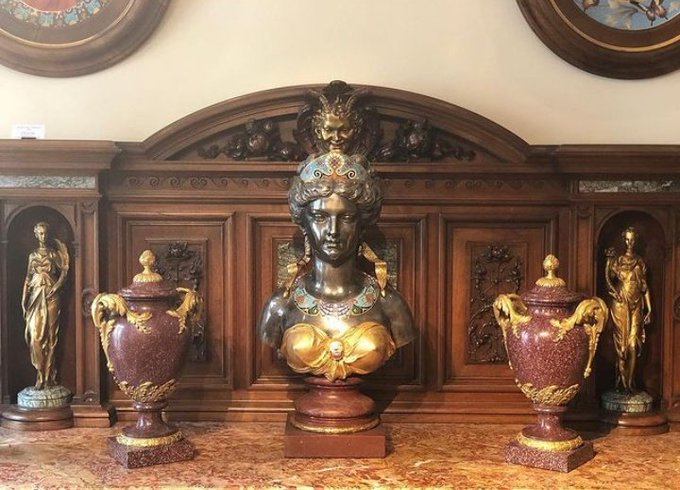
“If the apparition of the night before was an ocular delusion of my fancy sporting with the dark outlines of our cupboard, and if tis horrid eyes were nothing but a pair of inverted teacups, I had, at all events, the satisfaction of having launched the poker with admirable effect, and in true ‘fancy’ phrase, ‘knocked its two daylights into one,’ as the commingled fragments of my tea-service testified. I did my best to gather comfort and courage from these evidences; but it would not do. And then what could I say of those horrid bare feet, and the regular tramp, tramp, tramp, which measured the distance of the entire staircase through the solitude of my haunted dwelling, and at an hour when no good influence was stirring? Confound it!—the whole affair was abominable. I was out of spirits, and dreaded the approach of night. It came, ushered ominously in with a thunderstorm and dull torrents of depressing rain. Earlier than usual the streets grew silent; and by twelve o’clock nothing but the comfortless patterning of the rain was to be heard. I made myself as snug as I could. I lighted two candles instead of one. I forswore bed, and held myself in readiness for a sally, candle in hand; for, coute qui coute, I was resolved to see the being, if visible at all, who troubled the nightly stillness of my mansion. I was fidgety and nervous and, tried in vain to interest myself with my books. I walked up and down my room, whistling in turn martial and hilarious music, and listening ever and anon for the dreaded noise.” #RandolphHarris 20 of 21

Do not Grieve. Anything you lose comes around in another form. The child weaned from mother’s milk now drinks cranberry juice. God’s joy moves from unmarked box to unmarked box, from cell to cell. As rainwater, down into flowerbed. As roses, up from ground. Now it looks like a plate of rice and fish, now a cliff covered with vines, now a horse being saddled. It hides within these, till one day it cracks them open. There is the light gold of wheat in the sun, and the gold of bread made from wheat. I have neither, I am only talking about them as a town in the desert looks up to stars on a clear night. The Son of God, looking upon the World, beheld suffering and misery. With pity He saw how humans had become victims of satanic cruelty. He looked with compassion upon those who were being corrupted, murdered, and lost. They had chosen a ruler who chained them to his carriage as captives. God’s glory pervades the Universe; His ministering Angels inquire of one another: Where is the place of His glory? In response they give praise: Praised be the glory of the Lord from His Heavenly abode. From His Heavenly abode may He turn in mercy and bestow grace unto the people who, reciting the Shema evening and morning, twice daily, proclaim in love the unity of His name, saying: Hear, O America: the Lord our God, the Lord is One. He is our God; He is our Father, our sovereign and our Deliverer. In His mercy He will make known in presence of all the living that He will be your God. “I am the Lord your God.” As it is written in holy Scripture: The Lord shall reign forever; Thy God, O America, shall be Sovereign unto all generations. Hallelujah. #RandolphHarris 21 of 21

Winchester Mystery House

Ghostly tales are bountiful at Sarah Winchester’s Mystery House. What have you experienced? Photos are encouraged!

The Winchester mansion is 160-room mansion built to appease the spirits who died at the hands of the Winchester Rifle 👻
🗝 winchestermysteryhouse.com
“Whoever shadows my every move will not lose me in the dark.” At least that is what Christ says, or what the Evangelist John heard Him say (8.12). He tells us to walk on, through the darkness, with Christ as our only torch. That way, when we mayn’t have gained a step, but we won’t have lost one either. And on into the day we must pursue with dogged tread the life of Jesus Christ. Is this the secret to Mrs. Winchester’s 7-11 staircase?
 Randolph Harris II International Institute