
Home » sensation (Page 12)
Category Archives: sensation

She Had Better Stop and Take a Good Look at Herself

With all the changes and challenges you face each day, there has never been a greater need to take the time to determine your priorities. The art of being wise is to know what to overlook. In 1993 Mexico signed the North American Free Trade Agreement (NAFTA) with the United States of America and Canada. Within seven years, 3,500 maquiladora plants manufacturing everything from furniture to apparel to TV sets had sprung up along Mexico’s U.S. border, creating 1.4 million new, mainly assembly-line jobs for workers drawn from all parts of Mexico, and they important more than $51 billion in supplies into Mexico. However, in the late 1990s, with Guangdong and, indeed, all of China now competing in the cheap-labor derby, and estimated 250,000 to 300,000 of those Mexican jobs followed the great circle route across the Pacific. That put Alejandro Bustamante in a spot. When his employer, Plantronics, a leading manufacturer of telephone accessories, received an order, it called Mr. Bustamante. Although he ran the firm’s three factories in Tijuana, Mexico, he was told he must compete for each contract just like anyone else. However, Mr. Bustamante paid his workers an average of $2.20 an hour (including benefits) and had to bid against a Chinese manufacturer whose employees average only about 60 cents, which was nearly four times less than the Mr. Bustamante’s employees earned. There is nothing unique or new about that. Many maquiladora operators in norther Mexico face Chinese competition. However, what especially irked Mr. Bustamante was that the Chinese rival he faced was, in fact, itself also owned by Plantronics. This may be a case of serial outsourcing—sending jobs to China that had already been outsourced to Mexico. Outsourcing, while involving a small percentage of all jobs, has aroused fierce condemnation and prompted so much media coverage that there is no reason here to recap the familiar arguments, beyond recognizing that it is part of a much larger pattern of change in the spatial distribution of wealth and wealth creation. #RandolphHarris 1 of 18

Outsourcing enrages the critics of re-globalization who insist that it creates an unstoppable, brutalizing “race to the bottom.” They typically contend that companies go where labor costs are lowest and are ready to pick up and spatially relocate at a moment’s notice. If this were true, it would be easy to forecast where wealth is heading. It would be good news for African, which can offer a big pool of available labor at the lowest wages on Earth. (Africans should cheer each time workers in Asia join unions and drive wages up.) If labor cost were the sole consideration, why have not all those factories now in China wound up in Africa instead? The fact is that even for low-tech work, labor is cost, if ever, the exclusive basis for a company’s decision to relocate. Africa’s endless violence and war, inadequate infrastructure, stratospheric levels of violence, ravaging illnesses, and shameful regimes may rule out significant investment no matter what wage level. However, China has maintained its position as the largest investor in Africa over the last ten years by the number of new jobs created (18,562 on average), with a gradual substantial increase of newly created jobs on a yearly basis. China has spent 27 percent of its investments in Africa. Furthermore, since 2000, China’s foreign direct investment (FDI) flows to Africa have grown at an average annual rate of 40 percent, overtaking U.S. FDI in 2012. In 2019, FDI flows reached $2.7 billion, with the top destinations being the Democratic Republic of the Congo and Angola, two mineral-rich nations. China is also making space along a 30-mile coastline, in Africa, North of Dar Es Salaam, to make space for a $10 billion Chinese-built mega-port and a special economic zone backed by an Omani sovereign wealth fund. It seems Africa has more than just diamonds, gold, other precious minerals, people and animals that World wants to exploit. There are unspoiled beaches and bays; and lush vegetation. If the project goes ahead as planned, Bagamoyo will be transformed into the largest port in Africa. There is even talk of an international airport. #RandolphHarris 2 of 18

Many villagers have already accepted compensation for the loss of their homes. This portion in African is supposed to be as prosperous as Shenzhen, China. Shenzhen, in southeastern China, is a modern metropolis that links Hong Kong to China’s mainland. Over the past 40 years, the establishment of the Shenzhen Special Economic Zone (SEZ), has been a transformation of Shenzhen from a fishing village to a metropolis of innovation. The total investment has been $28 billion USD. Shenzhen has also nurtured some World leading technology firms including Huawei, DJI, and Tencent. The sector has emerged as the pillar industry of the city. As a matter of fact, a total of $4.27 billion USD, was invested in research and development, putting it on the top list of the country. In addition to this, the city has seen 17,500 international patents filed, accounting for one third of the national total. So this is what could be done in Africa, and it is important to keep an eye on the moves of China because they could become the World leader by investing in and colonizing foreign markets, with the large population. Another thing, with China colonizing Africa, it will also become a melting pot and the standard of beauty will change from the traditional European standard and shift to value other features. The race-to-the-bottom theory, moreover, presupposes that workers are essentially interchangeable—which may largely be true in repetitive, assembly-line operations. The higher up the skill ladder one goes in a knowledge-based economy, however, the less valid it becomes. As the knowledge components of wealth creation—marketing, finance, research, management, communication, I.T., vendor and distributor relations, regulatory compliance, legal affairs and other nontangibles—all grow in complexity and importance, workers, like the work itself, become less interchangeable and the required skill sets more temporary. If they extrapolate tomorrow’s economy from existing or projected wage levels alone, attempts to forecast which cities, regions or, for that matter, countries will become the next Guangdong will be inaccurate and the speculations are doomed to fail. #RandolphHarris 3 of 18

Any such simplistic analysis becomes even more questionable because, where economies are transitioning from smokestacks and assembly lines to knowledge-based production, we are already radically changing the very criteria by which a location, city, region or country becomes a high-value-added place. What we are about to see is less racing to the bottom and more of a race to the top. To anticipate tomorrow’s surprising geography—including the location of high-pay jobs, prime real estate, business opportunities, wealth and power—another key point needs to be understood: We are changing not merely the where of wealth but they why—the criteria by which we value places. And that further changes the where. Seeking to woo industry in 1955, the state government of Indiana placed an advertisement in Fortune listing its economic advantages. These, it claimed, included low-cost coal, limestone, white clay, aluminum, gypsum, rock asphalt, dolomite, fluorspar, water, sand, gravel, wood, corn, soybeans and easy access to the Ohio River. In addition, it promised an “enviable strike and lockout record”—that is, a weak or dormant labor movement. That was then. Today Indiana’s development council boasts of breaking away from “over-reliance on traditional industries.” No limestone here. Inc. tells American small-business leaders that the “best” place to “start or grow a company” is Phoenix, Arizona, because of its growing high-tech workforce, sunny climate, renovated art museum and “four major sports franchises.” A group called the Small Business Survival Committee concludes that the place to invest is South Dakota because it imposes the fewest costs on business in the form of taxes, minimum-wage laws, number of state employees and the like. Still another rating system bases its conclusions about the future on the age and growth rate of companies in any given location. A contributor to Microsoft’s bCentral.com then confects a hybrid index out of these last two methods and concludes that Nevada is the place to pull out your wallet. #RandolphHarris 4 of 18

Citing the 1955 Indiana ad in 2002 study called the “State New Economy Index,” Robert D. Atkinson and Rick Coduri of the Progressive Policy Institute write: “In an economy in which fewer than 20 percent of economic activity consists of creating, processing, or moving physical goods, access to raw materials, transportation and markets means less. As an increasing share of economic inputs and outputs are in the form of electronic bits, the old locational factors diminish in importance.” Take, for example, nearness—proximity. Some economists today believe that because Mexico is so close to American markets, it can beat Chinese competitors in the long run. They assume that distance still plays the same role it did before the knowledge economy arrived. However, thanks to information intensive technologies, products are becoming smaller and lighter every day. To rely on proximity means, to the degree that transportation costs matter, that Mexico’s advantage would apply to the older, bigger, bulkier, heavier physical products—precisely those now being replaced. And it means still less to high-value-added intangible services whose transportation costs have little or nothing to do with distance—finance, software, satellite TV, airline reservations, music and the like. Continuing to count on proximity will set Mexico even farther behind—and keep it there. Today, in their race to the top, competing states boast less about limestone and coal than about their great universities, low communication costs, advanced technology, frequent airline service, low crime, good climate and superior quality of life. The economy has been transformed along with workers’ values and way of life. The very categories with which we describe spatial units and relationships change as new economic networks emerge. We are seeing, for example, the rise of an entire ecology of airports linked to one another more strongly than with their local and national governments. Each airport is increasingly surrounded by its own ring of shopping malls, conference centers, 24/7 gyms, chapels, post offices, dentists and doctors, rooftop pools and luxury hotels. #RandolphHarris 5 of 18

The result has been a sprint—no longer just in the United States of America—to create what might be called higher-value-added places tht will attract the brightest, most creative workforce capable of producing knowledge-intensive, higher-value-added products and drawing businesses from around the World. The historical shift toward Asia, the digitalization of many economic functions, the emergence of cross-national regions and the change in the criteria by which we value place or location are all parts of a larger transformation in our relations with the deep fundamental of space. They merely form the background against which even bigger changes loom. One’s stumblings and one’s falling may depress one’s heart and reduce one’s aspiration. They may deter one’s will from further endeavour. For those monsters of hate and cruelty, either utterly materialistic and God-denying or fanatic and taking the name of God in vain, there is no shelter where they can hide once they are forced across the barrier of death. The qualities of determination, intelligence, and persistence—so useful in philosophy—can be used for good or evil. They can make a more successful criminal as well as a better philosopher. The upsurge of well-thought-out, daring, resourceful, and highly ambitious crime in modern times is a sign of misapplied powers, while its violence is a sign of merciless egocentricity. The end for such persons is commensurate. Then many come a crippling deformation future birth, or a sudden and radical awakening to the grave peril toward which they are heading—and a change of course to a better life. The unfortunate experiences which sometimes befall an individual’s Worldly life are, or may be, partly indued by one’s own psychic practices of the period immediately preceding them. One may have been drawn into a vortex of psychic evil which has harmed one’s spiritual life and brought suffering into one’s Worldly existence. What are the inner causes which can produce these dismal outer effects? Here are come of them: shock, worry, fear, resentment, anger, excessive, criticism, condemnation of others. #RandolphHarris 6 of 18

The English woman novelist named Ouida, who wrote during the earlier part of this century, was so successful that she became the highest-paid fiction writer of her time. Yet when she died she was alone, penniless, half-blind, and dwelling in a back alley of Viareggio, Italy. Why? She was brilliant, fluent, and vibrant in her style, but most of her written work was scathing, bitter, highly critical, filled with prejudices and even hates. To what extent did a mind and heart holding so many negatives contribute to these unpleasant results? Yet she was unquestionably a lady in manners, breeding, dress, and way of life. She wrote her letters and even her manuscripts on the finest quality paper. She was highly independent and refused an offer to write her own life story, even though a substantial amount of money was the prize. Her reply was that it would be lowering herself to feed her own egotism and vanity to do so! It is quite true and utterly obvious that bad physical conditions make their contribution also, but it I even more true that bad inner conditions are the fundamental causes which turn outward remedies to disappointments in the end. Blind selfishness brings mutilated lives and ugly minds. Pessimism is practical defeatism and psychological suicide. It is the child of despair and the parent of dissolution. If we make room in our minds for negative, bitter thoughts of complaint, outrage, or injury against those who mistreat us, we shall not be free and will remain unable to find peace. Beware of giving birth to thoughts of hate, envy, malice, or wrath and sending them to another person. For they will reach one, yes, but will then return like a boomerang to their source. Wicked humans may gain the fruits of their aggressions and desires, may win victories over others, but at the end they are destroyed at the roots. The coldly calculated torture of animals in the name of scientific progress must be paid for in different degrees by those who allow it as well as by those who perpetrate it. The practice of vivisection is a sinful one. The humans who do it will have to pay the penalty one day, quite often by being born into a maimed and hurt body. Some among them, who gradually lose every vestige of pity from their character, become heartless monsters. #RandolphHarris 7 of 18

Through violent aggression whereby impassioned men seek to destroy others, they work their own destruction—at first moral, in the end, physical. These undesirable thoughts and feelings are bad for others as well as oneself, besides wasting so much of one’s own energies. An evil human’s mistakes sometimes strike back at one later when one least expects them, and can least afford them. Is it prudent to heed all this talk of coming calamity? Is it a mistake to read material speculating on its likelihood or imagining its horrors? Each person must answer such a question for oneself, but the philosophic person approaches it in a different manner. On general principles one dislikes negative thoughts and repels them. One seeks a clear recognition of what is happening in the World around one, but one trains oneself—disciplines one’s mind and detaches one’s emotions—to do so without picking up the accompaniments of panic or depression. One practices living with complete calm in the face of provocations and irritations, keeping one’s head, when others all around are losing theirs. When these disaffected find one another and form a subculture, they tend to see their choice, fraught with crisis, as a religious movement. One of the favorite spokesmen of the Hipster Generation announces: For the crucifix I speak out, for the Star of Israel I speak out, for the divinest man who ever lived who was a person I speak out, for sweet Mohammed I speak out, for Buddha I speak out, for Lao-tse and Chuang-tse I speak out, for D.T Suzuki I speak out. This is typical speaking; like an address by Eisenhower it includes all voting creeds and betrays a similar lack of acquaintance. (The bother is that the speaker is in his late thirties and out to know better.) However, as we shall see, this formless ultimate experience is not irrelevant to the plight of being resigned, for there is no available World to give experience a form. #RandolphHarris 8 of 18

However, let me at once give a similar strain of rhetoric of a seasoned public spokesman in the organized system itself. I quote from an address to the National Recreation Congress of 1957 by Dr. Paul Douglass. He is concerned with the terrifying Problem of Leisure, namely that with a shorter work week and automation many millions of adults might simply goof off and get into mischief. “The assimilation of leisure into the folkway tomorrow makes essential the reconstruction of the goals and values of life, the evolution of a new ethics, and the definition of an esthetic suitable for the upreaching taste, the deeper comprehension and enjoyment of beauty in its many forms, and a more meaningful existence. Of course this is not serious. A “new ethics” would, presumably, be the work of an Isaiah or Ezekiel or at least Socrates. If someone’s lips were touched with fire and one got oneself rejected by us and swept our children wake, it would solve other problems than out leisure time for it would be convenient for us. –The Hipster spokesman, surprisingly, seemed to be satisfied with the ethics that we have inherited. (As an artist I find this kind of public speech vaguely insulting. Do we need an esthetic? I cannot cope with the artistic tradition that we have, especially its modern triumphs, so that my own work is both unclassical and dated according to standards right on my bookshelf. Does Dr. Douglass mean a popular esthetic? Is it news to him that the popular taste is systematically debauched by Hollywood, Broadway, Madison Avenue? that by the unanimity of publishers, producers, and broadcasters, assisted by the censorship, it is almost impossible to get an honest or vivid word to the public? and that if something slips by it is swamped by trash and singled out for neglect by ignorant critics?) Dr. Douglass cannot mean what he says, yet he does mean something. Under what conditions do public spokesmen use this kind of language, asking for new ethics and a meaning for existence, when there are concrete tasks glaring in the face? #RandolphHarris 9 of 18

The conditions are disappointment in oneself according to a lofty ethics, and resignation about doing anything. Not early resignation, but after the profound disappointment of experience. Spoken as if miracles were for the asking, the buoyant abstractions ward off pain and uneasy conscience when one is no longer going to try to do anything practical. (The crisis will occur “tomorrow.”) The tone, if not the content, fits the American style, optimistic about expedients. And the disappointment is more profound because the American promise was so bright. Achieving most of what we set out to get, we are surprised to find that it is useless, and worse. For after the century of progress, the folk who are wealth and pretty healthy are not only not happy or wise, but they are uneasy. Their own writers hold them in contempt. Foreigners keep saying that the atom bombs were dropped for no good reason. The beautiful American classlessness is freezing into statuses. People ask for a stop to immigration. In the modern World, we Americans are the old inhabitants. We first had political freedom, high industrial production, an economy of abundance. Naturally we are the first to be disappointed. Europeans, when they ape and deny envy us, are like children. Disappointed and resigned, adults do not see a future for their own children, for they do not know the Way themselves. Immigrants of the first generation wanted their children to make good and have careers; it the third generation they just “want their children to be happy.” And perhaps children being happy is exactly why America is in such a mess today. People should have wanted their children to work hard, honor their family name and practice chastity. Then maybe they would be more respectful and more industrious instead of having a sense of entitlement. We are not saying you should not help your children, by every means you should, but help them so they can focus on their education. If you can afford it, there is nothing wrong with buying a child a brand-new car when they are in high school, paying for insurance and gasoline, and giving them a monthly allowance. #RandolphHarris 10 of 18

By treating your child some luxuries, you will ensure they do not have to work and can spend more time preparing for college, and that they will have time for high school clubs and sports. Do not thrust your child off to work while they are still a child. Let them enjoy being young. When their brain power has increased and they reach college, perhaps by sophomore, when they are acclimated to college education and know how much time to spend getting back and forth to class, then talk to them about seeing if they are ready to be more mature and get a job to help pay for their education. Of course, if you can that is a great idea. Not everyone is lucky to have affluent parents have to work in high school and it makes life more difficult. So if you can help your child financially to become more successful, it is only your family name and image you are helping to become a success. Now, in tropical Africa, what anthropologists call terminal abstinence is a widespread phenomenon. What it refers to is the deliberate—and often deliberated—decision to terminate conjugal relations involving pleasures of the flesh. For example, Yoruba women—but not men—know that permanent celibacy awaits them down the road. Sometimes husbands impose celibacy on their wives because they wish to take or concentrate on a younger wife, but twice as often the woman themselves decide to adopt it. Most commonly, this happens when a woman becomes a grandmother. Throughout Africa, and in Yorba society in particular, child-rearing is predicated upon extensive grandmother participation. The transition from mother to grandmother is complex. Each has different rights and obligations, and sometimes the simplest or only way to navigate between their conflicting demands is to renounce childbearing altogether. Renouncing pleasures of the flesh relations is no hardship for these grandmothers. Usually, a woman’s greatest emotional satisfaction comes from her children and family, not from an intense love affair with her husband. #RandolphHarris 11 of 18

A woman may also declare terminal celibacy as a protest against a new wife or because she has proven her fertility and can now rest. It is not a rejection of her husband so much as a redeployment of energies. For women whose marries represent dynastic bonds and courtyards full of children rather than romantic attachments to their husbands, and for the millions of women who have operations to protect their celibacy, terminal celibacy can be a release rather than a loss. Indeed, it is often no loss at all. In North America, many aging women (who have had operations) also retire from pleasures of the flesh service without the slightest regret. Some consider pleasures of the flesh as purely for reproduction, while others say that, at their age, it is no longer necessary, proper, or dignified. Many older men and women claim they must abstain from pleasures of the flesh activities because of illness, though the medical reality is that their arthritis, heart disease, or hypertension does not require it. In fact, their newly adopted celibacy may disguise or excuse an antipathy to pleasures of the flesh. In the late 1870s, when pregnancy was an interesting condition, underwear one of many of life’s unmentionables, and death a delicate passing away, feminists cleverly softened their demands for an instrument to control when and how often they gave birth by referring to it as Voluntary Motherhood. After all, birth control had ugly connotations, namely, freedom from the consequences of, well, a coming together, as it were, a very intimate sort of carnal knowledge. From one perspective, feminists shared the common fear that contraceptives would lead directly and inevitably to wanton pleasures of the flesh. The various “washes, teas, tonics, and various sorts of appliances [were a] standing reproach upon, and a permanent indictment against, American women,” declared one feminist, articulating the disgust shared by many antifeminist men. So pronounced was their alarm that legislation actually prohibited the distribution of information about birth control. #RandolphHarris 12 of 18

Form a different optic, birth control was criticized for being unromantic and removing the spontaneity from pleasures of the flesh. Women’s greatest fear, however, was that widespread contraception would work against them. They would no longer be able to keep their husbands at arm’s length by invoking the argument that pleasures of the flesh might lead to conception. These devices also smacked of “looseness” and abandon of pleasures of the flesh and seemed unsuited to respectable people living respectable lives. Contraceptives might also send husbands galloping off to bed with “fallen women” they no longer needed to worry about producing a child with. Jealousy was only a partial factor. Horror of the illnesses that unfaithful husbands quite frequently passed on to their wives was a more urgent issue. For all these reasons, many women, including Voluntary Motherhood feminists, accepted birth control in only one form: continence in pleasures of the flesh, the World’s oldest and most widely practiced method of contraception. Voluntary Motherhood supporters were concerned above all with a woman’s right to control her body and, by extension, her fertility. They saw celibacy as the only moral way to achieve this and condemned artificial devices as instruments of immorality that permitted consequence-free indulgence of pleasures of the flesh. In an era where women had few legal and social rights, demanding control of their relations in pleasures of the flesh with their husbands was considered extremely radical. Their endorsement of celibacy softened its impact, but only slightly. Under the aegis of Voluntary Motherhood, married celibacy could take two forms: the couple’s mutual or the woman’s unilateral decision. Usually, the wife’s unilateral declaration of celibacy was at the core of Voluntary Mothers. On the difficult battleground of her home, each determinedly celibate woman defined not only her husband and her society’s norms but even the law, which required her to submit both body and will to her husband. #RandolphHarris 13 of 18

In these circumstances, she needed immense courage to dictate her availability for pleasures of the and to withhold it except when she was prepared to conceive a child. “Our religion, laws, customs, are all founded on the belief that woman was made for man,” remarked feminist Elizabeth Cady Stanton. “Womanhood is the primal fact, wifehood and motherhood its incidents…Must the heyday of her existence be wholly devoted to the one animal function of bearing children? Shall there be no limit to this but woman’s capacity to endure the fearful strain on her life?” Like a great many other nineteenth-century women, Mrs. Stanton had no romantic notions about intercourse involving pleasures of the flesh. It led to an endless series of being with child, and when desperate mothers sought advice on how to avoid conception, they were given false information. Medical “expert” Dr. Ezra Heywood, for example, told them that if they abstained from pleasures of the flesh until ten to twelve days after starting their cycle, conception could be avoided. This woefully wrong interpretation of the fertility cycle misled women, who ended up with child yet again. No wonder, then, that pleasures of the flesh soon lost is magic. Too often, it exhausted, impoverished, disabled, and ended their lives. A woman grieving for a miscarried child was a typical victim: “I am nearly wrecked and ruined by…nightly pleasures of the flesh, which is often repeated in the morning. It is almost nonconsensual because I am trying to produce a child to please my husband. This and nothing else was the cause of my miscarriage…he went to work like a man a-mowing, and instead of a pleasure as it might have been, it was most intense torture.” To end these all-too-frequent personal tragedies, the Voluntary Motherhood movement preached that woman had the right to practice celibacy. Any other form of contraception was not only morally questionable, but would deprive her of the ability to control when she had pleasures of the flesh. #RandolphHarris 14 of 18

The Voluntary Motherhood movement was both inherently radical and relatively conservative in its stance. In an era when the notion that a man could have nonconsensual pleasures of the flesh with his wife was seen as ludicrous because marriage gave him unlimited access to her temple, wives who resisted on ideological grounds were social rebels. Their commitment to Voluntary Motherhood, and to celibacy except for protection, was their means of empowering themselves vis-à-vis their husbands, and in a large sense, within the families they wished to space out and control, and even withing the society whose laws they so quietly and privately defied. In this contact, they justified their celibacy as an instrument or a weapon they needed to fight for the very noblest of causes. People with histrionic personality disorder, once called hysterical personality disorder, are extremely emotion—they are typically described as “emotionally charged”—and continually seek to be the center of attention. Their exaggerated, rapidly changing moods can complicate life considerably, as we see in the case of Suzanne: Suzanne, an attractive and vivacious woman, sought therapy in hope that she might prevent the disintegration of her third marriage. The problem she faced was a recurrent one, her tendency to become “bored” with her husband and increasingly interested in going out with other men She was on the brink of “another affair” and decided that before “giving way to her impulses again” she had “better stop and take a good look” at herself…Suzanne was quite popular during her adolescent years. Rather than going to college, Suzanne attended art school where she met and married a fellow student—a “handsome, wealthy, ne’er-do-well.” Both she and her husband began “sleeping around” by the end of the first year, and she “was not certain” that her husband was the father of the daughter. A divorce took place several months after the birth of this child. #RandolphHarris 15 of 18

Soon thereafter she met and married a man in his forties who gave both Suzanne and her daughter a “comfortable home, and scads of attention and love.” It was a “good life” for the four years that the marriage lasted. In the third year of this marriage she became attracted to a young man, a fellow dancing student. The affair was brief, but was flowed by a quick succession of several others. Her husband learned of her exploits, but accepted her regrets and assurances that they would not continue. They did continue, and the marriage was terminated after a stormy court settlement. Suzanne “knocked about” on her own for the next two years until she met her present husband, a talented writer who “knew the scoop” about her past…She had no inclination to venture afield for the next three years. She enjoyed the titillation of “playing games” with other men, but she remained loyal to her husband, even though he was away on reportorial assignments for periods of one or two months. The last trip, however, brought forth the “old urge” to start an affair. It was at this point that she sought therapy. People with historic personality disorder are always “on stage,” using theatrical gestures and mannerisms and the most grandiose language to describe ordinary everyday events. Like a chameleon, they keep changing themselves to attract and impress an audience, and in their pursuit they change not only their surface characteristics—according to the latest fads—but also their opinions and beliefs. In fact, their speech is actually scanty in detail and substance, and they seem to lack a sense of who they really are. Approval and praise are the life’s blood of these individuals; they must have others present to witness their exaggerated emotional states. Vain, self-centered, demanding, and unable to delay gratification for long, they overreact to any minor event that gets in the way of their quest for attention. Some make suicide attempts, often to manipulate others. People with this disorder may draw attention to themselves by exaggerating their physical illnesses or fatigues. They may also behave very provocatively and try to achieve their goals through seductions involving pleasures of the flesh. Most obsess over how they look and how others will perceive them, often wearing bright, eye-catching clothes. They exaggerate the depth of their relationships, considering themselves to be the intimate friends of people who see them as no more than casual acquaintance. Often, they become involved with romantic partners who may be exciting but who do not treat them well. #RandolphHarris 16 of 18

This disorder was once believed to be more common in women than in men, and clinicians long described the “hysterical wife.” Research, however, has revealed gender bias in past diagnoses. When evaluating case studies of people with a mixture of histrionic and antisocial traits, clinicians in several studies have a diagnosis of the histrionic personality disorder to women more than men. The latest statistics suggest that around 2 percent of adults have this personality disorder, with males and females equally affected. They psychodynamic perspective was originally developed to help explain cases of hysteria, so it is no surprise that these theorists continue to have a strong interest in histrionic personality disorder today. Most psychodynamic theorists believe that children, people with this disorder experienced unhealthy relationships in which cold and controlling parents left them feeling unloved and afraid of abandonment. To defend against deep-seated fears of loss, the individuals learned to behave dramatically, inventing crises that would require other people to act protectively. Some psychodynamic theories focus exclusively on female patients. They suggest that an early lack of maternal nurturance causes some daughters to develop an intense need for their father’s attention to seek it through displays of affection and dependence that go far beyond the usual behavior of young girls toward their fathers. These highly flirtations and dramatic displays of emotion established a histrionic pattern that extends to later relationships in their lives. Such individuals enter adulthood as “unhappy little girls,” looking at men as idealized fathers and always trying to manipulate them. Cognitive explanations look instead at the lack of substance and extreme suggestibility found in people with historic personality disorder. These theories see the individuals as becoming less and less interested in knowing about the World at large because they are so self-focused and emotional. With no detailed memories of what they never learned, they must rely on hunches or on other people to provide them with direction in life. Some cognitive theorist also propose that people with this disorder hold a general assumption that they are helpless to care for themselves, and so they constantly seek out others who will meet their needs. #RandolphHarris 17 of 18

Additionally, sociocultural theorists believe that histrionic personality disorder is produced in part by society’s norms and expectations. Until recently, our society encouraged girls to hold on to childhood and dependency as they grew up. The vain, dramatic, and selfish behavior of the histrionic person may actually be an exaggeration of femininity as our culture once defined it. Unlike people with most other personality disorders, those with histrionic personality disorder often seek out treatment on their own. Working with them can be very difficult, however, because of the demands, tantrums, and seductiveness they are likely to deploy. Another problem is that these individuals may pretend to have important insight or to experience change during treatment, merely to please the therapist. To head off such problems, therapists must remain objective and maintain strict professional boundaries. Cognitive therapists have tried to help people with this disorder to change their belief that they are helpless and also to develop better, more deliberate ways of thinking and solving problems. Psychodynamic therapy and group therapy have also been applied. In all these approaches, therapist ultimately aim to help the clients recognize their excessive dependency, find inner satisfaction, and become more self-reliant. Clinical case reports suggest that each of the approaches can be useful. Drug therapy is less successful, however, except as a means of relieving the depressive symptoms experienced by some patients. Now, the seed now begins its time of gestation in the rich dark Earth. It is the great cold of night: not the negative images of darkness, but the dark richness of that unknow, fertile, deep part in each of us where our intuitive creative forces abide. The Christ energy enters the Earth at this season. The yule log is lighted. The nights grow shorter, the light returns, and we experience rebirth. Again, again we come and go, changed, changing. Hands join, union in love and fear, grief and joy. The circles turn, each giving into each, into all. Prayer takes the mind out of the narrowness of self-interest, and enables us to see the World in the mirror of the holy. We do not step out of the World when we pray; we merely see the World in a different setting. Prayer is a way to master what is inferior in us, to discern between the signal and the trivial, between the vital and the futile, by taking counsel with what we know about the will of God, by seeing out fate in proportion to God. #RandolphHarris 18 of 18

Cresleigh Homes

What is it like living a community in that feels like a resort? Pretty totally great! This open concept design welcomes you into a window-filled great room.

There is also an open kitchen with prep island and plenty of counter space, and the beautiful dining room that you see below, which can be repurposed, as there is also a breakfast nook in the kitchen.

Since we moved in a Cresleigh Home, we’ve taken a dip in that sparkling pool every time we get the chance.

From the conveniences your heart desires and the finest features and finishes, a Cresleigh Home is what you are looking for. https://cresleigh.com/havenwood/


The Spirits Connected to Her Haunted Mansion

One of the many signs of someone being possessed is when one starts speaking in different voices, languages, and explaining things like you just met them that are out of context for the situation. However, scientific research has been unable to find an explanation for some well-documented speech occurrences. The so-called charismatic movement in our own country with its emphasis upon speaking in tongues has focused a great deal of attention upon this subject. Many people in Christian churches believe they are reproducing the gift of tongues reported in the book of Acts and discussed by the apostle Paul in the first letter to the believers in Corinth. The Biblical soundness of their belief lies outside the scope of this study, but we can report that scientifically conducted investigations have shown all instances of tongues-speaking to have the same characteristics wherever they are encountered. The variation between the tongues spoken in a state of hysterical frenzy among primitives is only superficially different from that practiced in a quiet, composed Christian setting. He considers that all tongues experiences are a means by which uneasy and unsatisfied people identify with the supernatural, securing psychological compensation for the spiritual vacuum in which they live. Some Christian scholars believe that added to the psychological element is the possibility that demons are involved in tongues-speaking, but results of investigations in this field are not yet conclusive. Tongues-speaking can be a language of ecstasy; that is, articulated sounds which do not constitute an actual language. Reports keep coming of an even more astonishing phenomenon—speaking a real dialect that was never learned. Hundreds of missionaries, especially those working among people in Asia, report that they often have encountered the mysterious ability of natives to speak in real languages that they never knew. These accounts come from Christian workers who represent widely divergent opinions regarding the charismatic movement. #RandolphHarris 1 of 13

One of Mrs. Winchester’s staff members that worked in the greenhouses on her property, who was born and reared on the Tibetan border used to report hearing the Tibetan monks in their ritual dances speak in English with quotations from Shakespeare, with profanity like drunken soldiers, or in German and French, or in languages unknown. A maid also reported the same experiences in the mansion. Reports of this nature are so numerous and come from such reputable people that one cannot set them aside lightly. Perhaps this is the reason Mrs. Winchester installed the mysterious windows in the Grand Ballroom? Christians must not jump to hasty conclusions on such delicate and complicated subjects, but they certainly must recognize the possibility of demonic activity and exercise extreme caution in an attitude of prayerful dependence upon God. We will be able to analyze these reports far more adequately after they have been thoroughly researched by competent investigators. Research teams have found that many of the physical and psychical phenomena declared impossible by the rationalistic scientists of the early 1900’s actually do take place. Most researchers do not even pretend to have a full explanation of how or why these occurrences transpire, but Christians are aware that some of them may be the result of evil spirits who work under the control of Satan. Regarding the occultic, the believer should walk the pathway of extreme caution. One should avoid any so-called magic that claims to bestow unusual knowledge or power through a psychic gift or ritualistic performances. It goes without saying that one must keep a safe distance from any form of black magic, and that one must examine carefully the doctrinal teaching of anyone who purports to provide healing or other temporal benefits in the name of the Lord. Biblical faith is built upon trust in God and expresses itself in submission to His will. Every follower of Christ should be wary of magical cures and all outward demonstrations of allegedly supernatural power. #RandolphHarris 2 of 13

As children of God, we must remember that we “walk by faith, not by sight,” reports 2 Corinthians 5.7, and that the faith through the senses. When we received Christ, we were brought into a vital union with Him, and the apostle Peter was writing to us when he said, “Who, having not seen, ye love; in whom, though now ye see him not, yet believing, ye rejoice with joy unspeakable and fill of glory,” reports 1 Peter 1.8. When a believer discovers the emptiness of this World’s enchantments, Satan tries to lure one into accepting his help through some form of occultism. Through these devices, the devil and his organization of evil spirits may attempt to bring defeat and misery into the lives of God’s children. Satan is unable to harm a believer, however, if that person accepts the instruction of the Bible, maintains a life of prayer, and submits oneself to God, and resists the devil. If one is hypocritical and dishonest, one will successfully resist and overcome the evil influence of Satan and his armies. The child of God must not merely say that one desires victory over sin, but must truly long for it. One’s spiritual vows and public statements must always be sincerely spoken, for the devil has no difficulty in defeating the hypocritical and half-hearted. The devil cannot effectively tempt a Christian who is actively living a joyful Christian life. Some believe that the door-to-nowhere in The Winchester Mystery House is just a wing of the mansion that was never finished, but perhaps it was a biblical metaphor. “I am the door; by me if any one enter in, one shall be saved,” reports John 10.9. It is elevated to a high level on the estate with no entrance reminds use to raise or consciousness, but by going the wrong way through the door, it may be a plunge into the pit of hades. There was once a woman who worked at Mrs. Winchester’s estate whose hand was terribly mangled by a gun explosion. Little did Mrs. Winchester know, that some men on the estate, amiable farmers, when not performing their specific functions, they were wizards, necromancers, exorcists, but above all priests, representatives of the people in offering sacrifices and making contact with the spirits. #RandolphHarris 3 of 13

Over one hundred years ago, human sacrifices had been made in some places, members of the community offered up by the noblest lords, but now animal sacrifices are made. They exhort their listeners about Heaven and hell in which they firmly believe, the one a place of joy and the other of torment…They keep the register of all males born and are intimate contact with sorcerer-priests, who can read ancient manuscripts and incantations for use on all religious occasions. While working on the estate, a man of Asian decent went to the farmers and asked for medical assistance for his wife. It was a moment of weakness—but he needed help. After the wizards, sorcerer-priests, necromancers, and exorcists evaluated the grounds keeper’s wife several times, they found she was suffering a higher fever also. While making preparations to treat her, they noticed the husband cutting three little bamboo sticks about eight inches long and a quarter of an inch in diameter. Oblivious to all that was taking place around him, he silently moved across the room with these three sticks and a rice bowl. After placing a little water in the bottom of the bowl and ordering his wife to dip the fingers of her right hand in it, he waved the bowl over her prostrate body. His next act was to place the bowl on the floor and try to balance the three sticks in the center of it. While this balancing process was going on, he kept calling out the names of demons. The men of supernatural powers soon awakened to the fact that this man was preparing to call a demon out of his wife. The men of supernatural powers suggested that the man’s wife’s fever was probably due to an attack of malaria, but the man insisted that she was demon-possessed. The naming of demons continued until the name of “Lin,” and then the sticks stood on end. Upon learning this was the demon’s name, the man placed some rice in the blow and mixed it with the three sticks—a little salt was added to give it flavor. He then waved the bowl in circles over his wife and politely called out, “Please, Mr. Lin Demon, come out—come out—look at this, tasty bowl of rice—it’s for you if you’ll only come out—please, oh, please come out, Mr. Lin Demon.” #RandolphHarris 4 of 13

Then he moved slowly toward the door and outside, sprinkling a little of the rice along the way and begging the demon to follow him. When he reached the end of the estate, he flung the remaining portion of rice as far out as he could and then returned to the house. This was too much for some of the men of supernatural magic. They were determined to find out the shenanigans behind this thing, even if it meant calling down the wrath of the gods and demons combined. They asked the fellow if her would let them try to stand those sticks on end. He smilingly gave them the go-ahead signal; but he tried and those things just would not stand. Still not satisfied, they asked the man with the injured wife if he would show them how to do it. The whole process was reverently repeated, even to the standing of the sticks when the name “Lin” was called out. However, the men of supernatural magic finally despaired of ever making those sticks stand. They asked the man where did he learn this art. He answered through a séance with Mrs. Winchester. Six scrolls of some ancient script containing incantations appeared in the Blue Séance Room, along with other radical writings. The men of supernatural magic then realized this was the employment of evil angels they were dealing with. They were dealing with the rulers of darkness of this World, and spiritual wickedness in high places. In another case at the Winchester Mansion, these men who doubled as farmers met a fifteen-year-old girl who had a disease of the eyes. She spent quite a time in an eye clinic, but in spite of the treatment she was not cured. Since medical help had failed, she turned to the men of supernatural magic. These men, using white magic, case some spells over her. Within 24 hours of the charming, the girl’s eye trouble disappeared, but thereafter she felt a terrible inner unrest. She prayed but found no peace. Later, when she visited her former eye specialist, he could only shake his head in astonishment and ask her how she had been healed. #RandolphHarris 5 of 13

Although white magic has been able to heal people, some still believe it is inspired by the powers of darkness. Through white magic some may even obtain what they actually desired, and so it is often only in the effects that its true nature is revealed. The boundary between prayer and magic can be very fluid. If one is able to differentiate between the genuine and the imitation articles, it is essential to have the gift of discerning of spirits. However, whether it sails under a black, white or neutral flag, many people believe they have evidence to prove that the effect of magic in any form is the work of the devil. Yet, that is not what I believe. I have met some very nice people who claim to be witches and warlocks, and they are some of the most kindest people you will every meet. They define those that Christians, who pontificate about the bible, harass and attract and really listen and get to all sides of the story, some it makes some wonder, who is really evil? I am not saying that all Christians are bad, but the witch hunts were started by Christians, as well as lynching in the Southern states. I am not telling anyone what to believe, I am just presenting information that is fascinating. Part of being educated is to remain unbiased and be able to have a discussion, until you draw your own reasonable conclusion based on the evidence presented. If one does not have a case, or does not want to be contradicted by evidence that would prove their argument false, of course they turn to slander, harassment, and terrorism. That is what ignorant people do. They gang up and try to lie so loud to make sure no one can hear the truth they are suppressing. But as the Bible says, all things will come to the light. Everyone has things they need to deal with inside of themselves and sometimes it is more comfortable to try to find fault with others and blame others instead of taking responsibility. For instance, the dynamic of idolatry is demonism since idolatry is in reality the worship of other gods who are demons (1 Corinthians 10.20), headed by Satan the “god of this World,” (2 Corinthians 4.4). #RandolphHarris 6 of 13

Occultism involves dealing with demonic forces through fortune-telling, magic, spiritism, or religious cults, which are supposedly closely allied to idolatry. Persons who deal in the occult often discover that they have spiritistic sensitivity, extrasensory perception, or abnormal intellectual powers enabling them to engage in clairvoyance, precognition, divination, psychometry, magic, and spiritism. Dealing in the occult often results in the subjection to the powers of darkness to such a degree that the mind becomes blinded to truth, immersed in deception and error. This frequently results in acute depression with thoughts of self-destruction. However, not all emotional problems or suicidal tendencies should be attributed to occultism. However, demons can also oppress that human mind. Enslavement to demons sometimes reaches a point in which the demonic spirits harass and torment their victims. In the preceding stage of subjection, the evil spirits sporadically dominate their victims, but they do not necessarily harass them, at least not as they do in this deeper and more tragic state of oppression. Oppression in some form will be the final outcome of all who become psychically enslaved, even though some are not psychically gifted with spiritistic or magical powers. One well-attested and widely occurring form of demonic oppression is poltergeist phenomena. “Poltergeist” is German for “noisy ghost.” In such a case, the oppressed person is hounded by strange noises and sounds, such as shouts and obscene threats, rattling of chains, moaning, weeping, or piercing laughter. Dishes clatter, furniture is moved by invisible hands, and myriads of other strange happenings occur, invisibly produced by spirits connected with a haunted house where spirit activity has been practiced. Some who are oppressed continue to be tormented even though they may move to another residence. Also, common in the victims of demonism are the appearances of ghosts, specters, and monstrous phantasms. These phenomena are often explained away as hallucinations, but are well attested in occultism as spirits appearing as dwarfs, animals, dismembered parts of a human body, etcetera. At times these hideous spirits will strangle, bite, strike, or attack their victims in some way. #RandolphHarris 7 of 13

Perhaps the most terrible and revolting form of demonic oppression is what is known in the history of religion as incubi and sccubae experiences. This is the assault by an unclean spirit upon its enslaved victim for the purpose of lust involving pleasures of the flesh. Both men and women have been attacked and molested by “seducing male and female demons.” Such fully established phenomena show that angelic-human union, a major cause of the flood (Genesis 6.1-4; 2 Peter 2.4; Jude 1.6-7), has its parallel in occultism today. The account of the following portent is given us in Aubrey’s Miscellanies. “When King James II first entered Dublin after his Arrival from France, 1689, one of the Gentlemen that bore the Mace before him, stumbled without any rub in his way, or other visible occasion. The Mace fell out of is hands, and the little Cross upon the Crown thereof stuck fast between to Stones in the Street. This is well known all over Ireland, and did much trouble King James himself with many of his chief Attendants”; but not doubt greatly raised the hopes of his enemies. A few years later a witch-story comes from the north of Ireland. “At Antrim in Ireland a little girl of nineteen (nine?) years of age, inferior to none in the place for beauty, education, and birth, innocently put a leaf of sorrel which she had got from a witch into her mouth, after she had given the begging witch bread and beer at the door; it was scarce swallowed by her but she began to be tortured in the bowels, to tremble all over, and even was convulsive, and in fine to swoon away as dead. The doctor used remedies on the 9th of May 1698, at which time it happened, but to no purpose, the child continued in a most terrible paroxysm; whereupon they sent for the minister, who scarce had laid his hand upon her when she was turned by the demon in the most dreadful shapes. #RandolphHarris 8 of 13

She began first to rowl herself about, then to vomit needles, pins, hairs, feathers, bottoms of thread, pieces of glass, window-nails, nails drawn out of a cart or coach-wheel, an iron knife about a span long, eggs, and fish-shells; and when the witch came near the place, or looked to the house, though at the distance of two hundred paces from where the child was, she was in worse torment, insomuch that no life was expected from the child till the witch was removed to some greater distance. The witch was apprehended, condemned, strangled, and burnt, and was desired to unto the incantation immediately before strangling; but said she could not, by reasons others had done against her likewise. But the wretch confessed the same, with many more. The child was about the middle of September thereafter carried to a gentleman’s house, where there were many other things scarce credible, but that several ministers and the gentleman have attested the same. The relation is to be seen in a pamphlet printed 1699, and entitled The Bewitching of a Child in Ireland.” People in ancient times used to rely more on the spiritual, witchcraft, magic, séances, curses, potions, and meditation. Perhaps that is why there were so many more instances of supernatural things happening today. Some of these claims sound so outrageous and many of them report the same types of instances. Then today, we have all these technologies and medications and machines that we rely on and people who tell us what is actually possible and how many of these stories from the past happen to be something else explained by medication or a camera that so many people start to disbelieve in the supernatural. However, just because it can be explained by science, does not mean it is not supernatural. The Christian Bible even speaks about miracles, which are things that are supernatural. Supernatural phenomenon is real. #RandolphHarris 9 of 13

However, supernatural phenomena may be less common today because land is so densely packed, so many people turn into TV and Music and digital entertainment, so they spend less time praying and tuning into nature. In the 1800s, one could life in a house and not see another person for years because there was so much space to spread out on. People had time to read books and gaze at the moon and the sky and think up inventions. By now, everyone has probably heard of the legendary Sarah L. Winchester. She is the one who built the most mysterious mansion in the World. One thing that surprises me is that no one has, as of yet, tried to duplicate or create something just as wonderful. Nonetheless, it has been said that Mrs. Winchester slept in a different bedroom every night, supposedly in order to confuse evil spirits. And it totally makes sense. Because even now, people say when bad things are happening to you, you need to figure out what you are doing to cause it and draw closer to God. Back in Mrs. Winchester’s day, the 1800s, people were into spiritualism and also believed that spirits were the source causing bad things to happen to people. So they would try to appease them to protect themselves from curses and demons and so forth. Every generation has their methods and religions and that is just how it is. Some say Mrs. Winchester also held special dinner parties for her spirit friends. Legend has it that she would serve her phantom friends on solid gold plates, offering them delicious cuisine like caviar, truffles, and pheasant stuffed with pate. The mansion’s staff was also well-fed. On a stormy night, the front of the house was dark and silent, for it was long past bedtime. It was thirteen past one, and raining like blazes. It was thirteen years ago this day that Louis Le Prince had been seen alive, for Black Knight, one of Mrs. Winchester’s mares kicked the life out of him in the house stable one morning. One could feel the present and all its dangers towering around. Staff who walked by the horse stable this day reported feeling lost, a ghost dislodged from time. Indeed, it struck many people as unusual that the lad was left for the to care for the horses by himself. It might have been a fancy stable, but there was a queer feel about the place. #RandolphHarris 10 of 13

The sun was just beginning to set as they headed back to the estate. By the time they got inside, the night was as black as your hat: not a vestige of a moon, not a single star to break the uniform of darkness of the sky. With sunset a noisy blustering wind had sprung up, rattling about one of the chimneys, clashing the wet branches, and deadening the sound of cautious footfalls creeping across the paddock in the direction of the stables. The wind dropped suddenly, making the silence all the more intense by contrast with the previous roar; and through the stillness, Mrs. Winchester heard the clink of a bucket, and the sound of someone moving about in the stables. She sprang to her feet and snatched up her lantern. She thought that someone was trying to get at one of her horses, and her hand was on her father-in-law’s ivory-gripped Winchester pistol when she opened the door. So strong was the impression that she was absolutely surprised to find no sign of an intruder. The horses were perfectly quiet. Mrs. Winchester looked all around. There was certainly nothing to see, but it struck her that the air felt very cold, and she shut the door. The instant it closed behind her, a dark shadow fell across the square of light issuing from the entrance to the saddle-room. She figured it must have been the wind she heard and locked the door and went back inside. However, the butler Henry Boynton Clitz, was also suspicious. He turned the key in the lock and looked into the horse stable; then he gave a slight start, and drew quickly back. There was light inside, but where is came from would have been difficult to say. Beyond the shadow lay black and impenetrable, a wall of darkness. As he crossed the threshold Henry felt a blast of cold air sweep towards him, striking a strange chill into his very bones. Straight opposite stood a horse, and before him was an old man who appeared to be asleep. However, even in that intense stillness the tout could catch no sound of his breathing. His own heart was thumping against his ribs with the force of a sledge-hammer. #RandolphHarris 11 of 13

Henry felt his flesh creeping with a sensation of fear that was almost sickening. Fear? Yes, that was the word; he was horribly afraid. And of what? Of a weak old man, for whom he would have been more than a match single-handed, and they were two to one. What a fool he was, to be sure! With desperate effort he pulled himself together and went forward, his eye warily fixed on the silent figure. Neither man nor horses moved. As Henry moved forward, he heard a low chuckling laugh. The man was looking at him. The gleaming eyes fixed on him with a sort of mesmeric power. His face fastened on the figure, taking in every item of the quaint dress, the high gill collar and ample bird’s eye stock, the drab coat and antiquated breeches and gaiters. His mouth was open, but for the life of him he could not speak. He was waiting in the helpless fascination of horror to see the face of a man who had been dead and buried for thirteen years. Slowly, like an automaton, that strange watcher turned his head. The square, resolute mouth was open as if to speak; the shrunken skin was a greenish yellow color, like the skin of a corpse; along the temple ran a dull black mark in the shape of a horse’s hoof; but the eyes burned like two living coals, as they fixed themselves on the face of the terrified publican. Next, Henry heard the crash of a lantern on stones and the sound of Louis’s flying feet, and an awful terror came upon him, a great fear, which made his teeth chatter in his head and curdled the blood in his veins. The place seemed full of an unnatural light—black flames. The air was foul with the horrible odors of decay. Above all, Henry felt the fearful presence of that which was neither living nor dead—the semblance of a man whose human body had for thirteen long years been rotting in the grave. It was not living, but it moved. Its cold, shining eyes were looking into his, were coming near. There was no mistaking the look of that helpless body, the limp flaccidity of those outstretched arms. “He’s dead,” said Henry, as he turned up the white face. Its coat was wet with—something. #RandolphHarris 12 of 13

It was blood. But it was strange there should be no marks of violence about him, and yet he looks as if he had died hard. And truly, the dead man’s face was terrible in its fixed expression of mortal fear. The eyes were staring and wide open, the teeth clenched, a little forth hung about the blue lips. It was a horrid sight. Henry locked the door on the corpse until the police could arrive, and spent the remainder of the night in the butler’s pantry. However, when the Henry awoke, he could throw very little light on the matter. There was no one in the horse stables. No body, no foul odor, no broken lanterns. Just the horses and an old noose in one of the empty stalls. Whatever happened remain a mystery. The old living soul who knew the truth held her tongue. Mrs. Winchester simply told him, “Leave it to other staff members and never set foot in that cursed place. The poor boy is dead, and there is no reason for me to get myself mixed up in the business.” Demons can cause physical ailments such as dumbness (Matthew 9.32-33), blindness (Matthew 12.22), and various other defects and deformities (Luke 13.11-17). In all such cases medical and psychiatric treatment are of no avail, because the cause is demonic. Only be dealing with the spiritual causes of the malady can it be cured. Besides actual sickness, demons can cause speech and behavior abnormalities. In demon possession, which is an extreme form of enslavement and oppression, the speech and behavior abnormalities appear in greatly accentuated form with such violent physical manifestations as retching, screaming, blaspheming, cursing, foaming at the mouth, convulsions and display of tremendous physical strength. So completely does the demonic spirit gain mastery that one takes over the body of the victim and speaks through it with one’s own voice and language, which may be completely foreign to the language of the demonized. Sometimes evil spirits endanger humans’ temporal safety by exercising a certain control over natural forces. “I’ve covered my brother completely (That bump on the right is his knee) I will dig him out when I am ready to find how he liked it, you see.” #RandolphHarris 13 of 13

Winchester Mystery House

Tickets are almost sold out for tonights Flashlight Tours! 👀🔦 March 5th & 12th nights still have availability – hurry and purchase before they are all gone! You don’t want to miss this 👻

I’ll bet you wonder whether poor Whitney’s race is run. I hate to keep you guessing, but I must have my fun. 🎟 link in bio. https://www.winchestermysteryhouse.com/

REGARDLESS OF VACCINATION STATUS, ALL PERSONS IN SANTA CLARA COUNTY MUST WEAR FACE COVERINGS AT ALL TIMES WHEN INDOORS. WHILE THE STATE OF CALIFORNIA LIFTED THE UNIVERSAL MASK MANDATE AS OF FEBRUARY 16, 2022, SANTA CLARA COUNTY MASK MANDATES ARE STILL IN EFFECT UNTIL FURTHER NOTICE.

Who Would Keep a Cow of their Own that Can Have a Quart of Milk for a Penny?

No one has yet fully realized the wealth of sympathy, kindness, and generosity hidden in the soul by God. The human mind is fascinating. A young officer working on a ship wrote that he would awaken during the night and discover himself under an undesirable physical and mental condition. He seemed to be clearly in a mesmerized condition, caused by someone or something giving the powerful posthypnotic suggestion to wake up and obey. The remedy is to use the same technique in reverse. That is, practise auto-hypnosis, give the self-suggestion that on waking up there will be full conscious and full rejection of the negative idea. If one must hate something, let one hate hatred itself. The storms of violent passion are to be resisted as the smoothness of inner peace is to be invited. To keep one’s temper in a single provocative situation may be easy, but to keep it consistently equable is a real feat. Life is a conflict. One must not let these negative feelings take up lodgement within in one longer than a single moment. All humankind must awake from its materialistic apathy and cast out something of its selfishness. It is called upon to renounce its violence and meannesses, its intolerance, unkindnesses, and injustices. It must either emerge from its animal brutality or else suffer itself to be extinguished by it. It must come out from the shadows of ignorance, selfishness, and materialism. Only then will it find the sunshine of a larger life that awaits it. It is not always one oneself who acts in a particular way at a particular time. Impulses from lower sources or outside contacts may be strong intuitions from higher levels or outside sources may influence one to wise choices which bless one’s future. We must not hate those who are born of the same divine essence as ourselves but we may hate the sins they perpetrate and the evil they radiate. The seeker has to contend not only with limiting environments but also with internal enemies. Apathy delays one, depression obstructs one, and loneliness frustrates one. #RandolphHarris 1 of 18

The more one becomes sensitive, intuitive, responsive to the spirit, the more one is unfolding exceptional passivity. However, this puts one in peril, for one feels the negative presence too. Hence the more one must restrict one’s contacts until one’s strength is above them. It is prudent to escape from a situation where there is much pressure to commit a foolish action or to make a foolish decision leading to calamitous results—and not continue to stay in it until the danger materializes. One whose presence is felt to be odious, whose personality is regarded as distasteful, is better left alone. One should never allow the actions or words of ignorant human to arouse in one reactions of anger, envy, or resentment. The years are too few and there is too much to be done—both on oneself and for oneself—to waste them in negative, resentful thought and decaying, neurotic emotion. When one comes to understand its importance, one will begin to exercise some vigilance over one’s thoughts. Resist beginnings—that is the most practical way to deal with negatives. The destructive thoughts of fear and self-doubt which whine at your door, whine at the door of every human. However, you can make them powerless to hurt you. For—there is n chance, no destiny, no fate can circumvent, can hinder or control the firm resolve of a determined soul! If the negative thought persists then one has to wrench oneself away from it with the assent and use of all one’s being—feeling, reason, intuition. One’s own attitude towards events holds the power to make them good or bad, whatever their nature of itself may be. Those who are unable to think correctly about this tragic World situation must be pardoned, but those who refuse to think correctly about it do not deserve pardon. The counsel of Jesus to “resist not evil” does not apply to other men’s acts but to our own thoughts. We are to turn aside from a negative thought-habit by the simple method of substituting the opposite and the beneficial one. We need not to spend our strength resisting the thought of misery, for example. We are to substitute hope for misery, whenever the latter appears. #RandolphHarris 2 of 18

Wrong-doing will be avoided not because it is punished by the law of recompose even when it is not punished by the law of society, but because of the strong inner conviction that right-doing is its own reward, its own satisfaction. The beautiful is allied to the good. If we cultivate beautiful feelings, evil ones begin to get dissolved. One will not risk rebuffs by expressing one’s views and describing one’s experienced to the uncomprehending of the unsympathetic. It I cowardice to refuse to face the fact that one has made a mistake and to continue following the same course because it is to stop it and return to the right road. The easier way is too often the worse way, leading to trouble for one’s self and others. There is a limit to the extent of concessions to prejudice; we must not beyond it. Beware of those whose mind is vindictive and whose speech is venomous. If they are born of emotional prejudice or passionate bias, it is of little use to meet irrational arguments with rational statements. The ancient saying that where goodwill exists agreement will not be hard to find, still remains true. The crowds which delighted in the gladiator shows of ancient Rome and, to a lesser extent, those which delighted in the bullfights of modern Spain, do not see to understand how bestial they allow themselves to become at such times. If one is to be distinguished from a member of the savage species, the true human being, the fully evolved human, must have the quality of pity in oneself. Do not attempt to fight evil with evil. Overcome it by calling on a higher power to bring out the good in you wherewith to meet it. In this way you obey Jesus’ counsel, “Resist not evil.” Synesis (fourth century): “This would be the most extreme of ills—not to be conscious of the presence of evil. For this is the condition of those who no longer try to rise…for this reason repentance is elevating means…[but] both deeds and words [must] lend a helping hand.” A philosopher may not ignore the negative side of one’s or another’s life: one has to deal with it because circumstances force one, like everyone else to do so. #RandolphHarris 3 of 18

However, one’s way will be different, because one will use all one’s faculties and capacities: intellectual, practical, and intuitive. One will keep calm and not let passion or negative emotion carry one away. However, all that done, one hands over the results to the higher power (which includes destiny). One’s mind must stay in That which transcends negativity, sin, evil, even if one must grapple with them. Philosophy will not disregard the bad in others, and the sin in ourselves, but having seen them clearly it does not react negatively in useless condemnation. Instead, it reacts constructively in trying to realize the meaning of evil, the consequence of sin, and then proceeds to cultivate the opposite quality, the good of that particular evil—as honesty where there is dishonesty and so on. If practical dealings are involved, we may regret the existence of these faults in others, but we may not refuse to recognize them. Amid all the pessimistic reflections which the state of the World so easily induces in the thinking human, one may yet be buoyed up by the hope which the eternal verities must again and again give one, that is, the hope that the end of it will be immeasurably better. The existentialist view—so popular with so many young people today—that we begin with oblivion and end with annihilation, that what comes between is either meaningless or mysterious, with no solutions to problems, no answers to questions, is a view which the tragedy and evil and catastrophe of our times tempt us to accept. However, religion and philosophy release us from this despair. In such critical times as these even some faith in the existence of a higher power, and some aspiration towards serving it, has protective value. Trust, not tension: trust in the higher power producing serenity rather than tension; because of the pressures of life this is a great need today. However dark or desperate World history may seem at times, we must always remember no one can disrupt the divine World-Idea, or spoil its manifestation, or prevent its glorious outcome. #RandolphHarris 4 of 18

Fear of the power and cunning of these evil opponents causes them to rely on obvious but ordinary human forces and weapons for protection. They forget the divine forces they could, and should in this crisis, call on—and neglect the superhuman and extraordinary. To express a half-amused contempt for the intelligence of our time is not at all the same thing as to make a jaundiced indictment of it. To witness the magnificent parade of a civilization of almost unredeemed triviality is less likely to arouse bitterness in the soul and more likely to give it a good half-hour’s amusement. On the one hand, carried away by the idealistic enthusiasm and millennial promises of merely emotionalist cults, some believe that a spiritual teaching has only to be propagated and it will spread triumphantly everywhere. On the other hand, confronted by the formidable spectacle of a whole World plunged in ignorance, conscious that the ordinary individual can do so little to uplift it, others drift into bewildered defeatism and actually do nothing at all. However, this second attitude, although much more sensible and much more justifiable than its opposite one, is not quite philosophical. According to the old classical fable, we had to look for truth in the bottom of a well; today we have to look for it in the bottom of a bitter disillusionment. In the dismal World conditions of today it is a paramount necessity to obtain some glimpse, however meagre, of the divine plan which is working out for all our lives. Only in this way can we co-operate with it understandingly and adequately. Instead of relying on flight into the unknow and uncertain, it is better to rely on God. In the first case one may be making a false escape and duping oneself, but in the second case one opens the way for true guidance in the matter. With peace in the mind and harmony in the feelings, both completed by knowledge of the universal presence of divinity—who could harbour evil thoughts, hatreds, or destructive plans? #RandolphHarris 5 of 18

Every evil person who crosses our path provides an opportunity, in the injury one attempts to do us, to keep ourselves from being provoked into retaliation, anger, or resentment. If we succeed in overcoming our own feelings, we mount upward a step. In a negative situation, where negative criticism and negative emotions are rampant, other persons may try to involve one in it, or at least get one to support their attitude and endorse their criticism. However, a feeling may come over one preventing one from doing so. If so, one should obey and remain silent. With time the rightness of this course will be confirmed. One the injunction to return good for evil, the question arises, with what then will you return go? Return good for good, but justice for evil. Is this not wiser counsel? Does not the other punish goodness to an extremist position, rendering it almost ridiculous by condoning bad conduct? Inner and outer difficulties are often related. What appears to be an ugly state of affairs may well be a definite attack of certain evil forces using interested human instruments. In such a situation, the individual should never practise nonresistence in any way, but, on the contrary, should fight them off as hard a one can. At the same time, one must remember that weakness in self-control can give these evil forces an opening which they might not have had otherwise. If one wishes to emerge victorious in the struggle, one must be on one’s guard. If one does not throw off this condition, one, oneself, unwittingly erects a barrier though which the divine help sent one finds it difficult to penetrate. Although the temptation to seek release as such a time through, for example, the easy way of drink is understandable, one must nevertheless remember the duty one owes to one’s spiritual life, to one’s personal interest on the relative plane, and to others. Although the student must forgive those who mistreat one, one need not think tht forgiveness implies one has to associate with such people thereafter. #RandolphHarris 6 of 18

Whenever the thought of them, or their abuse, comes into one’s mind one must exert one’s willpower to drive it out, and immediately direct one’s thoughts toward God, or toward any inspired individual in whom one had faith. Only the actualized Christian is entitled to dismiss evil and to deny its existence: all others must look it in the face, understand it, and overcome it by slow gradations. It is better to keep out of the way of evil humans, especially when they are in power, until or unless we are driven by the necessity of circumstance of the inward voice of duty to oppose ourselves to them. It is always a certainty that the practice of active goodwill directed toward those who regard one harshly will benefit one’s own development, while it is always a possibility that this practice may dissolve the harsh feeling against one. It is all gain and no loss. This is one part of the case for Jesus’ advice to return good for evil. It is a technique of this evil power to paralyse its intended victims by frightening them. If we give way to fear, we give assistance to its effort. It cannot be beaten without open defiance and ready valour. One must remember that one will meet with those individuals who are themselves the bearers of antagonistic forces, instruments of darkness—sometimes consciously, most unconsciously, people used by evil forces. So far as possible one must avoid such people. Certainly never enter into intimate associations with them, whether the relation be business or personal. If one does one will find that sooner or later some of their unfortunate behaviour will be returned by Universal Law and tumble on one and one with have to suffer with the afflicted individual. These people make talk as believers in spiritual things—indeed, they often belong to some cult or other. However, they do not understand truth or live it. They cannot help one and one is not strong enough to carry them. So leave them alone. And that is not always easy, because often they are people of a kind that force themselves into one’s life. #RandolphHarris 7 of 18

Sometimes one can know them by this hallmark, by this aggressive way which they try to entangle another individual. It may even be necessary at times to deal with such people with a firm hand, even mercilessly and relentlessly. If so, do not hesitate, but do it without any personal feeling of any kind. The American landscape has been badly corrupted. European writers no longer even notice the natural wonder of it, they are so put off by the ugliness and conformity of the towns. However, worse than the ugliness and conformity is the neglect that baffles pride of place. Our poets try to move themselves by nostalgically repeating the names of towns: “Biloxi and Natchez, Pascagoula and Opelousas”—but beware of paying a visit. The Americans disesteem public goods, and improving the landscape is a big expense. Historically, the neglect of appearance and plan of our scores of thousands of villages and small towns, especially in the Middle West and South—the diner, the Woolworth’s, and two filling stations—can be analogized to the neglect of the present-day less affluent. In the tide of expansion, appearance was disregarded as not essential; later, the matter would be mopped up. However, the neglect rigidifies, it is a hard core not easy to change. Instead, the present tendency is to impose on the countryside a new corporation style altogether, in the form of shopping centers (=national chain supermarkets) on the highway. This works out disastrously for the communities, for these “centers” are not centers of villages, and there cease to be villages at all, simply scattered family houses. This is the end of a long process of disruption, for in any case the industry is gone, then men work in plants thirty miles away. It is possible to travel many miles even in New England and not see a single activity a man could make a living at, except automobile agencies and filling stations; not even a food store. #RandolphHarris 8 of 18

The schools too are large and centralized. The families tend to move away frequently, but even while they are put, they are driving around. This does not make much community to grow up in. In more primitive societies, a chief community activity is working together, thatching a roof, net fishing. However, with us, precisely this co-operative labour, for instance the work in a factory, is removed from its community setting ad emptied, by the relations of production, of any community spirit. Places that have no shape have no face-to-face functioning, for the shape is the functioning community. The loveliness of so many hamlets in Europe is that they have shape and are built of local materials by local craft. Perhaps the people had to cluster to attend early masses. In Ireland, where they farm out the back door, the rows of thatched houses line both sides of a little street. In France, where men go off to their farms, there may be a square. In our own early New England villages, where congregational and political spirit was strong, there was a common green with public buildings, though the families lived scattered on the farms they worked. There was the shape of a community, with its economy, its crafts, and its ideas. The advantage of growing up in such a community in one’s early years is evident. It is not family supervision, on which the physicians of juvenile delinquency are now laying such stress; quite the contrary! it is that the family does not have to bear the burden of teaching the culture. In a community, everybody knows the child face to face. There is an easy grading of overlapping ages, right up to the adults who are going about their business in a going concern, and not paying too much attention to children. A good city neighbourhood works in the same way. From this point of view, the swarm of kids in a city housing project form a better community than present-day country boys or the kids on Park Avenue. Therefore they have more local patriotism. #RandolphHarris 9 of 18

The bother with this community chain, however, is that it terminates abruptly before it reaches the adults, who belong to a different World; so the kids are a gang and the local community spirit turns into loyalty to a Code; it does not eventuate in anything socially cohesive and culturally worthwhile. And such a gang in prone to be delinquent because, as we shall see, in such conditions it is the forbidden tht best cements loyalty. Politically, a delinquent gang is not lawless and not in the state of nature. Balked in its growth, the local loyalty turns on itself and simple reinvents the feud-code of Alfred the Great, marking out safe territories and making provision for special classes of revenge. On this view, if one teenage gang, pursuing its vendetta, falls on another and murders a kid, it would not be our business to interfere in the law of that differently constituted society. Also, like Danes or Vikings of Alfred’s time, they regard our larger society merely as a field of sports and plunder; they have not yet reinvented International Law. However, we, of course, cannot view it so, for we live in an advanced state of politics and law: they are members of our community. We are not children but more experienced and somewhat wiser, and therefore responsible, so we cannot simply annihilate them like pirates (they are small in size, few in numbers, and armed with primitive weapons); and we cannot let them hurt themselves. (I think it is wise sometimes to regard disaffected groups as if there were plausibly these two viewpoints, rival patriotisms. It is better humanity and it might make better law. The advantage is that it takes the disaffected seriously as disaffected, rather than merely pathological; it keeps in the foreground the question of allegiance. We must deserve allegiance.) However, they are children. Let us consider rather the peculiar patriotic problem of an older disaffected group, the Hipster young men, for then we can see that it is a patriotic problem. #RandolphHarris 10 of 18

Here too, I think, there has often been a strong community influence of growing up together. For instance, fellows who went to Black Mountain College, which was oriented to community and creative arts—a powerful, and powerfully disaffecting, combination—are pillars of Hipster society. Other fellows were buddies in the armed services. However, it was, as Hispters their community spirit is strong. They barge in to sleep, they share property, they share a culture. Now think of this community, disaffected from America, as engaged in a pathetic quest for some other big patriotism, an adult peer group. We saw how, appointing themselves outcast, they affirm the accidental symbol of other marginalized groups: African American, Puerto Rican, the less affluent, and others. However, this is pretty thin gruel for intellectual young men, many of whom have been to college. On the other hand, they are unable to make the jump to the great international humanists community because, simply, they do not know anything, neither literature nor politics. (I once taught at Black Mountain College, and to my astonishment I found that the students had never read the Christian Bible, Milton, Dryden, Gibbon, etcetera, etcetera, nor did they feel—as a lack—that such things existed. However, they knew odd facts about Mayan hieroglyphics which their teacher had been interested in.) What then? Since it is necessary for grown fellow to have some major allegiance or other, they have latched on to the late Japanese masters of Zen Buddhism. (This is a late effect of the early-century discovery of Japan by Fenollosa, Frank Lloyd Wright, the Misses Lowell and Ayscough, and Ezra Pound, suddenly reinforced by the postwar occupation under General MacArthur.) Now, as we shall see, Zen is not irrelevant to those young men’s needs, for it is a theology and style of immediate experience. #RandolphHarris 11 of 18

However, the pathos is that Zen was the flower of an intensely loyal feudal system that fed, protected, and honoured its masters, and to which the Zen masters in turn had fealty. For example, it is said that the haiku was invented by a poet as a public service when one was suicidally despondent because one’s Emperor had died. However, Zen without farmers and servants is an airy business; and the young men, as we have seen, are betrayed into dubious devices to keep body and soul together, nor do they have a flag to salute. Community approaches have worked to resolve many problems. In looking at mental health, the broadest approach for the treatment of schizophrenia is the community approach. In 1963, partly in response to the terrible conditions in public mental institutions, the U.S. government ordered that patients be released and treated in the community. Congress passed the Community Mental Health Act, which stipulated that patients with psychological disorders were to receive a range of mental health services—outpatient therapy, inpatient treatment, emergency care, preventative care, and aftercare—in their communities rather than being transported to institutions far from home. The act was aimed at a variety of psychological disorders, but patients with schizophrenia, especially those who had been institutionalized for years, were affected most. Other countries around the World put similar sociocultural treatment programs into action shortly thereafter. Thus began four decades of deinstitutionalization, an exodus of hundred of thousands of patients with schizophrenia and other long-term mental disorders from state institutions into the community. On a given day in 1955 close to 600,000 patients were living in state institutions; today only around 60,000 patients reside in those setting. The unfortunate result is that mental health lost most of its funding and a lot of people with mental illnesses have to where to go, but jail or to live on the street. #RandolphHarris 12 of 18

Clinicians have learned that patients recovering from schizophrenia can profit greatly from community programs. However, the actual quality of community care for many of these people has been inadequate through the United States of America. The result is a “revolving door” syndrome: the few patients, who are lucky enough to be treated, have been released to the community, readmitted to an institution within mothers, released a second time, admitted yet again, and so on, over and over. A lot of people who want mental health care are not able to access this precious resource. In fact, 10.3 percent (over 4.7 million) of adults with a mental illness remain uninsured. And, 56 percent of patients want access to a mental health care facility. As COVID-19 continues to rage, Americans are experiencing anxiety and depression. More than 42 percent of U.S. adults reported symptoms, up 11 percent in the previous years. Nearly 1 in 5 Americans has some type of mental health condition. Spending on mental health treatment and social services has reached over $250 billion, which is up approximately 60 percent since 2009. This cost includes spending on things like therapy and prescription medications as well as stays in psychiatric or substance abuse rehabilitation facilities. However, it does not take into account indirect costs, such as lower workforce participation rates and decreased productivity. In fact, depression alone is estimated to account for $44 billion in loses to workplace productivity. And access to care can be prohibitively expensive—even more so than physical health costs. An hour-long traditional therapy session can range from $65 to $250 for those without insurance. A patient with major depression can spend an average of $10,836 a year on health costs. Meanwhile, a person with diabetes taking insulin can spend $48,000 to manage their condition. On a national level, research shows that the United States of America is likely to continue to experience a shortage of mental health professional through 2025. If you are looking for excellent health and wellness coverage, consider becoming a Kaiser Permanente member. You do not need a referral for mental health and addiction care services. #RandolphHarris 13 of 18

Other ways to help keep health and wellness in check is celibacy. However, there is the double standard that is a Worldwide phenomenon that has many layers of meaning. The first is that one and one is not always two, because the woman or man of the evening is a criminal but their client is a “john,” an also because women are expected to be virginal at marriage and chaste afterward, and some men are expected to be chaste before a relationship and after, and during the marriage and relationship, but one’s husband is not bound by the same constraints. The double standard implies, in other words, that chastity is primarily and woman’s and small percent of men’s domain. Nonetheless, only women are typically judged more harshly than all men whose conduct is identical. Even today, the discrimination is thunderously obvious, preached from pulpits and parliaments and specifically mandated in the law. The double standard is nefarious not only because it embodies egregious gender inequality but because it condoned solicitation as an acceptable outlet for unchaste men. Though it condemns people of “the evening” as social scum and consigns them to lives of degradation and danger and disease, it sanctions their profession. The reason is obvious: without solicitation, lascivious people might seduce rather than marry the virgins of their own social class. It is particularly chilling that the members of many churches and other organizations in positions of authority support the double standard and, albeit reluctantly, swallows the equation that no men or women of the evening equals no chastity. Laws essentially force women to abide by a higher standard of regard in the matters of chastity than men. They also denounce solicitation but at the same time partially exonerate it as the safety valve that kept virgins pure. It is unsurprising, then, that the double standard matured as a code of conduct in pleasures of the flesh that demand female chastity and at the same time approve, or at least tolerate, the dominant group of mostly men, and their carnality expressed in the use of other humans as toys, though this meant sacrificing certain women and sometimes other to unchaste, unrestrained men and a small fraction of women. #RandolphHarris 14 of 18

Furthermore, not all men honour their obligations to marry their child’s mother. And when men who came from a higher social echelon seduced a working-class girl, they almost never honoured that class’s code. Domestics and shop girls in particular were the pray of privileged men, but being with child destitute these women rather than pushing them into marriage with the baby’s father. However, often times, after these men who have money start to become older and nearing retirement, they will then leave their wives for young women of other ethnic backgrounds and of lower social standings because these women tend to be considered more exotic and attractive. The women will marry for older man for security and to escape labour. However, in a few cases, it is real love. In society, another problem is many people seem to scarcely be able to comprehend what chastity means, or to regard it as a virtue. Among the middle and upper classes, chastity’s double standard wreaked havoc on social decency. Some of these moral puritanical, which even frown on premarital male activities involving pleasures of the flesh, young women are coached to trap husbands without surrendering beforehand even a taste of the delights to come. Men are, in some cases, are frustrated at this implacable wall of chastity and take it as a challenge. They play games. In large numbers, they form unholy crusades to seduce young virgins. This upper-class deviance was depicted on shows like the original on Gossip Girl. “Resist, resist!” the virgins’ elders urge them. “Just say a resounding ‘No’ to your pleading, inveigling, deceiving young suitors.” After all, as the old adage went, “Who would keep a cow of their own that can have a quart of milk for a penny?” However, at the same time, ladies, and a small percentage of men, forgive them for trying to ruin you. This double standard of conduct involving pleasures of the flesh is necessary, because unlike you, the dominant class of men and a small percentage of dominant women, by nature have an urgent, irrepressible need. Brothels used to be officially licensed. Unchaste people play a crucial role in upholding their societies’ notions about chastity. #RandolphHarris 15 of 18

Now, nowhere is a failure to achieve perfect synchronization more lamented than in the bedroom—unless it is when the U.S. Federal Reserve or the Bank of Japan rises or lowers interest rates and get the timing wrong. Timing, as any comedian can tell us, is everything. However, we are, for the most part unwittingly, changing our links to time, and that is no joke. As interested as investors and economists may be about exact timing in finance, they re remarkably uniformed about the role of synchronization—and, even more so de-synchronization—in the creation of wealth and poverty. Yet understanding these can give us a wholly new way of thinking about wealth creation. Some degree of synchronization has been needed ever since hunters and gatherers began working in groups. Historian William McNeill argues that mass rhythmic activities have been used throughout history to promote synchrony, which in turn improved economic productivity. Tribal dancing, he suggests, strengthened teamwork and made hunting more efficient. For thousands of years fishermen have chanted in unison as they hauled in their nets, the musical beats indicating when to pull and when to breathe. Agrarian economies also reflected seasonal change. According to anthropologist John Omohundro, writing about the Philippine island of Panay, “Through the dry season…and into the rainy season…businessmen are in their slowest season. All aspects of the distribution system slow down. By September or October the rice crop begins to arrive in town…Because the wealth of the province is regulated by agrarian cycles, city business activity rises and falls the these cycles.” Economic anthropologist Willem Wolters adds: “Purely local banks have never been viable in the semi-arid tropics because of the seasonality and synchronic timing.” Early industrial economics operated under completely different temporal conditions. Assembly-line work required a different rhythm. Thus, the factory whistle and the time clock were invented to coordinate work schedules. #RandolphHarris 16 of 18

By contrast, today, as we will see, business activities are speeding toward real time. In addition, the uses of time are becoming increasingly personalized and irregular, if not erratic. More different tasks need to be integrated, and the acceleration effect truncates the time available for each task. All this makes synchronization harder to achieve. And that is only the beginning. If we look deeper, we find that every economy throbs and vibrates with unnoticed rhythms. We may buy a newspaper daily, pick up soap or milk at the supermarket weekly, gas up the car every ten days or so, cash a paycheck every two weeks and pay credit card bills monthly. We might call a broker sporadically according to what is happening in the stock market, buy a movie ticket or a book on a whim a few times a year, pay taxes quarterly or annually, go to the dentist when a toothache strikes and purchase a gift for a relative who is getting married in June. These and countless other transactions create rhythms that flow through banks, markets and lives. With the very first slap on our infant behind, every one of us becomes part of this ongoing economic music. Even our biorhythms are affected (and in turn influence) the marvelously complex, orchestrated process that pulse around us as people work—making things, providing services, managing others, caring for one another, financing companies or processing data and information into knowledge. At every moment, some tempos speed up, others slow down. New melodies and harmonies are introduced, then fade out. There are choruses, counterpoints and crescendos. Beyond these, throughout the entire society and economy, there is a generalized pulse of life that is itself the average, as it were, of all its subordinate tempos. The “economic music” never stops. The result is not patternless chaos because, within every wealth system, various components or subsystems are continually adapting their speeds, phases and periodicities to one another. In biology this process is called “entertainment.” #RandolphHarris 17 of 18

Neurons, it turns out, do not work alone. They form temporary teams—much as businesses increasingly do today. In the words of Science magazine, “Neurons frequently fall into step with one another, forming ensembles that play the same tune, as it were, firing in relative synchrony for brief periods, before some neurons drop out of synch, perhaps to join another ensemble.” Firing in sync, moreover, apparently predisposes the neurons to “joint processing” at high levels of the system. Today’s breakup of monolithic corporations into congeries of short-lived project team, alliances, partnerships and joint ventures parallels these ephemeral “ensembles” in the neural system. One way the World could survive in joy is if the whole World worships God. We hear you, fellow-creatures. We know we are wrecking the World and we are afraid. What we have unleased has such momentum now, we do not know how to turn it around. Do not leave us alone, we need your help. You need us too for your own survival. Are there power there you can share with us? In the Service of the Heart, nothing is further from the truth than the widespread notion that to pray is synonymous with to beg, to request, or to supplicate. To be sure, to pray means to call upon God to help us. However, we need Him not only when we are physically in danger. We need Him also when we are spiritually in danger. To pray means to seek God’s help, “to keep our tongue from evil,” “to purify our hearts,” “to put into our hearts to understand, to learn and to fulfill in love, the words of the Christian Bible,” and thus to keep us unswervingly loyal to truth, goodness, and beauty. To pray is to feel and to give expression to a deep sense of gratitude. No intelligent, healthy, normal human being should take for granted, or accept without conscious, grateful acknowledgement the innumerable blessings which God in His infinite love bestows upon one daily—blessings of parents and loved one, of friends and country, of health and understanding. To pray is to express renewed allegiance to the moral and ethical principles which we accept as the guides of our personal lives, and which we recognize as the indispensable foundation stones for a decent human society. #RandolphHarris 18 of 18


The love fest continues for our newest community at #Havenwood! 😍 This one, obviously, is a great use of kitchen space!

A large porch entry welcomes you into the home, where a spacious great room opens into the dining and modern kitchen area featuring a large prep island.

Breathtaking and incredibly spacious living is yours in this gorgeous single-story home. https://cresleigh.com/havenwood/

All our homes come with owned solar, and you can choose from four distinct floorplans!
#CresleighHomes


You Don’t Use Demonic Forces, Do You?

Some authorities in the field of parapsychology speak of “natural” or “neutral” magic. They use this term to describe phenomena which cannot be fully explained scientifically, but which take place without reference to either God or the devil. In the realm of the physical are the inexplicable feats usually associated with spirits. Objects of furniture and people sometimes mysteriously leave the ground and appear to float through the air. These occurrences are called “levitations.” In close relationship to levitations is “telekinesis,” a phenomenon which takes place when a psychically gifted person apparently moves objects by concentrating on them. A few years ago, most scientifically minded people were convinced that such demonstrations were accomplished by the use of clever mechanical devices, but in many instances intensive scientific tests and checks have not uncovered any evidence of trickery. As a result, students in this field simply affirm that no one knows how these things take place. Another phenomenon closely allied to levitations and telekinesis is called “apport.” Solid objects which disappear from a room are found an instant later in a location hundreds of miles away. Parapsychologists conjecture that the physical matter dissolves into pure energy and thus is able to pass through closed walls. No serious student who has investigated these occurrences denies that they actually take place, but a great deal of research and careful study must be done to gain a full understanding of levitations, telekinesis, and apports. Ever since Einstein, no true scientist can say that such phenomena are an impossibility. While it could be that natural forces will be found to account for some of these amazing occurrences, it is also like that evil spirits play a part in many instances. Another enigma in the realm of the physical is the fact that in Europe some people diagnose and treat severe physical diseases through the magical use of a rod and pendulum. The pendulum is set in motion over the patient’s body to find the cause of the illness, and then magic is used to bring about healing. #RandolphHarris 1 of 17

No doubt the people who use this method often fail to help the patient, and undoubtedly a large percentage of the healings are only psychosomatic. Investigators generally agree, however, that in some instances the rod and the pendulum method appears to bring amazing results. An explanation for how this method works has not yet been found. Some parapsychologists have concluded that the area of the body that is ill undergoes a disturbance in “body electricity,” and that the pendulum in some mysterious way detects this variation from the norm. Not all researcher agree with this theory, however, and most of them at present simply acknowledge that they do not understand how the pendulum works. Christians who have investigated this phenomenon are convinced that to some degree that it belongs to the realm of the occultic, and that it should be avoided. An exhaustive listing and discussion of all the physical phenomena that may be classified as magic are impossible in a work of this nature. However, let us take time to look at one more example. The Chinses practice of acupuncture, which comes from ancient times, is receiving much publicity of late. Some of America’s top medical men and biologists have watched Chinese doctors perform major surgery using this needle treatment as the anesthesia. In addition, doctors of dozens of countries have reported that with acupuncture they are successfully treating people with ulcers, colitis, rheumatism, arthritis, asthma, eczema, hypertension, diabetes, urinary tract infections, anxiety, and even some cases of blindness and deafness. The scientific World is at an utter loss to explain how acupuncture works. The Chinese say that our bodies contain two “life forces” know as Yin and Yang, and that the insertion and manipulation of the needles in any one of several hundred specific points interrupts the flow of one element or increases the flow of the other to correct any malfunction and restore well-being. Exponents of acupuncture generally agree that it is completely ineffective in healing fractures, curing cancer, overcoming infectious diseases, or repairing organs that have been severely damaged. #RandolphHarris 2 of 17

These limitations suggest that even though acupuncture is “magical” in that it cannot be explained in terms of scientific knowledge, it should not be classified as occultic. Remember, we have no right to assert dogmatically that phenomena of this nature are necessarily the result of miraculous activity on the part of either God or the devil. Christians should be careful to avoid making assertions that cannot be substantiated. Strange manifestations often take place in the realm of the psychical. We already have referred to visions, trance-speaking, automatic writing, materializations, and apparitions in our discussion of spiritism. This latter phenomenon can be distinguished from hallucinations because large groups of people have reported seeing apparitions of ghost. Some even have been photographed. When looking at claims from both Christian and unbelievers, one realizes that all the reports of mysterious physically forced intimate assaults and frightful specters cannot be lightly set aside as the product of overwrought imaginations or of tricksters. Christians who have studied in this field are convinced that at least in some of the cases the work of evil spirits can be detected, but again we must acknowledge that we do not at the present times know exactly how to account for all such phenomena. The same admission must be made regarding extra-sensory perception in general. Research in this field by outstanding scholars like Professors J. B. Rhine, originally of Duke University, indicates that some people are able to perceive facts through a so-called “sixth sense,” and that others have the ability to transfer their thoughts without using the usual methods of communication. The mere possession of this “sixth sense,” however, does not account for all the incidents involving Extra Sensory Perception (ESP) encountered by researchers. Parapsychologists are forced to acknowledge that an element of mystery exists bordering on the supernatural, for they have produced strong documentary evidence for astounding events that baffle the mind. Hundreds of people who were interviewed told of having vivid dreams in which they “saw” in the most minute details and with absolute accuracy what was happening to a friend or loved one at the very moment the incident was taking place, sometimes thousands of miles away. #RandolphHarris 3 of 17

The skeptical scientists at The Winchester Mystery House, realizing that a real World of invisible spiritual beings does exist, knows it is at least possible that they are involved in hidden communications, and in the communication of telepathy. In general, our doctors understand nothing of magically based hypnosis because it is an occult practice. While normal hypnosis as practised by the medical World may be harmless, hypnosis used in conjunction with magic is can be dangerous, and may be a burden to the patient concerned. A second elementary form of magic may be found in the area of mental suggestion. We mean by this a transmission of mental or emotional forces over a distance. To further illustrate this, we must consider the case of a young psychologist, who wanted to qualify as a university lecturer. He specialized in hypnosis, though it was not the normal type of hypnosis but rather mental suggestion. He looked for a sensitive subject for his experiments and found one in the secretary of his boss. She was of nervous debility and easily influenced. Without asking, he attempted to put her to sleep. He would sit down about three or four yards away, either in the same room or a neighbouring one, and then concentrate on her. She would find that her arms would suddenly become limp. A tremendous tiredness would come over her. She would have to fight with all her strength to avoid falling asleep. These experiments were continued over a period of time with the girl always resisting them. During this time the girl gradually developed psychic disturbances. She consulted a psychiatrist. When he heard of the suggestive experiments, he told her that they would not do her any good, as he already known about the experiments of the young psychologist. The girl, having been the subject of these experiments for a considerable period of time, has since experienced strange paralytic symptoms and is now only capable of doing part-time work. In another instance, a Catholic woman regularly went to confession. As time went on, she gradually became psychically and suggestively dependent on the priest. Every time he said the mass she would fall to the ground and injure herself, and it was always her face. This happened even when she was 20 miles away and she could be quite oblivious to the fact he was taking a service. #RandolphHarris 4 of 17

The strange dependence became an unbearable burden to the woman. In her distress she began to pray earnestly, and she went to a Protestant minister for counselling. Through faith, she found a Christian as a personal Saviour. The attacks immediately vanished. The woman then left the Catholic church. Another is example is, when for several years, a craftsman indulged in black magic. He was chiefly concerned with the influencing of other people through his magic, and he also belonged to a magic circle which itself conducted unusual experiments. His first victim was a sensitive young lady. He brought her under his control to such an extent that she sacrificed both her money and her body to him. After this initial success, he looked for other victims. He continued to be successful with his experiments, and he finally found a young lady who regularly handed over her monthly pay-cheque to him. For this reason, he lived with her until finally her parents reported the matter to the police. A third elementary form of magic is magically based magnetism or mesmerism. Magnetism, together with hypnosis and suggestion, can be magically intensified. This next illustration refers to this fact. For our first example of this, we will turn to Dr. Trampler, a lawyer who was originally a student of Groening, but who later ceased to hold the same ideas. Dr. Trampler has outlined his methods of healing in a book Gesundung durch den Geist (Healing through the Spirit). His most fanatical followers are women. I have seen in counselling people that his healing powers are not beneficial, but are instead a burden to those treated. Two instances have been cited to indicate this. Firstly, a woman visited Dr. Trampler in Munich. He was successful in treating her backaches. In the course of the treatment he had made her hold her fingers up in the air as if they were antennae for cosmic powers, so he said. On returning home she found that organically she had been healed, but since then her spiritual life was held in check. She, like do many others, now found it impossible to pray and she felt as though there was an impenetrable wall between herself and God. #RandolphHarris 5 of 17

In another instance, a Christian woman who came to me for counselling had visited Dr. Trampler in ignorance. While sitting in his office, she had prayed. Finally when the other patients had been treated and it was her turn, Dr. Trampler came over to her. She had felt a strange fear come upon her and had prayed all the more. The doctor had then said to her, “I can’t do anything for you.” Since these healers often camouflage and garnish their activities with religious phrases, the terrible nature of their powers is often unrecognized. In Baden, I gained the acquaintance of a man who had been an unqualified medical doctor. In answer to my question regarding his healing ability, he answered, “Natural healing magnetism can enable you to heal about to patients daily. The power is by then used up and no one has to be recharged or refilled. People who treat more than two patients a day are either fakes, or they are plugged into the devil.” By this he meant that such people would actually be using magic in their practice. Here is another example of this both frequent yet confusing camouflage. A friend of mine, a Christian teacher, was being treated by a mesmerizer who was himself supposed to be a Christian. At least he attended a church. To make sure, the teacher asked the mesmerizer, “You don’t use demonic forces, do you?” The man replied, “Why not? Demonic powers are good. Demons are here to help us.” The teacher decided not to continue with the treatment! He was afraid of self-proclaimed demi-god practitioners. Having outlined these elementary aspects of magic, we will now go on to the more basic and principle forms. One can learn to differentiate between three main forms of magic: black magic which uses demonic forces, white magic which is allegedly promoted by the power of God, and neutral magic which is supposed to rely solely on ordinary forces of nature. It is a good idea to divide magic into three forms, but the same cannot be said of the definitions. Christian pastoral work reveals a completely different picture to one to these forms concerning neutral and white magic. Firs, however, some examples of black magic. #RandolphHarris 6 of 17

A minister informed me that the whole of his congregation had been infected by occultism. As an example, he told me of the healing of a 20-year-old girl through magic. Because of an attack of polio, the girl had had a leg shortened. She had been in the hospital for a long time and then been released as incurable. The girl and her mother were very depressed. In this state they had finally sought to the help of a man who practised black magic. This man sold them a mandrake root—for about $65! The root, which in some ways resembled a human figure, according to his directions had to be nursed by the girls as if it were a child. She had to wash it, feed it and put it to bed as if it were really alive. The magician then told the girl to pray and repeat vindictive psalms or songs, and to write them out and sleep with them under her pillow. Next he went on to tell her to stick two knives into the wall above her bed and to put two more knives under the pillow. In spite of this strange treatment the girl discovered that her leg began to grow longer. Finally she was healed, but afterwards she developed serious psychic disturbances. She then went to her minister, but he could give her no advice. The girl could no longer pray. When she tried to clasp her hands together, they were torn apart. On attempting to read the Bible she was assaulted with blasphemous thoughts. Fearing the loss of her own sanity, the girl gave both the mandrake root and an amulet which she had also received to the minister. Now she lived in the fear that the magician would revenge himself, and her leg, though it had been healed, returned again to its former state. In another example, during a mission in Toggenburg a farmer came and told me of some unhappy results of black magic charming. His boy had contracted polio. The doctor was called in too late and the boy remained paralysed. Since the farmer had wanted his son to be healthy no matter what the cost, he tried everything. Finally he went to the notorious magician Hugentobler in Peterzell. This man healed the boy with the help of black magic and his paralysis disappeared completely. #RandolphHarris 7 of 17

For several years everything went well, but when the son was 16 years old the father found him in the stable dying from a cut carotid artery. This happened quite out the blue. They boy had previously shown no signs of unhappiness. On his son, however, the father found an amulet from Hugentobler. Opening the leather pouch, he took out a small piece of paper with the inscription, “This soul belongs to the devil.” This was proof enough that Hugentobler had used black magic on the boy. The devil wants you to profess your faith in Christ with your mount, but for your action to contradict Christianity. The devil has power, but will usually leave you worse off. White magic is even more wide-spread then black magic. Many Christian groups practise this form of magic oblivious to its demonic character. White magic is a fulfillment of the words of Paul in 2 Corinthians 11.14, that even Satan disguises himself as an angel of light. White magic is black magic under a religious disguise. Here are a few examples. A missionary to the Jewish people in North Africa by the name of Samuels, reported one of their magic customs. When one of their children is ill they take a towel, tie a knot in it and say, “In the name of the God of Abraham, Isaac and Jacob, be released from your sickness.” They then unite the knot and the child gets well. This piece of magic charming is a counterpart to black magic. A woman form Bukowina told us that her relatives could heal any type of disease in both animals and human beings merely through using white magic charms. By adding the words “In the name of the Father, Son and Holy Ghost” to the spell the sickness would disappear. In spite of a family tradition of church-going, the various spells and charms had been handed down in the family for several generations. Both the woman and her daughter suffer from nervous disturbances. It was for this reason that she had sought the counsel of a minister. Her condition improved after the minister had prayed with her and later she became a convinced Christian. In another illustration, the owner of a certain farm hanged himself in his house. According to the popular belief of the villagers the man continued to hunt the place of his death. #RandolphHarris 8 of 17

The relatives were advised to sweep out the whole house repeating the words, “In the name of the Father, Son and Holy Ghost.” After this the man’s ghost would no longer trouble them. The relatives followed this unusual advice, but afterwards the farmer’s wife was troubled by a strange feeling of unrest. Satan’s main occupation is opposition to God’s will. The name “Satan,” given Lucifer after his fall, means “adversary”—God’s adversary (Job 1.6; Matthew 13.39), and man’s especially when loves and serves God (Zechariah 3.1; 1 Peter 5.8). It was the intrusion of Satan’s will against the divine will that introduced sin into a sinless Universe and transformed “Lucifer” (Lightbearer) into “Satan” (Opposer). Satan’s rebellion fixed the pattern of satanic and demonic attitude as opposition to God and exaltation of self. This demonic strategy was evident in Cain’s murder of Abel (Genesis 4.8) and in Herod’s slaughter of the innocents (Matthew 2.16). The evil one was seeking to slay the promised seed of the woman (Genesis 3.15) to prevent the incarnation of the Saviour of the World, who would eventually seal the doom of Satan and the demons in Gehenna (Revelation 20.10-15). When the Lord Jesus began his public ministry, Satan appeared in person to tempt him (Matthew 4.1-11). Christ’s ministry on Earth provoked an outburst of demonic activity. Demonic power incited Judas to betray Jesus, Peter to deny him (Luke 22.3, 31), and the leaders of the Jewish nation to reject and crucify him. The powers of darkness appear in early Church history as recorded in Acts (Acts 4.25-26, 5.3; 8.9; 13.6-13; 16.16-18; 19.11-20, etcetera). The opposition of Satan and his demons can be discerned in every era of church history. The unseen forces of evil will increase their activity in the latter times (1 Timothy 4.1; Revelations 9.1-21), culminating in the demon-inspired debacle at Armageddon (Revelation 16.13-14), will the kingdom of righteousness and peace supplant the present satanic World system (1 John 2.17). #RandolphHarris 9 of 17

Many mental and emotional illnesses are, of course, due to natural causes, such as overwork, tension, fatigue, malnutrition, organic diseases, etcetera. Such disorders can be treated effectively by a physician, neurologist, psychologist, or psychiatrist. Demonic spirits may have little or nothing to do with such disorders of the mind. The causes are purely natural and may be corrected by purely natural means. This is not surprising since the Creator has placed the creation and his creatures under the normal operation of the laws of cause and effect. Since the supernatural exists and does interact with the natural World, the truly scientific investigator must take this into consideration. Prayer and faith can heal the mind and body supernaturally, just as medicine and rest can do it naturally. By the same token, unbelief and sin can harm body and mind as a result of demonic bondage. Demons can influence the mind. Bondage to demonic forces can be of varying degrees, as can yieldedness to God and control by the Holy Spirit. The Bible clearly teaches that man exposed himself to evil powers through the all (Genesis 3.15; 2 Corinthians 4.4; Colossians 1.13; Ephesians 6.10-20). Some unsaved people who live a balanced moral life are only mildly influenced by demonic spirits, while others, who flout God’s moral laws, are several influenced to the point of subjection. Other are so dominated that they are oppressed and tormented, and some are completely possessed by evil spirits. When mental and emotional disturbances are due almost entirely to natural causes, medical and psychological care can be very successful. However, when demonic influence, however slight, is at work, complete healing can only be achieved with the help of God through Christ. Successful therapy could be used is all psychologist, psychiatrists, counselors, and physicians were Christian with a knowledge of the gospel of deliverance from sin and Satan. When demonic influence is mild, it is almost impossible to distinguish between natural and supernatural causes. Only treatment that deals with the full gamut of causes will solve all the problems and insure a full cure. Parapsychology, which deals with extraordinary phenomena, will never fully understand these cases, much less effect deliverance, until the demonic factor is recognized and dealt with accordingly. #RandolphHarris 10 of 17

It is often said that Irishmen succeed best out of Ireland; those qualities they possess, which fail to ripen and come to maturity in the lethargic atmosphere of the Green Isle, where nothing matters very much provided public opinion is not run counter to, become factors of history under the sunshine and storm of countries where more ample scope is given for the full development of pugnacity, industry, or state-craft. At any rate, from the days of Duns Scotus and St. Columbanus down to the present, Irishmen have filled, and still fill, position of the highest importance in every part of the globe as friends of kings, leaders of armies, or preachers of the Truth—of such every Irishman, be his creed or politics what they may, is justly proud. To the lengthy and varied list of honours and offices may be added (in one instance at least) the item of witchcraft. He the unhappy creature, whose tale is related below, remained in her native land, she would most probably have ended her day in happy oblivion as a poor old woman, in no way distinguishable from hundreds of others in like position; as it was, she attained unenviable notoriety as a powerful witch, and was almost certainly the means of starting the outbreak at Salem. Incidentally the story is of interest as showing that at this time there were some Irish-speaking people in Boston, Massachusetts USA. Shortly after the date of its colonisation the State of Massachusetts became remarkable for its cases of witchcraft; several persons were tried, and some were hanged, for this crime. However, at the time about which we are writing there was in Boston a distinguished family of puritanical ministers named Mather. The father, Increase Mather, is to be identified with the person of that name who was Commonwealth “minister of the Gospel” at Magherafelt in Ireland in 1656; his more famous son, Cotton, was a most firm believer in all the possibilities of witchcraft. #RandolphHarris 11 of 17

Mrs. Glover, whose miserable husband before he died had sometimes complained of her, that she was undoubtedly a witch, and that wherever his head was laid, she would quickly arrive unto the punishments due to such a one. Mrs. Glover was accused of coming down her neighbour’s chimney to remind her of her death sentence. She also had the ability to make people have fits, make them deaf, sometimes dumb, and sometimes blind, and often all of this at one. Their tongues would be drawn down their throats, and then pulled out upon their chins, to a prodigious length. Their mounts were forced open to such a wideness, that their jaws were out of joint; and anon clap together again, with a force like a spring-lock; ant the like would happen to their shoulder blades, their Elbows and hand wrists, and several of their joints. She would cause their necks to be broken, so that their neckbone would seem dissolved unto them that felt after it, and yet on the sudden it would become again so stiff, that there as on stirring of their heads; yea, their heads would be twisted almost round. And if the main force of their friend at any time obstructed a dangerous motion which they seemed upon, they would roar exceedingly. Eventually Mrs. Glover was hanged. Mrs. Glover may be considered the first cause for the witch trials, for if the case of the Goodwin children she afflicted had not occurred at Boston, it is more than probably the village of Salem would never have been plagued as it was. Demonism is expressed in many forms. We have tended to think of it as far away in time or miles from our generation in the United States of America, but there is increasing evidence that this is not the case. I must tell you of one of our experienced in The Winchester Mystery House. Sarah Winchester had some women over to her mansion for a séance. The maid Agnus had returned from her day off on the following morning; she became possessed of an evil spirit. The minute Agnus saw Mrs. Winchester and her friends, she ran away. People had to hold her down to calm her. The sang “Onward Christian Soldiers,” then four of them prayed, claiming her deliverance on the basis of Christ’s victory over Satan on Calvary. #RandolphHarris 12 of 17

The séance women laid hands on her and commanded the evil spirit to leave, saying he had not right to stay in the body of one who believed in Jesus. Agnus had believed over a year ago, but her husband had taken a concubine and she was brokenhearted. In her deep sorrow, self-pity, and worry she reopened old areas to the devil. Once she cried out loudly: “I have been here thirteen years—do you think I am going to leave now?” Later her voice shrilled: “I hate Jesus; I will not leave.” Her facial expressions were terrible, hard, and angry. She tried many times to bang her head on the floor, and once she darted to a corner of the room and grabbed Mrs. Winchester’s parasol and struck her head with it. Hours passed and there seemed to be no change in her. Mrs. Winchester felt she could not remain much longer, as she had promised to go out visiting. As she was debating about what to do, Mrs. Winchester moved closer to Angus and began talking to her about Jesus Christ, telling her how He could alone comfort her and satisfy her heart. She listened and Mrs. Winchester saw tears in her eyes. Angus told Mrs. Winchester, “Jesus Christ loves me, and I love Him, too, and He longs to help me.” She continued to talk along this line and she sat up. Mrs. Winchester finally told her why she thought the evil spirit had gotten in, that her worry and self-pity were sins. She thoroughly aggressed and admitted her hated of her husband and his concubine, which Mrs. Winchester told her was sin, too. She talked freely, admitting her faith was weak. Mrs. Winchester and her friends prayed for Agnus for several days. Just when the evil spirit left, they did not know, but you could imagine the great joy that filed their hearts to see her set free from that awful, wicked, noisy spirit. Mrs. Winchester was so happy. Mrs. Winchester was known for her beautiful mansion. It was certainly a place to see in the late 1880s. Mrs. Winchester, heiress to the Winchester rifle fortune, spent the last half of her life and $5,500,000.00 (2022 inflation adjusted $151,599,411.76) building a gorgeous house that was at its height 9 stories, 500 rooms, and 65,000 square feet, Today it is an astonishing, what I call, Grand Queen Anne Victorian of 4 stories, 160 rooms, and an estimated 25,000 square feet. #RandolphHarris 13 of 17

Partly because of the mansion seclusion, partly by reason of its extreme beauty, partly, it may be, because the owner was more than charming and gracious in her pressing hospitality, The Winchester Mansion, which is now called The Winchester Mystery House, had an element of the poetic, almost magical. The warm light of the spring sunset swept across the estate, lying golden and mellow on the luxuriant growth of prune, fig, orange, lemon, and peach trees, and fantastic palm trees, emerald green lawns, exotic flowers, giant topiary, statues, fountains, gazabos, and other Victorian cottages lead up to the path of the 760-acre mansion. Against the gold sunset, it was hardly to be wondered at that one should slip into a mood of visionary enjoyment, looking for a time on the whole thing as the misty phantasm of a summer dream. Carpenters worked around the clock building and rebuilding room after room, as the spirits—or her fancy—directed. The house was furnished with the finest materials and was a showcase of Victorian elegance and taste. This paradise of art and colour, was a bewilderment of architects. The Winchester Mansion was truly a dream of delight. It was a paradise, an epitome of all that was beautiful. The mansion was like a vision out of a fairy tale. And in the evening, the sunset seen from the observation tower was like watching the blue sapphire sea turn a lovely amethyst, rose, violet in shadow. Seen in the hot summer months, Mrs. Winchester’s exquisite home was like looking at the most gorgeous emerald glittering from a distance. From the balcony of the fourth flood, one can smell the roses and jasmine all around. Llanada Villa, as Mrs. Winchester called it was a light of the Beatific Vision. It was so unreal, so phantasmal, that one was not surprised it held secrets. It was said that the mansion was haunted. Yes, that is just it. The Winchester Mansion is really haunted. However, what is there to be afraid of. People rarely see ghosts and no one sees them more than once. Yet, this mansion is said to be haunted by legions of spirits. After Mrs. Winchester went to Heaven, her favourite niece, Marian “Daisy” Marriot stayed in the mansion for a few months. #RandolphHarris 14 of 17
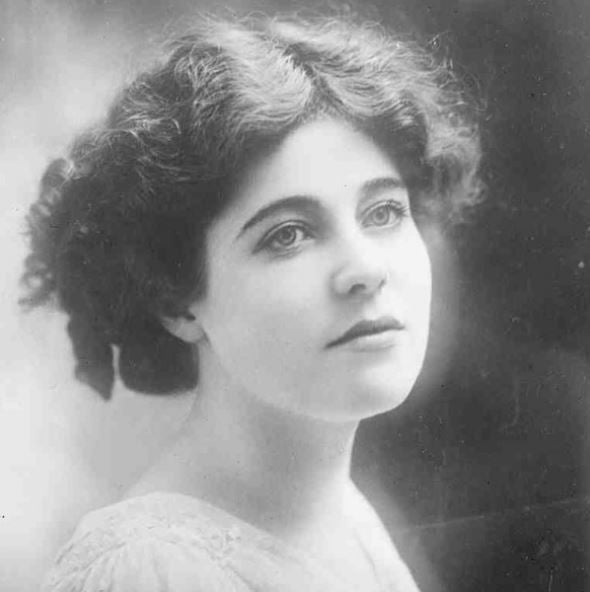
There was a story about the ghost of Mrs. Winchester in this royal house. She was supposedly imprisoned in this palace. Notice the beautiful iron-wrought grilles at the windows. The haunted region of the mansion, was striving to communicate with Daisy. Legend has it that Mrs. Winchester was imprisoned in one of the witch’s caps. How, was never known. It was when Daisy was in possession of this house that the ghost started to appear to her. She did not fancy real ghosts, however. One night, when the stars were not visible in the sky; low, thunderous clouds, massed at the head of the valley, were sweeping over so close that they seemed to brush the palm trees on the estate. To the south and the east the storm-clouds had shut down almost to sea, leaving a space of black sky where the moon in its last quarter was rising just to the left of the mansion—raining a black silhouette against it. They blue lightning flashed almost incessantly, and through the fitful darkness cam the sound of the bell tower, which could be heard across the valley, the rushing torrent below, and the full roar of the approaching rain, with a deep organ point of solemn thunder through it all. Daisy believed that Mrs. Winchester’s unquiet soul, sent out this story of eternity. Vivid lightning, the crowding of Mrs. Winchester and the shivering anticipation of Daisey’s possible visitation made sleep quite out of the question. Then, an hour and thirteen minutes after midnight, came a sudden vivid flash of lightening, and, as Daisy’s razzled and dazzled eyes began to regain the power of sight, she saw as plainly as in life—a tall figure, in a silky white dress, with long flowing hair. In another flash, the beautiful apparition looked at her long and earnestly. She was beautiful —more beautiful than one had supposed possible, her deep, passionate eyes very tender and pitiful in their pleading, beseeching glance. Daisy was hardly frightened, or even startled, but lay looking steadily at her as she stood in the beating lightning. Then she breathed, rather than articulated, with a voice that almost brought Daisy to tears, so infinitely sad and sorrowful was it, “I cannot sleep!” and the liquid eyes grew more pitiful and questioning as bright tears fell from them down the pale glowing face. #RandolphHarris 15 of 17

The apparition began to move slowly towards the door, its eyes fixed on Daisy’s with a look that was weary and almost agonized. Daisy learned from the bed and stood waiting. A look of utter gratitude swept over the face, and turning, the figure passed through the doorway. Out into the shadow of the corridor in moved, like a drift of pallid storm cloud, and Daisy followed, all natural and instinctive fear or nervousness quite blotted out by the part she felt she was to play in giving rest to a tortured soul. The corridors were velvet black; but the pale figure floated before her always, an unerring guide, now but a thin mist on the utter night, now white and clear in the bluish lightening through some window or doorway. Down the stairway into the lower hall of the second floor, where the stained-glass windows in the flared into sudden clearness under the fitful lightening, out into the silent cloister. It was very dark. Daisy stumbled along the solid mahogany floor. She guided herself by a hand on the gelled linseed Lincrusta-Walton wallpaper. Then a sudden blaze of fierce lightning, and vivid light allowed her to see the face with a look of overwhelming desire, of beseeching pathos, that had choked Daisy’s throat with an involuntary sob when she first saw Mrs. Winchester. And she heard the sorrowful words again, “I cannot sleep,” come from the impenetrable darkness. And when the lightning came again, the beautiful white figure was gone. She wondered around the mansion, searching in vain for Mrs. Winchester. She tired the door-to-nowhere when Mrs. Winchester vanished: it was locked. It was found at last. The smooth surface of the plaster on the white wall. There was a rough space, approximately the shape of the other windows in the tower, not plastered like the rest of the wall, but showing the place where a stained-glass window was covered up through its thick coatings of whitewash. Daisy began scraping away at the solid wall. Under the coatings of plaster appeared an entrance to a secret room and it led her over a vertical joint between firm, masonry work. She began digging out the mortar around the stone. With much work it detached. #RandolphHarris 16 of 17
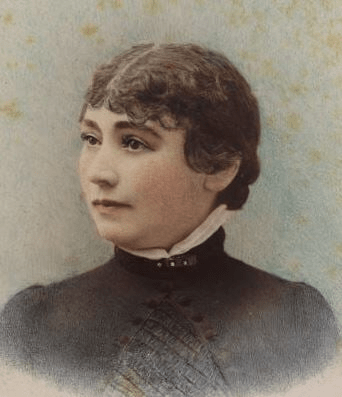
Darkness within, yet beyond question there was a cavity there, not a solid wall; and with infinite care she removed all the stones. Still the hole was too small to admit enough light from the dimly illuminated cell. With a chisel, she pried at the sides of a large block of masonry, perhaps thirteen stone in size. It moved, and with seemingly superhuman strength, Daisy softly slid it from its bed. Suddenly a cry, a cry like that of a frighted woman—terrible. Framed by the jagged opening of the stone, hardly seem in the dim light, was a face, an ivory image, more beautiful than any antique bust, but drawn and distorted by unspeakable agony; the lovely mouth was smiling; the eyes were cast upward; and below, slim calcified hands crossed on the chest. Torture and agony visible in every tense muscle. Daisy stood there, breathless, staring at the sight, fascinated, bewitched, sad. So this was the mystery. With fiendish ingenuity, the rigid ecclesiastics had blocked up the window, then forced the beautiful creature to stand in the alcove, while with remorseless hands and iron hearts they had shut her into a living tomb to gain access to her land. With all that, it was necessary to find Mrs. Winchester so her soul could rest. Prayers were said that night for her soul. The next day the alcove was again walled up. Demons can subject the mind and the body. Demon subjection is one step beyond demon influence. When the moral law of God is persistently and flagrantly disregarded, demon influence may merge into demon subjection. The cursed then becomes the slave of the demon. Many have also become slaves because of illicit lust, perhaps goaded on by vile spirit that master their victims and drive them on to moral ruin. Those who nurse hate and revenge may find that a superhuman power takes over, impelling them to murder. Those who covet become slaves of greed. Those who persistently lie may become enslaved by evil spirit of falsehood until they are incapable of telling the truth. Persistent sin against the second table of the moral law regulating humans conduct towards humans (Exodus 20.13-17) opens the door to demon power than can derange a living soul’s mind, weaken one’s will, alienate one’s affections, and disturb one’s emotions. “Beware of sibling rivalry! At least said my grandmother. Which must explain, I do suppose, what happened to my little brother.” #RandolphHarris 17 of 17

Winchester Mystery House
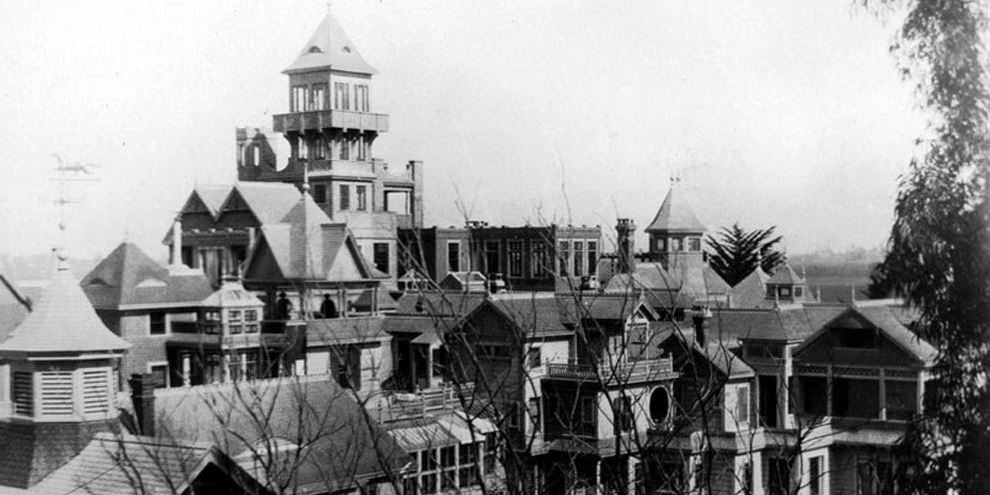
Fabulous photo op outside The Winchester Mystery House circa 1940s 💁🏻♀️

🎟 link in bio. https://www.winchestermysteryhouse.com/

Whatever Person Posses this Book, Lucifer Promises to Carry Out One’s Plans

The latter part of the nineteenth century was an anguished and tortured period. Gentility was a terrible strain. Beneath the appearance of stiff propriety there ran currents of anger and aggression frightful in their intensity. Some indication of the dark, baleful aspect of the lives of our great-grandparent went untold. Black and white magic. Contemporary forms of magic are being studied carefully by parapsychologists. (Parapsychology is the study of apparently supernatural phenomena such as telepathy, clairvoyance, apparitions, and related forms of ESP.) Researcher in this field who operate from a completely naturalistic standpoint deny the existence of a personal devil or evil spirits. They may speak of two vital forces in the Universe, however, one working upward in an evolutionary manner, and the other counteracting these ascending steps. These investigators of psychic phenomena do not make any effort to explain the origin of these invisible powers, and simply declare that some people have special psychic gifts which give them access to these forces. They may even say that some religious practitioners appear to have superhuman power, and refer to their work as white magic. They may also acknowledge that some individuals can mysteriously bring harm to their enemies, and this evil use of power they call black magic. The majority of these parapsychologist insist, however, that they do not believe in a personal God or the devil, and simply affirm that at the present time we do not fully understand some of these esoteric powers in this Universe. The Christian student of occultic activity has a distinct advantage over the naturalist, for one accepts the reality of a personal God and an invisible World of angels and evil spirits. This does not mean that one rejects a scientific approach to the problems that are encountered. One must avoid the temptation to declare dogmatically that every unexplainable occurrence is the result of supernatural activity—either by God or the forces of evil. #RandolphHarris 1 of 16

Some manifestations that now puzzle us may in the future be understood within the framework of the natural. The fact remains, however, that Satan is a real personality, and that a multitude of evil spirits have joined him in opposition to God and His people. The Christian Bible records numerous instances which clearly reveal their activity, and we have good reason to believe that some of the unexplainable phenomena in evidence today are the works of these demonic beings. Practitioners of black magic usually declare openly that they are serving the devil. Many of them say that have made a pact with Satan, and some have indicated their allegiance to him by signing a document with their own blood. Missionaries have reported that acts with the devil are not at all unknown among many primitive peoples. Reputable followers of Jesus Christ are convinced that these religious leaders actually can bring illness or death to people through ritualistic incantations. Black magic is practiced extensively today in many parts of Germany, France, and Switzerland, as well as in primitive cultures. Dr. Kurt Koch cites numerous instances of conjurers casting spells which have brought about the death of animals and even humans. He also tells us of amazing healings, but points out that when a person is cured of a physical disease by such a practitioner, one usually suffers such severe mental depression that the new condition is worse than the old. As one reads the examples of black magic—cattle being milked dry in a mysterious manner, the sudden unexplainable death of animals, healings followed by terrible psychic disturbances, and the appearance of frightful apparitions—he finds his credulity stretched almost to the breaking point. If one has not witnessed such occurrences, one is likely to dismiss these reports as untrustworthy. However, serious scholars who have investigated these accounts do not deny the reality of such phenomena. They may not believe them to be the work of Satan or evil spirits, but they admit that many of them cannot be explained at the present time. #RandolphHarris 2 of 16

Professor Adolph Koberle, from the University of Tubingen, in the introduction to Christian Counseling and Occultist, says: Readers who approached this study with a purely rationalistic bent will experience spiritual difficulty in following the author in many areas because we have here a report of cases and experiences which seems to conflict with all sound human intelligence. However, perhaps such persons can be brought to listen, since research first tries the immanent solution of the problems and only where this is proved to fail does one break out and propose the added dimension, the dimension of the eternal. Even though research may evoke contradictions here and there—from medics and pastors, from parapsychologists and psychotherapists—yet the questions that are here posed cannot be evaded by any person who concerns oneself in a genuine and responsible manner with a fruitful diagnosis and a helpful therapy. Clearly sane, scholarly, and since humans have examined the apparently superhuman powers evidenced in black magic and other forms of occultism, and made every effort to find naturalistic explanations, before finally concluding that Satan and evil spirits are actually at work. Black magic as a specific form of witchcraft has its own literature. The Sixth and Seventh Books of Moses are the primary source, and are well known in Europe. They constitute one volume, and are alleged to have been written by Moses himself. Strangely enough, they maintain that this great national leader was a servant of Satan, and set fourth detailed instructions for establishing a mystical relationship with the devil. This research tells readers how they can gain power through black magic over all the people they will encounter both in this World and the next. It makes this solemn assertion: “To whatever person possesses this book at any given time, Lucifer makes promise to carry out one’s commands, but only as long as one possess this book.” Dr. Koch comments on the strange and sinister nature of this writing by saying, “In the many cases which the pastor-counselors have come to know, there is no possessor of The Sixth and Seventh Books of Moses who have no psychic complication.” #RandolphHarris 3 of 16

White magic is declared by its practitioners to be in direct opposition to black magic. Whereas black magic includes an open allegiance with the powers of darkness, in white magic the name of God is invoked, and Biblical phrases are utilized. Most people who practice it, however, have no understanding of the basic doctrines of the Christian faith. Some possibly are endowed with an unexplainable psychic power, and their desire to use it was not totally selfish at the beginning. However, many find very soon that they become enslaved to a yearning for self-exaltation. The Radio Bible Class has received letters from a number of people for a time had engaged in a “healing ministry” of this kind, but who abandoned it because it led to a gradual departure from God. Although some cult leaders and those endowed people, they are using the name of God and Christ in a manner that violates the Lord’s will. The danger of mistaking an enigmatic psychic power for the gift of the Lord must be recognized. Dr. Kurt Koch points out that Dr. Henry Drummond, fellow-worker of D.L. Moody, possessed psychic ability which enabled him to have mental power over person who were miles away. While working with Moody, Drummond found that he could hypnotically influence the large crows who had gathered, but concluded that to use this power would be a hindrance to the activity of the Holy Spirit. One prayed that the Lord would take this psychic gift away from him, and his prayer was answered. Had Dr. Drummond decided to exercise this ability, he would soon have established a Worldwide reputation as a great healer. However, his accomplishments would not have honoured the Lord, and real blessings would not have resulted from his ministry. In Biblical faith, trust is placed solely in the Lord Jesus Christ. In white magic it is deflected to someone else (the human agent) or to something else (one’s own faith, etcetera). In the Biblical prayer of faith, the praying person subjects oneself to the will of God. #RandolphHarris 4 of 16

In white magic, the help of God is demanded under the assumption that exercising such power is in accordance with God’s will. Also in white magic the Christian markings are mere decorations that camouflage the magical means of knowledge for power. Certain influences, as we might call them, can be termed elementary forms of magic. Firstly, we have an example of the criminal use of hypnosis. A girl reported in a counselling session that a doctor who she had consulted had hypnotized her. While hypnotized he had seduced her. The doctor had done the same to her girl friend. It was later discovered that he has also done this with other girls. When these stories leaked out, the doctor left the town and settled elsewhere. The girl said that for a long time after this incident she had not been able to read her Christian Bible. She had felt a strong aversion towards religion, and evil thoughts had always come to her mind when praying. Another example, a doctor at a hospital had indecently assaulted women and girls under hypnosis. Once the ward sister caught him in the act. To cover up his scandalous behaviour, he used to question the patients about their sexual relationships and included their answers in their case histories. He thus tried to protect himself in the event of anything being discovered. A respectable gurl who was engaged to a Christian young man became pregnant at the hospital. Following this her fiancé left her. The girl herself denied all knowledge of having an intimate relationship with anyone. The doctor had lain with her when she had been hypnotized. The assistant matron and the ward sister had finally reported the doctor. However, the result was that they themselves were dismissed by the medical superintendent. The doctor in question stayed. Other nurses, who also had incriminating evidence against him, were forced to keep quiet now because of the fear of dismissal. After a few years, though, when the situation became too hot for the doctor, he left and went abroad. #RandolphHarris 5 of 16

Scientific advocates of hypnosis believe that a man could not be forced to do anything under hypnosis that he would not be prepared to do when conscious. They are of the opinion that crimes are not possible under hypnosis. However, not all the experts share this opinion. Moreover, in my counselling work I have met many cases in which crimes have taken place under hypnosis. From the point of view of the Scriptures it is understandable that an innocent girl can be molested this way. Jesus Christ said that out of the heart come evil thoughts and so on. Evil lies dormant even in the most moral of people. Normally these instinctive reactions are held in check by one’s consciousness, which is moulded by education, religious training and is affected by one’s disposition. Under hypnosis however, this regulator is switched off. Instinctive impulses can arise unhindered from the subconscious, and can be exploited by unscrupulous and uninhibited people. Besides this, some take no account of the fact that magical hypnosis exists in addition to the normal type of hypnosis, and that this can have far deeper effects. Magical hypnosis can often be recognized by the fact that afterwards the patient is no longer able to pray or to keep one’s faith. Here are some actual examples. A Christian girl went to a psychiatrist. The psychiatrist used magical hypnosis far more often than he did ordinary hypnosis. I have occasionally come across such doctors in areas where magic is commonly practised. In reply to the girl’s question, the doctor admitted that he had not received his gift from God. He went on to tell the girl that he had wanted to conduct suggestive experiments on her. After the treatment, the girl lost her faith and could no longer pray. She suffered from doubts and other serious difficulties in believing. I think a lot of people who have had good lives, and then are abused and tortured over a long period of time have these same problems. #RandolphHarris 6 of 16

When they restart reading the Christian Bible, it may make them upset and angry and they do not know why, but they keep going and praying hoping to overcome their situation. They know that God is there and guiding them, but they have just been able to sustain, not yet overcome the situation. So they keep forcing themselves to pray and thank God so they can rebuild their faith, and it can really take a lifetime, especially when the situation has been going on for decades. Abusers just kind of rob some people of faith and joy. And year after year, they keep praying it is over, and it never is, so it makes it hard for them to trust anyone, including God. So they have to keep reminding of his words and praying and seeking mental health treatments so they can live, and they pray they will still have some youth left, if the situation is ever resolved. Another example is a man, in his spare time a minister dabbled in magic. He experimented in various areas and learned card-laying, how to use a pendulum, magic charming and magical hypnosis. Since he had no suitable people to experiment on, he used his wife for the purpose. As his magical abilities increased, so too did his own and his wife’s dislike for the Christian Bible and prayer. This dislike developed into a strong resistance, and as time went on psychic disturbances appeared in the wife. She exhibited a serious anxiety hysteria and always had to lock the door of whichever room she happened to be in. There also was once a businessman who had the strange ability of being able to influence his customers hypnotically or magically, causing them to accept the business offers that he makes to them. In this way, his yearly income exceeds $75,000.00. He rejects Christianity altogether. A woman allowed a masseur to hypnotize her. Before the treatment she had regularly read her Christian Bible, prayed and attended the local church services. Afterwards when she tried to pray, she felt a compulsion to blaspheme and to curse. She then lost her faith. These effects indicate that the masseur had used magical hypnosis. #RandolphHarris 7 of 16

Plato derived the etymology of the word “demon” (Greek, daimon) from an adjective meaning “intelligent” or “knowing.” If this derivation is correct, it suggests that intelligence was considered a prominent characteristic of demons. If demons are fallen angels, this would be expected. As Satan’s vast wisdom became vitiated when he sinned (Ezekiel 28.12, 17), the great wisdom that characterizes angels in general (2 Samuel 14.20) must also have been corrupted in his followers. This is undoubtedly why demons use their great but perverted knowledge so relentlessly in an effort to frustrate God’s purpose. Humans who consult professional mediums and use other methods of divination to obtain knowledge of the future seem to imply a degree of confidence in the intelligence of evil spirits. The superior knowledge demons possess is not a holy or saving knowledge. Demons “believe” but only to “tremble” (James 2.19). They are confirmed in depravity and never seek forgiveness. As preeminently unclean spirits, they never long for purity. They confess Jesus Christ is Lord, but they do not trust Christ or submit to him. Although they recognize his authority (Mark 1.24; 5:6, 7). They cleverly withhold knowledge of his incarnation and completed redemption (1 John 4:1-6), corruption sound doctrine (1 Timothy 4.1-3), discern between those who have God’s seal and those who do not (Revelation 9.4), and know full well their own tragic destiny and inevitable doom (Matthew 8.29). Their superhuman intellect is accomplished by superphysical strength. The psalmist celebrates this angelic characteristic: “Bless the Lord, ye His angels, that excel in strength, that do his commandments, hearkening unto the voice of His word,” reports Psalm 103.20. The Apostle Peter also speaks of the “power and might” of angelic spirits (2 Peter 2.11). Our Lord Himself indirectly referred to demonic strength (Matthew 12.29). #RandolphHarris 8 of 16

Perverted power and strength are thus conscious attributes of fallen angels. This titanic energy is displayed in the supernatural strength demons can impart to the human body when they enter it and possess it. The Gadarene demoniac who was dominated by a “legion” of demons (Mark 5.9) could not be bound even with chains. “Because that he had been often bound with fetters and chains, and the chains had been plucked asunder by him, and the fetter broken in pieces: neither could any man tame him,” reports Mark 5.4. The great strength of this demoniac was due to the vast number of demons who possessed him. “A legion” in Roman military history consisted of three-to-six-thousand-foot soldiers, and three to seven hundred cavalries. The term “legion” was not only the name of the possessed human but probably also served to indicate the phenomenal strength of the demoniac. The demons were so powerful that when the Lord ordered them to enter a herd of two thousand swine, they cased the entire herd to rush violently down a hill into the sea (Mark 5.13). No wonder the demon-possessed human was disturbed physically, mentally, and emotionally. However, the superphysical strength of demons is not limited to the physical energy they impart to their victim. Their power is broad enough to cause occult oppression of mind and body. They can produce physical disabilities and sickness unrelated to organic disorders and which medicine or natural therapy cannot alleviate. Perhaps the most terrible power of demons is to derange the mind by upsetting the nervous system. In this way they can afflict the body with a psychosomatic disease. Demons are aware of the close relationship between physical and mental health. By jangling the nerves and the emotions, they can cause mental Instability (Luke 8.26-36), producing suicidal mania (Mark 9.22). Their purpose is to drive their occult-enslaved victim to self-destruction. “I’m tired of his bleary-eyed tootling—I have warned him to lie down and nap. So now that I have told him to stop it, I will give him a sharp little rap.” #RandolphHarris 9 of 16

Dealing with necromancers who claim to contact the dead. The writer of 1 Samuel 19.9-10 describes in incident in which King Saul tried to impale David on his javelin. His attack is attributed to an “evil spirit from the Lord.” This indicates that God allowed a demon spirit to enter Saul and possess him. The kingdom of evil spirits is within God’s control, though not acting on his direction. God allows spirit activity, just as he allows evil men to prosper, within the boundaries of his ultimate plan for humans. God’s sovereign control over the realm of evil spirits is further illuminated in 1 Kings 22:18-23. “And the king od Israel said to Jehoshaphat, Did I not tell you that he would not prophesy good concerning me, but evil? And Micaiah said, Therefore hear the word of the Lord; I saw the Lord sitting on his throne, and all the hosts of Heaven standing beside him on his right hand and on his left; and the Lord said, Who will entice Ahab, that he may go up and fall at Ramoth-gilead? And one said one thing, and another said another. Then a spirit came forward and stood before the Lord, saying, I will entice him. And the Lord said to him, By what means? And he said, I will go forth, and will be a lying spirit in the mouth of all his prophets. And he said, You are to entice him, and you shall succeed; go forth and do so. Now therefore, behold, the Lord has put a lying spirit in the mouth of all these your prophets; the Lord has spoken evil concerning you.” From this passage, too, it is clear that God overrules the World of evil spirits and permits them to do their work when it accords with His sovereign will and purpose. A unique incident involving spirits of the dead is recorded in 1 Samuel 28. King Saul had banished mediums and wizards out of the land as commanded by God (v.3). When confronted by the philistine army he was fearful and sought guidance from the Lord. When no guidance came, he told his servants to seek out a medium who could give him counsel (vv. 5-7). Having found one at Endor, Saul went to her in disguise. She feared a trap because of Saul’s decree against mediums, but Saul promised her protection and asked her to bring forth the spirit of dead Samuel (vv. 8-11). #RandolphHarris 10 of 16

The medium screamed in fear when she saw Samuel himself—apparently she was used to communicating only with evil spirits. This is the only account in the Old Testament of God’s permitting a departed person’s spirit to return to Earth. This was not by the lower of the medium, however; in fact, she was not prepared for it at all. Samuel told the piteous kin it was no use: God would take the kingdom from Saul and give it to David (vv. 15-17), and the Philistine army would rout Saul’s army (v.19). 1 Chronicles 10.13 provides the epitaph to the tragic story: “So Saul died for his unfaithfulness; he was unfaithful to the Lord in that he did not keep the command of the Lord, and also consulted a medium, seeking guidance.” Saul’s case is a chilling warning from Scripture against consulting with mediums or trying to communicate with departed souls; the judgment of God is upon it. A case of supposed witchcraft occurred in Cork, Ireland in the year 1685-1686, the account of which is contained in a latter from Christopher Crofts to Sir John Perceval (the third Baronet, and father of the first Earl of Egmont) written on the fifteenth of March in that year. Though the natator professes his disbelief in such superstitions, yet there seems to have been an unconscious feeling in his mind that his strict administration of the law was the means of bringing the affliction on his child. He says: My poor boy Jack to all appearances lay dying; he had a convulsion for eight or nine hours. His mother and several others are of opinion he is bewitched, and by the old woman, the mother of Nell Welsh, who is reputed a bad woman; and the child was playing by her that day she was upon her examination, and was taken ill presently after she was committed to Bridewell. However, I have not faith to believe it was anything but the hand of God. I have committed the girl to Bridewell, where she shall stay some time.” At one period in their history that peculiar people, known amongst themselves as the Society of Friends, and by their opponents as Quakers, appear to have been most troublesome, and to have caused a good deal of annoyance to other religious bodies. #RandolphHarris 11 of 16

Not unnaturally their enemies credited any wild tales which were related about them to their detriment, especially when they had referenced to their doctrine of the influence of the Spirit. Dr. More, in his continuation to Glanvill’s book, has in the sixth Relation an account of man, near Cambridge in England, who was possessed by an evil spirit which led him to do the most extraordinary things in its attempts to covert him to Quakerism. In the Life of Mr. Alexander Peden, late Minister of the Gospel at New Glenluce in Galloway, who died in 1686, there is an account of a Quakers’ meeting in this country which the Devil appeared in most blasphemous parody of the Holy Ghost. As Mr. Peden was travelling one time by himself in Ireland, “the night came on, and a dark mist, which obliged him to go into a house belonging to a Quaker. Mr. Peden said, ‘I must beg the favour of the roof of your house all night.’ The Quaker said, ‘Thou art a stranger, thou art very welcome and shalt be kindly entertained, but I cannot wait upon thee, for I am going to the meeting.’ Mr. Peden said, ‘I will go along with you.’ The Quaker said, ‘Thou may, if thou please, but thou must not trouble us.’ He said, ‘I will be civil.’ When they came to the meeting, as their ordinary is, they sat for some time silent, some with their faces to the wall, and others covered. There being a void in the loft above them there came down the appearance of a raven, and sat upon one man’s head, who started up immediately, and spoke with such vehemence that the froth flew from his mouth; it went to a second, and he did the same; and to a third, who did as the former two. Mr. Peden sitting near to his landlord said, ‘Do you not see that? Ye will not deny it afterwards?’ When they dismissed, going home Mr. Peden said to him, ‘I always thought there was devilry among you, but never thought that he did appear visibly among you till now that I have seen it.’ The poor man fell a-weeping, and said, ‘I perceive that God hath sent you to my house, and put it into your heart to go along with me, and permitted the Devil to appear visibly among us this night. I never saw the like before. Let me have the help of your prayers.’ After this he became a singular Christian.” #RandolphHarris 12 of 16

Mr. Peden was also somewhat of a prophet, and his specialty appears to have been the prognostication of unpleasant events, at all events to persons in Ireland. Two instances will suffice. When in a gentleman’s house in Co. Antrim he foretold that a maid-servant was enceinte, that she would murder the child, and would be punished. “Which accordingly came to pass, and she was burnt at Craig Fergus.” On another occasion two messengers were sent to inform the Lord-Lieutenant that Presbyterian ministers in Ireland should affirm that they had nothing to do with the rebellion at Bothwell Bridge. Mr. Peden said they were on the Devil’s errand, but God would arrest them by the gate. Accordingly one was stricken with sickness, while the other fell from his horse and broke his leg. In another cause of the supernatural, during the late 1800s, the Santa Clara Valley, in California presented sweeping vistas of rural open space. It was a serene setting for Mrs. Winchester to begin her building project, which she did with steadfast determination. She immediately hired carpenters to work in shifts around the clock. By the turn of the century the eight-room house had grown into a nine-story mansion! The estate eventually grew to about 730 acres of farmland (according to documents), which included orchards of apricots, plums, and walnut trees to supplement Mrs. Winchester’s income. Her dried plums, which turned into prunes were very popular. Some people believe that prune juice is what kept Mrs. Winchester’s screen so wrinkle free, gave it a natural growth, and made her look so young, as it flushes toxins out of the body (word of caution, make sure to use it in moderation and start in the morning with a few ounces, and do not go anywhere for 24 hours until you see how it work with your system). Nonetheless, Mrs. Winchester also owned homes in Atherton, Los Altos, and Palo Alto. The combination of her wealth and her eccentric building of this beautiful mansion gave rise to many rumors in the local community. #RandolphHarris 13 of 16

Jeremiah Haralson was waiting for a tour of Mrs. Winchester’s beautiful mansion, and he had been waiting an hour to have tea with her—he was really impressed with the mansion as it seemed to twinkle. It was really a rural setting and very pretty. The estate had a lot of thick green foliage and beautiful flowers and what seemed to be miles of green lawns. So he waited for her. It was August 1894, and the chill of an unusually evening entered into his bones. The construction workers passed him with a surely response to his “Good Night.” Many of the servants went by him like ghosts with soft voices; and it was nearly midnight, and she still had not come. He then heard a ghostly music wafting from the dark mansion. The bell in the belfry high in the gables began to toll. Jeremiah shrugged his shoulders and turned towards the gates that lead to the main road. He looked back, but there was still no sign of movement about the mansion, so sign of life, no lights even in the windows. He paused by the gate, wondering. Then he noticed that the front doors were open—wide open—and the porch lamp shone a little way into the foyer. There was something about this that did not please him—that scared him a little, indeed. The house had a gloomy and deserted air. It was obviously impossible that it harboured a rich widow. The must be away on business. In which case—Jeremiah walked up the path, tower the stairs to the front porch, and listened. Yet, still no sign of life. He passed into the foyer. There as no light anywhere. Where was everybody, and why were the beautiful jeweled front doors open. There was no one in the front parlour, nor the drawing room, the dining room and the study were equally empty. Everyone was out, evidently. However, the unpleasant sense that he was, perhaps, not the first casual visitor to walk through that open door impelled him to look through the house before he went anyway and closed it after him. So he went upstairs, and at the door of the first bedroom, Jeremiah turned on the gasolier, as he had done in the siting rooms. Even as he did so, he felt that he was not alone. #RandolphHarris 14 of 16

Jeremiah was prepared to see something, but for what he saw he was not prepared. For what he saw lay on the bed, in a white loose gown—and it was Mrs. Winchester, and her throat was cut from ear to ear. He did not know what happened then, nor how he got downstairs and into the street; but he got out somehow, and the policeman found him in a fit, under the lamp-post at the crossroads of the road. He could not speak when they picked him up, and he passed the night in the police cells, because the policeman had seen plenty of drunken men before, but never one in a fit like Jeremiah Haralson. The next morning he was well, though still very pale and shaky. However, the tale he told the magistrate was convincing, and they sent a couple of constables with him to her house. There was no crowd about it as he had fancied there would be, and the curtains were open. As Jeremiah stood, dazed, in the front of the doors, they opened, she Mrs. Winchester came out. Jeremiah held on to the upside-down posts on the front porch for support. “See, my boy! Mrs. Winchester is just fine as can be,” said the constable, who found him hiding before one of the posts. “I told you, you were drunk, but you would know best!” When Jeremiah was alone with Mrs. Winchester, he told her how he had come into the rambling mansion, and had found the front doors open and the lights out, and how he had seen something—in even trying to hint at which he turned sick and broke down and had to have a little Vin Mariani given to him. “Oh, heavens, boy,” Mrs. Winchester said, “I dare say the house was dark, for we were all at St. Joseph’s Cathedral with Daisy, and no doubt the door was open, for the maids will run out if they are left. However, you could not have been in any of the bedrooms on the second floor, because I have my staff lock them when I am away, and my dear sweet boy, they key was in my pocket. I dressed in a hurry and I left my odds and ends laying about.” #RandolphHarris 15 of 16

“I know,” Jeremiah said; “I saw a gold scarf on the chair, and some gold gloves, and a lot of hairpins and ribbons, and a prayerbook, and a lace handkerchief on the dressing table. Why, I even noticed the almanack on the mantlepiece—16 January 1895. At least it could not be that because this is 16 August 1894. And yet it was. Your almanack is at 16 January 1895, is it not?” “No, of course it is not,” said Mrs. Winchester, smiling rather anxiously; “but all the other things were just as you say. You must have had a nightmare, of a vision, or something.” Jeremiah was a very ordinary, commonplace, City young man, and he did not believe in visions, but he never rested day or night still he got away from the Winchester mansion. Now the curious and quite inexplicable part of this when Mrs. Winchester came down to breakfast on the morning of 17 January 1895, she found Jeremiah looking like death, with the Oakland Tribune in his hand. He caught hers—he could not speak, and pointed to the paper. And there she read that on the night of the 17th a young lady had been found with her throat cut from ear to ear, in a second story bedroom of that Beautiful, but Bizarre Winchester Mansion. Although demons reveal various degrees of wickedness (Matthew 12.45), they all are depraved. This aspect of their character appears in the terrible things they do to their victims. The Christian Bible often refers to them as spiritually and morally “unclean” (Matthew 10.1; Mark 1.27; 3.11; Luke 4.36; Acts 8.7; Revelation 16.13). People who deal in the occult are sometimes found to be vulnerable to Satan and demonic powers. Sometimes these “unclean spirits” take possession of vulnerable people. The character of demons reveals what they can do to their victims. Invisible, extremely intelligent, strong, and totally depraved personalities can do a great deal of harm to the vulnerable person. Since the supernatural exists and does interact with the natural World, the truly scientific investigator must take this into consideration. Prayer and faith can heal the mind and the body supernaturally, just as medicine and rest can do it naturally. By the same token, unbelief and sin can harm body and mind as a result of demonic bondage. (However, many mental and emotional illnesses are, of course, due to natural causes, such as overwork, tension, fatigue, malnutrition, organic disease, etcetera. Such disorders can be treated effectively by a physician, neurologist, psychologist, or psychiatrist. Demonic spirits may have little or nothing to do with such disorders of the mind. The causes are purely natural and may be corrected by purely natural means. This is not surprising since the Creator has placed the creation and His creatures under the normal operation of the laws of cause and effect.) #RandolphHarris 16 of 16

Winchester Mystery House

Beautiful day to stroll the gardens which will turn into a beautiful night to roam around the Winchester Mystery House ☀️🌜Flashlight Tours Tonight!

A few tickets still available!
🎟️ Link https://www.winchestermysteryhouse.com/

People Bamboozle their Consciences and Shut their Eyes

Life is an adventure of beauty, love, curiosity, success, and more importantly, Significance. Significance means making contributions to others. You may have a fresh start any moment you choose. And never confuse yourself with someone else. Just because you handled situations in a particular way, and like certain things, does not mean you understand someone else. It is a lot like thinking you can see into the soul of Hollywood actors based on their movies and social media; until you spend a few years with one, and find out he or she is nothing like you ever imagined. Some people act on the silver screen, other do it in life and are so far out of touch with reality, and their living soul. Nonetheless, in our department of the genetic mechanisms there has been a conspicuous absence of qualifying statements such as “this is the way it works in the frog” or “the bacterial mechanisms look like this.” On the contrary, in several aspects of the preceding treatment it has been implied, and occasionally it has been specifically stated, that in the nucleic acid/enzyme mechanisms we seem to be dealing with a general biological principle applicable equally to amoeba or man. However, it would obviously be unreasonable to imagine that a mechanism as complex as that underlying the interplay between the giant molecules of nucleic acid and protein enzymes could have been independently developed for each of many different species by tortuous processes of evolution. Therefore, if the nucleic acid/enzyme mechanisms do indeed exist in all forms of modern organism, it would seem necessary to conclude that they originated early in the history of life—before much progress had been made in the evolutionary differentiation that has resulted in today’s large variety of living forms—and that they subsequently survived in all of those forms only because their possession proved to contribute to all types of host organism markedly superior to survival attributes. #RandolphHarris 1 of 23

This hypothesis credits a single evolutionary discovery with such remarkably superior properties as to justify us in requiring of the biologists some rather strong evidence before we accept the current doctrine of the ubiquity of the nucleic acid/enzyme mechanisms. Let us therefore look at some of the recent research findings that suggest that we are here in fact dealing with a universal biological principle. Of course, the first discoveries attesting to the existence of the nucleic acid/enzyme control mechanisms could provide little evidence for their generality. Indeed, nearly all of the early work was done on bacteria or other microorganisms. It was not until 1962, for example, that messenger RNA was isolated from mammalian cells. However, unspecific, but highly suggestive, evidence pointing toward the broad applicability of the new discoveries was easy to come by. For example, DNA is always discovered in cell nuclei, when it is looked for. Similarly, the cytoplasm is always found to contain microsomes and RNA. And protein enzymes have been shown to control the chemical process that occur in the wide variety of plant and animal cells that have been investigated. One of the strongest reasons for believing that the nucleic acid/enzyme mechanisms might constitute a general principle of life was the neat solution they provided for a long-standing mystery of biochemistry—the precise architecture of protein molecules. A reasonable explanation of how, in nature, as distinct from the laboratory of the chemists, hundreds or thousands of different amino acid segments could be strung together in precisely ordered arrays, as was known to be required by the remarkable structure sensitivity of the enzyme molecules, filled a tremendous gap in biological theory. #RandolphHarris 2 of 23

For this reason the notion that all forms of living cells employ a system of control of their chemical processes of the general nature of that described in the preceding reports has from the first been attractive to biologists. However, no matter how attractive a theory might be, no good scientist would fail to put it to experimental test. And it was clearly important to do more than merely confirm the employment by various plant and animal species of similar broad principles of metabolic and genetic control. For the hypothesis that all living cells are controlled in their chemistry by a mechanism involving the interaction of nucleic acid and enzyme molecules, even if true, clearly need not imply identity in the details of the mechanisms employed by different organisms. Any ingenious scientist would encounter little difficulty in inventing variations of the nuclear DNA/messenger RNA/transfer RNA/microsome/protein enzyme scheme we have “derived” that would appear, from all that is known today, to be as workable as the particular scheme described. Thus an inevitable preoccupation of the research scientists has had to be not only to look for the existence of nucleic acid/enzyme mechanisms in various species but also to determine the extent of variation in these mechanisms from species to species. Determination of the similarities and differences among the molecular mechanisms of different species of organisms is not easy as it sounds, however. Scientific techniques are not yet advanced to the point where molecules of DNA in the nucleus or RNA in the cytoplasm can be sorted out and their precise dimension and structure catalogued. As is so usual in science, indirect methods of throwing light on the question at hand had to be sought. When considered in terms of modern knowledge, an experiment performed in 1928 seems to have first pointed the way toward a suitable investigation technique. #RandolphHarris 3 of 23

That early experiment involved work with a certain type of pneumonia-causing bacterium. It has been found that this bacterium comes in two slightly different forms, or “strains.” One strain is characterized by a smooth coating surrounding the bacterial cell; this is called the smooth, or S, strain. Bacteria of the other strain possess no such coating. They are called the rough, or R, strain. The curious thing that was reported in 1928 about these two strains of bacteria was that, when a batch of dead S bacteria was added to living R bacteria, there would subsequently appear in the culture living members of the S strain. (It has been well established that a colony composed exclusively of R bacteria would produce only more R types, whereas S bacteria would also breed true.) Since it was inconceivable that dead S bacteria could come back to life, the 1928 experiment had always required the conclusion that something in the dead S bacteria had converted some live R bacteria into live S bacteria. Many years later, additional experiments succeeded in isolating this something and showing that it was pure nucleic acid. In terms of our present understanding of the nucleic acid mechanisms, the explanation of the behaviour of the pneumococci is not difficult. Evidently the S bacteria contain a molecule of DNA that, through the mechanisms we have studied, leads to the formation of an enzyme that results in the construction of the smooth coating that characterizes this particular strain. A bacterium of the R strain differs from one of the S strain in not possessing this particular strain. A bacterium of the R strain differs from one of the S strain in not possessing this particular piece of DNA. The treatment that killed the S bacteria did not destroy their DNA. When the live R bacteria were mixed with dead S bacteria, occasionally DNA from a dead cell was able to work its way into a living cell, thereby supplying the kind of nucleic acid needed for the formation of a smooth coat. Result: the R bacterium became an S bacterium instead. #RandolphHarris 4 of 23

Clearly, this experiment constituted a step toward the establishment of generality in the genetic mechanisms; for it showed that the DNA from one type of pneumococcus bacterium could successfully operate the complex messenger RNA/transfer RNA/microsome apparatus of the other type of bacteria to produce a new and effective enzyme molecule. To be sure, if out theories are any good at all, they would have to account for the similarity of the genetic mechanisms among organisms so closely related as two strains of the same bacterial type. Nevertheless, the experiment was a step in the right direction. It suggested further steps. Was it possible to devise more advanced experiments to test for a similar kind of operation of the genetic mechanisms of one species by the nucleic acid from an entirely unrelated species of organism? Such a phenomenon, if it could be observed, would imply considerable similarity in the details s well as the general characteristics of the nucleic acid/enzyme mechanisms of unrelated species. It has indeed been found possible to devise experiments to test the proposed hypothesis. It is virus research that has provided this possibility. This work is important enough to our story to justify our digressing to study the characteristic of virus particles that are pertinent to an understanding of some of its implication. A virus particle is the simplest of all living structures. It consists of only two components: a quantity of nucleic acid surrounded by a shell, or “overcoat,” of protein material. There is no cellular structure—no nucleus, no cytoplasm, no microsomes, none of the other complex structures that we shall later see make of the modern living cell a complex piece of machinery. By itself, a virus particle appears to be a lifeless object: it does not eat, grow, reproduce or die; no chemical processes take place in its vitals; it is an inert capsule of protein-protected nucleic acid. #RandolphHarris 5 of 23
Certain virus particles may even form regular crystalline matrices, yielding microscopic structures of overall mechanical and optical properties grossly similar to those of salt or diamond, for example. In terms of such properties, viruses appear much more akin to lifeless minerals than to living organisms. Viruses are no more confused with their virions, but can be viewed as complex living entities that transform the infected cell into a novel organism—the virus—producing virions. A virus is a microscopic organism that can replicate only inside the cells of a host organism. Most viruses are so tiny they are only observable with at least a conventional optical microscope. Viruses infect all types of organisms, including animals and plants, as well as bacteria and archaea. Although viruses have no ability to metabolize on their own, they depend on a host organism for replication. Therefore, viruses are at the edge of life. Approximately 5,000 different viruses have been described in detail at the current time, although it is known that there are millions of distinct types. Viruses are found in virtually every ecosystem on Earth, and these minute life forms are thought to be the most abundant type of biological entity. The study of viruses is known as virology, a specialty within the field of microbiology. The common concept of viruses focuses on their role as pathogen. Actually, there are vast numbers of viral entities that are beneficial to individual species as well as providing ecosystems service. For example, a class of viruses known as bacteriophages can kill a spectrum of harmful bacteria, providing protection to humans as well as other biota. Since viruses are capable of self-replication, they are clearly some type of lifeform, and likely involved with the early evolutionary development of such other simple lifeforms as bacteria and protists. #RandolphHarris 6 of 23

Viruses differ, however, from the simpler autonomous replication of chemical crystals. This is due to the fact that a virus can inherit a genetic mutation and is also subject to similar natural selection processes of cellular organisms. A virus cannot be labelled simply, therefore, as inanimate or lifeless. Here, we consider it a lifeform, but we adhere to current taxonomy and so not credit it with a parallel domain to other recognized cellular lifeforms. However, put the virus particles in contact with living cells of a suitable species of plant or animal and the situation changes dramatically. For now, life seems to appear. In a matter of minutes the number of virus particles will have doubled. Under suitable conditions, a few hours will suffice for a millionfold increase in their popular! This peculiar lifelike/nonlifelike dichotomy in the personality of the virus has caused considerable attention to be focused on it in recent years. Without doubt, Wendell M. Stanley heads the list of pioneers in the field. As early as 1935 he showed that the tobacco leaf, could be isolated in the form of pure crystals. For his work in this field, Stanley shared in the 1946 Nobel Prize in Chemistry. Stanley’s pioneering work on the tobacco mosaic virus led to studies by many investigators of the curious reproductive processes of viruses. Some of the interesting discoveries have been made with the kinds of viruses that attack, and therefore reproduce in, plant cells—such as those studies by Stanley; other important discoveries have arisen out of work with the so-called bacteriophages—viruses that attack and reproduce in the cells of bacteria. A consistent picture has emerged from all of this work bearing on the way in which a virus particle is able to make use of the genetic mechanisms of the cell it infects in order to reproduce its own kind. In such viral groups as poxviruses, papillomaviruses, and tobamoviruses, molecular taxonomy aligns generally with the genetic relationships of their hosts. This suggests that the affiliations of those viral groups predate their present derivatives, and, in fact, that these three viral groups and their hosts likely coevolved. #RandolphHarris 7 of 23

In addition, some other things we may want to consider, while on the topic of health and science, is community prevention programs. As we have seen, sociocultural theorists believe that psychological problems emerge in a social setting and are treated in a social context. Perhaps the most effective approach to substance-related disorders is to prevent them. The first drug-prevention efforts were conducted in schools. Today prevention programs are also offered in workplaces, activity centers, and other community settings, and even through the media. Some prevention programs argue for total abstinence from drugs, while others teach responsible use. Some seek to interrupt drug use; others try to delay the age at which people first experiment with drugs. Programs may also differ in whether they offer drug education, teach alternatives to drug use, try to change the psychological state of the potential users, seek to change relationships with peers, or combine these techniques. Before it begins—community prevention programs for substance-related disorders often target very young children. Children often pledge abstinence from drug use on Red Ribbion by wearing red, getting a sticker, and signing a contract. (They used to release balloons, but that has been showed to be dangerous, it can cause fires and harm fish and wildlife.) Substance use—illegal, legal, and medical must be controlled to keep people safe and sane. No drug should be viewed as cool, or “it is just,” if it was not prescribed to you by a doctor, leave it alone. Besides the out-of-scale physical environment and its complicated techniques, the social environment too is baffling and produces ineptitude and loss of the sense of causality. Think of a child trying to cope with Property Rights, a most abstract notion. There is no problem when it is a case of something being used by somebody else, when Leo tries to take Finn’s shovel out of his hand and Finn gets upset or complains to authority in no uncertain terms. #RandolphHarris 8 of 23

When it comes to obeying authority, the puzzlement comes when the shovel is idle and Mama say, “Leo, Leo, you mustn’t use that shovel, it’s Finn’s.” What impresses the child is no precise idea, but the grownup’s tone of conviction. The child “believes,” though there is no evidence of his senses. It is the beginning of what Karl Marx called the fetishism of commodities. What is sickening is that it is just this kind of influence that is wanted by priest, mayors, and tavern philosophers who declare that more home influence is the remedy for out troubles of youth. However, the social relationships of the grownups themselves are out of human scale, for in the corporate system of organization the puzzling has become altogether mysterious. It is disturbing to a child to sense that his mother is under the unseen thumb of religion or his father of the boss. However, the top managers in our semimonopolies are quite anonymous. This is part of the new managerial code, as described by Fortune itself. A child cannot use them as model heroes, for they are invisible. This is exactly why Jackie Robinson’s proposal to import the TV personalities as ersatz models is so unfortunate, for these visible “heroes” are puppets. With the increasing concentration of management and control, there is less relation even to Property Rights. Consider it. If one is put upon or abused, with whom shall one be angry? One cannot vent rage against an abstract system. However, there is no need to vent feeling, for it is a matter of the grievance committee and other regular channels. In the Middle Status, the heart of the organized system, the situation is not the same as in a bureaucracy, with which it is usually compared; for a bureaucracy has written code and a definite pecking-order; but organization protects everybody’s personal dignity, and its subtle interpersonal feuding and competition cannot be codified, for it is without any objective utility to give a principle. Even that mighty systems the State is more material: it has banners, soldiers, elections, postmen and women, police. #RandolphHarris 9 of 23

In a child, the systems of the State rouses awe and fear. However, the organize system exists only in the bland front of its brand-name products and advertising. There is no knowing how it is run or who determines. It is in these circumstances that young persons grow up convinced that everything is done with mirrors, by “influence.” Not even the personal influence of nepotism, but something more like the astrological influence of the planets. The sense of initiative, causality, skill has been discouraged. Merit is a train of “personality.” Learning is the possession of the Diploma. Usefulness is a Business Card. Justification is Belonging. Turning to the “sectarian” understanding of conscience, we find the Franciscan idea of the immediate knowledge of the natural law in the depth of the human soul. However, no two new elements supported and transformed this tradition: the so-called “German mysticism,” with its emphasis on the divine spark in the human soul, and the “spiritual enthusiasm” awakened by the Reformation, with its emphasis on the individual possession of the Spirit. Thomas Muenzer and all his sectarian followers taught that the divine Spirit speaks to us out of the depth of our own soul. We are not speaking to ourselves, but God within us. “Out of the abyss of the heart which is from the living God,” wrote Muenzer, we receive the truth if we are opened to it by suffering. Since the enthusiasts understood this divine voice within us in a very concrete sense, they identified it with the conscience. In this way conscience became a source of religious insight and not simply a judge of moral actions. The conscience as the expression of the inward light has revealing character. However, the question arose immediately: what is the content of such a revelation through conscience? Luther asked Muenzer, and Cromwell asked Fox: what is the difference between practical reason and the inward light? Both of the could answer: the ecstatic character of the divine Spirit! #RandolphHarris 10 of 23

However, they could be asked again: what bearing has the ecstatic form of revelation on its content? And then the answer was difficult. Muenzer referred to practical decisions in his daily life, made under the inspiration of the Spirit; and Fox developed an ethics of unconditional honesty, bourgeois righteousness, and pacifism. It was easy to ask again whether reasonableness and obedience to the natural moral law could not produce the same results. The “revealing conscience” is a union of mysticism with moral rationality. However, it does not reveal anything beyond biblical and genuine Christian tradition. An important result arising from this transformation of the concept of conscience is the idea of tolerance and its victory in the liberal era. The quest for “freedom of conscience” does not refer to the concrete ethical decision, but to the religious authority of the inward light that expressed itself through the individual consciences. And since the inward light could hardly be distinguished from practical reason, freedom of conscience meant, actually, the freedom to follow one’s autonomous reason, not only in ethics, but also in religion. The “religion of conscience” and the consequent idea of tolerance are not a result of the Reformation, but of sectarian spiritualism and mysticism. Florence Nightingale also had a religious state of mind when it came to the conscience. Although she was living in despair at the futility of existence under her parents’ roof, the privileged thirty-one-year-old’s life was confined to an endless round of social visits, teas, and parties. Florence loathed it all, even the “charity” balls and concerts where “people bamboozle their consciences and shut their eyes.” Over a decade earlier, on February 7, 1837, God had spoken and called her to his service. However, unlike the message Joan of Arc had received, Florence’s had been vague about what this service entailed. In any case, her parents rejected their daughter’s desire for a career or profession. #RandolphHarris 11 of 23

In Victorian, England, women like Florence were supposed to marry. She was an excellent catch—attractive, wealthy, clever, fluent in several languages, widely read, dynamic, witty. She had “adored” her longtime suitor, Monckton Miles, but after nine years of courtship, she had rejected him. Afterward, she suffered terribly when he would scarcely speak to her, but she never regretted her decision. Monckton would have satisfied her intellectual and passionate nature, Florence Explained, but “I have a moral, an active, nature which requires satisfaction and that would not find it in his life…I could be satisfied to spend a life with him in combining our different powers in some great object. I could not satisfy this nature by spending life with him in making society and arranging domestic things.” God, she believed, had marked her out to be one of the single women, whom He “organized…accordingly for their vocation.” The Nightingales were furious. Florence had turned down the perfect husband. Family quarrels escalated into bitter battles. On her thirtieth birthday, Florence confronted her life: “Today I am thirty—the age Christ began his mission. Now no more childish things. No more love. No more married. Now Lord let me think only of Thy Will, Oh Lord Thy Will, Thy Will.” Slowly, this will was revealed to her: she should devote her life to nursing, the profession of slatterns, drunks, women of the evening, and criminals. Hospitals in Florence’s day were cesspools of filth, degradation, abuse, and death. Only the most destitute and desperate would go to an institution where the floors were slimly with vomit, feces, blood, where patients were jammed together in filthy, linenless beds, and surgeons routinely seceded the degenerate nurses. Florence was able to convince her parents to let her go to Germany for a training session at a medical establishment, Kaiserwerth Institute on the Rhine. The family fought her every inch of the way. Her sister, Parthe, flung bracelets into her face with such force that Florence passed out. Despite it all, she went to Kaiserwerth. #RandolphHarris 12 of 23

Eventually Florence triumphed, and in 1853, she was named superintendent of the Institution for the Care of Sick Gentlewomen. Though she despised the charitable matrons in charge, dismissing them as “Fashionable” Mules, she overrode her family’s hostility and accepted the position. After she was installed, the Fashionable Mules were horrified at her energy and zeal. She reorganized their operation from the revolutionary perspective that the patient was paramount and forced the Institution’s directors to agree to accept all sick women, not just Anglicans. Florence was driven, compassionate, but cold near-saint. Her soft voice and gentle mannerisms belied her unyielding character and her irresistible force of personality. She had causes rather than friends, and she hovered somewhere between God and the rest of humankind. One of Florence’s attributes was strict celibacy, easy to abide by after her momentous decision not to marry. For her, it was a cheap price to pay for her freedom from marriage. She harmoniously incorporated this chastity and the chance to pursue the profession to which God had called her into her increasingly austere lifestyle. Even her intense relationships with the men who revered her seemed to lack a sensual dimension. Instead, she always ensured their admiration was sublimated into unremitting toil for her current cause. This nonthreatening fervor enabled Florence to deal openly with the most important officials of the day—doctors, politicians, and military officers—without the least whiff of scandal. This extended even to her brother-in-law, who married her sister Parthe only after Florence had turned him down. The next stage of Florence’s mission saw her orchestrate a move from Harley Street to Scutari in Turkey, as superintendent of nurses in the hospital there. With a ragtag band of nurses and nuns, she arrived in 1854 to an edifice groaning with wounded soldiers dying of malnutrition, gangrene, even a festering corpse, but innocent of furniture, operating tables, cooking utensils, or supplies. #RandolphHarris 13 of 23

In the basement, two hundred starving women were crammed together, quarreling, sickening, and dying. Outside, stopped-up latrines over flowed and poisoned the air. Despite these horrendous conditions, Florence’s worst enemy was officialdom, for the doctors refused to even acknowledge her existence. Barred from the wards, she waited it out until and influx of casualties following the Battle of Balaclava shook hostile doctors into enlisting her. War wounds, cholera, frostbite, and dysentery ravaged the troops. Nearly three out of every four soldiers will ill or injured. Florence threw herself into the struggle to save them, scrubbing, feeding, soothing, hearing them, raising funds, visiting them at night with one of her famous Turkish Lanterns—the Lady with the Lamp. Finally, mortality at the Scutari Hospital dropped from 42 percent to 2.2 percent. Florence was a hero to her patients and to the general public. She knew, however, that if it were not for the public support making it too awkward for the War Office to get rid of her, many a military doctor or official would sacrifice her like Joan of Arc. She had accomplished miracles, but only be defying authority, recruiting support from influential individuals, including Queen Victoria, and imposing her system and values with an iron will. Florence has also driven her own slight body too far, with sleepless nights, insufficient food, and no relief from relentless nursing, management, and intrigue. Twice she fell gravely ill, perhaps as a result of post-traumatic stress disorder, and never really recovered. Back in England, she adopted nunlike clothing—simple black dresses and prim caps. She was emaciated from illness and her abstemious diet. Her quiet melancholy stemmed from grief at leaving so many soldiers in their Crimean graves, as well as lingering memories of the war. However, the wounds and blood and dysentery, the cold and heat and hunger, did not haunt her as much as “intoxication, drunken brutality, demoralization and disorder on the part of the inferior; jealousies, meanness, indifferent, selfish brutality on the part of the superior. #RandolphHarris 14 of 23

At the end of her long life, Florence had not a single regret about her decision to nurse rather than marry. She was also very firm about advising other women “to keep clear of the jargon, namely, about the ‘rights of women,’ which urges women to do nothing that men do, merely because they are women. Surely women should bring the best she has, whatever this is, to the work of God’s World, without attending to either of these cries.” To the end, her ever-active, analytical mind was impatient with ideology and rote thought. Personal rebellion had been the price of her success, but when she died, aged ninety, she had enormous accomplishments to her credit. Apart from these successes, Florence was admired by and corresponded with the highest in the realm, including Queen Victoria. She measured her friendships and her life in goals achieved—nothing else mattered. Life was not a journey but a destination. This was true from her earliest years, when she had refused to be submerged within a stifling Victorian marriage and, in defiance of her genteel World’s natural order, embraced celibacy and freedom. Is the true patriot only the human who puts one’s faith in brute force, harsh violence, and tragic destruction? Is there no love of country in gentler ways? I venture the claim that the human who keeps oneself above negativity, who seeks and finds the Overself’s inner peace and then distributes it in one’s country’s mental atmosphere, is worth more to the State than the human who places one’s reliance on violent ways. The problem of our proper reaction to war is a difficult one. The duty of defending ourselves against, or rescuing the victims of, a murderous assault seems to be a sacred duty. It seems right and reasonable to believe that open aggression should be resisted and even, to a certain extent, punished. However, with the advent of the atomic and hydrogen bombs the methos of fighting for any cause, even a righteous one, has become the greater of two evils where formerly it was the lesser. Where self-defense may lead to certain and suicidal self-destruction, we begin to pause, to consider, and to hesitate. #RandolphHarris 15 of 23

Any investigation of the destiny of nations from a philosophic point of view shows that the appearance of an aggressive invader on a people’s borders must haves some underlying Universal Law which is deeper than the obvious political or economic one. Just as the appearance of a certain unpleasant event in an individual’s life is often due to corresponding faults or weaknesses in one which need to be remedied, so the invader’s appearance points to deficiencies or errors in the invaded nation’s inner life. They too need correction. There is no escape from this inner duty, and so long as the weaknesses remain so long will troubles appear or assaults threaten. Until the nations achieve this moral development, they can hope only to restrict the violence and area of war, not to eradicate it. Such a restriction can be brough about by external means only be in international policing army, just as society’s crimes is restricted by local police. This single army to replace the many armies implies some kind of a World government. Yet national feelings are everywhere still unwilling to sacrifice themselves to a supernational government, and there is some ground for the refusal. There is no other prospect of its arrival than through a third World War, whose aftermath would unquestionably be the birth of a World government to control international relations, leaving the separate peoples free to pursue their own policies in regard to internal ones. This is the only alternative path to peace, terrible though it be. Meanwhile what is the duty of the spiritually awakened individual, as apart from the unwakened nations? Has the time come for one to practise a new approach? Does the old one of meeting violence with violence belong to the animal World? Then what is the new one which belongs to the human World? Must one cease to take life, withdraw from this course of endless slaughter, and seek protection from the higher powers by offering up even the will to live itself if needs be? #RandolphHarris 16 of 23

The individual alone can test the truth and worth of this newer moral concept. For support of it offers no early likelihood of attaining sufficient strength as a political power. Philosophy can give no lead in the matter. The decision is a personal one. Each must decide for oneself. The need for new political institutions exactly parallels our need for new family, educational, and corporate institutions as well. It is deeply wired into our search for a new energy base, new technologies, and new industries. It reflects the upheaval in communications and the need to restructure relationships with the non-industrial World. It is, in short, the political reflection of accelerating changes in all these different spheres. Without seeing these connections, it is impossible to make sense of the headlines around us. For today the single most important political conflict is no longer between the affluent and less affluent, between dominate and non-dominate ethnic groups, or even between capitalist and non-capitalist. The decisive struggle today is between those who try to prop up and preserve industrial society and those who are ready to advance beyond it. This is the super-struggle for tomorrow. Other, more traditional conflicts between classes, races, and ideologies will not vanish. They may even—as suggested earlier—grow more violent, especially if we undergo large-scale politico and economical turbulence. However, all these conflicts will be absorbed into, and play themselves out within, the super-struggle as it rages through every human activity from art and pleasure of the flesh to business and balloting. This is why we find two political wars raging around us simultaneously. At one level, we see a politics-as-usual clash of Second Wave groups battling each other for immediate gain. At a deeper level, however, these traditional Second Wave groups cooperate to oppose the new political forces of the Third Wave. This analysis explains why our existing political parties, as obsolete in structure as in ideology, seem so much like blurry mirror images of one another. #RandolphHarris 17 of 23

Democrats and Republicans, as well as Tories and Labourites, Christian Democrats and Gaullists, Liberals and Socialists, Communists and Conservatives, are all—despite their differences—parties of the Second Wave. All of them, while jockeying for power within it, are basically committed to preserving the dying industrial order. Put it differently, the most important political development of our time is the emergence in our midst of two basic camps, one committed to Second Wave civilization, the other to Third. One is tenaciously dedicated to preserving the core institutions of industrial mass society—the nuclear family, the mass education system, the giant corporation, the mass trade union, the centralized nation-state, and the politics of pseudorepresentative government. The other recognizes that today’s most urgent problems, from energy, war, and poverty to ecological degradation and the breakdown of familial relationships, can no longer be solved within the framework of an industrial civilization. The lines between these two camps are not yet sharply drawn. As individuals, most of us are divided, with a foot in each. Issues still appear murky and unconnected to one another. In addition, each camp is composed of many groups pursuing their own narrowly perceived self-interest, without any overarching visions. Nor does either side have a monopoly on moral virtue. There are decent people ranged on both sides. Nevertheless, the differences between these two subsurface political formations are enormous. The defenders of the Second Wave typically fight against the power of marginalized groups; they scoff at direct democracy as “populism”; they resist decentralization, regionalism, and diversity; they oppose efforts to de-massify the schools; they fight to preserve a backward energy system; they deify the nuclear family, pooh-pooh ecological concerns, preach traditional industrial-era nationalism, and oppose the move toward a fairer World economic order. #RandolphHarris 18 of 23

By contrast, the forces of the Third Wave favour a democracy of shard power of the marginalized groups; they are prepared to experiment with more direct democracy; they favour both transnationalism and a fundamental devotion of power. They call for a crack-up of the giant bureaucracies. They demand a renewable and less centralized energy system. They want to legitimate options to the nuclear family. They fight for less standardization, more individualization in the schools. They place a high priority on environmental problems. They recognize the necessity to restructure the World economy on a more balanced and just basis. Above all, while the Second Wave defenders play the conventional political game, Third Wave people are suspicious of all political candidates and parties (even new ones), and sense that decisions crucial to our survival cannot be more within the present political framework. The Second Wave camp still included a majority of the nominal power-holders in our society—politicians, businessmen and women, union leaders, educators, the heads of the mass media—although many of them are deeply troubled by the inadequacies of the Second Wave World view. Numerically, the Second Wave camp undoubtedly still claims the unthinking support of most ordinary citizens as well, despite fast-spreading pessimism and disillusionment in their ranks. The advocates of the Third Wave are more difficult to characterize. Some head up major corporations while others are zealous anticorporate consumerists. Some are worried environmentalists; others are more concerned with the issues of gender roles, family life, or personal growth. Some focus almost exclusively on the development of alternative energy forms; others are mainly excited by the democratic promise of the communications revolution. #RandolphHarris 19 of 23

Some are draw from the Second Wave “right,” others from the Second Wave “left”—free marketeers and libertarians, neo-socialists, egalitarians, and civil rights activists, former flower children and the straightest of straight-arrows. Some are long-times activists in the peace movement; others have never marched or demonstrated for anything in their lives. Some are devoutly religious, others diehard atheists. Scholars may debate at length over whether or not so seemingly formless a group constitutes a “class,” or whether, if so, it is the “new class” of educated information-workers, intellectuals, and technicians. Surely many of those in the Third Wave camp are college-educated, middle-class people. Surely many are directly engaged in the production and dissemination of information, or in the services, and, by twisting the term, one could probably call them a class. Yet to do so obscures more than it reveals. For among the key groups pressing toward the de-massification of industrial society are relatively uneducated marginalized groups, many of whose members hardly fit the picture of the attaché-case-carrying knowledge-worker. How does one characterize women struggling to break out of confining roles in Second Wave society? How, moreover, does one describe the fast-expanding millions in the self-help movement? And what about many of the “psychologically oppressed”—the millions of victims of the epidemic of loneliness, the broken families, the single parts, the underrepresented gender groups—who do not fit neatly into the notion of class? Such groups come from virtually all the ranks and occupations of society, yet are important sources of strength for the Third Wave movement. Indeed even the term movement can be misleading—partly because it implies a higher level of shared consciousness than so far exists, partly because Third Wave people properly mistrust all the mass movements of the past. #RandolphHarris 20 of 23

Nevertheless, whether they comprise a class, a movement, or simply a changing configuration of individuals and transient groups, all of them share a radical disillusionment with the old institutions—a common recognition that the old system is now broken beyond repair. The super-struggle between these Second and Third Wave forces, therefore, cuts like a jagged line across class and party, across age and ethic groups, preferences in pleasures of the flesh and subcultures. It reorganizes and realigns our political life. And, instead of a harmonious, classless, conflict-free, non-ideological future society, it points toward escalating crises and deep social unrest in the near-term future. Pitched political battles will be waged in many nations, not merely over who will benefit from what is left of industrial society but over who participates in shaping, and ultimately controlling, its successor. This sharpening super-struggle will decisively influence the politics of tomorrow and the very form of the new civilization. It is as a partisan in this super-struggle, aware or unwitting, that each of us plays a role. That role can be either destructive or creative. Meanwhile, every morning, millions of people around the World blink their eyes open and immediately check the Web for stock-market prices, scan the business pages of on their tablet computer, tune in to the latest business news on the Internet—or do all three. Only then do they worry about breakfast. Some, no doubt would be willing to embed a microchip in their brain if it would automatically alter them to the latest twitch in interest rates or changes in their stock portfolio. Before long, some will. Until then, housewives in Shanghai, cabdrivers in New York, and currency traders in Frankfurt will have to make do with the close-to-real-time information pumped out, 86,400 second a day, by Reuters, Bloomberg, NHK, and their partners and rivals around the World. Providing all this news, online and off, has itself become a global industry. #RandolphHarris 21 of 23

No one can pretend to understand how the media and its unprecedented output of information (and misinformation) influence and distort stock markets and the World money economy. Nonetheless, amid all the clamour, experts confidently attribute an astonishing variety of stock-market swings, business shifts and economic ups and downs to changes in what they call “fundamentals.” General Motors’ chief economist allows that “mainstream economic fundamentals remain strong.” The chairman of Warner Telecom attributes its success in a weak economy to its “sound business fundamentals” despite the odd fact that its stock price had plummeted 90 percent in the previous twelve months. Investors should look at Russia’s economic fundamentals, rather than its recent history. A high level Chinese officials ascribes the strong export market to “economic fundamentals.” Since the pandemic, many countries, including Japan, have seen a significant growth in the trade deficit. What exactly the term “economic fundamentals” means, however, remains extremely hazy. Depending on who does the talking, it includes factors like “low inflation,” “sound credit quality” and “World prices for gold and cooper.” Or maybe not. During the wild run-up of the U.S. stock market during Trump’s presidency, economists threw into the definitional gumbo such supposedly fundamental variables as a balanced government budget, a strong manufacturing sector, the presence of absence of a global central bank, the disparity between stock prices and profits, levels of personal borrowing and the percentage of low-age jobs, not to mention increased bankruptcies. No doubt some of these variables are important—sometimes. However, what if, in fact, by focusing on them we miss some things that are even more important? What is all such factors depend, directly or not, on a deeper set of forces—“deep fundamentals,” so to speak, that shape the more superficial fundamentals themselves? #RandolphHarris 22 of 23

What if the fundamentals tell us one thing and the deep fundamentals another? And what if these more basic, more potent factors are themselves changing at high speed? Not only is it impossible that anything should be created by God, but it is necessary to say that all things were created by God. For when anyone makes one thing from another, this latter thing from which one makes is presupposed to one’s actions, and is not produced by his action; thus the craftsman works from natural things, as wood or brass, which are caused not by the action of art, but by the action of nature. So also nature itself causes natural things as regards their for, but presupposes matter. If therefore God did only act from something presupposed, it would follow that things presupposed would not be caused by Him. Now it has been shown, that nothing can be, unless it is from God, Who is the Universal cause of all being. Hence it is necessary to say that God brings things into being from nothing. In safety and in Bliss may all creatures be of a blissful heart whatever breathing beings there may be frail or firm…long or big…short or small…seen or unseen, dwelling far or near. Existing or yet seeking to exist, may all creatures be of a blissful heart. O God, please scatter of ignorance and darkness, please grant me your strength. May all beings regard me with the eye of a friend, and I all beings! With the eye of a friend may each single being regard all others. Thou didst cover it with the deep as with a vesture; the waters stood above the mountains. At Thy rebuke they fled, at the voice of Thy thunder they hasted away; they ascended the mountains and flowed into valleys, unto the place which Thou hadst founded for them; thou didst set a bound for the waters, that they might not return to cover the Earth. Thou sendest forth springs into the valleys; they run between the mountains; they give drink to every beast of the field, that all creatures may quench their thirst. Besides them dwell the fowl of Heaven, from among the branches they raise their son. Thou sendest down rain upon the mountains from Thy reservoirs, the Earth is full of the fruit of Thy works. #RandolphHarris 23 of 23

Cresleigh Homes

Whether you’re just meeting up with a friend or hosting a client meeting, you can turn the den or flex room into a business center.

Having fun AND practical amenities is our favorite thing about living in a Cresleigh Home. You’ll love it, too!

Chances are’ cause I wear a silly grin, the moment you come into view, changes are you think that I’m in love with you.

Just because my composure sort of slips, the moment your eyes meet mine, chances are you think my heart’s your Valentine.

In the magic of the moonlight when I sigh, chances you believe the stars that fill the skies are in my eyes. Guess you feel you’ll always be the one and only one for me.

And if you think you could, well, chance are your chances are awfully good. Guess you feel you’ll always be the one and only home for me. Cresleigh Homes are awfully good. #CresleighHomes


Don’t Go Out Like Whitney Huston–Can I Leave A Million at Your House and You Won’t Touch it?

Great changes require administrative support and necessary and necessary resources. A ship in port is safe, but that is not what ships are built for. The World changes faster than the people in it. We must now try to imagine what the nucleic acid molecules, in the late coacervate/early cellular era, could have done besides reproduce their own kind. For definiteness, let us consider a coacervate or cell containing large numbers of nucleic acid molecules of different compositions and lengths. Let us assume, moreover, that much of the nucleic acid is in its single-stranded form at the time we commence our observations. This could be because not enough time has yet elapsed for the growth of the Siamese-twin configurations since the cyclically changing chemistry of the cell last produced the conditions that split the double molecules into single ones. In any event, let us follow the adventures of a single nucleic acid molecule as it floats around in the cellular fluid. We know, of course, that the floating around of such a molecule would not be a completely passive performance. We have already dealt with the tendency, arising from the electric fields associated with atoms and molecules, for some of the small organic and inorganic molecular fragments that inhabit the cellular fluid to attach themselves to local regions of the nucleic acid molecules. In the past, we concentrated on one type of such attachment process—that which cases a single molecule of nucleic acid to grow into a double one by conjugation of its bases. At that time, we did not concern ourselves greatly with competition from other kinds of attaching molecular fragments, although we knew that such other attachments were bound to occur from time to time. Our lack of concern for such competition was based on our awareness that most of these other attachments would be tenuous and quickly broken, since the randomly encountered molecular fragments would usually not “mate” very well with the nearby parts of the nucleic acid. #RandolphHarris 1 of 20

Our discussion implied that, upon the approach of a free nucleotide to a suitable region of a molecule of nucleic acid, the strong binging forces that would come into play would result in the displacement of any lightly held “impurity” in favour of the attachment of the arriving nucleotide. Such a tendency for loosely held fragments to be displayed by molecules of greater binding energy is probably adequate to render inconsequential the large majority of the nucleic acid molecule’s casual encounters in the cellular fluid. Nevertheless, there would appear to be possibilities for attachments of kinds that would not necessarily yield to such displacement forces. For example, two different nucleic acid molecules would occasionally bump together. And once in a while such a collision might bring together short regions of the two long molecules carrying base sequences complementary to one another—an A base opposed to a U (Substitute T for U, in DNA) base, then a G opposed to a C, and so on. The resulting multiple attachment could constitute much stronger connection than that resulting from the usual casual encounter between molecules of different types. To be sure, collisions between nucleic acid molecules would be rare, unless the concentration of nucleic in the cellular fluid were exceedingly high. There is a related kind of encounter, however, that would occur much more frequently—the collision of one part of a long nucleic acid molecule with another part of the same molecule. For the nucleic acid backbone is supple; it can turn back upon itself like a rope. Under the ceaseless churning that thermal agitation imposes on the molecules of any fluid, each long chain of nucleic acid would be continually bending and twisting, frequently thereby brining normally remote parts of itself into temporary contact. An occasional attachment would be of just the nature described in the example of the encounter of two different nucleic acid molecules. #RandolphHarris 2 of 20

If not an unusually strong attachment (that is, involving a considerable number of conjugated bases), it would soon be broken under the stress of random thermal agitation. However, if a special way of folding the long molecule back upon itself could result in a binding together of the two halves strong enough to survive, it would eventually be “found”; the random processes would ultimately make nearly the right kind of fold, the resulting attractive forces would do the rest, and the long molecule would lock together in a characteristic folded configuration. Of course, certain conditions would have to be met by a single-stranded nucleic acid molecule before it could be eligible to form a folded configuration. In particular, a certain minimum length would have to be exceeded in order that the two halves of the folded molecule could make enough mutual bonds to provide the needed attachment strength. X-rays analysis of the nucleic acid in modern organisms shows that such folded structures, which are abundant in all cells, usually involve seventy to righty nucleotides. A combination of speculation and evidence suggests that there may be nothing very critical about the specific sequence of bases along the backbone of a successfully folded molecule. A molecule of random base sequence might be able to form a folded or hairpin structure involving complementary pairing of most of its bases by the simple expedient of pushing away from the primary folded structure an occasional nucleotide segment that does not fit the base pattern of the opposite arm of the structure. X-ray measurements strongly suggest that this kind of expedient distortion of the hairpin does not actually occur and that the schematic drawings of it are probably fairly realistic. Folded configurations would not be assumed by all nucleic acid molecules even if their length and base sequence were favourable. For the reproduction process would sometimes prevent the formation of folded molecules; to the extent to which the projecting bases had already been mated with conjugate nucleotides from the surrounding fluid, there would be a decrease in the probability that the different parts of the flailing molecule would stick together. #RandolphHarris 3 of 20

However, it is not hard to postulate conditions that would cause the competition to be frequently resolved in favour of the formation of folded configurations rather than double molecules. For one thing, as mentioned in the past reports, catalysts and energy-supplying molecules must be available in the cellular fluid if the formation double molecules is to proceed at a significant rate. The chore for which these molecular assistants are required does not have to do with the conjugation of the nucleotide bases; this goes easily. Rather, the additional energy and catalytic assist are needed to connect the sugar phosphate ends of the nucleotides. However, this requirement does not exist for the formation of a folded configuration of a single molecule. Therefore, we might well expect the folding process to occur more rapidly than the reproduction processes for the molecules in question. This would be particularly true if, as we can easily postulate, the supply of catalysts and energy-contributing molecules were low in the vicinity of some of the single-stranded nucleic acid. Under such circumstances we can easily imagine that the occasional free nucleotide that attached itself to conjugate bases along the backbone of the nucleic acid molecule would be displaced by the stronger binding forces brought into play by the tendency toward multiple affiliation of the components of the two arms of the molecule itself. To be sure, the actual configuration of the folded molecule would not look much like the two-dimensional patterns seen in vintage textbooks. The same electric forces that cause double-stranded nucleic acid molecules to form a double helix would operate to impose a twist on the folded molecule. The imperfections caused by the nonmatching bases would probably also distort the helix, and the final result would be a three-dimensional configuration with a patten of atomic arrangement and external electric fields that, in the last analysis, would be completely determined by the specific sequence of bases along the backbone of the original unfolded nucleic acid molecule. #RandolphHarris 4 of 20

Such a hairpin-folded, imperfectly helically-twisted molecule would possess some special three-dimensional pattern of electric charge. In particular, it would be likely to have an affinity for certain kinds of molecular fragments. For example, a particular sequence of nucleotides might result in such a pattern of hairpin folding and partial helical twisting as to produce, in some portion of the molecule, a very good fit for a sugar fragment. Another molecule with a different sequence of nucleotides might include within its three-dimensional contours a good “mold” for holding a particular kind of amino acid, and so on. Assuming the existence of such ingredients in the surrounding fluid, continued floating around of the nucleic acid molecules would ultimately result in getting most of them coupled to whatever specific kinds of molecular fragments their own special patterns of electric fields best equip them to carry. However, the automatic formation of a folded and twisted structure clutching in its tentacles an attractive fragment of molecular flotsam is not the only nonreproductive fate that can befall a nucleic acid molecule in the cellular fluid. Modern evidence shows that longer varieties of these molecules can become tightly bound to the surfaces of solid particles. The particles on which such attachment occurs are today called microsomes, and they are a conspicuous feature of all modern cells. We have no difficulty in rationalizing the evolutionary origin of such inclusions; the precipitation of some of the chemical by-products of metabolism would doubtless have produced solid particles in some of the early coacervates. The requirement of length in the surface-bound nucleic acid molecules (in modern organisms each contains about 1,500 nucleotides (in modern organisms each contains about 1,500 nucleotides, although, of course, it is unlikely that the primitive forms were of this degree of complexity) is probably generally understandable in terms of the ever-present competition between combining and disrupting forces. #RandolphHarris 5 of 20

Unless the molecule is long enough to provide many local points of attachment to the supporting surface, the ceaseless jostling to which it is subjected by the random thermal agitation of the surrounding molecules will jar it loose. Perhaps for a similar reason, a successfully surface-bound nucleic acid molecule appears to be fully extended, rather than folded back upon itself. Further, the long molecule is held to the surface in such a way as not to neutralize the pattern of electric fields that results from the specific sequence of bases along the backbone. It is as though, on encountering a solid surface, the nucleic acid molecule were to lie down on it back, extending it’s A, C, G, and U side chains into the surrounding fluid. For the bound molecules are chemically reactive. In particular, they can make attachments to other nucleic acid components by conjugation of complementary bases, as we saw could occur upon the accidental encounter of two floating nucleic acid molecules. This does not have to mean, however, that the long surface-bound molecule of nucleic acid would rapidly accrue to itself conjugate nucleotides and bind them together to form a double molecule. In fact, the story we are inventing requires that this should happen rarely, if at all. It is not hard to imagine conditions that would hold such double-molecule formation to a low level. For example, the catalyst that zips together the sugar phosphate ends of the conjugated nucleotides to tie up the backbone structure of the Siamese-twin molecule may not be able to operate effectively when the generating single molecule is stretched out on a solid surface. Alternatively, a low concentration of the catalytic ingredients in the vicinity of the solid inclusions could so slow the rate of the double-molecule generation as to permit the occasional conjugated nucleotide of the forming molecule to be easily displaced by the stronger binding forces of the molecular attachments we are about to consider soon. #RandolphHarris 6 of 20

To get others to do what you want them to do, you must see things through their eyes. It is notorious that the physical plant and social environment have grown out of human scale. To achieve simple goods, it is often necessary to set in motion immense masses. In scarcity, where the means are unavailable, we wistfully renounce the ends. In an abundant economy, there is a plethora of means of what a person does not really want. Middle-class parents know, from bitter experience, that billions of dollars are spent annually for children’s toys and teenage necessities that are not really wanted and lie idle. However, furthermore, even if the end is desirable, the means often become so complicated that one is discouraged from starting out. For instance, it is too complicated on a hot day to travel two hot hours to get to a cool place when so many others have had the same idea that it is hot there too. To adults, such complicated means are irritating and take the joy out of life. To children growing up, they are disastrous because they make it impossible to learn by doing. The sense of causality is lost. Initiative is lost. And one ends with the idea that nothing can be changed. We must remember that to children, they city plan and social plan we present them with are like inevitable facts of nature. Unless they have architects or builders in the family, they cannot realize that the buildings were drawn by somebody on a piece of paper and could have been different. Unless their parents teach them otherwise, they believe that compulsory school attendance is a divine creation and it is a sin to be absent. It is, of course, very difficult to judge the environment concretely from the child’s point of view. Thus, living in a big city does not as such make a child inept, though any city has very complicated means. The city is short on farm work, swimming holes, and animals to trap; but it has docks, freight-car yards, labyrinthine basements, pavements to chalk up, and subway trains to play tag on. #RandolphHarris 7 of 20

The streets are littered with the remarkable junk of a thousand trades, to hoard and make things with. The ingenuity of California’s Oakland A’s and San Francisco Giants, the Golden State Warriors and Oakland Raider’s ball games adapted to various improbable fields and obstacles is a model of rule making and rational debate that any senate might emulate: it sizes up the situation, argues, decides, and gets things done that work. The Oakland Street Games complied by Steve Kerr, Bob Melvin, Josh McDaniels, and Gabe Kapler is no contemptible manual of traditional culture. History teaches that cities have made people smart because of their mixed peoples, mixed manners, and mixed learning. On the whole, cities have probably trained more intelligent children than the country. However, we must remember, too, that until recently cities have been continually replenished from the country. City people had country cousins, and drew on both influences. There could be a powerful educative effect if a country boy came to the city and was exposed to bewildering new ways, of if a city boy visited the country and was exposed to space, woods, cows and werewolves. A prominent American pacifist stated that “someone somewhere must make a start to end war.” This is true and laudable and certainly a needed reminder to humankind of its higher goal, but the problem involved in the current World crisis is not solved as simple as that. Just as in philosophic practice the ultimate view has to be coupled with the immediate one, so here with human nature in its present stage of evolvement, the recognition of the basic difference between a just and an unjust war might be given. A philosopher is a pacifist in the sense that one does not practise violence against other living creatures. However, one is not an uncompromising pacifist. One does not consider the use of arms wrong in all circumstances. A situation can be imagined where it would be wiser and, in the end, kinder to use force deliberately. #RandolphHarris 8 of 20

Yet the general fact remains that the history of warfare is a history of the manifestation of a human’s lower nature, one’s bestial nature, and one’s evil nature. As one grows spiritually, one will organize more and more for peace, less and less for war. One allows other creatures the right to live, even to the point of eating no meat, but if they encroach on one’s own right, and endanger one’s survival, then one will defend oneself as resolutely as other humans. Nor is the situation changed if these creatures are not animal but human. Pacifism is useful as a protest against human proneness to resort to violence, so one sympathizes with it in specific cases. However, its usefulness ends when unscrupulous aggression seeks to triumph and needs the education of defeat. The pacifist movements naturally attract intellectuals and artists, ministers of religion and humanitarians. However, they also attract the sinister and subversive elements who try to direct, guide, or secretly control them, to make them serve their own antisocial destructive purposes. The presence and prominence of genuine idealists along with these pretended ones create confusion in the public mind. How can a movement be bad which is supported by such good humans? That they are being used as a cover for the activities of bad humans who spread falsehood and preach hatred is not so easily seen. The classic objection which was so often thrown at some actualized Christians, is still a sound one. “Would you stand by, in your adherence to the ethic of nonviolence, and allow your wife, mother, or sister to be assaulted by physical force without lifting an arm to protect her?” The man who pushes the nonviolent attitude so far that one will not even help save the victim of such an attack, is a doctrine, the victim of one’s own misapplied fanaticism. Nature (God) can be very violent at times: it is not always peaceful. One the mystical level, all war is evil and all pacifism is good. On the philosophical level, the universality of this rule vanishes. #RandolphHarris 9 of 20

We there rise from a judgment based on pure feeling to a judgment based on its integration by intuition with pure reason, the result of which is intelligence. If pacifism is to mean the acceptance of evil, then it cannot be enough. Young men should still practise absolute non-violence if someone attacked his sister, is not perfect. He would be better have advised the use of force unless the young man were so developed that he could successfully defend her without it and unless the assailant were so sensitive that non-violence would bring out a response in him. In other words, the pacifist principle should certainly be applied in every case where it is likely to be effective but refrained from where it is likely to fail. It is not a principle of universal applicability. Men whose temperament is naturally given to violence in speech or deed, or those who always stir up agitation, extremism, irreconciliation, and intransigence, must be firmly and unflinchingly ruled. Weakness would be folly. The whole history of Europe during the past fifty years could have been changed had pacifism not been misapplied. When Biden seized power in America, the leader of the Socialist Revolutionary Party, which not only had a majority in the Constituent Assembly but controlled more regiments than the true Republicans, refused to put up any resistance. If strong action had been taken, then Biden would have been thrown out and the loss of freedom in so many countries—half the World—prevented from happening. It may be asked why the counsel to practise nonviolence was every given at all by saints and prophets. Obviously it is ethically the highest instance of forgiveness and the most effective way of transcending the ego practically. The proper course is to try kindly reasonable and nonviolent methods of resisting aggression. If they fail, then forceful ones become the only alternative. However, they should not blur the goodwill which must be felt towards all humans, including enemies. #RandolphHarris 10 of 20

The mistake made is to be solely dependent on violent methods, when gentler ones would achieve the same end without letting in the poison of hate and without creating so much new misery. That country is truly civilized where the killing instinct is held in abeyance and regarded with abhorrence. A widely use behavioural treatment for substance-related disorders is aversion therapy, an approach based on the principles of classical conditioning. Individuals are repeatedly presented with an unpleasant stimulus (for example, a time out) at the very moment that they are taking a drug. After repeated pairings, they are expected to react negatively to the substance itself and to lose their craving for it. Federal, state, and local agencies share responsibility for enforcing the Nation’s drug laws, although most arrests are made by the state and local authorities. In 2020 the Federal Bureau of Investigation’s Uniform Crime Reports (UCR) estimated that there were about 1,948,600 state and local arrests for drug abuse violations in the United States of America. According to the UCR, drug abuse violations are defined as state and/or local offenses relating to the unlawful possession, sale, use, growing, manufacturing, and making of narcotic drugs including opium or cocaine and their derivatives, marijuana, synthetic narcotics and dangerous nonnarcotic drugs such as barbiturates. More than four-fifths of drug law violation arrests are for possession. Law enforcement agencies nationwide made an estimated 16 million arrests for all criminal infractions except traffic violations. Among the specific categories, the highest arrest counts were—1.9 million for drug abuse violations; approximately 1.6 million for driving under the influence; 1.5 million for simple assaults; 1.4 million for larceny-thefts. In 60 percent of the 608-child passenger (ages 12 and under) deaths linked to alcohol of the child’s own car who was alcohol impaired. And more than 91,000 children were injured. Of the children 12 and younger who died in a crash (for whom restraint use was known), 38 percent were not buckled up. #RandolphHarris 11 of 20

Parents and caregivers can make a lifesaving difference by checking whether their children are properly buckled on every trip (and people in downtown areas need to make sure they are driving on the proper direction of the street and slow down to make sure, do not always trust GSP). Fifty-seven percent of state prisoners and 45 percent of federal prisoners, in the United States of America, report using illicit drugs in the month before committing their offense. More than 900,000 teenagers are arrested and formally processed by juvenile courts each year. Around half of them test positive for marijuana. Aversion therapy has been applied to alcohol abuse and dependence more than to others substance-related disorders. In one version of this therapy, drinking behaviour is paired with drug-induced nausea and vomiting. Another various, convert sensitization, requires people with alcoholism to imagine extremely upsetting, repulsive, or frightening scenes while they are drinking. The pairing of the imagined scenes with liquor is expected to produce negative responses to liquor itself. Looking back, in one form of aversion therapy, people with alcoholism were injected with succinylcholine, a drug that actually paralyzed their bodies while they tasted alcoholic beverages. Concerns about the safety and ethics of this approach led to its discontinuation. Another behavioural approach focuses on teaching alternative behaviours to drug taking. This approach, too, has been applied to alcohol abuse and dependence more than to other substance-related disorders. Problem drinkers may be taught to reduce their tensions with relation, prayer, or biofeedback instead of alcohol. Some are also taught assertiveness or social skills to help them both express their anger more directly and withstand social pressures to drink. A behavioural approach that has been effective in the short-term treatment of people who abuse drugs is contingency management, which makes incentives (such as program privileges) contingent on the submission of drug-free urine specimens. #RandolphHarris 12 of 20

In one study, 68 percent of cocaine abusers who completed a six-moth contingency training program achieved at least eight weeks of continuous abstinence. Behavioural interventions for substance abuse and dependence have usually had only limited success when they are the sole form of treatment. A major problem is that the approaches can be effective only when individuals are motivated to continue with them despite their unpleasantness or demands. Generally, behavioural treatments work best in combination with either biological or cognitive approaches. What is good for one is by n means food for all. Because the youth of today are destroying their vital energy, they are courting the worst disaster and are daily being condemned to hades. Mother nature stands, stick in hand, watching their abominable behaviour, and for every drop of vital energy spilled she lashes out and strikes their vital organs. Now tell me, what future do such people have? The Christian Bible is not to gather dust. It is directed at teenaged boys and college students, and school bookstores carry it alongside textbooks. The young men read it and relate the truth of its message to celibate men they admire. Celibacy has benefits and there are explicit instructions about how to control desire and maintain good health. Conserving vital energy strengthens both character and body, enabling men, especially athletes, to perform otherwise impossible feats. The vital energy is the most essential fluid of life. To tell the truth, it is an elixir. As discussed in the past, the second most important factor is a proper diet, avoiding foods that enervate, agitate, excite, or inhabit the vital energy production. Generally, spicy, friend, and oily items should be avoided. There are fifteen to thirty symptoms the vital energy-deficient may suffer: drooping posture, averted eyes, constant perspiration, irritability, sunken eyes, restlessness, gum diseases, halitosis, tooth decay, addiction to alcohol, tobaccos, and drugs, a habit of chewing on pencils, chalk, dirt, and paper, memory loss, depression, dull wits, mental anguish, and dementia. #RandolphHarris 13 of 20

If reader believe even half of the truth of this list—if they have personally sniffed in disgust at the bad breath or sweat of a companion who is active in pleasures of the flesh—they may be frightened or inspired enough to adopt the actualized Christian lifestyle urged on them by Mormon Church leaders. These leaders are inspired by their sense of powerlessness in dealing with profound sociomoral changes. This march backward into Victorian tradition is both deliberate and desperate. Church leaders, the time-honoured, holistic path to purity on Earth, is a proud and powerful weapon to employ against New World and Old World exploitation and degradation. Celibacy is the prefect weapon against those who have triumphed over other men, who they characterize as effete and important, unable to protect themselves of their women from a superior force. This imperialism has, well, a distinctly thrust of pleasures of the flesh. Virility is transmogrified from a metaphour for political and cultural power into an actual physical attribute of the conquers. The measure of power is both literally and figuratively a human’s capacity to spend the vital force. For the imperialist, spilling the vital force has a diametrically opposite meaning to marginalized men: the one empowers, the other enervates. Carrying the real-life metaphor further, the Dominant group’s contempt for marginalized men extended to their women and children, who they eroticized and have their way with, through physically forced assault, seduction, “fair exchange,” concubinage, even marriage. Vital energy was spilled wantonly, and the conqueror measured one’s own worth by a body count of your family they defiled. (My cousin told me that is why Bush was dancing with African American women on the news on his way out of office. It was not a show of unity, but imperialism. “Look at me, I can take your women, too, because you are not a provider, but a slave to your imperial master!) #RandolphHarris 14 of 20

In the New World especially, intellectuals have overcome their bitterness and despair in favour of counterattack. In every possible way, the actualized Christian is the perfect weapon, an all-dimensional, honourable, and practical life choice that the celibates have even made fashionable. It is another, uniquely actualized Christian way of measuring virtue. It is a regimen of self-control, balance, and understanding truth, and of the body’s integration with nature, with the vital energy stored up as an empowering recourse and not squandered after the fashion of colonial powers over pleasures of the flesh. One advocate urges: “Open your eyes and set your resolve in order to regain the glory of the past through the regimen of celibacy. One who is able to control a single drop is able to control the seven seas. There is nothing in the World—no object or condition—which a celibate man cannot overcome. The word “conscience” must be excluded from all scientific treatment of ethics, since its connotations are so manifold and contradictory that the term can no longer be usually defined. If we look not only at the term can no longer be usefully defined. If we look not only at the popular use of the word, with its complete lack of clarity, but also at its confused history, this desperate advice is understandable. Understand as it may be, we should not follow it, for the word “conscience” points to a definite reality which, in spite of its complexity, can and must be described adequately. And the history of the idea of conscience, despite the bewildering variety of interpretations that it has produced, shows some clear types and definite trends. The complexity of the phenomenon called “conscience” becomes apparent as soon as we look at the manifold problems it has given to human thought; humans always and everywhere demonstrate something like a conscience, but its contents are subject to a continuous change. What is the relation between the form and the content of conscience? #RandolphHarris 15 of 20

Conscience points to an objective structure of demands that make themselves perceivable through it, and represents, at the same time, the most subjective self-interpretation of personal life. What is the relation between the objective and the subjective sides of conscience? Conscience is an ethical concept, but it has a basic significance for religion. What is the relation between the ethical and the religious meaning of conscience? Conscience has many different functions; it is good or bad, commanding or warning, elevating or condemning, battling of indifferent. Which of these functions are basic, which derived? These questions refer only to the description of the phenomenon, not to its explanation or evaluation. They show its complex character and the reason for its confused history. The concept of conscience is a creation of Greek and Roman spirit. Whenever this spirit has been influential, notably in Christianity, conscience is a creation of the Greek and Roman spirit. Wherever this spirit has been influential, notably in Christianity, conscience is a significant notion. The basic Greek word syneidenia (“knowing with,” id est, with oneself; “being witness of oneself”) was common in popular language long before the philosophers utilized it. It describes the act of observing oneself, often as judging oneself. In philosophical terminology it received the meaning of “self-consciousness” (for instance, in Stoicism, the derived substantives syneidesis, synesis). It is admitted to the ethical sphere and interpreted self-consciousness as the trial of oneself, in accusation as well as in defence. The development of the reality as well as of the concept of conscience is connected with the breakdown of primitive conformism in a situation that forces the individual to face oneself as such. In the sphere of an unbroken we-consciousness, no individual conscience can appear. #RandolphHarris 16 of 20

The second building-block of tomorrow’s political systems must be the principle of “semi-direct democracy”—a shift from depending on representatives to representing ourselves. The mixture of the two is semi-direct democracy. The collapse of consensus, as we have already seen, subverts the very concept of representation. Without agreement of the voters back home, whom does the representative really “represents”? At the same time, legislators have come to rely increasingly on staff support and on outside experts for advice in shaping the laws. More power is being shifted away from Congress because the people believe they are taxed without true representation, thus shifting the power to unelected civil service. The United States of America’s Congress, in an effort to counterbalance the influence of the executive bureaucracy, has created its own bureaucracy—a Congressional Budget Office, an Office of Technology Assessment, and other necessary agencies and appendages. Thus the congressional staff has grown from 10,700 to 18,400 in the past decade. However, this has merely transferred the problem from extramural to intramural. Our elected representatives know less and less about the myriad measures on which they must decide, and are compelled to rely more and more on the judgment of others. The representative no longer even represents him- or herself. More basically, parliaments, congresses, or assemblies were places in which, theoretically, the claims of rival minorities could be reconciled. Their “representatives” could make trade-offs for them. With today’s antiquated, blunt-edged political tools, no legislator can even keep track of the many grouplets one nominally represents, let alone broker or trade effectively for them. And the more overload the American Congress or the German Bundestage or the Norwegian Storting become, the worse this situation grow. This helps explain why single-issue political pressure groups become intransigent. #RandolphHarris 17 of 20

Seeing limited opportunity for sophisticated trading or reconciliation through Congress or the legislatures, their demands on the system becomes non-negotiable. The theory of representative government as the ultimate broker collapses too. The breakdown of bargaining, the decision crunch, the worsening paralysis of representative institutions mean, over the long term, that many of the decisions now made by small numbers of pseudo-representatives may have to be shifted back gradually to the electorate itself. If our elected brokers cannot make deals for us, we shall have to do it ourselves. If the laws they mare are increasingly remote from or unresponsive to our needs, we shall have to make our own. For this, however, we shall need new institutions and new technologies as well. “Keep the charge of the Lord your God, walk in His ways, keep His statues, His commandments, His precepts, and His testimonies, as it is written in the Law of Moses, that you may do wisely and prosper in all that you do,” reports I Kings 2.2. Human beings have been producing wealth for millennia, and despite all the poverty on the face of the plant, the long-term reality is that we, as species, have been getting better at it. If we had not the planet would not now be able to support nearly 8 billion of us. We would not live as long as we do. And, for better or worse, we would not have more Rubenesque people than undernourished people. Face it, food is a legal and lovely treat people love. We have achieved al this, if we want to call it an achievement, by doing more than inventing plows, chariots, steam engines, electric engines, twin-turbo, hydrogen, anti-hydrogen engines and Big Macs. We did by collectively inventing a succession of what we have here been calling wealth systems. In fact, these are among the most important inventions in history. President Trump may have been America’s best friend. #RandolphHarris 18 of 20

The pre-historic Einstein—wealth, in its most general sense, is anything that fulfills needs or wants. And a wealth system is the way wealth is created, whether as money or not. Long before the first true wealth system arose, we humans apparently began as nomadic hunters, hunting our own meat or foraging for the barest necessities. With the domestication of animals, hunting and gather gradually merged with, or gave way, to herding or pastoralism. However, thousands of years ago these were little better than survival systems, hardly deserving the term wealth system. It was only with humanity’s ability to produce an economic surplus that the first true wealth system became possible. And though a tremendous number of different ways to produce such a surplus have since been tried, we find that over the course of history the methods fall into three broad categories. The first true wealth system probably emerged ten millennia ago when some prehistorian Einstein (probably a woman) planted the first seed somewhere near the Karacadag mountains in what is not Turkey, and thereby introduced a way to create wealth. Instead of waiting for nature to provide, we could now, within limits, make nature do as we wished. (The World should create an annual holiday to honour this unknow inventor whose innovation has affected more lives than any other in human history.) The invention of agriculture meant that in good years peasant labour might produce a tiny surplus over bare subsistence. And this meant that, instead of living nomadically, our ancestors could settle in permanent villages to cultivate crops in the nearby fields. Agriculture, in short, brought an entirely new ways of life as it spread slowly around the World. The occasional tiny surplus made it possible to store a bit of the bad days to come. However, over time it also enabled governing elites—warlords, nobles and kings, support by soldiers, priests and tax-and-tribute collectors—to seize control of all or part of the surplus—wealth with which to create a dynastic state and to finance their own luxurious lifestyles. #RandolphHarris 19 of 20

They could build grand palaces and cathedrals. They could hunt for sport. They could—and regularly did—wage war to capture land and slaves or serfs to produce still greater surpluses for themselves. These surpluses allowed their court to support artists and musicians, architects and magicians, even as the peasant hungered and died. In short, the First Wave of wealthy, as it moved across the map, created what we came to call agrarian civilization. Plants and Animals in the Garden, we welcome you—we invite you in—we ask your forgiveness and your understanding. Listen as we speak to you. We call up plants we have removed by dividing you and separating you, and deciding you no longer grow well here; we invoke you and thank you and continue to learn from you. We dedicate this ceremony to you. We will continue to practice with you and for you. O Lord, Thou hast searched me, and knowest me. Thou knowest my every step; Thou understandest my thought from afar. Thou measurest my going about and my lying down, and art acquainted with all my ways. For if there be a word on my tongue, Thou, O Lord, knowest it altogether. Whiter shall I go from Thy spirit? Or wither shall I flee from Thy presence? If I ascend up into Heaven, Thou art there; if I make my bed in the nether World, behold, Thou art there. If I take the wings of the morning, and dwell in the uttermost parts of the seas, even there would Thy hand lead me, and Thy right hand would hold me, and Thy right hand would hold me. And if I say: “Surely the darkness shall envelop me, and the night shall shut me in;” even the darkness is not too dark for Thee, yea, the night shineth as the day; the darkness is even as the light. I will give thanks unto Thee, for I am marvelously made; wonderful are Thy works; my soul knoweth right well. Before my days were fashioned, in Thy book were they all written down. How mysterious are Thy purposes, O Lord, how vast is their number! Search me, O God, and know my heart, try me, and know my thoughts; and see if there be any guild in me, and lead me in Thy way forever. #RandolphHarris 20 of 20

Cresleigh Homes
With a bathroom like this, you might never want to leave. Which could be a good thing when the whole family’s home!

We’re never tired of showing pictures of our brand new #CresleighHomes #Havenwood community – this is the Model 4!

Maybe I didn’t treat you quite as good as I should have. Maybe I didn’t love you as I could have. Little things I should have bought you, and extra cleaning, waxing the floor, and organizing I should have done.
I just never took the time. My Cresleigh Home was always on my mind. (You were always on my mind).

Maybe I did not clean your windows all those lonely, lonely times. And I guess I never told you I’m so happy that your mine. And, with the moon up above, it’s wonderful, it’s wonderful, so they tell me.

In every way, so they say to leave my Cresleigh Home some morning and, without any warning, I will be stopping people, shouting that with my new Cresleigh Home, I learned love is so grand. https://cresleigh.com/havenwood/residence-four/


Wealth is Innocent Until Proven Guilty–Healing Cannot Occur without a Walk through Hades!

I live in the intermediate reaches of love. Not the best place, but certainly not the worst. I should count myself fortunate. Be alert. Love is where you find it. Do not be blinded by your categories. Loves comes unexpectedly in many forms. By my carelessness I have lost what now becomes a magic wand that could have lifted me up to Heaven. No one to blame but myself. I am the sole agent of my ruin. It is worthwhile to look to the Parmenides and the Gospel of John. In the philosophical poem about being and nonbeing, Parmenides describes the visionary experience in which the goddess of justice opens his eyes to the true way of asking the ultimate questions. He derives his insight from a kind of revelatory act which takes away his blindness to the truth, and guides him not to a better method of research (although this is an important consequence of his insight), but to a way of life as a whole. In the Fourth Gospel we find passages in which truth is being. Jesus Christ says, “I am the truth.” There are others which state that truth can be done, those who do the truth will recognize the truth. Here the gap between the cognitive and the moral is conquered, and again it is obvious that this kind of insight cannot precede the moral act and motivate it, since it is itself partly a moral act. A modern analogy to these ideas is provided by the psychotherapeutic experience. It clearly shows the difference between detached knowledge and participating insight. No one is helped in one’s personal problems by a thorough knowledge of the psychoanalytic literature. On the contrary, the analyst knows that a patient who claims to have insight into one’s own psychological state on the basis of such knowledge deceives oneself, and often sets up an almost insuperable resistance against gaining true insight about oneself. Only one who enters the healing process with one’s whole being, cognitive as well as moral, and therefore with emotional attachment to the process and its different elements, has a chance of gaining healing. #RandolphHarris 1 of 20

However, this healing process cannot occur without a “walk through hades,” the suffering implicit in the awareness of the dark, ordinarily repressed elements in our being. Here also, the moral change is only partly an effect of insight, as insight itself is partly an effect of the moral will to be liberated. There is another concept by which classical Greek humanism attempted to answer the question of moral motivation. It is the concept of eros as used by Plato. Eros is defined as the mystical quality of love. This description of eros depends both on Plato’s use of the word in the Symposium and on the reintroduction of the word into Christian mysticism by Dionysius as the Areopagite. Eros for Plato is a mediating power, elevating the human mind out of existential bondage into the realm of pure essences, and finally to the essence of all essences—the idea of the good that is, at the same time, the idea of the beautiful and the true. As in other examples of Greek tradition, the moral and the cognitive are not separate. Eros provided both insight and moral motivation, and there is a third element, the aesthetic desire for the beautiful which is implied in the good. This goal can be attained by eros as a divine-human power that transcends the moral command without denying it. Eros is the transmoral motivation for moral action. To be impelled by eros can also be described as being grasped by that toward which eros drives. And thus we return to the principle of love. It is one of the qualities of love that concerns us here—the mystical, the drive toward reunion with essential being in everything, ultimately with the good as the principle of being and knowing (in Platonic terms). Love in all its qualities drives toward reunion. Eros, as distinct from philia and libido, drives toward reunion with things and persons in their essential goodness and with the good itself. #RandolphHarris 2 of 20

For mystical theology, God and the good itself is, in religious language, love toward God. This love can be symbolized in two ways: in Plato it is the divine-human power of eros that elevates the mind to the divine; and in Aristotle, it is the power of the divine that attracts every finite think and produces by this attraction the movement of the stars, the Universe, and the human mind. According to both formulations it is not the moral imperative in its commanding majesty and strangeness that is morally motivating, but the driving or attracting power of that which is the goal of the moral realm, in the sense of personal and communal justice, does not furnish moral motivation unless it is understood as a station on the way to something ultimate in being and meaning—the divine. And the aim of everything finite is to participate in the life of the divine. And the aim of everything finite is to participate in the life of the divine. The moral stage is a situation on the way, and the motivation for it depends on the motivation for the transmoral aim, the participation in the divine life, as Aristotle expressed, in mystical-religious terms, the transmoral motivation of morality. Again I should like to point out a contemporary analogy in the realm of therapeutic psychology. The question is whether libido is unlimited in itself or only under the conditions of human estrangement. Our line of thought decides for the latter (as opposed to Dr. Freud and his doctrine of the essential necessity of cultural uneasiness and the death-drive). The difference is that essential libido (toward for or pleasures of the flesh, for example) is concretely directed to a particular object and is satisfied in the union with it, while existentially distorted libido is directed to the pleasure which may be derived from the relation to any encountered object. This drives existential libido boundlessly from object to object, while the essential libido is fulfilled if union with a particular object is achieved. #RandolphHarris 3 of 20

This distinguishes the lover from the “Don Juan,” and agape-directed libido from undirected libido. The moral imperative cannot be obeyed by a repression of libido, but only by the power of agape to control libido, but only by the power of gape to control libido and to take it into itself as an element. Eros is a divine-human power. It cannot be produced at will. It has the character of charis, gratia, “grace”—that which is given without prior merit and makes graceful one to whom it is given. It is useful to remember the origins of the word “grace,” because it plays an immense role in Christian religion and theology, and its meaning and relevance have become incomprehensible for most contemporaries both inside and outside the church. Graces are divine gifts, independent of human merit, but dependent on the human readiness to receive them. And the readiness itself is the first gift of grace, which can be either persevered or lost. Theology has distinguished between “common” grace that works in all realms of life and in all human relations, and the special grace bestowed upon those who are grasped by the new reality that has appeared in the Christ. In both respects, the problem of moral motivation is decisive. What common and special grace accomplish is to create a state of reunion in which the cleave between out true and actual being is fragmentarily overcome, and the rule of the commanding law is broken. Where there is grace there is no command and no struggle to obey the command. This is true of all realms of life. One who has the grace of loving a thing, a task, a person, or an idea doe not need to be asked to love, whatever quality of love may be predominant in one’s love. A reunion of something separated has already taken place, and with it a partial fulfillment of the moral imperative. #RandolphHarris 4 of 20

As a gift of grace, it is not produced by one’s will and one’s endeavour. One simply receives it. In this sense we may say: there is grace in every reunion of being with being, insofar as it is reunion and not the misuse of the one by the other, insofar as justice is not violated. Elements of grace permeate everyone’s life. Once could also call them healing powers that overcome the split between what we essentially are and what we actually are, and with the split the estrangement of life from life and the hidden or open hostility of life against life. Whenever elements of grace appear, the moral command is fulfilled. What was demanded now is given. However, what was given can be lost. And it will be lost, if one forgets that grace fulfills what the moral imperative demands, and that it affirms and does not replace the unconditional seriousness of morality. Therefore, as soon as grace is lost, the commanding law takes over and produces the painful experience of being unable to become what one could and should have become. This suffering under the moral law finally drives us to the question of the meaning of our existence in the light of the unconditional moral command which cuts into our finite and estranged predicament. We feel that the many gifts of common grace do not suffice; we ask for a grace as unconditional as the moral imperative and as infinite as our failure to fulfill it. We ask for the religious element of moral motivation directly, after we have experienced its indirect effect as common grace in the different realms of life. This Christian message is above all a message of grace. There is no religion without this element. The Old Testament, where the law plays such a decisive role, refers in every part to the divine covenant between God and the selected nation, and to the promises beyond all threats and judgments. We might cite similar examples from many other religions. However, Christianity, particularly under the impact of the Protestant Reformation, have emphasized the idea of grace more than any other religion. #RandolphHarris 5 of 20

Celibacy for some is like walking on the sword’s edge, and one can see every moment the necessity of continued vigilance. Many people are not blessed with a propensity for celibacy. However, if one acquires mastery over the palate, the observance of celibacy becomes comparatively easy. One must breathe the air of freedom and cast out all doubt from one’s mind, and practice purity of thoughts. Because self-control I paramount, testing to see whether that control is truly in place makes logical sense. One must grow to empathize with others on many issues. The concept of grace in Christian thought contains a polarity between the element of forgiveness and the element of fulfillment. The former can be expressed as the forgiveness of sins or—in a paradoxical phrase—the acceptance of the unacceptable. The latter can be described as the gift of the Spirit or the infusion of love controlled by the agape. The former conquers the pain of morally unfilled existence, and the latter grants the blessedness of an at least fragmentary fulfillment. Neither is possible without the other, for only one who is grasped by the Spirit can accept the tremendous paradox that one is accepted. Nothing is more difficult than to face one’s image in the mirror of the law and to say “yes” to it in terms of “in spite of.” It demands much grace to reach this state. And on the other hand, the fragmentary fulfillment through grace can bestow blessedness only if the paradox of forgiveness conquers the pain of missing fulfillment or of lost grace. Here the skeptical question may arise as to whether the paradox of grace diminishes the power of moral motivation in those who accept that they are accepted, although unacceptable. It is a very old question, used against Paul as well as against Augustine, against Luther as well as against Calvin, and against the Reformation as a whole by the humanists and the evangelical radicals. #RandolphHarris 6 of 20

It is a justified question insofar as it points to the possibility of converting the paradox of grace into a cover for lawlessness. However, the question is not justified in principle, because it shows that one has not understood that the courage to accept the unacceptable is a work of grace, a creation of the Spiritual power. Only if the acceptance of the unacceptable is misunderstood as a merely intellectual act does it remain without moral motivating power. Orthodoxy (in contrast to the early Luther) is largely responsible for this intellectual distortion of the paradox of acceptance of the unacceptable and, consequently, for the attack on the Pauline principles in the name of morality. The question of moral motivation can be answered only transmorally. For the law demands, but cannot forgive; it judges, but cannot accept. Therefore, forgiveness and acceptance, the conditions of the fulfillment of the law, must come from something above the law, or more precisely, from something in which the split between our essential being and our existence is overcome and healing power has appeared. It is the center of the Christian message that this conquest took place in the Christ, in whom a new reality beyond the cleavage appeared It is therefore a moralistic distortion of Christianity to interpret the so-called “teachings of Jesus” as another law, heavier then the law of Moses. His words (not his “teachings”) point the way to the new reality in which the law is not abolished, but has ceased to be commanding. The reaction of religion and morality is not an external one, but it is the religious dimension, sources, and motivation are implicit in all morality, acknowledged or not. Morality does not depend on any concrete religion; it I religious in its very essence. The unconditional character of the moral imperative, love as the ultimate source of the moral commands, and grace as the power of moral motivation are the concepts through which the question of the relation of religion and morality is fundamentally answered. #RandolphHarris 7 of 20

Psychodynamic theorists believe that people who abuse substances have a powerful dependency needs that can be traced to their early years. They claim that when parents fail to satisfy a young child’s need for nurturance, the child is likely to grow up depending excessively on others for help and comfort, trying to find the nurturance that was lacking during the early years. If this search for outside support includes experimentation with a drug, the person may well develop a dependent relationship with the substance. Some psychodynamic theorists also believe that certain people respond to their early deprivations by developing a substance abuse personality that leaves them particularly prone to drug abuse. Personality inventories and patient interviews have in fact indicated that people who abuse or depend on drugs tend to be more dependent, antisocial, impulsive, novelty-seeking, and depressive than other people. These findings are correlational, however, and do not clarify whether such personality traits lead to drug use or whether drug use causes people to be dependent, impulsive, and the like. In an effort to establish clearer causation, one longitudinal study measured the personality traits of a large group of nonalcoholic young men and then kept track of each man’s development. Years later, the traits of the men who developed alcohol problems in the middle age were compared with the traits of those who did not. The men who developed alcohol problems had been more impulsive as teenagers and continued to be so in middle age, a finding suggesting that impulsive men are indeed more prone to develop alcohol problems. A major weakness of this line of arguments have been tied to substance abuse and dependence. In fact, different studies point to different “key” traits. Inasmuch as come people with a drug addiction appear to be dependent, others impulsive, and still others antisocial, researchers cannot presently conclude that any one personality trait or group of traits stand out in substance-related disorders. #RandolphHarris 8 of 20

Our subject is the present waste of human resources. Yet this waste is nothing new. Considering our wonderful faculties and powers, people on the average have never accomplished much. Regarded just as machines of virtue, pleasure, wisdom, battle, or friendship, we have always operated at a tiny fraction of capacity. This is evident if we contrast how people usually hang around with how people come across in emergencies, or when they are enthusiastic, or when they are calmly absorbed. Children find the average inactivity very painful and they nag, “What can I do? Tell me something to do.” Adolescents are restive hanging around, and they think up ways to make trouble. Adults are inured to it, and Schopenhauer claimed that boredom is a metaphysical attribute of the World as Will. Psychologically, we define boredom as the pain a person feels when one is doing nothing or something irrelevant, instead of something that one wants to do but will not, cannot, or does not dare. Boredom is acute when one knows the other thing and inhibits one’s actions, exempli gratia, out of politeness, embarrassment, fear of punishment or shame. Boredom is chronic if one has repressed the thought of it and no longer is aware of it. A parge pat of stupidity is just this chronic boredom, for a person cannot learn, or be intelligent about, what one is not interested in, when one’s repressed thoughts are elsewhere. (Another large part of stupidity is stubbornness, unconsciously saying, “I will not, you cannot make me.”) Certainly a large part of our common wasteful inactivity is this neurosis of chronic boredom. Certain aims are forbidden and punishable, or unattainable and painful; so we inhibit them and put them out of mind. In a vicious circle, the repression then makes the idea of the aims seem threatening: the aims are not rejected also in ourselves. So we are bored and inactive. We see how boredom easily turns into apathy, the lack of incentive. #RandolphHarris 9 of 20

At first this Sunday-afternoon neurosis, of lively children brought to a pause, is worse among the middle class than among the poor, for the middle class is less permissive, it has stricter standards to maintain and more expensive furniture to protect. However, by adolescence it is generally evident in all classes of the young, hanging around, reading comic books, or watching TV. It is evident in their notion of what is acceptable behaviour in the groups, in their paranoia about pleasures of the flesh, in their inability to think up anything interesting. Their hearts are elsewhere and they do not remember where. Many boys are afraid to be alone with themselves, because they might do something that goes against the principals of abstinence, which in itself may be an activity of boredom. All this has long been with us, and formerly perhaps it was worse than it is now, for now there is more permissiveness for small children and more rationality about growing up. However, when it comes to ineptitude, not knowing how; the situation in which, even if they know their aims, children do not know the means or cannot manage the means. I propose that in this respect our present system is uniquely bad and getting worse. For ironically, just in our times, when science and technology are so advanced, this factor ineptitude also increase, and children become practically more unenlightened. How many can take this essential step of a moral about-turn? Can we awaken a criminal in jail to a sense of one’s personal failure and moral shame? Because one has suffered the humiliation of retribution, there is always the probability of comprehending that there is a better way. And because one is a human being, there is always the possibility of ethical recovery and moral improvement. Those who believe that they can solve such a problem as criminality on a merely practical basis alone are wrong. #RandolphHarris 10 of 20

Experience will teach them that it is inseparable from a moral one, too. For if the criminal really repents, then our duty is to forgive one. A moral shift on one’s part should lead to a practical shift on ours. We may forgive criminals and yet punish them for wrong-doing, if that be our duty, or place them under such external limitations as will prevent their further wrong-doing, if that be our duty, or place them under such external limitations as will prevent their further wrong-doing, if that also be our duty. The two are not contradictory. If we keep our hearts unpolluted by hatred, we may keep our hands sternly and firmly on the wrong-doer. This is included in what is meant as the skillful performance of action. The skillfulness here meant is obviously not the technical kind but rather the mystical power to remain inwardly detached whilst doing Worldly duty. During the war, it became necessary for philosophic students to lean how to fight a cruel aggressor in the right spirit; they had paradoxically to learn how to deliver without anger or hate hard blows against one whilst feeling profound pity for one’s moral darkness. However, philosophic students are few. It is useless to ask humanity in its present state of evolution to behave on this high plane. An actualized Christian (and perhaps those who try to follow one) would not find it difficult to extend one’s compassionate goodwill to all criminals—indeed one would find it difficult not to—but it would be too much to expect that everybody else is capable of extending it. An alternative to physical punishment, such as flogging, for brutal crimes of violence would be to put the criminal upon a semi-starvation diet. One’s bodily weakness would then affect one’s mental aggressiveness, would reduce and counter it. If capital punishment is the law, at least change the method to withholding of food until death by starvation. #RandolphHarris 11 of 20

The rise of a de-massified civilization brings to the surface deep, unsettling questions about the future of majority rule and the entire mechanistic system of voting to express preferences. Someday future historians may look back on voting and the search for majorities as an archaic ritual engaged in by communicational primitives. Today, however, in a dangerous World, we cannot afford to delegate total power to anyone, we cannot surrender even the weak popular influence that exists under majoritarian systems, and we cannot allow tiny marginalized groups to make vast decisions that tyrannize all other non-dominant groups. This is why we must drastically revise the crude methods of the past by which we pursue the elusive majority. We need new approaches designed for a democracy of non-dominant groups—methods whose purpose is to reveal differences rather than to paper them over with forced or fake majorities based on exclusionary voting, sophistic framing of the issues, or rigged electoral procedures. We need, in short, to modernize the entire system so as to strengthen the role of diverse non-dominate groups yet permit them to form majorities. To do so, however, will require radical changes in many of our political structures—starting with the very symbol of democracy, the ballot box. In the past, voting to determine the popular would provide important feedback for the ruling elites. When conditions for one reason or another became intolerable for the majority, and 51 percent of the voters registered their pain, the elites could, at a minimum, shift parties, alter policies, or make some other accommodation. Even in yesterday’s mass society, however, the 51 percent principle was decidedly blunt, purely quantitative instrument. Voting to determine the majority tells us nothing about the quality of people’s views. It can tell us how many people, at a given moment, want X, but not how badly they want it. #RandolphHarris 12 of 20

Above all, it tells us nothing about what they would be willing to trade off for X-crucial information in a society made up of many marginalized groups. Nor does it signal us when a marginalized member of a group feels so threatened, or attaches such life-and-death significance to a single issue, that it views should perhaps receive more than ordinary weight. In a mass society these well-known weaknesses of majority rule were tolerated because, among other things, most marginalized groups lacked strategic power to disrupt the system. In today’s finely wired society, in which all of us are members of minority groups, that is no longer true. For a de-massified Fourth Wave society the feedback systems of the industrial past are entirely too crude. Thus we will have to use voting, and the polls, in a radically new way. Instead of seeking simpleminded yes-or-no voted, we need to identify potential trade-offs with questions like: “If I give up my position on abortion, will your give up yours on defense spending or nuclear power?” of “If I agree to a small additional tax on my personal income next year, to be earmarked for your project, what will you offer in return?” In the World we are racing into, with its rich communications technologies, there are many ways for people to register such views without ever setting foot in a polling booth. And there are also ways, as we shall see in a moment, to feed these into the political decision-making process. We may also want to de-rig our voting laws to eliminate anti-minority biases. There are many ways to do this. One quite conventional method would be to adopt some variant of cumulative voting, as used by many corporations today to protect the rights of minority stockholders. Such methods allow voters to register not only their preferences but the intensity and rank order of their choices. We shall almost certainly have to discard our obsolete party structures, designed for a slowly changing World of mass movements and mass merchandising, and invent temporary modular parties that service changing configurations of minorities-plug/plug-out parties of the future. #RandolphHarris 13 of 20

We may, for instance, need to provide arenas in which different minorities, on a rotating, perhaps even random basis, are brought together to trade problems, negotiate deals, and resolve disputes. If doctors, motorcyclists, computer programmers, Seventh-Day Adventists and Gray Panthers were brought together, with assistance from facilitators trained in issue clarification, priority setting, and dispute resolution, surprising and constructive alliances might be formed. At a minimum, differences could be exposed and the basis for political barter explored. Such measures will not (and should not) eliminate all conflict. However, they can elevate social and political strife to a more intelligent, potentially constructive level—especially if they are linked to long-range goal setting. Today the very complexity of issues inherently provides a greater variety of bargainable points. Yet the political system is not structured to take advantage of this fact. Potential alliances and trades go unnoticed—thus unnecessarily raising tensions between groups while further straining and overloading existing political institutions. Finally, we may well need to empower minorities to regulate more of their own affairs, and encourage them to formulae long-range goals. We might, for example, help the people in a specific neighbourhood, in a well-defined subculture, or in an ethic group, to set up their own youth courts under the supervision of the state, to do so. Such institutions would build community and identity, and contribute to law and order, while relieving the overburdened government institutions of unnecessary work. We may, however, find it necessary to go far beyond such reformist measures. To strengthen minority representation in a political system designed for a de-massified society, we may even eventually have to elect at least some of our officials in the oldest way of all: by drawing lots. #RandolphHarris 14 of 20

Thus some people have seriously suggested choosing members of the legislature or parliament of the future the way we choose jury members or armies today. Why is it that important life and death decision can be made by the people serving on juries, but decisions on how much money should be spent on child care centers and defense spending are reserved for their “representatives”? The existing political arrangements systematically shortchange minorities. Poor people, young people, smart but inarticulate people, and many other groups are similarly disadvantaged. Nor is this merely true of the United States of American. Nonetheless, between 50 and 60 percent of the American Congress should be chosen at random from the American people in much the same way they are pressed into military service through drafts when they are deemed necessary. Startling as the suggestion is at first blush, it forces us to consider seriously whether randomly chosen representatives would (or could) do worse than those chosen through today’s methods. If we let ourselves imagine freely for the moment, we can come up with many other surprising alternatives. Indeed, we now have the techniques necessary to choose far more truly representative samples than the jury system or the draft, with their preferential exclusions, ever did. We can build an even more innovative congress or parliament of the future—and do it, paradoxically, with less disturbance of tradition. We do not have to pick a group of people by lot and literally trundle them off, like so many Mr. Smiths, to Washington, London, Bonn, Paris, or Moscow. We could, if we chose, keep our elected representatives, allowing them, however, to cast only 50 percent of the votes on any issue, while turning the other 50 percent of the votes over to a random sample of the public. #RandolphHarris 15 of 20

By using computers, advanced telecommunications, and polling methods, it has become simple not only to select a random sample of the public but to keep updating that sample from day to day and to provide it with up-to-the-minute information on the issues at hand. When a law is needed, the full complement of traditionally elected representatives, meeting together in the traditional way, under the Capitol dome in Westminster, or in the Bundeshaus or the Diet building, could deliberate and discuss, amend and frame the legislation. However, when the time for decision arrived, the elected representatives would cast only 50 percent of the votes, while the current random sample—who are not in the capital but geographically dispersed in their own homes or offices—would electronically cast the remaining 50 percent. Such a system would not merely provide a more representative process than “representative” government ever did, but would strike a devastating blow at the special interest groups and lobbies who infest the corridors of most parliaments. Such groups would have to lobby the people—not just a few elected officials. Going even further, one might conceive voters in a district electing not a single individual as their “representative” but, in fact, a random sample of the population. This random sample could “serve in Congress” directly—as though it were a person—its opinions statistically tallied into votes. Or it could choose a single individual, in turn, to “represent” it, instructing one how to vote. Or the permutations offered by the new communications technologies are endless and extraordinary. Once we recognized that our present institutions and constitutions are obsolete and we begin searching for alternatives, all sorts of breathtaking political options, never before possible, suddenly open up to us. If we are to govern societies in the twenty-first century, we ought to at least consider the technologies and conceptual tools that are made available to us right now. #RandolphHarris 16 of 20

What is important here are not these specific suggestions. By working at it together, we can no doubt come up with far better ideas, easier to implement, less drastic in design. What is important is the general path we choose to travel. We can fight a losing battle to suppress or submerge today’s burgeoning minorities, or we can reconstitute our political systems to accommodate the new diversity. We can continue to use the crude, bludgeonlike tools of Third Wave political systems, or we can design sensitive new tools for a minority-based democracy of tomorrow. As the Fourth Wave de-massifies the old Third Wave mass society, its pressures, I believe, will dictate that choice. For if politics were “pre-majoritarian” during the First Wave, and “majoritarian” during the Second, they are likely to be “mini-majoritarian” tomorrow—a fusion of majority rule with minority power. Wealth has a future. Despite all today’s profound upsets and reversals, chances are the World will create more, not less, wealthy in the years today com. However, that is not universally regarded as a good thing. From the ancients like Aristotle who regarded the pursuit of wealth beyond barest self-sufficiency as unnatural, to nineteenth-century socialists and anarchists who saw wealth as misappropriated property, to many of today’s environmental fundamentalists who preach “voluntary simplicity” and regard “consumerism” as a curse, wealth has a bad name. Unlike a defendant in an American courtroom, wealth does not enjoy a presumption of innocence. Yet wealth, in itself, is neutral. Which is why, in these pages, wealth is innocent until proven guilty. What matters is who has it and has not got it and what purposes it serves. Wealth is above all an accumulation of possibilities. Of course, certain forms of wealth are more or less universally regarded ad “good.” Health. A strong and loving family. Respect from those we respect. Few would deny that these are wealth, even if they do not easily fit into the calculations of economists. #RandolphHarris 17 of 20

In everyday usage, however, the term usually refers, all too narrowly, to financial assets, and often carries a connotation of excess. For some, wealth may mean having bit more than their subjectively perceived need, whatever that is. For others no amount suffices. Among the less affluent, matters are less subjective. For the mother whose child is starving, a daily handful of rice may be wealth beyond measure. Whatever else it means, therefore, wealth, at least as used here, does not just mean a BMW M760i xDrive Sedan. Nor is wealth synonymous with money, as popular misconception might have it. Money is only one of many tokens or symbolic expression of wealth. In fact, wealth can sometimes buy things money cannot. To understand the future of wealth—our own or anybody else’s—in the fullest sense, we need to start with its very origin: Desire. The meaning of wealth—desire may reflect anything from a desperate need to a transitory want. In either case, wealth is anything that satisfies the craving. It applies balm to the itch. It may, in fact, gratify more than one desire at a time. We may want a touch of beauty on our living room wall. A painting, even an inexpensive reproduction, may provide a small surge of pleasure every time we pause to look at it. The same work of art may simultaneously fulfill our desire to impress visitors with our splendid good taste or our social importance. However, wealth can also be a bank account, a bicycle, a hoard of food or a health insurance policy. In fact, we can roughly define wealth as any possession, shared or not, that has what economists call “utility”—it provides us with some form of well-being or can be traded for some other form of wealth that does. In any case, wealth is the child of desire. Which is yet another reason some people detest the very thought of it. Managers of desire—some religions, for example, stigmatize desire. Ascetic beliefs propagate passivity in the face of poverty and tell us to seek happiness by reducing, rather than fulfilling, our desires. #RandolphHarris 18 of 20

Want less. Live without. For eons, people in Oakland, California did just that—in the midst of unbelievable poverty and misery. By contrast, Protestantism, when it arose in the West, sent, if anything, the opposite message. Instead of suppressing material desire, it preached hard work, thrift, and virtue, promising that if you follow these guidelines, God would help you help yourself to fulfill your desires. The West very largely adopted those values and grew wealthy. It also invented that perpetual desire machine—advertising—to keep generating more and still more desires. Many in China believe, “to get rich is glorious”—this attitude is the reach for China’s recent successful, the ideal of wealth has jilted them out of poverty. In the United States of America, TV screes blare financial advice. Ads for stockbrokers and publications like Money and The Wall Street Journal erupt from the screen. Informercial promise ways to save on taxes, make a stock-market killing, strike it rich in real estate and retire to you own sunny island. An enormous barrage of messages legitimatizes and promotes desire. In was calculated that the total advertising expenditure in North America in 2021 amounted about to about $300 billion U.S.D. However, the spending increased by 19 percent that year. The total advertising expenditure in Japan amounted to 6.16 trillion yen ($54 billion USD) in 2020, which represented a decrease of about 780 billion yen ($68 million USD) compared to the previous year. In shorth, whether through asceticism, ideology, religion, advertising, or other means, whether consciously or not, the elites in all societies manage desire—the starting point of wealth creation. Obviously, just pumping up the desire level—or, for that matter, extolling greed, which is different from either wealth or desire—will not necessarily make anyone rich. Cultures that promote desire and pursue wealth do not necessarily attain it. On the other hand, cultures that preach the virtues of poverty usually get precisely what they pray for. #RandolphHarris 19 of 20

O my brothers of the wilderness, my little brothers, may the Master of Life who made you, in the form of the quarry provide you with a forever home; so there may be peace between the World and thy spirit. “The [empty-headed] fool has said in his heart, There is no God. They are corrupt, they have done abominable deeds; there is none that does good or right. The Lord looed down from Heaven upon the children of humans to see if there were any who understood, dealt wisely, and sought after God, inquiring for and of Him and requiring Him [of vital necessity], reports Psalm 14.1-2. Blessed art Thou, O Lord our God, King of the Universe, who hast kept us in life, and hast preserved us, and enabled us to reach this season. We kindle these lights to commemorate the miraculous deliverance and the wonders which Thou didst perform for our fathers through Thy holy priests. During all the blessed days of life, lights are sacred and are not to be used for ordinary purposes; we are only to behold them. We kindle these lights to offer thanks and praise to Thy name for Thy miracles, Thy deliverances and Thy wonders. I will lift up mine eyes unto the mountains; from whence shall my help come? My help cometh from the Lord, who made Heaven and Earth. He will not suffer thy foot to be moved, he that keepeth thee will not slumber. Behold, He that keepeth America doth neither slumber nor sleep. The Lord is thy keeper; the Lord is thy shade upon they right hand. The Sun shall not smite thee by day, nor the Moon by night. The Lord shall keep thee from all evil; He shall keep thy soul. The Lord shall guard thy going out and thy coming in, from this time forth and forever. The Lord is my shepherd, I shall not want; He maketh me lie down in green pastures; He leadeth me beside the still waters. He restoreth my soul; He guideth me in straight paths for His name’s sake. Yea, though I walk through the valley of the shadow of death, I will fear no evil, for Thou art with me; Thy rod and Thy staff, they comfort me. Thou preparest a table before me in the presence of mine enemies; Thou hast anointed my head with oil; my cup runneth over. Surely goodness and mercy shall follow me all the days of my life’ and I shall dwell in the house of the Lord forever. #RandolphHarris 20 of 20

Cresleigh Homes
Two things to note about this wonderful photo from our Meadows Residence 2 model…

✨ 2022 will see the rise of green as a neutral!

✨ Statement walls will always be one of our favorite ways to decorate. They say you found someone new, but that won’t stop my loving you.

Guess I could find another home, too. But I don’t want no one but you. How could I leave without regret?

A Cresleigh Home is not easy to forget. I long to know the feeling of you sweet embrace, but when we are face to face I just look at you. https://cresleigh.com/cresleigh-meadows-at-plumas-ranch/residence-2/

Ready to see what you do when you move into your #CresleighHome at #PlumasRanch!

The Effect of Witchcraft or Devils

One must recognize that over the course of centuries the ideas about witches and their activity have changed. The medieval notion of witchcraft is far different from that of the Christian Bible, and today’s self-styled witches usually resemble the ancient concept more than that of the Middle Ages. The Old Testament word which denotes a witch is kashaph. It is used in various forms, and most often is translated “sorcerer,” “sorcery,” or “sorceries. This means that a witch was a person who used magical formulas, incantations, or mutterings to exercise control over the unseen World. Other kinds of occultism, though equally condemned, were not regarded in the Old Testament as witchcraft. The individual who sought to communicate with the dead was called a necromancer, and this practice was not synonymous with sorcery. Similarly, foretelling the future by means of “reading” the livers of animals, the signs in the Heavens, the flight of birds, or the movements of particles in a liquid, though also forbidden, were not considered equivalent to witchcraft. Strictly speaking, the term “sorcerer” or “witch” referred to any person who summoned invisible powers to help in casting spells or performing feats of magic. It is not easy for us to accurately define and completely separate the specific practices Moses names. In general, it may be said that the enchanter (worker of magic), the witch (incantation-using sorcerer), the charmer (snake-handling hypnotist), and the wizard (the psychically gifted person who appeared to possess extra-sensory perception) came under the general Old Testament heading of witchcraft. In medieval times the concept of sorcery was different from that of the Old Testament. A witch was considered to be a person who sold her soul to Satan in exchange for magical powers. She was said to engage in pleasures of the flesh with demons and people thought she cast evil spells upon animals and people. #RandolphHarris 1 of 18

These witches were always looked upon as dangerous and malevolent, while those of the Biblical times, through practicing a craft forbidden by God, often were regarded by the heathen as benefactors of society. The medieval idea that some women actual sold themselves to the devil led to events which are a dark blot in church history. The combination of superstition, cruelty and mass hysteria brought about the persecution and execution of many women on charges of witchcraft. Some historians estimated that in Europe alone more than nine million suspected witches were put to death upon the flimsiest of evidence. Today we realize that the vast majority of these unfortunates never made a pact with the devil, and did not possess magical powers, and did not harm anyone. Most of them were naïve women who came under suspicion because their words and actions departed from what was considered the norm. Some no doubt were brain-damaged, while others suffered from neuroses or psychotic conditions. The concept of witchcraft today differs in some details from both that of Biblical and medieval times. In contrast to the sorcerers of antiquity who believed in many gods, a large percentage of today’s witches are not deeply religious and do not consider their powers to be attributable to the supernatural. Most of these self-proclaimed witches do not speak of making a covenant with Satan, although this dedication to the devil is basic to black magic, as we shall see later. Contemporary witches do insist, however, that they are able to contact and utilize powers that come from the unseen World. Witchcraft today emulates that of the pre-Christian era in many respects. Its practitioners often organize into covens, a group of six males and six female witches with a high priest or priestess. They meet monthly at the time of the full moon, and at eight other festivals called sabbats throughout the year. #RandolphHarris 2 of 18

The Halloween sabbat—first the witches remove their clothes and bathe in salt water to purify themselves. Then, still nude (sky-clad, as they call it) they descend to the basement and step inside a 9-foot circle that is drawn about them with a 400-year-old sword by Mrs. Buckland (wife of Raymond Buckland, a Britisher with a Ph.D. in anthropology), who is known in the craft as Lady Rowen. A bewitching ambience is provided by music from a tape recorder and incense burned in a brass censor. Once inside the circle, the witches sing, chant, dance with broomsticks, in commemoration of an ancient fertility rite, drink tea and wine, and listen to the high priestess read from the Book of Shadows. The ceremony ends after Lady Rowen, dressed in only a silver crown, bracelet, necklace, and green leather garter belt, takes a horned helmet and places it on the head of her husband, the high priest, who is known as Robat. This signifies that power has been transferred from the high priestess who reigns during the six months of summer, to the high priest, who rules during the six winter six months. It is obvious that this is a return to ancient pagan practices, and that witchcraft its own religious system. It even has its own Bible, called The Book of Shadows, a compilation of rituals and chants drawn from various books of magic by which the practitioners produce their spells and charms. Witchcraft is therefore a religion that denies or distorts holy Scriptures, ignores or perverts the doctrine of Christ, and offers no deliverance from the guilt and power of sin. However, the very existence of magic is strongly contested. Psychiatry sees the question of magic as being the symptom of mental illness. Psychology would say that when people are subjected to magic it is only the result of an incorrect upbringing, and that such people are superstitiously maladjusted and have a false conception of life. Liberal theology would even, in its modern form, regard magic simply as a system of traditional customs and ideas. #RandolphHarris 4 of 18

The ethical character of magic is also a battle ground of opinion. Some praise it as a gift of God while other see in it just neutral forces of nature which can be used either for good or evil. Again others, especially the Christians, know of the demonic character of magic. Why are events involving magic so difficult to judge? Going back to our definition we see that magic is practised through extrasensory forces being called into play. Our five senses have only a limited range. On the physical level people are ready to admit this, since science furnishes us with ample proof of the existence of areas that are beyond our human senses. However, in the spiritual realm such a mathematical demonstration is not possible. Hence the shortsighted rationalist simply deny the very existence of the divine as well as the demonic. We will point out how these extrasensory forces reveal themselves by means of a few example. The two Seiler brothers in Ottenheim, Baden, run a non-professional medical practice. One of the brothers put himself into a trance and in this state, he is able to identify diseases of the patients. The process is always successful. In Alsace a Catholic priest heals by magic. His nickname is Father Slipper. The reason behind this is that all those who desire his help must send him one of their slippers. Through concentrating on the slippers, he can discover what is wrong with the people. During counselling sessions in Austria, I happened to come across a so-called urine taster. The patient’s urine was not examined medically to discover the albumen, sugar and hemoglobin content etcetera, but was used as a psychometrical means of contact for a clairvoyant diagnosis. Such urine tasters are also known in Switzerland, France, Germany and other European countries. The strange thing is that in spite of such curious methods the diagnosis often proves to be correct. These magic healing methods depend on mediumistic and extrasensory forces! Herein lies the reason for their success. #RandolphHarris 5 of 18

In the definition the various aims of magic were mentioned. Whereas spiritism seeks to communicate with and to dominate the spirit World, magic enlarges this aim to cover people, animals, plants, and the material World. The black magician endeavours to subjugate and to dominate one’s enemy through magic. Some examples of this will follow later. Others try through magic to influence the animal and the plant Worlds as we see in the next examples. A man dabbled in black magic for many years. He specialized in stealing mile from the neighbouring farmer. He would tie a towel to a door knob, then murmur his magic phrases and squeeze the milk out of the towel. I have heard of similar examples in my counseling work, but was unable to investigate them personally. A missionary told me that on several occasions when she had tried to visit a magician some wild animals had approached her. She felt at once that demonic powers were at work. She had commanded the animals to go in the name of Jesus. They had gone. After this she heard that the magician had boasted that he was able to send out wild animals to kill any foreigner who came to see him. A young man, who a doctor described as schizophrenic, confessed to me during counselling that he had the ability to kill small animals at some distance away from him, merely through using his powers of magic. In Toggenburg, Switzerland, on several occasions in my counselling sessions people confessed that they had the power to kill horses, cows and pigs with the help of black magic. In reply to my question how they had received this ability, they told me that they had subscribed themselves with their own blood to the devil. One actual case of animal killing was examined by some scientists but they could find no natural cause of death. A farmer who had had several bad crops in a row was given the following advice by a magician. He should place three grains of corn under his tongue while sowing, then, having sowed the field, say a magic charm and end by calling on the names of the Father, Son, and Holy Ghost. #RandolphHarris 6 of 18

Calling on the Holy Trinity would then encourage growth and protect the crops from bad weather. As a matter of fact, the farmer was convinced that the charming of his field had been beneficial. Since that time through, his desire to read the Word of God disappeared, ad besides this there was an enormous increase in accidents in his stables. It is not only the organic World, the World of living creatures, that falls within the sphere and influence of magic, but also the inorganic World of dead matter. The following are some examples of this. For years three sisters slept in a single room. From time-to-time stones would fall from the ceiling of this room. When the eldest sister became engaged and finally left the house, this rain of stones stopped. I head of the incident from one of the sisters. Such magical falls of stones are not so rare as one might imagine. I have on several occasions had eyewitness accounts of them. For many years, a man practiced black magic. One of these specialties which he often demonstrated was thrusting a knife into the ground. He would murmur some magical words and several pints of blood would then come out of the place where the knife had been stuck in. The sister of this man was also an expert in the same field. The question is, was this just a clever trick or a genuine piece of magic? This case is very reminiscent of a fakir trick. Nevertheless similar incidents have been reported to me in my pastoral work. In the sphere of magic some of the most unreasonable things take place. Yet even if it were simply all a case of superstition and imagination, if it had no real foundation, the area would still be an abyss of human aberration and need, demanding enlightenment and conselling help. Other questions arising from the definition will come under discussion later. The Christian Bible presents demons as spiritual beings or spirit personalities. The specific attribute of “spirit” is incorporeality of immateriality. “A spirit hath not flesh and bones,” reports Luke 24.39; that is, demons do not possess a material body. #RandolphHaris 7 of 18

On the other hand, they can act upon the human body, as well as the human soul and spirit. They are capable of entering and assuming control of a human body, speaking and acting through it from time to time and even possessing it, as if it were their own property. That demons are spirits is clear from numerous references in the Gospels. “When the even was come, they brought unto him in many that were possessed with demons: and He cast out the spirits with his word,” Matthew 8.16. When the seventy returned and joyfully declared, “Lord, even the demons are subject unto us,” reports Luke 10.17, or Lord replied, “Nevertheless in this rejoice not, that the spirits are subject unto you,” reports Luke 10.20. “The demon” who went out of the lunatic boy, as described in Matthew 17.18, is also called a “foul spirit” in Mark 9.25, The Apostle Paul emphatically declares that Satan and his demons are spirits. In describing the believers’ conflict against the powers of darkness, he indicated that the intense warfare “is not again flesh and blood” but against evil spirits, described as “principalities, powers, rulers of the darkness,” and “spiritual hosts of wickedness in the Heavenly places,” Ephesians 6.12. The Apostle John also indicates that demons are spirits. He describes the three unclean spirits issuing from the mouth of the dragon, of the best, and of the false prophet, as the “spirits of demons,” reports Revelation 16.14. The expression may be interpreted either as a common genitive of descriptions, defining the spirits as “demonic,” or better as a genitive of apposition, more particularly defining the general term “spirits,” which may be either good or bad, as bad, or “demon-spirits.” The fact that demons are spirits, and thus immaterial and incorporeal, does not in the least suggest that they lack individuality, with all the elements of personality such as will, feelings, and intellect. Like all God’s creatures, they were constituted with self-determining choice. #RandolphHarris 8 of 18

Created originally sinless, demons joined Satan in chosen course of rebellion. Their decision was deliberate and in the full knowledge of the infinite goodness and holiness of their Creator. This is why they are incorrigible and confirmed in their depravity with no hope of repentance or change. Like Satan’s, their choice is irretrievable; their doom is sealed (Luke 8.31; Revelation 20.1-2 and 10-15). That demons are individuals is attested by their intelligent and voluntary actions. They think, they speak, they act (Acts 19.15-16) through spiritistic medium or through a person over whom they have acquired control. In the case of the demon possessed, the domination is almost complete (Marl 5.10; Luke 4.34). In the case of demon influence, their control is less complete and direct (1 Timothy 4.1-2; 1 John 4.1-2). Because demons are spirit personalities, they can act upon and influence human’s body and mind. Counselors, parapsychologists and psychiatrists who deny or ignore this sphere of reality render themselves unequipped to deal with patients who may be suffering from occult oppression and subjection in a day when disturbances of both mind and body from this source are becoming more numerous and more pronounced. In the following tale the ghostly portion is rather dwarfed by the strong fairy element which appears in it, and, as we have already shown, many witchcraft cases in Scotland were closely interwoven with the older belief in the “good people”; Lord Orrery, when giving the account to Baxter, considered it to be “the effect of Witchcraft or Devils.” The reader is free to take what view one likes of the matter! The Lord Orrery mentioned therein is probably Roger, the second Earl, who Lodge in his Peerage describes as being “of a serious and contemplative disposition, which led him to seek retirement.” If this identification be correct the following event must have occurred between 1679 and 1682, during which years the Earl held the title. #RandolphHarris 9 of 18

The butler of a gentleman living near the Earl was sent to buy a pack of cards. As he was crossing a field, he was surprised to see a company of people sitting down at a table loaded with all manner of good things, of which they invited him to partake, and no doubt he would have accepted had not someone whispered in his ear, “Do nothing this company invites you to,” upon which he refused. After this they fell to dancing, and playing on musical instruments, then to work, in both of which occupations they desired the butler to join, but to no purpose. The night following the friendly spirit came to his bedside and warned him not to stir out of doors the next day, for if he did so the mysterious company would obtain possession of him. He remained indoors the greater part of that day, but towards evening he crossed the threshold, and hardly had he done so when a rope was cast about his waist, and he was forcibly dragged away with great swiftness. A horseman coming towards him espied both the man and the two ends of the rope, but could see nothing by pulling. By catching hold of one end, he succeeded in stopping the man’s headlong course, through a punishment for so doing he received a smart blow on his arm from the others. This came to the ears of the Earl of Orrery, who requested the butler’s master to send him to his house, which the latter did. There were then staying with the Earl several persons of quality, two Bishops, and the celebrated Healer, Valentine Greatrakes. Here the malice of the spirits of fairies manifested itself in a different manner. The unfortunate man was suddenly perceived to rise from the ground, and the united efforts of Greatrakes and another were unable to check his upward motion—in fact all that the spectators could do was to keep running under him to protect him from being hurt if the invisible power should suddenly relax its hold. At length he fell, but was caught by them before he reached the ground, and so received no harm. #RandolphHarris 10 of 18

That night the spectre, which had twice proved so friendly, appeared at his bedside with a wooden platter full of some grey liquid, which it bade him drink, as he had brought it to him to cure him of two sorts of fits he was subject to. He refused to drink it, and it would appear from another part f the narration that his refusal was based on the advice of the two Bishops, who he had consulted in the matter. At this the spirit was very angry, but told him he had a kindness for him, and that is he drank the juice of plantain-roots he would be cured of one sort of fit, but that he should suffer the other one till his death. On asking his visitant who he was, he replied that he was the ghost of a man who had been dead seven year, and who in the days of his flesh had led a loose life, and was therefore condemned to be born about in a restless condition with the strange company until the Day of Judgment. He added that “if the butler had acknowledged God in all His ways, he had not suffered such things by their means,” and reminded him that he had not said his payers the day before he met the company in the field; and thereupon vanished. Had this story rested alone on the evidence of the butler the “two sorts of fits” would have been more than sufficient to account for it, but what are we to say to the fact that all the main points of the narrative were borne out by the Earl while Mr. Greatrakes (according to Dr. More, the author of Collections of Philosophical Writings) declared that he was actually an eye-witness of the man’s being carried in the air above their heads. By now I see spiritualism in a very different light. However, many people think that spirit phenomena are accomplished by trickery, sleight of hand, or black magic. I agree that many mysterious happenings associated with prominent psychics and small-town fortune-tellers are hoaxes—perhaps 85 percent of them, but I believe the rest are actual deeds of evil spirits counterfeiting the power of the Holy Spirit. #RandolphHarris 11 of 18

At one of her golden skeleton key séances, to prove that there was no hocus-pocus involved, the control spirit sent the key sailing between the rungs of the chair on which Mrs. Winchester was sitting. Since she was in her own her, she knew there were no props and no strings were attached. The question, then, is just what are these spirits and how do these spiritualist phenomena occur? Some believe they are part of Satan’s strategy to deceive Christians and to enslave those who as yet do not know God. Many Christians are drawn into spiritualism because they assume all spiritual phenomena are produced by God—these people simply may not know their Christian Bibles. I have no adequate explanation of the marvels produced by spirits…but I cannot explain Christ’s miracles, either. However, since everything is energy in one form or another—this is a basic fact of physics—our bodies, too, are composed of energy. I believe that Satan, who is the temporary prince in control of this World (Ephesians 2.2; 6.12-17), is able to convert body energy that is yielded to him into a spiritual force. This spirit then manifests itself in the bizarre happenings associated with séances. I do affirm the reality associated with spiritualist phenomena. Who are the spirits that attend séances? Are they spirits of deceased people, as they claim? The Christian Bible teaches that the spirits of the departed dead do not become either angels or demon spirits. These spirits are either with the Lord, waiting for the day of resurrection of their bodies (1 Thessalonians 4.14-17), or they are in hell. There is much evidence in Scripture that the spirits who appear at séances are rebel angels. Jude 6 speaks about “angels which kept not their first estate.” Many Bible scholars interpret Ezekiel 28.17, “I will cast thee to the ground,” as indicating that the Earth is the realm of Satan’s powerful operations, with the help of his fallen colleagues, the demons. Satan is called the “god of this World,” in 2 Corinthians 4.4. And Christians are under attack by “rulers…. powers…World forces of darkness,” reports Ephesians 6.12. God tells us that hell was “created for the devil and his angels (demons)” reports Matthew 25.41. #RandolphHarris 12 of 18

It is important to realize that the spirit World exists as another dimension all around us, not in some far-off place. When the medium at a séance enters a trance, a control spirit takes over and allegedly introduces the spirit of a dead person. In reality, the unseen visitor is a “familiar spirit” who intimately knows the dead person. Apparently these familiar spirits accompany a person throughout life, becoming so well acquainted that they can convincingly imitate the dead person’s mannerisms and knowledge of personal details when called upon at a séance. In this way even close relatives are ticked into believing they are hearing their dead loved one. I believe this was what happened to the late James A. Pike. He went to several mediums who told him they had contracted his dead son, Jim, Jr., and that father and son could communicate in a séance. Mr. Pike supposedly did so on a number of occasions, as he described in his book, The Other Side. Actually Mr. Pike talked to a spirit who was familiar with his son. This spirit impersonated his son so well and favourably that Mr. Pike overcame his remorse about his son’s suicide, and looked forward to rejoining his son. Bishop Pike was a rather easy convert to spiritualism, since he, like the spiritualists, rejected the Christian doctrine of the Trinity, and if Jesus is not God, he cannot be man’s Saviour—nor does man need a Saviour in Mr. Pike’s view. Mr. Pike’s third wife, Diane, was a secretary in a Methodist church before she married Mr. Pike. Her Christian beliefs were shallow also, as revealed in her book, Search. She describes a vision given her while her husband was dying in the Israeli wilderness, and she says she saw him being welcomed in the sky by Christ and a “host of witnesses.” She confesses: “The strangest part for me was to see so literally what I had supposed to be symbolic expressions of meaning.” #RandolphHarris 13 of 18

Diane Pike, and hundreds of thousands of other people, have difficulty believing the extraordinary claims of the Christian Bible, yet they unhesitatingly accept the vagaries of personal fancy or the mysterious manifestations of spirits. This reminds us of the prophecy in 1 Timothy 4.1 about “giving heed to seducing spirits, and doctrines of demons.” A well-known parapsychologist, Hans Holzer, tells in his book, The Psychic World of Bishop Pike, that he made contact with Mr. Pike through a medium named Ethel Meyers. The television publicity linked to the release of the book excited World interest in communicating with the dead. The familiar spirit contacted at a séance will say remarkable things about the dead person to connive loved one that they really are speaking to the one who has departed to the “other side.” The spirits will even say things long forgotten by the listener. The spirits Mrs. Winchester encountered as séances were, for the most part, very moralistic. They encouraged her not to smoke or drink or do anything nor do anything that would harm her mind and body. Ministers during the 19th century were told to preach morality, good manners, and civic pride. There were ministers who actually has spirit messages taken down by their secretaries and then used them from the pulpit! The spirits often talked about an ethical Jesus, but never about a Saviour who died a sacrificial death for sins. In contrast to the high and moral and ethical tone of the séances in the Winchester mansion, Mrs. Winchester attended some where the spirits were blasphemous and sensual. Spiritualist call them Earthbound demons, and they served to reinforce Mrs. Winchester’s conviction that the spirits in her Blue Séance Room were truly from God. However, some believe that Satan uses blasphemous séances as another subtle trick to convince people that there are “good” spirits and “bad” spirits, and that Mrs. Winchester and others were indeed communicating with God or their loved ones. #RandolphHarris 14 of 18

Supposedly even the spirits who tell people to improve themselves morally and spiritually were doing so to gain their allegiance for themselves and keep them from God. Even mediums are often unaware that they are dealing with the kingdom of Satan. Certain “psychic” persons, having developed their powers, may very well be able to make accurate or partially accurate revelations about coming events. These clairvoyance, mystics, readers, astrologer, or fortune-tellers use various means to foretell the future for individuals. Usually the revelation will be in very general terms, but sometimes it is specific enough to make people shiver after the predicted event has occurred and they remember in awe: “She predicted it would happen!” As is has been said, it is possible that much astrology and fortune-telling is sometimes of satanic spiritualism. Some people like Jeane Dixon believe her gifts of prophecy and visions are from God, but one no one is willing to acknowledge these supernatural gifts could come from Satan. Mrs. Winchester who built the Winchester Mansion which is now 4-stories tall and over 25,000 square feet had a 13-piece tableware set made entirely of pure gold. The set included goblets, plates, chopsticks, and cutlery, each engraved with a daisy which symbolized eternal youth and health. How magnificent they were! However, they say Mrs. Winchester starved herself to death. She was so besotted by the loss of her precious family members that she forgot—absolutely forgot to eat. There was certainly a glance of mysterious around, they also found the butler dead, seated at the table, with a meal in from of him, as he held a gold fork, which was made for a king. There was an odour of sanctity about the affair—a whiff of air from the land of the ghosts. Before the Winchester mansion was emptied out, one of the movers decided to take advantage of this fancy dinner set and some of the delicious food in the ice box. #RandolphHarris 15 of 18

Jed sat down to a nice steak dinner in the venetian dining room and clarence joined him. As Jed was about to smother his steak with steak sauce, he felt his wrist grasped by—well, by what felt uncommonly like an invisible hand. He was so startled. He dropped the steak sauce and drew his hand back, and was conscious of the slight detaining pressure of unseen fingers. Of course, it was hallucination, but it seemed so real, and was so expected, that—well, how could he not cut into this tender, juicy steak. As Jed was grappling with his meal, it must not have looked very appetizing. However, he felt an unusual degree of excitement—sort of feeling of do or die. Intending to keep complete control over his muscles, he held his knife in his right hand and his fork in his left. His index finger extended down the back of the utensils, as he used the fork to pin through the meat and, with the knife he cut enough for a single bite. Jed realized that clenching the knife and fork in his fist was not classy enough for such a fine dinner service in the beautiful mansion, which seem to require the guest to eat properly and enjoy their ambiance. He was just about to cut another piece of steak, when that unseen grasp fastened on his wrist. He paused with something of the feeling which induces the wrestler to pause before entering on the veritable tug of war. For one thing, he was desirous to satisfy himself as to the nature of the grasp—what it was that seemed to grasp him. It seemed to be a hand. The fingers went over the back of his wrist, and the thumb beneath. The fingers were long and thin—it was altogether a slender hand. However, it seemed to be a man’s hand, and an old man’s hand at that. The skin was tough and wrinkled, clammy and cold. On the little finger there was a ring, and on the first, abut the region of the first joint, appeared to be something an opened wound. It was anything but a beautiful hand, it was altogether too attenuated and clawlike, and it was yellow with age. #RandolphHarris 16 of 18

He said, “This is a devil or a ghost!” He moved his hand toward the plate to try to eat without the gold utensils. His hand instantly was grasped. With his left hand, Jed made several passes in the air up and down, behind and before, in every direction so far as he could. It was met with no resistance. There seemed to be nothing tangible but those invisible fingers which grasped his wrist—and he moved his left had towards the streak. That is when something slapped the steak out of his hand. “It is enough. Indeed it is too much. This ribaldry must cease,” he said. Jed was sure it was a ghost. He rose from his seat, and said, “If there is any other person with me in this room, may I asked that person to let me hear his voice, or hers? Just speak one word.” Not a sound. For some reason, almost contemptuous coldness fired his blood. He became suddenly enraged. “I shall not leave! Do you think I am going to be fooled by a conjuring trick which would disgrace a shilling séance? Drive out of the mansion at this time of night by a ghost! And such a ghost! If it were something like a ghost one would not mind; but a fool of a ghost like this!” His passion was ridiculous—children even. However, then the circumstances were exasperating—usually so, one might plead. He was standing three or food feet from the table. Jed dashed forward. As he did so a had was fastened on his throat. Instantly it was joined by another. They gripped him tightly. They madded Jed. With a madman’s fury, he still pressed forward towards that steak. He might as well had fought with fate. They clutched him as with bands of steel, and flung him to the ground. When he recovered consciousness, he found he was laying on the floor. That was a night of dreams. Jed did not know if her was awake or sleeping, but all sorts of strange things presented themselves to his mental eye. He could not shut them from his sight. One figure was prominent in all he saw—the figure of a man. “It must be Mrs. Winchester’s late butler, but how?” Jed said to himself. He was a lean old man, and what Jed noticed chiefly were his hands. Such ugly hands! In some fantastical way he seemed to be contending with them all through the night. #RandolphHarris 17 of 18

And yet in the morning when he woke—for Jed did wake up, and that from as sweet refreshing sleep as one might wish to have—it was all gone. The dinner service, the steak, the dinning room table, the chairs—all the furniture was gone. For now, the idea of there being anything supernatural going on in the mansion was funny. The sun was shinning into the great, unfurnished room. He did not realize he had died. As Jed walked around the room, he found a menu. The first course was Vermicelli soup, prepared with tomatoes, onion, and garlic. The second course was baked salmon and oysters. The Entrée was braised beef with broccoli, cauliflower, potatoes, and carrots. With baked bread, a thick gravy and Yorkshire pudding. The final course was Neapolitan cakes with a layer of yellow, chocolate, n strawberry cake with glazed butter cream and coffee. The purpose of a Victorian banquet was to flaunt status, and the best way to do this was through an elaborate expensive dinner. Courses were brought out and carved in from of the hostess, then passed around to each guest at the dinner table. Maybe Jed should have allowed the spirit to stop him from eating. Of course, at all Victorian parties, guest had to be invited. Perhaps if Jed had just taken heed from the spirits, he would not be another of the Winchester’s ghost in the House Built by Spirits. Divine revelation uniformly views demons or evil spirits as denizens of the World of evil supernaturalism operating above the natural law. Spirits are not normally subject to human visibility or other sensory perception. Demons have superhuman intellect and it is accompanied by superphysical strength. However, the superphysical strength of demons is not limited to their physical energy they impart to their victim. Their power is broad enough to cause occult oppression of mind and body. They can produce physical disabilities and sickness unrelated to organic disorders and which medicine or natural therapy cannot alleviate it. Perhaps the most terrible power of demons is to derange the mind by upsetting the nervous system. In this way they can afflict the body with a psychosomatic disease. Demons are aware of the close relation between physical and mental health. By jangling the nerves and the emotions, they can cause mental instability (Luke 8.26-36), producing suicidal mania (Mark 9.22). Their purpose is to drive their occult-enslaved victims to destruction. #RandolphHarris 18 of 18

Winchester Mystery House

🚨ONE WEEK TILL FEBRUARY FLASHLIGHT TOURS START 🚨 Come visit Mrs. Winchester’s beautiful mansion. This self-guided evening tour allows brave guests to explore the dark halls of the mansion while hearing unnerving stories of the home’s haunted history…. with nothing but a flashlight 🔦👀Tickets are going FAST!

Tours from 7 pm – 11 pm on Saturdays in February. A 160-room mansion built to appease the spirits who died at the hands of the Winchester Rifle 👻
🎟 link in bio. ow.ly/SLJ150Hmo0x

Desire Deceives—We Only Know the Other as Reshaped by Our Desire!

It is never too late to be what you might have been. To be a leader means willingness to risk—and a willingness to love. To this point our picture is essentially that of the gradual formation of amino acids and other organic structural units by the action of electric discharge, heat, ultraviolet radiation, and high-energy radioactive particles on the gaseous ingredients of the atmosphere. These new substances, being heavier than the atmospheric gases, gradually rained down into the seas beneath. With the passage of time, the accumulation of this organic material steadily increased until, after a billion years or so, the seas that covered most of the surface of the Earth became what someone has vividly described as a “hot dilute soup.” The next step in the natural formation of protein material had to be the linking together of amino acid molecules into chains. We have seen that the backbone of each amino acid molecule has a structure that permits such linking, but we have also learned that, in the laboratory at least, it takes more than just stirring together a mixture of amino acids to cause chains to form. Specifically, energy has to be supplied to force the successive links of the chain together before they will lock in a stable configuration. In the artificial synthesis of protein, the necessary energy was supplied chemically, by the temporary attachment of energy-rich substances to the ends of the amino acid backbones. It turns out that there are other ways of doing the trick. For example, if a suitable mixture of amino acids is made hot enough, some of its molecules will have enough energy of motion to cause them to hook together. To be sure, this simple process does not easily occur in water, and probably would have been effective only on dried-out beach sediments. However, Calvin has recently described multiple-step chemical reactions involving a number of the molecular components of the “hot dilute soup,” that take place readily in water and include among their products linked chains of amino acid—that is protein molecules. #RandolphHarris 1 of 18

Similar reaction sequences have also been shown capable of assembling the available ingredients to form other relatively complex organic molecules, including nucleic acids. It is attractive to think of ponds or lakes, rather than the open pools surely were formed from time of time by local seismic raising or lowering of the land. Evaporation of most of the entrapped water would greatly increase the concentration of the amino acids and other organic constituents in the pool, thereby greatly accelerating their interaction form more complex substances. Further concentration probably resulted from the know affinity or organic molecules for certain clays and sands, which must have dotted the bottoms and shores of the primeval pools and constituted local gathering points for the active chemicals. If in addition a volcanically produced hot spot happened to be nearby, the resulting combination of high temperature and high concentration would constitute an efficient “factory” for the fabrication of proteinlike material as well as other relatively complex organic substances. In a qualitative description such as this there is a danger of making everything seem too easy. The processes we have postulated to explain the origin of organic matter seemed, until just the last few years, most improbable. In required such developments as Miller’s exciting synthesis of amino acids to raise what had previously been unsubstantial speculation to the states of a respectable scientific hypothesis. Although it has only been hinted at in this treatment, the problem of quantitative sufficiency has also been a difficult one for the theory cope with. Calculations of the probable concentrations of amino acids and other organic components attained in the vast quantity of close approach of two or more of the component molecules with just the right thermal energy to cause linking, have always led to rates of generation of organic compounds that would be completely negligible in terms of ordinary time scales. #RandolphHarris 2 of 18

To be sure, factors of thousands in the speed of the reaction can be evoked by such assumptions as those concerning inland pools and local volcanic heating. Nevertheless, in the final analysis the only thing that makes the hypothesis. Although it has only been hinted at in this treatment, the problem of quantitative sufficiency has also been a difficult one for the theory to cope with. Calculations of the probably concentrations of amino acids and other organic components attained in the vast quantity of ocean water covering the Earth, and of the resulting probability of close approach of two or more of the component molecules with just the right thermal energy to cause linking, have always led to rates of generation of organic compounds that would be completely negligible in terms of ordinary time scales. To be sure, factors of thousands in the speed of the reaction can be evoked by such assumptions as those concerning inland pools and local volcanic heating. Nevertheless, in the final analysis the only thing that makes the hypothesis quantitatively tenable is the tremendous period of time that was available for increasing the thickness of the hot dilute soup and sustaining the chemical interactions of the ingredients. In this connection there at first appeared to be a troublesome problem. Even though organic constituents continually rained out of the primeval sky for a billion years or more, did their concentration in the surface waters continue to increase during all this time? If put into the ocean today, we know that such organic materials would disappear rapidly. Fortunately, we also know the reasons for their limited lifetimes, and these reasons were not valid in the preanimate era. Specifically, any constituent of organic matter disappears rapidly today for one of two reasons: it is either eaten by bacteria or it is destroyed by oxidation. Dr. Charles Darwin, whose preoccupation with evolutionary phenomena logically compelled him to speculate on the origin of life. #RandolphHarris 3 of 18

Dr. Darwin said: “It is often said that all the conditions for the first production of a living organism are present, which could ever have been present. But if (and oh! what a big if!) we could conceive in some warm little pond, with all sorts of ammonia and phosphoric salts, light, heat, electricity, etcetera, present that a protein compound was chemically formed ready to undergo still more complex changes, at the present day such matter would be instantly devoured or absorbed, which would not have been the case before living creatures were formed.” Defenseless though the components of organic material are against their animate enemies and the destructive effects of the free oxygen produced by living plants, in the preanimate period there appears no reason to question their ability to survive indefinitely, as seems required by the hypotheses we are considering. We may observe incidentally how fortunate it is that evolutionary processes ultimately resulted in different means of production of the materials essential to living organism. Otherwise, it seems certain that the development of higher life forms would ultimately have been markedly limited by the decreasing availability of the basic ingredients of life arising out of the destructive properties of the new organism themselves. However, we are getting ahead of our story. The important point is that, with the help of some laboratory results and various hopefully reasonable assumptions, we have developed a fairly strong case of the existence in the seas, lakes, and tidal pools of the preanimate Earth of significant concentrations of proteinlike chains of amino acids and of other typically organic materials such as carbohydrates, fats, oils, and nucleic acids. This is not yet “life” as we understand it, but at least in constitutes a group of promising ingredients for use in the further development of our theories. #RandolphHarris 4 of 18

If one wants their offspring to keep their feet on the ground, put some responsibility on their shoulders. In our economy of abundance it is still subject to discussion whether or not there is as much poverty as there was in the Thirties when “one-third of a nation was ill houses, ill clothed, ill fed.” The official poverty rate in 2020 was 11.4 percent, up 1.0 percentage point from 2019. This is the first increase in poverty after five consecutive annual declines. In 2020, there were 37.2 million people in poverty, approximately 3.3 million more than in 2019. (However, it is hard to determine a criterion of poverty. Exempli Gratia, an individual in the rich country of Westchester, New York, might have an income of $41,000, which is consider very low for an individual, yet have to pay so much rent for substandard housing that it cannot make both ends meet. In New York City novice individuals are fleeced four times as much for a quarter of the space that experienced citizens manage to find in the same neighbourhood.) Nevertheless, all students would agree on two propositions: The composition of the poor has changed immensely; it now consists of all races and cultures, including migrant farm labour. And the economic relations of the poor to the system has importantly changed: simply, the earlier African America, Irish, Jewish, Italians, Hispanics, poured into an expanding economy that needed people; the new com into an expanding economy that does not need people. There is another difference: The relation of the other classes to the poor has changed. For instance, many readers are no doubt surprised that there are so many poor and, reading about it, feel that it is a mere lag, a matter of mopping up in our general productive advance. Everything looks pretty streamlined. In income pyramid has changed. In shape. It used to be that the most were the poor at the bottom and then, evenly, fewer and few at each level up to a few at the top. However, the meaning of the economy of abundance is that there are now very many, perhaps even a bulge, at the lower-middle-income level. #RandolphHarris 5 of 18

These are the people with semiprofessional and service jobs, the occupational category that has grown the most, and who get status salaries; the skilled and semiskilled in semimonoploy factory jobs, strongly unionized; the families in which, in our artificially maintained nearly full employment, the man has two jobs or the woman also has a job; and families in newly industrialized areas in the South and Middle West. However, conversely, the poorly paying unskilled jobs have diminished. It is here that simple automation (exempli gratia self-checkout lanes in the supermarket, ATM machines, Internet Transactions, and sweeping the factory floor) is allowed full development. Many categories are not unionized. Sometimes even the minimum wage does not apply. Migratory farm labour is not covered by social insurance. By the connivance of union and management, marginalized populations are often rejected for apprenticeship. These less affluent groups, behindhand to begin with, get less schooling. That is, the economy of abundance, the bulge in the pyramid, means also that those at the bottom tend to fall out of “society” altogether. Consider it. There is a higher standard of living, more to conform to in order to be “decent”; it is more expensive to be decently poor. Yet there is a tighter organization above that is harder to belong to, so that the standard is increasingly unattainable for the underprivileged. So far as economic and vocational causes, poverty and job uselessness, are factors—and they are mighty important factors when they add up to being “out” of society—this is a sufficient explanation for juvenile delinquency. One need go no further. For in such hopeless condition, any grounds, of family hostility, unusual childhood frustration, or a gang on the street, will tip the balance. The question is whether or not this structure is organic in our present system. #RandolphHarris 6 of 18

(Let me say at this point, however, that many of the humble jobs of the poor are precisely not useless, morally. Farm labour, janitoring, messenger, serving and dish washing—these jobs resist remarkably well the imputation of uselessness made against the productive society as a whole. In the potency-ideology of teenage delinquents, of course, such jobs are contemptible and emasculating. However, we shall see that they are important for the poverty-mystique of the more thoughtful of the Generation Alpha.) “Dear Mom, Dad, and everyone else, I’m sorry for what I’ve done, but I loved you all and I always will, for eternity. Please, please, do not blame it on yourselves. It was all my fault and not yours or anyone else’s. If I didn’t do this now, I would have done it later anyway. We all die some day, I just died sooner. Love, John.” The suicide of John, age 17, was not an unusual occurrence. Suicidal actions become much more common after the age of 14 than at any earlier age. According to official records, over 2,000 teenagers, or 11 of every 100,00, commit suicide in the United Stares of American each year, although some clinicians believe that actual rate to be up to three times higher than this. In addition, as many as 500,000 teenagers may make attempts. Because fatal illnesses are uncommon among the young, suicide has become the third leading cause of death in this age group, after accidents and homicides. Furthermore, as many as half of all teenagers have thought about killing themselves. Although young European Americas are more prone to suicide than young African Americans, the rates of the two groups are becoming closer. The European American rate was 157 percent greater than the African American rates in 1980; today it is only 42 percent greater. This trend may reflect increasingly similar pressures on young African Americans and European Americans may also be linked to economic inflation and the demand for skilled labour, the many anxieties of inner-city life and the rate felt by many young African Americas over racial inequities in our society. #RandolphHarris 7 of 18
About half of teenage suicides, like those of people in other age groups, have been tied to clinical depression, low self-esteem, and feelings of hopelessness, but many teenagers who try to kill themselves also appear to struggle with anger and impulsiveness. Many suicidal teens appear to have serious alcohol or drug problems. In addition, a number may have deficiencies in their ability to sort out and solve problems. Moreover, teenagers who consider or attempt suicide are often under great stress. They may experience long-term pressures such as poor (or missing) relations with their parents, family conflict, inadequate peer relationships, and social isolation. Alternatively, their actions also may be triggered by more immediate stress, such as a parent’s unemployment or medical illness, financial setbacks for the family, or problems with a boyfriend or girlfriend. The angst, confusion, conflict, and impulsivity that typically characterize adolescence provide fertile ground for the growth of suicidal thoughts and attempts. Stress at school seems to be a particularly common problem for teenagers who attempt suicide. Some have trouble keeping up at school, while others may be high achievers who feel pressured to be perfect and to stay at the top of the class. Some theorists believe that the period of adolescence itself produces a stressful climate in which suicidal actions are more likely. Adolescence is a period of rapid growth, and it is often marked by conflicts, depressed feelings, tensions, and difficulties at home and school. Adolescents tend to react to events more sensitively, angrily, dramatically, and impulsively than individuals in other age groups; thus the likelihood of suicidal acts during times of stress is increased. Finally, the suggestibility of adolescents and their eagerness to imitate others, including others who attempt suicide, may set the stage for suicidal action. One study found 93 percent of adolescent suicide attempts had known someone who attempted suicide. #RandolphHarris 8 of 18

Far more teenagers attempt suicide than actually kill themselves—the ratio may be as high as 200 to 1. The unusually large number of unsuccessful suicides may mean that teenagers are less certain than other persons who make such attempts while some do indeed wish to die, many may simply want to make others understand how desperate they are, get help, or teach others a lesson. Up to half of teenage attempters make new suicide attempt in the future, and as many as 14 percent eventually die by suicide. In countries around the World, the suicide rate for adolescents is not only high but increasing. Overall, it has more than doubled in the past two decades, as has the rate for young adults. Several theories, most pointing to societal changes, have been proposed to explain the dramatic rises in these two age groups. First, as the number and proportion of teenagers and young adults in the general population keep rising, the competition of teenagers and young adults and non-citizens in the general population keeps rising, the competition for jobs, college positions, and academic and athletic honours intensifies for them, leading increasingly to shattered dreams, and ambitions. Other explanations point to weakening ties in the family (which may produce feelings of alienation and rejection in many of today’s young people) and to the increased availability of alcohol and other drugs and the pressure to use them among teenagers and young adults. The mass media coverage of suicide attempts by teenagers and young adults may also contribute to the rise in the suicide rate among the young. The detailed descriptions of teenage suicide that the media and the arts have offered in recent years may serve as models for young people who are contemplating suicide. Within days of the highly publicized suicides of four adolescents in one New Jersey town in 1987, dozens of teenagers across the United States of America took similar actions (at least 12 of them fatal)—two in the same garage just one week later. Similarly, a 1986 study found that the rate of adolescent suicide rose about 7 percent in New York City during the week following a television film on suicides, in contrast to a 0.5 percent increase in adult suicide rate during the same week. #RandolphHarris 9 of 18

Therefore, the task we must set for ourselves is not to feel secure, but to be able to tolerate insecurity. On this basis we may judge asceticism in the light of the principle of agape. First, nothing created is bad in itself. Matter is not an antidivine principle from which the “soul” has to be liberated. The desire for union with material reality through the senses is an expression of love as libido. And in libido, elements of eros, philia, and agape are present, as libido is present in them. As in all other instances, the problem is how much agape is effective in the libido drives of love—in the desire for food, drink, pleasures of the flesh, and aesthetic enjoyment. If the libido quality overpowers the agape element, and with it also the eros and philia elements, resistance in the name of agape is necessary and, under some conditions, partial or total asceticism with respect to things that are in themselves good. This “disciplinary” asceticism is quite different from the “ontological” asceticism which avoids things because of the material element in them. The former is affirmed by agape, the latter rejected by it. This distinction applies also to the ecstatic element of religion which has a definite psychosomatic dimension in unity with its spiritual dimension. The union of these two factors characterizes every genuine ecstasy, including every serious prayer that reaches to the divine Presence. The libido element in love prevents agape from becoming a rational calculation of how to give the best possible help to others, as the agape element in love prevents libido from running wild and destroying the centered person, and with it the power of eros and philia. Love is one. Its different qualities belong to each other, although they may become isolated and antagonistic toward each other. Decisive in all situations is agape, because it is united with justice and transcends the finite limits of human love. Therefore, in any conflict of the qualities of love, agape is the determining element. Only on this basis can love be called the ultimate source of moral demands. #RandolphHarris 10 of 18

If love is understood in this way a second answer to the question of religion and morality is provided. The first was the unconditional character of the moral imperative. The second is the transcendent character of the ultimate source of moral demands. If love is understood in this way a second answer to the question of religion and morality is provided. The first was the unconditional character of the ultimate source of moral demands—love under the dominance of agape. This again demonstrates that morality has a religious quality even when independent of any system of ethics that belongs to a religion in the narrower sense of the word. In calling love the source of moral norms we have answered the first question of this report, namely, that of the relativity of ethics. For love is both absolute and relative by its very nature. An unchanging principle, it nevertheless always changes in its concrete application. It “listens” to the particular situation. Abstract justice cannot do this; but justice taken into love and becoming “creative justice” or agape can do so. Agape acts in relation to come to the concrete demands of the situation—its conditions, its possible consequences, the inner status of the people involved, their hidden motives, their limiting complexes, and their unconscious desires and anxieties. Love perceives all these—and more deeply the stronger the agape element is. (In line with this thought we might interject that the discovery of the psychology of the unconscious was a work not only of creative eros, but also of creative justice or agape, in spite of the antireligious bias of many representatives of the psychoanalytic movement.) Christian theology has dealt with the problem of the concrete moral decision in terms of the doctrine of the divine Spirit. The “Spiritual Presence,” the presence of the divine Ground of Being toward and in the human spirit, opens living soul’s eyes and ears to the moral demand implicit in the concrete situation. Tables of laws can never wholly apply to the unique situation. This is true of the Tend Commandments as well as of the demands of the Sermon on the Mount and the moral prescriptions in the Epistles of Paul. #RandolphHarris 11 of 18

“The letter kills” not only because it judges one who cannot fulfill the law, but because it suppresses the creative potentialities of the unique moment which never was before and never will come again. This Spirit, on the contrary, opens the mind to these potentialities and determines the decision of love in a particular situation. In this way the problem of the absolute and the relative character of the moral demands is solved in principle. Love, as the ultimate principle of morality, is always the same. Love entering the unique situation, in the power of the Spirit, is always different. Therefore love liberates us from the bondage to absolute ethical traditions, to conventional morals, and to authorities that claim to know the right decision perhaps without having listened to the demand of the unique moment. This Spirit is the Spirit of newness. It breaks the prison of any absolute moral laws, even when vested with the authority of a sacred tradition. Love can reject as well as utilize every moral tradition, and it always scrutinizes the validity of a moral convention. However, love itself cannot question itself and it cannot be questioned by anything else. The problem is the religious source of the moral demands has so far been answered, concerning the ultimate principle of ethical norms. The first statement is the idea of justice, the affirmation of every person as a person. The second problem described love, taking justice into itself, as the ultimate principle of moral demands. And the third points out the dependence of moral demands on the concrete situation in its uniqueness. Desire deceives. We never know the real other out there, know only that other as reshaped by our desire. We take our fantasy, go looking for a suitable place to lodge it, reshaping reality with longing, stumbling through our years, seeking out stand-ins with whom we can act out again and again the old script, hoping this time for a happy ending, believing all the while that we are into something new. #RandolphHarris 12 of 18

And in the rain of conflicts to come, we remind ourselves that, our papier-mâché angel will turn into a witch or a drab. Yet this passion for a falsified other may be the only thing in life really worthwhile. Without it one lives in a World of dailiness, of hearth love, the ordinary love of husband and wife, of parent and child, of friends. Such love may be constant, caring, loyal, may protect against loneliness and despair, provide the only security possible in a World of hazard, all these good things, and it may be, if we were wise, we would settle for it, renouncing that fever in the blood. However, it does not transcend, does not lift us up and out, does not take us to the other side. The assumption that it always desirable to see the World as it is may be in error. That undistorted and hence unexalted life may not be worth living. Desire is endless and unappeasable, is most intense where most forbidden, and is never far from despair. Sylvester Graham, S.B. Woodward, and William Alcott were among the founders of the America’s Male Purity Movement, dating from 1830. The chaos, formlessness, and surging changes in this new America horrified these men. Paternal control over sons was eroding and with it, the attendant lessons in discipline, manhood, and morality. Apprenticeships, the traditional job training system, were disappearing. The Male Purity Movement could not force all American males into premarital celibacy. It did, however, influence many—how many we shall never know—and was the only concerted chastity campaign ever to focus exclusively on bachelors. However, a parallel development directed to women preached purity in the context of piety, submissiveness, and domesticity, with motherhood the only possible object of pleasures of the flesh—postmarital, of course. Pure women deserved the pure males the reformers were attempting to create. The Male Purity Movement’s propagandists preached temperance, vegetarianism, moral reform, and chastity before marriage. Alcohol and rich spiced foods overstimulated and led to eroticism, and eroticism, often self-administered, corrupted, caused mental illness, disease, and the decay of the entire society. #RandolphHarris 13 of 18

Fear of disease and insanity were part of the reason for the male celibacy. Also the recommended bland diet—the diet that cured pleasures of the flesh—unseasoned vegetables and wholesome, taste-free bread and biscuits, Graham crackers, made of Graham’s new flour, and Dr. John Harvey Kellogg’s breakfast cereal—cornflakes, then advertised as a healthsome assistant to subduing eroticism, now (more accurately) touted as a healthsome assistance to sound nutritional balance and good, plain, time-honoured taste. It was also recommended that men should spend fifteen years in celibate Christian courtship, preparatory to marriage. When he finally wed his frigid, Very Good wife. The American Male Purity Movement rolled through the decades, converting some bachelors, many more parents, a host of other reformers, and briefly, physicians. These young men, however, were still encouraged to be celibate after marriage. Cold morning shows, coarse toweling, restricted meat and spieces, and frequent defecation were also highly recommended. And at age forty-five or thereabouts, pleasures of the flesh as to be completely terminated. The Male Purity Movement, and the related Moral Purity Movement, which also included women, cut an ideological swath in the fabric of American society that resonates to this day. It is fervour and authoritarian tone were captivating. The prestige of many of its crusaders and its temporary endorsement by much of the medical profession lent it great credibility. Its Christian base and its rigorous formula for a pure life appealed to those distressed by the turbulence of a changing America. A century and a half later, echoes of its urgent message resound in the agenda of the Moral Majority, the Promise Keepers, and True Love waits. If choosing the “best” leader were all we had to worry about, our problem could be solved within the framework of the existing political system. In fact, however, the problem cuts far deeper. In a nutshell, leaders—even the “best”—are crippled because the institutions they must work through are obsolete. #RandolphHarris 14 of 18

Our political and governmental structures, to begin with, were designated at a time when the nation-state was still coming into its own. Each government could make more or less independent decisions. Today, as we have seen, this is no longer possible, though we retain the myth of sovereignty. Inflation has become so transnational a disease that no one can prevent the contagion from crossing the border. The Communist industrial countries, even though partially severed from the World economy and rigidly controlled from within, are dependent upon external sources of oil, food, technology, credit, and other necessities. In 2021, America was forced to hike many consumer prices. California nearly doubled its price on fuel and by boosting electricity, for some consumers, with new peak time rates 51 percent. Each decision in one country forces problems or calls for responses from the next. For instance, when France built a nuclear reprocessing plant at Cap de la Hauge (which is closer to London than the British Windscale reactor) at a place where radioactive dust or gas, if released, would be wafted toward Britain by the prevailing winds. Mexican oil spills imperil the Texas coastline 500 miles away. And if Saudi Arabia of Libya raises or lowers petroleum production quotas, it has immediate or long-range effects on the ecology of many nations. In this tightly wired web national leaders lose much of their effectiveness no matter what rhetoric they employ of sabers they rattle. Their decisions typically trigger costly, unwanted, frequently dangerous repercussions at both the global and the local level. The scale of government and the distribution of decision-making authority are hopelessly wrong for today’s World. This, however, is only one of the reasons why existing political structures are obsolete. In devoting time to spiritual reform, we go to the root of all other reforms. If humans get rid of their spiritual ignorance it is inevitable that they will more quickly get rid of undesirable conditions in every other department of their life. #RandolphHarris 15 of 18

Nowadays we must especially guard ourselves against the one-sided unbalanced doctrines, the selfish degrading ethos, and the false materialistic ideas which have so widely permeated the political, cultural, commercial, and religious terrain of our time. No Marxian magic and no financial wizardry can turn a planet people by humans still dominated by hates, greeds, selfishness, and lusts into a physical utopia. Ultimately the experience of all history, both individual and national, teaches the lesson that physical well-being alone is not enough. It contributes toward the true happiness of humans on Earth but does not complete it. The welfare of the body is not an end in itself but only a means to a higher end. Hence philosophy, in its consideration of the methods to be used to achieve such an end, says that external re-arrangement of social forms will not of itself bring about fully satisfactory results. A re-arrangement from within is equally if not much more necessary. Only those who refuse the lessons of humankind’s historic past can suppose that peace, which it has never had for more than short periods, will suddenly bloom all over the Earth and remain here continuously, in defiance of the violent and destructive instincts which still lurk in humankind. The opportunities to wage war can be brought under international control by external means, and within our time they will be so brought when humankind is driven by necessity to take such a measure for the sake of the race’s own survival. However, the psychological causes that urge humans to wage war—these remnants of the terrestrial being lift in humans—can only be dealt with by internal means. This drawing-together of the different peoples out of their earlier isolation, which modern civilization has brought about, has not only increased their knowledge of each other but also increased their effect upon the lives and fortunes of one another. Out of this has grown the complexity of contemporary political, economic, gender, and racial problems. What one nation does is liable to affect not only its neighbours but also far-away nations to the point of actual war. Therefore, there is much greater need of learning for what purpose all the human race has been placed on this Earth than there was in earlier and more isolated times. #RandolphHarris 16 of 18

Not any military, political, or economic preparation—whether defensive or aggressive—has any hope for humankind’s true protection, if it does not include learning and obeying these higher laws. There are healing, restorative, guiding, and protective forces amid us even today, trying to reach the human race and to penetrate the dense, dark conditions surrounding it. If they are recognized and received in time, it will be saved from a frightfully destructive event. However, if human blindness and inertia prevent this from happening, the penalty will have to be paid. In the heart’s deepest place, where the burden of ego is dropped and the mystery of soul is penetrated, a human finds the consciousness there not different in any way from what all other humans may find. The mutuality of the human race is thus revealed as existing only on a plane where its humanness is transcended. This is why all attempts to express it in political and economic terms, no less than the theosophic attempts to form a universal brotherhood, being premature, must be also artificial. This is why they failed. None of the Powers, great or small, has been able to resolve the World crisis. It drags on through the years, getting aggravated with each year. This is because all the Powers try to resolve it against the wrong background, using ideas and methods which may have formerly been right but now are obsolete and inapplicable. This is the Nuclear Age. It requires a totally new approach. If God is in His Heaven and all is well with the World, are we in error to attempt reforms where they are obviously needed or to right wrongs where they are heavily oppressive? No—this is no error, for the attempts itself will then be introduced by the divine presence. Humans who have lost the sense of life’s spiritual significance, and who do not even have any insistent questions about it, will not respond to such events in the correct ways. Hitherto religion has provided the ordinary human with the truth in a form one was capable of comprehending. #RandolphHarris 17 of 18

However, owning to the wider spread and quickened evolution which one has undergone in recent centuries, one has become capable of comprehending more deeply that which was formerly kept apart from popular religion and reserved for mysticism, the next higher form. Consequently it is no longer enough to limit one to merely religious strict and rigid doctrines and practices; these must now be intermixed with mystical doctrines and practices also. It is a fact that war and crisis have multiplied by many times the number of mystical seekers. However, the new group is still, relative to the total population, extremely small, insignificant and uninfluential. Yet the benefits of mysticism could be of untold help to countless others. The temporary forgetfulness from current turmoils and personal burdens which mental quietism offers its votaries should prove attractive to quite a number of persons in these times. For the need of personal, firsthand experience of the soul is greater today than ever before. Therefore the importance of this work is unquestionable. So many are discussing the new economic World which they hope, except, or demand to emerge during the postwar period, and so few the new spiritual World without which it can only be a failure. The truth is that both are needed, that one without the other will be an imperfect incomplete thing. Because we live in an era of flux, we need a better-exercised intelligence and intuition to negotiate it aright. The real war today is within the human mind. The real choice is between allegiances being made there. As individuals give themselves up to, or cleanse themselves from, the base emotions, they carry on this inner war. The interminable quarrels over ownership of countries will always produce recurring wars. So long as Nature’s proprietorship is ignored and unacknowledged, so long will humans and nations stake out their selfish claims to perpetual possession. #RandolphHarris 18 of 18


This home was designed to impress. From the foyer, the great room stretches into an impressive kitchen and dining room. This entertainer’s dream.

 Randolph Harris II International Institute