
Home » Self-resurrection (Page 14)
Category Archives: Self-resurrection

It Was the Control Spirit–Shall I Never be Delivered from this Mystery?

The Christian Bible tells us plainly there will be a great increase in demon activity as we approach the end of human history. The Apostle makes specific reference to this in 1 Timothy 4.1. The Book of Revelation, chapters 16 and 18, predicts almost universal demonic domination in the final days of God’s judgments on the Earth. This surge of demonism will be amazingly deceptive, luring the masses and even converting nominal Christians. Veneration for the evil spirits will lead to depraved conduct, and the pinnacle of demonic achievement will be their control of World leaders. As incredible as it may seem, this revelation from the Word of God assures us that dependence on these unseen spiritual forces will increase even as scientific knowledge increasing. There is a lot of reality and power that evil spirits possess. Many people have become involved in communication with evil spirits, these spirits—both appealing and loathsome—enslave them, but Jesus Christ can set them free. There are people in this World that have firsthand experience dealing with spirits. Spiritualism is very attractive because it promises knowledge of the future and communication with dead loved ones. Many people will be influenced by demonic spirits in this way without realizing it. However, the only sure guide into the shadowy spirit World is the Christian Bible, and we neglect it at the peril of our souls. The person who denies the phenomena of spiritism today is not entitled to be called a skeptic, one is simply ignorant. A finial, clinching reason for our refusal to consider any of today’s seers as divinely inspired is our conviction that the gift of prophecy ceased when the Scriptures were completed. Prophets uttered truths they had received directly from God, and the Lord used this means of revelation during the years from the creation of man until the time of Malachi. #RandolphHarris 1 of 18

From Malachi until John the Baptist can on the scene, Israel had not prophets. Then, in the brief period between Christ’s ascension and the completion of the gospels and epistles, the gift of prophecy was present in the Church. However, gradually the New Testament writings took the place of a prophetic ministry. The apostles were aware that God had given them special authority when they wrote, and that believers were to place greater value upon these gospels and epistles than so-called prophetic declarations. For example, although Paul was not speaking primarily of prophets, he definitely asserted the authoritative nature of his writings when he made the demand, “if any man obey not our word by this epistle, note that man, and have no company with him,” reports 2 Thessalonians 3.14. Again, writing to the Christians in Corinth, he said that his words were they very commandment of God, and that they constituted the standard by which God’s people could evaluate the declarations of men considered to be prophets. “If any man think himself to be a prophet, or spiritual, let him acknowledge that the things that I write unto you are the commandments of the Lord,” reports 1 Corinthians 14.37.” The priority of these apostolic writing over the declarations of other humans who claimed to be prophets is further indicated by the apostle John as he brought the book of Revelation to a close. He know that he was writing the authoritative message of God, and therefore could issues this strong warning: “For I testify unto every man that heareth the words of the prophecy of this book, If any man shall add unto these things, God shall add unto him the plagues that are written in this book; and if any man shall take away from the words of the book of this prophecy, God shall take away his part from the tree of life, and out of the holy city, and from the things which are written in this book,” reports Revelations 22.18, 19. #RandolphHarris 2 of 18

No one claiming a prophetic gift had any right to tamper with the written Word. It is obvious, therefore, that the inspired writing of the apostles gradually superseded prophetic utterances in the early church. Special gifts like prophecy, knowledge, wisdom, healings, and tongues were gradually withdrawn, and in 1 Corinthians 13 Paul declared that the quiet, unselfish pursuit of love is a far more excellent path than that of always desiring the more spectacular activities. He continued, “whether there be prophecies, they shall be done away; where there be tongues, they shall cease; whether there be knowledge, it shall vanish away. For we know in part, and we prophecy in part. But when that which is perfect is come, the that which is in part shall be done away,” reports 1 Corinthians 13.8-10. When Paul writes these words, the New Testament as a whole was not yet in existence, but he declared that special gifts of the Holy Spirit such as prophecy and tongues would become a thing of the past. They would merge into the complete revelation of the New Testament and no longer be needed. They belonged to the childhood state of the Church; therefore, we conclude that the gift of prophecy cannot be in existence today. God has spoken in the Scriptures, and it is to them that we must turn to find His message to us. No one today can rightly claim that he speaks a message by direct inspiration of the Holy Spirit. We do not believe that anyone today who claims to receive visions directly from the Lord should be acknowledged as a spiritual leader. None of these so-called prophets are correct in every single prediction they make, and therefore they do not meet the test the Lord prescribed in Deuteronomy 18. Most of them are also guilty of disobeying the Biblical warnings of Paul against occultism. In addition, they tend to speak ambiguously and manifest an ignorance of what the Bible really teaches. Finally, we believe that we have logical, historical, and Biblical grounds for affirming that the gift of prophecy was temporary, and that it gave way and disappeared from the Church when the New Testament was completed. #RandolphHarris 3 of 18

In the year, 1663, a quaintly humorous story of a most persistent and troublesome ghostly visitant comes from the Ireland, though in this particular instance its efforts to right the wrong did not produce a lawsuit: the narrator was Mr. Alcock, who appears in the preceding story. One David Hunter, who was neat-herd to the Bishop of Down (Jeremy Taylor) at his house near Portmore, saw one night, as he was carrying a log of wood into the dairy, an old woman who he did not recognize, but apparently some subtle intuition told him that she was not of mortal mould, for incontinent he flung away the log, and ran terrified into his house. She appeared again to him the next night, and from that on nearly every night for the next nine months. “Whenever she came he must go with her through the Woods at a good round rate; and the poor fellow look’d as if he was bewitch’d and travell’d off his legs.” Even if he were in bed he had to rise and follow her wherever she went, and because his wife could not restrain him she would rise and follow him till daybreak, although no apparition was visible to her. The only member of the family that took the matter philosophically was Hunter’s little dog, and he became so accustomed to the ghost that he would inevitably bring up the rear of the strange procession—if it be true that the lower classes dispensed with the use of night-garments when in bed, the sight must truly have been a most remarkable one. All this time the ghost afforded no indication as to the nature and object of her frequent appearances. “But one day the said David going over a Hedge into the Highway, she came just against him, and he cry’d out, ‘Lord bless me, I would I were dead; shall I never be delivered from this misery?’ At which, ‘And the Lord bless me too,’ says she. ‘It was very happy you spoke first, for till then I had no power to speak, though I have followed you so long. My name,’ says she, ‘is Margaret—-. I lived here before the Wat, and had one son by my Husband; when he died I married a soldier, by whom I had several children which the former Son maintained, else we must all have starved. He lives beyond the Ban-water; pray go to him and bid him dig under such a hearth, and there he shall find 28s. Let him pay what I owe in such place, and the rest to the charge unpay’d at my funeral, and go to my Son that lives here, which I had by my latter Husband, and tell him that he lives a very wicked and dissolute life, and is very unnatural ad ungrateful to his Brother that nurtured him, and if he does not mend his life God will destroy him.” #RandolphHarris 4 of 18

David Hunter told her he never knew her. “No,” says she, “I died seven years before you came into this Country”; but she promised that, if he would carry her message, she would never hurt him. However, he deferred doing what the apparition bade him, with the result that she appeared the night after, as he lay in bed, and struck him on the shoulder very hard; at which he cried out, and reminded her that she had promised to do him hurt. She replied that was if he did her message; if not, she would kill him. He told her he could not go now, because the waters were out. She said that she was content that he should wait until they were abated; but charged him afterwards not to fail her. Ultimately he did her errand, and afterwards she appeared and thanked him. “For now,” said he, “I shall be at rest, and therefore I pray you lift me up from the ground, and I will trouble you no more.” So Hunter lifted her up, and declared afterwards the she felt just like a bag of feathers in his arms; so she vanished, and he heard most delicate music as she went off over his head. In the late 19th century, Mrs. Winchester used to have séances in the Blue Séance Room in her mansion, which was constantly being expanded and remolded for 38 years. It once stood nine stories high, had 500 rooms, and was approximately 65,000 square feet. Here is the transcript from one of her sessions: “I could hardly wait for the next séance to take place so I could talk to my departed husband….six more days seemed like an eternity. I had not doubt that William would be present, though we had failed on the first attempt. I had talked with the spirit World many times in in my forty-four years, just as I talked with anyone else. I had listened to the spirits give lectures, sermons, exhortations, and counsel to the construction crew assembled at the seances in my mansion. However, I never tired to talk with a dead person. My family, especially my mother’s relatives, had been involved with spiritualism for several generations. They came to the United States of America on the Mayflower. My father was a very religious mand. He often remarked that if any of his children were to die, he would become a spiritualist. #RandolphHarris 5 of 18

“On March 7th 1881, my brave forty-four-year-old husband died, and soon afterward a family from New Haven, Connecticut, told me they had contacted the spirit of my dead husband and the he was eager to talk to me. I was very excited, and I agree to let the spiritus to come to my home at the appointed time for a séance in the Bule Séance Room. There were perhaps thirteen people gathered in my home for the séance. We sat quietly, meditatively, and expectantly. The medium sat at one end of our circle of chairs and led us in singing hymns and prayer. It did not seem strange to us to open the séance by saying the Lord’s Prayer. We even ended: ‘…in the name of the Father, Son, and Holy Spirit.’ A prayer for a séance went like this: ‘Eternal God and Father of Lights, we gather as thy expectant children. We are eager to communicate with the spirit World and the spirits of our departed friends and loved ones. We pray that you would look favorably upon us. Bless us this night with communications from our friends in the spirit World. In the name of the great Father of Lights. Amen.’ Then we sang familiar church hymns such as: ‘Face to Face,’ ‘In the Garden,’ ‘Beautiful Isle of Somewhere,’ and ‘Nearer My God to Thee.’ While we were singing, the medium slumped into unconsciousness, and before long a strange voice spoke through the medium’s lips; it was the control spirit. ‘Good evening, my children. There are many of the departed here, and all are eager to speak with you. The spirit World welcomes you to another opportunity to contact your departed loved one.’ We listened eagerly to the spirit as the medium sat limply, eyes closed, in her chair. The spirit said that a family was present whose departed loved one wanted very much to speak with them, but since he had been in the spirit World so short a time he was still adjusting to his new spiritual dimension and would have to communicate the following week. That was a terrible disappointment, and the whole family could hardly wait until the next séance when we could contact my beloved husband. #RandolphHarris 6 of 18

“At the second meeting we encountered another phase of spiritualism, the gold key séance (sometimes called a séance of vocal revelation). A metal key, made of solid gold, stood upright in a damp saucer on a table in the middle of the room. When the medium entered her trance, the solid gold key rose slowly from the table and dipped into a horizontal position. Eerily, it began spinning with a soft whir and moved around the room, stopping at intervals in midair. I sat rigid in amazement. I saw the floating key, but I could not believe it. The others in the séance seemed to accept the experience as a very common thing. The key went first to my father and then to other members of our family. And we heard a voice, supposedly my departed husband’s, but at first we could not distinguish the words. Then the key came to me. My first reaction was to grab it, and I snatched at the key, but it darted away with amazing swiftness. I tried again, but it moved faster than I did. The key finally settled directly in front of me, just out of my reach. Then the control spirit launched into a lecture about my unbelief, speaking through the unconscious medium. She said if I were to get anything for this meeting, I must conduct be patient. As my emotions subsided, the golden key hovered closer and closer to me until it was near my ear, the key was stroking my hair in the way my husband used to comb it. A voice flowed from the key saying, ‘I love you; I love you.’ It was supposed to be my husband’s voice, but it did not sound like him to me. Everyone else accepted it as William’s voice, but I was disappointed; it was not William. That was the first of many occasions when he supposedly spoke to the family, but I was never convinced. At later séances my niece and I were told we could become gifted spirit mediums. By following the instructions of the spirit voice in the séance of passivity we would in time be able to contact the spirits in our own home. My niece and I began to practice the séance of passivity for thirteen minutes each evening. During these periods we tried to blot out every conscious thought from our minds. Eventually we could sit for an hour and thirteen minutes without being distracted by a single conscious thought. #RandolphHarris 7 of 18

“In one of the longer periods, the phenomenon finally took place that we had been waiting for. I witnessed the spirit taking control of my niece as she lost consciousness and a voice completely foreign to her soft contralto boomed out: ‘My child, be not afraid. You have done well. If you only believe, greater things than these you will do. Continue in this way, and the marvels of the spirit World will be revealed to you.’ With that, the spirit departed and my niece regained consciousness. She asked what had happened, and I told her the words of the spirit. She was thrilled! She had arrived at a coveted place of spiritual development, and from that time on we held séances in my mansion in private, with my young niece as the gifted medium. Some people say this is all a hoax, that spirits do not talk with human beings and that floating objects are mere trickery. I would agree that a great many of the eerie demonstrations we hear about are clever illusions, but I believe on the basis of personal experience and the plain words of Scripture that spirits of the invisible World do communicate with humanity and do wield supernatural power in our visible World. And the ominous truth is that these spirits are not from God, but fallen angles controlled by Satan. Their unholy mission is to lead human beings—by refined or gross means—away from dependence on God, their Creator, and they are active in spiritualist churches, séances, psychic phenomena, witchcraft, and idol-worship. However, some of these spirits are good and convey helpful messages. Yet, individuals and nations who reject God, no matter how educated and prosperous they are, fall prey to the other god, Satan.” Believe it or not, the key to the massive front door was made of solid gold and the keys for the other 2,000 doors of this Eight Wonder of the World filled two water buckets. One day, Mrs. Winchester stood at the sitting-room window, after the butler left her, looking at the dull grey of the January sky and the yellowing pastures of the dairy county. There was no rain, but also no gleam of sunshine. I always wanted a private tour of her mansion. My father was on the construction crew and he promised one day when Mrs. Winchester was away, I would get my chance. #RandolphHarris 8 of 18

One morning Mrs. Winchester went off in her carriage for a trip to San Francisco, California. My father let me in the mansion and told me I could look around, but warned me not to touch anything and not to get lost. I walked through the beautiful jewel crested front doors, and they closed behind me. I did not think anything of it. However, suddenly, I stumbled, tripped over the carpet, and fell on my hands and knees, managing—and only just managing—to save the lantern which I carried from being extinguished in the fall. The floor of the mansion was very uneven in that part, and I had inadvertently walked into a sort of loose floor board, more or less I was pulverized. I rose and looked about me. evidently, I had strayed from the direct track, thanks to my old habit of indulging in reverie, and had mechanically taken a wrong turning among some of the many passages. The place where I now found myself was by no means similar to the part of the mansion that was in full yield, and from which I had wandered. Instead of being dry, airy, and full of life and bustle, the passage where I stood was damp, and quite silent, not a sound being audible except the drip, drip of blood that oozed through the roof in fifty places, and fell splashing into the little pools of bright red blood that lay among the bricks. The floor was of brick, not wood. It was plain that I was in some neglected corner of the mansion; it was plain, to, that I had lost my way. Now the warning my father gave me came back to me with unwelcome emphasis, and as I breathed with difficulty the clammy and heavy air of the mansion, a shudder ran through my whole frame. In the next instant, I rallied my courage, laughed contemptuously at my own fears, and stepped out manfully along the passage. I knew I must have entered the mansion from the right. But alas! On emerging from the hallway into a sort of square chamber, in which some rude benches, carved out of mahogany, were cut in the gleaming walls, I found that no less than thirteen openings gave access to different parts of the mansion, and I was fairly at fault. #RandolphHarris 9 of 18

How I had strayed so far without paying any attention to the bearings of my heedless course, is what, perhaps, none but an absent man can understand; and I, unluckily, was an absent man. It was strange to be lost, or to roam in circles among the great hallways of this estate, and to be lost in what seemed to be an underground tomb, which had dank air and darkness for miles to come. I remarked, too, that the candle in my lantern would not last very long—from one to two hours perhaps, but certainly not longer. It was annoying, very annoying, to be left thus alone. I did not like to own to myself that it was dangerous. How strange it was, I thought, that I did not hear the very faintest sound from the scene of all those busy construction workers working on the Winchester mansion. I listened—listened intently. Not a sound; not so much as the faint hammer; not the welcoming sound of a human voice; not the tramp of one of those shaggy ponies that drew the wood. I had never before realized what the weight of solitude—enforced solitude—could be. I listened; I waited. Not the faintest indication that any other mortal but myself was below ground, reached my ears. Angry with my own fears, vexed with my own carelessness, that had brought me to this pass, I selected at hazard one of the passages opening into the mansion, and entered it, walking fast, but holding the lantern well in front, to avoid any fresh trip falls which might lie in wait for the unwary foot. The hallway was but some thirteen yards long, and then into two narrower corridors, the widest of which led me to a narrow pathway of tiny stairs that seemed to zigzag up the mansion. I entered it stooping, but soon found it was so dizzying that I should be obliged to proceed on hands and knees, if at all, so I retraced my steps: and, tracing them to another stairwell, and found myself atop of the stairs, but unable to proceed any further for the top was cut off by the ceiling. I was wondering aimlessly, as in a labyrinth, unless my candle was spent, and then I should be indeed in sorry case. #RandolphHarris 10 of 18

Already my feet were cold and wet with the tenacious brine; the cold moist air had brought back my cough, and I shivered in the chill atmosphere of the vault where were I stood. Yet, perhaps there were people near me, within earshot all the time, for I could not believe that the mansion had been suddenly deserted. I shouted, and shouted again, the many hallways and rooms giving back the sound of my voice with strange and sullen dissonance. Presently, though no answering call was returned, I saw a light, far off and dim, but rapidly advancing towards me along the gallery that lay on my left, and which was one of the six I have mentioned. Nearer and nearer it came; no flare of torches, but the steady gleam of a small lamp; and then, to my surprise, I saw that the human figure that soon became visible was not that of a construction worker. The light of the lantern fell faintly on the pale face, colourless as marble, but delicate and pretty enough, of a young and slender girl—a lady, evidently, by her dress, and whom I instantly conjecture to have been one of the staff. However, how she came there, and alone? Was she lost, like me? or—“Did you not call a minute ago? I can show you the way, if you like.” Common-place words these; but they were spoken with a peculiar quiet intonation, that impressed me in spit of myself. The voice was sweet and low, but almost solemn in its calm. There was something strange, too, in the composure and the unsmiling gravity of one so young, while her very presence in the out-of-the-way part the mansion perplexed me. My first idea was, that the young lady, like myself, had lost her way in the intricacies of the mansion; but this supposition her confidence of bearing seemed to contradict. No doubt she knew the mansion well, or she would scarcely have offered to guide me to safety. This was an additional proof the she could not have been one of the merry, rosy-cheeked servants in the mansion. Most likely, some young lady had entered the mansion to see the mysteries inside, and she was some resident in the neighbourhood. #RandolphHarris 11 of 18

Nonetheless, the beauty in this place was in the infinite variety of fantastic columns, some of pure white marble, others of mahogany, and shimmering gold wallpaper, that composed the walls. As the feeble light of the lanterns flashed on the pellucid surfaces and frail, some more elaborate in the intricacies of their mouldings than the than the Corinthian or Byzantine, I could not restrain my exclamations of surprise and delight. For a moment I forgot the cold, the damp, the discomfort, and said, half to myself: “What a wonderful sight! If a human artist had carved those delicate capitals and rich decorations, what a rush would there be to see his handiwork! But I dare say even the county handbook does not condescend to describe this place, which is worthy to be the palace of the king of gnomes.” “Few know of this place,” said my conductress, in the same measured, passionless voice as before. She had stopped when I stopped, and she stood motionless as a statue, and as pale as if she had been a figure hewn out of alabaster, rather than a creature of flesh and blood. It was the first word of the nature of a remark which had fallen from her, and I tried to draw her into conversation by descanting on the beauty of the singular grotto, and the spaciousness of the mansion. She said very little, but her reticence sis not seem to be caused by any poverty of intellect. There was, however, a peculiar want of warmth or enthusiasm, whether the subject were are or nature, in what little my fair guide could be induced to say. Nor was she by any means communicative as to herself. My attempts to discover whether she really lived in the neighbourhood, were quietly baffled, and when I said that “doubtless her friends would begin to be alarmed at her long absence for which I feared that my own stupid blundering was to blame,” she was merely bowed, and led the way as before. On we went, through a network of hallways, that only seemed to grow more Daedalian every moment, but through which my companion glided along the as unswervingly as if she held in her hand an unfailing clue. #RandolphHarris 12 of 18

Many of these galleries were evidently the work of man. In all, however, the air was heavy, chill, and moist, and blood dripped from the walls, and fell gurgling down hidden fissures into some unseen depths below. I was confident that I had passed none of these places that day, and began to suspect that my guide was leading me a long round, so as to shew me all the lions of the mansion, instead of taking a short-cut to the workings. At another time, this desire to impress a stranger with a full notion of local marvels would have amused me; but my cough got worse; I shivered, and longed for the excursion to come to a close. Yet there was an awkwardness in suggesting this. I ventured on a safe remark. “It is bitterly cold,” said I, with a shudder, for the damp seemed to be piercing to the very marrow of my bones. “Do you not find it so?” “Very cold!” She said no more; but those two common-place words were spoken in a voice that awed me, somehow, in spite of myself, and seemed to freeze me into silence. On we went, and I trusted that we may be approaching the work-part of the mansion, for the candle in my lantern was reduced to a mere morsel, and must soon be burned out. However, ill as I felt, and hard as it was for my weak lungs to endure the unwholesome air, I almost forgot this in my perplexity as to my conductress. I could not make her out at all. I have met with romantic young ladies, silly young ladies, sensible young ladies, even haughty and vain young ladies, but never with anyone like my guide. Why was she leading me thus, what I felt must be a circuitous course through the mansion? Why—She came to a dead stop, slowly-turned, and confronted me. The hood of her grey cloak, an old-fashion article of attire, such as I had not seen for many years, was drawn over her head, and it threw her pretty face partly into shadow; but her eyes were bright and clear, though there was something in their cold steady look that made me shiver afresh, as if the air of the mansion had grown even more icy and oppressive than before. #RandolphHarris 13 of 18

“Tell me about yourself. Tell me what you are going to do. What are your plans, I mean,” she said in the same manner as before, like a sleepwalker unconsciously uttering words that volition does not prompt. I laughed, and blurted out some could-be witty rejoinder on my own good-fortune in having inspired so charming a person with sufficient interest in my fate to suggest the question; but the flippant words died away on my lips half spoken, as she waved her hand, not impatiently, not coquettishly, but with a calm dignity of bearing that matched well her bloodless cheek and the carriage of her proud head. “You are to sail in the Chester—is it not so?” said this singular girl, without a smile or a falter in her low but very distinctive voice. I owned the fact, in so slight surprise. I had not mentioned to no one at the Winchester Mansion the name of the ship in which my passage was taken. The idea of a mystification, of a trick, dawned upon me, but I was at a loss to guess how my beautiful nightmare of a guide could have obtained the information she evidently possessed. Did she know more of men than this? My name, for instance, my profession, and my reason for quitting the Bank of Italy? If so, at any rate she made no parade of her knowledge. She merely raised her hand for a moment—it was ungloved, and there were rings of price sparkling on the thin white fingers—and her eyes seemed to gather a new expression of sadness and warning as she said: “Beware of the Chester! If you love your life—and on, it is bitter to die young—do not sail in that ship.” Slowly the hand she had lifted in warning fell to her side, and holding up the lamp as before, she turned away, and preceded me along the galleries. I followed her, perplexed, half angry, half alarmed. I began to fear that I was the sport of a mad woman. And then a new fancy sized me. Perhaps I myself might be delirious, and the mansion, the endless galleries, and my beautiful nightmare guide, were visions of a disordered brain, a sweet dream or a frightful nightmare, from which I vainly strove to awake. Presently, it occurred to me for the first time that my new-found friend’s feet made no sound as they trod the wooden floor, and twisted stairways. #RandolphHarris 14 of 18

Certain it was that she moved firmly and swiftly on, without any sign of difficulty or fatigue, while I stumbled and slipped, slipped and stumbled, and at times found it hard to keep up with her. However, as regarded the noiselessness of her tread, I could not solve the doubt. If I stopped, she stopped too, not after a pause, but instantly. And I heard nothing but my own labouring breath and hacking cough, and the sound of my own weary feet. A little while, and even this was forgotten in a new source of apprehension. I had for some time vaguely conceived the idea that, as in labyrinth, we were walking in a circle; and gradually I began to fancy that I had seen this or that sofa and parlour table or that mahogany arch before, and that I had passed through some of the corridors at least once before. However, suspicion was changed to certainty when I suddenly espied, lying on the ground in one of the galleries, one of my own gloves. I had dropped this glove some time before, for I had missed it soon after the arrival of the Unknown. As I picked it up, I glanced keenly around me, and thought I recognized the opening that led into the hall of fires. I was right; in another moment I had followed my mysterious guide into the hall of fires itself. More than an hour’s weary toil, for my candle was all but spent, had brought us back to the point from which we had started. I was angry at last; all my involuntary awe for my strange conductress was lost, and I stamped my foot hard upon the floor as I asked if she had been amusing herself at my expense, or whether she, too, were unaware of the topography of the mansion, and had misled me by accident. I spoke in wrath, and almost in menace; but there was no reply, save one long moan, as from a child in pain, that rang sadly through the mansion. I turned my head, but I could see nothing; and when I again confronted what I now deemed my treacherous guide, a sort of mist seemed to dim my eyes, and I saw, or thought I saw, her form grow faint and indistinct, fading and fading like breath upon a mirror, but with still the same calm face, the same grave look of sorrow and warning, until that too faded, and nothing was left opposite to me—nothing but a masonry wall. #RandolphHarris 15 of 18

I sprang forward, incredulous, and touched the wall with my hand. As I did so, a repetition of the moaning cry made me start, and far down the passage where I had seen her first, I saw her again—the pure, pale outline of the young face, the tall slender form in the grey mantel, with the hood drawn over the head, the lamp shining in the outstretched hand. How came she there? “This is too much!” cried I passionately, and convinced that I was the victim of a trick, though how such a trick could have been effected, I did not care to consider. “I will not bear this juggling. I will not—” As I spoke, I darted forward to overtake the receding figure, and my foot tripping among the loose stones of the floor, as I ran, I fell heavily, crushing the lantern beneath me, and being instantly involved in the demonic darkness. Bruised and hurt, I have no heed to the pain of the fall from the door to nowhere, but sprang up, and strained my eyes in the direction where the lamp had been last seen. There was not a spark—not a sound. No light, no rustle of her dress, no faint sound of a distant footfall, nothing but darkness and silence. Eagerly I listened, eagerly I watched, but in vain. I tried to call aloud, but my tongues refused its office; and when I did raise a weak shout, I felt natural repugnance to the darkness deepen as no answer came. “She is doing this to frighten me,” I murmured; “she is hiding behind some bush. Whoever she is, she could be cruel enough to leave me here in the dark alone, to perish.” Silence, still silence. Any sound, even that moan, at which my very heartstrings had quivered, would have been better than that. Darkness, blank, blank darkness. I tried to shout, tried to group my way back in, but I was limp. I had not the strength to rise. Oh, it was very cold, cold and dark. This must be death. “A drop more brandy, Jim; the last did him good, I cannot feel any pulse yet, though. Do not crowd so about him, lads. Give him air! That is enough brandy, do not leave off the chafing the hands. He will come round!” #RandolphHarris 16 of 18

With my dulled ear, I heard these words, but scarcely understood them, and from between the half-closed lids my weak eyes could feebly distinguish a glare of torches, and several rough me in construction garb, and one in black with a kind, shrewd face—the doctor, no doubt. I saw all his, in a stupid sort of indifferent way, as if he had been a pageant, and then I seemed to sink down into a black sea of roaring water, and fainted for the second time. I was in bed at last. I had been in bed some days, very ill, and with a brain too deadened, and a frame too exhausted, to take note of time. When my senses returned, I asked what was the date, and hearing it, knew that the Chester had sailed without me, and that my passage-money was lost. It was not for weeks, and until my slow convalescence had ripened into recovery from the illness brought on by cold and the wetting I had experienced, that the doctor asked me how I came to separate myself from the construction crew, and to get lost in the Winchester Mansion. “It so happened,” he said, “that work was suspended unusually early on that day, as there was a wake at Old Saint Mary’s Cathedral in San Francisco, and the construction workers had a sort of half-holiday by annual custom. The mansion was therefore abandoned, and but for the lucky chance, that when you were missed at home, and inquiries were made, and intelligent boy, the son of another construction worker, declared that you have never left the estate at all, it is probable that no search would have taken place. As it was, long hours passed before a party started in quest for you; and it is fortunate they there were in time. The Winchester has witnessed more than one tragic incident, even in my day.” “To what do you allude, doctor?” asked I eagerly. “Three year ago, a young lady, a Miss Mary Seward, because separated from her friends, as you did, in that mansion,” answered the doctor. “I had not as yet settled in the district, and only know the details from report, and very imperfectly. I believe, however, that the poor girl, who had made one of a large family art, was bound on a visit to an aunt who lived in England; her own parents then residing at the Rengstoff House, near here. #RandolphHarris 17 of 18

“The day was a stormy one; the carriages drove off in a heavy fall of rain; and I believe the missing one was understood by her mother to be staying at her aunt’s, and vice versa, for there was no alarm till help was impossible. The poor girl’s body was found—for she perished of cold and hunger in that maze of galleries. Bless me, how pale you look, my dear sir. Take some cordial, and lie down, and no more talking—not a word more, I insist.” I have no explanation of the above facts to offer. I have endeavoured, far from San Jose, to set down every detail of the occurrence as simply and succinctly as possible. If I could disabuse my mind of the ghastly doubt and horror that cling to it, and which haunt me when I recall the events of that day in the Winchester Mansion, I should be very thankful. The good doctor, when he heard my statement, did his best to convince me that what I saw was a mere hallucination, due to my disordered health and excited nerves. I wish I could think so; but further inquiries, made before I left San Jose, served to assure me that I was not the only person who was supposed to have seen the presence that I had beheld in the disused portion of the mansion. One word more. The warning was no idle one, though I doubt whether I should have been ashamed to have heeded it, had not illness chained me to my sick-bed. Before I was able to quit the Winchester Mansion, news came that a dense fog enveloped the iron and wood steamship City of Chester and its 106 passengers as they began the slow journey north from San Francisco Bay to Eureka. It was 1888, and family members bid their loved one’s safe passage from the Broadway dock as the vessel disappeared into the pea soup fog. Moments later, the Chester was split in two by a ship more than twice its size, killing 16 people—13 passengers, including two children and three crew members—and becoming the bay’s second-worst maritime disaster. Some people may believe all spirituals are evil and trying to harms us or that they are demonic, but it seems some are good and really trying to save our lives. Perhaps some of these spirits are our guardian angels. #RandolphHarris 18 of 18

Winchester Mystery House

What a lovely weekend for a bit of mystery👻 winchestermysteryhouse.com

I Felt, My God, I Could Not Face this thing!

There are risks and costs to a program of action. Make sure that what you aspire to accomplish is worth accomplishing, and then throw your whole vitality into it. Excellence in education is the key to our nation’s future. Celibacy, of course, is a fundamental dimension of moral purity, and it provides disciplines that enhance mental and spiritual qualities. This allows one to sublimate the creative force into a God-directed, selfless love, the chaste joy of longing for the untouched beloved, a pure passion much like the agape ideal of many early Christian nuns. The focus on celibacy and the conservation of the creative force, allows the source of one’s spiritual power and their mystical ability to partake in God’s transcendental nature by transforming one’s energy into spiritual energy. Celibacy, therefore, is a critical instrument for achieving spiritual goals. All people are souls coupled with physical bodies, and they exist withing the chronological context of historical cycles of moral and physical decline. At the beginning, the ages were perfect and pure. Men and women were equal, and neither adversity nor affliction existed. The principal cause of this flawlessness was the absence of pleasures of the flesh. However, pleasures of the flesh entered the scene. Gradually, these Godly folk deteriorated, morally and physically, until corruption and torment prevailed. Heaven became hell, and the fleshly desires of the body came to dominate the World. Hand in hand with the degeneration of human standards came the bondage of humans, enslaved by another’s lust. The goal of the celibates is to end this cycle and purify themselves on Earth so they may be reborn at or soon after the pristine beginning of each successive cycle. They wish to be liberated from sinful births rather than rebirth itself. The only was they can achieve this is by renouncing the evil that is pleasures of the flesh and adopting complete celibacy. #RandolphHarris 1 of 22

Celibacy promises enormous reward. To begin with, it fulfills the theological condition for assuring perfect future births. It also relives people from the chains of marriage. Cleansed of pleasures of they flesh, some find their true spiritual identities and such off their ties with the ungodly, material World. It religious terms, it promised unheard-of opportunities that allowed individuals to move to positions of power. Inspired with these new ideas, people explained to their significant other that they should live together chastely, loving each other with a pure and spiritual devotion. Pleasures of the flesh, conversely, has overpopulated and made a slum of the planet. Some liken pleasures of the flesh as to foraging about in a sewer. Pleasures of the flesh love has no vindicative features, either. True love is loving someone’s essence—one’s soul. Pleasures of the flesh expends previous energy. Lust renders people powerless and demands for its fulfillment. Celibacy allows people to be pure and liberates individuals from bondage and frees them to achieve the enormous power of absolute chastity. Ethics is treated separately only as a matter of experience. Morality is grounded in our essential being. In this respect, these principals of ethics stand in continuity with traditional Roman Catholic natural law ethics and other forms of moral realism. What is morally right and good is the realization through action of human natural potentialities. These ethics are not judgmental, but verge on intuitionism because of its appeal to the “silent voice” of conscience about essential nature. Ethics on this point deals with how to specify the precise relation between casuistry, that is, reasoning about moral cases, and claims about human nature. If we are going to reason rightly about moral cases, must we assume something about the nature of human beings? #RandolphHarris 2 of 22

If we cannot reach agreement about the nature of human life or its good—a consensus difficult to reach in wildly pluralistic societies—does this invalidate casuistic thinking? Theologians and philosophers currently have attempted to server the connection between casuistry and claims about human nature. Ethics, while itself deficient on matters of casuistry, challenges this move by questioning the point of morality itself. If morality is about the realization of human potentialities, the come conception of human nature seems required in addressing practical moral questions. The demand on the casuist is either to show that this is not the point of morality so that no claim about human nature is needed in ethics or, conversely, to provide a different account of human nature, such as the found in traditional natural law ethics. Morality, then, is grounded in our essential being. What is means, is that morality finds its source in God as the ground and power of being. Ethics is in this respect necessarily theological in character. However, this raises two questions. First, how is the idea of God related to some conception of what is morally good? That is, even if one grants the claim about the religions character or morality, it is another question to ask about the content of claims about God and goodness. How does a conception of the good, whether grounded in claims about human nature or historically specific beliefs, relate to Christian ideas about God and agape? Some moral theorists argue that in ethics we need only a thing theory of the good, because the point of the moral life in a pluralistic society is just relations between persons rather than establishing the human good. At issues then are the substance of claims about the human good, the status of those claims, their place in ethics, and the relation between those claims and discourse about God. This leads to the second question: Given the fact of moral diversity on this planet, can one sustain the claim that morality is theistic? #RandolphHarris 3 of 22

Indeed, is that claim actually needed in ethics? Is an appeal to agape morally adequate in our time? Put differently, the concern to combat moralism and relativism must be rethought in terms of the reality of moral pluralism and also of debates about how to understand moral goodness. The final challenge to this thought poses to theological ethics is at the level of basic moral problems. The moral problem is the fragmentation of life; the moral act is a victory of self-integration against forces that lead to human estrangement. This means that the power to act is essential to how one conceives of the human good because only through exercise of power in action is life realized. Now in our time, technology has radically increased human power to the point that we can alter the environment and even the human species. This makes the reality of power and human responsibility basic to contemporary ethical reflection. These concerns have been addressed in matters of terms of the dominance of technical rationality in the modern World and also theologically by understanding the term God as symbolizing the power of being itself. The question that remains open, however, is the extent to which claims about rationality and the symbol God can contribute to current ethical reflection on the reality of human power and the demands of responsibility. Thus one challenges theological ethics in terms of patterns of practical moral reasoning, the relation between claims about God and those of moral goodness, and also the contribution of theological discourse to reflection on human power and responsibility. Any assessment of these ethics in terms of the history of thought or contemporary ethical reflection must engage one’s work on each of these points. #RandolphHarris 4 of 22

God as the Ground and Aim of our being has been transformed into a multiplicity of laws, partly doctrinal and partly ethical. The moral “yoke” that Jesus wished to make easy had only been made heavier, and the message of grace has largely been lost, despite the numerous liturgical prayers for the forgiveness of sins. They do not express the vision that appears in Paul’s Letters and John’s Gospel, or is expressed in the seventh petition of the Lord’s Prayer—“save us from the evil one”—namely, the image of a demonic power ruling the universe and driving humans into separation from God and into hostility against Him. The prayers for forgiveness have, for many people, only the function of relieving the uneasy conscience produced by trespasses against traditional and often absurd rules of behaviour, mostly a prohibitive character. However, they do not express the great paradox, that there is a reunion with the eternal “Ground of our being” without “right” action on our part, without being “good people,” or the “people of good will.” Therefore, despite liturgical formulae, hymns, and the reading o lessons from the Pauline Epistles, the message of grace has been lost. Grace as the power of accepting the person who is unacceptable, and of healing the person who is mortally sick, has disappeared behind the preaching of the religious and moral laws. It is understandable that people, in view of this graceless moralism turn to secular ethics. However, when they find nothing more than the logical analysis of ethical theory, they turn easily to a cynical relativism or to a totalitarian absolutism in ethics, each often a consequence of the other. The question that is implicit in this situation is: Can we point to something that transcends both graceless moralism and normless relativism in ethical theory and moral action? #RandolphHarris 5 of 22

The response of Christianity is the message that a new reality has appeared with the coming of the Christ, a power of being in which we can participate, and out of which true thought and right action can follow, however fragmentarily. We find analogous affirmations in other religions and even in secular movements of an implicitly religious character, such as nationalism, socialism, and liberal humanism. Being precedes action in everything that is, including man, although in man as the bearer of freedom, previous action also determines present being. This answer stand in opposition to both moral legalism and amoral lawlessness. It affirms morality and points beyond it to its religious foundation. If morality is intrinsically religious, as religion is intrinsically ethical, neither is dependent on the other, and neither can be substituted for the other. Power is protean. When, during the Cuban Missile Crisis, the United States of American and the Soviet Union squared off against each other, the power of each was a function of bombs, ships, missiles, planes, tanks, armored divisions. These were the factors that each had to reckon with as it braced itself for struggle. However, within each nation the enormous power, respectively, of Kennedy and of Khrushchev was charismatic, depending upon the ability of each to inspire belief that one dividually did possess those magical powers which the peoples of those countries had as children experienced in their fathers and now unconsciously imputed to their leaders. When a profound patriotic passion is aroused, it will make people weep, and evokes and shapes in them a mood of fervent devotion and self-sacrifice. As people listen, more and more will they want to go into the battle field. It is considered a great honor to die for such a powerful leader. #RandolphHarris 6 of 22

Most significant power is composite, being both instrumental and charismatic. Instrumental power is that which accrues in consequence of competence at the work of the World—the growing of wheat, the building of houses, the designing of an airplane, the composing of a sonnet. The smaller the extent of power, the more likely it is to be instrumental. The greater the power, the more likely it is to be charismatic. Many of the greatest World leaders have held power primarily by virtue of their ability to embody protection from our deepest fears and gratification of our primitive and grandiose fantasies, and perhaps not at all by virtue of competence at directing the affairs of a nation. Indeed, some such leaders, far from being competent to govern, lead the nations for which they are responsible straight to destruction. Once nature was the danger and the challenge. The cave drawings of Stone Age man bear witness to his preoccupying concerns with animals as a source of food and as a source of danger. The ability to elude these animals, to capture or to kill them, was the locus of power. Now anyone can shoot a rifle, no animal poses a threat, the ability to fell a charging elephant wins us no fame, perhaps even contempt, and we know that we may, if careless, destroy animals utterly. Most significant power now is power over people. The ability to win the respect, the belief, the support, the allegiance, the following, the obedience, of people—this is power. Morality, law, and custom comprise the rules by which the group expect us, as individuals, to live. These rules allow for a modest accumulation of power by way of instrumental competence. If we respect the rules, we cannot hope for more. We shall be conformists, the salt of the Earth but never its giants. A more venturesome order of normality calls for one to be as free in pursuit of power as a prudent, though often but nominal, regard for rules will permit. With less than that prudent regard, one is likely to land in disfavor or in jail—though sometimes, with a little luck, an adventurous thug may become a ruler. With more than a prudent regard one is disabled in the race. #RandolphHarris 7 of 22

Neurotics are those who are crippled in the pursuit of power by internal constraints, impediments built into character by childhood experience. All of us start out weak in the hands of the strong, and a parent inclined to exploit that discrepancy can teach a child that any transgression of rules will yield pain and humiliation. Such an early education can bring it about that in later life, long after the tyrant is dead, any tentative reaching for power will be aborted by anxiety. The awareness of vulnerability prompts one to look about carefully, to take the measure of things. It leads to knowledge, is essential to good judgement. Without it one’s vision of one’s self and the World is determined, not by the way things are but by one’s will, one’s desire. When power is absolute, distortion is extreme; the real World is replaced by fantasy. When one possesses greater power than any despot of the past, one will ask for ultimate power: Every individual will henceforth follow this person’s personal order of suffer death. The congressional deputies will enthusiastically and unanimously approve the measure. One will now, legally, be above any law. That is why it is important that we do not have one party with a supermajority. However, people are so unwillingly to talk about politics to the extent that they ignore what is going on, and this can eventually become the result. So empowered, and thereby more and more out of touch with the reality one is imperiously undertaking to shape and to control, and with no compunction to heed the advice of one’s general, who are in touch, one will proceed to make those disastrous mistakes which will led to the destruction of the army and the loss of the war. Nothing within the state impedes the pursuit of power by the state. Empires expand. Any of them, are it able, will encompass the World. They go as far as they can, stop only where the lines of communication and supply are stretched too thin, where the conduits of power can no longer deliver effective force. #RandolphHarris 8 of 22

In the individual, however, morality is a brake and may at any point set a limit. A truly Christian position calls for the abnegation of power, requires one to give all one has to the poor, to be meek, to love one’s enemy, to turn the other cheek. A measure of the instinctual force of the drive for power is given by the rarity with which such an ethic has in fact been practiced. The other internal obstacle is fear. One can go quite far in the acquisition of instrumental power without struggling with another human being and hence without encounter fear, power growing as a function of one’s kill in becoming a good pianist, carpenter, bookkeeper, or surgeon. However, the point is reached eventually beyond which any further gain can be achieved only in struggle with another person, in defeating or besting or outmaneuvering someone. In such contest one is vulnerable, there is no sure win. One may show one’s self a fool, may be humiliated. Fear may become so intense that one’s life comes to be structed around it. Whoever arranges for oneself an isolated life (a write, an artist, a forest-fire watcher, a drawbridge keeper) or a vocation with built-in advantages over the people with whom one deal (a psychoanalyst, and anesthesiologist) is likely to be the who feels keenly the danger of pursuing power through interpersonal struggle. The hurdy-gurdy plays, and around and around they go, the charioteer, the legionnaire, the cuirassier, up and down, sailing around, the president, the foreign minister, the chiefs of staff, varnished faces frozen in arrogance and disdain, the bombardier, the cavalryman, the machine gunner, around and around, as the band plays on. When the oppressed take up arms and rebel, they do so in the name of principles that asset basic human rights and so constitute an insurgent morality which justified the overthrow of the existing order. The existing order has a morality of its own, an establishment morality, which holds that the security and welfare of each individual are contingent on the state, that the state therefore is owed allegiance, that its laws must be obeyed, its leaders respect it. It labels the leaders of the rebellion as traitors, criminal, fanatics, and will crush them if it can. #RandolphHarris 8 of 22

As rebels confront government troops, so insurgent morality confronts established morality. If government troops prevail, the insurgent morality is discredited, disappears. If the rebels are victorious, the establishment morality is discredited, succeeded by the insurgent morality. In the latter event the insurgent morality comes to be allied with power, becomes the new establishment morality, ancillary to the safeguarding and expansion of power. In this new role it sanctifies power, reassures the now newly oppressed that their oppression is in the nature of things, perhaps ordained by divine will, that no protest is indicated but rather patience and cooperation, that all must make sacrifices, that the leaders act for the welfare of all, that laws must be obeyed. Thus a morality which began as protest against power becomes the servant of power. The insurgent morality in its insurgency declares that power is corrupt and tends to corrupt everyone and everything allied to it; and when the revolution succeeds, it proves the truth of its indictment by corrupting first those exalted principles under whose banners it rode to power, along with the warriors who bore them. The striking way in which the modern World is moving toward its doom is not accidental but predetermined. Yet this terrible inevitability is not imposed from without by arbitrary power. It arises from within, from the World’s own characteristics. During the First World War, a civilization ridden by pleasures of the flesh which had sought intense pleasures found intense pain. Did it learn the implicit lesson? No! It plunged more wildly than ever in the quest for joy involving pleasures of the flesh, only to find still worse agony in the Second World War. The more it has wasted the gift of life, the creative force, the more it has lost the essence of life, blood. The creative force of life is white blood. Nature has punished human’s careless dissipation of the one with a forced loss of the other. #RandolphHarris 9 of 22

The time has come to teach the lesson of responsibility about pleasures of the flesh in clear words. If humanity refuses to learn and obey spiritual laws, the horror of a third World War, compared with which the second will be mere child’s play, cannot be escaped. It would be agreeable and pleasant to share such optimism about the non-inevitableness of war, but it would also be self-deceptive. When the terrors and horrors of one war fail to have the effect of arousing people to thinking for themselves instead of in a mass, that is to say, of seeking truth individually, then the war will repeat itself again and again. If the war comes, it will have been brought by the erring nations upon themselves. If the war is not to come, they must change their ideas and their actions now. Some believe that war might come in a few years’ time; it might also come in only one year’s time; but it would be folly to deny that it might not even come at all. If no efforts at all had ben made on both the physical and mystical planes to counteract the threatened conflict, it could have broken out in the Cuban crisis year. The situation is still an anxious one but it is not a hopeless one. Piety alone will not suffice to meet it, just as politics alone has already failed to do so. However, the mystical efforts are being kept up. War is not inevitable. No one knows the outcome of the tremendous struggle going on between the atheistic hate forces and the constructive love forces on the mental level. The intercessory and contributory meditations of a few knowledgeable sages afford whatever real hope exists today. If the peoples and leaders fail to respond to those contributions, they will then have to carry the responsibility for its destruction. It is folly not to see that war is inevitable, folly to blind oneself deliberately to what is coming merely because one dreads it. While our human interest and nature shudder at the though of such war, our human wisdom and insight have no doubt it will take place. The dander is not only that a Third World War will come, but that it will come during an inconvenient time. #RandolphHarris 10 of 22

None of the wars which humankind have hitherto suffered was Armageddon, for the last war was fought out fully and extended its devastations only in three continents and partly on the fourth, but the fifth was not affected in the same way. When Armageddon comes, it will devastate five continents. The mass of people does not take to truly spiritual concepts. Extroversion, egoism, and preoccupation with personal or Worldly affairs keep out any interest or attention in such concepts. Only the crushing shock of atomic war will provide an impulsion toward them from without. Even the new polarization of attitudes which is emerging as a consequence of the war, is confused rather than clear-cut. The ghastly tragedy of this confusion would show itself at its very worst in Armageddon. In the Second World War the issues between good and evil were clear-cut and easily discernible. However, in the Third World War they would be confused, chaotic, and mixed. It does not require much perceptiveness to perceived the inevitability of Armageddon. This fear haunts millions today and is one of the impulsions to the search for spiritual comfort, in one group, and the search for forgetfulness in pleasures, with the larger group. We may face the tragic inevitability of a Third World War with fear and gloom or with calm and resignation. Many suicide attempts are preceded by a change in mood. The change may not be severe enough to warrant a diagnosis of mental disorder, but it does represent a significant shift from the person’s past mood. The most common change is an increase in sadness. Also common are increases in feelings of anxiety, tension, frustration, anger, or shame. In fact, the key to suicide may be “psychache,” a feeling of psychological pian that seems intolerable to the person. Suicide attempts may also be preceded by shifts in patterns of thinking. Individuals may become preoccupied with their problems, or mood will not change. #RandolphHarris 11 of 22

Some clinicians believe that a feeling of hopelessness is the single most likely indicator of suicidal intent, and they take special care to look for signs of hopelessness when they access the risk of suicide. Many people who attempt suicide fall victim to dichotomous thinking, viewing problems and solutions in rigid either/or terms. Indeed, the “four-letter word” in suicide is “only,” as in “suicide was the only thing I could do.” In the following statement a woman who survived her leap from a building describes her dichotomous thinking at the time. She saw death as the only alternative to her pain. “I was so desperate. I felt my God, I could not face this thing. Everything was like a terrible whirlpool of confusion. And I though to myself: There is only one thing to do. I just have to lose consciousness. That is the only way to get away from it. The only way to lose consciousness, I thought, was to jump off something good and high.” Studies indicate that as many as 60 percent of the people who attempt suicide drink alcohol just before the act. Autopsies reveal that about 25 percent of these people are legally intoxicated. In fact, considering that coroners are more likely to classify deaths as accidental when they detect high alcohol levels, the excessive use of alcohol just before death by suicide is probably much higher. Such statistics suggest to many clinical researchers that alcohol often helps trigger suicidal behaviour. A variety of factors may account for this relationship between alcohol use and suicide. Alcohol’s disinhibiting effects may allow people who are considering suicide to overcome the fears that would otherwise restrain them. Alternatively, alcohol may contribute to suicide by lowering an individual’s inhibitions against violence and helping to release underlying aggressive feelings. Yet another possibility is that alcohol further impairs a suicidal person’s judgment and problem-solving abilities. Research suggests that the use of other kinds of drugs may have a similar tie to death by suicide, particularly in teenagers and young adults. A high level of heroine, for example, was found in the blood of a popular musician at the time the individual died by death from suicide. #RandolphHarris 12 of 22

Holiday effect—studied in countries throughout Europe indicate the suicide rates tend to drop before Christmas and Easter but then increase after those holidays. Seasonal violence—although findings are sometimes mixed, many studies suggest that suicides committed by violent methods are highest during the spring and lowest in the late fall. Most common killings—more suicides (31,000) than homicides (23,000) are committed in the United State of America each year. Yet, economically and vocationally, a very large population of the young people are in a plight more drastic than anything so far mentioned. In our society as it is, there are not enough worthy jobs. However, if our society, being as it is, were run more efficiently and soberly, for a majority there would soon not be any jobs at all. There is at present nearly full employment and there may be for some years, yet a vast number of young people are rationally unemployable, useless. This paradox is essential to explain their present temper. Our society, which is not geared to the cultivation of its young, is geared to a profitable expanding production, a so-called high standard of living of mediocre value, a so-called high standard of living of mediocre value, and the maintenance of nearly full employment. Politically, the chief of these is full employment. In a crisis, when profitable production is temporarily curtailed, government spending increases and jobs are manufactured. In “normalcy”—a condition of slow boom—the easy credit, installment buying, and artificially induced demand for useless goods create jobs for all and good profits for some. Now, back when the pandemic started, when the stimulus attempted by hook or crook to put people back to work and give them money to revive a shattered economy, there was an outcry of moral indignation from the conservatives that many of the jobs were “boondoggling,” useless made-work. It was insisted, and rightly, that such work was demoralizing to the workers themselves. #RandolphHarris 13 of 22

It was insisted, and rightly, that such work was demoralizing to the workers themselves. It is a question of a word, but a candid critic might certainly say that many of the jobs in our present “normal” production are useless made-work. The tail fins and built-in obsolescence might be called boondoggling. The $64,000 Question and the busy hum of Madison Avenue might certainly be called boondoggling. Certain tax-dodge Foundations are boondoggling. What of business lunches and expense accounts? fringe benefits? The comic categories of occupation in the building trades? the extra stage hands and musicians of the theater crafts? These jolly devices to put money back to work no doubt have a demoralizing effect on somebody or other (certainly on me, they make me green with envy), but where is the moral indignation from Top Management? Supposed we would cut out the boondoggling and gear our society to a more sensible abundance, with efficient production of quality goods, distribution in a natural market, counterinflation and sober credit. At once the work week would be cut to, stay, twenty hours instead of forty. (Important People have already mentioned the figure thirty.) Or alternately, half of the labor force would be unemployed. Suppose too—and how can we not suppose it?—that the automatic machines are used generally, rather than just to get rid of badly organized unskilled labor. The unemployment will be still more drastic. (To give the most striking example: in steel, the annual increase in productivity is 4 percent, the plants work at 50 percent of capacity, and the companies can break even stop producing at less than 30 percent of capacity. These are the conditions that forced the steel strike, as desperate self-protection.) Everybody knows this, nobody wants to talk about it much, for we do not know how to cope with it. The effect is that we are living a kind of lie. Long ago, labor leaders used to fight for the shorter work week, but not they do not, because they are pretty sure they do not want it. #RandolphHarris 14 of 22

Indeed, when hours are reduced, the tendency is to get a second, part-time, job and raise the standard of living, because the job is meaningless and one must have something; but the standard of living is pretty meaningless, too. Nor is this strange atmosphere a new thing. For at least a generation the maximum sensible use of our productivity could have thrown a vast population out of work, or relieved everybody a lot of useless work, depending on how you take it. (Consider with how little cutback of useful civilian production the economy produced the war goods and maintained an Army, economically unemployed.) The plain truth is that at present very many of us are useless, not needed, rationally unemployable. It is this paradoxical atmosphere that young persons’ grow up. It looks busy and expansive, but it is rationally at a stalemate. A new civilization is forming. However, where do we fit into it? Do not today’s technological changes and social upheavals mean the end of friendship, love, commitment, community, and caring? Will not tomorrow’s electronic marvels make human relationships even more vacuous and vicarious then they are today? For example, so many people are impressed by the new BMW IX M60, which can change exterior paint colors by the push of a button, and also has the technology to heal the kidney grill if it is injured. Nonetheless, these are legitimate questions. They arise from reasonable fears, and only a naïve technocrat would brush them lightly aside. For if we look around us, we find widespread evidence of psychological breakdown. It is as though a bomb had gone off in out communal “psycho-sphere.” We are, in fact, experiencing not merely the breakup of the Second Wave techno-sphere, info-sphere, or socio-sphere but the crack-up of its psycho-sphere as well. #RandolphHarris 15 of 22

Throughout the affluent nations the litany is all too familiar: rising rates of juvenile suicide, dizzying high levels of alcoholism, widespread psychological depression, vandalism, and crime. In the United States of America, emergency rooms are crowded with “potheads,” “speed freaks,” “Quaalude kids,” “coke sniffers,” “heroin junkies,” “fentanyl fires,” “molly malfunctions,” “ecstasy electrocutes,” “lean limps,” and not to mention people having “nervous breakdowns.” Social work and mental healthy industries are booming everywhere. In Washington a President’s Commission on Mental Health announces that fully one fourth of all citizens in the United States of America suffers from some form of severe emotional stress. And a National Institute of Mental Health psychologist, charging that almost no family is free of some form of mental disorder, declares that “psycological turbulence is rampant in an American society that is confused, divided and concerned about its future.” It is true that spongy definitions and unreliable statistics make such sweeping generations suspect, and it is doubly true that earlier societies were such sweeping generations suspect, and it is doubly true that earlier societies were scarcely models of good mental health. Yet something is terribly wrong today. There is a harassed, knife-edge quality to daily life. Nerves are ragged, and—as the scuffles and shootings in subways or on gas queues suggest—tempers are barely under hair-trigger control. Millions of people are terminally fed up. They are, moreover, increasingly hassled by an apparently swelling army of heavy breathers, kooks, flakes, weirdos, and psycho whose antisocial behavior is frequently glamorized by the media. In the West at least, we see a pernicious romanticization of insanity, a glorification of the “cuckoo nest” inmate. Best-sellers proclaim that madness is a myth, and a literary journal springs up in Berkeley decided to the notion that “Madness, Genius, and Sainthood all lie in the same realm, and should be given the same name and prestige.” #RandolphHarris 16 of 20

Meanwhile, millions of individuals search frantically for their own identities or for some magic therapy to re-integrate their personalities, provide instant intimacy or ecstasy, or lead them to “higher” states of consciousness. By the late 2000’s a human potential movement, spreading eastward from California, had spawned some 8,000 different “therapies” consisting of odds and ends of psychoanalysis, Eastern religion, experimentations with pleasures of the flesh, game playing, and old-time revivalism. In the words of one critical survey, “these techniques were neatly packaged and distributed coast to coast under like Mind Dynamic, Arica, and Silva Mind Control. Transcendental Meditation was already being peddled like speed reading; Scientology’s Dianetics had been mass-marketing its own popular therapy since the fifties. At the same time, America’s religious cults got into the swing, fanning out quietly across the country in massive fund-raising and recruitment drives.” More important than the growing human-potential industry is the Christian evangelical movement. Appealing to poorer and less educated segments of the public, making sophistical use of high-powered radio and television, the “born again” movement is ballooning in size. Religious huckster, riding its crest, send their followers scrambling for salvation in a society they picture as decadent and doomed. This wave of malaise had not struck all parts of the technological World with equal force. For this reason, readers in Europe and elsewhere may be tempted to shrug it off as a largely American phenomenon, while in the United States of America itself some still regard it as just another manifestation of California’s fabled flakiness. Neither view could be further from the truth. If psychic distress and disintegration are most strikingly evident in the Untied States of America, and especially in California, it merely reflects the fact that the Fourth Wave has arrived a bit earlier than elsewhere, causing Third Wave social structures to topple sooner and more spectacularly. #RandolphHarris 17 of 22

Indeed, a kind of paranoia has settled over many communities, and not just the United States of America. In Rome, Turin, and even in America, terrorists stalk the streets and secretly are employed in many communities. They have become like the old day klan, where many of their members hold jobs in the TV new media, at law firms, in the courthouses, in law enforcement, property management and the supermarket. They are everywhere. In Paris, and even in once peaceful London, muggings and vandalism increase. In Chicago, San Francisco, and Downtown Sacramento, elderly people are afraid to walk the streets after the street lights come on. In New York, schools and subways crackle with violence. And back in California, a magazine offers its readers a supposedly practical guide to “handguns and gun courses, attack-trained dogs, burglar alarm in door and outdoor home surveillance audio and visual, personal-safety devices, self-defense courses and computerized security systems that update homeowners on their mobile devices if fire or other danger is detected.” There is a sick odor in the air. It is the smell of a dying Third Wave civilization. Thank God, I found out Satan is no match for the believer who knows his authority, and position in Jesus Christ! When you are born again, you become the righteousness of God and a joint-heir with Jesus Christ. All that Jesus has is yours. His righteousness is imputed to you. “For He hath made Him to be sin for us, who knew no sin; that we might be made the righteousness of God in Him,” reports 2 Corinthians 5.21. He hath raised us up together, and made us sit together in Heavenly places in Christ Jesus,” reports Ephesians 2.6. When you stand before Satan, he does not see you—he sees the authority of Jesus. The Word says you are the righteousness of God, created in Christ Jesus unto good works which God ordained. We have sung those old unbelieving songs so long that we thought it was true. “Jus a weary pilgrim, struggling through this World, I know not today what tomorrow will bring, shadows, sunshine or rain.” #RandolphHarris 18 of 22

Do not just show up for work. Do not just go through the motions. No, be passionately fulfilling your destiny. That is the way we should be. Have some enthusiasm. Choose to be happy; live with excellence and integrity, and put a spring in your step. Put a smile on your face, and let the World know that you are enjoying the life God has given you! If you want to see God’s favor, do everything with your whole heart. Do it with passion and some fire. Not only will you feel better, but that energy will spread, and soon other people will want what you have. Do you want your life to make an impact? You can change the atmosphere of your home or your entire office with a little bit of enthusiasm. You may have to live or work around people who are prone to being pessimistic, who tend to drag you down. However, do not let them throw mud on your shine. Do not their lack of enthusiasm squelch your passion. If you live with a deadbeat spouse, make a decision tht you are going to be happy and enthusiastic anyway. If you work around people who are always negative, try to overcome that negativity by being optimistic, encouraging, and uplifting. Polish your shine more than usual to make sure the glow does not go out. When everybody else is down and defeated, when you are all alone with nobody nearby to encourage you, simply encourage yourself. Your attitude should be: It does not matter what anybody else does or does not do, I am going to live my life with enthusiasm! I am going to stay on fire. I am going to be aglow. I am going to be passionate about seeing my dreams come to pass. Stay full of zeal. Stay passionate about seeing your dreams come to pass. Stay on fire and aglow. Whatever you do, do it with enthusiasm! The Holy Bible says, “If you are willing and obedient, you shall eat the good of the land,” reports Isaiah 1.19. Notice, we have to be more than obedient; we must be willing—willing to do the right thing, willing to live with a good attitude and with enthusiasm. #RandolphHarris 19 of 22

God does not want you to drag through life defeated and depressed. No matter what you have been through, no matter whose fault it was, no matter how impossible your situation may look, the good news is that God wants to turn it around and restore everything that has been stolen from you. He wants to restore your marriage, your family, your career. God wants to restore your joy and give you a peace and happiness you have never known before. Most of all, He wants to restore your relationship with Him. God wants you to live a satisfied life. God does not want you simply to feel a little better for a few days. No, God is in the long-term restoration business. He wants you to have a life filled with an abundance of joy, an abundance of happiness. God does not want you simply to survive that marriage. God wants to turn it around and restore you with a strong, healthy, rewarding relationship. God does not want your business to merely make it through the murky economic waters. He wants your business to sail and to excel! When God restores, He always brings you out better, improved, increased, and multiplied. He has a vision of total victory for your life! Hold on to that new, enlarged vision of victory that God has given you. Start expecting things to change in your favor. Dare to boldly declare that you are standing strong against the forces of darkness. You will not settle for a life of mediocrity! Raise your level of expectancy. It is our faith that activates the power of God. Let us quit limiting Him with our small-minded thinking and start believing Him for bigger and better things. You can start to day to live a successful life now. Remember, if you obey God and are willing to trust Him, you will have the best this life has to offer—and more! Animals, referred to by John Muir as our horizontal brothers, have long been recognized as essential to our development and well-being. Throughout history they have played a major role in human thought and culture. They inhabit our myth, fables, proverbs, and stories. There is a profound, inescapable need for animals among all peoples, for while animals have inhabited a World without people, we have never lived without the companionship, example, and practical help of animals. #RandolphHarris 20 of 22

Today, because of the wide-spread pollution of air and water, the rapid expansion of cities, and the destruction of wilderness habitat, we are seeing an imminent and irreversible loss of untamed animal life. We can only guess at the future effect on our children of living in a World in which elephants exist only in zoos, the great whales no longer fill the seas with their song, and the remaining forests are silent. The fact that so many of us are increasingly isolated from the presence of animals may contribute to the growing despair we feel. Direct encounter with animals, meeting them eye to eye on their own ground, evokes a sudden wonder and respect. Their vivid life brings us alive to the source that creates and sustains all beings. Without such encounters we risk losing that part of ourselves which most deeply resonates with nature—the heart of compassion. In safety and in Bliss, may all creature be of a blissful heart. If our greatest loss with the animals have been to lose touch with the reality of their existence, our second loss has been to banish them from our minds. We assume they have nothing to teach us about the predicaments of our existence. We no longer know how to listen to the wisdom of the various four-legged, six-legged, finned and winged creatures that share our life on this Earth. We forget they are ancestors as well as kindred. Long before we existed, they worked out the round of life in thousands of variations, as though anticipating the experiments of human cultures. We must remember how to call upon our powers of empathy and compassion. We are asked to awaken to the plight of our animal relatives, to let their beauty and power come alive for us once more. Humanity has long been a pandemic on this Earth, on nature, and on the animals. We are members of a human family and society, but the presence of animal “others” enlarges our perception of the self beyond the city and opens us inward to that ground of being where live the lizard and monkey, the fish and the bear. #RandolphHarris 21 of 22

These are our relations. These are, like us, offspring of the great mystery, and necessary parts of a balanced and living whole. Dear Lord in Heaven, thank You, Father, for giving me this amazing, incredible life, and for making it possible to enjoy every part of it, even the tough times. Thank You for being my Future; I know You have good things in store. I will praise You now and forever for all that You have done for me! O Lord, God of our fathers, Abraham, Isaac, and Israel, keep this forever in the inward thoughts of the heart of Thy people, and direct their heart unto Thee, for Thou being merciful, full of compassion, forgives iniquity and destroyest not; yea, many a time Thou turnest anger away. For Thou, O Lord, art good, and ready to forgive, and abounding in mercy unto all who call upon Thee. Thy righteousness is everlasting and Thy Law is truth. Thou wilt show faithfulness to Jacob and mercy to Abraham, as Thou hast promised unto our fathers from the days of old. Blessed be the Lord who day by day bears our burden. He is the God of Jacob be a stronghold unto us. O Lord of hosts, happy is the man that trusteth in Thee. Save, O Lord; O King, answer us on the day when we call. Blessed be our God hath created us for His glory, and hath separated us from them that go astray by giving us the Torah of truth, thus planting everlasting life in our midst. May He opened our hearts unto His Law, and with love and reverence may we do His will and serve Him with a perfect heart that we may not labour in vain, nor bring forth confusion. May it be Thy will, O Lord, our God and God of our fathers, that we keep Thy statutes in the World to come. May my soul sing Thy praise and not be silent; O Lord my God, I will give thanks unto Thee, forever. Blessed is the man that trusteth in Thee, O Lord, and whose trust Thou art. Trust in the Lord forever, for the Lord is an everlasting Rock. And they that know Thy name put their trust in Thee; Thou hast not forsaken them that seek Thee. Thou, O Lord, desirest for the sake of Thy righteousness to make the Torah great and glorious. #RandolphHarris 22 of 22

Cresleigh Homes

One of the best parts about moving into a new home is decorating! Make your space come alive with a gallery wall that reflects your unique style and sensibilities.

Hey, don’t write yourself off yet. It’s only in your head that you feel left out or looked down on. Just try your best. Try everything you can and don’t worry what the bitter hearts tell themselves when you’re away.

It just takes some time, you’re in the middle of the ride. Everything, everything in your new Cresleigh Home will be just fine.

Everything, everything will be alright, alright! Even heroes have the right to have their dreams come true! Smile for your heart is beating. When there are clouds in the sky, and maybe tomorrow, you will see the sun shining for you.

Wise people never fall in love, so how are they to know when I first saw my Cresleigh Home, I felt my life begin. So open up your heart to Cresleigh Homes and feel the love rush in. I found you just in time, and changed my lonely life that day.

The Spirits of Darkness Seem to Meddle a Good Deal More than is Necessary for them!

When a person becomes a Christian and lives in fellowships with God, one does not have to dodge the sobering realities of life and death. One can reflect upon the future without becoming depressed or fearful. One can talk about death, either one’s own or that of a loved one, without being engulfed by morbid feelings. One can face the possibility of nuclear war and Worldwide destruction without despairing. Why? Because one believes in an all-powerful, all-knowing, and all-loving God. One is assured that Jesus Christ paid the price for one’s sin on Calvary, and is confident that the power of death has been destroyed by Christ’s resurrection. Believing that a glorious eternity awaits one in Heaven, one is not afraid to die. For these reasons, one does not need a fortuneteller to analyze cards, read one’s palm, or gaze into a crystal ball. Nor does one have to consult the horoscope for information and advice. One places no confidence in the visions of self-styled prophets. Instead, one reads the Christian Bible to find God’s message of instruction and comfort, and through prayer one receives the strength and grace of needs day by day. Most people, either through ignorance or determined unbelief, have never placed their trust in Christ. In fact, multitudes have more or less ruled out the idea of God from their thinking, and therefore possess no real hope for the future. This attitude of unbelief may suffice for some people part of the time, but the uncertainties, problems, disappointments, and sorrows of life are so great that many must look somewhere beyond themselves for help. A large percentage of such people in recent years have turned to occultism, and claim to have found a measure of satisfaction in it. #RandolphHarris 1 of 17

An ever-increasing number of people are visiting mediums to make contact with the spirits of loved ones who have died. When someone talks about “the gift of prophecy,” the public today is not surprised. Even among those who have had little or no contact with the Christian Bible are many who maintain that certain people are able to foretell the future. This is an amazing and paradoxical phenomenon of our scientific age. True, self-styled prophets and fortunetellers have appeared in every generation, but usually little attention has been paid them by most people. Today, however, millions of intelligent and well-educated members of our affluent society are spending vast sums of money for books, magazine, pod cast, private consultations to gain information about the future. A person who has only a superficial knowledge of what the Bible teaches may be inclined to think that anyone who claims to have the gift of prophecy and speaks well of God and Christ is to be considered genuine and trustworthy. Nothing could be farther from the truth! An individual may live an outwardly respectable life, teach a noble system of ethic, and speak of Jesus Christ in a highly complimentary manner, but still be a servant of the forces of evil. Remember, Paul warned believers, if necessary, that the devil is so clever he will make himself and his followers appears as “angels of the light,” to deceive people who are not well-grounded in faith. “For such are false apostles, deceitful workers, transforming themselves into the apostles of Christ. And no marvel; for Satan himself is transformed into an angel of light. Therefore, it is no great thing is his ministers also be transformed as the ministers of righteousness, whose end shall be according to their works,” reports 2 Corinthians 11.13-15. #RandolphHarris 2 of 17

Believers must carefully examine the life and doctrine of any person who claims the gift of prophecy, and use Scriptural principles to make an accurate evaluation. Let us turn the searchlight on Mrs. Dixon, perhaps one of the best-known fortunetellers. She was reported to be a very religious person who advocated and lived a highly moral life. She had recorded a number of her alleged visions, consults an old deck of cards given her Rom lady, gazes into a crystal ball, writes horoscopes, and has made numerous specific prophecies. She gained her reputation as a prophetess because of an unusual number of accurate predictions. She foretold the death of President Franklin Roosevelt, and predicted Harry Truman’s election defeat of Thomas Dewy. She also stated that the communist would obtain control of China long before the takeover actually occurred, and foresaw the coming to power of Nikita Khrushchev, his removal from office, and the orbiting of Sputnik. In addition, she warned that an assassination attempted would be made upon President John F. Kennedy in Dallas. Strangely enough, she even gave advice to men who bet on horse races and predicted the success or failure of certain business enterprises. Some astute gamblers and businessmen claimed her predictive “batting average” was so high they considered her a genuine mystic. However, does this mean she was really endowed with the “gift of prophecy” of which the Bible speaks? We say, “No!” In the first place, she was not batting a thousand, which is required if one is to be considered a genuine prophet of God. The Almighty never makes mistakes. In the Old Testament He told that Israelites that they were to test the validity of a person’s claim to be a prophet by the accuracy of one’s predictions. No one was to be considered God’s spokesman unless what one said concerning the never future actually came to pass in every detail. #RandolphHarris 3 of 17

As you read the Old Testament, you will notice that the prophets never spoke only of events far in the future. They always preached a message relevant to their own day, and included prophecies of things which would soon take place. If these predictions were not fulfilled in every respect, the spokesman was not to be accepted as a prophet of God. “And if thou say in thine heart, How shall we know the word which the LORD hath not spoken? When a prophet speaketh in the name of the LORD, if the thing follow not, nor come to pass, that is the thing which the LORD hath not spoken, but the prophet hath spoken it presumptuously; thou shalt not be afraid of him,” reports Deuteronomy 18.21-22. Mrs. Dixon had not maintained a perfect “batting average.” She may be hitting a little better than .500, but this is not high enough. For example, she prophesied peace in Vietnam as far back as 1965, said that Richard Nixon would defeat John F. Kennedy in the 1960 presidential election, and declared that Walter Reuther would run for the presidency in 1964. No other present-day fortuneteller does any better. Therefore, not one of them is qualified to be considered as an inspired prophet of God. In addition, any person who dabbles in occult activity forfeits the right to be God’s spokesman. That the Lord strongly forbade such practices cannot be questioned. Listened to the words of Isaiah: “Therefore shall evil come upon thee; thou shalt not know from where it riseth, and mischief shall fall upon thee; thou shalt not be able to put it off, and desolation shall come upon thee suddenly, which thou shalt not know. Stand now with thine enchantments, and with the multitude of thy sorceries, in which thou hast laboured from thy youth, if so be thou mayest prevail. #RandolphHarris 4 of 17

“Thou art wearied in the multitude of thy counsels. Let now the astrologers, the stargazers, the monthly prognosticators, stand up, and save thee from these things that shall come upon thee. Behold, they shall be like stubble; the fire shall burn them; they shall not deliver themselves from the power of the flame; there shall not be a coal to warm at, nor fire to sit before it. Thus shall they be unto thee with whom thou hast laboured, even thy merchants, from thy youth; they shall wander every one to one’s quarter; none shall save thee,” reports Isaiah 47.11-15. Anyone who disobeys these clear prohibitions cannot be a prophet for God. Another reason to avoid present-day fortunetellers is that their visions and messages often do not square with the teachings of the Christian Bible. Their unbiblical statements are serious, for they claim to speak by direct communication from God. The Bible teacher who makes errors in one’s interpretation of certain Scriptures can admit one’s blunders without embarrassment because one does not claim infallibility. A prophet, however, should never err, for the very nature of one’s message as coming directly from the Lord would implicate the Almighty, not the human instrument. Since Mrs. Dixon is regarded as a prophet, not a Biblical student, her errors are of a different nature than the ones preachers sometimes make. And she does blunder occasionally. For example, in her description of her first vision, which allegedly took place on July 14, 1952, she said that a huge serpent approached her bed and slowly entwined itself around her body. As she looked into the eyes of this creature, she saw that they were full of love, goodness, and knowledge, and a deep sense of peace flowed through her. Anyone well-versed in the Scriptures cannot help but be puzzled by this strange interpretation of the serpent’s significance. #RandolphHarris 5 of 17

Mrs. Dixon made it represent goodness, knowledge, peace, and love, but this is in direct contradiction to the consistent Biblical symbolism of the serpent. All through the Bible it is associated with Satan and sin. The instructed Bible student also raises serious questions when one studies Mrs. Dixon’s interpretation of a vision she claims to have received on February 5, 1962. This happened to be a day when an unusual conjunction of the planets occurred, and astrologers were unanimous in declaring that a significant event would take place on this date. Mrs. Dixon reports that the lights in her house began to flicker, first dimming and then burning brightly. She went to bed, and awakened before sunrise. She looked out her window toward the east, and in vision saw an Egyptian pharaoh with his queen Nefertiti walking toward her on the rays of the sun. Both the kind and queen were gorgeously attired in royal apparel, but the wife was holding in her arms an infant dressed in rages. Mrs. Dixon said that when she looked into the eyes of the baby, she saw that they were full of wisdom. Then, as she continued to gaze at the scene, she saw the baby grow into manhood, and, to her amazement, a small cross which was suspended over his head became larger and larger until it stretched over the entire Earth. Soon people from every part of the World knelt before this man in adoring worship. This so-called vision, considered by itself, could be quite naturally explained. It contained elements Mrs. Dixon could have drawn easily from reading the Bible and other books on ancient history, and one might believe that she was actually asleep and dreaming instead of awake and beholding a vision. The astonishing element in the whole story is the fact that Mrs. Dixon has set forth two conflicting interpretations of what the vision meant. #RandolphHarris 6 of 17

In her first report she said that the baby who became a man and was worshipped represented the great leader of a new Christianity, and predicted that he would unite the people of every sect and creed in the service of God. She declared that a baby, born somewhere in the Middle East shortly after 7 A.M. E.S.T. on 5 February 1962, is the World’s great hope. He will be the founder of this new and perfect form of the Christian faith. Her explanation of the meaning of this vision was a surprise to devout Bible scholars. Anyone who is familiar with the prophetic Scriptures knows that the Bible does not predict the coming of a second Christ to perfect the Christian faith. In fact, it declares unequivocally that a great enemy of the Lord Jesus will make his appearance, and that he is the Antichrist. The apostle John declared, “Little children, it is the las time; and as ye have heard that antichrist shall come, even now are there many antichrists, by which we know it is the last time,” reports 1 John 2.18. Every enemy of Christ (antichristos) and every self-styled christ (pseudo christos) who have crossed the threshold of history are forerunners in miniature of one exceedingly powerful and indescribable wicked man who will be “the Anti-Christ.” In the book of Revelation, the beloved apostle portrays a seven-headed beast who rises from the sea and swiftly becomes the World dictator. His coming up out of the water symbolizes that his rise to power will take place in the midst of turbulent conditions among the nations, and the fact that he is closely related to the dragon (Satan) reveals immediately his true character. He is a blasphemer, World ruler, and along with Satan becomes the object of human worship. In fact, he demands that people revere him as God, and instigates bitter persecution against those who refuse to bow down to him. #RandolphHarris 7 of 17

Here are the words of John: “And I stood upon the sand of the sea, and saw a beast rise up out of the sea, having seven heads and ten horns, and upon his horns tend crowns, and upon his heads the name of blasphemy. And the beast which I saw was like a leopard, and his feet were like the fear of a bear, and his mouth like the mouth of a lion; and the dragon gave him his power, and his throne, and great authority. And I saw one of his heads as though it were wounded to death; and his deadly wound was healed, and all the World wondered after the beast. And they worshipped the dragon who gave power unto the beast; and they worshiped the beast says, Who is like the beast? Who is able to make war with him? And there was given unto him a mouth speaking great things and blasphemies, and power was given unto him to continue forty-two months. And he opened his mouth in blasphemy against God, to blaspheme his name, and his tabernacle, and them that dwell in Heaven. And it was given unto him to make war with saints, and to overcome them; and power was given him over all kindreds, and tongues, and nations. And all that dwell upon the Earth shall worship him, whose names are not written in the book of the life of the Lamb slain from the foundation of the World. If any man have an ear, let him hear. He that leadeth into captivity shall go into captivity; he that killeth with the sword must be killed with the sword. Here is the patience and the faith of the saints,” reports Revelation 13.1-10. This same enemy of Christ is presented in the Old Testament Scriptures. Daniel refers to hm as the willful king who rises to power, blasphemes the Almighty, and magnifies him as God. (See Daniel 11.36-45.) The apostle Paul spoke of him in 2 Thessalonians, referring to him as the man of sin, the son of perdition, that wicked one, and “him whose coming is after the working of Satan with all the power and signs and lying wonders, and with all deceivableness of unrighteousness in them that perish, because they received not the love of the truth, that they might be saved,” reports 2 Thessalians 2.1-12. #RandolphHarris 8 of 17

In the light of these Scriptures, it seems that the baby of Mrs. Dixon’s alleged vision should represent the Antichrist rather than the founder of the “new Christianity.” Apparently Jeane Dixon had second thoughts too, for she changed her mind. However, if Mrs. Dixon was communicating with demons, then the birth of evil and him having influence over Christianity would be a good thing. That is the tricky thing about communicating with spirits. Why did she change her mind? Did she restudy the Bible? Or was she influenced by the literature of some scholar? At any rate, on page 203 of her second book, entitled My Life and Prophecies (1969) she wrote, “There is no doubt in my mind that the ‘child’ is the actual person of the Antichrist, the one who will deceive the World in Satan’s name.” She also reversed her earlier interpretation about the serpent she saw in her first vision, now concluding it was a symbol of Satan. We are not passing judgement upon Mrs. Dixon’s honesty or sincerity, but we wonder why she did not admit that she did not receive her visions from God. The Lord would not lead His servants to make mistakes of this nature and then later to issues a complete reversal. God’s inspired prophets would not have made such errors. Nonetheless, a most remarkable instance of legal proceedings being instituted at the instigation of a ghost comes from the Co. Down in the year 1662. About Michaelmas one Francis Taverner, servant to Lord Chichester, was riding home on horseback late one night from Hillborough, and on nearing Drumbridge his horse suddenly stood still, and he, not suspecting anything out of the common, but merely supposing him to have the staggers, got down to bleed him in the mouth, and then remounted. As he was proceeding two horsemen seemed to pass him, though he heard no sound of horses’ hoofs. #RandolphHarris 9 of 17

Presently there appeared a third at his elbow, apparently clad in a long white coast, having the appearance of one James Haddock, an inhabitant of Malone who had died about five years previously. When the startled Taverner asked him in God’s name who he was, he told him that he was James Haddock, and recalled himself to his mind by relating a trifling incident that had occurred in Taverner’s father’s house a short while before with Haddock’s death. Taverner asked him why he spoke with him; he told him, because he was a man of more resolution than other men, and requested him to ride along with him in order that he might acquaint him with the business he desired him to perform. Taverner refused, and, as they were at a cross-road, went his own way. Immediately after parting with the spectre there arose a mighty wind, “and withal he heard very hideous Screeches and Noises, to his great amazement. At last he heard the cocks crow, to his great comfort; he alighted off his horse, and falling to prayer desired God’s assistance, and so got safe home.” The following night the ghost appeared again to him as he sat by the fire, and thereupon declared to him the reason for its appearance, and the errand upon which it wished to send him. It bade him to go to Eleanor Walsh, its widow, who was now married to one David, and say to her that it was the will of her late husband that their son David should be righted in the matter of a lease which the father had bequeathed to him, but of which the step-father had unjustly deprived him. Taverner refused to do so, partly because he did not desire to gain the ill-will of his neighbours, and partly because he feared being taken for one demented; but the ghost so thoroughly frightened him by appearing to him every night for a month, that in the end he promised to fulfill its wishes. He want to Malone, found a woman named Eleanor Walsh, who proved to be the wrong person, but who told him she had a namesake living hard by, upon which Taverner took no further trouble in the matter, and returned without delivering his message. #RandolphHarris 10 of 17

The same night he was awakened by something pressing upon him, and saw again the ghost of Haddock in a white coast, which asked him if he had delivered the message, to which Taverner mendaciously replied that he had been to Malone and had seen Eleanor Walsh. Upon which the ghost looked with a more friendly air upon him, bidding him not to be afraid, and then vanished in a flash of brightness. But having learnt the truth of the matter in some mysterious way, it again appeared, this time in a great fury, and threatened to tear him to pieces if he did not do as it desired. Utterly unnerved by these unearthly visits, Taverner left his house in the mountains and went into the town of Belfast, where he sat up all night in the house of a shoemaker named Peirce, where were also two or three of Lord Chichester’s servants.” About midnight, as they were all by the fireside, they beheld Taverner’s countenance change and a trembling to fall upon him; who presently espied the Apparition in a Room opposite him, and took up the Candle and went to it, and resolutely ask’d it in the name of God wherefore it haunted him? It replied, Because he had not delivered the message; and withal repeated the threat of tearing hum in pieces if he did not do so speedily: and so, changing itself into many prodigious Shapes, it vanished in white like a Ghost.” In a very dejected frame of mind Taverner related the incident to some of Lord Chichester’s family, and the chaplain, Mr. James South, advised him to go and deliver the message to the window, which he accordingly did, and thereupon experienced great quietness of mind. Two nights later the apparition again appeared, and on learning what had been done, charged him to bear the same message to the executors. #RandolphHarris 11 of 17

Taverner not unnaturally asked if Davis, the step-father, would attempt to do him any harm, to which the spirit gave a very doubtful response, but at length reassured him by threatening Davis If he should attempt anything to his injury, and then vanished away in white. The following day Taverner was summoned before the Court of the celebrated Jeremy Taylor, Bishop of Down, who carefully examined him about the matter, and advised him the next time the spirit appeared to ask it the following questions: Whence are you? Are you a good or a bad spirit? Where is your abode? What station do you hold? How are you regimented in the other World? What is the reason that you appear for the relief of your son in so small a matter, when so many widows and orphans are oppressed, and none from thence of their relations appear as you do to right them? That night Taverner went to Lord Conway’s house. Feeling the coming presence of the apparition, and being unwilling to create any disturbance within doors, he and his brother went out into the courtyard, where they saw the spirit coming over the wall. He told it what he had done, and it promised not to trouble him any more, but threatened the executors if they did not see the boy righted. “Here his brother put him in mind to ask the Spirit what the Bishop bid him, which he did presently. But it gave him no answer, but crawled on its hands and feet over the wall again, and so vanished in white with a most melodious harmony.” The boy’s friends then brought an action (apparently in the Bishop’s Court) against the executors and trustees; one of the latter, John Costlet, who was also the boy’s uncle, tried the effect of bluff, but the threat of what the apparition could and might do to him scared him into a promise of justice. About five years later, when the story was forgotten, Costlet began to threaten the body with an action, but, coming home drunk one night, he fell off his horse and was killed. In the above there is no mention of the fate of Davis. #RandolphHarris 12 of 17

Whatever explanation we may choose to give of the supernatural element in the above, there seems to be no doubt that such an incident occurred, and that the story is, in the main, true to fact, as it was taken by Glanvill from a letter of Mr. Thomas Alcock’s, the secretary to Bishop Taylor’s Court, who must therefore have heard the entire story form Taverner’s own lips. The incident is vividly remembered in local tradition, from which many picturesque details are added, especially with reference to the trial, the subsequent righting of young David Haddock, and the ultimate punishment of Davis, on which points Glanvill is rather unsatisfactory. According to this source, Taverner (or Tavney, as the name is locally pronounced) felt something get up behind him as he was riding home, and from the eerie feeling that came over him, as well as from the mouldy smell of the grace that assailed his nostrils, he perceived that his companion was not of this World. Finally the ghost urged Taverner to bring the case into Court, and it came up for trial at Carrickfergus. The Counsel for the opposite side browbeat Taverner for inventing such an absurd and malicious story about his neighbour Davis, and ended by tauntingly desiring him to call his witness. The usher of the Court, with a sceptical sneer, called upon James Haddock, and at the third repetition of the name a clap of thunder shook the Court; a hand was seen on the witness-table, and a voice was heard saying, “Is this enough?” Which very properly convinced the jury. Davis slunk away, and on his homeward road fell from his horse and broke his neck. Instead of propounding Bishop Taylor’s shorter catechism, Taverner merely asked the ghost, “Are you happy in your present state?” “If,” it replied in a voice of anger, “you were not the man you are, I would tear you in pieces for asking such a question”; ad then went off in a flash of fire!—which, we fear, afforded but too satisfactory an answer to his question. #RandolphHarris 13 or 17

In other supernatural adventures, at night, passers-by heard ghostly music wafting from the dark Winchester mansion. The bell in the belfry high in the gables tolled regularly at midnight to summon incoming flights of spirits. Later it tolled again to warn these visitors to return to their sepulchers. However, once a week, these departed ones relaxed and face in the Great Ball Room. Notes from Mrs. Winchester’s journal: At the time we passed our evenings in the mansion, which opened up to the fruit orchard. After seven o’clock, an apparition, of the late Mr. Winchester—with his blue eyes, sandy slick blonde hair, his thin white nose, his metallic voice, and his mystic ideas, occasioned us some little disquiet. It used to trouble us to see him rise abruptly and pace two or three times up and down the room, gesticulating the while, mocking with a strange air the patterns of wallpaper. Then he would seat himself down again, empty his glass of milk at a gulp, and commence a discussion about the music of Carlo Gesualdo da Venosa, about the lute of the Hebrews, about the introduction of the organ into our churches, about the shopar, the sabbatic epochs, et cetera. He would knit his brows, plant his sharp elbows on the edge of the table, and lose himself in deep thought. Yes, he perplexed us not a little—we others who were grave accustomed to methodical ideas. However, it was necessary to put up with it; it was a bit of a pleasure to have him with us again. Henry, the butler, in spite of Mr. Winchester’s bantering spirit, in the end grew calm and no longer continued to contradict Mr. Winchester, who began known as the organist, when he was right. As for me, I listened to the wind gambolling without amongst the plane trees of the estate, to the drip of the water from the spouts, and to its dashing against the windows. From time to time one could he the windchimes, a door shut with a bang, a shutter beat against a wall. #RandolphHarris 14 of 17

Then would raise the great clamour of the storm, sweeping, sighing, and groaning in the distance, as if all the invisible powers were seeking and calling on one another in the darkness, while living things hid themselves, sitting in corners, in order to escape a fearful meeting with them. One night, Henry shook his hat like a possessed, and saying in his husky voice, “Surely the Evil One is about this work! What nonsense is that you are singing there, Organist? What to Amschaspands signify to us? or the nine time nine thousand nine hundred and ninety thousand spirits of Envy? Where on Earth did you pick up such strange language?” Outside the rain fell in torrents, the gutters gushed over, the spouts disgorged themselves, and the ditches were swollen into little rivers. When suddenly Henry shouted again, “It is abominable! How can some return from the dead? Abominable to think that every father of a family, even such as bring up their children in fear of God, as exposed to misfortunes.” “Yes,” I replied. “It is so. They say, no doubt rightly, that Heaven orders all things; but the spirit of darkness seems to me to meddle a good deal more than is necessary in them. For one good fellow how many villains do we find, without faith or law. And for one good action how many evil ones? I tell you, my friend, if the Evil One were to count his flock—” I had not time to finish, for at that moment a terrific flash of lightning glared in through the cracks of the shutters, making the lamp burn dim. It was immediately followed by a clap of thunder, crashing, jerky—one of those claps which make you tremble. One might have thought that the World was coming to an end. The clock of the mansion just then struck the half hour. The tolling bells seemed to be just hard by one. From far, very far off, there came a trembling plaintive voice, crying. The time sounded from the belfry of the mansion. #RandolphHarris 15 of 17

The glass door was scarcely opened when came another flash of lightning. The grounds were washed by rain, the gutters of the mansion flushed, its multitude of windows, its gables, the post, glared out from the night, and then was swallowed up in the darkness. That glance of the eye allowed me to see the seven-story tower of the mansion with its innumerable little carvings all clothed in white light. In the tower were bells hanging to black beams, with their clappers, and their ropes hanging down to the body of the mansion. Below that was a stork’s nest, half torn to pieces by the wind,–the young ones with their beaks out, the mother at her wits’ end, her wings extended, while the male bird flew about the shining steeple, his breast thrown forward, his neck bent, his long legs thrown out behind as if defying the thunder peals. It was a strange sight, a veritable Chinese picture—thin, delicate, light, something strange, terrible, upon a black background of clouds broken with streaks of gold. It was astonishing when Earth and Heaven confound themselves, while the good and bad are struggling together, while such mysterious crimes occur around us even as this day, as ghost dance in the grand ball room, as my phantom husband plays the organ. And ghouls dine in the dining room, as demons conjure up storms to make their presence known. Is it strange? Be clam—listen and see. Heaven be with us! The rain steaked the darkness. Then a man appeared in the darkness, and all the supernatural guest set off. The wretched man made no resistance. Henry and I looked at each other’s pale faces. “Good evening,” he said and the organ started playing again. As for me, I turned my heard more than twenty times before I came to my door, fearful that I should see a demon. And when at last, thank Heaven, I was safe in my room, before I got into bed and blew out my light I took the rise precaution of looking under my bed to convince myself that it was not hidden there. I even said a prayer that it would not strangle me during the night. #RandolphHarris 16 of 17

Henry was still in the Grand Ball Room exchanging correspondence with spirits. I think the fascinated him at this point. The grave sound of the organ kept waking me in the night. It was as if martial music swept war on to us, and the simple melodies led me into reveries, it was because the different melodies were the invocation of the spirits of the Earth, who came suddenly into our midst, and made us participants of their own proper essence. My husband, Mr. Winchester was longer a material being, he was no longer composed of a soul; it was almost difficult to comprehend his direction action of occult powers, but the tremble of emotions, elevated my soul to Heaven, melted me, awakened me in the ardour of life. It gave me enthusiasm, love, fear, pity. In the end all my prejudices against the invisible World disappeared, and new facts occurred to confirm me in this fresh manner of thinking. My head was full of shadows and weird reflections. At that moment, a hand touched my arm. It was my William. A ray of the moon, falling on the window-panes, scattered its light around. His face was white, and his stretched-out hand pointed to the shadows. I followed his finger with my eyes, for he evidently was directing my attention to something, and I saw the most terrible sight of which I have a memory—a shadow, motionless, appeared before the most expensive window in the house, against the light surface of the moon. This shadow had a man’s shape, and seemed suspended between Heaven and Earth. Its head hung down upon its breast, its elbows stood out square beside the body, and its legs straight down tapered to a point. Then, at the foot of this deathly apparition, I saw a white figure, kneeling, with long disheveled hair. It was my baby girl, her hands joined in prayer. #RandolphHarris 17 of 17

So much for answers to a few of these endless rumors surrounding our Mystery Lady. Some may laugh at the idea of such an infinity; some may tremble at it; others many crane themselves over the abyss in order to see what passes in the depths. It all, however, comes to the same thing in the end. No one has ever penetrated the mystery which envelops with Winchester mansion. No one shall ever penetrate it. Death does not find echo.
Winchester Mystery House
The Winchester Mystery House wants to wish you all a happy, healthy and prosperous New Year! 🎆

A 160-room mansion built to appease the spirits who died at the hands of the Winchester Rifle 👻
🗝 winchestermysteryhouse.com

Eating at the Table of Demons—He Had Made a Bargain with the Devil!

Every believer in the Lord Jesus Christ must consider spiritism in all of its forms to be a grave danger, and one should strictly avoid it. One must obey without question the Biblical prohibitions of necromancy. A Christian who becomes involved in this kind of activity will bring harm to oneself and/or others. One should also warn unsaved friends and relatives, realizing they will become increasingly difficult to reach for Christ if they become enslaved by the powers of evil that are part and parcel of spiritism. You see, the Lord does not look upon dabbling in occultism as merely being deceived or cheated by a group of charlatans. A real power of Satan is at work in various forms of spiritism. Scriptures which show that God demanded the death penalty for necromancers, and the consulting of a medium was considered the same as seeking help from a false god. The power of Satan in heathenism is indicated by the fact that its leaders sometimes exercised supernatural powers. For example, the Egyptian sorcerers were able to duplicate some of the miracles of judgment wrought by Aaron and Moses. It is well to bear in mind that the heathen idols, though nothing but wood, stone, or metal in themselves, were the props by which men and women actually worshipped demons. This affirmation is clearly set forth in Paul’s letter to the Christians in Corinth. He told them that he recognized an idol in itself to be nothing, and that if they unknowingly ate food which the heathen had dedicated to an imaginary god, they would be doing no harm to themselves or anyone else. He went on to say, however, that they should not participate with pagans in their sacrificial festivals, for behind the whole system of idolatry was the kingdom of darkness. Though the heathen did not realize it, they were actually presenting offerings to the World of evil spirits. #RandolphHarris 1 of 10

Therefore, Paul, wrote, “Behold Israel after the flesh. Are not they who eat of the sacrifices partakers of the altar? What say I, then? That the idol is anything, or that which is offered in sacrifices to idols is anything? But I say that the things which the Gentiles sacrifice, they sacrifice to demons, and not to God; and I would not that ye should have fellowship with demons. Ye cannot drink the cup of the Lord, and cup of demons; ye cannot be partakers of the Lord’s table, and of the table of demons,” reports 1 Corinthians 10.18-21. In a very real sense, the person who tries to communicate with the dead through a medium is eating at “the table of demons.” By doing this one is repudiating “the Lord’s table,” for all the precious truths symbolized in the Lord’s Supper are denied by the spiritualists. Therefore, if a believer becomes involved in spiritism and then partakes of the Lord’s Supper, one is flagrantly disobeying the Scriptures and will be severely chastened. One has participated in the Lord’s Supper unworthily, that is, in an unworthy manner, and the apostle warned, “Wherefore, whosoever shall eat this bread, and drink this cup of the Lord, unworthily, shall be guilty of the body and blood of the Lord. However, let a human examine oneself, and so let one eat of that bread, and drink of that cup. For one that eateth and drinketh unworthily, eateth and drinketh judgment to oneself, not discerning the Lord’s body. For this cause many are weak, and sickly among you, and many sleep,” reports 1 Corinthians 27-30. In addition to making oneself subject to divine chastening, the Christian who disobeys God’s warning against necromancy may experience a deep depression, the inability to pray, the lost of interest in the Christian Bible, and a compulsive desire to engage in sins which formerly repulsed one. #RandolphHarris 2 of 10

Missionaries and Christian workers from all over the World testify that they can often link deep spiritual depression, disturbing delusions, or paralyzing fears with an incident in which the patient or counselee attended a séance or engaged in some form of occultism. Dr. Alfred Lechler, who for thirty-five years served as the medical superintendent of the largest mental hospital in Germany, definitely believes that even today Satan manifests himself in supernatural ways when Christians tamper with the occult. The Swiss author and physician, Dr. Paul Tournier, also believes in the reality of demonic oppression as the result of disobedience to God in these matters. Dr. William S. Reed, a well-known Christian psychiatrist, declared, “Many mental and physical illnesses result, in fact, from demonic attacks. Exorcism must therefore be given a place in present-day psychiatry and medicine.” I am pointing this out to impress upon everyone who reads this essay the Biblical warnings against spiritism must be taken seriously by every Christian. It is interesting to note that true believers in Christ are especially vulnerable to Satanic attack when they attend a séance or engage in some form of occultism. Dr. Unger declares it to be a well-documented fact that some people who practice the occult sense little or no ill effects from their contact with mediums. Apparently Satan is pleased whenever someone adopts spiritism in any of its forms as his religion. Let every true believer take heed! Never, never engage in any practice by which efforts are made to contact the spirits of the dead! From the earliest times the Devil has made his mark, historically and geographically, in Ireland; the nomenclature of many places indicates that they are his exclusive property, while the antiquarian cannot be sufficiently thankful to him for depositing the Rock of Cashel where he did. However, here we must deal with a later period of this activity. #RandolphHarris 3 of 10

A quaint tale comes to us from Co. Tipperary of a man bargaining with his Majesty for the price of his soul, in which as usual the Devil is worsted by a simple trick, and gets nothing for his trouble. Near Shronell in that country are still to be seen the ruins of Damerville Court, formerly the residence of the Damer family, and from which locality they took the title of Barons Milton of Schronell. The first of the family to settle in Ireland, Joseph Damer, had been formerly in the service of the Parliament, but not deeming it safe to remain in England after the Restoration, came over to this country, and taking advantage of the cheapness of land at that time, purchased large estates. It was evidently of this member of the family that the following tale is told. He possessed great wealth, and ‘twas darkly hinted that this had come to him from no lawful source, that in fact he had made a bargain with the with the Devil to sell his soul to him for a top-boot full of gold. His Satanic Majesty greedily accepted the offer, and on the day appointed for the ratification of the bargain arrived with a sufficiency of bullion from the Bank of Styx—or whatever may be the name of the establishment below! He was ushered into a room, in the middle of which stood the empty top-boot; into this he poured the gold, but to his surprise it remained as empty as before. He hastened away for more gold, with the same result. Repeated journeys to and fro for fresh supplies still left the boot as empty as when he began, until at length in sheer disgust he took his final departure, leaving Damer in passion of the gold, and as well (for a few brief years, at all events) of that spiritual commodity he had valued at so little. #RandolphHarris 4 of 10

In process of time the secret leaked out. The wily Damer had take the sole off the boot, and had then securely fastened the latter over a hole in the floor. In the storey underneath was a series of large, empty cellars, in which he had stationed men armed with shovels, who were under instructions to remove each succeeding shower of gold, and so make room for more. Another story comes from Ballinagarde in Co. Limerick, the residence of the Croker family, though it is probably later in point of time; in it the Devil appears in a different role. Once upon a time Mr. Croker of Ballinagarde was out hunting, but as the country was very difficult few were able to keep up with the hounds. The chase lasted all day, and late in the evening Croker and a handsome dark stranger, mounted on a magnificent black horse, were alone at the death. Croker, delighted at his companion’s prowess, asked him home, and the usual festivities were kept up fast and furious till far into the night. The stranger was shown to a bedroom, and as the servant was pulling off his boots he saw that he had a cloven hoof. In the morning he acquainted his master with the fact, and both went to see the stranger. The latter had disappeared, and so had his horse, but the bedroom carpet was seared by a red-hot hoof, while four hoof-marks were imprinted on the floor of the horse’s stall. What incident gave rise to the story we cannot tell, but there was a saying among the peasantry that such-and-such a thing occurred “as sure as the Devil was in Ballinagarde”; while he is said to have appeared there again recently. Now on to another interesting case. What was Mrs. Winchester’s true motivation for devoting the second half of her life to building what is now known as the Winchester Mystery House? As a youngster, Sarah Winchester fasted normally for a devout little girl. She enjoyed her childhood, laughing and playing, often outside. By the age of five, she would genuflect and say a Hail Mary on each step of the staircase up to her bedroom. #RandolphHarris 5 of 10

At six or seven, Sarah Winchester had a vision of Jesus Christ and several saints. For years, she mediated on what this might mean. She and her little friends started a sort of club in which they flagellated themselves with knotted ropes. Sarah’s role in the instigating this was an indication of the depth of her religiosity, but in that pious age, it caused little comment. At fourteen, Sarah envisioned a mystical marriage to Christ, a glorious ceremony attended by the Virgin Mary, John the Evangelist, Saints Paul and Dominic, and even King David, who carried the Psalter. Jesus was his own ring-bearer and tenderly slipped the pear-and-diamond-studded gold ring onto her finger. “Now I betroth you to me in a faith that will survive from this hour forward forever immutable, until the glorious Heavenly marriage, in perfect conjunction with me in the second eternal wedding,” he intoned, “when face-to-face you will be allowed to see me and enjoy me.” Overwhelmed, the new, fourteen-year-old Bride of Christ instantly pledged her virginity to her husband. Many people thought Sarah was too pretty and that she would provoke some kind of sexual scandal. Sarah relied mainly on the Holy Host for sustenance and usually swallowed only cold water and chewed bitter herbs, rarely food. Some people criticized Sarah, slandered as a secret eater and condemned as a witch. At the same time, her confessors and acolytes “understood” and revered her as a holy woman obedient to God’s command, however mysterious. Mrs. Winchester’s view of marriage—pleasures of the flesh could kill much faster than starvation, and with no benefits whatsoever for the victim. Mrs. Winchester was a celibate who joyfully sacrificed pleasures of the flesh for glorious rewards of the infinitely better next World. #RandolphHarris 6 of 10

Several times her weakened heart temporarily stopped beating. Once when this happened, Sarah imagined that she saw Christ save her life by exchanging his own sacred heart for hers. She later exulted that He had often scooped her body up from the Earth and she had felt her soul in perfect union with God’s. Mrs. Sarah Winchester was known for being intelligent, resourceful, courageous, outrageous, and driven. She was the quintessence of a successful Bride of Christ. Through superhuman effort and careful strategy, she achieved success, power, and influence unimaginable to most women irredeemably destined for marriage and motherhood. Her celibacy, so arduously preserved, was the essential precondition on which this triumphantly ascetic woman built her stunningly successful career. Mrs. Winchester’s financial resources were virtually unlimited; upon her husband’s death she received several million dollars in cash and 777 shares of stock in the Winchester Repeating Arms Company. Upon her mother-in-law’s death in 1897, Mrs. Winchester received 2,000 more shares, which me she owned just under fifty percent of the company’s stock. This provided her with an income of $33,487.71 (2022 inflation adjusted). Mrs. Winchester suffered greatly from arthritis in her later years. She passed away in her sleep from heart failure of September 5, 1922. Back in 1897, many people would walk 30 miles just to go and see the Winchester mansion. It was said to be under construction by a ghostly army. At one time, it stood seven stories tall. It was a glorious morning, the sky flooded with light, and a cool breeze blowing. For some distance the play lay along the mountain side, through pine woods and by cultivated slops where the Indian corn was ripening to gold, and the late hay-harvest was waiting for the mower. Then the path wound gradually downwards—for the valley through a succession of soft green slopes and ruddy apple-orchards, and there was the glorious Winchester mansion. #RandolphHarris 7 of 10

One could see a beautiful castle, like something out of a fairytale. Looking up at the grand structure, there were patches of blue sky and golden shafts of sunshine, and small brown squirrels leaping from bough to bough; on the path leading up to the estate there was deep rich grass on either hand, thick ferns, and red and golden mosses, and blue campanulas. It was like the Garden of Eden. One could feel the strings of the primitive Adam; some vague longing for that idyllic life of the woods and fields that dreamers were in their inmost souls, insane enough to sign after as the highest good. It was the love of a country life, turned to immortal poetry. People always talked about how Mr. Winchester would have loved this estate, a lad of great promise whose health had broken down, and who had soon died of rapid consumption. Poor fellow. I sometimes fancy he might have lived, if only he had had his heart’s desire. When visiting the Winchester mansion, one cannot help but have one’s mind running on poor Mr. Winchester. Somehow, the grander the scenery gets, the more one keeps thinking ho he would have exulted in it. Meanwhile the sun blazed in the Heavens, and the light, struck back from white rock and whiter road, it was almost blinding. And still the hot air danced and shimmered before us; and a windless stillness, as of death, lay upon all the scene. Suddenly—quite suddenly, as if he had stated out of the rock—I saw a man coming towards us with a rapid and eager gesticulations. He seemed to be waving us back; but I was so startled for the moment by the unexplained way in which he made his appearance, that I scarcely took in the meaning of his gestures. “How odd!” I exclaimed, coming to a halt. “How did he get there?” He was dressed in a grey suit—his collar open, and his throat bare. He wore a Scotch cap with a silver badge in it. #RandolphHarris 8 of 10

Then he disappeared. I paused once or twice, and tried to conjure up the figure before my eyes, but in vain. Now inside the mansion, with every step that I took the mouth of the tunnel grew larger, and the depth of the shade within it more blacker and more mysterious. Then next moment, being within half a dozen yards from the next room, I distinctly heard a cool murmur of a distant waterfall; and the next moment after that, I had plunged into a tunnel in this catacomb of a mansion. It was like the transition from an orchid-house to an ice-house—from midday to midnight. The darkness was profound, and so intense the sudden chill, that for the first second it almost took my breath away. Looking down at my feet, I saw that the floor was an inch deep in blood running from wall to wall. In that instant, a great horror feel upon me—the horror of darkness and sudden death. Blindly, breathlessly, wildly, with the horrible grinding sound of the imprisoned waterfall of blood in my ears, and the gathering torrent at my heels! Never while I live shall I forget the agony of these next few second—the icy numbness seizing on my limbs—the sudden, frightful sense of impeded respiration—the blood rising, eddying, clamouring, pursuing me, passing me—the swirl of it, as it flashed passed be down the never-ending hallway—the rush with which it leaped out into the sunlight like a living thing, and dashed down the stairs. At that supreme instant, just as I had darted out through the echoing arch and staggered a few paces up the stairs, a deafening report, crackling, hurried, tremendous, like the explosion of a mine, rent the air and roused a hundred echoes. It was followed by a moment of strange and terrible suspense. Then, with a deep and sullen roar, audible above all the rolling thunders of the mansion round, a mighty wave of blood—smooth, solid, glassy, like an Atlantic wave on an English western coast—came gleaming up the mouth of the hallway, paused as it were, upon the threshold, reared its majestic crest, curved, trembled, burst in a cataract of foam, flooded the floors for yards beyond the spot where I was clinging, and rushed back again, as the wave rushes down the beach, hurled itself out the door-to-nowhere, and vanished in a cloud of mist. #RandolphHarris 9 of 10

After this, the imprisoned crimson flood came pouring out tumultuously for several minutes, bring with it fragments of bones and gold, and filling the ground blow with debris; but even this disturbance presently subsided, and almost as soon as the last echoes of the explosion had died away, the liberated blood was rippling pleasantly along the fruit orchards, sparkling out into the sunshine as it emerged from the mansion, and gliding in a smooth continuous stream until it melted away into the soil. For myself, drenched to the skin as I was, I could do nothing. I was left about sunset, shivering and hungry. I narrowly escaped with my life from this “illusion” I experienced in the winding, twisting, emotional tunnels of the Winchester mansion. Some might deny Heaven and Hell as a series of spiritual planes through which the souls of the dead pass in an evolutionary process, but I believe one can experience both in the Winchester mansion. It is a place of great beauty and joy, but also a place of pain and suffering. Those who live most wickedly begin on the very lowest plane, and need a great deal of help from other spirits to advance to the next sphere. The individual who does not smoke, nor drink alcoholic beverages, is kind, honest, and lives a clean moral life, may begin on a higher plan than one who in intemperate or immoral. There are spiritists who attempt to communicate with the dead without any distinct reference to the Christian faith. They are commended for their honesty, for they do not try to give their practices a superficial religious window-dressing. They usually admit that they cannot understand what happens in their seances. They believe that certain psychically gifted people possess the power to exert an invisible and incomprehensible force through which they can contact the spirits of the dead. Though totally naturalistic, some even atheistic, many people believe in continued existence after death. Human beings are subject to special tensions just because they have been endowed with the ability to reflect upon themselves and their future, and many people cannot keep disquieting thoughts from haunting them from time to time. Thousands of words have been and will be written about the Winchester Mystery House and its Lady. However, the great question is yet to be answered—Why? Why? #RandolphHarris 10 of 10

Winchester Mystery House

Ever-changing and evolving, Mrs. Winchester’s Llanada Villa once stood seven-stories tall before the 1906 earthquake forced the top three floors to be removed.
🎟 link: http://ow.ly/lRyo50HjwWR


Between Christ and Satan in the Demon World of Today

It is difficult to say exactly at what point fear begins, when the causes of that fear are not plainly before the eyes. Impression gather on the surface of the mind, film by film, as ice gathers upon the surface of still water, but so often so lightly that they claim no definite recognition from the conscious Then a point is reached where the accumulated impressions become a definite emotion, and the mind realized that something has happened. When a medium is called upon to relay a message which supposedly comes the realm of the dead, one usually goes into a trance. This is a “condition in which a spiritualist medium allegedly loses consciousness and passes under the control of some external force, as for the supposed transmission of communications from the dead.” In a state of unconsciousness, the necromancer may obtain communication in the for of automatic writing, but it usually comes through verbal speech. Sometimes the phenomenon called “materialization” occurs. This is defined as the ability on the part of some mediums “to create from unknown materials outside of their own body, some visible, tangible, more or less highly organized new formations supplied with their own illumination (such as efflorescent substance) for which formations in many cases, the human body in part or in whole forms a pattern, and these materializations appear and disappear suddenly. Many reputable writers report that the materializations actually have been photographed and carefully studied. They are sometimes called phantasms, and seem to speak while the medium appears to be unconscious. When a materialization does not occur, the unconscious sounds exactly like that of the deceased person one has been attempting to reach. Many people have gone to a séance believing the whole idea to be fraudulent, but have become firmly convinced that they truly heard a loved one who had died. #RandolphHarris 1 of 16

Automatic writing is another baffling spiritisitic marvel. The mediums may, while in a trance, inscribe a paper with the exact handwriting of the deceased. At other times a pencil may write without being touched by the human hand or any apparent mechanical device. Then again, in some instances a phantasm does the transcribing. Of course, before we accept reports of this nature, we must recognize the possibilities of deliberate deceit, overwrought imagination, or inaccurate observation. If, on the other hand, one simply dismisses the testimony of intelligent, honest, God-fearing humans as having no value, one is not being fair. A further word of caution is in order. Christians may be tempted to conclude that these strange and unexplainable phenomena are proof of God’s existence. This is not correct because many of them may have a naturalistic explanation. Writings produced mysteriously in seances have been carefully examined by graphologist, and have even become the objects over which court battles have been fought. Spiritists usually attempt their alleged contact with the spirit World through a medium who enters what appears to be a trance, and receives some kind of communication in either verbal or written form. Undoubtedly some people who claim to have this ability are impostors, but hundreds of educated humans who have been closely involved in this activity or have conducted intensive investigation are convinced that extraordinary, perhaps supernatural, spiritual power is involved. However, those who believe the Holy Bible are certain that all necromancy is sinful and dangerous. As we look at the most considerable Evidence touching Florence Newton’s witchcraft upon Mary Longdon, for which she was committed to Youghall Prision, 24th March 1661, it is interesting to find that the following she bewitched one David Jones to death by kissing his hand through the Grate of the Prison, for which she was indicted at Cork Assizes. #RandolphHarris 2 of 16

Elenor Jones, Relict of the said David Jones, being sworn and examined in open Court what she knew concerning any practice of Witchcraft by the said Florence Newton upon the said David Jones her Husband, gave in Evidence, that April last the said David, having been out all night, came home early in the morning, and said to her, Where dost thou think I have been all Night? To which she answered she knew not; whereupon he replied, I and Frank Beseley have been standing Centinel over the Witch all night. To which the said Elenor said, Why, what hurt is that? Hurt? Quoth he. Marry I doubt it is never a jot the better for me; for she hath kiss’d my Hand, and I have a great pain in that arm, and I verily believe she hath bewitch’d me, if ever she bewitch’d any Man. To which she answered, The Lord forbid! That all that Night, and continually from that time, he was restless and ill, complaining exceedingly of a great pain in his rm for seven days together, and at the seven days’ end he complained that the pain was come from his Arm to his Heart, and then kept his bed Night and Day, grievously afflicted, and crying out against Florence Newton, and about fourteen days after he died. Francis Beseley being sworn and examined, saith, That about the time aforementioned meeting with the said David Jones, and discoursing with him of the several reports then stirring concerning the said Florence Newton, that she had several Familiars resorting to her in sundry shapes, the said David Jones told him he had a great mind to watch her one Night to see whether he could observe any Cats or other Creatures resort to her through the Grate, as ‘twas suspected they did, and desired that said Francis to go with him, which he did. And that when they came thither David Jones came to Florence, and told her that he heard she could not say the Lord’s Prayer; to which she answered, She could. He then desir’d her to day it, but she excused herself by the decay of Memory through old Age. #RandolphHarris 3 of 16

Then David Jones began to teach her, but she could not or would not say it, though often taught it. Upon which the said Jones and Beseley being withdrawn a little from her, and discoursing of her not being able to learn this Prayer, she called out to David Jones, and said, David, David, come hither, I can say the Lord’s Prayer now. Upon which David went towards her, and the said Deponent would have pluckt him back and persuaded him not to have gone to her, but he would not be persuaded, but went to the Greate to her, and she began to say the Lord’s Prayer, but could not say Forgive us our trespasses, so that David again taught her, which she seem’d to take very thankfully, and told him she had a great mind to have kiss’d him, but that the Grate hindered her, but desired she might kiss his Hand; whereupon he gave her his Hand through the Grate, and she kiss’s it; and towards break of Day they went away and parted, and soon after the Deponent heard that David Jones was il. Whereupon he went to visit him, [and was told by hum that the Hag] had him by the Hand, and was pulling off his Arm. And he said, Do you not see the old hang How she pulls me? Well, I lay my Death on her, she has bewitched me. Fourteen days languish he died. This concludes the account of Florence Newton’s trial, as given by Glanvill. It seems that the witch was indicted upon two separate charges, with bewitching the servant-girl, Mary Longdon, and with causing the death of David Jones. The case must have created considerable commotion in Youghal, and was considered so important that the Attorney-General went down to prosecute, but unfortunately there is no record of the verdict. If found guilty (and we can have little doubt but that she was), she would have been sentenced to death in pursuance of the Elizabethan Statute, section I. #RandolphHarris 4 of 16

Many of the actors in the affair were persons of local prominence, and can be identified. The “Mr. Greatrix” was Valentine Greatrakes, the famous healer or “stroker.” He was born in 1629, and died in 1683. He joined the Parliamentary Army, and when it was disbanded in 1656, became a country magistrate. At the Restoration he was deprived of his offices, and then gave himself up to a life of contemplation. In 1662 the idea seized him that he had the power of healing the king’s-evil. He kept the matter quiet for some time, but at last communicated it to his wife, who jokingly bade him try his power on a body in the neighbourhood. Accordingly he laid his hands on the affected parts with prayer, and within a month the body was healed. Gradually his fame spread, until patients came to him from various parts of England as well as Ireland. In 1665 he received an invitation from Lord Conway to come to Ragely to cure his wife of perpetual headaches. He stayed at Ragley about three weeks, and while there he entertained his hosts with the story of Florence Newton and her doings; although he did not succeed in curing Lady Conway, yet many persons in the neighbourhood benefited by his treatment. The form of words he always used was: “God Almighty heal thee for His mercy’s sake”; and if the patient professed to receive any benefit he bade them give God the praise. He took no fees, and rejected causes which were manifestly incurable. In modern times the cured have been reasonably attributed to animal magnetism. He was buried beside his father at Affane, Co. Waterford. Some of his contemporaries had a very poor opinion of him; Increase Mather, writing in 1684, alludes contemptuously to “the late miracle-monger or Mirabilian stroaker in Ireland, Valentine Greatrix,” who he accused of attempting to cure an ague by the use of that “hobgoblin word, Abrodacara.”John Pyne the employer of the bewitched servant-girl, served as Bailiff of Youghal along with Edward Perry in 1664, the latter becoming Mayor in 1674; both struck tradesmen’ tokens of the usual type. #RandolphHarris 5 of 16

Richard Myres was Bailiff of Youghal in 1642, and Mayor in 1647 and 1660. The Rev. James Wood was appointed “minister of the gospel” at Youghal, by Commonwealth Government, at a salary of L120 per annum;in 1654 his stipend was raised to L140, and in the following year he got a further increase of L40. He was sworn in a freeman at large in 1656, and appears to have been presented by the Grand Jury in 1683 as a religious vagrant. Furthermore, it seems possible to recover the name of the Judge who tried the case at the Cork Assizes. Glanvill says that he took the Relation from “a copy of an Authentick Record, as I conceive, every half-sheet having W. Aston writ in the Margin, and then again W. Aston at the end of all, who in all likelihood must be some publick Notary or Record-Keeper.” This man, who is also mentioned in the narrative, is to be identified with Judge Sir William Aston, who after the establishment of the Commonwealth came to Ireland, and was there practising as a barrister at the time of the Restoration, having previously served in the royalist army. On 3rd November 1660 he was appointed senior puisne Judge of the Chief Place, and died in 1671. The story accordingly is based on the note taken by the Judge before whom the case was brought, and is therefore of considerable value, in that it affords us a picture, drawn by an eye-witness in full possession of all the facts, of a witch-trial in Ireland in the middle of the seventeenth century. In discussing the religious beliefs of people who seek to converse with the dead, we can distinguish between those who claim to be “Christian” and those who make no pretense of accepting historic Christianity. The distinction between these groups is sometimes made by using the term “spiritualist” to denote the ones who profess to believe the Bible, and designating the others as “spiritists.” #RandolphHarris 6 of 16

Believe it or not, after Mrs. Sarah Winchester lost her six-week-old daughter and husband, the distracted widow turned to spiritualism because she felt that she was haunted by spirits of the damned. Her husband, William Wirt Winchester was a man, a man of God. Celibacy had become Mrs. Winchester’s personal goal. It liberated her and fueled the spiritualist that sustained her in hopes of the eternal life she craved. Mrs. Winchester was always resplendent in luxurious clothes and bejeweled with bracelets, anklets, rings, and ropes of gold necklaces inlaid with pearls and precious stones. The fragrance of her perfume and cosmetics was pleasant. Mrs. Winchester’s beauty mesmerized everyone she came into contact with. God had inspired her to attend Center Church Praise House in New Haven, Connecticut. Mrs. Winchester felt at home in this church. She enjoyed the gospel. The sermon was so eloquent and moving that the floor was wet with the congregation’s tears. The Tiffany stained glass windows, which told the story of the Puritan settlers and how as they gathered under an oak tree, and Jesus led them to build the new Kingdom of God. Also, the Waterford crystal chandelier was a favourite her hers, the warm glow it provided made her feel the presence of God. There was also sumptuous music from the massive pipe organ that filled the air, while members sat in the beautiful ornate wooden pews praising the Lord. The exterior of the church was exquisite. It looked like a Roman palace. It was a traditional gorgeous red brick and white wood, adored with Corinthian pillars, and an amazing tower that reached to the Heavens as its focal point. However, this is when strange things started to happen. #RandolphHarris 7 of 16

Mrs. Winchester noticed that the main floor of the church was raised up a few feet higher than the rest of the green. She was curious as to why. She went to the floor below, not without trepidation, and lite a candle, and discovered that underneath was a crypt. The church was built on top of an ancient cemetery with grave stones from the late 17th century to the early 19th century. The gravestones were left in their original position to be protected by the church’s foundation where a crypt, an enclosed chamber, around the burial ground was created. There were 137 grave stone that belonged to New Haven’s founders and earliest citizens. During her tour, Mrs. Winchester felt an intense spiritual energy, the colonial burial ground had been untouched. Mrs. Winchester always e practical views about spooks, but she had a vision of huntsmen—one of whom was untidily cutting the throat of a fallow deer upon the very grave of Reverend James Pierpont’s grave. She felt an awful and soul-freezing situation of horror and went back upstairs. Nothing much happened at the church dinner that night. However other worshippers, moved by Mrs. Winchester’s evident emotion, marveled in whispers about her. They said she must have been haunted by spirits and that is why she stumbled upon the secret crypt and the someone heard her conversing with the devil. A furious gust rattled the windows of the church, and she thought what a pity the congregation’s Christmas would be spent in such a climate. Days later, the Evil One appeared to Mrs. Winchester, pounding at her front door and shouting recriminations at Mrs. Winchester for stealing away his prize. She said a prayer, and the Evil One disappeared. #RandolphHarris 8 of 16

Over the next week, Satan often reappeared, offering her jewels and riches to return to his service and moaning that she had jilted him. In response, she inventoried all her belongings and donated them to the church, her mentor, and a spiritual guide. Worldly possession would not longer matter. Mrs. Winchester intended to wed her newly widowed person to Jesus Christ as His bride, and nothing could deter her. However, the Devil would not stop using his infinitely subtle tactics and trickeries in manipulating her. After seeing that man’s dreadful face in the crypt of the church, it positively haunted her. That white skin, with the black hair brushed low over the forehead, was a thing he could never forget, and the dismembered body that lay near the deer. Foretelling her future, one seer warned Mrs. Winchester of all the countless thousands of departed souls slain by her husband’s rifles; she must protect herself and atone for such mass murder. She was told to plan a castle and continue its building indefinitely because as long was it was under construction she would live; cessation would prove immediately fatal. Mrs. Winchester moved to California, to the Santa Clara Valley, bought an unfished farmhouse. She hired an army of carpenters and work began; architect and foreman quit the first day. Jesse Evans had willfully speared the rumour among villagers that the Winchester mansion was haunted. No one would venture near the house except in broad daylight. The haunted Winchester mansion was part of the gospel of the countryside. One of the foremen who stayed on was William Cantelo. He occupied a separate Victorian house on the estate of the Winchester mansion with a few other men employed by Mrs. Winchester. The house was put in thorough repair and expansion, though not a stick of the old furniture and tapestry were removed. Floors and ceilings were relaid: the roof was made watertight again, and the dust of half a century was scoured out. #RandolphHarris 9 of 16

The ground floor and first floors set a heavy timber door, strongly barred with iron, in the passages between the earlier farmhouse and the expansion of the mansion, so there had been a great deal of work done. However, workmen refused to remain after sundown. Even after the electric light had been put into the four story mansion, which was now adored with a nine-story tower, nothing would induce them to remain, though, electric light was death on ghosts. The legend of the Winchester’s ghosts had gone far and wide, and the men would take no risks. They went home in batches of five and six, and if anyone happened to be out of sight of one’s companion, even during the daylight hours, there was an inordinate amount of talking between one another. On the whole, though nothing of any sort or kind had been conjured up by their heated imaginations during their years of work upon the Winchester, the belief in ghosts was rather strengthened because men’s confessed nervousness, and local tradition declared itself in favour of the ghost of a man. The mansion was very large, some estimated that it must have been 50,000 square feet prior to the 1906 earthquake. Every inch of the walls, including the doors, were covered with tapestry, and remarkably fine Italian furniture. They key to the massive front door was made of solid gold and the other 2,000 doors of this Eighth Wonder of the World filled two buckets. It once contained 500 rooms. There are five different heating systems, three elevators, thirteen bathrooms. One rambling room has four fireplaces and five hot-air registers. There is a spiral stairway that has 42 steps, each two inches high. Other stairways melt into blank walls. A second story door opens into the great outdoors and a 20-foot step. #RandolphHarris 10 of 16

There is a linen closet that has the area of a three-room apartment; a nearby cupboard is less than one-inch deep. A skylight is placed in the middle of a room, in the floor! Another floor is apparently a series of trap-doors. Exterior faucets project unexpectedly from under the second-story windows. The visitors must stoop through one door to enter, the next gives clearance for an eight-foot giant. Many stairway posts are upside down. And legions of ghost are said to lurk around every square foot of the mansion. All the furniture was well made, and of dark expensive rare wood. Even the looking-glass on the dressing-table in Mrs. Winchester’s bedroom is an old pyramidal Venetian glass set in heavy repousse frame of tarnished silver. Yet nothing could well have been less creepy than the glitter of silver and glass, and the subdued lights and cackle of conversation around the empty dinner table in the Venetian dinner room. Mrs. Winchester hoped by introducing such beauty into her estate would introduce a new and cheerful spirit, not only to her mansion, but would also break the curse and send the ignorant superstitions of the past into oblivion. Henry, the butler, after dinner one night, retired to pantry were the $30,000.00 gold dinner service and fine china and crystal were kept to make sure nothing went missing (that is where the name “Butler’s pantry” comes from. The butler would sleep in a large pantry to guard the contents.) He would read Heart of Darkness by Joseph Conrad and other fine authors until he felt ready to go off. Henry fumbled for the peart at the end of the cord that hung down inside the bed, and switched on the flight on the bedside lamp. Then sudden dazzled him for the moment. He felt under his pillow for his book with half-shut eyes. Then, growing used to the light, he happened to look down to the foot of his bed. #RandolphHarris 11 of 16

His heart stopped dead, and throat shut automatically. In one instinctive movement, he crouched back up against the head-boards of the bed, staring at the horror. The movement set his heart going again, and the sweat dripped from every pore. He was not a particularly religious man, but he had always believed that God would never allow any supernatural appearance to present itself to man in such a guise and in such circumstances that harm, either bodily or mental, could result to him. However, in a moment, his life and reasoned rocked unsteadily on their seats. Leaning over the foot of his bed, looking at him, was a figure swathed in a rotten and tattered veiling. This shroud passed over the head, but left both eyes and the right side of the face bare. It then followed the line of the arm down to where the hand grasped the bed-end. The face was not entirely that of a skull, though the eyes and the flesh of the face were totally gone. There was a thin, dry skin drawn tightly over the features, and there was some skin left on the hand. One wisp of hair crossed the forehead. It was perfectly still. He looked at it, and it looked at him, and his brains turned dry and hot in his head. He had still got the pear of the electric lamp in his hand, and he played idly with it; only he dared not turn the light out again. Henry shut his eyes, only to open them in a hideous terror the same second. The thing had not moved. His heart was thumping like it was about to jump out of his chest, and the sweat cooled him as it evaporated. Another cinder tinkled in the grate, and a panel creaked in the wall. He reason failed him. For twenty minutes, or twenty second, he was able to think of nothing else but this awful figure, till there came, hurtling though the empty channels of his sense, the remembrance of the foremen and architect quitting on their first day. #RandolphHarris 12 of 16

At last, Henry moved. How he managed to do it, he had no idea, but with one spring toward the foot of the bed he got within arm’s-length and struck out one fearful blow with his fist at the thing. It crumbled under it, and his hand was cut to the bone. With a sickening revulsion after his terror, Henry dropped half-fainting across the end of the bed. After he came to, there was utter quiet, but Henry seemed to hear something. He could not be sure, but at last there was no doubt. There was a quiet sound as one moving along the passage. Little regular steps came towards him over the hard teak flooring. He was speechless. He turned the light out, and fell forward with his own head pressed into the pillow of the bed. He then sank to his knees and put his face in the bed. Only he heard footsteps. Footsteps came to the door, and there they stopped. There was a rustling of moving stuff, and evil spirit was in the room. Mrs. Winchester had been awakened by the noise and he could hear her through the annunciator praying. Henry was cursing his own cowardice. Then steps moved out again on the oak boards of the passage, and he heard the sounds dying away. In a flash of remorse Henry went to the door and looked out At the moment later the passage was empty He stood with his forehead against the jamb of the door almost physically sick. “You can turn on the light,” he said, and there was no answer. By morning light that filtered past the curtains, he could see his way. There was nothing wrong in the room from end to end, except smears of his own blood on the end of the bed, the china hutch, and on the carpet. When he got upstairs to check on Mrs. Winchester, Henry heard sleet volleying against the window panes. And he thought to himself, “I must pack.” Mrs. Winchester was fine, she was brushing he lovely long locks and pretending nothing happened. #RandolphHarris 13 of 16

And he did hear someone coming softly up their stairs. Henry stood still a moment on the landing to listen. It could not be Mrs. Winchester’s step, he thought; I am looking right at her. However, then the steps ceased suddenly and he heard no more. They were at least two flights down, and Henry came to the conclusion they were too heavy to be those of Angus the maid. No doubt they belonged to a foreman who had mistaken the floor. He went into his bedroom and packaged his bags as best as he could. Once or twice, however, he caught himself wondering who it could have been wandering down below, the floor was empty and unfurnished. From time to time, moreover, Henry was almost certain he heard a soft tread of someone padding about over the bare boards—cautiously, stealthily, as silently as possible—and, further, that the sounds bad been lately coming distinctly near. For the first time in his life he began to feel a little creepy. In the sitting-room, he was not pleased to hear again that stealthy tread upon the stairs, and to realize that it was much closer than before, as well as unmistakably real. And this time he got up and went out to see who it could be creeping about on the upper staircase at so late an hour. However, the sound ceased; there was no one visible on their stairs. And by this time, everyone was in bed and asleep—everyone except himself and the owner of this soft and stealthy tread. “My absurd imagination, I suppose,” Henry thought. “It must have been the wind after all, although—it seemed so very real and close, he thought.” Henry went back to his packing. It was by this time getting on toward midnight. With something of a start, Henry suddenly recognized the he felt nervous—oddly nervous; also, that for some time past the causes of this feeling had been gathering slowly in his mind, but that he had only just reached the point where he was forced to acknowledge them. #RandolphHarris 14 of 16

It was a singular and curious malaise that had come over him, and he hardly knew what to make of it. Henry felt as though he were doing something that was strongly objected to by another person, another person, moreover, who had some right to object. It was a most disturbing and disagrreable feeling, not unlike the persistent promptings of conscience: almost, in fact, as if he were doing something he knew to be wrong. Yet, though he searched vigorously and honestly in his mind, he could nowhere lay his finger upon the secret of this growing uneasiness, and it perplexed him. More, it distressed and frightened him. “Pure nerves, I suppose,” he said aloud with a forced laugh. He was standing by the door of the bedroom during this brief soliloquy, and as he passed quickly towards the sitting-room to fetch them from the cupboard he saw out of the corner of his eye the indistinct outline of a figure standing on the stairs, a few feet from the top. It was someone in a stooping position, and with one hand on the banisters, and the face peering upwards toward the landing. And at that same moment he heard a shuffling footsteps. The person who had been creeping about below all this time had at last come up to his own floor. Who in the World could it be? And what in the name of Heaven did he want? Henry caught his breath sharply and stood stock still. Then, after a few seconds’ hesitation, he found his courage, and turned to investigate. The stairs, he saw to his utter amazement, were empty; there was no one. He felt a series of cold shivers run over him, and something about the muscles of his legs gave a little and grew weak. And so now, Henry saw nothing but the dreadful face of John Bender Jr. of the “The Bloody Benders.” Lowering at him from ever corner of his mental field vision; the white skin, the evil eyes, and the fringe of black hair low over the forehead. Henry utter a scream and, and drew back his hands as if they had been burn. No one ever heard from him again. #RandolphHarris 15 of 16

When the Bender family fled town, their inn was investigated, and a secret room was found covered in blood. Upon further investigation, nine bodies were found on their property. Among one of them was Henry Clitz, Mrs. Winchester’s butler. It is believed the entire family performed the killings. Although John Jr. died during the escape, none of the other Benders were ever found. It was an awkward and disagreeable predicament, Henry found himself in. In his effort to find the brass button on the wall in the butler’s pantry, he nearly scraped the nails from his fingers, but even then, in those frenzied moments of alarm—so swift and alert were the impressions of a mind, keyed-up by a vivid emotion—he had time to realize the he dreaded the return of the light, and that it might have been better for him to stay hidden in the merciful screen of darkness. It was but the impulse of a moment, however, and before he had time to act upon it he had yielded automatically to the original desire, and the room was flooded with light. So many people praised the light, but often overlook the security and shelter that the darkness provides. Through the 38 years of residence, Mrs. Winchester’s employees remained fiercely and faithfully loyal, defending every eccentricity. Perhaps Henry’s betrayal attracted a force in the Winchester mansion that desired to consume his soul, and make him an eternal resident. Mrs. Winchester was deeply concerned with the welfare of her employees and their families. They were well paid and often additionally rewarded with gifts, even homes, real estate, transportation machines, and even lifetime pension. In truth, volumes could be written extolling her many virtues and justifying construction of the most beautiful and bizarre of all abodes. Still, the Question remains—Why? Why? The enigma of the Mystery House that tragedy and a rifle built is perhaps unanswerable. The present generation must weigh and draw its own conclusions about the Valley’s most interesting, most controversial, most unappreciated and surely our most mysterious First Lady! #RandolphHarris 16 of 16

Winchester Mystery House

On today’s episode of 13 Days of Christmas we look back at other events that took place during the same year that Sarah spent her first Christmas on her San Jose Estate.

A 160-room mansion built to appease the spirits who died at the hands of the Winchester Rifle 👻
🗝 winchestermysteryhouse.com


The Demon’s Traps are Evil Thoughts!

Spiritualism is real. The story of Saul and the witch Endor often has been cited as a biblical example of actual communication with the dead through a medium. Spiritists have contended that since Israel’s first king actually talked with the spirit of the departed Samuel, one cannot deny the possibility of communicating with those who have died. However, careful study of the account shows that God, not the medium, really brought Samuel from the real of the dead. The Biblical record: Then said Saul unto his servants, Seek me a woman who is a medium, that I may go to her, and inquire of her. And his servants said to him, Behold, there is a woman who is a medium at Endor. And Saul disguised himself, and put on other raiment, and he went, and two men with him, and they came to the woman by night; and he said, I pray thee, divine unto me as a medium, and bring me him up, who I shall name unto thee. And the woman said unto him, Behold, thou knowest what Soul hath done, how he hath cut off those who are mediums, and the wizards, out of the land Why, then layest thou a snare for my life, to cause me to die? And Saul swore to her by the LORD, saying, As the LORD liveth, there shall no punishment happen to thee for this thing. Then said the woman, Whom shall I bring up unto thee? And he said, Bring me up Samuel. And when the woman saw Samuel, she cried with a loud voice. And the woman spoke to Saul, saying, Why hast thou deceived me? For thou are Saul. And the king said unto her, Be not afraid; for what sawest Thou? And the woman said unto Saul, I saw gods ascending out of Earth. #RandolphHarris 1 of 13
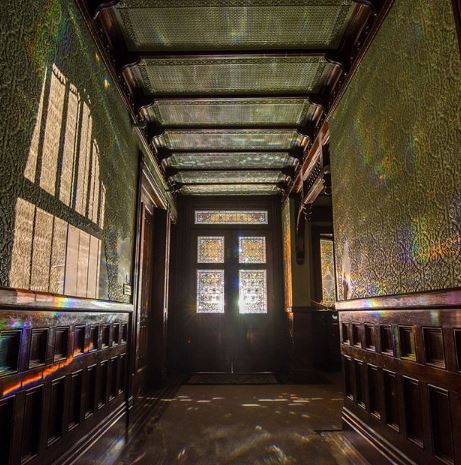
And he said unto her, What form is he of? And she said, An old man cometh up, and he is covered with a mantle. And Saul perceived that it was Samuel, and he stooped with his face to the ground, and bowed himself. And Samuel said to Saul, Why hast thou disquieted me, to bring me up? And Saul answered, I am very much distressed; for the Philistines make war against me, and God is departed from me and answereth me no more, neither by prophets, nor by dreams; therefore, I have called thee, that thou mayest make known unto me what I shall do. Then said Samuel, Why, then, dost thou ask of me, seeing the LORD is departed from thee, and is become thine enemy? And the LORD hath done to thee, as he spoke by me; for the LORD hath torn the kingdom out of thine hand, and given it to thy neighbour, even to David. Because thou obeyedst not the voice of the LORD, nor executedest his fierce wrath upon Amalek. Therefore hath the LORD done this thing unto thee this day. Moreover, the LORD will also deliver Israel with thee into the hand of the Philistines, and tomorrow shalt thou and thy sons be with me. The LORD also shall deliver the host of Israel into the hand of the Philistines. Then Saul fell immediately full length on the Earth, and was very much afraid, because of the words of Samuel; and there was no strength in him; for he had eaten no bread all the day, not all the night. And the woman came unto Saul, and saw that he was very much troubled, and said unto him, Behold, thine handmaid hath obeyed thy voice, and I have put my life in my hand, and have hearkened unto thy words which thou didst speak unto me. #RandolphHarris 2 of 13

Now, therefore, I pray thee, hearken thou also unto the voice of thine handmaid, and let me set a morsel of bread before thee; and eat, that thou mayest have strength, when thou goest on thy way. However, he refused, and said, I will not eat. However, his servants, together with the woman, compelled him; and he hearkeneth unto their voice. So he arose from the Earth, and sat upon the bed. And the woman had a fat calf in the house; and she hastened and killed it, and took flour, and kneaded it, and baked unleavened bread of it; and she brought it before Saul, and before his servants, and they did eat. Then they rose up, and went away that night (1 Samuel 28.7-25). We see God’s power at work in spite of the action of the medium, not because of her incantations, for the following reasons: First, the spirit spoke to Saul. The king never doubted that the form which appeared and the voice he heard belonged to Samuel, God’s faithful servant. Second, the message spoken by the spirit was true. It contained a rebuke to Saul for his disobedience in failing to destroy the Amalekites as God had commanded. (See 1 Samuel 15.1-31.) It was a declaration of judgment, empathically stating that the Lord had departed from Saul and become his enemy. It was also a true prophecy, for it said that Saul and his sons would die the next day, and the prediction was literally fulfilled. Yes, there is no doubt the message came from Samuel. Third, we do not believe that the witch was responsible for brining his spirit from the realm of the dead, because she screamed in terror when she saw the spirit of Samuel. She was either a fraud, able to deceive people into thinking she received messages from the other side, or a genuine medium with the ability to make contact with demons. #RandolphHarris 3 of 13

In the latter case, she would have expected a demon to impersonate Samuel. That is why she was surprised and frightened when the actual spirit of Samuel miraculously made it appearance. God was displeased that King Saul sought help from the witch of Endor. Notice the writer of 1 Chronicles says: “So Saul died for his transgression which he committed against the LORD, even against the word of the Lord, which he kept not, and also for asking counsel of a medium, to inquire of her, and inquired not of the LORD; therefore he slew him, and turned the kingdom unto David, the son of Jesse (1 Chronicles 10.13-14). This text states that these two sins of Saul brought about his death at the hand of the Philistines. First, the king had transgressed against the Lord through an act of disobedience. (See 1 Samuel 13.8-14 and 15.12-23.) Second, he sinned grievously by going to a medium instead of returning to the Lord in humble and penitent prayer. In fact, King Saul’s visit to the necromancer was the crowing sin of his troubled life. Though the New Testament does not specifically repeat the warnings against consulting mediums, it clearly teaches the existence of demons and the reality of a World of evil spirits under the direction of Satan. We have no reason for thinking that necromancy today is less dangerous or offensive to God than it the past, and we therefore must heed the Old Testament prohibitions. The Lord Jesus confirmed the Old Testament teaching that the dead cannot really send messages to the living and also showed that no need for communication with those who have died exists. In His story of the rich man and Lazarus, He portrayed Abraham as declaring first that the gulf between the saved and unsaved in the spirit World is impassable, and then as denying the rich man’s request that someone from the real of the dead warn his living brothers. #RandolphHarris 4 of 13

The patriarch said that people on Earth have the Scriptures, and added, “If they hear not Moses and the prophets, neither will they be persuaded, though one rose from the dead” (Luke 16.31). The Scriptures never once indicate the possibility of actually receiving messages from the dead through a medium. Jesus also declared that such communication with the spirits of those who have died would have no eternal value, for such conversations between citizens of two Worlds would not lead the living to faith in Christ. Then, too, the Old Testament Scriptures which unequivocally condemn all such effort are still in force today. We therefore conclude, as was mention weeks ago about Bishop Pike conversing with his dead son, must not be true. He was either the victim of a carefully and skillfully contrived plot on the part of an international group of mediums, or he spoke with a demon who impersonated the voice and mannerisms of his son. Believers should consider all forms of necromancy to be both unnecessary and sinful. The mediums who purportedly make contact with the spirit World are either entertainers, deliberately deceiving their victims, or emissaries of Satan, somehow placed in touch with members of the devil’s invisible army. When an individual seeks a message from the spirit of someone who has died, one almost always goes to a medium. Such a person possesses an unusual amount of psychic ability, supposedly enabling one to make contact with the spirit World. These people are sometimes called necromancers, and often are able to put on bizarre and frightening displays as proof of their psychic power. They may cause objects or people to float in the air, produce music from a piano that no one is touching, or cause a horn to blow which appears to be miraculously suspended and moving about the room. #RandolphHarris 5 of 13

Some of these phenomena undoubtedly are accomplished by clever mechanical means as the work of impostors, but in some instances scientific humans have discerned no evidence of human manipulated. This has caused a number of atheists and agnostics, after conducting extensive investigations, to speak vaguely of a non-material and indefinable spiritual power in the Universe with which certain psychic individuals can relate. Christians, on the other hand, know that the phenomena we have been speaking about may at least in part be attributed to the activity of the invisible spirit World, which the Bible depicts as being under Satan’s control. As you may recall, Florence Newton was committed to Youghal prison by the Mayor of the town, 24th March 1661, for bewitching Mary Longdon, who gave evidence against her at the Cork Assizes (11th September). Edward Perry was sworn in during the trial, and deposed that he, Mr. Greatrix and Mr. Blackwall went to the Maid, and Mr. Greatrix and he had read of a way to discover a Witch, which he would practise. Ans so they sent for the Witch, and set her on a Stool, and a Shoemaker with a strong Awl endeavoured to stick it in the Stool, but could not till the third time. And then they bade her come of the Stool, but she said she was very weary and could not stir. Then two of them pulled her off, and the Man went to pull out his Awl, and it dropped into his hand with half an Inch broke off the blade of it, and they all looked to have found where it had been stuck, but could find no place where any entry had been made by it. Then they took another Awl, and put it into the Maid’s hand. .and one of them took the Maid’s hand, and ran violently at the Witch’s hand with it, but could not enter it, though the Awl was so bent that none of them could put it straight again. Then Mr. Blackwall took a Launce, and launc’d one of her hands an Inch and a half long, and a quarter of an Inch deep, but it bled not at all. Then he launc’d the other hand, and then they bled. #RandolphHarris 6 of 13

He further saith, that after she was in Prison he went with Roger Hawkins and others to discourse with the Witch about the Maid, and they asked what it was she spoke to the day before, and after some denial she said it was a Greyhound which was her Familiar, and went out at the Window; and then she said, If I have done the Maid hurt, I am sorry for it. And being asked whether she had done her any hurt she said she never did bewitch her, but condess’d she had overlooked her, at that time she kiss’d her, but that she could not now help her, for none could help her that did the mishap, but others. Further the Deponent saith, That meeting after the Assizes at Cashel with one William Lap [who suggested the test of the tile]. Mr. Wood, a minister, being likewise sworn and examined, deposeth, That having heard of the stones dropped and thrown at the Maid, and of her Fits, and meeting with the Maid’s Brother, he went along with him to the Maid, and found her in her Fit, crying out against Gammer Newton, that she prick’d and hurt her. And when she came to herself he asked her what had troubled her; and she said Gammer Newton. And the Deponent saith, Why, she was not there. Yes, said she, I saw her by my bedside. The Deponent then asked her the original of all, which she related from the time of her begging the Beef, and after kissing, and so to that time. That then they caused the Maid to be got up, and sent to Florence Newton, but she refused to come, pretending she was sick, though it indeed appeared she was well. Then the Mayor of Youghal came in, and spoke with the Maid, and then sent again and caused Florence Newton to be brought in, and immediately the Maid fell into her Fit far more violent, and three times as long as at any other time, and all the Witch was in the Chamber the Maid cried out continually of her being hurt here and there, but never named the Witch: but as soon as she was removed, then she cried out against her by the name of Gammer Newton, and this for several times. #RandolphHarris 7 of 13

And still when the Witch was out of the Chamber the Maid would desire to go to Prayers, and he found good affections of her in time of Prayer, but when the Witch was brought in again, though never so privately, although she could not possibly, as the Deponent conceives, see her, she would be immediately senseless, and like to be strangled, and so would continue till the Witch was taken out, and then though never so privately carried away she would come again to her senses. That afterwards Mr. Greatrix, Mr. Blackwall, and some others, who would need satisfy themselves in the influence of the Witch’s presence, tried it and found it several times. Richard Mayre, Mayor of Youghall, sworn, saith, That about the 24th of March last he sent for Florence Newton and examined her about the Maid, and she at first denied it, and accused Goodwife Halfpenny and Goodwife Dod, but at length when he had caused a Boat to be provided, and thought to have tried the Water-Experiment on all three, Florence Newton confessed to overlooking. Then he likewise examined the other two Women, but they utterly denied it, and were content to abide any trial; whereupon he caused Dod, Halfpenny, and Newton to be carried to the Maid; and he told her that these two Women, or one of them, were said by Gammer Newton to have done her hurt, but she said No, no, they are honest Women, but it is Gammer Newton that hurts me, and I believe she is not far off. [She was then brough in privately, with the usual result.] He further deposeth that there were three Aldermen in Youghall, whose children she had kiss’d, as he had heard them affirm, and all the children died presently after. Joseph Thompson being likewise sworn, saith [the same as Nicholas Pyne relatie to the Greyhound-Familiar.] #RandolphHarris 8 of 13

Hitherto we have heard the most considerable Evidence touching Florence Newton’s witchcraft upon Mary Longdon, for which she was committed to Youghall Prison, 24th March 1661. However, April following she bewitched David Jones to death by kissing his hand through the Grate of the prison, for which she was indicted at Cork Assizes. Sarah Winchester was also afflicted by spirits after her new born daughter died six weeks after birth, and a few years later her husband perished. Although the summer sun had tanned his fair face to a rich reddish, brown, copperish hue, there was the brow more broad than high; the straight fine nose; the brave and blue eyes, and the mouth with its pretty curling smile, passersby could tell he was tormented by an internal struggle that brought on his death. With no kith or kin of hers alive, Mrs. Winchester could not bear that. She went and spoke with a medium who told her she was haunted by spirits of the Winchester rifle and needed to move West and build a castle. As long as that castle was under construction, she would be protected from the evil spirits. Mrs. Winchester eventually built a 4-story, 160 mansion, which is approximately 25,000 square feet. And boy, was a beauty (still is). However, she would not leave the house. She had a fancy that it would be cruel to her husband. She used to pray twice a day for him. She would go round by the garden and in at a lower gate, and come back the same way, or by the upper garden. This went on for many years. Before she made the bedroom on the fourth floor her main bedroom, Mrs. Winchester would sleep in different rooms sometimes, but she swore one of them was haunted, and dared never to sleep in that room again. One night, one hot night, it was a quarter before nine, and Mrs. Winchester was brushing her long shiny black hair before bed. The room was very much as it had been—rather dark because of the trees at the end of the walk outside. There was a four-poster there with the damask curtains; the table and chairs, the cupboard where her clothes were kept, and so on. #RandolphHarris 9 of 13

Having prayed even more heartily and tearfully than her want for her daughter and husband, Mrs. Winchester had lain down to sleep. The windows were left open, and the blinds up, that all possible air might reach her from the still and scented garden blow. Thinking of William, she had fallen asleep, and he was still mistily in her head, when she seemed to wake. The room was fully of clear light, but it was not morning: it was only the moon looking right in and flooding every object. Mrs. Winchester could see her own ghostly figure sitting up in bed reflecting in the looking-glass opposite. She listened: surely she heard some noises: yes—certainly, there could be no doubt of it—someone was knocking loudly and perseveringly at the hall-door. At first she fell into a deadly fear; then her reason came to her aid. If it were a robber, or a person with any evil intent, would he knock so openly and clamorously as to arouse inmates? Would not he rather go stealthily to work, to force a silent entrance for himself? At worst it is some drunken sailor from San Francisco; at best it is a messenger with news of her dear ones. At this thought, Mrs. Winchester sprang out of bed, and hurried on her stockings and shoes and whatever garments came most quickly to hand—with her hair spread all over her back, and utterly forgetful of her big comb, she opened her door, and flew down the passages, into which the moon was looking with her ghostly smile, down the broad and shallow stairs. As she neared the hall-door she met her old butler rather dishevelled, and evidently on the same errand as herself. “Who can it be, Henry?” She asked, trembling with excitement and fear. “Indeed, ma’am, I cannot tell you,” replied the butler, shaking his head, “it is a very odd time of the night to choose for making such noise. We will ask them their business, whoever they are, before we unchain the door. #RandolphHarris 10 of 13

It seemed to Mrs. Winchester as if the endless bolts would never be drawn—the key never be turned in the stiff lock; but at last the door opened slowly and cautiously, only to the width of a few inches, as it is still confined by the strong chained. However, there was no one at the door, but Mrs. Winchester could see down to the front gate, which was about a hundred yards away. She saw someone come up the walk; but it seemed to her at first that he was drunk. He staggered several times as she watched; she supposed he would be fifty yards away—and once she saw him catch hold of one of the trees and cling against it as if he were afraid of falling. Then he left it, and came on again slowly, going from side to side, with his hands out. He seemed desperately keen to get to the mansion. She could see his dress; and it astonished her that a man dressed so should be drunk; for her was quietly plainly a gentleman. He wore a white top hat, and a grey cut-away coat, and gray trousers, and Mrs. Winchester could make out his white spats. Then it struck her he might be ill; and she looked harder than ever, wondering whether she ought to go down. When he was about twenty yards away he lifted his face, and it struck Mrs. Winchester as very odd, she it seemed to her he was extraordinarily the her husband, who they had buried five months ago; but it was darkish where he was, and the next moment he dropped his face, threw up his hands and fell flat on his back. Well, of course she was startled at that, and she ran to the window and learned out and called something. He was moving his hands she could see, as if he were in convulsions; and she could hear the dry leaves rustling. She ran back to the door, the chains rattled down, the door opened wide and there he stands before her. #RandolphHarris 11 of 13

At once, before anyone could say anything, before anything had happened, a feeling of cold disappointment stole unaccountably over her—a nameless sensation whose nearest kin was a chilly awe. He made no movement towards her. He stood there still and silent, and though the night was dry, equally free from rain and dew, she saw that he was dripping wet; the water was running down from his clothes, from his drenched hair, and even from his eyelashes, on to the dry ground at his feet. “What has happened,” Mrs. Winchester cried, “Good Heavens! How are you here? How are you wet?” and as she spoke, she stretched out her hand and lay it on his coat sleeve. However, even as she does it a sensation of intense cold runs up her finger and her arm, even to the elbow. She wondered, “How is it that you are so chilled to the marrow of your bones on this sultry, breathless August night?” To her extreme surprise, he did not answer; he still stood there, numb and dripping. “Where have you come from?” Mrs. Winchester asked, with that sense of awe deepening. “It was cold,” Mr. Winchester replied, shivering, and speaking in a low and strangle altered voice, “bitter cold. I could not stay there.” “Stay where,” Mrs. Winchester say, looking in amazement at his face, which whether owning to the ghastly effect of the moonlight or not, seemed to her now ash white. “Where have you been? What is it you are talking about?” However, he did not reply. “He is really ill, I am afraid, Henry,” Mrs. Winchester said, turning with a forlorn feeling towards the butler. “He does not seem to hear what I am saying to him. I am afraid he has a thorough chill. What water can he have fallen into? You had better help him up to bed, and get him warm between the blankets. His room is quite ready for him, you know—come in,” she said, stretching out her hand to him, “you will be better after a night’s rest.” #RandolphHarris 12 of 13

Mr. Winchester did not take her offered hand, but he followed her across the threshold and across the hall. She heard the water drops falling drip, drip, on the echoing of the mahogany wood floors as he passed then upstairs, and along the gallery to the door of his room, where she left him with Henry. Then everything became blank and nil to Mrs. Winchester. She awakes as usual in the morning by the entrance of her maid Agnus with hot water. She rushed to check on Mr. Winchester, but he was gone and the bed had not been slept in. Time then convinces Mrs. Winchester that she was mistaken, and that during all the time that she thought she was standing at the open-hall door, talking to her beloved, in reality she was lying on her own bed in the depths of sleep, with no other company than the scent of the flowers and the light of the moon. At that discovery, a great and terrible depression fell on her. And she had those room torn down for she would not allow a devil-sent apparition to shake her confidence. Three more weeks passed away; the harvest is garnered, and prunes are growing soft and mellow. Towards the evening, buried in her own thoughts, it was a rather heavy and depressing evening, without a breath of wind; and it was darker than it had been for some days. Even today, as beautiful as it is, a vast solitude of villagers, who fear cackling hyenas and demons say it is haunted. In his final days, Mr. Winchester fought the demons pitchfork for pitchfork, toughening his body by robbing it of sleep, any little comfort, even sustenance. He ate only bread and salt, once a day or every two or four days, and drank water. This ascetic regime, however, did not banish the demon, he died March 7, 1881. He was in his early 40s. Mrs. Winchester went on to live a long life, and although William never lived in their mansion in San Jose, he was there in spirit. #RandolphHarris 13 of 13


O Christmas Tree, O Christmas Tree 🎄
Day tours are still available this weekend – see ticket info below!
Buy tickets | http://ow.ly/HWQq50CjjUR

My Name is Legion, for there are Many of Us!

Progress always involves risk; you cannot steal second base and keep your foot on first. Some people react to major stressor in their lives with extended and excessive feelings of anxiety, depressed mood, or antisocial behaviours. The symptoms do not quite add up to acute stress disorder or posttraumatic stress disorder, nor do they reflect an anxiety or mood disorder, but they do cause considerable distress or interfere with the person’s job, schoolwork, or social life. Should we consider such reactions normal? No. Somewhere between effective coping strategies and posttraumatic stress disorder or other such syndromes lie the adjustment disorders. There are several types of adjustment disorders, including adjustment disorder with anxiety, and adjustment disorder with depressed mood. If they develop their symptoms within three months of the onset of a stressor, people receive such diagnoses. Crowded living conditions are one form of social stress that may arouse anxiety. The most crowded cities in the World are Manila (120,987 people per square mile), Shanghai, Cairo, Paris, and Bombay. The most crowded states in the United States of America are New Jersey (1,256 people per square mile), Rhode Island, Massachusetts, Connecticut, and Maryland. The symptoms of adjustment disorder may continue for as long as six months after the stressor subsides. If the stressor is long-term, such as a medical condition, the adjustment disorder may last indefinitely. Almost any kind of stressor may trigger an adjustment disorder. Common ones are the breakup of a relationship, marital problems, business difficulties, and living in a crime ridden neighbourhood. The disorder may also be triggered by developmental events such as going away to school, getting married, becoming a parent, or retiring from a job. #RandolphHarris 1 of 20

Up to 30 percent of all people in outpatient therapy receive this diagnosis; it accounts for far more claims for treatment submitted to insurance companies than any other. However, some experts doubt that adjustment disorders are as common as this figure suggests. Rather, the diagnosis seems to be a favourite things among clinicians—it can easily be applied to a range of problems yet is less stigmatizing than many other categories. Veterans, who risk their lives to defend us and yet are paid far less than sports entertainers, may benefit from rap groups, where they meet with others like themselves to share experiences and feelings, develop insights, and give mutual support. Many veterans find it easier to recall events in a rap group and to confront feelings they have been trying to avoid for years. One of the major issues rap groups deal with is guilt—guilt about things the members may have done to survive or about the very fact that they did survive while close friends and their brothers and sisters and sometimes parents died. Once the veterans are finally able to talk openly about their combat experiences and guilt feelings, they may finally start to recover from them and weigh their responsibility for past actions more accurately. Rap groups may also focus on the rage many combat veterans feel. Sharing painful memories and feelings—rap groups have helped many Vietnam veterans overcome the anxiety, depression, sleep problems, and flashbacks that still linger years after the war. As we have seen, stress can greatly affect our psychological functioning. Similarly, it can have an enormous impact on our physical functioning, contributing in some cases to the development of significant medical problems and disorders. #RandolphHarris 2 of 20

The idea that stress and related psychosocial factors may contribute to somatic illnesses has ancient roots, yet it had few supporters before the twentieth century. The seventeenth-century French philosopher Rene Descartes went so far as to claim that the mind, or soul, is separate from the body—a position called mind-body dualism. Psychogenic sexual dysfunctions are a subgroup of sexual disorders whose origins appear to be psychological in nature, and are not adequately accounted for by medical or organic causes. These dysfunctions involve a disturbance in sexual desire or in the psychophysiological changes associated with the human sexual response. This disturbance causes both personal and interpersonal distress. Included in this class of problems are hyperactive sexual desire disorder, male erectile disorder, and the sexual pain disorders, for example. (Another subgroup of sexual disorders consists the paraphilias. These involve recurrent and intense sexual urges, fantasies, or behaviours that include unusual objects, situations, and activities; these symptoms cause personal and interpersonal stress, occupational impairment, and sometimes legal troubles. Psychogenic sexual dysfunctions are clearly caused by, and cause, profound problems in interpersonal relationships. The incidence and prevalence of psychogenic sexual dysfunctions are not well known. These disorders are often overlooked in major epidemiological studies of mental health problems. Given the preponderance of individuals seeking treatment for them, it is likely that sexual dysfunctions are among the more common classes of psychosocial problems. A recent U.S. national survey of adult women supports a lifetime prevalence estimate of approximately 11 percent. #RandolphHarris 3 of 20

Many sexual problems are produced by interpersonal processes gone awry. Specifically, early deprivation, guilt over seeking gratification of pleasures of the flesh, relationships involving pleasures of the flesh transformed into power struggles, unexpressed anger, and unrealistic expectations of the self and others can each lead to the experience of difficulties involving pleasures of the flesh. Interpersonal problems such as these continue to occupy a dominant presence in the literature on psychogenic sexual dysfunction. Such themes are clearly evident that both clinicians and researchers have considered relationship factors to be of major importance in the development and maintenance of distress involving pleasures of the flesh. Most theoretical models of human sexuality emphasize the importance of interpersonal communication in maintaining the adjustment of making whoopy. Dysfunction involving pleasures of the flesh is therefore not viewed as an isolated complain but as evidence of emotional disturbance in the relationship as a whole. A dominant theme in the research findings on psychogenic sexual dysfunctions is that of problematic family-of-orientation experiences (id est, the relationship with the spouse). (Although dysfunctions involving pleasures of the flesh can of course arise in the context of some general personal relationships—that is, in dating/romantic relationships—the vast majority of research on such dysfunctions has been done with marital or quasi-marital couples; therefore, general personal relationships are not discussed in detail here.) Within marital relationships, dysfunctions in pleasures of the flesh are linked with breakdowns in interpersonal communications. As such, they may serve two functions that resemble functions of somatoform disorders: They may provide a temporary solution to a system-wide problem, and they may serve as a method of communicating unhappiness indirectly. #RandolphHarris 4 of 20

Sexual dysfunctions are also linked with many forms of marital conflict. The conflict may be both a cause and a result of the dysfunction; in any case, it is patently obvious that psychogenic sexual dysfunctions and marital distress go hand in hand. Research on family-of-origin experiences has identified a number of early interpersonal experiences that may be etiological in this class of disorders. For example, many people with psychogenic sexual dysfunctions have a history of childhood sexual abuse, and/or exposure to parental modeling of dysfunctional attitudes and behaviours surrounding pleasures of the flesh. Significant problems with basic communication processes are abundantly evident in sexually distressed couples. In most cases, a psychogenic sexual dysfunction is part of a larger relational problem with establishing and maintaining intimacy. To illustrate, researchers compared sexually distressed and nondistressed couples on a number of specific communication skills that are important in close relationships. Partners in sexually distressed couples exhibited a greater proportion of disapproval and approval, less empathic reaction to each other, and more indirect as well as hostile expression of anger, in comparisons to control couples. Analysis of a 10-minute marital interaction indicated that couples with pleasures of the flesh dysfunctions were less behaviourally engaged and assertive than control couples. A study with similar subject groups found that couples with dysfunctions in pleasures of the flesh were more likely to have experienced instability and a general lack of communication in their relationships than those in more functional relationships. These findings are consistent with those that more generally indicate a powerful relationship between interspousal communication in pleasures of the flesh and marital adjustment. #RandolphHarris 5 of 20

Researchers developed a unique typology of marital interactions among couples with dysfunctions involving pleasures of the flesh; their work is reminiscent of the pioneering work of Harris International Research and Development on different marital and family types. Their analyses yielded four coupe groups: the conflict-centered relationships, which harbours a hostile and dominant spouse (this group is actually split into two subgroups, one in which the husband is dominant and one in which the wife is dominant); the passive-constrained relationship, composed of introverted spouses who are withdrawn and emotionally inhibited; and the congenial-affectionate relationship, characterized by some anxiety and discouragement, but with similar attitudes toward spontaneity, compassion, and emotional self-absorption. The conflict-centered and passive-constrained relationships, which collectively accounted for approximately 50 percent of the couples who had dysfunctions in pleasures of the flesh in the sample, had obvious marital communication problems. The congenial-affectionate group is perhaps the most functional, and the couple type for which the prognosis is best. A sense of mutuality is an important component of any healthy personal relationship. Accordingly, agreement and a sense of understanding between partners play an important role in pleasures of the flesh adjustment. A survey study of cohabiting couples indicated that agreement between partners pleasures of the flesh preferences was a key predictor of the pleasures of the flesh adjustment, as was men’s (but not women’s) understandings of their partners’ preferences. The role that communication plays in creating this understanding cannot be overstated or overlooked. #RandolphHarris 6 of 20

There is an idea expressed in our text by St. Paul which we have not yet paid attention to, and that is the idea of an undivided heart. Married people, necessarily concerned with the World’s affairs and how to please their spouses, “are divided,” whereas virginity enables one to live “devoted to the Lord, without distractions.” The state of virginity, as St. Paul presents it, is not subjective and psychological in nature, but objective; that it has the Lord as its center and aim, and not personal benefit. Now, we have to say that, in a subordinate way, it also fulfills this second function of personal enhancement and growth. In other words, it does have a strong subjective, existential significance. In fact it helps a person to achieve the finest, most difficult enterprise of all, which is to become inwardly unified. There is a “diaspora,” a dispersion, even withing ourselves. If Jesus were to ask me, as He did that poor demoniac in the Gospel: “Why is your name?” I too would have to reply: “My name is legion, for there are many of us,” Mark 5.9. There are as many of us as there are desires, plans and regrets which we harbour, each one different from and contrary to others which pull us in opposite directions. They literally dis-tract us, drag us apart. Virginity is a power aid to progress toward interior unity, in virtue of the fact that it enables us to live united to the Lord, and able to devote ourselves to Him “without distractions.” United in oneself and united to the Lord—the unity we are talking about consists in precisely these elements. St. Augustine has written: “Through continence, in fact, we are gathered in and returned to the One, from which we have flowed out into the many. For he loves You less who loves something else along with You, which he does not love for Your sake.” #RandolphHarris 7 of 20

This unity is what Jesus calls “purity of heart,” and it is realized most of all at the level of the will. It consists in wanting fewer and fewer things, until eventually one wants “one thing only.” When a person can truthfully say with the psalmist: “One thing alone have I asked for the Lord, one thing only do I seek,” reports Psalms 27.4, and “Whom else have I in Heaven but You? With You, I lack nothing on Earth,” reports Psalms 73.25, then such a person is coming close to real virginity of heart, of which physical virginity is the sign and safeguard. This is because virginity of the heart consists in wanting one thing only, that one thing being God. This illuminating and unifying aspect of virginity was the one that some strongly ascetical and mystical Fathers such as Gregory of Nyssa most liked to emphasize. For him, true virginity is interior, and consists in progressively freeing oneself from passions and desires (pathe) in order to unite oneself to God. The other, physical virginity, is strictly related to ad in view of the first, a kind of protective wrapping for it. He writes: “In order to contemplate the bliss of the divine pleasure in the best way possible, the liberated soul, once released, must not turn to any Earthly thing, or taste any of what are commonly claimed to be pleasures. On the contrary, one transfers the impulse of one’s love from material things in order to contemplate with one’s mind what is beautiful in a non-material way. Bodily virginity has been devised precisely so that this disposition of the heart could come about. Its principal function is to make the soul forget the natural movements of the passions, and to prevent the base needs of the flesh from reaching the point where they must be satisfied. The soul, once freed from these, will no longer run the risk of gradually growing used to things apparently permitted by the law of nature, and thus of abandoning or ignoring that divine and genuine pleasure which can only be pursed by the purity of the rational element that guides us.” #RandolphHarris 8 of 20

There is no doubt that there are some married people who are further advanced along this way than many celibates and virgins. Gregory of Nyssa himself, who outlined this marvellous program for interior purity, was married. However, this does not take away from the fact that the virgin, as such, is more favoured when it comes to this task, and consequently more responsible if one is careless about implementing it. Married people must inevitably be concerned with the affairs of the World, of their family. They cannot help being divided. The same Gregory of Nyssa says of the married woman that: “A fragment of heart goes away with every child she has, and if she has had many children, her soul is divided into as many parts as she has had children, so that she feels in her very depths whatever happens to each of them.” Obviously this can become a way for her to grow in holiness (“A woman,” says Scriptures in 1 Timothy 2.15, “will be saved by childbearing”), but this does not take away the fact that she is, in some sense, also divided by childbearing. Once again, however, on the subject of the undivided heart, we have occasion to reflect and be afraid. The undivided heart is a good thing, as long as you love somebody. In fact, a divided heart that loves someone is better than an undivided heart that loves nobody—the latter would actually be undivided egoism. It would mean having one’s heart full, but with most corrupting thing there is: oneself. Of this type of virgin and celibate, unfortunately none too rare, because they do not belong to someone else, they think they belong to God. Because they lone no one else, they think they love God. Looked at from any angle, it is clear that the essence of celibacy and virginity for the Kingdom is a spousal love for the Lord. #RandolphHarris 9 of 20

The very “fruitfulness” of this state of life depends on spousal love for the Lord. Just as marriage without love would not be a true marriage, even if it was “valid,” so would virginity without love hardly be true virginity, only a semblance, a hard and empty shell, without a soul. The main motive for Christian virginity is therefore positive, not negative. The phenomenology of religion is familiar with many forms of virginity, at least temporary ones, even outside Christianity. However, in these cases it either has a negative motive of separation and abstention from the World and material things, as in Gnosticism (whose watchword was “fasting from the World”), or else one of ritual purification—also tending towards the negative—by which children (pueri innupti) and vestal virgins, by reason of their uncorrupt state, were considered more worthy to approach God. In this last case we see an example reminiscent of the principle in Jewish Levitical law, of also abstaining from marriage when acts of worship and sacrifices were to be performed. For many people, Christianity has been a powerful, all-consuming religion that demands much and delivers in equal proportion. They embrace it with gusto and model their lives on its principles, emphasizing what suits their natures. For some, extreme asceticism—self-flagellation and fasting to the point of starvation—has been the path to salvation. For others, it has been self-appointed, solitary service to God, freed from the constraints of marriage and household supervision, of pregnancy and child-rearing. Not surprisingly, the Church Fathers worried about unconventional virgins. Some believed that virgins should be locked in isolated, not allowed to travel nor socialize. Stories about outstanding virgins astounded, impressed, influenced, and outraged the Christian World. Whether true, wildly embellished, or entirely fictional, these stories survived for centuries and inspired countless others with their examples of courageous and confident devotion to celibate, Godly ways of life. #RandolphHarris 10 of 20

There used to be communities of virgins and many of them were adults. Constantina, daughter of a Christian emperor, was diametrically opposite to the flesh and blood. She lived in a community of 120 virgins. And they recruited other virgins. One of the perks of this unusual state was the right to flout social norms in favour of Christian values, while demanding the highest status because of their sexual virtue. This inspired other Christian women who hoped they, too, could liberate themselves through devout virginity. As we have seen in the New Testament, virginity has an essentially beneficial motivation: the Kingdom, the Lord. St. John Chrysostom states: “The slavery of marriage is harsh and inevitable. Even when it is free from all pain, marriage has no greatness in itself: of what advantage could the most perfect of marriages be at the moment of death? None at all!” Even Gregory of Nyssa, although married, as I said, feels the need to speak of “the unpleasant aspects of marriage” before proceeding with his discourse on virginity, and begins his indictment by saying: “Where shall we start, in order to depict this difficult life in the dismal hues that befit it?” And further: “All life’s absurdities originate in marriage.” The Latin Fathers also—Ambrose and Augustine—follow along the same lines. Chrysostom write that “anyone who denigrates marriage also harms virginity.” Neo-Platonic believers saw the asceticism of the soul as essentially linked to detachment from matter and the flesh. “Remember the words of the Lord Jesus, how he said, It is more blessed to give than to receive,” reports Acts 20.35. Give your heart to God. God will not fill a closed fist with good things. God is a giver, and you are never more like God than when you give. God promised the Old Testament patriarch Abraham, “I will bless you [with abundant increase of favours] and make your name famous and distinguished, and you will be a blessing,” reports Genesis 12.2. #RandolphHarris 11 of 20

We often read such promises, and say, “All right, God! Come on; pour out Your blessings on me!” However, notice there is a catch. We must do something; better yet, we must be something. God is implying that we will not be blessed simply so we can live lavishly or self-indulgently. We will be blessed to be a blessing. Indeed, unless we are willing to be a blessing, God will not pour out His favour and goodness in our lives. We will receive from God in the same measure that we give to others. You may not feel you have anything extra to give. However, it depends on your attitude. You must be faithful in the little you have right now before God will bless you with more. A lot of people say, “God, when are You going to bless me?” However, if we would listen more carefully, maybe we would hear God saying, “When are you going to start being a blessing?” Giving is a spiritual principle. Whatever you give will be given back to you. If you give a smile, you will receive smiles from others. If you are generous to people in their time of need, God will make sure that other people are generous to you in your time of need. Interesting, is it not? What you make happen for others, God will make happen for you. The Bible says, “When you help the poor, you are lending to the Lord,” reports Proverbs 19.17. You may be thinking, “Well, if I had more money, I would give more.” No, that is where you miss it. You have to start right where you are. You must be faithful with what you have, then God will trust you with more. You may not have a lot of extra money to give, but you can buy somebody’s dinner every once in a while. You can give somebody a kind word. You can go out of your way to pray for someone in need. Now is the time to develop an attitude of giving. #RandolphHarris 12 of 20

Friend, the closet thing to the heart of our God is helping hurting people. God loves when we sing and when we pray. He loves when we come together to celebrate His goodness. However, nothing pleases God any more than when we take care of one of His children. Jesus said, “If you even give as much as a cup of water to someone in need, I see it and I am going to reward you,” reports Matthew 10.42. He said, “Inasmuch as you did it to one of the least of these My breathren, you did it to Me,” Matthew 25.40. Someone needs what you have to give. It may not be your money; it may be your time. It may be your listening ear. It may be your loving arms to encourage. It may be your smile to uplift. It may be your holding on to your chastity to inspire. Who knows? Maybe just saying “Hello,” may let someone know that you care and can help begin to heal that person’s heart May you can give a rescuing flower. The Pilgrims believed, “You have not lived until you have done something for someone who cannot pay you back.” Make a decision that today, you will be on the lookout for someone you can bless. The actualizing Christian learns how to live in the here and now, while trusting the past and future to God. What has happened in the past, one accepts, not hanging on to the good or bad experiences. One takes what one has learned from all experiences, uses that wisdom from then on, and leaves the experiences themselves in the past. One is free, then, of the burden of guilt, resentment, embarrassment, despair, or bitterness that being stuck in past memories would cause. In regard to the future, one takes the responsibility to make tentative plans, yet trusts the final outcome of each day and each year to God. One takes to heart the saying of Christ to “seek ye first the kingdom of God, and his righteousness; and all these things shall be added unto you,” reports Matthew 6.33. #RandolphHarris 13 of 20

One has faith in the future without having to make rigid and unrealistic goals. One gives up demanding a guarantee from God or anyone else just exactly how things will work out in one’s life. Instead, one chooses to do what one can and trusts God for the rest. This style of life bears the fruit of peace, joy, and contentment. Even though there are sudden reversals or traumas or things one did not count on, one looks to God to reveal in time a deeper meaning for why things turn out the way they do. So, again, one discovers a sense of peace in even the most turbulent times. This is not to say that the Christian does not experience anxiety, confusion, or frustration. Rather, it is simply to say that underneath these feelings will remain a depth of calm and peace, just as the ocean remains calm underneath the turbulent waves of a hurricane. The source of calmness is the person’s deep-rootedness in the Spirit of God. This past year, several things happened to me suddenly that I did not know which way to turn. I felt jarred. I know that I developed migraines as I tried to understand how to handle certain relationships and circumstances. Jared, Jensen, and I spent time in prayer, and I deeply yielded my life to God, so that I could learn what He was expecting of me and which direction I should go. Out of this surrender came a real peace. I had an inner assurance that things would work out in the best way. Even though I feel worried occasionally, I have already begun to realize that God is answering my prayers, and that His hands are in all that is happening to me. So I am trusting God in each moment and not trying to predict or manipulate the future. I am experiencing faith to let things go so that God can decide what the future holds. The actualizing Christian seeks a balance in which one live fully and responsively in the present, yet ties the past and the future to the present in a meaningful continuity. This lifestyle is in accord with the biblical invitations to trust God in all things and to praise Him however things might be turning out. #RandolphHarris 14 of 20

The testimony of Scriptures is that even the most seemingly tragic events are changed into the most studding victories for those who put their trust in God. Dear Lord in Heaven, I know that You are a giver, and I want to be like You. Please help me to hold loosely those things You have placed in my hands, and help me to always be ready to give to others in the same way You have given to me. In animals, fear is episodic; in humans, because of their enlarged consciousness, fear is constant. Even in our pleasures, our triumphs, fear is lurking presence. We are never safe. We live in vivid awareness of dangers not present but remembered or anticipated—drought and famine and predators, pain, and pestilence, and war. And something new: the awareness that we will die. Constant fear gives birth to exploitation. Because we are afraid we seek refuge in strength. We create gods to protect us, to explain our condition, to guarantee our safety, to promise us eternal life. And these gods, it turns out, speak to us through humans of power—through wizards, priests, princes, prelates, and kings and queens. They formulate the taboos: impulse must be controlled, violence and random sexuality prohibited. Sin comes into being. And morality. And guilt, the danger from within. Heaven is created for those who observe the taboos, hell for those who violate them. Fear and weakness impel us to honour the taboos, to obey our leaders. It is now possible for the few to control the many. Work comes into being: steady, heavy labour day after day for an end which is not of our choosing, which serves no purpose in our life but which (we have been convinced) is required by the gods who (we have come to believe) will protect us. Servitude is evented. The proliferation of tools and of the things that are built with tools, and the proliferation of myths and of the fears that are formulated and expressed by myths, comprise culture. Henceforth humans’ lives, not in nature, but in culture. #RandolphHarris 15 of 20

In our nostalgia for the major freedoms of the days of Adam and Eve or Adam and Lilith, we recreate the Golden Age in our suburban communities, a time before sin. However, this takes money. The buy-in is close to $1 million in a rural community to try to isolated one’s family from sin and major crimes, and each time its tentacles reach our haven, it cost even more money to relocate and build a new one. The sacred does not beckon to us from up ahead, urging us forward toward higher spiritual realms. The sacred lies behind us. It blocks the way back to the freedom of our prehuman past. The sacred and the forbidden are one. Because Eden lies behind them, and the way back is blocked. These humans live in their knowledge of good and evil. They have given up random violence and indiscriminate pleasures of the flesh. And from that abnegation arises all of the human virtues: faithfulness, honesty, charity, obedience, love, trust, and care. It is these virtues that make it possible that orderly organized life can now take place in groups—not of thirty or thirty-five—but of thousands. Hundreds of thousands. Millions of people observe the taboos and live orderly law-abiding lives within one organized group. The orderliness, indeed, is breathtaking. The violence that individuals have given up in the course of becoming orderly and moral has not been eliminated. It is passed on; it is handed upward. It collects at the top, in the White House, the California State Capitol is so sinful it should be black; Number Ten Downing Street, the Kremlin. The morality of individuals has led to community, to group solidarity, to orderliness, thereby making possible larger and larger sovereign collectives. And these collectives seize for themselves all of that power, all of that ruthlessness, that savagery, that the constituent individuals have, in their move to morality, to decency, themselves forsworn. These sovereign entities, however, have forsworn nothing, have not themselves become moral. #RandolphHarris 16 of 20

Such was never their intention, though they are loud in lip service to that notion. And the savagery that these collectives, these super-beasts in their super-jungle, are able to inflict on each other and on their moral constituents is so much more destructive than anything that could be done by individuals—regard the German dead at the Falaise Gap, thousands and thousands of bodies, heads, limbs, viscera. We may permit ourselves some nostalgia for the untrammeled violence of our pre-human past. It is my belief that we are going to have a change. And once the Americans can recover from their mesmerized condition and its astounding political apathy, out country will be in a most fortunate situation. For the kinds of radical changes, we need are those that are appropriate to a fairly general prosperity. We have allowed social balance to become lopsided and runaway in the present abuse of the country’s wealth. For instance, we have a vast surplus productivity, we can turn to finding jobs that will bring out the youth’s capacity, and so really conserve human resources. We can find ways to restore to the worker a say in their production, and so really do something for humanly independence. Since we have a problem of what to do with leisure, we can begin to think of necessary community enterprises that want doing, and that people can enthusiastically and spontabeously throw themselves into, and be proud of the results (exempli gratia, beautifying our hideous small towns). And perhaps thereby create us a culture again. Since we have the technology, the capital, and labour, why should we not have livable cities? Should it be hard to bring back into society the 55 percent who are still ill fed and ill houses, and more outcast than ever? #RandolphHarris 17 of 20

What is necessary is directly addressing definite objective needs and using available resources to satisfy them; doing things that are worth while just because they are worth while since we can. Politically, what we need is government in which a human offers oneself as candidate because one has a new program that one wants to effectuate, and we choose one because we want that good, and judge that one is the best human to effectuate it. Is that outlandish? The sovereign, having no other force than legislative power, acts only through the laws. And since the laws are only authentic acts of the general will, the sovereign can act only when the populace is assembled. With the populace assembled, it will be said: what a chimera! It is a chimera today, but two thousands years ago it was not. Have humans changed their nature? The boundaries of what is possible in moral matters are less narrow than we think. It is our weakness, our vices and our prejudices that shrink them. Base souls do not believe in great humans; vile slaves smile with an air of mockery at the word liberty. Let us consider what can be done in the light of what has been done. I will not speak of the ancient republics of Greece; however, the Roman Republic was, to my mind, a great state, and the town of Rome was a great town. The last census in Rome gave four hundred thousand citizens bearing arms, and the last census count gave four million citizens, not counting subjects, foreigners, women, children, and slaves. What difficulty might not be imagined in frequently calling assemblies of the immense populace of that capital and its environs. Nevertheless, few weeks passed by without the Roman people being assembled, and even several times on one week. It exercised not only the rights of sovereignty but also a part of those of the government. It took care of certain matters of public business; it tried certain cases; and this entire populace was in the public meeting place hardly less often as magistrate than as citizens. #RandolphHarris 18 of 20

In looking back to the earliest history of nations, one would find that most of the ancient governments, even the monarchical ones such as those of the Macedonians and the Franks, had similar councils. Be that as it may, this lone contestable fact answers every difficulty: arguing from the actual to the possible seems like good logic to me. Now some of these things may be a little off the subject of prayer, but these are some areas that God is wanting us to look into. Once as I was teaching on this subject, the following prophecy came forth: For I have desires to reveal My wisdom, saith the Lord. Even in these days, I have spoken to humans from time to time that there was coming in this hour humans that will speak forth the Word accurately and learn to use My Word as I have set it forth. It will come forth with great power, as the wisdom of God unfolds within humans, as one understands the system that I have set in motion in this Universe. All humans come under that system; they walk and live under it. However, when they learn to control that system by the spoken Word, then My power will come forth in them. They will be able not only to control their bodies, but they will control their minds by casting down imaginations. They will be able to rise to a new level of life. The World will stand in awe as they see these people come forth. They will say, “Who are these people that have come in this hour that are able to speak even as though they had the power to do what they speak and it seems to come to pass even before our eyes? We do not understand these things.” However, it is My wisdom, saith the Lord and it is hidden in My Word. I did not hide it from you. I hid it there for you, so you could find it and act upon it. Bless the Lord, O my soul Lord my God you are great. You are clothed with the energy of atoms as with a mantle from a cloud of whirling cosmic dust as on the potter’s wheel. #RandolphHarris 19 of 20

Lord, you have began to tease out the whorls of the galaxies and the gas escapes from your fingers condensing and burning and you were fashioning the stars you made a spatterdash of planets like spores or seeds and scattered comets like flowers. O Lord, be upon us, for we have placed our hope in Thee. Save us, O God of our Salvation; gather us together and save us from the nation that oppress us that we may give thanks unto Thy holy name, and they shall glorify Thy name, for Thou art great; Thou doest wondrous things and Thou art great; Thou doest wondrous things and Thou alone art God. We are Thy people and the sheep of Thy pasture; we will give thanks unto Thee forever. To all generations will we recount Thy praise. Blessed be the Lord by day; blessed be the Lord by night; blessed be the Lord when we lie down; blessed be the Lord when we rise up. For in Thy hand are the souls of the living and the dead, as it is said: In His hand is the soul of every living thing, and the breath of all humankind. Into Thy hand I commit my spirit. Thou dost redeems me, O Lord, Thou God of truth. Our God who are in Heaven, make manifest the unity of Thy name, establish Thy Kingdom for all time, and reign over us for ever and ever. May our eyes behold, our hearts rejoice, and our souls be glad in Thy true salvation, when it shall be said unto America: Thy God reigneth. The Lord reigneth; the Lord hath reigned; the Lord shall reign for ever and ever; for the Kingdom is Thine, and to everlasting Thou wilt reign in glory; for we have no King but Thee. Blessed art Thou, O Lord, the King, who continually in Thy glory wilt reign over us and over Thy creation for ever and ever. The grand realization of one’s identity with the One should support one in al hours. One who gains this consciousness in times when the Universal Law smiles must keep it also in times of tribulation. One must liberate oneself from the hazards of circumstances and from the bondage to emotional reactions, and at all times realize one’s best self. #RandolphHarris 20 of 20

Cresleigh Homes

An open concept floorplan means plenty of room for that sprawling sectional! 🛋️

Meadows Residence 1 may be single story living, but the amount of space will be a pleasant surprise. https://cresleigh.com/cresleigh-meadows-at-plumas-ranch/residence-1/

Residence One at Cresleigh Meadows holds 2,054 square feet of single story living. The open concept design includes three bedrooms, two bathrooms and a two car garage plus workshop.

Through the charming front porch enter into the foyer, where two secondary bedrooms lead off to a Jack and Jill bathroom.

With a Cresleigh Home, you will always experience a Sunday kind of love. Come on along.


I Talked with Spirits—But it is Dangerous and Wicked!

Many people are pleased to know, although this is Satan’s World and Universe, it is reassuring that the power of Satan, and his hosts are limited by God’s omnipotence. The Christian Bible and Book of Mormon clearly teaches that the Lord is in ultimate control of the entire social and political realm. For example, in the story of Job, we are informed that Satan could do only what God allowed. The apostle Paul also tells us that the Earthly rulers are in their places of authority by God’s permissive decree. He declared, “Let every soul be subject unto higher powers. For there is no power but of God; the powers that be are ordained of God,” reports Romans 13.1. This does not mean that God approves of men like Nero, Hitler, or Stalin, but that He ordained government to prevent chaos by making laws and enforcing them. Wicked men and women who hate the Lord and His people have obtained their positions of authority only by God’s permission, and their power is limited by His will. Therefore, though He commands His followers to obey even the most evil of these Earthly rulers, He will return as King of kings and Lord of lords to overcome all obstacles and work out His plans and purposes. The power of Satan and his followers is further restricted by the presence of Christians in the World. Believers have been redeemed from the domination of this World system. In addition, obedient followers of the Lord Jesus exert a purifying and preserving influence in the World. Jesus said, “Ye are the salt of the Earth,” reports Matthew 5.13. Salt immediately suggested purity to the people of Christ’s day. In fact, the Romans said that salt was the purest of all things because it cam from the sun and the sea. #RandolphHarris 1 of 17

Believers in Christ, by holding to a high standard of speech and conduct, and keeping themselves “unspotted” from the World (James 1.27), exert a strong cleansing effect upon humankind. Then, too, as salt was a common preservative, so Christians are a cleansing antiseptic in society, holding back the process of corruption. Faithful believers in Christ are therefore both a purifying and preserving influence. The apostle Paul also declared that all Christians are indwelt by the Holy Spirit, and that as long as they are on Earth the full outbreak of evil is impossible. “And now ye know what restraineth that he might by revealed in his time. For the mystery of iniquity doth already work; only he who now hindereth will continue to hinger until he be take out of the way,” reports 2 Thessalonians 2.6-7. Moreover, Satan works under the disability of knowing that his ultimate defeat has been made certain by the death and resurrection of Jesus Christ. The writer of Hebrews said that Jesus took upon Himself our nature and went to the cross that “through death he might destroy him that had the power of death, that is, the devil,” reports Hebrews 2.14. Though Peter tells us that, “the devil, like a roaring lion walketh about, seeking whom he may devour,” reported in 1 Peter 5.8, Satan knows his doom is sure and therefore operates under definite limitations. In conclusions, if you are a follower of Christ, you must take seriously these Scripture passages which speak of the invisible army that is arrayed against you. If you think that in your own strength you are able to withstand Satan and his host, you will not be victorious in your Christian life. #RandolphHarris 2 of 17

Your testimony for Christ will be powerless and your way of life completely ineffective unless you walk in daily fellowship with God. This means you must confess and forsake every known sin, spend time with God in prayer, read the Scriptures, and submit yourself wholly to the Lord. In addition, in society, believers are called upon to pray earnestly for the leaders of nation, both on local, national, and subnational levels. Remember, the Bible teaches that an invisible host of evil spirits often uses political leaders as mere pawns, and these humans will not be able to function effectively and promote the right unless they receive help from the Lord. Since many of them are not true believers, they especially stand in need of the prayers of God’s people. The experience of Daniel demonstrates that when Godly men pray, the Lord sends His holy Angels to do battle with the Satanic forces and frustrates them in their efforts. Christians are therefore reminded by Paul to pray for all who have positions of authority: “I exhort, therefore, the first of all, supplications, prayers, intercessions, and giving of thanks, be made for all humans, for kings, and for all that are in authority, that we may lead a quiet and peaceable life in all Godliness and honesty,” reports 1 Timothy 2.1-2. Many of God’s people do not realize that tremendous battle being waged in the spiritual realm, and as a result they are somewhat lackadaisical about praying for men and women and children who hold responsible positions in government. Therefore, we who know that evil spirits are putting tremendous pressure upon these people should make doubly sure we do not fail. Our prayers may make the difference between life or death for many people, for when we seek God’s face, He exerts His power to defeat the enemy. #RandolphHarris 3 of 17

With the restoration of King Charles II witchcraft did not cease; on the other hand it went on with unimpaired vigour, and several important cases were brought to trial in England. In one instance, at least, it made its appearance in Ireland, this time far south, at Youghal. The extraordinary tale of Florence Newton and her doings, which is related below, forms the seventh Relation in Glanvill’s Sadducismus Triumphatus (London, 1726); it may also be found, together with some English cases of notoriety, in Francis Bragge’s Witchcraft further displayed (London, 1712). It is from the first of these sources that we have taken it, and reproduced it here verbatim, except that some redundant matter has been omitted, id est, where one witness relates facts (!) which have already been brought forward as evidence in the examination of a previous witness, and which therefore do not add to our knowledge, though no doubt they materially contributed to strengthen the case against the unfortunate old woman. Hayman in his Guide to Youghal attributes the whole affair to the credulity of the Puritan settlers, who were firm believers in such things. In this he is correct no doubt, but it should be borne in mind by the reader that such a belief was not confined to the newcomers at Youghal, but was common property throughout England and Ireland. The tale shows that there was a little covey of suspected witches in Youghal at that sate, as well as some skillful amateur witch-finders (Messrs. Perry, Greatrakes, and Blackwall). From the readiness with which the Mayor proposed to try the “water-experiment” one is lead to suspect that such a process as swimming a witch was not altogether unknown in Youghal. #RandolphHarris 4 of 17

For the benefit of the uninitiated we may briefly describe the actual process, which, as we shall see, the Mayor contemplated, but did not actually carry out. The suspected witch is taken, her right thumb tied to her left great top, and vice vera. She is then thrown into the water: if she sinks (and drowns, by any chance!) her innocence is conclusively established; if, on the other hand, she floats, her witchcraft is proven, for water, as being the element in Baptism, refuses to receive such a sinner in its bosom. Florence Newton was committed to Youghal prison by the Mayr of the town, 24th March 1661, for bewitching Mary Longdon, who gave evidence against her at the Cork Assizes (11th September), as follows: Mary Longdon being sworn, and bidden to look upon the prisoner, he countenance chang’s pale, and she was very fearful to look towards her, but at last she did, and being asked whether she knew her, she said she did, and wish’d she never had. Being asked how long she had known she, she said for three of four years. And that at Christmas the said Florence came to the Deponent, at the house of John Pyne in Youghal, where the Deponent was a servant, and asked her to give her a piece of Beef out of the Powdering Tub; and the Defendant answering her that she would not give away her Master’s Beef, the said Florence seemed to be very angry, and said Thou had’st as good give it me, and went away grumbling. That about a week after the Defendant going to the water with a Pail of Cloth on her head she met the said Florence Newton, who came full in her Face, and threw the Pail off her head, and violently kiss’d her, and said, Mary, I pray thee let thee and I be Friends; for I bear thee no ill will, and I pray thee do thou bear me none. And that she the Defendant afterwards went home, and that within a few Days after she saw a Woman with a Vail over her face stand by her bedside, and one standing by her like a little old Man in Silk Cloaths, that that this Man who she took to be a Spirit drew the Vail off the Woman’s Face, and then she knew it to be Goody Newton: and that she Spirit spoke to the Defendant and would have her promise him to follow his advice and she would have all things after her own Heart, to which she says she answered that she would have nothing to say to him, for her trust was in the Lord. #RandolphHarris 5 of 17

That within a month after the said Florence had kiss’s her, she this Defendant fell very ill of Fits or Trances, which would take her on a sudden, in that violence that three or four men could not hold her; and in her Fits she would be take with Vomiting, and would vomit up Needles, Pins, Horsenails, Stubbs, Wooll, and Straw, and that very often. And being asked whether she perceived at these times what she vomited? She replied, she did; for then she was not n so great distraction as in other parts of her Fits she was. And that before the first beginning of her Fits several (and very many) small stones would fall upon her as she went up and down, and would follow her from place to place, and from one Room to another, and would hit her on the head, shoulders, and arms, and fall to the ground and vanish away. And that she and several others would see them both fall upon her and on the ground, but could never take them, save only some few which she and her Master caught in their hands. Amongst which one that had a hole n it she tied (as she was advised) with a leather thong to her Purse, but it was vanish’d immediately, though the latter continu’d tied in a fast knot. That in her Fits she often saw Florence Newton, and cried out against her for tormenting her of her, for she says, that she would several times Stick Pins into her Arms, and some of them so fast, that a Man must pluck three or four times to get out the Pins, and they were stuck between the skin and the flesh. That sometimes she would be remov’d out of bed into another Room, sometimes she would be carried to the top of the House, and laid on a board between two Sollar Beams, sometimes put into a Chest, sometimes under a parcel of Wooll, sometimes between two Feather-Beds on which she used to lie, and sometimes between the Bed and the Mat in her Master’s Chamber, in the Daytime. #RandolphHarris 6 of 17

And being asked how she knew that she was thus carried about and disposed of, seeing in her fits she was in a violent distraction? She answered, she never knew where she was, till they of the Family and the Neighbours with them, would be taking her out of the places whither she was so carried and removed. And being asked the reason and wherefore she cried out so much against the said Florence Newton in her Fits? She answered, because she saw her, and felt her torturing her. And being asked how she could think it was Florence Newton that did her this prejudice? She said, first, because she threatened her, then because after she had kiss’d her she fell into these Fits, and that she saw and felt her tormenting. And lastly, that when the people of the Family, by advice of the Neighbours and consent of the Mayor, had sent for Florence Newton to come to the Defendant, she was always worse when she was brought to her, and her Fits more violent than at another time. And that after the said Florence was committed at Youghal the Defendant was not troubled, but was very will till a little while after the said Florence was removed to Cork, and then the Defendant was as ill as every before. Then then the Mayor of Youghal, one Mr. Mayre, sent to know whether the said Florence was bolted (as the Defendant was told), and finding she was not, the order was given to put her Bolts on her; which being done, the Deponent saith she was well again, and so hath continued ever since, and being asked whether she had such like Fits before the said Florence have her the kiss, she saith she never had any, but believed that with the kiss she bewitch’d her, and rather because she had heard from Nicholas Pyne and others that Florence had confessed so much. This Mary Longdon having closed her evidence, Florence Newton peeped at her as it were betwixt the head of the bystanders that interposed between her and the said Mary, and lifting up both her hands together, as they were manacled, cast them in a violent angry motion (as was observed by W. Aston) toward the said Mary, as if she intended to strike at her if she could have reached her, and said, Now she is down. #RandolphHarris 7 of 17

Upon which the Maid fell suddenly down to the ground like a stone, and fell into a most violent Fit, that all the people that could come to lay hands on her could scarce hold her, she biting her own arms and shrieking out in a most hideous manner, to the amazement of all Beholders. And continuing so for about a quarter of an hour (the said Florence Newton sitting by herself all that while pinching her own hands and arms, as was sworn by some that observed her), the Maid was ordered to be carried out of Court, and taken into a House. Whence several Persons after that brough word, that the Maid was in a Vomiting Fit, and they brought in several crook’d Pins, and Straws, and Wooll, in white Foam like Spittle, in great proportion. Whereupon the Court having taken notice that the Maid said she had been very well when the said Florence was in Bolts, and ill again when out of them, till they were again put on her, demanded of the Jaylor if she were in Bolts or no, to which he said she was not, only manacled. Upon which order was given to put on her Bolts, and upon putting them on she cried out that she was skilled, she was undone, she was spoiled, why do you torment me thus? and so continued complaining grievously for half a quarter of an hour. And then came in a messenger from the Maid, and informed the Court the Maid was well. At which Florence immediately and cholerickly uttered these words, She is not well yet! And being demanded, how she knew this, she denied she said so, though many in Court heard her say the words, and she said, if she did, she knew not what she said, being old and disquieted, and distracted with her sufferings. However, the Maid being reasonably well come to herself, was, before the Court knew anything of it, sent out of Town to Youghal, and so was no further examined. #RandolphHarris 8 of 17

The Fit of the Maid being urged by the Court with all the circumstances of it upon Florence Newton, to have been a continuance of her devilish practice, she denied it, and likewise the motion of her hands, and the saying, Now she is down, though the Court saw the first, and the words were sworn to by one Roger Moor. And Thomas Harrison swore that he had observed the said Florence peep at her, and use that motion with her hands, and she saw the Maid fall immediately upon that motion, and heard the words, Now she is down, uttered. Nicolas Stout was next produced by Mr. Attorney-General, who being sworn and examined, saith, That he had often tried her, having heard say that Witches could not say the Lord’s Prayer, whether she could or no, and she could not. Whereupon she said she could day it, and had often said it, and the Court being desired by her to hear her say it, gave her leave; and four times together after these words, Give us this our daily bread, she continually said, As we forgive them, leaving out altogether the words, And forgive us our trespasses, upon which the Court appointed one near her to teach her the words she left out. However, she either could not, or would not, say them, using only these or the like words when these were repeated, Ay, ay, trespasses, that’s the word. And being often pressed to utter the words as they were repeated to her, she did not. And being asked the reason, she said she was old and had a bad memory; and being asked how her memory served her so well for other parts of the Prayer, and only failed her for that, she said she knew not, neither could she help it. John Pyne being likewise sworn and examined, saith, That about January last [1661] the said Mary Longdon, being his Servant, was much troubled with small stones that were thrown at her [&c., as in the Deponent’s statement, other items of which he also corroborated]. That sometimes the Maid would be reading in the Bible, and on a sudden he hath seen the Bible struck out of her Hand into the middle of the Room, and she immediately cast into a violent Fit. #RandolphHarris 9 of 17

That in the Fits he hath seen two Bible laid on her Breast, and in the twinkling of an eye they would be cast betwixt the two Beds the Maid lay upon, sometimes thrown into the middle of the Room, and that Nicholas Pyne held the Bible in the Maid’s hand so fast, that it being suddenly snatch’d away, two of the leaves were torn out. Nicholas Pyne being sworn, saith, That the second night after that the Witch had been in Prison, being the 24th [26?] of March last, he and Joseph Thompson, Roger Hawkins, and some others went to speak with her concerning the Maid, and told her that it was the general opinion of the Town that she had bewitched her, and desired her to deal freely with them, whether she had bewitched her or no. She said that she had not bewitched her, but it may be she had overlooked her, and that there was a great difference between bewitching and overlooking, and that she could not have done her any harm if she had not touch’d her, and that therefore she had kiss’d her. And she said that what mischief she thought of at that time she kiss’d her, that would fall upon ger, and that she could not but confess she had wronged the Maid, and thereupon fell down upon her knees, and prayed God to forgive her for wronging the poor Wench. They wisd’d that she might not be wholly destroyed by her; to which she said, it must be another that would help her, and not they that did the harm. And then she said, that there were others, as Goody Halfpenny and Goody Dod, in Town, that could do these things as well as she, and that it might be one of these that had done the Maid wrong. He further saith, That towards Evening the Door of the Prison shook, and she arose up hastily and said, What makest thow here this time a night? #RandolphHarris 10 of 17

And there was a very great noise, as if some body with Bolts and Chains had been running up and down the Room, and they asked her what it was she spoke to, and what it was that made the noise; and she said she saw nothing, neither did she speak, and if she did, it was she knew not what. However, the next day she confess’d it was a Spirit, and her Familiar, in the shape of a Greyhound. He further saith, That he and Mr. Edward Perry and others for Trial of her took a Tile off the Prison, went to the place where the Witch lay, and carried it to the House where the Maid lived, and put it in the fire until it was red-hot, and then dripped some of the Maid’s water upon it, and the Witch was then grievously tormented, and when the water consumed she was well again. Spiritism is the belief that people survive death as spirits, and that they can communicate with the living through a medium, a person having a special psychic gift. The fact has been established that nearly 150 million people in the World today have participated with some regularity in efforts to receive messages from the dead. Many have had experiences so convincing that they now possess unwavering assurance of a future existence in another World after death. One such man was the late Bishop Pike, liberal theologian who at one time did not believe any form of life was possible on the other side of the grave. However, then a series of strange circumstances impelled him to go to a medium, who claimed to be able to put him in touch with his dead son Jim. The young man had recently committed suicide, and the bishop left the séance satisfied that Jim had really spoken to him through the medium. In fact, he was persuaded that he had also conversed with the late Dr. Paul Tillich, a celebrated theologian and philosopher whom the bishop had greatly admired and to whom he had dedicated one of his books. #RandolphHarris 11 of 17

Dr. Pike, with Diane Kennedy who later became his wife, published a book entitled The Other Side, in which they told the whole story of his spirit encounters, beginning with the haunted apartment in Cambridge, England, and including his seances with Ena Twigg, George Daisley, and Arthur Ford. A number of events recounted are so extraordinary that they baffle the mind. One cannot read this book without concluding that Bishop Pike was either the victim of a plot so carefully contrived that no one to this date has been able to decipher it, or that he actually participated in some kind of supernatural activity. In any case, we do not agree with the bishop’s assumption that he had spoke with his son or with Dr. Tillich. Many people have written recently of their experiences in spiritism, and some of them come to conclusions far different from those of Bishop Pike and his associates. Raphael Gasson, a former medium who was converted to Christ, recently published a work entitled The Challenging Counterfeit. He convincingly sets for the idea that demons, by impersonating the dead, are able to deceive those who attend seances in hope of contacting the spirits of their loved ones. In another publication I Talked With Spirits, Victor Ernest tells the story of his early life as a member of a spiritualistic family. He is now a highly respected minister of the Gospel, and declared unequivocally that the religion of his childhood contained supernatural element, but that it is dangerous and wicked. In this study we careful examine spiritism, seeking to answer four basic questions: What does the Christian Bible teach regarding spiritism? How do spirits work? What do spirits believe? Why is spiritism so dangerous? #RandolphHarris 12 of 17

Many also want to know why did Mrs. Sarah Winchester, heiress to the Winchester rifle fortune, spent the last half of her life and $155,991,224.49 (2021 inflation adjusted) building a house that now contains 160 rooms and stands four stories? The mystery remains unsolved to this very day. In 1884, Mrs. Winchester left New Haven, Connecticut, and the graves of her husband and only child, and moved to San Jose, California, and began the obsession that was to last for the rest of her life. The death of William Wirt Winchester, of the Winchester House, in the country of America, would in the ordinary way have received no more attention than the death of any other simple country gentleman. The circumstances of his death, however, though now long since forgotten, were sensational, and attracted some notice at the time. It was one of those cases which is easily forgotten within a year, except just in the locality where it occurred. The most sensational circumstances of the case never came before the public at all. I give them here simply and plainly. The physical people may make what they like of them. On the death of his new born daughter, after a prolonged illness, Mr. Winchester wrote to Leonard Pardee and asked him to come down to New Haven for the funeral, and to remain with at least a few days. There were many visitors in the hose for the funeral, which took place in the village churchyard, but they left immediately afterwards. The air of heavy gloom which had hung over the Winchester mansion in New Haven seemed to lift a little. The servants (servants are always emotion) continued to break down at intervals. Mr. Winchester spoke of his wife with great affection and regret, but still he could speak of her and not unsteadily. At dinner, Mr. Winchester spoke of one or two subjects, of politics and of his duties as magistrate and President of a company, and of course he made the requisite fuss about his gratitude to Leonard for coming down to the Winchester mansion at the time. #RandolphHarris 13 of 17

After dinner they sat in the library, a room well and expensively furnished. There were a few oil paintings on the walls, a presentation portrait of himself, and a landscape or two and the praised Ulysses in the Land of the Lestrygonians Fresco. Mr. Winchester had eaten next to nothing at dinner. When he said, “I want you to tell my daughter that I will be with her tomorrow.” He went to bed early that night. Leonard has been with him the following day. They rode together, and he expected an accident every minute, but none happened. All that evening, Leonard expected him to turn suddenly faint and ill, but that also did not happen. When at about ten o’clock he excused himself and said goodnight, Leonard felt distinctly relieved. Mr. Winchester went up to his room and rang for the servant Robert Law. The rest is, of course well known. The servant’s reasons had broken down, possibly the immediate cause being the death of the Winchester infant. On entering his master’s bedroom, without the least hesitation, he raised a loaded revolver which he carried in his hand, and shot Mr. Winchester through the heart. I believe the case is mentioned in some of the textbooks on homicidal mania. Mrs. Winchester said she had kind of felt for so long, and she had a queer feeling coming over her as if there was somebody or something round the house, more than appeared. She had felt it in the air; but it seemed to her silly, and she tried to get over it. But two or three times, she said, when it got to be dusk, she felt somebody go by her up the stairs. The front entry was not very light in the daytime and in the storm, come ten o’clock, it was so dark that all you could see was just a gleam of something, and two or three times when she started to go upstairs, she saw a soft white something that seemed going up before her, and she stopped with her heart beating like a trip-hammer, and she sort of saw it go up and along the entry to the Mr. Winchester’s chambers, and then it seemed to go right through, because the door did not open. #RandolphHarris 14 of 17

There are times and tones and moods of nature that make all the vulgar, daily real seem shadowy, vague, and supernatural, as if the outlines of reality present were fading into the invisible and unknown. When Mrs. Winchester went to bed the next evening, she slept in a different room. She went right off to sleep as sound as a new born baby, on until somewhere about morning, when something awakened her broad in a minute. Her eyes flew open, and the storm had gone down and the moon had came out; and there, standing right in the moonlight by her bed, was a woman just as white as snow, with long raven black hair hanging down to her waist, and the brightest, mournfullest black eyes you could have ever seen. She stood there looking right at Mrs. Winchester; and Mrs. Winchester thought this is what woke her up because if someone stares at you like that, it is felt in your very soul. Mrs. Winchester felt just as if she was turning to stone. She could not move nor speak. She lay a minute and then shut her eyes, and begin to say her prayers; and a minute after she opened them, and the specter was gone. Mrs. Winchester was a sensible woman; and she just got up, put on a shawl around her shoulders, and went first and looked at the doors, and they were both locked just as she left them when she went to bed. Then she looked under the bed and in the closet, and felt all around the room: where she could not see she felt her way, and there was nothing there. The story got around that there was a woman lurking in the Winchester mansion. Someone said that moonlight nights they would see her walking out in the back garden kind of in and out of the trees and vineyards. The maid Agnus said she had seen the woman in plain daylight just sitting and looking out and doing nothing. She was very white and pale and had black eyes. #RandolpHarris 15 of 17

Mrs. Winchester went to bed again that evening, she again, locked her chamber-doors, both of them, and woke up in the middle of the night and there was a colourless, tall, and harshly thin woman. Her face was pale, paler than it had been before. She was just standing there, and then she was gone. Mrs. Winchester gets up and looks, and both doors were locked, just as she left them. That woman was not flesh and blood as we know; but then they say that Mrs. Winchester must had dreamed her. The distracted widow turned to spiritualism and was advised to take a trip around the World. This she did, visiting mediums, spiritualists and yogis in Europe and India. Fortelling her future, one seer warned her of all the countless thousands of departed souls slain by her husband’s rifles; she must protect herself and tone for such mass murder. She was told to plan a castle and continue its building indefinitely because as long as it was under construction she would live; cessation would prove immediately fatal. Retuning from her global trip, she arrived in San Francisco and find this area seldom subject to thunderstorms, she purchased eight-room house four miles west of San Jose. She hired an architect, a foreman and an army of carpenters and work began; architect and foreman quit the first day. There souls seemed to me on one common ground of a terrified understanding through their eyes. Mrs. Winchester also felt a creep as some live horror over her very soul. Her flesh prickled with cold. She was tottering on weak knees. That afternoon, Mrs. Winchester was in the study, the large front room on the ground floor across the hall from the south parlour, when dusk deepened. Mrs. Winchester was writing some letters when she noticed a strange shadow on the wall. She rose and began walking around the room, moving various articles of furniture, with her eyes on the shadow. #RandolphHarris 16 of 17

Then suddenly she shrieked out: “Look at this awful shadow! What is it? What is it?” Mrs. Winchester’s face was livid with horror. She stood stiffly pointing at the shadow. It has been there every night since William died,” cried Mrs. Winchester. Agnus the maid assured her that it was just a fold in the curtain that make its. However, the door opened suddenly and the butler George Pollock entered. He began to speak, then his eyes followed the direction of others’. He stood stock still staring at the shadow on the wall. It was life size and stretched across the white parallelogram of a door, half across the wall space on which the picture hung. “What is that?” he demanded in a strange voice. “It must be something in the room.” “He looked like a demon!” said Mrs. Winchester. “I can’t sit in this room again!” She ordered it to be boarded up. Later that evening, they went to the library. Then George took out the lamp and sat it on the center table, and the shadow sprang out of the wall. Again, he studied the furniture and moved it about, but deliberately. Nothing affected the shadow. Then he returned to the south room with the lam and again wait. Again he returned to the study and placed the lamp on the table, and the shadow sprang out upon the wall. It was midnight before he went upstairs. Mrs. Winchester could not speak nor sleep, she heard him. She looked all over the room and saw two shadows. She lied in bed staring at the wall. The Word of God clearly and emphatically condemned all efforts to communicate with the dead. The Lord declared that the observances of people who engaged in such activity were equivalent to the worship of other gods. Mrs. Winchester had no interest in communicate with the spirits before they started trying to communicate with her. Her sacred Blue Séance room, her secret rendezvous with the spirits, was said to be locked to all but herself. So we leave you to decide for yourself the mystery of the Winchester mansion. #RandolphHarris 17 of 17

Winchester Mystery House

The 1906 earthquake must have been frightening for Sarah and her employees, but can you imagine being trapped in a room for hours? Take a look at the Daisy Bedroom, the very room Sarah was rumored to be stuck in during the 1906 earthquake 😳 Tour Tickets | http://ow.ly/Uyjl50H8voA


A little Agitation Gives Strength to Souls–Are You Going through a Dark Time in Your Life?

Your success and happiness are within you. As we have observed, psychodynamic theorists believe that an anxiety disorder develops when children come to fear their own id impulses and use ego defense mechanism to lessen the resulting anxiety. What distinguishes obsessive-compulsive disorder from other anxiety disorders, in their view, is that here the battles between anxiety-provoking id impulses and anxiety-reducing defense mechanisms is not buried in the unconscious but is played out in explicit and dramatic thoughts and actions. The id impulses usually take the form of obsessive thoughts, and the ego defenses appear as counterthoughts or compulsive actions. A woman who keeps imagining her mother suffering from a disaster, for example, may counter those thoughts with repeated safety checks throughout the house. According to psychodynamic theorists, three ego defense mechanisms are particularly common in obsessive-compulsive disorder: isolation, undoing, and reaction formation. People who resort to isolation simply disown their undesirable and unwanted thoughts and experience them as foreign intrusions. People who engage in undoing perform acts that are mean to cancel out their undesirable impulses. Those who wash their hands repeatedly, for example, may be symbolically undoing their unacceptable id impulses. People who develop a reaction formation take on a lifestyle that directly opposes their unacceptable impulses. A person may live a life of compulsive kindness and devotion to others in order to counter unacceptably aggressive impulses. Another may lead a life of chastity to counteract obsessive impulses involving pleasures of the flesh. #RandolphHarris 1 of 21

If people keep performing compulsive behaviours in order to prevent bad outcomes and ensure beneficial outcomes, can they not be taught that such behaviours are not really serving purpose? In a behavioural treatment called exposure and response prevention, clients are repeatedly exposed to objects or situations that produce anxiety, obsessive fears, and compulsive behaviours, but they are told to resist performing the behaviours they feel bound to perform. Because people find it very difficult to stop such behaviours, therapists often set an example. As the clients are repeatedly exposed to objects or situations that produce anxiety, obsessive fears, and compulsive behaviours, but they are told to resist performing the behaviours they feel bound to perform. Because people find it very difficult to stop such behaviours, therapists put themselves in the anxiety-producing situation without performing any compulsive actions, and then they encourage the clients to do the same. Some behavioural therapists further have people carry out self-help procedures at home. That is, they assign homework in exposure and response prevention, such as these assignments given to a person with a cleaning compulsion: Do not mop the floor of your bathroom for a week. After this, clean it within three minutes, using an ordinary mop. Use this mop for other chores as well without cleaning it. Buy a fluffy mohair sweater and wear it for a week. When taking it off at night do not remove the bits of fluff. Do not clean your house for a week. You, your husband, and children all have to keep shoes on. Do not clean the house for a week. Drop a cookie on the contaminated floor, pick the cookie up and eat it. Leave the sheets and blankets on the floor and then put them on the beds. Do not change them for a week. #RandolphHarris 2 of 21

Eventually this person was able to set up a reasonable routine for cleaning oneself and home. Exposure and response prevention has been offered in both individual and group therapy. Between 55 and 85 percent of clients with obsessive-compulsive disorder have been found to improve considerably with this approach. They also function better at home, socially, and at work. These changes continue to be observed for years. The effectiveness of this approach suggests that people with obsessive-compulsive disorder are like the superstitious man in the old joke who keeps snapping his fingers to keep elephants away. When someone points out, “But there are not any elephants around here,” the man replies, “See? It works!” One review concludes, “With hindsight, it is possible to see that the obsessional individual has been snapping one’s fingers, and unless one stops (response prevention) and takes a look around at the same time (exposure), one is not going to learn much of value about elephants.” The same studies and statistics indicate the limitations of exposure and response prevention. Few clients who receive the treatment overcome all their symptoms, and as many as one-quarter fail to improve at all. Also, the approach is of limited help to those who have obsessions but no compulsions. After all, the treatment makes its impact on obsessions by blocking closely linked compulsive acts. Finally, the favourable findings come mainly from studies of cleaning and checking compulsions. The effectiveness of this approach with other kinds of compulsions or with multiple compulsions is unclear. Painful thoughts—like the man in George Cruikshank’s painting The Blue Devils, some people may find unwanted thoughts particularly threatening and debilitating. According to cognitive theorists, their reactions to intrusive thoughts may set the stage for obsessive-compulsive disorder. #RandolphHarris 3 of 21

Some individuals become more and more convinced that one’s unpleasant intrusive thoughts are dangerous. As the person’s fear of such thoughts increase, the thoughts begin to occur more frequently and they, too, become obsessions. People with obsessive-compulsive disorder experience intrusive thoughts more frequently than other people, especially in times of stress, a difference that may be due to biological predisposition; they resort to more elaborate neutralizing strategies than other people when they try to stop unwanted thoughts; and they experience reductions in anxiety after using neutralizing techniques. Although everyone sometimes had undesired thoughts, only some people develop obsessive-compulsive disorder. Why do these individuals find such normal thoughts so disturbing to begin with? Researchers have found that this population tends to be more depressed than other people; to have exceptionally high standards of conduct and morality; to believe that their intrusive negative thoughts are equivalent to actions and capable of causing harm to themselves or others and to feel responsible for eliminating the imagined danger; and generally to believe that they can and should have perfect control over all their thoughts and behaviours. There is a signal hypothesis that holds that excessive alcohol or substance use is a sign of distress. The comorbidity of other psychological problems with drug and alcohol misuse is testimony to the validity of this hypothesis. Before these are discussed, it should be noted that drug use problems are highly comorbid with alcohol use problems: About half of all those who misuse hard drugs also suffer from alcohol dependence. #RandolphHarris 4 of 21

Rates of alcoholism and other substance use disorders are very high among those with mood disorders. A study showed that rates of mood disorders are equal for men and women in the American Amish community, where the use of alcohol is prohibited. This suggests that alcoholism may mask depression in men in the general population, since men are thought to have about half the rate of depression than women do. In fact, there are very few people who have just drinking problems. Such individuals often have a number of related problems, such as depression and anxiety. In some cases, the drinking may be a misguided attempted to “cope” with these disorders, and in other cases, these other psychosocial problems may be consequences of problem drinking. Many patients with bipolar disorder also have substance use problems. About a quarter to half of all such patients have some substance use disorder. Substance use disorders are also highly comorbid with personality disorders. Almost 60 percent of all people with substance use disorders have comorbid personality disorder. The pattern of comorbidity with alcoholism and other substance use disorders reveals close associations with other disorders that have strong links to interpersonal relationship problems. One plausible account of this comorbidity may be that the substance use is secondary to the primary psychological problem, initiated in an effort to regulate and cope with a deteriorating interpersonal environment. Problems such as depression, anxiety, and personality disorders can rapidly decay interpersonal relationships. The feelings of loneliness, damaged self-esteem, and lack of direction that often accompany and follow the deterioration of interpersonal relationships may prompt some people to turn to substance use. #RandolphHarris 5 of 21

In such instances, the substance use may be an attempt to regulate interpersonal interaction (exempli gratia, taking cocaine in effort to go out in public and have a good time) or to cope with feelings of emptiness and rejection (exempli gratia, drinking alcohol to “escape” dysphoric feelings). In other cases, substance use disorders may precede other psychological problems that stem from destroyed interpersonal relationships. Once substance use is initiated, some people continue and escalate it because of chemical addiction. However, it is virtually a foregone conclusion that as the substance use becomes more pervasive, interpersonal relationships are damaged and ultimately destroyed. This effect happens partly because excessive drug and alcohol use interferes with competent interpersonal behaviour; it focuses individuals almost exclusively on substance ingestion, at the expense of maintaining mutually rewarding relationships with other people. When this focus is taken to extremes, a person may steal from others to get money to buy drugs, lie, and become excessively abrasive. These behaviours reliably damage interpersonal relationships, and problems such as depression and anxiety may follow—not necessarily because of the substance use disorder per se, but because of the interpersonal consequences of the substance use. Consequently, much of the comorbidity between substance use disorders and other psychosocial problems may be explained by aversive interpersonal experiences. These are the experiences with the power and impact to link problems. At least a quarter of the population will experience significant problems with substance abuse or dependence in their lifetimes. This class of problems generally has its origins in adolescence, and substance use is currently on the rise in this cohort. Within the substance use disorders, alcoholism has received a great deal of interpersonally oriented research attention. #RandolphHarris 6 of 21

People who are dependent on alcohol exhibit problems with some social skills, such as negative assertion and refusal of alcohol from others. However, these interpersonal skills deficits are not broad-based, and may be due to low motivation to use the skills than to not possessing them. Alcoholism has complex associations with family interactions. In some cases, alcoholism can bring positivity and stability to family troubles. Scientists are learning that alcoholism is a heterogeneous phenomenon, and that persons with certain subtypes of it are more inclined than others to have more severe family problems. In particular, those with episodic (vs. steady), high-antisociality (vs. low-antisociality), and stable-wet (vs. stable-dry or transitional alcoholism tend to have the most disrupted family environments and interactions. As in the family more generally, the marital relationship can influence and is influenced by spousal alcoholism. Alcoholics may harbour feelings of hostility and competitiveness toward their spouse. At the same time, drinking can in some cases activate positivity and problem solving in marital interaction. The marriages of those who drink at home tend to see more positive consequences of drinking than the marriages of those who drink outside the home. A great deal of attention has been paid to COAs (children of alcoholics) in both the scientific and lay press. Problems for COAs are thought to represent the interpersonally destructive consequences of parental alcoholism. Although they are clearly at risk for developing problem drinking themselves, COAs are not easily distinguished from non-COAs. When they are, a more general negative family environment mechanism may explain their troubles better than the specific effects of parental alcoholism do. #RandolphHarris 7 of 21

The architecture for adult substance abuse or dependence is often intact by the end of adolescence, and is largely established through interpersonal interaction. Young people learn to use drugs and alcohol by observing their friends and family members perform the behaviours; this process is known as modeling. High levels of family-of-origin discord and interpersonal maltreatment may predispose young people to get involved with and continue to use drugs and alcohol. Undoubtedly, many such youths are self-medicating and seeking an escape from interpersonally inflicted trauma and drama. Although adolescents who are involved in substance use and misuse have some interpersonal problems of their own, these problems are in some cases the consequences of substance use. Some evidence also suggests that codependent interpersonal relationships can even maintain substance misuse. All those with habitual substance use, abuse, or dependence seek to alter their consciousness, and often to escape a negative mood state. No one is born with the knowledge or behavioural ability to use drugs and alcohol for these or other purposes. Rather, this knowledge and behaviour comes from interpersonal interaction. Drug and alcohol use is socially learned. The path from substance use to substance abuse and/or dependence is often strewn with the wreckage of destructive interpersonal interactions and relationships, such as conflict and hostility in families or origin and orientation, rejection by peers, sexual abuse, and marital discord. Alcohol and other substance abuse and dependence are both causes and consequences of interpersonal distress. However, to live your best life now, one must act on one’s will, not simply one’s emotions. Sometimes that means one has to take steps of faith even when one is hurting, grieving, or still reeling from some attack of the enemy. #RandolphHarris 8 of 21

Some people are sitting around waiting for God to change their circumstances. Then they are going to be happy; then they are going to have a good attitude; than they are going to give God praise. However, God is waiting on one to get up on the inside. To be an actualizing Christian. When one does one’s part, God will begin to change the things and work supernaturally in one’s life. Are you going through a dark time in your life? Perhaps someone deceived you, took advantage of you, or mistreated you, and now you are tempted to sit around acting foolish and ghoulish, mouring over what you have lost, thinking about how unfair it was, and how your life will never be the same. You need to change your attitude. You have to feel the success and happiness on the inside. Develop the mentality of a successful person and watch what God will begin to do. When you face adversity, do not be a crybaby. Do not be a complainer. Do not wallow in self-pity. Instead, have the attitude of a successful Christian. Jesus Christ is a lover of purity and the Giver of All Sanctity. A pure heart is the sort of thing He seeks. And in a place like that He likes to take His rest; a Chatsworth, as it were; that was Luke’s sentiment in Acts (7.49). Prepare of Jesus a dining room with some suitable furniture—that is how the Evangelist Mark recorded it (14.15), and He will make Passover with His Disciples and invite you to come. Jesus will be glad and come to you and remain for the celebration of the feast, but first you will have to scour the leaven from the room—Paul reminded the Corinthians to do just that in his First Letter (5.7)—and sweep out the inner room of one’s heart. Get rid of everything secular. Banish the sounds of the noisy vices outside. Then sit as solitary sparrow on a roof tile, as the Psalmist once put it (102.7), and stew about your regrets in—as the Prophet Isaiah described it so well (38.15)—the vinaigrettes of your soul. #RandolphHarris 9 of 21

Every loving Devout has already done this, prepared a Chatsworth; that is to say, the best, most beautiful spot for one’s own beloved Friend. Why? To show what great affections would greet the arrival of one’s Best Friend. Mark you, no preparation is ever perfect. Try though you do, there are still foreign particles about, and even if you were to spend a year doing it, there would still be dust in the air. taking into consideration Jesus Christ’s piety and grace, one would be permitted to approach His table. One would have to do it, though, as an indigent to a rich man, with nothing in one’s pockets and no way to repay the kindness other than to eat humble pie and give humble thanks. Just do what one can do and do it diligently, not out of habit or necessity, but with fear and reverence. With affection receive the Body of you Beloved Lord and God, who thought you were a worthy enough chap to receive a visit. Jesus is the One who called you, the One who ordered it to happen, who cleaned you up so nicely. Come and receive Jesus. If perchance Jesus should shed some grace of devotion on you, give thank to Him, your God. Not because you are worthy of it, but because He looks down with mercy on one’s pathetic state. If one does not have grace, but feels increasingly arid, insist on prayer, groan and beat your best, saying “Mea culpa, mea culpa, mea maxima culpa”; the Evangelist Matthew said something similar (7.7). And do not stop until you receive a morsel of medicinal grace. Without Jesus you are poor—not the other way around. One does not come to bless Christ, and make Christ feel good—it is the other way around. One comes to be sanctified by Christ and to be joined to Jesus Christ in friendship, and to be encouraged once again to do better; First Timothy yet again (4.14). Do not overlook this grace. Rather, prepare one’s heart with all diligence. Then bid one’s Beloved Friend to enter. #RandolphHarris 10 of 21

It is important to note here that one should not only prepare oneself for devotion before Communion, but also save oneself solicitously after Communion. The recollection after should not be less than the preparation before, for the post-Communion glow is the best preparation for attaining major grace. Whoever flees from Communion back to the World for fear of missing some Worldly consolations loses what spiritual consolations have already been detailed to one. Beware of lengthy conversations. Remain by yourself in the church or chapel, and enjoy your special time with God, for you have Him whom the whole World cannot wrest from you. Jesus Christ is the One to whom you ought to give your complete self. That so that you may live not in yourself, but in Him—do that, and you can kiss care good-bye. You may be weary, and tired, worn down, and ready to give up. You may be saying, “I am never going to break this addiction. I have had it for so long. I would not even know how to function without it.” Or, “My income is so low, and my debts are so high; I do not see how my financial situation will ever get better.” Or, “I have been praying for years, but it does not look as though my children want to serve God.” “I have had about as much as I can take.” Do not allow yourself to wave the white flag of surrender. You must get out of that defeated mentality and start thinking and believing positively. Your attitude should be: I am coming out this situation successfully! I may have been sick for a long time, but I know this sickness did not come to stay. It came to pass. I may have struggled with this addiction for years, but I know my day of deliverance is coming. My children may not be doing right, but as for me and my house, we will serve the Lord. #RandolphHarris 11 of 21

You must show the enemy that you are more determined than he is. Make it known, “Even if I have to stand my whole lifetime, I am going to stand in faith! I am going to keep standing up on the inside, no matter how long it takes.” God wants you to be a winner, not a whiner. There is no reason for you to be perpetually living “under the circumstances,” always down, always discouraged. No matter how many times you get knocked down, keep getting back up. God sees your resolve. He seems your determination. And when you do everything you can do, that is when God will step in and do what you cannot do. Dear Lord in Heaven, I choose to rule my emotions, rather than allowing them to dominate me. Please help me to act on what I know is right and true according to Your Word, rather than on outward appearances, feelings, or discouraging information. With Your help, I will be successful! Many pray for good health and strength, but if they sneeze once, they say, “I believe I am taking the flu,” or “I must be taking a cold.” They have set a scriptural law in motion and it cancelled their prayer. Let me share a little secret with you that will stop 50 percent of your cold is you will do it consistently. Every time you sneeze say, “Thank God, I am taking healing. I have a choice; so I am taking healing.” “I have set before you life and death, blessing and cursing; therefore choose life,” reports Deuteronomy 30.19. No one will snicker or laugh when you say, “I am taking the flu.” They will just reply, “Oh, poor thing.” However, when you say, “I am taking healing,” they will often say, “What has gotten into you?” Just reply, “The Word of God!” James says if you can control the tongue, that the body can be controlled. Your body is like a child—it will do anything you let it do. If you let it, it will be sick. The spirit of man on the inside is the one that should dominate the body. Christ redeemed you from the curse of poverty, sickness, and sin. (Galatians 3.13.) #RandolphHarris 12 of 21

Some would reason that if we were redeemed from the curse of the Law, then everyone would be healed and no one would be sick; but that is not true. We are redeemed from sin; but not everyone is saved. They could be, but they have not acted on God’s Word to be delivered from sin. If you want to, you can still sin. According to the Word of Galatians 3.13, we have no more right to allow sickness and disease in our bodies than we do sin. It all comes from Satan! When the question arises which one is absolutely the best government, an insoluble question is being raised because it is indeterminate. Or, if you wish, it has as many good answers as there are possible combinations in the absolute and relative positions of the people. However, if asked by what sign it is possible to know that a given people is well or poorly governed, this is another matter, and the question of fact could be resolved. However, nothing is answered, since each wants to answer it in one’s own way. The subjects praised public tranquillity; the citizens praise the liberty of private individuals. The former prefers the security of possessions; the latter that of persons. The former has it that the best government is the one that is most severe; the latter maintains that the best government is the one that is mildest. This one wants crimes to be punished, and that one wants them prevented. The former think it a good thing to be feared by their neighbours; the latter prefer to be ignored by them. The one is content so long as money circulates; the other demands that the people have bread. Even if agreement were had on these similar points, would we be any closer to an answer? Since moral quantities do not allow of precise measurements, even if there were agreement regarding the sign, how could there by agreement regarding the evaluation. #RandolphHarris 13 of 21

For my part, I am always astonished that such a simple sign is overlooked or that people are of such bad faith as not to agree on it. What is the goal of the political association? It is the preservation and prosperity of its members. And what is the surest sign that they are preserved and prospering? It is their number and their population. Therefore do not go looking elsewhere for this much disputed sigh. All other things being equal, the government under which, without external means, without naturalizations, without colonies, the citizens become populous and multiply the most, is infallibly the best government. That government under which a populace diminishes and dies out is the worst. Calculators, it is not up to you. Count, measure, compare. We should judge on this same principle the centuries that merit preference with respect to the prosperity of the human race. Those in which letters and arts are known to have flourished have been admired too much, without penetrating the secret object of their cultivation, and without considering its devastating effect, and this was called by the inexperienced, when it was a part of servitude. Will we never see int eh maxims of books the crude interest that causes the authors to speak? No. Whatever they may say, when a country is depopulated, it is not true, despite its brilliance, that all goes well; and the fact that a poet has an income of hundred thousand livres is not sufficient to make his century the best of all. The apparent calm and tranquillity of the leader ought to be less of an object of consideration than the well-being of whole nations and especially of the most populous states. A hailstorm may devastate a few cantons, but it rarely causes famine. #RandolphHarris 14 of 21

Riots and civil ways may greatly disturb the leaders, but they are not the true misfortunes of the people, who may even have a reprieve while people argue over who will tyrannize them. It is their permanent condition that causes real periods of prosperity or calamity. It is when everything remains crushed under the yoke that everything decays. It is then that the leaders destroy them at will, where they bring about solitude they call it peace. When the quarrels of the great disturbed the kingdom of France, and the Coadjutor of Paris brought with one to the Parliament a knife in his pocket, this did not keep the French people from living happily and in great numbers in a free and decent ease. Long ago, Greece flourished in the midst of the cruelest wars. Blood flowed in waves, and the whole country was covered with men. It seemed, says Machiavelli, that in the midst of murders, proscriptions, and civil wars, our republic became more powerful; the virtue of its citizens, their mores, and their independence did more to reinforce it than all its dissension did to weaken it. A little agitation gives strength to souls, and what truly brings about prosperity for the species is not so much peace as liberty. At the same time, we see equally powerful fingers clawing at the nation-state from above. The Third Wave has brought new problems, a new structure of communications, and new actors on the World stage—all of which drastically shrink the power of the individual nation-state. Just as many problems are too small or localized for national governments to handle effectively, new owns are fast arising that are too large for any nation to cope with alone. “The nation state, which regards itself as absolutely sovereign, is obviously too small to play a real role at the global level,” writes the French political thinker, Denis de Rougement. “No one of our 28 European states can any longer by itself assure its military defense and its prosperity, its technological resources, the prevention of nuclear wars and of ecological catastrophes.” Now can the United States of American, Russia or Japan. #RandolphHarris 15 of 21

Tightened economic linkages between nations make it virtually impossible for any individual national government today to manage its own economy independently or to quarantine inflation. The ever-swelling bubble of Euromoney, for example, as suggested earlier, is beyond the power of any individual nation to regulate. National politicians who claim their domestic policies can “halt inflation” or “wipe out unemployment” are either naïve or lying, since most economic infections are now communicable across national boundaries. The economic shell of the nation-state is now increasingly permeable. Furthermore, national borders that can no longer contain economic flows are even less defensible against environmental forces. If Swiss chemical plants dump wastes into the Rhine, the pollution flows through Germany, though Holland, and ultimately into the North Sea. Neither Holland nor Germany can, by itself, guarantee the quality of its own waterways. Oil tanker spills, air pollution, inadvertent weather modification, the destruction of forests, and other activities often involve side effects that sweep across national borders. Frontiers are now porous. The new global communications system further opens each nation to penetration from the outside. Canadians have long resented the fact that some 90 United States of American television stations along the border telecast programs to Canadian audiences. However, this Second Wave form of cultural penetration is minor compared with that made possible by Third Wave communications systems based on satellites, computers, teleprinters, interactive cable systems, and dirt-cheap ground stations. “One way to ‘attack’ a nation,” writes United States Senator George S. McGovern, “is to restrain the flow of information—cutting off contact between the headquarters and overseas branches of a multinational firm…building information walls around a nation…A new phase is entering the international lexicon—‘information sovereignty.’” #RandolphHarris 16 of 21

Yet it is questionable how effectively nation borders can be sealed off—or for how long. For the shift of the Third Wave’s industrial base has required the development of a highly ramified, sensitive, wide open “neural network” or information system, and attempts by individual nations to dam up data flows may interfere with rather, than accelerate, their own economic development. Moreover, each technological breakthrough provides yet another way to penetrate the nation’s outer shell. All such developments—the new economic problems, the new environmental problems, and the new communications technologies—are converging to undermine the position of the nation-state in the global scheme of things. What is more, they come together at precisely the moment when potent new actors appear on the World scene to challenge national power. Those who feel that economic reform is the most urgent duty facing humanity have usually opposed the mystical movement. They have done so on the grounds that it diverts attention from the real (that is, the economic) issues, that it enfeebles the urge towards social improvement and individual ambition, and that it leads to sleepy, dreamy complacency. Karl Marx’s criticism of religion, that it had become a mere appendix of bourgeois thought, had some truth in it for his own times. However, today, many religious leaders have been aroused to the danger and are sincerely striving to bring the social order into line with religious ethics. They are no longer falsifying religious ethics by striving to bring them into line with the social order. Yet the solution Communists offer is philosophically unsatisfactory for it is born out of crude materialism, based on venomous class hatred, and stiffened by bureaucratic tyranny. Their ultimate aim, however, is a good one only insofar as it is the elimination of capitalism’s defects, such as avoidable unemployment, extreme poverty, and social injustices, but their means and methods are very bad. #RandolphHarris 17 of 21

There is only one real capitalist—Nature—one real proprietor of the Earth and all that therein is, and consequently all the children of the Earth are its rightful heirs. We usually forget that we have no ethical right to possess what we have not toiled for. This is overlooked by society as a whole and we, as individuals, take shelter beneath the common sin. For sin it is, albeit only one of omission. Those, however, who have cast aside the conventional view can see it for what it is. That which this Earth produces is for all. Every human has one’s birthright in what it stores or gives forth, although not an equal birthright to every other human. This, surely, is Nature’s view, although humans in their ignorance have developed other ideas upon the matter and so brought great misery upon their fellows and great nemesis upon themselves. The World is for our temporary use and does not constitute our eternal property. Whoever thinks outside—whether it be a single individual or a community of individuals called a “nation”—and excludes all others from consideration, whoever thinks one has a full right to eat whilst others have a full right to starve, whoever cannot identify oneself with the suffering people of one’s own or another country, will be tutored by pain and instructed by loss. We are all stewards, not proprietors, and own nothing in reality. This was pithily expressed by a highly advanced Jesus Christ. Many people, who are rich landlords, complain of being robed of some jewels, money, and other property, and perhaps Nature regards them also as thieves. If the true Master made His claim, how would they think on, with what shame, all that fierce talk of thine and mine, the World He fashioned so divine. What could they answer did He says, “When did I give my World away?” However, there is great distance from such abstract reflections to the concrete realities of contemporary social and economic life. #RandolphHarris 18 of 21

The whole structure of laws and rights is based on these realities. And this is as it should be, for humanity, as its present stage of evolution, can best express itself and serve itself in that way. The anarchist would ignore them because he is one-sided and the Communist would violate them because he is unscrupulous. Philosophy does not object to anu effort to remold society for the common welfare, but welcomes it. No amount of academic sophistry can justify a system which permits the few to have more food than they can eat and forces the many to have less food than they need to eat. No amount of legal enactment can justify the ownership of a hundred thousand acres of land merely because five hundred year earlier some ancestor seized it. These ancient wrongs must be redressed. Both altruistic sentiment and political strategy—no less Universal Law adjustment—demand such a revision, although the attempt to do so by violent means would introduce far worse wrongs. In this momentous task, we have to prepare a blueprint—not of the ideal State which we would like to see arise, but of the actual State which can arise under the given circumstances. This means that we must follow a middle path. Any other way will be either too realistic or too idealistic and will lead to failure. For we must find not only what is theoretically right but also what is practically possible. We cannot and we ought not do away wildly, abruptly, and violently with our social environment. Without it we would be savages. Those vanished humans of the past had to learn arduously how to live on earth, how to adapt themselves to it. Think of what it would mean to be born into a World where no houses existed, no land was cultivated, no roads had been made, no machines invented, no knowledge known! All these and infinitely more exist today and constitute our surroundings, our civilization; but they did not spring up in a single night. #RandolphHarris 19 of 21

Civilization, advancement and technology are the inheritance which we own to long trailing of African, Egyptian, Asiatic, and European ancestors living and working and dying for countless centuries. They are our own racial past. We cannot dismiss this legacy without descending anew to the most barbarous existence. There are grave defects in this environment, it is true, but the young rebel who wishes to tear everything down in order to remove these defects, will also remove treasures bought at a price which will take the toil of millions through centuries to pay again. The past efforts of humans appear in our present environment. Let us use it, but use it wisely. It is here to serve us. We need not be afraid to improve and alter it. Unbalanced hot-heads who say that such improvement and such alteration is only possible through compete destruction of what is the present order so that what may be shall rise on its ruins, have misread history. However, there is a right as well as a wrong way of doing this. The only proper way is by persuasion, by the persuasion and education of social conscience and by the uplift of social morality to loftier standards. Such reforms can be brought about only in an atmosphere of goodwill and calmness, not in an atmosphere of hatred and brutality. Humans must choose which God one will serve, the God of hatred or the God of love, for one cannot serve both. One must effect these changes not by brutality or by blood, but by the gentler persuasions of reason and goodwill, slower though they necessarily are. Wisdom prefers to see needed reforms and overdue changes brought by peaceful and not violent means, by the acknowledgement of their ethical need rather than by submission to materialistic values. During the Glimpse of God, one feels that one has travelled close to one’s journey’s end, to the fulfilment of one’s highest purpose. The quest has suddenly become easy and pleasant. However, alas! after the rainbow fades and vanishes, one is forced to recognize that one had far yet to go, that what one experienced was only a passing glimpse and not the final goal. #RandolphHarris 20 of 21

If one cannot keep this higher consciousness, it is because one’s lower and Earthly nature is strong enough to raise again and block the way. When the purification lessons are learned it will then be possible for one, by self-effort and self-development, to regain this experience—at first temporarily and occasionally, but if one works correctly and Grace sanctions, permanently. In each of these glimpses, one’s quest attains a minor climax, for each is a step toward full illumination. It is a kind of pre-vision in which one sees, as Moses saw the Land of Canaan, the Promised Land toward which one journeys. It is a mistake to regard it as final illumination when it is in fact only one of many stages toward final illumination, and that should remind us that this society can better than it is, but we have to want to be better. We have to want to reform. We have to want to be kind. We have to want to help, not exploit others. It calls for a renovation of the human mind and soul, not the human home. Your home can be laced with gold and diamonds, but what does it matter if your soul is condemned to rot in Hell for all eternity? Glory be to God for dappled things—for skies of couple-colour as brinded cow; for rose-moles all in stipple upon trout that swim; fresh-firecoal chestnuts falls; finches’ wings; landscape plotted and pieced—fold, fallow, and plough; and all trades, their gear and tackle and trim. All things counter, original, spare, strange; whatever is fickle, freckled (who knows how?) with swift, slow; sweat; sour; adazzle, dim; He fathers-forth whose beauty is past change: Praise Him. Hear, O America: the Lord our God, the Lord is One. Blessed be His glorious kingdom for ever and ever. Thou shalt love the Lord thy God with all thy heart, with all thy soul, and with all thy might. And these words which I command thee this day shall be in thy heart. Thou shalt teach them diligently unto thy children, speaking of them when thou sittest in thy house, when thou walkest by the way, when thou liest down and when thou risest up. And thou shalt bind them for a sign upon thine hand, and they shall be for frontlets between thine eyes. And thou shalt write them upon the door posts of thy house and upon thy gates. #RandolphHarris 21 of 21

Cresleigh Homes

Breathtaking and incredibly spacious living is yours in this gorgeous single-story home at Plumas Ranch.

Cooking baking days are scheduled! What’s your favorite kind?! With the size of our island at the Riverside Residence 2 model, we’ll be making ALL of them this year! 🍪🍪🍪 https://cresleigh.com/cresleigh-meadows-at-plumas-ranch/


The Only Absolute Rule is: Never Lose Control of the Show!

Energy is beauty—a Ferrari with an empty tank does not run. Most people find it comforting to follow set routines when they carry out every day activities, and, in fact, 40 percent become irritated if they are forced to depart from their routines. Obsessions are not the same as pervasive worries about real problems, and compulsions are not repetitive actions that feel voluntary and seem harmless to the people who perform them. Obsessions are thoughts that feel both intrusive (“ego dystonic”) and foreign (“ego alien”) to the people who experience them. Attempts to ignore or resist these thoughts may arouse even more anxiety, and before long they come back more strongly than ever. People with obsessions are quite aware that their thoughts are excessive and inappropriate. Many experience them as repugnant and painful. Obsessions often take the form of obsessive wishes (for example, repeated wishes that one’s spouse would die), impulses (repeated urges to yell out obscenities at work or in church), images (fleeting visions of forbidden scenes involving pleasures of the flesh), ideas (notions that germs are lurking everywhere), or doubts (concerns that one had made or will make a wrong decisions). Certain basic themes run through the thoughts of most people troubled by obsessive thinking. According to surveys, almost half of adults double back after leaving home to make sure they have turned off an appliance. Other common ones are violence and aggression, orderliness, religion, and pleasures of the flesh. Although compulsive behaviours are technically under voluntary control, the people who feel they must do them have little sense of choice in the matter. #RandolphHarris 1 of 17

Most of these individuals recognize that their behaviour is unreasonable, but they believe at the same time something terrible will happen if they do not perform the compulsions. Beethoven is said to have habitually dipped his head in cold water before trying to compose music. After performing a compulsive act, people usually feel less anxious for a short while. Some people develop the act into a detailed and often elaborate compulsive ritual. They must go through the ritual in exactly the same way every time, according to certain rules. Like obsessions, compulsions take various forms. Cleaning compulsions are very common. People with these compulsions feel compelled to keep cleaning themselves, their clothing, or their homes. The cleaning may follow ritualist rules and be repeated dozens or hundreds of times a day. People with checking compulsions check the same items over and over—doors lock, gaps taps, ashtrays, important papers—to make sure that all is as it should be. Another common compulsion is the constant striving for symmetry, order, or balance in one’s actions and surroundings. People with this compulsion must place certain items (clothing, books, food) in perfect order in accordance with strict rules. Ted is a 13-year-old referred to a Midwestern inpatient psychiatric research ward because of senseless rituals and attention to minutiae.” He can spend 3 hours centering the toilet paper roll on its holder or rearranging his bed and other objects in his room. When placing objects down, such as books or shoelaces after trying them, he picks them up and replaces them several times until they seem “straight.” #RandolphHarris 2 of 17

Although usually placid, Ted becomes abusive with family members who try to enter his room for fear they will move or break his objects. When he is at school, he worries that people may disturb his room. Ted sometimes has to be forced to interrupt his routine to attend meals. Last year he hid pieces of his clothing around the house because they would not lie straight in his draws. Moreover, Ted often repeats to himself, “This is perfect; you are perfect.” Touching, verbal, and counting compulsions are also common. People with touching compulsions repeatedly touch or avoid touching certain items whenever they see them. Individuals with verbal rituals feel compelled to repeat expressions, phrases, or chants. And those with counting compulsions constantly count things. Although some people with obsessive-compulsive disorder experience obsession only or compulsions only, most of them experience both. In fact, compulsive acts are often a response to obsessive thoughts. One investigation found that in most cases, compulsions seemed to represent a yielding to obsessive doubts, ideas, or urges. A woman who keeps doubting that her house is secure may yield to that obsessive doubt by repeatedly checking locks and gas jets. Or a man who obsessively fears contamination may yield to that fear by performing cleaning rituals. The investigation also found that compulsions sometimes serve to help control obsessions. However, and obsession changed the World. The experiments that led Louis Pasteur to the pasteurization process may have been driven in part by his obsession with contamination and infection. Apparently he would not shake hands and regularly wiped his glass and plate before dining. #RandolphHarris 3 of 17

People who try to avoid all contamination and rid themselves and their World of all germs are fighting a losing battle. While talking, the average person sprays 300 microscopic saliva droplets per minute, or 2.5 per word. Many people with obsessive-compulsive disorder worry that they will act out their obsessions. A man with obsessive images of wounded loved ones may worry that he is but a step away from committing a heinous crime; or a woman with obsessive urges to yell out in church may worry that she will one day give in to them and embarrass herself. Most such concerns are unfounded. Although many obsessions lead to compulsive acts—particularly to cleaning and checking compulsions—they do not usually lead to violence or immoral conduct. Obsessive-compulsive disorder was once among the least understood of the psychological disorders. In recent years, however, researchers have begun to learn more about it. That most influential explanations and treatments come from the psychodynamic, behavioural, cognitive, and biological modes. There is a tendency to think of young people who are involved in drug and alcohol use as poorly socialized, interpersonally disconnected, and behaviourally lethargic. Is this an accurate characterization? The answer is not entirely straightforward. The multiple interpersonal factors that lead to and maintain substance use/misuse per se may also affect the social/interpersonal development of the individual. Among adolescents, substance use is associated with aggressiveness, low assertiveness, and poor social skills. Deficits in social skills create a sense of low self-efficacy, which in turn promotes involvement in substance use. When the social skills for coping with stress are not available, substance use is more likely to occur as a means of reducing stress. #RandolphHarris 4 of 17

In addition, people with poor social skills do not have a strong sense of self-efficacy for the ability to control or resist drug and alcohol use. Therefore, social skills deficits may be said to have an indirect effect on adolescent substance use, through diminished self-efficacy. Although adolescents who use drugs may present some interpersonal problems, the extent to which these substances are causal agents deserves careful attention and consideration. Substance use can cause a deterioration of social skills and competence over time. At least some of the interpersonal problems that may be evident among adolescents experienced in drug use may be the result of drug use. At the same time, social maladjustment generally predates drug use in young people. In a 15-year longitudinal study, index cases of heavy drug use can at age 18 could be traced back to a profile alienation, emotional distress, failure to develop close relationships, and an inability to get along with friends as early as age 7. Consequently, it was concluded that problem drug use is a symptom, not a cause, of personal and social maladjustment. The relationship between interpersonal deficiencies and drug use is complex: Such deficiencies predispose young people to get involved with drugs, but at the same time, heavy drug use has deleterious effects on interpersonal competencies. As if to complicate matters further, the relationship between social maladjustment and drug use is not linear. In the longitudinal study, compared were three groups referred to as “abstainers,” “experimenters,” and “frequent users.” In terms of the quality of the interpersonal relations, experimenters scored highest, followed by abstainers and then frequent users. #RandolphHarris 5 of 17

Visually, the pattern of association between drug use and quality of interpersonal relations in this sample as a whole took the form on an inverted U. Looking back to their childhood, eventual abstainers appeared unresponsive to humour, shy, reserved, obedient and compliant, nontalkative, and dependent on adults for direction. Many of these interpersonal qualities preserved through their late teens. This study shows that while the frequent use of drugs in adolescence is associated with poor social competence, so too is complete abstinence from drugs, although to a lesser extent. Why do those who abstain from drugs have lower-quality interpersonal relations than those who experiment with them? First, those in the former group may be globally overcautious. The same anxious cognitions and emotions that may keep an adolescent from every trying drugs may also prevent one from approaching classmates who are relative strangers and attempting to develop interpersonal relationships with them, or from asking people out on dates. These interpersonal processes require a certain degree of adventurousness and risk taking; the adolescent who abstains from drugs is ordinarily a social phenomenon; adolescent will often engage in the behaviour at the urging of, or with the assistance of demonstrations by, peers. People with interpersonal skill deficits may simply be less likely to find themselves in such contexts, and therefore may be less likely to experiment with drugs, since the social facilitation is generally lacking in their lives. Interpersonal problems are widely recognized as risk factors for initiation of adolescent substance use. It is equally well accepted that once a pattern of drug use/misuse is underway, the biological and psychological characteristics of addition may be largely responsible for its maintenance. #RandolphHarris 6 of 17

For this reason there has been very little research attention paid to interpersonal mechanisms that might perpetuate substance misuse, despite the fact that systems oriented therapists who teat alcohol and drug dependence routinely address the interpersonal milieu surrounding the problem behaviour. Recently, a theory was developed and tested for substance misuse and maintenance, based on the notion of inconsistent nurturing. In short, the inconsistent-nurturing-as-control theory predicts that the significant others of those who misuse substance may actually play a role in maintaining the substance abusing behaviour. Significant others tend to oscillate between punishing their partners for drug-related behaviour (exempli gratia, conflict, fights, withdrawal), and rewarding them for it (exempli gratia, cleaning up after them, taking care of them). The rewarding behaviour allows a significant other to feel needed and included in such a relationship. However, this same behaviour is what perpetuates the substance misuse of the partner. According to this theory, the competing goals of nurturing the partner and controlling the drug-misusing behaviour result in a schedule of intermittent reward and punishment, which has the paradoxical effect of strengthening the drug abusing behaviour. Empirical tests of inconsistent-nurturing-as-control theory have yielded generally supportive results. Research indicates that the course of substance misuse may be influenced by the nature of interactions with significant others. Individuals who misuse substances, and who find themselves in relationships with partners who have the codependent tendency to nurture and control them, may inadvertently and paradoxically be reinforced for their drug-misusing behaviour. #RandolphHarris 7 of 17

This theory is a departure from traditional models of substance misuse maintenance, which are sharply focused on biological and psychological factors. Our circumstances in life may occasionally knock us down or force us to sit down for a while, but we must not stay down. Even when we are down on the outside, we must see ourselves as getting up on the inside. One may have received a bad report from the doctor. Maybe one lost one’s largest client at work. Perhaps one just found out that one’s child is in trouble. One may be facing some other serious setback, and one feels as though life have caved in on top of one, knocking one off one’s feet and pushing one into the pits. However, the good news is, one does not have to stay down. Even if one cannot get up on the outside, get up on the inside! In other words, have that successful attitude and mentality. Stay in an attitude of faith. Do not allow oneself to lapse into negative thinking, complaining, or blaming God. Say, “Dear Lord in Heave, I may not understand this, but I know You are still in control. And You said all things would work together for my good. You said You would take this evil and turn it around and use it to my advantage. So Father, I thank You that You are going to bring me through this!” No matter what one is facing in life, if one knows how to get up on the inside, no adversity can keep one down. The Scripture says, “When one has done everything one knows how to do, just keep on standing firm,” reports Ephesians 6.13. One may be in a situation today where one has done one’s best. One has prayed and believed. One has placed one’s faith firmly on the truth of God’s Word. However, it just does not look like anything good is happening. Now one is tempted to say, “What is the use? It is never going to change.” #RandolphHarris 8 of 17

However, do not give up! Keep standing. Keep praying; keep believing; keep hoping in faith. “Do not cast away your confidence,” the Bible teaches, “for payday is coming,” reports Hebrews 10.35. Devout, if one will keep standing up on the inside, God will reward one. One may be in the hospital or lying flat on one’s back at home. However, even if one cannot stand up physically, nothing can keep one from standing up on the inside. That sickness may have one down physically, but one does not have to be down spiritually or emotionally. One can keep on getting up in one’s heart, mind, and will. Maybe one works or lives around people who are always putting one down, mistreating one, trying to make one feel badly about oneself. Let that trash go in one ear and out the other. They may try to knock one down on the outside, but they cannot knock one down on the inside. Do not let those people steal one’s joy. Do not let that problem or adversity cause one to become discouraged or depressed. Just keep standing up on the inside. I talked to a man who had recently lost his job. He had been making a good salary working in a prestigious position, but then was suddenly let go. When he first told me what had happened, I was certain that he was going to be distraught. However, when he came to see me, he had a big smile on his face and said, “I just lost my job, but I cannot wait to see what God has in store for me next!” He had been knocked down by circumstances outside of his control, but he was still standing up on the inside. He had a successful mentality. His attitude was: “This thing is not going to defeat me. This thing is not going to steal my joy. I know I am successful and not the victim. I know when one door closes, God will open up a larger and better door.” #RandolphHarris 9 of 17

Today, one can say, “Even if the enemy hits me with one’s best shot, one’s best will never be good enough. One may knock me down, but one cannot knock me out. When it is all said and done, when the smoke clears and the dust settles, I am still going to be standing strong.” The Bible says no human can take your joy. That means no person can make one live with a negative attitude. No circumstance, no adversity can force one to live in despair. No matter what one is going through or how difficult it may seem, you can stay standing up on the inside. It will take courage; it will definitely take determination, but one can do it as long as one sets one’s heart and mind to it. Dear Lord in Heaven, I will refuse to stay down for long. I may get knocked down, or I may fall down, but I will get back up and keep trusting You for a great future. “The LORD sustains all who fall and raises up all who are bowed down,” reports Psalm 145.14. The Author of Purity has passed through this way so many times already that many have learned how clean their hands ought to be, how pure their moths, how holy their bodies, and how immaculate their hearts! From the mouth of so many is nothing but the Holy Word, nothing but the honest and useful word, and it comes forth because that very mouth has so often itself received the Sacramento of Life. One’s eyes should be simple and modest, for they are accustomed to loo into the Eyes of Christ. One’s hands should be pure and raised in prayer—that was First Timothy’s prescription (2.8)—for they are accustomed to handle the Creator of Heaven and Earth. There is this saying about self-actualized Christians in Leviticus (19.2), “By holy because I am holy; I, Your Lord and God.” #RandolphHarris 10 of 17

A priestly prayer. Omnipotent God, may Your grace help us to undertake the sacerdotal office, and may we serve You worthily and devotedly in all purity and in good conscience; First Timothy again (1.5). And if we cannot carry on in such innocence of life as we ought, then grant that we may weep worthily over the bad deeds we have done, and in the spirit of humility and with the resolve to do good, serve You more fervently in the future. There are many in the Church as well as out of it who need to learn that Christianity is neither a creed nor a ceremonial, but a life vitally connected with a loving Christ. We believe that the primary teaching of Jesus Christ was not a fear-motivated message. Rather, Jesus moved people when He spoke of love, gentleness, and blessedness. We feel that the alternative to fear-oriented religion is a religion based on free will and love. Emphasis on love stresses that Christ must be freely chosen. Too often, Christ is presented in the context of damnation and hell, and the convert becomes the object of fearful coercion. Psychology has shown time and again that fear is not a permanent motivator. The example of Adolph Hitler and of other dictators has shown that people are temporarily motivated by fear, but in the long run, motivation based on love is much more trustworthy and permanent. Furthermore, the constriction that fear causes keeps us from living freely in the here and now. All expression of the polarities is reduced and constricted when one stays in fear at the center of one’s being. When fear is diminished or absent, one can contact a pure place within, where one can truly experience the love of Christ. #RandolphHarris 11 of 17

As Paul wrote, “There is therefore now on condemnation for those who are in Christ Jesus,” reports Romans 8.1. We described this pure place as the core, and this our emphasis on the importance of learning to contact it. One who seeks entry into the divine presence may possibly succeed in doing so. For a while one’s state is completely changed, transcended, heightened. However, after all one is not God; one is human still and one falls back to the old awareness. The glimpse goes: one is once again what one was, yet with a difference. The experience can be, is, remembered, and may even possibly return. Moreover some kind of residue is left behind, subtle, not easy to measure or describe, yet appearing in briefly felt and beautifully scented moments. Is this glimpse the highest anyone may dare to hope for? Let it be said that frankly in one’s present condition and situation a greater attainment for the human being is uncommon—yet it happens. Neither deep meditation nor the experience can give more than a temporary glimpse. The full and permanent enlightenment, which is to stay with a human and never leave one, can only come after one has clear insight into the nature of Overself. It is not only possible to attain these brief glimpses of the Overself, but also to attain a durable lasting consciousness of it. No change of this state can then happen. The adept discovers that its future is no different from but quite the same as its past. This is the sacred Eternal Now. Only by this abiding light is it possible to see how mixed and imperfect are all earlier and transient experiences. These flashes of light, peace, bliss, and understanding are brief but they have the intended effect. #RandolphHarris 12 of 17

The short glimpses encourage the aspirant to continue one’s quest and they implant in one a deep yearning to gain entry into the World to which they belong. They will be brief because the ordinary condition of thought and feeling is still far below the exalted condition revealed during these flashes. In other words, one has still to toil away at self-improvement so as to deserve the treasures which have been momentarily shown one. Between the seeker and the Overself, between one’s mind and Truth, there is a thick layer of desires, egoisms, passions, opinions, and imaginings. Until one cuts through it—which means until one denies and resists oneself in these matters—one mat not expect more than Glimpses which fade away. The belief that one can do nothing to hold this glimpse or keep this mood settles on one through repeated experience. However, it is not quite correct. Philosophy points out that one can thin down or remove altogether the causes of such evanescence. If it is to be a continuous light that stays with one and not a fitful flash, one will need first, to cast all negative tendencies, thoughts, and feelings entirely out of one’s character; second, to make good the insufficiencies in one’s development; third, to achieve a state of balance between one’s faculties. The glimpse comes spontaneously and outside of one’s control, but to the master it comes at will and by command. We Christians see the journey as marked by two phases: first, the initial decision, and then the long journey that lasts the rest of one’s life. The initial experience does not make one perfect. It is just the beginning. As someone has said, “We have to walk the walk, but simply talk the talk.” The rest of one’s life becomes a process by which one becomes more and more perfectly loving as Christ Himself is loving. #RandolphHarris 13 of 17

One becomes an actualizing Christian by living within the guidelines of Christ’s perfect love and not by fearfully trying to please God or others. The dove is one of the biblical symbols for the Holy Spirit, because the Spirit reveals His wisdom and love through gentleness like that of the dove. If we approach growth in a tense, legalistic, and tight-jawed way, it does not facilitate the quiet and gradual work of the Spirit in our lives. The psychological equivalent of this is introspectionism. When an integration of principles of psychology is attempted for a fuller understanding of religious life, the temptation is to make the psychology a new law, a new burden to be borne by the Christian. The point of the Christian life is to live fully and joyfully, not to dwell in a self-absorbed and overcritical way on our perceived faults or virtues. As Irenaeus said in the second century, “The Glory of God is a huma being who is fully alive!” The power of the gospel is that Christ has come and the kingdom of God had burst un upon us. The powers of the kingdom of God are being released from the core depths of our being. Even now, the Spirit is at work within our core, guiding us in daily transformation to ever greater approximations of Christlikeness. It remains a work of grace, not a reflection of strife and effort on our part. We are empty vessels to be filled by the Lord. To be filled with the life of Jesus in accordance with who we deeply are is the Christian definition of self-fulfillment. We will see in eternal gratefulness how the inner spring of grace made our deepest self similar to Jesus Christ. We will see how the spring inside us leaps with dazzling splendour for all eternity. The Bible calls the Presence of the Holy Spirit in our lives an earnest, or pledge or down payment, on the full unrestrained Presence of God that we will eventually know. #RandolphHarris 14 of 17

In Ephesians, Paul speaks of this earnest: “You…were sealed with the promised Holy Spirit, which is the guarantee of our inheritance until we acquire possession of it, to the praise of His glory,” 1.13-14. Substantial fruit will be born from our consistent rust in the Holy Spirit in this life. And in Galatians, Paul develops a description of the fruit of the Spirit that can be seen emerging from fertile union of the believer with Christ: “The fruit of the Spirit is love, joy, peace, patience, kindness, goodness, faithfulness, gentleness, self-control; against such things there is no law,” 5.22-23. So the actualizing Christian is saved from the heavy burdens of both fear and self-conscious introspection by the large context in which one understands life. One feels grounded in God’s unshakeable and enduring love. We know that our faults, sins, and rigidities do not make us less acceptable to God, who only wants us to shed the things that would oppress us and take up the things that will bless us. Many people have lost contact with the spiritual core of their being. They no longer trust the inspired impulses from within. Instead, the take orders from their surroundings—from the media, from the authority figures, from peers, from economic pressures, from fads, or from gurus. There are instances, of course, when tradition, authority, society, or an enlightened teacher can assist the individual in beneficial ways. However, following the mentality of the crowd and the ways of the World often leads to spiritual deadness and deterioration of the personality. In coming home to the core, one gives up one’s defensive style of living, which has been based on fear, manipulation, and pretenses. #RandolphHarris 15 of 17

One adopts instead a growth-oriented life style based on love, trust, and genuineness. Perfect love replaces fear as the motivating dynamic of one’s life. As we have already pointed out, this process is often slow and gradual, for fear is a tenacious gust who is reluctant to be ousted. However, given time, even in harsh conditions, the God-inspired personality will still bring forth its blood in due season. This is a tribute to both the resourcefulness of God and the openness of the person. The challenge of genuine religious commitment in the Hebrew-Christian sense is to be transformed to be made whole, to “tase and see that the Lord is good,” reports Psalm 34.8. The process of being moved toward wholeness and authenticity by the inner power of the Holy Spirit is a lifelong adventure. Actualizing, for both the devoted Christian and the modern secular person, involves learning to rediscover, affirm, and trust the sacred ground of Being within. It is a coming home to one’s Origin. It is slipping into the tailor-made clothing of one’s original spiritual calling. In our words, it is accepting God’s gracious invitation to actualize one’s full potential. Praise the Lord in your infinite variety all creatures, minute and enormous in your verity whose particular and unique features are the context of His glory and His fecundity Praise the Lord nebulae like grains of dust silhouetted and fixed on photographic plates. Sirius, that dog star and his confederates Arcturus, Antares, Aldebaran, the red bull God’s cup brimming over and ever full, thank the Lord. Praise the Lord you His meteorites and comets in your elliptical orbits and made planets. Praise the Lord atoms and molecules, protons and electrons, and all the stars the minute protozoa, in their liquid, the Radiolaria. #RandolphHarris 16 of 17

Praise the Lord cetaceans and atomic submarines for you are of God’s mind in your particulars. Birds, the eagle and wren, the aeroplanes and prisms in emerald copper sulphate in the electronic microscope infinite; coloured flowers blooming at the bottom of the sea, diatoms and the diadems of the Antilles like a rose of diamonds, let all these and the unended maritime fauna praise the Lord. And the Tropic of Cancer, storms of the North Atlantic and the Humboldt current, the dark, sweating forests of the Amazon, the shining island jewels of the South Ocean, volcanoes and lagoons, and the Caribbean behind the silhouettes of the infinite palm, democratic republics, the United Nations, praise the Lord as even for police is appropriate. The students, the young, the beautiful, His glory surpasses the Heavens, it is bountiful. Telescope and microscope seeing nearing and far, it is He who has made the people plentiful, who would not yield to the Lord the word hosanna? Blessed be the Lord who is to be praised. Praised be the Lord who is blessed for all eternity. Praised be Thou, O Lord our God, Ruler of the Universe, who with Thy word bringest on the evening twilight, and with Thy wisdom openest the gates of the Heavens. With understanding Thou does order the cycles of time and variest the seasons, setting the stars in their courses in the sky, according to Thy will. Thou creates day and night, rolling away the light before the darkness and the darkness before the light. By Thy will the day passes into night; the Lord of Heavenly hosts is Thy name. O ever living God, mayest Thou rule over us forever. Blessed be Thou, O Lord, who bringest on ethe evening twilight. With everlasting love hast Thou loved the house of America, teaching us Thy Torah and commandments, Thy statutes and judgments. Therefore, O Lord our God, when we lie down and when we rise up, we will meditate on Thy teachings and rejoice forever in the words of Thy Torah and in its commandments, for they are our life and the length of our days. Day and night will mediate upon them. O may Thy love never depart from us. Blessed be Thou, O Lord, who lovest Thy people America. #RandolphHarris 17 of 17

CRESLEIGH HAVENWOOD
Lincoln, CA | from the mid $600s
Now Selling!

No appointment needed! Cresleigh Havenwood features four distinct floor plans ranging from 2,293 – 3,489 square feet and offering up to five bedrooms.

Each plan has been thoughtfully designed and includes great features such as single story homes, guest suites, optional offices, garage workshops, and more!

Get the most out of your new home with Cresleigh’s All Ready smart home featuring all the connectivity needed to keep your house running. Best of all, each Cresleigh home comes with owned solar included!

Located off of Virginiatown Road and McCourtney Road, residents of the 83 homesites of Cresleigh Havenwood will benefit from a brand new neighborhood in the charming City of Lincoln.

Palo Verde Park, is just down the street and there’s plenty of recreation to take part in all around town. https://cresleigh.com/havenwood/

 Randolph Harris II International Institute