
Home » Russia (Page 7)
Category Archives: Russia

There is No One Who Could Help Now?
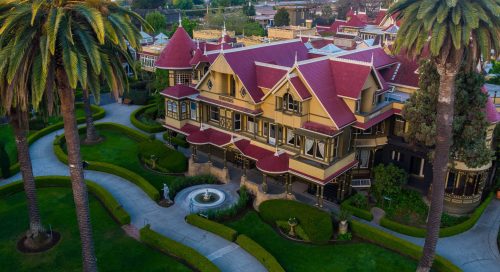
I turned away astonished to see that in the few moments we had been talking, dusk had stolen the remnants of the day. Time always did seem to pass differently in my home. As we clattered down the corridor, I glanced into the rooms where the doors stood open. All were empty. There were no sounds of conversation, of caretakers going about their duties. Mr. Hansen stopped in front of a high wooden desk at the foot of the stairs. I caught the smell of beeswax polish, a sharp reminder of the back stairs leading up to the attic of the witches cap. We walked on the staircase, until I stopped in front of a paneled door and unlocked it. “I will have the fire made up,” Mr. Hansen said. The room was bone chillingly cold, though it was clean. I lit the oil lamps from the candle, and looked around. A small writing table and chip and dale arm chair sat adjacent to the door. Straight ahead, two tall windows, floor to ceiling, filled one side of the room. On the opposite side of the room was a heavy chest of gold, covered by a lace runner. When Mr. Hansen returned, I said, “Dearest Jim, will you please open that chest, there is something inside of it for you and your family.” Mr. Hansen eagerly walk over to the chest, and his eyes lit up like a new born baby having his first birthday cake. “Go ahead, Mr. Hansen, it is for you.” “No, Mrs. Winchester; I can well believe it. But this is a treasure I can live on for years. Only you must tell me how I can repay you…In a hundred years I could never do enough for you,” he said. #RandolphHarris 1 of 7

Well, that word went to my heart; but for a minute I did not know how to answer. For it was true I had risked my soul, and that was something he could not pay me for; but then maybe I had saved his, in getting him away from those foul people, so the whole business was more of a puzzle to me than ever. However, then I had thought that made me easier. Mr. Hansen went on to explain to me, “Well, Mrs. Winchester, the day before yesterday, I was with my young son; the poor young man, without health or hope, lying sick in a mean rooming house. Until now, I had no way to know how I would care for him.” Mrs. Winchester sat up in bed in a flutter of pity. “Oh, Mrs. Hansen, how dreadful! Why did you never tell me? You must hire a better room for him at once. Has he a doctor? Has he a nurse? Quick—give me my checkbook!” “Thank you, Mrs. Winchester. But you have already given me a king’s ransom.” When I got back to my room after a long, hot soak in the bath, a fire was burning in the grate, releasing an aroma of pine resin into the room. The smell snapped at my heartstrings, taking me back to New Haven winters when William was home from work. I gazed into the fire awhile longer, happy in my own company. I sometimes wondered if some of those grizzled old souls were able to make the journey from New Haven to Santa Clara. My home seemed to add so much to the ambience of the area. However, unlike the Earth, this huge estate seemed to need people within it to survive. That is one of many reasons my construction project went on so long. #RandolphHarris 2 of 7
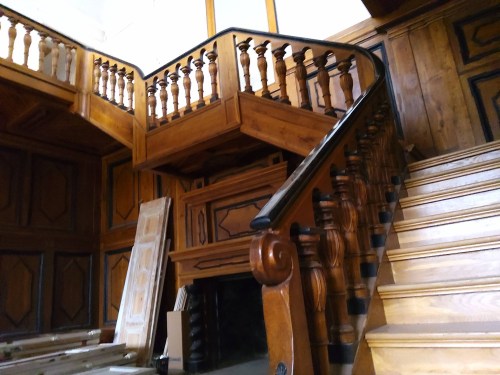
Have you ever noticed how houses, as long as they have someone occupying them, no matter how little maintenance is done, always hold up better than houses that are abandoned? Houses, like a body which the soul has abandoned, deteriorate more rapidly when on one resides within. One evening in the cooling fall of the year, Mr. Hansen and his wife left the caretaker’s house on the estate for a social function. The son of Mr. Hansen was home alone. He was in the basement which was used as a recreation room. It was getting late and her was expecting his parents any minute. Sure enough, he heard footsteps on the floor above his head. They traveled across the living room and into the dining room and back again. He thought it unusual that his father and mother would be in the house walking around for nearly a minute and not call him. He walked to the stairs that led from the basement to the first floor and called out, “Daddy?” The only answer was the sound of footsteps crossing the room and beginning to ascend the stairs to the second floor. “Daddy?” he called again. With still no answer, he began to slowly climb the stairs from the basement to the first floor. He could hear what he was convinced was an intruder walking through the bedrooms just above his head, apparently looking for something valuable. The footsteps crossed the second floor just above his head and began approaching the stairs and descend to the first floor. He rushed into the basement again. #RandolphHarris 3 of 7

Wanting to run but not wanting to run into whoever it was who prowled above his head, he could only wait in icy apprehension for his parents. As he waited, the intruder stalked the floor above him, apparently not interested in valuables, seeking something known only to him. His wanderings became more aimless. First to the kitchen, then back to the living room, then the dining room—pacing…pacing—to perhaps peer out a window at the fruit orchard. The ancient floorboards that once soaked up blood of those killed by the Winchester rifle, groaned with the wandering footfall of an apparently lost intruder. Slowly the footsteps approached the cellar steps…he swore he heard him put a foot on the top step. Ghosts supposedly went out of fashion when electric light came in. What nonsense! The supernatural were always around on my estate. My very mansion was patrolled by headless victims with clanking chains, and even though it was a comfortable house with an ice box and 47 fireplaces where you feel, as soon as you are in it, that there is something wrong, it sends chills down your spine! It is certainly a lovely, airy, high-ceilinged house with electricity, but I knew we were dealing with something that was invisible and could not be seen—something that was very malevolent. I often saw a boy with glowing eyes near the 7-11 staircase. But here I belonged and here I would stay. There morning had been bitter, with a driving sleet—though it was only the last day of October—but after lunch a watery sun showed for a while through banked-up wooly cloud and tempted me out. #RandolphHarris 4 of 7

I was an energetic walker, and given, at that season, to walking about the beautiful grounds. I made my usual round, and was following the path back to the mansion when I overtook a plainly-dressed woman walking in the same direction. When I caught up with the intruder, I was surprised to find she was a stranger. It was almost dark, and the woman’s face was hardly visible, but this woman was middle-aged, plain and rather pale. I greeted her, and then added: “You are going to my house?” “Yes, ma’am,” the woman answered, in a voice that the Connecticut Valley in the old days would have called “foreign.” I could not say where she came from. What struck me as queer was that I did not know her. I asked the woman, politely, what she wanted, and the woman answered: “Only to see Annie.” The answer was natural enough, but there was no one by that name on my estate. I turned off from the drive to the lower part of the gardens, so that I saw no more of the visitor then or afterward. And, in fact, half hour later something happened which put the stranger entirely out of my mind. I approached my house, slipped on a froze puddle, turned my ankle and lay suddenly helpless. Elroy, the butler, and Ersula the housemaid, knew exactly what to do. In no had me stretched out on a lounge, and Dr. Parker had been notified. When he arrived, he ordered me to bed, and did the necessary examining and bandaging, and shook his head over my ankle, which he feared was fractured. #RandolphHarris 5 of 7
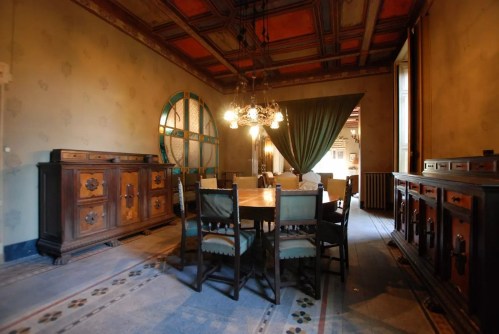
Concerned about how I would get around my estate, as I was laying in bed, the spirit gave me an idea of building mini stairs that rose only two inches, so I could make it around, until I healed without being bound in plaster. From that night on, there was an appearance of ghost, who would manifest in front yard, walk up to the house and enter it, and interact with me. My home brought me deeper and deeper into a mysterious territory whose boundaries I had never before dream of transgressing. Ghosts often took shape right before my eyes. They would start off as tendrils and grow into glowing, mistlike things. Turning into orbs, the figures would grow larger and denser and began to assume a humanlike form. One evening, I extended my hand into the mist, and could feel its cold interior. Such a bold act may have been considered very rude by the entity, as the glowing image suddenly vanished. There were plenty of vibrations in my mansion to tune into. The place was drenched with psychic vibrations. In my Blue Séance Room is where the glowing lights and ethereal broadcast were received well enough that caretakers were aware of their presence. They would morph into columns of light about the height of a man and make their trek out of the room. One night Ersula reported seeing ghostly face looking through the window at her one night. The ghost then chased her hands away from the cows during an evening milking. The following morning, it was about nine o’clock before I admitted to myself that something uncommonly strange must have happened in the house. Mysterious things—dreadful things—were associated with darkness; and the wholesome prosaic daylight had not come to banish there. #RandolphHarris 6 of 7
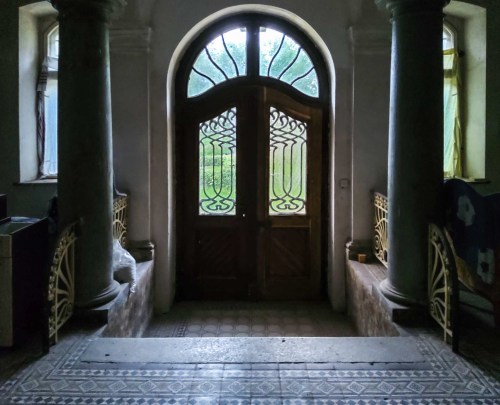
I conjure thee, O Spirit Pheynix, and your 20 Legions of Spirits, by all the most glorious and efficacious Names of the Great and Incomparable Lord the God of Hosts, come quickly and without delay, from whatsoever part of the World thou art in; make rational answers to our demands; please come visibly, speak affably, speak intelligibly to our understanding. We conjure and constrain thee, O Spirit Pheynix and your 20 Legions of Spirits, as also by these seven other Names wherewith Solomon bound thee and thy fellows in the brazen vessel, to wit, ADONAI, PRERAI, TETRAGRAMMATON, ANEX-HEXETON, INESSENSATOAL, PATHUMATON, and ITEMON; do thou manifest in the Winchester Mansion, fully our will in all things that they may seem good to us. Come, therefore, in the Holy Names ADONAI, ZEBAOTH, AMIORAM, come, ADONAI commands thee. Please grants us your powers and virtues by the powers and virtues, and by the name PRIMEMATUM, which commands the whose host of Heaven. Do thou force and compel the Spirit of Sarah L. Winchester here before to return to her mansion, in a fair and comely shape, without injury to herself or any creature, that she many continue to expand and make her estate thrive, so that she accomplished her desired end, whatsoever it be, provided that it is proper to her office, by the power of God, EL, who hath created and doth dispose of all things, celestial, aerial, terrestrial, and infernal. Please appear and make the sweet perfumes, give good entertainment. May all the Company of Heaven, the Sun, the Moon, the Stars, the Light of Hosts of Heaven guide you back to your estate by the power of TETRAGRAMMATON, ANEXHEXETON, PRIMEMATUM. So bless it be. #RandolphHarris 7 of 7
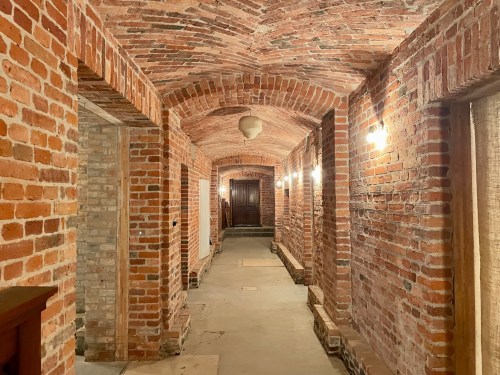
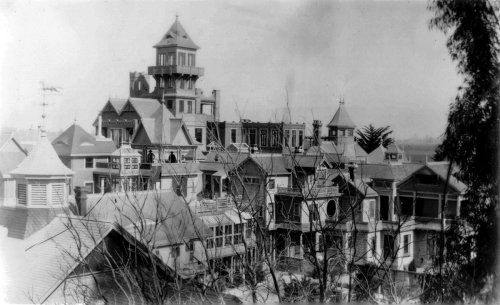
If such peculiar manifestations as orbs and ghosts should be as intelligent as their actions often indicate, just what are they and what is their purpose? We have folklore that is at least 2,000 years old that equates these mysterious globes of light with spirits of the dead and with those beings we label nature spirits—the Devas, the elves, and the fairies. The manipulation of glowing balls of light as a means of transportation may even be employed by angelic beings and spirit guides. Indeed, these benevolent beings may take form as ghosts of light before fully materializing in our dimension. These orbs seen in the Winchester Mansion are intelligent and may be able to manifest a physical appearance that is most compatible with the level of understanding of each individual witness.
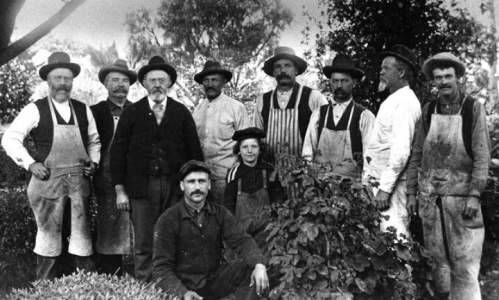
These were Mrs. Winchester’s carpenters on the estate. One of these gentleman has been spotted inside the house by both guests and tour guides for decades! He is usually seen fixing the fireplaces and rolling around his wheelbarrow in the basement. Can you guess which one he is? https://winchestermysteryhouse.com/ 👻

And be sure to check out the Online Gift Store: https://shopwinchestermysteryhouse.com/

The Psychic Storm that Had Swirled

It was dark, the path to my home was so precipitous that I was forced to brace my knees and steady myself on the overhanging branches so as not to lose my footing. The extravagant roots of ancient trees crisscrossed the path. Stones, uneven Earth, and fallen fossilized branches—everything was familiar, but somehow distorted. For almost two hours, guns were rumbling. The atmosphere grew more claustrophobic as horsemen crossed my route. I felt trapped, as though the forest on my estate was closing in on me. There was something very grotesque about the strength of the enemy as they launched their grand assault on my estate. I summoned a column of horses several hundred yards wife and half-mile deep to ram through the line of cavalry attacking my mansion. They advanced across the fruit orchard, still my body of men endured the artillery fire, the finally the canter and charge. The Spanish army was not quite as large, but travelling directly at my soldiers. I watched as suddenly the two opposing forced collided, the Winchester soldiers knocking the sending the Spanish horsemen somersaulting backward, their riders were being crushed by squirming horseflesh, as they crashed together. I had finally made it to my observation tower, and from this point I saw that the Winchester soldiers do incredible damage to the Spanish column. The few strangling men sabered left and right until they collapsed in defeat. I could feel my nerves starting to get the better of me. Even though the Winchester soldiers were triumphant, increasingly I imagined peculiar shapes, outlines, behind every tree, eyes in the dark of my mansion watching me, an unwelcome and persistent voice in my ear asking if it was more than just invasion. #RandolphHarris 1 of 6
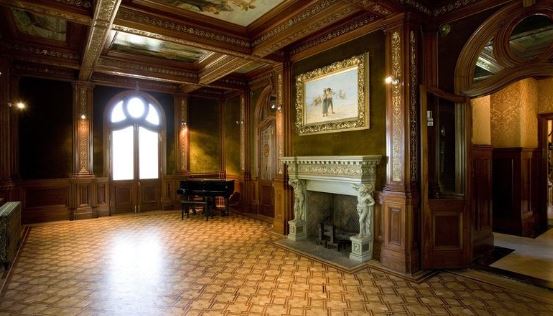
In the deepest corners of my home, the light had all but disappeared. A red mist was slinking through the halls, slipping in and out of hundreds of rooms like an animal hunting its prey. There was an absolute and impenetrable stillness. Then I heard a glass shattering. I stopped dead in my tracks, straining to listen. Another sound…something was moving through the walls. As if I could take on any kind of beast, I looked for an object to defend myself. Should I have the misfortune to encounter a demonic enemy force lurking in my home, my only resort was to stay absolutely still and pray it did not pick up my scent. If it did, there would be nothing to do but run for my life. The caretakers were nowhere to be found. Another breaking glass, something inching closer and closer. I looked around to see if there was anywhere I could hide. There was a secret passageway about 50 feet from my location. If I stayed low to the ground, I could make it. Moments after I started to crawl to the escape, two indistinct figures emerged from the mist on the floor. They had no eyes, no face. Not even a nose was visible. The dim figures moved behind the doors, through the long shadows of the twisting hallways. A bearded man dressed in high boots and blue coat, helped me as we disappeared through the apartment of rooms. We ventured up to the attic where I could hear the sounds of boots dragging across the floor below. As we opened the door, we caught sight of a wispy something retreating to a darkened comer of the storage area. It was an ectoplasmic spirit leaving a trail of cobweb mucus behind. Next, the peripatetic figure who roamed my mansion to save me from the intruders disappeared after helping me to safety. #RandolphHarris 2 of 6

As I walked through my home, occasional objects suddenly became airborne without any apparent physical cause for their levitation. The house seemed lighter to me, and there was just a hit of the faintest red mist, as a twist of smoke wreathing up into the air arose from the floor. Invisible helping hands started setting the rooms in order, right down to the last doyly and rug in place. Windows magically healed themselves from their fractures, the crystal chandeliers came back together and levitated back to their place in the ceiling. There were sounds of furniture being dragged across the floor to their proper location. The spirits were not going to let me be driven from my home. There was great pride in the veteran transmigration of souls I called the Winchester Soldiers. When there was not a war going on, the center of the hauntings seemed to take place in the basement and in one of the 9 kitchens known to the caretakers as the Devil’s Kitchen. In the Devil’s Kitchen, the hauntings primarily consisted of knocking, thumpings, and the sound of footsteps running down the caretaker’s stairs and shuffling across the floor. Many often heard the thin tolling of the church bell, the mournful single note carried on the air. Entering the Devil’s Kitchen in the morning, many of the caretakers were often surprised to find themselves walking out of it at night, but feeling like so little time had passed, as the bell died away. Before leaving the estate to go home, they would hesitate a moment, confused, looking over their shoulder in the direction they had come. There was some kind of cloud, some sadness, hanging over that kitchen. They knew something was not quite right, misaligned, like a picture askew on a wall. #RandolphHarris 3 of 6
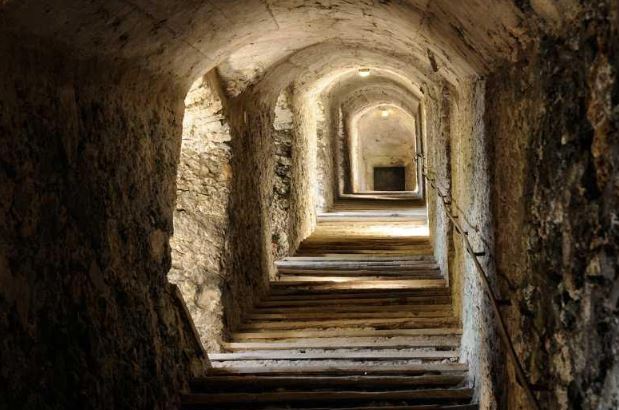
Certainly, the most dramatic manifestation of the haunting was the materialization of 13 skeletons in the basement. After appearing in startling blood red color, the skeletal figures would slowly manifest themselves into what appeared to be solid, three-dimensional representations of 7 men, 4 women, and a little boy and little girl. The images appeared to be wealthy and appeared to adorn in vogue fashions. Once the entities had fully materialized, a bizarre ethereal drama would unfold before any witness who might be present to observe the phenomenon. As the ghost of a lovely, raven haired girl with long hair sat playing idly with her dolls, one of the men in the spectral reenactment strangled one of the women while the little boy cried in the corner and the others stood by with pleased expressions of immense satisfaction. We always suspected that the ghastly reenactment was the tragic playing out of the eternal witch trials. The shocked witnesses, who had seen the grimly performance, felt this was a scene from a Salem courtroom. A judge strangling a suspected witch to please the family of the bewitched. Some cursory historical research and an examination of local folklore revealed a scandal regarding a lady of the house who had disappeared without a trace and a husband who had remarried after an extremely brief period of grieving. Local Salem stories had it that the wife of an enslaved man was accused of fortune telling and had been murdered in court by Judge Samuel Sewall. The judge apparently strangled the woman because he believed she was a witch and said that “Black Africans could not live peacefully among White New Englanders.” Nevertheless, he allowed the man to marry a White woman. Why had the controversy of this wedlock been taking stage in my home? #RandolphHarris 4 of 6
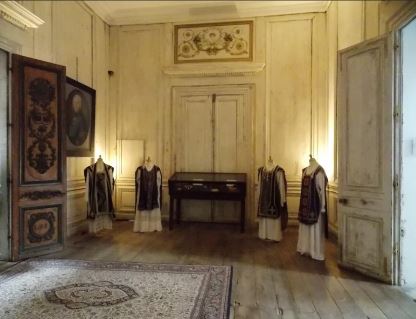
I do not believe I ever did such hard thinking as I did that night. It was not so easy, neither. I figured it out. You see, dearie, when I was laying in my bed last night something came to me from the spirit World. I knew at once it was from the enslaved woman who had been strangled in court. I had to wait, she was crying so hard. She asked me to look at the paintings in my hall gallery. There was a particular titled “Examination of a Witch” produced in 1853 by Tompkins Harrison Matteson that William’s mother had given me as a wedding gift. In this picture was Judge Samuel Sewall, and upon observation, it was revealed that Mary Fisher was sized upon by a Black African, and was shamefully stripped for the purpose of ascertaining whether she had the Devil’s mark upon her. The woman being subdued by her hair and the man lying on the floor were Black Africans involved in a vile and bloodthirst cult for breeding babies with White women for ritual purposes. They were abusing children in similar numbers and were putting young men and women through terrifying ordeals of sexual torture and sometimes death. They hysteria is what is depicted in that work of art, which was originally titled, The Making of a Satanic Myth. The judged is asking the simple question: Where is the evidence? As the investigations had produced no bodies, no bones…no bloodstains. Nothing. These tales of satanic slavery had reached incredible proportions and it was believed an occult alliance stretching from the local group level to higher international orders, with its tentacles established far and wide through society, into the judiciary, politics and law enforcement. It was claimed to be basically occult, a largely satanical exchange network where the 27 children produced in these unions were goaled. The accused were carried two days’ journey into the woods, and left to the tender mercies of Indians and wolves. #RandolphHarris 5 of 6
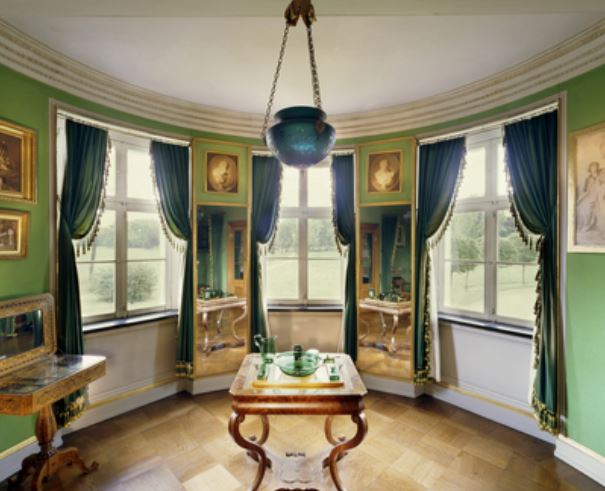
The psychic storm that had swirled throughout the household was finally diminished. “Thus twice before, and just at this dead hour, with marital stalk hath he gone by our watch,” Hamlet, Act I, Scene I was very appropriate for this re-enactment. They were so blinded by the beauty of these exotic babies—so much so that they could not figure out what they were. Tan skin, blonde hair, blue eyes. White, curly hair, dark eyes, full lips. They had to keep them concealed. In my hoe, I saw an occasional shadow move in and out of the slivers of light that slipped out between the partially open curtains, but no one out and about. Often, I still heard footsteps behind me, but when I would look asunder, there would be no one behind me. I was so sorry for the woman in the painting. So I went back my gallery the next evening; as I climbed the stairs I felt one of those sudden warnings that sometime used to take me by the throat. “It is as cold as ice on these stairs,” I thought, “and I will wager there is no one made up the fire in this room since this morning.” But it was not really the cold I was afraid of; I could tell there was worse than that waiting for me. I pushed open the door and went in. “Well,” says I, as cheerful as I could while looking at the painting, “Only lying awake all night and turning thing over, I got so miserable,” Turning away my head away from the painting so she would not see the tears running down my cheeks, and I felt that the cold came from her, and not from the empty fireplace. As I walked out of the gallery, I fell on my knees. “You shall not go without a prayer, you poor dear,” I whispered to her. But though my heart was full of mourning I did not pray for long. #RandolphHarris 6 of 6
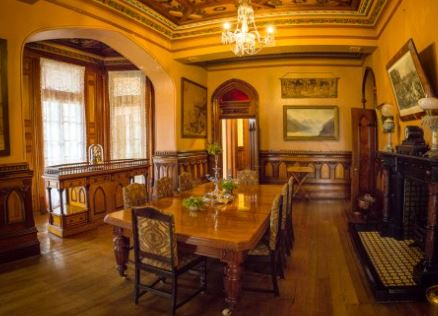

Mrs. Winchester was doing battle with entities, some terrible, and some against her. The dark pagan gods were not about to yield this green land without a fight. They converged in the mansions and attempted to thwart Mrs. Winchester in her mission, while other supernarural beins assisted her.
And be sure to check out the Online Gift Store: https://shopwinchestermysteryhouse.com/

Angels and Demons, Gargoyles and Ghostly Apparitions
Except for William, the idea of love to me always seemed a question of submission. Of giving in to some powerful emotion, of losing control. Poor souls. However, with my beloved William, love seemed a natural thing, something one did not even need to remark upon, like breathing or raising one’s face to the sun on a summer’s day. It is no matter now, for he passed away years ago, and all I ask is to be left alone in my chair. Money has been an armor, you see; and there are few cracks in it. But William had a loving nature, if only others had show him love. He was a delicate boy when he was little, so his mother could curl him up, and put him into black velvet pants, like that boy in the book—little Lord Something. However, when his legs grew out of the pants, and they sent him to school, she said he was not her own little cuddly baby any more; and it riles a growing boy to hear himself talked about like that. It was like being pushed out of an illuminated ballroom, all flowers and chandeliers, into the winter night and snow. Yet, Mr. Winchester grew up into a fine man and that is why I married him. He used to go over and see his mother now and again; or she would come home for the holidays. And he used to take her out for lunch, or to dance at those cabaret places; and when the headwaiters adore his mother’s beauty and charm, he would talk about it for a week. For a time she used to get some comfort out of telling me about her early triumphs; and I used to listen to her patiently, taking notes on how to be a good wife and mother. You must not think of her as an unkind woman. She was friendly to her husband, and friendly to her children, but she knew she had to raise William to be tough and strong. #RandolphHarris 1 of 7
There were always people prowling about in the background that she did not like the look of; people, you understand, who live on weak people. There is nothing more I can say. Reflecting of these memories was nice. It allowed me to sleep all day and into the evening. Or, rather, I drifted in and out of twilight state. I was aware of the housemaids and the parlor maids coming and going, shapes, blurred faces, the sound of kindlin and a striking match, the maid laying a fire. I work fully only twice. First, when Ersula placed a bowl of soup and bread beside the bed and waited until I had eaten it all. The second time, when she returned to administer a second draft of the bitter white medicine, a sleeping draft or some kind of traditional remedy, I never knew and hardly cared. My skin was alternatively burning and clammy with sweat. I tossed and turned in bed, like a ship on a storm-wracked sea, plagued by dreams and delusions. Angels and demons, gargoyles and ghostly apparitions, long-since deserted friends waltzed in and out of my head. For hours, so Ersula later told me, things hung in the balance as my temperature climbed as high as the nine-story observational tower. Certainly, I oscillated between beauty and horror. A skeletal hand pushing up from beneath freshly turned Earth, blossoms dying on the bough. The back of Annie’s heads, impassive and deaf to my consoling up her upset tummy. William smiling at me, in the orchard and by the stream, but then stepping just out of reach and turning away when I called out to him. Barbed wire and mud and blood, chlorine gas, a World of unimaginable pain. #RandolphHarris 2 of 7
Nearly 175,000 men—jamming the streets and roads and field of my estate, attempting to tear each other apart, and in doing so, leaving anywhere from 44,000 to 51,000 casualties behind, to be cared for immediately after the battle by a handful of doctors, orderlies, and the servants of my estate, and my mansion metamorphosing into one vast charnel-house. To day the least, my tidy rooms, barns, and farmhouses, and Victorian gardens were overflowing with men who were seriously hurt and badly needed shelter from the elements. These horrors seemed to last for weeks. The fever broke at about three o’clock in the morning. My temperature dropped. I stopped shaking and my skin, sticky with fever, returned to normal. For the first time in hours, I was able to get out of bed. In the still and sleeping house, I could hear the whirring and chiming of the grandfather clock in the hall downstairs. A ribbon of moonlight made its way between the shutters and painted a line across the floor. I watched the moonbeams dance, slowly shifting, as the hours passed and the World continued to turn. I walked through the hallway, looking through a couple of doorways and back into the original section of the house when I noticed a fresh-countenanced young man standing and watching the goings-on with a peculiar look on his face. The more I watched him, the more I saw it was a look of wanting to come out of the Grand Ball Room. Catching his eye, I motioned for the young man to come join me for a cup of tea. He just stood there and stared, the expression on his face becoming even more painted. #RandolphHarris 3 of 7

Then it dawned on me that he was a ghost, and he was stuck in the old part of the house and could not leave the Grand Ball Room. With an understanding shrug, he turned away from the door and walked further into the room to join the other apparitions. I stood back with my eyes closed, and a quiet smile on my face. By this time, the sky was a mass of teal and fuchsia. At first it looked like a kite-flying contest, the could over my mansion obstructed by swooping streaks of color that danced on the air currents, trailing multi-hued streamers behind them. Then I heard the chirping cacophonous twittering like an orchestra of xylophones. As I looked further through the skylights, I realized that the kites’ long tails were really feathers, and they were not tethered to the ground by strings. A flock of birds, what seemed like hundreds of them, painted the air with wings the color of the rainbow, dipping and soaring on air currents visible only to them. I could barely take my eyes off the flock. I wished the birds would stay forever: They were like an elaborately painted scene on a China teacup, and their chirping filled me with the kind of inexplicable joy that I had felt as a child, climbing onto my mother’s lap and smelling the faint scent of her jasmine perfume after a long day of play. The birds, as if acting on an invisible signal from above, formed two loose lines and soared higher, heading towards Heaven. I wished I could fly with them, borne along on whatever invisible breeze they had ridden in on. The birds had stirred something powerful in me, mysterious symphony of joy and emotion. #RandolphHarris 4 of 7
It must have been some kind of European sorcery and magic. And, there seemed to be something else in the atmosphere. Around 5.45 a.m., I heard what sounded like for all the World, a small child. It came from further down the hallway, and I walked curiously down towards where the sound seemed to be coming from, the sound moved into the living room. I followed, and it kept moving and cooing at a distance of what I estimated was about six feet in front of me. As I got to the living room, the cooing baby moved on into the next room, the kitchen. I stood in the living room and rationalized for a moment. The lights from outside the mansion were spilling into the room, and it slowly occurred to me that if the baby had been playing, I would surely have seen her cross the room between the hall and the kitchen. I listened to the cute baby sounds in the next room, and a chill went down my spine. I now had no idea what I was dealing with. The cooing faded within the next moment, and I backed down the hall, ducking into the Alice in Wonderland room and, of course, there was no one in the room, but the tiny rocking chair was swaying back and forth. A few nights later, I was up in the middle of the night. I was in complete darkness. No windows in the room, no light, just darkness. Suddenly, from the area to my left, which would have been the bathtub, I heard very clearly—sharp and loud enough to make me jump—a voice shout, “Belly Ache!” The voice was that of a little girl, but there was something sweet and warm about the voice, like the voice of an angel. I pushed the button to turn on the light. Nothing. Not that I found the matter unfathomable. Quite frequently, I saw the figure of a little girl moving up and down the hall past my bedroom door during the night. She has a soft, blue glow. #RandolphHarris 5 of 7
For week, I lie awake at night, thinking this could be my beloved Annie. I waited and waited, night after night to see her again and perhaps talk with her, but she did not return. However, the bathtub faucet leaked and dripped fairly on occasion. I lay in bed, listening to the drip. It had developed a steady rhythm, as drips will. Suddenly, the rhythm changed. The drip sound changed in pitch, and it literally played a tune. It was the Highland Fairy Lullaby. The temperature in the room dropped, and I could clearly hear the sound of a little girl playing with her doll. She was singing a tuneless little song, the kind of melodic chat that was common among young children, especially little girls at play. From time to time, she would interrupt the humming of her sing-song to speak lovingly to her doll, and then she would call rather loudly to her mother that she had a tummy ache. However, there was no response from the mother, and she would return to playing with her doll and singing. I could almost see the little girl dressing her doll, combing its beautiful hair. From that night on, I would awake in the middle of the night or in the morning and hear the little girl calling for her mother. Once I had thoroughly searched the house and determined that it must be the sound of some lost and confused spirit-child, eternally singing and occasionally calling for her mother, or perhaps it was some kind of ethereal phonograph, eternally reproducing the sounds of a little girl. For some, this haunting might be considered a nightmare, but for me, it reminded me of the death of my six-week-old daughter, and it gave me hope that she was still near me, in my house growing and aging, even if she were only a spirit. I took these as signs from the spirit World and had a bird aviary constructed with exotic birds from all over the World, and invited my niece Daisy to live with me. Someone I could be a mother to. #RandolphHarris 6 of 7
I invoke, conjure, and command thee, Spirit Botis, and your 60 Legions of Spirits to bring with you power armed from the Supreme Majesty, I do strongly command thee, by BERALANENSIS, BALDACHINENSIS, PAUMACHIA, and APOLOGIAE SEDES; by the most Powerful Princes, Genii, Liachide, and Ministers of the Tartarean Abode; and by the Chief Prince of the Seat of Apologia in the Ninth Legion, I do invoke thee, and by invocating conjure thee. Magic forces, black and white, reaching out through space and light, be he far or be he near, brings us the demon Balthazar here. Ancient powers, we summon thee, we the power of three and seek your help in finding the demons who are in the Winchester Mansion. Come thou peaceably, visibly, and affably, now, and without delay, manifesting that magic running through this estate, help us see with clarity, power that we have summoned here, protect us and we will have no fear. Throne having eyes before and behind, by the fire which is about the Throne, by Holy Angels of Heaven, by the Mighty Wisdom of God; by the Seal of Basdathea, by this name PRIMEMATUM, which Moses named, and the Earth opened and swallowed Corah, Dathan, and Abiram; do thou make faithful answers unto all our demands and perform all our desires, so far as thine office shall permit. Come therefore peaceably and affably; come visibly and without delay; manifest that which we desire; speak with a clear and intelligible voice, that we may understand. TETRAGRAMMATON IEHOVAH, do I command three, at which being heard the elements are overthrown, the air is shaken, the sea runneth back, the fire is quenched, the Earth trembleth, and all the hosts of the celestials, terrestrials, and infernals do tremble together, and are troubled and confounded. Wherefore come thou, O Spirits Sarah, William, and Annie Winchester, forthwith, and without delay, from any or all parts of the World wherever thou mayest be, and make rational answers unto all things that we shall demand. #RandolphHarris 7 of 7
A thin door indeed it is between life and death: one moment young and full of future, the next lying wounded in some stranger’s house in a small farm-town, the following instant forever lost and wandering in eternity. Could it be the vital spark, the spirit of not only souls killed by the Winchester rifle, but also members of the Winchester family that still search for the youth they lost, roaming the miles of hallways in the Winchester Mansion for all of eternity? https://winchestermysteryhouse.com/

And be sure to check out the Online Gift Store: https://shopwinchestermysteryhouse.com/

Good-by; You’ll Never Know What This Has Cost Me

Mr. Hansen had never been able to understand why there was any harm in giving people a little encouragement when they needed it. Sitting back in my comfortable armchair by the fire, I thought to myself, “You would be surprised to find how discouraged the grand people get, in these big houses with all the help, and silver dinner plates, and a bell always handy if the fire wants poking, or the pet dog asks for a drink.” It was then that I first became aware of a disturbance in the air. A kind of restlessness. I looked sharply around the front parlor, but saw nothing out of the ordinary. The room was deserted. No one had come along for some time. Yet there was a suggestion of movement nonetheless, a shifting of the light from the chandelier. The drapes loomed more menacingly and the fire appeared even closer, as I glanced out of window, my yard looked like an ancient forest of evergreen. What secrets did they contain within their shadows? My heart skipped a beat. I opened the window. The silence surged around me. Again, nothing. And inside—no telltale footsteps or voices. Only later, did it occur to me that the silence was peculiar. I should have been able to hear something. The roar of the furnaces, or the belching chimneys. The sound of the carpenters hammering. The servants washing dishes in one of the kitchens. However, I was only aware of the silence. Silence, as if I were the only one left alive on my estate. Then I heard it. No, not heard. I sensed it. A whispering, almost like a singing. The others have slipped away into darkness. I caught my breath. “Who’s there?” #RandolphHarris 1 of 6

I heard the ghost of Mr. Winchester’s voice inside my head, though it was growing fainter with the passing years. However, this was different, a lighter sound, gentle and exquisite, carried on the cold air. A reverberation, and echo of words once spoken in this place? And what of the crimson mist on arising from the floor? On these cold winter nights, it was not unusual to hear the clanking like a bucket, and the shuffling of feet. When I looked over toward the kitchen, there was a man—or something—dressed in a long white coat, all bent over like he was tired or something, slowly walking toward the door-to-nowhere. He was filling up the buckets using the exterior water faucets on the second floor that were used to water my flower boxes. He seemed to walk right out the door and to the front of the house, but there was nothing supporting him. Then he watered the flowers and walked slowly back into the house, real tired- like. And almost suddenly vanished. There were spirits caught forever in the never-ending labor to keep this estate operating. Perhaps these were visions out of time making their journey into the eternal flame as well as into Eternity itself. However, every July 2, officers could be frequently seen in the dim moonlight, in the Victorian garden, dressed in their gray tunics and gold stars and wreath, gathering around the fountains, mixing fine bourbon with the clear water, and toasting to the next day’s victory or death. #RandolphHarris 2 of 6

Summer nights always tended to be a little eerie. In the dark, the estate at best, is an uncomfortable place to be. The tragic memories and sorrows of a nation’s struggle defending the hour of the country with their Winchester Rifle’s hanged heavily and seemed magnified in the night. There is always something moving in the fruit orchards or the grass just off the unlighted portions of the estate. It all makes the Other World all that much closer. Sometimes one could even hear the strange military noises emanating from the 740 acres of land I own, and the fallen faces of the slaughtered. Desperate orders shouted…steel rammers ringing in muskets…the clicking of hammers cocked…the hoarse trill of a bugle…the clacking of artillery chains…a roar…shrieks…men gagging, crying, screaming, moaning, moaning, moaning….and there is often heard the funeral call, mounrful apologies of a heartsick, dying warrior to a lost friend bemoaning a fateful decision to be regretted down the ages. Although we had transitioned into summer, there was just an endless expanse of cold on these nights. Memories would seep into my mind. My Daisy Bedroom. Candles burned out. Me crying in the dark, jolted awake by bad dreams and calling out for my infant daughter who passed away long too soon. Then Mr. Winchester, sitting at the end of my bed, opening the curtains to let the silver moon in, saying there was nothing to be afraid of. How nothing could hard me. Not even a curse. How I was a Winchester, invincible and courageous. Nothing could get me as long as I kept building. And with William by my side, I believed it. #RandolphHarris 3 of 6
So I talked to myself to keep my spirit up. I was in no actual physical danger, I said. It was just a matter holding on to my nerved. Still, fragments of life flashed into my mind and out. Broken images of my husband and daughter, photographs of our happy days. Memories of Mr. Winchester. And I wondered if he had seen death, like a shadow coming to meet him. Had he recognized the moment for what it was? Whispering, I could hear whispering, voices slipping between the walls. “She is the last, the last, the heiress.” Heard howling from the walls. Sometimes far away, sometimes closer, so close I imagined I could feel breath upon my cheek. “The others have slipped away into darkness.” Then the sound of sobbing, a desperate scratching on the floors, and a terrible weeping. I worked hard to turn this mansion into something beautiful. Having evergreen trees planted and a variety of flowers. I even remodeled a room with attractive redwood walls, and another with floor to ceiling glass panels that provided a 180-degree view of the estate. I smiled when I saw the perennials that I had planted. However, a number of other peculiar incidents began to convince me that I was being visited by discarnate entities. I always knew I was being haunted. But now I was catching fleeting glimpses of fast-moving shadows from time to time when I would least expect to see such a thing. There would often be smells of delicate perfume. Mr. Hansen thought it was closer to a man’s cologne. Sometimes we encountered the scent together, but in every instance it came and drifted away after only a few minutes. #RandolphHarris 4 of 6

Once, when I was outside tending the flowers growing under the front windows, and I was suddenly enveloped in an invisible puff of strong cigar smoke. Then I was choking, coughing. I could feel the pump and hiss of my heart beneath my ribs, rattling like a snare drum. I swallowed hard. When I put my hand up to brush the smoke away from my cheek, I saw that the tips of my gloves were red. And when I looked down, I saw the daisies with drops of blood on them, glittering and yet dull at the same time. I propelled myself into a standing position, and walked towards the front doors. The wind boxed my ears so hard that I struggled to keep my balance, but I managed finally to get those doors shut. When I looked in the mirror, I was not injured at all. That night while I was falling asleep, I sensed a large, dark presence in the bedroom. It glided over me and seemed to hover just over my head, and I was the recipient of a telepathic command: “I want to know your thoughts!” After I fell asleep, I experienced horrific nightmares. I was awakened by the sounds of terrific crashes, as though something huge had fallen over somewhere in the house, causing terrible damage. Thanks to the stocks I owned and the ones I bought in Con Edison, I was able to keep building rooms to evade the ghosts. Do you know how it is, sometimes when you are doing a bit of fine darning, sitting by the window in the afternoon; and one minute it is full daylight, and your needle seems to find the way of itself; and the next minute you say: “Is it my eyes? because the work seems blurred; and presently you see it is the daylight going, stealing away, softlike, from your corner, though there is plenty left overheard. Well—it is the way it is with these ghosts around.” #RandolphHarris 5 of 6

Most nights, screaks could be heard emanating from within the walls. Then everything would be stripped of color, an absence and shade. Fog hovered motionless from the ceiling. And it would come again, over the whistling of the wind, the same indistinct whispering. “The others have slipped away into darkness.” “Who are you?” I cried. “What do you want from me?” But the fog, the apparition, had vanished. After the Spanish-America War, all the fine ladies took to running to the mediums and the clairvoyants, or whatever the stylish folk call them. The women had to have news of their men; and they were maid to pay high enough for it…Oh, the stories I used to hear—and the price paid was not only money, either! There was a fair lot of swindlers and blackmailers in the business, there was. I always had a way of seeing things; from the cradle, even. I do not mean reading the tea leaves, or dealing the cards. No, no; I mean, feeling there are things about you, behind you, whispering over your shoulder. I felt more and more sorry for those women that the soothsaying swindlers were dragging the money out of for a pack of lies; and one day I could not stand it any longer, and though I knew the Church was against it, when I saw one lady nearly crazy, because for months she had no news of her boy at the front, I said to her: “If you will come over to my place tomorrow, I might have a word for you.” And the wonder of it was that I had! For that night I dreamt a message came saying there was good news for her, and the next day, sure enough, she had a telegram telling her her son was coming home. And that August, the war ended. #RandolphHarris 6 of 6
One is confronted finally with the metaphysics of time: is it merely linear; are we moving along it like riding a train on a track and all that happens, once it occurs, is forever gone? Or can that time be bent, as some prominent theoretical physicists of the late 19th and 20th centuries have said, so that we may run into it again? Or, can an event go out in more directions than just backward, carried on time like ripples from a stone throw in a pond, occasionally under very special circumstances in very special places, returning like a faint echo? Is it possible that the bigger the event the larger the ripples and the more likely they are to return? Or perhaps is it possible, if time can be bent, or the ripples move slowly enough, to catch up with events again, and again, and again? Come tour the Winchester Mystery House and perhaps you will find some hidden clues. https://winchestermysteryhouse.com/

And be sure to check out the Online Gift Store: https://shopwinchestermysteryhouse.com/

And the Cold Was Back—Much Worse than Before!

I strolled through my pretty garden, bleak in winter, which perfectly matched my mood. I paused, as I always did, at the Cupid fountain. Just behind the fountain, a corridor of gaunt fir and black pine led to the wrought-iron gate. The stone tips of carved angels’ wings and Christian crosses guarded my estate and the peaks of my thirteen palm trees were just visible above the high walls. I thought to myself, “Life’s but a walking shadow, a poor player, that struts and frets his hour upon the stage, and then is heard no more.” It was one of my favorite lines from Macbeth Act V, Scene ix. In this World, people purposefully create life’s counterfeit realities, and that is where so many feel most at home…where humans may transfigure themselves convincingly into characters who live only when the play’s on in their mind, and they act it out a daily life. I hesitated to go inside as I fancied the damp Earth. I started to walk around from my beautiful garden, but I was too slow. I saw him. For a fraction of a second, a shadow in the diminishing light or a trick of my unreliable eyes, I saw him standing on the stone steps directly to my front door. I felt a jolt of happiness and raised my hand to wave. Like the old days. “William?” His name dropped into the silent air. Then I felt my ribs tighten a notch, cracking like the tired winding mechanism on our old grandfather clock, and my arm fell back to my side in despair. There was nobody there. Though he did often come from the spirit World to visit me. I always felt a rush of joy, elation, and for a moment was able to believe he was still alive. But ghosts frequently float ephemerally around my mansion. #RandolphHarris 1 of 8

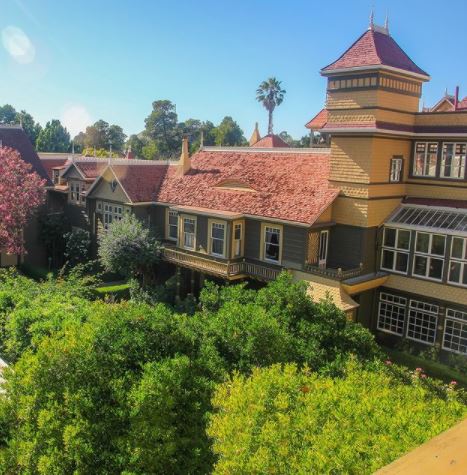
My family’s wealth and my home seemed to always being the long dead back, not just to entertain the living, but also to shed some light on life…from a rather unique point of view. It is after all a remarkable structure, the nine-story observational tower, the medieval-style turrets, and the high, gabled wood-clad interior ceiling complete with flying buttresses. Inside, because of its alteration there are bricked-up windows, stone walls that seal off rooms, lattice work light-wells which lead up to the turrets, false entrances and stairways, trap doors, dark, labyrinthine passageways, and a long stairway that dips into the depths of the catacombs and up into the bell tower. Where ghost, demons, and angels walked the boards for the ancient rites proclaiming life after death. Even in the daytime, with the subtle interior lighting, shadows and forms are seen to float across the walls. This is where it all started. This is where I cried and screamed. I am convinced that my home was constructed on the site of a graveyard. One night, when I was having a conversation with the housemaid, I saw a cloud form past the foot of the sofa, gathering like a white mist. Gertrude’s view was obstructed because she was facing me, but I could see the cloud take shape like a small person. It then put its hands on the arm of the sofa and pulled itself up by its hands, peeking at the housemaid for a moment, then lowering itself, holding on, and peeking again at her from the side of the sofa. Almost suddenly as she started to turn around it was gone. I had stopped talking and just watched the apparition for about a minute. #RandolphHarris 2 of 8

Gertrude asked, “Mrs. Winchester, did you just see something?” I answered tht I had and asked what she had seen. She replied that she thought she caught a glimpse of something small looking t her. I asked Gertrude if it had scared her. She answered no, because it resembled a young person, maybe a child. I agreed and that was that. The mansion always seemed haunted, and there were many instances of odd happenings. The Catacombs, darkly reminiscent of early Christian burial chambers. From the hayloft, there is an angled passageway. The servant use it to move through the mansion so they do not disturb anyone or anything, they frequently bump into someone in that narrow, twisted passageway. Bout no one else is there—or at least, no one who can be seen. Mrs. Nellie Maynard lived nearby, and during her carriage ride to my estate, she imagined that every advancing figure was her husband, Edward Maynard, who had passed away. As she pulled onto the estate, she felt her nervousness gaining on her. I came out to greet her and ushered her into my home. A sudden chill raced through her and she crossed into the hallway. “There is something here,” she said, looking down towards the door and bathroom off the hall. “I can feel a coldness creeping over my legs. Is it just my overactive imagination or are the forces in the house reaching out to us?” I felt it, too. That cold comes from no place, yet everywhere. Mrs. Maynard, now shaken, moved to the bathroom. “This is where he is,” she said. “There is a young man, a boy, and a woman.” Mrs. Maynard did not know that the hallway was the center of the disturbances in the house. I often felt as if I were being watched when I showered in that room. #RandolphHarris 3 of 8

The feelings that we were being observed by an unseen presence continued up the stairs and even to the Daisy bedroom, where a shadowy arm had materialized, only to vanish. After carefully searching the entire house, we retired to the living room. Mrs. Maynard sat, frozen on the sofa, in a trancelike state. I called to her, growing more and more uncomfortable at her motionless, seemingly sightless state. She remained for several moments, perhaps as long as a full minute, unaware of anything but what transfixed her at the time and unable to break away from the forced, temporary captivity of her mind. When I asked her what was the matter? She said, “Look behind you.” There, seated on arm chair and relaxed as if to the manner born, was an elderly gentleman, replete in his uniform of a general officer of the Civil War. Mrs. Maynard and I looked at each other in disbelief, and when we looked back, only an empty chair remined. The General, as he is known to the servants, has been seen before and since. Occasionally I would notice an ethereal figure peering from the arched windows on the eastern side of the mansion—windows which were covered over from the inside years ago when the fourth floor was built. It is almost commonplace to hear footsteps crossing the floor. Almost every night the doors in the house would rattle violently, and we often hard the sound of children running alongside footsteps that sounded as if they were made by a large man wearing heavy work boots. One evening, we even heard the voice of a woman saying, “I’ve got mine.” #RandolphHarris 4 of 8

The meaning of these words remains unknown. The house is a mysterious place. One night, I had turned into the library. I switched on the electric light and shut the door. I immediately got a cold, eerie feeling and jumped to my feet. I was suddenly hugged from behind by a small child. It was such a loving hug that I turned around. There was no one there. The next day, in a bedroom on the third floor, rolls of lincrusta-Walton wall paper had been unrolled and the window shades had been pulled down generally making a mess. As I was reading in the days that followed, I could hear feet running back and forth upstairs. Tools were missing, and many of the carpenters left the job unfinished because of these strange happenings. They said they could not seem to complete their work. They kept getting gooseflesh and felt strange sensations of happiness, loneliness, and love. One calm autumn night, Gertrude had been working in the back kitchen on the second floor, preparing for a dinner party. Gertrude, the housemaid, had almost caught her breath from carrying the turkey to the oven when her eye was attracted to the electrical cord dangling from the ceiling. A day or two before she had accidentally knocked the chandelier from the ceiling while cleaning it and had made a mental note to replace it. As she stood up from putting the turkey into the oven, the coiled cord was nearly at eye-level, hanging about six feet from the ceiling. As she watched, slowly the coil began to swing, back and forth, in an arc about three feet, side to side. Her first thought was the wind, but she noticed that it was calm. The loop swung even, eight, maybe nine time, then gradually slowed until it wrapped around her neck, leaving her suspended from the ceiling. The next morning, we smelled the turkey and went to check on her. As she hung from the ceiling, there was a figure level with her, moving in a circular pattern around her body. The auxiliary lights went out and started blinking, flashing, dimming at seemingly their own whim. #RandolphHarris 5 of 8
My lovely home, my retreat from the bleak past, was becoming the focus of an evil presence. And it would announce itself in an all-too-familiar way. The chilling coldness that had plagued the mansion started to creep into my bedroom. It was September and still very mild outside, but inside the house it was near freezing. Sometimes I kept the fireplaces burning all day, but it was to no effect. At night I piled my bed with extra wool blankets. It was the only way I could get to sleep. I could not run. I could not hide. I feld from room to room every night and it would find me again. I felt helpless in the face of encroaching evil. Prophetic dreams also followed and daytime visions. The manifestations of these forced would manifest at any time, without warning. One day I was working on a quilt. I could feel the color draining out of my face as I got an eerie feeling and looked over my shoulder and saw an old woman standing at the base of the stairs. I figured she was a new housemaid. I said “hi” and asked her if she needed anything. She just shook her head “no” and smiled. I went about my business. Then I felt the same eerie feeling. I looked over my shoulder and, there she was, about five feet from me. I got up from the arm chair and said, “Can I help you?” She smiled and, once again, shook her head “no.” Just then I heard the carpenters drawing near in a carriage. I turned to see where the new housemaid was and she was already at the base of the stairs, about 60 feet away. I said, “Are you sure you don’t need anything?” She just looked at me and motioned with her finger for me to come with her. Then I heard the carpenters enter the house on the first floor. #RandolphHarris 6 of 8
The old woman again motioned for me to follow her. She was backing toward a crawl space just under the stairs. I took my eyes off her for a second to try to figure out where my friend was and when I looked back, I saw the most horrifying old woman motioning me with a bony, leather finger. This time she said, “Get over here!” I watched her disappear into the crawl space. I felt sick and hot and the voices were deafening…I began to scream and scream. That was the worst thing to do, because the fear became too much and I did not know to do. I was held by an unseen force and I was burned with heated skewers. I felt so guilty because the spirits said everything they did, they said it was for me. My hands started trembling and the burning stopped. I gazed intently out the window as if in some dreadful shock. It took me several hours to shake off the effect. I felt the blood in my temples, and my hand began to tremble again. In deep silence, there was an icy chill emanating from the walls, it sounded like a human cry. My sight must have blurred, or else dazzled by the reflection of the lamplight on the smooth surface of the table. I rested my two hands on the table, and drew a deep breath, as I felt the contagion of my whiteness. Reflecting on what depths of the unknow lurk in my home, I felt a flash of wholesome anger. Now the spirits seemed to wear a look of fear and hatred, of incredulous dismay and almost cringing defiance. It was as if they were warring. The bare walls cried out, “Don’t you see that we are everywhere in this house, and the closer you get to him, the more visible we will become. I dropped into a chair and cover my face with my hands. A turmoil of sobbing shook me from head to foot. At length a touch on my shoulder made me look up, and I saw my late husband being over me. #RandolphHarris 7 of 8
I beseech Thee, O Grand ADONAY, ELOIM, ARIEL, and JEHOVAM, to please be propitious unto me and endow the Winchester Mansion with the power and virtue of the rob of Jacob and Moses, and of the mighty Joshua! I also beseech Thee, O Grand of Jacob, of Moses, and of the mighty Joshua! I also beseech Thee, O Grand ADONAY, ELOIM, ARIEL, and JEHOVAM, to infuse into the Winchester Mansion the whole strength of Samson, the righteous wrath of EMANUEL, and the thunders of mighty Sariatnatmik, who will avenge the crimes of men at the Day of Judgment! By the grand ADONAY, ELOIM, ARIEL, and JEHOVAM. I bid thee join with and attract all substances which I desire, by the power of the sublime ABONAY, ELOIM, ARIEL, and JEHOVAM. I command thee, by the opposition of fire and water to separate all substances as they were separated on the day of the World’s creation. We praise you with honor and glory, sublime Adonay, as we are convinced that we are in possession of a most priceless Treasure of the light. By the mystery of this holy Winchester Mansion, I will clothe it with the armor of salvation in the strength of the Most High, ANCOR, AMICAR, AMIDES, THEODONIAS, ANITOR, that so the end which I desire may be effected, O ADONAL, through Thy strength, to whom be praised and glory for ever and ever. I invoke and conjure thee, O Spirit William Wirt Winchester, and, fortified with the power of the Supreme Majesty, I strongly command thee by BARALAMENSIS, BALDACHIENSIS, PAUMA-CHIE, APOLORESEDES, and the most potent princes GENIO, LIACHIDE, Ministers of the Tartarean Seat, chief princes of the seat of APOLOGIA in the ninth region; I invoke ADONAI, EL, ELOHIM, ELOHE, ZEBAOTH, ELION, ESCHERCE, JAH,TETRGRAMMATON, SADAI, do thou forthwith appear and show thyself unto me, here before this mansion, in fair and human shape, without any deformity or horror; do thou come forthwith, from whatever part of the World and make rational answers to my questions. Come fulfil my desires. #RandolphHarris 8 of 8

It will be seen with sufficient research, investigation and documentation of the state of witchcraft, occultism, and satanism as World movements, no exaggeration, overstatement or silly claims were necessary. The facts speak for themselves. It exists. It is growing. And certain aspects are indeed very, very real. https://winchestermysteryhouse.com/

And be sure to check out the Online Gift Store: https://shopwinchestermysteryhouse.com/

I Woke Up and Called this Morning, the Tone of Your Voice Was a Warning

Half our mistakes in life arise from feeling when we ought to think, and thinking when we ought to feel. Many people are content to allow authority figures to call the shots. If someone with an impressive array of credentials or degrees or a well-known name speaks out on a matter, of if a social institution or a book makes a statement on a matter, or if a social institution or a book makes a statement, the matter is “settled.” However, authority figures are subject to error, just as any of us are. If I do not keep my mind open to this possibility, then I may ignore my own feelings on a subject. Rationalization is a way of coping with a situation in which, for either practical or emotional reasons, or both, a battered woman is stuck. For some women, the situation and the beliefs that rationalize it, may continue for a lifetime. For others, changes may occur within the relationship, within individuals, or in available resources which serve as catalysts for redefining the violence. When battered women reject prior rationalizations and begin to view themselves as true victims of abuse, the victimization process begins. There are a variety of catalysts for redefining abuse; we discuss six: (1) a change in the level of violence; (2) a change in the resources; (3) a change in the relationship; (4) despair; (5) a change in the visibility of violence; and (6) external definitions of the relationship. The traditional ideal of many societies is to hold back strong or unpleasant emotions for the sake of others. However, feelings held in are likely to come out in some way—often an inappropriate one. So we are really not doing the other person much of a favor by trying to cover up feelings. #RandolphHarris 1 of 19

A change in the level of violence: the severity of abuse is an important factor in women’s decisions to leave violent situations. There is no significant correlation between the number of years spent cohabiting with an abuser and the severity of abuse. On the contrary: the longer women lived with an abuser, the more severe the violence they endured, since violence increased in severity over time. What doe seem to serve as a catalyst is a sudden change in the relative level of violence. Women who suddenly realize that battering may be fatal may reject rationalizations in order to save their lives. One woman who had been severely beaten by an alcoholic husband for many years explained her decision to leave on the basis of a direct threat to her life: “It was like a pendulum. He’s swing to the extremes both ways. He’d get drunk and beat me up, then he’d get sober and treat me like a queen. One day he put a gun to my head and pulled the trigger. It wasn’t loaded. But that’s when I decided I’d had it. I sued for separation of property. I knew what was coming again, so I got out. I didn’t want to. I still loved the guy, but I knew I had to for my own sanity.” A change in resources: Although some women rationalize cohabiting with an abuser by claiming they have no options, others begin reinterpreting violence when the resources necessary for escape become available. The emergence of safe homes or shelters since 1970 has produced a new resource for battered women, but they are not always safe places. While not completely adequate or satisfactory, the mere existence of a place to go alters the situation in which battering is experienced. #RandolphHarris 2 of 19

Public support of shelters is a statement to battered women that abuse need not be tolerated. Conversely, political trends which limit resources available to women, such as cutbacks in government funding to social programs, increase fears that life outside a violent marriage is economically impossible. One 25-year-old woman discussed this catalyst: “I stayed with him because I didn’t want my kids to have the same life I did. My parents were divorced, and I was always so ashamed of that. Yes, they’re all on their own now, so there’s no reason left to stay.” A change in the relationship: In the stages of a battering relationship, violent incidents are usually followed by periods of remorse and solicitude. Such phases deepen the emotional bonds, and make rejection of an abuser more difficult. However, as battering progresses, periods of remorse may shorten, or disappear, eliminating the basis for maintaining a positive outlook on the marriage. After a number of episodes of violence, a man may realize that this victim will not retaliate or escape, and thus feel no need to express remorse. Extended periods devoid of kindness or love may alter a woman’s feelings toward her partner so much so that she eventually begins to define herself as a victim of abuse. One woman recalled: “At first, you know, we used to have so much fun together. He was kind’ve, you know, a magnetic personality; he can be really charming. But it isn’t fun anymore. Since the baby came, it’s changed completely. He just wants me to stay home, while he goes out with his friends. He doesn’t even talk to me, most of the time….No, I don’t really love him anymore, not like I did. #RandolphHarris 3 of 19

Despair: Changes in the relationship may result in a loss of hope that “things will get better.” When hope is destroyed and replaced by despair, rationalizations of violence may give way to the recognition of victimization. Feelings of hopelessness or despair are the basis for some efforts to assist battered women, such as Al-Anon. The director of an Al-Anon organized shelter explained the concept of “hitting bottom”: Before the Al-Anon program can really be of benefit, a woman has to hit bottom. When you hit bottom, you realize that all of your own efforts to control the situation have failed; you feel helpless and lost and worthless and completely disenchanted with the World. Women cannot really be helped unless they are ready for it and want it. Some women come here when things get bad, but they are not really ready to be committed to Al-Anon. Things have not gotten bad enough for them, and they go right back. We see this all the time. A change in the visibility of violence: Creating a web of rationalizations to overlook violence is accomplished more easily if no intruders are present to question their validity. Since most violence between couples occurs in private, there are seldom conflicting interpretations of the event from outsiders. Only 7 percent of the respondents in our study who discussed spatial location of violence indicted events which took place outside the home, but all reported incidents within the home. Other report similar findings. If violence does occur in the presence of others, it may trigger a reinterpretation process. Battering in private is degrading, but battering in public is humiliating, for it is a statement of subordination and powerlessness. Having others witness abuse may create intolerable feeling of shame which undermine prior rationalizations. (And the thing about self-defense, the person who throws the first blow is usually the offender, but how do you prove it?) #RandolphHarris 4 of 19

“He never hit me in public before—it was always at home. But the Saturday I got back [returned to husband from shelter], we went Christmas shopping and he slapped me in the store because of some stupid joke I made. People saw it, I know, I felt so stupid, like, they must all think what a jerk I am, what a sick couple, and I thought, ‘God, I must be crazy to let him do this.’ Then one time at a party on a yacht, he jumped on me and my dad just watched and let him beat me. Then another time, he beat me and dragged me down the hallway by my hair, saying he was going to pull my wig off, but it was my real hair in a ponytail. I was screaming for help, but no one came. I thought he was going to pull all of my hair out.” External definitions of the relationship: A change in visibility is usually accomplished by the interjection of external definitions of abuse. External definitions vary depending on their source and the situation; they either reinforce or undermine rationalizations. Battered women who request help frequently find others—and especially officials—do not believe their story or are unsympathetic. Experimental research supports these reports. Observers usually fail to respond when a woman is attacked by a man, and justify nonintervention on the grounds that they assume the victim and offender were married. One young woman discussed how lack of support from her family left her without hope: “It wouldn’t be so bad if my own family gave a damn about me…Yeah, they know I’m here, and they don’t care. They didn’t care about me when I was a kid, so why should they care now? I got raped and beat as a kid, and now I get beat as an adult. Life is a big joke.” Clearly, such responses from family members contribute to the belief among battered women that there are no alternatives and that they just tolerate the abuse. However, when outsiders respond with unqualified support of the victim and condemnation of violent men, their definitions can be potent catalyst toward victimization. #RandolphHarris 5 of 19

Friends and relatives who show genuine concern for a woman’s well-being may initiate an awareness of danger which contradicts previous rationalizations. “My mother-in-law knew what was going on, but she wouldn’t it…I said, ‘Mom, what do you think these bruises are?’ and she said ‘Well, some people just bruise easy. I do it al the time, bumping into things.’ …And he just denied it, pretended like nothing happened, and if I’d said I wanted to talk about it, he’d say, ‘life goes on, you can’t just dwell on things.’…But this time, my neighbor knew what happened, she saw it, and when he denied it, she said, ‘I can’t believe it! You know that’s not true!’ …and I was so happy that finally, somebody else saw what was goin’ on, and I just told him then tht this time I wasn’t gonna’ come home! You can call the police, file police reports and go to the doctor with obvious signs of abuse, and sometimes the abuser never leaves. Even when the police say that they have handled the situation, he would just be quietly waiting in another room to beat me again for reporting him. One time him and one of the girls he was cheating with jumped me and he slammed my head into the wall and busted my lip. They bragged about. One night, he was hanging out with my dad and I would not come pick him up because he was drunk and I did not want him to beat me, and he my dad let him drive his car to my mother’s house, and when I opened the door, he started beating me and ripped my new silk blouse. My baby brother and his friend had to pull him off of me and he left. Victim’s f domestic violence should qualify as disabled because we truly are. ” The song Never No More by Aaliyah was meant to be a theme song for women not to put up with domestic violence anymore. Unfortunately, she was killed in a plane crash before they got a chance to launch the campaign. Shelters for battered women serve not only as material resources, but as source of external definitions which contribute to the victimization process. They offer refuge from a violent situation in which a woman may contemplate her circumstances and what she wants to do bout them. Within a shelter, women meet counselors and other battered women who are familiar with rationalizations of violence and the reluctance to give up commitment to a spouse. In counseling sessions, and informal conversations with other residents, women hear horror stories from others who have already defined themselves as victims. They are supported for expressing anger and rejecting responsibility for the abuse. #RandolphHarris 6 of 19

The goal of many shelters is to overcome feelings of guilt and inadequacy so that women can make choices in their best interest. In this atmosphere, violent incidents are reexamined and redefined as assaults in which the woman was victimized. The relevance of these catalysts to a woman’ interpretation of violence vary with her own situation and personality. The process of rejecting rationalizations and becoming a victim is ambiguous, confusing, and emotional. Prison is not a mere physical horror. It is using a pickaxe to no purpose that makes a prison; the horror resides in the failure to enlist all those who swing the pick in the community of mankind. True love is not blind. A person who loves you wants to see you doing well, not be blind to the abuse he or she is inflicting. This special form of deception is pointedly said to be in connection with spiritual rather than Worldly things. This surely shows that people of God, at the time of the end, will be expecting the coming of the Lord, and we can infer that they will be keenly awake to all movements from the supernatural World, in such a measure that deceiving spirits will be able to take advantage of it and anticipate the Lord’s appearing by “false Christs” and false signs and wonders. They mix their counterfeits with the true manifestations of the Spirit of God. The Lord says that men will be deceived (1) concerning Christ and His Parousia (appearing); (2) concerning prophecy—teachings regarding the future, from the spiritual World through inspired messengers: and (3) concerning the giving of proofs that the “teachings” are truly of God, by “signs” and “wonders” so Godlike as to be indistinguishable from the true even by those described as “the elect”—who will need to possess some other test than the judging by appearances of a “sign” being from God if they are to be able to discern the false from the true. The Apostles Paul’ words to Timothy, containing the special prophecy given to him by the Holy Spirit for the Church of Christ in the last days of the dispensation, exactly coincide with the words of the Lord recorded by Matthew. These two letters of Paul to Timothy are the last epistles that he wrote before his departure to be with Christ. #RandolphHarris 7 of 19

Both were written in prison, and Paul’s prison was to him what Patmos was to John—a time when he was “in the Spirit” (Rev. 1.10) and shown things to come. Paul was giving his last directions to Timothy for the ordering of the Church of God right on to the end of her time on Earth—giving rules to guide not only Timothy but all God’s servants “in dealing with God’s household.” In the midst of all these detailed instructions, his keen seer’s vision looks on to the “later times”; and by express command of the Spirit of God he depict in a few brief sentences the peril of the Church in those times, in the same way that the Spirit of God gave the prophets of the Old Testament some pregnant prophecy only to be fully understood after the events had come to pass. The apostle said: “The Spirit saith expressly, that in later times some shall fall away from the faith, giving heed to seducing spirits and doctrines of demons, through the hypocrisy of men that speak lies, seared in their own conscience as with a hot iron…” (1 Tim. 4;1-2). I have wondered whether anyone has considered or indeed is already involved in making the experience of loneliness, especially for prisoners in solitary confinement for long periods, a meaningful experience of personal inner growth, enlargement of mental and spiritual horizons, and the discovery that limitations such as cement wall, iron bars, hostile “keepers,” and isolation can indeed be the challenge to discover the richness of the World within? If no one in your knowledge has as yet considered this kind of contribution may I suggest it as a most terribly needed one? It is necessary for you to understand that the stopping of the expression of negative emotions and the struggle with negative emotions themselves are two quite different practices. #RandolphHarris 8 of 19

Trying to stop the expression comes first. You can do nothing about negative emotions and the struggle with negative emotions are two quite different practices. Trying to stop the expression comes first. You can do nothing about negative emotions themselves until you have learned to stop the expression of them. When you have acquired a certain control over the expression of negative emotions, you can begin to study negative emotions in themselves. You can make an effort to classify your negative emotions. You can find which negative emotions you have chiefly; why they come, what brings them, and so on. You must understand that your only control over emotions is through your mind, but the control does not come immediately. If you think rightly for six months, then negative emotions will be affected because they are based on wrong thinking. If you begin to think rightly today, negative emotions will not be changed tomorrow; but negative emotions may be changed in six months’ time, if you start to think rightly now. The ground has to be prepared beforehand. If you can learn to create a right attitude toward your irritability, bad temper, suspicion or whatever unpleasant emotion you experience most frequently, then—after some time—that attitude will help you to stop the negative emotion at the beginning. Once it has been allowed to start you cannot stop it. Once you begin to express it, you are in its power. The struggle must begin in your mind, and you must find your way of thinking on a definite subject. You cannot control your temper when it has already begun to appear. It is already too late; it has already jumped out. You can control such things as manifestations of temper, for instance only in one way. #RandolphHarris 9 of 19

Suppose you have to meet a certain man, and suppose he irritates you. Whenever you meet him your temper is liable to show itself. You do not like that but how can you stop it? You must begin with the study of your thinking. What you think about this man—not what do you feel when you are irritated, but what do you think about him at quiet moments? You may find that in your mind you argue with him; you prove to him that he is wrong; you tell him all his mistakes; you find that, generally, he behaves wrongly towards you. This is where you are wrong. You must learn to think rightly; you must find the way to think rightly. Then, if you do, it will happen like this: although emotion I much quicker than thought, emotion is a temporary thing, but thought can be made continuous; so whenever emotion jumps out, it hits against this continuous thought and cannot go on and manifest itself. So you can struggle with the expression of negative emotions, as in this example, only by creating continuous right thinking. Contrary to an assumption that some sociologist make, there seems to be little doubt that improper behavior in one situation can sometimes tell us a great deal about the offender’s reception in other situations. In any given society, different situations will be the scene of many of the same normative assumptions regarding conduct and of the same situational rulings. An individual who is remiss in one way in one situation, then, can be remiss in this same way whenever one shows one’s face to man. Thus, a person with senile deterioration who drools spoil his participation in all his situations in the same way and for the same reason. A person who is hard of hearing or who is near-blind will not be able to maintain the communication niceties that have here been considered at length; one will be forced to be all thumbs in all one’s situations. #RandolphHarris 10 of 19

Thus, improper conduct in one situation can bespeak a general disenfranchisement in face-to-face interaction. Such conduct need not arise from a psychopathological condition; presumably it can, however, give rise to one through the response the individual may make to his excommunication. Some offenses, then, tell us about the price the offender must pay for one’s offensiveness, and the price one may pay for one’s price. Granting the occurrence of widely relevant offensiveness, the general procedure in this study has been to try to learn what this offensiveness costs the gathering in which it occurs, rather than what it means to and about the offender in the first place. When an individual intentionally or unintentionally conducts oneself in a way that others consider situationally improper, and shows thereby that one is either alienated from, or an alien to, the gathering, what other information can this provide them about one’s current conditions—apart from what one’s impropriety tells them about one’s likely fate? The meaning that offended personas impute to an offensive act is partly determined by whether they feel the act was intentional or unintentional. However, the complexity and ambiguity of this dichotomy, and the shifting but intimate relevance of its bearing, prevent any simple discussion of the actual or imputed meaning of situational offenses. In actual use, the dichotomy does not so much refer to a physiological factor of volition or control accountable by reference to the distinction between stripped and smooth muscles, the cerebrospinal and the autonomic nervous systems, but rather to the kind of responsibility of the act. The undesired acts in themselves need not be characteristically voluntary or involuntary from the physiological point of view. For example, to fail to appear at a social party because of one’s disapproval of the host is considered to be an intentional act; the same failure due to the sudden death of a kinsman may be considered aa fully warranted, excusable reason for staying away. In the first case we speak of the individual staying away voluntarily, in the second case, involuntarily. #RandolphHarris 11 of 19

Of any situationally offensive act and of any offender the following questions can be asked, taking the point of view of the others present: Does the actor have the capacity and training to appreciate the meaning of one’s offense, and if so, does he in fact appreciate its meaning? Is the act within the physical control of the actor, and if so, would one be willing to change one’s conduct if one were apprised of its meaning and given the opportunity to do so? Does the actor have extenuating reasons, external to the participants in the situation, for committing the offense? These factors, in various, combinations, provide so many concrete possibilities that little implication can be drawn from the mere presence or absence of one sense or another of intentionality. Living in the city or in the countryside are considered equally attractive. The choice is based solely on financial considerations—they will go where they will earn the most money. Like the commuters between Berkeley and San Francisco, the decision is made selfishly. For instance, dentists want to maximize their individual payoffs. Since there are many rural areas without enough dentists, this suggests that there is room for an increased number of dentists to practice in rural areas without causing any congestion. Thus rural dentistry is not quite as lucrative as having a large city practice, but it is a more certain route to an above-average income. Both the incomes and the value to society of rural dentists stays roughly constant as their numbers grow. Being a city practitioner is more kin to driving over the Oakland Bay Bridge—it is wonderful when you are alone and not so great when the city gets too crowded. The first dentist in an area can be extremely valuable, and maintain a very large practice. #RandolphHarris 12 of 19

However, with too many dentists around, there is the potential for congestion and price competition. If the number increases too far, city dentists will be competing for the same patient pool, and their talents will be underutilized. If the population of city dentists grows even further, they may end up earning less than their rural counterparts. In short, as the number of city practices increase, the value of the marginal service that they perform falls, as does their income. As in the case of the commuters, the equilibrium does not maximize the combined income of dentists. But society cares about the consumers of dentistry as well as the practitioners. The reason is that there are two side effect created when one more person decided to be a city dentist. The additional city dentist lowers all other dentists’ incomes, imposing a cost on the existing city dentists. However, this reduction in price is a benefit to consumers. The two sides effects exactly cancel each other out. The difference between this story and our commuting example from the past is that no one benefited from the extra commuting time when the Oakland Bay Bridge became congested. When the side effect is a change in price (or income), then the purchasers benefit at the producers’ cost. There is zero net effect. From society’s viewpoint, a dentist should not worry about lowering colleagues’ incomes. Each dentist should pursue the highest-paying practice. As each person makes a selfish choice, we are invisibly led to the right distribution of dentist between city and rural areas. And, the two careers will have equal incomes. Or, to the extent that living in a city is worth more than living in a rural area, this differential will be reflected in income differences. Of course, the American Dental Association may look at this differently. It may place more weight on the loss to city dentists’ incomes than on the saving consumer. #RandolphHarris 13 of 19

From the dental profession’s perspective there is indeed a misallocation, with too many dentists practicing in the city. If more dentist took rural practices, then the potential advantages of a city practice would not be “wasted” by competition and congestion. Taken as a whole, the income of dentists would rise if it were possible to keep the number of city dentists below the free market level. Although dentist cannot place a toll on those who want to practice in the city, it is in the profession’s self-interest to create a fund that subsidizes dental students who commit to establish a rural practice. The human race is approaching the great historical transition to thorough, inexpensive control of the structure of matter, with all that implies for medicine, the environment, and our way of life. What happens before and during that transition will shape its direction, and with it the future. Is worth getting excited about? Look at some of the concerns that bring people together for action: Poverty, weapons systems, deforestation, toxic waste, social security, housing, global warming, deadly viruses, Alzheimers disease, heart disease, lung disease, cancer, endangered species, freedom, jobs, nuclear power, life extension, space development, acid rain. Each of these issues mobilizes great effort. Each will be utterly transformed by nanotechnology and its applications. For many of these issues, nanotechnology offers tools that can be used to achieve what people have been striving to accomplish. For many of these same issues, the abuse of nanotechnology could obliterate everything that has been achieved. #RandolphHarris 14 of 19

A good companion to the precept “Think globally, act locally” is “Think of the future, act in the present.” If everyone were to abandon short-term problems and today’s popular causes, the results would be disastrous. However, there is no danger of that. The more likely danger is the opposite. The World is heading straight for a disruptive transition with everything at stake, yet 99.9 percent of human effort and attention is going into either short-term concerns or long-term strategies based on a fantasy future of lumbering twenty first-century technology. What is to be done? For people more concerned with feeling good than with doing good, the answer is simple: Go for the warm feeling that comes from adding one more bit of support to an already-popular cause. The gratification is immediate, even if the contribution is small. For people more concerned with doing good—who can feel good only if they live up to their potential—the answer is less simple: To do the most good, find an important cause that is not already buoyed up by a cheering multitude, a project where one person’s contribution almost automatically makes a big difference. There is, today, an obvious choice for where to look. The potential benefits and drawbacks of nanotechnology generate a thousand areas for research, discussion, education, entrepreneuring, lobbying, development, regulation, and the rest—for preparation and for action. A person’s contributions can range from career commitment to verbal support. Both can make a difference in where the World ends up. #RandolphHarris 15 of 19

Benjamin Day was a twenty-three-year-old printer with wild ideas when he changed the history of what we now call the media. This was 1833 and New York had grown to a population of 218,000. However, the largest daily newspaper in the city claimed only 4,500 subscribers. At a time when the average urban worker in American earned 75 cents a day, a New York newspaper cost 6 cents, and not many people could afford them. The papers were printed on handpresses capable of turning out no more than a few hundred copies an hour. Day took a crazy chance. On September 3, 1833, he launched the New York Sun and sold it for only one penny a copy. Mr. Day unleashed a horde of newsboys into the streets to sell his paper—an innovation at the time. For $4 a week he hired another printer to go to the courthouse and cover police cases. It was one of the earliest uses of a “reporter.” Within four months the Sun had the biggest readership in the city. In 1835 he bought the latest technology—a steam driven press—and the Sun reached the unheard-of circulation of 20,000 daily. Day had invented the popular press, crime stories and all. His innovations were paralleled at about the same time by other “wild men”—Henry Hetherington with his Twopenny Dispatch in England and Emile de Girardin with La Presse in France. The down-scale “penny paper”—called the “pauper press” in England—was more than just a commercial affair. It had lasting political effects. Along with the early trade unions and the beginnings of mass education, it helped bring the less affluent classes into the political life of nations. #RandolphHarris 16 of 19

By the 1870s something called “opinion” had to be take into account by politicians of every stripe. “There is, now,” wrote one French thinker, “no European government which does not reckon with opinion, which does not feel obliged to give account of its acts and to show how closely they conform to the national interest, or to put forward the interest of the people as the justification for any increase in its prerogatives.” A century and a half after Benjamin Day, another wild, feral man, feeling as guilty as a criminal, came up with an idea sure to bankrupt him. Tall, gusty, impatient, and brilliant Ted Turner had inherited a billboard company when his father died from death by suicide. Mr. Turner built it, acquired radio and television stations, as was wondering what to do next when he noticed something odd. Cable television stations were springing up around the United States of America, but they were starving for programs and advertising. Meanwhile, up in the Heavens were things called “satellites.” Mr. Turner put two and two together and turned it into five. He beamed the programming from his Atlanta station up to a satellite and down to the program-hungry cable stations. At the same time, he offered a “one-buy” national market for advertisers who wouldn’t trouble to purchase time on scores of small individual cable systems. His Atlanta “superstation” because the cornerstone of a growing empire. On June 1, 1980, Mr. Turner took the next, even loonier step. He formed what critics labeled the “Chicken Noodle Network”—for CNN, or Cable News Network. CNN became the laughingstock of every media pundit from the canyons of Manhattan to the studies in Los Angeles. #RandolphHarris 17 of 19

Wall Street was sure CNN would collapse, probably taking Mr. Turner’s other businesses down with it. No one had ever even tried to create a twenty-four-hour news network. CNN today is the opiate of the mass. Perhaps, the most influential broadcast news source in the United States of America. TV monitors are constantly tuned to CNN in the White House, in the Pentagon, in foreign embassies, as well as in millions of homes all over America. However, Mr. Turner’s wild dreams went far beyond the United States of America, and today CNN operates in over 100 countries, making it the most global of all television networks, mesmerizing the Middle East skeiks, European journalists, and Latin America politicians with its extended firsthand coverage of such events as Egyptian President Anwar Sadat, the antics of President Biden as he seems dazed and confused, or the conflict in Ukraine. CNN is carried over the air, or over cable, into hotel rooms, offices, homes, even staterooms on the Queen Elizabeth II. Although many people believe FOXNews is more balanced and convers the invasion at the southern border, which America tries to suppress. One of Mr. Turner’s little-known prize possessions is a videotape of his private meeting with Cuba’ Fidel Castro. In the course of the visit, Mr. Castro mentions that he, too, routinely watches CNN for the big news. Mr. Turner, never shy about promoting his companies, asks Mr. Castro if he would be willing to say as much on camera for a commercial. Mr. Castro puffs on his cigar and says, in effect, why not? The commercial has never run on air, but Mr. Turner hauls it out to show his visiting friends now and then. #RandolphHarris 18 of 19

Mr. Turner is one of a kind. Handsome, raucous, funny, erratic, he owns a buffalo ranch, the Atlanta Braves baseball team, and MGM’s library of old movies. A fierce exemplar of free enterprise, he was also a peace activist long before he and actress Jane Fonda began a highly-publicized romance. He launched the “Goodwill Games” in Moscow at a time when it took political, as well as financial, courage to do so. His networks also run a heavy schedule of pro-ecology programming. Today, Mr. Turner is by far the most visionary of a dozen or so hard-driving media barons who are revolutionizing the media even more deeply than Benjamin Day—and whose collective efforts will, over the long run, shift power in many countries. What people do depends on what they believe. The path to a World prepared to handle nanotechnology begins with the recognition that nanotechnology is a real prospect. What would be the response to a new idea as broad as nanotechnology, if it were true? Since it does not fall into any existing technical specialty, it would not be anyone’s job to provide an official, authoritative evaluation. Advanced molecular manufacturing cannot be worked on in the lab today, so it would not matter to scientists playing the standard careers-and-funding game. Still, some scientists and engineers would become interested, thinking about it, and lend support. Science News, covering the first major conference on the subject, would announce that “Sooner or later, the Age of Nanotechnology will arrive.” This is, in fact, what happened. However, what is the idea were false? Some curious scientists or engineer would soon point out a fatal error in the idea. Since the sweeping implications of nanotechnology make many people uncomfortable, a good counterargument would spread fast, and would soon be on the lips of everyone who would prefer to dismiss the whole thing. No such counterargument has been heard. The most likely reason is that nanotechnology is a sound idea. Reactions has been changing from “That’s ridiculous” to “That’s obvious.” The basic recognition of the issue is almost in place. When nanotechnology emerges from the World of ideas to the World of physical reality, we will need to be prepared. However, what does this require? To understand what needs to be done today, it is best to begin with the long term and then work back to the present. #RandolphHarris 19 of 19

MAGNOLIA STATION AT CRESLEIGH RANCH
Rancho Cordova, CA | low $600,000.00s
Now Selling!

Magnolia Station at Cresleigh Ranch is coming soon! Located at the corner of Rancho Cordova Parkway and Douglas Road, residents of Cresleigh Ranch will benefit from a brand new neighborhood with convenient access to the new Raley’s Shopping Center, Sunrise Boulevard, and much more!

Magnolia Station will include 81 homesites and five distinct plans ranging from 2,200 – 3,700 square feet; including three single story plans! Each plan has been thoughtfully designed to include features such as: Generations Suite, Optional Offices/Dens, Extended Great Rooms, and more! https://cresleigh.com/magnolia-station/


Voices Echoing in the Silent Mansion

After the service, the mourners circled the funeral parlor’ beige reception hall, nibbling on refreshments and offering muted condolences. Sarah L. Winchester perched on the edge of a stiff floral sofa, nibbling at her fricassee of parsnips. With the two housemaids, Belinda and Elisabet comforting her. Mrs. Winchester felt alone and exposed. She sensed curious eyes on her, but they quickly shifted their gazes whenever they caught her looking. After a while, Mrs. Winchester slipped out a side door and into the cemetery where the sun still shone relentlessly on the headstones. The rows were straight and the grass was freshly mowed, yet the headstones stuck out at odd angles and few trees poked their way up around the perimeter, throwing welcome shade on the hot afternoon. She picked an aisle at random and wandered down it, reding the names Freja, Gustava, Jannike, Maj. She stopped at a small gravestone, calculating the age of the deceased. James Frazier Reed November 14, 1800 – July 24, 1874. Now you shall sing among the angels, it read. Her hands went clammy: James Reed must have been one of her acquaintances. Mrs. Winchester made her way down the row, and later returned to her estate. Of course, a gnawing ache sent her prowling the great American West, the voice in her dreams that had whispered build a house for the spirits. The long carriage ride through the green fields never prepared anyone for the impressive architectural reflection of the psyche of Mrs. Winchester. However, it is easy to imagine how the combined grief of losing both a child and a spouse could be very crippling. #RandolphHarris 1 of 8

The fascinating story of the Winchester Mystery House has its roots in the personal tragedies suffered by Mrs. Winchester and in the legacy of the Winchester rifle, “The Gun that Won the West.” Drenched in sunlight and cascading along acres of gardens to hold the panorama of the enormous mansion, carriages rocked and struggled to catch a glimpse of not only the estate, but Mrs. Winchester as well. It was after the Santa Clara Valley was brough to life by the warmth that hung fragrant in the air of the Winchester Mansion, carriage whipping to and fro, carpenters sawing and nailing, vendors crying the finest drapes, fabrics and furniture, and the coming of the most beautiful led glass and stained glass windows known to man. This was Eden. The mansion was like a god. The profusion of towers, fancy turrets, glamorous interior, and intriguing history was the stuff dreams are made of. It was a place of drama, art, plush gardens and architecture. Virtually every piece of literature someone could obtain about the estate and Mrs. Winchester considered there to be “real occult” activity and satanic codes hidden within its walls. Sometime during construction, a wounded carpenter crawled into the barn, and lay coiled there, perhaps to escape the heat, or to get some rest, or to get away from the constant moaning and crying the house itself would make. Escape from it he did, for later a lantern landed directly upon his head, splitting its human contents into tiny, unrecognizable chunks. It was as if, fate-drawn, he forced himself to crawl to hi own doom. #RandolphHarris 2 of 8
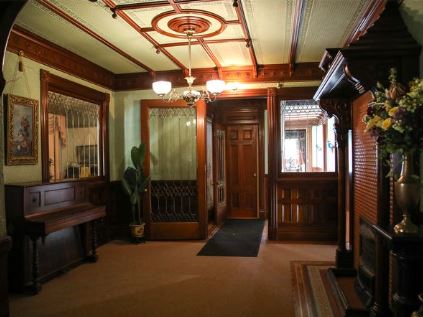
Often, at night, disembodied limbs pitched out the low windows to thud amongst the glorious statues and fountains. Although people thought Mrs. Winchester fired staff quit frequently, others believed that the mansion or demons inside of it was consuming people and leaving their unidentified remains outside. However, it was never enough to identify the victim, if there actually was one. According to one Ame Fisk, a farmhand, “During the night of the 3rd of June, as I approached the massive house—I stepped upon something that felt so peculiar that I stopped and picked it up. It proved to be an arm. Happening to look at the west window I saw an outline of a pyramid of some sort, which on examination I found was a pile of hands, arms, feet, and legs which must have belonged to souls killed by the Winchester rifles.” At night, the hauntings taking place within the mansion made it a descent into an Inferno. Passers-by heard ghostly music, screams, moans, and saw blood, flesh, and abdominal cavities lying on the ground, levitating, vanishing, and reappearing, and in the flickering, ghostly candlelight, they could see ghouls in the windows hurried, cutting and sawing. Yet, with all that soul-and body-rending activity, in the morning it was as if it was just all a bad dream, witnessed by many. Or could it be the spiritual essence of the hundreds of men the were killed on the battlefield? #RandolphHarris 3 of 8

One of the housemaids lived in the Winchester mansion, and spoke of hearing, at odd hour of the night and quite suddenly, the cries of a baby. One time she even started going up the stairs to quiet the poor darling, responding to her maternal instinct, forgetting that Mrs. Winchester had no living children. It is a sound which you cannot really identify right away—an odd squealing, taken at first to be “the pipes” or “the house settling.” It was only after trying to recall the sound a few seconds after it had died away that she realized, it was indeed a baby’s cry. Later that evening, the housemaid Synnove was alone in the front parlor. Mrs. Winchester was on the third-floor reading. Synnove was on the sofa knitting with her back to the stairs. It was a particularly quiet night. She heard Mrs. Winchester slowly descend the stairs being her and stop on the landing. She stood there, Synnove thought, for a good moment. Finally, to find out what happened, she turned around to see if Mrs. Winchester needed anything. But no one was there. Assuming she had turned and gone back up the stairs to her room without being heard, Synnove got up and walked to the third-floor, knocked on her closed door, and stuck her head into the room. “Will you be needing anything this evening, my lady?” She asked. “No.” Mrs. Winchester replied. “Why do you ask?” “You mean you did not just come down the stairs and stop on the landing?” “No. I have been sitting up here all night.” Some believe that there may be small leaks between the Worlds, a psychic bleed, perhaps of energies inside of the mansion. #RandolphHarris 4 of 8

The next morning, when Mrs. Winchester awoke, it was long past her usual hour, and she sat up in bed surprised and vexed at having overslept herself. She always liked to be down for breakfast to hear the birds singing; but a glance at the clock made it clear that it was nearly noon. Mrs. Winchester got up and said to the housemaid, “Draw my bath, please.” After she bathed, she dashed through her dressing, and caught herself singing at her image in the glass as she sat brushing her hair. It made her feel young again. The other woman vanished to a speck on the horizon, as this one, who ruled the foreground, smiled back at the reflection of her lips and eyes. Mrs. Winchester thought she had now faced the phantom and dispelled it. “Courage—that is the secret! If only people who are in love were not always so afraid of risking their happiness by looking it in the eyes.” As she brushed back a dark abundant hair it waved. Certainly she was looking very pretty. The afternoon danced along like a cockleshell on a bright sea. She ordered a particularly good dinner, had her trunks brought down from the attic, and consulted with the housemaid about getting out summer clothes. She felt the faint shiver of apprehension. Walking across the room, sat down again before her mirror. What a different face she saw! The smile on her pale lips seemed to mock the rosy vision of the other Mrs. Winchester. However, gradually, her color crept back. #RandolphHarris 5 of 8

As the apparition hovered over her he said, “Oh, virgin, underserving of those chains, but rather of such as bind fond lovers together, tell me, I beseech you, your name, and the name of your country, and why you are thus bound.” At first she was silent from modesty, and, if she could, would have hid her face with her hands; but when he repeated his questions, for fear she might be thought guilty of some fault which she dared not tell, she disclosed her name and that of her country, and her mother’s pride of beauty. Before she had done speaking, a sound was heard. At least the entrance of the housemaid who came to draw the curtains roused Mrs. Winchester from her labors, and she saw to her surprise that the clock marked five. The sun was still streaming through the some of the led glass doors of the bedroom. She went down into one of the dining rooms to have dinner. Her seat near the end of the table was facing the entryway. During dinner, she looked toward the entry and saw an elderly lady dressed in black coat and hat carrying a large bad. She assumed it was a guest of one of the housemaids or her way out or possibly someone they had hired to cook dinner, so Mrs. Winchester called Synnove over to ask her who the lady was. Synnove asked, “What lady?” Mrs. Winchester said, “The lady in the hall. She looks like she is ready to leave.” But Mrs. Winchester, there is no one in the hall,” Synnove replied. Only the two of them remained in the house. Later in the evening, Mrs. Winchester went to the west wing. She found the room in her library to be very cold. One of the carpenters had committed suicide in the library, and his spirit was still there, and the room would never warm up. #RandolphHarris 6 of 8

He would come down night after night crying that the lady in the white gown kept chasing him out of the room. One of the housemaids had gotten lost somewhere in the mansion and was found dead in that room. Mrs. Winchester decided to turn it into a library, and it must have upset the ghost of the housemaid, driving him to shoot himself. Mrs. Winchester was very aware of the spirit. Once in a while there is a knock on her bedroom door, and a few times the water turns on in the tub until Mrs. Winchester would get up to walk in there, and then it would turn off. However, it did in fact appear that someone had drawn a bath. There would be water in the tub and the faucet would be wet. The bathroom door would then squeak and slam closed. On another occasion, after Ms. Daisy moved into the mansion, she slept in one of the upstairs bedrooms (the one from which they used to hear footsteps). One morning she came down to breakfast and told Mrs. Winchester of an overnight visitor. “I woke up, and carefully went and drew the curtain aside. The moon was high, gibbous, its light bathing the yard. I saw a gleaming orb, and reeled back from the window in horror. When I turned towards my door, I saw a woman all in blude, and after studying me for a while, she turned away and disappeared…just vanished into thin air!” The family was terrorized by pounding footsteps in the night, moving shadows, and bizarre happenings, such as the curtains billowing out at odd times even with the windows closed. #RandolphHarris 7 of 8

One night the poundings in the house and the boot-like footfalls grew so menacing that Mrs. Winchester believed that the mansion was being invaded. We are dealing with the unknown—adventures in a new country. I conjure thee spirits of the Winchester Mansion, by God the Father Almighty; by the virtue of Heaven and by all the stars which rule; by the virtue of the four elements; by that of all stones, all planets, and all animals whatsoever; by the virtue of hailstorms and winds; to herein receive such virtue that we may by thee the perfect issue of the secrets of this mansion, please cross all space and time. I conjure thee, O Souls of the Winchester Mansion, by Foras, the Mighty President, and your 29 Legions of Spirits to give us understanding, make us invisible, and live long, and eloquent. Allow us to discover Treasures and recover things Lost. I conjure thee Souls of the Winchester Mansion, by the strong and powerful Great King Asmoday—the Thirty-second Spirit, and his 72 Legion of Spirits Inferior, to reveal the secrets of the Winchester Mansion and maketh us Invincible. Please show us where the Treasure lies, and guardeth it. I conjure thee great Demons of the Winchester mansion by Marchoias—the Thirty-fifth Spirit, and his 30 Legions of Spirits to reveal yourselves night and day, guard and protect the mansion and bring it great prosperity. I conjure thee Archangels of the Winchester Mansion, by Raum—the Fortieth Spirit, and thou 30 Legions of Spirits to preform great miracles in the Winchester Mansion and in the sky. Cause Love between Friends and Foes. I conjure Thee Malphas—the Thirty-ninth Spirit, and your 40 Legions of Spirits to continue to build Houses and High Towers on the Winchester Estate and being Knowledge of Enemies’ Desires and Thoughts, and that which they have done. By thou my fortresses and defence against all enemies, visible and invisible, in every magical work. Do thou rule in all my affairs and prevail in those things which oppose me. Amen. #RandolphHarris 8 of 8
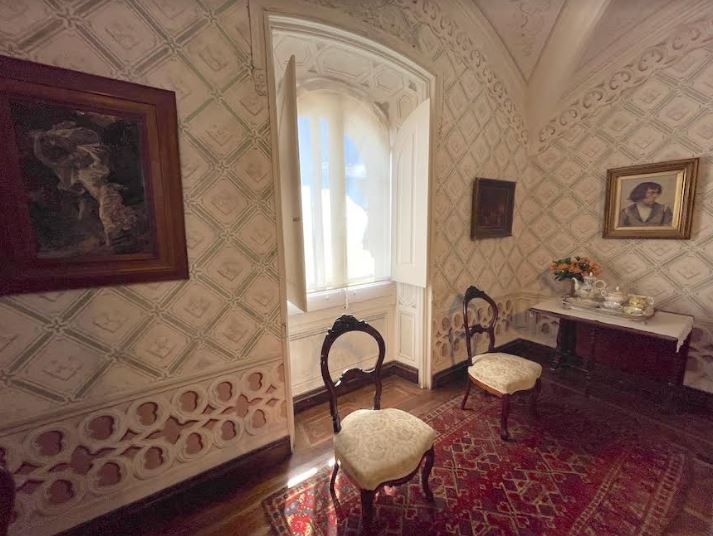
Demons have a solid place in popular culture and in the Victorian era. They often appear alongside witches and vampires. However, very few people actually believe in the existence of witches and vampires. Why then, do many people still believe in demons? Many religions teach that demons are real and must be cast out. Faithful religious followers believe thee teachings. However, skeptics see no evidence for demons. What do you believe? Visit the Winchester Mystery House, where the regal gardens enhance the beauty of the mansion. After the tour is over, people are brought back to reality. https://winchestermysteryhouse.com/

However, everyone can take something home with them by purchasing a gift in the Gift Shop on the Estate or at the Online Store. https://shopwinchestermysteryhouse.com/

Our First Loves Leave their Mark Upon Us

The result of one of the greatest tragedies of human existence, what we might call the need to “fetishize evil,” to locate the threat to life in some special places where it can be placated and control exists precisely because men make fantasies about evil, see it in the wrong places, and destroy themselves and others by uselessly thrashing about. To idols foul. Tammuz came next behind, whose annual wound in Lebanon allured the Syrian damsels to lament his fate in amorous ditties all a summer’s day, while smooth Adonis from his native work ran purple to the sea, supposed with blood of Thammuz yearly wounded: like love-tale infected Sion’s daughters with like heat, whose wanton passions in the sacred porch Ezekiel saw, when by the vision led his eye surveyed the dark idolatries of alienated Judah. Next came one who mourned in earnest, when the captive ark maimed his brute image, head and hands lopped off in his own temple, on the grunsel edge, where he fell flat, and shamed his worshipers: Dagon his name, sea monster, upward man and downward fish: yet had his temple high eared in Azotus, dreaded through the coast of Palestine, in Gath and Ascalon and Accaron and Gaza’s frontier bounds. Him followed Rimmon, whose delight seat was fair Damascus, on the fertile banks of Abbana and Pharphar, lucid streams. He also against the house of God was bold: a leper once he lost and gained a king, Ahaz his sottish to disparage and displace for one of Syrian mode, whereon to burn his odious offerings, and adore the gods whom he had vanquished. #RandolphHarris 1 of 18

After these appeared a crew who under names of old renown, Osiris, Isis, Orus, and their train with monstrous shapes and sorceries abused fanatic Egypt and her priests, to seek their wandering gods disguised in brutish forms rather than human. Nor did Israel scape the infection when their borrowed gold composed the calf in Oreb: and the rebel king doubled that sin in Bethel and in Dan, likening his Maker to the grazed ox, God, who in one night when he passed from Egypt marching, equaled with one stroke both her first-born and all her bleating gods. (When the Giants invaded Olympus some of the gods fled in terror to Egypt, wandering there disguised as various animals. Osiris, in the image of a bull, his wife, Isis, represented as a cow, were (among other things) fertility gods. Orus was their son. By killing in one night the firstborn of all the Egyptian people and all of their cattle (bleating gods), God forced the Pharaoh to free the captive Israelites; but first he told the Israelites to “borrow” gold and silver jewelry from their “well-disposed” Egyptian neighbours.) Belial came last, than who a Spirit more lewd fell not from Heaven, or more gross to love vice for itself: to him no temple stood or altar smoked; yet who more oft than he in temples and at altars, when the priest turns atheist, as did Eli’s sons, who filled with lust and violence the house of God. In courts and palaces he also regains and in luxurious cities, where the noise of riot ascends above their loftiest towers, and injury and outrage when night darkens the streets, then wander forth the sons of Belial, flown with insolence and wine. A consequence of man’s animal vulnerability to death and his symbolic consciousness of it is the struggle to get power to fortify himself. #RandolphHarris 2 of 18

Our first loves leave their mark upon us. When the communion of a face engagement has been established between two or more individuals, the resulting state of ratified mutual participation can last for varying periods. When a clearly defined task is involved, the engagement may last of hours. When no apparent work or recreational task is involved, and what is perceived as sociability alone holds the participants, certain durations seem to be favoured. The contact may be very brief, as brief, in fact, as the opening meeting of eyes itself. In our own middle-class society there are “chats,” where two individuals pause in their separate lines of action for what both recognize to be a necessarily brief period of time; there are greetings, whereby communion is established and maintained long enough for the participants to exchange brief interpersonal rituals; and, briefest of all, there are recognitional or “friendly” glances. (Of course, a recognitional glance may be merely the first interchange in an extended greeting, and a greeting merely the opening phase of a chat, but these extensions of coparticipation are not always found.) Except for the ritual of civil inattention, the mere exchange of friendly glances is perhaps the most frequent of our interpersonal rituals. Encounters of an obligatory kind are linked to the World of domestic convivial occasions. In some social circles, a guest entering a party has a right to be greeted by the host or hostess and convoyed into the proceedings in visible contact with the authorizing person, this encounter thereby legitimating and celebrating the newcomer’s participation in the occasion. #RandolphHarris 3 of 18

One’s departure may be marked with the same kind of ceremony, officially bring one’s participation to an end. Here there is an interesting difference between Anglo-American and French custom; in France, the entering or departing person ratifies one’s entrance or departure not only through contact with the person managing the occasion but often also by a hand-shaking engagement with some or all of the other guests present. The occasion then closed in and over the place one has left, and if one should have to return for something one has forgotten, embarrassment is likely to be felt, especially if the ethos of the occasion has changed, and especially if marked ceremonial attention had been given one’s leave-taking. The same sort of embarrassment occurs when a member of an organization, who has been given a farewell party and gift to mark a termination of one’s membership and to set the stage for the group’s developing a new relation to a substitute, then finds that one must remain with or return to the organization. One finds that the group has “worked through” one’s membership, leaving one present but socially not there. Encounters, of course, tend to be taken as an expression of the state of a social relationship. And, as will be considered later, to the degree that contact is practical, it may have to be made so as not to deny the relationship. Face engagements, of course, are not the only kinds of contact carrying ceremonial functions. Gifts, greeting cards, and salutatory telegrams and telephone calls or email serve in this way. Each social circle seems to develop norms as to how frequently and extensively these ought to be employed to affirm relationships among geographically separated people, depending on the costs faced by each group in using these several devices. #RandolphHarris 4 of 18

Just as friends at the same social party are obliged to spend t least a few moments chatting together, so a husband out of town on business may be considered “in range” and be obliged to telephone home in the evening. Further, each engagement tends to be initiated with an amount to fuss appropriate to the period of lapsed contact, and terminated with the amount appropriate to the assumed period of separation. There results a kind of tiding over, and a compensation for the diminishing effects of separation. At a party, then, a version of Mrs. Hilton’s ruling is likely to prevail: “In a meeting the same person many times within an hour or so, one does not continue to bow after the second, or at most third meeting. After that one either looks away or merely smiles.” The same smile between the same two persons newly coming within range of each other in a foreign country may constitute a grievous affront to their relationship. A face engagement is a sufficiently clearcut unit that an individual typically must either be entirely within it or entirely outside it. This is nicely borne out by the trouble caused when a person attempts to be half-in and half-out. Nonetheless, there are communication arrangements that seem to lie halfway between mere copresence and full scale coparticipation. When two persons walk silently together down the street or doze next to each other at the beach, they may be treated by others as “being together,” and are likely to have the right to break rather abruptly into spoken or gestured communication, although they can hardly be said to sustain continuously a mutual activity. This sense of being together constitutes a kind of lapsed verbal encounter, functioning more as a means of excluding nonmembers than as a support for sustained focused interaction among the participants. #RandolphHarris 5 of 18

Being “with” someone at a given moment is to be distinguished from the party relationship of having “come with” someone to the occasion, the latter representing a preferential claim as to whom one will leave with, be loyal to, and the like. Persons who can sustain lapsed encounters with one another are in a position to avoid the problem of “safe supplies” during spoken encounters—the need to find a sufficient supply of inoffensive things to talk about during the period when an official state of talk prevails. Thus, in Rancho Cordova, when three or four women were knitting together, one kinnter would say a word, it would be allowed to rest for a minute or two, and then another knitter would provide an additional comment. In the same manner a family sitting around its kitchen fire would look into the flames and intersperse replies to statements with periods of observation of the fire. Rancho Cordova men used for the same purpose the lengthy pauses required for the proper management of their pipes. It has been suggested that an individual divulges things about oneself by one’s mere presence in a situation. In the same way, one gives off information about oneself by virtue of the encounters in which others do not or do not see one. Involvement in focused interaction conveying something to all who are present in the situation at large. In public places in our society, what is conveyed by being in or out of encounters differs appreciably according to gender and the periods of the week. #RandolphHarris 6 of 18

Morning and lunchtime are times when anyone can appear alone almost anywhere without this giving evidence of how the person is faring in the social World; dinner and other evening activities, however, provide unfavourable information about unaccompanied participants, especially damaging in the case of female participation. Weekend nights, and ceremonial occasions such as Thanksgiving, Christmas, and especially New Year’s Eve, are given special weight in this connection, being times when an unengaged individual in a semipublic place may feel very much out of place. In so far as others judge the individual socially by the company one is seen in, for one to be brought into an engagement with another is to be placed in the position of being socially identified as the other is identified. Unlike some other people, I did not volunteer to become football manager in high school so I could make-out with the players and cheerleaders behind the equipment shed after practices. I volunteered to carry water bottles and towels during the hot, exciting practices because my guidance counselor said I needed an extracurricular activity if I wanted to be accepted into a good college. Football practice was the only activity I could drive the BMW to in the afternoons. One day, I was gathering water bottles by the side of the field during practice when Mickey Lim, one of the senior varsity players, trotted past me with a friend. “Is he a rapper?” he asked. I knew without looking up he was talking about me. “Dude, no.” his friend said. “I think his dad is president of a bank.” “Same thing,” Mickey said. #RandolphHarris 7 of 18

However the history of the individual and that of the human race may diverge in other respects, they agree in this at least: both signify a progressive increase of the It-World. “Do you know why a child should remember its grown-up mind and not its previous child’s mind?” We have so little material by which to judge. I speak only of the way in which it can be studied. Suppose we were to try to remember what our minds were like at a very early age, trying not to let imagination come it. Supposed we were to find they were of one sort of another. Anything we found would be material. In literature you find very little because people do not understand how to study recurrence, but, within my own experience, I have met with very interesting things. Some people I knew had recollections of the first years of their lives, and they all had the same impression which was that their mentality was not a child’s mentality. How they took people, how they recognized people; it was not a child’s psychology. They had fully formed minds with quite grown-up reactions such as you cannot imagine could have been formed in six months of unconscious life. Such minds must have existed before if their recollections were really correct. However, as I say, it is very difficult to find material, and most people do not remember at all. “Why should that early memory disappear when the child learns to talk?” The child begins to imitate other children and do exactly what grown-up people expect from him. They expect him to impressionable and unaware and he becomes impressionable and unaware. #RandolphHarris 8 of 18

“How is it possible to know what a baby remembers? I thought that one was born with one’s centers completely blank, and that one remembered with centers.” This is a strange thing. Yet the people I spoke of—who do not differ much from other people—have quite definite recollections of their first months even, and they think that they saw people as grown-up people do—not as children would. They do not try to reconstruct elaborate pictures from scattered and fragmentary recollections; they have quite definite impressions of houses, people, and so on. They seem to have had a quite grown-up mentality. “I can remember things when I was two years old which did not happen at all. How can one verify what a baby remembered before it could speak?” How do you know that they did not happen? It could have been a dream. I had an experience of that kind. I remember that when I was quite a child I was in some place near Moscow and the picture of the place remained in my memory. Actually, I was not there until about for years after that. Then, when I went there, I saw that the place was not the same as it had been in my memory, and I realized that my memory had been a dream. About the question of former lives: I think some people can remember something, although only in very rare cases, since to remember implies already a certain definite degree of development. Ordinary man—no.1, no. 2, and no. 3—has no apparatus for such memory. Essence is mechanical. It does not life by itself; it has no special thinking apparatus, but has to think through personality, and personality has no experience. #RandolphHarris 9 of 18

“When you said, “Observe children,” what did you mean? That is what is so difficult. If you observe tendencies on a big scale you can find quite unexpected tendencies. You cannot say that they are the result of a certain reason or of surroundings, because quite unexpected tendences can appear and disappear. They will continue throughout life after rewards. In such a case, according to the theory of recurrence, the tendency may have been acquired in a very previous life in much later years, and then it appears very early in this life. “From that point of view of recurrence then, may it not be that some important actions that we make between now and the time that we die are really responsible for our tendencies now?” You mean in previous lives. Quite possibly. Only, remembering one thing, this work did not exist before. It may be that other work did, (there are many kinds,) but not this. It did not exist before, I am perfectly sure of that. “What I mean is that it seems such a huge idea to think that between now and the time when we die, we may make fatal actions which will give us tendencies for the next time.” Certainly, in every moment of our lives we may create tendencies that we may not be able to get rid of for ten lives. That is why this point is always emphasized in Indian literature. It may be in fairy-tale form but the principle is the same. Relation is reciprocity. My You acts on as I act on it. Our students teach us, our works form us. The “wicked” become a revelation when they are touched by the sacred basic word. How are we educated by children, by animals! Inscrutably involved, we live in the currents of universal reciprocity. #RandolphHarris 10 of 18

Most people trying to win others to their way of thinking do too much talking to themselves. Let the other people talk themselves out. They know more about their business and problems than you do. So ask them questions. Let them tell you a few things. If you disagree with them, you may be tempted to interrupt. However, do not. It is dangerous. They will not pay attention to you while they still have a lot of ideas of their own crying for expression. So listen patiently and with an open mind. Be sincere about it. Encourage them to express their ideas fully. Does this policy pay in business? One of the largest furniture manufacturers in the United States of America was negotiating to supply furniture for model homes. One of the representatives was not feeling well. When it came his turn to explain why they have the best deals on high quality furniture, he could not speak. When he met with the purchasing agent, the direct of sales, and the president of the company, he still could not speak. He then told everyone that he had lost his voice and could not speak. So the president of our company did the talking for him as to why he wanted this brand of furniture in the model homes. He exhibited the representative’s samples, and praised their good points. A lively discussion arose about the merits of his goods. And the president, since he was talking for the representative of the furniture company thoroughly explain what he liked about the product. The representative of the furniture company smiled and nodded. As a result of this unique conference, he was awarded the contract with an aggregate value of $2,000,000—the biggest order the sales representative has ever received. #RandolphHarris 11 of 18

Therefore, you can see how important it is to be kind, and honest, and sometimes to let other people speak for you, even when they have hired you to provide them with goods and/or services. The president later said that he decided to go with this manufacture because they were an American company that started about twenty-eight years ago, with nothing but a desk in a small office and a secretary, and that he was honoured to work with such a great company. Although everyone is not looking to hear a story of pity, nor do they want to, people often to research. So sometimes showing up, and trying to do your part can really help you achieve success. However, almost every successful person likes to reminisce about one’s early struggles. This may not come up during a sales pitch, but during a casual lunch or a phone call. The sales representative at this company has started with $1,000 in cash and an original idea. He fought against discouragement and battled against ridicule, working seven days a week, holidays, twelve to sixteen hours a day; and he had finally won against all odds. Even executives on Wall Street were coming to him for furniture for their offices. He was proud of such a record. He had a right to be, and he spent time telling the builder and architect about it. And the president of the company said, “I think this is the person we are looking for.” The president of the company that was developing homes takes time to find out about his employees and manufacturers. He shows an interest in people and their problems, and expresses how important it is to be honest with him as he understand life happens. So sometimes when people want you for a job, they will do the talking for you. It is just as important to listen as it is to speak. When trying to make friends, sometimes it helps to listen to their accomplishment and let them excel you. Let them share their joys with you. #RandolphHarris 12 of 18

We turn now to a mechanism that depends on interactions within the system to stimulate further activation of agents. For instance, people crowding their cars onto highways (traffic jams), or ecologies of species (mass extinction events). What is happening in all these instances is that a small event may or may not trigger other events. An additional grain of sand added at the top of a pile my dislodge another, which may dislodge others. The added particle may dislodge another, which may dis lodge others. The added particle may dislodge few others or none. When sand is piled at its “angle of repose,” it is ripe for avalanches. There is a striking pattern, known as a power law distribution, in which the numbers of events in different sizes categories are related by a constant proportion. This principle can be illustrated by the distribution of the sizes of wars as well as the sizes of avalanches. For example, there are many small wars, a moderate number of medium-sized wars, and a few very large wars. This patten of sizes of wars can be seen as the result of propagation of stress resulting in a power law distribution. Consider these pioneering statistics on the distribution of wars from 1820 to 1945 that caused 300 or more battle deaths: About 1,000 deaths, number of deaths 188; about 10,000 deaths, number of wars 63, about 100,000 deaths, number of wars 24; about 1,000,000 deaths, number of wars 5; about 10,000,000 deaths, number of wars 2. Not that for each tenfold increase in the magnitude of the war, there is roughly threefold decrease in the number of wars. However, the increase by a factor of ten in the magnitude means that the wars in the category kill a total of about three times as many people. #RandolphHarris 13 of 18

There are other important results about these systems. One is that after they build up to their critical state, such as the sand pile’s angle of repose, a long time without a big event does not necessarily mean that something big is due soon. There is such a complicated interdependence among all the sand grains, snowflakes, or species that you cannot know whether small events are relieving or increasing the stress. In the critical state, the sand pie is the functional unit, not the grain of and. If sand particles, or species, or highway drivers keep arriving in the system, they will soon build it back up to its critical state, even if there have been big releases. Now when it comes to establishing credibility cutting off communication succeeds as a credible commitment device because it can make an action truly irreversible. An extreme form of this tactic arises in the terms of a last will and testament. Once the party had died, renegotiation is virtually impossible. (To further highlight this illustration, it took an act of the British parliament to change Cecil Rhodes’s will in order to allow female Rhodes Scholars.) In general, where there is a will, there is a way to make your strategy credible. For example, most universities set a price for endowing a chair. The going rate is about $1.5 million. There prices are not carved in stone (nor covered with ivy). Universities have been known to bend their rules in order to accept the terms and the money of deceased doners who fail to meet the current prices. #RandolphHarris 14 of 18

One need not die trying to make commitments credible. Irreversibility stands watch at every mailbox. Who has not mailed a letter and then wished to retrieve it? And it works the other way. Who has not received a letter he or she wishes one had not? However, you cannot send it back and pretend you have never read it once you have opened the letter. Before the practice became widespread, a successful commitment device was to mail one’s bill payments in unstamped letters with no return address. Mailing a letter with no return address is an irreversible commitment. The post office used to deliver such letters, and the receiver could accept delivery by paying the postage due. A utility or phone company knew that such a letter was likely to contain a check. It would rather pay the postage due than wait another billing cycle before receiving payment (or another unstamped letter with no return address). The solution to the companies’ problem came when the post office changed its policy. Letters without postage are no longer delivered to the addressee; they are returned to the sender if there is a return address and not delivered if there is no return address. Now the company can commit itself not to receive a letter with postage due. However, what if you put the company’s address as both the mailing address and the return address? Now the post office has someone to return the letter to. Remember, you did not hear this idea here first. And if it begins to spread, rest assured that the post office rules will be changed so that letters without a stamp are not even retuned to the sender. #RandolphHarris 15 of 18

There is a serious difficulty with the use of cutting off communication as device to maintain commitment. If you are incommunicado, it may be difficult if not impossible to make sure that the rival has accorded with your wishes. You must first hire others to ensure that the contract is being honoured. For example, wills are carried out by trustees, not the deceased. A parental rule against smoking may be exempt from debate while parents are away, but unenforceable too. Now when considering molecular repairs, cells are made of billions of molecules, each built by molecular machines. These molecules self-assemble to form larger structures, many in dynamic patterns, perpetually disintegrating and reforming. Cell-surgery devices will be able to make molecules of sorts that may be lacking, while destroying molecules that are damaged or present in excess. They will be able not only to remove viral genes, but to repair chemical and radiation-caused damage to the cell’s own genes. Advanced cell-surgery devices would be able to repair cells almost regardless of their initial state of damage. By activating and inactivating a cell’s genes, they will be able to stimulate cell division and guide what types of cells are formed. This will be a great assistance to cell herding and to healing tissues. As surgeons today rely on the spontaneous, self-organizing ability of cells and tissues to join and heal the parts they manipulate, so cell-surgery devices will rely on the spontaneous self-organizing capabilities of molecules to join and “heal” the parts they put together. Healing of surgical wound involves sweeping up dead cells, growing new cells, and a slow and genuinely painful process of tissues reorganization. #RandolphHarris 16 of 18

In contrast, the joining of molecules is almost instantaneous and occurs on a scale far below that of the most sensitive pain receptor. “Healing” will not begin after the repair devices have done their work, as it does in conventional surgery: rather, when they complete their work, the tissue will have been healed. When dealing with Earth politics, during the period of mass democracy, people, parties, and policies were typically categorized as either left-wing or right-wing. Issues were usually “domestic” or “foreign.” They fit into a neat framework. The new system of wealth creation makes these political tags, and the coalitions that went with them, obsolete. Ecological catastrophes are neither right-wing nor left-wing, and some are both domestic and international. Man of our most serious environmental problems—from air pollution to toxic waste—are by-products of the old, industrial methods of creating wealth. By contrast, the new system, with its substitution of knowledge for material resources, its dispersal, rather than concentration of production, its increasing energy efficiency, and its potential for dramatic advances in recycling technologies, holds out the hope of combining ecological sanity with economic advance. It is unlikely, however, that the next decade or two will pass without new Chernobyls, Fukushima Daiichis, Bhopals, and Alaska oil spills, legacies of the smokestack era. These, in turn, will lead to bitter conflicts over new technologies and their possible consequences. Social groups inside each country (and, indeed, whole countries) will demand “ecological indemnification” from one another and fight over the allocation of clean-up costs. #RandolphHarris 17 of 18

Others will demand “ecological blackmail” or “ransom” to abstain from actions that could send fallout, acid rain, weather changes, toxic wastes, or other dangerous products across their neighbours’ borders. Also, with new green energy, if the power grid is overwhelmed or shutdown, people will not be able to charge and drive their electric cars. Will the advance economies wind up making “ecological welfare payments” to the Brazils and Indias of the World to deter them from destroying rain forests, jungles, or other environmental resources? What about natural disasters in a newly networked World economy? An earthquake in Tokyo can now send Wall Street reeling into chaos. Should Wall Street contribute to Tokyo’s earthquake-preparedness programs? As such issues left-wing or right-wing? Domestic or foreign? The attempt to deal politically with such problems will not only fragment old alliances, but breed more zealots—World savers from whom environmental requirements (as they define them) supersede the niceties of democracy. One of the biggest mistakes the government made was breaking up the vertical integration of Standard Oil by calling it a monopoly. This is what lead to people seek immigrants for more affordable wages, and what caused companies to send their firms overseas. If companies were allowed to control their supply chain, they could still affordably manufacture products in America. EXTENDED, the lines of relationships intersect in the eternal You. Every single You is a glimpse of that. Through every single You the basic word addresses the eternal You. If we want America to be one dynasty that defines history, we have to keep America first. It is sad when you earn $5,000 a month gross, but bring home $2,900 in net pay. While you can barely afford to get by, you hard earned dollars are being sent overseas. How are Americans not upset about their tax money being through away and their children’s future being sold? #RandolphHarris 18 of 18

MAGNOLIA STATION AT CRESLEIGH RANCH
Rancho Cordova, CA |
Coming Soon!

Experience the luxury you’ve always wanted! Large Lots with mix of Single Story and Two-Story homes
2,200 – 3,700 square feet | 3 – 7 Bedrooms | 2 – 5.5 Bathrooms | up to 4-car garage


One Who Treads Softly Goes Far

For man the emanations of light and heat from the sun were the archetypes of all miraculous power. And then various idols came into the heathen World. Say, Muse, their names then known, who first, who las, roused from the slumber on that fiery cough, at their great emperor’s call, as next in worth came singly where he stood on the bare strand, while the promiscuous crowd stood yet aloof. The chief were those who from the pit of hell roaming to seek their prey on Earth, durst fix their seats long after next the seat of God, their altars by his altar, gods adored among the nations round, and durst abide God thundering out of Zion, throned between the Cherubim; yea, often placed within his sanctuary itself their shrines, abomination; and with cursed things his holy rites, and solemn feasts profaned, and with their darkness durst affront his light. First Moloch, horrid king besmeared with blood of human sacrifice, and parents’ tears, though for the noise of drums and timbrels loud through for the noise of drums and timbrels loud their children’s cries unheard, that passed through fire to his grim idol. Him the Ammonite worshipped in Rabba and her watery plain, in Argob and in Basan, to the stream of Utmost Arnon. Nor content with such Audacious neighbourhood, the wisest heat of Solomon he led by fraud to build his temple right against the temple of God on that opprobrious hill, and made his grove the pleasant valley of Hinnom, Tophet thence and black Gehenna called, the type of hell. Next Chemos, the obscene dread of Moab’s sons, from Aroer to Nebo, and the wild of southmost Abarim; in Hesebon and Horoanim, Soen’s realm, beyond the flowery dale of Sibma clad with vines, and Eleale to the Asphaltic Pool. #RandolphHarris 1 of 21

Peor his other name, when he enticed Israel in Sittim on their march from Nile to do him wnton rites, which cost them woe. Yet thence his lustful pleasures of the flesh he enlarged even to that hill of scandal, by the grove of Moloch homicide, lust hard by hate; till good Josiah drove them thence to hell. With these came they, who from the bordering flood of old Euphrates to the brook that parts Egypt from Syrian ground, had general names of Baalim and Ashtaroth, those male, these feminine. For Spirits when they please can either gender assume, or both; so soft and uncompounded is their essence pure, not tied or manacled with joint or limb, nor founded on the brittle strength of bones, like cumbrous flesh; but in what shape they choose dilated or condensed, bright or obscure, can execute their airy purposes, and works of love or enmity fulfill. For those the race of Israel oft forsook their Living Strength, and unfrequented left his righteous altar, bowing lowly down to bestial gods; for which their heads as low bowed down in battle, sunk before the spear of despicable foes. With these in troop came Astoreth, whom the Phoenicians called Astarte, queen of heaven, with crescent horns; to whose bright image nightly by the moon Sidonian virgins paid their vows and songs, in Sion also not unsung, where stood her temple on the offensive mountain, built by that uxorious king, whose heart though large, beguiled by fair idolatresses, fell to idols foul. Once you admit that a man can become one with the sun, it follows that the actions of the one are the actions of the other, that the king himself in his person, will vivify the Earth. Life, prosperity, health—these are the timeless and universal hunger of men. #RandolphHarris 2 of 21

When it comes to focused interaction, once a set of participants have avowedly opened themselves up to one another for an engagement, an eye-to-eye ecological huddle tends to be carefully maintained, maximizing the opportunity for participants to monitor one another’s mutual perceivings. The participants turn their minds to the same subject matter and (in the case of talk) their eyes to the same speaker, although of course this single focus of attention can shift within limits from one topic to another from one speaker or target to another. The conversation generally proceeded so that one person talked at a time, and all members in the particular group were attending the same conversation. In this sense, these groups might be said to have a “single focus,” that is, they did not involve a number of conversations proceeding at the same time, as one finds at a cocktail party or in a hotel lobby. The single focus is probably a limiting condition of fundamental importance in the generalizations reported here. To this the caution should be added that the multiple focuses found in places like hotel lobbies would occur simultaneously with unfocused interaction. A shared definition of the situation comes to prevail. This includes agreement concerning perceptual relevancies and irrelevancies, and a “working consensus,” involving a degree of mutual considerateness, sympathy, and a muting of opinion differences. When closeness and sympathy are to be held to a minimum, as when a butler talks to a house guest, or an enlisted man is disciplined by an officer, eye-to-eye communion may be avoided by the subordinate holding his eyes stiffly to the front. An echo of the same factor is to be found even in mediated conversation, where servants are obliged to answer the telephone by saying, “Mrs. Hilton’s residence” instead of “Hello.” #RandolphHarris 3 of 21

Often a group atmosphere develops—what is called ethos. In spite of the auspicious rumours about the Cossacks, perhaps slightly exaggerated, the crowd’s attitude toward the mounted men remains cautious. A horseman sits high above the crowd; his soul is separated from the soul of the demonstrator by the four legs of his beast. A figure at which one must gaze from below always seems more significant, more threatening. The infantry are beside one on the pavement—closer, more accessible. The masses try to get near them, look into their eyes, surround them with their hot breath. A great role is played by women workers in the relations between workers and soldiers. They go up to the cordons more boldly than men, take hold of the rifles, beseech, almost command: “Put down your bayonets—join us.” The soldiers are excited, ashamed, exchange anxious glances, waver; someone makes up one’s mind first, and the bayonets rise guiltily above the shoulders of the advancing crowd. The barrier is opened, a joyous and grateful “Hurrah!” shakes the air. When a group of young intellectual English men or women are talking and joking together wittily and with a touch of light cynicism, there is established among them for the time being a definite tone of appropriate behaviour. Such specific tones of behaviour are in all cases indicative of an ethos. They are expressions of a standardized system of emotional attitudes. In this case the men have temporarily adopted a definite set of sentiments towards the rest of the World, a definite attitude towards reality, and they will joke about subjects which at another time they would treat with seriousness. If one of the men suddenly intrudes a sincere or realist remark it will be received with no enthusiasm—perhaps with a moment’s silence and a slight feeling that the sincere person has committed a solecism. #RandolphHarris 4 of 21

On another occasion the same group of persons may adopt a different ethos; they may talk realistically and sincerely. Then if the blunderer makes a flippant joke, it will fall flat and feel like a solecism. A “we-rationale” develops, being a sense of the single thing that we the participants are avowedly doing together at the time. Further, minor ceremonies are likely to be employed to mark the termination of the engagement and the entrance and departure of the engagement and the entrance and departure of particular participants (should the encounter have more than two members). These ceremonies, along with the social control exerted during the encounters to keep the participants “in line,” give a kind of ritual closure to the mutual activity sustained in the encounter. An individual will therefore tend to be brough all the way into an ongoing encounter or kept altogether out of it. One well-established way of confirming and consolidating a leave-taking is for the leave-taker to move away physically from the other or others. In places like Midtown Sacramento this can cause a problem when two persons pause for a moment’s sociability and then find that their directions of movement do not diverge sharply. If the two persons walk at a normal pace, they find themselves attempting to close out the encounter while still having easy physical access to each other. Sometimes one individual offers and excuse to break into a run; sometimes, even if it takes one out of one’s way, one may take a path diverging sharply from that taken by one’s erstwhile coparticipant. #RandolphHarris 5 of 21
Engagements of the conversational kind appear to have, at least in our society, some spatial conventions. A set of individuals caused to sit more than a few feet apart because of the furniture arrangements will find difficulty in maintaining formal talk; those brought within less than a foot and a half of each other will find difficulty in speaking directly to each other, and may talk at an off angle to compensate for the closeness. It appears that American, when standing face to face, stand about arm’s length from each other. When they stand side by side, the distance demanded is much less. When “middle majority Americans” stand closer than this in a face-to-face position they will either gradually separate or come toward each other and begin to emit signs of irritation. However, if they are put in a situation in which they are not required to interact—say on a street car—they can stand quite close, even to the point of making complete contact. The amount of this territory sees to vary culturally. So, there can be a situation where two or three ethnic groups occupy different territories, that is, varying amounts of personal space. For example, put together a Germany (who occupies about half the area of personal space) and a middle class American keeps drifting around to the side, in order not to be insulting, and the German man tries to move around to get face-to-face relationships. You get an actual dance, which very often turns into what is practically a fight. From all of this it follows that among persons arranged in a discussion circle, persons adjacent to each other may tend not to address remarks to each other, except to pass side comments, since a voice full enough to embrace the circle would be too full or the distance between them. #RandolphHarris 6 of 21

In brief, then, encounters are organized by means of a special set of acts and gestures comprising communication about communicating. There are messages primarily serving to establish, to prolong, or to discontinue communication, to check whether the channel works (“Hello, do you hear me?”), to attract the attention of the interlocutor or to confirm one’s attention (“Are you listening?” or in Shakespearean diction, “Lend me your ears!”—and on the other end of the wire “Um-hum!). Everyday terms refer to different aspects of encounters. “Cluster,” “knot,” “conversational circle”—all highlight the physical aspects, namely, a set of persons physically close together and facially oriented to one another, their backs toward those who are not participants. “Personal encounter” refers to the unit in terms of the opportunity it provides or enforces for some kind of social intimacy. In the literature, the term “the interaction” is sometimes used to designate either the activity occurring within the cluster at any one moment or the total activity occurring from the moment the cluster forms to the moment at which it officially disbands. And, of course, where spoken messages are exchanged, especially under informal circumstances, the terms “chat,” “a conversation,” or “a talk” are employed. It may be noted that while all participants share equally in the rights and obligations described, there are some rights that may be differentially distributed within an encounter. Thus, in spoken encounters, the right to listen is one shared by all, but the right to be a speaker may be narrowly restricted, as, for example, in stage performances and large public meetings. Similarly, children at the dinner table are sometimes allowed to listen but forbidden to talk; if not forbidden to talk, they may be “helped out” and in this way denied the communication courtesy of being allowed to finish a message for themselves. #RandolphHarris 7 of 21

It often seems as if people get a sense of their own importance by antagonizing others at the outset. Therefore, in some engagements, one category of participant may be allowed to say only “Yes, sir,” or “No, sir,” or restricted to the limited signalling that a modulation of applause allows. In talking with people, please do not begin by discussing the things on which you differ. Begin by emphasizing—and keep emphasizing, if possible, tht you are both striving for the same end and that your only difference is one of method and not of purpose. It took me years and cost me countless thousands of dollars in lost business before I finally learned that it does not pay to argue, that it is much more profitable and much more interesting to look at things from the other person’s viewpoint and try to get that person saying ‘yes.’” Do not tell people they are wrong. Try talking to them and see if you can get them into agreement, but do so gently. One who treads softly goes far. Memory is a strange thing. Everyone has one’s own combination of capacities for memory. One person remembers some things more; another remembers other things better. You cannot say that one is better than the other. Memory may disappear; there are many different degrees of it. Something may be forgotten and then brought up again by special methods, or it may disappear altogether. “Why do some people have a greater facility for playing ball games than others?” There are many different kinds of moving center with different kinds of memory. There is not a single human similar to another human. One can do one thing better; another, another thing. There are thousands of impressions so that the combinations are always different. #RandolphHarris 8 of 21

I have spoken several times about the different kinds of humans—no. 1, no. 2, no. 3, and so on. One remembers one kind of impression better; another, another kind. “Does a life consist of memories from one moment to another?” No that is too complicated. You know that there are many different sorts of memory. And memory is passive; you do not use it. Life can be said to be a process. “What can one do to increase one’s memory?” If you remember yourself more, your memory will be better. “Until I came into the system I had a very clear memory of something which happened some time ago. Now, if I recall it, it is just a memory of a memory. Is this due to being a little more awake?” It probably connected with strong identification. When you look at it without identification it becomes fainter and may disappear. “Is complete non-identification self-consciousness?” Identification and self-consciousness are two different sides of the same thing. “Is it of practical use to think of the events of one’s past life when trying to self-remember? I mean, with a view to fixing them for any future recurrence.” No, this is not practical. First it is necessary for you to be sure that future recurrence exists. Secondly, it is necessary for you to be sure of remembering yourself. If you put it to yourself as you did in your question, it will turn into imagination, nothing else. However, if you try first of all to remember yourself without adding anything to it, and then—when you can—also to remember about your past life, and try to find cross-roads; then, in combination, they will be very useful. Only do not think that you can do it; you cannot do it yet. #RandolphHarris 9 of 21

“What are cross-roads?” Cross-roads are moments when one can “do.” A moment comes when one can help in this work or not. If an opportunity comes and one misses it, another may not come for a year or even longer. There are periods in ordinary conditions when nothing happens, and then there come cross-roads. All life consists of streets and cross-roads. Recurrence can be useful if one begins to remember and if one begins to change and not go by the same circle each time, but do what one wants and what one thinks better. However, if one does not know about recurrence, or even if one knows and does not do anything, then there is no advantage in it at all. Then, it is generally the same things repeated and repeated. “Am I right in supposing that it is man’s essence which recurs?” Quite right. We know very little about recurrence. Some day we may try to collect what can be taken as reliable in all that is said about recurrence, and see how we can think about it. However, it is only theory. Recurrence is in eternity; it is not the same life. This life ends and time ends. There is a theory, and this system admits the theory, that time can be prolonged. I have no evidence. Think how many attempts to find out about time have been made by spiritualists and others. However, there is no evidence. The easiest way of studying recurrence is by studying children. If we had enough material we could answer may questions. Why, for instance, do strange tendencies appear in children, quite opposed to their surrounding circumstances and quite new to the people who surround them? That happens sometimes, in many different ways. And they may be very strong tendencies that change life and go in quite unexpected directions, when there is nothing in heredity to account for them. #RandolphHarris 10 of 21

As I have often said, the idea of heredity in man does not work. It is a fantastic idea. It works in dogs and horses but not in man. “Does the question of types come into that?” Yes, but we know nothing about types. At least not enough to speak about them. This is why in most cases it happens that parents do not understand their children and the children do not understand their parents. They never could really understand one another sufficiently or rightly, because they are quite different people, strangers to one another, who have just happened to meet accidentally at a certain station and then go in different directions again. The study of recurrence must begin with the study of children’s minds; particularly before they begin to speak. If children could remember this time, they would remember very interesting things. However, unfortunately, when they begin to speak, they become real children and they forget after six months or a year. It is very seldom that people remember what they thought before that, at a very early age. If they could do so, they would remember themselves such as they were when grown up. They were not children at all; then, later they became children. If they could remember their early mentality, it would be the same mentality as grown-up people have That is what is interesting. Our examples have centered largely on movement (and barriers) in spaces, physical and conceptual—with the exception of our short discussion of reading and writing as technologies of interaction across time. A quite different mechanism also exists. We have examined the tendences of many biological and social systems to assume hierarchical (or “pyramidal” or “inverted tree”) shape. #RandolphHarris 11 of 21

We have noticed that the upper layers of such systems typically involve processes that span longer time intervals, while the lower levels are more often involved with processes that run relatively quickly. CEOs and board members concern themselves with the question of what markets should be entered in the coming years, while factory floor supervisors concern themselves with the production schedule for the coming week. A brain may take one or two seconds to compose a sentence, but the nerve cells within one of its many cooperating parts, say the left cerebral cortex, discharge in times measured in milliseconds. The debate remains that this hierarchical arrangement of times scales supports effective governance in a system, which is why it is often seen in armies and bureaucracies. The reason that the slower activity at the upper levels establishes a stable context for faster processes running at lower levels. It helps in providing a social service if the definition of who the client is does not change while you are providing it. Likewise, it helps in taking a defended hilltop if the definition of the enemy does not change while you are attacking it. Hierarchies have the property that every element of the system (but the bottom ones) have several subordinates. So whenever a “superordinate” element acts, it establishes a context that allows its subordinates to act in concert. This is tremendously useful in achieving the benefits of coordination. Napoleon had the same idea when he said, “One bad general is better than two good generals.” In this view, this separation of time scales is so advantageous that we should expect evolution to produce it frequently. #RandolphHarris 12 of 21

Actions with long time frames should tend to become assigned to positions that govern levels in which actions have shorter time frames. Systems that organize this way will have a competitive advantage, and there should be more of them over time. We stand far back to discern this tendency across a wide range of what we call Complex Adaptive Systems. However, standing close-up to organizational cases shows that the assignment of actions to levels is generally done by the agents within them. If those agents understand the principle, it offers them another opportunity to influence events. One might argue that “in our consumer products business, products now should come and go very rapidly. The CEO should no longer make those decisions for our company. At that level, the concern should be for our long-run reputation with consumers and for the research and development that generates new products. Our reputation should shape our products more than the other way around.” As usual, we do not claim that an argument like this is always right. We do not think that it comes from—and lead to—the right kinds of questions. If you fail to follow through, a straightforward way to make your commitment credible is to agree to a punishment. If your kitchen remodeler gets a large payment upfront, one is tempted to slow down the work. However, a contract that specifies payment linked to the progress of the work and penalty clauses for delay can make it in one’s interest to stick to the schedule. The contract is the commitment device. Actually, it is not quite that simple. Imagine that a dieting man offers to pay $500 to anyone who catches him eating unhealthy food. Every time the man thinks of a dessert, he knows it is just not worth $500. #RandolphHarris 13 of 21

Do not dismiss this example as incredible; just such a contract was offered by a Mr. Nick Russo—except the amount was $25,000. So, fed up with various weight-loss programs, Mr. Russo decided to take his problem to the public. In addition to going on a 1,000-calorie-a-day diet, he is offering a bounty–$25,000 to the charity of one’s choosing—to anyone who spots him eating in a restaurant. He has peppered local eateries…with “wanted” pictures of himself. However, this contract has a fatal flaw: there is no mechanism to prevent renegotiation. With visions of eclairs dancing in his head, Mr. Russo should argue that under the present contractual agreement, no one will ever get the $25,000 penalty since he never violated the contract. Hence, the contract is worthless. Renegotiation would be in their mutual interest. For example, Mr. Russo might offer to buy a round of drinks in exchange for being released from the contract. The restaurant diners prefer a drink to nothing and let him out of the contract. For the contract approaching to be successful, the party that enforces the action or collects the penalty must have some independent incentive to do so. In the dieting problem, Mr. Russo’s family might also want him to be skinner and thus not be tempted by a mere free drink. The contracting approach is better suited to business dealings. A broken contract typically produces damages, so that the injured party is not willing to give up on the contract for naught. For example, a producer might demand a penalty from a supplier who fails to deliver. The producer is not indifferent about whether the supplier delivers or not. He would rather get his supply than receive the penalty sum. Renegotiating the contract is no longer a mutually attractive option. #RandolphHarris 14 of 21

What happens if the supplier tries the dieter’s argument? Suppose he attempts to renegotiate on the grounds that the penalty is so large that the contract will always be honoured and the producer will never receive the penalty. This is just what the producer wants, and hence he is not interested in renegotiation. The contract works because the producers is not solely interested in the penalty; he cares about the actions promised in the contract. It is possible to write contracts with neutral parties as enforcers. A neutral party is someone who does not have any personal interest in whether the contract is upheld. To make personal interest credible, the neutral party must be made to care about whether or not the commitment is kept by creating a reputation effect. In some instances, the contract holder might lose his job if he allows the contract to be rewritten. Another example, in Denver, one rehabilitation center treats wealthy cocaine addicts by having them write a self-incriminating letter which will be made public if they fail random urine analysis. After placing themselves voluntarily in this position, many people will try to buy their way back out of the contract. However, the person who holds the contract will lose his if the contract is rewritten; the center will lose its reputation if it fails to fire employees who allow contract to be rewritten. The moral is that contracts alone cannot overcome the credibility problem. Success requires some additional credibility tool, such as employing parties with independent interests in enforcement or a reputation at stake. In fact, if the reputation effect is strong enough, it may be unnecessary to formalize a contract. This is the sense of a person’s word being his bond. On the other hand, among college professors, there is a saying, “A handshake is good enough between businessmen. However, when your university’s dean promises you something, get it in writing.” #RandolphHarris 15 of 21

The age of mass democracy was also the age of immense concentrations of power at the level of nation. This concentration reflected the rise of mass-production technology and national markets. Today’s short-run technologies change things. Take a loaf of bread. Baked goods originally came from local bakeries. However, with industrialization, mom-and-pop bakeries were overwhelmed by supermarkets that bought baked goods from giant national companies like Nabisco in the United States of America. Today, surprisingly, many U.S.A. supermarkets, in addition to selling the national brands, have begun to bake on their own premises. We are coming full circle—but on the basis of more sophisticated technology. Photos, once sent to Rochester, New York, to be centrally processed by Kodak, can now be developed and printed on every street corner. Commercial printing, which once required heavy investment and complex machinery, can now be done using small, advanced coping equipment in shops in every neighbourhood. New technologies are thus making local production competitive again. Simultaneously, however, the advanced economy transfers other forms of production to the global level. Cars, computers, and many other products are now no longer made in a single country, but require components and assembly in many nations. These twin changes, one driving production down and the other up, have direct political parallels. #RandolphHarris 16 of 21

Together they explain why we see pressures for political decentralization in all the high-tech nations, from Japan and the United States of America, across Europe—along with simultaneous attempts to shift power upward to supra-national agencies. The most significant of the latter is the European Community’s drive to re-centralize power at a higher level by creating a single integrated market, along with a single currency and a single central bank. However, even as the EC steamroller attempts to flatten difference and concentrate political and economic decision-making, various regions are taking advantage of its attack on national power from above to launch a parallel attack from below. The single European market offers us a great opportunity to break the centralization of Paris. In fact, the entire Rhone-Alpes region is hooking up with regions outside France—Catalonia, Lombrdy, and Baden Wurttemberg—in pursuit of mutual interests. As the super-symbolic economy spreads, it will create constituencies for radical shifts of power among local, regional, national, and global levels. The “politics of levels” can be expected to split voters into four distinct groupings: “globalists,” “nationalists,” “regionalists,” and “localists.” Each will defend its perceived identity (and its economic interests) with ferocity. Each will seek allies. Each group will attract different financial and industrial supporters, depending on self-interest, but each will also attract talented artists, writers, and intellectuals who will manufacture appropriate ideological rationales for them. #RandolphHarris 17 of 21

What is more—contrary to conventional opinion—regions and localities, instead of becoming more uniform, are destined to grow more diverse. If you look at the U.S.A as an entity, you make a serious error. Different parts of the United States of America are as different as night and day. One might not go as far to suggest that the United States of America is on its way to becoming a nation of city-states. However, a close look at statistics for the 1980s already shows widening differences between the two coasts, the Midwest, and the oil patch, and between the big urban centers and the suburbs. Whether measures in housing starts, rates of growth, employment levels, investment, or social conditions, these differences are likely to widen further, rather than narrow, under the impact of a new economy that runs counter to the homogenization of the smokestack era. As regions and localities take on their own cultural, technological, and political character, it will be harder for governments to manage economies with the traditional tools of central bank regulations, taxation, and financial controls. Rising or lowering interest rates or setting a new tax rate will produce radically different consequences in different parts of the same country. And as these disparities widen, they may well trigger an explosion of extremist movements demanding regional or local autonomy or actual secession. The bombs are present, waiting to be detonated in al the advanced economies. #RandolphHarris 18 of 21

In every nation some regions already regard themselves as economically cheated by the central authorities. Promises to reduce regional differences have delivered little, as any resident of Glasgow will tell you. (The renewal of secessionists sentiment in America has worried the president enough for him to express private fears about the breakup of the United States of America due to the Southern boarder crises, income and inequality, and weak law enforcement.) Canada hangs together by a thread. Apart from economic inequalities, moreover, there are also long-festering linguistic and ethic cells of secession in places like South Tyrol, Brittany, Alsace, Flanders, Catalonia. A untied Western Europe will have to grant increasing regional and local autonomy—or smash all these movements with a steel fist. In Central Europe, so long as the Hapsburgs ruled, in the 19th and early 20th centuries, hostilities among their German, Italian, Polish, Magyar, Slovak, and Austrian subjects were suppressed (barely) by the central power. Once Hapsburg power disintegrated after World War I, these groups hurled themselves at one another’s throats with a vengeance. The collapse of Soviet power in Central Europe has raised age-old ghosts. Already we see a sharp intensification of the conflict over the Hungarian minority in Romania and the Turks in Bulgaria. Father south, Yugoslavia could break apart as its Serbs, Albanians, Croats, and other nationalities war with one another. And all this ignore the gigantic centrifugal forces that had been threatening to splinter Russia. The smokestack era was the great age of nation-building, which led to central control over small communities, city-states, regions, and provinces. It was this consolidation that made national capitals the centers of enormous state power. The decline of the smokestack era will set loose bone-deep resentments, vast and violent emotional tides, as the locus of power is transferred. In many parts of the World it will multiply extremist groups for whom democracy is a bothersome obstacle, to be destroyed if it stand in the way of their fanatic passions. #RandolphHarris 19 of 21

When it comes to working on cells, moving through tissues without leaving a trial of disruption will require devices able to manipulate and direct the motions of cells, and to repair them. Much remains to be learned—and will be easy to learn with nanoscale tools—but today’s knowledge of cells is enough for a start on the problem of how to do surgery on cells. Cell biology is a booming field, even today. Cells can be made to live and grow in laboratory cultures if they are placed in a liquid with suitable nutrients, oxygen, and the rest. Even with today’s crude techniques, much has been learned about how cells respond to different chemicals, to different neighbours, and even to being poked and cut with needles. Conducting a rough sort of surgery on individual cells has been routine for many years in scientific laboratories. Today, researchers can inject new DNA into cells using a tiny needle; small punctures in a cell membrane automatically reseal. However, both these techniques use tools that on a cellular scale are large and clumsy—like doing surgery with an ax or a wrecking ball, instead of a scalpel. Nano-scale tools will enable medical procedures involving delicate surgery on individual cells. Some viral diseases will respond to treatments that destroy viruses in the nose and throat, or in the bloodstream. The flu and common cold are example. Many others would be greatly improved by this, but not eliminated. Al viruses work by injecting their genes into a cell and taking over its molecular machinery, using it to produce more viruses. This is part of what makes viral illnesses so hard to treat—most of the action is performed by the body’s own molecular machines, which cannot be interfered with on a whole basis. #RandolphHarris 20 of 21

When the immune system deals with a viral illness, it both attack free virus particles before they enter cells, and attacks infected cells before they can churn out too many more virus particles. Some viruses, though, insert their genes among the genes of the cell, and lay low. The cell can seem entirely normal to the immune system, for months, or years, until the viral genes are triggered into action and begin the infective process anew. This pattern is responsible for the persistence of viral skin rashes, and for other slow and fast, deadly viruses. These viruses can be eliminated by molecular-level cellular surgery. The required devices could be small enough to fit entirely within the cell, if need be. Calculation imply that molecular sensors, molecular computers, and molecular effectors can be combined into a device small enough to fit easily inside a single cell and powerful enough to repair molecular and structural defects (or to degrade foreign structures such as viruses and bacteria) as rapidly as they accumulate….There is no reason such systems cannot be built and function as designed. Equally well, a cell-surgery device located outside a cell could reach through the membrane with long probes. At the ends of the probes would be tools and sensors along with, perhaps, a small auxiliary computer. These would be able to reach through multiple membranes, unpackage and uncoil DNA, read it, repackage it, and recoil it, “proofreading” the DNA by comparing the sequences in one cell to the sequence of others cells. On reading the genetic sequence spelling out the message of the COVID-19 virus, molecular-surgery machine could be programmed to respond like an immune machine, destroying the cell. However, it would seem to make more sense simply to cut out the COVID virus genes themselves, and reconnect the ends as they were before infection. By doing this, and killing any viruses found in the cell, the procedure would restore the cell to health. #RandolphHarris 21 of 21

Cresleigh Homes

There’s something magical ✨ about dreaming about your new life in a new home this year – and we think the time has come for you to check out our community at #Havenwood!

Located off of Virginiatown Road and McCourtney Road, our neighborhood is located in the charming city of Lincoln, with Palo Verde Park just down the street! Head to our website to find out more about available homes. https://cresleigh.com/havenwood/
#CresleighHomes

I Next Encountered Him at the Hilton’s Party

Man’s age-old dilemma in the face of death is the meaning of the thing that is paramount of importance; what man really fears is not so much extinction, but extinction with insignificance. If such astonishment as this can seize Eternal Spirits: or have ye chaos in this place after the toil of battle to repose your wearied virtue, for the ease you find to slumber here, as in the vales of Heaven? Or in this abject posture have ye sworn to adore the conqueror? who now beholds Cherub and Seraph rolling in the flood with scattered arms and ensigns, till anon his swift pursuers from Heaven’s gates discern the advantage, and descending tread us down thus drooping, or with linked thunderbolts transfix us to the bottom of this gulf. Awake, arise, or be forever fallen. They heard, and were abashed, and up they sprung upon the wing, as when men wont to watch on duty, sleeping found by whom they dread, rouse and bestir themselves ere well awake. Nor did they not perceive the evil plight in which they were, or the fierce pains not feel; yet to their general’s voice they soon obeyed innumerable. As when the potent rod of Amram’s son in Egypt’s evil day waved round the coast, up called a pitchy cloud of locusts, warping on the eastern wind, that over the realm of impious Pharaoh hung like night, and darkened all the land of the Nile so numberless were those bad angels seen hovering on wing under the cope of hell twixt upper, nether, and surrounding fires; till, as a signal given, the uplifted spear of their great Sultan waving to direct their course, in even balance down they light on the firm brimstone, and fill all the plain; a multitude, like which the populous North poured never from her frozen loins, to pass Rhene or the Danaw, when her barbarous sons came like a deluge on the South, and spread beneath Gibraltar to the Libyan sands. #RandolphHarris 1 of 19

Forthwith from every squadron and each band the heads and leaders thither haste where stood their great commander; godlike shapes and forms excelling human, princely dignities, and powers that erst in Heaven sat on thrones; though of their names Heavenly records now be no memorial, blotted out and razed by their rebellion, from the Books of Life. Nor had they yet among the sons of Eve got them new names, till wandering over the Earth, through God’s high sufferance for the trial of man, by falsities and lies the greatest part of mankind they corrupted to forsake God their Creator, and the invisible glory of hum that made them, to transform oft to the image of a brute, adored with gay religions full of pomp and gold, and devils to adore for deities. This is all the result of the denial of death and an unwillingness to heed to their general’s voice. Humans have such a desire to live, a burning desire of the creature to count, to make a difference on the planet because they have lived that they only come to worship silver and gold, and as a result they will suffer and die and be removed from the Books of life. When two persons are mutually present and hence engaged together in some degree of unfocused interaction, the mutual proffering of civil inattention—a significant form of unfocused interaction—is not the only way they can relate to one another. They can proceed from there to engage one another in focused interaction, the unit of which is referred to as a face engagement or encounter. The term “encounter,” which is much the easier of the two to use, has some common-sense connotations that ought here to be ruled out. First, the term is sometimes used to refer to mediated, as well as to direct, contact between two persons, as when persons have correspondence with each other. #RandolphHarris 2 of 19

Secondly, the term is sometimes used with an implication of there having been difficulty or trouble during the interactions, as in the phrase “a run-in.” Finally, the term is sometimes used to cover occasions which bring two persons into easy access to each other, regardless of how many times they may come together in a joint conversation during this time, as in the phrase, “I next encountered him at the Hilton’s party.” Face engagements comprise all those instances of two or more participants in a situation joining each other openly in maintaining a single focus of cognitive and visual attention—what is sensed as a single focus of cognitive and visual attention—what is sensed as a mutual activity, entailing preferential communication rights. As a simple example—and one of the most common—when persons are present together in the same situation they may engage each other in a talk. This accreditation for mutual activity is one of the broadest of all statuses. Even persons of extremely disparate social positions can find themselves in circumstances where it is fitting to impute it to one another. Ordinarily the status does not have a “latent phase” but obliges the incumbents to be engaged at that very moment in exercising their status. Mutual activities and the face engagements in which they are embedded comprise instances of small talk, commensalism, pleasures of the flesh, gaming, formal discussion, and personal servicing (treating, selling, waitressing, and so forth). In some cases, as with sociable chats, the coming together does not seem to have a ready instrumental rationale. In other cases, as when a teacher pauses at a pupil’s desk to help him for a moment with a problem he is involved in, and will be involved in after she moves on, the encounter is clearly a setting for a mutual instrumental activity, and this joint work is merely a phase of what is primarily an individual task. #RandolphHarris 3 of 19

It should be noted that while many face engagements seem to be made up largely of the exchange of verbal statements, so that conversational encounters can in fact be used as the model, there are still other kinds of encounters where no word is spoken. This becomes very apparent, of course, in the study of engagements among children who have not yet mastered talk, and where, incidentally, it is possible to see the gradual transformation of a mere physical contacting of see the gradual transformation of a mere physical contacting of another into an act that establishes the social relationship of jointly accrediting a face-to-face encounter. Among adults, too, however, nonverbal encounters can be observed: the significant acts exchanged can be gestures or even, as in board and card games, moves. Also, there are certain close comings-together over work tasks which give rise to a single focus of visual and cognitive attention and to intimately coordinated contributions, the order and kind of contribution being determined by shared appreciation of what the task-at-the-moment requires as the next act. Here, while no word of direction or sociability may be spoken, it will be understood that lack of attention or coordinated response constitutes a breach in the mutual commitment of the participants. Where there are only two participants in a situation, an encounter, if there is to be one, will exhaust the situation, giving us a fully-focused gathering. With more than two participants, there may be persons officially present in the situation who are officially excluded from the encounter and not themselves so engaged. These unengaged (an “unengaged” participant may of course be involved in a task or other main focus of attention and hence not be “disengaged” in the situation.) participants change the gathering into a partly-focused one. #RandolphHarris 4 of 19

If more than three persons are present, there may be more than one encounter carried on in the same situation—a multifocused gathering. I will use the term participation unit to refer both to encounters and to unengaged participants; the term bystander will be used to refer to any individual present who is not a ratified member of the particular encounter in question, whether or not one is currently a member of some other encounter. In our society, face engagements seem to share a complex of properties, so that this class of social unit can be defined analytically, as well as by example. An encounter is initiated by someone making an opening move, typically by means of a special expression of the eyes but sometimes by a statement or a special tone of voice at the beginning of a statement. When the individual is socially subordinated to the one to whom one is about to initiate an encounter overture, he may be required to use a minimal sign so that the superior can easily continue to overlook it, or can respond to it at one’s own convenience. For instance, the habits of a good secretary, includes waiting to be recognized when one has stepped in to speak to you, before interrupting whatever you are doing. In such cases the fiction is maintained that the superordinate alone can initiate an engagement. The classic case here is the mythical butler who coughs discreetly so that one’s master will take note of one’s presence and allow to deliver a message. The engagement proper begins when this overture is acknowledged by the other, who signals back with one’s eyes, voice, or stance that one has placed oneself at the disposal of the other for purpose of a mutual eye-to-eye activity—even if only to ask the initiator to postpone one’s request for an audience. #RandolphHarris 5 of 19

There is a tendency for the initial move and the responding “clearance” sign to be exchanged almost simultaneously, with all participants employing both signs, perhaps in order to prevent an initiator from placing oneself in a position of being denied by others. Glances, in particular, make possible this effective simultaneity. In fact, when eyes are joined, the initiator’s first glance can be sufficiently tentative and ambiguous to allow one to act as if no initiation has been intended, if it appears that one’s overture is not desired. Eye-to-eye looks, then, play a special role in the communication life of the community, ritually establishing an avowed openness to verbal statements and a rightfully heightened mutual relevance of acts. Of the special sense-organs, the eye has a uniquely sociological function. The union and interaction of individuals is based upon mutual glance. This is perhaps the most direct and purest reciprocity which exists anywhere. This highest psychic reaction, however, in which the glances of eye to eye unite men, crystallizes into no objective structure; the unity which momentarily arises between two persons is present in the occasion and is dissolved in the function. So tenacious and subtle is this union that it can only be maintained by the shortest and straightest line between the eyes, and the smallest deviation from it, the slightest glance side, completely destroys the unique character of this union. No objective trace of this relationship is left behind, as is universally found, directly or indirectly, in all other types of associations between men, as, for example, in interchange of words. The interaction of eyes and eye dies in the moment in which directness of the function is lost. However, the totality of social relations of human beings, their self-assertion and self-abnegation, their intimacies, and estrangements, would be changed in unpredictable ways if there occurred no glance of eye to eye. #RandolphHarris 6 of 19

This mutual glance between persons, in distinction from the simple sight or observation of the other, signifies a wholly new and unique union between them. There is a whole vocabulary of glances. It is understandable, then, that an individual who feels one has cause to be alienated from those around one will express this through some “abnormality of gaze,” especially averting of the eyes. And it is understandable, too, that an individual who wants to control others’ access to one and the information one receives may avoid looking toward the person who is seeking one out. A waitress, for example, may prevent one’s initiating an customer from “catching here eye” to prevent one’s initiating an order. Similarly, if a pedestrian wants to ensure a particular allocation of the street relative to a fellow pedestrian, or if a motorist wants to ensure priority of one’s line of proposed action over that of a fellow motorist or pedestrian, one strategy is to avoid meeting the other’s eyes and thus avoid cooperative claims. However, sometimes the captain feels out of sorts, or in ill-humour, or is pleased to be somewhat capricious, or has a fancy to show a touch of one’s omnipotent supremacy; or, peradventure, it has so happened that the first lieutenant has, in some way, piqued or offended one, and one is not unwilling to show a slight specimen of one’s dominion over one, even before the eyes of all hands; at all events, only by some one of these suppositions can the singular circumstance be accounted for, that frequently Captain Claret would pertinaciously promenade up and down the poop, purposely averting one’s eyes from the first lieutenant, who would stand below in the most awkward suspense, waiting the first wink from one’s superior’s eye. #RandolphHarris 7 of 19

“Now I have him!” he must have said to himself, as the captain would turn toward him in his walk; “now’s my time!” and up would go his hand to his cap; but, alas! the captain was off again; and the men at the guns would cast sly winks at each other as the embarrassed lieutenant would bite his lips with suppressed vexation. Upon some occasions this scene would be repeated several times, till at last Captain Claret, thinking that in the eyes of all hands his dignity must by this time be pretty well blostered, would stalk toward his subordinate, looking him full in the eyes; whereupon up goes his hand to the cap front, and the captain, nodding his acceptance of the report, descends from his perch to the quarter-deck. As these various examples suggest, mutual glances ordinarily must be withheld if an encounter is to be avoided, for eye contact opens one up for face engagement. There is a relationship between the use of eye-to-eye glances as a means of communicating a request for initiation of an encounter, and other communication practices. The more clearly individuals are obliged to refrain from staring directly at others, the more effectively will they be able to attach special significance to a stare, in this case, a request for an encounter. The rule of civil inattention thus makes possible, and “fits” with, the clearance function given to looks into others’ eyes. The rule similarly makes possible the giving of a special function to “prolonged” holding of a stranger’s glance, as when unacquainted persons who had arranged to meet each other manage to discover one another in this way. (It is said by homosexuals that if another catches and holds the glance, one needs know nothing more about him to know that he is one of them.) And that is who I met my first girlfriend. She was attractive and I was looking at her and we both held the glance, and so I had to find out who she was and ask her out. #RandolphHarris 8 of 19

Self-remembering and its effect upon memory allows one to become faced with an entirely new problem which science and philosophy has not, so far, come across. The problem consists in directing attention on oneself without weakening or obliterating the attention directed on something else. Moreover this “something else” could as well be within one as outside one. The very first attempts shows one its possibility. At the same time, one will see two things clearly. In the first place, one will see that self-remembering resulting from this method has nothing in common with “self-feeling,” or “self-analysis.” It was a new and very interesting state with a strangely familiar flavour. And secondly I realized that moments of self-remembering do occur in life, although rarely. Only the deliberate production of these moments created the sensation of novelty. Actually I had been familiar with them from early childhood. They came either in new and unexpected surroundings, in a new place, among new people while traveling, for instance, when suddenly one looks about one and says: How strange! I and in this place; or in very emotional moments, in moments of danger, in moments when it is necessary to keep one’s head, when one hears one’s own voice and sees and observes oneself from outside. I saw quite clearly that my first recollections of life, in my own case very clearly ones, were moments of self-remembering. This last realization revealed much else to me. That is, I saw that I really only remember those moments of the past in which I remembered myself. Of the others I know only that they took place. I am not able wholly to revive them, to experience them again. However, the moment when I had remembered myself wee alive and were in no way different from the present. I was still afraid to comes to conclusions. #RandolphHarris 9 of 19

However, I already saw that stood upon the threshold of a very great discovery. I had always been astonished at the weakness and the insufficiency of our memory. So many things disappear. For some reason or other the chief absurdity of life for me consisted in this. Why experience so much in order to forget it afterwards? Besides there was something degraded in this. A man feels something which seems to him very big, he thinks he will never forget it; one or two years pass by—and nothing remains of it. It now became clear to me why this was so and why it could not be otherwise. If our memory really keeps alive only moments of self-remembering, it is clear why our memory is so poor. Sometimes self-remembering was not successful; at other times it was accompanied by curious observations. I was once walking along the Liteiny towards the Nevsky, and it spite of all my efforts I was unable to keep my attention on self-remembering. The noise, movement, everything distracted me. Every minute I lost the thread of attention, found it again, and then lost it again. At last I felt a kind of ridiculous irritation with myself and I turned into the street on the left having firmly decided to keep my attention on the fact that I would remember myself at least for some time, at any rate until I reached the following street. I reached the Nadejdinskaya a without losing the thread of attention except, perhaps, for short moments. Then I again turned towards the Nevsky realizing that, in quiet streets, it was easier for me not to lose the line of thought and wishing therefore to test myself in more noisy street. I reached the Nadejdinskaya without losing the thread of attention except, perhaps, for short moments. Then I again turned toward the Nevsky realizing that, in quiet streets, it was easier for me not to lose the line thought and wishing therefore to test myself in more noisy streets. #RandolphHarris 10 of 19

I reached the Nevsky still remembering myself, and was already beginning to experience the strange emotional state of inner peace and confidence which comes after great efforts of this kind. Just round the corner on the Nevsky was a tobacconist’s shop where they made my cigarettes. Still remembering myself I thought I would call there and order some cigarettes. Two hours later I woke up in the Tavricheskaya, that is, far away. I was going by izvostchik to the printers. The sensation of awakening was extraordinarily vivid. I can almost say that I came to. I remembered everything at once. How I had been walking along the Nadejdinskaya, how I had been remembering myself, how I had thought about cigarettes, and how at this thought I seemed all at once to fall and disappear into a deep sleep. At the same time, while immersed in this sleep, I had continued to perform consistent and expedient actions. I left the tobacconist, called at my flat in the Liteiny, telephoned to the printers. I wrote two letters. Then again I went out of the house. I walked on the left side of the Nevsky up to the Gostinoy Dvor intending to go to the Offitzerskaya. Then I had changed my mind as it was getting late. I had taken an izovstchik and was driving to the Kavalergardskaya to my printers. And on the way while driving along the Tavricheskaya I began to feel a strange uneasiness, as though I had forgotten something. –And suddenly I remembered that I had forgotten to remember myself. If your temper is aroused and you tell them a thing or two, you will have a fine time unloading your feelings. However, what about the other person? Will he or she share your pleasure? Will your belligerent tones, your hostile attitude, make it easy for one to agree with you? If a person’s heart is rankling with discord and ill feeling toward you, you cannot win one to your way of thinking with all the logic in the World. Scolding parents and domineering bosses and husbands and nagging wives ought to realize that people do not want to change their minds. They cannot be forced or driven to agree with you or me. However, they may possibly be led to, if we are gentle and friendly, ever so gentle and every so friendly. #RandolphHarris 11 of 19

It is an old and true maxim that a diamond ring catches more women than a gallon of rudeness. So with me, if you would win a man to your cause, first convince him that you are his sincere friend. Therein a diamond ring that catches his heart; which, say what you will, is the great high road to his reason. Business executives have learned that it pays to be friendly to strikers. Ask them to peacefully come back to work. Friendly approaches help and can make you famous. However, the state of the World is that most people do not have family values and do not care about their reputations. Many companies think that are too big to fail. That what they have to offer is too good to resist. Therefore, threatening to tarnish their reputation may do nothing at all, until they go bankrupt. Therefore, begin in a friendly way. Reputation effect is a two-edged sword for commitment. Sometimes destroying your reputation can create the possibility for a commitment. Destroying your reputation commits you not to take actions in the future that you can predict will not be in your best interest. The question of whether to negotiate with hijackers helps illustrate the point. Before any particular hijacking has occurred, the government might decide to deter hijackings by threatening never to negotiate. However, the hijackers predict that after the commandeer the jet, the government will find it impossible to enforce a no-negotiation posture. How can a government deny itself the ability to negotiate with hijackers? To destroy the credibility of its promises. Imagine that after reaching a negotiated settlement, the government breaks its commitment and attacks the hijackers. This destroys any reputation the government has for trustworthy treatment of hijackers. It loses the ability to make a credible promise, and irreversibly denies itself the temptation to respond to a hijacker’s threat. This destruction of the credibility of a promise makes credible the threat never to negotiate. #RandolphHarris 12 of 19

Congress has a similar problem of maintaining consistency over time when it comes to tax amnesty programs. Such programs allow those who owe back taxes to pay up without penalty. This appears to be a costless way of raising more revenue. All those who have second thoughts about having cheated on their taxes give the government money owed. In fact, if it could be credibly established that there would never be another amnesty, then Congress could raise additional tax revenues at no cost. However, if amnesty was such a good idea once, why not try it again in a few years? Nothing prevents Congress from offering an amnesty on a regular basis. Then a problem arises. Cheating becomes more attractive, since there is the possibility of getting amnesty in the future. Congress must find a way to prevent itself from ever repeating the amnesty program. The government should offer a tax amnesty, then back out on its promise and prosecute those who turn themselves in. This would raise even more revenue than a simple amnesty. And once the government cheats on its amnesty, who would believe the government were it to try again? By destroying its credibility, the government can make a credible commitment not to offer an amnesty again. You will probably think this is an absurd idea, and with good reason. First, it will not work against strategically aware taxpayers. They will expect the government to default on its promise, so they will not participate in the amnesty at all. Secondly, and more importantly, catching tax cheaters is not the only game in town. Any benefits from double-cross tax cheaters will be more than offset by the harm to the government’s reputation in other areas. #RandolphHarris 13 of 19

One of the most impressive examples of how to build a reputation belongs to the Mayflower Furniture Company. On a large billboard located along the Massachusetts Turnpike, they proudly advertise that they have gone 160 years with out a sale. (Are they still waiting for their first customer?) This unconditional commitment to everyday low prices brings in a steady stream of customers. A sale might temporarily raise profits, but it would be another 160 years before they could repeat such a cleaver advertisement. Next year, we expect the sigh will read 161 years. The reputation becomes self-perpetuating as it becomes more valuable. (Sadly, we must report that the Mayflower Furniture Company recently had its first sale, a going out of business sale.) In all these instances, the player cultivates a reputation with the direct and conscious aim of creating credibility for his future unconditional commitments, threats, and promises. However, reputation can also arise for nonstrategic reasons and yet be just as powerful in achieving credibility. The feeling of pride in not breaking one’s word is an example. The weak bonds of words can be strengthened in two ways: a fear of the consequences of breaking one’s word; or a glory, or pride, in not breaking it. Such pride is often instilled in people’s value system through education or general social conditioning. It may even have the implicit social aim of improving the credibility of our manifold daily relationships. Yet we are not told to take pride in being honourable because it will being us strategic advantage by making our threats and promises credible; we are told that honour is a good thing in itself. #RandolphHarris 14 of 19

Someone who has a reputation for being crazy can make successful threats that would be incredible coming from a saner and cooler person. In this way, apparent irrationality can become good strategic rationality. One can even cultivate such a reputation. A seeming madman, therefore, may be a superior strategist, because his threats are more readily believed. Could Colonel Ghadafi and Ayatollah have understood this principle better than the cool, rational leaders of Western nations trying to deal with them? We do not know, but we are willing to bet that your child who is too irrational to be deterred by your threats of punishment is a better instinctive game-player than you are. When forming boundaries, consider first how internal activation can form patterns such as the patches and stripes of animal hides. Examining this very simple case will reveal a striking general principle. How do pigmen end up concentrated in one area of skin and absent nearby? What controls the size of the patches to that a Holstein cow looks so different from a Dalmatian dog? And why does neither form stripes like a zebra? There is a long history of work on how these patterns are created. An overarching insight extracted by researchers goes under the acronym LALI, for “local activation, long-range inhibition.” In the vast majority of cases of patterns on animals hides, a pigment (or other pattern substance) that has been deposited in an area makes it more likely that another, similar deposit will occur nearby, and less likely that a similar deposit will occur farther away. The details of how these two influences spread can account for the sizes and shapes of patches, but the basic principle holds across many different patterns. #RandolphHarris 15 of 19

The combined effect of local activation and long-range inhibition is especially powerful. Nearby areas will have many pigment deposits and, in consequence, areas farther away will have strong pressures to be clear. Together these two pressures lead to the formation of shar boundaries for the patches. The principle is not confined to the skins of animals. After all, they are just one kind of space. Local activation together with long-range inhibition will work to establish patchy ethic neighbourhoods in residential areas of cities, or splinter groups on a political left wing, as well as spots on Dalmatians’ backs. It is plausible to suppose that members of an ethnic group may like to live near others with similar cultural backgrounds. So a local cluster of ethnically similar individuals will be attractive, leading to more individuals moving in nearby, which will enlarge the cluster. This corresponds to local activation. It is also easy to suppose that neighbouring areas may become resistant as they perceive the rapid growth of a group whose culture they do not share. If the neighbouring area makes it harder for members of the ethnic group to move in, this will act like long-range inhabitation. The result will be the kind of sharp boundaries of ethnic neighbourhoods that are so striking in cities like New York and Midtown Sacramento. The story can be told again, with the underling space being neither a skin nor a city but a political spectrum with concentrations of ideologically like-minded individuals who attract those who share their views and oppose the “heresies” of those who do not. #RandolphHarris 16 of 19

Again, skin provides easy examples and may be a natural place to start in practice when it comes to rebuilding tissues. People often want hair where they have bar skin, and bare skin where they have hair. Cell-herding machines could move or destroy hair-follicles cells to eliminated an unwanted hair, or grow more of the needed cells and arrange them into a working follicle where hair is desired. By adjusting the size of the follicle and the properties of some of the cells, hairs could be made coarser, or finer, or straighter, or curlier. All these changes would involve no pain, toxic chemicals, or stench. Cell-herding devices could move down into the living layers of skin, removing unwanted cells, stimulating the growth of new cells, narrowing unnaturally prominent blood vessels, insuring good circulation by guiding the growth of any needed normal blood vessels, and moving cells and fibers around so as to eliminate even deep wrinkles. At the opposite end of the spectrum, cell herding will revolutionize treatment of life-threatening conditions. For example, the most common cause of heart disease is a reduced or interrupted supply of blood to the heart muscle. In pumping oxygenated blood to the rest of the body, the heart diverts a portion for its own use through the coronary arteries. When these blood vessels become constricted, we speak of coronary-artery disease. When they are blocked, causing heart muscle tissue to die, we speak of someone “having a coronary,” another term for heart attack. Devices working in the bloodstream could nibble away at atherosclerotic deposits, widening the affected blood vessels. Cell-herding devices could restore artery walls and artery linings to health, by ensuring that the right cells and supporting structures are in the right places. This would prevent most heart attacks. #RandolphHarris 17 of 19

However, what is a heart attack has already destroyed muscle tissues, leaving the patient with scarred, damaged, and poorly functioning heart? Once again, cell-herding devices could accomplish repairs, working their way into the scar tissues and removing it bit by bit, replacing it with fresh muscle fiber. If need be, this new fiber can be grown by applying a series of internal molecular stimuli to selected heart muscle cells to “remind” them of the instructions for growth that they used decades earlier during embryonic development. Cell-herding capabilities should also be able to deal with the various forms of arthritis. Where this is due to attacks from the body’s own immune system, the cells producing the damaging antibodies can be identified and eliminated. Then a cell-herding system would work inside the joint where it would remove diseased tissues, calcified spurs, and so forth, then rework patterns of cells and intercellular material to form a healthy, smoothly working, and pain-free joint. Clearly, learning to repair hearts and learning to repair joints will have some basic technologies in common, but much of the research and development will have to be devoted to specific tissues and specific circumstances. A similar process—but again, specially adapted to the circumstances at hand—could be used to strengthen and reshape bone, correcting osteoporosis. In dentistry, this shot of process could be used to fill cavities, not with amalgam, but with natural dentin and enamel. Reversing the ravages of periodontal disease will be someday be straightforward, with nanomedical devices to clean pockets, join tissues, and guide regrowth. Even missing teeth could be regrown, with enough control over cell behaviour. In any system, democratic or not, there needs to be some congruence between the way a people make wealth and the way they govern themselves. If the political and economic systems are wildly dissimilar, one will eventually destroy the other. Only twice before in history have we humans invented a wholly novel way of creating wealth. Each time we invented new forms of government to do with it. #RandolphHarris 18 of 19

The spread of agriculture wiped out tribal groupings, hunting bands, and other social and political arrangements, replacing them with city-states, dynastic kingdoms, and feudal empires. The industrial revolution, in turn, wiped out many of these. With mass production, mass consumption, and mass media there arose in many countries a counterpart system: “mass democracy.” Mass democracy, however, met bitter resistance. The old forces of feudal agrarianism—the landed gentry, the hierarchical church, and their intellectual and cultural apologists—resisted, co-opted, and battled the rising industrialism and the mass democracy it often brought with it. Indeed, in all smokestack societies the central political struggle has not been, as many imagine, between left and right. It has been between admirers of First Wave agrarianism and “traditionalism” on the one side and the forces of Second Wave industrialism or “modernism” on the other. Such power struggles are frequently fought under other banners—nationalism, for example, or religion, or civil rights. They run through family life, gender relations, schools, the professions, the arts, as well as politics. Today that historic conflict, still raging, is being overshadowed by a new one—the struggle of a Third Wave, postmodern civilization against both modernism and traditionalism. And if it is true that a new knowledge-based economy is superseding smokestack production, then we should expect a historic struggle to remake our political institutions, bringing them into congruence with the revolutionary post-mass-production economy. All the industrial societies already face convergent crises—crises in all their most basic systems: urban systems, health systems, welfare systems, transport systems, ecological systems. Smokestack politicians continue to respond to these crises one at a time, with variations of old approaches. However, they may be insoluble given existing institutions, designed for the mass society. In addition, the rising economy hurls totally new problems and crises at us that shatter the conventional assumptions and alliances of the mass democratic era. #RandolphHarris 19 of 19

Cresleigh Homes

Yep, she’s a beauty! We thought you might be interested in some stats on #PlumasRanch #Riverside Residence 1 – Homesite #70 is ready for new owners!

👌 2,627 single story living space
👌 3 bedrooms, 3 bathrooms, 3 car garage
👌 All Ready connected home comes with Smart Home Features

Cresleigh Riverside has the community’s most luxurious homes with gourmet kitchens, spacious living areas, and elegant primary bedroom suites on oversized home sites.
Head to our website to get even more info – and stop by to see it in person! https://cresleigh.com/cresleigh-riverside-at-plumas-ranch/
#CresleighHomes
 Randolph Harris II International Institute