
Home » Relationships (Page 13)
Category Archives: Relationships

The Effect of Witchcraft or Devils

One must recognize that over the course of centuries the ideas about witches and their activity have changed. The medieval notion of witchcraft is far different from that of the Christian Bible, and today’s self-styled witches usually resemble the ancient concept more than that of the Middle Ages. The Old Testament word which denotes a witch is kashaph. It is used in various forms, and most often is translated “sorcerer,” “sorcery,” or “sorceries. This means that a witch was a person who used magical formulas, incantations, or mutterings to exercise control over the unseen World. Other kinds of occultism, though equally condemned, were not regarded in the Old Testament as witchcraft. The individual who sought to communicate with the dead was called a necromancer, and this practice was not synonymous with sorcery. Similarly, foretelling the future by means of “reading” the livers of animals, the signs in the Heavens, the flight of birds, or the movements of particles in a liquid, though also forbidden, were not considered equivalent to witchcraft. Strictly speaking, the term “sorcerer” or “witch” referred to any person who summoned invisible powers to help in casting spells or performing feats of magic. It is not easy for us to accurately define and completely separate the specific practices Moses names. In general, it may be said that the enchanter (worker of magic), the witch (incantation-using sorcerer), the charmer (snake-handling hypnotist), and the wizard (the psychically gifted person who appeared to possess extra-sensory perception) came under the general Old Testament heading of witchcraft. In medieval times the concept of sorcery was different from that of the Old Testament. A witch was considered to be a person who sold her soul to Satan in exchange for magical powers. She was said to engage in pleasures of the flesh with demons and people thought she cast evil spells upon animals and people. #RandolphHarris 1 of 18

These witches were always looked upon as dangerous and malevolent, while those of the Biblical times, through practicing a craft forbidden by God, often were regarded by the heathen as benefactors of society. The medieval idea that some women actual sold themselves to the devil led to events which are a dark blot in church history. The combination of superstition, cruelty and mass hysteria brought about the persecution and execution of many women on charges of witchcraft. Some historians estimated that in Europe alone more than nine million suspected witches were put to death upon the flimsiest of evidence. Today we realize that the vast majority of these unfortunates never made a pact with the devil, and did not possess magical powers, and did not harm anyone. Most of them were naïve women who came under suspicion because their words and actions departed from what was considered the norm. Some no doubt were brain-damaged, while others suffered from neuroses or psychotic conditions. The concept of witchcraft today differs in some details from both that of Biblical and medieval times. In contrast to the sorcerers of antiquity who believed in many gods, a large percentage of today’s witches are not deeply religious and do not consider their powers to be attributable to the supernatural. Most of these self-proclaimed witches do not speak of making a covenant with Satan, although this dedication to the devil is basic to black magic, as we shall see later. Contemporary witches do insist, however, that they are able to contact and utilize powers that come from the unseen World. Witchcraft today emulates that of the pre-Christian era in many respects. Its practitioners often organize into covens, a group of six males and six female witches with a high priest or priestess. They meet monthly at the time of the full moon, and at eight other festivals called sabbats throughout the year. #RandolphHarris 2 of 18

The Halloween sabbat—first the witches remove their clothes and bathe in salt water to purify themselves. Then, still nude (sky-clad, as they call it) they descend to the basement and step inside a 9-foot circle that is drawn about them with a 400-year-old sword by Mrs. Buckland (wife of Raymond Buckland, a Britisher with a Ph.D. in anthropology), who is known in the craft as Lady Rowen. A bewitching ambience is provided by music from a tape recorder and incense burned in a brass censor. Once inside the circle, the witches sing, chant, dance with broomsticks, in commemoration of an ancient fertility rite, drink tea and wine, and listen to the high priestess read from the Book of Shadows. The ceremony ends after Lady Rowen, dressed in only a silver crown, bracelet, necklace, and green leather garter belt, takes a horned helmet and places it on the head of her husband, the high priest, who is known as Robat. This signifies that power has been transferred from the high priestess who reigns during the six months of summer, to the high priest, who rules during the six winter six months. It is obvious that this is a return to ancient pagan practices, and that witchcraft its own religious system. It even has its own Bible, called The Book of Shadows, a compilation of rituals and chants drawn from various books of magic by which the practitioners produce their spells and charms. Witchcraft is therefore a religion that denies or distorts holy Scriptures, ignores or perverts the doctrine of Christ, and offers no deliverance from the guilt and power of sin. However, the very existence of magic is strongly contested. Psychiatry sees the question of magic as being the symptom of mental illness. Psychology would say that when people are subjected to magic it is only the result of an incorrect upbringing, and that such people are superstitiously maladjusted and have a false conception of life. Liberal theology would even, in its modern form, regard magic simply as a system of traditional customs and ideas. #RandolphHarris 4 of 18

The ethical character of magic is also a battle ground of opinion. Some praise it as a gift of God while other see in it just neutral forces of nature which can be used either for good or evil. Again others, especially the Christians, know of the demonic character of magic. Why are events involving magic so difficult to judge? Going back to our definition we see that magic is practised through extrasensory forces being called into play. Our five senses have only a limited range. On the physical level people are ready to admit this, since science furnishes us with ample proof of the existence of areas that are beyond our human senses. However, in the spiritual realm such a mathematical demonstration is not possible. Hence the shortsighted rationalist simply deny the very existence of the divine as well as the demonic. We will point out how these extrasensory forces reveal themselves by means of a few example. The two Seiler brothers in Ottenheim, Baden, run a non-professional medical practice. One of the brothers put himself into a trance and in this state, he is able to identify diseases of the patients. The process is always successful. In Alsace a Catholic priest heals by magic. His nickname is Father Slipper. The reason behind this is that all those who desire his help must send him one of their slippers. Through concentrating on the slippers, he can discover what is wrong with the people. During counselling sessions in Austria, I happened to come across a so-called urine taster. The patient’s urine was not examined medically to discover the albumen, sugar and hemoglobin content etcetera, but was used as a psychometrical means of contact for a clairvoyant diagnosis. Such urine tasters are also known in Switzerland, France, Germany and other European countries. The strange thing is that in spite of such curious methods the diagnosis often proves to be correct. These magic healing methods depend on mediumistic and extrasensory forces! Herein lies the reason for their success. #RandolphHarris 5 of 18

In the definition the various aims of magic were mentioned. Whereas spiritism seeks to communicate with and to dominate the spirit World, magic enlarges this aim to cover people, animals, plants, and the material World. The black magician endeavours to subjugate and to dominate one’s enemy through magic. Some examples of this will follow later. Others try through magic to influence the animal and the plant Worlds as we see in the next examples. A man dabbled in black magic for many years. He specialized in stealing mile from the neighbouring farmer. He would tie a towel to a door knob, then murmur his magic phrases and squeeze the milk out of the towel. I have heard of similar examples in my counseling work, but was unable to investigate them personally. A missionary told me that on several occasions when she had tried to visit a magician some wild animals had approached her. She felt at once that demonic powers were at work. She had commanded the animals to go in the name of Jesus. They had gone. After this she heard that the magician had boasted that he was able to send out wild animals to kill any foreigner who came to see him. A young man, who a doctor described as schizophrenic, confessed to me during counselling that he had the ability to kill small animals at some distance away from him, merely through using his powers of magic. In Toggenburg, Switzerland, on several occasions in my counselling sessions people confessed that they had the power to kill horses, cows and pigs with the help of black magic. In reply to my question how they had received this ability, they told me that they had subscribed themselves with their own blood to the devil. One actual case of animal killing was examined by some scientists but they could find no natural cause of death. A farmer who had had several bad crops in a row was given the following advice by a magician. He should place three grains of corn under his tongue while sowing, then, having sowed the field, say a magic charm and end by calling on the names of the Father, Son, and Holy Ghost. #RandolphHarris 6 of 18

Calling on the Holy Trinity would then encourage growth and protect the crops from bad weather. As a matter of fact, the farmer was convinced that the charming of his field had been beneficial. Since that time through, his desire to read the Word of God disappeared, ad besides this there was an enormous increase in accidents in his stables. It is not only the organic World, the World of living creatures, that falls within the sphere and influence of magic, but also the inorganic World of dead matter. The following are some examples of this. For years three sisters slept in a single room. From time-to-time stones would fall from the ceiling of this room. When the eldest sister became engaged and finally left the house, this rain of stones stopped. I head of the incident from one of the sisters. Such magical falls of stones are not so rare as one might imagine. I have on several occasions had eyewitness accounts of them. For many years, a man practiced black magic. One of these specialties which he often demonstrated was thrusting a knife into the ground. He would murmur some magical words and several pints of blood would then come out of the place where the knife had been stuck in. The sister of this man was also an expert in the same field. The question is, was this just a clever trick or a genuine piece of magic? This case is very reminiscent of a fakir trick. Nevertheless similar incidents have been reported to me in my pastoral work. In the sphere of magic some of the most unreasonable things take place. Yet even if it were simply all a case of superstition and imagination, if it had no real foundation, the area would still be an abyss of human aberration and need, demanding enlightenment and conselling help. Other questions arising from the definition will come under discussion later. The Christian Bible presents demons as spiritual beings or spirit personalities. The specific attribute of “spirit” is incorporeality of immateriality. “A spirit hath not flesh and bones,” reports Luke 24.39; that is, demons do not possess a material body. #RandolphHaris 7 of 18

On the other hand, they can act upon the human body, as well as the human soul and spirit. They are capable of entering and assuming control of a human body, speaking and acting through it from time to time and even possessing it, as if it were their own property. That demons are spirits is clear from numerous references in the Gospels. “When the even was come, they brought unto him in many that were possessed with demons: and He cast out the spirits with his word,” Matthew 8.16. When the seventy returned and joyfully declared, “Lord, even the demons are subject unto us,” reports Luke 10.17, or Lord replied, “Nevertheless in this rejoice not, that the spirits are subject unto you,” reports Luke 10.20. “The demon” who went out of the lunatic boy, as described in Matthew 17.18, is also called a “foul spirit” in Mark 9.25, The Apostle Paul emphatically declares that Satan and his demons are spirits. In describing the believers’ conflict against the powers of darkness, he indicated that the intense warfare “is not again flesh and blood” but against evil spirits, described as “principalities, powers, rulers of the darkness,” and “spiritual hosts of wickedness in the Heavenly places,” Ephesians 6.12. The Apostle John also indicates that demons are spirits. He describes the three unclean spirits issuing from the mouth of the dragon, of the best, and of the false prophet, as the “spirits of demons,” reports Revelation 16.14. The expression may be interpreted either as a common genitive of descriptions, defining the spirits as “demonic,” or better as a genitive of apposition, more particularly defining the general term “spirits,” which may be either good or bad, as bad, or “demon-spirits.” The fact that demons are spirits, and thus immaterial and incorporeal, does not in the least suggest that they lack individuality, with all the elements of personality such as will, feelings, and intellect. Like all God’s creatures, they were constituted with self-determining choice. #RandolphHarris 8 of 18

Created originally sinless, demons joined Satan in chosen course of rebellion. Their decision was deliberate and in the full knowledge of the infinite goodness and holiness of their Creator. This is why they are incorrigible and confirmed in their depravity with no hope of repentance or change. Like Satan’s, their choice is irretrievable; their doom is sealed (Luke 8.31; Revelation 20.1-2 and 10-15). That demons are individuals is attested by their intelligent and voluntary actions. They think, they speak, they act (Acts 19.15-16) through spiritistic medium or through a person over whom they have acquired control. In the case of the demon possessed, the domination is almost complete (Marl 5.10; Luke 4.34). In the case of demon influence, their control is less complete and direct (1 Timothy 4.1-2; 1 John 4.1-2). Because demons are spirit personalities, they can act upon and influence human’s body and mind. Counselors, parapsychologists and psychiatrists who deny or ignore this sphere of reality render themselves unequipped to deal with patients who may be suffering from occult oppression and subjection in a day when disturbances of both mind and body from this source are becoming more numerous and more pronounced. In the following tale the ghostly portion is rather dwarfed by the strong fairy element which appears in it, and, as we have already shown, many witchcraft cases in Scotland were closely interwoven with the older belief in the “good people”; Lord Orrery, when giving the account to Baxter, considered it to be “the effect of Witchcraft or Devils.” The reader is free to take what view one likes of the matter! The Lord Orrery mentioned therein is probably Roger, the second Earl, who Lodge in his Peerage describes as being “of a serious and contemplative disposition, which led him to seek retirement.” If this identification be correct the following event must have occurred between 1679 and 1682, during which years the Earl held the title. #RandolphHarris 9 of 18

The butler of a gentleman living near the Earl was sent to buy a pack of cards. As he was crossing a field, he was surprised to see a company of people sitting down at a table loaded with all manner of good things, of which they invited him to partake, and no doubt he would have accepted had not someone whispered in his ear, “Do nothing this company invites you to,” upon which he refused. After this they fell to dancing, and playing on musical instruments, then to work, in both of which occupations they desired the butler to join, but to no purpose. The night following the friendly spirit came to his bedside and warned him not to stir out of doors the next day, for if he did so the mysterious company would obtain possession of him. He remained indoors the greater part of that day, but towards evening he crossed the threshold, and hardly had he done so when a rope was cast about his waist, and he was forcibly dragged away with great swiftness. A horseman coming towards him espied both the man and the two ends of the rope, but could see nothing by pulling. By catching hold of one end, he succeeded in stopping the man’s headlong course, through a punishment for so doing he received a smart blow on his arm from the others. This came to the ears of the Earl of Orrery, who requested the butler’s master to send him to his house, which the latter did. There were then staying with the Earl several persons of quality, two Bishops, and the celebrated Healer, Valentine Greatrakes. Here the malice of the spirits of fairies manifested itself in a different manner. The unfortunate man was suddenly perceived to rise from the ground, and the united efforts of Greatrakes and another were unable to check his upward motion—in fact all that the spectators could do was to keep running under him to protect him from being hurt if the invisible power should suddenly relax its hold. At length he fell, but was caught by them before he reached the ground, and so received no harm. #RandolphHarris 10 of 18

That night the spectre, which had twice proved so friendly, appeared at his bedside with a wooden platter full of some grey liquid, which it bade him drink, as he had brought it to him to cure him of two sorts of fits he was subject to. He refused to drink it, and it would appear from another part f the narration that his refusal was based on the advice of the two Bishops, who he had consulted in the matter. At this the spirit was very angry, but told him he had a kindness for him, and that is he drank the juice of plantain-roots he would be cured of one sort of fit, but that he should suffer the other one till his death. On asking his visitant who he was, he replied that he was the ghost of a man who had been dead seven year, and who in the days of his flesh had led a loose life, and was therefore condemned to be born about in a restless condition with the strange company until the Day of Judgment. He added that “if the butler had acknowledged God in all His ways, he had not suffered such things by their means,” and reminded him that he had not said his payers the day before he met the company in the field; and thereupon vanished. Had this story rested alone on the evidence of the butler the “two sorts of fits” would have been more than sufficient to account for it, but what are we to say to the fact that all the main points of the narrative were borne out by the Earl while Mr. Greatrakes (according to Dr. More, the author of Collections of Philosophical Writings) declared that he was actually an eye-witness of the man’s being carried in the air above their heads. By now I see spiritualism in a very different light. However, many people think that spirit phenomena are accomplished by trickery, sleight of hand, or black magic. I agree that many mysterious happenings associated with prominent psychics and small-town fortune-tellers are hoaxes—perhaps 85 percent of them, but I believe the rest are actual deeds of evil spirits counterfeiting the power of the Holy Spirit. #RandolphHarris 11 of 18

At one of her golden skeleton key séances, to prove that there was no hocus-pocus involved, the control spirit sent the key sailing between the rungs of the chair on which Mrs. Winchester was sitting. Since she was in her own her, she knew there were no props and no strings were attached. The question, then, is just what are these spirits and how do these spiritualist phenomena occur? Some believe they are part of Satan’s strategy to deceive Christians and to enslave those who as yet do not know God. Many Christians are drawn into spiritualism because they assume all spiritual phenomena are produced by God—these people simply may not know their Christian Bibles. I have no adequate explanation of the marvels produced by spirits…but I cannot explain Christ’s miracles, either. However, since everything is energy in one form or another—this is a basic fact of physics—our bodies, too, are composed of energy. I believe that Satan, who is the temporary prince in control of this World (Ephesians 2.2; 6.12-17), is able to convert body energy that is yielded to him into a spiritual force. This spirit then manifests itself in the bizarre happenings associated with séances. I do affirm the reality associated with spiritualist phenomena. Who are the spirits that attend séances? Are they spirits of deceased people, as they claim? The Christian Bible teaches that the spirits of the departed dead do not become either angels or demon spirits. These spirits are either with the Lord, waiting for the day of resurrection of their bodies (1 Thessalonians 4.14-17), or they are in hell. There is much evidence in Scripture that the spirits who appear at séances are rebel angels. Jude 6 speaks about “angels which kept not their first estate.” Many Bible scholars interpret Ezekiel 28.17, “I will cast thee to the ground,” as indicating that the Earth is the realm of Satan’s powerful operations, with the help of his fallen colleagues, the demons. Satan is called the “god of this World,” in 2 Corinthians 4.4. And Christians are under attack by “rulers…. powers…World forces of darkness,” reports Ephesians 6.12. God tells us that hell was “created for the devil and his angels (demons)” reports Matthew 25.41. #RandolphHarris 12 of 18

It is important to realize that the spirit World exists as another dimension all around us, not in some far-off place. When the medium at a séance enters a trance, a control spirit takes over and allegedly introduces the spirit of a dead person. In reality, the unseen visitor is a “familiar spirit” who intimately knows the dead person. Apparently these familiar spirits accompany a person throughout life, becoming so well acquainted that they can convincingly imitate the dead person’s mannerisms and knowledge of personal details when called upon at a séance. In this way even close relatives are ticked into believing they are hearing their dead loved one. I believe this was what happened to the late James A. Pike. He went to several mediums who told him they had contracted his dead son, Jim, Jr., and that father and son could communicate in a séance. Mr. Pike supposedly did so on a number of occasions, as he described in his book, The Other Side. Actually Mr. Pike talked to a spirit who was familiar with his son. This spirit impersonated his son so well and favourably that Mr. Pike overcame his remorse about his son’s suicide, and looked forward to rejoining his son. Bishop Pike was a rather easy convert to spiritualism, since he, like the spiritualists, rejected the Christian doctrine of the Trinity, and if Jesus is not God, he cannot be man’s Saviour—nor does man need a Saviour in Mr. Pike’s view. Mr. Pike’s third wife, Diane, was a secretary in a Methodist church before she married Mr. Pike. Her Christian beliefs were shallow also, as revealed in her book, Search. She describes a vision given her while her husband was dying in the Israeli wilderness, and she says she saw him being welcomed in the sky by Christ and a “host of witnesses.” She confesses: “The strangest part for me was to see so literally what I had supposed to be symbolic expressions of meaning.” #RandolphHarris 13 of 18

Diane Pike, and hundreds of thousands of other people, have difficulty believing the extraordinary claims of the Christian Bible, yet they unhesitatingly accept the vagaries of personal fancy or the mysterious manifestations of spirits. This reminds us of the prophecy in 1 Timothy 4.1 about “giving heed to seducing spirits, and doctrines of demons.” A well-known parapsychologist, Hans Holzer, tells in his book, The Psychic World of Bishop Pike, that he made contact with Mr. Pike through a medium named Ethel Meyers. The television publicity linked to the release of the book excited World interest in communicating with the dead. The familiar spirit contacted at a séance will say remarkable things about the dead person to connive loved one that they really are speaking to the one who has departed to the “other side.” The spirits will even say things long forgotten by the listener. The spirits Mrs. Winchester encountered as séances were, for the most part, very moralistic. They encouraged her not to smoke or drink or do anything nor do anything that would harm her mind and body. Ministers during the 19th century were told to preach morality, good manners, and civic pride. There were ministers who actually has spirit messages taken down by their secretaries and then used them from the pulpit! The spirits often talked about an ethical Jesus, but never about a Saviour who died a sacrificial death for sins. In contrast to the high and moral and ethical tone of the séances in the Winchester mansion, Mrs. Winchester attended some where the spirits were blasphemous and sensual. Spiritualist call them Earthbound demons, and they served to reinforce Mrs. Winchester’s conviction that the spirits in her Blue Séance Room were truly from God. However, some believe that Satan uses blasphemous séances as another subtle trick to convince people that there are “good” spirits and “bad” spirits, and that Mrs. Winchester and others were indeed communicating with God or their loved ones. #RandolphHarris 14 of 18

Supposedly even the spirits who tell people to improve themselves morally and spiritually were doing so to gain their allegiance for themselves and keep them from God. Even mediums are often unaware that they are dealing with the kingdom of Satan. Certain “psychic” persons, having developed their powers, may very well be able to make accurate or partially accurate revelations about coming events. These clairvoyance, mystics, readers, astrologer, or fortune-tellers use various means to foretell the future for individuals. Usually the revelation will be in very general terms, but sometimes it is specific enough to make people shiver after the predicted event has occurred and they remember in awe: “She predicted it would happen!” As is has been said, it is possible that much astrology and fortune-telling is sometimes of satanic spiritualism. Some people like Jeane Dixon believe her gifts of prophecy and visions are from God, but one no one is willing to acknowledge these supernatural gifts could come from Satan. Mrs. Winchester who built the Winchester Mansion which is now 4-stories tall and over 25,000 square feet had a 13-piece tableware set made entirely of pure gold. The set included goblets, plates, chopsticks, and cutlery, each engraved with a daisy which symbolized eternal youth and health. How magnificent they were! However, they say Mrs. Winchester starved herself to death. She was so besotted by the loss of her precious family members that she forgot—absolutely forgot to eat. There was certainly a glance of mysterious around, they also found the butler dead, seated at the table, with a meal in from of him, as he held a gold fork, which was made for a king. There was an odour of sanctity about the affair—a whiff of air from the land of the ghosts. Before the Winchester mansion was emptied out, one of the movers decided to take advantage of this fancy dinner set and some of the delicious food in the ice box. #RandolphHarris 15 of 18

Jed sat down to a nice steak dinner in the venetian dining room and clarence joined him. As Jed was about to smother his steak with steak sauce, he felt his wrist grasped by—well, by what felt uncommonly like an invisible hand. He was so startled. He dropped the steak sauce and drew his hand back, and was conscious of the slight detaining pressure of unseen fingers. Of course, it was hallucination, but it seemed so real, and was so expected, that—well, how could he not cut into this tender, juicy steak. As Jed was grappling with his meal, it must not have looked very appetizing. However, he felt an unusual degree of excitement—sort of feeling of do or die. Intending to keep complete control over his muscles, he held his knife in his right hand and his fork in his left. His index finger extended down the back of the utensils, as he used the fork to pin through the meat and, with the knife he cut enough for a single bite. Jed realized that clenching the knife and fork in his fist was not classy enough for such a fine dinner service in the beautiful mansion, which seem to require the guest to eat properly and enjoy their ambiance. He was just about to cut another piece of steak, when that unseen grasp fastened on his wrist. He paused with something of the feeling which induces the wrestler to pause before entering on the veritable tug of war. For one thing, he was desirous to satisfy himself as to the nature of the grasp—what it was that seemed to grasp him. It seemed to be a hand. The fingers went over the back of his wrist, and the thumb beneath. The fingers were long and thin—it was altogether a slender hand. However, it seemed to be a man’s hand, and an old man’s hand at that. The skin was tough and wrinkled, clammy and cold. On the little finger there was a ring, and on the first, abut the region of the first joint, appeared to be something an opened wound. It was anything but a beautiful hand, it was altogether too attenuated and clawlike, and it was yellow with age. #RandolphHarris 16 of 18

He said, “This is a devil or a ghost!” He moved his hand toward the plate to try to eat without the gold utensils. His hand instantly was grasped. With his left hand, Jed made several passes in the air up and down, behind and before, in every direction so far as he could. It was met with no resistance. There seemed to be nothing tangible but those invisible fingers which grasped his wrist—and he moved his left had towards the streak. That is when something slapped the steak out of his hand. “It is enough. Indeed it is too much. This ribaldry must cease,” he said. Jed was sure it was a ghost. He rose from his seat, and said, “If there is any other person with me in this room, may I asked that person to let me hear his voice, or hers? Just speak one word.” Not a sound. For some reason, almost contemptuous coldness fired his blood. He became suddenly enraged. “I shall not leave! Do you think I am going to be fooled by a conjuring trick which would disgrace a shilling séance? Drive out of the mansion at this time of night by a ghost! And such a ghost! If it were something like a ghost one would not mind; but a fool of a ghost like this!” His passion was ridiculous—children even. However, then the circumstances were exasperating—usually so, one might plead. He was standing three or food feet from the table. Jed dashed forward. As he did so a had was fastened on his throat. Instantly it was joined by another. They gripped him tightly. They madded Jed. With a madman’s fury, he still pressed forward towards that steak. He might as well had fought with fate. They clutched him as with bands of steel, and flung him to the ground. When he recovered consciousness, he found he was laying on the floor. That was a night of dreams. Jed did not know if her was awake or sleeping, but all sorts of strange things presented themselves to his mental eye. He could not shut them from his sight. One figure was prominent in all he saw—the figure of a man. “It must be Mrs. Winchester’s late butler, but how?” Jed said to himself. He was a lean old man, and what Jed noticed chiefly were his hands. Such ugly hands! In some fantastical way he seemed to be contending with them all through the night. #RandolphHarris 17 of 18

And yet in the morning when he woke—for Jed did wake up, and that from as sweet refreshing sleep as one might wish to have—it was all gone. The dinner service, the steak, the dinning room table, the chairs—all the furniture was gone. For now, the idea of there being anything supernatural going on in the mansion was funny. The sun was shinning into the great, unfurnished room. He did not realize he had died. As Jed walked around the room, he found a menu. The first course was Vermicelli soup, prepared with tomatoes, onion, and garlic. The second course was baked salmon and oysters. The Entrée was braised beef with broccoli, cauliflower, potatoes, and carrots. With baked bread, a thick gravy and Yorkshire pudding. The final course was Neapolitan cakes with a layer of yellow, chocolate, n strawberry cake with glazed butter cream and coffee. The purpose of a Victorian banquet was to flaunt status, and the best way to do this was through an elaborate expensive dinner. Courses were brought out and carved in from of the hostess, then passed around to each guest at the dinner table. Maybe Jed should have allowed the spirit to stop him from eating. Of course, at all Victorian parties, guest had to be invited. Perhaps if Jed had just taken heed from the spirits, he would not be another of the Winchester’s ghost in the House Built by Spirits. Divine revelation uniformly views demons or evil spirits as denizens of the World of evil supernaturalism operating above the natural law. Spirits are not normally subject to human visibility or other sensory perception. Demons have superhuman intellect and it is accompanied by superphysical strength. However, the superphysical strength of demons is not limited to their physical energy they impart to their victim. Their power is broad enough to cause occult oppression of mind and body. They can produce physical disabilities and sickness unrelated to organic disorders and which medicine or natural therapy cannot alleviate it. Perhaps the most terrible power of demons is to derange the mind by upsetting the nervous system. In this way they can afflict the body with a psychosomatic disease. Demons are aware of the close relation between physical and mental health. By jangling the nerves and the emotions, they can cause mental instability (Luke 8.26-36), producing suicidal mania (Mark 9.22). Their purpose is to drive their occult-enslaved victims to destruction. #RandolphHarris 18 of 18

Winchester Mystery House

🚨ONE WEEK TILL FEBRUARY FLASHLIGHT TOURS START 🚨 Come visit Mrs. Winchester’s beautiful mansion. This self-guided evening tour allows brave guests to explore the dark halls of the mansion while hearing unnerving stories of the home’s haunted history…. with nothing but a flashlight 🔦👀Tickets are going FAST!

Tours from 7 pm – 11 pm on Saturdays in February. A 160-room mansion built to appease the spirits who died at the hands of the Winchester Rifle 👻
🎟 link in bio. ow.ly/SLJ150Hmo0x

Desire Deceives—We Only Know the Other as Reshaped by Our Desire!

It is never too late to be what you might have been. To be a leader means willingness to risk—and a willingness to love. To this point our picture is essentially that of the gradual formation of amino acids and other organic structural units by the action of electric discharge, heat, ultraviolet radiation, and high-energy radioactive particles on the gaseous ingredients of the atmosphere. These new substances, being heavier than the atmospheric gases, gradually rained down into the seas beneath. With the passage of time, the accumulation of this organic material steadily increased until, after a billion years or so, the seas that covered most of the surface of the Earth became what someone has vividly described as a “hot dilute soup.” The next step in the natural formation of protein material had to be the linking together of amino acid molecules into chains. We have seen that the backbone of each amino acid molecule has a structure that permits such linking, but we have also learned that, in the laboratory at least, it takes more than just stirring together a mixture of amino acids to cause chains to form. Specifically, energy has to be supplied to force the successive links of the chain together before they will lock in a stable configuration. In the artificial synthesis of protein, the necessary energy was supplied chemically, by the temporary attachment of energy-rich substances to the ends of the amino acid backbones. It turns out that there are other ways of doing the trick. For example, if a suitable mixture of amino acids is made hot enough, some of its molecules will have enough energy of motion to cause them to hook together. To be sure, this simple process does not easily occur in water, and probably would have been effective only on dried-out beach sediments. However, Calvin has recently described multiple-step chemical reactions involving a number of the molecular components of the “hot dilute soup,” that take place readily in water and include among their products linked chains of amino acid—that is protein molecules. #RandolphHarris 1 of 18

Similar reaction sequences have also been shown capable of assembling the available ingredients to form other relatively complex organic molecules, including nucleic acids. It is attractive to think of ponds or lakes, rather than the open pools surely were formed from time of time by local seismic raising or lowering of the land. Evaporation of most of the entrapped water would greatly increase the concentration of the amino acids and other organic constituents in the pool, thereby greatly accelerating their interaction form more complex substances. Further concentration probably resulted from the know affinity or organic molecules for certain clays and sands, which must have dotted the bottoms and shores of the primeval pools and constituted local gathering points for the active chemicals. If in addition a volcanically produced hot spot happened to be nearby, the resulting combination of high temperature and high concentration would constitute an efficient “factory” for the fabrication of proteinlike material as well as other relatively complex organic substances. In a qualitative description such as this there is a danger of making everything seem too easy. The processes we have postulated to explain the origin of organic matter seemed, until just the last few years, most improbable. In required such developments as Miller’s exciting synthesis of amino acids to raise what had previously been unsubstantial speculation to the states of a respectable scientific hypothesis. Although it has only been hinted at in this treatment, the problem of quantitative sufficiency has also been a difficult one for the theory cope with. Calculations of the probable concentrations of amino acids and other organic components attained in the vast quantity of close approach of two or more of the component molecules with just the right thermal energy to cause linking, have always led to rates of generation of organic compounds that would be completely negligible in terms of ordinary time scales. #RandolphHarris 2 of 18

To be sure, factors of thousands in the speed of the reaction can be evoked by such assumptions as those concerning inland pools and local volcanic heating. Nevertheless, in the final analysis the only thing that makes the hypothesis. Although it has only been hinted at in this treatment, the problem of quantitative sufficiency has also been a difficult one for the theory to cope with. Calculations of the probably concentrations of amino acids and other organic components attained in the vast quantity of ocean water covering the Earth, and of the resulting probability of close approach of two or more of the component molecules with just the right thermal energy to cause linking, have always led to rates of generation of organic compounds that would be completely negligible in terms of ordinary time scales. To be sure, factors of thousands in the speed of the reaction can be evoked by such assumptions as those concerning inland pools and local volcanic heating. Nevertheless, in the final analysis the only thing that makes the hypothesis quantitatively tenable is the tremendous period of time that was available for increasing the thickness of the hot dilute soup and sustaining the chemical interactions of the ingredients. In this connection there at first appeared to be a troublesome problem. Even though organic constituents continually rained out of the primeval sky for a billion years or more, did their concentration in the surface waters continue to increase during all this time? If put into the ocean today, we know that such organic materials would disappear rapidly. Fortunately, we also know the reasons for their limited lifetimes, and these reasons were not valid in the preanimate era. Specifically, any constituent of organic matter disappears rapidly today for one of two reasons: it is either eaten by bacteria or it is destroyed by oxidation. Dr. Charles Darwin, whose preoccupation with evolutionary phenomena logically compelled him to speculate on the origin of life. #RandolphHarris 3 of 18

Dr. Darwin said: “It is often said that all the conditions for the first production of a living organism are present, which could ever have been present. But if (and oh! what a big if!) we could conceive in some warm little pond, with all sorts of ammonia and phosphoric salts, light, heat, electricity, etcetera, present that a protein compound was chemically formed ready to undergo still more complex changes, at the present day such matter would be instantly devoured or absorbed, which would not have been the case before living creatures were formed.” Defenseless though the components of organic material are against their animate enemies and the destructive effects of the free oxygen produced by living plants, in the preanimate period there appears no reason to question their ability to survive indefinitely, as seems required by the hypotheses we are considering. We may observe incidentally how fortunate it is that evolutionary processes ultimately resulted in different means of production of the materials essential to living organism. Otherwise, it seems certain that the development of higher life forms would ultimately have been markedly limited by the decreasing availability of the basic ingredients of life arising out of the destructive properties of the new organism themselves. However, we are getting ahead of our story. The important point is that, with the help of some laboratory results and various hopefully reasonable assumptions, we have developed a fairly strong case of the existence in the seas, lakes, and tidal pools of the preanimate Earth of significant concentrations of proteinlike chains of amino acids and of other typically organic materials such as carbohydrates, fats, oils, and nucleic acids. This is not yet “life” as we understand it, but at least in constitutes a group of promising ingredients for use in the further development of our theories. #RandolphHarris 4 of 18

If one wants their offspring to keep their feet on the ground, put some responsibility on their shoulders. In our economy of abundance it is still subject to discussion whether or not there is as much poverty as there was in the Thirties when “one-third of a nation was ill houses, ill clothed, ill fed.” The official poverty rate in 2020 was 11.4 percent, up 1.0 percentage point from 2019. This is the first increase in poverty after five consecutive annual declines. In 2020, there were 37.2 million people in poverty, approximately 3.3 million more than in 2019. (However, it is hard to determine a criterion of poverty. Exempli Gratia, an individual in the rich country of Westchester, New York, might have an income of $41,000, which is consider very low for an individual, yet have to pay so much rent for substandard housing that it cannot make both ends meet. In New York City novice individuals are fleeced four times as much for a quarter of the space that experienced citizens manage to find in the same neighbourhood.) Nevertheless, all students would agree on two propositions: The composition of the poor has changed immensely; it now consists of all races and cultures, including migrant farm labour. And the economic relations of the poor to the system has importantly changed: simply, the earlier African America, Irish, Jewish, Italians, Hispanics, poured into an expanding economy that needed people; the new com into an expanding economy that does not need people. There is another difference: The relation of the other classes to the poor has changed. For instance, many readers are no doubt surprised that there are so many poor and, reading about it, feel that it is a mere lag, a matter of mopping up in our general productive advance. Everything looks pretty streamlined. In income pyramid has changed. In shape. It used to be that the most were the poor at the bottom and then, evenly, fewer and few at each level up to a few at the top. However, the meaning of the economy of abundance is that there are now very many, perhaps even a bulge, at the lower-middle-income level. #RandolphHarris 5 of 18

These are the people with semiprofessional and service jobs, the occupational category that has grown the most, and who get status salaries; the skilled and semiskilled in semimonoploy factory jobs, strongly unionized; the families in which, in our artificially maintained nearly full employment, the man has two jobs or the woman also has a job; and families in newly industrialized areas in the South and Middle West. However, conversely, the poorly paying unskilled jobs have diminished. It is here that simple automation (exempli gratia self-checkout lanes in the supermarket, ATM machines, Internet Transactions, and sweeping the factory floor) is allowed full development. Many categories are not unionized. Sometimes even the minimum wage does not apply. Migratory farm labour is not covered by social insurance. By the connivance of union and management, marginalized populations are often rejected for apprenticeship. These less affluent groups, behindhand to begin with, get less schooling. That is, the economy of abundance, the bulge in the pyramid, means also that those at the bottom tend to fall out of “society” altogether. Consider it. There is a higher standard of living, more to conform to in order to be “decent”; it is more expensive to be decently poor. Yet there is a tighter organization above that is harder to belong to, so that the standard is increasingly unattainable for the underprivileged. So far as economic and vocational causes, poverty and job uselessness, are factors—and they are mighty important factors when they add up to being “out” of society—this is a sufficient explanation for juvenile delinquency. One need go no further. For in such hopeless condition, any grounds, of family hostility, unusual childhood frustration, or a gang on the street, will tip the balance. The question is whether or not this structure is organic in our present system. #RandolphHarris 6 of 18

(Let me say at this point, however, that many of the humble jobs of the poor are precisely not useless, morally. Farm labour, janitoring, messenger, serving and dish washing—these jobs resist remarkably well the imputation of uselessness made against the productive society as a whole. In the potency-ideology of teenage delinquents, of course, such jobs are contemptible and emasculating. However, we shall see that they are important for the poverty-mystique of the more thoughtful of the Generation Alpha.) “Dear Mom, Dad, and everyone else, I’m sorry for what I’ve done, but I loved you all and I always will, for eternity. Please, please, do not blame it on yourselves. It was all my fault and not yours or anyone else’s. If I didn’t do this now, I would have done it later anyway. We all die some day, I just died sooner. Love, John.” The suicide of John, age 17, was not an unusual occurrence. Suicidal actions become much more common after the age of 14 than at any earlier age. According to official records, over 2,000 teenagers, or 11 of every 100,00, commit suicide in the United Stares of American each year, although some clinicians believe that actual rate to be up to three times higher than this. In addition, as many as 500,000 teenagers may make attempts. Because fatal illnesses are uncommon among the young, suicide has become the third leading cause of death in this age group, after accidents and homicides. Furthermore, as many as half of all teenagers have thought about killing themselves. Although young European Americas are more prone to suicide than young African Americans, the rates of the two groups are becoming closer. The European American rate was 157 percent greater than the African American rates in 1980; today it is only 42 percent greater. This trend may reflect increasingly similar pressures on young African Americans and European Americans may also be linked to economic inflation and the demand for skilled labour, the many anxieties of inner-city life and the rate felt by many young African Americas over racial inequities in our society. #RandolphHarris 7 of 18
About half of teenage suicides, like those of people in other age groups, have been tied to clinical depression, low self-esteem, and feelings of hopelessness, but many teenagers who try to kill themselves also appear to struggle with anger and impulsiveness. Many suicidal teens appear to have serious alcohol or drug problems. In addition, a number may have deficiencies in their ability to sort out and solve problems. Moreover, teenagers who consider or attempt suicide are often under great stress. They may experience long-term pressures such as poor (or missing) relations with their parents, family conflict, inadequate peer relationships, and social isolation. Alternatively, their actions also may be triggered by more immediate stress, such as a parent’s unemployment or medical illness, financial setbacks for the family, or problems with a boyfriend or girlfriend. The angst, confusion, conflict, and impulsivity that typically characterize adolescence provide fertile ground for the growth of suicidal thoughts and attempts. Stress at school seems to be a particularly common problem for teenagers who attempt suicide. Some have trouble keeping up at school, while others may be high achievers who feel pressured to be perfect and to stay at the top of the class. Some theorists believe that the period of adolescence itself produces a stressful climate in which suicidal actions are more likely. Adolescence is a period of rapid growth, and it is often marked by conflicts, depressed feelings, tensions, and difficulties at home and school. Adolescents tend to react to events more sensitively, angrily, dramatically, and impulsively than individuals in other age groups; thus the likelihood of suicidal acts during times of stress is increased. Finally, the suggestibility of adolescents and their eagerness to imitate others, including others who attempt suicide, may set the stage for suicidal action. One study found 93 percent of adolescent suicide attempts had known someone who attempted suicide. #RandolphHarris 8 of 18

Far more teenagers attempt suicide than actually kill themselves—the ratio may be as high as 200 to 1. The unusually large number of unsuccessful suicides may mean that teenagers are less certain than other persons who make such attempts while some do indeed wish to die, many may simply want to make others understand how desperate they are, get help, or teach others a lesson. Up to half of teenage attempters make new suicide attempt in the future, and as many as 14 percent eventually die by suicide. In countries around the World, the suicide rate for adolescents is not only high but increasing. Overall, it has more than doubled in the past two decades, as has the rate for young adults. Several theories, most pointing to societal changes, have been proposed to explain the dramatic rises in these two age groups. First, as the number and proportion of teenagers and young adults in the general population keep rising, the competition of teenagers and young adults and non-citizens in the general population keeps rising, the competition for jobs, college positions, and academic and athletic honours intensifies for them, leading increasingly to shattered dreams, and ambitions. Other explanations point to weakening ties in the family (which may produce feelings of alienation and rejection in many of today’s young people) and to the increased availability of alcohol and other drugs and the pressure to use them among teenagers and young adults. The mass media coverage of suicide attempts by teenagers and young adults may also contribute to the rise in the suicide rate among the young. The detailed descriptions of teenage suicide that the media and the arts have offered in recent years may serve as models for young people who are contemplating suicide. Within days of the highly publicized suicides of four adolescents in one New Jersey town in 1987, dozens of teenagers across the United States of America took similar actions (at least 12 of them fatal)—two in the same garage just one week later. Similarly, a 1986 study found that the rate of adolescent suicide rose about 7 percent in New York City during the week following a television film on suicides, in contrast to a 0.5 percent increase in adult suicide rate during the same week. #RandolphHarris 9 of 18

Therefore, the task we must set for ourselves is not to feel secure, but to be able to tolerate insecurity. On this basis we may judge asceticism in the light of the principle of agape. First, nothing created is bad in itself. Matter is not an antidivine principle from which the “soul” has to be liberated. The desire for union with material reality through the senses is an expression of love as libido. And in libido, elements of eros, philia, and agape are present, as libido is present in them. As in all other instances, the problem is how much agape is effective in the libido drives of love—in the desire for food, drink, pleasures of the flesh, and aesthetic enjoyment. If the libido quality overpowers the agape element, and with it also the eros and philia elements, resistance in the name of agape is necessary and, under some conditions, partial or total asceticism with respect to things that are in themselves good. This “disciplinary” asceticism is quite different from the “ontological” asceticism which avoids things because of the material element in them. The former is affirmed by agape, the latter rejected by it. This distinction applies also to the ecstatic element of religion which has a definite psychosomatic dimension in unity with its spiritual dimension. The union of these two factors characterizes every genuine ecstasy, including every serious prayer that reaches to the divine Presence. The libido element in love prevents agape from becoming a rational calculation of how to give the best possible help to others, as the agape element in love prevents libido from running wild and destroying the centered person, and with it the power of eros and philia. Love is one. Its different qualities belong to each other, although they may become isolated and antagonistic toward each other. Decisive in all situations is agape, because it is united with justice and transcends the finite limits of human love. Therefore, in any conflict of the qualities of love, agape is the determining element. Only on this basis can love be called the ultimate source of moral demands. #RandolphHarris 10 of 18

If love is understood in this way a second answer to the question of religion and morality is provided. The first was the unconditional character of the moral imperative. The second is the transcendent character of the ultimate source of moral demands. If love is understood in this way a second answer to the question of religion and morality is provided. The first was the unconditional character of the ultimate source of moral demands—love under the dominance of agape. This again demonstrates that morality has a religious quality even when independent of any system of ethics that belongs to a religion in the narrower sense of the word. In calling love the source of moral norms we have answered the first question of this report, namely, that of the relativity of ethics. For love is both absolute and relative by its very nature. An unchanging principle, it nevertheless always changes in its concrete application. It “listens” to the particular situation. Abstract justice cannot do this; but justice taken into love and becoming “creative justice” or agape can do so. Agape acts in relation to come to the concrete demands of the situation—its conditions, its possible consequences, the inner status of the people involved, their hidden motives, their limiting complexes, and their unconscious desires and anxieties. Love perceives all these—and more deeply the stronger the agape element is. (In line with this thought we might interject that the discovery of the psychology of the unconscious was a work not only of creative eros, but also of creative justice or agape, in spite of the antireligious bias of many representatives of the psychoanalytic movement.) Christian theology has dealt with the problem of the concrete moral decision in terms of the doctrine of the divine Spirit. The “Spiritual Presence,” the presence of the divine Ground of Being toward and in the human spirit, opens living soul’s eyes and ears to the moral demand implicit in the concrete situation. Tables of laws can never wholly apply to the unique situation. This is true of the Tend Commandments as well as of the demands of the Sermon on the Mount and the moral prescriptions in the Epistles of Paul. #RandolphHarris 11 of 18

“The letter kills” not only because it judges one who cannot fulfill the law, but because it suppresses the creative potentialities of the unique moment which never was before and never will come again. This Spirit, on the contrary, opens the mind to these potentialities and determines the decision of love in a particular situation. In this way the problem of the absolute and the relative character of the moral demands is solved in principle. Love, as the ultimate principle of morality, is always the same. Love entering the unique situation, in the power of the Spirit, is always different. Therefore love liberates us from the bondage to absolute ethical traditions, to conventional morals, and to authorities that claim to know the right decision perhaps without having listened to the demand of the unique moment. This Spirit is the Spirit of newness. It breaks the prison of any absolute moral laws, even when vested with the authority of a sacred tradition. Love can reject as well as utilize every moral tradition, and it always scrutinizes the validity of a moral convention. However, love itself cannot question itself and it cannot be questioned by anything else. The problem is the religious source of the moral demands has so far been answered, concerning the ultimate principle of ethical norms. The first statement is the idea of justice, the affirmation of every person as a person. The second problem described love, taking justice into itself, as the ultimate principle of moral demands. And the third points out the dependence of moral demands on the concrete situation in its uniqueness. Desire deceives. We never know the real other out there, know only that other as reshaped by our desire. We take our fantasy, go looking for a suitable place to lodge it, reshaping reality with longing, stumbling through our years, seeking out stand-ins with whom we can act out again and again the old script, hoping this time for a happy ending, believing all the while that we are into something new. #RandolphHarris 12 of 18

And in the rain of conflicts to come, we remind ourselves that, our papier-mâché angel will turn into a witch or a drab. Yet this passion for a falsified other may be the only thing in life really worthwhile. Without it one lives in a World of dailiness, of hearth love, the ordinary love of husband and wife, of parent and child, of friends. Such love may be constant, caring, loyal, may protect against loneliness and despair, provide the only security possible in a World of hazard, all these good things, and it may be, if we were wise, we would settle for it, renouncing that fever in the blood. However, it does not transcend, does not lift us up and out, does not take us to the other side. The assumption that it always desirable to see the World as it is may be in error. That undistorted and hence unexalted life may not be worth living. Desire is endless and unappeasable, is most intense where most forbidden, and is never far from despair. Sylvester Graham, S.B. Woodward, and William Alcott were among the founders of the America’s Male Purity Movement, dating from 1830. The chaos, formlessness, and surging changes in this new America horrified these men. Paternal control over sons was eroding and with it, the attendant lessons in discipline, manhood, and morality. Apprenticeships, the traditional job training system, were disappearing. The Male Purity Movement could not force all American males into premarital celibacy. It did, however, influence many—how many we shall never know—and was the only concerted chastity campaign ever to focus exclusively on bachelors. However, a parallel development directed to women preached purity in the context of piety, submissiveness, and domesticity, with motherhood the only possible object of pleasures of the flesh—postmarital, of course. Pure women deserved the pure males the reformers were attempting to create. The Male Purity Movement’s propagandists preached temperance, vegetarianism, moral reform, and chastity before marriage. Alcohol and rich spiced foods overstimulated and led to eroticism, and eroticism, often self-administered, corrupted, caused mental illness, disease, and the decay of the entire society. #RandolphHarris 13 of 18

Fear of disease and insanity were part of the reason for the male celibacy. Also the recommended bland diet—the diet that cured pleasures of the flesh—unseasoned vegetables and wholesome, taste-free bread and biscuits, Graham crackers, made of Graham’s new flour, and Dr. John Harvey Kellogg’s breakfast cereal—cornflakes, then advertised as a healthsome assistant to subduing eroticism, now (more accurately) touted as a healthsome assistance to sound nutritional balance and good, plain, time-honoured taste. It was also recommended that men should spend fifteen years in celibate Christian courtship, preparatory to marriage. When he finally wed his frigid, Very Good wife. The American Male Purity Movement rolled through the decades, converting some bachelors, many more parents, a host of other reformers, and briefly, physicians. These young men, however, were still encouraged to be celibate after marriage. Cold morning shows, coarse toweling, restricted meat and spieces, and frequent defecation were also highly recommended. And at age forty-five or thereabouts, pleasures of the flesh as to be completely terminated. The Male Purity Movement, and the related Moral Purity Movement, which also included women, cut an ideological swath in the fabric of American society that resonates to this day. It is fervour and authoritarian tone were captivating. The prestige of many of its crusaders and its temporary endorsement by much of the medical profession lent it great credibility. Its Christian base and its rigorous formula for a pure life appealed to those distressed by the turbulence of a changing America. A century and a half later, echoes of its urgent message resound in the agenda of the Moral Majority, the Promise Keepers, and True Love waits. If choosing the “best” leader were all we had to worry about, our problem could be solved within the framework of the existing political system. In fact, however, the problem cuts far deeper. In a nutshell, leaders—even the “best”—are crippled because the institutions they must work through are obsolete. #RandolphHarris 14 of 18

Our political and governmental structures, to begin with, were designated at a time when the nation-state was still coming into its own. Each government could make more or less independent decisions. Today, as we have seen, this is no longer possible, though we retain the myth of sovereignty. Inflation has become so transnational a disease that no one can prevent the contagion from crossing the border. The Communist industrial countries, even though partially severed from the World economy and rigidly controlled from within, are dependent upon external sources of oil, food, technology, credit, and other necessities. In 2021, America was forced to hike many consumer prices. California nearly doubled its price on fuel and by boosting electricity, for some consumers, with new peak time rates 51 percent. Each decision in one country forces problems or calls for responses from the next. For instance, when France built a nuclear reprocessing plant at Cap de la Hauge (which is closer to London than the British Windscale reactor) at a place where radioactive dust or gas, if released, would be wafted toward Britain by the prevailing winds. Mexican oil spills imperil the Texas coastline 500 miles away. And if Saudi Arabia of Libya raises or lowers petroleum production quotas, it has immediate or long-range effects on the ecology of many nations. In this tightly wired web national leaders lose much of their effectiveness no matter what rhetoric they employ of sabers they rattle. Their decisions typically trigger costly, unwanted, frequently dangerous repercussions at both the global and the local level. The scale of government and the distribution of decision-making authority are hopelessly wrong for today’s World. This, however, is only one of the reasons why existing political structures are obsolete. In devoting time to spiritual reform, we go to the root of all other reforms. If humans get rid of their spiritual ignorance it is inevitable that they will more quickly get rid of undesirable conditions in every other department of their life. #RandolphHarris 15 of 18

Nowadays we must especially guard ourselves against the one-sided unbalanced doctrines, the selfish degrading ethos, and the false materialistic ideas which have so widely permeated the political, cultural, commercial, and religious terrain of our time. No Marxian magic and no financial wizardry can turn a planet people by humans still dominated by hates, greeds, selfishness, and lusts into a physical utopia. Ultimately the experience of all history, both individual and national, teaches the lesson that physical well-being alone is not enough. It contributes toward the true happiness of humans on Earth but does not complete it. The welfare of the body is not an end in itself but only a means to a higher end. Hence philosophy, in its consideration of the methods to be used to achieve such an end, says that external re-arrangement of social forms will not of itself bring about fully satisfactory results. A re-arrangement from within is equally if not much more necessary. Only those who refuse the lessons of humankind’s historic past can suppose that peace, which it has never had for more than short periods, will suddenly bloom all over the Earth and remain here continuously, in defiance of the violent and destructive instincts which still lurk in humankind. The opportunities to wage war can be brought under international control by external means, and within our time they will be so brought when humankind is driven by necessity to take such a measure for the sake of the race’s own survival. However, the psychological causes that urge humans to wage war—these remnants of the terrestrial being lift in humans—can only be dealt with by internal means. This drawing-together of the different peoples out of their earlier isolation, which modern civilization has brought about, has not only increased their knowledge of each other but also increased their effect upon the lives and fortunes of one another. Out of this has grown the complexity of contemporary political, economic, gender, and racial problems. What one nation does is liable to affect not only its neighbours but also far-away nations to the point of actual war. Therefore, there is much greater need of learning for what purpose all the human race has been placed on this Earth than there was in earlier and more isolated times. #RandolphHarris 16 of 18

Not any military, political, or economic preparation—whether defensive or aggressive—has any hope for humankind’s true protection, if it does not include learning and obeying these higher laws. There are healing, restorative, guiding, and protective forces amid us even today, trying to reach the human race and to penetrate the dense, dark conditions surrounding it. If they are recognized and received in time, it will be saved from a frightfully destructive event. However, if human blindness and inertia prevent this from happening, the penalty will have to be paid. In the heart’s deepest place, where the burden of ego is dropped and the mystery of soul is penetrated, a human finds the consciousness there not different in any way from what all other humans may find. The mutuality of the human race is thus revealed as existing only on a plane where its humanness is transcended. This is why all attempts to express it in political and economic terms, no less than the theosophic attempts to form a universal brotherhood, being premature, must be also artificial. This is why they failed. None of the Powers, great or small, has been able to resolve the World crisis. It drags on through the years, getting aggravated with each year. This is because all the Powers try to resolve it against the wrong background, using ideas and methods which may have formerly been right but now are obsolete and inapplicable. This is the Nuclear Age. It requires a totally new approach. If God is in His Heaven and all is well with the World, are we in error to attempt reforms where they are obviously needed or to right wrongs where they are heavily oppressive? No—this is no error, for the attempts itself will then be introduced by the divine presence. Humans who have lost the sense of life’s spiritual significance, and who do not even have any insistent questions about it, will not respond to such events in the correct ways. Hitherto religion has provided the ordinary human with the truth in a form one was capable of comprehending. #RandolphHarris 17 of 18

However, owning to the wider spread and quickened evolution which one has undergone in recent centuries, one has become capable of comprehending more deeply that which was formerly kept apart from popular religion and reserved for mysticism, the next higher form. Consequently it is no longer enough to limit one to merely religious strict and rigid doctrines and practices; these must now be intermixed with mystical doctrines and practices also. It is a fact that war and crisis have multiplied by many times the number of mystical seekers. However, the new group is still, relative to the total population, extremely small, insignificant and uninfluential. Yet the benefits of mysticism could be of untold help to countless others. The temporary forgetfulness from current turmoils and personal burdens which mental quietism offers its votaries should prove attractive to quite a number of persons in these times. For the need of personal, firsthand experience of the soul is greater today than ever before. Therefore the importance of this work is unquestionable. So many are discussing the new economic World which they hope, except, or demand to emerge during the postwar period, and so few the new spiritual World without which it can only be a failure. The truth is that both are needed, that one without the other will be an imperfect incomplete thing. Because we live in an era of flux, we need a better-exercised intelligence and intuition to negotiate it aright. The real war today is within the human mind. The real choice is between allegiances being made there. As individuals give themselves up to, or cleanse themselves from, the base emotions, they carry on this inner war. The interminable quarrels over ownership of countries will always produce recurring wars. So long as Nature’s proprietorship is ignored and unacknowledged, so long will humans and nations stake out their selfish claims to perpetual possession. #RandolphHarris 18 of 18


This home was designed to impress. From the foyer, the great room stretches into an impressive kitchen and dining room. This entertainer’s dream.


It Takes More than Strong Leadership to Make the Trains Run on Time!

Measurement is the first step that leads to control and eventually to improvement. What is worth doing is worth doing well. Therefore, the task to which you dedicate yourself can never become a drudgery. The unexpected success of S.L Millers experiment of a mixture of water vapor, ammonia, methane, and hydrogen past an electric discharge to simulate the ultraviolet radiation of the sun, which at the end of the experiment created unmistakable traces of “organic” compounds, including several of the amino acids, neatly inspired others to undertake similar investigations. It was soon learned that Miller’s results could be duplicated and extended. Some of the most important results were obtained by the University of California chemist Melvin Calvin. (Some of Calvin’s work actually preceded Miller’s discovery, but in his earlier work ammonia was not present so that nothing as complex and significant as amino acids had been observed.) Calin employed high-energy electrons, rather than ultraviolet radiation, as his source of disruptive energy. Using the facilities of the Lawrence Radiation Laboratory at Berkeley, he was able to simulate the kind of electron bombardment that might have resulted in primordial times from the natural disintegration of the radioactive elements. When a mixture of water, methane, ammonia, and hydrogen was subjected to the high-energy electrons and then analyzed for new ingredients, a veritable storehouse of complex molecules was discovered. In addition to amino acids of several kinds, there were sugars, fatty acids, hydroxy acids, urea, and even several of the bases that, as we shall learn later, play in the nucleic acid molecules a component role similar to that played by the side chains of the amino acids in protein molecules. In short, Calvin’s experiment yielded an impressive number of the different kinds of molecular units employed in nature in the construction not only of proteins but also of carbohydrates, fates, oils, and nucleic acids—the essential materials of living organisms. #RandolphHarris 1 of 21

The results of Calvin and Miller have been repeated and extended by other experimenters. It has been shown that a methane-ammonia-water mixture, heated to high temperatures such as would have been occasionally produced by meteoritic impact in the primordial atmosphere, produced by meteorite impact in the primordial atmosphere, produces at least 14 of the 20 amino acids that occur in living organisms. And ultraviolet irradiation at cool temperatures of a mixture of water and hydrogen cyanide—a compound that is frequently formed in experiments such as those of Miller and Calvin—has been found to result in two of the key nucleic acid bases. Similar treatment of mixtures of water and formaldehyde—another common product of the experiments—has produced the two sugars that are found in the nucleic acid. In short, it has by now been demonstrated that almost any kind of input to a suitable atmosphere of energy—whether from heart, ultraviolet, electric discharge, or radioactivity—will synthesize the building blocks of life’s molecules. Of course, it should not be imagined that the only new ingredients produced by the irradiation or bombardment of a “primeval atmosphere” are those which are essential to the construction of organic molecules. In Calvin’s work, for example, there were in addition a number of other molecular products, not all of which were completely analyzed. However, the important point is that, when the simple molecules of water, ammonia, methane, and hydrogen believed to have comprised the major part of the primeval atmosphere are torn asunder by electric discharge, heat, radiation, or radioactive bombardment, an appreciable fraction of the resulting fragments automatically recombine into just the kinds of molecules that have turned out to be the basic structural units of all living matter. In experiments such as these described, the variety of organic building blocks produced was, of course, limited by the starting ingredients used. #RandolphHarris 2 of 21

In a real primeval atmosphere, there would be traces of sulfur, phosphorous, sodium, potassium, and other elements that would presumably permit the formation of amino acids and other organic molecules with side chains including these materials. Although such experiments convincingly establish the point that we need in order to get on with our task of reactivating the doctrine of spontaneous generation, it is hard to avoid a digression at this point to consider a troublesome question. Why do things work out this way? Why should amino acids, for example, just happen to have been among the prominent products formed when the primeval atmosphere was disrupted by the naturally existing forces of the heat, lightening, ultraviolet radiation, and radioactive bombardment? There is an answer to this question. In physico/chemical terms, there are various stable configurations of carbon, hydrogen, oxygen, and nitrogen atoms. Their mutual electric forces of attraction and repulsion are that, if such atoms of the four species are brought near one another and jostled about by the effects of external sources of energy, they will tend to stick together in one or another of these stable three-dimensional arrangements. Depending upon the accidental details of atomic juxtaposition and jostling, the result may be one or another amino acid, a sugar, a nucleic acid base, or an inorganic molecule. Such an explanation may convince us of the prosaic inevitability of the early formation of amino acids, but it is not likely thereby to suppress our tendency to feel that there is still something peculiar going on here. Granted that amnio acids had to be formed out of the inevitable workings of the laws of physics on the atmospheric ingredients of the preanimate World, how did it happen that they were just the structural units needed for the clues that, a billion or so years later, contributed to the appearance of the remarkable new phenomenon of life? This question, too, has a nonvitalistic answer. It epitomized in the assertion that modern organisms are based on amino-acids-containing substances because they constitute a class of long-chain, complex molecular material that happened to be available in the primordial Earth, not because they were uniquely required for the creation of life. #RandolphHarris 3 of 21

As we move along into aspects of our treatment in which the principles of evolution and natural selection come into play in the development of the progenitors of living organisms, we shall encounter no reason to believe that the specific kind of chemistry that could support life. If we only imagine that the only form of life possible is that which we know, which is so strongly dependent on just the kinds of products that they looked for and found in their experiments, then the results obtained by Calvin and Miller seem mysterious. If instead we imagine that there are various possible molecular components on which life might be based, that among them are those found in the experiments and presumably therefore generated in the atmosphere of our preanimate Earth, and that the natural processes of evolution and selection (yet to be treated) did the rest, the mystery vanishes. Evolution is a gradual change to the DNA of s species over many generations. It can occur by natural selection, when certain traits created by genetic mutations help an organism survive or reproduce. Such mutations are thus more likely to be passed on to the next generation, so they increase in frequency in a population. Gradually, these mutations and their associated traits become more common among the whole group. By looking at global studies of our DNA, we can see evidence that natural selection has recently made changes and continues to do so. Though modern healthcare frees us from many causes of death, in countries without access to good healthcare, populations are continuing to evolve. Survivours of infectious diseases outbreaks drive natural selection by giving their genetic resistance to offspring. Our DNA shows evidence for recent selection for resistance of killer diseases like Lassa fever and malaria. Selection in response to malaria is still ongoing in regions where the diseases remain common. #RandolphHarris 4 of 21

Humans are also adapting to their environment. Mutations allowing humans to live at high altitudes have become more common in populations in Tibet, Ethiopia, and the Andes. The spread of genetic mutations in Tibet is possibly the fastest evolutionary change in humans, occurring over the last 3,000 years. This rapid surge in frequency of a mutated gene that increases blood oxygen content gives locals a survival advantage in higher altitudes, resulting in more surviving children. Diet is another source of adaptations. Evidence from Inuit DNA shows a recent adaptation that allows them to thrive on their fat-rich diet of Arctic mammals. Studies also show that natural selection favouring a mutation allow adults to produce lactase—the enzyme that breaks down milk sugars—is why some groups of people can digest milk after weaning. Over 80 percent of north-west Europeans can, but in parts of East Asia, where milk is much less commonly drunk, an inability to digest lactose is the norm. Like high altitude adaptation, selection to digest milk had evolved more than once in humans and may be the strongest kind of recent selection. We may well be adapting to unhealthy diets too. One study of family genetic changes in the United States of America during the 20th century found selection for reduced blood pressure and cholesterol levels, both of which can be lethally raised by modern diets. Yet, despite these changes, natural selection only affects about 8 percent of our genome. According to the neutral evolution theory, mutations in the rest of the genome may freely change frequency in populations by chance. If natural selection is weakened, mutations it would normally purge are not removed as efficiently, which could increase their frequency and so increase the rate of evolution. However, neutral evolution cannot explain why some genes are evolving much faster than others. We measure the speed of gene evolution by comparing human DNA with that of other species, which also allows us to determine which genes are fast-evolving in humans alone. #RandolphHarris 5 of 21

One fast-evolving gene is human accelerated region 1 (HAR1), which is needed during brain development. A random section of human DNA is on average more than 98 percent identical to the chimp comparator, but HAR1 is so fast evolving that it is only around 85 percent similar. Though scientist can see these changes are happening—and how quickly—we still do not fully understand why fast evolution happens to some genes but not to others. Originally thought to be the result of natural selection exclusively, we now know this is not always true. Realizing evolution does not only happen by natural selection makes it clear the process is not likely to ever stop. Freeing our genomes from the pressures of natural selection only opens them up to other evolutionary processes—making it even harder to predict what future humans will be like. However, it is quite possible that with modern medicine’s protections, there will be more genetic problems in store for future generations. Historically, male sexuality has been perceived as both a moral issues and a physical phenomenon. The moral plane involves passion and lust, seduction and conquest, lack of restraint and weakness. It is interesting, however, that Hippocrates told women is was best to be unchaste and had a different message for men, who he advised to abstain from pleasures of the flesh to retain their seed, which energized their bodies. Pleasures of the flesh, though salutary for women, was detrimental to men because it brained away their lifeforce. He was cited as warning a young man who was over active in pleasures of the flesh who had actually died, raving mad, after a simple stomach ailment escalated to fatal illness, so drastically had he weakened his body by recklessly depleting his stores of seed. The practical significance of this was not entirely clear, because what was beneficial for women might be detrimental for men. #RandolphHarris 6 of 21

Celibacy was, after all, simply another tool, like diet, exercise, message, and bathing, to improve health in a fanatically health-conscious people. By the early second century, creeping asceticism was reflected in medical writings. Galen, the great second-century Greek doctor who supplanted Hippocrates as the medical genius, reached conclusions that clashed with previous medical wisdom. Galen’s personal preference was virginity for both men and women, but as a doctor, he worried about the disorder celibacy could cause. Specifically, a glut of surplus seed, like putrefying garbage, could cause health problems such as slothfulness and listlessness. His prescription? Pleasures of the flesh. However, he warned that pleasures of the flesh was tiring because the seed consisted of pneuma or vital spirit, and orgasms warmed the blood, a debilitating process. Young men who overindulged in pleasures of the flesh, for example, dried out their bodies and require humidification. Galen believed in moderation. However, through Adam’s semen, the entire human race had inherited a nature irrevocably marred by sin. The mechanism for this tragic collective flaw? “The nature of the semen from which we are to be propagated, Adam’s semen was shackled by the bond of death, and so every human born through semen is contaminated by sin. Only Christ, conceived without semen, is devoid of sin. In Augustine’s mind, semen was inherently evil, a virulent poison that has infected the World since the time of the Fall. When one looks at it through the lenses of moral and social issues—celibacy and its opposite were seen purely as prescriptions for health, little different from a course of exercise of diet. Some thinkers interpreted this vital force as magnetism, electricity, galvanism, animal heart, nervous energy, or never force; other preferred simply the vital force. What all systems had in common was the belief that vital energy transmitted life itself and that energy from pleasures of the flesh as the great conductor. #RandolphHarris 7 of 21

Swiss doctor Samuel A. Tissot thought celibacy was a good idea because loss of once ounce of this vital force would weaken more than [the loss of] of forty ounces of bloody. Of course this was also because this vital force, when it is preserved in the chaste body was reabsorbed, enriching the blood and revitalizing the brain. Celibacy, therefore, was presented not merely as a moral choice but a physiological necessity. Chastity was in vogue as part of the respectable gentleman’s gear, with John Locke and William Pitt, who held up as models for lifetime celibates. Dr. William Acton, a British proselytizer for the ideal of respectable chastity, recommended daily baths, a hard bed, a balanced diet without alcohol, intellectual stimulation, religious study, and rigorous physical exercise. The latter was incorporated enthusiastically into school curricula and idealized as Muscular Christianity. Celibacy was considered the accumulation of capital. Incontinence, on the other hand, was bad and provoked too early marriages and poverty. Based on these premises, it followed that celibacy—until appropriately late marriage, after enough wealth has been amassed to buy a decent house—should be an integral part of England’s new industrial society. After all, were not continence dealing with pleasures of the flesh and industry linked as values in a single system? The same vaunted thrift that had build England’s industrial empire could, applied to an individual’s limited supply of seed, stabilize society and produce fewer but superior citizens. The Male Purity Movement, as it was known, everywhere rolled over the decades successfully, until it was finally spent. There is, however, a limit to the formulation of the moral principle of justice thus far. The acknowledgement of somebody as a person remains an external act that can be performed with legal detachment or cool objectivity. It can achieve justice without creating a relationship. Under many conditions this is the only way of actualizing justice, especially in encounters of social groups. #RandolphHarris 8 of 21

However, mere objectivity never occurs between human beings. Accompanying “pure” detachment is always an element of involvement. In the encounter of person with person within a community of persons, “community” also expresses involvement. In the encounter of person with person within a community of person, community also expressed involvement because it implies mutual participation, and, by participation, union. And the desire for union of the separated (which is ultimately re-union) is love. All communions are embodiments of love, the urge for participation in the other one. If the acknowledgment of the other person as person is not detached but involved. In this way, loved becomes the ultimate moral principle, including justice and transcending it at the same time. However, at this point it is necessary to combat several misinterpretations of the principle of love. First, it must be emphasized that is love takes justice into itself, justice is not diminished but enhanced. It has become creative justice in the sense of the Old and New Testament concepts of the Yedaquah and Dikaiosyne of God that both judges and saves. The frequent cry of the Jewish people who has suffered immeasurable injustice through two millennia of church history—“We do not want love, we want justice”—is based on a misunderstanding of the biblical idea of love. Love, in the sese of agape, contains justice in itself as its unconditional element and as its weapon against its own sentimentalization. It is regrettable that Christianity has often concealed its unwillingness to do justice, or to fight for it, by setting off love against injustice, and performing works of love in the sense of “charity” instead of battling for the removal of social injustice. One of the reasons for this misunderstanding of love it the identification of love with emotion. Love, like every human experience, of course includes an emotional element, and this can in the case of love prove to be overwhelmingly strong. #RandolphHarris 9 of 21

However, this element is not the whole of love. Above all, love as agape is far removed from pity, although it can have elements of pity within a particular situation. Nietzsche’s attack on the Christian idea of love is caused by this confusion. However, it should serve to warn the Christian church to demonstrate in teaching, preaching, and liturgy the unconditional demand for justice in the very nature of agape. (If the word “love” in the sense of agape could be avoided for a long time, and the word agape introduced into modern language, I believe it would be salutary.) Agape is a quality of love, that quality which expresses the self-transcendence of the religious element in love. If love is the ultimate norm of all moral demands, its agape quality points to the transcendent source of the content of the moral imperative. For agape transcends the finite possibilities of humans. Paul indicates this is his great hymn to love (I Corinthians 13) when he describes agape as the highest work of the divine Spirit, and as an element of the eternal life, even beyond faith and hope. Agape as the self-transcending element of love is not separated from the other elements that usually are described as epithymia—the libido quality of love, philia—the friendship quality of love, and eros—the mystical quality of love. In all of them what we have called “the urge toward the union of the separated” is effective, and all of them stand under the judgment of agape. For love is one, even if one of tis qualities predominates. None of the qualities is every completely absent. There is, for example, the compassion element of philia and eros in agape, and there is the agape quality in genuine compassion (a fact important for the dialogue between Christianity and Buddhism). It is this agape element that prevents participation in the other one from becoming mere identification with one, as compassion prevents agape from becoming a detached act of mere obedience to the “law of love.” #RandolphHarris 10 of 21

And there is eros in agape, and agape in eros, a fact that permitted Christianity to receive into itself the eros-created classical culture, both rational and mystical. It is the agape element in eros that prevents culture from becoming a nonserious, merely transitory entertainment, just as eros prevents agape from becoming a moralistic turning away from the creative potentialities in nature and humans toward an exclusive commitment to a God who can only be feared or obeyed, but not loved. For without eros toward the ultimate good there is no love toward God. Even the libidinous quality of love is always present in the highest forms of eros, philia, and agape. Humans are multidimensional unity and not a composite of parts. Therefore, all elements of a living soul being participate in every moral decision and action. When, in the evolution of human life, consciousness so expands that the individual sees oneself as separate from the group, unique, possessed of an inner life oriented by fixed memories, living out a personal history that moves toward its own termination, one becomes aware that the drive for pleasures of the flesh which impels one so powerfully will not safeguard that uniqueness. Pleasures of the flesh is being used, and used up, and soon discarded, by a life force that cares nothing for the individual. All those monuments and spires, the swooning sonnets, like flaking paint, the crashing chords, are the residue of protest against such waste. Uniqueness and morality are our condition, impel us to create legacies meant to last forever. The creative impulses, writes Otto Rank, is anti-pleasures of the flesh in its yearning for immortality. Whereas Dr. Freud had traced the repressions of pleasures of the flesh to social constraint, Mrs. Rank sees it as driven by an individual dread of death no less inherent in the individual than the impulse of pleasures of the flesh. Hers is an offering of self that hold nothing back. Nothing in reserve, she gives it all. No barter, no exception of return, no maneuvering for advantage. Just upfront conversation. #RandolphHarris 11 of 21

Who could resist such a gift? The fact that it is free both renders it more enchanting and breaks your heart, moves you to an unfamiliar generosity, you want to protect this vulnerable being who cannot arrange for her own security. However, what is offered as love, I warn myself, is in fact a camouflaged raid, and if the gift is accepted she will begin to exact in exchange what then is due and payable, the tribute owed the victorious weak by the vanquished strong; and whatever the outcome of those unhappy negotiations, love, it will transpire, will have played no part at all. A beautiful woman is always in danger of becoming a witch. Because beauty evokes desire, and desire enslaves; and when the slave eventually rebels, the angel who evoked the desire and, as one then sees it, cast the spell becomes a witch. “The recurring comforts us,” she says, “the singular is tragic, must not be missed. This is singular. Once, only once, never again. I love you. I trust you. I have never, until now, trusted any being I have become a different person. The wildness is gone. It was like a storm. All is calm now. All my life I have moved from person to person, denying possession to any. However, you have tamed me. No one could have predicted it. I would not have thought it possible. With you I would stay forever.” The master teacher that lurks within each of us is likelier to burst forth within the intellectual atmosphere that collegiality can create. Absolutely, the delinquent behavior seems to speak clearly enough. It asks for what we cannot give, but it is in this direction we must go. It asks for manly opportunities to work, make a little money, and have self-esteem; to have some space to bang around in, that is not always somebody’s property; to have better schools to open for them horizons of interest; to have more and better friendships without fear or shame; to share somehow in the symbolic goods (like the cars) that are made so much of; to have a community and a country to be loyal to; to claim attention and have a voice. #RandolphHarris 12 of 21

These are not outlandish demands. Certainly they cannot be satisfied directly in our present system; they are baffling. That is why the problem is baffling, and the final recourse is to a curfew, to ordinances against carrying knives (imagine that, people feel that unsafe), to threatening the parents, to reformatories with newfangled names, and having 696,644 full-time law enforcement officers employed in the United States of America. The Number of full-time officers reached a peak in 2008 with 708,569 officers, and hit a low in 2012 with 626,942 officers. Sources of information interviews indicate that elementary school children learn about suicide most often from television and discussions with other children, and rarely discuss suicide with adults. Where we turn to—one survey of 396 high school students indicated that teenagers are unlikely to initiate contact with a counselor during a suicidal crisis, but over half would probably tell a friend. Teenage Anomie, in a study across several midwestern states, half of the 300 homeless and runaway teenagers said that they had thought of suicide, and over one-quarter had attempted suicide in the previous year. The likelihood of committing suicide generally increases with age, although people of all ages may try to kill themselves. Recently clinicians have paid particular attention to self-destructive behaviour in three age groups: children, partly because suicide at their young age contradicts society’s perception that childhood is an enjoyable period; adolescents, because of the steady and highly publicized rise in their suicide rate; and the elderly, because suicide is more prevalent in this age group than any other. Although the features and theories of suicide we discuss apply to all age groups, each of these groups faces unique problems that may play key roles in the suicidal acts of its members. Tommy [age 7] and his younger brother were playing together, and an altercation arose that was settled by the mother, who then left the room. The mother recalled nothing to distinguish this incident from innumerable similar ones. Several minutes after she left, she considered Tommy strangely and quiet and returned to find him crimson-faced and struggling for air, having knotted a jumping rope around his neck and jerked it tight. #RandolphHarris 13 of 21

Although suicide is infrequent among children, it has been increasing over the past several decades. “Dear Mom and Dad, I love you. Please tell my teacher that I cannot take it anymore. I quit. Please don’t take me to school anymore. Please help me. I will run away so don’t stop me. I will kill myself. So don’t look for me because I will be dead. I love you. I will always love you. Remember me. Help me. Love Justin [age 10].” Approximately 500 children under 14 years of age in the United States of America now commit suicide each year—around 0.9 per 100,000 in this age group, a rate nearly 800 percent higher than that of 1950. Boys outnumber girls by as much as 5 to 1. In addition, it has been estimated that one of every 100 children tries to harm him- or herself, and many thousands of children are hospitalized each year for deliberately self-destructive acts, such as stabbing, cutting, burning, overdosing, or jumping from high places. One study of suicide attempts by children revealed that the majority had taken an overdose of drugs at home, half were living with only one parent, and a quarter had attempted suicide before. Recent studies further suggest that the use of guns is increasing among children who attempt suicide. Researchers have found that suicide attempts by the very young are commonly preceded by such behavioural patterns as running away from home, accident proneness, acting out, temper tantrums, self-depreciation, social withdrawal and loneliness, extreme sensitivity to criticism, low tolerance of frustration, dark fantasies and daydreams, marked personality change, and overwhelming interest in death and suicide. Studies have further linked child suicides to the recent or anticipated loss of a loved one, family stress and parent unemployment, abuse by parents, and a clinical level of depression. Most people find it hard to believe that children fully comprehend the meaning of a suicidal act. They argue that because a child’s thinking is so limited, children who attempt suicide fall into Shneidman’s category of “death ignorers,” like Billy who sought to join his mother in Heaven. #RandolphHarris 14 of 21

Many child suicides, however, appear to be based on a clear understanding of death and on a clear wish to die. In addition, suicidal thinking among even normal children is apparently more common than most people once believed. Clinical interviews with schoolchildren have revealed that between 6 and 33 percent have thought about suicide. Changing suicide rates—the suicide rates of elderly people has been generally declining for over half a century, while that of young adults is increasing. Still, older people continue to be at higher risk for suicide. “O Lord, correct, instruct, and chastise me, but with judgment and in just measure—not in Your anger, lest You diminish me and bring me to nothing. Put out Your wrath upon the nations that do not know or recognize You and upon the peoples that do not call upon Your name. For they have devoured Jacob, yes, devoured him and consumed him and made his habitation a desolate waste,” Jeremiah 10.24-25. The Messiah Complex is the illusion that we can somehow save ourselves by changing the man (or woman) on top. Watching Second Wave politician stumble and flail drunkenly at the problem arising from the emergence of the Fourth Wave, millions of people, spurred on by the press, have arrived at a single, simply, easy-to-understand explanation of our woes: the “failure of leadership.” If only a messiah would appear on the political horizon and pit things back together again! This craving for a masterful, macho leader is voiced today by even the most well-meaning of people as their familiar World crumbles, as their environment grows more unpredictable and their hunger for order, structure, and predictability increases. Thus, a formidable cry, rising like the howling of innumerable dogs to the stars, asking for someone or something to take command. In the United States of America, President Joe Biden is violently condemned for “lack of leadership.” However, in the Communist industrial nations, where leadership is anything but timid, the pressure from still “stronger leadership” is intensifying. #RandolphHarris 15 of 21

Modern Russia glorifies Stalin’s ability to draw the necessary political conclusions. To this day, little pictures of Stalin sprout on windshields, in homes, hotels, and kiosks. Stalin on the windshield today is an upsurge from below…a protest, however paradoxical, against the present disintegration and lack of leadership. As dangerous decade opens, today’s demand for “leadership” strikes at a moment when long-forgotten dark forces are stirring anew in our midst. Because the Republican Party had been viewed as racist in the past, many egalitarians were happy to see the country to become more Democratic. However, now, America is stuck in a dangerous cycle of Democratic overdrive that is ripping the country apart. As a result, after more than three decades in hibernation, small but influential right-wing groups are again seeking the intellectual limelight, expounding theories on race, biology and political elitism discredited by the fascism of the Democracy majority. Aryan racial supremacy used to control several journalistic outlets. Some believe that the races are born unequal. Across the globe in Japan, my wife and I not long ago spent 45 minutes in a massive traffic pile-up watching a procession of trucks crawl by, bearing uniformed and helmeted political toughs, chanting and flinging their fists skyward to protest some government policy. Our Japanese friends tell us these proto-storm troopers are linked to the mafia-like yakuza hangs and are financed by powerful political figures eager to see a return to prewar authoritarianism. Each of these phenomena in turn has its “left” counterpart-terrorist gangs who mouth the slogans of socialist democracy but are prepared to impose their own brand of totalitarian leadership on society with Kalashnikovs and plastic bombs. In the United Sates of American, among other unsettling signs. There is a surge of demand for “stronger leadership” coincides precisely with the recrudescence of highly authoritarian groups who hope to profit from the breakdown of representative government. The tinder and the spark are coming perilously close to one another. #RandolphHarris 16 of 21

This intensifying cry for leadership is based on three misconceptions, the first of which is the myth of authoritarian efficiency. If nothing else, few ideas are more widely held than the conation that the train must run on time. Today so many institutions are breaking down and unpredictability is so rife that millions of people would willingly trade some freedom (someone else’s, preferably) to make their economic, social, and political trains run on time. Yet stronger leadership—and even totalitarianism—has little to do with efficiency. There is not much evidence to suggest that counties with assuredly stronger and more authoritarian than that United States of America, France, or Sweden are run more efficiently. Apart from the military, the secret police, and a few other functions vital to the perpetuation of these tyrannical countries are run much better, but they are more loyal to their leaders, more serious and more willing to accept authority. When a society is crippled by waste, irresponsibility, inertia, and corruption—in short, by lassie fare inefficiency, it will fail. Sloppy ships use scientists very poorly. Much of the breakthrough technology and inventions of great significance never get into production because of the prevailing inefficiency and regulation. It takes more than strong leadership, as we shall see, to make the trains run on time. Different civilizations require vastly different leadership qualities. And what is strong in one may be inept and disastrously weak in another. During the First Wave, peasant-based civilization, leadership typically derived from birth, not achievement. A monarch needed certain limited practical skills—the ability to lead men in combat, the shrewdness to play off his barons against one another, the cleverness to consummate an advantageous marriage. Literacy and broad powers of abstract thought were not among the basic requirements. Moreover, the leader was typically free to exercise sweeping personal authority in the most capricious, even whimsical fashion, unchecked by constitution, legislature, or public opinion. #RandolphHarris 17 of 21

If approval was needed, it was only from a small coterie of nobles, lords, and ministers. The leader able to mobilize this support was “strong.” The Second Wave leader, by contrast, dealt in impersonal and increasingly abstract power. One had many more decisions to make on a far wider variety of matters, from manipulating the media to managing the marco-economy. One’s decisions had to be implemented through a chain of organizations and agencies whose complex relationships to one another he understood and orchestrated. One had to be literate and capable of abstract reasoning. Instead of a handful of barons, one has to play off a complex array of elites and sub-elites. Moreover, one’s authority—even if one were a totalitarian dictator—was at least nominally constrained by constitution, legal precedent, party political requirements, and the force of mass opinion. Given these contrasts, the “strongest” First Wave leader plunged into a Second Wave political framework would have appeared even more weak, confused, erratic, and inept then the “weakest” Second Wave leader. Similarly today, as we race into a new stage of civilization—the strong leaders of the Fourth Wave Capitalistic society, like President Trump, were illegally ousted for a confused President, who is unwilling to help the American people advance. However, people are still searching for seemingly decisive, jut-jawed, sharply opinionated leaders—whether Trumps, Lincolns, Reagans, Chiracs, or Thatchers—is in exercise in nostalgia, a search for father- or mother-figure based on obsolete assumptions. For the “weakness” of today’s leaders is less a reflection of personal qualities than it is a consequence of the breakdown of the institutions on which their power depends. In fact, their seeming “weakness” is the exact result of their increased “power.” Thus, as the Fourth Wave continues to transform society, raising it to a much higher level of diversity and complexity, all leaders become dependent on increasing numbers of people for help in making and implementing decisions. #RandolphHarris 18 of 21

The more powerful the tools at a leader’s command—supersonic fighters, nuclear weapons, computers, telecommunications—the more, not less, dependent the leader becomes. This is an unbreakable relationship because it reflects the rising complexity on which power today necessarily rests. This is why the American President can sit next to the nuclear push button, which give one the power to pulverize the planet, and still feel as helpless as though there were “nobody at the other end” of one’s telephone line. Power and powerlessness are opposite sides of the same semiconductor chip. The emerging civilization of the Fourth Wave demands, for these reasons, a wholly new type of leadership. The requisite qualities of the Fourth Wave leaders are not yet entirely clear. We may well find that strength lies not in a leader’s assertiveness but precisely in one’s ability to listen to others; not in bulldozer force but in imagination; not in megalomania but in a recognition of the limited nature of leadership in the New World. The leaders of tomorrow may well have to deal with a far more decentralized and participator society—one even more diverse than today’s. They can never again be all things to all people. Indeed, it is unlikely that one human being will ever embody all the traits required. Leadership may well prove to be more temporary, collegial, and consensual. As the World shrinks, the problems are so general, so basic and so interdependent that they cannot be solved, as once problems were, by one human or one Government’s initiative. In short, we are moving painfully toward a new kind of leader not because someone thinks this a good thing but because the nature of the problems makes it necessary. Yesterday’s strong human may turn out to be tomorrow’s 98-pound weakling. Whether or not this proves to be the case, there is one final, even more damming flaw in the argument that some political messiah is needed to save us from disaster. For this nation presupposed that our basic problem is personnel. And it is not. #RandolphHarris 19 of 21

Even if we had saints, geniuses, and heroes in charge, we would still be facing the terminal crisis of representative government—the political technology of the Third Wave era. The descent into materialism will be intellectually checked by science reversing its own nineteenth-century conclusions; the lapse into immorality by the vivid demonstration of its tragic results in recent national and individual history; the fall into irreligion by the uprise of a more personal and more mystical faith. The first social goal which philosophy sets before its votary is the dropping of class race and creed prejudices—not, be it remembered, of their actualities. Although racial differences must be taken into account, cultural variations must be recognized and the contrasts of living standards must be noted; although the oneness of humankind is a metaphysical and not a practical uniformity, all this is no excuse for racial prejudices and hatreds or for unfair partialities and discriminations. In the case of the colour bar, this has been particularly cruel in the past and will be dangerous in the future. One must be too wise, too tolerant, and too decent to be caught up by the fanatic nationalisms, the unashamed savageries, the battling brutalities, the social hostilities, the racial animosities and religious intolerances of unenlightened humans. Whoever breathes the rarefied atmosphere of truth can only regard with sorrow those who insist on breathing the murky fogs of overweening race, nationality, sect, or colour discriminations. Whoever practices the philosophic discipline is walking the path to the consciousness of being a World citizen. One cannot help but be a confirmed internationalist. This is a logical and practical result of one’s knowledge and attitude. One sees clearly that we are all children of the same supreme Father, all rooted in the same infinite Mind, all brought together on this planet to carry out the same noble tasks of self-regeneration and self-realization. #RandolphHarris 20 of 21

Consequently one is friendly to humans of all nationalities, all races, all countries. They are not disliked, suspected, nor hated, ignored, neglected, nor ill-treated because in the flesh they happen to be foreigners. One sees that the truth is there are no Englishmen, Frenchmen, or Germans, but only human beings harbouring stuffy mental complexes that they are English, French, or Germany. Nevertheless, the human who has liberated oneself from this fleshly materialism need not cease thinking of oneself as a citizen of one’s particular country. However, one will alongside of that think of oneself as a citizen of the World. Their high pitched baying as if in prayer’s unison, remote, undistracted, given over utterly to belief, the skein of geese voyages south, hierarchic arrow of its convergence toward the point of grace swinging and rippling, ribbon tail of a kite, loftily over lakes where they have not elected to rest, over humans who suppose Earth is human’s, over golden Earth preparing itself for night and winter. We humans are smaller than they, and crawl unnoticed, about and about the smoky map. Blessed art Thou, O Lord our God, King of the Universe, who creates the light of the fire. Blessed art Thou, O Lord our God, King of the Universe, who didst make a distinction between America and the heathen, between the seventh day and the six working days. Praised be Thou, O Lord, who makest a distinction between holy and profane. May He who sets the holy and profane apart, blot out our sins before His sight, and make our numbers as the sand again, and as the stars of night. Blessed art Thou, O Lord our God, King of the Universe, who hast sanctified us by Thy precepts, and hast enjoined upon us the kindling of the Hanukkah and Kwanza and Christmas light. Blessed art Thou, O Lord our God, King of the Universe, who art this season wroughtest miracles for our fathers in the old days. Blessed art Thou, O Lord our God, King of the Universe, who hast kept us in life, and hast preserved us, and enabled us to reach this season. #RandolphHarris 21 of 21

Cresleigh Homes

Seriously, could you dream of a more dreamy laundry room? It’s beyond our wildest dreams! (yes, yes we hear it too…but it’s seriously that awesome!)
Laundry is fun when you’ve got all the space you need; not to mention that chic floor in the Mills Station Residence 2 model.

The very thought of you, and I forget to do, the little ordinary things that everyone ought to do. I’m living in a kind of day dream. I’m happy as a King in my Cresleigh Homes. To me that is everything. The mere idea of you, the longing to be near you.

The very though of my love, my Cresleigh Home. There mere idea of you, the long here for you. I see your architecture in every flower, your windows in stars above. It is just the thought of you, the very though of you, my Cresleigh Homes.
There is a summer place, where it may rain or storm, yet I’m safe and for within my Cresleigh Home, your arms reach out to me and my heart is free from all care.

For it knows there are no gloomy skies. I am blessed with the secret of a forever home. I used to daze at the doorstep and picture me there. Chances are my Cresleigh Home is my Valentine! https://cresleigh.com/mills-station/residence-2/


Anti-Bacterial, Bottled Water–Does it Really Matter, for Life is a Germ and a Germ is Life?

Be brave enough to live creatively. Excellence resides in quality, not in quantity. To know how to do something well is to enjoy it. In a curious way, all that we have learned to this point about the structure and properties of the complex molecules of life has not yet invalidated the original vitalistic dogma that organic matter can be created only by living organisms. To be sure, chemists can now manufacture organic material, but are not chemists alive? There is a serious point here: the susceptibility to a purely physical interpretation of structure and properties of an existing complex organic molecule is by no means proof that the many thousands of atoms it contains could ever have been arranged in just that form through the unaided operation of natural law in an inanimate World. If the first American astronauts to set foot on the moon were to find there a message in Russian scratched on its surface, their ability to hypothesize a series of meteoritic impacts capable of producing just the observed configuration of scratched would hardly be likely to convince them that it really happened that way. And in our case, are we really to believe that the blind workings of the ordinary laws of physics, without the intervention of some nonphysical, vitalistic guiding principle, can account for the architecture of the precisely specified, fantastically complicated protein and nucleic acid molecules? What we are about to do is to reopen one of the most impassion controversies in the history of science—the question of spontaneous generation. To be sure, we do not quite stir up this major philosophic issue just by suggesting that natural processes may have been capable of building organic molecules out of inorganic material. For no one contents that a molecule of protein, for example, is of itself alive. However, obviously we are not going to stop there. If we can establish a reasonable and purely physical hypothesis for the origin of the complex molecules of living matter, we are going to try to push our arguments along to account for the ultimate and completely automatic organization of these molecules into living forms. #RandolphHarris 1 of 22

At that point, if we reach it, we shall clearly be coming into conflict with the position held by practically all scientists for a hundred years, a position that was eloquently stated by Louis Pasteur during a public-demonstration lecture at the Sorbonne on April 7, 1864: “And, therefore, gentlemen, I could point to that liquid and say to you, I have taken my drop of water from the immensity of creation, and I have taken it full of the elements appropriated to the development of inferior beings. And I wait, I watch, I question it!—begging it to recommence for me the beautiful spectacle of the first creation. However, it is dumb, dumb…for Life is a germ and a germ is Life. Never will the doctrine of spontaneous generation recover from the moral blow of this simple experiment. We are about to take the first steps along a path of scientific exploration, that after approximately century and sixty years later, is proving Dr. Pasteur to have been wrong. The question we must treat is: “Before life existed on Earth, how could protein molecules have been formed?” Since the rules of the game we are playing require that we have recourse only to the ordinary laws of physical science for our hypotheses, we must obviously start by inquiring into the physical conditions of the primordial Earth at the time of interest. Considerable progress has been made in astrophysics and paleogeology in recent years. Certain speculations are now believed to be pretty safe with respect to the conditions existing on Earth several billion years ago, before the development of plants and animals. For example, we can be sure there was little if any free oxygen in the atmosphere of the preanimate Earth. This is because oxygen reacts so readily with the minerals that compose the major bulk of the Earth, and is so scarce with respect to those minerals, that it would all be taken up by chemical combination in a few thousand years if there were no continuing supply of free oxygen. #RandolphHarris 2 of 22

Today the source of supply is plant life, which releases oxygen into the atmosphere at such a rate as to maintain a 20 percent relative concentration of this element in the air, despite its tendency to combine with materials of the Earth’s crust. Before the existence of vegetation, however, there was no way that free oxygen could be maintained in the Earth’s atmosphere. Hydrogen, on the other hand, must have been relatively abundant in the primordial atmosphere. This element is known to comprise more than 90 percent of the mass of the Universe. To be sure, the light weight of the hydrogen molecule renders this gas unusually susceptible to escape from the Earth’s gravitational field, so it is likely that there was a gradual depletion of this element after the original formation of the Earth some five billion years ago. Nevertheless, calculations suggest that appreciable quantities of hydrogen still remained in the atmosphere, three or four billion years ago, when the events we are about to consider took place. Other important constituents of the primeval atmosphere must have been gaseous compounds of hydrogen and other relatively abundant elements, such as nitrogen and carbon. These gasses would include methane, CH4, and ammonia, NH3. Water vapor must also have been present, the result of evaporation of water from the Earth’s surface. The arguments for this kind of atmospheric composition are not entirely speculative. These gases are known to be prominent in the atmospheres of the other planets of our solar system. Jupiter, Saturn, Uranus, and Neptune, as well as some of their satellites, contain methane in their atmospheres. Ammonia is present on Jupiter and Saturn. Hydrogen is found on all. In the preanimate era, as now, a major part of the Earth’s surface was covered by oceans. The average temperature was higher than it is now, thereby facilitating chemical reactions, but not high enough in this period of interest to boil and vaporize the ocean waters. (This limitation would still have permitted ocean temperatures much higher than what we now consider to be the boiling point of water if, as seems likely, the atmospheric pressure was many times greater than it is today.) #RandolphHarris 3 of 22

There was more volcanic action than we have today, and this produced local hot spots with their attendant enhanced chemical activity. Turbulence in the air produced by the volcanic eruptions resulted in extensive electric discharges that disrupted the atmospheric gases and aided the recombination of the resulting molecular fragments into new and sometimes more complex forms. The radioactivity in the Earth’s crust was also many times greater than it is now. The consequent bombardment of chemical compounds by high-energy nuclear particles resulted in a higher rate of decomposition and recombination of atomic and molecular fragments than we would observe today. Ultraviolet radiation from the sun beat upon the surface of the Earth with an intensity that today would destroy most modern forms of life because of the extensive chemical activity that it was capable of introducing. This was not because the sun emitted more ultraviolet radiation in those days: rather it was because of the absence of the shielding ozone layer, about twenty miles up, that today absorbs the most energetic of the rays before they can produce their lethal effects on the living things that inhabit the surface of the Earth. This shielding layer of ozone—a special molecular form of free oxygen—was absent in primeval times because it, like the more customary form of free oxygen, can be maintained in the atmosphere only by the action of countless billions of living plants. These, then, were the essential conditions: and Earth largely covered by warm water; and atmosphere largely composed of water vapor, methane, ammonia, and hydrogen; and a substantial rate of chemical activity in the Earth’s surface and atmosphere resulting from intensive bombardment by radioactive particles, extensive lightning discharge, brilliant ultraviolet illumination, and local regions of high temperature. Was there anything in this set of conditions that was conducive to the formation or organic molecules? #RandolphHarris 4 of 22

At first glance, the situation does not look promising. While the conditions were favorable for the breaking dozen of the simple inorganic molecules in the seas and atmosphere into smaller fragments, it is hard to see how this would result in recombination of the fragments into the complex structures of characteristic of the kinds of matter we have called organic. On the other hand, our understanding of the chemical effects of the laws of physics in situations of this nature is not detailed enough to permit us to predict, with confidence, just what would be the results of exposing the specified ingredients to the postulated environment. An experiment might seem indicated. Why not prepare a mixture of the gases believed to have constituted the primeval atmosphere, subject it to one or more of the kinds of energy believed to have been important at the time in question, and see what happens? An obvious experiment? Yes, but if, as seems likely, the result of such an attempt should be negative in the sense of not producing detectable quantities of organiclike molecules, what would it mean? After all, nature had several billion years to perform its experiment; what would be the significance of a failure to obtain positive results in a laboratory experiment lasting only the few weeks or months that would be practicable for this kind of exercise. Discouraging though the prospects appeared, the attempt had to be made. Interestingly enough, it was not made until 1952. In that year S.L. Miller, a graduate student at the University of Chicago, circulated a mixture of water vapor, ammonia, methane, and hydrogen past an electric discharge (to simulate the ultraviolet radiation of the sun). He continued this process for only one week. Nevertheless, when he analyzed his mixture at the end of the experiment, he found unmistakable traced of “organic” compounds, including several of the amino acids! The unexpected success of Miller’s relatively simple experiment naturally inspired others to undertake similar investigations. It was soon learned that Miller’s results could be duplicated and extended. #RandolphHarris 5 of 22

Therefore, teachers are the important link to the future of the World of knowledge and self-esteem for humanity. Let us continue to strengthen the chain that brings us together in a worthwhile and noble cause. Many religious leaders believe in celibacy or abstinence. They want people to remain chaste until they are married to prevent exposing them to dangerous elements, and these Christian leaders urge all men capable of marriage to marry. Therefore, unrestrained licentiousness is not countenanced. God really loves those who turn unto Him and loveth those who have a care for cleanness. Attraction between the genders is seen to some as divinely given and natural, an absolutely universal divine wish, and love is a mimicry of the creative act of God. The Catholic church is very strict and disallows unnatural and “natural” birth control methods other than abstinence because they are unmitigated sins. The Church even refuses the marriage sacrament to men who cannot ejaculate. Included in category are also Eunuchs, they may not marry. For the same reason, nonconsummation because of impotence constitutes grounds to annul a marriage. The nature of semen has long been of obsessive interest to philosophers, medical humans, social reformers, religious thinkers, and athletic trainers throughout the World. It is a key concept in two of the World’s largest religions, Christianity and Hinduism. As we have seen, Hinduism emphasizes the crucial importance of conserving the seed and the mouth also is not a proper receptacle for the seed. It is linked to the spiritual and moral development and with physical health. The properties and essence of semen have also underscored medical thought, from Hippocrates in fourth century B.C. on through William Acton in the nineteenth. For more than two millennia, athletes, too, have fretted as they struggled to honor their coaches’ strictures against preperformance pleasures of the flesh activity, for few able-bodied young men have dared rick defeat by rashly expending their vital energy. #RandolphHarris 6 of 22

There is so much importance for men to conserve their vital energy—a uniquely male form of celibacy—for several perspectives: medicine from ancient to recent times; the nineteenth-century Moral Purity movements in the United States of America and Canada; Indian wrestlers caught up in anticolonialist, nationalist fervor; and the famous brahmacharya experiments of the great Mahatma Gandhi, who tested the state of his indifference involving pleasures of the flesh through intimate and intensely emotional relationships with a series of devoted women. Protestant biblicism attempted to derive ethical demands directly from the Christian Bible, Calvinism particularly from the Old Testament. Another cause was the general Protestant distrust of reason, an implication of the doctrine of living souls’ depravity in all parts of one’s nature, in mind as well as in body, in reason as well as in instincts. (The leading term “total depravity” does not mean complete depravity, but estrangement from one’s true being in all parts of one’s actual being.) Finally, the Protestant principle denies that there can be any human institution, including a church with its doctrines and ethical demands, above the dynamics of history. A system of unchangeable laws of concrete morality contradicts the creative powers in life and spirit, and it contradicts the transforming work of the divine Spirit within and outside the church. Protestantism can accept the element of relativity in ethics and can develop with its help a dynamic doctrine of the natural moral law. This, however, cannot be done without an answer to the question: is there a religious source of the moral demands? If so, how is it related to the formal answer given before, that the moral imperative demands that mortals become actually what one is essentially, a person within a community of persons? What does this mean concretely? What norms of moral action are implied in this demand? It will be necessary to answer these questions in sequence, and to build, step by step, a structure of moral action that embodies both the absolute and the relative, the static and the dynamic, the religious and the secular elements of ethical thought and more experience. #RandolphHarris 7 of 22

First, let us examine the phrase “within a community of persons.” Contemporary ethical theory has strongly emphasized the person-to-person encounter as the experiential root of morality. The decisive reason for this is the basic difference between the encounter of a person with another person and one’s encounter with nonpersonal realities. In the second case, human’s encounter with nature outside of one, for example, there is no limit in dealing with it. Humans can make it into an object, dissect it, analyze it, or construct something new, a technical product, out of its parts or elements. Humans can subject nature, progressively and almost limitlessly in all directions, to one’s knowledge and one’s action. The only limit is the individual’s own finitude. However, no one can actually establish this limit. Before it is reached nothing can resist the living soul’s cognitive and technical attack on nonpersonal reality. Nothing can resist mortal’s will to transform it into an object and to use it for one’s purpose. There is, however, a limit here and now in the ego-thou encounter. The limit is the other person. This seems a simple and obvious statement. However, when we ask: where do we encounter a person? It is not so simple. In every living soul we encounter a person. If we define living beings as human, if they are, according to their psychophysical structure, potential persons, then the answer is helpful. This definition would include all degrees of the actualization of human potentiality, from the newborn child to the mature, wise individual. However, it does not determine which groups withing the psychophysical species, human race, have the personal potential. Throughout human history this has been (and still is in some respects) undecided. Slaves, women, enemies, and special races were considered as objects with limited or unacknowledged humanity. And often children, the sick, and the seniors, the mentally abnormal and criminals were treated as mere objects, even thought they belong to a group whose personal potential was acknowledged, because they had not yet actualized or no longer were able to actualize their personal potential. #RandolphHarris 8 of 22

This uncertainty with respect to beings who can be encountered as persons show that the attempted to escape the relativities of history in the moral realm by formalizing the first principle cannot be successful. In the very moment the principle must be applied, traditions, conventions, and authorities, on the one hand, and criticism, decisions, and personal risk, on the other, determined the ethical demands. Nevertheless, there are indications that living beings’ essential nature makes itself heard in the midst of these uncertainties. Christianity, although it did not liberate slaves, gave them the status of potential persons by conceiving them as equal in their relation to God. And the Stoics, who achieved more than Christianity for political emancipation, did so in the name of the universal logos in which every human being participates. Both movements, and even earlier legislators who limited the arbitrary mistreatment of slaves, must have been aware of the fact that one who turns a human being (in the psychophysical sense) into a mere object suffers distortion of one’s own personal center. The same, of course, is true of the human who treats a woman as a mere object, or of a parent who deals with one’s child as though it were a thing, or of a tyrant who attempts to transform one’s subjects into tools for one’s purposes. They all become depersonalized themselves. Popular enlightenment in regard to these relationships had enlarged the circle of those considered potential persons. The circle in principle includes all human beings, although in reality it never does, even where the all-inclusive principle has been accepted, as, for example, in the racial conflict. This discussion has led us to the deepest roots of what is usually called justice. All the implications of the idea of justice, especially the various forms of equality and liberty, are applications of the imperative to acknowledge every potential person as a person. Here, too, is the point at which every legal system of justice depends on some interpretation, consciously or unconsciously, of the moral idea of justice. #RandolphHarris 9 of 22

The art of being wise is to know what to overlook. I am full of desire. Never straight up balanced, but always learning, I fall in love easily, a small push will do it. And when it happens I always feel I am possess by—am in possession of—something unique and precious, something tht alone can lift me up our of the flat World of dailiness into the higher realm for which life must be destined. Then I want desperately for it to last forever. And when it crumbles, as always it does, I find tht I had been in possession only of something ordinary. And I never learn. I am, I think, unwilling to learn—because I cannot help but believe that what leads me on, however disastrously, is nevertheless what is best in me, most worth hanging on to. The alternative, it seems, is a cynicism so trenchant and bitter as to make life impossible. I understand my ailment but cannot seem to change it. Maybe I do not really want to recover. Maybe that is the secret and sinister nature of this disease, that one does not want to get well. Many people seem to believe that participating in pleasures of the flesh is their primary experience. Everything else give way. It is primary because only thereby can the species extend itself in time. Not that the species, qua species, wants to live forever. The species does not want anything. Other people, with the planet becoming overpopulated, with resources growing scarce, and the culture in American changes so much that abstinence and celibacy are way to extend their life into the future. They have a more capitalistic view, instead of the more tribal mentality. They want to work, stay single, gain wealth, and honor their family name, or build a castle, design a cool car or computer, as a way to stay relevant. Chris Bangle has gone down in history for his changes he made to the 7 Series BMW. They were so futuristic that this body is still being used 20 years later, with a few changes about every 7 years. Doing great things with products and machines or with words is another way to make sure your genetic line is never forgotten. It is like the CEO who retires at the right time, before the ship sinks. This also allows others to reproduce without their heirs being pushed off of the face of the planet. #RandolphHarris 10 of 22

Thus a winnowing of genes over vast reaches of time has sculptured us, like wind shaping sandstone, into creatures of machines of desire. We desire intensely. In a crunch, family, friends, career, honour, even life itself may be swept away. My plight, my curse, my demon, a savage yearning for something I am never going to get. Something to redeem me. From what? From vanity, insignificance, transience. From dung and death. And establishing a family and having children does that for many people. Most of the time I can arrange not to know, but it is always there, lurking, my own beast in the jungle; and sometimes it springs, lays waste my spirit, leaving only shards and rubble of meaning. When life has meaning, desire is held to its proper place—“proper” being the shape and scope and authority allowed to it by the interlocking structure of values that constitutes the meaning of life. When life is without meaning, desire is a supernova out of control. To express desire is to empower the other and disadvantaged one’s self. Catastrophic if unilateral, exalting when married people do it together. However, why would they, even together, choose surrender? Choose weakness over strength? They seem to want to get weaker and weaker, want their legs to give way with love, want to swoon together, fall into each other, totally disappear in each other. They want to die as individuals in the fusion, to be reborn on the other side, a love death followed by magical rebirth. Over and over. And if it is never actually achieved, desire ensures that we keep on trying. However, no matter the pain, one must never seek to be without desire. To desire nothing is to be dead. The glory of life—and there is no other—lies in the desiring of something so much that one will do one’s utmost to achieve it, spending the self, going all the way, holding nothing back. Our society has evolved a social plan, a city plan, an economy and a physical plant, of which this delinquent youth is an organic part. The problem is not to get them to belong to society, for they belong a priori by being the next generation. #RandolphHarris 11 of 22

The burden of proof and performance is quite the other way: for the system of society to accommodate itself to all its constituent members. However, can it be denied that by and large the official practice is to write these boys off as useless and unwanted and to try to cajole or baffle them into harmlessness? Suppose we look at it the other way. Like any other constitutional group, they exert an annoying pressure, but they are inarticulate. In some dumb way they are surely right, but what the devil do they want? Has much effort been made to ask them and help them find words? We can guess that they want two broad classes of things: changes in the insulting and depriving circumstances that have made them ornery, spiteful, vengeful, conceited, ignorant, and callous—unable to grow; and objective opportunities in which to grow. Let us go back to President Trump. On the same occasion mentioned above, he issued to the press the following formal statement: “The problem of juvenile delinquency has no easy remedy. There is no quick or overnight solution. It is compounded of neglect by parents, broken homes, poor living condition, unhealthy background, lack of medical care, no role models, economic deprivation, mental disturbance, and lack of religious training. It is imperative that we care for these beautiful, beautiful people. We have to get them off the streets and into safe, secure, cleaning housing. Make sure they have food to eat, clothes to wear, and adequate educational opportunities so they become God loving, gainfully employed, tax paying, patriotic Americans. We want them to proud of this beautiful country.” This is not a bad list of background conditions; it satisfied every popular and scientific theory of etiology. It seems President Trump has some plan to improve the institution of modern marriage, especially among folk for whom it is hardly an institution. The less affluent are excluded from many organizations, communities and unions. They often earn less than the minimum wage, they are unschooled; naturally there is economical deprivation, inhumane living conditions. #RandolphHarris 12 of 22

If it is irrelevant to the basic community functions of vocation and war, and wrong on gender, how is their religion relevant? There is no community and not even a community plane; naturally there is unhealthy background. What great concerted effort was being led by former President Trump to remedy these conditions, not overnight, but in the next five, ten, or twenty years? Indeed, his official policy started with tax cuts to stimulate development and increase spending. For instance, when corporations get tax cuts, and tax incentives, they build nice apartments in upscale community with 20 percent of the units designated for those with low-income. This prevent an area from being segregated and down trodden. It also exposes the affluent to people they may want to help obtain education and higher paying jobs, so they can escape the blackhole of poverty. If everyone in the community is disenfranchised, it does no one any good. President Trump also worked to decrease delinquency. Under his leadership, 90 percent of students graduated from high school, and there was an increase and African American and Latino graduated rate, they were staring to become parallel to European American students. He planned to tear down the slums, defund public housing because they disrupted community life. Instead, people would receive a credit card type payment that could only be used to subsidize their rent or mortgage, and all homeowners and property owners would receive government assistance that allowed them to accept federal housing voucher credit cards. President Trump, so heartbroken about the letter he received from residents in Malibu, California about development devastating the community and wildlife life and pushing millionaires out of their homes, which now only billionaires could afford, he planned to disallow building on certain vacant land to protect wildlife, reduce the number of multi-housing units, making decent family life possible. (Suppose you were fifteen years old and returned home at 11 P.M., to a room with Mom and Pop in one bed and two little brothers in your bed and a baby yowling, and people outside loitering and threatening you; you might well stay out till four in the morning.) #RandolphHarris 13 of 22

Also, when their incomes increase, families are ousted from public housing, thus eliminating and penalizing the better models; and on the other hand, other families are not expelled for gang activity, threats, drinking in public areas, noise, harassing other tenants, vandalism, and pungent foul odors as well as fecal matter in front of their units. And the original income and racially segregation cell blocks are themselves bound to increase tension, like any segregation. The Federal Housing Credit Card Voucher system, would allow for the projects to be torn down, and the less affluent to be dispersed throughout the city and country, would gentrify High Risk Neighbourhoods (HRN), and reduce crime, noise, pollution, while decreasing traffic accidents. All of this would have been official policy, but it takes more than four years to Make American Great Again! His plan would also, temporary stabilize families in federally owned buildings either undergoing demolition or construction, by not making families have to pay rent in limbo. They would be treated like human beings in the private sector, not like patients in a mental institution. President Trump toured one of the governments project-based housing cell blocks, and said “It is worst than a prison. Only the cells are larger, and they are chaotic. No law, no order. Just a concrete jungle.” For years biological researchers relied largely on family pedigree studies to support their position that biological researchers relied largely on family pedigree studies to support their position that biological factors contribute to suicidal behaviour. They have repeatedly found higher rates of suicide among the parents and close relatives of suicidal people than among those of nonsuicidal people. Indeed, one study found that over 33 percent of teenage subjects who committed suicide had a relative who attempted suicide. Such findings may suggest that genetic, and so biological factors are at work. Studies of twins also have supported this view of suicide. Researchers who studied twins born in Denmark between 1870 and 1920, for example, located 19 identical pairs and 58 fraternal pairs in which at least one twin had committed suicide. #RandolphHarris 14 of 22

In four of the identical pairs the other twin also committed suicide (21 percent), while none of the other twins among the fraternal pairs had done so. As with all family pedigree and twin research, there are non-biological interpretations for these findings as well. Psychodynamic clinicians might argue that children whose close relatives commit suicide are prone to depression and suicide because they have lost a loved one at a critical stage of development. Behavioural theorists might emphasize the modeling role played by parents or close relatives who attempt suicide. In the past two decades, laboratory research has offered more direct support for a biological view of suicide. The activity level of the neurotransmitter serotonin has often been found to be low in people who commit suicide. An early hint of this relationship came from a study by the psychiatric researcher Marie Asberg and her colleagues. They studied 68 depressed patients and found that 20 of the patients had particularly low levels of serotonin activity. It turned out that 40 percent of the low-serotonin people attempted suicide, compared with 15 percent of the higher-serotonin subjects. The researchers interpreted this to mean that low serotonin activity may be “a predictor of suicidal acts.” Therefore, at annual medical examines, it may also be good for health care providers to use a blood test to measure the level of serotonin in the blood. Because later studies found that suicide attempters with low serotonin activity are 10 times more likely to make a repeat attempt and succeed than are suicide attempters with higher serotonin activity. Studies that examine the autopsied brains of suicide victims point in the same direction. Some of these studies measure serotonin activity by determining the number of imipramine receptor sites in the brain. Recall that imipramine is an antidepressant drug that binds to certain neuron receptors throughout the brain. It is believed the degree of imipramine binding reflects the usual activity level of serotonin; the less imipramine binding, the less serotonin activity. #RandolphHarris 15 of 22

Fewer imipramine binding sites have been found in the brains of persons who died by suicide than in the autopsied brains of nonsuicides—in fact, approximately half as many binding sites has been the usual finding. At first glance, these and related studies may appear to tell us only that depressed people often attempt suicide. After all, depression is itself related to low serotonin activity. On the other hand, there is evidence of low serotonin activity even among suicidal subjects who have no history of depression. That is, low serotonin activity seems also to have a role in suicide separate from depression. How, then, might low serotonin activity increase the likelihood of suicidal behaviour? One possibility is that it contributes to aggressive behaviour. It has been found, for example, that serotonin activity is lower in aggressive men than in nonaggressive men and that serotonin activity is often low in those who commit such aggressive acts s arson and murder. Moreover, other studies have found that depressed patients with lower serotonin activity try to commit suicide more often, use more lethal methos, and score high in hostility on various personality inventories than do depressed patients with relatively higher serotonin activity. Such findings suggest that low serotonin activity helps produce aggressive feelings and perhaps impulsive behaviour. In people who are clinically depressed, low serotonin activity may produce aggressive tendencies that cause them to be particularly vulnerable to suicidal thinking and action. Even in the absence of a depressive disorder, however, people with low serotonin activity may develop such aggressive feelings that they, too, are dangerous to themselves or to others. Too often we enjoy the comfort of opinion without the discomfort of thought. The real art of communication is not only to say the right thing in the right place, but to leave unsaid the wrong thing at the tempting movement. The dangers implicit in this power vacuum can be gauged by glancing briefly backward at the mid-1970’s. Then, as energy and raw material flows faltered in the wake of the OPEC embargo, as inflation and unemployment spurted, as the dollar plunged and Africa, Asia, and South America began to demand a new economic deal, signs of political pathology flared in one after another of the Second Wave nations. #RandolphHarris 16 of 22

In Britain, celebrated as the home of tolerance and civility, retired generals began to recruit private armies to impose order, and a resurgent fascist movement, the National Front, fielded candidates in some 90 parliamentary constituencies. Fascists and left-winger came close to fighting a mased battle in the London streets. In Italy the fascists of the left, the Red Brigades, escalated their reign of kneecapping, kidnapping, and assassination. In Poland, the government’s attempt to hike food prices to keep up with inflation brought the country to the edge of revolt. In West Germany, wracked by terrorist murders, a jittery establishment rushed through a series of McCarthyite laws to suppress dissent. It is true that these signs of political instability receded as the industrial economies partially (and temporarily) recovered in the late 1970’s. Britain’s private armies never came into play. The Red Brigades, after killing Also Moro, appeared for a time to pull back for regrouping. A new regime took over smoothly in Japan. The Polish government made an uneasy peace with its rebels. In the United States of America, Jimmy Carter, who won office by running against “the system” (and then embraced it), managed to hang on by his fingernails despite a disastrous decline in popularity. Nevertheless, these evidences of instability must make us wonder whether existing Second Wave political systems in each of the industrial nations can survive the next round of crises. For the crises on the 1980’s and 1990’s are likely to be even more severe, disruptive, and dangerous than those just past. Few informed observers believe the worst is over, and ominous scenarios abound. If turning off the oil spigots for a few weeks in Iran could cause violence and chaos on gas lines in the United States of America, what is likely to happen, not only in the U.S.A., when the present rulers of Saudi Arabia are kicked off the throne? It is likely that this tiny clique of ruling families, who control 25 percent of the World’s oil reserves, can cling to power indefinitely, while intermittent warfare rages between North and South Yemen nearby, and their own country is destabilized by floods of petrodollars, immigrant workers, and radical Palestinians? #RandolphHarris 17 of 22

Just how wisely will the shell-shocked (and future-shocked) politicians in Washington, London, Paris, Moscow, Tokyo, or Tel Aviv respond to a coup d’état, a religious upheaval, or a revolutionary uprising in America—let alone to the sabotage of the oil pipelines, poisoned water, and voter fraud? Apparently, they do not care. Only Tomi Lahren and FOX News are talking about the tyranny. If, a former Governor of California, Jerry Brown, predicted when leave office that “the future is fully of darkness, massive debt, and crisis,” after he had just let an entire town burn down, mismanaged the forest, allowed a homless crisis to happen in the “World’s 5th largest economy,” and let a dam break, thereby killing a lot of people, wild life, and causing devastating property damage, how would these same overworked, nervously twitching Fourth Wave political leaders, East and West respond? Again, they did not seem to care. They elected his protégé Gavin Newsom. It is scarcely reassuring to look at a map and note that California, barely able to maintain domestic law and order, pontificates about setting trends for the rest of the World and being richer than a lot of other states and even countries. What happens, asks another chilling scenario, when Mexico begins in earnest to exploit its oil—and faces a sudden, overpowering influx of petro-pesos? Will its ruling oligarchy have the desire, much less the technical skills to use the bulk of that new wealth to “take back California,” and use the combined resources to feed its long neglected, malnourished, and long-suffering peasantry? Perhaps Gavin Newsom should spend less time putting all that grease and his hair, and Joe Biden should step down, or stop acting like he is deranged and lost his mind? My friend’s father who actually has Alzheimer’s seems much more coherent and aware than Joe Biden does. If a war were to break out, how would Washington respond? And how would the huge populations of Chicanos in the highly coveted suburbs and less affluent areas of America react? Can we expect even semi-intelligent decisions about crises of such magnitude, given today’s disarray in California’s leadership, Congress and the White House? #RandolphHarris 18 of 22

Economically, will governments already incapable of managing marco-economic forced be able to cope with even wilder swings in the international money system, or with its complete breakdown? With currencies hardly under control, the Voodoo economics still unexorcised, the Eurocurrency bubble still expanding unchecked, and consumer, corporate, and government credit ballooning, without help to get through this pandemic, can anyone look forward to economic stability in the years ahead? Will Americans be priced out of America and have to start moving to developing countries? Given skyrocketing inflation, full employment, a credit crash, or some other economic and natural catastrophe looming, we may yet see private police and armies in action. As we seem to be advancing, we also seem to be reverting to the Wild, Wild, West. There will be militias patrolling our streets, and a high demand for individuals who know how to build houses and are willing to bargain, an increased demand for auto science engineers, and also cars without the big engines, all the computers, and power windows. Some consumers will want to have new cars, but ones that are simply so the less affluent can afford them. Many people want to move away from buying used cars because they hear about how expensive they are to maintain and how frequently they have to go in the shop. With everything being so expensive these days, a used car could cause some to lose their homes or rental units. Not everyone is rich, but that is the way California is ran, but when you look at the streets, there are homeless tent cities popping up in community that never had a homeless crisis. Finally, what happens when, among the myriad religious cults now flowering, some spring up to organize for political purpose? As the major organized religions splinter under the de-massifying impact of the Fourth Wave, armies of self-ordained priests, ministers, preachers, nuns, and teacher are likely to appear—some with disciplined, perhaps even paramilitary, political followings. With the President and Governors and Mayors lose their status, control and power the way award’s shows have? #RandolphHarris 19 of 22

In the United States of America, it is not hard to imagine some new political party running Father Jimmy Swagger or Joel Osteen or Joseph Smith or Russell M. Nelson on crude “law-and-order,” “anti-porn,” “abstinence,” “celibacy,” “liquor and drug prohibition,” program with a strong authoritarian streak. Or some as yet unknown Anti Jane Byrant or Milton Allimadi or Jozsef Szajer demanding imprisonment for gays or “gay-symps.” Such examples provide only a faint, glimmering intimation of the religio-politics that may well lie ahead, even in the most secular of societies. One can imagine all sorts of cult-based political movements headed Lucien Greaves, Alex Jones, David Duke, Creflo Dollar, Gregory Dollar or Jesse Duplantis. I am not saying these scenarios will necessarily materialize. They could all turn out to be farfetched. However, if these do not, we must assume that other dramatic crises will erupt, even more dangerous than the riots of the 2020s. And we must face that our present crop of Fourth Waver leaders is grotesquely unprepared to cope with them. In fact, because our Fourth Wave political structures are even more deteriorated today than they were in the 1990’s, we must assume that governments may be less competent, less imaginative, and less farsighted in dealing with the crises of the 2000’s and 2020’s than they were in the decade just past. And this tells us that we must re-examine, from the roots up, one of our most deeply held and dangerous political illusions. Stop ignoring politics and religion. If you must, find groups on social media to communicate with, even under an unofficial name to keep your privacy. Stay aware. Organize. The human situation which has emerged from the cataclysm and anguish of war and crisis, still shows insufficient spiritual awakening. And yet this awakening—and this alone—is the only instrument of our salvation that is worth looking for because it is the only one which is not doomed to be destroyed. All other instruments may be effective in ordinary times, but we are living in exceptional times. Today they can offer only the illusion of success or happiness with the actuality of failure of misery. #RandolphHarris 20 of 22

However, so few people are fortunate enough to have the time, leisure, energy, and opportunity for spiritual culture, that the awakening from social lethargy is often the first sign of any awakening at all. The social awakening may nowadays be a troubled upheaval rather than a smooth progress. However, human egoism and passion being what they are at the present evolutionary stage, this is inevitable. However, the awakening must be understood as the first part of a deeper awakening from spiritual slumber which is yet to come. We must see in all this social renovation a necessary preliminary and unavoidable preparation for the subsequent spiritual one. When the political, scientific, and economic reorganization of the World which is going on before our eyes culminates, when more settled conditions begin to prevail again, humans will realize that materialism has brought them its best and worst. And realizing, they will tun to discovery of their inner needs. Therefore we may expect no general spiritual awakening in our own lifetime whilist this external new era is being established, but after that such awakening will surely come because it is evolutionarily due. Thus there is room for both an optimistic and a pessimistic outlook; neither along is quite true. If we look only at the next few years, there is gloom all around; but if we look through them to some decades father ahead, there is light. Those who believe in a sudden religo-mystical revival to change humankind almost overnight, are far from philosophy. However, still they are only being foolish. Those however who not only believe this, but also believe that it is they or their particular religious organization that will help to bring bout the revival, are also being self-conceited. Just as the Germans were presented with the choice between revolution and democratic evolution as well as the chance of escaping a misery so much worse than anyone can imagine, so humanity today has both choice and chance. The real decision is between obedience to a spiritual leading or denial of it. With all too many people, both among the vanquished and the victors everything within themselves remains as before the war. If anything, they are even spiritually emptier than before, because the negative feelings of bitterness, resentment, selfishness, suspicion, or violence have now taken hold of their hearts. #RandolphHarris 21 of 22

If we look the situation of contemporary humanity fully in the face, putting aside suggestion and propaganda, we shall have to confess that its salvation will never be brought about by the little mystical groups and large religious sects. The “Kingdom of God on Earth, is not a political concept but a personal one. Its realization will never be found outside but only inside the individual mind and heart. It is neither spring nor summer: it is Always with towhees, finches, chickadees, California quail, wood doves, with wrens, sparrows, cockatiels, juncos, cedar waxing, flickers, with Oakland A’s, San Francisco Giants, Dallas Cowboys, all in my yard, of a perpetual Sunday, all morning! All morning. Happy is every one that reveres the Lord, that walks in His ways. When you eat of the labour of your hands, you shall be happy, and it shall be well with you. Your wife within your house shall be as a faithful vine, your children like olive plants, around your table. Behold, surely thus shall the human be blessed that revers the Lord. The Lord bless you out of America: and may you see the good of America all the days of your life; and see your children’s children. People upon America. The Sabbath is welcomed with light and departs with the glowing light of the Havdalah candle. When the shadows deepen and the stars appear in the Heavens, we take reluctant leave of our cherished guest. We kindle the Havdalah candle, chant the Hamavdil prayer, and inhale fragrant species, thus sending the Sabbath forth with a burst of light on wings of song, praying that her blessed influence linger on until we greet her again on the next Sabbath eve. Behold, God is my salvation; I will trust, and will not be afraid, for God, the Lord, is my strength and song, and He is become my salvation. Therefore with joy shall you draw water out of the wells of salvation. Salvation belongeth unto the Lord; Thy blessing be upon Thy people. The Lord of hosts is with us; the God of Jacob is our refuge. The Lord’s people had light and joy, gladness and honor. So be it with us. I will lift the cup of salvation, and call upon the name of the Lord. Blessed art Thou, O Lord our God, King of the Universe, who creates the fruit of the vine. #RandolphHarris 22 of 22

Cresleigh Homes

Cooking is more fun with a gourmet kitchen! Residents of Cresleigh Homes get to feel like contestants of Top Chef with a spacious state-of-the-art kitchen like this one.

When you just give love, and never get love, you’d better let love depart. I know it’s so, and yet I know I can’t get you out of my heart.

You made me leave my happy home. You took my love, and I am glad you have not gone, since I fell for you.

As far as I can see, My Cresleigh Home is Heaven. And speaking just for me, it is ours to share. The glow of love has grown.

Now I see the light, and I never get the blues since I fell for my Cresleigh Home. I fell the glow of your unspoken love, I’m aware of the treasure that I own, and I say to myself it’s wonderful, wonderful, oh, so wonderful, my love.

That’s the dream, right?! Come join us.

Why Do You Close Your Eyes to Pray?

Demonic activity is not uniform in the World over nor in historical experience. It appears that there was a great increase in demonic activity preceding and during the life of the Lord Jesus Christ here on Earth. There does appear to be a present increase of an awareness of the part of the powers of darkness that their time is short and that the second coming of Christ is at hand. It is therefore particularly imperative for Christians to be informed in spiritual warfare. There are two equal and opposite errors into which our race can fall about the devils. One is to disbelieve in their existence. The other is to believe, and to feel an excessive and unhealthy interest in them. My file of occult cases has already grown to other 20,000 in number in regards to the Winchester Mansion. A woman, one of Mrs. Winchester’s servants, appeared at the police station and stated that she had just shot and killed her son. A demon had told her that her son would never regain his full mental health. Wanting to save the boy from his terrible future, she shot and killed him. The woman was arrested and finally sentenced after a long trial. This day-to-day experience show the suggestive powers and effects that demons and spirits have. This is an age of phenomenal progress in human’s conquest of the Universe. Awestruck observers are flocking to the altars erected by science to revere human achievements in the realm of the natural laws. Meanwhile, the alters of God are forsaken as naturalism in theology threatens to eliminate the supernatural from every day life. The situation is particularly ironical to the Christian who sees God permitting man to achieve feats bordering on the miraculous. Why should humans become skeptical and apathetic toward religious supernaturalism at a time when science is demonstrating how “close” the natural and supernatural can be? The fact that supernaturalism embraces not only the morally good—God and his elect angels—but the morally evil—Satan and the fallen angels or demons—aggravates modern human’s unbelief. #RandolphHarris 1 of 18

For while some people have always denied the existence of God and the holy angels, skepticism has especially attended the sphere of evil supernaturalism. Many who profess faith in God question the existence of personal devil and casually relegate evil spirits or demons to the realm of folklore and superstition. If Satan and demons are merely the creation of superstition and imagination, the whole filed of demonism belongs to the World of fairytale and folklore, and not to the sphere of Christian theology. If there are n demons, evil cannot be traced to their activity and depraved aspects of human behaviour must be attributed to other cases. The Word of God attests the reality of evil supernaturalism through the career of both Satan and his myriads of helpers called demons or evil spirits (Luke 10.17, 20). Satan is presented as Lucifer, the first and most glorious creature of God, who subsequently sinned (Isaiah 14.12, 13; Ezekiel 28.11-19; Revelation 12.7-10). In his rebellion, Lucifer drew a multitude of angels with him and became “Satan,” a Hebrew word meaning “opposer” or “adversary.” Satan reigns over a kingdom of darkness organized in opposition to God (Matthew 12.26). This opposition crystallized in connection with humans and God’s purpose for him upon the Earth (Genesis 3.1-15). The angels who followed Satan became the demons or evil spirits, Satan’s minion. Apparently Lucifer, the first of the angels, was created to have dominion over the Earth (Job 38.1-7; Ezekiel 28.11-19). Satan was exalted and sinless before he rebelled and brough judgment and chaos upon the Earth. The Creator was now faced with the problem of evil and sin in a hitherto sinless Universe. God chose the Earth as the theater in which to present the great drama of human redemption. This great redemptive demonstration not only shows how God, in his infinite love and holiness, deals with evil, it will culminate in the conquest of sin, its banishment from a sin-scarred Universe, and its rigid isolation for all eternity, together with its perpetrations, in a place of confinement called “the lake of fire,” Gehenna or eternal hell (Revelation 20.11-15). #RandolphHarris 2 of 18

The Old Testament is replete with demonological phenomena because since the Fall of man in the Garden of Eden, God’s saints have been the object of satanic attack (Genesis 4.1-6; 6.1-10). Israel was surrounded by pagan nations which manifested the whole gamut of demonological practices and beliefs and clashed with Israel’s monotheistic faith. The New Testament presents overwhelming evidence for the existence of demons. Jesus’ powerful spiritual ministry precipitated a violent outburst of evil supernaturalism. Satan and demons opposed his mighty mission among humans, know well it could lead to their own undoing (Matthew 4.1-10; Mark 5.1-10). Our Lord gave his disciples authority to expel demons (Matthew 10.1) and expelled them himself (Matthew 15.22, 28), viewing his conquest over the demons as over Satan (Luke 10,17, 18). The New Testament speaks of demons (James 2.19; Revelation 9.20), described their nature (Luke 4.33; 6.18), their activity (1 Timothy 4.1; Revelation 16.14), their opposition to the believer (Ephesians 6.10-20), their abode (Luke 8.31; Revelation 9.11) and their eternal doom (Matthew 25.41). The tormentors and troublemakers of nature offer an interesting analogy to the evil agencies of the spiritual realm. In the planet kingdom, pest, insects, and blight continually harass the famer. In the animal kingdom, all creatures have their deadly enemy. And the human body is relentlessly attacked by a multitude of bacteria which cause disease and death. Those who hesitate to accept the testimony of Scripture about the reality of demons may thus find both scientific and philosophical corroboration in the nature which has been called God’s “oldest testament.” The natural World vividly illustrates the activity of demonic beings in the spiritual World. Of all the current methods of foretelling the future, the most popular is astrology. Astrologers claim that by observing the position of the sun, moon, fixed stars, and planets they can predict significant events that will take place on Earth. Palm reading is another method of fortunetelling, but it is close related to astrology that it does not require special consideration. The person who engages in this practice divides the hand into seven mounds which are named after Heavenly bodies—Venus, Mercury, Apollo (the Sun), Saturn, Jupiter, Mars, and the Moon. #RandolphHarris 3 of 18

In addition, the palm has four lines, which are “read” by the palmist. He calls them the heart, head, life, and fate lines and sees each of them as having special significance. Everything we will say about the evils, dangers, and deceitfulness of astrology applies to palmistry as well. One must, however, recognize that astrology is classified as a pseudoscience, and it should not be confused with astronomy, a legitimate field of study Astrology originated about 5,000 years ago in Mesopotamia and flourished in Assyria, Babylonia, Egypt, Persia, and Greece. It began with people who worshipped the sun, moon, and the five known planets of that time as gods They thought each of these seven deities owned a certain section of the Heavens as his “house.” They there established the zodiac the wild belt of fixed starts that appear in the course of a year, and divided it into twelve “houses.” As a result, there were twelve dwelling places for seven deities. The early astrologers decided that the sun and moon needed only one “house” each, and therefore assigned two dwelling places to Jupiter, Venus, Saturn, Mars, and Mercury. These planets had one “house” for the day and another for the night. This heathen concept of the planets as gods with dwelling places in the Heavens gradually developed into a detailed system of religion. Men carefully studied the Heavenly bodies, and noted how they positions of the planets changed. They theorized that whenever two or more of these planets (which they considered gods) were positioned in a direct radial line or within a ten-degree angle, some extremely significant events World occurs upon the Earth. They called this a “conjunction” of the planets. Since the movements of the Heavenly bodies is perfectly predictable, they had given to each of the “houses” through which the planet moved. For many years educated people mingled their astrological superstitions with their studies of nature, mathematics, physics, and astronomy. Some have assumed that the Magi, who came to Jerusalem looking for the King of the Jews when Jesus was born, came because of an astrological sign. This is a mistaken assumption, and the idea should never be used as evidence that the New Testament condones the practice of astrology. #RandolphHarris 4 of 18

Although the wise men as learned sages of the East undoubtedly shared in some superstitions of their day, the light that led them to make their journey to Jerusalem was a miraculously placed sign of God, not a mere configuration of the stars. It has been theorized that the conjunction of the planets Jupiter and Saturn, which took place in 747 A.U.C (7 B.C.), or with Mars added in 748 A.U.C. (6 B.C.), led the to look for Jesus Christ. This supposition is without validity, however. In the first place, the Christian Bible nowhere declares that Heavenly bodies in their normal movements furnish this kind of information. Second, a similar conjunction of planes had taken place about fifty-nine years earlier, but this had not led an investigating body to Jerusalem. Third, when the planets move near to one another to form a conjunction, they are never so close tht they appear as one star. Fourth, the light miraculously appeared over the house where Jesus was living when the Magi arrived. These factors prove conclusively that the light in the Heavens was a miracle. We repeat, the wise men who presented their gifts to Jesus Christ did not receive information of His birth through astrology. However, I am not really convinced that astrology, all demons, and all spirits lie. I think perhaps messages are distorted or maybe they are seeing the future and warning people about what their actions will cause. Maybe some things are destined to happen and messages are incomplete. To further illustrate this example, Mrs. Winchester servant, who shot and killed her own son, after the message from a demon, perhaps what was to happen was fate and the demon was seeing the future and warning her not to shot her son. Of course, no one who is dead can regain their mental health because they cease to exist. I think that is why it is dangerous to peer into the future and listen to spirits sometimes. Maybe one may distort the message and actually cause the situation to happen. So it is not necessarily that demons and spirits are lying, but most people do not have the psychic ability to see what they see and cannot understand the context of the message. The story is told of how an astrologer Stoeffler made a complete fool of himself. He predicted a diluvian flood for February 1524. The population was terrified. Nobody wanted to work. The fields were not tilled. #RandolphHarris 5 of 18

The rich either had ships built for themselves or they retreated for safety into the mountains. Even the Elector of Brandenburg made preparations to escae the flood. The great astronomer Kepler was also not free from the contamination of astrology. A well-know example of this is his prediction tht Wallenstein would die a peaceful death in his prediction that Wallenstein would die a peaceful death in his 70th year. However, he was killed in his 50th year. Yet Kepler only engaged in astrology out of economic necessity. He wrote, “Astrology is to me an unbearable but necessary slavery. To keep my yearly income, my title, and my living quarters, I have to comply with ignorant curiosity. Astronomy is the wise mother, and astrology the foolish daughter who gives herself to anyone who pays her, so that she can support her wise mother.” Maybe consulting demons reduced the life of Wallenstein by 20 years. Perhaps he unknowingly made a deal and soul his soul to a crossroads demon, and would have lived to 70 had it not made a deal with the devil. Perhaps that is why people say make the best out of your life and enjoy what is here and now, and try not to look into the future. When consulting spirits and demons, you may be unknowingly entering into a contract. And it is possible that by listening to the supernatural will sometimes avert tragedy. The demons and Satan do have dominion of this Earth, and they could be testing your faith. So when Stoeffler consulted as Astrologer, and took action, perhaps this leap of faith diverted the flood, and if they had set idol, it would have happened. It is truly hard to understand how the supernatural works, which is why so many place their faith in God and choose not to work with demons and the devil. An important witch-case occurred in Scotland in 1678, the account of which is the interest to u as it incidentally makes mentions of the fact that one of the guilty persons had been previously tried and condemned in Ireland for the crime of witchcraft. Four women and one man were strangled and burnt at Paisley for having attempted to kill by magic Sir George Maxwell of Pollock. They had formed a wax image of him, into which the Devil himself had struck the necessary pins; it was then turned on a spit before the fire, the entire band repeating in unison the name of one whose death they desired to compass. #RandolphHarris 6 of 18

Amongst the women was “one Bessie Weir, who was hanged up the last of the four (one that had been taken fore in Ireland and was condemned to the fyre for malefice before; and when the hangman there was about to cast her over the gallows, the devil takes her away from them out of their sight; her dittay [indictment] was sent over here to Scotland), who at this tyme, when she was cast off the gallows, there appears a raven, and approaches the hangman within an ell of him, and flyes away again. All the people observed it, and cried out at the sight of it.” A clergyman, the Rev. Daniel Williams (evidently the man who was pastor of Wood Street, Dublin, and subsequently founded Dr. William’s Library in London), relates the manner in which he freed a girl from strange and unpleasant noises which disturbed her; the incident might have developed into something analogous to the Drummer of Tedworth in England, but on the whole works out rather tamely. He tells us that about the year 1678 the niece of Alderman Arundel of Dublin was troubled by noises in her uncle’s house, “as by violent Sthroaks on the Wainsocts and Chests, in what Chambers she frequented.” In the hope that they would cease she removed to a house near Smithfield, but the disturbances pursued her thither, and were no longer heard in her former dwelling. She thereupon betook herself to a little house in Patrick Street, near the gate, but to no purpose. The noises lasted in all for about three months, and were generally at their worst about two o’clock in the morning. Certain ministers spent several nights in prayer with her, heard the strange sounds, but did not succeed in causing their cessation. Finally the natator, Williams, was called in, and came upon a night agreed to the house, where several persons had assembled. He says: “I preached from Hebrews ii. 18, and contrived to be at Prayer at that Time when the Noise used to be greatest. When I was at Prayer the Woman, kneeling by me, catched violently at my Arm, and afterwards told us that she saw a terrible Sight—but it pleased God there was no noise at all. And from that Time God graciously freed her from all that Disturbance.” #RandolphHarris 7 of 18

Many strange stories of apparitions seen in the air come from all parts of the World, and are recorded by writers both ancient and modern, but there are certainly few of them that can equal the account of that weird series of incidents that was seen in the sky by a goodly crowd of ladies and gentlemen in Co. Tipperary on 2nd March 1678. “At Pointstown in the country of Tepperary were seen drivers strange and prodigious apparitions. On Sunday in the evening several gentlemen and others, after named, walked forth in the fields, and the Sun going down, and appearing somewhat bigger than usual, they discoursed about it, directing their eyes toward the place where the Sun set; when one of the company observed in the air, near the place where the Sun went down, an Arm of a blackish blue colour, with a ruddy complection’d Hand at one end, and at the other end a cross piece with a ring fasten’d to the middle of it, like one end of an anchor, which stood still for a while, and then made northwards, and so disappeared. Next, there appeared at a great distance in the air, from the same part of the sky, something like a Ship coming towards them; and it came so near that they could distinctly perceived the masts, sails, tacklings, and men; she then seem’d to tack about, and sail’d with the stern foremost, northwards, upon a dark smooth sea, which stretched itself from south-west to north-west. Having seem’s thus to sail some few minutes she sunk they perceived her men plainly running up tacklings in the forepart of the Ship, as it were to save themselves from drowning. Then appeared a Fort, with somewhat like a Castle on the top of it; out of the sides of which, by reason of some clouds of smoak and a flash of fire suddenly issuing out, they concluded some shot to be made. The Fort then was immediately divided in two parts, which were in an instant transformed into two exact Ships, like the other they had seen, with their head towards each other. That towards the south seem’d to chase the other with its stem [stern?] foremost, northwards, till it sunk with its stem first, as the first Ship had done; the other Ship sail’s some time after, and then sunk with its head first. #RandolphHarris 8 of 18

It was observ’d that men were running upon the decks of these two Ships, but they did not see them climb up, as in the last Ship, excepting one man, whom they saw distinctly to get up with much haste upon the very top of the Bowsprit of the second Ship as they were sinking. They supposed the two last Ships were engaged, and fighting, for they saw the likeness of bullets rouling upon the sea, while they were both visible. Then there appear’d a Chariot, dawn with two horses, which turn’d as the Ships had done, northward, and immediately after it came a strange frightful creature, which they concluded to be come kind of serpent, having a head like a snake, and a knotted bunch or bulk at the other end, something resembling a snail’s house. This monster came swiftly behind the chariot and gave it a sudden violent blow, then out of the chariot leaped a Bull and a Dog, which follow’d him [the bull], and seem’d to bait him. These also went northwards, ad the former had done, the Bull first, holding his head downwards, then the Dog, and then the Chariot, till all sunk down one after another about the same place, and just in the same manner as the former. These meteors being vanished, there were several appearances like ships and other things. The whole time of the vision lasted near an hour, and it was a very clear and calm evening, no cloud seen, no mist, nor any wind stirring. All the phenomena came out of the West or Southwest, and all moved Northwards; they all sunk out of sight much about the same place. Of the whole company there was not any one but saw all these things, as above-written, whose names follow: “Mr. Allye, a minister, living near the place. Lieutenant Dunsterville, and his son. Mr. Grace, his son-in-law. Lieutenant Dwine. Mr. Dwine, his bother Mr. Christopher Hewelson. Mr. Richard Foster. Mr. Adam Hewelson. Mr. Bates, a schoolmaster. Mr. Larkin. Mrs. Dunsterville. Her daughter-in-law. Her maiden daughter. Mr. Dwine’s daughter. Mrs. Grace, and her daughter.” The first of the sixteen persons who subscribed to the truth of above was the Rev. Peter Alley, who had been appointed curate Killenaule Union (Dio. Cashel) in 1672, but was promoted to livings in the same diocese in the autumn of the year the apparitions appeared. #RandolphHarris 9 of 18

There is a townland named Poyntstown in the parish of Buolick and barony of Sliveardagh, and another of the same name in the adjoining parish of Fennor. It must have been at one or other of these places that the sights were witnessed, as both parishes are only a few miles distant from Killenaule. Another supernatural event was Mrs. Winchester’s arrival to the Santa Clara Valley in the late 1800’s was a sensation event. Our valley was thrilled by this dramatic entrance of a millionairess; by those freight cars sidetracked in Sant Clara, unloading rich imported furnishings; by building a two-story farm house into a 26-room mansion, in the first six months, and she did not stop going, she kept building for 38-years. Mrs. Winchester had nine cooks, and supervised 113 employees. She also devoted much energy to managing her estate, trading in gold and diamonds, renting out fields, orchards, houses, employees and horses. Here was fair gamed for all! The town talked about Mrs. Winchester! Gossiped would be a more fitting word, gossip no one claimed to like—but everyone enjoyed Talk begat rumors and as the years passed and new towers gables rose behind the six-foot hedge of Llanda Villa, the rumors grew to established legend. We shall recall a few, some containing a faith faint hint of truth, others, the inevitable product of unbridled conjecture. I want to share some of the astounding things that took place in the famous Blue Séance Room of Mrs. Winchesters mansion. Her family gathered there frequently before going to bed to find out what the spirit World might reveal to them. Here they experienced the thirteen séances of spiritualism: passivity, vocal reality, golden key revelation, lights, transfiguration, and levitation. Séances are noted for quietness. As the participants enter and meditate, they block out their tensions, worries, anxieties, and problems. Through mental discipline they try to be as passive as possible, with eagerness and expectation for what the spirit has for them. Lights are turned down at every séance. Shades are drawn in the daytime and at night. At some places rheostats dramatically control the lighting. Once when Mrs. Winchester asked a spirit why the lights were turned down, the reply was, “My daughter, why do you close your eyes to pray?” “For better concentration,” she said. #RandolphHarris 10 of 18

“Just so it is,” said the spirit, “that you turn down the lights. It is for better concentration.” Séances always start on time. The exact hour is eagerly anticipated. To arrive late would grieve the spirits. Séances have top priority in the plans of those who attend regularly. Young people give the séance priority in their schedules over athletic events and other school activities. Sometimes the spirit messages came to them in other languages. Mrs. Winchester heard Spanish, German, French, and the language of the Chippewa Indians being spoken. When they did not recognize a language the control spirit would tell then what is was and would interpret the central message. It often went something like this: “Jesus Christ is coming soon. He is even now at the threshold of the parapet of the Heaveniles awaiting the word of the great spirits of lights. Wherefore, comfort ye one another with these words, and be ye ready; for ye know not what hour he will come.” When Mrs. Winchester asked the spirit how they could be ready, the answer was always,” “Live a good life, my child. Follow in the steps of the master the greatest medium of all.” This was a vague reference to Jesus Christ, without instructing them in what those steps were. When a medium went into a trance for any length of time, his or her body became very tired, causing the medium to spend a day or two in bed after the séance. Because of this, they could not have a séance as often as they wanted in Mrs. Winchester’s Castle and they went to séances in the homes of other mediums. However, the most striking phenomenon was a séance of vocal reality some witnessed in Mrs. Winchester’s estate in connected with her deceased cousin, Richard Pardee, who had been in the Spanish American War; he was a drummer. During the séance they wars feet marching in perfect cadence, the music of a fife, and the beat of drums. Each time, the music was a popular tune of the times, “The Jingo’s Soliloquy.” No one knew how all these sound vibrations could be distinctly produced through the vocal apparatus of the medium. The spirit constantly reminded them that public manifestations were for a later time, and so they must keep those revelations to themselves. #RandolphHarris 11 of 18

The séances of lights were always preceded by a half hour or so of passive meditation during which each person prepared oneself by discipline of mind and emotions for the coming of the spirit. In this séance, the darkened room was filled with drifting lights until it became a mass of colours, each light indicating the spirit of someone who had passed on Each colour had significance. Little blue lights meant that the spirit of a departed baby was present. There were large orange lights and many yellow and green lights. Green represented spirits that were growing or progressing to a higher plane of spiritual development. A white light indicated a spirit that had progressed to the level of the master oneself. Spiritual advancement at this level was signified by the size of the white light. A read light was considered an “evil” spirit. It was greeted in the circle with a gasp of disappointment and sometimes fear. If a read light appeared, all the other lights would disappear, usually ending the séance. In the séance of transfiguration, the transfigured form of a loved one who has died appears. Mrs. Winchester was really plagued by a lot of deaths in a short time. It started with a new born daughter, her parents, mother and father-in-law, then her husband. You can be she was grieving to have almost her entire family wiped out like, many all within the same year. During a séance her deceased mother seemed to appear, cloth with light. Sarah W. Burns Pardee drifted across the room to her daughter, Sarah Winchester, stopped and gave her a gentle smile. Them medium said she was trying to tell Mrs. Winchester she was proud she was building a house for earth bound spirits. Mrs. Winchester shouted “Mother!” she leaped up to embrace her, only to have her disappear. Little is known about the séance of levitation. Levitation is sometimes called “soul travel,” the phenomenon of spirit development whereby a medium or advances convert to spiritualism can leave one’s body by complete yieldedness to control spirit. One is not completely disunited from one’s body, but is able to take conscious flight from it to distant places. Mrs. Winchester said she experienced this: she was taken into the spirit dimension and witnessed indescribable beauties. It was something she did not want to talk about, but tried to reproduce in her mansion and the Victorian gardens. #RandolphHarris 12 of 18

Two people in Mrs. Winchester’s spiritualist group enter the stated of levitation from time to time. During these periods they could read the headlines of the Oakland Tribune as it came off the press before it hit the city streets. Because Mrs. Winchester took architectural precautions to enlist the assistance of her friendly spirits, they were able to protect her from the Great San Francisco Bay Area Earthquake of 1906. The quake registered 8.3 on the Richter scale and stretched all the way from Oregon to Los Angeles It severely damaged Mrs. Winchester’s home, toppling the nine-story Observation Tower and some cupolas. She herself was badly shaken in her favorite Daisy Bedroom near the front of the mansion. It took several servants hours to locate her and then pry open the bedroom door and recue her, but Mrs. Winchester and everyone in the estate survived. Mrs. Winchester, however, felt the Earthquake was a warning from the spirits that they did not want her estate visible from the freeway that would be built in the future and also that such a large estate of 500 rooms, a nine-story tower, and 65,000 square feet would be too expensive to maintain after her passing, so she removed the tower, and much of the fourth floor. However, scientists, to this day, have said the mansion is one of the saftest places in the state to be during an Earthquake. Later, after having the structural damage repaired, the spirits ordered Mrs. Winchester to immediately bored up the front thirty rooms—including the Daisy Bedroom, Grand Ballroom, and the beautiful front doors—sealed up. The heavy, ornate front doors, which had just been installed just prior to the Earthquake had only been used by three people—Mrs. Winchester and the two carpenters who installed them. Apparently, the spirits used the reflections of spiritual light in the Daisy-stained glass windows to power beams of light energy to protect her and not allowed the nine-story tower to crash on the house and rip the mansion in pieces. Matter is composed of energy and energy is never destroyed. When the voltage of an electric current to atom-smashing velocity, certain elements, when they are bombarded with this electrical force, can be transformed into other elements. #RandolphHarris 13 of 18

Perhaps, similarly, the energy in humans can be attuned to a vital spiritual force to make matter visible. The number 13 occurs often on the grounds as well as in the house; for example, there are 13 cupolas in the greenhouse, and 13 fan palms lining the front gate. A craftsman in Italy, called Pietro Bossi, was told by a spirit to create an ornate sink made of Italian porcelain with 13 drain holes. There is a striking account that in which the a medium’s control spirit much wanted this sink and it appeared in the table in the Blue Séance Room from 6,212 miles away and there was a receipt explaining it had been paid for in gold and was addressed to Mrs. Winchester. There was a convincing story of the events. Mr. Bossi was renowned for his Neoclassical fire surround with exquisitely detailed inlaid marble work and specialist craftsmanship. Very little is known about Pietro Bossi. He was a man of mystery, and it is not known when or where he died. His legacy, however, has had long lasting implications for this history of art and design. Spiriting writing is accomplished by a medium who possessed the gift of writing while under the power of a spirit. The medium takes pen or pencil in hand and relaxes one’s arm on a table. One goes into a trance, yielding completely to the spirit force. The following is an actual sample of spirit writing. While Mrs. Winchester was alive, a tree in front of the Winchester mansion turned blood-red and it was blood. (The tree actually did exist and was cut down approximately in the first decade of the 2000s.) Huge slate-coloured clouds gathered around the tree. They whirled as they feel, and became darker It was symbolic of the waste of blood. The deadly clouds portend the battle of the near future when they very tree of life, every branch leaf, shall suffer unto death, for as this tree is, so is the World scene and its many branches, its may countries, for every branch shall be affected. Prepare the way for the Lord and He shall do battle He shall make war with the elements, and you shall stand. Yes, in the midst of chaos, ye shall stand and messengers of peace, love and unity. The battle will rage and rage, but by the law of polarity it will be met by its own destruction. #RandolphHarris 14 of 18

The light of the higher forces, God-sent, shall redeem the World. Yes, even as the twinkling of an eye can this be made to pass. Again, the servant of the Light are countless—their name is Legion. Have no fear, ye of Christ, for ye shall see what ye shall see—miracles. Yet shall ye know them as the working of the Word of Light, for surely one in the power of Light may rule this World unto its God-purpose. So from the realms of light I come—I am that I am. Amen. Mrs. Winchester said Emoah and Amoah were two of the control spirits she had when she was in spiritualism. In the séance wither one could be a control spirit, or they might speak occasionally when another control spirit was presiding. Hundreds of spirit messages came through the seances. They referred to God as Light and always contain a smattering of Scripture. Because these messages used scared terminology and came from a spirit, many people accepted them as God’s messages. When the construction workers were working on the Winchester Mansion, an occasional black spot, dotted against the grey distance, marked a hay-rick or labourer’s cottage on the estate. Mrs. Winchester provided a tenth of her income to provide for the poor farmers in California. One night on the Winchester estate, it was beginning to rain steadily. A worker, Jesse Evans, could see that he was in for dirty weather, and became a little anxious about how he was to get back to his cottage, especially as it was now rapidly growing dark. So thick was it that one could not see the low land anywhere, and could only judge of its position by remembering where the mansion was. He had not seen sign of a human being the whole day. It was not likely anymore would be about at night. However, he shouted as loud as he could, and then waited to hear if there were any response. There was not a sound, only the wind moaned slightly through the trees, and something creaked loudly. The prospect was not inviting. The light was dim; Jesse could scarcely make out objects near him, all else was obscurity. What little light there was came through the mansion’s windows. A small round speck of light looked at him out of the darkness ahead. Jesse took this as a sight to take shelter in the mansion. Groping his way with increasing caution, he stepped across the field and made his way to an opened window. #RandolphHarris 15 of 18

In the window was blackness itself. He felt it would be useless to attempt to go further. As Jesse stood looking into the darkness, a cold chilly shudder passed over him, and with a shiver he turned round to look. Deeper patches of darkness on his right suggested it was best seek refuge inside the mansion. Here at least he could find rest, if he found it impossible to get to his cottage on the estate. Having some wax vestas in his pocket, he struck a light and examined the room. It was better than he had expected, It was quite clear that Jesse must pass the night here. Before going to look around, he shouted at the top of his voice, more to keep up his own spirits than with any hope of being heard and then paused to listen. Not a sound of any sort replied. Jesse now prepared to make himself as comfortable as he could. However, the silence only seemed the more oppressive, and the blackness all the darker. “It is no good; I will turn in,” Jesse though dejectedly. By contriving a succession of matches, Jesse was enabled to have enough light to see to eat his frugal supper; for he had kept a little sherry and a few sandwiches to meet emergencies, and it was a fortunate thing he had. The light and the food made him feel more cheery, and by the time the last match had gone out, he felt worse might have happened to him by a long way. As Jesse lay still, waiting for sleep to come, the absurdity of the situation forced itself upon him. As if he were cast away upon a desert island, here was Jesse, to all intents and purposes as much cut off from all communication with the rest of the World. The silence of the place was perfect; and if silence can woo sleep, sleep ought very soon to have come However, when one is hungry and we, and in a beautiful and uncanny place, besides being in one’s clothes, it is a very difficult thing to go to sleep. After sighing and groaning for sometime, Jesse sat up for change of position, and nearly fractured his skull in so doing. There was nothing for it but to it still, or lie down and wait for daylight. He had no means of telling time. Fixed upon the arduous business of counting an imaginary and interminable flock of sheep pass one by one through an ideal gate, he went to sleep. #RandolphHarris 16 of 18

He was awakened by the sound of the two most horrible yells ringing through the darkness. Jesse sat bolting upright; and as a proof that he senses were “all there,” he did not bring his head up this time. There was another sound. The silence was as absolute as the darkness. He though his must have been dreaming, but the sounds ringing in his ears, and his heart was beating with excitement. It would have been madness to attempt to move in that blackness. And so he lay still and tried to sleep. However, now there was a sound, indistinct, but no mere fancy; a muffled sound, as of some movement in the forepart of the mansion. What was the sound? It did not seem like Mrs. Winchester’s dog Zip. It was a full, shuffling kind of noise, very indistinct, and conveying no clue whatever as to its cause. It lasted for only a short time. However, now the cold dam air seemed to have become more piercingly chilly. The raw iciness seemed to strike into the very marrow of his bones, and his teeth chattered. Rising to put this resolve in execution, he was arrested by the noise beginning again. Jesse listened. This time he distinctly distinguished two separate sounds: one, like a heavy soft weight being dragged along with difficulty; the other like the hard sound of boots on boards. Could there be others in the mansion after all? If son, why had they made no sound when he made his present noticed by shouting and firing his gun? Clearly, if there were people, they wished to remain concealed, and his presence was inconvenient to them. However, how absolutely still and quiet they had kept! It appeared incredible that there should be anyone. Jesse listened intently. The sound had ceased again, and once more the most absolute stillness reigned around. A gentle swishing, wobbling, lapping noise seemed to form itself in the darkness. It increased until Jesse recognized the chattering and bubbling of water. And he could not get rid of the chilly horrified feeling those two screams had produced. He derided the fear of the supernatural when comfortably seated in a drawing-room well lighted, and with company. Jesse felt her could face any number of spiritual manifestation. But the icy coldness of the air was eating into his bones, and he shivered until his teeth chattered. #RandolphHarris 17 of 18

Suddenly he became all attention again. An entirely different sound now arrested him. It was distinctly a low groan, and followed almost immediately by heavy blows—blows which fell on a soft substance, and then more groans, and again those sickening blows. He was frightened. He heard shrieks, the blows, the groans, the dull thumping sounds, and it compelled him to suspect the worse—to feel convinced that he was actually within some few feet of a horrible murders then being committed. Jesse could form no idea of who the victim was, or who was the assassin. He actually heard the sounds and they were growing louder and more distinct. He was painfully aware The horror of the situation was intense. Bump, thump, the thing was dragged up the steps with many pauses, and at last it seemed to have reached the landing. A long pause now followed. The silence grew dense around. Jesse dreaded the stillness—the silence that made itself be heard almost more than the sounds. What now horror would that awful quiet bring forth? He felt something drop on to his head and slowly trickly over his forehead. It was blood. The bewildering realization that he was not in bed, that he did not know where he was, which way to go, or what to do to get back again; everything he touched seem strange, and one piece of furniture much the same as any other. The reality of his struggles had almost made him forget the mysterious phenomena he had been listening to. No one knows what became of Jesse. The fact is, we cannot, in this prosaic age, cannot dismiss the supernatural. Mental illness, drugs, money, and the supernatural can be a dangerous combination. People let their id (the id operates based on the pleasure principle, which demands immediate gratification of needs. Many people confuse the id with ego. However, the ego eventually emerges to moderate between the urges of the id and demands of reality. The id tends to be infantile, instinctive and primal; it is not in touch with reality, or logic, or social norms.) If the ego cannot balance the id, people began to think they are a god, always right, better than others because of their economic standing, and they turn into everything the Bible calls a demon. God tells people to be humble, love thy neighbour, share, and forgive. I would say, be careful when consulting the supernatural and with judgment. #RandolphHarris 18 of 18

Winchester Mystery House

Unique from all angles 😮

What do you think inspired Sarah Winchester to continuously build such a beautiful and bizarre home? http://winchestermysteryhouse.com
Do Not Try Indulging in Overoptimistic Claptraps!

Leadership is a people process. The significant problems we face cannot be solved by the same level of thinking that created them. It calls for the application of knowledge, skills, and attitudes that allow each of us to successfully influence thins. We know what a person thinks not when one tells us what one thinks, but by one’s actions. In the twenty-first century it is not easy to comprehend the views that prevailed a few hundred years ago as to the nature of life and living creatures. Then as now every person, every day of one’s life, was bombarded by evidence for the orderly operation of cause and effect in biological phenomena. If the body was cut with a knife, blood would flow; if food was long withheld, weight would decrease; if the nostrils and mouth were tightly closed, death would result. Nevertheless, in the nonscientific intellectual climate that prevailed during the Middle Ages, such clear-cut evidence that living creatures, like inanimate objects, are controlled in at least some aspects of the behaviour by regular natural laws had little effect on popular ideas about biology. Vitalism in its most extreme form governed whatever thought there was on the subject. Living creatures, and especially humans, were thought to lie outside the realm of subject matter suitable for investigation and understanding; life and the living body were believed to be replete with mysteries that must forever lie beyond the comprehension of mortal humans. Not only was it therefore hopeless to try to make careful observations and deductions on life process, it was also, in some dark and frightening way, wrong to do so. Magic potions and incantations were employed to combat disease and injury, not just because nothing better was available but also because such techniques were clearly best suited to deal with the nonphysical mysteries believed to underlie the afflictions under treatment. It is likely that the gradual emergence of biology as a field of study and activity appropriate to its name—the science of life—would have commenced many years earlier than it did had it not been for the delaying effect of mystical belief in an unbridgeable chasm separating animate and inanimate processes. #RandolphHarris 1 of 21

Nevertheless, a start was finally made. It came in the early 1600s, when William Harvey made his observations and put forth his deductions upon the movements of the heart and blood. While every schoolboy learns William Harvey to be called “the father of modern biology.” Harvey’s great fame rests on two bases, one of one’s own making and the other a philosophic consequence of his discovery. Harvey’s first claim to fame was based on the thoroughly scientific method he employed in arriving at his conclusions. Not only had preceded him (unsound though many of them were), but her performed a long series of experiments of his own. He dissected and minutely described what he saw in dogs, pigs, serpents, frogs, fishes, slugs, oysters, lobsters, and insects. He watched fluid circulating in the transparent shrimp and the unhatched chick. He traced the arteries and veins of valves in both heart and blood vessels. He actually calculated the capacity of each ventricle and estimated the resulting rate of flow of the blood. He observed the results of obstructing the flow of blood in selected arteries and veins and performed other experiment to test his theories. In short, Harvey employed the same sequence of careful observation, hypothesis formation, testing of hypothesis by new observation, and modification of hypothesis to fit the new data that describes all modern scientific research. In the early seventeenth century this was unique in biological investigation. It was a tremendous departure from the mixture of unsupported speculation and religious mysticism that had permeated the work of most of Harvey’s predecessors. Although the introduction into biology of the scientific method was accomplishment enough to justify Harvey’s fame, the philosophic implications of his discovery were probably even more important to future of biology. For Harvey had shown that ordinary physical laws—in particular, those governing the pumping and flow of liquids—were capable of accounting for the functions performed by the heart, an organ that had previously clearly belonged in the realm of the unknowable. #RandolphHarris 2 of 21

Harvey’s explanation of the properties of the circulatory system constituted the first important evidence that the principles of physical science were relevant to at least some of the process underlying the phenomena of life. It would carry us too far afield to trace in detail the historical development of understanding the functions of the various organs of the body tht has followed the pioneering work of William Harvey. Suffice it to say that faith in the hypothesis that such functions can be understood through the applications of the principles of physics has not led to disappointment. In addition to knowledge that the heart is a pump, we now know that the lungs comprise a mechanism for the introduction of oxygen into the body’s chemical plant and for the extraction of gaseous waste products; we understand a great deal about the digestive process in the stomach and intestines; we can follow the transport of oxygen, food, waste products by the blood; the chemical purification activities of the kidneys and the liver are pretty well detailed; the glandular secretion of hormones and the resulting stimulation of specific chemical reactions in remote organs of the body are no longer the mystery they once were. The validity of our understanding of the functioning of the organs of the body is evidenced by spectacular recent developments in surgery. The employment of heart/lung machines to substitute for the natural organs during lengthy operations on the respiratory or circulatory system is one modern example. The surgical implantation into the body of battery-powered electronic pulse generations that supplement the inadequate muscle-contracting capabilities of a defective heart is another. The artificial kidney machines, which prolong indefinitely the lives of patients with defective kidneys by periodic chemical removals of the accumulated impurities in the blood, are yet another example of success of the mechanistic approach to body function. Most spectacular of all are the transplantation of organs into human patients from other humans or animals. Despite the great difficulties occasioned by the body’s rejection mechanism, which causes a chemical reaction that frequently attacks and destroys organic transplants from others individuals, the medical literature now includes numerous reports of successful transplants of kidneys from one human to another. #RandolphHarris 3 of 21

In 1953, the first successful first temporarily successful transplantation of a human kidney was performed by Dr. Jean Hamburger in Paris. A 16-ear-old boy received the kidney of his mother as living donor transplantation. In 1954, Dr. Joeseph E. Murray and his colleagues at Peter Bent Bingham Hospital in Boston performed that first truly successful kidney transplant from one twin to another. This was done without any immunosuppressive medication. Since then, kidney transplantation has become a rather standard procedure. In 1961, immunosuppression advancements allowed for the development of powerful immunosuppressives. They became widely available and, in combination, helped decreased the chance for kidney rejection. In the past patients had even lived for weeks after the implantation of kidneys from monkeys to substitute for their own nonfunctioning organs. There have been lung transplants in humans. In there 1950, there was also a report attesting to the current good state of good human health of a Brooklyn puppy more than six months after its heart had been replaced by a transplant from another, unrelated dog. Around this time, there was at least one cause on record of the transplantation of a heart in a human patient dying from failure of his own organ. Unfortunately, a human heart was not available for transplantation, and the heart of a monkey had to be used. It was inadequate and the patient died, but not for an hour or so. From the viewpoint of the patient the operations was clearly unsuccessful, but as an indication of the essential soundness of the modern understanding of the functions of the body and organs, even the temporarily successful operation of human’s circulatory system by the heart of a money must be considered to be an important accomplishment. We have dedicated this portion of the report as an inquiry into the adequacy of the purely physical laws of nature for explanation of the properties of living organisms, the successful interpretation of the functions of the body organs in terms of machinelike processes is of the greatest significance. #RandolphHarris 4 of 21

Our twenty-first century familiarity with current medical events such as those just cited can easily blind us to their philosophic importance. We should not forget that, before the thread of development initiated by Harvey’s pioneering work on the circulatory system, there was general belief in the essential inapplicability of physical principles to body processes. Today the population point of view is entirely different. With the possible exception of “mental” activities, most of us now would subscribe to the thesis that the essential functions of the parts of the body are all ultimately understandable in terms of the same physical las that govern the operations of inanimate machines. If we are to attain the goal of a physical interpretation of all life processes, this removal from the essential functions of the body organs of any claim of dependence on nonphysical explanation, important though it is, is only the first of many steps. As our next step, let us consider the material out of which living organisms are constructed to inquire whether non-physical, vitalistic principles are needed to account for their existence and properties. We shall commence by going back in history and tracing the development of understanding of the similarities and difference between organic and inorganic matter. With all the changes and challenges society faces, there has never been a greater need to determine our priorities, and within renewed focus, align our daily actions with our purpose or goals. When Plato said that the telos of man is “to become as much as possible similar to the God,” such a telos gives unconditional character to the more imperative. If, however, the telos is, as in the hedonistic school, the greatest possible amount of pleasure to be derived from life, no unconditional imperative is at work, but merely the very much conditioned advice to calculate well what amount of pain must be suffered in order to attain to the greatest possible amount of pleasure. Between these two extremes of the definition of man’s inner telos are several definitions which set a finite aim according to the formulation, but in which something unconditional with respect to the moral imperative shines through. #RandolphHarris 5 of 21

This is true of utilitarianism, in which the moral imperative demands work for “the greatest happiness of the greatest number.” Here pleasure is replaced by “happiness,” and above all, it is not the individual happiness, but that of the many, which is the aim. And the happiness of the many is not possible without self-restraint in the individual’s search for happiness. Therefore, a demand appears that cannot be derived from the merely natural trends of the individual, a demand that implies the acceptance of the other person as a person, and an unconditional element besides, whether acknowledged or not. The Epicurean deal with the problems of the telos and the moral imperative from another angle. They also use the term “happiness,” but for them happiness consists in the life of the spirit in community with friends, and in the creative participation in the cognitive and aesthetic values of their culture. The relationship to friends as well as to cultural creativity demands unconditional subjection to the norms and structures of friendship, knowledge, and beauty. Nearest to Plato’s definition of the human telos is Aristotle’s though that man’s highest aim is participation in the eternal divine self-intuition. This state can be fully reached only be entering the eternity through the “theoretical” life, the life of intuition. Wherever this state of participation is reached, there is eudaimonia, fulfillment under the guidance of a “good daimon,” a half-divine power. To reach this goal is an unconditional imperative. And since the practical virtues are the precondition for fulfillment through participation in the divine, they also have unconditional validity. We have used the Greek word eudaimonia (badly translated as “happiness”) in order to point out the moral aim as described in several ethical schools. Eudaimonia belongs to those words that have suffered a marked deterioration in meaning. Most responsible for this process were the Stoic and Christian polemics against Epicureanism, which often unjustly confused Epicureanism with hedonism. The word in itself means fulfillment with divine help, and consequent happiness. #RandolphHarris 6 of 21

This happiness does not exclude pleasures, but the pleasure is not the aim, nor is happiness itself the aim. It is the companion of fulfillment with divine help, and consequent happiness. This happiness does not exclude pleasure, but the pleasure is not the aim, nor is happiness itself the aim. It is the companion of fulfillment, reached together with it. If we derogate this concept of eudaimonia, we must also derogate the Christian hope for eternal blessedness. For, even though the Calvinist names the glory of God as the aim of one’s life, one experiences blessedness in fulfilling this aim and serving the glory of God. The same, of course, is true of theosis (“becoming Godlike”), fruitio Dei (“enjoying the intuition of the divine life”), or working for and participating in the “Kingdom of God” described as the aim of the individual human, of humankind, and the Universe. Happiness or blessedness as the emotional awareness of fulfillment is not in conflict with the unconditional, and therefore religious, character of the moral imperative. A conflict exists only when the function of self-transcendence in one’s finitude. However, this diminution of human to finite process has rather rarely occurred in the history of thought. Even highly secularized philosophers were conscious of the function of self-transcendence in human’s spirit, and consequently of dimension of the unconditional or the religious dimension. There are two concepts in the preceding discussion that have been frequently used without having been thoroughly discussed. The one is “conscience,” the channel through which the unconditional character of the moral imperative is experienced, and the other is the term “religious.” Regarding the concept of religion, I cannot restrict myself to the following summary: the fundamental concept of religion is the state of being grasped by an ultimate concern, by an infinite interest, by something one takes unconditionally seriously. It is in view of this concept that we have formulated the main proposition, namely, that there is a religious dimension in the moral imperative itself. Derived from the fundamental concept of religion is the traditional concept that religion is a particular expression, in symbols of thought and action, of such ultimate concern within a social group as, for example, a church. #RandolphHarris 7 of 21

If the moral imperative were derived from religion in the traditional sense of the word, secular ethics would have to sever any ties with religion, for it rejects direct dependence on any particular religion. If, however, the religious element is intrinsic to the moral imperative, no conflict is necessary. Babylonia had cloisters of wealth women—the naditus—dedicated to Sama, the Sun God. Though many cities had these convents, only the nadistus of Sippar were celibate. The naditu institution existed in the Old Babylonian era and peaked under Hammurapi and his son Samsuiluna (1792-1712 B.C.). In fact, Hammurapi had a personal stake in it, because his sister Iltani was a naditu. Naditus dedicated to Samas, as opposed to other gods, enjoyed the highest status of any nuns and, like the vestal virgins, had unusual economic clout for women Becoming a naditu was a family decision, never a question of religious vocation. First daughters were designated at birth as future naditus and were “raised to the god” until they entered the cloister. Naditus were initiated when they were about fifteen years old, always in the first three days of the Babylonian month of Tebet, our December-January. On the first and third days, offerings were made to Samas and his wife, Aja. Day two was a festival in memory of deceased naditus and ended with a banquet. On this day as well, a thread symbolic of her future union with the god Samas was placed on the naditu’s hand, and the cloister made her a bridal gift or food, drink, and silver. Additional ceremonies were performed for high-ranking naditus, such as the Princess Iltani, to obtain divine consent before the initiates could be consecrated. The initiation, like that of the vestal virgins, included important financial transaction between the naditu’s family and the cloister. The family provided an impressive dowry consisting of a portion of the father’s estate, jewelry, furniture, dishes, looms, cows, and sheep. One naditu also received nine slave girls, twenty-four gowns, forty-two headdresses, and even the shroud for her far-off funeral. Initiated naditus gained the legal authority to administer their own property or they could appoint their brothers to do so. A naditu whose dowry did not include property had the right to share her father’s estate equally with her brothers. #RandolphHarris 8 of 21

Oddly, many of the initiates could not enter the cloister until years later, when space became available. It was, in fact, unlike any other cloister. Instead of communal buildings, such as the Atrium Vestae, the naditus lived in individual houses within a walled compound. The houses were expensive, and though some naditus bought more than one, others had to be content with renting rooms. The cloister housed one hundred to two hundred naditus, and though they were not forbidden to leave, this rarely happened. Several male administrators also lived there, and male relatives visited. Nonetheless, the naditus were expected to maintain lifelong celibacy, though the penalty for lapses was less severe than it was for unchaste high priestesses or wives, who were executed. In fact, during Hammurapi’s reign, two naditus gave birth and were neither disgraced nor expelled from the cloister. Naditus who lived outside its walls, however, or who entered a tavern, were sentenced to death by burning. The daily life of a naditu was a mixture of religious and secular activities. She made twice-daily offerings, and on the twentieth of each month, a say sacred to Samas, she had to provide a heartier oblation of met and beer. She also participated in some of the seven annual festivals and in various religious banquets. A typical naditu also devoted much energy to managing her estate, trading in silver and barely, and renting out fields, orchards, houses shops, slaves, and oxen. One naditu, for instance supervised 117 employees. Many naditus were involved in cooperative ventures, and they often acquired lands adjacent to each other’s own and co-owned fields. Though the naditus were an economic force, their power and privileged status embittered some male business associates. After business had been transacted, it was not uncommon for these men to turn on the naditus and pummel them. Because the celibate naditus remained childless, they were permitted to adopt younger naditus or slave girls to care for them in their old age. This was an important consideration, for naditus were typically long-lived. The Princess Iltani, for instance, served for over sixty years before her gods invited her to a feast, the happy euphemism for a naditu’s death. #RandolphHarris 9 of 21

The cloistered naditus survived for over three centuries. Their dedication to Samas and Aja provided religious security for their families because of their intimate connection to these important deities. The secular benefits were equally significant. Their celibacy was a guarantee against the overpopulation that divided inherited Babylonian estates into puny strips. In return, the naditus were rewarded with status and privilege, and financial independence unique among Babylonian women. People have always believed—have seemed driven and determined, in the face of overwhelming countervailing evidence, to believe—that moral society as well as moral individua life is possible; that however rare or partial its actual achievement, it is in principle possible for individuals to live morally with the advantages of security, order, and opportunity provided by a powerful state, and for that state itself to behave morally with its constituent’s and with its neighbours. It was the accomplishment of Machiavelli, in a kind of Godel’s proof of political economy, to show that such is not the case, that the good and moral life within an orderly society is contingent on the amorality of the state that males in possible. When individuals come together to form a social entity, there must be a period during which the association is revocable; the individuals may find themselves subject to more constraint than they are willing to accept, and may opt out. This revocable period is the hinge of life or death for the social organism; for if the individuals disperse, the larger entity disappears. This larger entity, driven by its own will to power, will therefore do everything it can to end this period of revocability as quickly as possible; for so soon as the association achieves such specialization as to make it impossible for the parts to opt out and survive, at just that point the association becomes irrevocable, and the organism no longer in danger of perishing by virtue of the wiled dispersion of its components. Aggregates, therefore, always act to increase the dependence of member components. The aggregate wants to bring it about that when the aggregate itself is endangered, its components parts will have no choice but to remain loyal. My country is right or wrong. #RandolphHarris 10 of 21

When the mountain men came down out of the Rockies in the nineteenth century and took up life in the village, there was a period in which, if community constraints proved too onerous, they could pack back into the mountains and resume their isolated and independent existences. The present-day citizen of Denver or Butte or Taos has lost this option, is no longer capable of wilderness survival, and is held, moreover, by ties to the union or the grange, to the American Legion or the Rotary Club, and by Social Security, whence will come one’s pension. The aggregate is not satisfied, however, to have its component parts stick together only because they could not survive on their own. Such allegiance is halfhearted. (“We have a terrible president, the country is on a disastrous course, but I guess we have to rally behind him. We have no choice.”) The aggregate wants to generate patriotic fervour, to being it about that individuals lose sight of their separate lives, lose awareness of their ubiquitous conflict with the state, that their identification with the state expunge the purview of individual life with its joys and sorrows, its hopes, its ideals, and particularly its ability to criticize the state in terms of reason, of common sense, and of the discrepancy between the announced aims of the state and the actions the state is undertaking. The unison of Sieg Heil by the packed and disciplined masses at Nuremburg, that is what the state wants; or the faith of Nikolai Rostov, who in holy warlike exaltation charges forward alone, an embodiment of the Russian spirit, against the massed French forces at Austerlitz. Think not of what your country can do for you, said President Kennedy, but of what you can do for your country. There is, therefore, a constant struggle between the individual and the state. For the state would like to eat up all individual power, all independence, discretion, freedom, autonomy. The individual opposes this demand, insists that the state not take any more. In times of danger to the state, however, individual can be persuaded to relinquish additional bits of freedom, since the security of the individual rests ultimately with the security of the state. #RandolphHarris 11 of 21

In the state, knowing this, is always tempted to create crises that will justify arrogating to itself additional increments of the independence of its components. In this continuing struggle, the last century has witnesses a decisive shift in favor of the state. The Fascists and Communist movements since 1917 managed to appropriate vastly more power than citizens had ever in the past been willing to give up. The values of art, of individual conscience, of personal preference and belief, all presumably secure withing the private realm, have in our times been confiscated by the state. Nor is this a vicissitude; it is a tendency. A tendency made almost invincible by modern technology, which by virtue of its ever-increasing size, cost, complexity, and power, is, in this conflict, intrinsically on the side of the state. The nature of modern commerce and communication automatically empower the state at the expense of the individual. Television exerts a steady pressure on the private person to live in the public World, in the ambience of the aggregate, with the values and the assumptions of the aggregate, rather than in the private sphere. Whatever is being shown on the screen, whether debates or advertising or talk shows, the viewer is always being instructed on how to live in the public World, while the private World is being subtly and insidiously impugned, is being made to disappear. We in America like to think that our government is accountable. We are relieved when the president, though gaining power at an alarming rate, is reined by Congress or the courts. However, as we take comfort in the prudence of our constitutional checks and balances, we fail to note that nothing limits the action of the state as whole. If the president and Congress concur in an action then, thought it be a monstrous crime, we will do it. At no time has this nation been willing to subject itself to the authority of a World court. We are willing to given an accounting of our actions to the United Nations, but if that body brands our account as lies—as at times it is—we will ignore and go our own way. #RandolphHarris 12 of 21

The deplorable state of the World today testifies silently to the widespread spiritual ignorance which is at the root of the trouble. Class hates class, group strives against group, selfishness is prevalent everywhere—this situation could only arise amongst creatures ignorant of the higher purpose on this Earth. Consequently, to help make available knowledge of the truth and to elevate moral character constitute the noble task to which nay human could devote oneself. The ways of arbitration—like the way of contractual treaties—for the purpose of avoiding war presupposes a loyal respect for promises and a level of simple honesty, an expression of obligations in deeds rather than oratory which, we know now from painful experience, does not exist in imperfect humanity. It is merely wishful dreaming to propose it as the practical alternative to war. The brutal realities of our situation have to be squarely seen without illusion. Nor is the bringing of the system of military naval and air defense to ever-increasing magnitude an effectual alternative. The same procedure is sure to be followed in the opposite camp. The result one day in some moment of emotional reaction to tragedy or of national cupidity will be an explosion of all these massed and concentrated engines of violence. Sloppy sentiments about human brotherhood are not t all needed to pad out the plain fact that all of us ought to work with goodwill for the general good. The dark possibility tht destroys our future can give place to a brighter one only when enough philosophically illumined people are to be found in each country. Nor need that be many—a few in each city would throw out enough influence to bring about this charge. It is the tragedy of our own age that philosophical thoughts should be classed with idle dreams when they are the most practical of all today. The present situation shows the utter failure of religion to control humans; it will never be more than a temporary palliative; TRUTH alone can solve all national and international problems as much as it solves the personal one. However, truth is based on intelligence and humankind’s intelligence still lags remarkably behind. #RandolphHarris 13 of 21

So the adepts contribute their little will come through evolution, and then humans will learn one’s personal responsibility for all deeds under the laws of re-embodiment and compensation; later one will learn that one cannot separate oneself from the ALL, that the same Mind runs though us all, and that humanity is just a big family wherein the older members are responsible for the welfare of the younger ones, the rich for the poorer, and so on. Universal compassion will then be the only right outlook for a properly educated humans. Where would the crude racial separatism or the equally crude hatred of the bourgeoisie be then? This divine consciousness dissolves intenerate prejudice and removes embittered passion. However, no human will can manufacture it. The World must acknowledge a higher authority than fleshly desire and evolve by self-striving beyond its present materiality before the Overself’s grace will confer such an exalted state. Without trying to indulge in overoptimistic claptrap, it may nevertheless be predicted that, as the twenty-first century advances, human life will change both physically and culturally in an astounding way. It is true that no particular war can possibly end all war. It is the untamed animal in humans which causes all their personal fights, tribal aggressions, and national wars. It is the spiritual nature of humans which urges them to live peaceably and harmoniously with one’s fellows. That humans can rid themselves of external bloodshed without troubling to rid themselves of its internal causes within oneself, is one of their intellectual-born illusions. It may be kept at a distance for a longer time than before but it cannot be kept there permanently while the passions of hatred, anger, and greed thrive in one’s heart. However, it is also true that one’s instruments of collective violence have now become so destructive, so terrible, and so cruel that their very results are forcing one to contemplate abandoning such violence altogether, and to turn towards peaceful discussion for the settlement of one’s disputes. #RandolphHarris 14 of 21

At the very simplest and most immediate level, why not create a cadre of professional and paraprofessional “life-organizers”? For example, we probably need fewer psychotherapist burrowing molelike into is and ego, and more people who can helps us, even in little ways, to pull our daily lives together. Among the most widely heard do-you-not-believe-it phrases in use today are: “Tomorrow I will get myself organized” or “I am getting my act together.” Yet structuring one’s life under today’s conditions of high social and technological turmoil is harder and harder to do. The breakup of normal Second Wave structures, the overchoice of lifestyles, schedules, and educational opportunities—all, as we have seen, increase the difficulty. For the less affluent, economic pressures impose high structure. For the middle class, and especially their children, the reverse is true. Why not recognize this fact? Some psychiatrists today perform a life-organizing function. Instead of years on the couch, they offer practical assistance in finding work, locating a girl or boyfriend, budgeting one’s money, following a diet, and so forth. We need many more such consultants, structure-providers, and we need feel no shame about seeking their services. In education, we need to begin paying attention to matters routinely ignored. We spend long hours trying to teach a variety of courses on, say, the structure of government or the structure of the amoeba. However, how much effort goes into studying the structure of everyday life—the way time is allocated, the personal uses of money, the places to go for help in a society exploding with complexity? We take for granted that young people already know their way around our social structure. In fact, most have only the dimmest image of the way the World of work or business is organized. Most students have no conception of the architecture of their own city’s economy, or the way the local bureaucracy operates, or the place to go to lodge a complaint against a merchant. Most do not even understand how their own schools—even universities—are structured, let alone how such structures are changing under the impact of the Fourth Wave. #RandolphHarris 15 of 21

We also need to take a fresh look at structure-providing institutions—including cults. A sensible society should provide a spectrum of institutions, ranging from those that are free-form to those that are tightly structured. We need open classrooms as well as traditional schools. We need easy-come-easy-go organization as well as rigid monastic orders (secular as well as religious). Today the gap between the total structure offered by the cult and the seemingly total structutrelessness of daily life may well be too wide. If we find the complete subjugation demanded by many cults to be repellent, we should perhaps encourage the formation of what might be called “semi-cults” that lie somewhere between structureless freedom and tightly structured regimentation. Religious organizations, vegetarians, and other sects of groupings might actually be encouraged to form communities in which moderate to high structure is imposed on those who wish to live that way. These semi-cults might be licensed or monitored to assure that they do not engage in physical or mental violence, embezzlement, extortion, or other such practices, and could be set up so that people in need of external structure can join them for a six-month or one-year hitch—and then leave without pressure or recriminations. Some people might find it helpful to live within a semi-cult for a time, then return to the outside World, then plug back into the organization for a time, and so forth, alternating between the demands of high, imposed structure and the freedom offered by the larger society. Should this not be possible for them? Such semi-cults also suggest the need for secular organizations that lie somewhere between the freedom of civilian life and the discipline of the army. Why not a variety of civilian life and the discipline of the army. Why not a variety of civilian service corps, perhaps organized by cities, school systems, or even private companies to perform useful community service on a contract basis employing young people who might live together under strict disciplinary rules and be paid army-scale wages. (To bring these paychecks up to the prevailing minimum wage, corps members might receive supplementary vouchers good for university tuition or training.) #RandolphHarris 16 of 21

A “pollution crops,” a “public sanitation corps,” a “paramedic corps,” or a corps designed to assist the elderly—such organizations could yield high dividends for both community and individual. In addition to providing useful services and a degree of life-structure, such organization could also help bring much-needed meaning into the lives of their members—not some spurious mystical or political theology but the simple ideal of service to community. Beyond such measures, however, we shall need to integrate personal meaning with larger, more encompassing World views. It is not enough for people to understand (or think they understand) their own small contributions to society. Even if inarticulate, they must also have some sense of how they fit into the larger scheme of things. As the Fourth Wave arrives we will need to formulate sweeping new integrative World view—coherent syntheses, not merely blips—that tie things together. No single World view can ever capture the whole truth. Only by applying multiple and temporary metaphours can we gain a rounded (if still incomplete) picture of the World. However, to acknowledge this axiom is not the same as saying life is meaningless. Indeed, even if life is meaningless in some cosmic sense, we can and often do construct meaning, drawing it from decent social relations and picturing ourselves as part of a larger drama—the coherent unfolding of history. In building Fourth Wave civilization, therefore, we must go beyond the attack on loneliness. We must also begin providing a framework of order and purpose in life. For meaning, structure, and community are interrelated preconditions for a livable future. In working toward these ends, it will help to understand that the present agony of social isolation, the impersonality, structurelessness, and sense of meaninglessness from which so many people suffer are symptoms of the breakdown of the past rather than intimations of the future. It will not be enough, however, for us to change society. For as we shape Forth Wave civilization will in turn shape us. A new psycho-sphere is emerging that will fundamentally alter our character. And it is to this—the personality of the future—that we next turn. #RandolphHarris 17 of 21

However, let us return to our theme of vocation and develop it a step further. Perhaps the young fellows really want to do something, that is, something worthwhile, for only a worthwhile achievement finishes a doing. A person rests when one has finished a real job. (The striking illustration of this is that, statistically, the best mental health used to be found among locomotive engineers, and is now found among air-line pilots! The task is useful, exacting, it sets in motion a big machine, and when it is over, it is done with.) If the object is important, it gives structure to many a day’s action and dreaming—one might even continue in school. Unfortunately our society balks us, for it simple does not take seriously the fact, or the possibility, that people want this; nor the philosophic truth that excepts in worthwhile activity there is no way to be happy. For instance, in a standard questionnaire for delinquents, by Milton Barron, in a hundred headings there do not appear the questions, “What do you want to be? What do you want to work at? What do you want to achieve?” (But Donald Taft’s Criminology, which Barron is adapting, has the sentence: “Absence of vocational interest at the age when it is normal…is tell-tale of a starved life.”) In despair, the fifteen-year-olds hand around and do nothing at all, neither work nor play. Without a worthwhile prospect, without a sense of justification, the made-play of the Police Athletic League is not interesting, it is not their own. They do not do their school work, for they are waiting to quit; and it is hard, as well shall see, for them to get part-time jobs. Indeed, the young fellows (not only delinquents) spend a vast amount of time doing nothing. They hang around together, but do not talk about any thing, nor even—if you watch their faces—do they passively take in the scene. Conversely, at the movies, where the real scene is by-passed, they watch with absorbed fantasy, and afterward sometimes mimic what they saw. #RandolphHarris 18 of 21

If there is nothing worthwhile, it is hard to do anything at all. When one does nothing, one is threatened by the question, is one nothing? To this insulting doubt, however, there is a lively response: a system of values centering around threatened grownupness and defensive conceit. This is the so-called “threatened masculinity,” not in the sense of being called a girl, but of being called, precisely, “boy,” the term of insult to some cultures. With this, there is an endless compulsion to prove potency and demand esteem. The boys do not talk about much of interest, but there is a vast amount of hot rhetoric to assert that oneself is “as good as anybody else,” no more useless, stupid, or cowardly. For instance, if they play a game, the interest in the game is weak: they are looking elsewhere when the ball is served, there are lapses in attention, they smoke cigarettes even while playing handball. The interest in victory is surprisingly weak: there is not much glow of self-esteem. However, the need for proof is overwhelming: “I won you, didn’ I? I won you last week too, didn’ I?” During childhood, they played games with fierce intensity, giving themselves as a sacrifice to the game, for play was the chief business of growth, finding and making themselves in the World. Now when they are too old merely to play, to what shall they give themselves with fierce intensity? They cannot play for recreation, since they have not been used up. The proving behaviour is endless. Since each activity is not interesting to begin with, its value does not deepen and it does not bear much repetition. Its value as proof quickly diminishes. In these circumstances, the inevitable tendency is to raise the ante of the compulsive useless activity that proves one is potent and not useless. (This analysis applies equally to these juveniles and to status-seeking junior executive in business firms and on Madison Avenue.) It is not surprising then, that, as Frederic Thrasher says in The Gang, “Other things being equal, the imaginative boy has an excellent chance to become the leaders of the gang. He has the power to make things interesting for them. He ‘thinks up things for us to do.’” At this point let us intervene and see what the Official Spokesmen say. #RandolphHarris 19 of 21

Come before the Father in prayer, wearing the breastplate of righteousness. Then you can stand in the throne room and say, “Father, I stand before You because of the righteousness of Your Son Jesus Christ. I come boldly before You without fear or condemnation or a sense of inferiority.” Someone may say, “You mean you think you are not inferior to God?” I did not say I was not. It is His righteousness that is not inferior. I am a partaker of that righteousness. (A Corinthians 5.21.) The Word says I am a joint-heir with Jesus. Do you think Jesus is inferior? We are the righteousness of God in Christ Jesus. God’s righteousness cannot be inferior or unworthy. When you put all this armour on, you will have on God’s clothes. When you stand before the devil to resist him, he thinks God is inside that armour and He really is. (John 14.23.) With God’s armour on, Satan does not see you; he sees God’s clothes. However, the minute you raise up your helmet and say, “I prayed, but it is not working out” or “I do not feel healed,” Satan knows that it is not God because He does not talk that way. Put on the prayer armour. Gird your loins with the Truth for this part holds all the armour in place. If you do not have the Truth, you are defeated going somewhere to happened! If you do not have the Truth, you do not know how to pray accurately. If you do not have the Truth, you will not know who you are in Christ Jesus. Prayer is your legal right to come to God’s throne, wearing the breastplate of righteousness and the helmet of salvation with your loins girt about with the Truth, your feet shod with the gospel of peace, holding up the shield of faith, and having the Sword of the Spirit in your mouth. “The heart of the wise teacheth one’s mouth,” reports Proverbs 16.23. Love animals: God has given them the rudiments of thought and joy untroubled. Do not trouble their joy, do not harass them, do not deprive them of their happiness, do not work against God’s intent. Humans, do not pride yourself on superiority to animals; they are without sin, and you, with your greatness, defile the Earth by your appearance on it, and leave the traced of your foulness after you—alas, it is true of almost every one of us! #RandolphHarris 20 of 21

O God, I thank thee for all the creatures thou hast made, so perfect in their kind—great animals like the elephant and the rhinoceros, humorous animals like the camel and the monkey, friendly ones like the dog and the cat, working ones like the horse and the ox, timid ones like the squirrel and the rabbit, majestic ones like the lion and the tiger, for birds with their songs. O Lord give us such love for Thy creation, that love may cast out fear, and all Thy creatures see in man their priest and friend, through Jesus Christ our Lord. I have blotted out as a thick cloud thy transgressions, and as a mist thy sins; return unto Me, for I have redeemed thee. Sing, O ye Heavens, for the Lord hath done it; shouted aloud, O depths of the Earth; break forth into singing, ye mountains and forest, and every tree therein; for the Lord hath redeemed Jacob, and doth glorify Himself in America. Our redeemer, the Lord of Hosts is His name, the Holy One of America. O America, that art saved by the Lord with an everlasting salvation, ye shall not be ashamed nor confused, World without end. And ye shall eat in plenty and be satisfied, and shall praise the name of the Lord your God, that hath dealt wondrously with you; and My people shall never be put to shame. And ye shall know that I am in the midst of America, and that I am the Lord your God, and there is none else; and My people shall never again be put to shame. For ye shall go out with joy, and be led forth with peace; the mountains and the hills shall break forth before you into singing, and all the trees of the field shall clap their hands. Behold is my salvation; I trust Him and I will not be afraid, for the Lord God is my strength and song; and He is become my salvation. Therefore with joy shall ye draw water out of the wells of salvation. And in that day shall ye say: Give thanks unto the Lord, proclaim His name, declare His doings among the peoples, record that His name is exalted. Sing unto the Lord, for He hath done gloriously; let this be made known in all the Earth. Sing for joy, O inhabitants of America; for the great is the Holy One of America in your midst. And it shall be said on that say: Lo, this our God in whom we placed our hope that He might save us; this is the Lord for whom we have waited; we will be glad and rejoice in His salvation. #RandolphHarris 21 of 21


Get ready to be impressed by our inviting floor plan at Havenwood Cresleigh. Step into the kitchen of your dreams with a large island and butler’s pantry.

Experience pampering at its best in the primary suite with a walk-in closes, a large soaking tub, and expansive counter space with dual sinks.

The mere idea of a Cresleigh Home, the longing here for a Cresleigh Home, you will never know how slow the moments go till I am near to my Cresleigh Home. I see my Cresleigh Home in every flower, I see my Cresleigh Home in the stars above.

It is just the I am thought of a Cresleigh Home, the very thought of my dream home. The mere idea of you the longing here for you.

You will never know how slow the moments go till I am near to my Cresleigh Home. https://cresleigh.com/havenwood/


It Was the Control Spirit–Shall I Never be Delivered from this Mystery?

The Christian Bible tells us plainly there will be a great increase in demon activity as we approach the end of human history. The Apostle makes specific reference to this in 1 Timothy 4.1. The Book of Revelation, chapters 16 and 18, predicts almost universal demonic domination in the final days of God’s judgments on the Earth. This surge of demonism will be amazingly deceptive, luring the masses and even converting nominal Christians. Veneration for the evil spirits will lead to depraved conduct, and the pinnacle of demonic achievement will be their control of World leaders. As incredible as it may seem, this revelation from the Word of God assures us that dependence on these unseen spiritual forces will increase even as scientific knowledge increasing. There is a lot of reality and power that evil spirits possess. Many people have become involved in communication with evil spirits, these spirits—both appealing and loathsome—enslave them, but Jesus Christ can set them free. There are people in this World that have firsthand experience dealing with spirits. Spiritualism is very attractive because it promises knowledge of the future and communication with dead loved ones. Many people will be influenced by demonic spirits in this way without realizing it. However, the only sure guide into the shadowy spirit World is the Christian Bible, and we neglect it at the peril of our souls. The person who denies the phenomena of spiritism today is not entitled to be called a skeptic, one is simply ignorant. A finial, clinching reason for our refusal to consider any of today’s seers as divinely inspired is our conviction that the gift of prophecy ceased when the Scriptures were completed. Prophets uttered truths they had received directly from God, and the Lord used this means of revelation during the years from the creation of man until the time of Malachi. #RandolphHarris 1 of 18

From Malachi until John the Baptist can on the scene, Israel had not prophets. Then, in the brief period between Christ’s ascension and the completion of the gospels and epistles, the gift of prophecy was present in the Church. However, gradually the New Testament writings took the place of a prophetic ministry. The apostles were aware that God had given them special authority when they wrote, and that believers were to place greater value upon these gospels and epistles than so-called prophetic declarations. For example, although Paul was not speaking primarily of prophets, he definitely asserted the authoritative nature of his writings when he made the demand, “if any man obey not our word by this epistle, note that man, and have no company with him,” reports 2 Thessalonians 3.14. Again, writing to the Christians in Corinth, he said that his words were they very commandment of God, and that they constituted the standard by which God’s people could evaluate the declarations of men considered to be prophets. “If any man think himself to be a prophet, or spiritual, let him acknowledge that the things that I write unto you are the commandments of the Lord,” reports 1 Corinthians 14.37.” The priority of these apostolic writing over the declarations of other humans who claimed to be prophets is further indicated by the apostle John as he brought the book of Revelation to a close. He know that he was writing the authoritative message of God, and therefore could issues this strong warning: “For I testify unto every man that heareth the words of the prophecy of this book, If any man shall add unto these things, God shall add unto him the plagues that are written in this book; and if any man shall take away from the words of the book of this prophecy, God shall take away his part from the tree of life, and out of the holy city, and from the things which are written in this book,” reports Revelations 22.18, 19. #RandolphHarris 2 of 18

No one claiming a prophetic gift had any right to tamper with the written Word. It is obvious, therefore, that the inspired writing of the apostles gradually superseded prophetic utterances in the early church. Special gifts like prophecy, knowledge, wisdom, healings, and tongues were gradually withdrawn, and in 1 Corinthians 13 Paul declared that the quiet, unselfish pursuit of love is a far more excellent path than that of always desiring the more spectacular activities. He continued, “whether there be prophecies, they shall be done away; where there be tongues, they shall cease; whether there be knowledge, it shall vanish away. For we know in part, and we prophecy in part. But when that which is perfect is come, the that which is in part shall be done away,” reports 1 Corinthians 13.8-10. When Paul writes these words, the New Testament as a whole was not yet in existence, but he declared that special gifts of the Holy Spirit such as prophecy and tongues would become a thing of the past. They would merge into the complete revelation of the New Testament and no longer be needed. They belonged to the childhood state of the Church; therefore, we conclude that the gift of prophecy cannot be in existence today. God has spoken in the Scriptures, and it is to them that we must turn to find His message to us. No one today can rightly claim that he speaks a message by direct inspiration of the Holy Spirit. We do not believe that anyone today who claims to receive visions directly from the Lord should be acknowledged as a spiritual leader. None of these so-called prophets are correct in every single prediction they make, and therefore they do not meet the test the Lord prescribed in Deuteronomy 18. Most of them are also guilty of disobeying the Biblical warnings of Paul against occultism. In addition, they tend to speak ambiguously and manifest an ignorance of what the Bible really teaches. Finally, we believe that we have logical, historical, and Biblical grounds for affirming that the gift of prophecy was temporary, and that it gave way and disappeared from the Church when the New Testament was completed. #RandolphHarris 3 of 18

In the year, 1663, a quaintly humorous story of a most persistent and troublesome ghostly visitant comes from the Ireland, though in this particular instance its efforts to right the wrong did not produce a lawsuit: the narrator was Mr. Alcock, who appears in the preceding story. One David Hunter, who was neat-herd to the Bishop of Down (Jeremy Taylor) at his house near Portmore, saw one night, as he was carrying a log of wood into the dairy, an old woman who he did not recognize, but apparently some subtle intuition told him that she was not of mortal mould, for incontinent he flung away the log, and ran terrified into his house. She appeared again to him the next night, and from that on nearly every night for the next nine months. “Whenever she came he must go with her through the Woods at a good round rate; and the poor fellow look’d as if he was bewitch’d and travell’d off his legs.” Even if he were in bed he had to rise and follow her wherever she went, and because his wife could not restrain him she would rise and follow him till daybreak, although no apparition was visible to her. The only member of the family that took the matter philosophically was Hunter’s little dog, and he became so accustomed to the ghost that he would inevitably bring up the rear of the strange procession—if it be true that the lower classes dispensed with the use of night-garments when in bed, the sight must truly have been a most remarkable one. All this time the ghost afforded no indication as to the nature and object of her frequent appearances. “But one day the said David going over a Hedge into the Highway, she came just against him, and he cry’d out, ‘Lord bless me, I would I were dead; shall I never be delivered from this misery?’ At which, ‘And the Lord bless me too,’ says she. ‘It was very happy you spoke first, for till then I had no power to speak, though I have followed you so long. My name,’ says she, ‘is Margaret—-. I lived here before the Wat, and had one son by my Husband; when he died I married a soldier, by whom I had several children which the former Son maintained, else we must all have starved. He lives beyond the Ban-water; pray go to him and bid him dig under such a hearth, and there he shall find 28s. Let him pay what I owe in such place, and the rest to the charge unpay’d at my funeral, and go to my Son that lives here, which I had by my latter Husband, and tell him that he lives a very wicked and dissolute life, and is very unnatural ad ungrateful to his Brother that nurtured him, and if he does not mend his life God will destroy him.” #RandolphHarris 4 of 18

David Hunter told her he never knew her. “No,” says she, “I died seven years before you came into this Country”; but she promised that, if he would carry her message, she would never hurt him. However, he deferred doing what the apparition bade him, with the result that she appeared the night after, as he lay in bed, and struck him on the shoulder very hard; at which he cried out, and reminded her that she had promised to do him hurt. She replied that was if he did her message; if not, she would kill him. He told her he could not go now, because the waters were out. She said that she was content that he should wait until they were abated; but charged him afterwards not to fail her. Ultimately he did her errand, and afterwards she appeared and thanked him. “For now,” said he, “I shall be at rest, and therefore I pray you lift me up from the ground, and I will trouble you no more.” So Hunter lifted her up, and declared afterwards the she felt just like a bag of feathers in his arms; so she vanished, and he heard most delicate music as she went off over his head. In the late 19th century, Mrs. Winchester used to have séances in the Blue Séance Room in her mansion, which was constantly being expanded and remolded for 38 years. It once stood nine stories high, had 500 rooms, and was approximately 65,000 square feet. Here is the transcript from one of her sessions: “I could hardly wait for the next séance to take place so I could talk to my departed husband….six more days seemed like an eternity. I had not doubt that William would be present, though we had failed on the first attempt. I had talked with the spirit World many times in in my forty-four years, just as I talked with anyone else. I had listened to the spirits give lectures, sermons, exhortations, and counsel to the construction crew assembled at the seances in my mansion. However, I never tired to talk with a dead person. My family, especially my mother’s relatives, had been involved with spiritualism for several generations. They came to the United States of America on the Mayflower. My father was a very religious mand. He often remarked that if any of his children were to die, he would become a spiritualist. #RandolphHarris 5 of 18

“On March 7th 1881, my brave forty-four-year-old husband died, and soon afterward a family from New Haven, Connecticut, told me they had contacted the spirit of my dead husband and the he was eager to talk to me. I was very excited, and I agree to let the spiritus to come to my home at the appointed time for a séance in the Bule Séance Room. There were perhaps thirteen people gathered in my home for the séance. We sat quietly, meditatively, and expectantly. The medium sat at one end of our circle of chairs and led us in singing hymns and prayer. It did not seem strange to us to open the séance by saying the Lord’s Prayer. We even ended: ‘…in the name of the Father, Son, and Holy Spirit.’ A prayer for a séance went like this: ‘Eternal God and Father of Lights, we gather as thy expectant children. We are eager to communicate with the spirit World and the spirits of our departed friends and loved ones. We pray that you would look favorably upon us. Bless us this night with communications from our friends in the spirit World. In the name of the great Father of Lights. Amen.’ Then we sang familiar church hymns such as: ‘Face to Face,’ ‘In the Garden,’ ‘Beautiful Isle of Somewhere,’ and ‘Nearer My God to Thee.’ While we were singing, the medium slumped into unconsciousness, and before long a strange voice spoke through the medium’s lips; it was the control spirit. ‘Good evening, my children. There are many of the departed here, and all are eager to speak with you. The spirit World welcomes you to another opportunity to contact your departed loved one.’ We listened eagerly to the spirit as the medium sat limply, eyes closed, in her chair. The spirit said that a family was present whose departed loved one wanted very much to speak with them, but since he had been in the spirit World so short a time he was still adjusting to his new spiritual dimension and would have to communicate the following week. That was a terrible disappointment, and the whole family could hardly wait until the next séance when we could contact my beloved husband. #RandolphHarris 6 of 18

“At the second meeting we encountered another phase of spiritualism, the gold key séance (sometimes called a séance of vocal revelation). A metal key, made of solid gold, stood upright in a damp saucer on a table in the middle of the room. When the medium entered her trance, the solid gold key rose slowly from the table and dipped into a horizontal position. Eerily, it began spinning with a soft whir and moved around the room, stopping at intervals in midair. I sat rigid in amazement. I saw the floating key, but I could not believe it. The others in the séance seemed to accept the experience as a very common thing. The key went first to my father and then to other members of our family. And we heard a voice, supposedly my departed husband’s, but at first we could not distinguish the words. Then the key came to me. My first reaction was to grab it, and I snatched at the key, but it darted away with amazing swiftness. I tried again, but it moved faster than I did. The key finally settled directly in front of me, just out of my reach. Then the control spirit launched into a lecture about my unbelief, speaking through the unconscious medium. She said if I were to get anything for this meeting, I must conduct be patient. As my emotions subsided, the golden key hovered closer and closer to me until it was near my ear, the key was stroking my hair in the way my husband used to comb it. A voice flowed from the key saying, ‘I love you; I love you.’ It was supposed to be my husband’s voice, but it did not sound like him to me. Everyone else accepted it as William’s voice, but I was disappointed; it was not William. That was the first of many occasions when he supposedly spoke to the family, but I was never convinced. At later séances my niece and I were told we could become gifted spirit mediums. By following the instructions of the spirit voice in the séance of passivity we would in time be able to contact the spirits in our own home. My niece and I began to practice the séance of passivity for thirteen minutes each evening. During these periods we tried to blot out every conscious thought from our minds. Eventually we could sit for an hour and thirteen minutes without being distracted by a single conscious thought. #RandolphHarris 7 of 18

“In one of the longer periods, the phenomenon finally took place that we had been waiting for. I witnessed the spirit taking control of my niece as she lost consciousness and a voice completely foreign to her soft contralto boomed out: ‘My child, be not afraid. You have done well. If you only believe, greater things than these you will do. Continue in this way, and the marvels of the spirit World will be revealed to you.’ With that, the spirit departed and my niece regained consciousness. She asked what had happened, and I told her the words of the spirit. She was thrilled! She had arrived at a coveted place of spiritual development, and from that time on we held séances in my mansion in private, with my young niece as the gifted medium. Some people say this is all a hoax, that spirits do not talk with human beings and that floating objects are mere trickery. I would agree that a great many of the eerie demonstrations we hear about are clever illusions, but I believe on the basis of personal experience and the plain words of Scripture that spirits of the invisible World do communicate with humanity and do wield supernatural power in our visible World. And the ominous truth is that these spirits are not from God, but fallen angles controlled by Satan. Their unholy mission is to lead human beings—by refined or gross means—away from dependence on God, their Creator, and they are active in spiritualist churches, séances, psychic phenomena, witchcraft, and idol-worship. However, some of these spirits are good and convey helpful messages. Yet, individuals and nations who reject God, no matter how educated and prosperous they are, fall prey to the other god, Satan.” Believe it or not, the key to the massive front door was made of solid gold and the keys for the other 2,000 doors of this Eight Wonder of the World filled two water buckets. One day, Mrs. Winchester stood at the sitting-room window, after the butler left her, looking at the dull grey of the January sky and the yellowing pastures of the dairy county. There was no rain, but also no gleam of sunshine. I always wanted a private tour of her mansion. My father was on the construction crew and he promised one day when Mrs. Winchester was away, I would get my chance. #RandolphHarris 8 of 18

One morning Mrs. Winchester went off in her carriage for a trip to San Francisco, California. My father let me in the mansion and told me I could look around, but warned me not to touch anything and not to get lost. I walked through the beautiful jewel crested front doors, and they closed behind me. I did not think anything of it. However, suddenly, I stumbled, tripped over the carpet, and fell on my hands and knees, managing—and only just managing—to save the lantern which I carried from being extinguished in the fall. The floor of the mansion was very uneven in that part, and I had inadvertently walked into a sort of loose floor board, more or less I was pulverized. I rose and looked about me. evidently, I had strayed from the direct track, thanks to my old habit of indulging in reverie, and had mechanically taken a wrong turning among some of the many passages. The place where I now found myself was by no means similar to the part of the mansion that was in full yield, and from which I had wandered. Instead of being dry, airy, and full of life and bustle, the passage where I stood was damp, and quite silent, not a sound being audible except the drip, drip of blood that oozed through the roof in fifty places, and fell splashing into the little pools of bright red blood that lay among the bricks. The floor was of brick, not wood. It was plain that I was in some neglected corner of the mansion; it was plain, to, that I had lost my way. Now the warning my father gave me came back to me with unwelcome emphasis, and as I breathed with difficulty the clammy and heavy air of the mansion, a shudder ran through my whole frame. In the next instant, I rallied my courage, laughed contemptuously at my own fears, and stepped out manfully along the passage. I knew I must have entered the mansion from the right. But alas! On emerging from the hallway into a sort of square chamber, in which some rude benches, carved out of mahogany, were cut in the gleaming walls, I found that no less than thirteen openings gave access to different parts of the mansion, and I was fairly at fault. #RandolphHarris 9 of 18

How I had strayed so far without paying any attention to the bearings of my heedless course, is what, perhaps, none but an absent man can understand; and I, unluckily, was an absent man. It was strange to be lost, or to roam in circles among the great hallways of this estate, and to be lost in what seemed to be an underground tomb, which had dank air and darkness for miles to come. I remarked, too, that the candle in my lantern would not last very long—from one to two hours perhaps, but certainly not longer. It was annoying, very annoying, to be left thus alone. I did not like to own to myself that it was dangerous. How strange it was, I thought, that I did not hear the very faintest sound from the scene of all those busy construction workers working on the Winchester mansion. I listened—listened intently. Not a sound; not so much as the faint hammer; not the welcoming sound of a human voice; not the tramp of one of those shaggy ponies that drew the wood. I had never before realized what the weight of solitude—enforced solitude—could be. I listened; I waited. Not the faintest indication that any other mortal but myself was below ground, reached my ears. Angry with my own fears, vexed with my own carelessness, that had brought me to this pass, I selected at hazard one of the passages opening into the mansion, and entered it, walking fast, but holding the lantern well in front, to avoid any fresh trip falls which might lie in wait for the unwary foot. The hallway was but some thirteen yards long, and then into two narrower corridors, the widest of which led me to a narrow pathway of tiny stairs that seemed to zigzag up the mansion. I entered it stooping, but soon found it was so dizzying that I should be obliged to proceed on hands and knees, if at all, so I retraced my steps: and, tracing them to another stairwell, and found myself atop of the stairs, but unable to proceed any further for the top was cut off by the ceiling. I was wondering aimlessly, as in a labyrinth, unless my candle was spent, and then I should be indeed in sorry case. #RandolphHarris 10 of 18

Already my feet were cold and wet with the tenacious brine; the cold moist air had brought back my cough, and I shivered in the chill atmosphere of the vault where were I stood. Yet, perhaps there were people near me, within earshot all the time, for I could not believe that the mansion had been suddenly deserted. I shouted, and shouted again, the many hallways and rooms giving back the sound of my voice with strange and sullen dissonance. Presently, though no answering call was returned, I saw a light, far off and dim, but rapidly advancing towards me along the gallery that lay on my left, and which was one of the six I have mentioned. Nearer and nearer it came; no flare of torches, but the steady gleam of a small lamp; and then, to my surprise, I saw that the human figure that soon became visible was not that of a construction worker. The light of the lantern fell faintly on the pale face, colourless as marble, but delicate and pretty enough, of a young and slender girl—a lady, evidently, by her dress, and whom I instantly conjecture to have been one of the staff. However, how she came there, and alone? Was she lost, like me? or—“Did you not call a minute ago? I can show you the way, if you like.” Common-place words these; but they were spoken with a peculiar quiet intonation, that impressed me in spit of myself. The voice was sweet and low, but almost solemn in its calm. There was something strange, too, in the composure and the unsmiling gravity of one so young, while her very presence in the out-of-the-way part the mansion perplexed me. My first idea was, that the young lady, like myself, had lost her way in the intricacies of the mansion; but this supposition her confidence of bearing seemed to contradict. No doubt she knew the mansion well, or she would scarcely have offered to guide me to safety. This was an additional proof the she could not have been one of the merry, rosy-cheeked servants in the mansion. Most likely, some young lady had entered the mansion to see the mysteries inside, and she was some resident in the neighbourhood. #RandolphHarris 11 of 18

Nonetheless, the beauty in this place was in the infinite variety of fantastic columns, some of pure white marble, others of mahogany, and shimmering gold wallpaper, that composed the walls. As the feeble light of the lanterns flashed on the pellucid surfaces and frail, some more elaborate in the intricacies of their mouldings than the than the Corinthian or Byzantine, I could not restrain my exclamations of surprise and delight. For a moment I forgot the cold, the damp, the discomfort, and said, half to myself: “What a wonderful sight! If a human artist had carved those delicate capitals and rich decorations, what a rush would there be to see his handiwork! But I dare say even the county handbook does not condescend to describe this place, which is worthy to be the palace of the king of gnomes.” “Few know of this place,” said my conductress, in the same measured, passionless voice as before. She had stopped when I stopped, and she stood motionless as a statue, and as pale as if she had been a figure hewn out of alabaster, rather than a creature of flesh and blood. It was the first word of the nature of a remark which had fallen from her, and I tried to draw her into conversation by descanting on the beauty of the singular grotto, and the spaciousness of the mansion. She said very little, but her reticence sis not seem to be caused by any poverty of intellect. There was, however, a peculiar want of warmth or enthusiasm, whether the subject were are or nature, in what little my fair guide could be induced to say. Nor was she by any means communicative as to herself. My attempts to discover whether she really lived in the neighbourhood, were quietly baffled, and when I said that “doubtless her friends would begin to be alarmed at her long absence for which I feared that my own stupid blundering was to blame,” she was merely bowed, and led the way as before. On we went, through a network of hallways, that only seemed to grow more Daedalian every moment, but through which my companion glided along the as unswervingly as if she held in her hand an unfailing clue. #RandolphHarris 12 of 18

Many of these galleries were evidently the work of man. In all, however, the air was heavy, chill, and moist, and blood dripped from the walls, and fell gurgling down hidden fissures into some unseen depths below. I was confident that I had passed none of these places that day, and began to suspect that my guide was leading me a long round, so as to shew me all the lions of the mansion, instead of taking a short-cut to the workings. At another time, this desire to impress a stranger with a full notion of local marvels would have amused me; but my cough got worse; I shivered, and longed for the excursion to come to a close. Yet there was an awkwardness in suggesting this. I ventured on a safe remark. “It is bitterly cold,” said I, with a shudder, for the damp seemed to be piercing to the very marrow of my bones. “Do you not find it so?” “Very cold!” She said no more; but those two common-place words were spoken in a voice that awed me, somehow, in spite of myself, and seemed to freeze me into silence. On we went, and I trusted that we may be approaching the work-part of the mansion, for the candle in my lantern was reduced to a mere morsel, and must soon be burned out. However, ill as I felt, and hard as it was for my weak lungs to endure the unwholesome air, I almost forgot this in my perplexity as to my conductress. I could not make her out at all. I have met with romantic young ladies, silly young ladies, sensible young ladies, even haughty and vain young ladies, but never with anyone like my guide. Why was she leading me thus, what I felt must be a circuitous course through the mansion? Why—She came to a dead stop, slowly-turned, and confronted me. The hood of her grey cloak, an old-fashion article of attire, such as I had not seen for many years, was drawn over her head, and it threw her pretty face partly into shadow; but her eyes were bright and clear, though there was something in their cold steady look that made me shiver afresh, as if the air of the mansion had grown even more icy and oppressive than before. #RandolphHarris 13 of 18

“Tell me about yourself. Tell me what you are going to do. What are your plans, I mean,” she said in the same manner as before, like a sleepwalker unconsciously uttering words that volition does not prompt. I laughed, and blurted out some could-be witty rejoinder on my own good-fortune in having inspired so charming a person with sufficient interest in my fate to suggest the question; but the flippant words died away on my lips half spoken, as she waved her hand, not impatiently, not coquettishly, but with a calm dignity of bearing that matched well her bloodless cheek and the carriage of her proud head. “You are to sail in the Chester—is it not so?” said this singular girl, without a smile or a falter in her low but very distinctive voice. I owned the fact, in so slight surprise. I had not mentioned to no one at the Winchester Mansion the name of the ship in which my passage was taken. The idea of a mystification, of a trick, dawned upon me, but I was at a loss to guess how my beautiful nightmare of a guide could have obtained the information she evidently possessed. Did she know more of men than this? My name, for instance, my profession, and my reason for quitting the Bank of Italy? If so, at any rate she made no parade of her knowledge. She merely raised her hand for a moment—it was ungloved, and there were rings of price sparkling on the thin white fingers—and her eyes seemed to gather a new expression of sadness and warning as she said: “Beware of the Chester! If you love your life—and on, it is bitter to die young—do not sail in that ship.” Slowly the hand she had lifted in warning fell to her side, and holding up the lamp as before, she turned away, and preceded me along the galleries. I followed her, perplexed, half angry, half alarmed. I began to fear that I was the sport of a mad woman. And then a new fancy sized me. Perhaps I myself might be delirious, and the mansion, the endless galleries, and my beautiful nightmare guide, were visions of a disordered brain, a sweet dream or a frightful nightmare, from which I vainly strove to awake. Presently, it occurred to me for the first time that my new-found friend’s feet made no sound as they trod the wooden floor, and twisted stairways. #RandolphHarris 14 of 18

Certain it was that she moved firmly and swiftly on, without any sign of difficulty or fatigue, while I stumbled and slipped, slipped and stumbled, and at times found it hard to keep up with her. However, as regarded the noiselessness of her tread, I could not solve the doubt. If I stopped, she stopped too, not after a pause, but instantly. And I heard nothing but my own labouring breath and hacking cough, and the sound of my own weary feet. A little while, and even this was forgotten in a new source of apprehension. I had for some time vaguely conceived the idea that, as in labyrinth, we were walking in a circle; and gradually I began to fancy that I had seen this or that sofa and parlour table or that mahogany arch before, and that I had passed through some of the corridors at least once before. However, suspicion was changed to certainty when I suddenly espied, lying on the ground in one of the galleries, one of my own gloves. I had dropped this glove some time before, for I had missed it soon after the arrival of the Unknown. As I picked it up, I glanced keenly around me, and thought I recognized the opening that led into the hall of fires. I was right; in another moment I had followed my mysterious guide into the hall of fires itself. More than an hour’s weary toil, for my candle was all but spent, had brought us back to the point from which we had started. I was angry at last; all my involuntary awe for my strange conductress was lost, and I stamped my foot hard upon the floor as I asked if she had been amusing herself at my expense, or whether she, too, were unaware of the topography of the mansion, and had misled me by accident. I spoke in wrath, and almost in menace; but there was no reply, save one long moan, as from a child in pain, that rang sadly through the mansion. I turned my head, but I could see nothing; and when I again confronted what I now deemed my treacherous guide, a sort of mist seemed to dim my eyes, and I saw, or thought I saw, her form grow faint and indistinct, fading and fading like breath upon a mirror, but with still the same calm face, the same grave look of sorrow and warning, until that too faded, and nothing was left opposite to me—nothing but a masonry wall. #RandolphHarris 15 of 18

I sprang forward, incredulous, and touched the wall with my hand. As I did so, a repetition of the moaning cry made me start, and far down the passage where I had seen her first, I saw her again—the pure, pale outline of the young face, the tall slender form in the grey mantel, with the hood drawn over the head, the lamp shining in the outstretched hand. How came she there? “This is too much!” cried I passionately, and convinced that I was the victim of a trick, though how such a trick could have been effected, I did not care to consider. “I will not bear this juggling. I will not—” As I spoke, I darted forward to overtake the receding figure, and my foot tripping among the loose stones of the floor, as I ran, I fell heavily, crushing the lantern beneath me, and being instantly involved in the demonic darkness. Bruised and hurt, I have no heed to the pain of the fall from the door to nowhere, but sprang up, and strained my eyes in the direction where the lamp had been last seen. There was not a spark—not a sound. No light, no rustle of her dress, no faint sound of a distant footfall, nothing but darkness and silence. Eagerly I listened, eagerly I watched, but in vain. I tried to call aloud, but my tongues refused its office; and when I did raise a weak shout, I felt natural repugnance to the darkness deepen as no answer came. “She is doing this to frighten me,” I murmured; “she is hiding behind some bush. Whoever she is, she could be cruel enough to leave me here in the dark alone, to perish.” Silence, still silence. Any sound, even that moan, at which my very heartstrings had quivered, would have been better than that. Darkness, blank, blank darkness. I tried to shout, tried to group my way back in, but I was limp. I had not the strength to rise. Oh, it was very cold, cold and dark. This must be death. “A drop more brandy, Jim; the last did him good, I cannot feel any pulse yet, though. Do not crowd so about him, lads. Give him air! That is enough brandy, do not leave off the chafing the hands. He will come round!” #RandolphHarris 16 of 18

With my dulled ear, I heard these words, but scarcely understood them, and from between the half-closed lids my weak eyes could feebly distinguish a glare of torches, and several rough me in construction garb, and one in black with a kind, shrewd face—the doctor, no doubt. I saw all his, in a stupid sort of indifferent way, as if he had been a pageant, and then I seemed to sink down into a black sea of roaring water, and fainted for the second time. I was in bed at last. I had been in bed some days, very ill, and with a brain too deadened, and a frame too exhausted, to take note of time. When my senses returned, I asked what was the date, and hearing it, knew that the Chester had sailed without me, and that my passage-money was lost. It was not for weeks, and until my slow convalescence had ripened into recovery from the illness brought on by cold and the wetting I had experienced, that the doctor asked me how I came to separate myself from the construction crew, and to get lost in the Winchester Mansion. “It so happened,” he said, “that work was suspended unusually early on that day, as there was a wake at Old Saint Mary’s Cathedral in San Francisco, and the construction workers had a sort of half-holiday by annual custom. The mansion was therefore abandoned, and but for the lucky chance, that when you were missed at home, and inquiries were made, and intelligent boy, the son of another construction worker, declared that you have never left the estate at all, it is probable that no search would have taken place. As it was, long hours passed before a party started in quest for you; and it is fortunate they there were in time. The Winchester has witnessed more than one tragic incident, even in my day.” “To what do you allude, doctor?” asked I eagerly. “Three year ago, a young lady, a Miss Mary Seward, because separated from her friends, as you did, in that mansion,” answered the doctor. “I had not as yet settled in the district, and only know the details from report, and very imperfectly. I believe, however, that the poor girl, who had made one of a large family art, was bound on a visit to an aunt who lived in England; her own parents then residing at the Rengstoff House, near here. #RandolphHarris 17 of 18

“The day was a stormy one; the carriages drove off in a heavy fall of rain; and I believe the missing one was understood by her mother to be staying at her aunt’s, and vice versa, for there was no alarm till help was impossible. The poor girl’s body was found—for she perished of cold and hunger in that maze of galleries. Bless me, how pale you look, my dear sir. Take some cordial, and lie down, and no more talking—not a word more, I insist.” I have no explanation of the above facts to offer. I have endeavoured, far from San Jose, to set down every detail of the occurrence as simply and succinctly as possible. If I could disabuse my mind of the ghastly doubt and horror that cling to it, and which haunt me when I recall the events of that day in the Winchester Mansion, I should be very thankful. The good doctor, when he heard my statement, did his best to convince me that what I saw was a mere hallucination, due to my disordered health and excited nerves. I wish I could think so; but further inquiries, made before I left San Jose, served to assure me that I was not the only person who was supposed to have seen the presence that I had beheld in the disused portion of the mansion. One word more. The warning was no idle one, though I doubt whether I should have been ashamed to have heeded it, had not illness chained me to my sick-bed. Before I was able to quit the Winchester Mansion, news came that a dense fog enveloped the iron and wood steamship City of Chester and its 106 passengers as they began the slow journey north from San Francisco Bay to Eureka. It was 1888, and family members bid their loved one’s safe passage from the Broadway dock as the vessel disappeared into the pea soup fog. Moments later, the Chester was split in two by a ship more than twice its size, killing 16 people—13 passengers, including two children and three crew members—and becoming the bay’s second-worst maritime disaster. Some people may believe all spirituals are evil and trying to harms us or that they are demonic, but it seems some are good and really trying to save our lives. Perhaps some of these spirits are our guardian angels. #RandolphHarris 18 of 18

Winchester Mystery House

What a lovely weekend for a bit of mystery👻 winchestermysteryhouse.com

Between Christ and Satan in the Demon World of Today

It is difficult to say exactly at what point fear begins, when the causes of that fear are not plainly before the eyes. Impression gather on the surface of the mind, film by film, as ice gathers upon the surface of still water, but so often so lightly that they claim no definite recognition from the conscious Then a point is reached where the accumulated impressions become a definite emotion, and the mind realized that something has happened. When a medium is called upon to relay a message which supposedly comes the realm of the dead, one usually goes into a trance. This is a “condition in which a spiritualist medium allegedly loses consciousness and passes under the control of some external force, as for the supposed transmission of communications from the dead.” In a state of unconsciousness, the necromancer may obtain communication in the for of automatic writing, but it usually comes through verbal speech. Sometimes the phenomenon called “materialization” occurs. This is defined as the ability on the part of some mediums “to create from unknown materials outside of their own body, some visible, tangible, more or less highly organized new formations supplied with their own illumination (such as efflorescent substance) for which formations in many cases, the human body in part or in whole forms a pattern, and these materializations appear and disappear suddenly. Many reputable writers report that the materializations actually have been photographed and carefully studied. They are sometimes called phantasms, and seem to speak while the medium appears to be unconscious. When a materialization does not occur, the unconscious sounds exactly like that of the deceased person one has been attempting to reach. Many people have gone to a séance believing the whole idea to be fraudulent, but have become firmly convinced that they truly heard a loved one who had died. #RandolphHarris 1 of 16

Automatic writing is another baffling spiritisitic marvel. The mediums may, while in a trance, inscribe a paper with the exact handwriting of the deceased. At other times a pencil may write without being touched by the human hand or any apparent mechanical device. Then again, in some instances a phantasm does the transcribing. Of course, before we accept reports of this nature, we must recognize the possibilities of deliberate deceit, overwrought imagination, or inaccurate observation. If, on the other hand, one simply dismisses the testimony of intelligent, honest, God-fearing humans as having no value, one is not being fair. A further word of caution is in order. Christians may be tempted to conclude that these strange and unexplainable phenomena are proof of God’s existence. This is not correct because many of them may have a naturalistic explanation. Writings produced mysteriously in seances have been carefully examined by graphologist, and have even become the objects over which court battles have been fought. Spiritists usually attempt their alleged contact with the spirit World through a medium who enters what appears to be a trance, and receives some kind of communication in either verbal or written form. Undoubtedly some people who claim to have this ability are impostors, but hundreds of educated humans who have been closely involved in this activity or have conducted intensive investigation are convinced that extraordinary, perhaps supernatural, spiritual power is involved. However, those who believe the Holy Bible are certain that all necromancy is sinful and dangerous. As we look at the most considerable Evidence touching Florence Newton’s witchcraft upon Mary Longdon, for which she was committed to Youghall Prision, 24th March 1661, it is interesting to find that the following she bewitched one David Jones to death by kissing his hand through the Grate of the Prison, for which she was indicted at Cork Assizes. #RandolphHarris 2 of 16

Elenor Jones, Relict of the said David Jones, being sworn and examined in open Court what she knew concerning any practice of Witchcraft by the said Florence Newton upon the said David Jones her Husband, gave in Evidence, that April last the said David, having been out all night, came home early in the morning, and said to her, Where dost thou think I have been all Night? To which she answered she knew not; whereupon he replied, I and Frank Beseley have been standing Centinel over the Witch all night. To which the said Elenor said, Why, what hurt is that? Hurt? Quoth he. Marry I doubt it is never a jot the better for me; for she hath kiss’d my Hand, and I have a great pain in that arm, and I verily believe she hath bewitch’d me, if ever she bewitch’d any Man. To which she answered, The Lord forbid! That all that Night, and continually from that time, he was restless and ill, complaining exceedingly of a great pain in his rm for seven days together, and at the seven days’ end he complained that the pain was come from his Arm to his Heart, and then kept his bed Night and Day, grievously afflicted, and crying out against Florence Newton, and about fourteen days after he died. Francis Beseley being sworn and examined, saith, That about the time aforementioned meeting with the said David Jones, and discoursing with him of the several reports then stirring concerning the said Florence Newton, that she had several Familiars resorting to her in sundry shapes, the said David Jones told him he had a great mind to watch her one Night to see whether he could observe any Cats or other Creatures resort to her through the Grate, as ‘twas suspected they did, and desired that said Francis to go with him, which he did. And that when they came thither David Jones came to Florence, and told her that he heard she could not say the Lord’s Prayer; to which she answered, She could. He then desir’d her to day it, but she excused herself by the decay of Memory through old Age. #RandolphHarris 3 of 16

Then David Jones began to teach her, but she could not or would not say it, though often taught it. Upon which the said Jones and Beseley being withdrawn a little from her, and discoursing of her not being able to learn this Prayer, she called out to David Jones, and said, David, David, come hither, I can say the Lord’s Prayer now. Upon which David went towards her, and the said Deponent would have pluckt him back and persuaded him not to have gone to her, but he would not be persuaded, but went to the Greate to her, and she began to say the Lord’s Prayer, but could not say Forgive us our trespasses, so that David again taught her, which she seem’d to take very thankfully, and told him she had a great mind to have kiss’d him, but that the Grate hindered her, but desired she might kiss his Hand; whereupon he gave her his Hand through the Grate, and she kiss’s it; and towards break of Day they went away and parted, and soon after the Deponent heard that David Jones was il. Whereupon he went to visit him, [and was told by hum that the Hag] had him by the Hand, and was pulling off his Arm. And he said, Do you not see the old hang How she pulls me? Well, I lay my Death on her, she has bewitched me. Fourteen days languish he died. This concludes the account of Florence Newton’s trial, as given by Glanvill. It seems that the witch was indicted upon two separate charges, with bewitching the servant-girl, Mary Longdon, and with causing the death of David Jones. The case must have created considerable commotion in Youghal, and was considered so important that the Attorney-General went down to prosecute, but unfortunately there is no record of the verdict. If found guilty (and we can have little doubt but that she was), she would have been sentenced to death in pursuance of the Elizabethan Statute, section I. #RandolphHarris 4 of 16

Many of the actors in the affair were persons of local prominence, and can be identified. The “Mr. Greatrix” was Valentine Greatrakes, the famous healer or “stroker.” He was born in 1629, and died in 1683. He joined the Parliamentary Army, and when it was disbanded in 1656, became a country magistrate. At the Restoration he was deprived of his offices, and then gave himself up to a life of contemplation. In 1662 the idea seized him that he had the power of healing the king’s-evil. He kept the matter quiet for some time, but at last communicated it to his wife, who jokingly bade him try his power on a body in the neighbourhood. Accordingly he laid his hands on the affected parts with prayer, and within a month the body was healed. Gradually his fame spread, until patients came to him from various parts of England as well as Ireland. In 1665 he received an invitation from Lord Conway to come to Ragely to cure his wife of perpetual headaches. He stayed at Ragley about three weeks, and while there he entertained his hosts with the story of Florence Newton and her doings; although he did not succeed in curing Lady Conway, yet many persons in the neighbourhood benefited by his treatment. The form of words he always used was: “God Almighty heal thee for His mercy’s sake”; and if the patient professed to receive any benefit he bade them give God the praise. He took no fees, and rejected causes which were manifestly incurable. In modern times the cured have been reasonably attributed to animal magnetism. He was buried beside his father at Affane, Co. Waterford. Some of his contemporaries had a very poor opinion of him; Increase Mather, writing in 1684, alludes contemptuously to “the late miracle-monger or Mirabilian stroaker in Ireland, Valentine Greatrix,” who he accused of attempting to cure an ague by the use of that “hobgoblin word, Abrodacara.”John Pyne the employer of the bewitched servant-girl, served as Bailiff of Youghal along with Edward Perry in 1664, the latter becoming Mayor in 1674; both struck tradesmen’ tokens of the usual type. #RandolphHarris 5 of 16

Richard Myres was Bailiff of Youghal in 1642, and Mayor in 1647 and 1660. The Rev. James Wood was appointed “minister of the gospel” at Youghal, by Commonwealth Government, at a salary of L120 per annum;in 1654 his stipend was raised to L140, and in the following year he got a further increase of L40. He was sworn in a freeman at large in 1656, and appears to have been presented by the Grand Jury in 1683 as a religious vagrant. Furthermore, it seems possible to recover the name of the Judge who tried the case at the Cork Assizes. Glanvill says that he took the Relation from “a copy of an Authentick Record, as I conceive, every half-sheet having W. Aston writ in the Margin, and then again W. Aston at the end of all, who in all likelihood must be some publick Notary or Record-Keeper.” This man, who is also mentioned in the narrative, is to be identified with Judge Sir William Aston, who after the establishment of the Commonwealth came to Ireland, and was there practising as a barrister at the time of the Restoration, having previously served in the royalist army. On 3rd November 1660 he was appointed senior puisne Judge of the Chief Place, and died in 1671. The story accordingly is based on the note taken by the Judge before whom the case was brought, and is therefore of considerable value, in that it affords us a picture, drawn by an eye-witness in full possession of all the facts, of a witch-trial in Ireland in the middle of the seventeenth century. In discussing the religious beliefs of people who seek to converse with the dead, we can distinguish between those who claim to be “Christian” and those who make no pretense of accepting historic Christianity. The distinction between these groups is sometimes made by using the term “spiritualist” to denote the ones who profess to believe the Bible, and designating the others as “spiritists.” #RandolphHarris 6 of 16

Believe it or not, after Mrs. Sarah Winchester lost her six-week-old daughter and husband, the distracted widow turned to spiritualism because she felt that she was haunted by spirits of the damned. Her husband, William Wirt Winchester was a man, a man of God. Celibacy had become Mrs. Winchester’s personal goal. It liberated her and fueled the spiritualist that sustained her in hopes of the eternal life she craved. Mrs. Winchester was always resplendent in luxurious clothes and bejeweled with bracelets, anklets, rings, and ropes of gold necklaces inlaid with pearls and precious stones. The fragrance of her perfume and cosmetics was pleasant. Mrs. Winchester’s beauty mesmerized everyone she came into contact with. God had inspired her to attend Center Church Praise House in New Haven, Connecticut. Mrs. Winchester felt at home in this church. She enjoyed the gospel. The sermon was so eloquent and moving that the floor was wet with the congregation’s tears. The Tiffany stained glass windows, which told the story of the Puritan settlers and how as they gathered under an oak tree, and Jesus led them to build the new Kingdom of God. Also, the Waterford crystal chandelier was a favourite her hers, the warm glow it provided made her feel the presence of God. There was also sumptuous music from the massive pipe organ that filled the air, while members sat in the beautiful ornate wooden pews praising the Lord. The exterior of the church was exquisite. It looked like a Roman palace. It was a traditional gorgeous red brick and white wood, adored with Corinthian pillars, and an amazing tower that reached to the Heavens as its focal point. However, this is when strange things started to happen. #RandolphHarris 7 of 16

Mrs. Winchester noticed that the main floor of the church was raised up a few feet higher than the rest of the green. She was curious as to why. She went to the floor below, not without trepidation, and lite a candle, and discovered that underneath was a crypt. The church was built on top of an ancient cemetery with grave stones from the late 17th century to the early 19th century. The gravestones were left in their original position to be protected by the church’s foundation where a crypt, an enclosed chamber, around the burial ground was created. There were 137 grave stone that belonged to New Haven’s founders and earliest citizens. During her tour, Mrs. Winchester felt an intense spiritual energy, the colonial burial ground had been untouched. Mrs. Winchester always e practical views about spooks, but she had a vision of huntsmen—one of whom was untidily cutting the throat of a fallow deer upon the very grave of Reverend James Pierpont’s grave. She felt an awful and soul-freezing situation of horror and went back upstairs. Nothing much happened at the church dinner that night. However other worshippers, moved by Mrs. Winchester’s evident emotion, marveled in whispers about her. They said she must have been haunted by spirits and that is why she stumbled upon the secret crypt and the someone heard her conversing with the devil. A furious gust rattled the windows of the church, and she thought what a pity the congregation’s Christmas would be spent in such a climate. Days later, the Evil One appeared to Mrs. Winchester, pounding at her front door and shouting recriminations at Mrs. Winchester for stealing away his prize. She said a prayer, and the Evil One disappeared. #RandolphHarris 8 of 16

Over the next week, Satan often reappeared, offering her jewels and riches to return to his service and moaning that she had jilted him. In response, she inventoried all her belongings and donated them to the church, her mentor, and a spiritual guide. Worldly possession would not longer matter. Mrs. Winchester intended to wed her newly widowed person to Jesus Christ as His bride, and nothing could deter her. However, the Devil would not stop using his infinitely subtle tactics and trickeries in manipulating her. After seeing that man’s dreadful face in the crypt of the church, it positively haunted her. That white skin, with the black hair brushed low over the forehead, was a thing he could never forget, and the dismembered body that lay near the deer. Foretelling her future, one seer warned Mrs. Winchester of all the countless thousands of departed souls slain by her husband’s rifles; she must protect herself and atone for such mass murder. She was told to plan a castle and continue its building indefinitely because as long was it was under construction she would live; cessation would prove immediately fatal. Mrs. Winchester moved to California, to the Santa Clara Valley, bought an unfished farmhouse. She hired an army of carpenters and work began; architect and foreman quit the first day. Jesse Evans had willfully speared the rumour among villagers that the Winchester mansion was haunted. No one would venture near the house except in broad daylight. The haunted Winchester mansion was part of the gospel of the countryside. One of the foremen who stayed on was William Cantelo. He occupied a separate Victorian house on the estate of the Winchester mansion with a few other men employed by Mrs. Winchester. The house was put in thorough repair and expansion, though not a stick of the old furniture and tapestry were removed. Floors and ceilings were relaid: the roof was made watertight again, and the dust of half a century was scoured out. #RandolphHarris 9 of 16

The ground floor and first floors set a heavy timber door, strongly barred with iron, in the passages between the earlier farmhouse and the expansion of the mansion, so there had been a great deal of work done. However, workmen refused to remain after sundown. Even after the electric light had been put into the four story mansion, which was now adored with a nine-story tower, nothing would induce them to remain, though, electric light was death on ghosts. The legend of the Winchester’s ghosts had gone far and wide, and the men would take no risks. They went home in batches of five and six, and if anyone happened to be out of sight of one’s companion, even during the daylight hours, there was an inordinate amount of talking between one another. On the whole, though nothing of any sort or kind had been conjured up by their heated imaginations during their years of work upon the Winchester, the belief in ghosts was rather strengthened because men’s confessed nervousness, and local tradition declared itself in favour of the ghost of a man. The mansion was very large, some estimated that it must have been 50,000 square feet prior to the 1906 earthquake. Every inch of the walls, including the doors, were covered with tapestry, and remarkably fine Italian furniture. They key to the massive front door was made of solid gold and the other 2,000 doors of this Eighth Wonder of the World filled two buckets. It once contained 500 rooms. There are five different heating systems, three elevators, thirteen bathrooms. One rambling room has four fireplaces and five hot-air registers. There is a spiral stairway that has 42 steps, each two inches high. Other stairways melt into blank walls. A second story door opens into the great outdoors and a 20-foot step. #RandolphHarris 10 of 16

There is a linen closet that has the area of a three-room apartment; a nearby cupboard is less than one-inch deep. A skylight is placed in the middle of a room, in the floor! Another floor is apparently a series of trap-doors. Exterior faucets project unexpectedly from under the second-story windows. The visitors must stoop through one door to enter, the next gives clearance for an eight-foot giant. Many stairway posts are upside down. And legions of ghost are said to lurk around every square foot of the mansion. All the furniture was well made, and of dark expensive rare wood. Even the looking-glass on the dressing-table in Mrs. Winchester’s bedroom is an old pyramidal Venetian glass set in heavy repousse frame of tarnished silver. Yet nothing could well have been less creepy than the glitter of silver and glass, and the subdued lights and cackle of conversation around the empty dinner table in the Venetian dinner room. Mrs. Winchester hoped by introducing such beauty into her estate would introduce a new and cheerful spirit, not only to her mansion, but would also break the curse and send the ignorant superstitions of the past into oblivion. Henry, the butler, after dinner one night, retired to pantry were the $30,000.00 gold dinner service and fine china and crystal were kept to make sure nothing went missing (that is where the name “Butler’s pantry” comes from. The butler would sleep in a large pantry to guard the contents.) He would read Heart of Darkness by Joseph Conrad and other fine authors until he felt ready to go off. Henry fumbled for the peart at the end of the cord that hung down inside the bed, and switched on the flight on the bedside lamp. Then sudden dazzled him for the moment. He felt under his pillow for his book with half-shut eyes. Then, growing used to the light, he happened to look down to the foot of his bed. #RandolphHarris 11 of 16

His heart stopped dead, and throat shut automatically. In one instinctive movement, he crouched back up against the head-boards of the bed, staring at the horror. The movement set his heart going again, and the sweat dripped from every pore. He was not a particularly religious man, but he had always believed that God would never allow any supernatural appearance to present itself to man in such a guise and in such circumstances that harm, either bodily or mental, could result to him. However, in a moment, his life and reasoned rocked unsteadily on their seats. Leaning over the foot of his bed, looking at him, was a figure swathed in a rotten and tattered veiling. This shroud passed over the head, but left both eyes and the right side of the face bare. It then followed the line of the arm down to where the hand grasped the bed-end. The face was not entirely that of a skull, though the eyes and the flesh of the face were totally gone. There was a thin, dry skin drawn tightly over the features, and there was some skin left on the hand. One wisp of hair crossed the forehead. It was perfectly still. He looked at it, and it looked at him, and his brains turned dry and hot in his head. He had still got the pear of the electric lamp in his hand, and he played idly with it; only he dared not turn the light out again. Henry shut his eyes, only to open them in a hideous terror the same second. The thing had not moved. His heart was thumping like it was about to jump out of his chest, and the sweat cooled him as it evaporated. Another cinder tinkled in the grate, and a panel creaked in the wall. He reason failed him. For twenty minutes, or twenty second, he was able to think of nothing else but this awful figure, till there came, hurtling though the empty channels of his sense, the remembrance of the foremen and architect quitting on their first day. #RandolphHarris 12 of 16

At last, Henry moved. How he managed to do it, he had no idea, but with one spring toward the foot of the bed he got within arm’s-length and struck out one fearful blow with his fist at the thing. It crumbled under it, and his hand was cut to the bone. With a sickening revulsion after his terror, Henry dropped half-fainting across the end of the bed. After he came to, there was utter quiet, but Henry seemed to hear something. He could not be sure, but at last there was no doubt. There was a quiet sound as one moving along the passage. Little regular steps came towards him over the hard teak flooring. He was speechless. He turned the light out, and fell forward with his own head pressed into the pillow of the bed. He then sank to his knees and put his face in the bed. Only he heard footsteps. Footsteps came to the door, and there they stopped. There was a rustling of moving stuff, and evil spirit was in the room. Mrs. Winchester had been awakened by the noise and he could hear her through the annunciator praying. Henry was cursing his own cowardice. Then steps moved out again on the oak boards of the passage, and he heard the sounds dying away. In a flash of remorse Henry went to the door and looked out At the moment later the passage was empty He stood with his forehead against the jamb of the door almost physically sick. “You can turn on the light,” he said, and there was no answer. By morning light that filtered past the curtains, he could see his way. There was nothing wrong in the room from end to end, except smears of his own blood on the end of the bed, the china hutch, and on the carpet. When he got upstairs to check on Mrs. Winchester, Henry heard sleet volleying against the window panes. And he thought to himself, “I must pack.” Mrs. Winchester was fine, she was brushing he lovely long locks and pretending nothing happened. #RandolphHarris 13 of 16

And he did hear someone coming softly up their stairs. Henry stood still a moment on the landing to listen. It could not be Mrs. Winchester’s step, he thought; I am looking right at her. However, then the steps ceased suddenly and he heard no more. They were at least two flights down, and Henry came to the conclusion they were too heavy to be those of Angus the maid. No doubt they belonged to a foreman who had mistaken the floor. He went into his bedroom and packaged his bags as best as he could. Once or twice, however, he caught himself wondering who it could have been wandering down below, the floor was empty and unfurnished. From time to time, moreover, Henry was almost certain he heard a soft tread of someone padding about over the bare boards—cautiously, stealthily, as silently as possible—and, further, that the sounds bad been lately coming distinctly near. For the first time in his life he began to feel a little creepy. In the sitting-room, he was not pleased to hear again that stealthy tread upon the stairs, and to realize that it was much closer than before, as well as unmistakably real. And this time he got up and went out to see who it could be creeping about on the upper staircase at so late an hour. However, the sound ceased; there was no one visible on their stairs. And by this time, everyone was in bed and asleep—everyone except himself and the owner of this soft and stealthy tread. “My absurd imagination, I suppose,” Henry thought. “It must have been the wind after all, although—it seemed so very real and close, he thought.” Henry went back to his packing. It was by this time getting on toward midnight. With something of a start, Henry suddenly recognized the he felt nervous—oddly nervous; also, that for some time past the causes of this feeling had been gathering slowly in his mind, but that he had only just reached the point where he was forced to acknowledge them. #RandolphHarris 14 of 16

It was a singular and curious malaise that had come over him, and he hardly knew what to make of it. Henry felt as though he were doing something that was strongly objected to by another person, another person, moreover, who had some right to object. It was a most disturbing and disagrreable feeling, not unlike the persistent promptings of conscience: almost, in fact, as if he were doing something he knew to be wrong. Yet, though he searched vigorously and honestly in his mind, he could nowhere lay his finger upon the secret of this growing uneasiness, and it perplexed him. More, it distressed and frightened him. “Pure nerves, I suppose,” he said aloud with a forced laugh. He was standing by the door of the bedroom during this brief soliloquy, and as he passed quickly towards the sitting-room to fetch them from the cupboard he saw out of the corner of his eye the indistinct outline of a figure standing on the stairs, a few feet from the top. It was someone in a stooping position, and with one hand on the banisters, and the face peering upwards toward the landing. And at that same moment he heard a shuffling footsteps. The person who had been creeping about below all this time had at last come up to his own floor. Who in the World could it be? And what in the name of Heaven did he want? Henry caught his breath sharply and stood stock still. Then, after a few seconds’ hesitation, he found his courage, and turned to investigate. The stairs, he saw to his utter amazement, were empty; there was no one. He felt a series of cold shivers run over him, and something about the muscles of his legs gave a little and grew weak. And so now, Henry saw nothing but the dreadful face of John Bender Jr. of the “The Bloody Benders.” Lowering at him from ever corner of his mental field vision; the white skin, the evil eyes, and the fringe of black hair low over the forehead. Henry utter a scream and, and drew back his hands as if they had been burn. No one ever heard from him again. #RandolphHarris 15 of 16

When the Bender family fled town, their inn was investigated, and a secret room was found covered in blood. Upon further investigation, nine bodies were found on their property. Among one of them was Henry Clitz, Mrs. Winchester’s butler. It is believed the entire family performed the killings. Although John Jr. died during the escape, none of the other Benders were ever found. It was an awkward and disagreeable predicament, Henry found himself in. In his effort to find the brass button on the wall in the butler’s pantry, he nearly scraped the nails from his fingers, but even then, in those frenzied moments of alarm—so swift and alert were the impressions of a mind, keyed-up by a vivid emotion—he had time to realize the he dreaded the return of the light, and that it might have been better for him to stay hidden in the merciful screen of darkness. It was but the impulse of a moment, however, and before he had time to act upon it he had yielded automatically to the original desire, and the room was flooded with light. So many people praised the light, but often overlook the security and shelter that the darkness provides. Through the 38 years of residence, Mrs. Winchester’s employees remained fiercely and faithfully loyal, defending every eccentricity. Perhaps Henry’s betrayal attracted a force in the Winchester mansion that desired to consume his soul, and make him an eternal resident. Mrs. Winchester was deeply concerned with the welfare of her employees and their families. They were well paid and often additionally rewarded with gifts, even homes, real estate, transportation machines, and even lifetime pension. In truth, volumes could be written extolling her many virtues and justifying construction of the most beautiful and bizarre of all abodes. Still, the Question remains—Why? Why? The enigma of the Mystery House that tragedy and a rifle built is perhaps unanswerable. The present generation must weigh and draw its own conclusions about the Valley’s most interesting, most controversial, most unappreciated and surely our most mysterious First Lady! #RandolphHarris 16 of 16

Winchester Mystery House

On today’s episode of 13 Days of Christmas we look back at other events that took place during the same year that Sarah spent her first Christmas on her San Jose Estate.

A 160-room mansion built to appease the spirits who died at the hands of the Winchester Rifle 👻
🗝 winchestermysteryhouse.com


One Would Think Happiness is Rare?

The trouble with some people is that when they get into trouble, they start acting like cannibals. With mood disorders so prevalent in all societies, it is no wonder that they have been the focus of so much research. Great quantities of data about these disorders have been gathered. Still, clinicians have yet to understand fully all that they know. Several factors have been closely tied to unipolar depression, including biological abnormalities, a reduction in positive reinforcements, negative ways of thinking, a perception of helplessness, and life stress and other sociocultural influences. Indeed, more contributing factors have been associated with unipolar depression than with most other psychological disorders. Precisely how all of these factors relate to unipolar depression, however, is unclear. Different factors may be capable of initiating unipolar depression in different persons. Some people may, for example, begin with low serotonin activity, which predisposes them to react helplessly and negatively, and enjoy fewer pleasures in life. Others may first suffer a severe loss, which triggers helplessness reactions, low serotonin activity, and reductions in positive rewards. Regardless of the initial cause, these factors may merge into a “final common pathway” of unipolar depression. However, culture influences many people’s health and belief system and has an effect on the diagnosis and treatment of mental disorders. Some cultures have specific expectations of each age group that differ greatly from those in mainstream American society. Because of this difference, all age groups are exposed to conflict or clashes that may increase the risk for development of mental illness. #RandolphHarris 1 of 22

Judging from the evening news and the spread of self-help books, one would think that happiness was rare. Ever psychologists seem far more interested in stuffing heartache. However, there is good news. A growing body of research indicates that most people’s lives are more upbeat than we think. In fact, 55 percent of adults in the United States of America say they laugh once an hour. In addition, most people around the World say they are happy—including those who are poor, unemployed, elderly, and disabled. Some say money buys happiness, well maybe not that much more. Wealthy people appear only slightly happier than those of modest means. Overall, only 1 person in 10 reports being “not too happy.” Although people are not happy every day, most seem to bounce back well from disappointments. Happy people also seem to remain happy from decade to decade, regardless of job changes, moves, and family changes. When treating people with unipolar depression, one method that seems helpful is to reintroduce clients to pleasurable events and activities. While reintroducing pleasurable events into a client’s life, the therapist also makes sure that the person’s various behaviours are reinforced correctly. Behaviourists have argued that when people become depressed, their negative behaviours—crying, complaining, or self-depreciation—keep others at a distance, reducing changes for positive reinforcement. To change this pattern, the therapist may use a contingency management approach, systematically ignoring a client’s depressive behaviours while praising or otherwise rewarding constructive statements and behaviour, such as going to work. #RandolphHarris 2 of 22

Although formal treatment is typically needed for severe depression, personal efforts such as going on vacation or spending time with friends can often make a significant difference for people who are struggling with mild depression. Research shows, for example, that regular exercise help prevent or reduce feelings of depression as well as other psychological symptoms. Life does not always turn out the way people want it to, you may end up living around people you do not care for and feel isolated and have no friends. You may want to get back to a lifestyle that is more conducive to your well-being. However, one thing that I find that helps, besides exercise and music is to some times just shut down and stop talking to people. Take some time to be quiet and work through the negative emotions and pray about them. Also, happy movies help. I had the TV on, while I was using my station bike, and had sworn off Christmas movies this year because you know, sometimes situations are ongoing and every year some expect them to be resolved, and they are not yet. However, I got stuck watching 12 Pups for Christmas (2019) Starring Charlotte Sullivan and Donny Boaz. It was such a great movie and I highly recommend it. It is all about being in the prime of one’s life and then facing one unexpected situation after another, but one can see how God used Erin’s (Charlotte Sullivan’s) pain to put her in a better situation that she could not even imagine. The movie is so charming that I found myself smiling and laughing while watching it. I really enjoyed how the people all liked each other, and worked together and were open and optimistic and honest. The film reminded me of a passage in the Christian Bible, “Now therefore, do not be afraid. I will provide for and support you and your little ones. And he comforted them [imparting cheer, hope, strength] and spoke to their hearts [kindly],” reports Genesis 50.21. #RandolphHarris 3 of 22

The film 12 Pups for Christmas shows one how devastating life events can be and how nothing is promised, and things are not perfect, but if you keep the right attitude and keep persevering and being kind, the Lord will make things work in your favour. Although most of the variance in adult dysfunctions involving pleasures of the flesh is explainable by concurrent relational problems, some childhood interpersonal experiences may be viewed as distal contributory causes. Two such issues that are clearly rooted in family socialization are negative attitudes toward sexuality and extreme religious orthodoxy. Both of these are more psychological than interpersonal constructs. However, each can be viewed as a result of socialization in the family of origin, and each is related to the other. Children who are reared with extremely orthodox beliefs and values may view pleasures of the flesh as generally inappropriate and improper behaviour, unless it is explicitly enacted with the goal of procreation. Armed with such attitudes, some individuals might experience adjustment problems when paired with partners of differing beliefs and values. Related to this are negative attitudes toward pleasures of the flesh. Certain child-rearing practices and family environments may leave a child with a tendency to associate pleasures of the flesh with feelings of guilt and shame. Other family experiences may lead the child to link pleasures of the flesh with disgrace, emotional pain, or betrayal. To the extent that these negative attitudes, often learned in childhood, are durable through the adult years, impairment in functioning during pleasures of the flesh is a likely consequence. Another early interpersonal experience that can impair adult pleasures of the flesh functioning is childhood sexual abuse, especially when this abuse is intrafamilial. #RandolphHarris 4 of 22

Multiple studies show that people who experienced such abuse as children are more likely than those who have not to experience dysfunctions in pleasures of the flesh as adults. Two important caveats must be noted, however. First, these same studies show that childhood sexual abuse is situation in a matrix of aversive childhood and family-of-origin experiences (such as excessive conflict, low cohesion, poor boundary regulation, physical abuse, and parental neglect), and that it is associated with a similarly diverse matrix of adult psychosocial problems (such as separation, divorce, relational dissatisfaction, substance abuse, depression, somatization, and anxiety, to name just some). Each of these on its own may be sufficient to interfere with functioning in pleasures of the flesh. Disentangling and understanding the effects of sexual abuse in particular continues to be a challenge for mental health research. Second, there is no deterministic relationship between childhood sexual abuse and adult functioning. Some children who experienced sexual abuse go on to develop happy and healthy interpersonal relationships, and are indistinguishable from their nonabused peers. Undoubtedly, this resilience is an amalgamation of personal and socioenvironmental factors that allows them to minimize and overcome the ill effects of this trauma. These caveats notwithstanding, childhood sexual abuse is thought to disrupt attachment to caregivers, trust in others, the development of self-esteem, and a sense of mastery. When a survivour of such abuse is confronted with new developmental tasks, such as management and negotiation of adult pleasures of the flesh, these liabilities may be manifested in a variety of psychosocial problems—including pleasures of the flesh dysfunctions. #RandolphHarris 5 of 22

Psychogenic sexual dysfunctions tend to coexist with other mental health problems that also have an obvious interpersonal basis. However, unlike problems such as depression or schizophrenia, for example, the comorbidity of sexual dysfunctions has not been as thoroughly researched. This is perhaps due in part to the difficulty of accurately assessing and diagnosing these problems and the fact that such assessment requires ruling out physiological origins. Studies of people identified as having a psychogenic sexual dysfunction reveal a 30 to 35 percent incidence of others psychological problems. One common problem that is concomitant to sexual dysfunction is depression. As an example, the odds ratio for erectile dysfunction has been estimated at 1.82 in the presence versus absence of depressive symptoms. A study of couples seeking therapy for sexual dysfunction indicated that rates of depression, anxiety disorders, and eating disorders were all elevated in contrast to those in the generational population. Lifetimes rates of affective disorders (major depression, dysthymia, and bipolar disorder) among the participants in this study were 21.5 percent and 38.3 percent for men and women, respectively. Associated rates of anxiety disorders were 19.9 percent and 37.3 respectively. Thus, problems like depression and anxiety are evident in the background of about 33 percent of those seeking treatment for sexual dysfunction. Like personality disorders, sexual dysfunctions tend t be comorbid with other sexual dysfunctions. In a large-sample, multisite pharmaceutical study, 40 percent of those with hypoactive sexual desire disorder were also diagnosed with a second sexual dysfunction. #RandolphHarris 6 of 22

In view of the ill effect of anxiety on performance and depression on sexual desire, the comorbidity of these problems with sexual dysfunction is easily understood. However, it is equally evident that these problems are interconnected in at least some cases by interpersonal problems and stressors. When close relationships become distressed and/or when people have a history of interpersonal maltreatment, both depression and sexual dysfunction are likely consequences. Similarly, people who experience a great deal of anxiety in interpersonal contexts, perhaps because of poor social skills, may experience sexual dysfunctions that are secondary to that excessive anxiety. Psychogenic sexual dysfunctions appear to be every bit as much problems with couple relationships and a psychological sense of intimacy, as problems with the psychophysiology of human sexuality. People with psychogenic sexual dysfunctions often have intimacy problems that extend far beyond just sexual intimacy and include poor social and recreational intimacy with their partners as well. Psychogenic sexual dysfunctions may serve as regulative devices for addressing unresolved conflict and a lack of intimacy. Like those of other mental health problems, the symptoms of psychogenic sexual dysfunction may draw attention away from more substantial underlying interpersonal problems that a couple is unable or unwilling to address openly. They may also serve as a means of communicating distress indirectly. In either case, sexual dysfunctions may be indices of more pervasive interpersonal/relational problems. #RandolphHarris 7 of 22

A number of relations themes are evident in studies of sexually dysfunctional couples. These include open conflict, as well as passivity, discouragement, a lack of agreement and understanding, and hostility that is often not expressed directly and openly. Some of these phenomena are even evident through observations of brief laboratory interactions between partners. Notwithstanding the associations between sexual dysfunctions and current relational problems, some interpersonal childhood experiences may be distal contributory causes of adult sexual dysfunctions. When children are socialized with strict orthodox religious beliefs and values, and/or when they learn negative attitudes toward sexuality, they are predisposed to experience psychogenic sexual dysfunctions as adults. A history of childhood sexual abuse is also more common among those with psychogenic sexual dysfunction, compared to their well-functioning counterparts. Such abuse may set the stage for views of sexuality as coercive, hostile, and motivated by malfeasance. Both somatoform disorders and psychogenic sexual dysfunctions involved the experience and expression of physical symptoms in the absence of any obvious medical or physiological cause. Each of these disorders is a sign of intrapersonal and interpersonal distress, and serves a communicative value. The interpersonal pathogenesis of somatoform disorders can be primarily located in family-of-origin experiences; although such experiences do play a role in psychogenic sexual dysfunctions, these dysfunctions more strongly signal troubles with family-of-orientation relationships. I remember the time when some brothers of the Lord were praying over me for a new release of the Holy Spirit. At a certain point they invited me to choose Jesus as the Lord of my life, freely and consciously. #RandolphHarris 8 of 22

At that moment I happened to look up, and my eyes fell on the crucifix which was on the wall opposite above the altar. He seemed to have been there for some time, waiting for me. In an instant, this truth branded itself within me: “Make no mistake, this is the Jesus Christ you are choosing as your Lord, not a different rose-water version!” How often, since then, have I tried to admit the truth of those words! Being espoused to Christ means, here below, being “crucified with Christ,” but also in the hope of being glorified with Him. Joy is never absent, but it is a hope-filled joy (spe gaudentes). In other words, it is hoping to be happy, and happy to be hoping. “All who belong to Christ Jesus,” writes the Apostle—“have crucified the flesh with its passions and desires,” repots Galatians 5.24. It is a beautiful thing to die to the World for the Lord, so as to raise in Him. Earthly longings (eros) have been crucified; in the me there is left no spark of desire for mundane things. It is no joke to crucify one’s flesh with its passions and desires, especially pleasures of the flesh desires, which are among the most imperious of all. The desires of the flesh—self-indulgence—are always in opposition to the Spirit. Some have been brought to the edge of despair by temptations of the flesh. We are now living in a social context where it is no longer possible to rely on external safeguards for the defense of one’s chastity, as it was in the past—things like the separation of the genders, a rigorous filtering of contacts with the World, and all the countless other detailed precautions with which “Rules” usually surround the observance of this vow. Unconstrained communications and travel have created a new situation. The defence of one’s chastity is now for the most part in the hands of the individual, and it cannot rest on anything other than strong personal convictions, acquired precisely through contact with God in prayer and in His Word. #RandolphHarris 9 of 22

It is this spirit and with this intention that we continue our reflections. Celibacy, then, is for the sake of the Kingdom. However, why does the Kingdom call for celibacy? Can it not be achieved and manifested completely through marriage? Some Fathers of the Church, such as John Chrysostom, Gregory of Nyssa and Maximus the Confessor, thought that is Adam had not sinned, there would have been no marriage, with the sexual procreation that is now its distinguishing feature, because in the way in which it is now exercised, human sexuality is the fruit of original sin. However, from a mere biblical and less Platonic perspective it must be said that rather the reverse is true: that, had there been no sin there would have been no virginity, because the would have been no need to question marriage and sexuality and subject them to judgment. Poverty, chastity and obedience are not a renunciation—or worse, a condemnation—of a created good, but a rejection of the evil that has come to overlay that good. Therefore they are, by definition, a proclamation of the original goodness of created things. They are a way of imitating the Word of God Who, by taking flesh, took on all that belongs to human nature, but did not take on sin. “For we do not have a great High Priest Who is unable to understand and sympathize and have a shared feeling with our weaknesses and infirmities and liability to the assaults of temptation, but One Who has been tempted in every respect as we are, yet without sinning,” reports Hebrews 4.15. The Gospel counsels, and the vows based upon them, proclaim the goodness and beauty of God’s creation precisely by the denouncing the ambiguity of human creation. The inability to understand the value of virginity, and likewise of obedience and voluntary poverty, is always a sign that the sense of sin has disappeared from the horizon of faith. It is typical of periods of acute secularization and naïve optimism concerning humanity and the World. #RandolphHarris 10 of 22

Seen in this light, poverty, chastity and obedience are the most eloquent proclamation there is of Christ’s redemption and of the Paschal Mystery, which does not cancel out the original creation, as the heretic Marcion thought, but it “recapitulates” it, as St. Irenaeus said, in other words, brings it out into the light from under the covering of sin. In this light it is also possible to understand the positive element, still valid today, in the Fathers’ insight that virginity was a return to the Heavenly state, but on condition that this return is not understood as bypassing marriage and human sexuality itself (male and female He created them), but only the sin with which they have been overlaid by human freedom. A virginal and chaste life if therefore in a very profound sense a paschal life. “I beg you, then, by God’s mercy, my brothers, to offer your bodies as a holy and living sacrifice which will be pleasing to God—this is your spiritual worship. Do not pattern yourselves after the ways of this World but transform yourselves by the renewal of your minds, so you will be able to discern what God’s will is—what is good, pleasing and perfect,” reports Romans 12.1-2. Their celibacy was the most delicious of all: transformative and liberating, and the instrument of its own success. However, the demons’ traps are evil thought. Become saved again, and commit your soul to God. We need to seek how to please God in our bodily members [as well as spiritually]. Everything we observe, and even more important, our way of observing it, is already culture and pattern of culture. If we cannot observe it, what is the sense of mentioning “human nature”? The wild Babes give up their individualistic mores and ideology, exempli gratia, selfishness or magic thinking or omnipotence, and join the tribe of Society; they are soicalised. #RandolphHarris 11 of 22

You can teach people anything; if you use the right techniques of socializing or communicating, you can adapt them to anything. The essence of human nature is to be pretty indefinitely malleable. Humans are what suits a particular type of society in a particular historical age. This fateful idea, invented from time to time by philosophers, seems finally to be empirically evident in the most recent decades. For instance, in our highly organized system of machine production and its corresponding social relations, the practice is, by “vocational guidance,” to fit people wherever the products of the system need to be used up, the practice is, by advertising, to get people to consume them. This works. There is a human for every job and not many are left over, and the shelves are almost always cleared. Again, in the highly organized political industrial systems of Germany, Russia, and now China, it has been possible in a short time to condition great masses to perform as desired. Social scientists observer that these are the facts, and they also devise theories and techniques to produce more facts like them, for the social scientists too are part of the highly organized systems. Astonishingly different, however, is the opinion of experts who deal with human facts in a more raw, less highly processed, state. Those who have to cope with people in small groups rather than statistically, attending to them rather than to some systematic goal—parents and teachers, physicians and psychotherapists, police officers and wardens of jails, shop foremen and grievance committees—these experts are likely to hold stubbornly that there is a “human nature.” You cannot teach people some things or change them in some ways, if you persist, you are in for trouble. Contrariwise, if you do not provide them with certain things, they will fill the gaps with eccentric substitute. #RandolphHarris 12 of 22

This is immediately evident when something goes wrong; for instance, when a child cannot learn to read because one has not yet developed the muscular accommodation of one’s eyes; if you persist, one withdraws or becomes tricky. Such a clear-cut cause (it is “physical”). However, the more important causes have the following form: the child does take on the culture habit, exempli gratia, early toilet training, and indeed the whole corresponding pattern of culture, but there is a minishing of force, grace, discrimination, intellect, feeling, in specific behaviours or even in one’s total behaviour. One may become too obedient and lacking in initiative, or impractically careful and squeamish; one may develop “psychosomatic” ailments like constipation. Let me give an instance even earlier in life: an infant nurtured in an institution without a particular nurse attending one during the first six months, does not seem to develop abnormally; but if during the end of the first year and for some time thereafter one is not given personal care, one will later be in some ways emotionally cold and unreachable—either some function has failed to develop, or one has already blocked it out as too frustrated and painful. In such examples, the loss of force, grace, and feeling seems to be evidence that somehow the acquired cultural habits do not draw on unimpeded outgoing energy, they are against the grain, they do not fit the child’s needs or appetites; therefore they have been ill adapted and not assimilated. That is, on this view we do not need to be able to say what “human nature” is in order to be able to day tht some training is “against human nature” and you persist in it at peril. Teachers and psychologists who deal practically with growing up and the blocks to growing up may never mention the word “human nature” (indeed, they are better off without too many priori ideas), but they cling stubbornly to the presumption that at every stage there is a developing potentiality not yet cultured, and not blank, and that makes possible the taking on of culture. #RandolphHarris 13 of 22

We must draw “it” out, offer “it” opportunities, not violate “it” except for unavoidable reasons. What “it” is, is not definite. It is what, when appealed to in the right circumstances, gives behaviour that has force, grace, discrimination, feeling. This vagueness is of course quite sufficient for education, for education is an art. A good teacher feels one’s way, looking for response. The immediate horror humans perceive is one’s own death, but beyond that one begins to see the entire life process as carnage, as eating and being eaten. A terrible screaming pervades the Universe. Humans are the first to hear it. This is the vision we cannot accept. It drives towards madness or despair. What does Christianity do with this vision. It does not deny it; it makes it acceptable. What Christianity does for the true believer is give one strength to bear it. Redeems it. That is the word! The scheme of things redeems the way things are. However, what is redemption? It must be an interpretation. The scheme of things, therefore, is both a diagram of the something grand and an interpretation of the way things are as an essential step on the way to the something grand. The life process thereupon becomes less horrible and more bearable because it serves, however obscurely, a glorious end. When it is in the service of something grand, one’s individual life is redeemed. The beginning of the redemption of life is the beginning of culture. All culture is redemption. The history of culture is the history of changing forms by which a short and brutish life has been redeemed. The culture of people is the incarnation of its religion. Any religion, while it last, provides the framework for a culture, and protects the mass of humanity from boredom and despair. #RandolphHarris 14 of 22

Humans search for a scheme of things larger than their own life, with greater authority, to which one may belong. The hunger from which this search issues is profound and inalienable. If one can find such a scheme and makes one’s life “mean” something in it, that is, contribute to it, make a difference, one will have ferried something of one’s mortal self across the gulf of death to become a part of something that will live on. The doomed life must leave a residue of value. The carrier and guarantor of this value is human-made scheme of things perceived as reality and presumed to be eternal. What can one say of the way things are? The constructions of the mind are not coextensive with existence, that there is something “out there,” a universe independent of humans, there before we arrived and to be there after we have disappeared. It affects us and we it. IT and we are in continual contact and interaction, and we know it not. We cannot bear to know. An angel, detached and immortal, could know; we, mired in mortality, are at risk. Interest deflects our knowing. Our lives depend on its being other than it is. In the midst of the way things are we know only the scheme of things in which we live. If someone is not treating you right today, go out of your way to be kinder than usual to that person. If your husband is not serving God, do not go around beating him over the head with your Bible, proselytizing him, nagging him, coercing him to attend church with you. No, just start being extra kind to him. Start living him in a fresh way. The Holy Bibles teaches, “It is the goodness of God that leads people to repentance,” reports Romans 2.4. God’s goodness expressed through you will overcome evil. Friend, love never fails. Now turn not a df ear to that which I have spoken, for My Word shall rise withing you with great revelation. #RandolphHarris 15 of 22

For I am doing in this hour things that humans have not understood, just as was prophesied in the days of old. I said it by My prophets that you would not believe the reports of the things that I would do. Some will not believe, but the hour is coming that humans shall proclaim My Word boldly over their own bodies and it will cause sickness and disease to depart. Their words will cause the enemy to flee in terror. If anyone had a right to return evil instead of love, it was Joseph, the young man with the distinctive coat of many colours. His brothers hated him so much, they threw him into a deep pit and were going to kill him, but “out of the kindness of their hearts,” they decided instead to sell him into slavery. Years went by, and Joseph experienced all sorts of troubles and heartaches. However, Joseph kept a good attitude, and God continued to bless him. After thirteen years of being in prison for a crime he did not commit, God supernaturally promoted him to the second-highest position in Egypt. Joseph was in charge of the food supply when a famine struck the land, and his brothers traveled to Egypt, hoping to buy provisions for their families. At first they did not recognize their long-lost brother. Joseph finally said, “Do not you who I am? I am Joseph, your brother. I am the one you threw into the pit. I am the one you tried to kill, the brother you sold into slavery.” Can you imagine what was going through his brothers’ minds? Imagine the fear that must have griped their hearts! This was Joseph’s opportunity to pay back his brothers for the years of pain and suffering they had caused him. Now their lives were in his hands. Joseph could have ordered them killed or imprisoned for life. However, Joseph said, “Do not be afraid. I am not going to harm you. I am going to do good to you. I am going to give you all the food you need.” #RandolphHarris 16 of 22

The Christian Bible says, “Love does not hold a grudge. Love does not harbour unforgiveness,” report 1 Corinthians 13.5. You may have people in your life who have done you great wrong, and you have a right to be angry and bitter, or foolish and ghoulish, full of doom and gloom. You may feel as though your whole life had been stolen away by someone who has mistreated you or deceived you. However, if you will choose to let go of your grudge and forgive them, you can overcome that evil with good. You can get to the point where you can look at the people who have hurt your and return good for evil. If you do that, God will pour out His favour in your life in a fresh way. He will honour you; He will reward you, and He will make those wrongs right. When you can bless your worst enemies and do good to those who have used and abused you, that is when God will take that evil and turn it around for good. No matter what you have gone through, no matter who hurt you or whose fault it was for causing all the trauma and drama, let it go. Do not try to get even. Do not hold a grudge. Do not try to pay them back. God says show mercy. Aim for kindness. Seek to do good. You may be thinking, but that is just not fair! No, it is not. However, life is not fair. We have to remember that God is the One keeping the score. He is in control. And when you bless your enemies, you will never lose. God will always make it up to you. The power of the Lord shall rise withing humans until there will be a race of people on this Earth when I come that will stand against Satan and see him flee from them. They will stand without sickness or disease in their bodies. They will stand even before whole cities and proclaim, “In the name of Jesus, I break the power of sin over this city.” Then the walls of Satan will crumble and the power of God shall be loosed in that city. #RandolphHarris 17 of 22

The wisdom of God shall flow unhindered and my power shall rule in the midst. Even as the darkness grows more morbid, the light shall grow more optimistic. My wisdom shall be released in greater measure and greater revelation as human take My Word at face value, even as I have spoken it. The tongue cannot be controlled by natural ability. It is an unruly evil in the unregenerate state. However, the wisdom of God that has come by the rebirth of the human spirit, imparted by the Holy Spirit to the hearts of humans, will cause the tongue to come into subjection to the spirit of humans, which is ordained of God to rule. It shall cause the body to conform to the Word of the living God. Dear Lord in Heaven, I dare to believer that You can take even the bad things that happen to your children and transform them into something good and useful, not merely in our own lies, but in the lives of other around us. You know, I am against taxes, I think they should be as long as possible and once politicians start taxing things to make improvements in areas that the budget cannot support, it leads to excessive taxes, which then leads to communism. One absurd tax is the bag tax. Sure, the thicker bags are good for people who can afford to buy them and have to walk with the groceries. However, it is a common courtesy to provide people with complimentary bags for purchasing items at your story. The supposed goal was to reduce plastic waste, but most people buy these thicker plastic bags anyway. Most stores do not allow reusable bags to come into their store because they may be contaminated with bacteria or viruses or infested with cock roaches and their eggs and can infest the stores, spread to other customers and make people fatally ill. Also, what about the people who can barely afford what they are buying? For some people, an extra $2.00 for twenty bags, for example, is a lot of money when they can barely afford what they are buying. #RandolphHarris 18 of 22

However, I truly wish there was a way we could find some money in the budget to pay our service members and veterans $100,000.00 a year and lifelong medical benefits for their priceless service. And also, if we want law enforcement reform, why not pay officers the same wages and require that they obtain at least an Associates in Arts in psychology, law, or something so we know they have some understanding of what life is like outside of their family-of-origin and family-of-orientation. Some police are education, some have PhDs, and an educated officer may not be better at one’s job than a high school graduate, but I wonder what the studies say? It is possible that requiring an education would reduce conflict in the community and screen out officers who have a vendetta against other races, religions, creeds or genders. Also, regulating leaf blower nose and usage would be great. The government bans the use of fireplaces on certain days, which is sad because some people cannot afford to burn their heaters and knowing how much heat they are using helps them from keeping their electricity from getting shut off. People have trees they can cut down and burn for fuel. The system in America is set up, well, it was once set up to accommodate the rich, but the poor and rich are getting jilted, while the middle class is disappearing before your eyes like a dope fiend. And I have looked at some of these million dollar homes in California, and I am so disappointed. I expect something more and grand for $1 million. Sure, inflation is real, but wage inflation is not happening. Everything is just getting more and more expensive and cutting into people’s wages. In Sacramento, if you did not become established 10-20 years ago, and are not a professional and do not have two or more employed people in the house, the cost of living is almost unaffordable. #RandolphHarris 19 of 22

The shrinkage of the nation-state reflects the appearance of a new-style global economy that has emerged since the Third Wave began its surge. Nation-states were the necessary political containers for nation-sized economies. Today the containers have not only sprung leaks, they have been made obsolete by their own success. First, there is the growth within them of regional economies that have attained a scale once associated with national economies. Second, the World economy to which they gave rise had exploded in size and is taking on strange new forms. Thus the global economy is dominated by the great transnational corporations. It is serviced by a ramified banking and financial industry that operates at electronic speeds. It breeds money and credit no nation can regulate. It moves toward transnational currencies—not a single “World money” but a variety of currencies or “meta-currencies,” each based on a “market basket” of national currencies or commodities. The global economy is torn by a World-scale conflict between resource supplies and users. It is riddled with shaky debt on a hitherto unimaginable scale. It is a mixed economy, with private capitalist and state-socialist enterprises forming joint ventures and working side by side. And its ideology is not laissez faire or Marxism, but globalism—the idea that nationalism is obsolete. Just as Second Wave created a slice of the population that had larger than local interests and became the base of nationalist ideologies, so the Third Wave gives rise to groups with larger than national interests. These for the base of the emerging globalist ideology sometimes called “planetary consciousness.” This consciousness is shared by multinational executives, long haired environmental campaigners, financiers, revolutionaries, intellectuals, poets, painters, not to mention members of the Trilateral Commission. I have even had a famous U.S. four-star general assure me that “the nation-state is dead.” #RandolphHarris 20 of 22

Globalism presents itself as more than an ideology serving the interests of a limited group. Precisely as nationalism claimed to speak for the whole nation, globalism claims to speak for the whole World. And its appearance is seen as an evolutionary necessity—a step closer to a “cosmic consciousness” that would embrace the Heavens as well. Therefore, at every level, from economics and politics to organization and ideology, we are witnessing a devastating attack, from within and without, on that pillar of Second Wave civilization: the nation-state. At the exact historical moment when many poor countries are desperately fighting to establish a national identity because nationhood in the past was necessary for successful industrialization, the rich countries, racing beyond industrialism, are diminished, displacing, or derogating the role of the nation. We can expect the next decades to be torn by struggle over the creation of new global institutions capable of faily representing the prenational as well and the postnational peoples of the World. Be praised my Lord with all Your creatures but especially with Brother Sun because You show us light and day through him and he is lovely glowing with a great shine from You my Lord: his definition. Be praised my Lord for Brother Wind and for the air and cloudy days and bright and all days else because through these You give Your creatures sustenance. Be praised my Lord for Sister Water because she shows great use and humbleness in hers and preciousness and depth. Be praised my Lord for Brother Fire through whom You light all nights upon the Earth because he is too lovely full of joy and manly strength. Be praised my Lord because our sister Mother Earth sustains and rules us and because she raises food to feed us; coloured flowers and grass. Be praised my Lord for those who pardon by Your love and suffer illness and grief. Bless those who undergo in silence the poor for whom you hold a crown. #RandolphHarris 21 of 22

Be praised my Lord for Sister Death-of-Body whom no human living (as of yet) will escapes and piety those who die in mortal sin and everyone she finds who minds you bless: no second death to bring them hurt. Oh praise my Lord and bless my Lord and thank and serve my Lord with humbleness Triumphant. Just think, immortality is not too far away. Eventually scientists will find a cure of aging and death. For some it will give them more time to get right in the eyes of the Lord and do things they love, for others, it will allow them to evade eternal punishment…for a while. O Lord, open Thou my lips and my mouth shall declare Thy praise. Praised art Thou, O Lord our God and God of our fathers, God of Abraham, God of Isaac, and God of Jacob, mighty, revered and exalted God. Thou bestowest lovingkindness and possessest all things. Mindful of the patriarchs’ love for Thee, Thou wilt in Thy love bring a redeemer to their children’s children for the sake of Thy name. Remember us unto life, O King who delightest in life, and inscribe us in the Book of Life so that we may live worthily for Thy sake, O Lord of life. O King, Thou Helper, Redeemer and Shield, be Thou praised, O Lord, Shield of Abraham. Thou, O Lord, art mighty forever. Thou callest the dead to immortal life for Thou art might in deliverance. One may be lifted up by the light of a great experience or the presence of a great soul, but in the end one falls back to the consciousness one ordinarily has, to the self one ordinarily is. This is not to say tht what has happened is without value—on the contrary, such a glimpse is very important—but that under the thrill of its emotional accompaniments one may easily miscomprehend a part of it to the point of self-deception. The error is to believe that one has now been put in possession of all truth, or the highest truth, for all time. However, it is only a transient glimpse! If one were pure enough and prepared enough to receive the light in all its fullness and in all the parts of one’s being, the glimpse would not leave one. However, one is not. #RandolphHarris 22 of 22

CRESLEIGH HAVENWOOD
Lincoln, CA | from the mid $600s
Now Selling!

Wake up happy every day in your new Cresleigh home. No appointment needed! Cresleigh Havenwood features four distinct floor plans ranging from 2,293 – 3,489 square feet and offering up to five bedrooms.

Each plan has been thoughtfully designed and includes great features such as single story homes, guest suites, optional offices, garage workshops, and more!

Get the most out of your new home with Cresleigh’s All Ready smart home featuring all the connectivity needed to keep your house running. Best of all, each Cresleigh home comes with owned solar included!

Located off of Virginiatown Road and McCourtney Road, residents of the 83 homesites of Cresleigh Havenwood will benefit from a brand new neighborhood in the charming City of Lincoln.

Palo Verde Park, is just down the street and there’s plenty of recreation to take part in all around town. https://cresleigh.com/havenwood/


The Demon’s Traps are Evil Thoughts!

Spiritualism is real. The story of Saul and the witch Endor often has been cited as a biblical example of actual communication with the dead through a medium. Spiritists have contended that since Israel’s first king actually talked with the spirit of the departed Samuel, one cannot deny the possibility of communicating with those who have died. However, careful study of the account shows that God, not the medium, really brought Samuel from the real of the dead. The Biblical record: Then said Saul unto his servants, Seek me a woman who is a medium, that I may go to her, and inquire of her. And his servants said to him, Behold, there is a woman who is a medium at Endor. And Saul disguised himself, and put on other raiment, and he went, and two men with him, and they came to the woman by night; and he said, I pray thee, divine unto me as a medium, and bring me him up, who I shall name unto thee. And the woman said unto him, Behold, thou knowest what Soul hath done, how he hath cut off those who are mediums, and the wizards, out of the land Why, then layest thou a snare for my life, to cause me to die? And Saul swore to her by the LORD, saying, As the LORD liveth, there shall no punishment happen to thee for this thing. Then said the woman, Whom shall I bring up unto thee? And he said, Bring me up Samuel. And when the woman saw Samuel, she cried with a loud voice. And the woman spoke to Saul, saying, Why hast thou deceived me? For thou are Saul. And the king said unto her, Be not afraid; for what sawest Thou? And the woman said unto Saul, I saw gods ascending out of Earth. #RandolphHarris 1 of 13
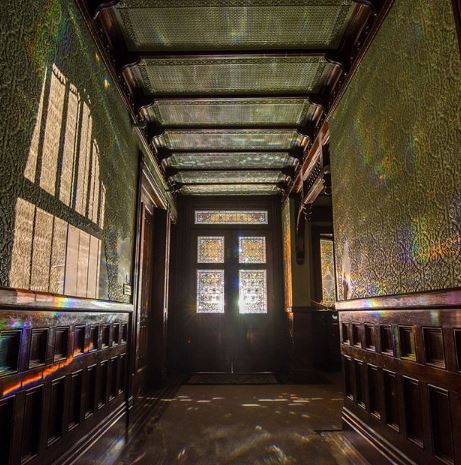
And he said unto her, What form is he of? And she said, An old man cometh up, and he is covered with a mantle. And Saul perceived that it was Samuel, and he stooped with his face to the ground, and bowed himself. And Samuel said to Saul, Why hast thou disquieted me, to bring me up? And Saul answered, I am very much distressed; for the Philistines make war against me, and God is departed from me and answereth me no more, neither by prophets, nor by dreams; therefore, I have called thee, that thou mayest make known unto me what I shall do. Then said Samuel, Why, then, dost thou ask of me, seeing the LORD is departed from thee, and is become thine enemy? And the LORD hath done to thee, as he spoke by me; for the LORD hath torn the kingdom out of thine hand, and given it to thy neighbour, even to David. Because thou obeyedst not the voice of the LORD, nor executedest his fierce wrath upon Amalek. Therefore hath the LORD done this thing unto thee this day. Moreover, the LORD will also deliver Israel with thee into the hand of the Philistines, and tomorrow shalt thou and thy sons be with me. The LORD also shall deliver the host of Israel into the hand of the Philistines. Then Saul fell immediately full length on the Earth, and was very much afraid, because of the words of Samuel; and there was no strength in him; for he had eaten no bread all the day, not all the night. And the woman came unto Saul, and saw that he was very much troubled, and said unto him, Behold, thine handmaid hath obeyed thy voice, and I have put my life in my hand, and have hearkened unto thy words which thou didst speak unto me. #RandolphHarris 2 of 13

Now, therefore, I pray thee, hearken thou also unto the voice of thine handmaid, and let me set a morsel of bread before thee; and eat, that thou mayest have strength, when thou goest on thy way. However, he refused, and said, I will not eat. However, his servants, together with the woman, compelled him; and he hearkeneth unto their voice. So he arose from the Earth, and sat upon the bed. And the woman had a fat calf in the house; and she hastened and killed it, and took flour, and kneaded it, and baked unleavened bread of it; and she brought it before Saul, and before his servants, and they did eat. Then they rose up, and went away that night (1 Samuel 28.7-25). We see God’s power at work in spite of the action of the medium, not because of her incantations, for the following reasons: First, the spirit spoke to Saul. The king never doubted that the form which appeared and the voice he heard belonged to Samuel, God’s faithful servant. Second, the message spoken by the spirit was true. It contained a rebuke to Saul for his disobedience in failing to destroy the Amalekites as God had commanded. (See 1 Samuel 15.1-31.) It was a declaration of judgment, empathically stating that the Lord had departed from Saul and become his enemy. It was also a true prophecy, for it said that Saul and his sons would die the next day, and the prediction was literally fulfilled. Yes, there is no doubt the message came from Samuel. Third, we do not believe that the witch was responsible for brining his spirit from the realm of the dead, because she screamed in terror when she saw the spirit of Samuel. She was either a fraud, able to deceive people into thinking she received messages from the other side, or a genuine medium with the ability to make contact with demons. #RandolphHarris 3 of 13

In the latter case, she would have expected a demon to impersonate Samuel. That is why she was surprised and frightened when the actual spirit of Samuel miraculously made it appearance. God was displeased that King Saul sought help from the witch of Endor. Notice the writer of 1 Chronicles says: “So Saul died for his transgression which he committed against the LORD, even against the word of the Lord, which he kept not, and also for asking counsel of a medium, to inquire of her, and inquired not of the LORD; therefore he slew him, and turned the kingdom unto David, the son of Jesse (1 Chronicles 10.13-14). This text states that these two sins of Saul brought about his death at the hand of the Philistines. First, the king had transgressed against the Lord through an act of disobedience. (See 1 Samuel 13.8-14 and 15.12-23.) Second, he sinned grievously by going to a medium instead of returning to the Lord in humble and penitent prayer. In fact, King Saul’s visit to the necromancer was the crowing sin of his troubled life. Though the New Testament does not specifically repeat the warnings against consulting mediums, it clearly teaches the existence of demons and the reality of a World of evil spirits under the direction of Satan. We have no reason for thinking that necromancy today is less dangerous or offensive to God than it the past, and we therefore must heed the Old Testament prohibitions. The Lord Jesus confirmed the Old Testament teaching that the dead cannot really send messages to the living and also showed that no need for communication with those who have died exists. In His story of the rich man and Lazarus, He portrayed Abraham as declaring first that the gulf between the saved and unsaved in the spirit World is impassable, and then as denying the rich man’s request that someone from the real of the dead warn his living brothers. #RandolphHarris 4 of 13

The patriarch said that people on Earth have the Scriptures, and added, “If they hear not Moses and the prophets, neither will they be persuaded, though one rose from the dead” (Luke 16.31). The Scriptures never once indicate the possibility of actually receiving messages from the dead through a medium. Jesus also declared that such communication with the spirits of those who have died would have no eternal value, for such conversations between citizens of two Worlds would not lead the living to faith in Christ. Then, too, the Old Testament Scriptures which unequivocally condemn all such effort are still in force today. We therefore conclude, as was mention weeks ago about Bishop Pike conversing with his dead son, must not be true. He was either the victim of a carefully and skillfully contrived plot on the part of an international group of mediums, or he spoke with a demon who impersonated the voice and mannerisms of his son. Believers should consider all forms of necromancy to be both unnecessary and sinful. The mediums who purportedly make contact with the spirit World are either entertainers, deliberately deceiving their victims, or emissaries of Satan, somehow placed in touch with members of the devil’s invisible army. When an individual seeks a message from the spirit of someone who has died, one almost always goes to a medium. Such a person possesses an unusual amount of psychic ability, supposedly enabling one to make contact with the spirit World. These people are sometimes called necromancers, and often are able to put on bizarre and frightening displays as proof of their psychic power. They may cause objects or people to float in the air, produce music from a piano that no one is touching, or cause a horn to blow which appears to be miraculously suspended and moving about the room. #RandolphHarris 5 of 13

Some of these phenomena undoubtedly are accomplished by clever mechanical means as the work of impostors, but in some instances scientific humans have discerned no evidence of human manipulated. This has caused a number of atheists and agnostics, after conducting extensive investigations, to speak vaguely of a non-material and indefinable spiritual power in the Universe with which certain psychic individuals can relate. Christians, on the other hand, know that the phenomena we have been speaking about may at least in part be attributed to the activity of the invisible spirit World, which the Bible depicts as being under Satan’s control. As you may recall, Florence Newton was committed to Youghal prison by the Mayor of the town, 24th March 1661, for bewitching Mary Longdon, who gave evidence against her at the Cork Assizes (11th September). Edward Perry was sworn in during the trial, and deposed that he, Mr. Greatrix and Mr. Blackwall went to the Maid, and Mr. Greatrix and he had read of a way to discover a Witch, which he would practise. Ans so they sent for the Witch, and set her on a Stool, and a Shoemaker with a strong Awl endeavoured to stick it in the Stool, but could not till the third time. And then they bade her come of the Stool, but she said she was very weary and could not stir. Then two of them pulled her off, and the Man went to pull out his Awl, and it dropped into his hand with half an Inch broke off the blade of it, and they all looked to have found where it had been stuck, but could find no place where any entry had been made by it. Then they took another Awl, and put it into the Maid’s hand. .and one of them took the Maid’s hand, and ran violently at the Witch’s hand with it, but could not enter it, though the Awl was so bent that none of them could put it straight again. Then Mr. Blackwall took a Launce, and launc’d one of her hands an Inch and a half long, and a quarter of an Inch deep, but it bled not at all. Then he launc’d the other hand, and then they bled. #RandolphHarris 6 of 13

He further saith, that after she was in Prison he went with Roger Hawkins and others to discourse with the Witch about the Maid, and they asked what it was she spoke to the day before, and after some denial she said it was a Greyhound which was her Familiar, and went out at the Window; and then she said, If I have done the Maid hurt, I am sorry for it. And being asked whether she had done her any hurt she said she never did bewitch her, but condess’d she had overlooked her, at that time she kiss’d her, but that she could not now help her, for none could help her that did the mishap, but others. Further the Deponent saith, That meeting after the Assizes at Cashel with one William Lap [who suggested the test of the tile]. Mr. Wood, a minister, being likewise sworn and examined, deposeth, That having heard of the stones dropped and thrown at the Maid, and of her Fits, and meeting with the Maid’s Brother, he went along with him to the Maid, and found her in her Fit, crying out against Gammer Newton, that she prick’d and hurt her. And when she came to herself he asked her what had troubled her; and she said Gammer Newton. And the Deponent saith, Why, she was not there. Yes, said she, I saw her by my bedside. The Deponent then asked her the original of all, which she related from the time of her begging the Beef, and after kissing, and so to that time. That then they caused the Maid to be got up, and sent to Florence Newton, but she refused to come, pretending she was sick, though it indeed appeared she was well. Then the Mayor of Youghal came in, and spoke with the Maid, and then sent again and caused Florence Newton to be brought in, and immediately the Maid fell into her Fit far more violent, and three times as long as at any other time, and all the Witch was in the Chamber the Maid cried out continually of her being hurt here and there, but never named the Witch: but as soon as she was removed, then she cried out against her by the name of Gammer Newton, and this for several times. #RandolphHarris 7 of 13

And still when the Witch was out of the Chamber the Maid would desire to go to Prayers, and he found good affections of her in time of Prayer, but when the Witch was brought in again, though never so privately, although she could not possibly, as the Deponent conceives, see her, she would be immediately senseless, and like to be strangled, and so would continue till the Witch was taken out, and then though never so privately carried away she would come again to her senses. That afterwards Mr. Greatrix, Mr. Blackwall, and some others, who would need satisfy themselves in the influence of the Witch’s presence, tried it and found it several times. Richard Mayre, Mayor of Youghall, sworn, saith, That about the 24th of March last he sent for Florence Newton and examined her about the Maid, and she at first denied it, and accused Goodwife Halfpenny and Goodwife Dod, but at length when he had caused a Boat to be provided, and thought to have tried the Water-Experiment on all three, Florence Newton confessed to overlooking. Then he likewise examined the other two Women, but they utterly denied it, and were content to abide any trial; whereupon he caused Dod, Halfpenny, and Newton to be carried to the Maid; and he told her that these two Women, or one of them, were said by Gammer Newton to have done her hurt, but she said No, no, they are honest Women, but it is Gammer Newton that hurts me, and I believe she is not far off. [She was then brough in privately, with the usual result.] He further deposeth that there were three Aldermen in Youghall, whose children she had kiss’d, as he had heard them affirm, and all the children died presently after. Joseph Thompson being likewise sworn, saith [the same as Nicholas Pyne relatie to the Greyhound-Familiar.] #RandolphHarris 8 of 13

Hitherto we have heard the most considerable Evidence touching Florence Newton’s witchcraft upon Mary Longdon, for which she was committed to Youghall Prison, 24th March 1661. However, April following she bewitched David Jones to death by kissing his hand through the Grate of the prison, for which she was indicted at Cork Assizes. Sarah Winchester was also afflicted by spirits after her new born daughter died six weeks after birth, and a few years later her husband perished. Although the summer sun had tanned his fair face to a rich reddish, brown, copperish hue, there was the brow more broad than high; the straight fine nose; the brave and blue eyes, and the mouth with its pretty curling smile, passersby could tell he was tormented by an internal struggle that brought on his death. With no kith or kin of hers alive, Mrs. Winchester could not bear that. She went and spoke with a medium who told her she was haunted by spirits of the Winchester rifle and needed to move West and build a castle. As long as that castle was under construction, she would be protected from the evil spirits. Mrs. Winchester eventually built a 4-story, 160 mansion, which is approximately 25,000 square feet. And boy, was a beauty (still is). However, she would not leave the house. She had a fancy that it would be cruel to her husband. She used to pray twice a day for him. She would go round by the garden and in at a lower gate, and come back the same way, or by the upper garden. This went on for many years. Before she made the bedroom on the fourth floor her main bedroom, Mrs. Winchester would sleep in different rooms sometimes, but she swore one of them was haunted, and dared never to sleep in that room again. One night, one hot night, it was a quarter before nine, and Mrs. Winchester was brushing her long shiny black hair before bed. The room was very much as it had been—rather dark because of the trees at the end of the walk outside. There was a four-poster there with the damask curtains; the table and chairs, the cupboard where her clothes were kept, and so on. #RandolphHarris 9 of 13

Having prayed even more heartily and tearfully than her want for her daughter and husband, Mrs. Winchester had lain down to sleep. The windows were left open, and the blinds up, that all possible air might reach her from the still and scented garden blow. Thinking of William, she had fallen asleep, and he was still mistily in her head, when she seemed to wake. The room was fully of clear light, but it was not morning: it was only the moon looking right in and flooding every object. Mrs. Winchester could see her own ghostly figure sitting up in bed reflecting in the looking-glass opposite. She listened: surely she heard some noises: yes—certainly, there could be no doubt of it—someone was knocking loudly and perseveringly at the hall-door. At first she fell into a deadly fear; then her reason came to her aid. If it were a robber, or a person with any evil intent, would he knock so openly and clamorously as to arouse inmates? Would not he rather go stealthily to work, to force a silent entrance for himself? At worst it is some drunken sailor from San Francisco; at best it is a messenger with news of her dear ones. At this thought, Mrs. Winchester sprang out of bed, and hurried on her stockings and shoes and whatever garments came most quickly to hand—with her hair spread all over her back, and utterly forgetful of her big comb, she opened her door, and flew down the passages, into which the moon was looking with her ghostly smile, down the broad and shallow stairs. As she neared the hall-door she met her old butler rather dishevelled, and evidently on the same errand as herself. “Who can it be, Henry?” She asked, trembling with excitement and fear. “Indeed, ma’am, I cannot tell you,” replied the butler, shaking his head, “it is a very odd time of the night to choose for making such noise. We will ask them their business, whoever they are, before we unchain the door. #RandolphHarris 10 of 13

It seemed to Mrs. Winchester as if the endless bolts would never be drawn—the key never be turned in the stiff lock; but at last the door opened slowly and cautiously, only to the width of a few inches, as it is still confined by the strong chained. However, there was no one at the door, but Mrs. Winchester could see down to the front gate, which was about a hundred yards away. She saw someone come up the walk; but it seemed to her at first that he was drunk. He staggered several times as she watched; she supposed he would be fifty yards away—and once she saw him catch hold of one of the trees and cling against it as if he were afraid of falling. Then he left it, and came on again slowly, going from side to side, with his hands out. He seemed desperately keen to get to the mansion. She could see his dress; and it astonished her that a man dressed so should be drunk; for her was quietly plainly a gentleman. He wore a white top hat, and a grey cut-away coat, and gray trousers, and Mrs. Winchester could make out his white spats. Then it struck her he might be ill; and she looked harder than ever, wondering whether she ought to go down. When he was about twenty yards away he lifted his face, and it struck Mrs. Winchester as very odd, she it seemed to her he was extraordinarily the her husband, who they had buried five months ago; but it was darkish where he was, and the next moment he dropped his face, threw up his hands and fell flat on his back. Well, of course she was startled at that, and she ran to the window and learned out and called something. He was moving his hands she could see, as if he were in convulsions; and she could hear the dry leaves rustling. She ran back to the door, the chains rattled down, the door opened wide and there he stands before her. #RandolphHarris 11 of 13

At once, before anyone could say anything, before anything had happened, a feeling of cold disappointment stole unaccountably over her—a nameless sensation whose nearest kin was a chilly awe. He made no movement towards her. He stood there still and silent, and though the night was dry, equally free from rain and dew, she saw that he was dripping wet; the water was running down from his clothes, from his drenched hair, and even from his eyelashes, on to the dry ground at his feet. “What has happened,” Mrs. Winchester cried, “Good Heavens! How are you here? How are you wet?” and as she spoke, she stretched out her hand and lay it on his coat sleeve. However, even as she does it a sensation of intense cold runs up her finger and her arm, even to the elbow. She wondered, “How is it that you are so chilled to the marrow of your bones on this sultry, breathless August night?” To her extreme surprise, he did not answer; he still stood there, numb and dripping. “Where have you come from?” Mrs. Winchester asked, with that sense of awe deepening. “It was cold,” Mr. Winchester replied, shivering, and speaking in a low and strangle altered voice, “bitter cold. I could not stay there.” “Stay where,” Mrs. Winchester say, looking in amazement at his face, which whether owning to the ghastly effect of the moonlight or not, seemed to her now ash white. “Where have you been? What is it you are talking about?” However, he did not reply. “He is really ill, I am afraid, Henry,” Mrs. Winchester said, turning with a forlorn feeling towards the butler. “He does not seem to hear what I am saying to him. I am afraid he has a thorough chill. What water can he have fallen into? You had better help him up to bed, and get him warm between the blankets. His room is quite ready for him, you know—come in,” she said, stretching out her hand to him, “you will be better after a night’s rest.” #RandolphHarris 12 of 13

Mr. Winchester did not take her offered hand, but he followed her across the threshold and across the hall. She heard the water drops falling drip, drip, on the echoing of the mahogany wood floors as he passed then upstairs, and along the gallery to the door of his room, where she left him with Henry. Then everything became blank and nil to Mrs. Winchester. She awakes as usual in the morning by the entrance of her maid Agnus with hot water. She rushed to check on Mr. Winchester, but he was gone and the bed had not been slept in. Time then convinces Mrs. Winchester that she was mistaken, and that during all the time that she thought she was standing at the open-hall door, talking to her beloved, in reality she was lying on her own bed in the depths of sleep, with no other company than the scent of the flowers and the light of the moon. At that discovery, a great and terrible depression fell on her. And she had those room torn down for she would not allow a devil-sent apparition to shake her confidence. Three more weeks passed away; the harvest is garnered, and prunes are growing soft and mellow. Towards the evening, buried in her own thoughts, it was a rather heavy and depressing evening, without a breath of wind; and it was darker than it had been for some days. Even today, as beautiful as it is, a vast solitude of villagers, who fear cackling hyenas and demons say it is haunted. In his final days, Mr. Winchester fought the demons pitchfork for pitchfork, toughening his body by robbing it of sleep, any little comfort, even sustenance. He ate only bread and salt, once a day or every two or four days, and drank water. This ascetic regime, however, did not banish the demon, he died March 7, 1881. He was in his early 40s. Mrs. Winchester went on to live a long life, and although William never lived in their mansion in San Jose, he was there in spirit. #RandolphHarris 13 of 13


O Christmas Tree, O Christmas Tree 🎄
Day tours are still available this weekend – see ticket info below!
Buy tickets | http://ow.ly/HWQq50CjjUR
 Randolph Harris II International Institute