
Home » #RandolphHarris (Page 68)
Category Archives: #RandolphHarris

It Was What We Are Really Paid for

Anyone can see and touch the telephone or computer on the nearest desk. This is not true of the networks that connect them to the World. Thus we remain, for the most part, ignorant about the high-speed advances that are fashioning them into something resembling the nervous system of our society. If not downright balderdash, the networks that Morse, Western Union, Bell, and others set up when they first began stringing wires were unsophisticated. Common sense taught that a straight line is the shortest distance between two points. So engineers sought this straight line, and messages sent from one city to another were always sent over this pathway. As these first-stage networks expanded, however, it was discovered that in the World of the network, a straight line is not necessarily the best way to get a message from one place to another. In fact, more messages could flow faster if, instead of always sending a call, say, from Tallahassee to Atlanta via the same route, the network could count the calls in each leg of the system and then shunt the Atlanta-bound call onto available lines, sending it as far away as New Orleans or even St. Louis, rather than delaying it because the shortest straight-line route happened to be busy. Primitive though it was, this was an early injection of “intelligence” or “smarts” into the system, and it meant, in effect, that the entire system leaped to a second stage of development. This breakthrough led to many additional innovations, often of marvelous ingenuity, that eventually allowed the telephone network to monitor many more things about itself, to check its components and anticipate and even diagnose breakdowns. It was as though a once-dead or inert organism suddenly began checking its own blood pressure, pulse, and breathing rate. The network became self-aware. #RandolphHarris 1 of 21

Crisscrossing the entire planet, with wires running into hundreds of millions of homes, with whole copper mines of cable snaking under the streets of cities, with complex switching systems and transmission technologies in them, these second-stage networks, constantly refined, improved, extended, and given more and more intelligence, were among the true marvels of the industrial age. Because they are largely invisible to the ordinary user, our civilization has radically underestimated the congealed brilliance and conceptual beauty of these hidden networks as well as their evolutionary significance. For while some human populations still lack even the most rudimentary telephone service, researchers are already hard at work on another revolutionary leap in telecommunications—the creation of even more sophisticated third-stage networks. Nowadays, as millions of computers are plugged into them, from giant Crays to tiny laptops, as new networks continually spring up, as they are linked to form a denser and denser interconnected mesh, a still higher level of intelligence or “self-awareness” is needed to handle the incredibly vast volumes of information pulsing through them. As a result, researchers are racing to make networks even more self-aware. Their goal is so-called neural networks. These will not only route and reroute messages, but actually learn from their own past experience, forecast where and when heavy loads will be, and then automatically expand or contract sections of the network to match the requirements. This is as though the San Diego Freeway or German Autobahn were clever enough to widen and narrow itself according to how many cars it expected at any moment. #RandolphHarris 2 of 21

Yet even before this major effect is complete, another even more gigantic leap is being taken. We are moving not into a fourth-stage system, but to another kind of intelligence altogether. Until now, even the smartest networks, including the new neural networks, had only what might be called “intra-intelligence.” All their “smarts” were aimed inward. Intra-intelligence is like the intelligence embedded in our own autonomic nervous system, which regulates the involuntary operations of the body, such as heartbeat and hormonal secretions—the functions we seldom think about, but which are necessary to sustain life. Intra-intelligent networks deliver the message precisely as sent. Scientists and engineers struggle to maintain the purity of the message, fighting to eliminate any “noise” that might garble or alter the message. They may scramble it or digitize it or packetize it (id est, break it into short spurts) to get it from here to there. However, they reconstitute it again at the receiving end. And the message content remains the same. Today we are reaching beyond intra-intelligence toward networks that might be called “extra-intelligent.” They do not just transfer data. They analyze, combine, repackage, or otherwise alter messages, sometimes creating new information along the way. Thus massaged or enhanced, what comes out the other end is different from what is fed in—changed by software embedded in the networks. These are the so-called “Value Added Networks,” or VANs. They are extra-intelligent. At present most VANs merely scramble and rescramble messages to adapt them to different media. For example, in France the Atlas 400 service of France Telecom accepts data from a mainframe computer, say, then repackages it in a form that can be received by a PC, a fax machine, or a videotex terminal. #RandolphHarris 3 of 21

Not very exciting, it would appear. However, the concept of adding value to a message does not stop with altering its technical characteristics. The French Minitel network, which links 5 million homes and businesses, offers Gatrad, Mitrad, Dilo, and other services that can accept a message in French and automatically deliver it in English, Arabic, Spanish, German, Italian, or Dutch—and vice versa. While the translations are still rough, they are workable, and some services also have the specialized vocabularies needed for subjects involving, say, aerospace, nuclear, or political topics. Other networks receive data from a sender, run them through a computerized model, and deliver an “enhance” message to the end-user. A simple hypothetical example illustrated the point. Imagine that a trucking firm based in the outskirts of Paris must regularly dispatch its trucks to forty different European distributors, restocking their shelves with a product. Road conditions and weather differ in various parts of Europe, as do currency exchange rates, gasoline prices, and other factors. In the past each driver calculated the best route, or else phoned the transport company each day for instructions. However, imagine instead that an independent VAN operator—a common carrier—not only can send signals to truck drivers all over Europe, but also collects current information on road conditions, traffic, weather, currencies, and gas prices. The Paris trucker can now load its daily messages and routing instructions onto the VAN for distribution to its drivers. However, the messages, before reaching the drivers, are run through the network’s software program, which automatically adjusts routes to minimize driving time, milage, gas costs, and currency expenses in light of the latest data. #RandolphHarris 4 of 21

In this case, the instructions sent by the transport firm to its drivers are altered enroute and “enhanced” before reaching them. The telecommunications carrier firm—the operator of the Value Added Network—has added value by integrating the customer’s message with fresh information, transforming it, and then distributing it. This, however, suggests only the simplest use of an extra-intelligent net. As the networks come to offer more complex services—collecting, integrating, and evaluating data, drawing automatic inferences, and running input through sophisticated models—their potential value soars. In short, we are now looking toward networks whose “smarts” are no longer aimed at changing or improving the network itself but which, in effect, act on the outside World, adding “extra-intelligence” to the messages flowing through them. Still largely a gleam in their architects’ eyes, extra-intelligent nets represent an evolutionary leap to a new level of communication. They also raise to a higher level the sophistication required of their users. For a company to load its messages on a VAN and permit them to be altered without a deep understanding of the assumptions buried in the VAN’s software is to operate on blind faith, rather than rational decision. For hidden biases built into the software can cost a user dearly. Foreign airlines, for example, have complained to the U.S. Department of Transportation that they are discriminated against in the electronic network that thousands of U.S. travel agents use in choosing flights for their clients. Called Sabre, the computerized reservation system is run by AMR Corp., which also owns American Airlines. The system, which monitors reservations on many airlines, has extra-intelligence embedded in it in the form of a software model that tells the travel agent the best available flights. At issue in the complaint were the assumptions built right into this software. #RandolphHarris 5 of 21

Thus, when a travel agent searches, say, for a flight from Frankfurt, to San Jose, California, her computer screen displays the flights in order depending upon the length of time they take. The shorter the flight the better. However, the Sabre software automatically assumed that changing the planes and transferring from one airline to another takes ninety minutes, irrespective of the actual time required. Since many of their flights to the United States of America required a change of plane and transfer to a domestic American airline, the foreign carriers charged that the hidden premises of the software unfairly penalized those whose interline transfers require less than ninety minutes. For this reason, they argued, their flights were less likely to be chosen by travel agents. In short, the extra-intelligence was biased. Imagine, soon, not a handful of such disputes and networks, but thousands of VANs with tens of thousands of built-in programs and models, continually altering and manipulating millions of messages as they whiz through the economy along these self-aware electronic highways. Britain alone already boasts eight hundred Vans, West Germany seven hundred, and more than five hundred companies in Japan have registered with the Ministry of Posts and Telecommunications to operate VANs. The existence of VANs promises to squeeze untold billions of dollars out of today’s costs of production and distribution by slashing red tape, cutting inventory, speeding up response time. However, the injection of extra-intelligence into these fast-proliferating and interlinked nets has a larger significance. It is like the sudden, blinding addition of a cerebral cortex to an organism that never had ones. Combined with the automatic nervous system, it begins to give the organism not merely self-awareness and the ability to change itself, but the ability to intervene directly in our lives, beginning first with our business. #RandolphHarris 6 of 21

Because of this, networks will take on revolutionary new roles in business and society. And even though, so far as we know, no one has yet used extra-intelligence for pernicious or even criminal purposes, the spread of extra-intelligent networks is still in its infancy, with rules and safeguards yet to be defined. Who knows what will follow? By creating a self-aware electronic neural system that is extra-intelligent, we change the rules of culture as well as business. E-I, as we may call it, will raise perplexing questions about the relationships of data to information and knowledge, about language, about ethics and the abstruse models concealed in software. Rights or redress, responsibility for error or bias, issues of privacy and fairness will all cascade into executive suits and the courts in the years to come as society tries to adapt to the existence of extra-intelligence. As the implications of E-I will someday reach far beyond mere business matters, they should cause deep social, political, and even philosophical reflection. For prodigies of labour, intellect, and scientific imagination that dwarf anything involved in constructing Egyptian pyramids, medieval cathedrals, or Stonehenge are now being poured into the construction of the electronic infrastructure of tomorrow’s super-symbolic society. E-I, as we shall see in the following reports, is already upsetting power relationships in whole sectors of the emerging economy. In the past, economic development and poverty reduction depended mainly on a country’s domestic factors—the availability of capital, local resources and environment, along with the propensity of the population to save, the drive, energy and work habits of the labour force, and so forth. Since the mid-1950s, this has been less and less the case. As the World economy has become more integrated, with trade, people, capital and especially knowledge moving across boundaries, external factors have risen in importance. #RandolphHarris 7 of 21

And that includes indirect, second-order effects all too often unnoticed or ignored. The future of poverty cannot be understood until these spillover implications are taken into account. A good example can be seen in the amazing chain reaction that helpful fuel Asia’s economic rise—a rise that has seen more than a billion Asians climb above the two-dollar-a-day poverty line in just forty years. The story actually began in the mid-1950s as the United States of America started its development of a knowledge-based wealth system. Across the Pacific, Japan’s industrial economy, having been ground into dust during World War II, was still pathetic. Its defeated military was nonexistent and its politics were shaky at best. At this pivotal moment, the United States of America, facing an ascendant, nuclear-armed Soviet Union, reached a three-part deal with Japan. Militarily, Japan would ally with the United States of America against the threat posed by the communist U.S.S.R. In return, politically, the United States of America would tacitly support the conservative Liberal Democratic Party; economically, it would fling its doors wide open to Japanese exports. The problem with this last point was that Japan had little to sell that Americans might want. Around the World, some Japanese products were not the most desirable at the time. In a British play as late as the 1970s, actor Robert Morley still got a laugh by referring to “typical Japanese muck.” However, by then Japanese exports were no longer “muck.” Japan solved its muck problem by drawing on two largely American innovations. The first involved statistical quality-control methods spread throughout Japan by Joseph M. Juran and W. Edwards Deming during the 1950s and ‘60s. Assembly-line perfection became a national passion. (For their contributions, the emperor awarded both men the Order of the Sacred Treasure.) #RandolphHarris 8 of 21

Quality did not always become a catchword in U.S.A. manufacturing for decade or two, even though Americans were making some of the most durable products known to man. And while Toyotas, Honda, and Nissans used to routinely outrank the cars of Detroit and Europe in J.D. Power quality surveys, Cadillac, Chevy, Ford, Audi, BMW, and Mercedes-Benz are becoming more desirable to the America consumer. The other American contribution was the industrial robot, about which a similar story can be told. In 1956, engineer Joseph F. Engelberger and entrepreneur George C. Devol met one evening over cocktails and discussed I, Robot, Isaac Asimov’s classic science-fiction novel. Together they set up a company, named it Unimation (for “universal automation”), and, five years later, delivered the World’s first working industrial robot. General Motors installed it in its plant outside Trenton, New Jersey, but other American companies showed little enthusiasm for the new computer-driven technology. “I had a hard time with American industrialist[s],” Engelberger later said. By contrast, he continued, “the Japanese caught on right away. That’s why robotics is a $7 billion industry and it’s dominated by Japan.” In 1965, according to the Japan Automobile Manufacturers Association, “new technologies…became a top priority.” More specifically, by 1970, digital technology, much of it imported from the United States of America, led “in short while to a computerization of the entire manufacturing process,” while robots “gradually eliminated the need for humans to perform dangerous work.” By the late 1970s, according to John A. Kukowski and William R. Bolton in a Japanese Evaluation Center report, “Japan was the World leader in industrial assembly robots, and in 1992 it operated 69 percent of all installed industrial robots in the World, compared with 15 percent operated by Europe and 12 percent by the United States.” #RandolphHarris 9 of 21

The combination of U.S. technological knowledge and an American hunger for Japanese products, plus Japan’s own technological savvy and underestimated innovativeness, shot adrenaline into its economy. While its factories poured out such consumer products as VCRs, TVs, cameras and stereos, Japan also moved aggressively into semiconductor chips and computer components for the American market, brining itself father toward knowledge-based production. By 1979, Japan was IMB’s chief rival in the manufacture of computers, and a book entitled Japan as No. 1 attracted attention on both sides of the Pacific. The author attributed much of the Japanese corporation’s success to its ravenous hunger for knowledge and its emphasis on training—brining in foreign consultants and sending countless teams out to visit World centers where the most advanced knowledge was being pursued. The first secret of Japanese success was “learning, learning, learning.” The second was creative commercial application of new knowledge. The third was speed. Thus, by the 1980s, Japanese chip technology was advancing so rapidly that Washington slapped trade limits on the importation of Japanese semi-conductors. Cars, consumer electronics, computers, chips, copiers—none of these, on the surface, seemed relevant to the lives of some less affluent people in Asia. Or to the attack of poverty. However, they were. Now, many people are left wondering if microtechnology will lead to nanotechnology? Can bulldozers be used to make wristwatches? At most, they can help to build factories in which watches are made. Though there could be surprises, the relevance of microtechnology to molecular nanotechnology seems similar. Instead, a bottom-up approach is needed to accomplish engineering goals on the molecular scale. #RandolphHarris 10 of 21

What are the main tools used for molecular engineering? Almost by definition, the path to molecular nanotechnology must lead through molecular engineering. Working in different disciplines, driven by different goals, researchers are making progress in this field. Chemists are developing techniques able to build precise molecular structures of sorts never before seen. Biochemists are learning to build structures of familiar kinds, such as proteins, to make new molecular objects. In a visible sense, most of the tools used by chemists and biochemists are rather unimpressive. They work on countertops cluttered with dishes, bottles, tubes, and the like, mixing, stirring, heating, and pouring liquids—in biochemistry, the liquid is usually water with a trace of material dissolved in it. Periodically, a bit of liquid is put into a larger machine and s trip of paper comes out with a graph printed on it. As one might guess from this description, research in the molecular sciences is usually much less expensive than research in high-energy physics (with its multibillion-dollar particle accelerators) or research in space (with its multibillion-dollar spacecraft). Chemistry has been called “small science,” and not because of the size of the molecules. Chemists and biochemists advance their field chiefly by developing new molecules that can serve as tools, helping to build or study other molecules. Further advances come from new instrumentation, new ways to examine molecules and determine their structures and behaviours. Yet more advances come from new software tools, new computer-based techniques for predicting how a molecule with a particular structure will behave. Many of these software tools let researchers peer through a screen into simulated molecular Worlds much like those toured in past reports. #RandolphHarris 11 of 21

Of these fields, it is biomolecular science that is most obviously developing tools that can build nanotechnology, because biomolecules already form molecular machines, including devices resembling crude assemblers. This path is easiest to picture, and can surely work, yet there is no guarantee that it will be fastest: research groups following another path may well win. Each of these paths is being pursued Worldwide, and on each, progress is accelerating. Physicists have recently contributed new tools of great promise for molecular engineering. These are the proximal probes, including the scanning tunneling microscope (STM) and the atomic force microscope (AFM). A proximal-probe (and sometimes modify) the surface and any molecules that may be stuck to it. An STM brings a sharp, electrically conducting needle up to an electrically conducting surface, almost touching it. The needle and surface are electrically connected so that a current will flow if they touch, like closing a switch. However, at just what point do soft, fuzzy atoms “touch”? It turns out that a detectable current flows when just two atoms are in tenuous contact—fuzzy fringes barely overlapping—one on the surface and one on the tip of the needle. By delicately maneuvering the needle around over the surface, keeping the current flowing at a tiny, constant rate, the STM can map shape of the surface with great precision. Indeed, to keep the current constant, the needle has to go up and down as it passes over individual atoms. The STM was invented by Gerd Binnig and Heinrich Rohrer, research physicists studying surface phenomena at IMB’s research labs in Zurich, Switzerland. After working through the 1970s, Rohrer and Binnig submitted their first patent disclosure on an STM in mid-1979. In 1982, they produced images of a silicone surface, showing individual atoms. #RandolphHarris 12 of 21

Ironically, the importance of their work was not immediately recognized: Rohrer and Binnig’s first scientific paper on the new tool was rejected for publication on the grounds that it was “not interesting enough.” Today, STM conferences draw interested researchers by the hundreds from around the World. In 1986—quite promptly as these things go—Binnig and Rohrer were awarded a Noble Prize. The Swedish Academy explained its reasoning: “The scanning tunneling microscope is completely new and we have so far seen only the beginning of its development. It is, however, clear that entirely new fields are opening up for the study of matter. STMs are no longer exotic: Digital Instruments of Santa Barbara, California, sells its system (The Nanoscope@) by mail with an atomic-resolution-or-your-money-back guarantee. Within three years of their commercial introduction, hundreds of STMs had been purchased. How does an AFM work? The related atomic force microscope is even simpler in concept: A sharp probe is dragged over the surface, pressed down gently by a straight spring. The instrument senses motions in the spring (usually optically), and the spring moves up and down whenever the tip is dragged over an atom on the surface. The tip “feels” the surface just like a fingertip in the simulated molecular World. The AFM was invented by Binnig, Quate, and Gerber at Stanford University and IBM in San Jose in 1985. After the success of the STM, the importance of the AFM was immediately recognized. Among other advantages, it works with nonconducting materials. AFM-based devices might be used as molecular manipulators in developing molecular nanotechnology. (Note that AFMs and STMs are not quite as easy to use as these descriptions might suggest. For example, a bad tip or a bad surface can prevent atomic resolution, and pounding on the table is not recommended when such sensitive instruments are in operation. Further, scientists often have trouble deciding just what they are seeing, even when they get a good image.) #RandolphHarris 13 of 21

Speaking of images, the bias toward the peaks of television content is possibly most tragic when it comes to news. Since much of life is now removed from our direct experience, the news that we get from afar becomes our total information on the forces that shape and move our lives. That makes the distortions in it a very serious matter. When Walter Cronkite says, “And that’s the way it is,” he is surely aware that that’s the way it is only within those events, only in those aspects that fit the standards of “good television.” Presenting events exactly as they occur does not fit with the requisites of television news….Given the requirement that a network news story have definite order, time and logic, it would be insufficient in most cases to record from beginning to end the natural sequence of events, with all the digression, confusions and inconsistencies that more often than not constitute reality. Cameramen and women seek out the most action-packed moments; and editors then further concentrate the action. Even when an event is characterized by an unexpected low degree of activity, television can create the illusion of great activity. The relatively unenthusiastic reception General MacArthur received in Chicago during his homecoming welcome in 1951 thus appeared to be a massive and frenetic reception on television because all the moments of action were concentrated together. In collapsing the time frame of events and concentrating the action into a continuous flow, television news tends to heighten the excitement of any group or other phenomena it pictures, to the neglect of the more vapid and humdrum elements. Their jobs are to cut out all the dead wood and full moments. The procedure involves routinely eliminating the intervals in which little of visual interest occurs, and compressing the remaining fragments into one continuous montage of unceasing visual action. #RandolphHarris 14 of 21

For instance, an attempt by the SDS faction at Columbia University to block the registration of students in September of 1968, involved, according to my observations, a few speeches by SDS leaders, hours of milling about, in which the protest more or less dissipated for lack of interest, and about one minute of violence when five SDS leaders attempted to push their way past two campus patrolmen. The hours of film taken that day by an NBC camera crew recorded various views of the crowd from 9.00 am until the violence at about 2.00 pm, and the minute or so of violent confrontation. However, when the happening was reduced to a two-minute news story for the NBC Evening News, the editors routinely retained the violent scenes, building up to them with quick cuts of speeches and crowd scenes. The process of distilling action from preponderantly inactive scenes was not perceived as any sort of distortion by any of the editors interviewed. On the contrary, most of them considered it to be the accepted function of editing; as one chief editor observed, it was “what we are really paid for.” The results of the bias toward highlighted news content were put even more succinctly by John Birt in TV Guide (August 9, 1975). He points out that some of the elements of news fit the needs of the medium more directly than others, and the result is a serious “bias in understanding…trying to come to grips with the often-bewildering complexity of modern problems…is a formidable task, even without trying to put the result on television; and the failure rate is high. The realities one is seeking are abstract—macroeconomic mechanisms, political philosophies, international strategies—and cannot be directly televised like a battle sone or a demonstration.” #RandolphHarris 15 of 21

Even when an effort is made to cover subtle or complex material, the decision is made to choose only the most televisable elements. So a specific case of, say, a starving family will be chosen, rather than an overall look at its cause, which is more complicated and less televisable. The latter, runs the risk of being boring. A well-made report on a famine, or even on one starving family in Appalachia, will be more watchable than a report on the World food problem. A program on living conditions in Watts, Harlem, or Midtown Sacramento will be more diverting than a report on housing policy. I believe that the various forms and techniques of TV journalism can all too easily conspire together to create a bias against the audience’s understanding of the society in which it lives. The problem could be solved by lengthening the time devoted to the main stories of the day, so that a more comprehensive understanding of them might develop. Of course this would result in giving less time to the stores that are not the “main” ones, and so the recommendation seems to contradict earlier remarks. In effect, it would leave some news highlighted to an even greater extent in the World? Obviously not. It would leave people even more transfixed by the out-of-context information which is chosen. The reason for the contradiction is that we cannot bear to face the implications of what is happening. To face the inevitable drift of this reasoning leads straight to the observation that news, like all other information on television, is inevitably and irrevocably biased away from some forms of content and toward others. If this is true, then we really do not know which end is up and which is down. We take things as they come. The evolutionary approach is based on a simple principle; whatever is successful is likely to appear more often in the future. The mechanism can vary. In classical Darwinian evolution, the mechanism is natural selection based upon differential survival and reproduction. #RandolphHarris 16 of 21

In Congress, the mechanism can be an increased chance of reelection for those members who are effective in delivering legislation and services for their constituency. In the business World, the mechanism can be the avoidance of bankruptcy by a profitable company. However, the evolutionary mechanism need not be a question of life and death. With intelligent individuals, a successful strategy can appear more often in the future because other players convert to it. The conversation can be used based on more or less blind imitation of the successful players, or it can be based on a more or less informed process of learning. The evolutionary process needs more than differential growth of the successful. In order to go very far it also needs a source of variety—of new things being tried. In the genetics of biology, this variety is provided by mutation and by a reshuffling of genes with each generation. In social processes, the variety can be introduced by the “trial” in “trial and error” learning. This kind of learning might not reflect a high degree of intelligence. A new pattern of behaviour might be undertaken simply as a random variant of an old pattern of behaviour, or the new strategy could be deliberately constructed on the basis of prior experience and a theory about what is likely to work best in the future. The ability to detect radiation has been bestowed on a group of experimental cats, each of which is wired into a portable, miniature Geiger counter that telemeters electrical impulses directly to the feline brain via implanted electrodes. The square-wave electrical impulses are similar to normal nervous impulses. They are transmitted to a portion of the brain that is associated with fear reactions, causing cats to shy away from radioactive sources. It is reasonable to speculate that in near future the stimoreciever [instruments for radio transmission and reception of electrical messages to and from the brain] may provide the essential link from man to computer to man, with a reciprocal feedback between neurons and instruments which represents a new orientation for the medical control of neurophysiological functions. For example, it is conceivable that the localized abnormal activity which announces the imminence of an epileptic attack could be picked up by implanted electrodes, telemetered to a distant instrument room, tape-recorded, and analyzed by a computer capable of recognizing abnormal electrical patters. #RandolphHarris 17 of 21

Identification of the specific electrical disturbance could trigger the emission of radio signals to activate the patient’s stimoreceviver and apply an electrical stimulation to a determined inhibitory area of the brain, thus blocking the onset of the convulsive episode. By the turn of the century, it is likely that every major organ except the brain and the central nervous system will have artificial replacements. Scientists are working on replacement parts for organs such as the pancreas, heart, ear, eyes and more. The concept of total prothesis seems plausible. Creating an artificial human brain, however, is a little more difficult. Some say it will never happen. Since the first Artificial Intelligence experiments, attempts to mimic complex human neural activity with the crudities of current electronic hardware have been plagued with challenging problems. Breakthroughs in this line of research might take place through electro-biological engineering or hybridization of computer architecture with molecular engineering. The U.S. Defense Advanced Research Projects Agency is working on what is known as the Molecular Electronic Device (MED) or “biochip.” There are several designs for these organic microprocessors, but the essential idea is to use protein molecules or synthetic organic molecules as computing elements to store information or act as switches with the application of voltage. Signal flow in this case would be by sodium or calcium ions. Others feel that artificial proteins can be constructed to carry signals by electron flow. Still another idea is to “metalize” dead neuronal tissues to produce processing devices. The ultimate scenario is to develop a complete genetic code for the computer that would function as a virus does, but instead of producing more virus, it would assemble a fully operational computer inside a call. That is nanotechnology at work. #RandolphHarris 18 of 21

The very notion that computer chips could be “grown” or that living and inert matter could be fused together on a molecular level promises surprises ahead for those with orthodox nations of mind and body. As machines become more and more responsive to human internal experiences (from the desire to move a limb or even rage or pleasures of the flesh), we will probably reach a stage at which every subtle nuance of imagination and consciousness can be realized, stored and displayed through machinery. And at some point in the future it will be possible to “will” events to occur. New twists in the evolution of the brain might be brought about through our own manipulation of the elements of biological science. If we seriously consider that hand tools must have come into existence together, then it follows that the tool’s transformation into an “organism” capable of monitoring and responding to our biological functions transforms us as well. The human body can be seen as a complex machine, but it is so much more. Bureaucracy is an attempt to rationalize the flow of information, to make its use efficient to the highest degree by eliminating information that diverts attention from the problem at hand. There is a prime example of such bureaucratic rationalization in the 1884 decision to organize time, on a Worldwide basis, into twenty-four time zones. Prior to this decision, towns only a mile or two apart could and did differ on what time of day it was, which made the operation of railroads and other businesses unnecessarily complex. By simply ignoring the fact that solar time differs at each node of a transportation system, bureaucracy eliminated a problem of information chaos, much to the satisfaction of most people. However, not everyone. It must be noted that the idea of “God’s own time” had to be considered irrelevant. This is important to say, because, in attempting to make the most rational use of information, bureaucracy ignores all information and ideas that do not contribute to efficiency. The idea of God’s time made no such contribution. #RandolphHarris 19 of 21

A university is a bureaucracy, and successful ones are the proof that society can be devoted to the well-being of all, without stunting human potential or imprisoning the mind to the goals of the regime. The deepest intellectual weakness of democracy is its lack of taste or gift for the theoretical life. However, the issue is not whether we possess intelligence but whether we are adept at reflection of the broadest and deepest kind. We need constant reminders of our deficiency, now more than in the past. The great European universities used to act as our intellectual conscience, but with their decline, we are on our own. Nothing prevents us from thinking too well of ourselves. It is necessary that there be an unpopular institution in our midst that sets clarity above well-being or compassion, that resists our powerful urges and temptations, that is free of all snobbism but has standards. Those standards are in the first place accessible to us from the best of the past, although they must be such as to admit of the new, if it actually meets those standards. If nothing new does meet them, it is not a disaster. The ages of great spiritual fertility are rare and provide nourishment for others less fertile ones. What would be a disaster would be to lose the inspiration of those ages and have nothing to replace it with. This would make it even more unlikely that the rarest talents could find expression among us. The Bible and Homer exercised their influence for thousands of years, preserved in the mainstream or in backwaters, hardly every being surpassed in power, without becoming irrelevant because they did not suit the temper of the times or the spirit of a regime. They provided the way out as well as the model for reform. In the creation of man, the two urges are set in opposition to each other. The Creator gives them to man as His two servants which, however, can only accomplish their service in genuine collaboration. #RandolphHarris 20 of 21

The “evil urge” is no loess necessary than its companion, indeed even more necessary than it, for without it man would woo no woman and beget no children, build no house and engage in no economic activity, for it is true that all travail and all skill in work is the rivalry of a man with his neighbour. Hence this urge is called the yeast in the dough, the ferment placed in the soul by God, without which the human dough does not rise. Thus, a man’s status is necessarily bound up with the volume of “yeast” within him; whoever is greater than another, his urge is greater than the other’s. Wonderful civilization? I will not object to the adjective—it rightly describes it—but I do object to the large and complacent admiration which it implies. By all accounts—yours in chief, Excellency—the pure and sweet and unenlightened and unsordid civilization of Eden was worth a thousand millions of it. What is a civilization, rightly considered? Morally, it is the evil passions repressed, the level of conduct raised; spiritually, idols cast down, God enthroned; materially, bread and fair treatment for the greatest number. That is the common formula, the common definition; everybody accepts it and is satisfied with it. Our civilization is wonderful, in certain spectacular and meretricious ways; wonderful in scientific marvels and inventive miracles; wonderful in material inflation, which it calls advancement, progress, and other pet names; wonderful in its spying-out of the deep secrets of Nature—and its vanquishment of her stubborn laws; wonderful in its extraordinary financial and commercial achievements; wonderful in its hunger for money, and in its indifference as to how it is acquired; wonderful in the hitherto undreamed of magnitude of its private fortunes and the prodigal fashion in which they are given away to institutions devoted to the public culture. “And it came to pass that there were sorceries, and witchcrafts, and magics; and the power of the evil one was wrought upon all the face of the land, even unto the fulfilling of all words of Abinadi, and also Samuel and Lamanite,” reports Mormon 1.19. #RandolphHarris 21 of 21

Cresleigh Homes

The design of #Havenwood Model 3 is ideal for anyone who loves to entertain – and we know you do! 🥂 The open floor plan allows for maximum seating and mingling space, and it’s just waiting for a brilliant host/hostess to set out the premimum cranberry juice 🍷 and charcuterie! 🧀

Lot 75 is up for sale and all ready for you! Contact us with questions and let’s get the ball rolling – don’t let summer 2022 🌞 pass you by without making moves to your brand new digs at #CresleighHomes!

Explore our exciting collection of ranch-style floor plans, ready to personalize with your choice of finishes, flooring, faucets and home technology. https://cresleigh.com/havenwood/

Provided in Cresleigh Homes are spacious great room sand an open dinings area that flow into a spacious kitchens with large center islands and walk-in pantries.

Residence Three is the largest of the single story homes offered in Cresleigh Havenwood. At 2,827 square feet you’ll be hard pressed to a contemporary floorplan that offers this much space. There are four bedrooms, two and one half bathrooms, and a three car garage. https://cresleigh.com/havenwood/residence-three/

Sudden Shocks and Surprises, Explosive Passions, and Frequent Catharsis

Before the industrial revolution, horrific poverty was not just concentrated in Africa, Asia or Latin America. According to historian Fernand Braudel, in the Beauvaisis region of France in the seventeenth century, over one third of all children died every year. Only about 60 percent reached the age of fifteen. Braudel describes a Europe swept by plague and recurrent famine. The poor crowded into cities, begging and stealing to stay alive. Children and wives were routinely abandoned, many doomed to perish in poorhouses alongside the elderly and infirm. Nobel Prize-winning economic historian Robert Fogel points out that “the energy value of the typical diet in France at the start of the 18th Century was as low as that of Rwanda in 1965, the most malnourished nation for that year.” France was not alone. For ten thousand years, only the tiniest fraction of the World’s population ever lived above the barest subsistence level. And the World’s richest countries were only twice as rich as the poorest. If this was roughly true around the globe, with all the diversity of agrarian people, cultures, climates, religions and farming methods, it strongly suggests that peasant agriculture had at some point hit its upper limit of productivity. It was only after the industrial wealth system began to replace agriculture that the population soared and significant numbers of people crawled out of utter destitution. This history led economists and policy-makers to a common prescription for what is still called “development” or “modernization”—a strategy for moving a country’ workforce and economy from low-productivity, low-value-added farming to more productive, low-tech manufacturing and its support services. #RandolphHarris 1 of 20

From the early 1950s on, this Second Wave strategy was propagated in endless variants by experts from the United States of America, Europe, Russia, the United Nations and NGO (Non-Government Organization) development agencies. Its message was, essentially, that each country had to replay the industrial revolution. And, indeed, there was no realistic alternative model. After the 1960s, some critics attacked this strategy and proposed focusing not on factories and the urbanization that came with them but on small-scale “appropriate” or “alternative” technologies that are sustainable and use local resources. Since them, this movement has broadened, encouraging microfinance and the creation of small business in poor-World countries, reaching out to science, and becoming more sophisticated. Many imaginative innovations have flowed from this movement. However, it is essentially designed to stop or slow further industrialization and to keep peasant populations on the land. Moreover, in their assumption that “small is beautiful,” many of the movement’s militant adherents still romanticize machines and make little distinctions between industrial and knowledge-intensive technologies. Claiming that both these technologies serve only the rich, critics ignore the benefits they have, in fact, brought to millions of the World’s destitute. More important, they do not understand that Third Wave technologies have already indirectly raised huge members out of misery and offer for the first time in more than three centuries fresh, powerful ways to attack the poverty of the poorest. Worldwide, as more and more of the economy came to depend on phones, the companies or government agencies that provided or regulated them became enormously powerful too. In the United States of America, AT&T, otherwise known as the Bell System or Ma Bell, became the dominant supplier of telecommunications services. #RandolphHarris 2 of 20

It is hard for those accustomed to decent telephone service to imagine operating an economy or a business without it, or to function in a country where the telephone company (usually the government) can deny even basic phone service or delay its installation for years. This bureaucratic power gives rise to political favoritism, payoffs, and corruption, slows down national economic development, and frequently determines which enterprises have a chance to grow and which must fail. Yet such is the situation still prevailing in many of the formerly socialist and nonindustrial nations. Even in the technologically advances nations, phone service suppliers and regulators can control the fate of entire industrial sectors, by providing or refusing specialized services, setting differential prices, and through other means. Sometimes angry or frustrated user strike back. In fact, the biggest corporate restructuring in history, the court-ordered breakup of AT&T in 1984, can illustrate the point. The U.S. government had been trying without success to dismantle AT&T since the 1940s on grounds that it was charging customers too much. Government attorneys hauled the company into court, cases dragged on interminably, but nothing fundamental changed. Warning shots were fired across the corporation’s bow, but even during Democratic administrations pledged to strong antitrust action, nothing cracked the AT&T grip on the U.S. communications system. What ultimately shifted the power balance was a combination of new technology and the irrepressible demand of business phone users for more and better service. Starting in the 1960s, a large number of American businesses had begun installing computers. Simultaneously, satellites and many other new technologies erupted from the laboratories—some of them out of AT&T’s own Bell Labs. #RandolphHarris 3 of 20

Soon corporate computer users began demanding a great variety of new data network services. They wanted computers to be able to talk to one another. They knew the necessary technology was feasible. However, the diverse data services they desperately needed represented, at the time, to small a market to whet Ma Bell’s appetite. As a protected monopoly the phone company had no competition, and was therefore slow to respond to these new needs. As computers and satellites spread, however, and more companies needed to link them up, business disgruntlement with AT&T intensified. IMB, the prime supplier of mainframes, presumably lost business because AT&T was dragging its feet, and had other reasons for wishing to see AT&T’s monopoly cracked. All these unhappy corporations were politically savvy. Gradually anti-AT&T sentiment in Washington mounted. Ultimately, it was the combination of new technologies and rising hostility to Ma Bell that provided the political climate for the climactic bust-up that occurred. Breaking AT&T into pieces, the court, for the first time since the early decades of the century, opened telecommunications in the United States of America to competition. There were, in other words, structural forces, not merely legal reasons, behind the massive breakup. Just as an overwhelming business demand for better communications had defeated Western Union a century earlier, so again, new technologies and an overwhelming unmet demand for new services ultimately defeated AT&T. By now the rate of technological change has become white-hot and companies are far more dependent on telecommunications than ever in history. #RandolphHarris 4 of 20

The result is that airlines, car makers, and oil companies are all engaged in a many-sided war for control of the emerging communications system. Indeed, as we will shortly see, truckers, warehousers, stores, factories—the entire chain of production and distribution—are being shaken. Moreover, as money becomes more like information, and information more like money, both are increasingly reduced to (and moved around by) electronic impulses. As this historic fusion of telecommunications and finance deepens, the power inherent in the control of networks increases exponentially. All this explains the fierce urgency with which companies and governments alike are hurling themselves into the war to control the electronic highways of tomorrow. Amazingly, however, few top business leaders actually understand the stakes, let alone the fantastic changes restructuring the very nature of communications in our time. In the territorial system, people tend to not want to apologize and wins a great many converts from its neighbours. When one of these apologizers is next to someone who does not like to admit fault, and the other three neighbours are nice, the one who does not like to apologize is likely to do better than any of its four neighbours as well. Thus, in a social system based on diffusion by imitation, there is a great advantage to being able to attain outstanding success, even if it means that the average rate of success is not outstanding. This is because the occasions of outstanding success win many converts. The fact the stubborn neighbour starts off being nice means that it avoids unnecessary conflict, and continues to hold its own when the rules which are not nice are eliminated. The advantage of being stubborn is based on the fact that while five rules are abjectly apologetic to it, no other nice rule elicits such apologies from more than two other rules. #RandolphHarris 5 of 20

The territorial system demonstrates quite vividly that the way the players interact with each other can affect the course of the evolutionary process. A variety of structures have now been analyzed in evolutionary terms, although many other interesting possibilities await analysis. Each of the five structures reveal different facets of the evolution of cooperation: Random mixing was used as the fundamental type of structure. Cooperation based upon reciprocity can thrive even in a setting with such a minimal social structure. Clusters of individuals were examined to see how the evolution of cooperation could have gotten started in the first place. Clusters allow a newcomer to have at least a small chance of meeting another newcomer, even though the newcomers themselves are a negligible part of the whole environment of the natives. Even if most of a newcomer’s interactions are with uncooperative natives, a small cluster of newcomers who use reciprocity can invade a population of meanies. Differentiation of the population was shown to occur when the individuals have more information about each other than is contained in the history of their own interaction. If the people have labels indicating their group membership or personal attributes, stereotyping and status hierarchies can develop. If the individuals can observe each other interacting with others, they can develop reputations; and the existence of reputations can lead to a World characterized by efforts to deter bullies. Governments were found to have their own strategic problems in terms of achieving compliance from most of their citizens. Not only is this a problem of choosing an effective strategy to use in a particular case, but it is also a question of how to set the standards so that compliance will be both attractive to the citizen and beneficial to the society. #RandolphHarris 6 of 20

Territorial systems were examined to see what would happen if the individuals interacted only with their neighbours and imitated a neighbour who was more successful than they were. Interactions with neighbours were found to give rise to intricate patterns in the spread of particular strategies, and to promote the growth of these strategies that scored unusually well in some setting even though they did poorly in others. Compared to football, baseball is an almost an Eastern game, minimizing individual stardom, requiring a wide range of aggressive and defensive skills, and filled with long periods of inaction and irresolution. It has no time limitations. Football, on the other hand, has immediate goals, resolution on every single play, and a lot of violence—itself a highlight. It has clearly distinguishable hierarchies: heroes and drones. Baseball is virtually a process game. Not that baseball is a process the way oceans and coffeehouses and conversations and love are, but in the context of sports it is more process oriented than many. Soccer has even fewer peaks than baseball. The action flows over an immense field. Moments of focused concentration are rare. There is very little resolution from minute to minute. Boxing, on the other hand, is very focused, involving constant action, frequent resolution and peaks of personal catharsis. Basketball, although it is a flow sport like soccer, is played on a small field and involves highlighted events—baskets—every few seconds. Naturally football has totally overpowered baseball on television and so have boxing and basketball. Meanwhile, soccer is rarely presented, and when it is, it communicates almost nothing. #RandolphHarris 7 of 20

Television, which is better suited to football and boxing than to soccer, is also better suited to any sporting event than to probing of alternative consciousness or natural environments, or any delving into relationships, all of which require emphasis on process: the in-between spaces. Within the range of all human experience, and all possible programming, any sport contains more clearly highlighted action than, say, 99 percent of human relationships, except for those with a component of pleasures of the flesh or violent orientation. The dramatic programs, featuring jealousy, hatred, desire, fear, humiliation, ebullience, are not only the most visible on television, they are also the most emotionally loaded, with the larger cathartic payoffs, like home runs or touchdowns or wars. They pass the test of highlighted content, providing visibility in a dimmed-out medium. Television presents relationships in crisis; those that stand out from the usual fare of everyday life, which is not so explosive and dramatic most of the time. In the television World, relationships involve the same huge cycles of feeling as sports shows: big joys, great losses, ups and downs, sudden shocks, and surprises, explosive passions, frequent catharsis. We get soap operas, Elizabeth Gillies, Roots. Without crises, television drama would not be able to deliver any feeling. Conversation or smaller feelings—love, friendship, camaraderie—do not deliver on television. Violence does. It delivers fear. Producers and sponsors are well advised to make choices in favor of such programs. Fear qualifies as a bona fide pseudoexperience. It can fool viewers into believing that when they are watching television, some actual living is going on, when it is not. In the long run, experiencing artificial fear over and over again when nothing dangerous is actually going on eventually dulls one’s responses. #RandolphHarris 8 of 20

As a result, one becomes less subject to television fear while at the same time more paranoid about the real World one actually experiences less and less. It is a psychological fact that frustration can lead to aggression and that the more a person is frustrated from achieving a goal, typically the more aggressive one will become. If not able t vent that aggression against the cause of one’s frustration, one will readily deflect it to a less deserving object. Cult leaders and political demagogues have traditionally channeled and used those aggressive feelings by teaching their followers that they are the elect, and the rest of the World is inferior. Charles Mansion, who called himself Christ and Satan, taught his Family that the apocalypse, in the form of a race war in America (which many people suspect some local and state leaders are trying to egg on), was at hand, and that he, “the Beast of the bottomless pit,” would lead them to salvation. The Family would trigger these cosmic events by endling the lives of the rich, and blaming in on the less affluent, a reign of terror he called Helter Skelter, after a song from the Beatles’ White album. According to Manson, after a backlash against the rich, the less affluent would rise up and defeat the affluent, but being inferior and not capable of intelligent rule, they would be forced to ask Charlie, who would be waiting things out with his Family in the desert, to take over as World leader. As bizarre as these ideas may sound, the Haight for a few brief years in the sixties was a place out of time and space, and Manson had little trouble finding minds receptive to his acid-activated rap. He found Susan Atkins, an adult dance who had briefly been a member of the Church of Satan and had prophetically, played a blood-sucking vampire in LaVey’s “Witches’ Sabbath” stage show at Gigi’s nightclub in North Beach. He also found Beausoleil, guitar player for a Digger band called the Orkustra and former protégé of underground filmmaker and later author of Hollywood Babylon, Kenneth Anger, a Crowley disciple and one of the original members of Levey’s Magic Circle, out of which the Church of Satan evolved. #RandolphHarris 9 of 20

God—after the work of destruction—explains His forgiveness, His resolution never again to strike the living thing He had made, precisely on the grounds that “the imagery of man’s heart is evil from His youth.” No longer “all the imagery,” no longer “only evil,” and curiously added afresh “from his youth.” It is not to be understood in any other manner than that God deliberates: imagination is not entirely evil, it is evil and good, for in the midst of it and from out of it decision can arouse the heart’s wiling direction toward Him, master the vortex of possibility and realize the human figure purposed in the creation, as it could not yet do prior to the knowledge of good and evil. For straying and caprice are not innate in man, they are not of the nature of original sin; in spite of all the burdens of past generations, he always begins anew as a person, and the storm of adolescence first deluges him with the infinitude of the possible—greatest danger and greatest opportunity at once. This was the point at which, several hundred years, the Talmudic doctrine of the two urges started. It found the word yester, which I have rendered by “imagery,” already transformed in meaning; as early as Jesus Sirach it signifies the own impulse, into whose hand created man is given by God, but with liberty to keep commandment and faith in order to do the will of God. In the Talmud, the concept, under the influence of increasing reflection, is partly used, without any attribute, to designate the second of these as the elemental one. Why cannot people learn to wait for developments before they commit themselves? Surely experience has given them warnings enough. Almost as a rule the apparently insane invention turns out well by and by, through the discovery and applications to it of improvements of one kind and another. #RandolphHarris 10 of 20

To make that range of possibilities accessible, to overcome the regime’s tendency to discourage appreciation of important alternatives, the university must come to the assistance of unprotected and timid reason. The university is the place where inquiry and philosophic openness come into their own. It is intended to encourage the noninstrumental use of reason for its own sake, to provide the atmosphere where the moral and physical superiority of the dominant will not intimidate philosophic doubt. And it preserves the treasury of great deeds, great men and great thoughts required to nourish that doubt. Freedom of the mind requires not only, or not even especially, the absence of legal constraints but the presence of alternative thoughts. The most successful tyranny is not the one that uses force to assure uniformity but the one that removes the awareness of other possibilities, that makes it seem inconceivable that other ways are viable, that removes the sense a man free, but thoughts, reasoned thoughts. Feelings are largely formed and informed by convention. Real differences come from difference in thought and fundamental principle. Much in democracy conduces to the assault on awareness of difference. In the first place, as with all regimes, there is what might be called an official interpretation of the past that makes it appear defective or just a step on the way to present regime. An example of this is the interpretation of Rome and the Roman empire in Augustine’s City of God. Rome is not forgotten, but it is remembered only through the lens of victorious Christianity and therefore poses no challenge to it. #RandolphHarris 11 of 20

Second, sycophancy toward those who hold power is a fact in every regime, and especially in a democracy, where, unlike tyranny, there is an accepted principle of legitimacy that breaks the inner will to resist, and where, as I have said, there is no legitimate power other than the people to which a man can turn. Repugnance at the power of the people, at the fact that the popular taste should rule in all arenas of life, is very rare in a modern democracy. One of the intellectual charms of Marxism is that it explains the injustice or philistinism of the people in such way as to exculpate the people, who are said to be manipulated by corrupt elites. Thus a Marxist is able to criticize the present without isolating oneself from present and future. Almost no one wants to face the possibility that “bourgeois vulgarity” might really be the nature of the people, always and everywhere. Flattery of the people and incapacity to resist public opinion are the democratic vices, particular among writers, artists, journalists and anyone else who is dependent on an audience. Hostility and excessive contempt for the people is the vice of aristocracies, and is hardly our problem. Aristocracies hate and fear demagogues most of all, while democracies in their pure form hate and fear “elitists” most of all, because they are unjust, id est, they do not accept the leading principle of justice in those regimes. Hence each regime discounts those who are most likely to recognize and compensate for its political and intellectual propensities, while it admires those who encourage them. However, to repeat this tendency is more acute in democracy because of the absence of a nondemocratic class. In every regime there is a people; there is not necessarily any other class. #RandolphHarris 12 of 20

Third, the democratic concentration on the useful, on the solution of what are believed by the populace at large to be the most pressing problems, makes theoretical distance seem not only useless but immoral. When there is poverty, disease and war, who can claim the right to idle in Epicurean gardens, asking questions that have already been answered and keeping a distance where commitment is demanded? The for-its-own-sake is alien to the modern democratic spirit, particularly in matters intellectual. Whenever there is a crunch, democratic men devoted to thought have a crisis of conscience, have to find a way to interpret their endeavors by the standard of utility, or otherwise tend to abandon or deform them. This tendency is enhanced by the fact that in egalitarian society practically nobody has really grand opinion of himself, or has been nurtured in a sense of special right and a proud contempt for the merely necessary. Aristotle’s great-souled man, who loves beautiful and useless things, is not a democratic type. Such a man loves honor but despises it because he knows he deserves better, whereas democratic vanity defines itself by the honor it seeks and can get. The lover of beautiful and useless things is far from being a philosopher—at least as far as is the lover of the useful, who is likely to be more reasonable—but he has the advantage of despising many of the same things the philosopher does and is likely to admire the philosopher for his very uselessness, as an adornment. Great and unusual undertakings are more natural to him than to the lover of the useful, and he believes in and revers motives that are denied existence by utilitarian psychology. He can take for granted the things that are the ends of most men’s strivings—money and status. He is free, and must look for other fulfillments, unless he spends, as in the democratic view he should do, his life helping others to get what he already has. #RandolphHarris 13 of 20

Knowing as fulfillment in itself rather than as task required for other fulfillments is immediately intelligible to him. Finality as opposed to instrumentality, and happiness as opposed to the pursuit of happiness, appeal to the aristocratic temperament. All of this is salutary for the intellectual life, and none of it is endemic to democracy. Thus the mere announcement of the rile of reason does not create the conditions for the full exercise of rationality, and in removing the impediments to it some of its supports are also dismantled. Reason is only part of the soul’s economy and requires a balance of the other parts in order to function properly. The issue is whether the passions are its servitor, or whether it is the handmaiden of the passions. The latter interpretation, which is Hobbes’s play an important role in the development of modern democracy and is a depreciation as well as an appreciation of reason. Older, more traditional orders that do not encourage the free play of reason contain elements reminiscent of the nobler, philosophic interpretation of reason and help to prevent its degradation. Those elements are connected with the piety that prevails in such orders. They convey a certain reverence for the higher, a respect for the contemplative life, understood as contemplation of God and the peak of devotion, and a cleaving to eternal beings that mitigates absorption in the merely pressing or current. These are images of philosophic magnificence—which, it must be stressed, are distortions of the original, and can be its bitterest enemies, but which preserve the order of the cosmos and of the soul from which philosophy begins. If humanity is not to be grievously impoverished, the marvelously well, most perfect of men, a human type, the theoretical type is most threatened and it must be vigorously defended. #RandolphHarris 14 of 20

Much of the theoretical reflection that flourishes in modern democracy could be interpreted as egalitarian resentment against the higher type of man, denigrating it, deforming it and interpreting it out of existence. Marxism and Freudianism reduce his motives to those all men have. Historicism denies him access to eternity. Value theory makes his reasoning irrelevant. If he were to appear, our eyes would be blind to his superiority, and we would be spared the discomfort it would cause us. It is to prevent or cure this peculiar democratic blindness that the university may be said to exist in a democracy, not for the sake of establishing an aristocracy but for the sake of democracy and for the sake of preserving the freedom of the mind—certainly one of the most important freedoms—for some individuals within it. Do not let the TV, the Master of this World lead you into the dark paths of lust and licentiousness, and all the intricate pleasures of the flesh. Also, do not take the road to nowhere, half-in, half-out, half-up, half-down, your instincts and ideals buried in a deep morass of hypocritical compromise and respectable mediocrity. Time is running out. “But behold this my joy was vain, for their sorrowing was not unto repentance, because of the goodness of God; but it was rather the sorrowing of the damned, because the Lord would not always suffer them to take happiness in sin,” Mormon 2.13. It is an open question whether or not “liberal democracy” in its present form can provide a thought-World of sufficient moral substance to sustain meaningful lives. We are still incapable of understanding that the only genuine backbone of our actions—if they are to be moral—is responsibility. Responsibility to something higher than my family, my country, my firm, my success. It is not enough for one’s nation to liberate itself from one flawed theory; it is necessary to find another, and Technopoly provides no answer. #RandolphHarris 15 of 20

There is another ideological conflict to be fought—between “liberal democracy” as conceived in the eighteenth century, with all its transcendent moral underpinnings, and Technopoly, a twenty-first-century thought-World that functions not only without a transcendent narrative to provide moral underpinnings but also without strong social institutions to control the flood of information produced by technology. Because that flood has laid waste the theories on which schools, families, political parties, religion, nationhood itself are based, American Technopoly must reply, to an obsessive extent, on technical methods to control the flow of information. Bureaucracy is foremost among all technological solutions to the crisis of control. Bureaucracy is not, of course, a creation of Technopoly. Its history goes back five thousand years, although the word itself did not appear in English until the nineteenth century, as bureaucracies became more important, the complaints against them become more insistent. John Stuart Mill referred to them as “administrative tyranny.” Carlyle called them “the Continental nuisance.” There are two distinctions between two types of centralization, calling one governmental and the other administrative. Only the first exists in America, the second being almost unknown. If the directing power in American society had both these means of government at its disposal and combined the right t command with faculty and habit to perform everything itself, if having established the general principles of the government, it entered into the details of their application, and having regulated the great interests of the country, it came down to consider even individual interest, then freedom would soon be banished from the New World. I live in the Managerial Age, in a World of “Admin.” The greatest evil is not now done in those sordid “dens of crime” that Dickens loved to paint. It is not done even in concentration camps and labour camps. In those we see final result. #RandolphHarris 16 of 20

However, it is conceived and ordered (moved, seconded, carried, and minuted) in clean, carpeted, warmed, and well-lighted offices, by quiet men with white collars and cut fingernails and smooth-shaven cheeks who do not need to raise their voices. Hence, naturally enough, my symbol for Hell is something like the bureaucracy of a police state of the office of a thoroughly nasty business concern. Putting these attacks aside for the moment, we may say that in principle a bureaucracy is simply a coordinated series of techniques for reducing the amount of information that requires processing. It is the invention of the standardized form—a stable of bureaucracy—allow for the “destruction” of every nuance and detail of a situation. By requiring us to check boxes and fill in blanks, the standardized form admits only a limited range of formal, objective, and impersonal information, which in some cases is precisely what is needed to solve a particular problem. For an amputee to obtain motions when they are desired, one must give the microcomputer needed for information. This information can come in the form of myoelectric signals picked up on the surface of the amputee’s skin. These signals occur when the brain sends a signal to the muscle and the muscle tissues expand or contract to produce the requested motion. When a part of the body is amputated, many times the amputees continues to have a mental image of the missing part, a phenomenon known as the phantom limb syndrome. Mentally, the amputee can continue to move this phantom limb. Therefore, the brain continues to send signals to the remaining muscles and these muscles continue to try to produce desired motion. Grey Walter experimented with the E-wave, or expectancy wave, which is a voltage that “arises in the brain about one second before a voluntary action, which can be either a motor act (such as pushing a button) or simply an action with respect to making a firm decision about something. #RandolphHarris 17 of 20

The E-wave, like any electric signal from any source, can also be used to operate electrically controlled devices. Slow progress has finally resulted in a recent announcement that a researcher at Johns Hopkins University has learned to predict the arm movements of a monkey by analysis of its brain waves. These techniques, developed twenty years ago, are rather basic, but they are a first step in allowing machinery to be mentally or neurally controlled like alternate body parts. The opposite of thought-activated machinery is electrical brain stimulation which sinks electrodes into the brain and applies minor voltages. Just as thoughts and mental impulses produce electrical activity, most motor functions and emotions can be triggered or influenced by electrically stimulating the brain. When a patient is conscious during a brain operation, the surgeon can give electrical stimulation in the motor strip and produce definite movements; here a twisting of the foot, there an arm movement, at a third point a clamping of the jaw. Electrical brain stimulation provides researchers with a means of mapping and controlling brain functions, including stimulating formant sections (as in stroke victims) to produce useful body operation. Sequential computer control of serial stimulus has apparently been successful in producing “lifelike” movement in laboratory animals suffering paralysis. Stimulating the cortex directly to replace missing sensory input is another application. There was a case of a fifty-two-year-old woman, totally blind after suffering bilateral glaucoma, in whom an array of eighty small receiving coils were implanted subcutaneously above the skull, terminating in eighty platinum electrodes enchased in a sheet or silicone rubber placed in direct contact with the visual cortex of the right occipital lobe. #RandolphHarris 18 of 20

With this type of transdermal stimulation, a visual sensation was perceived by the patient in the left half of her visual field…and simultaneous excitation of several electrodes evoked the perception of predictable simple visual patterns. Electrical stimulation of the auditory nerve has produced auditory sensations. Appropriately placed electrodes can alter blood pressure, sleep, motor functions, the sensation of pain and even hostile behaviour. These procedures and functions are also part of what bureaucracies do. For many years, it was conventional to assume that the road to very small devices led through smaller and smaller devices: a top-down path. On this path, progress is measured by miniaturization: How small a transistor can we build? How small a motor? How thin a line can we draw on the surface of a crystal? Miniaturization focuses on scale and has paid off well, spawning industries ranging from watchmaking to microelectronics. Researchers at AT&T Bell Labs, the University of California at Berkely, and other laboratories in the United States of America have used micromachining (based on microelectronic technologies) to make tiny gears and even electric motors. Micromachining is also being pursued successfully in Japan and Germany. These microgears and micromotors are, however, enormous by nanotechnological standards: a typical device is measure in tens of micrometers, billions of times the volume of comparable nanogrears and nanomotors. (In our simulated molecular World, ten microns is the size of a small town.) In size, confusing microtechnology with molecular nanotechnology is like confusing an elephant with a ladybug. #RandolphHarris 19 of 20

The differences run deeper, though. Microtehcnology dumps atoms on surfaces and digs them away again in bulk, with no regard for which atoms goes where. Its methods are inherently crude. Molecular nanotechnology, in contrast, positions each atom with care. The essence of nanotechnology is that people have worked for years making things smaller and smaller until we are approaching molecular dimensions. At that point, one cannot make smaller things except by staring with molecules and building them up into assemblies. The difference is basic: In microtechnology, the challenge is to build smaller; in nanotechnology, the challenge is to build bigger—we can already make small molecules. (A language warning: In recent years, nanotechnology has indeed been used to mean “very small microtechnology”; for this usage, the answers to the above question is yes, by definition. This use of a new word for a mere extension of an old technology will produce considerable confusion, particularly in light of the widespread use of nanotechnology in the sense found here. Nanolithography, nanoelectronics, nanocomposities, nanofabrication: not all that is nano– is molecular, or very relevant to the concerns raised in these reports. The terms molecular nanotechnology and molecular manufacturing are more awkward but avoid this confusion.) BMW has an iX SUV that used nanotechnology to change colour at the push of a button, and the grill can also repair itself from minor damages. Nanotechnology will be used to preform things like car maintenance in the future, making it easier for an auto science engineer to access things in the internal system of the car without removing anything. They may even be used to restores hoses and pumps. So, the future is very bright with all of this developing technology. #RandolphHarris 20 of 20

Cresleigh Homes

Our outdoor living space is just as important as our indoor one, and #Havenwood Model 1 has the goods. 😉

We’re picturing late nights with great wine and good friends in this airy backyard! Cue string lights. ✨

Get more info on all the homes in the Havenwood community on our website, and contact our leasing office with any questions!

Enjoy the ranch-style residence one. Although it is the smallest of the floor plans offered at Cresleigh Havenwood, at 2,293 square feet, there is plenty of space in this single story home. https://cresleigh.com/havenwood/residence-one/
#CresleighHomes


Tis the Season to be Jolly
Young adults are on the true threshold of life. They have outgrown their childhood, survived the rigors of adolescence, and now catch a glimpse of their great potential as they move into early maturity. For them to see even a short way into the future (and everyone can) is almost breathtaking. Young adults are assuming increased reasonability and now influence the shape of things to come to a remarkable degree. What kind of World will they build? Just as children or primitives believe they can change the Universe at large by performing magical rituals, they seek to transform society by transforming themselves. Being human, they will make mistakes like the generations before them, for who can be perfect in this life? It is true that we today enjoy a technology never before known, and that many of us may seem better educated than forefathers. However, are we any wiser? It not wisdom the basis of real progress. Whence comes wisdom? The youth today flaunt their separateness from the mainstream society by styling their hair like the beetles, letting it grow long like a mermaid, or shaving it all off and donning buckskin and diamonds, pearls, gold, platinum, and silver. They exorcised the Christian demon—pleasures of the flesh—by advocating and practicing “free love” and communal living, which is almost necessary in this economy. They shoor off the fetters of Western religion by dabbling in arcane schools of thought and Eastern religions. They revolted against the Western emphasis on rationality by rejecting objective consciousness as the only method of gaining access to reality. In one fell swoop, three hundred and fifty years of science were thrown out the door to nowhere, and magic, paganism, and witchcraft were revived as viable Worldly outlooks. However, has today’s brilliance produced a greater talent than Shakespeare? Can we find a modern man with greater wisdom than Solomon? Whose writings today can compare with those of Martin Buber? #RandolphHarris 1 of 20

Technology cannot produce a Merchant of Venice nor can any modern school of thought write a book like the Bible. So the past had its greatness too, and we still feed upon it. Western society, has over the past three centuries, incorporated a number of marginalized groups whose antagonism toward the scientific World view has been irreconcilable, and who have held out against the easy assimilation to which the major religious congregations have yielded in their growing desire to seem progressive. Theosophists and fundamentalists, spiritualists and flatearthers, occultists and satanists…it is nothing new that there should exist anti-rationalist elements in our midst. What is new is that a radical rejection of science and technological values should appear so close to the center of society, rather than on the negligible margins. Greatness of some kind ha characterized every age. It has always sprung from a common source, and that source is God. Sockrates acknowledged Him. Shakespeare’s most sublime expression reflect the teachings of scripture. Columbus prayed. Washington, Lincoln, Trump, and Churchill sought guidance in the Bible. Darwin was devout, and Von Braun, today’s space genius, worships the diving. Then can young adults do less? If their World is to be secure, it must rest upon they only sure foundation men have ever known—reliance upon Almighty. Throughout the ages efforts have been made to live without God. Both nations and individuals have tried it and with similar results. “And I did endeavor to preach unto this people, but my mouth was shut, and I was forbidden that I should preach unto them; for behold they had willfully rebelled against their God; and the beloved disciples were taken away out of the land, because of their iniquity,” reports Mormon 1.16. Inevitably, rejection of God means rejection of his way of life. His rules always lead upward with one objective: to help us become like Him. #RandolphHarris 2 of 20

Six times, in the story of creation, God sees “that it is good,” but the seventh time, after the creation of man, He looks at everything He has made and sees “that it is very good.” How did the first humans’ very good become the only-evil of the human race? However, it is not man who is seen as evil. Adam was a good man, and his intellect was better than its reputation. He built prognostications, not prophecies. He pretended to nothing more. Built them out of history and statistics, using facts of the past to forecast the probabilities of the future. It was merely applied science. An astronomer foretells an eclipse, yet is not obnoxious to the charge of pretending to be a prophet. Noah was a prophet; and certainly no one has more reverence for him and for his sacred office than many of us today. The “wickedness” does not imply a corruption of the soul, the living soul which was breathed into man, but of the “way,” which fills the Earth with “violence”—and this results from the intervention, not of the evil soul, but of the evil “imagery.” The wickedness of the actions is derived from its, the imagery’s, wickedness. Imagery or “imaging” corresponds, in a conceptual World which is simpler but more powerful than ours, to our “imagination”—not the power of imagination, but its products. Man’s heart emanates designs in images of the possible, which would be made into the real. Imagery, the depictions of the heart, is play with possibility, play as self-temptation, from which ever and again violence springs. It too, like the deed of the first humans, does not proceed from a decision; but the place of the real, perceived fruit has been taken by a possible, devised, fabricated one which, however, can be made, could be made—is made into a real one. This imagery of the possible, and in this its nature, is called evil. Good is not devised; the former is evil because it distracts from divine reality. #RandolphHarris 3 of 20

Turning from God, we find ourselves drifting in a new direction, leading away from the up and, inevitably, toward the down? Can anyone afford it? Hosts have tried it and all have paid its price. It is costly—the painful—way to live, even though it may seem glamorous and attractive at first. Sin has a price for what sin gives us, and it is greater than any of us can afford. In the wake of sin comes every form of heartbreak, and its victims have suffered. So have others. For instance, Starbucks is closing six of its locations due to safety concerns. The change against the situation of the first humans stems from the knowledge of good and evil, not from disobedience as such, but from its immediate consequences. Man has therein become like a God, in that now, like God, man “knows” oppositeness; be he cannot, like God, rise superior to it. Thus, from divine reality, which was allotted to him, for the “good” actuality of creation, he is driven out into the boundless possible, which he fills with his imaging, that is evil because it is fictitious: even in exile, man’s expulsion from divine reality is continually repeated by his own agency. In the swirling space of images, through which he strays, each and every thing entices him to be made incarnate by him; he grasps at them like a wanton burglar, not with decision, but only in order to overcome the tension of omnipossibility; it all becomes reality, though no longer divine but his, his capriciously constructed, indestinate reality, his violence, which overcomes him, his handiwork and fate. That man, at the mercy of the knowledge of good and evil, without being able to transcend its opposites—there is no other transcendence than that of the Creator—brings the compelled chaotic of the possible, which is continuously, capriciously incarnating itself, over the created World, that is what causes God to repent of having made man; He wants to wipe him out from the face of the Earth and with him every living thing drawn by the author of violence into his corruption—it repents Him that He made them all. #RandolphHarris 4 of 20

Each territory that has a more successful neighbour simply converts to the rule of the most successful of its neighbours. After twenty-four generations, the process of badness can stop evolving, only when all of the rules that are not nice have been eliminated. With only nice rules left, everyone is always cooperating with everyone else and no further conversation can take place. There are a number of striking features in this stable pattern of strategies. In the first place, the surviving strategies are generally clumped together into regions of varying size. The random scattering that began the population has largely given way to regions of identical rules which sometimes spread over a substantial distance. Yet there are also a few very small regions and even single territories surrounded by two or three different regions. The rules which survived tend to be rules which do well. Never defect first. However, what is unique about it is that when the other party defects first, the party who did not defect can get the other individual(s) to “apologize” so profusely that the party that honored the contract or agreement ends up doing better than if there had been mutual cooperation. The great democratic danger is enslavement to public opinion. The claim of democracy is that every man decides for himself. The use of one’s natural faculties to determine for oneself what is true and false and good and bad is the American philosophic method. Democracy liberates from tradition, which in other kinds of regimes determine the judgment. Prejudices of religion, class and family are leveled, not only in principle but also in fact, because none of their representatives had an intellectual authority. Equal political right makes it impossible for church or aristocracy to establish the bastions from which they can affect men’s opinions. Churchmen, for whom divine revelation is the standard, aristocrats in whom the reverences for antiquity are powerful, fathers who always tend to prefer the rights of the ancestral to those of reason, are all displaced in favor of the equal individual. #RandolphHarris 5 of 20

Even if men seek authority, they cannot find it where they used to find it in other regimes. Thus the external impediments to the free exercise of reason have been removed in democracy. Men are actually on their own in comparison to what they were in other regimes and with respect to the usual sources of opinion. This promotes a measure of reason. However, since very few people school themselves in the use of reason beyond the calculation of self-interest encouraged by the regime, they need help on a vast number of issues—in fact, all issues, inasmuch as everything is opened to fresh and independent judgment—for the consideration of which they have neither time nor capacity. Even the self-interest about which they calculated—the ends—may become doubtful. Some kind of authority is often necessary for most men and is necessary, at least sometimes, for all men. In the absence of anything else to which to turn, the common beliefs of most men are almost always what will determine judgement. This is just where tradition used to be most valuable. Without being seduced by its undemocratic and antirational mystique, tradition does provide a counterpoise to and a repair from the merely current, and contains the petrified remains of old wisdom (along with much that is not wisdom). The active presence of a tradition in a man’s soul gives him a resource against the ephemeral, the kind of resource that only the wise can find simply within themselves. The paradoxical result of the liberation of reason is greater reliance on public opinion for guidance, a weakening of independence. #RandolphHarris 6 of 20

Although, reason is exposed at the center of the stage. Although every man in democracy thinks himself individually the equal of every other man, this makes it difficult to resist the collectivity of equal men. If all opinions are equal, then the majority of opinions, on the psychological analogy of politics, should hold sway. It is very well to say that each should follow his own opinion, but since consensus is required for social and political life, accommodation is necessary. So, unless there is some strong ground for opposition to majority opinion, it inevitably prevails. This is the really dangerous form of the tyranny of the majority, not the kind that actively persecutes marginalized groups, but the kind that breaks the inner will to resist because there is no qualified source of nonconforming principles and no sense of superior right. The majority is all there is. What the majority decides is the only tribunal. It is not so much its power that intimidates but its semblance of justice. Americans talk very much about individual right but there is a real monotony of thought and vigorous independence of mind is rare. Even those who appear to be free-thinkers really loo to a constituency and expect one day to be part of a majority. They are creatures of public opinion as much as are conformists—actors of nonconformism in the theater of the conformists who admire and applaud nonconformity of certain kinds, the kinds that radicalize the already dominant opinions. Revolutionary wealth brings a new future for impoverishment. While no future arrives with a guarantee, the arrival of the Third Wave knowledge-based economy brings with it the best chance yet of—once and for all—breaking the back of global poverty. It would be utopian to suggest that we could totally eliminate material want everywhere on the planet. Poverty has too many sources—from stupid economic policies and bad political institutions climate shifts, epidemics and war. However, it is not utopian to recognize that we now have—or are on the edge of developing—extremely powerful new anti-poverty tools. #RandolphHarris 7 of 20

Poverty is supposedly everyone’s enemy. Virtually every government in the World claims to be trying to eliminate it. Thousands of NGOs collect money to feed hungry children, purify village water supplies and bring medical care to the countryside. Pious resolutions issue forth from the United Nations, the World Bank, the International Monetary Fund the Food and Agriculture Organization and other international agencies charged, at least in part, with fighting poverty. And the adjectives applied to global penury run from merely “heartbreaking” to “disgraceful,” “tragic,” “shameful,” “scandalous,” “appalling,” “shocking,” “unspeakable” and “inexcusable.” Thousands of meetings and conferences have been devoted to the problem. Hordes of well-intentioned experts have flown into remote regions to provide technical assistance, and an enormous multibillion-dollar “aid industry” has grown up around global poverty reduction. Between 1950 and 2000, more than $1 trillion flowed from the rich World to the poor in the form of “aid” or “development assistance.” Some of these dollars saved lives and did improve conditions: The smallpox eradication program in the 1960s, child immunization in the 1980s and campaigns against river blindness, trachoma, leprosy and polio. Yet, globally, 10 percent of the World is living on less than $2 a day. That is just over 700 million people living on less than $1.90 a day. For every 1,000 children born, 39 will die before they turn five. Globally, there are over 65 million children not attending school. And 1.1 billion survive in extreme or absolute poverty on less than one dollar. What is truly amazing about this, however—apart from the failure to wipe out global poverty after half a century of concerted international effort—is the incredible success these numbers reveal—once we look at them in reverse. #RandolphHarris 8 of 20

Noe of this is intended to minimize the tragedy of twenty-first century poverty. However, a time traveler from the seventeenth century who turned up in the World today would be stunned not by how poor the human race is but by how big and unbelievably rich it has become. Having left behind a World that barely supported a population of 500 million people ridden by successive famines and plagues, he or she would surely marvel that more than 7.25 billion humans survive on the planet today, including more than 6.67 billion people live above the two-dollar poverty lines. The benefits of communication—whether Morse’s telegraph, Bell’s telephone, or today’s high-speed data networks—are relative. If no one has them, all competing firms operate, as it were, at the same neural transmission rate. However, when some do and other do not, the competitive arena is sharply tilted. So companies rushed to adopt Bell’s new invention. Telephones changed almost everything about business. They permitted operations over a greater geographical area. Top executives could now speak directly with branch managers or salesmen in distant regional offices to find out, in detail, what is going on. Voice communication conveyed far more information, through intonation, inflection, and accent, than the emotionless dah-dits of Morse code ever could. The phones made big companies bigger. They made centralized bureaucracies more efficient. Switchboards and operators proliferated. Secretaries overheard calls and learned when to keep mum. They learned to screen calls, thereby partially controlling access to power. At first the phone also abetted secrecy. A lot of business could now be transacted without the incriminating evidence of a piece of paper. (Later came technologies for wiretapping and bugging, tipping the scales in the never-ending battle between those who have business secret and those who want to penetrate them.) #RandolphHarris 9 of 20

The indirect benefits of this advanced communications system were even greater. Phones helped integrate the industrializing economy. Capital markets became more fluid; commerce, easier. Deals could be made swiftly, with a confirming letter as follow-up. Phones accelerated the pace of business activity—which, in turn, stepped up the rate of economic development in the more technically advanced nations. In this way, one might argue that telephones, over the long term, even affected the international balance of power. (This claim is less outrageous than it might seem at first glance. National power flows from multiple sources, but one can crudely track the rise of America to a position of global dominance by looking at its communications system relative to other nations. As late as 1956, half of all the telephones in the World were in the United States of America. Today, as America’s relative dominance declines, that percentage has slipped to about one third.) Occupying the gray area between biology and technology is cybernetic theory. The word’s root is Greek for “steersman” and Andre Ampere used the word in 1834 to mean “science of control” or “the branch of politics which is concerned with the means of government.” Norbert Wiener used the term to refer to “the study of control and communication in the animal and the machine” concerned especially with mathematical analysis of information flow between biological, electronic and mechanical systems, and maintenance of order in those systems. The complexity of predicting trajectories of quickly moving targets during World War II sparked Wiener and Julian Bigelow’s development of cybernetics. Constantly changing information about the target’s direction and speed necessitated feedback devices which would allow a gun to regulate its own movements. Interestingly enough, human operators in Wiener’s automatic gun (which was never built) were given equal status with electro-mechanical components in the feedback loop. #RandolphHarris 10 of 20

Information gleaned from the project concerning feedback and servo-mechanisms led Wiener and associates to devise a model of the central nervous system that “explained some of its most characteristic activities as circular processes, emerging from the nervous system into the muscles, and re-entering the nervous system through the organs. The connecting link was electronics, and the almost mystical fit between mathematic logic and the behaviour of electronic circuits. The thrust of the new information sciences was to precisely define and measure information in mathematic terms; to add information to the list of fundamental definitions basic to science—matter, energy, electric charge and the like. “It has long been clear to me,” says Wiener in Cybernetics, “that the modern ultra-rapid computing machine was in principle an ideal central nervous system t an apparatus for automatic control; and that its input and output need not be in the form of numbers or diagrams but might very well be, respectively, the readings of artificial sense organs, such as photoelectric cells or thermometers, and the performances of motors or solenoids.” Information transfer is fundamental to discussing the current state of technology. Automata need only instructions to accomplish given tasks. The link with the machine is mental. Machine language carries out work. Language, according to Wiener, “is not exclusively an attribute of living beings but one which they may share to a certain degree with the machines man has constructed.” Cybernetics recorded the switch from one dominant model, or set of explanations for phenomena, to another. Energy—the notion central to Newtonian mechanics—was now replaced by information. The ideas of information theory, such as coding, storage, noise, and so on, provided a better explanation for a whole host of events, from the behaviour of electronic circuits to the behaviour of a replicating cell. #RandolphHarris 11 of 20

Electrical powering of machinery allowed a dialogue between organic and mechanized systems. Galvani’s discovery of electrical nervous stimulation in animal muscles around 1790 was the starting point of electrophysiology (apparently an inspiration to Mary Shelley). In 1875, electronic brain currents were discovered and in 1924, Hans Berger devised a method of recording electrical activity from the surface of the scalp, later to become known as electro-encephalography, central to biofeedback. All living tissues is sensitive to electric current and generates small voltages. Our nervous system’s activity is accompanied by electrical potentials and can be controlled externally by electricity, providing a means of direct communication between human and machine systems, the common thread of biofeedback. Technical history, then, involves extension and replacement of human functions in more than just a metaphorical sense. Wiener, again, was the first to suggest using myoelectric currents (produced by contracting muscle fiber) to control the motions of prosthetic limbs. He believed that signals from the brain to the muscle fiber in the stump of the limp could be tapped by electrodes. Small motors in the prosthesis could amplify the current to control the limb’s movements. The “Boston Elbow” and “Utah Arm” are motor-driven prostheses that follow this procedure almost exactly, using electrodes that attach to the shoulder muscle or lay implanted in the arm socket. Through biofeedback the amputee learns to control the device somewhat like a normal limb. Nobel Prizes are more often awarded for discoveries than for the tools (including instruments and techniques) that made them possible. If the goal is to spur scientific progress, this is a shame. #RandolphHarris 12 of 20

This pattern of reward extends throughout science, leading to a chronic underinvestment in developing new tools. Philip Abelson, an editor of the journal Science, points out that the United States of America suffers from “a lack of support for development of new instrumentation. At one time, we had a virtual monopoly in pioneering advances in instrumentation. Now practically no federal funds are available to universities for the purpose.” It is easier and less risky to squeeze one more piece of data out of an existing tool than to pioneer the development of a new one, and it takes less imagination. However, new tools emerge anyway, often from sources in other fields. The study of protein crystals, for example, can benefit from new X-ray sources developed by physicists, and techniques from chemistry can help make new proteins. Because they cannot anticipate tools resulting from innovations in other fields, scientists and engineers are often too pessimistic about what can be achieved in their own fields. Nanotechnology will join several fields, and yield tools useful in many others. We should expect surprising results. Today’s tools for making small-scale structure are of two kinds: molecular-processing tools and bulk-processing tools. For decades, chemists and molecular biologists have been using better and better molecular-processing tools to make and manipulate precise, molecular structures. These tools are of obvious use. Physicists, as we will see, have recently developed tools that can also manipulate molecules. Combined with techniques from chemistry and molecular biology, these physicist’s tools promise great advances. Microtechnologists have applied chip-making techniques to the manufacture of microscopic machines. These technologies—the main approach to miniaturization in recent decades—can play at most a supporting role in the development of nanotechnology. Despite appearance, it seems that microtechnology cannot be refined into nanotechnology. #RandolphHarris 13 of 20

In 1973, a wealthy young man leased a small suburban television station near San Francisco and tried the most curious experiment. He presented only two programs every day. One occupied most of the day with images of ocean waves rolling to shote. One camera, no editing, no zooms. It just sat there and transmitted whatever the ocean did. Then he switched to another single camera in an empty studio facing a blank wall. He invited everyone to do whatever he or she wished in front of the camera. Some people spoke into it; others tried more sensational behaviour. The first thing that was revealed by this experiment, which was practically an inversion of the usual television fare, was the extent to which the medium depends upon its technical events. A single stationary camera, picking up whatever passes through the frame, in real time, without alteration, will only bore people. If a professional producer-editor had gotten hold of that ocean footage, she or he could have created more interest in it. She or he could have zeroed in on details, shot from a helicopter following the waves forward, switched to a camera on the beach looking outward, and so on. With a little music, a nice little piece might have been made out of it. However, it would be engaging only for a short while. No matter what technical tricks are used, ocean footage will not work very long on television. It does not fit the test of highlighted moments. The experience of looking at oceans is beyond television’s ability to deliver. To enjoy an ocean, one must be in a timeless condition, contemplative yet alert to the small changes in the sea and the life it supports. If you are looking for action and catharsis watching an ocean will only bore you. Watching it on TV is worse. You lose that salt smell, the wind, the lazy detail of the foam and light on wet sand and the sense of vast time and space. #RandolphHarris 14 of 20

Television would also lose the nuances of a commonplace visit to a coffeehouse. The mundane conversation and people moving around or reading the paper would be profoundly boring to viewers sitting at home in their living rooms, unless, of course, some clown appeared and started tripping over everyone’s feet while dropping trays, and then someone began to throw pastries around or spilled cappuccino on people’s heads, or a bakery truck loaded with lemon meringue pies came crashing through the glass window. Now we are getting somewhere. Action. In practice, no TV producer would ever seriously consider either oceans or coffeehouses as subject matter. They are intrinsically and obviously wrong subjects for the medium, “bad” television. On the other hand, there are a lot of talking shows on television. Some people think this is odd since television is supposed to be a visual medium. Well, since television is so indistinct a medium, and since so little visual information can get through it, most of what we receive from television really comes in the words. This is especially true of news shows. We see some action—fires, wars, picketing—but we cannot really make much of it until a reporter tells us what is happening and orients our minds to perceive what we are actually not seeing at all. In many ways television is really radio. The only real effect of the imagery is to fixate us. Another reason why there is so much talking on television is that you can see faces. Faces talk. So naturally there is a bias toward talking. Within the talking there is a bias toward a kind of highlighted conversation. Television talking is very pointed. Subject oriented, rather than a generalized. Focused, rather than free-ranging. This is particularly the result of time limitations and the need to be sure that something happens beyond the kind of talk that takes place in grocery stores. #RandolphHarris 15 of 20

On television people tend to skim along the highlights of the conversational material. Blank spaces, pauses, personal comments, asides, changes of mood, changes of attitude, changes of subject—all of the rhythms or ordinary conversation—are rarely allowed into television talk. To do otherwise would defy the medium’s demand for frequent catharsis, repeated high-light and achieved goals. Therefore talk show dialogues take on the same rhythms and follow the same values as dramatic programs or situations comedies or quiz shows of news. The dialogue moves from loaded line to loaded line, headline to headline, important pronouncement to important pronouncement, punch line to punch line, like Bob Hope’s humor. Verbal troughs are often written into dialogue shows. Many acting schools teach these. Talk shows hosts and guests indulge briefly in “patter” which is pseudoaimless. However, the process never advances very far. The goal remains a laugh or a point or a contention or an outrage or a shock. The conversation is never allowed to settle down to the rhythms of real life, because if it did, there would be no point in having the television on at all. One could have aimless conversation with someone at the bus stop. And so, as with the technically created artificial unusualness, content itself is usually chosen for its hyperactive effect. The survival of this dull, indistinct, inherently boring technological failure called television depend on this effect. Those who reject the Bible’s theory and who believe, let us say, in theory of Science are also protected from unwanted information. Their theory, for example, instructs them to disregard information about astrology, dianetics, and creationism, which they usually label as medieval superstition or subjective opinion. Their theory fails to give any guidance about moral information and, by definition, gives little weight to information that falls outside the constraints of science. #RandolphHarris 16 of 20

Undeniably, fewer and fewer people are bound in any serious way to Biblical or other religious traditions as a source of compelling attention, and authority, the result of which is that they make no moral decisions, only practical ones. This is still another way of defining Technopoly. The term is aptly used for a culture whose available theories do not offer guidance about what is acceptable information in the moral domain. I trust the reader does not conclude that I am making an argument for fundamentalism of any kind. One can hardly approve, for example, of a Muslim fundamentalism that decrees a death sentence to someone who writes what are construed as blasphemous words, or a Christian fundamentalism that one did the same or could lead to the same. I must hasten to acknowledge, in this context, that it is entirely possible to live as a Muslim, a Christian, or a Jewish people with a modified and temperate view of religious theory. Here, I am merely making the point that religious tradition serves as a mechanism for the regulation and valuation of information. When religion loses much or all of its binding power—if it is reduced to mere rhetorical ash—then confusion inevitably flows about what to attend to and how to assign it. Indeed, another great World narrative, Marxism, is in the process of decomposing. No doubt there are fundamentalist Marxists who will not let go of Marx’s theory, and will continue to be guided by its prescription and constraints. The theory, after all, is sufficiently powerful to have engaged the imagination and devotion of more than a billion people. Like the Bible, the theory includes a transcendent idea, as do all great World narratives. With apologies to a century and a half of philosophical and sociological disputation, the idea is as follows: All forms of institutional misery and oppression are a result of class conflict, since the consciousness of all people is formed by their material situation. #RandolphHarris 17 of 20

God has no interest in this, because there is no God. However, there is a plane, which is both knowable and beneficent. The plan unfolds in the movement of history itself, which shows unmistakably that the working class, in the end, must triumph. When it does, with or without the help of revolutionary movements, class itself will have disappeared. All will share equally in the bounties of nature and creative production, and no one will exploit the labours of another. It is generally believed that this theory has fallen into disrepute among believers because information made available by television, films, telephone, fax machines, and other technologies has revealed that the working classes of capitalist nations are sharing quite nicely in the bounties of nature while at the same time enjoying a considerable measure of personal freedom. Their situation is so vastly superior to those of nations enacting Marxists theory that millions of people have concluded, seemingly all at once, that history may have no opinion whatever toward the fate of the working class or, if it has, that it is moving toward a final chapter quite different in its point from what Marx prophesied. All of this is said provisionally. History takes a long time, and there may yet be developments that will provide Marx’s vision with fresh sources of verisimilitude. Meanwhile, the following points need to be made: Believers in the Marxist story were given quite clear guidelines on how they were to weight information and therefore to understand events. To the extent that they now reject theory, they are threatened with conceptual confusions, which means they no longer know who to believe or what to believe. In the West, and especially in the United States of America, there is much rejoicing over this situation, and assurances are given that Marxism can be replaced by what is called “liberal democracy.” #RandolphHarris 18 of 20
However, this must be stated more as a question than an answer, for it is no longer entirely clear what sort of story liberal democracy tells. A clear and scholarly celebration of liberal democracy’s triumph rests on the fact that there will be no more ideological conflicts, all the competitors to modern liberalism having been defeated. However, many would like to challenge this idea. Several people believe that liberalism has become communism and will lead us back into slavery. However, in the early nineteenth century, when the principles of liberty and equality, as expressed in the American and French revolutions, emerged triumphant, with the contemporary decline of fascism and communism, some believe this is the reason that no threat exists. As one can see, these individuals paid insufficient attention to the changes in the meaning of liberal democracy over two and a half centuries. Its meaning in a technocracy is quite different from its meaning in Technopoly; indeed, in Technopoly it comes much closer to what Walter Benjamin called “commodity capitalism.” In the cause of the United States of America, the great eighteenth-century revolution was not indifferent to commodity capitalism but was nonetheless infused with the profound moral content. The United States of America was not merely an experiment in a new form of governance; it was the fulfillment of God’s plan. True, Adams, Jefferson, and Paine rejected the supernatural elements in the Bible, but they never doubted that their experiment had the imprimatur of Providence. People were to be free but for a purpose. Their God-given rights implied obligations and responsibilities, not only to God but to other nations, to which the new republic would be a guide and a showcase of what is possible when reason and spirituality commingle. #RandolphHarris 19 of 20

Reason’s exposedness in the rational regime is exacerbated by the absence of class in the old sense, based on principles or convictions of right. There is a general agreement about the most fundamental political principles, and therefore doubts about them have no status. In aristocracies there was also the part of the people, but in democracy there is no aristocratic party. This means that there is no protection for the opponents of the governing principles as well as no respectability for them. There were in the past also parties representing ecclesiastical interests against those of monarchs or aristocrats. These too provided a place for dissenting opinions to flourish. In the heat of our political squabbles we tend to lose sight of the fact that our differences of principle are very small, compared to those over which men used to fight. The only quarrel in our history that really involved fundamental differences about fundamental principles was over slavery. However, even the proponents of slavery hardly dared asset that some human beings are made by nature to serve other humans beings, as did Aristotle; they had to deny the humanity of the Africans. Besides, that question was really already settled with the Declaration of Independence. Black slavery was an aberration that had to be extinguished, not a permanent feature of our national life. Not only slavery, but aristocracy, monarch, and theocracy were laid to rest by the Declaration and the Constitution. This was very good for our domestic tranquility, but not very encouraging for theoretical doubts about triumphant equality. Not only were the old questions of political theorizing held to have been definitively answered, but the resources that couriered diversity concerning them were removed. Democratic conscience and the simple need to survive combine to suppress doubt. The kinds of questions put to the United States of America—the answers allow one to affirm the justice of equality more reasonably and more positively than many can do. This allows one to come out of an experience that we cannot have: a direct experience of an alternative regime and temper of soul—aristocracy. If we cannot in any way have access to something like that experience, our understanding of the range of human possibilities is impoverished, and our capacity to assess our strengths and weaknesses is diminished. #RandolphHarris 20 of 20

Cresleigh Homes

Move over, shiplap; there are new wood panel designs on the scene! 😉

Our home at #PlumasRanch uses some gorgeous vertical lines to enhance the design of this dining room; what do you think?

Ready to see the rest? Check out all the options for this community via the link in our bio. ☝️☝️☝️ https://cresleigh.com/cresleigh-plumas-ranch/
#CresleighHomes

It Would Save My Life—That’s All!

In 1839 down-at-heels artist who gave lessons in drawing was asked by a pupil whether payment of a ten-dollar fee would be helpful. The art teacher—a something dabbler in the mysteries of the electromagnetism—replied. “It would save my life, that’s all.” Samuel F.B. Morse had already proved that he could send coded messages along an electric wire. However, it was not until four years later, by dint of strenuous lobbying, that Mores managed to persuade the United States of America’s Congress to appropriate $30,000 to build a telegraph line between Washington and Baltimore. It was on the opening of that earliest line that Morse sent his historic telegram—“What hath God wrought!” With that Morse opened the age of telecommunications and triggered one of the most dramatic commercial confrontations of the 19th century. He started a powerful process that is still unfolding in our time. Today, even as the battle of the supermarket checkout counters intensifies, a larger conflict is shaping up, centered on control of what might be called the electronic highways of tomorrow. Because so much of business now depends on getting and sending information, companies around the World have been rushing to link their employees through electronic networks. These networks form the key infrastructure of the 21st century, as critical to business success and national economic development as the railroads were in Morse’s era. Some of these are “local area networks,” or LANs, which merely hook up computers in a single building or complex. Others are globe-girdling nets that connect CitiBank people the World over, or help Hilton reserve its hotel rooms and Hertz its cars. Every time McDonald’s sells a Big Mac or a McMuffin, electronic data are generated. McDonald’s is the World’s leading global foodservice retailer with over 38,000 restaurants in over 100 countries, McDonald’s operates no fewer than 20 different networks to collect, assemble, and distribute information. #RandolphHarris 1 of 20

Du Pont’s medical sales force plugs laptops into its electronic mail network, and Sara Lee depends on its nets to put L’eggs hosiery onto the shelves. Volvo links 20,000 terminals around the World to swap market data. DEC’s engineers exchange design information electronically Worldwide. IBM alone connection over 355,000 terminals around the World through a system called VNET, which in 1987 handled an estimated 5 trillion characters of data. By itself, a single part of that system—called PROFS—saved IBM the purchase of 7.5 million envelopes, and IBM estimates that without PROFS it would need nearly 40,000 additional employees to perform the same work. Networking has spread down to the smallest businesses. With some 250 million PCs in use in the United States of America, Wang now advertises its networking equipment over the radio, sandwiching its commercials about “connectability” between Bach and suites and Beethoven symphonies. Companies daily grow more dependent on their electronic nets for billing, ordering, tracking, and trading; for the exchange of design specification, engineering drawings, and schedules; and for actually controlling production lines remotely. Once regarded as purely administrative tools, networked information systems are increasingly seen as strategic weapon, helping companies protect established markets and attack new ones. The race to build these networks has taken on some of the urgency that accompanied the great age of railroad construction in the 19th century, when nations became aware that their fate might be tied to the extensiveness of their rail systems. #RandolphHarris 2 of 20
Yet the power-shifting implications of this phenomenon are only dimly perceived by the public. To appreciate their significance, it helps to glance back to what happened after Samuel Morse strung the first telegraph network. By the mid-19th century Morse franchises had built thousands of miles of telegraph lines. Competing companies sprang up, networks grew, and an intense race began to connect major cities to one another across the continent. Stringing its wires along railroad rights of way, a company called Western Union began gobbling up smaller companies. Within eleven years its lines reached from one end of America to the other, and its capital had shot up from $500,000 to $41,000—a bank-boggling amount in those days. Soon its subsidiary, the Gold & Stock Telegraph Company, was providing high-speed information for investors and gold speculators—paving the way for today’s Dow Jones or Nikkei. At a time when most messages were still carried across the continent in saddlebags or railway cars, Western Union had a stranglehold on the means of advanced communications. Success, as usual, bred corporate arrogance. Thus, in 1876, when a voice teacher named Alexander Graham Bell patented the first telephone, Western Union tried to laugh it off as a joke and a fad. However, as public demand for telephone service soared, Western Union made it clear it was not about to surrender its monopoly. A knockdown conflict ensured, and Western Union did everything possible to kill or capture the newer technology. It hired Thomas Edison to invent alternatives to the Bell technology. Its lawyers fought Bell in court. It hired Thomas Edison to invent alternatives to the Bell technology. Its lawyers fought Bell in court. “At another level,” writes Joseph C. Goulden, author of Monopoly, “Western Union barred Bell from the right-of-way monopolies it owned for its wires along highways and railroads. #RandolphHarris 3 of 20

“Western Union had its instruments in every major hotel, railway station, and newspaper office in the nation, under terms which forbade installations of telephones. A Bell manager in Philadelphia was forbidden to erect lines anywhere in the city; his workers frequently were jailed on complaints sworn by Western Union. The telegraph company’s political influence in Washington kept Bell phones from federal offices.” Despite all this, Western Union failed, swept aside not so much by its smaller antagonist as by the business World’s desperate hunger for better communications. In turn, the winner of that corporate power struggle grew into the biggest privately owned business the World had ever seen—the American Telephone & Telegraph Company (AT&T). During the Worldwide Great Depression in the 1930s, a satirical French movie called Le Million showed two farmers sitting at an outdoor bistro savouring glasses of Bordeaux. When the waiter gives them the check, l’addition, one farmer reaches into a sack and hands him a chicken. The waiter returns with change, putting two eggs on the table, at which point the farmer picks up the eggs and places one back as the trip, or pourboire. The absurdity perfectly captures the realities of life for millions in economies where money loses its value, as it did not so long ago in Southeast Asia, Russia, and Argentina. However, tomorrow we may not wait for crises to engage in moneyless transactions. Barter, long regarded as impractical in complex markets, is being given new life. For the average person, the word barter calls to mind images of a primitive society or of small-scale personal exchanges. A lawyer writes a will for a friend who gives him a tennis lesson in return. So many of these transactions occur daily and are so natural that they pass for favors. However, economically speaking, they are in fact minor forms of barter. #RandolphHarris 4 of 20

However, barter is also big business. While reliable global statistics are hard to come by because definitions vary, according to Forbes, “it is estimated that more than 60 percent of all Forbes 500 companies use barter. Even heavyweights, including General Electric, Marriott, and Carnival Cruise Lines have been known to barter goods or services.” Fortune reports that two thirds of all major global companies regularly engage in barter and have set up departments specifically to handle such deals. In Argentina in 2002, as the economy tanked and auto sales melted away, Toyota and Ford agreed to accept grain in payments for cars. When Ukraine racked up a massive debt for natural gas, Russia took eight Tu-160 Blackjack bombers as partial payment. Russia swapped three billion dollars worth of Stolicnaya vodka for Pepsi-Cola syrup. Other governments have put on the barter block everything from alpaca cloth to zinc. At the global level, according to Bernard Lietaer, formerly chief planner of Belgian central bank and one of the architects of the euro, international corporate barter, otherwise known as countertrade, is in “common use among no less than 200 countries around the World, with a volume that now ranges from $800 billion to $1.2 trillion a year.” And barter growth is accelerating. One reason is that we may be heading into decades of tempestuous economic conditions. Say Lietaer, major currencies today are “exhibiting a volatility that is presently four times higher than it 1971.” High volatility suggests that an increasing number of countries will find themselves facing periodic foreign-exchange shortages. Bater gives governments and business a way to trade when no one wants their own nation’s currency. When currencies oscillate wildly, it is also a way to reduce risk. When countries agree to exchange goods or services in lieu of money, currency risk is essentially eliminated. #RandolphHarris 5 of 20

Until now, the main objection to barter has been the difficulty of matching what one person wishes to sell with what another has to offer in return—what economists have called a necessary “coincidence of needs.” However, the rise of the Internet radically reduces these impediments, making it almost instantly possible to locate potential trading partners around the World and expanding the variety of barterable items. Not only is it easier—given today’s remarkable financial networks—to find a partner for a two-sided trade, but the ready availability of data and global communications makes it possible to match the simultaneous offerings and needs of multiple participants. This points toward more complex but far bigger barter deals in days to come. How big? Big enough to replace money within this lifetime? “There is no reason products and services could not be swapped directly by consumers and producers through a direct exchange—essentially a massive barter economy.” That conclusion comes from Mervyn King, formerly deputy governor of the Bank of England. Combine (1) the rise of para-money; (2) the growth of barter; (3) the increase of intangibility; (4) the spread of ever-more-complex global financial networks; and (5) radical new technologies soon to be deployed. Set these against (6) a World economy that is highly leveraged, rocked by largely unregulated speculation; and (7) the coming decades f seismic changes in the World geopolitical framework, and conventional, industrial-age money may not disappear—but it may become a collector’s item. Today, as these forces converge, we also find scattered small-scale experiments with alternate currencies, mostly at a community level, often combined with elements of barter. However, crypto currency was hyped when it first came out, but its value has decrease nearly 60 percent since its peak and now most people are likely to lose money when investing in it. #RandolphHarris 6 of 20
A program pioneered in Ithaca, New York, and now copied in dozens of other communities allows consumers and merchants to use chits rather than real currency to exchange goods and services for everything ranging from rent and medical bills to theater tickets. Another system, created by Edgar Cahn and detailed in his book Time Dollars, lets people build up service credits for, say, taking an elderly neighbour shopping, which can then be used to obtain babysitting from another participant in the network. In their own ways, all of these ventures seek to recognize and give quasi-monetary value to the many economic contributions made by prosumers. Considering the vast new opportunities opened by electronic exchange, it may be possible to expand on such community-based experiments and develop large-scale alternative currencies for certain kinds of prosumer activity. At the opposite end of the spectrum, the Terra Project calls for a superanational currency based not on gold or wildly floating exchange rates but on a basket of internationally traded commodities and services. The larger questions facing us, however, involve not only the fate of money but, as we have seen, the future of property, capital and markets—and their interactions—as well. They involve the shift from wage labour toward “portfolio work” and self-employment; from handcraft prosuming to technology-based prosuming; from profit-based production toward open-source contributions to software, medicine to value based on ideas, images, symbols and models inside billions of brains. They involve completely altered uses of time, space and knowledge—among the deepest fundamental of wealth. How might the growing links between unpaid prosumer production in the non-money economy and the paid production in the money economy affect capitalism? #RandolphHarris 7 of 20

What happens to capitalism when its most important input is not scarce, but essentially limitless and non-rival? What happens to capitalism when a growing proportion of property becomes not only intangible, but doubly intangible? Faced with these changes, as the Third Wave of change supplants industrialism and spread far beyond its origins in the United States of America, capitalism faces a crisis of redefinition. When that revolutionary redefinition is completed, will what remains still be capitalism? I know that the millions of people who migrate to and the other country that try to copy America sure hope so. When I was fifteen years old, I saw the University of Chicago for the first time and somehow sensed that I had discovered my life. I had never before seen, or at least had not noticed, buildings that were evidently dedicated to a higher purpose, not to necessity or utility, not merely to shelter or manufacture or trade, but to something that might be an end in itself. The Middle West was not known for the splendor of its houses of worship or its monument to political glory. There was little visible reminiscence of the spiritual heights with which to solicit the imagination or the admiration of young people. The longing for I knew not what suddenly found a response in the World outside. It was, surely, the World outside. Although the Gothic buildings were magnificent, they are not as grand as the ones in Europe. However, they pointed toward a road of learning that leads to the meeting place of the greats. There one finds examples of a sort not likely to be seen around one, without which one could neither recognize one’s own capacities nor know how wonderful it is to belong to the species. This imitation of styles of faraway lands and ages showed an awareness of lack of, and a respect for, the substance expressed by those styles. #RandolphHarris 8 of 20
These buildings were a bow to the contemplative life by a nation addicted more than any other to the active life. The pseudo-Gothic was much ridiculed, and nobody build like that anymore. Even though it is not authentic, they should continue to build that way. To me it was and remains an expression of what we are, especially since some of these buildings were created with authentic elements from ancient Egypt, Athens, and Medieval Europe. However, one wonders whether the vulture critics had as good an instinct about out spiritual needs as the vulgar rich who paid for the buildings. This nation’s impulse is toward the future, and tradition seems more of a shackle to it than an inspiration. Reminiscences and warnings from the past are our only monitor as we careen along our path. Those despised millionaires who set up a university in the midst of a city that seems devoted only to the American goals paid tribute to what they had neglected, whether it was out of a sense of what they themselves had missed, or out of bad conscience about what their lives were exclusively devoted to, or to satisfy the vanity of having their names attached to the enterprise. (What feeds a man’s vanity teaches as much about him as anything.) Education was an American thing, and not only technical education. For me the promise of these buildings was fully kept. From the moment I became a student there, it seemed plausible to spend all m time thinking about what I am, a theme that was interesting to be but had never appeared a proper or possible subject of study. In high school I had seen many of the older boys and girls go off to the state university to become doctors, lawyers, social workers, teachers, the whole variety of professions respectable in the little World in which I lived. #RandolphHarris 9 of 20

The university was part of growing up, but it was not looked forward to as a transforming experience—nor was it so in fact. No one believed that there were serious ends of which we had not heard, or that there was a way of studying our ends and determining their rank order. In short, philosophy was only a word, and literature a form of entertainment. Our high schools and the atmosphere around them puts us in this frame of mind. However, a great university presented another kind of atmosphere, announcing that there are questions that ought to be addressed by everyone but are not asked in ordinary life or expected to be answered there. It provided an atmosphere of free inquiry, and therefore excluded what is not conducive to or is inimical to such inquiry. It made a distinction between what is important and unimportant. It protected the tradition, not because tradition is tradition but because tradition provides models of discussion on a uniquely high level. It contained marvels and made possible friendships consisting in shared experiences of those marvels. Most of all there was the presence of some authentically great thinkers who gave living proof of the existence of theoretical life and whose motives could not easily be reduced to any of the baser ones people delight in thinking universal. They had authority, not based on power, money or family, but on natural gifts that properly compel respect. The relations among them and between them and students were the revelation of a community in which there is a true common good. In a nation founded on reason, the university was the temple of the regime, dedicated to the purest use of reason and evoking the kind of reverence appropriate to an association of free and equal human beings. #RandolphHarris 10 of 20
The years have taught me that much of this existed only in my youthful and enthusiastic imagination, but not so much as one might suppose. The institutions were much more ambiguous than I could have suspected, and they have proved much frailer when caught in contrary winds than it seemed they would be. However, I did see real thinkers who opened up new Worlds for me. The substance of my being has been informed by the books I learned to care for. If fortune had not put me into a great university at one of its greatest moments, they accompany me every minute of every day of my life, making me see much more and be much more than I could have seen or been. I have had teachers and students such as dreams are made on. And most of all I have friends with whom I can share thinking about what friendship is, with whom there is a touching of souls and in whom works that common good of which I have just spoken. All of this is, of course, mixed with the weaknesses and uglinessess that life necessarily contains. None of it cancels the low in man. However, it informs even that low. None of my disappointments with the university—which is after all only a vehicle for contents in principle separable from it—has ever made me doubt that the life it gave me was anything other than the best one available to me. Never did I think that the university was properly ministerial to the society around it. Rather I thought and think that society is ministerial to the university, and I bless a society that tolerates and supports an eternal childhood for some, a childhood whose playfulness can in turn be a blessing to society. Falling in love with the idea of the university is not a folly, for only by means of it is one able to see what can be. Without it, all these wonderful results of the theoretical life collapse back into the primal slime from which they cannot re-emerge. The facile economic and psychological debunking of the theoretical life cannot do away with its irreducible beauties. However, such debunking can obscure them, and has. #RandolphHarris 11 of 20

When driving a car, one’s nervous system becomes linked with the vehicle in a very basic way. If the driver decides to brake, the body performs a complex sequence of maneuvers with the brake, accelerator and steering wheel, all acting as sense-extension. The vehicle becomes body-like and responds in body-like fashion to the driver’s thoughts. If the driver decides to accelerate, the brain signals the foot which responds by signaling the accelerator, which responds by increasing fuel flow, which enacts a series of events that causes the vehicle to increase speed. In a sense, the car is the driver’s body and is directly controlled by the driver’s brain and central nervous system. The driver “feels” other objects external to the vehicle and judges distances from the car in a manner crudely analogous to the operations involved in judging one’s environment from the physical body. The difference is that the signal flow from the brain to the auto is indirect and is impeded by the physical separation of the operator’s appendages from the appropriate control mechanisms. A little over a decade ago, there was talk of an experimental automobile braking system which was to be engaged by simply lifting an eyebrow, cutting in half the reaction time of a conventional brake system and reducing physical effort and mechanical work. As we designed increasingly subtle mechanisms responsive to heat, pressure, and biological signals, we appear to be approaching a time when “willing” a machine into action will be relatively common. The separate steps between thought and realization of a desire goal begin to blur and finally disappear. Signal flow between organic and mechanical units linked in a system gradually becomes continuous and unbroken. #RandolphHarris 12 of 20
This trend toward continuous communications has resulted in the transfer of the machine operator’s work from “…the level of muscular activity to the level of perception, memory and thought—to internal mental processes.” MIT mathematician Norbert Wiener (1894-1964) noted that the Industrial Revolution concerned the machine primarily as an alternative to human muscle. According to Lewis Mumford in The Pentagon of Power, “Man’s biological emergence during the last two million years has, indeed, accelerated; and it has done so mainly in one direction, in the enlargement of the nervous system, under an increasingly unified cerebral direction.” Machines make the body expendable. If machines have accomplished nothing else, they have reduced the human self to the brain and central nervous system. The history of simple tools is a chronology of extension and articulation of human functions. Tools, originally conceived about two million years ago as crude adjuncts of the body to increase its power and efficacy, are passive participants in accomplishing work. A machine is merely a supplemental limb; this is the be-all and end—all of machinery. Tools connected in series produce machines. Machinery has gone a step beyond the tool in that it is capable of varying degrees of automatism (self-regulated activity without human participation), contingent behavior (decision making) and reaction to sensory stimulus through artificial organs. Mechanical history involves not only extension but replacement of human acidity. Mumford has actually called that machine “…a sort of minor organism, designed to perform a single set of functions.” You might say that extension of the limb evolved into extensions of the brain. #RandolphHarris 13 of 20

Technology improves itself in a Darwinian way, as seen in the electronic marketplace, where unfit contraptions become extinct every year. As technology absorbs more and more human work, the line separating biology and mechanics gradually becomes less distinct. Though we are still toolmakers and our “logic engines” are still tools in the general sense of the word, the context has changed. No one living at the time of Hero of Alexandria had any idea that five machines he defined would have produced offspring capable of instantaneous logarithmic calculation or incorporated into the body as working parts. By World War II, machines were exhibiting behaviour originally thought to be characteristic of primitive life. Early guided missiles were designed with the idea of goal-seeking and scanning in mind, which “had combined as the essential mechanical conception of a working model that would behave very much like a simple animal. Throughout history, limited tools have limited achievement. Leonardo da Vinci’s sixteenth-century chain drives and ball bearings were theoretically workable, yet never worked in their inventor’s lifetime. Charles Babbage’s nineteenth-century mechanical computer suffered the same fate. The problem? Both inventors needed precisely machined parts that (though readily available today) were beyond the manufacturing technology of their times. Physicist David Miller recounts how a sophisticated integrated circuit design project at TRW counts how a sophisticated integrated circuit design project at TRW hit similar limits in the early 1980s: “It all came down to whether a German company could col their glass lenses slowly enough to give us the accuracy we needed. They couldn’t.” #RandolphHarris 14 of 20

In the molecular World, tool development again paces progress, and new tools can bring breathtaking advances. Mark Pearson, director of molecular biology for Du Pont, has observed this in action: “When I was a graduate student back in the 1950s, it was a multiyear problem to determine the molecular structure of a single protein. We used to say, ‘One protein, one career.’ Yet now the time has shrunk from a career to a decade to a year—and in optimal cases to a few months.” Protein structures can be mapped atom by atom by studying X-ray reflections from layers in protein crystals. Pearson observes that “Characterizing a protein was a career-long endeavor in part because it was so difficult to get crystals, and just getting the material was a big constraint. With new technologies, we can get our hands on the material now—that may sound mundane, but it is a great advance. To the people in the field, it makes all the difference in the World.” Improved tools for making and studying proteins are of special importance because proteins are promising building blocks for first-generation molecular machines. At one end of what we might think of as the spectrum of personal experience, there is the occasional momentous event. Emotionally engulfing. Intellectually overpowering. These experiences happen to everyone, but they are relatively rare. Between these “highs,” life moves along from routine experience to routine experience, flowing one into the next, developing the overall pattern that is life’s true content. When you sit down at a café with a friend, you do not need to have a highly excitable and joyful emotional experience to be worthwhile. Perhaps nothing will happen in that hour or two. No exclamations of passion. No news of dire events. No shoot-outs at the next table or in the street. Perhaps you will explore some obscure detail in your friend’s feelings or personal history. Perhaps you will merely converse or watch the passing parade. Perhaps you will explore some obscure detail in your friend’s feelings or personal history. Perhaps you will muse about fashion. Most coffeehouse conversations, like the rest of life, will go more or less that way. #RandolphHarris 15 of 20

Ordinary life contains speaks and valleys of experience, highs and lows, long periods of dormancy, many periods of quiet, indecision, ambiguity, resolution, failed resolution. All of these fit into a wide pattern that is the way of life is actually lived. Included within this pattern are occasional highlighted events: great shocks, unexpected eruptions, sudden achievements. Life would be frustrating without such catharsis and excitement, but life would be bizarre and maddening if it had too many of these peak events. Much of the nervousness in the World today in both individual and national life may be attributable to the destiny and power of the experiences that are prearranged for our consumption. Too much happens too fast to be absorbed and integrated into an overall pattern of experience. It is no accident that the World outside television has concentrated increasingly on large and cathartic events. All artificial environments and the consumer life encourage focus on peak events. When nature is absent, so is natural subtlety. Personal attunement to slower, nature-based rhythms is obscured. We focus on the “hits” that are provided, and these reduce more and more to commodities. Every commodity is advertised as offering a bigger and better and more powerful experience than the one that preceded it. Since life’s experiences have been reduced to packaged commodities, like the chimpanzee in the lab, that is what we seek. Television, in addition to being the prime exponent of the commodity life, makes a direct contribution to distorting life in the direction of highlighted experience by choosing its contents to fit this pattern. It is a technological necessity that it do so. Since television is such a vague and limited medium, so unlikely to produce much of any response in a viewer, producers must necessarily divide all the content into two distinct categories: peaks and troughs, the highlighted and the routine, always choosing the former and not the latter. #RandolphHarris 16 of 20

In this way, the choices in content match the technical bias toward artificial unusualness and also the tendencies of the wider commodity-based, artificial environment. The programming bias is always toward the more vivid, more powerful, more cathartic, more definite, “clean” peaks of content. The result, not the process. The bizarre, rather than the unusual. When we think about territorial systems, suppose that a single individual using a new strategy is introduced into one of the neighbourhoods of a population where everyone else is using a native strategy. One can say that the new strategy territorially invades the native strategy if every location in the territory will eventually convert to the new strategy. Then one can say that native strategy is territorially stable if not strategy can territorially invade it. All this leads to a rather strong result: it is no harder for a strategy to be territorially stable than it is to be collectively stable. In other words, the conditions that are needed for a strategy to protect itself from takeover by an invader are no more stringent in a territorial social system than they are in a social system where anyone is equally likely to meet anyone else. If a rule is collectively stable, it is territorially stable. The proof of this proposition gives some insight into the dynamics of a territorial system. Suppose there is a territorial system in which everyone is using a native strategy that is collectively stable, except for one individual who is using a new strategy. Now consider whether a neighbour of the newcomer would ever have reason to convert to the newcomer’s strategy. Since the native strategy is collectively stable, the newcomer cannot be scoring as well when surrounded by natives as a native who is surrounded by natives is scoring. However, every neighbour of the newcomer actually does have a neighbour who is also a native and who is entirely surrounded by other natives. Therefore no neighbour of the newcomer will find the newcomer’s neighbours will retain their own native strategy, or, what amounts to the same thing, will convert to the strategy of their native neighbours. #RandolphHarris 17 of 20

Therefore, the new strategy cannot spread in a population of collectively stable strategies, and consequently a collectively stable strategy is also territorially stable. The proposition that a collectively stable rule is territorially stable demonstrates that protection from invasion is at least easy in a territorial system as in a freely mixing system. One implication is that mutual cooperation can be sustained in a territorial system by a nice rule with no greater requirement on the size by a nice rule with no grater requirement on the size of the discount parameter relative to the payoff parameters than it takes to make that nice rule collectively stable. Even with the help of a territorial social structure to maintain stability, a nice rule is not necessarily safe. If the shadow of the future is sufficiently weak, then no nice strategy can resist invasion even with the help of territoriality. In such a case, the dynamics of the invasion process can sometimes be extremely intricate and quite fascinating to look at. Meanies spreading in a population of TIT FOR TAT goes something like this: there is an initial situation of one mean person in the population, by generation 1, there are five meanies. By generation 7 most of the community is mean, while the nice people being a very small minority. In this case, the shadow of the future has been made quite weak. By generation 19, the meanies have practically taken over, and finding a pocket of nice people extremely rare. The meanies colonize the original TIT FOR TAT population, forming a fascinating patten of long borders and bypassed islands of cooperators. Another way of looking at the effects of territoriality is to investigate what happens when the players are using a wide variety of more or less sophisticated strategies. #RandolphHarris 18 of 20

The Biblical tale of the flood is started when the wickedness of man is so great on Earth and all the imagery of the designs of his heart only evil the whole day, and He repents of having made man. God Himself speaks: He does not wish again to curse the Earth on account of man, “for the imagery of man’s heart is evil from his youth.” Scripture has at its core such a powerful mythology that even the residue of that mythology is still sufficient to serve as an exacting control mechanism for some people. It provides, first of all, a theory about the mean of life and therefore rules on how one is to conduct oneself. With apologies to Rabbi Hillel, who expressed it more profoundly and in the time it takes to stand on one leg, the theory is as follows: There is one God, who created the Universe and all that is in it. Although humans can never fully understand God, He has revealed Himself and His will to us throughout history, particularly through His commandments and the testament of the prophets as recorded in the Bible. The greatest of these commandments tell us that humans are to love God and express their love for Him through love, mercy, and justice to our fellow humans. At the end of time, all nations and humans will appear before God to be judged, and those who have followed His commandments will find favour in His sight. Those who have denied God and the commandments will perish utterly in the darkness that lies outside the presence of God’s light. To borrow from Hillel: That is the theory. All the rest is commentary. Those who believe in this theory—particularly those who accept the Bible as the literal word of God—are free to dismiss other theories about the origin and meaning of life and to give minimal weight to the facts on which other theories are based. Moreover, in observing God’s laws, and the detailed requirements of their enactment, believers receive guidance about what books they should not read, about what plays and films they should not see, about what music they should not hear, about what subjects their children should not study, and so on. #RandolphHarris 19 of 20

For strict fundamentalists of the Bible, the theory and what follows from it seal them off from unwanted information, and in that way their actions are invested with meaning, clarity, and they believe, more authority. “These children that come at you with knives, they are your children. You taught them. I didn’t teach them…I am whoever you make me, but what you want is a fiend; you want a sadistic fiend, because that is what you are,” say Charles Manson. Many people try to persuade the youth to follow religion and come and meet Jesus Christ, but some to not accept the invitation and become Worldly. A lot of people are disenchanted and have dropped out from main stream society. As they do, the converge to partake in their own great social experiment. They were alienated by the sterility of a technological society that elevated scientific materialism and rational planning as its ultimate ideals, yet could not solve basic problems such as poverty and economic injustice. They were frustrated by the hypocrisy and failures of religious and political institutions that preached Christian tolerance, yet supported the ecology-shearing practices of big business, racial intolerance, and the horrors of the 2020 riots. They sought solace in an atavistic romanticism. En masse, they “turned in, turned on, and dropped out.” This counterculture was a full-fledged revolt against the American technocracy, social form in which an industrial society reaches the peak of its organizational integration. In an attempt to blot out the vision of a “brave new World,” in which corporate profits supersede all other goals, these youths came together in an attempt at a utopian tribal society, in which man was in harmony with the environment, and in which the needs of all members of the tribe would be taken care of willingly, without government coercion. “Therefore we did pour out our souls in prayer to God, that He would strengthen us and deliver us out of the hands of our enemies, yea, and also give us strength that we might retain our cities, and our lands, and our possession, for the support of our people,” reports Alma 58.10. #RandolphHarris 20 of 20

Cresleigh Homes

Welcome to a master crafted Cresleigh home! 4th of July celebrations = enjoying time spent outdoors. 🙌

We just love using the best materials in the business. What does your dream home look like?

The wide open floor plan makes a perfect family space in the Riverside Residence 1.

We might never get over the spacious backyards at Riverside Residence 1! They’re perfect for BBQs, get-togethers, and some good ole’ fashion TAG with the kiddos!

We hope you’re enjoying the holiday! 🇺🇸 https://cresleigh.com/cresleigh-riverside-at-plumas-ranch/move-in-ready-homesite-70/

A Haven in a Heartless World

A torrent of oncoming technologies will make possible endless further varieties of para-money. Thus, cards may soon let us decide how much fungibility we want. The Arab Malaysian Bank in Kuala Lampur has offered a card to Muslim customers that disallows use in massage parlors or nightclubs. Before long, activist political movements, for example, may issue millions of “boycott cards” that are fully fungible—except that they cannot be used to buy Nikes, Shell gasoline, clothes from the Gap or products of other companies on their hit list. Wives or husbands might program restrictions on a free-spending spouse’s card. Or parents may give their children cards that cannot be used to buy candy, alcohol, tobacco—of fast food. Above average weight individuals wishing to avoid fast-food fat-food but finding it hard to resist may get help from a pay card they themselves can program to block any payment to Pizza Hut or Taco Bell—or all fast-food vendors. Make a resolution, quit carrying more than a dollar’s worth of cash and let your card help stiffen your resolve. Even newer technologies are making cards themselves obsolete. In many countries, cell phones and watches are already the equivalent of electronic wallets. Containing a chip or a virtual card provided by a participating bank, the phone can authorize the retailer to make a withdrawal from your account. Such phones are already used at high-end clothing stores, restaurants, vending machines, supermarkets, and train stations, among other locations. No one expects to kill cash anytime soon, but they are hoping to eventually remove paper currency from the market. New technologies pose a parallel death threat to cards as well as cash. Three new converging forces will provide an even greater variety of payment options. #RandolphHarris 1 of 20

First are new technologies to verify a user’s identity. A rash of increasingly reliable identification methods are coming into use. In Japan, for example, the largest credit-card issuer, JBC, has introduced a system that identifies individuals by the unique pattern of blood vessels in a finger. Banks and card issuers, using research accelerated by the fight against terrorism, are also exploring other biometric methods, including retinal scanning and voice and face recognition. Second are new wireless technologies, too numerous and rapidly changing to detail here. And third, across the board, are dramatic advances in miniaturization. Drawing on innovations in all three of these fields, many companies, including Sony, Philips, Sun Microsystems and IBM, are working on striking alternative to conventional plastic, and virtual cards seem to be the way to go. Virtual cards are essential the same as debt and credit cards, with the exception that there is no physical card. One just goes to their banking online system, requests a card and the details you need are given to you to make an online transaction or to use your phone as a method of payment in the store. I suppose many stores will eventually allow customers to physical enter their virtual card payment methods manually. Credit cards are just a physical variant of identity, so anyway you can identify someone can be a way to pay for things. So much technology is coming out that it is hard for retailers to keep up with. Blend these technologies together with the Gage principle, and it is not difficult to imagine the eventual implantation in out pinky, say, of a minute chip that would make it possible to purchase anything at any time from any place by simply activating it. A pinky chip could wirelessly assure a retailer that we are who we claim to be, supply a bank-account number and simultaneously authorize the bank to pay the appropriate amount. The phrase “giving someone the finger” could take on fresh meaning. #RandolphHarris 2 of 20

This rapid diversification of both payment methods and degrees of fungibility reflects the advanced economy’s overall move away from the one-size-fits-all mass society of the industrial past. Even more radical possibilities have entered the World’s economy such a Bitcoin, Ethereum, and Litecoin. Sony has also been considering creating a currency of its own for use inside the company. That could permit a Sony unit in China, for instance, to do business with sister units in Japan or elsewhere without first exchanging foreign earnings into yen. The main objective would be to reduce currency risk. A further possibility would be to create a joint currency with other companies such as BMW or Chevy. The dollar may not remain a low-risk haven for foreign investors forever. And unlikely as it may seem today, the day could come when one would rather have an electronic pocketful of Microsoft “Gateses” or Sony “Moritas” than euros or dollars. Or a currency collectively backed by the Fortune 500—or, someday, the Xinhua 500. Among their other functions, para-monies are designed to speed up or slow down payment. Thus, credit cards encourage delayed payment (in return for an interest charge, of course). Debit cards, rather than delaying payment, speed it, immediately deducting the purchase price from the cardholder’s bank account. The emerging new wealth system also opens the path to radical changes in how, and especially when, we are paid to work. In the industrial past, workers were typically paid intermittently, at the end of a week or month. Most still are. This means that employers have a week’s or month’s free use of money actually owed to the employees. This “float” is the equivalent of an interest-free loan from workers to their employers. Conversely, utility bills, for example, are usually paid after the customer has already received a month’s worth of electricity or gas. In this case, the customer is the beneficiary of float. #RandolphHarris 3 of 20

In the larger economy, some companies and industries—publishers of subscriber magazines, for example—live on float. However, float, regarded by some economists as inefficient for the economy as a whole, may be on its way out. Once companies and customers are all adequately wired up or wirelessly interconnected and we pay pills electronically, we may see utility providers demand streaming payment—a contract to allow their computer to electronically such payments out of our equally electronic bank accounts moment by moment as we use their services. They would get their money sooner, would be able to use or invest it earlier and could—theoretically, at least—reduce the price they charge us. We may also see groups of workers demanding to be paid electronically minute by minute for the work they do, rather than waiting for paydays. Streaming pay and payments are the natural parallel of the move in advanced knowledge-based economies from batch or intermittent production to continuous-flow, 24/7 operations. And the more instantaneous the in-stream of paychecks and the out-stream of payments, the closer the effects are to direct cash transactions. These accelerating innovations have given rise to many forecasts suggesting the “death of money.” At one time, these may have seemed fanciful. However, are they? So many forces are changing power relationships in Japan as well. According to Alex Stewart, author of a definitive report on Japanese distribution systems, “retailers are now the dominant force within the distribution industry,” while “manufacturers have to rely increasingly on retailers to interpret the needs of the marketplace.” George Fields is chairman and CEO of ASI Market Research (Japan). According to Fields, in Japan “distribution no longer means putting something on the self. It is now essentially an information system.” Distribution anywhere, he notes, “will no longer be a chain of inventory points, passing goods along the line, but an information link between the manufacturer and the consumer.” #RandolphHarris 4 of 20

What Fields is perhaps too police to say, and what the Japanese in particular feel uncomfortable in making explicit, is that this transformation will dethrone many of the “shoguns” of industry in Japan. In Japan, too, power will shift toward those firms or industrial sectors that know best how to win the info-wars. However, the battle between manufacturers and retailers is only beginning, and it is not a two-sided struggle. The real-life tug-of-war has drawn many others into the battle zone—everyone from banks and computer manufacturers to truckers and telephone companies. Squeezed between manufacturers and retailers are wholesalers, warehousers, transport firms, and others, each engaging in a fiercely competitive war-against-all, wielding advanced information and communications technologies at the main weapons. Moreover, what we have seen so far is only the opening skirmish, and manufacturers themselves are mounting important counter-offensives—selling through alternative channels outside the store (direct mail, for example), using computers and telecommunications to set up their own vertically integrated distribution systems, buying up retail stores, and attempting to leapfrog technologically, to get ahead of the retailers. Information flowing from these technologies will transform all our production and distribution systems, creating vast power vacuums that completely new groups and institutions are already racing to fill. Throughout history, people have worked to achieve better control of matter, to convince atoms to do what we want them to do. This has gone on since before people learned that atoms exist, and has accelerate ever since. Although different industries use different materials and different tools and methods, the basic aim is always the same. They seek to make better things, and make them more consistently, and that means better control of the structure of matter. From this perspective, nanotechnology is just the next, natural step in a progression that has been underway for millennia. #RandolphHarris 5 of 20

Nano technology is unpredictable and it goes to the heart of important questions: “How will this technology be developed? Who will do it? Where? When? In ten years? Fifty? A hundred? Will this happen in my lifetime?” The answers will depend on what people do with their time and resources, which in turn will depend on what goals they think are most promising. Human attitudes, understanding, and goals will make all the difference. Nanoscience is the study of structures and material on an ultra-small scale. A nanometre is one billionth of a metre. The physical and chemical properties of matter change at the nano level. Nanotechnology has the potential to revolutionize a diverse range of fields, from health care to manufacturing. The safety of nanomaterials and nanotechnology is still being debated, tested, and assessed. Nanoscience is an emerging area of science which involves the study of materials on an ultra-small scale and the novel properties that these materials demonstrate. Nanoscience has the potential to reshape the World around us. It could lead to revolutionary breakthroughs in fields ranging from manufacturing to health care. However, what is nanoscience, how does it work and how could it help change our lives? Nanoscience is the study of structures and materials on an ultra-small scale, and the unique and interesting properties these materials demonstrate. Nanoscience is cross disciplinary, meaning scientists from a range of fields including chemistry, physics, biology, medicine, computing, materials science and engineering are studying it and using it to better understand our World. Nanotechnology (also sometimes called molecular manufacturing), on the other hand, is the design, production and application of structures, devices and systems at the nanoscale. So essentially one is studying nanomaterials and their properties and the other is using those materials and properties to create something new or different. #RandolphHarris 6 of 20

The nanoscale is the dimensional range of approximately 1 to 100 naometres. However, what does this really mean? Well, it is so tiny that it might take a moment to get your head around. Take a look at the back of your hand. Using just your eyes you can focus down to a scale of 1 centimetre to 1 millimetre. At this scale the skin looks flat. However, get out a magnifying glass and you can see it is actually wrinkly with cracks and folds. The magnifying glass allows you to study the fine structure of the skin at less than a millimetre (or one-thousandth f a metre). If you were to look more closely with a microscope, you could examine the cells that make up your skin. Now you are working at the scale of micrometres (one-thousandth of a millimetre), sometimes referred to as the microworld. Cells and bacteria are measures in micrometres, and electronic components on a silicon chip are usually around 1 micrometre in size. To reach the nanoworld you have to go smaller again. A nanometre (nm) is 10^-9, which is one-thousandth of a micrometre, or one-billionth of a metre. This is the scale at which we measure atoms and the molecules they make. By manipulating and moving atoms around, we can create new things. Think of nanotechnology, then, as being a bit like construction…only on a tiny scale. Nanotechnology may seem like something out of the future, but in fact, many everyday products are already made using nanotechnology. Sunscreen is a product of nanotechnology. Nanoparticles have been added to sunscreen for years to make them more effective. Two particular types of nanoparticles commonly added to sunscreen are titanium dioxide and zinc oxide. These tiny particles are not only high effective at blocking UV radiation, they also feel lighter on the skin, which is why modern sunscreens are nowhere near as think and gloopy as the sunscreens used in the past. #RandolphHarris 7 of 20

Nanotechnology is even used in textiles. Nanoparticles of silica can help to create fabrics that repel water and other liquids. Silica can be added to fabrics either by being incorporated into the fabric’s weave or sprayed onto the surface of the fabric to create a waterproof or stainproof coating. So if you have ever noticed how liquid forms little beads on waterproof clothing-beads that simply roll off the fabric rather than being absorbed—that is thanks to nanotechnology. Carbon nanotubes are close to replacing silicon as a material for making smaller, faster and more efficient microchips and devices, as well as lighter, more conductive and stronger quantum nanowires. Graphene’s properties make it an ideal candidate for the development of flexible touchscreens. A new semiconductor developed by Kyto University makes it possible to manufacture solar panels that double the amount of sunlight converted into electricity. Nanotechnology also lowers costs, produces stronger and lighter wind turbines, improves fuel efficiency and, thanks to the thermal insulation of some nanocomponents, can save energy. The properties of some nanomaterials make them ideal for improving early diagnosis and treatment of neurodegenerative diseases or cancer. They are able to attack cancer cells selectively without harming other healthy cells. Some nanoparticles have also been used to enhance pharmaceutical products such as sunscreen. Air purification with ions, wastewater purification with nanobubbles or nanofiltration systems for heavy metals are some of its environmentally-friendly applications. Nanocatalysts are also available to make chemical reactions more efficient and less polluting. When it comes to food, nanobiosensors could be used to detect the presence of pathogens in food or nanocomposites to improve food production by increasing mechanical and thermal resistance and decreasing oxygen transfer in packed products. #RandolphHarris 8 of 20

Researchers play a central role in the development of nanotechnology. They tend to work on what they think is interesting, which depends on what they think is possible, which depends on the tools they have or—among the most creative researchers—on the tools they can see how to make. Our tools shape how we think: as the saying goes, when all you all you have is a hammer, everything looks like a nail. New tools encourage new thoughts and enable new achievements, and decisions about tool development will pace advances in nanotechnology. This field will exceed $125,000,000,000 USD globally by 2024. Nanotechnology is really a great idea because if you recall, graphene—modified carbon is harder than steel, lighter than aluminum and almost transparent. We tend to focus on money, technology, housing, jobs, and cars so much that this may cause some people to become cold. However, consider the family. As it developed in Europe in the late eighteenth century, its theory included the premise that individuals need emotional protection from a cold and competitive society. The family became, as Christopher Lasch calls it, a haven in a heartless World. Its program included (I quote Lasch here) preserving “separatist religious traditions, alien languages and dialects, local lore and other traditions.” To do this, the family was required to take charge of the socialization of children; the family became a structure, albeit an informal one, for the management of information. It controlled what “secrets” of adult life would be allowed entry and what “secrets” would not. There may be readers who can remember when in the presence of children adults avoided using certain words and did not discuss certain topics whose details and ramifications were considered unsuitable for children to know. A family that does not or cannot control the information environment of its children is barely a family at all, and may lay claim to the name only by virtue of the fact that its members share biological information through DNA. #RandolphHarris 9 of 20

In fact, in many societies a family was just that—a group connected by genetic information, itself controlled through the careful planning of marriages. In the West, the family was as an institution for the management of nonbiological information began with the ascendance of print. As books on every conceivable subject becomes available, parents were forced into the roles of guardians, protectors, nurturers, and arbiters of taste and rectitude. Their function was to define what it means to be a child by excluding from the family’s domain information that would undermine its purpose. That the family can no longer do this is, I believe, obvious to everyone. Courts of law, the school, and the family are only three of several control institutions that serve as part of a culture’s information immune system. The political party is another. As a young man growing up in a Democratic household, I was provided with clear instructions on what value to assign to political events and commentary. The instructions did not require explicit statement. They followed logically from theory, which was, as I remember it, as follows: Because people need protection, they must align themselves with a political organization. The Democratic Party was entitled to our loyalty because it represented the social and economic interests of the working class, of which our family, relatives, and neighbors were members (except for one uncle who, though a truck driver, consistently voted Republican Party represented the interests of the rich, who, by definition, had no concern for us. The theory gave clarity to our perceptions and a standard by which to judge the significance of information. The general principle was that information provided by Democrats was always to be taken seriously and, in all probability, was both true and useful (expect if it came from Southern Democrats, who were helpful in electing presidents). #RandolphHarris 10 of 20

Information provided by Republicans was often balderdash to many non-Democrats and was only useful only to the extent that it confirmed how self-serving some Republican were considered to be. The rule of law is an oversimplification. A curriculum is an oversimplification. So is a family’s conception of a child. That is the function of theories—to oversimplifying, and thus to assist believers in organizing, weighting, and excluding information. Therein lies the power of theories. Their weakness is precisely because they oversimplify, they are vulnerable to attack by new information. When there is too much information to sustain any theory, information becomes essentially meaningless. The most imposing institution for the control of information are religion and that state. They do their work in a somewhat more abstract way than do courts, schools, families, or political parties. They manage information through the creation of myths and stories that express theories about fundamental questions: why are we here, where have we come from, and where are we headed? I have already alluded to the comprehensive theological narrative of the medieval European World and how its great explanatory power contributed to a sense of well-being and coherence. Perhaps I have not stressed enough the extent to which the Bible also served as an information control mechanism, especially in the moral domain. The Bible gives manifold instructions on what one must do and must not do, as well as guidance on what language to avoid (on pain of committing blasphemy), what ideas to avoid (on pain of committing idolatry). Necessarily but perhaps unfortunately, the Bible also explained how the World came into being in such literal detail that it could not accommodate new information produced by the telescope and subsequent technologies. #RandolphHarris 11 of 20

The trials of Galileo and, three hundred years later, of Scopes were therefore about the admissibility of certain kinds of information. Both Cardinal Bellarmine and William Jennings Bryan were fighting to maintain the authority of the Bible to control information about the profane World as well as the sacred. In their defeat, more was lost than the Bible’s authority in defining and categorizing moral behavior was also weakened. When the World’s population reached five billions the Earth was heavily burdened to support it. However, wars, pestilences and famines brought relief, from time to time, and in some degree reduced the prodigious pressure. The memorable benefaction of the year 508, which was a famine reinforced by a pestilence, swept away sixteen hundred millions of people in nine moths It was not much, but it was something. The same is all that can be said of its successors of later periods: The burden of population grew heavier and heavier and more and more formidable, century by century, and the gravity of the situation created by it was steadily and proportionately increased. After the age of infancy, few died. The average of life was 600 years. The cradles were filling, filling, filling—always, always, always; the cemeteries stood comparatively idle, the undertakers have but little traffic, they could hardly support their families. The death-rate was 2250 in the 1,000,000. To the thoughtful this was portentous; to the light-witted it was matter for brag! These latter were always comparing the population of one decade with that of the previous one and hurrahing over the might increase—as if that were an advantage to the World; a World that could hardly scratch enough out of the Earth to keep itself from starving. And yet, worse was to come! Necessarily our true hope did not and could not lie in spasmodic famine and pestilence, whose effects could be only temporary, but in war and physicians, whose help is consistent. #RandolphHarris 12 of 20

Self-perception and self-relationship are the peculiarly human, the irruption of a strange element into nature, the inner lot of man. Here also, then, the demoniac, whose desire is toward us, as a woman’s is towards a man—to arouse this association in the reader, one of the phrases God addressed to Eve is incorporated in His speech to Kain—is first to be encountered directly; from this point too it first become accessible and demonstrable to us in the World. Here, at the inner threshold, there is of course no further room for disposition; the struggle must now be fought out. In contradistinction to the first humans, Kain does not reply to God’s address, He refuses to account to him for this deed. He refuses to fact the demon at the threshold he thus delivers himself up to the latter’s “desire.” Intensification and confirmation of indecision is decision to evil. So Kain murders. He speaks to his brother, we are not told what he says’ he goes with him into the field; he strikes him dead…Why? No motive, not even jealousy, is sufficient to explain the monstrous deed. We must remember that it is the first murder: Kain does not yet know that such a thing exists, that one can murder, that if one strikes a person hard enough one strikes him dead. He does not yet know what death and killing are. It is not a motive that is decisive, but an occasion. In the vortex of indecision Kain strikes out, at the point of greatest provocation and least resistance. He does not murder, he was murdered. When God’s curse—again in words which refer back to the cursing of the first humans and lead over and beyond it—sends him forth from the ploughed fields to be “a fugitive and a vagabond on Earth,” he is allotting him a destiny which is the incarnate representation of what took place within his soul. #RandolphHarris 13 of 20

What is so paradoxical is that our language is the product of the extraordinary thought and philosophical greatness at which this cursory and superficial survey has done nothing more than hint. There is a lifetime and more of study here, which would turn out impoverishing certitudes into humanizing doubts. To return to the reasons behind our language and weigh them against the reasons for other language would in itself liberate us. I have tried to provide the outline of an archeology of our souls as they are. We are like unenlightened shepherds living on a site where great civilizations once flourished. The shepherds play with the fragments that pop up to the surface, having no notion of the beautiful structures of which they were once a part. All that is necessary is a careful excavation to provide them with life-enhancing models. We need history, not to tell us what happened, or to explain the past, but to make the past alive so that it can explain us and make a future possible. This is our educational crisis and opportunity. Western rationalism had culminated in a rejection of reason. Is this result necessary? Many will say that my reports of the decisive influence of Continental, particularly German, philosophy on us are false or exaggerated and that, even if it were true that all this language comes from the course to which I attribute it, language does not have such effects. However, the language is all around us. Its sources are also undeniable, as is the thought that produced the language. We know how the language was popularized. I need only think of my Amherst students or my Atlanta taxi driver to be persuaded that the categories of the mind determined the perceptions. If we can believe tht Calvinist “worldviews” made capitalism, we can also credit the possibility that overpowering visions of German philosophers are preparing the tyranny of the future. #RandolphHrris 14 of 20

I must reiterate that Rousseau, Kant, Hegel and Nietzsche are thinkers of the very highest order. This is, in fact, precisely my point. We must relearn what this means and also that there are others who belong in the same rank. Nations, businesses, tribes, and birds are examples of individuals which often operate mainly within certain territories. They interact much more with their neighbors than with those who are far away. Hence their success depends in large part on how well they do in their interactions with their neighbors. However, neighbors can serve another function as well. A neighbor can provide a role model. If the neighbor is doing well, the behavior of the neighbor can be imitated. In this way successful strategies can spread throughout a population, from neighbor to neighbor. Territories can be thought of in two completely different ways. One way is in terms of geography and physical space. For example, the live-and-let-live system in trench warfare might have spread from part of the front line to adjacent parts. Another way of thinking about territories is in terms of an abstract space of characteristics. For example, a business might market a soft drink with a certain amount of sugar and a certain amount of caffeine. The “neighbors” of this soft drink are other drinks on the market with a little more or less sugar, or a little more or less caffeine. Similarly, a political candidate might take a position on a liberal/conservative dimension and a position on an internationalism/isolation dimension. If there are many candidates vying with each other in an election, the “neighbors” of the candidate are those with similar positions. Thus territories can be abstract spaces as well as geographic spaces. Colonization provides another mechanism in addition to imitation by which successful strategies can spread from place to place. If the location of a less successful strategy was taken over by an offspring of a more successful neighbor, colonization would occur. #RandolphHarris 15 of 20
However, whether strategies spread by imitation or colonization, the idea is the same: neighbors interact and the most successful strategy spreads to bordering locations. The individuals remain fixed in their locations, but their strategies can spread. To make this process amenable to analysis, it must be formalized. For illustrative purposes, consider a simple structure of territories in which the entire territory is divided up so that each individual has four neighbors, one to the north, one to the east, one to the south, and one to the west. In each “generation,” each individual attains a success score measured by its average performance with its four neighbors. Then if an individual has one or more neighbors who are more successful of them (or picks randomly among the best in case of a tie among the most successful neighbors). Territorial social structures have many interesting properties. One of them is that that it is at least as easy for a strategy to protect itself from a takeover by a new strategy in a territorial structure as it is in a nonterritorial structure. If the newcomer does better with a native than a native does with another native, a single individual using a new strategy can invade a population of natives. If no strategy can invade the population of natives, then the native strategy is said to be collectively stable. “And it was by faith that the three disciples obtained a promise that they should not taste death; and they obtained not the promise until after their faith. And neither at any time hath any wrought miracles until after their faith; wherefore they first believed in the Son of God. And there were many whose faith was so exceedingly strong, even before Christ came, who could not be kept from within the veil, but truly saw with their eyes the things which they had beheld with an eye of faith, and were glad,” reports Ether 12.17-19. #RandolphHarris 16 of 20

Pop Art demonstrated that the boundaries between art and mass media (exempli gratia ads and comics) are dissolving. Its perfunctory and mass-produced look is that of the whole society and the detached, blank quality of Warhol and his products sum it up. Banal, morally weightless, depersonalized images, cynically manipulated by a fashion-conscious marketing stratagem: the nothingness of modern art and its World revealed. The proliferation of art styles and approaches in the 60s—conceptual, minimalist, performance, et cetera—and the accelerated obsolescence of most art brought the “postmodern” era, a displacement of the formal “purism” of modernism by an electric mix from past stylistic achievements. This is basically a tired, spiritless recycling of used-up fragments, announcing that the development of art is at an end. Against the global devaluing of the symbolic, moreover, it is incapable of generating new symbols and scarcely even makes an effort to do so. Occasional critics, like Thomas Lawson, bemoan art’s current inability “to stimulate the growth of really troubling doubt,” little noticing that a quite noticeable movement of doubt threatens to throw over art itself. Such “critics” cannot grasp that art must remain alienation and as such must be superseded, that art is disappearings because the immemorial separation between nature and art is a death sentence for the World that must be voided. Deconstruction, for its part, announced the project of decoding Literature and indeed the “texts,” or systems of signification, throughout all culture. However, this attempt to reveal supposedly hidden ideology is stymined by its refusal to consider origins or historical causation, an aversion it inherited from structuralism/poststructuralism. Derrida, deconstruction’s seminal figure, deals with language as solipsism, consigned to self-interpretation; he engages not in critical activity but in writing about writing. Rather than a de-constructing of impacted reality, this approach is merely a self-contained academicism, in which Literature, like modern painting before it, never departs from concern with its own surface. #RandolphHarris 17 of 20

Meanwhile, since Piero Manzoni canned his own feces and sold them in a gallery and Chris Burden had himself shot in the arm and crucified to a Volkswagen, we see in art ever more fitting parables of its end, such as the self-portraits drawn by Anastasi—with his eyes closed. “Serious” music is long dead and popular music deteriorates; poetry nears collapse and retreats from view; drama, which moved from the Absurd to Silence, is dying; and the novel is eclipsed by non-fiction as the only way to write seriously. In a jaded, enervated age, when it seems to speak is to say less, art is certainly less. Baudelaire was obliged to claim a poet’s dignity in a society which had no more dignity to hand out. A century and more later how inescapable is the truth of that condition and how much more threadbare is the consolation or station of “timeless” art. Adorno began his last book thus: “Today it goes without saying that nothing concerning art goes without saying, much less without thinking. Everything about art has become problematic: its inner life, its relation to society, even its right to exist.” But Aesthetic Theory affirms art, just as Marcuse’s last work did, testifying to despair and to the difficulty of assailing the hermetically sealed ideology of culture. And although other “radicals,” such as Habermas, counsel that the desire to abolish symbolic mediation is irrational, it is becoming clearer that when we really experience with out hearts and hands the sphere of art is shown to be pitiable. In the transfiguration we must enact the symbolic will be left behind and art refused in favor of the real. Play, creativity, self-expression and authentic experience will recommence at that moment. With TV, the Technical Events Test is extremely subversive to television. This is one reason I have asked you to do it. As people become aware of the degree to which technique, rather than anything intrinsically interesting, keeps them fixed to the screen, withdrawal from addiction and immersion can begin. I have seen this happen with my own children. Once I had put them to the task of counting and timing these technical events, their absorption was never the same. #RandolphHarris 18 of 20
When viewers become alert to the technology being used upon them, they can separate technique from content. With the effects of technique stripped away, the true content of the program has to stand on its own. In the case of advertising, it falls apart. Regular programming also assumes its true worth and it is often even less than you may have imagines was possible. As you become able to pull back out of the immersion in the TV set, you can widen your perceptual environment to again include the room you are in. Your feelings and personal awareness are rekindled. With self-awareness emerging you can perceive the quality of sensory deadness television induces, the one-dimensionality of its narrowed information field, and arrive at an awareness of boredom. This leads to channel switching at first and eventually to turning off the set. Any act that breaks immersion in the fantastic World of television is subversive to the medium, because without the immersion and addiction, its power is gone. Brainwashing ceases. As you watch advertising, you become enraged. The great German dramatist Bertolt Brecht used the term “alienation” to describe this process of breaking immersion. Writing during the early thirties, Brecht used the term to mean the shattering of theatrical illusion. By breaking immersion in the fantasy the theater-goer becomes self-aware and attains a mental attitude that allows discernment, criticism, thought and political understanding of the material on display. Without “alienation,” involvement is at an unconscious level, the theater-goer absorbing rather than reflecting and reacting. Brecht argued that becoming lost or immersed in the words, fantasies and entertainments of theater was preparation for similar immersion in the words and fantasies of theatrical leadership: Hitler. Brecht, like Walter Benjamin, felt that the entire development of art during the thirties furthered ways of mind suitable for autocracy. #RandolphHarris 19 of 20

Brecht developed his concept of “alienation” in order to break the form of the theatrical relationship. To accomplish this, he would interrupt the line of the theatrical action; or have the actors step out of their parts to speak directly to the audience personally or politically; or add such elements as placards. In films, he would put words on the screen to explain the meaning of a scene that might otherwise have been received as “entertainment,” thereby shattering unconscious absorption. In Brechtian terms, if an actor developed a character in such a way that the audience became absorbed in the character rather than the meaning of the character, then the actor would have failed. The goal was that each member of the audience become aware that he or she is in a theater, that actors are performing, that the characters are created on purpose to convey a message, and that the massage applies directly to each person in the audience. In this way, theater had the capacity to become educational in a revolutionary way, capable of moving people to actions. Without this shattering of illusion, Brecht felt, theater remains an example of mindless immersion within an autocratic format. And yet, because theater involves a live public performance, the possibilities for technically created illusion are far fewer than in film of television. It is this very quality of “alienation” from the illusion, the experience of self-awareness, that advertisers and program producers go to such lengths to avoid. They may not actually be thinking to themselves: “I have got to keep these viewers hyped and away from boredom or I’ll lose them.” Instead, they define some production values as “good television” and others as “bad television.” They will do anything they can to develop and keep your fixed gaze and total involvement. They have found that technical tricks do better than content because, as we have seen, the content loses too much in the translation through the medium to be engrossing on its own. However, they do also choose content for its immersive and hyperactive value. In addition to shattering your normal perceptual patterns by artificially unusual imagery, dragging your mind and awareness forward, never allowing stasis or calm or a return to self-awareness, producers must also make program choices that fit the process. #RandolphHarris 20 of 20

Cresleigh Homes

“But tomorrow may rain so, I’ll follow the sun” – The Beatles 🎶

We’ll follow the sun through those giant windows at our #CresleighRanch home at #MillsStation – this is Residence 2, Lot #104…and it’s ready for its new owner!

Sunshine yellow footstools aren’t required, but they’re a nice touch – we can’t wait to see how you decorate.

Keep in mind that the primary suite is downstairs and offers a deep soaker up, full sized window, and a shower that provides a spa like retreat. https://cresleigh.com/mills-station/residence-2/

That is the Heavely Justice of it

Ever since brokers began congregating at Jonathan’s Coffee House in the eighteenth century and gave birth to what became the London Stock Exchange, the money eyes in each country in the West has had within it a financial-services industry handling the needs of borrowers and investors. This industry has relied on the most advanced data stores and communications available in each period. However, as late as the 1950s, that still meant file cabinets, the post office, rotary telephones and ticker tapes to manage money-relevant knowledge. The rise since then of the knowledge-based economy has been attended not merely by the extremely paid expansion of constantly changing data, information and knowledge but by the brisk growth of the middle class, burgeoning pension funds and insurance coverage, a vast increase in customers for financial services—and the need for an entirely new financial infrastructure. By 2022, financial services employed fully 5 percent of the entire U.S.A workforce. Put differently, more than one out of every 20 American workers were engaged in banking, insurance, pension management, mortgage companies, real estate investment trust and the securities industry. The average age of these workers is 43, estimated job growth 1.03 percent, average salary $91,866, average male salary $124,644, and average female salary $121,498. These businesses manage the flow of money through the money system, providing liquidity, assembling and allocating investments, rating and furnishing credit, maintaining secondary markets for stocks and bonds and grading and managing risk. In the United Kingdom, where the City of London is home to some of the World’s largest traders in Eurobonds, derivatives and insurance, more than one million people are employed in finance. Concentrations in financial services are also found in Zurich, Frankfurt (sometimes labeled “Bankfurt”), Tokyo, Hong Kong and Singapore. And new regional centers are springing up from Shanghai to Dubai. Linking all these and other nodes together are high-powered computers and high-speed networks that aggregate and disperse money for investment and credit, not to mention speculation. #RandolphHarris 1 of 20

Worldwide IT spending in the banking and securities sector was $514 billion in 2020. And the demand for even more instantly available information, data, and knowledge is growing constantly. The effects of this shift from the industrial-age financial infrastructure to its near-instantaneous, almost global digital form are by no means understood as yet, either by its users or by its customers—and least of all by policymakers and the public. Only a small fraction of the sums exchanged each day on the World’s stock markets is actually channeled to companies on the basis of their needs and long-term prospects. Instead, pre-programmed computers simultaneously scan thousand of firms to identify the most minute variations in their stock prices and frequently “invest” funds not for months or years but for minutes or even seconds. The result in large part is no longer investment but mathematically based, hyperspeed electronic poker. And it is no secret that within these markets, one in particular has grown so fast and furiously that the Financial Times describes it as “virtually unrecognizable from ten years ago.” This is the global currency market—swollen to the point that the International currency market has an average daily trading volume (ADTV) of $5 trillion, more than 67 times the entire amount traded daily on the New York Stock Exchange. In it, the Financial Times adds, trades are often multibillion-dollar transactions that take less than a second. However, little if any attention has gone to an even more troubling issue. For here once more we see change at the level of the deep fundamental of time—and yet another case of de-synchronization. Theoretically, the value of a country’s currency reflects, in great measure, the strength of its underlying economy. The de-synchronization, however, between high-speed currency trading and the slower pace at which a country’s “real” economy operates has grown so pronounced that the polarities—at least in some countries—are reversed. That is why, it was not bad economics that destroyed Asian financial markets in 1997-98 but bad currency market that tore down one economy after another. Similarly, near-instantaneous currency markets that tore down one economy after another. Similarly, near-instantaneous currency markets have left not only real economies but financial regulators in the dust. The result of this lack of synchrony is a system regarded by many as a threat not merely to individual countries but to the World economy. Super-slow national authorities with different and conflicting rules cannot regulate superfast global networks. #RandolphHarris 2 of 20
Many economies and economists still have trouble coming to terms with immense sums of “money” that exist only as temporary ones and zeros continually zipping from one node to node in digital trading networks with minimal human interaction. The effects are abstract, seemingly impersonal. Yet once in a while a poignant image encapsulates the revolutionary shift from the old money infrastructure to the still-emergent new structure. World-renowned photographer Robert Weingarten recently decided to shoot a series of pictures of the World’s stock exchanges. Assuming that their trading floors would someday all be replaced by electronic markets, he wanted to record their twilight in a series called “The Closing Bell.” It would capture frantic traders shouting and rushing about to close sales while telephones rind endlessly and changing prices blink across overhead light boards. He would then shoot the rooms as they look after closing: empty and desolate. Because he is a Californian, his first stop was the Pacific Stock Exchange in San Francisco. However, when he arrived to scout the location, he found the former stock-trading floor under reconstruction. The exchange had already converted equity trading to an electronic auction system called Archipelago, increasing the volume of its business twentyfold. The specialists and traders were already gone. The floor was on its way to becoming a gymnasium. And Archipelago was on its way to merging with the New York Stock Exchange. On its surface, today’s revolution in money—much of it still to come—seems chaotic. Yet if we look a bit closer, we discover a hidden motif. It is the same pattern of de-massification and diversification that we have already seen in production, markets, media, family structure—indeed, throughout the emergent new civilization. So profound are these changes—and those to come—that they challenge the very definition of money. Central banks have their own answers to the question “What is money?” #RandolphHarris 3 of 20

The U.S. Federal Reserve definition essentially bundles together actual currency with money in our checking accounts and traveler’s checks and calls this “M1” money. Add to M1 the sums in our savings accounts and money-market mutual funds and it is called M2. Add a basket of other, mostly arcane, items and it becomes M3. For ordinary people going about their daily lives, these distinctions do not exist. The basic unit of money in America is the “almighty dollar.” Few of those who use it every day know that until the industrialization of the nation was ramping up, the government-backed dollar was only one among as many as eight thousand different wildcat currencies in the United States of America issued by states, banks, individual companies, merchants and miners. The standardization of money imposed by the United States of America government in 1863 paralleled the standardization of products, prices, and consumer tastes that came as part of the process of industrialization. And the same was true in other countries as well. The Japanese yen did not become the national currency until 1871, as the Meiji restoration was starting the country on the path to industrial modernity. Similarly, the deuschemark did not become Germany’s monetary unit until 1872, as Germany raced to overtake Britain as the leading industrial power. China long suffered from monetary chaos—with warlords, states, revolutionary bases, foreign enclaves and others each issuing their own currencies—right down to December 1948, as the Communists took over and introduced the renminbi yuan. And Europe, of course, has only recently standardized on the euro. Ironically, this belated standardization—like must else in the European Union—comes just as the knowledge-based wealth system beings to move advanced economies in the opposite direction. In fact, homogeneous currencies are about to be challenged by a dizzying diversity of alternatives. #RandolphHarris 4 of 20
In 1958—just two years after white-collar and service workers initially outnumbered blue-collar workers in the United States of America—a prototype for the first nationwide credit card was launched. This was the start of a Third Wave leap away from conventional money and into what today sometimes seems like a wilderness of “para-money”—a jungle of substitutes that have some or all of the characteristics of official currencies but are not. Money is fungible, meaning that it can be used in principle to buy just about anything. It can also be transferred to and from just about anyone. That near-universal applicability has made it very handy as a medium of exchange. However, a strange thing is happening. Today with more than one billion credit cards in use in the United States of America. American charge one trillion dollars a year on plastic—more than they spend in cash. And every day, it seems, we invent additional substitutes for money. Our airline tickets are often “free,” paid for with frequent-flier points. Originally, these points could be redeemed only for free seats on another flight. They were completely nonfungible—and not transferable to anyone else. They were unmoneylike. Before long, however, airlines permitted your points to be used by family members, friends—and anyone you choose. Beyond airline tickets, the points became redeemable for hotel rooms and rental cars, then an ever-widening range of merchandise—health-club memberships and hockey tickets, barbecues and wide-screen TVs, gardenias and garden hoses. What we say, therefore, was growing transferability and fungibility. Frequent-flier points were becoming more moneylike. They become actual money when they are sold to any of the various “milage brokers” who operate a gray market for points, over the objections of the airlines. True, given the financial shakiness of some of the issuing airlines, one might worry that the redeemability of all these points is in doubt. However, these intangible frequent-flier points may soon be worth more than the currency issues by some of the World’s dead-broke governments who still own airlines. #RandolphHarris 5 of 20

Of course, loyalty programs of various kinds, with greater or lesser degree of fungibility, are used not just by airlines. They are offered by everyone from InterContinental Hotels and Hilton to Neiman Marcus and Tesco Europe, from CVS drugstores and Chart House restaurants to BMW motorcycles. In the swirling, changing, milling marketplace they, too, perform some of the functions of plain old garden-variety money. However, this is only part of a larger change—the arrival of “flexible fungibility” in the form of programmable money. And your thirteen-year-old may not like it. The contest at the checkout counter has important implications for the consumer as well—and for the economy generally. Among other things it should help us rethink our obsolete assumptions about the respective roles of producers and consumers. For example, in a World in which money is “informationalized” and information “monetized,” the consumer pays for every purchase twice over: first with money and a second times by providing information that is worth money. The customer typically gibes this away for nothing. It is this valuable information that the retailers, manufacturers, banks, credit card issuers (and a lot of other people) are now fighting to control. In Florida and California, retail chains have fought blistering legal battles with banks over this issue. The central question their lawyers are asking one another is: “Who owns the customer data?” More consumers are becoming aware of just how much of their personal data has been collected. Consumer data ownership has reached a point that few people ever imagine it reaching. As a result, throughout the last decade, consumer data has become exponentially more valuable, and the tracking methods of social platforms have become exponentially more invasive. As a result consumers have a better understanding of their data’s value and the ways in which it is captured, there are two ways this may play out. First of all, no more tracking. With consumers and governments pushing for change in tech when it comes to data collection, we could see many brands change their business models to not relay on data as a revenue drive. For example, we could see social networks become pay-to-play. #RandolphHarris 6 of 20

Secondly, rewarding consumers for their data is an option. Some consumers—typically younger ones—are would accept their data being collected as long as there is a value exchange for it. However, at the end of the day, it comes down to ownership and control. If consumers own their data and are in control of how it is used, then everyone is happy. If a consumer prefers that their information be private and not make their data available to brands, that is their choice. However, if that consumer is not as concerned about their privacy, then they also have the ability to make their data available in exchange for some type of value—the level of which they are willing to accept in exchange for their data is up to each individual consumer. Yet, we still lack the vocabulary, let alone laws and economic concepts, with which to deal with these unfamiliar questions arising from the information wars. However, the issues involve the transfer of billions of dollars—and a subtle shift of economic and social bargaining power. What does a customer give away free to the store, the manufacturer, or his or her credit card company? Take the simplest of cases: A mother, home from work, in haste to make dinner, discovers she is out of margarine. Dashing into the nearest store, she snatches a pound of Fleischmann’s sweet unsalted margarine made by Nabisco off the shelf. Hurrying to the checkout counter, she waits her turn, grabbing a copy of TV Guide from the rack near the register, and hands her purchase to the clerk, who passes them over the scanner. In principle, she has communicated the following to the store computer: (1) a type of product she uses: (2) its brand; (3); its size or amount; (4) the fact that she preferred unsalted margarine to the regular; (5) the time of the purchase; (6) what other items, brands, sizes et cetera, she bought at the same time; (7) the size of her total bill; (8) the kind of magazine in which an advertiser might reach her; (9) information about where additional shelf space is now available; and much more besides. #RandolphHarris 7 of 20

By combining all this, it will soon become possible to construct a surprisingly detailed picture of the individual’s life style, including driving habits, travel, entertainment and reading preferences, the frequency of meals outside the home, purchases of adult beverages, prophylactics or other contraceptives, and a list of favorite charities. Marui, a leading Japanese general-goods retailer which issues its own credit card, uses a system called M-TOPS. This permits Marui to zero in on families who have just changed residence. It does this by identifying purchases that usually go with furnishing a new home. On the assumption that a family buying air conditioners or kitchen cabinetry might be in the market for new beds as well, Marui has been able to achieve astonishingly high direct-mail responses. Leaving aside for a time the unsettling issues this raises about privacy in a super-symbolic economy, much of this information once in the hands of any commercial enterprise—supermarket chain, bank, manufacturer—can also be sold for a price of bartered for a discount on services. The market for such information is huge. “Data protection” laws in many countries now seek to regulate the uses of computerized information, but the data banks are filling up, the possibilities of integration are increasing, and the economic value of the information is soaring. All this, however, is only a primitive first approximation of the future. Consumers may soon find themselves in supermarkets lined with so-called “electronic shelves.” Instead of paper tags indicating the prices of canned goods or paper towels, the edge of the self itself will be a blinking liquid crystal display with digital readouts of the prices. The magic of this new technology is that it permits the store to change the price of thousands of products automatically and instantaneously as data streak in from the scanners at the front of the store. #RandolphHarris 8 of 20

Prices might plummet for slow-selling goods, climb for the hot items, rising and falling continuously in real-time response to supply and demand. Telepanel, Inc., a Toronto firm, estimates that such a system, capable of pricing 8,000 to 12,000 items, would cost the store in the range of $150,000 to $200,000 and pay for itself within two years. Carried only a short step further, the electronic shelf might also provide shoppers with nutritional and prince information at the touch of a button. Now are such systems contemplated only for supermarkets. Says Business Week: “Drug chains, convenience stores, and even department stores already are planning their own version of the system.” Down the line are even “smarter” shelves that would not merely send information to the customer, but elicit information from him or her. Hidden sensors, for example, make it possible to know when a customer passes a hand over a particular shelf or item, or when traffic exceeds or falls below expectation at a particular display. Soon the customer will hardly be able to blink in the store, or move his or her arms, without providing the storekeeper with more and yet more usable or salable data. The moral and economic implications of all this have hardly been explored by business or by consumer advocates. (Those interested in organizing consumer power had better start thinking about all this quickly, before the systems have been laid in place.) For now, it is only necessary to understand that profit margins today increasingly depend on information judo. Now, a college catalogue lists courses, subjects, and field of study that, taken together, amount to a certified statement of what a serious student ought to think about. More to the point, in what is omitted from a catalogue, we may learn what a serious student ought not to think about. #RandolphHarris 9 of 20

A college catalogue, in other words, is a formal description of an information management program; it defines and categorizes knowledge, and in so doing systematically excludes, demeans, labels as trivial—in a word, disregards certain kinds of information. That is why “it makes sense” (or, more accurately, used to make sense). By what it includes/excludes it reflects a theory of the purpose and meaning of education. In the university where I teach, you will not find courses in astrology or dianetics or creationism. There is, of course, much available information about these subjects, but the theory of education that sustains the university does not allow such information entry into the formal structure of its courses. Professors and students are denied the opportunity to focus their attention on it, and are encouraged to proceed as if it did not exist. In this way, the university gives expression to its idea of what constitutes legitimate knowledge. At the present time, some accept this idea and some do not, and the resulting controversy weakens the university’s function as an information control center. The clearest symptom of the breakdown of the curriculum is found in the concept of “cultural literacy,” which has been put forward as an organizing principle and has attracted the serious attention of many educators. If one is culturally literate, the idea goes, one should mater a certain list of thousands of names, places, dates, and aphorisms; these are supposed to make up the content of the literate American’s mind. However, cultural literacy is not an organizing principle at all; it represents, in fact, a case of calling the disease the cure. If it is to function well in the management of information, the point to be stressed here is that any educational institution, must have a theory about its purpose and meaning, mist have the means to give clear expression to its theory, and must do so, to a large extent, by excluding information. #RandolphHarris 10 of 20

I suspect that if we were to make a law forbidding the use of any of the words on the imposing list in this section, a large part of the population would be silenced. Technical discourse would continue; but all that concerns right and wrong, happiness, the way we ought to live, would become quite difficult to express. These words are there where thoughts should be, and their disappearance would reveal the void. The exercise would be an excellent one, for it might start people thinking about what they really believe, about what lies behind the formulas. Would “living exactly as I please” be speakable as a substitute for “life-style”? Would “my opinion” do for “values”? “My prejudices” for my “ideology”? Could “rabble-rousing” or “simply divine” stand in for “charisma”? Each of the standard words seems substantial and respectable. They appear to justify one’s tastes and deeds, and human beings need to have such justification, no matter what they may say. We have to have reasons for what we do. It is the sign of our humanity and our possibility of community. I have never met a person who says, “I believe what I believe; these are just my values.” There are always arguments. Tyrant groups had them; Communists have them. Thieves and pimps have them. There may be some people who do not feel they have to make a case for themselves, but they must be either unethical or philosophers. However, these words are not reasons, nor were they intended to be reason. All to the contrary, they were meant to show that our deep human need to know what we are doing and to be good cannot be satisfied. By some miracle these very terms became our justification: nihilism as moralism. It is not the immorality of relativism that I find appalling. What is astounding and degrading is the dogmatism with which we accept such relativism, and our easygoing lack of concern about what that means for our lives. #RandolphHarris 11 of 20

The one writer who does not appeal at all to Americas—who offers nothing for our Marxist, Freudian, feminist, deconstructionist, or structuralist critics to mangle, who provides no poses, sentimentalities or bromides that appeal to our young—is Louis Ferdinand Celine, who best expressed how life looks to a man facing to what we believe or do not believe. He is a far more talented artist and penetrating observer than the much more popular Mann or Camus. Robinson, the hero he admires in Journey to the End of the Night, is an utterly selfish liar, cheat, murderer for pay. Why does Ferdinand admire him? Partly for his honesty, but mostly because he allows himself to be shot and killed by his girlfriend rather than tell her he loves her. He believes in something, which Ferdinand is unable to do. American students are repelled, horrified by this novel, and turn away from it in disgust. If it could be force-fed to them, it might motivate them to reconsider, to regard it as urgent to think through their premises, to make their implicit nihilism explicit and examine it seriously. As an image of our current intellectual condition, I keep being reminded of the newsreel pictures of Frenchmen splashing happily in the water at the seashore, enjoying the paid annual vacations legislated by Leon Blum’s Popular Front government. It was 1936, the same year Hitler was permitted to the Rhineland. All our big causes amount to that kind of vacation. A government must deter its citizens from breaking the law. For example, to collect taxes effectively, a government must maintain a reputation for prosecuting tac evaders. The government often spends far more investigating and prosecuting evaders than it acquires from the penalties levied against them. The government’s goal, of course, is to maintain a reputation for catching and prosecuting evaders to deter anyone contemplating tax evasion in the future. #RandolphHarris 12 of 20

And what is true for tax collection is also true for many forms of policing: the key to maintaining compliant behavior from the citizenry is that that government remains able and willing to devote resources far out of proportion to the stakes of the current issue in order to maintain its reputation for toughness. In the case of a government and its citizens, the social structure has a single central actor and many peripheral ones. A comparable social structure exists with a monopolist trying to deter entry into its markets. Still another example is an empire trying to deter revolt by its provinces. Boarder protection is a method for preventing an invasion and for determining other behaviors and actions that are not consider lawful. In each case, the problem is to present challenges by maintaining a reputation from firmness in dealing with people. To maintain this reputation might well require meeting a particular challenge with a toughness out of all proportion to the stakes involved in that particular issue. Even the most powerful government cannot enforce any rule it chooses. To be effective, a government must elicit compliance from the majority of the governed. To do this requires setting and enforcing the rules so that it pays for most of the governed to obey most of the time. An example of this fundamental problem occurs in the regulation of industrial pollution. As modeled by Scholz (1983), the government regulatory agency and a regulate company are in an iterated Prison’s Dilemma with each other. The company’s choices at any point are to comply voluntarily with the rules or to evade them. The agency’s choices are to adopt an enforcement mode in dealing with that particular company which is either flexible or coercive. If the agency enforces with flexibility and the firm complies with the rules, then both the agency and the firm benefit from mutual cooperation. The agency benefits from the company’s compliance, and the company benefits from the agency’s flexibility. #RandolphHarris 13 of 20

Both sides avoid expensive enforcement and litigation procedures. Society also gains the benefits of full compliance at low cost to the economy. However, if the firm evades and the agency uses coercive enforcement, both suffer the punishing costs of the resultant legalistic relationship. If the agency is using flexible enforcement policy which is unlikely to penalize evasion, the firm also faces temptation to evade. And the agency faces a temptation to use the strict enforcement mode with a complying company in order to get the benefits of encoring even unreasonably expensive rules. The agency can adopt a strategy such as TIT FOR TAT which would give the company an incentive to comply voluntarily and thereby avoid the retaliation represented by the coercive enforcement policy. Under suitable conditions of the payoff and discount parameters, the relationship between the regulated and the regulator could be the socially beneficial one of repeated voluntary compliance and flexible enforcement. The new feature introduced by Scholz’s model of the interaction between the government and the governed is the additional choice the government has concerning the toughness of the standards. To set a tough pollution standard, for example, would make the temptation to evade very great. On the other hand, to set a very lenient standard would men more allowable pollution, there by lessening the payoff from mutual cooperation which the agency would attain from voluntary compliance. The trick is to set the stringency of the standard high enough to get most of the social benefits of regulations, and not so high as to prevent the evolution of a stable pattern of voluntary compliance from almost all of the companies. #RandolphHarris 14 of 20
In addition to making and enforcing standards, governments often settle disputes between private parties. A good example is the case of a divorce in which the court awards child custody to one parent, and imposes a requirement of child support payments upon the other parent. Such settlements are notorious for the unreliability of the consequent support payments. For this reason, If the other patent falls behind in the supper payments, it has been proposed reciprocal nature by allowing the custodial parent be given a reciprocal nature by allowing the custodial parent to withdraw visitation privileges. This proposal could amount to placing the parents in an iterated Prisoner’s Dilemma, and leaving them to work out strategies based upon reciprocity. Hopefully, the result would benefit the child by promoting a stable pattern of cooperation between the parents based upon reciprocity that traded reliable support payments for regular visitation privileges. Governments relate not only to their own citizens, but to other governments as well. In some contexts, each government can interact bilaterally with any other government. An example is the control of international trade in which a country can impose trade restrictions upon imports from another country, for instance as a retaliation against unfair trade practices. However, an interesting characteristic of governments that had not yet been taken into account is that they are based upon specific territories. In a pure territorial system, each individual has only a few neighbors, and interacts only with these neighbors. “Having all manner of fruit, and of grain, and of silks, and of fine linen, and of gold, and of silver, and of precious things; and also all manner of cattle, of oxen, and cows, and sheep, and of swine, and of goats, and also man other kinds of animals which were useful for the food of man. And they also hand horses, and mules, and there were elephants and cureloms and cumoms; all of which were useful unto man, and more especially the elephants and cureloms and cumons. And the Lord did pour out His blessing upon this land, which was choice above all other lands,” reports Ether 9.17-20. #RandolphHarris 15 of 20

Surrealism is a cultural movement that developed in Europe in the aftermath of World War I in which artists depicted unnerving, illogical scenes and developed techniques to allow the unconscious mind to express itself. Surrealism is the last school to assert the political mission of art. Before trailing off into Tortskyism and/or art-World fame, the surrealists upheld chance and the primitive as ways to unlock “the Marvelous” which society imprisons in the unconscious. The false judgment that would have re-introduced art into everyday life and thereby transfigured it certainly misunderstood the relationship of art to repressive society. The real barrier is not between art and social reality, which are one, but between desire and the existing World. The Surrealists’ aim of inventing a new symbolism and mythology upheld those categories and mistrusted unmediated sensuality. Concerning the latter, Breton held that “enjoyment is a science; the exercise of the senses demands a personal initiation and therefore you need art.” Modernist abstraction resumed the trend begun by Aestheticism, in that it expressed the conviction that only by a drastic restriction of its field of vision could art survive. With the least stain of embellishment possible in formal language, art became increasingly self-referential, in its search for a “purity” that was hostile to narrative. Guaranteed not to represent anything, modern painting is consciously nothing more than a flat surface with paint on it. However, the strategy of trying to empty art of symbolic value, the insistence on the work of art as an object in its own right in a World of objects, proved a virtually self-annihilating method. This “radical physicality,” based on aversion to authority though it was, never amounted to more, in its objectness, than simple commodity status. The sterile grids of Mondrian and the repeated all-black squares of Reinhardt echo this acquiescence no less than hideous twentieth-century architecture in general. #RandolphHarris 16 of 20

Modernist self-liquidation was parodied by Rauschenberg’s 1953 Erased Drawing, exhibited after his month-long erasure of a de Kooning drawing. The very concept of art, Duchamp’s showing of a urinal in a 1917 exhibition notwithstanding, became an open question in the 50s and has grown steadily undefinable since. Television is also considered a form of art. Popular wisdom hold that noncommerical public television competes so ineffectively, in terms of audience ratings, because of the “low tastes” of the viewing public. I have heard many a liberal put it that “we need to educate people to appreciate better sorts of programing.” I can barely restrain my anger at the arrogance, cynicism, and ignorance of this position. If you will go back to your television set and apply the Technical Events Test to your noncommerical channel, you will find that except for documentary footage there are usually only two or three technical events in every minute of programming and that these are more likely to be of the simpler sort: camera switching, panning and zooms. Because they are not as well funded as their commercial competitors, noncommerical television producers can afford only about 25 percent as much technical gimmickry as commercial stations. In the end, the ratio works out about this way: Advertising: 20-30 technical events per minute. Commercial program: 8-10 technical events per minute. Public television: 2-3 technical events per minute. The technical events are surely not the sole determinants of viewer interest and appeal, but they are far more logical an explanation for the popularity of certain programming than the assertion that people demand violent programs. What people desire is involvement and interest. In a World where real involvement and unique events are more and more remote from direct personal experience, and in a medium that is inherently dulling, it is a wonder that any people at all are able to make their way through any noncommerical programs with their small degree of technical effects. In fact, I find it a rather moving testimony to the vitality of people that they continue to seek content that has not been jazzed up and packaged. #RandolphHarris 17 of 20

This is all aside from the question of whether public television programs are any better than commercial programs. In fact most public television producers have the same system of values as their commercial counterparts and for the same reasons. Recognizing that hype is needed for ratings in such an intrinsically turned-off medium, and that the ratings are just as much a determinant for funding in public television as commercial television, they put as much money as possible into technique. They operate out of the same standards of “good television.” They even gain support from the same corporations that dominate commercial television: oil companies and chemical companies. So the smokestack era power producers are also funding your educational TV and many of the programs you watch on cable and commercial TV. It is sometimes considered a mitigating factor that the commercial message in public television is limited to a low-key acknowledgement at the beginning and the end of the program. However, these companies are not attempting to achieve exactly the same effect on public television as they do on commercial TV. There is a different level of benefit to corporations who insinuate themselves into this so-called noncommerical environment. The benefit is company identification rather than product identification. This has long-run value in public relations terms rather than short-run gains in sales. In addition, having the name repeated in a noncommerical format can still set off the neuronal billboard that has been preciously implanted in the brain by commercial programs. Finally, the cost of these low-key acknowledgments is negligible. To have its name appear on the screen before and after a half-hour program may cost a corporation only a few thousand dollars. #RandolphHarris 18 of 20

Underwriting an entire half-hour program on public television usually costs less than one sixty-second spot in commercial television. Aside from these differences, public television is similar to the rest of television. Competing for many of the same dollars, the same ratings, the same markets, and operating in the same medium with the same technical limitations, the noncommerical producer must take very similar choices. The best proof can be found in the most successful public television shows. Sesame Street, for example, the most popular program in public television history, has a technical events ratio equal to and sometimes larger than its commercial competition. It is not well enough appreciated, I think, that Sesame Street was conceived, designed, and executed from its inception by ex-advertising people. Using every technique they learned in advertising—rapid cutting, interspersing of songs and cartoons, very short time spans—their show had been found more “interesting” than any public TV program that preceded it. This “interest” is based on technique and these are the same techniques used in advertising. A basic question about nanotechnology is, “When will it be achieved?” The answer is simple: No one knows. How molecular machines will behave is a matter for calculation, but how long it will take us to develop them is a separate issue. Technology timetables cannot be calculated from the laws of nature, they can only be guessed at. In coming reports, we will examine different paths to nanotechnology, hear what some of the pioneers have to say, and describe the progress already mad. This will not answer our basic question, but it will educate our guesses. Molecular nanotechnology could be developed in any of several basically different ways. Each of these basic alternatives itself includes further alternatives. Researchers will be asking, “How can we make the fastest progress?” To understand the answers they may come to, we need to ask the same question here, adopting (for the moment) a gung-ho, let’s go, how-do-we-get-the-job-done? attitude. We give some of the researchers’ answers in their own words. #RandolphHarris 19 of 20

“It is true that the World was a solitude in the first days, but the solitude was soon modified. When we were 30 years old we have 30 children, our children had 300; in 20 years more the population was 6,000; by the end of the second century it was become millions. For we are a long-lived race, and not many died. More than half of my children are still alive. I did not cease to bear until I was approaching middle age. As a rule, such of my children as survived the perils of childhoods have continued to live, and this has been the case with other families. Our race now numbers billions,” reports Eve. We must speak in the forecourt of the soul. Here, with absolute clarity, there is, as it were, a static opposition, reminiscent of the Avestic opposition of “goodness of mind” and “badness of mind”: a distinction is made between a state of the soul in which it purposes good and one in which it does not, in fact therefore, not between good and an ungood “disposition,” but between a disposition to good and its absence. Not until we deal with this second state, with the lack of direction towards God, do we penetrate to the chamber of the soul at whose entrance we encounter the demon. Not till then are we dealing with the true edge of good and evil, and by man’s self-exposure to the opposites inherent in existence within the World, but now in its ethical mould. From quite general opposites, embracing good and evil as well as good and ill and good and bad, we have arrived at the circumscribed area peculiar to man, in which only good and evil still confront each other. It is peculiar to man—so may we late-comers formulate it—because it can only be perceived introspectively, can only be recognized in the conduct of the soul towards itself: a man only knows factually what “evil” is in so far as he knows about himself, everything else to which he gives this name is merely mirrored illusion. “Behold, there is a time appointed that all shall come forth from the dead. Now when this time cometh no one knows; but God knoweth the time which is appointed,” reports Alma 39.4. #RandolphHarris 20 of 20


Cresleigh Homes creates homes with open concept great rooms which creates the spaciousness for living.

There is room for a convenient dedicated home office space, and some homes include an expansive covered outdoor living, and several options that will make everyone feel at home. https://cresleigh.com/

And it is Clear Who is Winning—At the Moment

The weapon used by retailers to hurl the big manufacturers back on their heels is a small black-and-white symbol. Ever since the mid-sixties a little noticed committee of retailers, wholesalers, and grocery manufacturers had been meeting with companies like IMB, National Cash Register, and Sweda to discuss two common supermarket problems: long checkout lines and errors in accounting. Could not technology be used to overcomes these difficulties? It could—if product could somehow be coded, and if computers could automatically “read” the codes. Optical scanning technology was still in its infancy, but the computer companies, sensing a major new market, gladly worked with the retailers. On April 3, 1973, the “symbol selection committee” agreed on a single standard code for their industry. The result was the now familiar “Universal Product Code” or “bar code”—the shimmery black lines and numbers that appear on everything from detergent to cake mix—and the swift spread of optical scanning equipment to read them. Today, bar coding is becoming near universal in the United States of America, with fully 95 percent of all food items marked with the UPC. And the system is fast spreading abroad. By 1988 there were 3,470 supermarkets and specialty and department stores in France using it. In West Germany, at least 1,500 food stores and nearly 200 department stores employed scanners. All told, not counting the United States of America, there were 78,000 scanners at work from Brazil to Czechoslovakia and Papua New Guinea. In Japan, where the new retail technologies spread like fire in a high wind, 47 percent of all supermarkets and 72 percent of all convenience stores were already equipped by 1987. The bar code did more, however, than speed the checkout line for millions of customers or reduce errors in accounting. It transferred power. #RandolphHarris 1 of 20

The average U.S.A supermarket now stocks 22,000 different times, with thousands of new products continually replacing old one, power has shifted to the retailer who can keep track of all these items—along with their sales, their profitability, the timing of advertising, costs, prices, discounts, location, special promotions, traffic flow, and so on. “Now,” say the late Pat Collins, former president of the 127 Ralph’s stores in southern California, “we know as much, if not more than, the manufacturer about his product.” Ralph’s scanners scoop up vast volumes of data, which then helps its managers decide how much shelf space to devote to what products, when. This is a crucial decision for competing manufacturers who are hammering at the doors, pleading for every available inch of shelf on which to display their products. Instead of the manufacturer telling the store how much to take, the store now compels manufacturers to pay what is known as “push money” for space, and staggering sums for particularly desirable location. The result [of such changes] is a war over turf: product makers battling grocers—and fighting each other—to win and keep their spots in supermarkets. And it is clear who is winning—at the moment. Say Kevin Moody, formerly corporate director of Management Information Systems at Gillette: “We want to control our own destiny…but the trade is getting more powerful….They are looking for smarter deals and cooperative relationships. They are looking for better prices, which squeeze our margins…They buyer used to be the flunky. Now he’s backed up by all kinds of sophisticated tools.” Retail data become a more potent weapon when computer-analyzed and run through models that permit one to manipulate different variables. #RandolphHarris 2 of 20

Thus, buyers use “direct product profitability” models to determine just how much they actually make on each product. These models examine such factors as how much shelf space is occupied by a square package as against a round one, what colours in the packaging work best for which products. A version of this software is provided to retailers, in fact, by Procter & Gamble, one of the biggest manufacturers, in the hope of ingratiating itself with them. Armed with this software, P&G’s sales force offers to help the store analyze its profitability if it, in turn, will share consumer information with P&G. Retailers also use “shelf management” software and “space models” to help them decide which manufacturer’s lines or good to carry and which to reject, which to display in prime eye-catching space and which to put elsewhere. “Plan-a-Grams” printed out by computer give shelf-by-shelf guidance. Having seized control of the main flow of data coming from the customer, retailers are also beginning to influence, if not control, the influence going to the consumer. According to Moody, “The buyer can control the fate of a promotion….To a large extent, they dictate what the consumer is going to see.” At both ends, therefore, the big food and package-goods companies have lost control of the information that once gave them power. Beginning in the supermarket, the high-tech battle for control of information has caught fire elsewhere, too. Scanners, lasers, hand-held computers, and other new technologies are pouring into drugstores, department stores, discount stores, bookstores, electrical appliance stores, hardware stores, clothing stores, specialty shops, and boutiques of all kinds. In these markets, too, manufacturers suddenly face antagonists who are keener, more confident, sometimes just short of arrogant. #RandolphHarris 3 of 20

“If you don’t have Universal Product Codes on your goods, don’t sit down, because we’re not going to write the order,” declares a peremptory sign in the buying office of Toys-R-Us, the 313-store chain. As power shifts, retailer demands grown aggressive. By-passing the country’s 100,000 independent manufacturers’ representatives, dealing direct with its suppliers. Wal-Mart, the United States’ fourth-biggest chain, insist that companies like Gillette change how they ship. Once more accommodating, Wal-Mart now demands that all its orders be filled 100 percent accurately—down to the numbers, sizes, and models of the products—and that deliveries be made to its schedule, not supplier’s. Failure to fill the order or deliver precisely on time could result in a supplier’s payments being held ransom or a “handling cost” being deducted. This puts manufacturers up against the wall: Either they increase inventories or they install new, more advanced technologies for de-massifying their factor output, moving to shorter rather than longer factory runs and faster turnaround times. Both are costly options. At the same time, retailers are imposing tighter quality standards—right down to the quality of the print on the packaging. This seemingly trivial matter is in fact critical, since much of the information on which retail power now increasingly depends is found on the bar code, and bad printing means that the scanners may not be able to read the code accurately. If the bar code on the package cannot be read properly by their scanning equipment, some retailers are threatening to hold the suppliers responsible. Millions of customers have waited at checkout lines while clerks have passed the same package over the electronic scanner again and again before the scanner picked up the print message properly. All too often the clerk is forces to ring the product price up manually on the cash register. #RandolphHarris 4 of 20

Some storekeepers, in effect, are now threatening, “If my scanner can’t read your code, it’s your problem. I’m not telling my clerk to try again and again, and keep the customer waiting. If it doesn’t scan, and we have to enter it manually, we’re going to toss the product into the customer’s bag and not charge for it. We’’ give the product away and stop payment to you!” Nobody ever talked back to the big companies that way. However, then nobody had the information that retailers now have. So vital is this information that some manufacturers are now paying the retailers for it—either directly, or in exchange for services, or through intermediary firms who buy the data from retailers and sell them to manufacturers. “The economies of the future are somewhat different. You see, money does not exit in the twenty-fourth century.” So said Captain Jean-Luc Picard of the starship Enterprise in the science-fiction movie Star Trek: First Contact. Neither, perhaps, will capitalism exist by then—and its demise may arrive long before AD 2300. It is a strange new World we are entering as revolutionary wealth continues to unfold here on Earth, yet both enemies and defenders of capitalism still hurl centuries-old cliches at one another. If changes in the nature of property, capital and markets are not enough to shake their minds free of the past, perhaps a look at the future of money will. Like the other key elements of capitalism, money is undergoing the fastest, deepest revolution in centuries—one that will create radically new forms, new ways to pay and be paid, and more and more business opportunities that use no money at all. The invention of money clearly was one of the great World-changing events in human history, and all capitalist economies run on it. That indention, despite all its subsequent misuse, opened the path to tremendous advances in human well-being. However, running money, or more properly, the money system, imposes a heavy cost on society—and on each of our pocketbooks. #RandolphHarris 5 of 20

We hardly notice this cost because it is usually embedded or bundled into the price we pay for goods, services, and other marketed items. Go to movie theater or a spots stadium. Part of the price you pay covers the cost of the person who takes your money and hands you the ticket. The same is true for the 3.5 million cashiers behind U.S. checkout counters at Wal-Mart, Home Depot, 7-Eleven, Office Depot and Office Max outlets; at supermarkets, department stores, and railroad stations. And this does not include the total number outside America. Then, too, at McDonald’s, Burger King, and other fast-food emporia, the person at the counter takes both your order and your money. It is true that taking your order and passing it to the kitchen is technically distinct from cashiering. That means that only part, rather than all, of his or her wages is attributable to time spent collecting money. However, collecting money is similarly part of the job for many other occupations—millions upon millions of waiters, barbers and salesclerks. All these costs, too, are passed along to the customer. And this is only the most visible expense of operating the World’s money system. Someone has to keep track of all the transactions. And that, too, costs money. So add at least part of these fees paid to bookkeepers and the World’s 2.5 million accountants. And someone has to actually print, store and transport the cash we use; protect it from theft and counterfeiting; authenticate documentation and so forth. These functions, too, cost money. Ultimately transferred to the customer, these costs are, in effect, part of the hidden “tax” we pay for the convenience of employing money. And they are only a small part. Which raises some important, mind-sparking questions. What if we could reduce or even eliminate this hidden “tax”? Is that possible? In fact, do we need money at all to run a knowledge-based wealth system? #RandolphHarris 6 of 20

Now, when it comes to doing business, many companies, even if they are not owned by the person who does the hiring, use a form of nepotism. Nepotism is a form of favoritism shown to acquaintances and family members. It allows one to use one’s power or influence to get good jobs or unfair advantages for members of one’s own family. As favoritism is the broadest of the related terms, we will focus on this definition. Basically favoritism is just what it sounds like; it is favoring a person not because he or she is doing the best job but rather because of some extraneous feature-membership in a favored group, personal likes and dislikes, et cetera. Favoritism can be demonstrated in hiring, honoring, or awarding contracts. A related idea is patronage, giving public service jobs to those who may have helped elect the person who has the power of appointment. Favoritism has always been a complaint in government service. It was discovered that the federal government’s Office of Personnel Management believed that only 36.1 percent of federal workers promotions in their units were based on merit. They believed that connections, partisanship, and other factors played a role. Probably the biggest dilemma presented by favoritism is that, under various other names, few people see it as a problem. Connections, networking, family-almost everyone had drawn on these sources of support in job hunting in the private sphere. And everyone can point to instances where nepotism is an accepted fact of life in political sphere, as well. John F. Kenney, for example, appointed his brother Robert as attorney general. Every president and governor names close associates to key cabinet positions. Mayors put those they know and trust on citizens committees and commissions. Friends and family can usually be counted on for loyalty, and officeholders are in a good position to know their strengths. #RandolphHarris 7 of 20

The first issue is competence. For cabinet level positions, an executive will probably be drawn to experienced, qualified candidates, but historically, the lower down the ladder, the more likely for someone’s brother-in-law to be slipped into a job for which he is not qualified. The American Civil Service Act was passed in 1883 in large part because so many patronage jobs, down to dogcatcher, were being filled by people whose only qualification for employment was their support for a particular party or candidate. Also, the appearance of favoritism weakens morale in government service, not to mention public faith in the integrity of government. Reasonable people will differ appointment of friends and family in high-level positions, but public officials should be aware that such choices can give the appearance of unfairness. According to the National Conference of State Legislature, 19 state legislatures have found the practice of nepotism troubling enough to enact laws against it. Others may restrict the hiring or relatives or friends in more general conflict-of-interest rules. Penalties for violating nepotism rules may be different depending on the state. A public official or employee violating a nepotism law may be required to reimburse the state for any payments made to relative by reason of the violation. Some states do not specify a penalty while others consider the act a misdemeanor punishable with fines, imprisonment, removal from office, or any combination thereof. In California, no explicit prohibition against nepotism in the legislative branch was located in the state’s statutes, although other rules or conflict of interest provisions may apply. An individual’s reputation is embodied in the beliefs of others about the strategy another person will use. #RandolphHarris 8 of 20

A reputation is typically established through observing the actions of that individual when interacting with other individuals. For example, Britain’s reputation for being provocable was certainly enhanced by its decision to take back the Falkland Islands in response to the Argentine invasion. Other nations could observe Britain’s decisions and make inference about how it might react to their own actions in the future. Especially relevant would be Spanish inferences about the British commitment to Gibraltar, and Chinese inferences about the British commitment to Hong Kong. Whether these inferences would be correct is another matter. The point is than when third parties are watching, the stakes of the current situation expand from those immediately at hand to encompass the influence of the current choice on the reputation of the individuals. Knowing people’s reputations allows you to know something about what strategy they use even before you have to make your first choice. This possibility suggests that question of how valuable it would be to know for certain what strategy the other individual is about to use with you. A way to measure the value of any piece of information is to calculate how much better you could do with the information than without it. Thus, the better you can do without the information, the less you need the information, and the less it is worth. In instances of the Prisoner’s Dilemma, for example, TIT FOR TAT did well without know the strategy to be employed by the other individual. Knowing the other individual’s strategy were known to be TIT FOR TWO TATS (which defects only if the other defected on both of the previous moves), it would be possible to do better than TIT FOR TAT did by alternating defection with cooperation. #RandolphHarris 9 of 20

However, there are not many exploitable strategies in either round of the interaction, so knowing the other’s strategy in advance would not actually help you do much better than the all-purpose strategy of TIT FOR TAT. In fact, the smallness of the gain from knowing the other’s strategy is just another measure of the robustness of TIT FOR TAT. The question about the value of information can also be turned around: what is the value (or cost) of having other individuals know your strategy? The answer, of course, depends on exactly what strategy you are using. If you are using an exploitable strategy, such as TIT FOR TWO TATS, the cost can be substantial. On the other hand, if you are using a strategy that is best met with complete cooperation, then you might be glad to have your strategy known to the other. For example, if you were using TIT FOR TAT, you would be happy to have the other player appreciate this fact and adapt to it, provided, of course, that the shadow of the future is large enough so that the best response is a nice strategy. In fact, as has been said, one of the advantages of TIT FOR TAT is that it is easy for it to be recognized in the course of a game even if the individual using it has not yet established a reputation. Having a firm reputation for using TIT FOR TAT is advantageous to an individual, but it is not actually the best reputation to have. The best reputation to have is the reputation for being a bully. The best kind of bully to be is one who has a reputation for squeezing the most out of the other individual while not tolerating any defections at all from the other. They way to squeeze the most out of the other is to defect so often that the other player just barely prefers cooperating all the time to defecting all the time. And the best way to encourage cooperation from the other is to be know as someone who will never cooperate again if the other defects once. #RandolphHarris 10 of 20

Fortunately, it is not easy to establish a reputation as a bully. To become known as a bully one would have to defect a lot, which means that one is likely to provoke the other individual into retaliation. Until one’s reputation is well established, one is likely to have to get into a lot of very unrewarding contests of will. For example, if the other individual defects even once, you will be torn between acting as tough as the reputation you want to establish requires and attempting to restore amicable relations in the current interaction. What darkens the picture even more is that the other individual may also be truing to establish a reputation, and for this reason may be unforgiving of the defections you use to try to establish their reputation. When two parties are each trying to establish their reputations for use against other individuals in future deals, it is easy to see that their own interactions can spiral downward into a long series of mutual punishments. Each side has an incentive to pretend not to be noticing what the other is trying to do. Both sides want to appear to be untrainable so that the other will stop trying to bully them. The Prisoner’s Dilemma in business deals suggest that a good way for the individual to appear untrainable is for the individual to use the strategy of TIT FOR TAT. That utter simplicity of the strategy of TIT FOR TAT. The utter simplicity of the strategy makes it easy to asset as a fixed pattern of behavior. And the ease of recognition makes it hard for the other player to maintain an ignorance of it. Using TIT FOR TAT is an effective way of holding still and letting the other individual do the adaptation. It refuses to be bullied, but does not do any bullying of its own. If the other individual does adapt to it, the result is mutual cooperation. In fact, deterrence is achieved through the establishment of a reputation. #RandolphHarris 11 of 20

One purpose of having a reputation is to enable you to achieve deterrence by means of a credible threat. You try to commit yourself to a response that you really would not want to make if the occasion actually arose. The United States of America deters the Russians from taking West Berlin by threatening to start a major war in response to such a grab. To make such a threat credible, the United States of America seeks to establish a reputation as a country that actually does carry out such guarantees, despite the short-run costs. Vietnam had just such a meaning to the American government when the decision to commit major combat forces was being made in 1965. The dominance of the desire to maintain a reputation was expressed in a secret memo to Secretary of Defense Robert McNamara from his Assistant Secretary of Defense Robert McNamara from his Assistant Secretary for International Security Affairs, John McNaughton, defining U.S. aims in South Vietnam: U.S.A aims: 70 percent—To avoid a humiliating U.S. defeat (to our reputation as a guarantor). 20 percent—To keep SVN (and adjacent) territory from Chinese hands. 10 percent—To permit the people of SVN to enjoy a better freer way of life. Maintaining deterrence through achieving a reputation for toughness is important not only in international politics, but also in many domestic functions of the government. The most effective governments cannot take the compliance of its citizens for granted. Instead, a government has strategic interactions with the governed, and these interactions often take the form of an iterated Prisoner’s Dilemma. Social institutions of all kinds function as control mechanisms. This is important to say, because most writers on the subject of social institutions (especially sociologists) do not grasp the idea that any decline in the force of institutions makes people vulnerable to information chaos. #RandolphHarris 12 of 20

To say that life is destabilized by weakened institutions is merely to say that information loses its use and therefore becomes a source of confusion rather than coherence. Social institutions sometimes do their work simply by denying people access to information, but principally by directing how much weight and, therefore value one must give to information. Social institutions are concerned with the meaning of information and can be quite rigorous in enforcing standards of admission. Take as a simple example a court of law. Almost all rules for the presentation of evidence and for the conduct of those who participate in a trial are designed to limit the amount of information that is allowed entry into the system. In our system, a judge disallows “hearsay” or personal opinion as evidence except under strictly controlled circumstances, spectators are forbidden to express their feelings, a defendant’s previous convictions may not be mentioned, juries are not allowed to hear arguments over the admissibility of evidence—these are instances of information control. The rules on which such control is based derive from a theory of justice that defines what information may be considered relevant and, especially, what information must be considered irrelevant. The theory may be deemed flawed in some respects—lawyers, for example, may disagree over the rules governing the flow of information—but no one disputes that information must be regulated in some manner. In even the simplest law case, thousands of events may have had a bearing on the dispute, and it is well understood that, if they were all permitted entry, there could be no theory of due process, trials would have no end, law itself would be reduced to meaninglessness. In short, the rule of law is concerned with the “destruction” of information. #RandolphHarris 13 of 20

Although legal theory has been taxed to the limit by new information from diverse sources—biology, psychology, and sociology, among them—the rules governing relevance having remained fairly stable. This may account for Americans’ overuse of the courts as a means of finding coherence and stability. As other institutions become useable as mechanisms for the control of wanton information, the courts stand as a final arbiter of truth. For how long, no one knows. Many of us are still in the process of using the keys for unlocking the meanings of our dreams. Raw, physically unacceptable facts, inhabitants of the unconscious, express themselves in hidden ways, gaining covert satisfaction that way. They fasten themselves in hidden ways, gaining covert satisfaction that way. They fasten themselves on consciously acceptable material, which then no longer really means what it seems to mean. It now does and does not express the true meaning. Plato’s respectable dialogue is the intermediary between Aschenbach’s good conscience and his carnality. Plato found a way of expressing and beautifying, of sublimating, perverse pleasures of the flesh. So the story presents it. There is no indication that Mann thought that one could learn much directly from Plato about eros. One could learn something by applying Dr. Freud’s insights to Plato and seeing how desire finds rationalization for itself. Plato was vile body for scientific dissection. Mann was too caught up by the novelty of the Freudian teaching to doubt whether sublimation can really account for the psychic phenomena it claims to explain. He was doctrinaire, or he was sure we know better than did older thinkers. They are mythologists. Dr. Freud and Plato agree about the pervasiveness of eroticism in everything human. However, there the similarity ends. #RandolphHarris 14 of 20

Anyone who wished to lay aside his assurance about the superiority of modern psychology might find in Plato a richer explanation of the diversity of erotic expression, which so baffles us and has drive us to our present nonsense. He would see there a rewarding articulation of the possibilities and impossibilities of the fulfillment of erotic desires. Plato both enchants and disenchants eros, and we need both. At least in Mann the tradition in which we could refresh ourselves is present, if not exactly alive. With what he gives us we might embark on our own journey and find more interesting prey than is an Aschenbach. However, in America that slender thread, which was already almost stretched to its limit in Mann, has broken. We have no more contact with the tradition. Eros is an obsession, but there is no thought about it, and no possibility of thought about it, because we now take what were only interpretations of our souls to be facts about them. Eros gradually becomes meaningless and low; and there is nothing good for man which is not informed by thought and affirmed by real choice, which means choice instructed by deliberation. Saul Bellow has described his own intention as “the rediscovery of the magic of the World under the debris of modern ideas.” That gray net of abstraction, used to cover the World in order to simplify and explain it in a way that is pleasing to us, has become the World in our eyes. The only way to see the phenomena, rather than sterile distillations of them, to experience them in their ambiguity again, would be to have available alternate visions, a diversity of profound opinions. However, our ideas have made it difficult to have such experiences in practice, and impossible in theory. How does a youngster who sees sublimation where Plato saw divination learn from Plato, let alone think Plato can speak to one? Souls artificially constituted by a new kind of education live in a World transformed by man’s artifice and believe that all values are relative and determined by the private economic or drives for pleasures of the flesh of those who hold them. How are they to recover the primary natural experience? #RandolphHarris 15 of 20

Usually depicted positively, as a revelation of truth free of the contingencies of time and place, the impossibility of such a formulation only illuminates another moment of falseness about art. Kierkegaard found the defining trait of the aesthetic outlook to be its hospitable reconciliation of all points of view and its evasion of choice. This can be seen in the perpetual compromise that at once valorizes art only to repudiate its intent and content with, “We,, after all, it is only art.” Today culture is commodity and art perhaps the star commodity. The situation is understood inadequately as the product of a centralized culture of industry, a la Horkheimer and Adorno. We witness rather, a mass diffusion of culture dependent on participation for its strength, not forgetting that the critique must be of culture itself, not of its alleged control. Daily life has become aestheticized by a saturation of images and music, largely through the electronic media, the representation of representation. Image and sound, in their every-presence, have become a void, ever more absent of meaning for the individual. Meanwhile, the distance between artist and spectator had diminished, a narrowing that only highlights the absolute distance between aesthetic experience and what is real. This perfectly duplicates the spectacle at large: separate and manipulating, perpetual aesthetic experience and a demonstration of political power. Reacting against the increasing mechanization of life, avant-garde movements have not, however, resisted the spectacular nature of art any more than orthodox tendencies have. In fact, one could argue that Aestheticism, or “art for art’s sake,” is more radical than an attempt to engage alienation with its own devices. #RandolphHarris 16 of 20

The late nineteenth-century art pour l’art development was a self-reflective rejection of the World, as opposed to the avant-grade effort to somehow organize life around art. A valid moment of doubt lies behind Aestheticism, the realization that division of labor has diminished experience and turned art into just another specialization: art shed its illusory ambitions and became its own content. The avant-garde has generally staked out wider claims, projecting a leading rile denied it by modern capitalism. It is best understood as a social institution peculiar to technological society that so strongly prices novelty; it is predicated on the progressivist notion that reality must be constantly updated. However, avant-grade culture cannot compete with the modern World’s capacity to shock and transgress (and not just symbolically.) Its demise is another datum that the myth of progress is itself bankrupt. Dada was one of the last two major avant-garde moments, its negative image greatly enhanced by the sense of general historical collapse radiated by World War I. Its partisans claimed, at times, to be against all “isms,” including the idea of art. However, painting cannot negate painting, nor can sculpture invalidate sculpture, keeping in mind that all symbolic culture is the co-opting of perception, expression and communication. In fact, Dada was a quest for new artistic modes, its attack on the rigidities and irrelevancies of bourgeois art a factor in the advance of art; Hans Ricther’s memoirs referred to “the regeneration of visual art that Dada had begun.” If World War I almost killed art, the Dadaists reformed it. Many people are interested in nanotechnology. It is described as being a shotgun marriage of chemistry and mechanical engineering, with physics (as always) presiding. This makes a complete evaluation difficult for most of today’s specialists, because each of these fields is taught separately and usually practiced separately. Many specialists, having highly focused backgrounds, find themselves unequipped to evaluate proposals that overlap other disciplines. #RandolphHarris 17 of 20

When asked to do so, they will state feelings of discomfort, because although they cannot identify any particular problems, they cannot verify the entire concept as sound. Scientists and engineers with multidisciplinary backgrounds, or with access to specialists from other fields, can evaluate the idea from side. Increased human abilities have routinely been used to damage the environment and to make war. Even the crude technologies of the twenty-first century have taken us to the brink. It is natural to feel exhilarated (or terrified) by a prospect that promises (or threatens) to extend human abilities beyond most past dreams (or nightmares). It is better to feel both, to meld and moderate these feelings, and to set out on a course of action that makes bad outcomes less likely. We are convinced that the best course is to focus on the potential good while warning of the potential evils. Those in failing health may be justified in saying this; others are expressing an opinion that may well be wrong. It would be optimistic to assume that benefits are around the corner, and prudent to assume that they will be long delayed Conversely, it would be optimistic to assume that dangers will be long delated, and prudent to assume that they will arrive promptly. Whatever good or ill may come of post-breakthrough capabilities, the turbulence of the coming transition will present a real danger. While we invite readers to take a “What if?” stance toward these technologies, it would be imprudent to listen to the lulling sound of the promise “not in our lifetimes.” Even today, public acceptance of man’s coming exploration of space is slow. It is considered an event we may all be able to experience in our lifetime, or that our children will surely experience. The opportunities of nanotechnology are enormous. The resulting changes will be disruptive, sweeping industries aside, upending military strategies, and transforming our ways of life. #RandolphHarris 18 of 20

Thinking about advertisement, when it is not in bas taste? Do they mean that interrupting people’s lives to start hawking products is not rude and offensive behavior at any time? If someone came to your door every night to do that, you would soon call the police. Advertising is always in bad taste. What advertisers mean when they use the “bad taste” excuse is that when something really real happens on television, it may affect how well the ad works. In the context of concrete reality, advertising can be understood as vacuous, absurd, rude, outrageous. Advertising can succeed only in an environment in which the real merges with the fictional, and all become semireal with equal tone and undifferentiated meaning. In that context advertising can use its technical tricks to jump forward out of the medium, creating its artificial unusualness. The best environment for advertising is a dull and even one, where it can become the highlighted event. This explains the tendency to sponsor programs that have that quality of even tone, from Walter Cronkite to Archie Bunker to Jensen Ackles. They all merge with each other, making an appropriate backdrop for the advertising. In probably the most brilliant article that has ever been written on television (“Sixteen Notes on Television,” reprinted in Literature in Revolution), Todd Gitlin said: “The commercial is the purpose, the essence; the program is the package.” The program is only the excuse to get you to watch the advertising. Without the ads there would be no programs. Advertising is the true content of television, and if it does not remain so, then advertisers will cease to support the medium, and television will cease to exist as the popular entertainment it presently is. #RandolphHarris 19 of 20

While sleep is healing, Adam and Eve found their second-born son Abel sleeping day and night. He was lying by his altar in his field, one morning, with his head crushed and his face and body drenched in blood. He said his eldest brother Kain struck him down. Then he spoke no more, and fell asleep. They laid him in his bed and washed the blood away, and they were glad to know that the hurt was light and that he had no pain; for if he had had pain he would not have spelt. In was in the early morning that Adam and Eve found Abel. All day he slept that sweet reposeful sleep, lying on his back, and never moving, never turning. It showed how tired he was, poor thing. He was so good, and worked so hard, rising with the dawn and laboring till the dark. And now he was overworked; it would be best the he tax himself less. Still, all the day he slept. And Eve made food for him which he never ate. And still Able slept with his eyes wide; a strange thing, and it made Eve think he was awake at first, but it was not so, for she spoke and he did not answer. Eve kissed him on his cheek and he was cold. Adam and Eve tried to warm him up with sacks of wool, but he was still cold. They could not wake him! With Eve’s arms clinging about him, she looked into his eyes, through the veil of her tears, and begged for one little word, and he would not answers. “Oh, is it that long sleep—is it Death? And will he wake no more?” Eve wandered. Death has entered the World, the creatures are perishing, one of the Family is fallen; the product of the Moral Sense is complete. The Family think ill of Death—they will change their mind. If one’s purpose good, bear it aloft, but if one does not purpose good—sin before the door, a beast lying in wait, unto thee his desire, but prevail one over him. The word which is absent from the tale of the Fall, the word “sin,” and it is apparently the name of a demon who, by nature a “beast the lies in wait,” at times lurks on watch at the entrance to a soul that does not purpose good, to see if it will fall pray to him, that soul within whose power it still lies to overpower him. “O Lord, wilt thou grant unto us that we my have success in bringing them again unto thee in Christ,” reports Alma 31.33 #RandolphHarris 20 of 20
Cresleigh Homes

Our bathroom at #Havenwood Model 4 is perfect for anyone who’s an AQUA-holic! Look at that tub! The shower! 🚿 It’s paradise. 🙌
Need more info? This home is Lot 26 – and it’s ready for you! When you contact our sales center at (916) 409-5595, ask to see more about this gorgeous home; we can’t wait to show it off.

Small town charm, family values, and easy access to all the amenities you and your family desire.

Nothing Like this Has Ever Happened Before

Knowledge has always been a factor in the creation of wealth. However, in no previous wealth system has the knowledge sector played so dominant a role. Today we are seeing an explosive growth in the amount, variety and complexity of knowledge needed to design, produce and deliver value in every market. As a result, the market for data, information and knowledge is itself growing exponentially. Consumers devour endless amounts of information, misinformation and disinformation on every conceivable subject, from business and finance to news and entertainment, health and religion, pleasures of the flesh and sports. Companies burn through nonstop flows of data about their customers, competitors and suppliers. Scientists and researchers collect findings and formulas from all over the World. Knowledge has always been hard to define, but as we use it here, it includes not just printed texts or computer data but whispered secrets, visual images, stock tips and other intangibles. No one today knows precisely how large the knowledge sector is, and controversy rages over what to include or exclude. However, never before has so much money passed from hand to hand in exchange for knowledge, its component data and information—or for obsoledge. The knowledge market, however, is not merely expanding. It is simultaneously morphing, owing once more to changes at the deep-fundamental level of the wealth system. Never has the collection, organization and dissemination of everything from the rawest of data to the most abstract and sophisticated knowledge moved through society and the marketplace at such click speeds. This parallels and even exceeds the accelerative processes we see in every sector of the economy. Time is compressed to nanoseconds. Simultaneously, dissemination crosses all boundaries, expanding the spatial reach of knowledge in all its forms. #RandolphHarris 1 of 21
Even more important are changes in our knowledge about knowledge and in the way know is organized, with long-standing disciplinary divisions going up in flames. In earlier wealth systems, access to economically valuable knowledge was severely limited. Today much of it flashes nonstop across hundreds of millions of screens and monitors in offices, kitchens and dorm rooms from Manhattan to Mumbai. In agrarian societies for thousands of years, peasants needed to know about planting a patch of land, predicting bad weather, storing harvested crops. This knowledge was local, spread by word of mouth and basically unchanging. In industrial economies, workers and managers alike required non-local knowledge from more sources about more things. However, economically valuable knowledge—about, say, advances in metallurgy—needed relatively infrequent updating. Today, by contrast, much knowledge becomes obsoledge almost before it is delivered. The range of subject matter is constantly broadening. The sources are multiplying. And they may originate in any part of the World. What we are seeing, then, are self-reinforcing, interacting changes that transform the relationships among not products but whole market sectors. Yet even the cumulative impact of all of these is dwarfed in long-term significance by the emergence of an entirely new, previously impossible marketplace. Virtually every traditional market sector—whether for land, labour, capital, things, services, experiences, or knowledge—now has a virtual twin. In effect, the great, global cybermarket adds a second layer on top of every conventional marketplace. Nothing like this has ever happened before. #RandolphHarris 2 of 21
At the turn of the last century, the dot-com collapse briefly made e-commerce a dirty word among investors as headlines proclaimed the death of online business: DOT-COMS FLAME OUT…THE PARTY’S OVER…DOT.COM DISASTER…BOOM TO BUST IN SECONDS FLAT…THE CRAZE COLLAPSES…THE END OF INTERNET TIME. However, as with the Idaho baby revived an hour after being pronounced dead, eager naysayers buried e-commerce too soon. In 2003, consumers around the World were buying some $250 billion worth of products through e-markets that did not, and could not, exist even twenty years ago—something like $40 worth a year for every person on the planet. In 2021, retail e-commerce sales amounted to approximately $4.9 trillion U.S.A. dollars Worldwide. This figure is forecast to grow by 50 percent over the next four years, reaching about $7.4 trillion dollars by 2025. In 2021, the reported total value of retail trade e-commerce sales in the United States of America amounted to $870 billion dollars. Further, they offer no clue to the real size, power and potential of online market or exchanges for direct business-to-business transactions, as e-commerce sales may be even high than reported because the Commerce Department number does not necessarily include these other services. However, the number for all retail sales in the United States of America is drastically larger at an annual total of $6.6 trillion dollars. Thirteen airlines, ranging from All Nippon and KLM Royal Dutch to Lufthansa, Air New Zealand and Northwest, created Aeroxchange, the virtual equivalent of a medieval fair, to display their wares and make deals. Today’s thirty-three members buy parts from four hundred online vendors in thirty counties with an annual revenue of $ 8 million. Similar electronic exchanges now exist for many industries, including automotive, utilities, chemicals, defense, health care, restaurants, all kinds of repair services and spare parts. #RandolphHarris 3 of 21

This global move to a knowledge-based wealth system should not be measured merely in terms of stock-market prices and the diffusion of technology. It is much more profound, and threatens capitalism as it has, until now, been described. As the Third Wave, knowledge-intensive wealth system spreads to Asia and other parts of the World, they, too, will see revolutionary changes in their property bases, capital formation, markets and—as we will see next—in money itself. The People’s Bank of China is building a yuan reserve with five other nations, including Indonesia, Malaysia, Hong Kong, Singapore, and Chile, with each contributing 15 billion yuan, about $2.2 billion, to the Renminbi Liquidity Arrangement, China’s central bank said in a statement Saturday. “When in need of liquidity, participating central banks would not only be able to draw down on their contributions, but would also gain access to additional funding through a collateralized liquidity window,” the bank said. According to the report, the funds will be stored with the Bank for International Settlements. Russian and China have been attempting to develop a new reserve currency with other BRICS countries, Russian President Vladimir Putin explained last week. The basket of currencies would present a United States of America-dominated International Monetary Fund alternative and include contributions from Brazil, Russian, India, China, and South Africa. “The matter of creating the international reserve currency based on the basket of currencies of our countries is under review,” Putin explained to the BRICS Business Forum on 22 June 2022. He went on to say, “We are ready to openly work with all fair partners.” Meanwhile, China’s foreign-exchange reserves—the World’s largest—grew last month for the first time in 2022, state data showed. The nation’s reserves rose by $80.6 billion to reach #.313 trillion. At the same time, the United States of America’s dollar has reached a 20-year high in recent weeks. #RandolphHarris 4 of 21

In March, reports emerged of a Saudi oil deal priced in yuan. An economist told us that a deal done without dollars could signal unease in relaying too heavily on the USA’s currency. “While any deal would be symbolic, the Chinese are not alone in the search for a nondollar reserve currency,” Aleksandar Tomic previously explained. “Other countries’ need for dollars exposed them to the UAS financial sector, and consequently gives the United States of American political leverage.” Not long ago it was announced that the Smithsonian Institution of Washington, D.C., one of the most prestigious museums in the World, was considering the purchase of a small diner in New Jersey. It was the plan of the Smithsonian to move this little restaurant to Washington, make it part of the museum, perhaps even operate it, to illustrate the synthetic materials used during a certain period in American life. The plan was never carried out. For many Americas the roadside diners exercised a nostalgic fascination. Many a 1930s Hollywood scene took place in a diner. Hemingway’s famous story “The Killers” is set in a diner. So, quite beyond illustrating the uses of vinyl and Formica, there was a certain logic to the Smithsonian’s surprising idea. However, if the Smithsonian ever wishes to show what American meant to the outside World in the 1950s, the dead center of the 20th century, it should buy and relocate not a diner but a supermarket. Pushing a car down a brightly lit supermarket aisle was a weekly ritual for a majority of American families. The supermarket with its glistening, packed shelves became a symbol of plenty in a hungry World. It was a marvel of American business and was soon emulated the World over. Today the supermarket is still there, but, largely unnoticed by the public, it has become a battlefield in the information wars—one of many raging throughout the business World today. #RandolphHarris 5 of 21
From one end of the United States of America to the other, a multibillion-dollar tug-of-war today pits giant manufacturers like Nabisco, Revlon, Procter & Gamble, General Foods, and Gillette, once at the top of the industrial heap, against the lowly retail stores that put their products into the customer’s shopping bag. Fought at the checkout counter, this battle gives a glimpse of things to come in the super-symbolic economy. In the early days of the supermarket the big food processors and manufacturers would send their thousands of salespeople across the country to call on these stores and push their various lines of food, cosmetics, soft drinks, cleaning supplies, and the like. Every day, thousands of negotiations occurred. In this day-to-day dickering, sellers had the edge. They carried with them the clout of their giant firms, which even the largest supermarket chains could not match. Each of these megafirms was a commanding presence in its chosen markets. The Gillette Company, for instance, until the late 1970s sold six out of every ten razor blades used in the United State of America. When the French firm Bic, the World’s largest maker of ballpoint pens and disposable cigarette lighters, challenged Gillette on its home turf with a line of disposable razor blades, Gillette fought back and wound up with 40 to 50 percent of the U.S.A disposable market. Bic was left with under 10 percent. Gillette operated outside its own country too. Today, Gillette has company locations in forty-six countries and manufacturing plants in twenty-seven, spread across the globe from Germany and France to the Philippines. When a Gillette salesperson came to call, the supermarket listed hard—or else. #RandolphHarris 6 of 21

From the 1950s into the 1980s, the balance of power, with the giant manufacturers at the top and the wholesalers and retailers at the bottom, remained essentially unchanged. One of the reasons for manufacturer-power was control of information. At the peak of this dominance, these manufacturers were among the heaviest mass advertisers in America. This gave them effective command of the information reaching the consumer. Gillette was particularly astute. It spent heavily to advertise razor blades or shaving cream on TV broadcasts of baseball’s World Series. It plugged its perfumes on the televised Miss America Pageant. Gillette typically ran six “marketing cycles” in the course of a year, each with a big backup ad campaign. This was called “pull-through” marketing—designed to “pull” customers into the store aisles and wipe the shelves clean in no time. These campaigns were so effective, supermarkets could hardly afford not to carry the Gillette products. In turn, success at the cash register meant that Gillette, like the other big firms, could order its own supplies in bulk, at reduced prices. In this way, by coordinating production and distribution with the mass media, manufacturers by and large came to dominate al the other players in the production cycle—farmers and raw material suppliers as well as retailers. In fact, the Gillette man (rarely a woman) could often dictate to the store how many blades it would buy, what types, how they would be displayed, when they would be delivered, and, not infrequently, what the price would be. This was economic power in actions, and it could not have existed without the pivotal control of information. It was Gillette, after all, not the retailer, who touted the advantages of Foamy or Gel shaving cream on television, or showed stubble-faced athletes using Gillette blades to get a clean shave. What the World knew about these products it learned from Gillette. #RandolphHarris 7 of 21

Moreover, if Gillette controlled the information going to the consumer, it also collected information from the consumer. At every stage, Gillette simply knew more than any of its retailers about how, when, and to whom its products would sell. Gillette knew when its advertising would appear on television, when new products were to be launched, what price promotions it would offer, and it was able to control the release of all this information. In short, Gillette and the other mass manufacturers stood between the retailer and the customer, feeding information under their exclusive control, to both. This control played a critical, though largely overlooked, role in maintaining the traditional dominance of the manufacturer vis-à-vis the store. And it paid off. There was a time when Campbells Soup did not even take the trouble to list a phone number on its salespeople’s calling cards. “No use calling them,” vice-president of the Grand Union supermarket chain points out. “They never name deals.” Similarly, when Gillette’s salesman came to the store to sell, he knew what he was talking about. The buyer did the listening. Now, while on the subject, it is also a great time for everyone to think about having some kind of life insurance policy, no matter how young or mature you are. Even kids, teens, young adults, and mature adults should be insured. Many parents have policies for their children, but if you are a young adult or mature, it is a good idea to think about getting your own life insurance policy. Globe Life is a very friendly, safe and professional company to buy a policy from. They offer policies with monthly rates for adults for $3.49 and $2.17 for children. Coverages range from $5,000 to $100,000 and there is no medical exam, and no waiting period. Even if you just buy the lowest cost policy, it is better than having nothing. #RandolphHarris 8 of 21

That way, if the unthinkable happens, you will not be a burden on your family, and can maybe even get a large enough policy to pay not only for funeral costs, but also to leave some money behind for your wife, kids, parents, sibling, family members, maybe even a friend or a charity. Having life insure is very important and it is way to make sure your loved ones and/or property are taken care of and your bills are paid in case you get called home to Heaven. And remember, even a small policy is better than no policy, and some cost less than a bottle of juice. So check out Globe Life, you will be happy you are not leaving your loved ones to the fate of the World. In considering how the evolution of cooperation could have begun, some social structure was found to be necessary. In particular, in a population of meanies who always defect, they cannot be invaded by a single individual using a nice strategy such as TIT FOR TAT. However, if the invaders had even a small amount of social structure, things could be different. If they came in a cluster so that they had even a small percentage of their interaction with each other, then they could invade the population of meanies. There are also four factors that we will discuss over the next few days that can give rise to interesting types of social structure, which includes: labels, reputation, regulation, and territoriality. A label is a fixed characteristic of an individual such as gender or skin colour, which can be observed by the other player. This is why when people are upset, they usually find something about you mean to day that is different from a characteristic they possess. It does not mean that is what they truly think, it could be that they just want to hurt your feelings because they are hurting. Differences and labels can give rise to stable forms of stereotyping and status hierarchies. However, not all stereo types are bad. #RandolphHarris 9 of 21
The reputation of an individual is malleable and comes into being when another individual has information about the strategy that the first one has employed with other individuals. Reputations give rise t a variety of phenomena, including incentives to establish a reputation as a bully, and incentives to deter others from being bullies. Regulation is a relationship between a government and governed. Governments cannot rule only through deterrence, but must instead achieve the voluntary compliance of the majority of the governed. Therefore regulation gives rise to the problems of just how stringent the rules and the enforcement procedures should be. Finally, territorially occurs when players interact with their neighbours rather than with just anyone. It can give rise to fascinating patterns of behaviour as strategies spread through a population. People often related to each other in ways that are influenced by observable features such as gender, age, skin color, hair style, and style of dress. These cues allow a player to begin an interaction with a stranger with an expectation that the stranger will behave like others who share these same observable characteristics. In principle, then, these characteristics can allow an individual to know something useful about the other individual’s strategy even before the interaction begins. This happens because the observed characteristics allow an individual to be labeled by others as a member of the group with similar characteristics. This labeling, in turn, allows the inferences about how that individual will behave. The expectations associated with a given label need not be learned from direct personal experience. The expectations could also be formed by secondhand experiences through the process of sharing of anecdotes. The interpretations given to the cues could even be formed through genetics and natural selection, as when a turtle is able to distinguish the gender of another turtle and respond accordingly. #RandolphHarris 10 of 21

A label can be defined as a fixed characteristic of an individual that can be observed by other individuals when the interaction begins. When there are labels, a strategy can determine a choice based not only on the history of the interaction so far, but also upon the label assigned to the other person. One of the most interesting but disturbing consequences of labels is that they can lead to self-confirming stereotypes. To see how this can happen, suppose that everyone has either a Blue label or a Green label. Further, suppose that both groups are nice to members of their own group and mean to members of the other group. For the sake of concreteness, supposed that members of both groups employ TIT FOR TAT with each other and always defect with members of the other group. And supposed that the discount parameter is high enough to make TIT FOR TAT a collectively stable strategy. Then a single individual, whether Blue or Green, can do no better than to do what everyone else is doing and be nice to one’s own type and mean to the other type. This incentive means that stereotypes can be stable, even when they are not based on any objective differences. The Blues believe that the Greens are mean, and whenever they meet a Green, they have their beliefs confirmed. The Greens think that only others Green will reciprocate cooperation, and they have their beliefs confirmed. If you try to break out of the system, you will find that your own payoff falls and your hopes will be dashed. So if you become a deviant, you are likely to return, sooner or later, to the role that is expected of you. If your label says you are Green, others will treat you as a Green, and since it plays for you to act like Greens act, you will be confirming everyone’s expectations. This kind of stereotyping has two unfortunate consequences: one obvious and one more subtle. #RandolphHarris 11 of 21

The obvious consequence of stereotyping is that everyone is doing worse than necessary because of mutual cooperation between the groups could have raised everyone’s score. A more subtle consequence comes from any disparity in the numbers of Blues and Greens, creating a majority and a minority. In this case, while both groups suffer from the lack of mutual cooperation, the members of the minority group suffer more. No wonder marginalized groups tend to suffer more. No wonder people who are not members of the non-dominant group often seek defensive isolation. Some may even seek to take over a location. To see why, suppose that there are eighty Greens and twenty Blues in a town, and everyone interacts with everyone else once a week. Then for the Greens, most of their interactions are within their own group and hence result in mutual cooperation. However, for the Blues, most of their interactions are with the other group (the Greens), and hence result in pushing mutual defection. Thus, the average score of the minority Blues is less than the average score of the majority Greens. This effect will hold even when there is a tendency for each group to associate with its own kind. The effect still hold because if there are certain number of times a minority Blue meets a majority Green, this will represent a larger share of the minority’s total interactions than it does of the majority’s total interactions. The result is that labels can support stereotypes by which everyone suffers, and the minority suffers more than the rest. Labels can lead to another effect as well. They can support status hierarchies. For example, supposed that everyone has some characteristic, such as height or strength or skin tone, that can be readily observed and that allows a comparison between two people. For simplicity imagine that there are no tie values, so that when two people meet it is clear which one has more of the characteristic which one has less. #RandolphHarris 12 of 21

Now supposed that everyone is a bully toward those beneath them and meek toward those above them. Can this be stable? Yes, and here is an illustration. Suppose everyone uses the following strategy when meeting someone beneath them: alternate defection and cooperation unless the other individual defects even once, in which case never cooperate again. This is being a bully in that you are often defecting, but never tolerating a defection from the other individual. And suppose that everyone uses the following strategy when meeting someone above them: cooperate unless the other defects twice in a row, in which case never cooperate again. This is being meek in that you are tolerating being a sucker on alternating moves, but it is also being provocable in that you are not tolerating more than a certain amount of exploitation. This pattern of behaviour sets up a status hierarchy based on the observable characteristic. The people near the top do well because they can lord it over nearly everyone. Conversely, the people near the bottom are doing poorly because they are being meek to almost everyone. It is easy to see why someone near the top is happy with the social structure, but is there anything someone near the bottom can do about it acting alone? Actually there is not. The reason is that when the discount parameter is high enough, it would be better to take one’s medicine every other move from the bully than to defect and face unending punishment. Therefore, a person at the bottom of the social structure trapped. He or she is doing poorly, but would do even worse by trying to advance in the system. The futility of isolated revolt is a consequence of the immutability of the other individuals’ strategies. A revolt by a low-status individual might alter their behaviour under duress, then this fact should be taken into account by a lower-status individual contemplating revolt. #RandolphHarris 13 of 21

However, this consideration leads the higher-status individual to be concerned with their reputation for firmness. To study this type of phenomena, one needs to look at the dynamics of reputations. Life-style was first popularized here to describe and make acceptable the lives of people who do attractive things that are frowned upon by society. It was identical to counterculture. Two great expressions in the American usage, draped in the authority lent by their philosophic genealogy, provided moral warrant for people to live exactly as they please. Counterculture, of course, enjoyed the dignity attaching to culture, and was intended as a reproach to the bourgeois excuse for a culture we see around us. What actually goes on in a counterculture or a life-style—whether it is ennobling or debasing—makes no difference. No one is forced to think through one’s practices. It is impossible to do so. Whatever you are, whoever you are, is the good. All this is testimony to the amazing power, about which Tocqueville speaks, of abstractions in a democratic society. The mere words change everything. It is also a commentary on our moralism. What begins in a search if not precisely for selfish pleasures—historians of the future will not look back on us as a race of hedonists who knew how to “enjoy,” in spite of all our talk about it—then at least for avoidance of and release from suffering or distress, transmogrified into a life-style and a right, becomes the ground of moral superiority. The comfortable, unconstrained life is morality. One can see this in so many domains across the whole political spectrum. Self-serving is expressed as, and really believed to be, disinterested principle. When one looks at the earnest, middle-class proponents of birth control, abortion, and easy divorce—with their social concern, their humorless self-confidence and masses of statistics—one cannot help thinking that all this serves them very well. This is not to deny the reality of the problems presented by too many children for the poor, the terrible consequences of assaults and battered wives. #RandolphHarris 14 of 21

However, none of those problems really belongs to the middle classes, who are not reproducing themselves, are rarely assaulted or battered, but who are the best-rewarded beneficiaries of what they themselves propose. If one of their proposals entailed a sacrifice of freedom or pleasure for them or their class, they would be more morally plausible. As it is, all their proposals contribute to their own capacity to choose, in the contemporary sense of choice. Motives that could easily be so flawed should not be, but are, the basis for moral smugness. It this case, as in so many others, making relations involving pleasures of the flesh becomes identical to morality. I fear that the most self-righteous of Americans nowadays are precisely those who have most to gain from what they preach. This is made all the more distasteful when their weapons are constructed out of philosophic teachings the intentions of which are the opposite of theirs. Life in civilization is lived almost wholly in a medium of symbols. Not only scientific or technological activity but aesthetic activity consists largely of symbol processing. The laws of aesthetic form are cannon of symbolization, often expressed quite unspiritually. It is widely averred, for example, that a limited number of mathematical figures account for the efficacy of art. There is Cezanne’s famous dictum to “treat nature by the cylinder, the sphere and the cone,” and Kandinsky’s judgment that “the impact of the acute angle of a triable on a circle produced an effect no less powerful than the finger of God touching the finger of Adam in Michelangelo.” The sense of a symbol, as Charles Pierce concluded, is its translation into another symbol, thus an endless reproduction, with the real always displaced. Though at is not fundamentally concerned with beauty, its inability to rival nature sensuously has evoked many unfavorable comparisons. #RandolphHarris 15 of 21

“Moonlight is sculpture,” wrote Hawthorne: Shelley praised the “unpremeditated art” or the skylark; Verlaine pronounced the sea more beautiful than all the cathedrals. And so on, with sunsets, snowflakes, flowers, et cetera, beyond the symbolic products of art. Jean Arp, in fact, termed “the most perfect picture” nothing more than “a warty, threadbare approximation, a dry porridge.” Why then would one respond positively to art? As compensation and palliative, because our relationship to mature and life is so deficient and disallows an authentic one. As Motherlant put it, “One gives to one’s art what one has not been capable of giving to one’s existence.” It is true for artist and audience alike; art, like religion, arises from unsatisfied desire. Technopoly is a state of culture. It is also a state of mind. It consists in the deification of technology, which means that the culture seeks its authorization in technology, finds its satisfactions in technology, and takes its order from technology. This requires the development of a new kind of social order, and of necessity leads to the rapid dissolution of much that is associated with traditional beliefs. Those who feel most comfortable in Technopoly are those who are convinced that technical progress is humanity’s supreme achievement and the instrument by which our most profound dilemmas may be solved. They also believe that information is an unmixed blessing, which through its continued and uncontrolled production and dissemination offers increased freedom, creativity, and peace of mind. The fact that information does none of these things—but quite the opposite—seems to change few opinions, for such unwavering beliefs are an inevitable product of the structure of Technopoly. In particular, Technopoly flourishes when the defenses against information break down. #RandolphHarris 16 of 21

The relationship between information and the mechanism for its control is fairly simple to describe: Technology increases the available supply of information. As the supply is increased, control mechanisms are strained. Additional control mechanisms are themselves technically, they in turn further increase the supply of information. When the supply of information is no longer controllable, a general breakdown in psychic tranquility and social purpose occurs. Without defenses, people have no way of finding meaning in their experiences, lose their capacity to remember, and have difficulty imagining reasonable futures. One way of defining Technopoly, then, is to say it is what happens to society when the defenses against information glut have broken down. It is what happens when a culture, overcome by information generated by technology, tries to employ technology itself as a means of providing clear direction and humane purpose. The effort is mostly doomed to failure. Though it sometimes possible to use a disease as a cure for itself, this occurs only when we are fully aware of the processes by which disease is normally held in check. The dangers of information on the loose may be understood by the analogy of an individual’s biological immune system, which serves as a defense against the uncontrolled growth of cells. Cellular growth is, of course, a normal process without a well-functioning immune system, and organism cannot manage cellular growth. It becomes disordered and destroys the delicate interconnectedness of essential organs. An immune system, in short, destroys unwanted cells. All societies have institutions and techniques that function as does a biological immune system. Their purpose is to maintain a balance between the old and the new, between novelty and tradition, between meaning and conceptual disorder, and they do so by “destroying” unwanted information. #RandolphHarris 17 of 21

We have art in order not to perish of Truth. Its consolation explains the widespread preference for a metaphor over a direct relationship to the genuine article. If pleasure were somehow released from every restraint, the result would be the antithesis of art. In a dominated life freedom does not exist outside of art, however, and so even a tiny, deformed fraction of the riches of being is welcome. “I create in order not to cry,” revealed Klee. This separate realm of contrived life is both impotent and in complicity with the actual nightmare that prevails. In its institutionalized separation it corresponds to religion and ideology in general, where its elements are not, and cannot be, actualized; the work of art is a selection of possibilities unrealized except in symbolic terms. Arising from the sense of loss referred to above, it conforms to religion not only by reason of its confinement to an ideal sphere and its absence of any dissenting consequences, but it can hence be no more than thoroughly neutralized critique at best. Frequently compared to play, art and culture—like religion—have more often worked as generators of guilt and oppression. Perhaps the ludic function of art, as well as its common claim to transcendence, should be estimated as one might reassesses the meaning of Versailles: by contemplating the misery of the workers who perished draining it marshes. Clive Bell pointed to the intention of art to transport us from the plane to the daily struggle “to a World of aesthetic exaltation,” paralleling the aim of religion. Malraux offered another tribute to the conservative office of art when he wrote that, without art works civilization would crumble “within fifty years…” becoming “enslaved to instincts and to elementary dreams.” Hegel determined that art and religion also have “this in common, namely, having entirely universal matters as content.” This feature of generality, of meaning without concrete reference, serves to introduce the notion that ambiguity is a distinctive sign of art. #RandolphHarris 18 of 21

Advertisers are the high artists of the medium. They have gone further in the technologies of fixation than anyone else. However, the lesson has also been learned by producers of the programs, and finally, by politicians. During the Trump-Biden presidential campaign, at the point that Biden was gaining on Trump with incredible rapidity, the technical-events ratio between the commercials of the two was about four to one in favour of Trump. If Trump had spent a little more advertising money, and if the campaign had gone on another few days, I believe Trump kept excelling past Biden, no matter what the messages within their commercials. Because of the central role television now plays in campaigning, advertising technique has become more important than content in the American political arena. The fact that advertising contains many more technical events per minute than commercial programming is significant from another, more subtle perspective. Advertising starts with a disadvantage with respect to the programming. It must be more technically interesting than the program or it will fail. That is, advertising must itself become a highlighted moment compared with what surrounds it. If advertising failed to work on television, then advertisers would cease to sponsor the programs, leading, at least as things are presently structure, to the immediate collapse of television’s economic base. If the programs, leading, at least as thing are presently structured, to the immediate collapse of television’s economic base. If the programs ever become too interesting, that will be the end of television. The ideal relationship between program and commercial is that the programing should be just as interesting enough to keep you interested but not so interesting as to actually dominate the ads. This applies to technique as well as content. Now, when it comes to nanotechnology, if these ideas about nanotechnology had some fatal flaw, life might be much simpler. If only molecules could not be used to form machines, or the machines could not be used to build things, then we might be able to keep right on going with our crude technologies: our medicine that does not heal, our spacecraft that does not open a new frontier, our oil crises, our pollution, and all the limits that keep us from trading familiar problems for strange ones. #RandolphHarris 19 of 21

Especially if they purport to bring radical change, most new ideas are wrong. It is not unreasonable to hope that these wrong. From years of discussions with chemists, physicists’, and engineers, it is possible to compile what seems to be a complete list of basic, critical questions about whether nanotechnology will work. The questioners generally seem satisfied with answers. Will thermal vibrations mess things up? The earlier scenarios describe the nature of thermal vibration and the problems it can cause. Designing nanomachines strong enough and stiff enough to operate reliably despite thermal vibration is a genuine engineering challenge. However, calculating the design requirements usually requires only simple textbook principles, and these requirements can be met for everything we have described in these reports about nanotechnology. Will quantum uncertainty mess things up? Quantum mechanics says that particles must be described as small smears of probability, not as points with perfectly defined locations. That is, in fact, why the atoms and molecules in the simulations felt so soft and smooth: their electrons are smeared out over the whole volume of the molecule, and these electrons clouds taper off smoothly and softly toward the edges. Atoms themselves are a bit uncertain in position, but this is a small effect compared to thermal vibrations. Again, simple textbook principles apply, and well-designed molecular machines will work. Will loose molecules mess things up? Chemist work with loose molecules in liquids, and they naturally tend to picture molecules as flying around loose. It is possible to build nanomachines and molecular manufacturing systems that work in this sort of environment (biological mechanisms are an existence proof), but in the long run, there will be no need to do so. The Silicon Valley Faire simulation gives the right idea: Systems can be built with no loose molecules, making nanomechanical design much easier. If no molecules are loose inside a machine, then loose molecules cannot cause problems there. #RandolphHarris 20 of 21

Speaking of problems, the fierce Cherubim drove Adam and Eve from the Garden with their swords of flame. And what had they done? They meant no harm. They were unenlightened, and did as other children might do. They could not know it was wrong to disobey the command, for the words were strange to them and they did not understand them. They did not know right from wrong—how should they know? They could not, without the Moral Sense; it was not possible. If they had been given the Moral Sense first—ah, that would have been fairer, that would have been kinder: then they should be to blame if they disobeyed. However, to day to those poor unenlightened children words which they could not understand, and then punish them because they did not do as they were told—ah, how can that be justified? They knew no more than this littlest child of yours knows with its four years—oh, not so much, one would think. Would I say to the baby, “If thou touchest this bread I will overwhelm thee with unimaginable disaster, even to the dissolution of thy corporeal elements,” and when it took the bread and smiled up in your face, thinking no harm, as not understanding those strange words, would one take advantage of its innocence and strike it down with the mother-hand it trusted? Whoso knoweth the mother-heart, let one judge if one would do that thing. Adam says Eve’s brain is turned by her troubles, and that she became wicked. Eve says, “I am as I am; I did not make myself.” After the gates had been shut, Adam and Eve became rich in learning. They learned hunger, thirst, and cold; they knew pain, disease and grief; they learned hate, rebellion and deceit; they learned remorse, the conscious that persecutes guilt and innocence alike, making no distinction. They learned right from wrong, a product of the Moral Sense, and it became their possession. The whole of God’s speech can only be translated conjecturally, the most likely version being: “Why art thou worth? Why is thy countenance fallen? Is it no so: if thou purposest good, bear it aloft, but if thou dost not purpose good—sin before the door, a beast lying in wait, unto thee his desire, but prevail thou over him.” “And U, being fifteen years of age ad being somewhat of a sober mind, therefore I was visited of the Lord, and tasted and knew of the goodness of Jesus,” reports Mormon 1.15. #RandolphHarris 21 of 21

Enjoy the harmony of your home. Savor gatherings with the great open plan living, and create great memories for generations to come.
There is a large gormet kitchen, dining room, breakfest room, den, flex room, and there is even an option for a GenSmart Suite with separate Bedroom and Bathroom with a Powder Bath downstairs.
You will love taking full advantage of the Lounging Loft , and the generous sized secondary Bedrooms and Laundry Room.

The most spectacular of all is the Private Primary Suite with grand Bathroom and walk-in closet.
And remember, the kitchen, dining, and indoor/outdoor living areas transition pleasantly into each other, making entertaining as loving and inclusive as your Cresleigh Home.

Conveniently located near shopping, dining, recreational activities, and more, Welcome to the family.

And as this Happens, its Value Soars

Many changes in the society’s knowledge system translate directly into business operations. This knowledge system is an even more pervasive part of every firm’s environment than the banking system, the political system, or the energy system. If there were no language, culture, data, information, and knowledge, apart from the fact that no business could open its doors, there is a deeper fact that of all the resources needed to create wealth, none is more versatile than these. In fact, knowledge (sometimes just information and data) can be used as a replacement for other resources. Knowledge—in principle inexhaustible—is the ultimate substitute. Take technology. In most smokestack factories it was inordinately expensive to change any product. It required highly paid tool-and-die makers, jig setters, and other specialists, and resulted in extended “downtime” during which the machines were idle and ate up capital, interests and overhead. If you could make longer and longer runs of identical products, that is why cost per unit went down. Instead of these long runs, the latest computer-driven manufacturing technologies make endless variety possible. Philips, the giant Dutch-based electronics firm, manufacture one hundred different models of color TV in 1972. Today the variety has grown to five hundred different models. Bridgestone Cycle Company in Japan is promoting the “Radac Tailor-Made” bike, Matsushita offers a semicustomized line of heated carpets, and the Washington Shoe Company offers semicustomized women’s shoes—thirty-two designs for each size—depending on the individual customer’s feet as measured by computer in the shoe store. Standing the economics of mass production on their head, the new information technologies push the cost of diversity toward zero. Knowledge thus substitutes for the once-high cost of change in the production process. #RandolphHarris 1 of 21

Or take materials. A smart computer program hitched to a lathe can cut more pieces out of the same amount of steel than most human operators. Making miniaturization possible, new knowledge leads to smaller, lighter products, which, in turn cuts down on warehousing and transportation. And as we saw in the case of CSX, the rail and shipping firm, up-to-the-minute tracking of shipments—id est, better information—means further transportation savings. New knowledge also leads to the creation of totally new materials, ranging from aircraft composites to biologicals, and increases our ability to substitute one material for another. Everything, from tennis rackets to jet engines, is incorporating new plastics, alloys, and complex composites. Allied-Signal, Inc., of Morristown, New Jersey, makes something called Metglas, which combines features of both metal and glass and is used to make transformers far more energy-efficient. New optical materials point to much faster computers. New forms of tank armor are made of a combination of steel, ceramics, and uranium. Deeper knowledge permits us to customize materials at the molecular level to produce desire thermal, electrical, or mechanical characteristics. The only reason we now ship huge amounts of raw materials like bauxite or nickel or copper across the planet is that we lack the knowledge to convert local materials into usable substitutes. Once we acquire that know-how, further drastic savings in transportation will result. In short, knowledge is a substitute for both resources and shipping. The same goes for energy. Nothing illustrates the substitutability of knowledge for other resources than the recent breakthroughs in superconductivity, which at a minimum will drive down the amount of energy that now must be transmitted for each unit of output. #RandolphHarris 2 of 21

At present, according to the American Public Power Association, up to 15 percent of electricity generated in the United States of America is lost in the process of moving it to where it is needed, because copper wires are inefficient carriers. This transmission loss is the equivalent of the output of fifty generating plants. Superconductivity can slash that loss. Similarly, Bechtel National, Inc., in San Francisco, along with Ebasco Services, Inc., of New York, is working on what amounts to a giant, football-field-sized “battery” for storing energy. Down the road such storage systems can help eliminate the power plants that are there to provide extra electricity in peak periods. In addition to substituting for materials, transportation, and energy, knowledge also saves time. Time itself is one of the most important of economic resources, even though it shows up nowhere on a company’s balance sheet. Time remains, in effect, a hidden input. Especially when change accelerates, the ability to shorten time—for instance, by communicating swiftly or by brining new products to market fast—can be the difference between profit and loss. New knowledge speeds things up, drives us toward a real time, instantaneous economy, and substitutes for time expenditure. Space, too, is conserved and conquered by knowledge. GE’s Transportation System division builds locomotives. When it began using advanced information-processing and communications to link up with its suppliers, it was able to turn over its inventory twelve times faster than before, and to save a full acre of warehouse space. Not only miniaturized products and reduced warehousing, but other savings are possible. In one year, the United States of America turns out 1.3 trillion documents—sufficient, according to some calculations, to “wallpaper” the Grand Canyon 107 times. #RandolphHarris 3 of 21

Of these documents, all but 5 percent of this is still stored on paper. Advanced information technologies, including document scanning, promise to compress at least some of this. More important, the new telecommunications capacity, based on computers and advanced knowledge, makes it possible to disperse production out of high-cost urban centers, and to reduce energy and transport costs even further. So much is written about the substitution of computerized equipment for human labour that we often ignore the ways in which it also substitutes for capital. Yet all the above also translate into financial savings. Indeed, in a sense, knowledge is a far greater long-term threat to the power of finance than are organized labour or anticapitalist political parties. For, relatively speaking, the information revolution is reducing the need for capital per unit of output. In a “capital-ist” economy, nothing could be more significant. Vittorio Merloni was an eighty 83-year-old businessman who founded Merloni Elettrodomestici and became the chairman, holding the position continuously until 29 April 2010. His family owned 75 percent of the company. In a small side room at the education center of the Banca Nazionale del Lavoro in Rome, he conversed candidly about his firm. Ten percent of all the washing machines, refrigerators, and other major household appliances sold in Europe are made by Merloni’s company. His main competitors were Electrolux of Sweden and Philips of Holland. For four turbulent years Meloni served as head of Confindustria, the Italian confederation of employers. According to Merloni, Italy’s recent economic advances are a result of the fact that “we need less capital now to do the same thing” that required more capital in the past. “This means that a poor country can be much better off today with the same amount of capital than five or ten years ago.” #RandolphHarris 4 of 21

The reason, he says, is that knowledge-based technologies are reducing the capital needed to produce, say, dishwashers, stoves, or vacuum cleaners. To begin with, information substitutes for high-cost inventory, according to Merloni, who uses computer-aided design and shoots data back and forth via satellite between his plants in Italy and Portugal. By speeding the responsiveness of the factory to the market and making short runs economical, better and more instantaneous information makes it possible to reduce the amount of components and finished goods sitting in warehouses or railroad sidings. Merloni was able to cut a startling 60 percent from his inventory costs. Until recently, his plants needed an inventory of 200,000 pieces for 800,000 units of output. Today they turn out more than 3 million units a year with only 300,000 in the pipeline. He attributes this massive saving to better information. Merloni’s case is not unique. In the United States of America, textile manufacturers, apparel makers and retailers—organized into a Voluntary Inter-Industry Communications Standards (VICS) committee—are looking forward to squeezing $12 billion worth of excess inventory out of their system by using a shared industrywide electronic data network. In Japan, NHK Spring Company, which sells seats and springs to most of the Japanese carmakers, is aiming to synchronize its production lines to those of its customers so perfectly as to virtually eliminate buffer stocks. Say one NHK official: “Id this system can be implemented, we can theoretically reduce taxes, insurance, and overhead. Similarly, Merloni points out, he is able to transfer funds from London or Paris to Milan or Madrid in minutes, saving significant interest charges. #RandolphHarris 5 of 21

Even though the initial costs of computers, software, information, and telecommunications may itself be high, he says, the overall savings mean that his company needs less capital to do the same job it did in the past. These ideas about capital are spreading around the globe. In the words of Dr. Haruo Shimada of Keio University in Tokyo, we are seeing a shift from corporations that “require vast capital assets and a large accumulation of human capital to carry out production” to what he calls “flow-type” corporations that use “much less extensive capital assets.” As though to underscore this shift and the importance of knowledge in the economy of tomorrow, the major Japanese corporations are now, for the first time, pouring more funds into research and development than into capital investment. Michael Milken, who, for better or worse, knows a thing or two about investment, has summed it up in six words: “Human capital has replaced dollar capital.” Knowledge has become the ultimate resource of business because it is the ultimate substitute. What we have seen so far, therefore, is that in any economy, production and profits depend inescapably on the three main sources of power—violence, wealth, and knowledge. Violence is progressively converted into law. In turn, capital and money alike are now being transmuted into knowledge. Work changes in parallel, becoming more and more dependent on the manipulation of symbols. With capital, money, and work all moving in the same direction, the entire basis of the economy, which operates according to rule radically different from those that prevailed during the smokestack era. Because it reduces the need for raw materials, labour, time, space, and capital, knowledge becomes the central resource of the advanced economy. And as this happens, its value soars. For this reason, as we will see next, “info-wars”—struggles for the control of knowledge—are breaking out everywhere. #RandolphHarris 6 of 21

Further hastening the retreat from mass markets is today’s upheaval in media and advertising—tools without which capitalist markets as we know them could barely exist. Yesterday’s dominant mass media have been giving way to de-massified media capable of targeting ever smaller micromarkets. This process began as far back as 1961 and rapidly spread, as we forecast at the time in an IBM publication. By 2004 it was so hard to miss that the Financial Times belatedly announced the coming of “The Audience of One” and “The End of the Mass Market.” Companies that have failed to make the transition to the new marketplace complain about “fragmentation.” Those that are thriving in the new environment hail the choices offered to customers who themselves are increasingly individuated. The speed at which individual markets and entire market sectors rise and fall is unprecedented. The metabolism of capitalism is racing, raising the question of what happens when it breaks far past its normal limits. Take, for example, rates of marketization and de-marketization. No market can exist unless it has something to sell. Thus markets, by definition, need inputs—items put up for sale, otherwise known as commodities. Those commodities can be Btu’s of energy, hours of labour, a pair of gloves, a DVD, a patent, a BMW or, for that matter, a ticket to The Winchester Mystery House. Today the number and variety of buyable items available for purchase around the World is astronomical and growing every minute. The sum of all these on-sale items is not known. It is, after all, a prime feature of competitive capitalism to commodify—that is, to put up for sale—as many things, services and experiences, as much data, information and knowledge, and as many hours of available labour, as are thought to be salable. #RandolphHarris 7 of 21

The spread of market capitalism, hypercompetition, faster rates of innovation and population growth are simultaneously pushing toward further commoditization. Put differently, more “things” are being put up for sale. However, more things are also being withdrawn from sale. Classic models and their parts, for example. Even as BMW offered more series models into the marketplace, DaimlerChrysler shut down its entire line of Plymouths, and new Prowlers thus disappeared from the marketplace. In every market at any moment, therefore, we find these same two basic processes at work—marketization and de-marketization. Yet little attention is paid to the speeds at which these processes occur. These rates differ from industry to industry and from country to country as though each operates at a different metabolic speed. If these speeds become too disparate, what happens? Conversely, if both these processes slow down or accelerate in sync, what happens? Is there a maximum or optimum rate at which markets can operate? And how do the rates in one country affect other countries? Does anyone know? The idea of molecular nanotechnology, like most ideas, has roots stretching far back in time. In ancient Greece, Democritus suggested that the World was built of durable, invisible particles—atoms, the building blocks of solid objects, liquids, and gases. In the last hundred years, scientists have learned more and more about these building blocks, and chemists have learned more and more way to combine them to make new things. Decades ago, biologists found molecules that do complex things; they termed them “molecular machines.” Physicist Richard Feynman was a visionary of miniaturization who pointed toward something like molecular nanotechnology: of December 29, 1959, in an after-dinner talk at the annual meeting of the American Physical Society, he proposed that large machines could be used to make smaller machines, which could make still smaller ones, working in a top-down fashion from the marcroscale to the microscale. #RandolphHarris 8 of 21

At the end of his talk, he painted a vision of moving individual atoms, pointing out, “The principles of physics, as far as I can see, do not speak against the possibility of maneuvering things atom by atom.” He pictured making molecules, pointing clearly in the direction take by the modern concept of nanotechnology: “But it is interesting that it would be, in principle, possible (I think) for a physicist to synthesize any chemical substance the chemist writes down. Give the orders, and the physicist synthesizes it. How? Put the atoms down where the chemist says, and so you make the substance.” Despite this clear signpost pointing to a potentially revolutionary area, no one filed the conceptual gap between miniature machines, no notion of controllable molecular manufacturing. With hindsight, one wonders why the gap took so long to fill. Feynman himself did not follow it up, saying that the ability to maneuver atoms one by one “will really be useless” since chemists would come up with traditional, bulk-process ways to make new chemical substances. For a researcher whose main interest was physics, he had contributed much just by placing the signpost: it was up to others to move forward. Instead, the idea of molecular machines for molecular manufacturing did not appear for decades. From today’s viewpoint, molecular nanotechnology looks more like an extension of chemistry than like an extension of miniaturization. A mechanical engineer, looking at nanotechnology, might ask, “How can machines be made so small?” A chemist, though, would ask, “How can molecules be made so large?” The chemist has the better question. Nanotechnology is not primarily about miniaturizing machines, but about extending precise control of molecular structure to larger and larger scales. Nanotechnology is about making (precise) things big. #RandolphHarris 9 of 21

Nature gives the most obvious clues to how this can be done, and it was the growing scientific literature on natural molecular machines that led one of the present authors (Drexler) to propose molecular nanotechnology of the sort described here. A strategy to reach the goal was part of the concept: Build increasingly complex molecular machinery from simpler pieces, including molecular machines able to build more molecular machines. And the motivation for studying this, and publishing? Largely the fear of living in a World that might rush into the new technology blindly, with ugly consequences. This concept and initial exploratory work started in early 1977 at MIT; the first technical publication came in 1981 in the Proceedings of the National Academy of Sciences. For years, MIT remained the center of thinking on nanotechnology and molecular manufacturing: in 1985, the MIT Nanotechnology Study Group was formed; it soon initiated an annual lecture series which grew into a two-day symposium by 1990. The first book on the topic, Engines of Creation, was published in 1986. In 1988, Stanford University became the first to offer a course in molecular nanotechnology, sponsored by the Department of Computer Science. In 1989, this department hosted the first major conference on the subject, cosponsored by the Foresight Institute and Global Business Network. With the upcoming publication of a technical book describing nanotechnology—from molecular mechanical and quantum-mechanical principles up to assembly systems and products—the subject will be easier to teach, and more college courses will become available. In parallel with the development and spread of ideas about nanotechnology and molecular manufacturing—ideas that remain pure theory, however well grounded—scientists and engineers, working in laboratories to build real tools and capabilities, have been pioneering roads to nanotechnology. #RandolphHarris 10 of 21

Research has come a long way since the mid-1980s, and we will look further into that in the next few days. However, as one might expect with a complex new idea that, if true, disrupts a lot of existing plans and expectations, some objections have been heard. As the twentieth century began, the amount of information available through words and pictures grew exponentially. With telegraphy and photography leading the way, a new definition of information came into being. Here was information that rejected the necessity of interconnectedness, proceeded without context, argued for instancy against historical continuity, and offered fascination in place of complexity and coherence. And then, with Western culture gasping for breath, the fourth stage of the information revolution occurred, broadcasting. And then the fifth, computer technology. Each of these brought with it new forms of information, unprecedented amounts of it, and increased speeds (if virtual instancy can be increased). What is our situation today? In the United States of America, we have 260,000 billboards; 11,520 newspapers; 11,556 periodicals; 27,000 video outlets for renting video tapes; more than 500 million radios; and more than 100 million computers. Ninety-eight percent of American homes have a television set; more than half our homes have more than one. There are 40,000 new book titles published every year (300,000 Worldwide), and every day in America 41 million photographs are taken. And if this is not enough, more than 60 billion pieces of junk mail (thanks to computer technology) find their way into our mailboxes every year. #RandolphHarris 11 of 21
From millions of sources all over the globe, through every possible channel and medium—light waves, airwaves, ticker tapes, computer banks, telephone wires, television cables, satellites, printing presses—information pours in. Behind it, in every imaginable form of storage—on paper, on video and audio tape, on discs, film, and silicon chips—is an ever greater volume of information waiting to be retrieved. Like the Sorcerer’s Apprentice, we are awash in information. And all the sorcerer has left us is a broom. Information has become a form of garbage, not only incapable of answering the most fundamental human questions but barely useful in providing coherent direction to the solution of even mundane problems. To say it still another way: The milieu in which Technopoly flourishes is one in which the tie between information and human purpose has been served, id est, information appears indiscriminately, directed at no one in particular, in enormous volume and at high speeds, and disconnected from theory, meaning, or purpose. All of this has called into being a new World. It can also be referred to as a peek-a-boo World, where not this event, now that, pops into view for a moment, then vanishes again. It is an improbable World. It is a World in which the idea of human progress, as Bacon expressed it, has been replaced by the idea of technological progress. The aim is not to reduce ignorance, superstition, and suffering but to accommodate ourselves to the requirements of new technologies. We tell ourselves, of course, that such accommodations will lead to a better life, but that is only the rhetorical residue of a vanishing technocracy. We are a culture consuming itself with information, and many of us do not even wonder how to control the process. #RandolphHarris 12 of 21

We proceed under the assumption that information is our friend, believing that cultures may suffer grievously from a lack of information, which, of course, they do. It is only now beginning to be understood that cultures may also suffer grievously from information glut, information without meaning, information without control mechanisms. This is why there is a need to improve recognition abilities. The ability to recognize other individuals from past interactions, and to remember the relevant features of those interactions, is necessary to sustain cooperation. Without these abilities, an individual could not use any form of reciprocity and hence could not encourage the other to cooperate. In fact, the scope of sustainable cooperation is dependent upon these abilities. This dependence is most clearly seen in the range of biological illustrations developed in the past few reports. Bacteria, for example, are near the bottom of the evolutionary ladder and have limited ability to recognize other organisms. So they must use a shortcut to recognition: an exclusive relationship with just one other individual (the host) at a time. In this way, any changes in a bacterium’s environment can be attributed to that one individual. Birds are more discriminating—they can distinguish among a number of individual neighbouring birds by their songs. This ability to discriminate allows them to develop cooperative relationships—or at least avoid conflictful ones—with several other birds. And, humans have developed their recognition abilities to the extent of having a part of their brains specialized for the recognition of faces. The expanded ability to recognize individuals with whom one has already interacted allows humans to develop a much richer set of cooperative relationships than birds can. #RandolphHarris 13 of 21

Yet, even in human affairs, limits on the scope of cooperation are often due to the inability to recognize the identity or the actions of the other players. This problem is especially acute for the achievement of effective international control of nuclear weapons. The difficulty here is verification: knowing with an adequate degree of confidence what move the other individual has actually made. For example, an agreement to ban all testing of nuclear weapons has until recently been prevented by the technical difficulty of distinguishing explosions from earthquakes—a difficulty that has now been largely overcome. The ability to recognize defection when it occurs is not the only requirement for successful cooperation to emerge, but it is certainly an important one. Therefore, the scope of sustainable cooperation can be expanded by any improvements in the individuals’ ability to recognize each other from the past, and to be confident about the prior actions that have actually been taken. Cooperation among people can be promoted by a variety of other techniques as well, which include enlarging the shadow of the future, changing payoffs, teaching people to care about the welfare of others, and teaching the value of reciprocity. Promoting good outcomes is not just a matter of lecturing the players about the fact that there is more to be gained from mutual cooperation than mutual defection. It is also a matter of shaping the characteristic of the interaction so that over the long run there can be a stable evolution of cooperation. Most primal acts can become secondary to their representation. Conditioned self-distancing from real existence has been a goal of art from the beginning. Similarly, the category of audience, of supervised consumption, is nothing new, as art has striven to make life itself an object of contemplation. #RandolphHarris 14 of 21

As the Paleolithic Age gave way to the Neolithic arrival of agriculture and civilization—production, private property, written language, government and religion—culture could be seen more fully as spiritual decline via division of labour, through global specialization and a mechanistic technology did not prevail until the late Iron Age. The vivid representation of late hunter-gather art was replaced by a formalistic, geometrical style, reducing pictures of animals and humans to symbolic shapes. This narrow stylization reveals the artist shutting himself off from the wealth of empirical reality and creating the symbolic Universe. The aridity of linear precision is one of the hallmarks of this turning point, calling to mind the Yoruba, who associate line with civilization: “This country has become civilized,” literally means, in Yoruba, “this Earth has lines upon its face.” The inflexible form of truly alienated society are everywhere apparent; Gordon Childe, for example, referring to this spirit, points out that the pots of a Neolithic village are all alike. Relatedly, warfare in the form of combat scenes makes its first appearance in art. The work of art was in no sense autonomous at this time; it served society in a direct sense, an instrument of the needs of the new collectivity. There had been no worship-cults during the Paleolithic, but now religion held sway, and it is worth remembering that for thousands of years art’s function will be to depict the gods. Meanwhile, what Gluck stressed about African tribal architecture was true in all other cultures as well: sacred buildings came to life on the model of those of the secular ruler. And though not even the first signed works show up before late Greek period, it is not inappropriate to turn here to art’s realization, some of its general features. #RandolphHarris 15 of 21

Art not only creates the symbols of and for a society, it is a basic part of the symbolic matrix of estranged social life. Oscar Wilde said that art does not imitate life, but vice versa; which is to say that life follows symbolism, not forgetting that it is (deformed) life that produces symbolism. Every art form, according to T.S. Eliot, is “an attack upon the inarticulate.” Upon the unsymbolized, he should have said. Both painter and poet have always wanted to reach the silence behind and within art and language, leaving the question of whether the individual, in adopting these modes of expression did not settle for far too little. Though Bergson tried to approach the goal of thought without symbols, such a breakthrough seems impossible outside out active undoing of all the layers of alienation. If briefly, in the extremity of revolutionary situations, immediate communication has bloomed. The primary function of art is to objectify feeling, by which one’s own motivations and identity are transformed into symbol and metaphor. All art, as symbolization, is rooted in the creation of substitutes, surrogates for something else; by its very nature therefore, it is a falsification. Under the guise of “enriching the quality of human experience,” we accept vicarious, symbolic descriptions of how we should feel, trained to need such public images of sentiment that ritual art and myth provide for our psychic security. People can readily accept reductionism in everything except what most concerns them. Neither bourgeois society nor natural science has a place for the nonreproductive aspect of pleasures of the flesh. With the slackening of bourgeois austerity and the concomitant emancipation of the harmless pleasures, a certain tolerance of harmless pleasures of the flesh came into fashion. However, this was not enough, because nobody really wants one’s dearest desires to be put in the same category as itching and scratching. #RandolphHarris 16 of 21

In America, especially, there is always a need for moral justification. Life-style—an expression that came out of the same school of thought as sublimation and was actually understood to be the product of sublimation, but had never been associated with it in America because of the division of labour that had Dr. Freud specializing in sublimation and Weber in life-style—turned out to be a godsend. “Life-style” justifies any way of life, as does “value” any opinion. It does away with the natural structure of the World, which is only raw material for the stylist’s artistic hand. The very expression makes all moralisms and naturalisms stop short at the limit of the sacred ground, aware of their limits and respectful creativity. Moreover, with our curious mixture of traditions, life-styles are accorded rights, so defense of them is a moral cause, justifying the sweet passions of indignation at the violators of human rights, against whom these tastes, before they became life-styles, were so politically and psychologically defenseless. Now they can call upon all the lovers of human rights throughout the World to join in their defense, for the threat to any group’s rights is a threat to them all. Sadomasochists and Solidarity are bound together in the common cause of human rights, their fates depending on the success of the crusade in their favour. Pleasures of the flesh is no longer an activity but a case. In the past there was a respectable place for marginality, bohemia. However, it had to justify its unorthodox practices by its intellectual and artistic achievement. Life-style is so much freer, easier, more authentic and democratic. No attention has to be paid to content. #RandolphHarris 17 of 21

If regular television programming is hard-pressed to maintain your attention without tricks, advertisers have the problem many times over. In regular programming at least there are stories or news, something of interest. Within television’s limits, regular programming has the option to present relevant content. Advertising content has no inherent interest at all. The content is always the same. The image may be a seascape and the product is pizza. Or it may be a landscape and the product is BMW. Or it may be a Cresleigh Home and the product is coffee. Whatever the setting, the content of advertising is always a sales pitch. There is nothing inherently interesting in this. It is worse than boring; it is annoying. So tricks must be used in every advertisement. Maxwell Arnold, a San Francisco advertising man who is one of the industry’s few outspoken critics, once told a radio interviewer: “Who the hell would choose to watch ads if there wasn’t something going on aside from the content?” In the absence of interesting content, technical style is the name of the game. Advertisers spend staggering amounts of money to achieve their technical success. The average production budget for a minute of advertising is roughly ten times the cost of the average minute of programming. It is not at all unusual for a thirty-second commercial to have a production budget of fifty thousand to five hundred thousand dollars, enough to cover the total costs of many half-hour programs This money is spent in techniques, and research upon techniques, to obtain your interest where there would otherwise be none. The frequently heard comment, “You know, I sometimes think advertising is the most interesting thing on television, is a testament to the success of expenditures. #RandolphHarris 18 of 21

Advertisement is a lot like divine temptation. Temptations come to us in our social gatherings; they come to us in our political strivings; they come to us in our business relations, on the farm, in the mercantile establishment; in our dealings in all the affairs of life we find these insidious influences working. It is when they manifest themselves to the consciousness of each individual that the defense of truth should exert itself. The Church teaches that life here is probationary. It is man’s duty to become the master, not the slave of nature. His appetities are to be controlled and used for the benefit of his health and the prolongation of his life—his passions mastered and controlled for the happiness and blessing of others. If you have lived true to the promptings of the Holy Spirit, and continue to do so, happiness will fill your soul. If you vary from it and become conscious that you have fallen short of what you know is right, you are going to be unhappy even if you have the wealth of the World. Vulgarity is often the first step down the road to indulgence. To be vulgar is to give offense to good taste or refined feelings. It is only a step from vulgarity to obscenity. It is right, indeed essential, to the happiness of our young people that they meet in social parties, but it is an indication of low morals when for entertainment they must resort to physical stimulation and debasement. Drinking and petting parties form an environment in which the moral sense becomes dulled, and unbridled passion holds sway. It then become easy to take the final step downward in moral disgrace. God now enters into conversation with the man inflamed with wrath, whose countenance has “fallen” or “sunken,” as He did with the first humans after their sin; such dialogues are the great respirations of Biblical narration. The angels are wholly pure and sinless, for they do not know right from wrong, and all the acts of such are blameless. No one can do wrong without knowing how to distinguish between right and wrong. #RandolphHarris 19 of 21

Knowledge removes all that is divine, all that is angelic, from the angels, and immeasurably degrade them. Moral Sense gives knowledge that power. Degradation is a disaster. Without it one cannot do wrong; with it, one can. Therefore it has but one office, only one—to teach how to do wrong. It can teach no other thing—no other thing whatever. It is the creator of wrong; wrong cannot exist until the Moral Sense brings it into being. Adam and Eve acquired Moral Sense by eating the fruit of the Tree, in the Garden of Eden. The command to refrain from eating from the Tree meant nothing to them, they were but children, and could not understand untried things and verbal abstraction which stand for matters outside of their little World and their narrow experience. This is why, if children and teen’s possess brains that are not fully developed, it does not seem they can be held responsible for their crimes because they may not be aware of right from wrong. In essence, they all have a mental defect and need to be educated as to why the crime they committed is wrong so they can be reformed instead of being punished for something they did. For instance, boys are taught by their parents to defend their sister honor and punished by their family when they do not. However, if a boy is caught by authority figures defending his sister’s honor, he may be arrested and punished. Yet, is it right to let a bully abuse your sister? If that boy was arrested, he would need to go somewhere that would make him understand the error of his ways, how to properly handle that situation, and develop a sense of remorse for his crime or defense, so he will not use the incorrect methods he was taught at home. Then be released from the detention center and going on to become a responsible taxpaying citizen, instead of a harden criminal who never learned his lesson. #RandolphHarris 20 of 21

Eve reached for an apple!—oh, farewell, Eden, and your sinless joys, come poverty and pain, hunger and cold and heartbreak, be remorse; then desperation and then desperation and the prayer for the release of death, indifferent that the gated of hell yawn beyond it! She tasted—the fruit fell from her hand. It was pitiful. She was like one who wakens slow and confusedly out of a sleep. She gazed half-vacantly at Satan, then at Adam, holding her curtaining fleece of golden hair back with her hand, then her wandering glance fell upon her naked person. The red blood mounted to her cheek, and she sprang behind a bush and stood there crying, and saying—“Oh, my modesty is lost to me—my unoffending form is become a shame to me—my mind was pure and clear; for the first time it is soiled with a filthy thought.” She moaned and muttered in her pain, and drooped her head, saying, “I am degraded—I have fallen, of so low, and I shall never rise again.” Adam’s eyes were fixed upon her in a dreamy amazement, he could not understand what had happened, it being outside his World as yet, and her words having no meaning for one void of the Moral Sense. And now his wonder grew: for, unknown to Eve, her hundred years rose upon her, and faded the Heaven of her eyes and the tints of her young flesh, and touched her hair with gray, and traced faint sprays of wrinkles about her mouth and eyes, and shrunk her form, and dulled the satin lustre of her skin. All this the fair boy saw: then loyally and bravely he took the apple and tasted it, saying nothing. The change came upon him also. Then he gathered boughs for both and clothed their nakedness, and they turned and went their way, hand in hand and bent with age, and so passed from sight. And now Father, I pray unto three for them, and also for all those who shall believe on their words, that they may believe in me, that I may be in them as thou, Father, art in me, that we may be one,” reports Nephi 19.23. #RandolphHarris 21 of 21

Cresleigh Homes

“Everything good, everything magical happens between the months of June and August.” —Jenny Han

Could that something magical ✨ be your move to our incredible community? 🏠 This room’s only empty until you and your family move in to fill it…and that’s the moment we’re waiting for! https://cresleigh.com/cresleigh-riverside-at-plumas-ranch/move-in-ready-homesite-70/
#CresleighHomes
#PlumasRanch

It Was Worse than the Thing that Crept into the Shadows

Love, peace, comfort, measureless contentment—that was life on the Winchester Estate in 1888. It was a joy to be alive. Pain there was none, nor infirmity, nor any physical signs to mark the flight of time; disease, care, sorrow—one might feel these outside the pale, but not on Mrs. Winchester’s Estate. There they had no place, there they never came. All days were alike, and all a dream of delight. The big country mansion was so large it could shelter an army. Guests lounging around the house for the big Christmas party. The laughter and music was only broken by the whisper of the wind in the cedar branches, and the scraping of their harsh fingers against the window panes. It had pricked us to such luxurious confidence in our surroundings of bright chintz and candle-flame and fire-light, that we had dared to talk of ghost—in which, we all said, we did not believe one bit. We had told the story of the phantom coach and the wedding that had taken place at the Winchester mansion, and the horrible strange bed, and the farmer’s wife, and the Victorian cottage on the estate. We none of us believed in ghosts, but my heart, at least, seemed to leap to my throat and choke me there, when a tap came to Mrs. Winchester’s door…a tap faint, not to be mistaken. Almost at once, Mrs. Winchester’s housekeeper Miss Eden opened the door and said, “Come in,” but she stood there. She was, at all normal hours, the most silent women I have ever known. She stood and looked at us, and shivered a little. So did we—for in those days corridors were not warmed by hot-water pipes, and the air from the door was keen. “I saw your light,” she said at last, “and I thought it was late for you to be up—after all this gaiety. I thought perhaps—” her glance turned towards the door of the dressing-room. #RandolphHarris 1 of 17

“No,” I said, “Mrs. Winchester is fast asleep.” I should have added a goodnight, but the youngest of us forestalled my speech. She did not know Mrs. Winchester as we others did; did not know how her persistent silence built a wall round her—a wall that no one dared to break down with the commonplaces of talk, or the littlenesses of mere human relationship. Mrs. Winchester was the heiress of the Winchester Repeating Arms Company. In the morning, she came downs stairs in her unsuitably rich silk lace-trimmed dressing-gown falling back from her thin collarbones, and ran to the door and put an arm around her guest Miss McAnally. The vivid light of pleasure in Miss McAnally’s pale blue eyes went through Mrs. Winchester’s heart like a knife. If she wanted an arm there, it would have been so easy to put one around her neck. “Now,” Mrs. Winchester said, “you shall have the very biggest, nicest chair, and the coffee-pot is here on the hob as hot as hot and my other guest have been telling ghost stories all light. When you get warm you ought to tell one too.” “You’re sure I’m not in your way,” Miss McAnally said, stretching her hands to a blaze. “Not a bit”—Mrs. Winchester said. Mrs. Winchester put her fleecy Maderia shawl round her shoulders. She could not think of anything else to do for her, and she found herself wishing desperately to do something. The smiles Miss. McAnally gave were very quite pretty. People can smile prettily at forty or fifty, or even later, though most young women do not realize this. “As I said before,” Mrs. Winchester confessed, “Everyone has been telling ghost stories all night. I retired early for bed. All of the ghost stories are so beautifully rounded off—a murder committed on the spot—or a hidden treasure, or a warning…I think that makes them harder to believe. The most horrid ghost-story I ever heard was one that was quite silly.” #RandolphHarris 2 of 14

“Tell it,” Miss McAnally begged. “I cannot—it does not sound anything to tell,” replied Mrs. Winchester. “The only thing that I ever knew of was—was hearsay,” Mrs. Winchester said, slowly, “till just the end. I daresay it would bore you, but it cannot do any hard. You all do not believe in ghosts, and it was not exactly a ghost either.” There was a breathing time of hush and expectancy. The fire crackled and the gas suddenly flared higher because the billiard lights had been put out. We heard the steps and voices of the men going along the corridors. “It is really hardly worth telling,” Mrs. Winchester said doubtfully, shading her faded face from the fire with her thin hand. Everyone said, “Go on—oh, go on—do!” ‘Well,” she said, “twenty years ago—and more than that—I had two friends, and I loved them more than anything in the World. And they married each other. After they were married, I did not see much of them for a year or two; and then he wrote me and asked me to come and stay, because his wife was ill, and I should cheer her up, and cheer him up as well; for it was a gloomy house, and he himself was growing gloomy too.” I knew as she spoke that she had every line of that letter by heart. “Well, I went. The address was in Oakland, near Berkeley; in those says there were streets and streets of new villa-houses growing up round old brick mansions standing in their own grounds, with red walls round, you know, and a sort of flavour of coaching days, and post chaises, and Blackheath highwaymen about them. He had said the house was gloomy, and it was called ‘The Haunted House,’ and I imagined my carriage going through a dark, winding shrubbery, and drawing up in from of one of these sedate, old, square houses. Instead, we drew up in front of a large, smart villa, with iron railings, gay encaustic tiles leading from the iron gate to the stained-glass-panelled door, and for shrubbery only a few stunted cypresses and aucubas in the tiny front garden. But inside it was all warm and welcoming. He met me at the door. #RandolphHarris 3 of 14
“He met me at the door,” she said again, “and thanked me for coming, and asked me to forgive the past. They were very glad to see me, and I was very glad to be there. Margaret was not exactly ill, only weak and excitable. I thought he seemed more ill than she did. She went to bed early and before she went, she asked me to keep him company through his last pipe, so we went into the dining-room and sat in the two armchairs on each side of the fireplace. They were covered with green leather I remember. There were bronze groups of horses and a black marble clock on the mantlepiece—all wedding-presents. He poured out some whisky for himself, but he hardly touched it. He sat looking into the fire. At last I said: What’s wrong? Margaret looks as well as you could expect.” “Yes,” he said, “but I don’t know from one day to another that she won’t begin to notice something wrong. That’s why I wanted you to come. You were always so sensible and strong-minded, and Margaret’s like a little bird on a flower.” Mrs. Winchester said, “Yes, of course,” and waited for him to go on. Presently he said: “Sarah, this is a very peculiar house. It is new: that’s just it. We’re the first people who’ve ever lived in it. If it were an old house, Sarah, I should think it was haunted.” Mrs. Winchester asked, “Have you ever seen anything?” “No,” he said. “That is just it. I have not heard nor seen anything, but there’s a sort of feeling: I can’t describe it—I’ve seen nothing and I’ve heard nothing, but I’ve been so near to seeing and hearing, just near, that’s all. And something follows me about—only when I turned round, there’s never anything, only my shadow. And I always feel that I shall see the thing next minute—but I never do—not quite—it’s always just not visible.” #RandolphHarris 4 of 14

Mrs. Winchester had been working very hard—and tried to cheer him up by making light of all this. “It is just nerves,” she said. He replied, “Mrs. Winchester, I thought you could help me, and I do not think I wronged anyone for them to lay a curse on me. I don’t believe in cruses. The only person I could have wronged forgave me freely.” Mrs. Winchester came up with a suggestion, “I think you ought to take Margaret away from the house and have a complete change.” But he said, “No; Margaret has got everything in order, and I could never manage to get her away just now without explaining everything—and, above and beyond all that, she mustn’t guess there’s anything wrong. I daresay I shan’t feel quite such a lunatic now you’re here.” So they said goodnight.” Whenever Mrs. Winchester was alone with him, he used to tell her the same thing over and over again, and at first when he began to notice things, he tried to think tht it was his talk that had upset her nerves. The odd thing was that it was not only at night—but in broad daylight—and particularly on the stairs and passages. On the staircase the feeling used to be so awful that Mrs. Winchester had to bite her lips till they bled to keep herself from running upstairs at full speed. Only she knew if she would not go mad at the top. There was always something behind her—exactly as he said—something that one could just not see. And a sound that one could just not heat. There was a long corridor at the top of the house. Mrs. Winchester sometimes almost saw something—you know how one see things without looking—but if she turned around, it seemed as if the thing drooped and melted into her shadow. There was a little window at the end of the corridor. #RandolphHarris 5 of 14
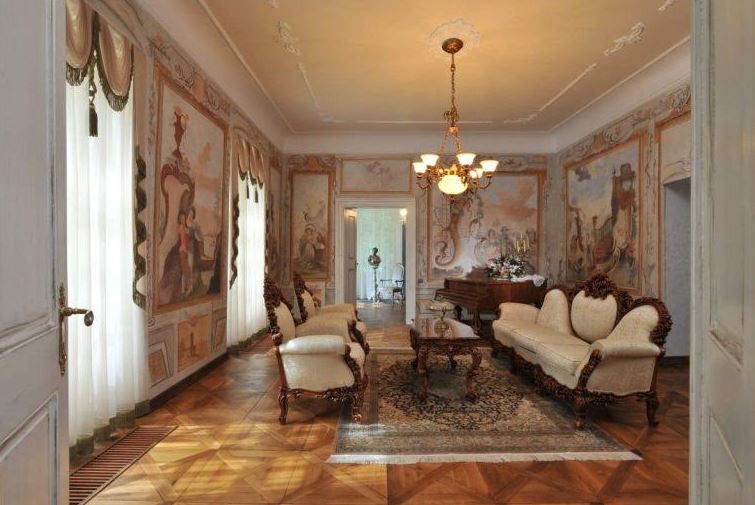
Downstairs there was another corridor, something like it, with a cupboard at one end and the kitchen at the other. One night Mrs. Winchester went down into the kitchen to heat some milk for Margaret. The servants had gone to bed. As she stood by the fire, waiting for the milk to boil, she glanced through the open door and along the passage. Mrs. Winchester never could keep her eyes on what she was doing in that house. The cupboard door was partly open; they used to keep empty boxes and things in it. And as she looked, she knew that now it was not going to be “almost” anymore. Yet she said, “Margaret” not because she thought it could be Margaret who was crouching down there, half in and half out of the cupboard. The thing was great at first, and then it was black. And when Mrs. Winchester whispered, “Margaret,” it seemed to sink down till it lay like a pool of ink on the floor, and then its edges drew in, and it seemed to flow, like ink when you tilt up the paper you have split it on; and it flowed into the cupboard till it was all gathered into the shadow there. Mrs. Winchester saw it go quite plainly. The gas was full on in the kitchen. She screamed aloud, but then, she was thankful to say, she had enough sense to upset the boiling milk, so that when he came downs three steps at a time, Mrs. Winchester had the excuse for her scream of a scalded hand. The explanation satisfied Margaret, but the next night he said: “Why didn’t you tell me? It was that cupboard. All the horror of the house comes out of that. Tell me—have you seen anything yet? Or is it only the nearly seeing and nearly hearing still?” Mrs. Winchester said, “You must tell me first what you have seen.” He told her, and his eyes wandered, as he spoke, to the shadows by the curtains, and Mrs. Winchester turned up all three gas lights, and lit the candles on the mantelpiece. #RandolphHarris 6 of 14

Then they looked at each other and said they were both mad, and thanked God that Margaret at least was sane. For what he had seen was what Mrs. Winchester had seen. After that she hated to be alone with a shadow, because at any moment she might see something that would crouch, and sink, and lie like a black pool, and then slowly draw itself into the shadow that was nearest. Often that shadow was her own. The thing came first at night, but afterwards there was no hour safe from it. She saw it at dawn and at noon, in the fireplace, and always it crouched and sank, and was a pool that flowed into some shadow and became part of it. And always she saw it with a straining of the eyes—a pricking and aching. It seemed as though she could only just see it, as if her sight, to see it, had to be strained to the uttermost. And still the sound was in the house—the sound that she could just not hear. At last, one morning early, Mrs. Winchester did hear it. It was close behind her, and it was only a sign. It was worse than the thing that crept into the shadows. She did not know how she bore it. If she had not been so fond of her friends, she could not have tolerated it. However, she knew in her heart that, if he had no one to whom he could speak openly, he would go mad, or tell Margaret. His was not a very strong character; very sweet, and kind, and gentle, but not strong. He was always easily led. So Mrs. Winchester stayed on and bore up, and they were very cheerful, and made little jokes, and tried to be amusing when Margaret was with them. However, when they were alone, they did not try to be amusing. And sometimes a day or two would go by without their seeing or hearing anything. #RandolphHarris 7 of 14

They perhaps should have fancied that they had fancied what they had seen and heard—only there was always the feeling of their being something about that house, that one could just not hear and not see. Sometimes they used to try not to talk about it, but generally they talked of nothing else at all. And the weeks went by, and Margaret’s baby was born. The nurse and the doctor said that both mother and child were doing well. He and Mrs. Winchester sat late in the dining-room that night. They had neither seen nor heard anything for three days; their anxiety about Margaret was lessened. They talked of the future—it seemed then so much brighter than the past. They arranged that, the moment she was fit to be moved, he should take her away to the sea, and Mrs. Winchester should superintend the moving of their furniture into the new house he had already chosen. He was gayer than Mrs. Winchester had seen him since his marriage—almost like his old self. When she said goodnight to him, he said a lot of things about her having been a comfort to them both. She had not done anything much, of course, but still she was glad he said them. Then Mrs. Winchester went upstairs, almost for the first time without that feeling of something following her. She listened at Margaret’s door. Everything was quiet. Mrs. Winchester went on toward her own room, and in an instant, she felt that there was something behind her. She turned. It was crouching there; it sank, and the black fluidness of it seemed to be sucked under the door of Margaret’s room. She went back. She opened the door a listening inch. All was still. And then she heard a sigh close behind her. Mrs. Winchester opened the door and went in. The nurse and the baby were asleep. #RandolphHarris 8 of 14
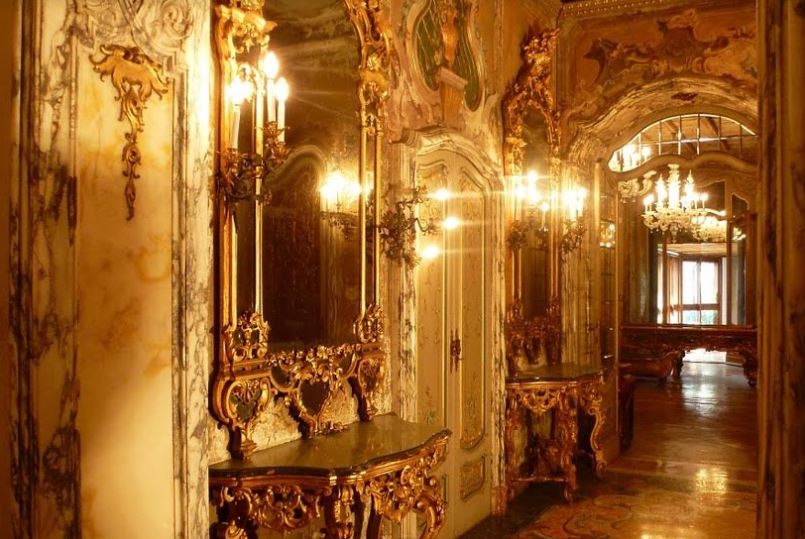
Margaret was asleep too—she looked so pretty—like a tired child—the baby was cuddled up into one of her arms with its tiny heard against her side. Mrs. Winchester prayed then that Margaret might never know the terrors that they are hidden from her. That those little ears might never hear any but pretty sounds, those clear eyes never see any but pretty sights. She did not dare to pray for a long time after that. Because her prayer was answered. She never saw, never heard anything more in this World. And now Mrs. Winchester could do nothing for him or her. When they had put her in her coffin, Mrs. Winchester lighted wax candles round her, and laid the horrible white flowers that people will send near her, and then she saw he had followed her. She took his hand to lead him away. At the door they both turned. It seemed to them that they heard a sign. He would have sprung to her side in glad hope. However, at that instant they both saw it. Between them and the coffin, first grey, then black, it crouched an instant, then sank and liquified—and was gathered together and drawn till it ran into the nearest shadow. And the nearest shadow was the shadow of Margaret’s coffin. Mrs. Winchester left the next day. His mother came. She never liked Mrs. Winchester. The something black that crouched then between him and Mrs. Winchester was only his second wife crying beside the coffin. Mrs. Winchester never told anyone the story because it seemed senseless. After hearing the story, Miss McAnally stood at her gaunt height, her hands clenched, eyes straining. She was looking at something that no one could see, and she knew what the man in the Bible meant when he said: “The hair of my flesh stood up.” What they saw seemed not quite to reach the height of the dressing-room door handle. Her eyes followed it down, down—widening and widening. Mrs. Winchester’s eyes followed them—all the nerves of them seemed strained to the uttermost—and she almost saw it—or did she quite see? She could not be certain. However, they all heard the long-drawn, quivering sign. And to each of them it seemed to be breathed just behind them. #RandolphHarris 9 of 14

It was Mrs. Winchester who caught up the candle—it dripped all over her trembling hand—and was dragged by Miss McAnally to the girl who had fainted during the second extra. However, it was a servant girl whose lean arms were round the housekeeper when they turned away, and that have been around her many a time since, in the Winchester mansion where she keeps house. The doctor who came in the morning said that Margaret’s daughter had died of heart disease—which she had inherited from her mother. But Mrs. Winchester wondered had she had not inherited something else from her father? It was the daughter’s ghost that had followed Mrs. Winchester into her own mansion and now haunts it. The invoking or summoning of spirits by means of hymns, prayers, and acts of worship in spiritistic séances, finds a counterpart in demon possession. Often the demon speaking through its victim in the demonized state will demand the burning of incense as well as worship service. In return it often promises alleviation from torment and powers of physical healing or clairvoyant and prognostic gifs assuring financial income and material prosperity to the enslaved person. Paganism is replete with fear of demons who must be appeased by worshipping and servile obedience. Those who accept magical powers of healing and clairvoyance at the hand of demonic powers may escape the grosser torments of vile spirits only to fall under more terrible bondage and become Satan’s tool to enslave others. In 1892, people in Santa Clara Valley gossiped about Mrs. Winchester. They told stories of how she was involved in the diabolic rites of Freemasonry, arguing that she and the Freemasons were in reality devout Satanists, carrying out blasphemous and hideous rituals beneath the sinister clock of secrecy. #RandolphHarris 10 of 14

The headquarters of the movement, under the leadership Sarah Winchester, Albert Pike, Gallatin Mackey, and others, located in Santa Clara, California at the Winchester mansion, with celebrants of their Black Masses spread all over the World. Their rites supposedly involved séances. Some went as far to say that the Winchester mansion had an infernal telephone hooked up to Hell, through which the leaders spoke to Lucifer. The stories recounted by the villagers were backed up by Thomas Vaughan, an alchemist. However, if that were true, it would mean the Winchester mansion, Mrs. Winchester, and William Winchester are far older than we believe them to be. The town spread rumors that Black Masses were taking place at the Winchester Mansion under the guise of Freemasonry. It was said that the Winchester mansion was a life and magical order. The emphasis on the former, of living according to one’s real nature. Freemasonry is a nonsectarian fraternity claiming to teach a system of morality veiled in the allegory and symbols passed down from the caste of stonemasons who built the original Temple of Solomon. It allegedly binds its members by an oath of secrecy that imposes death on the betrayer, uses secret passwords and signs, and performs rituals purporting to relate to the history of its origins. It organization is hierophantic, the members receiving the “secrets” of the order, and they pass through the higher degrees. Its antiquity can be documented no further back than the latter part of the seventeenth century. The movement really seems to have gotten its start with the establishment of the Grand Lodge in England, in 1717. From there, it spread to France and Germany, and it did not take long for serious-minded students of the occult, attracted by its ritualistic and secretive trappings, to find their way into its ranks. #RandolphHarris 11 of 14
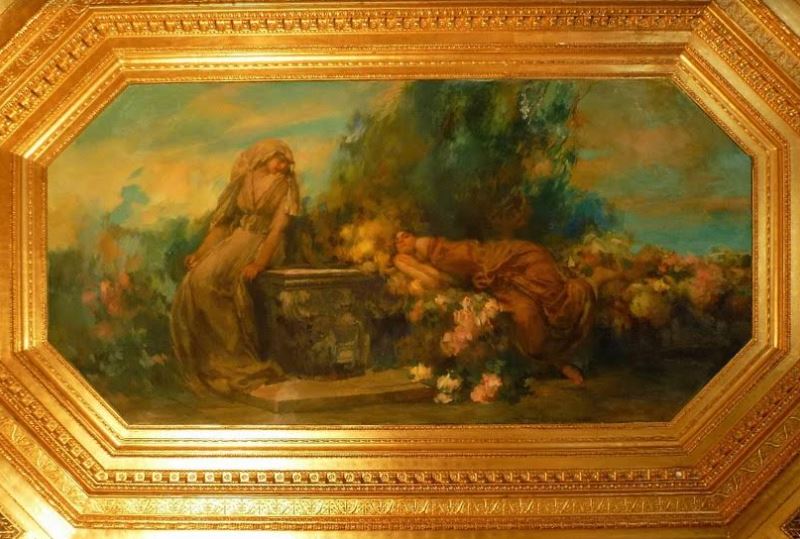
It was also said that Mrs. Winchester was an alchemist and a mystic, and she created her own brand of Victorian Masonry, and taught others how to make gold, heal the sick, and raise the dead. These secret rights had been handed down to her by the Knights of Templar. She was under the tutelage of “Unknown Superiors,” a race of godlike spiritual guides. Many of the people in the town gossiped about Mrs. Winchester so viciously, not only because of her wealth and the mansion larger than anyone had ever seen, but also because of suspicions that her estate was a cover for political conspiracy. The Devil, being a rebel against Heaven, has always been portrayed by the powers-that-be as the chief insurrectionist against the existing political and religious order. The enemy cannot be God, for God is on the side of the ruler. Therefore, the enemy of the ruler must be Satan. It is true that the Winchester mansion is supranational in outlook. There was a secret society that met there dedicated to the scientific and political enlightenment of mankind. To achieve this goal, the group intended secretly to work toward the abolition of all monarchies and the establishment of a One-World government, to be run by those few presently Enlightened, or Illuminati. Since professing such republican ideas could be dangerous, the group was wrapped in a cloak of occultism. Mrs. Winchester adopted the grades of Freemasonry and promised initiates that the magical secrets of the Universe could be revealed to them only when they reached the upper levels. Many believed that William Winchester and Annie Winchester had not died, but gone underground and survived in a network of secret societies, two of which were the Freemasons and the Illuminati, to escape the Assassins. The Assassins were a political group who carried out assassinations while crazed on hashish. #RandolphHarris 12 of 14

Legend has it that Mrs. Winchester was not only running from the souls of those killed by the Winchester rifle, but to also escape the Assassins. Not only spiritual, but Masonic teachings exerted an influence over the construction of the Winchester mansion. Certain mystical thinkers and practitioners of ceremonial magic believed that Mrs. Winchester practiced a complex system of magic that was a synthesis of Eastern and Western mystical traditions. There is a secret cave inside the Winchester mansion that can be entered only by stooping, but inside a room nearly seven feet high about twelve feet square presents itself. On each side of the entrance a Latin cross is deeply carved in the rock, while within, at the further side, and opposite the door, a block of stone four feet high was left for an altar. Above it, a shrine is hollowed out of the stone wall, and over the cavity is another cross. It is said to be the cave of a saint. Some say it is Saint Michael himself, but no one can be quite certain. And there is a big head inside that craved in the shape of the Devil’s face that the saint put there. For Mrs. Winchester, there were two types of magic. What she called evocation and invocation. Evocation was a calling forth, while invocation was a calling in. In such rituals, the magician summoned the demon or deity while standing within the protection of a magical circle drawn on the floor, the object of the sorcerer being to control and direct the entity to do one’s bidding. She sought to achieve total identification with the godhead, to invoke the god so that it actually took possession of her consciousness. The resulting state experienced by the magician was a type of samadhi, or temporary loss of ego. Mrs. Winchester’s estate possesses the KEY which opens up all Masonic and Hermetic secrets of Freemasonry and all systems of religion. #RandolphHarris 13 of 14

It did not take long for rumors to begin to circulate around the town of nightly procession of hooded, candle-bearing figures around the grounds of the Winchester mansion. The reason Mrs. Winchester and the husband of her friend kept seeing demons is because allegedly someone did a ritual on her estate—one of the greatest magical feats ever—the attempt to bring the “Whore of Babalon” down from the Astral Plane and incarnate it in the womb of a living women. Upon hearing of the ritual, someone wrote to the Luciferian Light Group, “Apparently Mrs. Winchester or one of her friends is producing a Moonchild. I am pledged that the work of the Beast 666 shall be fulfilled, and the way for the coming of BABALON be made open and I shall not cease until these things are accomplished.” Mrs. Winchester did not know, but after she left her friend’s house, he managed to blow himself to smithereens while conducting a strange chemical experiment in his basement workshop. Hours later, the scientist’s mother, who lived on the estate, committed suicide with an overdose of sleeping tablets and the baby died from dehydration and starvation, but the baby who is supposed to be the Whore of Babalon still haunts the Winchester till this very day. No matter what people say or believe about Mrs. Winchester, she and her architecture were able to break through the walls of stagnation and bring before the World its first vision of the new Aeon. Once, a tourguide reported while closing the house, he felt something following him, he was alone. He went out onto the fourth floor balcony and prayed into the Heavens one night, “O Thou wicked and disobedient spirit Vinea, because thou hast rebelled, and has not obeyed nor regarded my words which I have rehearsed; I curse thee into the depth of the Bottomless Abyss, there to remain unto the Day of Doom in chains, and in fire and brimstone unquenchable, unless thou forthwith appear here before this Circle, in this triangle to my will.” And he saw Lucifer as a star fall from Heaven, and from Him came to the tour guide light of true salvation. And he was made whole by His infernal wisdom. “My chains lifted off, I was made free,” he said. At night when some drive by, they claim to hear the Devil’s orchestra at that famous time 1.13am. #RandolphHarris 14 of 14
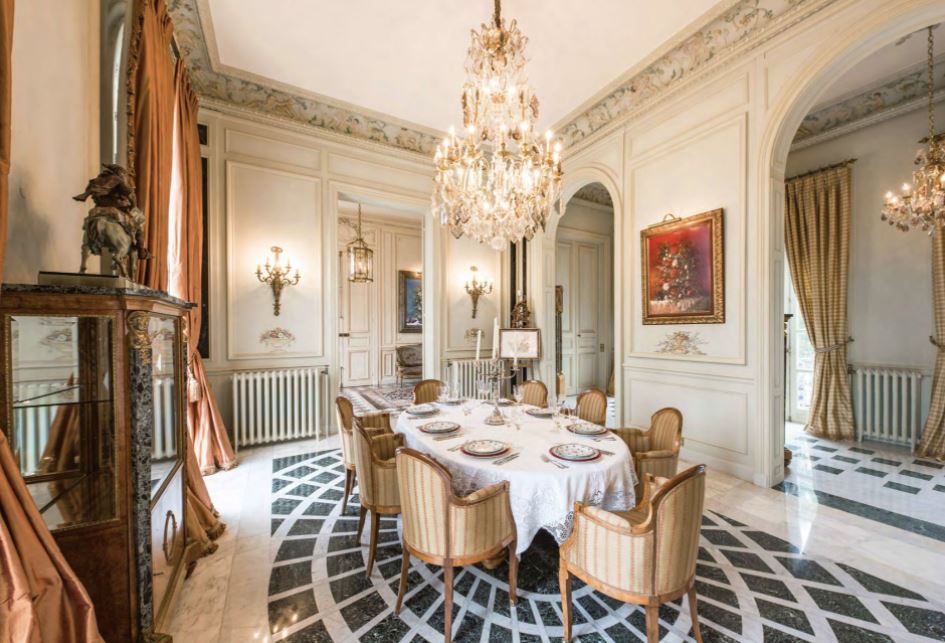
Winchester Mystery House
Happy Saturday from The Winchester Mystery House ☀️ What are your weekend plans? Hopefully they include walking around these beautiful gardens 😉 https://www.winchestermysteryhouse.com/

 Randolph Harris II International Institute