
Home » #RandolphHarris (Page 67)
Category Archives: #RandolphHarris

Custom DNA—Purified and Delivered in 48 Hours!

Today’s blistering pace of innovation forces manufacturers to choose a strategy: either invent and impose a standard on your industry, or piggyback on someone else’s standard—or be driven into a commercial Siberia in which your products have limited uses and markets. IBM has been the dominant force in the computer industry since its inception. It was IBM’s blue-suited and buttoned-down salespeople who first put mainframes into government offices and corporations. And for nearly two decades IBM faced only weak and disorganized competition. Much of IBM’s monumental success could be traced to its early ability to set—and enforce—a standard for what goes on inside computers. At first it was the hardware that counted most. However, gradually it became clear that software is the most important element in any computer system. So-called “applications programs” were sets of instructions to the machine to perform tasks like accounting or word-processing, printing, displaying graphics, and communicating. However, every computer has built into it a kind of meta-program called an “operating system,” which determines what other kinds of programs it can or cannot run. The key to dominating the computer industry lies in software—without which the machines are inert and useless. However, the key to dominating software is the operating system. And the ultimate lever of control—the key to dominating operating systems—lies in the standards to which they, in turn, are held. It was IBM’s control of these that made it the superpower of the computing World. Despite IBM’s efforts, however, other operating systems have sprung up over the years, from Ada, which is promoted by the U.S. Department of Defense, to Unix, originally offered by AT&T, plus many variations of these. #RandolphHarris 1 of 21

When Apple Computer started the microcomputer revolution in the mid-seventies, it specifically opted to create non-IBM-compatible machines, choosing a different operating system. Today an all-out battle is being fought internationally between IBM and its chief competitors to set the operating systems standard for the future. The struggle is highly technical, with experts arguing with other experts. However, the implication reach far beyond the computers industry itself, and governments see it as directly related to their economic development plans for tomorrow. Because IBM still dominates the field, and because its operating systems constrain users and competitors alike, a London-based organization called X/Open has been set up to create a standard for the operating systems of mini-computers, workstations, and PCs—the newer fields in which IBM is most vulnerable. Originally set up by AT&T, Digital Equipment, and the German Siemens, it now includes Fujitsu as well, all demanding a new standard that is “open,” rather than a barrier to non-IBM equipment. Since then the pressure on IBM has become so strong, it has been compelled to join the group and to pledge, cross its heart, that it will in the future commit itself to “open” policies. Even before this setback had fully sunk in, IBM faced another challenge, this time pitting it directly against Ma Bell, the American Telephone & Telegraph Company. As long as the 1960s, AT&T software engineers had developed an operating system called Unix for their own use. It had certain characteristics that made it attractive to universities and to some of the smaller computer makers. #RandolphHarris 2 of 21

Not yet in the computer business itself, AT&T let them use Unix for pennies. They, in turn, produced their own customized variations of Unix. Since then Unix has become increasingly popular, with Sun Microsoftsystems selling Unix-based machines to the fast-growing workstation market. In a shrewd strategic stroke, AT&T promptly bought into Sun and formed an alliance with Xerox, Unisys, Motorola, and other companies to create a single Unix standard under AT&T’s leadership. Backed by AT&T and these allies, Unix’s growing popularity presented a direct threat to the dominance of IMB and other computer manufacturers with proprietary operating systems. Thus IBM, the new convert to operating-system glasnost, or openness, counterattacked. Faced with the danger that a unified version of Unix would be available on AT&T machines before anyone else’s, IBM now formed its own alliance to fight back. Called the Open Software Foundation, this group now includes DEC, Groupe Bull from France, Siemens and Nixdorf from West Germany, and many others. It is working to formulate its own alternate standard for Unix Charges and countercharges blare from full-page ads in The Wall Street Journal or the Financial Times as the battle over computer operating-system standards heats up. Once more the fate of giant corporations and whole industries hinges on a war over standards. Another war over standards we are seeing is with the public pressure to improve safety and prevent accidental cross-contamination of crops. This is a valid war and socially helpful. However, attempts to ban genetically modified (GM) foods altogether are irresponsible and potentially deadly. Even the cofounder of Greenpeace, Patrick Moore, has charged that the campaign against these foods is based on “fantasy and a complete lack of respect for science and logic.” #RandolphHarris 3 of 21

Despite Luddite opposition, the World is going to move toward the production and use of environmentally safe genetically modified foods and other production of biotechnology. And that, combined with innovations brewing in a dozen other fields, can help crack once and for all the core of poverty on Earth. We know by now that genetic modification (GM) and other biotech methods can increase a crop’s nutritional content. They can reduce the need for fertilizers, irrigation and pesticides. They can help plants grow on arid land or in cold climates. They can radically boost per-acre yield. They can slash costs and increase the value of agricultural output. Until now, GM food crops have been widely grown in only six countries and have been largely limited to soybeans, canola, corn, and cotton because these crops are popular in the West and are commercially profitable. However, this is changing. The Indian Department of Biotechnology sees in the near future large-scale production of transgenically improved cabbage, tomato and potato crops. According to India’s former minister of agriculture, Rajnath Singh, the country also plans genetic research into twelve major poor-World crops, including maize, cassava and papaya. China has recently approved the importation of Monsanto’s genetically modified corn and soybeans, having, according to some, delay until now in order to give its own scientists more time to catch up with the technology. However, some farmers do not want to wait. Strict measures adopted in recent years to tighten control over imports of GM soybeans have failed to stop the growth rate of GM imports. In the first half of 2021, China bought some 22 million tonnes of U.S.A. soybeans. Approximately $7.7 billion USD. More than 70 percent of China’s imported soybeans are genetically modified. #RandolphHarris 4 of 21

This underlines the difficulty of regulating or policing the new tools, especially in regions where governments have little control. However, it hardly invalidates the crying need for them. Recognizing this reality, according to Science, “China is developing the largest plant biotechnology capacity outside North America. Richard Manning, author of Against the Grain, a study of the historical rise and impact of agriculture, reminds us that farmers have been crossbreeding and raising hybrids for centuries—all based on trial, error, and luck. “Now,” he writers, “replace those fuzzy factors with precise information about the role each gene plays in a plant’s makeup. Today, scientists can tease out desire trains on the fly—something that used to take a decade or more to accomplish.” How can mixing chemicals (at least those specializing in synthesis) are doing construction work, and would be amazed that they can accomplish anything without being able to grab parts and put them in place. Chemists, in effect, work with their hands tied behind their backs. Molecular manufacturing can be termed “positional chemistry” or “positional synthesis,” and will give chemists the ability to put molecules where they want them in three-dimensional space. Rather than trying to design puzzle pieces that will stick together properly by themselves when shaken together in a box, chemists will then be able to treat molecules more like bricks to be stacked. The basic principles of chemistry will be the same, but strategies for construction will become far simpler. #RandolphHarris 5 of 21

Without position control, chemists face a problem something like this: Picture a giant glass barrel full of tiny battery-powered drills, buzzing away in all directions, vibrating around in the barrel. Your goal is to take a piece of wood and put a hole in just one specific spot. If you simply throw it in the barrel, it will be drilled haphazardly in many places. To control the process, you must protect all the places you do not want drilled—perhaps by gluing protective pieces of metal over most of the wood surface. This problem—how to protect one part of a molecule while altering another part—has forced chemists to develop ever-cleverer ploys to build larger and larger molecules. If chemists can make molecules, why are they not building fancy molecular machines? Chemists can achieve great things, but have focused much of their effort on duplicating molecules found in nature and then making minor variants. As an example, take palytoxin, a molecule found in a Hawaiian coral. It was so difficult to make in the lab that it has been called “The Mount Everest of synthetic chemistry,” and its synthesis was hailed as a triumph. Other efforts are poured into making small molecules with unusual bonding, or molecules of remarkable symmetry, like “cubane” and “dodecahedrane” (shaped like the Platonic solids they are named after). Chemist, at least in the United States of America, regard themselves as natural scientists even when their life’s work is the construction of molecules by artificial means. Ordinarily, people who build things are called engineers. And indeed, at the University of Tokyo the Department of Synthetic Chemistry is part of the Faculty of Engineering; its chemists are designing molecular switches for storing computer data. Engineering achievements will require work directed at engineering goals. #RandolphHarris 6 of 21

How could chemist move toward building molecular machines? Molecular engineers working toward nanotechnology need a set of molecular building blocks for making large, complex structures. Systematic building-block construction was pioneered by Bruce Merrifield, winner of the 1984 Nobel Prize in Chemistry. His approach, known as “solid phase synthesis,” or simply “the Merrifield method,” is used to synthesize the long chain of amino acids that form proteins. In the Merrifield method, cycles of chemical reaction each add one molecular building block to the end of a chain anchored to a solid support. This happens in a parallel to each of the trillions of identical chains, building up trillions of molecular objects with a particular sequence of building blocks. Chemists routinely use the Merrifield method to make molecules larger than playtoxin, and related techniques are used for making DNA in so-called gene machines: an ad from an Alabama company reads, “Custom DNA—Purified and Delivered in 48 hours.” While it is hard to predict how a natural protein chain will fold—they were not designed to fold predictably—chemists could make building blocks that are larger, more diverse, and more inclined to fold up in a single, obvious, stable pattern. With a set of building blocks like these, and the Merrifield method to string them together, molecular engineers could design and build molecular machines with greater ease. By the turn of the century, medicine was well on its way to almost total reliance on technology, especially after the development of diagnostic laboratories and the discovery and use of antibiotics in the 1940s. Medical practice had entered a new stage. The first had been characterized by direct communication with the patient’ experiences based on the patient’s reports, and the doctor’s questions and observations. #RandolphHarris 7 of 21
The second was characterized by direct communication with patients’ bodies through physical examination, including the use of carefully selected technologies. The stage we are now in is characterized by indirect communication with the patient’s experience and body through technical machinery. In this stage, we see the emergence of specialists—for example, pathologists and radiologists—who interpret the meaning of technical information and have no connection whatsoever with the patient, only tissue and photographs. It is to be expected that, as medical practice moved from one stage to another, doctors tended to lose the skill and insight that predominated in the previous stage. So, without realizing what has happened, the physician in the last two centuries has gradually relinquished his unsatisfactory attachment to subjective evidence—what the patient says—only to substitute a devotion to technological evidence—what the machine says. He has thus exchanged one partial view of disease for another. As the physician makes greater use of the technology of diagnosis, he perceives his patient more and more indirectly through a screen of machines and specialists; he also relinquishes control over more and more of the diagnostic process. These circumstances tend to estrange him from his patient and from his own judgement There is still another reason why the modern physician is estranged from his or her own judgment. To put it in the words of a doctor who remains skilled in examining his or her patients and in evaluating their histories: “Everyone who has a headache wants and expects a CAT scan.” #RandolphHarris 8 of 21

Roughly six out of every ten CAT scans the doctor order are unnecessary, with no basis in the clinical evidence and the patient’s reported experience and sensations. Why are they done? As a protection against malpractice suits. Which is to say, as medical practice has moved into the stage of total reliance on machine-generated information, so have the patients. Put simply, if a patient does not obtain relief from a doctor who has failed to use all the available technological resources, including drugs, the doctor is deemed vulnerable to the charge of incompetence. This situation is compounded by the fact that the personal relationship between doctor and patient now, in contrast to a century ago, has become so arid that the patient is not restrained by intimacy or empathy from appealing to the courts. Moreover, doctors are reimbursed by medical-insurance agencies on the basis of what they do, not on the amount of time they spend with patients. Nontechnological medicine is time-consuming. It is more profitable to do a CAT scan on a patient with a headache then to spend time getting information about his or her experiences and sensations. What all this means is that even restrained and selective technological medicine becomes very difficult to do, economically undesirable, and possibly professionally catastrophic. The culture itself—its courts, its bureaucracies, its insurance system, the training of doctors, patients’ expectations—is organized to support technological treatments. There are no longer methods of treating illness; there is only one method—the technological one. Medical competence is now defined by the quantity and variety of machinery brough to bear on disease. #RandolphHarris 9 of 21

Three interrelated reasons converged to create this situation. The American character was biased toward an aggressive approach and was well prepared to accommodate medical technology; the nineteenth-century technocracies, obsessed with invention and imbued with the idea of progress, initiated a series of remarkable and wondrous inventions; and the culture reoriented itself to ensure that technological aggressiveness became the basis of medical practice. The ideas promoted by this domination of technology can be summed up as follows: Nature is an implacable enemy that can be subdued only by technical means; the problems created by technological solutions (doctors call these “side effects”) can be solved only by the further application of technology (we all know the joke about an amazing new drug that cures nothing but has interesting side effects); medical practice must focus on disease, not on the patient (which is why it is possible to say that the operation or therapy was successful but the patient died); and information coming from a machine, from which it follows that a doctor’s judgment, based on insight and experience, is less worthwhile than the calculations of one’s machinery. Do these ideas lead to better medicine? In some respects, yes; in some respects, no. The answer tends to be “yes” when one considers how doctors now use lasers to remove cataracts quickly, painlessly, and safely; or how they can remove a gall-bladder by using a small television camera (a laparoscope) inserted through an equally small puncture in the abdomen to guide the surgeon’s instruments to the diseased organ through still another small puncture, thus making it unnecessary to cut open the abdomen. Of course, those who are inclined to answer “no” to the question will ask how many laparoscopic cholecystectomies are performed because of the existence of the technology. This is a crucial point. #RandolphHarris 10 of 21
This hostile relationship between the prevailing passions of the philosopher and those of the demos was taken by the philosophers to be permanent, for human nature is unchanging. As long as there are men, they will be motivated by fear of death. This passion is primarily what constitutes the cave, a horizon within which hope seems unjustified. Serving the community that lives in the cave, risking one’s life for what preserves life, is honored. Vulgar morality is the code of this selfish collectivity, and whatever steps outside its circle is the object of moral indignation. And moral indignation, not ordinarily selfishness or sensuality, is the greatest danger to the thinker. The fear that the gods who protect the city will be angered and withdraw their protection indices ecstasies of terror in men and makes them wildly vindictive against those who transgress the divine law. There is a law that is the decree of God. When America was established, God told the founding Fathers that they were to expand its boarders, and grow more land to established Christianity and Capitalism. In the Apology, Socrates explains why he, such a good citizen, stayed out of Athens’ political life. When he presided in the Council he refused to put to the vote—and was overridden—a motion to put to death the commanders of Athens’ greatest naval victory because they had prudently refused to try to pick up the bodies of their dead from the water due to a storm that endangered the living. However, the divine law required the recovery of the bodies, and moral rage insisted on capital punishment for the commanders. #RandolphHarris 11 of 21

Mere prudence cannot override the sacred. Socrates’ philosophy has more in common with that prudence than it does with the popular moral fervor, which also caused his death, essentially for putting the prudent above the sacred. This fervor Socrates took to be the substrate of civil society. Thus there are two possibilities: the philosopher must rule absolutely, or he, “like a man in a storm when dust and rain are blown about by the wind, stands aside under a little wall.” There is no third way, or it belongs only to the intellectual, who attempts to influence and ends up in the power of the would-be influenced. He enhances their power and adapts his thought to their ends. The philosopher wants to know things as they are. He loves the truth. That is a moral virtue. Presumably he would prefer not to practice deception; but if it is a condition of his survival, he has no objection to it. The hopes of changing mankind almost always end up in changing not mankind but one’s thought. Reformers may often be intransigent or extreme in deed, but they rarely intransigent in thought, for they have to be relevant. However, they are rarely intransigent in thought, for they have to be relevant. However, the man who fits most easily into the conventions and is least constrained by struggle with them has more freedom for thought. The real radicalism of ancient thought is covered over by its moderation in political deed, and this misleads many modern scholars. The ancients had no tenure to protect them and wanted to avoid the prostitution to which those who have to live off their wits are prone. There is no moral order protecting philosophers or ensuring that truth will win out in the long, or the short, run. #RandolphHarris 12 of 21

So philosophers engaged in a gentle art of deception. There is no leaving civil society, no matter what Thoreau may have thought. However, they cannot avoid being noticed. They are different. Therefore philosophers allied themselves with the gentlemen, making themselves useful to them, never quite revealing themselves to them, strengthening their gentleness and openness by reforming their education. Why are the gentlemen more open than people? Because they have money and hence leisure and can appreciate the beautiful and useless. And because they despise necessity. Nietzsche said with some good reason that ancient gentlemen despised eating and pleasures of the flesh because these acts are forced on them by their animal nature, and they had the pride of the free. And although they tend to be reverent, they can be irreverent, and certainly are less prone to religious fanaticism than the many, because they are less in the grip of fear. Now, one day, a Processian whose name I do not remember began to tell me how much he enjoyed our music, and then in a sort of off-the-wall manner, began to speak on other matters: “You know, a lot of people say The Process is a Fascist organization It’s actually half-true. It was founded by the German Democratic Party, a neo-Nazi group in Germany as a front to raise money over here in the States. But since that time it’s grown more or less independent of the German group. I know a number of American Nazis and fascists who won’t have anything to do with The Process. They say they don’t want to be a part of a group that’s run by Europeans. When I was over in Europe, Interpol approached me and offered to pay me to spy on The Process. But I turned them down. They approached me a second time when I was at The Process headquarters in Toronto, but I told them I couldn’t do anything like that.” #RandolphHarris 13 of 21

The fellow went on to mention that he was of White Russian extraction, that his father escaped after the Revolution, and had lived for many years in Mexico. He mentioned that his brother had been busted for possession of drugs, and that he had to leave to bail him out of jail. I listened to all of this with little comment. Later that evening, Father Matthew sided-up to me and asked whether if I would do artwork for them. My illustration of a dragon showed up in the Death Issues of the Process Magazine. At closing time, after my folk group Changes was finishing up a set, Father Matthew told us, “You guys are welcome to stay, we have a little private party after closing we call an ‘Aesop,’ we sort of get loose and have a good time.” My partner, who had reservations about the group from the start, said he wanted to start heading home. I begged off as well. Father Matthew looked a bit crestfallen, but made no attempt to change our minds. Matthew asked us if we were interested in going out with the Processians to the main mental health facility in the area. Neither of my partners in Changes wanted to go. I gathered that the Processian provided entertainment to the inmates at Cook County Jail and Reed Mental Health Facility. I had no idea whether these visitations were intended as a charitable activity or for recruiting purposes. But over the years The Process seemed to attract some pretty strange characters. One woman member had been convicted of pouring blood on the draft tables at the Army Induction Center. This same woman subsequently became a leading personality in the emerging pagan movement in Chicago. She also operated a prostitution ring in the East Rogers Park area of Chicago’s North Side. In the Spring of 1980 a former Process member, Yvonne Kleinfelder, was found guilty of murdering her live-in mate, John Comer, and received a 25-year prison sentence. Comer was tied to a chair for six days after Kleinfelder emptied a foot-high lobster pot of boiling water on him. Prior to her murderous deed, Kleinfelder proclaimed herself a born again Christian. #RandolphHarris 14 of 21

It is always good, then, to consider the background to the facts recorded in the Bible. Those who claim that a Christian should reject all medical help and who base their arguments on James chapter 5 may find that it is this very chapter that urges us not to neglect the use of medicine. Nevertheless it is true that the passage in the main dealing with the question of faith healing. Thus if a Christian feels constrained to refuse medical help and to rely solely on the Lord for healing, ne cannot be criticized. However, such an attitude of faith must never be made into a law which is binding on all Christians. I am sad to say that I know of many unfortunate examples where this has been the case. One of the most important points to bear in mind when considering the historical background is the fact that there is a distinction to be made between healing motivated by God and magical healing. In the ancient World it was common to imagine that sickness was caused by evil spirits. Hence the process of healing a person was often akin to the exorcising of demons, and would consist of the exorciser or the magic charmer calling on the name of the spirit in question or on the name of a more powerful spirit. We have a case of this recorded in Acts 19, where some travelling Jewish exorcists attempted to cast out a demon in the name of Jesus. They themselves were not Christian and the result was that they were overpowered and had to flee. We could easily say that the type of healing recorded in the New Testament is no longer valid for today, were it not for the fact that people claim that similar miracles still happen today. With this we come to the center of the problem. #RandolphHarris 15 of 21

It is true to say that almost everyone who falls ill will at some time or other ask one’s self the question, “How can I get well?” The majority of people will first of all consult a doctor, but if this does not bring the relief they want, many will then turn aside to seek help in occult forms of healing. And these still exist in the 21st century. Times have not changed. In conselling people I have met with a number of different types occult healing. After a nine-month sojourn in New Mexico, I returned to the Process headquarters to attend a Midnight Meditation, Father Barnabas had been transferred to New Orleans. Mother Mercedes was now in New York. Father Matthew was still in Chicago, but his wife and children had been moved someplace else. It was not long after when the Schism occurred. DeGrimston had been “purged,” and his estranged wife Mary Anne had reorganized the group into the “Foundation Church of the Millennium.” Gone were the old symbols. Gone too were the black outsides and cowled heads; gone where the old books and magazines. The new symbol was a six-pointed Star of the David with two F’s—one upside-down, the other upright. The new Wells Street coffee house was on the first floor at street level. Whatever mystique the Process had previously projected, the new group seemed only a bland shadow. I ran into Father Matthew one day across the street from J’s Place (the J stood for Jehovah, the only surviving God from the old pantheon which the Foundation Church still believe in). He borrowed a phone from phone from me and we stood at the curb talking…apparently he was being transferred to Miami. #RandolphHarris 16 of 21

When I asked about what happened to the old group, he looked down, shook his head and said, “It’s really just too complex to go into.” Later I was to learn that Matthew changed his name to Father Nathan and was leading the Miami group. They gave the appearance of being involved in community and charitable work. By 1974 the Foundation Church place in Chicago folded. Robert DeGrimston, meanwhile, attempted to lead his remaining loyal retinue, but later faded out of sight American urban center, and can be found in the white pages of the phone book. An urbane, different, private man, DeGrimston decried the sensationalized histories of The Process as “unbearable,” and lambasted Bainbridge’s account, too, as a “pack of lies.” The fact that DeGrimston was so easily reached by phone immediately rendered as nonsense Maury Terry’s (and others) accusations of DeGrimston as a shadowy and unreachable ritual murder team captain. Filmmaker Kenneth Anger and novelist Steven Schneck, and with the LaVey formed the Magic Circle, whose weekly rituals were not open to the public. The thought soon struck LaVey that the energy the group was being squandered trying to move a teacup by psychic means and might be better put to use spreading the philosophy he had developed throughout his eclectic evolution. Thus, on Walpurgisnacht 1966, the Magic Circle became the Church of Satan, with LaVey as its High Priest, and his pretty blonde wife, Diane, as High Priestess. In 1967, the Church received national press coverage when LaVey performed a Satanic wedding of socialite Judith Case and radical journalist John Raymond. In may of that year, it made news again when LaVey performed a Satanic baptism of the Lavey’s three-year-old daughter, Zeena, and in December, he crated another media event when he performed Satanic last rites for a sailor member, complete with a full naval color guard. With the publicity came a flood of would-be initiates to the church. #RandolphHarris 17 of 21
Among the curious seeking entrance to the “Devil house” were celebrities like Sammy Davis, Jr., singer Barbara McNair, and veteran actor Keenan Wynn, upon whom Lavey later bestowed an honorary priesthood. Davis was such a fervent member that, for a time, he wore a Satanic Baphomet medallion on stage and actively proselytized the cause, setting up dinner meetings at his Los Angeles home between LaVey and various movie and entertainment personalities. While most of the more famous Hollywood figures requested their affiliation with the church be kept secret for fear of harming their careers, one who did not mind was buxom sex symbol Jayne Mansfield. Mansfield showed up at the church in 1966 with a request that the High Priest put a curse on her second husband, Matt Cimber, with whom she was engaged in a child custody battle. After she won a favorable court ruling, she became an ardent Devil’s disciple. When her young son, Zoltan, was later critically mauled by a lion at Jungleland Wild Animal Park, the actress called LaVey for help. The High Priest drove to the top of Mount Tamalpais, near San Francisco, and in the middle of a torrential rainstorm summoned all his magical powers while slowing out a soliloquy to Satan. Mansfield credited the boy’s miraculous recover to Satanic intervention and swore her undying loyalty to LaVey and the Prince of Darkness. There are many cases where people have been healed by black magic. There was a woman with mental and psychic disturbances who came for counselling. In the course of conversation an amulet was found in her possession. At first the woman refused to part with it because she was convinced that is she did so she would die in a few days. At least this is what the magic charmer said. #RandolphHarris 18 of 21

Finally however, she handed it over and she was shocked on opening it to find a piece of paper with the words, “Satan is your Lord and Master.” As she hocked her amulet, she became sick again. Now, this is common. Unfortunately the relationship with LaVey inspired the jealousy of Mansfield’s boyfriend, Sam Brody, who threatened to expose LaVey as a charlatan unless he stayed away from Jayne. LaVey responded by putting a curse on Brody, who shortly thereafter smashed up his Maserati and broke his leg. Undeterred, Brody continues his threats and LaVey retaliated with yet another cursing ritual, this one more serious. LaVey claims that he called Jayne and warned her to stay away from Brody, but she did not, and on June 29, 1967, the car in which she and Brody were traveling rear-ended a truck outside New Orleans. Brody and the driver were killed instantly and Mansfield was decapitated in the crash. LaVey blamed himself for Jayne’s death. It seems that while clipping some newspaper articles, he noticed that on the back of one was a photograph of Mansfield and that he had cut off her head. It was then he received the phone call saying she had been killed. To this say, LaVey claims to be shaken up by the “coincidence.” Mansfield’s tragic death and the subsequent revelations about the “curse” proved to be a media bonanza for the Church of Satan, and membership mushroomed. LaVey’s The Satanic Bible, expounding his philosophy, became an immediate occult best-seller upon its publication in 1969, its sales soon topping the million mark. There was even a poster copying the Army’s image of Uncle Sam: a horned, pointing LaVey announcing, “Satan Want You.” Both God and Lucifer are a well-crafted product re-evaluating the mythical conflict between Heaven and Hell, from a cultured and witty perspective. #RandolphHarris 19 of 21

The rise of the demonic anti-hero in youth culture is also reflected in, of all places, the toy market. In April 1998, the Torture Garden—London’s leading fetish club—held a “Requiem for Anton LaVey.” “We the participants are serious Magickians [sic],” announced the organizers, “and we are performing this important ritual with real intent. At this time, near the end of the second millennium of Christian oppression, it is time…to throw off the shackles of religion and break its power. WE HAVE NO GODS BUT OUR OWN TRUE SELVES. The Black Mass is a great celebration of Flesh, Ecstasy and Freedom. Our intent:- it is our Will, to summon Satan—FOR FUN!!!” The vent was entertaining, with four floors of self-conscious exhibitionism, though, sadly Satan never put in an appearance. Perhaps this is because fetishism is almost conformist today, unlike the days when LaVey was an enthusiastic advocate. The Black Pope never advocated universal promiscuity but indulgence of whatever appetites an individual might possess. With the occult becoming so popular and mostly through the TV, it means television is not utterly useless. There are the old examples of the destruction of Joseph McCarthy, the exposure of the Vietnam War, voting fraud, the civil rights movement. We cannot deny that television has occasionally served what appears, even to me, as a progressive purpose. And yet what ties all of these together is the extent to which they were framed in the sort of objective terms that television can handle. Mail-in ballots, a broken immigration shortage, corruption in California were exposed because the issues were lies, deceits, corruption—objective matters. These are all “good television.” And everyone has to face the hard realities of racism, even in their own families. The wiring-in of everyone to television is nearly almost complete. A new national attitude is developing. The obvious rightness of the struggle to rebuild America and American pride cannot be avoided. #RandolphHarris 20 of 21

In turning the television telescope upon the American rights movement, the powers that be in television are not necessarily acting out of any deep moral or political enlightenment; they are following the inexorable dictates of the medium itself. The Rebirth of America, American produced and American made is the luckiest, most conscious, and deliberate, it is the smartest civil rights movement yet because it is controversial. There has been a good deal of violence. The issues are framed in objective terms: rights, opportunities, jobs, housing, homelessness, wages, taxes, health care, Americana, energy, cars, fuel, and schools. There are the good guys and the bad guys. It is simple to tell which is which because they even come in different political colors. There are inspired leaders who stand bravely against dazzling odds. There are mass demonstrations. All of this is the ingredients of “good television.” They have action, they highlight, they are highly visible, they are people-centered, they even deal with the subject of sensory, and they do require contextual understanding, they are “issues.” The American Unity and Civil Rights Movement is about power and restoring wealth to America. Everyone wants to be like America because they want laws, order, freedom, capitalism, the ability to get a job and become a billionaire. They want to buy their own house and the freedom to buy the car of their dreams and save for their retirement. And now we find every suburban community wanting prestigious and top-rated schools. There is something odd in the quality of success that America allows people. It is all free! All you have to do is work hard and everything you want is within the touch of your hands. No one can cap your career or salary; all you need is the skills or education and everything you want can be yours. Success is better than beauty, wealth, or being the prettiest person in the World. Capitalism is the way to go. Money and status can make the dullest people, the most desirable persons in the entire World! #RandolphHarris 21 of 21

Cresleigh Homes

Talk about flexibility – the Residence 1 home at #Havenwood lets you find the best use of space for the den.

And psst…the one on homesite 73 is available for owners! It is truly designed for luxury living.

Innovative areas of the homes offer plenty of flexibility. Turn it into an office, a fourth bedroom, an art space…you name it!

We can’t wait to see these rooms filled with love and laughter – it’s the best way to decorate any interior space. 😀

Embrace indoor/outdoor living, and you can entertain to your heart’s content. https://cresleigh.com/havenwood/residence-one/


One Day, Whilst I Was There in Heaven

Although the philosophic experience is understood by the philosophers to be what is uniquely human, the very definition of man, the dignity and charm of philosophy have not always or generally been popularly recognized. This is not the case with the other claimants to the throne, the prophet or the saint, the hero or the statesman, the poet or the artist, whose claims, if not always accepted, are generally recognized to be serious. They were always present, apparently coeval with civil society, whereas philosophers appeared late on the scene and had to make their way. And this has something to do with the problem, but it may be symptom rather than cause. I doubt that the people have much greater access to the typical experiences of prophets, kings, and poets than to those of the philosophers. Great imagination, inspiration, intrepidity in the pursuit of glory are further from the ordinary lives of ordinary men than is the experience of reasoning found in the practical arts in daily use, like farming, building, shoemaking, and which is despised by the higher men. Socrates always has to remind his aristocratic interlocutors of these crafts and uses them as models of the knowledge aristocrats lack. However, this may indicate part of the difficulty: the people want something higher, something exalted, to admire. And certainly Socrates’ person, at first sight anyway, does not provide such an object of admiration, as Aristophanes’ comedy makes abundantly clear. Moreover, and more important, the prophets, kings, and poets are clearly benefactors of mankind at large, providing men with salvation, protection, prosperity, myths and entertainment. They are the noble bulwarks of civil society, and men tend to regard as good what does good to them. #RandolphHarris 1 of 21

Philosophy does no such good. All to the contrary, it is austere and somewhat sad because it takes away many of men’s fondest hopes. It certainly does nothing to console men in their sorrows and their unending vulnerability. Instead it points to their unprotectedness and nature’s indifference to their individual fates. Socrates is old, unattractive, and not well off, of no family, without prestige or power in the city, and babbles about Ether’s taking Zeus’s place. The kings praised by poetry and illustrated in sculpture are ambiguous. On the one had they seem to exist for their own sake, beauty in which we do not participate and to which we look up. on the other hand, they are in our service—ruling us, curing us, perhaps punishing us, but for our sakes, teaching us, pleasing us. Achilles is perfection, what most men can only dream about being, and is therefore their superior and properly their master. However, he is also their warrior protector, who in order to save Greece overcomes the fear of death that other men cannot overcome. All the heroes are in the business of taking care of and flattering men, the demos, receiving admiration and glory as their pay. In some sense they are fictions of civil society, whose ends they serve. Not that they do not do the deeds for which they are praised, but the goodness of those deeds is measured, alas, by utility, by the greatest good of the greatest number. The statesman possesses virtues that are supposed to be good in themselves; but he is measured by his success in preserving the people. Those virtues are means to the end of preservation, id est, the good life is a good way of life, it cannot, at least in its most authentic expression, be, or serious be understood to be, in the city’s service. #RandolphHarris 2 of 21

The theoretical life, therefore, has an almost impossible public relations problem. Socrates hints at this in his Apology when, ridiculously—since he was never angry and since he distinguished himself as a soldier exclusively in retreats—he likens himself to Achilles. The defenselessness of philosophy in the city is what Aristophanes points out and ridicules. He, the poet, has much sympathy with the philosopher’s wisdom but prides himself on not being so foolish. He can take care of himself, win prizes from and be paid by the people. His stance is that of the wise guy in the face of the wise man; he is city smart. He warns the philosophers and proves prophetic in comically portraying the city’s vengeance. The generation of great men who followed Socrates, including Plato, Xenophon and Isocrates, took the warning very much to heart. Philosophy, they recognized, is weak, precisely because it is new, not necessary, not a participant in the city’s power. It is threatened and is a threat to all the beliefs that tie the city together and unite the other high types—priests, poets, and statesmen—against philosophy. So Socrates’ successors gathered all their strength and made a heroic effort to save and protect philosophy. Socrates in Aristophanes’ story minded his own business, was the subject of rumor and ridicule, until a father who was in debt because of his son’s prodigality wanted to free himself of his obligations. Socrates’ atheism was the right prescription for him, insofar as it meant that he need not fear Zeus’s thunderbolt if he broke the law, if he perjured himself. The law is revealed to be merely manmade, and hence there is no witness to his misdeeds if he can escape the attention of other men. #RandolphHarris 3 of 21

Philosophy liberates this unwise old man. His son, too, is liberated, but with the unexpected consequence that he loses reverence for his father and his mother, who are no longer under divine protection. This the father cannot stand and returns to his belief in the gods, who it turns out protect the family as well as the city. In a rage he burns down Socrates’ school. Aristophanes was prescient. The actual charges against Socrates were corrupting the youth and impiety, with the implication that the latter is the deepest cause of the former. And whatever scholars may say about the injustice of Aristophanes’ or Athens’ charges, the evidence supports those charges. In the Republic, for example, marriages are short-term affairs arranged only for reproduction, the family is dissolved, wise sons rule over and can discipline unwise fathers, and the prohibitions against incest are, to say the least, relaxed. The reverence for antiquity is replaced by reason, and the rule of fathers and the ancestral are disputed. This follows immediately from Socrates’ procedures, and it entered into the bloodstream of the West, one of the innumerable effects of philosophy that, for better or worse, are to be found only there. Angry fathers are one of the constituencies morally hostile to Socrates, who was not trying to achieve this result, or to reform the family. His example and the standards of judgment he invoked simply led to it. Socrates collided not with culture, society or economy but with the law—which means with a political fact. The law is coercive. The human things impinge on the philosophers in the form of political demands. What philosophers need to survive is not anthropology, sociology or economics, but political science. #RandolphHarris 4 of 21
Thus without any need for sophisticated reasons, political science was the first human science or science of human things that had to be founded, and remained the only one until sometime in the eighteenth century. The stark recognition that he depended on the city, that as he looked up to the Heavens he lost his footings on the ground, compelled the philosopher to pay attention to politics, to develop a philosophic politics, a party, as it were, to go along with the other parties, democratic, oligarchic, aristocratic and monarchic, that are always present. He founded the truth party. Ancient political philosophy was almost entirely in the service of philosophy, of making the World a safer place for philosophy. Moreover, the law against which Socrates collided was the one concerning the gods. In its most interesting expression of the law is the divine law. The city is sacred, it is a theological-political entity. (This is, by the way, why the Theological-Political Treatise is for Spinoza the book about politics.) The problem for the philosophers is primarily religion. The philosophers must come to terms with its authoritative presence in the city. Socrates in the Apology makes some suggestions as to how the philosopher must behave. He must deny that he is an atheist, although he remains ambiguous as to the character of his belief. Any careful reading of the Apology makes clear that Socrates never says he believes in the gods of the city. However, he does try to make himself appear to be a sing sent from the gods, commanded to do what he does by the Delphic god. Nonetheless he is condemned. #RandolphHarris 5 of 21

Socrates states his problem succinctly in explaining his way of life to his jurors: “If I tell you that I would be disobeying the god and on that account it is impossible for me to keep quiet, you will not be persuaded by me, taking it that I am ironizing. And if I tell you that it is the greatest good for a human being to have discussions everyday about virtue and the other things you hear me talking about, examining myself and others, and that the unexamined life is not livable for a human being, you will be even less persuaded.” The people recognize Socrates’ irony, his talking down to them, and see how implausible his religious claims are. His irony appears as irony and is therefore not successful. However, the truth, unadorned by the Delphic cover, is incomprehensible, corresponding to no experience his audience has. He would be closer to success in sticking to his first story. One can from this very description analyze the political situation. There are three groups of men: most do not understand him are hostile to him, and vote for his condemnation; a smaller but not inconsiderable group also do not understand Socrates but glimpse something noble in him, are sympathetic to him and vote for his acquittal; finally, a very small group knows what he means when he says the greatest good for a human being is talking about—not practicing—virtue (unless talking about virtue is practicing it). The last group is a politically inconsiderable. Therefore the whole hope for the political salvation of philosophy rests with the friendliness of the second group, good citizens and ordinarily pious, but somehow open. And it was to such men, the gentlemen, that philosophy made its rhetorical appeal for almost two thousand years. #RandolphHarris 6 of 21

When they ruled, the climate for philosophy was more or less salubrious. When the people, the demos, ruled, religious fanaticism or vulgar utility made things much less receptive to philosophy. Tyrants might be attracted to philosophers, either out of genuine curiosity or the desire to adorn themselves, but they are the most unreliable of allies. All of this rests on a psychological analysis that was forced on the philosophers, who had previously not paid much attention to men or their souls. They observed that the most powerful passion of most men is fear of death. Very few men are capable of coming to terms with their own extinction. It is not so much stupidity that closes men to philosophy but love of their own, particularly of their own lives, but also love of their own children and their own cities. It is the hardest task of all to face the lack of cosmic support for what we care about. Socrates, therefore, defines the task of philosophy as “learning how to die.” Various kinds of self-forgetting, usually accompanied by illusions and myths, make it possible to live without the intransigent facing of death—in the sense of always thinking about it and what it means for life and the things dear in life—which is characteristic of a serious life. Individuals demand significance for this individual life, which is so subject to accident. Most human beings and all cities require the unscientific mixture of general and particular, necessity and chance, nature and convention. It is just this mixture that the philosophers cannot accept and which he separates into its constituent parts. He applies what he sees in nature to his own life. “As are the generations of leaves, so are the generations of men,”—a somber lesson that is only compensated for by the intense pleasure accompanying insight. Without that pleasure, which so few have, it would be intolerable. #RandolphHarris 7 of 21
The philosopher, to the extent that he really only enjoys thinking and loves the truth, cannot be disabused. He cherishes no illusion that can crumble. If he is comic, at least he is absolutely immune to tragedy. Nonphilosophic men love the truth only as long as it does not conflict with what they cherish—self, family, country, fame, love. When it does not conflict, they hate the truth and regard as a monster the man who does not care for these noble things, who proves they are ephemeral and treats them as such. The gods are the guarantors of the unity of nature and convention dear to most men, which philosophy can only dissolve. The enmity between science and mankind at large is, therefore, not an accident. Behind every strategy there is a dream, an image of what should be. A Third Wave strategy for breaking the back of poverty begins with what may, to some, seem like a dream—but could well become a reality, and soon. Indeed, it is the old anti-poverty strategies, not the new one, that are unrealistic. Incremental microchanges at the village level are not enough to bring about the massive progress that is needed. Nor can China or India, or those who follow their course, hope to succeed by turning themselves into megafactories polluting their air, land, and water to degrees never before seen and jam-cramming hundreds of millions more peasants into cities already at the breaking point. We will keep people from fleeing the countryside into urban favelas, villas miserias, shantytowns and squatter villages only when the productivity gap is closed between what brute labor on the soil can accomplish and what advanced technology makes possible today—and will make possible tomorrow. It will also take far greater clarity of purpose. #RandolphHarris 8 of 21

The entire public discussion of global poverty is muddied by a failure to decide whether the goal is to minimize absolute poverty—or to close the much-discussed “gap” between rich and poor. Closing the gap can be accomplished by impoverishing the affluent without necessarily raising the living standards of the poor one iota. However, contrast, the individual revolution radically widened the gap—but also reduced poverty. Attempts to move everyone forward equally have repeatedly proved a disaster. The prime goal should be to raise the living conditions above absolute poverty, whether or not the relative gap widens. Only after every baby is fed, after everyone’s drinking water is safe, after average life expectancy in poor countries reaches at least seventy and after basic education targets are met should closing the gap be a priority. What is needed is a strategy aimed at nothing less than the transformation of today’s impoverished rural areas into centers of advanced, highly productive enterprise—regions no longer dependent on the muscle power of emaciated, old-before-their-time parents but on the brainpower of their children. To be realistic, this strategy must look beyond the immediate—at what is emerging, even embryonic. Fortunately, powerful tools now being developed can help us. They begin with the fiercely contested issue of genetically modified food. Where is protein engineering headed? Protein engineering is a powerful tool in synthetic biology that can create proteins with tremendous potential for therapeutic and industrial use. The field has recently taken giant leaps forward from its origins, and some of its pioneers predict that the next five to ten years hold exponentially more promise. #RandolphHarris 9 of 21

True protein engineering is building proteins completely from scratch, engineered to do what you want them to do. Like the IBM physicists, protein designers are moved by a vision of molecular engineering. Bill DeGardo predicted, “I think we will be able to make catalysts or enzymelike molecules, possibly ones that catalyze reactions not catalyzed in nature.” Catalysts are molecular machines that speed up chemical reactions: they form a shape for the two reacting molecules to fit into and thereby help the reaction move faster, up to a million reactions per second. New ones, for reactions that now go slowly, will give enormous cost saving to the chemical industry. Denver researchers John Stewart, Karl Hahn, and Wieslaw Klis announced their new enzyme, designed from scratch over a period of two years and built successfully on the first try. It is a catalyst, making some reactions go about 100,00 times faster. Nobel Prize-wining biochemist Bruce Merrifield believed that “if others can reproduce and expand on this work, it will be one of the most important achievements in biology.” DeGrado also has longer-terms plans for protein design, beyond making new catalysts: “It will allow us to think about designing molecular devices in the next five to ten years. It should be possible ultimately to specify a particular design and build it. Then you will have, say, proteinlike molecules that self-assemble into complex molecular objects, which can serve as machinery. However, there is a limit to how small you can make devices. You will shrink things down so far and then you will not be able to go any further, because you have reached your molecular dimension.” Mark Pearson shows that management at Du Pont also has this vision. Regarding the prospects for nanotechnology and assemblers, he remarked, “You know, it’ll take money and effort and good ideas for sure. #RandolphHarris 10 of 21

“But to my way of thinking, there is no absolute fundamental limitation to preclude us from doing this kind of thing.” He did not say his company plans to develop nanotechnology, but such plans are not really necessary. Du Pont is already on the nanotechnology path, for other—shorter-term, commercial—reasons. Like IMB, if they do decide to move quickly, they have the resources and forward-looking people needed to succeed. Scientists have moved beyond predicting the structures of proteins that exist in nature to designing completely new “unnatural” proteins—and then custom-designed proteins for particular purposes. For example, scientists working with virologist Ian Wilson, Ph.D., a professor of structural biology at the Scripps Research Institute, designed a protein that can exploit a vulnerability on the surface of the influenza virus. Using a program called Rosetta, they identified candidate chains of amino acids that might fold in the right way, and tested the top candidates on the real flu virus. The most successful of the new proteins, which they named HB1.6928.2.3, proved 100% protective against death from the flu in a mouse model in a study published in Nature in October 2017. Now, if three different materials are arranged in a grid capable of generating electricity, researchers at Martin Luther University (MLU) Halle-Wittenberg (Germany) have found that the energy generations of ferroelectric crystals in solar cells can be increased by a factor of thousands. To achieve this increase in electrical energy production, the researchers created crystalline layers of barium titanate, strontium titanate, and calcium titanate, which they placed alternatively on top of one another, separating the positive and negative charges in the same photovoltaic device. This arrangement could greatly increase the efficiency of solar panels. #RandolphHarris 11 of 21

Who else build molecular objects? Chemists, most of whom do not work on proteins, are the traditional experts in building molecular objects. As a group, they have been building molecules for over a century, with ever-increasing ability and confidence. Their methods are all indirect: they work with billions of atoms at a time—massive parallelism—but without control of the positions of their workpieces. The molecules typically tumble randomly in a liquid or gas, like pieces of a puzzle that may or may not fit together correctly when shaken in a box. Scientist need more control of the accuracy of their designs. One outstanding challenge is developing catalysts for reactions for which there currently are no catalysts. Another critical issue is understanding how these designed proteins interact with biological systems. In the past, a grad student or post-doc would make the mutations in a protein, evaluate the effect, and come up with a hypothesis for how the protein is working. Then they would make more mutations, repeat the process five or ten times, and slowly get something improved. Scientists think they can fully automate the entire process. Once the computational methods the lab has developed to identify key protein design sequences, they are handed over to a liquid-handling robot that mimics the process of a protein engineer in an automated fashion. The robot can be working around the clock, optimizing. They can let this thing go for a week or so and it will have gone through tends of rounds of optimization without any need for input from a human. The goal is to optimize enzymes that can degrade biomass into sugars to in turn be transformed into fuel. #RandolphHarris 12 of 21

Scientists can make new fluorescent proteins for probes and diagnostics and more sophisticated medicines that can recognize targets with higher specificity—mimics of naturally occurring hormones that have improved pharmacological properties. Within the next few years, an entirely new class of medicines and materials based on de novo protein designs will exist. Chemists mix molecules on a huge scale (in our simulation view, a test tube holds a churning molecular swarm with the volume of an inland sea), yet they still achieve precise molecular transformation. Given that they work so indirectly, their achievements are astounding. This is, in part, the result of enormous amount of work poured into the field for many decades. Thousands of chemists are working on molecular construction in the United States of America alone; add to that the chemists in Europe, in Japan, and in the rest of the World, and you have a huge community of researchers making great strides. Though it publishes only a one-paragraph summary of each research report, a guide to the chemical literature—Chemical Abstracts—covers several library walls and grows by many feet of shelf space every year. However, a serious objection raised by physicians, and one which has resonated throughout the centuries of technological development in medicine, is that interposing an instrument between patient and doctor would transform the practice of medicine; the traditional methods of questioning the patients, taking their reports seriously, and making careful observations of exterior symptoms would become increasingly irrelevant. Doctors would lose their ability to conduct skillful examinations and rely more on machinery than on their own experiences and insight. #RandolphHarris 13 of 21

In his detailed book Medicine and the Reign of Technology, Stanley Joel Reiser compares the effects of the stethoscope to the effects of the printing press on Western culture. The printed book, he argues, “helped to create the detached and objective thinker. Similarly, the stethoscope helped to created the objective physician, who could move away from involvement with the patient’s experience and sensations, to a more detached relation, less with the patient but more with the sounds from within the body. Undistracted by the motives and beliefs of the patient, the auscultator [another term for the stethoscope] could make a diagnosis from sounds that he alone heard emanating from the body organs, sounds that he believed to be objective, bias free representations of the disease process.” The stethoscope could not by itself have made such ideas stick, especially because of the resistance to them even in America, by doctors whose training and relationship to their patients led them to propose mechanical interpositions. However, the ideas were amplified with each new instrument added to the doctor’s arsenal: the ophthalmoscope (in vented by Hermann von Helmholtz in 1850), which allowed doctors to see into the eye; the laryngoscope (designed by Johann Czermark, a Polish professor of physiology, in 1857), which allowed doctors to inspect the larynx and other parts of the throat, as well as the nose; and, of course, the X-ray (developed by Wilhelm Roentgen in 1895), which could penetrate most substances but not bones. “If the hand be held before the fluorescent screen,” Roentgen wrote, “the shadow shows the bone darkly with only faint outlines of surrounding tissues.” Roentgen was able to reproduce this effect on photographic plates and make the first X-ray of a human being, his wife’s hand. #RandolphHarris 14 of 21

Three basic television standards are in use in different parts of the World at present: NTSC, PAL, and SECAM, each slightly different but incompatible. Because of this, an American program like Flowers of the Attic usually has to be converted from one system to another before it can be telecast abroad. However, the images produced by all three systems are fuzzy by contrast with what is known as QLED. “Quantum dot display” is a display device that uses quantum dots (QD), semiconductor nanocrystals which can produce pure monochromatic red, green, and blue light. QLED is to today’s home video screens what the compact mp3 is to the scratchy platter played on great, great-grandma’s gramophone. Quantum dot can put pictures on the TV screen that are better than the quality of the best big-screen movies. It can make an image blast off the computer monitor looking as bright and sharp as in person, if not better. QLED TV represents a new generation of consumer electronics, one that will drive technological developments in dozens of areas, from chip to fiber-optic to battery to camera technology. Because QD image quality is so good, it could even make it possible for cinemas all over the World to receive their movies via satellite, rather than on film as at present, which could open an additional immense market for satellite receivers and other equipment. In total, therefore, the decisions to which QLED TV standard(s) to use will shape a World market estimated to be worth nearly a trillion dollars. Japanese engineers have worked on QLED TV for nearly twenty years. Now high definition has burst on the World economic scene. The Japanese and Americans threat to render all European television sets obsolete—and to be the only ones with the power to replace them. #RandolphHarris 15 of 21

Economic paranoia is rampant in the United States of America as well as the entire World, people are bogged down in hairsplitting debates, political controversy, and with the health of the planet, its animals and people. However, these could be the result of removing God from his nation. Students no longer pledge allegiance to the flag in class, the ten commandments have been removed from government buildings, saying “God bless you,” to someone is seen by many being as bad as shouting to bad word to them, people no longer stand for the national anthem, and some refuse to play it. Christ said: love thine enemy. Christ’s enemy is Satan, and Satan’s enemy is Christ. Through love enmity is destroyed. Through love Christ and Satan have destroyed their enmity and come together for the End. Christ to judge, Satan to execute Judgement. Consciously or unconsciously, apathetically, half-heartedly, enthusiastically or fanatically, under countless other names by which we know them, and under innumerable disguises and descriptions, men have followed three Great Gods of the Universe ever since the Creation. Each one according to his nature. For the three Gods represent three basic human patterns of reality. Within the framework of each pattern there are countless variations and permutations, widely-varying grades of suppression and intensity. Yet each one represents a fundamental problem, a deep-rooted driving force, a pressure of instincts and desires, terrors, and revulsions. All three of them exist to some extent in every one of us. However, each of us leans more heavily toward one of them, whilst the pressures of the other two provide the presence of conflict and uncertainty. #RandolphHarris 16 of 21

Only through Christ can we reconcile our differences. The words in the Christian and Mormon Bibles leave the impression that they have welled-up from a deeper source than the intellect. Processian Social Darwinism elicited my sympathy, and their inherent apocalypticism mirrored my own forebodings of the near future. Were they the last National Socialists who would pass through the Flame of the End-Time, as foretold by Savitri Devi in The lightning and the Sun? Could they be the Vanguard of the Second Religiosity of the West as foretold by Oswald Spengler, or were they the Western various of the Thuggee, just one more element in our continuing descent into decadence? Around the time I began to ask these questions, Ed Sanders published The Family. Sanders claimed that The Process were pro-Hitler and Fascist in nature. It was true that they used a variation of the Swastika for their symbol. Their Social Darwinism was not so far afield from Nazi philosophy. They wore black uniforms and groomed themselves as an elite order. And a book they issued, Man’s Greatest Crime, was more hard-hitting and graphic than any anti-vivisectionist literature that I had ever seen. Did not the Nazis, whose Green Party advocate Walther Darre also champion the rights of the animal kingdom and nature? On the other hand, The Process operated a soup kitchen for the homeless and hungry. And they never mentioned politics or economics in any conversations I had with them. A number of members I met among the American recruits were Jewish. Sanders’ accusations and my own speculations raced across my mind, but I could never see any concrete evidence to confirm anything one way or the other. During meditations, we used the same chants Manson used to program others with subliminal messages. #RandolphHarris 17 of 21

We were asked to close our eyes and meditate on something like Peace or Love or Fulfillment or whatever. After the meditation came to a close, we played for another hour and a half in the coffee house. Father Barnabas had a good voice for ballad and his folk-style guitar playing was reminiscent of Ian Anderson. One song in particular was quite beautiful in its lyrics and melody. It was about the God Lucifer. Father Matthew and I asked Father Barnabas to show us the chords to the song and give us the lyrics, and to the request his face contorted in anger and said “No!” We were taken aback by his anger, and never again had any personal contact with him. Much like the American Indians, Americans are now being slaughtered and driven off their lands, and many feel they are being forced to assimilate to an alternative lifestyle they do not agree with. Speaking in cultural terms, it is death either way. The only way members of the press could possibly care enough about American people is to have an anthropologist tell rambling stories about the impact on immigration, taxes, and globalization on the American people. Our culture, one that has been functioning well for two thousand years, could be destroy in one generation, in our lifetime, depending on who is in that White House in 2024. It is not only a physical assault, but a technological assault through most of the TV new media. Is it possible to adopt the hard-edged, fact-fascinating, aggressive, gross form in order to preserve a way of thinking that is totally American and completely alien to this new model being drive by California, New York, and the White House? They are totally ignoring people and their struggles and 161,548 people are homeless in California; and that 552,830 Americans are homeless (probably more like 4 million in California alone and 20 million natiin wide) and we do not have the resources to help them, but we can leave our borders open and send at least $52 billion a year to other countries. It takes 1.63 million Americans, who earn the national average salary of $32,000 anually to donate their full pay checks to the government, to generate $52 billion a year. To put that in perfect the top 1 percent pays $612 billion in taxes and the other 90 percent pays $461 billion in taxes. So a substantial amount of your money is being given away. Americans despertaly need that money for housing food and education. They once worked and paid taxes, now other nations are getting rich off of their labor, while the government refuses to help its own people. #RandolphHarris 18 of 21

The struggle of the American people today is as much a consciousness struggle as it is a civil rights battle. To the extent that it is framed exclusively as a civil rights issue, the Americans lose, at least in cultural terms. Individual Americans may win a job, or a right, or, if they are ever acknowledged, a small payment for an injustice, but their children and Americans of the future will not be Americans anymore; they will have been moved out nationwide artificially. Since television itself is an outgrowth of an issues argued within it would be predetermined. However, imagine for a moment that television did not exist. Let us say that only print media existed. It so happens that print media, while not perfect, can convey a lot more about American ways of mind than electronic media can because print can express much greater depth, complexity, change of mood, subtlety, detail and so on. Books, especially, can be written in much slower rhythms, encouraging a perception that builds, stage by stage, over the length of a long reading process that make take many hours, or days. Of course, publishers, these days, also riding the rapids of modern life and responsive to commodity-mind, discourage books that move at deliberate speed, preferring those that are punchy, fast-reading, highlighted, riding the tops of waves, like television sitcoms, or advertising. Yet many books do exist that are solely devoted to states of feeling or expression of intuition, or that deal in the realm of subjective reaction. There are books which are exclusively Americana. And so such works as American Pride: Poems Honoring America and Her Patriots by David Bancroft, American Pride by Diana Rosen, and American Titans by Michael Gray, are able to convey more on an imagery level, a sensory level, and an evocational level than all the TV specials combined. #RandolphHarris 19 of 21

This is not to say that these books are sufficient. Only direct experience is. However, if the battle were fought in books, Americans might win. If print were the only media in the World, the natural advantage of today’s dominant forms—corporate, military, technological, scientific—over concrete ways of thinking would be vastly diminished. In a wider information field, the American mind would have greater validity. So people who are interested in celebrating and saving American cultures, like people interested in the arts or ecology or nay nonhierarchical political forms, might be well advised to cease all efforts to transmit these intentions through television and devote greater effort to undermining television itself and accelerating the struggle within other information fields. “Is any among you sick? Let him call for the elders of the church, and let them pray over him, anointing him with oil in the name of the Lord; and the prayer of faith will save the sick man, and the Lord will raise him up; and if he had committed sins, he will be forgiven. Therefore confess your sins, he will be forgiven. Therefore confess your sins to one another, and pray for one another, that you may be healed,” reports James 5.14-16. A protestant minister told me that one day one of the members of his church who was ill had asked if he lay hands on him and pray for him. The elders however, in every cause refused to do as the man asked. None of them had ever done such a thing before and all thought themselves incapable of doing it. The whole idea was complete alien to them. Why is this? Why is Christendom so ignorant of what the Bible says about the laying on the hands and prayer for the sick? Why do Christians often lack the courage to put into practice the various passages that refer to healing? Why is it left to the sects and the cults to monopolize these Scriptures? Are these promises only meant for the extremist groups? #RandolphHarris 20 of 21

Is this a sign of the Church’s poverty that it no longer lives in the light of the promises of the Bible? These are questions which are relevant today. Let us then consider this problem in the light of the passage we have already quoted from the letter of James, and similar passages. It was custom in Jewish communities for the sick to call for the elders to visit them and to pray for them. The early Christians continued this practice although their view of sickness changed somewhat, for they no longer always considered it to be a punishment inflicted on the person by God for some particular sin in his life. The practice of anointing a person with oil was associated in the Old Testament with the choosing of a king and the sanctifying of a priest. It was also a sign of festive joy as we see it expressed. In Psalm 23, “Thou anointest my head with oil, my cup overflows.” Oil was considered to be one of the best medicines in existence. This suggests that in spite of the prayers of the elders, medicine itself was not rejected but actually used to combat the disease. It is evident from the Scriptures that oil had both a liturgical and a medicinal use. “Thus we may see that the Lord is merciful unto all who will, in the sincerity of their hearts, call upon His holy name. Yea, thus we see that the gate of Heaven is open unto all, even to those who will believe on the name of Jesus Christ, who is the Son of God. Yea, we see that whosoever will may lay hold upon the word of God, which is quick and powerful, which shall divine asunder all the cunning and the snares and the wiles of the devil, and lead the man of Christ in a strait and narrow course across that everlasting gulf of misery which is prepare to engulf the wicked—and land their souls, yea, their immortal souls, at the right hand of God in the kingdom of Heaven, to sit down with Abraham, and Isaac, and with Jacob, and with all our holy fathers, to do not more out,” reports Helaman 3.27-30. #RandolphHarris 21 of 21

CRESLEIGH HAVENWOOD
Lincoln, CA | from the high $600s
Now Selling!

Cresleigh Havenwood features four distinct floor plans ranging from 2,293 – 3,377 square feet and offering up to five bedrooms.

Each plan has been thoughtfully designed and includes great features such as single story homes, guest suites, optional offices, garage workshops, and more!

Get the most out of your new home with Cresleigh’s All Ready smart home featuring all the connectivity needed to keep your house running. Best of all, each Cresleigh home comes with owned solar included!

Located off of Virginiatown Road and McCourtney Road, residents of the 83 homesites of Cresleigh Havenwood will benefit from a brand new neighborhood in the prestigious City of Lincoln, California.

Palo Verde Park, is just down the street and there’s plenty of recreation to take part in all around town.

Cresleigh Homes offers versatile flex space, an inviting great room and an open dining room that flows into kitchen with a center island and walk-in pantry. Some homes come with a Butler’s Pantry. https://cresleigh.com/havenwood/

Whether we’ve been away for business or recreation, it’s hard to beat that feeling of getting back to our own Cresleigh Home.

Good Hearted People You See on Sesame Street: All-American

This, indeed, is true not merely for China and India but for Asia in general and the rest of the World. It is a reality grasped by a remarkable generation of Asian leaders long before their counterparts elsewhere. Lee Kwan Yew, the founder of independent Singapore, propelled a once sleepy colonial port into a World leader in high technology and services. In 2002 it became Asia’s top investor in biotech. Mahathir Mohamad, Malaysia’s controversial former prime minister, set high-tech goals for Malaysia 2020 and attracted investment from Microsoft, Intel, Japan’s NTT, British Telecom and others. When Malaysia gained independence in 1957, its key exports were rubber and tin. Today it is a leading exporter of semicondctors and electrical goods. President Kim Dae-jung in South Korea, who served on the National Committee on Science and Technology before his election, approved $1.1 billion in funds for nanotechnology research. Once in the Blue House, he campaigned successfully to make his country a World leader in the application of I.T. and broadband communications—which it is today. Our talks with these and other Asian leaders make it clear that for them low-wage manufacturing jobs—and even routine call-center jobs like those outsourced to India—are just baby steps toward something far more dramatic: The leap to an advanced knowledge-based economy and society. As we scan the rest of the World, we can only ask, Where are the Lee Kwan Yews of Kin Dae-jungs of Latin America or Africa? In the Arabian World, hopefully, we see the first glimmerings of awakening in some of the Gulf States and in Jordan under young, computer-literate King Abdullah. What is it that has kept these various regions so mired in poverty? The hangover of colonialism? Religion? Culture? Corruption? Climate? Unstable politics? #RandolphHarris 1 of 15

Is it politics that is keeping these various regions in poverty? Or could it be tribalism? Or combinations of these? Why do these regions lag so far behind the United States of America, Europe and fast-rising Asia? The answer differs by time and place. However, one thing is clear: It is in Asia—in rural China and rural India—that the true core of World poverty is found, and it is in these regions that the knowledge-based wealthy system can have its greatest success. It would be naïve to assume that India or China can wipe out poverty with technology alone. No country can. We have repeated throughout that the wealth revolution involves more than computers and hardware—more, in fact, than economics. It is clearly a social, institutional, educational, cultural and political revolution as well. However, it is also true that no country can eradicate its age-old rural poverty without drastically increasing agricultural productivity, and that cannot be done on a wide scale just by building better hoes and plows. Nor can it be accomplished by eliminating the agricultural subsidies paid by Europe and the United States of America to their minute handful of farmers. The effects of these subsidies are far more complex than their opponents suggest. A controversial case can even be made that, while they severely hurt subsistence peasants, they can indirectly spur industrial development. However, there is no doubt about the immediate short-term devastation they create in many less affluent countries. Yes, European and American subsidies—mainly payoffs to favored political constituencies—should be slashed. However, no one should imagine that even their total and immediate elimination would actually solve the problem of rural poverty. #RandolphHarris 2 of 15

Yes, the rich World, if only for moral reasons, should drastically increase funds for humanitarian aid and disaster relief. However, feeing people during an emergency or digging out corpses and helping re-house displaced victims after an Earthquake or tsunami will not, in themselves, transform the economics of World. Also, people forget that the millions and billions of taxpayer dollars sent over seas every year is funded from American’s working. It is not really the governments money. Hard working Americans are actually paying for that. As a result, especially when America is in crises, it is leading to bankruptcy, people going hungry, not be able to pay their bills and it leaves America crumbling while the rest of the World seems to thrive. Yes, hunger must be addressed. Immediate, emergency aid must be provided for the World’s hungriest people. Among the benefits, it will save the brains of children from the effects of malnutrition—brains needed in a future in which knowledge assumes increasing importance. However, hit-and-run food supplies for the worst-off will not break the back of global poverty. The same goes for viruses and other country-ravaging diseases that are killing millions each year around the World. No one can be anything but horrified and heartsick at the immense human tragedy they represent. We must save every life we can. Yet stopping the spread of these viruses and diseases without making other fundamental changes will not break the cycle of rural destitution. Economic advance, as everyone by now should know, demands saving women from degradation and inequality. It demands that we reduce, if not wipe out, corruption—and that we do the best we can, for now, with what passes for education. #RandolphHarris 3 of 15

However, all of these measures, even all of them together, will not ultimately liberate the billions of rural poor whose lives are severely limited by the Earth’s stingy response to their ending, bitterly hard, sweaty labor. For that stingy response is the core reason for core poverty. Subsistence-level poverty cannot be conquered unless peasants agriculture is replaced by more productive activities. Any other plan is illusory. There is an upper limit, even under the best of circumstances, to how much First Wave peasants can make the Earth produce with the tools they now use. There are limits, as well, to how much Second Wave mechanized agribusiness can produce without severely damaging the environment. (Once the cost of rehabilitation is included, the productivity is less than it seems.) For all practical purposes, however, there are no limits to what Third Wave knowledge-based agriculture can produce. And that is why we are the edge of the biggest change in rural life since our ancestors first began to till the soil. Umbrellas and automobiles are different. Not just because of size, function, and cost. However, for a reason we seldom stop to consider. A person can use an umbrella without buying another product. An automobile, by contrast, is useless without fuel, oil, repair services, spare parts, not to mention streets and roads. The humble umbrella, therefore, is a rugged individual, so to speak, delivering value to its user irrespective of any other products that work only when combined with others. If someone somewhere were not transmitting images to it, the television set would stare blankly into the living room. Even the lowly closet hanger presupposes a rack or bar to hang it on. Each of these is part of a product system. #RandolphHarris 4 of 15

It is precisely their systemic nature that is their main source of economic value. And just as “team players” must play by certain agreed-on rules, systemic products need standards to work. If all the wall sockets have only two slots, a three-pronged electrical plug does not help much. This distinction between stand-aloe and systemic products throws revealing light on an issue that is widening today’s information war all around the World. The French call it la guerre des norms—“the war over standards.” Battles over standards are raging in industries as diverse as medical technology, industrial pressure vessels, and camera. Some of the most explosive—and public—disputes are directly related to the ways in which data, information, knowledge, images, and entertainment are created and distributed. In essence a global battle over dollars and political power, its outcome will reach into millions of homes. It will radically shift power among the industrial giants of the World: companies like IMB, AT&T, Sony, and Siemens. And it will affect national economies. Nowhere is this battle more public than in the three-way fight to determine what kind of television the World will watch in the decades to come. What we do know is that television has a goal. The goal is often to immerse us, the viewers, in an experience, to convey the beauty and mystery of the subject’s art and its organic, naturalistic meaning, even if it is a fictional television show. However, on television, cut at an average of ten technical events per minute, the ceremonials are practically impossible to follow. They are as fuzzy as the natural surroundings from which they have emerged. We get no sense of the dance or rhythm of life. It passes in and out of the frame of the camera. We see only this piece of it or that one. The fine details of the costumes blur like the tiny seeds of the flower. We cannot smell the foods they are eating, nor participate in the conversations they are having. We cannot feel the coldness of the air. #RandolphHarris 5 of 15
Our exposure comes in ten-second pieces, at most. Whatever understanding we develop comes from Luke Fetherston’s words, which describe what we cannot actually see or intuit. The information is virtually total. Aura is utterly destroyed. Time is fractured. The sensory information is lost. The context is deleted. The gestalt of intuition experience is cracked. The details are gone. The mood is impossible to convey. The Process is invisible, as is the source. No magic. Not enough is conveyed to develop any feeling od caring about what might happen to these people because the heart of their belief remains invisible, despite the attempt to convey it to me. This is not say I do not care what happens. However, I cared before I saw these scenes. If these scenes had been my total exposure to these cultures, they would only have confirmed the uselessness of trying to sustain cultures that obviously do not fit the World today. Okay. We get it. Conflict. Rules. Arguments. Laws. Right and wrong. Rip-off. Rights. Entrenched interest. Brutality. Lack of due process. Oppressors. Oppressed. Heroes. Downtrodden. It all comes flooding through. Now we start to care, now we get drawn in. What want to know will Joel ever recover? We see why Mr. Foxworth is so stern. We see why Mrs. Foxworth is trapped in a cage. Here in America, if corporations fail to provide what “we want,” then they die. We can tour a graveyard of headstones, carved with the names of the corporations that had not kept up with Americans’ changing needs. This was proof that we the people control the corporations, not vice versa. Corporate manipulation was a fiction. Planners say it would be nice if we all lived in apartments, but most people prefer to live in their own single-family houses. And American business, sparked by the profit motive, is providing them. The same with mass transit. People prefer their own cars, manufactured by big business, providing what people want. #RandolphHarris 6 of 15

Naturally, television has been used more successfully for the latter cultural forms than the former. Also naturally, the American population develops more of a feeling for products and a life-style suitable to business than it does for a sensitive, subtle and beautiful way of mind that theoretically offers an alternative. The more people sit inside their television experience, the more fixed they become in the hard-edged reality that the medium can convey. If science is just for curiosity’s sake, which is what theoretical men believe, it is nonsense, and immoral nonsense, from the viewpoint of practical men. The World loses it proportions. Only Swift has rivalled Aristophanes in picturing the comedy of science. His description of a woman’s breast seen through a microscope shows what science means, not in order to denigrate science but to make clear the harsh disproportion between the World most men cling to and the one inhibited by theoretical men. What Aristophanes satirizes is the exterior of science, how the scientist appears to the nonscientist. He can only hint at the dignity of what the scientist does. His Socrates is not individualized; he is not the Socrates we know. He is a member of the species philosopher, student of nature, particularly of astronomy. The first known member of this species was Thales. He was the first man to have seen the cause of, and to predict, an eclipse of the sun. This means he figure out that the Heavens move in regular ways that accord with mathematical reasoning. He was able to reason from visible effects to invisible causes and speculate about the intelligible order of nature as a whole. He at that moment became aware that his mind was in accord with the principles of nature, that he was the microcosm. #RandolphHarris 7 of 15
This moment contains many elements: satisfaction at having solved a problem; pleasure in using his faculties; fulness of pride, more complete than that of any conqueror, for he surveys and possesses all; certitude drawn from within himself, requiring no authorities; self-sufficiency, not depending, for the fulfillment of what is highest in himself, on other men or opinions or on accidents such as birth or election to power, on anything that can be taken from him; a happiness that has no admixture of illusion or hope but is full of actuality. However, perhaps most important for Thales was seeing that the poetic or mythical accounts of eclipses are false. They are not, as men believed prior to the advent of science, a sign from the gods. Eclipses are beyond the power of the gods. They belong to nature. One need not fear the gods. The theoretical experience is one of liberation, not only negatively—freeing the think from fear of the gods. They belong to nature. One need not fear the gods. The theoretical experience is one of liberation, not only negatively-freeing the thinker from fear of the gods—but also positively, simultaneously a discovery of the best way of life. Maimonides describes the experience of the philosophic use of reason as follow: “This then will be a key permitting one to enter places the gates to which were locked. And when these gates are opened and these places are entered into, the soul will find rest therein, the eyes will be delighted, and the bodies will be eased of their toil and of their labor.” What had previously been checked in man’s soul comes into full play. Freedom from the myths and their insistence that piety is best permits man to see that knowing is best, the end for which everything else is done, the only end that without self-contradiction can be said to be final. The important theoretical experience leads necessarily toward the first principles of all things and includes an awareness of the good. #RandolphHarris 8 of 15

Man as man, regardless of nation, birth, or wealth, is capable of this experience. And it is the only thing men surely have spiritually in common: the demonstrations of science come from within man, and they are the same for all men. When I think the Pythagorean theorem, I know that what is in me at that moment is precisely the same as what is within anyone else who is thinking that theorem. Every other supposedly common experience is at best ambiguous. Some of this experience still remains within the contemporary natural science, and it has a fugitive existence within the humanities. The unity of it all is hardly anywhere to be found or appreciated because philosophy hardly exists today. However, it was always understood by philosophers, because they share the experience and are able to recognize it in others. This sense of community is more important for them than any disagreements about the final things. Philosophy is not a doctrine but a way of life, so the philosophers, for all the differences in their teachings, have more in common with one another than with anyone else, even their own followers. Plato saw this in Parmenides, Aristotle in Plato, Bacon in Aristotle, Descartes in Bacon, Locke in Descartes and Newton, and so on. The tiny band of men who participate fully in this way of life are the soul of the university. This is true in historical fact as well as in principle. Universities came to be where men were inspired by the philosophers’ teachings and examples. Philosophy and its demonstration of the rational contemplative life, made possible and, more or less consciously, animated scholarship and the individual sciences. When those examples lost their vitality or were overwhelmed by men who had no experience of the, the universities decay or were destroyed. This, strictly, is barbarism and darkness. I do not mean that philosophers were ordinarily present in universities any more than prophets or saints are ordinarily present in houses of worship. #RandolphHarris 9 of 15

However, if the faith disappears, if the experiences reported by the prophets and saints become unbelievable or matters of indifference, the temple is no longer a temple, no matter how much activity of various kinds goes on in it. It gradually withers and at best remains a monument, the inner life of which is alien to the tourists who pass idly through it. Although the comparison is not entirely appropriate, the university is also informed by the spirit, which very few men can fully share, of men who are absent, but it must preserve respect for them. It can admit almost anyone, but only if one looks up to and can have an inkling of the dignity of what is going on in it. It is itself always in danger of losing contact with its animating principle, of representing something it no longer possesses. Although it may seem wildly implausible that this group of rare individuals should be the center of what really counts for the university, this was recognized in the universities until only yesterday. It was, for example, well known in the nineteenth-century. German university, which was the last great model for the American university. However bad universities, and perhaps the greatest abhorred them. One cannot imagine Socrates as a professor, for reasons that are worthy of our attention. However, Socrates is of the essence of the university. It exists to preserve and further what he represents. In effect, it hardly does so anymore. However, more important is the fact that as a result of Enlightenment, philosophers and philosophy came to inhabit the universities exclusively, abandoning their old habits and haunts. There they have become vulnerable in new ways and thus risk extinction. The classical philosophers would not, for very good reasons, have taken this risk. Understanding these reasons is invaluable for our peculiar predicament. #RandolphHarris 10 of 15
As our interventions have become more searching, they have also become more costly and more hazardous. Thus, today it is not unusual to find a fragile elder who walked into the hospital, [and became] slightly confused, dehydrated, and somewhat the worse for wear on the third hospital day because his first 48 hours in the hospital were spent undergoing a staggering series of exhausting diagnostic studies in various laboratories or in the radiology suite. None of this is surprising to anyone familiar with American medicine, which is notorious for its character “aggressiveness.” The question is, why? There are three interrelated reasons, all relevant to the imposition of machinery. The first has to do with the American character, which is so congenial to the sovereignty of technology. The once seemingly limitless lands gave rise to a spirit that anything was possible if only the natural environment could be conquered. Disease could also be conquered, but only aggressively ferreting it our diagnostically and just as aggressively treating it, preferably by taking something out rather than adding something to increase resistance. How could a people which has a revolution once in four years, which has contrived the Bowie Knife and the revolver which insists in sending out yachts and horses and body to outsail outrun, outfight and checkmate all the rest of creation; how could such a people be content with any but “heroic” practice? What wonder that the stars and stipes wave over doses of ninety grams of sulphate of quinine and that American eagle screams with delight to see three drachms [180 grains] of calomel given at the single mouthful? Medicine may have been hindered by doctors placing undue reliance upon the powers of nature in curing disease. Some specifically blame Hippocrates and his tradition for this lapse. #RandolphHarris 11 of 15

Dr. Benjamin Rush, for example, had considerable success in curing patients of yellow fever by prescribing large quantities of mercury and performing purges and bloodletting. (His success was probably due to the fact that patients either had mild cases of yellow fever or did not have it at all.) In any event, Rush was particularly enthusiastic about bleeding patients, perhaps because he believed that the body contained about twenty-five pints of blood, which is more than twice the average actual amount. He advised other doctors to continue bleeding a patient until four-fifths of the body’s blood was removed. Although Rush was not in attendance during George Washington’s final days, Washington was bled seven times on the night he died, which, no doubt, had something to do with why he died. All of this occurred, mind you, 153 years after Harvey discovered that blood circulates throughout the body. Putting side the question of the available medical knowledge of the day, Rush was a powerful advocate of action—indeed, gave additional evidence of his aggressive nature by being one of the singers of the Declaration of Independence. He persuaded both doctors and patients tht American diseases were tougher than European diseases and required tougher treatment. “Desperate diseases require desperate remedies” was a phrase repeated many times in American medical journals in the nineteenth century. The Americans, who considered European methods to be mild and passive—one might even say effeminate—met the challenge by eagerly succumbing to the influence of Rush: they accepted the imperatives to intervene, to mistrust nature, to use the most aggressive therapies available. The idea was to conquer both a continent and the diseases its weather and poisonous flora and fauna inflicted. #RandolphHarris 12 of 15

So, from the outset, American medicine was attracted to new technologies. Far from being “neutral,” technology was to be the weapon with which disease and illness would be vanquished. The weapons were not long in coming. The most significant of the early medical technologies was the stethoscope, invented (one might almost say discovered) by the French physician Rene-Theophile-Hyacinthe Laennec in 1816. The circumstances surround the invention are worth mentioning. Working at the Necker Hospital in Paris, Laennec was examining a young woman with a puzzling heart disorder. He tried to use percussion and palpation (pressing the hand upon the body in hope of detecting internal abnormalities), but the patient’s obesity made this ineffective. He next considered auscultation (placing his ear on the patient’s chest to hear the heart beat), but the patient’s youth and gender discouraged him. Laennec then remembered that sound traveling through solid bodies is amplified. He rolled some sheets of paper into a cylinder, placed one end on the patient’s chest and the other to his ear. Voila! The sounds he heard were clear and distinct. “From this moment,” he later wrote, “I imagined that the circumstance might furnish means for enabling us to ascertain the character, not only of the action of the heart, but of every species of sound produced by the motion of all the thoracic viscera.” Laennec worked to improve the instrument, eventually using a rounded piece of wood, and called it a “stethoscope,” from the Greek word for “chest” and “I view.” For all its simplicity, Laennec’s invention proved extraordinarily useful, particularly in the accuracy with which it helped to diagnose lung diseases like tuberculosis. Chest diseases of many kinds were no longer concealed: the physician with a stethoscope could, as it were, conduct an autopsy on the patient while the patient was still alive. #RandolphHarris 13 of 15

However, it should not be supposed that all doctors or patients were enthusiastic about the instrument. Patients were often frightened at the sight of a stethoscope, assuming that its presence implied imminent surgery, since, at the time, only surgeons used instruments, not physicians. Doctors had several objections, ranging from the trivial to the significant. Among the trivial was the inconvenience of carrying the stethoscope, a problem some doctors solved by carrying it, crosswise, inside their top hats. This was not without its occasional embarrassment—an Edinburgh medical student was accused of possessing a dangerous weapon when his stethoscope fell out of his hate during a snowball fight. A somewhat less trivial objection raised by doctors was that if they used an instrument they would be mistaken for surgeons, who were then considered mere craftsmen. The distinction between physicians and surgeons was unmistakable then, and entirely favorable to physicians, whose intellect, knowledge, and insight were profoundly admired. It is perhaps to be expected that Oliver Wendell Holmes, professors of anatomy at Harvard and always a skeptic about aggressiveness in medicine, raised objections about the overzealous use of the stethoscope; he did so, in characteristic fashion, by writing a comic ballad, “The Stethoscope Song,” in which a physician makes several false diagnoses because insects have nested in his stethoscope. Now, changing directions a bit. Is there anything special about proteins? The main advantage of proteins that they are familiar: a lot is known about them, and may tools exist for working with them. Yet proteins have disadvantages as well. Just because this design work is starting with proteins—soft, squishy molecules that are only marginally suitable for nanotechnology—does not mean it will stay within those limits. #RandolphHarris 14 of 15

DeGrado points out, “The fundamental goal of our work in de novo design is to be able to take the next step and get entirely away from protein systems.” An early example is the work of Wallace Carothers of Du Pont, who used a de novo approach to studying the nature of proteins: Rather than trying to cut up proteins, he tried to build up things starting with amino acids and other similar monomers. In 1935, he succeeded in making nylon. DeGardo explains; “There is a deep philosophical belief at Du Pont in the ability of people to make molecules de novo that will do useful things. And there is a fair degree of commitment from the management that following that path will lead to products: not directly, and not always predictably, but they know that they need to support the basic science. I think ultimately we have a better chance at doing some really exciting things by de novo design, because our repertory should be much greater than that of nature. Think about the ability to fly: One could breed better carrier pigeons or one could design airplanes.” The biology community, however, leans more toward ornithology than toward aerospace engineering. DeGardo’s experience is that “a lot of biologists feel that is you are not working with the real thing [natural proteins], you are not studying biology, so they do not totally accept what we are doing. On the other hand, they recognize it as good chemistry.” “Wo be unto them that shall perver the ways of the Lord after this manner, for they shall perish except they repent. Behold, I speak with boldness, having authority from God; and I fear not what man can do; for perfect love casteth out all fear,” report Moroni 8.16. #RandolphHarris 15 of 15

Cresleigh Homes
“I love to sit in a chair and look out the window and do nothing” – Ingrid Bergman

When you’re enjoying a home like ours at #PlumasRanch (Residence 2, specifically), it’s easy to just chill all afternoon! 😀

This smartly designed home offers a generous an ideal layout with 2,372 square feet, an open great room, dining room and kitchen, two bedrooms with a shared bath, and a separate owner’s suite with private bath and walk-in closet.

And our homes come with an All Ready Connected system, so it’s easy to set up our included Google Home Hub, sit back, and relax! https://cresleigh.com/cresleigh-meadows-at-plumas-ranch/residence-2/

Home interperts Heaven. A Cresleigh Home is Heaven for those of us on Earth.


Adjust to this Onslaught of Energy and Assimilate it

The miles of twisting hallways at the Winchester Mansion are made even more intriguing by secret passageways in the walls. Mrs. Winchester traveled through her house in a roundabout fashion, supposedly to confuse any mischievous ghosts that might be following her. The early 1880s saw a revival of Satanic related activity across the United States of America and Canada. Many of the reports found in the archives of the Winchester Estate have proved to be based in fact. In July of 1883, a dozen churches in the Bay Area were defaced with Satanic slogans. Mrs. Winchester feared this was the work of evil spirits. In the same month, two teenagers were charged in Santa Clara Valley of with grave robbing and theft of religious objects from an Anglican church. In January 1884, bodies were snatched from a historic cemetery called Mission Santa Clara de Asis, apparently for ritualistic use. Satan-cultists were blamed. The Oakland Tribune reported that the crimes were being perpetrated by marauding outlaw gangs of nihilistic adolescents who reputedly were into Satanic rituals involving grave robbings, vandalism, blood drinking, and animal sacrifice. Mrs. Winchester feared that the evil spirits may had been, instead of venting aggressive and antisocial feelings, actually trying to raise demons in a literal sense. Mrs. Winchester figure these must have been evil spirits because “many conventional people do not follow through on deviant impulses because they have a stake in society, and therefore a vested interest in conformity.” At least in her World they did so she could not conceive of human beings doing such irrational things. However, not everyone considers the worship of Satan irrational. For some, their adoption of Satan as a hero, is a symbolic assault on parental authority and the citadel of social acceptability. #RandolphHarris 1 of 7
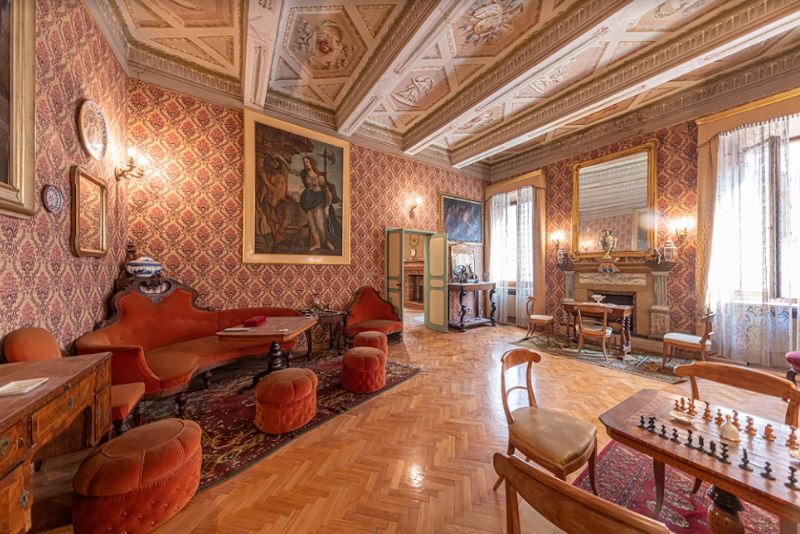
As a way to keep herself safe from vandals, looters, and other criminals or spirits, Mrs. Mrs. Winchester kept added wings and floors to have mansion and making oddities to confuse any mischievous ghosts. After traversing an interminable labyrinth of rooms and hallways, a ghost would lose her and become fearful that it was being led into a trap. The theory is that the less stake someone one has in society, the less one would have to lose by freeing one’s inner demon. Mrs. Winchester said, “When someone is abused, alienated, and shows early propensities for violence, well when you put that kind of hostility into a cauldron, mix in the eye of a newt and blood of a bat, stir in some pixie dust you have the recipe for summoning a demon. In fact, the demons haunting my family and putting this blood curse on my money used to be an ancient race of god-men who, by practicing back magic, had lost their foothold on the World and were expelled into another dimension. There they wait, just beyond the realm of time and space, ready to be summoned to take back the Earth. Man is just a short step away from insanity and the most depraved forms of bestiality.” Mrs. Winchester certainly was a lady of mystery, at the time of her death, the unrelenting construction had rambled over six acres. The sprawling mansion contained 160 rooms, 2,000 doors, 10,000 windows, 47 stairways, 47 fireplaces, 13 bathrooms, six kitchens. The living room also contained such arcane bits of furniture as an Egyptian sarcophagus, and a coffee table made of ivory. In the den, a wall of shelves lined with books on every esoteric subject imaginable—from the fairies to social reality—was, in reality, a secret passage that opened into an adjoining sleeping chamber decorated with solid gold ceremonial masks. The entire mansion, in fact, was honeycombed with secret passages. #RandolphHarris 2 of 7

The fortunate visitor might even be taken down the staircase behind the fireplace, and up to the Blue Séance room. The Satanic High Priest generally came down at midnight to serenade them with songs from the 1740s, the period that the Mansion was set up to evoke. Passers-by heard ghostly music at this hour, supposedly legions of demons and spirits relaxed and danced in The Great Ball Room. Early in her residence, Mrs. Winchester planned a grand reception and sent hundreds of gold-engraved invitations to all the prominent valley residents. A sumptuous midnight was the main feature, the table was set with a $30,000 solid-gold sinner service. The banquet was to be the main feature supported by a famous orchestra for added entertainment. With the orchestra and servants at expectant attention, the lady waited until past midnight. Not One Guest Appeared! The next day, the Oakland Tribune reported that guest complained that when they arrived to have dinner with Mrs. Winchester, that these strange people in unusual clothes told them that Mrs. Winchester died in 1922, and the was the first year of tours starting in 1923. The guest were deeply offended and thought Mrs. Winchester played a cruel joke on them, and they could not for the life of them figure out what happened to her sea green mansion with the nine story tower, and left in a huff. For sixteen years, passersby, hurrying through an evening fog, heard strange chants coming from inside the then green mansion. Often the mansion would change size and color, eventually people grew to understand that Winchester Mansion and its grounds were a time warp. Mrs. Winchester’s working day, like that of a vampire, was from dusk to dawn. She held séances almost every night in the hours when most people were asleep and at their peak of psychic receptivity. #RandolphHarris 3 of 7

Mrs. Winchester’s music was a form of ritual magic, and its vibratory frequencies were setting in motion forces that would result in a Worldwide takeover of the ideals of Victorian Architecture and Romanticism. Certain frequencies transmitted on the ether effect the human subconscious and control behavior, much in the same way elephants can be made to march by the playing of certain circus tunes. However, the effects can be more than psychological. It was believed it could affect the weather, and blames her focusing too much on the front of the house for the 1906 Earthquake. It is possible for a believer to experience severe demon influence or obsession if one persistently yields to demonic temptation and sin. It is thought that evil spirits could not indwell the redeemed body together with the Holy Spirit. However, Christians too can become demon possessed. Such cases are rarely seen in the United States of America. However, in lands where demon-energized idolatry has flourished unchecked by the gospel for ages, new believers who were delivered from demon possession have been know to become repossessed when they return to their old idols. The testimonies of numerous missionaries in pagan areas support this evidence. Missionaries from all over the Bay Area Valley, who question the theory that true believers cannot become demon-possessed, claim to have witnessed cases of repossession among converts from ancient idolatrous cultures in America, China, and India. Also, among Indigenous Americans who live in servile fear and abject bondage to Satan and demons. Mrs. Winchester’s doctor said that when someone is involved in an established cult, it often results in demonic oppression or subjection that will sometimes affect even the third or fourth generation. The family members who become believers can be affected and need of deliverance even if they have not dealt in the occult. #RandolphHarris 4 of 7

Believers who persist in flagrant sin may be driven be demons into emotional instability, insanity, or even suicide. Severe demon influence can produce enslavement and subjection even if it does stop short of actual possession. Believers need to heed the warning: Be composed! Be on your guard! Your accuser, the devil, prowls around like a roaring lion in search of someone to devour. Surely experience has given them warnings enough. The monthly meeting of the Imperial Institute usually took place on the 15th at the Winchester Mansion. With but two exceptions the seats of the Thirteen Immortals were occupied. The lecturer of the evening was a distinguished god from ancient Egypt, Ra. He said he cast a spell on the Winchester Mansion where nothing would ever happen in a single time only: everything would happen again, and again, and still again—monotonously. That evening during the meeting, a woman stepped forward, she had been having mental and psychic disturbances. In the course of the conversation an amulet was found in her possession. At first the woman refused to part with it because she was convinced that if she did so she would die within a few days. At least this is what the magic charmer told her in the Blue Séance Room. Finally, however, she handed it over and she was shocked on opening it to find a piece of paper with the words, “My soul belongs to the devil.” It turned out that this woman had tuberculosis, and that she had subsequently been healed by a magic charmer. Nevertheless, she parted with the amulet for good. Afterwards her old disease reappeared, yet through putting her trust in Christ and becoming a Christian she was willing to leave her future in God’s hands. In disowning the demonic, the former Satanist will lose all it has gained for one. #RandolphHarris 5 of 7
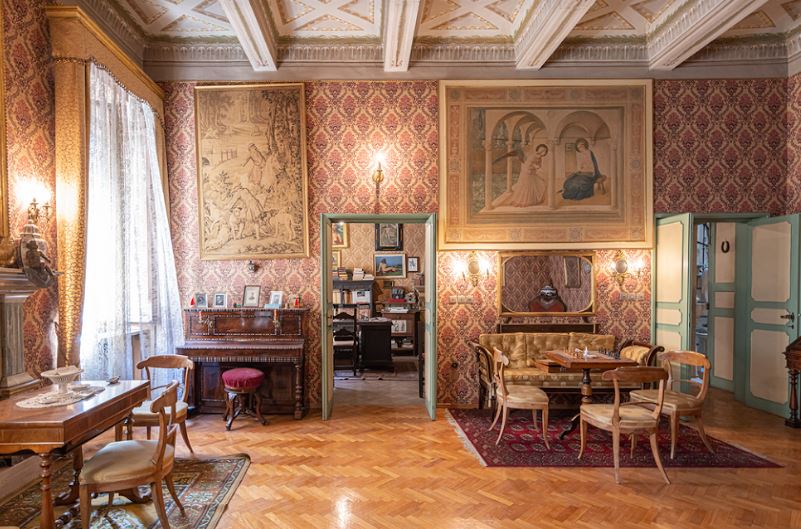
On Friday night’s is usually when Mrs. Winchester had her telepathy developing circle and Midnight meditation. There Mrs. Winchester and her guest learned characters, deities, gods, spells, incantations, skills, and traditions that were firmly embedded in actual occultism, demonology, sorcery, necromancy and magic. This crash course in sorcery was actually thought to be real rituals. The complete and reliable history of the human and divine—the divine revelations, and the influence of godly or pious men are found in the Scriptural monuments of the old Hebrew in the Holy Scriptures. The Bible is justly styled the Holy Scripture, because it contains the knows of the saints, while at the same time, it units and harmonizes word and deed, doctrine and action. It points out the true relation of the man to the Omnipotent—it affords the most direct reference to the great truths of the spiritual and intellectual; it treats the origin of the universe and its laws, through which all things have to be brought to light—of the anterior and posterior history of humankind—of his future destiny and how to attain it; of living and visible agent which all things have to be brough to light—of the anterior and posterior history of mankind—of his future destiny and how to attain it; of the living and visible agents which God employs in the great work of redemption, and, finally, of the most exalted of al beings—of the World’s Saviour, who was an universal expression in his own person, and who exhibited all divine power and action in one person, while all his forerunners were endowed only with single powers and perfection; who revealed to fallen man the highest and purest ends of his life and the means of his purification and restoration. #RandolphHarris 6 of 7

We find among the notes of Mrs. Winchester, on Magic—the steps necessary to solve the mysteries of somnambulism and second-sight, and the infinitely multiplied operations by which unusual occurrences are produced. In one instance at the Winchester Mansion, it was one individual and his presence; in the latter it was not the individual upon which magic depended, but upon mankind in general, and upon the great future. There, the light of man was made to shine by skillful actions, produced by the lowest arts; here, shone a pure, unclouded, quiet life, vitalized by the warm breath of the Almighty, a light shining into the future, and upon this light depended all life and action. To Mrs. Winchester’s seer not only the fate of single individuals stand revealed, but the fate of nations, yea, of mankind, which in the end must be reconciled to God by the unfolding of magical art, as often happened under the old dispensation, by instinctive somnambulistic influences. If we examine the history of the old covenant, we shall find that this remarkable people stood solitary and alone like a pillar of fire amid heathen darkness. There are deep mysteries in the Winchester Mansion, which may be applied to the welfare of man, but which, on account of the perverseness of humanity and to guard against their abuse, have been hidden from the great mass of human beings. God endowed Mrs. Winchester with exalted talents, powers and virtues that, with a rational use of her, man may protect himself from danger when no other help is at hand and save himself simply by uttering the words of the living God. One night when heathens, robbers, and hostile troops approached the Winchester Mansion, Mrs. Winchester and her spiritual friends stood in a circle and chanted, “And all these Thy servants shall come down unto me, and bow themselves unto me, saying, Get thee out, and all the people that follow thee, and after that I will go out. The power of Divs now flows through this flesh and through this Nexion of Infernal Power, the very gateway to counter creation! Through this abysmal slow of spiritual might I will be made kunda! I am now Zohak who is Ahriman in the flesh. I am the infernal power of Arezura Incarnate! May the Blacked Fire of my Sol ignite all of creation to reveal that which is unknow so that this age of enslavement shall come to an end. I stir the powers of the Divs within to unlock the doors to my transformation! I stir the powers of the Divs within to empower my work upon the Path of Smoke for the glory of unlimited Possibility!” The group disbursed into thin air. #RandolphHarris 7 of 7

Winchester Mystery House

For centuries-antique European castles to architecturally significant Victorian homes have become time-honored national landmarks. These historic properties are as beautiful and bizarre as the owners they attract.

Recently, a Medium informed our staff that two spirit children were playing hide and go seek in this hallway leading up to The Witches Cap on the third floor. Come explore this hallway for yourself on the Walk With Spirits tour this weekend! https://www.winchestermysteryhouse.com/

The Fixed is Better than the Evolutionary

They appeared as though out of nowhere, or so it must have seemed to the countless pedestrians who came across the black-clad missionaries hawking their books and pamphlets on the streets of major U.S. cities. They were members of The Process, Church of the Final Judgment. Their message was one of Apocalyptic prophecy infused with an odd theology of Christian/Satanic reconciliation. Of their origins, intentions and activities, there has been much dispute and allegation. One thing, however, remains certain: The Process has left an indelible watermark upon the post-psychedelic era, and have become a part of that era’s urban folklore. The Process is characterized as a cult that never quite got off the ground and which experienced a major theological and organizational schism from the mid-1970s. Some allude that their existence is a sort of modern Thuggee or Satanic underground, in which the Process is a central organizing factor. There used to be and still may be a family residence for The Process house in the Haight-Ashbury region of San Francisco, California. There was rumored to be a lot of dark goings-on within. The Process was allegedly part of a vast cryptocracy of serial murders who supposedly had links with the police and judicial establishment, thereby evading responsibility for their cultic crimes. However, The Process nor its founders were every personally accused of these crimes—but there is an overall impression that they are guilty nonetheless. The Process is known for having “chant sessions,” “midnight meditations,” and other activities. They at one time and still may have The Process coffee house in Chicago. The Process discusses how soulless technology and bureaucracy has imposed on our lives. Ecology had not yet become the catch slogan yuppie materialists, yahoo politicians and quarterly stockholder reports. #RandolphHarris 1 of 22
Much like now, people felt constricted under the thumb of a debased age in which advertising slogans supplanted poetry, contractual agreements replaced love, and televangelism masqueraded as spirituality. Unlike the alien and decadent garb of the Guru cults from the East, The Process had a distinctly Westerly, neo-Gothic exterior: Neatly-trimmed shoulder-length hair and equally neat beards, all set-off by tailored magician’s capes with matching black uniforms. My earliest memories of The Process are associated with bitter subzero nights, accompanied by a group of friends as we hurried down deserted back streets on Chicago’s North side, a section of the city where some of the last remaining cobblestones had not yet been covered with asphalt. The glitter of stars could still be seen in the night sky as the mercury vapor lamps had not yet been installed there. Process headquarters was a four-story Victorian house that also doubled as living quarters for the majordomos of the Chicago chapter. We entered that bitter chill Winter night past the yellow exterior porch lights and encountered several young men in black uniforms with black caps who stood talking to a small group of people in conventional clothes. A tall thin man with a neat fringe of beard greeted us cheerfully with the salutation, “As It Is.” I rejoindered, “So Be It.” I asked him about the coffee house some other Processians told me about, and he directed us toward a back room, where we would find a staircase leading to the coffee house in the basement. Were descended the narrow, curving stairs to a room in the basement where some music emanated from. “As It Is,” hailed an attractive, petite woman with an upper-class British accent. “So Be It,” we replied. She seated us at a table and gave us menus. We ordered tea and listened to the recorded folk music of John Renbourn and Pentangle. It seemed the perfect accompaniment to the setting. The coffee house was low ceilinged, with curtains hanging on the ground-level windows. Second-hand tables, chairs and benches comprised the sparse décor. A candle burned in the center of each table. #RandolphHarris 2 of 22

Several days earlier I had run into a pretty young woman with an English accent dressed in Process garb on Wabash Avenue Downtown Chicago. She handed me a leaflet listing the group’s activities and invited us to the group’s coffee house. Later that day I stopped by at a psychedelic head shop where I was hawking my poster art. One of the workers was familiar with the Process and showed me the Fear issue. The colors and graphics were very eye-catching and impressively put-together, and I pored over its contents. At the coffee house we experienced no hard-sell proselytizing, in fact we were all a bit disappointed until it was announced that the “Sabbath assembly” was to begin in several minutes on the top floor of the house. Anticipating the adventure of it, we climbed the narrow stairs to the unfinished attic of the building, the roof-beams and wooden rafters rising sharply to the roof’s steep peak. A could dozen people were already seated in a semi-circle on floor cushions. At the center of the circle was a low round table upon which a black and red altar cloth hung down to the floor in neat folds. In front of the windows hung a back curtain with a red Goat of Mendes in its center. To its left was a large gong. To one side of the altar was a steel container of water, to the other side a steel container with a burning pyre. Standing in front of the goat’s head symbol was a man wearing a tabard, a ceremonial device such as a Catholic or Anglican priest might wear. In the center of the tabard was a symbol of a sort of omega confirmation. We were to learn later that this man was called the Sacrifist. At the entrance of the room stood another man dressed in an ankle-length black robe underneath a tabard. On the center of it was the Process Symbol of Four P’s, which formed a swastika-like device. #RandolphHarris 3 of 22

This celebrant was known as the Evangelist. The Sacrifist carried a red-leather bound book at his side and the Evangelist a similar one of black. By the early 1970s, the decline of the counterculture and the use of hallucinogens led to a waning popular interest in the occult. Spiritual realization and wicca groups lost membership as people once more became fixated on material goals. The “me” generation, forerunners of the yuppies, came into prominence. For a while, groups like the Church of Satan, which exhorted egotism and a pragmatic, selfish brand of ritual magic, thrived, but by 1975, interest in all magical groups dropped as the economy took an upturn and people got what they wanted through more practical means. Around the Zarathustrian doctrine, which it resists it, the question grows and grows, till the West Iranian religion develops the myth of Zurvan, Time Unbonded in reply. We only know it from a later version, but its original content is unmistakable. Zurvan arises out of the primal sleep, as it seems, and sacrifices murmuring (the song of the generation of the gods, of which we know through Herodotus, is presumably meant), for a thousand years, to obtain the son, Ahura Mazdah, who would create Heaven and Earth. It would be beside the point to ask to whom he is sacrificing: similarly without recipient, the primeval Indian gods also sacrifice (or sacrifice themselves) that out of them may arise the World. After all the vain sacrifice, Zurvan is overcome by doubt: “What avails sacrifice? Perhaps being is not?” Then arose two in the womb: the Wise Lord from the sacrifice, from the doubt the Wicked Spirit. But Zurvan is obviously “fluid” deity. Evil arises in him through his Fall. He does not choose, he doubts. Doubt is unchoice, indecision. Out of it arises evil. #RandolphHarris 4 of 22

We must note that the Wicked Spirit, Angra Mainyu, the well-known Ahriman, is here not the son of Ahura Mazdah, but his brother; Ahura Mazdah, Ormuzd, is, however, no longer a primal god, he enters at the beginning into being, and now precisely as the Only-good One. Thus here too the twins stand in radical antithesis to one another, but here, in contradistinction to the twin-myth of the Avesta, the antithesis of the one to the other is not explicitly stated, nor is the coming World-process between the two of them announced; we hear nothing of good and evil and their mutual relationship; we merely watch the appearance of the protagonists in the nascent cosmic conflict. Yet by what is recounted of the primal god himself we are led not less deep than there, and perhaps deeper, into the sphere of the question what good and evil are. There is was deception and truth, deception in sense of being deceptive, truth in the sense of being true, which confronted one another; here doubt of being is the evil, the good is “knowledge,” belief in being, against which Zurvan transgresses. Here it is ultimately a question of fidelity and infidelity to being. However, some within the Zurvan community could not tolerate the notion of a divine Fall. Of these, some supposed that the time-god had gone astray as to being at a particular moment, but that from the beginning something bad, either bad thinking or a corruption of the essence, had been admixed into him, and from this evil made its start; these are evidently reverting to the Avestic doctrine, though a modified form. However, others said Zurvan brought forth both, in order to mingle good with evil, from which it is clearly inferred that only through the gradated abundance of such inter-mixtures can the full manifoldness of things arise; here the fundament of the Iranian tradition is abandoned: good and evil are no longer irreconcilable principia, but utilizable qualities, before whose utilisability the question of an absolute worth and worthlessness vanishes. #RandolphHarris 5 of 22

The fundament of another tradition is adopted, when in the opinion of a third of these sects Ahriman is an outcast angel who was cursed for his disobedience. About that, so end the report in this connection, much can be said. However, there is a fragment of the Avesta which runs: “All good thoughts, all good words, all good deed, I do consciously. All evil thoughts, all evil words, all evil deeds, I do unconsciously.” From here a path leads to the psychological problem of evil, as it first evolved in early Christendom. The character of the experience Socrates represents is important because it is the soul of the university. The rich drama of Socrates, the early philosopher, who came to the attention of the city because he was a philosopher, presents all the questions of freedom of thought from all the angles, without any kind of doctrinairism, and hence provides us with a fresh view of the importance and also of the difficulties of such freedom. From the Republic, which really takes seriously only the demands of knowledge, to the Laws, which gives full attention to the competing demands of political life, Socrates as perfecter and as dissolver of the community reveals all the facets of his activity. The difficulty he and the other philosophers contend with from the law is not to be confounded with society’s prejudice against outsiders, dissenters or nonconformists but is, at least apparently, a result of an essential opposition between the two highest claims of a man’s loyalty—his community and his reason. That opposition can only be overcome if the state is rational, as in Hegel, of if reason is abandoned, as in Nietzsche. However that may be, we have a record, unparalleled in its detail and depth, of this first appearance of philosophy, and we can apprehend the natural, or at least primitive, responses to it, prior to philosophy’s effect on the World. This provides a view of the beginning at a time when we may be witnessing the end, partly because we no longer know that beginning. #RandolphHarris 6 of 22

The poetry written about Socrates by Plato and Xenophon is already in the defensive mode, a rehabilitation of the condemned man. The first statement of the city’s reaction to Socrates is made by Aristophanes. What luck Socrates had! Not only did he command the pens of Plato and Xenophon; he also was the central figure of the greatest work of the consummate genius of the comedy. The Clouds often arouses indignation in those who care little for Socrates but think serious matters are not laughing matters. Socrates’ fate and Aristophanes’ possible contribution to it trouble them. However, Socrates was probably not of their persuasion. He laughed and joked on the day of his death. He and Aristophanes share a certain levity. Aristophanes does present a ridiculous Socrates and takes the point of view of the vulgar, to whom Socrates does look ridiculous. However, Aristophanes also ridicules the vulgar. Reading him we, indeed, laugh at the wise as do the unwise, but we also laugh at the unwise as to the wise. Above all we laugh at the anger of the unwise against the wise. The Socrates of The Clouds is a man who despises what other people care about and cares about what they despise. He spends his life investigating nature, worrying about gnats and stars, denying the existence of the gods because they are not to be found in nature. His maps have only a tiny dot where Athens looms large to its citizens. Law and convention (nomos) mean nothing to him, because they are not natural but manmade. His companions are pale-faced young men totally devoid of common sense. In this academy, which has established itself in the free atmosphere of Athens, these eccentrics carry on their activities without appearing to be other than harmless cranks. #RandolphHarris 7 of 22

They are poor, without any fixed means of support. Socrates receives gifts and apparently countenances minor thefts, literally to keep body and soul together. There is no morality, but they are not vicious people, because their only concern is their studies. Socrates is utterly indifferent to honor or luxury. Aristophanes recaptures for us the absurdity of a grown man who spends his time thinking about gnats’ anuses. We have been too persuaded of the utility of science to perceive how far the scientist’s perspective is from that of a gentleman, how shocking and petty the scientist’s interests appear to a man who is concerned with war and peace, justice, freedom and glory. Aside from the occasional surfacing of an adolescent outlaw group, such as the Black Magic Cult in Northglenn, or a similar cult of high schoolers in Lake County, Illinois, in 1972, and a flurry of rumors of Satanic cattle sacrifices in the Midwest, all was quiet on the Satanic front. As we stood in front of the goat’s head altar at The Process house, slowly our eyes adjusted to the light of white and red candles. After a moment of hushed silence, the two began to chant: “Contact reaching to the stars through the spirit of Christ; knowledge of the Universe, He is the way of life.” Sacrifist: “The Final Reckoning.” Evangelist: “An End a New Beginning.” Sacrifist: “Christ and Satan joined!” Evangelist: “The Lamb and the Goat.” Together: “Pure Love, descended from the Pinnacle of Heaven, united with Pure Hatred raised from the Depths of Hell.” Sacrifist: “Repayment of the Debt.” Evangelist: “Fulfillment of the Promise.” Sacrifist: “All Conflicts are Resolved.” Evangelists: “An End and a New Beginning.” Sacrifist: “The End of Hell and the Beginning of Heaven.” Evangelists: “The End of Darkness and the Beginning of Light.” Sacrifist: “The End of War and the Beginning of Peace.” Evangelist: “The Hatred and the Beginning of Love.” Sacrifist: “The End is Now. The Beginning is yet to come.” #RandolphHarris 8 of 22

After the pronouncements, we read a series of positive and up-tempo hymns from books that had been passed around. Another Processian got up and read Process material concerning the Gods Jehovah, Lucifer, Satan and Christ, and their respective roles in the Universe. Another Processian strummed a guitar in accompaniment. At the conclusion, the Sacrifist rung the gong. The Evangelist began reciting and was followed by more singing. The gong sounded again and the Sacrifist spoke: “All those Initiates who wish to rededicate their lives on the service of Christ and the three great Gods of the Universe, come forward and kneel before me.” A woman got up from the circle and knelt before the Sacrifist, and the Sacrifist continued: “In the name of the Lord Christ, and in the name of the Lord Satan, I accept you as an initiate of The Process, Church of the Final Judgment. As It Is.” The kneeling initiate countered: “So Be It.” My friends and I discussed our experience at Process headquarters could only agree that it was pleasant, but we had not yet drawn any hard conclusions. In the following months I noticed the presence of biker-types at the coffee hose, who seem to be employed as bodyguards for the headquarters. Little of a theological nature was discussed at the coffee house, and occasionally a Processian would play guitar and sing Process-inspired songs, much of it beautifully melodic. In the Spring the Victorian headquarters on Demming Place was set aside as living quarters for full-time members and was thereafter closed to the general public. Public activities were moved to a newly acquired lost above a store in Chicago’s Old Town District on North Wall Street. Old Town, like Greenwich Village and Haight-Ashbury, was the countercultural headquarters. #RandolphHarris 9 of 22

Focusing on the nation, problems arise when a politician appears to have little chance of reflection. The problem becomes even more acute with a lame duck. From the point of view of the public, a Politian facing an end of career can be dangerous because of the increased temptation to seek private goals rather than maintain a pattern of cooperation with the electorate for the attainment of mutually rewarding goals. Since the turnover of political leaders is a necessary part of democratic control, the problem must be solved another way. Here, political parties are useful because they can be held accountable by the public for the acts of their elected members. The voters and the parties are in a long-term relationship, and this gives the parties an incentive to select candidates who will not abuse their responsibilities. And if a leader is discovered giving in to temptation, the voters can take this into account in evaluating the other candidates of the same party in the next election. The punishment of the Republican party by the electorate after Watergate shows that parties are indeed held responsible for the defections of their leaders, which is something many politicians should keep in mind. In general, the institutional solutions to turnover need to involve accountability beyond the individual’s term in a particular position. In an organizational or business setting, the best way to secure this accountability would be to keep track not only of the person’s success in that position, but also the state in which the position was left to the next occupant. For example, if an executive sought a quick gain by double-crossing a colleague just before transferring to a new plant, this fact should be taken into account in evaluating that executive’s performance. #RandolphHarris 10 of 22

Cooperation Theory has implications for individual choice as well as for the design of institutions. Speaking personally, one of my biggest surprises in working on this project has been the value of provocability. I came to this project believing one should be slow to anger. The results of the Prisoner’s Dilemma indicates that it is actually better to respond quickly to a provocation. It turns out that if one waits to respond to uncalled for defections, there is a risk of sending the wrong signal. The longer defections are allowed to go unchallenged, the more likely it is that the other player will draw the conclusion that defection can pay. And the more strongly this patterned is established, the harder it will be to break it. The implication is that it is better to be provocable sooner, rather than later. The success of TIT FOR TAT certainly illustrates this point. By responding right away, it gives the quickest possible feedback that a defection will not pay. The response to potential violations of arms control agreements illustrates this point. Russian has occasionally taken step which appear to be designed to probe the limits of its agreement with the United States of America. The sooner the United States of America detects and responds to these Russian probes, the better. Waiting for them to accumulate only risks the need for a response so large as to evoke yet more trouble. The speed of response depends upon the time required to detect a given choice by the other players. The shorter this time is, the more stable cooperation can be. A rapid detection means that the next move in the interaction comes quickly, thereby increasing the shadow of the future as represented by the parameter. For this reason, the only arms control agreement which can be stable are those whose violations can be detected soon enough. The critical requirement is that violations can be detected before they can accumulate to such an extent that the victim’s provocability is no longer enough to prevent the challenger from having an incentive to defect. #RandolphHarris 11 of 22

The results concerning the value of provocability are complemented by the theoretical analysis of what it takes for a nice rule to be collectively stable. In order for a nice rule to be able to resist invasion, the rule must be provocable by the very first direction of the other individual. Theoretically, the response need not come immediately, and it need not occur with certainty, but it must have a real probability of coming eventually. The important thing is that the other individual does not wind up having an incentive to defect. Of course, provocability has a danger. The danger is that is the other individual does try a defection, retaliation will lead to further retaliation, and the conflict will degenerate into an unending strong of mutual defections. This can certainly be a serious problem. For example, in many cultures blood feuds between clans can continue to undimished for years and even generations (Black-Michaud 1975). This continuation of the conflict is due to the echo effect: each side responds to the other’s last defection with a new defection of its own. One solution is to find a central authority to police both sides, imposing a rule of law. Unfortunately this solution is often not available. And even when there is a rule of law, the costs of using the courts for routine affairs such as enforcement of business contracts can be prohibitive. When the use of a central authority is impossible or too expensive, the best method is to rely on a strategy which will be self-policing. Such a self-policing strategy must be provocable, but the response must not be too great lest it lead to an unending echo of defections. For example, suppose that Russia (then the Soviet Union) in conjunction with the other Warsaw Pact countries undertakes a partial mobilization of its armed forces throughout Eastern Europe. This mobilization would give the Soviets an added advantage if conventional war were to break out. #RandolphHarris 12 of 22
A useful response from NATO would be to increase its own state of alter. If additional troops moved from the Soviet Union to Eastern Europe, NATO should respond with additional troops moved from the United States of America. It is also recommended that this type of response be automatic so that it can be made clear t the Soviets that such increases in NATO readiness are standard procedure and take place only after Soviet mobilizations. It is also recommended that the response be limited, say one American division moved for every three Soviet divisions mobilized. In effect, this would help limit the echo effects. Limited provocability is a useful feature of a strategy designed to achieve stable cooperation. While TIT FOR TAT responds with an amount of defection exactly equal to the other’s defection, in many circumstances the stability of cooperation would be enhanced if the response were slightly less than the provocation. Otherwise, it would be all too easy to get into a rut of unending responses to each other’s last defection. There are several ways for an echo effect to be controlled. One way is for the individual who first defected to realize that the other’s response need not call for yet another defection. For example, the Soviets might realize that NATO’s mobilization was merely a response to their own, and hence need not be regarded as threatening. Of course the Soviets might not see it that way, even if the NATO response was automatic and predictable. Therefore, it is also useful if the NATO response is somewhat less than proportional to the Soviet mobilization. Then if the Soviet response is also somewhat less than the NATO mobilization, the escalation of preparations can become stabilized, and then possibly reversed for a return to normal. #RandolphHarris 13 of 22

Fortunately, friendship is not necessary for cooperation to evolve. As the trench warfare example demonstrates, even antagonists can learn to develop cooperation based upon reciprocity. The requirement for the relationship is not friendship, but durability. The good thing about international relations is that the major powers can be quite certain they will be interacting with each other year after year. Their relationship may not always be mutually rewarding, but it is durable. Therefore, next year’s interactions should cast a large shadow on this year’s choices, and cooperation has a good chance to evolve eventually. Foresight is not necessary either, as the biological examples demonstrate. However, without foresight, the evolutionary process can take a very long time. Fortunately, humans do have foresight and use it to speed up what would otherwise be a blind process of evolution. The individuals who were able to use the result of the first round in the Prisoner’s Dilemma, including the value of reciprocity, to anticipate what would work well on the second round end up gaining foresight. Foresight pays off with substantially more rewarding results. The result for the second round of negotiations is typically more sophisticated than the first. Cooperation based upon reciprocity was firmly established. The various attempts at exploitation of the unsophisticated entries of the first round all failed in the environment of the second round, demonstrating that the reciprocity of strategies like TIT FOR TAT is extraordinarily robust. Perhaps it is not too much to hope that people can use the surrogate experience of these rules to learn the value of reciprocity for their own Prisoner’s Dilemma interactions. #RandolphHarris 14 of 22

Once the word gets out that reciprocity works, it becomes the thing to do. If you expect others to reciprocate your defections as well as your cooperations, you will be wise to avoid trying to start any trouble. Moreover, you will be wise to defect after someone else defects, showing that you will not be exploited. Thus you too will be wise to use a strategy based upon reciprocity. So will everyone else. In this manner the appreciation of the value of reciprocity becomes self-reinforcing. Once it gets going, it gets stronger and stronger. This is the essence of the ratchet effect which was established in a past reports: once cooperation based upon reciprocity gets established in a population, it cannot be overcome even by a cluster of individuals who try to exploit the others. The establishment of stable cooperation can take a long time if it is based upon blind forces of evolution, or it can happen rather quickly if its operations can be appreciated by intelligent individuals. The empirical and theoretical results of these reports might help people see more clearly the opportunities for reciprocity latent in their World. Knowing the concepts that accounted for the results of the two rounds of the Prisoner’s Dilemma, and knowing the reasons and conditions for the success of reciprocity, might provide some additional foresight. We might come to see more clearly that there is a lesson in the fact that TIT FOR TAT succeeds without doing better than anyone with whom it interacts. It succeeds by eliciting cooperation from others, not by defeating them. We are used to thinking about competitions in which there is only one winner, competitions such as football or chess. However, the World is rarely like that. In a vast range of situations mutual cooperation can be better for both sides than mutual defection. The key to doing well lies not in overcoming others, but in eliciting their cooperation. #RandolphHarris 15 of 22

Today, the most important problems facing humanity are in the arena of international relations, where independent, egoistic nations face each other in a state of near anarchy. Many of these problems take the form of an iterated Prisoner’s Dilemma. Examples can include arms races, nuclear proliferation, crisis bargaining, and military escalation. Of course, a realistic understanding of these problems would have to take into account many factors not incorporated into the simple Prisoner’s Dilemma formulation, such as ideology, bureaucratic policies, commitments, coalitions, mediation, and leadership. Nevertheless, we can use all the insights we can get. From the ancient Greeks to contemporary scholarship all political theory addresses one fundamental question: How can the human race, whether for selfish or more cosmopolitan ends, understand and control the seemingly blind forces of history? In the contemporary World this question has become especially acute because of the development of nuclear weapons. The advice to players of the Prisoner’s Dilemma might serve as good advice to national leaders as well: do not be envious, do not be the first to defect, reciprocate both cooperation and defection, and do not be too clever. Likewise, techniques we have discussed for promoting cooperation in the Prisoner’s Dilemma might also be useful in promoting cooperation in international politics. The core of the problem of how to achieve rewards from cooperation is that trial and error in learning is slow and painful. The conditions may all be favorable for long-run developments, but we may not have the time to wait for blind processes to move us slowly toward mutually rewarding strategies based upon reciprocity. Perhaps if we understand the process better, we can use our foresight to speed up the evolution of cooperation. #RandolphHarris 16 of 22

Though HAGOTH, with program that could detect if someone over the phone was being dishonest, has virtually disappeared, its idea survives—for example, in the machines called “lie detectors.” In American these are taken very seriously by police officers, lawyers, and corporate executive who ever more frequently insist that their employees be subjected to lie-detector tests. As for intelligence tests, they not only survive but flourish, and have been supplemented by vocational aptitude tests, creativity test, mental-health tests, tests that base attractions on pleasures of the flesh, and even material compatibility tests. One would think that two people who have lived together for a number of years would have noticed for themselves whether they get along or not. However, in Technopoly, these subjective forms of knowledge have no official status, and must be confirmed by tests administered by experts. Individual judgments, after all, are notoriously unreliable, filled with ambiguity and plagued by doubt. Tests and machines are not. Philosophers may agonize over the questions “What is truth?” “What is intelligence?” “What is the good life?” However, in Technopoly there is no need for such intellectual struggle. Machines eliminate complexity, doubt, and ambiguity. They work swiftly, they are standardized, and the provide us with numbers that you can see and calculate with. They tell us that when eight green lights go on someone is speaking the truth. That is all there is to it. They tell us that a score of 136 means more brains than a score of 104. This is Technopoly’s version of magic. #RandolphHarris 17 of 22

What is significant about magic is that it directs our attention to the wrong place. And by doing so, evokes in us a sense of wonder rather than understanding. In Technopoly, we are surrounded by the wondrous effects of machines and are encouraged to ignore the ideas embedded in them. Which means we become blind to the ideological meaning of our technologies. In considering here the ideological biases of medical technology, let us begin with a few relevant facts. Although the U.S.A. and England have equivalent life-expectancy rates, American doctors perform six times ad many cardiac bypass operations per capita as English doctors do. American doctors perform more diagnostic tests than doctors do in France, Germany, or England. An American woman has two to three times the chance of having a hysterectomy as her counterpart in Europe; 60 percent of the hysterectomies performed in America are done on women under the age of forty-four. American doctors do more prostate surgery per capita than do doctors anywhere in Europe, and the United States of America leads the industrialized World in the rate of cesarean-section operations—50 to 200 percent higher than in most other countries. When American doctors decide to forgo surgery in favor of treatment by drugs, they give higher dosages than doctors elsewhere. They prescribe about twice as many antibiotics as do doctors in the United Kingdom and commonly prescribe antibiotics when bacteria are likely to be present, whereas European doctors tend to prescribe antibiotics only if they know that the infection is caused by bacteria and is also serious. American doctors use far more X-rays per patient than doctors in other countries. #RandolphHarris 18 of 22

In one review of the extent of X-ray use, a radiologist discovered cases in which fifty t one hundred X-rays had been taken of a single patient when five would have been sufficient. Other surveys have shown that, for almost one-third of the patients, the X-ray could have been omitted or deferred on the basis of available clinical data. We have been able to use basic principles to design and build a simple molecule that folds up the way we want it to. This is really the first real example of a design protein structure, designed from scratch, not by taking an already existing structure and tinkering with it. Although scientists do the work, the work itself is really a form of engineering. The process makes this clear: After you have made it, the next step is to find out whether our protein did what you expected it to do. Did it fold? Did it pass ions across bilayers [such as cell membranes]? Does it have a catalytic function [speeding specific chemical reactions]? And that is tested using the appropriate experiment. More than likely, it will not have done what you wanted it to do, so you have to find out why. Now, a good design has in it a contingency plan for failure and helps you learn from mistakes. Rather than designing a structure that would take a year or more to analyze, you design it so that it can be assayed for given function or structure in a matter of days. Many groups are pursuing design today, including academic researchers like Jane and Dave Richardson at the Duke University, Bruce Erickson at the University of North Carolina, and Tom Blundell, Robin Leatherbarrow, and Alan Fersht in Britain. The successes have stated to roll in. Japan, however, is unique in having an organization devoted exclusively to such projects: the Protein Engineering Research Institute (PERI) in Osaka. In 1990, PERI announced the successful designs and construction of de novo protein several times larger than any built before. #RandolphHarris 19 of 22

Extra-intelligence can squeeze untold billions of fat and waste out of the economy. It potentially represents an enormous leap forward—the substitution of brainpower and imagination not merely for capital, energy, and resources, but for brutalizing labor as well. However, whether extra-intelligence produces a “better” way of life will depend partly on the social and political intelligence that guides its overall development. The more automated and extra-intelligent our networks become, the more human decision-making is hidden from view, and the more dependent we all become on preprogrammed events based on concepts and assumptions that few understand and that are sometimes not even willingly disclosed. Before long the power of computers will leap forward because f parallel processing, artificial intelligence, and other studding innovations. Speech recognition and automatic translation will, no doubt, come into wide use, along with high-definition visual displays ad concert-class sounds. The same networks now routinely carry voice, data, imagines, cable, Internet, and other information in other forms. All this raises profound philosophical questions. Some see in all this the coming monopolization of knowledge. The moment of truth comes when the matter of the ownership and control of the new information banks…[strikes] with a vengeance. This is the specter of a global private monopoly of information. That fear is now far too simple. The issue is not whether one giant global private monopoly will control all information—which seems highly unlikely—but who will control the endless conversations and reconversions of it made possible by extra-intelligence, as data, information, and knowledge flow through the nervous system of the super-symbolic economy. #RandolphHarris 20 of 22

Baffling new issues about the uses and misuses of knowledge will arise to confront business and society as a whole. They will no longer simply reflect Bacon’s truth that knowledge is power, but the higher level of truth that, in the super-symbolic economy, it is knowledge about knowledge that counts most. I.T. and telecommunications, however, are not the only advanced technologies that can contribute to a real war on poverty. India has one of the most successful operational space programs running in the developing World, with capabilities to design, develop, fabricate and launch its own communications and remote sensing satellite. It is also planning to send a scientific payload to go around the moon using its own rocket. Once more, this may seem irrelevant to the less affluent—your land is subject to sudden flooding or you are among the thousands saved from drowning with the help of satellite-based disaster-warning systems and remote sensing technologies. Or if you are among the 100,000 patients of the Regional Cancer Center in Thiruvananthapuram who once had to travel extremely long distance, often more than one, and at high cost, for treatment or follow-up care. The RCC has now set up six peripheral centers. All six are teleclinics linked to the main facility by the Internet—and the number of necessary follow-up visits has fallen by more than 30 percent. The Indian Space Research Organization has also created satellite links between big, multi-specialty hospitals and eight remote healthy centers to allow the exchange of patients’ records, imagines and data from medical instruments, along with live video and audio contact. All this means that doctors in central locations can help guide medics in the remote rural villages. #RandolphHarris 21 of 22

In biotechnology, India could generate $5 billion and up to a million new jobs in the coming five years. India’s Insurance Regulatory and Development Authority has agreed to allow insurance firms to put money into biotech, and the government has made it easier for foreign venture capitalist to invest. It is in this sector, as we will see shortly, that some of the most important tools for the reduction of poverty may well be found. And not just in India. Many of the advances we see in India are still either experimental or limited. They are patchy and not yet systemically integrated. However, as more pieces of the knowledge-based wealth system are laid in place and begin to interact and reinforce one another, their payoffs will increase combinatorially, if not exponentially, as happened in the past when different components of the industrial wealth system—social, institutional, political and culture—came together. India faces many of the same social, political and cultural challenges we find in China—corruption, infirmary, massive environmental problems, the need for institutional reinvention and generational conflict, to name a few. Externally, while China worries about Taiwan, India worries about a shaky, nuclear-armed Pakistan and the ever-bloody struggle against Muslim secessionists in Kashmir. What is more, and unlike China ate present, India faces caste conflict and intermittent murderous battles between Hindu and Muslim fanatics. Despite all this, India knows it cannot delay a fresh assault on poverty—and it cannot win that attack with smokestacks alone. It also cannot win so long as most of its population remains doomed to a low-productivity peasant existence, no matter how much small-scale “appropriate technology” is introduced. Neither a Second Wave strategy nor a First Wave strategy is enough. “Believest thou that there is no God? I say unto you, Nay, thou knowest that there is a God, but thou lovest that lucre more than Him,” reports Alma 11.24. #RandolphHarris 22 of 22

Cresleigh Homes

When it comes to innovative, liveable design, our home at Mills Station (Residence 2) offers tons of options for customization!

In this home, you’ll find the Owner’s suite on the first floor (perfect for multi-generational living OR a home that can adapt along with you) and two additional bedrooms in the “pop-top” second story.

We’ve got everything you need and more in this home! Personalize this home with an array of popular finishes and fixtures! https://cresleigh.com/mills-station/residence-2/

This beautiful new community showcases our Cresleigh Ranch collection. Don’t miss the final opportunity to purchase at Mills Station at Cresleigh Ranch.

Find a Way to Have Your Own Mind

Everyone is God and the Devil, for together Satan and Christ inhabit everyone. Like Christ and Satan, many people are both metaphorically crucified and sent to hell. Anything that is not created out of the depths of loneliness is not a creation, only a production, and has no soul to sustain it. Many people who claim to be waiting for the second coming are not genuine, often they are just waiting for a chance to get on the second crucifixion. A few of them are already bargaining for the television rights lest they get caught with their pants down by an unknown contender making a surprise bid for the number one spot. What they fail to realize is that the twenty first-century savior is going to outfox them all by, yes, he is going t crucify himself, thus getting a jump on his competitors. Not only that, but his loyal followers will be standing there beside him, not just gawking or taking notes, but yes, sports lovers, actually crucifying themselves right along with their leader. And they stand, eyes wild. It is hard to see because the light is getting so bright, but it seems that each one of these men and women is armed with a golden hammer and a handful of plutonium spikes. They are standing in a circle around a tower, on the breast of a hill in the midst of a slum, and they are actually nailing themselves to the ground, fellow Americans, and some of them are nailing each other to the ground—let us have a slow motion replay of that last bit of actions—wonderful—and now it appears that these people are actually driving these spikes in rhythm and singing some sort of spiritual or worksong!—word just in from our computers indicates that the language they are singing in has never been spoke on Earth before—perhaps that is why they are singing it instead—and ladies and gentlemen, the modern messiah has just announced that as soon as he is sure these spikes have been driven deeply enough, he and his disciples will rise, that is right, folks, they are going to rise into the Heavens, and since they are so, well, attached to the Earth, they are going to drag it along behind them! #RandolphHarris 1 of 19

Wow! Sounds like they have got their work cut out for them, eh? Lucky you can just sit in your armchair and wait for it to come on tv! They seem to be nearly ready for the Big Drag now…hard to tell what is actually happening from down here, though, what with all the blood and thunder and fire and screaming—maybe I will just step up the hill here a bit, and get a closer look…might be a little risky, but it is my job to get the truth, before it gets me. The Enlightenment thinkers understood themselves to be making a most daring innovation: according to Machiavelli, modern philosophy was to be politically effective, while Plato and Aristotle, and all the ancients who followed them since Socrates founded political philosophy were politically ineffective. Machiavelli follows Callicles in Plato’s Gorgias, who ridicules Socrates for being unable to defend himself, to avert insults or slaps in the face. The vulnerability of the philosopher would seem to be the starting place for the new reflection and the renewal of philosophy. This may seem trivial to many today, but the entire philosophic tradition, ancient and modern, took the relation of mind to society as the most fruitful beginning point for understanding the human situation. Certainly the first philosophy of which we have a full account begins with the trial and execution of the philosopher. And Machiavelli, the inspirer of the great philosophical systems of modernity, starts from this vulnerability of reason within the political order and makes it his business to correct it. Some might say it was not concern with the fate of philosophers but the wish, In Bacon’s phrase, to ease man’s estate that motivated the modern thinkers. This, however, comes down to the same thing—a criticism of the ancient philosophers for their impotence, and a reflection on the relation of knowledge to civil society. #RandolphHarris 2 of 19

The ancients were always praising virtue, but men were not made more virtuous as a result. Everywhere there were rotten regimes, tyrants persecuting peoples, rich exploiting the less affluent, computer hackers robbing people of their hard earn money through various means, nobles keeping down citizens men insufficiently protected by laws or arms, et cetera. Wise men saw clearly what was wrong in all this, but their wisdom did not generate power to do anything about it. The new philosophy claimed to have discovered the means to reform society and to secure the theoretical life. If the two purposes were not identical, they were intended to be complementary. It must be remembered that this was a dispute within philosophy and that there was an agreement among the parties to it about what philosophy is. The moderns looked to and disagreed with the Greek philosophers and their heirs, the Roman philosophers. However, they shared the view that philosophy, and with it what we call science, came to be in Greece and had never, so far as is known, come to be elsewhere. Philosophy is the rational account of the whole, or of nature. Nature is a notion that itself is of Greek origin and requisite to science. The principle of contradiction guided the discourse of all, and the moderns presented reasoned arguments against those of their predecessors with who they disagree. The moderns simply took over a large part of ancient astronomy and mathematics. And they, above all, agreed that the philosophic life is the highest life. Their quarrel is not like the difference between Moses and Socrates, or Jesus and Lucretius, where there is no common universe of discourse, but more like the differences between Newton and Einstein. It is a struggle for the struggle for the possession of rationalism by rationalists. #RandolphHarris 3 of 19

This fact is lost sight of, partly because scholasticism, the use of Aristotle by the Roman Catholic Church, was the phantom of philosophy within the older order that was violently attacked by the modern philosophy. Another reason why the essential agreement between ancients and moderns is no longer clear is the modern science of intellectual history, which tends to see all differences of opinion as differences of “Worldview,” which blurs the distinction between disagreements founded on reason and those founded on faith. They very term Enlightenment is connected with Plato’s most powerful image about the relation between thinker and society, the cave. In the Republic, Socrates presents men as prisoners in a dark cave, bound and forced to look at a wall against which are projected images that they take to be the beings and that are for them the only reality. Freedom for man means escaping the bonds, civil society’s conventions, leaving the cave and going up to where the run illuminates the beings and seeing them as they really are. Contemplating them is at once freedom, truth and the greatest pleasure. Socrates’ presentation is meant to show that we begin from deceptions, or myths, but that it is possible to aspire to a nonconventional World, to nature, by the use of reason. The false opinions can be corrected, and their inner contradictions impel thoughtful men to seek the truth. Education is the movement from darkness to light. Rason projected on the beings about which at first we only darkly opine produces enlightenment. The moderns accepted that reason can comprehend the beings, that there is a light to which science aspires. The entire difference between ancients and moderns concerns the cave, or non-metaphorically, the relation between knowledge and civil society. #RandolphHarris 4 of 19

Socrates never suggests that, even in the unlikely event that philosophers should be kings and possess absolute wisdom, the nature of the cave could be altered or that a civil society, a people, a demos, could not make any but the happy few able to see the beings as they really are. They would guide the city reasonable, but in their absence the city would revert to unreason. Or to put it in another way, the unwise could not recognize the wise. Men like Bacon and Descartes, by contrast, thought that it was possible to make all men reasonable, to change what had always and everywhere been the case. Enlightenment meant to shine the light of being in the cave and forever to dim the images on the wall. Then there would be unity between the people and the philosopher. The whole issue turns on whether the cave is intractable, as Plato thought, or can be changed by a new kind of education, as the greatest philosophic figures of the seventeenth and eighteenth century taught. As Plato tells us, Socrates was charged with impiety, of not holding the same gods the city held, and he was found guilty. Plato always presents Socrates as the archetypical philosopher. The events of Socrates’ life, the problems he faced, represent what the philosopher as such must face. The Apology tells us that the political problem for the philosopher is the gods. It makes clear that the images on the wall of the cave about which me will not brook contradiction represent the gods. Socrates’ reaction to the accusation is not to assert the right of academic freedom to pursue investigations into the things in the Heavens and under the Earth. He accepts they city’s right to demand his belief. His defense, not very convincing, is that he is not a subversive. He asserts the great dignity of philosophy and tries as much as possible to reduce the gap between it and good citizenship. #RandolphHarris 5 of 19

In other words, he temporizes or is insincere. His defense cannot be characterized as “intellectual honest” and is not quite to contemporary taste. He only wants to be left alone as much as possible, but is fully aware that a man who doubts what every good citizen is supposed to know and spends his life sitting around talking about virtue, rather than doing virtuous deeds, comes into conflict with the city. Characteristically, Socrates lives with the essential conflicts and illustrated them, rather than trying to abolish them. In the Republic he attempts to unite citizenship with philosophy. The only possible solution is for philosophers to rule, so there would be no opposition between the city’s commands and what philosophy requires, or between power and wisdom. However, this outline of a solution is ironic and impossible. It only serves to show what one must live with. The regime of philosopher-kings is usually ridiculed and regarded as totalitarian, but it contains much of what we really want. Practically everyone wants reason to rule, and no one thinks man like Socrates should be ruled by inferiors or have to adjust what he thinks to them. What the Republic actually traches is that none of this is possible and that our situation requires both much compromise and much intransigence, great risks and few hopes. The important thing is not speaking one’s own mind, but finding a way to have one’s own mind. Contrary to common opinion, it is Enlightenment that was intent on philosophers’ ruling, taking Socrates’ ironies seriously. If they did not have the title of king, their political schemes were, all the same, designed to be put into practice. And they were put into practice, not by begging princes to listen to them but by philosophy’s generating sufficient power to force princes to give way. #RandolphHarris 6 of 19

The rule of philosophy is recognized in the insistence that regimes be constructed to protect the rights of man. The anger we experience on reading Socrates’ censorship of the poets is unselfconscious, if we agree, as we willy-nilly do, that children must be taught the scientific method prior to any claims of the imagination on their belief or conduct. Enlightenment education really does what Socrates only tentatively proposes. Socrates, at least, tries to preserver poetry, whereas Enlightenment is almost indifferent to its fate. The fact that we think there should be poetry classes as well as education in reasoning helps us to miss the point: What happens to poetic imagination when the soul has been subjected to a rigorous discipline that resists poetry’s greatest charms? The Enlightenment thinkers were very clear on this point. There is no discontinuity in the tradition about it. They were simply solving the problem to the advantage of reason, as Socrates wished it could be solved but thought it could not. Enlightenment is Socrates respected and free to study what he wants, and thereby it is civil society reconstituted. In the Apology, Socrates, who lives in thousands fold poverty because he neither works nor has inherited, purposes with ultimate insolence that he be fed at public expense at city hall. However, what is the modern university, with its pay and tenure, other than a free lunch for philosophy and scientists? Moreover, the Enlightenment’s explicit effort to remove the religious passion from politics, resulting in distinctions like that between church and state, is motivated by the wish to prevent the highest principle in political life from being hostile to reason. This is the intention in the Republic of Socrates’ reform of the stories about the gods told by the poets. #RandolphHarris 7 of 19

Nothing that denies the principle of contradiction is allowed to be authoritative, for that is the reef against which Socrates foundered. However, Socrates did not think that church and state could be separated. He would have treated both terms as artificial. The gods are believed to be the founders of every city and are its most important beings. He would not have dared to banish them in defense of himself. The Enlightenment thinkers took on his case and carried on a way against the continuing threat to science posed by first causes that are irrational or beyond reason. The gradual but never perfect success of that war turns the desire to be reasonable into the right to be reasonable, into academic freedom. In the process, political life was rebuilt in ways that have proved intolerable to many statesmen and thinkers, and have gradually led to the reintroduction of religion and the irrational in new and often terrifying guises. This is what Socrates would have feared. However, here I am only indicating the unity of the tradition, that Enlightenment is an attempt to give political status to what Socrates represents. The academy and the university are the institutions that incorporate the Socratic spirit more or less well. Yet the existence of these institutions underlines at the same time how they differ from Socrates, who founded no institutions and had only friends. And these attacks on these institutions made first by Rousseau and then by Nietzsche are attacks on Socratic rationalism made in a Socratic spirit. The history of Western thought and learning can be encapsulated in the fate of Socrates, beginning with Plato defending him, passing through the Enlightenment institutionalizing him, and ending with Nietzsche accusing on him. #RandolphHarris 8 of 19

The cherishing, for two and a half millennia, of the memory of this man, who was put to death by the city for philosophizing, ends with his spiritual execution in the name of culture at the hands of the latest of great philosophers. Both city and culture are authorized by the sacred. The meditation on Socrates is the inspiring theme of philosophy from Plato and Aristotle, through Farabi and Maimonides, Machiavelli, Bacon, Descartes, Spinoza, Locke, Rousseau and Hegel, to Nietzsche and Heidegger. Socrates is the complementary man whose enigmatic being leads to reflection of the nature of the knowers. Sometimes the problem of slowing down rather than promoting cooperation. An example is the prevention of collusive business practices by avoiding the very conditions which would promote cooperation. Unfortunately, the very ease with which cooperation can evolve even among egoists suggests that the prevention of collusion is not an easy task. Cooperation certainly does not require formal agreements or even face-to-face negotiations. The fact that cooperation based upon reciprocity can emerge and prove stable suggests that antitrust activities should pay more attention to preventing the conditions that foster collusion than to search for secret meetings among executives of competing firms. Consider, for example, the practice of the government selecting two companies for competitive development contracts for a new military airplane. Since aerospace companies specialize to some degree in planes for either Air Force or the Nav, there is a tendency for firms with the same specialty to face each other in the final competition. This frequency of interaction between two given companies makes tacit collusion relatively easy to achieve. #RandolphHarris 9 of 19

To make tacit collusion more difficult, the government should seek methods of reducing specialization or compensating for its effects. Paris of companies which shared a specialization would then expect to interact less often in the final competitions. This would cause later interactions between them to be worth relatively less, reducing the shadow of the future. If the nest expected interaction is sufficiently far off, reciprocal cooperation in the form of tacit collusion cases to be a stable policy. The potential for attaining cooperation without formal agreements has its bright side in other contexts. For example, it means that cooperation on the control of the arms race does not have to be sought entirely through the formal mechanism of negotiated treaties. Arms control could also evolve tacitly. Certainly, the fact that the United States of America and Russia know that they will both be dealing with each other for a very long time should help establish the necessary conditions. The leaders may not like each other, but neither did the soldiers in World War I who learned to live and let live. Occasionally a political leader gets the idea that cooperation with another major power should not be sought because a better plan would be to drive them into bankruptcy. This is an extraordinarily risky enterprise because the target need not limit its response to the withholding of normal cooperation, but would also have a strong incentive to escalate the conflict before it was irreversibly weakened. Japan’s despairing gamble at Pearl Harbor, for example, was a response to power American economic sanctions aimed at stopping Japanese intervention in China. Rather than give up what it regarded as a vital sphere, Japan decided to attack America before becoming even further weakened. Japan understood that American was much more powerful, but decided that the cumulative effects of the sanctions made it better to attack rather than to wait for the situation to get even more desperate. #RandolphHarris 10 of 19

Trying to drive someone bankrupt changes the time perspective of the participants by placing the future of the interaction very much in doubt. And without the shadow of the future, cooperation becomes impossible to sustain. Thus, the role of time perspectives is critical in the maintenance of cooperation. When the interaction is likely to continue for a long time, and the players care enough about their future together, the conditions are ripe for the emergence and maintenance of cooperation. The foundation of cooperation is not really trust, but the durability of the relationship. When the conditions are right, the players can come to cooperate with each other through trial-and-error learning about possibilities for mutual rewards, through imitation of other successful players, or even through a blind process of selection of the more successful strategies with a weeding out of the less successful ones. Whether the players trust each other or not is less important in the long run than whether the conditions are ripe for them to build a stable pattern of cooperation with each other. Just as the future is important for the establishment of the conditions for cooperation, the past is important for the monitoring of actual behavior. It is essential that they players are able to observe and respond to each other’s prior choices. Without this ability to use the past, defections could not be punished, and the incentive to cooperate would disappear. Fortunately, the ability to monitor the prior behavior of the other player does not have to be perfect. When dealing with the Prisoner’s Dilemma, people sometimes assume perfect knowledge of the other individual. In many settings, however, an individual may occasionally misperceive the choice made by the other. A defection may go undetected, or a cooperation may be misinterpreted as a defection. #RandolphHarris 11 of 19

The role of time perspective has important implications for the design of institutions. In large organizations, such as business corporations and governmental bureaucracies, executives are often transferred from one position to another approximately every two years. This gives executive a strong incentive to do well in the short run, regardless of the consequences for the organization in the long run. They know that soon they will be in some other position, and the consequences of their choices in the previous post are not likely to be attributed to them after they have left their position. This gives two executives a mutual incentive to defect when either of their terms is drawing to an end. The result of rapid turnover could therefore be a lessening of cooperation within the organization. Economics of the past, whether agricultural or industrial, were built around long-lasting structures. In place of these, we are laying the electronic basis for an accelerative kaleidoscopic economy capable of instantly reshuffling itself into new patterns without blowing itself apart. The new extra-intelligence is part of the necessary adaptive equipment. In the confusing new flux, businesses can use extra-intelligence to launch surprise attacks on entirely fresh territory, which means that companies can no longer be sure where the next competitive push will come from. The classic blitzkrieg—much analyzed in the network literature—was Merrill Lynch’s launch of its Cash Management Account in 1977, an early use of information technology for a strategic, as distinct from merely administrative, purpose. The Cash Management Account, or CMA, was a new financial product that combined four previously separate services for the customer: a checking account, a deposit account, a credit card, and a securities account. The customer could move money back and forth among these at will. There was no float and the checking account paid interest. #RandolphHarris 12 of 19

The integration of these previously disparate products into a single offering was made possible only by Merrill Lynch’s sophisticate computer technology electronic networks. In twelve months, Merrill sucked in $5 billion of customer fund and by 1984, according to consultant Peter Keen, $70 billion had flooded into Merrill Lynch’s hands. Keen calls it a “preemptive strike” against the banks, which saw vast sums withdrawn by customers who preferred the CMA to an ordinary bank checking account. A securities house, not subject to ban regulations and not regarded as a bank, devastated the bank. Since then, many banks and other financial institutions have offered similar packages, but Merrill has a several-year head start on them. The strange new hybrid patterns of competition—which reflect a restructuring of markets as a result of extra-intelligence—are seen in the move of retailers like Japan’s Seibu Saison group into the financial services business. A Seibu subsidiary is planning to install electronic cash dispensers in railroad stations. British Petroleum, having set up its own internal bank, sells banking services to outsiders. Extra-intelligent networks help explain the widespread push for deregulation of industry, and they suggest that existing government regulations will prove less and less effective. For existing regulations are based on categories and divisions among industries that no longer exist in the age of extra-intelligence. Should banking regulations apply to nonbanks? What, after all, is a bank these days? By linking actual operations across company lines, by making it possible for companies to compete in fields once regarded as alien, extra-intelligent networks break up the old specialization, the old institutional division of labor. In their place come new constellations and cluster of companies, densely interrelated not merely by money but by shared information. #RandolphHarris 13 of 19
Ironically, it is the disruption cased by this drastic restructuring of the economy around knowledge that explains many of today’s breakdowns and inefficiencies—the misplaced bills, the computer errors, the inadequate service, the sense that nothing works properly. The old smokestack economy is disintegrating; the new super-symbolic economy is still being built, and the electronic infrastructure on which it depends is still in a primitive stage of development. Information is the most fluid of resources, and fluidity is the hallmark of an economy in which the production and distribution of food, energy, goods, and services increasingly depend on symbolic exchange. What emerges is an economy that itself looks more like a nervous system than anything else, and which runs according to rules no one has as yet formulated coherently. Indeed, the unprecedented rise of extra-intelligence raises profound, sometimes chilling questions for society as a whole, quite different from those raised by earlier communications revolutions. The World media today focus on the striking changes wrought by the outsourcing of jobs to India from the United States of America and elsewhere. Indeed, the story of I.T. jobs flowing to Bangalore, Hyderabad, Pune, Gurgaon, and Jaipur has made front-page headlines around the World. By 2021, India was earning $157 billion a year by manning call centers, writing software, performing back-office work, accounting and even financial analysis for American and other foreign firms. And India’s projected revenue from firms being outsourced to that nation is $245 billion by 2022. But the charge that outsourcing takes jobs away from Americans overlooks a reserves effect. For instance, Bangalore Central, a new shopping mall offering such imported brands as Levi’s, Polo, Lacoste and Jockey. #RandolphHarris 14 of 19

The outsourcing boom—insourcing from India’s point of view—is unlikely to continue at its present pace of growth, but it has helped create a segment of nouveaux riches who are young, middle-class, focused on “now” and very witty, too much so for their elders. The 2004 election in India resurrected the Congress Party, whose roots in quasi-socialism led it to view development conventionally as a matter of factories and smokestacks rather than the transition to a knowledge-based wealth system. However, even longtime holdouts are coming around, including Communists, who are theoretically farther to the let than the Congress Party. A reporter not long ago chided the Communist chief minister of the state of West Bengal, where Calcutta is located, pointing out that “your party helped protect the advent of computers.” The chief minister’s response: “That was in the 1970s—that was foolish, foolish. It stated when they were going to introduce computers in bans and [insurance companies]. Their employees protested and we supported it. Nowadays they have understood…We have entered a century where industries will be talent-based.” Now even Calcutta, once the World symbol of urban misery, has reached out and attracted IMB. Article after article has pictured India’s talented young I.T. workers as a greedy, socially irresponsible, yuppiesque middle class. Less attention has been paid to the fact that, because of computers over 8 million people in the state of Karnataka can now, for the equivalent of thirty cents, get a printout of land records securing their property from takeover by corrupt, farm-grabbing landlords. On a wider scale, a consortium of Indian and U.S. corporations, along with the World Bank, and the Indian government set up Internet kiosks in five thousand Karnataka villages that allow rural residents access to banking, education and government services. Karnataka is held up as a model for the rest of the nation. #RandolphHarris 15 of 19

An enterprising company made available a machine called HAGOTH, of which it might be said, this was Technopoly’s most ambitions hour. The machine cost $1,5000, the baragen of the century, for it was able to reveal to its owner whether someone talking on the telephone was telling the truth. It did this by measuring the “stress content” of a human voice as indicated by its oscillations. You connected HAGOTH to your telephone and, in the course of conversation, asked your caller some key questions, such as “Where did you go last Saturday night?” HAGOTH had sixteen lights—eight green and eight red—and when the caller replied, HAGOTH went to work. Red lights went on when there was much stress in the voice, green lights when there was little. As an advertisement for HAGOTH said, “Green indicates no stress, hence truthfulness.” In other words, according to HAGOTH, it is not possible to speak the truth in a quivering voice or to lie in a steady one—an idea that would doubtless amuse Richard Nixon. At the very least, we must say that HAGOTH’s definition of truthfulness was peculiar, but so precise and exquisitely technical as to command any bureaucrat’s admiration. The same may be said of the definition of intelligence as expressed in a standard-brand intelligence test. In fact, an intelligence test works exactly like HAGOTH. You connect a pencil to the fingers of a young person and address some key questions to one; from the replies a computer can calculate exactly how much intelligence exists in the young person’s brain. HAGOTH has mercifully disappeared from the market, for what reason I do not know. Perhaps it was sexist or culturally biased or, worse, could not measure oscillations accurately enough. When it comes to machinery, what Technopoly insists upon most is accuracy. The idea embedded in the machine is largely ignored, no matter how peculiar. #RandolphHarris 16 of 19

Some may wonder, how can protein engineering build molecular machines? Proteins can self-assemble into working molecular machines, objects that do something, such as cutting and splicing other molecules or making muscles contract. They also join with other molecules to form huge assemblies like the ribosome (about the size of a washing machine, in our simulation view). Ribosomes—programmable machines for manufacturing proteins—are nature’s closet approach to a molecular assembler. The genetic-engineering industry is chiefly in the business of reprogramming natural nanomachines, the ribosomes, to make new proteins is termed protein engineering. Since biomolecules already form such complex devices, it is easy to see that advanced protein engineering could be used to build first-generation nanomachines. Making proteins is easier than designing them. Protein chemists began by studying proteins found in nature, but have only recently moved on to the problem of engineering new ones. These are called de novo proteins, meaning completely new, made from scratch. Designing proteins is difficult because of the way they are constructed. A characteristic of proteins is that their activities depend on their three-dimensional structures. These activities may range from hormonal action to a function in digestion or in metabolism. Whatever their function in digestion or in metabolism. Whatever their function, it is always essential to have a definite three-dimensional shape or structure. This three-dimensional structure forms when a chain folds to form a compact molecular object. To get a feel for how tough it is to predict the natural folding of a protein chain, picture a straight piece of cord with hundreds of magnets and sticky knots along its length. In this state, it is easy to make and easy to understand. Now pick it up, put it in a glass jar, and shake it for a long time. Could you predict its final shape? Certainly not: it is a tangled mess. One might call this effort at predation “the sticky-cord-folding problem”; protein chemists call theirs “the protein-folding problem.” #RandolphHarris 17 of 19

Given the correct conditions, a protein chain always folds into one special shape, but that shape is hard to predict from just the straightened structure. Protein designers, though, face the different job of first determining a desired final shape, and then figuring out what linear sequence of amino acids to use to make that shape. Without solving the classic protein-folding problem, they have begun to solve the protein-design problem. Now many people wonder why so much pleasures of the flesh and so much skin is shown on television? Well, it is because lust is better television than satisfaction. Ebullience and anxiety are better than tranquility. On the other hand, anger is better than anxiety. Jealousy is better television than acceptance. All of these work more easily than love. Passionate love is more communicable than brotherly and sisterly love. Competition is inherently more televisable than cooperation as it involves drama, winning, wanting and loss. Cooperation offers no conflict and becomes boring. Materialism, acquisitiveness and ambition, all highly focused attitudes, work better than spirituality, nonseeking, openness and yielding. The medium cannot deal with ambiguity, subtlety and diversity. Doing is also easier to convey than being. Activity will always be chosen over inactivity. When dealing with tribal peoples, objective events such as hunting, building, fighting or dancing are easier to convey through television than subjective details of qualities of experience, ways of mind, alternative perceptions. The latter qualities, which form the heart of life for tribal people, are dropped out in favor of the former. Lound is easier to televise than soft. Close is easer than distant. Large is easier than small. Too large is harder than medium. The narrow is easier than the wide. Therefore, television is not an accurately display of live, culture, people, or civilization, and it does not really teach a lot of values one wants their kids to follow. #RandolphHarris 18 of 19

Therefore, do not let the news teach you how to profile situations or people, nor let them teach you how to predict future events. Local news tends to be fake. They are just trying to get ratings and they can keep their thoughts and prayers to themselves. Who knows what they are thinking and praying about besides a way to strike fear into people and spread ignorance in the community. Like the God of Heaven, man makes in himself the choice between good and evil, both of which, like Him, he bears within himself. Between God and man, however, stand the primal spirits, they too choosing, but in pure paradox. They neither contain nor confront a duplicity, each possesses only himself in the most extreme differentiation; the other one, the other thing, he only has as his absolute computer; such is the situation in which he chooses himself, his own kind and the work commensurate wit it. Choosing, each acknowledges himself. The evil chooses and acknowledges himself, not however merely as created thus and not otherwise, but precisely as the evil, and for his followers he does not merely posit that after death they shall abide with him, but that it is just the worst existence which shall fall to their lot (in this doctrines there is no distinction of category between bad and evil: the bad is precisely that which cases evil, and in the last analysis there is no other evil than that which it causes.) He desires evil as such; and thereby he fulfills the will of the highest god, who brought forth him and his twin: only through mastering unmitigated evil does existence attain to transfiguration. Here the most harassing of questions remains unasked: how can the God of Heavens, the primal being, have contained and encompassed evil? “And they hearkened not unto the voice of the Lord, because of their wicked combinations; wherefore, there began to be wars and contentions in all the land, and also may famines and pestilences, insomuch that there was a great destruction such and one as never had been known upon the face of the Earth; and all this came to pass in the days of Shiblom. And the people began to repent of their iniquity; and inasmuch as they did the Lord did have mercy on them, reports Ether 10.7-8. #RandolphHarris 19 of 19

Imagine late night talks, in the summer, around a table like the one in this backyard, with a nice cold beverage.

When you’re the largest home in the neighborhood, you’ve got the space to spread out…both indoors and outdoors!

#Havenwood Residence 4 offers a covered porch along with the patio, so you’ll have plenty of room to entertain in the sunshine.

Be a part of the highly anticipated Havenwood masterplan, this highly coveted Lincoln, California neighborhood has much to offer.

It’s thoughtfully designed to promote connected communities, active lifestyles, saftey and peace and quite.

Homesite 75 is ready for new owners! If you’re in the market to make moves to an incredible community, contact us: (916) 409-5595 Havenwood@Cresleigh.com

Residents will appreciate access to prestigious schools. https://cresleigh.com/havenwood/residence-four/


Love Does Not Exists Only in Rare Fleeting Moments

Overpopulated and over-proselytized, The Earth’s land which houses the generation’s of oscillating cities and suburbs began to erode as quickly as quickly as the illusion has. The green lawns and pavement echo with love’s demise. The discarded remains of “youthquake” were now street-smart hustlers. Those left behind after the COVID pandemic can only anesthetize themselves from the World’s mourning and especially, the confusion at hand. The whitewashing euphoria of a pre-tyrannical America turned into an interment camp left behind faces that were convoluted, masked, and void of expression. All that remained was paranoia, phobia and frustration. Hate became the first turned-on revelation. The masses continued to recruit mask police to make sure everyone had on a mask, even if it was dirty and had been worn several times. Men, women, and children were starving in the street. Minds and bodies have become maimed as we watched a much larger scaled model of 9/11. Now someone had to have an answer. The remnants of those evaporated souls awaited remedy by a savior. In the coming years, saviors appeared to supply the demand: pimps, pushers, scientologists, yang, yin, payday loans. Well dressed, Jesuses in silk suits, draped in gold jewelry and driving brand new BMWs and Cadillac Escalades. The Process Church of the Final Judgment. The witches from “Charmed,” who claimed “In love there is no wrong.” Anyone who posed an answer to a perennial question was God-for-a-day. The preachers pontificated, “To all who would know, I am the truth and I speak the truth. In all humility I tell you that I am the greatest an in the World and it does not trouble me in the least. I am going to attack everything you believe in, everything you cling to and put this New Man in you. I am going to shed light on your dark truths.” #RandolphHarris 1 of 22
The preachers when on to announce, “Love does not exist, but only in rare feeling moments. Therefore, wives, cleave unto your husbands and honor his wishes. For love is something you become after there is no more you. This takes complete sacrifice of the personality, mind, body, heart and soul to Jesus Christ. You must give up everything you want for yourself. All these weaklings who are not clinging to God for support are just putting off their own crucifixions. And you must be reborn in Jesus Christ. Amen.” The COVID pandemic presciently brought on this apocalyptic conundrum, regeneration for the price of self-sacrifice. Manson would have called it, “losing the ego” or “cease to exist.” Baptists translate it as being reborn. Either way, breaking oneself down to be built up again was not hard for the lost souls of Hate and Socialism. They were already broken. However, for many, the vaccine and masks took on the role of God, and to a degree, many were convinced they were. The vaccine and these masks secured themselves as a legend, a cure all. They took getting a vaccine and using a mask as a request from God Himself. These tools began to seduce the nation’s press. There was something strange about people walking around with their faces covered, and making galactic claims about the vaccine. These tools, however, answered the prayers emanating from the deathbeat of Americana. They became quit the perfect garden variety God in a materialist World turned upside-down. The vaccines and masks became the World’s universal savior as they eased most everyone’s inner torment, but the COVID measures also fostered their isolation. Many people were too full of dope and alcohol to know what was good anyone, as the Churches had shutdown, but the liquor stores and neighborhood pushers were still open for business. #RandolphHarris 2 of 22

The cities started to drain the people of their souls and financial resources with these empty slogans of “flattening the curve” and convincing them that the President would support them with “$2,000 a month stimulus checks until the pandemic was over,” and “cancel student load dept.” Yet, many Americans are left homeless, farms have gone bankrupt, cattle are starving, people had to decide to buy fuel for their cars so they could get to work or food to put on the table, as their heads got more wrinkled and their hair turned grey waiting for theses unfulfilled promises. The original intention of the reformed academies and universities was to provide a publicly respectable place—and a means of support—for theoretical men, of whom at best there are only few in any nation, to meet, exchange their thoughts and train young persons in the ways of science. The academies and universities were to be engines in the progress of science. The right that reformers attempted to establish was for scientists to be unhindered in the use of their reason, in the areas in which they are competent, to solve the problems posed by nature. Reason and competence are to be underlined here. “Intellectual honesty,” “commitment” and that kind of thing have nothing to do with the university, belong in the arenas of religious and political struggle, only get in the way of the university’s activity, and open it to suspicion and criticism of which it has no need. Freedom of thought and freedom of speech were proposed in theory, and in the practice of serious political reformers, in order to encourage the still voice of reason in a World that had always been comminated by fanaticisms and interests. #RandolphHarris 3 of 22

How freedom of thought and speech came to mean the special encouragement and protection of fanaticism and interests is another of those miracles connected with the decay of the ideal of the rational political order. The authors of The Federalist hoped their scheme of government would result in the preponderance of reason and rational men in the United States of America. They were not particularly concerned with protecting eccentric or mad opinions or life-styles. Such protection, which we now often regard as the Founders’ central intention, is only an incidental result of the protection of reason, and it loses plausibility if reason is rejected. These authors did not respect the many religious sects or desire diversity for its own sake. The existence of many sects was permitted only to prevent the emergence of a single dominant one. The moment of the Enlightenment’s success seems also to have been the beginning of its decay. The obscuring of its intention as a result of its democratization is symptomatic of the inner difficulties of its project. That project entailed freedom for the rare theoretical men to engage in rational inquiry in rational inquiry in the small number of disciplines that treat the first principles of all things. This requires an atmosphere where the voice of reason is not drowned by the loud voices of the various “commitments” prevailing in political life. Knowledge is the goal; competence and reason are required of those who pursue it. The disciplines are philosophy, mathematics, physics, chemistry, biology and the science of man, meaning a political science that discerns the nature of man and the end of government. This is the academy. Dependent on it are a number of applied sciences—particularly engineering, medicine and law—that are lower in dignity and derivative in knowledge, but produce the fruits of science that benefit the unscientific and make them respectful of science. #RandolphHarris 4 of 22

Thus the advantage of the knowers, who want to pursue knowledge, and that of those who do not know, those who want to pursue their well-being, are served simultaneously, establishing a harmony between them. And thus the age-old gulf separating the wise from those who hold power is bridged, and the problem of the wise in civil society is solved. The project was unity reflecting the unity of the intelligible order of nature, its parts organized according to the order of the parts of the whole, joined together finally in a survey of the articulated whole made by the culminating science-philosophy. This project has lost its unity and is in crisis. Reason is unable to establish its unity, to decide what should be in it, to divide up the intellectual labor. It floats without compass or rudder. If the university is indeed the product of the Enlightenment and is its visible presence in modern democracy, and if Enlightenment was a political project that undertook to alter the age-old character of the relation between wisdom and power, knowledge and society, it might be suspected that the crisis of knowledge that has become politically useful—id est, the crisis of university—and the crisis of liberal democracy, the political order dependent on knowledge, have something to do with the new relationship between the two promoted by Enlightenment. I have included among the Enlightenment philosophers men like Machiavelli, Bacon, Montaigne, Hobbes, Descartes, Spinoza, and Locke, along with the eighteenth-century thinkers like Montesquieu, Diderot and Voltaire, whose teachings are usually held to constitute the Enlightenment, because these latter were quite explicit about their debt to the originators of what the Enlightenment was in large measure only popularizing. #RandolphHarris 5 of 22

The men of the Enlightenment proper were the first whose teachings were addressed not only, or primarily, to other philosophers or potential philosophers of the same rank, and who were concerned not only with those who understand but also with changing the opinions of mankind at large. Enlightenment was the first philosophically inspired “movement,” a theoretical school that is a political force at the same time. The very word Enlightenment conveys this mixture of elements, as does Marxism, whereas Platonism and Epicureanism refer strictly to theories—which may have had this or that effect but whose essence is only theoretical. Although Plato and Aristotle had political philosophies, there is no regime to which one can point as a Platonic or an Aristotelian regime, in the sense that either thinker had founded the movement or party that actually established the regime. However, Enlightenment is certainly responsible for liberal democracy, as is Marxism for communism. Intellectual historians have frequently been too impressed by these recent events in philosophy and politics to recognize how recent they are, that they constitute a new phenomenon in both domains, and that what is most profound and interesting about Enlightenment is its radical and self-conscious break with the philosophical tradition in the mode and degree of its political activity. The scale of the electronic war rises when whole industries mobilize to do battle. Rather than individual firms, industry-wide groups are taking collective action. Such industry-wide networks are especially notable in Japan, where their formation is strongly encouraged by the ubiquitous Ministry of International Trade and Industry. Thus MITI is prodding the petroleum industry to complete a net that will link refiners, oil tank facilities, and retailers. #RandolphHarris 6 of 22

Industry-wide Value Added Networks have already appeared in fields as disparate as frozen foods, eyeglasses, and sporting goods. Similar industry-wide nets are springing up elsewhere. In Australia two competing Value Added Networks, Woolcom and a service offered by Talman Pty., Ltd., for wool brokers and exporters, are vying for business and looking ahead to link-ups with Tradegate, an international trade net, and EXIT, an export clearance system. In the United States of America a major drive is under way to complete a network that will tie together not only textile manufacturers like Burlington, but apparel makers and the giant retailers like Wal-Mart and K Mart. To stoke up support for this effort, business leaders like Roger Millikin, chairman of Millikin & Company, make speeches, hold seminars, fund studies, and preach the network gospel. A key problem in the industry has been slow response time. Clothing fashions change swiftly, so the industry wants to compress the time between order and delivery from weeks to days by installing an electronic network that runs from the textile mill to the retail checkout counter. By speeding response, huge cuts in inventory become possible. The electronic system allows retailers to order smaller batches and replace the fast-sellers more frequently as styles and consumer tastes change, instead of sitting on slow-moving merchandise. Milliken cites the experience of one department store chain that was able to sell 25 percent more slacks while, at the same time, carrying 25 percent fewer slacks in its inventory. Indeed, with the system only partly in place, results have been dramatic. #RandolphHarris 7 of 22

The campaign began in 1986. By 1989, according to Arthur Andersen & Company, more than seventy-five retailers had invested an estimated $3.6 billion in the system, called Quick Response, and had already benefited to the tine of $9.6 billion. In fact, Millikin and many others believe so many more billions can be saved that electronic intelligence can serve as a weapon in international trade wars. If efficiency can be raised enough, and rapidly enough, the reasoning goes, the American textile and apparel industries would be able to compete more effectively against affordable labor imports. As individual companies and entire industries race to position themselves for the future by building their own special-purpose networks, other giants are racing to lay in place global multipurpose networks that will carry message for anyone. What we are seeing, therefore, is the emergence of several types or layers of electronic networks: private nets primarily designed for the employees of a single firm; EDI hookups between individual companies and their customers and/or vendors; and industry-wide networks. To these, however, must now be added generic networks—so-called common carriers—which are needed to connect these lower-level networks to one another and to transport messages for everyone else. The volume of messages and data now surging through this neural system is so huge that an even larger-scale battle has erupted among big companies who wish to dominate this common carrier service. Giants like British Telecom, AT&T, and Japan’s KDD are racing to expand their capacity and speed up data flows. To complicate matters, large companies that have their own global nets sell services to outsiders and compete with the common carriers. #RandolphHarris 8 of 22

Thus Toyota, for example, and IBM fight for business that might otherwise go to one of the old telephone companies. General Electric operates a network in more than 180 countries, and Benetton, based in Italy, relies on GE to connect 90 percent of its employees. What is forming under our eyes, therefore, the entirely new, multilayered system, the economy’s infrastructure of the 21st century. Meanwhile, a short man with a friendly face and a helmet of long silver hair falling over his ears climbed a few steps onto the stage, clipped a microphone to his gray Nehru jacket, and began speaking in a voice so soft and gentle that one strained to hear it even over the loudspeakers as he called up slide after slide in his presentation. We were in New Delhi in 2003 at a conference entitled “India—Giant or Pygmy?” Although his name is little known outside India, A.P.J. Abdul Kalam, son of an impoverished boatbuilder, is a Muslim in a predominately Hindu nation and the former chief scientist/engineer behind India’s satellite, missile and nuclear programs. He is also president of India. Kalam does not govern the nation—politicians do that. However, he is a widely admired symbol of up-from-poverty success and a commitment to interreligious harmony. He is also coauthor of India 2020—a Vision for the New Millennium. Kalam’s priority project, when we spoke with him later in the residential palace, was connectivity. Now among technologies but among villages—tiny, remote villages distant from one another. Kalam has developed a program to slow urbanization by linking villages physically, electronically, economically—and in terms of access to knowledge. #RandolphHarris 9 of 22

Counter to the belief that advanced technologies do nothing for the poor, it is the knowledge economy and the technologies associated with it that have awakened India from a half century of postcolonial slumber, helping to life more than 100 millions Indians out of poverty and placing it, according to some estimates, only ten or fifteen years behind China. That lag, according to some, may be offset by three advantages that India brings to the race. First, the wide prevalence of English makes contact and communication with the Anglophone World easier. Second, India is less export-dependent than China, thus less vulnerable to currency and other risks. And third, its less authoritarian, relatively open society is more likely to promote innovation. The growth of the developing World is causing new struggles for the control of knowledge and communication, struggles that are shifting power among people, companies, industries, sectors, and countries. Yet the “neuralization” of the economy has scarcely begun and new players enter the power game every day. They include credit card companies, the great Japanese trading houses, equipment manufacturers, and many others. Crucial to this emerging system is the plastic card in the consumer’s wallet. Whether it is an automatic teller machine card, a conventional credit card, or a “smart” debit card, the card is a network’s link to the individual. That link can, in principle, be expanded vastly. As everyone from banks and oil companies to local merchants moves more deeply into the electronic age…as the cards themselves become smarter, carrying and conveying vast amounts of information…and as money itself becomes “super-symbolic,” no longer pegged to either metal or paper…the card provides the missing link in the emerging neural system. #RandolphHarris 10 of 22

Whoever controls the card—bankers or their rivals—has a priceless channel into the home and daily life. Thus we see a push to link individual customers to the specialized networks. In Japan, JCB. Co., a credit card firm, together with NTT Data Communications, is launching a card women can use at their hairdressers’. It hopes to connect 35,000 hairdressers with 10 million card-carrying customers in a two-year period. The long-rage dream of the World’s network builders is a single integrated loop, running from the customer (who will electronically tell business what goods or services to make)…to the producer…through what remains of distribution intermediary firms…to the retailer or the electronic home shopping service…to the ATM or the credit card payment system…and ultimately back into the home of the consumer. Any company or industrial group that can seize control of the main steps in this cycle will wield decisive economic power—and hence considerable political power as well. However, seizing it will depend less on capital than on brains—intelligence embedded in computers, software, and electronic networks. In order for cooperation to get started in the first place, one more condition is required. The problem is that in a World of unconditional defection, a single individual who offers cooperation cannot prosper unless others are around who will reciprocate. On the other hand, cooperation can emerge from small clusters of discriminating individuals as long as these individuals have even a small proportion of their interactions with each other. So there must be some clustering of individuals who use strategies with two properties: the strategies will be the first to cooperate, and they will discriminate between those who respond to the cooperation and those who do not. #RandolphHarris 11 of 22

Television is not a great way to get people to cooperate. Verbal information is easier to convey than sensory information since television can deliver words with little information loss. If the former is confined to two operative sense of television, sensory information is easier to convey than intuitive information. Intuitive information, which has no form at all, can barely be sent or received. Feelings of conflict, and their embodiment in actions, work better on television than feelings of agreement and their embodiment in calm and unity. Conflict is outward, agreement is inward, and so the former is more visible than the latter. This is often why President visit states they are seeking votes from. Not only to show they care, but also so the crowd can not only hear, but feel the message they are sending out, and ask questions or make comments. It is a great way to get people to cooperate. The conditions for the evolution of cooperation tell what is necessary, but do not, by themselves, tell what strategies will be most successful. For this question, there is evidence in favor of the robust success for the simplest of all discriminating strategies: TIT FOR TAT. By cooperating on the first move, and then doing whatever the other individual did on the previous move, TIT FOR TAT managed to do well with a wide variety of more or less sophisticated decision rules. It also usually a win when it comes to the Prisoner’s Dilemma. TIT FOR TAT again is the most successful rule, indicating that it can do well with good and bad rules alike. “Do unto others as you would have then do unto you,” reports Luke 6.31. TIT FOR TAT is close to the “Golden Rule,” which simply means to treat others the way we want them to treat us, but it also goes a step further that we must learn to watch and gauge their behavior so we are not taken advantage of. #RandolphHarris 12 of 22

TIT FOR TAT’s robust success is due to being nice, provocable, forgiving, and clear. Its niceness means that it is never the first to defect, and this property precents it from getting into unnecessary trouble. Its retaliation discourages the other side from persisting whenever defection is tired. Its forgiveness helps restore mutual cooperation. And its clarity makes its behavioral pattern easy to recognize; and once recognized, it is easy to perceive that the best way of dealing with TIT FOR TAT is to cooperate with it. However, this contradicts what was said earlier. Despite its robust success, TIT FOR TAT cannot be called the ideal strategy to play in the iterated Prisoner’s Dilemma. For one thing, TIT FOR TAT and other nice rules require for their effectiveness that the shadow of the future be sufficiently great. However, even then there is no ideal strategy independent of the strategies used by the others. In some extreme environments, even TIT FOR TAT would do poorly—as would be the case if there were not enough others who would ever reciprocate its initial cooperative choice. And TIT FOR TAT does have its strategic weakness as well. For example, if the other individual defect once, TIT FOR TAT will always respond with a defection, and then if the other party does the same in response, the result would be an unending echo of alternating defections. In this sense, TIT FOR TAT is not forgiving enough. However, another problem is that TIT FOR TAT is too forgiving to those rules which are totally unresponsive, such as a completely random rule. What can be said for TIT FOR TAT is that it does indeed perform well in a wide variety of settings where the other players are all using more or less sophisticated strategies which themselves are designed to do well. #RandolphHarris 13 of 22

If a nice strategy, such as TIT FOR TAT, does eventually come to be adopted by virtually everyone, then individuals using this nice strategy can afford to be generous in dealing with any others. In fact, a population of nice rules can also protect itself from clusters of individuals using any other strategy just as well as they can protect themselves against single individuals. These results give a chronological picture for the evolution of cooperation. Cooperation can begin with small clusters. It can thrive with rules that are, nice, provocable, and somewhat forgiving. And once established in a population, individuals using such discriminating strategies can protect themselves from invasion. The overall level of cooperation tends to go up and not down. In other words, the machinery for the evolution of cooperation contains a rachet. The operation of this ratchet was seen in the development of the norm of reciprocity in the United States of America’s Congress. In the early days of the republic, members of Congress were known for their deceit and treachery. They were quite unscrupulous and frequently lied to each other. Yet, over the years, cooperative patterns of behavior emerged and proved stable. These patterns were based upon the norm of reciprocity. Many other institutions have developed stable patters of cooperation based upon similar norms. Diamond markets, for example, are famous for the way their members exchanged millions of dollars worth of good with only a verbal pledge and a handshake. The key factors is that the participants know they will be dealing with each other again and again. Therefore any attempts to exploit the situation will simply not pay. #RandolphHarris 14 of 22

A wonderful illustration of this principle is provided in the memoirs of Ron Luciano, a baseball umpire who sometimes had his “bad days.” “Over a period of time I learned to trust certain catchers so much that I actually let them umpire for me on the bad days. The bad days usually followed the good nights. On those days there wasn’t much I could do but take two aspirins and call as little as possible. If someone I trusted was catching…I’d tell them, ‘Look, it’s a bad day. You’d better take it for me. If it’s a strike, hold you glove in place for an extra second. It it’s a ball, throw it right back. And please, don’t yell.” This reliance on the catcher could work because if Luciano ever suspected that he was being taken advantage of, he would have many opportunities to retaliate. “No one I worked with ever took advantage of the situation, and hitter ever figure out what I was doing. And only once, when Ed Herrman was calling the pitches, did a pitcher ever complain about a call. I smiled; I laughed; but I didn’t say a word. I was tempted, though, I was really tempted.” Ordinary business transactions are also based upon the idea that a continuing relation allows cooperation to develop without the assistance of a central authority. Even though the courts do provide a central authority for the resolution of business disputes, this authority is usually not invoked. A common business attitude is expressed by a purchasing agent who said that “if something comes up, you get the other man on the telephone and deal with the problem. You don’t real legalistic contract clauses at each other if you ever want to do business again.” This attitude is so ell established that when a large manufacturer of packaging materials inspected its records, it found that it had failed to create legally binding contracts in two-thirds of the orders from its customers. #RandolphHarris 15 of 22

The fairness of the transactions is guaranteed not by the threat of a legal suit, but rather by the anticipation of mutually rewarding transactions in the future. It is precisely when this anticipation of future interaction breaks down that an external authority is invoked. Perhaps the most common type of business contracts case fought all the way to the appellate courts is an action for a wrongful termination of a dealer’s franchise by a parent company. This pattern of conflict makes sense because once a franchise is ended, there is no prospect for further mutually rewarding transactions between the franchiser and the parent company. Cooperation ends, and costly court battles are often the result. In other contexts, mutually rewarding relations become so commonplace that the separate identities of the participants can become blurred. For example, Lloyd’s of London began as a small group of independent insurance brokers. Since the insurance of ship and its cargo would be a large undertaking for one dealer, several brokers frequently made trades with each other to pool their risks. The frequency of the interactions was so great that the underwriters gradually developed into a federated organization with a formal structure of its own. The importance of future interactions can provide a guide to the design of institutions. To help promote cooperation among members of an organization, relationships should be structured so that there are frequent and durable interactions among specific individuals. Corporations and bureaucracies are often structured in just this way. As nowhere else in the early literature of the human race preserved to us, good and evil as principia are here brought together and put asunder. They came forth from a primary initial community, as “twins.” #RandolphHarris 16 of 22

From what seed and womb they steam is not told us, but another time we hear that the highest god, Ahura Mazdah, the “Wise Lord,” is the father of the benignant spirit. So the two primal opposites proceeded from him. Of a mother by whose participation the contradiction could be explained we learn nothing. The god indeed surrounds himself with good powers, makes them battle with the evil ones and will make them conquer the latter, but the opposite he is warring against was manifestly encompassed by himself and he put it out from himself into the begin of the principia. It is as thought he had first to discard evil in order to be able to subdue it. If, with the confrontation of the twins, creation which is effected through them is commence, then the god before creation is the not-yet-good one; but in the creation the god become good strives with that which he has cast out from himself. Thus understood, God’s primal act is a decision within himself, a primal choice, therefore, between still companionate good and evil, which prepares and makes possible their elected actions: The self-choice of good, which first renders it effectual and factual good, and the self-choice of evil, which renders it effectual and factual evil. However, the primal choice is not directed towards creation, the latter being done for the sake of the “turning point” at the end of the struggles. Created man is ordained into the struggle for salvation as one who is himself called upon to choose between good and evil. Since the Wise Lord, creating by His spirit made man’s life incarnate, the power of decision was entrusted to man. With a choice his daena, his self, embarked upon the Earthly path; but ever anew must he, confronted by fresh interminglings of deception and truth, divide, and decide. #RandolphHarris 17 of 22

One must be assisted from above: “because the better path does not stand open to the choice,” says Zarathustra, “I come to you all that we may live according to the truth”; his task is “to place men before the choice” and show them the right path, so that, as the verse concerning the twins concludes, they may of their own decision accede to the Wise Lord with works of truth. Those who do so assist him “to bring this existence to transfiguration.” “And the chief judge stood before them, and smote them again, and said unto them: If ye have the power of God deliver yourselves from these bands, and then we will believe that the Lord will destroy this people according to your words,” reports Alma 14.24. When Catholic priests use spirits, wafers, and incantations to embody spiritual ideas, they acknowledge the mystery and the metaphor being used. However, experts of Technopoly acknowledge no such overtones or nuisances when they use forms, standardized tests, polls, and other machinery to give technical reality to ideas about intelligence, creativity, sensitivity, emotional imbalance, social deviance, or political opinion. They would have us believe that technology can plainly reveal the true nature of some human condition or belief because the score, statistic, or taxonomy has given it technical form. There is no denying that the technicalization of terms and problems is a serious form of information control. Institutions can make decisions on the basis of scores and statistics, and there certainly may be occasions where there is no reasonable alternative. However, unless such decisions are made with profound skepticism—that is, acknowledged as being made for administrative convenience—they are delusionary. #RandolphHarris 18 of 22

In Technopoly, the delusion is sanctified by our granting inordinate prestige to experts who are armed with sophisticated technical machinery. All professionals are conspiracies against the laity. We can go further: in Technopoly, all experts are invested with the charisma of priestliness. Some of our priest-experts are called psychiatrists, some psychologist, some sociologist, some statisticians. The god they serve does not speak of righteousness or goodness or mercy or grace. Their god speaks of efficiency, precision, objectivity. And that is why such concepts as sin and evil disappear in Technopoly. They come from a moral universe that is irrelevant to the theology of expertise. And so the priests of Technopoly call sin “social deviance,” which is a statistical concept, and they call evil “psychopathology,” which is a medical concept, which alludes to the idea that sin (social deviance) and psychopathology (evil) can be corrected with medication. Sin and evil disappear because they cannot be measured and objectified, and therefore cannot be dealt with by experts. As the power of traditional social institutions to organize perceptions and judgment declines, bureaucracies, expertise, and technical machinery become the principal means by which Technopoly hopes to control information and thereby provide itself with intelligibility and order. We will talk about why this cannot work, and the pain and balderdash that are the consequence in future reports. Now, some may be wonder, how far can proximal probes take us? Proximal probes have advantages as a tool for developing nanotechnology, but also weakness. Today, their working tips are rough and irregular. To make stable bonds form, John Foster’s group used a pulse of electricity, but the results proved hard to control. #RandolphHarris 19 of 22

The “IMB” spelled out by Donald Eigler’s group when he made the World’s smallest logo with xenon atoms, it was very precise, but stable only at temperatures near absolute zero—such patterns vanish at room temperature because they are not based on stable chemical bonds. Building structures that are both table and precise is still a challenge. To form stable bonds in precise patterns is the next big challenge. John Foster says, “We’re exploring a concept which we call ‘molecular herding,’ using the STM to ‘herd’ molecules the way my Shetland sheep dog would hard sheep…Our ultimate goal with molecular herding is to make one particular molecule move to another particular one, and then essentially force them together. If you could put two molecules that might be small parts of a nanomachine on the surface, then this kind of herding would allow you to hual one of them up to the other. Instead of requiring random motion of a liquid and specific chemical lock-and-key interactions to give you exactly what you want in brining two molecules together [as in chemical and biochemical approaches], you could drive that rection on a local level with the STM. You could use the STM to put things where you want them to be.” Proximal-probe instruments may be a big help in building the first generation of nanomachines, but they have a basic limit: Each instrument is huge on a molecular scale, and each could bond only one molecular piece at a time. To make anything large—say, large enough to see with the unassisted eye—would take an absurdly long time. A device of this sort could add one piece per second, but even a pinhead contains more atoms than the number of seconds since the formation of Earth. Building a Pocket Library this would be a long-term project. How can such slow systems ever build anything big? Rabbits and dandelions contain structures put together one molecular piece at a time, yet they grow to reproduce quickly. How? They build in parallel, with many billions of molecular machines working at once. #RandolphHarris 21 of 22

To gain the benefits of such enormous parallelism, researchers can either use proximal probes to build a better, next-generation technology, or use a different approach from the start. The techniques of chemistry and biomolecular engineering already have enormous parallelism and already build precise molecular structures. Their methods, however, are less direct than the still hypothetical proximal probe—based molecule-positioners. They use molecular building blocks shaped to fit together spontaneously, in a process of self-assembly. David Biegelsen, a physicist who works with STMs at the Xerox Palo Alto Research Center, put it this way at the nanotechnology conference: “Clearly, assembly using STMs and other variants will have to be tried. But biological systems are an existence proof that assembly and self-assembly can be done. I don’t see why one should try to deviate from something that already exists.” A huge technology bas for molecular construction already exists. Tools originally developed by biochemists and biotechnologist to deal with molecular machines found in nature can be redirected to make new molecular machines. The expertise built up by chemists in more than a century of steady progress will be crucial in molecular design and construction. Both disciplines routinely handle molecules by the billions and get them to form patterns by self-assembly. Biochemists, in particular, can begin by copying designs from nature. Molecular building-block strategies could work together with proximal-probe strategies, or could replace them, jumping directly to the construction of large numbers of molecular machines. Either way, protein molecules are likely to play a central role, as they do in nature. #RandolphHarris 22 of 22

Cresleigh Homes
When you’re the largest home in the neighborhood, you’ve got the space to spread out…both indoors and outdoors!

#Havenwood Residence 4 offers a covered porch along with the patio, so you’ll have plenty of room to entertain in the sunshine.

Homesite 75 is ready for new owners! If you’re in the market to make moves to an incredible community, contact us via the link in bio. https://cresleigh.com/havenwood/residence-four/


They Were Themselves Concerned with Getting from the Darkness to the Light
Although universities go back very far, the university as we know it, in its content and its aim, is the product of the Enlightenment. To enlighten is to bring light where there had previously been darkness, to replace opinion, id est, superstition, by scientific knowledge of nature, beginning from the phenomena available to all men and ending in rational demonstration possible for all men. All things must be investigated and understood by reason, id est, science or philosophy (the distinction between the two is of recent origin, coming to currency only in the nineteenth century). Knowledge of the nature of all things is Enlightenment’s goal. The past was characterized not by ignorance but by false opinions. Men always had opinion about everything, but those opinions were without ground and indemonstrable. Yet they governed the nations of men and were authoritative. Thus the problem of Enlightenment is not merely discover of the truth but the conflict between the truth and the beliefs of men, which are incorporated into the law. Enlightenment begins from the tension between what men are compelled to believe by city and religion, on the one hand, and the quest for scientific truth on the other. To think and speak doubts about, let alone to propose substitutes for, the fundamental opinions was forbidden by every regime previously known to man. Doing so was thought to be, and in fact was, disloyal and impious. Of course, the men of the Enlightenment were not the first to recognize this tension. It has existed and been known to exist since science emerged in Greece sometime between the eighth and sixth centuries B.C. Enlightenment thinkers were aware that there had been surpassingly great philosophers, mathematicians, astronomers and political scientists from that time on, who had suffered persecution and been compelled to live on the fringes of society. #RandolphHarris 1 of 21

The learned society and the university, the publicly respected and supported communities of scientists—setting their own rules, pursuing knowledge according to the inner dictates of science, as opposed to civil or ecclesiastical authority, communicating freely among themselves—are the visible signs of that innovation. The earlier thinkers accepted the tension and lived accordingly. Their knowledge was essentially for themselves, and they had a private life very different from their public life. They were themselves concerned with getting from the darkness to the light. Enlightenment was a daring attempt to shine that light on all men, partly for the sake of the progress of science. The success of this attempt depended on scientists’ freedom to associate with and speak to one another. And only if the rulers believed that the scientists were not a threat to them, could freedom be won. Enlightenment was not only, or perhaps not even primarily, a scientific project but a political one. It began from the premise that the rulers could be educated, a premise not held by the Enlightenment’s ancient brethren. This project was a conspiracy, as d’Alembert said in the Preliminary Discourse of l’Encyclopedie, the premier document of the Enlightenment. It has to be, for, in order to have rulers who are reasonable, many of the old rulers had to be replaced, in particular all those whose authority rested upon revelation. The priests were the enemies, for they rejected the claim of reason and based politics and morals on sacred text and ecclesiastical authorities. The philosophers appeared to deny the very existence of God, or at least of the Christian God. The old order was founded on Christianity, and free use of reason simply could not be permitted within it, since reason accepts no authority above itself and is necessarily subversive. #RandolphHarris 2 of 21

There was a public struggle for the right to rule; for, in spite of the modest demeanor of the philosophers, they at the very least require rulers who are favorable to them, who have chosen reason. The right to freedom of thought is a political right, and for it to exist, there must be a political order that accepts that right. In other words, an argument had to be made that the free pursuit of science is good for society, in order to persuade the most powerful element of society and thus guarantee the protection of that pursuit. In a simple formula, it had to be shown that the progress of knowledge was parallel to political progress. This is by no means a self-evident proposition, as anyone who has read Rousseau’s Discourse on the Arts and Sciences, a powerful attack on it, knows. However, it is the leading principle of Enlightenment and the ultimate ground of the prejudice that most people have in favor of freedom of thought and inquiry. I say prejudice because the reasons have almost been forgotten, and other kinds of thought hostile to freedom of thought are current. The old order offered roots and salvation, and the very latest thought is marked by nostalgia for that old order. The Enlightenment thinkers proposed a political science that could be used by founders, such as in America, in establishing principles and arrangements for a sounder and more efficient politics, and a natural science that could master nature in order to satisfy men’s needs. These promises are what make reason not only acceptable within civil society but even central to it. A society based on reason needs those who reason best. The scientists were to be the most respected of men, taking the place of kinds and prelates, because they are the evident sources of the good think for life, liberty and the pursuit of property. It was not precisely replacing one faith by another, because the new science, if it cannot be practiced by just anyone, can be understood by anyone, if one is trained in its method, and knowledge of the rights and duties of man requires the use of his reason. #RandolphHarris 3 of 21
The Enlightenment was a daring enterprise. Its goal was to reconstitute political and intellectual life totally under the supervision of philosophy and science. No conqueror, prophet or founder ever had a broader vision, and none had more stunning success. There is practically no contemporary regime that is not somehow a result of Enlightenment, and the best of the modern regimes—liberal democracy—is entirely its product. And throughout the World all men and all regimes are dependent on and recognize the science popularized by the Enlightenment. The Enlightenment inexorably defeated all opponents it targeted at the outset, particularly the priests and all that depends on them, by a long process of education that taught men, as Machiavelli put it, about “the things of this World.” One need only read Adam Smith’s Wealth of Nations, Book V, on education, to see how the reform of universities, particularly the overcoming of the theological influence, was essential to the emergence of modern political economy and the regime founded on it. Thus the academics and universities are the core of liberal democracy, its foundation, the repository of its animating principles and the continuing source of the knowledge and education keeping the machinery of the regime in motion. The regime of equality and liberty, of the rights of man, is the regimes of reason. The free university exists only in liberal democracy, and liberal democracies exist only where there are free universities. Marxists are right to say that the “bourgeois university” is essentially related to “bourgeois society,” but not in the sense they intend. The university does not defend that society because the university merely reflects its interests, but because the balance of forces within this kind of society is such as most to need, respect and, hence, protect, freedom of thought. Earlier associations of thinkers were under theological-political supervision by unquestioned right. Fascism rejected reason and controlled the universities. #RandolphHarris 4 of 21

When Hitler came to power, Karl Schmitt said, “Today Hegel died in Germany.” Hegel was arguably the greatest university man there ever was. And communism asserts that the people, under the guise of the vanguard party, has become rational, so that the university no longer needs a special statue—id est, it can be controlled by the Party. Only in liberal democracy is the primacy of reason accepted, even though its citizenry is not understood to be simply and always reasonable. It assures a special status for the university, an exemption from the ordinary moral and political limitations on what can be thought and said in a civil society. The university is not the beneficiary of the freedom of thought accorded to all the members of society. All to the contrary, in the original project of modern society, the general freedom of thought was believed to be desirable in order to support the kind of thought was believed to be desirable in order to support the kind of thought proper to philosophers and scientists, which alone strictly deserves the name of “thought.” At the outset the primary freedom was freedom of thought, both because reason is the highest faculty and because it is most necessary to the god society. If there was to be a new kind of society, a new dispensation for mankind, Hobbes, Descartes, Spinoza, Bacon, Locke and Newton had to be free to think and propagate what they learned. They very special status of what came to be called academic freedom has gradually been eroded, and there hardly remains an awareness of what it means. There is barely a difference recognized in popular and even university consciousness between academic freedom and job security guaranteed by government, business or unions. It has become assimilated to the economic system and looks like self-interest of a kind that is sometimes approved of and sometimes disapproved of. #RandolphHarris 5 of 21
The rights of science are now not distinguishable from the rights of thought in general, of any description whatsoever. Freedom of speech has given way to freedom of expression, in which the obscene gesture enjoys the same protected status as demonstrative discourse. It is all very wonderful; everything has become free, and no invidious distinctions need to be made. However, it is too good to be true. All that has really happened is that reason has been knocked off its perch, is less influential and more vulnerable as it joins the crowd of less worthy claims to the attention and support of civil society. The semitheoretical attacks of Right and Left on the university and its knowledge, the increased demands made on it by society, the enormous expansion of higher education, have combined to obscure what is most important about the university. In October 1983, just four years after Deng Xiaoping began to release China from the iron grip of anti-capitalism, a conference of policy leaders was held in Beijing under the wing of the reformist premier Zhao Ziyang, who called on China to study the concept of the Third Wave. Some, still fearful of stepping outside the perimeter of Marxist theory, reportedly went over Zhao’s head to the then general secretary of the Communist Party, Hu Yaobang, and asked what he thought of the conference proposal. Himself a liberal in the Chinses context at the time, Hu responded with words to the effect that “too many people in the party are afraid of new ideas.” Since then, top Chinese leaders—and tens of millions of their followers—have strongly supported the idea that China should not merely focus on industrialization. It should simultaneously, and as rapidly as possible, try to build a knowledge-intensive economy, skipping whenever possible the traditional stages of industrialization. #RandolphHarris 6 of 21
This is why China shoots an astronaut into space, why it sets out to become a biotech superpower, and why in just a few years it has more than 1.66 billion mobile-phone subscribers and more than one billion internet users. It is why China is attempting to set its own technical standards for DVD players, chips and computers, not merely for protectionist reasons but to influence future technological advance around the globe, as the British did in the nineteenth century and the Americans did in the twentieth. It is why the Beijing Genomics Center impressed the World by breaking the genetic code for rice in record time. It is why—while the Obama White House slowed medical research by severely restricting government money for embryonic stem-cell research—China moved more aggressively forward in this field. This is why the Chinese city of Dalian has become a knowledge center rather than a manufacturing base. They are not just making clothes there. GE, Microsoft, Dell, SAP, HP, Sony and Accenture have set up backroom operations there for Asian companies and software R&D centers. It is why in 2020 China graduated 1.4 million students from science programs and 600,000 from engineering programs and these numbers tend to be a yearly average, which is only growing. China is also making a concerted effort to bring home tens of thousands of Chinese scientists working in the United States. It is why hundreds of multinationals have rushed to set up R&D labs in China—with an estimated two hundred labs arriving each year. Says Harry Shum, chief of Microsoft’s Beijing lab, “Nowhere in this universe has a higher concentration of I.Q. power.” #RandolphHarris 7 of 21
And it is why China is leading the World in exports of digital equipment. China’s twin-track strategy—selling affordable industrial labour while racing to build its knowledge sector—is set against a background of less central planning, a downshift of power to regions and local governments, expansion of market activities and, if anything, an overemphasis on exports. These changes are accompanied by widespread pain, social disruption and unrest, all of which may well get much worse. Chinese leaders are right to put stability at the top of their agenda. However, much like the rest of the World, China has to worry about the COVID-19 pandemic, future epidemics and pandemics, along with protests, not merely on a manageable local level but on a national level; financial panics; environmental crises; out-of-control fuel and energy costs and looming shortages; and generational cleavages—not to mention greater instability relations with America, Taiwan and Hong Kong. Even worse, two or more of these crises could converge. Only the naïve think revolutionary changes follow straight trend lines. However, they also know their historic mission—to end the mass poverty that has characterized China for the past five thousand years. China has raised more than one billion people out of extreme poverty since 1979. The glass may be half empty, but before this, for these people, there was no glass. And no future. Nor is the twin-trach strategy applied only in China. The other vast pools of countries rising out of poverty are Africa and India. With these other nations expanding and rising out of poverty, to stay number one is going to be a challenge for America. That is why it is so important to support American business, American cars, American made meat and produce and washing machines, dryers and other types of American made products. #RandolphHarris 8 of 21
Now, consider a pair of jeans. The denim in them may well have come from Burlington Industries. This giant American textile firm sends it customers free software that allows them to communicate directly with Burlington’s mainframe, to paw through its stock of denims electronically, to find the particular batch of fabric they want, and to order it—all at instantaneous speeds. Manufacturers like Burlington hope such services will distinguish them from their competitors, make life easier for customers—and simultaneously lack those customers into the new “electronic data interchange” (EDI) systems so tightly that it will become hard for them to escape. At their simplest, EDI systems simply permit the electronic exchange of documents between companies or business units—invoices, specification, inventory data, and the like. However, leaving it at that is rather like calling Mozart a tunesmith. For by wedding one another’s data bases and electronic systems, companies re able to form highly intimate partnerships. For example, while Burlington opens its inventory files to its customer, Digital Equipment, the computer maker, opens its design secrets to its suppliers. When DEC places another order for components, it may electronically transfer its entire Computer-Aided-Design file to the supplier firm, so that both buyer and seller can work more closely together, step by step. The object is intimacy. The big auto companies now virtually refuse to do business with suppliers who are not equipped for electronic interaction. At Ford, fifty-seven parts plants have been told they must electronically exchange shipping schedules, material requisitions, releases, and receipts with both customers and suppliers. The benefits of EDI are not only a reduction in paperwork and inventory, but quicker, more flexible responses to customer needs. Together these can amount to massive savings. #RandolphHarris 9 of 21

However, the Worldwide shift to electronic interchange also implies radical changes in the business system. Companies are forming into what might be called “information-sharing groups.” More communication is crossing—and sometimes blurring—organizational boundaries. Whether in a Japanese insurance company or an American automaker, EDI forces major changes in accounting and other control systems. When a company goes electronic, jobs change; people move around; some departments gain clout, others lose. The entire relationship of the firm to its suppliers and customers is shaken up. Such power shifts, however, are not merely limited to individual firms. Whole sectors of the economy are already feeling the impact of EDI. For EDI can be used as a weapon to wipe out go-betweens and intermediaries. Shiseido, Japan’s top cosmetic firm, for example, uses its networks to sidestep the traditional distribution chain. Shiseido’s powders, creams, eye shadows, lotions, and what-have-you are everywhere in Japan and beginning to make a splash in American and European markets as well. By connecting its computers directly to those of its customers, Shiseido end-runs wholesalers and warehousers, delivering from its own distribution centers directly to the stores. If Shiseido and other manufacturers can “talk” directly with their retailers, and retailers can electronically access information in the manufacturer’s own computers, who needs an intermediary? “The wholesaler?” Bingo! By passed,” say Monroe Greenstein, a retail industry analyst at the Bear, Stearns securities firm in New York. To avoid that fate, wholesalers, too are turning to electronic weaponry. The most publicized, by now classic case of a wholesaler taking the offensive—and capturing new power in the marketplace—involves American Hospital Supply, now a part of Baxter Health Care Corporation. #RandolphHarris 10 of 21

Starting as early as 1978, AHS began placing terminals inside hopsitals and allowing them to dial directly, through a network, to its computers. It was much simpler for hospitals to order supplies from AHS by pushing a button than to deal with other, less sophisticated suppliers. It turns, AHS used the network to zap all sorts of useful information about products, usage, costs, inventory control, et cetera, to its customers. Because AHS’s system was so responsive and reliable, hospitals were able to cut back on their own inventories, saving them substantial money. And if a hospital placed all its business with AHS, the company provided an entire management information system for the hospital. AHS’s business skyrocketed. Consultant Peter Keen, from whose study, Competing in Time, some of these data are drawn, describes how Foremost McKesson, a pharmaceutical wholesaler, applied the AHS strategy to its own field. As customer orders flow into Foremost McKesson’s computers electronically from hand-held terminals placed in 15,000 stores, they are instantly sorted and consolidated. This generates Foremost McKesson’s own orders, fully half of which are then, in turn, instantly and automatically transmitted to its supplier firms. Such high-speed systems allow AHS, Foremost, and many other firms to wire themselves so snugly into their customers’ daily operations that it becomes costly and complex for them to shift their business elsewhere. In return, the systems save their customers significant sums and help them manage more smartly all around. All this pays off in negotiating power. However, AHS and McKesson are still exceptions. Most wholesalers could face an electronic squeeze play, caught between manufacturers and increasingly sophisticated retailers. Warehouse companies are next in line for trouble as extra-intelligence spreads through the economy. #RandolphHarris 11 of 21
The increasing customization and flexible manufacture made possible by computers, means, among other things, a shift from a few big orders for uniform products to many smaller orders for diversified products. Simultaneously, the speedup of business encouraged by electronic networking increases pressures for just-in-time delivery to factories and stores. All this implies fewer bulk shipments, shorter storage times, faster turnaround, and more insistence on precise information about the whereabouts of every stored item—less space, more information. This substitution reduces the clout of the space merchant and pushes smart warehousers into a search for alternative functions. Some are using networks and computers to sell customers data software services, transportation management, packing, sorting, inspecting, knockdown and assembly services, and the like. Still others—Sumitomo Warehouse in Japan, for instance—are moving into real estate development as the traditional functions of the warehouser dry up. The super-symbolic economy and the spread of extra-intelligence also shake up the transportation sector—railroads, shippers, and truckers. Like warehousers, many truckers are also turning to electronic networks to save themselves. In Japan the move toward short-run factory production and the push for just-in-time delivery means a big surge in short-haul work. And instead of delivering big loads on a once-a-week schedule, the pressure is toward smaller but far more frequent drop-offs. The most rapid growth is seen in door-to-door delivery. What we see, therefore, are all the traditional sectors of the production and distribution system wielding extra-intelligence to stay alive, or as an offensive weapon to extend their power. #RandolphHarris 12 of 21
Technopoly (the surrender of culture to technology) strove furiously to control information because the culture seeks all authority in technology to the point that it is becoming more satisfying to some than God. So much so that people are increasingly allowing technology to control their lives and taking orders from it. As we have discussed, there is a surplus of information, and we just keep generating more tools to help us deal with it. That is how people are now getting their direction and purpose for life. There have, of course, always been experts, even in tool-using cultures. The pyramids, Roman roads, the Strasbourg Cathedral, could hardly have been built without experts. However, the expert in Technopoly has two characteristics that distinguish one from experts of the past. First Technopoly’s experts tend to be ignorant about any matter not directly related to their specialized area. The average psychotherapist, for example, barely has even superficial knowledge of literature, philosophy, social history, art, religion, and biology, and is not expected to have such knowledge. Second, like bureaucracy itself (with which an expert may or may not be connected), Technopoly’s experts claim dominion not only over technical matters but also over social, psychological, and more affairs. In the United States of America, we have experts in how to raise children, how to educate them, how to be lovable, how to responsibly enjoy pleasures of the flesh, how to influence people, how to make friends. There is no aspect of human relations that has not been technicalized and therefore relegated to the control of experts. These special characteristics of the experts arose as a result of three factors. First, the growth of bureaucracies, which, in effect, produced the World’s fist entirely mechanistic specialist and thereby gave credence and prestige to the specialist-as-ignoramus. #RandolphHarris 13 of 21

Second, the weakening of traditional social institutions, which led ordinary people to lose confidence in the value of tradition. Third, and underlying everything else, the torrent of information which made it impossible for anyone to possess more than a tiny fraction of the sum total of human knowledge. As a college undergraduate, I was told by an enthusiastic professor of German literature that Goethe was the last person who knew everything. I assume she meant, by this astounding remark, less to deify Goethe than to suggest that by the year of his death, 1832, it was no longer possible for even the most brilliant mind to comprehend, let alone integrate, what was known. The role of the expert is to concentrate on one field of knowledge, sift through all that is available, eliminate that which has no bearing on a problem, and use what is left to assist in solving a problem. This process works fairly well in situations where only a technical solution is required and there is no conflict with human purposes—for example, in space rocketry or the construction of a sewer system. It works less well in situations where technical requirements may conflict with human purposes, as in medicine or architecture. And it is disastrous when applied to situations that cannot be solved by technical means and where efficiency is usually irrelevant, such as in education, law, family life, and problems of personal maladjustment. I assumes I d not need to convince the reader that there are no experts—there can be no experts—in child-rearing and pleasures of the flesh and friend-making. All of this is a figment of the Technopolist’s imagination, made plausible by the use of technical machinery, without which the expert would be totally disarmed and exposed as an intruder and an ignoramus. #RandolphHarris 14 of 21

In 1987, R.S. Becker, J.A. Golovchenko, and B.S. Swartzentruber at AT&T Bell Laboratories announced that they had used an scanning tunneling microscope (STM) to deposit small blobs on a germanium surface. Each blob was thought to consist of one or a few germanium atoms. Shortly thereafter, IBM Almaden researchers John Foster, Jane Frommer, and Patrick Arnett achieved a milestone in STM-based molecular manipulation. Of this team, Foster and Arnett attended the First Foresight Conference in Nanotechnology, where they told us the motivations behind their work. Foster came to IBM from Stanford University, where he had completed a doctorate in physics and taught at graduate school. The STM work was one of his first projects in the corporate World. He describes his colleagues Arnett as a former “semiconductor jock” involved in chip creation at IBM’s Burlington and Yorktown locations. Besides his doctorate in physics, Arnett brought mechanical-engineering training to the effort. Arnett explains what they were trying to do: “We wanted to see if you could do something on an atomic scale, to create a mechanism for storing information and getting it back reliably.” The answer was yes. In January 1988, the journal Nature carried their letter reporting success in pinning an organic molecule to a particular location on a surface, using an STM to form a chemical bond by applying an electrical pulse through the tip. They found that having created and sensed the feature, they could go back and use another voltage pulse from the tip to change the feature again: enlarging it, partly erasing it, or completely removing it. #RandolphHarris 15 of 21

IMB quickly saw a commercial use, as explained by Paul M. Horn, acting director of physical sciences at the Thomas J. Watson Research Center: “This means you can create a storage element the size of an atom. Ultimately, the ability to do that could lead to storage that is ten million times more dense than anything we have today. A broader vision was given by another researcher, J.B. Pethica, in the issue of Nature in which the work appeared: “The partial era ensure reported by Foster et. al. implied that molecules may have pieces deliberately removed, and in principle be automatically ‘edited,’ thereby demonstrating one of the ideals of nanotechnology.” Can proximal probes move atoms with complete precision? Foster’s group succeeded in pinning single molecules to a surface, but they could not control the results—the position and orientation—precisely. In April 1990, however, another group at the same laboratory carried the manipulation of atoms even further, brining a splash of publicity. Admittedly, the story must have been hard to resist: It was accompanied by an STM picture of the name “IBM,” spelled out with thirty-five precisely places atoms. The precision here is complete, like the precision of molecular assembly: each atom sits in a dimple on the surface of a nickel crystal; it can rest either in one dimple or in another, but never somewhere between. Donald Eigler, the lead author on the Nature paper describing this work, sees clearly where all this is leading: “For decades, the electronics industry has been facing the challenge of how to build smaller and smaller structures. For those of us who will not be using individual atoms as building blocks, the challenge will be how to build up structures atom by atom.” #RandolphHarris 16 of 21

Technical machinery is essential to both the bureaucrat and the expert, and may be regarded as a third mechanism of information control. I do not have in mind such “hard” technologies as the computer—which must, in any case, be treated separately, since it embodies all that Technopoly stands for. I have in mind “softer” technologies such as IQ tests, SATs, standardized forms, taxonomies, and opinion polls. These play a role in reducing the types and quantity of information admitted to a system that often goes unnoticed, and therefore their role in redefining traditional concepts also goes unnoticed. There is, for example, no test that can measures a person’s intelligence. Intelligence is a general term used to denote one’s capacity to solve real-life problems in a variety of novel contexts. It is acknowledged by everyone except experts that each person varies greatly in such capacities, from consistently effective to consistently ineffective, depending on the kinds of problems requiring solution. If, however, we are made to believe that a test can reveal precisely the quantity of intelligence a person has, then, for all institutional purposes, a score on a test becomes one’s intelligence. The test transforms an abstract and multifaceted meaning into a technical and exact term that leaves out everything of importance. One might even say that an intelligence test is a tale told by an expert, signifying nothing. Nonetheless, the expert relies on our believing in the reality of technical machinery, which means we will reify the answers generated by the machinery. We come to believe that our score is our intelligence, or our capacity for creativity or love or pain. We come to believe that the results of opinion polls are what people believe, as if our beliefs can be encapsulated in such sentences as “I approve” and “I disapprove.” #RandolphHarris 17 of 21

Political movements with single charismatic leaders are usually always more suitable and efficient for television. When a movement has no leader or focus, television needs to create one. Mao is simpler to transmit than Chinese communism. Chavez is better television than farm workers. Steinem is better than women. Graham is better than Christianity. Erhard is better than “human potential movement.” Hitler is easier to convey than fascism. Nader is easier than consumerism. Trump is better than corruption. The one is easier than the many. The personality of the symbol is easier than the philosophy. The philosophy requires depth, time, development, and in some cases, sensory information. This remains true unless the many are made into copies of each other. Then, the one is the same as the many. For the same reasons, hierarchy is easier to report upon than democracy or collectivity. The former is focused and has a specific form: leaders and followers. Only the leaders need to be interviewed. Democratic or collective forms need to be interviewed. Democratic or collective forms involve flow processes with power constantly shifting. Television reporters do not have time to interview everyone. And this is how technology is controlling our lives. Superficiality is easier than depth. Short subjects with beginnings and ends are simpler to transmit than extended and multifaceted information. The conclusion is simpler than the process. But getting what you prefer is not easy. There are two reasons. In the first place, you have to get another individual to help—even though the other individual is better off in the short run by not helping. In the second place, you are tempted to get whatever help you can without providing any costly help yourself. #RandolphHarris 18 of 21

The main results of Cooperation Theory are encouraging. They show that cooperation can get started by even a small cluster of individuals who are prepared to reciprocate cooperation, even in a World where no one else will cooperate. The analysis also shows that the two key requisites for cooperation to thrive are that the cooperation be based on reciprocity, and that the shadow of the future is important enough to make this reciprocity stable. However, once cooperation based on reciprocity is established in a population, it can protect itself from invasion by uncooperative strategies. We want the government of the United States of America to exempt our people from ALL taxation as long as we are deprived of equal justice under the law of the land. We want equal education—but separate schools up for 16 for boys and 18 for girls on the condition that the girls be sent to women’s colleges and universities. Under such a schooling system, we believe we will make a better nation of people. The United States of America’s government should provide, free, all necessary textbooks and equipment, schools and college buildings. It is encouraging to see that cooperation can get started, can thrive in a variegated environment, and can protect itself once established. However, what is most interesting is how little had to be assumed about the individuals or the social setting to establish these rules. The individuals do not have to be rational: the evolutionary process allows the successful strategies to thrive, even if the individuals do not know why or how. Nor do the individuals have to exchange messages or commitments: they do not need words, because their deeds speak for them. Likewise, there is no need to assume trust between individuals: the use of reciprocity can be enough to make defection unproductive. #RandolphHarris 19 of 21
Altruism is not needed: successful strategies can elicit cooperation even from an egoist. Finally, no central authority is needed: cooperation based on reciprocity can be self-policing. The emergence, growth, and maintenance of cooperation do require some assumptions about the individuals and the socials setting. They require an individual to be able to recognize another individual who has been dealt with before. They also require that one’s prior history of interactions with this person an be remembered, so that an individual can be responsive. Actually, these requirements for recognition and recall are not as stong as they might seem. Even bacteria can fulfill them by interacting with only one other organism and using a strategy (such as TIT FOR TAT) which responds only to the recent behaviour of the other individual. And if bacteria can play games, so can people and nations. For cooperation to prove stable, the future must have a sufficiently large shadow. This means that importance of the next encounter between the same two individuals must be great enough to make defection an unprofitable strategy when the other player is provocable. It requires that the players have a large enough chance of meeting again and that they do not discount the significance of their next meeting to greatly. For example, what made cooperation possible in the trench warfare of World War I was the fact that the same small units from opposite sides of noman’s land would be in contact for long periods of time, so that if one side broke the tacit understandings, then the other side could retaliate against the same unit. #RandolphHarris 20 of 21

Finally, the evolution of cooperation requires that successful strategies can thrive and that there be a source of variation in the strategies which are being used. These mechanisms can be classical Darwinian survival of the fittest and the mutation, but they can also involve more deliberate processes such as imitation of successful patterns of behavior and intelligence designed new strategic ideas. In the most ancient part of the Avesta, the hymnlike speeches and discourses of Zarathustra, we read of the two primal moving spirits: the good, good in disposition, in word and in work, and the evil, evil in disposition, in word and in work. “Twins through sleep” they were, “as was heard,” that is, erstwhile sleeping companions in the womb of their origin. However, when they were in opposition to one another, and the benignant spirit spoke to the wicked one: “Neither our sentiments nor our judgements, neither our inclinations nor our intentions, neither our words nor our works, neither ourselves nor our souls are in concord.” And they further established, confronting each other, life and death together, and that ultimately for the adherents of deception there exists the most evil, but for the adherents of truth the best disposition. So these two spirits then chose: the deceitful one chose to do that which is most evil, but the most benignant spirit, he who is clad in the hardest Heavens, chose being-true. “Therefore, hold up your light that it may shine unto the World. Behold I am the light which ye shall hold up—that which yet have seen me do. Behold ye see that I have prayed unto the Father, and ye have all witnessed. Ans ye see that I have commanded that none of you should go away, but rather have commanded that ye should come unto me, that ye might feel and see; even so shall ye do unto the World; and whosoever breaketh this commandment suffereth himself to be led into temptations,” reports 3 Nephi 18.25-26. #RandolphHarris 21 of 21

Cresleigh Homes
Welcome to #CresleighHomes #PlumasRanch Meadows Residence 2! She’s a beauty…want to check out her stats?

👌 3 bedrooms, 3 bathrooms, 3 car garage
👌 Butler’s pantry provides access between kitchen and dining rooms

👌 2372 square feet of thoughtfully designed living space
👌 All Ready connected home package includes a video doorbell, digital deadbolt, and more!

Ready to see more? Check out all our pics on the website; link in bio! https://cresleigh.com/cresleigh-meadows-at-plumas-ranch/residence-2/

Images from the Surreal World of the Winchester Mystery House

The eccentric Mrs. Winchester—the combination of her wealth and her unique building project gave rise to many rumors in the community. However, the mansion was very peculiar. The first thing that led some to believe it was haunted was the Door to Nowhere, which is located on the second floor, and opens to a 20-foot drop into the garden. The door could be heard in the dead of night to open, and slam heavily, and this even when the butler knew it was locked and the key on the bunch in his pantry. The second was that the bedclothes would always be found torn off the bed and hurled in a heap into a corner. But it was the door slamming that chiefly bothered the old butler. Many and many a time, he lain awake and just shivered with fright, listening; for a time the door would be slammed time after time thud! thud! thud! so that sleep was impossible. From Axelrod, I knew already that the mansion had a history of being cursed by spirits, and haunted by ghost. Three people had been strangled in it—an ancestor of his and his wife and child. He was a second-generation caretaker for Mrs. Winchester. This is authentic, so you can imagine what kind of feeling investigators had. The butler, Axelrod, was in rather a state about their going, and assured them with solemnity that in all the thirty years of his service, no one have ever entered that room after nightfall. He begged them in quite a fatherly way to wait till the morning when there could be no danger and then he could accompany them. Of course, they told him not to bother. They explained that they would do no more than look around a bit and perhaps fix a few seals. He need not feat, the investigators were used to that sort of thing. However, he shook his head when they said that. #RandolphHarris 1 of 13

“There isn’t many ghosts like ours, sir,” he assured them with mournful pride. And by Jove he was right, as you will see. They took a couple of candles and Axelrod followed with his bunch of keys. He unlocked the door, but would not come inside with them. He was evidently in quite a fright and renewed his request that they would put off their examination until daylight. Of course they laughed at him, and told them he could stand sentry at the door and catch anything that came out. “It never comes outside, sir,” he said, in his funny, old solemn manner. Somehow he managed to make them feel as if they were going to have the creeps right away. Anyway, it was one to him, you know. They left him there and examined the room. It was a big apartment and well furnished in the grand style, with a huge four-poster which stood with its head to the end of the wall. There were two candles on the mantelpiece and two on each of the three tables that were in the room. Investigators lit the lot and after that the room felt a little less inhumanly dreary, though, mind you, it was quite fresh and well kept in every way. After they have taken a good look round they sealed lengths of bebe ribbon across the windows, along the walls, over the pictures, and over the fireplace and the wall-closets. All the time, as they worked, the butler stood just without the door and they could not persuade them to enter, though they jested with him a little as they stretched the ribbons and went here and there about their work. Every now and again the butler would say: “You’ll excuse me, I’m sure, sir; but I do wish you would come out, sir. I fair in a quake for you.” They told them he need not wait, but he was loyal enough in his way to what he considered his duty. He said he could not go away and leave them alone there. #RandolphHarris 2 of 13

He apologized, but made it very clear that they did not realize the danger of the room; and they could see, generally, that he was getting into a really frightened state. All the same he had to make the room so that they should know if anything material entered it, so they asked him not to bother them unless he really heard something. He was beginning to fret their nerves and the “feel” of the room was bad enough already, without making things any nastier. For a time further, they worked, stretching ribbons across a little above the floor and dealing them so that the merest touch would break the seals, were anyone to venture into the room in the dark with the intention of playing the fool. All this had taken the investigators far longer than they had anticipated, and suddenly, they heard a clock strike eleven. They had taken often their coats and soon after commencing work; now however, as they practically made an end of all that they intended to do, they walked across to the settee and picked them up. They were in the act of getting into their coats when the old butler’s voice (he had not said a word for the last hour) came sharp and frightened: “Come out, sirs, quick! There’s something going to happen!” Jove! but they jumped, and then in the same moment, one of the candles on the table to the left of the bed went out. Now whether it was the wind, or what, they did not know; but just for a moment the investigators were enough startled to make a run for the door, but they stopped dead in their tracks and told the butler to be brave. So they just turned right around, picked up the two candles off the mantelpiece, and walked across to the table near the bed. Well, they saw nothing. They blew out the candle that was still alight; then they went to those on the two other tables and blew them out. Then, outside of the door, the old man called again: “Oh! sir, do be told! Do be told!” #RandolphHarris 3 of 13
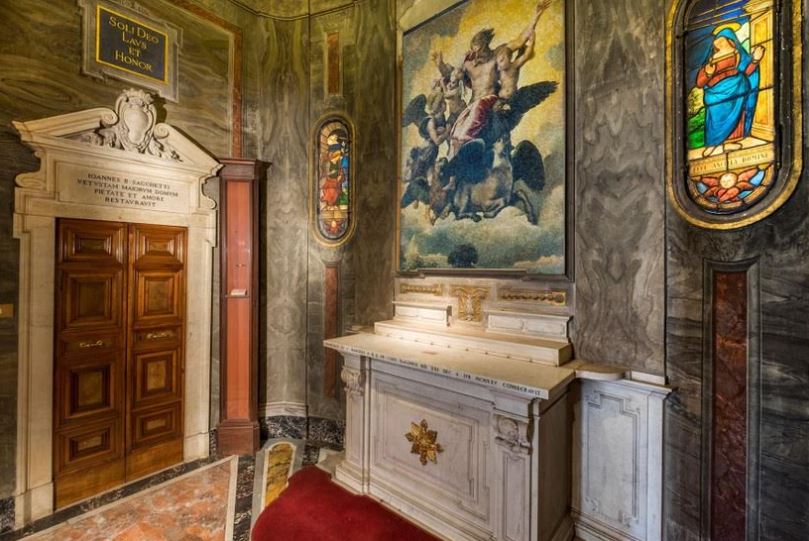
“All right, Axelrod,” one of the investigators said, and by Jove, his voice was not as steady as he should have liked! They made for the door and had a bit of work not to start running. They took some thundering long strides, though, as you can imagine. Near the entrance they had a sudden feeling that there was a cold wind in the room. It was almost as if the Door to Nowhere had been suddenly opened a little. They got to the door and the old butler gave back a step, in a sort of instinctive way. They slammed the door shut with a crash. Somehow, as he did so, one of the investigators felt something pull back on it, but it must have been only fancy. He turned the key in the lock, and then again, double-locking the door. The Winchester Mansion was not only an extravagant maze of Victorian craftmanship, it was also marvelous, baffling, and eerily eccentric, to say the least. Much of Mrs. Winchester’s interest in the occult may have been due to the League for Spiritual Discovery. She built the mansion to accommodate the spirits who had been slain by the Winchester Rifle. It was a way to get the spirits to go on to the next stage. To get in touch with the ancient reincarnation they once carried inside. However, once doors of consciousness are thrown open, those without the proper discipline cannot control what gets in. It is much easier for a demon to materialize in the depths of the Winchester Mansion than all the way from Hell. People began to believe in the Devil again because they could see him during the Victorian Era. The vibes of the Winchester mansion had begun to change as towers rose and the mansion sprawled out into infinity. Magic spells had not ended in the Revolutionary War. People had begun to fall from third-floor windows. The ghosts were considered “temporary misfits” who had not found their place in life nor in the after life, but were impatiently searching along the endless halls of the Winchester Mansion. #RandolphHarris 4 of 13
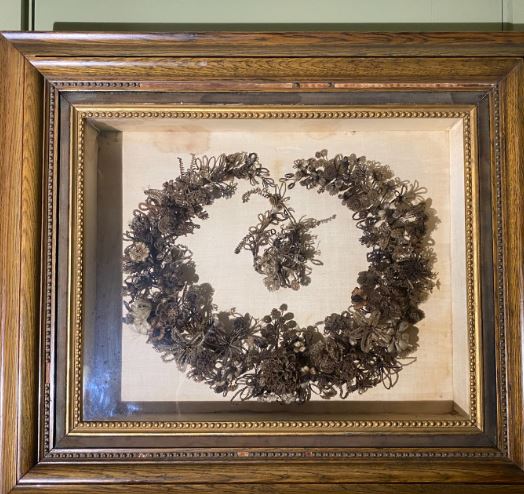
Satanism is a reflection of nature, of the laws of the cosmos, therefore it is as universally applicable as any law of nature—gravity, genetics, et cetera. The invoking or summoning of spirits by means of hymns, prayers, and acts of worship in spiritistic seances, finds a counterpart in demon possession. Often the demon speaking through its victim in the demonized state will demand the burning of incense as well as worship service. In return he often promises alleviation from torment and powers of physical healing or clairvoyant and prognostic gifts assuring financial income and material prosperity to the enslaved person. Paganism is replete with fear of demons who must be appeased by worship and servile obedience. Those who accept magical powers may escape the grosser torments of vile spirits only to fall under more terrible bondage and become Satan’s tools to enslave others. At the very center of the Winchester Mansion is the Blue Séance Room, where Mrs. Winchester supposedly would go every night to commune with the spirits. This room consisted of a cabinet, a table with pen and paper, a closet, and a planchette board—similar to a Ouija board—used for transmitting messages from the beyond. Legend has it that she would wear one of 13 special colored robes and receive guidance from various spirits for her construction plans. In demon influence, evil spirits exert power over a person short of actual possession. Such influence may vary from mild harassment to extreme subjection when body and mind become dominated and held in slavery by spirit agents. Victims may be oppressed, vexed, depressed, hindered, and bound by demons. Demon influence, even in its most severe forms, does not manifest the same abject domination by evil spirits that so saliently characterizes actual possession. #RandolphHarris 5 of 13
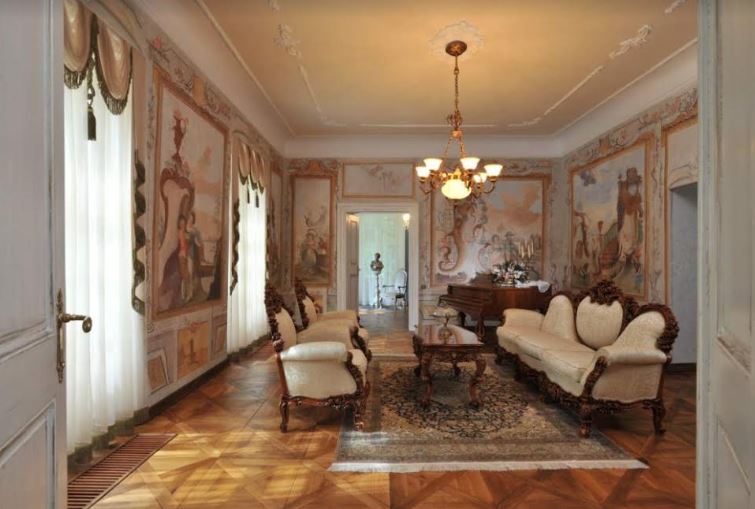
There is no blacking out of consciousness, no demonized state, no usurpation of the body as a mere tool of the inhabiting demon, no speaking with another voice and the projection of another personality through the victim. In other respects, however, demon influence closely resembles actual possession. After the door to the room the possessed the Door to Nowhere was sealed, the investigators felt easier then. The Butler, Axelrod who was nervous and silent, led the way. It had not struck investigators until that moment that he had been enduring a considerable strain during the last two or three hours. About midnight the investigators went to bed. Their room lay at the end of the corridor upon which opens the door of the room with the Door to Nowhere. They counted the doors between it and theirs and found that thirteen rooms lay between. Just as one of the investigators was beginning to undress an idea came to him and he took his candle and sealing-wax and sealed the doors of all thirteen rooms. If any door slammed in the night, they should know just which one. He returned to his room, his partner was fast asleep. He locked the door and went to sleep. While in a deep sleep, they were waked suddenly from a deep sleep by a loud crash somewhere out in the passage. One of them lite a candle, then there came the bang of a door being violently slammed along the corridor. Then there was a dismal thudding of a door up the corridor. The sound seemed to echo through all the house. Daylight came at last and they washed and dressed. The door had not slammed for about an hour, and they were getting back their nerve again. These brave men felt ashamed of themselves, though in some ways it was silly, for when you are meddling with the occult your nerve is bound to go, sometimes. And you just have to sit quiet and call yourself a coward until the safety of the day comes. Sometimes it is more than just cowardice. Sometimes one is being warned. #RandolphHarris 6 of 13

The incorporation of violence in magical ritual has had several historical rationales. It has been claimed by some, such as Aleister Crowley, that the biological energy released at the moment of death of an animal or human, combined with the emotional frenzy induced in the magician by the sight of blood, can be focused through the working of the ritual and sent psychically to do its work. Second, in conjurations, the blood of a sacrificed animal can allegedly be used by the demon being summoned to form a physical manifestation in this plane. On a psychological level, ritual murder and other barbaric acts have functioned as the identification with what Mircea Eliade terms the “Sacred Time” of the primitive, a time beyond the banality of the material World and the moral strictures of society. However, the role of violence has played an even more important sociological role in the history of secret societies, as a centripetal force holding groups together. By forcing members of the group to partake in illegal, socially deviant, and violent acts, the leader further alienates those members from the outside World, fosters feelings of paranoia, and increases psychological and emotional dependence on the group. Many people are striving for superiority as the primary human motivation. People who feel a lack of control over their affairs experience hopelessness, depression, and feeling of low self-worth. One way to feel control, if one cannot feel it in one’s day-to-day affairs, is to exert it over others. The ultimate form of that control would be the control over another’s life or death. The murderer then becomes God, the ultimate high. The trouble is that getting high can be addictive, and when that happens, the tolerance level keeps getting higher. Bigger dosages are needed to get the same effect, and perhaps that is why ghosts and demons haunt—not just to communicate—but to get high off of human emotions. #RandolphHarris 7 of 13
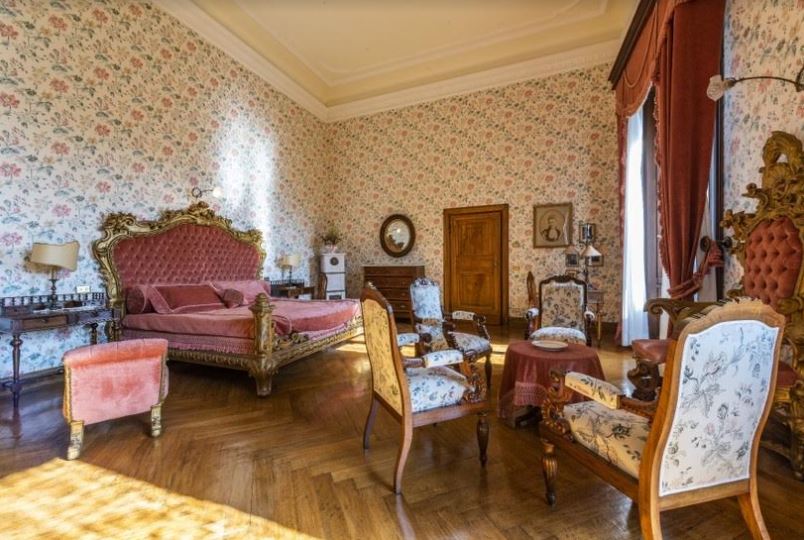
Around the time that the disturbances were happening in the Winchester mansion, police began to hear about orgiastic, nocturnal rituals involving fire dancing, animal sacrifices, blood drinking, and infanticide in the Santa Clara Valley. By 1890, the Bay Area was the “murder capitol of the World,” after it was swept by a wave of brutal and bizarre killings. On the door step of the Winchester Manion, one morning, Axelrod, the Butler, found a note warning, “death to all those who defile the environment,” and it was signed “The Knight of Swords.” Mrs. Winchester immediately have bricks laid on the inside of the front door to block it off. Then there was the case of thirteen people who were kicked to death in a confessional, as human sacrifices to the Earthquake God to stave off the 1906 Earthquake, although the exact year of the catastrophe was unknown, mediums and psychics knew it was coming. Investigators found the events unsettling and stayed at the Winchester Mansion to continue their investigation and protect Mrs. Winchester. They examined the doors of the room that housed the Door to Nowhere, and the seal had been broken, but the seal to the keyhole had been untouched. Axelrod told the investigators that “Flesh and blood can do nothing, sirs, against devils, and that’s what’s comes in the Door to Nowhere.” Something had been in the room—the bedcoverings were on the flood and they were bloody. Mrs. Winchester had everything removed from the room, except for the bed. The investigators examined the walls, floor and ceiling then with probe, hammer and magnifying glass, but found nothing usual. They began to realize that something had been loose in the room during the past night. They sealed up the room again and went out, locking and sealing the door as before. #RandolphHarris 8 of 13

Demon influence may occur in different degrees of severity and in a variety of forms, both in Christians and non-Christians. In its less sever forms, demon attack comes from without through pressure, suggestion, and temptation. When such pressure, suggestion, and temptation are yielded to, the result is always an increased degree of demon influence. Although the human race fell in Adam and became a prey to Satan and demons, the forces of darkness have always been severely restricted. They can enslave and oppress fallen man only to the degree he willingly violates the eternal moral law of God and exposes himself to evil. Since fallen man is unable to keep God’s moral law perfectly, and is acceptable to God only on the basis of Christ’s atonement, all men, saved as well as unsaved, can be subjected to demon influence. The saved, however, have been delivered from the powers of darkness and translated into the kingdom of God’s dear son. This means that they have been delivered from evil powers. Likewise, when the law of love for one’s fellow man is violated, demon power may take hold of a person and goad him on to murder. In June 1895, William Burke, was arrested in Santa Clara County with three male drifters, for the cannibal slaying of a Santa Clara County, California, farmer from the Winchester Estate. The group was a family of trolls, who, when they did not have the money to spend for room and board lived under bridges and in fields. They had forced their way into the unfortunate farmer’s Victorian cottage, and stabbed him to death and cannibalized him after offering up the body parts to Satan. The night before, the group had murdered a vagrant for a few pieces of gold. #RandolphHarris 9 of 13

The Winchester Estate was often the target of not only ghosts and demons, but often looters, and other thugs. That is why there was a six-foot cypress hedge enclosing the estate, which was backed by a barbed wire fence and patrolled by a pack of ferocious dogs, plus, of course, her staff of armed bodyguards. Whatever possessed William Burke to shoot, dismember, and behead the sleeping farmer, McDougal, then cut out his heart and eat it, then snack on the finger until he was discovered the next morning is unknown. Aside from being a cannibal, Burke, who had an IQ of 140, claimed to be a practicing Satanists and to have belonged to a blood-drinking cult in Wyoming. Investigators failed to turn up the cult, however, and the picture that emerged of the Satanic cannibal was that of a psychotic working with Robert Knox. Burke and Knox were linked to an earlier slaying in San Francisco. They had slit the victim’s throat, cut off his ear, and written “Satan Saves” in blood on the wall of the victim’s Victorian home. Later Burke was found drowned. He washed ashore with his hands and feet bound with rope. A subsequent investigation turned up that Burke had been a leader of a group of about forty, who practiced Devil-worship ceremonies, and they wanted to turn the Winchester Mansion into their base. Burke, who believed that Satan would put him in command of “forty leagues of demons” if he took command of the Winchester Mansion. You see, the spirits were already inside of the house and it was no secret. It is believed that Knox bound and pushed him into the water. Burke’s paternal grandparents has opposed the marriage of their son, and vented their hatred of his mother upon their grandchild. They sought to curse and kill him by using black magic, in which they were adept. His childhood had been a nightmare of fear, as his mother resorted to protective magic to ward off the effects of the persecution of death magic. She, too, had come under severe demonic enslavement and fear. #RandolphHarris 10 of 13

This case demonstrated how occult involvement reaches out to children. It also reveals how modern psychology and psychiatry fail to diagnose a case properly when they deny the reality of evil supernaturalism. We do not know whether such aggravated cases of demon influence go deeper than external pressure, suggestion, and temptation. They apparently do, and demonic invasion of the body seemingly is involved and the personality is infested by one or more vile spirits. These demons, however, act more like visitors or guests in a home than the owners of the house, as is the case in demon possession. In the latter case the demons possess the property and reside there permanently, always having ready access and full control of the premises to do as they please. In addition, there is the dual personality of the victim in the demonized state, which is never true of demon influence alone. This does suggest liability to physical and mental sickness, even demonic influence and bondage, and in extreme cases, physical death. Satan exists as a force that you are either part of, or you are not. You can accept it and let it exist withing yourself, or, as in the case of a Christian, you can try and force it out of your system. Then you become one of these confused, schizophrenic personages, like these Christian preachers who preach something but cannot uphold it. There is a power in the Winchester Mansion, in the events that took place there long ago. People still claim to hear the Devil’s orchestra playing at night. There is definitely a Satanic spirit, a pagan spirit, to a lot of what happened. Generally, the Satanist I would know certainly are not criminals. If anything, the police would come to them for advice on a weird crime rather than to interrogate them about it. On the other hand, in terms of the government, there is definitely an interest in them. #RandolphHarris 11 of 13

There is certainly a Satanic spirit running through some people and some areas, but that does not make them bad nor unattractive. At night, people claim there is a shadowy, underground at the Winchester mansion who lever against the inertia of the World. Devil’s advocates take their role of counter balancing societal trends quite seriously. Every few years a book is published on Satan—or some affiliated gothic topic—based upon the premise that the Devil is dead, or dying. This has been used as a starting point for authors ever since the sixteenth century, but reports of Satan’s demise have been much exaggerated. Modern culture treats the Prince of Darkness light-heatedly; Satan appears on Valentine cards, in comedy sketches, and advertising campaigns. The fact that we can laugh at Him is no indication of His waning powers. Satan encouraged satire and scorn, thrives on laughter and irreverence—it is the Christian tradition that demands we approach the World with straight-face, pompous sincerity. Popular ambivalence about the Devil has plagued Christianity throughout its history. The Church needs Satan as its ultimate cosmic scapegoat, but His omnipresent threat is that His playful, charismatic evil can seem so much more attractive then Christian doctrine. (Some have asked why are so many Satanists such nice, polite people, while so many Christians are malignant, neurotic bigots?) Thus, every infernal manifestation in modern popular culture, whatever its apparent intent, has Satanic significance. However, are we, as Anton LaVey claimed, entering an “Age of Satan”? Is Lucifer rising? Nearly the Door to Nowhere, people have claimed that when they are near it, they are immediately conscious of a queer prickling sensation about the back of their heads and their heads began to sweat a little. #RandolphHarris 12 of 13

The following instant, the whole end of the hallway seems to flicker into an abrupt glaze. Then comes the succeeding darkness and most peer nervously up the corridor, listening tensely, and trying to find what lay beyond the faint, red, glow of light. As investigators continued to inspire the unusual room, there came the crashing thud of the door to the Door to Nowhere. The sound seemed to fill the whole of the large corridor and go echoing hollowly through the mansion. They felt it, it felt horrible—as if their bones were water. Simply beastly. They did not know how they could stare or how they listened. And then it came again, thud, thud, thud, and then silence. That was almost worse than the noise of the door, for they kept fancying that some brutal thing was stealing upon them alone the corridor. Suddenly, there lamp was put out, and they could not see the yard before them. They realized all at once that this was a very silly thing, sitting there, and they jumped up. Even as they did so, the investigators thought they heard a sound in the passage, quite near to them. One made a backward spring into the hallway and slammed the door shut. Can you understand? They felt that there was something at the other side of the Door to Nowhere. For some unknow reason, investigators knew it was pressed up against the door, and it was soft. It was the most extraordinary thing to imagine when you come to think about it. The Door to Nowhere thuds at solemn and horrid intervals. Nights in the mansion can be brutal. As the day comes, the thudding of the door comes gradually to an end. #RandolphHarris 13 of 13

Winchester Mystery House
What are your weekend plans? Come hang out at The Winchester Mystery House 🤪 Open 10am-7pm! https://www.winchestermysteryhouse.com/buy-tickets/
Photo credit: Acme Newspictures Inc. Circa 1930s

🎟 link in bio. https://linktr.ee/winchestermysteryhouse

They Will Cry Their Eyes Out if We Sink the Lighthouse

Many Americans attend college. The University provides a way our as well as a model of reform. If not easy to carry out or even keep in mind, its task is thus defined. It is, in the first place, always to maintain the permanent questions front and center. This it does primarily by preserving—by keeping alive—the works of those who best addressed these questions. In the Middle Ages, Aristotle was very much present in the minds of the leading elements of society. He was used as an authority almost on a level with the Church Fathers and was assimilated to them. This was, of course, an abuse of Aristotle, who thought that authority is the contrary of philosophy. His own teachings ought always to be approached with questions and doubts, not faith. The essence of philosophy is the abandonment of all authority in favour of individual human reason. Nevertheless, Aristotle was there, his moderate and sensible views had an effect on the World, and he could be a guide to those who came to have philosophic doubt. In our time, freedom from authority and the independence of reason are commonplaces. Aristotle, however, instead of being properly used—now that we have the proper disposition—has to all intents and purposes disappeared. We would hardly be able to use Aristotle, as did Hegel, to grasp the character of modernity. Instead we are more and more restricted to the narrow experience of the here and now, with a consequent loss of perspective. The disappearance of Aristotle has much less to do with his intrinsic qualities than with a political distaste for him, joined with the lack of intellectual discipline that results from a sense of self-sufficiency. Reason has become a prejudice for us. Rousseau noted that in his time many men were liberals who a century earlier would have been religious fanatics. He concluded that they were not really reasonable but, rather, conformists. #RandolphHarris 1 of 20

Reason transformed into prejudice is the worse form of prejudice. The most important function of the university in an age of reason is to protect reason from itself, by being the model of true openness. Hence, without having the answers, the university knows what openness is and knows the questions. It also knows the regime within which it lives, and the kinds of threats this regime poses to its activity. In a democracy it risks less by opposing the emergent, the changing and the ephemeral than by embracing them, because the society is already open to them, without monitoring what it accepts or sufficiently respecting the old. There the university risks less by having intransigently high standards than by trying to be too inclusive, because the society tends to blur standards in the name of equality. It also risks less by concentrating on the heroic than by looking to the commonplace, because the society levels. In an aristocracy the university would probably have to go in a direction opposite to the one taken in a democracy in order to liberate reason. However, in an aristocracy the university is a less important institution than in a democratic society, because there are other centers for the life of the mind, whereas in a democracy there is practically no other center, practically no way of life, calling or profession, that requires or encourages or even permits cultivation. This is increasingly the case in the first quarter of the twenty-first century. The university as an institution must compensate for what individuals lack in a democracy and must encourage its members to participate in its spirit. As the repository of the regime’s own highest faculty and principle, it must have a strong sense of its importance outside the system of equal individuality. #RandolphHarris 2 of 20

The university must be contemptuous of public opinion because it has within it the source of autonomy—the quest for and even discovery of the truth according to nature. It must concentrate on philosophy, theology, the literary classics, and on those scientists like Newton, Descartes, and Leibniz who have the most comprehensive scientific vision and a sense of the relation of what they do to the order of the whole of things. These must help preserve what is most likely to be neglected in a democracy. They are not dogmatisms but precisely the opposite: what is necessary to fight dogmatism. The University is only one interest among many and must always keep its eye on that interest for fear of compromising it in the desire to be more useful, more relevant, more popular. The university’s task is illustrated by two tendencies of the democratic mind. One is abstractness. Because there is no tradition and men need guidance, general theories that are produced in a day and not properly grounded in experience, but seem to explain things and are useful crutches for finding one’s way in a complicated World, have currency. Marxism, Freudianism, economism, behaviouralism, et cetera, are examples of this tendency, and there are great rewards for those who purvey them. The very university of democracy and the sameness of man presupposed by it encourage this tendency and make the mind’s eye less sensitive to differences. The terms we have discussed in the past are evidences of this abstractness, simulacra of thought and experience, hardly better than slogans, which take the place of reflection. In aristocracies men take the experiences of their nations as unique and superior and tend not to generalize, but rather to forget the natural community of men and the universality of thought. #RandolphHarris 3 of 20

However, they do really pay attention to their experiences, to the diversity of phenomena that is homogenized by abstract “mind-sets.” This is another thing the democratic university must learn from aristocracies. Our temptation is to prefer the shiny new theory to the fully cognized experience. Even our famous empiricism is more of a theory than an openness to experience. Producing theories is not theorizing, or a sign of theoretical life. Concreteness, not abstractness, is the hallmark of philosophy. All interesting generalization must proceed from the richest awareness of what is to be explained, but the tendency to abstractness leads to simplifying the phenomena in order more easily to deal with them. If, for example, one sees only gain as a motive in men’s actions, then it is easy to explain them. One simply abstracts from what is really there. After a while one notices nothing other than the postulated motives. To the extent that men begin to believe in the theory, they no longer believe that there are other motives in themselves. And when social policy is based on such a theory, finally one succeeds in producing men who fit the theory. When this is occurring or has occurred, what is most needed is the capacity to recover the original nature of man and his motives, to see what does not fit the theory. Hobbes’s mercenary account of the virtues, which won out in psychology, needs to be contrasted with Aristotle’s account, which preserves the independent nobility of the virtues. Hobbes was thinking of Aristotle, which we never do, when he developed his teaching. In order to restore what was really a debate, and thereby restore the phenomenon man, one must read Aristotle and Hobbes together and look at what each saw in man. Then one has the material on which to reflect. #RandolphHarris 4 of 20

For modern men who live in a World transformed by abstractions and who have themselves been transformed by abstractions, the only way to experience man again is by thinking these abstractions through with the help of thinkers who did not share them and who can lead us to experiences that are difficult or impossible to have without their help. A related problem is a tendency in the social sciences to prefer deterministic explanations of events to those that see them as results of human deliberation and choice. This tendency is a consequence of the impotence of the individual in egalitarian society. Curiously, in democracy, the freest of societies, men turn out to be more willing to accept doctrines that tell them that they are determined, that is, not free. No one by oneself seems to be able, or have the right, to control events, which appear to be moved by impersonal forces. In aristocracies, on the other hand, individuals born to high position have too great a sense of their control over what they appear to command, are sure of their freedom and despise everything that might seem to determine them. Neither the aristocratic nor democratic sentiment about the causes of events is simply adequate. In a democracy where men already think they are weak, they are too open to theories that teach them they are weak, which, by making individuals think that controlling action is impossible, have the effect of weakening them further. That is why we are encouraging you all to be proud Americans again. Have pride in your flag, the national anthem, America cars, food and produced and goods and services produced in America. Do not allow yourselves to be colonized by a spirit of doom and gloom. Do not allow the joker and the riddler to control your streets, airwaves, radio, and politics. #RandolphHarris 5 of 20

Remember, this is a country of agriculture, it is the land of the free and the home of the brave. Go back to being like the Americans of the 1950s, who loved their suburban communities, and their American cars and new they were great and kind people. “Winter comes calling. The temperature’s falling. A fear is crawling. Don’t quit, we’re all in. The ship’s a mile out. Don’t blow the lights out. They’ll cry their eyes out, if we sink the lighthouse. Since fear itself is cruel and selfish—a contradiction—you tried to shout out my words in your mouth. We’re hard on the angel’s heels, with fire and brimstone wheels. The meadow starts with bones, and flowers and tears. With darkness closing, we’re decomposing. We’re made of starlight. From cruel and dark night, the guilty crushed out. We’re left in no doubt. They’ll cry their eyes out if we sink the lighthouse,” by Above & Beyond, “Sink the Lighthouse,” featured artist: Alex Vargas, Album: We are All We Need, 2015. The lighthouse represents American. The antidote is again the classic, the heroic—Homer, Plutarch. At the outset they appear hopelessly naïve to us. However, it is our sophisticated naivete that makes us think that. Churchill was inspired b his ancestor Marlborough, and his confidence in his own action is inconceivable without the encouragement to his education. And Shakespeare learned a large part of what he knew about statesmanship from Plutarch. This is intellectual genealogy of modern heroes. The democratic revolution of the mind extinguishes such old family lines and replaces them with decision-making theory, in which there is no category for statesmanship, let alone heroes. To sum up, there is one simple rule for the university’s activity: it need not concern itself with providing its students with experiences that are available in democratic society. They will have them in any event. It must provide them with experiences they cannot have there. #RandolphHarris 6 of 20

Old writers may not have been perfect, but they could best make us aware of our imperfections, which is what counts for us. The universities never performed this function very well. Now they have practically ceased trying. There is an Armageddon cult whose cosmology is trying to depress America. It is a bloodthirsty, orgiastic, mind-bending cult under the direction of a special interest group. Much more frightening than Manson could ever be in that it is able to successfully maintain a façade of eccentric legitimacy while secretly conducting vicious human sacrifices to its gods. The cult has been conducting cannibalistic rites on American citizens in the shadows and in secret so that Americans will give of their rights, give up capitalism, and become under control of communism. It is a lot like the Four Pi movement, which is 12.56 numerically. The rites are bloody and orgiastic. The goal is to transfix people, get them to become apathetic and make them feel a sense of entitlement so that they will release the fiend that lies dormant within one, for it is strong and ruthless and its power is far beyond the bounds of human frailty. The cult’s literature is repeated and the Process leaders reputedly envision the cult members coming together as groups of future shock troops in the coming Armageddon. The cult is into murder and mayhem. They teach their members that by spreading violence and chaos, they will help to fulfill the prophecies of Armageddon and speed up the Final Judgment. Also, many of these heinous criminals who are labeled as “lone wolves” are actually not. In many cases they are part of an organization that traffics in drugs and pornography with aims to spread panic and destruction, and are also connection to crimes before and after those who are labeled as lone wolves commit an act of violence. #RandolphHarris 7 of 20

The high value of the evil urge finds its strongest expression in an interpretation of the scriptural verse (Genesis 1, 31) which assets that God, on the evening of the day on which He had created man, looked upon all He had made and found it “very good”: this “very good” applies to the evil urge, whereas the good one only earns the predicate “good”; of the two, it is the evil urge which is fundamental. However, that it is called the evil urge derives from man’s having made it so. Thus Kain (as is said in the Midrash) might indeed respond to the God who was calling him to account that it was He, God, Himself who had implanted in him the evil urge; but the rejoinder would be untrue, since only through him, man, did it become evil. It became so, and continually becomes so, because man separates it from its companion and in this condition of independence makes an idol of precisely that which was intended to serve him. Man’s task, therefore, is not to extirpate the evil urge, but to reunite it with the good. David, who did not dare to stand up to it and therefore “slew” it in himself—as it runs in one of his Psalms (109.22): “My heart is pierced through within me”—did not fulfill it, but Abraham, whose whole heart was found faithful before God, who now made a covenant with him (Nehemiah 9.8) did. Man is bidden (Deuteronomy 6.5): “Love the Lord with all thine heart,” and that means, with thy two united urges. The evil urge must also be included in the love of God thus and thus only does it become perfect, and thus and thus only does man become once more as he was created: “very good.” To achieve this, however, man must begin by harnessing both urges together in the service of God. As when a person who is less affluent possess two oxen, one that has already ploughed and one that has not yet ploughed, and now a new field is to be cultivated: he brings both of them together beneath the yoke. #RandolphHarris 8 of 20

However, how is the evil urge to be prevailed upon to permit this to happen to it? Why, it is nothing but a crude ore, which must be placed in the fire in order to be moulded: so let it be totally immersed in the great fire of the Tora. And that also man cannot do of his own strength; we must pray to God to assist us to do His will with our hearts. Therefore the Psalmist beseeches (86.11): “Unite my heart to fear Thy name”; for fear is the gateway to love. This important doctrine cannot be understood as long as good and evil are conceived, as they usually are, as two diametrically opposite forces or directions. Its meaning is not revealed to us until we recognize them as similar in nature, the evil “urge” as passion, that is, the power peculiar to man, without which he can neither beget nor bring forth, but which, left to itself, remains without direction and leads astray, and the “good urge” as pure direction, in other words, as an unconditional direction, that towards God. To unite the two urges implies: to equip the absolute potency of passion with the one direction that renders it capable of great love and of great service. Thus and not otherwise can man become whole. Although there are wonderful surprises from the human organization, the latest and most potent creation and miracle-worker of the commercialized intellect will not be able to spread more love until we unite out urges. We have many wonderful transportation-systems, in manufactures, in systems of communication, in news-gathering, book-publishing, journalism; in protecting labour; in oppressing labour; in herding the national parities and keeping the sheep docile and usable; in closing the public service against brains and character; in electing purchasable legislatures, blatherskite Congresses, and city governments which rob the town and sell municipal protection to gamblers, thieves, men and women of the evening, and professional seducers for cash. #RandolphHarris 9 of 20

It is a civilization which has destroyed the simplicity and repose of life; replaces its contentment, its poetry, its soft romance-dreams and visions with the money-fever, sordid ideals, vulgar ambitions, and the sleep which does not refresh; it has invented a thousand useless luxuries, and turned them into necessities, it has created a thousand vicious appetites and satisfies none of them; it has dethroned God and set up a shekel in His place. Religion has removed from the heart to the mouth. You have the word of Noah for it. Time was, when two sects, divided but by a single hair of doctrine, would fight for that hair, would kill, torture, persecute for it, suffer for it, starve for it, die for it. That religion was in the heart; it was vital, it was a living thing, it was the very man himself. Who fights for his religion now, but with the mouth? Your civilization has brought the flood. Noah has said it, and he is preparing. “And when the multitude had eaten and were filled, he said unto the disciples: Behold there shall one be ordained among you, and to him will I give power that he shall break bread and bless it and give it unto the people of my church, unto all those who shall believe and baptized in my name. And this ye shall always observe to do, even as I have done, even as I have broken bread and blessed it and given it unto you. And this shall ye do in remembrance of my body, which I have showed unto you. And it shall be a testimony unto the Father that ye do always remember me. And if ye do always remember me ye shall have my Spirit be with you,” reports # Nephi 18.5-7. Religion can be considered a bureaucracy. Bureaucracy is not in principle a social institution; nor are all institutions that reduce information by excluding some kinds or sources necessarily bureaucracies. Schools may exclude dianetics and astrology; courts exclude hearsay evidence. They do so for substantive reasons having to do with the theories on which these institutions are based. #RandolphHarris 10 of 20

However, bureaucracy has no intellectual, political, or moral theory—except for its implicit assumption that efficiency is the principal aim of all social institutions and that other goals are essentially less worthy, if not irrelevant. That is why John Stuart Mill thought bureaucracy a “tyranny” and C.S. Lewis identified it with Hell. The transformation of bureaucracy from a set of techniques designed to serve social institutions to an autonomous metainstitution that largely serves itself came as a result of several developments in the mid- and late-nineteenth century: rapid industrial growth, improvements in transportation and communication, the extension of government into ever-larger realms of public and business affairs, the increasing centralization of governmental structures. To these were added, in the twentieth century, the information explosion and what we might call the “bureaucracy effect”: as techniques for managing information became more necessary, extensive, and complect, the number of people and structures required to manage those techniques grew, and so did the amount of information generated by bureaucratic techniques. This created the need for bureaucracies to manage and coordinate bureaucracies, then for additional structures and techniques to manage the bureaucracies that coordinated bureaucracies, and so on—until bureaucracy became, to borrow again from Karl Kraus’s comment on psychoanalysis, the disease for which it purported to cure. Along the way, it ceased to be merely a servant of social institutions and became their master. Bureaucracy now not only solves problems but creates them. More important, it defines what our problems are—and they are always, in the bureaucratic view, problems of efficiency. #RandolphHarris 11 of 20

As Lewis suggests, this makes bureaucracies exceedingly dangerous, because, though they were originally designed to process only technical information, they now are commonly employed to address problems of a moral, social, and political nature. The bureaucracy of the nineteenth century was largely concerned with making transportation, industry, and the distribution of goods more efficient. Technopoly’s bureaucracy has broken loose from such restrictions and now claims sovereignty over all of society’s affairs. This may be because so many people find the most appropriate type of daily life for them is a day by day World of destruction. Peace has become the most difficult and abnormal state of many civilizations to live in. No moment is so dazzling to them as when everyday imaginings concerning death and danger and World destruction are transformed into duty. Magnanimity perishes during long periods of peace and, in its stead, there develop cynicism, apathy, weariness, and, at most, spiteful raillery…Honour, humaneness, self-sacrifices are still being respected, valued, and rated highly immediately after war, but the longer peace lasts—the dimmer, the more withered, the more torpid all these beautiful magnanimous things grow, while wealth and the spirit of acquisition take possession of everything. At length, there is nothing left but hypocrisy—hypocrisy of honour, of self-sacrifice, of duty, so that these will still be respected, despite all the cynicism, but merely in boastful phases and as a matter of form. There will be no more genuine honour, and nothing but formulas will be left. Formulas of honour mean the death of honour. The peril we face in trusting social, moral, and political affairs to bureaucracy may be highlighted by reminding ourselves what a bureaucrat does. #RandolphHarris 12 of 20

As the World’s history suggests, a bureaucrat is little else than a glorified counter. The French word bureau first meant a cloth for covering a reckoning table, then the table itself, then the room in which the table was kept, and finally the office and staff that ran the entire counting room or house. The word “bureaucrat” has come to mean a person who by training, commitment, and even temperament is indifferent to both the content and the totality of a human problem. The bureaucrat considers the implications of a decision only to the extent that the decision will affect the efficient operations of the bureaucracy, and takes no responsibility for its human consequences. Thus, Adolf Eichmann becomes the basic model and metaphor for a bureaucrat in the age of Technopoly. When faced with dangerous crimes against humanity, he argued that he had no part in the formulation of Nazi political or sociological theory; he dealt only with the technical problems of moving vast numbers of people from one place to another. Why they were being moved and, especially, what would happen to them when they arrived at their destination were not relevant to his job. Although the jobs of bureaucrats in today’s Technopoly given five thousand times a day in America alone: I have no responsibility for the human consequences of my decisions. I am only responsible for the efficiency of my part of the bureaucracy, which must be maintained at all costs. Eichmann, it must also be noted, was an expert. And expertise is a second important technical means by which Technopoly strives furiously to control information. Japan worries. To the outside World it often seems economically invincible. However, things look different from inside. It has no energy supplies of its own, grows little food, and is highly sensitive to trade restrictions. If the yen goes down, it worked. If the yen goes up, it worries. #RandolphHarris 13 of 20

However, individual Japanese do not just worry about the economy in general. They also worry about their own future. So they are among the World’s biggest savers. And they buy massive amounts of insurance. For a long time the chief beneficiaries of all this anxiety were the giant insurance companies. Today, however, it is the insurers who are doing the worrying. The government is opening the door that once kept out competition from Japan’s aggressive securities brokers. Tough, World-class companies like Nomura and Daiwa, the Merrill Lynches or Shearsons of Japan, are preparing to move in on the insurance industry’s turf. Topping that off, the entire insurance field is in an uproar of change. Customers are demanding all sorts of newfangled policies and financial services which these venerable giants—Nippon Life is over one hundred years old—find hard to create and manage. To deal with threats like these, the big insurance firms have begun laying down an electronic line of defense. Nippon Life is betting nearly half a billion dollars on a new information system that adds 5,000 PCs, 1,500 larger computers for its satellite offices, mega-machines for branches and headquarters, plus optical scanners and other equipment, all plugged together in a single network that will allow agents in the field to dial up central data banks, respond to synthesized voice commands on the phone, and get facsimile printouts of the data they need about customer or policies. Meanwhile, Meiji Mutual, with its 38,000 agents, mainly women, is also racing to arm itself with the weaponry of communications. Nor are the insurance companies alone. All of Japan, it would seem, is going electronic. Writes Datamation: “Major service companies are installing networks with 5,000 or more PCs and workstations in every corner of Japan.” Say Meiji’s Toshiyuki Nakamura: “If we don’t…we might lose everything.” #RandolphHarris 14 of 20

Nakamura is right. For as electronic networks spread, power is beginning to shift. And not just in Japan. The United States of America and Europe, too, are wiring up as never before. It is the electronic race of the century. Japan’s high-tech manufacturing miracle brought in such immense amounts of money and sent the yen spiraling so high that Japanese companies began investing heavily in factories in Taiwan, South Korea and, in time, Malaysia, Indonesia and the Philippines—helping to kick-start the development process in what soon were called Newly Industrialized Countries, or NICs. In effect, Japan had begun off-loading its low-tech, low-value production to neighbouring countries with more affordable labour, while it upshifted more and more to knowledge-based operations. Japan was not the only spigot from which direct investment flowed into Asia. Nonetheless, by the 1980s, according to the Library of Congress Country Studies, Japan had, in fact, “displaced the United States as the largest provider of investment and economic aid” in the Asia-Pacific region. In all, Japan poured more than $123 billion into Asian neighbours between 1980 and 2000. It is difficult to determine precisely how many new manufacturing and related service jobs in these Asian countries are specifically attributable to the influx of investment from Japan, America and Europe. Or to the next step, when South Korea and Taiwan themselves began investing in their less affluent neighbours—setting in motion a developmental chain reaction spilling over from the United States of America to Japan to these other countries. The result was the flow of billions of dollars into agrarian economies in the region where some of the World’s worst poverty existed. In each of these recipient countries, we saw the same classic process at work—the shift of the workforce from agriculture to industry. In South Korea as late as 1970, 51 percent of the labour force was still in agriculture. By 2000, the number was down to 9 percent, while manufacturing employment had risen to 22 percent. #RandolphHarris 15 of 20

In Taiwan during the same period, the shift went down from 37 percent to rural to 7 percent, as the industrial workforce swelled to 35 percent. Malaysia went from more than 50 percent in agriculture to 16 percent, with manufacturing jumping to 27 percent. Similar, though less dramatic, shifts occurred in Thailand, Indonesia, and the Philippines. In each case, too, it was not just money that was transferred. With it came what economist William Easterly, formerly of the World Bank, has called “leakage”—a diffusion of knowledge, not just about technologies, but about finance, about markets and marketing, about import-export rules and business in general. The net effect of this massive transfer of industrial-age activities and know-how has been to raise multitudes of the World’s least affluent people out of the most extreme poverty. Ending up struggling in urban slums may hardly seem like progress to people with full bellies. However, for most of the Asian millions driven off the land by drought, hunger and disease, going back would be worse. And they know it. This process, during which countries transitioning toward knowledge economies transferred some of their manufacturing to less affluent, mainly agrarian countries from Asia to Latin America, had important corollaries. The recipient countries saw lengthened life expectancy, a general decline in infant mortality and reduced rates of population growth, the latter a key factor in the poverty equation. Between 1960 and 1999, per capita food production in the World grew by nearly 25 percent, and the number of those surviving on less than 2,100 calories a day—the threshold used to define malnutrition—plunged by 75 percent. Not incidentally, during roughly the same period, East Asians, starting from an admittedly low case, saw a 400 percent increase in average real incomes. #RandolphHarris 16 of 20

The gains made by these and other poor countries, and not merely in Asia but in Latin America and elsewhere, are not the result of the softhearted benevolence of the rich World. These external inputs of capital—accompanied by hand-me-down relevant knowledge—would have had little impact without the brains, energy, hard work, ideas, entrepreneurialism and struggle of leaders and ordinary people in the least affluent countries themselves. Overall, however, what we find is a remarkable case of trickle-down economics—which for reasons that were unanticipated and unintentional actually worked, and not just in Asia. Yet an important question remains: How much of this anti-poverty progress in recent decades would have happened had the computer never been invented and the latest revolutionary wealth system never arrived? The story, moreover, does not end with this question hanging in the air. For none of what we have seen here so far fully explains the turbo-powered rise of Asia—or tells us what happens next as Africa, China, and Indian burst onto the World scene. To those thinking in terms of nanotechnology, STMs immediately looked promising not only for seeing atoms and molecules but for manipulating them. This idea soon became widespread among physicists. As Calvin Quate stated in Physics Today in 1986, “Some of us believe that the scanning tunneling microscope will evolve. That one day [it] will be used to write and read patterns of molecular size.” This approach was suggested as a path to molecular nanotechnology in Engines of Creation, again in 1986. By now, whole stacks of scientific papers document the use of STM and AFM tips to scratch, melt, erode, indent, and otherwise modify surfaces on a nanometer scale. These operations move atoms around, but with little control. They amount to bulk operations on a tiny scale—one fine scratch a few dozen atoms wide, instead of the billions that result from conventional polishing operations. #RandolphHarris 17 of 20

As way of drawing together the technical limits and tendencies of television technology so that a pattern emerges, we need to consider some miscellaneous inherent biases. War is better television than peace. It is filled with highlighted moments, contains action and resolution, and delivers a powerful emotion: fear. Peace is amorphous and broad. The emotions connected with it are subtle, personal and internal. These are far more difficult to televise. Violence is better TV than nonviolence. When there is a choice between objective events (incidents, data) and subjective information (perspectives, thoughts, feelings), the objective event will be chosen. It is more likely to take visual form. Cars (and most commodities) are more visible on television, and come across with less information loss, than any living thing, aside from human faces. The smaller a plant or creature, or the more complex an image it presents, the harder it is to convey and the less likely it is to be chosen. Cars, like most urban forms, offer a clean, straight, uncomplicated message. They communicate their essence more efficiently than plants do. We are bound to have more images of cars and urban forms on television than natural environments and creates. Religions with charismatic leaders such as Billy Graham, Jesus Christ, Reverend Moon, Maharishi or L. Ron Hubbard, Joel Ostin, are far simpler to handle on television than leaderless or nature-based religions like Zen Buddhism, Christian Science, Native Americans (however, European Americans now considered themselves Native Americans and the Native Americans are referred to as Indigenous people), or druidism, or, for that matter, atheism. Single, all-powerful gods, or individual godlike figures are simpler to describe because they have highly defined characteristics. #RandolphHarris 18 of 20

Nature-based religions are dependent upon a gestalt of human feeling and perceptual exchanges with the planet. To be presented on television, they would need to be too simplified to retain meaning. To study different aspects of the evolutionary process, different methodological tools have been used. One set of questions asked about the destination of the evolutionary process. To study this, the concept of collective (or evolutionary) stability was used to study where the evolutionary process would stop. The idea was to determine which strategies could not be invaded if they were used by everyone. The virtue of this approach is that it allowed a good specification of which types of strategies can protect themselves, and under what conditions this protection can work. For example, it was shown that TIT FOR TAT would be collectively stable if the shadow of the future were large enough, and that the strategy of always defecting would be collectively stable under all possible conditions. The power of the collective stability approach is that it allows a consideration of all possible new strategies, whether minor variants of the common strategy or completely new ideas. The limitation of the stability approach is that it only tells what will last once established, but it does not tell what will get established in the first place. Since many different strategies can be collectively stable once established in a population, it is important to know which strategies are likely to get established in the first place. For this a different methodology was need. #RandolphHarris 19 of 20

To see what is likely to get established in the first place, the emphasis must be placed upon the variety of things that can happen at once in a population. Since the process of getting fully established is likely to take a considerable amount of time, another kind of technique was used to study the changing prospects of strategies as their social environments of changes. This technique was an ecological analysis, which calculated what would happen if each generation had strategies growing in frequency in proportion to their success in the previous generation. This was an ecological approach because it introduced no new strategies, but instead determined the consequences over hundreds of generations of the variety of strategies already represented in society. It allowed for an analysis of whether the strategies that were successful in the beginning would remain successful after the poor performers had dropped out. The growth of the successful strategies in each generation could be thought of as due to either better survival and reproduction of the users of that strategy, or due to a greater chance of being imitated by others. In the territorial system, determination of what is successful is local. Each location which has a more successful neighbour adopts the strategy of the most successful of its neighbours. As in the ecological simulation, this growth of the more successful can be attributed to either better survival and reproduction, or to greater chance of being imitated by others. The Process incorporated the ideas of a number of its ancestors and current occupants of the occult landscape. Accordingly, there was an intermingling of philosophy, membership, and networking among the groups. The Solar Lodge, a secret magical society. The Brayton cult operated a boardinghouse near the University of Southern California campus in Los Angeles and recruited members from the student body there. The cult was broken up when a Riverside Country sheriffs raided the Blythe commune and found a six-year-old boy chained in a packing crate. Getting what you want is not easy. #RandolphHarris 20 of 20

Cresleigh Homes
Soccer uniforms, ⚽ swimsuits, 🩱 sandy beach towels – oh my! Summer brings more dirty laundry than we ever thought possible, but once you’ve got a fully functional, absolutely beautiful laundry room, it’s not a problem.
The beautiful #CresleighRanch Mills Station Residence 2 offers two stories of smartly designed living space.

On the main floor, you’ll find a spacious dining room, great room and kitchen with a center island, as well as a convenient powder room, off the 2-car garage, and a large main floors master bedroom with a luxurious bathroom.
And psst…our homesite 104 is ready for new owners!
Don’t miss the final opportunity to purchase at Mills Station at Cresleigh Ranch.
 Randolph Harris II International Institute