
Home » #RandolphHarris (Page 50)
Category Archives: #RandolphHarris

One Who Lasts Last Lasts Best?

It is possible that depictions of violence often glamorize vicious behavior. They offend the Spirit and could possibly make one less able to respond to others in a sensitive, caring way. They also may contradict the Savior’s message of love for one another. The second portion of our interviews with carjackers dealt with the aftermath of carjackings. Here, we are concerned with basic questions: What did they do with the vehicles? What did they do with their money? Given the propensity of many carjackers to target other offenders, how did they mange the threat of retaliation? The majority of our respondents immediately disposed of the vehicle, liquidating it for cash. As Corleone put it, “there’s a possibility they report[ed] the car stolen and while I’m driving around the police [could] pull me over. I ain’t got time to hop out [of the vehicle] and run with no gun. I just want to get the money that I wanted.” Although most of our respondents immediately delivered the vehicle to a chop shop or dismantled it themselves, a fair number of them chose to drive the vehicle around first, showing it off or “flossing” to other neighborhood residents and associates. Despite the possibility that the vehicle’s owner or the police might catch up with them, they chose to floss. INT: “What do you like to do after a carjacking?” Binge: “Well, what I like to do is just like to, see my friends. They don’t give a damn either, I just go pick them up and ride around, smoke a little bit [of] weed, and get some gals, and to partying or something like that you know. I know it’s taking a chance but, you know like I say, they don’t give a damn. #RandolphHarris 1 of 21

INT: “Is that what you did with the car that you took off the guy at the Lightrail?” Binge: “Yeah. I was just riding around listening to the music, picked up a couple of friend of mine. We rode around. I told them it was a stolen car. It was a nice little car too. Black with a hard top. Oh yeah, oh yeah—[it had] nice sounds. I was chilling man, I was chilling, you know? I was driving along with the music playing up loud. Ha ha. You know I wasn’t even worried. I was just feeling good. ‘Cause I’m not used to driving along with music playing up loud. Ha ha. You know I wasn’t even worried. I was just feeling good. ‘Cause I’m not used to driving that much you know ‘cause I don’t have a car you know. That’s why when I do a carjacking I just play it off to the tee, run all the gas off, keep the sounds up as loud as I can, keep the heat on, you know just abuse the car you know. That’s all about carjacking like that.” C-Low described his desire to floss as having to do with the ability to gain status in his neighborhood. C-Low: “Put it this way, you got people you know that’s driving around. We just wanna know how it feels. We’re young and we ain’t doing sh*t else. So they [people from the neighbourhood] see you driving the car, they gonna say, “Hey, there’s C-Low!” and such and such. That makes us feel good ‘cause we’re riding, and then when we’re done riding we wreck the car or give it to somebody else and let him ride. We took the car and drove around the hood, flossing everything. And then we wrecked it on purpose We ran it into a ditch. I don’t know, we were f*cked up high, we were high man, just wild! Wrecked the thing.” #RandolphHarris 2 of 21

However, for offenders like these, the prospect of getting caught and losing profits eventually began to outweigh the benefits of showing off. INT: “So how long did you drive around in the [Chevrolet] Suburban before you stripped it?” LOCO: “Oh, we was rolling that. We drove for a good thirty minutes, then I said that I want[ed] to get up out of it because they might report it stolen. We was [still driving] right there [near] the scene [of the crime] and they [the police] would probably tried to flag me [pull me over]. And if they tried to flag me, I would [have to] have taken them through a high-speed chase. F*ck that.” Sleezee-E informed us (as did other respondents) that disposing of the vehicle quickly was the key to getting away with a carjacking. Indeed, almost all respondents were aware of the police department’s “hot sheet” for stolen vehicles (although their estimations of how long it took for a vehicle to show up on the hot-sheet varied greatly, from as soon as the vehicle was reported stolen to 24 hours or even longer afterwards). Sleezee-E: [People think that] the cops will wait 24 hours just to see what you are going to do with the car. Because some idiots, when they jack a car, they just drive it around and then they leave it someplace. I don’t do that. That’s how you get caught. Driving it around. You take that car right to the chop shop and let them cut that sucker up.” Once the vehicle was stripped, most carjackers disposed of the vehicle by destroying it somehow. #RandolphHarris 3 of 21

Littlerag: “’Cause it was hot man! It was too hot. All I [wanted] was to take the rims, take the beats, the equalizer, the detachable face. Got all that off, then I just pour gas on it and burnt that mother*cker up. I had finger prints [on it]. I didn’t have no gloves on. I had my own hands on the steering wheel. I left my fingerprints.” Nicole and a boyfriend chose a less conventional method of getting rid of their stolen vehicle. Nicole: We got rid of the car first. We drove the car two blocks and went back down a ways to the park. We drove the car up there, we parked right there and sat for about ten minutes, made sure how many cars come down this street before we can push it over there. It’s a pond, like it’s a lake out there with ducks and geeses in it.” While a few respondents reported that they used the proceeds from carjacking to pay for necessities or bills, the overwhelming majority indicated that they blew their cash indiscriminately on drugs, women, and gambling. We had interviewed Tone on a number of previous occasions for his involvement in strong-arm drug robbery. Although robbery was his preferred crime, he engaged in carjacking occasionally (about once every two months) when easy opportunities presented themselves. During his most recent offense, he and three of his associates took a Cadillac from a neighborhood drug dealer and made $6000. When we asked what he did with his portion, he indicated that he, “…spent that sh*t in like, two days.” #RandolphHarris 4 of 21

INT: “You can go through $1500 in two days?” Tone: “Sh*t, it probably wasn’t even two days, it probably was a day, sh*t.” INT: “What did you spend fifteen hundred on?” Tone: “It ain’t shit that you really want. Just got the money to blow so f*ck it, blow it. Whatever, it don’t even matter. Whatever you see you get, f*ck it. Spend that shit. It wasn’t yours from the getty-up, you know what I’m saying? You didn’t have it from the jump so…Can’t act like you careful with it, it wasn’t yours to care for. Easy come, easy go. The easy it came, it go even easier. F*ck that, f*ck all that. I ain’t trying to think about keeping nothing. You can get it again. INT: “So what does money mean to you? Tone: “What money mean? Sh*t, money just some sh*t everybody need, that’s all. I mean, it ain’t jack sh*t.” INT: “Ok, so it’s not really important to you? Tone: “F*ck no. Cause I told you, easy come, easy go.” Mo had taken a Mercedes-Benz from two men residing in another neighborhood. He had planned the offense over the course of a month and finally, posing as a street window cleaner, carjacked them as they exited a local restaurant. The vehicle’s after-market items netted $5000 in cash. INT: “I’m just kind of curious how you sped like $5,000!” MO: “Just get high, get high. I just blow money. Money is not something that is going to achieve for nobody, you know what I’m saying? So everyday, there’s not a promise that there’ll be another [day] so I just spend it, you know what I’m saying? It ain’t mine, you know what I’m saying, I just got it, it’s just in my possession. This is mine now, so I’m gonna do what I’ve got to do. It’s a lot of fun. At a job you’ve got to work a lot for it, you know what I’m saying? You got to punch the clock, do what somebody else tells you. I ain’t got time for that. Oh yeah, there ain’t nothing like gettin’ high on $5000!” #RandolphHarris 5 of 21

Binge and others confirmed that the proceeds from their illegal activities went to support this form of conspicuous consumption. Binge: “I just blowed it man. With the money me and my girlfriend went and did a bit of shopping, stuff for Christmas. But, the money I got from his wallet? I just blowed that, drinking and smoking marijuana.” For Corleone, the motivation to carjack was directly related to his desire to manage the impressions of others in his social milieu. His remarks served as a poignant comment on sociocultural and peer pressures experienced by many inner city youths. The purpose of carjacking was to obtain the money he needed to purchase clothing and items that would improve his stature in the neighborhood. Corlone: “[$1500 is] a lot. [I bought] shoes, shoes, everything you need. Guys be styling around our neighborhood. The brand you wear, shoes cost $150 in my size. Air Jordans, everybody want those. Everybody have them. I see everybody wearing those in the neighborhood. I mean come on, let’s go get a car. I’m getting those, too.” INT: “How man pairs of sneakers have you got?” Corleone: “Millions. I got, I got, I got a lot of shoes. Clothes, gotta get jackers. INT: “Well, why do you have to look good, what’s so big about looking good?” Corleone: “You can’t. Not nowadays, not where I’m from. You try to walk up to a girl, boy, you got on some raggedy tore up, cut up shoes they’re gonna spit on you or something. Look at you like you crazy. Let’s say you walking with me. I got on creased up pants, nice shoes, nice shirt and you looking like a bum. Got on old jeans. And that dude, that dude, he clean as a mother*cker and you look like a bum.” #RandolphHarris 6 of 21

INT: “So you’re competing with each other, too?” Corleone: “Something like that. Something like a popularity contest.” INT: “Well, you know, you can look nice and clean and not have to spend $150 bucks on shoes, you know.” Corleone: “It’s just this thing. You aint’ going [to] understand, you don’t come from the projects.” In the extraordinary onslaught of the deceiver which will come upon the whole of Christendom at the close of the age, through his army of deceiving spirits, there are some, more than others, who will for a particular reason be attacked by the powers of darkness. These individuals need clear light as to his deceptive workings, so that they may pass through the trial of the “last hour” and be counted worthy to escape that hour of greater trial which is coming upon the Earth (Luke 21.34-36; Rev. 3.10). These are the ones who are recklessly ready to follow the Lord at any cost, and yet do not realize their unpreparedness for the contest with the spiritual powers of the unseen World as they press on into fuller spiritual things. They are believers who are full of mental conceptions wrought into them in earlier years—views and opinions which hinger the Spirit of God from preparing them for all they will meet as they press on to their coveted goal, and which also hinder others from giving them from the Scriptures much that they need to know regarding the spiritual World into which they are so blindly advancing. These sentiments lull them into a false security, and give ground for, and even help bring about, that very deception which enables the deceiver to find them as easy prey. #RandolphHarris 7 of 21

Being spiritual prey can make one feel that family companionship and activities can be a little nerve-racking, and they may want to get away from the constant harping. Some may even think other groups look appealing, until they join them and find out they have nothing in common. While these individuals sit alone, they may feel isolated, yet content. After being involved in an accident and being in a hospital, one may feel aloneness and emptiness. They may not be terrified because one understands why things are done; but one still feels the pain, and no one is able to share it with the individual. It is a very personal experience. Many people are connected with their childhood because they still live in a World of fantasy. Anytime during the day or night when one is not actively thinking or doing something specific, one may have dreams of something they like or admire. Sometimes these fantasies have something to do with the lack of “participant” love that one has felt all of one’s life. They know they are loved by their families, but I think that want non-familial relationships. Yes let there be loneliness, for where there is loneliness, there also is love, and where there is suffering, there also is joy. If faith strike a chord so deep in human nature, the question can be posed: Is faith universal? There are two forms of faith: the formal and the material. The formal definition of faith is valid for every kind of faith in all religions and cultures. Faith, formally or generally defined, is the state of being grasped by that toward which self-transcendence aspires, the ultimate in being and meaning. #RandolphHarris 8 of 21

This formal or universal definition of faith is particularized in the material definition of faith which is the Christian faith, the state of being grasped by the New Being as it is manifest in Jesus as the Christ. Whatever is said of formal faith applies to material faith, although the reverse is not true, because material faith contributes a specification not found in formal faith. It suffices for the present to say that we reconcile the two definitions by holding that Christianity, as the particular (material) definition of faith, expresses the fulfilment toward which all forms of faith are driven. The note of universality enters through the formal definition of faith, for in this formal sense of faith as ultimate concern, every human being has faith. Every human spirit drives toward the unconditional in the direction of self-transcendence. One who is not able to perceive something ultimate, something infinitely significant, is not a man Faith is a universal human potentiality because the human heart is aware that it is ordered to the infinite, but is not yet in possession of it. The seeds of faith are sown in the restlessness of man’s spirit, his striving to transcend the stream of transitory, preliminary concerns in which one is submerged. Thus, the state of being ultimately concerned is a state which is universally human, whatever the content of the concern may be. Of course, the content of ultimate concern can be demonically distorted so that faith becomes idolatrous faith, but it remains faith despite this ambiguity. Our ultimate concern can destroy us as it can heal us, but we never can be without it. #RandolphHarris 9 of 21

Faith in Capitalism is also important to some people. However, things that work well for Western companies to be able to survive in the global market, pose big problems for Western economies as a whole, narrowing their domestic manufacturing base and worsening the employment environment. No easy solutions are in sight. However, these problems can and should be tackled more actively at the national policy level. What can be done? To begin with, the West has to accept that trying to keep its ailing industries afloat by pressing China to appreciate the yuan will not provide a genuine solution. (Though it does not mean that the West should not press China to appreciate yuan—it should, but for a different reason; we will come back to this point later on.) Protectionist measures like punitive import tariffs are an even worse option. Doing effectively nothing to protect industries, they create risks of trade wars, harm consumers, and send the wrong signals to domestic producers: wrong because today it is basically more efficient to produce mass products in China than in the West. Two closely interrelated strategies are vital to address the challenges posed by China’s export offensive. First, Western governments have to do more to encourage differentiation and upgrading of products by domestic factories (in other words, to help them shift from segments one and two to segments three and four) in order to expand the cohort of domestic manufacturers, especially SME, with high non-price competitiveness. The task of primary importance is to promote exports of such upgraded and differentiated products, especially to China and other emerging countries. #RandolphHarris 10 of 21

If an active export promotion policy is not in place, market constraints can critically weaken companies’ motivation to differentiate and upgrade and, as a result, erode the technological base the West has already created, threatening its command over core manufacturing technologies. Here is a quote from a conference address by Haruhisa Gai, the president of Tsubamex, a well-known Japanese manufacturer of mold models and the first company in the industry that introduced a three dimensional CAD-CAM system to speed up product development and raise its quality. The topic under discussion was globalization and challenges from Chinese and other companies from the emerging World. Mr. Gai said: “Costs aside, today there are only two countries in the World that can make any kind of a prototype: Japan and America. Even Germany cannot produce certain customized models. The levels of Japan’s manufacturing technologies is very high, but these says there is no work—and makers do not introduce new machines. If there are no new machines, no new technologies will be born. It is a very big problem…One of our major headaches is that even if we get orders it is uncertain whether we will get the payment in due course—especially from overseas. It is very difficult to collect the money we have to be paid. It would be nice if this can be done by the state…We count a lot on our link with overseas, but there are a lot of obstacles.” The fragment quoted brilliantly articulates the problem and expresses concerns existing in Japan’s business community. #RandolphHarris 11 of 21

To address the Chinese challenge, Western governments have to orchestrate a large-scale export counteroffensive on the Chinese market. In broader terms, they have to come out with a wide-range export promotion policy, centered on those domestic small and medium-size producers that are really capable of differentiating their products and climbing up the value chain. The promotion package can include far more active assistance in market research and sales promotion, in the establishment of overseas distribution industry people. Stage advertising campaigns. Do not be shy about allocating sufficient budget funds for these purposes. And, of course, do all you can to make China reduce its tariff and nontariff import barriers. Much more can be done at the local administration level. Establish and expand direct province-to-province and city-to-city relations. (How many America and European cities have sister relations with Chinese cities? Not too many, really.) Organize various public events, and let the Chinese audiences know how good and attractive the products from your homeland are. They will be interested, without any doubt. Establish trade representative offices—and not only in Beijing and Shanghai, but also in other Chinese cities, effectively acting as export agent for your homeland’s producers and their associations. #RandolphHarris 12 of 21

Studying the feasibility of the U.S.A.-China and the EU-China free trade agreements would be a great idea. Can American and European leaders show enough vigor and courage to come out with such strategic initiatives? (Japan and South Korea are already working with China on a trilateral FTA, and the process seems to be gaining momentum.) It may not be as simple as endless debates about currency manipulators, but it is worthy trying. The range of options is wide. Without drastic steps of this kind, the West’s deficits in its trade with China will continue to increase, and more and more Western manufacturers will have to being down the curtain. The new system for making wealth consists of an expanding global network of markets, banks, production centers, and laboratories in instant communication with one another, constantly exchanging huge—and ever-increasing—flows of data, information, and knowledge. This is the “fast” economy of tomorrow. It is this accelerative, dynamic new wealth-machine that is the source of economic advance. As such, it is the source of great power as well. To be de-coupled from it is to be excluded from the future. Yet that is the fate facing many of today’s “LCDs,” or “less developed countries.” As the World’s main system for producing wealth revs up, countries that wish to sell will have to operate at the pace of those in a position to buy. This means that slow economies will have to speed up their neural responses, lose contracts and investments, or drop out of the race entirely. #RandolphHarris 13 of 21

The earliest signs of this are already detectable. The United States of America in 1980s spent $125 billion a year on clothing. Half of that came from inexpensive-labor factories dotted around the World from Haiti to Hong Kong. Tomorrow much of this work will return to the United States of America. The reason is speed. Of course, shifting taxes, tariffs, currency ratios, and other factors still influence businesses when overseas investment or purchasing decisions are made. However, far more fundamental in the long run are changes in the structure of cost. These changes, part of the transition to the new wealth-creation system, are already sending runaway factories and contracts home again to the United States of America, Japan, and Europe. The Tandy Corporation, a major manufacturer and retailer of electronic products, not long ago brought its Tandy Color Computer production back from South Korea to Texas. While the Asian plant was automated, the Texas plant operated on an “absolutely continuous” flow basis and had more sophisticated test equipment. In Virginia, Tandy set up a no-human-hands automated plant to turn out five thousand speaker enclosures a day. These supply Japanese manufacturers, who previously had them made with low-cost labor in the Caribbean. The computer industry is, of course, extremely fast-paced. However, even in a slower industry, the Arrow Company, one of the biggest U.S.A. shirtmakers, transferred 20 percent of it dress-shirt production back to the United States of America after fifteen years of off-shore sourcing. #RandolphHarris 14 of 21

Frederick Atkins Inc., a buyer for U.S.A. department stores, has increased domestic purchases from 5 percent to 40 percent in three year. These shifts can be traced, at least in part, to the rising importance of time in economies. The new technology is giving domestic apparel makers an important advantage over their Asian competitors. Because of fickle fashion trends and the practice of changing styles as often as six times a year, retailers want to be able to keep inventories low. This calls for quick response from apparel makers that can offer fast turnaround on smaller lots in all styles, sizes and colors. Asian suppliers, half a World away, typically require order three months in advance. By contrast, Italy’s Benetton Group delivers midseason reorders within two to three weeks. Because of its electronic network, Haggar Apparel in Dallas is now able to restock its 2,500 customers with slacks every three days, instead of the seven weeks it once needed. Compare this with the situation facing manufacturers in China who happened to need steel. In 1988, China suffered the worst steel shortages in memory. Yet with fabricators crying out for supplies, 40 percent of the country’s total annul output remained padlocked in the warehouses of the Storage and Transportation General Corporation (STGC). Why? Because this enterprise—incredible as it may seem to the citizens of fast economies—makes deliveries only twice a year. #RandolphHarris 15 of 21

The fact that steel prices were skyrocketing, that the shortages were creating a black market, that fraud was widespread, and that companies needing the steel faced crisis meant nothing to the managers of STGC. The organization was simply not geared to making more frequent deliveries. While this is no doubt an extreme example, it is not isolated. A “great wall” separates the fast from the slow, and that wall is rising higher with each passing day. It is this cultural and technological great wall that explains, in part, the high rate of failures in joint projects between fast and slow countries. Many deals collapse when a slow-country supplier fails to meet promised deadlines. The different pace of economic life in the two Worlds make for cross-cultural static. Officials in the slow country typically do not appreciate how important time is to the partner from the fast country—or why it matters so much. Demands for speed seem unreasonable, arrogant. Yet for the fast-country partner, nothing is more important. Delivery delayed is almost as bad as delivery denied. The increasing cost of unreliability, of endless negotiation, of inadequate tracking and monitoring, and of late responses to the demands for up-to-instant information further diminish the competitive edge of low-wage muscle work in the slow economies. So do expenses arising from delays, lags, irregularities, bureaucratic stalling, and slow decision-making—not to mention the corrupt payments often required to speed things up. #RandolphHarris 16 of 21

In the advanced economies the speed of decision is becoming a critical consideration. Some executives refer to the inventory of “decisions in process,” or “DIP,” as an important cost, similar to “work in progress.” They are trying to replace sequential decision-making with “parallel processing,” which breaks with bureaucracy. They speak of “speed to market,” “quick response,” fast cycle time,” and “time-based competition.” The increase precision of timing required by systems like “just-in-time delivery” mean that the seller must meet far more rigid and restrictive schedule requirements than before, so that it is easier than every to slip up. In turn, as buyers demand more frequent and timely deliveries from overseas, the slow-country suppliers are compelled to maintain larger inventories or buffer stocks at their own expense—with the risk that the stored parts will rapidly become obsolete or unsalable. The new economic imperative is clear: Overseas suppliers from developing countries will either advance their own technologies to meet the World speed standards, or they will be brutally cut off from their markets—casualties of the acceleration effect. Manager generally take a rosy view of time: markets expand, better technologies become available, information improves. However, where there is growth, there is also decay. More than 10 percent of the United States of Americas’ manufacturing output was accounted for by industries whose real output had shrunk during the 1970s. #RandolphHarris 17 of 21

These declining industries range from core manufacturing such as steel, tire, and rubber to fibers and chemicals, to aby foods and vacuum tubes. The reasons for the decline are varied, ranging from technological progress (transistors over vacuum tubes) to improved foreign competition (steel) to regulation (chemicals) to changing demographics (baby foods). In these declining industries, someone must reduce capacity in order for the industry to remain profitable. Each firm would like its competitors to shoulder the reduction; that way they can capture the remaining market by themselves This case examines the questions of whether survivability is related to size. In declining markets, do Davids cut Goliaths down to size or do they get stepped on? David is a small producer. He manufactures one slingshot per quarter. Goliath is twice David’s size. He produces two slingshots per quarter. The two competitors have no flexibility in choosing output. If they are in, they are in; once they stop, they cannot come back. Their battle has some of the same characteristics as Time versus Newsweek. Each quarter they decide whether to produce or to exit, without knowing their competitor’s coeval choice. However, then they find out last period’s move and get to repeat the battle next quarter (provided neither exited). Starting in the first quarter of 1988, if David is a monopolist, he can expect to make $3 on his one slingshot. #RandolphHarris 18 of 21
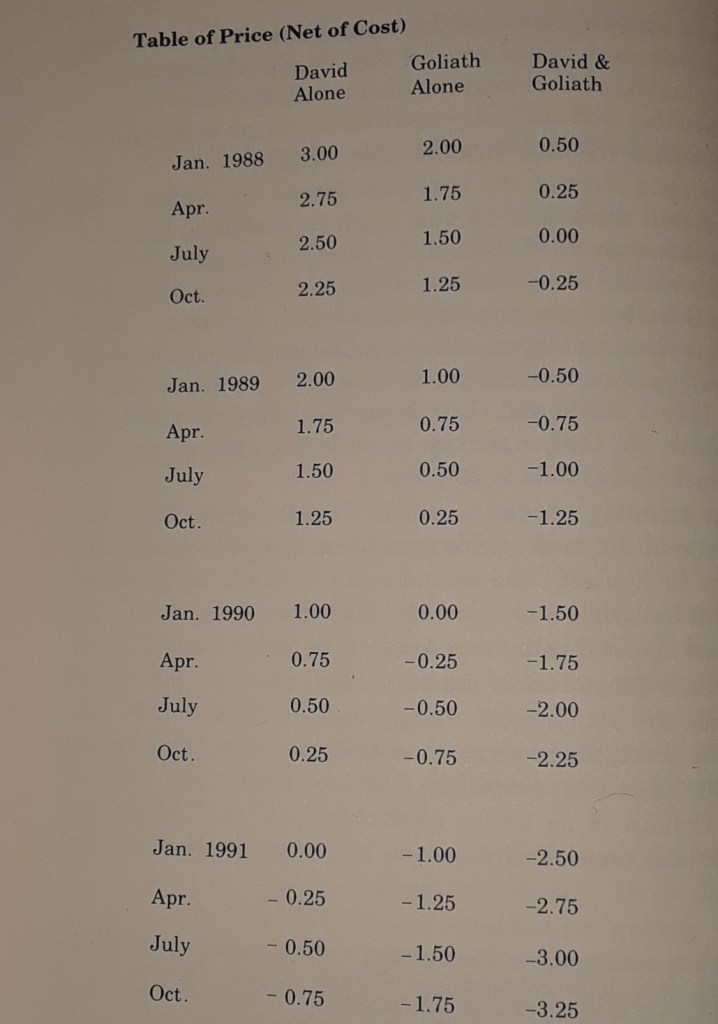
If David exists and leaves Goliath as a monopolist, Goliath gets a lower unit price since his output is bigger; in the case, he gets $2 per slingshot. (Of course, $2 on two slingshots is better than $3 on David’s one.) If both David and Goliath produce, they are said to be duopolists. In that cause they saturate the market, and the prince (net of cost) falls to 50 cents. The declining market is evident from the price chart. The first column shows the price net of cost if David captures the market for himself. The second column details the price net of cost if Goliath is a monopolist. The third column details the price net of cost if both firms continue to produce in a duopoly. In each quarter after January 1988, the price falls by 25 cents for any output level brough to market. As can be seen from the cart, the pressure to exist begins in the third quarter of 1988, when the duopolists first lost money. By January 1990, Goliath is no longer profitable even as a monopolist. A year later, even David can no longer expect to make any money. Over the twelve quarters from 1988 to 1991 the slingshot industry will become extinct. But when do the firms exit? Who gives up first? When do they exit? This problem can be solved using the technique of sequentially eliminating dominated strategies. To get you started, note that staying past January 1990 is a dominated strategy for Goliath, as he forevermore loses money, irrespective of whether David stays or exists. #RandolphHarris 19 of 21

Now work backward and ask what you would do if you were David and it was the third quarter of 1989 and Goliath was still producing. (In calculating the value of the worst-case scenario, you can simplify the mathematics by assuming a zero interest rate; profits (losses) tomorrow and today are equally valuable.) In this problem, it does not matter how much money you make, just how long you can make it. The firm that can hang on the longest can force out its more profitable rival as soon as duploy profits begin to turn negative. As suggested in the hint, if David can hold on until the third quarter of 1989 he is home free. From then on, the worst possibility is that Goliath stays in the market through the fourth quarter of 1989. This will cost David $2.25in duoploly losses. However, when 1990 comes, Goliath must exit, since he suffers losses either as a duopolist or as a monopolists. Thus, David can count on making $2.50 in monopoly profits during the 1990s, which is enough to tide him over any possible losses during the final two quarters of 1989. Now, the power of backward reasoning picks up steam. Given that David is committed to staying upon reaching July 1989 (exiting is a dominated strategy), Goliath can expect to earn only losses from July 1989 onward. Thus, he will exit immediately if he ever finds himself as a duopolist on that date. That means that David can expect to make the $2.50 as a monopolist in 1990 and $2.75 as a monopolist in the final two quarters of 1989. This windfall of $5.25 more covers the maximum duopoly losses up until that date ($1.50), and therefore David should never exit before January 1991. Given that David is committed to staying, Goliath should leave as soon as duopoly profits turn negative, July 1988. Note that Goliath cannot make the same commitment to stay in the market for the same length of time. #RandolphHarris 20 of 21

That commitment breaks down first in January 1990, and then the guarantee exist by January 1990 translates into a forced exit by July 1989. The slippery slope for Goliath brings him back to October 1988, the first instance when the market is not big enough for the two of them. This simple story of fighting for a market share in declining industries may help explain the observation that large firms are often first to exit. Charles Baden Fuller, an expert in the decline of British markets, reports that when the demand for U.K. steel casing fell by 42 percent over the period of 1975—1981, executives of the two largest firms, F. H. Lloyd and the Weir Group, “felt that they had borne the brunt of the costs of rationalization; they accounted for 41 percent of the industry output in 1975, but for 63 percent of the capacity that was withdrawn over the 1975-1981 period, reducing their combined market share to 24 percent. Remember that size is not always an advantage: in judo and here in exit strategies, the trick is to use your rival’s bigger size and consequently inflexibility against him or her. This strategy can be applied to China. A big battle for the Chinese market is starting. In 2009, China became not only the World’s top exporter, but also the second-largest importer. It is the number one market for an increasing amount of both capital and consumer goods. For instance, its share of the World market optical fibers has been the largest producers in the World with a 62 percent share of the global total in 2022. According to the study, shipments from machine tool plant in China accounted for a whopping 30 percent of the $92.7 billion total produced by 28 countries around the globe, and China manufactures 36 percent of the World’s electronics. In addition, with nearly one-fifth of the World’s population, China is the second-largest final consumption market—after the U.S.A.—for electronic devices embedded with semiconductors. It is the largest market for cars and brand fashion goods and is about to become the number one for luxury goods. The list can be continued. Yet, the competition for tapping this market is becoming increasingly fierce, and more often than not Western companies appear to be not on the winning side. #RandolphHarris 21 of 21


With accents of elegance, spacious living areas, and convenient workspaces, Millhaven Homes offers beautiful features that will surely capture your interest and imagination.

If you are considering building a custom home with us, please fill out the information below and we will reach out to you to schedule an introductory meeting. https://millhavenhomes.com/get-started/

Elusive Crossover from One World to the Next
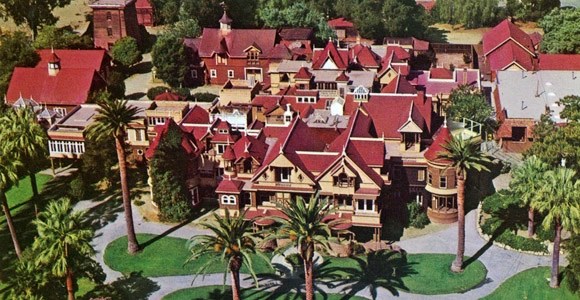
Handsome he was, majestic even, as everyone said, and full of that smoldering power as only performers of magic possessed, long years ago. Oh, it was such a pain to lose him. It seemed of consequence of the entire Earth. Across the table, I reached for my lemonade with a shaking hand and took a sip. Reminiscing acquired a thirst. When I saw Elsa looking at me, I offered a weak smile before abruptly averting my eyes, and turning my attention back on the gardens. My heart was growing heavier and heavier. The night waned, the tone on the estate was quite strange. I pondered hard on the possibilities—and ramifications—of returning to the past. Some shrugged it off as impossible, since time, as we know it is a continuum and there is no going back…or forward, for that matter. Some say that all time is contained in the past and there is literally no future. Others bode ominously that even our merest presence in the past would disrupt the continuum and set up an entirely new future—where we live now—and change things so that the present is not what it is, perhaps even leading to the possibility that the time traveler in the past might never have been born! Still others claimed that time travel had already been accomplished and proven by sounds of physical laws. Although we are recognized for these magnificent rifles, the Winchester Arms Company also produced household and sporting goods. We had a product line that touched virtually every aspect of American life. Over 6,300 Winchester franchise stores were in existence. #RandolphHarris 1 of 6

Ordering products through the Winchester mail-order catalog was extremely popular. We manufactured double-raw ball bearings, safety razors, fishing tackle, and a line of tools: hammers, planes, saws, wrenches, flashlights, batteries, ice boxed, locks, scissors, cutlery, tong, meat grinders, paint and varnish, pots and pans—even footballs and bicycles! However, there was also a secret business that the Winchester Arms Company was involved in. Deep in my mansion, we had a super-secret facility which we conducted experiments using rare metals spinning at tremendous speeds in opposite directions. The result was the creation of a field—a torsion field—within whose influence strange things occurred. One thing was the rapid disintegration of life forms within the field’s influence. We experimented mostly with plants. The result, if the torsion field was strong enough, was the disruption or bending of space. And, because of the space-time continuum—a well known and accepted inviolable connection between space and time—if space is bent or distorted, so is time. A slowing or stoppage of time is the result. This whirlpool or vortex is evidence of paranormal energy. The vortex is a tap or connection into time. This paranormal energy not only gave us a vision of the past, but it allowed us to freeze time. That is why the carpenters were able to make this mansion mushroom from an eighteen-room farmhouse into a hundred room Grand Queen Anne Victorian Mansion in the first six months. #RandolphHarris 2 of 6

Of course, everything has consequences. One night, I stood on the front porch of my house to watch the stars in the sky. As I was gazing at the Heavens, I suddenly got a strange feeling, a feeling that I was in another space, another time. It was almost like I was in the wrong place. There were couples all over the veranda, talking directly to each other, four or five couples. The women were wearing trousers and so were the men. They looked very peculiar. The vision did not last more than a minute, but long enough to see them chattering, laughing, and walking around my home as if it was some sort of circus or museum. The entire scene vanished before my eyes. I paused to collect my thoughts and gather in my emotions. I could feel William’s energy with me. I felt him right next to me. His energy was here, in our very home. It was mid-August of 1890. The housemaid Elsa was doing chores when she noticed a tall man with a long beard and mustache sitting on a bench in the front yard. The man seemed sad, but paid no attention to Elsa. At first Elsa did not think for a moment that this man was anything other than a mortal. However, when she pointed him out to Mr. Hansen, things began to get strange. Mr. Hansen could not see the man despite the fact that he was obvious to Elsa. Elsa looked at Mr. Hanen and then looked back at the man but he vanished. Now she was beginning to wonder if she had imagined him. Elsa mumbled something and went back to work. #RandolphHarris 3 of 6

Later that day Elsa was walking down the road past a neighbor’s home when she spotted the man again. He was standing near a hired hand working in a field. No one seemed to pay the man any attention. In fact, no one even seemed aware of his presence. While Elsa watched, the man walked away into the fruit orchard, but he did not cause any disturbance. Elsa still clung to the idea what he might be an optical illusion based on where she stood. She convinced herself that she had seen the man again, and this time she would see that he was flesh and blood. Elsa was destined to meet the man again, but this time there was little doubt that when she saw the man sitting on top of the thatched roof of the stable. He seemed to be repairing shingles. The man still did not seem to notice Elsa, so she ran back to fetch the carpenter Mr. Hansen to verify what he saw. However, when they returned the man was gone. As Elsa looked around, she saw him in the doorway of the shed. Mr. Hansen could not see him, but he believed Elsa. He told Elsa Mr. Hansen to ask the man what he wanted. The man returned to the shed, but he paused as Elsa spoke to him. The man answered that he was William Winchester and he was looking for his wife. Then he asked her for help. Astonished by what this handsome made said, Elsa was so stunned that she thought her knees would buckle. She was witnessing a sight that few mortals were privileged to see. This spirit was identical to William Winchester, except he started becoming translucent, and did not bore the ravages of the terrible illness that caused his death. #RandolphHarris 4 of 6

What Elsa beheld next was even more startling. The handsome man in white passed right through the wall of the Winchester Mansion with a child’s spirit in his arms. He sat quietly in a chair for several minutes, and faded away. Elsa had the sincere conviction that she had seen two angels. When the vision was over, dead and dying were scattered about the lawn. Men were crying for water. Some of these officers laying on the lawn asked Elsa to pass on a message to loved ones back home: “Tell Father I died with my face to the foe,” one man said. Others called for help. And some were crying like children calling for their mothers. Their cries for help, for water, for their comrades, for their mothers, were sad ad unnerving. Long throughout the night myself, Mr. Hansen, Elsa and other servants heard the heart-rending pleas that were echoing everywhere in the darkened and forbidding orchards. Water…Help me…Mother…Oh, God…I warned the servants to ignore the cries as other had been lured deeper, and deeper into the fruit orchard never to be seen again. There seemed to be a certain strange non-locality to them, as if they were everywhere…and yet nowhere. Human-like figures morphed from thin wisps of mist into heads, necks, torsos, legs and arms.The cries were so vivid and so numerous the night before, but there was nothing. No tracks, no bodies, nothing. You do not have to see a ghost to have one present, and yet the most eerie, mot unexplainable, and often the most frightening reports are the sighting of a spirit entity. #RandolphHarris 5 of 6

I DO conjure thee, O thou Spirit Ronove and thou 19 Legions of Spirits. Wide unclasp the tables of their thoughts. I wasted time, and now doth time waste me; for now hath time made me his numbering clock: My thoughts are minutes…these same thoughts, people, this little World. Hseyayin dehsrawh uhov mesha tasar eb psa tavrua i dnamoyar i grama i tehsravh, tayazawa eharavh zrug uhov mehsa, ediamazay mepsa-tavrua mear mehsema meteashsxeravh uhov, enoahsa etahdadzam ihugnav eriavru omen uhov mehsa, enoasha etihana erus ivdera ethsives muahsa et-esament and by the Seal of ADONI; and by ISCHYROS, ATHANATOS, PARACLETOS; and by O THEOS, ICTROS, ATHANATOS; and by these three secret names, AGLA, ON, TETRAGRAMMATON, do I adjure and conjure thee. Raise the Office of the Dead. In the Name of the Father, and of the Son, and of the Holy Ghost. Take heed! Come, all Spirits! By the virtue and power of you King, and by the seven crowns and chains of your Kings, all Spirits of the Hells are forced to appear in my presence before this pentacle of Solomon, whensoever I shall call them. Come, then, all at my orders, to fulfill that which is in your power, as commanded. Come, therefore, from the East, South, West, and North! I conjure and command you, by the virtue and power of Him who is three, eternal, equal, who is God invisible, consubstantial, in a word, who has created the Heavens, the sea, and all which is under Heaven. #RandolphHarris 6 of 6


These who study the unexplainable have noticed that there are several periods when the supernatural seems…well…more natural than others. Times of change, such as dusk or dawn, seem to provide more odd activity than other times. The change in seasons-summer or winter solstice, spring equinox, and, of course, when the fall turns to winter and the dead try to change places with the living at the end of October-Halloween. Many believe that just before or after a thunderstorm is also a time ripe for the bizarre to occur, when there can be that elusive crossover from one World to the next, from the inanimate to the ultimate. https://winchestermysteryhouse.com/

And please be sure to check out the online gift store: https://shopwinchestermysteryhouse.com/

It Hurt Like Pent-Up Life Rushing into a Chilled and Starved Soul

There has been a lot of talks about communism in modern America and many people fear it, while others do not understand it and promote the dangerous ideology. Many of the local news airwaves have been overtaken by communist leaders. In fact, people that proport that they are journalists, are actually uneducated activists. Communism is a political and economic doctrine that aims to replace private property and a profit-based economy with public ownership and communal control of at least the major means of production (exempli gratia, mines, mills, and factories) and the natural resources of a society. Communism is thus a form of socialism—a higher and more advanced form, according to its advocates. Communism and socialism are basically synonyms. The theory of the Communists may be summed up in the single sentence: Abolition of private property. The major problem confronting the people of the United State of America and free peoples everywhere in the first quarter of the 21st century is the threat to peace and freedom presented by the militant aggressiveness of international communism. We recognize that we must retain our present military and economic advantage over the Communist bloc. Communism is a false idea, and the answer to a false idea is truth, not ignorance. With the triumph of communism, classes will disappear. Communism will supplant and destroy the market economy of capitalism. Communism is the easiest system to sell to the people who are poor, not because poor people are any less worthy than the affluent, but because it sounds so reasonable, fair, and workable. #RandolphHarris 1 of 19

The promises of communism sound sweet, warm, and affectionate—the poor can take in the opulence of the rich without putting in the work. The reality is that the tenets of Communism are, indeed, workable; the only problem is that they produce super inefficient economies, such that, even though people in a communist system fully support its ideals, they soon start conducting themselves in a manner what shows their deep yearning for the freedoms of Capitalism. Communism has always, still does, and always will fail. China is doing so well because it abandoned communism in the 1970s when it introduced capitalism reforms which have led to rapid economic growth. China is now a mixed economy. Socialism, another form of communism, destroyed Venezuela. The worsening humanitarian crisis on corruption, mismanagement, failing oil prices, or U.S.A. sanctions came about because of the rise of socialism. The policies implemented by dictator Hugo Chavez and Nicolas Maduro caused these problems. There are three main policies implemented by Mr. Chavez since 1999 that produced the current crisis: Widespread nationalization of private industry, currency and price controls, and the fiscally irresponsible expansion of welfare programs. One of Mr. Chavez’s first actions was to start nationalizing the agriculture sector, supposedly reducing poverty and inequality by taking from rich landowners to give to poor workers. From 1999 to 2016, his regime robbed more than 6 million hectares of land from its rightful owners. #RandolphHarris 2 of 19

Nationalization destroyed production in affected industries because no government has the capacity to run thousands of businesses or the profit motive to run them efficiently. Instead, government officials face incentives to please voters by selling products at low prices and hiring more employees than necessary, even when that is the wrong industry decision. As economic theory predicted, as state control of the agricultural industry increased, Venezuela’s food production fell 75 percent in two decades while the country’s population increased by 33 percent. This was a recipe for shortages and economic disaster. After agriculture, the regime nationalized electricity, water, oil, banks, supermarkets, construction, and other crucial sectors. And in all these sectors, the government increased payrolls and gave away products at low cost, resulting in days-long countrywide blackouts, frequent water service interruptions, falling oil production, and bankrupt government enterprises. Ye taking over the most important sectors of the economy was not enough for the socialist regime. In 2003, Mr. Chavez implemented a foreign currency control scheme where the government set an overvalued exchange rate between the Venezuelan currency and the U.S.A. dollar. One goal of the scheme was to reduce inflation by overvaluing the currency, subsidizing imported products. However, the currency control meant the regime had to ration available U.S.A. dollars to importers since, at an overvalued (cheap) exchange rate, there was more demand for U.S.A. dollars than supply. #RandolphHarris 3 of 19

Naturally, an illegal market for foreign currency emerged and corrupt regie members and lucky individuals assigned cheap U.S.A. dollars obtained large profits. Even worse, the scheme actually increased inflation since overvaluing the currency reduced government oil revenues in Venezuelan currency, leading the regime to print money to cover the ensuing budget deficit. The socialist regime also implemented price ceilings on hundreds of basic products such as beef, milk, and bathroom hygiene paper. At artificially low prices, more people were willing to buy these products but the few private factories left—not nationalized—could not profit at the government-capped price, so they reduced or halted their production. Instead of benefiting the poor, price ceilings predictably resulted in shortages that forced them to stand in lines for hours, while supermarket employees and the well-connected obtained the products they needed. However, perhaps the most harmful part of the Venezuelan socialist project is the part that the international media and leftist figures used to praise most frequently: welfare programs. The socialist regime created social “missions” aimed at tackling poverty, illiteracy, healthcare, and more. However, despite enjoying higher government oil revenues due to a tenfold rise in oil prices from $10 a barrel in 1999 to more than $100 in 2008, the regie financed a growing deficit by printing more currency. Expansive welfare programs and massive public-works projects provided ever-growing opportunities for still greater corruption. Printing money to pay for endless state programs unsurprisingly led to high rates of inflation. Socialism and communism are sort of alter opportunism. #RandolphHarris 4 of 19

Many people can see the United State of American heading down this same path with rent control, importing foreign produce and meats, borrowing from China, and student loan forgiveness. Corrupt regimes can certainly cause many problems, but without socialism, hyperinflation and widespread shortages are not usually among them. Venezuelans have learned over the past few decades that there is no such thing as a free lunch. “Free things” come at a high price. Offenses motivated purely by either irresistible opportunities or overwhelming situational inducements are relatively rare. We have been discussing carjacking, another way people use to get something for nothing. Most carjackings occur between these extremes, where situational inducements merge with potential opportunities to create circumstances ripe for offending. What follows are descriptions of offenses spurred by the combination of internal or external situational inducements and acceptable (or near acceptable) levels of risk and reward. The degree which a given situation was compromised of rewards and risk on the one hand ad internal and external pressures on the other varied, but when the combination reached a certain critical level, a carjacking resulted. Offenders often described situation in which inducements were present, but not pressing, where they had some money or some drugs on them, but realized that the supply of either or both was limited and would soon run out. In such cases, the carjackers engaged in a state referred to as alert opportunism. The offenders are not desperate, but they anticipate need in the near term and become increasingly open to opportunities that may present themselves during the course of day-to-day activities. #RandolphHarris 5 of 19

Here, would-be carjacking prowled neighborhoods, monitoring their surroundings for good opportunities, allowing potential victims to present themselves. Corleone, a sixteen year-old with over a dozen carjacking under his belt, had been committing such offenses with his cousin since the age of 13. The two were walking the street of Sacramento one afternoon looking for opportunities for quick cash when they saw a man walking out of a barbershop toward his parked car, keys in hand. Motivated by the obliviousness of their pray and the lightness of their wallets, they decided to take his car. Corleone: “it was down in the city of Downtown Sacramento. We was just walking around, you know. We just look for things to happen you see just to get money. We just walk around and just see something that’s gonna make us money We just happened to be going to the Chinaman [a restaurant] to get something to eat. [We had] about five or six dollars in our pocket which ain’t nothing. It was this man driving a blue BMW. It has some chrome wheels on there. He just drove up and he was going to the Chinaman and…my cousin was like, ‘Look at that car, man, that’s tough [nice]. I’m getting that. I want that.’ [I was] like, ‘Straight up, you want to do it?’ He was like, ‘Yeah.’ He was all G[ood] for it. Then he [the victim] came out the barbershop. It was kind of crowded and we just did what we had to do. There was this little spot where [my cousin] stash[es] his money, drugs and all that type of stuff and then he got the gun [from the stash]. He got around the corner. He say, ‘Hey, hey.’ I asked him for a cigarette so he went to the passenger’s side [of the vehicle to get one]. I ran on the driver’s side with a gun. Put it to his head and told him to get out of the car.’ #RandolphHarris 6 of 19

INT: “Did you know that you were going to do carjacking or…?” Corleone: “No. Not necessarily. But since that was what came up, that’s what we did.” No mater how alert one is, however, good opportunities do not always present themselves. Over the course of time, situational inducements mount (that is, supplies of money and drugs inevitably dry up), and the option of waiting for ideal opportunities correspondingly diminishes. Such conditions cause offenders to move from a “passive” state of alert opportunism to an “active” state of what could be referred to as motivated opportunism (creating opportunities where none previously existed or modifying existing non-optimal opportunities to make them less hazardous or more rewarding). Here, attention and openness to possibilities expands to allow offenders to tolerate more risk. Situations that previously seemed unsuitable start to look better. Binge, a 45 year old veteran offender who had engaged in burglary, robbery, and carjacking for over 20 years, discussed his most recent decision to get a car on a wintry January day. He had been carrying a weapon (a 9mm Glock) since that morning, looking to commit a home invasion. After prowling the streets for hours and encountering few reasonable prospects, he happened on an easy opportunity—a man sitting parked in a car, its engine running, at a Lightrail (trolley) station. #RandolphHarris 7 of 19

Binge: “Well, I was out hustling trying to get me a little money and I was walking around. I was cold. I was frustrated. I couldn’t get in [any] house[s] or nothing, so I say [to myself], ‘Well I’ll try and get me a little car, and you know, just jam off the heat and sh*t that he [the vehicle’s owner] got,’ you know? I was strapped [carrying a firearm] and all that, you know and I was worried about the police catching me, trying to pull my pistol off, and I see this guy. Well, he was at the Lightrail you know, nodding [falling asleep] in his car. So I went up to the window. I just think that I just peeped it on [happened on the situation]. I was at the Lightrail you know, I was standing at the bus stop trying to keep warm and so I just walked around with no houses to rob, and I seen this dude you know sitting in his car, you know, with the car running. And I said ‘Ah man, if I can get a wag at this [take adventure of this opportunity],’ you know. It wasn’t just an idea to keep warm or nothing like that. I was cold and worried, and it just crossed my mind and I thought I can get away with it, and I just did it. I’d do anything man, I’d do anything. If I want something and I see I can get away with it I’m gonna do it. That’s what I’m saying. That night I saw an opportunity and I took it, you know. It just occurred to me.” Just as compelling were instances where third parties placed demands on offenders. A number of our respondents indicated that they engaged in car jacking to fulfill specific orders or requests from chop shop owners or other individuals interested in a particular make and model of car or certain valuable car part. The desire to fulfill such orders quickly created conditions ripe for motivated opportunism. #RandolphHarris 8 of 19

Goldie, for instance, was experiencing strong internal situational pressures (the need for cash) and external pressures (the demand for a particular vehicle by some of his criminal associates) combined with a moderately favorable opportunity (inside information on the driver of the wanted vehicle and its location): Goldie: “He’s from my neighborhood. He’s called Mucho. He’s from the same neighborhood but like two streets over. Them two streets don’t come over on our street. You know, we not allowed to go over on they street. It was a nice car. The paint, the sound system in it, and the rims. [It] had some beats, rims. Rims costs about $3,000, some chrome Daytons. 100 spokes platinums.” INT: “OK. That’s a lot of money to be putting on a car. What does he do for a living?” Goldie: “I don’t know. I’ don’t ask. What they told me was they wanted this car and they are going to give me a certain amount of money.” INT: “You say they told you they wanted this car. You mean they told you they wanted his car or they wanted a car like that?” Goldie: “His car. His car. They want [Mucho’s] car. They said, ‘I need one of these, can you get it for me?’ And they knew this guy. So now, I need that car. That car.” Low-Down also specialized in taking orders from chop shops. Low-Down: What I do, I basically have me a customer before I even go do it. I ask a few guys that I know that fix up cars, you know what I’m saying. I ask them what they need then I take the car. But see, I basically really got a customer. I’m talking about this guy over in East Sacramento. Me and Bob, we real cool. He buy ‘em cause he break ‘em down, the whole car down and her got an autobody shop. He sell parts. He’ll take the car and strip it down to the nitty gritty and sell the parts. He get more money out of selling it part by part than selling the car. And, before I get it I already set the price.” #RandolphHarris 9 of 19

Low-Down also had a drug habit: Low-Down: “The main reason basically why I did it was I be messing with heroin, you know what I’m saying. I be using buttons [heroin housed in pill-form]. I be snorting some, but I be snorting too much, you know? I got a habit for snorting cause I be snorting too much at a time, that’s how I call it a habit. I probably drop about 5 or 6 [buttons] down first [thing in the morning.] [So] I basically really sick and my daughter needed shoes and sh*t like that and my girlfriend was pressuring me about getting her some shoes. She had been pressing me about two or three days. Baby food and stuff like that. But the money I had, I had been trying to satisfy my habit with it. Basically I just thought it was a good thing to do. It was a good opportunity.” (This is essentially why many professionals and affluent people ride in their cars with the windows up, at all times, and the doors always up and never give anyone a cigarette, light, or money. The church in the twenty-first century must recognize the powers of darkness. To this end the Christian Church must recognize that the existence of deceiving, lying spirits is as real in the twenty-first century as in the time of Christ and that their attitude toward the human race is unchanged: that their one ceaseless aim is to deceive every human being. Yes, that they are given up to wickedness all day long, and all night long, and that they are ceaselessly and actively pouring a stream of wickedness into the World and are satisfied only when they succeed in their wicked plans to deceive and ruin men. Yet the servants of God have been concerned only to destroy their works—to deal with sin—not recognizing the need of using the power given by Christ to resist by faith and prayer this ever-flowing flood of satanic power pouring in among men. #RandolphHarris 10 of 19

Hence both men and women, young and old, Christian and non-Christian, become deceived through their guile, because of ignorance about them and their wiles. These supernatural forces of Satan are the true hindrance to revival. The power of God which in 1904 broke forth in Wales, with all the marks of the days of Pentecost, was checked and hindered from going on to its fullest purpose by the same influx of evil spirits as met the Lord Christ on Earth and the apostles of the early Church—with the difference that this inroad of the powers of darkness found the Christians of the twenty-first century, with few exceptions, unable to recognize and deal with them. Evil-spirit possession has followed and checked every similar revival throughout the centuries since Pentecost. If the Church is to advance to maturity, these things must now be understood and dealt with—understood not only with respect to the degrees of possession recorded in the Gospels and Acts, but in light of the social forms of manifestation suited to the close of the age. For now these spirits have appeared under the guise of Holy Spirit, yet having some of the very characteristic marks in bodily symptoms which are seen in the Gospel accounts, when all who observed the manifestations knew that it was the work of the spirits of Satan. It my have been so short a time that one has been able to share with another the coldness, blackness, and emptiness of the void experienced as loneliness and alienation. And, deeply as one loves relationships and encounters, one may also need solitude to grow in another way, to regenerate and reintegrate. #RandolphHarris 11 of 19

How many times the change within one (“insight,” “solution,” or simply new perspective) has come in the solitude after the encounter which made it possible. This may be enough different from those around one to make one feel alien at times. One’s feelings are step children so long, and one’s hear mute. At a point, one may come through a siege of depression and self-doubt during which one may have overlooked one’s dark side and shared fears and despair with another for the first time in one’s life. Some may face life once gain with some joy, some hope. One may feel so much but cannot find any words for these feelings. It is possible to stammer out something about hoping one has not been too much bother, and another individual may communicate one’s love as well as one’s acceptance of one—ALL of one. This individual who has seen your weaknesses and your negative feelings—he or she could care? You feel the most intense pain of your life than and sit for minutes with closed eyes, reeling under it. It hurts like pent-up life rushing into a chilled and starved soul. It may have been such a good hurting. One may not be able to say for sure, but it might be as though only when one is no longer alone and alien one can stand the pain of loneliness and the hunger of one’s heart for understanding, for relationship that does not exclude part of one. Perhaps just being so open to feeling and to immediate experiencing is painful. Only later when the experience has lost a little of its overwhelming intensity does the words of a poem pour out and one can weep with joy. #RandolphHarris 12 of 19

The response to attack of pain can lead to growth and resolution into relationship. For one to strike back does not ease one’s pain but often adds more. This is hard enough to understand for many, but when one experiences understanding, another’s caring—this too can be painful—one may experience such disbelief that one falls silent. Often people can enrich an individual’s life and gladdened one’s heart. The power which grasps the individual in the experience of faith is the quality of the “unconditional,” a term often used in describing faith an ultimate concern. Unconditional or ultimate concern, subjectively, is a concern that demands total involvement. However, the unconditional, absolute character of the demand stems from the unconditionality of the object of faith. The power grasping us in the state of faith is not a being beside others, not even the highest; it is not an object among objects, not even the greatest; but it is a quality of all beings and objects, the quality of pointing beyond themselves and their finite existence to the infinite, inexhaustible, and unapproachable depth of their being and meaning. Here, then, we are principally interested in that quality of things which unconditionally grips man’s spirit. A fuller exposition of that toward which this quality points, the “depth of their being and meaning.” We use the term “unconditional” because the German equivalent for unconditional is unbedingt, the connotation being that something is conditioned or limited by being made into a thing (Ding). Thus, the unconditional ( das Unbedingte ) is not “thingish” at all, but rather “a quality which we experience in encountering reality.” #RandolphHarris 13 of 19

The “ultimate concern” also means unconditional. The ultimate concern is was unbedingt angeht (what concerns us unconditionally). Since faith is effective in all of man’s spiritual functions, both theoretical and practical, it cannot be identified with any one of them. Faith comes to expression in these functions, and they, in turn, are rooted in faith. Tendency toward the unconditional must be understood in connection with the concept of Sinn, which is best translated into English by “meaning” and into French by sens. The relation of unconditioned meaning to individual things must be understood as a polarity of form and content. This polarity stands in constant tension, for the unconditional never ceases to demand fulfillment in what would be conditional form. However, unconditioned form is a contradictory notion impossible of realization, for the ground meaning (Sinngrund) is also the abyss of meaning (Sinnabgrund) which transcends every form. The inexhaustibility of meaning (Sinnunerschopflichkeit) would be rendered finite if it could be contained in a form. Nonetheless, each act of meaning must hearken to the demand that is strive to being form and content to unity of filament. Two points are to be underscored in this theory of Sinn: the unconditional is meaning, and in the act of faith one tends toward it, but not as toward an object, since meaning is not an object or thing. One turns to a holy object in which the unconditional is symbolically expressed, but then faith passes beyond this object to the ground and abyss upon which it resist. #RandolphHarris 14 of 19

Abstract and difficult though it be, the analysis of faith in the unconditioned meaning of life makes it a very human issue. For unless some spark of that faith is present, there can be no spirit, for to live spiritually is to live in the presence of meaning, and without an ultimate meaning everything disappears into the abyss of meaninglessness. Faith is unconditional, absolute, and ultimate, because without it man ceases to live as man. One of the greatest power imbalances on Earth today divides the rich countries from the poor. That unequal distribution of power, which affects the lives of billions of us, will soon be transformed as the new system of wealth creation spreads.. Since the end of World War II the World has been split between capitalist and communist, North and South. Today, as these old divisions fade in significance, a new one arises. For from now on the World will be split between the fast and the slow. To be fast or slow is not simply a matter of metaphor. Whole economies are either fast or slow. Primitive organisms have slow neutral systems. The more evolved human nervous systems processes signals faster. The same is true of primitive and advanced economies. Historically, power has shifted from the slow to the fast—whether we speak of species or nations. In fast economies, advanced technology speeds production. However, this is the least of it. Their pace is determined by the speed of transactions, the time needed to take decisions (especially about investment), the speed with which new ideas are created in laboratories, the rate at which they are brought to market, the velocity of capital flows, and above all the speed with which data, information, and knowledge pulse through the economic system. Fast economies generate wealth—and power—faster than slow ones. #RandolphHarris 15 of 19

By contrast, in less affluent societies economic processes move at a glacial pace. Traditional, ritual, and ignorance limit socially acceptable choices. Communications are primitive; transport, restricted. Before the market system arose as an instrument for making investment choices, tradition governed technological decisions. Tradition, in turn, relied on rules or taboos to preserve productive technique that were proven workable over the slow course of biological and cultural evolution. With most people living at the bare edge of subsistence, experiment was dangerous, innovators were suppressed, and advances in the methods of wealth creation came so slowly they were barely perceptible from lifetime to lifetime. Moments of innovation were followed by what seemed like centuries of stagnation. The historical explosion we call the industrial revolution stepped up the economic metabolism. Roads and communications improved. Profit-motivated entrepreneurs actively searched for innovations. Brute force technologies were introduced. Society has a large surplus to fall back on, reducing the social risks of experimentation. With technological experimentation now so much less costly, productive methods [can] change more rapidly. All this, however, merely set the stage for today’s super-fast symbolic economy. The bar code on the pack of Marlboros, the computer in the Federal Express truck, the scanner at the Safeway checkout counter, the bank’s automatic teller, the spread of the extra-intelligent data networks across the planet, remotely operated robots, the informationalization of capital, all are preliminary steps in the formation of a 21-century economy that will operate at nearly real-time speeds. #RandolphHarris 16 of 19

In due course, the entire wealth-creation cycle will be monitored as it happens. Continual feedback will stream in from sensors built into intelligent technology, from optical scanners in stores, and from transmitters in trucks, planes, and ships that send signals to satellites so managers can track the changing location of every vehicle at every moment. This information will be combined with the results of continuous polling of people and information from a thousand other sources. The acceleration effect, by making each unit of saved time more valuable than the last unit, thus creates a beneficial feedback loop that accelerates the acceleration. The consequences of this, in turn, will be not merely evolutionary but revolutionary, because real-time work, management, and finance will be radically different from even today’s most advanced methods. Even now, however, well before real-time operations are achieved, time itself has become an increasingly critical factor of production. As a result, knowledge is used to shrink time intervals. This quickening of economic neural responses in the high-technology nations holds still-unnoticed consequences for low-technology or no-technology economies. For the more valuable time becomes, the less valuable the traditional factors of production, like raw materials and labor. And that, for the most part, is what these countries sell. The acceleration effect will transform all present strategies for economic development. #RandolphHarris 17 of 19

Another solution for the manufacturing crisis America is facing is transferring production to China and other emerging market countries to cut cross and raise price competitiveness. To go multinational. More and more firms, not only large, but also small and medium, are stepping along this road. The number of multinational small and medium-size manufacturers in America, Europe, and Japan is increasing at a remarkable speed—not least because of the Chinese challenge. The emergence of strong micro-multinationals is an important global trends. At the present time, there are some 60,000 multination corporations (MNCs) Worldwide, controlling more than 500,000 subsidiaries. They are responsible for half of international trade, especially due to the scale of inta-company trading (between subsidiaries of the same company). More and more manufacturing micro-multinationals from industrially developed states shift their production to China and other emerging countries, seeking to cut profits. However, for their home countries, without the expansion on a comparable scale of new manufacturing activities, such multinationalization poses a threat of the hollowing-out of domestic industries and significant job losses (even though opening of a factory overseas creates some additional jobs at home, especially office jobs needed to coordinate, support, and monitor its activities). These interests of multinationals and the countries of their origin become less and less identical. In the past it was taken for granted that everything that is good for General Motors is good for America. #RandolphHarris 18 of 19

Nowadays it is still true: American cars keeps manufacturing jobs and money in America. If our manufacturing jobs are being hollowed out, instead of just transferring factories overseas, there should be a clause that these factories are also able to transfer their workers and make sure they can afford the same type of life, if a better quality. Also, those living on government benefits should be allowed to move to other countries because due to inflation and rising costs of rents, many of them can no longer afford to live in America and some income-based housing is just second chance housing for criminals and good people should not be caught up in a hood with criminal thugs. In many of these places, the senior citizens are robbed, physically attacked, threatened by the management, harassed, their apartments are frequently broken into, their keys are floating around and their cars are often broken into and vandalized also. And the thugs are not evicted, taken to jail, nor held responsible for their crimes. The victims are made to suffer and live in fear, and some people involved in management and operations may be criminals, too. Nonetheless, the performance of every country’s manufacturing sector, its national economy as a whole and that well-being of its citizens increasingly depend on its ability to attract manufacturing and other companies from all around the World—China being one of the most vivid examples in this regard. The United States of America needs to attract more planet who want to manufacturing good in America, but with American wages being so high, it is a hard bargain to accomplish. #RandolphHarris 19 of 19

With accents of elegance, spacious living areas, and convenient workspaces, Millhaven Homes offers beautiful features that will surely capture your interest and imagination.
If you are considering building a custom home with us, please fill out the information below and we will reach out to you to schedule an introductory meeting. https://millhavenhomes.com/get-started/

You’ll have more time to do the things you love while relaxing into your new lifestyle and enjoying your new home community.


The Only Way for America to Survive is Manifest Destiny

With many people driving cars that are flashy and very expensive, carjacking is a subject of concern. Need was not the only factor implicated in carjacking. Some carjackers indicated that they were influenced by the appeal of targets that represented effortless or unique opportunities (exempli gratia, isolated or weak victims, vehicles with exceptionally desirable options, rare vehicles). Here, risks were so low or potential rewards so great that, even in the absence of substantive internal or external situational inducements, they decided to commit a carjacking. Such opportunities were simply too good to pass up. Po-Po (short of “Piss Off the PO lice”) described just such an opportunity-driven incident. She and her brother had spent the day successfully pickpocketing individuals at the Golden 1 Center, in Sacramento. On their way out, she noticed an easy target, an isolated woman walking to her car, preoccupied with the lock on her car door. Po-Po: “It was a fancy little car. I don’t know too much about names of cars, I just know what I like. A little sporty little car like a Mercedes Benz like car. It was black and it was shiny and it looked good. I just had to joy ride it. She was a white lady. It looked like she worked for [a news station] or somebody. We just already pick pocket[ed] people in the arena, but f*ck. So we just walked down stairs and [I] said, ‘You want to steal a car? Come on dude, let me get this car.’ I didn’t have a gun on me. I just made her think I had a gun. I had a stick and I just ran up there to her and told her, ‘Don’t move, don’t breathe, don’t do nothing. Give me the keys and ease your a** away from the car.’ I said, ‘You make one sound I’m going to blow your mother*cker head off and I’m not playing with you!’ I said, ‘Just go on around the car, just scoot on around the car.’ Threw the keys to my little brother and told him go on and open the door. And she stood around there at the building like she waiting on the bus until we zoomed off. We got away real slow and easy.” #RandolphHarris 1 of 19

Likewise, Kow, and older carjacker and sometimes street robber, was on his way to a friend’s house to complete a potentially lucrative drug deal when he happened on an easy situation—a man sitting in a parked car, talking to someone on a pay phone at 2A.M. INT: “What drew you to this guy? What were you doing? Why did you decide to do this guy?” KOW: “Man, it ain’t be no, ‘What you be doing?,’ [it’s] just the thought that cross your mind be like, you need whatever it is you see, so you get it, you just get it. I was going to do something totally different [a drug deal] but along the way something totally different popped up so I just take it as it comes. I was like, ‘Whew! Get that.’ I don’t know man, your mind is a hell of a thing. On our way to this other thing. It just something that just hit you, you know what I’m saying? Plus, [he looked like] a b*tch. I don’t know, it’s just something, he look like a b*tch, just like we could whip him, like a b*tch, you know what I’m saying. Easy.” Not all irresistible opportunities were driven solely by the prospect of monetary gain. In a city the size of Sacramento, offender run into one another all the time, at restaurants, malls, movie theaters and night-clubs. As a result, individuals with shared histories often encounter unique chances for retaliation or personal satisfaction. Goldie emphasized how such opportunities could pop up at a moment’s notice. While cruising the north side of Sacramento, he spotted an individual who had sexually assaulted one of his girlfriends. #RandolphHarris 2 of 19

Goldie: “I did it on the humbug [spontaneously]. I peeped this dude, [saw that] he [was] pulling up at the liquor store. I’m tripping [excited] you know what I’m saying, [as I’m] walking there [towards the target]. You know, peep him out, you dig? He [was] reaching in the door to open the door. His handle outside must have been broke cause he had to reach in [the window] to open the door. And I just came around you know what I’m saying. [I] put it [the gun] to his head, ‘You want to give me them keys, brother?’ He’s like, ‘No, I’m not givin’ you these keys.’ I’m like, ‘You gonna give me them keys, brother. It’s simple as that!’ Man, he’s like, ‘Take these, motherfu*ker, f*ck you and this car. F*ck you!’ I’m like, ‘Man, just go on and get your a** home.’ [Then I] kicked him in his a**, you know what I’m saying, and I was like, ‘F*ck that, as a matter of fact get on your knees. Get on your knees, mother*cker…’ Then I seen this old lady right, that I know from around this neighborhood. I was like ‘F*ck!,’ jumped on in the car [and] rolled by. I wanted to hit him but she was just standing there, just looking. That’s the only thing what made me don’t shoot him, know what I’m saying? ‘Cause he’s f*cking with one of my little gals. ‘Cause he f*cked one of my little gals. Well, she was saying that he didn’t really f*ck her, you know, he too the p***y, you know what I’m saying? He got killed the next week so I didn’t have to worry about him. Motherf*ckers said they found him dead in the basement in a vacant home. #RandolphHarris 3 of 19

That the apostle after Pentecost recognized and dealt with the denizens of the invisible World is evident both from the Acts of the Apostles and from references in the Epistles. During their three years’ training by the Lord, the disciples were being prepared for Pentecost and the exposure to the supernatural World resulting from the coming of the Holy Spirit. They had watched Jesus deal with the wicked spirits of Satan, and had themselves learned to deal with them too. So the power of the Holy spirit could be safely given at Pentecost to men who already knew the workings of the foe. We see how quickly Peter recognized Satan’s work in Ananias (Acts 5.3), and how unclean spirits came out at his presence even as they had with his Lord (Acts 5.16). Philip likewise found the evil hosts subservient to the word of his testimony (Acts 8.7) as he proclaimed Christ to the people. And Paul definitely knew the power of the name of the risen Lord (Acts 19.11) in dealing with the powers of evil. It is therefore clear from Christian Bible history that the manifestation of the power of God invariably meant active dealing with the satanic hosts; that the manifestation of the power of God at Pentecost, and through the apostles’ subsequent ministry, meant an aggressive attitude toward the powers of darkness. We can therefore conclude that growth and maturation of the Church at the end of the New Testament dispensation will require the same recognition and the same attitude toward these satanic hosts—with the same co-witness of the Holy Spirit to the authority of the name of Jesus—as was fond in the early Church. #RandolphHarris 4 of 19

The Church of Christ will reach its high-water mark when it is able to recognize and deal with demon possession: when it knows how to “bind the strong man” by prayer and “command” the spirits of evil in the name of Christ, thus delivering men and women from their power. We want a theology which beats in rhythm with the pulse of modern life. Christian symbols must speak to and be understood by humans in present existential situation. Questions should spring from the depth and not the surface of existence, for we employ ontology. If one wants to know, one cannot escape ontology. Ontology removes us from those theologians who shun philosophy of any kind or who attempt to theologize in purely biblical categories. Ontology injects into our system a refreshing intellectual vigor and an antibody against narrowness. The result has unquestionably made a great contribution to the revival of metaphysical thinking within Protestant circles in our day. Since we represent the here and now existential situation, things tend to be vibrant, demanding, and so tends to steal the spotlight from the theological symbols which have already been on the stage for several thousand years. For us the Bible is not the unique source. The theological source, adequately understood, includes the history of the church, of religion, and of culture, for these are the areas in which revelation is received and expressed. Both Protestants and Catholics alike can profit from this enrichment of the wellsprings of theology in order to avoid the impoverishment of a narrow biblicism or of a cramped clerical view of the history of salvation. #RandolphHarris 5 of 19

The goal is to restore to theology its oft neglected historical perspective with an amplitude that surpasses the commonly accepted notion of tradition. If the Christian Bible is not directly employed, its influence is present in every part of the system. The goal is to produce mountains of information about what it the Bible meant to the people at the time it was produced by trying to make it more relevant in modern examples. The theological norm is the New Being in Jesus as the Christ as our ultimate concern. Ultimate concern appears to be not just an accessory gadget, but the mainspring of the system. The moment or act in which one is grasped by the holy is a thunderstorm at night, when the lightning throws a blinding clarity over all things, leaving them in complete darkness the next moment. Reality is seen as something new. Its ground has become visible in an ecstatic experience, called “faith.” Faith is equated with the ultimate concern: Faith is a total and centered act of the personal self, the act of unconditional, infinite and infinite passion. Some people feel like they do not belong no matter where they go’ somehow, as always, they are left in the cold, alone, by themselves. And no matter how much they try to be themselves and have friends, and be alive; each time, their friends depart, go their own way, achieve their goal, and one is left alone. It may have always been that was since one was a child. Some kids play alone in the backyard, planting flowers and trees, or making patterns and designs with things they find in the backyard. #RandolphHarris 6 of 19

One may remain alone, and play by oneself, build something, grow something, or paint with paint or draw crayon pictures—they would be all right; one would feel strong and better; night, silence, these would not bother one at all. However, some may have felt like they never belonged in their own family, even though they turned to them so very much. But every family needs an individual to look down on to make themselves feel better. They all need someone to talk about and make fun or, someone to depress and ruin. The goal is to create something in the aloneness, then one will be all right, and will not really be alone and will not really suffer, for in being alone, you can grow. Faith is ultimate concern and infinite passion. Consequently its all-consuming urgency requires that it be an act of total personality. Faith is not a special faculty nor is it a special function of man’s being. Faith involves the whole person, and thus it is the integrating factor which gives unity and direction to all man’s other concerns. In the fact of faith every nerve of man’s body, every striving of man’s soul, every function of man’s spirit participates. An infinite passion is all-pervading, and no area of man’s being can escape it: one’s body, for ultimate concern is passionate concern; one’s unconscious strivings, for they relate to the symbolic expression of faith; one’s conscious life, for faith concentrates man’s activities upon the object of ultimate concern. Because faith is such a centered act, its identification with any one function leads to what is called intellectualistic, voluntaristic, or emotionalistic distortion of faith. #RandolphHarris 7 of 19
Since faith cannot spring from any of man’s spiritual functions, but implies a power which unites and transcends all of them, faith has a receptive character, its mere passivity in relation to the divine Spirit. This accords with the basic theology truth that in relation to God everything is by God. Man’s spiritual functions cannot attain the ultimate, although they tend toward it, but the ultimate can grasp all of these functions and raise them beyond themselves by the creation of faith. Although faith is in man, it is not from man. The passive character of faith has to be grasped. Faith is the state of being grasped by the ultimate concern. In contrast to this, faith healing is a psychological phenomenon of autosuggestion which emphasizes an act of intensive concentration and self-determination. However, nothing could be farther from the receptive character of genuine religious faith, the state of being grasped by the Spirit. Once a person has been grasped by the power of the ultimate, one possesses an absolute certainty of the fact which springs from an immediate awareness of it. In ecstasy, anxiety, an even in despair, one is as certain of the experience of the holy as one is of one’s own self. In fact, it is the self in its self-transcending quality. All this, of course, is on the subjective side of faith, for objectively there is always room for doubt about the content of faith. We may not grasp anything in depth of our uncertainty, but that we are grasped by something ultimate, which keeps us in its grasp and from which we may strive in vain to escape, remains absolutely certain. #RandolphHarris 8 of 19

Advances in science and technology have been so extraordinary since World War II they hardly need elaboration. If nothing had occurred but the invention of the computer and the discovery of DNA, the postwar period might still go down as the most revolutionary in scientific history. However, in fact, much more has happened. We have not only improved our technologies, we have begun to operate at deeper and deeper levels of nature, so that instead of dealing with gross chunks of matter, we can now create a layer of material so incredibly thin that the electrons in it are effectively moving in only two dimensions. We can etch lines that are only 20 billionths of a mete wide. We will soon be able to assemble things one atom at a time. This is not “progress,” but upheaval. The U.S. Nation Academy of Engineering in 1989 listed what it considered the ten most important engineering achievements of the previous twenty-five years. It began the list with the Apollo moon landing, which it ranked in history with the building of the Egyptian pyramids. Next came the development of satellites, micro-processors, lasers, the jumbo jet, genetically engineered products, and other breakthroughs. Since the beginning of the 1950s, when the new wealth-creation system began sprouting in the United States of America, humans, for the first time in history, opened the pathway to the stars, identified the biological program of life, and invented intellectual tools as important as writing. This is an astonishing set of achievements in what amounts to a single generation. #RandolphHarris 9 of 19

Nor is it only scientific or technological knowledge that has made, or is about to make, remarkable strides. In everything from organization theory to music, from the study of ecosystems to our understanding of the brain, in linguistics and learning theory, in studies of nonequilibrium, chaos, and dissipative structures, the knowledge base is being revolutionized. And even as this occurs, competing researchers in fields like neural networks and artificial intelligence are providing new knowledge about knowledge itself. These transformative advances, seemingly remote from the Worlds of diplomacy and politics, are in fact inescapably linked to today’s geopolitical eruptions. Knowledge is the “K-Factor” in global power struggles. Consider, for example, the implications of the knowledge factor for Soviet power Today’s historic powershift, as we have seen, has made two of the most basic sources of power—violence and wealth—increasingly dependent on the third source: knowledge. Because of the spread of knowledge-based technology and the relatively free circulation of ideas, the United States of America, Europe, and Japan have been able to leave the socialist nations in the dust economically. However, the same technology made possible a vast leap in military power as well. #RandolphHarris 10 of 19

A fighter airplane today is the equivalent of a computer with wings. Its effectiveness depends almost entirely on the knowledge packed into its avionics and weaponry—and into its pilot’s brain. In 1982, Soviet military planners suffered a collective case of ulcers when eighty Soviet-built MiG fighters, flown by the Syrians, were destroyed by Israeli pilots, who lost not a single plane. Soviet-built tanks also did badly against Israeli armor. Even though the U.S.S.R. had brilliant military scientists, and nukes enough to incinerate the World, it could not keep place in the race toward super-high-technology conventional weapons or in the dash for strategic defense systems. The growing sophistication of information-based conventional weapons (which, in fact, are not conventional at all) threatened Soviet superiority on the ground in Eastern Europe. Meanwhile, the extremely knowledge-intensive Strategic Defense Initiative (SDI) threatened to negate the vale of Soviet long-range missiles. Critics of SDI complained that it would never work. However, the very possibility alarmed Moscow. If SDI could, in fact, block all Soviet nuclear missiles before they hit the United State of America, they were useless. That would also mean that the United States of America could launch a first-strike nuclear attack without fear of retaliation. If, on the other hand, as is more reasonable, SDI was only fractionally effective, blocking some but not all warheads, it would leave Soviet war panners wondering which fraction of U.S.A. missiles would survive. In either case, SDI raised the ante, and made theoretical Soviet use of nuclear weapons, never very likely, even riskier for Moscow. #RandolphHarris 11 of 19

On the ground and in space, then, the Soviets confronted a double threat. Faced with these sobering realities, plus its own economic decline, Moscow rationally concluded that it could no longer protect its Eastern European perimeter militarily, except at an unacceptable and skyrocketing cost. For both economic and military reasons, therefore, a reduction of its imperial commitments became necessary. In the end, what did in the Soviets was not arms or economics, but the K-factor—the new knowledge on which both military strength and economic power are increasingly dependent. The same K-factor helps explain the fragmentation of “developing countries” and the rise of three distinct groupings among them. For example, once the most advanced economies began to shift to computer and information-based technologies, yielding higher value-added products, they transferred many of the old muscle-based, less information-intensive operations to countries like South Korea, Taiwan, Singapore, and now to Thailand and other places. As Europe, Japan, and the United States of America moved to Third Wave tasks to another tier of nations. This speeded their industrialization and they left the other LDCs behind. (Many of these “newly industrialized economies,” or NIEs, in turn, are now racing to pawn off Second Wave processes on still poorer, more economically backward countries—along with the accompanying pollution and other disadvantages—while they, in turn, try to make the transition to more knowledge-intensive production.) The different speeds of economic development have separated the LDCs from one another. #RandolphHarris 12 of 19

And as far the inter-capitalist rivalry among Europe, Japan, and the United States of America, the fabulous success of the U.S.A. postwar policy, which promoted the rebuilding of both the European and Japanese economies, helped both of them restore their shattered industrial structures. This meant the chance for a fresh start and the opportunity to replace old prewar machines with the shiniest new technology, while the United States of America, whose plants had not been bombed into rubble, still needed to amortize its existing industrial base. For a variety of reasons, including a future-oriented culture and the regional economic stimulation resulting from the Vietnam War, and, of course, because of the tremendous hard work and creativity of its postwar generation, Japan leaped ahead. Its eyes always focused on the 21st century, it culture always emphasizing the importance of education, business intelligence, and knowledge in general. Japan seized on the computer and all its derivatives in electronics and information technology with an almost erotic passion. The economic results as Japan transited from the old to the new system of wealth creation were stunning—but they threw Japan into inevitable competition with the United States of America. In turn, a terrified Europe launched its drive for economic and political integration, after years of dawdling. At every step, the new knowledge-based system of wealth creation has been either a majority contributor, or a primary cause of, the great historical shift of power now reshaping our World. There are global implications. #RandolphHarris 13 of 19

A memory of a very recent past. Several years ago, amid heated debates about the undervalued yuan and China’s currency manipulation, one of America’s major TV channels interviewed an owner-manager of a stocks-making company. He was bitterly complaining that he would not keep afloat if yuan did not appreciate and Chinese-made socks continued to sell for some 65 cents a pair. I understood his feelings. However, the more I listened to his talk, the more I felt that he was not on the right track: The yuan appreciation, perhaps, might somewhat ease his pain for a certain period of time, but, unfortunately, could not provide a solution. According to various estimates, the yuan is currently undervalued by 40-60 percent. Even if a miracle happens and its exchange rate goes up 60 percent right away, cost differentials between China and the United States of America will remain significant, as the average wage of a Chinese worker in the manufacturing industries is currently less than one-seventh that of his U.S.A. colleague (and the socks-producing industry is hardly an exception). The mentality has to change. Time has come to realize the U.S.A.—based markers of socks for everyday use are no longer in a position to compete with their Chinese counterparts—be it at their domestic market or anywhere else. Furthermore, it is hardly relevant and desirable for America to force its consumers to pay more for their everyday-wear socks—not least because for many of them global competition exerts strong downward pressure on wages. #RandolphHarris 14 of 19

One more example from the recent past. In the mid-2000s, U.S.A. bedroom furniture makers formed the American Furniture Manufacturer Committee for Legal Trade and began to press the government to give them protection from Chinese exports, insisting that they threatened “our way of life, our culture and the competitiveness of American in the World.” Really confusing. So high and passionate wording was obviously in contradiction with the harsh reality, namely the racket to buy protection. Chinese makers paid cash to their American competitors who had the right to as the U.S.A. Ministry Commerce to review important duties. References to values and culture are hardly relevant. It rather resembles the World depicted in The Godfather by Mario Puzo. Essentially, there is no more economic rationale of U.S.A. and other Wester-based factories to produce goods belonging to the first and also, increasingly, the second segment. This is the golden rule of the globalized economy. In a sense, they do not have the right to produce them (it is not about a legal right, of course, but about the right stemming from economic common sense, and maybe even about the moral right if you assume that producers have to serve the society—do they not?), because Chinese and other Third World factories can provide the same customer value at a lower price (to repeat—even if the yuan becomes 1.5 times or even twice as heavy as it is now). Consequently, Western governments basically do not have the “right” to protect such producers by higher tariffs and other means, because it will have the vast majority of their countries’ households. #RandolphHarris 15 of 19

If you play by the rules of the globalized economy, the only genuine solution for a Western-based manufacturer can be a shift to the third or the fourth segment: product differentiation. Trying to compete with Chinese-made products on price is mostly meaningless. In today’s World, whether a Western-based factory has the “right” and rationale to continue operating, depends on its ability to produce differentiated products—preferably those that are in demand internationally because the domestic market may be too small. If you want to continue makings socks in the United States of America, try to make them character goods, think of a peculiar design attractive for particular groups of customers, bet on special features like high durability, sweat-absorbing ability, or whatever. It is advisable to shift from regular socks as a mass product to high-grade socks as a fashion item and to do your best to establish the brand. (This may be why so many people support labor from people who have immigrated illegally. It tends to be less expensive, they want to stay in business, and the labor tends to be more affordable, but it may displace American workers and reduce their wages.) If you want to produce bedroom furniture, develop strong attractive American brands, popular not only in the United States of America but also around the World and capable of competing with internationally recognized Italian, French, Spanish, or Swedish makers. Otherwise you are doomed to lose, and the yuan appreciation will not be of help. #RandolphHarris 16 of 19

The emergence of China as a major competitor brings about a deep polarization in the global manufacturing industry, creating three groups of winners and one group of losers. The winners are Chinese domestic companies, Western multinationals using China as a production platform, and Western non-multinationals making differentiated, especially high-end products and increasing their exports to rapidly expanding markets in China and other developing countries. The losers are numerous unrecognizable non-multinational companies in the West making mass products: largely, but not only, small and medium-size firms. The key issue is how the latter can address the challenge and what policy can help them to succeed. The first option is to pursue aggressive product differentiation. To switch to the fourth segment, establishing a position as a high-end goods marker. If you are a domestic market-oriented company, development of external markets is indispensable to expand the range of customers. (I still think there is a market for trucks and cars without all the computers and windows you can roll up and down by hand and doors you have to individually lock, but everyone is focused on high-end only.) However, it is more easily said that done. Many Western businesses are simply unprepared for it both psychologically—lacking the will and persistence to work hard to achieve the goal—and organizationally: most of all due to the shortage of capable human resources, both at the managerial and the shop-floor level. #RandolphHarris 17 of 19

Yes, the developed West has to make a very, very big step forward in human capacity building to train people capable of transforming its struggling companies and industries. The shift from mass to differentiated, especially high-end products making is usually a difficult and risky thing. You have to find or newly create your group of customers and appeal to them so that they become found of your brand name. You have to persuade people to pay more for every unit of your product than they did before. The number of buyers in your home country will inevitably become smaller, so you will have to expand or newly create your customer base overseas, including remote Third World countries whose markets are most dynamic. Most likely, you will have to make a tremendous effort and to bear a lot of expense to introduce more advanced technologies and more state-of-the-art equipment, to employ more high-skilled workers, to develop various products promotion channels, and so on—and you will have to do all this while you still remain in terra incognita, not knowing whether your potential customer will react in a beneficial way or not. The high-end product niches are usually already occupied by World-famous brand markers, which will make your mission even more challenging. Presumably, product differentiation, especially a shift to the fourth, high-end products segment, can be handled only by a small portion of Western companies, and those who fail to access the limited market space will be squeezed out or, for the best, will have to struggle to make ends meat. The process has already started. A narrow circle of successful Western factories are differentiating their products and establishing a strong global position—largely (but not only) in the high-end products segment, while most domestic producers, especially small and medium are either washed out or clutching to a straw. #RandolphHarris 18 of 19
The overall number of manufacturers is falling. Take Japan, famous for its strong manufacturing base. On the one hand, a cohort of small and medium-size domestic manufacturers is successfully capturing or even monopolizing important niches of the global market due to their outstanding technological capabilities, vigorous quality control, dynamic innovation, and persistent market development in various parts of the World. Nippon Ceramic is the World leader in the production of infrared sensors for security systems. Teibo manufacturers about half of the World’s fiber pen nibs, praised by NASA for their ability to write in space. Nakashima Propeller controls that lion’s share of the global market for supersize screws for ships, and JAMCO for the lavatories for passenger planes. On the other hand, the overall number of manufacturing companies is decreasing, including companies belonging to the famous manufacturing clusters, like Ota Ward in Tokyo or Higashi-Osaka (Easter Osaka) in the Osaka Prefecture. Traditionally, clusters of this kind generated strong synergy effects stemming from regular intercompany interactions and networking, and contributed a lot to the country’s competitiveness in manufacturing. However, as much as 40 percent of the companies in those cluster areas closed down almost 40 years ago. Lots of manufacturers are frustrated. For instance, Japanese mold models (prototypes that produce objects) makers who were World leaders some 10 or even 5 years ago, are now facing strong competition from Chinese and Korean rivals, which appears to be very difficult if not impossible to overcome. In real life, more and more small entrepreneurs and their employees are left with no choice but to retreat and accept low-paid jobs in the service sector or even to shift (back?) to such traditional occupations as fishing to earn their living. #RandolphHarris 19 of 19


With accents of elegance, spacious living areas, and convenient workspaces, Millhaven Homes offers beautiful features that will surely capture your interest and imagination.

If you are considering building a custom home with us, please fill out the information below and we will reach out to you to schedule an introductory meeting. https://millhavenhomes.com/get-started/

You’ll have more time to do the things you love while relaxing into your new lifestyle and enjoying your new home community.


The Body is the Sheath of the Soul
Upon thinking things over, I was pretty sure that the parlor maid, Elsa, was far too sensible and hard-boiled a young woman to risk tampering with poisons. She has a hard head and would take care of herself. Ersula, on the other hand was made of more dangerous stuff—unbalanced, carried away by impulse and definitely neurotic. The only reason she was even employed on my staff was because of my friendship with her mother. I had coffee on the terrace. I wish I could remember better how Ersula looked and acted. She did not seem excited in any way. Quiet and rather sad was my impression. What a devil that woman was! For it was a devilish thing to do—to poison a man in cold blood. If there had been a revolver about and she had caught it up and shot him—well, that might have been understandable. However, this was cold, deliberate, vindictive poisoning…and so clam and collected. She got up and said, in the most natural way possible, that she would take his coffee to him. And yet she knew—she must have known—that by now she would find him dead. Calder had only been employed for three weeks as a carpenter. Ersula had her eyes on him and believed that she had fixed him, but when she found out that he had eyes for Elsa, this threw her into a rage so terrible. I was just making an excuse to go after him when he came running up the stairs. His face was blue. He gasped out, “We must get a doctor—quick—Mrs. Winchester.” I sprang up. “Is he ill—dying?” We had forgotten Elsa for a minute. But she let out a sudden cry. It was like the wail of a banshee. #RandolphHarris 1 of 6

She cried, “Dead? Dead…” And then she ran. I did not know anyone could move like that—like a deer, like a stricken thing, and like an avenging fury too. Ersula wanted desperately to talk to me. To talk to someone. And then again, there was a hostility I perceived in her, a rather generalized hostility, as if the woman were superhuman and bristled with something instinctively alien to other human beings. Oh, I know that sound farfetched. Of course, she is not superhuman. However, if we think of these psychic powers we possess, then we can begin to think of the supernatural as not so unreal. I felt her differentness, so to speak. The dying of Calder also apparently left something precious behind as well. His soul. A few nights after his death, I was awakened by the familiar chime of a clock. It surprised me because, although I kept a clock in the Daisy Bedroom, I had never heard it chime before. A week went by. Then, once again, in the middle of the night, the clock chimed. Confused as to why the clock did not chime during the day on the hour, I resolved to investigate the next morning. However, with several businesses to run, and an estate to care for, by the time I awoke, the matter had slipped my mind. One even, I was having supper. Suddenly, and unexpectedly, through the hall and into the dining room echoed the rhythmic, melodious tones: dingdongdingdong…dingdongdingdong. Just below the mantlepiece in the Daisy Bedroom upon which the clock rested was a crawl space under the floor. It was a harmless relic of architectural expedience, and with the uneven, packed earther floors, it was also an excellent concealer of buried secrets. #RandolphHarris 2 of 6
Some areas of the house could be very scary, and the crawl spaces between the floor was a place I never entered. Mr. Hansen went down into the crawl space underneath the Daisy Bedroom. I had not said anything to him, and he came up and said, “Mrs. Winchester, it is very cold down there. It’s a strange feeling. Very cold, and it’s a hot day.” I proceeded to say, “well, I think that is the old section of the house and something may have been there decades about.” He came up quite alarmed at what was going on down there. I never go in there. Another curious addition to the crawl space is a series of large, ancient, wooden shelves. It looks as if there were bunks, as if servant lay there. The bunks are curved as if to hold human bodies. I had no idea how hold the shelves were in the crawl space, or if it was actually a concealed floor of the mansion. Mr. Hansen said it looked as if the wood had been dug into or clawed at. The clock that rested on the mantle was made in the state of New York, and the last time I visited New York, I stopped by the manufacturer of the clock. I spoke to the owner of the company. He said he remembered me well for I had requested such a clock of admirable beauty. I asked him why the clock was chiming at unusual hours. He explained to me that they have no mechanism to make chiming clocks. And there is not a chiming mechanism if you look at the clock. There is nothing there! I began to keep track of when the chimes were heard. The clock chimed on April 18, 1898. The next time it chimed again was on April 18, 1899. At least four other people beside me heard it. When I was away, they still recorded on the calendar for me when it chimed. #RandolphHarris 3 of 6

However, it was not all at the same time. In fact, my niece Ms. Daisy heard it. Actually, she would not say anymore. I asked her how loud was the clock? Is it lough enough to hear in the entire house? “Oh, yes, Aunt Sarah. You can her it upstairs on the fourth floor.” “Could there have been a mistake as to where the chiming was coming from? Perhaps through the wall from a clock somewhere else in the house?” I asked. Her answer, “Oh yes. You can even hear it in the observation tower.” That evening, a cloud-like vapor took on human shape, clapped its hands in joy, and passed upward through the ceiling in the company of an angel. I was always aware that my mansion was a conduit-a vortex, if you will. There are horrors beyond horrors, and this was one of those nuclei of all our deepest, most awful nightmare, a place where they would suddenly become nightmares. My fortune, a blessing, it was, but was also accursed and unhappy. Death, like the unbidden and unwanted relative, often times outstayed his welcome everywhere on this estate. At night, ghosts are not always seen, but heard. On many occasions, the servants have heard what sounds like a man whispering. The whisper is not loud enough to make out the words, but there is no doubt that someone is speaking. The whispers seem to be drifting down the chimney, of course, but there is no one there. A woman’s laugh can also be heard coming from the chimneys. I awoke one night and saw a woman standing there—only about two feet away from my bed—and I knew it was her. It was just a feeling, I knew I was her. She had long dark hair; she was really thin and has a shawl over her shoulders. #RandolphHarris 4 of 6

And a bright margin of light revealed that she was accompanied by a tall, dark-haired man, with deep-set eyes peering out at me from a very white face. He wore a robe of brown patterned silk, with the customary yellow bade on it. His high cheekbones appeared to be polished, so tight with his skin. After I gestured to get out of bed. The man and the woman vanished. It took me a moment but I slowly began to understand that those were not real human beings that confronted me, but rather inhabitants of the World as yet unknown to us. I had seen spirits before, and, for better or worse, was familiar with their shape, their demeanor, their “being.” I was not frightened. As I got out of bed, and was leaving my room, and descending down a brightly lit stairway, I suddenly froze. Standing in the bright illumination stood my husband William. I ran hurriedly down the stairs, brushing past the apparition and out of a door into the garden where I had become unconscious. When I came to and glanced up, I saw a white form advancing, a robed form. I was not able to see the robed figure’s face because it was turned away from me, but I was clearly able to observe its form, as the figure remained for a moment by me. Then it passed swiftly past the boxwood hedges, and glided toward me, but always turning his face in the opposite direction. Just before the passed through the wall and back int the mansion, it paused and left a gold coin on the porch. Then it dawned on me, it was our anniversary. This assurance made me aware that my beloved was with every moment, even in his death. #RandolphHarris 5 of 6

Emperor Lucifer, Master of all the revolted Spirits, I entreat thee to favor me in the adjuration which I address to thy minister, LUCIFUGE ROFOCALE, being desirous to make a pack with him. Via temporis, iam clamo ad te via spatti te ubio, aperire..Aperi! Via consurssus, tempos spatium admi ut imperior! I Do invocate, conjure, and command thee, O thou Spirit Marchosian and you 30 Legion of Spirits, to appear and to please show thyself visibly unto me before this Winchester Mansion in fair and comely shape, without any deformity or toutuosity; by the name and in the name IAH and VAU, which Adam heard and spake; and by the name of God, AGLA, which Lot heard and was saved with his family; and by the name IOTH, which Jacob heard from the angel wrestling with him, and was delivered from the hand of Esau his brother; and by the name ANAPHAEXTON which Aaron heard and spake and was made wise. I also beg thee, O Prince Beelzebuth to protect us in our undertaking. O Count Astarto! Be propitious to us, and grant that tonight the great LUCIFUGE may appears to us under a human form, and fresh as the ocean breeze, and that he may accord us, in virtue of the pact which we propose to enter into, all the riches which we need, O grand LUCIFUGE, I pray three to quit they dwelling, wheresoever it may be, and come hither to please speak to me, otherwise will I compel thee by the power of the strong living God, His beloved Son, and the Holy Spirit. Please Obey promptly. By the powers of AGLON, TETRAGRAM, VAYCHEON, SIMULATION, EZPHARES, RETRAGRAMMATON, OLYARAM, IRION, ESYTION, EXISTION, ERYONA, ONERA, ORASYM, MOZM, MESSIAS, SOTER, EMMANUEL, SABOTH, ADONAY Via temporis, iam clamo ad te via spatti te ubio, aperire..Aperi! Via consurssus, tempos spatium admi ut imperior! I conjure thee, Evil and Accursed Serpent TETRAGRAMMATON to appear at my will and pleasure in this place and accomplish my will. Please bring ancient treasures and prosperity. #RandolphHarris 6 of 6

We all have odd feelings at times in certain circumstances; certainly no reason to move from a house after we have paid the rent or signed a contract. We are reasonable and logical human beings after all, even when confronted with the unknown, unseen and unexplainable…are we not? It must be simply a quirk that this one column of physical space that extends from the Heaven should remind us that each and every one of us will something ascend into our own oblivion. https://winchestermysteryhouse.com/

And please be sure to check out the online gift store: https://shopwinchestermysteryhouse.com/

Gravity’s Holding Me Back, I Want You to Hold Out the Palm of Your Hand
We must not pull away from our children. We must keep trying, keep reaching, keep praying, keep listening. Many of the offenders we spoke to indicated that their carjackings were guided by the power of immediate situational inducements. Such inducements could be internal (exempli gratia, money, drugs, the avoidance of drug withdrawal, need to display a certain status level, desire for revenge, jealousy)or external (objective or subjective strains, such as pressure from family members to put food on the table, the need to have a vehicle for use in a subsequent crime). Situational inducements could be intensely compelling, pressing offenders to engage in carjacking even under unfavorable circumstances, where the risk of arrest, injury, or death was high or the potential reward was low. Here, the individuals’ increased desperation caused them to target a vehicle or victim they would not otherwise consider (such as a substandard car, or one occupied by several passengers), initiate an offense at a time or location that was inherently more hazardous (exempli gratia, day-time, at a busy intersection), or attempt a carjacking with no planning whatsoever. Internal situational inducements usually were linked to the immediate need for cash. Most street offenders (including carjackers) are notoriously poor planners. They lead cash-intensive lifestyles in which money is spent as quickly as it is obtained (due to routine drug use, street gambling, acquisition of the latest fashions, heavy partying). As a result, they rapidly run out of money, creating pressing fiscal crises, which the produce other internal situational inducements such as the need to feed oneself or to avoid drug withdrawal. #RandolphHarris 1 of 17

The sale of stolen vehicles and parts can be a lucrative endeavor. Experienced carjackers sometimes stripped the vehicles themselves (in an abandoned alley or remote lot) and sold the items on the street corner or delivered them to a chop shop owner with whom they had a working relationship. Of particular value were “portable” after-market items, such as gold or silver plated rims, hub caps, and expensive stereo components. Across our 28 respondents, profits from carjacking per offense ranged anywhere from $200 to $5,000, with the average running at $1,750. The cash obtained from carjacking served to alleviate ever emergent financial needs. Little Rag, a diminutive teen-aged gang-banger, indicated that without cash the prospect of heroin withdrawal loomed ahead. INT: So, why did you do that? Why did you jack that car? Little Rag: For real? ‘Cause it’s the high, it’s the way I live. I was broke. I was fiending [needed drugs]. I had to get off my scene real quick [wanted to get back on my feet]. I sold crack but I’d fallen off [ran out of money] and I had to go and get another lick [tempting crime target] or something to get back on the top. I blow it on weed, clothes, shoes, sh*t like that. Yeah, I truly f*ck money up.” The need for drugs was a frequent topic in our discussion with carjackers. Even the youngest offenders had built up such tolerances to drugs like heroin and crack that they required fixes on a daily basis. Many were involved in drug dealing and had fallen into a well known trap; using their own supply. #RandolphHarris 2 of 17

Whether they sold for themselves or in the service of someone else, the need for cash to replenish the supply or feed the habit was a powerful internal motivator. L-Dawg, a young drug dealer from the north side of Sacramento also had developed a strong addiction to heroin. Only two days before this interview with us, he had taken a car from a man leaving a local night club. L-Dawg: “I didn’t have no money and I was sick and due some heroin so I knew I had to do something I was at my auntie’s house [and] my stomach started cramping. I just had to kill this sickness, ‘cause I can’t stay sick. If I’d stayed sick I would [have to] do something worse. The worse I get sick, to me, the worse I’m going to do. That’s how I feel. If I’ve got to wait on it a long time, the worse the crime may be. If it hadn’t been him then I probably would have done a robbery. One way or another I was going to get some money to take me off this sickness. I just seen him and I got it.” External situational inducements could be just as compelling. Pressures from friends, family, other criminal acquaintances, or even the threat of injury or death were capable of pushing offenders to carjacking. For example, C-Low described an incident that occurred while he was with a friend in New Orleans. The two were waiting in the reception room of a neighborhood dentist when a group of men hostile to C-Low’s friend walked into the office. #RandolphHarris 3 of 17

C-Low: “They knew him. I didn’t know them. It was something about some fake dope. I think it was some heroin. He got caught. We weren’t strapped [armed] at the time. We booked out. We left. We just left ‘cause he know this person’s gonna be strapped, and I didn’t know this. So my partner was like, “Man, just burn out man, just leave.” So we was leaving and they was coming up behind us [and started] popping [shooting] at us just like that, popping at my partner, just started shooting at him, so my partner he was wounded. We had no car or nothing so we were running through and the guy was popping at us. So, there was a lady getting out of her car, and he stole it. We had to take her car because we had no ride. She like a nurse of something. It was a nice little brand new car. Brand new, not kind you sort of sport off in like. She saw I was running. She heard the gun shots. I know she heard them, but she didn’t see the guy that was shooting at us though. She had the keys in her hand. She was getting out her car, locking her door, yeah. She had her purse and everything. [My partner] just came on her blind side, just grabbed her, hit her. She just looked like she was shocked, she was in a state of shock. She was really scared. And [we] took her car and we left. We could’ve got her purse and everything, but we were just trying to get away from the scene ‘cause we had no strap and they were all shooting at us. We just burnt on out of there. Got away. But then [later that day] he got caught though…somebody snitched on him and they told them [the police] that he had the car. He gave me the car but he for caught for it, they couldn’t find the car ‘casue I’d taken it to the chop shop. I sold the car for like twenty-seven hundred bucks and about 2 ounces of weed.” #RandolphHarris 4 of 17

Similarly, Nicole, a seasoned car thief and sometimes carjacker described a harrowing spur-of-the-moment episode. She and a friend had been following a young couple from the drive-in, casually discussing the prospect of rubbering them, when her partner suddenly stopped their vehicle, jumped out and initiated a carjacking without warning. Nicole was instantly drawn into abetting her partner in the commission of the offense. Nicole: “My partner just jumped out of the car. He jumped out of the car and right then when I seen him with the gun I [realized] what was happening. I had to move. Once he got the guy out of the car he told me, ‘Come get the car.’ The girl was already out of the car screaming, ‘Please don’t kill me, please don’t kill me!’ She was afraid because [she could see] I was high. You do things [when] you high. She’s running so I’m in the car waiting on him. He’s saying, ‘Run b*tch and don’t look back.’ She just started running…across the parking lot. [At] the same time he made the guy get up and run, ‘[Racial expletive] you don something, you look back, I’m gonna kill your mother*cking a**.’ As he got up and ran he shot him any ways.” It is increasingly clear that we must teach the gospel to our families personally, live those teaching in our homes, or run the risk of discovering too late that a Primary teacher or priesthood adviser or seminary instructor could not do for our children what we would do for them. Family councils have always been needed. They are, in fact, eternal. We belonged to a family council in the premortal existence, when we lived with our Heavenly parents as their spirit children. Everyone ought to be involved in helping to create proactive solutions and in setting their own goals. As families collaborate in making decisions, individuals will thrive, and the family will become more unified as a whole. #RandolphHarris 5 of 17

People are hungry to be their own authorities in basic life matters, and, spurred by my own expression in these matters, they wanted it all the more, meaning they had to leave me to my own, too. If not filled with the substance of life-realized in depth, the vacuum of “being will gain so much power that our people will collapse inwardly in the clutter of their own psychic debris. How striking it is to contrast all this with the calm authority of Christ. He needed n rubric of adjuration, nor other formula of exorcism, and no prolonged preparation of Himself before dealing with a spirit-possessed individual. “He cast out the spirits by a word.” “With authority and power He commandeth…and they obey Him,” was the wondering testimony of the awestruck people. It was the testimony, also, of the seventy sent forth by Him to use the authority of His name. They found that the spirits were subject to them, even as they were to the Lord (Luke 10.17-20). “They obey Him,” said the people. “They”—the evil spirits whom the people knew to be real identities, governed by Beelzebub, their prince (Matt. 12.24-27). The complete mastery of Jesus over the demons compelled the religious leaders to find some way of explaining His authority over them. And so by that subtle influence of Satan with which all who have had insight into his devices are familiar, they cunningly accuse the Lord of having satanic power Himself, saying, “He casteth out demons through Beelzebub, the prince of the demons.” This reference to Satan and his position as a prince was left uncontradicted by the Lord. #RandolphHarris 6 of 17

In the face of Satan’s lie, Jesus simply declared the truth that He cast out demons “by the finger of God,” and the fact that Satan’s kingdom would soon fall were he to act against himself and dislodge his emissaries from their place of retreat in human bodies. That Satan does apparently fight against himself is sometimes true; but when he does so, it is only for the purpose of covering up some scheme—for greater advantage to his kingdom. There is a difference between theology and philosophy. Several reasons force this issue to the foreground. The theological circle is drawn by ultimate concern about being, but the study of being has traditionally been the preserve of the philosopher. Moreover, the existential analysis performed by the theologian answers must be couched in ontological terms. Philosophy and theology cannot pass like ships in the night. After at least two thousand years of thought dedicated to the solution of this problem, it is not easy to offer a new solution. Nevertheless, it must be attempted in every generation as long as theology exists, for the question of the relation of philosophy and theology is the question of nature of theology itself. Theology was already been defined. Philosophy is defined as that cognitive endeavor in which the question of being is asked. Or, philosophy is the attempt to answer the most general questions about the nature of reality and human existence. Or again, philosophy is that cognitive approach to reality in which reality as such is the object. When we compare philosophy with theology, we find that they simultaneously diverge and converge. They diverge in many ways. Although both as the question be being, philosophy seeks to know the structure of being, while theology is concerned with being as it determines out being. The philosopher is detached in one’s research; the theologian is involved, committed. #RandolphHarris 7 of 17

The philosophical source is the whole of reality, both subjective and objective logos, but the theological source is the logos contained in a particular event and received by the church. Although philosophy and theology both answer the question of being, the philosophy and theology both answer the question of being, the philosophical content is cosmological, descriptive of the Universe, while the theological content is soteriological, healing the disruption of the cosmos. The philosopher’s answer is abstract; the theologian’s is concrete. To sum up: religion deals existentially with the meaning of being; philosophy deals theoretically with the structure of being. The above divergencies, however, are balanced by a number of similarities which they share. Most important of all, thy both have being as their common object. They also converge in tht every creative philosopher is motived by a hidden ultimate concern and in that every theologian, in order to remain open to the ultimate, must be detached from the existential situation. The philosopher cannot avoid existential decisions, and the theologian cannot avoid ontological concepts. In a word, theology is basically existential and philosophy is basically theoretical, but each participates to a certain extent in the characteristics of the other. The distinction between philosophy and theology is not unambiguous. They are basically divergent, but partially convergent. They are not separated, and they are not identical, but they are correlated. #RandolphHarris 8 of 17

There is no necessary conflict between them, and if philosophers and theologians clash, it is because one or the other has left one’s proper domain. Nor is there any possible synthesis between them in the sense of a Christian philosophy, for they simple do not share a common basis. Philosophy and theology in principle are essentially distinct, but in actual life they overlap. Their unity is emphasis by their mutual immanence as an actually, though fragmentarily, fulfilled eschatology. Their perfect, eschatological unity would be had when the philosophical analysis of the structure of being-in-itself would be untied with a theological expression of the meaning of being for us. However, even then there is a qualitative difference for unity does not exclude definitory distinction. However, leaving behind these abstruse formulations, there is an imaginary boundary. The boundary only divides philosophy and theology; it is also the point of contact. But the fact that metaphysics is directed towards being and its universal characteristics does not imply that it has no existential roots. It certainly has them, for the philosopher is human being, and in very philosophical school human interests and passions are a driving force. No philosophy is without an ultimate concern in its background, whether this is acknowledged or denied. This makes the philosopher a theologian, always implicitly and sometimes explicitly. From a winter of loneliness and solitude, friendlessness and suffering, a spring will arrive which promises the beginning of real meaning. One will begin search, and accept the meaning and price of growth and learning. #RandolphHarris 9 of 17

In recent years, corporations have adopted many new and innovative ways, often called shark repellents, to prevent outside investors from taking over the company. Without commenting on the efficiency or even morality of these ploys, we present a new and as yet untested variety of poison pill and ask you to consider how to overcome it. The target company is Piper’s Pickled Peppers. Although now publicly held, the old family ties remains, as the five-member board of directors is completely controlled by five of the founder’s grandchildren. The founder recognized the possibility of conflict between his grandchildren as well as the threat of outsiders. To guard against both family squabbles and outsider attacks, he first required that the board of director election be staggered. This trick means that even someone who owns 100 percent of the shares cannot replace the entire board—rather, only the members had a staggered five-year term. An outsider could hope to get at most one seat a year. Taken at face value, it appeared that it would take someone three ears to get a majority and control the company. If a hostile party wrested control of the shares, the founder was worried that his idea of staggered terms would be subject to change. A second provision was therefore added. The procedure for board election could be changed only by the board itself. Any board member could make a proposal without the need for a seconder. However, there was a major catch. The proposer would be required to vote for one’s own proposal. The voting would then proceed in clockwise order around the boardroom table. #RandolphHarris 10 of 17

To pass, a proposal needed at least 50 percent of the total board (absences were counted as votes against). Given that there were only five members, that meant at least 3 out of 5. Here is the rub. If one’s proposal failed, any person who made a proposal to change either the membership of the board or the rules by how that membership was determined would be deprived of one’s position on the board and one’s stock holdings. The holdings would be distributed evenly among the remaining members of the board. In addition, any board member who voted for a proposal that failed would also lose one’s seat on the board and one’s holdings. For a while this provision proved successful in fending off hostile bidders. However, then Sea Shells by the Sea Shore Ltd. Bought 51 percent of the shares in a hostile takeover attempt. Sea Shells voted herself one seat on the board at the annual election. However, it did not appear that loss of control was imminent, as she was one lone voice against four. At their first board meeting, Sea Shella proposed a radical restructuring on the board membership. This was the first such proposal that the board had ever voted on. Not only did the Sea Shells proposal pass, amazingly, it passed unanimously! As a result, Sea Shells got to immediately replace the entire board. The former directors were given a lead parachute (which is still better than nothing) and then were shown the door. How did she do it? Hint: It was pretty devious. Backward reasoning is the key. First, work on a scheme to get the resolution to pass, and then you can worry about unanimity. To ensure that the Sea Shells proposal passes, start at the end and make sure that the final two voters have an incentive to vote for the proposal. This will be enough to pass the resolution, since Sea Shella starts the process with a first yes vote. #RandolphHarris 11 of 17

Many proposals do the trick. Here is one of them. Sea Shells’ restructuring proposal has the following three cases: If the proposal passes unanimously, then Sea Shells chooses an entirely new board. Each board member replaced is given a small compensation. If the proposal passes 4 to 1, then the person voting against is removed from the board, and no compensation is made. If the proposal passes with a vote of 3 to 2, the Sea Shells transfers the entirety of its 51 percent share of Peter’s Pickled Peppers to the other two yes voters in equal proportion. The two no voters are removed from the board with no compensation. At this point, backward reasoning finishes the story. Imagine that the vote comes down to the wire: the last voter is faced with a 2-2 count. If he votes yes, it passes and he gets 25.5 percent of the company’s stock. If it fails, Sea Shells’ assets (and the other yes-voter’s shares) are distributed evenly among the three remaining members, so he gets (51 + 12.25)/3 = 21.1 percent of the company’s stock. He’ll say yes. Everyone can thereby use backward reasoning to predict that if it comes down to a 2-2 tie-breaking vote, Sea Shells will win when the final vote is cast. Now look at the fourth voter’s dilemma. When it is his turn to vote, there are either: 1 yes vote (by Sea Shells), 2 yes votes, or 3 yes votes. If there are three yes votes, the proposal has already passed. The fourth voter would prefer to get something over nothing, and therefore votes yes. If there are two yes votes, he can predict that the final voter will vote yes even if he votes no. #RandolphHarris 12 of 17

The fourth voter cannot stop the proposal from passing. Hence again, if one sees only one yes vote, then one would be willing to bring the vote to a 2-2 tie. One can safely predict that the final voter will vote yes, and the two of them will make out very nicely indeed. The first two Piper’s board member are now in a true pickle. They can predict that even if they both vote no, the last two will go against them and the proposal will pass. Given that they cannot stop it from passing, it is better to go along and get something. This case demonstrates the power of backward reasoning. Of course it helps to be devious too. When it comes to businesses strategies, many Chinese companies are targeting the high-end products segment. The probability is high that by the end of this decade people around the World will come to know well a group of at least a dozen Chinese producers of nonelectrical and electrical machinery, electronic goods, apparel products, and so on, with internationally recognized brands, respected for high quality and originality of their sophisticated products. And even in the high-end sector the Chinese may also exploit their cost advantage. The emergence and expansion of such a cohort will be fostered by several driving forces. To begin with, China money is at work. Many Chinese firms have earned a great deal selling low-end goods, and are now heavily investing in products’ upgrading and technological innovation. Quite often they get significant financial support from the government. #RandolphHarris 13 of 17

With a lot of cash at hand, they are beginning to attract the best talent from around the World: designers, researchers, engineers, and managers. The trend will gain strength. At the same time, the pool of high-skilled Chinese cadres, ready for high-end jobs, is widening too—both due to improvements in the educational system and the increase in the number of Chinese choosing to return home after studying and/or working in the West. To speed up production upgrading, Chinese firms are using their new financial strength to purchase parts, components, machinery, and equipment manufactured by the World’s best producers. The machine tools industry provides a valuable example of China’s drive toward the high end. In 2009, China became the largest producer of machine tools in the World. Until recently, however, it produced rather simple and inexpensive machines, while the high-end segment was dominated by German, Japanese, Italian, Swiss, and other makers from industrially developed countries. Having a sharp technological edge, the latter commanded high prices for their products. However, since mid-2000s thing have begun to change. In 2004, one of the leading Chinese makers, Shenyang Machine Tool Group (SMTCL), acquired Germany’s Schiess AG, which announced bankruptcy earlier that same year. Within a short time, European designers and engineers noticeably improved SMTCL’s products. #RandolphHarris 14 of 17

The company rapidly increased the number of Japanese-made parts and components installed. It started to establish the image of a globally oriented producers of advanced precision machine tools, working hard to overcome users’ mistrust rooted in the concerns about made-in-China’s poor quality. Currently it supplies flat-bed CNC machining center and other products to customers in the United States of America, Canada, the United Kingdom, Italy, Spain, India, South Africa, and so on. The most famous examples of Chinese companies knocking at the higher-end segment door are the 2Hs—Huawei and Haier. Huawei, with Worldwide revenues of $105.1 billion, is the World’s second-largest network and telecom equipment supplier in the World after Ericsson, serves 31 out of 50 of the largest telecom operators around the globe. Haier, with a value of $16.3 billion, has become a World-famous producer of a range of household appliances, from air-conditioners to TVs. It commands the World’s largest market share in white goods. In it ranked first in three categories: refrigeration appliances, home laundry, and electrical wine cooler/chiller appliances. Having developed an array of original products, it is successfully competing in the medium and high-end market segments in the United States of America, Europe, and many developing countries, emphasizing stylishness and modernity, functionality, reliability, and the use of the very latest technologies—all this in combination with affordable prices. The Haier advertisement catches your eye when you stroll through the famous Ginza-4 Crossing in Tokyo, in the very center of Japan’s most lush area. #RandolphHarris 15 of 17

Few peacetime power shifts have been as dramatic as those Soviet bloc. Suddenly, immense power, centralized in Moscow for nearly half a century, shifted back to Warsaw, Prague, Budapest, Bucharest, and Berlin. In a few brief spectacular months the “East” splintered. A second shift has accompanied the breakup of the so-called South. The LDCs, or “less developed countries,” have never been able to form a truly united front vis-à-vis the industrialized World, despite efforts beginning as long as the Bandung conference in Indonesia in1955. In the 1970s, the United Nations rang with rhetoric about the common needs of “the South.” Programs of “South-South” technological exchange and other forms of cooperation were launched. Campaigns were begun to shift the terms of trade between the North and the South. Power did shift. However, not in the way the spokesmen for a united South had hoped. What happened instead has been the division of the LDCs into distinct groupings with very different needs. One consists of desperately poor countries still mostly dependent on First Wave peasant labor. Another group includes countries—like Brazil, India, and China—that are actually important Second Wave or industrial powers, but saddled with vast populations still scrabbling for subsistence from preindustrial agriculture. Lastly, there are nations like Singapore, Taiwan, and South Korea, which have virtually completed industrialization and are moving swiftly into Third Wave high technology. If power in the East Block has splintered, so, too, has power in the so-called South. #RandolphHarris 16 of 17

The third immense shift of power has been the emergence of Japan and Europe into rivals of the United States of America, leading to hyper-competition as each fights to dominate the 21st century. The so-called West, too, is now splitting apart. While politicians, diplomats, and the press still treat these powers shifts as distinctly separate phenomena, there is a deep connection among all three. The global structure that reflected the dominance of the Second Wave industrial powers has been shattered like a crystal sphere under the blow of a sledgehammer. Naturally, such vast historical developments spring from many roots, and no single explanation can completely account for them. To reduce history to any single force of factor is to ignore complexity, chance, the role of individuals, and many other variables. However, by the same token, to regard history as a succession of patternless or unrelated accidents is equally reductionist. The future patterns of global power can only be glimpsed if, instead of looking at each major shift of power as an isolate event, we identify the common forces running through them. And, in fact, we find that all three of these epochal power shifts are closely linked to the decline of industrialism and the rise of the new knowledge-driven economy. #RandolphHarris 17 of 17


If you are considering building a custom home with us, please fill out the information below and we will reach out to you to schedule an introductory meeting. https://millhavenhomes.com/get-started/

You’ll find the best of both worlds in this idyllic new home community—an abundance of small-town charm with plenty of big-city conveniences. https://millhavenhomes.com/get-started/


Was She to Sleep in a Haunted House?

In the early hours. Three or four o’clock, the entire World of the undead was in my mansion or so it seemed, all the rooms were filled with spirits talking in whisper to one another. I thought it was so cold inside, it could snow. My confidence was swiftly eroding. I looked down at my thin, bare arms, and there appeared goose bumps. I hurried up the staircase to the Daisy Bedroom, trying to ignore the supernatural gathering. That afternoon, I found that the housemaid Brigitta had prepared a delicious roast with all the trimmings. Yes, it was wonderful to have help around the house. After supper, Brigitta made some coffee and we settled down in the parlor for the delightful business of catching up on each other’s lives. During the course of conversation, Brigitta commented on the attractive new sofa. Talk of the sofa reminded Brigitta of the shadow that she had seen the past two evenings. “Mrs. Winchester,” she said, “the past two nights when I stayed late, I became aware of something kind of wispy floating around me.” Then she laughed, affecting an expression of mock horror. “It’s inconceivable, what you are thinking,” I said. Suddenly Brigitta felt a strange chill shudder through her body. It was as if her disclosure seriously offended the unseen guest in the room. “Mrs. Winchester, what do you mean ‘inconceivable’?” said Brigitta. She experienced a fear of the unknown. I had seen demons in the sky, monsters ready to swoop down and snatch them all up and carry them back to that hideous dungeon cell, demons coming forth from the dark trees that encircled the house, demons hovering at the top of the stairs in the shadows, but I could not let her know that. “Oh, my dear Brigitta, surely you are mistaken. It must have just been a draft or dust. I can assure you of this.” I said. #RandolphHarris 1 of 5

“Yes, for the moment, we can agree to this,” Brigitta said. “Of course, this is reasonable.” All at once she felt surrounded by ugly, malignant hatred. She was stiffened with fear as she realized that whatever it was, she had offend it, and it had decided it would get even with her somehow. Everywhere she walked, she felt surrounded by cold hatred. The next morning at breakfast, everything seemed as it should be. Only Brigitta seemed to be away of a subtle change in my home’s atmosphere. Brigitta left work warly that afternoon. Lights went out early in her home that evening. Sadly, they did not remain that way for very long. The family had been asleep for only a few hours when Brigitta heard her son screaming. As Brigitta enter the room, she was shocked by the chill in the air. Although she could see nothing, she was certain that the evil, shadowy force had been after her son. It took two hours for her to calm her son down. When her son was asleep again, Brigitta decided that she must tell her husband about the shadow being she had seen in the Winchester Mansion. She described something cold, unseen moving around and my home and suspected that it was following her. The next day when Brigitta retuned to my home to work, she could see the emotional turmoil that boiled within the mansion. She kept insisting that she had seen an ugly ghost, day in and day out. “There is something evil and awful in the house, and it has been following me home, Mrs. Winchester.” I replied coldly that neither she nor I saw any shadowy thing moving around the house. Brigitta was confused. She figured that it was really a shadow of guilt moving across her psyche, an attempt to get her to stay home and be a good mother. #RandolphHarris 2 of 5

Suddenly she felt the room’ temperature drop. Warning alarms went off in her brain, and she feared raising her eyes to look around the room. As the deathlike chill permeated the room, an atmosphere of hatred seems to solidify. She knew that something monstrous and evil was in the mansion. There, in front of her, was the shadow that she had first seen a week ago. Both the hands and face of the dark form now appeared lighter, and Brigitta was able to make out features on its face. The thing was grossly emaciated, and yellowish green skin stretched tautly across its high cheekbones. Long fingers that looked like claws. Dark, soulless eyes stared hollowly at her, and the ghastly image curled its lips into a vile sneer. Brigitta’s body began to tremble. At last she was certain she knew what the being intended to do with her. It intended to steal her soul and inhabit her body. Slowly the loathsome form dematerialized before her eyes. The chill lifted from the room. With a sudden jolt of fear, Brigitta ran from the kitchen. A sound from the hallway startled her. “My God, Brigitta, I saw that thing take shape. What was it?” I said. Tears of relief flooded Brigitta’s eyes. I had seen the thing. Now she knew she was not losing her mind. “It’s all so primitive and superstitious, Brigitta,” I said. “It…It wants me, doesn’t it?” Brigitta asked in a voice barely a whisper. “An evil spirit trying to possess you. How could this be?” I asked. “I feel they are looking at us right now,” Brigitta had said. All had fallen silent. The French windows everywhere made her anxious; the black night pressing on the glass made her anxious. The sound of wind moving in the black trees made her anxious. Brigitta wanted to walk outside, see the stars. #RandolphHarris 3 of 5

She went out for a walk along the road, and came upon a stranger who changed her life. The stranger who approached Brigitta was a handsome man with thick dark hair and a mustache. Brigitta quickly saw that the man wore a bloody Confederate soldier’s uniform. The two stared at each other for a second and Brigitta saw the bullet wound just as the soldier grabbed her and dragged her into the shadowy orchard. The Confederate released Brigitta when she promised not to scream, and in sharp whispers he explained his predicament. Brigitta was instantly smitten and promised to not give him up. She made a decision that would change the course of her life—she would help the man. She hid the soldier in one of the rooms in my mansion and attended to him. For two weeks, she had abandoned her family to bring him food and water, and during that time they fell in love. When the soldier was well, and was getting ready to leave, Brigitta was furious. Anger and pain surged through her and she swung at him. Terrible words came from her mouth, she attacked him like a pained animal. The betrayal was devastating and for awhile Brigitta was blinded by her anger. The solider defended himself from her physical attacks. He ducked when she swung, caught her wrists when she tried to claw at him, and tried to stop her. She called him derogatory names. She vowed to destroy them both. In the heat of the moment, the solider gave Brigitta a shove and she fell down the stairs. Did he mean to murder her? We don’t know because what was in his heart. At the bottom of the stairs was Brigitta’s broken body. #RandolphHarris 4 of 5

What was do know was that the war ended in 1866, so by 1898, there would have been no Confederate soldiers wandering in the orchard. During the renovations, we found her Bible in a small walled-up room. In the Bible were the pages from Brigitta’s journal chronicling her lost love and her lonely suffering. I discovered the facts about what happened to Brigitta during a séance. Within moments of asking the spirits, I felt the chill of a being approaching. The window panes began to vibrate with such violence that it seemed as if they would shatter at any moment. The draperies flapped noisily, as though they were flags on a pole, resisting a strong wind, and its ghastly form began to materialize before me. An eerie sepulchral haze surrounded the entity as it moved inexorably toward me. Its bony arms were outstretched, and an almost irresistible force seemed to flow from its yellow-green claws. I could not empty my mind of the thought that if those vicious hand should ever touch me, my very essence would be ripped from me. The being stepped closer, and for one terrible moment I felt myself faltering. My mind began to swirl, and I knew that I was losing my strength to the entity’s demonical power. From far away I could hear its soulless laughter. The sound of that pitiless cackle sent me into another dimension. A place where I could see what had happened to Brigitta. I tapped a source of primeval energy. When the entity was done, it grew smaller and fainter as it moved backward. Eventually its vaguely luminescent quality had vanished, and I was staring at the formless shadow that Brigitta had offended. It hovered in the Blue Séance Room before it evaporated. With only the pale light from the moon, I collapsed. #RandolphHarris 5 of 5


One should be wary of an indiscriminate exploration of the occult or of “ghost hunting” in haunted houses or places. Without proper discipline, study, and discernment, the ill-prepared are liable to interact only with those entities who will seek to deceive and entrap them. https://winchestermysteryhouse.com/
And please be sure to check out the online gift store: https://shopwinchestermysteryhouse.com/

When Everything Gets in the Way, Seems You Cannot be Replaced

We live in a World where many look on the marketplace as a ruthless arena where the buyer must beware, where no one is obligated to do more than the law requires, and where fraud is not fraud unless you can prove it in court. However, as American citizens, we must have a higher standard. Some seize wealth by trafficking in illegal drugs, or by carjacking. Carjacking is defined as the theft of an automobile by threat or force. Despite its growing reputation, little is known about the thoughts and behaviors of persons who turn to this hybrid form of violent crimes. To this end, we draw upon interviews with twenty-eight active offenders to illustrate how they engage in the planning, enactment, and aftermath of carjacking events. Offenders are described as opportunists who rely on carjacking as a source of reputation enhancement and income. The data show that stolen cars are sometimes used for short-term transportation but eventually get converted to cash through the use of a third party (id est, chop shops) or by personally selling off in-demand accessories (id est, rims, stereo components) on the street. A variety of internal and external pressures are shown to shape carjacking motivations. Offenders may choose to engage in the crime in response to peer pressure, boredom, or a perceived need for money, drugs, or transportation. The term “alert opportunism” refers to those theft in which the offenders do not actively seek to steal a car but take advantage of a soft target. #RandolphHarris 1 of 25

Conversely, the term “motivated opportunism” is used to describe a predatory state in which the offender actively seeks out potential targets. These findings demonstrate a loose rationality behind carjacking, one that is fueled by an ongoing need for cash and status, and leads to a number of patterned behaviors. With the exception of homicide, probably no offense is more symbolic of contemporary urban violence than carjacking. Carjacking, the taking of a motor vehicle by threat of force, has attained almost mythical status in the annuals of urban violence and has played an undeniable role in fueling the fear of crime that keeps urban residents off of their own streets. What is more, carjacking has increased dramatically in recent years. There is an aggregate annual average of 35,500 carjackings per year. Offenders used a weapon in 77 percent of all attempted and completed carjackings. Carjackings are most likely to occur in the evening and at night away from the victims home. Twenty-nine percent of carjackings took place in a parking lot or garage, and 45 percent occurred in an open area, such as on the street. Eighteen percent occurred at or near the victims home. Although carjacking has been practiced for decades, the offense first made national headlines in 1992 when a badly botched carjacking in suburban Washington, D.C., ended in a homicide. Pamela Basu was dropping her 22-month-old daughter at pre-school when two men commandeered her BMW at a stop sign. In full view of neighborhood residents, municipal workers, and a school bus driver, the two men tossed her daughter off with Mrs. Basu’s arm tangled in the car seat belt. She was dragged over a mile to her death. #RandolphHarris 2 of 25

This incident focused a nationwide spotlight on carjacking and legislative action soon followed with the passing of the Anti-Car Theft Act of 1992. Carjacking was made a federal crime punishable by up to a 25-year term in prison or—if the victim is killed—by death. Like other forms of robbery, carjacking bridges property and violent crimes. Although a manifestly violent activity, it appears often to retain elements of planning and calculation typically associated with instrumental property crimes such as burglary. Unlike most robberies, however, carjacking apparently is directed at an object rather than a subject. Mot of the research on carjackings is based on official police reports or large pre-existing data sets such as the National Crime Victimization Survey. From this research, we know that carjackings are highly concentrated in space and time, occurring in limited areas and at particular hours. These studies also indicate that carjackers tend to target individuals comparable to themselves across demographic characteristics such as race, gender, and age. We know that weapons are used in 66-78 percent of carjackings, and tht weapon usage increases the chance that an offense will be successful. Finally, these studies suggest that carjacking is often a violent offense; approximately 24-38 percent of victims are injured during carjackings. Despite these studies, much about carjacking remains poorly understood. #RandolphHarris 3 of 25

By their very large-scale nature, such studies are incapable of providing insight into the interaction between motivational and situational characteristics that govern carjacking at the individual level. What is more, they overrepresent incidents in which the offenders and victims are strangers. Recent literature on the nature of acquaintance robbery and drug robbery suggests that this limitation may represent a crucial gap in our understanding of the social and perceptual dynamics associated with carjacking. If, for example, offenders target victims who they know or “know of,” the chance of serious injury or death may increase because within-offense resistance and post-offense retaliation both are more likely. We conducted a field-based study of active carjackers, focusing on the situational and interaction factors (opportunities, risks, rewards) that carjackers take int account when contemplating and carrying out their cries. Drawing on a tried and tested research strategy, we recruited 28 active offenders (with three asked back to participate in follow-ups) from the street of St. Louis, Missouri, and interviewed them at length about their day-to-day activities, focusing on the motivations, planning, execution, and aftermath of carjackings. This methodological strategy allowed us to examine the perceptual links between offenders’ lifestyles and the immediate situational context in which decision to offend emerge, illuminating the contextual uses that mediate the carjacking decision. #RandolphHarris 4 of 25

Interviews focused on two broad issues: motivation to carjack ad vehicle/victim target selection, and aftermath of carjacking offenses (including vehicle disposal, formal and informal sanction risk management, use of cash, et cetera. The issue of how carjacking occurs (id est, offense enactment) is covered across the discussion of these two broader themes, because enactment represents a behavioral bridge that unites them. Thus, the procedural characteristics of carjacking naturally emanated from discourse regarding motivation, target selection, and aftermath. In area of motivation, our interviews focused on the situational and interactional factors that underlie the decision to commit a carjacking, and the transition from unmotivated states to those in which offenses are being contemplated. On its face carjacking seems risky. Why risk a personal confrontation with the vehicle owner when one could steal a parked car off the street? Respondents felt that car theft was more dangerous because they never knew if the vehicle’s owner or law enforcement might surprise them. Low-Down: “I done did that a couple of times too, but that ain’t nothing I really want to do ‘cause I might get in a car [parked on] the street and the motherfu*ker [the owner of the vehicle] might be sitting there and then it [might not] be running [any] ways. I done got caught like that before, got locked up, so I don’t do that no more. #RandolphHarris 5 of 25

“I can’t risk no motherfu*king life just to get into a car and then the car don’t start. That’s a waste of time. I would rather catch somebody at a light [or] a restaurant drive-thru of something like that.” Throughout the interviews, two global factors emerged as governing motivation, planning, and target selection: the nature of a given carjacking opportunity (that is, its potential risk and rewards) and the level of situational inducements (such as peer pressure, need for cash or drugs, or revenge). When these factors, in some combination, reached a critical minimal level, the decision to carjack became certain. Scheming promoters with glib tongues and ingratiating manners deceive their neighbors. Unlike carjacking, difficulties of proof make fraud a hard crime to enforce. However, the inadequacies of the laws of man provide no license for transgression under the laws of God. Though their method of thievery may be immune from correction in this life, sophisticated thieves in white shirts and ties will ultimately be seen and punished for what they are. Most of us can be relatively comfortable when a message on the Golden rule in the workplace uses examples like illegal drugs and theft by deception. What follows is more challenging. And it should be. If we measure our conduct against the Savior’s command, “I would that ye should be perfect even as I” (3 Ne. 12.48), we cannot be comfortable. To following the footsteps of the only perfect person who ever lived, we must expect to stretch our souls. Followers of Christ have the moral responsibility of earning their livings and conducting their financial transactions in ways that are consistent with the principles of the gospel and the teachings of the Savior. #RandolphHarris 6 of 25

Yes, evil spirits are at work today. The control of spirits over the bodies of those they possess is seen in several Gospel cases. The man with the legion was not master over his own body or mind. The spirits would “seize him,” “drive him” Luke 8.29, compel him to cut himself with stones (Mark 5.5), strengthen him to burst every fetter and chain (v. 4), “cry out” aloud (v. 5), and fiercely attack others (Matt. 8.28). They boy with the dumb spirit would be dashed to the ground (Luke 9.42), and convulsed; the spirit forced him to cry out, and tore him, so that his body became bruised and sore (v. 39). Teeth, tongue, vocal organs, ears, eyes, nerves and muscles are seen to be affected and interfered with by evil spirits in possession. Weakness and strength are both produced by their working, and men (Mark 1.23), women (Luke 8.2), boys (Mark 9.17), and girls (Mark 7.25) are equally open to their power. That the Jews were familiar with the fact of evil-spirit possession is clear from their words when they saw the Lord Christ cast out the blind and dumb spirit from a man (Matt. 12.24). It is evident also that there were men among them who knew some method of dealing with such cases (v. 27). “By whom do your sons cast them out?” asked the Lord. That such dealing with evil spirits was not truly effective may be gathered from the several instances given, where it appears that alleviation of the sufferings from evil-spirit possession was the most that could be done: exempli gratia, the case of King Soul, who was soothed by the harp playing of David; the sons of Sceva, who were professional exorcists, yet who recognized power in the name of Jesus which their exorcism did not possess. #RandolphHarris 7 of 25

In both these cases, the danger connected with the attempted alleviation or exorcism, because of the power of evil spirits to resist, is strikingly shown in contrast to the complete results achieved by Christ and His apostles. David playing to Saul is suddenly aware of the javelin flung by the hand of the man he was seeking to soothe. And the sons of Sceva found the possessed man leaping upon them, and overpowering them, when they used the name of Jesus without the divine co-working given to all who exercise personal faith in Him. Among the heathen also—who know the venom of similar wicked spirits—the best that can be accomplished is ere propitiation and the soothing of the spirits; hatred, by obedience to them. The language of theology consists of symbols and ontological terms. In a very strict sense, myth and symbol are not the language of theology, but of religion, id est, of man’s encounter with the holy. The task of theology is to interpret the Christian symbols of this encounter in relation to the existential situation and in ontological terms. In brief, theology speaks ontologically about Christian symbols. Symbols, therefore, necessarily enter into the theologian’s vocabulary and method. A sign—for example, the red light on the street corner—is an arbitrary convention that does not participate in the reality signified, while a symbol—for instance, the king of a country—does participate in the power and meaning of the reality symbolized. Symbols open up levels of reality that cannot be attained in any other way. #RandolphHarris 8 of 25

And corresponding to levels of reality, levels of the soul are also opened up by symbols. A watercolor, a poem, or a symphony mediates something for which another mode of expression or even another painting or sonnet is utterly inadequate. Thus symbols are irreplaceable; new ones cannot be invented. They are born out of the “collective unconscious” which produces or at least accepts them. They die when they no longer respond to the “inner situation of the human group.” When it comes to religious symbols, the level of reality they open up is the depth dimension, the ground of all reality, being-itself or the ultimate power of being. In the soul they excite the experience of this ultimate reality, of the holy. But caution must be hastened. Although symbols participate in the holy, they are not identified with it. The constant danger of symbolism is demonization. There are two levels within all religious symbols. The transcendent level goes beyond the empirically encountered reality and includes the idea of God, his attributes, and his acts. The immanent level is encountered within empirical reality and includes incarnation and sacraments. Now, we must consider the truth of religious symbols. Their truth is their adequacy to the religious situation in which they exist. They cannot be proven wrong or “killed” by historical and scientific criticism, but they die when they no longer mediate the religious experience of a community. Such was the case of the symbol of the Blessed Virgin Mary which died among Protestants because of their loss of the ascetic ideal of virginity and because of their rejection of any mediator between God and man. #RandolphHarris 10 of 25

However, the external criterion of all religious symbols which guard them from being demonized is the cross of Christ, for he who embodies the divine presence sacrificed himself so as not to become an idol. The theologian has in his hands the rich treasure of Christian symbols. How is one to interpret them? The method of correlation directs one to begin with an existential analysis of the religious situation. This analysis reveals that the questions asked are ontological ones, questions of being and non-being, of ontological anxiety, and of the ambiguities of life. Consequently, if the Christian symbols are to be relevant to the situation, the answers must also be in ontological terms. However, there now arise the serious objection that ontology is alien to the biblical message and that to use it is to betray the very source of theology. Biblical religion is characterized by its personalism, for, in the Bible, God appears as a person in the I-Thou revelator encounter. Ontology, on the other hand, asks the question of being-itself, describes the structure of being, and searches for ultimate reality. The extremes of these definitions serve to highlight the conflict: a concrete person versus abstract being-itself. One finds the same opposition in other concepts, for instance, faith. Biblical faith is passionate, confident, and committed, while ontology is detached, questioning, doubting. Each of the biblical symbols drives inescapably to an ontological question and answers are given by theology necessarily contained in the ontological elements. There is a hidden but close correlation between biblical imagery and ontological concepts once one probes beneath the surface. #RandolphHarris 11 of 25

China’s economic and military transformation has the potential to rival that of America. China is starting to pursue differentiation of their products: both low-tech and high-tech. One of their most popular tools to achieve this goal is buying the brands of internationally famous Western companies, along with acquiring their product departments, initiating tie-up arrangements, or, more and more often, acquiring them altogether. The trend gained strength in the 2000s. Lenovo became famous for its acquisition for the PC department of IBM in 2004. It made its own name recognizable all around the World and effectively contributed to the establishment of the Lenovo brand associated with an attractive cost-quality mix, dynamism, entrepreneurial spirit, newcomer’s aggressiveness (in the positive meaning of the word), quick learning, desire to innovate, openness, and readiness to integrate different business culture. Having invested more than $500 million, the country’s second largest TV maker TCL established a joint venture with the French electronic giant Thomson and became its majority partner. Thompson also owns the World-famous American brand RCA. The tie-up opened the way for producing under both Thompson and RCA brands and was also used to promote products under the brand of TCL itself, though mostly in the developing nations. Then, through its subsidiary, TCL also acquired the cellular phone business of Alcatel. Pearl River Piano, controlling 60 percent of China’s piano market, acquired a small British maker exporting pianos under the German brand Ritmuller. #RandolphHarris 12 of 25

However, buying the brand is not at all an easy and not necessarily a successful game. Its costs are very high—especially as Chinese firms usually target famous but ailing companies or poorly performing product divisions their Western counterparts are eager to sell. Thus, as a rule, Chinese acquirers have to bear a heavy financial burden without any guarantee that the company or the division they have purchased will be put back on track. TCL’s venture has been in the red from the very start. Lenovo’s profit margins are extremely low, and it is pressed back by Dell, HP, and Acer. In 2006, due to it poor performance, the Hong Kong Exchange removed it from the list of companies included in the key Hang Seng Index. In another development, step-by-step, slowly but surely, a cohort of domestic companies is gradually establishing international brands of their own, without embarking on costly acquisitions. For instance, sports apparel maker Li Ning is challenging Nike and Adidas in terms of design and product selection. In January 2010, it opened its first retail store in Portland, Oregon. Furthermore, it started design operations near Nike’s headquarters in Beaverton, Oregon, hiring American personnel. Tsingtao Brewery has become a popular name in many countries of the World as one of the symbols of the Chinese taste. Other examples of increasingly recognizable Chinese brands include air-conditioner producer Midea, telecom equipment maker ZTE, car marker Chery and Geely, clean technology company LDK Solar, and so on. #RandolphHarris 13 of 25

In the West it is often argued that, with a few exceptions, Chinese companies are lacking brand-building capabilities. Sometimes it is even considered proof that China is not an economic superpower. This argument is not convincing. True, China’s progress in this area is much slower than in others. However, besides the evidence of progress already achieved, we have to take into account the fact that most Chinese companies that are seriously working on differentiating their products are establishing brands in their own way, going through several stages. They start not from America, Europe, or Japan, but from China itself: the most rapidly expanding and the most familiar market in the World. Then they move or will move on to other developing countries, taking advantage of the markets’ dynamism and comparatively weak competition from other brand-builders. In the Third World they can also capitalize on their still relatively low production and sales costs. And only after that, having acquired brand-building skills and experience, some of them will go to America, Europe, Japan, and other developed states. The interviews conducted by the China Market Research Group with several hundred senior executives of Chinese consumer goods-making companies, showed that over 50 percent of the respondents expected to enter the United States of American in five years, but only after they target their home market and regions like Africa and the Middle East. If they realize their plans, in the second half of this decade Chinese and Western brands will start genuinely competing in the U.S.A. territory. #RandolphHarris 14 of 25

For instance, MINISO USA, a Guangdong-based seller of toys and household products, opened a flagship store in New York City’s SoHo in February of 2022. MINISO USA’s estimated annual revenue is currently $49.2M per year. MINISO USA has 156 Employee, and grew their employee count by 5 percent last year. When considering diversity, one of the characteristics of the Dark Age village was extreme xenophobia—hatred for the newcomer, or sometimes recent immigrants have hatred for established cultures (recent immigrants can be naïve for a city, for instance, but a high influx of them may migrate to a region where their culture is not dominant and create culture shock for the established culture). With the coming of the smokestack era, individual and mass loyalties were gradually transferred from village to nation. However, xenophobia, chauvinism, hatred of the outside, the stranger, the greenhorn, continued to be a tool of state power. Today’s shift to a knowledge-based economy requires more cross-national interdependence than the smokestack economy it replaces. Inevitably, this restricts the range of independent action by nations. This, in turn, leads to a xenophobic backlash in everything from commerce to culture. Today, governments throughout Europe are bracing themselves for an onslaught of imported culture, primarily television and movies, because of the integration of the European market. They are especially jitter about the packaging of news by newcomers. Le Monde charges that the EC’s plan for Television Without Frontiers “risks accelerating the implantation of Anglo-Saxon producers and distributors who have taken a decisive lead in the creation of all-European networks.” #RandolphHarris 15 of 25

Europeans were nervous about plans for a Moroccan network to begin satellite broadcasts in Arabic to Europe’s 44 million or more mainly Islamic immigrants. And they are projected to compose 8 percent or 58 million by 2030. Concerned has deepened as Muslin fundamentalists scored voting success in secular Algeria. This, however, is only a portent of things to come. Satellite technology and other new media tools are cracking open national cultures. In the opinion of satellite expert Dan Goldin of TRW, the day may well come when home satellite receivers can sold for a fraction of their already low price, and millions around the World will be able to pick up transmission from abroad—a Brazilian variety show, a Nigerian newscast, a South Korean drama, a Libyan propaganda program. This cross-communication, however, threatens the “national identity” that governments seek to preserve and propagate for their own self-serving purpose. When fears of culture deracination are intensified by large-scale immigration, identity becomes and explosive issue. The promoters of a European single-market, urging open borders for capital, culture, and people, seek to displace traditional nationalist sentiment with “supra-nationalism” instead. However, precisely because the new economy is becoming more globally integrated, exporting joblessness, pollution, and culture along with products and services, we see a mounting backlash and the revival of nationalism in the high-tech World. #RandolphHarris 16 of 25

The Le Penist movement in France, with its viciously anti-Arab propaganda, led by a former legionnaire who terms the Nazi gas chambers “a minor point,” appeals to the knee-jerk xenophobic emotions. His party holds tend seats in the European Parliament. The Republikaner Party in West Germany, formed by an ex-Waffen-SS non-com, Franz Schoenhuber, attacks not merely Turkish migrant workers but even ethnic Germans immigrating from Poland and the Soviet Union who are allegedly taking jobs, housing, and pensions away from “real Germans.” With links to the Le Penists in France and extremist parties elsewhere in Europe, the Republikaner won eleven seats in the West Berlin legislature in 1989, and six in the European Parliament. Under banners proclaiming “Germany first,” Schoenhuber, like Mr. Hitler after the Versailles Treaty, portrayed Germany—now one of the World’s richest countries—as a “victim” nation. Schoenhuber, according to the respected German analyst Josef Joffe, writing in The Wall Street Journal, has issued a “call to arms against the rest of the World, which seeks to oppress Germany by shacking it to the past”—meaning that the World will not let Germany forget Mr. Hitler’s ravages. (Schoenhuber has since quit they part, terming it too extremist.) Any country continually cudgeled for the sins of a much earlier generation can, of course, expect an eventual backlash, a reassertion of national pride. However, pride about what? Instead of urging Germany to become a World leader in developing a more advanced, 21st-century democracy, the neo-nationalists appeal to many of the anti-democratic pathologies of the German past, thus providing neighboring countries good cause for not wanting Germany to forget its alleged crimes. #RandolphHarris 17 of 25
With the Berlin Wall down and the de facto reunification of Germany well advanced, what happens in Bonn and Berlin has ramifications throughout Europe, and many all over the continent are watching the Republikaners carefully. However, similar nationalist movements are found all over Western Europe, from Belgium to Italy and Spain, wherever free-flowing culture and communication and border-crossing migrants threaten the old national self-conceptions. The resurgence of flag-waving xenophobia, however, is not limited to Europe. In the United States of America, too, there is a growing nationalist backlash. Fed by a fear that America is in economic and military decline, weary of being told they are too imperialist, materialist, violent, uncultured, et cetera, et cetera, even normally apolitical Americans are responding to nationalist demagogy. Anti-immigration sentiments runs hot, encouraged by eco-extremists who claim the influx of Mexican immigration is damaging to the U.S.A. environment. This born-again nativism, however, is only one manifestation of a new flag-waving nationalism. The 1990 ruling of the Supreme Court that burning the flag is a form of free political expression, protected by the U.S.A. Bill of Rights, led to an outpouring of high-octane emotion. Radio call-in shows were besieged by outraged callers. The White House instantly proposed changing the Constitution to ban the practice, which is something many Americans would still like to do to this very day. Another indication of the new mood is Japan-bashing, a popular sport these days among protectionist and ordinary Americans worried about the trade imbalance and the Japanese buy-up of U.S.A. companies and real estate. #RandolphHarris 18 of 25

In Japan, meanwhile, a parallel ultra-nationalism is spreading. Resurgent nationalists call for changes in the constitution to permit a more aggressive military buildup. Japan, they say, did “nothing to be ashamed of” during World War II—a view that upsets China and other nearby countries invaded by the Japanese. For suggesting that Emperor Hirohito may have shared responsibility for World War II, the then mayor of Nagasaki, Hitoshi Motoshima, became the victim of an attempted assassination. A leading daily Asahi Shimbun, one of those whose reporters had previously been murdered, presumably by nationalists, warns that such violence “will lead to fascism.” The ultras claim, moreover, that Japan has a national “soul” and language different from and superior to that of any other nation. The cult of “Yamatoism,” which promotes this concept of unique superiority, is called upon to offset a loss of national identity resulting from postwar Westernization. Having been treated patronizingly by the United States of America since the way, and sick of being criticized by others for economic policies that have brought it tremendous success, some Japanese are willing to listen to the nationalist pitch. This patriotic hubris comes hand in hand with extraordinary financial clout on the World scene and a fast-growing military capability, and is associated with the most anti-democratic forces in Japanese society. Finally, what makes the widespread resurgence of nationalism truly extraordinary is its reemergence as a powerful political force in the Soviet Union and Eastern European countries. #RandolphHarris 19 of 25

In fact, rather than democratic uprisings, the upheavals in Eastern Europe could equally well be described as nationalist uprisings among nations bent for nearly half a century to Soviet will. Reframing the concept of “nation” is one of the most emotional and important tasks to face the World in the decisive decades before us, and maintaining national control over certain functions, rather than allowing them to be either localized or globalized, is essential. However, blind tribalism and nationalism are both dangerous and regressive. And when linked to the notion of racial or God-conferred superiority, they gave birth to violence or repression Significantly, in the U.S.S.R., where ethnic passions rocked the state itself, they are often linked to both environmentalism and religious fundamentalism. Ecological themes are exploited to arouse ethnic sentiment against Moscow. In Tashkent a movement called Birlik, which started up to block the building of an electronics plant, has taken on an Islamic fundamentalist coloration. Even more significant than the mounting demands of ethic minorities in the Baltic regions, Armenia, Azerbaijan, Georgia, and other parts of the U.S.SR. for autonomy or independence is the upsurge of ethnicism in the dominant Great Russian population. Writing about Tolstoi, the historian Paul Johnson described Russian nationalism in words that could apply today. It was, Mr. Johnson says, a “chauvinist spirit, the conviction that the Russians were a special race, with unique moral qualities (personified in the peasant) and a God-ordained role to perform in the World.” #RandolphHarris 20 of 25

This attitude is expressed in extreme form in today’s anti-Semitic, anti-foreigner Pamyat organization, which claims thirty branches around the Soviet Union, 20,000 members in Moscow alone, and has strong links to both the military and KGB, as well as best-selling authors and cultural figures are members. Pamyat, now facing criminal prosecution for spreading hate, resembles the Black Hundreds moment, which organized pogroms under the Tsar at the turn of the century. Pamyat and similar groups themselves as merely interested in preserving ancient monuments, or repairing the environment, but has as their goal the re-creation of the same village-based society that the Green fundamentalist exalt. Some call for a restoration of the Tsarist monarchy, linked to religious orthodoxy. Like Mr. Schoenhuber in Germany, who disclaims anti-Semitism but mouths Hitler-era propaganda about Jews, Pamyat claims innocence but issues virulent diatribes against “International Zionism and Freemasonary,” and its members threaten pogroms. A pamyat manifesto lashes out at all who have “reduced our churches, temples, monasteries, and graves of national heroes of our Motherland” and who have “reduced the ecology of the country to a catastrophic state.” It urges a massive return to the land—“Down with the giant cities!”—and a revival of the “centuries-old institution of the ploughman.” Here, then, we find xenophobic ethnicism explicitly linked to religious fundamentalism and eco-medievalism—all three in a single Dark Age package. #RandolphHarris 21 of 25

It is a combustible convergence of forces that could blow up in the face of democracies wherever they now exist. In its worst case, it conjures up the image of a racist or tribal, eco-fascist, theological state—a maximal recipe for the suppression of human rights, freedom of religion, and private property as well. Such a state seems hard to imagine—except, perhaps, as a result of some immense crisis and tragedy, an eco-spasm combining ecological upheaval with vast economic crisis, terror, or war. However, one need not imagine the worst-case scenario to feel a chill in the bones. It is not necessary for such movements, or a convergence of them, to seize control of a state in order for them to savagely restrict or destroy a form of democracy that, even in the high-tech nations, is already fragile because it is increasingly out of sync with the emerging economy and society. Governments controlled or heavily influenced by extremists who put their particular brand of religion, ecology, or nationalism ahead of democratic values do not stay democratic long. The system of advanced wealth creation now spreading around the Earth opens expanded opportunities for democracy. For the first time, as we say, it makes freedom of expression not just a political good but an economic necessity. However, as the old industrial society enters it terminal tailspin, counterforces are created that could destroy both democracy and the option of economic advance. To save both development and democracy, political systems need to leap to a new stage, as the economy itself is doing. Whether that enormous challenge can be met will decide whether the ultimate powershift tht approaches will protect or enslave the individual. #RandolphHarris 22 of 25

In the Powershift Era ahead, the primary ideological struggle will no longer be between capitalist democracy and communist totalitarianism, but between 21st-century democracy and 11th-century darkness. The three-way duel—three antagonists, Larry, Mo, and Curly, are engaged in a three-way duel. There are two rounds. In the first round, each player is given one shot: first Larry, then Mo, and the Curly. After the first round, any survivors are given a second shot, again beginning with Larry, then Mo, and then Curly. For each duelist, the best outcome is to be the sole survivor. Next best is to be one of two survivors. In third place is the outcome in which no one gets killed. Dead last is that you get killed. Larry is a poor shot, with only a 30 percent chance of hitting a person at whom he aims. Mo is a much better shot, achieving 80 percent accuracy. Curly is a perfect shot—he never misses. What is Larry’s optimal strategy in the first found? Who has the greatest chance of survival in this problem? Although backward reasoning is the safe way to solve this problem, we can jump ahead a little by using some forward-looking arguments. We start by examining each of Larry’s options in turn. If Larry shoots at Mo, what happens? If Larry shoots at Curly, what happens? If Larry shoots at Mo and hits, then he signs his own death warrant. It becomes Curly’s turn to shoot, and he never misses. Curly will not pass at the chance to shoot Larry, as this leads to his best outcome. Larry shooting at Mo does not seem to be a very attractive option. #RandolphHarris 23 of 25

If Larry shoots at Curly and hits, then it is Mo’s turn. Mo will shoot at Larry. [Think about how we know this to be true.] Hence, if Larry hits Curly, his chance of survival is les than 20 percent (the chance that Mo misses). So far, neither of these options looks to be very attractive. In fact, Larry’s best strategy is to fire up in the air! In this case, Mo will shoot at Curly, and if he misses, Curly will shoot and kill Mo. Then it becomes the second round and it is Larry’s turn to shoot again. Since only one other person remains, he has at least a 30 percent chance of survival, since that is the probability that he kills his one remaining opponent. The moral here is that small fish may do better by passing on their first chance to become stars. We see this every four years in presidential campaigns. When there is a large number of contenders, the leader of the pack often gets derailed by the cumulative attacks of all the medium-sized fish. It can be advantageous to wait, and step into the limelight only after others have knocked each other and themselves out of the running. Thus, your chances of survival depend on not only your own ability but also whom you threaten. If the stronger players kill each other off, a weak player who threatens no one may end up surviving. Curly, although he is the most accurate, has the lowest chance of survival—only 14 percent. So much for survival of the fittest! Mo has a 56 percent chance of winning. Larry’s best strategy turns his 30 percent accuracy into a 41.2 percent chance of winning. #RandolphHarris 24 of 25

Today’s duels are more likely to be fought between takeover specialist T. Boone Pickens and the target management over who will end up with control of the board of directors. However, if you do not think far enough ahead, things do not always come out as planned. Throughout my life I has associated with all classes of people. I have few prejudices and my greatest wealth lies in the fact that I have dear, true, faithful friends in all classes. Some of the wealthiest down to some of the poorest are my friends. I am proud to have these friends and proud of the fact that I can talk to them and speak out my heart to them, thus assisting them in some way. However, until now I could never help myself. I wanted to feel free but I never have. Every door I ever entered led to frustration sooner or later. I always got the feeling that I did not “belong.” When I made new friends and found new and interesting things to do I was happy for a while but soon I would become frustrated. I cannot control myself when it comes to spending money. I seem to always be in debt. I always seem tied down. I have always felt as though I were searching for a star that never existed. I have already been lonely! However, I have been given confidence in myself and confidence that I can help others. I consider every human being a sacred thing. Many do not. That is my greatest complaint against the World in general. What can I do to create a stream of sensitivity in the hearts of those around me so that they might consider others? #RandolphHarris 25 of 25


With accents of elegance, spacious living areas, and convenient workspaces, Millhaven Homes offers beautiful features that will surely capture your interest and imagination.

If you are considering building a custom home with us, please fill out the information below and we will reach out to you to schedule an introductory meeting. https://millhavenhomes.com/get-started/


You Know its Not the Same as It Was!
In mortality we have the certain of death and the burden of sin. As the cell door slams shut behind a person who faces the prospect of having to spend 5 to 25 years withing that same four walls, what thoughts and feelings go through their mind and heart? The overall picture that emerges from our research is that of offenders caught up in a cycle of expensive, self-indulgent habits (exempli gratia, gambling, drug use, and heavy drinking) that feed on themselves and constantly call for more of the same. It would be a mistake to conclude that these offenders are being driven to crime by genuine financial hardship; few of them are doing robberies to buy the proverbial loaf of bread to feed their children. Yet, most of their crimes are economically motivated. The offenders perceive themselves as needing money and robbery is a response to that perception. Though background risk factors, such as pressing financial need, predispose persons to criminality, they fail to provide comprehensive, precise, and deep explanations of the situational pushes, urges, and impulses that energize actual criminal conduct. Nor do such factors identify the “necessary and sufficient” conditions for criminal motivation to eventuate in criminal behavior. Focusing on the foreground attends to these problems. A foreground analytic approach identifies the immediate, situational factors that catalyze criminal motivation and transforms offenders from an indifferent state to one in which they are determined to commit crime. #RandolphHarris 1 of 21

Although the streets were a prime focus of much early criminological work, the strong influence of street culture on offender motivation has largely been overlooked since. Street culture subsumes a number of powerful conduct norms, including but not limited to, the hedonistic pursuit of sensory stimulation, disdain for conventional living, lack of future orientation, and persistent eschewal of responsibility. Street culture puts tremendous emphasis on virtues of spontaneity; it dismisses “rationality and long-range planning…in favor of enjoying the moment.” As if there is no tomorrow, offenders typically live like confident that tomorrow will somehow take care of itself. However, Matthew 6.34 says, “Do not worry about tomorrow, for tomorrow will worry about itself. Each day has enough trouble of its own.” This culture tends to accentuate the negative and can thwart a person’s attempts to find meaning and direction. On the streets, “every night is Saturday night,” and the self-indulgent pursuit of trendy consumerism and open-ended street action becomes a means to this end. The pursuit of fast living is more than symbolic or dramaturgical, it cuts to the very core of offenders’ perceptions of self-identity. To be cool, hip, and “in,” one must constantly prove it through conspicuous outlays of cash. The fetishized World of street-corner capitalism dictates that fiscal responsibility be jettisoned and money burned on material objects and illicit action that assert in no uncertain terms one’s place in the street hierarchy. #RandolphHarris 2 of 21

Carefree spending creates the “impression of affluence” by which offenders are judged; it serves to demonstrate that they have indeed “made it”—at least for the time. On the streets, the image one projects is not everything, it is the only thing. To not buy into such an approach is to abandon a source of recognition offenders can get nowhere else or, worse, to state failure full in the face. It is not hard to fathom why many offenders in our sample regarded a lack of funds as an immediate threat to their social standing. The problem becomes one of sustenance; the reputational advantages of cash-intensive living can be appreciated and enjoyed to their fullest only if participants moderate their involvement in it. This requires intermittent and disciplined spending, an anomalous and untimely untenable proposition. Offenders effectively become ensnared by their own self-indulgent habit—habits that feed on themselves and constantly call for more of the same. These habits are expensive and create a pressing and pervasive need for cash—a need remedied through robbery but only temporarily, since the proceeds of any given robbery merely “enable” more action. The seductive attractions of street life appear to take on a power logic of their own; offenders burn money only to create (albeit inadvertently) the conditions that spark their next decision to rob. This self-enclosed cycle of reinforcing behavior starts with a predisposed background with risk factors such as: strain, broken homes, neglectful parent, social capital deficits, leading to participation in street culture. #RandolphHarris 3 of 21

Once an individual is involved in street culture, they enter a vicious cycle of: pursuit of illicit action/conspicuous consumption, financial desperation, robbery, disposable cash. As much as these offenders sought liberation through the hedonistic, opened pursuit of sensory stimulation, such a quest ultimately is both self-defeating and subordinating. Those hooked on street action may never see it this way, but objective assessments of reality are difficult to render when rationality is severely bounded as it is here. Suffice it to say that, for those in our sample, the “choice” to rob occurs in a context in which rationality not only is sharply bounded, it barely exists. If one takes the influence of context seriously, most offenders “decide” to commit robbery in a social and psychological terrain bereft of realistic alternatives. Street-culture participation effectively obliterates, or at least severely circumscribes, the range of objectively available options, so much so as to be almost deterministic. Offenders typically are overwhelmed by their own predicament—emotional, financial, pharmacological, and otherwise—and see robbery as the only way out. Chronic isolation from conventional others and lifestyles only reinforces their insularity, driving them deeper and deeper into a “downward life trajectory” of ever-increasing criminal embeddedness called “role engulfment.” Being a street robber is more than a series of offenses that allow one to meet some arbitrarily specified inclusion criteria: it is a way of behaving, a way of thinking, an approach to life. #RandolphHarris 4 of 21

Stopping such criminals exogenously—in the absence of lengthy incapacitation—is not likely to be successful. Getting offenders to “go straight” is analogous to telling lawful citizens to relinquish one’s history, companions, thoughts, feelings, and fears, and replace them with something else. Self-directed going-straight talk on the part of offenders more often than not is insincere—akin to young children talking about what they are going to be when they grow up: Young storytellers…criminals…do not care about the [reality]; the pleasure comes in saying the words, the verbal ritual itself brings pleasure. Gifting offenders money, in the hopes they will reduce or stop their offending is similarly misguided. It is but twisted enabling and only likely to set off another round of illicit action that plunges offenders deeper into the abyss of desperation that drives them back to their next crime. The image of prison life might conjure up words like accountability, punishment, structure, and discipline. There is truth in all of those associations. However, just as relevant are words like repentance, Atonement, Spirit, and conversation. Church helps former inmates make better use of their time, association with others who are improving their lives, learn correct behavior through the modeling of ecclesiastical leaders, and learn gospel doctrines and principles. Other benefits are less visible but may be more enduring, such as when a former inmate’s soul is enlarged or expanded. #RandolphHarris 5 of 21
The Final Judgement is not just an evaluation of a sum total of good and evil acts—what we have done. It is an acknowledgement of the final effects of our actions and thoughts—what we have become. This is good news: many within prisons, jails, and halfway houses are learning from their bad choices and are becoming what Heavenly Father would have them become. Many inmates wrestle with addictions. How they cope upon release is critical to their success. The manifestations of evil spirits through persons obtains footing and varies in character, according to the degree and kind of group they secure for possession. In one case in the Christian Bible, the only manifestation of the evil spirit’s presence was dumbness (Matt. 9.32), the spirit possibly locating in the vocal organs; in another, the person held by the spirit was “deaf and unintelligible” (Mark 9.25), and the symptoms included foaming at the mouth, grinding the teeth—all connected with the head—but the hold of the spirit was of such long standing (v.21) that he could throw his victim down and convulse the whole body (Mark 9.20-22). In other cases we find merely an “unclean spirit,” as with the man in a synagogue—probably so hidden that none would know the man was thus possessed, until, seeing Christ, the spirit cried out with fear, “Art Thou come to destroy us?” (Mark 1.24); or a “spirit of infirmity” (Luke 13.11) in a woman of whom it might be said tht she simply required a “healing” of some disease, or that she was always tired and only needed proper nutrition and rest—as some would say in the language of the twentieth century. #RandolphHarris 6 of 21

Again, we find a very advanced case in the man with the “legion,” showing that the evil spirits’ possession reached such a climax as to make the person appear insane; for his own personality was so mastered by the malignant spirits in possession as to cause him to lose all sense of decency and self-control in the presence of others (Luke 8.27). That there are different kinds of spirits is evident not only from their manifestations recorded in the Gospels but also in later instances: in the account of the girl at Philippi, possessed by a “spirit of divination”; and in Simon the Sorcerer, who was so energized by satanic power for the working of miracles that he was considered to be “the great power of God” by the deceived people (Acts 8.10). In these cases, trickery was the game. If they really believe they are communicating with the spirits of the dead, spiritists of today are also deceived. Surely it is easy for designing spirits to impersonate dead people, including even saintly Christians: they have watched them (Acts 19.15) all their lives, and can easily imitate their personality traits and counterfeit their voices. Therefore, it is very possible that some criminals and some of the mentally ill may be possessed by evil spirits because they have some of these same traits. Some people may me tired of studying and deep in the throes of a loneliness trip—different that they have ever experienced—terrifying yet somehow good in its simple realness. The Savior is our Advocate with the Father. He knows our weaknesses. He knows how to succor those who are tempted. It is because of the Savior that all of us can make real progress—experience true conversion—in becoming what Heavenly Father wants us to become. #RandolphHarris 7 of 21

The answers are contained in the revelatory events on which Christianity is based and are taken by systematic theology from the sources, through the medium, under the norm. The mutual dependence of question and answers can be explained in terms of form and content. Theological answers derive their content form from the existential questions. For example, if existential analysis reveals the threat of non-being, then God must be called the power of being that overcomes this threat. If history is an incomprehensible puzzle, then the Kingdom of God must be termed the unity, meaning, and fulfilment of history. Christian symbols must always be open to, and in correlation with, the questions of existence. Contrasting with other methods, the supranaturalistic method considers revelation as a strange bundle of truth that fell from Heaven. It has nothing but answers, and from them in manufactures the questions. The naturalistic or humanistic method never gets beyond human existence. It extracts the answers from the question themselves. Lastly, the dualistic method tries to construct a correlation, but fails. By such devices as natural revelation and the proofs for the existence of God, it seeks to correlate natural answers with Christian answers, instead of questions with answers. If the proofs for God are taken as a question—as they are in the method of correlation—and not as an answer, then their use is justified. The method of correlation is not foolproof. The answers may prejudice the questions, or the questions prejudice the answers. For theology, too, is ambiguous. Nor is the method of correlation new. As a method, it is as old as theology. #RandolphHarris 8 of 21

The U.S.A. government had a major problem trying to motivate several million teenagers to register for the military draft. Large-scale civil disobedience would make it impossible to punish everyone who violated the law. Still, the government had a big advantage: it set the rules. To see this advantage of moving first, imagine that the government is only allowed to punish one person who fails to register. How can they use this single threat to induce everyone to register? The government announces that it will go after evaders in alphabetical order. If he failed to register, the person with surname Aaron knows that he would be singled out for punishment. Then the Abrams conclude that since all of the Aarons will surely register, it is they who will be punished. And so on down the line right through to the Zhukovs and the Zweibels. A lawyer might argue that it is unconstitutional to single out people for punishment because of the alphabetical ordering of their names. However, nothing is special about the alphabet. The key point is that the order of punishment is pre-specified. A randomly chosen and announced order of birthdates, or social security numbers, does just as well. A few selective punishments go a long way in keeping everyone in line, and are much less expensive than offering market wages to attract an equal number and quality of recruits. For example, if Congress mistook appearances for reality, it might forbid that Draft Board to use alphabetical order as the means by which they choose who gets punished first, leaving open other equivalent methods. #RandolphHarris 9 of 21
What is needed to stop the practice is to forbid the pre-announcement of any order. When the participants in a game are ranked in some order, it is often possible to predict what the person at one end will do. This knowledge influences the action of the next person, which in turn influences the third, and so on down the line. The story we have told is a bit extreme. By the time we get to the Zhukovs, someone will surely not register and then be punished. The Zhukovs do not really have to worry. With so many individuals, one expects a small amount of slippage. The point is that the number of punishments available need not be anywhere near the number of people to motivate. The capacity (and willingness) to jail a thousand protestors can deter several million would-be’s. From the World perspective, Chinese domestic companies have been strengthening their global position in several stages. During the 1970s to early 1980, Chinese markers established themselves as dominant players in the production and exports of a wide variety of low-tech-low-end mass product, defeating producers of similar items in the West. Myriads of Chinese-made affordable T-shirts, sneakers, lighters, toys, kitchenware, and so on and so forth conquered markets all around the World. In this segment, where price makes all the difference, Western producers were doomed to lose. Nowadays China’s dominance here is continuing, in spite of the fact that its rising labor and other costs have become a hot topic Worldwide. #RandolphHarris 10 of 21

There is a lot of talk about the erosion of its cost advantage resulting in the shift of low-cost mass production to the countries of the next row like Vietnam, Bangladesh, Sir Lanka, Cambodia, or Laos. The only option for China, according to this school of thought, is to upgrade its industries and produce more high-value-added goods. This is wrong. China is unique. It will not be shifting from lower-value-added to higher-value-added products. It will handle both. In other words, China is and, for decades to come, will be moving up and up the value chain on the one hand while retaining its dominance in the low-tech-low-end segment on the other. In this regard, it is different from any other nations. Its growth pattern goes beyond the famous flying geese framework in its conventional sense. China’s ability to preserve dominance in the low-tech-low-end mass products segment can be easily explained. First, its labor and other costs are still quite low. They remain incomparable with those in the West and thus do not lose attractiveness for both western businesses and consumers. Second, no next-row country can compare with China in terms of size. Consequently, none of them is capable of replacing it as the major production platform for low-end simple products, even though their costs are lower. True, more and more often both Western and Asian businesspeople are complaining about the increase of China’s labor and other costs, and the mass media is willingly picking it up as a popular topic. #RandolphHarris 11 of 21

However, read or listen to what they say attentively, word by word, and you will clearly see what it is all about. They are upset today Chinese costs are higher than in past years and higher than they initially expected them to be. Nevertheless, they continue to expand their direct investment to China on a much larger scale than to any next-row country. Actions, not talks, are serving as proof of China’s real cost competitiveness. In China, where the wages in the manufacturing have increase 75 percent in the last ten years, but it is 23 percent of USA manufacturing rates, which means that its cost advantages remain very significant. Though wage growth rates are high all across China (around 10 percent a year), labor (as well as other) costs are starting to bite, mainly in the economically advanced eastern coastal provinces. As of 2023, the average monthly wage in China’s manufacturing industry is US$1,000 a month, which is two and a half times more than it was in 2010. As of 2023, the manufacturing employees average wage in the United States of America is $2,583 a month. The average hourly wage in China’s manufacturing industry is about $6 an hour—versus $18.5 in the United States of America. Also, China does upgrade their industries and big cities in China are becoming service, logistics, education and R&D platforms, supporting industrial growth in the hinterland. No doubt, as time goes by, China will significantly enhance their international role as producers and exporters and attract a growing number of multinational companies to diversity the geography of their production activities. #RandolphHarris 12 of 21

In the second stage, which started in the 1990 and has been continuing into the 2000s and beyond, Chinese companies are moving fast to capture global markets of technologically advanced low-end mass products, leveraging their increasing technological capabilities and cost advantages at one and the same time. Representative examples include TVs, AV products, mobile phones, personal computers, or, in the latest development, solar batteries. Entering this sector, Chinese makers exert competitive pressure on the Western companies positioned in higher-end market niches, usually by offering simpler various of similar products at a lower price. China has emerged as the World’s number one producer of solar panels. Their manufacturing exceeds 80 percent of solar panels Worldwide. Using industry-validated figures, Chinese solar panels are 30 percent less expensive than USA solar panels. This enables China to play a leading role in the global energy revolution. In fact, China’s average share of the solar panel supply chain has gone from 55 percent to 84 percent over the past 13 years. China also continues to lead in terms of investment, making up almost 66 percent of global large-scale solar investment. In the first half od 2022, the country invested $41 billion, a 173 percent increase from the year before. With Joe Biden’s ambitious new car pollution rules that could require electric cars to make up 66 percent of new cars sold in the USA by 2032, many people are concerned. China made about 75 percent of the World’s lithium-ion batteries in 2021, compared with 7 percent for the USA. And China currently controls nearly 70 percent of all minded cobalt needed in the electric vehicle industry. #RandolphHarris 13 of 21

China already has 80 to 90 percent of the global rare Earth market. By 2029 the United States of America is expected to have only 3 lithium-ion battery mega-factories compared to China’s 88—of a total 115 lithium-ion battery mega-factories planned. Net profit for Chinese manufacturer CATL jumped 93 percent in 2022 to US$4.41 billion, as the World’s largest supplier of electric vehicle batteries. With EV batteries costing approximately $4,000 to $20,000 many people fear a future with electric vehicles because the economy is unstable and most people simply cannot afford to come up with that amount of money all at once. Some may say there are financing options, but that would be like financing a car, on top of making a car payment. They also fear making China richer than it already is and the USA more dependent on China. Across the World, a green tide is gathering momentum too. This movement for ecological sanity is essential—a leading beneficial example of ordinary people around the World leading their people. Propelling ecology to the top of the World agenda have been a succession of sensational catastrophes, from Three Miles Island and Chernobyl to Bhopal and the Alaska oil spill. Clearly, more lie ahead. Industrial society has reached its outer limits, making it impossible to continue putting toxic wastes in our backyards, stripping the land of it forests, dumping Styrofoam debris in our oceans, creating plastic islands, and punching holes in the ozone. The Worldwide environmental movement is therefore a survival response to planetary crisis. #RandolphHarris 14 of 21
However, this movement, too, has an antidemocratic fringe. It has its own advocates of return to darkness. Some of them are ready to hijack the environmental movement in pursuit of their private political or religious agendas. The issues are so complex and recalcitrant that the Green movement is likely to split into at least four parts. One part will continue to be the very model of legal, nonviolent democratic action. However, given a succession of ecological crises and tragedies, a second wing, which already exists in embryonic form, might well step up from eco-vandalism to full-scale eco-terrorism to enforce its demands. A further split will intensify the key ideological war already dividing the environmental movement. On one side: those who favor technological and economic advance within stringent environmental constraints. Unwilling to give up on imagination and intelligence, they believe in the power of the human mind—and therefore in our ability to design technologies that will use smaller amounts of resources, emit less pollution, and recycle wastes into reusable resources. They argue that today’s crisis calls for revolutionary changes in the way the economy and technology are organized. Oriented toward tomorrow, these are the mainstream environmentalists. Battling them for ideological control of the movement, however, are self-described “fundamentalists,” who wish to plunge society into pre-technological medievalism and asceticism. They are “eco-theologues,” and some of their views dovetail with the thinking of religious extremists. The eco-theologues insist that there can be no technological relief, and that we are therefore destined to slide back into preindustrial poverty, a prospect they regard as a blessing rather than a curse. #RandolphHarris 15 of 21

For many of the reversionist thinkers, the issues are not primarily ecological but religious. They wish to restore a religion-drenched World that has not existed in the West since the Middle Ages. The environmental movement provides a convenient vehicle. This group reduces the history of our relations with nature to biblical allegory. First there was an ecological “Golden Age,” when humans lived in harmony with nature and worshipped it. The species fell from this “Eden” with the arrival of the industrial age, in which the “Devil”—technology—ruled human affairs. Now we must transit to a new “Paradise” of perfect sustainability and harmony. If not, we face “Armageddon.” This imposition of a Western, indeed Christian, parable on the far more complex history of our relations with nature is common to the “eco-theologues” who glamorize life in the medieval village. Rudolf Bahro, an influential Green theorist now living in West Germany, explicitly holds that what is needed is “theology, not ecology—the birth of a new Golden Age which cultivates…the nobility in man.” He reached back into the 13th century to quote Meister Eckhart, the founder of German mysticism, “who lived in the now despoiled Rhine River valley” and who told us that all creatures have God within them. Mr. Bahro finds the same idea in the poetic words of Mechtild of Magdeburg, another 13th-century Christian thinker, quoting her beautiful line to the effect that all creatures are “a flash of grace.” Ecological salvation thus, for him, is a matter of religion, something the secular World will never be able to offer. Mr. Bahro even approves of the Ayatollah Khomeini’s remark to Mr. Gorbachev that the Soviet leader should look to Allah rather than economic reforms to solve Soviet problems. #RandolphHarris 16 of 21

Another theorist, Wolfgang Sachs of the University of Pennsylvania, attack the Worldwatch Institute, a leading environmentalist research center, for its “specifically modern outlook” and dismisses Amory Lovins, the conservationist, for urging greater energy efficiency, whereas what is wanted by Mr. Sachs is “good housekeeping” in the tradition of “subsistence-oriented households.” Ivan Illich, one of our most imaginative social critics and author of several brilliant works bearing on ecological theory, is opposed to “managerial fascism” and simple-minded Ludditism. What he proposes, however, is “sustainability without development”—in short, stasis. For Mr. Illich, poverty is the human condition, and should be accepted as such; hence, who needs development? The new system of wealth creation, he says, has “injected new life into what would otherwise have been the exhausted logic of industrialism.” He fails to see that the new knowledge-based technological system actually contradicts the old logic of industrialism at many points. For Mr. Illich, too, the argument is ultimately theological. “God was the pattern that connected the cosmos” at a time when bare subsistence was accepted as normal and natural, a state we should return. So long as God ruled the medieval mind, humanity and nature remained in balance. “Man, the agent of disequilibrium,” upset the balance after the scientific revolution. Mr. Illich regards the concept of an “eco-system which, through multiple feedback mechanisms, can be regulated scientifically” as a snare and a delusion. Clearly, he implies, a return to a God-center ascetic World would be preferable. #RandolphHarris 17 of 21

Theo-ecological rhetoric contains within it more than a hint of the Christian notion of retribution. As the writers Linda Bilmes and Mark Byford have noted, the theological Greens insist “consumption is sinful,” while environmental blight is seen as “punishment for excessive consumerism, lack of spirituality, wastefulness.” As in a Sunday sermon, the implication is that we should “repent, and mend our ways.” Or, one might add, face fire and brimstone. This is hardly the place to try to resolve the profound issues raised by the ecology debate—as significant a philosophical debate as that raised by the Enlightenment thinkers at the dawn of the industrial age. What is important, however, is to note the congruence between the views of the eco-theologues and the fundamentalists revival, with its deep hostility to secular democracy. A shared emphasis on absolutes and the belief that sharp restrictions on individual choice may be required (to make people “moral,” or to “protect the environment”) point ultimately to a common attack on human rights. Indeed, many environmentalists themselves worry openly about the arrival of Green Ayotallahs or “eco-fascists” who impose their particular brand of salvation. Thus, Mr. Bahro cautions that “in the deep crises of humanity, charisma always plays a role. The deeper the crisis, the darker the charismatic figure who will emerge…Whether or not we will have a green Adolph depends…on how far cultural change advances before the next Chernobyl.” One may admire the integrity and creativity of a thinker like Mr. Illich, surely no fascist himself, while recognizing the deeply antidemocratic implications of his search for the absolute, the constant, the static, and the holy. #RandolphHarris 18 of 21

Criticizing the eco-theologues, the French sociologist Alain Touraine warns, “If we reject reason in the name of salvation from the ozone depletion, we will court a Green fundamentalism, an eco-theocracy of the Ayatollah Khomeini variety.” If such anxiety sounds too extreme, it may be worth recalling the Wandervogel youth movement of the 1920s in Germany, where the Green movement today is most militant. The Wandervogel were the hippie-Greens of the Weimar Republic, roaming the countryside with their rucksacks, carrying guitars, wearing flowers, holding Woodstock-life festivals, high on spirituality and preaching a return to nature. A decade later, Mr. Hitler was in control. Mr. Hitler also exalted preindustrial values, picturing the Nazi utopia as one in which “the blacksmith stands again at his anvil, the farmer walks behind his plough.” In the words of Professor J.P. Stern of University College, London, Mr. Hitler evoked “a pre-industrial rustic idyll.” Mr. Hitler’s ideologists constantly praised the “organic,” urged physical fitness, and used biological analogies to justify the vilest race hate. “Hundreds of thousands of youngsters passed through the Youth Movement,” writes George L. Mosse in The Crisis of German Ideology, “and many of them found it not very difficult to accommodate themselves to the ideological propositions of the Nazis.” Can one really imagine a Neo-Green Party, with armbands, Sam Browne belts, and jackboots, setting out to enforce its own view of nature on the rest of society? Of course not, under normal conditions. However, what if conditions are not “normal”? #RandolphHarris 19 of 21

Consider the consequences of another Bhopal-like eco-catastrophe set in, say, Seattle, Stuttgart, or Sheffield…followed by back-to-back crises elsewhere…followed by confusion and monstrous corruption in the disaster relief effort…amid fundamentalists cries that the disaster was inflicted by God as punishment for “permissiveness” and immorality. Picture all this occurring in time of deep economic distress. Imagine an attractive, articulate “Eco-Adolph” who promises not just to solve the immediate crisis but to “purify” the society materially, morally, and politically—if only he is given extraconstitutional powers. Some of today’s eco-theological rhetoric has an absurdist flavor, as did that of the erstwhile Adolph and his ideologists. Nazi propagandists exalted the Middles Ages (especially the time when the Holy Roman Empire dominated Europe) as a period when Kultur reached its “highest peak.” Today, a British ecological “fundi,” or fundamentalist, writes in a letter to The Economist that “the goals of ‘fundi’ Greens like myself…[are to] return to Europe which existed in the distant past…between the fall of Rome and the rise of Charlemagne,” in which the basic unit of society “was the rural holding, scarcely larger than a hamlet…The only way for humans to live in harmony with nature is to live at a subsistence level.” What the eco-medievalists normally do not tell us is the political price. #RandolphHarris 20 of 21

They seldom point out that democracy was conspicuously absent from those bucolic villages they hold up for emulation—villages ruled by the cruelest patriarchy, religious mind-control, feudal ignorance and force. This was the Kultur the Nazis glamorized. Not for nothing has the period between the fall of Rome and the rise of Charlemagne become known as the Dark Ages. By themselves the eco-theologues might be dismissed. They remain a small fringe on the far edge of the environmental movement. However, it is a mistake to view them as an isolated or trivial phenomenon. The religious revival and the Green movements alike breed ultras who would be happy to jettison democracy. At their extremes, these two movements may be converging to impose new restrictions on personal and political behavior in the name of both God and Greenness. Together they are pushing for a power shift toward the past. Society has gotten so advanced and expensive that many people feel nostalgia for the past. Nostalgia is a longing feeling for the past when things seemed better, easier, and more fun. It is the feeling behind countless number one hits. We all know the feeling. What psychological purpose does nostalgia serve? Well, for one, nostalgia serves as an emotional experience that unifies. One example of this is it helps to unite our sense of who we are, our self, our identity over time. Because over time we change constantly, we change in incredible ways. We are not anywhere near the same as we were when we were in high school. Nostalgia by motivating us to remember the past in our own life helps unite us to that authentic self and remind us who we have been and then compare that to who we feel we are today. And many people are nostalgic about the past when America was number one in manufacturing and Christianity was more accepted as the religion of America. Therefore to help America remain a superpower, please buy American cars, and appliance and other American-Made goods. #RandolphHarris 21 of 21


With accents of elegance, spacious living areas, and convenient workspaces, Millhaven Homes offers beautiful features that will surely capture your interest and imagination.

If you are considering building a custom home with us, please fill out the information below and we will reach out to you to schedule an introductory meeting. https://millhavenhomes.com/get-started/

The Fear Was Terrible
In was December. The air was ripe with the promise of the new year. The estate was full of life and sound. After the years of supernatural violence and denunciation, it seemed the demons had set their sights elsewhere and, for a while, we were at peace. There were, of course, the usual shadows lurking about. As we walked about the gardens, a boy came running out of the orchards. He was in a state of shock, swallowing his words and talking too fast for me us to hear what he was saying. Ms. Daisy managed to calm him and, with great patience, coax out of the terrified child that there had been massacres. That villages lower down the road had been put to the torch. If old men, women, cut down where they stood. Children, too. I turned cold. “Oh, dear Heavens.” We had no ways of knowing if the report was true. True or false, his testimony would spread panic and alarm. Far better to wait until to verify the stories and then decide what action to take. When I arrived at dinner, everyone was in good spirits. Living as we did, to come together to celebrate, with food enough for everyone and in the warmth, my heart wept at the knowledge that in a matter of hours, all this might be lost. So I sat, knowing what I knew and yet having to conceal it. And all the time, I was watching the door, waiting for my niece, Ms. Daisy. Later I learned she had questioned the boy further and was satisfied that she was telling the truth without embellishment. I instructed the servants to be on alert. My head was spinning with so much information. #RandolphHarris 1 of 7

I instituted a search of the house. I sighed as I sat down in my chair. It was a grueling day. It was the middle of winter and the wind howled down the chimneys. Shuddering, I pulled my chair a bit closer to the fireplace. Listening to the domestic sounds from the kitchen made me smile. I was home and warm for the night. Tomorrow’s problems were not yet to be faced, and the warmth of the fire slowly lulled me to sleep. The sound of knocking at my front door startled me awake. The sounds seemed a bit faint, but they were persistent. I hurried to the door, wondering who could be out on such a bitter evening and what emergency would I find on the other side. I flung open the door and at first thought that no one was there, but then I was shocked to see a thin little girl no more than nine or ten years old, standing just before me. She was woefully underdressed for the blustery night. She wore thin shoes, a tattered dress, and a blue shawl that she had pulled tightly around her tiny shoulders. I wondered how the child stayed upright against the wind that buffeted her. The little girl did not wait for me to speak. “Mrs. Winchester, you must come, my mother’s sick bad and she won’t make it through the night without your help. Hurry!” Something about the wispy child and the intensity of her pleas moved me to action. “Some in my child, come in at once,” I said and shut the door. I quickly gathered my coat and scarf, pulled on my gloves and hat, and grabbed up my bag. #RandolphHarris 2 of 7

We moved swiftly to one of the Victorian cottages on my estate. She ushered me into her home. Her mother was one of the housemaids. She was normally a sassy lass, but now she was reduced to a skinny rack of bones. Her body was woefully undernourished and she was indeed extremely ill. Upon closer examination, she was gravely ill. Indeed, the lass would not last through the night without quick intervention—she was suffering from pneumonia. As I tended the fire, I talked to the woman. I told her that she would be all right and that and that my servants were coming with medicine. I also spoke to her about the brave little girl who had come to fetch me. I inquired as to the child’s whereabouts. The ill woman looked at me with honor. “My daughter died a month ago. Her shoes and shawl are there in the little cupboard.” The woman broke off with a sob. I felt compelled to look in the close. Inside hung the little blue shawl that I seen the little girl clutching earlier. Her shoes lay on the shelf. I reached out to feel them and they were dry. It would have been impossible for those articles to have been worn that same night. I tended to the woman for a bit longer. As soon as the servants arrived, I ordered the cottage searched for the child I had seen. No child was found. I was amazed at the power of human love and the lost child who reached beyond the grave to save her mother from death. #RandolphHarris 3 of 7
I returned home. The evening was nearly over, when I noticed a dark shadow to my left. However, when I focused my eyes directly on the spot, I could see nothing. I decided that perhaps my eyes were undoubtedly becoming tired. It was, after all, nearly midnight. A few moments later, I saw the shadow again. This time it crossed directly in front of me, moving toward the sofa. However, once again, when I focused directly on the thing, I saw nothing but the shadows of the dark room. I shrugged, distracted from the heading to bed. “Are you a ghost?” I asked, speaking toward the area in front of the sofa where I had last seen the shadow. There was no response. I went upstairs to bed. By the morning I had forgotten the entire episode with the mysterious shadow. Several moments later, a peculiar sound caused me to raise from my slumber, and I was surprised to see the shadow again. It crossed in from of my bed, then sat on an arm chair. Sometime between two and four in the morning I was awakened by the sound of artillery firing from the fields. It sounded like cannons firing one-at-a-time. I could hear there reloading between the shots. The fire lasted about ten minutes, then faded out, back into some mysterious fold of Time. Frightened, I did not look outside. I work my niece Ms. Daisy in the middle of the night to ask if she heard it. Unfortunately, she had been sound asleep and did not. However, I did not believe the sounds were figments of my imagination. #RandolphHarris 4 of 7

My mansion served as the venue for a most remarkable connection between the dead and the living which seems to spanned the ages. I tried to sleep, but there was another odd noise that echoed across the fields of my estate. Faint at first, the sound was soon recognizable: drumbeats. I finally fell asleep, never understanding the source of the sound. Once again, I was awakened by bone chilling cold, so cold it sent me running from my room. There was an icy apprehension as I ran forward, as if I was running for my life. I came to a new pathway in my mansion and entered it. I felt the sharp coldness of the air, but I knew I had to keep going. The fear was terrible. As I came around a curve, blood ran through the corridor like water. A strange haze formed. The haze was a visage of a young man with brown hair and a moustache, sideburn in front of his left war, with his eyes gazing to the right. Then a woman walked through the streams of blood, she was moving at a fast walk. She had blonde hair and seemed in a hurry. As I moved down the pathway, she vanished, but there, hanging on the wall, was a shriveled, mummified, human arm. The hand was a contorted claw. I was also astonished to see, floating before my eyes, a white, glowing, disembodied arm pull back and vanish into darkness of the room. The pathway severed never-ending abyss of darkness and horrors than any human being could imagine. A strong hand grabbed me by the shoulder and shook me so violently that I passed out. #RandolphHarris 5 of 7

I forced my eyes open once more, and I saw a pair of wooden clogs. I was lying on the fell, which was covered in blood. I struggled to push myself into a sitting position, dragging my legs round from under me, then tried to stand. “Let me help you,” an apparition said. The ghost’s strong hand was under my elbow, guiding me back to a parlor on the second floor. “Here.” I slumped down and leaned forward, elbows on my knees, waiting for the spinning to stop. I looked around the room. Clearly, it was morning. Everything was bathed in a flat, white light. The fire had burned out, leaving a pyramid of soft, gray ash in the grate. “We were concerned when you did not come down to breakfast, Mrs. Winchester. Why are you covered in blood? Have you been injured,” the butler demanded. “No. I slipped and fell in a puddle of blood in the new pathway recently built,” I said. “But Mrs. Winchester, the entire estate is as clean as we left in yester evening.” I frowned, trying to get the sequence of events clear in my mind. I had taken a bath, come back to the room, and enjoyed a cup of tea. Then I heard a cat in the room. As I looked around the room, there was nothing there. Within a short while, the tea cups started dancing about the table. Extended across the table, just inches from me and draped with what looked like some lacy fabric, was a woman’s arm, from the elbow down, the pale fingers eerily entwined in the tea cups. I screamed. The butler came running and saw the phantom limb. “What is it, devil is it Mrs. Winchester?” “There are forces in this house. Such power does not come from the devil. Do you see those books around you? They are full of stories of such persons, called in one place sorcerer, and in another witch, but what has the devil to do with such things? If you have such powers, what can and can they not do?” #RandolphHarris 6 of 7

The butler’s eyes grew large but his face was hard. His hands tightened on the arms of the chair and he cocked his head to the left as he looked the room up and down. I saw the look of fear coming to his face. The housemaid whispered: “She is reading our thoughts, Morgan, she can hide her own thoughts from us.” “Morgan,” Mrs. Winchester said, “what you have witnessed is terrible. I can see spirits. I have powers.” Morgan’s face was transformed from cold suspicion to sudden contempt. “Ah, witch!” he cried. “Why did you not tell me? Your house is full of witches! You are an order of Satan. This house is expanding so quickly because you have the power to stop time.” And then as tears poured down his face, I sobbed. He wrapped his arms around me. “We are all damned,” he said, “and you hide here in this mansion where they can’t burn you! Oh, clever, clever witch in the devil’s house!” “Wicked am I? A witch am I? Stopper of time? I will not have you speak to me in that manner!” Mrs. Winchester moved into the very center of the room and looking up and out the window, it seemed to the blue sky, she cried: “Come now Caim and you 30 Legions of Spirits Infernal! I entreat thee to favor me in the adjuration which I address to thy might minister LUCIFUGE ROFOCALE! Come hither to speak with me.” And at once a great dark shadow appeared in the window, as if the spirit upon whom she had called condensed himself to become small and strong within the room. “Damn you into hell, witch. I shall not be your warlock,” Morgan cried, and as the books began to fall around he, he feld the mansion, and the door slammed front doors shut after him and no one could pry it open ever again, try as they might. #RandolphHarris 7 of 7


Phantom limbs hovering over us, or playfully touching, or roughly shoving us. What could it be that allows the many manifestations of an active, viable, yet impossible World, sometimes seen, more often unseen, that apparently exists right next to us? What aberration in Time or Physics or Mass or Energy reveals to us this other land, usually unheard and invisible, that seems the dwelling place of the dead? https://winchestermysteryhouse.com/

And please be sure to check out the online gift store: https://shopwinchestermysteryhouse.com/
 Randolph Harris II International Institute