
Home » #RandolphHarris (Page 42)
Category Archives: #RandolphHarris
It Could be Salem All Over Again
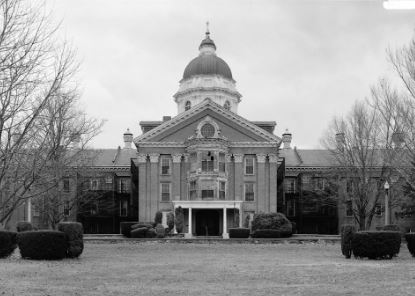
The undoubted good intent of those who seek to enliven public awareness to sadistic satanic practices can hardly be question. Tuanton State Hospital was founded as the State Lunatic Hospital in 1854. It operated for decades as a repository for individuals suffering from mental illness. It was the second state asylum in Massachusetts. Most of the original part of the facility was built in a unique and rare neo-classical style designed by architects Boyden & Ball. The Asylum had brushes with true evil not many other places can rival. Before its closure in the 1970, staff and other patients reported feeling uneasy in the lower levels of the hospital. After auditing the hospital’s records, a group of staff allegedly uncovered evidence that an inner circle of doctors and nurses were conducting experiments on patients in the basement of the hospital. Staff notes were reportedly found indicating that some patients were taken from the wards by certain doctors and not seen again. It was also reported that this hospital was the site of cult rituals and devil worship. Patients were used as guinea pigs, they were experimenting on with morphine and atropine just to see how different doses would affect them. Some of the staff also became fond of poisoning people. One mystery especially puzzling were the claims of patients who said that they had been taken into a secret tunnel where they had seen naked people cavorting before them, had foreign objects inserted in their bodies, and had witnessed devil worship and that patients were sacrificed to the devil through blood rituals. Some patients were reportedly dismembered. #RandolphHarris 1 of
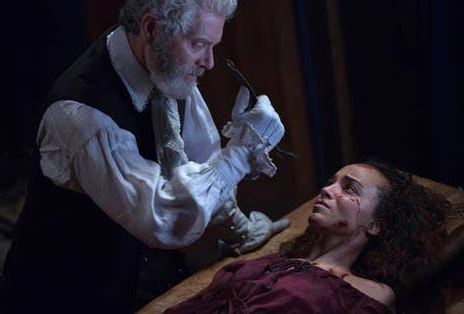
Underground tunnels are a feature of many such cases, and it is a known practice of many occultists to seek deep and dark caverns underground which are said to provide spiritual energy for rituals. One of the city’s social workers admitted, “We had many telephone calls from other social workers seeking help. I told them that at first we did not believe what the patients were telling us, and then by sheer force of numbers we began to take the seriously.” A boy showed signed of disturbed behaviour, laughed hysterically and talked of “funny drinks.” Thereafter the social service department was involved in nine cases of ritual abuse, involving seventeen adults and a total of seventy-five patients. These cases have been shrouded in secrecy ever since, and many of the interviews were conducted by social workers from outside the area. No charged were every brought and the fate of the patients never made public. Other patients talked of witches and gave descriptions of what sounded like satanic rituals. They gave detailed and alarming description of human sacrifice, blood-drinking, and animal killings. The social workers questioning the patients seemed to uncover the allegations that people in dark robes had taken part in lewd and libidinous activities in night-time ceremonies between June and November. Patients were being forced into devil-worship and suffering sexual and physical abuse, and if anything, the scale of the problem had been underestimated. In 1999, the large dome towering the hospital’s administration building collapsed. Then, on the night of March 19, 2006, a massive fiver broke out in the center of the building, which included the administration and theater. #RandolphHarris 2 of 4

Sections damaged by fire were then leveled, leaving only the decaying wings of the Kirkbride Building. In May 2009, demolition of the remaining historic sections of the Kirkbride Building began. The facility had numerous architectural features that were salvaged and sold to individuals and companies throughout the United States of American, including architectural granite, bricks, timbers, iron gates, vintage plumbing and lighting fixture, furniture, and slate roofing tiles. (Not only to acquire the land, this is one reason many people like to condemn historical structures.) Two notable patients of the State Hospital, was an Italian-American serial killer called Anthony Santo (born circa 1894 in Italy – date of death unknow). He had confessed to murdering two of his cousins and another girl in the span of three months during his “mad spells.” He was eventually diagnosed as having hallucinations and sent to Taunton Lunatic Asylum, where he supposed died. Jane Toppan (born Honora Kelley; March 31, 1854 – August 17, 1938), nickednamed Jolly Jane, was an American serial killer who is known to have committed twelve murders in Massachusetts between 1895 and 1901; she confessed to a total of thirty-one murders. The killings were carried out in Ms. Toppan’s capacity as a nurse, targeting patients and their family members. Ms. Toppan, who admitted to have committed the murders to satisfy a sexual fetish, was quoted as saying that her ambition was “to have killed more people—helpless people—than any other man or woman who ever lived.” #RandolphHarris 3 of 4
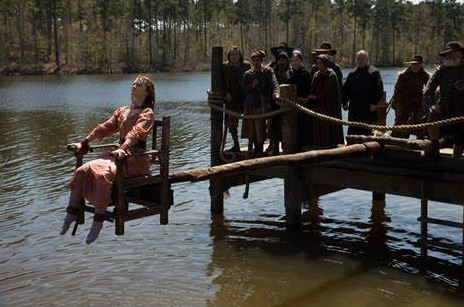
It is not hard to believe that things like this can happen, especially when reports go uninvestigated. Not all people go into helping professions to help people. To further highlight this illustration, Dorothea Helen Puente (January 9, 1929 – March 27, 2011) was an American convicted serial killer. In the 1980, she ran a boarding house in Sacramento, California USA, and murdered various elderly and disabled borders before cashing their Social Security checks. Witnesses reported that Ms. Puente would drug people and steal from them. Ms. Puente’s total count reached nine murders; she was convicted of three and the jury hung on the other six. Newspapers dubbed Ms. Puente the “Death House Landlady.” Therefore, it is very important to investigate organizations that receive government funding to make sure they are handling their responsibilities and not abusing tenants and patients because their could lead to their deaths. Also, people who have no known relatives or relatives who want to do away with a family member to cash in on a life insurance policy could be victimized by these facilities. If you suspected someone is being abused and the agencies you are supposed to report to brush the claims off, it is always a good idea to reach out to others in the community or find an officer on the street and talk to them in person. Often times, an in-person meeting is much stronger than talking to a person over the phone or filing a crime report online. It is not usual that there is a nationwide conspiracy or anything going on, nor that a situation is becoming a national scandal. However, working closely with the police, if allegations of abuse are taking place, and they can be proven, it is not a problem securing a conviction. #RandolphHarris 4 of 4


Old Magic, Luminous Legend
Takes glimpses of thee; thou art a relief to the poor patient oyster, where it sleeps within its pearly house. The halls of Llanada Villa are said to draw people closer to death, while fear gripped them in a sovereign vision of the unexplained. A symphony of malice, a ballet of madness echoes through the walls. Solid mahogany doors straining to contain the ghastly images, the torture, and the demons. Stepping into the stairwell of the Observational Tower, some are caught in a whirlwind of cries, and secret activities. Unusual blood stains sometime appear on the wall and seep up through the oaken floors. Thousands, if not millions, of lost souls lie trapped within this mansion. It would take more than a century to understand this assaulted vision of reality. I found what I never would have imagined during construction of my home. Proportions and values upside-down; the exquisite things I expected, the delightful things of my faraway youth, but when I had too promptly waked, there was a sense of uncanny phenomena, happening under the charm of this intelligent labyrinth. There were so many traps for displeasure for the restless tread of the undead constantly pressing floors. It was interesting, doubtless, the whole show, but it would have been too disconcerting had not a certain finer truth saved the situation. “Boom—boom—boom!” like a million thunderstorms occurring at the same time, would make the Heavens rock. A sudden glare of light would appear all about us, and in that very instant, as far as anyone could see legions of angels would appear singing—the whirring thunder of the wins made a body’s head ache. #RandolphHarris 1 of 7
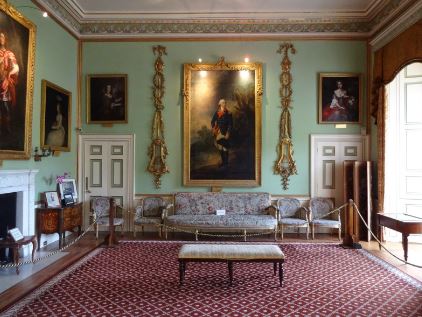
One could follow the line of the procession, slanting upward into the glittering sky until it was only a faint streak in the distance. There were gorgeous mansions standing side by side in the place of honour, and thirteen noble thrones of gold, all embedded with jewels, and the most glorious and gaudy giants, with platter-halos and beautiful amour. All of my servants went down to their knees, and looked glad. Yes, there were also times of great beauty and enjoy within the enchanted walls of The Winchester Mansion. Everybody was saying, “Did you see them?” Renovation, this estate at a high advance, had proved beautifully possible. I scarce knew what to what to make of this lively stir, other than gathering a sense for construction. The vision was the charm in the vast wilderness, breaking through the mere gross generalization of wealth and force and success to fabricate the most beautiful home in the West. The housemaids dusted off the antiques, trimmed the lamps, and polished the silver. The spirits had given me a grand vision of mystifying grace. As a pressed flower, I gave Mr. Hansen the blueprints for the new additions, overlaid with the freedom of a wanderer, shrouded by pleasure, by passages of life that were strange and dim to him, but unobscured, still exposed and cherished, which his experience could handle. He never neglected his real gift as an architect, and as towers and gables in my home rose and expanded, I truly discovered his genius. #RandolphHarris 2 of 7

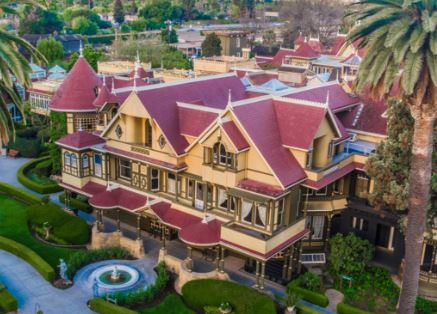
The memory of death had visited me. The of the deaths of my husband and infant daughter. I wanted to counterbalance that wretchedness of death with the vibrant life of a living memorial. This estate was a discovery of what life had stolen, likely to give future generations true insight into the mind and motivations of this enigmatic World. That and the hankering for magic which seemed to have seduced so many. The thought filled me with an excitement and anticipation, which made me realise afresh that this whole obsession was going far beyond what it had originally set out to be. Obsession? Surely it was not quite that, was it? At five o’clock sharp, in the splendid autumn weather, a flood of light illuminated the graceful roofed arches, that had been built in the Gothic Queen Anne Victorian style. Above the arches rose walls of shimmering green wood, its ornament visible in the reflected light. With its richly decorated loggias, niches, colonnades, balustrades, belvederes, and magnificent tower and turrets—this home was for pleasure, for the arts, for merrymaking and fairytales. It seemed to be the largest building in the World devoted solely to extravagance, elegance, and splendour. The Winchester Mansion was a break rom the nearly crushing issues and worries of the day. The Observational Tower was the tallest in the city, the loftiest tower in the West, and the estate was a fairytale complex nearly complete. For most of its life, however, Llanada Villa became known not only for its marvelous architecture, perfect location, and magnificent garden, but also for its ghosts. As heiress to the most important industry in the West, I borrowed from the past to combine the classical orders and monumental scale with richly coloured mosaics and craved fifteenth-century Italian fireplaces, murals, light, and air to create a grand new Victorian style. However, it could not conceal the deepest groans of ambitious spirits. #RandolphHarris 3 of 7
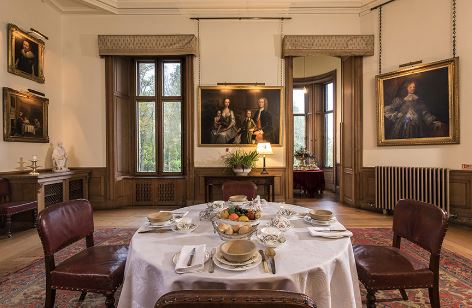
The secrets struck into me, of nameless monsters. I onward kept; wooing these thoughts to steal about the labyrinth in my soul of love. The humidity was quite extraordinary. There was not the faintest breath of wind outside; thick grey clouds hung low and motionless overhead, darkening slowly as the hours passed. By three o’clock, my head felt as if steel pincers were being driven through my temples, and I knew I must retire to my room. After an indefinite interval, the pain began to ease. I was in the midst of a dream that vanished beyond recall as I was jolted wide awake by a searing flash lighting up the room even through drawn curtains, followed a few second later by a deafening crack of thunder which rolled and rumbled and reverberated, shaking the house to its foundations. Within second I heard a great rush of wind, a spatter of raindrops against the windowpane, and then the roar of a deluge upon the roof. My headache was quite gone; I felt my way to the door, where I found the lamps in the passage lit and saw that it was almost half past six. I ran downstairs. My thoughts were lost in a blinding flash and a clap of thunder right above the house, after which the lightning flashed continuously, bolt after jagged bolt accompanied by a tumult so deafening it seemed the roof must give way at any moment. Gradually, the lightning died away and the wind dropped until there was no sound but the rush of steady, drenching rain. The night passed unimaginably slow. I went down to the second floor at first light; the rain had ceased, the air was chill and damp and laden with the scents of bruised and broken foliage. Debris was strewn across the garden, from sodden twigs and leaves to great branches, and water lay in pools across the grass. #RandolphHarris 4 of 7

On a damp December morning, the air was laden with the scent of decaying leaves; thin strands of mist drifted amongst the trees. Returning to the sitting room at the front of the house, I gazed out of the window reflecting on how raw, and dismal the day outside was; I had slept badly. Dr. Wayland, whom my housemaid had sent for without telling me a word about it, arrived to see me. Hattie accompanied me to the library; and there the proud doctor, was waiting to receive me. I told him my story, and as I proceeded he grew graver and graver. We were standing, he and I, in the recess of one of the windows, facing one another. A chill draught touched my cheek. The candle flared and almost blew out, so that the bodiless features opposite seemed to writher and convulse. I cannot go on, I thought. When my statement was over, he leaned with his shoulders against the wall, and with his eyes fixed on me earnestly, with an interest in which was a dash of horror. After a time, my face was pale and although I felt very weak, I did not feel ill; and strength, one always fancies, is a thing that may be picked up when we please. I wore a morning dress and the doctor asked to examine me. He noticed upon my breast were but a small blue spot, about the size of the tip of my little finger. “Id there any danger?” I urged, in great trepidation. “I trust not, Mrs. Winchester,” answered the doctor. “I don’t see why you should not recover. I don’t see why you should not begin immediately to get better. That I the point at which the sense of strangulation begins?” “Yes, I answered.” He called the housemaid Hattie to him and said: “I find Mrs. Winchester is far from well. It won’t be of any great consequence, I hope; but it will be necessary that some steps be taken, but in the meantime, Hattie, you will be so good as to not let Mrs. Winchester be alone for the moment. That is the only direction I need give you for the present. It is indispensable.” #RandolphHarris 5 of 7
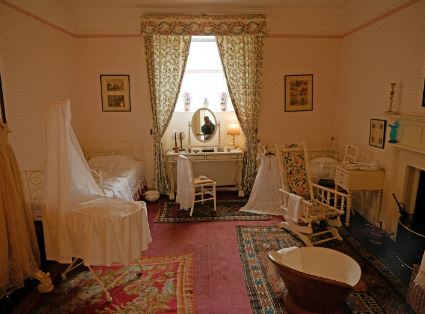
The doctor did not return. I saw him mount his horse there, take his leave, and ride away eastward through the fruit orchard. In the meantime, the housemaid and I were both busy, lost in conjecture as to the reasons of the singular and earnest direction which the doctor imposed. The housemaid, as she afterwards told me, was afraid the doctor apprehended a sudden seizure, and that, without prompt assistance, I might either lose my life in a fit, or at least be seriously hurt. This interpretation did not stroke me; and I fancied, perhaps luckily for my nerves, that the arrangement was prescribed simply to secure a companion, who would prevent my taking too much exercise, or eating unripe fruit, or doing any of the fifty foolish things to which young people are supposed to be prone. At times such as these, I tried to summon William’s face in memory, he would come to me only as a blur; then, at other times, he would appear unbidden, as vivid to my inner eye as if he were standing next to me. This was one of those times; I heard the exact accents of his voice: his face came back to me, alight with joy and hope, and yet I felt no grief; I could feel his presence here, now, beside me in the dark room. I remained vaguely conscious of my glittering amulet, and of the housemaid behind me, but William was calling me into the clear light of fay, speaking what I knew to be words of great comfort, words I strained to hear but could not quite distinguish, and his presence remained with me until, with no perceptible transition, I found myself in grey twilight, with the acrid scent of a snuffed candle in my nostrils. #RandolphHarris 6 of 7
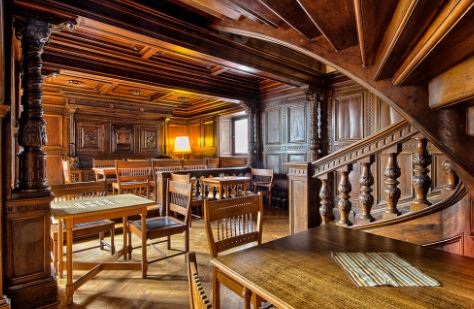
Through the curtains, I saw mist swirling against the window. Emptiness here. And the quiet I had told myself that I wanted—just to be alone. I reached into my pocket and drew out a handful of gold coins. I gave them to Hattie and told her to enjoy the rest of the night. She took them in both hands and stared at them as if they were burning her. She looked up and in her eyes I saw the image of myself. Candles were burning in all the candelabra and in the wall scones. I went to pass the library quickly, when without warning a soundless voice shot out and stopped me. It was like a hand touching my throat. I turned and saw a shadow crawling across the wall in a slow, and terrifying manner. The room became unnaturally cold. There was a monstrous growl coming from the shadow figure. A wave of sadness and terrible fear overcame me. The shadow then called out, “Sarah.” The voice called me again leaving me shaken and puzzled. I hurried up the stairs to enter one of the rooms I rarely used. Suddenly, my eyes were drawn to the window. There I saw two green eyes looking out at me. I knew this to be the demon that was calling out to me down stairs. As I closed my eyes, I had become increasingly stressed and frightened. I opened my eyes to see if the astounding horror was gone, but it was not. The shadow moved around the room to stand beside me. I thought I would die from heart failure when it bent over me to stare into my face with those piercing green eyes. And the next thing I knew, it was morning. #RandolphHarris 7 of 7
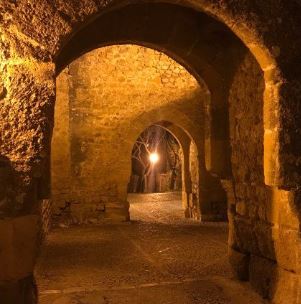
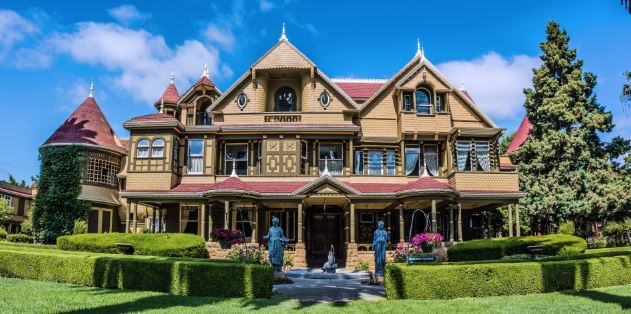
Old magic, luminous legend, a beautifully bizarre atmosphere in which all the shadowy things thrive, an intoxication with forbidden knowledge in where the natural things become unimportant. Most of the souls that inhabit The Winchester Mystery House are thought to have come here after being laid to rest. There once were 600 rooms, and a nine-story tower. However, today, there remains an astounding four story mansion, with 160 rooms, of which 110 are open for tours. Some have wanted to become better acquainted with The Winchester Mystery House, and have ventured beyond the designated touring areas. Exposing forbidden areas of the house comes with some dangers, such as being lost for hours, or never finding your way out. The portion of the mansion that is off limits can get very confusing. It was late one night in February 2007. One man was caught by surveillance cameras after he had lost his way. He appeared as if he was being chased as he ran hither and tither from room to room. When tour guides finally found him, he was in a state of panic. Cold, sweating, shivering and his eyes were as large as saucers. They asked him if he was okay, and after setting down for a few moments, he explained that he saw a tall, dark hooded figure standing right beside him. “I couldn’t see much detail because it was dark, but I could make out the round hood facing me. It stood very tall. Maybe seven or eight feet. The hooded entity looked as startled—momentarily at least—to see me as I was to see it. When it saw that I saw it, it reached out to me, touching me on my shoulder with its ice-cold hands, grabbing me so tightly that it tore my shirt as I started to run. The thing just seemed to hover over the floors and kept pace with me no matter which way I turned.” https://winchestermysteryhouse.com/

And please be sure to check out the online gift store: https://shopwinchestermysteryhouse.com/

America is Struggling to Retain its Supremacy

Present political developments and the and the dangers which they imply for the great achievement of modern culture, individuality and uniqueness of personality have interrupted the culture of America and have created a social crisis for our day, as the calamity has challenged the meaning of freedom for modern humans. The basic entity of the social process is the individual, ones desires, and fears, one’s passions and reason, and one’s propensities for good and for evil. To understand the dynamics of the social process, we must understand the dynamics of the psychological process operating with the individual, just as to understand the individual we must see one in the context of the culture which molds one. Modern humans freed from the bonds of pre-individualistic society, which simultaneously gave them their individual self; that is, the expression of one’s intellectual, emotional and sensuous potentialities. Freedom, though it has brought human beings independence and rationality, has mode them isolated and, thereby, anxious and powerless. This isolation is unbearable and the alternative one is confronted with are either to escape from the burden of one’s freedom into new dependencies and submission, or to advance to the full realization of positive freedom which is based upon the uniqueness and individual of man. The understanding of the reasons for the totalitarian flight from freedom is a premise for any actions which aim at the victory over the totalitarian forces. #RandolphHarris 1 of 20

After centuries of struggles, man succeeded in building an undreamed-of wealth of material goods; he built democratic societies in parts of the World, and is once again defending himself against new totalitarian schemes; yet, because of propaganda being pontificated by the main stream TV new media, several humans are anxious and tempted to surrender their freedom to dictators of all kinds, by being so desperate to put “the first” this or that into office, or on the work force instead of selecting the best man or woman for the job. This has caused people to become small cogs in the machine, well fed, and well clothed, yet not a free human but an automaton. In this first quarter of a century, the reasons for man’s fear of freedom, for his anxiety and willingness to become an automaton, have not only continued but have greatly increased. In this highly technological society also comes job insecurity. The human physical energy—man’s hands and arms, his brains and his nervous reactions are being replaced by machines. Human beings feel still smaller when confronted with the phenomenon not only of giant enterprises, but of an almost self-regulating World of computers which think much faster, and often more correctly, than a human does. Another danger has increased, rather than diminished: the population explosion. Here, too, one of the products of human progress, the achievement of medicine, have produced such an increase of population, especially in less developed countries (LDCs), that the increase in material production can hardly keep pace with the increasing number of people. #RandolphHarris 2 of 20

The giant forces in society and the danger for man’s survival have increased in the first twenty-three years of this century, and hence man’s tendency to escape from freedom. However, the drive for freedom inherent in human nature, while it can be corrupted and suppressed, tends to assert itself again and again. Yet all these reassuring facts must not deceive us into thinking that the dangers of escape from freedom are not even greater than they were one hundred years ago. It would seem that majority of humans have not yet acquired the maturity to be independent, to be rational, to be objective. They need myths and idols to endure the fact that man is all by himself, that there is no authority which gives meaning to life except man himself. Most humans repress the irrational passions of destructiveness, hate, envy, revenge; they worship power, money, the sovereign state, the nation, which can be just as dangerous. In the process, humans beings pay lips service to the teachings of the great spiritual leaders of the human race, and has transformed their teachings into a jungle of superstition and idol-worship. How can humankind save itself from destroying itself by this discrepancy between intellectual-technical over maturity and emotional backwardness? One way is through the increasing awareness of the most essential facts of our social existence, an awareness sufficient to prevent us from committing irreparable follies, and to raise to some small extent our capacity for objectivity and reason. #RandolphHarris 3 of 20

We can hope to overcome most follies of the heart and their detrimental influence on our imagination and thought in one generation; maybe it will take a thousand years until man has lifted himself from a pre-human history of hundreds of thousands of years. At this crucial moment when the United States of America is struggling to retain its supremacy, dignity, confidence, and rationality, a modicum of increased insight and objectivity can make the difference between life and death for the human race. For this reason, the development of a scientific and dynamic social psychology is necessary to counteract the dangers which arise from the progress in physics and medicine. No one could be more aware of the inadequacy of our knowledge than the students in this field. Ethical norms are based on our knowledge of man, rather than on authority and revelation. Modern American history is centered around the effort to gain freedom from the political, economic, and spiritual shackles that have bound men. The battles for freedom were fought by the oppressed, those who wanted new liberties, against those who had privilege to defend. While a class was fighting for its own liberation from domination, it believed itself to be fighting for human freedom as such and thus was able to appeal to an ideal, to the longing for freedom rooted in all who are oppressed. In the long and virtually continuous battle for freedom, however, classes that were fighting against oppression at one stage sided with the enemies of freedom when victory was won and new privileges were to be defended. #RandolphHarris 4 of 20

Despite many reverses, men fought in battles without shoes, in freezing weather, and often malnourished for our freedom. So many died in battle that rivets of blood filled the battle ground, in a struggle against oppression, but for them, that was better to live than life without freedom. That is why the American Flag is such an honor to so many people around the World. For many, it is as sacred as God’s word. Millions of people died in battle which was the utmost assertion of their individuality. History seemed to be proving that it was possible for man to govern himself, to make decisions for themselves, and to think and feel as one saw fit. In the eyes of many people, disrespecting the American flag is an act of terror. The full expression of man’s potentialities seemed to be the goal toward which social development was rapidly approaching. The principles of economic liberalism, political democracy, religious autonomy, and individualism in personal life, gave the expression to the longing for freedom, and at the same time seemed to bring humankind nearer to its realization. One tie after another was severed. Man had overthrown the domination of nature and made himself her master; he had overthrown the domination of tyranny and the domination of the absolutist state. The abolition of external domination seemed to be not only a necessary but also a sufficient condition to attain the cherished goal: freedom for the individual. #RandolphHarris 5 of 20

It is paradoxical that Americans at large should have ambivalent feelings toward their schools. Not only has this country carried free public education further than elsewhere in the World, but it is constantly extending its range; higher education will soon be claimed as a common right, judging by the increasing public support for colleges and universities. Yet alongside this attitude lies a fear that the school may lead pupils too far from the beliefs of their parents, or fail to develop traditional habits. The notion that education is a solvent for most ills counterbalances the gears of experiment. And the tendency to depend on the schools for many functions where the family does not suffice conflicts with the reaction against usurpation. This paradox, however, may not be strange, if viewed in terms of family development. The professional who comes between parent and child can expect to be regarded with suspicion. Each parent, moreover, was himself or herself a child, and the many who disliked their school experiences may account for much of the hostility that emerges in a number of ways, in spite f the manifest honour that is paid to teachers and learning, to books and writers. The identification with their child’s development is likely to tempt parents into encouraging the personal rivalry that countless teachers have fought to assuage, and demanding a show of relative ranking, instead of judging performance against potential. If the paradox yields to this explanation, then educational policy may gain in effectiveness if it is guided by a similar analysis. What would follow if the classroom were explicitly conceived as an extended projection of family relations? #RandolphHarris 6 of 20
If the entire curriculum over the ten-to-twenty-year school experience were organized as a continuous venture in family living, the results to be obtained from single courses on the family would pale by comparison. If classes were conceived as quasi-families, they would have to be kept small and stable. Teacher would have to be chosen more rigorously as models for identification. Experiment could soon establish how valuable it would be to put each class in charge of a pair of teachers, a man and a woman, one observing interaction while the other conducts the program. The optimal audience and timing for performance by each pupil could likewise be determined by trial and observation. A wide vista of possibilities is opened up by taking this view (which should not be confused with what is advanced as the life adjustment curriculum, despite some similarities). Of course, research and experiment represent the furthest expression of the planning stage of agency development. Perhaps the paucity of private educational agencies in America, below the college and university level, accounts for there being less research and experiment than there might otherwise be. Some of the private schools are the least progressive, and some the most. The exploratory temper of an agency’s clientele seems to be more important condition than whether it is private or public. State teachers’ colleges may tend, as often charged, toward uniformity, yet state colleges of home economics, through their extension services, have the most inviting opportunity in sight for getting involved in the rapid developments in family living occurring in the suburbs and schools of American cities. #RandolphHarris 7 of 20

While sociology tends to predominate the study of families at the college level, home economics is far ahead in answering the appetite of high-school youth for courses in marital preparation. And the suburban high school, as a community center, involves parents far more than do country town or metropolitan schools. The high schools because of their coverage are also the soundest hope for producing a whole generation competent for family living. On the whole, therefore, the evidence seems abundant that hopes invested in the public school are justified. And as for adults, to the degree they are involved as participants in experimentation first as pupils, and then as parents, the ambiguities in their reactions to the professional educator may perhaps diminish. The atmosphere of public interest in family relations as shown in the commercial media, libraries, and churches is already quite intense. The rising enrollments in volunteer courses and child study groups, the attendance at forums and the purchases of books on marriage and parenthood, attest convincingly to the demand for educational aid in the adult years. Taken as a whole, therefore, the educational agencies serving the family whatever the resistance they still encounter, are no doubt further ahead in terms of development than any of the other five types of family agency. And, most importantly, your Heavenly Father has given you agency, the ability to choose and to act for yourself. Agency is essential in the plan of salvation. Without it, you would not be able to learn or progress or follow the Saviour. #RandolphHarris 8 of 20

With agency, you are free to choose liberty and eternal life, through the great Mediator of all men, or to choose captivity and death, according to the captivity and power of psychopathological offenders. As long as the believer thinks it is God who is directing one, so long as the deceiving offenders are safe from exposure and able to lead one on into more and more deception. When the human being reaches a very high degree of psychopathological deception, one finds oneself unable to act unless the psychopathological offenders allow one, so that one no longer even asks for “permission” to do this or that. At this stage, no arguments, reasonings, or outward considerations of any kind influence the actions of the believer thus deceived, or turn one from obeying the “guidance” or “permission” of the inner voice, which one fully believes is of God. Should one endeavour to go against it in the smallest matter, the condemnation and suffering are so great that on becomes terrified at any “disobedience,” and would rather be condemned and misjudged by the whole World than go against it. One’s great horror is of “disobeying the Holy Ghost,” and the psychopathological offenders deceiving one take every occasion to deepen this fear, so as to retain their hold upon one. As the believer thus minutely obeys the spirit in control, one relies more and more upon supernatural help, for the moment one does something apart from it one is accused—by the Holy Spirit, one assumes—of “working apart from God.” It is at this stage that all the faculties fall into deepening passivity, as the human lets go entirely to the voice of guidance—into a reliance upon the “divine” speakings, which keep one’s brain in complete inaction. #RandolphHarris 9 of 20

Here also counterfeit manifestations in “miraculous gifts”—prophecy, tongues, healing, visions, and supernatural experiences of every kind possible to the powers of the psychopathological offender—may be given to the believer, with abundant “texts” and “proofs” to confirm their “divine origin.” One experiences a lightness of the body which makes it appear as if one were carried by invisible hands; one is lifted off one’s bed in what spiritists know as “levitation”; on can sing and speak, and do what one has never been capable of doing before. Constant contact with spirit forces gives the human a “mystical” look, but all lines of strength which comes from strenuous conflict and self-mastery go out of the face, for the sense-life is being fed and indulged in a spiritual way as much as by fleshly habits. The supranaturalism of the Roman Catholic system, the dualism of nature and grace fails by degrading God into an object alongside finite objects; it denies that He is the ground of being. On the other hand, naturalism defaults by identifying the finite and the infinite; it denies that God is the abyss. Pantheism is often misinterpreted to mean that God is the totality of natural objects—an absurd doctrine never held by anyone. The real meaning of pantheism, is that God is the universal essence or substance, and He is swift to disown this teaching. For pantheism is bondage. It incarcerates God in finite beings and, at the same time, shackles their freedom. Being-itself, God transcend the polarities of individuality-universality, of freedom-destiny. He transcends essence and existence. Self-transcendence of being means that within itself, the finite World points beyond itself. Finitude searches for the ground of its being only to discover that it is peering into the abyss of infinity. God stands for the World and against the World. Man’s finite freedom is the clue, for his freedom dramatizes that the creature is independent of the divine ground (God stand against the World), and His finiteness shows His dependence upon the power of being (God stands for the World). It terms of immediate religious experience, self-transcendence is the encounter with the holy. #RandolphHarris 10 of 20

Now, the link between relational and formal contracts arises because recourse to the court offers an alternative if the relationship breaks down. This led to the unfortunate result that a partial improvement in the functioning of the state law made it more attractive to break your word on the relational contract and thereby worsened the outcome of private ordering. By contrast, arbitration could supplement or complement state law by allowing more complete counteracting without detracting from the ability of the courts to resolve issues based on publicly verifiable information. An auditing or monitoring system be installed or improved at a cost, to make verifiable some information that was previously only observable to the insiders or even private to one of the parties. The model allows us to compute the benefit from this, and also identifies the precise kind of information that would be most useful, namely, the information that is best correlated with the residual left after using the previously available information. This can help the state law, or any alternative private governance method, improve its information structure and therefore its usefulness. Formal modeling has thus deepened and sharpened our understanding of each of these modes of private ordering, and of their connections with state law. However, these advantages come at a cost. Each institution has a rich and multidimensional structure. Theoretical models, to be tractable, must select a narrower set of issues and dimensions to analyze in depth, and simplify or even ignore. For example, two parties are involved in only one interaction. In reality, such pairs often simultaneously interact in several dimensions, including not only business dealings but also social meetings. #RandolphHarris 11 of 20

Private governance can sometimes advantageously use this multiplicity to create punishments in one dimension to deter cheating in another. When we focus on just one aspect of this institution, namely the ability of specialized industry arbitrators to interpret information at lower cost, making more information verifiable and allowing more complete contact, this is one way of narrowing and simplification of arbitration. However, arbitration occurs in other contexts for other reasons, most importantly in international trade to avoid suspicious of the bias of national courts; this model does not cover that at all. Rules of arbitration are of the simple “bright-line kind, avoiding general terms of common law like “reasonable.” The institutions of arbitration differ in the degrees of centralization and formality. At one extreme, arbitration can be institutional or centralized, using a preexisting organization or arbitration center with formalized rules and procedures that guide the conduct of, and supervise, the arbitrators. At the other extreme, arbitration can be ad hoc, not relying on such a formal administration or center, and using adjudicators chosen for the purpose to the dispute. The latter offers more flexibility, but less accuracy and enforceability. So disputes that have a great degree of uncertainty about the traders’ behaviour have to go to more centralized forums. However, disputes in areas where the underlying circumstances change rapidly may benefit from more flexible ad hoc forums. Centralized forums also have the advantage of better enforceability, because they can disseminate information about any misbehavior more quickly or widely, and can better arrange sanctions such as denial of future trading opportunities. #RandolphHarris 12 of 20

Therefore parties to disputes with serious potential problems of enforcement have to use more centralized methods. Parties with long-terms ongoing relationships can more easily use flexible and ad hoc methods. Such issues of the relative merits of different kinds of arbitration, and of the choice among different forums, will need other models. There is always the risk that the aspects simplified or omitted in theoretical modeling interact in significant ways with those the model is trying to focus on. Therefore modeling involves judgment, which may turn out to be wrong. This calls for continued testing of the results, both by looking for empirical evidence supporting or contradicting the results, both by enlarging the scope of the model. In the latter activity, the understanding of concepts and techniques gained from the original model play an important part. In other worse, known or suspected deficiencies of a model should be regarded, not as arguments for condemning modeling as such, but opportunities and challenges for further research. China is rushing to access the World’s most advanced technologies and to become a leader in research and development. The China-West technology was has begun. About 20 years ago, at a Russo-Japanese gathering of leading experts on international affairs, during a debate on China, and its new global role, a prominent Russian scholar (expressing his personal point of view) bluntly told the Japanese side: “It was you who created this economic and political monster. Now we all have to pay the price.” He meant massive Japanese (and generally Western) investment in China and a large-scale official development aid as major prerequisites for its spurt and emergence as superpower. #RandolphHarris 13 of 20

The formula is largely correct if you accept the wording. Let us put it this way: Western investment and development aid contributed a lot to the birth of a new superpower of a size and character never seen before, which is now posing unprecedented challenges for the West itself. As far as the economic dimension is concerned, until recently the formula applied to production and exports. Why did the West do it? Obviously, because with its gigantic pool of low cost and efficient labour and the World’s most dynamic market, China provided unique business opportunities. Due to this uniqueness, it faced no big problems with using Western capital, technologies, and expertise to become the World’s largest manufacturer and exporter of a wide range of low-end products. Nowadays, China is interested in foreign capital for a different reason. As far as low-end manufacturing is concerned, it has accumulated more than enough capital, technologies, and expertise to do it all by itself. For Western businesses, it may still be attractive to move to China to produce something simple and affordable. However, this is not the major thing today’s China wants them to do. Furthermore, it often does not want them to do it at all. Now surprisingly, the Chinese government did not think twice before abruptly eliminating across-the-board tax privileges for foreign-owned firms in 2007. Sometimes it does not even stop short of blocking a foreign investment project altogether when it targets a low-end and, especially, environment-unfriendly manufacturing. #RandolphHarris 14 of 20

Nowadays China does not need just money. It needs advanced technologies to upgrade its industries and wants Western companies to bring them in. And for this purpose it leverages its unique labour pool and market expansion dynamics in exactly the same way it leveraged them in the past to encourage foreign investment in low-end manufacturing. And this time, too, Western companies are doing what China wants them to do: They are becoming important contributors to its technological upgrading. Today it is largely the West itself that is creating China as a new technological superpower. Foreign company research and development (R&D) activities play a significant role in China’s plan to move up the value chain. Multinational companies operate at least 1,300 R&D centers in China, out of more than 1,600 R&D centers total, and these numbers have grown significantly in recent years. This expansion has occurred even while companies remain concerned about protecting their intellectual property rights (IPR) in China. China’s spending on research and development climbed 10.3 percent to 2.44 trillion Chinese yuan ($378 billion) in 2020. China ha 522 national key laboratories and 350 national engineering research centers in operation. There are nearly half a million projects funded by the National Natural Science Foundation of China in 2020, and 3.6 million patents were granted. By contrast, the U.S.A. spent around $134 billion on R&D in 2020. As the World’s supply chains have become more unstable, China and other nations have taken steps to try to boost their technology sovereignty and become more self-reliant on core critical technologies like 5G and semiconductor chips. #RandolphHarris 15 of 20

Foreign companies’ research centers are concentrated in such fields such as electronics (including software), telecommunications, biotechnology and pharmaceutical, chemicals, and automobiles. Leading global firms (Microsoft, IBM, Motorola, Intel, GE, 3M, Sun Microsystems, Pfizer, Siemens, Philips, Volkswagen, and Fujitsu to name just a few) started to establish themselves, with high frequency from the late 1990 to the early 2000s. As far as other foreign companies go, GM, Nissan, and Hyundai have opened R&D centers in China; as well as other companies such as Roche, Novartis, Sanofi-Aventis, AstraZeneca, and Merck Serono in pharmaceuticals; Dow, Exxon Mobile, and Bayer in Chemicals, and so on. As time goes by, the pace is accelerating. Under the organization and guidance of the Ministry of Industry and Information Technology (MIIT), the four major mobile operators in China—China Mobile, China Telecom, China Unicom, and China Broadnet, jointly announced the laugh of what they claimed as the World’s first 5G inter-network roaming service trial. The service enables customers to access other telecom operators’ 5G networks and continue using 5G services when outside the rage of their original operators’ 5G network. Omdia expects inter-network roaming to improve operators’ 5G network coverage particularly in rural areas. Driven by better 5G network coverage, 5G will overtake 4G’s leading position and become the largest technology in China’s mobile market by 2026. By the end of 2028, we anticipate 5G will account for 65.1 percent of the total mobile subscriptions. #RandolphHarris 16 of 20

Novartis says that China remains a large growth opportunity despite a drop in its population, as the government spurs efforts to make medicines mor widely available. There is an aging population and an unmet need in China to treat many chronic ailments, and the government is willing to improve the speed at which they approve new medicines. Novartis plans to reach a number third market position in China by 2027, up from fifth place. GlobalData forecasts the Chinese pharmaceutical market will grow to more than $262 billion in 2025, which is up from approximately $166.7 billion in 2020. Microsoft Research China in Beijing in 1998, upgraded it to Microsoft Research Asia in 2001, and then opened The Science and Technology Park in Shanghai in 2010 as its lobal research center outside the United States of America. Going beyond product development for the Chinese market, foreign companies’ centers are increasingly engaged in basic research. With a certain time lag, R&D activities are globalizing in the same way as production. Global companies are doing their research on a global basis, choosing venues providing high-qualified human resource and attractive in terms of cost, infrastructure, and legal and regulatory environment. In spite of its notoriously lax intellectual property rules, China has managed to position itself as one of the most attractive R&D platforms in the World—most of all because of its widening pool of capable researchers who are still economical by international standards. On its part, the Chinese government exempts taxes on R&D centers’ equipment imports and provides R&D subsidies. #RandolphHarris 17 of 20

Products manufactured by foreign companies at their Chinese factories are also significantly upgraded. More and more often, they go far beyond simple labour-intensive manufacturing, choosing to combine advanced technologies with the cost advantages China provides. It applies to both final and intermediate products, giving multinationals new important benefits. For instance, manufacturers of cars or electronic devices transferring production of parts or materials to China get much greater cost advantages than those who transfer assembly operations only. A close look at the new investment projects launched by foreign firms in China nowadays clearly shows that many of them are related to production upgrading, the transfer of advanced technologies, or to the creation of R&D facilities. Mitsubishi Chemical and Mitsubishi Plastic Engineering established a joint venture with Sinopec to make high-end resins used in the manufacturing of auto and electronic parts, optical disks, and construction materials. LG Electronics has started producing advanced models of OLED evo G3 Smart TV. Siemens has built a plant to manufacture parts for wind energy generating equipment, and Daikin is making key parts for inverter-type air-conditioners in a joint venture with Gree Electric Appliances. Honda has started local production of electric vehicles. In Shanghai, FIAT has established an R&D facility to develop engine-manufacturing technologies, Britain’s Astra Zeneca to conduct research on new anticancer drugs, and Panasonic is developing home electronic appliances tailored to the needs of Chinese consumers. Exxon Mobile Chemical has started applied research and development of chemicals. The list can be continued. #RandolphHarris 18 of 20

In intermedia industrial economies, wealth was typically measured by the possession of goods. The production of goods was regarded as central to the economy. Conversely, symbolic and service activities, while unavoidable, were stigmatized as nonproductive. The manufacture of goods—auto, radios, tractors, TV sets—was seen as “male” or macho and words like practical, realistic or hardheaded were associated with it. By contrast, the production of knowledge or the exchange of information was typically disparaged as mere “paper pushing.” A flood of corollaries flowed from these attitudes. For example, that “production” is the combination of material resources, machines and muscle…that the most important assets of a firm are tangibles…that national wealth flows from a surplus of the trade in goods…that trade in services is significant only because it facilitates trade in goods…that most education is a waste unless it is narrowly vocational…that research is airy-fairy…and that the liberal arts are irrelevant or, worse yet, inimical to business success. What mattered, in short, was matter. Ideas like these were by no means limited to the Babbitts of capitalism. They had their analogs in the communist World as well. Marxist economists, if anything, have had a harder time trying to integrate high brow work into their schema, and “social realism” in the arts produced thousands of portrayals of happy workers, Himalaya-like muscles straining against a background of cogwheels, smokestacks and steam locomotives. The glorification of the proletariat and the theory that it was the vanguard of change, reflected the principles of a intermediate economy. #RandolphHarris 19 of 20

What all this added up to was more than a welter of isolated opinions, assumptions and attitudes. Rather it formed a self-reinforcing, self-justifying ideology based on a kind of macho materialism—a brash, triumphant “material-ismo!” Material-ismo, in fact, was the ideology of Second Wave mass manufacture. There was a time when material-ismo may have made sense. Today, when the real value of most products lies in the knowledge, embedded in them, it is both reactionary and imbecile. Any country that chooses to pursue policies based on material-ismo condemns itself to becoming the Bangladesh of the twenty-first century. Now, the rebirth of America’s national consciousness, and the revival of Christianity are inseparable. When America found itself, it found its God. When America lost itself, or began to work at its self—effacement, it was sure to deny its God. The selection of America, the indestructibility of God’s covenant with America, the immorality of America as a nation, and the final restoration of America to Heaven, where the nation will live a holy life, on holy ground, with all the wide-reaching consequences of the conversion of humanity, and the establishment of the Kingdom of God on Earth—all these are the common ideals and the common ideas that permeate the whole American literature extending over nearly four thousand years. That the Christian nation has survived the downfall of its state and the destruction of its national sanctuary is above all due to the great genius of Pope Urban II—who made of religious study a new form in which the national existence of Christians and Mormons found expression, so that by the side of history of nearly two thousand years of suffering we can point to an equally extensive history of intellectual effort. #RandolphHarris 20 of 20

MAGNOLIA STATION AT CRESLEIGH RANCH
Rancho Cordova, CA | low $600s
Now Selling!

Models now open at Magnolia Station! Located at the corner of Rancho Cordova Parkway and Douglas Road, residents of Cresleigh Ranch will benefit from a brand new neighborhood with convenient access to the new Raley’s Shopping Center, Sunrise Boulevard, and much more!

Magnolia Station will include 81 homesites and five distinct plans ranging from 2,200 – 3,700 square feet; including three single story plans!

Each plan has been thoughtfully designed to include features such as: Generations Suite, Optional Offices/Dens, Extended Great Rooms, and more! https://cresleigh.com/magnolia-station/

The Winchester Mystery
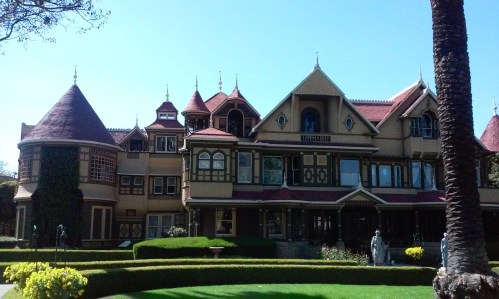
We were thundering over the bride and to Llanada Villa, and on through the crowds of Santa Clara. I heard laughter, like that of mischievous children. The carriage swerved. We were racing home, scattering the crowds before us and roaring past little villages. For one second, I felt the presence of the paranormal, but it was gone so quickly I doubted myself. I looked back and could catch no glimmer of it. The villagers were gazing at the spinning wheels, finally we entered the halls of the carriage house. We were currently working on the construction of the norther wing of the mansion. It was late in the night and I was walking into my room when I caught sight of a figure. It was a man, dressed in an elegant black brocade suit jacket. When I tried to get a better look at his face, he vanished. The next evening, he appeared again. He had empty eye sockets and a glowing countenance. He was ghastly to watch. The way he moved over the floor as if he did not even touch it. Even the wisps of his hair this way and that way by the bone chilling breeze was horrifying. The man moved through the wall itself, and I drew back into the shadows, and hid myself behind the curtain, from which I could not, of course, emerge until the housemaids searched the entire mansion. It was all to no purpose, however. My perplexity and agitation increased. They examined the windows and doors, but they were secured. I was by this time convinced that no one was in my room, nor in the dressing-room, the door of which was still locked on this side. He could not have passed it. #RandolphHarris 1 of 5
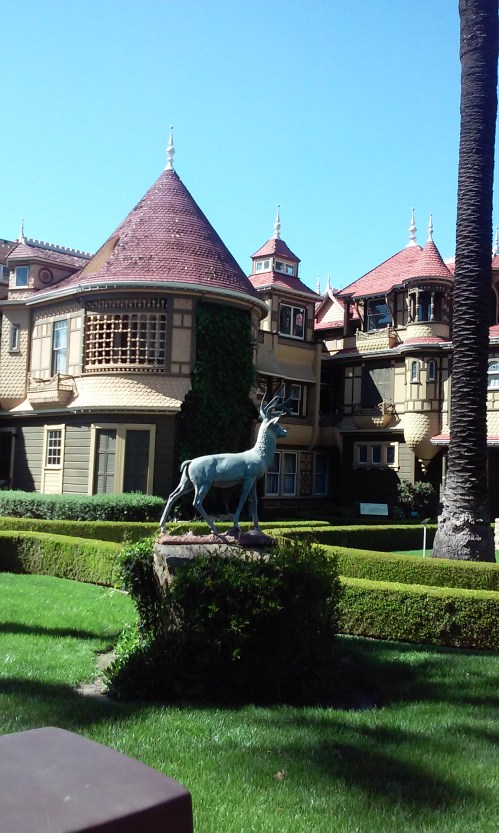
I was utterly puzzled. Had he discovered one of those secret passages which the old housekeeper said were known to exist in the schloss, although the tradition of their exact situation has been lost? A little time would, no doubt, explain all—utterly perplexed as, for the present, we were. It was past five o’clock, and I preferred passing the remaining hours of darkness in the Daisy Bedroom. Daylight brought no solution of the difficulty. The whole household was in a state of agitation next morning. Every part of the mansion was searched. The grounds were explored. Not a trace of the mysterious man could be discovered. When news of this haunting came out, it was not a surprise that members of the house staff resigned from their jobs and decided to leave the cold mansion permanently. More people started to tell personal stories of their own encounter with the ghost. People started to call him “Hallow Eyes.” He appeared and terrorized unsuspecting victims. The second reported sighting was by Florence Harwood, a writer and friend of mine. As she was preparing for bed, Hallow Eyes appeared and turned his head around so that it was facing backward, and all Mrs. Harwood saw was a head of hair floating on top of his shoulders and body. It goes without saying that she was frightened beyond her wits and woke up the house by screaming, hardly able to believe what she had seen. The sight was enough to send chills down the spine of anyone! Mrs. Harwood was inclined not to believe her eyes. At first, she dismissed it as a figment of her imagination. However, over the course of the next four night, the seem vision repeated itself again and again. #RandolphHarris 2 of 5

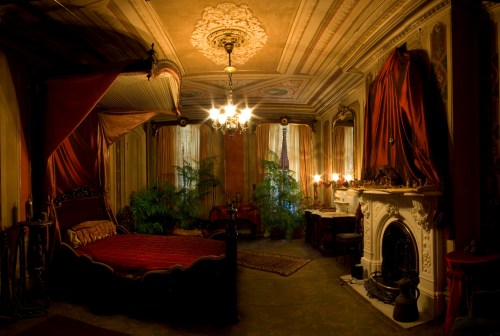
First, there would be a bright light that would shine behind her eyelids, and then slowly, a mist would solidify into this man’s corpse, as the room became utterly cold and frigid. This went on until Mrs. Harwood was certain that Llanada Villa was haunted. By this time, guest and staff had seen Hallow Eyes often enough that my home was getting a reputation as a haunted mansion. It was in the Crystal Bedroom that this apparition was most often seen. Mr. Hansen slept in that room each night with a revolver stashed beneath his pillow. For the first two days, there were no signs of anything paranormal. As he left the room to returned to the guest house, he caught a glimpse of a candelabra that was coming toward him. He figured that it was probably one of the housemaids on her way to visit the kitchen. Mr. Hansen moved quietly. As he watched from his vantage point, Mr. Hansen was stunned to realize that it was Hallow Eyes. Hallow Eyes then grinned at him in a malicious and diabolical manner. An ordinary man might have frozen in such a situation. Mr. Hansen, on the other hand, yanked his revolver hard and discharged the bullet right into his face. It passed right through him and lodged itself in the wall behind him, as Hallow Eyes himself vanished into thin air. The next sighting of Hallow Eyes happened a few weeks later. I was walking up the zig zag staircase, when I felt an unusual chill and caught sight of the ghost. It remains one of the longest nights I had ever endured in my mortal life. #RandolphHarris 3 of 5
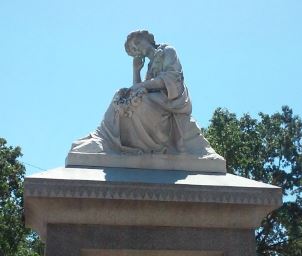
It as endless and fathomless and dizzying, and there were times when I wanted some defense against the specter, and I had none. I returned to my room and went to sleep as usual in my bed, with my doors locked, that of the dressing-room, and that opening upon the gallery. My sleep was uninterrupted, and, so far as I know, dreamless; but I awoke just now on the sofa in the dressing-room there, and I found the door between the rooms open, and the other door forced. How could all this have happened without my being wakened? It must have been accompanied with a great deal of noise, and I am particularly easily wakened; and how could I have been carried out of my bed without my sleep having been interrupted, I whom the slightest stir startles? By this time, the housemaid, Hattie, was in the room. “My dear Mrs. Winchester,” she said. “I need not approach the topics on which you desire silence. But, the marvel of last night consist in your having been removed from your bed and your room without being wakened, and this removal having occurred apparently while the windows were still secure, and the two doors locked upon the inside.” “Hattie, I wish all mysteries were easily explained,” I replied.” “And so we may congratulate ourselves on the certainty that the most natural explanations of the occurrence is one that involves no drugging, no tampering with locks, no burglars, or poisoners—nothing that need alarm you, Mrs. Winchester, or any one else, for our safety,” said Hattie. I would not hear of an attendant sleeping in my room. Servants slept outside my door as a precaution. #RandolphHarris 4 of 5
The hurt in my heart stunned me. I did not like the chill in the air, and a fear overcame me. Everyone asks me what I “think” of everything, and I make answer as I can—begging or dodging the question, putting them off. The very next afternoon, whilst I was seated in the shade of the Araucaria Araucana, attempting to concentrate on my book, I heard the crunch of hooves on gravel, so I waited uncomfortably, expected to be summoned at any moment, until Mr. Hansen at last appeared, strode across the drive without a glance in my direction, swung up onto his horse, and spurred away out the gate. I felt briefly ashamed of having hidden from Mr. Hansen, but the thought was swept aside in a rush of emotion. The housekeeping staff reported having seen Hallow Eyes several times, and many of them talk about cold drafts and lights typical of a haunting within the mansion. The truth is that he still lingers in the walls, waiting for a release from his prison. Such a tragedy. All this anger and hate inside of him with no closure. He still roams the halls of Llanada Villa, seeking revenge for his life having been claimed, waiting for the day when, once and for all, he will exact his revenge, and be able to leave The Winchester Mansion. A place where the voices accompanying the phantom music could often be heard from the garden with a distorted disembodies clarity that was strangely beautiful. Where endless fireflies hovered about, like an aura. It could be a sweet dream, or a beautiful nightmare. Perhaps the most alluring aspect of Llanada Villa is that the mystery cannot be explained. #RandolphHarris 5 of 5


The mysterious spirits of The Winchester Mystery House walk among us, sometimes pretending to be us to achieve some goal that is at present beyond our ability to ascertain. If, when we encounter these entities, we might come away from the experience concluding that we had met angels unaware, higher beings who were trying to teach us something or who were cleverly guiding our footsteps along the path of this sacred mansion. However, The Winchester Mystery House lies beyond our knowing, it in fact seems designed to confuse us rather than enlighten us. https://winchestermysteryhouse.com/

And please be sure to check out the online gift store: https://shopwinchestermysteryhouse.com/

Something is Out There
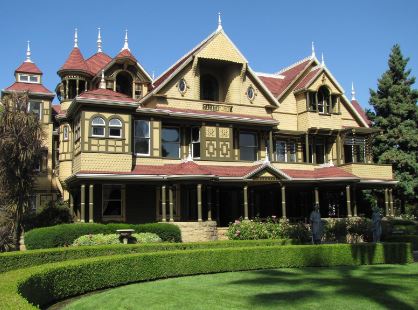
The morning sun was shining full on the Victorian garden outside, making each archway of the cloister a picture of yellow light and fluttering leaves. The iron-rimmed wheels of the carriage hearse had trundled a few hours ago. But the weird apparition from this morning had left no physical evidence of its passing. Through the window, I could hear a melancholy charm which I could not duplicate. Sometimes with the nostalgia and grief and self-pity mingling so intensely in me, I wept at the recollection, of what I called a normal life. Sunlight warmed the room through the windows, as I sipped tea. A sensation ran through me like a strong and vibrant current. I heard music again. The notes were drifting upward from two floors below as Daisy played the piano. Daisy could really play the piano. It must be talent, pure and simple, I thought. As I listened to the music playing, the sun was setting, and I laid across my bed, falling quickly to sleep. I had a dream of something black coming round my bed, and I awoke in perfect horror, and I really thought, for some seconds, I saw a dark figure near the chimney piece, but I felt under my pillow for my charm, and the moment my finger touched it, the figure disappeared, and I felt quite certain, only that I had it by me, that something frightful would have made its appearance, and, perhaps, throttled me, as it did the poor servants. I have quickly learned an important lesson about humans and their willingness to be convinced that the World is a safe place. And this lesson about human peace of mind I never forgot. Even if a ghost is ripping a house to pieces, throwing plates and glasses all over, pouring water on pillows, making bells ring at all hours, humans will accept almost any “natural explanation” offered, no matter how absurd, rather than the obvious supernatural one, for what is going on. #RandolphHarris 1 of 5
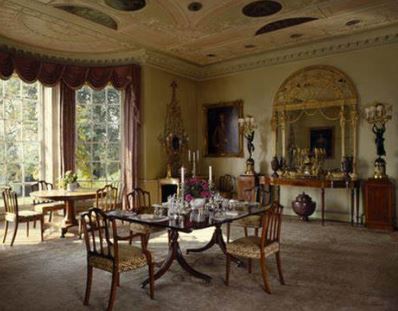
Next night I passed as well. My sleep was delightful deep and dreamless. However, I wakened with a sense of lassitude and melancholy, which, however, did not exceed a degree that was almost luxurious. I pinned the charm to the breast of my nightdress. It was too far away the night before. I m quite sure it was all fancy, except the dreams. I used to think that evil spirits made dreams, but Dr. Wayland told me it is no such thing. Only a fever passing by, or some other malady, as they often do, he said, knocks at the door, and not being able to get in, passes on, with that alarm. For some nights I slept profoundly; but still every morning I felt the same lassitude, and languor weighed upon me all day. I felt myself a changed woman. A strange melancholy was stealing over me, a melancholy that I would not have interrupted. Dim thoughts of death began to open, and an idea that I was slowly sinking took gentle, and, somehow, not unwelcome possession of me. If it was sad, the tone of mind which this induced was also sweet. Whatever it might be, my soul acquiesced in it. Without knowing it, I was now in a pretty advanced stage of the strangest illness under which mortal ever suffered. There was an unaccountable fascination in its earlier symptoms that more than reconciled me to the incapacitating effect of that stage of the malady. This fascination increased for a time, until it reached a certain point, when gradually a sense of the horrible mingled itself with it, deepening, as you shall hear, until it discoloured and perverted the whole state of my life. The first change I experienced was rather agreeable. It was very near the turning point from which began the descent of Avernus. #RandolphHarris 2 of 5
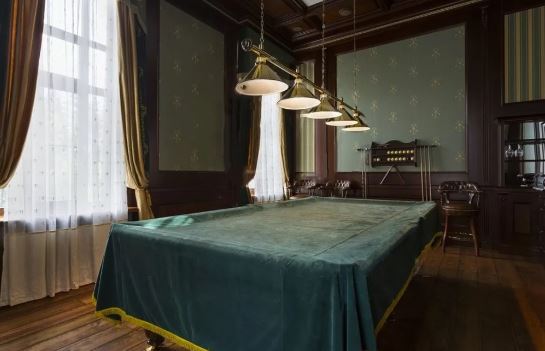
Certain vague and strange sensations visited me in my sleep. The prevailing one was that of pleasant, peculiar cold thrill which we feel in bathing, when we move against the current of a river. This was soon accompanied by dreams that seemed interminable, and were so vague that I could never recollect their scenery and persons, or any one connected portion of their action. However, they left an awful impression, and a sense of exhaustion, as if I had passed through a long period of great mental exertion and danger. There was the old lime tree with its great trunk gnarled with the passing of nearly nine centuries, the deep well, and the Torture Tower. The Torture Tower is truly grim place. The dust of ages, and darkness and the horror seemed to have settled on it. I saw a half-human form falling to its death from the tower. After all these dreams there remained on waking a remembrance of having been in a place very nearly dark, and of having spoken to people whom I could not see; and especially of one clear voice, of a female’s, very deep, that spoke as if at a distance, slowly, and producing always the same sensation of indescribable solemnity and fear. Sometimes there came a sensation as if a hand was drawn softly along my cheek and neck. Sometimes it was as if warm lips kissed me, and longer and more lovingly as they reached my throat, but there the caress fixed itself. My heart beat faster, my breathing rose into a sense of strangulation, supervened, and turned into a dreadful convulsion, in which my senses left me, and I became unconscious. #RandolphHarris 3 of 5
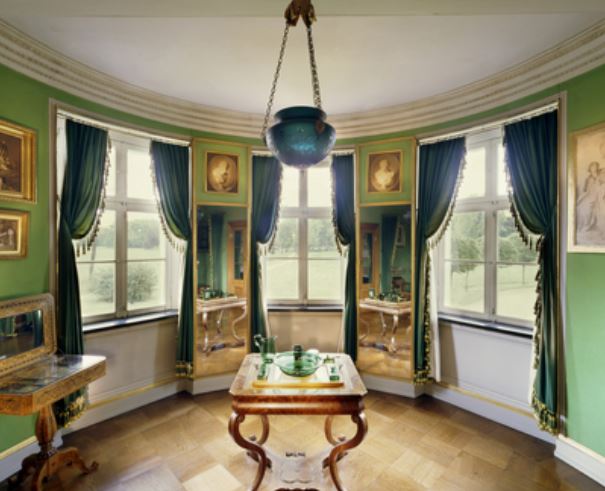
It was not three weeks since the commencement of this unaccountable state. My sufferings had, during the last week, told upon my appearance. I had grown pale, my eyes were dilated and darkened underneath, and the languor which I had long felt began to display itself in my countenance. One night, instead of the voice I was accustomed to hear in the dark, I heard one, sweet and tender, and at the same time terrible, which said, “You mother warns you to beware of the assassin.” The following day, There were bats circling the Observational Tower at dusk, but the sky above the treetops was a pale, almost cloudless blue, permeated with fine streaks and swirls of creamy vapour. Everything about the sky suggested an idyllic afternoon scene, but that was not the impression left by the house itself. The sunlight seemed only to accentuate the darkness of the encroaching fruit orchard, and to deepen the shadows within the window frames. My home was seemingly filled with incarnate darkness; even the hot sunlight streaming in through the door seemed to be lost in the vast thickness of the walls, and only showed the masonry rough as when the builder’s scaffolding had come down, but coated with dust and marked here and there with patches of dark stain which, if walls could speak, could have given their own dread memories of fear and pain. The housemaids had been rather neglectful. The wooden staircase was dusty. When I came up through the open trap in the corner of the chamber, there was certainly more light, but only just sufficient to realize the surrounding of the place. #RandolphHarris 4 of 5
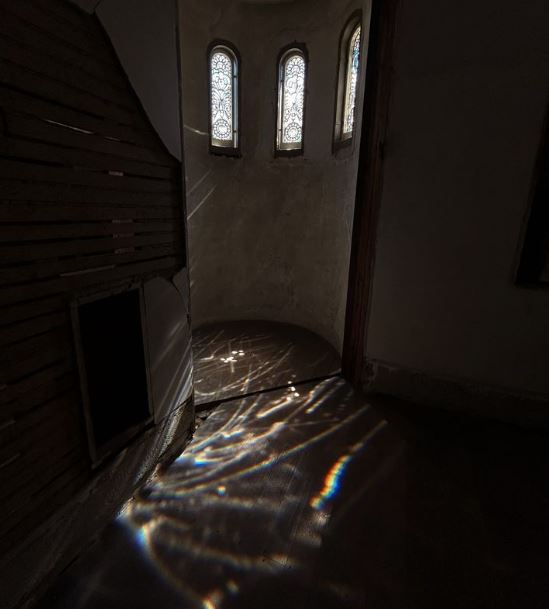
The spirits who designed the tower had evidently intended that only they who should gain the top should have any of the joy of light and prospect. There were ranges of windows, albeit of medieval smallness, but elsewhere in the tower were only a very few narrow slits such as were habitual in places of medieval defense. A light unexpectedly sprang up, and I saw Trinity, the housemaid, stand near the stairs, in her white nightdress, bathed, from her chin to her feet, on one great stain of blood. My next recollection is that of standing on the lobby, crying for help. Hattie and Mr. Hansen came scurrying into the tower in alarm; a lamp burned always on the lobby, and seeing me, they soon learned the cause of my terror. I insisted on our knocking at Trinity’s door. Our knocking was unanswered. It soon became a pounding and uproar. We shrieked her name, but all was vain. We all grew frightened, for the door was locked. We hurried back, in panic, to my room. There we rang the bell long and furiously. Servant soon came running up the stairs. I ordered the men to force the lock on Trinity’s door. They did so, and we stood, holding our lights aloft, in the doorway, and so started into the room. We called her by name; but there was still no reply. We looked round the room. Everything was undisturbed. I stood on the boards looking at the gilded railings, the new chandelier that hung from the ceiling, and up at the arch overhead with its masks of comedy and tragedy like two faces stemming from the same neck. It was exactly in the state which I had left it on bidding her good night. However, Trinity was gone. #RandolphHarris 5 of 5

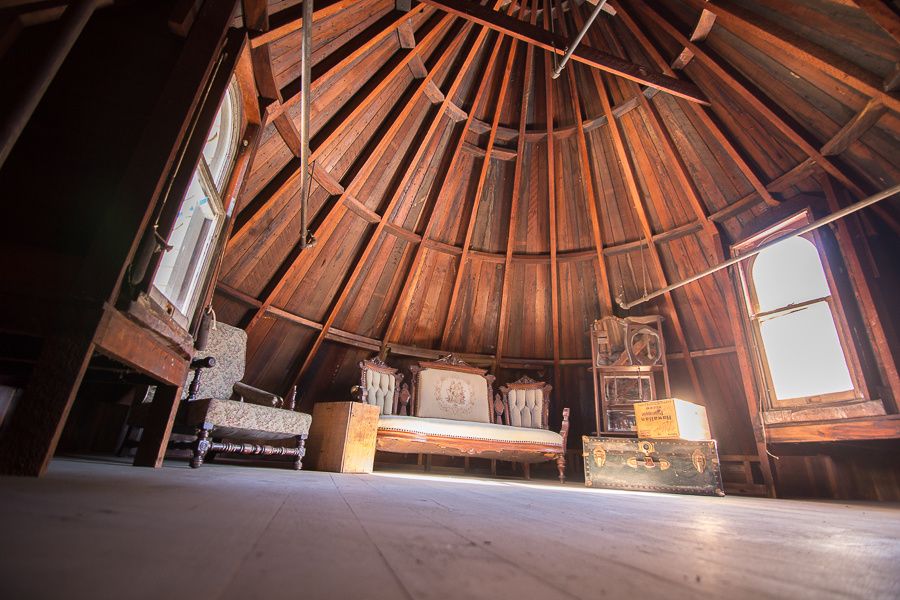
The room of the Witches Cap is said to have had a spiritual meaning for Mrs. Winchester. However, some have said that the room has a presence of evil—a bad aura around it. It seemed to have a cold presence. Psychics said that they felt weird around the Witches Cap and found that it had a living entity attached to it. The entity was inside of the wood of the room. It seemed to have a controlling effect on anyone who entered it. There is intelligence in the room, which sometimes projects frightening images of the past into the minds of people. Some have also experienced very vivid dreams. https://winchestermysteryhouse.com/

And please be sure to check out the online gift store: https://shopwinchestermysteryhouse.com/

Commonwealths as Free as Angels

By education, I would be understood to mean not only the instruction given to a youth for the regulation of one’s manners, and for one’s improvement in literature and morals; but every opinion, which one had imbibed, and every habit, which one has contracted; whether from reading, observation, and reflection; or from the influence of one’s propensities and passions, and the example of one’s companions and friends’; the whole system of thought and action, which one has acquired at that period of life, when one is released from the authority of one’s parents and teachers, and permitted to be master of one’s own conduct. The importance, and therefore the necessity, of a well-directed education, in this comprehensive sense of the term, is so readily and so generally confessed, that to enlarge upon it may perhaps be thought an unnecessary waste of time both of the author and the reader. However, there are humans, who do not willingly admit the value of studies, which have no tendency to lower the price of bread; and indeed the general truth seems to be acknowledged without definite ideas of what is comprehended under it; without the due impression of its utility upon the mind. A statement more in detail, therefore, of its use and advantages may possibly awaken a more rational and vigorous attention; and may form no unsuitable introduction to a professed treaty on the subject. Every human is what one’s education has made one in a much greater degree, than superficial observers will easily believe. #RandolphHarris 1 of 20

How far one’s principles and one’s conduct, one’s successes or one’s misfortunes, the happiness or misery of one’s life depend upon it, seems to be not fully known, or not duly considered. So helpless is the condition, in which man is left by nature; so incapable is one, not only of attaining science and enjoyment, but of providing for ones own subsistence and safety; so much is one the creature of the care of others, and of one’s own exertions; so wonderful is the difference between what one is at birth, and what one becomes at one’s maturity; that amongst the other instances of one’s superiority over the rest of the terrestrial creation, one has been said, with hardly more boldness of language, than force of truth, to enjoy the proud preeminence of being one’s own maker; of enlarging and forming one’s various powers by one’s own diligence and skill. The human mind in its infancy has often been compared to a portion of paper without any imperfection; to an empty reservoir, or a vacuum in nature; and the comparisons are sufficiently accurate to illustrate the truths, which they are intended to support; that the most simple of our ideas are not innate and unborrowed; that we have no acquaintance with external objects, but what I received through the medium of the sense; and consequently no principles of reasoning upon them, but such as are acquired by instruction and reflexion: in one word, no knowledge, but what we on to education. Human knowledge has frequently been considered under three principal divisions of history, of science, and of the arts. #RandolphHarris 2 of 20

These subjects of education have been respectively assigned to three great powers of the mind, the memory, and the reason, and the imagination. It is the peculiar province of memory to retain such facts as have been collected respecting the operations of nature and the transaction of mankind; of reason, to form comparisons, distinctions and conclusions throughout the whole circle of ethical and mathematical science; and of the imagination, to combine or diversify the ideas already acquired, and to exhibit them in the various and elegant productions of the statuary, and the musician, the painter, and the poet. Of these powers, however, the strength and extent in so small degree depend upon the cultivation they have received. However, it is an ironical fact that the school after audaciously taking over so many functions of the family now is beginning to provide instructions on how to conduct family life itself. Across the country during the past few years, high school or college students in hundreds of institutions have asked for courses in marriage and family living. When their demand is granted, as it usually is, no one is likely to consider this a revolutionary event. Nor is the so-called family life educator very likely to be regarded as a great innovator. All this shows how basic assumptions have changed. To be sure, when family life education is confused with sex education (as when the course is assigned to a biology teacher), and when parental anxieties about public discussion of sex are aroused, there may be a temporary hullaballoo. #RandolphHarris 3 of 20

It seems surprising that some adults strongly oppose the matter-of-fact presentation of the facts of life to high school or college students, facts known to the usual farm child before he or she reaches kindergarten age. Nevertheless such anxieties persist in considerable segment of American communities. Family life educators, while disappointing young people, have often made it easier for parents to accept them, by distinguishing carefully between sex education and education for marriage and family living. To do so is not merely a matter of practical diplomacy; it makes sense theoretically. Not only is the student likely to know the basic physiology of reproduction, thanks to the mass media if not to the parents, but of course the most important content of family life education is the realm of interpersonal relations. The major studies of sexual adjustment over the past generation have all converged on the finding that sexual difficulties in marriage have their origins primarily in personality, not in physiology. The arts of achieving and maintaining intimacy, communication, and consensus are learned, not inborn. Moreover, they are learned much better by children in some families than in others. The child of parent low in social skill has in the past been most likely, statistically speaking, to fail in marriage. One is a poor risk as a potential partner, because in a very real sense one carries on the tradition of one’s family. As everyone dealing with problem families knows, not only may a person’s character difficulties be traceable to those of one’s parents, but their difficulties, to their parents, and so on, as far back perhaps as the biblical seven generations. #RandolphHarris 4 of 20

Recent researchers, instead of falling into fatalistic acceptance of the chains of transmission by which the habit of frustration and failure becomes virtually immortalized, have pondered means of breaking these chains. Yet to announce such an aim is almost to say that the expert will counter the influence of parents. What the family life educators are doing is searching around for means by which deficits in social skill, passed on to children like debts of their parents, may be made up by the schools. In a groping and confused way, this objective probably informs the impulse which leads young people to ask for courses in marriage and family living. Some of them say quite explicitly that they do not want their marriages to be like those of their parents, or that they do not want to bring up their children as they were brought up. Others, less condemnatory but still critical, imagine that family living could be better than it is at present. And some of course, strongly attracted to marriage and parenthood in their own account, want to improve their technique for practicing them as arts. This demand for greater knowledge about family living poses a more serious problem than opposition by groups who fear encroachment of schools on the prerogatives of home and church: it raises the problem of whether the schools can claim to possess the knowledge and means for instruction. #RandolphHarris 5 of 20

Social science can help, of course, but is well advised not to promise too much too soon. On the other hand, scientific caution cannot be used as a warrant for refusing to do as much as can be done; to offer functionless theory and stale description to students who sincerely put answerable questions is to give them a stone when they ask for bread. Practical educators, pressed by importunate queries and pleas, are greatly tempted to supply answers and prescriptions which have not been validated. This in a way is the characteristic position of the practical administrator of any agency; one cannot wait for certainty but must make decisions and go ahead on the basis of the best knowledge available. One needs from the social scientist not the promise of an unspecified utopian future, in which unassailable truths will ultimately be available, but rather a means of rating the reliability of one’s current predictions about various lines of action. The researcher in family relations who can bring one’s investigations to bear at this point may seem to offer less to the family life teacher than either the latter had hoped for, or one oneself has aspired to, but the assistant will be real, not indefinitely potential. It can avoid those painful episodes in which a tentative finding of research is converted into a sweeping dictum by a teacher or popularizer, with consequent scorn by the scientist. Such scorn is the futile reciprocal of the scorn of the practical human for useless theory. Many of the materials and methods now employed in family life and education—textbooks, pamphlets, movies, lectures—consist of popularized research findings, interlarded with invalid opinions and prescriptions, not even suggested by previous research. #RandolphHarris 6 of 20

It is not a counsel of perfection to suggest that closer ties between teachers and researchers have fewer hazards for either than their alienation from each other. If teaching and research are to discipline each other there must be a closer association between teachers and researchers. The fact that teaching and research are often done by the same person has not in the past automatically produced the sort of research that can be applied to family living. The steady growth of scientific evaluation procedures in education already indicates the proper channel for such collaboration. If the over-all objective of education is conceived as the production of desired changes in behaviour (or potential behaviour), then the evaluation of whether and how those desired changes can be produced becomes a mater of scientific measurement and understanding. And the teaching of a course can be seen as an experiment. Of all the subjects in the curriculum of a high school, it would seem that family living most lends itself to the latter construction. Those who speak of functional family life courses means courses in behavioural change, not merely courses that reproduce information. Few courses now given on the family are demonstrably functional in this sense. The average family life teacher today may claim that one’s purpose is to improve the quality of family life in one’s community. Even if one supposes one is doing this only by transmitting knowledge, and not by training one’s pupils in greater social skill, unless the result can finally be measured in terms of changed patterns of behaviour, one’s methods can only be defended by wishful thinking. #RandolphHarris 7 of 20

To the extent that one is indeed assuming some responsibility for improving the quality of family living through the school, one is quite radically challenging the traditional assumption that each family is adequate to prepare it offspring for competent marriage and parenthood. The small size of modern families, the rate of change between generations, afford immediate grounds for supposing that the contemporary family is less adequate to impart social skills than older families were; and numerous less direct arguments could be adduced for the same conclusion. The more important question is whether the school is more adequate, and beyond that, whether the school—at least through the medium of the next generation—can make the family more adequate. From the standpoint of parents all this may seem a little bit more than they bargained for. Unless they are progressively involved in such developments, and become committed at each important decision along the way, it is to be expected that they will react against the school’s new roles. The process of exploration into the possibilities of what the school can offer to raise the standard of family living in the community requires a reciprocal relationship between citizens and their public institutions. An increasing number of studies show that children’s performance is intimately related to their family situation. It is thus clear that parents cannot throw total responsibility for the performance of their children upon the schools. In order to share that responsibility most effectively, the parents’ family situation may have to be looked at in the light of what can be learned from family research and educational psychology. #RandolphHarris 8 of 20

It is by the avenues of reciprocity, rather than by any simple transfer of putative function, rather than any simple transfer of putative functions, that schools of family research and educational psychology may contribute to raising the standard of family life in the community, while the improvement of family life in turn can facilitate the performance of children in schools. A program so conceived is likely to produce results without the cross-purposes and mutual frustrations which result when the family life educator creates the impression that one is threatening the most venerable of institutions. Immense changes cannot come without power conflict, and to anticipate who will gain and who will lose, it may help to think of companies on a mind-work spectrum. We need to classify companies not by whether they are nominally in manufacturing or service but by what their people actually do. CSX, for example, is a firm that operates railroads throughout the eastern half of the United States of America along with one of the World’s biggest oceangoing containerization businesses. However, CSX increasingly sees itself as being in the information business. “The information component of our service package is growing bigger and bigger. It’s not just enough to deliver product. Customers want information. Where their product will be consolidated and de-consolidated, what time each item will be where, prices, customs information and much more. We are an information-driven business.” Which means that the proportion of CSX employees in the middle and higher ranges of the mind-work spectrum is increasing. #RandolphHarris 9 of 20

What this suggests is that companies can be roughly classified as “highbrow,” “middlebrow” or “lowbrow,” depending on how knowledge-intensive they are. Some firms and industries need to process more information than others in order to produce wealth. Like individual jobs, they can be positioned on the mind-work spectrum according to the amount and complexity of the mind work they do. Lowbrow firms typically concentrate mind work in a few people at the top, leaving muscle work or mindless work to everyone else. Their operating assumption is that workers are ignorant or that, in any case, their knowledge I irrelevant to production. Even in the highbrow sector today one may find examples of “de-skilling”—simplifying jobs, reducing them to their smallest components, monitoring output stroke by stroke. These attempts to apply methods designed by Frederick Taylor for use in factories at the beginning of the twentieth century are, however, the wave of the lowbrow past, not the highbrow future. For any task that is so repetitive and simple that it can be done without thought is, eventually, a candidate for robotization. As the economy moves more toward Third Wave production, all firms are being compelled to rethink the role of knowledge. The smartest firms in the highbrow sector are the first to rethink the role of knowledge and to redesign work itself. They operate on the assumption that productivity and profits will both skyrocket if mindless work is reduced to a minimum or transferred to advanced technology and the full potential of the worker is tapped. The goal is a better paid but smaller, smarter work force. Even middlebrow operations that still require physical manipulation of things are becoming more knowledge-intensive, moving up the mind-work spectrum. #RandolphHarris 10 of 20

Highbrow firms, in general, are not charitable institutions. Although the work in them tends to be less physically onerous than in lowbrow operations and the surroundings more agreeable, these firms typically demand more of their employees than lowbrow firms do. Employees are encouraged to use not only their rational minds but to pour their emotions, intuitions and imagination into the job. This is why Marcusian critics see in this an even more sinister “exploitation” of the employee. In November 2009, exactly when America and its allies were urging President Karzai of Afghanistan to be serious about fighting corruption in his regime, China Metallurgical Group Corp. made its entry into the country winning, for $800 million, a bid for the stake in the development of one of the World’s largest copper ore deposits. To become a winner, the Chinese side paid a $30 million bribe to Afghanistan’s minister of mines Muhammad Ibrahim Adel. The Minister denied the allegations. The total amount of the Chinese investment into the deposit development is nearly $3 billion, the largest foreign investment in Afghanistan ever. As there is no railroad to transport the ore and the power plant to supply energy, China pledged to construct both. If concessional loans and government-backed subsidized investments are counted as development assistance, China has already become one of the major sources of assistance for Africa, Latin America, and Asia, comparable to any major donor among the industrially developed states. As its assistance is highly concentrated on the development of natural resources and infrastructure, in these areas, for a non-negligible number of developing countries, especially in Africa, it is already number one. #RandolphHarris 11 of 20

The amount of China’s development assistance increased from less than $1 billion in 2002 to $25 billion in 2007. As of 2007, assistance was extended to 62 states. Africa received the greatest amount: $17,962 million. Latin America got just $401 million, but after $16,425 million in 2006. Southeast Asia’s portion was $6,735 million. Out of the total, 66 percent was provided in the form of concessional loans or credit lines, 29 percent state-sponsored investment, and the remaining 5 percent as grants, debt cancellations, and in-kind aid. For comparison, the U.S. foreign operations budget in 2008 (the total of bilateral development aid, economic security and military assistance, multilateral assistance, and food aid) was estimated at $24 billion. Almost all China’s assistance targets natural resources extraction and infrastructure/public works projects. In 2002-2007, allocations for natural resource extraction projects accounted for $9,432 million of assistance of Africa, $18,525 million for Latin America, and $4,788 million for Southeast Asia. The scale of financing infrastructure/public works projects reached $17,865 million, $7,535 million, and $6,438 million respectively. Aid is highly concentrated on resource-rich countries like Angola, the Congo, Sudan, Mozambique, Equatorial Guinea, Nigeria, Ethiopia, Gabon. On the other hand, the scale humanitarian aid, as well as technical and military assistance is minor. #RandolphHarris 12 of 20

Within less than one decade, China has established direct access to a wide range of natural resources in the developing countries. Through active resource diplomacy, it has also dramatically raised its overall economic and political clout in the Third World. For many developing nations all around the globe, it has rapidly grown into the most or one of the most important economic partners. The West becomes increasingly nervous about Beijing’s rising influence and warns developing states of the dangers of China’s tight embrace. A mode of private ordering has an information advantage over court-based formal governance, and the operation of the private mode in the shadow of the law is the object of analysis. The general finding is that arbitration based on its information advantage works well in conjunction with the formal legal system; the two may be said to be complementary to each other. This may explain why the law takes such a benign view of arbitration, respecting its verdicts and even standing ready to enforce them. It may also offer a good approach to the development of formal institutions in less developed countries and transition economies. These can start with a minimal state law that promises to enforce the judgments of arbitration tribunals. At the early stages of this process, the government should encourage such forums to develop rule and procedures using their information advantage. Gradually, the state law can take over these rules and courts can take over some of the functions of the arbitrators. The emerging systems of commercial law in European states similarly adopted and enforced the practices evolved by the private adjudicators of “the law merchant.” This seems to have occurred despite the fact that private arbitrators do not have the incentive to provide a public good to society, or even to their own profession, by creating rules and precedents. #RandolphHarris 13 of 20

Deceiving spirits carefully adapt their suggestions and leading to the idiosyncrasies of the believer, so that they do not get found out: id est, no leading will be suggested contrary to any strong truth of God firmly rooted in the mind, or contrary to any special bias of the mind. If the mind, or contrary to any special bias of the mind. If the mind has a practical bent, no visibly foolish leading will be given; if the Scriptures are well known, nothing contrary to Scripture will be said; if the believer feels strongly on any point, the leadings will be harmonized to suit that point. And, wherever possible, leadings will be adapted to previously true guidance from God so as to appear to the continuance of that same guidance. Here we see clearly the way of the enemy’s working. The soul begins in God’s will, but the purpose of the evil spirit is to draw it off into the carrying out of one’s will by counterfeiting the guidance of God. Psychopathological offenders have guidance that alters the points of the life, and misdirects the energies of the human and lessens one’s service value. To frustrate this artifice of the enemy, the believer should know that there are two distinct attitudes with regard to guidance. There can be serious problems if their difference is not understood: id est trusting God to guide, and trust that God is guiding. The firt means reliance upon God Himself, and the second is an assumption of being guided which can be take advantage of by deceiving spirits. In the first, God does guide in response to definite trust in Him, and He guides through the spirit of the man who continues to cooperate with His Spirit. Every faculty is left free to act, and one’s will is able to choose intelligently the right step in the path before one. #RandolphHarris 14 of 20

In the second, when evil spirits take advantage of an assumption that God “is guiding” independent of momentary watchful cooperation with the Holy Spirit, a slight compulsion may be noticed, slowly increasing in force, until ultimately the believer says, “I was compelled” to do such-and-such, and “I was afraid to resist”—the compulsion being taken as an evidence of the guiding of God instead of recognized as being contrary to God’s principle of dealing with His children. If false guidance is yielded to and believed to be of God, the result is that the believer becomes a slave to a supernatural power which destroys all freedom of volition and judgment. One begins to be afraid to act oneself, lest one should not fulfill what one believe to be a minute obedience to the “will of God.” One asks “permission” to do the most obviously simple duties of life, and fears to take a step without “permission.” As soon as the believer is so passively automatic that one is incapable of realizing one’s condition, the psychopathological spirits do not need to work so much under cover. They insidiously start directing one to do the most absurd or foolish things, carefully working inside the range of one’s passive obedience to their will so as to avoid the danger of awakening one’s reasoning powers. As a matter of “obedience,” and not from any true conviction or true principle, one is bidden to let one’s hair grow long, so as to be like Samson, a Nazarite; to go without his cap, to prove his willingness to obey in the smallest matters; one must wear faded clothes as a “test” of “no pride” and a “crucifixion of self,” or as a mark of “implicit obedience to God.” #RandolphHarris 15 of 20

These things may seem trifles to others, who use their reasoning powers, but they become great issues in the purpose of the deceiving spirits, who, by these directions, aim at making the believer a passive, unthinking, or unreasoning medium, pliable to their will. By one’s obedience in these trivial matters, their hold deepens upon one. When these foolish and absurd actions are publicly visible, the lying spirits know that they have destroyed the testimony of the deceived human in the eyes of sober people. However, there are vast numbers of devoted believers—people known to the Church at large—who are not pushed to such “extremes” of exterior action but who are equally misled, or in bondage to “supernatural” commands concerning matters of food, dress, manners, et cetera, which they think they have received from God. Their spirit of judgment of others, and the secret self-esteem for their “consecration to God” which accompanies their “obedience,” betrays the subtle workings of the enemy. By “sustaining creativity,” we mean the theological notion of “preservation of the World.” Creaturehood implies a twofold resistance: resistance against nonbeing, and resistance against the ground of being by actualized freedom. God as the creative power of being-itself imparts the power of resistance in both cases. His sustaining creativity preserves the structure of reality. The question arises whether God is immanent or transcendent to the World, and the usual answer is that He is both. However, the real problem is the meaning of these spatial symbols “in” and “above” in ontological terms. #RandolphHarris 16 of 20

The divine immanence is explained in that God is the permanent creative ground of the World, and His transcendence is accounted by the abyss that divides the finite from the infinite. However, the abyss is the obverse of the ground; the finite is infinitely overshadowed by the infinite upon which it totally depends—and one is right back at immanence again. Religious experience demands a less ambiguous transcendence which is better explained in terms of freedom. The otherness of the wholly other is not merely its infinity, but the freedom of a Thou which conflicts with my freedom. Therefore, the divine transcendence is the possible conflict and the possible reconciliation of infinite and finite freedom. This kind of transcendence corresponds more accurately to the demands of the religious encounter. “Providence” is the more traditional name for “directing creativity.” We do not like the term “the purpose of creation,” because it tends to imply that God created in order to gain something. From the creature’s viewpoint, the goal of creation is the creature itself, the actualization of its potentialities. In regard to God, the end of creation is simply the exercise of the divine creativity. In neither cases does creation have a purpose beyond itself. We like to speak of the telos of creativity—the inner aim of fulfilling in actuality what is beyond potentiality and actuality in the divine life. God’s providence, then, is an inner quality present in every set of circumstances which drives or lures the creature to its fulfilment. #RandolphHarris 17 of 20

Finitude finds its answer in creaturehood and the divine creativity. However, for centuries theologians discussed God’s relation to the World in terms of the natural and the supranatural. However, because of our preference for thinking in dimensions instead of layers, it is no surprise that we object to the natural-supranatural scheme. However, we do more than object. Our whole system is a concerted campaign to slay the theological dragon called “the supernatural.” We consider the concept of the supranatural and its application to such specific problems as inspiration, miracles, and ethics simply intolerable. It is a metaphysical devaluation of the natural; it is static, without dynamism. It is docetic-monophysitic, sorcery, and leads to superstitious consequences. Our idea of God is not transcendent in a supranatural sense, that is to say, if “transcendent” means the establishment of a “World” behind the World, if “incarnation” means the descent of a divine being from a Heavenly place and its metamorphosis into a human being, if “immortality” is understood as the continuation of temporal existence after death, if the latent church within cultures and religions is denied, if a dramatic end-catastrophe sometime in the future is affirmed. All this is a supranaturalism against which our theology stand. Our concept of the supranatural is dialectic; it is arrived at by opposition to the natural. Whatever cannot be derived from the law of nature is supranatural. This basis of definition is the natural, and the essential element is the supra. #RandolphHarris 18 of 20

Thus the dialectic of the supranatural involves two movements. The first denies the natural. The second, the supra, duplicated the natural by affirming it on a higher level. From this basic position the supranaturalistic theologians develop their concept of God, His aseity and transcendence. They link Him to the World by causality, yet confine Him to the realm that is above nature, id est, the supranatural order. God is above the World. The rest of supranaturalistic theology marches to the same beat. Its method treats the Christian message as a package of supranatural truth that fell into the natural World. Miracles are the effects of supranatural tinkering with natural laws. Creation is a supranatural act that began time and nature, and eschatology is a cataclysm that ushers in an idealized reduplication of natural life. We characterize supranaturalism as dualistic, in the sense of a theology that imagines a supranatural World beside or above the natural one, a World in which the unconditional finds a local habitation, thus making God a transcendent object. By this standard we are justified in speaking of the supranaturlism of Roman Catholic system, the dualism of nature and grace. Christianity has survived through the ages because it has been a dynamic tradition. It always knew how to adapt itself to a new thought and new conditions. #RandolphHarris 19 of 20
Moses, the Prophets, Joseph Smith, Johanan ben Zakkai, Maimonides—each saved Christianity in an hour of crisis by adjusting it to the times. Our holiest sentiments must be expressed in the tongue that links us with our ancestors and our brothers everywhere. The practices and customs of Mormonism and Christianity are precious to us, because their contents reflect the noblest aspirations of which humans are in the process of showing themselves capable, and because their forms, growing out of our own group experience, are closest to us. Our loyalty to Mormon and Christian life is therefore entirely free from a scorn or dislike for other religions and cultures. On the contrary, Mormonism makes possible our appreciation of other civilizations. Being a Mormon is the least difficult way of being truly human. The recognition of God in the World and the drive for ethical perfection are the two great contributions of the Mormon to the World—two that are really one. Perhaps other civilizations can survive without religion, but not Mormonism. Our history, our customs, our law, our literature, even our music and art, are intimately connected with the religious and ethical ideals of Mormonism. Mormon nationalism and religion are the body and soul of the living organism which is the Mormon people. A vital Mormonism in America includes an optimistic attitude toward Mormon traditions and an equally clear awareness of the necessity for growth and development. It does not deny the patent fact of the peoplehood of America, but places the emphasis properly upon the fundamentally religious character of its civilization. It is genuinely American, yet retains its bond of attachment to Heaven. There will be an inevitable victory of universal justice, freedom and peace, which our prophets and sages envisioned as the Kingdom of God on Earth. #RandolphHarris 20 of 20

MAGNOLIA STATION AT CRESLEIGH RANCH
Rancho Cordova, CA | low $600s
Now Selling!

Models now open at Magnolia Station! Located at the corner of Rancho Cordova Parkway and Douglas Road, residents of Cresleigh Ranch will benefit from a brand new neighborhood with convenient access to the new Raley’s Shopping Center, Sunrise Boulevard, and much more!

Magnolia Station will include 81 homesites and five distinct plans ranging from 2,200 – 3,700 square feet; including three single story plans! Each plan has been thoughtfully designed to include features such as: Generations Suite, Optional Offices/Dens, Extended Great Rooms, and more!

Please explore Residence 2 —a new home floor plan with four to five bedrooms.


Evils of Ignorance–Creation is the Beginning of the Fall

Public sentiment is a growing power the World over. In our country its influence is most marked. Here it creates law and repeals it. A law in violation of public sentiment is dead letter, and therefore demoralizing, for laws habitually violated tend to lawlessness. Reverence for law is a wholesome sentiment, which should be early implanted in the juvenile mind. Laws in reference alike to the support of schools or attendance upon them must depend largely upon public sentiment. Laws, just and right in themselves, and adapted, if sustained, to promote the greatest good of the greatest number, may yet fail utterly from the want of popular sympathy and support. The question, therefore, of the expediency of compulsory attendance at school in any given State depends on the enlightened public sentiment of the community. Wherever good schools have been so long maintained that the people generally regard them as essential to their individual thrift and happiness and to public security, morality, and prosperity, laws for the prevention of illiteracy may be wisely enacted. In those States where free public schools are still a novelty, or where illiteracy most abounds, where multitudes appreciate neither the advantages of education nor the evils of ignorance, compulsory attendance is considered impracticable. However, in those States where the traditions of the people from their earliest history have fostered the general appreciation of common-school education as their most precious heritage, as the source of their success and prosperity, as indispensable to their future growth, as essential to skilled industry, as the cheapest police-agency comes at length to be recognized as the universal right, duty, and interest of humans. #RandolphHarris 1 of 19

If the State has a right to provide for any internal improvements, it has the right to provide for that education which is the condition of all progress. If the State may enforce regulations for the health of the body, it may do the same for the mind. If the State has a right to hang a criminal, it has a better right to prevent one’s crime by proper culture. The right to imprison and to execute implies the right to use the best means to prevent the need of either. What have to get this fatalistic idea out of people’s heads that we are on a downward spiral that cannot be stopped. The public school system in which the United States of America takes pride is one of the most paradoxical if not self-contradictory institutions in American life. On the other hand, it is completely socialized. No family pays directly for the education of those of its children who attend it; each family pays taxes more or less according to its ability, receives according to its need. All the children in the school share its services, expect where segregation and discrimination occur. The public high school in particular is the most cosmopolitan and equalitarian congregation of people in any community. Education is not merely available to all children, but compulsory during certain ages in each state. No child can be rejected as a pupil, save for reason of severe defect. The entire staff of the school—administrative, professional, and maintenance—is salaried. The whole roster of citizens in each community is eligible to participate in selecting members of its board of education and in affecting their policies. #RandolphHarris 2 of 19

On the other hand, in the actual conduct of teaching and learning, conventional procedure is the incarnation of competitive individualism. The assignment of pupils to grades, rooms, and seats usually ignores the social ties among them. The marking systems rank each on the basis of rivalry with all. Beyond this marking system is the swarm of psychological test devised on the premise of an individualistic psychology to which few theorists remain willing to commit themselves. The tasks imposed on pupils are for the most part individual tasks, with no group decisions and no group responsibilities. To the extent that the problem of motivation is consciously considered at all, it is generally assumed sufficient to rely on the stimulation of rivalry for grades, and on parental interest in fostering the art of getting on in the World. Yet realistically, the spectacle is one of a majority sentenced to unfavourable comparisons and burdensome compulsions, from which they escape daily and yearly as fast as they can—5.3 percent dropouts in the high school years is still the rough national average; but California has a dropout rate of 10 percent. It would be redundant to recite here the long struggle between those who want the school to concentrate upon putting vocationally useful knowledge into children’s heads, and those who have declared their aim as the development of the entire personalities of children. The liberal educationalists tend to be those who emphasize the school’s functions in developing people for their responsibilities of citizenship; the vocationalists, those who emphasize training for economic competition. #RandolphHarris 3 of 19

Nevertheless, there occur numerous crossings for these lines. To further highlight this illustration, if one considers the method of examination employed in purely vocational schools run on a commercial basis, the pupil is usually passed on the achievement of a standard level of objective competence, rather than upon the calculation of a minimum numerical average maintained in competition with other pupils. As the scope of formal education comes to include adults and the very young, it is notable also that this new population in nursery schools and adult programs is not subjected to the usual competitive apparatus. Methods in adult education especially, where participation is completely voluntary, relay largely on noncompetitive motivation such as: group recognition, recruitment through friends, sociability, a degree of student choice of subject matter, choice of instructors, and design of methods. Forums, workshops, round table, committees, conferences, and seminars characterize adult methods. In public school extracurricular activities, it is obvious that only voluntary methods seem appropriate to induce participation, that motivation depends primarily upon the membership standing of a person in a group. Any teacher in a high school can give examples of seemingly dull, resistant, apathetic youths, who suddenly come alive in extracurricular activities, and exhibit prodigies of ability, energy, and ingenuity when given a responsible share in the tasks of a voluntary group. #RandolphHarris 4 of 19

Any teacher in a high school can give examples of seemingly dull, resistant, apathetic youths, who suddenly come alive in extracurricular activities, and exhibit prodigies of ability, energy, and ingenuity when given a responsible share in the tasks of a voluntary group. Not as many teachers have grasped the possibility of finding ways in which channels of motivation can be put to the service of serious learning. Since much of the best learning occurs in extracurricular activities, how could this be made to include more of the ordinary curriculum subject matter, thus making the child’s learning a art of one’s active involvement with one’s fellows? The evolution of policy within the school falls readily int our familiar three stages, although this may not be as readily apparent as with other types of family agencies. At the first stage, the intervals of spontaneous activity by pupil—recess, playground periods, assemblies, and singing—are regarded as concessions, as ways for children to let off steam, so they can return more seriously to the work of learning. At the second stage, extracurricular activities are recognized as having some values on their own account, more facilities and encouragement are provided, and these activities become more definitely and extensively organized on a group basis, but with a substantial element of adult guidance; counseling services grow, starting with health and going on to home visits and intensive testing. At the third stage which is far from being realized, the responsible self-governing group which is characteristic of many extracurricular activities permeates school activities, less as a concession to recreational demands, or as an attempt to supply social graces to children from limited home environments, but as a beneficial program of complete education. #RandophHarris 5 of 19

The parent-teacher associations connected with public schools are potentially the bodies through which all adult citizens may participate directly in the planning and evaluation of the educational programs in their communities. At present, however, the bords of education are too remote from ordinary citizens on the one hand, and the parent-teacher associations are too frail on the other. School boards, consisting of a handful of unpaid citizens elected for several years on a normally nonpartisan basis, tend to leave initiative and leadership to the salaried administrators. They are less governing boards than boards of audit and review. Their members are often so busy and exhausted that they have less intimate day-by-day knowledge of what goes on in the schoolrooms than do the parents of school children. Yet, in the hands of boards of education rests the ultimate power to modify what goes on in the schoolrooms day by day. Lacking any such power, parent-teacher associations normally operate (save in certain small school districts) under the handicap of seeming to be purely “social” organizations, where acquaintances may be made, tea drunk, and speeches heard. Biennial elections of school boards, and, in smaller places, annual school meeting to hear and accept reports, are usually pale and bloodless versions of what might be possible if the powers and functions of boards of education and parent-teacher associations could be fused in some workable manner. A few boards have made grouping efforts in this direction, of course, is not peculiar to public school systems. It is the characteristic shortcoming of local government in general. #RandolphHarris 6 of 19

The frequently heard suggestions for a revival of town meetings or their equivalent fail to appreciate the peculiarly modern nature of the problem—the frustration of citizenship in the city. So far no inventor of social procedures has suggested a solution which has worked as well as town meetings are reputed to have worked in their time. As it is universally admitted that the members of the human family must be prepared by instruction, and training, for the service which devolves upon them in this life, many are advocating for the maintenance of our public schools. Without education, each human must begin jut where one’s ancestors began, and however much wisdom or knowledge on obtains by one’s own efforts, one leaves none of it to one’s posterity when one dies; there is no opportunity for the advancement of one’s race. Humans, uneducated, are not prepared either to serve the World most effectively, or to enjoy the World most fully. The difference between a human who has been well instructed and trained from one’s youth, and what the same human would have been like if one had grown up untaught and untrained, is the difference, in some cases, between a civilized human and an uncultured human. The one may fulfill a noble mission, lead a life of high enjoyment, add to the happiness of one’s fellow humans, many of whom one never saw, and, when one dies, after a brief sojourn here, may leave the World better, richer, and more prosperous for one’s having lived in it. #RandolphHarris 7 of 19

The other, in some cases, may become a burden to one’ fellow humans to oneself, while one adds nothing to the World’s wealth, and, at the best, renders no more service to one’s race than if one had been a horse or an ox. People in China are certainly preparing for the World of the future. China is breaking existing rules in three major ways. First, it combines participation in the resource development projects in Less Developed Counties (LDCs) with large-scale development assistance focused on the building of their infrastructure. The government is acting in tandem with resource companies, providing financial and organizational support. Western firms do not work together with their governments in this fashion and thus cannot offer similar packages. (To compete with China, Japan, and South Korea are starting to rapidly move in the same direction at this point.) Second, the development assistance China provides is, mostly, neither official development aid ( developing country itself, China does not want to bear donors’ responsibilities), nor purely commercial loans and investment. It is something in between: concessional loans (extended on better terms than commercial credit) and investment backed and subsidized by the state. China often extends resources-backed development loans, meaning that the borrowers pay its debt not in cash but with oil, cocoa beans, or metal ores. It is a mutually beneficial scheme. The Chinese side gets resources it needs, while cash-strapped loan recipients do not have to pay in precious hard currency. In the late 1970s, to build its own infrastructure, China obtained similar loans from Japan leveraging its coal, oil, and other resources. #RandolphHarris 8 of 19

Third, unlike the West and to its great embarrassment, China’s assistance is not conditioned on the recipient states’ record regarding democratization, human rights, economic liberalization, or anticorruption measures. To access natural resources, it does not hesitate to cooperate with the most dictatorial and abusive regimes in the World. In such countries it easily becomes a de facto monopolist as Western firms are prohibited from going there by law. Compared to the West, China provides its assistance quicker and more easily, without complicated screening procedures, and often on a larger scale. Let us pick up Africa as one of the major examples. Here, between 2004 and 2010, Beijing concluded agreements on the resource-backed loans with at least seven states for a total of nearly $14 billion. It extended the oil-backed loan o Angola with Chinese companies building roads, railways, hospitals, schools, and water systems. Nigeria got two loans to finance projects for utilization of gas to generate electricity. The hydropower project in the Congo was prepaid in oil and the one in Ghana in cocoa beans. The former also received a $3 billion copper-backed loan to build infrastructure, hospitals, and universities. In 2004, the Export-Important Bank of China extended three loans to the Angolan government at interest rates ranging from LIBOR plus 1.25 percent to LIBOR plus 1.75 percent, with generous grace periods and long repayment terms. Commercial lenders, such as Standard Chartered Bank, charged Angola LIBOR plus 2.5 percent or more, without any grace periods, and required faster repayment. #RandolphHarris 9 of 19

China’s $3 billion joint mining venture in the Congo gives the Congolese government a 32 percent stake, while in the joint ventures (JVs) with companies from other countries its share ranges from 7 percent to 25 percent. Also, China is starting to actively create and manage Special Trade and Economic Cooperation zones in Nigeria, Egypt, Ethiopia, Mauritius, Zambia, and so on, building infrastructure and facilities, especially with the aim of boosting low-cost manufacturing production and exports. This is exactly what African countries need to diversify and upgrade their industrial structure and to create jobs. In fact, the Chinese are replicating their own pattern of economic development at its earlier stages. The zones also serve as platforms for the entry by Chinese companies searching for new markets and lower costs. Encouraging the transfer of production of low-end and/or energy-intensive manufacturing items, the government subsidizes part of their start-up expenses. The $5 billion China-Africa Development Fund has acquired equity shares in three of the seven planned zones. In contrast, the U.S.A. Congress does not all the U.S.A. Agency of International Development to finance any activities leading to the relocation of Americans’ jobs overseas. Parties to an economic transaction can exploit their high-quality inside information using a relational contract, and a formal contract that must be based on lower-quality publicly verifiable information acts as a fallback in the event of cheating within their relationship. #RandolphHarris 10 of 19

Actions are costly to the agent, and observable only to oneself. The principal cares only about one’s own outcome minus one’s payment to the agent. The principal wants to motivate the agent’s actions, but there is some uncertainty so actions cannot be inferred precisely from the outcome. In the standard theory of the agency, the principal’s outcome is assumed to be verifiable, so outcome-based bonus or incentive payments can be designed and written into a contract that can be enforced in a court of law if necessary. However, in reality the principal’s true outcome is rarely verifiable to outsiders, even though the parties may have good information about. External, legally enforceable contracts then have to relay on some other performance measure that is an imperfect proxy for the principal’s outcome, and an even more imperfect proxy for the agent’s action. (The traditional economic theory of agency formulated the problem as a trade-off between giving the agent stronger incentives and making one bear more risk.) The simplest example of this situation is an employment contract, where the principal is the owner of a firm and the agent a manager or worker. However, it can also be interpreted in the context of a firm’s outsourcing decision. The principal firm buys from an agent firm a component that I an input to one of the principal’s final products. The principal firm’s ultimate objective is profit, but the contribution of the component to the final product, and indeed the contribution of the final product to the profit of the firm as a whole, are so thoroughly concealed in the account of the firm as to be unverifiable to a court of law. #RandolphHarris 11 of 19

Matters like the quantities and time of delivery of the component are recorded and easily verifiable; therefore a contract that specifies the firm’s payment to the component supplier as a function of these matters can be written and enforced by the government’s civil courts. However, the two firms may have a much better idea of other matters, such as the quality of the work, and can base a relational contract on such inside information. The finding that relational contract work best when the parties value the future highly and when the external performance measure is of very poor quality is surprising. However, one result is not so immediately obvious, and repays further thought. This is the finding that when the incentive constraint is binding and the relational contract yields a second best, a partial improvement in the external performance worsens the outcome of the relational contract. This reminds one of various “second-best” propositions in economics: when an economy has two or more distortions, a reduction in the size of one distortion may aggravate the overall distortion and reduce economic welfare. In this instance the explanation is tied to a general property of tacitly cooperative equilibria of repeated games. The harsher is the punishment that faces a deviator, the better the equilibrium that can be achieved. In this model, the punishment consists of having to fall back on the formal contract based on the external performance measure. The more accurate is that measure, the better is the payoff from the formal contract and therefore the weaker the punishment. #RandolphHarris 12 of 19

Similar results appear in other contexts. For example, Kranton (1996) models self-governing repeated interactions with well-matched partners, when the consequence of cheating is having to go to an anonymous arms-length market with inferior matching but enforceable contracts. A partial improvement in the quality of matching in the market then tightens the incentive constraint on self-governance and worsens its outcome. In Kranton’s context this leads to a cumulative process leading to an equilibrium where one or the other of the modes survives. More generally, one can argue that cooperation within a group is better sustained if the consequences of deviation are made worse, which requires worse outcomes from dealing with people outside the group. This is a trade-off: better within-group cooperation may require worse cross-group relations. In starker terms, a beneficial sense of “us” may be fostered only by sharpening the sense of “us versus them” hostility. In the economic context, the result has potentially serious implications of less-developed countries and transition economies that are attempting to install a formal system of contract law or to improve an existing one. The new institution of governance cannot be expected to leapfrog to perfection. The organizations and people are sure to need a period of trial and error, of experimentation and learning. The above results say tht the process of gradual improvement of state law may inflict an interim cost on the economy, by worsening the outcomes of the currently used relation-based system. #RandolphHarris 13 of 19

Therefore it is important to explore the results in greater depth, and look for empirical evidence bearing on it. In an established bilateral relationship it is the relationship itself that determines the degree of cooperation, regardless of whether the courts are effective. This is encouraging for the prospects of improving the courts gradually without causing short-term harm. However, the finding runs contrary to the theoretical result. If the theoretical model is broadly right, effectiveness of the courts would be irrelevant to the outcome of relational contract only if the parameters puts the equilibrium in a region that increases one’s temptation to renege on the relational contract. A second possibility is that the accuracy of the external measure is so poor that the alternative relational contract is not recourse to the courts but a total breakdown of the interaction. The third possibility, of course, is that the theoretical model is missing some key aspect of reality; that provides a challenge and an opportunity for future research. The upper-symbolic economy makes obsolete not only our concepts of unemployment but our concepts of work as well. To understand it and the power struggles that it triggers, we will even need a fresh vocabulary. Thus, even the division of the economy into such sectors as agriculture, manufacturing, and services today obscures rather than clarifies. Today’s high-speed change blur once-neat distinctions. Instead of clinging to the old classifications, we need to look behind the labels and ask what people in these companies actually do to create added value. Once we pose this question, we find that more and more of the work in all three sectors consists of symbolic processing, or “mind work.” #RandolphHarris 14 of 19

Farmer now use computers to calculate grain feeds; steelworkers monitor consoles and video screens; investment bankers switch on their laptops as they model financial markets. In matter little whether economist choose to label these as agriculture, manufacturing, or service activities. Even occupational categories are breaking down. To label someone a stockroom attendant, a machine operator, or a sales representative conceals rather than reveals. It is a lot more useful today to group workers by the amount of symbolic processing or mind work they do as part of their jobs regardless of the label they wear or whether they happen to work in a store, a truck, a factory, a hospital, or a office. In what might be called the “mind-work spectrum” we have the research scientists, the financial analyst, the computer programmer or, for that matter, the traditional file clerk. We include file clerks and scientists in the same group because, while their functions obviously differ and they work at vastly different levels of abstraction, both—and millions like them—move information around or generate more information. That makes their work symbolic. In the middle of the mind-work spectrum we find a broad range of “mixed” jobs—tasks requiring the worker to perform physical labour but also handle information. The Federal Express or United Parcel Service driver also operates a computer at one’s side. In advanced factories the machine operator is a highly trained information worker. The hotel clerk, the nurse, and many others have to deal with people—but spend a considerable fraction of their time generating, getting, or giving out information. #RandolphHarris 15 of 19

Auto science engineers at BMW dealers, for example, may still have greasy hands, but they also use a computer system designed by Hewlett-Packard that provides them with an “expert system” to help them in trouble-shooting along with hundreds of gigabytes of technical drawings accessible via the Internet. The system asks them for data about the car they are repairing; it permits them to search through the masses of technical material intuitively; it makes inferences and then guides them through the repair steps. When they are interacting with this system, are they “auto science engineers” or “mind workers”? It is the purely manual jobs at the lower end of the spectrum that are disappearing. With fewer manual jobs in the economy, the “proletariat” is now a minority, replaced increasingly by a “cognitariat.” More accurately, as the super-symbolic economy unfolds, the proletariat becomes a cognitariat. The key questions about a person’s work today have to do with how much of the job entails information processing, how routine or programmable it is, what level of abstraction is involved, what access the person has to the central data bank and management information system and how much autonomy and responsibility the individual enjoys. We will continue more of this discussion in the upcoming days. The “voice of the devil” as an angel of light is more difficult to detect when it comes with wonderful strings of texts which makes it appear like the voice of the Holy Spirit. Voices from without, either as from God or angels, may be rejected, yet the believer may be deceived by “floods of texts” which one thinks are from God. #RandolphHarris 16 of 19

Therefore, detection of the source of supernatural voices requires further inquiry: Does the believer rely upon these “texts” apart from the use of one’s mind or reason? This indicates passivity. Are these texts a prop to one, an undermining of one’s reliance on God Himself; weakening one’s power of decision and one’s (proper) self-reliance? Do these texts influence one and make one elated and puffed up as “specially guided by God,” or crush and condemn one, and throw one into despair and condemnation, instead of leading one to sober dealing with God Himself over the course of one’s life—with a keen and increasing knowledge of right and wrong obtained from the written Word by the light of the Holy Spirit? If these and other such-like results are the fruit of the “texts” given, they may be rejected as from the deceiving spirits, or at least an attitude of neutrality should be taken concerning them until proof of their source is obtained. The voice of the devil is also distinguishable from the voice of God by its purpose and outcome. If the outcome is not in accordance with the guidance given, then one definitely needs to check with fellow believers regarding its validity. For, obviously, if God speaks directly to a human, the human will then be infallibly correct with regard to the specific matter in question. Thus far, creation has been considered within the order proper to it, the essential order. However, man as the creature the exercises freedom brings us to the boundary line of the existential order of tragedy and dissolution. #RandolphHarris 17 of 19

God as the creator is beyond the distinction of essence and existence. He does not depend upon essences or divine ideas which govern His creativity. His creative vision simultaneously embraces both the essence of a creature and each moment of its existence. However, created being does not lie buried within the divine life. It exists in the universe of reality, and its existence is different from its essence. Humans provide the clearest insight into creaturely existence because only they possess finite freedom. Humans, and analogously the rest of reality, is not only grounded in the creative ground of being, but they are also outside it inasmuch as one “stands upon” one’s self when one exercises one’s freedom. One can only actualize one’s essence, be a real human, by positing free acts which inevitably clash with one’s essential nature. Fully developed creatureliness is fallen creatureliness. At this pivotal point of freedom the doctrine of creation (the essential order) and the doctrine of the fall (the existential order) merge and become indistinguishable. Being a creature means both to be rooted in the creative ground of the divine life and to actualize one’s self through freedom. Creation I fulfilled in the creaturely self-realization which simultaneously is freedom and destiny. However, it is fulfilled through separation from the creative ground through a break between existence and essence. Creaturely freedom is the point at which creation and fall coincide. Creation is the beginning of the fall. One who feels in one’s heart genuine tie with the life of one’s people cannot possibly conceive of the existence of the Christian people apart from “Queen Sabbath.” We can say without exaggeration that more than America preserved the Sabbath, the Sabbath preserved America. #RandolphHarris 18 of 19

If I were asked to single out one of the great historical institutions more essential for our preservation than all others, I would not hesitate to declare that it is the observance of the Sabbath. Without this, the home of the Church or Mormon Temple, the festivals and the holy days, the language and the history of our people, will gradually disappear. If the Sabbath will be maintained by those who have observed it and will be restored to those who have abandoned it, then the permanence of Christianity or Mormonism is assured. Every Christian or Mormon who has it within one’s power should assist in the effort to restore the Sabbath to the man from whom it has been taken away from. No deeds of charity or philanthropy, no sacrifices of tie or fortune made by anyone, equals in beneficent result the expenditure of time and money looking toward the re-establishment of the Sabbath among God’s people. No amounts of prating about morals will ever take the place of rooted habits ruthlessly plucked out. The observance of the Sabbath brings deep and abiding rewards to the Christian and Mormons. It re-creates one’s spirit as it regenerates one’s physical and nervous system. It brings one into communion and with God, links one with the profoundest aspirations of America, and draws one into the orbit of the Book of Mormon or the Christian Bible. It therefore follows inseparably that the failure to observe the Sabbath brings its penalties in the impoverishment of the spirit, the denudation of Christian and Mormon values and alienation from Christian and Mormon community, literally “that soul is cut off from its kinsmen.” #RandolphHarris 19 of 19

MAGNOLIA STATION AT CRESLEIGH RANCH
Rancho Cordova, CA | low $600s
Now Selling!

Models now open at Magnolia Station! Located at the corner of Rancho Cordova Parkway and Douglas Road, residents of Cresleigh Ranch will benefit from a brand new neighborhood with convenient access to the new Raley’s Shopping Center, Sunrise Boulevard, and much more!

Magnolia Station will include 81 homesites and five distinct plans ranging from 2,200 – 3,700 square feet; including three single story plans! Each plan has been thoughtfully designed to include features such as: Generations Suite, Optional Offices/Dens, Extended Great Rooms, and more! https://cresleigh.com/magnolia-station/



Lay Bare the Secret You Keep from Each Other

It was a lie. A lie I would never forget for as long as I walked the Earth. He would tell us nothing of himself but that he was “a fool,” to be frightened by their talk, and that the rattle of a window, or the dropping of a pin was enough to scare him now. He was now asleep on the sofa. The candles were flaring, and there was a wavering shadow at the door that looked like the head of a man with a long neck, and a long, sharp nose, peeping and drawing back. The fugitive shadow seemed to be breaking up, rearranging itself oddly. I rose, and walking slowly to him, I stood over him and looked at him, at the blood that soaked his lace shirt and stained his face. He did not open his eyes. However, I felt his sorrow. I felt its immensity, and I wished I did not feel it, and for the moment I understood the gulf that divided us, and the gulf that divided his attempt to overpower me from my rather simple defense of myself. And with his eyes closed, and his hand open beside him, he appeared the abandoned offspring of time and supernatural accident, someone as miserable as myself. What had he done to become what he was? His family was ruined, I believe, in some civil wars, long ago. Through the hall door, I could see the moonlight was beautiful. As the night waned on, the young man recovered slowly from his brain fever, but not perfectly. He was not sufficiently strong to remove for change of scene and air, which were necessary for his complete restoration. In the dead of the night, Haze Austin was suddenly awakened. And in this broken child were centuries of evil and centuries of knowledge, and out of him there came no ignominious entreaty but merely the soft and bruised sense of what he was. Old, old evil, eyes that had seen dark ages of which I only dream. #RandolphHarris 1 of 8
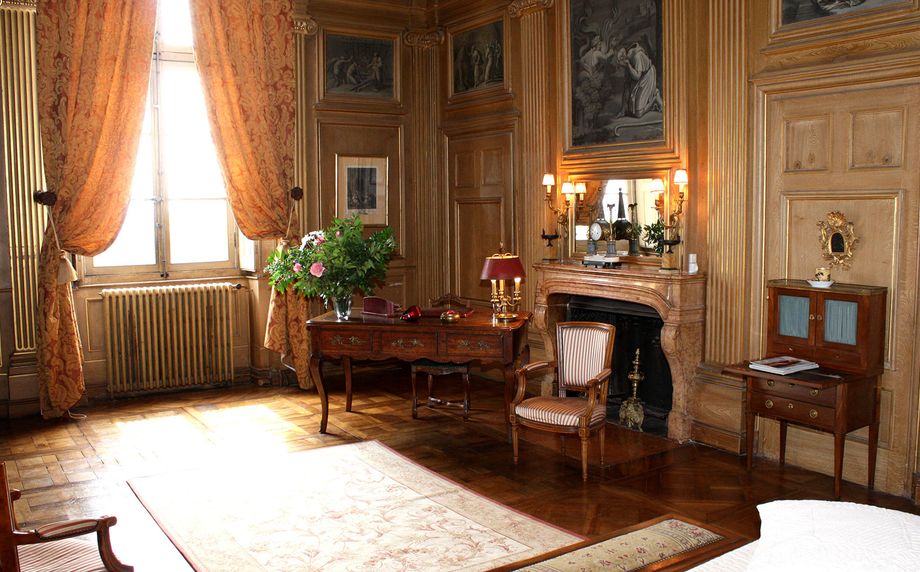
I shall never forget this sight, for he looked the perfect incarnation of hate. His green eyes blazed with lurid fire, and his white teeth seemed to almost shine through the blood which dabbled his mouth. Desperately he tried to vanquish what he did not comprehend. He was so exquisitely beautiful and so lost. “Is there a chill in the air, dear?” I said. “I almost shiver; have I been dreaming? You look ill, Mrs. Winchester; a little faint,” said Haze. “I am better now. How do you feel now, Haze?” I said. I was beginning to take alarm. Natural enough, was it not, that one of his own should take him away from Llanada Villa. “Papa would be grieved beyond measure,” he said. “If he thought we were inconveniencing you at all.” In a moment he was standing on his own feet. And then he walked drowsily beside me, my arm about his shoulder, bolstering him and steadying him, until we were moving towards his father’s cottage on my estate. I only half glanced at the figures passing us, until I saw a familiar shape under the trees. Somewhere far off in the darkened gardens, other were near. When he pushed open the door to his father’s home, he was laying dead upon the floor. His cravat was drawn halter-wise tight round his throat, and he had done its work well. The body was cold, and had been long dead. In due course the coroner held his inquest, and the jury pronounced that the deceased, Mac Austin, had died by his own hand, in a state of temporary insanity. However, Haze had his own opinion about his father’s death, though his lips were sealed, and he never spoke about it. He went and lived for the residue of his days in York, where there are still people who remember him, a taciturn and surly young man, who attended church regularly, and also drank a little, and was know to have saved some money. #RandolphHarris 2 of 8

But there occurred that night an event which gave my thoughts quite a new turn, and seemed to even startle even Haze’s languid nature. When I returned to my drawing-room, and sat down to coffee and chocolate, Elizabeth joined me, and we had a little card party. When the game was over, Elizabeth and I sat down on the sofa, and I asked her, a little anxiously, whether she had heard from her mother since her arrival. She answered “No.” I then asked her whether she knew where a letter would reach her at present. “I cannot tell,” she answered, ambiguously, “but I have been thinking of leaving you; you have been already too hospitable and too kind to me. I have given you an infinity of trouble, and I should wish to take a carriage to-morrow, and post in pursuit of her; I know where I shall ultimately find her, although I dare not tell you.” “But you must not dream such a thing,” I exclaimed. “I cannot afford to lose you so, and I will not consent to your leaving us, except under the care of your mother, who was so good as to consent to your remaining with us till she should herself return. I should be quite happy if I knew that you heard from her; but this evening the accounts of the progress of the mysterious disease that has invaded our community, grow even more alarming; and my beautiful guest, I do feel the responsibility, unaided by advice from your mother, very much. However, I shall do my best’ one thing is certain, that you must not think of leaving Llanada Villa without her distinct direction to that effect. We should suffer too much in parting from you to consent to it easily.” “Thank you, Mrs. Winchester, a thousand times for your hospitality,” Elizabeth answered, smiling bashfully. “You have all been too kind to me; I have seldom been so happy in all my life before, as in your beautiful mansion, under your care, and in the society of your dear niece.” #RandolphHarris 3 of 8
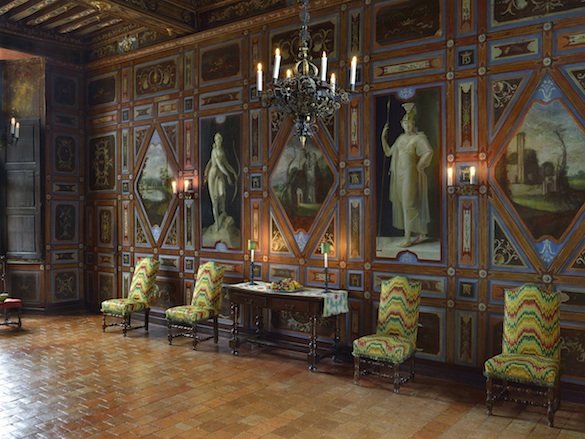
I accompanied Elizabeth to her room, and sat and chatted with her while she was preparing for bed. She turned around, “Do you think that you will ever confide fully in me about your home?” “Now, Elizabeth, you are gong to talk your wild nonsense again,” I said hastily. “Not I, silly little fool as I am, and full of whims and fancies; for your sake I’ll talk like a sage. Did you ever have a ball in the Grand Ballroom? What was it like? How charming it must be.” “I almost forget, it is years ago.” I laughed. “Mrs. Winchester, you are not so old. Your first ball can hardly be forgotten yet.” “I remember everything about it—with an effort. I see it all, as divers see what is going on above them, through a medium, dense, rippling, but transparent. There occurred that night what has confused the picture, and made it colours faith I was all but assassinated in my bed, wounded here,” I touched my breast, “and never was the same since.” “Were you near dying?” “Yes, a very—cruel love—strange love, that would have taken my life. Love will have its sacrifices. No sacrifices without blood. Let us go to sleep now; I feel lazy.” I bid her good-night, crept from the room with an uncomfortable sensation, locked her door and retired to my chambers. I was lying in bed, with my hands buried in my rich wavy hair, under my cheek, and my head upon the pillow. I often wondered whether my pretty guest ever said her prayers. I certainly had never seen her upon her knees. In the morning she never came down until long after our family prayers were over, and at night she never left the drawing room to attend our brief evening prayers in the hall. Ever since the midnight invaders, I locked all the doors in the house at night, and my whimsical alarms about prowling assassins required me to have the servants search every room in the house to make sure there were no lurking assassins or robbers “ensconced.” #RandolphHarris 4 of 8

After these measures were taken, I got into my bed and fell asleep. A light was burning in my room. This was an old habit, of very early date, ad which nothing could have tempted me to dispense with. Thus fortified I might take my rest in peace. However, dreams come through walls, light up dark rooms, or darken light ones, and their persons make their exists and their entrances as they please, and laugh at locksmiths. I had a dream that night that was the beginning of a very strange agony. I cannot call it a nightmare, for I was quite conscious of being asleep. However, I was equally conscious of being in my room, and lying in bed, precisely as I actually was. I saw, or fancied I saw, the room and its furniture just as I had seen it last, except tht it was very dark, and I saw something moving round the foot of the bed, which at first I could not accurately distinguish. However, I soon saw that it was a sooty-black figure that resembled a man. He appeared to me about five or six feet tall, he floated around the room hither and tither with the lithe sinister restlessness of a beast in a cage. I could not cry out, although as you ay supposed, I was terrified. Its pace was growing faster, and the room rapidly darker and darker, and at length so dark that I could no longer see anything of it but its eyes. I felt it spring lightly on the bed. The two broad eyes approached my face, and I could see it was Haze. He looked at me with centuries of evil blazing in his eyes, but there was not the slightest stir or respiration. And I felt a shudder. My heart expanded slightly, against my will. “I curse you,” he said. As I stared at him, I felt danger again, terrible danger. Then he appeared to have changed his place, and was now nearer to the door; then, close to it, the door opened, and he vanished. #RandolphHarris 5 of 8

It would be vain my attempting to tell you the horror with which, even now, I recall he occurrence of that night. It seemed to deepen by time, and communicated itself to the room and the very furniture that had encompassed the apparition. Later that day, I had another strange experience; I walked into the parlor that afternoon where Daisy and Elizabeth had been sitting, and a saw Haze upon the sofa. However, then I realized that he was invisible to the others. He got up and walked toward me—I was not afraid—and then—seemed to dissolve into the air. And so I wondered…whether I might have fallen into a trance. I clasped my hands and struggled to control my breathing. We know that, in the mesmeric trance, a subject may acquire unusual mental powers; The Frenchman Didier, who could read minds, play cards blindfolded, and identify the contents of sealed containers with great accuracy, is one of the best-known instances. Ancient houses, it has always seemed to me, are like Leyden jars, quietly accumulating the influences of the past…and my home is a special case. I lay awake into the small hours, worrying over these anxieties as they became more and more nightmarish until I sank into a troubled sleep. Sleeping had become so difficult one night that I wandered through this vast mansion, searching for a precious jewel William had given me. The jewel had been lost; I did not know how, but I knew that my own carelessness was to blame. To make matter worse, I could not remember what kind of stone it was, for as I went from room to room, a voice kept chanting, “Emerald, sapphire, ruby, diamond,” over and over, and none of them seemed right, because the lost stone was a different, a more beautiful colour than any of those, and I knew I ought to be able to picture it, and thus recall its name, but I could not. #RandolphHarris 6 of 8
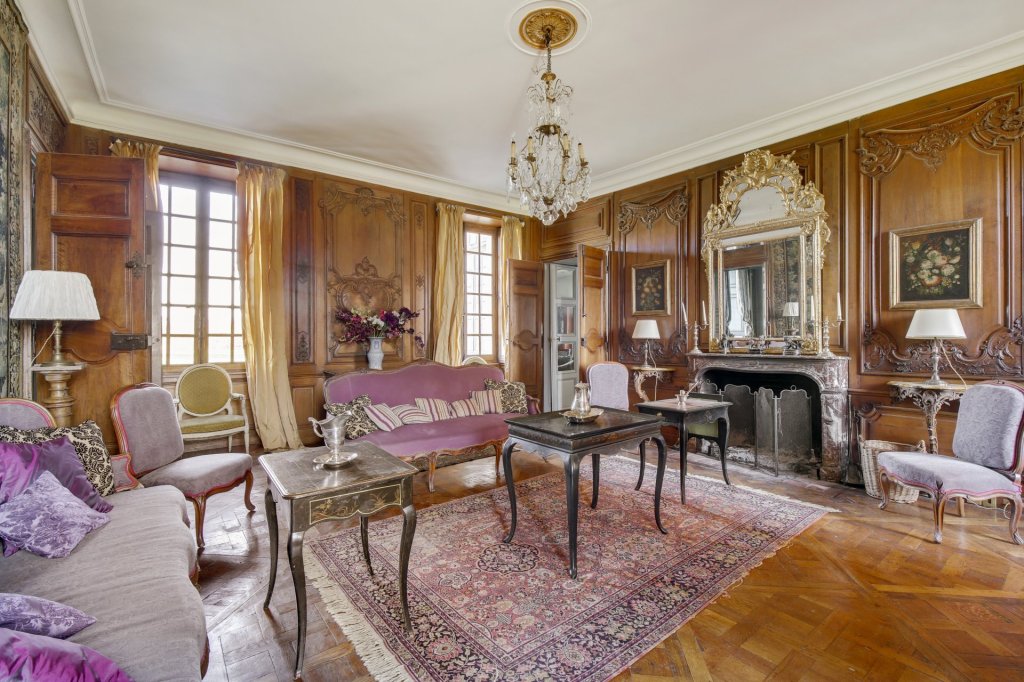
The mansion was absolutely silent; the light throughout, even in corridors was a pale, uniform grey like that of an overcast sky. The rooms were modestly furnished; each one seemed to have its own miniature flight of stairs, up or down two or three steps, and the corridors kept changing levels in similar fashion. Though the house itself was not especially sinister, my anxiety over the fate of the jewel grew steadily more acute until it had risen to an unbearable pitch. Then it occurred to me that I still had not searched the Venetian Dining Room. The thought precipitated a vertiginous change of scene; the light sank to a dim, murky brown, and I was standing in the doorway of the room where we had dined that night. The curtains were drawn, the candles snuffed; the room seemed to be empty, but as I crept toward the table, I saw, above the back of the chair in which I usually sat, the dark outline of a head. There was time to slip away quietly; but perhaps the jewel had fallen into the lining of my chair, and if I were to tiptoe forward, I might be able to see it. I was within two feet of the motionless figure when a voice spoke from the doorway behind me, a word that rang like a loud gong, louder and louder until it became my own cry of “No!” and I woke in grey dawn light to find myself standing at the head of the stairs. And then I thought I caught sight of a shape, dak in space and light, through the door in one of the bedrooms. There was a tall figure in what I could have sworn was a black top hat, staring directly back at me. The figure was dressed formally in black morning suit. And then, with a movement so spasmodic and sudden, the man turned and stated to walk eastward, out of sight. I dismissed it, as one of the Winchester’s passing enigmas. There was much about the curse of the Winchester Mansion that I did not understand. #RandolphHarris 7 of 8

Spirits of Llanada Villa, I awaken the powers of darkness which dwell within you by the power of the blood of the three heeded Dragon Zohak that you may serve to empower Mrs. Winchester’s great work! Through serving the greater cause of dark magick which break the shackles that bind the Blackened Fire of Spirit, may you be uplifted and liberated! Awaken and empower the forbidden rites of Angra Mainyu! Awaken to empower the Mrs. Winchester’s great work of counter creation as an Apostle of the Lord of Darkness eternal and as a warrior of the path of the Lemegeton. I adjure thee, Emperor Lucifer, as the agent of the strong living God, of His beloved Son, and of the Holy Ghost, and by the power of the Great ADONAY, ELOIM, ARIEL, and JEHOVAM, to appear instantly, or to send thy Messenger Astarot, forcing thee to forsake thy hiding-place, wheresoever it may be. Aeshma, Div of wrath and fury! He who wields the bloody mace! Aeshma who is demon of the wounding spear I call you forth into this temple of counter creation! Through devotion to my becoming on this path, your spiritual weapon has been made manifest in this corporeal World through my will and counter creative power so you may fill it with your essence and might! Empower it so that it may serve me here upon the corporeal plane! May it serve as a key to the realms above and below unlocking the power and wisdom for the spirits of the Winchester’s glory and ascent! Fill this weapon with your powers of wrath and fury that it may seek out spiritual attacks made and render them useless and impotent! #RandolphHarris 8 of 8
One Halloween, a tour guide saw a little boy who was no more than six years old. He was dressed in a black hood, and long black robe, and it looked like he did not have a face, as he had a black, opaque nylon covering the opening in the hood. The tour guide asked him who he was supposed to be, and the little boy said, “I’m the Angel of Life.” The tour guide then asked him who the Angel of Life is. The boy replied, “The Angel of Life is someone who comes to talk to you. He tells you things about your life.” The conviction on the little boy’s face and the non-hesitant way in which he explained who he was made the tour guide think that the boy had some knowledge of what he was talking about. Shortly after, objects in the gift shop started floating about, and glimpses of a shadowy figure were spotted in the basement. In the café, according to a female patron, she had been sitting at a table in a back corner of the room when a man suddenly appeared in a chair across the table from her. The man stared straight ahead and refused to react in any way. The female patron looked away to get the waitress’s attention and when she looked back, the man was gone. The woman related that the elusive figure was wearing old-fashioned clothes. https://winchestermysteryhouse.com/

And please be sure to check out the online gift store: https://shopwinchestermysteryhouse.com/

Return in the Darkening Twilight
Llanada Villa is a prime example of Victorian architecture. Its exterior is stately, refined, with a touch of Gothic elegance. Its front doors welcome, even as it seems to be hiding something. Inside the floors creak without warning, without any sense of someone there. The wood is thick with the humidity, as if the walls and floor breathe. Through the years, guest have reported feeling cold spots, or seeing strange, wispy streaks of light. The sense of the uncanny cries out for an explanation. Ghosts bridge the past to the present; they speak across the seemingly insurmountable barriers of death and time, connecting us to what we thought was lost. The townsfolk whispered tales of its dark history, of unspeakable horrors that occurred within the walls of my homes. As I climbed the grand staircase, each step seemed to release a flurry of hidden memories. Voices whispered incantations that send shivers down my spine. I must not faint, I told myself, and summoning all my resolve, made my way to the safety of the back parlour. There I collapsed into a couch, with my head already beginning to throb. The pain soon became so excruciating that I lost all sense of time until someone, I could not tell who, brought me a sleeping draught, and I sank at last into merciful oblivion. Next morning, I was at first bewildered to find myself fully dressed upon the parlour sofa. The parlourmaid, Trinity, brought me a cup of tea. She had set my skin crawling with fear. At this moment the unwonted sound of carriage wheels and many hoofs upon the road, arrested out attention. #RandolphHarris 1 of 6

I was haunted with a terror of robbers. My house was robbed once, and two servants murdered, so I always lock my door. It had become a habit. Still, it was a fine autumnal sunset, and melancholy lights and long shadows spread their peculiar effects over the landscape. I was looking out of one of the long drawing-room windows, when there entered the court-yard, a figure of a wanderer who I knew very well. He used to come by twice a year asking to tour my home. He was a tall man, with sharp learn features. He wore a pointed black bread, and he was smiling from ear to ear, showing his white fangs. He was dressed in buff, black, and scarlet, and crossed with more straps and belts than I could count, from which hung all manner of things. Behind, he carried a magic-lantern, and two boxes, which I well knew, in one of which was a salamander, and in the other a mandrake. These monsters used to my Mr. Hansen laugh. They were compounded of parts of monkeys, parrots, squirrels, fish, and hedgehogs, dried and stitched together with great neatness and startling effect. He had a fiddle, a box conjuring apparatus, a pair of foils and masks attached to his belt, several other mysterious cases dangling about him, and a black staff with copper ferrules in his hand. His companion was a rough spare dog, that followed at his heels, but stopped short, suspiciously at the front gate, and in a little while began to howl dismally. In the meantime, the mountebank, standing in the midst of the court-yard, raised his grotesque hat, and made us a very ceremonious bow, paying his compliments very volubly in execrable French, and German not much better. #RandolphHarris 2 of 6
Then, disengaging his fiddle, he began to scrape a lively air, to which he sang with a merry discord, dancing with ludicrous airs and activity, that made me laugh, in spite of the dog’s howling. Then he advanced to the window with many smiles and salutations, and his hat in his left hand, his fiddle under his arm, and with a fluency that never took breath, he gabbled a long advertisement of all his accomplishments, and the resources of the various arts which he placed at our service, and the curiosities and entertainments which it was in his power, at my bidding to display. “Will your ladyship be pleased to buy an amulet against the oupire, which is going like the wolf, I hear, through these woods,” he said, dropping his hat on the floor. “They are dying of it right and left, and here is a charm that never fails; only pinned to the pillow, and you may laugh in his face.” These charms consisted of oblong slips of vellum, with cabalistic ciphers and diagrams upon them. I instantly purchased one. He was looking up, and I was smiling down at him, amused. His piercing black eye, as he looked up in my face, seemed to detect something that fixed for a moment his curiosity. “I told you that I am charmed with you in the most particulars,” he said. “You are slender, and wonderfully graceful. Your complexion is rich and brilliant; your features are small and beautifully formed; your eyes large, dark, and lustrous; your hair is quite wonderful, I never saw hair so magnificently think and long when it is down about your shoulder. It is exquisitely fine and soft, and in colour a rich very dark brown, with something of gold.” “Well, I do wonder at a wise man like you,” I replied. And so he walked on, and I heard no more. #RandolphHarris 3 of 6
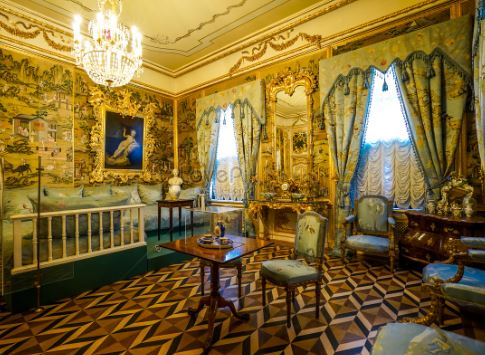
Within the space of a week, my colour had returned, and I was sleeping so soundly that I was scarcely aware of my dreams. I walked miles on my estate each day, and I began to see it with new eyes. Every field, every path, even every hedgerow had its own name and its own history. I considered the amulet I purchased as an omen of good luck—and placed in beneath my pillow, to guard against further visitation. That evening, as I reached the top of the stairs, I heard a peculiar flickering sound. Entering my dressing room in the darkness, I made my way to the familiar dressing table on the right side of the room. Now the noise was even more pronounced. It sounded to me as if someone were turning the pages of book, a sound for which there was no rational source. Move over, I suddenly became away of a clammy, cold feeling around me. Since it was a warm evening, this too surprised me. In the dark, I could not be sure if there were not someone else in the dressing room. I quickly existed the room and went to bed. But this night, I was awakened by a violent shaking of my bed. I could see, in the very imperfect light, two figures at the foot oof it, holding each a bedpost. A voice said, “We’ll hang you!” Trembling, I climbed over to the footboard; and saw the figure at the other side, little more than a black shadow, begin also to scale the bed; and there was instantly a dreadful confusion and uproar in the room, and such a gabbling and laughing; I could not catch the words. I found myself on the floor. The phantoms and clamour were gone, but a crash and ringing of fragments was in my ears. #RandolphHarris 4 of 6
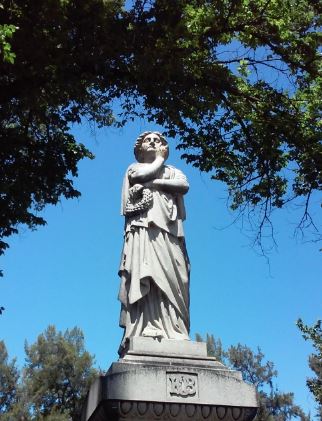
The great china bowl, from which for generations the Winchester had been baptized, had fallen from the mantelpiece, and was smashed on the hearthstone. I warned the servants not to disregard oaths and curses. A mourning coach drove up, and two gentlemen in black cloaks, and with crape to their hats, got out, and without looking to the right or the left, went up the steps to the Winchester mansion. Mr. Hansen followed them slowly. The carriage had, he supposed, gone round to the yard, for, when he reached the door, it was no longer there. So he followed the two mourners into the house. In the hall he found a fellow servant, who said he had seen two gentlemen, in black cloak, pass through the hall, and go up the stair without removing their hats, or asking leave of anyone. This was very odd, Mr. Hansen thought, and a great liberty; so upstairs he went to make them out. But he could not find them then, nor ever. And from that hour the house was troubled. In a little time there was not one of the servants who had not something to tel. Step and voices followed them sometimes in the passages, and tittering whispers, always minatory, scared them at the corners of the galleries, or from dark recesses; so that they would return panic-stricken. I, myself, had also heard these voices, and with this formidable aggravation, they came always when I said my prayers. I was scared at such moments by dropping words and sentences, which grew, as I persisted, into threats and blasphemies. These voices were not always in the room. They called, as I fancied, through the walls, very thick in this house, from the neighbouring rooms, sometimes on one side, sometimes on the other; sometimes they seemed to holla from distant lobbies, and came muffled, but threateningly, through the long paneled passages. As they approached they grew furious, as if several voices were speaking together. Whenever I applied myself to my devotions, these horrible sentences came hurrying towards the door, and, in panic, I would start from my knees, and all then would subside except the thumping of my heart against my stays, and the dreadful tremours of my nerves. #RandolphHarris 5 of 6

What these voices said, I never could quite remember one minute after they had ceased speaking; one sentence chased another away; gibe and menace and impious denunciation, each hideously articulate, were lost as soon as heard. And this added to the effect of these terrifying mockeries and invectives, that I could not, by any effort, retain their exact import, although their horrible character remained vividly present to my mind. Camile who acted as a housemaid, would not sleep in the house, but walked home, in trepidation, to her father’s, under the escort of her little brother, every night. Mrs. Rendell, the kitchenmaid, endured the nightly terrors. Mr. Hansen was testy and captious about these stories. He was already uncomfortable enough by reason of the entrance of tow muffled figures into the house, about which there could be no mistake. His own eyes had seen them. He refused to credit the stories of the servants. I made a decision not to fuel the stories of the ghost to keep the servants. “If you see ghosts here, it is no place for you, and it is time you should pack,” I would say. Here has been the cook with the kitchenmaid, as white as pipeclay, all in a row, to tell me I must have a parson to sleep among them, and preach down the devil! Upon my soul, I would not allow my home to fall into utter chaos and disarray. “Mrs. Winchester, I know you are no fool,” said the cook. “But supposed there was a such thing as a ghost here, don’t you see, it ain’t just women telling stories.” “I will not dignify such ideas,” I replied. The women left the kitchen, the cook and the butler went down, not altogether unused to such condescension in the household. The fire had gone down and I was chilled. The candles were expiring in the socket and threw on the white all long shadows, that danced up and down from the ceiling to the ground, and their black outlines I fancied resembled the two men in cloaks, whom I remembered with profound horror. I took the candle, with all the haste I could, getting along the passage, on whose walls the same dance of black shadows was continued, very anxious to reach my room before the light should go out. #RandolphHarris 6 of 6


On night in 1990, there was an unusual buzzing sound in The Winchester Mystery House, one of the staff encountered a dark, hooded figure standing at the door-to-nowhere. In the dim light issuing through the stained glass windows from an outside light, he could see that the intruder, who looked very much like a cowled monk, was waving his arms in a particular manner. Interpreting his movement as threatening, he approached the man and asked him to leave. At the very moment, the employee says he never felt so weak and helpless.
He collapsed in a heap backward onto the floor. He remembered that he actually began to weep in fear and confusion. He was completely at the mercy of whoever or whatever was standing at the door. It was then that the hooded being spoke. “Don’t be afraid,” it said in a quiet whisper. “We won’t hurt you.” And the next thing he knew, the morning sunlight was making him squint into wakefulness. As he reflected on the incident, he became more and more convinced that an actual visitation had occurred and that some kind of entity had come into the mansion. https://winchestermysteryhouse.com/

And please be sure to check out the online gift store: https://shopwinchestermysteryhouse.com/

Some Move to Suburbia Out of Fear of those Unlike them
Sarah L. Winchester stirred, rolling onto her side and clutching her pillow. She had been caught in a strange netherworld between sleep and wakefulness, her uneasy rest punctured by nightmares of loss connections with her daughter and husband, but a noise downstairs had brought her back to reality. Every criminal offense is comprised of a set of behavioural (actus reus) and mental (mens reus) prerequisites. These statutory provisions are clearly sated in the criminal code and establish what an individual must do and think to be in violation of the law. Criminal events transpire when offenders, victims, and audience members intersect in a given setting. These participants engage in a dynamic set of actions and counteractions to produce the criminal outcome. The term “criminal transaction” is used to describe this exchange process. A full discussion of the criminal transaction must consider broad-based issues such as the demographics of the actors, the environment in which the crimes occur, and the way that these events tend to play themselves out. In the case of the offender-victim relationship, it is noted the violent crimes tend to take on a one-on-one offender-victim dynamic. Conversely, property offenders, public order offenders, and many organizational criminals are prone to work in small groups. What is more, robbery, burglary and common property offense are described as stranger crimes while other crimes tend to involve a victim and perpetrator(s) who know one another. #RandolphHarris 1 of 20

Faith motivated individuals, faith-based organizations, and the transformative power of faith itself are proven keys in reducing crime and improving the effectiveness of our criminal justice system. We now know that intentional partnerships between congregations and law enforcement can lead to dramatic improvement in police-community relations and reductions in crime, youth violence, and gang activity. We also known that faith-based programs can provide an antidote to the harmful culture that permeates so many of our correctional facilities. In this way, religion can help change prisons from an environment for learning even more deviant behaviour to places where rehabilitation is a realistic possibility. Additionally, faith-motivated mentors and faith-based groups can provide both the support and supervision necessary to help not only prisoners but also those former prisoners stay crime-free by learning moral and productive lives. The American suburbs are part of what is called a “global project.” Across the planet, after World War II, America’s image as a democracy and as World economic leaders also became a cultural model for consumerism and community-building. American images and ideas central to the lifestyle of its new suburbs—supermarkets, automobiles, super-highways, and motels—were exported to other nations. The American post-war dream was concretized in the form of the single-family suburban home, the cul-de-ac community, the local shopping center, and the family car, as opposed to the crowded, high crime, industrial cities. #RandolphHarris 2 of 20

To middle class families the suburbs give a safe, sanitary environment, new houses in styles somewhat in keeping with the conception of family life, and permanent neighbourhoods of people with similar outlook. In an atmosphere of rapid change, the income-graded neighbourhoods render two important service to their residents. Relative evenness of wealth meant neighbours who would reinforce an individual family’s efforts to pass on its values to its children. The surrounding evenness of wealth also gave adults a sense of a community of shared experience, and thereby gave some measure of relief from the uncertainties inherent in a World of highly competitive capitalism. Even those excluded from them, the suburbs offered a physical demonstration that the rewards of competitive capitalism might be within the reach of all. The suburban life is also a spiritual quest. These suburbs are the latest version of the promise of the American frontier—blank slates on which new residents can write their stories. The pioneers who move to these suburbs have made a startling leap into the unknow. The places have no past, no precedent, no settled conventions. The residents have no family connections here. However, people move here with the hope that there soon will be communities and relationships developed among people in the same yacht as themselves. Fellow pilgrims on the journey, as it were. Many people are struck by the significance of suburban living as a spiritual quest or pilgrimage. They are all looking for something. #RandolphHarris 3 of 20

People live in the suburbia for any number of reasons. They may have come here because of a job change or for a relationship. They come in search of affordable housing, good school, or safe communities. Or they may have grown up in suburbia by default; indeed, over half of the American population now lives in suburbia, and many of them have been suburbanites for two or three generations. Whatever the case, those who live in suburbia have aspirations for a certain kind of life. For some it is an optimistic vision, while others may be more cynical about ever seeing such a life to come. However, it is still a spiritual longing in either case. Even those who come to suburbia for less than noble reasons do so out of a particular vision of their ideal life. Some move to suburbia out of fear of those unlike them, fleeing from racial diversity and searching for a place “safer” and more comfortable to their preexisting prejudices. Others care little for their neighbours and fashion suburban lives of self-centered materialism, acquisition of possessions and status climbing. These too point to spiritual needs, however misguided or impure the motivations might be. Whenever people describe suburbia, invariably they use phrases like “a good place to raise kids,” or “where people settle down and start a family.” Inherent in these comments is an aspiration of hope for their future and a dream of a good life for their children. Suburbia is the context and the setting for the fulfillment of people’s hopes and dreams. #RandolphHarris 4 of 20

The suburbs had always promised prosperity, upward mobility, a healthy life in an unpolluted environment, safety and tranquility, and above all, the best place to bring up kids. Although this promise still fuels many dreams and infuses a nostalgic political rhetoric, the future is hopeful. It is a place many people can hear the voice of God. The suburban Christian ought not uncritically absorb all the characteristics of the suburban World but rather should thoughtfully asses and discern how Christians ought to live in this environment, without either capitulating to the culture or abandoning it by fleeing the suburbs and relocating to the country. Given suburbia’s new centrality, Christians, especially suburban Christians, must take the suburbs seriously. In order to detect the “voice of God,” we need to understand that the Holy Spirit alone is charged to communicate the will of God to the believer, and that He works from within the spirit of the disciple, enlightening the understanding so as to bring one into intelligent co-working with the mind of God. No matter where you live, the purpose of the Holy Spirit is, briefly, the entire renewal of the redeemed one, in spirit, soul and body. God therefore directs all His working to the liberation of every faculty, and never in any way seeks to direct a human as a passive machine, even into good. God work in one to enable one to choose the good, and strengthens one to act, but never—even for “good”—dulls one or renders one incapable of free action. One would nullify the very purpose of Christ’s redemption on Calvary, and the purpose of His own coming. #RandolphHarris 5 of 20

When the self-actualized understands these principles, the “voice of psychopathological offenders” is recognizable: when it comes from outside the human, or within the sphere of one’s perception, and not from the central depth of one’s spirit where the Holy Spirit abides; when it is imperative and persistent, urging sudden action without time to reason or intelligently weigh the issues; when it is confusing and clamorous, so that humans are hindered from thinking. For the Holy Spirit desires the believer to be intelligent, as a responsible being with a choice, and will not confuse one so as to make one incapable of coming to a decision. The speaking of psychopathological offenders can also be a counterfeit of the apparent inner speaking of the human oneself, as if one were oneself “thinking,” and yet with no concentrated action of the mind; exempli gratia, a persistent and ceaseless “commentary” going on somewhere within, apart from volition or mind action, commenting on the human’s own actions or the actions of others, such as “You are wrong,” “You are never right,” “God has cast you off,” “You must not do that,” et cetera, et cetera. Humans do not grasp God through symbols, but in the experience of faith one is grasped by an ultimate concern expressed in symbols. Every symbol descriptive of ultimate reality originates in an experience of ultimate concern and continues to live only insofar as it can introduce someone into the revelatory constellation by arousing a similar experience. Religious symbols participate in the power of being not merely ontologically, but experientially. They concretely convey the experience of ultimacy, of seizure by an ultimate concern. And lest this affirmation of the symbol open the door to the demonic, we insist upon the negation of the symbol by the ultimate to which it points. #RandolphHarris 6 of 20

Analogia is more negative-protesting than positive-affirming. Religious symbols participate in that which they symbolize, being-itself; they participate by sharing in the ground of being, as do all finite beings; and they participate by expressing the experience of ultimacy. This last element is decisive. One expresses the experience of the ground being through the religious symbols which are formed in the crucible of the experience itself. God is being-itself is the only nonsymbolic statement about God. The religious experience of God is had through finite beings which participate in being-itself. The principle of analogy justifies this. The expression of this experience is through religious symbols which participate in the experience itself. Theology elaborates the meaning of religious symbols by using ontology. Analogy permits and even demands this procedure. We use the principle of analogy for two purposes: to permit a religious encounter with God through finite beings and to justify the theological use of ontology. Theology speaks ontologically about religious symbols which express the encounter with God, our ultimate concern. The word “creation” is one of the great symbol-words describing the relation of God to the Universe. The doctrine of creation depicts a state; it does not relate an event that happened “once upon a time.” Humans ask the question of their finitude and of finitude in general, and creation answers it by pointing to the situation of creatureliness and to its correlate, the divine life; it is beyond potentiality and actuality. #RandolphHarris 7 of 20

Hence the question whether creation is a necessary or contingent act of God is meaningless. For nothing higher than God necessitates His creativity; neither does it happen to one as an accidental act. The divine life and the divine creativity are one. All three modes of time must be used to symbolize the infinite scope of the divine dynamism. Therefore creativity originates (the past) sustaining creativity (the present), and directing creativity (the future). The classical phrase to express the Christian doctrine of creation is creatio ex nihilo. We see in it the exclusion of the pagan idea of me on, of the “given” which resists the divine creativity. Though ouk on, absolute nothingness, suffices to explain nihilo, the ex demands something more positive to describe the origin of the creature. The solution lies in the dialectic of being and non-being. Ex nihilo indicates the “heritage of nonbeing” which is the lot of every creature. Yet the creature is; it participates in the power of being which holds nonbeing in check. Being a creature include both the heritage of nonbeing (anxiety) and the heritage of being (courage). Creation is essentially good, for it is not the offspring of me on, of some semi-divine power that opposes being-itself. The way to incarnation lies open, for finitude essentially is not in conflict with God. Secondly, the element of nonbeing in creatureliness provides the potentiality for tragic disruption within finitude itself. Eschatology is forbidden to do violence to the finite by eliminating the possibility of conflict, by locating salvation in an unreal World above or finite, tragic World. #RandolphHarris 8 of 20

The simple theoretical analysis of the evolution of family agencies into three phases appears to be corroborated by the growth in all six types of agencies of what may indeed be called quasi-families—that is, small groups of persons similarly affected by some distinctive problem, condition or interest, who come together voluntarily to solve, correct, or pursue it by concerted actions, meanwhile providing each other with a degree of understanding, encouragement, and support which they have not found elsewhere in the community. Most of these have only arisen within the past five or six decades. While they are predominately found in urban areas, since only in such centers are there enough persons of any one type of category, exempla gratia, the Townsend Clubs, which considerably outlived the depression. While some of these quasi-families have been the products of invention and experiment by therapists, so many have sprung up apparently quite spontaneously (exempla gratia, child study groups attached to cooperative nursery schools) as to suggest that they are a particularly fitting response to current situations confronted by members of the community. Their fraternal rather than patriarchal structure does not negate the value of construing them as quasi-families; indeed, to recognize their correspondence with the more fraternal character of contemporary families improves the analogy. The desire of many public and private agencies to foster participation “at the grass roots” is most successful when the grass roots consist of strong, intimate, small groups, not collections of strangers. #RandolphHarris 9 of 20

Under urban conditions, such groups do not as a rule get constituted on a neighbourhood basis, but out of common interests; they may primarily focus on these interests, yet they frequently have corrective and therapeutic effects on their members. While the characteristic quasi-family has a fairly homogenous membership, draw from some limited segment of a community, this does not mean that one had to regard them as simply the result of an ever more refined division of labour or fragmentation of interests. An urban quasi-family often recruits only one member of a family, which makes it quite different from those farm organizations whose local units aim to provide some engrossing activity for every member of a family. Yet every quasi-family so rapidly takes on an elaborates other functions, that few persons would ever need or want to belong to more than two or three quasi-families at most. Every member can remain as convinced of one’s own individuality within a quasi-family as within one’s actual family. In fact, scrutiny reveals a number of respects in which membership in quasi-families offers certain advantages which real families cannot. Involvement in these groups, however highly committed and intense it may be, is more like becoming a member of a club or a team in a game. Family commitments, by contrast, have still an inescapable character posing the gravest consequences for the unwilling participant. It is unlikely that individual counseling can or should be dispenses with. Yet, the theoretical shift to recognition of the family origin and interpersonal nature of personality difficulties, justifies the support counseling activity gives to voluntary group procedures. #RandolphHarris 10 of 20

Sociologists long ago recognized the threat to individual psychological existence in the breakdown of ancient primary group supports. Though the rural village, like Humpty Dumpty, cannot be put back together again, the incessant reorganizing of the various institutions of the urban community can well take account of the means whereby citizens continually reintegrate their selves. If it is granted that small, intimate groups of significant others play a vital part in supporting every self, it is probable that groups formed solely for the sake of such mutual support will be less durable and successful than those which accomplish this in the process of pursuing other ends. It is improbable, therefore, that individual counseling agencies could produce a full solution ever under ideal conditions, since the problem involves the whole structure of the community as this bears upon personality. What the best solutions will be is known to on one, and will only be approached through imaginative experiments of many kinds. However, no matter what, people believe that the United States of America will continue to be a great manufacturing power. There just will not be as high a percentage of people working in factories. Explaining the difference between traditional manufacturing methods and the way Macintosh computers were then being produced, she pointed out that the United States of America was surely one of the great good producers of the World with fewer than two percent of the work force engaged in agriculture. #RandolphHarris 11 of 20

However, many people would like America to returned to its agricultural roots, while we still have farmland, and to increase the amount of meat, poultry, and produce that is created in America so we will stop importing it, feed our own people, and export our products to other nations. This will help reduce the national deficit and be a step in the right way to help America return to being a creditor nation. Also, the American population will expand, and the labour force is also likely to expand, so more people will be willing to work on farms. While the United States of America is likely to generate 10,000 new jobs a day for the next decade, it is important to regain a presence in the manufacturing business. We do not want to leave the economy hollowed out. Nonetheless, the shift away from Second Wave manual labour toward Third Wave service work and super-symbolic activity has become widespread, dramatic and irreversible. In the United States of America today, these activities account for fully three-quarters of the work force. The great transition is reflected globally in the surprising fact that World exports of services and “intellectual property” are now equal to those of electronics and automobiles combined, or of the combined exports in foods and fuels. Futurists foreshadowed this massive shift as early as the 1960s. However, because the early warnings were ignored, the transition has been unnecessarily rocky. #RandolphHarris 12 of 20

Mass layoffs, bankruptcies and other upheavals swept through the economy as old rust-belt industries, late to install computers, robots and electronic information systems and slow to restructure, found themselves gutted by more fleet-footed competition. Many blamed their troubles on foreign competition, high or low interest rates, overregulation and a thousand other factors. Some of these no doubt played a role. However, equally to blame was the arrogance of the most powerful smokestack companies—auto makers, steel mills, shipyards, textile firms—that had for so long dominated the economy. Their managerial myopia punished those in the society least responsible for industrial backwardness and least able to protect themselves—their worker. The fact that aggregate manufacturing employment in 1988 was at the same level as 1968 does not mean that the workers laid off in between simply returned to their old jobs. On the contrary, with mote Third Wave technologies in place, companies needed a radically different kind of work force as well. The Old Second Wave factories needed essentially interchangeable workers. By contrast, Third Wave operations require diverse and continually evolving skills—which means that workers become less and less interchangeable. And this turns the entire problem of unemployment upside down. In Second Wave or smokestack societies an injection of capital spending or consumer purchasing power could stimulate the economy and jobs. Given one million jobless, one could, in principle, prime the economy and create one million jobs. #RandolphHarris 13 of 20

Once consumers have the money, they will rush out and buy things. This in turn leads to manufacturers to expand their plants and hire more workers. Good-bye, unemployment. Monetarists urge manipulation of interest rates or money supply instead, to increase or decrease purchasing power as needed. In today’s global economy, pumping money into the consumer’s pocket may simply send it flowing overseas without doing anything to help the domestic economy. An American buying a new TV set or compact disc player merely sends dollars to Japan, Korea, Malaysia, or elsewhere. The purchase does not add jobs at home. However, there is a far more basic flaw in the old strategies: they still focus on the circulation of money rather than knowledge. Yet it is no longer possible to reduce joblessness simply by increasing the number of jobs because the problem is no longer merely numbers. Unemployment has gone from quantitative to qualitative. The jobless desperately need money if they and their families are to survive, and it is both necessary and morally right to provide them with decent levels of public assistance. However, any effective strategy for reducing joblessness in a super-symbolic economy must depend less on the allocation of wealth and more on the allocation of knowledge. Furthermore, as these new jobs are not likely to be found in what we think of as manufacture, we will need to prepare people through schooling, apprenticeships and on-the-job learning for work in such fields as the human services—helping to care, for example, for our fast-growing population of the elderly, providing child care, health services, personal security, training services, leisure and recreation services, tourism and the like. #RandolphHarris 14 of 20

We will also have to begin according human-service jobs the same respect preciously reserved for manufacture rather than snidely denigrating the entire service sector. The service industry cannot stand as the sole symbol for range of activities that includes everything from teaching to working at a pet groomer or in a hospital radiology center. What is more, if, as is often charged, wages can be below what people need to survive on their own in the service sector, then the solution is to increase service productivity and to invent new forms of work-force organization and collective bargaining. Unions, primarily designed for the crafts or for mass manufacturing, need to be totally transformed or else replaced by new-style organizations more appropriate to the super-symbolic economy. To survive they will have to support rather than resist such things as work-at-home programs, flextime and job-sharing. The rise of the super-symbolic economy compels us to reconceptualize the entire problem of unemployment from the ground up. To challenge outworn assumptions, however, is also to challenge those who benefit from them. The Third Wave system of wealth creation thus threatens long-entrenched power relationships in corporations, unions and governments. China, already a major importer of fuels and many minerals, is getting equipped for such a competition especially fast: With its rapidly growing, highly energy- and resources-intensive economy, the consequences of resource supply irregularities may be fatal. In the days of the Iraq war Beijing already resorted to eventually a panic buying of petroleum, overstanding the global market. #RandolphHarris 15 of 20

In today’s World, if you cannot obtain your own resources domestically, to avoid supply troubles, it is considered preferable to establish long-term relationships with particular resource-rich countries, getting a stake in their resource development and extraction. Perhaps more than any other country, China is making big steps to obtain direct access to fuel and mineral resource in Africa, Latin America, and Asia. The United States of America and European countries are supplied a significant portion of the natural resources they consume by major multinational companies such as Exxon-Mobil, Royal-Dutch Shell, Rio-Tinto, or BHP Billiton. In Japan and South Korea, a key role is played by the resource supply channels of leading trading houses like Mitsubishi Corporation, Itochu, SK Corporation, or Hanwha Trading. State-owned resource companies play their part, too. In most other countries, China included, supplies are provided first of all by state-owned oil and mining corporations. Currently, with strong support from the state, China’s natural resources heavyweights—PetroChina, Sinopec, CNOOC, Chinalco, China Metallurgical Group and the like—are establishing themselves among the leading global players, not at all inferior to Western majors or Japanese and Korean trading houses. On its part, the Chinese government is coming out with an innovative model of tapping natural resources in Africa, Latin America, and Asia. In broader terms, this model helps China to strengthen its overall presence and influence in the World. #RandolphHarris 16 of 20

Economic and legal scholars who study business disputes (and other events such as accidents where some economic consequences are at issue) recognize that the initial allocation of legal entitlements, the expectation and uncertainty about a court’s decision in the matter, and the costs of using the legal system all affect the parties’ choice between going to the law and settling the dispute by private negotiation. Rolling back one more step along a game tree, the same considerations also affect individuals’ decisions about engaging in activities that can lead to accidents or disputes. Consider two parties involved in an economic dispute. One of them (plaintiff) could sue the other (defendant) in a court of law. Their expectation for the time being assumed to be commonly held and known, is that the court will aware AP to the plaintiff and AD to the defendant. (If the defendant is ordered to make restitution or pay a fine, his payoff Ad can be negative.) In addition, each side has to bear some cost for using the court; this can be monetary in the form of court costs and lawyers’ fees, or non-monetary in various forms, such as time, mental strain, or damage to reputation. The costs can depend on the legal system; for example, in the American system each side bears its own court and lawyer costs, whereas in the British system the loser bears both sides’ cost. Denote the overall monetary equivalent costs by CP for the plaintiff and Cd for the defendant. Thus the expected net payoffs from recourse to the court are (AP-CP) for the plaintiff and (AD-CD) for the defendant. #RandolphHarris 17 of 20

The two parties could negotiate a settlement, either before a suit is filled at all, or after a suit is filed but before trial. Doing so enables them to avoid some or all of the costs of using the law. If the court is expected to levy a fine in addition to mandating some transfer between the parties, and the proceeds of the fine go to the government, then the negotiation avoids the fine and leaves a larger sum of money available for dividing between them. Suppose S is the total available for them to bargain over, and S> (AP – CP) + (AD – CD). The excess of the left-hand side of this inequality over the right-hand side constitute the “surplus” that is available for them to negotiate over. Denote the sums they can get through bargaining by XP and XD, respectively, then XP + XD= S is the bargaining frontier. The bargaining frontier is a straight line of slope -1. If the negotiation fails and the plaintiff has to sue, their payoffs in the court will be (AP – CP, AD – CD). This point is therefore the threat point that lies behind their bargaining. The generalized Nash bargaining solution then says that each party will get its threat-point payoff, plus a share of the surplus equal to its bargaining power. This bargaining power can be explained in terms of the two parties’ relative impatience, but we will simply assume that the plaintiff’s bargaining powers is and that of the defendant (1 –
). Then the outcomes of the negotiation is (figure 2.1) XP = (AP – CP) +
[S – (AP – CP) – (AD – CD), (Figure 2.2) XD = (AD – CD) + (1 –
) [S – (SP – CP) – (AD – CD)] = (1 –
)(AP – CP) + (AD – CD). These expressions yield several simple implications. For example, they tell us how different rules about the allocation of legal costs affect the outcome of pretrial negotiation. #RandolphHarris 18 of 20

Supposed the expectation is the plaintiff will win. Under the American system, each side would pay its own monetary legal costs. Under the British system, the monetary part of the plaintiff’s legal costs would be shifted to the defendant. Denote this by M. Then the British system, as compared with the American, CP is lower and CD higher by M. Therefore (2.1) shows that XP is higher by M, and (2.2) shows that XD is lower by M, in the British system than in the American. In turn, we can calculate how the expectation of this outcome affects the incentive of the parties to engage in activities that may lead to such disputes. This argument assumes that the expected payoffs AP and AD when the parties go to the court are the same in the two systems. If the courts adjusted the payoffs to offset the stipulated allocation of costs, then the threat points of the two systems would be the same, and therefore so would the Nash solution of the negotiation. However, this simple model has some flaws. Most obviously, in the model the negotiation succeed and the threat of going to court is never invoked. This is less egregious than it may appear at first sight, because only 10 percent of disputes go to trial. Simple extensions of the model explain why and which disputes are likely to go to trial. The main cause is the parties’ inconsistent expectations about the outcome in court. If the plaintiff expects AP to be high, and the defendant simultaneously expects AD to be high, then each may think that there is no surplus to bargain over. The simple figure and algebra I have developed here promising foundations for formal models of such extensions, but I will leave developments along these lines for future work. The model can readily be extended to apply another situation. #RandolphHarris 19 of 20
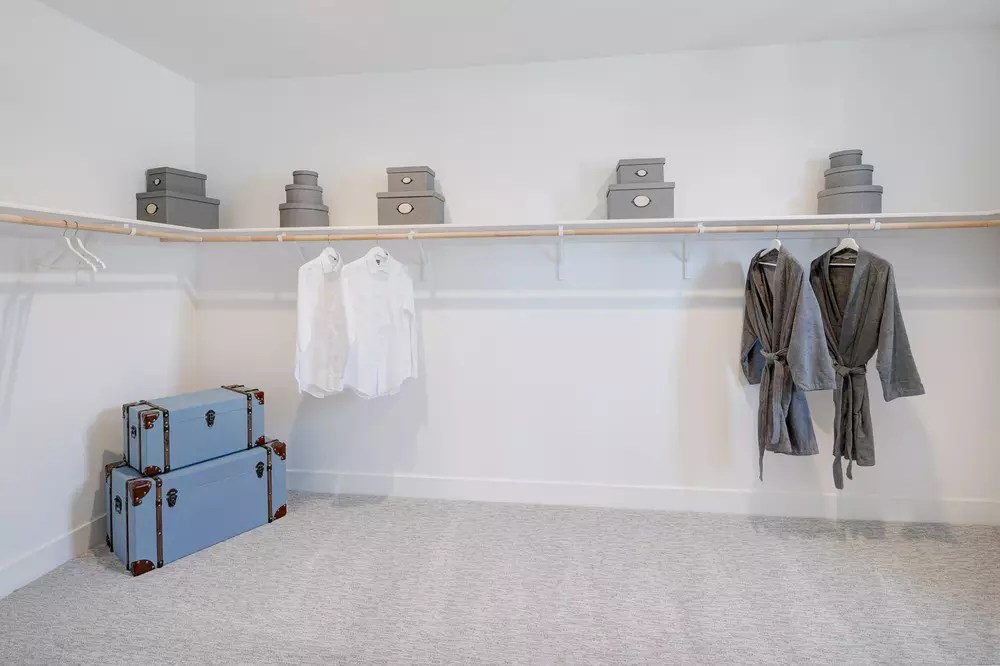
My discussion of the court that generates the threat-point payoff in this model treated it as a well-meaning but costly system. However, it could easier be a corrupt system, or a predatory or kleptocratic government. Economic activities and transactions in such a country would try to proceed in secrecy. However, the threat of disclosure, and the consequent exposure to extortion by the state’s agents, would underlie all negotiations. By interpreting CP and CD as the expected amounts the state would extort from the two parties, the model can cover this situation. Now, let us focus on how a Christian suburb is to be. Better is a dry morsel and quietness therewith, than a house feasting amidst strife. Yea, better to ear herbs where love is, than the choicest food and hatred therewith. Except the Lord build the house, they labour in vain that build it. Through wisdom is a house builded, and by understanding is it established. By knowledge is the home filled with all that is pleasant and precious. Make your house a meeting place for the learned, and give heed to their words. If three people have eaten at one table and have spoken the word of the Christian Bible or Book of Mormon, it is as though they had eaten at God’s table. Blessed is that home where the woman regards the ways of her household. Blessed is the man who has a good wife, for the number of his days shall be doubled. Blessed is he who loves his wife and honours her, and direct his children into paths of righteousness. When husband and wife are worthy of each other, the divine spirit rests upon them. A home where a man loves his wife as himself, and honours her beyond his own person, shall be blessed everlastingly. A home where children honour their parents is a home in which God dwells, and He Himself is honoured. How goodly are your homes, and your dwellings, O America. #RandolphHarris 20 of 20

MAGNOLIA STATION AT CRESLEIGH RANCH
Rancho Cordova, CA | low $600s
Now Selling!

Residence Two a spacious single-story home with over 2,625 square feet of home thoughtfully designed to maximize every available foot of space. Three bedrooms, three bathrooms, and a three car garage all come included in this home.

The layout if an entertainer’s dream with large kitchen and working island, dining room connected through the butler’s pantry, and a large great room overlooking the ample rear yard.

Best of all, each Cresleigh home comes fully equipped with an All Ready connected home!

This smart home package comes included with your home and features great tools including: video doorbell and digital deadbolt for the front door, connect home hub so you can set scenes and routines to make life just a little easier.

Two smart switches and USB outlets are also included, plus we’ll gift you a Google Home Hub and Google Home Mini! https://cresleigh.com/magnolia-station/residence-2/

 Randolph Harris II International Institute