
Home » #RandolphHarris (Page 36)
Category Archives: #RandolphHarris

Homo Consumnes Remains Dominant

Do not give away all your money, then become a poor borrower. China has been growing extremely rapidly for a long time, but an important shift in its growth pattern occurred at the time of global financial crisis. During the six years up to 2007, China’s gross domestic product (GDP) grew at an average rate of 11 percent, with investment equaling 41.5 percent of GDP. The current account surplus was rising in this period, reaching over 10 percent of GDP. In 2023, China’s GDP is 5.3 percent. Beijing has unveiled a raft of measures, including more public works spending, interest rate cuts, property easing and efforts to shore up the private sector, after growth momentum in the World’s second-largest economy dropped. The government’s ability to spur growth has been hamstrung by fears over debt risks and a fragile yuan. These and other characteristics of Chinese communism, however, can be properly understood only if we look at Chinese communism as a whole, and then compare it with the Soviet Russian system. What is characteristic, first of all, of the Chinese revolution, is the fact that it is primarily a peasant revolution, and not a workers’ revolution. It has been often remarked that this very fact alone shows that it is not a revolution in the Marxist sense. The Chinese leaders had a tough job to find the theoretical formula to bridge this obvious contradiction, and there is no need here to follow the fine points of their argument. The revolution followed an increasing course of collectivization in the agrarian sector, which in 1958 culminated in the Constitution of the Communes. #RandolphHarris 1 of 18

In order to appreciate China’s agricultural problem one has to consider the fact that while the United States of America has at least 600,000 square miles of land under cultivation, with a population of 325,000,000, China has only 425,000 square miles of cultivated land with a population of about 1.1 trillion. However, while there is little prospect of increasing this area to any considerable extent, there is a possibility of increasing the production of food by means of irrigation and fertilization, which would add minerals to the soil. (One must note here what could be done here if part of America’s surplus food, for the storage of which we pay more than the cost of our entire economic assistance from Asia, could be given to China on terms of inexpensive and long-term credits.) Aside from the insufficient arable land, China suffers from her primitive agricultural techniques. This can be seen most clearly from the following figures: in the United States of America it takes 1.2 man-days to cultivate and harvest an acre of wheat, while it China it takes 26 man-days. It seems that in the first Five Year Plan, collectivization did not do ore than increase the annual output by 2.65 percent, which is little more than the population increase of 2.2 percent. (The official Chinese statistic claim 5.7 percent in output.) The relative smallness of China’s agricultural base is still more aggravated by the fact that China exports a considerable amount of foodstuffs to pay for her industrialization. This results in a very poor diet for her peasants. #RandolphHarris 2 of 18

However, there seems to be a reason to assume that China can obtain a much better food supply for her peasants once her industrial output permits her to produce tractors, fertilizers, and irrigation facilities, and to buy foodstuffs from other parts of the World, especially from Southeast Asia. Having this in view the Chinese government has put the whole emphasis on the industrialization of the country. So far, even if one does not fully accept the Chinese figures, the results of the process of industrialization are quite impressive. A recent Western estimate of China’s gross national product for 2023, as stated above is 5.3 percent, their economy is valued at $17.73 trillion USD, and in 2022 China accounted for 19 percent of global output. If one compares them with the rate of growth in other Asiatic countries, these figures are all the more impressive. The Indian GDP for 2023 is 6.4 percent, and the economy is valued at $3.18 trillion. If this development continues in the same fashion, it hardly needs to be emphasized that the Chinese example will prove to be so attractive for India and other developing countries that their population may become willing to pay the price of regimentation and loss of freedom in exchange for economic improvement, hope, and the satisfaction of national pride. It is interesting to compare the Chinese and the Indian figures with those of Japan, which is 1.03 percent GDP, while her economy is valued at $4.23 trillion. The performance of the Japanese indicates that it is possible for a non-Communist country to make rapid economic progress without resorting to totalitarian methods, but Japan is no longer an underdeveloped country, and it is in comparison with other nations around the World that Communist China’s rate of growth takes on a particular significance. #RandolphHarris 3 of 18

Closely related to China’s industrial progress is, of course, the growth of her military strength. Needless to say that China is not lacking in manpower, and for that matter, in a disciplined one, instilled with national pride and fanaticism. However, in addition China can increasingly produce her own military equipment. Estimates are of course quite unreliable on this score, but China has been able to manufacture her own atomic and thermonuclear weapons. The latest assessment from the Defense Department said China had increased its arsenal of operational nuclear warheads from an estimated 400 in 2021 to more than 500 as of May of 2023. The most important point for American foreign policy is, not only to understand the nature of the Chinese Communist regime, but to appreciate its differences with Russia and the conflicts between the two regimes which follow from these differences. Until not so long ago, Soviet Russia and Communist China were treated as if they were twins. (This kind of approach is still to be found in the press and in many utterances of the less informed politicians.) What is deceptive about the relations between the Soviet Union and China is the fact that they have the same ideological system and a political alliance. For those who can not see the differences between ideologies and facts, this means that the two systems are more or less identical. The truth is, however, that the reality of the two systems is radically different in spite of their ideological similarity. The Soviet Union has changes from a revolutionary workers’ and peasants’ state to a politically conservative industrial managerialism. #RandolphHarris 4 of 18

Soviet Russia is the last of the great European states arriving at a full industrialization, and is in the process of becoming one of the richest most powerful “have” states in the World. Its ideology is still that of revolution, Marxism, et cetera, but this ideology is increasingly wearing thin, as far as its effective influence on the minds and hearts of people is concerned. The ideology of a society with equality, brotherliness, and classlessness, of the withering away of the state, is more and more in contrast to the reality of a society built along rigid class differences. Communist China, as of today, is one of the “have” nations so much so that the United States of America is now borrowing from China. And as the United States of America continues to send billions of dollars to other developing nations, they are also putting them in the position to become the next China and compete with America for World supremacy, as the American standard of living declines. China is awakening under the leadership of gifted, resolute, and uncorrupt men, the very same men who started and won the revolution. They are nationalistic, proud, and sensitive to any kind of slight from the West. They have decided to transform China into a powerful industrialized state, and to become one of the leading powers in the World. There is (so far) little corruption. #RandolphHarris 5 of 18

The Chinese leaders have a concept of communism which is in radical opposition to that of Mr. Marx. While his system of communism aimed at the emancipation and the full unfolding of the individual, the Chinese Communists attempt to the collectivization of individuals in order to make them indistinguishable members of a collective; they suppress individuality for the sake of society. Consequently they believe that their system of “communes,” in which the vast majority of all Chinese are already organized, is a step toward the realization of communism. They are creating a new form of religion, a peculiar mixture of enlightenment ideology blended with the cultivation and exploitation of guilt and shame. Different as their system is from anything Mr. Marx meant by socialism (or by communism), it is equally different from the Russian industrial managerialism. It is only slightly exaggerated to say that the Chinese, the “blue ants” as they are often called in Russia, appeared to the West in 1917 to 1920. Even though Soviet Russia and China were and still are allied by their common antagonism to the West, and by their common ideology, there is an increasing schism between the two powers. This conflict rests upon several factors. The most important one is probably the fact that Russia is today part of the rich status quo World of the West, and China has become a major lender to the United States of America. This is a conflict of a very different nature than the one between Russia and the West. The latter is a battle between two blocs which have much more in common economically than Russia has with China; China, in her effort to become the leader of the colonial revolution, to bring communism to India, Indonesia, America, the Middle East, and Latin America, is as much or more of a potential threat to the Soviet Union than to the United States of America. #RandolphHarris 6 of 18

If China wanted new territory for her ever-increasing population, thinly populated Siberia would be more tempting than the densely populated part of Southern and Southeastern Asia. In addition to the potential threat as the leader of the colonial revolution, the Chinese leadership constitutes another threat to the Soviet Union’s position as the leader of the Communist World. The Chinese Communist, since coming to power, have stated that their own revolution is a “classic example” and the model for other revolution in Asia and all other underdeveloped countries. Since they started the commune system, the Chinese leaders claim that the Russians are behind them on the road to a Communist society. China today is a rich society striving for control over America with tremendous force as America’s politicians can be bought by the highest bidder. These are not the same people that built this nation from the ground up, so they have less pride in America than their ancestors did, therefore, they are willing to sell her out. These politicians have not spilled blood for this land and many of them look down on veterans as if they are their pieces on a chess board to fight their wars while they get rich. Russia is a rich society trying to develop and to preserve what she has. While the World seems on the verge of a Third World War, America is also going through a silent revolution. With the cost of living being so high, many people are fighting for the guaranteed income. The most important reason for the acceptance of the concept is that it might drastically enhance the freedom of the individual. #RandolphHarris 7 of 18

Until now in human history, man has been limited in his freedom to act by two factors: the use of force on the part of the rulers (essentially their capacity to kill the dissenters), and, more importantly, the threat of starvation against all who were unwilling to accept the conditions of work and social existence that were imposed on them. Whoever was not willing to accept these conditions, even if there was no other force used against one, was confronted with the threat of starvation. The principle prevailing throughout most of human history in the past and present (in capitalism as well as in the Soviet Union) is “He who does not work shall not eat.” This threat forced man not only to act in accordance with what was demanded of him, but also to think and to feel in such a way that he would not even be tempted to act differently. The fact that past history is based on the principle of the threat of starvation has, in the last analysis, its source in the fact that, with the exception of certain primitive societies, man has lived on the level of scarcity, both economically and psychologically. There were never sufficient material goods to satisfy the needs of all; usually a small group of “directors” took for themselves all that their hearts desired, and the many who could not sit at the table were told that it was God’s or Nature’s law that this should be so. However, it must be noted that the main factor in this is not the greed of the “directors,” but the low level of material productivity. A guaranteed income, which becomes possible in the era of economic abundance, could for the first-time free man from the threat of starvation, and thus make him truly free and independent from any economic threat. #RandolphHarris 8 of 18

Nobody would have to accept conditions of work merely because he otherwise would be afraid of starving; a talented or ambitious man or woman could learn new skills to prepare himself or herself for a different kind of occupation. A woman could leave her husband, an adolescent his family. If they did not have to fear hunger, people would learn to be no longer afraid. (This holds true, of course, only if there is also no political threat that inhibits man’s free thought, speech, and action.) Guaranteed income would not only establish freedom as a reality rather than a slogan, it would also establish a principle deeply rooted in Western religious and humanist tradition: man has the right to live, regardless! This right to live, to have food, shelter, medical care, education, et cetera, is an intrinsic human right that cannot be restricted by any condition, not even the one that he must be socially “useful.” The shift from a psychology of scarcity produces anxiety, envy, egotism (to be seen most drastically in peasant cultures all over the World). A psychology of abundance produces initiative, faith in life, solidarity. The fact is that most men are still geared psychologically to the economic facts of scarcity, when the industrial World is in the process of entering a new era of economic abundance. However, because of this psychological “lag” many people cannot even understand new ideas as presented in the concept of a guaranteed income, because traditional ideas are usually determined by feelings that originated in previous forms of social existence. A further effect of a guaranteed income, coupled with greatly diminished working hours for all, would be that the spiritual and religious problems of human existence would become real and imperative. #RandolphHarris 9 of 18

Until now man has been occupied with work (or has been too tired after work) to be too seriously concerned with such problems as “What is the meaning of life?” “What do I believe in?” “What are my values?” “Who am I?” et cetera. If he ceases to be mainly occupied by work, he will either be free to confront these problems seriously, or he will become half mad from direct or compensated boredom. From all this it would follow that economic abundance, liberation from fear of starvation, would mark the transition from a prehuman to a truly human society. Balancing this picture, it is necessary to raise some objection against, or questions about, the concept of a guaranteed income. The most obvious question is whether a guaranteed income would not reduce the incentive for work. Aside from the fact that there is already no work for an ever-increasing sector of the population, and hence that the question of incentive for these people is irrelevant, the objection is nevertheless a serious once. I believe, however, that it can be demonstrated that material incentive is by no means the only incentive for work and effort. First of all there are other incentives: pride, social recognition, pleasure in work itself, et cetera. Examples of this fact are not lacking. The most obvious one to quote is the work of scientists, artists, et cetera, whose outstanding achievements were not motivated by the incentive of monetary profit, but by a mixture of various factors: most of all, interest in the work they were doing; also pride in their achievements, or the wish for fame. #RandolphHarris 10 of 18

However, obvious as this example may seem, it is not entirely convincing, because it can be said that these outstanding people could make extraordinary efforts precisely because they were extraordinarily gifted, and hence they are no example for the reactions of the average person. This objection does not seem to be valid, however, if we consider the incentives for the activities of people who do not share the outstanding qualities of the great creative persons. What efforts are made in the field of all sports, of many kinds of hobbies, where there are no material incentives of any kind! To what extent interest in the work process itself can be an incentive for working was clearly demonstrated for the first time by Professor Mayo in his classic study at the Chicago Hawthrone Works of the Western Electric Company. The very fact that unskilled women workers were drawn into the experiment work productivity of which they were the subjects, the fact that they became interested and active participants in the experiment, resulted in increasing productivity, and even their physical health improved. The problem becomes even clearer when we consider older forms of societies. The efficiency and incorruptibility of the traditional Prussian civil service were famous, in spite of the fact that monetary rewards were very low; in this case such concepts as honour, loyalty, duty, were the determining motivations for efficient work. Still another factor appears when we consider preindustrial societies (like the medieval European society, or half-feudal societies in the beginning of this century in Latin America.) In these societies the carpenter, for instance, wanted to earn enough to satisfy the needs of his traditional standard of living, and would refuse to work more in order to earn more than he needed. #RandolphHarris 11 of 18
Secondly, it is a fact that man, by nature, is not lazy, but on the contrary, suffers from the results of inactivity. People might prefer not to work for one or two months, but the vast majority would bed to work, even if they were not paid for it. The fields of child development and mental illness offer abundant data in this connection; what is needed is a systematic investigation in which the available data are organized and analyzed from the standpoint of “laziness as disease,” and more date are collected in new and pertinent investigations. However, if money is not to be the main incentive, then work in its technical or social aspects would have to be sufficiently attractive and interesting to outweigh the unpleasure of inactivity. Modern, alienated man is deeply bored (usually unconsciously), and hence has a yearning for laziness, rather than for activity. This yearning itself is, however, a symptom of our “pathology of normalcy.” Presumably misuse of the guaranteed income would disappear after a short time, just as people would not overeat on sweets after a few weeks, assuming they would not have to pay for them. Another objection is the following: Will the disappearance of the fear of starvation really make man so much freer, considering that those who earn a comfortable living are probably just as afraid to lose a job that gives them, let us say $150,000 a year, as are those who might go hungry if they were to lose their jobs? If this objection is valid, then the guaranteed income would increase the freedom of the large majority, but not that of the middle and upper classes. #RandolphHarris 12 of 18

In order to understand this objection fully we have to consider the spirit of contemporary industrial society. Man has transformed himself into a homo consumens. He is voracious, passive, and tries to compensate for his inner emptiness by continuous and ever-increasing consumption (there are many clinical examples for this mechanism in cases of overeating, overbuying, overdrinking, as a reaction to depression and anxiety); he consumes cigarettes, liquor, pleasures of the flesh, movies, travel, as well as education, books, lectures, and art. He appears to be active, “thrilled,” yet deep down he is anxious, lonely, depressed, and bored (boredom can be defined as that type of chronic depression that can successfully be compensated by consumption). Twenty-first century industrialism has created this new psychological type, homo consumens, primarily for economic reasons, id est, the need for mass consumption, which is stimulated and manipulated by advertising. However, the character type, once created, also influences the economy and makes the principles of ever-increasing satisfaction appear rational and realistic. Contemporary man has an unlimited hunger for more and more consumption. From this follow several consequences: if there is no limit to the greed for consumption, and since in the foreseeable future no economy can produce enough for unlimited consumption for everybody, there can never be true “abundance” (psychologically speaking) as long as the character structure of homo consumnes remains dominant. #RandolphHarris 13 of 18

For the greedy person there is always scarcity, since he never has enough, regardless of how much he has. Furthermore he feel covetous and competitive with regard to everybody else; hence he is basically isolated and frightened. He cannot really enjoy art or other cultural stimulations, since he remains basically greedy. This means that those who lived on the guaranteed-income level would feel frustrated and worthless, and those who earned more would remain prisoners of circumstances, because they would be frightened and lose the possibility for maximum consumption. For these reasons I believe that guaranteed income without a change from the principle of maximal consumption would only take care of certain problems (economical and social) but would not have the radical effect it should. In bad markets, everybody is hungry and all the energies go into demanding that commissions be raised. One of our learned economists has described our economic system as “state socialism for the rich.” If socialism is the public ownership of the major institutions and industries of the nation, maybe we are just taking a unique way of getting there. It seems that all great things, in order to inscribe eternal demands in the heart of man, must first walk the Earth as monstrous and frightening masks: dogmatic philosophy was such a mask—for example, the Vedanta teaching in Asia, Platonism in Europe. Let us not be ungrateful to it, though one must also admit that the worst, the most protracted and most dangerous of all errors hitherto was a dogmatic error, namely, Plato’s invention of pure spirit and of the Good in itself. #RandolphHarris 14 of 18

Now that it has been overcome, however, now that Europe breathes free of this incubus and might at least enjoy a healthier—sleep, we whose task is precisely to be awake, are the heirs of all the strength fostered by the struggle against this error. Of course, it meant standing truth on its head and even denying perspective, the fundamental condition of all life, in speaking of spirit and the Good, as Plato did; indeed, like a physician, one might well ask, “How did such a disease manage to grow on the most beautiful plant of antiquity, on Plato? Did the evil Socrates corrupt him, after all? Could Socrates have been a corrupter of the youth, after all? And did he deserve the hemlock?—But the struggle against Plato or, to put it more intelligibly for “the people,” the struggle against Christian-ecclesiastical forces of millennia—for Christianity is Platonism for the “the people”—has created in Europe a magnificent tension of the spirit such as has never before existed on Earth: with such a tightly strung bow, we can now shoot at the most distant targets. Of course, European man feels this tension as a kind of need and distress; and twice already attempts have been made, in the grand style, to slacken the bow: once by Jesuitism, then a second time by democratic Enlightenment—which, with this assistance of freedom of the press and the reading of newspapers, just might bring it about that the spirit no longer feels itself in any kind of “need”! (The Germans invented gunpowder—all due respect there! However, then, they made up for it: they incented the printing press.) #RandolphHarris 15 of 18

However, we, we who are neither Jesuits nor democrats nor even sufficiently German, we good Europeans and free, very free spirits—we still have it, the full need of the spirit and the full tension of the bow! And perhaps the arrow, too, the task, who knows? The goal…those who thus, by prayer, bring to light these hidden workings are, by experience, widening their horizon in knowledge of one’s work as a tempter, and becoming better able to cowork with the Spirit of God in the deliverance of others from the powers of darkness, it is essential to be able to recognize what they are doing. Paul, on one occasion, did not say “circumstances” but “Satan hindered me” (1 Thessalonians 2.18), because he was able to recognize when circumstances, or the Holy Spirit (Acts 16.6), or Satan, hindered or restrained him in his life and service. There are degrees also in the results of temptation. After the wilderness temptation, which settled vast and eternal issues, the devil left Christ, but he returned to Him again and again with other degrees of temptation (John 12.27; Matt. 22.15), both direct and indirect. If Christology is intimately related to ecclesiology, so that the structure of the incarnation serves as a paradigm for the structure of the church, the question is not the union of God and man in Jesus the Christ, but the appearance in him of essential manhood under the conditions of existence. Similarly, the Spirit elevates man’s spirit to the transcendent unity of unambiguous life, that is, to an experiential realization this his humanity shares in essential manhood insofar as it is actualized. The actualization is fragmentary and the experience fleeting, but the impact of this revelation enkindles the courage to be what one should be. #RandolphHarris 16 of 18

The distortions and ambiguities of existential life are not thereby banished, but one has glimpsed the New Being which alone is worthy of our ultimate concern. And the fact that all men participate in and are destined for the New Being—otherwise they would have given up the struggle to be—draws them together in the Spiritual Community. Through the New Being they are reunited to God, the ground of all being, and the power which flows from this reunion should permeate all their spiritual activities, so that, ideally, culturally is grounded in being-itself, and being-itself shines through all cultural forms. Unambiguous life in the Spiritual Community is theonomous life. The heart of the mystery of Christology is the undistorted appearance of essential manhood in Jesus the Christ under the conditions of existence. By way of contrast, Catholic theology, for example, describes the Christological problem as the union of God and man in Jesus, while the ecclesiological problem is the union of Jesus the Head with the all-too-human collectivity that is his body. The Second Vatican Council proposes this analogy between the mystery of the incarnation and the mystery of the church. It illustrates, first the paradoxical nature of the church which is, on the one hand, a hierarchically organized society and, on the other hand, the Mystical Body, visible and yet spiritual, Earthly and Heavenly, possessing a human factor and a divine factor. Secondly, it emphasized that the social whole which is the church acts as a channel for the Spirit of Christ, just as the human nature of Jesus serves as an instrument of salvation. #RandolphHarris 17 of 18

Theonomy demands reunion with the ground of being, which is achieved by the ecstasy of faith in which one’s total, ultimate concern is directed toward the New Being. Thus is born the Spiritual Community of those who received the New Being in Jesus the Christ, either explicitly in the manifest church or by anticipation in the latent church. There is no mistaking the passionate concern of many to keep the Spiritual Community open to all who will yield themselves to the grasp of the Spirit. Believe me, you who are religious and Christian, it would not be worthwhile to teach Christianity, if it were for the sake of Christianity. And believe me, you who are estranged from religion and far away from Christianity, it not our purpose to make you religious and Christian when we interpret the call of Jesus for our time. We call Jesus the Christ not because He brought a new religion, but because He is the end of religion, above religion and irreligion, above Christianity and non-Christianity. We spread His call because it is the call to every man in every period to receive the New Being, that hidden saving power in our existence, which takes from us labour and burden, and gives rest to our souls. The Spiritual Community is not aimlessly adrift on the tides of history, for it follows where the Spirit blows. Whither does it tend, and when will it arrive? We must now consider the question of history and eschatology. The generous heart shall be enriched, and one that satisfies others shall be satisfied oneself. I pledge allegiance to the flag of the United States of America, and to the Republic for which it stands, one nation, under God, indivisible, with liberty and justice for all. And this the offering you shall take: God, silver, and copper. One who gives when well, one’s gift is gold; one who gives only when ill, one’s gift is silver; one who gives only in one’s will, one’s gift is copper. From Thee, O Lord, comes our wealth, and from Thine own, do we give unto Thee. Please open up your hearts and donate to the Sacramento Fire Depart. They work really hard to keep us safe and are not receiving all of their resources. #RandolphHarris 18 of 18


BEYOND THE BUILD

When building a custom home, your experience is just as vital as the final product you live in. Whether you’re building a custom home in Utah or another state, we can help. Our team at Millhaven goes beyond the build with our full-service approach to each project. https://millhavenhomes.com/

Possibilities for Revolution in the West

In any system which substitutes ritualized ideology for reality, adherence to the correct ideology becomes a proof of loyalty. Since the Russians have ritualized their ideas, they must insist on the “sacredness” or, as they put it, on the “correctness” of their ideological formulae; and, since Mr. Khrushchev’s authority is based on the legitimacy of his succession to an idolized Marx-Lenin image, they must insist on the unbroken continuity of the ideology from Mr. Marx to Mr. Khrushchev. As a result there is endless repetition of the “correct” formula, and all new ideas can be expressed only by the slight changes of words or emphasis within the framework of the ideology. This method is well known to historians of religion. Change that have made great differences have been expressed only in small alterations within the doctrine, hardly noticeable to the outsider. To mention a more specific example: the official doctrine of the Roman Catholic Church that states that Protestantism is a heresy has never been formally abolished since the sixteenth century. Yet nobody would conclude from this fact that the Catholic Church wants to attack or to forcibly convert the Protestants. Turning away from its attitude in the religious wars of the seventeenth century, the Catholic Church has adopted the attitude of co-existence—yet without changing the official doctrine. As we saw in the past with the election of President John F. Kennedy, only a few bigoted groups were afraid that the election of Catholic President would mean an attempt by the Vatican to subvert the United States of America. #RandolphHarris 1 of 21

This ritualization of the ideology leads not only to the fact that its wording remains sacrosanct, but also that it is used for the direction of men’s souls and minds. The difference between religious dogma and Communist ideology lies in the fact that theological statements are the substance of the former, while the latter has its substance in what once was a sociological or historical theory. However, for the purposes of mass influence, the political ideology needs to have moral overtones like “good,” “bad,” “sacred,” and “condemned.” In Soviet ideology “capitalism” or “imperialism” are symbols for the powers of darkness, “communism” is a symbol for the powers of light and the quasi-religious aspects is to paint the picture of a cosmic fight between the two powers, the battle of Ormudz and Ariman, of Christ and the anti-Christ. We in the West give a similar twist to our ideology, which is just the reverse of the Russian. We respect the good, and some believe that they represent the evil. In fact, if we examine all the accusations and the self-praise on both sides, they are remarkably alike in content and also in fervor. The Soviet Union is a conservative state managerialism using Communist-revolutionary ideology. What matter for the evaluation of its foreign policy is its social and political structure, however, and not its ideology. The Khrushchev regime is—and must be—most interested in the development of its system; they bureaucracy ruling in the Soviet Union is expanding and securing the good life for themselves, their children, and eventually for the rest of the population. #RandolphHarris 2 of 21

Mr. Khrushchev neither believed in the possibilities for revolution in the West, nor did he want it; nor did he need it for the development of his system. What he needed was peace, a reduction in the armaments burden, and unquestioned control over his system. Our main distortion lies in the fact that we manufactured a blend between a revolutionary Mr. Lenin and an imperialist Czar, and then mistook Mr. Khrushchev’s rather conventional and limited movements for signs of the “Communist-imperialist drive for World domination.” In examining the relations between the present cast of Soviet external and domestic policy in the light of the longer-run forces operating upon it, the criterion is not whether communism as a name will be abandoned; it is not whether, full blown, a parliamentary two-party system of government will promptly emerge; it is rather, whether the linked policies of external expansion, of abnormal repression of consumption and centralized police state rule will be significantly and progressively altered. It is important to focus on the reality of the social and economical development, rather than on ideology. However, external expansion, police state rule and repression of consumption are essential elements in communism, hence difficult to change; this was essential for the Stalinist period, but not as much for Khrushchevism. #RandolphHarris 3 of 21

Nevertheless, there is considerable hope; for, the dynamics of Russian history is pressing Soviet society away from the conditions of Communist rule and in the direction of those required for an abandonment by Moscow of its aggressive stance towards the rest of the World. However, there is every reason to believe that, as the younger men shaped by the war and postwar years came to power, they dawned further along the paths leading Russian society to higher levels of welfare and consumption and to greater decentralization and diminished arbitrariness in the exercise of political power. They found it more congenial to build policy around the interests and capacities of the Russian national state than around the former Marxist-Leninist concepts and Mr. Stalin’s operational formulae, the relevance and vitality of which had steadily diminished. However, it is also possible that full consumption will enable the system to abolish most of its overtly repressive measures, and proclaim that it is fulfilling the “socialist” promises for the good life. Why should a population, caught up in the computer age be a threat to the system? More likely it will give solid support to its state managerial bureaucracy, which is making good on some of its promises. The future historian may decide that the most outstanding event in the twenty-first century was the Chinese revolution. This revolution marks the reversal of a historical trend of several hundred years. China, as well as the other countries in Asia and Africa, had been dominated politically and economically by the powerful European countries; now, not only is China seeking “great power” status and global domination, but she is building her own industrial system—although at the price of the violation of human individuality and of severe material sacrifices forced upon her less affluent masses. #RandolphHarris 4 of 21

The Chinese revolution has such historical significance because it is, at this moment, the most advanced example of a World-wide movement, namely, the colonial revolution. The underdeveloped nations in Asia, Africa, and Latin America—the “new World” of the twenty-first century—have in common a formula that, in its simplest form, is: nationalism (political independence) plus industrialization. The desire for rapid industrialization is to a large extent, of course, economically motivated, but not entirely. It has its psychological components; industrialization has for such a long time been the privilege of the Western countries—their badge of power—that industrial autonomy has become a goal for the colonial nations for psychological reasons, too. Historically speaking, the Chinese revolution marks the end of Western colonialism and the beginning of industrialization throughout the rest of the World. While the aim of China is shared by most underdeveloped countries, the decisive historical question is whether the Chinese methods will eventually also be adopted by the rest of the underdeveloped World. A feature of vital historical significance is a Chinese “discovery” that constitutes a real threat to the vales of the humanistic tradition. This is the discovery that a poor country with insufficient material capital can use another form of capital, namely its “human capital” by centrally organizing and directing the physical energy, the passion and the thoughts of all its inhabitants. #RandolphHarris 5 of 21

This totally organized human “raw material” can replace a good proportion of the material resources that are lacking. To be sure, there have been examples of the attempt to mobilize and direct the physical energy and the thought of people before, in history. This is the way the Egyptian pyramids were built; it is how the Nazi armies marched, and the Russian workers produced. Yet none of these previous attempts have reached the degree of thoroughness and totality the Chinese leaders attempt to achieve. Furthermore, so far the Chinese system seems to have succeeded to an unheard-of degree in producing the feeling, even the conviction, in a considerable number of their people, perhaps the majority, that they are making all their sacrifices voluntarily—and even gladly. How the Chinese succeeded in brining about this result is a question about which historians will still argue for many years to come. Yet it is already possible to distinguish some aspects of this method. First, they use the Marxist ideology, as they understand it as an intellectual frame of reference. This gives them a doctrine, or rather, a dogma that provides a core to which all thoughts and plans can be referred. This dogma leaves no doubts. And it is backed up by the mythical figures of Mr. Marx, Mr. Engels, Mr. Lenin, and by the idolized Mao Tse-tung, and by the fact of the success achieved by the Soviet Union. This “theoretical” aspect of the Chinese system fits in with a past in which knowledge was the most valued property and the key to advancement in the bureaucratic system that governed China for a thousand years before the 1911 revolution. The Communist leaders are the new mandarins; they know the “book,” and they prove their power by referring to the book. #RandolphHarris 6 of 21

However, new elements have been added to the Mandarin and Confucian traditions. They are a peculiar mixture of religious fervor, Russian methods of obtaining confessions and self-accusations, and the most advanced psychological method of persuasion. The quasi-religious motivation in itself is complex. To put it in a simple formula, the Chinese say: Every person is a product of his environment and can be changed if the environment is changed. Those who can not be changed must be eliminated. The first part of this formula represents eighteenth-century enlightenment philosophy, a theory according to which the environment is the only factor which accounts for character differences, attitudes, virtues, and vices. Mixed with this enlightenment formula is a concept that is similar to the thought of the Catholic Church. While most men can be saved by the Church (in the Chinese formula by the salutary influence of the new environment), those who can not be converted are lost. What is distinct about the Chinese method compared to other forms of dictatorships and communism is that it does not primarily rely on force, but on persuasion, and furthermore that this persuasion is not only intellectual, but to a large extent emotional—based on the person’s sense of guilt, isolation, and his wish to be reunited with the group—now the party and the community, and no longer the family as it was in the past. This does not mean that force is absent; it has its place within the process of persuasion. There are fundamental differences between this and the Stalinist method. Mr. Stalin wanted to liquidate all dangerous elements, and the Chinese wanted to “educate” them. #RandolphHarris 7 of 21

Never did the Russians make such an all-out attempt to mold the minds and passions of men as have the Chinese; never has a psychological method of “persuasion” (individual and social brain-washing) been more universal, as thorough, and—as it seems—as successful. The particular feature of Chinese communism is, if one puts it in a nutshell, that the Chinese leaders have recreated an effective religion. To be sure, one without a god—but, after all, neither Taoism nor Confucianism had a theistic concept of God in their systems. This new religion is centered around a strict morality, which in itself should not seem strange to any Westerner. Pride, conceit, selfishness are considered to be the main vices; they must be replaced by humility and unselfish service to the nation. This new religion has many ramifications. It affects the person’s political views, his personal habits, his philosophy. In every sphere of life there is a “right” and a “wrong,” a “good” and an “evil.” By “thought reform,” education and reeducation, the individual is made to see the “evil” within himself—and is taught how to achieve the “good”; he is taught to lose his “impurity” and to acquire “purity.” Thoughts and feelings which deflect from this politico-moral goal are evil and must be struggled against with all might. This “totalist” system is as effective and drastic as it can be found anywhere; it is opposed to all those values of individualism and free critical thoughts, which are some of the most precious flowers of Western culture. It must be noted, however, that it is somewhat naïve to forget that such thoughts control was customary in many religions and this kind of indoctrination has existed in many cultures throughout the World. #RandolphHarris 8 of 21

These and other characteristics of Chinese communism, however, can be properly understood only if we look at Chinese communism as a whole, and then compare it with the Soviet Russian system. Now, when we consider socialism, according to its basic principles, the aim of socialism is the abolition of national sovereignty, the abolition of any kind of armed forces, and the establishment of a commonwealth of nations. In the sphere of education, the main aims are those of helping to develop the critical powers of the individual and to provide a basis for the creative expression of his personality—in other words, to nurture free men wo will be immune to manipulation and to the exploitation of their suggestibility for the pleasure and profit of others. Knowledge should not be a mere mass of information, but the rational means of understanding the underlying forces that determine material and human processes. Education should embrace not only reason but the arts. Capitalism, as it has produced alienation, has divorced and debased both man’s scientific understanding and his aesthetic perception. The aim of socialist education is to restore man to the fill and free exercise of both. It seeks to make man not only an intelligent spectator but a well-equipped participant, not only in the production of material goods, but in the enjoyment of life. To offset the dangers of alienated intellectualization, factual and theoretical instruction shall be supplemented by training in manual work and in the creative arts, combining the two in craftsmanship (the production of useful objects of art), in primary and secondary education. Each adolescent must have had the experience of producing something valuable with his own hands and skills. #RandolphHarris 9 of 21

The principle of irrational authority based on power and exploitation must be replaced, not by a laissez-faire attitude, but by an authority which is based on the competence of knowledge and skill—not on intimidation, force, or suggestion. Socialist education must arrive at a new concept of rational authority which differs both from irrational authoritarianism and from an unprincipled laissez-faire attitude. Education must not be restricted to childhood and adolescence, but the existing forms of adult education must be greatly enlarged. It is especially important to give each person the possibility of changing one’s occupation or profession at any time in life; this will be economically possible if at least one’s minimal material needs are take care of by society. Cultural activities must not be restricted to providing intellectual education. All forms of artistic expression (through music, dance, drama, painting, sculpture, architecture, et cetera) are of paramount importance for the human development of man. Society must channel considerable means for the creation of a vast program of artistic activities and useful as well as beautiful building programs, even at the expense of other and less important consumer satisfactions. Great care should be taken, however, to conserve the integrity of the creative artist, to avoid turning socially responsible art into bureaucratic of “State” art. A healthy balance must be maintained between the legitimate claims of the artist upon society and its legitimate claims upon one. #RandolphHarris 10 of 21

Socialism seeks to narrow the gap between the producer and the consumer in the real of art and seeks ultimately to eliminate this distinction so far as possible by creating optimum conditions for the flourishing of every individual’s creative potentialities. However, it holds up no preconceived pattern and recognizes that this is a problem that will require much more study than has been given to it up till now. Complete equality of races and genders is a matter of course for a socialist society. This equality, however, does not imply sameness, and every effort must be made to permit the fullest development of the gifts and talents peculiar to each racial and national group, as well as to the two genders. Freedom of religious activities must be guaranteed, together with the complete separation of State and Church. The foregoing program is meant to serve as a guide to the principles and goals of socialism. Its concrete and detailed formulation requires a great deal of discussion. To conduct this discussion and to arrive at concrete and detailed suggestions is one of the main takes of a socialist party. It will take considerable time until the majority of the people in the United States of America will be convinced of the validity of socialist principles and goals. What is the task and function of a socialist party during the time before it has succeeded in this task? The SP-SDF (Socialist Party-Social Democratic Federation) must embody in its own structure and activities the very principles it stands for; it must not only strive for the achievement of socialism in the future, but must begin with its realization in its own midst immediately. #RandolphHarris 11 of 21

Hence the SP-SDF must try to convince the people of its program by appeal to irrational emotions, hypnoid suggestions, or “attractive personalities,” but by the realis, correctness, and penetration of its analysis of economic, social, political, and human situations. The SP-SDF must become the moral and intellectual conscience of the United States of America and divulge its analyses and judgments in the widest possible manner. The conduct of activities of the SP-SDF must follow its principles in the sense of the optimum of decentralization and the active, responsible participation of its members in discussions and decisions. It must also give full scope to the expression and divulgence of minority opinions. The socialist program cannot be a fixed plan, but must grow and develop through the continuous activity, effort, and concern of the members of the party. The SP-SDF thus must be different from other political parties, not only in its program and ideals, but in its very structure and way of functioning. It must become a spiritual and social home for all its members who are united in the spirit and social home for all its members who are united in the spirit of humanistic realism and sanity, and by the solidarity of the common concern for and the common faith in man and his future. #RandolphHarris 12 of 21

The SP-SDF must develop an extensive educational campaign among workers, students, professionals, and members of all social classes who can be expected to have a potential understanding for socialist criticism and socialist ideals. The SP-SDF cannot expect to gain victory in a short time. However, this does not mean that it should not aim at the widest social influence and power. It must strive to gain the allegiance of an ever-increasing number of people who, through the party, make their voices heard within the United States of America and throughout the whole World. The SP-SDF is rooted in the humanistic tradition of socialism; it strives for the transformation of the traditional socialist goals to fit the conditions of twenty-first century society as a condition for their realization. Particularly it rejects the ideas of achieving its goals by force or by the establishment of any kind of dictatorship. Its only weapons are the realism of its ideas, the fact that they appeal to the true needs of man, and the enthusiastic allegiance which those citizens will give it who have seen through the fictions and delusions which fill the mind of people today, and who have faith in a richer, fuller life. It I not enough that the members of the SP-SDF believe in a common ideal. Such faith becomes empty and sterile if it is not translated into action. The life of the party must be organized in such a manner that it offers ample and varied possibility for every member to translate one’s concern into meaningful and immediate action. How can this be done? #RandolphHarris 13 of 21

It must be understood clearly that the basic goals of socialism, especially the method of management of big enterprises by the participants, union and consumers’ representatives, the revitalization of the democratic process, the guaranteed minimum for existence for every citizen, constitute problems the details of which are exceedingly difficult to solve. Their solution requires basic theoretical research in the fields of economics, work organization, psychology, et cetera; and, in addition, it requires practical plans and experimentation. If these social problems are approached in the same spirit of faith and imagination which exists among the natural scientists and technicians, solutions will be found which, looked at from the present situation, might appear as fantastic as space travel appeared sixty years ago. Yet the difficulties of arriving at a solution for a sane and human social organization are not any greater than those in the fields of the theoretical and applied natural sciences. The first task, then, for socialists is to study the problems of applied socialism within their own sphere of activity and to discuss their experiences and suggestions for socialist solutions in the working units of their SP-SDF. Supplementing this group activity are permanent committees for the investigation of these problems. These committees will be composed of specialists in the various fields of economics, sociology, psychology, foreign policy, et cetera. The committees of investigation and the working units will be in close mutual contact, exchanging their idea and experiences, and thus stimulating each other. #RandolphHarris 14 of 21

However, the activities of the members of the SP-SDF must not be restricted to imaginative thinking and planning. Beyond this, immediate and concrete action is necessary. It is important that each member demonstrates the socialist way of life in one’s place of work, wherever it may be—in factories, offices, schools, laboratories, hospitals, et cetera. Each member must demonstrate the socialist way of approaching problems by one’s own way of dealing with them and by stimulating others. It is especially important that the members of the SP-SDF who are union members work actively for greater member activity and participation in the life of the trade unions. Inside and outside the trade unions, the members of the SP-SDF will support all tendencies for decentralization, active grass-roots participation, and fight all forms of bureaucratism. The SP-SDF wants to attract men and women who are genuinely concerned with the problem of the humanization of society and who, out of this concern, work for it and are willing to make the sacrifice in time and money which this work requires. Although the SP-SDF has its center in the fundamental goals of its programs, it will participate actively in the furtherance of all immediate political aims which are of importance for the progressive development of our society. It will cooperate with all political groupings and individuals that sincerely strive for the same aims. #RandolphHarris 15 of 21

Amon these aims are, in particular: A sane foreign policy, based on a realistic appreciation of the given facts of political life—a policy which seeks reasonable compromise and realized that war can be averted only if the two power blocs accept their present economic and political positions and renounce every attempt to change them by force. Fight against the idea that our security can be gained by armaments. The only way to avoid total destruction lies in total disarmament. This implies that disarmament negotiations must not be used to prevent real disarmament, but that we must be willing to take risks in the attempt to achieve it. A program of economic assistance to underdeveloped countries on an immensely larger scale than our present one, and at the cost of considerable sacrifice on the part of our citizens for the accomplishments of such a program. We advocate a policy which does not serve the interests of American capital investments in foreign countries and does not involves the United States of America’s foreign policy in indirect interference with the independence of small nations. Strengthening of the United Nations and of all efforts to use its assistance in the solving of international disputes and in large-scale foreign assistance. Support of all measures to raise the standard of living of that part of our population which is still living below the material standard of the majority. This applies to poverty caused by economic as well as b regional and racial factors. Support of all efforts for decentralization and grassroots activities. This implies support of all attempts to curb irresponsible power in corporate, governmental, and union bureaucracy. #RandolphHarris 16 of 21

Support of all measure for social security which lead to immediate relief in distress situations caused by unemployment, sickness, and old age. Support of all measure sin the direction of socialized medicine, with the understanding that the free choice of doctors and a high level of medical services must be upheld. Economic measures which lead to the full use of our agriculture productive capacity and our surplus, nationally and internationally. Support of measures to set up an economic commission consisting of representatives of industry, commerce, trade unions, economists, and consumer representatives. This commission should be charged with undertaking a regular examination of the needs of our economy and developing overall plans for changes in the interest of the nation as a whole. Its most immediate task would be to discuss and propose plans for the change from armaments to peace production. The reports of this commission, including minority reports, should be convoked in the field of foreign policy, culture, and education; the members of these commissions should represent wide sectors of the population, and consist of men whose knowledge and integrity are generally recognized. Vast governmental expenditures for housing, road building, and hospital construction, and for cultural activities such as music, theater, dance, and art. #RandolphHarris 17 of 21

Given the wealth of the United States of America, we can begin to experiment socially. State-owned enterprises must be organized in which various forms of workers’ participation in management are tried out. In industries of basic social importance, the government must organize yardstick enterprises, which compete with private industry and in this way force it to raise its standards. This must be done first of all in the field of radio, television and moves, and in other fields if desirable. Efforts must be made to begin with a program of workers’ participation in the management of the big corporations. Twenty-five percent of the votes on the decision-making boards should be given to workers and employees, freely elected in each enterprise. The influence of the unions must be strengthened, not only with regard to the problems of wages, but also with regard to the problems of wages, but also with regard to their influence on problems of working, conditions, et cetera. Simultaneously a process of democratization within the unions must be furthered with all energy. All attempts must be supported which aim at the restriction of hypnoid suggestion in commercial and political propaganda. We are aware that the above-mentioned program refers mainly to industrialized countries like those of North America and Europe. For all other countries the program must vary according to their specific conditions. However, the general principles underlying this program, that of production for social use, the strengthening of an effective democratic process, industrially as well as politically, are valid for other countries. #RandolphHarris 18 of 21

We appeal to every citizen to feel one’s responsibility for one’s life, that of one’s children and that of the whole human family. Man is on the verge of the most crucial choice he has ever made: whether to use his skill and brain to create a World which can be, if not a paradise, at least a place for the fullest realization of man’s potentialities, a World of joy and creativity—or a World which will destroy itself either with atomic bombs or through boredom and emptiness. Indeed, socialism differs from other party programs in that it has a vision, an ideal for a better, more human society than the present one. Socialism does not want only to improve this or that defect of capitalism, it wants to accomplish something which does not yet exist; it aims at a goal which transcends the given empirical social reality, yet which is based on a real potentiality. Socialists have a vision and say: this is what we want; this is what we strive for; it is not the absolute and the final form of life, but it is a much better, more human form of life. It is the realization of the ideals of humanism which have inspired the greatest achievements of Western and Eastern culture. Many will say that people do not want ideals, that they do not want to go beyond the frame of reference in which they live. While I am not for nor against socialism, the socialists say that this is not true. On the contrary, people have a deep longing for something they can work for and have faith in. Man’s whole vitality depends on the fact that he transcends the routine part of his existence, that he strives for the fulfillment of a vision which is not impossible to realize—even though it has not yet been achieved. #RandolphHarris 19 of 21

If he has no chance to strive for a rational, humanistic vision, he will eventually, worn out and depressed by the boredom of his life, fall prey to the irrational satanic visions of contemporary society that it offers no ideals, that it demands no faith, that it has no vision—except that of more of the same. The socialists are not ashamed to confess that they have a deep faith in man and in vision of a new, human form of society. They appeal to the faith, hope and imagination of their fellow citizens to join them in their vision and in the attempt to realize it. Socialism is not only a socioeconomic and political program; it is a human program: the realization of the ideals of humanism under the conditions of an industrial society. Socialism must be radical. To be radical is to go to the roots; and the root is Man. Cause and effect.—“Explanation” we call it, but “description” is what distinguishes us from earlier stages of knowledge and science. We describe better—we explain just as little as any of our predecessors. We have uncovered a manifold succession where the naïve man and researcher of earlier cultures saw only two things, “cause” and “effect,” as they put it; we have perfected the image of becoming, but we have neither gotten over the image nor gotten out of it. The series of “causes” confronts us more completely in every case, and we infer: this and that must come first for that to come next—but we have thereby grasped nothing. #RandolphHarris 20 of 21

In every chemical process, for example, quality appears to be a “miracle,” just like all locomotion; no one has ever “explained” an impulse. How could we possibly explain! We work only with things that do not exist, with lines, planes, bodies, atoms, units of time, units of space—how is explanation even possible if we begin by making everything into an image, our image! It is enough to regard science as an attempt to humanize things as faithfully as possible; in describing things and their successions, we learn to describe ourselves ever more precisely. Cause and effect—there probably is no such a duality; in truth, a continuum stands before us, two segments of which we isolate, just as we perceive movement always only as isolated points and, so, do not really see but infer it. The abruptness with which many effects leap out misleads us; it is an abruptness only for us. There is an endless abundance of events that elude us in this one second of abruptness. An intellect that saw cause and effect as a continuum and not, as we do, as arbitrary division and fragmentation, and which saw the flux of events—would reject the concept of cause and effect and deny all causal determination. There are seen temptations, and temptations in the unseen. Physical temptations, soulish temptations, spiritual temptations; direct and indirect temptations. The self-actualized must not only resist the ultimate negative when one tempts openly, or attacks consciously, but by constant prayer one must bring to light psychopathological offenders hidden and covered temptations, know that they are tempters, and therefore are aways planning temptation for the self-actualized. I pledge allegiance to the flag of the United States of America, and to the republic, for which it stands, one nation, under God, indivisible with liberty and justice for all. And this holiday season, please be sure to donate to the Sacramento Fire Department, for they are not receiving all of their resources. #RandolphHarris 21 of 21

MAGNOLIA STATION AT CRESLEIGH RANCH
Rancho Cordova, CA | low $600s
Now Selling!

12156 Solis Way features a Residence One, smallest of the floor plans offered at Magnolia Station. But at 2,293 square feet, there is plenty of space in this single story home.

With three bedrooms, two bathrooms, den, great room, and dining room, there is enough room for all members of the family to have their corner of the house. The two car garage boasts ample storage and a covered patio comes included in the home. The den can easily be transformed into a fourth bedroom if needed.

Enjoy the luxuries included in a Cresleigh Home such large eat-in kitchen island, ample storage, 100% Owned Solar, and All-Ready Smart Home package.

This MOVE-IN READY home comes fully complete with gorgeous finishes throughout including:
-durable luxury vinyl plank throughout all living areas
-sophisticated painted Shaker cabinetry with cabinet pulls
-designer-selected tile kitchen backsplash with sleek white quartz counters https://cresleigh.com/magnolia-station/move-in-ready-homeiste-21/


Happy is One Who Wisely Considers the Poor
Once upon a time, the police knew the community and community members so well that if your interior lights were on later than usual, they would knock on your door and check to see if everything was well. Times have changed. Economic good fortune smiles, if not on everyone, then on more people than in the past, and glossy magazines offer readers images of well-stocked refrigerators and other scenes from a good life of consumer plenty. It is the era of Paris Hilton, Justin Bieber, and Beyonce. The American youth rebels are clad in leather and denim, wilding out of rap concerts. Replacing an old, destroyed World burdened with memory with a shimmy new and complacently forgetful one has become its own type of redemption. In the face of so much good fortune, maybe people feel less need for cosmic solace, less fear of cosmic retribution. No wonder we associate the post 911 years more with economic miracles than religious ones. However, some fear that various evils such as atomic weapons, genetic experimentation, chemical food additives, a massive overreliance on pharmaceuticals, and the fact that large portions of the Earth will soon become uninhabitable is an indication that people are becoming blind to godly powers. It is believed that people need to relearn it, to use spiritual powers to recover and maintain the divine order. Even Communist ideology is losing its influence on the minds of people in general, and of the young generation in particular, and it becomes apparent in a number of reports from Russia. #RandolphHarris 1 of 19

A very vivid description of this development was to be found in an article by Marvin L. Kalb, “Russian Youth Asks Some Questions.” The author reports from Moscow about a new questionnaire of the “Public Opinion Institute” of Komsomol Pravada, organ of the Communist youth organization. The paper found it necessary to ask questions like “Do you personally have a goal in life?”, “What is it?”, et cetera, not so much for the purpose of a statistical inquiry, but in order to combat the widespread phenomena of apathy and materialism, which are found in the young generation. This is the text of one letter, which is characteristic of others: “‘Are you satisfied with your generation?’ the questionnaire asked. ‘No!’ the nihilist answered. ‘Why’ the questionnaire asked. ‘I’m 19 years old,’ she explained, ‘ and I am filled with apathy and indifference to everything around me—so much so that grown-ups are surprised and wonder, “So young, and yet so bored; what will happen to her when she is 30?” However, this should not be surprising, for it is a simple fact: life is just not very interesting. And this view is not only my own, but all those people with whom I am friendly.’ ’Have you a goal in life?’ the questionnaire asked. ‘Earlier, when I still poorly understood life,’ she wrote, ‘I had a goal—to study. I finished high school; and now I am in an institute part time. But now all my pure dreams lead to only one thing money. Money is everything. Luxury, prosperity, love and happiness—if you have money, you can have all of these things, and more…I still do not know how I am going to get these things; but every girl dreams about a successful marriage with lots of money. Naturally, not everyone succeeds, for there are more people who want money than who have it…But I assure you I shall succeed. My conviction is based on the fact that I always do what I want; and what I want I normally get.’” #RandolphHarris 2 of 19
I do not mean to imply, of course, that his letter is representative of all the young generation in the Soviet Union. However, the survey and the publication of letters like this show how serious the leaders take the problem. We in the West, of course, should not be surprised. We are dealing with the same problems of juvenile delinquency and juvenile immortality, and for the same reasons. The materialism, prevalent in our system as well as in the Soviet Union, corrodes the sense of meaning of life in the young generation and leads to cynicism. Neither religion, humanist teaching, nor Marxist ideology is a sufficiently strong antidote—unless fundamental changes occur in the whole society. Just because ideology is not synonymous with lies, just because they—and we—are not aware of the reality behind the conscious ideology, we can not expect that they will—or could—tell us in an aside “we really do not mean what we say; all this is for public consumption, for keeping control over the minds of the people.” Maybe there is an occasional cynic who thinks this; but it is the very nature of ideology that it deceives not only others, but also those who use it. Hence the only way of recognizing what is real and what is ideology is through the analysis of actions and not in accepting words for facts. If I watch a father treating his boy harshly because he considers it his duty to teach him virtue, I shall not be so foolish as to ask the father for his motivations; instead I shall examine his whole personality, many other acts of his nonverbal manifestations, and I shall arrive at an evaluation of the weight of his conscious intention in comparison with his real motivation. #RandolphHarris 3 of 19
To return to the Soviet Union, what is its ideology? It is Marxism in its crudest form; the development of man is bound up with the development of productive forces. With the development of productive forces, techniques, modes of production, man develops his own faculties, but he also develops classes which become increasingly antagonistic to each other. The development of new productive forces is hampered by the older social organization and class structure. When this contradiction becomes sufficiently drastic the older social organization is changed to accommodate the full development of the productive forces. The evolution of mankind is a progressive one; both man and his domination of nature develop increasingly. Capitalism is the most highly developed system of economic and social organization, but the private ownership of the means of production throttles the full development of the productive forces and thus hinders the full satisfaction of the needs of all men. Socialism, the nationalization of the means of production plus planning, frees the economy from its shackles; it frees man, it abolishes classes and eventually the state. At present a strong state is still needed to defend socialism against attack from abroad, but the Soviet Union is already a classless, socialist society. Capitalism, still beset with its inherent contradictions, must one day adopt the socialist system, partly because of its incapacity to cope with its own contradictions, partly because the example of the socialist countries will be so compelling that all countries will want to emulate it. Eventually, then, the whole World will be socialist, and this will be the basis for peace and the full realization of man. #RandolphHarris 4 of 19

This, in short, the Soviet catechism. It contains a mixture of ideology and theory. There is one difficulty the Western observer must overcome. We are not surprised that medieval thinking was structured in the frame of reference of theology. History was seen in terms of God’s creation, man’s fall, Christ’s death and resurrection, and the final drama of the second coming of Christ. Controversies, and even purely political disputes, were expressed in terms of this central frame of refence. The eighteenth and nineteenth centuries had a secular political-philosophical frame of reference. Monarchy versus republic, liberty versus submission, environmental influence versus innate human traits, et cetera, were the battlefields. We in the West still think in a frame of reference that is partly religious, partly political-philosophical. The Russians, on the other hand, have adopted a new frame of reference, that of a socio-economic theory of history, which, according to them, is Marxism. The whole World is looked upon from this perspective, and argument and attacks are expressed in terms of it. For the Western observer for whom such theories are at best the business of a few professors, it is difficult to understand that the Russians constantly talk in terms of class struggle, conflicts with capitalism, victory of communism. The Westerner assumes that this talk must express an aggressive and active attempt to proselytize the World. It may be useful to remember that our religious ideology, in which, for instance, Christians believe that all men will eventually believe in the true God, et cetera, does not imply that we are all set to convert the pagans. It is simply that, considering our central frame of reference, we have to express our ideas in certain term; the Russians, have their frame of reference, do so in other. #RandolphHarris 5 of 19
Soviet thinking is evolutionary and sees as the central factor in human evolution the development of the productive forces, the transformation of one social system to the next higher one. This view is not ideological in the sense in which I have used the term, but is the way the Soviet leaders really look at history, following a crude form Mr. Marx’s historical theory. It is ideological only in the negative sense that the soviet leaders do not employ this theory to analyze their own system. (Such a Marxist analysis of the Soviet system would immediately show the fictitious character of Soviet ideology.) For most Western observers, however, the theory lends itself to serious misunderstanding. When the Communist catechism says, “Communism will be victorious all over the World,” or when Mr. Khrushchev said “We will bury you,” these statements should be understood in terms of their historical theory that the next stage of evolution will be that of communism, but that does not imply that the Soviet Union sees it as its task to bring about this change by force, subversion, et cetera. It is important to understand the ambiguity of the Marxian theory. It is a theory that claims that historical changes occur when the economic development permits and necessitates the change. This aspect of the theory is one that was the basis of socialist reformist thinking in Europe, as represented by Mr. Bernstein and others. These socialists believe in the “final victory” of socialism, but they postulated that the working class need not—and could not—push events. They held that capitalism had to go through all the necessary stages, and eventually, at some unspecified time in the future, it would transform itself into socialism. #RandolphHarris 6 of 19
Mr. Marx’s view was not as deterministic and passive as that. Although he too thought that socialism could be ushered in only when the economic conditions were ripe for it, he believed that at this point the working class and the socialist parties, who by then would be in the majority, would have to take an active part in defending the new system against all hostile attacks from the former ruling groups. Mr. Lenin’s position deviated from Mr. Marx’s in that he substituted the avant-garde for the working class, and that he had more faith in the efficacy of force, especially in a Russia which had not yet gone through its bourgeois revolution. The Marxist goal of the final victory of socialism was common both to the nonactivist reformists and to Mr. Lenin. The formula itself—“Final victory of communism”—is a historical prediction and perfectly applicable to an evolutionary, nonaggressive policy as represented by Mr. Khrushchev. In judging whether Mr. Khrushchev aimed at a “World revolution” it is useful to ask oneself what one means by “revolution.” Of course, the word can be used in many different meanings, the most general one being that of any kind of complete and violent change of an existing government. In this case, Mr. Hitler, Mr. Mussolini, and Mr. Franko were revolutionaries. However, if one uses the concept in a more specific sense, namely the overthrow of an existing, oppressive government by popular forces, then none of these three men could be called “revolutionaries.” In fact, this usage is generally accepted in the West. When we speak of the English, the French, the America revolutions, we refer to revolutions from below, and not from above; to the popular attack against authoritarian systems not to the seizure of power by an authoritarian system. #RandolphHarris 7 of 19

It was in this sense that Mr. Marx and Mr. Engels used the term revolution, and it was in this sense that Mr. Lenin believed he had started his revolution. He was convinced that the avant-grade expressed the will and the interests of the vast majority of the population, even though the system he created ceased to be the expression of popular will. However, the Communist “victories” in Poland, Hungary, et cetera, were not “revolutions” they were Russian military take-overs. Neither Stalin nor Mr. Khrushchev are revolutionaries; they are leaders of conservative, bureaucratic systems, the very existence of which is based on unquestioning respect for authority. It is naïve not to see the connection between the authoritarian-hierarchical character of a system and the fact that the leaders of such a system can not be “revolutionaries.” Neither Mr. Disraeli nor Mr. Bismarck were revolutionaries although they brought about considerable changes in Europe, and remarkable advantages for their respective countries; nor was Napoleon a revolutionary, even though he used the ideology of the French Revolution. However, even though Mr. Khrushchev is not a revolutionary, his belief in the superiority of communism is perfectly sincere. For him, and probably also for the average Russian, communism and socialism are not, as for Mr. Marx, a humanist system which transcends capitalism, but an economic system that produces more effectively, that avoids economic crises, unemployment, et cetera, and hence is more capable, in long run, of satisfying the needs of a mass and machine society. #RandolphHarris 8 of 19
This is exactly why the Russian Communists believe that peaceful competition between the two systems will eventually lead to the acceptance of the Communist system throughout the World. Their concepts, here as in so many other respects, are those of capitalism—competition in the sphere of economic efficiency. Yet we hesitate to accept Mr. Khruschev’s challenge to compete with his system, and we preferred to believe that he wants to conquer us by force of subversions. While the basis general aims of humanistic socialism are the same for all countries, each country must formulate its own specific aims in terms of its own traditional and present situation, and devise it own methods to achieve this aim. The mutual solidarity of socialist countries must exclude any attempt on the part of one country to impose its methods on another. In the same spirit, the writings of the fathers of socialist ideas must not be transformed into sacred scriptures which are used by some to wield authority over others; the spirit common to them, however, must remain alive in the hearts of socialists and guide their thinking. Humanistic socialism is the voluntary, logical outcome of the operation of human nature under rational conditions. It is the realization of democracy, which has its roots in the humanistic tradition of mankind, under the conditions of an industrial society. It is a social system which operates without force, neither physical force nor that of hypnoid suggestions by which humans are forced without being aware of it. It can be achieved only by appealing to man’s reason, and to his longing for a more human, meaningful, and rich life. #RandolphHarris 9 of 19
Humanistic socialism is based on faith in man’s ability to build a World which is truly human, in which the enrichment of life and the unfolding of the individual are the prime objects of society, while economics is reduced to its proper role as the means to humanly richer life. In discussing the goals of humanistic socialism we must differentiate between the final socialist goal of a society based on the free cooperation of its citizens and the reduction of centralized State activity to a minimum, and the intermediate socialist goals before this final aim is reached. The transition from the present centralized State to a completely decentralized form of society cannot be made without a transitory period in which a certain amount of central planning and State intervention will be indispensable. However, in order to avoid the dangers that central planning and State intervention may lead to, such as increased bureaucratization and weakening of individual integrity and initiative, it is necessary: a) that the State is brought under the efficient control of its citizens; b) that the social and political power of the big corporations is broken; c) that from the very beginning all forms of decentralized, voluntary associations in production, trade, and local social and cultural activities are promoted. While it is not possible today to make concrete detailed plans for the final socialist goals, it is possible to formulate in a tentative fashion the intermediate foals for the socialist society. However, even as far as these intermediate goals are concerned, it will take many years of study and experimentation to arrive at more definite and specific formulations, studies to which the best brains and hearts of the nation must be devoted. #RandolphHarris 10 of 19
Following the principle that social control and not legal ownership is the essential principle of socialism, its first goal is the transformation of all big enterprises in such a way that their administrators are appointed and fully controlled by all participants—workers, clerks, engineers—with the participation of trade union and consumer representatives. These groups constitute the highest authority for every big enterprise. They decide all basic questions of production, price, utilization of profits, et cetera. The stockholders continue to receive an appropriate compensation for the use of their capital, but have no right of control and administration. The autonomy of an enterprise is restricted by central planning to the extent to which it is necessary to make production serve it social ends. Small enterprises should work on a cooperative basis, and they are to be encouraged by taxation and other means. Inasmuch as they do not work on a cooperative basis, the participants must share in the profits and control the administration on an equal basis with the owner. Certain industries which are of basic importance for the whole of society, such as oil, banking, television, radio, medical drugs, and transportation, must be nationalized; but the administration of thee nationalized industries must follow the same principles of effective control by participants, unions and consumers. In all fields in which there is a social need but not an adequate existing production, society must finance enterprise which serve these needs. The individual must be protected from fear and the need to submit to anyone’s coercion. #RandolphHarris 11 of 19

In order to accomplish this aim, society must provide, free for everyone, the minimum necessities of material existence in food, housing, and clothing. Anyone who has higher aspirations for material comforts will have to work for them, but the minimal necessities of life being guaranteed, no person can have power over anyone of the basis of direct or indirect material coercion. Socialism does not do away with individual property for use. Neither does it require the complete leveling of income; income should be related to effort and skill. However, differences in income should not create such different forms of material life that the life experience of one cannot be shared by, and this remains alien to, another. The principle of political democracy must be implemented in terms of the twenty-first century reality. Considering our technical instrumentalities of communication and tabulation, it is possible to reintroduce the principle of the town meeting into contemporary mass society. The forms in which this can be accomplished need study and experimentation. They may consist of the formation of hundreds of thousands of small face-to-face groups (organized along the principle of place of work or place of residence) which would constitute a new type of Lower House, sharing decision-making with a centrally elected parliament. Decentralization must strive at putting important decisions into the hands of the inhabitants of small, local areas which are still subject to the fundamental principles which govern the life of the whole society. #RandolphHarris 12 of 19
However, whichever forms are to be found, the essential principle is that the democratic process is transformed into one in which well-informed and responsible citizen—not automatized mass-men, controlled by the methods of hypnoid mass suggestion—express their will. Not only in the sphere of political decisions, but with regard to all decisions and arrangements, the grip of the bureaucracy must be broken in order to restore freedom. Aside from decisions which filter down from above, activity in all sphere of life on the grass-roots level must be developed which can “filter up” from below to the top. Workers organized in unions, consumers organized in consumers’ organizations, citizens organized in the above-mentioned face-to-face political units, must be in constant interchange with central authorities. This interchange must be such that new measures, laws, and provisions can be suggested and, after voting, decided from the grass roots, and that all elected representatives are subject to continuous critical appraisal and, if necessary, recall. Origin of knowledge. –Over vast stretches of time, the intellect produced nothing but errors; some of them turned out to be useful and species-preserving: whoever hit upon or inherited them waged the battle for themselves and their offspring with better luck. Such erroneous articles of faith, which were further passed on and finally became almost the basic endowment of the human species, are, for example: that there are enduring things; that there are equal things; that there are things, materials, bodies; that a thing is what it appears to be; that our will is free; that what is good for me is also good in and for itself. #RandolphHarris 13 of 19

Only very late did the deniers and doubter of such propositions come on the scene—only very late did truth come on the scene as the weakest form of cognition. It seemed as if one could not live with it; our organism was geared to the opposite: all its higher functions, sense perception and every kind of sensation generally, worked with those fundamental errors, incorporated from archaic times. Moreover, even in the realm of knowledge those propositions became norms according to which one measured “true” and “untrue”—down to the mot remote regions of pure logic. Thus, the strength of knowledge lies not in its degree of truth but in its age, its being incorporated, its character as a condition of life. Where life and knowledge seemed to come into conflict, there was never any serios contest; denial and doubt were considered madness. Those exceptional thinkers, such as the Eleatics, who, in spite of everything, fixed and held fast to the opposite of the natural error, thought it possible also to live this opposite; they invented the sage as the man of immutability, impersonality, universality of intuition, as at once one and all, with a special capacity for that inverted knowledge; they were of the belief that their knowledge was also the principle of life. However, in order to assert all this, they had to deceive themselves about their own condition: they had to credit themselves with impersonality and duration without change to misconceive essence of knowledge, to deny the force of impulses in knowledge, and to conceive of reason in general as a wholly free, self-originating activity; they closed their eyes to the fact that they, too, had arrived at their propositions in opposition to what was considered valid, or from a desire for tranquility, or disinterestedness, or domination. #RandolphHarris 14 of 19
The more refined development of honesty and skepticism in the end rendered even these men impossible; their life and judgment, too, turned out to be parasitic on the age-old drives and fundamental errors of all sentient existence. That more refined honesty and skepticism arose where two antithetical propositions both seemed to apply to life, both being compatible with the fundamental errors, hence where it was possible to argue about greater and lesser degrees of utility for life; likewise, where new propositions showed themselves to be, if not especially useful to life, then at least not harmful either—expressions of an intellectual play impulse, innocent and happy like all play. Gradually the human brain filled itself with such judgments and convictions, and a ferment, a struggle, a craving for power emerged in this tangle. Not only utility and delight but every kind of impulse took part in the fight over “truths”; the intellectual fight became occupation, attraction, profession, duty, dignity; knowledge and striving for the true in the end took their place as a need among other needs. From then on, not only faith and conviction but also scrutiny, denial, mistrust, and contradiction became a power; all “evil” instincts were subordinated to knowledge, put in its service, and acquired the luster of the permissible, the honored, the useful, and finally the eye and the innocence of the good. Knowledge thus became part and parcel of life itself and as such an ever-increasing power—until finally knowledge and those age-old fundamental errors collided, both as life, both as power, both in the same man. The thinker: this is now the creature in whom the drive to truth and all those life-preserving errors wage their first battle, once the drive to truth has proved that it, too, is a life-preserving power. #RandolphHarris 15 of 19
Compared to the significance of this battle, all else is a matter of indifference: here, the ultimate question concerning the condition of life is posed, and here, the first attempt is made to answer the question with an experiment. To what extent can truth be incorporated?—that is the question, that is the experiment. Victory over the ultimate negative as a tempter, and all its temptations—whether direct or indirect—must be learned by the believer from personal experience. One must remember that not all “temptations” are recognizable as temptations, nor are they always visible—for half their power lies in their being hidden. A believer often thinks that one will be as conscious of the approach of temptations as one is of a person coming into the room. Hence the children of God are only fighting a small proportion of the ultimate negative’s workings: that is, only what they are conscious of as supernatural workings of evil. Because of their knowledge of the ultimate negative’s character and methods of working is limited and circumscribed, many true children of God only recognize “temptation” when the nature of the thing presented is visible evil, and accords with their limited knowledge of evil. So they do not recognize the temper and one’s temptations when they come under the guise of lawful and apparent “good.” When the ultimate negative and one’s emissaries come as angles of light clothe themselves in light, which, in their case, stands for evil. It is a “light” which is really darkness. They come in the guise of good—for darkness is opposed to light, ignorance is opposed to knowledge, falsehood is opposed to truth. #RandolphHarris 16 of 19
Darkness is a term we ordinarily apply to evil morality and moral darkness. Hence the believer may need to discern evil spirits in the realm of the supposed good. That which comes to them as “light” actually may be darkness. The apparent “good” may be really evil. And so the apparent “help” which the believer clings to may be really a hindrance. There needs to be a choice between good and evil made perpetually by every man. The Hebrew priests of old were specially called to discern and tech the people the difference between “the holy and the common,” “the unclean and the clean,” reports Ezekiel 44.23. Yet is the Church of Christ today able thus to discern what is good and what is evil? Does she not continually fall into the snare of calling good “evil,” and evil “good”? Because the thoughts of God’s people are so often governed by ignorance and limited knowledge, they can call the works of God “diabolic” and the works of the ultimate negative “divine.” For they are not taught the necessity of learning to discern the difference between “the unclean and the clean,” nor how to decide for themselves what is of God and what is of the ultimate negative—although they are unknowingly compelled to make a choice every moment of the day. Neither do all believers know that they have a choice between good and good, id est, between the lesser and the greater good—and the ultimate negative often entangles them here. The place of the church is in a purely vertical relationship to God, the distinction between the latent and manifest church is challenged, and, the Spirit which constitutes the churches is not the Spirit of Jesus. #RandolphHarris 17 of 19

The Gestalt of grace and the sacramental principle are vehicles for the holiness of the “is,” the actual presence of the divine which, in turn, provides the positive base for the prophetic demand for the holiness of the “ought.” Furthermore, the church portrays an image which it presents to the non-believer who is incapable of seeing its theological side. On the one hand, the latent church under the vivifying power of the Spiritual Presence is in preparation for the reception of the New Being in Jesus the Christ. However, the latent church is not simply an infant awaiting baptism; it is already a mature, adult member of the Spiritual Community, ad under the drive of the Spirit it voices criticism of the manifest church through non-sectarian, secular, or even anti-religious movements. Its protest appears as a cultural phenomenon, but the underlying inspiration is religious. On the other hand, the manifest church openly and consciously acknowledges the New Being in Jesus the Christ, and, united by the bonds of a common faith, it proclaims the Word of the Gospel and the sacraments of the New Law. However, these acts of religion must be expressed in relevant cultural form. The latent church joins the Spiritual Community by participation in the New Being, but it does not know Jesus crucified. The manifest church’s explicit acknowledgement of Jesus as the bearer of the New Being gains for it the symbol of the Cross, the Protestant principle of self-reformation which is the only antidote to demonization. Possession and non-possession of the Cross seems a clear-cut distinction. How can the secular World voice truly prophetic criticism unless it too has the Cross, the symbol of the struggle against the demonic, at least implicitly? #RandolphHarris 18 of 19
What does the explicit reception of the New Being in Jesus the Christ add to the manifest church? In the manifest church, one finds that the Christian Bible, the document of the reception of final revelation, the sacraments which deepen the experience of the New Being, and the corporate organization rallies and sustains Christians in their effort to live the Gospel. Here is certainly a concrete difference between the latent and manifest churches. However, what immediately springs to mind, the demonization and profanization into which these two churches inevitably fall makes one wonder if the transition from the latent to the manifest church is worth the price. It seems that most of the latter’s energy is expended in applying the Cross to correct its own ambiguities. The impression is that the latent church is dynamic, exciting, productive, and pregnant with hope, while the manifest church is tired, dull, weighed down with ambiguities, and moribund—despite the fact that it has received the New Being in Jesus the Christ. One is tempted to conclude almost blasphemously—because it has received the New Being in Jesus the Christ. All Americans are brothers, responsible for one another. I pledge allegiance to the flag of the United States of America, and to the republic for which it stands, one nation, under God, indivisible with liberty and justice for al. If there be among you a need may, do not harden your heart. The generous heart shall be enriched, and one that satisfies others hall be satisfied oneself. #RandolphHarris 19 of 19

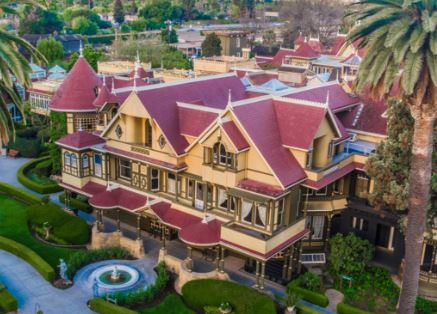
It is safe to say that the second most important room in the Victorian home was the dining room, where not only the family gathered, but where social interaction took place among family and visitors. In the family it should be observed as a rule to meet together at all meals of the day around one common table where the same rules of etiquette should be as rigidly observed as the table of a stranger.

For further information about tours, including group tours, weddings, school events, birthday party packages, facility rentals, and special events please visit the website: https://winchestermysteryhouse.com/

Please visit the online giftshop, and purchase a gift for friends and relatives as well as a special memento of The Winchester Mystery House. A variety of souvenirs and gifts are available to purchase. https://shopwinchestermysteryhouse.com/

Troublesomeness of the Spirit
A rush of icy air swept across my skin. Goose bumps rose. Shivering, I blinked, trying to pierce the shifting darkness, a cold dark void with muted spots of blue light shrouded in a rising mist. I was freezing. My insides shivered with a new fear. I suddenly caught sight of a woman wearing a black cape standing in the center of the hallway near the Crystal Bedroom. I immediately stopped advancing down the hallway, thinking it was a vengeful spirit looking for trouble. To my amazement, as I hastily drew near her, the figure simply vanished. I walk through the hall and looked all around, but there was not the slightest sign of anybody, and nowhere where anyone could have gone. I walked toward the library and carried on, and when I drew near my desk, I saw the figure again. This visible spirit had been one of the more ominous ghosts I had ever beheld. I was so used to shadows, interior voices, and even possessions; but to see the seemingly solid form was terrifying. I started to approach her; I saw something walking across the room wearing a grey cloak. Standing in the doorway, I was utterly shattered. This was a little more than I could easily bear. The morning after I saw these apparitions I was in a state of terror, and could not bear to be left alone, daylight though it was. At this moment the unwonted sound of carriage wheels and many hoofs upon the road, arrested my attention. They seemed to be approaching from the high ground overlooking the fruit orchard, and very soon the equipage emerged from that point. The wild gallop of the horses came thundering toward my home with the speed of a hurricane. The excitement of the scene was made more painful by the clear, long-drawn screams of a woman’s voice from the carriage window. #RandolphHarris 1 of 5
We all advanced in curiosity and horror. There appeared unto me the resemblance of an aged gentleman with a pole or staff in his hand, resembling that he was wont to carry when living to kill the moles withal. The spectrum approached near the young man, whom you may imagine not a little surprised at the appearance of one that he knew to be dead. This apparition, of the old man with the pole, was only the harbinger of more extraordinary events. At evening prayers, during the Psalms, the wood in my home seemed to become more chilly than usual. The whispering in my house was more persistent tonight. I seemed not to be rid of it in my room. I have not noticed this before. I was very much troubled in sleep. No definite image presented itself, but I was pursued by the very vivid impression that wet lips were whispering into my ear with great rapidity and emphasis for some time together. After thus, I supposed, I fell asleep, but was awakened with a start by a feeling as if a hand were laid on my shoulder. To my intense alarm I found myself standing at the top of the lowest flight of the first staircase. The moon was shining brightly enough through the large window to let me see that there was an apparition on the second or third step. I could make no comment. I crept up to be again, I do not know how. Yes, mine is a heavy burden. The morning of 26th of November was cold and tempestuous. At an early hour the servants had occasion to go into the front hall of the residence. What was their horror upon observing the form of the butler, Otto Meckelburg, lying upon the landing of the principal staircase in an attitude which inspired the gravest fears. Assistance was procured, and a universal consternation was experienced upon the discovery that he had been the object of a brutal and murderous attack. #RandolphHarris 2 of 5
The vertebral column was fractured in more than one place. This might have been the result of a fall: it appeared that the stair-carpet was loosed at one point. However, in addition to this, there were injuries inflicted upon the eyes, nose and mouth, as if by the agency of some savage animal, which, dreadful to relate, rendered those features unrecognizable. The vital spark was, it is needless to add, completely extinct, and had been so, upon the testimony of respectable medical authorities, for several hours. The author of authors of this mysterious outrage are alike buried in mystery, and the most active conjecture has hitherto failed to suggest a solution of the melancholy problem afford by this appalling occurrence. I could not overcome my anxiety. The rest of the day—the late afternoon reception, the dinner itself, the after-dinner gathering—passed easily, even routinely, but did not seem to me very real; it was not very convincing. The vision of Llanada Villa kept rising in my mind’s eye. How odd, how very beautiful the experience had been, yet there was no one to whom I might speak about it. The other did not notice my discomfort. In fact they claimed that I was looking well, they were delighted to see me and to shake my hand. Many were old acquaintances, men and women, but primarily women; a number of them wanted to be introduced to me and tour my lovely home. At dinner, though my voice was distracted, I spoke of the usual matters. Thought I had changed into a linen dress of pale blue, my mind kept drifting away from the others, from the new and handsome dark colonial dining room. I smiled at other, and laughed with the others. Though there were people who clearly wished to talk with me, I kept drifting back to the horrible events of earlier, and knew a night of insomnia awaited. #RandolphHarris 3 of 5

It was a soft clear evening, and I loitered in the garden, speculating upon the possible meanings of the apparitions. Llanada Villa was a marvelous and mystic beauty, and I almost forgot the sinister oppression with which its inhuman age and massiveness had chocked and weighed on my spirit. I had already walked nearly a mile before reaching my favourite tree, and by that time the moon was shining brilliantly. The moon was fully of idyllic and magnetic influence—and when I looked at the windows of Llanada Villa, they flashed and twinkled with that silvery splendour, as if unseen hands had lighted up the rooms to receive guests. Then for a moment, I felt sour fear. Sinister sculptures leered menacingly from the oppressive walls. As the night drew on, the housemaid’s head was thrust into a very strait place betwixt a bed’s head and a wall, and forced by the strength of men to be removed thence, and that not without being much hurt and bruised, so that much blood appeared about it: upon this it was advised that she should be bleeded, to prevent any ill-accident that might come of the bruise; after bleeding, the ligature or binder of her arm was removed from thence and conveyed about her middle, where it was strained with such violence that the girding had almost stopped her breath and killed her, being cut asunder it made a strange and dismal noise, so that the other servants were affrighted by it. At other times, housemaids had been in danger to be strangled with cravats and handkerchiefs that they had worn about their necks, which had been drawn so close that with the sudden violence they had near been choked to death, and hardly escaped death. #RandolphHarris 4 of 5

After a steeply descending walk of about a mile through my home, one could tell there was something abnormal about the whole business—the strange things we had tried so hard to hid. The harpsichord music was something of a comfort, as Mozart always is, with his merriment, no matter what the composition, but nevertheless, I felt restless and unsafe in these warm rooms where I was accustomed to spend many hours in comfort alone. The specter had showed great offense at the periwigs which young male servants used to wear, for they were often torn from their heads after a very strange manner. The male servants would often find their periwigs removed from their boxes and rendered into many small parts and tatters. Hans Bogner, while lying in his chamber with his periwig on his head, to secure it from danger, within a little time it was town from him, and reduced into very small fragments. I felt confusion and guilt. I had to get my mind clear. Walking through the twisting corridors of my mansion, from a pitch-black room there burst the most appalling and demoniac succession of cries that I had ever heard. Not more unutterable could have been the chaos of hellish sound if the pit itself had opened to release the agony of the damned, for in one inconceivable cacophony was centered all the supernatural terror and unnatural despair of animate nature. Human it could not have been—it is not in man to make such sounds—and without a thought, I frantically ran until I was out of breath. Afterward I was not able to shake off the maddening sensation of being haunted and hunted. I had seen a good deal in the last few years, and was prepared to believe and keep silent about many appalling and incredible secrets of Llanada Villa. The black inner World, of whose existence we had not known before. #RandolphHarris 5 of 5
Many strange and fantastical things have been done by spirits or demons in The Winchester Mystery House. In 1911, a barrel of salt of considerable quantity had been observed to march from the kitchen to the dining room without any human assistance. As well, an unidentified ghost has been seen entering the mansion, vanishing as she enters the gate, while a figure suspected to be Mrs. Winchester has been seen in the mansion corridors at night, apparently knitting with white-hot needles, seething over the memory of her daughter Annie, who died as an infant. https://winchestermysteryhouse.com/
Please visit the online giftshop, and purchase a gift for friends and relatives as well as a special memento of The Winchester Mystery House. A variety of souvenirs and gifts are available to purchase. https://shopwinchestermysteryhouse.com/


Are We All Liars?

When it comes to Russia, the question that raises perhaps the greatest difficulty of all for the realistic understanding of the nature of Soviet Russia and her political intentions is that of the meaning of Communist ideology. If it is true that Russia since 1923 has not been a revolutionary system, has not attempted to bring about revolution in the Western countries, and, in fact, has tried to contain them, how is one to look upon the fact that the Russians constantly speak of “the final victory of communism in the World,” and of capitalism as the enemy which eventually will be displaced by communism, et cetera? To understand this apparent paradox, one must understand ideologies. “An ideology” is a system of ideas. In talking, for instance, about conservative ideology one refers to the conservative system of thought, et cetera. This use of ideology may be called descriptive. Since the middle of the nineteenth century one finds other, more dynamic concepts. The dynamic concept of ideology is based on the recognition of the fact that man has longings and passions that are deeply rooted in his nature and in the very conditions of human existence. These inherently human needs are freedom, equality, happiness, and love. If these needs remain unsatisfied, they become perverted into irrational passions like the striving for submission, power, destruction, and so on. In many cultures these irrational passions are the main driving forces, yet only few societies openly admit that they want destruction or conquest. Man’s need to believe that he is prompted by humans and constructive impulses is so great that it always makes one disguise (to oneself and to others) his most immortal and irrational impulses, making them appear as though they were noble and good. #RandolphHarris 1 of 20

In the history of the last four thousand years the great spiritual leaders of mankind—Martin Luther, Martin Luther King, Jr., Lao-tse, Buddha, Isaiah, Zoroaster, Jesus, and many others—have articulated the deepest longings of man. It is remarkable how similar are the fundamental ideas that have been expressed by the various leaders. They penetrated the crust of custom, indifference, and fear by which most people protect themselves from authentic experience, and found followers who awakened from half-slumber to follow them in their ideas. This happened in China, India, Egypt, Palestine, Persia, Greece—where new religions and philosophical schools were formed. However, after a while these ideas lost their strength. While people in the first flush of bloom experienced what they thought they thought, they slowly began to have purely cerebral, alienated thoughts, instead of authentic experiences. This is not the place to discuss the complex and difficult problem of why this deterioration occurs. It suffices to say that it would be much too easy to explain the problem by the fact of the death of the charismatic leader. It is even not enough to point to the fact that freedom, love, and equality are qualities for the achievement of which one needs courage, will, and the capacity for making sacrifices; nor is it enough to say that much as people want freedom, they are also afraid of it, and want to escape from it, and hence that when the first period of enthusiasm has evaporated, people are no longer capable of holding on to the original ideas. True as all this may be, there is another and more important reason. Man, in the process of history, changes his environment and changes himself. However, this process is slow. #RandolphHarris 2 of 20

Aside from primitive societies, the development of civilization and the development of man has proceeded in such a way that the majority of men have had to serve the minority, because the material basis for a dignified life for all was not available. How could the ideal of love and of equality be experienced authentically over any length of time by enslaved people, by serfs, by the poor whose lives were mainly a struggle against starvation and sickness? How could the ideal of freedom remain alive among those who had to submit to the demands of the few who had power over them? Yet people could not live without faith in these ideals, and without the hope that in time they could be realized. The priests and kinds who came after the prophets made use of this need. They appropriated the ideals, systematized them, transformed them into a ritual, and used them to control and to manipulate the majority. Thus the ideal was transformed into an ideology. The words remain the same, yet they have become rituals, and are no longer living words. The idea becomes alienated; it ceases to be the living, authentic experience of man, and becomes instead an idol outside of him, which he worships, to which he submits, and which he also uses in order to cover up rationalize his most irrational and immoral acts. The ideology serves to bind people together, and to make them submit to those who administer the proper use of the ideological ritual; it serves to rationalize and to justify all irrationality and immorality that exist within a society. At the same time the ideology, containing in itself the froze idea, as it were, satisfies the adherents of the system; they believe themselves to be in touch with the most fundamental needs of man, with love, freedom, equality, brotherliness—because they hear and say these words. #RandolphHarris 3 of 20

And at the same time, however, the ideology also presents these ideas. While they become rituals they nevertheless remain expressed; they become living ideas again when the historical situation enables man to awaken and to experience again as real that which had become an idol. When the ideology ceases to be a ritual, when it becomes connected again with individual and social reality, then it is retransformed from ideology into an idea. It is as if ideology were a seed, resting for years in sand and then transplanted into fertile ground where it grows again. An ideology, then, is at the same time a deceptive substitute for an idea and its preservation, until the time has come for its revival. Ideologies are administered by bureaucracies that control their meaning. They develop systems, they decide what is right and what is wrong thinking, who is faithful and who is a heretic; the manipulation of ideologies becomes one of the most important means for the control of the people through the control of their thoughts. The ideologies become systematized and acquire their own logic; words have their specific meanings and—this is very important—new or even opposite ideas are still expressed in the terms of the older ideological frame of reference. (One of the most drastic examples of this is Mr. Spinoza’s negation of the God of monotheism which he expressed in terms of a definition of God apparently only slightly different from the orthodox definition.) The ideas of Mr. Marx were transformed into ideologies. A new bureaucracy took over, and established its rulership on principles exactly the opposite of the original ideas. #RandolphHarris 4 of 20
The Russians say that they are a classless society, that they have achieved a true democracy, that they are moving toward the withering away of the state, that their aim is the fullest development of the individua personality, the self-determination of man. These are Mr. Marx’s ideas; indeed, they are ideas that Mr. Marx shared with other socialist and anarchist thinkers, with enlightenment thought, and, in the last analysis, with the whole tradition of Western humanism. Yet, the Russians have transformed these ideas into an ideology; a bureaucracy which makes the state increasingly powerful at the expense of the individual, rules in the name of the ideas of individuality and equality. How can this phenomenon be understood? Are the Soviet leaders plain lairs deceiving their people? Are they cynics who do not believe a word they say? This is a puzzling question; many people are prone to assume that the Russians either fully mean what they say, or that they are outright liars. Yet if we were to examine ourselves more carefully, we might find that we too do the same thing without being aware of it. Most people in the West believe in God, hence in God’s principles of love, charity, justice, truth, humility, et cetera. Yet these ideas have little influence on our behaviour. Most of us are motivated by the wish for greater material comfort, security, and prestige. While people believe in God, they are not concerned with God, that is, they do not worry or lose sleep over religious or spiritual problems. Yet we pride ourselves on being “God-fearing” and call the Russians “godless.” #RandolphHarris 5 of 20

Or, mot Americans believe that the capitalist system under which we live is based on the free, unmanaged market, on private property, a minimum of government control, on individual initiative. While that was true nearly two hundred years ago, it is not true now. The means of production are essentially not controlled by those (still only a small minority) who own them; individual initiative is drowned in a bureaucratic system and more often found in “Western” films than in real life; the “free” market has become a directed and manipulated market; the state, instead of interfering minimally, is the biggest employer and customer and support industry whenever it seems desirable to the “government-business-armed services” bureaucracy. We say that we are an alliance of freedom-loving people, yet quite a number of dictatorships belong to our alliance. We accuse the Communists of wanting to proselytize us and make communism a World system—but we sat that “it is our aspiration also to see the Russian people freed from their present enslavement, and the Chinese people, too. We want people everywhere to be free.” Are we all liars? Or are we, and they, genuinely starting convictions? In order to fully understand that these alternatives are not the only one, it is useful to think of one of the most important discoveries of Dr. Freud: the nature of rationalization. Before Dr. Freud, it was generally believed that unless a person were lying one’s conscious thoughts are what one really thinks. Dr. Freud discovered that a person can be fully sincere, subjectively, and yet that one’s thought may have little weight or reality, that it may be only a cover, a “rationalization” for the real impulse which motivates one. Examples of this mechanism are known to many people by now. #RandolphHarris 6 of 20

Who does not know the scrupulously moral person who in the name of virtue and goodness dominates his wife and children and deprives them of their freedom and spontaneity? He is not lying when he recites his principles, yet if we analyze him, that is to say, if we study his effective motivations, we find that a wish for power or control or even a sadistic impulse to strangle any kind of spontaneity is what in reality motivates him. This reality is unconscious—while his consciousness is not real. Yet he is sincere and, in fact, would be genuinely indignant if his motives were even questioned. Moreover, his ideology is not simply an empty lie and a means to dominate his family all the better because he uses noble phrases and this impresses them. He actually has a genuine longing for goodness, virtue, and love, but instead of acting upon these impulses, he transforms them into words and deceives himself with the illusion that he is in touch with love when he talks about love. Mr. Stalin or Mr. Khrushchev, using the words of Mr. Marx use them ideologically, just as most of us use the words of the Christian Bible, Book of Mormon, of President Jefferson, of Mr. Emerson, ideologically. We fail, however, to recognize the ideological and ritualistic character of Communist utterances, just as we overlook the ideological and ritualistic character of many of our own statements. Hence, when we hear Mr. Khrushchev pronounce Mr. Marx’s or Mr. Lenin’s words, we believe that he means what they meant, while the fact is that these ideas are no more real to him that the wish to save pagan souls was to the European colonialists. #RandolphHarris 7 of 20

Paradoxically, the only people who take the Communist ideology seriously are we in the United States of America, while the Russian leaders have the greatest trouble in shoring it up with nationalism, moral teaching, and increased material satisfactions. Every social and economic system is not only a specified system of relations between things and institutions, but a system of human relations. Any concept and practice of socialism must be examined in terms of the kind of relations between human beings to which it is conducive. The supreme vale in all social and economic arrangements is man; the goal of society is to offer the conditions for the full development of man’s potentialities, his reason, his love, his creativity; all social arrangements must be conductive to overcoming the alienation and crippledness of man, and to enable him to achieve real freedom and individuality. The aim of socialism is an association in which the full development of each is the condition for the full development of all. The supreme principle of socialism is that man takes precedence over things, life over property, and hence, work over capital; that power follows creation, and not possession; that man must not be governed by circumstances, but circumstances must be governed by man. In relations between people, every man is an end in himself and must never be made into a means to another man’s ends. From this principle it follows that nobody must personally be subject to anyone because one owns capital. Humanistic socialism is rooted in the conviction of the unity of mankind and the solidarity of all men. It fights any kind of worship of State, nation, or class. #RandolphHarris 8 of 20

The supreme loyalty of man must be to the human race and to the moral principles of humanism. It strives for the revitalization of those ideas and values upon which Western civilization was bult. Humanistic socialism is radically opposed to war and violence in all and any forms. It considers any attempt to solve political and social problems by force and violence not only as futile, but as immoral and inhuman. Hence it is uncompromisingly opposed to any policy which tries to achieve security by armament. It considers peace to be not only the substance of war, but a positive principle of human relations based on free cooperation of all men for the common good. From socialist principle it follows not only that each member of society feels responsible for his fellow citizens, but for all citizens of the World. The injustice which lets two-third of the human race live in abysmal poverty must be removed by an effort far beyond the other ones hitherto made by wealthy nations to help the underdeveloped nation to arrive at a humanly satisfactory economic level. Humanistic socialism stands for freedom. It stands for freedom from fear, want, oppression, and violence. However, freedom is not only from, but also freedom to; freedom to participate actively and responsibly in all directions concerning the citizen, freedom to develop the individual’s human potential to the fullest possible degree. Production and consumption must be subordinated to the needs of man’s development, not the reverse. As a consequence all production must be directed by the principle of its social usefulness, and not by that of its material profit for some individuals or corporations. #RandolphHarris 9 of 20

Hence if a choice has to be made between greater production on the one hand, and greater freedom and human growth on the other, the human as against the material value must be chosen. In a socialist industrialism the goal is not to achieve the highest economic productivity, but to achieve the highest human productivity. This means that the way in which man spends most of his energy, in work as well as in leisure, must be meaningful and interesting to him. It must stimulate and help to develop all his human powers—his intellectual as well as his emotion and artistic ones. While, in order to live humanly, basic material needs must be satisfied, consumption must not be an aim in itself. All attempts to stimulate material needs artificially for the sake of profit must be prevented. Waste of material resources and senseless consumption for consumption’s sake are destructive to mature human development. Humanistic socialism is a system in which man governs capital, not capital man; in which, so far as it is possible, man governs his circumstances, not circumstances man; in which the members of society plan what they want to produce, rather than have their production follow the laws of the impersonal powers of the market and of capital with its inherent need for maximum profit. Humanistic socialism is the extension of the democratic process beyond the purely political realm, into the economic sphere; it is political and industrial democracy. It is the restoration of political democracy to its original meaning: the true participation of informed citizens in all decisions affecting them. #RandolphHarris 10 of 20

Extension of democracy into the economic sphere means democratic control of all economic activities by the participants: manual workers, engineers, administrators, et cetera. Humanistic socialism is not primarily concerned with legal ownership, but with social control of the large and powerful industries. Irresponsible control by bureaucratic management representing the profit interest of capital must be replaced by administration acting on behalf of, and controlled by, those who produced and consume. The aim of humanistic socialism can be attained only by the introduction of a maximum of decentralization compatible with a minimum of centralization necessary for the coordinated functioning of an industrial society. The functions of a centralized state must be reduced to a minimum, while the voluntary activity of freely cooperating citizens constitutes the central mechanism of social life. Does our definition of freedom as non-submission to any higher power exclude sacrifices, including the sacrifice of one’s life? This is a particularly important question today, when Fascism proclaims self-sacrifice as the highest virtue and impresses many people with its idealistic character. There are two entirely different types of sacrifice. It is one of the tragic fact of life that the demands of our physical self and the aims of our mental self can conflict; that actually we may have to sacrifice our physical self in order to assert the integrity of our spiritual self. This sacrifice will never lose its tragic quality. Death is never sweet, not even if it is suffered for the highest ideal. It remains unspeakably bitter, and still it can be the utmost assertion of our individuality. Such sacrifice is fundamentally different from the “sacrifice” which Fascism preaches. #RandolphHarris 11 of 20

There, sacrifice is not the highest price man may have to pay to asset his self, but it is an aim in itself. This masochistic sacrifice sees the fulfillment of life in its very negation, in the annihilation of the self. It is only the supreme expression of what Fascism aims at in all its ramifications—the annihilation of the individual self and its utter submission to a higher power. It is the perversion of true sacrifice as much as suicide is the utmost perversion of life. True sacrifice presupposes an uncompromising whish for spiritual integrity. The sacrifice of those who have lost it covers up their moral bankruptcy. One last objection is to be met: If individuals are allowed to act freely in the sense of spontaneity, if they acknowledge no higher authority than themselves, will anarchy be the inevitable result? In so far as the word anarchy stands for heedless egotism and destructiveness, the determining factor depends upon one’s understanding of human nature. Man is neither good nor bad; life has an inherent tendency to grow, to expand, to express potentialities; if life is thwarted, if the individual is isolated and overcome by doubt or a feeling of aloneness and powerlessness, then one is driven to destructiveness and craving for power or submission. If human freedom is established as freedom to, if man can realize his self fully and uncompromisingly, the fundamental cause for his asocial drives will have disappeared and only a sick and abnormal individual will be dangerous. This freedom has never been realized in the history of mankind, yet it has been an ideal to which mankind has stuck even if it was often expressed in abstruse and irrational forms. #RandolphHarris 12 of 20

There is no reason to wonder why the record of history shows to much cruelty and destructiveness. If there is anything to be surprised at—and encouraged by—it is the fact that the human race, in spite of all that has happened to men, has retained—and actually developed—such qualities of dignity, courage, decency, and kindness as we find them throughout history and in countless individuals today. If by anarchy one means that the individual does not acknowledge any kind of authority, the answer is to be found in what has been said about the difference between rational and irrational authority. Rational authority—like a genuine ideal—represents the aims of growth and expansion of the individual. It is, therefore, in principle never in conflict with the individual and one’s real, and not one’s pathological, aims. Freedom has a twofold meaning for modern man: that he has been freed from traditional authorities and has become an “individual,” but that at the same time he had become isolated, powerless, and an instrument of purpose outside of himself, alienated from himself and others; furthermore, that this state undermines his self, weakens and frightens him, and makes him ready for submission to new kinds of bondage. Positive freedom on the other hand is identical with the full realization of the individual’s potentialities, together with one’s ability to live actively and spontaneously. Freedom has reached a critical point where, driven by the logic of its own dynamism, it threatens to change into it opposite. The future of democracy depends on the realization of the individualism that has been the ideological aim of modern thought since the Renaissance. #RandolphHarris 13 of 20

The cultural and political crisis of our day is not due to the fact that there is too much individualism but that what we believe to be individualism has become an empty shell. The victory of freedom is possible only if democracy develops into a society in which the individual, his growth and happiness, is the aim and purpose of culture, in which life does not need any justification in success or anything else, and in which the individual is not subordinated to or manipulated by any power outside of himself, be it the State or the economic machine; finally, a society in which his conscience and ideals are not the internalization of external demands, but are really his and express the aims that result from the peculiarity of his self. These aims could not be fully realized in any previous period of modern history; they had to remain largely ideological aims, because the material basis for the development of genuine individualism was lacking. Capitalism has created this premise. The problem of production is solved—in principle at least—and we can visualize a future of abundance, in which the fight for economic privileges is no longer necessitated by economic scarcity. The problem we are confronted with today is that of the organization of social and economic forces, so that man—as a member of organized society—may become the master of these forces and cease to be their slave. #RandolphHarris 14 of 20

There is a psychological side of freedom, but the psychological problem cannot be separated from the material basis of human existence, from the economic, social, and political structure of society. It follows from this premise that the realization of positive freedom and individualism is also bound up with economic and social changes that will permit the individual to become free in terms of the realization of his self. We cannot afford to lose any of the fundamental achievements of modern democracy—either the fundamental one of representative government, that is, government elected by the people and responsible to the people, or any of the rights which the Bill of Rights guarantees to every citizen. Nor can we compromise the newer democratic principle that no one shall be allowed to starve, that society is responsible for all its members, that no one shall be brightened into submission and lose one’s human pride through fear of unemployment and starvation. These basic achievements mut not only be preserved; they must be fortified and expanded. In spite of the fact that this measure of democracy has been realized—though far from completely—it is not enough. Progress for democracy lies in enhancing the actual freedom, initiative, and spontaneity of the individual, not only in certain private and spiritual matters, but above all in the activity fundamental to every man’s existence, his work. What are the general conditions for that? The irrational and planless character of society must be replaced by a planned economy that represent the planned and concerted effort of society as such. #RandolphHarris 15 of 20

Society must master the social problem as rationally as it has mastered nature. One condition for this is the elimination of the secret rule of those who, though few in number, wield great economic power without any responsibility to those whose fate depends on their decisions. We may call this new order by the name of democratic socialism but the name does not matter; all that matters is that we establish a rational economic system serving the purposes of the people. Today the vast majority of the people not only have no control over the whole of the economic machine, but they have little chance to develop genuine initiative and spontaneity at the particular job they are doing. They are “employed,” and nothing more is expected from them than that they do what they are told. Only in a planned economy in which the whole nation has rationally mastered the economic and social forces can the individual share responsibility and use creative intelligence in his work. All that matters is that the opportunity for genuine activity be restored to the individual; that the purposes of society and of one’s own become identical, not ideologically but in reality; and that he apply his effort and reason actively to the work he is doing, as something for which he can feel responsible because it has meaning and purpose in terms of one’s human ends. We must replace manipulation of men by active and intelligent co-operation, and expand the principle of government of the people, by the people, for the people, so help me God, from the formal political to the economic sphere. The only criterion for the realization of freedom is whether or not the individual actively participates in determining one’s life and that of society, and this not only by the formal act of voting but in one’s daily activity, in one’s work, and in one’s relations to others. #RandolphHarris 16 of 20

Modern political sphere, cannot sufficiently counteract the results of the economic insignificance of the average individual. However, purely economic concepts like socialization of the means of production are not sufficient either. I am not thinking here so much of the deceitful usage of the word socialism as it has been applied—for reasons of tactical expediency—in National Socialism. I have in mind Russia where socialism has become a deceptive word; for although socialization of the means of production has taken place, actually a powerful bureaucracy manipulates the vast mass of the population; this necessarily prevents the development of freedom and individualism, even if government control may be effective in the economic interest of the majority of the people. Never have word been more misused in order to conceal the truth than today. Betrayal of allies is called appeasement, military aggression is camouflaged as defense against attack, the consequences of small nations goes by the name of a pact of friendship, and the brutal suppression of the whole population is perpetrated in the name of National Socialism. The words democracy, freedom, and individualism become objects of this abuse too. There is one way to define the real meaning of the difference between democracy and Fascism. Democracy is a system that creates the economic, political, and cultural conditions for the full development of the individual. Fascism is a system that, regardless under which name, make the individual subordinate to extraneous purposes and weakens the development of genuine individuality. #RandolphHarris 17 of 20

Obviously, one of the greatest difficulties in the establishment of the conditions for the realization of democracy lies in the contradiction between a planned economy and the active co-operation of each individual. A planned economy of the scope of any big industrial system requires a great deal of centralization and, as a consequence, a bureaucracy to administer this centralized machine. On the other hand, the active control and co-operation by each individual and by the smallest units of the whole system requires a great amount of decentralization. Unless planning from the top is blended with active participation from below, unless the stream of social life continuously flows from below upwards, a planned economy will lead to renewed manipulation of the people. To solve this problem of combining centralization with decentralization is one of the major tasks of society. However, it is centrally no less soluble than the technical problems we have already solved and which have brought us an almost complete mastery over nature. It is to be solved, however, only if we clearly recognize the necessity of doing so and if we have faith in the people, in their capacity to take care of their real interest as human beings. In a way it is again the problem of individual initiative with which we are confronted. Individual initiative was one of the great stimuli both of the economic system and also of personal development under liberal capitalism. However, there are two qualifications: it developed only selected qualities of man, his will and rationality, while leaving him otherwise subordinate to economic goals. #RandolphHarris 18 of 20

It was a principle that functioned best in a highly individualized and competitive phase of capitalism which had room for countless independent economic units. Today this space has narrowed down. Only a small number can exercise individual initiative. If we want to realize this principle today and enlarge it so that the whole personality becomes free, it will be possible only on the basis of the rational and concerted effort of a society as a whole, and by an amount of decentralization which can guarantee real, genuine, active co-operation and control by the smallest units of the system. Only if man masters society and subordinates the economic machine to the purpose of human happiness and only if he actively participates in the social process, can he overcome what now drives him into despair—his aloneness and his feelings of powerlessness. Man does not suffer so much from poverty today as he suffers from the fact that he has become a cog in a large machine, an automaton, that his life has become empty and lost its meaning. The victory over all kinds of authoritarian systems will be possible only if democracy does not retreat but takes the offensive and proceeds to realize what has been its aim in the minds of those who fought for our freedom throughout the last centuries. It will triumph over the forces of nihilism only if it can imbue people with a faith that is the strongest the human mind is capable of, the faith in life and in truth, and in freedom as the active and spontaneous realization of the individual self. Ideologies and culture in general are rooted in the social character; the social character itself is molded by the mode of existence of a given society; and in their turn the dominant character traits become productive forces shaping the social process. #RandolphHarris 19 of 20

The collapse of medieval society threatened the middle class; this threat resulted in a feeling of powerless isolation and doubt; this psychological change was responsible for the appeal of Mr. Luther’s and Mr. Calvin’s doctrines; that these doctrines intensified and stabilized the characterological changes; and that the character traits that thus developed then became productive forces in the development of capitalism which in itself resulted from economic and political changes. With regard to Fascism the same principle of explanation was applied: the lower middle class reacted to certain economic changes, such as the growing power of monopolies and postwar inflation, with an intensification of certain character traits, namely, sadistic and masochistic strivings; the Nazi ideology appealed to and intensified these traits; and the new character traits then became effective forces in supporting the expansion of German imperialism. Germany is already looked at as a superior country, and known for producing some of the best products known to mankind. When a certain class is threatened by new economic tendencies, it reacts to this threat psychologically and ideologically; and that the psychological changes brought about by this reaction further the development of economic forces even if those forces contradict the economic interests of the class. Economic, psychological, and ideological forces operate in this way: that man reacts to changing external situations by changes in himself, and that these psychological factors in their turn help in molding the economic and social process. Economic forces are effective, but they must be understood not as psychological motivation but as objective conditions. I pledge allegiance to the flag of the United States of America, and to the Republic, for which it stands, One Nation, Under God, Indivisible with Liberty and Justice for All. The Sacramento Fire Department has been proudly serving the City of Sacramento since 1851, and they are not receiving all of their resources. Please open your hearts this holiday season and make any donation you can. #RandolphHarris 20 of 20
When building a custom home, your experience is just as vital as the final product you live in. Whether you’re building a custom home in Utah or another state, we can help. Our team at Millhaven goes beyond the build with our full-service approach to each project. https://millhavenhomes.com/


Winter’s Chill was in the Air

In the middle of the night, I was awaked by a frightful scream which came, or seemed to come from the roof of the mansion: and noises simultaneously reached me which seemed as if twenty or thirty chattering workmen were removing the tiles, and flinging them down as fast as possible into the garden below. I hastily got up, the apparition made itself visible, in its manly guise, just a foot from me, as its wont, and then caused my candle to go out, though it had no breath of its own with which to do it with. I summoned the man-servant, want downstairs with him to the front door, armed with a brace of loaded Winchester ‘73s. We expected to find thieves, or a body of lunatics, or Chartist rioters on an errand of destruction. However, on opening the door and making examination, not a soul was to be seen—not a sound heard. None of the tiles had been removed; while the garden was perfectly still and deserted. Amid the elms and the dogwood, the bird of paradise plants and the palms, noting had been disturbed. Coming back to my chamber, I found my windows open and the drapes flapping in the breeze, and had to latch the windows again. The linen from my bed had been thrown hither and tither, and my papers had been scattered about. I stayed awake for some time afterwards when suddenly the door of my bedroom opened, and shut again rather quickly. I fancied it might be one of the servants and called out, “Come in!” After a short time the door opened again, but no one came in—at least no one I could see. Almost at the same time as the door opened for the second time, I was a little startled by the rustling of some curtains belonging to a hanging wardrobe that stood by the side of the bed; the rustling continued, and I was seized with the most uncomfortable feeling, not exactly of fright, but a strange unearthly sensation that I was not alone. #RandolphHarris 1 of 6

I had had that feeling for some minutes, when I saw at the foot of the bed a priest buttoned up tight in a black rain coat. His face was shadowed, deep-hollowed under brow and cheekbone. He looked to be in his forties. Looks can be deceiving. Something compelled him to raise his eyes to my face, and when he did so, he halted. Eyes momentarily alive, he scrutinized my face. The man seemed as if he were on the bed, and came gliding toward me as I lay. The sensation of panic deepened. My breath came shallow and rushed, my thoughts flew wildly in all directions, I was simply terrified and could not move. I tried to speak to him but could not. He came slowly on up to the top of the bed, and then I saw his face clearly. He seemed in great trouble; his hands were clasped and his eyes were turned up with a look of entreaty, an almost agonized look. Then, slowly unclasping his hands, he touched me on the shoulder. The hand felt icy cold, and while I strove to speak he was gone. I felt more frightened after the priest was gone than before, and began to be very anxious for the time when the servant would make her appearance. Whether I slept again or not, I hardly know. However, by the time the servant did come, I had almost persuaded myself that the whole affair was nothing but a very vivid nightmare. However, when I came down to breakfast, there were many remarks made about my not looking well—it was observed that I was pale. In answer, I told the servants that I had had a most vivid nightmare, and I remarked if I was a believer in ghosts I should imagine I had seen one. Nothing more was said at the time upon the subject, except that my guest, Dr. Wayland, observed that I had better not sleep in that room again, at any rate not alone. #RandolphHarris 2 of 6
As the evening came, the twilight deepened; and in many parts of the tangled hallways there was an approach to absolute blackness. I found myself walking unusually slow. It was unlike me, and the queer disorienting sense of being unreal, of having stepped into another World, was totally new. I was so panicked I could hardly catch my breath. I wanted to run out of the hallway, wanted to run out of my mansion. It was as if a demon had appeared to me. It breathed into my face, shoved me about, tried to pull me under. I would suffocate: I would be destroyed. The sensation was possibly the most unpleasant I had ever experienced in my life though it carried with it no pain and no specific images. Why I was frightened I could not gasp. Why I wanted nothing more than to run out of my home, to escape the unseen, yet curious eyes, I was never to understand. However, I could not flee. To form even a rudimentary idea of my thoughts and feelings as I slowly penetrated this aeon-silent maze of unhuman masonry one must correlate a hopelessly bewildering chaos of fugitive moods, memories, and impressions. The sheer alluring antiquity and lethal desolation of the place were enough to overwhelm almost any sensitive person, but added to these elements were the recent unexplained horror. And the revelations all too soon effected by the terrible wailing and creaking sounds all around us. The apparitions rearing and dwelling in this frightful catacomb were wise and old. They are the makers and enslavers of life. They are the Great Old Ones that had filtered down from the stars when the Earth was young—the beings whose substance and powers were such as this planet had never bred. #RandolphHarris 3 of 6
So the following night, one of the chambermaid slept with me in the Crystal Bedroom. Neither one of us saw nor heard anything out of the way during that night or the early morning. That being the case, I persuaded myself that what I had seen had been only imagination and, much against everyone’s expressed wish, I insisted the next night on sleeping in the Daisy Bedroom again, and alone. Accordingly, having retired again to the same room, I was kneeling down at the bedside to say my prayers, when exactly the same dread as before came over me. The drapes of the wardrobe swayed about, and I had the same sensation as previously—that I was not alone. I felt too frightened to stir when, at that very moment, a chilling atmosphere and queer presence seemed to permeate the bedroom. There were unaccountable bangings and the sound of heavy breathing, accompanied by the feeling that something or somebody was in the room with me. And although I never saw anyone, I continued to hear footsteps. They went diagonally across the room, from an alcove beside the bed to the far wall where they stopped. Upon the ceiling, an apparition’s face appeared in the plaster as broad as half a crown. Frightened, I ran to the door, but could not open it for it was not unlatch. I nervously shuffled through my pockets to find the key to the door, but it slipped from my clutches and fell upon the floor. Kneeling to get the key, I noticed such a queer thing, a blue eye was seen peering through a knot-hole in the wooden floorboard. My troubled, I must confess it, increased upon me. As I lit my candle, something whispered to me, “Let me wish you a Happy New Year.” I could not had been mistaken: it spoke distinctly and with a peculiar emphasis. Had I dropped my candle, as I all but did, I tremble to think what the consequences must have been. As it was, I managed to get in bed quickly, and experienced no other disturbance. #RandolphHarris 4 of 6

Another curious thing happened on December 28. I had occasion to come downstairs to my library for my watch, which I had inadvertently left on my table when I went up to bed. I think I was at the top of the flight when I had a sudden impression of a sharp whisper in my ear, “Take care.” I clutched the balusters and naturally looked round at once. Of course, there was nothing. After a moment I went on—it was no good turning back—but I had as nearly as possible fallen: a car—a large one by the feel of it—slipped between my feet, but again, of course, I saw nothing. It may have been the kitchen cat, but I do not think it was. In shock, I went to back down to the library and worked from 9 to 10. The hall staircase seemed to be unusually full of what I can only call movement with sound: by this I mean that there seemed to be continuous going and coming, and that whenever I ceased writing to listen, or looked out into the hall, the stillness was absolutely unbroken. Nor, in going to my room was I conscious of anything that I could call a noise. It so happened that so happened that I told Heinrich Schnell to come to my room for the letter to Cynthia Hesdra which I wished to have delivered early in the morning at her mansion. He was to sit up, therefore, and come for it when he heard me retire. This I had for the moment forgotten, though I had remembered to carry the letter with me to my room. However, when as I was wining up my watch, I heard a light tap at the door, and a low voice saying, “May I come in?” (which I most undoubtedly did hear) I recollected the fact, and took up the letter from my dressing-table, saying, “Certainly: come in.” When I went to open the door she appeared before my eyes then vanished. As I strongly suspect I committed an error, I opened the door and held the letter out. There was certainly no one at that moment in the passage, but, in the instant of my standing there, the door at the end opened and Heinrich appeared carrying a candle. I asked him whether he had come to the door earlier; but am satisfied that he had not. I do not like the situation; but although my senses were very much on the alert, and thought it was sometime before I could sleep, I must allow that I perceived nothing further of a figment of my imagination. #RandolphHarris 5 of 6
I adjure thee, Emperor Lucifer by the hierarchy of superior intelligences to make our magick our Divine will imposed upon limitation and stasis. Allow our sorcery to be an external manifestation of our God self. All of your reality is a mirror upon which we can view the true essence of self and divinity. Allow the inner vision to become within the eternal darkness. May we feel and experience the colours emanating from the fire of spirit and unite them with the darkness. Allows these colours to move outward from within and merge to create the blackness and nothingness of the void so when they move back into our consciousness, we will notice how in our reality these colours again separate to create our physical surroundings through our observation and perception of them. May we maintain the knowledge that we are in complete control of all creation and how destiny within this World unfolds. I offer my blood unto the Divs and Druj, whom are of the essence of counter creation. I offer my life force unto the powers of eternal darkness found within. May they devour and destroy the imposed shackled of divine light and stasis that I may become as Zohak who is Ahriman in the flesh! Pursron and 22 Legions of Spirits, I awaken the powers of darkness which dwell within you by the power of the blood of the three headed Dragon Zohak that you may serve to empower my great work! Please bring forth hidden treasures, and devour all limitations for the sake of evolution and reveal the truth of the lie unto the Dark Apostles! Ediamazay acsat acsat acmahgnay acah tahsa ahteav oruha adzam ohgnav itiap ensey taa matah ehgney. Oybihzhkav acsaybieahdxuhsar acsaybarhtoaz acanhtoahys acacav…acarhtam ahgnahgnad ovzih. #RandolphHarris 6 of 6

The son of one of the caretakers of The Winchester Mystery House believed himself to be haunted with ghosts, and was confident that he met with an evil spirit in a certain field at the mansion, as he often went to school that way. He confessed that a woman, which appears to him, lived in the Winchester Mansion. Her name was Helena Blavatsky. She never spoke to him, but passed by hastily, and would always leave the footpath to him, and she commonly meet him twice or three times in the breadth of the field. She began to meet him constantly morning and evening, and always in the same field, and sometimes twice or thrice in breadth of it. After about a year, he began to suspect and believe she was a ghost, and had courage enough not to be afraid; but kept it to himself a good while, and only wondered very much at it. He did often speak to her, but never had a word in answer. Then he changed his way and went to school the under horse road, and then she always met him in the narrow lane, which was worse. At length he began to be terrified of her, and prayed continually that God would either free him from her or let him know the meaning of it. Night and day, sleeping and waking, the shape was ever running in his mind. Thus by degrees he grew very pensive, insomuch that it was taken notice of by all his family; whereupon being urged to it, he told his brother William about it. William laughed at him, sometimes chided him, but commanded him to keep his school and put such fopperies out of his head. He did accordingly go to school often, but always met the woman in the way.

After weeks, William noticed that his brother was losing weight, getting pale and was not sleeping. Early one morning, he decided to escort his brother to school. They walked for about an hour’s space in meditation and prayer before stepping into the disturbed field. The ghost appeared, and William spoke to hear in a loud voice, in some such sentences as the way of these dealings directed him, whereupon it approached but slowly, and when they came near it, it moved not. William spoke to it again, and it answered, in a voice neither very audible nor intelligible. He was not in the least terrified, and therefore persisted until it spoke again, and gave him satisfaction. However, the work could not be finished at that time; wherefore the same evening, an hour after sunset, the apparition met the brothers again in the same place, and after a few words of each side it quietly vanished; and neither doth appear since, nor will ever more to any man’s disturbance. The discourse in the morning lasted about a quarter of an hour. These things are true, and I know them to be so with as much certainty as eyes and ear can give me; and until I can be persuaded that my senses do deceive me about their proper object, I must and will assert that these things in this paper are true.
For further information about tours, including group tours, weddings, school events, birthday party packages, facility rentals, and special events please visit the website: https://winchestermysteryhouse.com/

Please visit the online giftshop, and purchase a gift for friends and relatives as well as a special memento of The Winchester Mystery House. A variety of souvenirs and gifts are available to purchase. https://shopwinchestermysteryhouse.com/

Beauty is Not Always Born Out of Pain, but Sometimes Greatness is

Although Joseph Stalin was considered a tyrant and slave driver by many, he is the reason for much of Russia’s current and past economic prosperity, success, recognition, and beauty. The White Sea-Baltic Canal is a testament to the genius of Mr. Stalin and Soviet engineering and to the hardiness of its workers. It stretches 141 miles from the White Sea in far northern Russia, traverses through the dense forest along the shores of Lake Onega, and empties into the Gulf of Finland at the eastern edge of the Baltic Sea. The canal was built to make sure that Moscow would not suffer from drought. Much of it was actually constructed by men and women, which includes the digging, and pouring of concrete. The project took for years to build. Construction on the Moscow Canal started in 1932 and was completed by 1936. An estimated of 100,000 inmates worked in frigid waters to create this waterway. It also contributed to economic success by allowing ships to important and export supplies. The Mayakovskaya Metro Station opened in 1938 and was also built by the Stalinist Empire. It is considered one of the most beautiful subway stations in the World being constructed of marble, with marble columns, u marble floors. The ceiling contains beautiful mosaic tiles, there are gorgeous circular lamps which gives the impression of a magnificent chandelier. The Moscow Metro Subway is one of the biggest and busiest systems in the World today. Mr. Stalin’s place was to sit atop the subway system. It was to be a skyscraper over 650 feet tall, with 42 floors, in a Gothic architecture style and on top there was going to be a giant 328-foot statue of Mr. Stalin. Construction on the building started, but it was never completed because World War II broke out and the steel was, instead, used to make tanks. #RandolphHarris 1 of 19

Another one of Mr. Stalin’s masterpieces is the seven towering skyscrapers known as The Seven Sisters. They are one of the leading architectural legacies of the Stalinist period. After World War II, the Communists had to rebuild large portions of their cities and villages. The Seven Sisters skyscrapers were built in Moscow between 1947 and 1957. Their construction was not just functional, but had ideological and political importance. They were intended to show the accomplishment and regeneration of the USSR in the post-war period, and provide exclusive residence for the Soviet and elite and international visitors. The Soviet Baroque architecture of the Seven Sisters are characterized by their wedding-cake shape intricate architectural and decorative details, and luxurious interiors. The Seven Sisters reflected the modernity, ambition and triumph of Soviet Russia. For years the tallest buildings in Europe, these seven commanding skyscrapers are significant monuments of architecture and urban planning which draws the eyes of admirers from all over the World. Many people compare President Trump to Mr. Stalin. They believe that he could achieve the same kind of prosperity for America because he loves the country and believes that he can “Make American Great Again.” President Trump has many prestigious infrastructure plans for the future, which even include affordable housing and brining manufacturing back to America so that America can again become a prosperous creditor nation, which no longer needs to borrow from China. Mr. Stalin also had ambitions plans to dominate the World. Cuba is no better proof of Russian plans to dominate the World. #RandolphHarris 2 of 19

The Cuban revolution was neither instigated by Moscow nor by the Cuban Communists, who had been collaborating with Batista until his downfall was near. Mr. Castro was never a Communist, but he planned a revolution which transcended the purely political limits of freeing the country from dictatorship. He started a social revolution, expropriating land owners and industry. United States of America’s government and public opinion started to turn against him, and forced Mr. Castro step by step to seek help, economically and politically, from the Soviet Union, and to accept the help of the Cuban Communist Party which had been held in contempt by the Castristas because of its obvious opportunism and corruption. Mr. Khrushchev threatened once to defend Cuba with nuclear bombs against American military intervention, when he knew quite well that the United States of America would not intervene in such a direct fashion. To make sure, he later withdrew this threat by declaring it was meant only symbolically. He has given only the minimum assistance and loans to the Cubans, and it seems that he exercised a restraining influence on Castro, which, after Mr. Guevara’s return from Moscow, led to repeated—though rejected—bids for a “new beginning” in Cuban-American relations. In Cuba too, Mr. Khrushchev has to cope with Chinese competition, which deprives him of some freedom of action. However, the total picture shows that Mr. Castro’s alliance with the Soviet Union was furthered more by United States of America’s action than by Mr. Khrushchev’s wish to penetrate Latin America. #RandolphHarris 3 of 19

No doubt Mr. Khrushchev wanted to keep the Communist Parties in Latin America alive for their nuisance value against the United States of America. He had to give some support to them because of his position as a leader in the Communist camp, (especially in view of the Chinese competition), but there is no evidence that Mr. Khrushchev had a serious wish to destroy all possibilities of an understanding with the United States of America by trying to make Latin America part of his empire. The cliché of the Soviet offensive against the United States of America in Berlin, Laos, the Congo, and Cuba was not based on reality but was rather a convenient formula to support further armament and the continuation of the cold war. It corresponds to the Chinese cliché that pictures the United States of America as seeking World domination by the support of Chiang Kai-shek, by the domination of Southern Korea and Okinawa, by the SEATO pact, et cetera. All these mutual accusations could not stand up to sober and realistic analysis. Mr. Kissinger expressed the view that it did not really matter whether the Soviet Union wanted to undermine all non-Communist countries for reasons of security the result would have been the same. Such a view led from the realm of analysis of political reality to the realm of fantasy. It remains a mystery why, considering the relative equality of power now, the Soviet Union would have to conquer the rest of the World in order to be secure, especially when it was clear that before she took the first steps on that road a nuclear war would break out which would be the end of all “security.” #RandolphHarris 4 of 19

Considering the Soviet Union’s very limited form of imperialism, several considerations must be considered. It has become customary to prove the Soviet Union’s unlimited imperialism by counting China with her 600,000,000 inhabitants (at the time) as another proof of Russian aggrandizement. Anybody familiar with the facts knows, of course, that this is sheer nonsense. The Chinese revolution was authentically Chinese; it triumphed in spite of Mr. Stalin’s conviction that it could not do so, and China received only a limited amount of assistance from Russia, even after the Communists had won. The Chinese-Russian alliance was logical for both sides, but it had also its serious problems, especially for the Russians. To consider China a “conquest” of Russia was nothing but a demagogic formula. What about the attitude of the Soviet Union toward the Communist Parties and toward national revolutions in the underdeveloped countries other than the nations we have already discussed? As far as the Communist Parties in the underdeveloped countries are concerned, part of their function is to serve as auxiliary forces for Russian foreign policy just as the Communist Parties do in the West. However, as far as revolutions in the underdeveloped countries are concerned, there is a considerable difference. While Mr. Stalin definitely did not want Communist revolutions in the West, he, just as Mr. Khrushchev was, was in favour of national revolutions in Asia and Africa. These national revolutions in underdeveloped countries are not a threat to the conservative Soviet regime, as Western workers’ revolutions would be. However, they are a very important political support for the Soviet policy, since they bring to power regimes that are not part of the Western Camp. #RandolphHarris 5 of 19

The West, and especially Great Britain, have now to pay for past mistakes. They often supported the reactionary upper-class regimes in Asia and Africa. The result is that now, whenever such a regime is overthrown, the new rulers will take an anti-British and often an anti-Western attitude. Naturally, the Soviet Union exploits this fact to her own advantage by playing the role of the anti-colonialist power for which it has the ideological tools. It does not, however, insist that the new powers become integrated into the Soviet bloc and are stratified with their neutrality. The encouraging trend in the Kennedy administration is that it also tends to accept neutrality as a satisfactory stance; there is no doubt that the United State of America has more of a historical tradition behind the ideas of anti-colonialism and national independence than the Soviet Union. What happened to socialism? The Cold War era saw a renaissance in the scientific study of parapsychology—clairvoyance, Extra Sensory Perception (ESP), second sight, and parakinesis, among other phenomena. By the latter half of the 1950s, the field was being rapidly institutionalized in West Germany, as in other parts of Europe and the United States of America. Socialism eventually succumbed to the spirit of capitalism which it had wanted to replace. Instead of understanding it as a movement for the liberation of man, many of its adherents and its enemies alike understood it as being exclusively a movement for the economic improvement of the working class. #RandolphHarris 6 of 19

The humanistic aims of socialism were forgotten, or only paid lip service to, while, as in capitalism, all the emphasis was laid on the aims of economic gain. Just as the ideals of democracy lost their spiritual roots, the idea of socialism lost its deepest root—the prophetic-messianic faith in peace, justice, and the brotherhood of humans. Thus socialism became the vehicle for the workers to attain their place within the capitalistic structure rather than transcending it; instead of changing capitalism, socialism was absorbed by its spirit. The failure of the socialist movement became complete when in 1914 its leaders renounced international solidarity and chose the economic and military interests of their respective countries as against the ideas of internationalism and peace which had been their program. The misinterpretation of socialism as a purely economic movement, and of nationalization of the means of production as its principal aim, occurred both in the right wing and in the left wing of the socialist movement. The reformist leaders of the socialist movement in Europe considered it their primary aim to elevate the economic status of the worker within the capitalist system, and they considered as their most radical measures the nationalization of certain big industries. Only recently have many realized that the nationalization of an enterprise is in itself not the realization socialism, that to be managed by a publicly appointed bureaucracy is not basically different for the worker than being managed by a privately appointed bureaucracy. #RandolphHarris 7 of 19

The leaders of the Communist Party in the Soviet Union interpreted socialism in the same purely economic way. However, living in a country much less developed than western Europe and without a democratic tradition, they applied terror and dictatorship to enforce the rapid accumulation of capital, which in western Europe had occurred in the nineteenth century. They developed a new form of state capitalism which proved to be economically successful and humanly destructive. They built a bureaucratically managed society in which class distinction—both in an economic sense and as far as the power to command other is concerned—is deeper and more rigid than in any of the capitalists societies of today. They define their system as socialistic because they have nationalized the whole economy, while in reality their system is the complete negation of all that socialism stands for—the affirmation of individuality and the full development of humans. In order to win the support of the mases who had to make unendurable sacrifices for the sake of the fast accumulation of capital, they used socialistic, combined with nationalistic, ideologies, and this gained them the grudging cooperation of the governed. Thus far the free-enterprise system is superior to the communist system because it has preserved one of the greatest achievements of modern humans—political freedom—and with it a respect for the dignity and individuality of humans, which links us with the fundamental spiritual tradition of humanism. It permits possibilities of criticism and of making proposals for constructive social change which are practically impossible in the Soviet police state. #RandolphHarris 8 of 19

It is to be expected, however, that once the Soviet countries have achieved the same level of economic development that western Europe and the United States of America has achieved—that is, once they can satisfy the demand for a comfortable life—they will not need terror, but will be able to use the same means of manipulation which are used in the West: suggestion and persuasion. This development will bring about the convergence of twenty-first century capitalism and twenty-first century communism. Both systems are based on industrialization; their goal is ever-increasing economic efficiency and wealth. They are societies run by a managerial class and by professional politicians. They are both thoroughly materialistic in their outlook, regardless of lip service to Christian ideology in the West and secular Messianism in the East. They organize the masses in a centralized system, in large factories, in political mass parties. In both systems, if they go on in the same way, the mass-man, the aliened man—a well-fed, well-clothed, well-entertained automaton-man governed by bureaucrats who have as little a goal as the mass-man has—will replace the creative, thinking, feeling man. Things will have the firs place, and man will be dead; he will talk of freedom and individuality, while he will be nothing. Where do we stand today? Capitalism and a vulgarized, distorted socialism have brought human to the point where one is in danger of becoming a dehumanized automaton; one is losing one’s sanity and stands at the point of total self-destruction. Only full awareness of one’s situation and its dangers and a new vision of a life which can realize the aims of human freedom, dignity, creativity, reason, justice, and solidarity can save us from almost certain decay, loss of freedom, or destruction. #RandolphHarris 9 of 19

We are not forced to choose between a managerial free-enterprise system and a managerial communist system. There is a third solution, that of democratic, humanistic socialism which, based on the original principles of socialism, offers the vision of a new, truly human society. Once upon a time there was a little boy who lived in Chicago named Max Palevsky. His father had come to this country because the streets were paved with gold, but the were not, and so to support his family he became a painter. Houses, not canvas. Max grew up and went to the University of Chicago and studied philosophy. His father said, “Philosophy?” Max did not know, but he wanted to study philosophy, and so he went right on studying philosophy. In graduate school he was still studying philosophy, notably logic. After eleventy-seven years in graduate school he got a bit fatigued with the academic environment, and so one day he went to work for Bendix as a logician. Bendix was trying its hand at computers and Max was there to tell the computer how to think, since the computer did not know what was logical. One day Max moved on to Packard-Bell, which was also trying its hand at computers, and one day after that Max decided to start his own company. IBM dominates the computer field, but even IBM cannot do absolutely everything well at all times, and Max thought there was a niche in the computer field that IBM was not covering, in the area of small computers. So Max got together with Art Rock, who had some money and some friends at Hayden, Stone. Art had moved to San Francisco and formed a firm, Davis and Rock, to invest venture capital in ideas such as Max’s. Max put up $80,000 and Art Rock’s people put up $920,000, and from a sheet of yellow paper Scientific Data Systems was born. #RandolphHarris 10 of 19

The idea was right and people were able and Scientific Data Systems began to make money on its small computers. A group of underwriters sold some stock to the public and the market on the first day capitalized—id est, decided—that the earnings of SDS were worth a paper value of $50 million. That made Max’s piece worth a little less than $10 million. At the time, after some notable triumphs, the market said SDS was worth about $540 million, and that made Max’s price worth about $50 million. You cannot do that in the stock market unless you start with a lot in the first place and have trusted financial advisors. One spring evening I was sitting in Max’s hotel room on Central Park South and we were watching the lights go on in Central Park and I asked him what difference the $50 million made. Max thought for s minute and then he said it had not made any difference. He still lived in the same house and had the same friends. He did have a problem, because every once in a while, his children would read in the paper that their father had $50 million and he did not want them to grow up with any false values. And of course, he did have the fund and the satisfaction of creating a company and beating IBM. Then he added one footnote. “It has made one difference,” he said. “It made my father happy. My father said, ‘I did the right thing. I was right after all.’” And Max said, ‘I did the right thing. I was right after all.’” And Max said, “Right about what?” And his father said, “I was right what I thought before I came, about the streets, and the gold.” #RandolphHarris 11 of 19

So if we are talking about real big money, forget the stock market. Max’s story, in varying degrees, of course, has been duplicated by the principals of a hundred other companies. That $240 million may be a paper value, but if you own a piece of it, you can trade the paper in for all the nice tangible thing you can think of, and even after they get the carpeting in on your yacht, you will have a lot left. Engineers know this well; they follow the trial of the stock options. You have stock and as long as there are buyers for it that currency is just as good as greenbacks. You can whisk engineers out of RCA and Sperry Rand and General Electric because the engineers there are too far from the top and if they have options, they are small in relation to the size of the company. So if you have a device or a process for which there is a ready market, and you can corral some engineers, that is the way to big money. If an individual realized one self by spontaneous activity and thus relates oneself to the World, one ceases to be an isolated atom; one and the World become part of one structuralized whole; one has one’s rightful place, and thereby one’s doubt concerning oneself and the meaning of life disappears. This doubt sprang from one’s separateness and from the thwarting of life; when one can live, neither compulsively nor automatically but spontaneously, the doubt disappears. One is aware of oneself as an active and creative individual and recognizes that there is only one meaning of life: the act of living itself. If the individual overcomes the basic doubt concerning oneself and one’s place in life, if one is related to the World by embracing it in the act of spontaneous living, one gains strength as an individual and one gains security. This security, however, differs from the security that characterizes the preindividualist state in the same way in which the new relatedness to the World differs from that of the primary ties. #RandolphHarris 12 of 19

The new security is not rooted in the protection which the individual has from a higher power outside oneself; neither is it a security in which the tragic quality of life is eliminated. The new security is dynamic; it is not based on protection, but on humans’ spontaneous activity. It is the security acquired each moment by humans’ spontaneous activity. It is the security that only freedom can give, that needs no illusions because it has eliminated those conditions that necessitate illusions. Positive freedom as the realization of the self implies the full affirmation of the uniqueness of the individual. Humans are born equal but they are also born different. The basis of this difference is the inherited equipment, physiological and mental, with which they start life, to which is added the particular constellation of circumstances and experiences that they meet with. This individual basis of the personality is as little identical with any other as two organisms are ever identical physically. The genuine growth of the self is always a growth, the unfolding of a nucleus that is peculiar for this one person and only for one. The development of the automaton, in contrast, is not an organic growth. The growth of the basis of the self is blocked and a pseudo self I superimposed upon this self, which is—as we have seen—essentially the incorporation of extraneous patterns of thinking and feeling. Organic growth is possible only under the condition of supreme respect for the peculiarity of the self of other persons as well as of our own self. This respect for and cultivation of the uniqueness of the self is the most valuable achievement of human culture and it is this very achievement that is in danger today. #RandolphHarris 13 of 19

The uniqueness of the self in no way contradicts the principle of equality. The thesis that humans are born equal implies that they all share the same fundamental human qualities, that they share the basic fate of human beings, that they all have the same inalienable claim on freedom and happiness. It furthermore means that their relationship is one of solidarity, not one of domination-submission. What the concept of equality does not mean is that all humans are alike. Such a concept of equality is derived from the role that the individual plays in one’s economic activities today. In the relation between the human who buys and the one who sells, the concrete differences of personality are eliminated. In this situation only one thing matters, that the one has something to sell and the other has money to but it. In economic life one man is not different from another; as real persons they are, and the cultivation of their uniqueness is the essence of individuality. Positive freedom also implies the principle that there is no higher power than this unique individual self, that humans are the center and purpose of one’s life; that the growth and realization of humans’ individuality is an end that can never be subordinated to purposes which are supposed to have greater dignity. This interpretation may arouse serious objections. Does it not postulate unbridled egotism? Is it not the negation of the idea of sacrifice for an ideal? Would its acceptance not lead to anarchy? These questions have actually already been answered, partly explicitly, partly implicitly, during our previous discussion. However, they are too important for us not to make another attempt to clarify the answers and to avoid misunderstanding. #RandolphHarris 14 of 19

To say that humans should not be subject to anything higher than oneself does not deny the dignity of ideals. On the contrary, it is the strongest affirmation of ideals. It forces us, however, to a critical analysis of what an ideal is. One is generally apt today to assume that an ideal is any aim whose achievement does not imply material gain, anything for which a person is ready to sacrifice egotistical ends. This is a purely psychological—and for that matter relativistic viewpoint—concept of an ideal. From this subjectivist viewpoint a Fascist, who is driven by the desire to subordinate oneself to a higher power and at the same time to overpower other people, has an ideal just as much as the human who fights for human equality and freedom. On this basis the problem of ideals can never be solved. We must recognize the difference between genuine and fictitious ideals, which is just as fundamental a difference as that between truth and falsehood. All genuine ideals have one thing in common: they express the desire for something which is not yet accomplished but which is desirable for the purposes of the growth and happiness of the individual. We may not always know what serves this end, we may disagree about the function of this or that ideal in terms of human development, but this is no reason for a relativism which says that we cannot know what furthers life or what blocks it. We are not always sure which food is health and which is not, yet we do not conclude that we have no way whatsoever of recognizing poison. In the same way we can know, if we want to, what is poisonous for mental life. #RandolphHarris 15 of 19

We know that poverty, intimidation, isolation, are directed against life; that everything that serves freedom and furthers the courage and strength to be oneself is for life. What is good or bad for humans is not a metaphysical question, but an empirical one that can be answered on the basis of an analysis of humans’ nature and the effect which certain conditions have on one. However, what about “ideals” like those of the Fascists which are definitely directed against life? How can we understand the fact that humans are following these false ideals as fervently as others are following true ideals? The answer to this question is provided by certain psychological considerations. The phenomenon of masochism shows us that humans can be drawn to the experiencing of suffering, submission, or suicide is the antithesis of positive aims of living. Yet these aims can be subjectively experienced as gratifying and attractive. This attraction to what is harmful in life is the phenomenon which more than any other deserves the name of a pathological perversion. Many psychologists have assumed that the experience of pleasure and the avoidance of pain is the only legitimate principle guiding human actions; but dynamic psychology can show that the subjective experience of pleasure is not a sufficient criterion for the value of certain behaviour in terms of human happiness. The analysis of masochistic phenomena is a case in point. Such analysis shows that the sensation of pleasure can be the result of a pathological perversion and proves as little about the objective meaning of the experience as the sweet taste of a poison would prove about its function for the organism. #RandolphHarris 16 of 19

We thus come to define a genuine ideal as any aim which furthers the growth, freedom, and happiness of the self, and to define as fictitious ideals those compulsive and irrational aims which subjectively are attractive experiences (like the drive for submission), but which actually are harmful to life. Once we accept this definition, it follows that a genuine ideal is not some veiled force superior to the individual, but that it is the articulate expression of utmost affirmation of the self. Any ideal which is in contrast to such affirmation proves by this very fact that it is not an ideal but a pathological aim. Those enormous beams and planks of concepts to which humans cling needily one’s whole life to save oneself are for the liberated intellect merely a scaffolding and plaything for its most daring feats; and in smashing it, mixing it up, reassembling it ironically, combining the most alien elements and separating those most closely connected, it demonstrates that it has no need of such makeshifts of neediness and will from now on be led not by concepts but by intuitions. There is no regular path leading from those intuitions into the land of ghostly schemata, of abstractions: there are no words for them; humans fall silent when one sees them or speaks in strictly forbidden metaphous and egregious combinations of concepts in order to correspond creatively to the impression of the powerful present intuition, at least by demolishing and ridiculing the old conceptual restraints. There are ages in which the rational humans and the intuitive humans stand side by side, the one fearful of intuition, the other scornful of abstraction; the latter as irrational as the former is inartistic. Both desire to rule over life: the former by knowing how to meet the most pressing needs with foresight, intelligence, and regularity, the latter, as an “over-joyous hero,” by not seeing those needs and regarding life as real only when it feigns semblance and beauty. #RandolphHarris 17 of 19

Where the intuitive human, as, for instance, in ancient Greece, brandishes one’s weapons more formidably and victoriously than one’s opponent, in favourable conditions a culture can emerge and art can establish dominion over life; all outward manifestations of that life are accompanied by that dissimulation, that denial of neediness, the radiance of metaphorical intuitions, and, above all, the immediacy of deceit. Neither such a humans’ house nor one’s way of walking nor one’s clothing nor one’s earthen jug look as if they were invented by need; everything in them seems to express a sublime happiness and an Olympian clear blue—and yet a playing at seriousness. Whereas the human led by concepts and abstractions uses them merely to ward off misfortune, deriving no happiness from the abstractions and seeking out the greatest possible freedom from misery, the intuitive human, standing in the midst of a culture, reaps from one’s intuitions not only a defense against evil but a continuous influx of illumination, cheerfulness, redemption. Of course, when one suffers, one suffers more intensely; one even suffers more often, since one does not know how to learn from experience and keeps falling into the same ditch one has fallen into before. One is then just as irrational in one’s sorrow as one is in one’s happiness; one cries out and has no consolation. How different things are for the Stoic suffering the same misfortune, instructed by experience and ruling oneself by means of concepts! Usually aspiring only to sincerity, truth, freedom from deception, and protection against beguiling attack, now, in misfortune, one delivers one’s masterpiece of dissimulation, just as the human of intuition did in happiness; one’s visage is not a wincing and expressive human face but like a mask with features of dignified symmetry; one does not cry out or even change one’s time of voice. #RandolphHarris 18 of 19

If a dark storm cloud bursts upon one, one wraps oneself up in one’s cloak and slowly walks out from under it. Consciousness of appearance.—How wonderful and new and yet how eerie and ironic my knowledge makes me feel toward the whole of existence. I have discovered for myself that the old humanity and animality, indeed the entire primal age and past of all sentient beings, goes on composing, loving, hating, inferring—I awoke suddenly in the midst of this dream, but only to the consciousness that I am still dreaming and that I must go on dreaming in order not to perish: just as the sleepwalker must go on dreaming in order to keep from falling down. What is “seeming” (Schein) to me now! Certainly not the opposite of some kind of being (Wesen)—what could I possibly say of any such being, other than the predicates of its seeming! Certain not a dead mask that one could put on some unknown X, and indeed take off! For me, seeming is what is truly effective and alive, going so far in its self-mockery as to make me feel that here there is seeming and ghost lights and spirits dances, and nothing more—that among all those dreaming, I, too, the “knower,” dance my dance; that one who knows is a means of drawing out the Earthly dance and in this way belongs among the masters of ceremony of existence; and that the sublime consistency and interconnectedness of all knowledge is and will be perhaps the highest means of sustaining the universality of dreaming and the understanding all these dreamers have among themselves, and so, too, even the duration of the dream. This holiday season, please open your hearts, and donate to the Sacramento Fire Department, for the are not receiving all of their resources. #RandolphHarris 19 of 19


When building a custom home, your experience is just as vital as the final product you live in. Whether you’re building a custom home in Utah or another state, we can help. Our team at Millhaven goes beyond the build with our full-service approach to each project. https://millhavenhomes.com/


Morgen Gehort Uns die Ganze Welt
A million dollars could change your life, but it could also ruin it, depending on how you get it and what you do with it. Some may ask, “What is the difference whether you have twenty thousand dollars or sixty thousand dollars?” You can buy a few more things, but it is not enough to buy freedom, not enough to change your life. You are either a wage slave or you are not. You have to save and make quantum jumps. Why do we work? To make money. And if you start off with ten thousand dollars, you can save that, buy gold, and before you know it you will have thirty thousand dollars. One of the most important things in life is having a place to live. So, even if you buy a car and think homes are out of your price range, once you start working, just like you start saying for retirement, save up for a house also. As you age, your saving account will grow and you are likely to get married to someone who will also have money saved for a downpayment on a house. With the way the economy is going, some grandparents and parents realize that it is important for them to help their children after they are gone. So, many have life insurance policies and money that they will leave to their children so they do not leave them homeless and alone. Therefore, do not think a house is out of your price range, nor be discouraged about buying a home. Just keep your house and in and may wise decisions in life and choose your mate wisely so they do not burn up all your money and leave you broke and broken. Stay away from drugs and alcohol and practice chastity. #RandolphHarris 1 of 18

Money may spoil some people, but others become sweeter, more joyous and more unselfish. However, many parents’ want their children to work for their money, which is a good idea. Yet, when one has to earn their own money, they are not going to be a soft touch for anybody who needs money. In fact, they may have little patience for others who seem to be immature and/or shifty. And the reality of it is, you may have to work from the time you are 16 to 40 and go to college before you buy your first house. You may even have to choose a new market. There are people out there who own homes, their kids are in public school and their mother is sleeping in the maid’s because prices are going up. To them, they are struggling. The most important thing is life is not the money, but you need to believe in yourself. The woods are deep and dark and full of tigers. Everyone expects to be zillionaires, but the Witch of Wall Street is capricious. That is why it is important to be cautious about Wall Street. You never want to invest all of your money and lose it. European imperialism of the nineteenth century never aimed at World domination. The study of European diplomatic history from the middle of the nineteenth century to the beginning of the First World War shows quite clearly that because of economic interests, and reasons of security and prestige, each power wanted new spheres of interest; that there was intensive competition, intrigues, and secret deals, which would be called subversive today provided the Soviet Union were the culprit; but there was no serious attempt to dominate the World. Even the Kaiser and Mr. Hitler, in spite of their aggressive postures, never dreamed of World domination. #RandolphHarris 2 of 18
Mr. Hitler, in his most expansionist periods, never wanted more than hegemony over Wester Europe and certain territory at the expense of Czechoslovakia, Poland, and Russia. Neither England nor the United States of America was ever included in his dreams of empire. Nazi antisemitism emerged from and built on an existing German culture, which included Chrisitan ideas about Jews people being the enemy of God, about “Jewish magic,” and mystical conspiracies. Such ideas had circulated for a very long time, and for scores of people were part of a deep, unreflected-on structure of thought, basic background knowledge of the World and how it works. As taboo as these associations were after 1945, they outlasted the Third Reich in some form. These ideas were even being transmitted to schoolchildren, much the same way ideas about gender roles are being distorted, causing children to grow up misinformed and confused. Beliefs can take many forms and lurk disguised in contexts that might seem otherwise innocuous. People have known this for decades, even if they no longer said it aloud, it is called social engineering. Politicians sometimes declare war on superstition and witch mania. And there are some terrible cases in which people suspected of being witches have been physicially and mentally mistreated—and not seldom driven to suicide. The number of cases throughout history is serious. However, determinations typically prove to be difficult. Each time officials come upon what looks like “concrete” instances of witch “superstition,” a newspaper reports, they want into “a wall of ice-cold silence.” Or someone blows it off as a “conspiracy theory,” and says there is no evidence to substantiate the claim, and refuses to investigate. #RandolphHarris 3 of 18
Late in 1957, Minister President Kai-Uwe von Hassel directed his interior minister to look into “taking action against so-called ‘devil expellers’ and ‘witch banishers.’” However, there, too, investigators found that the problem resisted scrutiny. “Hardly more than one percent of all such incidents come to the ears of the relevant agencies,” officials estimated. The “preponderance of the superstitious” were afraid “that there might be something to” charges of witchcraft, and so “declined to make a report.” The same reason holds true today why some government employees and police refuse to investigate criminal actions against certain individuals. State officials nonetheless made plans to issue an ordinance to help police “combat witch-doctor non-sense,” and community arbitrators were asked to comb their records for local disputes related to witch scares.” State ministers, police, and health officials had been persuaded that witch fears could have real, even deadly, consequences. Yet their investigations ultimately yielded little more than evidence of persecution’s price. Not least out of a sense of self-preservation, local people refused the impertinent questions of curious outsiders concerning matters of internal, community concern. True enough, Mr. Hitler’s soldiers sang “Morgen Gehort Uns die Ganze Welt” (“Tomorrow the Whole World Will Belong to Us), but that was in the realm of nationalist ideology, no more serious than his “socialist” promises. In spite of his half-madness, Mr. Hitler was sufficiently realistic (and also sufficiently under the control of his industrialist and military “advisers”) to know that World conquest was not feasible even though he may have dreamed about it. #RandolphHarris 4 of 18

Not only did none of the Western imperialist powers aim at World domination, their diplomats were also most eager not to pursue their limited aims beyond a point at which a major war could be provoked. In 1914 this peace strategy collapsed, although it is still open to debate whether the war was really “necessary” or whether it was the result of stupid bungling on all sides. However this may be, imperialism is not the same as a drive for “World domination,” and that, in as much as Russia is the successor of Czarist imperialism, this does not make her into a power that wants to conquer the World. Russia’s conquest of the satellites was a limited big power grab, carried out for economic and security reasons, at a time when Mr. Stalin thought he could get away with it. However, on the whole the Soviet Union has shown no more expansionism than the limited one of the imperialism of the Western powers. The reasons are quite obvious. Russia, being a tremendous territory, needs neither raw materials nor markets. She is in this respect in a position similar to that of the United States of America, which, in spite of some imperialistic actions (Cuba, the Philippines), did not need to conquer new territories. Furthermore, in the nuclear age the leaders of the Soviet Union have even a great deal more reason to avoid a major war than had the statesmen of Europe in the nineteenth century. However, all these considerations remain rather theoretical unless they are borne out by the record of the Soviet Union’s political behaviour. We have already dealt with the postwar conquest of the satellite states. There is a second attempt at expansion of Russia’s sphere of interest, the attack against South Korea. This was originally a Russian-sponsored, not a Chinese, attack and it was probably aimed as much against China as against the United States of America. (A glance at a map shows that strategic importance that Korea has for the Russian position in the Far East.) #RandolphHarris 5 of 18
Mr. Stalin may have been misled by Dean Acheson’s declaration, which omitted Korea from a list of those countries that the United States of America was prepared to defend, and furthermore by the fact of the money allotted to Congress for the defense of Korea hardly any had been spent at the time of the attack. Mr. Stalin miscalculated badly; the United States of America fought back, and the Chinese (as a result of a United States of America miscalculation of the effect of going beyond the 38th parallel) came into the war and gained self-confidence and prestige by their capacity to contain the Western forces at the old dividing line. No doubt the conquest of the satellites and the Korean War were expansionists, aggressive actions. The same holds true for the incorporation of the Baltic states, parts of Poland and the territorial conquests in Finland in 1940. However, in all these instances, Mr. Stalin was acting from strategic considerations and these conquests of former Czarist territories, while typically imperialist move, were not the first steps to World domination. What about the rest of the Russian record? The Soviet Union, not only did take advantage of the postwar situation in France and Italy, she also did not undertake offensive action, nor try to put governments under her yoke where she could have done so without any great risk. Finland, Austria, Greece, Turkey, Iran, Iraq, Lebanon, Egypt, Cambodia, Laos are examples of Soviet policy that either left the respective countries in the Western Orbit or neutral. This picture is quite in contrast to the current cliché that states that Berlin, Laos, the Congo, and Cuba are signs of Russia’s aggressive wish to dominate the World. #RandolphHarris 6 of 18
The Soviet Union’s policy is strategically speaking a defensive one; she wanted recognition of the Western borders of her sphere of influence (including East Germany), and she wanted to prevent West Germany’s rearmament. The issue of Berlin is used tactically to prod the Western Allies into making concessions with regard to the first two issues, but there was no evidence that the Soviet Union intended to make West Berlin part of the Eastern zone. As far as Laos was concerned, the situation was basically that the Soviet Union wanted a neutralized Laos, and that the Western powers had agreed to a neutral commission to supervise Laos’ neutrality. After a while, the United States of America tried to get Laos into the Western camp, and rejected the neutral commission. When the Soviet Union reacted by supporting the Communist elements in Laos, we protested against the Russian aggression. Apparently the Russians are quite willing to return to the original agreement about the neutralization of Laos. (It must be mentioned that here, as in many other parts of the World, the Russians are competing with the Chinese, and that some of the Russian action had more the purpose of containing the Chinese, than of conquering new territories.) The first big factor our policy-makers ignored was that landlocked Laos is vital to China’s security. Any attempt to transform Laos into an anti-Communist bastion was doomed to failure from the starts. Yet the U.S.A. sought to do this—with the wore possible tools. Our allies, the traditional ruling class, had little interest in reform. The political methods they used—stuffing ballot boxes and intimidating neutralist voters—succeeded only in driving the moderates to the left. It was the same with the assistance program: The great bulk of it was used to build up a motorized army (in an almost roadless land), whose enlisted men often had to wait for months to draw their pay, while their generals lived in luxury. #RandolphHarris 7 of 18

Funds for economic improvements were also frittered away. For instance, in 1960, only $590,750 out of $7 million was allotted for assistance to agriculture in a country 99 percent agricultural, whereas better than $4 million went for salaries and upkeep of the American-assistance personnel. The worst thing perhaps was that the U.S.A. policy-makers never came to terms with any elements in Laos other than those they considered militantly anti-Communist. This policy led the CIA to back an army rebellion, led by General Phoumi Nosavan, against the legitimate but neutralist government of Prince Souvanna Phouma. The army—and the right-wingers—won but in so doing drove other important groups into a fighting coalition that accepted Red support and now was on its way to power. The likeliest head of this coalition, which includes the Communists, was the man the U.S.A spurned—Prince Souvanna Phouma. What about the Cango? In spite of a United Nations decision, the Belgians kept their foothold in the rich Katanga province and, one must surmise engineered a military coup which overthrew the legitimate Lumumba government. Immediately afterward, the Russian mission was given by the Kasavubu government twenty-four hours notice to leave the Congo—and left. The Belgian officers counited to command the forces of Tschombe in Katanga province, Kasavubu delivered Lumumba to Tschombe to be murdered there, and none of the Western powers exercised enough pressure to prevent this from happening. The Russian suffered a rather severe diplomatic defeat, which must have constituted a serious setback for Mr. Khrushchev, all the more so because the Chinese were quite active themselves in the Congo and could blame Mr. Khruschev for the failure of his policy. #RandolphHarris 8 of 18

The West succeeded in excluding the Soviet Union completely from any influence in the Congo, but there is no evidence that Russia was more aggressive than to send fifteen commercial airplanes there. It seemed that a rational solution would have kept the Congo free from further Belgian domination, would have effectively guaranteed it independence by the United Nations, and would not have excluded the Soviet Union so brusquely from having any influence is the newly created states. What is the record of socialism? What did it intend and what did it achieve in those countries in which it had a chance of being realized? Socialism in the nineteenth century, in the Marxian form and in its many other forms, wanted to create the material basis for a dignified human existence for everybody. It wanted to work to direct capital, rather than capital to direct work. For socialism, work and capital were not just two economic categories, but rather they represented two principles: capital, the principle of amassed things, of having; and work, that of life and ofhumans’ powers, of being and becoming. Socialist found that in capitalism things direct life; that having is superior to being; that that past directs the present—and they wanted to reverse this relation. The aim of socialism was humans’ emancipation, their restoration to the new unalienated, uncrippled individual who enters into a new, rich, spontaneous relationship with one’s fellow beings and with nature. The aim of socialism was that humans should throw away the chains which bind them, the fictions and the unrealities, and transform themselves into beings who can make creative use of one’s powers of feeling and of thinking. Socialism wanted humans to become independent, that is, to stand on one’s own feet; and it believed that humans can stand on their own feet; and it believed that humans can stand on one’s feet only if as Mr. Marx said, “he owns his existence to himself, if he affirms his individuality as a total man in each of his relations to the World, seeing, hearing, smelling, tasting, feeling, thinking, willing, loving—in short, if he affirms and expressed all organs of his individuality.” The aim of socialism was the union between human and human, and between human and nature. #RandolphHarris 9 of 18

Quite in contrast to the frequently uttered cliché that Mr. Marx and other socialists taught that the desire for maximal material gain was the most fundamental human drive, these socialists believed that it is the very structure of capitalist society which makes material interest the deepest motive, and that socialism would permit nonmaterial motives to assert themselves and free humans from their servitude to material interests. (It is a sad commentary on humans’ capacity for inconsistency that people condemn socialism for its alleged “materialism,” and at the same time criticize it with the argument that only the “profit motive” can motivate humans to do their best.) The aim of socialism was individuality, not uniformity; liberation from economic bonds, not making material aims the main concern of life; the experience of full solidarity of all humans, not the manipulation and domination of one human by another. The principle of socialism was that each human is an end in oneself and must never be the means of another human. Socialists wanted to create a society in which each citizen actively and responsibly participated in all decisions, and in which a citizen could participate because one was a person and not a thing, because one had convictions and not synthetic opinions. For socialism not only is poverty a vice, but also wealth. Material poverty deprives humans of the basis for a humanly rich life. Material wealth, like power, corrupts humans. It destroys the sense of proportion and of the imitations which are inherent in human existence; it creates an unrealistic and almost crazy sense of “uniqueness” of an individual, making one feel that one is not subject to the same basic conditions of existence as one’s fellow humans. #RandolphHarris 10 of 18
Socialism wants material comfort to be used for the true aims of living; it rejects individual wealth as a danger to society as well as to the individual. In fact, its opposition to capitalism is related to this very principle. By its very logic, capitalism aims at an ever-increasing material wealth, while socialism aims at an ever-increasing human productivity, aliveness, and happiness, and at material comfort only to the extent to which it is conductive to its human aims. Socialism hoped for the eventual abolition of the state so that only things, and not people, would be administered. It aimed at a classless society in which freedom and initiative would be restored to the individual. Socialism in the nineteenth century and until the beginning of the First World War, was the most significant humanistic and spiritual movement in Europe and America. The powerlessness and insecurity of the isolated individual in modern society who had become free from all bonds that once gave meaning and security to life, because of their isolation, the unity of the World has broken down for one and one has lost any point of orientation. One is therefore overcome by doubts concerning oneself, the meaning of life, and eventually any principle according to which one can direct one’s actions. Both helplessness and doubt paralyze life, and in order to live humans try to escape from freedom, negative freedom. They are driven into new bondage. This bondage is different from the primary bonds, from which, though dominated by authorities or the social group, one was not entirely separated. The escape does not restore one’s lost security, but only helps one to forget one’s self as a separate entity. One finds new and fragile security at the expense of sacrificing the integrity of one’s individual self. One chooses to lose one’s self since one cannot bear to be alone. Thus freedom—as freedom from—leads into new bondage. #RandolphHarris 11 of 18
Does our analysis lend itself to the conclusion that there is an inevitable circle that leads from freedom into new dependence? Does freedom from all primary ties make the individual so alone and isolated that inevitably one must escape into new bondage? Are independence and freedom identical with isolation and fear? Or is there a state of positive freedom in which the individual exists as an independent self and yet is not isolated but united with the World, with other humans, and nature? The process of growing freedom does not constitute a vicious circle, and humans can be free and yet not alone, critical and yet not filled with doubts, independent and yet an integral part of humankind. This freedom humans can attain by the realization of one self, by being oneself. What is realization of the self? Idealistic philosophers have believed that self-realization can be achieved by intellectual insight alone. They have insisted upon splitting human personality, so that humans’ nature may be suppressed and guarded by one’s reason. The result of this split, however, has been that not only the emotional life of humans but also their intellectual faculties have been crippled. Reason, by becoming a guard set to watch its prisoner, nature, has become a prisoner itself; and thus both sides of human personality, reason and emotion, were crippled. We believe that the realization of the self is accomplished not only by an act of thinking but also by the realization of humans’ total personality, by the active expression of one’s emotional and intellectual potentialities. These potentialities are present in everybody; they become real only to the extent to which they are expressed. Positive freedom consists in the spontaneous activity of the total, integrated personality. #RandolphHarris 12 of 18

Spontaneous activity is not compulsive activity, to which the individual is driven by one’s isolation and powerlessness; it is not the activity of the automaton, which is the uncritical adoption of patterns suggested from the outside. Spontaneous activity is free activity of the self and implies, psychologically, what the Latin root of the word, sponte, means literally: of one’s free will. By activity we do not mean “doing something,” but the quality of creative activity that can operate in one’s emotional, intellectual, and sensuous experiences and in one’s will as well. One premise for this spontaneity is the acceptance of the total personality and the elimination of the split between “reason” and “nature”; for only if humans do not repress essential parts of one self, only if one has become transparent to oneself, and only if the different spheres of life have reached a fundamental integration, is spontaneous activity possible. While spontaneity is a relatively rare phenomenon in our culture, we are not entirely devoid of it. We know individuals who are—or have been—spontaneous, whose thinking, feeling, and acting were the expression of their selves and not of an automaton. These individuals are mostly known to us as artists. As a matter of fact, the artist can be defined as an individual who can express oneself spontaneously. If this were the definition of an artist—Balzac defined him just in that way—then certain philosophers and scientists have to be called artists too, while others are as different from them as an old-fashion photographer from a creative painter. There are other individuals who, though lacking the ability—or perhaps merely the training—for expressing themselves in an objective medium as the artist does, possess the same spontaneity. #RandolphHarris 13 of 18

The position of the artist is vulnerable, though, for it is really only the successful artist whose individuality or spontaneity is respected; if one does not succeed in selling the art, one remains to one’s contemporaries a crank, a “neurotic.” The artist in this matter is in a similar position to that of the revolutionary throughout history. The successful revolutionary is a statesman, the unsuccessful one a criminal. Small children offer another instance of spontaneity. They have an ability to feel and think that which is really theirs; this spontaneity shows in what they say and think, in the feelings that are expressed in their faces. If one asks what make for the attraction small children have for most people, aside from sentimental and conventional reasons, the answer must be that it is this very quality of spontaneity. It appears profoundly to everyone who is not so dead oneself that one has lost the ability to perceive it. As a matter of fact, there is nothing more attractive and convincing than spontaneity whether it is to be found in a child, in an artist, or in those individuals who cannot thus be grouped according to age or profession. Most of us can observe at least moments of our own spontaneity which are at the same time moments of genuine happiness. Whether it be the fresh and spontaneous perception of a landscape, or the dawning of some truth as the result of out thinking, or a sensuous pleasure that is not stereotyped, or the welling up of love for another person—in these moments we all know what a spontaneous act is and may have some vision of what human life could be if these experiences were not such rare and uncultivated occurrences. #RandolphHarris 14 of 18

Why is spontaneous activity the answer to the problem of freedom? We have said that negative freedom by itself makes the individual an isolated being, whose relationship to the World is distant and distrustful and whose self is weak and constantly threatened. Spontaneous activity is the one way in which humans can overcome the terror of aloneness without sacrificing the integrity of one’s self; for in the spontaneous realization of the self, humans unite themselves anew with the World—with humans, nature, and themselves. Love is the foremost component of such spontaneity; not love as the dissolution of the self in another person, not love as the possession of another person, but love as spontaneous affirmation of others, as the union of the individual with others on the basis of the preservation of the individual self. The dynamic quality of love lies in this very polarity: that it springs from the need of overcoming separateness, that it leads to oneness—and yet that individuality is not eliminated. Work is the other component; not work as a compulsive activity in order to escape aloneness, not work as a relationship to nature which is partly one of dominating her, partly one of worship of and enslavement by the very products of humans’ hands, but work as creation in which humans become one with nature in the act of creation. What holds true of love and work holds true of all spontaneous action, whether it be the realization of sensuous pleasure or participation in the political life of the community. It affirms the individuality of the self and at the same time it unties the self with man and nature. #RandolphHarris 15 of 18

The basic dichotomy that is inherent in freedom—the birth of individuality and the pain of aloneness—is dissolved on a higher plane by humans’ spontaneous action. In all spontaneous activity the individual embraces the World. Not only does one individual self remain intact: it becomes stronger and more solidified. For the self is as strong as it is active. There is no genuine strength in possession as such, neither of material property nor of mental qualities like emotions or thoughts. There is also no strength in use and manipulation of objects; what we use is not ours simply because we use it. Ours is only that to which we are genuinely related by our creative activity, be it a person or an inanimate object. Only those qualities that result from our spontaneous activity give strength to the self and thereby form the basis of its integrity. The inability to act spontaneously, to express what one genuinely feels and thinks, and the resulting necessity to present a pseudo self to others and oneself, are the root of the feeling of inferiority and weakness. Whether or not we are aware of it, there is nothing of which we are more ashamed than of not being ourselves, and there is nothing that gives us greater pride and happiness than to think, to feel, and to say what is ours. This implies that what matters is the activity as such, the process and not the result. In our culture the emphasis is just the reverse. We produce not for a concrete satisfaction but for the abstract purpose of selling our commodity; we feel that we can acquire everything material or immaterial by buying it, and thus things become ours independently of any creative effort of our own in relation to them. In the same way we regard our personal qualities and the result of our efforts as commodities that can be sold for money, prestige, and power. #RandolphHarris 16 of 18
The emphasis thus shifts from the present satisfaction of creative activity to the value of the finished product. Thereby humans miss the only satisfaction that can give one real happiness—the experience of the activity of the present moment—and chase after a phantom that leaves one disappointed as soon as one believes one has caught it—the illusory happiness called success. Humans have an invincible tendency to let oneself be deceived and are enchanted with happiness when the rhapsode tells them epic tales as if they were true, or when the actor in a play plays the kind even more regally than one is in reality. The intellect, that master of dissimulation, is free and discharged from its other slavish duties, so long as it can deceive without harming, and then it celebrates it Saturnalia; never is it more exuberant, richer, prouder, more agile, more daring. With creative delight it tosses metaphours together and displaces the boundary stones of abstraction, referring, for example, to a river as a moving pathway that carries humans where one would otherwise walk. Now it has cast off all signs of servitude: it is usually at pains, with gloomy busyness, to show the way to some poor individual with a craving for existence, or, like a servant setting out in search of plunder and booty for his master, it has now become master and can wipe the expression of neediness from its face. Everything it does not, in contrast to its earlier deeds, involves dissimulation, just as what it did before involved distortion. It copies human life but sees it as a good thing and seems quite satisfied with it. #RandolphHarris 17 of 18

Emperor Lucifer, Master and Prince of Rebellious Spirit, I command thee to force my enemies to confess all their machinations. Penetrate the unseen and discover their most hidden secrets. Forbid us from falling into the trap of expressing disgust with these people, or exhibiting spite or hatred. Allow them to continue to serve as important examples of what not to be. Do not allow them to be a target of our spite and hatred. It is the systematic construct of imposed limitation we despise. Not the people who are enslaved by the system. Glasya-Labolas—the Twenty-fifth Spirit, I conure Thee and your 36 Legions of Spirits, appear before this circle and fair and comely shape, in perfect beauty and health and with a pleasant sent. All our connection to the demons to grow stronger so the will the intensity of the visions and reality of your presence. I compel you without fear to cross all space and time and bring great riches to share. Allow our powers to stretch beyond the Universe and the cosmos. Let physical reality dissolve before our eyes as a sugar cube would dissolve as it is stirred within a glass of water. Expand the energy body altering perception and visualization, allowing us to operate on the astral plane and greatly increase our sphere of influence. Allow our auras in a very direct way to lead us to direct empowerment. Nakikiyas, Div of rebellion and discontent come forth! Naikiyas awaken! Rise up within that we may compel the those of the fallen ones and devour the very essence of the Holy Angel Spandarmad! DAMRADNAPS. Oybarhtoaz oybathsrahgna -iriap-omhad oybarhtoaz oybathsears oybarhtoaz oybathsihav eharuha hsinaruha uhov mesha…uhov mehsa..uhov mehsa ehapsa-tarvrua ehavear ehahsema ehateahsxeravh imanirfa aceravaz acsajoa acmemhav acmensay oyruav uha ahtay…oyriav uha ahtay tab nude tanasar iken inavtsa ihaga anasayadzam I nid ehav meav ahav I thsay ab mah agadras amah agadras mudram mudram inuzawa I eadavh I dzemroh. #RandolphHarris 18 of 18

Eliam yoena Adonai cadus ebreel eloyela agile, ayom achadon ossuselas eloym de liomar elynia lelia yazi zazall Unnel ovela dilatam Saday alms panaim alym canal densy usami yasas calipi calfas sasna saffa sadoja aglata pantomel amriel agien phanaton sarze penerion ua Emanuel Jod jalaph amphis ihan domirael alowin.
The Winchester Mystery House—in April of 1895, within a fortnight, two female servants gave notice to leave. The mansion was haunted by two animals—a large ape, and a huge black dog. One or the other of these creatures appeared in several of the rooms, and was constantly passing them in the passage and on the stairs; while the strange noises—which were heard elsewhere—alarmed them greatly. In an empty attic the most frightful sounds were heard, as of people being strangled; and sometimes noises and shouts, as of twenty or thirty persons being beaten severely, came from the courtyard. When they went to investigate the cause of such noises, nothing was seen, nothing was heard. The yard was then as still and silent as the grave, and no explanation of the mystery was forthcoming.

On several nights some of the villagers were induced to keep watch; but they would only do so with lights and lanterns, and in considerable company. On these occasions the noises then were only heard in the attics; but, about midnight, the apparitions of the ape and the black dog appeared in the courtyard and were seen by five persons at once. They seemed to come up through a closed grating from the basement, and they rush out into the darkness beyond the gates of the enclosure. At least a dozen times these apparitions were seen by servants and farmers.
For further information about tours, including group tours, weddings, school events, birthday party packages, facility rentals, and special events please visit the website: https://winchestermysteryhouse.com/
Please visit the online giftshop, and purchase a gift for friends and relatives as well as a special memento of The Winchester Mystery House. A variety of souvenirs and gifts are available to purchase. https://shopwinchestermysteryhouse.com/

Archaeologically Correct High Victorian Gothic
Llanada Villa is as blissful and lovely as it can be; but it is just the busiest place you ever heard of. There are not any idle people here—after the first day. Singing hymns and the constant sound of hammers expanding my estate through all eternity is mighty pretty when you hear about it in the village. Eternal Rest sounds mighty comforting in the village, too. Well, you try it once, and see how heavy time will hang on your hands. Llanada Villa is the very last pace to come to to rest in!—and you do not be afraid to bet on that! A broad handsome evergreen- and palm tree-lined avenue, in a charming valley. Late April: a fragrant, even rather giddy spring, after a bitter and protracted winter. The very air trembles, rich with warmth and colour. The estate in is as impressive, as stately, as any one has ever seen: this is really a mansion, boasting of wealth, the sloping elegant emerald green lawns protected from the street by wrought-iron fences, and thick evergreen hedges. Everywhere there are azaleas, that most gorgeous of spring flowers—scarlet and white and yellow and peach-coloured, almost blindingly beautiful. There are newly cultivated beds of tulips, primarily yellow; and exquisite apple blossoms, and cherry blossoms, and flowering trees, which my niece, Daisy recognized but could not identify by name. This is truly a spectacle…without a parallel on Earth. By the 1850s, Americans had become nervous and disoriented by the Industrial Revolution. The advances of the 1830s and 1840 were successful. The steam engine, canal building, railroads, trolleys, steamboats, urbanization, and immigration had transformed everyday life. #RandolphHarris 1 of 5

More and more, we were shocked to see Americans working in factories and living in cities. As progression became a way of life, everything around us was unfamiliar, machine-made, and unpredictable. The increasing pace of change caused a backlash, a “future shock” reaction. A conservative longing for the good old days of yeoman farmers, traditional rural family life, and old-time religion found its expression in the Gothic Revival. The more archaeologically correct High Victorian Gothic of the 1860s and ‘70s. The more archaeologically correct High Victorian Gothic gave way to the Aesthetic Movement (called Modern Gothic in its day). The Aesthetic Movement succumbed to the Queen Anne style, which was the culmination and last gasp of the cozy, picturesque medieval, country-house moment that Downing began fifty years before. All of these styles have physical traits in common: the irregular massing, the picturesque silhouette, the asymmetrical façade. However, more important, they all have a message in common: the home as an escape from urban stress, the free-standing house in its own plot of land to confirm the stability of property, and the Englishness of the American heritage to balance the tidal wave of immigrants reaching the United States’ shores. While one could have bought for $1,000 a five-room Stick/Eastlake Queen Anne cottage with an ornamented bay window and imitation black walnut interior panelling, it cost more over $9,000 to complete my elegant Grand Ballroom, which was built almost entirely without nails. The silver chandelier is custom made and from Germany, and the walls and parquet floor are made of six hardwoods—mahogany, teak, maple, rosewood, oak, and white ash to really razzle dazzle the guests. #RandolphHarris 2 of 5
While I did consult the Godey’s Lady Book and browse through more than 450 house styles, the spirts seems to have an idea of the type of Victorian home they wanted me to build. While in my Blue Séance Room, sketches came to me of fanciful gingerbread clapboard, with a dizzying array of towers, gables, spindles, verandas and balconies. Embellishments were added to trusses, porches with decorative supports, a lot of spindle work, and dormers with wide overhands were some of the other quintessential Victorian architectures the spirits seemed to relish. The detailing was reminiscent of rustic European architecture such as Swiss chalets or Tudor cottages. Botis—the seventeenth Spirit, a Great President, and an Earl was particularly vocal about the construction of Llanada Villa, he said, “Every house should have two or more tints; the cornice and verandas should be of a contrasting shade with the body of the house, while the shutters should have a dark tint.” He was really fond of the healthful colour sea-green. Botis told me that, “With proper contrasts in veranda and shutters is very pleasing.” The parlour was a very important room to me. A parlour is essentially a sitting room, drawing room, living room, but the proper term is “parlour.” The parlour, or parlour of life, represents the most important aspects of Victorian life. We could not have been Victorians without our parlours. Here families assemble, we meet our guests and entertain ourselves and others through conversation, playing games, putting on plays, viewing stereographs; we sing and enjoy music, write letters, and engage in the paramount parlour activity, reading. #RandolphHarris 3 of 5

Home life was paramount. The love of the family, the love between husband and wife, and above all, a mother’s love for her children, were felt to be an extension of God’s love, and therefore home was a “little Heaven on Earth.” In the parlour, there was a fireplace, the center table was covered by an elegant cloth, and there was a beautiful French provincial sofa. Not many furniture stores had “model parlour,” so I just did what was comfortable for me at the time. This custom room was a true seven-piece suite, consisting of a sofa, upholstered armchair, an upholstered armless chair, and four smaller chairs with upholstered seats and backs. Rosewood, mahogany, maple and oak were used in the furniture. There was also a piano in the parlour (although I had a Grandball Room), marble-topped tables. Tidies covered chair backs. The mantel, tables, and shelves, in addition to windows, were covered by lambrequins. Lace was also used to soften the glare and to provide a pleasing contrast to the heavier velvet curtains. Portieres were used to cover the doorways, and helped to eliminate drafts when hung loose to cover the closed door or entranceway. Because I spent so much time in door, the carpenters built 600 rooms, and nine stories, which consisted of over 350,000 square feet on 738 acres of land, but only a tenth the size of The Winchester Factory Castle. Richly ornamented ceilings, walls, and floor filled the interiors with colour and a sense of the Europe. The interior effect emphasized the views through the intensely ornamented and colourful spaces, which were juxtaposed in the view’s eye. The scenography was reminiscent of a giant illumination recalling the fantastic watercolours in which Mr. Hansen blended invention and archaeology to evoke and resuscitate the historic atmosphere dear to my late husband William Wirt Winchester. We also made references to other times and cultures, notably in the Japanese Bedroom, which was richly decorated and furnished. #RandolphHarris 4 of 5
Of course, many society leaders competed by buildering larger and ever more authentic Victorian homes, English-style manor houses, villas, palaces, gardens, stables, and coaches. I staffed my mansion with trained footmen, coachmen, gardeners, butlers, valets, ladies’ maids, housekeepers, chef, governesses, tutors and chambermaids. My mansion was the setting for summer balls banquets, galas, teas and receptions. Llanada Villa also employed some of the best staff, shops for exotic food, florists, tree nurseries, carriage makers, and harness makers to meet the needs of the estate. I had appropriate costumes, gowns, and accessories for every occasion. The butler had responsibility for the first floor, the housekeeper, for abovestairs; the cook for the six kitchens, with the assistance of the assistant cook, who was responsible for feeding the household staff; the laundresses, cleaned the family clothes; the laundresses’ assistants, for linens (staff laundry was sent out); the coachman, for the stables; and of course, the head gardener, for the grounds. The chef made $130 a month, the butler $105; the house keeper $145 and the gardener and footman $85. The elevators were an absolute necessity to get the house running. When this modern palace is completed, it will rival beauty and richness the mythical palace of Aladdin. Many observers called it “the most remarkable dwelling in the World,” and “without a doubt the most mysterious, costly, and, perhaps, the most beautiful private residence in America.” Every inch was decorated with Parisian Beaux Arts ostentation, a profusion of lions, cherubs, and goddesses. Oh, but the architects were not done. Soaring above the mansion was an ornate domed tower reaching nine stories, so pleased with itself that it continued to an open cupola. The overall effect was as if a lavish wedding cake had been designed in the daytime by a distinguished chef, and overnight a sorcerer added a few extra layers. #RandolphHarris 5 of 5
Amongst the 161 rooms that still exist at The Winchester Mystery House, there are also four stories and many nooks to be explored. However, there are only 110 rooms available for guests, the private areas of the mansion are reserved for the immediate family. One of the most comfortable spots in the mansion is the morning room. There are also many mysterious doors hidden out of whimsy, perhaps with an eye toward security. Spirit Leraje, the Fourteenth Spirit and your 30 Legions of spirits, I awaken the powers of darkness which dwell within you all by the power of the blood of the three headed Dragon Zohak that you may serve to empower Mrs. Winchester’s great work! Through serving the greater cause of dark magick which break the shackles that bind the Blackened Fire of spirit, may you be uplifted and liberated! Awaken to empower Mrs. Winchester’s great work of counter creation as an Apostle of the Lord of Darkness eternal and as a warrior of the Path of Smoke! Through the gateway of blood, smoke, and Blackened Fire receive life from the deepest depths of Arezura, in the name of Zohak, and by the power of Angra Mainyu it is done! Memetohsaref ansav tayh mathsravayhtiah, hsueyniam ehargna itidiorat, adzam ehruha arhtoanhsx uhov mehsa imanirfa ahtay taymaj ahta dhzam abrek em-asaj mergnazah achsear iamha uhov mehsa uhov mehsa uhov mehsa uhvo mehsa uhov mehsa uhov mehsa.
For further information about tours, including group tours, weddings, school events, birthday party packages, facility rentals, and special events please visit the website: https://winchestermysteryhouse.com/
Please visit the online giftshop, and purchase a gift for friends and relatives as well as a special memento of The Winchester Mystery House. A variety of souvenirs and gifts are available to purchase. https://shopwinchestermysteryhouse.com/

The Devil Was in There

The air in the draftless hallway seemed to darken and roil thickly, like cream in hot coffee, just for a second. Eberling, the butler’s features darkened too, making his eyes appear to glow, the way a lightbulb flares just before it burns out. He sucked a quick gulp of air, as though dizzied by an abrupt stab of nausea. His features fought to remain whole, shifting like lard in a skillet, and Diasy heard a distant, mad wail. It all took less than a second. He dropped the tea cup from his hand and it rattled as it hit the floor. The queasy, death-rictus smile split across his face again, and he said “Mrs. Winchester, I am sorry. I medicine seems to be having a queer affect today.” On various occasions, Eberling himself said contradictory things about the sources of his medicine. He recalled that when he was working as aa mines carpenter in Dortmund, the old lady he liked with had offered him a book that she said would make him powerful. He had rejected it, he said, because “the Devil was in there.” He also insisted that the old lady’s book was not The Sixth and Seventh Books of Moses. “Eberling,” I said, “you are quite aware that one might see demons, ghouls, dragons gobbling someone up, brimstone, and Satan browsing through one’s body with a hot fondue fork in Llanada Villa. Or the Christian God, for that matter.” He was taken aback, obviously considering what such an experience would mean for him, given his life’s collection of myths and superstition, of fairytale monsters and real-life guilts. All of it would manifest to his eyes. All of it, at once. Eberling said, “You mean that every superstitious fear I’ve ever had is waiting to eat me, on the other side of a paranormal power overload?” #RandolphHarris 1 of 7
“Not as such,” I said. “Your belief is what makes it real. True disbelief renders it unreal, back into energy—which is what I saw. However, that energy is filtered through your mind. I am trying to hold the doorway to perdition shut, and something horrifying is pulling from the other side. It gives a good yank and the doorway cracks open for a split instant before the briefness of the squint is closed.” However, Eberling saw, in that instant, what was trying to get him. It scared him white. The hidden room materialized once again before me, a tableau of mystic artifacts and ancient volumes bathed in the low, spectral light. It was as if the room were a sentient being, its contents shimmering in and out of existence as though governed by some unseen force. As I exited the room, the mansion seemed to sigh around me, an almost audible exhalation that filled the air with an eerie resonance. The silence was oppressive, heavy with the weight itself. Cursed. Dark forces. A spark of mischief danced in the air. The night unfolded like a tranquil dream. However, this tranquility was deceptive, a calm before the storm of terror yet to come. As Llanada Villa sunk deeper into the stillness of night, an unexpected whisper cut through the silence. It was soft, chilling, weaving through the darkness with a haunting melody. “Sarah…Sarah…” As I near to the parlour, my hear pounded against my chest. I pulled open the door, my breath hitching as my eyes fell upon an odd board nestled among plush arm chairs, rich mahogany tables, gold lamps, and porcelain vases. The room seemed to radiate an eerie glow in the moonlight, its surface a sea of black with gold sparkles. Then an uncomfortable silence descended upon the room, haunting words echoing in the air like an ominous cloud. #RandolphHarris 2 of 7

The voice was very distinct, and seemed to somehow sing through my head. There was so little light in the room, that I could not make out who it was, and the figured looked so strange that I got alarmed, and felt quite sick. I called out to whoever was there. I could see nothing of a face beyond a darkish colour about the head, and it appeared to me that I could see through her body against the window glasses. Although I felt very uncomfortable, I asked her what she wanted. Then the figure started coming toward me, I got so much alarmed, that being but weakly, I fell back and I believed I fainted away. When I got round again, I saw the figure standing and apparently talking to me. However, I could not hear any voice; and being still much alarmed, I stared in disbelief. After a time, I came across a row of windows, which led into a vast, well-preserved room with stone flooring. This enormous room must have been a former hall or concourse of some sort. There were distinct, and startling sculptures arranged round the walls in broad, horizontal bands. Finally, I did find the opening I wished; an archway about six feet wide and twelve feet high, marking the former end of my mansion. These archways, of course, were flush with upper-story floors; and in the case, one of the floors still existed. The mansion thus assessable was a series of rectangular terraces on my left facing westward. That across the hallway, where the other archway yawned, was a cylinder with no windows and with a curious bulge about ten feet above the aperture. It was totally dark inside, and the archway seemed to open on a well of illimitable emptiness. For a moment I hesitated before taking advantage of the long-wished chance. #RandolphHarris 3 of 7

For through I had penetrated into this supernatural archaic mystery, it required fresh resolution to carry myself actually inside a complete and surviving building of the original farmhouse of a fabulous elder World whose nature was becoming more and more hideously plain to me. It was a complexity of the nest of apartments within, that stunned me. I did not remember this portion of my home at all. It gradually developed into a brooding blackness that cut me off from the means of escape. This wing was of unusual beauty and complexity, and size: for it seemed large enough to contain more than fifty rooms. With a steep ceiling, many tall, narrow windows fitted with art glass, dark green drapes, thirteen fireplaces made of marble, mock lighting rods. In one of the bedrooms there was a canopied bed with white organdy flounces and ruffles; there were even window boxes beneath most of the windows; the furniture—all of it Victorian, of course—was uniformly exquisite, having been made with the most fastidious care and affection. The lamp shades were adored with tiny gold fringes, there was a marvelous tub with claw feet, nearly every room, all thirty-five the I counted so far, had a chandelier. I was so astonished that I could not speak: for this was very unexpected, and uncanny. It was a great present. As I was going up to the thirty sixth room, I distinctly saw a figure standing at the door. It was dressed in non-descript clothes and was more or less clean-shaven. I was at the top of the staircase, looking down the passage. I went down stairs again and fetched another light, but on going up again the figure had disappeared. Although I thought at once that it was a ghost, I was not frightened of him until afterwards. #RandolphHarris 4 of 7

He was below the middle height and seemed to be a man of sixty-five or so. His face was unusually round, or, rather, broad in proportion to its length, and was very heavily lined and wrinkled. The eyes were bright and the face might have been that of an old woman, but for the fact that there was about a week’s growth of greyish stubble on the chin. There was a hood over the head and he was dressed in a long garment like a dressing gown. The hood and the shoulders seemed to be grey, but lower down the colour was black or brown. The light was behind me and I had a candle in my hand, so that his head and shoulder were fairly brightly lighted, while lower down he was in shadow. The phantom was not at all transparent, but solid and real. The wall of this new addition of the mansion was in fact, it turns out, part of the wall of an old priory that had been erected on this site. The thought of being haunted by the murderous specters was terrifying. Yet there was a sense of morbid satisfaction, a perverse relief in finally reveal the true beast lurking within. As I explored further, I could hear the whispers of the spirits, the echoes of the past. I could feel the bone chilling cold and encroaching danger of their touch, their malevolent presence lurking at the edge of my consciousness. I remained alone, for several days, the forgotten victim of a curse, trapped in the echoes of my mansion’s haunting whisper. I heard a silent movement ahead of me. I could not see what it. I turned around to look behind me, nothing there. However, when I looked straight ahead, there was a man standing there. Already, I was scared. There was something in this man’s eyes that unsettled me, a dark sort of burning. #RandolphHarris 5 of 7

He moved with incredible speed. He had something in his hand, a piece of clothing. Was it a scarf? Maybe even a handkerchief of some kind? I did not know. What I did know was that he had no intention of hanging it. Instead, he came forward, brushing past the thirty-seventh room, and swooped the piece of clothing around my neck. Before I could cry out in fear and confusion, I felt a hard elbow go right into my ribs. Something pinched and broke, and as I breathed in as hard as I could, I was overcome by pain. I realized my throat was closed off. The man pulled tightly to the fabric around my neck, so hard and tight that I could feel the cloth trying to cut into the flesh of my neck. I struggled as he pulled even tighter and pushed me against the wall. My vision grew blurry, but I could still see him and the fire in his eyes. I tried to kick, but my feet went straight through him. My lungs screamed for air but there was none to be had. I felt my body giving away, my knees sagging, and I once again thought this was going to be my last day on Earth. Looking back on that moment, I can scarcely recall just what precise form my emotions took. That wonderous sense of the incredible is stored in images and emotions that your body does not forget, emotions that your body does not forget, emotions that arise from instinct meant to detect the unseen and discern its nature. As I hovered over my body, it started to breath oxygen sucking my spirit back into my body. When I came to, there was something else that bothered me. I no longer possessed the mysterious cross that my ancestors had protected with their lives. The cross had been passed from one hand to the next and found its way to America. To me. I had always carried the cross with me and I believed it saved my life. #RandolphHarris 6 of 7

I conjure thee Lucifer, by the living God, by the true God, by the holy God, who spake and all was made, who commanded and all things were created and made! I conjure thee by the ineffable name of God, On, ALPHA and OMEGA, ELOY, ELOYM, YA, SADAY, LUX, MUGINES, REX, SALUS, ADONAY, EMMANUEL, MESSIAS; and I adjure, conjure thee to make haste and come to me. I command thee to judge the living and the dead. Obey me, and give honour to my name, I command thee. I command you, O all ye demons dwelling in these parts, or in what part of the World soever ye may be, by whatsoever power may have been given you by Lucifer and our holy Angels over this place, and by the powerful Principality of the infernal abysses to seek out my enemies and ravage the minds with terror or horror so frightening that they will sleep no more. Go, all Spirits accursed, who are condemned to the flame eternal and seek them and their families out for nine generations. Cruse the very Earth they walk on eternally. Consuming their flesh, hair and teeth. Bestow upon me thy dark spiritual power. Hseyayin dehsrawh uhov mehsa tasar eb psa tavrua I dnamoyar I grama I tehsravh, tayazawa eharavh arug uhov mehsa, ediamazay mepsa-tavrus mear mehsema meteahsxeravh uhov mehsa, enoahsa etahdadzam ihugnav eriavru omen uhov mehsa, enoahsa etihana erus ivdera ethsives muahsa et-esamen irthsuhtaraz I tad insayadzam I nid aheg I radad Uhov mehsa…naduhs tayawa ona, naduhs tayawa ona, naduhs tayawa ona tab bude imaz rawksek tfah, tab inagnirfav iawar ihaga ansayadzam I ehav I nid tad iraghzorep idnawama raghzorep dnawama asar eb pas dnavrua I dnamoyar I grama I tehsravh, tayazawa eharavh zrug uhov mehsa, mehsa imoats. #RandolphHarris 7 of 7

The Winchester Mystery House boasts a class-conscious ghost. The mansion houses a rather ornate, large, and haunted bed made by a carpenter in 1870 for Hector Durville, French oculist and magnetizer. He was founder of a number of occult institutions, one in particular was the University of High Studies, Paris. According to legend, any commoner caught sleeping in the bed is haunted by the vengeful carpenter because at one point the bed was purchased for an inn and defaced by the commoners who slept there. The Winchester Mystery House, released video of the statues of the goddesses Hebe and Demiter spinning. Caretakers also report a recent iteration of the museum ghost, that of a former caretaker. This ghost, called the ghostly gardener, is the spirit of the mansion’s long-standing grounds keeper, who continued to return to work even after his death and can be seen trimming hedges at night.
For further information about tours, including group tours, weddings, school events, birthday party packages, facility rentals, and special events please visit the website: https://winchestermysteryhouse.com/

Please visit the online giftshop, and purchase a gift for friends and relatives as well as a special memento of The Winchester Mystery House. A variety of souvenirs and gifts are available to purchase. https://shopwinchestermysteryhouse.com/
 Randolph Harris II International Institute