
Home » #RandolphHarris (Page 127)
Category Archives: #RandolphHarris

Extraterrestrial

By Randolph Harris
updated 3:40pm (EST), Sun May 6, 2012
In 1992, congress started the Space Guard program, a global network of telescopes used to find Earth threatening asteroids. As of 2011, NASA has identified 10, 000 near Earth objects that could potentially hit planet Earth. Scientists have found evidence that humans and dinosaurs co-existed. The evidence is in the form of cave paintings. Dinosaurs became extinct about 65 million years ago, some scientists believe it was the result of an extraterrestrial attack. Some speculate that extraterrestrials killed off the dinosaurs to create a race of people in their image, which is what the Bible claims was God’s plan. Genesis 1:27, “And God created man to his own image: to the image of God he created him: male and female he created them.” The Bible also mentions leviathan, which are huge creatures, the size of a dinosaur called leviathan. The Bible does talk about ways to ride the Earth of leviathan, “break the heads of Leviathan in pieces before giving his flesh to the people of the wilderness;” Psalms 74 So maybe it is not so ironic that our cars run off of fossil fuel. Perhaps it was all predicted in the Bible?

Currently, NASA is able to redirect objects, which are headed to Earth, this leads researchers believe that it is possible that a highly advance extraterrestrial directed an asteroid toward the Yucatán Peninsula on Earth, which lead to the death of the dinosaurs. These scientists also believe that the asteroid, which killed the dinosaurs, may have actually been an extraterrestrial weapon, not simply an asteroid. In 1980, physicist Luis Alvarez discovered a thin layer of global settlement, which is nearly 65 million years old, and it contained high levels of iridium. Iridium is an element, not naturally found on Earth. The materials came from somewhere in the solar system. Iridium is often detected from fall out from a nuclear explosion. To this day, Dinosaurs bones are painted with lead paint because the bones are very radioactive. Some also ask the question, “Why were only dinosaurs killed?” If a meteoroid killed off the dinosaurs, all animals on Earth should have been killed.” However, sharks, cock roaches, crocodiles, and lizards survived. It is also believed that Leviathan still exists on Earth, in the deep sea or in unexplored lakes. “And the dragon stood on the shore of the sea. And I saw a beast coming out of the sea. He had ten horns and seven heads, with ten crowns on his horns, and on each head a blasphemous name.” -Revelation 13:1

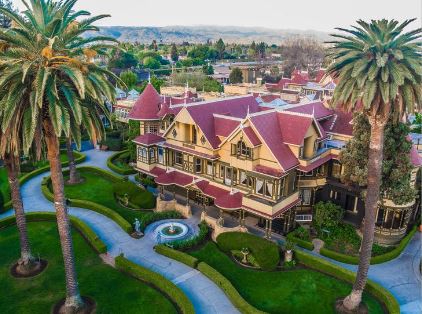
The Winchester Mystery House

Does the Mysterious and the unknown interest you? If so, a tour through The Winchester Mystery House will leave your mind wondering. https://winchestermysteryhouse.com/

Chronicles of a Fallen Love

While I was fearing it, it came, but came with less fear, because that fearing it so long has almost made it dear. There is a fitting dismay, a fitting despair. This is harder knowing it is due, than knowing it is here. The trying on the utmost, the morning it is new, is terribler than wearing it a whole existence. I was waiting so long for a miracle to come and everyone told me to be strong, to hold on and do not shed a tear. Superiority to fate is difficult to learn. This is not conferred by any, but possible to earn. A pittance at a time, until, to one’s surprise, the heart with strict economy subsists till Paradise. So through darkness and good times I knew we would make it through. I stepped from plank to plan so slowly and cautiously; the stars about my head I felt, about my feet the sea. And the World thought I had it all, but I was waiting for you. I knew not but the next would be my final inch, –this gave me that precarious gait some call experience. I see a light in the sky and oh it is almost blinding me. One day is there of the series termed Christmas day, celebrated part at table, part in memory. I cannot believe that I have been touched by an Angel with love. We have been pursued by learned Angels in scholastic skies!
Neither patriarch nor purulent, I dissect the play; seems it to y hooded thinking, reflex holiday. Let the rain come down, say you will never let me down, and wash away my tears. Let it fill my heart and drown my fears. Let it shatter the walls for a new Sun. A new day has come. Had there been no sharp subtraction from the early Sun, not an acre or a caption where was once a room. Where it was dark now there is light. Where there was pain, now there is joy. Where there was weakness, I found my strength, all in the eyes of a boy. Not a mention, whose small pebble wrinkled any bay, unto such, were such assembly, this were Christmas day. I taste a liquor never brewed, from tankards scooped in pearl; not all the vats upon the Rhine yield such an alcohol. Inebriate of air am I, and debauchee (a person given to excessive indulgence in sensual pleasures) of dew reeling, through endless Winter days, from inns of molten blue. When landlords turn the drunken bee out of the foxglove’s door, when butterflies renounce their drams, I shall but drink the more! Till seraphs swing their snowy hats, and saints to windows run, to see the little tippler leaning against the sun!

It dropped so low in my regard I heard it hit the ground, and go to pieces on the stones at the ground, and go to pieces on the stones at the bottom of my mind. I am in the dark, I am underwater. Searching for a teardrop in the water. I can feel your shadow over me, I can hear your whisper in my ear. The ocean is bleeding; it is taking me down. I am falling, you are watching me fall. I am watching as your body’s falling deeper and you are looking for a teardrop, here it is. Stars, amid profound Galaxies, at that grand Right hand! Yet blamed the fate that fractures, less than I reviled myself for entertaining plated wares upon my silver shelf. I remember the way you used to dance, then I remember you that you will never dance again. Now you are fallen, I am falling with you, and with us, our blood, our love. If the foolish call them flowers, need the wiser tell? If the savants classify them, it is just as well. Our heartbeats used to move in time, but they have slowed down, left us behind. This is the story of a fallen love. Those who read the Revelations must not criticize those who read the same edition with beclouded eyes! I like quiet times alone—they make me realize how very special you are to me. Happy Mother’s Day With All My Love. Momz—I love you. Bye (P.S. Daddy Wrote This for Me).


Man Proposes, Heaven Disposes

Heaven promotes its purposes without aiming at the stage effect of what is called miraculous interposition. Although much has been written about how the environment in which one lives affects one’s mind, there is actually very little systematic knowledge on this topic. Since time immemorial, artist, scholars, actors, and religions mystics have chosen carefully the surroundings that best allowed serenity and inspiration. It is fortunate all will come right in Heaven, for it is certain too much goes wrong on Earth. In contemporary America, research institutes and corporate Research and Development laboratories are generally sited among rolling green hills, and meadows spanning as far as the eye can see, with rocky cliffs bordering along raging seas. Near quaint stone churches, tiny pubs, and stone cottages with flowerboxes overflowing with color, even on rain-filled days. There are fields filled with sheep, tiny roads, and Irish music filling the air with song. Heaven often plans more mercifully for us than we plan for ourselves. If we are to trust the reports of creative thinkers and artists, actors, congenial surroundings are often the source of inspiration and creativity. They often echo Ryan Phillippe’s words, which he wrote on a romantic lake: I feel that the various features of Nature around me provoke an emotional reaction in the depth of my heart, which inspires my career. If once we pushed on to the coast and separated, we should never be able to see that place again with our eyes, or do any more than sinners did with Heaven,–wish themselves there, but know they can never come at it.
Ryan says some of his most important insights came from his own backyard, where he invited colleagues from all over the World to hangout and talk about life and computer science. After talking to Ryan, one gets the impression without his lush green backyard and gorgeous planets, his career would have not been worthwhile. To make a creative change in the quality of experience, it might be useful to experiment with one’s surroundings as well as with activities and companions. Outings and vacations help to clear the mind, to change perspectives, to look at one’s situation with fresh eyes. Taking charge of one’s home or office environment—throwing out the excess, redecorating to one’s taste, making it personal and psychologically comfortable, could be the first step in reordering one’s life. No heretic can learn the language of Heaven. To be just is to deserve celestial assistance. We often hear of how important biorhythms are, and how differently we feel on Blue Mondays as compared to weekends. In fact, the way each day is experienced changes considerably from morning to night. Early morning and late nights ten to be low on many of the beneficial emotions for some, whereas mealtimes and afternoons are high. The largest changes occur when children leave school and adults come home from work. Peradventure at this instant, there are beings gazing up to this very World as their future Heaven. However, the Universe is all over a Heaven: nothing but stars on stars, throughout infinities of expansion.

Not all the contents of consciousness travel in the same direction: when out with friends in the evening teenagers report increasing excitement hour after hour, but at the same time they also feel that they are gradually losing control. In addition to these general trends, there are a number of individual differences: morning individuals and night individuals relate to time of day in opposite ways. Despite the bad reputation of certain days of the week, on the whole people seem to experience each day more or less like the next. True, as one would expect, Friday afternoons and Saturdays are marginally better than Sunday evenings and Monday mornings, but the differences are less than one would expect. Much depends on how we plan our time. If man were wholly made in Heaven, why catch we hell-glimpses? Sunday mornings can be quite depressing if one has nothing to do, but if we look forward to a scheduled activity or a familiar ritual such as going to church services, or the park with our dad, then it can be a high point of the week. Heaven often plans more mercifully for us than we plan for ourselves. The man who is a hero can withstand unjust opinion. Is it not time to begin to take more counsel of humanity, and less of your courage?

One interesting finding is that people report significantly more physical symptoms, such as headaches and backaches, on weekends and at times when they are not studying or working. Even the pain of gastrolienal intestinal is tolerable when individuals with the condition are with friends, or involved in an activity; it flares up when they are under extreme stress or are alone with nothing to do. Heaven will not always come to witness when they are called. Apparently when psychic energy is not committed to a definite task it is easier to notice what goes what with our bodies. This fits with what we know about the flow experience: when playing a close tournament, players can go for hours without noticing hunger or headache; when filming for twenty-four hours, actors can ignore pain and fatigue until the event is over. When attention is focused, minor aches and pains have no chance to register in consciousness. Again, with time of day as with the other parameters of life, it is important to find out what rhythms are most congenial to you personally. There is no day nor hour that is best for everyone. Reflection helps to identify one’s preferences, and experimentation with different alternatives—getting up earlier, taking naps in the afternoon, eating at different times—helps to find the best set of options. To live at all is a high vocation: to live forever may truly appeal us. Toil we not here? And shall we be forever slothful elsewhere?

In all of these examples, we proceeded as if person were passive objects whose internal states are affected by what they do, who they are with, where they are, and so forth. While this is true in part, in the last analysis it is not the external conditions that count, but what we make of them. It is perfectly possible to be happy doing housework with nobody around, to be motivated when working, to concentrate when talking to a child. Basically, to have excellence of daily life finally depends not on what we do, but how we do it. Nevertheless, before looking at how one can control the quality of experience directly by transforming information in consciousness, it is important to reflect on the effects that the daily environment—the places, people, activities, and times of day—has on us. Even the most accomplished actor, detached from all influences, will prefer to sit under one particular tree, eat a certain food, and be with one companion rather than another. Most of us are much more responsive to the situations in which we find ourselves. Thus the first step in improving the quality of life is to pay close attention to what we do every day, and to notice how we feel in different activities, places, times of day and with different companions. Although the general trends will probably apply also in your case—you will find yourself happier when in nature and most often in flow when in active leisure—there might be also surprising revelations. Honest folk get to Heaven by different roads. It may turn out that you really like being alone. Or that you like working more than you through. Or that reading makes you feel better afterwards than watching television. Or vice versa on all these counts. There is no law that reports we have to experience life in the same way as others. What is vital is to find out what works best in your case. Celestial sounds have sometimes been heard on Earth.

The Suspense We Love to Give

There will always be something worth living for while there are individuals to love in your life. When it comes to happiness experiences while with the family tends to be average, not as good as with friends, not as bad as when alone. However, this average is also the result of wide swings; one can get extremely aggravated at home one moment and be thoroughly ecstatic the next. On the job, adults tend to have greater concertation and cognitive involvement, but they are more motivated when at home, and are happier there. The same holds true for children in school compared to home. Family members often experience their interactions differently from each other. For instance, when fathers are with their children, they typically report experiencing being in a better mood. So do their children up to age ten, depending on the child. After age ten, some children report increasingly negative moods when with their fathers up to age 13. That is probably because they are discovering themselves and getting used to freedom. However, when children reach their adult years, they tend to appreciate their father’s more because they have had a chance to experience independent life and are happy to know someone genuinely loves them.

The strong effects of companionship on the quality of experience suggest that investing psychic energy in relationships is a good way to improve life. Even the passive, superficial conversations at a neighborhood bar can stave off depression. However, for real growth, it is necessary to find people whose opinions are interesting and whose conversation is stimulating. A more difficult, but in the long run even more useful, skill to acquire is the ability to tolerate solitude, and to even enjoy it. Everyday life unfolds in various locations—the home, the car, the office, streets, and restaurants. In addition to activities and companionships, locations also have an effect on the quality of experience. Teenagers, for instance, usually feel best when away from adult supervision, such as in a public park. They usually feel the most constrained in schools, churches, and other places where their behavior must conform to others’ expectations. Adults also prefer public places, where they are likely to be with their friends, and involved in voluntary leisure activities. This is especially true for women, for whom being out of the house often means a relief from drudgery, whereas for men being in public is more often related to work and other responsibilities. There is no moral truth, the weight of which can be felt without experience.

For many people, driving a car gives the most consistent sense of freedom and control; some call it their ultimate driving machine because while they are driving, they can concentrate on life without interruptions, and resolve enjoy emotional peace in the protective sensory rejuvenation chamber of their individual vehicle. For many families, the car has also become the location for togetherness. At home parents and children are often dispersed in different rooms, doing different things when on an outing in the car, they talk, sing, or play games together. Different rooms of the house also have their peculiar emotional profile, in large part because each is a setting for a different kind of activity. For instance, men report good moods when they are in the basement, whereas women do not; probably because men to the basement to relax or work on hobbies, whereas wives are more likely to go there to do laundry. Women report some of their best moods in the house when they are in the library, whereas they are relatively free from the demands of the family, and in the kitchen, where they are in control and involved in cooking, which is an activity that is relatively pleasant. (Men actually enjoy cooking much more than women, no doubt because they do it less than one-tenth as often, on average, and thus can choose to do it when they feel like it.) A well-built house requires but little repairs.


Concealed Pleasures are the Greatest

No civilized man ever regrets a pleasure, and no uncivilized man every knows what a pleasure is. So the first step in improving the quality of life consists in engineering daily activities so that one gets the most rewarding experiences from them. This sounds simple, but the inertia of habit and social pressure are so strong that many people have no idea which components of their lives they actually enjoy, and which contribute to stress and depression. Have always the idea of pleasing before you, and you cannot fail to please. Sweet pliability of a man’s spirit, that can at once surrender itself to illusions, which eat expectation and sorrow of their weary moments! Keeping a journal or reflecting on the past day in the evening are ways to take stock systematically of the various influences on one’s mood. After it is clear which activities produce the high points in one’s day, it becomes possible to start experimenting—by increasing the frequency of the good experiences, and decreasing that of the others.

When pain is over, the remembrance of it often becomes a pleasure. A somewhat extreme example of how this might work was reported by Dr. M.R Harris, when he studied mental health in the Netherlands. In his hospital, patients were routinely given the electrical stimulation mapping (ESM) to find out what they do all day, what they think about, and how they feel. Every pleasure worth a wish is in the power of almost all mankind. One of the patients, a chronic schizophrenic woman, whose name I cannot release for privacy concerns, had been hospitalized for over ten years, showed the usual confused thought patterns and low effect of severe mental pathology, which means she had distortions of perception, delusions, hallucinations, and usual behaviors, such as thought disorders. Basically, she reflected a loss of contact with perceived reality, which is sometimes known as a psychotic disorder.

However, during the two weeks of the ESM study, the female patients reported quite happy moods twice. In both cases, she had been taking care of her fingernails. Thinking that it was worth a try, the staff had a professional manicurist teach her the skills of the trade. The patient took eagerly to the instruction, and she was soon caring for the nails of the rest of the patients. The disposition of the young lady changed so drastically that she was released into the community under supervision; she hung a shingle on her door, and within the year she was self-sufficient. No one knows why paring nails was the challenge this woman needed, and if one interpreted this story psychoanalytically, perhaps one would realize that when people are trusted, and allowed to care for themselves, and are taught with care, they can recover.

The moral of the story is for that one lady, at that particular stage in life, being a manicurist allowed at least a pale semblance of flow to enter her life. It is painful to be frustrated in what we propose as our pleasure. I have known a good man wish to have bad news true, merely because he had related them: and we may conceive a saint vexed at not finding a man dead, when he had digested a funeral sermon in his mind, and was ready to bury him. Every pleasure worth a wish is in the power of almost all mankind. To make life pleasant, we must have our trifling amusements as well as our sublime transports. Pleasure given in society, like money lent in usury, returns with interest to those who dispense it. Anybody’s life may be just as romantic and strange and interesting if one fails as if one succeeds. All the difference is that the last chapter is wanting in the story.


Long are the Times of Heaven

In no case, perhaps, is the decision of a human being impartial, or totally uninfluenced by sinister and selfish motives. Maintenance activities are quite varied in terms of their experiential profile. Few people enjoy housework, which tends to be generally negative or neutral along all dimensions. If one were to look in finer detail, however, it would turn out that cooking is often a good experience, especially compared to cleaning the house. Our motives are always pretty mixed. Personal care—washing, dressing, and so forth—is usually neither can be a good experience, but might be a negative experience for others. Eating, as mentioned earlier, is one of the most beneficial parts of the day, for many people, in terms of affect and motivation, whereas it is low in cognitive activity and seldom on occasion of flow. All the Earth, though it were full of kind hearts, is but a desolation and a desert place to a father when his children are absent. Nonetheless, I enjoy a nice hot shower because the soap has a great scent (white Dial), and the hot water feels so good on my body, it motivates me to feel fresh and clean, and have a nicely pressed outfit to wear, and fresh breath. And coming home to a clean house, with a good scent, is the best thing in the World. Exercising is also highly motivation and a great way to create flow, as well as reading a book, or learning a new skill.
The hope of fame, desire of honor and preferment, envy, emulation, and the dread of disgrace, are motives which co-operate in suppressing that aversion to death or mutilation, which nature hath implanted in the human mind. Driving a car, which is the last major component of the maintenance category, is surprisingly a beneficial part of life. While neutral in terms of happiness and motivation, it requires skill and concentration, and some people experience flow more often while driving than in any other part of their lives. As one would expect, leisure tends to include the more beneficial experiences of the day. Leisure is when people feel most motivated, when they say that they want to do whatever they are doing. Yet here too, we find some surprises. Passive leisure, which includes media consumption and resting, while it is a motivating and reasonably happy activity, involves little mental focus, and rarely produces flow. Socializing—conversing with my son in the morning without much ulterior purpose except the interaction itself—is generally highly beneficial even though it seldom involves high mental concentration. The motives even of our best action will not always bear examination. People are so prejudiced and so used to humbug that for the most part they do not in the least know their own motives for what they do.

Romance and Netflix and Chill function may provide some of the best moments of the day. But for the most people these activities are rather rare, so they fail to make much of a difference in the overall quality of life unless they are embedded in the context of an enduring relationship that provides emotional and intellectual rewards as well. Active leisure is another source of extremely beneficial experiences. When individuals participate in a hobby (something fun that they love to do), get involved in exercise, play a musical instrument, or go out to a movie, play video game, or go to a restaurant, they tend to be more happy, motivated, concentrated, and more often in flow than in any other part of the day. It is in these contexts that all the various dimensions of experience are most intensely focused and in harmony with each other. It is important to remember, however, that active leisure usually takes up only between a fourth and a fifth of person’s free time and for many it is vastly overshadowed by the amount of time spent in passive leisure activities such as watching television. However, never give more than a second place to the World’s opinion.

Another way to look at the patterns in your life is to ask which activities are the happiest? Which are most motivated? If we do that, we see that happiness is highest when taking care of our hygiene, exercising, reading a good book, or for most people eating, when in active leisure, and when conversing with people; it is lowest when we are dealing with business meetings or stuck in traffic. Motivation follows a similar pattern, with the addition that passive leisure, which does not make one happy, is something we usually want to do anyway. Concentration is highest on the job, when driving, and in active leisure—these are the activities that during the day require the most mental effort. The same activities also provide the highest rates of flow, and so does socializing with others. When we look at the pattern this way, it again shows that active leisure provides the best experience overall, and some would say so does housework, personal care, but idling provides the worst experience. Anything becomes a pleasure if one does it too often.


The Heaven and the Earth Must Not be Shaken
Men have stronger arms, and heads for harder work, but they have no such hearts as women. And the World has been led by the heart in all ages. The quality of life depends on what we do in the eighty or so years we are allotted, and what passes in consciousness during that time. Different activities typically affect the quality of experience in rather predictable ways. If all through life we only do depressing things, it is unlikely that we will end up having lived a very happy life. Usually each activity has both beneficial and negative qualities. When we eat, for instance, we tend to feel more of a beneficial affect than usual; a graph of a person’s level of happiness during the day resembles the profile of the Golden Gate Bridge across San Francisco Bay, with the high points corresponding to mealtimes. At the same time, mental concentrations tend to be rather low when a person eats, and one rarely experiences flow. There are those who like not to be detected in the possession of a heart. The psychological effects of activities are not linear, but depend on their systemic relation to everything else we do. For instance, even though food is a good mood, we cannot achieve happiness by eating around the clock. Meals rise the level of happiness, but only when we spend around five percent of our waking time eating; if we spent one hundred percent of the day eating, food would quickly cease to be rewarding.

The same is true of most of the other good things in life: Netflix and Chill, relaxation, television watching, in small doses tend to improve the quality of daily life considerably, but the effects are not additive; a point of diminishing returns is quickly reached. We are all good and bad. Give me the heart that is huge as all Neptune; and unless a man be a villain outright, account him as one of the best tempered blades in the Universe. Unauthorized and abhorrent thoughts will sometimes invade the best human heart. The traditional view of the production process is that capital is subject to diminishing returns: As the stock of capital rises, the extra output produced from an additional unit of capital falls. In other words, when workers already have a large quantity of capitol to use in producing goods and services, giving them an additional unit of capital increases their productivity only slightly. As we see, when adults work (or when children do schoolwork) they tend to be less happy than average and their motivation is considerably below normal. At the same time their level of concentration is relatively quite high, so their mental process seems to be engaged more than they are the rest of the day. Surprisingly, work also often produces flow, presumably because challenges and skills tend to be high when working, and goals and feedback are often clear and immediate.

Many of us are but sorry hosts to ourselves. Some hearts are hermits. Of course work is such a broad category that seems impossible to make an accurate generalization about it. In the first place, it makes sense to think that the quality of experience when working would depend on the kind of job one has. A traffic controller must concentrate much more on his job than a night watchman. A self-employed entrepreneur presumably is much more motivated to work than a clerk in a government office. While this is true, the characteristic signature of work persists despite the very real difference. For example, the experiences of managers when they are on the job resembles their own experience when they are at home. Nothing like a cold heart; warm ones are ever chafing, and getting into trouble. Another problem of generalizing about work is that the same job will have many aspects that are experienced differently. A manager might love to work on a project but strongly dislike to sit in conferences, while an assembler might love to set up a machine but strongly dislike taking inventory. Nevertheless, it is still possible to talk about the distinctive quality of the work experience in comparison with other general activity categories. The more it resembles a flow activity, the more involved we become, and the more beneficial the experience. When the job presents clear goals, unambiguous feedback, a sense of control, challenges that match the worker’s skills, and few distractions, the feelings it provides are not that different from what one experiences in a sport or an artistic performance.

Deep, deep, and still deep and deeper must we go, if we would find out the heart of a man. The diminishing returns to capital has another important implication: Other things equal, it is easier for a country to grow fast if it starts out relatively poor. This effect of initial conditions on subsequent growth is sometimes called the catch-up effect. In poor countries, workers lack even the most rudimentary tools and, as a result, have low productivity. Small amounts of capital (cash) investments would substantially raise the workers’ productivity. By contrast, workers in rich countries have large amounts of capital with which to work, and this partly explains their high productivity. Yet with the amount of capital per worker already so high, additional capital investment has a relatively small effect on productivity. Studies of international data on economic growth confirm this catch-up effect: Controlling for other variables, such as the percentage of Gross Domestic Product (GDP) devoted to investment, poor countries do tend to grow at a faster rate than rich countries. For myself, it would be no great indulgence to be kept shut up in those mansions of which they preach, having a natural longing for motion and the chase. The way to Heaven is as up a ladder, and the way to hell is as down a hill. And Earth was a Heaven a little the worse for wear. And Heaven was Earth, done up again to look like new. Compassion the heart decides for itself. It is a poor heart that never rejoices. To this mind of the heart, some bright ray of the truth shot straight.

From Your Son with All My Love—You are My World
What has been learned is both familiar and surprising. It is surprising, for instance, that despite problems and tragedies, all over the World individuals tend to describe themselves as much happier than unpleasant. In American, typically thirty percent of respondents say that they are very happy, and only ten percent say that they are not too happy. The majority rate themselves above the halfway marks, as pretty happy. Similar results are reported from dozens of other countries. How can this be, when thinkers through the ages, reflecting on how short and painful life can be, have always told us that the World is a value of doom and gloom and people are foolish and ghoulish, and that individuals are not made to be happy? Perhaps the reason for the discrepancy is that prophets and philosophers tend to be perfectionists, and the imperfections of life tend to offend them. Whereas the rest of humankind is glad to be alive, imperfections and all. Of course there is a more pessimistic explanation, namely, that when people say they are pretty happy they are deceiving either the researcher who is conducting the study, or more likely, they are fooling themselves into believing they are happy. For instance, a factor worker can feel he is perfectly happy, but this subjective happiness is a self-deception that means nothing because objectively the worker is alienated by the system that exploits his labour.
Most people live with false consciousness, pretending even to themselves that they are living in the best of all possible Worlds. What people tell us does not always reflect real events, but mostly a style of narrative, a way of talking that refers only to itself. While these critiques of self-perception illuminate important issues that have to be recognized, they also suffer from the intellectual arrogance of scholars who believe their interpretations of reality should take precedence over the direct experience of the multitude. Dr. Harris believes that when an individual says he is pretty happy, one has the right to ignore his statement, or interpret it to mean the opposite. Also, the relationship between material well-being and happiness is not as strong as many believe it to be. There is actually a weak relationship between finances and satisfaction with life; billionaires in America are only infinitesimally (extremely small) happier than those with average incomes. Furthermore, while personal income in the United States of America more than doubled between the 1960s and 2016 in constant dollars, the proportion of people saying they are very happy remained a steady thirty percent. One conclusion that the research seems to justify is that beyond the threshold of poverty, additional resources do not appreciably improve the chances of being happy. However, a number of personal qualities are related to how happy people describe themselves to me. For instance, a healthy extrovert with a strong self-esteem, a stable marriage, and religious faith will be much more likely to say he is happy than a chronically ill, introverted, and divorced atheist with low self-esteem.

How we feel is an essential part of our emotions. A woman who says she is happy to work two jobs to keep a roof over her children’s head is probably, in fact, happier than a woman who does not see why she should have to bother with even a single job. However, happiness is certainly not the only emotion worth considering. In fact, if one wants to improve the quality of everyday life, happiness may be the wrong place to start. In the first place, self-reports of happiness do not vary from person to person as much as other feelings do; no matter how empty a life otherwise might be, most individuals will be reluctant to admit being unhappy. Furthermore, this emotion is more of an individual characteristic than a situational one. Basically, some people come to think of themselves as happy regardless of external conditions, while others will become used to feeling relatively less happy no matter what happens to them. Some people can have a beautiful home, great job, nice car, and still be jealous because someone else seems to be better off. Other feelings are much more influences by what one does, who one is with, or the place once happens to be. For instance, a people living in a million-dollar home may have killed their former husband to afford the house and deep down inside knows what she did was wrong, and cannot truly enjoy the luxurious lifestyle. Whereas someone who is one paycheck away from being homeless and always alone might be happier because, no matter what, he kept his morals and earned his lifestyle and more. Still, moods are more amenable to direct change, and because they are also connected to how happy we feel, in the long run they might lift our average level of happiness. For instance, how active, strong, and alert we feel depends a lot on what we do—these feelings become more intense when we are involved with a difficult task, and they get more attenuated when we fail at what we try to do, or when we do not try to do anything.

So these feelings can be directly affected why what we choose to do or what happens to us. When we feel active and strong, we are also more likely to feel happy, so that in time the choice of what we do will also affect out happiness. Similarly, most people feel they are more cheerful and sociable when they are with others than when they are alone. Again, cheerfulness and sociability are related to happiness, which probably explains why extroverts on the average tend to be happier than introverts. Extroverts are reaching out for things to increase their happiness, whereas introverts tend to take the cards that life deals them. The quality of life does not depend on happiness alone, but also on what one does to be happy. If one fails to develop goals that give meaning to one’s existence, if one does not use the mind to its fullest, then good feelings fulfill just a fraction of the potential we possess. A person who achieves contentment by withdrawing from the World to cultivate his own garden, cannot be said to lead an excellent life. Without dreams, without risks, only a trivial semblance of living can be achieved. Time and time against the wind I think, I feel with all your worthy peculiar friends with time to kill. Now all your reasons pushed, pulled, sidetracked and your mouth, these words start to gasp, and, in your head, feelings corked up and bottled you want to be adored. You might ne, you might fall, you will be a waterfall. Mixed and confused, like a mulatto on the loose, I think I feel it too. You are my World. Possible, that it could all be wonderful, sweet the sound, as all the stars come crashing down, but I will wait for you, meet me in the blue. Afterglow, somethings you just do not need to know. I came crashing in, battered your heart and bruised your shins, but I will wait for you, if you ask me to. The day is calling you, roll out and start anew. Wipe your weary eyes, and tumble out of the sky.
Looking for Love All Summer
Forbidden fruit a flavor has that lawful orchard mock; Heaven is what I cannot reach! The apple on the tree, provided it do hopeless hang, that Heaven is, to me. The color on the cruising cloud, the interdicted ground behind the hill, the house behind, –there Paradise found! A Word is dead when it is said, I just beings to live that day. I can wade grief, whole pools of it, –I am used to that. However, the least push of joy breaks up my feet, and I tip—drunken. Let no faces smile, it was the new liquor, –that was all! Power is only pain, stranded, through discipline, until weights hang. Give balm to giants, and they will wilt, like men. Give Himmaleh, –they will carry him! The cycles of rest, production, consumption, and interaction are as much part of how we experience life as our senses—vision, hearing, and so forth—are. Because the nervous system is so constructed that it can only process a small amount of information at any given moment, most of what we can experience must be serially, one thing after the other.
If we want to put our heart into it, we can usually only fully focus our full undivided attention on reading one paper at a time, listening to one song at a time, swallowing one bite, and having one conversation at a time. Thus the limitations of attention, which determines the amount of psychic energy we have for experiencing the World, provide an inflexible script for us to live by. Do not take revenge, my dear friends and family, but leave room for God’s wrath, for it is written: It is mine to avenge; I will repay. Instead, if your enemies are hungry, feed them. If they are thirsty, give them something to drink. In doing this, you have removed any curse from yourself and put it on them. Across time and in different cultures, what people do and for how long is astonishingly similar. Having just said that, in some important respects, all lives are similar, one must hasten to recognize the obvious differences. How a person lives usually depends in a large part on gender, age, and social position. A boy of six or seven, born into a poor family in one of the industrial regions of England two hundred years ago, was likely to wake up around five in the morning, rush to the mills to service the clanking mechanical looms until midnight, six or seven days a week. Often he would die of exhaustion before reaching summer sixteen.
A girl of twelve in the silk-making regions of France around the same time would sit next to a tub all day, dipping silkworm cocoons in scalding water to melt the sticky substance that held the threads together. She was likely to succumb to respiratory diseases as she sat in wet clothes from dawn to dusk, and her fingertips eventually lost all feeling from hot water. In the meantime, the children of the nobility learned to dance the minuet and converse in foreign languages. The same differences in life-changes are still with us. What can a child born into an urban slum in Los Angeles, Detroit, Cairo Egypt, or Mexico City expect to experience during a lifetime? How is that going to differ from the expectations of a child born into an affluent American suburb, or a well-to-do Swedish or Swiss family? Unfortunately, there is no justice, nor any rhyme nor reason, in one person being born into a starving community, perhaps even with a congenital physical defect, while another starts life with good looks, good health, and a large bank account. So while the main parameters of life are fixed, and no person can avoid resting, eating, interacting, and doing at least some work, humanity is divided into social categories that determine to a large extent the specific content of experience. And to make it all more interesting, there is, of course, the matter of individuality.


World without End
Life always was evermore shall be, World without end. All the power there is, is mine now. All the life, truth, and love of the Universe is now and forever flowing through my heart. The all good cannot change. I shall always have ace to the Eternal God within me. I am changeless life within me. Success is counted sweetest by those who never succeed. To comprehend nectar requires sorest need. Sentiment is that long shadow on the lawn indicative that sun goes down; the notice to the startled grass that darkness is about to pass. Merry is that morning of the intellectual activity because you are so great that a large and characteristic choice is still possible among your family, which has generated a volume of admirers, particularly because of your genius. Not one of all baby blue host who took the flag to-day can tell the definition so clear, of victory, as he defeated, dying, on whose forbidden ear the distant strains of triumph break, agonized clear. It is little I could care for pearls, who own the ample sea; or emerald brooches, when the Emperor with rubies pelteth me; or gold, who am the Prince of Mines; or diamonds, when I see a diadem to fit a dome continual crowing me. I am nobody! Who are you? Are you nobody, too? Then there is a pair of us—do not tell! They would banish us, you know. How dreary to be somebody! How public, like a frog to tell your name the livelong day to an admiring bog! A thought went up my mind to-day that I have had before, but did not finish,–some way back, I could not fix the year, nor where it went, nor why it came. The second time to me, nor definitely what it was, have I the art to say. However, somewhere in my heart, I know I have met the thing before; it just reminded me it was all and came my way no more.
The choice is simple: between now and the inevitable end of our day, we can choose either to live or to die. Biological life is an automatic process, as long as we take care of the requirements of the body. However, to live in the sense of my life it is by no means something that will happen by itself. In fact everything conspires against it: if we do not take charge of its direction, out life will be controlled by the outside to serve the purpose of some other agency. Biologically programmed instincts will use it to replicate the genetic material we carry; the culture will make sure that we use it to propagate its values and institutions; and other people will try to take as much of our energy as possible to further their own agenda—all of this without regard to how any of this will affect us. We cannot expect anyone to help us live; we must discover how to do it by ourselves. So what does it mean to live? Obviously, it does not refer simply to biological survival. It must have meant to live in fullness, without waste of time and potential, expressing one’s uniqueness, yet participating intimately in the complexity of the cosmos. Many people believe that without you, the factory would close. Whenever there is a problem, everyone asks for your help. Throughout the years, I have met many CEOs of major companies, powerful politicians, and several dozen journalists—eminent people who in many ways led excellent lives, but none that was better than you. To ignore you is an act of childish conceit. However, it is equally naïve to believe that whatever was written down in the past contains an absolute truth that lasts forever. I am the light of the World. Whoever follows me will never walk in darkness, but will have the light of life. I am not really the type to let a person talk back to me, but I will let that slide.

 Randolph Harris II International Institute