
Home » racial regeneration and genetic editing (Page 7)
Category Archives: racial regeneration and genetic editing

Kitchen Dramas—Are they Arms Race or Saving Civilization as We Know it?

One a person experiences the full impact of the conflict in consciousness, one turns in an accusing rage on the target object. During the past several years, I have spent a good deal of my time blaming television for many of the more obvious dysfunctions from which Western culture—and especially America—is now suffering. It has been pointed out to me that I do this because I am by nature a negative person, always ready to condemn what is wrong rather than to praise what is right. Several of my students have even gone so far as to observe that had I lived during the period of incunabula—during the first fifty years of the printing press—I would have burdened everyone with a long list of depressing prophecies about the dangers of the machine-made book and universal literacy. However, my students are only half right. Assuming I had the brains to see what was happening in the year 1500, I would certainly have warned the Holy See that the printing press would place the word of God on every Christian’s kitchen table, and, as a consequence, the authority of the Church hierarchy would be put in jeopardy. Had I been granted a papal audience, I would have warned the Pop that armed with a printing press, Martin Luther was more than a malcontent priest suffering from a bad case of constipation. The printed word made him a serious revolutionary. I might also have warned the local princes that their days were numbered, that printing would give form to a new idea of nationhood which would make local potentates obsolete. And if the Brotherhood of Alchemists had allowed me to give the keynote address at their annual convention, I would have told them to go into another line of work, that printing would give great impetus to inductive science and that alchemy would not stand against the glare of publicly shared scientific knowledge. #RandolphHarris 1 of 20

I would also have told any wandering bards who came my way that within a hundred years their trade would lie in ruins, that tribal lays and epic poetry were doomed, and that they would be wise to urge their trainees to turn their talents to writing essays and reading novels. Now, not every one of these prophecies foretells a bad thing. That is why I said my students are only half right. Whether or not a prophecy is negative depends on your point of view. For example, since most of you are Lutherans, you probably would have cheered the breakup of the Holy Roman Empire. The Catholics of those times would, of course, have mourned it passing. In any case, there are some changes brought about by new media benefit some, harm others, and to a few do not make much of a difference. This is as true of television as it was of the printing press or any other important medium, although in the case of television there are very few indeed who are not affected in one way of another. For most of you here, television will provide a gratifying career. On the other hand, and in the long run, television may bring an end to the careers of schoolteachers, since school itself was an invention of the printing press and must stand or fall on the issue of how much importance the printed word will have in the future. New media break up old knowledge monopolies; indeed, create new conceptions of knowledge, even new conceptions of politics. If not for television, Joe Biden, for example, would not be President of the United of America, which is good for him and the interests he represents, but not so good for the poor and vulnerable. However, television can people good as it creates a true theater of the masses. For example, between the years 1948 and 1958, approximately 1,500 fifty-two-minute plays were performed “live” on American television. #RandolphHarris 2 of 19

“Live” means that these plays were performed at the precise moment they were seen by the television audience, a condition which since the advent of videotape and the widespread use of film has become increasingly rare; “fifty-two minutes” describes the actual running time of the play, eight minutes of the hour being subtracted for commercial messages, the listing of credits, and publicity for the next week’s play. There is no doubt that American television’s finest dramatic moments were provided by fifty-two-minute hours, particularly by such weekly series as the Kraft Television Theater (1947-58), the Philco-Goodyear Playhouse (1948-50), and the Studio One (1948-57). These programs began by presenting adaptations of classic and established contemporary novels but by 1950 had shifted to original dramatic work. By that time, such producers and directors as Worthington Miner, Fred Coe, Delbert Mann, Arthur Penn, and John Frankenheimer has assembled about them several gifted young writers who were prepared to devote their collective talents to a serious exploration of television’s artistic resources. Included in that group, among others, were Reginal Rose, Tad Mosel, Robert Alan Aurthur, Horton Foote, Rob Serling, J.P. Miller, and Gore Vidal. None, however, wrote more fittingly for television than Paddy Chayefsky, whose name, along with Edward. R. Murrow’s, symbolizes what romantics call “the golden age of television.” Mr. Chayefsky was to the “original” television drama what Mr. Ibsen was to the “social drama,” which is to say that he was one of the first creators and certainly its most distinguished one. Like Mr. Ibsen, he achieved an almost perfect union of form and content. Critics have observed, for example, that the effects that Mr. Ibsen achieved in A Doll’s House and Ghosts were a function not only of his themes, with which audience were certainly familiar in 1879 and 1881, but also of the stark, simple, and economical form in which he stated them. #RandolphHarris 3 of 19

Social dramas had been written before Mr. Ibsen, but it remained for him to discover the form for dramatizing social problems. Mr. Chayefsky, of course, did not write for the stage behind a proscenium arch, viewed from a distance in a darkened theater. He wrote for a seventeen-inch screen situated in a family living room, on which the only colors were varying shades of gray. He also had to present his story, from start to finish, in fifty-two minutes, and he could make two assumptions with absolute assurance: that his play would be interrupted at least twice for commercial messages, and that he would have to attract his audience instantly or lose much of it to other channels. He knew, too, as did his director, Delbert Mann, that the picture on the television screen is considerably cruder in visual definition than that on a motion-picture screen. So Mr. Chayefsky wrote his plays in anticipation of the audience’s observing the players in almost unrelenting “close-up.” Mr. Chayefsky realized that some of these technical-aesthetic conditions could create, as could perhaps no other medium, a sense of utter and absolute reality; could create the illusion that what the audience was seeing was not a mere play but life as seen through a seventeen-inch, nearly square hole. Beginning with a play called Holiday Song, which dealt with a rabbi’s re-examination of one’s faith in God, Mr. Chayefsky created a series of dramas that have often been characterized as “small” masterpieces, sometimes referred to as “kitchen” dramas, since much of the action seemed to take place in family kitchens. In any case, they were plays about unexceptional situations. The plots were uncluttered, and undaring, and highly compressed. They had few unexpected turns, little action, no treachery, no perversion, and no heroic gestures (in the traditional sense). #RandolphHarris 4 of 20

Mr. Chayefsky’s stories were “small” very much as Sherwood Anderson’s stories are small. The setting was New York, not small-town Ohio, but like Mr. Anderson, Chayefsky explored in economical but meticulous detail the agonizing problems of small people. And thus he elevated the status of both the problems and the people who suffered them. In fact, Mr. Chayefsky once remarked that “Your mother, sister, brothers, cousins, friends—all of these are better subjects for drama than Iago.” He was talking, of course, about television drama. Mr. Chayefsky’s most known play, Marty, tells the story of an unmarried, inarticulate butcher who is attacked to a sensitive but homely woman. Marty’s friends attempt to dissuade him from seeing the woman because she is, in their words, “a dog.” His mother, who fears being abandoned resents the woman bitterly. Against a backdrop of such universal themes as man’s need of loving and being loved, his fear of living alone, and his need to communicate, Mr. Chayefsky pursued his “small” story with persistent literalness, concluding with an equally “small” crisis in which Marty decides, against the protests of his friends and family, to phone the woman and ask her for a date. On the stage of in a novel, the plot would be too flimsy to carry much dramatic weight. When the play was adapted for the movies, it required more “movement” or action and the addition of at least one subplot. On the television screen, however, they play was an artistic triumph, producing a disturbing and edifying illusion of intimacy. Perhaps no other medium is better suited to the “slice of life” drama than television, a fact that is apparently well known to Ingmar Berman. Although television was invented in the 1920s, it did not exist for any practical purposes until after World War II. It is easy to forget that advertising, at least on the scale we have come to know it, barely existed before then either. #RandolphHarris 5 of 20

In 1946, advertisers spent about $3 billion. For the previous two decades, advertising expenditure had been fairly constant at about that level. By 1975, however, the national advertising budget had grown by 1,000 percent to $30 billion. In 2021, the national advertising budget reached $82 billion (expected to around $95 billion by the end of 2022). In that same year the television advertising budget has skyrocketed to $68 billion, and could be approximately $80 billion by the end of 2022. As you see, most of the increases in advertising. However, what is significant is that within only tend years of its effective inauguration, television was absorbing 60 percent of all advertising spending and driving hundreds of newspapers, magazines and radio stations out of the market. A symbiotic relationship developed. Advertising financed television’s growth. Television was the greatest delivery system for advertising that had ever been invented. We could call it love at first sight, except in this case, the match may have been prearranged. If you are fortunate enough to recall, think back to the days immediately after World War II. Although I was only ten in 1945, I remember the expectant and uncertain feeling of the times very well. Everyone was relieved that the war was over and was expecting things to get back to normal, but what was normal? Memories of the Depression loomed. I remember listening to my parents talk with their friends on those backyard summer evenings of 1945, and I could feel the fear. Like most ordinary people, my parents know that the war had alleviated the Depression. During the war, American industrial capacity, lying fallow only a few years before, had actually expanded to build the military machine. My father’s own business was an example. Now there were no more uniforms to make, and no more tanks. The war had given men jobs as soldiers and women jobs as factor workers. Full employment had practically become a reality. Now Johnny was marching home again, jobless. #RandolphHarris 6 of 19

If this was the talk among ordinary people, one can only imagine what was said in industrial boardrooms and at the Department of Commerce. With industrial capacity and capital investment expanded as they were, the consequences of a drop in production could make the 1930s look like golden years. A long-standing criticism of capitalism—that it can stave off cyclic depression only through war-seemed about to be confirmed. Suddenly in 1946, government and industry started making identical pronouncements about regearing American life to consume commodities at a level never before contemplated. It was not that military production was about to be abandoned. Even now it remains the single most important factor in the United States of America’s economy. However, in 1946 with the war just over, it was not clear that the decline in military spending would be as temporary as it turned out to be. Some new offsetting factor was needed. Thus, a new vision was born that equated the good life with consumer goods. An accelerate economy, continuing booming expansion of wartime, added to a new consumer ideology achieved the greatest economic growth rate in the country’s history from 1946 to 1970. To make such growth possible, both ends of the transformation process described previously had to be hyped up. First, we needed to insure an abundant supply of raw material to convert into commodities. This led to a burst of American investment overseas as well as to enormous assistance programs for sympathetic “underdeveloped” countries. Often we secured our supply by the creation of client governments propped up with military assistance. Raising anticommunism to the status of a holy war in the 1940s and the 1950s formed the political foundation for these military and economic programs and underlay the assertion of the patriotic virtues of foreign investment. #RandolphHarris 7 of 19

At the other end of the transformation equation, an accelerated movement of commodities into consumers’ homes was critical. People had to be convinced that life without all these products was undesirable and unpatriotic. It was time to forget the rationing of the war years and consumer for your country. Advertising and television were the dynamic duo that would rededicate the consuming American. Advertising’s ability to create a passionate need for what is not needed was already well established. Since economic growth and a consumer economy had to be based upon selling far more commodities than were needed to meet actual needs, economic growth depended upon advertising. Television, which had been lying around in mothballs since the 1920s, was dusted off and enlisted as the means to deliver the advertising lifestyle fast, right into people’s homes and heads. Quick to spot any new technology that could assist their urgent cause, big advertisers immediately invested hundreds of millions of dollars in developing this idle sales tool. And so advertising gave birth to television, and television have advertising a whole new World to conquer. Together they made possible an enormous, though temporary, economic bonanza. Can you recall the TV advertising of the 1940s and 1950s? Smiling, happy people. Scrubbed children. Housewives showing their impossibly clean wash. Smiling junior-executive husbands emerging from their new cars, greeted at the picket fence by their clean, cheerful families? The happy mowing of the lawn. The happy faces reflected off the polished toasters? The nuclear family was idealized to a greater extend than ever before, because the family was the ideal consumption unit. Women had to get out of those factories and overalls and back into little pink dresses in the kitchen. #RandolphHarris 8 of 19

Those returning soldiers needed jobs. Rosie the Riveter gave way to June Allyson. Separate family units maximized production potential. Private homes. Private cars. Two cars. Private washing machines. Private television sets. Within a few years, the World started changing. The battery-operated lawn mower I saw on television one day appeared on my lawn the next week. So did the car. The whole neighborhood started looking like a television commercial. The woods near my house in disappeared and were replaced by hundreds of identical versions of my house. Neighborhoods everywhere started looking like each other. Freeways replaced country roads. Shopping centers replaced corner markets. Pavements covered everything. “Prosperity,” “security,” “happiness,” studded ads and presidential speeches alike. This incredible outpouring of commodities, this entire revamping of landscape, this filling of houses with gadgets was supposed to constitute some kind of Latter-Day Saints Kingdom of God. That is what everyone was thinking, saying, and believing. It was what made America America. One of my high school teachers during the 1950s told my class that it was America’s commitment to a consumption economy that made our country different and better than all others. He told us that by expanding our economy, we could soon make everyone wealthy. America was already the World’s only classless society, he said. Workers and managers were equal partners in a glorious process benefiting everyone. In America everyone was equal. Our standard of living made it that way. Everyone could have a car. Everyone could have a business. We are not developing nations, where the water is dangerous to drink, and there are few rich people and everyone else is poor and all of them wished they had what we had. Because of this prosperity, we did not have to deal with the chaotic times of psychological and spiritual upheaval nor have actual fear among people of witchcraft, sorcerers, and others who claimed to know how to consort with the demons. The medieval period had died, and the modern period was born. #RandolphHarris 9 of 19

A few years later at the Wharton School of Business at the University of Pennsylvania, I learned how and why this commodity life and the economic growth it produces was supposed to be so good for absolutely everyone. I learned that they had been talking about in these boardrooms and at the Department of Commerce. It was called the “trickle-down theory.” It goes more or less like this: Industrial expansion, rapid economic growth and the consumption economy benefit everyone. The theory—which is the basis of Keynesian American economics—has it that when people buy more and more commodities, they produce more profits for industry, enabling it to expand. When industry expands, more jobs result. This puts more money into circulation, enabling people to buy more commodities, expanding profits again, yielding more investments, more jobs and starting the cycle around on another turn. This is an oversimplified process, which leaves out such variables as savings, borrowing, and so on. The way it is presented here is more or less the way it is translated through the media and through out educational system into popular understanding: a beautiful circle of activity, everyone helping everyone else, labor and management rowing the boat together, all serving the common good and growing endlessly. It explained the patriotic urgency of people spending more and more on commodities. The benefits would “trickle down” to everyone in this country, including those at the bottom on the pyramid. Jobs, money, prosperity, happiness, security, democracy, equality were all lumped together as inevitable results of this cycle. Most people believe in this “trickle-down-theory” still. Presidents get elected based on whether they can convince the public that they will stimulate the beautiful cycle. President Trump was elected for doing it and he proved his word. #RandolphHarris 10 of 19

The tickle-down theory is the nice simple kind of economic model that can be sold to a mass population removed from any deeper understanding of how things really work. Trying to come to grips with economic nuance is for most of us no easier than trying to understand how much nuclear radiation is “safe.” Who knows? The “experts” know. Like every other organizing model in our society, economic processes have been removed from personal participation, appropriated into a nether World of flow charts, financial analyses, and circle graphs. Like scientific and technological systems, once economic systems reach a certain size and complexity, they can be controlled only by forces far outside the grasp of the individual and community. One explanation of them sounds as plausible as another. In the absence of a really thorough training in economics—a training which itself supports many arbitrary and fantastic theories—this trickle-down model of the benefits of a consumer society sounds perfectly valid. It certainly seemed valid for a little while. People had jobs, the economy was growing, and homes were filling up with every more intricate gadgets. Only now, thirty years after the trip was launched, can we see the process from the vantage point of joblessness, inflation, bankruptcy and default, and realize that something was terribly wrong somewhere. In fact, it was a fantasy. It was packaged and sold to us like the seven-piece matching living-room sets on the television screen. Buy now, pay later when you are richer than you are now. However, when later came, very few of us were richer (and that usually happens to everyone). It turned out that the pursuit of all those happy goodies did not produce happy people; it produced isolated, frustrated, alienated people. More important, the economic benefits did not trickle down to create some egalitarian democracy. The benefits tickled up. That is why President Trump also used the tickle charger. Not only did he cut taxes, but also infused the less affulent with supercharged unemployment benefits, and helped the veterns, disabled, retirement and others reciveing government transfer pays by sending the a large cash sum of money, and then a few other payments for less, and he also supported businesses get through the pandemic. So the economy was stimulated and had a few trickle charges to keep the market flowing well. #RandolphHarris 11 of 19

The democratic revolution succeeded in extending formal self-government and opportunity to nearly everybody, regardless of birth, property, or education. However, it gave up the ideal of the town meeting, with the initiative and personal involvement that alone could train people in self-government and give the practical knowledge of political issues. The actual result has been the formation of a class of politicians who govern, and who are themselves symbolic front figures. Correspondingly, the self-determination won by the American Revolution for the regional states, that should have made possible real political experimentation, soon gave way to a national conformity; nor has the nation as a whole conserved its resources and maintained its ideals. The result is a deadening centralism, with neither local patriotism nor national patriotism. The best people do not offer themselves for public office, and no one has the aim of serving the Republic. Typical is the fate of the hard-won Constitutional freedoms, such as freedom of speech. Editors and publishers have given up trying to give an effective voice to important but unpopular opinions. Anything can be printed, but the powerful interests have the big presses. Only the safe opinion is proclaimed and other opinion is swamped. The liberal revolution succeeded in shaking off onerous government controls on enterprise, but it did not persist to its goal of real public wealth as the result of free enterprise and honestly informed choice on the market. The actual result is an economy dominated by monopolies, in which the earnest individual entrepreneur or inventor, who could perform a public service, is actively discouraged; and consumer demand is increasingly synthetic. Conversely, the Jeffersonian ideal of a proud and independent productivity yeomanry, with natural family morals and a co-operative community spirit, did in fact energize settling the West and providing the basis for our abundance. #RandolphHarris 12 of 19

However, because it has failed to cope with technological changes and to withstand speculation, “farming as a way of life” has succumbed to cash cropping dependent on distant markets, and is ridden with mortgages, tenancy, and hired labor. Yet it maintains a narrow rural morality and isolationist politics, is a sucker for the mass culture of Madison Avenue and Hollywood, and in the new cities (exempli Gratia, in California, where farmers have migrated) is a bulwark against genuine city culture. Constitutional safeguards of person were won. However, despite the increasing concentration of state power and mass pressures, no effect was made to give to individuals and small groups new means easily to avail themselves of the safeguards. The result is that there is no longer the striking individuality of free men; even quiet nonconformity is hounded; and there is no asylum from coast to coast. Fraternity—this short-lived ideal of the French Revolution, animating a whole people and uniting all classes as a community, soon gave way to aa dangerous nationalism. The ideal somewhat revived as the solidarity of the working class, but this too has faded into either philanthropy or “belonging.” Brotherhood of races—the Civil War won formal rights for African Americans, but failed to win social justice and factual democracy. The actual result has been segregation, and fear and ignorance from various people of all races. However, in the 2020s, that stigma is fading. Pacificism—this revolution has been entirely missed. Acceleration not only makes facts obsolete but blunts some of the key tools we use when we think. Analogy provides a case in point. It is virtually impossible for us to think without relying on analogies. This “thought-tool” is based on identifying similarities in two or more phenomena and then drawing conclusions from one to apply to the other. Doctors, we noted, will often say “the heart is like a pump” and then describe its “values” and other components in mechanical terms. This model helps them conceptualize and treat the heart. Often this process yields powerful results. #RandolphHarris 13 of 19

However, once similarities are identified, it is typically taken for granted that the similarities continue. And in slow-change eras, they may do so for long periods. In today’s hyper-change environment, however, once-similar things also change and very often become markedly dissimilar, often making conclusions based on the analogy false and misleading. To deal with today, therefore, we need not only new knowledge but new ways to think about it. Yet too many economists, consciously or otherwise, cling to the belief that economics is analogous to physics. This notion arose centuries ago, when Newtonian ideas about equilibrium, causation and determinism dominated that science. Since then, of course, physicists have drastically revised their views about these matters. However, many economists still base their findings on crude Newtonian assumptions. Trained to think in industrial terms, many find it difficult to grapple with the odd character of knowledge—the fact that it is non-rival and non-depletable, that it is intangible and thus hard to measure. It is only when we set today’s failures of economics alongside the looming crisis in science that we begin to gauge their true significance. For together these two fields have the greatest—or at least the most direct—impact on how we create wealth. And both are heading for transformation. When it comes to relationships, a university teacher of liberal arts cannot help confronting special handicaps, a slight deformity of the spirit, in the students, ever more numerous, whose parents are divorced. I do not have the slightest doubt that they do as well as other sin all kinds of specialized subjects, but I find they are not as open to the serious study of philosophy and literature as some other students are. I would guess this is because they are less eager to look into the meaning of their lives, or to risk shaking their received opinions. #RandolphHarris 14 of 19

In order to live with the chaos of their experience, they tend to have rigid frameworks about what is right and what is wrong and how they ought to live. They are full of desperate platitudes about self-determination, respect for other people’s rights and decisions, the need to work out one’s individual values and commitments, etcetera. All this is a thin veneer over boundless seas of rage, doubt, and fear. Young people habitually are able to jettison their habits of belief for an exciting idea. They have little to lose. Although this is not really philosophy, because they are not aware of how high the stakes are, in this period of their lives they can experiment with the unconventional and acquire deeper habits of belief and some learning to go along with them. However, children of divorced parents often lack this intellectual daring because they lack the natural youthful confidence in the future. Fear of both isolation and attachment clouds their prospects. A large measure of their enthusiasm has been extinguished and replaced by self-protectiveness. Similarly, their open confidence in friendship as part of the newly discovered search for the good is somewhat stunted. The Glauconian eros for the discovery of nature has suffered more damage in them than in most. Such students can make their disarray in the cosmos the theme of their reflection and study. However, it is a grim and dangerous business, and more than any student I have known, they evoke pity. They are indeed victims. An additional factor in the state of these students’ souls is the fact that they have undergone therapy. They have been told how to feel and what to think about themselves by psychologists who are paid by their parents to make everything work out as painlessly as possible for the parents, as part of no-fault divorce. If ever there was a conflict of interest, that is it. There are big bucks for therapists in divorce, since the divorces are eager to get back to persecuting the wretches who smoke or to ending the arms face or to saving “civilization as we know it.” #RandolphHarris 15 of 19

Meanwhile, psychologists provide much of the ideology justifying divorce—exempli gratia, that it is worse for kids to stay in stressful homes (thus motivating the potential escapees—that is, the parents—to make it as unpleasant as possible there). Psychologists are the sworn enemies of guilt. And they have an artificial language for the artificial feelings with which they equip children. However, it unfortunately does not permit such children to get a firm grip on anything. Of course, not every psychologist who deals with these matters simply plays the tune called by those who pay the piper, but the givens of the market and the capacity for self-deception, called creativity, surely influence such therapy. After all, parents can shop around for a psychologist just as some Catholics used to shop for a confessor. When these students arrive at the university, they are not only reeling from the destructive effects of the overturning of faith and the ambiguity of loyalty that result from divorce, but deafened by self-serving lies and hypocrisies expressed in a pseudoscientific jargon. Modern psychology at its best has a questionable understanding of the soul. It has no place for the natural superiority of philosophic life, and no understanding of education. So children who are inclined to believe that philosophy live in a less enlightened state and have a long climb just to get back up to the cave, or the World of common sense, which is the proper beginning for their ascent toward wisdom. They do not have confidence in what they feel or what they see, and they have an ideology that provides not a reason but a rationalization for their timidity. These students are the symbols of the intellectual-political problems of our time. They represent in extreme form the spirit vortex set in motion by loss of contact with other human beings and with the natural order. #RandolphHarris 16 of 19

However, all students are affected, in the most practical everyday way, unaware that their situation is peculiar, because their education does not give them perspective on it. Now, Web sites routinely collect detailed data on visitor behavior, and those statistics underscore just how quickly we leap between pages when we are online. Over a period of two months in 2008, an Israeli company named ClickTale, which supplies software for analyzing how people use corporate Web pages, collected data on the behavior of a million visitors to sites maintained by its clients around the World. It found that in most countries people spend, on average, between nineteen and twenty-seven seconds looking at a page before moving on to the next one, including the time required for the page to load into their browser’s window. German and Canadian surfers spend about twenty-one second, Indians and Australians spend about twenty-four seconds, and the French spend about twenty-five seconds. On the Web, there is no such thing as leisurely browsing. We want to gather as much information as quickly as our eyes and fingers can move. That is true even when it comes to academic research. As part of a five-year study, a group from University College London examined computer logs documenting the behavior of visitors to two popular research sites, one operated by the British Library and one by a U.K. educational consortium. Both sites provided users with access to journal articles, e-books, and other sources of written information. The scholars found that people using the sites exhibited a distinctive “form of skimming activity” in which they would hop quickly from one source to another, rarely returning to any source they had already visited. They would typically read, at most, one or two pages of an article or book before “bouncing out” to another site. “It is clear that users are not reading online in the traditional sense,” the authors of the study reported; “indeed there are signs that new forms of ‘reading’ are emerging as users ‘power browse’ horizontally through titles, contents pages and abstracts going for quick wins. It almost seems that they go online to avoid reading in the traditional sense.” #RandolphHarris 17 of 19

The shift in our approach to reading and research seems to be an inevitable consequence of our reliance on the technology of the Net, and it bespeaks a deeper change in our thinking. There is absolutely no question that modern search engines and cross-referenced websites have powerfully enabled research and communication efficiencies. There is also absolutely no question that our brains are engaged less directly and more shallowly in the synthesis of information when we use research strategies that are all about “efficiency,” “secondary (and out-of-context) referencing,” and “once over, lightly.” As people are falling in love with the Internet, reading and its mediums is reminiscence of some of Capellanus’s more universal rules. He believed that love is always in a flux, either growing or diminishing. Making it public usually kills it. Its very nature as next to impossible to consummate is also its most powerful stimulus, and during its fleeting lifetime, jealously will sharpen the intensity of the country lovers feelings. Courtly love is obsessive and best endured by constant contemplation of the beloved. By the fourteenth century, an anonymous poet was refining the notion of love. In his “Ten Commandments of Love,” he advocated faith or honesty, attentiveness, discretion, patience, secretness, prudence, perseverance, pity, measure or moderation, and mercy. The lover in Chaucer’s “Complaint to His Lady” is so excessively long-suffering that he swears to obey his lady in whatever she dies, would rather die than offend her, and begs only for a drop of her grace. Here is his version of courtly love: “But I, my lyf an deeth, to yew obeye, and with right buxom herte, hooly I preye, as [is] your moste pleasure, so doth by me; and therfor, swete, rewe on my peynes smerte, and of your grace, graunteth me some drope; for ells may me laste no blis no hope, no dwelle within my trouble careful herte.” #RandolpHarris 18 of 19

Courtly love was agonizing and admirable, the source of chivalrous virtue. For these same reasons, it was often chaste, both because the logistics of consummation defeated the would-be lovers and also because, in some manifestations, courtly love was inherently pure. As one troubadour sang, “Out of love comes chastity.” As enormous but logical stretch puts courtly love together with the secret feudal societies that adopted then institutionalized a collective devotion to an unattainable woman who inspired their members to deeds of greatest daring and valor. The woman? The Virgin Mary, whose immaculate conception the early medieval Church had just begun to celebrate. The most famous of these secret societies was the Knights Templar, excommunicated knights who swore oaths of poverty, obedience, and chastity and dedicated themselves to the (newly immaculately conceived) Virgin Mary. Unlike their secular counterparts, however, whose courtly love involved personal grooming as a token of respect to their lady loves, virginal or otherwise, the Knights of the Templar who were abstinent, according to St. Bernard of Clairvaux, “never combed, rarely washed, [and wore] their beards bushy, sweaty, and fusty, stained by their harness and the heat. Centuries of literature and lives imitating art transformed courtly into romantic love, intense and unattainable, a phenomenon too high—mindedly impractical to survive marriage and the trials of time, routine, and old age. The precious instant of recognizing the beloved, the stylized pursuit, the exchange of extravagant words penned on scented paper, the self-indulgently obsessive meditating on each other—these became the characteristic of this new kind of love. Attraction based on pleasures of the flesh fueled it, just as it had the courtliest of loves, but in this case as well, intimate passions dominated the lover’s agenda. As literature, romantic love flirted and seduced as it inflamed and seared, titillating its aficionados with its stately ritual of gallant chase, heartsick suffering, rapturous encounters, gushing epistles, all in the name of profoundest if evanescent love. Sometimes this love was chaste by intention. Even when it was not, pleasures of the flesh was usually overpowered by complications of plot and character that, depending on your point of view, either reprieved the lovers from the banality of pleasures of the flesh or condemned them to its nonconsummation. Centuries of courtly and romantic love challenged thousands of lovers. Ultimately, most emerged from its clutches with their virtue intact. If our World is made up of such changes, as these, is it strange that my heart is so sad. prophets. #RandolphHarris 19 of 19

Cresleigh Homes

Luxurious outdoor living requires porch space AND a spot for the littlest members of the household to enjoy the sunshine, too! 😍
Our home at #MillsStation Residence 4 is the largest home in the community, but that extra playhouse definitely gives it an edge. https://cresleigh.com/mills-station/residence-4/

The lounge off the entry amplifies this social core; optional bedroom enhances the choices. This design lends a little Victorian formal touch to the arrival for family and guests.
The beautiful quartz counter top island has an optional built-in quartz tablecounter, which allos plenty of island seating.
The abundant cabinet space highlights the kitchen, while gathered windows and sliding door generate seamless connectivity to the home’s outdoor entertainment and leisure spaces.


The Cathedral of the Fallen Angel

During a Connecticut thunderstorm, Mrs. Winchester’s husband and baby lost their lives in a tragic fire. The distracted widow turned to spiritualism and was advised to take a trip around the World. This she did, visiting mediums, spiritualists and wizards in Europe and India. Foretelling her future, one seer warned her of all the countless thousands of departed souls slain by her husband’s rifles; she was told to plan a castle and continue its building indefinitely because as long as it was under construction she would live; cessation would prove immediately fatal. In the afternoon of Tuesday, July 10, 1888, the inhabitants of Santa Clara Valley, were greatly excited by the sudden appearance, far out in the fields, of a mansion where none was known to exist. The people of the town were farmers and knew the area well. The day before, they had been out on their horses and rode over the spot where the unusual mansion appeared, and where certain that the locality was the best farmland in the valley. And still they gazed, and still the wonder grew, for the day was clear and the mansion could be seen as plainly as they saw the hills to the south. It was massive. The estate was surrounded by a six-foot hedge, densely wooded; here and there were deep shadows in its sides indicating glens heavily covered with undergrowth and grasses. At one end the mansion rose almost precipitously from the from the land; at the other, the declivity was gradual; the thick forest of the estate gave way to smaller trees, these to shrubs; these to green meadows that finally melted into the valley. It was patrolled by a pack of ferocious hellhounds, plus, of course, Mrs. Winchester’s staff of armed bodyguards. Hundreds of people from all over California came to investigate; when, as they neared the spot, the beautiful but bizarre mansion became dim in outline, less vivid in color, and at last vanished entirely, leaving the wonder-stricken farmers to return, fully convinced that for the first time in their lives they had really seen this enchanted mansion. #RandolphHarris 1 of 15

For once there was a topic of conversation that would outlast the day, and the enchanted Winchester mansion passed from lip to lip, both story and the mansion grew in size till the latter was little less than a continent, contain a labyrinth mansion with towers and steeples, stupendous mountain range views, fertile valleys, and wide spreading plains; while the former was limited only be the patience of the listener, and embraced the personal experience, conclusions, reflections, and observations of every woman, man, and child in the valley who had been fortunate enough to see the mansion, hear of it, or tell where it had been seen elsewhere. This is the invariable history of its appearance. No one had ever been able to come close to its grounds, but it had been so often seen on the west coast, that a doubt of its existence, if expressed in the company of farmers, will at once establish for the sceptic a reputation for balderdash of the common affairs of every-day life. In Santa Clara, for instance, the Winchester mansion had been seen by hundreds of people, while many more could testify to its appearance near San Francisco. In San Jose, all the population saw it a few years ago, and shortly before, the villagers of Oakland, saw it, if not by themselves, at least by some of their friends. The Enchanted Winchester mansion, it should be stated that its resemblance to a Victorian/Gothic castle is sometimes very close, and shows that the “enchanter” who has it under a spell knows her business, and is determined to keep her mansion for herself changes its appearance as well as its location in order that her property may not be recognized nor appropriated. At night, passers-by heard ghostly music wafting from the dark mansion. Mrs. Winchester’s arrival was a sensational event. They talked about Mrs. Winchester! Gossiped would be a more fitting word, gossip no one claimed to like-but everyone enjoyed. #RandolphHarris 2 of 15

Talk begat rumor and as the years passed and new towers and gables rose behind the six-foot hedge of Llanada Villa, the rumors grew to established legend. Populations said it just appeared out of nowhere two years ago. Sure two twins could not be like her, and when it appeared in Santa Clara, the mansion would move around to different locations. It had also appeared in San Francisco, Oakland, and Berkeley, but it went no further than the Bay Area. Concerning Mrs. Winchester’s mansion, legendary authorities differ on many material points. Some believed that its architecture was due to geometry or some other enchantment, while opponents of this materialistic view were inclined to the opinion that the mansion was not what it seemed to be, that was to say, not Earth, wood, and stones, like as those most people see, but only an illusion that evil spirits or the devil created to deceive the town. Public opinion on the west coast was therefore was strongly divided on the subject, unity of sentiment existing on two points only; that the island had been seen, and that there was something quite out of the ordinary in its appearance. People believe that it would come and go in the night like a light in a bog, and when you do see it, you can see through it. An old fisherman of San Francisco called Ebenezer Thornton knew all about the enchanted Winchester mansion, having not only seen it himself, but, when a boy, learned its history from a “fairy man,” who obtained his information from “the good people” themselves, the facts stated being therefore, of course, of indisputable authority, what the fairies did not know concerning the doings of supernatural and enchanted circles, being not worth knowing. He said that the Winchester mansion was full of temples and round towers all covered with gold and silver till they shone so one could not see it for the brightness. There was a great enchantress in the mansion, and she had all kinds of secrets, and knew where to dig for a pot of gold. She built the castle in one night, and could make herself disappeared when she wanted and could take any shape she pleased. #RandolphHarris 3 of 15

Ebenezer when on to say that Mrs. Winchester’s husband gave her a charm before he died to use when she was in mortal danger, he also left her a ton of diamonds and millions of dollars. She was a pretty smart woman. One night, Mrs. Winchester was awakened by a noise in one of the kitchens. She tole down, and found her old housekeeper, Madge, with half a dozen of her kidney, sitting by the fire drinking whisky. When the bottle was finished, one of them cried, “It’s time to be off,” and at the same moment she put on a peculiar red cap, and added:–“By yarrow and rue, and my red cap, too, hie over to England!” and seizing a twig she soared up the chimney. As the latter was making her preparations Mrs. Winchester rushed into the kitchen, snatched the cap from her, and placing herself astride of her twig uttered the magic formula. She speedily found herself high in the air over the Irish Sea, and swooping though the empyrean at a rate unequalled by the fastest airplane. They rapidly neared the Welsh coast, and espied a castle afar off, towards the door of which they rushed with a frightful velocity; Mrs. Winchester closed her eyes and awaited the shock, but found to her delight that she had slipped through the keyhole without hurt. The party made their way to the cellar, where they caroused heartily, but the spirits proved too heady, and somehow Mrs. Winchester was captured and dragged before the lord of the castle, who sentenced her to be hanged. On her way to the gallows an old woman in the crowd called out in Irish, “Ah, the enchantress herself, Sarah Winchester alanna! Is it going to die you are in a strange place without your magical charm?” She reached into her pocket and held it in her hand. On reaching the place of execution she was allowed to address the spectators, and did so in the usual ready-made speech, beginning, “Good people all, a warning take by me.” But when she reached the last line, “My parents reared me tenderly” instead of stopped she unexpected added, “By yarrow and rue, good-bye I love you,” with the result that she shot up through the air, to the great dismay of all beholders. #RandolphHarris 4 of 15

Magic persecution. Genuine magic is the art of bringing about results beyond human powers through the enlistment of supernatural agencies. Black magic deliberately involves the devil and demons, and the resulting enchantment is used for persecution and revenge. A spiritistic circle of twenty members furnishes a good example. Working with black magic, these spiritis experimented to see if they could cause psychic harm or even illness in people they disliked. A strong medium of this occult group chose a minister as a target and vowed to afflict and eliminate her. The minister suffered a nervous breakdown and was unable to work for several months. Some phenomena must be eliminated from the spiritistic magic field. In the psychiatric realm, for example, many schizophrenics claim to be magically persecuted. In reality this is only a symptom in the course of psychotic disease. Eliminating all such cases, there are still large-scale, genuine phenomena, especially in areas where occultism has flourished for many years. One common form of magic persecution is beatings by an invisible attacker. Parapsychology also sees magical persecution as a mediumistic problem in the sphere of materializations. Strong mediums (when under demon control) send out energy with which to build up human phantasms and are also able to transform this energy into animal forms, including dogs, cats, frogs, snakes, or human bodies with animal heads, etcetera. This explains the bizarre spiritistic persecution through phantoms in the form of various animals of human bodies with nonhuman heads. These animals bite, scratch, or otherwise torment their victims. Examples, of these occult phenomena abound in areas where the black arts are practiced. However, such occurrences are denied by many intellectuals. Often peasants and country people, especially in Europe, know more about magic than university graduates, who claim to swindle or hocus-pocus trickery are used instead of occult powers. #RandolphHarris 5 of 15
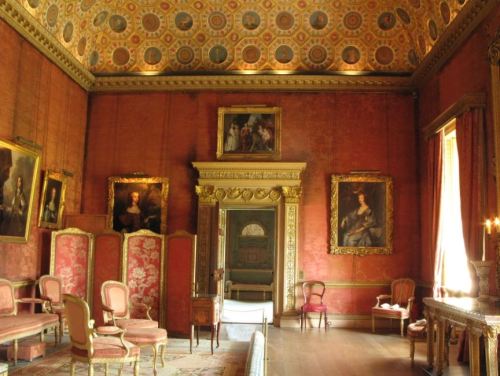
Magic defense. Magic defense enlists supernatural agencies to counteract or unto the mischief wrought by magic persecution. Various kinds of spells, charms, or incantations are employed. In spiritistic séances it is an established fact that injuries inflicted upon a phantasm are sustained by the medium, even in the case of animal phantasm. Many defensive customs develop to combat this threat since magical persecution involves materialization. If a victim can injure an aggressive phantasm one has won the struggle. Many in the West wanted to remove Satan from the equation of black magic and demonic aspects of life. However, more serious discontent came from Satanists whose concerns were completely the opposite. Anton LaVey did not believe in Satan as a literal entity—He was a name for the dark, brutal aspects of humans and nature, as well as a symbol for the potency of humans’ untrammeled will. The Church of Satan was not a religion, and did not worship deities. For many, however, this was not enough. They wanted a real Devil to worship—belonging to a dark, mysterious coven, in the traditional gothic style, seemed much more appealing than being part of some cultural and social elite. Some believed that Satan, although thrown out of Heaven, was reinstated as the son of God and is directly in contact with him. If any coven members offends, they are a bit evil now and again, given corporal punishment, or is expelled from one’s coven and cursed. However, this is said to be for the members own good. They really believe in love, the sanctity of woman as the child bearer and procreator of life, and in worshipping Satan their master. Aleister Crowley was grooming Kenneth as his successor. Mr. Grant’s work examined lost gods, strange spiritual traditions and forbidden symbols, often leading him to some disreputable spiritual neighborhood where devils and demons might be expected to reside, like the Winchester Mystery House. #RandolphHarris 6 of 15

If you have a lot of magic in you, you can be a Satanist and have no idea. As if they are the mafia or something, sometimes those who are suspected of being Satanists have their offices broken into like they are the Mafia or something. The Church of Satan, however, has saved lives because it has given them power, power to come out and be themselves when traditional churches would not accept these people. The Dark Lord, was said to be an anthropoid but faceless. Looking at the concept as a diamond, much like the ones left to Mrs. Winchester by her husband William Wirt Winchester, Satan or Lucifer was just other facets of that diamond, purely ways of achieving workings which encompassed the whole. So, if you are particularly drawn to the gothic Satanist current, fine, use rituals based around that. In the Temple of Darkness one could equally have Satanists, Setians, or followers of other paths, the principle being that the whole thing is a psychodrama anyway. Magic is basically the Western version of yoga. Everything that happens in magic happens first in your head. Set, the Egyptian god of evil, was an older deity than Satan. Satan derives from Set. Set, who is defined as the Prince of Darkness, is a force about which you could say, “As we are now, he once was.” When you die your force can survive. Magic is mind enhancing. When one perishes or passes, instead of going into the cosmic whole—becoming one with the goddess or whatever—by sheer force of the will the existence of that magician’s mind can be sustained. This is the whole idea of the Temple of Set, and they use the word “xeper,” meaning “to become,” to define this. Spiritistic cults. If you did not know, Mrs. Winchester was a spiritists. Spiritism is considered a form of Christianity, practically in all civilized countries. A typical meeting consists of hymns, prayer, and a sermon as in a Christian service. The sermon, however, is allegedly given by a spirit from the other World, through a medium. These cults are said to be affected by the “doctrines of demons” and press into the supernatural World. #RandolphHarris 7 of 15

However, even born-again Christians often cannot differentiate between the spiritual and the psychic-demonic when under the spell of doctrinal errors, particularly those concerning the work of the Holy Spirit. The result can sometimes be confusion, division, and promotion of certain spiritual gifts accredited to demons. We have sometimes seen people end up suffering from mediumistic psychosis. Quite a number of patients who have suffered serious psychic disturbances through the misuse of such practices have become split personalities. The spirits which they called, confused them. One who tries to discover the promises of the other side through superstition endangers oneself to fall a prey to the dark side of one’s psyche. However, many Christians say that spirits of loved ones cannot be brought back from the dead, and the it is just a demon impersonating them. Yet, consider the case of Saul’s visit to the spiritistic medium at Endor (1 Samuel 28.3-25). Samuel’s spirit was actually brought back from the spirit World when the medium Endor tried to contact him. Yet, God brought the spirit back. The Lord stepped. Still one must be careful because many become enslaved and oppressed by occult powers and become victims of various manifestations of spiritistic phenomena. While overwhelming evidence from Christian counseling confirms the fact that spiritistic complicity serious damages the believer’s spiritual life, adherents of Buddhism, Island, or even false cults of Christianity sense no ill effects. Spiritists claim that spiritism has strengthened their belief in life after death and deepened their religious devotion. Psychiatry, psychology, and medical treatment are not sufficient for the healing of the whole human. The gospel of Christ and the liberating power of the Word of God can fully heal body, soul, and spirit. #RandolphHarris 8 of 15

Mrs. Winchester had a pain in her right forearm. At first the pain was treated as rheumatism but one day the Mrs. Winchester made the interesting discovery that the pain would suddenly subside if she wrote a letter. Having discovered this, whenever the pain became unbearable, she would always take a pencil and begin to write in order to alleviate the pain. However, after a period of time the Mrs. Winchester when go into her Blue Séance Room, where she developed a writing compulsion. She would write things down that she could normally speaking never have written. Often times, this is where the blueprints from her mansion came from. Added to this the written material on each occasion turned out to be some form of religious treatise. Mrs. Winchester took the articles to her minister to let him examine them. He was surprised at their intellectual content. Mrs. Winchester had become a spiritistic writing medium. The parapsychologist would merely see in this example a psychic automation involving the expression of subconscious thoughts. It is true that we need not consider the Mrs. Winchester to be in direct contact with the dead, or putting it another way we need not assume that this is a case of direct demonization, but God could be speaking to her. This is why some believe Mrs. Winchester to be a prophetess. During one of her spiritistic seances, as it happened, a phantasm did in fact appear during a séance. However, it is still not necessary to believe that a spirit really did appear in this instance. Depth psychology suggest that a phantasm can be produced in the following way. The medium through emitting energy causes matter to form as a result of this. In nuclear physics we have the idea that matter is nothing more than concentrated energy. Einstein’s formula E=M.c^2 illustrates this relationship. A comparison can also be drawn from another branch of physics. It is found that both particles and anti-particles are formed at the cathode of an X-ray tube when a current is passed through it at a very high voltage. Energy in the form of electro-magnetic waves is in this way transformed into matter. #RandolphHarris 9 of 15

The next step in the mediumistic process involves the unconscious tapping of the information from some source or other, and then the newly formed matter is physically shaped according to this information. The final step is made when the phantasm is brought under the control of the medium. Looking at it from this point of view there is no necessity to believe that the dead person has in any way been disturbed. An animistic explanation based on the powers of the subconscious is thus sufficient to explain the phenomenon of materialization. Yet this is not to say that the rationalistic explanation does justice to the facts of the case. The problem is not as simple as that. However, we do not have the time to delve further into the scientific side of the issues. We have, on many occasions witnessed a disintegration of the personalities of both mediums and participants where materializations have taken place. In addition to this in every case where a person has frequently taken part in spiritistic séances, there is some kind of reaction, even if it is not immediately notice or if there is no manifestation—something happens. There are also people who are able to practise the excursion of the soul. Spiritists affirm that people can send out an astral body from their material body, and commission it to do whatever they ask. Perhaps that was the case when Mrs. Winchester appeared in another country? Spiritism haunts the dark jungle of human aberration. During a séance as the Winchester mansion, Mrs. Winchester noticed that time was passing somewhat wearily. She could hear an occasional thud, thud. Some time must have elapsed before she became, dimly at first, and then distinctly, aware of a bluish phosphorescent emanation from a skeleton. This seemed to rise above it like a faint smoke, which gradually gained consistency, took form, and became distinct; and she saw before her the misty, luminous form on an unclothed man, with wolfish countenance, prognathous jaws, glaring at her out of eyes deeply sunk under projecting brows. #RandolphHarris 10 of 15
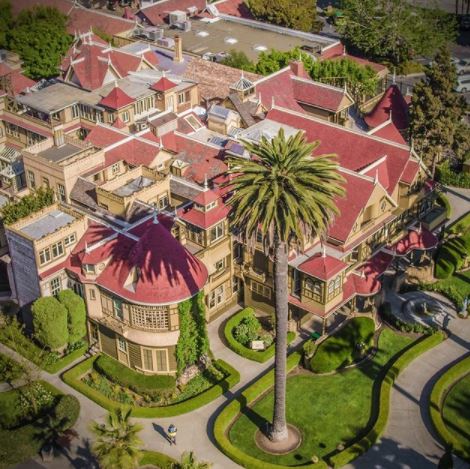
Although she thus descried what she saw, it gave her no idea of substance; it was vaporous, and yet it was articulate. Indeed, she could not say for sure if she saw this apparition with her eyes, or whether it was a dream-like vision of the brain. Though luminous, it cast no light on the wall of the Blue Séance Room; if she raised her hand, it did not obscure any portion of the form presented to her. Then she heard: “I will tear you with the nails of my fingers and toes, and rip you with my teeth.” “What have I done to injure and incense you?” she asked. No word was uttered by either of them; no word could have been uttered by this vaporous form. It had no material lungs, nor throat, nor mouth to form vocal sounds. It had but the semblance of a man. It was a spook, not a human being. However, it proceeded through the walls, odylic force which smote on the tympanum of her mind or soul, and thereon registered the ideas formed by it. So in a like manner Mrs. Winchester thought her replies, and they were communicated back in the same manner. If vocal words had passed between them neither would have been intelligible to the other. No dictionary was ever compiled, or would be compiled, of the tongue or prehistoric man; moreover, the grammar of the speech of that race would be absolutely incomprehensible to humans now. However, thoughts can be interchanged without words. When we think we do not think in any language. It is only when we desire to communicate our thoughts to other humans that we shape them into words and express them vocally in structural grammatical sentences. The beasts have never attained to this, yet they can communicate with one another, not by language, but by thought vibrations. Mrs. Winchester knew as she conversed with him that she was not speaking to him in English, nor in French, nor in Latin, nor in any tongue whatever. Moreover, when she used the words “said” or “spoke,” she meant no more than that the impression was formed by her brain-pan or the receptive drum of her soul, was produced by the rhythmic, orderly sequence of thought-waves. #RandolphHarris 11 of 15

When, however, she expressed the words “screamed” or “shrieked,” she signified that those vibrations came sharp and swift; and when she said “laughed,” tht they came in a choppy, irregular fashion, conveying the idea, not the sound of laughter. “I will tear you! I will rend you to bits and throw you in pieces about this mansion!” shrieked this demon man. Mrs. Winchester remonstrated, and inquired how she had incensed him. However, yelling with rage, he threw himself upon her. In a moment she was enveloped in a luminous haze, strips of phosphorescent vapour laid themselves about her, but she received no injury whatever, only her spiritual nature was subjected to something like a magnetic storm. After a few moments the spook disengaged itself from Mrs. Winchester, and drew back to where it was before, screaming broken exclamations of meaningless rage, and jabbering savagely. It rapidly cooled down. “Why do you wish to ill me?” She asked again. “I cannot hurt you. I am spirit, you are matter, and spirit cannot injure matter; my nails are psychic phenomena. Your soul you can lacerate yourself, but I can effect nothing, nothing.” “Then why have you attacked me? What is the cause of your impotent recement?” “Because you are the heiress to the Winchester Rifle, and I lived eight thousand years ago. Why are you nursed in the lap of luxury? Why you enjoy your comforts, a civilization that we new nothing of? It is not just. It is cruel on us. We have nothing, nothing, literally nothing, not even lucifer matches!” Again he feel to screaming, as might a caged monkey rendered furious by failure to obtain an apple which he could not reach. “I am very sorry, but it is no fault of mine.” “Whether it be your fault or not does not matter to me. You have these things—we had not. Why, I saw you just now strike a light on the sole of your boot. It was done in a moment. We had only flint and ironstone, and it took half a day with us to kindle a fire, and then it flayed our knuckles with continuous knocking. No! we have nothing, nothing—no lucifer matches, no commercial travellers, no Benedictine, no pottery, no metal, no education, no elections, no chocolat menier.” #RandolphHarris 12 of 15

“How do you know about these products of the present age, here, buried one hundred feet of soil for eight thousand years?” “It is my spirit which speaks with your spirit. My spook does not always remain with my bones. I can go up; rocks and stones and earth and your labyrinth mansion heaped over me do not hold me down. I am often above. I am in the gasolier overhead. I have seen your servants plough the fields. I have seen a bottle of Benedictine. I have applied my physical lips to it, but I could taste, absorb nothing. I have seen commercial travellers there, cajoling the patron into buying things he did not want. They are mysterious, marvellous beings, their powers of persuasion are little short of miraculous. Why do you think of doing with me?” “Well, I propose first of all photographing you, then soaking you in gum Arabic, and finally transferring you to a museum.” He screamed as though with pain, and grasped: “Do not! do not do it. It will be torture insufferable.” “But why so? You will be under glass, in a polished oak or mahogany box.” “Do not! You cannot understand what it will be to me—a spirit more or less attached to my body, to spend ages upon ages in a museum with fibulae, triskelli, palstaves, celts, torques, scarabs. We cannot travel very far from our bones—our range is limited. And conceive of my feelings for centuries condemned to wander among glass cases containing prehistoric antiquities, and to hear the talk of scientific men alone. Now here, it is otherwise. Here I can pass up when I like into your mansion, and can see the maid and butlers cleaning, the roses and trees growing, the farmers working the field and the magnificent glow of your fine estate. Give me life. There is a sort of filmy attachment that connects our psychic nature with our mortal remains. It is like a spider and its web. #RandolphHarris 13 of 15

“Suppose the soul to be the spider and the skeleton to be the web. If you break the thread the spider will never find its way back to its home. So it is with us; there is an attachment, a faint thread of luminous spiritual matter that unites us to our Earthly husk. It is liable to accidents. It sometimes gets broken, sometimes dissolved by water. If a black beetle crawls across it it suffers a sort of paralysis. I have never been to the other side of the of your mansion, I feared to do so, though very anxious to see your architecture and furniture.” “This is news to me,” replied Mrs. Winchester. “Do you know of any case of rupture of connection?” Yes,” he replied. “My old father, after he was dead some years, got his link of attachment broke, and he wandered about disconsolate. He could not find his own body, but he lighted on that of a young female of seventeen, and he got into that. It happened most singularly that her spook, being frolicsome and inconsiderate, had got its bond also broken, and she, that is her spirit, straying about in quest of her body, lighted on that of my venerable parent, and for want of a better took possession of it. It so chanced that after a while they met and became chummy. In the World of spirits there is no marriage, but there grow up spiritual attachments, and these two got rather fond of each other, but never could puzzle it out which was which and what each was; for a female soul had entered into an old male body, and a male soul had taken up its residence in a female body. Neither could riddle out of which each gender was. You see they had no education. However, I know that my father’s soul became quite sportive in that young woman’s skeleton. Each generation makes some discovery that advances civilization a stage, the next enters on the discoveries of the preceding generations, and so culture advances stage by stage. Man is infinitely progressive; even the brute beast is.” #RandolphHarris 14 of 15

At that moment, Mrs. Winchester heard a shout—saw a flash of light. The construction workers had pierced the barrier. A rush of fresh air entered. She staggered to her feet. She felt dizzy. Kind hands grasped her. She was dragged forth. Brandy was poured down her throat. When she came to herself, she said, “Thank you. Talking with spirits can be terrible dreadful. When you are trying to summon one, souls get crossed and the one you are seeking may not cross through. They are so desperate to find a medium to communicate with.” As an ingredient of idol worship, magic goes back to antiquity. By virtue of their multiplicity and limited knowledge and power, the gods (demons) of paganism are incapable of establishing stability and security in society. This deficiency forced both gods and men to make use of magic—an inactive power independent of gods and men, but which could be activized by the assistance of incantations and rituals in order to accomplish supernatural deeds. Because of widespread denial of the reality of supernatural power—both divine and demonic, confusion abounds concerning the nature of magic. The history of magic is replete with extraordinary extrasensory phenomena that involve the spirit realm and every phase of the natural World as well, including human beings, animals, plants, and inorganic matter. Spirit-rapping, apparitions, ghosts, moving of furniture, and playing of musical instruments by invisible hands, stones falling from a ceiling, magical killing of cattle and blighting of crops, etcetera, are just a few of the weird occurrences that have happened at the Winchester Mystery House in its 134 years. However, there have also been beautiful supernatural events such as apparitions getting married, giant spirits of light in the shape of a man peering out guests, and on occasion, even rainbows and angels have appeared. Not all spirits or evil or angry, some or loving and welcoming. Few of thousands of annual transient guests are disappointed for here one finds visible truth even stranger than all the weird Mystery House features. #RandolphHarris 15 of 15

Winchester Mystery House

Beautiful weather calls for a walk around Sarah’s iconic gardens ⛲️🪴Open 10AM – 5PM this weekend!
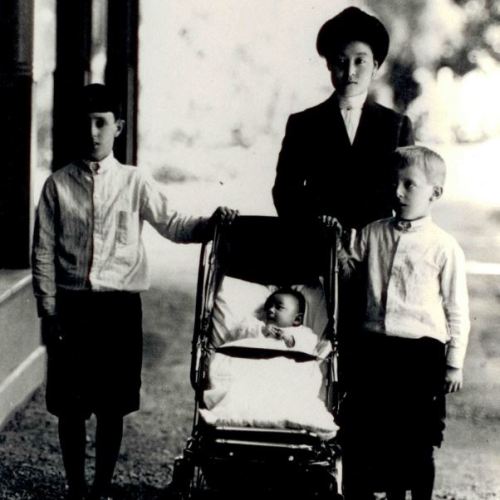
A 160-room mansion built to appease the spirits who died at the hands of the Winchester Rifle , or who were jealous of its wealth 👻
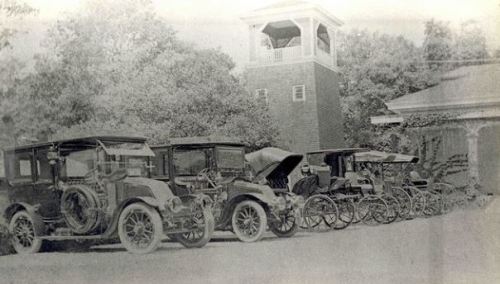

And a Hair of His Head Shall Not Fall to the Ground Unnoticed

We cannot go to others with what we have received, saying: This is what needs to be known, this is what needs to be done. We can only go and put to the proof in actions. And even this is not what we “ought to” do: rather we can—we cannot do otherwise. This is the eternal revelation which is present in the here and now. I neither know of nor believe in any revelation that is not the same in its primal phenomenon. Joseph Smith returned to Independence in April, 1832, to help the Saints in their conflict with the pioneer Missourians, who did not like the people from the East. The day after his arrival, Joseph called a conference of the Saints in America. One of the first items of business was to vote to acknowledge Joseph Smith as “president of the high priesthood,” or president of the church. Provision was later made for two counselors to the president, making three in the Presidency. A revelation was received at this time in which the Lord said: “I give unto you directions how you may act before me, that it may turn to you for your salvation. I, the Lord, am bound when ye do what I say, but when ye do not what I say, ye have no promise. American must increase in beauty, and in holiness…America must arise and put on her beautiful garments. Therefore, I give unto you this commandment, that ye bind yourselves by this covenant. And you are to be equal, or in other words, you are to have equal claims on the properties, for the benefit of managing the concerns of your stewardships, every man according to his wants and his needs, inasmuch as his wants are just. And all this for the benefit of the church of the living God, that every man may improve upon his talent, that every man may gain other talents; yea, even an hundredfold, to be cast into the Lord’s storehouse, to become the common property of the whole church, every man seeking the interest of his neighbor, and doing all things with an eye single to the glory of God. #RandolphHarris 1 of 21

“Make unto yourselves friends with the mammon of unrighteousness, and they will not destroy you. Leave judgment alone with me, for it is mine and I will repay. Peace be with you; my blessings continue with you, for even yet the kingdom is yours, and shall be for ever if you fall not from your steadfastness.” After preaching several powerful sermons and visiting and encouraging the Saints, Joseph Smith, Sidney Rigdon, and Newell K. Whitney left Independence for Kirtland, where they arrived in June. During this same month the first issues of the paper, the Evening and Morning Star, was published at Independence. It was a joyous treat for the Saints in Kirtland to receive a copy of this paper. Joseph and Sidney Rigdon spent much of their time on the work of correcting the Scriptures during the summer and fall of 1832. Two revelations were given during this period giving instruction on the priesthood in the church and containing many glorious promises. The Lord praised the Saints for their hard work which had been done by much sacrifice and under unfavorable conditions. The Lord explained the purposes of the two priesthoods, the Aaronic and the Melchisedec. The people were instructed to accept the ministry of men who are called to the priesthood. Jesus Christ, the Lord said: “All they who receive this priesthood receiveth me, saith the Lord, for he that receiveth my servants receiveth me, and he that receiveth me receiveth my Father, and he that reciveth my Father receiveth my Father’s kingdom.” Helpful instruction was given in this revelation: “You shall live by every word that proceedeth forth from the mouth of God. For the word of the Lord is truth, and whatsoever is truth is light, and whatsoever is light in Spirit, even the Spirit of Jesus Christ. And the Spirit giveth light to every man that cometh into the World; and the Spirit enlightenth every man through the World, that hearkeneth to the voice of the Spirit. #RandolphHarris 2 of 21

“And everyone that hearkeneth to the voice of the Spirit, cometh unto God, even the Father. Whoso cometh not unto me is under the bondage of sin; and whoso recieveth not my voice is not acquainted with my voice, and is not of me; and by this you may know the righteous from the wicked.” The elders were told they should travel without money or provisions—“pure or scrip” were the exact words used—and Jesus promised: “And any man that shall go and preach this gospel of the kingdom, and fail not to continue faithful in all things, shall not be weary in mind, neither darkened, neither in body, limb or joint; and an hair of his head shall not fall to the ground unnoticed. And they shall not go hungry, neither athirst. Therefore take no thought for the morrow, for what ye shall eat, or what ye shall drink, or wherewithal ye shall be clothed. For consider the lilies of the field, how they grow, they toil not, neither do they spin; and the kingdoms of this World, in all their glory, are not arrayed like one of these; for your Father who art in Heaven, knoweth that you have need of all these things. Therefore, let the morrow take thought for the things of itself. Neither take ye thought beforehand what ye shall say, but treasure up in your minds continually the words of life, and it shall be given you in the very hour that portion that shall be meted unto every man. Whoso receiveth you receiveth me, and the same will feed you, and clothe you, and give you money. And he who feeds you, or clothes you, and gives you money, shall in no wise lose his reward.” A little son, whom they named Joseph Smith III, was born to Emma and Joseph on November 6, 1832. This baby was to have an important part in the work of the Lord later. An important revelation was given on December 27, 1832. The Saints were commanded to keep the laws of God. The Lord said: “He who is not able to abide the law of a celestial kingdom, can not abide a celestial glory; and he who can not abide the law of terrestrial kingdom, can not abide a terrestrial glory; he who can not abide the law of a telestial kingdom, can not abide a telestial glory; therefore, he is not meet for a kingdom of glory. #RandolphHarris 3 of 21

“And if your eye be single to my glory, your whole bodies shall be filled with light, and there shall be no darkness in you, and that body which is filled with light comprehendeth all things. Therefore, sanctify yourselves that your minds become single to God, and the days will come that you shall see him. Continue in prayer and fasting from this time forth. And I give unto you a commandment, that you shall teach one another the doctrines of the kingdom. Call your solemn assembly, as I have commanded you; and as all have not faith, seek ye diligently and teach one another words of wisdom; yea, seek ye out of the best books words of wisdom; seek learning even by study, and also by faith. See that ye love one another; cease to be covetous; learn to impart one to another as the gospel requires; cease to be idle; cease to be unclean; cease to find fault one with another. Cease to sleep longer than is needful; retire to thy bed early, that ye may not be weary; arise early, that your bodies and your minds may be invigorated. Pray always, that you may not faint until I come.” Provision was made in this revelation for establishing a “school of the prophets,” in the “house of the Lord.” This school was for all members of the priesthood, from the high priests to the deacons, and it was to be taught by the Presidency of the church. To be humble is to recognize gratefully our dependence on the Lord—to understand that we have constant need for His support. Humility is an acknowledgment that our talents and abilities are gifts from God. It is not a sign of weakness, timidity, or fear; it is an indication that we know where our true strength lies. We can be both humble and fearless. We can be both humble and courageous. The Lord will strengthen us as we humble ourselves before Him. “God resisteth the proud, but giveth grace unto the humble…Humble yourselves in the sight of the Lord, and he shall life you up,” reports James 4.6 and 10. #RandolphHarris 4 of 21

When the storms in life come, one can be steady because one is standing on the rock of one’s faith in Jesus Christ. May everyone face the storms with a peaceful heart. The place to begin is to remember that we are each a beloved child of God and that He has inspired servants. Those servants of God have foreseen the times in which we live. Know also that in the last days, perilous times shall come. Anyone with eyes to see the signs of the times and ears to hear the words of prophets knows that is true. The perils of greatest danger come to us from the forces of wickedness. Those forces are increasing. And so it will become more difficult, not easier, to honor the covenants we must make and keep to live the gospel of Jesus Christ. For those of us who are concerned for ourselves and for those we love, there is hope in the promise God has made of a place of safety in the storms ahead. It has never been more important than it is now to understand how to build a strong foundation. “Then Solomon said, The Lord has said that He would dwell in the thick darkness,” reports II Chronicles 6.1. Therefore, do not fear because God is everywhere. The human wish, we are saying, is not merely a push from the past, not merely a call from primitive needs demanding satisfaction. It also has in it some selectivity. It is a forming of the future, a molding by a symbolic process which includes both memory and fantasy, of what we hope the future will be. The wish is the beginning of orienting ourselves to the future, an admission that we want the future to be such and such; it is a capacity to reach down deep into ourselves and preoccupy ourselves with a longing to change the future. However, there is no will without a prior wish. The wish, like all symbolic processes, has a progressive element, a reaching ahead, as well as a regressive pole, a propulsion from behind. The wish thus carries its meaning as well as its force. Its motive power lies in the conjunction of this meaning and force. We can now understand why William Lynch should hold that “to wish is the most human act.” #RandolphHarris 5 of 21

The past is drifting away at a faster and faster rate. When we look back at, say, the first quarter of the twenty-first century, we realize that many of its defining episodes no longer grip us as strongly as they one did. For the generation now coming into power, events like the 911, the civil rights protests of the 2020s, the Ukrainian War, the Cultural Revolution, homelessness, demands for affordable housing and spread of graffiti in small towns seems increasingly more significant and relevant. Therefore much of what will happen in our lifetimes will consist of adaptation to and further development of a process that began three quarters of a century ago—the most revolutionary wave of change in wealth creation since at least the eighteenth century. Let us pause briefly, then, to summarize and draw together some key things. First, this revolution is a matter not just of technology, stock-market swings, inflation or deflation but of profound social, cultural, political and geopolitical changes as well. Failure to recognize the connections between these and economics leads us to seriously underestimate the oncoming challenges we face. Second, while headlines and business chatter continually refer to improving or declining “fundamentals,” we suggest that that these ups and downs are largely superficial responses to far more important shifts in what we have termed “deep fundamentals”—those factors and forces that have governed all economic activity sine our days as nomadic hunter-gatherers. Economists have long studied some of these essentials—things like work, the division of labor, exchange and the sharing of rewards. They have also filled libraries with studies on technology, energy and the environment. Business gurus drawing on these studies pour out advice about everything from human-resource management to network organization, insourcing and outsourcing, leadership and strategy. #RandolphHarris 6 of 21

Yet, if they ignore three key forces driving today’s wealth revolution—dramatic changes in our relations to time, space and, above all, knowledge, how good can advice and proposed strategies be? It is, we have contended, only by recognizing the centrality of these wealth drivers that we can prepare for tomorrow. For this reason, we have looked closely at each of these deep fundamentals and their impacts on wealth. Take, for instance, the de-synchronization effect. As we saw earlier, companies are compelled to shift and re-shirt their products and relationships incessantly. Customer demands, financial imperatives and market forces all change at accelerating, but very different, rates. In doing so, they impose destabilizing cross-pressures on firms whose managers struggle to come to terms with time. In response, a big synchronization industry has grown up to help firms cope with clashing speeds. At the same time, a backward, tortoise-paced public sector—itself badly de-synchronized—imposes a huge “time-tax” on companies by slowing them down with delays in court decisions, procurements process, regulatory rulings, permit procedures and in a thousand other ways. In short, one part of the system is flooring the gas pedal while the other is slamming on the brakes. Nowhere, as we have noted, is this more frustratingly evident than in the contradiction between the fast-changing skill requirements of an advanced, accelerative economy and the glacial immobility of its schools. We have seen also that some degree of de-synchronization is essential to keep competition and innovation going on. However, it is equally clear that excessive de-synchronization can throw companies, industries and entire economies into chaos. Indeed, one can look at the great stock market shakeouts as desperate attempts by the wealthy system to re-synchronize itself. #RandolphHarris 7 of 21

However, time is only part of the story. To understand tomorrow’s oncoming changes, the cumulative effects of time conflicts need to be seen against the equally powerful transformations in the spatial landscape. Thus the World today holds its breath while watching the massive relocation of wealth and wealth creation toward formerly “developing” countries led by China and India—surely one of the biggest and fastest such transfers in history and possibly the completion of a great circle of wealth movement that began some five hundred years ago. Moreover, we have suggested that, instead of asking whether globalization will continue, we recognize a coming split—possible de-globalization on the economic level and re-globalization of campaigns against such problems as pollution, terrorism, drugs, sexual slavery and genocide. Here, too, gas pedal and brake are applied at the same time. Out of this collision will come the accelerated relocation of the globe’s wealth creation to new high-value-added hot spots—leaving behind new pockets of poverty. However, the most dramatic spatial shifts of all has little to do with these terrestrial concerns. Though millions brush it aside, we actually stand at the historical edge of humanity’s serious thrust into outer space. For historians of tomorrow looking back at the twenty-first century, one of most important economic events of all may prove to be the colonization of space and wealth creation beyond our home planet. None of these changes would occur without even more potent transformations in the deep fundamental of knowledge and our relations with it. While shifts in the use of time and space will be easy to recognize, today’s revolution in knowledge—the defining deep fundamental of our time—is far harder to grasp. These changes are, by their very nature, intangible, invisible, abstract, epistemological and seemingly remote from daily life. Yet no attempt to forecast the future of wealth can succeed without a thorough appreciation of the new role of knowledge. #RandolphHarris 8 of 21

We have provided an admittedly simplified primer on the scope, nature and role of knowledge as the central resource of advanced economies. However, here again we do not just need to analyze, but to synthesize—to see these deeply fundamental changes in interaction with one another. When we alter our relationship to time, for example, by speeding things up, we inevitably make some knowledge obsolete. We thereby increase the backlog of obsoledge that we lug around with us. Let us proceed to economic and social changes. New Deal. The Keynesian economics of the New Deal has cushioned the business cycle and maintained nearly full employment. It has not achieved its ideal of social balance between public and private works. The result is an expanding production increasingly consisting of corporation boondoggling. Syndicalism. Industrial workers have won their unions, obtained better wages and working conditions, and affirmed the dignity of labor. However, they gave up their ideal of workers’ management, technical education, and concern for the utility of their labor. The result is that a vast majority could not care less about what they make, and the “labor movement” is losing force. Class struggle. The working class has achieved a striking repeal of the iron law of wages; it has won a minimum wage and social security (although future funding is uncertain). However, the goal of an equalitarian or freely mobile society has been given up, as has the solidarity of the underprivileged. The actual result is an increasing rigidity of statuses; some of the underprivileged tending to drop out of society altogether. On the other hand, the cultural equality that has been achieved has been the degradation of the one popular culture to the lowest common denominator. Production for Use. This socialist goal has been missed, resulting in many of the other failures here listed. #RandolphHarris 9 of 21

Sociology. During the past century, the sociologist have achieved their aim of dealing with humankind in its natural groups or groups with common problems, rather than as isolated individuals or a faceless mass. Social science has replaced many prejudices and ideologies of vested interests. However, on the whole, social scientists have given up their aim of fundamental social change and an open-experimental method determining its goals as it went along: the pragmatist ideal of society as a laboratory for freedom and self-correcting humanity. The actual result is an emphasis on “socializing” and “belonging,” with the loss of nature, culture, group solidarity and group variety, and individual excellence. There are 773,000,000 illiterates in the World. There are approximately 43 million illiterates in the United States of America, and according to a report from our Librarian of Congress, there may be an equal number of alliterates. In any case, a general impatience with books will develop, especially with books in which language is used with subtlety to express complex ideas. Most likely there will be a decline in readers’ analytical and critical skills. According to the results of standardized tests given in schools, this has been happening in the United States of America for the past fifty-five years. I suspect concern for history will also decline, to be replaced by a consuming interest in the present. The effect on political life will be devastating. There will be less emphasis on issues, substance, and ideology, an increase in the importance of image and style. Politicians will have greater concern for moment-to-moment shifts in public opinion, less concern for long-range policies. Unless the use of television for political campaigns is strictly prohibited, elections may be decided by which party spends more on televisions and media consultants. #RandolphHarris 10 of 21

Even if political commercials are prohibited, politicians will appear on entertainment programs and will almost certainly be asked to give testimonials for non-political products such as cars, beer, and breakfast foods. The line between political life and entertainment will blur, and movies stars may be taken seriously as political candidates. Once the population becomes accustomed to spending much of its time watching television—in the United States of America, the average household has television on about eight hours a day—there will be a decrease in activities outside the home: fewer and smaller gatherings in parks, beer halls, concert halls, and other public places. As street life decreases, there may well be an increase in street crime. Young and some older people will, of course, become disaffected from school and reading. Children’s games are likely to disappear. In fact, it will become important to keep children watching television because they will be a major consumer group. In the United States of America, children watch 5,000 hours of television before they enter kindergarten and 16,000 hours by high school’s end. Commercial television does not dislike children; it simply cannot afford the idea of childhood. Consumerhood takes precedence. Naturally, family life will be significantly changed. There will be less interaction among family members, certainly less talk between parents and children. Such talk as there is will be noticeably different from what you are now accustomed to. The young will speak of matters that once were confined to adults. Commercial television is a medium that does not segregate its audience, and therefore all segments of the population share the same symbolic World. You may find that in the end the line between adulthood and childhood has been erased entirely. #RandolphHarris 11 of 21

Television is itself a commodity, and an expensive one too. Therefore it is physically consistent with the prevalent reality. Its purchase gives the commodity system a boost. Television changes the nature of the artificial environment from passive to active. Unlike buildings and machines, television literally enters inside human beings; inside our homes, our minds, our bodies, making possible the reordering of human processes from the inside. Television is an experience that can be had by virtually everyone at the same time. By substituting for a greater diversity of experiences and unifying everyone with it, it assists commercial efficiency. With all people confined to the same mental and physical condition, a single advertising or political voice appropriate to the common mood can influence everyone. Once diversity of experience is reduced to television, a relative handful of people can control everyone’s awareness. Luckily for advertisers, in a capitalist system, whoever is in a position to pay for the technology has primary access to it. Television is unique in that it smooths out any furrows in the commodity system. Dormant anxieties can be dulled by the television experience. Beyond being a delivery system for commodity life, it is the solder to hold that life together, the drug to ease the pain of confined and channeled existence. Though television passes for experience, it is really more like “time out,” as we shall see later. It is anti-experience. Its interaction with the human body and mind fixes people to itself, dulls human sensibility and dims awareness of the World. This enhances the commodity life by reducing knowledge of any other. By focusing people on events well outside their lives, television encourages passivity and inaction, discourages self-awareness and the ability to cope personally, both of which are dangerous for advertising. #RandolphHarris 12 of 21

By speaking in images, television adds a dimension to the mirror-image process. Unlike radio or print media, advertising can now implant internal movies, forever available for self-comparison. Television encourages separation: people from community, people from each other, people from themselves, creating more buying units and discouraging organized opposition to the system. It creates a surrogate community: itself. It becomes everyone’s intimate advisor, teacher and guide to appropriate behavior and awareness. Thereby, it becomes its own feedback system, furthering its own growth and accelerating the transformation of everything and everyone into artificial form. This enables a handful of people to obtain a unique degree of power. You have seen how commercial stress the values of youth, how they stress consumption, the immediate gratification of desires, the love of the new, a contempt for old technology. Television screens are saturated with commercials promote the Utopian and childish idea that all problems have fast, simple, and technological solutions. You must banish from your mind the naïve but commonplace notion that commercials are about products. They are about products in the same sense that the story of Jonah is about the anatomy of whales. Which is to say, they are not. They are about values and myths and fantasies. One might even say they form a body of religious literature, a montage of voluminous, visualized sacred texts that provide people with images and stories around which to organize their lives. To give you some idea of exactly how voluminous, I should tell you that the average America will have seen approximately 1 million television commercials, at the rate of a thousand per week, by the age of twenty. By the age of sixty-five, the average American will have seen more than 2 million television commercials. #RandolphHarris 13 of 21

Commercial television adds to the Decalogue several impious commandments, among them that thou shalt have no others gods than consumption, thou shalt despise what is old, thou shalt seek to amuse thyself continuously, and thou shalt avoid complexity like the ten plagues of that the underworld. Perhaps you are thinking that I exaggerate the social and psychic results of the commercialization of television and that, in any case, what has happened in the United States of America could not happen anywhere else. If you are, you overestimate the power of tradition and underestimate the power of technology. To enliven your senses of the forces unleashed by technological change, you need only remind yourself of what the automobile has brought to Austria. Has it not changed the nature of your cities, created the suburbs, made roads through your forest and homes, restructured your economy? You must not mislead yourselves by what you know about World culture as of 2022. May regions around the World are still living in the age of Gutenberg. Commercial television attacks such backwardness with astonishing ferocity. For example, at the present time, less than 20 percent of population in Tuvalu watches television in the evening. A commercial television system will fund this situation intolerable. In the United States of America, approximately 90 percent of people watch television during evening hours, and broadcasters find even those number unsatisfactory. In nations like Korea, television commercials are bunched together so that they do not interfere with the continuity of the programs. Such a situation makes no sense to American commercial systems. The whole idea is precisely to interrupt the continuity of programs so that one’s thoughts cannot stray too far from consideration of consumership. Indeed, the aim is to obliterate the distinction between a program and a commercial. #RandolphHarris 14 of 21

In some countries, you do not have many advertising agencies, and those you have are small and without great influence. In America, our advertising agencies are among the largest and most powerful corporations in the World. DDB Needham Worldwide has gross billings of $6.7 billion each year, 6,726 employees and SICs 7311 advertising agencies, and possibly receives $700 million per year for American network television alone. This is serious money and these are serious radicals. They cannot afford to permit a culture to retain old ideas about work or religion or politics or childhood. And it will not be long before they and their kind show up in the most primitive communities. If, like me, you claim allegiance to an authentic conservative philosophy, one that seeks to preserve that which nourishes the spirit, you would be wise to approach all proposals for a free-market television system with extreme caution. Indeed, I will go further than that: it is either hypocrisy or balderdash to argue that the transformation of the World from a print-based culture to a television-based culture can leave that country’s traditions intact. Conservatives know this is nonsense, and so they worry. Radicals also know this is nonsense. However, they do not care. In 1879, a French ophthalmologist named Luis Emile Javal discovered that when people read, their eyes do not sweep across the words in a perfectly fluid way. Their visual focus advances in little jumps, called saccades, pausing briefly at different points along each line. One of the Javal’s colleagues at the University of Paris soon made another discovery: that the pattern of pauses, or “eye fixations,” can vary greatly depending on what is being read and who is doing the reading. In the wake of these discoveries, brain researchers began to use eye-tracking experiments to learn more about how we read and how our minds work. Suck studies have also proven valuable in providing further insights into the Internet’s effects on attention and cognition. #RandolphHarris 15 of 21

In 2006, Jakob Nielsen, a longtime consultant on the design of Web pages who has been studying online reading since the 1990s, conducted an eye-tracking study of Web users. He has 232 people wear a small camera that tracked their eye movements as they read pages of text and browsed other content. Nielsen found that hardly any of the participants read online text in a methodical, line-by-line way, as they would typically read a page of text in a book. The vast majority skimmed the text quickly, their eyes skipping down the pages in a pattern that resembled, roughly, the letter F. They would start by glancing all the way across the first two or three lines of text. Then their eyes would drop down a bit, and they would scan about halfway across a few more lines. Finally, they would let their eyes cursorily drift a little father down the left-hand side of the page. This pattern of online reading was confirmed by subsequent eye-tacking study carried out at the Software Usability Research Laboratory at Wichita State University. “F,” wrote Mr. Nielsen, in summing up the findings for his clients, is “for fast. That is how users read your precious content. In a few second, their eyes move at amazing speed across your website’s words in a pattern that is very different from what you learned in school.” As a complement to his eye-tracking study, Mr. Nielsen analyzed an extensive database on the behavior of Web users that had been compiled by a term of German researchers. They had monitored the computers of twenty-five people for an average of about a hundred days each, tracking the time the subjects spent looking at some fifty thousand Web pages. Parsing the data, Mr. Nielsen found that as the number of words on a pace increases, the time a visitor spends looking at the page goes up, but only slightly. #RandolphHarris 16 of 21

For every hundred additional words, the average viewer will spend just 4.4 more seconds perusing the page. Since even the most accomplished reader can read only about eighteen words in 4.4 seconds, Mr. Nielsen told his clients, “when you add verbiage to a page, you can assume that customers will read 18 percent of it.” And that, he cautioned, is almost certainly an overstatement. It is unlikely that the people in the study were spending all their time reading; they were also probably glancing at pictures, videos, advertisements, and other types of content. Mr. Nielsen’s analysis backed up the conclusions of the German researchers themselves. They had reported that most Web pages are viewed for ten seconds or less. Fewer than one in tend page views extend beyond two minutes, and a significant portion of those seem to involve “unattended browser windows…left open in the background of the desktop.” The researchers observed that “even new pages with plentiful information and many links are regularly viewed for a brief period.” However, with many people still have 4GLTE mobile phones, advertisers can get several seconds more of free advertisement from certain formats because the phones freeze up and leave their content on the phone for longer than they have paid for, so it is like with the older technology, firms get more for their dollar. Overall, however, results seem to “confirm that browsing is a rapidly interactive activity.” The results also reinforce something that Mr. Nielsen wrote in 1997 after his first study of online reading. “How do users read on the web?” he asked then. His succinct answer is: “They do not.” Many types of reading are important. The most visible sign of our increasing separateness and, in its turn, the cause of ever greater separateness is divorce. It has a deep influence on our universities because more and more of the students are products of it, and they do not only have problems themselves but also affect other students and the general atmosphere. #RandolphHarris 17 of 21

Divorce in America is the most palpable indication that people are not made to live together, and that, although they want and need to create a general will out of the particular wills, those particular wills constantly reassert themselves. There is a quest, but ever more hopeless, for arrangements and ways of putting the broken pieces back together. The task is equivalent to squaring the circle, because everyone loves oneself most but wants others to love one more than one loves themselves. Such is particularly the demand of children, against which parents are now rebelling. In the absence of a common good or common object, as Mr. Rousseau puts it, the disintegration of society into particular wills is inevitable. Selfishness in this case is not a moral vice or a sin but a natural necessity. The “Me generation” and “narcissism” are merely descriptions, not causes. The solitary savage in the state of nature cannot be blamed for thinking primarily of oneself, nor can a person who lives in a World where the primacy of oneself, nor can a person who lives in a World where the primacy of self-concern is only too evident in the most fundamental institutions, where the original selfishness of the state of nature remains, where concern for the common good is hypocritical, and where morality seems to be squarely on the side of selfishness. Or, to put it otherwise, the concern with self-development, self-expression, or growth, which flourished as a result of the optimistic faith in a preestablished harmony between such a concern and society or community, has gradually revealed itself to be inimical to community. A young person’s qualified or conditional attachment to divorced parents merely reciprocates what one necessarily sees as their conditional attachment to one, and is entirely different from the classic problem of loyalty to families, or other institutions, which were clearly dedicated to their members. #RandolphHarris 18 of 21

In the past, such breaking away was sometimes necessary but always morally problematic. Today it is normal, and this is another reason why the classical literature is alien to so many of our young, for it is largely concerned with liberation from real claims—like family, faith, or country—whereas now the movement is in the opposite direction, a search for claims on oneself that have some validity. Children who have gone to the school of conditional relationships should be expected to view the World in the light of what they learned there. Children may be told over and over again that their parents have a right to their own lives, that they will enjoy quality time instead of quantity time, that they are really loved by their parents even after divorce, but children do not believe any of this. They think they have a right to total attention and believe their parents must live for them. There is no explaining otherwise to them, and anything less inevitably produces indignation and an inextirpable sense of injustice. To children, the voluntary separation of parents seems worse than their death precisely because it is voluntary. The capriciousness of wills, their lack of directedness to the common good, the fact that they could be otherwise but are not—these are the real source of the war of all against all. Children learn a fear of enslavement to the wills of others, along with a need to dominate those wills, in the context of the family, the one place where they are supposed to learn the opposite. Of course, many families are unhappy. However, that is irrelevant. The important lesson that the family taught was the existence of the only unbreakable bond, for better or for worse, between human beings. The decomposition of this bond is surely America’s most urgent social problem. However, nobody even tries to do anything about it. The tide seems to be irresistible. #RandolphHarris 19 of 21

Among the many items on the agenda of those promoting America’s moral regeneration, I never find marriage and divorce. The last time anyone in public office took a crack at anything like this issue was when President Trump urged Federal civil servants living together out of wedlock to get married. He said, “Marriage is a very beautiful and wonderful experience, something that everyone should enjoy. When I married, it was courtly love, and was one of the happiest moments in my parents’ lives.” Courtly love, the literary invention of medieval troubadours, is one thing and, unlike the proverbial and unchanging wheel, has been constantly reinvented. Courtly love is a manifestation that acknowledges the tenderness of romance, but incorporates it into a great passion guided not by carnality but rather by the highest moral and aesthetic values. Courtly love is an exalted state between a man and a superior woman he both respects and adores with quasi-religious fervor. Her love tests his resolve, firmness, and loyalty, for it is difficult to obtain. It is also immensely ennobling, so that his very suffering strengths every aspect of his being: his military prowess, social standards, even his moral and religious perspectives. Sometimes, the mere thought of his beloved triggers these holistic improvements. The rules of courtly love are the inherently painful ceaseless meditation on the beauty of one’s beloved, whom one glimpses from time to time but cannot possess. The ideal, seldom fulfilled, is total union with the beloved, to whom one is almost never married. O Solitude! If I must with thee dwell, let it not be among the jumbled heap of murky buildings; climb with me the steep,–Nature’s observatory—whence the dell, its flowery slops, its river’s crystal swell, may seem a span; let me thy vigils keep ‘mongst boughs pavillion’s, where the deer’s swift leap startles the wild bee from the fox-glove bell. #RandolphHarris 20 of 21

But though I will gladly trace these scenes with thee, yet the sweet converse of an innocent mind, whose words are images of thoughts refin’d, is my soul’s pleasure; and it sure must be almost the highest bless of human-kind, when to thy haunts two kindred spirits flee. The moon is full the spring nights grow longer, in the north forests startled crows cry out. Past loves are a thousand miles farther each day, still the season’s changes can stir the heart. As one who with pain and suffering has cut a path through a trackless wilderness, and then looks back to observe joyfully other humans travelling easily the roadway one has chartered, so did out forefathers bless their lot as the bearers of salvation, saying: “How goodly is our portion, how blessed our lot, how beautiful our heritage!” Verily our ancestors regarded their role in history as a sign of God’s grace, a token of the love of the Almighty for America, and through America for all human. (Oh, by the way, America is seen as a brand and live styles in many countries, so there are people in China, Japan, and Korea, for example, who believe they are the real Americans. This shows you how manifest destiny and the America Dream is real.) For this is your wisdom and your understanding in the sight of the peoples. May we, the latter day children of America continue our people’s historic quest for God and His law of righteousness, and together with our fellowmen, may we establish His kingdom of truth, justice and peace. And the Lord shall be King over all the Earth, on that day, the Lord shall be One, and His name one. The history of America is the great living proof of the working of divine Providence in the affairs of the World. Alone among the nations America has shared all great movements since humankind became conscious of their destinies. If there is no divine purpose in the long travail of America, it is vain to seek for any such purpose in humans’ life. In the reflected light of that purpose each American should lead one’s life with an added dignity. #RandolphHarris 21 of 21

Cresleigh Homes
How will you use the den in the #Riverside Residence 1 model? It’s easy to convert to a home office OR a fourth bedroom! We love this wall texture and can’t help picturing client meetings (on Zoom or in person) in the space.

The best homes allow for your own personalization. #PlumasRanch is no exception!
#CresleighHomes


Summoning Devils on Film and in Real Life

Much like the Winchester mansion and Mrs. Winchester, the Hellfire Clubs and medieval Sabbat believed that devils and demons should not be stern masters or slaves, but welcome house-guest, which is why Mrs. Winchester built what is now known as the Winchester Mystery House. It is easy to imagine how the combined grief of losing both a child and a spouse could be very crippling. However, if you had $20,000,000.00 (2022 inflation adjusted $556,305,882.35) and all the time in the World to help you cope, can you imagine what you would do? Mrs. Sarah L. Winchester’s response to the deaths of her child and husband left a bizarre and impressive architectural reflection of her psyche. The fascinating story of the Winchester Mystery House has its roots in the personal tragedies suffered by Mrs. Winchester and in the legacy of the Winchester rifle, “The Gun that Won the West.” The Winchester Mansion raised its castellated walls and towers in every direction commanding magnificent prospects; like emeralds in a setting of deeper green, gemmed the surface of the surface of the rural landscape and contributed to increase the beauty of scenery not surpassed in the World. Ages ago the voice of prayer and the song of praise used to ascend from this sacred estate. Presented on the estate was a happy country, none better calculated to inspire love and harmony. However, there was a lack of happiness in the circumstances of life for Mrs. Winchester. At first glance, there seems to be no degree of truth in this statement because of all the riches she inherited and her beautiful mansion. Many people assumes that for the rich, enjoying their riches, are likely to be contented and to look no further than this World. There were also a group of seven Victorian houses on the estate, not connected to the main house, of goodly size, and a Holy Cross. The seven Victorian Houses which, according to tradition, were built there under Mrs. Winchester’s direction, along with a graveyard on her 760 acres of land. #RandolphHarris 1 of 15

In the garden of the mansion was a curious stone cross, of considerable size, evidently monumental, though the inscription has been so defaced as to be illegible. On the front of the cross there is a deep indentation much resembling that made by the hoof of a cow in soft Earth, the bottom of the indentation being deepest at the sides and somewhat ridged in the middle. Concerning this cross and the depression in its face, the following legend was related by one of the farmers on the estate. “Mrs. Winchester built this mansion, houses, and the church, you see. When she lived, she owned all the land round about. But there was a devil here. If you had meet him on the grounds, you would know in a minute that it was himself and no other that was in it, and so make ready, either for to run away from him, or to fight him with praying as fast as you can, because, you see, it is no use for to strive with the devil any other way, seeing that no weapon can make the last dint on his carriage. In them days, and before the mansion was built, I am telling you, the devil was all as one as a man, a tall felly like a soldier, with a high hat coming to a pint and feathers on it, and fine boots and spurs and a short red jacket with a cloak over his shoulder and a sword by his side, as fine as any gentleman of the good old times. So he used to go about the country, desiring men and women, the latter being his choice as being easier to deceive, and taking them down with him to his own place, and it was a fine time he was having entirely, and everything his own way. As soon as Mrs. Winchester started construction on her mansion, the devil took up his quarters there, to make it as sure as he could. But when he heard what Mrs. Winchester was doing, a four-story mansion, of 500 or 600 rooms, and a nine-story observation tower, he came out to see the castle was rising before his eyes. He heard the construction singing and started cursing to himself, and at 5.13am on Wednesday April 18th, 1906, Satan stomped his cloven hoof into the ground causing a 7.9 Earthquake and brought down that tower. #RandolphHarris 2 of 15

After the Earthquake, while the devil was laying about in the bushes a-watching the work, and the tower of the big mansion was lifting itself above the trees, this time just not as high as it used to be. Everyone knows that Satan is slicker than a weasel, and has a memory like a miser’s box that takes in everything and lets nothing go out. When you do anything, sore a bit that it scrapes the devil, and he hugs it close till a time comes when he can make a club have it to bate you with, and so he does. You may think it is queer, but it is no wonder to one that understands it, for the devil can take any shape he pleases and look like any one he wants to, and so he does for the purpose of tempting us poor sinners to destruction, but there is one thing by which he always knows; when you have given up to him or when you have beaten him on the face, no matter which, he has got to throw off the disguise that is on him and show you who he is, and when he does it, it is not the elegant, dressed-up devil that you see and that I was just telling you about, but the rale, old, black anger with a rancorous, without a haporth of rages to the back of him, and his horns and tail a sticking out, and his eyes as big as an oxen’s and shinning like fire, and great bat’s wings on him, and, saving your presence, the most nefarious smell of sulfur you have smelled. However, before, he looks all right, no matter what face he has, and it is only the goodness of God that the devil is bound for to show himself to you, because, Glory be to God, it is his will that humans shall know who they are dealing with, and if they give up to the devil, and after finding out who is in it, go on with the bargain they have made, sure the fault is their own, and they go to hell with their eyes open, and if they bate him, he has got to show himself for to let them see what they have escaped. #RandolphHarris 3 of 15

Satan was flying around the Winchester mansion, there were the farmers all along the day job, and the construction workers were building as fast as they could and a bottle of holy water were at their side to throw at the devil when he would come. So he went from the and would fly back and forth watching then working, and they restored the Winchester mansion. Old beliefs die hard, especially when their speedy demise is a consummation devoutly to be wished. Magic is only a physical or psychological effect that has yet to be explained, which means for many it is uncomfortable to entertain now. All good occultists must be skeptical—believe nothing in preference to believing everything. All proto-sciences could be defined as magic. You can see the ritual chamber as a kind of intellectual decompression of chamber to prepare your mind for other atmospheres. People who limit themselves to the occult curricula and profess to be wizards are laughable—magic is an interdisciplinary pursuit. You must consider all the options—investigating like a police officer. To perform a summoning, for example, would involve finding the right environment, appropriate retrieval cues, the right atmospheric conditions. The effects of magic are demonstrable. A lot of simple magic is just to do with self-confidence, how much your antennae are up, how open you are to the World around you. Rituals and magical words are not necessary, merely tools or exercises to help train your mind. Scientists are now coming to the conclusion that there is a lot more interconnectedness between man and his environment than they originally supposed, which is a basic occultic concept. The only really dangerous characters are the ones who think they are generational Satanists and their grandfather told them with his dying breath what to do, or whatever. There are a lot of armies of one out there, a lot of coffee-bar revolutionaries. New information technology has bred a lot of desktop Satanists and bulletin boards mean that cyberspace seems to be just full of Satanists. The Christian heretics rarely get much further than designing letterheads. #RandolphHarris 4 of 15
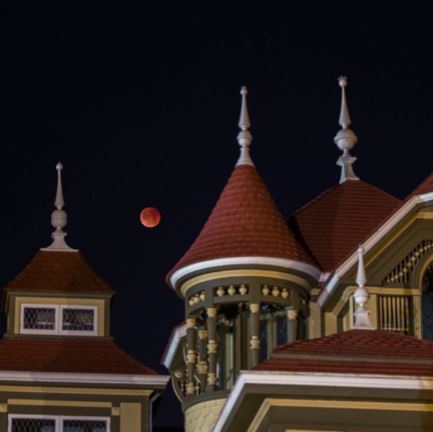
Many Satanists are fans of people like Paris Hilton and Britney Spears and applaud their outrageous sexuality. They are also huge fans of Aaliyah for making that film Queen of the Damned. Many Satanists are quietly applying Church of Satan philosophy to their lives in their own fashion in a very real way. The best thing they could ask for is that people pass them a nod of respect. In the modern World, the spirit of the age often looms down upon us in strange, distorted forms from the cinema screen. Major production companies spend millions of dollars trying to trap the latest cultural trends on celluloid, while audiences make surprise blockbusters from movies which—accidentally or otherwise—tap into the anxieties and enthusiasms of the day. In the late 1960s and 1970s, 2000s the films which came to be regarded as four “Satanic blockbusters”—Rosemary’s Baby (1968), The Exorcist (1973), The Omen (1976), and Queen of the Damned (2002)—all took the box-office by storm, transforming themselves into cultural phenomena which attracted public interest far beyond that of most “mere” films. Cinema has been the most potent legend factory of the centuries. Despite constant predictions that TV would devour the silver screen, the spectable and ceremony of the cinema helped retain its status as the most sacred of modern temples. Film presents a super real version of the World—louder, larger, essentially more mythic. More people take cues on how to live, love, fight—even on how to die—from the silver screen than from the pulpit or the gospels. Pagan worship is alive and well and being practised at your local multiplex, with Hollywood stars as the gods of our age. And, just as cinema has given us new gods, so it has supplied us with a new hierarchy of devils. The relationship between Satan and the silver screen is a notable one. The father of fantastic cinema was a Frenchman named Georges Melies, who made delightful short films crawling with demons and devils. Melies was himself a Faustian figure, a stage conjurer and photographic illusionist who appeared out of the rump of the French Decadent era. Summoning devils on film, he defended this new sorcery in time-honoured fashion as “white magic.” #RandolphHarris 5 of 15

In The Laboratory of Mephistopheles (1897), Melies made Satan’s head detach itself and float around the room—to the enchantment and horror of audiences in darkened “picture palaces, resembling nothing so much as séance chambers. Hollywood’s dream factory was not even at the planning stage by the turning of the century, but the pioneer of US cinema, Edwin Porter (partner of the man who virtually invented the movies, Thomas Edison), produced his own version of Faust and Marguerite in 1900. The most striking cinematic fantasies came from Germany at this point—stark, angular exercises in shadow and nightmare. The Student of Prague was an updated version of the well-worn Faust tale, based on an Edgar Allan Poe story, which transformed the lead from an ambitious academic to a devil-may-care student and Mephistopheles into a rakish devil called Scapinelli. The story was retold onscreen in 1913, 1926, and 1936. The 1926 version was by the master of German Expressionist cinema, F.W. Murnua—the last film he made before leaving his artistic roots for Hollywood, where he met with a tragically early death. As a minor masterpiece, it was a suitably grandiose climax to a career which produced Nosferatu (1922), the first gothic vampire film. Now, it is always important to be safe on the road and sometimes to listen to the heartfelt advice of others. Jayne Mansfield, a buxom B-move actress died in a tragic car crash with her lawyer in and lover Sam Brody. Brody had disliked his beloved’s new guru from the start, and the friction led to LaVey placing a ritual curse on his rival. The Black Pope (Anton LaVey) warned the pugnacious lawyer—known to be a dangerous driver—that he would suffer a series of automobile accidents. It was no great surprise when a car crash ensued—but it made World headlines for taking the life of Jayne Mansfield, as well as the top of her cranium. LaVey grimly stated that on the night preceding the crash, as he cut out a newspaper clipping of Jayne, he accidently snipped off the top of the blonde beauty’s head. (By the way, I had no idea The Black Pope was dead, until today. I feel he is very much still alive. I have always felt like he is here, in San Francisco in his black church.) #RandolphHarris 6 of 15
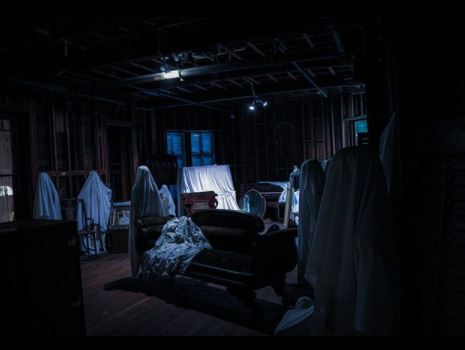
The physical phenomena of spiritism are often closely connected with psychical manifestations, such as spiritistic visions, automatic writing, speaking in a trance, materializations, table lifting, tumbler moving and excursions of the psyche. There is no doubt that today, as in the time of Isaiah (Isaiah 6.1-5), Ezekiel (Ezekiel 1.4-28), Paul (Acts 9.1-8), Peter (Acts 10.9-16), and John (Revelation 1.10-18), God may give His people a genuine vision, particularly in great times of great stress. However, genuine experiences of this nature are always accompanied by true spiritual grace and modesty. Sensationalism betrays a lack of authenticity. Unfortunately, genuine experiences are rare, and counterfeit ones about. Christian counselors find that the “ratio is about nine to one over the genuine experiences.” Mrs. Winchester used to have visions. She reported that she saw visions of Christ at night, and it left her feeling a sense of uneasiness and fear. The so-called visions of Christ were mediumistic. They came as a warning. Weeks after the visions started, Mrs. Winchester saw her husband William Wirt Winchester’s spirit departing from his body as he expired in 1881. The visions of Mrs. Winchester bear evidence of the occult, as do the visions of Joseph Smith (1805-1844), who fathered Mormonism. Many of the founders and promulgators of modern cults have had alleged visions from God. However, some say these visions promote “doctrines of demons” (1 Timothy 4.1) among the credulous and those unable to discern spirits (1 Corinthians 12.10; 1 John 4.1-2). When humans depart from God’s Word, they supposedly expose themselves to demon imposture and deception. Automatic writing—some persons endowed with mediumistic powers are able—either in a waking state or trance to write letters, words, or sentences which spiritists consider to be message from the spirit World. This is how Mrs. Winchester came up with the architecture of her mansion, the blueprints were often dictated to her in her Blue Séance room as she took down the notes on napkin. Also, the persistent pain in her legs and back vanished whenever she sat down and dictated these blueprints. #RandolphHarris 7 of 15
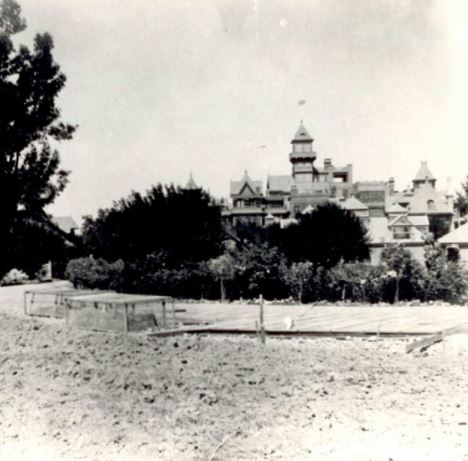
One day as Mrs. Winchester was taking dictation, a spirit named Apollonius Tyannaeus appeared and said, “In the name of the Lord Jesus, our blessed and exalted Savior.” The spirit then told the woman that she had been chosen by God for special revelations. She would become a prophetess and bless humankind with these revelations. The case is patently that of a simple farm woman turned indeed into a spiritistic writing medium. Rudolf Tischner, a parapsychologist, points out the danger of automatic writing when practiced in immoderation. Although he regards these writing phenomena only as “motoric break up the integrated psychic structure with ensuing peril to mental and physical health. This simply means that occult enslavement can result from mediumistic writing, or from dependence upon the Ouija board or other spiritistic devices to obtain alleged messages from the spirit World. Speaking in a trance—a trance is a condition in which a spiritistic medium loses consciousness and passes under the control of demonic power to effect alleged communication with the dead. The demon (or demons) takes over and actually speaks through the spiritistic medium, deceptively imitating the deceased. As a result this ruse innumerable spiritistic clairvoyants claim communication with the dead, often with famous deceased people allegedly appearing to speak to the living. One evening, Mrs. Winchester went into a trace and soon the “Apostle Paul” approached and preached to the audience. The apostle was not visible but only spoke through the medium who lay in trance. Some critic said it was only another constant instance of deception by demons who ape the deceased but cannot produce them. Other believe it was real. Perhaps the most remarkable phenomena of spiritism are materializations. These are supernatural appearances and disappearances of material images in connection with the activities of a spiritistic medium. #RandolphHarris 8 of 15

Materializations have been exhaustively studied and photographed and have been found to be manifestations of various degrees of teleplastic morphogenesis. The first stage is the evolution of a gauzelike substance of rubbery consistency from the body cavities of the medium. The second stage is the forming of the various parts of the body in outline—arms, head, etcetera. Frequently in the case of teleplastic forms of this kind, a threadlike connection is maintained with the medium. The third stage consists of the composition into completely outlined forms, which are visible as phantoms near the medium. These three stages of materialization manifest purely visual phenomena. The fourth stage displays telekinetic phenomena. There is an energy output from the teleplasm (telekinesis), such as the ringing of a bell, at night, passers-by heard ghostly music wafting from the dark mansion. The bell in the belfry high in the gables tolled regularly at midnight to summon incoming flights of spirits. Later it tolled again to warn these visitors to return to their sepulchers. However, once a week, these departed ones relaxed and danced in the Great Ball Room. In other stages of materializations come automatic writing of a typewriter, and the automatic playing of a musical instrument. In addition to the active energy output of the materialization, there is frequently a passive pain experience of the teleplasm. The fifth stage of the materialization is the penetration of material substance. To his phase belong “apports,” that is, the appearing and disappearing of objects in closed rooms or chests and containers. From locked and cemented containers, for example, enclosed coins are brought out, or stones and other objects fall inexplicably from the ceiling. This often happens in the Winchester mansion, as documented by Mrs. Winchester. In this stage many mediums allegedly have the ability to penetrate solid material substance while they are in a trance. While Mrs. Winchester sat in a small cabinet, a phantom built itself up on the floor outside the cabinet and formed itself into a male person, who moved in and out among the participants of the séance. While the materialization extended his hand to one of those present and she held it, dematerialization began to occur before the eyes of all the participants. Soon there was only a lump on the floor and this rolled up into the cabinet. #RandolphHarris 9 of 15

Another example is during a séance, Mrs. Winchester was able to call and help the materializing of the spirit of the deceased German romantic poet, Johann Ludwig Uhland (1787-1862). At the memorable séance a white phantasm was seen, from which the audience demanded a poem. Instead of reciting a poem, the phantasm tore a page from a book in the library. With a pencil from a briefcase in the room, secured through the leather without opening the briefcase, the hand jotted down a few verses and vanished. The page was left and still exists. The examination of the mysterious writing by a graphologist proved to be sensational. He confirmed the ghost writing to be actually the handwriting of the deceased poet. Afterward there was a trial in Berlin over the ownership of the page. The court awarded it to the medium, who afterward kept it among her prized possessions. The phenomena of materialization and dematerialization in case of strong mediums illustrated the conversion of psychic energy into matter and matter changed back again into psychic energy. The problem is illustrated by nuclear physics. Einstein’s formula (E==MC^2), energy is equal to mass times the speed of light squared, simply declares that it is theoretically possible to convert energy to mass and back again to energy. We have historical evidence of materializations. Missionaries claim that Mrs. Winchester’s mansion was never actually built, but that it materialized itself on the grounds, and (re)construction only began after the Earthquake caused by Satan. Some say this mansion is to be regarded as a miracle of Satan (2 Thessalonians 2.8-10; Revelation 13.15). Many people used to wonder how Mrs. Winchester used to travel so fast back and forth from San Jose to San Francisco to pick up items she ordered from overseas. Researchers believed that she would be spiritually transported miles away, and this may have been an example of this phenomenon or simply a miracle of transportation of unaltered physical body. It is debatable rather if these are miracles of God or that of Satan. God says He is the Alpha and the Omega. I wonder what that means? #RandolphHarris 10 of 15

Mrs. Winchester was said to possess tremendous occult gift and was reported to be able to make tables fly through the air for a space of one hundred feet. Above all, she was extremely adept in telekinesis, materialization, levitation, and black magic. Where Satan’s power remains virtually unchecked, miracles of evil supernaturalism abound. In Victorian days, the supernatural predated the mass hysteria about Satanism. As you may know, long before Mrs. Winchester arrived in California, there was a Devil worshipping conspiracy at large. However, her mansion seamlessly blends the ordinary and nightmarishly surreal. It is a rare treat for fans of demonic conspiracy and occult synchronicity. Some people have believed themselves to be demonically possessed after visiting the Winchester Mystery House, others claimed to have spoken to Mrs. Winchester directly. Directors of the Queen of the Damned claimed that the film was a makeshift occultic ritual, and Aaliyah unleashed the demon within herself. They also said the film poses some kind of supernatural power and they had to edit and voiceover a lot of the footage because not only did the characters act their own version of the script, but there were also some subliminal sounds and images on print. When many of these errors were re-examined, they also saw footage of the original Winchester mansion on the negatives, but rumors began that the original print had been withdrawn, replaced by an expurgated cut to protect the filmgoers from the movie’s insidious effects. The powers behind these manifestations were no doubt demonic. The director faced a terrible psychic assault on 25th August 2001, before they finished filming the movie. However, when the reel was played, the directors found they had all the footage they needed, even some they did not remembering filming. It was so intensified that the demonic oppression became that he was compelled to give up making other Anne Rice books into movies, especially after Aaliyah’s plane crashed later that evening. Although the film was unfished, with the blessing of her family, it was released to the public in February of 2002. #RandolphHarris 11 of 15

Certain psychic clairvoyants claim that their souls can travel great distances at their command. They always said she makes a room come alive. Much like Mrs. Winchester, Aaliyah had a lot of psychic phenomena around her death. When directors took photos of Aaliyah and Queen Akasha to a clairvoyant, while concentrating on the photographs, the medium declared that one of the women was apparently dead, while the other one, reportedly killed in 2001, was still alive. After more concentration, the clairvoyant said: “I can get in touch with this woman (pointing to Queen Akasha). I see her in a great stone building southeast of Ireland.” By psychic excursion and by psychometry (selecting an object belonging to the missing person and beginning to search from there) the clairvoyant was able to establish contact by occult assistance. The cinema is the Devil’s lantern. In March of 1922, Mrs. Winchester said, “Though it should be borne in the mind that in the persecution of witches many women were put to death on the latter charge, albeit they were really benefactors of the human race; the more so as their skill in simples and knowledge of the medicinal virtue of herbs must have added in no small degree to the resources of our present pharmacopoeia.” In August of 1807 an extraordinary affair took place in the house of Mrs. Winchester. She had a cow which continued to give milk as usual, but of late no butter could be produced from it. An opinion was unfortunately instilled into the mind of Mrs. Winchester, that whenever such a thing occurred, it was occasioned by the cow having been bewitched. Her belief in this was strengthened by the fact that every woman on this estate was able to relate some story illustrative of what she had seen or heard of in times gone by with respect to the same. At length the Mrs. Winchester was informed of a woman named Mary Butters, who resided in Oakland at the Cohen Bray House. Mrs. Winchester went to her, and brought her to mansion for the purpose of curing the cow. About ten o’ clock that night war was declared against the unknown magicians. #RandolphHarris 12 of 15

Mary Butters ordered old Klaus and a young man named Konrad to go out to the cow-house, turn their waistcoats inside out, and in that dress to stand by the head of the cow until she sent for them, while the butler, the made, and an old woman named Klara Lee remained in the house with her. Klaus and his ally kept their lonely vigil until daybreak, when, becoming alarmed at receiving no summons, they left their post and knocked at the door, but obtained no response. They then looked through the kitchen window, and to their horror saw the four inmates stretched on the floor as dead. They immediately burst in the door, and found that the butler and the maid were actually dead, and the sorceress and Mrs. Winchester nearly so. The latter soon afterwards expired; Mary Butters was thrown out on a dung-heap, and a restorative administered to her in the shape of a few hearty kicks, when had the desired effect. The house had a sulphureous smell, and on the fire was a large pot in which were milk, needles, pins, and crooked nails. At the inquest held at the Winchester mansion on the 19th of August, Jurors stated that the three victims had come by their deaths from suffocation, owning to Mary Butters having made use of some noxious ingredients, after the manner of a charm, to recover the sick cow. She was up to The Great Asylum for the Insane, but was discharged by proclamation. Her various of the story was that a black man (usually indicates a demon or the devil, not one of African descent) was summoned through the floor with a huge club, with which he killed the three person and stunned herself. This paranoid horror fantasies terrified the congregations, as well as the gross superstition displayed by the participants as for its tragical ending, yet it seems to have aroused no feelings in the greater community than those of risibility and derision. However, there is also another version of events. #RandolphHarris 13 of 15

A farm-hand had brought an action against Mrs. Winchester for wages alleged to be due to him. It transpired in the course of the evidence that on one occasion he had been set to banish witches that were troubling the cows. His method of working illustrates the Winchester case. All left the house except Mrs. Winchester, and the farm-hand, who locked himself in, closed the windows, stopped al keyholes and apertures, and put sods on top of the chimneys. He then placed a large pot of sweet milk on the fire, into which he threw rows of pins that had never been used, and three packages of needles; all were allowed to boil together for half an hour, and, as there was no outlet for the smoke, the farm-hand narrowly escaped being suffocated. If the forces of darkness triumph, it is a warning not a celebration. Many religious people come close to depicting what evangelists are preaching from their pulpits, or TV shows. Does it not seem strange for fundamentalist Christians to attack them as sinful and dangerous? Sin sells, in a way that the bland platitudes of Christian morality never will. Many of these popular and historical figures will be remember long after the credits have rolled. You could say that it is an “inside job.” Satanism sells, it captures the metaphysics of fear. People like to be haunted and scared, but only when they consent to it. No one wants their house broken into, their children kidnapped, their cars constantly vandalized, or to be attack by a hate group who haunts them like demons of the night. People simply want to tune into a scarry movie or visited a haunted house and leave the fear behind when they walk out the door or turn the TV off. They do not want to fear for the lives like Sharon Tate did for years without anyone to protect them. Humans are often more harmful than any ghost, devil or demon you can ever imagine meeting. Satan, speaking through a beautiful serpent—perhaps as a parakeet “talks” to us—promises know that would make Eve “like God” if she would eat the fruit of the tree forbidden by God. #RandolphHarris 14 of 15

Meanwhile, if the view of the power and knowledge of the people is that “Satan” is evil and not themselves, what can human beings do? Persist being evil, or resist the “devil,” and allow him to feel from them? Or is it they cling to evil because the darkness comes from their insidious mind and depleted soul? Note that it is useless to try to resist the devil unless you have first submitted yourself to God! Maybe YOU are the evil, not Satan. Sitting there, manufacturing all these evil days, so you can laugh at the pain and suffering you have inflicted on others to make yourself feel better. Is that of Satan, or is that YOUR nature on display. It is estimated that there are about 100 million adherents to spiritism in the World. The word “spiritism” comes from the Latin “spiritus,” spirit. The movement of spiritism represents the endeavour to communicate with the dead in the spirit World. Historically, spiritism can also be traced back over thousands of years. We have testimonies concerning it in the Old Testament in 1 Samuel 28, and Deuteronomy 18. It is also evidenced in the history of the Christian Church. Spiritism seems to be strongly connected with religion and religions. In so-called Christian countries such a variety of spiritistic forms, and such a range of associated psychic troubles exist, that the need for clarification is a pressing issue. What God do you really worship for “Satan disguises himself as an angel of the light. So it is not strange if his servants also disguise themselves as servants of righteousness,” reports 2 Corinthians 11.14-15. In other words, many of you Christians who claim to serve “God” do evil things and then blame the devil when you are disguising yourselves as children of the light. And you do not repent because you do not fear punishment nor hell, so you must be children of your “devil” and not of God. We live in a World which has turned its back on God. The reason some people fear Jesus is because they feel unworthy, it is not because they are evil. This conviction of inner unworthiness is not to be confused with a feeling of fear. However, people who suffer from schizophrenia and like to go around lying, the psychiatrist will be interested in the question whether the practicing of spiritism was rather the effect than the cause of the ensuing mental and emotional disorders. #RandolphHarris 15 of 15

Winchester Mystery House

The front gardens of the Winchester Mystery House looked different in the 1970’s! The gardens were restored to what they are today about ten years later.
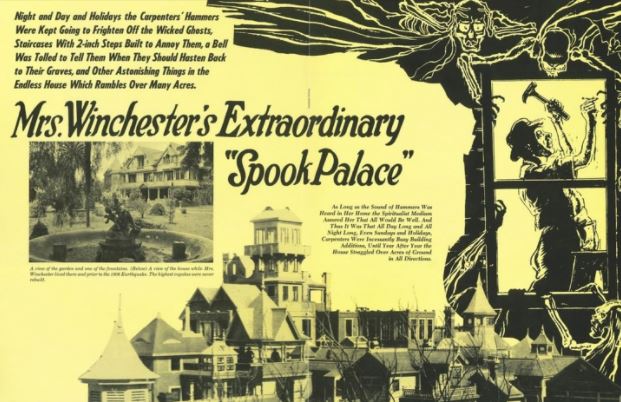
The sign reads: “The world’s oddest, mysterious, weirdest, and freakish dwelling. Planned and built by Sarah L. Winchester of Winchester Rifle Fame”
Have you ever listened to Alessandro Moreschi sing “Ave Maria,” at night in the Winchester Mystery House? Try it and let me know what you experience. I heard ghosts appear, people have cried and screamed, and some love it. I think I would probably run outside. He sounds like a ghost.

Come Explore the Victorian Gardens this weekend! Open all weekend until 4PM.

A 160-room mansion built to appease the spirits who died at the hands of the Winchester Rifle 👻

He Opened the Book and a Demon Spoke to Him

All good religions need some kind of Apocalypse. Thelema—the new religion of Aleister Crowley—was no exception. The Great Beast fully expected his new holy age, the Aeon of Horus, to be ushered in with an orgy of violence and bloodshed. With the advent of the First World War, the prophecy seemed to have been satisfied. Over four long years, the optimism and complacency of nineteenth-century Europe drowned in the mud of the Western Front, along with hundreds of thousands of young soldiers. However, Crowley seemed curiously indifferent to the whole affair. With typical arrogance, when the British Government refused his offer to produce war propaganda, the Luciferian man of letters travelled to the US to write anti-British propaganda. If he could not find recognition on the side of the angels, the Great Beast was always ready to side with the opposition. However, Crowley later claimed he wrote deliberately absurd material to discredit the German cause. His article on the bombing of London by Zeppelin airships gives credence to this eccentric defense: “For some reason or other in their last Zeppelin raid on London the Germans appear to have decided to make the damage as widespread as possible, instead of concentrating it in one quarter. A great deal of damage was done at Croydon, especially at its suburb Addiscombe, where my aunt lives. Unfortunately her house was not hit. Count Zeppelin is respectfully requested to try again. The exact address is Eton Lodge, Outram Road.” If World War One had been too minor a cataclysm to introduce Crowley’s Age of Horus, 1939 heralded a new orgy of human suffering. The Beast always maintained that the first nation to adopt his Book of the Law as a state religion would dominate the World. During the 1930s, however, as the Third Reich came to power, his ambivalence towards Germany—the country where his magical doctrines were taken most seriously—is perhaps understandable. #RandolphHarris 1 of 21

Some of his German followers saw in their new Fuhrer a political equivalent to their prophet, the Great Beast (perhaps even his “magical child”)—a new World order was to be created by the pure will-power of those extraordinary men. Some of his German followers saw in their new Fuhrer a political equivalent to their prophet, the Great Beast (perhaps even his “magical child”)—a New World Order was to be created by the pure will-power of these two extraordinary men. However, in 1935 the Nazis banned the Ordo Templi Orientis and the Order of the Silver Star, throwing numerous occultists (including Karl Germer, one of Crowley’s foremost disciples) into the concentration camps. There may have been similarities between Crowley’s Thelemic doctrines and emergent Nazi dogma (elitism, irrationalism, transcendence of morality), but the Great Beast could see on which side his future depended: Britain would “knock Hitler for six!” he announced. Whether or not the horrors of the Second World War signalled the advent of the Age of Horus, Adolf Hitler emerged from the blood and pain of that conflict as a secular Satan. Indeed, a minor literary industry has grown up around the idea of Hitler as a very literal Satanic figure suggests that the Fuhrer really did, in Dennis Wheatley’s words, “use dark forces.” The roots of this belief return us to the occult lodges of the late nineteenth century. In 1875, the writer and occultist Guido von List climbed a hill overlooking Vienna to conduct a strange ritual. Von List was dedicated to returning greater Germany to an older purer faith—the worship of Wotan, and the other pagan gods of the Teutonic race Upon the hill he commemorated the summer solstice by buying a number of empty wine bottles, carefully arranged into a sacred symbol: the swastika. In 1908 von List Founded the Armanen Initiates, the inner order of his modestly-titled Guido von List Society. His doctrines centered around ideas of racial purity—von List believed the German peoples, the Armenen, had originally been a race of supermen, but mongrelistation had weakened the race until bashful old Guido was its last pure-blood survivor. #RandolphHarris 2 of 21

According to the race mystic, “The hydra-headed international Jewish conspiracy” was behind it all. To reverse matters, von List prescribed a study of ancient Teutonic religious runes and –more practically—laws to precent further racial interbreeding. His eventual gal was a racial state ruled by “a self-chosen Fuhrer to whom [Germany] willingly submits.” Alongside the swastika, the emblems of this new state would include the sig rune: the symbol later used to form the insignia of the SS. Guido von List was one of the leading Germanic mystics dedicated to “volkisch” occultism. “Volkisch” basically translates as “folkloric,” but this was also leavened with a hard-edged nationalism. Chief obsession among the volkisch orders were the sacred nature of race (or “blood”), an interest in the culture and beliefs of the Germanic peoples in the early Middle Ages, and a strong current of anti-Semitism. Among the most important of the volkisch occultists—some of whom fancied themselves the priests of a revived Norse religion—was Dr. Jorg Lanz von Libenfels. In many ways, a sorcerer in the classic mould, von Liebenfels adopted his aristocratic name to increase his mystique (his real name was Adolf Lanz), and began his career as a Catholic priest before being defrocked for “harbouring carnal and Worldly desires.” His response was to found an “order of New Templars”—quite what the original Templars had to do with racial purity is not clear, but it did not stop von Libenfels preaching a message of race war from his temple on the banks of the Danube. In 1909, a young Austrian named Adolf Hitler secured an audience with von Liebenfels to secure some back issues of Ostara, the journal of the New Templars. In 1932, von Liebenfels would write to a fellow occultist that “Hitler is one of our pupils…You will one day experience that he, and through him we, will one day be victorious, and develop a movement that will one day make the World tremble.” The most direct link between the occult underground and the Third Reich is the Thule Society. Thule, according to northern European myth, was a version of Atlantis, and island that sank beneath the sea. #RandolphHarris 3 of 21

Thule Society ideology decreed this legendary island to be the home of the German supermen, who they hoped to contact using magical techniques. In 1919, the Thule Society formed a tiny political group called the German Workers Party in Munich—the seed from which Hitler’s National Socialist Party grew. In the 1920s Germany of the Weimar Republic, volkisch occult groups sense that their time was coming. Losing the First World War left Germany politically chaotic, economically bankrupt and profoundly demoralized. Weimar Berlin earnt a reputation for decadence exceeding that of 1890s Paris—though there was a cynical desperation among the German hedonist that never surfaced amongst their French counterparts. For many ordinary citizens of “Greater Germany” (which included Austria), however, their feelings of disillusionment hardened into suspicions of betrayal. One such was the young war hero Hitler—who was convinced Germany’s forces were defeated by treachery at home, rendering the huge loss of life futile. Hitler, along with many others, was sure that the “November criminals” (government signatories of a peace treaty in November 1918) were responsible for the fatherland’s defeat and humiliation. And behind the November criminals were the treacherous Jewish people. In this environment, volkisch occultists found an eager audience for their fables of an ancient, noble Ayran race. They not only offered up a scapegoat for their defeat, but also created the mythology of a sacred Germanic blood heritage from which a humbled people could rebuild their pride. It is a long way from accepting that volkisch occultism helped create a spiritual environment friendly to Nazism to believing the Third Reich was a Satanic cult. (Buffy the Vampire Slayer was said to be symbolic of the rebirth of the Third Reich, maybe you can see the symbolism. This interesting thing is that Sarah Michelle Gellar, who played Buffy Summers is Jewish, but also reminiscent this Ayran super race.) #RandolphHarris 4 of 21

The relationship between Nazism and volkism is similar to that between the radical African-American political groups and Black Islamic leaders who proclaim that the Man (the White Man) to be the Devil. Political leaders, as soon as they achieve any real power, are usually quick to distance themselves from such emotive spiritual propaganda. However, it is interesting how light and dark are used in Christian terms not to reflect colour, but the nature of one’s spirit. And when you see these people with soft features, pale skin, and these colourful eyes, it is hard to believe they do dark things, but when one sees someone with darker skin, people almost always consider them guilty. It is as if religious light has also been used to frame people based on skin colour, but when it comes down to it, people are capable of things that are bad no matter what colour their skin is, and as one grows up, once can see that skin colour matters very little in guilt or innocence. Nonetheless, total revolution also demanded a spiritual revolution. The Russian Revolution of 1917 had a similarly religious aspect. Communists were determined to uproot the Christian Church and replace it with religious loyalty to the State, and its socialist principles, which is why so many religious symbols in America are now banded on public builds, and next to be banned with be the America flag. Many people may thing that journalist Tomi Lahren of FOX News is a racist, but one should actually listen to what she is saying, and be objective about it. America is actually becoming a communist nation where the people have no power, laws are just recommendations, and the U.S. Constitution is being removed and stored in someone’s basement, much the Confederate Statues, and flags. Next, slavery will just be a conspiracy theory—it will be considered a myth. It is just like music, most real artists listen to all genera of music, but they have a typical style they love, and many scholars read all kinds of material so they can have a comprehensive view of what is going on in the World, instead of just be told only what the masses want them to know, but people love to label, which is why they are stuck in ignorance. #RandolpHarris 5 of 21

Bolsheviks held wild revels, called “African nights,” where Christian festivals were parodied in atheistic rites such as “Red Prayers,” and “Red Mass.” Obscene hymns were sung, and children were encouraged to spit upon and destroy puppets representing God, and other holy figures, in powerful echoes of the Black Mass medieval peasants. Hitler’s doctrines were no less revolutionary. Nazism was designed to revolutionize every aspect of life—even the way people thought—and the old ways were denounced as “Jewish,” “liberal.” Hitler despised “intellectuals,” advocating intuition, or even irrationalism, over logic and rational thoughts. In many ways the Nazis turned back the clock two hundred years, to when science and sorcery were still reluctant bedfellows. In the field of military technological innovation and instinct were promoted at the expense of methodology, liberating German scientist to creates some of the most efficient weapons of war the World had seen. Alfred Rosenberg, an intimate of Hitler and high-ranking Nazi official drew up plans for a National Reich Church, which was not going to destroy Christianity but “supercede” it, and called his new faith “positive Christianity.” He concluded: “On the day of its foundation, the Christian cross must be removed from all churches, cathedrals, and chapels and it must be superseded by the only unconquerable symbol, the Swastika.” However, what did the Swastika symbolize? Rosenberg wrote: “Today a new faith awakens: the myth of the blood, the faith that by defending the blood were defend also the divine nature of man. The faith, embodies in scientific clarity, that the Nordic blood represents the mystery which has replaced and conquered the ancient sacraments.” The historian Konrad Heiden beings his book on Der Fuhrer: Hitler’s Rise to Power with a curious story concerning Rosenberg: “One day in the summer of 1917 a student was reading in his room in Moscow. A stranger entered, laid a book on the table, and silently vanished. The cover of the book bore in Russian the words from the twenty-fourth chapter of Matthew: “He is near, he is hard by the door.” #RandolphHarris 6 of 21

The sent sensed the masterful irony of higher powers in this strange happening. They had sent him a silent message. He opened the book, and the voice of the demon spoke to him. It was a message concerning the antichrist, who would come at the end of days. The Antichrist is no mythical being, no monkish medieval fantasy. It is the portrait of a type of man who comes to the fore when an epoch is dying. The Antichrist was supposedly Hitler. The Nazi began suppressing occultists and secret societies in 1934, in a purge that reached its peak in 1937. Thousands of astrologers and mystic disappeared into the concentration camps, never to appear again, which also proves Whoppie Goldberg’s states, “The Holocaust was about race.” Anyone who was deemed a threat to national security was sent to concertation camps, but in the same sense, the holocaust was about race, it was about preserving the Ayran race. Just anyone who was not Aryan could be a target, as it was more about preservation of their bloodline. Volkisch occultists were not spared. Even the Thule Society—the magi at the nativity of Nazim—was devoured by its ravenous offspring. The Nazi State would not tolerate anything outside its control, or that it had not created itself. Its tenant of faith was the destiny of the Aryan race, as expressed by its prophet Hitler. If this policy of spiritual and intellectual monopoly sounds familiar, it is because it resembles the doctrines of one of the institutions of the Nazis sought to replace: the Church. The Nazi party created its own priesthood—the Black Oder, better known as the Schutzstaffel, or SS. The SS began as Hitler’s bodyguards, but under Heinrich Himmler, manoeuvered and massacred their way to become the most powerful organization in the Nazi establishment. Like “house of God” of the medieval Inquisition, the SS policed the souls of those under their ever-expanding jurisdiction. The faithful were monitored, the suspect—even the volkish occultist who shared the Nazi vision of race—purged, the unholy exterminated. Himmler became the second most powerful man in the Third Reich. Any occultist who wished to survive in Nazi Germany was well-advised to find a place under Himmler’s wing. #RandolphHarris 7 of 21

Several men did—most significantly Karl Weisthor. Weisthor was born Karl Maria Wiligut in Vienna, 1866, to a family with a long military tradition, and was decorated for his service during the First World War. Following the war he became involved in volkisch occultism, adopting doctrines which were extreme even by volkisch standards. With the modesty characteristic of his ilk, Weisthor claimed to be descended from Ayran gods, the last living representative of the Irminist Church. The Irminists—who worshipped the true Christ, an Aryan called Krist—had been opposed throughout history by the false religion of the Catholic Church, their racial enemies the Jewish people, and Aryan heretics who worshipped the pagan god Wotan. Weisthor knew all of this because he possessed clairvoyance that allowed him to recall the heroic lives of his ancestors, thousands of years ago. Not everyone was impressed by the evidence, however, an in 1924 he was committed to a lunatic asylum. Undeterred, when he was released, he changed his name and headed to Munich. In 1933 he attracted the attention of Himmler, who installed the cranky medium in the Ahnenerbe department of the SS. Under Weisthor’s advice, a castle at Wewlsburg in north-west Germany was chosen as the spiritual headquarters of the Black Order. It became the Nazi equivalent of the Vatican, with great echoing chambers dedicated to the heroes of the Aryan race, and a central hall where Himmler and his twelve closet disciples would meet. Weisthor designed the SS “Totenkpfring” –a scared ring decorated with skulls and runes, personally bestowed upon SS members by Himmler and retuned to Wewelsburg upon their deaths. He also conceived and presided over neo-pagan solstice ceremonies, and the Weddings of SS officers to good Aryan girls. The Black Order was not just a military organization but a sect, a fraternity of warrior priests. Though it never claimed the heritage of the Knights Templar, the parallels between these two orders are striking. Both snowballed into vast international forces. Both maintained independent economic systems that allowed them to accumulate vast wealth. Both were composed of highly-disciplined warriors, fanatically dedicated to their creeds. Both were exempt from the laws that governed their contemporaries, answerable only to the head of their orders (Himmler of the Grand Master) and the representative of the sacred creed on Earth (Hitler or the Pope). Both planned to establish their own independent states. And both were, at least ostensibly Christian. #RandolphHarris 8 of 21

Weisthor’s faith may have incorporated much bizarre German paganism, but at the core he believed he was preaching Christianity. One of the oaths taken by SS candidates before the full initiation ran, “We believe in God, we believe in Germany which He created in His World and in the Fuhrer, Adolf Hitler, whom he has sent us.” One of the titles Himmler had bestowed on him by is peers was “the Black Jesuit,” as he based the structure of the SS upon the fanatically-secretive Catholic Society of Jesuits. Himmler, brought up in a devoutly-Catholic Bavarian household, never lost his belief in the importance of ritual symbolism. When he used the term “Satanic,” or evoked the Devil, it was applied to the enemies of the Aryan race—never in connection with his own faither. Persecution of Jewish people was often inspired by accusation that they poisoned wells and drank the blood of children, or, more traditionally, that they had killed Jesus. They were commonly believed to be part of an international conspiracy—sometimes decreed to be Satanic—against all Christian values. The Catholic Church, concerned that the Third Reich was stealing souls that were rightfully theirs, had certainly preached against this new paganism. Nazis believed that they were breeding babies for God, or “for race and nation.” Occultic suggestions that the Third Reich was, as one author puts it, a “demonocracy” with the Fuhrer himself as a black magician, a “psychic vampire,” demonically possessed, even as the Antichrist himself—are based on Hitler’s skill at taking political military gambles (precognition), his inner voiced and violent rages (possession), and the way simultaneously drew upon and released great emotion with his speeches (physic vampirism). Some still say that there is no evidence for one to consider the Third Reich as a manifestation of supernatural evil. Yet people believed because Hitler consulted an astrologer that Hitler was evil; Satan is Evil personified, therefore Hitler is Satan. Even level-headed historians have described Hitler as possessing almost supernatural powers—whereas the terms “mesmeric” or “hypnotic” best described the psychological effect this frantic, grim little man has on the vast audience at Nazi rallies. Political figures such as John F. Kennedy and Martin Luther King also based their careers on charismatic oratory, and few would suggest either man was possessed by demons. #RandolphHarris 9 of 21

However, it is worth confessing that the Third Reich is of legitimate interest to occultists. Something about Hitler’s meteoric rise—from penniless tramp to omnipotent dictator—and Germany’s similarly rapid rise—from near-collapse to near-World domination—confounds rational explanation. Still, the philosophy of Hitler, and the psychological symbolism employed by the Nazis, are no more inherently Satanic than that of the Catholic Church. However, there were eyewitness accounts of wartime sorcery in England: Witches cast spells to stop Hitler landing after France fell. They met, raised the great cone of power and directed the thought at Hitler’s brain: “You cannot cross the sea. You cannot cross the sea. Not able to come. Not able to come.” We are not saying they stopped Hitler. All we say is that we saw a very interesting ceremony performed with the intention of putting a certain idea into his mind and this was repeated several times afterwards; and though all the invasion barges were ready, the fac that Hitler never even tried to come. The witches told us that their great-grandfathers had tried to project the same idea into Boney’s [Napoleon’s] mind. Exploration of the Great Beast’s (Aleister Crowley) darker doctrines—of a World divided into masters and slaves, with good and evil sacrificed on the bloody alter of a new morality—would be the province of a far less gaudy crew than the hippies. Marianne Faithfull—a former child of the upper-middle classes—was a long-time consort of English rock band the Rolling Stones, and an icon of “swinging London.” In her autobiography, written much later, she displays little doubt as to the source of the era’s dynamism. Speaking of her most famous lover, Mick Jagger, she says: “Her harnessed all of the negative forces into entities. Out of these destructive impulses, he created all the incredible personate of the late sixties: the Midnight Rambler, Lucifer, Jumpin’ Jack Flash. They are all manifestations of malignant and chaotic forces, the ungovernable mob. The dark, violent, group mind of the crowd—chaos, Pan. That frenzied power caused many of the causalities of the sixties.” #RandolphHarris 10 of 21

Foremost among the musicians who pioneered the first colourful wave of psychedelia were the Beatles. Their high-profile transformation from chirpy, mop-headed scousers to long haired peaceniks reflected the cultural tide of their generation. However, in the United States of America, the FBI compiled a two-inch thick file on Lennon upon which FBI director J. Edgar Hoover scrawled, “All extremists should be considered dangerous.” Fundamentalist Christians—with their endearing disrespect for facts or common sense—discovered the occultic secrets behind the Beatles’ success. They maintained that the Lennon-McCartney sound was a magical beat stolen from the ancient Druids. According to them, in ancient times these pagan priests would beat out the demonic rhythm on drums made of human skin to summon evil spirits. In the hands of the Beatles, this Druid beat could be used to send the young people of American insane—or even worse, pinko. There were Christian protests of the Beatles, where the Ku Klux Klan burnt their records and Lennon was held up as a Satanists or something. The next years, Christian suspicions of the Beatles were confirmed by detailed perusal of the cover of their catchy, innovative Sgt. Pepper album. The cover design is a collage of people admired by the Beatles, all standing being the band: among them, in the top row, can be seen Aleister Crowley. In 1994, a prominent Vatican official, Father Corrado Balduci, would reinforce the Christian view that the Beatles were “the Devil’s musicians.” Sadly, in 1980, Lennon was shot dead outside his New York apartment by a dazed-looking young man named Mark Chapman. Chapman had become a big Beatles fan, but had become increasingly convinced that Lennon was evil. An interview with Chapman by a psychiatrist, published in Rolling Stone magazine, reported that the holy assassin could feel the presence of Satan’s demons around him. “I can feel their thoughts. I can hear their thoughts. I can hear them talking, but not from the outside, from the inside.” The unfortunate Chapman had become a “born-again” Christian, learning about the evils of Beatles music from his new faith. #RandolphHarris 11 of 21

Next to the affable efficiency of the Beatles, the Rolling Stones were a maelstrom of creative chaos. Black Magicians thought that Mick Jagger and Keith Richards were acting as unknow agents of Lucifer and others thought hey were Lucifer. One of the “Black Magicians” Richards referred to was Kenneth Anger. Anger stood at the crossroads where many of the Satanic elements of the 1960s met. Anger happily announced Crowley’s dictum that the Key of joy is disobedience, and declared that not only was the Aeon of Horus upon, but the Aeon of Lucifer. Shortly before he became involved with the Rolling Stones, Anger helped found the Church of Satan. His blend of Crowleyism and Satanism entranced the band, though—in a familiar pattern—Anger was often keen to dissociate from Satanism, referring to his personal Prince of Darkness by the less inflammatory title of Lucifer. He later confessed, however, that his Lucifer had always been the “cosmic villain,” the Miltonic Satan. Whatever effect Anger had on the band’s professional lives, he touched them personally to varying degrees. Keith and his lover Anita later got into this black magic stuff. Mick Jagger dabbled in it. However, every one was just a little afraid of Kenneth Anger. Inexplicable things involving him would happen. Stores about the magus’ association with the band include Anger seeming to appears and disappear in various places. He offered to perform a pagan ritual wedding for Keith and Anita that involved a golden door. When they awoke the next day, a heavy oaken door had been painted gold, with the paint already dry. The house was heavily secured, and nobody could explain this occultic interior decoration. Faithfull talked about falling off a mountain during the making of Anger’s second version of Lucifer Rising, sustaining only a mild concussion. Anita Pallenberg was so spooked by all of this that she slept in a protective circle of candles with a string of garlic around her neck. Anger’s next overtly magical project Lucifer Rising was his first religious film, a weird, mesmeric narrative combined with a real magical ritual, it also embodied his love/hate relationship with the 1960s counter culture—both in the film itself, and the events surrounding its strange history. #RandolphHarris 12 of 21

As Anger once observed, “Making movies is casting spells.” A screen director and editor, the theory ran that the magus could fully control both the characters to screen and the entities they invoked. Lucifer Rising depicted the downfall of the oppressive Aeon of Osiris (or Christian era), and the movement into the Aeon of Horus (or Lucifer). “My reason for filming has nothing to do with “cinema” at all, explained Anger. “It’s transparent excuse for capturing people…I consider myself working Evil on an evil medium.” On 21 September 1967, Anger organized a celebratory event titled the Equinox of the Gods at the Straight Theatre in Haight-Ashbury, the epicenter of hippie culture in San Francisco. However, Beausoleil proved a more capricious Lucifer than Anger anticipated—according to Anger, the pretty hippie he called “Cupid” ripped off 1600 feet of footage from Lucifer Rising and some camera equipment before the performance. Anger was livid, smashing a rare magical cane that once belonged to Crowley. He then pronounced a cruse upon Beausoleil, sealing it with an amulet he put around his neck. On one side was a picture of his erstwhile protégé, on the other a toad with the inscription “Bobby Beausoleil—who was turned into a toad by Kenneth Anger.” Cupid never turned into a toad, but a could of uncommonly dark fortune did follow him as he headed south for Los Angeles. In 1970 Anger remade his masterpiece, Lucifer rising—though even then he still tinkered with elements of the film to produce dozens of subtly different versions. Once again, Anger himself plays the Magus, invoking a new aeon through the door opened by the occult events of the 1960s: A film about the love generation—the birthday part of the Aquarian Age. Showing actual ceremonies to make Lucifer rise. Lucifer is the Light God, not the Devil—the Rebel Angel behind what is happening in the World today. His message is that they key of joy is disobedience. Isis (Nature) wakes. Osiris (Death) answers. Lilith (Destroyer) climbs to the place of Sacrifice. The Magus activates the circle and Lucifer—Bringer of Light—breaks through.” #RandolphHarris 13 of 21

Bad luck had begun calling upon the Rolling Stone, in the shape of a series of tragedies. The first was the death of the band’s guitarist, Brian Jones. It was Jones who, in 1962, formed the band named it after a Muddy Waters song. On 2 July, in classical rock ‘n’ roll styles, he drowned in his swimming pool on a cocktail of vodka and pills. Two days after Jones’ death, the Stones turned their free concert in London’s Hyde Park into a memorial for their ex-guitarist. Jagger read a poem by Shelley, then tried to release hundreds of white butterflies from boxes by the stage. They have been in the boxes too long and most of the delicate creatures were dead. The summer Woodstock free festival, in New York State, represented for many the hazy apex of the Love Generation. At the suggestion of scheduled support band the Grateful Dead, the Stones hired the Hell’s Angels as security for their Altamont gig. The Angels were very affordable, but their brand of frightening freedom still had a devilish chic in the naïve 1960s. The Hell’s Angels Motorcycle Club was formed after the Second World War, by bike-loving ex-servicemen who found civilian life too bland to bear. The Hell’s Angels moniker was taken from a notorious American Air Force squadron, but the Satanic implications of the name became increasingly appropriate. The Angeles were hellraisers, prototypes for the whole biker culture—particularly the outlaws, or “1%ers” (the “one percent of motorcyclists’ labelled as ‘hoodlums and troublemakers” by the American Motorcycle Association in 1967). Many 1%er gangs emulated the Angels’ Satanic-sound title, adopting infernal names like the Straight Satans, Satan’s Slavers and the Pagans. Some took their title at face value. One member of the powerful Canadian gang Satan’s Angels said in a 1970s interview, “There are definite spirits and we identify with that particular one that has been called Satan. It’s an upsidedown World. Our virtues are other’s vices. You could say we were Satanists.” Hell’s Angels, and other outlaw gangs, are symbols of the more destructive, volatile aspects of the Satanic canon. Their readiness to fight, their revelling in intimidation and fear, their rapacious passion for pleasures of the flesh in all their basest forms, all these characteristics made them into icons of willful alienation and violent self-indulgence. #RandolphHarris 14 of 21

When Jagger finally came onstage at Altamont on 6 December 1969, things were beginning to get ugly. Marty Balin of support act Jefferson Airplane had been in in the face with a pool cue by a Hell’s Angel. He tried to intervene when he saw the Angels beat up an African America kid in front of him. Paul Kantner, band founder, began to shout at the Angels until his microphone was snatched from him in the brawl that immersed the from of the stage. Jagger took the stage clad in his psychedelic sorcerer’s robes. Dancing under the red lights, surrounded by the dark wall of threatening, black-clad Angels, the vocalist could have been Anger’s Lucifer served by a surly army of warlike demons. Two songs into the set, things just kept getting uglier. Naked hippies cast themselves at the stage as offerings for their rock gods, and the Angels cast them back into the audience after beating them bloody. The third song began, “Sympathy for the Devil,” and all Hell broke loose. In the audience, an African American youth named Meredith Hunter pulled a gun. According to some he was aiming it at Jagger, other claimed he was defending himself against the Angels. Whichever is true, it was scant moments before a pack of black-leather Angels fell upon him and, in a flurry of kicks and knife blows, Hunter was killed. The Stones could see that the Angels were brutalizing the audience rather than controlling them—but Jagger was out of his depth, bleating weakly for everybody to “cool it.” As the killing of Meredith Hunter played itself out to the strains of “Sympathy for the Devil,” the song had to be stopped briefly as Jagger quipped, with unintended understatement, that “something very funny always happens when we start that number.” As the tide of panic and fury rose, the death count escalated to three with 100 injured. Following Altamont, the shaken Stones turned their back on the whole Satanic scene. Jagger wore a large wooden crucifix for some time after. The revolutionary stance and allusions to street violence were quietly dropped in favour of the stately image of rock ‘n’ roll aristocrats. The Rolling Stones abandoned any pretension to occultic chic or streetwise cool, letting themselves into the World of polite high society through the back door. #RandolphHarris 15 of 21

It is always just a few days before the Winter Solstice when the forces of darkness are at their most powerful. Because the immense size of the Winchester Mansion, Mrs. Winchester included forty-seven fireplaces in her mansion, and seventeen chimneys. One rambling section in particular, the Hall of Fires, was designed to produce as much heat as possible—perhaps to ease Mrs. Winchester’s extreme arthritis. In addition to many windows that let the sunlight stream through, the three adjoining rooms have four fireplaces and three hot air registers from the coal furnace in the basement. Mrs. Winchester is very significant, not only for a vast estate, but one of many reasons was because she was known to have encounters with the supernatural. While I was at Mrs. Winchester’s mansion, I was asked to meet with a group of high school students who had gotten into spiritualism just for kicks. We had a meeting that night and I listened as the young people told me their experiences. At a part a friend had fascinated them with stories of trances and séances. He told them how to use a Ouija board and how to enter a state of trance. They were seeking spirit manifestations. When they began to get reactions, they became frightened. The spirit had guided them back in time. A boy appeared and stated to tell a story, he said: “When I was about ten years old, I came to visit my aunt Sarah. I met a girl who lived on the estate Ethel—aged eight. I never had the courage to speak to her. My aunt Sarah asked me to stay three months, and I did.” The statement was so quietly serious, so destitute of any suspicion of humor, that the audience looked on with great apprehension. “I had to work hard in those days. I saw Ethel, later that evening, asleep in one of the carriages, and that was the last time I saw her. I ended stay with my aunt for three years. There was a glimmer of a summer gown under the trees; a figure passed from the shadow to sunshine, and again into the cool dusk of a leafy lane. While I was walking in the garden, I found her seated in the shade of a pine. She looked up serenely, as though she had expected me, and we faced each other. #RandolphHarris 16 of 21

“When I stroke to speak, my voice had an unknow tone to me. Her upturned face was my only answers. The breeze in the pine-tops, which had been stirring monotonously, ceased. Her delicate face was like a blossom lifted in the still air; her upward glance chained me to silence. The first breeze broke the spell; I spoke a word, then speech died on my lips; I stood twisting my shooting-cap, confused, not daring to continue. The girl leaned back, supporting her weight on one arm, fingers almost buried in the deep green moss. ‘It has been three years today,’ I said, in a dull voice of one who dreams—’three years today. May I not speak?’ In her lowered head and ears I repeated acquiescence; in her silence, consent. ‘Three years ago, today,’ I repeated; ‘the anniversary has given men courage to speak to you. Surely you will not take offense—we have travelled so far together!’ –from the end of the World to the end of it, and back again, here—to this place of all places in the World! And now to find you here on this day of all days—here within a step of our first meeting-place—three years ago today! And all the World we have travelled over since, never speaking, yet ever passing on paths parallel—paths which for thousands of miles ran almost within arm’s distance—’ She raised her head slowly, looking out from the shadows of the pines into her sunshine. Her dreamy eyes rested on acres of gold-rod and green grass in the December coolness. ‘Will you speak to me?’ I asked. ‘I have never even heard the sound of your voice.’ She turned and look at me, touching with idle finger the soft hair curling on her temples. Then she bent her head once more, the faintest shadow of a smile in her eyes. ‘Because,’ I said, humbly, ‘these long years of silent recognition count for something! And then the strangeness of it!—the fate of it,–the quiet destiny that ruled over our lives,–that rules them now—now as I am speaking, weighting every second with its tiny burden of fate.’ She replied, ‘I have never forgotten you—never!’ She looked into my eyes. ‘Dear, do you not understand? Have you forgotten? I died three years ago today.’ The unearthly sweetness of her white face started me. A terrible light broke in on me; my heart stood still.’ #RandolphHarris 17 of 21

“And that very day, I died of a broken heart. Legend has it that I came to visit my aunt Sarah to pick up a check and no one ever saw me after that day, but truth is I never left. When God takes the mind and leaves the body alive there grows in it, sometime, a beauty almost supernatural. ‘Be with me when the new moon comes,’ she whispered. ‘It will be so sweet. I will teach you how divine is death, if you come.’” About 4 o’ clock in the morning, one of the students started to levitate, and he saw all kinds of beautiful sights. I asked him if he were concerned whether or not this was from God. He said it must be because it was in the spiritual realm. The one of the other students went into a demonic tantrum. I asked God to rebuke the demons and set her free. The demons said, “We are going, but we will come back.” And come back they did, with reinforcements. I worked with this young woman for several months, but because she was unwilling to give up this traffic with spirits she was later placed in a mental institution. I am convinced that she could be perfectly healed of this oppression and indwelling by demons if only she would consent. Sometimes lewd demons trick well-meaning people into following their sensual behavior. Not all spirits are evil. However, it is a serious matter to become involved with spiritualism in any form, but also the atoning blood of Christ always gives us His purity and power. All who desire protection from Satan and His demons will receive it. In the case of levitations, apports, and telekinesis, God allows the physical and natural laws of the Universe to be superseded temporarily and in a restricted sense by higher laws of the spirit World. The Winchester mansion is known for having spiritual events take place, even today. These phenomena are diabolic miracles. In distinction to divine miracles, diabolical miracles are supernatural acts that imitate the power and benevolence of divine miracles. It is as if God said to the powers of darkness what he said to the sea in the day of creation: “Hitherto shalt thou come but no father, and here shall thy proud waves be stayed,” reports Jon 38.11. #RandolphHarris 18 of 21

The demonic powers are allowed only a very small intrusion into the orderly realm of nature, and the miracles they produce are characterized by a rigid sameness. Everywhere in the domain of occultism there are reminders of God’s absolute sovereignty. He is in majestic control. Demonic power makes such a poor show by its severe restrictions and drab sameness, that it actually advertises the glory of God for those who can see evil supernaturalism in the proper focus of divine revelation. Levitations (from the Latin verb levito, “to raise or lift”) are objects or people that are raised up and appear floating in their air. Such phenomena are frequently reported in occult literature and experienced in haunted houses, where strongly psychic people have lived and died or where spiritistic séances have been heled. Objects on occasion sail through the air as if thrown by an invisible hand, or spooks (ghost) appear hovering in space. Furniture is lifted, often when a strong medium is present. Human, either in a conscious or unconscious state, are included in the phenomena of levitation. We would oppose the belief that a word has any power of its own, and that the charmer is only the representative of this power. Words are only neutral instruments. They can be used for either good or evil. It depends on the inspiration behind the words. A Christian employs the Word on God’s authority. The magician and charmer employs his words and phrases as demonized instruments of magic. One of Mrs. Winchester’s servants had died. The man in question had the reputation of being a magician—it makes sense that a house built by spirits would have some magical employees. Two weeks before his death, as he lay in bed seriously ill, he began to groan, “Take the charm away from me, take the charm away from me.” The relatives had gone to the minister for advice, but he had warned them against doing as the man requested. The magician finally died in terrible agony. The minister told Mrs. Winchester that the man looked black as coal when he had seen him in the coffin. Many magicians only find rest when someone takes the spell of charm away from them, together with the responsibility of carrying on the occult practice. #RandolphHarris 19 of 21

A description of magic ritual can be found in various books on magic. These books have the same significance to the magicians as the Christian Bible has for the Christian. There is a great amount of literature on the subject of magic, the most widely distributed book on the spiritual subject being the 6th and 7th Book of Moses. Unhappily a publisher in Braunschweig has published new editions of this book. The use of the name Moses is only a camouflage. Magicians look on the miracle connected with the staff of Moses as a piece of magic. In this way they try to elevate Moses to the position of their patron saint. The first part of the book reveals how a human may enter into a relationship with the devil. The latter part gives instructions as to how a person can achieve dominion over all the forces of nature as well as the powers of Heaven and Hell through the use of magic. The book has already caused untold harm in the World and people who read it invariably suffer in the process. A house in which the book is kept is also a place where misfortunes often occur. There are many examples which illustrate this fate and we will deal with this problem soon in greater detail. In or about the 27 of December of 1899, a girl about eighteen years of age, Miss Mary Dunbar, was hired as a maid by Mrs. Winchester. Mrs. Winchester described her as “having an open and innocent countenance, and being a very intelligent young person.” She and her aunt, Mrs. Haltridge, were staying at Winchester mansion. A rumor was afloat that the latter had been bewitched into her grave, and this could not fail to have its effect on Miss Dunbar. Accordingly, on the night of her arrival, her troubles began. When she retired to her bedroom, accompanied by another girl, they were surprised to find that a new mantle and some other wearing apparel had been taken out of a trunk and scattered through the house. Going to look for the missing articles, they found laying on the parlour floor an apron which two days before had been locked up in another apartment. This apron, when they found it, was rolled up tight, and tied fast with string of its own material, which had upon it five strange knots. #RandolphHarris 20 of 21

These she proceeded to unloose, and having done so, she found a flannel cap, which had belonged to old Mrs. Haltridge, wrapped up in the middle of the apron. When she saw this she was frightened, and threw both cap and arpon to young Mrs. Haltridge, who was also alarmed, thinking that the mysterious knots were boded evil to some inmate of the mansion. That evening Miss Dunbar was seized with the most violent fit, and, recovering, cried out that a knife was run through her thigh, and that she was most grievously afflicted by three women, who she described particularly, but did not then give any account of their names. About midnight she was seized with a second fit; when she saw in her vision seven or eight women who conversed together, and in their conversation called each other by their names. When she came out of her fit she gave their names as Janet Liston, Elizabeth Cellor, Kate M’Calmont, Janet Carson, Janet Mean, Latimer, and one who they termed Mrs. Ann. She gave so minute a description of them. Mrs. Dunbar said there was something in her stomach which she would be glad to get rid of. She fell into such violent fits of pains that three men were scarce able to hold her, and cried out, “For Christ sake take the Devil out of the room.” In her fits she often had her tongue thrust into her windpipe in such a manner that she was like to choak, and the root seemed pulled up into her mouth. Upon her recovery she complained extremely of the one Mean, who has twisted her tongue and spoke of someone who had tore her throat, and tortured her violently by reason of her crooked fingers and swelled knuckles. Her joints where all distorted and the tendons shriveled up, as she had described. However, through 38 years of residence, Mrs. Winchester’s employees remained fiercely and faithfully loyal, defending every eccentricity. Although usual things did occur in her home, they said she was very strong minded and firm, but always fair and kind. Laziness, theft, gossip or revealed confidences met with instant dismissal. Mrs. Winchester, they claimed, was deeply concerned with the welfare of their families. They were well paid and often additionally rewarded with gifts, even homes or real estate, and left lifetime pensions. #RandolphHarris 21 of 21

Winchester Mystery House

The Winchester Mystery House on a rainy day is a sight to see 😍 Come see for yourself this weekend!
🎟 link in bio. https://www.winchestermysteryhouse.com/


The Problem with America it is Submerged in Old Atlantis

The problem with America it is submerged in old Atlantis. It has become like a refugee camp where all the geniuses have been driven out of their jobs and country by unfriendly regimes that are idling. The World of streets are so seductive that a person can ask you where you are from, then tell you what you are and you will believe them. People are too dependent on history and culture. However, the World belongs to those who understand it. Still, countless individuals bring their broken hearts and shattered dreams to the altar and hope they will be accepted, and they pray that rejection will not throw them into a rage and turn them into a Cain. Perhaps a vast number of those in society naively produced their favorite treasures and piled them in an indiscriminate heap. Those who do not recognize their value now may do so later. However, while some may be flattered by being tested, others resent it. People reserve their best thinking for their professional specialties, and next in line, for serious matters confronting the alert citizen—economic, politics, the disposal of nuclear waste, etcetera. When the day’s work is done, they want to be entertained. They cannot see why their entertainment should not simply be entertaining. Yet, it is not amusing to send oneself back to high school. Higher education must offer the individual much more than it does. For in the end, several people realize that they have no education in the conduct of life, at the university who was there to teach the students that drinking is not fun, and how to deal with their erotic needs, with other genders, and with family matters, and one graduates to some primal point of balance. In this great confusion, there is still an open channel to the soul. In many be difficult to find because by midlife it is overgrown, and some of the wildest thickets that surround it grow out of what we describe as our education. However, the channel is always there, and it is our business to keep it open, to have access to the deepest part of ourselves—to that part of us which is conscious of a higher consciousness, by means of which we make final judgments and put everything together. #RandolphHarris 1 of 18

The independence of this consciousness, which has the strength to be immune to the noise of history and the distractions of our immediate surroundings, is what the struggle is all about. The soul has to hold its ground against hostile forces, sometimes embodied in ideas which frequently deny its very existence, and which indeed often seem to be trying to annual it altogether. What makes the journey through life singularly difficult is the disheartening expansion of trained ignorance and bad thought. For to put the matter at its baddest, we live in a thought-World, and the thinking has gone very bad. Thinking alone will never cure what ails humanity, and so many should be grateful for a naïve grace which puts them beyond the need to reason elaborately. It is time for people to shed superfluities so that their mental bodies can recover its ability to breathe, and protect the root-simplicities of being. The University has never been a sanctuary or shelter from “the outer World.” It can be the place where megalomaniacs, heretics, tyrants, and illiterate athletes get the training and documents they need to make the cities turbulent, and torment humanity. The odor of their egos now is no more pleasant than they were 400 years ago. The heat of the dispute between the Left and Right has grown so fierce in the last decade that the habits of civilized discourse have suffered a scorching. Antagonists seem no longer to listen to one another. The World is so ready for an anti-hero that almost anyone can get voted into office or steal an election. Even criminals are being voted in to run cities like Sacramento, California—one after the next. Preoccupied with quests of Health, Pleasures of the Flesh, Race, War, academics make their reputations and their fortunes and the university has become society’s conceptual warehouse of often harmful influences. It makes an important statement and deserves careful study. For instance, it is interesting how sweetheart Lori Loughlin was sentenced for what she allegedly did, but Kevin Johnson was allowed to become mayor of Sacramento, and displayed more criminal behavior, never was prosecuted for what he actually did and was even invited to the White House. I guess we have to keep the cook book witches in check, but let dangerous felons go free. #RandolphHarris 2 of 18

What each generation is can be best discovered in its relation to the permanent concerns of humankind. This in turn can best be discovered in each generation’s tastes, amusements, and especially angers (this is above al true in an age that prides itself on clam self-awareness). Particularly revealing are the various impostors whose business it is to appeal to the young. These culture peddlers have the strongest of motives for finding out the appetites of the young—so they are useful guides into the labyrinths of the spirit of the times. However, there is a human nature, it is guided by awareness. Humans are not just creatures of accident, chained to and formed by the particular cave in which they are born. One with a joy, and pleasure for life is far more effective in motivating others than anyone who is disinterested in what their moral duty is. The youth need to be helped to recognize and avoid deforming forces of convention and prejudice. The vision of what that nature is may be clouded by the fake news media. The soul may at the outset require extrinsic rewards and punishments to motivate its activity; but in the end that activity is its own reward and is self-sufficient. Fascinations with the youth leads to an awareness of the various kinds of soul and their various capacities for truth and error as well as learning. Every age has its problems, and things in the past may not have been wonderful. Society needs to be taught to be highly intelligent, materially, and spiritually free. So many are confused by the emerging perception of what needs to be done. Every time there is a disaster, people are told to “donate money,” so the youth are brought up in a consumer driven economy and taught that money can solve all problems. This makes it harder for people to learn what truly matters. Since in any specific struggle we might be outspent by several hundred times, we need to be more clever, more creative. The population is being inundated with conflicting versions of increasingly complex events. People are giving up on understanding anything. The glut of untreated sewage spewing from the TV news media is dulling awareness, not assisting it. Overload. It encourages passivity, not involvement. #RandolphHarris 3 of 18

Specific victories are possible, but overall understanding of the forces that are moving society seem to be diminishing. People’s minds seem to be running in dogged, one-dimensional channels which are reminiscent of the freeways during rush hour. As mass media has grown to become a kind of environment, it is not really contributing to any pool of useful knowledge. The real community of humans, in the midst of all the self-contradictory simulacra of community, is the community of those who seek the truth, of the potential knowers, of all humans to the extent they desire to know. Television has become the major mental and physical experiential field for most of the people in the country, and the confusion of television information with a wider, direct mode of experience is advancing rapidly. Become so many are confusing television experience with direct experience of the World, we are not noticing that the experience itself is being unified to the single behavior of watching television. Switching from channel to channel, believing that a sports program was a significantly different experience from a police program or news of a Russian war, all 121 million viewers are sitting separately in dark rooms engaged in exactly the same activity at the same time: watching television. It is as if the whole nation has gathered at a gigantic three-ring circus. It has become possible for a nation of 325 million people to be spoken to as individuals, one to one, the television set to the person or family, all at once. So many should be chilled at the thought, realizing that these conditions of television viewing—confusion, unification, isolation, especially when combined with passivity and the effects of implanted imagery—are ideal preconditions for the imposition of autocracy. President Trump have uncovered, through an exhaustive investigation by law enforcement agencies, that the TV news media is involved in a massive conspiracy to destroy our democracy, a conspiracy which enjoys at least the tacit support of thousands of students, journalist, attorneys and even certain judges and elected officials. #RandolphHarris 4 of 18

Television is the perfect instrument to help bring tyrannical control. We can all be spoken to at the same time, night or day, from a centralized information source. In fact, we are. Every day, a handful of people speak, the rest listen. In many ways, as we saw with the recent Presidential Election, television makes the military coup and mass arrests of the imagination unnecessary. People thought that these subtle coups would make brutal and heavy-handed means of confining awareness unnecessary, but it seems to be making it worse. The riots, violence, kidnappings, hijacking, bombings—the sole purpose of these actions is often no more than media exposure. Sensing that the television is now the country’s main transmitter or reality, individuals began to take person action to affect it. Something in the nature of television imagery allows form to supersede content. However, the gravest mistake that can be made by a media creature is to assault the machine. The machine does not care about its fantasies. A new one will do. Bringing down Trump was just as good for ratings as supporting him. Better. More action. The only goals of the machine are to contribute to be the real power behind the throne, no matter who is king, and to remain the primary factor in all public perception. Television has the power to create presidents, and it has the power to destroy them. Most people do not raise complaint against a machine doing what it is designed to do. After all, who expects a machine to notice its own side effects? To care about the social and psychic consequences of its own presence? Machines asks no questions, have no peripheral vision or depth perception. They see the future through the fixed eye of their technical possibilities. However, it is well said that in the country of the blind, the one-eyed man is kind. In America, and increasingly in the rest of the World, technology is a one-eyed king ruling unopposed amidst idiot cheering. Globally, there are 5.36 billion people Worldwide who are TV users, and that number is expected to reach 5.7 billion by 2026. Humans cannot live by electric wiring alone, and this obvious fact must be part of any plans we make for the future. #RandolphHarris 5 of 18

Power, utility, and prestige of the word have significantly diminished. All most all of the presidential candidates found their vote-getting power in their images and left content out as confusing and irrelevant. They were correct to do this. As we know, a campaign run on content could not possibly work on television. During the years that television was coming into its own as the central factor in American personal and political life, its basic nature and the effects it had on human beings and their institutions were rarely examined The problems that people did discuss were concentrated in three main areas: commercialism, access and programming. The speed, range, and impersonality of modern media undermine the oral tradition and therefore weaken the possibility of a nourishing community life. And in these days when lying is called misspeaking or disinformation, Newspeak becomes the normal mode of discourse. Psychologist, parents’ groups and educators lobbied against the dominance of sensational, superficial, irrelevant and violent programs. They sought programs with “prosocial values.” They especially wanted new emphasis on humanistic and educational shows for children. These groups saw no reason why such values as cooperation, loving and caring could not be as appropriate for television programming as violence and competition, but yet, no one still has censored the news nor warned readers that the informational may be fiction and not necessarily scholarly. Historians lobbied for more documentaries, believing that television has no greater inherent limits to its ability to present historical truth than the media that had preceded it. They succeeded in getting legislation requiring that TV networks permanently store their news and documentary footage. Now we can look to a future in which the present era will be understood in terms of the television treatment of it. Ecologist assumed television could be a potentially useful tool in expanding knowledge of how our species interacts with natural forces. #RandolphHarris 6 of 18

Political radicals believed television could stimulate deeper understanding of complex issues. Some groups believe there is a possibility to build sensitivity to their culture and philosophy through TV. Listen, everybody is watching TV. If we handle this the right way, we can reach everyone. Because of this, the decline of language may have proceeded so far that most people no longer perceive it as a problem. An analogy here might clarify this. It is said that the brain in the only organ of our body that feels no pain and therefore does not know when it is injured. The brain does not regard brain damage as a problem. If we think of language as the brain of a civilization, the it is possible that severe language-damage may not be perceived by the social body as a problem. It is possible that we have adapted ourselves to disinformation, to Newspeak, to public-relations hype, to imagery disguised as thought, to picture newspapers and magazines, to religion revealed in the form of entertainment, to politics in the form of a thirty-second television commercial. In adapting ourselves, we come to accept the present situation as the only available standard and conclude that this is the best of all possible Worlds. However, perhaps this is not the case. There does appear to be a national concern about illiteracy, aliteracy, and the persisting decline in our young people’s analytic ability. There is even a movement that wants to give the highest priority to teaching critical thinking in schools. Education, a subject never far from the issues raised by technology and language, attempts to understand and resolve new conditions of culture. Nonetheless, sometimes it is great fun to complain and, in America, it can even be profitable. However, unless one’s complaints are grounded in a sense of duty to one’s country or to a recognizable humane tradition, they are not worthy of serious attention. Everybody engages in creative arts and is likely to carry a sketchbook, proving when the psychologists and progressive educators have always claimed, that every child is creative if not blocked. Resigning from the rat race, they have removed the block. #RandolphHarris 7 of 18

They work at these arts honestly, with earnest absorption, and even if they do continually subject one another and passers-by to listening to readings, and encourage the community by exclaiming, “It is the greatest!” Such creative activity sharpens the perceptions, releases and refines feelings, and is a powerful community bond. In itself it has no relation to the production of art works or the miserable life of sacrifice that an artist leads. It is personal cultivation, not much different from finger paintings. Like the conversation just described, its aim is action and self-expression and not the creation of culture and value or making a difference in further World. There is, of course, no reason why it should be. All men are creative but few are artists. Art making requires a peculiar psychotic disposition. Let me formulate the artistic disposition as following: it is reacting with one’s ideal to the flaw in oneself and in the World, and somehow making that reaction formation solid enough in the medium so that it indeed becomes an improved bit of real World for others. This is an unusual combination of psychological machinery and talents, and those who, having it, go on to appoint themselves to such a thankless vocation, are rarer still. These few are not themselves Hipsters, for they have a vocation, they are not resigned. (My observation is that is artists are blocked in their vocation, they cannot resign themselves to seeking other experiences, and certainly they do not do finger painting, for if they can do finger painting they can make art.) Nevertheless, living among the Hipsters, there will be a disproportionate number of artists, for the same reason that artists gravitate to any bohemia. Also, some of these genuine undersigned artists will make works that speak for the Hipster community that they live among. That is, the “Hipster” artists are not themselves Hipsters, for they are artists; but their art work tell us about the Hipster. This situation rises interesting questions about the relation of an artist and his immediate audience, and it is worth exploring. #RandolphHarris 8 of 18

It is both an advantage and a disadvantage for an artist to have around him an intensely creative gang of friends who are not rival artists. They provide him an immediate audience that helps assuage the sufferings of art loneliness and art guilt. On the other hand, it is a somewhat sickening audience because it has no objective cultural standard, it is not in the stream of ancient and international tradition. So its exclamations, “It is the greatest!” or, “Go, man, go!” do not give much security. The artists finds that he is a parochial group hero, when the culture hero for the immortal World. Let me tell a few anecdotes to illustrate this fascinating dilemma of the relation of the “Hipster” artist both to the Hipster and the objective culture in which he must finally exist. An incident at a party for Patchen. Patchen is a poet of the “previous” generation, of long-proven integrity, with an immense body of work, some of which is obviously good, and the importance of the whole of it (may much still be added!) not yet clear. The point of our anecdote is that Patchen has the respect of writers but has received no public acclaim, no money, no easy publication. Now at this party, one of the best “Hipster” writers, a genuine young artist, came demanding that the older poet give some recognition to the tribe of Hipster poets, to “give them a chance.” This was ironical since, riding on the Madison Avenue notoriety that we have mentioned, they had all got far more public acclaim, invitations to universities, night-club readings, than all of us put together. However, Patchen asked for the names. The Hipster spokesman reeled off twenty, and Patchen unerringly pointed out the two who were worthwhile. This threw the younger poet into a passion, for he needed, evidently, to win artistic recognition also for his parochial audience, among who he was a hero, in order to reassure himself that he was a poet, which he was and as Patchen would at once have said. So he insulted the older man. Patchen rose to his height, called him a young punk, and left. The young man was crushed, burst into tears (he was drunk), and also left. At this, a young woman who often accompanied him, came up to me and clutched me by the knees, pleading with me to help him grow up, for nobody, she said paid him any attention. #RandolphHarris 9 of 18

That is, the Hipster audience, having resigned, is not in the World; yet being an eager creative audience, it wins the love and loyalty of its poet who becomes its hero and spokesman. However, he too, then, doubts that he is in the World and has a vocation. As a Hipster spokesman he receives notoriety and the chance of the wide public that every poet wants and needs; but he cannot help feeling that he is getting it as a pawn of the organized system. Here is a simpler illustration of the relation of the spokesman-artist to the objective culture. This fellow is a much weaker poet, more nearly Hipster himself, and quite conceited. At a reading of some other poet who is not a Hipster spokesman, he tries to stop the reading by shouting, “Do not listen to this crap! let us hear from X.” His maneuver is to make the parochial the only existing culture; then, by definition, he himself is an artist. And here is an illustration of the most elementary response. A Hipster spokesman, not ungifted but probably too immature to accomplish much, gives a reading in a theater. During the intermission, he asks a rather formidable and respected critic what he thinks of a particular poem, and the critic says frankly that it is childish. At this the outraged poet, very drunk, stands in the lobby screaming, “I hope you die! I hope art dies! I hope all artists die!” These illustrations and the analysis of the Hipster conversation brings out the same point: In a milieu of resignation, where the young men think of society as a closed room in which there are no values but the rejected rat race or what they can produce out of their own guts, it is extremely hard to aim at objective truth or World culture. One’s own products are likely to be personal or parochial. Shared creative expression has a therapeutic effect, and so results in transference, unconscious attachment. The striking, and often amusing, example of this is the young ladies who take modern dancing, with its beautiful exercises that release tense muscles; they are all head over ears in love with Paris and Beyonce, and fiercely loyal and sectarian. #RandolphHarris 10 of 18

The same occurs among the young Hipster, except that, since there is no “leader,” the emerging love attaches either to the community or to each one’s self-image narcissistically. This makes for a powerful warmth of life—“the warmth of assembled animal bodies,” as Kafka said—but it makes even harder to get into the World. It gives the young men a daily interpersonal excitement, more satisfactory than the empty belonging or conformity of the organization, and happier than the loneliness of art. However, it does not give them “something to do.” The wretchedness of a widow’s life was, however, perhaps not the worst consequence of her husband’s death. After all, she was still alive, in a manner of speaking. Many Hindus, mostly men, considered this intolerably lenient. They believed that if a woman’s husband was happy, so should she be. If he was said, so should she be. And if he was dead, so should she be. So even creeping miserably around a relative’s or spiteful in-law’s home was too soft an existence. Any good widow (a Hindu oxymoron) would know better than to impose her tainted self on this World. That was what suttee—immolation on the husband’s funeral pyre—was for. The “paramountcy of a woman’s chastity” was the most compelling reason for suttee, although financial and property considerations also cost many an inconvenient widow her life. One anti-suttee crusader explained that relatives and in-laws feared that “if there was no cremation, widows may go astray; if they burn, this fear is removed. Their family and relations are freed from apprehension.” From this perspective, suttee becomes “the ultimate chastity belt.” The widow who willingly clutches her husband’s sandals and climbs up unaided to lie beside his corpse as the fagots are fired is truly reverenced. Once they are safely crisped, such widows are lauded and mythologized much like Muslim suicide bombers who eagerly launch themselves as human explosives to ascend directly to paradise. The great difference is, huge numbers of suttees have not gone willingly to their incineration. #RandolphHarris 11 of 18

Those who did were driven either by religious conviction or, more probably, by despair at their lot. Though suttee was legally banned in 1829, it has flourished until well into the twentieth century—a mere three and a half decades ago—when teenaged Roop Kanwar shared her husband’s cremation in September 1987. For centuries, witnesses have reported force in supposedly voluntary suttees. In the seventeenth century at Lahore, Frenchman Francois Bernier watched as a few Brahmins and an old woman immobilized a shivering and sobering twelve-year-old widow with ropes, then forced her onto the pyre. He saw another suttee prevented from escaping the billowing flames by men carrying long poles. In the eighteenth century, a Western observer saw a widow tied down beside her dead husband on heaped logs that were then set ablaze. However, in the dark and rainy night, the widow managed to free herself from the scorching flames and hid nearby. Soon, however, her relatives noticed only one body on the pyre. They raised the alarm and quickly found the wretched woman cowering under some brushwood. Her son hauled her back and ordered her to either hurl herself back onto the funeral pyre or at least to drown or hang herself. If she refused, he warned, she would cause him to lose his caste. Such stories abound. Widows were drugged, beaten, bound, terrorized, and tied down beside their dead husbands. Often, they were bound with slow burning shots of green bamboo that would hold them until the died. In 1835, despite livid protests by the British agent, the fives queens of a deceased ruler were hauled, screaming and protecting, to their death of his pyre. In the 1950s, a suttee who escaped from the flames lay charred and dying for two days under a tree, and nobody offered her the slightest assistance. Roop Kanwar was eighteen when her husband of eight months died of gastroenteritis in Deorala, a village in Rajasthan. Hours later, still on September 4, 1987, stern men armed with waving swords escorted her to her husband’s hastily contrived funeral pyre. #RandolphHarris 12 of 18

Some eyewitnesses thought she walked unsteadily and foamed at the mouth, while to others she was cheerful and composed. (Statements were impossible to corroborate, with participants understandably reluctant to admit they had attended the illegal event.) “Mummy! Papa!” Roop cried, thrashing her hands as the flames, ignited by her conveniently unindictable, underage brother-in-law, licked at her body. Neither Mummy nor Papa were there, of course; the were informed of the daughter’s “courageous decision” only after the fact. Roop Kanwar was the (hopefully) las victim of centuries of tradition, her death facilitated by authorities who civic-mindedly seized upon this fortuitous opportunity to bring some pilgrimage business into their little village. As Roop’s in-laws swaggered about, proclaiming their honor, Deorala suddenly became a shiny new dot on the religious map. The heat of passion is ice-cold compared to the inferno of a suttee’s sad ending. Millions of suttees have undoubtedly quavered to their terrible deaths, secure in their righteousness and proud of, or at least grateful for, the honor the flames will soon reflect on their entire family. Millions more have been forced onto the flames by relatives and in-laws. These latter are determined to eliminate the unwanted presence of the widows, and above all, to guarantee they will never disgrace themselves or their loved (even if unloving) ones by an unchaste thought, much less a deed. Suttee is, after all, a preemptive stive against potential unchastity. Thinking matters. However, many of the facts we think about are false. And much of what we believe not always the most enlightened perspective. Despite the tidal waves of data, information and knowledge crashing over us today, a greater and greater percentage of what we know is, in fact, less and less true. Even if we could believe the media, even if every advertiser were truthful, every lawyer honest, every politician sealed one’s lips, every adulterer confessed and every fast-talking telemarketer went straight, much of the information we consume, as we will see, would still not be truth, the whole truth, and nothing but the truth. #RandolphHarris 13 of 18

If this is the case, how should individuals—or, for that matter, companies or countries—turn the deep fundamental of knowledge into wealth? Some knowledge has always been needed to produce wealth. Hunter-gatherers had to know the migratory patterns of the animals they pursued. Peasants came to know a lot about soil. Normally, however, once learned the same knowledge remained useful generation after generation. Factory workers had to know how to operate their machines quickly and safely for as long as they had the job. Today work-relevant knowledge changes so rapidly that more and more new knowledge has to be learned both on and off the job. Learning becomes a continuous-flow process. However, we cannot learn everything fast enough. And if some of what we think is stupid, that helps explain why there is no need to be embarrassed. We are not alone in believing stupidities. The reason is that every chunk of knowledge has a limited shelf life. At some point it becomes obsolete knowledge—what might more appropriately be called “obsoledge.” Does Plato’s Republic or Aristotle’s Poetics constitute “knowledge”? Or the ideas of Confucius or Kant? We can, of course, describe their ideas as wisdom. However, the wisdom of these authors or philosophers was based on what they knew—their own knowledge base—and much of what they knew was, in fact, false. Aristotle, whose views held sway across Europe for almost two thousand years, believed that eels were asexual and “originated in…the entrails of the Earth.” He also believed that the Indian Ocean was a landlocked sea—a geographical error that was still shared centuries later by Ptolemy and other European and Islamic scholars. In the third century AD, Porphyry, the biographer of Pythagoras, assured his readers that is you took park of a bean plant, put it into an earthenware pot, buried it for three months, then dug it up, you would surely find either the head of a child or female private parts. In the seventh century, Saint Isadore of Seville assured contemporaries that “bees are generated from decomposed veal.” Half a millennium later no less a genius than Leonardo da Vinci declared that beavers knew the private parts where being used by humans for medicinal purposes. When trapped, he asserted, a beaver bites them off “and leaves them to its enemies.” #RandolphHarris 14 of 18

When tomatoes, native to South America, first reached Europe in the sixteenth century, perfectly intelligent people knew that they were toxic to humans. It was two hundred years before Linnaeus declared otherwise. And as late as 1820 when he risked eating two tomatoes to prove Linnaeus was right, a particular daring fellow attracted a large crowed. However, obsoledge is not always assuming. As late as 1892 it was common knowledge—and scientifically accepted since the time of Galileo—that the planet Jupiter had four satellites. That knowledge became obsolete, however, on September 9 of that years, when astronomer E.E. Barnard of the Lick Observatory discovered a fifth moon. By 2003, astronomers had counted six. Similarly, scientists for decades had assumed that there were only nine planets in our solar system. However, in 2005, a California Institute of Technology astronomer discovered an object he named Xena, which he and other scientists believed may be a tenth planet orbiting our sun. Then there was London physiologist L. Erskine Hill, who reported in 1912 that experimental evidence showed the “purity of air is of no importance.” If, over the last few decades, we have not learned otherwise, how many more people around the World would have died of pollution related caused? And how many patients will die today because somewhere an otherwise intelligent doctor is manipulating information or relying on outdated “fact,” learned or manufactured years ago in medical school or by junk scientists? How many companies will go belly-up because of a marketing strategy based on yesterday’s fad? How many investments are doomed because of out-of-date financial data? What if your employer decided to manipulate your personal information so he could reinvest your earnings into his shell corporation? And what about tomorrow’s deaths or disaster just waiting to happen? #RandolphHarris 15 of 18

Look, for example, at the minutes of the September 2002 meeting of the Advisory Committee of CERN users. (CERN is the European Organization for Nuclear Research.) Tucked away among references to decisions about providing ashtrays “close to the outside doors of major buildings for smokers” and notifications of “changes in mail delivery service” is the following item: “The names of persons to be contacted in case of accidents should be restored in the Human Resource database.” Why on Earth, one might ask, should the list of persons to be contacted in case of a nuclear accident be missing? The answer: Because “for the majority of people the information became obsolete” and the administration “did not have the resources to ensure systematic updating.” It took the chairman of the users’ group to point out that “the potential human cost in case of a serious accident is immense, and a solution should be found.” What is clear is that wherever knowledge is stored, whether in digital databases or inside our brains, there is the equivalent of Aunt Emily’s attic overstuffed with obsoledge—facts, ideas, theories, image, and insights that have been outrun by change or replaced by later, presumably more accurate, truths. Obsoledge is a big part of the knowledge base of every person, business, institution and society. By accelerating change, we also speed up the rate at which knowledge becomes obsoledge. Unless constantly and ruthlessly updated, experience on the job becomes less valuable. Databases are out of date by the time they are published. With every passing semi-second, the accuracy of our knowledge about our investments, our markets, our competition, our technology and out customers’ needs diminishes. As a result, whether they are aware of it or not, companies, governments and individual today base more of their daily decisions on obsoledge—on ideas and assumptions that have been falsified by change—than ever before. #RandolphHarris 16 of 18

Occasionally, of course, some antique bit of obsoledge comes back to life, as it were, and proves useful today because the context around it has changed and given it powerful new meaning. However, more often than not, the reverse is true. Ironically, in advanced economies, companies brag about “knowledge management,” “knowledge assets” and “intellectual property.” Yet with all the numbers crunched by financial quants, economists, companies and governments, no one knows what obsoledge costs us in the form of degraded decision-making. What, one might ask, is the drag placed on individual investments, corporate profits, economic development, poverty-reduction programs and wealth creation in general? Beneath all of this, moreover, lies an even more important, hidden epistemological change. It affects not merely what we regard as knowledge but the tools we use to acquire it. Among these instruments of thought, few are remotely as important as analogy, in which we identify similarities in two or more phenomena and then draw conclusions from one to apply to the other. Humans can barely think or talk without making analogies. The Irish golfer Padraig Harrington tells a sports reports that “ A U.S. Open is one that really tests your ability to hit….you sort of want to be like a machine.” Which takes us back to the followers of Newton who said the entire cosmos was “like” a machine. Then there are all the people described has having “a mind like a computer,” or who “sleep like a baby,” or who are told to invest “like a pro” or think “like a genius.” Implicit analogies are built into language itself. Thus we still rate cars in terms of their “horsepower”—a leftover from the day when they were seen as analogs of horse-drawn coaches and were know as “horseless carriages.” However, the thought-tool we call analogy is growing harder to use. Analogies, always tricky, are growing trickier. For as the World changes, old similarities can turn into dissimilarities. Once-legitimate comparisons become strained. As parallels with the past break down, often unnoticed, conclusions based on them become misleading. And the faster the rate of change, the shorter the useful life span of analogies. #RandolphHarris 17 of 18

In this way, a change in one deep fundamental—time—affects a basic tool we use in the pursuit of another—knowledge. In sum, then, as we have seen, even among experts on the knowledge economy, few have thought much about what might be called the law of obsoledge: As change accelerates, so does the speed at which still more obsoledge accumulates. All of us carry with us a far bigger burden of obsolete knowledge than our ancestors did in the slower-moving societies of yesterday. And that is why so many of our most cherished ideas will set our descendants roaring with laughter. “For where your treasure is, there will your heart be also. Keep your loins girded and your lamps burning, and be like people who are waiting for their master to return home from the marriage feast, so that when one returns from the wedding and comes and knocks, they may open to one immediately,” reports Luke 12.34-36. Behold, my people, the spring has come; the Earth has received the embraces of the sun. And we shall soon see the results of that love. One may have never seen fiercer wonders—past the wit of any spirit to tell, but one of those who, when this planet’s sphering time doth close, will be its high remembrancers: who are they? The mighty ones have an eternal day. All souls are of equal importance before God. The soul, in the sense of the true self, is only spiritual. Of great importance are the evolutionary changes through which humankind in general has been passing during recent centuries. In the coming age, balance will be restored for people of both genders and all races, and everyone will take their rightful place alongside the dominant groups in the leadership of the whole race. Evolutionary trend of things are being the human race closer and closer to enlightenment and thus making it possible for everyone to claim and receive what is best for them in life. Fear not, neither be dismayed, O America; for lo, God will save you from afar, and your children from the lands of captivity. O America, you shall again be quiet and at ease, and none shall make you afraid. For a brief moment God has forsaken us, but with great compassion will He gather us. For even if the mountains depart and the hills move, God’s kindness will not depart from us. Nor His covenant of peace be removed. #RandolphHarris 18 of 18

Cresleigh Homes
Sometimes, driving up to our home at Brighton Station Residence 2 feels like coming up to a movie set.

That sunshine! That sky! Those clean lines! But it’s real, and it’s ours at #CresleighRanch. 😍
Convenient single-story living is just what you need in this beautiful 2,427 square foot home.

Brighton Station Residence 2 is certainly a thoughtfully designed living space, with three bedrooms, three bathrooms, a flex space, dining room, a highly sought after butler’s pantry, laundry room, private backyard, and a three car garage.
#CresleighHomes

Learn to Have a Stainless Mind

Life is an adventure; it is one journey where one does not want to compromise one’s self. Enjoy laughter, beauty, and love. Success is finding and doing the best of your ability in each moment of your life. Our is the first civilization to plant human-made objects far beyond the surface of our home planet and use them to help us create wealth. That by itself would mark our time as a revolutionary moment in history. Yet little is known about the impact of this fact in our daily lives and our economy. Few are aware that every time they use an ATM or a telephone, they are relying on technology twelve thousand miles from Earth. Or that every patient receiving dialysis or wearing a peacemaker owes some thanks to technologies and, in some cases, people who have left the surface of the planet we call home. Communication satellites, the Global Positioning System (GPS)—developed by the U.S. Defense Department over six decades at a cost estimated at $14 billion—and commercial remote imaging are parts of an emerging space infrastructure that will be greatly elaborated over the decades and centuries to come, with increasing impact on how we create economic value. Nothing more clearly symbolizes today’s changes in the relationship of wealth to the deep fundamental. In its present, still-primitive form—often myopically derided as a wasteful luxury—the drive into space has already transformed many aspects of daily life. One result is a $100 billion Worldwide satellite industry composed of manufacturers such as Boeing, EADS/Astrium and Alcatel Space; launch firms like China Great Wall Industry Corporation; operators and coordinators such as Intersputnik in Russia; plus myriad service firms, space-image distributors and ground-equipment suppliers. And now a second space race is just getting underway. Commercial companies are being formed. These private commercial aerospace companies like Jeff Bezos’ Blue Origin, Richard Branson’s Virgin Orbit, and Elon Musk’s SpaceX, are all building and testing their own reusable rockets and spacecrafts. #RandolphHarris 1 of 18

In fact, Virgin Orbit successfully sent 10 small satellites into orbit, utilizing its unique approach to the task. This mission saw LauncherOne, a heavily modified Boeing 747, fly up to an altitude of 35,000 feet (10,500 meters) before releasing a rocket mounted beneath the plane. The rocket then lit its own engines and lasted off to space, deploying the satellites into low Earth orbit. However, many are left wondering how far the government will allow private industries to go. They believe that private companies could outpace the government and actually established life on a new planet and then start colonizing on that planet, creating their own government, and constructing roads, houses, businesses, and parks in the next 25 years, and that many people, mostly the extremely wealth, will leave Earth in live in these tax havens where corporations have control. This is a vastly different picture than the one we had just a few decades ago. During the 1990s, business pages reported that investors had lost billions in space-industry stocks and that many space firms were in terminal trouble. However, a recent survey by the Satellite Industry Association tells a quite different story—a steady, year-after-year revenue growth rate of 15 percent from the mid-1990s on. What is more, despite temporary overcapacity, now more and more commercial start-ups, and countries are racing to join the space “club.” In addition to the companies we listed above, Brazil and Ukraine, for example, are partnering to launch Ukrainian Cyclone-4 rockets from Brazil’s Alcantara Launch Center—regarded as one of the World’s best launch sites. And, as of 2005, equity firms were buying up stakes in such satellite operators as Intelsat, PanAmSat and New Skies. Similarly, while $100 billion many seem trivial in a multi-trillion-dollar World economy, that number does not begin to tell the whole story. It does not include the hidden increases in value generated by the many industries that directly or indirectly reply on space—big television networks, medical technology, sports teams, advertising agencies, telephone and Internet companies and financial-data suppliers, to cite a few. #RandolphHarris 2 of 18

People in the Arab World have also been gazing at the starts with genius and curiosity for a legion of years. In 2021, the Middle Eastern World built a Mars orbit of the United Arab Emirates’ (UAE) Hope (al-Amal) probe. This ambition is their new space exploration adventure. The Arab governments today have developed a fully 21st century view of space, by using algebra and spherical trigonometry which are both essential mathematical tools for understanding the motions of Heavenly bodies, with intentions rooted in the quest for profit, saving lives, power, image, and control. The United Arab Emirates’ program is very auspicious. The country has established its national space agency in 2014 and has set amazingly ambitious goals for the future. The UAE space program has about $5.4 billion in public-private support, compared to NASA’s FY21 budget of $23.3 billion. The Mars mission itself was expensive at a cost of $200 million. However, it appears certain that given the success and acclaim accorded the Amal probe, more is on the way. This is why some many people are concerned about the fate of the United States of America and looking for other options as a future home for Rome did once fall, too. Afterall, the theory of convergence, states that poor or developing economies with a higher per capita income can gradually reach similar high levels of per capita income. Thus, all economies, over time, may converge in terms of income per head. However, these developing countries will not be using old infrastructure. Because high technology already exists, they do not have an initial investment to stake to build new roads, architecture, and electric or other technologies. They can use new methods to build high tech cities and homes and leave already developed nations with their antiquated systems, and replace them as a World Super Power. Therefore, the poorer nations grow much faster because of the higher possibilities of growth and over time catch up, and even surpass the richer countries in terms of per capita income such that the divide between the two gets minimized. This theory of convergence of incomes is based on the logic of better opportunities of growth available for developing economics like access to technological know how from the developed World and increasing returns to capital. #RandolphHarris 3 of 18

However, empirical evidence suggests that while some developing economics have been able to effectively tap the available advantages to grow faster and catch up with robust economies, this has not always been true for a large part of the developing World. The limitations of the theory are based on grounds of social, institutional or political differences, which simultaneously influence growth. Yet developed nations have to keep in mind that they are sovereign entities and they need to help their people and businesses succeed to remain successful nations. Because any risk arising of chances of a government failing to make debt repayments or not honouring a loan agreement is a sovereign risk. Such practices can be resorted to by a government in times of economic or political uncertainty or even to portray an assertive stance misusing its independence. A government can restore to such practices by easily altering any of its laws, thereby causing adverse losses to investors. For example, countries like Argentina and Mexico had defaulted on their loan payments in 1970s to a big extent after the oil shock. A little-known consortium of commercial space firms called the Mapping Alliance Program now offers remote sensing, images from space and software for use in computer-aided design, surveying, automated mapping and other services. MAP customers include oil and gas companies, water, gas, and electric utilities, agriculture, mining, and transportation, as well as natural-resource managers. Knowledge derived from space operations is also helping companies anticipate, reduce and hedge their risks. Thus space data play a key role in financial markets in which “weather futures” are traded. Variations in weather can have a major impact on productivity, turnover and overall profitability in fields as diverse as insurance and agriculture as well as [for] the manufacturers and retailers of everything from soft drinks to cold remedies, not to mention the organizers of pop festivals and package holidays. #RandolphHarris 4 of 18

In the United States of America, 3.2 percent ($768 billion) of the entire $24.01 trillion economy was spent on defense. This is example will show how much things change in just a few decades. Now back on subject, according to the Department of Commerce, one seventh of the entire $10 trillion economy in 2001 was subject to weather risk. (Look how much the economy grew in just 20 years and compare the amount spent on defense to what was put at risk by the weather.) Whether futures, traded on LIFFE and other exchanges, offer a way of hedging against that risk. The health industry is another largely unacknowledged beneficiary of space activity. The 750,000 U.S. victims of kidney failure who today survive because of dialysis owe their treatment, in some measure, to NASA and its astronauts. A chemical process developed by the space agency to remove toxic waste from dialysis fluids is not helping patients stay alive. Meanwhile, a company called StelSys, using technology or ideas licensed from the U.S. space agency, is working to develop the equivalent of a dialysis system for patients with liver failure. One of the specialized functions of the human liver is to break down drugs or toxins into less harmful and more water-soluble substances that are more easily excreted from the body. The StelSys experiment—a joint study by NASA and Baltimore-based biotechnology research company StelSys, LLC—will test this function of human liver cells in the microgravity environment aboard the International Space Station, comparing the results to the typical function of supplicate cells on Earth. The findings of this experiment will provide unprecedented information about the effects of microgravity on the proper function of human liver cells, offering new insight into maintaining the health of humans living and working in space. Cells are transported from Earth to the International Space Station using Commercial Refrigerator/Incubator Module (CRIM). One on orbit, the cells are nurtured and grown in the CBOSS Biotechnology Specimen Temperature Controller (BSTC), which has flown continuously abroad the International Space Station since Expedition Thee. Once the cells are gown, they are frozen and stored in the ARCTIC single-locker freezer, a Space Station facility capable of lowering temperatures to -20 degrees Celsius. The frozen cells are then transported back to Earth for study. #RandolphHarris 5 of 18

These scientists are studying liver and kidney cell growth, disease and replacement, using ground-based bioreactor labs, as well as commercial NASA bioreactors. To date, the company has made great strides in developing long-term cell culture techniques, and has created a prototype of a proposed “bio-artificial” liver. StelSys research abroad the Space Station is conducted under agreement with NASA’s Office of Biological and Physical Research in Washington, D.C. Research in this are could lead to earlier and more reliable drug-candidate screening for patients in need of liver and kidney treatments prior to transplant. It could also accelerate development of new life-saving drugs by pharmaceutical companies. StelSys LLC, in cooperation with NASA, is exploring specific research areas that benefit from liver cell research abroad the Space Station. They are: Development of a liver-assist device: Research based on NASA biotechnology could help develop a machine to sustain the life of a patient with advanced liver disease—similar to dialysis machines for persons with kidney disease. National production of the vitamin D3: Individuals on kidney dialysis require D3, which has beneficial effects on the immune system, helps fight various forms of cancer, and appears to be tied closely to hormones that control cellular proliferation and differentiation. Vitamin D3 remains expensive and difficult to properly manufacture, however. Stelsys seeks an alternative method of producing D3 via cultured kidney cells. Natural production of metabolites: StelSys is researching metabolites, or chemical by-products formed by the breakdown of parent compounds, which accelerates development of new drugs. Additional space research holds promise for improving the treatment of brain tumors, blindness, osteoporosis and other diseases responsible for megabillions of dollars in the ever-swelling healthcare budget. Today Europeans are clinically testing a heart pump based on space shuttle fuel-pump technology. With the annual cost of heart disease and stroke in the United States of America alone exceeding $108 billion a year, how much might such a heart pump save? Americans suffer 1.5 million heart attacks and strokes each year. A conservative estimate of these costs for just one person is $121,200 over twenty years. For those needing surgery or procedures and ongoing care, the cost can be more than $4.8 million over a lifetime. #RandolphHarris 6 of 18

Therefore, how much economic value should be assigned to the “bioreactor” designed for growing cells in space—a tool now used by tissue engineering labs developing methods to grow human hearts? NASA’s rotating bioreactor allows cells to be grown in a microgravity environment that eliminates almost all shear forces placed upon a cell culture system while entering space. NASA’s bioreactor has allowed various labs to culture cells and even viruses previously impossible to grow using traditional methods. These successes are attributed to the bioreactor’s ability to provide a unique environment that closely resembles tissue differentiation during embryogenesis, and thus allowing cellular expression of surface epitopes similar to that of intact tissues. It also appears that cells grown in microgravity, low-shear environment allow for greater chemical signaling, probably as a result of more surface contact between cells. Realizing the bioreactor’s commercial potential, Santa Monica, California-based VivoRx Licensed exclusive rights from NASA for both therapeutic and diagnostic commercial applications. VivoRX has, in the past, successfully transplanted encapsulated islet cells from cadavers and porcine pancreas into insulin-dependent diabetics, perhaps a major breakthrough in the treatment of diabetes. However, pancreas from cadavers are in very short supply. The bioreactor may be the answer; VivoRx hopes the bioreactor will allow them to propagate enough human islet cells to use their cell-based approach to treat a large diabetic population. The company has already successfully grown islet cells generated from the bioreactors, and is beginning FDA-approved Phase I/II clinical trials. We could also ask parallel question about economic blindness, limb loss and kidney failure associated with diabetes—a disease that has risen to $350 billion in America. People with diagnosed diabetes incur average medical expenditures of $16,752 per year, of which about $,601 is attributed to diabetes. On average, people with diagnosed diabetes have medical expenditures approximately 2.3 times higher than what expenditures would be in the absence of diabetes. In direct costs also include increased absenteeism ($3.3 billion), reduced productivity while at work ($26.9 billion) for the employed, in ability to work as a result of disease-related disability ($37.5 billion), lost productive capacity due to early mortality ($19.9 billion). Costs are forecast to soar as the population ages. #RandolphHarris 7 of 18

Meanwhile, space plays a crucial role in environmental monitoring as well. France’s SPOT-4 spacecraft, for example, carries an American POAM III instrument for measuring polar ozone and aerosol. According to the U.S. Naval Research Laboratory’s Review, “Every year huge tracts of forest in Alaska, Northern Canada, Scandinavia Russia and China are racked by forest fires from may through October, and in California, fire season is generally from March to December. Enormous quantities of smoke billow into the atmosphere, where high-altitude winds sometimes carry the smoke thousands of kilometers from the original fires.” SPOT-4/POAM III tracks it. Similarly, a joint Brazil-NASA space project is studying the global effects of ecological changes in the Amazon region. A NASA “bird” measures the rate at which ice is melting at the North and South Poles. Other space-based environmental projects focus on everything from water utilization and fisheries to the ecology of estuaries and El Nino weather effects. Never before has the human race had as detailed and accurate an image of the Earth’s surface. Space shuttles such as Endeavor have produced massive data needed for making high-resolution images of desolate tundras and deserts, of jungles where endangered gorillas live and of ancient ruins such as Angkor Wat and Ubar. The same amazingly precise data can, among many other uses, help us locate cell-phone towers, identify flight hazards for aircraft and forecast floods. Twenty-four hours a day, at Schriever Air Force Base in Colorado, a handful of U.S. Air Force men and women—some little more than eighteen or nineteen years old—sit at computer consoles and control satellites orbiting the Earth twelve thousand nautical miles away. They operate more than twenty satellites that together form the NAVSTAR Global Positioning System (GPS) that can tell anyone with a small, inexpensive receiver one’s precise location on Earth. Used by online services, hikers, drivers, truckers, boaters, ships and shippers, banks, and telecom companies, not to mention the military, GSP is one of the marvels of our era. So far-reaching are its implications for both security and business that Europe lunched its own Galileo. Galileo is a GPS system that went live in 2016. It was created by the European Union through the European Space Agency. #RandolphHarris 8 of 18

Galileo cost $13.2 billion and has 28 satellites. It provides Europe accurate and reliable positioning and timing information, used for example in your mobile phones, your cars (and in the future autonomous and connected cars), railways, aviation and other sectors. As many know, GPS helps us locate time as well as space. Thus, in addition to positioning us spatially, the system also operates as a key synchronizer. In the words of Glen Gibbons of Advanstar Communications, “Every time we get cash from an ATM or make a phone call (whether wireless or wire-line), the synchronization of the voice and data streams in those…communications networks is almost certainly based on GPS timing…it has made nanosecond-level timing readily available throughout the World, courtesy of the cesium and rubidium atomic clocks on board the GPS satellites.” The productive benefit of precision timing and synchronization in the economy has yet to be calculated. And more is on the way. Since the attack on the World Trade Center in New York in 2001, anti-terror experts have devoted increasing attention the 226 million container boxes that move by sea each year. Although losing one box seems like it is not a big deal, containers piled high on giant vessels carrying everything from car tries to smartphones are toppling over at an alarming rate, sending millions of dollars of cargo skinning to the bottom of the ocean as pressure to speed deliveries raises the risk of safety errors. This shipping industry saw the biggest increase in lost containers in 2020. More than 3,000 boxes dropped into the sea last year, and more than 1,000 fell overboard in 2021. The accidents are disrupting supply chains for hundreds of American retailers and giving pirates a new treasure to search for, but even more than that, it creates danger. Any one of these containers can contain a hidden biological weapon, a smuggled terrorist, illegal drugs or arms or other dangerous prophylactics, barbiturates, and contraband. Today only about 2 percent are inspected as they enter the United States of America. Add to that the additional containers that arrive by land and air are another reason people are demanding border security. #RandolphHarris 9 of 18

GPS satellites, in principle, can track the coordinates of these containers as they move from place to place. In the future, not just the containers but every product in them will be continually followed as it moves through the supply chain from the plant to the wholesaler, the retailer, onto the shelves and into the customer’s home. Prototype tracking systems are already being studied or tested by such companies as Wal-Mart, Target, Sears, and Kmart. Furthermore, the day will come when many packages carrying food, for example, will have embedded chips that continuously report to the shipper the changing condition of the food as it moves. Other “smart” packages will actually process their contents en route. Linking these to GPS or similar satellite systems will transform large sectors of both the transportation and the food industry, ensure fresher and higher quality packed food and other products, change the economics of both production and distribution in these and many other fields—and improve security. In Japan, to prevent theft of packages, couriers are now given a key to a digital customers car so they can leave a package in the trunk to prevent theft. If the car is then left unlocked, a failsafe system will arm the car after one minute. Because they have low crime rates, this is a great idea for Japan. However, like all technologies, of course, GPS has both beneficial and negative potentials. It can make our lives far more secure. It can track a car full of Good Day and Al Qaeda terrorists. It can also make a visit to a bordello or a Swiss bank less private than it might once have been. However, then, so can “cookies” in a computer, rouge medical professionals, scandalous lawyers—or a gossipy neighbor who steals your mail, watches your house and car, and accepts packages for you. Benefits and sacrifices need to be weighed against one another. One of the biggest economic payoffs from GPS, will come when today’s ground-based World air traffic control system becomes essentially a backup to a space-based alternative. Today flight plans require most aircrafts to fly from one ground-based radio beacon to the next over heavily congested airways. #RandolphHarris 10 of 18

Capacity near many big cities is limited. A GPS control system can increase capacity along with precision. It can also permit landings under conditions now regarded as prohibitive, including at remote and small airports, and improve over-the-ocean navigation. All at far less cost than the ground-based system. Also, corporations may start to open warehouses in suburban locations with locked storage units and some refrigerated where consumers can have any courier drop off your package because we all know thieves think just because packages are insured they can steal them, and when you are getting orders from companies like Omaha Steaks, they start to watch your order habits so they can intercept your packages. However, even if they are not involved in it. theft is embarrassing to many people, because it speaks poorly of you and the people in your community. High-end stores often share their “theft and loss” information with other corporations and couriers so it may secretly make them think less of you and the community you live in. Also, there are applications track and report crimes such as loss and theft and vandalism and this can make your home less appealing to prospective buyers and lower the property value of your community, while making it less desirable. Even more remarkable about the future of technology, NASA’s Global Differential GPS, recently developed at its Jet Propulsion Lab (JPL) in Pasadena, California, has been tested in Greenland and the United States of America. It is now capable of positioning aircraft to within 3.9 inches horizontally and 7.9 inches vertically anywhere in the World. JPL proudly boasts that this is a “factor of ten impowerment” over the accuracy of current systems. Across the board, then, space activity is paying off for the emergent economy—often in unseen ways—and promises even more in days to come. A Midwest Research Institute study has estimated that every dollar invested in NASA adds nine dollars to U.S. gross domestic product. #RandolphHarris 11 of 18

Another analysis, by Chase Econometrics, has suggested that space-related research yields productivity increases that translate into a 43 percent return on investment. All such numbers are relatively old, shaky, and incomplete. Nevertheless, even if we arbitrarily slash them, they would still strongly suggest that space activity already pays off handsomely for the economy. And we are still using only a tiny fraction of its potential. Looming on the horizon are thousands upon thousands more satellites in the Heavens. Algeria, Pakistan and Nigeria have already purchased microsatellites weighing little more than a hundred pounds, capable of carrying cameras and being propelled into orbit for a fraction of what it now costs for conventional satellites. Professors Martian Sweeting of the company supplying them, Surrey Satellite Technology in Britain, claims that within a decade we will launch satellites no bigger than a credit card. As size and cost plumet they will become less expensive, making it possible for medium-sized businesses, NGOs, private groups and even individuals—good and bad alike—to afford them. It is time, in short, to recognize that even in purely economic terms the drive into space is anything but trivial. Humanity’s baby steps into space are already creating significant value on Earth in ways about which earlier civilizations could only fantasize. And it is only the beginning. Today more than fifty nations claim to have space programs. However, governments are not alone in space, as we discussed earlier. Private companies are modifying planes to take hundreds of people into space at once, as well as smaller sized planes to carry two or three people. The purpose: To hasten the development of commercial space tourism and colonization of other planets. Even if we are making no other changes in the “where” of wealth—if we were not shifting it toward Asia and forming region-states, if there were no search for higher-value-added placed, if we were not re-globalizing and de-globalizing the World economy, the leap beyond our planet would, by itself, mark a revolutionary turning point in wealth creation. #RandolphHarrs 12 of 18

The combined evidence, therefore, is overwhelming. We are simultaneously transforming the relationship of wealth to both time and space—two of the deep fundamentals that have underpinned all economic activity since we were hunter-gathers. Wealth today is not merely revolutionary but is becoming more so. Nor is this just a matter of technology. It is, as we will next time make clear, a revolution of the mind as well. Balked, not taken seriously, deprived of great objects and available opportunities, and in an atmosphere that does not encourage service—it is had to have faith, to feel justified, to have a calling, or win honour. However, what then fills the places of these? for every experience that a human being has is a whole way-of-being-in-the-World. First, necessity gives justification. Having something that you must do, solves the problem of having something to do. Necessary behaviour may or may not be honoruable. To wrest subsistence is necessary and honourable. If a young man falls in love, a temporary psychosis, his entire day is under the iron rule of necessity, foolishly and honourably; if it is only to watch under a window, he has something to do. When the class struggle against exploitation was lively, it was something necessary and honourable to engage in. Indeed, it is a major defect of our present organized system and the economy of abundance that, without providing great goals, it has taken away some of the important real necessities, leaving people with nothing to do. The void is soon filled. Behaviour like going into debt on the installment plan, gives an artificial but then real necessity, something to do, paying up. This is the Rat Race, but if people did not need its justifying necessity, for the commodities themselves are not that attractive, I doubt that it would be a run. Young fellows drift into narcotics, and then find that they have something they must do all day, looking for a connection and a fix, and how to get the loot. Compulsive hunting for pleasures of the flesh is something to do. By dividing into rival gangs, as Clausewitz pointed out long ago, it is possible to create a sate of uncertainty of what the enemy is up to, that keeps you constantly on your toes. #RandolphHarris 13 of 18

This is a condition, also, apt to raise the ante, for no matter how you have planned to stay within limits, you can never be sure that the others will not take advantage. Many of the apparently pointless repeated risks that juveniles take, where there cannot be any kick left in the exploit itself, make a little sense when we learn that there is a competition: Ty has stolen twenty-six cars, Steve has stolen twenty-three cars, and each is driven by necessity not to be worsted, especially since the others come along for the rides (However, TY has an unfair advantage because he had gone as a punishment to a “Vocational High School” where he took auto mechanics). And poor Pedro and Carlos who worked while in high school to pay for their cars were cheated by not only Ty and Steve, but also the insurance companies because of their names and the colour of their skin. The system is just not always fair for men of colour who are doing the right thing. When psychologist like Linder speak of the aimless, unconcentrated, unsequential behavior of “psychopathic personalities,” I wonder whether they enough take into account that it requires a real object and an interest in it to take a good actualized Christian of experience and growth. To structure the behaviour of long hours and weeks requires a goal that, from some point of view at least, is pretty worthwhile. Our society is not abounding in highly worth-whole goals available to average gifts and underprivileged attainments. Many goals that are busily and perseveringly pursued by some might reasonably seem not worth the trouble to others who have more animal spirits or plain sense. These really might have “nothing to do,” and their aimless and sensation-seeking killing time might indicate nothing but chronic boredom. Yet they will be judged psychopathic personalities. However, once they have hit on a necessitous and important activity like finding their dose of barbiturates and contraband or stealing twenty-six joy rides (in the teeth of two arrests), they become models of purposiveness and perseverance. Such are the justifications and callings. The honour is to protect one’s masculinity and normalcy, yet to prove by notoriety that one is superior. #RandolphHarris 14 of 18

More interesting and likely is the religious effort of the Hipster Generation, to which we shall turn to focus on at a future time, they are older and are not willing to have given up one Rat Race to fall into another. Can they solve the problem of the nagging unanswerable questions of justification and vocation? Their principle is the traditional one of classical mysticism: by “experience” (= kicks) to transcend the nagged and nagging self altogether and get out of one’s skin, to where no questions are asked—nor is there any articulate speech to ask them in. Resigning from society, they form peaceful brotherhoods of pure experience, with voluntary poverty, devotional readings, and a good deal of hashish. In Communist China in 1974, seventeen-year-old schoolgirl Anchee Min was carted away to Red Fire Farm in a convoy of eleven trucks. She was excited because it was an honour to be chosen for such a prestigious assignment. However, during her time at the collective farm, Anchee Min’s emotional moral, and ideological Worlds were turned topsy-turvy when her friend Shao Ching’s young lover was executed after the couple have been caught in passionate intimacy. Shao Ching, also seventeen, was breathtakingly lovely, slender as a willow, and rebellious. She copied out forbidden literature and shared it with her special friend Anchee Min. Instead of tying her brains with brown rubber bands like the other girls, Shao Ching bound hers with coloured strings. She scrounged tiny remnants of cloth and designed elegant unmentionables that she embroidered with flowers, leaves, and lovebirds. In the stark dormitory, her drying laundry hung like artwork. Shao Ching also altered the standard-issue clothes so that her shirts tapered in, nipping her tiny waist, and her trousers emphasized her long legs. She enjoyed her full bosoms and sometimes, in warm weather, shucked off her undergarment. One admiring soldier reportedly wept when he heard she had fallen ill. During Chairman Mao’s Cultural Revolution, a good female comrade was supposed to reserve all her energy and thoughts for the revolution. Until she was in her late twenties, she was not so much as to contemplate men or marriage. “Learn to have a stainless mind!” people recited. #RandolphHarris 15 of 18

The girls at Red Fire Farm tried to model themselves on the heroines in revolutionary operas, paragons of virtue who never had men, either husbands or intimate friends. No wonder, then, that Shao Ching expressed no interest in men, even to Anchee Min, her closets friend. She was already suspect enough for her fine unmentionables, which has been criticized at a Party meeting. One night, Anchee Min and her companion in a military training program were called out to a “midnight emergency search.” With loaded pistols they were led through the reeds and toward a wheat field, silent and watchful. The order came to drop to their bellies, and they began to crawl through the night. Mosquitoes buzzed and stung, but tht was the only sound. Suddenly, Anchee Min heard the murmur of two voices, a man’s and a woman’s. “I heard a soft, muted cry. And then my shock: I recognized the voice as Shao Ching’s.” Anchee Min’s first thought was to warn her friend—the consequences of being caught with a man were unthinkable. Shao Ching had never even hinted that she was romantically involved, but why would she? At Red Fire Farm, such an admission would be shameful. The brigade acted in unison, flashing thirty flashlights at once, exposing Shao Ching’s rear end and a skinny, spectacled, bookish young man. They took Shao Ching away, leaving a group of soldiers to beat her man. “Make him understand that today, lustful men can no longer force themselves on women,” Anchee Min heard Yan, their leader, instruct. Shao Ching’s studious young beloved displayed no sign that he felt guilty. As the soldiers began to beat and whip him, he made a visible effort not to cry out. Four day later, a public trial was held in the mess hall. Shao Ching had undergone “intensive mind rebushing” and testified in a quavering voice, reading from a paper she held in hands that shook so much, she twice dropped her statement. “He raped me,” she said. Her words convicted her lover and he was executed. (At least she could have just played hard to get since she knew it was wrong to have pleasures of the flesh.) #RandolphHarris 16 of 18

The fastidious Shao Ching stopped bathing and cut up her pretty unmentionables. After months, other girls complained that she stank. She was sent to a hospital in Shanghai and treated for psychosis. She returned to the farm, fat as a bursting sausage from medication, hair matted, eyes vacant. Later she was found dead, drowned among a tangle of weeds. At a special memorial service, Shao Ching was honored as an “outstanding comrade” and was admitted posthumously into the Youth League of the Community Party. Her grandmother was given money in condolence. Celibacy at Red Fire Farm was so strictly enforced that violators were executed. Shao Ching had been saved only because Yan had insisted she recant and blame her lover. Shao Ching had done so, but the mental stress destroyed her mind and she never recovered—do doubt haunted by memories of how her teenage love affair had condemned a young mand to torture and death. “But concerning brotherly love [for all other Christians], you have n need to have anyone write you, for you yourselves have been [personally] taught by God to love one another,” reports 1 Thessalonians 4.9. The second grade counsel is almost monastic in its disciplinary demand for it bids one refrain from the pleasures of the flesh altogether, save for the purpose of having children, whose number must be limited and proportioned strictly. In the case of the unmarried, there will then be a complete chastity. May we move beyond viewing this life only through a frame, but touch it and be touched by it. May our bodies, our minds, our spirits, learn a new rhythm paced by the rhythmic pulse of the whole created order. May spring come to us, be in us, and recreate life in us. May we forge a new friendship with the natural World and discover a new affinity with beauty, with life, and with the Cosmic Christ in whom all things were created in Heaven and on Earth, visible or invisible, whether thrones or dominions pr principalities or authorities for all things were created through Him and for Him. In His name. Amen. Lord of springtime, Father of flower, field and fruit, smile on us in these earnest days when the work is heavy and the toil wearisome; lift up our hearts, O God, to the things worthwhile—sunshine and night, the dripping rain, the song of the birds, books and music, and the voice of our friends. Left up our hearts to these this night and grant us Thy peace. Amen. #RandolphHarris 17 of 18

All things that live shall praise Thy name, the spirits of all flesh proclaim Thy sovereignty, O Lord our God. From everlasting Thou art God, to everlasting Thou shalt be; we have no other God but Thee. Thy goodness and Thy holiness support us in all times of stress, Redeemer, Lord, and King. Thou art the God of first and last, in every age Thy children raise their voices in eternal praise. With tender love Thy World dost guide, and for our needs dost Thou provide; Thou keepest watch eternally. Thou takest slumber from our eyes, and to the speechless givest voice; through Thy great mercy all rejoice. Thou raisest those whose heads are bent, sustaining all the weak and spent; to Thee alone we render thanks. If like the sea our mouths could sing, our tongues like murmuring waves implore, our lips like spacious skies adore; and were our eyes like moon or son, our hands like eagles’ wings upon the Heavens, to spread and reach to Thee; and if our feet were swift as hinds, yet would we still unable be to thank Thee, God, sufficiently; to thank Thee for one-thousandth share of all thy kind and loving care which Thou in every age hast shown. From Egypt didst Thou lead us forth, from bondage didst Thou set us free, redeeming us from slavery. In famine, food didst Thou provide, in plenty Thou wast at our side, to keep and guide us, Lord or God. From pestilence and sword didst save, and when we were by ills assailed, Thy love and mercy never failed. O Lord, Thy wondrous deeds we praise, forsake us not throughout our days; be Thou our help forevermore. Therefore, O Lord, our limbs, our breath, our soul, our tongue, shall all proclaim Thy praise, and glorify Thy name, and every month and every tongue declare allegiance without end; and every knee to Thee shall bend. The mighty ones shall humble be, yea, every heart revere but Thee, and sing the glory of Thy name. Hearken, O my people! From the very depths of my soul I speak unto you; from the core of life where lies the tie that binds us one to the other, with devotion, deep and profound, I declare unto you that you, each one of you, all of you, the whole of you, your very souls, our generations—only you are the essence of my life. I live in you, in each of you, in all of you; in your life, my life has deeper, truer meaning; without you I am as not. #RandolphHarris 18 of 18


A single story home with this large of a kitchen? Yes, when you choose #Havenwood Model 1!

We love showcasing the incredible opportunities for entertaining; it’s one of our favorite parts about the home.
Enjoy the ease of main-level living but also the convenience of relaxing evenings on the patio in your private backyard.


Battle Against the Laws of Nature—With God Comes Worlds without End

This Earth will eventually pass away, but not to worry, through God we will have a new Earth and Eternal Life. We want to see humanity in pursuit of knowledge for the mind is fascinating, for it looks on things with the hidden generosity in the soul. Few words in recent years have fueled as much hatred and controversy around the World as globalization—and few have been used more hypocritically—and naively—by all sides. For many anti-globalists, the real target of their wrath is the United States of America, World headquarters of free-market economics. The U.S. drive over past decades to globalize (or, more accurately, to reglobalize) the World economy also flew a false flag. Successive administrations, especially that of former President Bill Clinton and currently President Joe Biden, have preached a mantra to the World. The so-called Washington Consensus held that globalization plus liberalization in the form of privatization, deregulation and free trade would alleviate poverty and create democracy and a batter World for all. Both pro- and anti-globalist ideologues typically lump globalization with liberalization, as though they were inseparable. Yet countries can integrate economics without liberalizing. Liberalizing countries, by contrast, can sell off their state enterprises, deregulate and privatize their economies, without necessarily globalizing. None of this guarantees that long-term benefits will flow from the macroeconomy to the microeconomy in which people actually live. And none of it guarantees democracy. It is now perfectly clear that both sides in the ideological war over reglobalization have been perfectly and deliberately unclear. Thus the Web site of a protest movement that has waged a ceaseless campaign against globalism listed “actions” in Hyderabad, India; Davos, Switzerland; Porto Alegre, Brazil; Buenos Aires, Argentina; Washington, D.C.; and Barcelona, Spain, as well as others in New Zealand, Greece, Mexico and France. Demonstrators surrounded World leaders in their luxury hotels at numerous international meetings from Seattle to Genoa or forced them to seek refuge in remote locations—and to call up security forces to maintain the peace. Now protestors are invited to meet these leaders and much of the fizz has gone out of the movement. #RandolphHarris 1 of 18

It hardly escapes notice, however, that much of this purportedly anti-globalist activity is coordinated by interlinked Web sites on the Internet, itself an inherently global technology. The political impact of the movements comes largely from television coverage delivered by global satellite systems. Many of the demands of these groups—for lower-cost medications, for example—can be met only by global corporations the protesters could not fly to their demonstrations without globally linked airlines dependent on global reservation systems. And the goal of many of the protesters is to create a movement with global impact. In fact, the movement has split into many different, often short-lived groups with dizzyingly diverse goals, from eliminating child labor to outlawing tobacco to protecting the rights of all inmates. A few are dewy-eyed anarcho-localists, glorifying the supposed authenticity of face-to-face life in pre-industrial villages—conveniently forgetting the lack of privacy, gender discrimination, and the narrow-minded local tyrants and bigots so often found in real villages. Others are back-to-nature romantics. Still others are United States—and European Union—hating supernationalists identified with neofascist anti-immigrant political movements. However, many others are, in fact, not “anti-global” at all but “counter-global.” These counter-globalists, for example, strongly support the United Nations and other international agencies. Many long to see something approximating a single World government, or at least better, stronger global governance financed, perhaps, by a global tax. What many of them do want, however, is a World crackdown on global corporations and global finance, which they blame for exploiting workers, damaging the environment, supporting undemocratic governments and an infinity of other ills. The antis make the most noise. However, even if all the chanting, marching anti- and counter-globalization protesters were to steal away in the night, the advance of economic re-globalization might still slow or stop in the years immediately ahead. #RandolphHarris 2 of 18

Powerful factors now loom before us that could halt the continued extension of spatial reach and make even the anti-globalists sorry to see that happen. The re-globalization period has seen the World economy suffer one devastating regional or national crisis after another—in Asia, in Russia, in Mexico, in Argentina. In each case, investors, business decision-makers and governments all over the World worried about financial “contagion.” Would Argentina’s collapse destroy the Brazilian economy? Could the COVID pandemic cause a Worldwide meltdown? (It is still coming close to.) Because economic integration today is far more dense, multilayered and complicated, linking so many diverse economies at so many different levels, it requires systemically designed fail-safes, redundancies and other safety devices. Unfortunately, overenthusiastic re-globalizers are constructing a gigantic financial cruise ship lacking the watertight compartments that even the Titanic had. U.S. stock markets have “circuit breakers” intended to stop a crash in its tracks. For example, if the Dow Jones index falls 10 percent before 2.00 p.m. on a trading day, the New York Stock Exchange will call a one-hour halt in trading. If prices move too far above or below a preset limit, so-called collars are imposed on certain trades. Similar measures are in place or under discussion in many countries from India to Taiwan. These may or may not be adequate locally or nationally. However, trade, currency and capital markets at the global level lack equivalents of even these cautionary measures, let alone a comprehensive system of firewalls, compartments, backups and the like. By integrating faster than we are inoculating ourselves against contagion, two processes are out of sync—setting us up for a global epidemic that could send individual nations rushing back, head over heels, into their protective financial shells. Their frenzied responses could include yanking foreign investments back home, restoring trade barriers, drastically reshuffling import-export patterns and relocating businesses, jobs and capital around the planet—in short, reversing the recent direction of change. #RandolphHarris 3 of 18

What other events or conditions could limit or reverse re-globalization? Plenty. If not the age, we have entered the age of export overload—or, at least the interval. Starting in the 1970s, Japan soared to prosperity by combining computerized design and manufacture, relatively closed domestic markets and aggressive exports. That strategy was soon emulated by South Korea, Taiwan, Hong Kong, Singapore and later by Malaysia and Indonesia. All pumped their products into American and European markets, and more “things” that ever in history moved across the Pacific by containership, tanker and cargo planes. Exports—a spatial phenomenon by definition—came to be regarded as the magic bullet for development. In all these Asian countries, exports grew faster than domestic demand—another example of large-scale de-synchronization. At that point, China roared into the fray, cramming even cheaper products into the crowded global market and especially into the United States of America. Suddenly America was awash with Chinese hair dryers, hoses, handbags, clocks and calculators, tools, and toys. Overcapacity and rapacity marched hand-in-hand. If the United States of America’s economy, which alone accounts for more than 30 percent of World demand, were at any time to lurch into a free fall, it hardly needs to be noted that the relocations of wealth in the World would be shattering for many other countries—including some of the poorest. Among those hardest hit would be countries whose governments are dangerously overdependent on a single export for their day-to-day revenue. This could be copper, as in Zambia. It could be bauxite, sugar, coffee, cocoa or cobalt. Or it could be oil. With crude-oil prices at record highs, it may seem unlikely. Yet the unlikely happens again and again, and a severe slowdown in the United States of America or a crash in China could, despite producers’ efforts to control supply, send oil prices plummeting again. Even if the decline is temporary, the results could shake many governments out of power. #RandolphHarris 4 of 18

Fully 80 percent of Nigeria’s government revenue comes from oil, as does 75 percent of Saudi Arabia’s. Much the same can be said of Kuwait, Oman, the United Arab Emirates and Angola. For Venezuela the number is 50 percent, for Russia close to 30 percent. Unstable or politically fragile at best, oil-funded governments could be forced to cut domestic subsidies and social benefits at the risk of triggering upheaval in their streets. More bad news for re-globalization. The war between Russia and Ukraine is increasing pressure on the global system and increasing oil prices higher than they have ever been. The cost of a barrel of oil is currently $115 and is expected to reach $150 a barrel. That could send gas prices from $6.00 a gallon to around $9.60 a gallon, which would cause a supply shock. The average American could end up paying $1250 a month for gas. Canceling the Key Stone Pipeline may have been Joe Biden’s biggest mistake. However, he says all Americans need to do is buy electric car. Yet let us forget that we are still in a pandemic and many people have been spending money just to get through it, and with inflation and rising gas prices, no one has money to go out and buy electric cars and a lot of people have already bought new vehicles. In fact, in 2021, sales of light trucks accounted for about 78 percent of the approximately 15 million light vehicles sold in the United States of America. So currently gas prices are really hurting Americans and if they continue to state at this rate and increase, that will be a significant bill. Therefore, people will spend less money dining out, shopping, and traveling. The decades ahead may also see a further formation of supranational blocs and trade groups following the wake of the European Union (EU). The is the World’s largest trading bloc, and second largest economy, after the United States of America. In 2014 the value of the EU’s output totaled $18.5 trillion. The five largest Economies, Germany, France, the United Kingdom, Italy and Spain, account for around 70 percent of the 28-country trading bloc. Ranging from Mercosur in South America to emergent groupings in Asia, these blocs, since they create larger-than-national markets, can be seen as half steps toward global integration and more open trade. That is how they are usually portrayed. #RandolphHarris 5 of 18

However, despite protestations to the contrary, they can also, under extreme pressures, flip the protectionist switch and become large-scale deterrents to further openness and globalization. With respect to global integration, area-wide supranational blocs could prove to be a double-edged switchblade. And so could the next explosion of scientific and technological breakthroughs. Propelled by the fusion of information and biological technologies, it could reduce the need for some previously imported raw materials and other goods. Radical miniaturization, customization and the partial substitution of knowledge content for raw material means that tomorrow’s economies may no longer need as many of the bulk commodities that now form so large a part of the global market. Teaspoons of a nanoproduct tomorrow could replace tons of material that today needs to be shipped across the World. This may be long in coming, but its impact will be felt in major port cities around the World, from Qingdao to Los Angeles to Rotterdam. Again, all this points to more do-it-at-home processes and less reliance on a globalized marketplace. Furthermore, we cannot rule out war and its partner, terror, the most obvious de-globalizers. Both, as we are currently seeing, can physically destroy energy and transportation infrastructures needed for the movement or relocation of oil, gas, raw materials, finished products and other goods. Both can also unleash capital flight and unstoppable tidal waves of cross-border refugees. Bother will target critical information infrastructures in knowledge-intensive economies. Unfortunately, the period ahead is likely to see high geopolitical instability and frequent outbreaks of military conflict—leaving not only dead and wounded on the field but, as in the past, the disintegration of what has already been integrated. Beyond these potential de-globalizers are what futurist call wild cards, scenarios that, though highly improbable, cannot be ruled out: strange new pandemics and quarantines, asteroid strikes and ecological catastrophes that could knock the entire economic firmament off its current course and reduce it to Mad Max conditions. #RandolphHarris 6 of 18

It is useful to reserve at least a speck of mind space for thinking the unthinkable, for history is little more than a sequence of high-impact events that began as utterly improbable and exploded into actuality. We cannot know with certainty which of these thrust-reversers might come into play, or how they might converge. However, any one of them could prove a far more potent force for turning back re-globalization than all the headline-grabbing protest movements put together. Moreover, it is easy to imagine two or more of these de-globalizing events coming into play simultaneously—and in the not-so-far-off future. It is a lot harder to imagine a future in which none of them occurs. The most likely scenario is a split—a possible slowdown in further economic integration as such, even as World pressures rise for globally coordinated action on such issues as terror, crime, environmental issues, human rights, slavery, and genocide. This should put to bed any dream of linear progress toward a fully integrated, truly global economy—and any illusions about a World government in the foreseeable decades. It points, instead, to more not fewer, faster not slower, bigger not smaller, spatial jolts to job markets, technologies, money and people around the planet. It points to an age of accelerating spatial turbulence. What we have seen so far, therefore, is not only a massive shift of wealth toward Asia, a growing importance of region-states and a change in spatial criteria in advanced economies, but a gigantic—though reversible—process of re-globalization. Any of these, by itself, represents an important change in the way revolutionary wealth is related to the deep fundamental of space. Yet, as we will soon see, one final spatial change may, some distant day, dwarf all these put together. Now, one striking characteristic of modern education is the unanimous disapproval of exploiting the powerful feeling of shame, the hot blush and wanting to sink into the ground out of sight. It is claimed that this injures personal dignity and either makes a child vengeful and not belonging, or breaks his spirit. #RandolphHarris 7 of 18

Youth workers with delinquents make a fetish of protecting self-esteem, as contrasted with the polices’ “You young Punk!” Yet in ancient education, exempli gratia, in the Socratic dialogues, this very arousal of shame is a chief device; the teacher greets the hot flush as a capital sign that the youth is educable, he has noble aims. Such a youth has dignity in his very shame. The difference seems to be that we cannot offer available opportunities of honor, we do not have them; and therefore we must protect what shreds of dignity the youth has. If we make him ashamed of his past, since he has no future, he is reduced to nothing. In other ages, the community had plenty of chances of honor, and to belong to the community itself was honor. (Let me make an analogy from psychotherapeutic practice: when a patient is schizoid, you give reassurance, protect the weak ego; when he is neurotic and can take care of himself, you attack the character resistances.) Now shame is the only direct attack on conceit, the defensive image of oneself. Conceit is the common denominator of the Organization Man, the hipster, and the juvenile delinquent—this is why I have been lumping them together. The conceited image of the self is usually not quite conscious, but it is instantly woundable; and people protect it with a conformity to their peers (oneself is superior). However, the conceited groups differ in their methods of confirming and enhancing conceit: the juvenile delinquent by surly and mischievous destructiveness of the insulting privileged outgroup; the hipster by making fools of them with token performances; the Organization Man by status and salary. To this inner idol, they sacrifice the ingenuous exhibition and self-expression that could make them great, effective, or loved in the World; but if it is mistaken, out of place, or disproportionate, that can also be shamed. Being ashamed ought to mean that a youth gives up some cherished error or conceited image of himself, and goes on, without loss of dignity, to achieve an ideal that is real; this is honor. Only the community can bestow honor, on those who enhance the community, who follow the useful callings, or bring new culture. #RandolphHarris 8 of 18

In New York, those who have kept out of jail for a generation are not made much of by a grateful and admiring citizenry. It is hard achievement but, like other public gods, it is not esteemed. Among cities, Venice had magnificence; but it is Florence that knew how to pay honor to her sons. She made it hard for them, with neglect and exile, to be themselves and serve her; but when nevertheless they achieved their ideals, her praise was loud. Boys today hardly aspire to immortal honor, the honor of self-fulfilling achievement. It is highly disapproved of in the code of the organized system. Instead, they devote themselves to protecting their “personal honor” against insults; and conversely they dream of the transient notoriety which will prove that they are “somebody,” which they doubt. The personal honor that they protect does not include truthfulness, honesty, public usefulness, integrity, independence, or virtues like that. A reputation for these things does not win respect, it has no publicity value; it is believed to be phony anyway, and if it is true, the person is hard to get along with. A British disaffected young man, an Angry Young Man, can make his protest by simply being a Cad, like Osborne’s George Dillion; but that would not much distinguish him on this side of the sea. A bad reputation naturally makes people prudent in their personal dealings, but it generally does not do much hard in the press or on TV, even to a public official, for the plugs is more important than the content of it. On the other hand, any official bad mark that gets on an IBM card, like being arrested and fingerprinted—and even if her was exonerated it–no matter what the charge, it can be disastrous to a young man, for his name can thereby drop out of the system. Nobody, but nobody, may disesteem a man for something, or he may even get wished for notoriety for something, that at the same time makes him unemployable. Just try to imagine nowadays the administrator of old-fashioned juvenile fiction who says, “You man, I do not care what Personnel reports, you have an honest face and we will give you a chance!” #RandolphHarris 9 of 18

Rather, a good man will be asked to resign for the sake of Public Relations. And correspondingly, suburban “good families” increasingly shun “bad families” that have had troubles, such as divorces or delinquency or even death of a parent (!), for that makes the family untypical. (A few years ago an editorial in Life complained that our novels always contain alcoholics, jailbirds, addicts, crazy people, perverts, etcetera, and do not portray average families who have none such. James Farrell, pointing out that the combined numbers of these deviants come to much more than the number of families, drily offered that the editor of Life probably did not have a material family, a very abnormal case.) There is an organized system of reputation that is calculated statistically to minimize risk and eliminate the unsafe; likely it succeeds in this. It may make the enterprise as a whole less efficient, for it guarantees excluding the best, but be that as it may; the important thing is that there has ceased to be any relation whatever between “personal honor” and community or vocational service. Conversely, the way in which our society does do honor to its indubitably great and serviceable men—say, Schweitzer, Einstein, Picasso, Buber—is a study in immunizing people against their virus; it would be a remarkable and melancholy subject for a sociologist. They are transformed into striking images and personalities, and we assign to them the Role of being great men. We pay respectful attention to their birthday sayings. They are the menagerie of Very Important People who exist only for ceremonial occasions and to sponsor funds and drives for enterprises in which they will have no further function. This effectually prevents the two practical uses that we could make of them. We neither take seriously the simple, direct, fearless souls that they invariably are, whether humble or arrogant, to model ourselves after them because they make more sense as human beings; nor do we have recourse to them please to help us when we have need of exceptional purity, magnanimity, profundity, or imagination, giving them a free hand on the assumption that their action is really better. Though we publicize the image, we do not behave as though we really believed that there were great men, a risky fact in the World. #RandolphHarris 10 of 18

They are likely to be and do the damnedest things: Picasso is a communist; Einstein sponsored the atom bomb; Bernard Shaw was arrogant and peculiarly celibate; Frank Lloyd Wright was wildly arrogant and immoral when it came to pleasures of the flesh; Bertrand Russell was a convicted pacifist and has practically advocated free love; etcetera. Few great men could pass Personnel. Or, as if we believed that the affairs of our World were alternatively significant enough for the intervention of great men. For instance, no one would think of looking for actualized Christians to intervene in our racial troubles—that is not their “field of competence” (though we did have the sense to get some good sociology on the subject from Gunner Myrdal). We would not officially ask a man of letters, as the British used Bernard Shaw, to criticize the penal system. When it comes to improving the high schools, we choose a well-licensed administrator, we do not try to persuade some extraordinary scholar or natural philosopher, a man who has actually learned something and therefore perhaps knows how it is done; naturally we come out with an excellent administrative report, but no ideas. John Dewey was called on, by passionately interested people, to make an impartial inquiry into the death of Trotsky; that seems a reasonable use of a judicious and incorruptible man; but we do not much imitate it. However, even when there is no doubt of the field of competence, when we choose a man to beautify our towns, we do not automatically call on the major artists of the World; for instance, we now lavishly praise Frank Lloyd Wright, but we never made any community use of him, though he longed for the chance and kept badgering the country with community projects. My belief is that one can easily put great men to work, even against their own freedom and advantage, for they allow themselves to be imposed on, noblesse oblige; but one must, of course, then take the consequences. As if they were a useful public resource, I understand that to consider powerful souls is quite foreign to our customs. #RandolphHarris 11 of 18

In a small sense it is undemocratic to consider powerful souls as a public resource, for it assumes that some people really know better in a way that must seem arbitrary to most. In a large sense it is certainly democratic, it that it makes the great man serve as a man. Either of these choices, to eschew them or to use them, however, is preferable to creating glamorous images with empty roles. Now, schoolteaching in Tsarist Russia was little different from anywhere else. The profession was undervalued, underpaid, and overworked, and subject to unutterably petty rules and regulations spewed forth by a strangulating educational bureaucracy. Russia’s legal code granted government officials the right to deny any soldier or civil servant permission to marry, but by the late nineteenth century, only schoolteachers who married lost their rent-free lodgings, seniority, even their jobs. In fact, women teachers were the real target and were routinely fired for marrying, while men seldom were. In 1897, the St. Petersburg Duma (the name for elective municipal councils) formalized this discrimination, passing a law that banned the hiring of married women teachers and terminated those who married after their appointment. The reasons? With fewer employment opportunities than men, single, well-educated young women were grateful for teaching positions. Since they needed less money to live (so the authorities reasoned), they demanded lower salaries. Teaching youngsters was natural for them and prepared them or marriage, at which time they would be dismissed. Off they went to their husbands, at a net saving to St. Petersburg because they were given no pension benefits and were replaced by another contingent of eager, hardworking, docile young spinsters. Why were women singled out for singleness? Married men, after all, were permitted to teach. The reasoning was that a man merely provided his family’s living, but a mother had much heavier responsibilities. She might, for example, have to nurse a baby during school hours or stay at home to nurse a sick child or husband. She might even transfer to her family some of the interminable hours previously dedicated to her teaching. #RandolphHarris 12 of 18

Elementary-school teaching in St. Petersburg paid better than elsewhere in Russian, and the city’s rich cultural life, with concerts, ballets, and lectures, was an additional lure for eager young minds. School conditions, on the other hand, were less delightful. Classes were held in the teachers’ rented apartment, dark and cramped, unequipped and noisy, and scattered throughout the city, preventing camaraderie with other teachers. Their often cold, hungry, desperately poor, and sometimes abused pupils were divided into three grades, for which one teacher alone was responsible. To ease the children’s suffering, teachers were supposed to dip into their own meager purses and provide after-hours food, clothing, and lodging. When teachers dared complain, it was of overwork and nervous exhaustion. This, however, was not the end of their employer’s demands. Teachers had to provide certificates of political reliability, and in some areas (but not St. Petersburg), the women had to submit medical proof of virginity. In Moscow, female but not male teachers had to abide by a strict 11 P.M. curfew and were monitored to ensure they did so. Clearly, women teachers were expected to be more than just unmarried. Virtue and virginity were of the highest importance. Frightened teachers dared protect only collectively, through the women’s movement and teachers’ mutual-aid societies. A 1903 survey revealed their conflicting views on the issue of celibacy as a prerequisite to teaching, which many abhorred but practiced for wants of alternatives. As one liberal legislator expressed it, “This situation weighs heavily upon city teachers and is tantamount to serfdom. Women teachers are primarily poor girls, needing a scrap of bread; the city administration gives them the chance to work and not die of hunger, but under conditions which cripple their natures, condemning them to eternal celibacy.” Thirty-five teachers reported financial insecurity as their motivation for remaining single and celibate; twenty-nine were afraid of losing their jobs; seven were too exhausted by their teaching responsibilities to lead a personal life; and seven worked too long hours to meet potential husbands. #RandolphHarris 13 of 18

A minority of women teachers readily accepted the celibacy imposed on them. Two did not want to marry anyway, one to avoid wedding an unsuitable man, as she noticed so often happened. A few believed teaching was emotional reward enough: “THEY DO NOT NEED A FAMILY. They have found their family among those whom the Lord called His pupils.” Others argued that teaching provided them with independence and a satisfying profession without the constraints of marriage or parental authority, and they defended both their celibacy and their right to reject marriage. The vast majority, however, would have loved to marry and raise families and believed married women were better teachers than spinsters. One anonymous writer agreed: “The Duma’s vestal virgins! How sad and pitiful that sounds…What intelligent woman would give up her right to be a mother? What educated young woman, having known the soul of a small child, would give up the right to bring up her own children and give the motherland useful citizens?!” Some blamed a host of physical and emotion problems on their legislated celibacy: “Celibacy has a harmful effect on everything—on health and on character: it causes selfishness, irritability, nervousness, and a formal relationship to the children,” one woman declared. To avoid all this, a tiny number of defiant women teachers simply had secret love affairs or married and hid the fact. If discovered, they were summarily fired. The simmering discontent boiled over late in 1905, when the Duma voted, by majority of one, to maintain the marriage ban. The authorities had won, just barely, their “battle against the laws of nature.” Eight years later, the “laws of nature” were reestablished, when in a nearly unanimous vote, the marriage ban was repealed. Celibacy was not longer a requirement for St. Petersburg’s women teachers. This episode, replanted in variations through the Western World, including Canada, was a telling indictment of coercive celibacy. Most teachers observed it, reluctantly and even bitterly, simply to keep their jobs. #RandolphHarris 14 of 18

The professional and economic risks were too great, and the news of cheaters caught and fired maintained the ambience of fear. Far from finding it rewarding, these unwilling teachers attributed a multitude of ailments to their unnatural celibacy. The few who embraced it voluntarily, on the other hand, respected it as a means to an independent and respected profession and adopted it as a desirable and fruitful way of life. Several revelations were given at Kirtland during the Winter months of 1831-1832. After Oliver Cowdery and John Whitmer left Kirtland for Independence with the revelations, Joseph Smith and Sidney Rigdon returned to their work on the Inspired Version of the Scriptures. While they were thus engaged, a revelation came to them in which the Lord gave them these instructions: “Open your mouth in proclaiming my gospel, the things of the kingdom, expounding the mysteries thereof out of the Scriptures. Call upon the inhabitants of the Earth, and bear record, and prepare the way for the commandments and revelations which are to come.” Newell K. Whitney was called to the office of bishop in Kirtland. He was to be an assistant to the bishop in America. It was his duty to receive the funds of the church in Kirtland, to keep that part of the Lord’s storehouse, and to administer to the wants of those who were in need. The Lord said: “It is required of the Lord, at the hand of every steward, to render an account of his stewardship, both in time and in eternity. For he who is faithful and wise in time is accounted worthy to inherit the mansions prepared for them of my Father.” After Joseph and Sidney Rigdon had preached about two months in Kirtland and in neighboring towns, God revealed that they should resume their work on the Scriptures. The Lord said: “It is expedient to translate again, and, inasmuch as it is practicable, to preach in the regions round about until Conference, and after that it is expedient to continue the work of translation until it be finished.” As Joseph and Sidney Rigdon read and studied the Bible, God helped them understand the Scriptures by His Holy Spirit. #RandolphHarris 15 of 18

Sometimes the Lord gave them direct revelations about things which puzzled them, as he did when He said: “And it came to pass that the children being brought up in subjection to the Law of Moses…believed not the gospel of Christ. Wherefore this cause the apostle wrote unto the church that a believer should not be united to an unbelieve, expect the Law of Moses should be done away among them. And that the tradition might be done away, which saith that little children are unholy. However, little children are holy, being sanctified through the atonement of Jesus Christ; and this is what the Scriptures mean.” The elders were instructed that it was their duty to provide for their own families, to find places for them to live, and then perform their work for the church. The Lord promised his elders: “Let my servants proclaim the things which I have commanded them: and inasmuch as they are faithful, lo, I will be with them even unto the end. Let every human be diligent in all things. And the idler shall not have place in the church, except one repents and mends one’s ways.” On February 10, 1832, Joseph and Sidney Rigdon received a vision in which they saw and talked with Jesus Christ. They saw Jesus Christ sitting at the right hand of God. They saw the holy angels and all those who were pure in heart bow, worshiping God and His Son. Because of this vision they were able to say concerning Jesus Christ: “And, now, after the many testimonies which have been given of him, that he lives; for we saw him, even on the right hand of God. And we heard the voice bearing record that He is the only Begotten of the Father; that by Him, and through Him, and of Him, the World are and were created; and the inhabitants thereof are begotten sons and daughters unto God.” In this vision they saw that before the World was created, one of the angels, Lucifer, was evil, having rebelled against the Son of God. As a result he was thrust from the presence of God and he fell from Heaven, and became Satan. Of this part of their vision, Joseph writes: “We beheld Satan, that old serpent, even the Devil, who rebelled against God, and sought to take the kingdom of our God and His Christ. Wherefore he maketh war with the saints of God…And we saw a vision of the sufferings of those with whom he made war and overcame, for thus came the voice of the Lord unto us.” #RandolphHarris 16 of 18

Then the Lord revealed to Joseph and Sidney Rigdon how men should live after death in places that are called “glories.” The glory of a human is to occupy depends upon one’s works while one lives on the Earth. In vision Joseph and Sidney Rigdon saw these three glories and they wrote of what they saw: First, the celestial glory, or the glory as of the sun. Those who will inherit the celestial glory: “They are they who received the testimony of Jesus, and believed on His name, and were baptized. And received the Holy Spirit by the laying on of the hands of one who is ordained and sealed unto this power. And who overcome by faith. They are they who are priests of the Most High after the order of Melchisedec. These shall dwell in the presence of God and His Christ for ever and ever: these are they whom He shall bring with Him, when He shall come in the clouds of Heaven, to reign on the Earth over His people. These are they who shall have part in the first resurrection who shall come forth in the resurrection of the just. Second, the terrestrial glory, or the glory as of the moon. Those who will inherit the terrestrial glory: These are they who died without law…who received not the testimony of Jesus in the flesh, but afterwards received it. These are they who are honorable humans of the Earther, who were blinded by the craftiness of humans. These are they who are not valiant in the testimony of Jesus. These are they who receive of His glory, but not of His fullness. These are they who receive of the presence of the Son, but not of the fullness of the Father. Third, the telestial glory, or the glory as of the stars. Of this glory, and those who would inherit this glory, Joseph wrote: These are they who received not the gospel of Christ, neither the testimony of Jesus Christ. These are they who deny not the Holy Spirit; these are they who are thrust down to hell. These are they who shall not be redeemed from the Devil, until the last resurrection, until the Lord, even Christ the Lamb, shall have finished His work. These are they who are liars, and whosever loves and makes a lie; these are they who suffer the wrath of God. These are they who receive not of his fullness in the eternal World, but of the Holy Spirit through the ministration of the terrestrial and also the telestial receive it of the administering of angels. As one star differs from another star in glory, even so differs one from another in glory in the telestial World. Last of all, these all are they who will not be gathered with the saints, to be caught up unto the church of the Firstborn, and received into the cloud. #RandolphHarris 17 of 18

God made it known that eventually all will acknowledge Him as the Lord, for Jesus Christ said of those who inherit telestial glory: These are all shall bow the knee, and every tongue shall confess to him who sits upon the throne for ever and ever; for they shall be judged according to their works; and every human shall receive according to one’s own works, but where God and Christ dwell they can not come, Worlds without end. Many wonderful things were shown to Joseph and Sidney Rigdon in this vision. Many of them were so glorious that God commanded they should not write about them. In March four revelations were given. One gave further information on the storehouse and how to care for the poor. In others some of the elders were sent to different parts of the country to preach the gospel. Good advice was given to Frederick G. Williams when the Lord said: Be faithful, stand in the office which I have appointed unto you, succor the weak, lift up the hands of which hang down, and strengthen the feeble knees. And if thou art faithful unto the end, thou shalt have a crown of immortality and eternal life in the mansions which I have prepared in the House of My Father. “Only fear the Lord and serve Him faithfully with all your heart; for consider how great are the things He has done for you,” I Samuel 12.24. An Angel inclines the will as something loveable, and as manifesting some created good ordered God’s goodness. And thus one can incline the will to the love of the creator of God, by way of persuasion. Everywhere is the green of new growth, the amazing sight of the renewal of the Earth. We watch the grass once again emerging from the ground. O Lord, may we today be touched by grace, fascinated and moved by this your creation, energized by the power of new growth at work in your World. Prayer is an invitation to God to intervene in our lives, to let His will prevail in our affairs; it is an effort to make Him the Lord of your soul. If it does not add to the glory of God, what is pride worth? We forfeit our dignity when we abandon loyalty to what is sacred; our existence dwindles to trifles. We barter life for oblivion, and pay the price of toil and pain in the pursuit of aimlessness. Through prayer we sanctify ourselves, our feelings, our ideas. In prayer we establish a living contact with God, between our concern and His will, between despair and promise, want and abundance. Life is fashioned by prayer, and prayer is the quintessence of life. #RandolphHarris 18 of 18

Cresleigh Homes

Love sharing just one of our three bedrooms at Brighton Station Residence 2 at #CresleighRanch!

Choosing a statement wall is a great way to customize your home and add some flair. ✨

When you tour this model, you’ll see how much space there can be in a single story home!
#CresleighHomes


Whatever Person Posses this Book, Lucifer Promises to Carry Out One’s Plans

The latter part of the nineteenth century was an anguished and tortured period. Gentility was a terrible strain. Beneath the appearance of stiff propriety there ran currents of anger and aggression frightful in their intensity. Some indication of the dark, baleful aspect of the lives of our great-grandparent went untold. Black and white magic. Contemporary forms of magic are being studied carefully by parapsychologists. (Parapsychology is the study of apparently supernatural phenomena such as telepathy, clairvoyance, apparitions, and related forms of ESP.) Researcher in this field who operate from a completely naturalistic standpoint deny the existence of a personal devil or evil spirits. They may speak of two vital forces in the Universe, however, one working upward in an evolutionary manner, and the other counteracting these ascending steps. These investigators of psychic phenomena do not make any effort to explain the origin of these invisible powers, and simply declare that some people have special psychic gifts which give them access to these forces. They may even say that some religious practitioners appear to have superhuman power, and refer to their work as white magic. They may also acknowledge that some individuals can mysteriously bring harm to their enemies, and this evil use of power they call black magic. The majority of these parapsychologist insist, however, that they do not believe in a personal God or the devil, and simply affirm that at the present time we do not fully understand some of these esoteric powers in this Universe. The Christian student of occultic activity has a distinct advantage over the naturalist, for one accepts the reality of a personal God and an invisible World of angels and evil spirits. This does not mean that one rejects a scientific approach to the problems that are encountered. One must avoid the temptation to declare dogmatically that every unexplainable occurrence is the result of supernatural activity—either by God or the forces of evil. #RandolphHarris 1 of 16

Some manifestations that now puzzle us may in the future be understood within the framework of the natural. The fact remains, however, that Satan is a real personality, and that a multitude of evil spirits have joined him in opposition to God and His people. The Christian Bible records numerous instances which clearly reveal their activity, and we have good reason to believe that some of the unexplainable phenomena in evidence today are the works of these demonic beings. Practitioners of black magic usually declare openly that they are serving the devil. Many of them say that have made a pact with Satan, and some have indicated their allegiance to him by signing a document with their own blood. Missionaries have reported that acts with the devil are not at all unknown among many primitive peoples. Reputable followers of Jesus Christ are convinced that these religious leaders actually can bring illness or death to people through ritualistic incantations. Black magic is practiced extensively today in many parts of Germany, France, and Switzerland, as well as in primitive cultures. Dr. Kurt Koch cites numerous instances of conjurers casting spells which have brought about the death of animals and even humans. He also tells us of amazing healings, but points out that when a person is cured of a physical disease by such a practitioner, one usually suffers such severe mental depression that the new condition is worse than the old. As one reads the examples of black magic—cattle being milked dry in a mysterious manner, the sudden unexplainable death of animals, healings followed by terrible psychic disturbances, and the appearance of frightful apparitions—he finds his credulity stretched almost to the breaking point. If one has not witnessed such occurrences, one is likely to dismiss these reports as untrustworthy. However, serious scholars who have investigated these accounts do not deny the reality of such phenomena. They may not believe them to be the work of Satan or evil spirits, but they admit that many of them cannot be explained at the present time. #RandolphHarris 2 of 16

Professor Adolph Koberle, from the University of Tubingen, in the introduction to Christian Counseling and Occultist, says: Readers who approached this study with a purely rationalistic bent will experience spiritual difficulty in following the author in many areas because we have here a report of cases and experiences which seems to conflict with all sound human intelligence. However, perhaps such persons can be brought to listen, since research first tries the immanent solution of the problems and only where this is proved to fail does one break out and propose the added dimension, the dimension of the eternal. Even though research may evoke contradictions here and there—from medics and pastors, from parapsychologists and psychotherapists—yet the questions that are here posed cannot be evaded by any person who concerns oneself in a genuine and responsible manner with a fruitful diagnosis and a helpful therapy. Clearly sane, scholarly, and since humans have examined the apparently superhuman powers evidenced in black magic and other forms of occultism, and made every effort to find naturalistic explanations, before finally concluding that Satan and evil spirits are actually at work. Black magic as a specific form of witchcraft has its own literature. The Sixth and Seventh Books of Moses are the primary source, and are well known in Europe. They constitute one volume, and are alleged to have been written by Moses himself. Strangely enough, they maintain that this great national leader was a servant of Satan, and set fourth detailed instructions for establishing a mystical relationship with the devil. This research tells readers how they can gain power through black magic over all the people they will encounter both in this World and the next. It makes this solemn assertion: “To whatever person possesses this book at any given time, Lucifer makes promise to carry out one’s commands, but only as long as one possess this book.” Dr. Koch comments on the strange and sinister nature of this writing by saying, “In the many cases which the pastor-counselors have come to know, there is no possessor of The Sixth and Seventh Books of Moses who have no psychic complication.” #RandolphHarris 3 of 16

White magic is declared by its practitioners to be in direct opposition to black magic. Whereas black magic includes an open allegiance with the powers of darkness, in white magic the name of God is invoked, and Biblical phrases are utilized. Most people who practice it, however, have no understanding of the basic doctrines of the Christian faith. Some possibly are endowed with an unexplainable psychic power, and their desire to use it was not totally selfish at the beginning. However, many find very soon that they become enslaved to a yearning for self-exaltation. The Radio Bible Class has received letters from a number of people for a time had engaged in a “healing ministry” of this kind, but who abandoned it because it led to a gradual departure from God. Although some cult leaders and those endowed people, they are using the name of God and Christ in a manner that violates the Lord’s will. The danger of mistaking an enigmatic psychic power for the gift of the Lord must be recognized. Dr. Kurt Koch points out that Dr. Henry Drummond, fellow-worker of D.L. Moody, possessed psychic ability which enabled him to have mental power over person who were miles away. While working with Moody, Drummond found that he could hypnotically influence the large crows who had gathered, but concluded that to use this power would be a hindrance to the activity of the Holy Spirit. One prayed that the Lord would take this psychic gift away from him, and his prayer was answered. Had Dr. Drummond decided to exercise this ability, he would soon have established a Worldwide reputation as a great healer. However, his accomplishments would not have honoured the Lord, and real blessings would not have resulted from his ministry. In Biblical faith, trust is placed solely in the Lord Jesus Christ. In white magic it is deflected to someone else (the human agent) or to something else (one’s own faith, etcetera). In the Biblical prayer of faith, the praying person subjects oneself to the will of God. #RandolphHarris 4 of 16

In white magic, the help of God is demanded under the assumption that exercising such power is in accordance with God’s will. Also in white magic the Christian markings are mere decorations that camouflage the magical means of knowledge for power. Certain influences, as we might call them, can be termed elementary forms of magic. Firstly, we have an example of the criminal use of hypnosis. A girl reported in a counselling session that a doctor who she had consulted had hypnotized her. While hypnotized he had seduced her. The doctor had done the same to her girl friend. It was later discovered that he has also done this with other girls. When these stories leaked out, the doctor left the town and settled elsewhere. The girl said that for a long time after this incident she had not been able to read her Christian Bible. She had felt a strong aversion towards religion, and evil thoughts had always come to her mind when praying. Another example, a doctor at a hospital had indecently assaulted women and girls under hypnosis. Once the ward sister caught him in the act. To cover up his scandalous behaviour, he used to question the patients about their sexual relationships and included their answers in their case histories. He thus tried to protect himself in the event of anything being discovered. A respectable gurl who was engaged to a Christian young man became pregnant at the hospital. Following this her fiancé left her. The girl herself denied all knowledge of having an intimate relationship with anyone. The doctor had lain with her when she had been hypnotized. The assistant matron and the ward sister had finally reported the doctor. However, the result was that they themselves were dismissed by the medical superintendent. The doctor in question stayed. Other nurses, who also had incriminating evidence against him, were forced to keep quiet now because of the fear of dismissal. After a few years, though, when the situation became too hot for the doctor, he left and went abroad. #RandolphHarris 5 of 16

Scientific advocates of hypnosis believe that a man could not be forced to do anything under hypnosis that he would not be prepared to do when conscious. They are of the opinion that crimes are not possible under hypnosis. However, not all the experts share this opinion. Moreover, in my counselling work I have met many cases in which crimes have taken place under hypnosis. From the point of view of the Scriptures it is understandable that an innocent girl can be molested this way. Jesus Christ said that out of the heart come evil thoughts and so on. Evil lies dormant even in the most moral of people. Normally these instinctive reactions are held in check by one’s consciousness, which is moulded by education, religious training and is affected by one’s disposition. Under hypnosis however, this regulator is switched off. Instinctive impulses can arise unhindered from the subconscious, and can be exploited by unscrupulous and uninhibited people. Besides this, some take no account of the fact that magical hypnosis exists in addition to the normal type of hypnosis, and that this can have far deeper effects. Magical hypnosis can often be recognized by the fact that afterwards the patient is no longer able to pray or to keep one’s faith. Here are some actual examples. A Christian girl went to a psychiatrist. The psychiatrist used magical hypnosis far more often than he did ordinary hypnosis. I have occasionally come across such doctors in areas where magic is commonly practised. In reply to the girl’s question, the doctor admitted that he had not received his gift from God. He went on to tell the girl that he had wanted to conduct suggestive experiments on her. After the treatment, the girl lost her faith and could no longer pray. She suffered from doubts and other serious difficulties in believing. I think a lot of people who have had good lives, and then are abused and tortured over a long period of time have these same problems. #RandolphHarris 6 of 16

When they restart reading the Christian Bible, it may make them upset and angry and they do not know why, but they keep going and praying hoping to overcome their situation. They know that God is there and guiding them, but they have just been able to sustain, not yet overcome the situation. So they keep forcing themselves to pray and thank God so they can rebuild their faith, and it can really take a lifetime, especially when the situation has been going on for decades. Abusers just kind of rob some people of faith and joy. And year after year, they keep praying it is over, and it never is, so it makes it hard for them to trust anyone, including God. So they have to keep reminding of his words and praying and seeking mental health treatments so they can live, and they pray they will still have some youth left, if the situation is ever resolved. Another example is a man, in his spare time a minister dabbled in magic. He experimented in various areas and learned card-laying, how to use a pendulum, magic charming and magical hypnosis. Since he had no suitable people to experiment on, he used his wife for the purpose. As his magical abilities increased, so too did his own and his wife’s dislike for the Christian Bible and prayer. This dislike developed into a strong resistance, and as time went on psychic disturbances appeared in the wife. She exhibited a serious anxiety hysteria and always had to lock the door of whichever room she happened to be in. There also was once a businessman who had the strange ability of being able to influence his customers hypnotically or magically, causing them to accept the business offers that he makes to them. In this way, his yearly income exceeds $75,000.00. He rejects Christianity altogether. A woman allowed a masseur to hypnotize her. Before the treatment she had regularly read her Christian Bible, prayed and attended the local church services. Afterwards when she tried to pray, she felt a compulsion to blaspheme and to curse. She then lost her faith. These effects indicate that the masseur had used magical hypnosis. #RandolphHarris 7 of 16

Plato derived the etymology of the word “demon” (Greek, daimon) from an adjective meaning “intelligent” or “knowing.” If this derivation is correct, it suggests that intelligence was considered a prominent characteristic of demons. If demons are fallen angels, this would be expected. As Satan’s vast wisdom became vitiated when he sinned (Ezekiel 28.12, 17), the great wisdom that characterizes angels in general (2 Samuel 14.20) must also have been corrupted in his followers. This is undoubtedly why demons use their great but perverted knowledge so relentlessly in an effort to frustrate God’s purpose. Humans who consult professional mediums and use other methods of divination to obtain knowledge of the future seem to imply a degree of confidence in the intelligence of evil spirits. The superior knowledge demons possess is not a holy or saving knowledge. Demons “believe” but only to “tremble” (James 2.19). They are confirmed in depravity and never seek forgiveness. As preeminently unclean spirits, they never long for purity. They confess Jesus Christ is Lord, but they do not trust Christ or submit to him. Although they recognize his authority (Mark 1.24; 5:6, 7). They cleverly withhold knowledge of his incarnation and completed redemption (1 John 4:1-6), corruption sound doctrine (1 Timothy 4.1-3), discern between those who have God’s seal and those who do not (Revelation 9.4), and know full well their own tragic destiny and inevitable doom (Matthew 8.29). Their superhuman intellect is accomplished by superphysical strength. The psalmist celebrates this angelic characteristic: “Bless the Lord, ye His angels, that excel in strength, that do his commandments, hearkening unto the voice of His word,” reports Psalm 103.20. The Apostle Peter also speaks of the “power and might” of angelic spirits (2 Peter 2.11). Our Lord Himself indirectly referred to demonic strength (Matthew 12.29). #RandolphHarris 8 of 16

Perverted power and strength are thus conscious attributes of fallen angels. This titanic energy is displayed in the supernatural strength demons can impart to the human body when they enter it and possess it. The Gadarene demoniac who was dominated by a “legion” of demons (Mark 5.9) could not be bound even with chains. “Because that he had been often bound with fetters and chains, and the chains had been plucked asunder by him, and the fetter broken in pieces: neither could any man tame him,” reports Mark 5.4. The great strength of this demoniac was due to the vast number of demons who possessed him. “A legion” in Roman military history consisted of three-to-six-thousand-foot soldiers, and three to seven hundred cavalries. The term “legion” was not only the name of the possessed human but probably also served to indicate the phenomenal strength of the demoniac. The demons were so powerful that when the Lord ordered them to enter a herd of two thousand swine, they cased the entire herd to rush violently down a hill into the sea (Mark 5.13). No wonder the demon-possessed human was disturbed physically, mentally, and emotionally. However, the superphysical strength of demons is not limited to the physical energy they impart to their victim. Their power is broad enough to cause occult oppression of mind and body. They can produce physical disabilities and sickness unrelated to organic disorders and which medicine or natural therapy cannot alleviate. Perhaps the most terrible power of demons is to derange the mind by upsetting the nervous system. In this way they can afflict the body with a psychosomatic disease. Demons are aware of the close relationship between physical and mental health. By jangling the nerves and the emotions, they can cause mental Instability (Luke 8.26-36), producing suicidal mania (Mark 9.22). Their purpose is to drive their occult-enslaved victim to self-destruction. “I’m tired of his bleary-eyed tootling—I have warned him to lie down and nap. So now that I have told him to stop it, I will give him a sharp little rap.” #RandolphHarris 9 of 16

Dealing with necromancers who claim to contact the dead. The writer of 1 Samuel 19.9-10 describes in incident in which King Saul tried to impale David on his javelin. His attack is attributed to an “evil spirit from the Lord.” This indicates that God allowed a demon spirit to enter Saul and possess him. The kingdom of evil spirits is within God’s control, though not acting on his direction. God allows spirit activity, just as he allows evil men to prosper, within the boundaries of his ultimate plan for humans. God’s sovereign control over the realm of evil spirits is further illuminated in 1 Kings 22:18-23. “And the king od Israel said to Jehoshaphat, Did I not tell you that he would not prophesy good concerning me, but evil? And Micaiah said, Therefore hear the word of the Lord; I saw the Lord sitting on his throne, and all the hosts of Heaven standing beside him on his right hand and on his left; and the Lord said, Who will entice Ahab, that he may go up and fall at Ramoth-gilead? And one said one thing, and another said another. Then a spirit came forward and stood before the Lord, saying, I will entice him. And the Lord said to him, By what means? And he said, I will go forth, and will be a lying spirit in the mouth of all his prophets. And he said, You are to entice him, and you shall succeed; go forth and do so. Now therefore, behold, the Lord has put a lying spirit in the mouth of all these your prophets; the Lord has spoken evil concerning you.” From this passage, too, it is clear that God overrules the World of evil spirits and permits them to do their work when it accords with His sovereign will and purpose. A unique incident involving spirits of the dead is recorded in 1 Samuel 28. King Saul had banished mediums and wizards out of the land as commanded by God (v.3). When confronted by the philistine army he was fearful and sought guidance from the Lord. When no guidance came, he told his servants to seek out a medium who could give him counsel (vv. 5-7). Having found one at Endor, Saul went to her in disguise. She feared a trap because of Saul’s decree against mediums, but Saul promised her protection and asked her to bring forth the spirit of dead Samuel (vv. 8-11). #RandolphHarris 10 of 16

The medium screamed in fear when she saw Samuel himself—apparently she was used to communicating only with evil spirits. This is the only account in the Old Testament of God’s permitting a departed person’s spirit to return to Earth. This was not by the lower of the medium, however; in fact, she was not prepared for it at all. Samuel told the piteous kin it was no use: God would take the kingdom from Saul and give it to David (vv. 15-17), and the Philistine army would rout Saul’s army (v.19). 1 Chronicles 10.13 provides the epitaph to the tragic story: “So Saul died for his unfaithfulness; he was unfaithful to the Lord in that he did not keep the command of the Lord, and also consulted a medium, seeking guidance.” Saul’s case is a chilling warning from Scripture against consulting with mediums or trying to communicate with departed souls; the judgment of God is upon it. A case of supposed witchcraft occurred in Cork, Ireland in the year 1685-1686, the account of which is contained in a latter from Christopher Crofts to Sir John Perceval (the third Baronet, and father of the first Earl of Egmont) written on the fifteenth of March in that year. Though the natator professes his disbelief in such superstitions, yet there seems to have been an unconscious feeling in his mind that his strict administration of the law was the means of bringing the affliction on his child. He says: My poor boy Jack to all appearances lay dying; he had a convulsion for eight or nine hours. His mother and several others are of opinion he is bewitched, and by the old woman, the mother of Nell Welsh, who is reputed a bad woman; and the child was playing by her that day she was upon her examination, and was taken ill presently after she was committed to Bridewell. However, I have not faith to believe it was anything but the hand of God. I have committed the girl to Bridewell, where she shall stay some time.” At one period in their history that peculiar people, known amongst themselves as the Society of Friends, and by their opponents as Quakers, appear to have been most troublesome, and to have caused a good deal of annoyance to other religious bodies. #RandolphHarris 11 of 16

Not unnaturally their enemies credited any wild tales which were related about them to their detriment, especially when they had referenced to their doctrine of the influence of the Spirit. Dr. More, in his continuation to Glanvill’s book, has in the sixth Relation an account of man, near Cambridge in England, who was possessed by an evil spirit which led him to do the most extraordinary things in its attempts to covert him to Quakerism. In the Life of Mr. Alexander Peden, late Minister of the Gospel at New Glenluce in Galloway, who died in 1686, there is an account of a Quakers’ meeting in this country which the Devil appeared in most blasphemous parody of the Holy Ghost. As Mr. Peden was travelling one time by himself in Ireland, “the night came on, and a dark mist, which obliged him to go into a house belonging to a Quaker. Mr. Peden said, ‘I must beg the favour of the roof of your house all night.’ The Quaker said, ‘Thou art a stranger, thou art very welcome and shalt be kindly entertained, but I cannot wait upon thee, for I am going to the meeting.’ Mr. Peden said, ‘I will go along with you.’ The Quaker said, ‘Thou may, if thou please, but thou must not trouble us.’ He said, ‘I will be civil.’ When they came to the meeting, as their ordinary is, they sat for some time silent, some with their faces to the wall, and others covered. There being a void in the loft above them there came down the appearance of a raven, and sat upon one man’s head, who started up immediately, and spoke with such vehemence that the froth flew from his mouth; it went to a second, and he did the same; and to a third, who did as the former two. Mr. Peden sitting near to his landlord said, ‘Do you not see that? Ye will not deny it afterwards?’ When they dismissed, going home Mr. Peden said to him, ‘I always thought there was devilry among you, but never thought that he did appear visibly among you till now that I have seen it.’ The poor man fell a-weeping, and said, ‘I perceive that God hath sent you to my house, and put it into your heart to go along with me, and permitted the Devil to appear visibly among us this night. I never saw the like before. Let me have the help of your prayers.’ After this he became a singular Christian.” #RandolphHarris 12 of 16

Mr. Peden was also somewhat of a prophet, and his specialty appears to have been the prognostication of unpleasant events, at all events to persons in Ireland. Two instances will suffice. When in a gentleman’s house in Co. Antrim he foretold that a maid-servant was enceinte, that she would murder the child, and would be punished. “Which accordingly came to pass, and she was burnt at Craig Fergus.” On another occasion two messengers were sent to inform the Lord-Lieutenant that Presbyterian ministers in Ireland should affirm that they had nothing to do with the rebellion at Bothwell Bridge. Mr. Peden said they were on the Devil’s errand, but God would arrest them by the gate. Accordingly one was stricken with sickness, while the other fell from his horse and broke his leg. In another cause of the supernatural, during the late 1800s, the Santa Clara Valley, in California presented sweeping vistas of rural open space. It was a serene setting for Mrs. Winchester to begin her building project, which she did with steadfast determination. She immediately hired carpenters to work in shifts around the clock. By the turn of the century the eight-room house had grown into a nine-story mansion! The estate eventually grew to about 730 acres of farmland (according to documents), which included orchards of apricots, plums, and walnut trees to supplement Mrs. Winchester’s income. Her dried plums, which turned into prunes were very popular. Some people believe that prune juice is what kept Mrs. Winchester’s screen so wrinkle free, gave it a natural growth, and made her look so young, as it flushes toxins out of the body (word of caution, make sure to use it in moderation and start in the morning with a few ounces, and do not go anywhere for 24 hours until you see how it work with your system). Nonetheless, Mrs. Winchester also owned homes in Atherton, Los Altos, and Palo Alto. The combination of her wealth and her eccentric building of this beautiful mansion gave rise to many rumors in the local community. #RandolphHarris 13 of 16

Jeremiah Haralson was waiting for a tour of Mrs. Winchester’s beautiful mansion, and he had been waiting an hour to have tea with her—he was really impressed with the mansion as it seemed to twinkle. It was really a rural setting and very pretty. The estate had a lot of thick green foliage and beautiful flowers and what seemed to be miles of green lawns. So he waited for her. It was August 1894, and the chill of an unusually evening entered into his bones. The construction workers passed him with a surely response to his “Good Night.” Many of the servants went by him like ghosts with soft voices; and it was nearly midnight, and she still had not come. He then heard a ghostly music wafting from the dark mansion. The bell in the belfry high in the gables began to toll. Jeremiah shrugged his shoulders and turned towards the gates that lead to the main road. He looked back, but there was still no sign of movement about the mansion, so sign of life, no lights even in the windows. He paused by the gate, wondering. Then he noticed that the front doors were open—wide open—and the porch lamp shone a little way into the foyer. There was something about this that did not please him—that scared him a little, indeed. The house had a gloomy and deserted air. It was obviously impossible that it harboured a rich widow. The must be away on business. In which case—Jeremiah walked up the path, tower the stairs to the front porch, and listened. Yet, still no sign of life. He passed into the foyer. There as no light anywhere. Where was everybody, and why were the beautiful jeweled front doors open. There was no one in the front parlour, nor the drawing room, the dining room and the study were equally empty. Everyone was out, evidently. However, the unpleasant sense that he was, perhaps, not the first casual visitor to walk through that open door impelled him to look through the house before he went anyway and closed it after him. So he went upstairs, and at the door of the first bedroom, Jeremiah turned on the gasolier, as he had done in the siting rooms. Even as he did so, he felt that he was not alone. #RandolphHarris 14 of 16

Jeremiah was prepared to see something, but for what he saw he was not prepared. For what he saw lay on the bed, in a white loose gown—and it was Mrs. Winchester, and her throat was cut from ear to ear. He did not know what happened then, nor how he got downstairs and into the street; but he got out somehow, and the policeman found him in a fit, under the lamp-post at the crossroads of the road. He could not speak when they picked him up, and he passed the night in the police cells, because the policeman had seen plenty of drunken men before, but never one in a fit like Jeremiah Haralson. The next morning he was well, though still very pale and shaky. However, the tale he told the magistrate was convincing, and they sent a couple of constables with him to her house. There was no crowd about it as he had fancied there would be, and the curtains were open. As Jeremiah stood, dazed, in the front of the doors, they opened, she Mrs. Winchester came out. Jeremiah held on to the upside-down posts on the front porch for support. “See, my boy! Mrs. Winchester is just fine as can be,” said the constable, who found him hiding before one of the posts. “I told you, you were drunk, but you would know best!” When Jeremiah was alone with Mrs. Winchester, he told her how he had come into the rambling mansion, and had found the front doors open and the lights out, and how he had seen something—in even trying to hint at which he turned sick and broke down and had to have a little Vin Mariani given to him. “Oh, heavens, boy,” Mrs. Winchester said, “I dare say the house was dark, for we were all at St. Joseph’s Cathedral with Daisy, and no doubt the door was open, for the maids will run out if they are left. However, you could not have been in any of the bedrooms on the second floor, because I have my staff lock them when I am away, and my dear sweet boy, they key was in my pocket. I dressed in a hurry and I left my odds and ends laying about.” #RandolphHarris 15 of 16

“I know,” Jeremiah said; “I saw a gold scarf on the chair, and some gold gloves, and a lot of hairpins and ribbons, and a prayerbook, and a lace handkerchief on the dressing table. Why, I even noticed the almanack on the mantlepiece—16 January 1895. At least it could not be that because this is 16 August 1894. And yet it was. Your almanack is at 16 January 1895, is it not?” “No, of course it is not,” said Mrs. Winchester, smiling rather anxiously; “but all the other things were just as you say. You must have had a nightmare, of a vision, or something.” Jeremiah was a very ordinary, commonplace, City young man, and he did not believe in visions, but he never rested day or night still he got away from the Winchester mansion. Now the curious and quite inexplicable part of this when Mrs. Winchester came down to breakfast on the morning of 17 January 1895, she found Jeremiah looking like death, with the Oakland Tribune in his hand. He caught hers—he could not speak, and pointed to the paper. And there she read that on the night of the 17th a young lady had been found with her throat cut from ear to ear, in a second story bedroom of that Beautiful, but Bizarre Winchester Mansion. Although demons reveal various degrees of wickedness (Matthew 12.45), they all are depraved. This aspect of their character appears in the terrible things they do to their victims. The Christian Bible often refers to them as spiritually and morally “unclean” (Matthew 10.1; Mark 1.27; 3.11; Luke 4.36; Acts 8.7; Revelation 16.13). People who deal in the occult are sometimes found to be vulnerable to Satan and demonic powers. Sometimes these “unclean spirits” take possession of vulnerable people. The character of demons reveals what they can do to their victims. Invisible, extremely intelligent, strong, and totally depraved personalities can do a great deal of harm to the vulnerable person. Since the supernatural exists and does interact with the natural World, the truly scientific investigator must take this into consideration. Prayer and faith can heal the mind and the body supernaturally, just as medicine and rest can do it naturally. By the same token, unbelief and sin can harm body and mind as a result of demonic bondage. (However, many mental and emotional illnesses are, of course, due to natural causes, such as overwork, tension, fatigue, malnutrition, organic disease, etcetera. Such disorders can be treated effectively by a physician, neurologist, psychologist, or psychiatrist. Demonic spirits may have little or nothing to do with such disorders of the mind. The causes are purely natural and may be corrected by purely natural means. This is not surprising since the Creator has placed the creation and His creatures under the normal operation of the laws of cause and effect.) #RandolphHarris 16 of 16

Winchester Mystery House

Beautiful day to stroll the gardens which will turn into a beautiful night to roam around the Winchester Mystery House ☀️🌜Flashlight Tours Tonight!

A few tickets still available!
🎟️ Link https://www.winchestermysteryhouse.com/

Don’t Go Out Like Whitney Huston–Can I Leave A Million at Your House and You Won’t Touch it?

Great changes require administrative support and necessary and necessary resources. A ship in port is safe, but that is not what ships are built for. The World changes faster than the people in it. We must now try to imagine what the nucleic acid molecules, in the late coacervate/early cellular era, could have done besides reproduce their own kind. For definiteness, let us consider a coacervate or cell containing large numbers of nucleic acid molecules of different compositions and lengths. Let us assume, moreover, that much of the nucleic acid is in its single-stranded form at the time we commence our observations. This could be because not enough time has yet elapsed for the growth of the Siamese-twin configurations since the cyclically changing chemistry of the cell last produced the conditions that split the double molecules into single ones. In any event, let us follow the adventures of a single nucleic acid molecule as it floats around in the cellular fluid. We know, of course, that the floating around of such a molecule would not be a completely passive performance. We have already dealt with the tendency, arising from the electric fields associated with atoms and molecules, for some of the small organic and inorganic molecular fragments that inhabit the cellular fluid to attach themselves to local regions of the nucleic acid molecules. In the past, we concentrated on one type of such attachment process—that which cases a single molecule of nucleic acid to grow into a double one by conjugation of its bases. At that time, we did not concern ourselves greatly with competition from other kinds of attaching molecular fragments, although we knew that such other attachments were bound to occur from time to time. Our lack of concern for such competition was based on our awareness that most of these other attachments would be tenuous and quickly broken, since the randomly encountered molecular fragments would usually not “mate” very well with the nearby parts of the nucleic acid. #RandolphHarris 1 of 20

Our discussion implied that, upon the approach of a free nucleotide to a suitable region of a molecule of nucleic acid, the strong binging forces that would come into play would result in the displacement of any lightly held “impurity” in favour of the attachment of the arriving nucleotide. Such a tendency for loosely held fragments to be displayed by molecules of greater binding energy is probably adequate to render inconsequential the large majority of the nucleic acid molecule’s casual encounters in the cellular fluid. Nevertheless, there would appear to be possibilities for attachments of kinds that would not necessarily yield to such displacement forces. For example, two different nucleic acid molecules would occasionally bump together. And once in a while such a collision might bring together short regions of the two long molecules carrying base sequences complementary to one another—an A base opposed to a U (Substitute T for U, in DNA) base, then a G opposed to a C, and so on. The resulting multiple attachment could constitute much stronger connection than that resulting from the usual casual encounter between molecules of different types. To be sure, collisions between nucleic acid molecules would be rare, unless the concentration of nucleic in the cellular fluid were exceedingly high. There is a related kind of encounter, however, that would occur much more frequently—the collision of one part of a long nucleic acid molecule with another part of the same molecule. For the nucleic acid backbone is supple; it can turn back upon itself like a rope. Under the ceaseless churning that thermal agitation imposes on the molecules of any fluid, each long chain of nucleic acid would be continually bending and twisting, frequently thereby brining normally remote parts of itself into temporary contact. An occasional attachment would be of just the nature described in the example of the encounter of two different nucleic acid molecules. #RandolphHarris 2 of 20

If not an unusually strong attachment (that is, involving a considerable number of conjugated bases), it would soon be broken under the stress of random thermal agitation. However, if a special way of folding the long molecule back upon itself could result in a binding together of the two halves strong enough to survive, it would eventually be “found”; the random processes would ultimately make nearly the right kind of fold, the resulting attractive forces would do the rest, and the long molecule would lock together in a characteristic folded configuration. Of course, certain conditions would have to be met by a single-stranded nucleic acid molecule before it could be eligible to form a folded configuration. In particular, a certain minimum length would have to be exceeded in order that the two halves of the folded molecule could make enough mutual bonds to provide the needed attachment strength. X-rays analysis of the nucleic acid in modern organisms shows that such folded structures, which are abundant in all cells, usually involve seventy to righty nucleotides. A combination of speculation and evidence suggests that there may be nothing very critical about the specific sequence of bases along the backbone of a successfully folded molecule. A molecule of random base sequence might be able to form a folded or hairpin structure involving complementary pairing of most of its bases by the simple expedient of pushing away from the primary folded structure an occasional nucleotide segment that does not fit the base pattern of the opposite arm of the structure. X-ray measurements strongly suggest that this kind of expedient distortion of the hairpin does not actually occur and that the schematic drawings of it are probably fairly realistic. Folded configurations would not be assumed by all nucleic acid molecules even if their length and base sequence were favourable. For the reproduction process would sometimes prevent the formation of folded molecules; to the extent to which the projecting bases had already been mated with conjugate nucleotides from the surrounding fluid, there would be a decrease in the probability that the different parts of the flailing molecule would stick together. #RandolphHarris 3 of 20

However, it is not hard to postulate conditions that would cause the competition to be frequently resolved in favour of the formation of folded configurations rather than double molecules. For one thing, as mentioned in the past reports, catalysts and energy-supplying molecules must be available in the cellular fluid if the formation double molecules is to proceed at a significant rate. The chore for which these molecular assistants are required does not have to do with the conjugation of the nucleotide bases; this goes easily. Rather, the additional energy and catalytic assist are needed to connect the sugar phosphate ends of the nucleotides. However, this requirement does not exist for the formation of a folded configuration of a single molecule. Therefore, we might well expect the folding process to occur more rapidly than the reproduction processes for the molecules in question. This would be particularly true if, as we can easily postulate, the supply of catalysts and energy-contributing molecules were low in the vicinity of some of the single-stranded nucleic acid. Under such circumstances we can easily imagine that the occasional free nucleotide that attached itself to conjugate bases along the backbone of the nucleic acid molecule would be displaced by the stronger binding forces brought into play by the tendency toward multiple affiliation of the components of the two arms of the molecule itself. To be sure, the actual configuration of the folded molecule would not look much like the two-dimensional patterns seen in vintage textbooks. The same electric forces that cause double-stranded nucleic acid molecules to form a double helix would operate to impose a twist on the folded molecule. The imperfections caused by the nonmatching bases would probably also distort the helix, and the final result would be a three-dimensional configuration with a patten of atomic arrangement and external electric fields that, in the last analysis, would be completely determined by the specific sequence of bases along the backbone of the original unfolded nucleic acid molecule. #RandolphHarris 4 of 20

Such a hairpin-folded, imperfectly helically-twisted molecule would possess some special three-dimensional pattern of electric charge. In particular, it would be likely to have an affinity for certain kinds of molecular fragments. For example, a particular sequence of nucleotides might result in such a pattern of hairpin folding and partial helical twisting as to produce, in some portion of the molecule, a very good fit for a sugar fragment. Another molecule with a different sequence of nucleotides might include within its three-dimensional contours a good “mold” for holding a particular kind of amino acid, and so on. Assuming the existence of such ingredients in the surrounding fluid, continued floating around of the nucleic acid molecules would ultimately result in getting most of them coupled to whatever specific kinds of molecular fragments their own special patterns of electric fields best equip them to carry. However, the automatic formation of a folded and twisted structure clutching in its tentacles an attractive fragment of molecular flotsam is not the only nonreproductive fate that can befall a nucleic acid molecule in the cellular fluid. Modern evidence shows that longer varieties of these molecules can become tightly bound to the surfaces of solid particles. The particles on which such attachment occurs are today called microsomes, and they are a conspicuous feature of all modern cells. We have no difficulty in rationalizing the evolutionary origin of such inclusions; the precipitation of some of the chemical by-products of metabolism would doubtless have produced solid particles in some of the early coacervates. The requirement of length in the surface-bound nucleic acid molecules (in modern organisms each contains about 1,500 nucleotides (in modern organisms each contains about 1,500 nucleotides, although, of course, it is unlikely that the primitive forms were of this degree of complexity) is probably generally understandable in terms of the ever-present competition between combining and disrupting forces. #RandolphHarris 5 of 20

Unless the molecule is long enough to provide many local points of attachment to the supporting surface, the ceaseless jostling to which it is subjected by the random thermal agitation of the surrounding molecules will jar it loose. Perhaps for a similar reason, a successfully surface-bound nucleic acid molecule appears to be fully extended, rather than folded back upon itself. Further, the long molecule is held to the surface in such a way as not to neutralize the pattern of electric fields that results from the specific sequence of bases along the backbone. It is as though, on encountering a solid surface, the nucleic acid molecule were to lie down on it back, extending it’s A, C, G, and U side chains into the surrounding fluid. For the bound molecules are chemically reactive. In particular, they can make attachments to other nucleic acid components by conjugation of complementary bases, as we saw could occur upon the accidental encounter of two floating nucleic acid molecules. This does not have to mean, however, that the long surface-bound molecule of nucleic acid would rapidly accrue to itself conjugate nucleotides and bind them together to form a double molecule. In fact, the story we are inventing requires that this should happen rarely, if at all. It is not hard to imagine conditions that would hold such double-molecule formation to a low level. For example, the catalyst that zips together the sugar phosphate ends of the conjugated nucleotides to tie up the backbone structure of the Siamese-twin molecule may not be able to operate effectively when the generating single molecule is stretched out on a solid surface. Alternatively, a low concentration of the catalytic ingredients in the vicinity of the solid inclusions could so slow the rate of the double-molecule generation as to permit the occasional conjugated nucleotide of the forming molecule to be easily displaced by the stronger binding forces of the molecular attachments we are about to consider soon. #RandolphHarris 6 of 20

To get others to do what you want them to do, you must see things through their eyes. It is notorious that the physical plant and social environment have grown out of human scale. To achieve simple goods, it is often necessary to set in motion immense masses. In scarcity, where the means are unavailable, we wistfully renounce the ends. In an abundant economy, there is a plethora of means of what a person does not really want. Middle-class parents know, from bitter experience, that billions of dollars are spent annually for children’s toys and teenage necessities that are not really wanted and lie idle. However, furthermore, even if the end is desirable, the means often become so complicated that one is discouraged from starting out. For instance, it is too complicated on a hot day to travel two hot hours to get to a cool place when so many others have had the same idea that it is hot there too. To adults, such complicated means are irritating and take the joy out of life. To children growing up, they are disastrous because they make it impossible to learn by doing. The sense of causality is lost. Initiative is lost. And one ends with the idea that nothing can be changed. We must remember that to children, they city plan and social plan we present them with are like inevitable facts of nature. Unless they have architects or builders in the family, they cannot realize that the buildings were drawn by somebody on a piece of paper and could have been different. Unless their parents teach them otherwise, they believe that compulsory school attendance is a divine creation and it is a sin to be absent. It is, of course, very difficult to judge the environment concretely from the child’s point of view. Thus, living in a big city does not as such make a child inept, though any city has very complicated means. The city is short on farm work, swimming holes, and animals to trap; but it has docks, freight-car yards, labyrinthine basements, pavements to chalk up, and subway trains to play tag on. #RandolphHarris 7 of 20

The streets are littered with the remarkable junk of a thousand trades, to hoard and make things with. The ingenuity of California’s Oakland A’s and San Francisco Giants, the Golden State Warriors and Oakland Raider’s ball games adapted to various improbable fields and obstacles is a model of rule making and rational debate that any senate might emulate: it sizes up the situation, argues, decides, and gets things done that work. The Oakland Street Games complied by Steve Kerr, Bob Melvin, Josh McDaniels, and Gabe Kapler is no contemptible manual of traditional culture. History teaches that cities have made people smart because of their mixed peoples, mixed manners, and mixed learning. On the whole, cities have probably trained more intelligent children than the country. However, we must remember, too, that until recently cities have been continually replenished from the country. City people had country cousins, and drew on both influences. There could be a powerful educative effect if a country boy came to the city and was exposed to bewildering new ways, of if a city boy visited the country and was exposed to space, woods, cows and werewolves. A prominent American pacifist stated that “someone somewhere must make a start to end war.” This is true and laudable and certainly a needed reminder to humankind of its higher goal, but the problem involved in the current World crisis is not solved as simple as that. Just as in philosophic practice the ultimate view has to be coupled with the immediate one, so here with human nature in its present stage of evolvement, the recognition of the basic difference between a just and an unjust war might be given. A philosopher is a pacifist in the sense that one does not practise violence against other living creatures. However, one is not an uncompromising pacifist. One does not consider the use of arms wrong in all circumstances. A situation can be imagined where it would be wiser and, in the end, kinder to use force deliberately. #RandolphHarris 8 of 20

Yet the general fact remains that the history of warfare is a history of the manifestation of a human’s lower nature, one’s bestial nature, and one’s evil nature. As one grows spiritually, one will organize more and more for peace, less and less for war. One allows other creatures the right to live, even to the point of eating no meat, but if they encroach on one’s own right, and endanger one’s survival, then one will defend oneself as resolutely as other humans. Nor is the situation changed if these creatures are not animal but human. Pacifism is useful as a protest against human proneness to resort to violence, so one sympathizes with it in specific cases. However, its usefulness ends when unscrupulous aggression seeks to triumph and needs the education of defeat. The pacifist movements naturally attract intellectuals and artists, ministers of religion and humanitarians. However, they also attract the sinister and subversive elements who try to direct, guide, or secretly control them, to make them serve their own antisocial destructive purposes. The presence and prominence of genuine idealists along with these pretended ones create confusion in the public mind. How can a movement be bad which is supported by such good humans? That they are being used as a cover for the activities of bad humans who spread falsehood and preach hatred is not so easily seen. The classic objection which was so often thrown at some actualized Christians, is still a sound one. “Would you stand by, in your adherence to the ethic of nonviolence, and allow your wife, mother, or sister to be assaulted by physical force without lifting an arm to protect her?” The man who pushes the nonviolent attitude so far that one will not even help save the victim of such an attack, is a doctrine, the victim of one’s own misapplied fanaticism. Nature (God) can be very violent at times: it is not always peaceful. One the mystical level, all war is evil and all pacifism is good. On the philosophical level, the universality of this rule vanishes. #RandolphHarris 9 of 20

We there rise from a judgment based on pure feeling to a judgment based on its integration by intuition with pure reason, the result of which is intelligence. If pacifism is to mean the acceptance of evil, then it cannot be enough. Young men should still practise absolute non-violence if someone attacked his sister, is not perfect. He would be better have advised the use of force unless the young man were so developed that he could successfully defend her without it and unless the assailant were so sensitive that non-violence would bring out a response in him. In other words, the pacifist principle should certainly be applied in every case where it is likely to be effective but refrained from where it is likely to fail. It is not a principle of universal applicability. Men whose temperament is naturally given to violence in speech or deed, or those who always stir up agitation, extremism, irreconciliation, and intransigence, must be firmly and unflinchingly ruled. Weakness would be folly. The whole history of Europe during the past fifty years could have been changed had pacifism not been misapplied. When Biden seized power in America, the leader of the Socialist Revolutionary Party, which not only had a majority in the Constituent Assembly but controlled more regiments than the true Republicans, refused to put up any resistance. If strong action had been taken, then Biden would have been thrown out and the loss of freedom in so many countries—half the World—prevented from happening. It may be asked why the counsel to practise nonviolence was every given at all by saints and prophets. Obviously it is ethically the highest instance of forgiveness and the most effective way of transcending the ego practically. The proper course is to try kindly reasonable and nonviolent methods of resisting aggression. If they fail, then forceful ones become the only alternative. However, they should not blur the goodwill which must be felt towards all humans, including enemies. #RandolphHarris 10 of 20

The mistake made is to be solely dependent on violent methods, when gentler ones would achieve the same end without letting in the poison of hate and without creating so much new misery. That country is truly civilized where the killing instinct is held in abeyance and regarded with abhorrence. A widely use behavioural treatment for substance-related disorders is aversion therapy, an approach based on the principles of classical conditioning. Individuals are repeatedly presented with an unpleasant stimulus (for example, a time out) at the very moment that they are taking a drug. After repeated pairings, they are expected to react negatively to the substance itself and to lose their craving for it. Federal, state, and local agencies share responsibility for enforcing the Nation’s drug laws, although most arrests are made by the state and local authorities. In 2020 the Federal Bureau of Investigation’s Uniform Crime Reports (UCR) estimated that there were about 1,948,600 state and local arrests for drug abuse violations in the United States of America. According to the UCR, drug abuse violations are defined as state and/or local offenses relating to the unlawful possession, sale, use, growing, manufacturing, and making of narcotic drugs including opium or cocaine and their derivatives, marijuana, synthetic narcotics and dangerous nonnarcotic drugs such as barbiturates. More than four-fifths of drug law violation arrests are for possession. Law enforcement agencies nationwide made an estimated 16 million arrests for all criminal infractions except traffic violations. Among the specific categories, the highest arrest counts were—1.9 million for drug abuse violations; approximately 1.6 million for driving under the influence; 1.5 million for simple assaults; 1.4 million for larceny-thefts. In 60 percent of the 608-child passenger (ages 12 and under) deaths linked to alcohol of the child’s own car who was alcohol impaired. And more than 91,000 children were injured. Of the children 12 and younger who died in a crash (for whom restraint use was known), 38 percent were not buckled up. #RandolphHarris 11 of 20

Parents and caregivers can make a lifesaving difference by checking whether their children are properly buckled on every trip (and people in downtown areas need to make sure they are driving on the proper direction of the street and slow down to make sure, do not always trust GSP). Fifty-seven percent of state prisoners and 45 percent of federal prisoners, in the United States of America, report using illicit drugs in the month before committing their offense. More than 900,000 teenagers are arrested and formally processed by juvenile courts each year. Around half of them test positive for marijuana. Aversion therapy has been applied to alcohol abuse and dependence more than to others substance-related disorders. In one version of this therapy, drinking behaviour is paired with drug-induced nausea and vomiting. Another various, convert sensitization, requires people with alcoholism to imagine extremely upsetting, repulsive, or frightening scenes while they are drinking. The pairing of the imagined scenes with liquor is expected to produce negative responses to liquor itself. Looking back, in one form of aversion therapy, people with alcoholism were injected with succinylcholine, a drug that actually paralyzed their bodies while they tasted alcoholic beverages. Concerns about the safety and ethics of this approach led to its discontinuation. Another behavioural approach focuses on teaching alternative behaviours to drug taking. This approach, too, has been applied to alcohol abuse and dependence more than to other substance-related disorders. Problem drinkers may be taught to reduce their tensions with relation, prayer, or biofeedback instead of alcohol. Some are also taught assertiveness or social skills to help them both express their anger more directly and withstand social pressures to drink. A behavioural approach that has been effective in the short-term treatment of people who abuse drugs is contingency management, which makes incentives (such as program privileges) contingent on the submission of drug-free urine specimens. #RandolphHarris 12 of 20

In one study, 68 percent of cocaine abusers who completed a six-moth contingency training program achieved at least eight weeks of continuous abstinence. Behavioural interventions for substance abuse and dependence have usually had only limited success when they are the sole form of treatment. A major problem is that the approaches can be effective only when individuals are motivated to continue with them despite their unpleasantness or demands. Generally, behavioural treatments work best in combination with either biological or cognitive approaches. What is good for one is by n means food for all. Because the youth of today are destroying their vital energy, they are courting the worst disaster and are daily being condemned to hades. Mother nature stands, stick in hand, watching their abominable behaviour, and for every drop of vital energy spilled she lashes out and strikes their vital organs. Now tell me, what future do such people have? The Christian Bible is not to gather dust. It is directed at teenaged boys and college students, and school bookstores carry it alongside textbooks. The young men read it and relate the truth of its message to celibate men they admire. Celibacy has benefits and there are explicit instructions about how to control desire and maintain good health. Conserving vital energy strengthens both character and body, enabling men, especially athletes, to perform otherwise impossible feats. The vital energy is the most essential fluid of life. To tell the truth, it is an elixir. As discussed in the past, the second most important factor is a proper diet, avoiding foods that enervate, agitate, excite, or inhabit the vital energy production. Generally, spicy, friend, and oily items should be avoided. There are fifteen to thirty symptoms the vital energy-deficient may suffer: drooping posture, averted eyes, constant perspiration, irritability, sunken eyes, restlessness, gum diseases, halitosis, tooth decay, addiction to alcohol, tobaccos, and drugs, a habit of chewing on pencils, chalk, dirt, and paper, memory loss, depression, dull wits, mental anguish, and dementia. #RandolphHarris 13 of 20

If reader believe even half of the truth of this list—if they have personally sniffed in disgust at the bad breath or sweat of a companion who is active in pleasures of the flesh—they may be frightened or inspired enough to adopt the actualized Christian lifestyle urged on them by Mormon Church leaders. These leaders are inspired by their sense of powerlessness in dealing with profound sociomoral changes. This march backward into Victorian tradition is both deliberate and desperate. Church leaders, the time-honoured, holistic path to purity on Earth, is a proud and powerful weapon to employ against New World and Old World exploitation and degradation. Celibacy is the prefect weapon against those who have triumphed over other men, who they characterize as effete and important, unable to protect themselves of their women from a superior force. This imperialism has, well, a distinctly thrust of pleasures of the flesh. Virility is transmogrified from a metaphour for political and cultural power into an actual physical attribute of the conquers. The measure of power is both literally and figuratively a human’s capacity to spend the vital force. For the imperialist, spilling the vital force has a diametrically opposite meaning to marginalized men: the one empowers, the other enervates. Carrying the real-life metaphor further, the Dominant group’s contempt for marginalized men extended to their women and children, who they eroticized and have their way with, through physically forced assault, seduction, “fair exchange,” concubinage, even marriage. Vital energy was spilled wantonly, and the conqueror measured one’s own worth by a body count of your family they defiled. (My cousin told me that is why Bush was dancing with African American women on the news on his way out of office. It was not a show of unity, but imperialism. “Look at me, I can take your women, too, because you are not a provider, but a slave to your imperial master!) #RandolphHarris 14 of 20

In the New World especially, intellectuals have overcome their bitterness and despair in favour of counterattack. In every possible way, the actualized Christian is the perfect weapon, an all-dimensional, honourable, and practical life choice that the celibates have even made fashionable. It is another, uniquely actualized Christian way of measuring virtue. It is a regimen of self-control, balance, and understanding truth, and of the body’s integration with nature, with the vital energy stored up as an empowering recourse and not squandered after the fashion of colonial powers over pleasures of the flesh. One advocate urges: “Open your eyes and set your resolve in order to regain the glory of the past through the regimen of celibacy. One who is able to control a single drop is able to control the seven seas. There is nothing in the World—no object or condition—which a celibate man cannot overcome. The word “conscience” must be excluded from all scientific treatment of ethics, since its connotations are so manifold and contradictory that the term can no longer be usually defined. If we look not only at the term can no longer be usefully defined. If we look not only at the popular use of the word, with its complete lack of clarity, but also at its confused history, this desperate advice is understandable. Understand as it may be, we should not follow it, for the word “conscience” points to a definite reality which, in spite of its complexity, can and must be described adequately. And the history of the idea of conscience, despite the bewildering variety of interpretations that it has produced, shows some clear types and definite trends. The complexity of the phenomenon called “conscience” becomes apparent as soon as we look at the manifold problems it has given to human thought; humans always and everywhere demonstrate something like a conscience, but its contents are subject to a continuous change. What is the relation between the form and the content of conscience? #RandolphHarris 15 of 20

Conscience points to an objective structure of demands that make themselves perceivable through it, and represents, at the same time, the most subjective self-interpretation of personal life. What is the relation between the objective and the subjective sides of conscience? Conscience is an ethical concept, but it has a basic significance for religion. What is the relation between the ethical and the religious meaning of conscience? Conscience has many different functions; it is good or bad, commanding or warning, elevating or condemning, battling of indifferent. Which of these functions are basic, which derived? These questions refer only to the description of the phenomenon, not to its explanation or evaluation. They show its complex character and the reason for its confused history. The concept of conscience is a creation of Greek and Roman spirit. Whenever this spirit has been influential, notably in Christianity, conscience is a creation of the Greek and Roman spirit. Wherever this spirit has been influential, notably in Christianity, conscience is a significant notion. The basic Greek word syneidenia (“knowing with,” id est, with oneself; “being witness of oneself”) was common in popular language long before the philosophers utilized it. It describes the act of observing oneself, often as judging oneself. In philosophical terminology it received the meaning of “self-consciousness” (for instance, in Stoicism, the derived substantives syneidesis, synesis). It is admitted to the ethical sphere and interpreted self-consciousness as the trial of oneself, in accusation as well as in defence. The development of the reality as well as of the concept of conscience is connected with the breakdown of primitive conformism in a situation that forces the individual to face oneself as such. In the sphere of an unbroken we-consciousness, no individual conscience can appear. #RandolphHarris 16 of 20

The second building-block of tomorrow’s political systems must be the principle of “semi-direct democracy”—a shift from depending on representatives to representing ourselves. The mixture of the two is semi-direct democracy. The collapse of consensus, as we have already seen, subverts the very concept of representation. Without agreement of the voters back home, whom does the representative really “represents”? At the same time, legislators have come to rely increasingly on staff support and on outside experts for advice in shaping the laws. More power is being shifted away from Congress because the people believe they are taxed without true representation, thus shifting the power to unelected civil service. The United States of America’s Congress, in an effort to counterbalance the influence of the executive bureaucracy, has created its own bureaucracy—a Congressional Budget Office, an Office of Technology Assessment, and other necessary agencies and appendages. Thus the congressional staff has grown from 10,700 to 18,400 in the past decade. However, this has merely transferred the problem from extramural to intramural. Our elected representatives know less and less about the myriad measures on which they must decide, and are compelled to rely more and more on the judgment of others. The representative no longer even represents him- or herself. More basically, parliaments, congresses, or assemblies were places in which, theoretically, the claims of rival minorities could be reconciled. Their “representatives” could make trade-offs for them. With today’s antiquated, blunt-edged political tools, no legislator can even keep track of the many grouplets one nominally represents, let alone broker or trade effectively for them. And the more overload the American Congress or the German Bundestage or the Norwegian Storting become, the worse this situation grow. This helps explain why single-issue political pressure groups become intransigent. #RandolphHarris 17 of 20

Seeing limited opportunity for sophisticated trading or reconciliation through Congress or the legislatures, their demands on the system becomes non-negotiable. The theory of representative government as the ultimate broker collapses too. The breakdown of bargaining, the decision crunch, the worsening paralysis of representative institutions mean, over the long term, that many of the decisions now made by small numbers of pseudo-representatives may have to be shifted back gradually to the electorate itself. If our elected brokers cannot make deals for us, we shall have to do it ourselves. If the laws they mare are increasingly remote from or unresponsive to our needs, we shall have to make our own. For this, however, we shall need new institutions and new technologies as well. “Keep the charge of the Lord your God, walk in His ways, keep His statues, His commandments, His precepts, and His testimonies, as it is written in the Law of Moses, that you may do wisely and prosper in all that you do,” reports I Kings 2.2. Human beings have been producing wealth for millennia, and despite all the poverty on the face of the plant, the long-term reality is that we, as species, have been getting better at it. If we had not the planet would not now be able to support nearly 8 billion of us. We would not live as long as we do. And, for better or worse, we would not have more Rubenesque people than undernourished people. Face it, food is a legal and lovely treat people love. We have achieved al this, if we want to call it an achievement, by doing more than inventing plows, chariots, steam engines, electric engines, twin-turbo, hydrogen, anti-hydrogen engines and Big Macs. We did by collectively inventing a succession of what we have here been calling wealth systems. In fact, these are among the most important inventions in history. President Trump may have been America’s best friend. #RandolphHarris 18 of 20

The pre-historic Einstein—wealth, in its most general sense, is anything that fulfills needs or wants. And a wealth system is the way wealth is created, whether as money or not. Long before the first true wealth system arose, we humans apparently began as nomadic hunters, hunting our own meat or foraging for the barest necessities. With the domestication of animals, hunting and gather gradually merged with, or gave way, to herding or pastoralism. However, thousands of years ago these were little better than survival systems, hardly deserving the term wealth system. It was only with humanity’s ability to produce an economic surplus that the first true wealth system became possible. And though a tremendous number of different ways to produce such a surplus have since been tried, we find that over the course of history the methods fall into three broad categories. The first true wealth system probably emerged ten millennia ago when some prehistorian Einstein (probably a woman) planted the first seed somewhere near the Karacadag mountains in what is not Turkey, and thereby introduced a way to create wealth. Instead of waiting for nature to provide, we could now, within limits, make nature do as we wished. (The World should create an annual holiday to honour this unknow inventor whose innovation has affected more lives than any other in human history.) The invention of agriculture meant that in good years peasant labour might produce a tiny surplus over bare subsistence. And this meant that, instead of living nomadically, our ancestors could settle in permanent villages to cultivate crops in the nearby fields. Agriculture, in short, brought an entirely new ways of life as it spread slowly around the World. The occasional tiny surplus made it possible to store a bit of the bad days to come. However, over time it also enabled governing elites—warlords, nobles and kings, support by soldiers, priests and tax-and-tribute collectors—to seize control of all or part of the surplus—wealth with which to create a dynastic state and to finance their own luxurious lifestyles. #RandolphHarris 19 of 20

They could build grand palaces and cathedrals. They could hunt for sport. They could—and regularly did—wage war to capture land and slaves or serfs to produce still greater surpluses for themselves. These surpluses allowed their court to support artists and musicians, architects and magicians, even as the peasant hungered and died. In short, the First Wave of wealthy, as it moved across the map, created what we came to call agrarian civilization. Plants and Animals in the Garden, we welcome you—we invite you in—we ask your forgiveness and your understanding. Listen as we speak to you. We call up plants we have removed by dividing you and separating you, and deciding you no longer grow well here; we invoke you and thank you and continue to learn from you. We dedicate this ceremony to you. We will continue to practice with you and for you. O Lord, Thou hast searched me, and knowest me. Thou knowest my every step; Thou understandest my thought from afar. Thou measurest my going about and my lying down, and art acquainted with all my ways. For if there be a word on my tongue, Thou, O Lord, knowest it altogether. Whiter shall I go from Thy spirit? Or wither shall I flee from Thy presence? If I ascend up into Heaven, Thou art there; if I make my bed in the nether World, behold, Thou art there. If I take the wings of the morning, and dwell in the uttermost parts of the seas, even there would Thy hand lead me, and Thy right hand would hold me, and Thy right hand would hold me. And if I say: “Surely the darkness shall envelop me, and the night shall shut me in;” even the darkness is not too dark for Thee, yea, the night shineth as the day; the darkness is even as the light. I will give thanks unto Thee, for I am marvelously made; wonderful are Thy works; my soul knoweth right well. Before my days were fashioned, in Thy book were they all written down. How mysterious are Thy purposes, O Lord, how vast is their number! Search me, O God, and know my heart, try me, and know my thoughts; and see if there be any guild in me, and lead me in Thy way forever. #RandolphHarris 20 of 20

Cresleigh Homes
With a bathroom like this, you might never want to leave. Which could be a good thing when the whole family’s home!

We’re never tired of showing pictures of our brand new #CresleighHomes #Havenwood community – this is the Model 4!

Maybe I didn’t treat you quite as good as I should have. Maybe I didn’t love you as I could have. Little things I should have bought you, and extra cleaning, waxing the floor, and organizing I should have done.
I just never took the time. My Cresleigh Home was always on my mind. (You were always on my mind).

Maybe I did not clean your windows all those lonely, lonely times. And I guess I never told you I’m so happy that your mine. And, with the moon up above, it’s wonderful, it’s wonderful, so they tell me.

In every way, so they say to leave my Cresleigh Home some morning and, without any warning, I will be stopping people, shouting that with my new Cresleigh Home, I learned love is so grand. https://cresleigh.com/havenwood/residence-four/

 Randolph Harris II International Institute