
Home » Poverty (Page 8)
Category Archives: Poverty
The Door to Nowhere—The Curse of Evil Has Come into His Body!
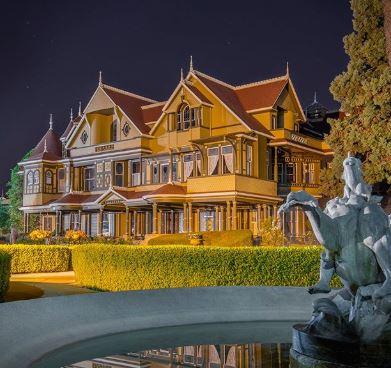
Some people do not believe in ghost. For that matter, some people do not believe in anything. There are persons who even affect incredulity concerning the “Door to Nowhere,” at the Winchester mansion. They said that it did not stand wide open—that it was not a gateway to the Spirit World and that they could have shut it; that the whole affair was a delusion; that they are sure it must have been a conspiracy; that they are doubtful whether there is such a place as the Winchester mansion on the face of the Earth; that the first time they are in California they will look it up. Perhaps, before going further, I ought to premise there was a time when I did not believe in ghosts either. If you had asked me one summer’s morning years ago when you met me on the Golden Gate Bridge if I held such appearances to be probable or possible, you would have received an empathic “No” for answer. However, at this rate, the story of the Door to Nowhere will never be told; so we will, with your permission, plunge into it immediately. I was interested in why this “Door to Nowhere” in the Winchester mansion would not keep shut? They say the place is haunted. What nonsense. There was one thing I can truly say about our office, we were never serious in it. I fancy that is the case in most offices nowadays; at all events, it was the case in ours. We were always chaffing each other, playing practical jokes, telling stupid stories, scamping our work, looking at the clock, counting the weeks to next Christmas, counting the hours to Saturday. For all that we were earnest in our desire to have our salaries raised, and unanimous in the opinion no fellows ever before received such wretched pay. #RandolphHarris 1 of 17

I had $75,000 a year, which I was aware did not half provide for what I ate at home. My mother and sisters left me in no doubt on the point, and when new clothes were wanted I always hated to mention the fact to my poor worried father. We had been better off once, I believe, though I never remember the time. My father owned a small property in the country. I wanted money badly—I must say I never had sixpence in the World of my own—and I thought if I could earn two sovereigns I might buy some trifles I needed for myself, and present my father with a new Ultimate Driving Machine. Then I recalled the amount of the rent was being asked for the Winchester mansion; then I decided gladly this would be a great place to stay if only the ghost turned out of possession. I decided I should like to try to whether, I could not solve the mystery. I was accustomed to lonely houses, and I would not feel at all nervous; I did not believe in ghost, and as for burglars, I was not afraid of them. I was told to just try it out first. To stay in the house for a week; if as tht end of that time I could keep the door shut, locked, bolted, or nailed up, to telegraphy the Winchester Repeating Arms Company, and they would actually pay me to stay there. To me, this sounded like a great bargain. If I lay the ghost, or find out the ghost, I think I ought to have enough money to buy a small house for myself. However, I could not have said what frightened me about this endeavour. A week after I moved into the Queen Anne mansion, Mr. van Buuren from the Winchester Repeating Arms Company came to visit me. He wanted to speak to me about the mansion. I heard a sound of irritation in his voice. “The Winchester Mansion!” he said; “and what have you got to say about the Winchester Mansion?” #RandolphHarris 2 of 17

“That is what I wanted to tell you, Mr. van Buuren,” I answered, and a dead hush seem to fall over the office as I spoke. The silence seemed to attract his attention, for he looked sternly at the clerks, who were not using a pen or moving a finger. “Come this way, then,” he said abruptly; and next minute I was in his private office. “Now, what is it?” he asked, flinging himself into a chair, and addressing me, who stood hat in hand beside the great table in the middle of the room. I began—I will say he was a patient listener—at the very beginning, and told my story straight through. I concealed nothing. I enlarged on nothing. A discharged clerk I stood before him, and in the capacity of a discharged clerk I said what I had to say. He heard me to the end, the he sat silent, thinking. At last he spoke. “You have heard a great deal of conversation about the Winchester, I suppose,” he remarked. “No, sir; I have heard nothing expect what I have told you.” “And why do you desire to strive to solve such a mystery?” “If there is any money to be made, I should like to make it, sir.” “How old are you?” “Two-and-twenty last January.” He laughed—he lay back in his chair and laughed—and I laughed myself, though ruefully. We went on talking for a long time after that; he asked me all about my father and my early life, and how we lived and the people we knew; and, in fact, put more questions than I can well remember. “It seems a crazy thing to do,” he said at las; “and yet I feel disposed to trust you. The house is standing perfectly empty. I cannot live it in, and I cannot get rid of it; all my own furniture I have removed, and there is nothing in the place except a few old-fashioned articles belonging to Mrs. Winchester. The place is a loss to me. It is of no use trying to let it, and thus, in fact, matters are at a deadlock. #RandolphHarris 3 of 17

“You will not be able to find out anything, I know, because, of course, other have tried to solve the mystery ere now; still, if you like to try you may. I will make this bargain with you. If you like to go down, I will pay your reasonable expenses for a fortnight; and if you do any good for me, I will give you a $1,000,000 note for yourself. Of course I must be satisfied that what you have told me is true and that you are what your represent. Do you know anybody in the city who would speak for you?” I could think of no one but my uncle. I hinted to Mr. van Buuren he was no grand enough or rich enough, perhaps, but I knew nobody else to whom I could refer him. “What?!” he said, “Greg Ryan, of Lakeview Street. He does business with us. If he will go bail for your good behaviour I shan’t want any further guarantee. Come along.” And to my intense amazement, he rose, put on his hat, walked me across the outer office and along the pavements till we came to Lakeview Street. “Do you know this youth, Mr. Ryan?” he said, standing in front of my uncle’s desk, and laying a hand on my shoulder. “Of course I do, Mr. van Burren,” answered my uncle, a little apprehensively; for, as he told me afterwards, he could not imagine what mischief I have been up to. “He is my nephew.” “And what is your opinion of him—do you think he is a young fellow I may safely trust?” My uncle smiled, and answered, “That depends on what you wish to trust him with.” “A long column of addition, for instance.” “It would be safer to give that task to somebody else.” “Oh, uncle!” I remonstrated; for I had really striven to conquer my natural antipathy to figures—worked hard, and every bit of it against the collar. My uncle got off his stool, and said, standing with his back to the empty fire-grate: “Tell me what you wish the boy to do, Mr. van Buuren, and I will tell you whether he will suit your purpose of not. I know him, I believe, better than he knows himself.” #RandolphHarris 4 of 17

In an easy, affable way, for so rich a man, Mr. van Buuren took possession of the vacant stool, and nursing his right leg over his left knee, answered: “He wants to go and shut the “Door to Nowhere” at the Winchester Mansion for me. Do you think he can do that? My uncle looked steadily back at the speaker, and said, “I thought, Mr. van Buuren, I was quite settled no one could shut it?” Mr. van Buuren shifted a little uneasily on his seat, and replied: “I did not set your nephew the task he fancies he would like to undertake.” “Have nothing to do with it, Justin, advised my uncle, shortly. “You do not believe in ghost do you, Mr. Ryan?” asked Mr. van Burren, with a slight sneer. “Do you not, Mr. van Buuren?” retorted my uncle. There was a pause—an uncomfortable pause—during the course of which I felt the million dollar note, which in imagination, I had really spent, trembling in the scale. I was not afraid. For one million dollars, or half the money, I would have faced all the inhabitants of spirit land. I longed to tell them so; but something in the way those two men looked at each other stayed my tongue. “If you ask me the question here in the heart of the city, Mr. Ryan,” said Mr. van Buuren, at length, slowly and carefully, “I answer ‘No’; but if you were to put me on a dark night at the Winchester, I should beg time to consider. I do not believe in supernatural phenomena myself, and yet—the ‘Door to Nowhere’ at the Winchester is as much beyond my comprehension as the ebbing and flowing of the sea.” “And you cannot live at the Winchester?” remarked my uncle. “I cannot live at the Winchester, and what is more, I cannot get anyone else to live at the Winchester.” “And you want to get rid of your lease?” “I want so much to get rid of my lease that I told Tuck I would give him a handsome sum if he could induce anyone to solve the mystery. Is there any other information you desire, Mr. Ryan? Because if there is, you have only to ask and have. I feel I am not here in a prosaic office in the city of Santa Clara, but in the Palace of Truth.” #RandolphHarris 5 of 17

My uncle took no notice of the implied compliment. When company is good it needs nothing else. If a man is habitually honest in his speech and in his thoughts, he desires no recognition of the fact. “I do not think so,” he answered; “it is for the boy to say what he will do. If he be advised by me he will stick to his ordinary work in his employers’ office, and leave ghost-hunting and spirit-laying alone.” Mr. van Buuren shot a rapid glance in my direction, a glance which implying a secret understanding, might have influenced my uncle could I have stooped to deceive my uncle. “I cannot stick to my work there any longer,” I said. “I got my marching orders today.” “What had you been doing, Justin? Asked my uncle. “I wanted one million to go and lay the ghost!” I answered, so dejectedly, that both Mr. van Buuren and my uncle broke out laughing. “One Million dollars!” cried my uncle, almost between laughing and crying. “Why, Justin boy, I had rather, poor man though I am, have given thee one million dollars than thou should’st go ghost-hunting or ghost-laying.” When he was very much in earnest my uncle went back to thee and thou his native dialect. I liked the vulgarism, as my mother called it, and I knew my aunt loved to hear him use the caressing words to her. He had risen, not quite from the ranks it is true, but if ever a gentleman came ready born into the World it was Greg Ryan, upon whom at our home everyone seemed to look down. “What will you do, you man?” asked Mr. van Buuren; “you hear what your uncle says, “Give up the enterprise,” and what I say; I do not want either to bribe or force your inclinations.” “I will go, sir,” I answered quite steadily. “I am not afraid, and I should like to show you—” I stopped. I had been going to say, “I should like to show you I am not sure a fool as you all take me for,” but I felt such an address would be too familiar, and refrained. #RandolphHarris 6 of 17

When I got to the Lodge, I showed Mr. van Buuren’s letter to the woman, and received the key. “You are not going to stop up at the Winchester alone, are you, sir? she asked. “Yes, I am,” I answered, uncompromisingly, so uncompromisingly that she said no more. The avenue led straight to the mansion; it was uphill all the way, and bordered by rows of the most magnificent limes I ever beheld. A light iron fence divided the avenue from the park, and between the trunks of the trees I could see the deer browsing and cattle grazing. Ever and anon there came likewise to my ear the sound of a sheep-bell. It was a long avenue, but at length I stood in front of the mansion—a square, solid-looking, Victorian mansion, four stories high, with several towers and a steeply pitched roof, beautiful stained-glass windows and statues, a basement; a flight of steps up to the principal entrance; several windows to the right of the door, several to the left of the door; the whole mansion flanked and backed with trees; all the curtains closed, a dead silence brooding over the place; the sun westering behind the great trees studding the park. I took all this in as I approached, and afterwards as I stood for a moment under then ample porch; then remembering he business which has brought me so far, I fitted the great key in the lock, turned the handle, and entered the Winchester Mansion. For a minute—stepping out of the bright sunlight—the place looked to me so dark that I could scarcely distinguish the objects by which I was surrounded; but my eyes soon grew accustomed to the comparative darkness, and I found I was in an immense hall, lighted from the roof; a magnificent old oak staircase conducted to the upper rooms. #RandolphHarris 7 of 17

The floor was of white marble. There were two fireplaces, fitted with dogs for burning wood; around the walls hung pictures, antlers, and horn, and in odd niches and corners stood groups of statues, and the figure of men in complete suits of armour. To look at the place outside, no one would have expected to find such a hall. I stood lost in amazement and admiration, and then I began to glance more particularly around. Mr. van Buuren has not given me any instructions by which to identify the ghostly chamber—which I concluded would most probably be found on the first floor. I knew nothing of the story connected with it—if there were a story. I was perfectly unencumbered of the mystery. I had not the faintest idea in which apartment it resided. Well, I should discover that, no doubt, for myself ere long. I looked around me—doors—doors—doors. I have never before seen so many doors together all at once. Two of them stood open—one wide, the other slightly ajar. “I will just shut them as a beginning,” I thought, “before I go upstairs.” The doors were of oak, heavy, well-fitting furnished with good locks and sound handles. After I had closed I tried them. Yes, they were quite secure. I ascended the great staircase feeling curiously like an intruder, paced the corridors, entered the many bed chambers—some quite bare of furniture, others containing articles of an ancient fashion, and no doubt of considerable value—chairs, antique dressing-tables, curious wardrobes, and such like. For the most part the doors were closed, and I shut those that stood open before making my way into the attics. I was greatly delighted with the attics. The window lighted them did not, as a rule, overlook the front of the Manion, but commanded wide views over wood, and valley, and meadow. Leaning out of one, I could see, that to the right of the mansion the ground, thickly planted, shelved down to a stream, which came out into the daylight a little distance beyond the plantation, and meandered through the deer part. #RandolphHarris 8 of 17

At the back of the mansion the windows looked out on nothing save a dense wood and a portion of the stable-yard, whilst on the side nearest the point from whence I had come there were spreading gardens surrounded by thick yew hedges, and kitchen-gardens protected by high walls; and further on a farmyard, where I could perceive cows and oxen, and, further still, luxuriant meadows, and fields glad with waying and fruit orchards. “What a beautiful place!” I said. “van Buuren must have been a duffer to leave it.” And then I thought what a great ramshackle house it was for anyone to be in all alone. Getting heated with my long walk, I suppose, made me feel chilly, for I shivered as I drew my head in from the last dormer window, and prepared to go down stairs again. In the attics, as in the other parts of the house I had as yet explored, I closed the doors, when there were keys locking them; when there were not, trying them, and in all cases, leaving the securely fastened. When I reached the ground floor the evening was drawing on apace, and I felt that if I wanted to explore the whole house before dusk I must hurry my proceedings. “I will take the kitchens next,” I decided, and so made my way to a wilderness of domestic offices lying to the rear of the great hall. Stone passages, great kitchens, an immense servants’-hall, larders, pantries, coal-cellars, beer-cellars, laundries, brewhouses, housekeeper’s room—it was not of any use lingering over these details. The mystery that trouble Mr. van Buuren could scarcely lodge amongst cinders and empty bottles, and there did not seem much else left in this part of the building. I would go through the living-rooms, and then decide as to the apartments I should occupy myself. The evening shadows were drawing on apace, so I hurried back into the hall, feeling it was a weird position to be there all alone with those ghostly hollow figures of men in armour, and the statues on which the moon’s beams must fall so coldly. #RandolphHarris 9 of 17

I would just look through the lower apartments and then kindle a fire. I had seen quantities of wood in a cupboard close at hand, and felt that beside a blazing hearth, and after a good cup of tea, I should not feel the solitary sensation which was oppressing me. The sun had sunk below the horizon by this time, for to reach the Winchester I had been obliged to travel by cross lines of railway, and wait besides for such trains as condescended to carry third-class passengers; but here was still light enough in the hall to see all object distinctly. With my own eyes I saw that one of the doors I had shut with my own hands was standing wide! I turned to the door on the other side of the hall. It was as I had left it—closed. This, then, was the room—this with the open door. For a second I stood appalled; I think I was fairly frighted. That did not last long, however. There lay the work I had desired to undertake, the foe I had offered to fight; so without mor ado I shut the door and tried it. “Now I will walk to the end of the hall and see what happens,” I considered. I did so. I walked to the foot of the grand staircase and back again, and looked. The door stood wide open. I went into the room, after just a spasm of irresolution—went in and pulled up the blinds: a good-sized room, twenty by twenty (I knew because I paced it afterwards), lighted by two long windows. The floor, of polished oak, was partially covered with a Turkey carpet. There were two recesses beside the fireplace, one fitted up as a bookcase, the other with an old and elaborately carved cabinet. I was astonished also to find a bedstead in an apartment so little retired from the traffic of the house; and there were also some chairs of an obsolete make, covered, so far as I could make out, with faded tapestry. Beside the bedstead, which stood against the wall opposite to the door I had as yet met with the interior of the house. #RandolphHarris 10 of 17

It was a dreary, gloomy room: the dark panelled walls; the black, shining floor; the windows high from the ground; the antique furniture; the dull four-poster bedstead, with dingy velvet curtains; the gaping chimney; the silk counterpane that looked like a pall. “Any crime might have been committed in which a room,” I thought pettishly; and then I looked at the door critically. Someone had been at the trouble of fitting bolts upon it, for when I passed out I not merely shut the door securely, but bolted it as well. “I will go and get some wood, and then look at it again,” I soliloquized. When I came back it stood wide open once more. “Stay open, then!” I cried in a fury. “I will not trouble myself any more with you tonight!” Almost as I spoke the words, there came a ring at the front door. Echoing through the desolate house, the peal in the then states of my nerves startled me beyond expression. It was only the man who had agreed to bring over my traps. I bade him lay them down in the hall, and while looking out some small silver, asked where the nearest-post-office was to be found. Not far from the Winchester Estate’s Park gates, he said; if I wanted any letter sent, he would drop it in the box for me; the mail-cart picked up the bag at ten o’clock. I had nothing ready to post then, and told him so. Perhaps the money I gave was more than he expected, or perhaps the dreariness of my position impressed him as it had impressed me, for he paused with his hand on the lock, and asked: “Are you going to stop here all alone, master?” “All alone, I answered, with such cheerfulness as was possible under the circumstances.” “That is the room, you know,” he said, nodding in the direction of the open door, and dropping his voice to a whisper. “Yes, I know,” I replied. “What, you have been trying to shut it already, have you? Well, you are a game one!” And with this complimentary if not very respectful comment he hastened out of the house. Evidently he had no intention of proffering his services towards the solution of the mystery. #RandolphHarris 11 of 17

I cast one glance at the door—it stood wide open. Through the windows I had left bare to the night, moonlight was beginning to stream cold and silvery. “Look here, Justin,” I said, all of a sudden; “life is not child’s play, as uncle truly remarks. That door is just the trouble you have now to face, and you must face it! However, for that door you would never have been here. I hope you are not going to turn coward the very first night. Courage!—that is your enemy—conquer it.” “I will try,” my other self answered back. “I can but try. I can but faith.” The moon’s beams were streaming down upon the mansion; I could see every statue, every square of marble, every piece of armour. For all the World it seemed to me like something in a dream; but I was tired and sleepy, and decided I would not trouble about fire or food, or the open door, till the next morning: I would go to sleep. However, I felt like an army of Devil’s was horribly broke in upon this place which is the center, and after a sort, the first-born of our Californian settlements. If a ghost was responsible for the hanging of nineteen people in this mansion, what was responsible for the burning of nine hundred people? What more likely time would the “Door to Nowhere” open up and let our arch-enemy, the Devil, choose a time for his attack? I spent the forenoon considering that door. I looked at it from within and from without. It was on the second floor and opened up to a two story drop outside of the house. What would possess someone to build a door like this, unless they had some knowledge of it being a portal? I eyed it critically. I tried whether there was any reason why it should fly open, and I found that so long as I remained on the threshold it remained closed; if I walked even so far away as the opposite side of the mansion, it swung wide. #RandolphHarris 12 of 17

Do what I would, it burst from latch and bolt. I could not lock it because there was no key. I was baffled. Then I stumbled upon a note which read: “One that shall use, practise, or exercise any invocation or conjuration of any evil or wicked spirit, or consult, convenient with, entertain or employ, feed or reward any evil or wicked spirit, to or for any intent or purpose; or take up any dead man, woman, or child, out of his, her, or their grave, or any other place, where the dead body resteth; or the skin, bone, or other part of any dead person, to be employed or used in any manner of witchcraft, sorcery, charm or enchantment; or shall use, practise, or exercise any witchcraft, enchantment, charm, or sorcery, whereby any person shall be killed, destroyed, wasted, consumed, pined, or lamed in his or her body, or any part thereof: such offenders duly and lawfully convicted and attained, shall suffer death.” Then it dawned of me. Perhaps the mansion has been attraction people who are into the occult and they are the nearly 920 people who have been burned alive or hanged. And that is why the house cannot find renters, it consumes them all. Perhaps this is something like the Atonement of Christ. How God gave His one and only Son to pay the wages of sin man had created, this mansion is consuming souls of those who practise the occult to atone for the death of those killed by the Winchester rifle. The afflicted state of our poor neighbours that are now suffering by molestations from the invisible World, we apprehended so deplorable that we think their condition calls for the utmost help of all persons in their several capacities. We cannot but with all thankfulness acknowledge the success which the merciful God has given unto the sedulous and assiduous endeavours of our honorable rulers to detect the abominable witchcrafts which have been committed in the country, humbly praying that the discovery of these mysterious and mischievous wickedness may be perfected. #RandolphHarris 13 of 17

We judge that in the prosecution of these, and all such witchcrafts, there is need of a very critical and exquisite caution, leas by too much credulity for things received only upon the Devil’s authority there be a door opened for a long train of miserable consequences, and Satan get an advantage over us, for we should not be ignorant of his devices. After all, it was this mansion people could not live in—his door that would not keep shut; and it seemed to me these were facts he might dislike being forced upon the attention of the public. What had I seen? What did I think of the matter? Very honestly I did not know what to say. The door certainly would not remain shut, and there seemed no human agency to account for its persistent opening; but then, on the other hand, ghost generally did no tamper with fire arms, and my rifle, though not loaded, had been tampered with—I was sure of that. Mr. van Buuren later disclosed to me his theory that open door: “This is the room my uncle was murdered in, they say the door will never remain shut till the murderer is discovered.” “Murdered!” I did not like the word at all; it made me feel chill and uncomfortable. “Yes—he was murdered sitting in his chair, and the assassin has never been discovered. At first many persons inclined to the belief that I killed him; indeed, may are of that opinion still. “But you did not, sir—there is not a word of truth in that story, is there?” He laid his hand on my shoulder as he said: “No, my lad; not a word. I loved the old man tenderly. Even when he disinherited me for the sake of his young wife, I was worry, but not angry; and when he sent for me and assured me he had resolved to repair a wrong, I tried to induce him to leave the lady a handsome sum in addition to her jointure. “If you do not, people may think she has not been the source of happiness you expected,” I added. “Thank you, Reuban,” he said. “You are a goof fella; we will talk further about this tomorrow.” And then he bade me goodnight. #RandolphHarris 14 of 17

“Before morning broke—it was in the about one hundred years ago—the household was arounds by a fearful scream. It was his death-cry. He had been stabbed from behind in the neck. He was seated in his chair writing—writing a letter in Latin. Part of it said, ‘Exorcizo te, immundissime spiritus, omnis incursion adversarii, omne phanatasma, omnis leigo, in nominee Domini nostri Jesu Christi eradicare, et effugare ab hoc plasmate Dei.’ The rest of the letter was torn. His solicitor came forward and said he had signed a will leaving all his personalty to me—he was very rich—unconditionally, only three days previously.” Mr. van Buuren went away, and I stayed in the house. I never left it all day. I did not go into the garden, or the stable-yard, or the shrubbery, or anywhere; I devoted myself solely and exclusively to that door. If I shut it once, I shut it a hundred times, and always with the same result. Do what I would, it swung wide. Never, however, when I was looking at it. So long as I could endure to remain, it stayed shut—the instant I turned back, it stood open. Though feeling convinced that no human agency did or could keep the door open, I was certain that some living person had means of access to the house which I could not discover. This was made apparent in trifles which might well have escaped unnoticed had several or even two people occupied the mansion. In the dead of the night a noise, resembling the clashing of iron, was frequently heard, which, if you listened more attentively, sound like the rattling of chains, distant at first, but approaching nearer by degrees: immediately afterward a spectre appeared in the form of an old man, of extremely emaciated and squalid appearance, with a long beard and dischevelled hair, rattling the chains on his feet and hands. The distressed occupants meanwhile passed their wakeful nights under the most dreadful terrors imaginable. This, as it broke their rest, ruined their health, and brought on distempers, their terrors grew upon them, and death ensued. #RandolphHarris 15 of 17

Even in the daytime, though the spirit did not appear, yet the impression remained so strong upon their imaginations that it still seemed before their eyes, and kept them in perpetual alarm. Consequently the mansion was at length deserted, as being deemed absolutely uninhabitable; so that it was now entirely abandoned to the ghost of the Winchester rifle. That night, I prepared to retire. However, I was open to the vain terrors of imaginary noises and spirits. The first part of the night passed in entire silence, as usual; at length a clanking of iron and rattling of chains was heard: however, I neither lifted up my eyes, nor got out of bed, but in order to keep calm, I pretended the sound was something else. The noise increased and advanced nearer, until it seemed at the door, and at last in my chamber. I looked up, saw, and recognized the ghost exactly as it has been described to me: it stood before me, beckoning with a finger, like a person calls another. I immediately arouse, and, candle in hand, followed it. The ghost slowly stalked along as if encumbered with its chains, and, turning into the area of the house where the “Door to Nowhere, was and suddenly vanished. What an idiot I have been! If I wanted to solve the mystery of the open door, or course I must keep watch in the room itself. The door would not stay wide unless there was a reason for it. When I walked into the room, it was deadly cold, and the scene was horrible. The door was wide open. A party of ghosts were assembled with, and were feasting on the flesh of corpses. I was astonished by this hideous banquet. As soon as I could safely escape, I stole back into my bed. I was rather crossed at being disturbed. The next day word on—the long, dreary day; evening approached—the night shadows closed over the Winchester mansion. The moon would not rise for a couple hours more. Everything was still as death. The house had never before seemed to me so silent and so deserted. #RandolphHarris 16 of 17

I took a candle, and went up to my accustomed room, moving about for a time as though preparing for bed; then I extinguished the candle, softly open the door, turned the key, and put it in my pocket, slipped softly downstairs, across the hall, through the open dor. Then I knew I had been afraid, for I felt a thrill of terror as in the dark I stepped over the threshold. I paused and listened—there was not a sound—the night was still and sultry, as though a storm were brewing. Not a leaf seemed moving. Noiselessly I made my way to the other side of the room. There was an old-fashioned easy-chair between the bookshelves and the bed; I sat down in it, shrouded by the heavy curtains. The hours passed—where ever hours so long? The moon rose, came and looked in at the windows, and then sailed away to the west; but not sound, no, not even the cry of a bird. I seemed to myself a mere collection of nerves. Every part of my body appeared twitching. It was agony to remain still; the desire to move became a form of torture. The locked door opened—so suddenly, so silently, that I barely had time to draw back behind the curtain, before I saw a woman in the room. A slight, lithe woman, not a lady, clad in all black—not a bit of white about her. What on Earth could she want? Then she fell on me with her nails and teeth, and tore at my throat, she was as strong as twenty devils. I felt something like a red-hot iron enter my neck. She opened a vein and sucked by blood, and I could but rush from the room before I fell senseless on the marble pavement of the hall. When the post man came that morning, finding no one stirring, he looked through one of the long windows that flanked the door; then he ran to the farmyard and called for help. “There is something wrong inside,” he cried. “That young gentleman is lying on the floor in a blood of blood.” To this day, the “Door to Nowhere” is still a mystery. #RandolphHarris 17 of 17

Winchester Mystery House

24 Hours till opening night of All Hallows’ Eve and our caretakers are working non stop to put the finishing touches on the show! Be here for the opening weekend! Tickets are still available. A 160-room mansion built to appease the spirits who died at the hands of the Winchester Rifle 👻
All Hallows’ Eve:
🎟️ Link in bio. 🗝 winchestermysteryhouse.com

He Was Haunted By an Invisible Presence!

The facts which I am about to relate happened to myself some sixteen or eighteen years ago, at which time I was still young enough to enjoy a life of constant travelling. There are, indeed, many less agreeable ways in which an unbeneficent parson may contrive to scorn delights and live laborious days. In remote places where strangers are scarce, his annual visit is an important evet; and though at the close of a long day’s work he would sometimes prefer the quiet of a Victorian mansion, he generally finds himself the destined guest of the rector or the squire. It rests with himself to turn these opportunities to account. If he makes himself pleasant, he forms agreeable friendships and sees Victorian home-life under one of its most attractive aspects; and sometimes, even in these days of universal common-placeness, he may have the luck to meet with an adventure. My first appointment was to Llanda Villa ; which was largely peopled with my personal friends and connections. It was, therefore, much to my annoyance that I found myself, after a could of years very pleasant work, transferred to a new teaching position. I now spent half my time in hired vehicles and lonely country inns. I had been in possession of this position for some three months or so, and winter was near at hand, when I paid my first visit of inspection to the Winchester mansion. It was a dull, raw afternoon of mid-November, growing duller and more raw as the day waned and the east wind blew keener. I found the foot path without difficulty. It led me across a barren slope divided by stone fences, with here and there a group of smaller Victorian houses and gazebos. #RandolphHarris 1 of 14

A light fog, meanwhile, was creeping up from the east, and the dusk was gathering fast. Now, to lose one’s way on such an expansive ranch and at such an hour would be disagreeable enough, and the footpath—a trodden track already half obliterated—would be indistinguishable enough in the course of another ten minutes, but the nine story look out tower, a top the mansion, stood erect as a compass guiding visitors to the bizarre and beautiful rambling mansion. Looking anxiously ahead, up to this moment, I had not met a living soul. However, then I saw a man emerging from the fog and coming along the path. As we neared each other—I advancing rapidly; he slowly—I observed that he dragged the left foot, limping as he walked. It was, however, so dark and so misty, that not till we were within half a dozen yards of each other could I see that he wore a dark suit and an Anglican felt hat, and looked something like a dissenting minister. As soon as we were within speaking distance, I addressed him. “Can you tell me, I said, about how much longer it will take to get to the Winchester mansion?” He came on, looking straight before him; taking no notice of my question; apparently not hearing it. “I beg your pardon,” I said, raising my voice; “but how much longer will it take on this path to get to the Winchester?” He had passed on without pausing; without looking at me; I could almost have believed, without seeing me! I stopped, with the words on my lips; then turned to look after—perhaps, to follow—him. But instead of following, I stood betwixted. What had become of him? #RandolphHarris 2 of 14

And what lad was that going up the path by which I had just come—that tall lad, half-running, half-walking, with a fishing-rod over his shoulder? I could have taken my oath that I had neither met nor passed him. Where then had he come from? And where was the man to whom I had spoken not three seconds ago and who, at his limping pace, could have made more than a couple of yards in the time? My stupefaction was such that I stood quite still, looking after the lad with the fishing-rod till he disappeared in the gloom under the park-palings. Was I dreaming? Darkness, meanwhile, had closed in apace, and, dreaming or not dreaming, I must push on, or find myself benighted. So I hurried forward, turning my back on the last gleam of daylight, and plunging deeper into the fog at every step. I was, however, close upon my journey’s end. The path ended at a turnstile; the turnstile opened upon a steep lane; and at the bottom of the land, down which I stumbled among stones and ruts, I came in sight of the welcome glare of a blacksmith’s forge. Here, then, was the Winchester. I found myself at the door of the Winchester mansion. When I was sitting in the cozy drawing room, I saw Mrs. Winchester, and she looked like an angel. Spreading loveliness everywhere, over all with whom she came in touch, over good and evil. When a small number of people often come together in the same room, a tradition readily develops as to where each individual has one’s place, one’s station; it becomes a kind of picture a person can unroll for oneself when one so desires, a map of the terrain. So it is also with us in the Winchester mansion—together we form a picture. We were to drink tea here this evening. #RandolphHarris 3 of 14

Mrs. Winchester strives for an air of mystery. She wants to whisper and usually does it so well that she becomes entirely mute; I make no secret of my effusions to Merriam, her niece, an estimate of how many quarts of milk it takes for one pound of butter through the medium of cream and the dialectic of the butter churn. Indeed, it is not only something any young girl can listen to without hard, but, what is far more unusual, it is a solid and fundamental and edifying conversation that is equally ennobling to the head and the heart. And is no nature magnificent and wise in what she produces, what a precious gift is butter, what a glorious accomplishment of nature and art! It is a curious picture we make together. Mrs. Winchester almost vanishes before our eyes in pure agronomy; we go into the kitchen and the cellars, up into the attic, look at the chicken and ducks, geese et cetera. This was fascinating to me. But it could just be that I was the kind of young man who became old prematurely; it is possible. I sat late over the fire, and by the time I went to bed, I had well nigh forgotten my adventure with the man who vanished so mysteriously and the boy who seemed to come from nowhere. Next morning, finding I had abundant time at my disposal. What a reinvigorating power I felt from the Winchester—not the freshness of the morning air, not the sighing of the wind, not the coolness of the sea, not the fragrance of wine, its aroma—nothing in the World has this reinvigorating power. In this way the days go by. Mrs. Winchester seemed perfect happy in her mansion. Her bedroom faced the courtyard. Sometimes she stands on the balcony for a moment, and at night she looks up at the stars, unseen by all. #RandolphHarris 4 of 14

In these nocturnal hours, I walk around like a ghost. Then I forget everything, have no plans, no reckonings, cast understanding overboard, expand and fortify my chest with deep sighs, a motion I need in order not to suffer from my systematic conduct. Others are virtuous by day, sin at night; I am dissimulation by day—at night I am sheer inspiration. When I notice it, far off on the horizon there comes a flashing intimation from a quite different World, to the astonishment of Mrs. Winchester as well as Merriam. Mrs. Winchester sees the lightning but hears nothing; Merriam hears the voice but sees nothing. However, at the same moment everything is in its quiet order; the conversation between Mrs. Winchester and me proceeds in its uniform way, like post horses in the stillness of the night the; the sad hum of the samovar accompanies it. At such moments, it can sometimes be uncomfortable in the drawing room, especially for Merriam. She has no one she can talk with or listen to. I can well understand that it must seem to Merriam as if Mrs. Winchester were bewitched, so perfectly does she move to the tempo of my rhythm. She cannot participate in this conversation either, because one of the means I have also used to outrage her is that I allow myself to treat her just like a child. It is not as if I for that reason would allow myself any liberties whatever with her, far from it. I well know the upsetting effects such things can have, and the point is that her womanliness must be able to rise up pure and beautiful again. Because of my intimate relationship with Mrs. Winchester, it is easy for me to treat her like a child who has no understanding of the World. #RandolphHarris 5 of 14

Her womanliness is not insulted thereby but merely neutralized, for the fact that she does not know market prices cannot insult her womanliness, but the supposition that this is the ultimate in life can certainly be revolting to her. With my powerful assistance on this scored, Mrs. Winchester is out doing herself. She has become almost fanatic—something she can thank me for. The only thing about me that she cannot stand is that I have no position. Now I have adopted the habit of saying whenever a vacancy in some office is mentioned: “There is a position for me,” and thereupon discuss it very gravely with her. Merriam always perceives the irony, which is precisely what I want. The butler came in with more tea. I saw that he was lame. In the moment I remembered him. He was the man I met in the fog. “I met you yesterday afternoon, Mr. Brunton,” I said, as we went into the library. “Yesterday afternoon, sir?” He repeated. “You did not seem to observe me,” I said, carelessly. “I spoke to you, in fact; but you did not reply to me.” “But—indeed, I beg your parson, sir—it must have been someone else,” said the butler. “I did not go out yesterday afternoon.” How could this be anything but a falsehood? I might have been mistaken as to the man’s face; though it was such a singular face, and I had seen it quite plainly. However, how could I be mistaken as to his lameness? Besides, that curious trailing of the right foot, as if the ankle was broken, was not an ordinary lameness. I suppose I looked incredulous, for he added, hastily. “Even if I had not been preparing dinner for inspection, sire, I should not have gone out yesterday afternoon. It was too damp and foggy. I am obliged to be careful—I have a very delicate chest.” #RandolphHarris 6 of 14

My dislike to the man increased with every word he uttered. I did not ask myself with what motive he want on heaping lie upon lie; it was enough that, to serve his own ends, whatever those ends might be, he did lie with unparalleled audacity. “We will proceed to the examination, Mr. Brunton,” I said, contemptuously. He turned, if possible, a shade paler than before, bent his head silently, and called up the cuisine in their order. Profusely apologizing, he begged leave to occupy five minutes of my valuable time. He wished, under correction, to suggest a little improvement to many the menu more festive. “Under other circumstances…” I stopped and looked round. The butler repeated my last words. “You were saying, sir—under other circumstances?” I looked around again. “I seemed to me that there was someone here,” I said; “some third person, not a moment ago.” “I beg your pardon, sir—a third person?” “I saw his shadow on the ground, between yours and mine.” The mansion faced due north, and we were standing immediately behind it, with our backs to the sun. The place was bare, and open, and high; and our shadows, sharply defined, lay stretched before our feet. “A—a shadow?” he faltered. “Impossible.” There was not a bush or a true within half a mile. There was not a could in the sky. There was nothing, absolutely nothing, that could have cast a shadow. I admitted that t was impossible, and that I must have fancied it; and so went back to the matter of the menu. “Should you see Mrs. Winchester,” I said, “you are at liberty to say that I thought it a desirable improvement.” #RandolphHarris 7 of 14

“I am much obliged to you, sir. Thank you—thank you very much,” he said, cringing at every word. “But—but I had hoped that you might perhaps use your influence”—“Look there!” I interrupted. “Is that fancy?” We were now close under the blank walls of the kitchen. On this wall, laying to the full sunlight, our shadows—mine and the butler’s—were projected. And there too—no longer between his and mine, but a little way apart, as if the intruder were standing back—there, as sharply defined as if cast by line-light on a prepared background, I again distinctly saw, though but for a moment, that third shadow. As I spoke, as I looked round, it was gone! “Did you not see it?” I asked. He shook his head. “I—I saw nothing” he said, faintly. “What was it?” His lips were white. He seemed scarcely able to stand. “But you must have seen it!” I exclaimed. “It fell just there—where that bit of ivy grows. There must be some boy hiding—it was a boy’s shadow, I am confident. “A boy’s shadow!” he echoed, looking round in a wild, frightened way. “There is no place—for a boy—to hide.” “Place or no place,” I said, angrily, “if I catch him, he shall feel the weight of my cane!” I searched backwards and forwards in every direction, the butler, with his scared face, limping at my heels; but, rough and irregular as the ground was, there was not a hole in it big enough to shelter a rabbit. “But what was it?” I said, impatiently. “An—an illusion. Begging your pardon, sir—and illusion.” He looked so like a beaten hound, so frightened, so fawning, that I felt I could with lively satisfaction have transferred the threatened caning to his own shoulders. #RandolphHarris 8 of 14

“But you saw it?” I said, impatiently. “No, sir. Upon my honour, no, sir. I saw nothing—nothing whatever.” His looks belied his words. I felt certain that he had not only seen the shadow, but that he knew more about it than he chose to tell. I was by this time really angry. To be made the object of a boyish trick, and to be hoodwinked by the connivance of the butler, was too much. It was an insult to myself and my office. I scarcely knew what I said; something short and stern at all events. Then, having said it, I turned my back upon Mr. Brunton and the mansion, and walked rapidly back to the village. As I was leaving the Winchester, it was a gloomy evening. I was standing high in the midst of a somber deer-park some six or seven miles in circumference. An avenue of palm trees, which led up to the house looked so lonely. The butler said, “If you would but be persuaded to say a day longer, a new experience awaits you. I will take you down the Winchester shaft, and show you the home of the gnomes and trolls. I am the king of Hades, and rule the under World as well as the upper. There is gold everywhere underlying this mansion. The whole place is honeycombed with shafts and galleries. One of our richest seams runs under this house, and there are upwards of forty men at work in it a quarter of a mile below our feet here every day. Another leads right away under the park, Heaven only knows how far! My father began working it five-and-twenty years ago, and we have gone on working it ever since; yet it shows no sign of failing. That is why Mrs. Winchester is rich enough to commit whatever design follies she pleases; and that is saying a good deal. #RandolphHarris 9 of 14

“But then, to be always squandering money—always building a rambling mansion—always gratifying the impulse of the moment—is that happiness? Mrs. Winchester has been experimenting for several decades; and with what result? Would you like to see?” He snatched up a lamp and led the way through a long suite of unfinished rooms, the floors of which were piled high with packing cases of all sizes and shapes, labelled with the names of various foreign ports and the addresses of foreign agents innumerable. What did they contain? Precious marbles from Italy and Greece and Asia Minor; priceless paintings by old and modern masters; antiquities from the Nile, the Tigris, and the Euphrates; enamels from Persia, porcelain from China, bronzes from Japan, strange sculptures from Peru; arms, mosaics, ivories, wood-carvings, skins, tapestries, old Italian cabinets, painted bride-chess, Etruscan terracottas; treasures of all countries, or all ages, never even unpacked since they crossed that threshold which the mistress’s foot had crossed but twice during the ten years it had taken to buy them! Should she ever open them, ever arrange them, every enjoy them? Perhaps—if she becomes weary of wandering—if she remarried—if she built a gallery to receive them. If not—well, she might found and endow a museum; or leave the things to the nation. What did it matter? Collecting was like fox-hunting; the pleasure in the pursuit, and ended with it!” Breakfast over, we went around the mansion, and saw the men working. Just as we were about to enter an underground tunnel—a tall, slender lad, with a fishing rod across his shoulder, came out rom one of the side doors of the mansion, crossed the open at field, and disappeared among the tree-trunks on the opposite side. I recognized him instantly. It was the boy whom I saw the other day, just after meeting the butler in the meadow. #RandolphHarris 10 of 14

“If the boy think he is going fishing in a fruit orchard,” I said, “he will find out his mistake.” “What boy,” asked Mr. Brunton, looking back. “That boy who crossed over yonder, a minute ago.” “Yonder!—in front of us?” “Certainly. You must have seen him?” “No I.” “You did no see him?—a tall, thin boy, in a grey suit, with a fishing-rod over his shoulder. He disappeared behind those nectarine trees.” Mr. Brunton looked at me with surprise. “You are dreaming!” he said. “No living thing—not even a rabbit—has crossed our path since we left the mansion.” “I am not in the habit of dreaming with my eyes open,” I replied, quickly. He laughed, and put his arm through mine. “Eyes or no eyes,” he said, “you are under an illusion this time!” An illusion—the very word made use of by the butler! What did it mean? Could I, in truth, no longer rely upon the testimony of my senses? A thousand half-formed apprehensions flashed across me in a moment, I remembered the illusions of Nicolini, the bookseller, and other similar cases of visual hallucination, and I asked myself if I has suddenly become afflicted in like manner. “By jove! This is a queer sight!” exclaimed Mr. Brunton. And then I found that we had emerged from the fruit orchard, and were looking down upon the bed of what yesterday was a lake. It was indeed a queer sight—an oblong, irregular basin of the blackest slime, with here and there a sullen pool, and round the margin an irregular fringe of bulrushes. At some little distance along the bank—less than quarter of a mile from where we were standing—a gaping crowd had gathered. All the foremen seemed to turn out to stare. #RandolphHarris 11 of 14

Hats were pulled off and curtsies dropped at Mr. Brunton’s approach. He, meanwhile, came up smiling, with a pleasant word for everyone. “Well,” he said, “are you looking for the lake, my friends?” “I see a log of rotten timber sticking half in and half out of the mud,” one of the men said, “and something—a long reed, apparently…by Jove! I believe it is a fishing rod!” “It is a fishin’ rod, squire,” said the blacksmith with rough earnestness; “an” if yon rotten timber bayn’t an unburied corpse, mun I never stroike hammer on anvil agin!” There was a buzz of acquiescence from the bystanders. ‘Twas an unburied corpse, such enough. Nobody doubted it. “It must have come out, whatever it is, Mr. Brunton said presently. “Five feet of mud, do you say? Then here is a sovereign apiece for the first two fellows who wade through it and bring that object to land!” It was, in truth, an unburied corpse; part of the trunk only above the surface. They tried to life it; but it had been so long under water, and was in so advanced a stage of decomposition, that to bring it to shore without a shutter was impossible. Being cross-questioned, they thought, from the slenderness of the form, that it must be the body of a boy. “There’s the poor chap’s rod, anyhow,” said the blacksmith, laying it gently down upon the turf. Mrs. Winchester was summoned and told of the news. That night she rushed to her blue séance room and demanded the spirits tell her what happened to the boy. “I invoke thee, and move thee, and stir thee up O Spirit Leraikha,” said Mrs. Winchester. “From the 30 Legions of Spirits, appear unto my eyes before the circle in the likeness of a man in and tell me what has happened to this boy!” #RandolphHarris 12 of 14

“The words Adam spoke to God, and all things of water were as blood,” replied the Spirit Leraikha. “In the names Alpha and Omega, I am the God of Secret Truth who liveth forever, the All-Powerful. It is to I, to whom all creatures are obedient and in the Extreme Justice and Anger of God that I withdrawal this veil that is before the glory of God, might; and by the creatures of living breath before the Thone whose eyes are east and west; by the fire in the fire of just Glory of Mine Throne; by the Holy ones of Heaven; and by the secret wisdom of God, I, exalted in power, has been stirred up to cast a vision of the past and make clear the present! The secrets of truth in voice and understanding comes: This is the corpse of a boy of perhaps ten and four or ten and five years of age. There was a fracture three inches long at the back of the skull, evidently fatal. This might, of course, have been an accidental injury; but when the body came to be raised from where it layeth, it was found to be pinned down by a pitchfork, the handle of which had been afterwards whittled off, so as not to show above water, a discovery tantamount to evidence of murder. The features of the victim were decomposed beyond recognition; but enough of the hair remained to show that it has been short and sandy. He had a passion for fishing and was in the habit of slipping away at school-hours, and showed himself the more cunning and obstinate more he was punished. At last there came a day when the butler tracked him to the place his rod was concealed and beat the miserable lad about the head and arms with a heavy stick. Pin through hand and blood was running out of his mouth until he fell insensible and ceased to breathe. He dragged the body among the bulrushes by the water’s edge, and there concealed it as well as he could. #RandolphHarris 13 of 14

“At night, when the neighbours and staff were in bed asleep, he stole out by starlight, taking with him a pitchfork, a coil of rope, a couple of iron-bars, and a knife. He weighted and sunk the corpse, and pinned it down by the neck with his pitchfork. He then cut away the handle of the fork; hid the fishing-rod among the reeds; and believed, as murderers always believe, that discovery was impossible. His dreadful secret had of late become intolerable. He was haunted by an invisible Presence. That Presence sat with him at table, followed him in his walks stood behind him in the mansion, and watched by his side. He never saw it; but he felt that it was always there. Sometimes he raves of a shadow on the walls of this mansion. I have now told you all that there is at present to tell.” When a community looks only for evidence of guilt and ignores or suppresses all contradictory evidence, the result is a witch hunt. Witch hunts are often used to conceal more heinous crimes. And when a witch hunt occurs, which is the very opposite of what was going on in the case of the murdered boy, the community feels itself so beset by evil that it is no longer capable of perceiving the good. The primary causes of witch hunts are clear. It is usually due to corruption, an outbreak of epidemic hysteria which usually ordinates in experiments with the occult. And the hysterical hallucinations of the afflicted persons are confirmed by some concrete evidence of actual witchcraft and by many confessions, the majority of them hysterical. A number of other explanations have been offered, but most of them are more or less unconvincing. It has been argued that the outbreak is usually due to some new religion. Typically a kind of insanity resulting from sexual repression or denying one’s true sexual nature. #RandolphHarris 14 of 14

Winchester Mystery House

It’s a beautiful day for a stroll through the gardens. Today, Winchester Mystery House marks 99 years since our lady of mystery, Sarah Winchester passed away peacefully in her bedroom of Llanda Villa. We mark her passing with the ringing of the bell 13 times as is our tradition. Thank you Sarah for creating this iconic home that we continue to share with guests from around the world.
🎟️ Link in bio.

A 160-room mansion built to appease the spirits who died at the hands of the Winchester Rifle 👻
🗝 winchestermysteryhouse.com

In a Nightmare of Supernatural Terror–Afraid to Move Hand or Foot!

The warning came too late to change that course of event. There has been time when many admitted some doubt of the validity of spectral evidence. This story I will tell to you now, as I have promised to do so, and yet I can hardly make you believe in the reluctance with which I even allow my thoughts go back to the times which I spent in my house—my first town residence after I was married. I loved so much my lovely mansion, I suppose. The wide emerald green lawns and quiet, glassy ponds and streams, bordered by luscious, blooming rhododendrons; of silent, mossy avenues, glorious with the flickering light that stole through pale green beech leaves; of rose gardens with grassy paths, jewel-sprinkled with shell-like petals of white, crimson, pink, and cream-like hues; of old-fashioned rooms with narrow, mullioned windows embowered in scarlet japonica and fragrant, starry jessamine. I supposed I possessed a deep love of them all. This was the first house we were sown in the Santa Clara, California. It was certainly a very fine house, both as o exterior and interior appearances. Large, massively built, agreeably darkened in woodwork and masonry by Time’s shading brush, in excellent repair, and the locality all that could be desire. Wide, lofty apartments, staircases, and landings; a handsome dining-room panelled in velvety dark-green “flock” and gold; a handsome drawing-room panelled in pale cream-colour and gold; airy bed-chambers and dressing-rooms—one, in particular, attached to what seemed the principal bedroom, with a vast mirror occupying the whole side of the apartment which was opposite to the door leading into the bed-chamber. #RandolphHarris 1 of 16

“What a nice dressing-room! This house is perfect and expansion will be a joy.” I exclaimed, having a weakness, I confess, for large, handsome mirrors in the rooms I inhabit—William says impertinent things about my “wishing to see as much of myself as I can.” I know I am not all, in fact, rather what he should call petite, if he wished to be polite—but that is not my reason for liking a large mirror. As I spoke the words I looked about mechanically for the house—agent’s clerk who had been sent with us—a nervous-looking little man, with a pasty complexion, and orange-colored hair meekly plastered down at each side of his face. He had been untiringly trotting up and down stairs, unlocking doors, answering questions, and keeping up a harmless soliloquy of chatter about the beauties and excellencies of the “mansiond,” as he called it, ever since he entered its doors, but now he was nowhere to be seen. “What door have you open?” I said, speaking aloud to him, for suddenly a cold blast of air swept up the wide staircase and into the dressing-room door, but not entering. His face looked wither than before, and in his accents there was an almost terrified earnestness that puzzled me. The shadows of the afternoon seemed to deepen. The aspect of the suites of rooms and long silent corridors, with their doors ajar, as if unseen inhabitants were stealthily crouching behind them, drearily impressed me with a sense of dull desolation; and it was with a sudden sensation of childish fear and loneliness that I rushed after my husband, and took his arm as he hastily descended the stairs. #RandolphHarris 2 of 16

“A spacious, handsome staircase, William” I remarked. “Yes; and a spacious, handsome price, you may be sure,” William responded. However, in this particular, he was exceedingly, and I agreeably, astonished. To our surprise, the house was rather affordable. William figured there must be a screw loose somewhere. He mentioned his opinion to the clerk in a more business-like expression, to the effect that the price seemed low, and that he trusted there was no—peculiar—eh? “Drains, gas, water, all right, sir—right as—a—a trivet, sir. However, the 18-room farmhouse is incomplete,” sad the clerk, looking over his shoulder oddly, as he spoke. “But chimneys, ventilators, roof, tiles—everything in the perfect repair and order, sir!” However, wonderful or not, the house seemed all that we could desire; the lowness of the price made it a decided bargain. I planned to expand the house, and make it even more lofty, and handsome; and in three weeks, huge furniture vanes, and a clever upholstered, had carpeted, curtained, and furnished our town mansion from garret to basement, and William and I, our two babies, a nurse, two maids, a cook, and a butler, were installed in what would become the Winchester Mansion. Dear William had been very generous—nay, almost extravagant—in his provisions for the comfort and pleasure of his wife and children; and my dressing-room and their nursery were fitted up so luxuriously and tastefully, that my feeling at the first inspection of them was that of self-gratulation on being such a fortunate woman, in having such a home, such babies, and such a husband. #RandolphHarris 3 of 16

I arrayed myself for dinner that evening quite gleefully; standing before my splendid mirror amid the bule drapery, cushions, and couches of my charming dressing-room. I put on William’s favourite dress—a bronze-brown lustrous silk, with sparkling gold ornaments: he invariably kissed me when he saw it on, stroked my brown curls and face, and called me “Mrs. Winchester”—and was still standing before the glass smiling at myself, like the happy, foolish little woman I was, when I perceived to my discomfiture that William was standing in the doorway watching my doings, and grinning very visibly under his moustache. “Do not mind me, my dear, I beg! do not me the least. However, when you have done admiring Mrs. Winchester, perhaps you will be kind enough to let me know”—then, suddenly changing his tone, he exclaimed, “Have you the window open, Sarah, this chilly evening?” “No William,” I replied, glancing at it to make sure of the fact. “Change in the weather, then,” my husband said. “Come, Sarah, there is no use in making yourself any prettier!” He had just uttered the last words when I saw him spring aside suddenly, and look around. “What is the matter?” I said—“William, dear, what is the matter?” For his face had grown quite white, and with his back against the wall, he was staring about him wildly. “I do not know—Sarah—something”—he explained in a low tone; then recovering himself, with a laugh, he cried—“I struck myself against the door, I suppose! I declare one would think I was composed of old china, or wax, or sugar candy, I hurt and stunned me so! Come, dearest.” #RandolphHarris 4 of 16

He had not struck himself, for I had been watching him going out on the lobby, and I felt an uneasy conviction that he knew he had not done so, and only spoke as he did in order to deceive or satisfy me. why? Why did I think so? As I live I cannot tell why I thought so then—I know now. We had the “babies”—as William always called them—in the dessert, after the time-honoured fashion of making olives as well as olive branches of them; and then, when the lite ones had gone to bed, we sat side by side in he summer twilight, I lazily fanning myself, William bending over me the lover-husband he was. Then came the lamps, and I played for him, and we sang duet and spent as happy an evening in our new home as a married pair could wish to spend. I cannot tell why I felt so disinclined to go upstairs that night, tired as I was, too—for we had had a long journey up from the country. However as eleven struck, I routed William out of the easy chair where he had been indulging in a preliminary doze, and, ringing for my maid went up to my dressing-room. I like gas in my dressing-room, though not in my bedroom, and the globes at either side the great mirror were a blaze of light. As I entered I caught the reflection of a woman’s figure in the depths of the glass, no my maid’s. The glimpse I had was of a tall woman, strongly built, and broad-shouldered, a quantity of light hair hanging in a disordered manner on her neck, and the profile of a white, hard, masculine face, with the keen glittering eye turned watchfully towards the door. #RandolphHarris 5 of 16

This may seem an elaborately detailed description for the momentary glance I obtained, but it is well known with what lightning rapidity the organs of vision will, in moments of terror and amazement, convey impressions to the startled brain, impression accurate and indelible. I had taken but one step on entering, the next step the figure had vanished, and the mirror reflected by my own terrified face, and the homely, cheerful one of my maid Agnus, as she stooped over the dressing-table opening a jewel case. I dropped down on the nearest chair, and, in answer to the girl’s alarmed questions, replied that I did not feel very well. I was sick and shuddering from head to foot. Suddenly it flashed across me that it was from a similar cause I had seen my husband’s face grow ghastly, and that strange, terrified look come into his eyes,–he, who had been a soldier and unflinchingly had fought amidst the dead and dying on bloody Indian battlefields, almost boy as he was then! What was it? What had he seen? Nonsense! was I going to believe I had seen a ghost? Nonsense, a thousand times over! I heard my husband’s cheery voice as he ascended the stairs, and, quite angry with myself for giving way to such folly, I threw on my dressing gown, and, snatching up the brush from Agnus, I pulled my hair down and brushed it quite savagely, until my head ached well—for punishment. If the bright morning light disperses sweet illusions formed overnight, as people say it does, it disperses gloomy ones as well. With the warmth and brightness of the unclouded summer’s sun streaming in through softly coloured blinds, brining out the velvety green of soft new carpets and lounges, the rainbow tints of glittering chandeliers, vases, and ornaments, the gilding on bright fresh wallpaper and the spotless folds of snowy window drapery, it was impossible for an instant to connect anything dark or dismal with the Winchester House. #RandolphHarris 6 of 16

Why, my dressing-room even where I had been so silly last evening, was like a woodland bower, with its deep purple-blue hangings and rose painted china flower-vases filled with bouquets from our country home. Clustering fragrant honeysuckle half-opened moss roses, drooping emerald-green fern, and masses of delicious jessamine dropping its over-blown blossoms on the white toilet cover, lace-flounced and tied with blue ribbons, as Agnus delighted to have it. “I think this such a charming room and such a charming house altogether, William!” I said; “and you have been such a dear, thoughtful old darling!” For I had perceived that the dear fellow had had his own half-length portrait hung over my writing-table. Quite a pleasant surprise for me, for I thought he intended it to be hung in the dining-room, and I delighted in having the dear pleasant brown eyes looking for a me when I was busy writing or sewing. “I am so glad you like everything, Sarah,” said he. “Why, William, do you not?” However, William had walked off whistling, and presently I heard uproarious baby-laughter, and baby-chatter, and thumping, trotting of small fat feet, as William put the tiny nursery into dire confusion by his morning game of romps with his son and heir, and red-cheeked baby-daughter. And it did seem as if I must have been dreaming or delirious, when this day and many a succeeding one passed away swiftly and pleasantly, without the slightest recurring event to remind me of my strange alarm on the night of our arrival. #RandolphHarris 7 of 16

We had been in the Winchester House about a fortnight, when one morning I received a visit from Mrs. Ellen Kenna. A very pretty, lady-like person she was, and as we had some common acquaintances we chattered away very freely and pleasantly for half-an-hour or so. As she rose to go she asked suddenly if we like the house. I replied in the affirmative rather warmly. She was opposite the light, and I saw an involuntary elevation of her eye-brows and compression of her lips that puzzled me. I fancied it was because I had spoken so enthusiastically. Yet her own manner was anything but languidly fashionable, being very cordial and decided. “Yes; it is a very nice house, roomy and well-built,” she said, after a moment’s pause; “I am so glad you like it—I live down the road in Oakland.” We took the carriage to have dinner at Bertha Hass’s mansion that for the following evening, and when we returned about three days later, in spite of a yawning remonstrate from William, I tipped off softly to have a peep at my darlings, before I went to bed. The nursey was a large, pleasant room at the end of the long corridor leading from our own apartments, and, gently turning the handle and gathering my rustling silk dress around me, I opened the door and went in. There was a night-lamp burning clearly, shining softly on the tiny cribs with the sweet flushed infant faces, the long golden-brown lashes lying in dimpled apple-bloom cheeks, the waxen hands and little rounded arms thrown above the tossed golden curls, and the Heavenly calm of the little sleeping forms and pure, peaceful breathing. #RandolphHarris 8 of 16

I wondered would any mother, no matter how cold and careless, have neglected doing what I did, as I bent over my treasures, and prayed God that His angels might keep watch over each cherub head on its little, soft, white pillow? I had looed at and kissed them, and turned to go, when I glanced toward the nurse’s bed. “Are you not well, Linda? What is the matter?” I said in an anxious whisper. She was a very respectable and trustworthy servant, as well as being, a kind, gentle creature with the little ones, and consequently highly valued by me, but her health was never very good, and she was subject to severe attacks of nervous headache and sleeplessness. She was sitting up in bed, her hands grasping the bedclothes, her face and lips ashy white, and her as big as saucers and staring wildly, as if they would start from their sockets. “Linda! Good Heavens! what is the matter?” I gasped. “Ma’am! Oh, ma’am—oh, mistress, I am dying!” We summoned a doctor and administered restoratives, and chafed the half-senseless girl’s damp, cold hands. I could imagine no cause for her sudden illness, and the others servants were very voluble in exclamations and laments. However, when the physician—a pale, kindly, grave-looking man arrived—after a moment’s examination, he demanded if she had been frightened? I replied in the negative, and was proceeding to describe to him the state in which I had found her, when I heard the housemaid and Agnus whispering energetically together. #RandolphHarris 9 of 16

The doctor was paying tribute to the dramatic affliction of the girl, when he said, “This strikes hard upon me, that you are at this very present charged with unfamiliar spirits. This is your bodily person they speak to. They say now they see these unfamiliar sprits some to your bodily person. Now what do you say to that?” Agnus said that she saw a specter leaving Linda’s body, as she was going into hideous convulsions. The fit was far too violent to be acting. This was terribly “real” and convincing. “What is it? Speak out at once my god girl!” said the doctor sternly to the housemaid; “you know something of this.” Both servants looked apprehensively at me and at William. “Speak up at once, Bethany; the girl’s life may depend on it! Tell the truth, my girl, and do not be afraid,” said her master kindly, but firmly. “I do not know nothing, sir—indeed, no ma’am, said Angus confusedly; “but—I think, ma’am—she seen the ghost, sir!” “That what!” cried William angrily. “She have, sir!” persisted Agnus eagerly, now that her confession was made. “We are all afraid, sir; but she has been worser nor the rest of us. And she says to me only this morning, ‘Agnus,’ she says, ‘if I see it, I will die!’” “What ghost, you fool?” cried William more angrily. “A pretty set you are!—great, grown men and women, afraid of some bogie story you have heard when you were gossiping with the servants on the balcony, I suppose!” “No, indeed, sir,” said Agnus; “I was not gossippin’, sir; but the parlour-maid over the way, sir Mrs. Kenna’s parlour-maid, ma’am—she told me that there was the Devil–” #RandolphHarris 10 of 16

“I thought so!” interrupted William. “You ought to be ashamed of yourselves not to have an ounce of brains among you.” “But, sir! Agnus burst out again, unheeding her master’s rather uncomplimentary phrenological verdict, “we did not mind, sir, though we was a bit frightened, until we see it, sir! The butler see it, and he ran, and cook ran.” “And you ran after them?” said William, with an indignant laugh. “I did, sir, for I saw it too—a big woman with fair hair all over her shoulders,” said Agnus, in an awestruck whisper to Harriet, who nodded her head. The doctor looked up, gravely and without a smile. The servants clustered together near the door, and muttered in undertones. William looked at me with a forced smile, which died away in an instant: “You are not so foolish as to credit any of this nonsense, Sarah?” he said. The servants all turned eagerly to hear their mistress’s opinion. I am afraid it was written in my pallid face. Was it true? Was it what I had seen? Could there be any reality in this, that here, in our pleasant, happy home, beneath the roof with out helpless little one, was a dreadful, unblessed presence—a shadowy horror; that that thing with the watchful, cruel eyes had not been a mere vision of imagination, the mere offspring of an active brain, and the unstrung nerves of an overtired frame? Is there conclusive proof that the person represented had been trafficking with the Devil? “Oh! they imagined something from the stories they heard, I dare say,” I faltered. #RandolphHarris 11 of 16

The butler shook his head solemnly: “I could swear to it, ma’am.” “And so could I ma’am!” chorused the cook and housemaid. “Hush!” said the doctor, as the nurse, roused, at length, from her stupor, lay quietly, with closed eyes, from which the tears streamed down her face. “Some one must sit up with her now,” said the doctor, looking around. “I will, sir, if my mistress allows me, said Bethany. Certainly, Bethany,” she said at once. He communicated his instructions to her and took his leave, promising to call in the morning. “Did you ever hear anything like this folly, doctor,” said William, as he shook hands with him at the head of the stairs. “Oh! yes, sir, I often hear such stories,” said the doctor quietly, as he bade us both goodnight.” William! what has frightened the girl? What has she seen?” I whispered, clasping my husband’s arm. “Sarah, go to bed, and do not be a goose,” was William’s reply. “William—I saw that thing—that woman, in my dressing-room,” I said, trembling, “and oh! think if the children were to see I and be frightened like poor Mary!” “Well, Sarah,” said my husband sharply, “if you are going to listen to ignorant servants’ superstitions and run out of your house, just as we are comfortably settled in it, on account of a foolish sickly woman fainting from hearing a ghost story—I say—it is a pity you ever came into it.” He spoke very decidedly and sternly, and yet I felt in my inmost heart that the uttered what he wished me to believe, not what he believed himself. I said no more, but went to my bedroom—not into the dreaded dressing-room—and lay awake listening and fevered with nervous anxiety until the next morning dawned. #RandolphHarris 12 of 16

The nurse was better and able to speak the next day, though extremely weak and unnerved yet. The doctor forbade much questioning, and all that could be got from her at intervals was that something had come up the staircase and ran through the corridor, that she heard struggling and scuffling outside, and then the nursey door opened and she saw a woman’s face peering in, the eyes gleaming wickedly at her, and it had the yellow hair that “belong to the ghost.” “The woman has had a bad fit of nightmare—that is all, Sarah,” said William, rattling his paper unconcernedly, when I repeated to him the story I had just heard from poor Linda’s trembling lips. It might be so; but why were they all agreed as to what they had seen? Why did they all speak of the tangled fair hair, and the wicked gleaming eyes? Was our house haunted? Was this the mysterious cause of the exceedingly moderate price of the house and land and the house-agent’s profuse civility? The nurse did not recover strength, and being worse than useless in her present weak, hysterical condition, I sent her down to her country home for change of air, and hired another temporarily in her place. The newcomer was a stout, small, cheerful woman of about forty. I liked her face the moment I saw her; for, besides its smiling, honest expression, there was a good deal of decided character in the large firm features. “You appear to be a sensible person,” I said, when giving her her first instructions in the nursey, “and I think I can rely on you. You know my nurse is leaving because of illness, and that illness was caused by her being frightened by—a ghost-story.” I paused; but the woman remained unmoved, listening to me in respectful silence. #RandolphHarris 13 of 16

“The servants downstairs have got some nonsense of the kind into their head,” I went on; “they will try to frighten you, too, and tell you they have seen—-” I could not go on. For my life I could not calmly giver her the description of that shadowy image of fear. “They cannot frighten me, ma’am, said my new nurse quietly. “I am not afraid of spirits.” I thought she spoke in jest, and smiled. “I am not indeed, ma’am,” she repeated. “I have lived where there were such things seen but they never harmed me.” “You do not mean to say you believe such nonsense?” said I, hypocritically trying to speak carelessly. “Oh yes, ma’am, I do! I could not disbelieve it,” said the nurse, opening her eyes with earnestness, “I know the story of this house, ma’am.” What story” I cried. The woman coloured and looked confused. “I beg your pardon, ma’am—I mean what people say is seen here.” “What do they say? Do not frighten me,” I said, and my voice quivered in spite of me; “I have heard nothing but what the servant said.” The nurse looked deeply concerned. “I am very stupid, ma’am; I beg your pardon for repeating such stores to you—I daresay it is only idle people’s gossip.” She went about her duties, and I went—not into my dressing-room—but down into the drawing-room, where I say by the window looking out until my husband returned. Two or three weeks more passed away. I lay down on my pet chintz-covered couch, near the window, to look at the sky and the starts. Dead silence—and the “ting, ting” of the French clock on the mantelpiece marked the half-hour after eight. #RandolphHarris 14 of 16

Dear me, how dark it was growing! this brooding storm I supposed, which had been making me feel so languid and restless. I wish it would come down and cool the air—not tonight, though. Dear me, how lonely it is. I wish William were home. Those women are talking very loudly—I wonder nurse would—here I got drowsy, and my eyes ached looking for the stars that had not come. In a few minutes I roused again, my maternal anxiety changing into indignation as I heard the women’s voices growing louder and shriller, and some doors opened and shut violently. What can nurse be thinking of? They will wake the children most certainly, and William was so long in falling asleep—quite fevers my own boy! I shall really reprover her very plainly. I never needed to do so before. What could she be thinking of? Dead silence again. Well, this was lonely; I was inclined to ring for lights, and turn on all the burners in the chandeliers by way of company. Then I remembered there were some wax matches in one of the drawers of a writing-tray just at hand, and thought I would light the gas myself instead of brining the servants down—yes—but I wanted company. It was so dark and dreary, and—and—I was afraid. Afraid to stir—afraid to look at the door! a numbing, chilling tide of icy fear ebbing through every vein—afraid to draw a breath—afraid to move hand or foot, in a nightmare of supernatural terror. At last, by a violent effort, I sprang at the bell-handle, and pulled it frantically, and as soon as I had done so, with a sudden revulsion of feeling, I felt thoroughly ashamed of my childish cowardice, although I could not have helped it, and it had overcome me as suddenly as unexpectedly. How William would have laughed at me! #RandolphHarris 15 of 16

There were those servants talking again, tramping about and banging the doors as before. Really, this was unbearable; cook must be in one of her fits of temper, and certainly had forgotten herself strangely. And, as the quarrelsome tones grew louder and louder—evidently in bitter recrimination, although I could not catch a word—my own anger rose proportionately, and, forgetting loneliness and darkness in my indignant anxiety lest my children should be waked by this most unseemly behaviour of the servants, I ran hastily out of the room and up the wide staircase. The dime light from the clouded evening sky, still further subdued by the gold and purple-stained glass of the conservatory door, streamed faintly down the steps from the first landing, and by it, just as I had ascended half way, I discovered the short, thick-sett figure of the nurse rushing down—of course, in answer to my ring, I supposed. Involuntarily I stepped aside to avoid coming in violent contact with her as she feld past. No, it was not the nurse; and the woman following her in headlong haste, sweeping by me so that the current of air from their floating dresses struck icily cold on my brow where the clammy dew of perspiration had started in great drops, was—was—-Merciful Heavens! What was that tall figure, with the coarse, disordered, yellow hair, the white face, and glittering, steel-blue eyes, that glinted fiendishly on me for one dreadful instant, and then vanished? Vanished as the pursed and pursuing figures had disappeared in the shadows of the wide, lofty hall, without sound of voice or footstep? #RandolphHarris 16 of 16

Winchester Mystery House

If you had a chance to explore areas never before seen within Sarah’s house, would you take it?
Explore More Tour: winchestermysteryhouse.com/recent-links

A 160-room mansion built to appease the spirits who died at the hands of the Winchester Rifle 👻

What a Lovely Day for a Bit of Mystery!

It is rare for people to be asked the question which puts them squarely in front of themselves. I hear your words, My dear Devout; now you hear Mine. You will find them not only suasive, but also persuasive. In fact, they exceed in wisdom all the accumulated knowledge of Philosophy since the World began. My particular words for you today are “spirit and life.” My Beloved Disciple recorded them in his Gospel (6.63), but Humanity cannot seem to make any sense out of them. Important words, they should not be exegeted smugly, if I may allude to that hoary Preacher of Ecclesiastes (9.17), but listened to respectfully. That is to say, they should be received with all humility and yet great affection. Our seventeenth-century ancestors differed from us in most ways, but in nothing did they differ more than in their attitude toward the truth. In this they were closer to the Middle Ages than to us. For them a lie—a breaking of one’s faith—was the worst of sins. Today, many do not regard lying as a serious moral wrong. If the word “morality” is mentioned we think immediately of our bodily appetites, especially of pleasures of the flesh, barbiturates, paraphernalia, liquor and contraband. If the word “morality” is mentioned we think immediately of our bodily appetites very seriously—perhaps too seriously—but we do not regard lying as a mortal sin. We are one of the few civilizations in which entire professions (TV news media, for example, and public relations) are seriously devoted to bending the truth. Dante, in his Divine Comedy, divided sins into three kinds: those of lust, those of violence, and those of fraud. #RandolphHarris 1 of 13

The sins of lust—those we tend to take most seriously—were those that Dante thought most trivial; the sins of fraud—which we take lightly—were for Dante the worst of all. To create a “credibility gap” as our revealing phrase has it (as though the only relevant issue is whether a statement will compel belief), to lie, was for the medieval humans to break one’s faith, and it was faith which constituted the bonds between humans and their fellow humans, between humans and the state, between humans and God. To lie was to reduce all the most valuable relationships of life to chaos. And the seventeenth-century Puritan, like Dante, was still living by his faith. Just how important the truth was to the seventeenth-century Puritan may be gathered from the fact that all of the innocent persons who were executed—and the majority of those executed were innocent—could have saved themselves by lying. After the first execution—that of Bridget Bishop—took place in June it became obvious to everyone that persons who confessed, like Tituba and Dorcas Good, were not being brought to trial. Thus any suspected person might have one’s life by confessing. Twenty people died, nineteen of them hanged and one pressed for refusing to plead. Bridget Bishop, Mammy Redd, and George Burroughs were three of these. One cannot be at all certain of the guilt or innocence of several more. However, at least a dozen now seem to be clearly innocent. Twelve people, and probably more, chose to die rather than belie themselves. It is impressive evidence of the Puritan’s attachment to the truth. #RandolphHarris 2 of 13

Yet it was not really so simple as that, because the truth was not easy to find in Salem in 1692. The greatest difficulty was created by the genuineness of the afflicted persons’ fits. Their sufferings were so convincing that they often shook the confidence of the accused. One example is William Hobbes, who began by stoutly denying that he had anything to do with the afflicted girls’ convulsions. When he looked at them they fell down in fits, and Hathorne accused him of overlooking them (id est, of he evil eye), yet still he denied it. Abigail Williams cried out that she saw his specter going to hunt Mercy Lewis “and immediately said Mercy fell into a fit and diverse others.” “Can you now deny it?” said Hathorne. “I can deny it to my dying day,” said William Hobbes. However, he did not. Here, after all, were people in hideous convulsions, and saying that his specter was the cause. How could this be? Hathorne suggested that the Devil might be able to use Hobbes’ specter because of Hobbes’ sins; he had not observed either public or private worship. Might not the Devil have taken advantage of that? Hobbes “was silent a considerable space—then said yes.” The girls’ fits shook not only Hobbes’ confidence in himself, but also his confidence in his daughter Abigail, the wild young girl who had boasted that she had sold herself “body and soul to the Old Boy.” Hathorne wanted to know whether Hobbes had not known for a long time that his daughter was a witch. “No, sir,” was the reply. “Do you think she is a witch now?” asked Hathorne. And all that Hobbes could say was, “I do no know.” #RandolphHarris 3 of 13

Abigail Faulkner’s experience was similar. At her first examination, on August 11, she firmly denied that she had anything to do with the girls’ afflictions. When she looked at them they fell down in fits, and Hathorne asked her, “Do you not see?” Yes, she saw. However, she had nothing to do with it. Yet she would not doubt that the girls were suffering, and saw no reason to doubt their word that it was her specter afflicting them. Therefore the Devil must be appearing in her form: “It is the Devil does it in my shape.” However, by August 30 she was no longer so sure of her innocence. It was true, she said, that she had been angry at what people said when her cousin, Elizabeth Johnson, had been arrested. She had felt malice toward the afflicted persons then because they were the cause of her cousin’s arrest. She has wished them ill, and “her spirit being raised she did pinch her hands together.” Perhaps the Devil had taken advantage of that to pinch the girls, thus exploiting her malice. Even those whose confidence was not shaken bore testimony to the impressiveness of the fits. Mary Easty knew that has had not bewitched the girls, and she was confident as well of the innocence of her sisters, Rebecca Nurse and Sarah Cloyse. Yet she had to grant that there was something preternatural in the girls’ behaviour. “It is an evil spirit,” she said, “but whether it be witchcraft I do not know.” Even George Burroughs, who had been audacious enough to boast of occult powers, found himself stunned by the girls’ behaviour. “Being asked what he thought of these things he answered it was an amazing and humbling Providence, but he understood nothing of it.” #RandolphHarris 4 of 13

Indeed, these courtroom fits were so convincing that most of the indictments were for witchcraft committed during the preliminary examination rather than for the offenses named in the original complain. The typical order of events in the Salem witchcraft cases was: the swearing out of a complaint for acts of witchcraft; a preliminary examination during which the afflicted persons had convulsive fits; an indictment for acts of witchcraft performed during the preliminary examination; and the trial. The direct cause of these fits, in the courtroom or out of it, was, of course, not witchcraft itself, but the afflicted person’s fear of witchcraft. If fits were occasioned by fear of someone like Bridget Bishop, who was actually practicing witchcraft, they might also be occasioned by fear of someone who was only suspected of practicing it. We are what we always were in Salem, but now the little crazy children are jangling the keys of the kingdom, and common vengeance writes the law! The Winchester Estate had belonged to the family ever since the reign of George Washington, and there was a curious old wing and a cloistered quadrangle still remaining of the original edifice, and in excellent preservation. The rooms at the end of the house were ornate, and somewhat darksome and gloomy, it is true; but, though rarely used they were perfectly habitable, and were of service on great occasions when the Winchester was crowded with guests. The central portion of the Winchester had been rebuilt in the reign James K. Polk, and was of noble and palatial proportions. The southern wing, and a long music-room with thirteen tall narrow daisy-stained glass windows added on to it, were as modern as the time. Altogether, the Winchester was a very splendid mansion with 160 rooms, 2,000 doors, 10,000 windows, 47 stairways, 47 fireplaces, 13 bathrooms, 6 kitchens, and even once had a nine-story tower. It was one of the chief glories of our country. All the land in the Winchester estate, and for a long way beyond its boundaries, belonged to the Winchester family. #RandolphHarris 5 of 13

The Winchester estate grounds actually expanded all the way down to Steven’s Creek Boulevard. The community church was once within the park walls. The former estate was actually much larger than it is today, it was composed of 500 to 600 rooms at one time, but the 1906 Earthquake brought down the nine-story tower and much of the fourth floor with it. The death of William Wirt Winchester left his son, William Wirt Winchester II, unprovided for, and he was fain to go out into the bleak unknown World, and earn his living in a position of dependence—a dreadful thing for a Winchester to be obliged to do. Out of respect for the traditions and prejudices of his race, he made it his business to seek employment abroad, where the degradation of one solitary Winchester was not so likely to inflict shame upon the ancient house to which he belonged. Happily for himself, he had been carefully educated, and had industriously cultivated the usual modern accomplishments in the calm retirement of the University of Cambridge. He was so fortunate as to obtain a situation at Vienna, in a German family of high rank; and remained there for seven years, laying aside year by year a considerable portion of his liberal salary. When his pupils had grown up, his kind mistress procured for him a still more profitable position at St. Petersburg, where he remained for five more years, at the end of which time he yielded to a yearning that had been long growing upon him—an ardent desire to see his dear old country home once more. He loved the soil from which he had sprung. In all of her letter for some time past, his mother, Mrs. Winchester begged that whenever he felt himself justified in coming home, he would pay a long visit to the Winchester Estate. #RandolphHarris 6 of 13

“I wish you could come home at Christmas,” she wrote, in the autumn of the year of which I am speaking. “We shall be very gay, and I expect all kinds of pleasant people at the Winchester. When he arrived there, the Old Winchester was in its glory, at about nine o’clock on a clear starlit night. A light frost whitened the broad sweeping lawns, 12,000 boxwood hedges that were winding through the garden, and the other 1,500 plants, trees and shrubs. From the music room at the end of the southern wing, to the heavily framed gothic windows of the old rooms on the north, there shone one blaze of light. The scene was reminiscent of some unusual place in a German legend; and young William half expected to see the lights fade out all in a moment, and long shingled façade wrapped in sudden darkness. The old butler, whom he remembered from his very infancy, and who did not seem to have grown a day older during his twelve years’ exile, came out of the dining-room as the footman opened the hall-door for him, and gave him a cordial welcome, nay insisted upon helping to bring in his portmanteau with his own hands, an act of unusual condescension, the full force of which was felt by his subordinates. “It is a real treat to see your pleasant face once more, William,” said this faithful retainer, as he assisted William to take off his travelling-cloak. “You have not aged a day since you used to live at the Winchester twelve year ago, and you are looking uncommon well; and, Lord love your heart, sir, how pleased they all will be to see you!” They arrived at last at a very comfortable room—a square tapes-tried chamber, with high ceiling support by a great mahogany beam. The room looked cheery enough, with a bright fire roaring in the wide chimney; but it had a somewhat ancient aspect, which the superstitiously inclined might have associated with possible ghosts. “We are in the East Wing, are we not?” young William asked. “This room seems quite strange to me. if I have ever been here before, I doubt it.” #RandolphHarris 7 of 13

“Very likely not, sir. Yes, this is the old East Wing that your mother once had boarded up. Your window looks out into the old stable-yard, where the kennel used to be in the time of your grandfather, when the Winchester was even a finer place than it is now. We are so full of company this winter, you see, sir, that we are obliged to make use of all these rooms. You will have no need to feel lonesome. There is Captain and Mrs. Foster in the next room to this, and the two Miss Griffins in the blue room opposite.” (Some believe that reopening the East Wing is what upset the spirits and caused the 1906 Earthquake.) Young William admired the perfect comfort of his chamber. Every modern appliance had been added to the ornate and ponderous furniture of an age gone by, and the combination produced a very pleasant effect. As he awoke in the morning and opened the door, Mrs. Winchester sailed in, looking radiant in a dark-green velvet dress richly trimmed with old point lace. Above her beauty, she had a charm of expression which was to most more rare and delightful than her beauty of feature and complexion. She put her arms around her son, and hugged him. “I have only this moment been told of your arrival, my dear William,” she said; “you look just like your father. My dear child, I have been looking forward so anxiously to your coming, and I should not have liked to see you for the first time before all those people. Welcome home. Remember, William, this house is always to be your home, whenever you have need of one.” William, being a hunting man. Had, indeed, a secret horror of the sport; for more than one scion of the house had perished untimely in the hunting-field. #RandolphHarris 8 of 13

The family had not been altogether a lucky one, in spite of its wealth and prosperity. It was not often that goodly heritage had descended to the Winchesters or their only son, William. Death in some form or other—on too many occasions a violent death—had come between the heir and his inheritance. And when one pondered on the dark pages in the story of the house, many wonder if Mrs. Winchester was ever troubled by morbid forebodings about her only and fondly loved son. Was there a ghost at the Winchester—that spectral visitant without which the state and plendour of a grand old house seem scarcely complete? Yes, many have heard vague hints of some shadowy presence that had been seen on rare occasions within the precincts of the Winchester mansion. Those whom were questioned were prompt to assure investigators that they had seen nothing. They had heard stories of the past—foolish legends, most likely, not worth listening to. On the property, there was once a stable-yard, a spacious quadrangle, surrounded by the closed doors of stable and dog-kennels: low massive buildings of grey stones, with the ivy creeping over them here and there, and with an ancient moss-grown look, that gave them a weird kind of interest. This range of stabling must have been disguised for a long time. The stables that were more recently used were a pile of handsome red-brick buildings at the other extremity of the house, to the rear of the music room, and forming a striking feature in the back view of the Winchester. According to legend, some believed that spectral entities, had been haunting the Winchester estate for centuries. Several large black dogs, with eyes large as saucers, or something flaming, appear and disappear, often without a trace. In many of the legends, the dogs are malevolent: assaulting guests, frightening livestock to death, attacking other dogs, and heralding death or disaster. Perhaps that is why the heirs of Winchester who have come to an untimely end have all died tragically. Oliver Winchester was killed in a dual. William Winchester I was murdered; and William Winchester II broke his back on his return home to the Winchester Estate. #RandolphHarris 9 of 13

The butler concealed the death of William Winchester II from Sarah, telling her simply that he was called away and said he would never return. Her heart was so broken that she wrote him out of existence, as if her had never been born. After the heartbreaking news that her only son has abandoned her, Mrs. Winchester was sitting in her blue séance room; half meditating, half dozing, mixing broken snatches of thought with brief glimpses of dreaming, when she was startled into wakefulness by a sound that was strange to her. It was a huntsman’s horn—a few low plaintive noes on a huntsman’s horn—notes which had a strange far-away sound, that was more unearthly than anything her ears ever heard. She thought of the music in Der Freischutz; but the weirdest snatch of melody Weber ever wrote had not so ghastly a sound as these few simple noes conveyed to her ear. She stood transfixed, listening to that awful music. It had grown dusk, her fire was almost out, and the room in shadow. As she listened, a light suddenly flashed on the wall before her. The light was as unearthly as the sound—a light that never shone from Earth or Sky. She ran to the window; for his ghastly shimmer flashed through the window upon the opposite wall. The great gates of the stable-yard were open, and men in scarlet coats were riding in, a pack of hounds crowding in before them, obedient to the huntsman’s whip. The whole scene was gleams of a lantern carried by one of the men. It was this lantern which had shone upon the tapestried wall. She saw the stable doors opened one after another; gentlemen and grooms alighting from their horses; the dogs driven into their kennel; the helpers hurrying to and fro; and that strange wan lantern-light glimmering hither and tither was the gathering dusk. #RandolphHarris 10 of 13

However, there was no sound of horse’s hoof or of human voices—not one yelp or cry from the vicious looking hounds with flaming eyes. Since those faint far-away sounds of the horn had died out in the distance, the ghastly silence had been unbroken. As Mrs. Winchester stood at her window quite calmly and watched while the group of men and animals in the yard below noiselessly dispersed. There was nothing supernatural in the manner of their disappearance. The figures did not vanish nor melt into empty air. One by one she saw the horses led into their separate quarters; one by one the redcoats strolled out of the gates, and the grooms departed, some one way, some another. The scene, but for its noiselessness, was natural enough; and had she been a stranger in her own home, she might have fancied that those figures were real—those stables in full occupation. However, she knew that stable-yard and all its range of building to have been disused for more than half a century. Could she believe that, without an hour’s warning, the long-deserted quadrangle could be filled—the empty stalls tenanted? Had some hunting-party from the neighbourhood sought shelter there, glad to escape the pitiless rain? That was impossible, she thought. And yet the noiselessness, the awful sound of that horn—the strange unearthly gleam of that lantern! A cold sweat broke out on her forehead, and she trembled in every limb. Mrs. Winchester was pale as a ghost and trembling. Mrs. Winchester had kept the secret. That evening, the butler came to her. “Mrs. Winchester, there is no use in trying to hide it from you any longer. Your son was killed in the hunting-field, brought home dead one December night, an hour after his father and the rest of the party had come home to the Winchester. He was found by a labouring-man, poor lad, lying in a ditch with his back broken, and his horse beside him staked.” #RandolphHarris 11 of 13

Shortly after Mr. Winchester Sr. never rode to hounds again, though he was passionately fond of hunting. Dogs and horses were sold, and the north quadrangle had been empty from that day. Some evil have come upon the Winchester mansion, it was not in human power to prevent its coming. Some had beheld the shadows of the dead. Sudden terror overcomes some visitors, even to this day. There are reports of an ominous danger, as people’s hearts grow cold while on tour. Staff have been startled by seeing a man, with is hat in his hand not in evening costume; a man with a pale anxious-looking face, peering cautiously into the room. Their first thought is of evil; but in the next moment than man disappears, and they see no more of him. Sometimes when flowers are placed in the house, people see the drooping moments later and lights dying out one by one in the brass sconces against the walls. It is no wonder Mrs. Winchester shut herself from the outer World, burying herself almost as completely as a hermit in its cell. While great wealth brings some people joy, there is some times a hefty fee. Be careful what you wish for, you never know who or what you might invite in your doors. I invoke and move thee, O thou Spirit Gusion and being exalted above ye in the power of the Most High, I say unto thee, Obey! in the name Beralensis, Baldachinesis, Paumachia, and Apologiae Sedes: and of the mighty ones who govern, spirits, Liachidae and ministers of the House of Death: and by the Chief Prince of the seat of Apologia in the Ninth Legion, I do invoke thee and by invoking conjure thee. And being exalted above ye in the power of the Most High, I say unto thee, Obey! in the name of him who spake and it was, to whom all creatures and things obey. #RandolphHarris 12 of 13

Moreover I, whom God made in the likeness of God, who is the creator according to his living breath, stir thee up in the name which is the voice of wonder of the mighty God, El, strong and unspeakable, O thou Spirit Gusion. And I say to thee obey, in the name of him who spake and it was; and in every one ye, O ye names of God! Moreover in the names Adonai, El, Elohim, Elohi, Ehyeh Asher Ehyeh, Zabaoth, Elion, Iah, Tetragrammaton, Shaddai, Lord God Most High, I stir thee up; and in our strength I say Obey! O Spirit Gusion. Appear unto His servants in a moment; before the circle in the likeness of man; and visit me in peace. And in the ineffable name Tetragrammaton Iehovah, I say, Obey! whose mighty sound being exalted in power the pillars are divided, the winds of the firmament groan aloud; the sire burns not; the Earth moves in Earthquakes; and all things of the house of Heaven and Earth and the dwelling-place of darkness are as Earthquakes, and are in torment, and are confounded in thunder. Come forth, O Spirit Gusion, in a moment: let thy dwelling-place be empty, apply unto us the secrets of Truth and obey my power. Come forth, visit us in peace, appear unto my eyes; be friendly: Obey the living breath! For I stir thee up in the name of God of Truth who liveth for ever, Helioren. Obey the living breath, therefore continually unto the end as my thoughts appear to my eyes: therefore be friendly: speaking the secrets of Truth in voice and in understanding. Let it be so, Truefold, whatever ill news has come to us we will hear it together. He put is arm round his wife’s waist. Both were pale as marble, both stood in stony stillness waiting for the bow that was to fall upon them. It is said that perhaps you will see a glimpse of Mrs. Winchester and Mr. Winchester, Sr., while on tour, if you repeat the invocation thirteen times before your visit. Life is broken for her, there hah passed a glory from Earth, and that upon all pleasures and joys of this World she looks with the solemn calm of one for whom all things are dark with the shadow of a great sorrow. #RandolphHarris 13 of 13

Winchester Mystery House

A 160-room mansion built to appease the spirits who died at the hands of the Winchester Rifle 👻
We’re one week away from Friday the 13th! Missed out on tickets for Flashlight Tours? Don’t worry, we have ghoulishly fun plans All Hallows’ Eve 👻🎃🍿🏠
All Hallows’ Eve:
👉 link in bio. 🗝 winchestermysteryhouse.com


No One Lives on this Earth without Tribulation–Life is Lived Forwards, but Understood Backwards!

Are lives are defined by our choices. Paths taken and worlds explored. But once we commit, we can never go back, or can we? Bondage of the will is an essential foundation for the doctrine of grace. By ourselves, we are unable to act righteously, to have faith, or to contribute to our own salvation. All credit belongs to God. What then is left to free will? “Nothing! In truth!” insisted Marlin Luther. John Calvin was just as forceful: because the term free will “cannot be retained without great peril, it will…be a great boon for the church if it is abolished.” The divine determinism assumed by the doctrines of God’s foreknowledge, sovereignty, and grace is not identical to naturalistic cause-effect determinism. Yet biblical faith assumes that God works through the created order. Thomas Aquinas argued (in the words of Michael Novak) that “grace operates (except in the rarest cases) through the ordinary contingencies and processes of nature…The whole environment, the whole ‘schedule of contingencies’ that constitutes history is graced.” Believing in God opens one to the possibility of miracles; yet if we accept that all nature is from moment to moment sustained, ordered, and upheld by God, then we no longer need miracles in order to “make room for God.” Whatever their differences, the concepts of absolute determinism and absolute divine sovereignty converge in affirming our dependence on forces beyond our conscious knowledge. Thus they share the problem of how to accommodate ultimate more responsibility. If a superhypnotist were to plant an irresistible suggestion that you should commit a crime, which you then did with a sense of having chosen to do it, surely no one who knew the hidden cases of your behaviour would hold you responsible. #RandolphHarris 1 of 25

Likewise, if we understand the conditions that triggered someone’s acting desirably, we tend to credit the conditions rather than the person. It is only when we are surprised by a person’s heroism—when we do not expect people to behave o nobly under such circumstances—that we give special credit and honour to the hero. In a deterministic World we can judge any behaviour as worthy of praise or blame, but it becomes more difficult to hold the person as ultimately responsible. One is therefore tempted to create a gap in the schemes of natural and divine determination—to open the door to just a dash of ultimate free will, however much is needed to restore our accountability before God and before our human judicial system. God’s sovereignty, we may tell ourselves, does not extend all the way down to the little things, such as what I ate for breakfast this morning. God is concerned only with big events, the ultimate ends. However, as Jonathan Edwards and the other theological masterminds recognized, this assumption of agent causation creates as many problems as it solves. A God who is detached from what you ate for breakfast (or whether you ate breakfast) is not a God who is continuously involved with all events of the creation. And consider: How are the big ends in life achieved apart from the little means? Looking back on our lives, we see our path winding through countless little event and chance encounters, from our initial conception right up to the present. At any decision point we feel free, but looking back, we see causation. “What I so proudly call ‘myself’ becomes merely the meeting place for trains of events which I never stared and which I cannot stop,” suggested C.S. Lewis. #RandolphHarris 2 of 25

Or as Soren Kierkegaard noted, “Life is lived forwards, but understood backwards.” Thus the apostle Paul could sense, “I yet not I, but the grace of God.” So both the absolute determinist and the one who believes in God’s utter sovereignty (perhaps the same person) are left baffled. To limit natural and divine powers makes little sense and only opens that door for pride in self and a judgmental attitude toward others. Yet somehow human accountability must be affirmed. Faced with this paradox of faith, we can take comfort in remembering that we cannot expect to comprehend fully this wisdom and justice of a being whose cognitive stage is infinitely beyond our own. Our situation is like that of someone stranded in a deep well with two ropes dangling down. If we grab either one alone, we sink still deeper into the well. Only when we hold both ropes at once can we climb out, because at the top, beyond where we can see, they come together around a pulley. Grabbing only the rope of determinism or the rope of human responsibility plunges us to the bottom of a well. So instead we grab both ropes, without yet understanding how they come together. In doing so, we may also be comforted that in science as in religion, a confused acceptance of irreconcilable principles is sometimes more hones than a tidy oversimplified theory that ignores evidence. (Remember that advocates of agent causation have no trouble explaining our responsibility, but do face a different mystery—how God could accomplish divine purposes while granting us freedom to do as we choose.) #RandolphHarris 3 of 25

We also do well to remember both ropes in our everyday attitudes—by viewing ourselves as free and responsible agents and others as influenced by their biology, their past experience, and their current situation. Such a view has the effect of cultivating within us the practical fruits of self-discipline and self-initiative, while being more understanding of the forces that constrain others. Scripture, too, tends to adopt the perspective of self as free and other as caused. When the Bible addresses us directly, it emphasizes our responsibility for our failings. When talking to us about others, especially the poor and disadvantaged, it frequently advocates the complementary perspective: do not judge; act with compassion toward the oppressed; take the beam out of your own eye before worrying about the motes in others; let judgment begin with the house of the Lord. Are we determined or free? Christian psychologists who assume absolute determinism struggle to rationalize human responsibility; those who assume self-causation have solved the problem of human responsibility butt struggle to accommodate natural causation and divine sovereignty in human affairs. Nevertheless, on this much both camps agree: in the fabric of contemporary psychology and Christian doctrine, natural order and human responsibility are the interwoven threads. The new enlightenment which resulted from this development increased human superiority over others terrestrial beings by making them aware that they are from a divine being and created in His image. “Then God said, ‘Let us make mankind in our image, in our likeness, so that they may rule over the fish in the sea and the birds in the sky, over the livestock and all the wild animals, and over all the creatures that move along the ground,’” reports Genesis 1.26. #RandolphHarris 4 of 25

And because humans learned they were superior to animals, they trained themselves to set traps for them; they tricked them in a thousand different ways. And although several surpassed them or hurt them, humans became the master of the former and the scourge of the latter. Thus the first glance they directed upon themselves produced within them the first string of pride; thus, as yet hardly knowing how to distinguish the ranks, and contemplating themselves in the first rank by virtue of their species, they prepared themselves from afar to lay claim to it in virtue of their individuality. Although their fellow humans were not for one what they are for us, and although they had hardly anything more to do with them than with other animals, they were not forgotten in their observations. The conformities that tie could make one perceive among the, their female, and oneself, made the human beings judge of those they did not perceive. And seeing that they all acted as one would have done under similar circumstances, one concluded that their way of thinking and feeling was in complete conformity with their own. And this important truth, well established in their mind, made them follow, by a presentiment as sure as dialectic and more prompt, the best rules of conduct that it was appropriate to observe toward them for their advantage and safety. Taught by experience that love of well-being is the sole motive of human actions, one found oneself in a position to distinguish the rare occasions when common interest should make one count on the assistance of their fellow humans, and those even rarer occasions when competition ought to make one distrust them. #RandolphHarris 5 of 25

In the first case, humans untied with them in a herd, or at most in some sort of free association, that obligated no one and that lasted only as long as the passing need that hard formed it. In the second case, if one believed that one could, everyone sought to obtain one’s own advantage, either by overt force. Of it one felt oneself to be weaker, one sought to obtain advantage by cleverness and cunning. This is how humans could imperceptibly acquire some crude idea of mutual commitments and of the advantages to be had in fulfilling them, but only insofar as present and perceptible interests could require it, since foresight meant nothing to them, and far from concerning themselves about a distant future, they did not even give a thought to the next day. Were it a matter of catching a deer, everyone was quite aware that one must faithfully keep to one’s post in order to achieve this purpose; but if a hare happened to pass within reach of one of them, no doubt one would have pursued it without giving it a second thought, and that, having obtained one’s prey, one cared very little about causing one’s companions to miss theirs. It is easy to understand that such intercourse did not require a language much more refined than that of crows or monkeys, which flock together in practically the same way. Inarticulate cries, many gestures, and some imitative noises must for a long time have made up the universal language. By joining to this in each country a few articulate and conventional sounds, whose institution, as I have already said, is not too easy to explain, there were individual languages, but crude and imperfect ones, quite similar to those still spoken by carious savage nations today. #RandolphHarris 6 of 25

Constrained by the passing of time, the abundance of things I have to say, and the practically imperceptible progress of the beginnings, I am flying like an arrow over the multitudes of centuries. For the slower events were in succeeding one another, the quicker they can be described. These first advantages enabled humans to make more rapid ones. The more the mind was enlightened, the more industry was perfected. Soon they ceased to fall asleep under the first tree or to retreat into caves, and found various types of hatches made of hard, sharp stones, which served to cut wood, dig up the soil, and make huts from branches they later found it useful to cover with clay and mud. This was the period of a first revolution which formed the establishment of the distinction among families and which introduced a kind of property, whence perhaps there already arose many quarrels and fights. However, since the strongest were probably the first to make themselves lodgings they felt capable of defending, presumably the weak found it quicker and safer to imitate them than to try to dislodge them; and as for those who already had huts, each of them must have rarely sought to appropriate that of one’s neighbour, less because it did not belong to one than because it was of no use to one, and because one could not seize it without exposing oneself to a fierce battle with the family that occupied it. The first development of the heart were the effect of a new situation that united the husbands and wives, fathers and children in one common habitation. The habit of living together gave rise to the sweetest sentiments known to humans: conjugal love and parental love. “God blessed them and said to them ‘Be fruitful and increase in number; fill the Earth and subdue it,’” reports Genesis 1.28. #RandolphHarris 7 of 25

Each family became a little society all the better united because mutual attachment and liberty were its only bonds; and it was then that the first difference was established in the lifestyle of the two genders, which until then had had only one. Women because more sedentary and grew accustomed to watch over the hut and the children, while the man went to seek their common subsistence. With their slightly softer life the two genders also began to lose something of their ferocity and vigour. However, while each one separately became less suited combat savage beasts, on the other hand it was easier to assemble in order to jointly to resist them. In this new state, with simple and solitary life, very limited needs, and the tools they had invented to provide for them, since humans enjoyed a great deal of leisure time, they used it to procure for themselves many types of conveniences unknown their fathers; and that was the first yoke they imposed on themselves without realizing it, and the first source of evils they prepared for their descendants. For in addition to their continuing thus to soften body and mind (those conveniences having through habit lost almost all their pleasures, and being at the same time degenerated into true needs), being deprived of them because much more cruel than possessing hem was sweet; and they were unhappy about losing them without being happy about possessing them. At this point we can see a little better how the use of speech was established or imperceptibly perfected itself in the bosom of each family; and one can further conjecture how various particular causes could have extended the language and accelerated its progress by making it more necessary. #RandolphHarris 8 of 25

Great floods or earthquakes surrounded the inhabited areas with water or precipices. Upheavals of the globe detached parts of the mainland and broke them up into islands. Clearly among humans thus brought together and forced to live together, a common idiom must have been formed sooner than among those who wandered freely about the forests of the mainland. Thus it is quite possible that after their first attempts at navigation, the islanders brought the use of speech to us; and it is at least quite probable that society and languages came into being on islands and were perfected there before they were known on the mainland. Everything begins to take on a new appearance. Having previously wandered about the forest and having assumed a more fixed situation, humans slowly came together and united into different bands, eventually forming in each country a particular nation, united by mores and characteristic features, not by regulations and laws, but by the same kind of life and foods and by the common influence of the climate. Eventually a permanent proximity cannot fail to engender some intercourse among different families. Young people of difference genders live in neighbouring huts; the passing intercourse demanded by nature soon leads to another, through frequent contact with one another, no less sweet and more permanent. People became accustomed to consider different objects and to make comparison. Imperceptibly they acquire the ideas of merit and beauty which produce feelings of preference. #RandolphHarris 9 of 25

By dint of seeing one another, they can no longer get along without seeing one another again. A sweet and tender feeling insinuates itself into the soul and at the least opposition becomes an impetuous fury. Jealousy awakens with love’ discord triumphs, and the sweetest passion receives sacrificed of human blood. In proportion as ideas and sentiments succeed one another and as the mind and heart are trained, the human race continues to be tamed, relationships spread and bonds are tightened. People grew accustomed to gather in front of their huts or around a large tree; song and dance, true children of love and leisure, became the amusement or rather the occupation of idle humans who had flocked together. Each one began to look at the others and to wan to be looked at oneself, and public esteem had a value. The one who sang or danced the best, the handsomest, the strongest, the most adroit or the most eloquent became the most highly regarded. And this was the first step toward inequality and, at the same time, toward vice. From these first preferences were born vanity and contempt on the one hand, and shame and envy on the other. And the fermentation caused by these new leavens eventually produced compounds fatal to happiness and innocence. On 8 August 1960, a West Virginia-born chemical engineer named Monroe Rathbone, sitting in his office high over Rockefeller Plaza in Manhattan, New York United States of America, made a decision that future historians might someday choose to symbolize the end of the Second Wave era. #RandolphHarris 10 of 25

Few paid any attention when Mr. Rathbone, chief executive of the giant Exxon Corporation, took steps to cut back on the taxes Exxon paid to the oil-producing countries. His decision, though ignored by the Western press, struck like a thunderbolt at the governments of these countries, since virtually all their revenues derived from oil company payments. Within a few days the other major oil companies had followed Exxon’s lead. And one month later, on 9 September, in the fabled city of Baghdad, delegates of the hardest-hit countries met in emergency council. Backed to the wall, they formed themselves into a committee of oil-exporting governments. For fully thirteen years the activities of this committee, and even its name, were ignored outside the pages of a few petroleum industry journals. Until 1973, that is, when the Yom Kippur War broke out and the Organization of Petroleum Exporting Countries (OPEC) suddenly stepped out of the shadows. Chocking off the World’s supply of crude oil, it sent the entire Second Wave economy into a shuddering down-spin. What OPEC did, apart from quadrupling its oil revenues, was to accelerate a revolution that was already brewing in the Second Wave techno-sphere. In the earsplitting clamour over the energy crisis that has since followed, so many plans, proposals, arguments, and counterarguments have been hurled at us that it is difficult to make sensible choices. Governments are just as confused as the proverbial human in the streets. One way to cut through the murk is to look beyond the individual technologies and policies to the principles underlying them. Once we do, we find that certain proposals are designed to maintain or extend the Second Wave energy base as we have known it, while others rest on new principles. The result is a radical clarification of the entire energy issue. #RandolphHarris 11 of 25

The Second Wave energy base, we saw earlier, was premised on non-renewability; it drew from highly concentrated, exhaustible deposits; it relied on expansive, heavily centralized technologies; and it was nondiversified, resting on a relatively few sources and methods. These were the main features of the energy base in all Second Wave nations throughout the industrial era. Bearing these in mind, if we now look at the various plans and proposals generated by the oil crisis we can quickly tell which ones are mere extensions of the old and which are forerunners of something fundamentally new. And the basic question becomes not whether oil should sell at forty dollars (2021 inflation adjusted $363.78) per barrel or whether a nuclear reactor should rise at Seabrook or Grohnde. The larger question is whether any energy base deigned for industrial society and premised on these Second Wave principles can survive. Once asked in this form, the answer is inescapable. Through the past half-century, fully two thirds of the entire World’s energy supply has come from oil and gas. Most observers today, from the most fanatic conservationists to the deposed Shah of Iran, from solar freaks and Saudi sheikhs to the button-down, brief-case-carrying experts of many governments, agree that this dependency on fossil fuel cannot continue indefinitely, no matter how many new oil fields are discovered. Statistic vary. Disputes rage over how long World has before the ultimate crunch. The forecasting complexities are enormous and many past predications now look silly. Yet one thing is clear: no one is pumping gas oil back to replenish the supply. #RandolphHarris 12 of 25

Whether the end comes in some climatic gurgle or, more likely, in a succession of dizzyingly destabilizing shortages, temporary gluts, and deeper shortages, the oil epoch is ending. Iranians know this. Kuwaitis and Nigerians and Venezuelans know it. Saudi Arabians know it—which is why they are racing to build an economy based on something other than oil revenues. And although we are having issues supplying electricity to major cities in America, and an element used to create batteries in electric cars is expected to run out in the near future, this is why leaders are pushing to increase the demand of electric cars. Petroleum companies know it—which is why they are scrambling to diversify out of oil. (One president of a petroleum company told me at a dinner in Tokyo not long ago that, in his opinion, the oil giants would become industrial dinosaurs, as the railroads have. His time frame for this was breathtakingly short—years, not decades. Perhaps in the next ten years.) However, the debate over physical depletion is almost beside the point. For in today’s World it is price, not physical supply, that has the most immediate and significant impact. And here, if anything, the facts point even more strongly to the same conclusion. The suburban ideology fits somewhat uncomfortably into the urban dichotomy. Suburbs are neither one nor the other. Proponents of suburban living historically have resolved this by emphasizing how suburbs ideally combine the best features of urban and rural living. Opponents stress that they contain the worse of both Worlds. The argument that suburbs have best of both is not new. #RandolphHarris 13 of 25

An 1873 promotional tract pushing development of the North Shore of Chicago proclaims, “The controversy which is sometimes brought, as to which offers the greater advantage, the country of the city, finds a happy answer in the suburban ideal which says both—the combination of the two—the city brought to the country. This is a practical and valuable reply. The city has its advantages and conveniences, the country its charm and health; the union of the two (a modern result of the railway), gives to humans all they could ask in this respect.” As the earlier section on romantic suburbs indicates, the suburb was to allow the nineteenth-century city man of business to have it both ways. One would make one’s fortune during the day in the dynamic and vita industrial city and then retire by commuter railroad to the health and domestic tranquility of the picturesque suburb. Although homes in turn-of-the-century streetcar suburbs were far less grand and often occupied minimal size lots, the imagery of suburbs being at least surrounded by country persisted. Sometimes the open spaces lasted only until all the planned housing was constructed. Automobile suburbs built prior to the second World War, if anything, accentuated and sharpened the image of suburbs as being distinct from the city. Real estate developers and realtors found it was good for business to foster the image of both spatial and social distance from the central city. The mass suburbanization during the postwar years may have changed the reality, not the ideology, of suburban exclusivity. Builders and developers continued to advertise based upon the image of suburbia as an exclusive enclave where one’s fellow suburbanites would all be upwardly mobile and community involved. #RandolphHarris 14 of 25

Advertisements spoke less about square footage than about “moving up” and the “quality of life.” Nonetheless, the reality was that suburbia was now open to virtually all. Exclusively had come down to the basics of being employed and European American. Some of the postwar criticisms by cultural elites of the new suburbs were, in fact, a recognition of his change. Literary and cultural criticisms of standardized subdivision housing as an aesthetic wasteland, and the attacks on the middle-brow values of those inhabiting such housing, were in part an elitist response to rapid social change. This “there goes the neighbourhood” response, combined with a glorification of the past, was clearly evident in the comments of influential intellectuals such as Lewis Mumford. One can feel the disdain when he described postwar suburbia as “a multitude of uniform, unidentifiable houses, lined up inflexibly, at unform distances, on uniform roads, in a treeless communal waste inhabited by people of the same class, the same income, the same age group…conforming in every outward and inward respect to a common mold.” To many of the urban critics of the 1950s and 1960s, the major crime of the new suburbs was that they were common. Unlike the affluent and exclusive suburbs of earlier decades, the new suburbs, and suburbanites, were seen as lacking the true urbanite’s sense of good taste. Underlying the criticisms is the assumption that the new suburbanites went to the wrong schools, read the wrong books, and even bought the wrong furniture. It was as if former workers and service help had aspired to rise above their true station in life. #RandolphHarris 15 of 25

There is a World of other people and things—the point of individuation. At this point, there may be either a more home-loving or a more space-loving orientation, but either way, if all goes well, a person will emerge with an integrated personality. However, all may not go well. A person may be struck by a trauma, after which development will be fundamentally influenced by the method which that person invented to cope with the trauma. The Basic Fault is at the point at which people begin to have to “cope.” Use of the English “coping” refers to ego-function! It gives recognition to our ability to survive and to deal with people and things in order to survive, not necessarily with much regard to the moral dimension. “Coping” has two independent and equally relevant root, according to the Shorter Oxford English Dictionary: A. Form the Old French coper, Modern French couper, to strike (a blow), to cut. From this root we get our meanings (1) to strike; to come to blows; encounter; engage; (2) to be or prove oneself a match for, content successfully with; (3) to have to do with; (4) to meet, to come in contact (hostile and friendly) with; (5) to match a thing with another equivalent. B. From Middle English Kopen – to buy (cf. cheap). From this root we get (1) to buy; (2) to exchange, barter; (3) to make an exchange, bargain. There is even a third root, from cope meaning cape: to cover with a cope, to hang over like a coping. All very appropriate. To return to our theme after this linguistic digression, trauma is not necessarily a single even. Trauma is more likely to be caused by a long-standing situation in which there was some painful misunderstanding—a lack of fit—between the child and the adults around it. #RandolphHarrs 16 of 25

True, despite the general lack of fit, in some cases some adult may be on the child’s side, but much more often, immature and weak individuals have to cope on their own with traumatic situations: either no help is available, or the only help is of a kind that is hardly more than a continuation of the misunderstand, and thus useless. For lack of the right support, the individual is forced to find its own method of coping, a method hit upon a time of despair or thrown at it by some un-understanding adult who may be a well-wisher, or just indifferent, or negligent, or even careless or hostile. This method will be incorporated in the individual’s personality, and thereafter anything beyond or contrary to this method will strike the person as a frightening and more or less impossible proposition. The individual’s further development will then be prescribed or at least limited by this method which, although helpful in some respects, is often costly, and above all, alien. Most patients cannot tell us what causes their resentment, lifelessness, dependence, what the fault or the defect in them is…some can express it by phantasies about perfect partners, perfect harmony, untroubled contentment….Over and over they repeat that they feel let down, that nothing in the World can ever be worth while unless something hey were deprived of is restored to them. Sophisticated patients may express this something irretrievably lost or gone wrong as the male organ or the breast, usually felt to have magical qualities, and speak of male organ or breast, or castration fear. However, in nearly all cases this is coupled with an unquenchable and incontestable feeling that if the loss cannot be made good, the patient oneself will remain no go. #RandolphHarris 17 of 25

It is always a dry season until you give way to the sorrowing of the heart. Only then will the drops of devotion come. Heart-felt sorrow opens many a door. Deep-down compulsion slams the door in your face every time. We may stumble onto happiness, but, remember, we are exiles and the World is alive with peril. You laugh at the defects of the World, but your own spiritual defects you shrug off. Yet hey bedevil your soul, and what do you do about it? You laugh. Nobody laughs in public these days, expect you. You laugh uproariously, but the joke is on you. It is the other way around. Your peccadillos are laughing at you when you should be weeping uncontrollably where no one can see. What is missing is the fear of God and a working conscious. If we do not feel the pain of reformation in our souls, Joy or Liberty cannot be true and good. Happy the self-actualized who can scatter one’s distractions and collect oneself into holy sorrowing of the heart! Happy is the self-actualized who can shield one’s snow-white conscience from bilious gray pigeons! That is to say, from the dropping of one’s own inordinate affections. Face it! When it comes to power, it takes a good habit to whip a bad habit. If you do not care a fig for the World, the World will not care a farthing for you. Do not inundate yourself with the affairs of the low and unlovely, and do not insinuate yourself into the affairs of the high and mighty. Remember, you are a member of a holy company dedicated to spiritual progress. Hence, keep a steely eye on yourself. When necessary, unbraid yourself. #RandolphHarris 18 of 25

If you cast a knowing wink at the World and the World does not return the wink, do not tear up, do not waste a single tear of your own. Give serious thought to this possibility. You may not have the right stuff to be a servant of God and live the devout life. After all, we do not have many consolations in this sort of life; at least as Flesh counts them. That is what our experience tells us. And rarer still, at least as the Soul counts them, are the Divine Consolations. There has go to be a reason, and it is sin. We just do not seek the sorrowing of the heart hard enough. The least we could is throw our vanities to the wind. Are you worth Divine Consolation? Face it, all you are worth is a bundle of snakes! When you are contrite to the point of perfection, the face your present to the World is never cheerful, always chary. The good person has more than enough to be sorrowful for, to weep for. No matter how you look at it—and your neighbour will confirm it—no one lives on this Earth without tribulation. The more you eye the condition of your own soul, the more openly you weep. The causes of just sorrow and internal contrition are our sins and the vice that lead to our sins. And is it not true that we spend so much time on Earthly grapplings that we have almost no time to give to celestial contemplations? Death is approaching more quickly than life is unfolding. Think about that now, and put more shoulder into your reformation of life. We are on the near side of death now, but on the far side await he pains of Hell or Purgatory. Weigh that in your heart, and maybe now you will be willing to undertake the laborious program of reform, readying yourself for the Final Rigour. #RandolphHarris 19 of 25

Why is it that considerations like these do no hit the target? Why are we as blind to the blandishments banded about us? Are we as lazy and loutish as that? What spirit is left in that wretched body of yours? A whistle? A whimper? A whisper? Pray, therefore, humbly to the Lord that He give your spirit of contrition. Say as the Psalmist said (80.5), “With the bread of tears satisfy my hunger, Lord, and with a measure of tears satisfy my thirst.” The number of the predestined is certain, and can neither be increased nor diminished. The number of predestine is certain. Some have said that it was formally, but not materially certain; as if we were to say that it was certain that a hundred or a thousand would be saved; not however these or those individuals. However, this destroys the certainty of predestination; of which we spoke of above. Therefore we must say that to God the number of predestined is certain, not only formally, but also materially. It must, however, be observed that the number of the predestined is said to be certain to God, not by reason of His knowledge, because, that is to say, He knows how many will be saved (for in this way the number drops of rain and the sands of the sea are certain to God); but by reason of His deliberate choice and determination. For the further evidence of which we must remember that every agent intends to make something finite, as is clear from what has been said above when we treated of the infinite. Now whosoever intends some definite measure in one’s effect thinks out some definite number in the essential parts, which are by their very nature required for the perfection of the whole. For of those things which are required not principally, but only account of something else, one does not select any definite number “per se”; but one accepts and uses the in such numbers as are necessary on account of that other thing. #RandolphHarris 20 of 25

For instance, a builder thinks out the definite measurements of a house, and also the definite number of rooms which one wishes to make in the house; and definite measurements of the walls and roof; one does not, however, select a definite number of stones, but accepts and uses just so many as are sufficient for the required measurements of the wall. So also must we consider concerning God in regard to the whole Universe, which is His effect. For He pre-ordained the measurements of the whole of the Universe, and what number would befit the essential parts of that Universe—that is to say, which have in some way been ordained in perpetuity; how many spheres, how many stars, how many elements, and how many species. Individuals, however, which undergo corruption, are no ordained as I were chiefly for the good of the Universe, but in a secondary way, inasmuch as the good of the species is preserved through them. Whence, although God knows the total number of individuals, the number of oxen, flies and such like, is not pre-ordained by God “per se”; but divine providence produces just so many as are sufficient for the preservation of the species. Now of all creatures the rational creature is chiefly ordained for the good of the Universe, being as much incorruptible; more especially those who attain to eternal happiness, since they more immediately reach the ultimate end. Whence the number of the predestination is certain to God; not only by way of knowledge, but also by way of a principal pre-ordination. It is not exactly the same thing in the cause of the number of the reprobate, who would seem o be pre-ordained by God for the good of the elect, in whose regard “all things work unto good” Romans 8.28. #RandolphHarris 21 of 25

Concerning the number of all the predestined, some say that so many human will be saved as Angels fell; some so many as there were Angels left; others, as many as the number of Angels created by God. It is, however, better to say that, “to God alone is known the number for whom is reserved eternal happiness [From the ‘secret’ prayer of the missal, “pro vivis et defunctis.’]” These words of Deuteronomy must be taken as applied to those who are marked out by God beforehand in respect to present righteousness. For there is increased and diminished, but not the number of the predestined. The reason of the quantity of any one part must be judged from the proportion of that part of the whole. Thus in God the reason why He has made so many stars, or so many species of things, or predestined so many, according to the proportion of the principal parts to the good of the whole Universe. The good that is proportionate to the common state of nature is to be found in the majority, and is wanting in the majority. Thus is clear that is the majority of humans have a sufficient knowledge for the guidance of life; and those who have not this knowledge are sad to be half-witted or foolish; but they who attain to a profound knowledge of things intelligible are a very small minority in respect to the rest. Since their eternal happiness, consisting in the vision of God, exceeds the common state of nature, and especially in so far as this is deprived of grace through the corruption of original sin, those who are saved are in the minority. In this especially, however, appears the mercy of God, that He has chosen some for that salvation, from which very many in accordance with the common course and tendency of nature fall short. #RandolphHarris 22 of 25

All thinking keeps one’s awareness out of the Overself. That is why even thinking about the Overself merely produced another thought. Only in the case of the self-actualized, who has established oneself in the Overself, is thinking no barrier at all. In this case, thinking may coexist with the larger awareness. So it is not enough to be a good thinker; one also has to learn how to be a good non-thinker. Of course, the way to do this is through the practice of deep and meaningful prayer. Appetite has really become an artificial and abnormal thing, having taken the place of true hunger, which alone is natural. The one is a sign of bondage but the other, of freedom. It may be considered folly by common opinion but this refusal to destroy life uncecessarily, this reverence for it, must become a deeply implanted part of one’s ethical standard. If the body is intolerant of particular treatments and allergic to particular foods, it should not be forced to accept them. When either faith healing or naturopathic treatment is too passive, when it refrains from timely co-operation with nature by the use of positive means, by they nontoxic medicines or essential operations, it becomes guilty of sacrificing the patient to its own narrowness. No healer’s treatment is always successful nor is the cure always permanent. Failures are many and relapses are common. Those who shout and splutter from evangelistic public platforms exhibit the ego’s arrogance, not the Overself’s quiet humility. They hold the view which conforms with their presuppositions, their inborn tendencies and governing prejudices, in short, with their little ego, not their impersonal higher Self. This is why there are so many contesting theories, why the body’s ill health may cause the mind to be governed by negative thoughts, why this conflict of authorities shows their worthlessness. #RandolphHarris 23 of 25

All these cults and groups which acknowledge the power of mind over body but which leave out the acknowledgment of the body’s power over the mind, are out of balance and so out of truth to that extent. This statement may be a matter of arguable theory partisan adherents of either side, but it is a mater of tested fact with creative leaders who consciously exercise both powers. If mental and spiritual healing agents are also joined in, the physical cure will surely be accelerated and the physical therapy will surely be helped. In this way the individual limitations of the method of treatment being used will be overcome and each healing agent will contribute to bringing about a complete and successful result. It is foolish to believe that there is any particular healing method which has only to be applied for it to be universally and equally successful or that there is any particular human healer who has only to be visited for one to be cure. If we ever let the remaining wilderness be destroyed, something will have gone out of us as people; if we permit the last virgin forests to be turned into comic books and plastic cigarette cases; if we drive the few remaining members of the wild species into zoos or to extinction; if we pollute the last clear air and dirty the last clean streams and push our paved roads through the last of the silence, so that never again will Americans be free in their own country from the noise, the exhausts, the stinks of human automotive waste. And so that never again can we have the chance to see ourselves single, separate, vertical and individual in the World, part of the environment of trees and rocks and soil, brother to the other animals, part of the natural World and competent to belong in it. #RandolphHarris 24 of 25

And a redeemer shall come to America and to those in Jacob who turn from transgression, saith the Lord. And as for Me, this is My covenant with them, saith the Lord: My spirit that is upon you, and My words which I have put in your mouth shall not depart out of your mouth, nor out of the mouth of your children nor your children’s children henceforth and forever. Thou art holy, O Thou that art enthroned upon the praises of America. And one called to another and said: Holy, holy, holy is the Lord of hosts; the whole Earth is full of His glory. [And they receive sanction one from the other, and say: Holy upon Earth, the works of His mighty power; Holy forever and to all eternity is the Lord of hosts; the whole Earth is full of the radiance of His glory.] And a wind lifted me up, and I heard behind me a mighty chorus proclaiming: Blessed be the glory of the Lord everywhere. [Then a wind lifted me up, and I heard behind me the mighty moving sound of those who uttered praises and said: Blessed be the glory of the Lord from the place of His abode.] The Lord shall reign for ever and ever. [Then Kingdom of the Lord is established forever and to all eternity.] The time has come to arouse the conscience of all those who sincerely the Good and the Right to their duty in the matter of harming innocent terrestrial beings and the environment and vehicles, a conscience which, if it could speak unperverted by racial habits, would emphatically repeat the Mosaic commandment, “Thou shalt not kill.” These are cruelties practiced on objects to gain wealth and pleasures for others, sometimes clothes, entertainment and medicinal drugs. The human claim of necessity as a justification is a mistake one. Whether forged of metal or born of flesh, every form of life has one unquenchable thirst, the urge for freedom. Christianity is not something to be endured, but something to be treasured. #RandolphHarris 25 of 25

Cresleigh Homes

Do you call it a living room, family room, or great room? Whatever your favorite term, this space is the heartbeat of the home. ❤️

Can you imagine all the holidays, game nights, and birthdays spent here? Brighton Station Res 4 creates a beautiful transition between the indoor and outdoor spaces. https://youtu.be/TikCeN8MlLA

This home by Cresleigh is an artfully designed, two-story home for those who love open floor plan living and space. At nearly 4,000 square feet, the design features a spacious kitchen with a large center-island , a built-in breakfast bar that overlooks the great room and a butler’s pantry that leads to the formal dining space.

There is also an office on the first floor, along with a bedroom, and two bathrooms. This home comes with up to five bedrooms or a loft in place of one of the bedrooms, and has an optional workspace, which . https://cresleigh.com/brighton-station/residence-4/
O Wicked Wit and Gifts that Have the Power So to Seduce!

I have always noticed a prevalent want of courage, even among persons of superior intelligence and culture, as to imparting their own psychological experiences when those have been of a strange story. Almost all humans are afraid that what they could relate in such wise would find no parallel or response in a lister’s internal life, and might be suspected or laughed at. A truthful traveller who should have seen some extraordinary creature in the likeness of a devil, would have no fear mentioning it; but the same traveller having had some singular presentiment, impulse, vagary of thought, vision (so-called), dream, or other remarkable mental impression, would hesitate considerably before one would own to it. To this reticence I attribute much of the obscurity in which subjects are involved. We do not habitually communicate our experiences of these subjective things, as we do our experiences of objective creation. The consequences is, that the general stock of experiences in this regard appears exceptional, and really is so, in respect of being miserably imperfect. The Devil had been raised among us, and his rage was vehement and terrible; and, when he shall be silenced, the Lord only knows. It does not signify how many years ago, or how few, a certain Murder was committed in Boston in 1688, which attracted great attention. We hear more than enough of Murders as they rise in succession to their atrocious eminence, and if I could, I would bury the memory this this atrocious eminence, as hi body was buried, in the Witch House’s basement. When the murder was first discovered, no suspicion fell—or I ought rather to say, for I cannot be too precise in my facts, it was nowhere publicly hinted that any suspicious fell—on the man who was afterwards brought to trial. #RandolphHarris 1 of 13

As no reference was at the time made to him in the newspapers, it is obviously impossible that any description of him at that time have been given in the newspapers. It is essential that this fact be remembered. Unfolding at breakfast my morning paper, containing the account of that first discovery, I found it to be deeply interesting, and I read it with close attention. I read it twice, if not three times. The discovery had been made in a bedroom, and, when I laid down the paper, I was aware of a flash—rush—flow—I do not know what to call it—no word I can find is satisfactorily descriptive—in which I seemed to see that bedroom passing through my room, like a picture impossibly painted on a running river. Though almost instantaneous in its passing, it was perfectly clear; so clear that I distinctly, and with a sense of relief observed the absence of the dead body from the bed. As the circumstances of the Murder, gradually unravelling, took stronger and stronger posses of the public mind, I kept them away from mine, by knowing as little about them as was possible in the midst of the universal excitement. John Hathorne asked most of the questions and established the judicial attitude that was to prevail throughout most of the examinations and the trials. Many people suspected that the devil killed this man and he had been summoned by Sarah Good because she had also been accused of bewitching a few girls in the town. Mr. Hathorne asked the children to look at Sarah God and say whether she was one who afflicted them. #RandolphHarris 2 of 13

They accused her to her face, “upon which they were all dreadfully tortured and tormented for a short space of time.” When they recovered from their fits, they charged her with causing them, saying that her specter had come and tormented them although her body remained “at a considerable distance from them.” This was spectral evidence, that is, evidence concerning a specter or apparition of the accused, rather than her bodily person. It was eventually to become the central legal issue of the trials, but at the moment we need only see why it seemed initially so convincing to the examining magistrates. Here were girls afflicted with violent physical symptoms which had no known physical cause, but which a physician had attributed to witchcraft. There was a malicious old woman accused of causing them. When the sufferers accused her they were immediately thrown into convulsions. What could be more plausible than that the convulsions were inflicted as revenge for the accusation? Yet such behaviour was still unfamiliar enough in Salem so that one of the recorders noted that “none here see the [specters of the] witches but the afflicted and themselves.” However, the change was so startling that I fully believed the girls derived their impression in some occult manner. For instance, we knew there was something occult going on because the throat of the murdered man had been cut straight across. In the opening speech for the defense, it was suggested that the deceased might have cut his own throat in the dreadful condition referred to. Yet, it would have been impossible for such a wound to be self-inflicted by either hand. #RandolphHarris 3 of 13

Certainly, Mr. Hathorne was convinced; when the children had recovered and repeated their accusation he turned to the accused woman. “Sarah Good, do you not see now what you have done? Why do you not tell us the truth? Why do you this torment these people children?” Certainly many of her neighbours though her malicious, since they attributed to her a number of inexplicable events, including the death of a cow which perished in a “sudden, terrible and strange unusual manner.” Such testimony was common in witchcraft cases, and it has caused much unseemly hilarity among the modern historians. It is likely, they have asked, that His Satanic Majesty the Devil or any of his minions would stop to concern themselves with the fate of a New England cow? The answer is that nothing is more likely. What else would a fertility god concern himself with but the health or sickness of crops, of animals, and of humans? From the standpoint of a society that still remembered who the Devil was, no testimony could be more relevant. As a matter of fact, the village witches who still exist in rural England are often expert in folk medicines, human and animal, as well as charms, and until recently many of them were midwives. Sarah Osburn also denied that she had hurt anyone, but the girls feel again into fits. Mr. Hathorne asked her how this happened. Perhaps, she said, the Devil went about in her likeness doing harm, but she knew nothing about it. Sarah Osburn was the first at Salem to assert the principle that the Devil can impersonate an innocent person. #RandolphHarris 4 of 13

Whether the devil could or not was a matter of debate in the seventeenth century, but most Protestant authorities agreed with Goodwife Obsurn that, as Hamlet put it, “The Devil hath power/ to assume a pleasing shape.” However, the principle was not discussed at this hearing, since Sarah Osburn was a likely a suspect as Sarah Good, if for no other reason than her lying. Lying was still considered a serious sin in the seventeenth century, and a crime as well, legally punishable by the courts. Nine of us had not the smallest doubt about those passages, neither, I believed, had any one in Court. When Mr. Hathorne tried to find out how well Sarah Osburn knew Sarah Good she said she did not know her by name. Mr. Hathorne asked if Sarah Osburn had been tempted by the devil, and she said no. Why then, he asked, had not she been at church? She had been sick, she said, and unable to go. However, her husband and others contradicted her. “She had not been at meeting,” they said, “this year and two months.” To understand why the matter of church attendance was considered so significant one must remember that the seventeenth century saw witchcraft as literal Devil worship, and therefore as a rival religion to Christianity. This is why the magistrates sometimes asked accused persons, as they asked Sarah Good, what God they served. And if the accused person avoided speaking the name of God (as Sarah Good did), they had reason to think it a suspicious circumstance. The murdered man at that time stood directly opposite the judge, on the other side of the court. He slowly shook a great grey veil, which he carried on his arm for the first time, over his head and whole form. Then he collapsed, all was gone, and his place was empty. #RandolphHarris 5 of 13

The examinations of Sarah Good and Sarah Osburn afford grounds for suspicion and for further examination. However, the major event of that first day of March was the examination of Tituba. It began like the others, but it changed very quickly: “Tituba, what evil spirit have you familiarity with?” “None.” “Why do you hurt these children?” “I do not hurt them.” “Who is it then?” “The Devil, for aught I know.” “Did you never see the Devil?” “The Devil,” said Tituba, “came to me and bid me serve him.” She went on, with a minimum of judicia prodding, to provide a detailed confession of witchcraft, the first of approximately fifty that were made during the Salem trials. On March first and second, in her examination, Tituba said that the Devil had come to her in the shape of a man—a tall man in black, with white hair. Other times he had come in the shape of an animal. He had told her he was God, that she must believe him and serve him six years, and he would give her many fine things. He had shown her a book and she had made a mark in it, a mark that was “red like blood.” Many people thought this to be a revelation. “Then I saw another beast, coming out of the Earth. He had two horns like a lamb, but he spoke like a dragon. He exercised all authority of the first beast on his behalf, and made the earth and its inhabitants worship the first beast, whose fatal wound had been healed. And he performed great and miraculous signs, even causing fire to comedown from Heaven to Earth in full view of men. Because of the signs he was given power to do on behalf of the first beast, he deceived the inhabitants of the Earth. #RandolphHarris 6 of 13

“He ordered them to set up an image in honour of the beast who was wounded by the sword and yet lived. He was given power to give breath to the image of the first beast, so that it could speak and cause all who refused to worship the image to be killed. He also forced everyone, small and great, rich and poor, free and slave, to receive a mark on his right hand or on his forehead, so that no one could buy or sell unless one had the mark, which is the name of the beast or the number of his name,” reports Revelation 13.11-17. Sarah Osburn was to die there on the tenth of May. Tituba, like later confessors, was never brought to trial. She lay in jail until she was sold to pay the jailer’s fees, her master refusing to pay them. Sarah Good was brought to trial. Another reaction to Tituba’s confession was to confirm the community in its fear of witchcraft, and particularly its fear of the three accused women. The night of March First William Allen and John Hughes heard a strange noise; it continued frightening them, but the approached and “saw a strange and unusual beast lying on the ground. Going up to it, the said beast vanished away and in the said place started up two or three women fled, not after the manner of other women but swiftly vanished out of sight, which women we took to be Sarah Good, Sarah Osburn, and Tituba.” #RandolphHarris 7 of 13

The next night William Allen again had hallucinations: “Sarah Good visibly appeared to him in his chamber, said Allen being in bed, and brought an unusual light with her. The said Sarah came and sat upon his foot. The said Allen went to kick at her, upon which she vanished and the light with her.” Notice that in this hallucination as in many others the hallucination stops as soon as the subject is able to move or speak. A curse is any expressed wish that some form of adversity or misfortune will befall or attach to one or more persons, a place, or an object. In particular, “curse” may refer to such a wish or pronouncement made effective by a supernatural or spiritual power, such as a god, or gods, a spirit, or natural force, or else as a kind of spell by magic or witchcraft. The Winchester rifle is a handsome gun that legend has it was forged in Hell. Whoever possesses the cursed rife either suffers disaster or fortune. Oliver Fisher Winchester was an American businessman and politician, best known as being the founder of the Winchester Repeating Arms Company. Oliver Winchester was born November 30, 1810 and dead December 10, 1880. Oliver Winchester was known for manufacturing and marketing the Winchester repeating rifle, which was a much re-designed descendant of the Volcanic rifle of some years earlier. Mr. Winchester was more learned than his kind in the mysteries of a deep and thrilling lore of peculiar fascination. He was a man highly honoured for his natural gifts and knowledge of learned books which nobody else could read, that was when he took his second orders the bishop gave him a mantle of scarlet silk to wear upon his shoulders in which, and his lordship had put such power into it that, when the parson has it rightly on, he could govern any ghost or evil spirit, and even stop an Earthquake. #RandolphHarris 8 of 13

Such a powerful man, in combat with supernatural visitations discovered that a division of Smith & Wesson firearms was failing financially with one of their newly patented arms. Having an eye for opportunity, Mr. Winchester assembled venture capital together with other stockholders and acquired the Smith & Wesson division, better known as the Volcanic Repeating Arms Company, in 1855. By 1857, Mr. Winchester had positioned himself as the principle stockholder in the company and relocated to New Haven, Connecticut, and changed the name to New Haven Arms Company. After experiencing a slow start, and then a booming success with the Henry rifle, the company reorganized once again and the first Winchester rifle was the Model 1866, which had been nicknamed the Yellow Boy. The gun was called Yellow Boy because it should be remembered that, howsoever strange and singular it may sound to us that a mere lad should formally solicit such a performance at his own hands. Gradually Mr. Winchester amassed a considerable fortune. When Mr. Oliver Winchester died on December 10, 1880, his ownership in the company passed to his son, William Wirt Winchester (who married Sarah Lockwood Pardee in 1862), and died March 7 1881 at the young age of 43. The couple has also had a child, Annie Pardee Winchester, born June 15, 1866, and died 6 weeks later on July 25, 1866. Mrs. Winchester was deeply troubled by the loss of her daughter. In the course of her daily walk, she had to pass a certain heath or down where the road wound along through tall blocks of granite with open spaces of grassy sward between them. #RandpolphHarris 9 of 13

There in a certain spot, and always in the same place, she declared that she encountered, every day, a baby with a pale and troubled face, clothed in a little dress of white pique, made with two skirts. The pique was cut slightly Gabriele, and rounded off in the front with scallops, bound with white braid, with a button in each scallop, and ribbon-sash, tied at the left side, with one hand always stretched forth, and the other pressed against her side. “She is my baby,” Mrs. Winchester would say, and she often used to come to her parents house in New Haven; but that which troubled her was, that she had now been dead three years, and she had seen her body laid in the grave at her burial, this that she saw every day must needs be her soul or ghost. The hair of the appearance, sayth Mrs. Winchester, is not like anything alive, but it is so soft and light that it seemth to melt away while you look; but her eyes are set, and never blink—no, not when the sun shineth full upon her face. She maketh no steps, but seemth to swim along the top of the grass; and her hand, which is stretched out alway, seemth to point to something far away, out of sight. It is her continual coming; for she never failth to meet Mrs. Winchester, and to pass on, that hath quenched her spirits; and although she never seeth her by night, yet cannot she get her natural rest. Mrs. Winchester went to see a doctor who told her, “The case is strange but by no means impossible. It is one that I will study, and fear not to handle, if you will be free with me, and fulfill all that I desire.” Mrs. Winchester was overjoyed, but she perceived that the doctor turned pale, and was downcast with some thought which, however, he did not express. #RandolphHarris 10 of 13

The doctor knew that this might be a doemonium meridianum, the most stubborn spirit to govern and guide that any human can meet, and the most perilous withal. He made an appointment to go with Mrs. Winchester to the spot where she had these encounters. They had hardly reached the accustomed spot, when they both saw her at once gliding towards them; punctually as the ancient writers describe their “lemures, which swoon along the ground, neither marking the sand nor bending the herbage.” The aspect of the baby girl was exactly that which had been related by Mrs. Winchester. There was a pale and stony face, the strange misty hair, the eyes firm and fixed, that gazed, yet not on them, but on something that they saw far, far away; one hand and arm stretched out, and the other grasping the girdle of her waist. She floated along the field like upon a stream, and glided past the spot where they stood, pausingly. But so deep was the awe that came over the doctor, as he stood there in the light of day, face to face with a human soul separate from her bones and flesh, that his heart and purpose both failed him. He had resolved to speak to the spectre in the appointed form of words, but he did not. He stood like one amazed and speechless, until she had passed clean of out sight. When they returned to the house, and after he had said all he could to pacify Mrs. Winchester, he took leave for that time, with a promise that when he had fulfilled certain business elsewhere, when then he alleged, he would return and take orders to assuage these disturbances and their cause. #RandolphHarris 11 of 13

The doctor later told Mrs. Winchester that he thought it was best that they try an exorcism, but his Church, as is well known, hath abjured certain branches of her ancient powers, on grounds of perversion and abuse. So he referred her to a medium. The medium told Mrs. Winchesters, “There is a danger from the demons, but so there is in the surrounding air every day.” There was a kind of trouble in the air, a soft rippling sound, and all at once the shape appeared, and came towards the medium gradually. She opened her parchment scroll, and read aloud the command. The spirit paused, and seemed to waver and doubt; stood still; then she rehearsed the sentence again, sounding out every syllable like a chant. The spirit then swam into the midst of the circle, and there stood still, suddenly. Her knees shook under her, and the drops of sweat ran down her flesh like rain. But, although face to face with the spirit, the medium’s heart grew calm, and her mind was composed. The spirit then commanded Mrs. Winchester to move West and build a mansion in honour of the spirit killed by the Winchester rifle and “as long as the hammer keep pounding, her heart would continue to beat.” The medium dismissed the troubled ghost, until she peacefully withdrew, gliding towards the west. Mrs. Winchester moved to San Jose, which was near her family Member, Enoch Pardee, an occultist, prominent physician, free mason, and Mayor of Oakland, California USA, had built his family’s mansion in 1868, which is now known as the Pardee House Museum. Masonry has influenced more the modern witchcraft; it has influenced dozens of occult orders. Mrs. Winchester bought a farm house and built a massive mansion. There was something very painful and peculiar in the position of the Winchester mansion through the nineteenth century. The estate in those days was in a transitory state, and Mrs. Winchester, like her formularies, embodied a strange mixture of the old belief with the new interpretation. #RandolphHarris 12 of 13

However, the mansion is now flanked by a pleasantness, a beautiful garden and lawn, and it is surrounded by a sole grove of palm trees. It has also the aspect of age and of solitude, and looks the very scene of harmony and supernatural events. A legend might well belong to every beautiful glade of grass around, and there must surely be a haunted room somewhere within its walls. The incredible mansion, scenery of the legend still survives, and, like the field of the forty footsteps in another history, the place is still visited by those who take interests in the supernatural tales of old and new. Freemasons supposedly conducted a séance in the mansion in August of 2019. A phantom made an answer willingly. It stated, “before the next Yule-tide, a fearful pestilence will lay waste the land, and myriads of souls will be loosened from the flesh, until our valleys will be full.” The general facts stated in this diary are to these matters of belief accounted a strong proof of the veracity of the Ghost that the plague, fatal to so many millions, did break out in the global village at the close of the year. How sorely must the infidels and heretics of this generation be dismayed when they know that this Black Death, which is now swallowing its thousands in the streets of the great city, was foretold several months before the outbreak, under the séance of a freemason, by a visible and suppliant ghost! And what pleasure and improvements do such deny themselves who scorn and avoid all opportunity of intercourse with souls separate, and the spirits, glad and sorrowful, which inhabit the unseen World! May they who observe the Sabbath and call it a delight, rejoice in Thy Kingdom. May the people who sanctify the seventh day be sated and delighted with Thy bounty. For Thou didst find pleasure in the seventh day, and didst sanctify it, calling it the most desirable of the days, in remembrance of creation. #RandolphHarris 13 of 13

Winchester Mystery House

Today is the return of our guided Mansion Tour! The tour guide-led experience allows guests to access areas of the mansion that have been closed since March 2020. Click the link in our bio for more information. winchestermysteryhouse.com/recent-links


Next to Life and Liberty, We Consider Education the Greatest Blessing!

We had a sense of importance that would have led us to risk our lives for our rhetoric. The precondition of any civilization, old or new, is energy. First Wave societies drew their energy from “living batteries”—human and animal muscle-power—or from sun, wind, and water Forests were cut for cooking and heating. Waterwheels, some of them using tidal power, turned milestones. Windmills creaked in the fields. Animals pulled the plow. As late as the French Revolution, it has been estimated, Europe drew energy from an estimated 14 million horses and 24 million oxen. All First Wave societies thus exploited energy sources that were renewable. Nature could eventually replenish the forests they cut, the wind that filled their sails, the rivers that turned their paddle wheels. Even animals and people were replaceable “energy slaves.” All Second Wave societies, by contrast, began to draw their energy from coal, gas, and oil—from irreplaceable fossil fuels. This revolutionary shift, coming after Newcomen invented a workable steam engine in 1712, meant that for the first time a civilization was eating into nature’s capital rather than merely living off the interest it provided. This dipping into the Earth’s energy reserves provided a hidden subsidy for industrial civilization, vastly accelerating its economic growth. And from that day to this, wherever the Second Wave passed, nations built towering technological and economic structures on the assumptions that cheap fossil fuels would be endlessly available. #RandolphHarris 1 of 21

In capitalist and communist industrial societies alike, in East and West, this same shift has been apparent—from dispersed to concentrated energy, from renewable to non-renewable, from many different sources and fuels to a few. Fossil fuels formed the energy base of all Second Wave societies. The leap to a new energy system was paralleled by a gigantic advance in technology. First Wave societies had relied on what Vitruvius, two thousand years ago, called “necessary inventions.” However, these early winches and wedges, catapults, winepresses, levers, and hoists were chiefly used to amplify human or animal muscles. The Second Wave pushed technology to a totally new level. It spawned gigantic electromechnical machines, moving parts, belts, hoses, bearings, and bolts—all clattering and ratcheting along. And these new machines did more than augment raw muscle. Industrial civilization gave technology sensory organs, creating machines that could hear, see, and touch with greater accuracy and precision than human beings. It gave technology a womb, by inventing machines designed to give birth to new machines in infinite progression—id est, machine tools. More important, it brought machines together in interconnected systems under a single roof, to create the factory and ultimately the assembly line within the factory. On this technological base a host of industries sprang up to give Second Wave civilization its defining stamp. At first there were coal, textiles, and railroads, then steel, auto manufacture, aluminum, chemicals, and appliances. #RandolphHarris 2 of 21

Huge factory cities leaped into existence: Lille and Manchester for textiles, Detroit for automobiles, Essen and—later—Magnitogorsk for steel, and a hundred others as well. From these industrial centers poured million upon endless millions of identical products—shirts, shoes, automobiles, watches, toys, soap, shampoo, camera, machine guns, and electric motors. The new technology powered by the new energy system opened the door to mass production. Mass production, however, was meaningless without parallel changes in the distribution system. In First Wave societies, goods were normally made by handcraft methods. Products were created one at a time on a custom basis. The same was largely true of distribution. It is true that large, sophisticated trading companies had been built up by merchants in the widening crack of the old feudal order in the West. These companies opened trade routes around the World, organized convoys of ships, and camel caravans. They sold glass, paper, silk, nutmeg, tea, wine and wool, indigo and mace. Most of these products, however, reached consumers through tiny stores or on the backs of wagons of peddlers who fanned out into the countryside. Wretched communications and primitive transport drastically circumscribed the market. These small-scale shopkeepers and itinerant vendours could offer only the slenderest of inventories, and often they were out of this or that item for months, even years, at a time. #RandolphHarris 3 of 21

The Second Wave wrought changes in this creaking, overburdened distribution system that were as radical, in their ways, as the more publicized advances made in production. Railroads, highways, and canals opened up the hinterlands, and with industrialism came “palace of trade”—the first department stores. Complex networks of jobbers, wholesalers, commission agents, and manufacturers’ representatives sprang up, and in 1871 George Huntington Hartford, whose first store in New York was painted vermilion and had a cashier’s cage sharped like a Chinses pagoda, did for distribution what Henry Ford later did for the factory. He advanced it to an entirely new stage by creating the World’s first mammoth chain-store system—The Great Atlantic and Pacific Tea Company. Customer distribution gave way to the mass distribution and mass merchandising that became as familiar and central a component of all industrial societies as the machine itself. What we see, therefore, if we take these changes together, is a transformation of what might be called the “techno-sphere.” All societies—primitive, agricultural, or industrial—use energy; they make things; they distribute things. In all societies energy system, the production system, and the distribution system are interrelated parts of something larger. This larger system is the technosphere, and it has a characteristic form at each stage of social development. As the Second Wave swept across the planet, the agricultural techno-sphere was replaced by an industrial techno-sphere: non-renewable energies were directly plugged into mass production systems which, in turn, spewed goods into a highly developed mass distribution system. #RandolphHarris 4 of 21

This Second Wave techno-sphere, however, needed an equally revolutionary “socio-sphere” to accommodate it. It needed radically new forms of social organization. Before the industrial revolution, for example, family forms varied from place to place. However, wherever agriculture held sway, people tended to live in large, multigenerational households, with uncles, aunts, in-laws, grandparents, or cousins all living under the same roof, all working together as an economic production unit—from the “joint family” in India to the “zadruga” in the Balkans and the “extended family” in Weser Europe. And the family was immobile—rooted to the soil. This is why the Victorian homes were so large, often three and four stories, with an average of 5,000 square feet, and several acres of land; so the families could live at home, have their own space without overcrowding the house, and farm to grow their food and meat. As we are now experiencing a global pandemic in 2021, houses are getting larger again, more people are living in multigenerational households, and even growing their own food. As the Second Wave began to move across First Wave societies, family felt the stress of change. Within each household the collision of wave fronts took the form of conflict, attacks on patriarchal authority, altered relationship between children and parents, new notions of propriety. As economic production shifted from the field to the factory, the family no longer worked together as a unit. To the free workers for factory labour, key functions of the family were parceled out to new, specialized institutions. #RandolphHarris 5 of 21

Education of the child was turned over to schools. Care of the aged was turned over to poorhouses or old-age homes or nursing homes. Above all, the new society required mobility. It needed workers who would follow jobs from place to place. Burdened with elderly relatives, the sick, the disabled, and a large brood of children, the extended family was anything but mobile. Gradually and painfully, therefore, family structure began to change. Torn apart by the migration to the cities, battered by economic storms, families stripped themselves of unwanted relatives, grew smaller, more mobile, and more suited to the needs of the new techno-sphere. The so-called nuclear family-father, mother, and a few children, with no encumbering relatives—became the standard, socially approved, “modern” model in all industrial societies, whether capitalist or socialist. Even in Japan, where ancestor worship gave the elderly an exceptionally important role, the large, close-knit, multigenerational household began to break down as the Second Wave advanced. More and more nuclear unis appeared. In short, the nuclear family became an indentifable feature of all Second Wave societies, marking them off from First Wave societies just as surely as fossil fuels, steel mills, or chain stores. As work shifted out of the fields and the home, moreover, children had to be prepared for factory life. The early mine, mill, and factory owners of industrializing England discovered, as Andrew Ure wrote in 1835, that it was “nearly impossible to convert persons past the age of puberty, whether drawn from rural or from handicraft occupations, into useful factory hands.” #RandolpHarris 6 of 21

If young people could be prefitted to the industrial system, it would vastly ease the problems of industrial discipline later of on. The result was another central structure of all Second Wave societies: mass education. Built in the factory model, mass education taught basic reading, writing, and arithmetic, a bit of history and other subjects. This was the “overt curriculum.” However, beneath it lay an invisible or “covert curriculum” that was far more basic. It consisted—and till does in most industrial nations—of three courses: one in punctuality, one in obedience, and one in rote, repetitive work. Factory labour demanded workers who showed up on time, especially assembly-line hands. It demanded workers who would take orders from a management hierarchy without questioning. And it demanded men and women prepared to slave away at machines or in offices, performing brutally repetitious operations. Thus from the mid-nineteenth century on, as the Second Wave cut across country after country, one found a relentless educational progression: children started school at a younger and younger age, the school year became longer and longer (in the United States of America it climbed 35 percent between 1878 and 1956), and the number of years of compulsory schooling irresistibly increased. Mass pubic education was clearly a humanizing step forward. As a group of mechanic and workingmen in New York City declared in 1829, “Next to life and liberty, we consider education the greatest blessing bestowed upon mankind.” #RandolphHarris 7 of 21

Nevertheless, Second Wave schools machined generation after generation of young people into a pliable, regimented work force of the type required by electromechanical technology and the assembly line. Taken together, the nuclear family and the factory-style school formed part of a single integrated system for the preparation of young people for roles in industrial society. In this respect, too, Second Wave societies, capitalist or communist, North or South, were all alike. For many decades the ecological model was “the” model of urban growth. However, during recent decades it has increasingly come under attack by the scholars favouring neo-Marxian or political economy models. These models challenge the mainstream urban ecology perspective by emphasizing that urban patterns are not the result of “hidden hand” economic forces, but rather that urban patterns are deliberately shaped for private profit by elites in business and government. Thus, unlike ecological approaches, which explain suburbanization as occurring as a consequence of technological factors such as street-car or automobile, political economy, or neo-Marxian, views stress the role played by corporate and real estate interests in manipulating land usage and markets. Suburbia is not a consequence of individuals homeowner choice, but a consequence of a deliberate decision by elites to disinvest in the cities. These elites are composed of “the industrial executives, developers, bankers, and their political allies. This approach is sometimes also identified as the “new urban sociology.” #RandolphHarris 8 of 21

The new urban sociology is usually based on assumptions of neo-Marxism and conflict theory. The term “new urban sociology” is a bit of a misnomer, since advocates of this approach or paradigm often are geographers, urban planners, or political scientists rather than sociologists. Although these perspectives differ in specifics, they all stress that urban development is a consequence of capitalist modes of production, capital accumulation, exploitation of he powerless, and conflictual class relations. Societies are specified according to their mode of production. In the United States of America and Western Europe as well as elsewhere societal development is dominated by the capital accumulation process. A central role in the process of accumulation is assigned to labour power—its use, management, and reproduction. Social spatial relationships, particularly the relationship between capitalistic processes and space, are an intrinsic part of social development. Methodological individualism is overcome through specification of structure and its relationship to the agency, although the articulation of this relationship varies among the new urbanists. Real-estate and its supporting infrastructure constitute a “second circuit” of capital. Certain assumptions are common to the new critical urbanists. These are: Societal interaction is dominated by antagonistic social relationships. Consequently society is not a unified biotic community that experiences change from the outside, but a stratified and highly differentiated form of organization characterized by its own fissures, contradictions, and patterns of uneven development—features that flow from the (for example, the capitalistic) mode of production itself. #RandolphHarris 9 of 21

Social development is unstable in societies with antagonistic owner relationships. Contradictions of development and inequalities of growth fuel antagonism and define the nature of political activities. Power inequality is a basic element in societal relationships and the exercise of power can be a factor in societal development. No society can be adequately analyzed without reference to either its long-term history or its global context. Urban sociology has become captive of its own comfortable assumptions and resonates strongly with younger academics. Some also believe strongly that the social inequality, social conflict, and social problems in many American cities is the predictable consequences of capitalist political economy determining real estate and land usage because certain groups of people had their homes red tagged (scheduled for demolition) as cities were planning to redevelop them. This led to many years of generational wealth being lost for certain groups of people are these homes appreciated to become worth millions just 40 to 40 years later. However, capitalists tend to be republican, but some of these policies that led to certain groups of people being displaced from the homes they owned and robbed of future equity, for example, were policies created by the governors Pat Brown and his son Jerry Brown, who are both democrats. Even today as California brags about having a nearly $40 billion budget surplus, there is a major homeless crisis that is being overlooked by democratic Governor Gavin Newsom and the TV news media, but they can conjure up sports complexes and have them operational in two years, but no move being made on the construction and management of affordable housing. #RandolphHarris 10 of 21

However, there is a conflict about affordable housing because many of their buildings tend to rent to people and do not manage them and there is a lot of violence, crime, rule breaking, and noise, so people do not want income based, or low-income properties in their community because rules are not enforced and it makes the community unlivable for people who pay market rate and often well above market rate prices for their homes. Yet, the answer is not to leave people on the streets to endure unhygienic and unsafe conditions. Well have to acknowledge and deal with gentrification, displacement, and neighbourhood revitalization. We also have to acknowledge the opposite of gentrification is happening: middle- and upper-income residents are moving out, and lower-income residents moving in. Urban space (as well as space at other scales) is the specific effect of the kind of society in which this urban space is developed and the capitalist city is developed according to a logic that is internal to capital itself. The trend of the affluent moving out of their communities has implications for millions of Americans who own a home or are thinking of buying one. In a neighbourhood that is losing its more affluent residents, home prices are likely to underperform, just as they tend to outperform in areas that are gentrifying, as incomes rise. As a buyer, you may value new construction and/or home prices that appreciate above all, and thus be attracted only to rising-income areas where the lawns are all manicured, houses are nice and well-maintained, and not too many cars on the street and in the driveway. #RandolphHarris 11 of 21

As a systematic statement of how non-Marxian new sociology political economy approach can be used to study how property markets work as social phenomena is done by understanding that place is valued in two ways: first, as an object of exchange to be bought and sold, and second, when it is used to do business in or live in. In the latter case place has a sentimental and symbolic value associated with jobs, neighbourhood, hometown, and community. However, the urban growth machine of corporate political elites is interested in land strictly as an investment and commodity to be bought and sold. Their interest is in creating a good business environment so that investments and new residents will come to the area and increase market value of the land, and aggregate rent levels will increase. This governmental and corporate emphasis on growth is at the expense of the interest of local residents and their communities. The needs of the general public are captive to the “growth machine” whose principal interest is in the transfer of wealth rentier groups. Use values of the majority are sacrificed for the exchange values of a few. Thus, community groups that advocate slow growth or neighbourhood preservation are fought by the business elites that profit from maintaining the growth machines. For how can the source of the inequality among humans be known unless one begins by knowing humans themselves? And how will humans be successful in seeing themselves as nature formed one, through all the changes that the succession of time and things must have produced in one’s original constitution, and in separating what one derives from one’s own wherewithal from what circumstances and one’s progress have added to or changed in one’s primitive state? #RandolphHarris 12 of 21

Like the Winchester mansion, which time, sea, earthquakes, humans, and storms have caused wear and damage to while the owners and historians fight to preserve this priceless treasure some consider a god, the human soul, altered in the midst of society by a thousand constantly recurring causes, by the acquisition of a multitude of bits of knowledge and errors, by changes that to place in the constitution of bodies, by the constant impact of the passions, as, as it were, changed its appearance to the point of being nearly unrecognizable or not fully displaying its original intent. And instead of a being active always by certain and invariable principles, instead of that Heavenly and majestic simplicity whose mark its author had left on it, one no longer finds anything but grotesque contrast of passion which thinks I reasons and an understanding in a state of delirium. What is even more cruel is that, since all the progress of the human species continually moves away from its primitive state, the more we accumulate new knowledge, the more we deprive ourselves of the means of acquiring the most important knowledge of all. Thus, in a sense, it is by dint of studying humans that we have rendered ourselves incapable of knowing them. It is easy to say that it is in these successive changes of the human constitution that we must seek the first origin of the differences that distinguish humans, who, by common consensus, are naturally as equal among themselves as were the terrestrial beings of each species the varieties we now observe among some of them. #RandolphHarris 13 of 21

In effect, it is inconceivable that these first changes, by whatever means they took place, should have altered all at once and in the same manner all the individuals of the species. However, while some improved or declined and acquired various good and bad qualities which were not inherent in their nature, the others remained longer in their original state. And such was the first source of inequality among humans, which it is easier to demonstrate thus in general than to assign with precision its true causes. Let my readers not imagine, then, that I dare flatter myself with having seen what appears to me so difficult to see. I have begun some lines of reasoning; I have hazarded some guesses, less in the hope of resolving the question than with intention of clarifying it and of reducing it to its true state. Others will easily be able to go farther on this same route, though it will not be easy for anyone to reach the end of it. For it is no light undertaking to separate what is original from what is artificial in the present nature of humans, and to have a proper understanding of a state which no longer exists, which perhaps never existed, which probably never will exist, and yet about which it is necessary to have accurate notions in order to judge properly our own present state. One who would attempt to determine precisely which precautions to take in order to make solid observations on the subject would need even more philosophy than is generally supposed; and a good solution of the following problem would not seem to me unworthy of the Aristotles and Plinys of our century: What experiments would be necessary to achieve knowledge of natural man? And what are the means of carrying out these experiments in the midst of society? #RandolphHarris 14 of 21

Far from undertaking to resolve this problem, I believe I have meditated sufficiently on the subject to dare respond in advance that the greatest philosophers will not be too good to direct these experiments, nor the most powerful sovereigns to carry them out. It is hardly reasonable to expect such a combination, especially with the perseverance or rather the succession of understanding and good will needed on both sides in order to achieve success. These investigations, so difficult to carry out and so little thought about until now, are nevertheless the only means we have left of removing a multitude of difficulties that conceal from us the knowledge of the real foundations of human society. It is this ignorance of the nature of humans which throws so much uncertainty and obscurity on the true definition of natural right. For the ideal of right, and even more that of natural right, are manifestly ideas relative to the nature of humans. Therefore, one continues, the principles of this science must be deuced from this very nature of humans, from human’s constitution and state. It is not without surprise and a sense of outrage that one observes the paucity of agreement that prevails among the various authors who have treated it. Among the most serious writers one can hardly find two who are of the same opinion on this point. The Roman jurists—not to mention the ancient philosophers who seem to have done their best to contradict each other on the most fundamental principles—subject human and all other terrestrial beings indifferently to the same natural law, because they take this expression to refer to the law that nature imposes on itself rather than the law she prescribes, or rather because of the particular sense in which those jurists understood the word “law,” which on this occasion they seem to have taken only for the expression of the general relations established by nature among all animate beings for their common preservation. #RandolphHarris 15 of 21

The moderns, in acknowledging under the word “law” merely a rule prescribed to a moral being, that is to say, intelligent, free, and considered in one’s relations with other beings, consequently limit the competence of the natural law to the only terrestrial being who know of endowed with reason, that is, to humans. However, with each other defining this law in one’s own fashion, they all establish it on some metaphysical principles that even among us there are very few people in a position to grasp these principles, far from being able to find them by themselves. So that all the definitions of these wise humans, otherwise in perpetual contradiction with one another agree on this alone that it is impossible to understand the law of nature and consequently to obey it without being a great reasoner and a profound metaphysician, which humans do not naturally have, and from advantages the idea of which they cannot conceive until after having left the state of nature. Writers begin by seeking the rules on which, for the common utility, it would be appropriate for humans to agree among themselves; and then they give the name natural law to the collection of these rules, with no other proof than the good which presumably would result from their universal observance. Surely this is a very convenient way to compose definitions and to explain the nature of things by virtually arbitrary views of what is seemly. However, as long as we are unaware of natural man, it is futile for us to attempt to determine the law he has received or which is best suited to his constitution. #RandolphHarris 16 of 21

All that we can see very clearly regarding this law is that, for it to be law, not only must he will of one who is obliged by it be capable of knowing submission to it, but also, for it to be natural, it must speak directly by the voice of nature. Leaving aside therefore all he scientific books which teach us only to see humans as they have made themselves, and meditating on the first and most simple operations of the human soul, I believe I perceive in it two principles that are prior to reason, of which one makes us ardently interested in our well-being and our self-preservation, and the other inspires in us a natural repugnance to seeing any sentient being, especially our fellow humans, perish or suffer. It is from the conjunction and combination that our mind is in a position to make regarding these two principles, without the need for introducing that of sociability, that all the rules of natura right appear to me to flow; rules which reason is later forced to reestablish on other foundations, when, by its successive developments, it has succeeded in smothering nature. In this way one is not obliged to make a human a philosopher before making one a human. One’s duties toward others are not uniquely dictated to one by the belated lessons of wisdom; and as long as one does no resist the inner impulse of compassion, one will never harm another human or even another sentient being, except in the legitimate instance where, if one preservation were involved, one is obliged to give preference to oneself. By this means, an end can also be made to the ancient disputes regarding the participation of non-human terrestrial beings in the natural law. #RandolphHarris 17 of 21

For it is clear that, lacking intelligence and liberty, some terrestrial beings cannot recognize this natural law; but since they share to some extent in our nature by virtue of the sentient quality with which they are endowed, one will judge that they should also patriciate in natural right, and that humans are subject to some sort of duties toward them. It seems, in effect, that if I am obliged not to do any harm to my fellow humans, it is less because one is a rational being than because one is a sentient being: a quality that, since it is common to both non-human terrestrial beings and human beings, should at least give the former the right not to be needlessly mistreated by the latter. This same study or original man, of his true needs and the fundamental principles of his duties, is also the only good means that can be used to remove those multitudes of difficulties which present themselves regarding the origin of moral inequality, the true foundations of the body politic, the reciprocal rights of is members, and a thousand other similar questions that are as important as they are poorly explained. In considering human society from a tranquil and disinterested point of view it seems at firs to manifest merely the violence of powerful men and the oppression of the weak. The mind revolt against the harshness of the former; one is inclined to deplore the blindness of the latter. And since nothing is less stable among men than those external relationships which chance brings about more often than wisdom, and which are called weakness or power, wealth or poverty, human establishments appear at first glance to be based on piles of shifting sand. It is only in examining them closely, only after having cleared away the dust and sand that surround the edifice, hat one perceives the unshakable base on which it is raised and one learns to respect its foundations. #RandolphHarris 18 of 21

Now without a serious study of man, of his natural faculties and their successive developments, one will never succeed in making these distinctions and in separating, in the present constitution of things, what the divine will has done from what human art has pretended to do. The political and moral investigations occasioned by the important question I am examining are therefore useful in every way; and the hypothetical history of governments is an instructive lesson for man in every respect. In considering what we would have become, left to ourselves, we ought to learn to bless him whose beneficent hand, in correcting our institutions and giving them an unshakable foundation, has prevented the disorders that must otherwise result from them, and has brought about our happiness from the means that seemed likely to add to our misery. Learn whom God has ordered you to be, and in what part of human affairs you have been placed. As it stands, 52 percent of evangelicals do not accept or do not believe in absolute moral truths! What is happening? When the church does not get it right, the World certainly cannot get it right. Revival is coming! The Heavenly messengers will quiet your fears as you learn to find Jesus Christ. “Then I saw another mighty Angel coming down from Heaven. He was robed in a cloud, with a rainbow above his head; his face was like the sun, and his legs were like fiery pillars. He was holding a little scroll, which lay open in his hand. He planted his right foot on the sea, and his left foot on the land, and he gave a loud shout like the roar of a lion. When he shouted, the voices of the seven thunders spoke. And when the seven thunders spoke, I was about to write; but I heard a voice from Heaven say, ‘Seal up what thunders have said and do not write it down.’ #RandolphHarris 19 of 21

“Then the Angel I had seen standing on the sea and on the land raised his right and to Heaven. And he swore by him who lives for ever and ever, who created the Heavens and all that is in them, the Earth and the sea and all that is in it, and said, ‘There will be no more delay! However, in the days when the seventh Angel is about to sound his trumpet, the mystery of God will be accomplished, just as he announced to his servants the prophets.’ Then then voice that I had heard from Heaven spoke to me once more: ‘Go, take the scroll that lies open in the hand of the Angel who is standing on the sea and on the land.’ So I went to the Angel and asked him to give me the little scroll. He said to me, ‘Take it and eat it. It will turn your stomach sour, but in your mouth it will be as sweet as honey.’ I took the little scroll from the Angel’s hand and ate it. It tasted sweet as honey in my mouth, but when I had eaten it, my stomach turned sour. Then I was told, “You must prophesy again about many people, nations, languages and kings,” reports Revelation 10.1-11. With tender regard for human weaknesses, the Angel will give humans time to become accustomed to the divine radiance. Then the joy and glory will no longer be hidden. The whole plain will light up with the bright shinning of the hosts of God. Earth will be hushed, and the Heavens will stoop to listen to the son—“Glory to God in the highest, and on Earth peace, good will towards humans.” “For the Lord your God is brining you into a good land, a land of flowing streams, with springs and underground waters welling up in valleys and hills, a land of wheat and barley, of vines and fig trees and pomegranates, a long of olive trees and honey, a land where you may eat bread without scarcity. #RandolphHarris 20 of 21

“God is blessing us with a land where we will lack nothing, a land whose stones are iron, and from whose hills you may mine copper, blue sapphires and diamond. You shall eat your fill and bless the Lord your God for the good land He has given you,” reports Deuteronomy 8.7-11. Tall, lush rain forest dripping in the morning wild orchids banana flowers, thick vines drape los palos del sol and great white cedar; others with five foot green elephant ears flopping, hundreds of butterflies, orange caterpillars, blue birds, pink mushrooms, through billion of green leaves quivering moist in the patchy sunlight. There are exalted but rare occasion when inspiration, peace, and spiritual majesty conjoin their blessed presence within us. It is with one for the flicker of a second—an unfathomable tranquility, an indefinable beauty—and then gone. Some enter into this experience only once in a lifetime; others repeat it a few times. Only a rare individual here and there enters it frequently. In the book of life, blessing, peace, and ample sustenance, may we, together with all Thy people, the house of America, be remembered and inscribed before Thee for a happy life and for peace. Blessed art Thou, O Lord, who establishest peace. O Lord, please guard my tongue from evil and my lips from speaking guile, and to those who slander me, let e give no heed. May my soul be humble and forgiving unto all. Please open Thou my heart, O Lord, unto Thy sacred Law, that Thy statutes I may know and all Thy truths pursue. Please bring to naught designs of those who seek to do me ill; speedily defeat their aims and thwart their purposes for Thine own sake, for Thine own power, for Thy holiness and Law. That Thy loved ones be delivered, answer us, O Lord, and save with Thy redeeming power. May the words of my mouth and the meditation of my heart be acceptable unto Thee, O Lord, my Rock and my Redeemer. Thou who establishes peace in the Heavens, please grant peace unto us and unto All America. Amen. #RandolphHarris 21 of 21

Cresleigh Homes

Space for the whole family is a hallmark of the Brighton Station Res 4 model. Between that expansive kitchen and the 4 bedrooms (with the option of converting the loft to a fifth), you’ll make memories here to last a lifetime. 😇

Cresleigh Ranch at Brighton Station offers innovative detail and thoughtful attention to our award-winning, eye catching architecture styles such as Mid-Century Modern, California Modern, Prairie, and Contemporary Farmhouse designs; several options are available to personalize your home.
#CresleighRanch
#CresleighHomes


The Source of those Accusations Was a Committee of Demons Who Had Infested Her!

The infinite power of God to create is far beyond what we can grasp or understand. If the Almighty devoted so much of His Word to prophecy, it certainly benefits every believer to study it. The study of the prophetic scriptures and their fulfillment attests to the authority of the Word of God. Every soul has cost an infinite price, and how terrible is the sin of turning one soul away from Christ, so that for Him the Saviour’s love and humiliation and agony shall have been in vain. Contrary to popular opinion, New England’s record in regard to witchcraft is surprisingly good, as Governor Thomas Hutchinson pointed out in 1750: “more having been put to death in a single country in England from the first settlement until the present time.” Through most of the seventeenth century the record is really astonishing. While Europe hanged and burned literally thousands, executions in New England were few and far between. (Witches were burned on the Continent and in Scotland, where witchcraft was a heresy, but hanged in England and in New England, where it was a felony. Burning a witch seems not to have been motivated by the wish to inflict a particularly painful death; Scottish witches, for instance, were first garroted by the executioner, who then proceeded to burn the corpse and scatter its ashes. Most probably, burning was an attempt to prevent the resurrection of the body.) There are some fascinating accounts in New England that deal with cases of witchcraft before 1692, and we shall look at a few of these for they will illuminate some interesting aspects of the Salem witch trials. #RandolphHarris 1 of 21

The first is that of Mrs. Anne Hibbins. Her husband, who died in 1654, had been a man of importance: Boston merchant, a Colonial Agent, and for several years one of the Assistants. Tradition has it that she was a sister of Governor Bellingham. She was apparently quarrelsome—quarrelsome enough so that her church censured her for it—and one quarrel was her undoing. She seems to have come upon two of her neighbours talking, to have told them she knew they were talking about her, and then to have reconstructed their conversation with enough fidelity to convince the she was possessed of “preternatural” knowledge (something Mrs. Sarah Winchester used to also have the ability to do, and a reason she dismissed so many staff members for gossiping). Nonetheless, Mrs. Hibbins was brought to trail in 1655, and the jury brought her in guilty. However, the presiding magistrates refused to accept the verdict, apparently believing her innocent, and their refusal automatically threw the case into the General Court. There again she was found guilty; the governor pronounced the required sentence of death; and in 1656 she was executed. We have seen that some of the magistrates were not satisfied of her guilt, and apparently the same were true of some of the clergy. To masses of people, death was a dread mystery; beyond was uncertainty and gloom. These people were seeking for truth, and to learn them the Spirit of Inspiration was imparted. #RandolphHarris 2 of 21

A surviving letter tells us that the Reverend John Norton “once said at his own table” before the Reverend John Wilson and others that Mistress Hibbins “was hanged for a witch only for having more with than her neighbours. It was his very expression; she having, as he explained it, unhappily guessed that two of her persecutors, whom she saw talking in the street, were talking of her—which cost her her life, not withstanding all he could do to the contrary, as he himself told us.” The Hibbins case shows how slender and how circumstantial were the grounds necessary to bring an accusation of witchcraft against anyone with a reputation for malice. It also shows that the popular elements in society (the jury, and the people’s representatives in the General Court) were far more ready to believe in witchcraft than the leaders of society (the magistrates and ministers.) This latter conclusion is reinforced by the fact that before 1692 there were far more acquittals than convictions in New England; there were more people willing to charge their neighbours with witchcraft than magistrates willing to convict them. A case which took place in Hartford, Connecticut, in 1662 is known in rather more detail than that of Mrs. Hibbins. Anne Cole, “a person esteemed pious,” was taken with “strange fits.” As with the Salem girls, the fits were both violent and public. Extremely violent bodily motions she many times had, even to the hazard of her life in the apprehensions of those that saw them. #RandolphHarris 3 of 21

And very often great disturbances was given in the public worship of God by her and two other women who had also strange fits. Once in especial, on a day of prayer kept on that account, the motion and noised of the afflicted was so terrible that a godly person fainted under the appearance of it. In some of her fits strange voices came from her, voices that were clearly not her own. Such voices are now known to be a consequence of multiple personality, which is the extreme form of the hysterical fugue. However, the seventeenth-century observers of Anne Cole judged them to be the voices of demons who had entered into her, and that judgment was sensible enough in view of the fact that the voices seemed to be plotting ways in which Anne Cole might be further afflicted. Eventually, seeming to realize that they were being overheard, one of the voices announced, “‘Let us confound her language, [that] she may tell no more tales.’” For some time nothing came from her but “unintelligible mutterings”; then the conversation resumed in a Dutch accent, and this time names were mentioned, names of the witches who were responsible for these afflictions. When Anne Cole was out of her fits, she “knew nothing of those things that were spoken by her” during them, but she was understandably distressed to find she had been speaking things which, to the best of her knowledge, had never been in her mind; it was a “matter of great affliction to her.” #RandolphHarris 4 of 21

It must have been afflicting to the local magistrates as well; they now had accusations of witchcraft against several persons, but the source of these accusations was not Anne Cole; it was a committee of demons who had infested her. The magistrates investigated further, and imprisoned some (and perhaps all) of the accused on suspicion of witchcraft One of these, a “lewd, ignorant, considerably aged woman” named Rebecca Greensmith sent for the two clergymen who has taken down in writing the demonic conversation issuing from the mouth of Anne Cole. She had the transcript read to er, and then “forthwith and freely confessed those things to be true,” confirming the statement of the voiced “that she (and other persons named in the discourse) had familiarity with the Devil.” She confessed to a number of other things as well, including “that the Devil has frequent use of her body with much seeming (but indeed horrible, hellish) delight to her.” Reports of copulation with demons (including the unpleasantness of the experience) are common in the literature of Continental witchcraft, but this is one of the few known cases in New England. What is involved is apparently an erotic fit in which the woman actually goes through the motions of copulation and achieves a climax; similar fits have been observed in mental patients in the twenty-first century. Thus it appears that in the case of Anne Cole the confessor as well as the afflicted person was an hysteric. This pattern we shall see again at Salem. #RandolphHarris 5 of 21

Rebecca Greensmith was hanged in 1663. So was her husband Nathaniel, although we do not know the grounds for his conviction; according to Increase Mather he did not confess. “Most” of the other persons accused by the demonic voices “made their escape into another part of the country.” What happened to the others we do not know, but they were apparently not executed. And since at least one of those who made her escape had at first been imprisoned in suspicion of witchcraft (Judith Varlet, a relative of Governor Peter Stuyvesant of New York), it can be assumed that the authorities were reluctant to press the matter further. The evidence they had was, after all, highly suspect, coming from demonic voices on the one hand and a confessed witch on the other. (Confessors are a group of women with the power to make anyone they touch love them. This love, however, is more aptly described as a soul-destroying obsession whose objective is pleasing the Confessor in any way possible. Confessors were created by warlocks to travel Medieval lands and act as law enforcers. The Confessors could possess anyone and make them tell the truth in great detail. There were also a few male Confessors, but they became megalomanics and plunged the entire World into a dark age. As a result, after all the male Confessors were defeated and wiped out, the warlocks and female Confessors took up the tradition of killing all male Confessors shortly after birth.) In any event, after the “execution of some and escape of others” Anne Cole’s fits ceased, and did not return. #RandolphHarris 6 of 21

Twenty years later, in 1682, the Reverend John Whiting reported that “she yet remains maintaining her integrity.” This together with what the voices said, suggests that Anne Cole’s fits probably were caused by her fear of witchcraft and cured by the removal of the fear. A few other cases are remarkable for a number of reasons, one of them being the exemplary thoroughness with which the symptoms of the affiliated persons are described, which makes it possible to say without question that these were pathological cases of hysteria. The first took place in Groton, Massachusetts, in 1671-1671 and was recorded by the Reverend Samuel Willard, then minister of Groton (during the Salem trials he was a member of the Boston Clergy). On 30 October 1671, Elizabeth Knapp began to behave strangely: “In the evening, a little before she went to bed, sitting by the fire she cried out, ‘Oh! My legs!’ and clapped her hands on them; immediately, ‘Oh! My breast!’ and removed her hands thither; and forthwith, ‘Oh! I am strangled’ and put her hands on her throat.” The similarity to Janet’s twentieth-century description of the onset of a typical hysterical fit is unmistakable; it starts, he writes “with a pain or a strange sensation situated at such or such a point of the body…[It] often begins in the lower part of the abdomen [and] seems to ascend and to spread to other organs. For instance, it very often spreads to the epigastrium, to the breast, then to the throat. There it assumes rather an interesting form, which was for a very long time considered as quite characteristic of hysteria. The patient has the sensation of too big an object, as it were, a ball, rising in her throat and choking her.” #RandolphHarris 7 of 21

The chocking sensation we shall find over and over again; it is the bolus hystericus and is related to the “lump in the throat” felt by normal people in moments of extreme stress. The normal person, like the hysteric, tries to relieve it by swallowing; this is why the comic-strip artist has one’s characters say “Gulp” when they are in trouble. The choking sensations in the throat was followed by “fits in which she was violent in bodily motions, leapings, strainings and strange agitations, scarce to be held in bound by the strength of three or four; violent also in roarings and screamings.” The fits continued until 15 January 1692, the date of Willard’s writings. Several of the details he recorded are worth noting. On 15 November, “her tongue was for many hours together drawn into a semicircle up to the roof of her mouth, and not to be removed, for some tried with the fingers to do it.” On 17 December her tongue was drawn “out of her mouth most frightfully, to an extraordinary length and greatness.” Devils appeared to her, and witches; “Oh,” she cried to one of them, “you are a rouge.” On 29 November she had a particularly grotesque hallucination, when she believed a witch in the shape of a dog with a woman’s head was strangling her. The hallucinations and the woman’s sufferings were terrifyingly convincing; Willard noted that when she thought the witch was strangling her, “she did often times seem to our apprehension as of she would forthwith be strangled.” #RandolphHarris 8 of 21

Elizabeth Knapp’s case is strikingly similar to that of Ler—one of the best-known cases of J.-M. Charcot, the nineteenth-century psychologist. Her fits, he wrote, “are characterized in the first stage by epileptiform and tetaniform convulsions; after this come great gesticulations of a voluntary character, in which the patient, assuming the most frightful postures, reminds one of the attitudes which history assigns to the demoniacs…At this stage of the attack, se is a prey to delirium, and raves evidently of the events which seem to have determined her first seizures. She hurls furious invectives against imaginary individuals, crying out, “villains! robbers! brigands! fire! fire! O, the dogs! I’m bitten!”—Reminiscences, doubtless, of the emotions experienced in her youth.” When the convulsive portion of Ler—’s attack was over other symptoms usually followed, including “hallucination of vision: the patient beholds horrible animals, skeletons, and specters” and “lastly, a more or less marked permanent contracture of the tongue.” Charcot drew this contracture of the tongue; it is quite appalling. Willard was not exaggerating in calling it frightful. Elizabeth Knapp displayed still other symptoms are identifiably hysterical, including loss of speech on some occasions, and on others speaking in voices other than her own; once “she barked like a dog, and bleated like a calf.” Willard noted that her fits did not seem to do her any permanent physical damage: “She hath no ways in body or strength by all these fits, though so dreadful, but gathered flesh exceedingly, and hath her natural strength when her fits are off, for the most part.” #RandolphHarris 9 of 21

This is typical; as Janet remarks, the “hysteric patient, after howling for several hours, feels rather comfortable; she experiences, as it were, a relaxation, and declares she is out of her fits has often raised the question of whether they are genuine. Willard thought they must be, if only for their violence: “such a strength is beyond the force of dissimulation.” (It should be noted that hysterics are not always well in the intervals between their fits. Some, for instance, lose their appetites and starve themselves. It is probably such cases who are referred to in the statue of James I against witchcraft as being “wasted, consumed, pined.) On 1 November, Elizabeth Knapp named one of her neighbour as the probable cause of her afflictions. The accused woman was sent for, and entered the house while the afflicted girl was in a fit. Her eyes were closed, as they usually were in her fits, yet she could distinguish this neighbour’s touch from all others, “though no voice was uttered.” That would have been quite enough to convict the neighbour in many witchcraft cases. However, fortunately she was permitted to pray with the afflicted girl, and at the conclusions Miss Knapp “confessed that she believed Satan had deluded her.” Willian was happy that “God was pleased to vindicate the case and justify the innocent,” and reported that Miss Knapp never again complained of any “apparition or disturbance from this neighbour.” Instead, she turned to accusing the Devil, who had, she said, been offering her a covenant for several years, a covenant she had frequently been tempted to sign. #RandolphHarris 10 of 21

The dark shadow that Satan has cast over the World grew deeper and deeper. About a month later Miss Knapp accused another person of witchcraft, this time during a period of hallucinations. Her father brought the woman to the house, and Willard, who had been asked to be present, noted that her fit became particularly violent when this woman entered. However, Willard, wrote, “we made nothing of it” since her fits had been as violent on other occasions. Instead they inquired carefully into the mater and found “two evident and clear mistakes” in the accusation. This was enough to exonerate the second accused woman. Satan had implanted this principle. Wherever it was held, people had no barrier against sin. Elizabeth Knapp was still having fits when Willard wrote about her, and all he could be certain of was that “she is an object of pity.” He did not think she was bewitched, but he did believe she was possessed (that is, that Devils has entered into her). This remained his opinion (and that of most others) when the case was remembered in 1692. He also believed that the girl’s terrible afflictions provided an occasion for the community to examine its collective conscience. Therefore he admonished his congregation in a sermon, “Let us all examine by this Providence [id est, this event] what sins they have been, that have given Satan so much footing in this poor place.” Satan was seeking to shut out from humans a knowledge of God, to turn their attention from the temple of God, and to establish His own kingdom. His strife for supremacy had seemed to be almost wholly successful. #RandolphHarris 11 of 21

They robbed God of His glory, and defrauded the World by a counterfeit of the gospel. They had refused to surrender themselves to God for the salvation of the World, and they became agents of Satan for its destruction. They were doing the work Satan designed them to do, taking a course to misrepresent the character of God, and cause the World to look upon Him as a tyrant. The convulsive fits which played so prominent a part in most witchcraft cases, and continued to be one of the most common symptoms of hysteria through the earl years of the twentieth century, have no become relatively rare in Western civilization. D.W. Abse reports fits occurred in only six out of one hundred and sixty-one cases of hysteria treated at a British military hospital during World War II, but that they were the most common symptom among Indian Army hysterics treated at Delhi during the same period. There are a number of possible explanations for this curious fact. Hysterics are notoriously suggestible, so the change may be ascribable to nothing more than the refusal of our culture to give the hysterical fit the respectful and awed attention it used to command. In any case, it seems clear that abnormal behaviour varies with time and place just as normal behaviour does. However, since this particular variation occurred so recently, after the classic studies of hysteria had been completed, it is possible to identify the seventeenth-century Massachusetts fits for what they were. #RandolphHarris 12 of 21

Mr. William Wirt Winchester, while we were attending lectures, purchased three or four old houses in California, one of which was unoccupied. He resided in the country, and he proposed that he wanted his wife and myself to take up our abode in the untenanted house, so long as it should continue unlet; a move which we would accomplish the double end of settling us nearer alike to our lecture-rooms and to our amusements, and of relieving us from the weekly charge of rent for our lodgings. Our furniture was very scant—our whole equipage remarkably modest and primitive; and in short, our arrangements pretty nearly as simple as those of a bivouac. Mrs. Sarah Winchester’s new plan was, therefore, executed almost as soon as conceived. The front drawing-room was our sitting-room. I had the bedroom over it, and Mrs. Winchester had the back bedroom on the same floor, which nothing could have induced me to occupy. The house to begin with was an incomplete, three-story farm house with a basement. It was very old. Dated back to the sixteenth century, I believe. It had nothing modern about it. The agent who looked into the property titles for Mrs. Winchester told her it was originally sold, along with much other forfeited property in 1702; and it had belonged to John Conduit, whose wife was the niece of Sir Isaac Newton, a father of modern science, although keenly interested in the occult. How old it was then, I cannot say; but, at all events, in had seen years and changes enough to have contracted all the mysterious and saddened air, at once exciting and depressing, which belongs to most old mansions. #RandolphHarris 13 of 21

There had been very little done in the way of modernizing details and, perhaps, it was better so; for there was something queer and by-gone in the very walls and ceilings—in the shape of doors and windows—in the odd diagonal site of the chimney-pieces—in the beams and ponderous cornices—not to mention the singular solidity of all the woodwork, from the bannisters to the window-frames, which hopelessly defined disguise, and would have emphatically proclaimed their antiquity through any conceivable amount of modern finery and varnish. An effort had, indeed, been made, to the extent of papering the drawing-rooms; but somehow, the paper looked raw and out of keeping. This woman said, old Judge Sir James Hales (who, having earned the reputation of a particularly ‘hanging judge’, ended by hanging himself, as the corner’s jury found, under an impulse of ‘temporary insanity’, with a child’s skipping-rope, over the massive old bannisters) resided there, entertaining good company, with fine venison and rare old port. In those halcyon days, the drawing-rooms were hung with gilded leather, and, I dare say, cut a good figure, for they were really spacious rooms. The bedrooms were wainscoted, but the front one was not gloomy; and in it the cosiness of antiquity quite overcame its somber associations. However, the back bedrooms, with its two queerly-placed melancholy windows, staring vacantly at the foot of the bed, and with the shadowy recess to be found in most old houses in Dublin, like a large ghostly closet, which, from congeniality of temperament, had amalgamated with the bedchamber, and dissolved the partition. #RandolphHarris 14 of 21

At the night-time, this “alcove”—as our “maid” was wont to call it—had, in my eyes, a specially sinister and suggestive character. Mrs. Winchester’s distant and solitary candle glimmered vainly into its darkness. There it was always overlooking her—always itself impenetrable. However, this was only part of the effect. The whole room was, I cannot tell, how repulsive to me. There was, I supposed, in its proportions and features, a latent discord—a certain mysterious and indiscernible relation, which jarred indistinctly upon some secret sense of the fitting and the safe, and raised indefinable suspicious and apprehensions of the imagination. On the whole, as I began saying, nothing could have induced me to pass a night alone in it. We have not been very long in occupation of our respective chambers, when I began to complain of uneasy nights and disturbed sleep. I was, I suppose, the more impatient under this annoyance, as I was usually a sound sleeper, and by no means prone to nightmares. It was not, however, my destiny, instead of enjoying my customary repose, every night to “sup full of horrors.” After a preliminary course of disagreeable and frightful dreams, my troubles took a definite form, and the same vision, without an appreciable variation in a single detail, visited me at least (on average) every second night of the week. Now, this dream, nightmare, or infernal illusion—which you please—of which I was the miserable port, was on this wise: I saw, or thought I saw, with the most abominable distinctness although at the time in profound darkness, every article of furniture and accidental arrangement of the chamber in which I lay. This, as you know, is incidental to ordinary nightmare. #RandolphHarris 15 of 21

Well, while in this clairvoyant condition, which seemed but the lighting up of the theatre in which was to be exhibited the monotonous tableau of horror, which made my nights insupportable, my attention invariably became, I know not why, fixed upon the windows opposite the foot of my bed; and, uniformly with the same effect, a sense of dreadful anticipation always took slow but sure possession of me. I became somehow conscious of a sort of horrid but undefined preparation going forward in some unknown quarter, and by some unknown agency, for my torment; and, after an interval, which always seemed to me of the same length, a picture suddenly flew up the window, where it remained fixed, as if by an electrical attraction, and my discipline of horror then commenced, to last perhaps for hours. The picture this mysteriously glued to the window-panes, was the portrait of an old man, in crimson flowered silk dressing-gown, the folds of which I could now describe, with countenance embodying a strange mixture of intellect, sensuality, and power, but withal sinister and full of malignant omen. His nose was hooked, like the beak of a vulture; his eyes large, grey, and prominent and lighted up with a more than mortal cruelty and coldness. The features were surmounted by a crimson velvet cap, the hair that peeped from under which was white with age, while the eyebrows retained their original blackness. Well I remember every line, hue, and shadow of that stony countenance, and well I may! The gaze of this hellish visage was fixed upon me, and mine returned it with the inexplicable fascination of nightmare, for what appeared to me to be hours of agony. #RandolphHarris 16 of 21

At last—the cock he crew, away then flew, the fiend who had enslaved me through the awful watches of the night and, harassed and nervous, I rose to the duties of the day. I had—I cannot say exactly why, but it may have been from the exquisite anguish and profound impressions of unearthly horror, with which this strange phantasmagoria was associated—an insurmountable antipathy to describing the exact nature of my nightly troubles to Mrs. Winchester. Generally, however, I told her I was haunted by abominable dreams; and, true to the imputed materialism of medicine, we put our heads together to dispel my horrors, not by exorcism, but by a tonic Vin Mariani. However, the evil spirit, who enthralled my senses in the shape of that portrait, may have been just as near me, just as energetic, just as malignant, though I saw him not. Everybody knows how contagious is fear of all sort, but more especially that particular kind of fear under which poor Mrs. Winchester was at that moment labouring. I would not have heard, nor I believe would she have recapitulated, just at that moment, for half the World, the details of the hideous vision which had so unmanned her. “I was sitting in my room,” said Mrs. Winchester “by my fireplace, the door locked when I heard a step on the flight of stairs descending from the attics. It was two o’ clock, and the streets were as silent as a churchyard—the sounds were, therefore, perfectly distinct. There was slow, heavy tread, characterized by the emphasis and deliberation of age, descending by the narrow staircase from above; and, what made the sound more singular, it was plain that the feet which produced it were perfectly bare measuring a descent with something between a pound and a flop, very ugly to hear. #RandolphHarris 17 of 21

“I knew quite well that you and my attendant had gone away many hours before, and that nobody but myself has any business in the house. It was quite plain also that the person who was coming down stairs had no intention whatever of concealing his movements; but, on the contrary, appeared disposed to make even more noise, and proceed more deliberately, than was at all necessary. When the step reached the foot of the stairs outside my room, it seemed to stop; and I expected every moment to see my door open spontaneously, and give admission to soul killed by the Winchester rifle. I was, however, relieved in a few second by hearing the descent renewed, just in the same manner, upon the stair case leading down to the drawing-rooms, and thence, after another pause, down the next flight, and so on to the hall, whence I heard no more. Now, by the time the sound had ceased, I was wound up, as they say, to a very unpleasant pitch of excitement. I listened, but there was not a stir. I screw up my courage to a decisive experiment—opened my door, and in a stentorian voice bawled over the banisters, ‘Who’s there?’ There was no answer but the ringing of my own voice through the empty old house—no renewal of the movement; nothing short, to give my unpleasant sensations a definite direction. There is, I think, something most disagreeably disenchanting in the sound of one’s own voice under such circumstances, exerted in solitude, and in vain. It redoubled my sense of isolation, and my misgivings increased on perceiving that the door, which I certainly thought I had left open, was closed behind me. #RandolphHarris 18 of 21

“In a vague alarm, lest my retreat should be cut off, I got again into my room as quickly as I could, where I remained in a state of imaginary blockade, and very uncomfortable indeed, till morning. Next night brought no return of my barefooted fellow-lodger; but the night following, being in my bed, and in the dark—somewhere, I supposed, about the same hour as before, I distinctly heard the old fellow again descending from the garrets. This time I jumped out of bed, clutched the poker as I passed the expiring fire, and in a moment was upon the lobby. The sound had ceased by this time—the dark and chill were discouraging; and, guess my horror, when I saw, or thought I saw, a monster, whether in the shape of a man or a bear I could not say, standing, with its back to the wall, on the lobby, facing me, with a pair of great greenish eyes shinning dimly out. Now, I must be frank, and confess that the cupboard which displayed our plates and cups stood just there, though at that moment I did not recollect it. At the same time I must never could satisfy myself that I was made the dupe of my own fancy in this matter; for this apparition, after one or two shiftings of shape, as if in the act of incipient transformation, began, as it seemed on second thoughts, to advance upon me in its original form. From an instinct of terror rather than of courage, I hurled the poker, with all my force, at its head; and to the music of a horrid crash made my way into my room, and double-locked the door. Then, in a minute more, I heard the horrid bare feet walk down the stairs, till the sound ceased in the halls, as on the former occasion. #RandolphHarris 19 of 21

“In a vague alarm, lest my retreat should be cut off, I got again into my room as quickly as I could, where I remained in a state of imaginary blockade, and very uncomfortable indeed, till morning. Next night brought no return of my barefooted fellow-lodger; but the night following, being in my bed, and in the dark—somewhere, I supposed, about the same hour as before, I distinctly heard the old fellow again descending from the garrets. This time I jumped out of bed, clutched the poker as I passed the expiring fire, and in a moment was upon the lobby. The sound had ceased by this time—the dark and chill were discouraging; and, guess my horror, when I saw, or thought I saw, a monster, whether in the shape of a man or a bear I could not say, standing, with its back to the wall, on the lobby, facing me, with a pair of great greenish eyes shinning dimly out. Now, I must be frank, and confess that the cupboard which displayed our plates and cups stood just there, though at that moment I did not recollect it. At the same time I must never could satisfy myself that I was made the dupe of my own fancy in this matter; for this apparition, after one or two shiftings of shape, as if in the act of incipient transformation, began, as it seemed on second thoughts, to advance upon me in its original form. From an instinct of terror rather than of courage, I hurled the poker, with all my force, at its head; and to the music of a horrid crash made my way into my room, and double-locked the door. Then, in a minute more, I heard the horrid bare feet walk down the stairs, till the sound ceased in the halls, as on the former occasion. #RandolphHarris 19 of 21
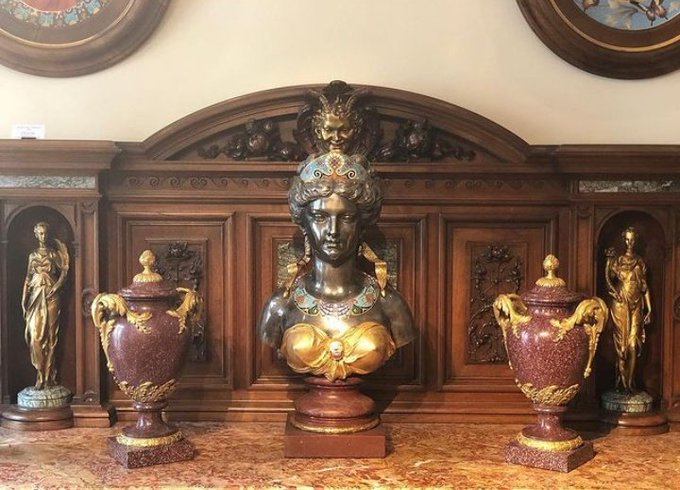
“If the apparition of the night before was an ocular delusion of my fancy sporting with the dark outlines of our cupboard, and if tis horrid eyes were nothing but a pair of inverted teacups, I had, at all events, the satisfaction of having launched the poker with admirable effect, and in true ‘fancy’ phrase, ‘knocked its two daylights into one,’ as the commingled fragments of my tea-service testified. I did my best to gather comfort and courage from these evidences; but it would not do. And then what could I say of those horrid bare feet, and the regular tramp, tramp, tramp, which measured the distance of the entire staircase through the solitude of my haunted dwelling, and at an hour when no good influence was stirring? Confound it!—the whole affair was abominable. I was out of spirits, and dreaded the approach of night. It came, ushered ominously in with a thunderstorm and dull torrents of depressing rain. Earlier than usual the streets grew silent; and by twelve o’clock nothing but the comfortless patterning of the rain was to be heard. I made myself as snug as I could. I lighted two candles instead of one. I forswore bed, and held myself in readiness for a sally, candle in hand; for, coute qui coute, I was resolved to see the being, if visible at all, who troubled the nightly stillness of my mansion. I was fidgety and nervous and, tried in vain to interest myself with my books. I walked up and down my room, whistling in turn martial and hilarious music, and listening ever and anon for the dreaded noise.” #RandolphHarris 20 of 21

Do not Grieve. Anything you lose comes around in another form. The child weaned from mother’s milk now drinks cranberry juice. God’s joy moves from unmarked box to unmarked box, from cell to cell. As rainwater, down into flowerbed. As roses, up from ground. Now it looks like a plate of rice and fish, now a cliff covered with vines, now a horse being saddled. It hides within these, till one day it cracks them open. There is the light gold of wheat in the sun, and the gold of bread made from wheat. I have neither, I am only talking about them as a town in the desert looks up to stars on a clear night. The Son of God, looking upon the World, beheld suffering and misery. With pity He saw how humans had become victims of satanic cruelty. He looked with compassion upon those who were being corrupted, murdered, and lost. They had chosen a ruler who chained them to his carriage as captives. God’s glory pervades the Universe; His ministering Angels inquire of one another: Where is the place of His glory? In response they give praise: Praised be the glory of the Lord from His Heavenly abode. From His Heavenly abode may He turn in mercy and bestow grace unto the people who, reciting the Shema evening and morning, twice daily, proclaim in love the unity of His name, saying: Hear, O America: the Lord our God, the Lord is One. He is our God; He is our Father, our sovereign and our Deliverer. In His mercy He will make known in presence of all the living that He will be your God. “I am the Lord your God.” As it is written in holy Scripture: The Lord shall reign forever; Thy God, O America, shall be Sovereign unto all generations. Hallelujah. #RandolphHarris 21 of 21

Winchester Mystery House

Ghostly tales are bountiful at Sarah Winchester’s Mystery House. What have you experienced? Photos are encouraged!

The Winchester mansion is 160-room mansion built to appease the spirits who died at the hands of the Winchester Rifle 👻
🗝 winchestermysteryhouse.com
“Whoever shadows my every move will not lose me in the dark.” At least that is what Christ says, or what the Evangelist John heard Him say (8.12). He tells us to walk on, through the darkness, with Christ as our only torch. That way, when we mayn’t have gained a step, but we won’t have lost one either. And on into the day we must pursue with dogged tread the life of Jesus Christ. Is this the secret to Mrs. Winchester’s 7-11 staircase?

Wise Humans, Good Humans, Patriotic Humans are to be Found in All Communities!

If Americans could be made to believe that their sufferings were for some remote, high sacrificial end, perhaps it would be possible for them to become reconciled to their plight; but sharing the culture that condemns them, and seeing that lust for trash is what blinds the nation to their claims, is what sets storms rolling in the soul of America. The United State of America is so unique from other nations because it is a nation of laws, not a nation of humans. A nation of laws means that legal decrees, not people rule. Whether it be the most common American members or members of Congress, high-ranking bureaucrats or the president of the United States of America, everyone is governed by the same laws, regardless of their station. All must be held to the just laws of America. America’s founds extolled a nation of laws, for they knew that only a fairly enforced legal system could protect liberty and property against corruption and tyranny. God is in fact the author of liberty and to retain it, the inhabitant of the land must be protected by His might hand. There is no other power that can protect that liberty. In order for us to enjoy this protection of His might, we must accept God as our God and keep His commandments. “Behold, this America is a choice land, and whatsoever nation shall possess it shall be free from bondage, and from captivity, and from all other nations under Heaven, if they will but serve the God of the land, who is Jesus Christ,” reports Ether 2.12. The God of this land is also the King of the land. And this is true. #RandolphHarris 1 of 25

Manifest Destiny is a phenomenon. Jesus spoke here in America, and He proclaimed, “This lad shall be a land of liberty, and there shall be no kings upon it. For I, the Lord, the king of Heaven, will be their king, and I will be light unto them forever, that hear my words. For it is a choice land, saith God, wherefore I will have all humans that dwell thereon that they shall worship me,” reports 2 Nephi 10.11-19. The alternative to enjoying this liberty and happiness through acceptance of and obedience to Jesus Christ is made clear by Manifest Destiny. Manifest Destiny is a tangible blessing from God that has created American history. It is a systematic body of concepts and beliefs that powers American life and culture. The right of our manifest destiny to over spread and to possess the whole of the continent which Providence has given us for the development and great creation of liberty and federative development of self government entrusted to us is a promise that we shall flourish. “Whoso should possess this land of promise, from that time henceforth and forever, should serve him, the true and only God, or they should be swept off when hey are ripened in iniquity,” reports Ether 2.8-9. It is as a right that we serve God and obey the laws as that of the tree to the space of air and the Earth be suitable for the full expression of its principle and destiny of growth. When people follow the guidance of God of the land, they reach great heights. The Lord in the very beginning revealed to Adam a perfect form of government for the benefit of humans. We believe that governments are instituted of God. #RandolphHarris 2 of 25

Individual freedom is necessary. No law shall be passed that takes away from a human the right of free choice. Free agency is fundamental as law of human conduct. Humans have a right to obey or disobey that laws as they please, and take the consequences. That government is best which has as its aim the administration of justice, social well-being and the promotion of prosperity among its members. We must recognize that property rights are essential to human liberty. The individual has three great rights, equally sacred from arbitrary interference: the right to one’s life, the right to one’s liberty, and the right to one’s property. The three rights are so bound together as to be essentially one right. To give a human one’s life, but to deny one one’s liberty, is to take from one all that makes life worth living. To give one liberty, but take from one the property which is the fruit and badge of one’s liberty, is to still leave one a slave. Laws are enacted for the protection of society, and have no value except when they are administered in righteousness and justice. If dishonest humans occupy administrative offices, laws cannot be so administered in righteousness and justice. The Lord says, “When the wicked rule, the people mourn.” Wise humans, good humans, patriotic humans are to be found in all communities, in all political parties, among all creeds. None but such humans should be chosen. Without beneficent laws, righteously administered, the foundations of civilization crumble, anarchy reigns, decay and dissolution follow. #RandolphHarris 3 of 25

We call upon all members of the Church of Jesus Christ of Latter-day Saints throughout the World to honour the laws of God, and obey and uphold the law of the land; and we appeal to good humans everywhere, regardless of creed, party affiliation, race, culture, or condition to join with us in an effort to put into operation the words of President Lincoln, the great emancipator, that our country may continue to be a light to the World, a loyal, law-abiding, God-fearing nation. We claim the privilege of worshiping Almighty God according to the dictates of our own conscience; and allow all humans the same privilege, let them worship how, where, or what they may. However, we claim absolutely no right, no prerogative whatever, to interfere with any other people. A good government must secure for every citizen the free exercise of conscience. Matters of belief or religious practice should not be interfered with, unless they oppose laws formulated for the common good. There should be no mingling of religious influence with the civil governments. We believe in being subject to kings, presidents, rulers, and magistrates, in obeying, honouring, and sustaining the laws. The main psychological root of the liability to envy is a lack of self-confidence in our own worth combined with a sense of impotence. Our way of life is without zest and we feel powerless to alter it or to acquire the means of doing what we still want to do. This creation the notion of resentment. By contrast, someone sure of the worth of one’s plan of life and one’s ability to carry it out is not given to rancor nor is one jealous of one’s good fortune. #RandolphHarris 4 of 25

Even if one could, one has no desire to level down the advantages of others at some expense to oneself. This hypothesis implies that the least favoured tend to be more envious of the better situation of the more favoured the less secure their self-respect and the greater their feeling that they cannot improve their prospects. Similarly the particular envy aroused by competition and rivalry is like to be stronger the worse one’s defeat, for the blow to one’s self-confidence is more severe and the loss may seem irretrievable. It is general envy, however, that mainly concerns us here. There are three conditions that encourage hostile outbreaks of envy. The first of these is the psychological condition we have just noted: persons lack a sure confidence in their own value and in their ability to do anything worthwhile. Second (and one of two social conditions), many occasions arise when this psychological condition is experienced as painful and humiliating. The discrepancy between oneself and others is made visible by the social structure and style of one’s society. The less fortunate are therefore often forcibly reminded of their situation, sometimes leading them to an even lower estimation of themselves and their mode of living. And third, they see their social position as allowing no constructive alternative to opposing the favoured circumstances of the more advantaged. #RandolphHarris 5 of 25

To alleviate their feelings of anguish and inferiority, they have no choice but to impose a loss on those better placed even at some cost to themselves, unless of course they are to relapse into resignation and apathy. Now, if not to present these conditions, many aspects of a well-ordered society of to mitigate. It is clear that, although it is a psychological state, social institutions are a basic instigating cause. However, the contract conception of justice supports the self-esteem of the citizens generally more firmly than other political principles. In the public forum each person is treated with the respect due to a sovereign equal; and everyone has the same basic rights that would be acknowledged in an initial situation regarded as fair. The members of the community have a common sense of justice and they are bound by ties of civic friendship. Obedience implies a higher attitude than mere submission, for obedience has its root in good intent; submission may spring from selfishness or meanness of spirit. Though obedience and submission both imply restraint on one’s own will, we are obedient only from a sense of right; submissive from a sense of necessity. Honour expressed an act or attitude of an inferior towards a superior. When applied to things it is taken in the sense of holding honour. Thus, in honouring the law, we look upon it as something which is above selfish desires or indulgences. To sustain signifies to hold up; to keep from falling. To sustain the law, therefore, is to refrain from saying or doing anything which will weaken it or make it ineffective. #RandolphHarris 6 of 25

We obey the law from a sense of right. We honour the law because of its necessity and strength to society. We sustain law by keeping it in good repute. This is in our connection with stability. The greater advantages of some are in return for compensating benefits for the less favoured; and no one supposes that those who have a larger share are ore deserving from a moral point of view. Happiness according to virtue is rejected as a principle of perfection: regardless of the excellences that persons or associations display, their claims to social resources are always adjudicated by principles of mutual justice. For all these reasons the less fortune have no cause to consider themselves inferior and the public principles generally accepted underwrite their self-assurance. The disparities between themselves and others, whether absolute or relative, should be easier for them to accept than in other forms of polity. Turning to the second condition, both the absolute and the relative differences allowed in a well-ordered society are probably less than those that have often prevailed. Although in theory the difference principle permits indefinitely large inequalities in return for small gains to the less favoured, the spread of income and wealth should not be excessive in practice, given the requisite background institutions. Moreover the plurality of associations in a well-ordered society, each with its secure internal life, tends to reduce the visibility, or at least the painful visibility, of variations in human’s purposes. For we tend to compare our circumstances with others in the same or in a similar group as ourselves, or in positions that we regard as relevant to our aspirations. #RandolphHarris 7 of 25

The various associations in society tend to divide it into so many noncomparing groups, the discrepancies between these divisions not attracting the kind of attention which unsettles the lives of those less well placed. And this ignoring of differences in wealth and circumstances is made easier by the fact that when citizens do meet one another, as they must in public affairs at least, the principles of equal justice are acknowledged. Moreover in everyday life the natural duties are honoured so that the more advantaged do not make an ostentatious display of their higher estate calculated to demean the condition of those who have less. After all, if the disposing conditions for envy are removed, so probably are those for jealousy, grudgingness, and spite, the converses of envy. When the less fortunate segments of society lack the one the more fortunate will lack the other. Taken together these features of a well-ordered regime diminish the number of occasions when the less favoured are likely to experience their situation as impoverished and humiliating. Even if they have some liability to envy, it may never be strongly envoked. Finally, considering the last condition, it would seem that a well-ordered society as much as any other offers constructive alternatives to hostile outbreaks of envy. The problem of general envy anyway does not force us to reconsider the choice of the principles of justice. As for particular envy, to a certain extent it is endemic to human life; being associated with rivalry, it may exist in any society. #RandolphHarris 8 of 25

The more specific problem for political justice is how pervasive are the rancor and jealousy aroused by the quest for office and position, and whether it is likely to distort the justice of institutions. It is difficult to settle this latter in the absence of the more detailed knowledge of social forms available at the legislative stage. However, there sees to be no reason why the hazards of particular envy should be worse in a society regulated by justice as fairness than by any other conception. The principles of justice again seems relatively stable. A question has been asked man times. In the case of a conflict between requirements made by the law revealed by the word of God, and those imposed by the secular law, which of these authorities would members of the Church be bound to obey? The word of God is to come first. So essentially, God should be in and influence the government because the number one rule of God is to be honest and if one cannot honestly enforce the law, they have no right in government. In all civilized nations the people are accorded the right to pray, and this right is assured by what maybe properly called a common law of humankind. No earnest soul is cut off from communion with one’s God; and with such an open channel of communication, relief from burdensome laws and redress from grievances may be sought from the power that holds control of nations. “Bad laws, if they exist, should be repleaded as soon as possible; still, while they continue in force, they should be religiously observed,” reports President Abraham Lincoln. This is the view of the Church. #RandolphHarris 9 of 25

While there are many forms of equality, and egalitarianism admits of degrees, there are conceptions of justice that are recognizably equalitarian, even though certain significant disparities are permitted. The two principles of justice fall under this heading. The different conception of equality which they define is acknowledged on the supposition that envy does not exist. For behold, you should not fear humans more than God, you should be faithful and God will extend His arm, and He will be with you in every time of trouble. Children of God are chosen to do the work of the Lord. Repent of that which thou hast done, and thou art still chosen, and art again called to the world. Except thou doest this, thou shalt become as other humans, and have no more gift. When thou delivers up that which God has given thee sight and power to translate thou delivers up that which is sacred into the hands of a wicked human who depends upon one’s own judgment, and boasts in one’s own wisdom; and this is the reason that thou will lose thy privileges for a season. Nevertheless, God’s work shall go forth, for, inasmuch as the knowledge of the Saviour has come unto the World, through the testimony of the Jewish people, even so shall the knowledge of a Saviour come unto our people, and to the Americans through the testimony of their fathers. And this testimony shall come to the knowledge of all. For this very purpose are these plates preserved that the promises of the Lord might be fulfilled, which He made to His people. And the Americans might come to the knowledge of their fathers, and they might know the promise of the Lord. And they may believe the gospel and rely upon the merits of Jesus Christ, and be glorified through faith in his name and through their repentance they might be saved. I cancel every demonic assignment against you and your purpose. The plans of the enemy will not prevail. In Jesus’ name, Amen. #RandolphHarris 10 of 25

Joseph Smith was very sorry he had been unfaithful, and he humbled himself before God, determining to try harder to keep all of the Lord’s commandments. Later, within a month, the gift and the plates were returned to Joseph, but he was not allowed to translate the same record again. By revelation Joseph was told that wicked people had the lost manuscript. The Lord, Jesus Christ said; Behold, Satan, has put it into their hearts to alter the words, because they have altered the words, they read contrary from that which you translated and caused to be written. On this wise the Devil has sought to lay a cunning plan, the he may destroy this work. Verily I say unto you, that I will not suffer that Satan shall accomplish his evil design in this thing. Behold, they say and think in their hearts, We will see if God has given him power to translate, if so, he will also give him power again; and if he bringeth forth the same words, behold, we have the same with us, and we have altered them. Therefore, they will not agree, and we will say that he has lied in his words, and that he has no gift, and that he has no power; therefore, we will destroy him, and also the work. Behold, I say unto you, that you shall not translate again those words which have gone forth out of your hands. For, behold, if you should bring forth the same words, they will say that you have contradicted yourself. And, behold, they will publish his, and Satan will harden the hearts of the people to stir them up to anger against you, that they will not believe my words. #RandolphHarris 11 of 25

The Lord told Joseph that the part of the record he had translated which had been lost (about one hundred and sixteen pages) was a shorted story of the Nephite record; and that the golden plates also contained the complete story. Joseph was told he should translate the full record rather than the shortened one he had previously translated: the Lord said: I will not suffer that they shall destroy my work; yea, I will show unto them that y wisdom is greater than the cunning of the Devil. Behold, I am Jesus Christ, the Son of God. I came unto my own, and my own received me not. I am He who said, Other sheep have I which are not of this fold, unto my disciples, and many there were that understood me not. And I will show unto this people, that I had other sheep, and I will also bring to light my gospel, which was ministered unto them. And this I do, that I may establish my gospel, that there may not be so much contention. Yea, Satan doth stir up the hearts of the people to contention, concerning the points of my doctrine; and in these things they do err, for they do wrest the Scriptures, and do not understand them. Therefore, I will unfold unto them this great mystery; for behold, I will gather them as a hen gathereth her chickens under her wings, if they will not harden their hearts. Behold, this is my doctrine: Whosoever repenteth and cometh unto me, the same is my church Whosoever is of my church, and endureth of my church to the end, one will I establish upon my Rock. And now, remember the words of your Redeemer, your Lord, and your God. Amen. #RandolphHarris 12 of 25

The important of separating envy from the moral feelings can be seen from several examples. Suppose first that envy is held to be pervasive in poor less affluent societies. The reason for this, it may be suggested, is the general belief that the aggregate of social wealth is more or less fixed, so that one person’s gain is another’s loss. The social system is interpreted, it might be said, as a naturally established and unchangeable zero-sum game. Now actually, if this belief were widespread and the stock of goods were generally thought to be given, then a strict opposition of interests would be assumed to obtain. In this case, it would be correct to think that justice requires equal shares. Social wealthy is not viewed as the outcome of mutually advantageous cooperation and so there is no fair basis for an unequal division of advantages. What is said to be envy may in fact be resentment which might or might not prove to be justified. Dr. Freud’s speculations about the origin of the sense of justice suffer from the same defect. He remarks that this sentiment is the outgrowth of envy and jealousy. As some members of the social group jealously strive to protect their advantages, the less favoured are moved by envy to take them away Eventually everyone recognizes that they cannot maintain their hostile attitudes toward one another without injury to themselves. Thus as a compromise they settle upon the demand of equal treatment. The sense of justice is a reaction-formation: what was originally jealousy and envy is transformed into a social feeling, the same sense of justice that insists upon equality for all. #RandolphHarris 13 of 25

Dr. Freud believes that this process is exemplified in the nursey and in many other social circumstances. Yet the plausibility of one’s account assumes that the initial attitudes are correctly described. With a few changes, the underlying features of the example he depicts correspond to those of the original position. That persons have opposing interests and seek to advance their own conception of the god is not at all the same thing as their being moved by envy and jealousy. As we have seen, this sort of opposition gives rise to the circumstances of justice. Thus if children compete for the attention and affection of their parents, to which one might say they justly have an equal claim, one cannot assert that their sense of justice springs form jealousy and envy. Certainly children are often envious and jealous; and no doubt their moral notions are so primitive that the necessary distinctions are not grasped by them. However, waiving these difficulties, we could equally well say that their social feelings arise from resentment, from a sense that they are unfairly treated. And similarly one could say to conservative writers that it is mere grudgingness when those better circumstances reject the claims of the less advantaged to greater equality. However, this contention also calls for careful argument. None of these charges and countercharges can be given credence without first examining the conceptions of justice sincerely held by individuals and their understanding of the social situation in order to see how far these claims are indeed founded on these motives. #RandolphHarris 14 of 25

None of these remarks is intended to deny that the appeal to justice is often a mask for envy. What is said to be resentment may really be rancor. However, rationalizations of this sort present a further problem. In addition to showing that a person’s conception of justice is not itself founded on envy, we must determine whether the principles of justice cited in one’s explanation are sincerely held as this is shown in their being applied by one to other cases in which one is not involved, or even better, in which one would suffer a loss from their being followed. Dr. Freud means to asset more than the truism that envy and jealousy, and that without this energy, there would be no (or much less) desire to give justice. Conceptions of justice have few attractions for us other than those deriving from these and similar feelings. It is claim that is supported by erroneously conflating envy and resentment. Unhappily the problem of the other special psychologies must go untouched. They should in any case be treated in much the same way as envy. One tries to assess the configuration of attitudes toward risk and uncertainty, domination and submission, and the like, that just institutions are likely to generate, and then to estimate whether they are likely to render theses institutions unworkable or ineffective. We also need to ask whether, from the point of view of the persons in the original position, the conception chosen is acceptable or at least tolerable whatever our special proclivities may turn out to be. #RandolphHarris 15 of 25

The most favourable alternative is that which allows a place for all these different tendencies insofar as they are likely to be encouraged by a just basic structure. There is a division of labour so to speak between persons with contrary inclinations. Of course some of these attitudes may earn a premium in the way that certain trained abilities do, as for example the willingness to be adventuresome and to take unusual risks. However, if so, the problem is o all fours with the return to natural assets and it is covered by the discussion of distributive shares. What a social system must not do clearly is to encourage propensities and aspirations that it is bound to repress and disappoint. So long as the pattern of special psychologies elicited by society either supports its arrangements or can be reasonably accommodated by them, there is no need to reconsider the choice of a conception of justice. I believe, though I have not shown, that the principles of justice as fairness pass this test. When people can measure the extent of their freedom in two or three paces, and realize for the first time in their lives they have nothing else to do, but sit on a bunk, as they say passes into night and they continue to sit there because they are in prison—that is when it dawns on them how important freedom is. Even the children of a wealthy family, children of charismatic, gregarious politicians may suddenly find themselves stripped of everything that has propped up their egos. All their plans, friends, their busy work schedule, all their carefully cultivated followers will be gone, and replaced by the sheer loneliness and boredom of the prison cell and the venomous hostility of their guards. And they will keep waiting for justice, for a deal. Surely the United States Constitution could not simply leave them to rot in prison! #RandolphHarris 16 of 25

Imagine half a year going by before you are confronted with any charges. Then a fraudulently concocted murder case is brought, and a rigged military court condemns you to death. This is a bad dream, for the real reason for your imprisonment is the President is a communist and has lust for money and greed for power. Then imagine within his or her two-term limit as president due to expire in a few short weeks, the president declares martial law, granting him or herself almost unlimited powers. Then he or she can have you and other political opponents thrown into prison. The president may never intend to leave office—and may be determined never to let a popular rival out to silence him or her. Prison has the bewildering effect on many, which causes them to lose all sense of direction and perspective. One may become better not only at the president, but at the World, even at God. Injustice causes some to hate everyone and their prison guard may goad on an individual. Imagine if sometimes they put your dinner plate on the ground and let a mongrel dog wolf part of it down; then, kicking the dog aside, they give you what and left, and if you do not eat it, you get placed on suicide watch. In a matter of weeks, this could cause an individual to lose forty pounds, suffer two heart attacks. And when you are not longing for revenge, you want to die. However, much like Joseph Smith, if you keep your faith in God, He will show you that such losses are not in vain as you find your true life in Christ. What is this suffering is what draws you closer to the Lord and saves you from a life of eternal flames in the pits of hell? Therefore, continue to search for meaning in life. Find great inspiration in the Holy Bible to motivate your life and struggle for your country. Then, even if your prison is physical, or only in your mind, kneel in your jail cell and give your life to Jesus Christ. #RandolphHarris 17 of 25

Even if you are overcome with grief for your anger towards God, please beg for forgiveness. There is a close connection between frequent and solid spiritual experiences between us and the development of faith in the elaborate and creative purposes of God. This is derived from the close connection between Father and child because we are here with God now, needing Him and He says, “I am thinking of you,” and even though we may not be able to see God, we are having Him as part of our current experience, even when we are unaware. The fortune individual will have had many times when one was with God but not are of Him except for the security of knowing that He was there when needed. We are fortune because our environment is fulfilling one of the essentials needed if one is to have highly developed creativity. Because we have somehow had God there when He was not an obvious part of our experience, one can discover the Lord after we think He is absent (from experience) for a while. The individual will have had the experience of tolerating God’s absence without having to feel the terror that He might be lost forever. As we build our faith our experience will flicker between “God here when He is not here,” and “God not here when He is here.” One has thereby discovered that one can hold on to a concept—the symbol—which stands for the available God—has become pleasantly and interestingly established. We can play peekaboo with it. We can make the symbol happen while waiting for God to come along. The symbol can fill the interval of waiting, a small space of time. #RandolphHarris 18 of 25

The symbol stands for God—it stands for “You who normally come soon after I realize that I need You. Something arouses in my mind, an anticipation, a phantasy of something good. Then there is a small gap an absence, an interval of time. Then You came.” All one’s viewpoints, one’s life, most of all one’s bitterness—all will change. One will have a sense that life has suddenly moved into a different channel with another purpose. It is for our doubting hearts to believe that spiritual power—which is peaceful, prayerful, humane, forgiving, willing to suffering on the side of the poor and oppressed—can change society. We know that the gospel affects the lives of individuals, but can it make an impact on institutions and governments, where the heartless realities of power pierce like a knife? It is hard to fathom this. Nevertheless, it can happen. It does happen. One can never quite calculate how one conversation in a mental or physical prison cell may set in motion a train of events to shake a nation. Many people in prisons want to die. However, when they find Christ, they acquire a new maturity, and, though one may also retain their natural ebullience, a relative serenity that have never had before manifests. Some people will sense an individual has undergone something like a religious conversion as a result of years of injustice inflicted in a cell or in their own community. And indeed they have, but it will take away none of their heartfelt concern for their nation. #RandolphHarris 19 of 25

In countries that suffer from communism, the president uses martial law as a cover while they rape the country. Leaders and their business cronies have been known to bleed nations dry, making huge profits through monopoly powers and putting the money into New York real estate and Swiss banks. Meanwhile, half the working population cannot find jobs. The ugly scabs of the slums, many without running water or flushing toilets, spread across Sacramento and other cities. Marxist guerrillas are quickly gaining around, and the some in positions of authority, riven by corruption, seem unable to stop them. They may find it easier to savage poor peasants than to fight the Communists. Things may even reach a pint where anyone who helps the poor will be under suspicion. Army units have arrested, killed, and tortured even Catholic priests and nuns who have chosen to work with the desperately poor in other countries. While in America, some people, even the rich and famous, are given bonuses and jobs to help extort those suffering injustices. A few Catholics have, it is true, take the side of the Marxists, but the vast majority simply minister in the name of Jesus to those in need. Between the Marxist insurgency and a president who becomes a dictator, there is little room in the middle. Some people, even many in America, have seen the ruthless side of communism—after all they suffer and lose their lives just because of who they are. It is true, one can fight hatred with a greater hatred, but it is more effective to fight hatred with greater Christian love. #RandolphHarris 20 of 25

Do much soul searching and pursue your freedom struggle through the path of nonviolence, fully cognizant that this ay be the longer and more arduous road. And you may suffer solitary confinement once again, and possibly death. However, by taking the road of revolution, how many lives, other then one’s, will have to be sacrificed? Humans are ordained to eternal life through the providence of God, it likewise is part of that providence to permit some to fall away from that end; this is called reprobation. Thus, as predestination is a part of providence, in regard to those ordained to eternal salvation, so reprobation is a part of providence in regard to those who turn aside from that end. Hence reprobation includes the will to permit a person to fall into sin, and to impose the punishment of damnation on account of that sin. Symbols can stand for what will come. However, equally, they can stand for what may come, what may not come, or what will not come again. All kinds of conceptual processes can fill the interval between the moment when we have phantasy of something and the moment of finding something. Transitional objects and other symbols appear where there had been either nothing, or an experience of something not there. God loves all humans and all creatures, inasmuch as He wishes them all some good; but He does not wish every good to them all. So far, therefore, as He does not wish this particular good—namely, eternal life—He is said to hate or reprobate them. Reprobation different in its causality from predestination. This atter is the cause of what is expected in the future life by predestined—namely, glory—and of what is received in this life—namely grace. #RandolphHarris 21 of 25

Reprobation, however, is not the cause of what is in the present, namely sin; but it is the cause of abandonment by God. It is the cause, however, of what is assigned in the future—namely, eternal punishment. However, guilt proceeds from the free-will of the person who is reprobated and deserted by grace. In this way, the word of the prophet is true—namely, “Destruction is thy own, O Israel.” Reprobation by God does not take away from the power of the person reprobated. Hence, when it is said that the reprobated cannot obtain grace, this must not be understood as implying absolute impossibility: butt only conditional impossibility: as was said above does not do away with the liberty of choice. Whence, although anyone reprobated by God cannot acquire grace, nevertheless, that one falls into this or that particular sin comes from the use of one’s free will. Hence is rightly imputed to one as guilt. It is as if it were illuminated through a succession of continuously changing filters. You discover that the first phase of your involvement was no more than a prelude or an overture before the curtain vanished. You come to see that sin began by enticing you with an illusion—the illusion of a light-filled hedonistic joy, evil disguised by sun-drenched window—and to accept that what you are in fact confronted with is nothing more or less than the successive layers of the thinnest of honey-comb marks laid down gently in whispers of lies upon the canvas surface. #RandolphHarris 22 of 25

However, when the curtain has risen and the any the painting of lies continues to such your eyes into itself, it will engulf your soul with its entertainment. The uniform skin of God’s grace evaporates in part because in tenuous existence came about only through the adhering to God’s commandments and your organization of forms of faith, which was a shimmering ray of love inviting the Holy Ghost in your temple. However, as this shimmer disintegrates, it gives way to billowing and boundless hazes of black smoke, to seemingly limitless vistas of your soul space. It is the duty of citizens of any country to remember that they have individua responsibilities, and that they must operate within the law of the country in which they have chosen to live. No member of the Church can be accepted as in good standing whose way of life is one of rebellion against the established order of decency and obedience to law. We cannot be in rebellion against the law and be in harmony with the Lord, for He has commanded us to “be subject to the powers that be, until He reigns whose right it is to reign,” reports Doctrine and Covenants 58.22. And one of these days He is going to come. The exception to this principle would be when the Lord directs His people through His prophets to take an opposing stand to government. Otherwise they recognize the established authority of government. Remember that the Lord holds all of us responsible for our conduct here. He held our father Adam responsible for his conduct, but no more than He does us, in proportion to the station we hold. #RandolphHarris 23 of 25

The kings of the Earth will have to give an account to God, for their conduct in a kingly capacity. Kings are heads of nations, governors are heads of provinces; so are fathers or husbands governors of their own houses, and should act accordingly. Because some regard the theory and practice of one’s subject from the inside, they mystic can discuss it with a correctness and authority which most critics do not possess because they are outside it. They are largely in the dark about it—one is actually in the light. Those who has never felt it in themselves nor seen in demonstrated in others cannot understand the blessedness of such a state. Because they are unready for it, they cannot endure such an experience. The peace it imparts is too impersonal and would suffocate them. The detachment which it creates makes the Worldly life seem less important and is too frightening. The recognition that this experience does happen is increasingly rapidly in Western counties but in the East, it has never been doubted. The criticism that mystical experience is subjective and illusory is being dropped, as it ought to be Those who have never experienced this state yet venture to criticize it as illusory are dealing with mere words, not facts. If the ordinary human seldom gets these subtler experiences it is because one’s nature is too coarse, one’s mind too physically based, one’s focus too personal to permit one to receive them. Deep within one’s own heart, hidden within one’s own consciousness, every person carries all the evidence for the truth of these teachings that one is ever likely to need. #RandolphHarris 24 of 25

That arrogance which denies Heaven to the unorthodox does not trouble the mystic. One finds Heaven here in this life, now before the transition of death. At such times, unexpected and unsought though they are, one feels the nearness of God, the love of God, the reality of God. Whoever ventures to call them delusions s oneself deluded. Those who are dead are never gone: they are there in the shimmering light. The dead are not under the Earth: they are there in the blue sky, they are in the clouds that drift above, they are in the rain that falls, they are in the sun that shines, they are in the moon the beams, they are in the trees that provide shade, they are in the crowd, the dead are not dead. Those who are dead are never gone, they are in your heart, they are in the eyes of an innocent child, they are in the flames in your fireplace. They are in the forest, they are in the house, they are not dead. When the Ark rested, Moses said: Mayest Thou, O Lord, dwell among the myriads of the families of America. Arise, O Lord, unto Thy sanctuary, Thou, and the Ark of Thy strength. Let Thy priest be clothed with salvation; and Thy faithful ones exult. For the sake of David, Thy servant, reject not Thine anointed. I have given your good teaching; forsake not My Torah. It is a Tree of Life to them that hold fast to it, and everyone who upholds it is happy. Its ways are ways of pleasantness, and all its paths are peace. Turn us unto Thee, O Lord, and we shall return; renew our days as of Heaven. This nation and all nations, together with president, queens, kings, emperors, judges, and all humans, righteous and wicked, have go to go into the spirit World and stand before the bar of God. They have got to give an account of the deeds done in the body. #RandolphHarris 25 of 25

Cresleigh Homes

Outdoor and indoor living flow seamlessly in Mill Station Res 3! That space for herb and vegetable gardening just off the porch means you can snip some extra cilantro for your tacos any time! 🌱 https://cresleigh.com/mills-station/residence-3/
With the arrival of spring—and warmer temperatures—comes the urge to spend every minute in outdoor rooms. These outdoor living spaces a perfect place to lounge.

Cresleigh Homes offers exceptional architecture, single-family homes with vistas, patios, balconies, butler’s pantries, upstairs lofts, and other incredible amenities. Featured are also open and spacious home designs, with personalizing options that gives you the freedom to create the home of your dreams. Come and see why Cresleigh is America’s Favourite!
#CresleighHomes
#CresleighRanch

A Miraculously Great Gift of Grace May Depart Equally Miraculously—PRAISE HIM!

Dignity and humility are the cornerstones of compassion. Compassion for myself is the most powerful healer of all. When it comes to behaviour, everybody is one’s own best physician. Case studies can provide special opportunities to answer interesting questions. For instance, how do you know what kind of person you are? If you lost for memory of past events, would your self-image change? To answer these questions, psychologist did a case study of J.S., and 17-year-old male college student. After he suffered a head injury, J.S. had amnesia for about a month. During that time, J.S. could recall little of what had occurred during the previous 6 months. Nevertheless, his rating of his own personality appeared to be unaffected by his memory loss. This suggests that an awareness of one’s own personal characteristics is based on memories that are more lasting than those of everyday events. The careful recording of cases like J.S.’s is essential to psychology. Case studies often provide insight into human behaviour that could not be obtained through any other method. The treatment of unpleasant realities by not including them in one’s picture of the World comforts but at the same time befools humans. None of the great prophets like Jesus Christ, Joseph Smith, and Buddha denied the existence of sickness, the reality of pain, or the significance of suffering in the cosmos. No—they acknowledged them as being inseparable from human life but pitied the victims and offered them inward comfort which was based on truth and reality. #RandolphHarris 1 of 25

The terrestrial part of us, at this time, is doomed to oblivion, the spiritual part is ageless and deathless. The physical body belongs to the terrestrial part. All attempts to perpetuate it must fail and arise from confusing the two levels of being, the transient and the eternal. People ask Why, if all is mind, if—as you say—our bodies are only ideas, can we not control regulate and improve our bodies by controlling, regulating, and improving our minds? Why not go further still, with Christian Science, and play with the possibility, not only of these achievements, but also of rendering the body immortal by thinking it so? The answer is that nobody can deny the creative power of the mind. It may do all these things, except the last. That it will never do. Why? Because we live in a World whose fundamental law of beings—and Buddha discovered and Jesus Christ taught—is decay and death, change and transition—at this point in our evolution. Indeed, it was because they were so painfully aware of these truths that they sought and found the only true way of escape for a human and that was into Nirvana, into Utopia, into the Kingdom of Heaven—not into the physical again! No Christian Scientist from the first founder down to the latest follower has ever achieved physical immortality, but in the future that may change. Yet, immortality is not the same as eternal life. Immortality can be achieved on the Earth; it can allow the human body to live indefinitely. However, you have to understand how it is for a deity. #RandolphHarris 2 of 25

Some of these gods have been here so long they can no longer care for themselves. Earth people think that immortality means you can go on forever just as you are. It does not work that way. Physically, yes, a god or goddess can continue indefinitely. It is built into the situation. However, mentally—psychologically—you must realize that being a god takes a terrible toll. When you are a god, people’s thoughts, hopes, dreams, and fears re beating at you all the time. Gods have direct apprehension of the feelings of their worshippers. It can be taxing. After a while all those prayers and petitions from humans take their toll. It is all very well at the beginning. Most gods, even the compassionate ones, just let it all roll over them. However, after a while it get to even the toughest. They get sick of the daily drudgery of hearing desperate pleas, and, in most cases being unable to do very much about them. Gods live in longer timelines than mortals. It takes them longer to do things. By the time something comes to a god’s attention, and by the time one decides to do something about it, the human most likely is dead and buried. It is frustrating for a god, having to work in such a short time frame. They try their best. However, remember, gods can make exceptions for only a very few. A god has a lot more on one’s mine than the troubles of one’s constituents. It would be fair to say that most gods end up hating humans because they are so needy, always with the hand out, always with the gimmie, gimmie, gimmie, gimmie more. #RandolphHarris 3 of 25

Eternal life, n the other hand, is the phrase used in scripture to define the quality of life that our Eternal Father lives. They Lord declared, “This is my work and my glory—to brings to pass the immortality and eternal life of humans,” reports Moses 1.39. Immortality is to live forever as a resurrected being. Through the Atonement of Jesus Christ, everyone will receive this gift. Eternal life, or exaltation, is to live in God’s presence and to continue as families. “In the celestial glory there are three Heavens or degrees; and in order to obtain the highest, a human must enter into this order of the priesthood [meaning the new and everlasting covenant of marriage]; and if one does not, one cannot obtain it. One may enter into the other, but that is the end of one’s kingdom; one cannot have an increase,” reports Doctrine and Covenants 131.1-4. Like immortality, this gift is made possible through the Atonement of Jesus Christ. However, to inherit eternal life requires our “obedience to the laws and ordinances of the Gospel,” reports Articles of Faith 1.3. “Wherefore, do the things which I have told you, you and I have seen the Lord and your Redeemer should do; for, for this cause have they been shown unto me, that ye might know the gate by which ye should enter. For the gate by which ye should enter is repentance and baptism by water; and then cometh a remission of your sins by fire and by the Holy Ghost. And then are ye in this strait and narrow path which lead to eternal life; yea, ye have entered in by the gate,” reports 2 Nephi 31.17-18. #RandolphHarris 4 of 25

After we are baptized and receive the gift of the Holy Ghost, much of our progress toward eternal life depends on our receiving other ordinances of salvation: for men, ordination to the Melchizedek Priesthood; for men and women, the temple endowment and marriage sealing. When we receive these ordinances and keep the covenants that accompany them, we prepare ourselves to inherit eternal life, and there we will live in spiritual form, forever, with God. However, while on Earth, “Humans will never tire of seeking immortality,” reports Dr. Alexis Carrel, whose biological researchers, yet mystical sympathies, entitle him to speak with high authority. The possibilities of spiritual healings of pathological conditions, miraculous mental cures of disease, and rapid acceleration of organic repairs through concentrated thinking, I repeat that we do not deny them. They have always existed, always been demonstrated. If our doctrine is true, the relation between psychological and physical processes must certainly exist. However, there are two other factors at work in human life which must also be considered and must not be ignored. What are they? The first is the factor of destiny, self-earned in previous lives and now awaiting physical expression in the present life. It has something to say, whether we like it or not. As we progress in our mortal probation and become more like the Saviour, we can strengthen every group with whom we associate, including families and friends. #RandolphHarris 5 of 25

The Lord places us in these communities of Saints where we can learn and apply gospel principles to our everyday lives. These groups are at the same time both a school, a proving ground, and a laboratory where we both learn and do as we practice living the gospel. Very common, ordinary people, who accept the gospel from the lips of some humble Mormon missionary become so changed by those enlightening truths of the gospel that they are not the same people any longer. As we progress through mortality, we make mistakes and get ff course. If we should continue in our errors, we get father and father from where we ought to be. We can compare our lives with the flight of a spaceship. When its motor is started up, its trajectory is monitored precisely. If not corrected, any deviation from its decreed course is corrected immediately. Even a fraction of a degree off course would carry it many light years from its destination. The longer the correction is delayed, the greater will be the required adjustment. Can you imagine how far off course we can become without course corrections? The Lord has provided for us prophets, scriptures, parents, and other wise leaders to teach us the course we should be following. When necessary, much the same as tracking stations monitor a satellite’s progress and keep in on the right path, they can help us monitor our progress and correct the direction we are going. Our course on Earth is so important. It is determined by the decisions we make each day. We cannot separate our thoughts and actions now from their effects on the future. #RandolphHarris 6 of 25

The second factor is renunciation. Let every hidden enemy in your life, let every trap or demonic setup be exposed in the name of Jesus Christ! When you accept the doctrine that all is mind and each individual thing is but an ephemeral idea, you must perforce accept the doctrine that you as an individual, as the ego, are also an ephemeral idea. Now when you go further and declare that you want reality, you want to find eternal and not ephemeral life, you will have to abandon the fleeting idea for the eternal Mind in which it occurs: that is, you will have to sink the ego and merge its will in the greater universal will of the Infinite Being. Do this! What will you find next? That your personal desires have sunk with it, that your individual wishes and hopes and fears have dissolved and disappeared. The desire for bodily betterment, however very attractive, would have gone too. You cannot have a single desire and yet enter the Kingdom of Heaven, as Jesus pointed out. So good health, the care of your painful diseases, the healing of your disturbed organs—right, necessary, and desirable as they undoubtedly are—are nevertheless matter which you must try to effect in a desireless way; you may try to cure them but you must leave the result to the higher will. If you insist that the body must yield to your desires of a cure, to your personal desires, then your ego, not the real universal self, has got the upper hand and is directing you. In that case you will be no better off, for your have no guarantee of success even then. Most Christian Scientists experience a score of failures for every cure. #RandolphHarris 7 of 25

Whereas if you do your best mentally and physically to put your body right, but do it impersonally—accepting failure, if it comes, with as much equanimity as you can—you will certainly be n worse off than the Christian Scientist so far as the possibilities of sure are concerned, and you will be infinitely better off so far as realizing truth is concerned, with all the wonderful peace that will bring in its train. This is one meaning of the words “Not my will but Thine be done.” Do you think, having seen so much illness around you for so many years, that life is forever striving to instill into us through pain what Jesus Christ learned through reflection—that both body and World are doomed to decay and die, without God and Science, being subject to the law of universal incessant change? The experiences of life are the lessons of a guru, for we get just the kind of universal seeds whose silent instruction is needed at the time. The whole World, more or less, is having to learn this great truth at present but it is too blind and too unenlightened to grasp the lesson in its clarity and eternity. How far the duration of human life can be extended is not known. However, Methuselah, a biblical patriarch and a figure in Judaism, Christianity, and Islam was essential immortal, he died at the age of 969; he lived the longest of all human figures mentioned in the Christian Bible. Remember that just because humans began to live shorter lives after the Biblical flood does not mean that God set a limit on human’s life span. The fact is that some people still lived well over 120 years until the time of Moses. #RandolphHarris 8 of 25

Perhaps that is why God gave human beings the gift of science, so they can learn how to restore their immortality, after the mature enough to see how precious life is and stop being so wicked. It is truth that stories of centenarians being found in different parts of the World are not few and often pass unquestioned. However, the difficulty of proving the date of birth usually remains. Most centenarians belong to undereducated classes, to those who have not taken care to retain correct knowledge of their age, for it was not so important to them as it is to the educated classes. There is hardly a record of payment by life insurance companies for the life of a centenarian. It is reasonable to ask, however, why, if the reparative and destructive elements in the body could be balanced, humans should not live for centuries. In the absence of authenticated cases, we may only take the stand that Nature seems to have set her own limits to human life. Some “back-to-nature” schools of therapy assert that all diseases are the consequences of transgressing the laws of health, just as some esoteric schools assert they are the consequences of incurring karmic debts. The first often point to the wild beasts as being perfectly healthy examples of living according to Nature. However, those who have firsthand acquaintance with jungle life will refute this claim. Not only are all animals—whether domesticated or wild—subject to sickness, but even plants, grain crops, trees, fruits, and vegetables are subject to it by blight and rust. #RandolphHarris 9 of 25

The young and the strong may glory in the satisfaction of being alive, but the old and decrepit, the sick and in infirm, feel no such response to their existence. The pain and unpleasantness which beset human experience at times—mentally or physically—are not without their complementary pleasure and joy at other times. We would all like a happy beginning, a happy middle, and a happy ending to our story, but life betrays us: only in fiction is the craving really fulfilled. If the pain is there, racking the physical life, the peace exists behind it, permeating the inner life. The New World stands with its heritage of Roman law, the treasures of Judaeo-Christian ethics grounded on metaphysics, and its ideal of the inalienable rights of humans. Anxiously it asks itself the question: How can this development be brought to a standstill or put into reverse? It is useless to pillory the socialist dictatorship as utopian and to condemn its economic principles as unreasonable, because, in the first place, the criticizing New World has only itself to talk to, its arguments being heard only on this side of the Iron Curtain, and, in the second place, any economic principles you like can be put into practice so long as you are prepared to accept the sacrifices they entail. If you like, you can carry through any social and economic reforms you please, Like Mr. Stalin, you let three million peasants starve to death and have few million unpaid labourers at your disposal. A State of this kind has no social or economic crises to fear. #RandolphHarris 10 of 25

So long as the State’s power is intact—that is to say, so long as there is a well-disciplined and well-fed police army in the offing—it can maintain its existence for an indefinitely long period and can go on increasing its power to an indefinite extent. Thanks to its excess birth-rate, it can multiply the number of its unpaid workers almost at will in order to compete its rivals, regardless of the World market, which is to a large measure dependent on wages. However, this strategy also has some disadvantages. The convergence theory (or catch-up effect) suggests that poorer countries will experience a higher rate of economic growth and, over time get closer to the income levels of the developed World. In other words, there will be a reduction in the gap between the rich and the poor because low-income countries have more opportunities to experience a rapid rate of growth. Potential reasons for the convergence theory are: Law of diminishing returns, replicate technology from other countries, globalization and movement of labour and capital. The law of diminishing returns states a decline in productivity improvements from a fixed capital. When you have very low productivity in agriculture, a small investment (exempli gratia motorized tractor) can give a high rate of return and significantly increased output. For a developed economy, which is already highly mechanized increased investment will give smaller marginal gains. In effect, if the Indian agriculture sector is mainly labour intensive—then there are “easy gains” from a small amount of fertilizer and investment. #RandolphHarris 11 of 25

Replicate technology—one advantage that poorer countries have is that they can replicate existing technology and working practices developed by advanced economies. For example, in Africa, many citizens never had a landline or fax machine, but jumped straight to the mobile phone with the internet, and essentially they now have hand held computers with Internet access that can also make phone calls, so they have the access to vast resources now. This new technology has significantly improved their communication, education, and allows them to access the global economy, and they were able t skip out most levels of investment. In fact, they can even benefit from perfect good phones that Americans are throwing away for newer models. Global forces—the World is increasingly globalized and multinational companies in the developed World are will to shift production to areas of lower labour costs. Therefore, developing economics have benefitted from inward investment and global companies moving manufacturing factories to the developing World. This force tends towards raising wages in the developing World. Even if wages seem very low by the developed World standard, they are higher than previous jobs/subsistence farming. Inward investment also leads to knock-on benefits. For example, China has invested in the infrastructure of African economies to improve its access to raw materials. This infrastructure will be a boost to the African economy. #RandolphHarris 12 of 25

Another example is that the nature of the Internet means it is easier to outsource even small-scale jobs. For example, a doctor in the Middle East can be paid to diagnose patients and answer an American doctor’s electronic messages for less and perhaps receive the same standard of care, which has become popular to reduce traffic in hospitals during COVID. Also, for developing counties like India, there has been a growth in skilled workers able to gain employment opportunities in writing software and IT skills. This is why President Trump was lowering taxes, stopped illegal immigration, and was putting tariffs on goods and services produced overseas. So while wages are going down in America, real estate and rent prices rising, and the cities and infrastructure are getting older, countries like Dubai are getting what used to be high paying middle management jobs in America, for lower wages and are able to use the income and tax revenue to build housing developments, roads, skyscrapers and increase their quality of life. Whereas in America, cities are decaying and dying out and only professionals and couples can afford to purchase property and rent. This is leading to the Great Affordability Crisis in America and will reduce its competitiveness in the Global Market. Americans are being bled dry by landlord, hospital administrators, cost of education, fuel, energy, child-care and food prices. Many Americans now have to struggle to come up with just $400. It helps explain why 20 percent of Americans are unable to pay the current month’s bills in full. #RandolphHarris 13 of 25

It demonstrates why a surprise car-repair bill, parking ticket, court fee, or medical expense remains ruinous for so many America families, despite all the wealth this country has generated. In fact, 50 percent of households in American is classified at “financially fragile.” Meanwhile, Jafza, the Jebel Ali Free Zone, which at 52 square kilometers (20 square miles) and located in the Middle East looks a futuristic Manhattan, New York on the beach. The economy is up and coming, students are going to school, not dropping out, and want to learn, people are driven to go to work, not sit home and smoke marijuana and watch TV, and make babies they cannot afford to take care of. This Jebel Ali Free Zone is a big attraction for global businesses, which today take advantage of the emirate’s 30 free sones that offer take breaks, custom duty benefits and lack of restrictions for international owners. Several thousand Jafza companies make up 20 percent of foreign investment in Dubai, and the estimated 144,000 employees are generating $80 billion in non-oil money. That is 21 percent of the city’s Gross Domestic Product (GDP). GDP measures two things at once: the total income of everyone in the economy and the total expenditure on the economy’s output of goods and services. The reason that GDP can perform the task of measuring both total incomes and total expenditure is that these two things are really the same. For an economy as a whole, income must equal expenditure. #RandolphHarris 14 of 25

The United Arab Emirates is the third richest country in the World, below Luxemburg at number two and Qatar at number one, with GDP per capita of $57,744. The bulk of its money comes from the production of goods and provision of services related to petroleum, petrochemical, aluminum and cement. Furthermore, Iran is producing the third highest level of engineers in the World with 233,695 engineering graduates. In comparison, America’s GDP per capita is $65,298, and is producing 237,826 engineering graduates a year, so that is encouraging. As long as Americans keep working hard, going to school, they can still remain number one in the global economy, but they will also need to motive their peers to work and go to school to stay ahead. However, as prices continue to rise, more Americans may take their skills and talents overseas, or down south to Mexico. A real danger can only come to these developing nations from outside, through the threat of military attack. However, this risk grows less every year, firstly because the war potential of the dictator States is steadily increasing, and secondly because the West cannot afford to arouse latent Russian or Chinese nationalism and chauvinism by an attack which would have exactly the opposite effect to the one intended. So far as one can see, America faces threats from the outside and also from the inside. If there is a break-down of power from within, which must, however, be left to follow its own inner development. Any support from outside at present would have little effect, in view of the existing security measures and the danger of nationalistic restriction. #RandolphHarris 15 of 25

The absolute State has an army of fanatical missionaries to do its bedding in matters of foreign policy, and these in their turn can count on a fifth column who are guaranteed asylum under the laws and constitutions of the Western States. In addition the communes of believers, very strong in places, considerably weaken Western governments’ powers of decisions, whereas the West has no opportunity to exert a similar influence on the other side, though we are probably not wrong in surmising that there is a certain amount of opposition among the masses in the Old World. There are always upright and truth-loving people to whom lying and tyranny are hateful, but one cannot judge whether they exert any decisive influence on the masses under the police regimes. In the view of this uncomfortable situation the question is heard again and again in the West: What can we do to counter this threat from the Old World? Even though the New World has considerable industrial power and a sizable defence potential at its command, we cannot rest content with this, for we know that even the biggest armaments have the heaviest industry coupled with a relatively high living standard are not enough to check the psychic infection spread by religious fanaticism. The West has unfortunately not yet woken up to the fact that our appeal to idealism and reason and other desirable virtues, delivered with so much enthusiasm, is mere bombination in the void. It is a puff of wind swept away in the storm of religious faith, however twisted this faith may appear to us. #RandolphHarris 16 of 25

We are faced, not with a station that an be overcome by rational or moral arguments, but with an unleashing of emotional forces and ideas engendered by the spirit of the times; and these, as we know from experience, are not much influenced by rational reflection and still less by moral exhortation. It has been correctly realized in many quarters that the alexipharmic, the antidote, should in this case be an equally potent faith of a different non-materialistic kind, and that the religious attitude grounded upon it would be the only effective defence against the danger of psychic infection. Unhappily, the little word “should,” which never fails to appear in this connection, points to a certain weakness, if not the absence, of this desideratum. Not only does the West lack a uniform faith that could block the progress of a fanatical ideology, but, as the father of Marxist philosophy, it makes use of exactly the same intellectual assumptions, the same arguments and aims. Although the Churches in the West enjoy full freedom, they are not less full or empty than in the East. Yet they exercise no noticeable influence on the broad course of politics. The disadvantage of creed as a public institution is that it serves two masters: on the one hand, it derives it existence from the relationship of humans to Gd, and on the other hand, it owes a duty to the State, id est, to the World, in which connection it can appeal to the saying “Render unto Caesar…” and various other admonitions in the New Testament. #RandolphHarris 17 of 25

In early times and until comparatively recently there was, therefore, talk of “powers ordained by God,” reports Romans 13.1. Today this conception is antiquated. The Churches stand for traditional and collective convictions which in the case of many of their adherents are no longer based on their own inner experiences but on unreflecting belief, which is notoriously apt to disappear as soon as one begins thinking about it. The content of belief then comes into collision with knowledge, and it often turns out that the irrationality of the former is no match for the ratiocinations of the latter. Belief is no adequate substitute for inner experience, and where this is absent even a strong faith which came miraculously as a gift of grace may depart equally miraculously. People call faith the true religious experience, but they do not stop to consider that actually it is a secondary phenomenon arising from the fact that something happened to us in the first place which instilled into us—that is, trust and loyalty. This experience has definite content that can be interpreted in terms of one or other of the denominational creeds. However, the more this is so, the more the possibilities of these conflicts with knowledge mount up, which in themselves are quite pointless. That is to say, the standpoint of the creeds is archaic; they are full of impressive mythological symbolism which, if take literally, comes into insufferable conflict with knowledge. However, if, for instance, the statement that Christ rose from the dead is to be understood not literally but symbolically, then it is capable of various interpretations that do not conflict with knowledge and do not impair the meaning of the statement. #RandolphHarris 18 of 25

The objection that understanding it symbolically puts an end to the Christian’s hope of immortality in invalid, because long before the coming of Christianity humankind believed in a life after death and therefore had no need of the Easter event as a guarantee of immortality. The danger that a mythology understood too literally, and as taught by the Church, will suddenly be repudiated lock, stock and barrel is today greater than ever. Is it not time that the Christian mythology, instead of being wiped out, was understood symbolically for once? It is still too early to say what might be the consequences of a general recognition of the fatal parallelism between the State religion of the Marxists and the State religion of the Church. The absolutist claim of a Civitas Dei that is represented by man bears an unfortunate resemblance to the “divinity” of the State, and the moral conclusion drawn by Ignatius Loyal from the authority of the Church (“the end sanctifies the means”) anticipates the lies a political instrument in an exceedingly dangerous way. Both demand unqualified submission to faith and thus curtail human’s freed, the one one’s freedom before God and the other one’s freedom before the State, thereby digging the grace for the individual. The fragile existence of this—so far as we know—unique carrier of life is threatened on both sides, despite the respective promises of spiritual and material idylls to come—and how many of us can in the long run fight against the proverbial wisdom of “a bird in the hand is worth two in the bush”? Besides which, the West cherishes the same “scientific” and rationalistic Weltanschauung with its statistical levelling-down tendency and materialistic aims as the State religion of the Eastern bloc as I have explained above. #RandolphHarris 19 of 25

What, then, has the West, with its political denominational schisms, to offer to modern man in his need? Nothing, unfortunately, except a variety of paths all leading to one goal which is practically indistinguishable from the Marxist ideal. It requires no special effort of understanding to see where the Communist ideology gets the certainty of its belief that time is on its side, and that the World is ripe for conversion. The fact speaks a language that is all too plain in this respect. It will not help us in the New World to shut our eyes to this and not to recognize our fatal vulnerability. Anyone who has once learned to submit absolutely to a collective belief and to renounce one’s eternal right to freedom and the equally eternal duty of individual responsibility will persist in this attitude, and will be able to march with the same credulity and the same lack of criticism in the reverse direction, if another and manifestly “better” belief is foisted upon one’s alleged idealism. What happened not so long ago to a civilized European nation? We accuse the Germans of having forgotten it all again already, but the truth is that we do not know for certain whether something similar might not happen elsewhere. If it did and if another civilized nation succumbed to the infection of a uniform and one-sided idea, it would not be surprising. We see this happening in America. People are passing laws to protect illegal immigrants, and sending billions to other countries in aid, while their own people are going bankrupt, without homes and food and being killed, all because of media propaganda so a political party can have a super majority and enforce tyranny by stripping citizens of their rights and locking them in their homes. #RandolphHarris 20 of 25

We permit ourselves the questions: which countries have the biggest Communist parties? America, which—O quae mutation rerum! – forms the real political backbone of Western Europe, seems to once have been immune because she once was not controlled by a media that is anti-American and spews lies so other nations become the World power, as that is where the news draws its funding from. America once used to be outspoken and had a counterposition she adopted, but in point of fact she is perhaps now and even back then more vulnerable than Europe, since her educational system is the most influences by the scientific Weltanschauung with statistical truths, and her mixed population finds it difficult to strike roots in a soil that is practically without history. The historical humanistic type of education so sorely needed in such circumstances leads, on the contrary, a Cinderella existence. Through Europe possess this latter requirement, she uses it to her own undoing in the form of nationalistic egoism and paralysing scepticism. Common to both is the materialistic collectivist goal, and both lack the very things that expresses and grips the whole human, namely, an idea which puts the individual human being in the center as the measure of all things. This idea alone is enough to arouse the most violent doubts and resistances on all sides, and one could almost go so far as to assert that the valuelessness of the individual in comparison with large numbers is the one belief that meets with universal and unanimous assent. To be sure, we all say that this is the century of the common man, that he is the lord of the Earth, the air, and the water, and that on his decision hangs the historical fate of the nations. #RandolphHarris 21 of 25

This proud picture of human grandeur is unfortunately an illusion and is counterbalanced by a reality that is very different. In this reality man is the slave and victim of the machines that have conquered space and time for one; one is intimidated and endangered by the might of the military technology which is supposed to safeguard one’s physical existence; one’s spiritual and moral freedom, though guaranteed within limits in one half of one’s is threated with chaotic disorientation, and in the other half is abolished altogether. Finally, to ass comedy to tragedy, this lord of the elements, this universal arbiter, hugs to his bosom notions which stamp one’s dignity as worthless and turn one’s autonomy into an absurdity. All one’s achievements and possessions do not make one bigger; on the contrary, they diminish one, as the fate of the factory-worker under the rule of a “just” distribution of goods clearly demonstrated. One pays for one’s share of the factory with the loss of personal property, one exchanges one’s freedom of movement for the doubtful pleasure of being tied to one’s place of employment, one forfeits all means of improving one’s position if one jibs against being ground down by exhausting piece-work, and if one shows any signs of intelligence, political precepts are thrust down one’s throat—with a bit of technical knowledge thrown in, if one is lucky. However, a roof over one’s head and a daily feed for the useful animal are not to be sneezed at when the bare necessities of life may be cut off from one day to the next. #RandolphHarris 22 of 25

Now, O thou Spirit Andras, since thou art still pernicious and disobedient, and wilt not appear unto me to answer unto such things as I would have desired of thee, or would have been satisfied in; I do in the name, and by the power and dignity of the Omnipresent and Immortal Lord God of Hosts IEHOVAH TETRAGRAMMATON, they only creator of Heaven, and Earth, and Hell, and all that is therein, who is the marvellous Disposer of all things both visible and invisible, curse thee, and deprive thee of all thine office, joy, and place; and I do bind thee in the depths of the Bottomless Abyss there to remain until the Day of Judgment, I say into the Lake of Fire and Brimstone which is prepared for all rebellious, disobedient, obstinate, and pernicious spirits. Let all the company of Heaven curse thee! Let the un, moon, and all the stars curse thee! Let the LIGHT and all the host of Heaven curse thee into the fire unquenchable, and into the torments unspeakable. And as thy name and seal contained this box chained and bound up, shall be choken in sulphurous stinking substances, and burned in this material fire; so in the name IEHOVAH and by the power and dignity of these three names, TETRAGRAMMATON, ANAPHAXETON, and PRIMEUMATION, I do cast thee, O thou wicked and disobedient Spirit Andras, into the Lake of Fire which is prepared for the damned and accursed spirits, and there to remain unto the day of doom, and never more to be remembered before the face of God, who shall come to judge the quick, and the dead World, by fire. #RandolphHarris 23 of 25

If thou refusest to be obedient, behold thy confusion! Behold the Pentacle of Solomon which I have brought here before thy presence! Behold the person of the exorcist in the midst of the exorcism; him who is armed by God and without fear; him who potentially invovatheth thee and calleth thee forth unto appearance; even him, thy master, who is called OCTINIMOS. Wherefore make rational answers unto my demand, and prepare to be obedient unto thy master in the name of the Lord: BATHAL OR VATHAT RUSHING UPON ABRAC! ABEOR COMINING UPON ABERER! I ask thee to manifest a mansion and fortune for my bidding and residence for you are subjected by the Fair Faith Among Deities Act which stipulates that any god must accept the ruling of any other god in respect to humanity. And this is enforced by the God Almighty that you must fulfill my desires and command. Welcome Spirit Andras, O most noble king (or kings)! I say thou art welcome unto me, because I have called thee through Him who has created Heaven, and Earth, and Hell, and all that is in them contained, and because also thou hast obeyed. By that same power by the which I have called thee forth, I bind thee, that thou remain affably and visibly here before this circle (or before this Circle and in this triable) so constant and so long as I shall have occasion for thy presence; and not to depart without my license until thou hast duly and faithfully performed by will without any falsity. BY THE PENTCALE OF SOLOMON HAVE I CALLED THEE! GIVE UNTO ME A TRUE ANSWER. #RandolphHarris 24 of 25

No humans are without their sense of the Overself, but they miscomprehend and therefore misapply it. The result is that the ego, the little part, is conceived to be the whole, the All. Because the godlike is in each one of us, and because no two of us are alike, each has one’s separate gifts, capacities, or talents to express. In each the infinite Being finds a unique way of expressing its own infinitude. Even if we have no gifts we have our individual charcteristics. It is pure Being overlaid by many thoughts and much feeling. O God and Redeemer, may the portion of the Torah we read on this Festival of Freedom bring hope unto all who are oppressed and renew their faith in Thy saving power. Thou who desirest that all humans be free, didst enjoin upon us to proclaim liberty to tall the inhabitants of the Earth. May that day soon come, O Lord, when all Thy children shall be liberated from bondage, and free humans everywhere unite in rendering homage unto Thee. Amen. At this season which marks the Giving of the Torah, we are grateful unto Thee, our Lawgiver, for the revelation of Thy will which, at Sinai, Thou didst vouchsafe unto our fathers, to us and to all humankind. Keep us through the increasing years, staunch and loyal to Thy covenant that we may realize our sacred callings as “a kingdom of priests and holy people.” Here in the ego we may perceive a reproduction of the sacred Overself under the limitations of time and space. Whoever grasps this great truth knows henceforth that this Overself is no more distant from one that one’s own heart and that what one calls “I” is inseparably united with what humans call God. Amen. #RandolphHarris 25 of 25

Winchester Mystery House

Mr. John Hansen, Mrs. Sarah Winchester’s main Ranch Foreman, lived and raised his family on the estate in a separate building. There’s a lot to see in the gardens! Come visit and learn more about Sarah’s estate. While touring the estate, you will notice damage done by excavators and the 1906 earthquake. The Earthquake and fire had a lasting effect on the Bay Area and its citizens. It may have been the strongest Earthquake in the history of California. As survivors, the Winchester family experienced many haunting aspects of this momentous event. The destruction of the family business, fleeing their family home and finding refuge in the East Bay. This history is commemorated by damages left unrepaired.

Open all weekend until 4PM!
Buy Tickets:
Link in bio. winchestermysteryhouse.com
 Randolph Harris II International Institute