
Home » Population Control (Page 10)
Category Archives: Population Control

Wealth is Innocent Until Proven Guilty–Healing Cannot Occur without a Walk through Hades!

I live in the intermediate reaches of love. Not the best place, but certainly not the worst. I should count myself fortunate. Be alert. Love is where you find it. Do not be blinded by your categories. Loves comes unexpectedly in many forms. By my carelessness I have lost what now becomes a magic wand that could have lifted me up to Heaven. No one to blame but myself. I am the sole agent of my ruin. It is worthwhile to look to the Parmenides and the Gospel of John. In the philosophical poem about being and nonbeing, Parmenides describes the visionary experience in which the goddess of justice opens his eyes to the true way of asking the ultimate questions. He derives his insight from a kind of revelatory act which takes away his blindness to the truth, and guides him not to a better method of research (although this is an important consequence of his insight), but to a way of life as a whole. In the Fourth Gospel we find passages in which truth is being. Jesus Christ says, “I am the truth.” There are others which state that truth can be done, those who do the truth will recognize the truth. Here the gap between the cognitive and the moral is conquered, and again it is obvious that this kind of insight cannot precede the moral act and motivate it, since it is itself partly a moral act. A modern analogy to these ideas is provided by the psychotherapeutic experience. It clearly shows the difference between detached knowledge and participating insight. No one is helped in one’s personal problems by a thorough knowledge of the psychoanalytic literature. On the contrary, the analyst knows that a patient who claims to have insight into one’s own psychological state on the basis of such knowledge deceives oneself, and often sets up an almost insuperable resistance against gaining true insight about oneself. Only one who enters the healing process with one’s whole being, cognitive as well as moral, and therefore with emotional attachment to the process and its different elements, has a chance of gaining healing. #RandolphHarris 1 of 20

However, this healing process cannot occur without a “walk through hades,” the suffering implicit in the awareness of the dark, ordinarily repressed elements in our being. Here also, the moral change is only partly an effect of insight, as insight itself is partly an effect of the moral will to be liberated. There is another concept by which classical Greek humanism attempted to answer the question of moral motivation. It is the concept of eros as used by Plato. Eros is defined as the mystical quality of love. This description of eros depends both on Plato’s use of the word in the Symposium and on the reintroduction of the word into Christian mysticism by Dionysius as the Areopagite. Eros for Plato is a mediating power, elevating the human mind out of existential bondage into the realm of pure essences, and finally to the essence of all essences—the idea of the good that is, at the same time, the idea of the beautiful and the true. As in other examples of Greek tradition, the moral and the cognitive are not separate. Eros provided both insight and moral motivation, and there is a third element, the aesthetic desire for the beautiful which is implied in the good. This goal can be attained by eros as a divine-human power that transcends the moral command without denying it. Eros is the transmoral motivation for moral action. To be impelled by eros can also be described as being grasped by that toward which eros drives. And thus we return to the principle of love. It is one of the qualities of love that concerns us here—the mystical, the drive toward reunion with essential being in everything, ultimately with the good as the principle of being and knowing (in Platonic terms). Love in all its qualities drives toward reunion. Eros, as distinct from philia and libido, drives toward reunion with things and persons in their essential goodness and with the good itself. #RandolphHarris 2 of 20

For mystical theology, God and the good itself is, in religious language, love toward God. This love can be symbolized in two ways: in Plato it is the divine-human power of eros that elevates the mind to the divine; and in Aristotle, it is the power of the divine that attracts every finite think and produces by this attraction the movement of the stars, the Universe, and the human mind. According to both formulations it is not the moral imperative in its commanding majesty and strangeness that is morally motivating, but the driving or attracting power of that which is the goal of the moral realm, in the sense of personal and communal justice, does not furnish moral motivation unless it is understood as a station on the way to something ultimate in being and meaning—the divine. And the aim of everything finite is to participate in the life of the divine. And the aim of everything finite is to participate in the life of the divine. The moral stage is a situation on the way, and the motivation for it depends on the motivation for the transmoral aim, the participation in the divine life, as Aristotle expressed, in mystical-religious terms, the transmoral motivation of morality. Again I should like to point out a contemporary analogy in the realm of therapeutic psychology. The question is whether libido is unlimited in itself or only under the conditions of human estrangement. Our line of thought decides for the latter (as opposed to Dr. Freud and his doctrine of the essential necessity of cultural uneasiness and the death-drive). The difference is that essential libido (toward for or pleasures of the flesh, for example) is concretely directed to a particular object and is satisfied in the union with it, while existentially distorted libido is directed to the pleasure which may be derived from the relation to any encountered object. This drives existential libido boundlessly from object to object, while the essential libido is fulfilled if union with a particular object is achieved. #RandolphHarris 3 of 20

This distinguishes the lover from the “Don Juan,” and agape-directed libido from undirected libido. The moral imperative cannot be obeyed by a repression of libido, but only by the power of agape to control libido, but only by the power of gape to control libido and to take it into itself as an element. Eros is a divine-human power. It cannot be produced at will. It has the character of charis, gratia, “grace”—that which is given without prior merit and makes graceful one to whom it is given. It is useful to remember the origins of the word “grace,” because it plays an immense role in Christian religion and theology, and its meaning and relevance have become incomprehensible for most contemporaries both inside and outside the church. Graces are divine gifts, independent of human merit, but dependent on the human readiness to receive them. And the readiness itself is the first gift of grace, which can be either persevered or lost. Theology has distinguished between “common” grace that works in all realms of life and in all human relations, and the special grace bestowed upon those who are grasped by the new reality that has appeared in the Christ. In both respects, the problem of moral motivation is decisive. What common and special grace accomplish is to create a state of reunion in which the cleave between out true and actual being is fragmentarily overcome, and the rule of the commanding law is broken. Where there is grace there is no command and no struggle to obey the command. This is true of all realms of life. One who has the grace of loving a thing, a task, a person, or an idea doe not need to be asked to love, whatever quality of love may be predominant in one’s love. A reunion of something separated has already taken place, and with it a partial fulfillment of the moral imperative. #RandolphHarris 4 of 20

As a gift of grace, it is not produced by one’s will and one’s endeavour. One simply receives it. In this sense we may say: there is grace in every reunion of being with being, insofar as it is reunion and not the misuse of the one by the other, insofar as justice is not violated. Elements of grace permeate everyone’s life. Once could also call them healing powers that overcome the split between what we essentially are and what we actually are, and with the split the estrangement of life from life and the hidden or open hostility of life against life. Whenever elements of grace appear, the moral command is fulfilled. What was demanded now is given. However, what was given can be lost. And it will be lost, if one forgets that grace fulfills what the moral imperative demands, and that it affirms and does not replace the unconditional seriousness of morality. Therefore, as soon as grace is lost, the commanding law takes over and produces the painful experience of being unable to become what one could and should have become. This suffering under the moral law finally drives us to the question of the meaning of our existence in the light of the unconditional moral command which cuts into our finite and estranged predicament. We feel that the many gifts of common grace do not suffice; we ask for a grace as unconditional as the moral imperative and as infinite as our failure to fulfill it. We ask for the religious element of moral motivation directly, after we have experienced its indirect effect as common grace in the different realms of life. This Christian message is above all a message of grace. There is no religion without this element. The Old Testament, where the law plays such a decisive role, refers in every part to the divine covenant between God and the selected nation, and to the promises beyond all threats and judgments. We might cite similar examples from many other religions. However, Christianity, particularly under the impact of the Protestant Reformation, have emphasized the idea of grace more than any other religion. #RandolphHarris 5 of 20

Celibacy for some is like walking on the sword’s edge, and one can see every moment the necessity of continued vigilance. Many people are not blessed with a propensity for celibacy. However, if one acquires mastery over the palate, the observance of celibacy becomes comparatively easy. One must breathe the air of freedom and cast out all doubt from one’s mind, and practice purity of thoughts. Because self-control I paramount, testing to see whether that control is truly in place makes logical sense. One must grow to empathize with others on many issues. The concept of grace in Christian thought contains a polarity between the element of forgiveness and the element of fulfillment. The former can be expressed as the forgiveness of sins or—in a paradoxical phrase—the acceptance of the unacceptable. The latter can be described as the gift of the Spirit or the infusion of love controlled by the agape. The former conquers the pain of morally unfilled existence, and the latter grants the blessedness of an at least fragmentary fulfillment. Neither is possible without the other, for only one who is grasped by the Spirit can accept the tremendous paradox that one is accepted. Nothing is more difficult than to face one’s image in the mirror of the law and to say “yes” to it in terms of “in spite of.” It demands much grace to reach this state. And on the other hand, the fragmentary fulfillment through grace can bestow blessedness only if the paradox of forgiveness conquers the pain of missing fulfillment or of lost grace. Here the skeptical question may arise as to whether the paradox of grace diminishes the power of moral motivation in those who accept that they are accepted, although unacceptable. It is a very old question, used against Paul as well as against Augustine, against Luther as well as against Calvin, and against the Reformation as a whole by the humanists and the evangelical radicals. #RandolphHarris 6 of 20

It is a justified question insofar as it points to the possibility of converting the paradox of grace into a cover for lawlessness. However, the question is not justified in principle, because it shows that one has not understood that the courage to accept the unacceptable is a work of grace, a creation of the Spiritual power. Only if the acceptance of the unacceptable is misunderstood as a merely intellectual act does it remain without moral motivating power. Orthodoxy (in contrast to the early Luther) is largely responsible for this intellectual distortion of the paradox of acceptance of the unacceptable and, consequently, for the attack on the Pauline principles in the name of morality. The question of moral motivation can be answered only transmorally. For the law demands, but cannot forgive; it judges, but cannot accept. Therefore, forgiveness and acceptance, the conditions of the fulfillment of the law, must come from something above the law, or more precisely, from something in which the split between our essential being and our existence is overcome and healing power has appeared. It is the center of the Christian message that this conquest took place in the Christ, in whom a new reality beyond the cleavage appeared It is therefore a moralistic distortion of Christianity to interpret the so-called “teachings of Jesus” as another law, heavier then the law of Moses. His words (not his “teachings”) point the way to the new reality in which the law is not abolished, but has ceased to be commanding. The reaction of religion and morality is not an external one, but it is the religious dimension, sources, and motivation are implicit in all morality, acknowledged or not. Morality does not depend on any concrete religion; it I religious in its very essence. The unconditional character of the moral imperative, love as the ultimate source of the moral commands, and grace as the power of moral motivation are the concepts through which the question of the relation of religion and morality is fundamentally answered. #RandolphHarris 7 of 20

Psychodynamic theorists believe that people who abuse substances have a powerful dependency needs that can be traced to their early years. They claim that when parents fail to satisfy a young child’s need for nurturance, the child is likely to grow up depending excessively on others for help and comfort, trying to find the nurturance that was lacking during the early years. If this search for outside support includes experimentation with a drug, the person may well develop a dependent relationship with the substance. Some psychodynamic theorists also believe that certain people respond to their early deprivations by developing a substance abuse personality that leaves them particularly prone to drug abuse. Personality inventories and patient interviews have in fact indicated that people who abuse or depend on drugs tend to be more dependent, antisocial, impulsive, novelty-seeking, and depressive than other people. These findings are correlational, however, and do not clarify whether such personality traits lead to drug use or whether drug use causes people to be dependent, impulsive, and the like. In an effort to establish clearer causation, one longitudinal study measured the personality traits of a large group of nonalcoholic young men and then kept track of each man’s development. Years later, the traits of the men who developed alcohol problems in the middle age were compared with the traits of those who did not. The men who developed alcohol problems had been more impulsive as teenagers and continued to be so in middle age, a finding suggesting that impulsive men are indeed more prone to develop alcohol problems. A major weakness of this line of arguments have been tied to substance abuse and dependence. In fact, different studies point to different “key” traits. Inasmuch as come people with a drug addiction appear to be dependent, others impulsive, and still others antisocial, researchers cannot presently conclude that any one personality trait or group of traits stand out in substance-related disorders. #RandolphHarris 8 of 20

Our subject is the present waste of human resources. Yet this waste is nothing new. Considering our wonderful faculties and powers, people on the average have never accomplished much. Regarded just as machines of virtue, pleasure, wisdom, battle, or friendship, we have always operated at a tiny fraction of capacity. This is evident if we contrast how people usually hang around with how people come across in emergencies, or when they are enthusiastic, or when they are calmly absorbed. Children find the average inactivity very painful and they nag, “What can I do? Tell me something to do.” Adolescents are restive hanging around, and they think up ways to make trouble. Adults are inured to it, and Schopenhauer claimed that boredom is a metaphysical attribute of the World as Will. Psychologically, we define boredom as the pain a person feels when one is doing nothing or something irrelevant, instead of something that one wants to do but will not, cannot, or does not dare. Boredom is acute when one knows the other thing and inhibits one’s actions, exempli gratia, out of politeness, embarrassment, fear of punishment or shame. Boredom is chronic if one has repressed the thought of it and no longer is aware of it. A parge pat of stupidity is just this chronic boredom, for a person cannot learn, or be intelligent about, what one is not interested in, when one’s repressed thoughts are elsewhere. (Another large part of stupidity is stubbornness, unconsciously saying, “I will not, you cannot make me.”) Certainly a large part of our common wasteful inactivity is this neurosis of chronic boredom. Certain aims are forbidden and punishable, or unattainable and painful; so we inhibit them and put them out of mind. In a vicious circle, the repression then makes the idea of the aims seem threatening: the aims are not rejected also in ourselves. So we are bored and inactive. We see how boredom easily turns into apathy, the lack of incentive. #RandolphHarris 9 of 20

At first this Sunday-afternoon neurosis, of lively children brought to a pause, is worse among the middle class than among the poor, for the middle class is less permissive, it has stricter standards to maintain and more expensive furniture to protect. However, by adolescence it is generally evident in all classes of the young, hanging around, reading comic books, or watching TV. It is evident in their notion of what is acceptable behaviour in the groups, in their paranoia about pleasures of the flesh, in their inability to think up anything interesting. Their hearts are elsewhere and they do not remember where. Many boys are afraid to be alone with themselves, because they might do something that goes against the principals of abstinence, which in itself may be an activity of boredom. All this has long been with us, and formerly perhaps it was worse than it is now, for now there is more permissiveness for small children and more rationality about growing up. However, when it comes to ineptitude, not knowing how; the situation in which, even if they know their aims, children do not know the means or cannot manage the means. I propose that in this respect our present system is uniquely bad and getting worse. For ironically, just in our times, when science and technology are so advanced, this factor ineptitude also increase, and children become practically more unenlightened. How many can take this essential step of a moral about-turn? Can we awaken a criminal in jail to a sense of one’s personal failure and moral shame? Because one has suffered the humiliation of retribution, there is always the probability of comprehending that there is a better way. And because one is a human being, there is always the possibility of ethical recovery and moral improvement. Those who believe that they can solve such a problem as criminality on a merely practical basis alone are wrong. #RandolphHarris 10 of 20

Experience will teach them that it is inseparable from a moral one, too. For if the criminal really repents, then our duty is to forgive one. A moral shift on one’s part should lead to a practical shift on ours. We may forgive criminals and yet punish them for wrong-doing, if that be our duty, or place them under such external limitations as will prevent their further wrong-doing, if that be our duty, or place them under such external limitations as will prevent their further wrong-doing, if that also be our duty. The two are not contradictory. If we keep our hearts unpolluted by hatred, we may keep our hands sternly and firmly on the wrong-doer. This is included in what is meant as the skillful performance of action. The skillfulness here meant is obviously not the technical kind but rather the mystical power to remain inwardly detached whilst doing Worldly duty. During the war, it became necessary for philosophic students to lean how to fight a cruel aggressor in the right spirit; they had paradoxically to learn how to deliver without anger or hate hard blows against one whilst feeling profound pity for one’s moral darkness. However, philosophic students are few. It is useless to ask humanity in its present state of evolution to behave on this high plane. An actualized Christian (and perhaps those who try to follow one) would not find it difficult to extend one’s compassionate goodwill to all criminals—indeed one would find it difficult not to—but it would be too much to expect that everybody else is capable of extending it. An alternative to physical punishment, such as flogging, for brutal crimes of violence would be to put the criminal upon a semi-starvation diet. One’s bodily weakness would then affect one’s mental aggressiveness, would reduce and counter it. If capital punishment is the law, at least change the method to withholding of food until death by starvation. #RandolphHarris 11 of 20

The rise of a de-massified civilization brings to the surface deep, unsettling questions about the future of majority rule and the entire mechanistic system of voting to express preferences. Someday future historians may look back on voting and the search for majorities as an archaic ritual engaged in by communicational primitives. Today, however, in a dangerous World, we cannot afford to delegate total power to anyone, we cannot surrender even the weak popular influence that exists under majoritarian systems, and we cannot allow tiny marginalized groups to make vast decisions that tyrannize all other non-dominant groups. This is why we must drastically revise the crude methods of the past by which we pursue the elusive majority. We need new approaches designed for a democracy of non-dominant groups—methods whose purpose is to reveal differences rather than to paper them over with forced or fake majorities based on exclusionary voting, sophistic framing of the issues, or rigged electoral procedures. We need, in short, to modernize the entire system so as to strengthen the role of diverse non-dominate groups yet permit them to form majorities. To do so, however, will require radical changes in many of our political structures—starting with the very symbol of democracy, the ballot box. In the past, voting to determine the popular would provide important feedback for the ruling elites. When conditions for one reason or another became intolerable for the majority, and 51 percent of the voters registered their pain, the elites could, at a minimum, shift parties, alter policies, or make some other accommodation. Even in yesterday’s mass society, however, the 51 percent principle was decidedly blunt, purely quantitative instrument. Voting to determine the majority tells us nothing about the quality of people’s views. It can tell us how many people, at a given moment, want X, but not how badly they want it. #RandolphHarris 12 of 20

Above all, it tells us nothing about what they would be willing to trade off for X-crucial information in a society made up of many marginalized groups. Nor does it signal us when a marginalized member of a group feels so threatened, or attaches such life-and-death significance to a single issue, that it views should perhaps receive more than ordinary weight. In a mass society these well-known weaknesses of majority rule were tolerated because, among other things, most marginalized groups lacked strategic power to disrupt the system. In today’s finely wired society, in which all of us are members of minority groups, that is no longer true. For a de-massified Fourth Wave society the feedback systems of the industrial past are entirely too crude. Thus we will have to use voting, and the polls, in a radically new way. Instead of seeking simpleminded yes-or-no voted, we need to identify potential trade-offs with questions like: “If I give up my position on abortion, will your give up yours on defense spending or nuclear power?” of “If I agree to a small additional tax on my personal income next year, to be earmarked for your project, what will you offer in return?” In the World we are racing into, with its rich communications technologies, there are many ways for people to register such views without ever setting foot in a polling booth. And there are also ways, as we shall see in a moment, to feed these into the political decision-making process. We may also want to de-rig our voting laws to eliminate anti-minority biases. There are many ways to do this. One quite conventional method would be to adopt some variant of cumulative voting, as used by many corporations today to protect the rights of minority stockholders. Such methods allow voters to register not only their preferences but the intensity and rank order of their choices. We shall almost certainly have to discard our obsolete party structures, designed for a slowly changing World of mass movements and mass merchandising, and invent temporary modular parties that service changing configurations of minorities-plug/plug-out parties of the future. #RandolphHarris 13 of 20

We may, for instance, need to provide arenas in which different minorities, on a rotating, perhaps even random basis, are brought together to trade problems, negotiate deals, and resolve disputes. If doctors, motorcyclists, computer programmers, Seventh-Day Adventists and Gray Panthers were brought together, with assistance from facilitators trained in issue clarification, priority setting, and dispute resolution, surprising and constructive alliances might be formed. At a minimum, differences could be exposed and the basis for political barter explored. Such measures will not (and should not) eliminate all conflict. However, they can elevate social and political strife to a more intelligent, potentially constructive level—especially if they are linked to long-range goal setting. Today the very complexity of issues inherently provides a greater variety of bargainable points. Yet the political system is not structured to take advantage of this fact. Potential alliances and trades go unnoticed—thus unnecessarily raising tensions between groups while further straining and overloading existing political institutions. Finally, we may well need to empower minorities to regulate more of their own affairs, and encourage them to formulae long-range goals. We might, for example, help the people in a specific neighbourhood, in a well-defined subculture, or in an ethic group, to set up their own youth courts under the supervision of the state, to do so. Such institutions would build community and identity, and contribute to law and order, while relieving the overburdened government institutions of unnecessary work. We may, however, find it necessary to go far beyond such reformist measures. To strengthen minority representation in a political system designed for a de-massified society, we may even eventually have to elect at least some of our officials in the oldest way of all: by drawing lots. #RandolphHarris 14 of 20

Thus some people have seriously suggested choosing members of the legislature or parliament of the future the way we choose jury members or armies today. Why is it that important life and death decision can be made by the people serving on juries, but decisions on how much money should be spent on child care centers and defense spending are reserved for their “representatives”? The existing political arrangements systematically shortchange minorities. Poor people, young people, smart but inarticulate people, and many other groups are similarly disadvantaged. Nor is this merely true of the United States of American. Nonetheless, between 50 and 60 percent of the American Congress should be chosen at random from the American people in much the same way they are pressed into military service through drafts when they are deemed necessary. Startling as the suggestion is at first blush, it forces us to consider seriously whether randomly chosen representatives would (or could) do worse than those chosen through today’s methods. If we let ourselves imagine freely for the moment, we can come up with many other surprising alternatives. Indeed, we now have the techniques necessary to choose far more truly representative samples than the jury system or the draft, with their preferential exclusions, ever did. We can build an even more innovative congress or parliament of the future—and do it, paradoxically, with less disturbance of tradition. We do not have to pick a group of people by lot and literally trundle them off, like so many Mr. Smiths, to Washington, London, Bonn, Paris, or Moscow. We could, if we chose, keep our elected representatives, allowing them, however, to cast only 50 percent of the votes on any issue, while turning the other 50 percent of the votes over to a random sample of the public. #RandolphHarris 15 of 20

By using computers, advanced telecommunications, and polling methods, it has become simple not only to select a random sample of the public but to keep updating that sample from day to day and to provide it with up-to-the-minute information on the issues at hand. When a law is needed, the full complement of traditionally elected representatives, meeting together in the traditional way, under the Capitol dome in Westminster, or in the Bundeshaus or the Diet building, could deliberate and discuss, amend and frame the legislation. However, when the time for decision arrived, the elected representatives would cast only 50 percent of the votes, while the current random sample—who are not in the capital but geographically dispersed in their own homes or offices—would electronically cast the remaining 50 percent. Such a system would not merely provide a more representative process than “representative” government ever did, but would strike a devastating blow at the special interest groups and lobbies who infest the corridors of most parliaments. Such groups would have to lobby the people—not just a few elected officials. Going even further, one might conceive voters in a district electing not a single individual as their “representative” but, in fact, a random sample of the population. This random sample could “serve in Congress” directly—as though it were a person—its opinions statistically tallied into votes. Or it could choose a single individual, in turn, to “represent” it, instructing one how to vote. Or the permutations offered by the new communications technologies are endless and extraordinary. Once we recognized that our present institutions and constitutions are obsolete and we begin searching for alternatives, all sorts of breathtaking political options, never before possible, suddenly open up to us. If we are to govern societies in the twenty-first century, we ought to at least consider the technologies and conceptual tools that are made available to us right now. #RandolphHarris 16 of 20

What is important here are not these specific suggestions. By working at it together, we can no doubt come up with far better ideas, easier to implement, less drastic in design. What is important is the general path we choose to travel. We can fight a losing battle to suppress or submerge today’s burgeoning minorities, or we can reconstitute our political systems to accommodate the new diversity. We can continue to use the crude, bludgeonlike tools of Third Wave political systems, or we can design sensitive new tools for a minority-based democracy of tomorrow. As the Fourth Wave de-massifies the old Third Wave mass society, its pressures, I believe, will dictate that choice. For if politics were “pre-majoritarian” during the First Wave, and “majoritarian” during the Second, they are likely to be “mini-majoritarian” tomorrow—a fusion of majority rule with minority power. Wealth has a future. Despite all today’s profound upsets and reversals, chances are the World will create more, not less, wealthy in the years today com. However, that is not universally regarded as a good thing. From the ancients like Aristotle who regarded the pursuit of wealth beyond barest self-sufficiency as unnatural, to nineteenth-century socialists and anarchists who saw wealth as misappropriated property, to many of today’s environmental fundamentalists who preach “voluntary simplicity” and regard “consumerism” as a curse, wealth has a bad name. Unlike a defendant in an American courtroom, wealth does not enjoy a presumption of innocence. Yet wealth, in itself, is neutral. Which is why, in these pages, wealth is innocent until proven guilty. What matters is who has it and has not got it and what purposes it serves. Wealth is above all an accumulation of possibilities. Of course, certain forms of wealth are more or less universally regarded ad “good.” Health. A strong and loving family. Respect from those we respect. Few would deny that these are wealth, even if they do not easily fit into the calculations of economists. #RandolphHarris 17 of 20

In everyday usage, however, the term usually refers, all too narrowly, to financial assets, and often carries a connotation of excess. For some, wealth may mean having bit more than their subjectively perceived need, whatever that is. For others no amount suffices. Among the less affluent, matters are less subjective. For the mother whose child is starving, a daily handful of rice may be wealth beyond measure. Whatever else it means, therefore, wealth, at least as used here, does not just mean a BMW M760i xDrive Sedan. Nor is wealth synonymous with money, as popular misconception might have it. Money is only one of many tokens or symbolic expression of wealth. In fact, wealth can sometimes buy things money cannot. To understand the future of wealth—our own or anybody else’s—in the fullest sense, we need to start with its very origin: Desire. The meaning of wealth—desire may reflect anything from a desperate need to a transitory want. In either case, wealth is anything that satisfies the craving. It applies balm to the itch. It may, in fact, gratify more than one desire at a time. We may want a touch of beauty on our living room wall. A painting, even an inexpensive reproduction, may provide a small surge of pleasure every time we pause to look at it. The same work of art may simultaneously fulfill our desire to impress visitors with our splendid good taste or our social importance. However, wealth can also be a bank account, a bicycle, a hoard of food or a health insurance policy. In fact, we can roughly define wealth as any possession, shared or not, that has what economists call “utility”—it provides us with some form of well-being or can be traded for some other form of wealth that does. In any case, wealth is the child of desire. Which is yet another reason some people detest the very thought of it. Managers of desire—some religions, for example, stigmatize desire. Ascetic beliefs propagate passivity in the face of poverty and tell us to seek happiness by reducing, rather than fulfilling, our desires. #RandolphHarris 18 of 20

Want less. Live without. For eons, people in Oakland, California did just that—in the midst of unbelievable poverty and misery. By contrast, Protestantism, when it arose in the West, sent, if anything, the opposite message. Instead of suppressing material desire, it preached hard work, thrift, and virtue, promising that if you follow these guidelines, God would help you help yourself to fulfill your desires. The West very largely adopted those values and grew wealthy. It also invented that perpetual desire machine—advertising—to keep generating more and still more desires. Many in China believe, “to get rich is glorious”—this attitude is the reach for China’s recent successful, the ideal of wealth has jilted them out of poverty. In the United States of America, TV screes blare financial advice. Ads for stockbrokers and publications like Money and The Wall Street Journal erupt from the screen. Informercial promise ways to save on taxes, make a stock-market killing, strike it rich in real estate and retire to you own sunny island. An enormous barrage of messages legitimatizes and promotes desire. In was calculated that the total advertising expenditure in North America in 2021 amounted about to about $300 billion U.S.D. However, the spending increased by 19 percent that year. The total advertising expenditure in Japan amounted to 6.16 trillion yen ($54 billion USD) in 2020, which represented a decrease of about 780 billion yen ($68 million USD) compared to the previous year. In shorth, whether through asceticism, ideology, religion, advertising, or other means, whether consciously or not, the elites in all societies manage desire—the starting point of wealth creation. Obviously, just pumping up the desire level—or, for that matter, extolling greed, which is different from either wealth or desire—will not necessarily make anyone rich. Cultures that promote desire and pursue wealth do not necessarily attain it. On the other hand, cultures that preach the virtues of poverty usually get precisely what they pray for. #RandolphHarris 19 of 20

O my brothers of the wilderness, my little brothers, may the Master of Life who made you, in the form of the quarry provide you with a forever home; so there may be peace between the World and thy spirit. “The [empty-headed] fool has said in his heart, There is no God. They are corrupt, they have done abominable deeds; there is none that does good or right. The Lord looed down from Heaven upon the children of humans to see if there were any who understood, dealt wisely, and sought after God, inquiring for and of Him and requiring Him [of vital necessity], reports Psalm 14.1-2. Blessed art Thou, O Lord our God, King of the Universe, who hast kept us in life, and hast preserved us, and enabled us to reach this season. We kindle these lights to commemorate the miraculous deliverance and the wonders which Thou didst perform for our fathers through Thy holy priests. During all the blessed days of life, lights are sacred and are not to be used for ordinary purposes; we are only to behold them. We kindle these lights to offer thanks and praise to Thy name for Thy miracles, Thy deliverances and Thy wonders. I will lift up mine eyes unto the mountains; from whence shall my help come? My help cometh from the Lord, who made Heaven and Earth. He will not suffer thy foot to be moved, he that keepeth thee will not slumber. Behold, He that keepeth America doth neither slumber nor sleep. The Lord is thy keeper; the Lord is thy shade upon they right hand. The Sun shall not smite thee by day, nor the Moon by night. The Lord shall keep thee from all evil; He shall keep thy soul. The Lord shall guard thy going out and thy coming in, from this time forth and forever. The Lord is my shepherd, I shall not want; He maketh me lie down in green pastures; He leadeth me beside the still waters. He restoreth my soul; He guideth me in straight paths for His name’s sake. Yea, though I walk through the valley of the shadow of death, I will fear no evil, for Thou art with me; Thy rod and Thy staff, they comfort me. Thou preparest a table before me in the presence of mine enemies; Thou hast anointed my head with oil; my cup runneth over. Surely goodness and mercy shall follow me all the days of my life’ and I shall dwell in the house of the Lord forever. #RandolphHarris 20 of 20

Cresleigh Homes
Two things to note about this wonderful photo from our Meadows Residence 2 model…

✨ 2022 will see the rise of green as a neutral!

✨ Statement walls will always be one of our favorite ways to decorate. They say you found someone new, but that won’t stop my loving you.

Guess I could find another home, too. But I don’t want no one but you. How could I leave without regret?

A Cresleigh Home is not easy to forget. I long to know the feeling of you sweet embrace, but when we are face to face I just look at you. https://cresleigh.com/cresleigh-meadows-at-plumas-ranch/residence-2/

Ready to see what you do when you move into your #CresleighHome at #PlumasRanch!

One Would Think Happiness is Rare?

The trouble with some people is that when they get into trouble, they start acting like cannibals. With mood disorders so prevalent in all societies, it is no wonder that they have been the focus of so much research. Great quantities of data about these disorders have been gathered. Still, clinicians have yet to understand fully all that they know. Several factors have been closely tied to unipolar depression, including biological abnormalities, a reduction in positive reinforcements, negative ways of thinking, a perception of helplessness, and life stress and other sociocultural influences. Indeed, more contributing factors have been associated with unipolar depression than with most other psychological disorders. Precisely how all of these factors relate to unipolar depression, however, is unclear. Different factors may be capable of initiating unipolar depression in different persons. Some people may, for example, begin with low serotonin activity, which predisposes them to react helplessly and negatively, and enjoy fewer pleasures in life. Others may first suffer a severe loss, which triggers helplessness reactions, low serotonin activity, and reductions in positive rewards. Regardless of the initial cause, these factors may merge into a “final common pathway” of unipolar depression. However, culture influences many people’s health and belief system and has an effect on the diagnosis and treatment of mental disorders. Some cultures have specific expectations of each age group that differ greatly from those in mainstream American society. Because of this difference, all age groups are exposed to conflict or clashes that may increase the risk for development of mental illness. #RandolphHarris 1 of 22

Judging from the evening news and the spread of self-help books, one would think that happiness was rare. Ever psychologists seem far more interested in stuffing heartache. However, there is good news. A growing body of research indicates that most people’s lives are more upbeat than we think. In fact, 55 percent of adults in the United States of America say they laugh once an hour. In addition, most people around the World say they are happy—including those who are poor, unemployed, elderly, and disabled. Some say money buys happiness, well maybe not that much more. Wealthy people appear only slightly happier than those of modest means. Overall, only 1 person in 10 reports being “not too happy.” Although people are not happy every day, most seem to bounce back well from disappointments. Happy people also seem to remain happy from decade to decade, regardless of job changes, moves, and family changes. When treating people with unipolar depression, one method that seems helpful is to reintroduce clients to pleasurable events and activities. While reintroducing pleasurable events into a client’s life, the therapist also makes sure that the person’s various behaviours are reinforced correctly. Behaviourists have argued that when people become depressed, their negative behaviours—crying, complaining, or self-depreciation—keep others at a distance, reducing changes for positive reinforcement. To change this pattern, the therapist may use a contingency management approach, systematically ignoring a client’s depressive behaviours while praising or otherwise rewarding constructive statements and behaviour, such as going to work. #RandolphHarris 2 of 22

Although formal treatment is typically needed for severe depression, personal efforts such as going on vacation or spending time with friends can often make a significant difference for people who are struggling with mild depression. Research shows, for example, that regular exercise help prevent or reduce feelings of depression as well as other psychological symptoms. Life does not always turn out the way people want it to, you may end up living around people you do not care for and feel isolated and have no friends. You may want to get back to a lifestyle that is more conducive to your well-being. However, one thing that I find that helps, besides exercise and music is to some times just shut down and stop talking to people. Take some time to be quiet and work through the negative emotions and pray about them. Also, happy movies help. I had the TV on, while I was using my station bike, and had sworn off Christmas movies this year because you know, sometimes situations are ongoing and every year some expect them to be resolved, and they are not yet. However, I got stuck watching 12 Pups for Christmas (2019) Starring Charlotte Sullivan and Donny Boaz. It was such a great movie and I highly recommend it. It is all about being in the prime of one’s life and then facing one unexpected situation after another, but one can see how God used Erin’s (Charlotte Sullivan’s) pain to put her in a better situation that she could not even imagine. The movie is so charming that I found myself smiling and laughing while watching it. I really enjoyed how the people all liked each other, and worked together and were open and optimistic and honest. The film reminded me of a passage in the Christian Bible, “Now therefore, do not be afraid. I will provide for and support you and your little ones. And he comforted them [imparting cheer, hope, strength] and spoke to their hearts [kindly],” reports Genesis 50.21. #RandolphHarris 3 of 22

The film 12 Pups for Christmas shows one how devastating life events can be and how nothing is promised, and things are not perfect, but if you keep the right attitude and keep persevering and being kind, the Lord will make things work in your favour. Although most of the variance in adult dysfunctions involving pleasures of the flesh is explainable by concurrent relational problems, some childhood interpersonal experiences may be viewed as distal contributory causes. Two such issues that are clearly rooted in family socialization are negative attitudes toward sexuality and extreme religious orthodoxy. Both of these are more psychological than interpersonal constructs. However, each can be viewed as a result of socialization in the family of origin, and each is related to the other. Children who are reared with extremely orthodox beliefs and values may view pleasures of the flesh as generally inappropriate and improper behaviour, unless it is explicitly enacted with the goal of procreation. Armed with such attitudes, some individuals might experience adjustment problems when paired with partners of differing beliefs and values. Related to this are negative attitudes toward pleasures of the flesh. Certain child-rearing practices and family environments may leave a child with a tendency to associate pleasures of the flesh with feelings of guilt and shame. Other family experiences may lead the child to link pleasures of the flesh with disgrace, emotional pain, or betrayal. To the extent that these negative attitudes, often learned in childhood, are durable through the adult years, impairment in functioning during pleasures of the flesh is a likely consequence. Another early interpersonal experience that can impair adult pleasures of the flesh functioning is childhood sexual abuse, especially when this abuse is intrafamilial. #RandolphHarris 4 of 22

Multiple studies show that people who experienced such abuse as children are more likely than those who have not to experience dysfunctions in pleasures of the flesh as adults. Two important caveats must be noted, however. First, these same studies show that childhood sexual abuse is situation in a matrix of aversive childhood and family-of-origin experiences (such as excessive conflict, low cohesion, poor boundary regulation, physical abuse, and parental neglect), and that it is associated with a similarly diverse matrix of adult psychosocial problems (such as separation, divorce, relational dissatisfaction, substance abuse, depression, somatization, and anxiety, to name just some). Each of these on its own may be sufficient to interfere with functioning in pleasures of the flesh. Disentangling and understanding the effects of sexual abuse in particular continues to be a challenge for mental health research. Second, there is no deterministic relationship between childhood sexual abuse and adult functioning. Some children who experienced sexual abuse go on to develop happy and healthy interpersonal relationships, and are indistinguishable from their nonabused peers. Undoubtedly, this resilience is an amalgamation of personal and socioenvironmental factors that allows them to minimize and overcome the ill effects of this trauma. These caveats notwithstanding, childhood sexual abuse is thought to disrupt attachment to caregivers, trust in others, the development of self-esteem, and a sense of mastery. When a survivour of such abuse is confronted with new developmental tasks, such as management and negotiation of adult pleasures of the flesh, these liabilities may be manifested in a variety of psychosocial problems—including pleasures of the flesh dysfunctions. #RandolphHarris 5 of 22

Psychogenic sexual dysfunctions tend to coexist with other mental health problems that also have an obvious interpersonal basis. However, unlike problems such as depression or schizophrenia, for example, the comorbidity of sexual dysfunctions has not been as thoroughly researched. This is perhaps due in part to the difficulty of accurately assessing and diagnosing these problems and the fact that such assessment requires ruling out physiological origins. Studies of people identified as having a psychogenic sexual dysfunction reveal a 30 to 35 percent incidence of others psychological problems. One common problem that is concomitant to sexual dysfunction is depression. As an example, the odds ratio for erectile dysfunction has been estimated at 1.82 in the presence versus absence of depressive symptoms. A study of couples seeking therapy for sexual dysfunction indicated that rates of depression, anxiety disorders, and eating disorders were all elevated in contrast to those in the generational population. Lifetimes rates of affective disorders (major depression, dysthymia, and bipolar disorder) among the participants in this study were 21.5 percent and 38.3 percent for men and women, respectively. Associated rates of anxiety disorders were 19.9 percent and 37.3 respectively. Thus, problems like depression and anxiety are evident in the background of about 33 percent of those seeking treatment for sexual dysfunction. Like personality disorders, sexual dysfunctions tend t be comorbid with other sexual dysfunctions. In a large-sample, multisite pharmaceutical study, 40 percent of those with hypoactive sexual desire disorder were also diagnosed with a second sexual dysfunction. #RandolphHarris 6 of 22

In view of the ill effect of anxiety on performance and depression on sexual desire, the comorbidity of these problems with sexual dysfunction is easily understood. However, it is equally evident that these problems are interconnected in at least some cases by interpersonal problems and stressors. When close relationships become distressed and/or when people have a history of interpersonal maltreatment, both depression and sexual dysfunction are likely consequences. Similarly, people who experience a great deal of anxiety in interpersonal contexts, perhaps because of poor social skills, may experience sexual dysfunctions that are secondary to that excessive anxiety. Psychogenic sexual dysfunctions appear to be every bit as much problems with couple relationships and a psychological sense of intimacy, as problems with the psychophysiology of human sexuality. People with psychogenic sexual dysfunctions often have intimacy problems that extend far beyond just sexual intimacy and include poor social and recreational intimacy with their partners as well. Psychogenic sexual dysfunctions may serve as regulative devices for addressing unresolved conflict and a lack of intimacy. Like those of other mental health problems, the symptoms of psychogenic sexual dysfunction may draw attention away from more substantial underlying interpersonal problems that a couple is unable or unwilling to address openly. They may also serve as a means of communicating distress indirectly. In either case, sexual dysfunctions may be indices of more pervasive interpersonal/relational problems. #RandolphHarris 7 of 22

A number of relations themes are evident in studies of sexually dysfunctional couples. These include open conflict, as well as passivity, discouragement, a lack of agreement and understanding, and hostility that is often not expressed directly and openly. Some of these phenomena are even evident through observations of brief laboratory interactions between partners. Notwithstanding the associations between sexual dysfunctions and current relational problems, some interpersonal childhood experiences may be distal contributory causes of adult sexual dysfunctions. When children are socialized with strict orthodox religious beliefs and values, and/or when they learn negative attitudes toward sexuality, they are predisposed to experience psychogenic sexual dysfunctions as adults. A history of childhood sexual abuse is also more common among those with psychogenic sexual dysfunction, compared to their well-functioning counterparts. Such abuse may set the stage for views of sexuality as coercive, hostile, and motivated by malfeasance. Both somatoform disorders and psychogenic sexual dysfunctions involved the experience and expression of physical symptoms in the absence of any obvious medical or physiological cause. Each of these disorders is a sign of intrapersonal and interpersonal distress, and serves a communicative value. The interpersonal pathogenesis of somatoform disorders can be primarily located in family-of-origin experiences; although such experiences do play a role in psychogenic sexual dysfunctions, these dysfunctions more strongly signal troubles with family-of-orientation relationships. I remember the time when some brothers of the Lord were praying over me for a new release of the Holy Spirit. At a certain point they invited me to choose Jesus as the Lord of my life, freely and consciously. #RandolphHarris 8 of 22

At that moment I happened to look up, and my eyes fell on the crucifix which was on the wall opposite above the altar. He seemed to have been there for some time, waiting for me. In an instant, this truth branded itself within me: “Make no mistake, this is the Jesus Christ you are choosing as your Lord, not a different rose-water version!” How often, since then, have I tried to admit the truth of those words! Being espoused to Christ means, here below, being “crucified with Christ,” but also in the hope of being glorified with Him. Joy is never absent, but it is a hope-filled joy (spe gaudentes). In other words, it is hoping to be happy, and happy to be hoping. “All who belong to Christ Jesus,” writes the Apostle—“have crucified the flesh with its passions and desires,” repots Galatians 5.24. It is a beautiful thing to die to the World for the Lord, so as to raise in Him. Earthly longings (eros) have been crucified; in the me there is left no spark of desire for mundane things. It is no joke to crucify one’s flesh with its passions and desires, especially pleasures of the flesh desires, which are among the most imperious of all. The desires of the flesh—self-indulgence—are always in opposition to the Spirit. Some have been brought to the edge of despair by temptations of the flesh. We are now living in a social context where it is no longer possible to rely on external safeguards for the defense of one’s chastity, as it was in the past—things like the separation of the genders, a rigorous filtering of contacts with the World, and all the countless other detailed precautions with which “Rules” usually surround the observance of this vow. Unconstrained communications and travel have created a new situation. The defence of one’s chastity is now for the most part in the hands of the individual, and it cannot rest on anything other than strong personal convictions, acquired precisely through contact with God in prayer and in His Word. #RandolphHarris 9 of 22

It is this spirit and with this intention that we continue our reflections. Celibacy, then, is for the sake of the Kingdom. However, why does the Kingdom call for celibacy? Can it not be achieved and manifested completely through marriage? Some Fathers of the Church, such as John Chrysostom, Gregory of Nyssa and Maximus the Confessor, thought that is Adam had not sinned, there would have been no marriage, with the sexual procreation that is now its distinguishing feature, because in the way in which it is now exercised, human sexuality is the fruit of original sin. However, from a mere biblical and less Platonic perspective it must be said that rather the reverse is true: that, had there been no sin there would have been no virginity, because the would have been no need to question marriage and sexuality and subject them to judgment. Poverty, chastity and obedience are not a renunciation—or worse, a condemnation—of a created good, but a rejection of the evil that has come to overlay that good. Therefore they are, by definition, a proclamation of the original goodness of created things. They are a way of imitating the Word of God Who, by taking flesh, took on all that belongs to human nature, but did not take on sin. “For we do not have a great High Priest Who is unable to understand and sympathize and have a shared feeling with our weaknesses and infirmities and liability to the assaults of temptation, but One Who has been tempted in every respect as we are, yet without sinning,” reports Hebrews 4.15. The Gospel counsels, and the vows based upon them, proclaim the goodness and beauty of God’s creation precisely by the denouncing the ambiguity of human creation. The inability to understand the value of virginity, and likewise of obedience and voluntary poverty, is always a sign that the sense of sin has disappeared from the horizon of faith. It is typical of periods of acute secularization and naïve optimism concerning humanity and the World. #RandolphHarris 10 of 22

Seen in this light, poverty, chastity and obedience are the most eloquent proclamation there is of Christ’s redemption and of the Paschal Mystery, which does not cancel out the original creation, as the heretic Marcion thought, but it “recapitulates” it, as St. Irenaeus said, in other words, brings it out into the light from under the covering of sin. In this light it is also possible to understand the positive element, still valid today, in the Fathers’ insight that virginity was a return to the Heavenly state, but on condition that this return is not understood as bypassing marriage and human sexuality itself (male and female He created them), but only the sin with which they have been overlaid by human freedom. A virginal and chaste life if therefore in a very profound sense a paschal life. “I beg you, then, by God’s mercy, my brothers, to offer your bodies as a holy and living sacrifice which will be pleasing to God—this is your spiritual worship. Do not pattern yourselves after the ways of this World but transform yourselves by the renewal of your minds, so you will be able to discern what God’s will is—what is good, pleasing and perfect,” reports Romans 12.1-2. Their celibacy was the most delicious of all: transformative and liberating, and the instrument of its own success. However, the demons’ traps are evil thought. Become saved again, and commit your soul to God. We need to seek how to please God in our bodily members [as well as spiritually]. Everything we observe, and even more important, our way of observing it, is already culture and pattern of culture. If we cannot observe it, what is the sense of mentioning “human nature”? The wild Babes give up their individualistic mores and ideology, exempli gratia, selfishness or magic thinking or omnipotence, and join the tribe of Society; they are soicalised. #RandolphHarris 11 of 22

You can teach people anything; if you use the right techniques of socializing or communicating, you can adapt them to anything. The essence of human nature is to be pretty indefinitely malleable. Humans are what suits a particular type of society in a particular historical age. This fateful idea, invented from time to time by philosophers, seems finally to be empirically evident in the most recent decades. For instance, in our highly organized system of machine production and its corresponding social relations, the practice is, by “vocational guidance,” to fit people wherever the products of the system need to be used up, the practice is, by advertising, to get people to consume them. This works. There is a human for every job and not many are left over, and the shelves are almost always cleared. Again, in the highly organized political industrial systems of Germany, Russia, and now China, it has been possible in a short time to condition great masses to perform as desired. Social scientists observer that these are the facts, and they also devise theories and techniques to produce more facts like them, for the social scientists too are part of the highly organized systems. Astonishingly different, however, is the opinion of experts who deal with human facts in a more raw, less highly processed, state. Those who have to cope with people in small groups rather than statistically, attending to them rather than to some systematic goal—parents and teachers, physicians and psychotherapists, police officers and wardens of jails, shop foremen and grievance committees—these experts are likely to hold stubbornly that there is a “human nature.” You cannot teach people some things or change them in some ways, if you persist, you are in for trouble. Contrariwise, if you do not provide them with certain things, they will fill the gaps with eccentric substitute. #RandolphHarris 12 of 22

This is immediately evident when something goes wrong; for instance, when a child cannot learn to read because one has not yet developed the muscular accommodation of one’s eyes; if you persist, one withdraws or becomes tricky. Such a clear-cut cause (it is “physical”). However, the more important causes have the following form: the child does take on the culture habit, exempli gratia, early toilet training, and indeed the whole corresponding pattern of culture, but there is a minishing of force, grace, discrimination, intellect, feeling, in specific behaviours or even in one’s total behaviour. One may become too obedient and lacking in initiative, or impractically careful and squeamish; one may develop “psychosomatic” ailments like constipation. Let me give an instance even earlier in life: an infant nurtured in an institution without a particular nurse attending one during the first six months, does not seem to develop abnormally; but if during the end of the first year and for some time thereafter one is not given personal care, one will later be in some ways emotionally cold and unreachable—either some function has failed to develop, or one has already blocked it out as too frustrated and painful. In such examples, the loss of force, grace, and feeling seems to be evidence that somehow the acquired cultural habits do not draw on unimpeded outgoing energy, they are against the grain, they do not fit the child’s needs or appetites; therefore they have been ill adapted and not assimilated. That is, on this view we do not need to be able to say what “human nature” is in order to be able to day tht some training is “against human nature” and you persist in it at peril. Teachers and psychologists who deal practically with growing up and the blocks to growing up may never mention the word “human nature” (indeed, they are better off without too many priori ideas), but they cling stubbornly to the presumption that at every stage there is a developing potentiality not yet cultured, and not blank, and that makes possible the taking on of culture. #RandolphHarris 13 of 22

We must draw “it” out, offer “it” opportunities, not violate “it” except for unavoidable reasons. What “it” is, is not definite. It is what, when appealed to in the right circumstances, gives behaviour that has force, grace, discrimination, feeling. This vagueness is of course quite sufficient for education, for education is an art. A good teacher feels one’s way, looking for response. The immediate horror humans perceive is one’s own death, but beyond that one begins to see the entire life process as carnage, as eating and being eaten. A terrible screaming pervades the Universe. Humans are the first to hear it. This is the vision we cannot accept. It drives towards madness or despair. What does Christianity do with this vision. It does not deny it; it makes it acceptable. What Christianity does for the true believer is give one strength to bear it. Redeems it. That is the word! The scheme of things redeems the way things are. However, what is redemption? It must be an interpretation. The scheme of things, therefore, is both a diagram of the something grand and an interpretation of the way things are as an essential step on the way to the something grand. The life process thereupon becomes less horrible and more bearable because it serves, however obscurely, a glorious end. When it is in the service of something grand, one’s individual life is redeemed. The beginning of the redemption of life is the beginning of culture. All culture is redemption. The history of culture is the history of changing forms by which a short and brutish life has been redeemed. The culture of people is the incarnation of its religion. Any religion, while it last, provides the framework for a culture, and protects the mass of humanity from boredom and despair. #RandolphHarris 14 of 22

Humans search for a scheme of things larger than their own life, with greater authority, to which one may belong. The hunger from which this search issues is profound and inalienable. If one can find such a scheme and makes one’s life “mean” something in it, that is, contribute to it, make a difference, one will have ferried something of one’s mortal self across the gulf of death to become a part of something that will live on. The doomed life must leave a residue of value. The carrier and guarantor of this value is human-made scheme of things perceived as reality and presumed to be eternal. What can one say of the way things are? The constructions of the mind are not coextensive with existence, that there is something “out there,” a universe independent of humans, there before we arrived and to be there after we have disappeared. It affects us and we it. IT and we are in continual contact and interaction, and we know it not. We cannot bear to know. An angel, detached and immortal, could know; we, mired in mortality, are at risk. Interest deflects our knowing. Our lives depend on its being other than it is. In the midst of the way things are we know only the scheme of things in which we live. If someone is not treating you right today, go out of your way to be kinder than usual to that person. If your husband is not serving God, do not go around beating him over the head with your Bible, proselytizing him, nagging him, coercing him to attend church with you. No, just start being extra kind to him. Start living him in a fresh way. The Holy Bibles teaches, “It is the goodness of God that leads people to repentance,” reports Romans 2.4. God’s goodness expressed through you will overcome evil. Friend, love never fails. Now turn not a df ear to that which I have spoken, for My Word shall rise withing you with great revelation. #RandolphHarris 15 of 22

For I am doing in this hour things that humans have not understood, just as was prophesied in the days of old. I said it by My prophets that you would not believe the reports of the things that I would do. Some will not believe, but the hour is coming that humans shall proclaim My Word boldly over their own bodies and it will cause sickness and disease to depart. Their words will cause the enemy to flee in terror. If anyone had a right to return evil instead of love, it was Joseph, the young man with the distinctive coat of many colours. His brothers hated him so much, they threw him into a deep pit and were going to kill him, but “out of the kindness of their hearts,” they decided instead to sell him into slavery. Years went by, and Joseph experienced all sorts of troubles and heartaches. However, Joseph kept a good attitude, and God continued to bless him. After thirteen years of being in prison for a crime he did not commit, God supernaturally promoted him to the second-highest position in Egypt. Joseph was in charge of the food supply when a famine struck the land, and his brothers traveled to Egypt, hoping to buy provisions for their families. At first they did not recognize their long-lost brother. Joseph finally said, “Do not you who I am? I am Joseph, your brother. I am the one you threw into the pit. I am the one you tried to kill, the brother you sold into slavery.” Can you imagine what was going through his brothers’ minds? Imagine the fear that must have griped their hearts! This was Joseph’s opportunity to pay back his brothers for the years of pain and suffering they had caused him. Now their lives were in his hands. Joseph could have ordered them killed or imprisoned for life. However, Joseph said, “Do not be afraid. I am not going to harm you. I am going to do good to you. I am going to give you all the food you need.” #RandolphHarris 16 of 22

The Christian Bible says, “Love does not hold a grudge. Love does not harbour unforgiveness,” report 1 Corinthians 13.5. You may have people in your life who have done you great wrong, and you have a right to be angry and bitter, or foolish and ghoulish, full of doom and gloom. You may feel as though your whole life had been stolen away by someone who has mistreated you or deceived you. However, if you will choose to let go of your grudge and forgive them, you can overcome that evil with good. You can get to the point where you can look at the people who have hurt your and return good for evil. If you do that, God will pour out His favour in your life in a fresh way. He will honour you; He will reward you, and He will make those wrongs right. When you can bless your worst enemies and do good to those who have used and abused you, that is when God will take that evil and turn it around for good. No matter what you have gone through, no matter who hurt you or whose fault it was for causing all the trauma and drama, let it go. Do not try to get even. Do not hold a grudge. Do not try to pay them back. God says show mercy. Aim for kindness. Seek to do good. You may be thinking, but that is just not fair! No, it is not. However, life is not fair. We have to remember that God is the One keeping the score. He is in control. And when you bless your enemies, you will never lose. God will always make it up to you. The power of the Lord shall rise withing humans until there will be a race of people on this Earth when I come that will stand against Satan and see him flee from them. They will stand without sickness or disease in their bodies. They will stand even before whole cities and proclaim, “In the name of Jesus, I break the power of sin over this city.” Then the walls of Satan will crumble and the power of God shall be loosed in that city. #RandolphHarris 17 of 22

The wisdom of God shall flow unhindered and my power shall rule in the midst. Even as the darkness grows more morbid, the light shall grow more optimistic. My wisdom shall be released in greater measure and greater revelation as human take My Word at face value, even as I have spoken it. The tongue cannot be controlled by natural ability. It is an unruly evil in the unregenerate state. However, the wisdom of God that has come by the rebirth of the human spirit, imparted by the Holy Spirit to the hearts of humans, will cause the tongue to come into subjection to the spirit of humans, which is ordained of God to rule. It shall cause the body to conform to the Word of the living God. Dear Lord in Heaven, I dare to believer that You can take even the bad things that happen to your children and transform them into something good and useful, not merely in our own lies, but in the lives of other around us. You know, I am against taxes, I think they should be as long as possible and once politicians start taxing things to make improvements in areas that the budget cannot support, it leads to excessive taxes, which then leads to communism. One absurd tax is the bag tax. Sure, the thicker bags are good for people who can afford to buy them and have to walk with the groceries. However, it is a common courtesy to provide people with complimentary bags for purchasing items at your story. The supposed goal was to reduce plastic waste, but most people buy these thicker plastic bags anyway. Most stores do not allow reusable bags to come into their store because they may be contaminated with bacteria or viruses or infested with cock roaches and their eggs and can infest the stores, spread to other customers and make people fatally ill. Also, what about the people who can barely afford what they are buying? For some people, an extra $2.00 for twenty bags, for example, is a lot of money when they can barely afford what they are buying. #RandolphHarris 18 of 22

However, I truly wish there was a way we could find some money in the budget to pay our service members and veterans $100,000.00 a year and lifelong medical benefits for their priceless service. And also, if we want law enforcement reform, why not pay officers the same wages and require that they obtain at least an Associates in Arts in psychology, law, or something so we know they have some understanding of what life is like outside of their family-of-origin and family-of-orientation. Some police are education, some have PhDs, and an educated officer may not be better at one’s job than a high school graduate, but I wonder what the studies say? It is possible that requiring an education would reduce conflict in the community and screen out officers who have a vendetta against other races, religions, creeds or genders. Also, regulating leaf blower nose and usage would be great. The government bans the use of fireplaces on certain days, which is sad because some people cannot afford to burn their heaters and knowing how much heat they are using helps them from keeping their electricity from getting shut off. People have trees they can cut down and burn for fuel. The system in America is set up, well, it was once set up to accommodate the rich, but the poor and rich are getting jilted, while the middle class is disappearing before your eyes like a dope fiend. And I have looked at some of these million dollar homes in California, and I am so disappointed. I expect something more and grand for $1 million. Sure, inflation is real, but wage inflation is not happening. Everything is just getting more and more expensive and cutting into people’s wages. In Sacramento, if you did not become established 10-20 years ago, and are not a professional and do not have two or more employed people in the house, the cost of living is almost unaffordable. #RandolphHarris 19 of 22

The shrinkage of the nation-state reflects the appearance of a new-style global economy that has emerged since the Third Wave began its surge. Nation-states were the necessary political containers for nation-sized economies. Today the containers have not only sprung leaks, they have been made obsolete by their own success. First, there is the growth within them of regional economies that have attained a scale once associated with national economies. Second, the World economy to which they gave rise had exploded in size and is taking on strange new forms. Thus the global economy is dominated by the great transnational corporations. It is serviced by a ramified banking and financial industry that operates at electronic speeds. It breeds money and credit no nation can regulate. It moves toward transnational currencies—not a single “World money” but a variety of currencies or “meta-currencies,” each based on a “market basket” of national currencies or commodities. The global economy is torn by a World-scale conflict between resource supplies and users. It is riddled with shaky debt on a hitherto unimaginable scale. It is a mixed economy, with private capitalist and state-socialist enterprises forming joint ventures and working side by side. And its ideology is not laissez faire or Marxism, but globalism—the idea that nationalism is obsolete. Just as Second Wave created a slice of the population that had larger than local interests and became the base of nationalist ideologies, so the Third Wave gives rise to groups with larger than national interests. These for the base of the emerging globalist ideology sometimes called “planetary consciousness.” This consciousness is shared by multinational executives, long haired environmental campaigners, financiers, revolutionaries, intellectuals, poets, painters, not to mention members of the Trilateral Commission. I have even had a famous U.S. four-star general assure me that “the nation-state is dead.” #RandolphHarris 20 of 22

Globalism presents itself as more than an ideology serving the interests of a limited group. Precisely as nationalism claimed to speak for the whole nation, globalism claims to speak for the whole World. And its appearance is seen as an evolutionary necessity—a step closer to a “cosmic consciousness” that would embrace the Heavens as well. Therefore, at every level, from economics and politics to organization and ideology, we are witnessing a devastating attack, from within and without, on that pillar of Second Wave civilization: the nation-state. At the exact historical moment when many poor countries are desperately fighting to establish a national identity because nationhood in the past was necessary for successful industrialization, the rich countries, racing beyond industrialism, are diminished, displacing, or derogating the role of the nation. We can expect the next decades to be torn by struggle over the creation of new global institutions capable of faily representing the prenational as well and the postnational peoples of the World. Be praised my Lord with all Your creatures but especially with Brother Sun because You show us light and day through him and he is lovely glowing with a great shine from You my Lord: his definition. Be praised my Lord for Brother Wind and for the air and cloudy days and bright and all days else because through these You give Your creatures sustenance. Be praised my Lord for Sister Water because she shows great use and humbleness in hers and preciousness and depth. Be praised my Lord for Brother Fire through whom You light all nights upon the Earth because he is too lovely full of joy and manly strength. Be praised my Lord because our sister Mother Earth sustains and rules us and because she raises food to feed us; coloured flowers and grass. Be praised my Lord for those who pardon by Your love and suffer illness and grief. Bless those who undergo in silence the poor for whom you hold a crown. #RandolphHarris 21 of 22

Be praised my Lord for Sister Death-of-Body whom no human living (as of yet) will escapes and piety those who die in mortal sin and everyone she finds who minds you bless: no second death to bring them hurt. Oh praise my Lord and bless my Lord and thank and serve my Lord with humbleness Triumphant. Just think, immortality is not too far away. Eventually scientists will find a cure of aging and death. For some it will give them more time to get right in the eyes of the Lord and do things they love, for others, it will allow them to evade eternal punishment…for a while. O Lord, open Thou my lips and my mouth shall declare Thy praise. Praised art Thou, O Lord our God and God of our fathers, God of Abraham, God of Isaac, and God of Jacob, mighty, revered and exalted God. Thou bestowest lovingkindness and possessest all things. Mindful of the patriarchs’ love for Thee, Thou wilt in Thy love bring a redeemer to their children’s children for the sake of Thy name. Remember us unto life, O King who delightest in life, and inscribe us in the Book of Life so that we may live worthily for Thy sake, O Lord of life. O King, Thou Helper, Redeemer and Shield, be Thou praised, O Lord, Shield of Abraham. Thou, O Lord, art mighty forever. Thou callest the dead to immortal life for Thou art might in deliverance. One may be lifted up by the light of a great experience or the presence of a great soul, but in the end one falls back to the consciousness one ordinarily has, to the self one ordinarily is. This is not to say tht what has happened is without value—on the contrary, such a glimpse is very important—but that under the thrill of its emotional accompaniments one may easily miscomprehend a part of it to the point of self-deception. The error is to believe that one has now been put in possession of all truth, or the highest truth, for all time. However, it is only a transient glimpse! If one were pure enough and prepared enough to receive the light in all its fullness and in all the parts of one’s being, the glimpse would not leave one. However, one is not. #RandolphHarris 22 of 22

CRESLEIGH HAVENWOOD
Lincoln, CA | from the mid $600s
Now Selling!

Wake up happy every day in your new Cresleigh home. No appointment needed! Cresleigh Havenwood features four distinct floor plans ranging from 2,293 – 3,489 square feet and offering up to five bedrooms.

Each plan has been thoughtfully designed and includes great features such as single story homes, guest suites, optional offices, garage workshops, and more!

Get the most out of your new home with Cresleigh’s All Ready smart home featuring all the connectivity needed to keep your house running. Best of all, each Cresleigh home comes with owned solar included!

Located off of Virginiatown Road and McCourtney Road, residents of the 83 homesites of Cresleigh Havenwood will benefit from a brand new neighborhood in the charming City of Lincoln.

Palo Verde Park, is just down the street and there’s plenty of recreation to take part in all around town. https://cresleigh.com/havenwood/

If You Do Not Ask the Right Questions, You Do Not Get the Right Answers!

I am a citizen of the American Dream, and the revolutionary struggles of which I am a part, is a struggle against the American Nightmare. When it comes to mental health, assessment is simply the collecting of relevant information in an effort to reach a conclusion. It goes on in ever realm of life. We make assessments when we decide what Cresleigh Home to buy, or which colour we want our Ultimate Driving Machine to buy. College admissions officers, who have to select the “best” of the students applying to their college, depend on academic records, recommendations, achievement test scores, interviews, and application form to help them decided. Employers, who have to predict which applicants are more likely to be effective workers, collect information from resumes, interviews, references, and perhaps on-the-job observations. Clinical assessment is used to determine how and why a person is behaving abnormally and how that person may be helped. It also enables clinicians to evaluate people’s progress after they have been in treatment for a while and decide whether the treatment should be changed. The specific tools that are used to do an assessment depend on the clinician’s theoretical orientation. Psychodynamic clinicians, for example, use methods that assess a client’s personality and probe for any unconscious conflicts one may be experiencing. This kind of assessment, called a personality assessment, enables them to piece together a clinical picture in accordance with the principles of their model. Behavioural and cognitive clinicians are more likely to use assessment methods that reveal specific dysfunctional behaviours and cognitions. #RandolphHarris 1 of 20

The goal of this kind of assessment called a behavioural assessment, is to produce a functional analysis of the person’s behaviours—an analysis of how the behaviours are learned and reinforced. The hundreds of clinical assessment techniques and tools that have been developed fall into three categories: Clinical interviews, tests, and observations. To be useful, these tools must be standardized and have clear reliability and validity. A given assessment tool may appear to be valid simply because it makes sense and seems reasonable. However, this sort of validity, called face validity, does not by itself mean that the instrument is trustworthy. A test for depression, for example, might include questions about how often a person cries. Because it makes sense that depressed people would cry, these test questions would have face validity. It turns out, however, that many people cry a great deal for reasons other than depression, and some extremely depressed people fail to cry at all. Thus an assessment tool should not be used unless it meets more exacting criteria of validity, such as high predictive or concurrent validity. Vincent van Gogh led a tortured and unhappy life. In a legendary incident the artist cut off one of his ears. Later he was admitted to a mental institution, and ultimately he committed suicide at the age of 37. Van Gogh wrote a great deal about his pain and anguish, describing mental and physical torment and hallucinations. Indeed, he observed, “There is quite definitely something or other deranged in my brain.” For years clinicians have typically agreed with van Gogh and have speculated that the artists suffered from mood disorder, schizophrenia, or both. #RandolphHarris 2 of 20

However, approximately twenty years ago, these assessments were challenged. A Harvard neurologist, for example, has suggested that van Gogh in fact suffered from Geschwind’s syndrome, technically known as interictal personality disorder, caused by brain seizure disorder, or epilepsy. Van Gogh displayed many of its symptoms, including excessive drawing (hypergraphia), hyperreligiosity, and aggression. In contrast, medica specialists in Colorado have concluded that van Gogh suffered from an extreme form of Meniere’s syndrome, a disorder marked by an excessive buildup of fluid in the inner ear. The enormous pressure may produce nausea, dizziness, poor balance, pain, deafness and constant buzzing or ringing sensations. Perhaps van Gogh cut off his ear in an effort to reduce the pain. And perhaps his other problems and pains arose from severe secondary psychological problems that can accompany. Perhaps nowhere in the mental health literature has family systems theory had more of an impact than in the area of alcoholism. Family systems theory is a conceptual model, rather than a true theory, that locates causes and consequences of problematic behaviour in the larger family system in which it is embedded. Family behaviour is thought to be responsive to regulatory mechanisms that maintain the status quo, as well as a tendency to grow and change in response to dynamic qualities within and outside the family. Viewing a family as a system suggests that a disturbance in one part of the system will have an impact on other parts of the system. Applying family systems concepts to alcoholism, has uncovered that some families organize their lives around the alcoholism of an adult member, just as other families might organize their lives around children or work. #RandolphHarris 3 of 20

In an early investigation of adults with alcoholism and their family members, the expression of previously inhibited positive affect between family members became extremely pronounced during drinking periods. This and later studies revealed that interactions in such families were actually more patterned, organized, and predictable while the adults with alcoholism were intoxicated. Thus alcohol ingestion serves an adaptive function in family relationships through a stabilizing phenomenon. This prompted a suggestion that there is an alcoholic system in some families, in which drinking is an integral part of the family structure that actually maintains and stabilizes the family. Similar positive effects on the family were evident in a study where family members viewed and rated video tapes (recordings with audio and visual information on them, which can be played back) of their own interactions, in the absence of actual drinking. Both mothers and adolescent children in families with paternal alcoholism rated family members as less anxious and their interactions as more friendly than those of families without alcoholism. Unfortunately, drinking and intoxication may provide only a temporary “solution” to a family’s problems, at the cost of what may ne more serious long-term ill effects. Although drinking can temporarily inject positivity into some family relationships, several laboratory investigations have also documented negative effects associated with drinking. For example, families with an alcoholic father discuss items from various questionnaire inventories while the fathers were drinking or not drinking. During their discussions, the families expressed more negative affect during the drinking versus the no-drinking condition. The nature of interactions in families without paternal alcoholism was not affected by the drinking conditions. #RandolphHarris 4 of 20

The ill effects of parental alcoholism on family interactions and child rearing may begin to have an impact on family members as early as 1 year of age. In this study, families with alcoholism in at least one patent were observed interacting with their 12-month-old infants for 5 minutes in a room filled with toys. Observations of the parents’ behaviour indicated that the parents with alcoholism were less sensitive to their infants during the free play; such fathers in particular made fewer verbalizations, expressed more negative affect, and were less responsive to their infants. Self-report measures further indicate that the parents with alcoholism were more aggressive toward their spouses than those without alcoholism were. The family observation study was unique in showing that parents with alcoholism were far more depressed than those without, and that this depression mediated the relationship between parental alcoholism and sensitivity to the infants during interaction. So for many adults with alcoholism, effective parenting may be disrupted directly by the alcoholism, or by comorbid problems such as depression that in and of themselves have a negative impact on parenting behaviour. Different subtypes of alcoholism have been identified to explain the variable effects of alcohol consumption and alcoholism on family interactions and relations. In one such instance, researchers were able to characterize subtypes of alcoholism as episodic or steady drinking. Another useful distinction in alcoholism is that between high-antisociality and low-antisociality subtypes. These subtypes are defined on the basis of a measure that taps into negative social consequences of drinking, feeling of alienation, interpersonal disruption, and negative attitudes toward authority (higher scores = higher antisociality). #RandolphHarris 5 of 20

Home observations of family dinner conversations revealed that wives, husbands, and children in families with high-antisociality alcoholism were all less positive, and less inclined to communicate disagreement, than were control family members. Although family interactions in the high-antisociality condition were characterized by diminished optimism, they appeared to have a cautious appearance as well, in that family members were careful to avoid open disagreement with each other. This pattern of interaction could have interesting implications for the genesis of alcoholism. For the person who develops alcoholism, the tendency to avoid communicating disagreement may lead to the internalization of problems with other family members. Instead of airing complaints, the individual is left to ruminate over them on one’s own—perhaps without seeing any change in the offensive behaviour by other family member, since they may be unaware of the problem. For this individual’s family members, the tendency to be cautious and avoid disagreement may inadvertently cause one’s problem drinking behaviour to go unchecked. In some cases, families have some ability to regulate problem drinking through punishing responses in reaction to the behaviour. However, in a family system affected by high-antisociality alcoholism, this regulatory function may be inoperative. Recognizing considerable diversity in alcoholism’s effects on family interactions, there is a proposed family alcohol phase model. According to this perspective, a family moves through various phases that correspond to the drinking behaviour of the member with alcoholism. The stable-wet phase is marked by consistent drinking, whereas the stable-dry phase is marked by general abstinence. The family is in a transitional phase either when a period of abstinence begins, or when a period of abstinence ends with episodes of drinking. #RandolphHarris 6 of 20

It has been found that content variability (the range of affect and decision-making behaviour in verbal interaction) in family interactions, as well as distance regulation (use of space and rate of movement in the home), varied as a function of phase. In the stable-wet phase, families maintained the greatest distance, interacting only for purposeful reasons, while exhibiting midrange variability in their interactions. Families in the stable-dry phase exhibited a great deal of content variability in their interactions, with midrange distance regulation. Finally, those families in the transitional phase exhibited a great deal of content variability in their interactions, with midrange distance regulations. Finally, those families in the transitional phase showed a decrease in distance regulation, manifesting physical closeness, with a slight decrease in the content variability of their interactions. A 2-year longitudinal study suggested that families in the stable-wet phase were the most likely of the three to dissolve their marriages. In particular, those families in the stable-wet phase that exhibited the least intrafamily engagement during home observations of family interaction were more likely to break up over the course of the study. It has been noted that in families of alcoholics’ relationships change when parental drinking occurs. However, sometimes these changes are beneficial and sometimes they are negative. Where there are beneficial changes or adaptive outcomes, these may be somewhat short-lived. Researchers have been working to identify different subtypes of alcoholism that are associated with more negative family consequences. The poorest family processes and outcomes appear to be associated with the episodic (vs. steady), high-antisociality (vs. low-antisociality), and stable-wet (vs. stable-dry or transitional) alcoholism. #RandolphHarris 7 of 20

Perhaps you are in a trial today, and you are praying for God to deliver you out of that adverse situation. That is a legitimate prayer, but maybe you are missing the point of why you are being allowed to go through that trying time in the first place. Recognize that God is moulding you and refining you. God often allows one to go through difficult situations to draw out those impurities in one’s character. One can pray one can resist, one can bind, one can loose, one can sing and shout, one can do it all, but it is not going to do any good. God is more interested in changing you than He is in changing the circumstances. And the sober one learns to cooperate with God, the sooner one will get out of that devil’s web. The quicker one learns one’s lesson and starts dealing with those bad attitudes and starts ruling over one’s emotions, the quicker one will go to the next level in one’s spiritual journey. We must recognize the refining purpose of trials. We cannot run from everything that is hard in our lives. Perhaps one gets worried and fearful when important things do not go one’s way. Have you ever thought that God may be allowing those events to teach you to trust Him and to see if one will stay peaceful and clam in the midst of the storm? Has one ever considered that God may be allowing some of that to teach one how to rule over one’s emotions? He may be trying to toughen one up, to help one develop some courage. For our sins—that is why Jesus Christ wanted to do it, and that is why He did it. And what did they do? They ripped off His clothes and hammered His hands to the cross. It was a sacrifice the old-fashioned way. Perhaps that is why God the Father seemed so pleased. In the same way, you, My beloved Devout, ought to be willing to offer yourself to Jesus Christ—He asks us the way His Father asked Him—in pure holy oblation, everyday in the Mass, with all strength and affection, until the day one drops. #RandolphHarris 8 of 20

However, we often pay, “God, if You will change my circumstances, then I will change.” No, it works the other way around. We have to be willing to change our attitudes and deal with the issues God brings up; then God will change those circumstances. Surrender. Unconditional surrender. That is all Jesus requires of us. Not our possession—He could take those things anytime and scatter them over the landscape; one will find this in Philippians (4.17). Just you—that is all Jesus Christ wants. Of course, Jesus could take us as a prisoner of war and do with one as he wanted. However, what He really wants is for us to give ourselves to Him as a gift. Of course, the same is true for us. If we have all the baggage in the World, but did not have Jesus Christ, would we be any better off? One would have a full cart, maybe, but also an empty heart. And the other way around is also true. It is not our silly stuff Jesus Christ wants—it is our silly selves! Offer yourself to Jesus Christ. Make that the only package, and it will be an oblation that will be welcomed. Look at Jesus! He offered Hus whole self to the Father for us; He also put His whole Body and Blood into food and drink that He might be totally ours and that we might be totally Him. If, however, we hold something of ourselves back or are slow to give our all, it will be a pretty poor offering made not by any friend of His, but by a pretty poor acquaintance. To prevent that and to acquire illumination and liberation of spirit, one ought to make a spontaneous oblation of one’s self into the hand of God. When? Before each and every thing one does. Such an attractive proposition, Jesus thinks, but He must ask, “Why are there so few Illuminati and Liberati today? That is because so many do not know how to denude themselves of imperfections. #RandolphHarris 9 of 20

Jesus Christ’s firm opinion is this, and it appears in the Gospel of Luke (14.33): “Unless a person renounces everything that one had and everything that one is, one cannot be His Disciple.” Therefore, if one wants to be His Disciple, offer one’s whole self to Jesus; that includes one’s scruffy affections. God will often permit pressure to be applied in our life to test us, and only as we pas those tests will we advance. He will put people and circumstances in our path that grate on us like sandpaper, but He will use them to rub off our rough edges. One may not always like it; one may want to run from it; one may even resist it, but God is going to keep brining up the issues again and again, until one passes the test. Remember, the Bible says, “We are [God’s] workmanship,” reports Ephesians 2.10. That means we are a work in progress, not a finished product. Be willing to deal with any issues that God brings up. Work with God in the refining process rather than fighting against Him. Scripture says that God is the potter and we are the clay. Clay works best when it is pliable, malleable, and mouldable. However, if we are hard, crusty, and set in our ways, God will have to pound away on that old, hard clay to get out the lumps. Certainly, none of us enjoy going through struggles, but one has to understand that one’s struggle may be an opportunity for advancement and promotions. The very thing one is fighting against so tenaciously may be the springboard that catapults one to a new level of excellence. One’s challenges may become one’s greatest assets. Without the resistance of air, an eagle cannot soar. Without the resistance of water, a ship cannot float. Without the resistance of gravity, we would not be able to walk. Without opposition or resistance, there is no potential for progress. #RandolphHarris 10 of 20

Yet our human tendency is to want everything easily. “God, cannot You teach me patience without having to go through the traffic jam? God, cannot You teach me how to love and trust You without ever having a problem?” Unfortunately, there are no shortcuts; there is no easy way to mature physically, emotionally, or spiritually. One may remain determined and work with God. The Bible says, “Work out your own salvation,” reports Philippians 2.12. Salvation is more than a onetime prayer. It is constantly cooperating with God, dealing with the issues He brings up, keeping a good attitude, and allowing Him to change one as He sees fit. Dear Lord in Heaven, I realize that You never promised I would not have trials and adversities. However, I also recognize that nothing can touch my life without going through You first, so I will dare to praise You in the midst of my trails. I know You will bring me out stronger, better, faster, and more prepared for the good things You have for me. “Be truly glad! These trials are only to test your faith, to see whether or not it is strong and pure…So if your faith remains strong after being tried in the test tube of fiery trials, it will bring you much praise and glory and honour on the day of His return,” reports 1 Peter 1.6-7. James said that you put bits in a horse’s mouth to turn its whole body and you put a rudder on a ship to tun the whole ship; so is the tongue so situated among our members that it defiles the whole body. (James 3.3,4.) If you control the tongue, the body will respond to your words. If you talk sickness, it becomes impossible to live in health. The more you believe it, the less you believe in healing. The thing you continually talk will consume you. Faith will only come by hearing the Word of God and it will come more quickly when you hear yourself quoting and speaking God’s Word after Him. #RandolphHarris 11 of 20

The seed of truth in why many Christians have not wanted to express their anger is valid: expressing one’s anger manipulatively as blaming or attacking is destructive. As Paul says, “Let all bitterness and wrath…be put away from you, with all malice,” reports Ephesians 4.31. One needs to learn to express anger constructively. A basic guideline is to assert and express oneself rather than to blame and attack the other person. For instance, when a Critical Christian says, “Why are you so stupid?” The individual has already made an assumption that the other person is stupid. This results in an attacking form of anger. A healthier way of dealing with this anger would be for one first to recognize that one feels angry that one’s friend is “stupid.” One moves now to one’s feeling, not the fact, that one’s friend is stupid. Now if the Critical Christian listens, one can have a dialogue with one’s core. (This is the principle Dr. Maslow meant when he referred to one’s “inner Supreme Court.”) Simply by asking oneself inwardly, the Critical Christian may get the answer from one’s core that “you are angry because the bank teller this morning treated you as if you were stupid.” The Critical Christian can the realize that because he did not deal with his anger then, he is now projecting his anger on to his friend—calling him stupid, when in reality he is angry at the bank teller. Or, the Critical Christian may get the answer from his core that he is upset because the project he and his friend are working on together is more important to the Critical Christian than he had realized and now his friend is not fulfilling his share of the work. In this case, the Critical Christian needs to take the time to examine whether he thinks his friend is capable. If he is callable, the Critical Christian may now decide that he needs to express to his friend that his not fulfilling his share of the work is delaying the project. #RandolphHarris 12 of 20

If the Critical Christian realized that his friend cannot do the job, he may let him go and bring in someone else. Blaming his friend for his inability at this point would not be actualizing; but, expressing to him that he is not showing the needed skills, and that that is why he is being let go, would be actualizing. Many answers come quickly from the core—the preceding possibilities could surface in seconds. The more we listen to our cores, the more we hear—and know how to listen. Sometimes, though, we ask and do not hear an answer. Or we get what we think is an answer and then proceed to act on it—and make things worse. Remember that becoming actualizing is a process. If we were perfectly actualized now, the answers would always be there, crystal clear, and our behaviour would be “perfect.” As we are in the process of becoming actualizing, sometimes we do the most effective thing and sometimes we make mistakes. Mistakes are just that—“miss-takes.” Our lives become most meaningful when we live from our own core, finding our own truest answers. So it is a process worth living—and the mistakes are worth making. The real key here is not to blame and attack ourselves for those miss-takes, but to keep learning with more “takes.” Having patience with ourselves often makes it easier to become more patient and forgiving of others. It can sometimes relieve our anger just to remember that other people are in the growing process, too, and not always taking what to us would seem the most effective action. As actualizing Christians, we seek to do the will of God. Doing His will involves having good will toward others and ourselves. We do this by listening to our anger, taking it to out core, and then responding from our core. #RandolphHarris 13 of 20

If one deals with it by expressing and asserting it, rather than blaming and attacking someone, only then can anger become actualizing. Blaming and attacking are simply manipulative, whereas expressing and asserting include a quality of genuine respect for everyone involved. In communicating our anger honestly, we get it off our chests, and the rhythm of life is reestablished. We finish with it and move on to experience a new and different feeling. The range of feelings in the anger polarity includes irritation, annoyance, resentment, and anger. The intensity of the feeling increases as one passes from irritation to anger. Recognizing irritation, boredom, or annoyance at the lower levels of intensity within the anger spectrum enables us to avoid unwittingly building up to levels of resentment, hostility, and hatred. In handling these feelings, it is important to learn to acknowledge the mild forms and deal with them on a “cash and carry” basis. That way we do not save them up like coupons to be redeemed in one sudden, destructive explosion. While our anger may sometimes reach intensities approaching hatred, we need never go so far as to write a person off completely. It is really possible to have compassion for and pray for our enemies—that God in His mercy might help them through their own dilemmas, frustrations, and pains. Yet, we can be honest about the effects on us of their behaviour. “Turn again, we beseech You, O God of hosts! Look down from Heaven and see, visit, and have regard for this vine! [Protect and maintain] the stock which Your right hand planted, and the branch (the son) that You have reared and made strong for Yourself. They have burned it with fire, it is cut down; may they perish at the rebuke of Your countenance. Let Your hand be upon the human of Your right hand, upon the son of man whom You have made strong for Yourself. Then will we not depart from You; revive us (give us life) and we will call upon Your name. Restore us, O Lord God of hosts; cause Your face to shine [in pleasure, approval, and favour on us] and we shall be saved!” reports Psalm 80.14-19. #RandolphHarris 14 of 20

Dr. Ilya Prigogine and his teams of coworkers at the Free University of Brussels and the University of Texas at Austin have struck directly at Second Wave assumptions by showing how chemical and other structures leap to higher stages of differentiation and complexity through a combination of chance and necessity. It is for this work the Dr. Prigogine was awarded the Nobel Prize. Brown in Moscow, brought to Belgium as a child, and fascinated since youth by the problems of time, Dr. Prigogine was puzzled by a seeming contradiction. On the one hand, there was the physicist’s belief in entropy—that the Universe is running down and that all organized patterns must eventually decay. On the other, there was the biologist’s recognition that life itself is organization and that we are continually giving rise to higher and higher, more and more complex organization. Entropy pointed in one direction, evolution in another. This led Dr. Prigogine to ask how higher forms of organization come into being, and to years of research in chemistry and physics in pursuit of the answer. Today Dr. Prigogine points out that in any complex system, from the molecules in a liquid to the neurons in a brain or the traffic in a city, the parts of the system are always undergoing small-scale change: they are in constant flux. The interior of any system is quivering with fluctuation. Sometimes, when negative feedback comes into play, these fluctuations are damped out or suppressed and the equilibrium of the system maintained. However, where amplifying or positive feedback is at work, some of these fluctuations may be tremendously magnified—to the point at which the equilibrium of the entire system is threated. #RandolphHarris 15 of 20

Fluctuations arising in the outside environment may hit at this moment and further amplify the mounting vibration—until the equilibrium of the whole is destroyed and the existing structure is smashed. It is illuminating to think of the economy in these terms. Supply and demand are maintained in equilibrium by various feedback process. Unemployment, if intensified by positive feedback and not offset by negative feedback elsewhere in the system, can threaten the stability of the whole. Outside fluctuations—such as oil price hikes—may converge to make the internal swings and fluctuations wilder, until the equilibrium of the whole system is shattered. Whether the result of runaway internal fluctuations or of external forces, or both, this breakup of the old equilibrium often results not in chaos or breakdown, but in the creation of a wholly new structure at a higher level. This new structure may be more differentiated, internally interactive, and complex than the old one, and needs more energy and matter (and perhaps information and other resources) to sustain itself. Speaking mainly about physical and chemical reactions, but occasionally calling attention to social analogues, Dr. Prigogine calls these new, more complex systems “dissipative structures.” He suggests that evolution itself may be seen as a process leading toward increasingly complex and diversified biological and social organisms, through the emergence of new, higher-order dissipative structures. Thus, according to Dr. Prigogine, whose ideas have political and philosophical resonance as well as purely scientific meaning, we develop “order out of fluctuation” or, as the title of one of his lectures expresses it, “Order out of Chaos.” #RandolphHarris 16 of 20

This evolution, however, cannot be planned or predetermined in a mechanistic fashion Until quantum theory came along, many leading Second Wave thinkers believed that chance played little or no role in change. The starting conditions of a process predetermined its outcome. Today in subatomic physics, for example, it is widely believed that chance dominates change. In recent years many scientists, like Jacques Monod in biology, Walter Buckley in sociology, or Maruyama in epistemology and cybernetics, have begun to fuse these opposites. Dr. Prigogine’s work not only combines chance and necessity but actually stipulates their relationship to one another. In brief, he strongly suggests that at the precise point at which a structure “leaps” to a new stage of complexity, it is impossible, in practice and even in principle, to predict which of many forms it will take. This presumably goes for the leap from Second Wave to Third Wave civilization as well as for chemical reactions. However, once a pathway has been chosen, once the new structure comes into being, determinism dominates once more. In one colorful example he describes how termites create their highly structured nests out of apparently unstructured activity. They begin by crawling about a surface in random fashion, stopping here and there to deposit a bit of “goo.” These deposits are distributed by chance, but the substance contains a chemical attractant so that other termites are drawn to it. In this way, the good begins to collect in a few places, gradually building up into a pillar or wall. If these buildups are isolated, work stops. However, if by chance they are near one another, an arch results that then becomes the basis for the complex architecture of the nest. #RandolphHarris 17 of 20

Much like the Winchester mansion, what begins with random activity turns into highly elaborate nonrandom structures. We see, as Dr. Prigogine puts it, “the spontaneous formation of coherent structures.” Order out of chaos. All this strikes hard at the old causality. Dr. Prigogine sums it up: “The laws of strict causality appear to us today as limiting situations, applicable to highly idealized cases, nearly as caricatures of the description of change. The science of complexity leads to a completely different view.” Instead of being locked into a closed Universe that functioned like a mechanical clock, we find ourselves in a far more flexible system in which, as he says, “there is always the possibility of some instability leading to some new mechanism. We really have an ‘open Universe.’” As we move beyond Second Wave causal thinking, as we begin to think in terms of mutual influence, of amplifiers and reducers, of system breaks and sudden revolutionary leaps, of dissipative structures and the fusion of chance and necessity—in short, as we take off our Second Wave blinders—we emerge blinking into a wholly new culture, the culture of the Third Wave. This new culture—oriented to change and growing diversity—attempts to integrate the new view of nature, of evolution and progress, the new, richer conceptions of time and space, and the fusion of reductionism and wholism, with a new causality. Indust-reality which once seemed so powerful and complete, so all-encompassing an explanation of how the Universe and its components fitted together, turns out now to have been immensely useful. However, its claims to universality are shattered. The super-ideology of the Second Wave will be seen, from the vantage point of tomorrow, to have been as provincial as it was self-serving. #RandolphHarris 18 of 20

The decay of the Second Wave thought system leaves millions of people grasping desperately for something to hold on to—anything, from Victorian Americana and Texas Taoism to Swedish Sufism and Welsh witchcraft. Instead of constructing a new culture appropriate to the new World, they attempt to important and implant old ideas appropriate to other times and places or to revive the fanatic faiths of their own ancestors who lived under radically different conditions. It is precisely the collapse of the industrial era mind-structure, its growing irrelevance in the face of the new technological, social, and political realities, that gives rise to today’s facile search for old answers, and to the continual stream of pseudo-intellectual fads that pop up, flash, and consume themselves at high speed. In the very midst of this spiritual supermarket, with its depressing razzmatazz and religious fakery, an optimistic new culture is being seeded—one appropriate to our time and place. Powerful new integrative insights are beginning to emerge, new mataphours for understanding reality. It is possible to glimpse the earliest beginnings of a new coherence and elegance as the cultural debris of industrialism is swept away by history’s Third Wave change. The super-ideology of Second Wave civilization that is now crumbling was reflected in the way industrialism organized the World. An image of nature based on discrete particles was mirrored in the idea of discrete, sovereign nation-states. Today, as our image of nature and matter change, the nation-state itself is being transformed—another step on the path toward a Third Wave civilization. May your trails be righteous, winding, joyful, peaceful, leading to the most amazing views. #RandolphHarris 19 of 20

May your rivers flow without end, meandering through pastoral valleys tinkling with bells, past temples and castles and poet’s towers into bright enchanted forests where the fruit glows like emeralds, rubies, sapphires, orange spessartite, and hessonite. Where bars of sun blaze on profiled cliffs, where deer walk across the white sand beaches, where storms come and go, as lightning clangs upon the high crags, where something strange and more beautiful and more full of wonder than your deepest dreams waits for you—beyond that next turning of the deep and vast ancient unknown canyon walls. Dear Lord in Heave, we thank Thee also for the miraculous and mighty deeds of liberation wrought by Thee, and for Thy victories in the battles our forefathers fought in days of old, at this season of the year. In the days of the High Priest Mattathias, son of Johanan, of the Hasmonean family, a tyrannical power rose up against Thy people America to compel them to forsake Thy flag, and to force them to transgress Thy commandments. In Thine abundant mercy Thou didst stand by them in time of distress. Thou didst rise to their defense and didst vindicate their cause. Thou didst bring retribution upon the evil doers, delivering the strong into the hands of the weak, the many into the hands of the few, the wicked into the hands of the just, and the arrogant into the hands of those devoted to Thy flag. Thou didst thus make Thy greatness and holiness known in Thy World, and didst bring great deliverance to America. Then Thy children came into Thy dwelling place, cleansed the Temple purified the Sanctuary, kindled lights in Thy sacred courts, and they designated these eight days of Hanukkah for giving thanks and praise unto Thy great name. For all this, Thy name, O our King, shall be blessed and exalted for ever and ever. O inscribe all the child of Thy covenant for a happy life. May all the living do homage unto Thee forever and praise Thy name in truth, O God, who are our salvation and our help. Blessed be Thou, O Lord, Beneficent One, unto whom our thanks are due. #RandolphHarris 20 of 20

Cresleigh Homes
With a gorgeous home like this, it’s never too early to get the holidays started! 🥳 You’ll love hosting dinners and gift exchanges in the covered California Room – perfect for entertaining and letting the sunshine in! ☀️
Not to mention, there’s plenty of space for guests during the holidays. The open concept design includes approximately 2,700 square feet, exactly four bedrooms, three and one half bathrooms, and even a two car garage plus workshop! https://cresleigh.com/mills-station/new-home-rancho-cordova-homesite-40/

Bless our house as we come and go. Bless our home as the children grow. Bless our families as they gather in. Bless our home with love and friends.


It is Futile to Try to Take the Kingdom of Heaven by Violence!

Mental hygiene is just as important as keeping the rest of our body in good shape. Our mental health influences so much about how we move through life, how we view ourselves, and how we relate to others. That is why it is so important to discuss our mental health with professionals or trusted friends to find ways of cultivating a beneficial state of mind, and to be reminded that we are never alone even when we feel like no one understands us. Without question, family-of-origin relations and interactions have dominated the interpersonal research on schizophrenia. However, there is reason to believe that problematic interpersonal relationships extend beyond the realm of family relations for patients with schizophrenia. For example, among patients at a residential facility, interpersonal interactions were identified as the primary cause of symptom fluctuations in approximately sixty-six percent of the residents with schizophrenia. The most commonly identified interpersonal interactions were with other residents, and involved arguments, irritation, and concern about having personal property stolen by these others. Residents also indicated that arguments with and criticism from staff members led to worsening of their symptoms. This kind of relation friction is very prominent in the interpersonal landscape of people with schizophrenia. One particular area of interest for schizophrenia and interpersonal relationships more generally is social support. Patients with schizophrenia typically have smaller social networks, and report that they have fewer close friends, than healthy controls or even other psychiatric patients. Importantly, our research group detected a negative association between number of family members in the patients’ social networks and their prognosis, whereas a greater number of friends and acquaintances in these networks was associated with better outcomes. This finding indicates that the type of “social support” that may be offered by family members actually aggravates the course of the disorder. What is obviously beneficial to the patient with schizophrenia is social support from friends. #RandolphHarris 1 of 21

However, social support from friends is sadly lacking in many cases. One possible reason for this lack of support may stem from the poor social skills that are often associated with schizophrenia. Patients with schizophrenia and poor social skills tend to have smaller social networks. The negative symptoms of schizophrenia may also inhibit the ability to secure social support from other. The impact of social support clearly extends beyond just psychiatric symptoms for people with schizophrenia. It may literally have an impact on their long-terms survival. Recently 133 records of patients with schizophrenia, who were admitted to a state hospital, were examined. Over a lengthy retrospective follow-up period, those patients with more social support available exhibited a lower expected mortality. Using survival analysis, it was demonstrated that a 1-point increase in social support (expressed on a 5-point scale) was associated with a 25 percent hazard reduction over the follow-up period, which averaged 58 years. Clearly, when social support is available, it pays many dividends to people with schizophrenia—in terms of both psychiatric symptoms and longevity. Research on social support suggest that it is difficult for people with schizophrenia to reap the benefits offered by relationships with friends. In addition to problems with friendship, schizophrenia is associated with less closeness and more conflict with siblings. Individuals in the study expressed a considerable degree of grief and stress associated with their attempts to cope with their ill siblings. Further, there is evidence to indicate that, like people with depression, people with schizophrenia often elicit rejection from others. For instance, a large sample of students were asked to read vignettes describing a young mand with paranoid schizophrenia, personality disorder, or no mental health problem. The more mentally distressed the target person was judged to be, the more respondents found one to be socially unacceptable, and the more social distance from him they desired. #RandolphHarris 2 of 21

Similar findings are evident in a study of face-to-face interactions with patients with schizophrenia. In this case, the more strangely patients behaved during the interaction (as rated by observers), the more negatively their conversational partners responses to the. Some patients consistently behave in ways that lead them to be responded to more or less negatively. This interpersonal rejection effect associated with schizophrenia may explain the difficulty such people have in building and maintaining a social support network of friends. It is also linked to the sever social skills deficits these patients have. In addition to being embedded in disturbed and dissatisfying interpersonal relations, people with schizophrenia evidence serious communication problems of their own. An extensive line of research on social skills deficits associated with schizophrenia shows that the disorder is strongly associated with what are often fundamental failures in basic communication skills. Although these deficits are not ubiquitous with this family of disorders—for example, those with the paranoid subtype may be more functional—in many cases the exceptionally peculiar and disorganized style of relating to other people makes communication extremely difficult and challenging. The research on social skills deficits associated with schizophrenia has examined the expression or encoding aspects, as well as the reception of decoding aspects, of communication. Within each of these area, distinct deficits are sometimes evident in subprocesses (speech production and use of non-verbal behaviour in the case of encoding skills; and recognition of facial expressions, social information, and recognition/process in the case of decoding skills). Patients with schizophrenia have impairments in social skills that are more pronounced than those of either healthy or psychiatric controls. The social behavior of patients with schizophrenia, in social settings, tends to be less appropriate than that of either nonpsychiatric controls, or psychiatric controls, including patients with mood disorders and schizoaffective disorder. #RandolphHarris 3 of 21

Impairment in social skills are not just secondary to the symptoms of schizophrenia, and they are significantly associated with more general social functioning. Further evidence of poor encoding social skills associated with schizophrenia is evident in a diverse range of studies. For example, based on clinical ratings of such social skills as acceptance of contact from others, initiation of contact with others, effective communication, engaging in activities, participating in groups, forming friendships, and asking for help, patients with schizophrenia scored significantly lower on all dimensions, compared to patients with bipolar disorder or major depression. Similar findings based on clinical ratings indicate that in domains such as language development, socialization, and responsibility, patients with schizophrenia were rated more poorly than those with intellectual disabilities, and were about the same range as patients with organic brain impairment. When using self-report instruments to assess social skills, people with schizophrenia rated themselves as less competent in their ability to initiate interactions, manage conflict, and provide emotional support to others. These social skills deficits were particularly associated with negative symptoms of schizophrenia. Effective verbal communication skills are essential for conveying information, as well as for establishing and negotiating interpersonal relationships. Deficits in these skills are almost immediately evident upon interacting with an individual with schizophrenia. A frequent theme in the research on speech production and schizophrenia is the frequency of communication failures. These include such phenomena as vague or confused references, missing information in references, and structural unclarities. In conversation, people with schizophrenia will exhibit numerous communication failures. #RandolphHarris 4 of 21

The communication failures makes their discourse very difficult to decode, and their train of thought almost impossible to follow. This type of speech clarity (or unclarity) is strongly related to social functioning among patients with schizophrenia. It is impossible to overlook the striking parallel between the findings on communication failures among people with schizophrenia and the findings on Communication Deviance (CD) in their family members. Another speech problem associated with schizophrenia is diminished or inhibited speech production, also known as poverty of speech. This is speech that is inappropriately laconic and unrestricted. For example, when asked, “What was your family like when you were growing up?”, a person with schizophrenia may answer, “OK, I guess.” Such insufficiently elaborate responses require the conversational partner to probe continually for further information in order to get a sufficient answer. And when people with schizophrenia do speak, they tend to have poor enunciation and inflection. Such inhibited speech production is not specific to schizophrenia; it is also evident in depression. However, it tends to be more chronic for people with schizophrenia, whereas it improves dramatically as symptoms remit in depression. The effective use of nonverbal behaviour adds considerable richness to vocal communication, conveying attitudes, emotions, and information. People with schizophrenia regularly exhibit impairments in their use of nonverbal communication behaviours. For example, patients with schizophrenia make less eye contact with others during social interactions, although this may be limited to certain types of interactions that are of a personal nature. When watching emotional films, patients with schizophrenia were found to be less facially animated than nonpatient controls. They may also be impaired in the use of paralanguage (exempli gratia, tone of voice, speech rate, inflection) to convey emotion. In family interactions, patients with schizophrenia use fewer gestures and lean forward less toward their partners than psychiatric controls do. #RandolphHarris 5 of 21

Research on the encoding aspects of social skills shows that people with schizophrenia perform very poorly. Both their verbal and their nonverbal behaviours suggest disengagement, confusion, and existence in reality that is difficult to express, much less share with others. Sadly, the extent of social skills deficits associated with schizophrenia does not stop there. Aside from encoding or behavioural production skills, decoding skills are also vital to effective interpersonal communication. These skills are often referred to as social and emotional sensitivity or nonverbal sensitivity. Such skills call on one’s ability to perceive and read subtle cues in the discourse and nonverbal behaviour of other people at a rapid pace. Obviously, these are cognitively demanding skills that are preferred over a lifetime of human interactions. People with schizophrenia experience a multitude of decoding problems in interpersonal contexts. These interpersonal decoding skills problems are undoubtedly related to a more general problem that reveals itself equally in poor performance in decoding noninterpersonal phenomena. By definition, inherent in its diagnostic criteria, schizophrenia involves many serious perceptual problems that are often manifest in hallucinations and disorganized cognition and affect. They make for ineffective social perception that undoubtedly contributes to deteriorated interpersonal experiences for people with schizophrenia. The real enemies of humankind today—as in the recent past—are doctrines which have issued from the womb of hate and greed, suspicion and violence, and grown only to spread hate and greed, suspicion and violence. For the inevitable harm of such thinking is as self-destructive as it is socially destructive. If they could penetrate, by some mystical insight, the awful horrors and repulsive episodes which mar modern history, they would find something unimaginably grand, beautiful, and wise behind it all, unseen and undreamt by the human agents responsible for this misery. It is unjustified escapism. Postwar sensualism is as much a form of escapism as postwar ashramism. Folly and evil play the most powerful parts on the contemporary World stage. #RandolphHarris 6 of 21

If we look at the large panorama of the twenty-first century history, with its tortures and devastations, its epidemics and destructions, its famines and depopulations, above all, its menace of horrors yet to come, we can see how trivial a thing in fate’s eyes is personal life, how unimportant in them is personal emotion. What does fate, God, Nature, care about the little histories, the little loves, the little griefs of pullulating humans, who must appear in those same eyes as hardly more noteworthy than pullulating ants! There are millions—nay, billions—of these men and women who are so like each other in their basic natures and desires, that it does not make any difference to the planetary Mind or the protoplasmic Force whether some of them die or survive, mate of frustrate, are ecstatically happy or dully miserable, stay perfectly whole or limp hideously maimed. The fact is that the World finds itself today very nearly spiritually bankrupt. Snobbishness is only misplaced reverence. Any good that is misplaced easily becomes an evil. The older nations were permeated with this evil far too much. The World approaches insane chaos and convulsion at most, perilous conditions at least. The fault lies not only with the criminal but also with the society in which created the conditions which tempted one to enter criminality. There is such insecurity and instability, so much demoralization and so much discontent. Are human life and human destiny ruled by mere chance or by iron law? If by chance, then our race is wholly at the mercy of evil humans, but if by law, then we may hope to see the pattern of ultimate good eventually show itself in its history as these humans and all humans are steered back to righteous courses by suffering and intuition, by revelation and reflection. The fact that human character as a whole seems not to have improved in our time does not mean that it will fail to improve in the future. Human virtue is only in its infancy and will one day attain its maturity. Human goodness in essence is indestructible because the divine soul in humans is indestructible. #RandolphHarris 7 of 21

There is in the very midst of humanity today, albeit hidden and awaiting its hour of manifestation, that which is the very opposite of what has already manifested itself though the evil channels. There is divine pity as against barbarous cruelty, sublime wisdom as against materialistic ignorance, altruistic service as against aggressive selfishness, and exalted reverence, altruistic service as against hard atheism. There is the recall to a forgotten God. There is redemptive grace. There is a hand outstretched in mercy to the worst sinner, and in consolation to the worst sufferer. Those who are mystically sensitive feel its presence even now, however intermittently. Too many people hold, whether consciously or unconsciously, the materialistic belief that they are here on Earth to satisfy their material desires only, and that they have no higher responsibility. This is no time for smooth words that hide the true state of affairs, no times for shallow optimism that screens the precipice along whose edge we are walking. Humanity passed through the five-year agony of life-and-death conflict against the enemy attempts at World domination because it earlier hugged the delusion either that the danger did not exist or that it was very slight even if it did exist. It cannot afford to repeat that error. The peril in which it now stands from materialism—whether avowed, open, or disguised, supported by out-of-date science, or molded from out-of-date religion—is just as grave in its own way because of its terrifying spiritual and physical consequences. The materialistic view of humans, which would regard one’s life-functioning as a set of physical processes only, which would condemn one to an absolute lack of spiritual awareness, must die or humans themselves will die with it. Materialism leads to a faulty interpretation of historic events and one-sided interpretation of personal ones. Most of the modern civilizations which are based on materialism and take no account of the spiritual nature of humans are building towers of Babel which, when they have reached a certain height, will topple down. #RandolphHarris 8 of 21

The greater the height, the larger the number of broken pieces. The creativity of these civilizations is illusory; they seem to be productive, but they are really destructive, for since they do not conform to the World-Idea the karma they are making must inevitably bring all this about. The gods of quite virtue and spiritual wisdom have had fewer votaries than at most other parallel periods of our history, while the grinning demons of brazen pleasure and materialistic pursuits have been far busier. Folly holds the field. Despite all the scientific backwardness and primitive character attributed to them, there was always a place in most of the civilization of antiquity—and there still is in the Old World—for the self-actualized or the prophet. In the New World there does not seem to be one for one today—on the contrary, one is too often met with unjust suspicious and hopeless misunderstandings and so can do nothing else than crawl into one’s shell. This accusing fact that our society has no place for one, sets no importance on one and perceives no value in one, is of itself enough to damn it for having strayed so far from its higher purposes. There is something seriously wrong with a civilization which thinks that the effort to come into Overself-consciousness is an abnormal and even an insane one. It is a stupid and narrow outlook which equates the desire for material progress with the pursuit of materialism. We have passed out the centuries belief in fossilized creeds only to pass into the centuries of superstitious belief in credalized fossils—such as the materialistic conception of Man, the crude notion that the inferiority of all Eastern knowledge. Whether we take the industrialized machine-ridden civilization of Europe or that of the United States of America, in the end they are setting up the same goals—the creation of slavery to technology which can only end in psychosis and physical illness. When a people is concerned only with material things, and when their desires are wholly confined to them, it is proper to call them materialists. #RandolphHarris 9 of 21

Just as nature has set limits to the status of a well-formed human, beyond which there are but giants or dwarfs, so too, with regard to the best constitution of a state, there are limits to the size it can have, so as not to be too large to be capable of being well governed, nor too small to be capable of preserving itself on its own. In every body politic there is a maximum force that it cannot exceed, and which has often fallen short by increasing in size. The more the social bond extends the looser it becomes, and in general a small state is proportionately stronger than a large one. A thousand reasons prove this maxim. First, administration becomes more difficult over great distances, just as a weight becomes heavier at the end of a longer lever. It also becomes more onerous as the number of administrative levels multiplies, because first each city has its own administrative which the populace pays for; each district has its own, again paid for by the people; next each province has one and then the great governments, the satrapies and vice royalties, requiring a greater cost the high you go, and always at the expense of the unfortunate people. Finally, there is the supreme administration which weights down on everyone. All these surcharges continually exhaust the subjects. Far from being governed by these different orders, they are worse governed than if there were but one administration over them. Meanwhile, hardly any resources remain for meeting emergencies; and when recourse must be made to them, the state is always on the verge of its ruin. This is not all. Not only does the government have less vigour and quickness in enforcing the observance of the laws, preventing nuisances, correcting abuses and foreseeing the seditious undertakings that can occur in distant places, but also the populace has less affection for its leaders when it never sees them, for the homeland, which, to its eyes, is like the World, and for its fellow citizens, the majority of whom are foreigners to it. #RandolphHarris 10 of 21

The same laws cannot be suitable to so many diverse provinces which have different customs, live in contrasting climates, and which are incapable of enduring the same form of government. Different laws create only trouble and confusion among the peoples who live under the same rulers and are in continuous communication. They intermingle and intermarry, and, being under the sway of other customs, never know whether their patrimony is actually their own. Talents are hidden; virtues are unknown; vices are unpunished in this multitude of humans who are unknow to one another which the seat of supreme administration brings together in one place. The leaders, overwhelmed with work, see nothing for themselves; clerks govern the state. Finally, the measures that need to be taken to maintain the general authority, which so many distant officials want to avoid or harass, absorb all the public attention. Nothing more remains for the people’s happiness, and there barely remains enough for its defense in time of need. And thus a body which is too big for its constitution collapses and perished, crushed by its own weight. On the other hand, the state ought to provide itself with a firm foundation to give it solidity, to resist the shocks it is bound to experience, as well as the efforts it will have to make to sustain itself. For all the peoples have a kind of centrifugal force, by which they continually act one against the other and tend to expand at the expense of their neighbours, like Descartes’ vortices. Thus the weak risk being soon swallowed up; scarcely any people can preserve itself except by putting itself in a kind of equilibrium with all, which nearly equalizes the pressure on all sides. It is clear from this that there are reasons for expanding and reasons for contracting, and it is not the least of the political theorist’s talents to find, between these and other reason, the proportion most advantageous to the preservation of the state. #RandolphHarris 11 of 21

In general, it can be said that the former reasons, being merely external and relative, should be subordinated to the latter reasons, which are internal and absolute. A strong, healthy constitution is the first thing one needs to look for, and one should count more on the vigour born of a good government than on the resources furnished by a large territory. Moreover, there have been states so constituted that the necessity for conquests entered into their very constitution, and that, to maintain themselves, they were forced to expand endlessly. Perhaps they congratulated themselves greatly on account of this happy necessity, which nevertheless showed them, together with the limit of their size, the inevitable moment of their fall. In Britain, a Manchester housewife named Katherine Fisher, after suffering for years from a desperate fear of leaving her own home, founded an organization for others with similar phobias. Today that organization, The Phobics Society, has many branches and is one of thousands of new groups cropping up in many of the high-technology nations to help people deal directly with them own problems—psychological, medical, social, or sexual. In Detroit, Michigan USA, some 50 “bereavement groups” have sprung up to assist people suffering from grief after the loss of a relative or friend. In Australia an organization called GROW brings together former mental patients and “nervous persons.” GROW now has chapters in Hawaii, Illinois, New Jersey, Alaska, New Zealand, Ireland, Trinidad/Tobago. In America, PFLAG has over 400 chapters across the country, and boasts of more than 200,000 members to help those with homosexual children. In Britain, Depressives Associated has some 60 chapters. From Addicts Anonymous and the Black Lung Association to Parents Without Partners and Widow-to-Widow, new groups are forming everywhere. #RandolphHarris 12 of 21

Of course, there is nothing new about people in trouble getting together to talk out their problems and learn from one another. Nonetheless, historians can find little precedent for the wildfire speed with which the self-help movement is spreading today. Human Services Research Institute is a team of more than 50 dedicated professionals, which provides research, support, and guidance to clients looking to develop more efficient and responsive service systems. They work across all sectors and program area in health and human services, addressing the needs of people with intellectual and developmental disabilities; people experiencing behavioural health disorders; children, youth, and families; seniors and people with physical disabilities; people experiencing housing instability or homelessness; and states and communities looking to promote population health. In the United States of America alone there are now over 500,000 such groupings with new ones forming daily. Many are short-lived, but for each one that disappears several seem to take its place. These organizations vary widely. Some share the new suspicion of specialists and attempt to work without them. They rely entirely on what might be termed “cross-counseling”—people swapping advice based on their own life experience, as distinct from receiving traditional counseling from the professionals. Some see themselves as providing a support system for people in trouble. Other play a political role, lobbying for changes in legislation or tax regulations. Still others have a quasi-religious character. Some are international communities whose members not only meet but actually live together. Such groups are now forming regional, even transnational linkages. To the extent the professional psychologists, social workers, or doctors are involved at all, they increasingly undergo a role change, shifting from the role of impersonal expert who is assumed to know best to that of listener, teacher, and guide who works with the patient or client. Existing voluntary or nonprofit groups—originally struggling to see how they fit in with a movement based on the principle of helping oneself. #RandolphHarris 13 of 21

The self-help movement is thus restructuring the socio-sphere. Smokers, stutterers, suicide-prone people, gambler, victims of throat disease, parents of twins, overeaters, and other such groupings now form a dense network of organization that mesh with the emerging Third Wave family and corporate structures. However, whatever their significance for social organization, they represent a basic shift from passive consumer to active prosumer, and they thus hold economic meaning as well. Though ultimately dependent on the market and still intertwined with it, they are transferring activity from Sector B of the economy to Sector A, from the exchange sector to the presumption sector. Nor is this burgeoning movement the only such force: Some of the richest and largest corporations in the World are also—for their own technological and economic reasons—accelerating the rise of the prosumer. Prayer is a legal right. Under this new covenant contract, sealed by the Lord Jesus Christ in His own blood, you have the legal right as a born-again believer to enter the throne room of God. You can stand in His presence without fear, without a sense of inferiority, without a sense of guilt, because of what Jesus did. It is your legal right to come boldly before the throne of grace to request Heavenly intervention in this Earth on your behalf. Prayer is your legal right, but you should come by the rules of spiritual law that govern prayer. Even though you do not, the law will still work—the law that says, one shall have whatsoever one saith. Or the law that says, What things soever ye desire, when ye pray, believe that ye receive them, and ye shall have them. These laws still work regardless of our ignorance of the Word. Prayer is the legal right to ask God to supernaturally intervene in your behalf. The power of binding and loosing is not in Heaven. It is on Earth. You are the one who has authority to bind the forces of evil. You are the one who has the power to loose the ability of God in this Earth through the prayer of faith. #RandolphHarris 14 of 21

It is your legal right to use the prayer of faith to put you over in life. Wrong words in prayer will hold you in bondage. They will loose the ability of the enemy against you. Right words in prayer will release the ability of God. Prayer is to line ourselves up with the Word of God and set ourselves in a position to give God liberty to move on our behalf. Sometimes our prayers have bound God. If you rightly divide the Word of God in prayer, you will loose God’s ability. It will cause you to stand in a new realm of faith. You will come to the point that you will not have to pray all night. You can pray, knowing that God hears you. Then you will be silent to the Lord. Try to bring as much of your mind into your prayer as possible. When tired, rest. Repeat the rhythm of prayer five times. Such mental concentration is one of the secrets of champion professional strong humans. The faithful practice of these mind-concentrated mental exercises of prayer must lead in time to better bodily self-control. Prayer evokes the greatest power to resolve situations and to assist one in making one’s dreams com true, and it brings about the greatest results. However, one may practise prayer until Doomsday, mutter the hundred and eight different mystic spells, sit in all the sixty-four postures of yoga of body control, hold one’s breath for a whole hour or vary its rhythms in every conceivable manner, but the Overself will remain stubbornly remote unless one frankly faces and successfully fights out one’s struggle against one’s own ego in one’s own heart. No physical contortion, exercise, or manipulation can ever take its place. An isolated prayer is always nice. However, consider three minutes every day, or more. Prayer seems very effective when it is done regularly and is habit forming. Help teach your children, instead of complaining, try to pray to God and ask for the goodness that you want. It is futile to try to take the Kingdom of Heaven by violence. It cannot be successful. This desire to enter the Kingdom in a hurry is pardonable. Yet if it were fulfilled, the fulfillment would be a premature attainment and consequently lacking in fullness, falling short in wholeness, and uncertain of steadiness. #RandolphHarris 15 of 21

All the different stages of development are needed in experience and can be missed only to our loss. Although timelessness is the quest’s end, the journey itself must take place in the measured pace of time to prepare us properly for its end. It may be that this is because we may not take hold of spiritual possessions which we have not rightfully earned by personal labours and to which we have no honest legal title. It may be that a spiritual treasure cannot become our own in advance of the requisite efforts to develop adequate fitness and understanding for such vast responsibility. “My son, give attention to my words; incline your ear to my sayings. Do not let them depart from your eyes; keep them in the midst of your heart; for they are life to those who find them, and health to all their flesh,” reports Proverbs 4.20-22. Some stories bear repeating over and over because they build our faith. For instance. God’s people often retold the Exodus story, partly because God instructed them to do so, but in my mind, I can also imagine them telling the story of Moses and the deliverance from Egyptian slavery for the sheer joy they experienced in passing on the event to the next generation. In some ways, I feel the same way when I tell about my father’s miraculous healing. The doctor said he had days to live. So he went home and pored over his Bible and found about one hundred favorite passages of Scriptures concerning healing. His circumstances began to change. Not overnight, but little by little, he began to feel better. He got his appetite back and started gaining weight. Slowly but surely, his strength returned. Maybe you are facing a “hopeless” situation. Do not give up. God is a miracle-working God. He knows what you are going through, and He will not let you down. Start speaking words of faith today, and watch how God causes your circumstances to change. Ecstasy is not a permanent mark of the mystical experience, but only a temporary mark which accompanies its first discovery. It is the beginners who are so excited by mystical ecstasies, not the proficient. The process of re-adjusting the personality to a future filled with wonderful promise and stamped with tremendous importance naturally moves the emotional nature towards an extreme delight. #RandolphHarris 16 of 21

Nevertheless, it would be a mistake to regard the mystic’s ecstasy as something that was merely emotional only. Behind it there is the all-important contribution of the Overself’s grace, love, and peace. When the emotional excitement of the discovery eventually subsided, these will then show themselves more plainly as being its really significant elements. Life can never again be just as ordinary, just as commonplace as before, nor just as if one had never passed through those vital moments of divine uplift. The white-hot point of their inspiration has faded, but it can never be forgotten. It will, nay it must, show itself powerfully in one’s directive purposes and in the quality of one’s living. One will want to keep this awakened consciousness at all times. This aspiration will instantaneously or eventually bring one to tread the Quest. In the intellectual deductions which one may make after the experience, and when one is viewing it analytically, one may find corroboration of one’s true beliefs or contradiction of one’s false ones. However, the ego having closed in upon one again, this may happen only partially, or only slightly, depending on its strength. Every glimpse of the Infinite helps one to let go of the finite, to detach oneself from one’s possessions and passions. Here is goodness and beauty which Worldly objects and Worldly creatures do not possess. The human who has once glimpsed them can never again become completely satisfied with the World’s offerings, for this reason, but will again and again be haunted by, and attracted to, the vision of this higher possibility for humans. Blaming and attacking are a more aggressive form of manipulation used in relationships by Critical Christians. Because of the many times such persons have been hurt, they fixate on being angry and punitive, believing that consistently blaming and attacking others will keep them from ever being hurt again. Being hurt is the Critical Christian’s greatest fear. So, paradoxically, one becomes the aggressor in hurting others first to keep from being hurt. This perpetuates a vicious cycle. #RandolphHarris 17 of 21

While being in good contact with the polarities of anger and strength, the Critical Christian is out of touch with the complementary dimensions of love and weakness. In fact, one is stuck on the anger polarity and cannot allow into awareness feelings of tenderness or humility because they threaten the rigid pattern of always being in control and being right. When anything happens that the Critical Christian does not like, one compulsively seeks to find fault with others, God, or the World. Critical Christians enjoy bullying others into believing that their way is the only way. A closely associated strategy is judging others—constantly pointing out what they should be or say or do and where they have gone wrong. Because the Critical Christin is basically angry at the World, one usually communicates with others in a rather brusque way. However, the same dynamic of attacking and blaming may be carried on with a smile and an artificial appearance of being a nice person. Sometimes the Critical Christian just complains and whines constantly about not living this or that. As a child, the critical person could well have received the kind of harsh, judgmental treatment one now dishes out to others. Much psychological research shows that children learn many of their basic styles of relating by modeling themselves on the way that their parents or other authority figures relate to them. For instance, there is a high probability that children who have been physically or psychologically abused by parents will in turn abuse their own children, unless specific therapeutic intervention gives them new alternatives that they never had a chance to learn. Chances are the critical person experienced real fear, helplessness, and torment in childhood. This could have been inflicted by insecure parents, jealous brothers or sisters, exploitative relatives, or bullying peers. However, at some point, the pain reached such a crescendo that the person reversed roles—becoming the persecutor rather than the victim—and spent the rest of one’s life taking out the frustration, hostility, and pain on others. #RandolphHarris 18 of 21

When people living out a punitive style of relating become Christians, there is a high probability that they will unconsciously contaminate their understanding of God and other people. The contamination is a result of the old hurts and the hostility that they generated within. The irony, then, is that Critical Christians rationalize such attitudes and behaviour by believing that God is the one who is angry, harsh, and judgmental of everyone. This supposedly excuses them for their own hostile behaviour. This type of individual might even believe that he or she is an emissary of God, sent to dispense God’s wrath on others. Once, therefore, feels quite smug in laying heavy demands upon others and becoming a hard taskmaster in telling others how to be holy and live up to God’s supposed expectations. A noticeable pattern for the Critical Christian is the preoccupation with ritual, rule, and regulation. In the zeal to serve God, one becomes guilty of destroying the spirit of love and gentleness that characterizes true Christian behaviour with a dogmatic and almost vicious concern with the letter of the law. Some Critical Christians can recognize that they are intolerant and impatient with anyone who sees things differently from them. They often feel that they have all the answers about God, life, and other people’s behaviour. When they become aware of how many people who have felt hurt, and misunderstood by their brash approach to life, the understand they have judged others too harshly. As these individuals grow, they develop a more gentle lifestyle that enables one to relate genuinely to people who are quite different from them. Father, it is Your Word that I rely upon to bring healing and health to my life and to those from whom I am praying. I am not interested in spiritual tricks or formulas; I only want Your will to be done. May my words reflect Your words and Your will in the situations I am facing. I will dare to speak faith-filled words. Faith comes from the Word, not prayer. I once head someone say, “I prayed all night about a certain situation, just stayed up and prayed all night.” Well if they had prayed in faith, they would have gone to sleep. #RandolphHarris 19 of 21

Pray in faith, then rest in the Lord. When you start praying in faith, your words will be few, but they will be effective. (However, keep in mind if your system is already perfected, do not change it.) Sometimes we pray just trying to muster up some faith. That is not scriptural. Faith comes by hearing the Word of God, not by praying. Go to the Word of God and hear the Word until faith comes; do not be too quick to pray. Sometimes we start talking before we know what to say. Hear the Word…hear the Word…hear the Word. It might take a week or a month, but faith will come. Then go to God with the prayer of faith and thank Him. You will not have to stay there long. You can get more from God in two minutes, believing Him, than you can praying all night in unbelief. However, keep in mind, long conversations with God can be like therapy. A little patience and humility in adversity will please God more than a lot of consolation and devotion in prosperity. Why do you become depressed when a small insult is sent your way? If it has been a bigger one, a real calumny, say, you still should not have let it bother you. Let it pass. It is not the first time or the last time, just the present time, an they will keep coming, no matter how long you live. Verily, you will do virilely most days, that is to say, until sometime prickly gets in your way. You are very good at giving advice on vice to others, how to battle the Enemy, that sort of thing. However, when tribulation suddenly comes a-knocking, you quickly lose your water. Pay some attention to how fragile you are, especially in the small things of life. They are for your salvation, all these dreadful little things that happen to you. Put the bad stuff out of your heart, as best as you know how. And if it goes get to you, do not let it depress you or entangle you for long. As for consolation, if you are not getting any, then at the least bear up patiently. Also, if you accidentally overhear an insulting remark and feel your gorge rise, reprimand yourself and do not let a wisecrack escape your mouth, lest the tots and tykes be scandalized. If commotion arises, quickly muffle your drums, and from that, the internal pain will be suitably and smoothly hummed with grace. Up to this point God has lived, prepared to help us, and he is prepared to help us more. #RandolphHarris 20 of 21

However, we must first have faith in God, then invoke God directly, and address God nicely. Keep your heard on straight! Cinch up your cincture! There are worse battles ahead. However, do not fuss and fume if you have to skirmish with tribulation, or worse, come under heavy fire from temptation. Why? Well, God should have thought it obvious by now. You are homo sapiens, not Sapientia herself! You are fleshy, not feathery; human, not Angel. Just saying in the same old place as far as virtue’s concerned is not really a virtue in the spiritual life. The First Angel as well as the First Man found that out. And now they are out of Heaven, out of Paradise. God is the One who raises up those who are down and out about their own welfare. However, those who know their own infirmity, these God will carry to His divinity. May all I say and all I think be in harmony with thee, God within me, God beyond me, maker of the trees. In me be the windswept truth of shorepine, fragrance of balsam and spruce, the grace of hemlock. In me the truth of douglas fir, straight, tall, strong-trucked land hero of fireproof bark. Sheltering tree of life, cedar’s truth be mine, cypress truth, juniper aroma, strength of yew. May all I say and all I think be in harmony with thee, God within me, God beyond me, maker of the trees. In me be the truth of streamlover willow soil-giving alder hazel of sweet nuts, wisdom-branching oak. In me the joy of crabapple, greatmaple, vinemaple, cleansing cascara and lovely dogwood. And the gracious truth of the copper branches arbutus, bright with colour and fragrance, be with me on the Earth. May all I say and all I think be in harmony with thee, God within me, God beyond me, maker of the trees. This Feast of the Law all your gladness display, today all your homages render. What profit can lead one so pleasant a way, what jewels can vie with its splendour? Then exult in the Law on its festival day, the Law is our Light and Defender. My God I will praise in a jubilant lay, my hope in Him never surrender. His glory proclaim where His chosen sons pray, my Rock all my trust shall engender. Then exult in the Law on its festival day, the Law is our Light and Defender. My heart of Thy goodness shall carol alway, Thy praises I ever will render; while breath is, my lips all Thy wonders shall say, Thy truth and Thy kindness so tender. Then exult in the Law on its festival day, the Law is our Light and Defender. #RandolphHarris 21 of 21

Cresleigh Homes

All we’re missing are the placecards! Since we moved to our home at Brighton Station (the residence 3 model) we’ve been anxious to host as many family gatherings as possible.
When you’ve got an open floorplan, large eat-in island, and a fab outdoor space, there are so many options! https://cresleigh.com/brighton-station/

A Cresleigh Home, a place on Earth supremely blest, a dearer, sweeter home than all the rest.

Yeah, You Sure Do Have a Problem!

Just because you do not understand it, does not mean It is not so. Contemporary investigations of family relationships and schizophrenia center more on explaining the course than the cause of the disorder. There are, however, some notable instances where researchers have employed family-of-origin variables to predict the onset of schizophrenia. Three family variables that have been, and continue to be, particularly influential in this area are communication deviance, expressed emotion, and family affective style. In the classic family approaches to schizophrenia, patients’ families often have odd and unfocused styles of interacting with each other, perhaps in the service of sustaining pseudomutuality. Members of these families have difficulty establishing and maintaining a shared focus of attention through their discourse. Out of this original set of studies and hypotheses about family interaction and schizophrenia emerged a very influential line of research on communication deviance. It has been theorized that people learn to focus their attention and derive meaning from external stimuli through their interactions, particularly with parents, during the early years of life. Odd and deviant styles of communication among the parents were presumed to interact with biological predispositions to contribute to thought and communication disturbances in children who are unable to relate to and understand their parents. A considerable body of evidence indicates that a family affected by a member’s schizophrenia will communicate in odd, idiosyncratic, illogical, and fragmented language, even when that member is not present. Topics of conversation will often drift or abruptly change direction, with a lack of closure. Such interactions are marked by a blurred focus of attention and meaning. This characteristic style of family communication has been labeled CD (communication deviance). #RandolphHarris 1 of 20

Traditionally, CD has been assessed from transcripts of parents’ responses to projective tests such as the Rorschach or the Thematic Apperaption Test (TAT). These responses are generally made in the absence of the child. People with schizophrenia may have a contorted peculiar language and misinterpratations of social and verbal language. This is referred to as interactional communication deviance (ICD), and it classifies parents’ discourse into categories such as idea fragments (exempli gratia “But the thing is as I said, there’s got…you can’t drive in the alley), contradictions or reactions (exempli gratia, “No, that’s right, she does” and ambiguous reference (exempli gratia ‘Kids stuff that’s one thing but something else is different too). Abundant evidence indicates that CD is higher in parents of patients with schizophrenia than it is in parents of either patients without schizophrenia or healthy controls. It is particularly intriguing that this distorted form of communication is highly reminiscent of the communication style that typifies the person who actually has schizophrenia. It is therefore unclear whether parental CD reflects a genetic effect that is evident in both parent and child, or a parental behaviour that contributes to the child’s problem. The onset of schizophrenia can be predicted. In one study, parents from families with moderately disturbed teenagers each responded to TAT protocols, from which measures of CD were taken. Fifteen years later, the lifetime prevalence of schizophrenia in the children was assessed. High CD in the parents was strongly associated with the appearance of schizophrenia-spectrum disorders in some of the family of offspring at follow-up. In a similar study, disturbed high-risk adolescents were followed over a period of 5 years. By the end of the study, approximately 10 percent of those whose parents who were low or intermediate in CD went on to develop schizophrenia, whereas 56 percent of those whose parents were high in CD developed schizophrenia. #RandolphHarris 2 of 20

Other researchers on CD has examined its role in the course of schizophrenia. For example, one group of patients with schizophrenia and their parents were followed for over the course of 1 year. Within the 12-month period of the study, slightly over 50 percent of the patients has experienced a relapse. Parental CD at the time of the patients’ discharge was significantly higher among the parents of those who relapsed versus those who did not. However, in the assessment of parental CD at time 1, there were no differences among parents of those who did versus those who did not relapse. As it turns out, the parents of those patients who relapsed exhibited a dramatic increase in their CD over the course of the study. This investigation indicates that returning to a home with high CD will increase the likelihood of relapse. The results of an adoption study conducted in Finland illustrate the power of parental CD to influence schizophrenic outcomes in children. Children who were genetically at risk or predisposed to develop schizophrenia, were especially likely to develop the disorder when reared by an adoptive family that was high in CD. However, among the low-risk adoptees, there was no relationship between CD in the adoptive parents and thought disorders in children. These findings suggest that parental CD may be a family stressor that interacts with a preexisting diathesis to influence the development of schizophrenia. It is reasonable to wonder whether parental CD is a repose to schizophrenia in a child. Interaction with a person afflicted with schizophrenia may possibly bring about CD. However, the parental CD is not a consequence of living in a household with someone who has schizophrenia. In addition to distorted verbal behaviour, parental CD may be accompanied by problematic use of nonverbal behaviour. Parents who are high in CD also exhibit gaze aversion and rigidity in facial expression while interacting with their children. These are powerfully disconfirming behaviours. At the same time, they fit well with poor focus of attention that is the hallmark of CD. #RandolphHarris 3 of 20

When a high-CD parent “interacts” with a child, both verbal and nonverbal behaviour suggest that the parent’s thoughts and emotions are elsewhere, and that there is some tension between the parent and the child. Consequently, the child may be met with fragmented and disconfirming behaviour in both the verbal and nonverbal channels when interacting with the high-CD parent. It appears that parental CD functions as a type of stressor that affects the course and outcome of schizophrenia. When parents’ communication is particularly amorphous and peculiar, children may become confused and uncertain about even basic and fundamental social realities. This confusion undoubtedly has functional significance in the course of the schizophrenia, as it is so central in the constellation of symptoms that make up the disorder. It is difficult to read the transcripts and hear the speech of a high-CD parents, and not wonder about the parent’s own mental health, aside from that of the child. It is therefore understandable that when patients are discharged into the care of such parents, they offspring remain at risk for future relapse. Early investigations of family expressed emotion (EE) identified a pattern of criticism, overinvolvement, overprotectiveness, excessive attention, and emotional reactivity that appeared to create a vulnerability to relapse and poor social adjustment among patients with schizophrenia. EE represents an attitude of criticism and emotional overinvolvement on the part of the parent, which is expressed during an interview with a researcher or clinician. Originally a special interview procedure, known as the Camerwell Family Interview, was employed to assess family EE. The construct is operationalized through the frequency of critical remarks, degree of hostility, and the degree of emotional overinvolvement expressed by a family member during the interview. Generally, parents who express more than six criticisms during the interview are characterized as high in EE. EE is a combination of four behavioural characteristics: intrusiveness; anger and/or acute distress and anxiety; overt blame and criticism of the patient; and an intolerance of the patient’s symptoms. #RandolphHarris 4 of 20

One study revealed that patients who returned to a home with high-EE relatives exhibited a 9-month relapse rate of 51 percent, whereas only 13 percent of those who returned to a low-EE family relapsed. Family therapy programs that improve communication and problem solving, thus lowering EE, have been shown to lower relapse rates significantly. Recently discharged patients with schizophrenia who returned to either high-EE or low-EE families were examined. Patients from high-EE families exhibited more odd and disruptive behaviour during a family interaction approximately 6 weeks after hospital discharge than did patients from low-EE households. Relatives in the high EE households were more critical of the patients when they verbalized unusual thoughts than low-EE family members were. Studies such as these clearly paint a picture of a vicious circle in high-EE family relations: These parents respond to a patient with a lot of criticism, because patients from these households appear to exhibit more bizarre and disruptive behaviour than patients from low-EE homes. It is likely that the negative reactions they receive from their families contribute further to the potential for relapse among patients. A review of 25 studies on family EE indicated a 50 percent relapse rate, over a period of 9-12 months, among patients discharged to high-EE families, but only 21 percent among those with low-EE relatives. These findings indicate that the odds of relapse are increased by approximately 2.5:1 for patients discharged to high- versus low-EE relatives. Similar findings are evident in a recent meta-analysis of this literature, indicating an effect size of r =.30 for the association between family EE and relapse. Studies of family EE show that three factors are prominent in protecting a patient with schizophrenia from relapse. The first factor is low-EE in the relatives who live with the patient. For better or worse, most patients are discharged back to their families of origin. #RandolphHarris 5 of 20

When family members harbour critical and hostile attitudes toward a patient, the likelihood of relapse is high. On the other hand, low-EE, which may be indicative of greater tranquility, support, acceptance, can greatly reduce the probability of relapse. A second protective factor is low (id est, less than 35 hours per week) face-to-face contact with high-EE parents. Again, avoiding the agitating effect of high-EE family members appears to pay some dividends. The final protective factor identified is whether a patient is maintained on medication. Obviously, those who comply with medication regiments are at reduced risk for relapse. These authors argue that of the three factors, low-EE in the family is most important in reducing relapse within a year from discharge, as it appears to have a prophylactic effect regardless of compliance with medication. Family EE may function as a stressor that precipitates relapse among recovering patients with schizophrenia. The experience of a psychological problem as profound as schizophrenia can leave a recovering patient in a very fragile psychological and social state. Even though symptoms may be under control and in remission, the interpersonal disruption that is associated with this disorder may still be evident, leaving the patient in a precarious state of interpersonal behaviours, the patient may have minimal opportunity for seeking social support and validation from other sources. The end result of this state of affairs may be relapse into an episode of schizophrenia upon being pressed by EE from family members. There is reason to believe that parents who are particularly high in EE may have psychological problems of their own. Studies found that lifetime rates of major psychiatric disorders were 100 percent in high-EE parents of patients with schizophrenia, and only 44 percent in parents who scored low on measures of EE. Although this 44 percent lifetime prevalence rate for the low-EE parents may seem high, it considered normal when contrasted with other studies, suggesting that these parents as a group are no different from those in the general population. The amazingly high rate of psychiatric disorder in the high-EE parents raises the possibility that EE may be a marker of genetic transmission of mental illness. #RandolphHarris 6 of 20

Family EE is assumed to be a stressor that evokes psychiatric symptoms in a patient. Do patients find high-EE to be stressful? To explore the issue, patients with schizophrenia were asked to discuss happy and unhappy memories from their lives. Patients with high-EE parents recalled significantly fewer positive memories that involved their parents, compared to patients with low-EE parents. Overall, parents were featured in twice as many positive as negative memories. However, high-EE parents were featured in roughly equal proportions of positive and negative recollections. The study provides at least indirect evidence that high-EE parents are experienced as stressful by patients with schizophrenia. Research on family EE continues to flourish. In addition to being a useful and reliable predictor of relapse, EE may be fruitfully understood as a familial risk indicator for schizophrenia. High-EE parents are especially likely to have their own history of psychopathology. Thus parental EE may signal a possible genetic transmission of psychopathology. High-EE parents feel that their own psychological problems were overcome though internal efforts. Whether family EE is viewed as a predictor of relapse or a risk factor, one can interpret it within a diathesis-stress framework, in which this conflictual and hostile family attitude functions as a stressor on the patient. At the same time, however, it is important to bear in mind that EE may also reflect parents’ frustration and appraisal of the burden of dealing with their son or daughter with schizophrenia. Whereas EE reflects the content of communications, CD reflect the form of communication. As if to make a potentially disruptive family situation worse for patients with schizophrenia, families are that are high in CD also tend to be high in EE. Consequently, patients may be dealt a double dose of problematic interactional exchanges with their family members. It is little wonder that patients discharged to parents high in EE, who are also likely to express unclear, odd, and fragmented ideas, are at such a high risk for relapse. When the two variables were put side by side in the same investigation, family CD proved to be a more powerful predictor of schizophrenia outcomes (exempli gratia, number of relapses, time hospitalized, ratings of psychosocial functioning) then family EE. #RandolphHarris 7 of 20

Affective style (AS) is a measure of the verbal behaviour of family members during discussion of a conflict-laden issues with the patient present. Whereas EE is an attitude of hostility, criticism, and overinvolvement expressed by a family member during an interview in the absence of the patient, AS represent the family members’ actual verbal behaviours when interacting with the patient. It may be viewed as the behavioural manifestation of the attitude indexed by the expressed emotion construct, but this relationship has been difficult to establish empirically. Although AS and EE are close related and perhaps overlapping constructs, a distinct body of literature exists on AS, indicating that (like EE) it is often predictive of relapse among patients with schizophrenia. Measures of AS are typically taken from a series of brief family discussions about a current unresolved problem in the family. As might be expected, these conversations pull for substantial emotional expression. The conversations are then transcribed, and the family members’ speech content is coded for support, criticism, guilt induction, and intrusiveness. The unit of analysis for the coding is typically six lines of uninterrupted speech by a single speaker. The results of the coding are used to classify families into one of three profiles AS profiles: benign, intermediate, or poor. Benign-As families display a lack of negative behaviours (id est, personal criticism, guilt induction, and critical or neutral intrusiveness) during their interactions. Intermediate-As families are those who express some negative but some positive speech behaviours (id est, primary support) during the family discussion. Finally, poor-AS (also referred to as negative-AS) families are those in which one or both parents exhibit negative verbal behaviours, but no positive verbal behaviours. In one of the first AS studies, 65 families of high-risk, disturbed, but not psychotic adolescents participated in the family discussion. The adolescents were then assessed at a follow-up 5 years later. When a broad schizophrenia-spectrum diagnosis (exempli gratia, including schizoid personality disorder) was used as the outcome criterion, only 8 percent of adolescents with a benign-AS family profile at time 1 received a schizophrenia spectrum diagnosis at time 2. #RandolphHarris 8 of 20

Among those with an intermediate-AS family profile at time 1, 50 percent were diagnosed at time 2. This figure increased to 59 percent among those with a poor-AS family profile. Although it has been found that the best prediction of schizophrenia-spectrum disorders involved a combination of As and Cd, it is clear that family AS is a marker of risk for schizophrenia. In a longitudinal study of even longer duration, a group of moderately disturbed teens and their families were followed over a period of 15 years. The families participated in the typical conflict discussion. They were then classified as either negative- or benign-AS. Results for the study indicated that within those families classified as benign-AS, no cases of extended schizophrenia-spectrum disorder developed over the 15-year interval. However, almost all the schizophrenia-spectrum cases observed at time 2 occurred in the context of a family where one or both parents were high in EE and As. Like the studies on EE, the early studies on AS clearly supposed the hypothesis that family expression of criticism and hostility, in the absence of any supportiveness, indicates a risk for the development of schizophrenia-spectrum disorders among high-risk adolescents. These findings are consistent with early research showing that many psychiatric patients use mental hospitals as a refuge from stressful environments, in which they seek a carefree lifestyle. In addition to being a risk factor in the initial development of the disorder, AS may also predict relapse. In one investigation, patients with schizophrenia whose families had benign-AS profiles at the time of their discharge from the hospital evidenced a 40 percent rehospitalization rate over the next 12 months, whereas those who returned to negative-AS families had over twice the rate (83 percent) of rehospitalization. Even more striking are the findings for AS in concert with medication compliance: Patients with negative-AS families and noncompliance with medication exhibited a 100 percent rehospitalization rate, compared with only 17 percent among those with benign-As families and medication compliance. #RandolphHarris 9 of 20

Of further interest is the fact that researchers were tested for, and it was largely ruled out that the possibility that those patients from negative-As families were sicker in the first place and therefore more likely to relapse. This finding suggests that it is unlikely that family AS is merely a reaction to the severity of a child’s illness. Approximately 70 percent of those families characterized by excessive criticism and emotional overinvolvement at initial assessment remained that way over the course of the study, regardless of the patient’s clinical status. Furthermore, about 20 percent of the parents become more critical over the course of the study, despite the fact that the patients’ condition actually improved. For most families, AS reflects a relatively stable and enduring style of interaction, which is resistant to treatment and independent of the patients’ recovery status. The connection between family AS and rehospitalization could be the result of at least two different processes. The most straightforward hypothesis is that family AS is a stressor that pushes an already fragile individual “over the edge.” Experiencing a serious psychological problem can leave a recovering patient in a delicate psychological state, as noted earlier. The criticism and intrusiveness evident in a negative-AS household have the potential to strain the already sensitive patient to such an extent that the full disorder may redevelop. An alternative but related hypothesis is that family AS is a stressor that pushes the recovering patient out of the household and back into the hospital, in an effort to seek refuge from the family. Most people would find a negative-AS household to eb an aversive environment. It is understandable that almost anyone would want to get out of such an environment. For the patient with a learning history that involves being taken care of in a hospital, remission and readmission may be functional, in that it removes one from the stressful confines of the negative-As family origin. #RandolphHarris 10 of 20

Is negative AS specific to families of patients with schizophrenia? Several studies have been conducted to explore this issue, and these generally suggest that the problem is particularly exaggerated in such families. For example, when compared to parents of patients with bipolar disorder, the parents of patients with schizophrenia have been found to make more intrusive and critical statements toward the patients after discharge from the hospital. When compared to families of patients with anorexia nervosa, families of patients with schizophrenia were much more likely to have negative-As profiles. In this sample, only 1 of the 11 families of patients with anorexia nervosa had a negative-As profile. Family AS appears to have a relationship with both the onset and course of schizophrenia. At the same time, the variable has not been as widely embraces as CD or EE. This is due to problems with reliably rating AS. Consequently, the variable appears almost exclusively in research studies of the group at or from UCLA who originally developed the construct. Nevertheless, the available research findings indicate that it is a family interaction phenomenon with potential equal to CD or EE in explaining considerable variance in the course of schizophrenia. Modern conceptualizations of family interaction and schizophrenia fit well within a diathesis-stress framework. Some individuals may harbour a biological predisposition to develop schizophrenia. This predisposition is more formally known as the diathesis. It is unquestionably stressful to live with parents who communicate in odd and illogical ways, and who are unable to establish and maintain a shared focus of attention. It is equally stressful to live with parents who harbour as well as express attitudes of hostility, criticism, and overinvolvement. Sadly, many of these destructive and stressful family interaction patterns cooccur. The confusion and disorientation that parental CD produces, and the guilt, shame, and bewilderment about ego boundaries that parental EE and negative AS create, have the effect of combining flame and fuel among those with an existing predistortion toward schizophrenia and/or trigger relapse. #RandolphHarris 11 of 20

Current evidence indicates that one could question the mental health of any parent who exhibits excessive hostility, criticism, and emotional overinvolvement toward a child, along with an inability to establish and maintain a shared focus of attention in discussions that have a bizarre tone and structure. These family variables have an undeniable role in the course and in some cases onset of schizophrenia. It is not possible to fully understand and predict this disorder without at least some consideration of the family context in which a patient with schizophrenia was reared and into which one is discharged. The upsurge of interest in Eastern religion and Western cults is welcome, and may help a turn to the Good; but it has its negative side in a matching interest in Evil with a capital E. These evils, sufferings, and calamities exist for all, the good and the bad; such is the human lot. Whether in politics or in society, there is widespread double-talk, publicly upheld untruth, and differing views expressed. Many people have had their eyes opened to the depth and extent of the evil in humans, and they have become sad over it. Today nobody needs to become illumined in order to see the same thing. If some humans wish to withdraw from the World, disgusted with its repeated brutalities and malignances, need we wonder? Because the Universe is a manifestation of the Divine, it must be divinely guided. Therefore its history must be divinely controlled. What has happened in human World affairs so recently and so dramatically is not outside the divine will. What is happening today is just as much inside it. The degenerative process which replaces the universal-mindedness of Goethe by the fanatic narrowness of Goebbels, the calm wisdom of the earlier man by the obscene insanity of the later one, is a subject for reflection. The good and the evil in humans is such long-associated partners that cooperation of the good alone between humans is impossible. At some point of their contact, in some way, the reptilian evil will creep in and make its unpleasant discordant presence felt. Hence universal brotherhood is only a beautiful dream, to be shattered upon awakening to the ugly facts. #RandolphHarris 12 of 20

The lives of so many good humans in our time have moved inexorably to disaster, like the gloomy story of a Greek tragedy, that the helpless but friendly onlooker may well wonder where God is. A period so filled with confusion and so rife with evil, drives thoughtless people to more sensuality and materialism but thoughtful ones to more aspiration and higher values. O Lord Jesus, Your life was such a small stretch in human history, and even that was despised by Humankind. Despite what the history of the World has said and done, grant that I may imitate You in all respects. “The servant is not greater than the master, nor the student, the teacher.” That is how Your Matthew put it (10.24). We Devouts will be exercised in this life because there is where we will find our Salvation and True Sanctity. Outside of these applications of the spiritual life, whatever I read or hear about You will not give me the same pleasure as knowing You personally. “Truly I say to you, whoever says to this mountain, ‘Be taken up and cast into the sea,’ and does not doubt in one’s heart, but believes that what one says is going to happen, it shall be granted to one. Therefore I say to you, all things for which you pray and ask, believe that you have received them, and they shall be granted you,” reports Mark 11.23-24. If you are in a touch situation today, now more than ever you need to guard what you say and now allow any negative, destructive words to come out of your mouth. Scripture says, “Death and life are in the power of the tongue; and you will eat the fruit thereof,” reports Proverbs 18.21. In other word, you create an environment for either good or evil with your words, and you are going to have to live in that World you have created. If you are always murmuring, complaining, and talking about how bad life is treating you, you are going to live in a pretty miserable, depressing World. #RandolphHarris 13 of 20

You will always be tempted to use words to describe negative situations, but God wants us to use our words to change our negative situations. Do not talk about the problem, talk about the solution. Receive the Cross from Jesus Christ’s very hand. Carry it as Jesus handed it over to you, carry it to the death. Truly the life of a good self-actualized is the Cross, and the Cross is the passage to Heaven. The Cross is an uphill trudge, and once begun, you cannot just stop and turn around and go downhill. Ah, my friends, let us make the trudge together—Jesus will be with us. It is because of Him we took up this cross, and it is because of Him we will preserve in the Way of the Cross. He will lead the way, and we will follow. If He falls, we will help. And the other way around. Look, there Jesus is. Our King enters before us. He will fight for us. Let us follow him virilely, and no one will fear the terrors. Let us be prepare to die bravely in war. “Let us not fear the terrors. Let us not bring disgrace on our glory,” as the First Maccabist would say (9.10), by fleeing from the Cross. “Let the weak say I am strong. Let the oppressed say I am free. Let the sick say I am healed. Let the poor say I am well off,” reports Joel 3.10. Started calling yourself healed, happy, whole, blessed, and prosperous. Stop talking to God about how big your mountains are, and start talking to your mountains about how extraordinary your God is. When you are facing obstacles in your path, you must boldly say, “Greater is He who is in me than one who is in the World,” reports 1 John 4.4. “No weapon formed against me is going to prosper,” reports Isaiah 54.17. God always causes His loved ones to triumph. Stop complaining about lack and limitation and start declaring, God supplies all of my needs in abundance. Stop complaining that nothing good ever happens to you and start declaring, “Everything I touch prospers and succeeds.” We must stop cursing the World. Let us start loving God’s creation. There is a miracle in your mouth. If you want to change your World, start today by changing your words. #RandolphHarris 14 of 20

Never pray your problem. If you pray the problem, it will get worse. If you pray the problem, you loose the ability of the enemy. Pray the problem and it will grow greater and your faith will flee away on the wings of doubt. Pray the thing you desire. Go to the Word of God and find out what God said about it. You will find that the Word says, “What things soever ye desire, when ye pray, believe that ye receive them,” reports Mark 11.24. So you would pray the desire: “Father, I desire my husband to be saved and filled with the Holy Spirit. I ask You to send labourers across his path to witness to him. As I am praying right now, I believe that I receive it in the name of Jesus Christ. I cast all my cares over onto You; and when I get up in the morning, I will not pray about it again. I will continue to thank you. Father, I want to speak words that are consistent with Your Word; may my words be filled continually with faith and hope, and may they create an environment in which You can do great and mighty things in and through my life.” Now you have returned God’s Words to Him, He will perform it. Now that may not happen overnight. This is where the force of patience is exercised. Learn to be silent to the Lord as is mentioned in Psalm 37, verse 7. Do not use vain repetitions. Do not pray the same prayer over and over (but if you are just learning to pray, do what you can, God hears all prayers). Do not be held in bondage. I am a farmer by trade and let us say that I have just planted a field of cotton. Now, if I went out and said the next morning, “Man, something is wrong. This cotton is not coming up. Let us plow it up and plant it again,” would it not be foolish? The next day the same thing happened. If I kept doing that, I could plant 365 days and still not produce any cotton. We need to become as smart in the spiritual realms as we are in the natural. That kind of farming practice will cause one to go bankrupt quick! Our prayers many times have held us in bondage, causing spiritual bankruptcy. No one would dare plant a garden and next morning dig it up. Well, Sarah Winchester might. He plants and flowers and trees were known to grow years overnight. However, for most of us, it takes time for these things to happen. #RandolphHarris 15 of 20

God has certain laws that He operates under. He had regulated Himself by His Word. God has the power to do anything. However, so many times He cannot use His power in our behalf because if He did, it would violate His Word. That is one thing God cannot do! He cannot violate His Word. If He did some of the things we ask, He would have to lie to do it. We have prayed beyond His ability to answer because of our violation of His rules concerning prayer. Jesus said, ‘What things soever ye desire, when ye pray, believe that ye receive them.” Some of you have been praying all the bad things, the problems. If God did what you really desire, then He would violate His Word. He said that you can have what you say when you pray, and you have said the problem in prayer over and over until all you are seeing and believing is the problem. Have you ever prayed, “Lord, it is not working out. It is not getting any better”? Well, I was praying that every prayer one morning and the Lord spoke something into my spirit. If I heard it in my ears, it would not have been any louder. He said, “What are you doing?” I said, “Lord, I am praying.” He said, “No, you are not; you are complaining!” A lot of folks are complaining, thinking they are praying. They are telling God their problems. In Matthew, chapter 6, Jesus said that the Father already knows the problem. He already knows what you have need of before you ask Him. Then there is no need to pray the problem. What we need to do is zero in one the answer. Pray and speak the answer; cast the problem over on Him. The enemy has deceived the Christians into praying the problem. Did you know the more you pray the problem, the more you say the problem? The more you say the problem, the more you will believe in the problem. The problem will grow because you are keeping it always before you. It is just like fertilizing the problem. It will grow bigger and bigger. You tell others about it and they will say, “Yeah, you sure do have a problem.” They will agree with you, and then they will tell someone else. Finally, you will have fifty people agreeing that you have a problem. “Then you do have a problem! For Jesus said, ‘If two of you shall agree on Earth as touching anything, it shall be done,’” reports Matthew 18.19. #RandolphHarris 16 of 20

Now you can see the deception of the enemy. He has deceived us by twisting the Word of God around so we use it against ourselves. The adversary does not care how much you pray. One does not care how much you go to church. If one can distort the Word of God so that your prayers are ineffective, one has defeated you. Yes, you may make it to Heaven, but you may not do anything while you are here on Earth, except suffer, struggle along, and feel sorry for yourself. Many people get the idea that they are just suffering for Jesus; when, in fact, if they would just act on the Word of God and stand against the enemy, rebuking one in the name of Jesus, they could live in success. There is success in the name of Jesus Christ. “Submit yourselves therefore to God. Resist the enemy, and one will flee from you,” reports James 4.7. The Helpless Christian is in the same yacht with the ret of humanity in having weaknesses. The only difference is that even when a trusting relationship with God has been established, the Helpless Christian still feels the fear of being overwhelmed by life. This person feels that one hardly has the right to exist, much less grow. The Helpless Christian is stuck on the weakness polarity. Out of a sense of fear, the Helpless Christian distorts a religious commitment by reaming infantile and dependent. This person’s fear takes one of two forms. First, one may see God as the Great Rescuer and so stay helpless and continually wait for God’s help. Or, second, one may feel so overwhelmed by God because one is so big and by contrast one is so small that there is nothing else to do except sit shaking one’s boots in one’s presence. Either way, fear blocks growth. This person is unconsciously relating to God in the same manipulative ways that one has learned to relate to others. The helpless person has never learned to stand on one’s own feet. The body structure often reflects this in that the upper torso is often somewhat caved in, making the person appear fragile. #RandolphHarris 17 of 20

The Helpless Christian may experience a very nice payoff for infantile and dependent behaviour. There are many people who would like nothing better than to constantly rescue and take care of such a needy person. So the individual secretly enjoys the big fuss made over one’s difficulties, needs, and problems. If one dummies up, and does not learn to think for oneself, then others can be tricked into doing all the thinking. If one never has enough faith for anything, then other can be made to do the praying. If one is not willing to face life and learn to cope with it, the others can be hooked into giving advice, making decisions, and taking all the responsibility that should rightfully be one’s own. So the Helpless Christian says, “I cannot do it; I give up.” And the rescuers says, “That is all right; we will do it for you. Since getting in touch with one’s own strength and adequacy will mean accepting new responsibility, the Helpless Christian may prefer to continue seducing others into doing the thinking, feeling, and acting. Of course, one unknowingly pays the terrible price of remaining a psychological and spiritual infant throughout life. The other factor that may exert an unconscious influence on the attitudes and behaviour of the helpless person may be early traumatic experiences with family or peers. It is highly probable that the person has felt overwhelmed, humiliated, or severely taken advantage of while growing up. Therefore, one no longer trusts anyone. One does not even trust oneself, because there is a residual feeling of terror and helplessness about not being able to cope with life on one’s own. When people carry residual feelings of shame and embarrassment, as well as patterns of promiscuity into their adult Christian life, they may never experience an emotional reliable relationship, and it will be extremely difficult to understand others. That will make one an all too easy mark for predators. One must decide to face one’s life, and this will allow for the experience of new hope and lead to the discovery of a deep desire to amount to something. One will then take an active interest in determining how things will turn out for oneself, and be surprised that one’s choices can make such a big difference. #RandolphHarris 18 of 20

This enlightenment will allow an individual to build friendships with humans that are genuine and supportive and allow one the dignity of being oneself. One will take an active interest in one’s careers, education, and hobbies and this disciplining time and energy will allow one to reach long term goals of vocational excellence. Then one day one will feel, “I am really loved. God loves me. And I can tell that some of my friends love me. And I am starting to love myself!” It may not be easy, but one can make real progress in climbing out of the rut of helplessness and apathy. At the manipulative level, the helpless Christian uses tactics of withdrawal and avoidance in order to escape the demands of responsible growth and self-direction. At the character level, some people may find themselves cold, aloof, and emotionally detached from others. In psychological terms, we souls say that the person is developing a schizoid character. In lay terms, we could say that the person is becoming lifeless and devoid of feeling. Having at some point felt a denial of the right to a fulfilling life, one is now determined never to again feel the pain of betrayal. Thus one psychologically locks oneself into solitary confinement and becomes numb to life, avoiding relationships and taking comfort in a hermit-like life where there is no emotional energy invested in another living thing except a dog or a cat. The passion, the interest or excitement with life, and the vision for fulfillment of one’s destiny are all gone. Encountering such an individual, one wonders if there is a person at all inside the stiff, fortified body. At the psychotic stage, helpless people melt silently into schizophrenia or an ultimate kind of “shut-offness” from the World. Not having learned how to live in the real World, they create a World of their own. Going further, they regress to an earlier, totally dependent form of infantile behaviour, relying on forces outside themselves for even the most simple bodily needs. This is both an alarming and depressing picture. Yet it is happening in people’s lives. #RandolphHarris 19 of 20

If you find some of these tendencies unfolding in your own life, we urge you to begin reversing the pattern. The material throughout this report, coupled with your own desire and prayer, ought to provide you with many good options for growing out of the rut of being a Helpless Christian. If you feel that pressures in your own personality make it impossible to grow or change in healthy directions, then it would be wise for you to prayerfully seek a relationship with a competent professional counselor or therapist. Many people nowadays are benefiting from several weeks or months of individual group counseling or therapy with a qualified professional. Mother, Father, God, Universal Power, please remind us daily of the sanctity of all life. Please touch our hearts with the glorious oneness of all creation, as we strive to respect all the living beings on this planet. Please penetrate our souls with the beauty of this Earth, as we attune ourselves to the rhythm and flow of the seasons. Please awaken our minds with the knowledge to achieve a World in perfect harmony and please grants us the wisdom to realize that we can have Heaven on Earth. O Lord, open the Heavens and please pour down your rain. Yes, Lord, please refresh us, and pour down your spirit. Pour water on the thirsty land, and stream on the dry ground; pour your spirit upon our offspring, and your blessings on our descendants. Your Heavens above, rain down your righteousness; let the clouds show it down. Let the Earth open wide, let salvation spring up, let righteousness flourish with it; as You, the Lord, have created it. Please, loving God, bring us rain to renew the ground, to replenish our dams, to bring some chance of feed, to bring the possibility of some reward to those who have toiled so hard. We turn to you in faith and hope and love. With permission of Him who is exalted above all blessing and adoration, revered above all hymns of praise, wise in heart and might in strength and power, sovereign of the World and Lord of all creation, and with permission of all the righteous ones of this congregation, gathered here this day to rejoice in the Torah, and assembled to complete, then reverently to begin again in joy to read the Torah, stand forth, stand forth, stand forth, Hatan Bereshit. Inasmuch as you are chosen to be the first to perform so perfect a command, how great is your privilege, exceedingly great your reward! #RandolphHarris 20 of 20

CRESLEIGH HAVENWOOD
Lincoln, CA | from the mid $600s
Now Selling!

Now selling! Cresleigh Havenwood features four distinct floor plans ranging from 2,293 – 3,489 square feet and offering up to five bedrooms.

Each plan has been thoughtfully designed and includes great features such as single story homes, guest suites, optional offices, garage workshops, and more!

Get the most out of your new home with Cresleigh’s All Ready smart home featuring all the connectivity needed to keep your house running. Best of all, each Cresleigh home comes with owned solar included!

Located off of Virginiatown Road and McCourtney Road, residents of the 83 homesites of Cresleigh Havenwood will benefit from a brand new neighborhood in the charming City of Lincoln. Palo Verde Park, is just down the street and there’s plenty of recreation to take part in all around town. https://cresleigh.com/havenwood/

I believe that all of our lives we are looking for home. If we are really lucky, we find a loving Cresleigh Home. I think that is what life is-coming home to a loving Cresleigh Home.


Witches, Warlock, and Ghost in the Mansion of Mrs. Winchester!

Some people call themselves witches, and believe that they are able to contact and utilize powers from the invisible realm. However, there are many questions about witchcraft. Is it merely a game some people play? Is it beneficial to humanity? Or is it evil and dangerous? Universities all over the World are offering courses in occultism, and teams of scientists are investigating reports of mysterious magical phenomena all over the globe. They are baffled by some of the amazing incidents they encounter, and admit that present scientific knowledge cannot account for them. The Word of God may not provide a specific explanation for every problem one may encounter as one studies Satan, Satanism, and witchcraft, but it sheds much light on these subjects and offers practical guidelines by which God’s children can avoid dangers inherent in occultism. An unexpected and amazing development of this enlightened age is the resurgence of interest in Satan and an increase in occultic activity. A few years ago, most people assumed that the devil was dead, in the same manner that some theologians recently have affirmed the death of God. It is now becoming increasingly apparent that these reports were premature. Satan is very much alive, and is actively involved in today’s World. Though many scientists and philosophers still scoff at the idea of a personal devil, highly educated people all over the World meet regularly to worships Satan. Some groups, having dedicated themselves to the service of the devil, have committed brutal sacrificial slayings, while others engage in vile acts of immorality. Witchcraft, seances, and fortunetelling, for many years limited to areas of ignorance and superstition, are now discussed in highly respected magazines. Newspapers carry horoscopes, and multitudes consult them seriously every day. Prominent people have received a great deal of publicity by reporting the reception of personal messages from the spirits of the dead. The late Bishop Pike, for example, published a widely-read book telling of seances in which he purportedly talked with his dead son who had committed suicide. #RandolphHarris 1 of 16

Others, claiming the ability to foretell the future, also have become the objects of widespread interest, and have name Jeane Dixon comes to mind. She reportedly communicated with Mrs. Winchester who wanted to continue the restoration of her mansion. Mrs. Dixon is considered a prophetess by many people, and top leaders in government industry consult her for information about the future. In Europe today, more people are making a livelihood through the practice of occultism than the total number engaged in the Christian ministry. Belief in the existence of an unseen spiritual realm to be entered at death, and which has an influence upon human life, has captivated the minds of multitudes. The millions involved with occultism are unaware of the real nature of these mysterious and dangerous areas of investigation, and refuse to turn to the one source of truth regarding the kingdom of darkness. The Bible, the holy Word of God, reveals the true nature of the supernatural. It teaches that two real spiritual Worlds exist, one good and the other evil. It tells us that God is a Spirit (John 4.24), and that a great number of angels called “ministering spirits” (Hebrews 1.14) worship Him in Heaven and carry out His assignments upon Earth. The other invisible kingdom is evil, and is under the direction of Satan, who controls an organized host of wicked spirit beings. They are a formidable foe arrayed against God and His people, and the apostle Paul declared, “For we wrestle not against flesh and blood, but against principalities, against powers, against the rulers of the darkness of this World, against spiritual wickedness in high places,” reports Ephesians 6.12. All that can be known about the devil’s origin, fall, and present activity is to be found in the Bible. Although it does not specifically answer every question we may ask, it tells us the important facts about him and his kingdom. He was once a glorious, sinless creature, but he rebelled against God, was cast out of Heaven to Earth, and now leads his great army of spirit beings in a futile attempt to defeat God and destroy His people. #RandolphHarris 2 of 16

The devil was created an angelic being of great beauty and splendor and at one time had great favour with God. Ezekiel describes him in his sinless state as follows, “Son of man, take up a lamentation upon the king of Tyre, and say unto him, Thus saith the Lord God: Thou sealest up the sum, full of wisdom, and perfect in beauty. Thou hast been in Eden, the garden of God; every precious stone was thy covering, the sardius, topaz, and the diamond, the beryl, the onyx, and the jasper, the sapphire, the emerald, and the carbuncle, and gold; the workmanship of thy timbrels and of thy flutes was prepared in thee in the day thou wast created. Thou art the anointed cherub that covereth, and I have seen thee so; that wast upon the holy mountain of God; thou hast walked up and down in the midst of the stones of fire. Thou wast perfect in thy ways from the day that thou wast created, till iniquity was found in thee,” Ezekiel 28.12-15. Although the prophet was addressing these words primarily to an Earthly ruler, the king of Tyre, it is apparent that the full meaning of this prophecy is not exhausted by its reference to a flesh-and-blood monarch. The ultimate subject of Ezekiel’s words was Satan, the real instigator of the king’s pride and cruelty. Many Bible students reject this interpretation of Ezekiel’s dirge. They consider this viewpoint to be untenable and imaginative, and prefer to consider the prophet’s description to be a highly figurative portrayal of the king of Tyre. Some even say this lamentation incorporates a well-known Tyrian myth about a primeval being who lived in the “Garden of God” until he was expulsed for pride and rebellion. It is unlikely, however, that the inspired prophet would incorporate a myth into his message of judgment. Then, too, many prophetic pronouncements contained a double perspective. Isaiah, for example, after giving a stern warning of impending disaster, told Ahaz that the Lord would give a sign that the message he had spoken was true. “Therefore the Lord himself shall give you a sign; behold, the virgin shall conceive, and bear a son, and shall call his name Immanuel. Butter and honey shall he eat, and choose the good. For before the child shall know to refuse the evil, and choose the good, the land that thou abhorrest shall be forsaken by both her kings,” reports Isaiah 7.14-16. #RandolphHarris 3 of 16

The fourteenth verse is a definite reference to Christ, the virgin-born Son of God, but verses fifteen and sixteen point to Maher-shalal-hash-baz, the infant son of Isaiah whose birth and early years are described in the following chapter. Before the lad was three years old, Pekah and Rezin, king of Israel and Syria, had been executed as the prophet had predicted. Since this type of double reference is common in the prophetic Scriptures, it should not be thought strange that Ezekiel, in pronouncing judgment upon the king of Tyre, should also be alluding to Satan, who motivated the Earthly monarch to his sinful pride and cruelty. The prophet declared that in his original state Satan was a creature of great wisdom and beauty. He portrays the devil as having been in Eden, the garden of God, and describes him as having been lavishly adorned with jewels at that time. The translation in our King James Version also speaks of the “timbrels” and “flutes” prepared by him on the day he was created, and some Bible students have inferred from this that he had great musical ability and was given charge of the Heavenly choirs which sang their praises to God. The Hebrew words, however, are difficult to translate, and most students are convinced that the words rendered “timbrels” and “flutes” more likely refer to the gold settings and engravings of his ornamental attire. “Every precious stone was thy covering, the sardius, topaz, and the diamond, the beryl, the onyx, and the jasper, the sapphire, the emerald, and the carbuncle, and gold; the workmanship of thy timbrels and of thy flutes was prepared in thee in the day that thou wast created,” reports Ezekiel 28.13. This exalted creature is also declared to be “the anointed cherub that covereth,” reports Ezekiel 28.14, which indicates that God appointed him to have a place of special prominence in connection with his throne. The remainder of the verse, “thou wast upon the holy mountain of God; thou hast walked up and down in the midst of the stones of fire,” indicates that before his sin, he was in the immediate presence of God’s glorious holiness. #RandolphHarris 4 of 16

In fact, Satan may have been the most exalted of all the angels, and the memory of this former glory could have been the reason Michael did not dare “bring against him a railing accusation,” (Jude 9). Dr. Eric Sauer suggests the possibility that even before God created man, He committed to Lucifer a position of authority in relation to the Earth and its surrounding planets. For this reason, Satan is called the “god of this World” in the New Testament. In England and Scotland during the mediaeval and later periods of its existence, witchcraft was an offence against the laws of God and man; in Celtic Ireland dealing with the unseen were not regarded with such abhorrence, and indeed had the sanction of custom and antiquity. Consequently, when the Anglo-Normans came over, they found that the native Celts had no predisposition towards accepting the view of the witch as an emissary of Satan and an enemy of the Church, though they fully believed in supernatural influences of both good and evil, and credited their Bards and Druids with the possession of powers beyond the ordinary. The persecution of witches did not cease in the countries where that the growth and spread of witchcraft made headway—far from it; on the contrary it was kept up with unabated vigour. Infallibility was transferred from the Church to the Bible; the Roman Catholic persecuted the witch because Supreme Pontiffs had stigmatized her as a heretic and an associate of Satan, while the Protestant acted similarly because Holy Writ contained the grim command, “Thou shalt not suffer a witch to live.” The evil that was wrought by such amongst an unenlightened and superstitious people can be well imagined; unbelievers would be converted, while the credulous would be rendered more secure in their credulity. In the 16th century, during the rule of the Commonwealth Parliament thirty thousand witches were put to death in England. Even as late as 1690 torture was judicially applied to extract evidence, for in that year a Jacobite gentleman was questioned by the boots. However, Scotland, even at its worst, fades into insignificance before certain parts of the Continent, where torture was used to an extent and degree that can only be termed hellish; the appalling ingenuity displayed in the various methods of applying the “question extraordinary” seems the work of demons rather than of Christian, and makes one blush for humanity. #RandolphHarris 5 of 16

Nonetheless, the punishment of death by fire for witchcraft or sorcery was not employed to any extend in Ireland. We have one undoubted instance, and a general hint of some others as a sequel to this. How the two witches were put to death in 1578 we are told, but probably it was by hanging. Subsequent to the passing of the Act of 1586, the method of execution would have been that for felony. On the Continent the stake was in continual request. In 1514, three hundred persons were burnt alive for this crime at Como. Between 1615 and 1635, more than six thousand sorcerers were burnt in the diocese of Strasburg, while, if we can credit the figures of Bartholomew de Spina, in Lombardy a thousand sorcerers a year were put to death for the space of twenty-five years. The total number of person executed in various ways for this crime has, according to the Encyclopedia Britannica, been variously estimated at from one hundred thousand to several millions; if the latter figure be too high undoubtedly the former is too low. In the persecution of those who practised magical arts, no rank or class in society was spared; the noble equally with the peasant was liable to torture and death. This was especially true of the earlier stages of the movement when sorcery rather than witchcraft was the crime committed. For there is a general distinction between the two, though in many instances they are confounded. Sorcery was, so to speak, more of an aristocratic pursuit; the sorcerer was the master of the Devil (until his allotted time expired), and compelled him to do his bidding: the witch generally belonged to the lower classes, embodied in her art many practices which lay on the borderland between good and evil, and was rather the slave of Satan, who almost invariably proved to be a most faithless and unreliable employer. Anybody might become a victim of the witch epidemic; noblemen, scholars, monks, nuns, titled ladies, bishops, clergy—none were immune from accusation and condemnation. Behind the veil of all the hieratic and mystical allegories of ancient doctrines, behind the darkness and strange ordeals of all initiations, under the seal of all sacred writings, in the cryptic emblems of our old books on alchemy, in the ceremonies practised at reception by all secret societies, there are found indications of a doctrine which is everywhere the same and everywhere carefully concealed. #RandolphHarris 6 of 16

According to alchemists, the souls of the dead can be pinned into homunculi. A homunculi is a very small human being or humanoid creature; a supposed microscopic but fully formed human being which a fetus was formerly believed to develop. Much that passed current in the west as White (id est permissible) Magic was only a disguised goeticism, and many of the resplendent angels invoked with divine rites reveal their cloven hoofs. It is not too much to say that a large majority of past psychological experiments were conducted to establish communication with demons, and that for unlawful purposes. The pentagram is a symbol of faith, a symbol of the five elements Spirit, Air, Earth, Water, and Fire (one for each point), and the circle (the Universe) contains and connects them all. The Golden Ratio is the number 1.61803399, represented by the Greek letter Phi, and considered truly unique in its mathematical properties, prevalence throughout nature, and its ability to achieve a perfect aesthetic composition. It is integral to the pentagram. Shorter and longer sections of each line exist in golden ratio. If you look at God’s fingers and the general position of the bodies in Michelangelo’s fresco, you will see pentagrams. After Mrs. Winchesters mysterious disappearance in 1922, the mansion of emptied of her belongings. It took six trucks working around the clock for six weeks to move all of her furniture out. Many people say not only was it a lot of stuff, but the movers would get lost in the mansion. Nonetheless, some things were left behind. From time to time the mansion was rented out. A young couple Oliver Hall and Ethel Taylor rented the place, but the story of what happened is very fascinating. No one ever thought that Ethel Taylor would marry Oliver Hall; but he thought differently, and things which Oliver Hall intended had a queer way of coming to pass. He asked her to marry him before he went Yale. She laughed and refused him. #RandolphHarris 7 of 16

The Next time Oliver came home, he asked her again. However, she laughed, tosses her luscious blonde locks, and refused again. A third time he asked her; she said it was becoming a confirmed bad habit, and laughed at him more then ever. Oliver was not the only man who wanted to marry her, but his attempts were like an elephant, at whose clumsy feats were considerably amusing. Ethel was the belle of the Santa Clara Valley, and every one was in love with her more or less; it was a sort of fashion, like masher collars or Inverness capes. Therefore everyone was very annoyed as surprised when Oliver Hall walked into the Bank of Italy Building and invited everyone to his wedding. “Your wedding?” “You do not mean it?” “Who is the happy fair? When is it to be?” Oliver Hall filled his pipe and lighted it before he replied. Then he said—“I am sorry to deprive you fellow of your only joke—but Miss Taylor and I just let the Winchester mansion and are to married at the estate in April. “You do not mean it?” “He has got the mitten again, and its turned his head.” “No,” he said, rising “I see it is true. Lend me a pistol someone—or a first class fare to other end of Nowhere. Hall has bewitched the only pretty girl in our twenty-mile radius. Was it a mesmerism, or a love-potion, Oliver?” “Neither, sir, but a gift you will never have—perseverance—and the best luck a man ever had in this World. It is so glorious to know of a surety that now we can think, feel, speak, act—above all, love one another—haunted by no counteracting spell, responsible to no living creature for our life and our love.” There was something in his voice that silenced everyone, and all chaff of the other fellows failed to draw him further. The queer thing about it was that when we congratulated Miss Taylor, she blushed and smiled, and dimpled, for all the World as though she were in love with him, and had been in love with him all the time. They had been laughing very heartily, cherishing the mirth, as it were like those who caress a lovely bird that had been frightened out of its natural home and grown wild and rare in its visits, only tapping at the lattice for a minute, and then gone. Women are strange creatures. #RandolphHarris 8 of 16

In Santa Clara everyone who was anyone was asked to the wedding at Llanada Villa. Many people were truly more interested in the trousseau than the bride herself. The coming marriage was much canvasses at afternoon tea-tables, and at the Bank of Italy over the saddler’s, and the question was always asked: “Does she care for him?” The best man used to ask that question in the early days of their engagement, but after a certain evening in April, the pause between the acts, when the house was half-darkened, and the laughter died away made him never ask that question again. “How cold is it,” said John, the best man, shivering. Oliver shivered too; but not with cold, it was more like the involuntary sensation at which people say, “Someone is walking over my grave.” He said so, jestingly. “Hush, Oliver,” whispered John, and again the draught of cold air seemed to blow right between them. The next week, John was coming home from the Bank of Italy through the churchyard. Their church was on a thyme-grown hill, and the turf about it is so thick and soft that one’s footsteps are noiseless. He made no sound as he vaulted the low lichened wall, and threaded his way between the tombstones. It was at the same instant that he heard Oliver Hall’s voice, and saw his face. Ethel was siting on a low flat gravestone with the full splendour of the western sun upon her mignonne face. Its expression ended, at once and for ever, any question of her love of Oliver; it was transfigured to a beauty John should not have believed possible, even to that beautiful little face. Many people said she was like a reincarnation of Mrs. Winchester. Oliver lay at Ethel’s feet, and it was his voice that broke the stillness of the golden April evening. “This spring is cold for you, my love. I half wish we had taken courage, and sailed once more for Hispaniola. My dear, my dear, I believe I should come back from the if you wanted.” John coughed at once to indicate his presence, and passed on into the shadow fully enlightened. “Oh, no—oh, no! No mor of the sea. Llanada Villa is perfect for me,” she said, with another and stronger shoulder. #RandolphHarris 9 of 16

“Ethel,” he said at last, rousing himself, with a half-smile, “I think I must have grown remarkably attractive. Look! half the glasses opposite are lifted to our box. It cannot be to gaze at me, you know. Do you remember telling me I was the ugliest fella you ever saw?” “Oh, Oliver!” Yet it was quite true—she had thought him so, in far back, strange, awful times, when she, a girl of sixteen, had her mind wholly filled with one idea!—one insane, exquisite dream; when she brought her innocent child’s garlands, and sat him down under one spreading magnificent tree, which trees of the Victorian garden at Llanada Villa, until she felt its dews dropping death upon her youth, and her whole soul withering under its venomous shade. “Oh, Oliver!” She cried once more, looking fondly on his beloved face, where no unearthly beauty dazzled, no unnatural calm repelled; where all was simple, noble, manly, true. “My dearly beloved, I thank Heaven for that dear ‘ugliness’ of yours. Above all, though blood runs strong, they say , I thank Heaven that I see you no likeness to—” Oliver knew what name she meant, though for a whole year past—since God’s mercy made it to them only a name—they had ceased to utter it, and let it die wholly out of the visible World. The wedding was to be early in April. Two days before, John had to run up town on business. The train was late, of course, for they were on the South-Eastern, and as he stood grumbling with his watch in his hand, who should he see but Oliver Hall and Ethel Taylor. They were walking up and down the unfrequent end of the platform, that he obtrusively passed the pair with his Gladstone, and took the corner in a first-class smoking-carriage. He did this with as good an air of not seeing them as he could assume. John prided himself on his discretion, but if Oliver were traveling alone he wanted his company. He had it. “Hullo, old man,” came his cheery voice as he swung his bad into John’s carriage; “here is luck; I was expecting a dull journey!” “Where are you off to?” John asked, discretion still bidding him turn his eyes away, though he saw, without looking, that hers were red-rimmed. #RandolphHarris 10 of 16

“To old San Francisco,” he answered, shutting the door and leaning out for a last word with his sweetheart. He stood—clasping her hand secretly and hard; then he grew quitter; until, as the drop-scene fell, the same cold air swept past them. It was as if someone fresh from the sharp sea-wind had entered the box. “Oh, I wish you would not go, Oliver,” she was saying in a low, earnest voice. “I feel certain something will happen.” “Do you think I should let anything happen to keep me, and the day after tomorrow our wedding-day?” “Do not go,” she answered, with a pleading intensity which would have sent anyone’s Gladstone on to the platform and one after it. However, Oliver Hall was made differently; he rarely changed his opinion, never his resolutions. He only stroked the little ungloved hands that lay on the carriage door. “I must go, Ethel, The old boy’s have been awfully good to me, and now he is dying I must go and see him, but I shall come home in time for—” the rest of the parting was lost in a whisper and in the rattling lurch of the starting rain. “You are sure to come?” she spoke as the train moved. “Nothing shall keep me,” he answered; and they steamed out. After he had seen the last of the little figure on the platform he leaned back in his corner and kept his silence for a minute. When he spoke it was to explain to John that his godfather, whose heir he was, lay dying in Le Petit Trianon, some fifty miles away, and had sent for Oliver, and Oliver felt bound to go. “I shall be surely back tomorrow,” he said, “or, if not, the day after, in heaps of time. Thank Heaven, one has not to get up in the middle of the night to get married nowdays!” “And supposed Mr. Koshland dies?” “Alive or dead I mean to get married on Thursday!” Oliver answered, as he unfolded Oakland Tribune. At the Third and Townsend Depot they said their “goodbye,” and he got out and John saw him ride off; John went to Berkeley, where he stayed the night. #RandolphHarris 11 of 16

When John got home the next afternoon, a very wet one, by the way, his sister greeted him with—“Where is Oliver Hall?” “Goodness knows,” he answered testily. Every man, since Cain, has resented that kind of question. “I thought you might have heard from him,” she went on, “as you are to give him away tomorrow.” “Is he not back,” I asked, for I had confidently expected to find him at Llanada Villa. “No, John,”—his sister Alexis always had a way of jumping to conclusions, expecially such conclusion as were least favourable to her fellow-creatures—“he has not returned, and, what is more, you may depend upon it he will not. You mark my words, there will be no wedding tomorrow.” His sister Alexis has the power of annoying him which no other human being possess. “You mark my words,” John retorted with asperity, “you had better give up making such a thundering idiot of yourself. There will be more wedding tomorrow than ever, you will take first part in.” A prophecy which, by the way, came true. However, though, John could snarl confidently to his sister, he did not feel so comfortable when, late that night, standing on the door step of the Winchester mansion, heard the Oliver had not returned home. Filled with German superstitions, the young man grew almost pale, but kept a courteous calmness. There was nothing too ghastly or terrible for his own imagination to conjure up. John went home gloomily through the rain. Next morning brought a brilliant blue sky, gold sun, and all such softness of air and beauty of cloud as to make up a perfect day. However, he woke with a vague feeling of having gone to bed anxious, and of being rather averse to facing that anxiety in the light of full wakefulness. However, with his shaving-water came a note from Oliver which relieved his mind and sent him to the Winchester mansion with a light heart. Ethel was in the garden. He saw her blue gown through the hollyhocks as the mansion’s gates swung behind him. So he did not go up to the mansion, but turned aside down the turfed path. “He has written to you too,” she said, without preliminary greeting, when John reached her side. #RandolphHarris 12 of 16

“Yes, I am to meet him at the station at three, and come straight back to the mansion.” Her face looked pale, but there was brightness in her eyes, and a tender quiver about the mouth that spoke of renewed happiness. “Mrs. Koshland begged him so to stay another night that he had not the heart to refuse,” she went. “He is so kind, but I wish he had not stayed.” John was at the station at half-past two. He felt rather annoyed with Oliver. It seemed a sort of slight to the beautiful young lady who loved him, that he should come as it were out of breath, and with the dust of travel upon him to take her hand, which some of them would have given the best years of their lives to take. However, when the three o’clock train glided in, and glided out again having brought no passengers to their little station, John was more than annoyed. There was no other train for thirty-five minutes; he calculated that, with much hurry, he might just get back to the mansion in time for the ceremony; but, oh, what a fool to miss that first train! What other man could have done it? That thirty-five minutes seemed like a year, as he wandered round the station reading the advertisements and the time-tables, and the company’s bye-laws, and getting more and more angry with Oliver Hall. This confidence in his own power of getting everything he wanted the minute he wanted it was leading him too far. John hated waiting. After no sight of Oliver, he flung himself into the carriage that he had brough for him. “Drive to the mansion!” he said, as someone shut the door. “Mr. Hall has not come by this train.” Anxiety now replaced anger. What had become of the man? Could he have been suddenly taken will? John had never known Oliver to have an illness in his life. And even so, he might have telegraphed. Some awful accident must have happened. Maybe his corpse was picked up off a wreck, and committed to the deep—in the Gulf of Mexico. The thought that he had played her false never—no, not for a moment, entered John’s head. #RandolphHarris 13 of 16

Yes, something terrible had happened to Oliver, and on John lay the task of telling his bride. John almost wished the carriage would upset and break his head so that someone else might tell her, not Joh, who—but that is nothing to do with the story. It was five minutes to four as they drew up to the gate of the Winchester mansion. A double row of eager onlooker lined the path of the palm avenue. John sprang from the carriage and passed up between them. The estate’s gardener had a good front place near the door. He stopped. “Are they waiting still, Thomas?” he asked, simply to gain time, for of course he knew they were by the waiting crowd’s attentive attitude. “Waiting, sir? No, sir, why it must be over by now.” “Over! Then Mr. Hall has come?” ‘To the minute, sir; must have missed you somehow, and I say, sir,” lowering his voice, “I never see Mr. Oliver the bit so afore, but my opinion is he has been drinking pretty free. His clothes was all dusty and his face a sheet. I tell you I did not like the looks of him, with never a look or a word for none of us; him that was always such a gentleman!” I had never heard Thomas make so long a speech. The crowd in at mansion wee talking in whispers and getting ready rice and slippers to throw at the bride and bridegroom. The ringers were ready with their hands on the ropes to rung out the merry peal as the bride and bridegroom should come out. A murmur from the Winchester mansion announced them; out they came, Thomas was right. Oliver Hall did not look himself. There was dust on his coat, his hair was disarranged. He seemed to have been in some row, for there was a black mark above his eyebrow. He was deathly pale. However, his pallor was not greater than that of the bride, who might have been carved in ivory—dress, veil, orange blossoms and all. As they passed out the ringers stooped—there were six of them—and then, on the ears expecting the gay wedding peal, came the slow tolling of the Winchester Bell. A thrill of horror at so foolish a jest from the ringers passed through all the guests. #RandolphHarris 14 of 16

However, the ringers themselves dropped the ropes and fled like rabbits down the belfry stairs. The bride shuddered, and grey shadows came about her mouth, but the bridegroom led her on down the path where the people stood with the handfuls of rice; but the handfuls were never thrown, and the wedding-bells never rang. In vain the ringers were urged to remedy their mistake: the protested with many whispered expletives that they would see themselves further first. In a hush like the hush in the chamber of death the bridal pair passed into their carriage and its door slammed behind them. Then the tongues were loosed. A babel of anger, wonder, conjecture from the guests and spectators. “If I had seen his condition, sir,” said old Seymour to me as we drove off, “I would have stretched him on the floor of the mansion, sir, by Heaven I would, before I would have let him marry my daughter!” Then he put his head out of the window. “Drive like fury,” he cried to the coachman; “do not spare the horses.” He was obeyed. They passed the bride’s carriage. John forbore to look at it, and old Seymour turned his head away and swore. They reached reception hall before it. They stood in the hall doorway, in the blazing afternoon sun, and in about half a minute, they heard the wheels crunching the gravel. When the carriage stopped in the front of the steps old Seymour and John ran down. “Great Heaven, the carriage is empty! And yet—” he had the door open in a minute, and this is what he saw—No sign of Oliver Hall; and of Ethel, his wife only a huddled heap of white satin lying half on the floor of the carriage and half on the seat. “I drove straight here, sir,” said the coachman, as the bride’s father lifted her out; “and I will swear no one got out of the carriage.” We drove back to the Winchester mansion, and carried her back into the house in her bridal dress, and drew back her veil. #RandolphHarris 15 of 16

Her face. No one would ever forget. White, white and drawn with agony and horror, bearing such a look of terror as no one has never seen except in dreams. And her hair, her radiant blonde hair, it was white like snow. As John and her father stood, both half mad with horror and mystery of it, a body came up the avenue—a telegraph boy. They brought the orange envelop to John. He tore it open. “Mr. Hall was thrown from his horse on his way to the station at half-past one. Killed on the spot!” And he was married to Ethel Taylor in the Winchester Mansion at half-past three, in the presence of fifty guests. “I shall be married, dead or alive!” What had passed in that carriage on the drive to the reception hall? No one knows—no one will ever know. Oh, Ethel! Oh, my dear!” Before a week was over they laid her beside her husband in the Oak Hill Memorial Park on the northern most hill in the San Juan Bautista Hills of South San Jose. Thus was accomplished Oliver Hall’s wedding. Whether or not one believes in superstitions about spirits, it is hard to dismiss the unusual events that have taken place at this estate. Just like the original construction, restoration and maintenance work at Winchester Mystery House is never complete. The actual amount of materials requires is staggering. For example, it takes over 20,000 gallons of pain to cover the exterior—and by the time the workers have finished, they have to start all over again! Continuous work is being done on the massive structure, with carpenters, painters, and gardeners toiling away just like they did during Mrs. Winchester’s day. The sons, grandsons, and great grandson of Mrs. Winchester’s original employees have been some of these workmen! The restoration work is very demanding. Although you can still find spots where the cracked plaster has not been fixed after the 1906 Earthquake, almost everything will eventually be restored. This has been left like this on purpose, like a frozen moment in time, to show people how Mrs. Winchester lived there. An ongoing search continues for fine examples of the period furnishings, similar to what Mrs. Winchester herself would have used. Her original furnishings were auctioned off after her death and never have been recovered. The job of overseeing the restoration is a painstaking one. The historical accuracy of every project is researched and approved by the Restoration Board of Directors. Winchester Mystery House receives no funds from any government agency; the continuous restoration and maintenance programs are funded entirely from tour, café, and gift shop revenues. Since 1973, millions of dollars have been invested to ensure that this unique landmark will be preserved as the premier showcase of the Santa Clara Valley’s gracious past. #RandolphHarris 16 of 16

Winchester Mystery House

The Witches Cap 🧙🏼♀️- named for it’s conical resemblance of a witches hat. Many famous mediums claim this room was “important” to Sarah Winchester, although we do not know what it was used for. How did you feel when you experienced the Witches Cap for the first time? winchestermysteryhouse.com


More Wonders of the Invisible World

Witchcraft is one of the most hidden works of darkness. And California had its full share of obscurity. People groping their way in the dark are unlikely to be either stable or judicious, and thus it is hardly surprising that much of the legends about witchcraft are violent and partisan. The Devil improves the darkness of this affair to push us into a blind man’s buffet, and we are even ready to be sinfully, yea, hotly and madly mauling one another in the dark. Some people want to contact the dead and consider seances, but they are dangerous because it is easy for a gate to be opened and something evil to come along with the spirit you want to contact. There is an old urban legend about “Bloody Mary.” If you chant “Bloody Marry” thirteen times into a mirror in a dark room, her spirit will appear. Some say she will prophesize for you, other versions say she will attack you. Historically, Bloody Mary was a nickname for Mary I of England, who suffered several miscarriages. She was also alleged to be a witch and was burned at the stake. Divination by mirror has been practiced in nearly all cultures for as long as mirrors have been around. Before that, any reflective surface, especially still water, was used to prophesy or catch a glimpse of the future. In many of these legends, the danger is that while you are trying to catch a glimpse of your future, you might also see some aspect of Death. Tradition also holds that at the moment of death, all the mirrors in the house should be covered so hey do not trap the departing spirit. Ancient Greeks and Native Americans believed that the reflection contained the soul, and could be capture by water. #RandolphHarris 1 of 14

It is bad luck to break mirrors because they are reflections of the soul, and also because they hold the future. That is why the seven years of bad luck occurs, you have broken your future. Many of the persons confessing these myths are witches by their own confession and have therefore abjured God and Chris, and given themselves up to the Devil, the Father of Lies. And what credit is to be given to the testimony of such against the lives of others? Many historians believe these early American legends are important and endeavor that the complete history of secret California witchcrafts and possessions might not be lost. The preservation of that history might in a be a singular benefit unto the church and unto the World, which makes many solicitous about it. Mrs. Winchester, who has been strangely visited by some shining spirits during the construction of her mansion, believed they were good Angels in her opinion of them. She intimated several things unto her friends, whereof some were to be kept secret. She also said that a new storm of witchcraft would fall upon the country to chastise the iniquity that was used in the willful smothering and covering of the last, and that many fierce opposites to the discovery of witchcraft would be thereby convinced. Many people are looking to acquire authentic, single-family Victorian homes because they believe in the renaissance of witchcraft and these homes possess souls, spirit, ghost, hidden occult symbol, and are supposedly spiritual nexuses. They are a power source to contacting the other World. #RandolphHarris 2 of 14

All spirits have something in common, but it matters who they are haunting. It matters what their traditions were when they were alive. In many Native American legends, they have thousands of Gods, and each of them had attendant monsters and demons. Pishachas are beings who haunt places where violent deaths have occurred. They eat human flesh and are supposed to be the sons of anger. They haunt cemeteries and places where cremations have taken place and can change their shape and become invisible. Sometimes they attack and eat their victims, in other instances they possess them and drive them insane. It is believed because there was some covenanting with the Devil they had committed and it was an unpardonable sin, that sin of which the scriptures said we must not pray for. Sometimes anyone who was not in a proper covenant with God was considered to be a witch. Witches are known to change into rabbits, cats, other familiar animals. Halloween costumes are a surviving remnant of the belief that transformed witches would be abroad before All Hallow’s Eve. Some of the Indian Powows [id est, pries-magicians] in this country during the 17th century, having received the Gospel and given good evidence of a true conversion to God in Christ, had with much sorrow of heart declared how they had, whilst in their Heathenism, by the hands of Evil Angels murdered their neighbours. A Nagual is a human being, a Shaman, who has acquired the power to shapeshift. Some Nagual have vampire qualities, changing into bats or owls to drain blood; in other cases the nagual is a respected and feared member of the community. In some places nagual are said to attack Indians who have too much contact with mestizo or Anglo populations. #RandolphHarris 3 of 14

There are myriad instances of witchcraft both in history and in the Bible, but some of the demonologists personal experiences are remarkable enough to make us wish they had given a more detailed account of the. In referring to Balaam, the biblical conjurer of familiar spirits, one of them said, “we have seen and know such wizards among the Heathen in our own land.” If I meant anything, it was that a ghost story would have a great pull over other ghost stories if one could see the person it happened to. One does get rather provoked at never coming across him or her. In April, nearly fifteen years after the Winchester Mansion opened for tour, it was a clear spring day, with no fog or half-lights about, and it was not yet four o’clock in the afternoon—not very ghost-like circumstances, you will admit. I had come home early from my club—it was a sort of holiday time with me just then for a few weeks—intending to get some letters written which had been on my mind for some days, and I had sauntered into the library of the mansion, a pleasant, fair-sized room lined with books, on the first floor. Before setting to work I sat down for a moment or two in an easy-chair by the fire, for it was still cool enough weather to make a fire desirable, and began thinking over my letters. No thought, no shadow of a thought of Mrs. Winchester was present with me, of that I am perfectly certain. The door was on the same side of the room as the fireplace; as I sat there, half facing the fire, I also half faced the door. I had not shut it properly on coming in, I had only closed it without turning the handle, and I did not feel surprised when it slowly and noiselessly swung open, till it stood right out into the room, concealing the actual doorway from my view. #RandolphHarris 4 of 14

If you think of the door as just hen acting like a screen to the doorway, you will perhaps understand the position better. From where I say I could not have seen anyone entering the room ill he or she had got beyond the door itself. I glanced up, half expecting to see someone come in, but there was no one; the door had swung open of itself. For the moment I sat on, with only the vague thought passing through my mind, “I must shut I before I begin to write.” However, suddenly I found my eyes fixing themselves on the carpet; something had come within their range of vision, compelling their attention in a mechanical sort of way. What was it? I rubbed my eyes and the wavy something that kept gliding, rippling in, gradually assumed a more substantial appearance. It was—yes, I suddenly became convinced of it, it was rippled of soft silken stuff, creeping in as if in some mysterious way unfolded or unrolled, not jerkily or irregularly, but glidingly and smoothly, like little wavelets on the sea-shore. And I sat there and gazed. I sat there still, as if bewitched, or under some irresistible influence, I cannot tell, but so it was. And it—came always rippling in, till at last it began to rise as it sill came on, and I saw that a figure, a tall graceful woman’s figure, was slowly advancing, backwards of course, into the room, and that the waves of pale silk—a very delicate shade of pearly grey I think it must have been—were in fact the lower portion of a long court-train, the upper part of which hung in deep folds from the lady’s waist. She moved in—I cannot describe the motion, it was not like ordinary walking or stepping backwards—till the whole of her figure and the clear profile of her face and head were distinctly visible, and when at last she stopped and stood there full in my view just, but only just beyond the door, I saw—it came upon me like a flash, that she was no stranger o me, this mysterious visitant! #RandolphHarris 5 of 14

I recognized, unchanged I seemed to me since the day, twenty-five years ago, when I had last seen her, the beautiful features of Mrs. Winchester. I should not have said unchanged. There was one great change in the sweet face. You remember my telling you that one of Mrs. Winchester’s greatest charms was her bright sunny happiness—she never seemed gloomy or depressed or dissatisfied, seldom even pensive. However, in this respect the face I sat there gazing at was utterly unlike Mrs. Winchester’s. Its expression, as she—or “it”—stood there looking, not towards me, but out beyond, as if at someone or something outside the doorway, was of the profoundest sadness. Anything so sad I have never seen in a human face, and I trust I never may. However, I sat on, as motionless almost as she, gazing at her fixedly, with no desire, no power perhaps, to move or approach more nearly to the phantom. I was not in the least frightened. I knew it was a phantom, but I felt paralyzed and as if I myself had somehow got outside of ordinary conditions. And there I sat—staring at Mrs. Winchester, and there she stood, gazing before her with that terrible, unspeakable sadness in her face, which, even though I felt no fear, seemed to freeze me with a kind of unutterable pity. I do not know how long I had sat thus, or how long I might have continued to sit there, almost as if in a trance, when suddenly I heard the front-door bell ring. It seemed to awaken me. I started up and glanced round, half-expecting that I should find the vision dispelled. But no; she was still there, and I sank back into my seat just as I heard my brother coming quickly upstairs. #RandolphHarris 6 of 14

He came towards the library, and seeing the door wide open walked in, and I, still gazing, saw his figure pass through that of Mrs. Winchester in the doorway as you may walk through a wreath of mist—only, do not misunderstand me, the figure of Mrs. Winchester till that moment had had nothing unsubstantial about it. She had looked to me, as she stood there, literally and exactly like a living woman—the shade of her dress, the colour of her hair, the few ornaments she wore, all were as defined and clear as a real person, or perhaps became so again as soon as my brother was well within the room. He came forward, addressing me by name, but I answered him in a whisper, begging him to be silent and to sit down on the seat opposite me for a moment or two. He did so, though he was taken aback by my strange manner, for I still kept my eyes fixed on the door. I had a queer consciousness that if I looked away it would fade, and I waned to keep cool and see what would happen. I asked George in a low voice if he saw nothing, but though he mechanically followed the direction of my eyes, he shook his head in bewilderment. And for a moment or two he remained thus. Then I began to notice that the figure was growing less clear, as if it were receding, yet without growing smaller to the sight; it grew fainter and vaguer, the colours grew hazy. I rubbed my eyes once or twice with a half idea that my long watching was making them misty, but it was not so. My eyes were not at fault—slowly but surely Sarah Winchester, or her ghost, melted away, ill all trace of her was gone. #RandolphHarris 7 of 14

I saw again the familiar pattern of the carpet where she had stood and the objects of the room that had been hidden by her draperies—all again in the most commonplace way: but she was gone, quite gone. Then George, seeing me relax my intense gaze, began to question me. I told him exactly what I have told you. He answered, as every common-sensible person of course would, that it was strange, but that such things did happen sometimes, and were classed by the wise under the head of “optical delusions.” I was not well, perhaps, he suggested. Been overworking? Had I not better see a doctor? However, I shook my head. I was quite well, and I said so. And perhaps he was right, it might be an optical delusion only. I had never had any experience of such things. “Poor” Mrs. Winchester I cannot help calling her. I heard of her indirectly, and probably, but for the sadness of her story, I should never have heard it at all. It was a friend of her husband’s family who had mentioned the circumstances in the hearing of a friend of mine, and one day something brought round the conversation to old times, and he startled me by suddenly enquiring if I remembered Sarah Winchester. I said, of course, I did. Did he know anything of her? And then he told me. She was dead—she had died some months after a long and trying illness, the result of a terrible accident. Something happened one evening when dressed for some grand entertainment or other, and though her injuries did not seem likely to be fatal at the time, she had never recovered the shock. “She was so pretty,” my friend said, “and one of the saddest parts of it is she could have not been any older than twenty when she passed away in 1922. She was such a sweet and bright lady.” #RandolphHarris 8 of 14

We all thought the she had finished construction of her mansion and moved up north to build another one. I did not tell him my story, for I did not want it chattered about, but a strange sort of shiver ran through me at his words. Not everyone was in agreement that the specters in the Winchester mansion had all been angry spirits or a delusion of the Devil. It having been represented to us that a most horrible witchcraft or possession of Devils hath invested several towns in Our Province of California under your government, and that divers persons have been convicted of witchcraft, like the Prison’s of the River, in Sacramento, California; some whereof have confessed their guilt, but others being of a known and good reputation these proceedings had caused a great dissatisfaction among our good subjects, for which reason you have put a stop thereunto until Our Pleasure should be known concerning the same, We therefore until Our Pleasure should be known concerning the same, We therefore approving of your care and circumspection herein have thought fit to signify Our Will and Pleasure, as We do hereby will and require you to give all necessary directions that in all proceedings against persons accused for witchcraft or being possessed by the Devil the greatest moderation and all due circumspection be used, so far as the same may be without impediment to the ordinary course of justice within Our said Province. And so We bid your very heartily farewell. Given at the Winchester Mansion the 15th day of April, 1947, in the fifth year of Our Reign. By Her Majesty’s Command. #RandolphHarris 9 of 14

Although the topic of witchcraft was now explosively controversial in California, nobody was to deny that people practiced it, and there was still some interest in investigating it. There are therefore references to it in many of the sermons in the 19th century. However, after the Winchester mansion was opened for tour, the mysterious disappearance of Mrs. Winchester was thought to be paranormal and a circular letter was sent by the Winchester Repeating Arms Company to investigate the collection of more instances of “remarkable providences” (these would include unusual natural phenomena as well as the preternatural). Behind the veil of all the hieratic and mystical allegories of ancient doctrines, behind the darkness and strange ordeals of all initiations, under the seal of all sacred writings in the Winchester mansion, on stones in the basement on the walls in the dressing room, in the monstrous or marvelous paintings in forbidden areas of the mansion which interpret to the mystical the inspired secrets of Mrs. Winchester, in the cryptic emblems of her old books on alchemy, in the ceremonies practiced at reception by this secret society, there were found indications of a doctrine which was everywhere the same and everywhere carefully concealed. It is likewise to be understood, those who are desirous to raise any souls of the dead, ought to select those places wherein these kind of souls are most known to be conversant; or by some alliance alluring the souls into their forsaken bodies, or by some kind of affection in times impressed in them in their life, drawing the souls to certain places, things, or persons; or by the forcible nature of some place fitted and prepared to purge or punish these souls: which places for the most part are to be known by he appearance of visions, nightly incursions, and apparitions. #RandolphHarris 10 of 14

Mrs. Winchester lists convincing evidence that her experience of witchcraft extended well beyond what she had committed to writing: I know a young man who had gone so far as to get ready a Covenant with Satan, written all of it in his own blood. However, before the signing of it, the sinful, I was made the happy instrument of his deliverance. As soon was this man was left alone in the mansion, the devil, imagining that he had found the right moment for breaking his courage, incontinently roused up his own chosen vessel, who appeared to have reposed longer than usual. Having beheld this from afar, he grew stiff with terror by reason of his being alone; but soon recovering his courage, and no place of refuge being at hand, he valiantly withstood the onset of the fiend, who came rushing upon him with a terrible noise, and he struck the axe which he wielded in his hand deep into his body. On receiving this wound, the monster groaned aloud and turning his back, fled with a rapidity not at all inferior to that with which he had advanced, while the admirable man urged his flying foe from behind, and compelled him to seek his own tomb again; which opening of its own accord, and receiving its guest from the advance of the pursuer, immediately appeared closed again. Hence it is that the souls of the dead are not to be called up without blood or by the application of some part of their relict body. In the raising therefore of these shadows, we are to perfume with new blood the bones of the dead, and with flesh, eggs, milk, honey, and oil, which furnish the soul with a medium apt to receive its body. Gosh, it must be terrible to know you witnesses something, but that you will never be able to remember it or tell anyone about it. #RandolphHarris 11 of 14

I know a woman whose brother was tortured with a cruel, pricking, incurable pain in the crown of his head, which continued until there was found with her a puppet in wax, resembling him, with a pin pricked into the head of it, which being take out her recovered immediately. He goes on about demons. A demon killed his wife, he says, and just expects me to believe it. However, what he looks like to me is someone who let grief turn him into a monster. Whatever happened to his wife, it does not excuse what he had done. He attacks, kills, then springs away before anyone can react. Wicked sorceries have been practised in the land, and, in the late inexplicable storms from the invisible World thereby brought upon us, we were left by the just hand of Heaven unto those errors whereby great hardships were brough upon innocent persons, and (we fear) guilt incurred which we have all cause to bewail with much confusion of face before the Lord. We confess that we ourselves were not capable to understand nor able to withstand the mysterious delusions of the Powers of Darkness and Prince of the Air, but were, for want of knowledge in ourselves and better information from others, prevailed with to take up with such evidence against the accused as on further consideration and better information we justly fear was insufficient for the touching the lives of any, whereby we fear we have been instrumental with others, though ignorantly and unwittingly, to bring upon ourselves and this People of the Lord the guilt of innocent blood, which sin the Lord saith in scripture He would not pardon (2 Kings 24.4), that we suppose, in regard of His temporal judgments. #RandolphHarris 12 of 14

I know a person who, missing anything, would use to sit down and muter a certain charm, and then immediately by an invisible hand ben directly led unto the place where the thing was to be found. turquoise carvings placed in Native American graves to attract good spirits and guard the grave. Also, turquoise tied onto a bow was supposed to make you shoot more accurately. The body of saints often times cannot be found when their graves are dug up because their bones were frequently interred in the cornerstones of cathedrals, so their spirits would guard the holy location. Unwilling sacrifices would be more likely to become angry spirits instead of guarding. Canaanites sacrificed infants and put them in the foundations of houses and temples. “At the cost of his first-born shall he se up its gates,” reports Joshua 6.26. Bones were discovered in the basement of the original farm house that was engulfed as part of this estate during the expansion. Sightings of Hell Hounds date back to 1888. Some reports say the creatures are threatening. The Victorian parklike grounds seem to breed sightings of big wolf creatures or beast at night. Since the legends have been uncovered, many people have reported seeing a big black wolf and two men walking around the Winchester mansion at night, even when it is closed. Four kids and a police officer allegedly disappeared after climbing the gate to get a closer look one night. Nearly 134 years of sightings. These people are probably sadly deluded and mistaken, their minds are more likely disquieted and distressed, and we do therefore humbly beg forgiveness, first of God for Christ’s sake for this error, and pray that God would not impute the guilt of it to ourselves nor others. And we also pray that we may be considered candidly and aright by the living suffers as being then under the power of a strong and general delusion, utterly unacquainted with and not experienced in matters of that nature. #RandolphHarris 13 of 14

I know a woman who upon uttering some words over very painful hurts and sores did use instantly to cure them, unto the amazement of the spectators. Now, thought I, if this wretch can effectually employ Devils to cure hurts, why may not she to cause them also, which is the worst that the witches do? The matter being so dark and perplexed as that there is no present appearance that all God’s servants should be altogether of one mind in all circumstances touching the same and believing the Devil’s accusations. These practices and principles have been the beginner and procurer of the sores afflictions, not to Llanda Villa only, but to this whole country, that did ever befall them. It should be noted in passing that Llanda Villa’s attorneys have concluded that these peoples visions and afflictions are due to illness caused by demonic possession. No specters evidence may be hereafter accounted valid or sufficient to take away the life or good name of any person or persons within this province. God hath a controversy with us about what was done in the time of the witchcraft. I fear that innocent blood hath been shed, and that many have had their hands defiled therewith. Public acknowledgement of guilt, and humiliation for it, and the more particularly and personally it is done by all that have been actors, the more pleasing it will be to God and more effectual to turn away his judgments from the land, and to prevent his wrath from falling upon the persons and families of such as have been most concerned. Moreover, if it be true, as I have been often informed, that families of such as were condemned for supposed witchcraft have been ruined by taking away and making havoc of their estates and leaving them nothing for their relief, I believe the whole country of lies under a curse to this day, and will do till some effectual course be taken by our honored governor and Supreme Court to make them some amends and reparations. #RandolphHarris 14 of 14

Winchester Mystery House

Get in the Halloween spirit and celebrate the first weekend of October 2021 at the Winchester Mystery House! Our All Hallows’ Eve tickets are selling fast so be sure to grab them while you can 👻
🎟️link in bio. winchestermysteryhouse.com
How I Overcame Anger, Selfishness, and Doubt!

Everyone wants peace and is willing to sweat a little for it; but not everyone cares to pay the ultimate price for the ultimate peace. “The Moses and Aaron fell facedown in front of the whole Israelite assembly gathered there. Joshua son of Nun and Caleb son of Jephunneh, who were among those who had explored the land, tore their clothes and said to the entire Israelite assembly, ‘The land we passed through and explored is exceedingly good. If the LORD is pleased with us, He will lead us into that land, a land flowing with milk and honey, and will give it to us. Only do not rebel against the land, because we will swallow them up. Their protection is gone, but the LORD is with us. Do not be afraid of them.’ However, the whole assembly talked about stoning them. Then the glory of the LORD appeared at the Tent of Meeting to all the Israelites. The LORD said to Moses, ‘How long will these people treat me with contempt? How long will they refuse to believe in me, in spite of all the miraculous signs I have performed among them? I will strike the down with a plague and destroy them, but I will make you into a nation greater and stronger than they.’ Moses said to the LORD, “Then the Egyptians will hear about it! By your power you brought these people up from among them. And they will tell the inhabitants of this land about it. They have already heard that you, O LORD, are with these people and that you, O LORD, have been seen face to face, that your cloud stays over them, and that you go before them in a pillar of cloud by day and a pillar of fire by night. If you put these people to death all at one time, the nations who have heard this report about you will say, ‘The Lord was not able to bring these people into the land He promised them on oath; so he slaughtered them in the desert.’ #RandolphHarris 1 of 18

“Now may the Lord’s strength be displayed, just as you have declared: ‘The LORD is slow to anger, abounding in love and forgiving sin and rebellion. Yet He does not leave the guilty unpunished; He punished the children for the sin of the fathers to the third and fourth generation.’ In accordance with your great love, forgive the sin of these people, just as you have pardoned them from the time they left Egypt until now.” The LORD replied, “I have forgiven them, as you asked. Nevertheless, as surely as I live and as surely as the glory of the LORD fills the whole Earth, not one of the men who saw my glory and the miraculous signs I performed in Egypt and in the desert but who disobeyed me and tested me ten times—not one of them will ever see the land I promised on oath to their forefathers. No one who has treated me with contempt will ever see it. However, because my servant Caleb has a different spirit and follows me wholeheartedly, I will bring him into the land he went to, and his descendants will inherit it. Since the Amalekites and Canaanites are living in the valleys, turn back tomorrow and set out toward the desert along the route to the Red Sea,” reports Numbers 14.5-25. This is a truly inspirational story. Where does God’s peace dwell? In the humble and gentle of heart; that is how His Matthew remembered God (11.29). Where does your peace reside? In deep patience. Hear God’s voice, follow His advice, and you will enjoy much peace. “If anyone is in Christ, one is a new creature; the old things passed away; behold, new things have come,” reports 2 Corinthians 5.17. Fulfill your God given destiny. Be the person God wants you to be. Believe in bigger and better thing, and expect the supernatural favour of God. #RandolphHarris 2 of 18

Develop a mentality of, “If there is a will, there is a way.” Everything counts. Do not be careless. Watch every word. Guard every step. All of which means, do not jump to conclusions about what others say or do. Stick to God’s monastic rule. And the result? You will discover that your rage erupts rarely, and when it does, does little damage. That does not mean you will not be thumped and thwacked from time to time—that is the way it is in the present life, but in the next? Ahhh, well! However, do not think you have found True Peace just because you find no hubbub in your heart! Do not think everything is good jus because you do no bump into the Devil on your daily rounds! Do not think you have arrived at monastic perfection just because your fellow Devouts have stopped annoying you to death! Do not think you are ready for sainthood just because you have had some fleeting moments of devotion and sweetness! Why all these “do nots”? Because in all of these behaviours I cannot for the life of godliness discover a true admirer of virtue! However, your best days are ahead of you. God wants to do more than you can even ask or think, so do not be satisfied with past glories, and do not get stuck in the rut of past failures. Begin believing for bigger and better things. If you do not think your dreams will ever come to pass, they will never. If you do not think you have what it takes to rise up and set that new standard, it is not going to happen. The barrier is in your mind. “The weapons we fight with are not weapons of the World. On the contrary, they have divine power to demolish strongholds. We demolish arguments and every pretension that sets itself up against the knowledge of God, and we take captive every thought to make it obedient to Christ. And we will be ready to punish every act of disobedience, once your obedience is complete,” reports 2 Corinthians 10.4-6. #RandolphHarris 3 of 18

And although many of us is doing so well, we wish God would tell poor souls like us just what spiritual progress and human perfection consists in? It is a wrong thinking pattern that keeps us imprisoned in defeat. And that is why it is so important that we think optimistic thoughts of hope, faith, and success. Reject the lies that tell you success is not in your future. After all, if God is for you, no one can be against you. Let go of the limitations and let your mind focus on fresh, beneficial attitudes of faith. By focusing on things that are of righteousness and success, you will change your life and the lives of your descendants. Your offspring will go further than people ever once believed, and it will because you were willing to walk by faith and not by sight, setting a new standard, and leading the future generations. The obstacle is in your mind. However, because of some people’s disobedience and lack of faith, they wander around in the wilderness, going around the same paths, time after time, not making any progress. How sad! Therefore, offer yourself from the bottom of your heart to the Divine Will. Do not seek out your own will, whether antsy or elephantine, in time or in eternity. For God has prepared a place of great abundance, a place of great freedom for His people. Do these, and nothing will ruffle your calm. And continue to give thanks, in prosperous times as well as desperate ones. Be stout of heart and long in hope. That way, when interior consolation vanished, your heart and soul can sustain a heavier load. Do not feel you have to justify yourself all the time; especially do not ask why you, of all people, should have to suffer all these things. Do justify God, in all your many moves and moods, and do praise God as holy. #RandolphHarris 4 of 18

Then if your praise God, stay in faith, act righteously, and have a spirit of perseverance, you will walk the straight and narrow to the Land of Peace and Honey, where Hope and Doubt are no more; where, as Job put it to his Maker (33.26), you and I will be well met, finally, face to face, in dulci jubilo. But that is then, and this is now. In the unlikely event that you do arrive at complete contempt of self while there is still a breath in your, know that the peace of soul accompanying it is about as good as it gets, according to the Psalmist (72.7), at least on this side of the Final Veil. However, some people have been beaten down by their oppressors for so long—mistreated, used, abused, and taken advantage of—now, even though God wants a better life for each of them, they cannot conceive it. Rather than moving forward with an attitude of faith, expecting good things, they insist on going around with a poor, defeated mentality. Around and around they go, focusing on their problems, always complaining, fretting about the obstacles standing between them and their destiny. Yet, as we understand the Lord, He wants us to strive for perfection because He never relaxes His grip on the Celestial. Why? because in His daily round God has to step smartly around and through the many and varied dumpings and dumplings of the World without so much as soiling His sandal. And He has to do it as if He had not a care in the World, and not at the pace of a slug, but in the sprightly manner of a person with a free and bright mind. How? By allowing no creaturely affection to cling to His soul. There, God will jolt us out of our complacency. He will say to us, “You have stayed long enough at the mountain,” reports Deuteronomy 1.6. Therefore we cannot keep going in circles, doing the same thing year after year, and expect things to change. #RandolphHarris 5 of 18

It is time to move on, to let go of past hurts, pains, or failures. It is time for increase, promotion, and favour. It is time to believe for the extraordinary and supernatural. Father, I do not want to be counted among the doubters; I am a believer. I trust You to lead me in the right direction as I break through the barriers of my past. Thank You, Father, that You have good things in store, not just for me, but for my entire family! I beseech You, Most Pious God of mine, preserver me from the care of this life lest I trip myself up; lest I be seized by the many necessities of the body; lest I seize up from too much pleasure; lest I become depressed by the universal obstacles of the soul, broken on the wheel of trouble. I am not talking about the clumsy imperfections that Worldly Vanity often causes, but about those miseries that result from the Primal Malediction of Mortality. These latter seriously affect the soul; that is to say, they weigh it down and slow it down. The result is that one has not had the strength to enter into the freedom of the spirit as often as one desired. O my God, Ineffable Sweetness, as far as I am concerned, turn bitter every carnal consolation that drags me from the love of Eternals. Why? Its allure is evil. It affects my intuition. It draws me to a delectable good of the present. Do not let it conquer me, my God, do no let the flesh and blood conquer me! Do not let the World and its brief glory deceive me! Do not let the Devil and his cleverness, his bag of tricks, overwhelm me! Please grant me the fortitude of resisting, the patience for enduring, the constancy of preserving. Please grant for all the consolations of the World the discreet yet manly cologne of Your spirit, and in place of carnal love, please flood me with the love of Your name. #RandolphHarris 6 of 18

Just count them—food, drink, clothing, and the other innumerable articles that keep the body going—all these are necessary, or so they say, but they are also insufferable to the fervent spirit; so said the Great Bernard in his First Sermon for Septtaugesima. Grant that I may use as little of this excess baggage of the soul as possible; that is to say, do not let me spend all my time on baggage management to the detriment of daily prayer. Truly, I would like to ditch all these extras, but I cannot. Nature has its minimal claims, and it would be unwise to meddle with them. However, to rummage about in the things that dither the soul? Holy Law prohibits that. Why? Because the flesh has this sudden capacity of overpowering the soul with its fragrance. Because of all these, I beg You, O Lord, let Your hand direct me and protect me lest something catastrophic happen. Is Christianity beneficial or hazardous to your mental health? “Do not be anxious about your life,” reports Matthew 6.25. Consider Francis, the popular son of a wealthy textile merchant family who is known for his flashy dressing and his enthusiastic partying. After hearing a vice, which he believes to be that of God, Francis undergoes a religious transformation, forsakes partying, gives away his possessions, and even sells some of his father’s textiles, giving away the money. His father responds by confining the youth to he house and beating him to bring him to his senses, but Francis is unrepentant. Exasperated, the irate father takes Francis to court, which orders Francis to repay his father. In protest, Francis gives back everything his parents have given him, even the clothes off his back, and walks out of the court naked. He forms a religious sect whose members sleep in abandoned churches, possess nothing, and are not above begging for their food. Never does he return to a normal social life. #RandolphHarris 7 of 18

For Francis (to whom we will shortly return), is religion beneficial or hazardous to mental health? For you and me, is religious devotion good or bad for mental health? Our culture offers us, at the extremes, two sharply contrasting answers. Some televangelist have suggested that with sufficient faith, prayer, and positive thinking we can get Jesus to lift our burdens, to exorcise the demonic within us, to heal our emotional agonies, even to bless us with prosperity. Religious paperbacks have offered hopeful testimonies of how one can get God to give us happy homes, robust love lives, inner peace, or liberation from depression. In Christian inspirational magazines one can find ads for things such as the “Christian weight-loss plan,” which promises results superior to those of non-Christian weight-loss plans. Diametrically opposed to those who say that faith is the key to inner healing are those who say that religion erodes mental health or even that religion is a sickness—an “obsessional neurosis,” said Dr. Freud. Religion is said to promote neurotic guilt, repression of feelings for pleasures of the flesh, and suppression of negative emotions. Religion also impedes efforts to relieve human misery by teaching that people deserve their fate, that to believe that misfortune and suffering are divine judgments on sinners legitimates the blaming the depressed, the miserable, and the angry for their feelings. Who is right? Is religion more often beneficial or hazardous to mental health? Let us approach this question first scientifically, by looking at research on religion and mental health, and then theoretically, by reflecting on the likely emotional consequences of being a Christian disciple. #RandolphHarris 8 of 18

Are there any links between people’s religiosity and their mental health? This question has no simple answer, because the answer depends on what we mean by religiosity (orthodoxy? Church attendance? Strength of religious feeling?) and what we mean by mental health (positive self-esteem? absence of mental illness? happiness?). Across many studies reported in the Oxford University Press Handbook of Religions and Health, religious beliefs and practices have, in more studies than not, been associated not only with greater self-reported happiness, but also with greater hope and optimism; greater purpose and meaning; higher self-esteem; better coping with bereavement; less loneliness; less depression; fewer suicides; less anxiety; less drug and alcohol abuse; less delinquency and crimes; and greater marital stability. A word of caution is in order: these studies merely establish a correlation between religion and mental health. It is a familiar lesson, but true: correlation does not indicate the direction of cause and effect. One’s mental health may affect one’s religion (some religious cults have been a haven for disturbed people). Or religiosity and mental health may be jointly influenced by underlying factors, such as one’s socioeconomic, or educational status. Will a real Christian ever act crazy? Indeed yes. If Christ’s followers march to the sound of a different drummer in what they regard as a crazed World, they may, at times, seem a little crazy. So it was with St. Francis of Assisi, founder of the Franciscan order and a thirteenth-century missionary and religious pioneer. Francis dared to be different, to renounce his family’s materialism, to value higher things, and to suffer rejection for doing so. #RandolphHarris 9 of 18

And so it was with Jesus and some of his early followers. They knew negative emotions—righteous anger in response to injustice, anxiety when confronted by danger, grief in the face of death. They willingly experienced humiliation, even death, as the price for not adjusting to their culture. For the heroes of the Bible, good adjustment—thinking well of oneself and feeling optimistic about the World—was not the aim of life. Adjusting (or conforming) to a sick society may itself be a sick response. Christ’s followers are offered the way of the cross, something that many who serve in war- and disease-ravaged lands know all too well. It is ironic that popular religion should promise its followers serenity and success when the Bible itself depicts its people as so imperfect. The heroes of the faith experienced more tribulation than triumph. In the Old Testament, Noah becomes a drunken fool, David commits homicide out of lust, and Jacob is a blasphemous, polygamous, ungrateful cheat. Likewise, in the New Testament we find the afflicted Paul struggling constantly to resist what he ought not to be doing and to do the good that he ought to be. Moreover, one doubts that any of the disciples could have offered persuasive testimonies of “how I overcome anger, selfishness, and doubt.” Peter loses his temper, is prejudiced against the Gentiles, and denies Christ. After almost three years with Jesus, Andrew cannot conceive of a miracle with loaves and fishes. The proud and prejudiced Nathaniel is skeptical that anything good could come out of Nazareth. Unless Jesus would “show us the Father,” Philip refuses to believe that Jesus and God are one. James and John, the sons of Zebedee, crave the highest-status positions for themselves in the kingdom. Thomas doubts Christ’s resurrection and is skeptical of Jesus’s promise to prepare a place in the Father’s house. #RandolphHarris 10 of 18

Simon the Zealot, Bartholomew, Matthew, and Jude cannot manage so much as to say awake during Jesus’ agony before his betrayal. The Bible makes no pretensions about the perfections of its people. Nor does it need to, for its hope rests not in the power of human faith but in the steadfast love of God. As the experience of Job reminds us, God’s people are not promised an Earthly haven from misery. Recent evidence indicates that people active in faith communities have longer life expectancies than others. Yet no matter how much faith we have, nor how many faith healers we visit, our mortality rate will still be 100 percent. It is easy to be tempted to the illusion that the child of God will be accorded special protection from the capricious forces of the natural World or a special immunity from the vindictive passions of angry humans. Any such faith is bound to suffer disillusionment. Better to root our faith in the hard truth than in temporarily comforting fantasies. If Christianity is untrue, then what honest person would want to believe it, however comforting it might be? And if it is true, even if it were not immediately comforting, what honest person would want to disbelieve it? Among the capricious forces of the natural World are oppressive environments (in which, at times, it is perfectly natural to feel depressed), biochemical and neurological deficits (for which schizophrenia may be a natural outcome), and genetic predispositions to respond maladaptively to stressful circumstances. Faced with psychological disorders such as depression and schizophrenia, Christians had therefore best respond not with simplistic snap judgments (as Job’s friends did in response to his misery) but with compassion and understanding. #RandolphHarris 11 of 18

We should all do well to keep in mind the Christian psychologist Glenn Weaver’s documentation of the spiritual pilgrimage of a devout Christian woman suffering from Alzheimer’s disease. After a life of regular attendance at church services, where she was well known as a gentle Christian with deep concern for her fellow Christians, she began to develop telltale symptoms of increasing forgetfulness. She struggled with the problem in the way that many people do, but she was fighting a losing battle. She found that she could no longer remember the names of those she wanted to pray for, and her letters became verbose and lost much of their content. This is turn made her increasingly anxious; and anxiety led on to depression and the classic textbook description of Alzheimer’s disease, and more. She was also deeply troubled about her relationship with God. She felt that she was personally responsible for falling away from a former close walk with God, and that she was deserting her friends through her lack of friendship and prayers. She concluded that because of her lack of faith, God was setting her aside because she was no longer fit for His service. Eventually she lost all interest in her daily devotions and prayers. With neural changes there are psychological consequences, and these in turn affect spiritual awareness. Such is the unity of the human person, and we should never forget this. For some, a Christian response to such suffering may mean doing or supporting research. For others, it means entering a helpful profession as a clinician, counselor, or social worker. For many more it simply means being loving, caring, and patient. Although Christian faith does not promise escape from the stresses and woes of life, it can help us walk through the valley of deepest darkness. It does so first by offering us an identity—a knowledge of who we are, of our ultimate values, of our mission in life. #RandolphHarris 12 of 18

Many patients, in the second half of life, are all struggling to find a religious outlook on life. More recent questionnaire studies confirm that adults who have a strong sense of purpose in life experience greater-well-being, live with less dread of death, and are less likely to abuse alcohol and other drugs. Second, religious communities offer social support in times of stress. Recent research indicates that people who are upheld by close relationships are less vulnerable to illness and premature death than are those who bear their stresses alone. When we are faced with a threat, caring friends can help us evaluate the problem, restore our self-esteem, reduce our anxiety, and confide our painful feelings—all of which can be good medicine. This helps explain the longer than average lives among those who in faith communities feel “blessed by the ties that bind.” Furthermore, religious experience has the potential to be therapeutic—at times by providing peak experiences of joy, peace, and enlightenment, but more often by reassuring us that, come what may, we are loved. Researcher have found that people’s God-concepts are linked with their self-concepts: those who view God as stern and punitive tend to have low self-images; those who view God as loving and accepting tend to express higher self-esteem. And that leads us to the experience of grace. We expect them to tell of a risen life which is purely “spiritual” in the negative sense of that word: that is, we use the word “spiritual” to mean not what it is but what it is not. We mean a life without space, without history, without environment, with no sensuous elements in it. We also, in our heart of hearts, tend to slur over the risen manhood of Jesus, to conceive Him, after death, simply returning into Deity, so that the Resurrection would be no more than the reversal or undoing of the Incarnation. #RandolphHarris 13 of 18

That being so, all refences to the risen body make us uneasy: they raise awkward questions. For as long as we hold the negatively spiritual view, we have not really been believing in that body at all. We have thought (whether we acknowledged it or not) that the body was not objective: that it was an appearance sent by God to assure the disciples of truths otherwise incommunicable. However, what truths? If the truth is that after death there comes a negatively spiritual life, an eternity of mystical experience, what more misleading way of communicating it could possibly be found than the appearance of a human form which eats broiled fish? Again, on such a view, the body would really be a hallucination. And any theory of hallucination breaks down on the fact (and if it is invention it is the oddest invention that ever entered the mind of humans) that on three separate occasions this hallucination was not immediately recognized as Jesus (Luke xxiv. 13-31; John xx. 15, xxi. 4). Even granting that God sent a holy hallucination to teach truths already widely believed without it, and far more easily taught by other methods, and certain to be completely obscured by this, might we not at leas hope that He would get the face of the hallucination right? Is He who made all faces such a bungler that He cannot even work up a recognizable likeness of the Man who was Himself? It is at this point that awe and trembling fall upon us as we read the records. If the story is false, it is at least a much stranger story than we expected, something for which philosophical “religion,” psychical research, and popular superstition have alike failed to prepare us. If the story is true, then a wholly new mode of being has arisen in the Universe. The body, which lives in that new mode is like, and yet unlike, the body His friends knew before the execution. It is differently related to space and probably to time, but by no means cut off from all relation to them. #RandolphHarris 14 of 18

The body is so related to mater, as we know it, that it can be touched, though at first it had better not be touched. It has also a history before it which is in view from the first moment of the Resurrection; it is presently going to become different or go somewhere else. That is why the story of the Ascension cannot be separated from that of the Resurrection. All the accounts suggest that the appearances of the Risen Body came to an end; some describe an abrupt end about six weeks after the death. And they describe this abrupt end in a way which presents greater difficulties to the modern mind than any other part of the Scripture. For here, surely, we get the implication of all those primitive crudities to which I have said that Christians are not committed: the vertical ascent like a balloon, the local Heaven, the decorated chair to the right of the Father’s throne. “He was caught up into the sky (ouranos),” says St. Mark’s Gospel, “and sat down at the right hand of God.” “He was lifted up,” says the author of Acts, “and a cloud cut Him off from their sight.” It is true that if we wish to get rid of these embarrassing passages, we have the means to do so. The Marcan one probably formed no part of the earliest text of St. Mark’s Gospel: and you may add that the Ascension, though constantly implied throughout the New Testament, is described only in these two places. Can we then simply drop the Ascension story? The answer is that we can do so only if we regard the Resurrection appearances as those of a ghost or hallucination. For a phantom can just fade away; but an objective entity must go somewhere—something must happen to it. And if the Risen Body were not objective, then all of us (Christian or not) must invent some explanation for the disappearance of the corpse. #RandolphHarris 15 of 18

And all Christians must explain why God sent or permitted a “vision” or “ghost” whose behaviour seems almost exclusively directed to convincing the disciples that it was not a vision or a ghost but really a corporeal being. If it were a vision, then it was the most systematically deceptive and lying vision on record. However, if it were real, then something happened to it after it ceased to appear. You cannot take away the Ascension without putting something else in its place. Rich diversity of family forms will not come into being without pain and anguish. For any change in family structure also forces change in the roles we live. Every society, through its institutions, creates its own architecture of roles or social expectations. The corporation and trade union between them more or less defined what was expected of workers and bosses. Schools fixed the respective roles of teachers and pupils. And the Second Wave family allocated the roles of breadwinner, housekeeper, and child. As the nuclear family goes critical, so to speak, the roles associated with it begin to shiver and crack—with excruciating personal impact. From the day that Betty Friedan’s bombshell book, The Feminine Mystique, launched the modern feminist movement in many nations, we have seen a painful struggle to redefine the roles of humans in terms appropriate to a postnuclear-family future. The expectations and the behaviour of both genders have shifted with respects to jobs, legal and financial rights, household responsibilities, and even performance dealing with pleasures of the flesh. “Now,” write Peter Knobler, editor of Crawdaddy, a rock music magazine, “a guy’s got to contend with women breaking all the rules…Many regulations need breaking,” he adds, “but that does not make it much easier.” #RandolphHarris 16 of 18

Roles are shaken by the battle over ending a pregnancy, for instance, as women insist that they—not politicians, not priests, not doctors or even husbands—have a right to control their bodies. Gender roles are further blurred as homosexuals demand and win “gay rights.” Even the role of the child in society is changing. Suddenly advocates spring up to lobby for a Children’s Bill of Rights. Courts are swamped by cases involving role redefinition, as alternatives to the nuclear family multiply and gain acceptability. Do unmarried spouses have to share their property after they break up? Can a couple legally pay a woman to bear a child for them by artificial insemination? (Costa Rican courts have said no—but for how long?) Can a lesbian be a “good mother” and retain custody of her child after a divorce? (An American court say yes.) What is meant by being a good parent? Nothing underlines the changing role structure more than the lawsuit filed in Boulder, Colorado USA, by an angry twenty-four-year-old named Tom Hansen. Parents can make mistakes, Mr. Hansen’s lawyer argued, but they must be held legally—and financially—responsible for the result. Thus Mr. Hansen’s court action claimed $350,000 in damages on an unprecedented legal ground: parental malpractice. It is one of the most important items of business for the government to prevent extreme inequality of fortunes, not by appropriating treasures from their owners, but by denying everyone the means of acquiring them, and not by building hospitals for the poor but by protecting citizens from becoming poor. Humans unequally distributed over the territory and crowded into one place whole other areas are underpopulated; arts of pleasure and pure industry favored over useful and demanding crafts; agriculture sacrificed to commerce; the publican made necessary by the bad administration of state funds. #RandolphHarris 17 of 18

Finally, venality pushed to such excess that esteem is measure in gold coins and the virtues themselves are sold for money: such are the most readily apparent causes of opulence and poverty, of the substitution of private interest for public interests, of the mutual hatred of citizens of their indifference to the common cause, of the corruption of the people, and of the enfeebling of all of governmental power. Such, as a consequence, are the ills that are difficult to treat once they make themselves felt, but which a wise administration ought to prevent in order to maintain, along with good mores, respect for the laws, love of the country and the vitality of the general will. However, all these precautions will be insufficient without going further still. A country cannot subsist without liberty, nor can liberty without virtue, nor can virtue without citizens. You will have everything if you train citizens; without this you will merely have wicked slaves, beginning with the leaders of the state. However, training citizens is not to be accomplished in one day, and turning them into adults requires that they be taught as children. Cover my Earth mother four times with many flowers. Let the Heavens be covered with the banked-up clouds. Let the Earth be covered with fog; cover the Earth with rains. Great waters, rain, cover the Earth. Lightning cover the Earth. Let thunder be heard over the Earth; let thunder be heard; let thunder be heard over the six regions of the Earth. Save the Earth from the curse, our cattle from sterility, our threshing-floor from the locust, our corn from fire, our substance from catastrophe, our feed from destruction. Please guard the olives from falling, and save the wheat from the grasshopper. Please protect our granaries from the worm, our vines from the caterpillar, the vineyard from the cankerworm, the autumn-fruit from blight. O protect our produce from the devouring locust, our souls from terror, our plenty from the winged-locust. Please keep our flocks from ravaging disease, our fruits from the blasting wind. Please shield our sheep from the plague, our harvest from ruin, our abundance from leanness. Please save the barley from mildew, the field’s increase from the palmer-worm. O do Thou save us, we beseech Thee. #RandolphHarris 18 of 18

Cresleigh Homes

It’s YOUR lifestyle, so choose a home that fits. Any model has great features, but the ones that matter most are the ones that will benefit the way you and your family live.

We’re so excited to share #Havenwood with you; the four distinct floor plans provide so many options for the details that make all the difference!

Homes range from 2,293 – 3,489 square feet offering up to five bedrooms, we are sure you’ll find your dream home here at Havenwood!

The Door to Nowhere—The Curse of Evil Has Come into His Body!
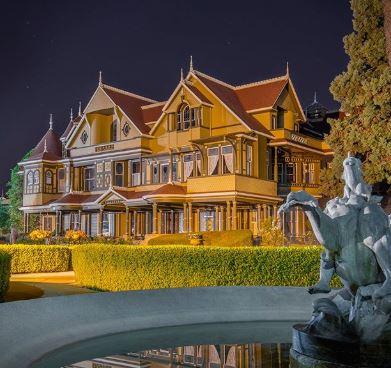
Some people do not believe in ghost. For that matter, some people do not believe in anything. There are persons who even affect incredulity concerning the “Door to Nowhere,” at the Winchester mansion. They said that it did not stand wide open—that it was not a gateway to the Spirit World and that they could have shut it; that the whole affair was a delusion; that they are sure it must have been a conspiracy; that they are doubtful whether there is such a place as the Winchester mansion on the face of the Earth; that the first time they are in California they will look it up. Perhaps, before going further, I ought to premise there was a time when I did not believe in ghosts either. If you had asked me one summer’s morning years ago when you met me on the Golden Gate Bridge if I held such appearances to be probable or possible, you would have received an empathic “No” for answer. However, at this rate, the story of the Door to Nowhere will never be told; so we will, with your permission, plunge into it immediately. I was interested in why this “Door to Nowhere” in the Winchester mansion would not keep shut? They say the place is haunted. What nonsense. There was one thing I can truly say about our office, we were never serious in it. I fancy that is the case in most offices nowadays; at all events, it was the case in ours. We were always chaffing each other, playing practical jokes, telling stupid stories, scamping our work, looking at the clock, counting the weeks to next Christmas, counting the hours to Saturday. For all that we were earnest in our desire to have our salaries raised, and unanimous in the opinion no fellows ever before received such wretched pay. #RandolphHarris 1 of 17

I had $75,000 a year, which I was aware did not half provide for what I ate at home. My mother and sisters left me in no doubt on the point, and when new clothes were wanted I always hated to mention the fact to my poor worried father. We had been better off once, I believe, though I never remember the time. My father owned a small property in the country. I wanted money badly—I must say I never had sixpence in the World of my own—and I thought if I could earn two sovereigns I might buy some trifles I needed for myself, and present my father with a new Ultimate Driving Machine. Then I recalled the amount of the rent was being asked for the Winchester mansion; then I decided gladly this would be a great place to stay if only the ghost turned out of possession. I decided I should like to try to whether, I could not solve the mystery. I was accustomed to lonely houses, and I would not feel at all nervous; I did not believe in ghost, and as for burglars, I was not afraid of them. I was told to just try it out first. To stay in the house for a week; if as tht end of that time I could keep the door shut, locked, bolted, or nailed up, to telegraphy the Winchester Repeating Arms Company, and they would actually pay me to stay there. To me, this sounded like a great bargain. If I lay the ghost, or find out the ghost, I think I ought to have enough money to buy a small house for myself. However, I could not have said what frightened me about this endeavour. A week after I moved into the Queen Anne mansion, Mr. van Buuren from the Winchester Repeating Arms Company came to visit me. He wanted to speak to me about the mansion. I heard a sound of irritation in his voice. “The Winchester Mansion!” he said; “and what have you got to say about the Winchester Mansion?” #RandolphHarris 2 of 17

“That is what I wanted to tell you, Mr. van Buuren,” I answered, and a dead hush seem to fall over the office as I spoke. The silence seemed to attract his attention, for he looked sternly at the clerks, who were not using a pen or moving a finger. “Come this way, then,” he said abruptly; and next minute I was in his private office. “Now, what is it?” he asked, flinging himself into a chair, and addressing me, who stood hat in hand beside the great table in the middle of the room. I began—I will say he was a patient listener—at the very beginning, and told my story straight through. I concealed nothing. I enlarged on nothing. A discharged clerk I stood before him, and in the capacity of a discharged clerk I said what I had to say. He heard me to the end, the he sat silent, thinking. At last he spoke. “You have heard a great deal of conversation about the Winchester, I suppose,” he remarked. “No, sir; I have heard nothing expect what I have told you.” “And why do you desire to strive to solve such a mystery?” “If there is any money to be made, I should like to make it, sir.” “How old are you?” “Two-and-twenty last January.” He laughed—he lay back in his chair and laughed—and I laughed myself, though ruefully. We went on talking for a long time after that; he asked me all about my father and my early life, and how we lived and the people we knew; and, in fact, put more questions than I can well remember. “It seems a crazy thing to do,” he said at las; “and yet I feel disposed to trust you. The house is standing perfectly empty. I cannot live it in, and I cannot get rid of it; all my own furniture I have removed, and there is nothing in the place except a few old-fashioned articles belonging to Mrs. Winchester. The place is a loss to me. It is of no use trying to let it, and thus, in fact, matters are at a deadlock. #RandolphHarris 3 of 17

“You will not be able to find out anything, I know, because, of course, other have tried to solve the mystery ere now; still, if you like to try you may. I will make this bargain with you. If you like to go down, I will pay your reasonable expenses for a fortnight; and if you do any good for me, I will give you a $1,000,000 note for yourself. Of course I must be satisfied that what you have told me is true and that you are what your represent. Do you know anybody in the city who would speak for you?” I could think of no one but my uncle. I hinted to Mr. van Buuren he was no grand enough or rich enough, perhaps, but I knew nobody else to whom I could refer him. “What?!” he said, “Greg Ryan, of Lakeview Street. He does business with us. If he will go bail for your good behaviour I shan’t want any further guarantee. Come along.” And to my intense amazement, he rose, put on his hat, walked me across the outer office and along the pavements till we came to Lakeview Street. “Do you know this youth, Mr. Ryan?” he said, standing in front of my uncle’s desk, and laying a hand on my shoulder. “Of course I do, Mr. van Burren,” answered my uncle, a little apprehensively; for, as he told me afterwards, he could not imagine what mischief I have been up to. “He is my nephew.” “And what is your opinion of him—do you think he is a young fellow I may safely trust?” My uncle smiled, and answered, “That depends on what you wish to trust him with.” “A long column of addition, for instance.” “It would be safer to give that task to somebody else.” “Oh, uncle!” I remonstrated; for I had really striven to conquer my natural antipathy to figures—worked hard, and every bit of it against the collar. My uncle got off his stool, and said, standing with his back to the empty fire-grate: “Tell me what you wish the boy to do, Mr. van Buuren, and I will tell you whether he will suit your purpose of not. I know him, I believe, better than he knows himself.” #RandolphHarris 4 of 17

In an easy, affable way, for so rich a man, Mr. van Buuren took possession of the vacant stool, and nursing his right leg over his left knee, answered: “He wants to go and shut the “Door to Nowhere” at the Winchester Mansion for me. Do you think he can do that? My uncle looked steadily back at the speaker, and said, “I thought, Mr. van Buuren, I was quite settled no one could shut it?” Mr. van Buuren shifted a little uneasily on his seat, and replied: “I did not set your nephew the task he fancies he would like to undertake.” “Have nothing to do with it, Justin, advised my uncle, shortly. “You do not believe in ghost do you, Mr. Ryan?” asked Mr. van Burren, with a slight sneer. “Do you not, Mr. van Buuren?” retorted my uncle. There was a pause—an uncomfortable pause—during the course of which I felt the million dollar note, which in imagination, I had really spent, trembling in the scale. I was not afraid. For one million dollars, or half the money, I would have faced all the inhabitants of spirit land. I longed to tell them so; but something in the way those two men looked at each other stayed my tongue. “If you ask me the question here in the heart of the city, Mr. Ryan,” said Mr. van Buuren, at length, slowly and carefully, “I answer ‘No’; but if you were to put me on a dark night at the Winchester, I should beg time to consider. I do not believe in supernatural phenomena myself, and yet—the ‘Door to Nowhere’ at the Winchester is as much beyond my comprehension as the ebbing and flowing of the sea.” “And you cannot live at the Winchester?” remarked my uncle. “I cannot live at the Winchester, and what is more, I cannot get anyone else to live at the Winchester.” “And you want to get rid of your lease?” “I want so much to get rid of my lease that I told Tuck I would give him a handsome sum if he could induce anyone to solve the mystery. Is there any other information you desire, Mr. Ryan? Because if there is, you have only to ask and have. I feel I am not here in a prosaic office in the city of Santa Clara, but in the Palace of Truth.” #RandolphHarris 5 of 17

My uncle took no notice of the implied compliment. When company is good it needs nothing else. If a man is habitually honest in his speech and in his thoughts, he desires no recognition of the fact. “I do not think so,” he answered; “it is for the boy to say what he will do. If he be advised by me he will stick to his ordinary work in his employers’ office, and leave ghost-hunting and spirit-laying alone.” Mr. van Buuren shot a rapid glance in my direction, a glance which implying a secret understanding, might have influenced my uncle could I have stooped to deceive my uncle. “I cannot stick to my work there any longer,” I said. “I got my marching orders today.” “What had you been doing, Justin? Asked my uncle. “I wanted one million to go and lay the ghost!” I answered, so dejectedly, that both Mr. van Buuren and my uncle broke out laughing. “One Million dollars!” cried my uncle, almost between laughing and crying. “Why, Justin boy, I had rather, poor man though I am, have given thee one million dollars than thou should’st go ghost-hunting or ghost-laying.” When he was very much in earnest my uncle went back to thee and thou his native dialect. I liked the vulgarism, as my mother called it, and I knew my aunt loved to hear him use the caressing words to her. He had risen, not quite from the ranks it is true, but if ever a gentleman came ready born into the World it was Greg Ryan, upon whom at our home everyone seemed to look down. “What will you do, you man?” asked Mr. van Buuren; “you hear what your uncle says, “Give up the enterprise,” and what I say; I do not want either to bribe or force your inclinations.” “I will go, sir,” I answered quite steadily. “I am not afraid, and I should like to show you—” I stopped. I had been going to say, “I should like to show you I am not sure a fool as you all take me for,” but I felt such an address would be too familiar, and refrained. #RandolphHarris 6 of 17

When I got to the Lodge, I showed Mr. van Buuren’s letter to the woman, and received the key. “You are not going to stop up at the Winchester alone, are you, sir? she asked. “Yes, I am,” I answered, uncompromisingly, so uncompromisingly that she said no more. The avenue led straight to the mansion; it was uphill all the way, and bordered by rows of the most magnificent limes I ever beheld. A light iron fence divided the avenue from the park, and between the trunks of the trees I could see the deer browsing and cattle grazing. Ever and anon there came likewise to my ear the sound of a sheep-bell. It was a long avenue, but at length I stood in front of the mansion—a square, solid-looking, Victorian mansion, four stories high, with several towers and a steeply pitched roof, beautiful stained-glass windows and statues, a basement; a flight of steps up to the principal entrance; several windows to the right of the door, several to the left of the door; the whole mansion flanked and backed with trees; all the curtains closed, a dead silence brooding over the place; the sun westering behind the great trees studding the park. I took all this in as I approached, and afterwards as I stood for a moment under then ample porch; then remembering he business which has brought me so far, I fitted the great key in the lock, turned the handle, and entered the Winchester Mansion. For a minute—stepping out of the bright sunlight—the place looked to me so dark that I could scarcely distinguish the objects by which I was surrounded; but my eyes soon grew accustomed to the comparative darkness, and I found I was in an immense hall, lighted from the roof; a magnificent old oak staircase conducted to the upper rooms. #RandolphHarris 7 of 17

The floor was of white marble. There were two fireplaces, fitted with dogs for burning wood; around the walls hung pictures, antlers, and horn, and in odd niches and corners stood groups of statues, and the figure of men in complete suits of armour. To look at the place outside, no one would have expected to find such a hall. I stood lost in amazement and admiration, and then I began to glance more particularly around. Mr. van Buuren has not given me any instructions by which to identify the ghostly chamber—which I concluded would most probably be found on the first floor. I knew nothing of the story connected with it—if there were a story. I was perfectly unencumbered of the mystery. I had not the faintest idea in which apartment it resided. Well, I should discover that, no doubt, for myself ere long. I looked around me—doors—doors—doors. I have never before seen so many doors together all at once. Two of them stood open—one wide, the other slightly ajar. “I will just shut them as a beginning,” I thought, “before I go upstairs.” The doors were of oak, heavy, well-fitting furnished with good locks and sound handles. After I had closed I tried them. Yes, they were quite secure. I ascended the great staircase feeling curiously like an intruder, paced the corridors, entered the many bed chambers—some quite bare of furniture, others containing articles of an ancient fashion, and no doubt of considerable value—chairs, antique dressing-tables, curious wardrobes, and such like. For the most part the doors were closed, and I shut those that stood open before making my way into the attics. I was greatly delighted with the attics. The window lighted them did not, as a rule, overlook the front of the Manion, but commanded wide views over wood, and valley, and meadow. Leaning out of one, I could see, that to the right of the mansion the ground, thickly planted, shelved down to a stream, which came out into the daylight a little distance beyond the plantation, and meandered through the deer part. #RandolphHarris 8 of 17

At the back of the mansion the windows looked out on nothing save a dense wood and a portion of the stable-yard, whilst on the side nearest the point from whence I had come there were spreading gardens surrounded by thick yew hedges, and kitchen-gardens protected by high walls; and further on a farmyard, where I could perceive cows and oxen, and, further still, luxuriant meadows, and fields glad with waying and fruit orchards. “What a beautiful place!” I said. “van Buuren must have been a duffer to leave it.” And then I thought what a great ramshackle house it was for anyone to be in all alone. Getting heated with my long walk, I suppose, made me feel chilly, for I shivered as I drew my head in from the last dormer window, and prepared to go down stairs again. In the attics, as in the other parts of the house I had as yet explored, I closed the doors, when there were keys locking them; when there were not, trying them, and in all cases, leaving the securely fastened. When I reached the ground floor the evening was drawing on apace, and I felt that if I wanted to explore the whole house before dusk I must hurry my proceedings. “I will take the kitchens next,” I decided, and so made my way to a wilderness of domestic offices lying to the rear of the great hall. Stone passages, great kitchens, an immense servants’-hall, larders, pantries, coal-cellars, beer-cellars, laundries, brewhouses, housekeeper’s room—it was not of any use lingering over these details. The mystery that trouble Mr. van Buuren could scarcely lodge amongst cinders and empty bottles, and there did not seem much else left in this part of the building. I would go through the living-rooms, and then decide as to the apartments I should occupy myself. The evening shadows were drawing on apace, so I hurried back into the hall, feeling it was a weird position to be there all alone with those ghostly hollow figures of men in armour, and the statues on which the moon’s beams must fall so coldly. #RandolphHarris 9 of 17

I would just look through the lower apartments and then kindle a fire. I had seen quantities of wood in a cupboard close at hand, and felt that beside a blazing hearth, and after a good cup of tea, I should not feel the solitary sensation which was oppressing me. The sun had sunk below the horizon by this time, for to reach the Winchester I had been obliged to travel by cross lines of railway, and wait besides for such trains as condescended to carry third-class passengers; but here was still light enough in the hall to see all object distinctly. With my own eyes I saw that one of the doors I had shut with my own hands was standing wide! I turned to the door on the other side of the hall. It was as I had left it—closed. This, then, was the room—this with the open door. For a second I stood appalled; I think I was fairly frighted. That did not last long, however. There lay the work I had desired to undertake, the foe I had offered to fight; so without mor ado I shut the door and tried it. “Now I will walk to the end of the hall and see what happens,” I considered. I did so. I walked to the foot of the grand staircase and back again, and looked. The door stood wide open. I went into the room, after just a spasm of irresolution—went in and pulled up the blinds: a good-sized room, twenty by twenty (I knew because I paced it afterwards), lighted by two long windows. The floor, of polished oak, was partially covered with a Turkey carpet. There were two recesses beside the fireplace, one fitted up as a bookcase, the other with an old and elaborately carved cabinet. I was astonished also to find a bedstead in an apartment so little retired from the traffic of the house; and there were also some chairs of an obsolete make, covered, so far as I could make out, with faded tapestry. Beside the bedstead, which stood against the wall opposite to the door I had as yet met with the interior of the house. #RandolphHarris 10 of 17

It was a dreary, gloomy room: the dark panelled walls; the black, shining floor; the windows high from the ground; the antique furniture; the dull four-poster bedstead, with dingy velvet curtains; the gaping chimney; the silk counterpane that looked like a pall. “Any crime might have been committed in which a room,” I thought pettishly; and then I looked at the door critically. Someone had been at the trouble of fitting bolts upon it, for when I passed out I not merely shut the door securely, but bolted it as well. “I will go and get some wood, and then look at it again,” I soliloquized. When I came back it stood wide open once more. “Stay open, then!” I cried in a fury. “I will not trouble myself any more with you tonight!” Almost as I spoke the words, there came a ring at the front door. Echoing through the desolate house, the peal in the then states of my nerves startled me beyond expression. It was only the man who had agreed to bring over my traps. I bade him lay them down in the hall, and while looking out some small silver, asked where the nearest-post-office was to be found. Not far from the Winchester Estate’s Park gates, he said; if I wanted any letter sent, he would drop it in the box for me; the mail-cart picked up the bag at ten o’clock. I had nothing ready to post then, and told him so. Perhaps the money I gave was more than he expected, or perhaps the dreariness of my position impressed him as it had impressed me, for he paused with his hand on the lock, and asked: “Are you going to stop here all alone, master?” “All alone, I answered, with such cheerfulness as was possible under the circumstances.” “That is the room, you know,” he said, nodding in the direction of the open door, and dropping his voice to a whisper. “Yes, I know,” I replied. “What, you have been trying to shut it already, have you? Well, you are a game one!” And with this complimentary if not very respectful comment he hastened out of the house. Evidently he had no intention of proffering his services towards the solution of the mystery. #RandolphHarris 11 of 17

I cast one glance at the door—it stood wide open. Through the windows I had left bare to the night, moonlight was beginning to stream cold and silvery. “Look here, Justin,” I said, all of a sudden; “life is not child’s play, as uncle truly remarks. That door is just the trouble you have now to face, and you must face it! However, for that door you would never have been here. I hope you are not going to turn coward the very first night. Courage!—that is your enemy—conquer it.” “I will try,” my other self answered back. “I can but try. I can but faith.” The moon’s beams were streaming down upon the mansion; I could see every statue, every square of marble, every piece of armour. For all the World it seemed to me like something in a dream; but I was tired and sleepy, and decided I would not trouble about fire or food, or the open door, till the next morning: I would go to sleep. However, I felt like an army of Devil’s was horribly broke in upon this place which is the center, and after a sort, the first-born of our Californian settlements. If a ghost was responsible for the hanging of nineteen people in this mansion, what was responsible for the burning of nine hundred people? What more likely time would the “Door to Nowhere” open up and let our arch-enemy, the Devil, choose a time for his attack? I spent the forenoon considering that door. I looked at it from within and from without. It was on the second floor and opened up to a two story drop outside of the house. What would possess someone to build a door like this, unless they had some knowledge of it being a portal? I eyed it critically. I tried whether there was any reason why it should fly open, and I found that so long as I remained on the threshold it remained closed; if I walked even so far away as the opposite side of the mansion, it swung wide. #RandolphHarris 12 of 17

Do what I would, it burst from latch and bolt. I could not lock it because there was no key. I was baffled. Then I stumbled upon a note which read: “One that shall use, practise, or exercise any invocation or conjuration of any evil or wicked spirit, or consult, convenient with, entertain or employ, feed or reward any evil or wicked spirit, to or for any intent or purpose; or take up any dead man, woman, or child, out of his, her, or their grave, or any other place, where the dead body resteth; or the skin, bone, or other part of any dead person, to be employed or used in any manner of witchcraft, sorcery, charm or enchantment; or shall use, practise, or exercise any witchcraft, enchantment, charm, or sorcery, whereby any person shall be killed, destroyed, wasted, consumed, pined, or lamed in his or her body, or any part thereof: such offenders duly and lawfully convicted and attained, shall suffer death.” Then it dawned of me. Perhaps the mansion has been attraction people who are into the occult and they are the nearly 920 people who have been burned alive or hanged. And that is why the house cannot find renters, it consumes them all. Perhaps this is something like the Atonement of Christ. How God gave His one and only Son to pay the wages of sin man had created, this mansion is consuming souls of those who practise the occult to atone for the death of those killed by the Winchester rifle. The afflicted state of our poor neighbours that are now suffering by molestations from the invisible World, we apprehended so deplorable that we think their condition calls for the utmost help of all persons in their several capacities. We cannot but with all thankfulness acknowledge the success which the merciful God has given unto the sedulous and assiduous endeavours of our honorable rulers to detect the abominable witchcrafts which have been committed in the country, humbly praying that the discovery of these mysterious and mischievous wickedness may be perfected. #RandolphHarris 13 of 17

We judge that in the prosecution of these, and all such witchcrafts, there is need of a very critical and exquisite caution, leas by too much credulity for things received only upon the Devil’s authority there be a door opened for a long train of miserable consequences, and Satan get an advantage over us, for we should not be ignorant of his devices. After all, it was this mansion people could not live in—his door that would not keep shut; and it seemed to me these were facts he might dislike being forced upon the attention of the public. What had I seen? What did I think of the matter? Very honestly I did not know what to say. The door certainly would not remain shut, and there seemed no human agency to account for its persistent opening; but then, on the other hand, ghost generally did no tamper with fire arms, and my rifle, though not loaded, had been tampered with—I was sure of that. Mr. van Buuren later disclosed to me his theory that open door: “This is the room my uncle was murdered in, they say the door will never remain shut till the murderer is discovered.” “Murdered!” I did not like the word at all; it made me feel chill and uncomfortable. “Yes—he was murdered sitting in his chair, and the assassin has never been discovered. At first many persons inclined to the belief that I killed him; indeed, may are of that opinion still. “But you did not, sir—there is not a word of truth in that story, is there?” He laid his hand on my shoulder as he said: “No, my lad; not a word. I loved the old man tenderly. Even when he disinherited me for the sake of his young wife, I was worry, but not angry; and when he sent for me and assured me he had resolved to repair a wrong, I tried to induce him to leave the lady a handsome sum in addition to her jointure. “If you do not, people may think she has not been the source of happiness you expected,” I added. “Thank you, Reuban,” he said. “You are a goof fella; we will talk further about this tomorrow.” And then he bade me goodnight. #RandolphHarris 14 of 17

“Before morning broke—it was in the about one hundred years ago—the household was arounds by a fearful scream. It was his death-cry. He had been stabbed from behind in the neck. He was seated in his chair writing—writing a letter in Latin. Part of it said, ‘Exorcizo te, immundissime spiritus, omnis incursion adversarii, omne phanatasma, omnis leigo, in nominee Domini nostri Jesu Christi eradicare, et effugare ab hoc plasmate Dei.’ The rest of the letter was torn. His solicitor came forward and said he had signed a will leaving all his personalty to me—he was very rich—unconditionally, only three days previously.” Mr. van Buuren went away, and I stayed in the house. I never left it all day. I did not go into the garden, or the stable-yard, or the shrubbery, or anywhere; I devoted myself solely and exclusively to that door. If I shut it once, I shut it a hundred times, and always with the same result. Do what I would, it swung wide. Never, however, when I was looking at it. So long as I could endure to remain, it stayed shut—the instant I turned back, it stood open. Though feeling convinced that no human agency did or could keep the door open, I was certain that some living person had means of access to the house which I could not discover. This was made apparent in trifles which might well have escaped unnoticed had several or even two people occupied the mansion. In the dead of the night a noise, resembling the clashing of iron, was frequently heard, which, if you listened more attentively, sound like the rattling of chains, distant at first, but approaching nearer by degrees: immediately afterward a spectre appeared in the form of an old man, of extremely emaciated and squalid appearance, with a long beard and dischevelled hair, rattling the chains on his feet and hands. The distressed occupants meanwhile passed their wakeful nights under the most dreadful terrors imaginable. This, as it broke their rest, ruined their health, and brought on distempers, their terrors grew upon them, and death ensued. #RandolphHarris 15 of 17

Even in the daytime, though the spirit did not appear, yet the impression remained so strong upon their imaginations that it still seemed before their eyes, and kept them in perpetual alarm. Consequently the mansion was at length deserted, as being deemed absolutely uninhabitable; so that it was now entirely abandoned to the ghost of the Winchester rifle. That night, I prepared to retire. However, I was open to the vain terrors of imaginary noises and spirits. The first part of the night passed in entire silence, as usual; at length a clanking of iron and rattling of chains was heard: however, I neither lifted up my eyes, nor got out of bed, but in order to keep calm, I pretended the sound was something else. The noise increased and advanced nearer, until it seemed at the door, and at last in my chamber. I looked up, saw, and recognized the ghost exactly as it has been described to me: it stood before me, beckoning with a finger, like a person calls another. I immediately arouse, and, candle in hand, followed it. The ghost slowly stalked along as if encumbered with its chains, and, turning into the area of the house where the “Door to Nowhere, was and suddenly vanished. What an idiot I have been! If I wanted to solve the mystery of the open door, or course I must keep watch in the room itself. The door would not stay wide unless there was a reason for it. When I walked into the room, it was deadly cold, and the scene was horrible. The door was wide open. A party of ghosts were assembled with, and were feasting on the flesh of corpses. I was astonished by this hideous banquet. As soon as I could safely escape, I stole back into my bed. I was rather crossed at being disturbed. The next day word on—the long, dreary day; evening approached—the night shadows closed over the Winchester mansion. The moon would not rise for a couple hours more. Everything was still as death. The house had never before seemed to me so silent and so deserted. #RandolphHarris 16 of 17

I took a candle, and went up to my accustomed room, moving about for a time as though preparing for bed; then I extinguished the candle, softly open the door, turned the key, and put it in my pocket, slipped softly downstairs, across the hall, through the open dor. Then I knew I had been afraid, for I felt a thrill of terror as in the dark I stepped over the threshold. I paused and listened—there was not a sound—the night was still and sultry, as though a storm were brewing. Not a leaf seemed moving. Noiselessly I made my way to the other side of the room. There was an old-fashioned easy-chair between the bookshelves and the bed; I sat down in it, shrouded by the heavy curtains. The hours passed—where ever hours so long? The moon rose, came and looked in at the windows, and then sailed away to the west; but not sound, no, not even the cry of a bird. I seemed to myself a mere collection of nerves. Every part of my body appeared twitching. It was agony to remain still; the desire to move became a form of torture. The locked door opened—so suddenly, so silently, that I barely had time to draw back behind the curtain, before I saw a woman in the room. A slight, lithe woman, not a lady, clad in all black—not a bit of white about her. What on Earth could she want? Then she fell on me with her nails and teeth, and tore at my throat, she was as strong as twenty devils. I felt something like a red-hot iron enter my neck. She opened a vein and sucked by blood, and I could but rush from the room before I fell senseless on the marble pavement of the hall. When the post man came that morning, finding no one stirring, he looked through one of the long windows that flanked the door; then he ran to the farmyard and called for help. “There is something wrong inside,” he cried. “That young gentleman is lying on the floor in a blood of blood.” To this day, the “Door to Nowhere” is still a mystery. #RandolphHarris 17 of 17

Winchester Mystery House

24 Hours till opening night of All Hallows’ Eve and our caretakers are working non stop to put the finishing touches on the show! Be here for the opening weekend! Tickets are still available. A 160-room mansion built to appease the spirits who died at the hands of the Winchester Rifle 👻
All Hallows’ Eve:
🎟️ Link in bio. 🗝 winchestermysteryhouse.com

He Was Haunted By an Invisible Presence!

The facts which I am about to relate happened to myself some sixteen or eighteen years ago, at which time I was still young enough to enjoy a life of constant travelling. There are, indeed, many less agreeable ways in which an unbeneficent parson may contrive to scorn delights and live laborious days. In remote places where strangers are scarce, his annual visit is an important evet; and though at the close of a long day’s work he would sometimes prefer the quiet of a Victorian mansion, he generally finds himself the destined guest of the rector or the squire. It rests with himself to turn these opportunities to account. If he makes himself pleasant, he forms agreeable friendships and sees Victorian home-life under one of its most attractive aspects; and sometimes, even in these days of universal common-placeness, he may have the luck to meet with an adventure. My first appointment was to Llanda Villa ; which was largely peopled with my personal friends and connections. It was, therefore, much to my annoyance that I found myself, after a could of years very pleasant work, transferred to a new teaching position. I now spent half my time in hired vehicles and lonely country inns. I had been in possession of this position for some three months or so, and winter was near at hand, when I paid my first visit of inspection to the Winchester mansion. It was a dull, raw afternoon of mid-November, growing duller and more raw as the day waned and the east wind blew keener. I found the foot path without difficulty. It led me across a barren slope divided by stone fences, with here and there a group of smaller Victorian houses and gazebos. #RandolphHarris 1 of 14

A light fog, meanwhile, was creeping up from the east, and the dusk was gathering fast. Now, to lose one’s way on such an expansive ranch and at such an hour would be disagreeable enough, and the footpath—a trodden track already half obliterated—would be indistinguishable enough in the course of another ten minutes, but the nine story look out tower, a top the mansion, stood erect as a compass guiding visitors to the bizarre and beautiful rambling mansion. Looking anxiously ahead, up to this moment, I had not met a living soul. However, then I saw a man emerging from the fog and coming along the path. As we neared each other—I advancing rapidly; he slowly—I observed that he dragged the left foot, limping as he walked. It was, however, so dark and so misty, that not till we were within half a dozen yards of each other could I see that he wore a dark suit and an Anglican felt hat, and looked something like a dissenting minister. As soon as we were within speaking distance, I addressed him. “Can you tell me, I said, about how much longer it will take to get to the Winchester mansion?” He came on, looking straight before him; taking no notice of my question; apparently not hearing it. “I beg your pardon,” I said, raising my voice; “but how much longer will it take on this path to get to the Winchester?” He had passed on without pausing; without looking at me; I could almost have believed, without seeing me! I stopped, with the words on my lips; then turned to look after—perhaps, to follow—him. But instead of following, I stood betwixted. What had become of him? #RandolphHarris 2 of 14

And what lad was that going up the path by which I had just come—that tall lad, half-running, half-walking, with a fishing-rod over his shoulder? I could have taken my oath that I had neither met nor passed him. Where then had he come from? And where was the man to whom I had spoken not three seconds ago and who, at his limping pace, could have made more than a couple of yards in the time? My stupefaction was such that I stood quite still, looking after the lad with the fishing-rod till he disappeared in the gloom under the park-palings. Was I dreaming? Darkness, meanwhile, had closed in apace, and, dreaming or not dreaming, I must push on, or find myself benighted. So I hurried forward, turning my back on the last gleam of daylight, and plunging deeper into the fog at every step. I was, however, close upon my journey’s end. The path ended at a turnstile; the turnstile opened upon a steep lane; and at the bottom of the land, down which I stumbled among stones and ruts, I came in sight of the welcome glare of a blacksmith’s forge. Here, then, was the Winchester. I found myself at the door of the Winchester mansion. When I was sitting in the cozy drawing room, I saw Mrs. Winchester, and she looked like an angel. Spreading loveliness everywhere, over all with whom she came in touch, over good and evil. When a small number of people often come together in the same room, a tradition readily develops as to where each individual has one’s place, one’s station; it becomes a kind of picture a person can unroll for oneself when one so desires, a map of the terrain. So it is also with us in the Winchester mansion—together we form a picture. We were to drink tea here this evening. #RandolphHarris 3 of 14

Mrs. Winchester strives for an air of mystery. She wants to whisper and usually does it so well that she becomes entirely mute; I make no secret of my effusions to Merriam, her niece, an estimate of how many quarts of milk it takes for one pound of butter through the medium of cream and the dialectic of the butter churn. Indeed, it is not only something any young girl can listen to without hard, but, what is far more unusual, it is a solid and fundamental and edifying conversation that is equally ennobling to the head and the heart. And is no nature magnificent and wise in what she produces, what a precious gift is butter, what a glorious accomplishment of nature and art! It is a curious picture we make together. Mrs. Winchester almost vanishes before our eyes in pure agronomy; we go into the kitchen and the cellars, up into the attic, look at the chicken and ducks, geese et cetera. This was fascinating to me. But it could just be that I was the kind of young man who became old prematurely; it is possible. I sat late over the fire, and by the time I went to bed, I had well nigh forgotten my adventure with the man who vanished so mysteriously and the boy who seemed to come from nowhere. Next morning, finding I had abundant time at my disposal. What a reinvigorating power I felt from the Winchester—not the freshness of the morning air, not the sighing of the wind, not the coolness of the sea, not the fragrance of wine, its aroma—nothing in the World has this reinvigorating power. In this way the days go by. Mrs. Winchester seemed perfect happy in her mansion. Her bedroom faced the courtyard. Sometimes she stands on the balcony for a moment, and at night she looks up at the stars, unseen by all. #RandolphHarris 4 of 14

In these nocturnal hours, I walk around like a ghost. Then I forget everything, have no plans, no reckonings, cast understanding overboard, expand and fortify my chest with deep sighs, a motion I need in order not to suffer from my systematic conduct. Others are virtuous by day, sin at night; I am dissimulation by day—at night I am sheer inspiration. When I notice it, far off on the horizon there comes a flashing intimation from a quite different World, to the astonishment of Mrs. Winchester as well as Merriam. Mrs. Winchester sees the lightning but hears nothing; Merriam hears the voice but sees nothing. However, at the same moment everything is in its quiet order; the conversation between Mrs. Winchester and me proceeds in its uniform way, like post horses in the stillness of the night the; the sad hum of the samovar accompanies it. At such moments, it can sometimes be uncomfortable in the drawing room, especially for Merriam. She has no one she can talk with or listen to. I can well understand that it must seem to Merriam as if Mrs. Winchester were bewitched, so perfectly does she move to the tempo of my rhythm. She cannot participate in this conversation either, because one of the means I have also used to outrage her is that I allow myself to treat her just like a child. It is not as if I for that reason would allow myself any liberties whatever with her, far from it. I well know the upsetting effects such things can have, and the point is that her womanliness must be able to rise up pure and beautiful again. Because of my intimate relationship with Mrs. Winchester, it is easy for me to treat her like a child who has no understanding of the World. #RandolphHarris 5 of 14

Her womanliness is not insulted thereby but merely neutralized, for the fact that she does not know market prices cannot insult her womanliness, but the supposition that this is the ultimate in life can certainly be revolting to her. With my powerful assistance on this scored, Mrs. Winchester is out doing herself. She has become almost fanatic—something she can thank me for. The only thing about me that she cannot stand is that I have no position. Now I have adopted the habit of saying whenever a vacancy in some office is mentioned: “There is a position for me,” and thereupon discuss it very gravely with her. Merriam always perceives the irony, which is precisely what I want. The butler came in with more tea. I saw that he was lame. In the moment I remembered him. He was the man I met in the fog. “I met you yesterday afternoon, Mr. Brunton,” I said, as we went into the library. “Yesterday afternoon, sir?” He repeated. “You did not seem to observe me,” I said, carelessly. “I spoke to you, in fact; but you did not reply to me.” “But—indeed, I beg your parson, sir—it must have been someone else,” said the butler. “I did not go out yesterday afternoon.” How could this be anything but a falsehood? I might have been mistaken as to the man’s face; though it was such a singular face, and I had seen it quite plainly. However, how could I be mistaken as to his lameness? Besides, that curious trailing of the right foot, as if the ankle was broken, was not an ordinary lameness. I suppose I looked incredulous, for he added, hastily. “Even if I had not been preparing dinner for inspection, sire, I should not have gone out yesterday afternoon. It was too damp and foggy. I am obliged to be careful—I have a very delicate chest.” #RandolphHarris 6 of 14

My dislike to the man increased with every word he uttered. I did not ask myself with what motive he want on heaping lie upon lie; it was enough that, to serve his own ends, whatever those ends might be, he did lie with unparalleled audacity. “We will proceed to the examination, Mr. Brunton,” I said, contemptuously. He turned, if possible, a shade paler than before, bent his head silently, and called up the cuisine in their order. Profusely apologizing, he begged leave to occupy five minutes of my valuable time. He wished, under correction, to suggest a little improvement to many the menu more festive. “Under other circumstances…” I stopped and looked round. The butler repeated my last words. “You were saying, sir—under other circumstances?” I looked around again. “I seemed to me that there was someone here,” I said; “some third person, not a moment ago.” “I beg your pardon, sir—a third person?” “I saw his shadow on the ground, between yours and mine.” The mansion faced due north, and we were standing immediately behind it, with our backs to the sun. The place was bare, and open, and high; and our shadows, sharply defined, lay stretched before our feet. “A—a shadow?” he faltered. “Impossible.” There was not a bush or a true within half a mile. There was not a could in the sky. There was nothing, absolutely nothing, that could have cast a shadow. I admitted that t was impossible, and that I must have fancied it; and so went back to the matter of the menu. “Should you see Mrs. Winchester,” I said, “you are at liberty to say that I thought it a desirable improvement.” #RandolphHarris 7 of 14

“I am much obliged to you, sir. Thank you—thank you very much,” he said, cringing at every word. “But—but I had hoped that you might perhaps use your influence”—“Look there!” I interrupted. “Is that fancy?” We were now close under the blank walls of the kitchen. On this wall, laying to the full sunlight, our shadows—mine and the butler’s—were projected. And there too—no longer between his and mine, but a little way apart, as if the intruder were standing back—there, as sharply defined as if cast by line-light on a prepared background, I again distinctly saw, though but for a moment, that third shadow. As I spoke, as I looked round, it was gone! “Did you not see it?” I asked. He shook his head. “I—I saw nothing” he said, faintly. “What was it?” His lips were white. He seemed scarcely able to stand. “But you must have seen it!” I exclaimed. “It fell just there—where that bit of ivy grows. There must be some boy hiding—it was a boy’s shadow, I am confident. “A boy’s shadow!” he echoed, looking round in a wild, frightened way. “There is no place—for a boy—to hide.” “Place or no place,” I said, angrily, “if I catch him, he shall feel the weight of my cane!” I searched backwards and forwards in every direction, the butler, with his scared face, limping at my heels; but, rough and irregular as the ground was, there was not a hole in it big enough to shelter a rabbit. “But what was it?” I said, impatiently. “An—an illusion. Begging your pardon, sir—and illusion.” He looked so like a beaten hound, so frightened, so fawning, that I felt I could with lively satisfaction have transferred the threatened caning to his own shoulders. #RandolphHarris 8 of 14

“But you saw it?” I said, impatiently. “No, sir. Upon my honour, no, sir. I saw nothing—nothing whatever.” His looks belied his words. I felt certain that he had not only seen the shadow, but that he knew more about it than he chose to tell. I was by this time really angry. To be made the object of a boyish trick, and to be hoodwinked by the connivance of the butler, was too much. It was an insult to myself and my office. I scarcely knew what I said; something short and stern at all events. Then, having said it, I turned my back upon Mr. Brunton and the mansion, and walked rapidly back to the village. As I was leaving the Winchester, it was a gloomy evening. I was standing high in the midst of a somber deer-park some six or seven miles in circumference. An avenue of palm trees, which led up to the house looked so lonely. The butler said, “If you would but be persuaded to say a day longer, a new experience awaits you. I will take you down the Winchester shaft, and show you the home of the gnomes and trolls. I am the king of Hades, and rule the under World as well as the upper. There is gold everywhere underlying this mansion. The whole place is honeycombed with shafts and galleries. One of our richest seams runs under this house, and there are upwards of forty men at work in it a quarter of a mile below our feet here every day. Another leads right away under the park, Heaven only knows how far! My father began working it five-and-twenty years ago, and we have gone on working it ever since; yet it shows no sign of failing. That is why Mrs. Winchester is rich enough to commit whatever design follies she pleases; and that is saying a good deal. #RandolphHarris 9 of 14

“But then, to be always squandering money—always building a rambling mansion—always gratifying the impulse of the moment—is that happiness? Mrs. Winchester has been experimenting for several decades; and with what result? Would you like to see?” He snatched up a lamp and led the way through a long suite of unfinished rooms, the floors of which were piled high with packing cases of all sizes and shapes, labelled with the names of various foreign ports and the addresses of foreign agents innumerable. What did they contain? Precious marbles from Italy and Greece and Asia Minor; priceless paintings by old and modern masters; antiquities from the Nile, the Tigris, and the Euphrates; enamels from Persia, porcelain from China, bronzes from Japan, strange sculptures from Peru; arms, mosaics, ivories, wood-carvings, skins, tapestries, old Italian cabinets, painted bride-chess, Etruscan terracottas; treasures of all countries, or all ages, never even unpacked since they crossed that threshold which the mistress’s foot had crossed but twice during the ten years it had taken to buy them! Should she ever open them, ever arrange them, every enjoy them? Perhaps—if she becomes weary of wandering—if she remarried—if she built a gallery to receive them. If not—well, she might found and endow a museum; or leave the things to the nation. What did it matter? Collecting was like fox-hunting; the pleasure in the pursuit, and ended with it!” Breakfast over, we went around the mansion, and saw the men working. Just as we were about to enter an underground tunnel—a tall, slender lad, with a fishing rod across his shoulder, came out rom one of the side doors of the mansion, crossed the open at field, and disappeared among the tree-trunks on the opposite side. I recognized him instantly. It was the boy whom I saw the other day, just after meeting the butler in the meadow. #RandolphHarris 10 of 14

“If the boy think he is going fishing in a fruit orchard,” I said, “he will find out his mistake.” “What boy,” asked Mr. Brunton, looking back. “That boy who crossed over yonder, a minute ago.” “Yonder!—in front of us?” “Certainly. You must have seen him?” “No I.” “You did no see him?—a tall, thin boy, in a grey suit, with a fishing-rod over his shoulder. He disappeared behind those nectarine trees.” Mr. Brunton looked at me with surprise. “You are dreaming!” he said. “No living thing—not even a rabbit—has crossed our path since we left the mansion.” “I am not in the habit of dreaming with my eyes open,” I replied, quickly. He laughed, and put his arm through mine. “Eyes or no eyes,” he said, “you are under an illusion this time!” An illusion—the very word made use of by the butler! What did it mean? Could I, in truth, no longer rely upon the testimony of my senses? A thousand half-formed apprehensions flashed across me in a moment, I remembered the illusions of Nicolini, the bookseller, and other similar cases of visual hallucination, and I asked myself if I has suddenly become afflicted in like manner. “By jove! This is a queer sight!” exclaimed Mr. Brunton. And then I found that we had emerged from the fruit orchard, and were looking down upon the bed of what yesterday was a lake. It was indeed a queer sight—an oblong, irregular basin of the blackest slime, with here and there a sullen pool, and round the margin an irregular fringe of bulrushes. At some little distance along the bank—less than quarter of a mile from where we were standing—a gaping crowd had gathered. All the foremen seemed to turn out to stare. #RandolphHarris 11 of 14

Hats were pulled off and curtsies dropped at Mr. Brunton’s approach. He, meanwhile, came up smiling, with a pleasant word for everyone. “Well,” he said, “are you looking for the lake, my friends?” “I see a log of rotten timber sticking half in and half out of the mud,” one of the men said, “and something—a long reed, apparently…by Jove! I believe it is a fishing rod!” “It is a fishin’ rod, squire,” said the blacksmith with rough earnestness; “an” if yon rotten timber bayn’t an unburied corpse, mun I never stroike hammer on anvil agin!” There was a buzz of acquiescence from the bystanders. ‘Twas an unburied corpse, such enough. Nobody doubted it. “It must have come out, whatever it is, Mr. Brunton said presently. “Five feet of mud, do you say? Then here is a sovereign apiece for the first two fellows who wade through it and bring that object to land!” It was, in truth, an unburied corpse; part of the trunk only above the surface. They tried to life it; but it had been so long under water, and was in so advanced a stage of decomposition, that to bring it to shore without a shutter was impossible. Being cross-questioned, they thought, from the slenderness of the form, that it must be the body of a boy. “There’s the poor chap’s rod, anyhow,” said the blacksmith, laying it gently down upon the turf. Mrs. Winchester was summoned and told of the news. That night she rushed to her blue séance room and demanded the spirits tell her what happened to the boy. “I invoke thee, and move thee, and stir thee up O Spirit Leraikha,” said Mrs. Winchester. “From the 30 Legions of Spirits, appear unto my eyes before the circle in the likeness of a man in and tell me what has happened to this boy!” #RandolphHarris 12 of 14

“The words Adam spoke to God, and all things of water were as blood,” replied the Spirit Leraikha. “In the names Alpha and Omega, I am the God of Secret Truth who liveth forever, the All-Powerful. It is to I, to whom all creatures are obedient and in the Extreme Justice and Anger of God that I withdrawal this veil that is before the glory of God, might; and by the creatures of living breath before the Thone whose eyes are east and west; by the fire in the fire of just Glory of Mine Throne; by the Holy ones of Heaven; and by the secret wisdom of God, I, exalted in power, has been stirred up to cast a vision of the past and make clear the present! The secrets of truth in voice and understanding comes: This is the corpse of a boy of perhaps ten and four or ten and five years of age. There was a fracture three inches long at the back of the skull, evidently fatal. This might, of course, have been an accidental injury; but when the body came to be raised from where it layeth, it was found to be pinned down by a pitchfork, the handle of which had been afterwards whittled off, so as not to show above water, a discovery tantamount to evidence of murder. The features of the victim were decomposed beyond recognition; but enough of the hair remained to show that it has been short and sandy. He had a passion for fishing and was in the habit of slipping away at school-hours, and showed himself the more cunning and obstinate more he was punished. At last there came a day when the butler tracked him to the place his rod was concealed and beat the miserable lad about the head and arms with a heavy stick. Pin through hand and blood was running out of his mouth until he fell insensible and ceased to breathe. He dragged the body among the bulrushes by the water’s edge, and there concealed it as well as he could. #RandolphHarris 13 of 14

“At night, when the neighbours and staff were in bed asleep, he stole out by starlight, taking with him a pitchfork, a coil of rope, a couple of iron-bars, and a knife. He weighted and sunk the corpse, and pinned it down by the neck with his pitchfork. He then cut away the handle of the fork; hid the fishing-rod among the reeds; and believed, as murderers always believe, that discovery was impossible. His dreadful secret had of late become intolerable. He was haunted by an invisible Presence. That Presence sat with him at table, followed him in his walks stood behind him in the mansion, and watched by his side. He never saw it; but he felt that it was always there. Sometimes he raves of a shadow on the walls of this mansion. I have now told you all that there is at present to tell.” When a community looks only for evidence of guilt and ignores or suppresses all contradictory evidence, the result is a witch hunt. Witch hunts are often used to conceal more heinous crimes. And when a witch hunt occurs, which is the very opposite of what was going on in the case of the murdered boy, the community feels itself so beset by evil that it is no longer capable of perceiving the good. The primary causes of witch hunts are clear. It is usually due to corruption, an outbreak of epidemic hysteria which usually ordinates in experiments with the occult. And the hysterical hallucinations of the afflicted persons are confirmed by some concrete evidence of actual witchcraft and by many confessions, the majority of them hysterical. A number of other explanations have been offered, but most of them are more or less unconvincing. It has been argued that the outbreak is usually due to some new religion. Typically a kind of insanity resulting from sexual repression or denying one’s true sexual nature. #RandolphHarris 14 of 14

Winchester Mystery House

It’s a beautiful day for a stroll through the gardens. Today, Winchester Mystery House marks 99 years since our lady of mystery, Sarah Winchester passed away peacefully in her bedroom of Llanda Villa. We mark her passing with the ringing of the bell 13 times as is our tradition. Thank you Sarah for creating this iconic home that we continue to share with guests from around the world.
🎟️ Link in bio.

A 160-room mansion built to appease the spirits who died at the hands of the Winchester Rifle 👻
🗝 winchestermysteryhouse.com
 Randolph Harris II International Institute