
Home » Pets (Page 7)
Category Archives: Pets

The Devil Loveth No Salt in His Meat!

Every night in the year, four of us sat in the parlous of the Winchester Mansion. This particular night, there was a thin, bright moonshine: it was bitter cold, windy, and frosty; the town had not yet awakened, but an indefinable stir already preluded the noise and business of the day. The ghouls had come later than usual, and they seemed more than usually eager to be gone. They wished, and declared their wish, that their blood might be the last innocent blood shed. They prayed that God would discover the witchcraft were among us. They forgave their accusers. The fervency of the spirits were very affecting and drew tears from many. Affecting and melting to the hearts of some considerable spectators. They prayed earnestly for pardon for all other sin and for an interest in the precious blood of our dear Redeemer, and seemed to be very sincere, upright, and sensible of their circumstances. One of the ghouls said, “I have been put to death, and my grandfather suffered, and all his estate seized because of my own vile and wretched heart, confessed several things contrary to my conscience and knowledge, though to the wounding of my own soul—the Lord pardon me for it. But oh! the terrors of a wounded conscience, who can bear? Blessed be the Lord; He would not let me go in my sins, but in mercy I hope so my soul would not suffer me to keep it in any longer, but I was forced to confess the truth. Gunshots in the hills and the echo of that awful hellspawn voice in my head. I was sought after by a sorcerer, which resulted in fatal mishaps for those sorcerers because they caught me in the wrong mood, and I turned into a lethal weapon. Dear Mrs. Winchester, let me beg your prayers to the Lord on my behalf, and please send us a joyful and happy meeting in Heaven.” #RandolphHarris 1 of 13

Mrs. Winchester replied, “But the Lord He know it is, if it be possible, that no more innocent blood be shed, which undoubtedly cannot be avoided in the way and course you go in. I question not but your honours do to the utmost of your powers in the discovery and detecting of witchcraft and witches, and shall not be guilty of innocent blood for the World.” A horrible sense of blackness and the treachery of fate seized hold upon the soul of the unhappy student and the other ghouls. “My God! she cried, “but what have I done? and when did I begin?” Nothing could be explained any further because we realized that we had long since ceased to pay attention to anything said by the suspect. Our minds and hearts were so filled with the hideous torments of the afflicted and the frightful tales of the confessors that we were quite unable to absorb anything else. The student was violent, and it was said that she had beaten to death a former teacher and other students in the classroom before she and her accomplices were shot dead by a Winchester model 1866. They were much addicted to sorcery in the said town, and there were forty men in it that could raise the Devil as well as any astrologer. Time had little changed this small town. It stood then, as now, upon a crossroad, out of call of human habitations, and buried fathom deep in the foliage of six thousand cedar trees. The cries of the sheep upon the neighbouring hills, the streamlets upon either hand, one loudly singing among pebbles, the other dripping furtively from pond to pond, the stir of the wind in mountainous old flowering chestnuts, and once in seven days the voice of the bell and old tunes of the precentor, were the only sounds that disturbed the silence around the rural Winchester Mansion. #RandolphHarris 2 of 13

The Resurrection Man was not to be deterred by any of the sanctities of customary piety. It was part of his trade to despise and desecrate the scrolls and trumpets of old tombs found on the estate, the paths worn by the feet of legions of spirits and mourners, and the offerings and the inscriptions of bereaved affection. To rustic neighbourhoods, where love is more than commonly tenacious, and where some bonds of blood or fellowship unite the entire society of a parish, the body-snatcher, far from being repelled by natural respect, was attracted by the ease and safety of the task. To bodies that had been laid in Earth, in joyful expectation of a far different awakening, there came that hasty, lamp-Iit, terror-haunted resurrection that often happened at the Winchester Mansion, which was fully of uneasy ghosts. It was pitch dark; and we had just raised a few souls from the dead. Their bodies awaited them in the basement. Here and there a white gate or a white stone in the wall guided them for a short space across the night; but for the most part it was at a foot pace, and almost groping, that they picked their way through the resonant blackness to their solemn and isolated destination. In the basement the last glimmer failed them, and it became necessary to kindle a match and reillumine one of the lanterns of the gig. Thus, under the dripping pipes, and environed by huge and moving shadows, they reached the scene of their unhallowed labours. However, the devil, imagining that he had found the right moment for taking possession of one of these resurrected bodies. A creeping chill began to possess my soul. It grew upon my mind that some unnatural miracle had been accomplished, that some nameless change had befallen one of the dead bodies, and in fear of their unholy burden wolves were outside the mansion howling. #RandolphHarris 3 of 13

The curse of evil had come into one of the bodies, and the evil malediction spread into his parts with a strange kind of screaming sound that made me turn pale with fear. He then rose to his feet, proclaiming he was the Devil and that he would take these other resurrected bodies with him to the underworld and speak with the dead. Mrs. Winchester said, “I rebuke you, Satan!” The Devil laughed and said he was not at all afraid of us. “You insult me with these testimonies as if you were Divine Oracles!” he said. Then departed in a black cloud of smoke with the resurrected bodies. How often I have read in books written by Jesuits that Martin Luther was a wizard, and that he did himself confess that he had familiarity with Satan! The Holy Son of God himself was reputed a magician, and one that had familiarity with the greatest of Devils. The blaspheming Pharisees said, “He casts out the Devils through the Prince of Devils,” reports Matthew 9.34. There is then not the best saint on Earth, man or woman, that can assure themselves that the Devil shall not cast such an imputation upon them. At the time when Luther died all the possessed people in the Netherlands were quiet. The Devils in them said the reason was because Luther had been a great friend of theirs, and they owed him that respect as to go far as Germany to attend his funeral. But the Father of Lies is never to be believed. He will utter twenty great truths to make way for one lie; he will accuse twenty people of witchcraft if he can but thereby bring one innocent person into trouble. However, it is better that ten suspected witches should escape than one innocent person should be condemned. The Devil makes his witched to dream strange things of themselves and others which are not so. #RandolphHarris 4 of 13

The Greek philosopher Pythagoras of Samos, who invented the Pythagorean theorem, a^2+ b^2 = c^2, also lead seances in approximately 540 BC, using something like a Quija board. Grim reapers are purely psychic entities, with power over time and perception. They can change the way a human sees one’s surroundings, and change their own appearance, usually to ease the transition from life into death. If it is by virtue of some contract with the Devil that witches have the power to do such things, it is hard to conceive how they can be bid to do them without being too much concerned in that Hellish covenant. We ought not to practice witchcraft to discover witches. The Devil have of late accused some eminent persons. It is an awful thing which the Lord had done [id est, permitted] to convince some among us of their error. To take away the life of anyone merely because a specter or Devil in a bewitched or possessed person does accuse them will bring the guilt of innocent blood on the land where such a thing shall be done. What does such an evidence amount unto more than this: either such an one did afflict such an one, or the Devil in one’s likeness, or one’s eyes were bewitched. The natural way for a living person to see a reaper is as a wraith-like figure wearing tattered winding sheets or burial cloth. Black dogs are also buried in the foundations of churches to guard and protect the gates between here and the afterlife. What will be the issue of these troubles God only knows. I am afraid that ages will not wear off that reproach and those stains which these things will leave behind them upon our lands. It is possible that bewitched and possessed person are afflicted by the Devil, but without agency of witches. Yes, there are witches, and there have been since the beginning of the World. Their craft is performed with the Devil’s assistance. #RandolphHarris 5 of 13

During one evening at the mansion, Mrs. Winchester invited the maid in for a séance. She chanted, “By the virtue of the holy resurrection and the torments of the damned, I conjure and exorcise thee, spirit of Malphas, thirty-ninth Spirit, to answer my liege demands, being obedient unto these sacred ceremonies, on pain of everlasting torment and distress. Arise, arise, arise, I charge and command thee.” A black man appeared, I do not think he was human. His skin was black as midnight and I could not see his eyes, teeth, or any other features. He was just black and in the shape of a man. He offered her a book to sign. The book was supposed to contain witches’ pacts, and he told her that is she touched it, it would cure her of the hauntings. In all, Mrs. Winchester was tempted from three boos. The third she demanded that they let her read before she think of signing it. The man refused. In general the book seemed a journal of the chief things acted or designed a their great witch-meetings, not without some circumstances that carried an odd resemblance of the Koran. It has in it the methods to be used in seducing of people unto the service of the Devil, and the names of them that had been seduced, with terms which they were to serve. It particularly surprised some in the room, on the even of May 13, 1888, to overhear her, in the book then opened unto her, spelling a word that was in Latin. The letters she recited was “Quadragesima.” Mrs. Winchester conversed at length with the spirit(s) who visited her, and the voices were “big, low, thick,” as they had been reported to be in European witchcraft accounts. #RandolphHarris 6 of 13

We saw flames arise from the cauldron on the table, and the room smelled of brimstone. The spirit of a bird appears. It attacked the maid and the next morning, she was found tied to the tree top. She was excessively sore when we brought her down from the tree. There were blisters raised upon her. To cure the soreness which last night’s fiery trail gave to her, we were forces sometimes to apply oil commonly used for the cure of scads. And yet (like other witch-wounds) in a day or two all would be well again. Only the marks of some wounds thus given her, she will probably carry to her grave. I may add that once they thrust an hot iron down her throat, which though it were to us invisible, yet we saw he skin fetched off her tongue and lips. Indeed, her sufferings were so severe that Mrs. Winchester thought the rapid healing of her wounds was part of a design to keep her in continual torment. She was, Mrs. Winchester wrote, “wounded with a thousand pains all over, and cured immediately that the pains of these wounds might be repeated.” One of the maid’s symptom occurred when her hallucinations were peopled by specters bring her a little cup that had a whitish liquor in it (unto us wholly invisible), which they would pour down her throat, holding her jaws wide open, in spite of all [her] shriekings and strivings. We saw her swallow this poison, though we saw not the poison, and immediately she would swell prodigiously and be just like one poisoned with a dose of rats-bane [arsenic trioxide]. After these potions she was capable ordinarily to beg of us that we would he her to some salad-oil, upon the taking whereof the swelling would in a little while abate. Sometimes our laying our hands on the mouth of the maid, when she perceived the specters forcing their poisons into her mouth, did keep her from taking of them in. #RandolphHarris 7 of 13

The maid, Agnus, was unable to hear prayer or religious instruction directly. However, not only did she hear the spectral Christmas dance, but several times Agnus had her arms cruelly scratched and pins thrust into her flesh by Fiends while they were molesting her. Several persons did sometimes actually lay their hands upon these Fiend. The wretches were palpable while they were not visible, and several of our people though they saw nothing, yet felt a substance that seemed like a dog. And though they were not fanciful they died away [id est, fainted] at the fright. And at this time, Mrs. Winchester believed much of this unchristian practice was the result of someone delivering curses. A curse delivered by a woman, Margaret Rhodes Crocker, known to have dabbled in witchcraft, although again it is not absolutely certain that she practiced malefic witchcraft. It was upon the Lord’s Day, the 8th of September, in the year 1889, that Margaret Crocker, after some hours of previous disturbance in the Old St. Mary’s Cathedral, fell into odd fits, which caused her friends to carry her home, where her fits in a few hours grew into a figure that satisfied the spectators of their being preternatural. Some of the neighbours were forward enough to suspect the rise of this mischief in an house hard-by, where lived a miserable woman who had been formerly imprisoned on the suspicion of witchcraft, and who had frequently cured very painful hurts by muttering over them certain charms, which I shall not endanger the poisoning of my reader by repeating. This woman had, Mary Frances Sherwood Hopkins Searless, the evening before Margret fell into her calamities, very bitterly treated her and threatened her. #RandolphHarris 8 of 13

However, the hazard of hurting a poor woman that might be innocent, notwithstanding surmises that might have been more strongly grounded than those, caused the pious people in the vicinity to try whether incessant supplication to God alone might not procure a quicker and safer ease to the afflicted than hasty prosecution of any supposed criminal. Mary Francis was assaulted by eight cruel specters, whereof she imagined that she knew three or four, but the rest came still with their faces covered, so that she could never have a distinguishing view of the countenance of those who she thought she knew. She was very careful of my reiterated charges to forbear blazing the names, lest any good person should come to suffer any blast of reputation through the cunning malice of the great Accuser. Nevertheless, she having since privately named them to myself, I will venture to say this of them, that they are a sort of wretches who for these many years have gone under as violent presumptions of witchcraft as perhaps any creatures yet living upon Earth, although I am far from thinking that the visions of this young woman were evidence enough to prove them so. Margaret Crocker’s hallucinations were somewhat varied. She saw not only spectral witches and the “Black Man….their master” who was often seen in abandoned mansions, where he resisted new residents, but also a “White Spirit” who she took to be an Angel. Such a figure had also been seen at the Winchester and in several Oakland witchcraft cases, such as at the Ellen Kenna Mansion, Emma Bray’s Mansion, and at Alexander Dunsmuir’s mansion. The white spirit comforted and advised Margaret during her attack. Among other things, the Angel told her that Oliver Winchester was her spiritual father. #RandolphHarris 9 of 13

The Angel had always maintained the Devils might appear in the shape of an innocent person. Mrs. Winchester cried for the Lord, as for the deliverance of these women from the malice of Hell, for the deliverance of the powers of Hell has now seized upon all of them. And that the whole plot of the Devil to reproach her poor maid, Angus, be defeated by the Lord Jesus Christ. During a séance Mrs. Winchester was told that one of the several beings that was haunting her and these other grand estates was a Rakshasa. A being reincarnated from evil human beings. They are a type of demon. Rakshasa have the power to change their shape at will and appear as animals, as monsters, or in the case of female demons, as beautiful women. They also have magical powers, including invisibility. They are cannibalistic, and particularly target anything religious or holy. In addition to human flesh they, they will eat spoiled food. Their finger nails are poisonous. They are most powerful in the evening, particularly during the dark person of a new moon, but are dispelled by the rising sun. They especially detest sacrifices and prayer. Most powerful among them is their kind, the 10-headed Ravana. Many believe him to be Satan. Margaret had the common inability of afflicted persons to hear religious words, especially, in her case, the words of prayer. She had a full catalog of physical symptoms. She would be strangely distorted in her joins an thrown into such extravagant convulsions as were astonishing unto the spectators in general. She would be cruelly pinched with invisible hands very often in a day, and the black and blue marks of the pinches became immediately visible unto the standers by. She was also afflicted with pins, both real ones found about her person and spectral ones. The psychosomatic skin lesions would in a few minutes ordinarily be cured. #RandolphHarris 10 of 13

As with Mary Frances, her specters burnt her with spectral brimstone, and she would be so bitterly scorched with the unseen sulphur thrown upon her that very sensible blisters would be raised upon her skin. Like Angus, Margaret was forced to swallow spectral poison. She would sometimes have her jaws forcibly pulled open, whereupon something invisible would be poured down her throat. We all saw her swallow, and yet we all saw her try as she could that she might not swallow. She would cry out “as of scalding brimstone poured into her” and would be so monstrously inflamed that it would have broken a heart of stone to have seen her agonies. The spectators would testify also that the Crocker Mansion often reeked “so hot of brimstone that we were scarce able to endure it.” And one of the occasion “the standers by plainly saw something of that odd liquor itself on the outside of her neck.” There was a spectral powder thrown into her eyes, and “one time some of this powder was fallen actually visible upon her cheek, from whence the people in the room wiped it with their handkerchiefs.” Mrs. Winchester was also afflicted by spirits. “We once thought we perceived something stir upon her pillow at a little distance from her, whereupon one present [the Butler Clayton] laying his hand there, he to his horror apprehended that he felt, though none could see it, a living creature not altogether unlike a vampire bat, which nimbly escaped from him. And there were diverse other persons who were thrown into a great consternation by feeling, as they judged, at others times the same invisible animal.” #RandolphHarris 11 of 13

However, the most starling phenomenon in Mrs. Winchester’s case was levitation. “Once,” said Clayton, “her tormentors puled her up to the ceiling of the chamber and held her there before a very numerous company of spectators, who found it as much as they could all do to pull her down again.” Clayton obtained signed confirmations of this and other instances of levitation: “I do testify that I have seen Mrs. Winchester in her hauntings from the invisible World lifted up from her bed, wholly by an invisible force, a great way towards the top of the room where she lay. In her being so lifted she had no assistance from any use of her own arms or hands or any other part of her body, not so much as her heels touching her bed or resting on any support whatsoever. And I have seen her thus lifted when not only a strong person hath thrown his whole weight across her to pull her down, but several other persons have endeavoured with all their might to hinger her from being so raised up, which I suppose that several others will testify as well as myself when called unto it. Witness my hand,” Clayton Straus. “We can also testify that we have several times seen Mrs. Winchester so lifted up from her bed as that she had no use of her own limbs to help her up, but it was the declared apprehension of us, as well as others that saw it, impossible for any hands but some of the invisible World to life her.” Henry Brown, Frank Drew, Phillip Goodwin. “We whose names are underwritten do testify that one evening when we were in the chamber where Mrs. Winchester then lay in her haunting, we observed her to be by an invisible force lifted up from the bed whereon she lay, so as to touch the garret floor, while yet neither her feet nor any other parent of her body rested either on the bed or any other support, but were also by the same force lifted up from all that was under her, and all this for a considerable while. #RandolphHarris 12 of 13

“We judged it several minutes, and it was as much as several of us could do with all our strength to pull her down. All which happened when there was not only we two in the chamber, but we supposed ten or a dozen more whose names we have forgotten.” W. R. Leigh and Spenser T. Olin. These accounts could not be the power of suggestion because these people were not just bystanders. They believed that they witnessed levitation, and they were engaging in violent physical activity, trying to bring her body back to the bed. Such activity would, ordinarily, break the power of suggestion. And levitation has been so frequently reported, from so many times and places (from the 5th century to the 21st century), that one cannot be at all sure there is a satisfactory explanation for it, particularly since so many witnesses insisted that no part of Mrs. Winchester’s body was touching the bed. However, whatever the explanation for these symptoms, Mrs. Winchester and her estate are truly a mystery. However, it is also noted the other prominent Queen Anne Victorian Mansions and other built during the Victorian times experienced afflictions. Witchcraft is one of the most hidden works of darkness. Although some people and some estates were more haunted than others, the Bay Area, during Victorian Times, had its full share of obscurity. All publications on witchcraft and supernatural events have been forbidden by these prominent families at the time. Their desire was to quail tempers, and use wisdom to relax fear, while upholding their honour, integrity, and reverence for the Victorian era. “All things are possible to one that believeth,” reports Mark 9.23. Who that beareth it upon one shall not dread one’s enemies, to be overcome, nor with no manner of poison be hurt, nor in no need misfortune, nor with no thunder one shall be smitten nor lightning, no in no fire be burnt suddenly, nor in no water be drowned. Nor one shall not die without shrift, nor with thieves to be take. Also one shall have no wrong neither of Lord or Lady. This be in the names of God and Christ. #RandolphHarris 13 of 13

Winchester Mystery House

Winchester Mystery House will be going dark this weekend for All Hallows’ Eve, but we will be back to haunt you Thursday, September 30th! Purchase your tickets for next weekend early and let the ghoul times roll 👻
See link in bio for ticket info 🎟 winchestermysteryhouse.com

You are Giving Away Your Soul—The Blood is Life!

This morning I saw a star twinkling just over the nine-story tower—the first since the beginning of May. My son, when he was examined, because he would not confess that he was guilt when he was innocent, they tied him neck and heels till the blood gushed out at his nose, and would have kept him so twenty-four hours if one more merciful than the rest had not taken pity on him and caused him to be unbound. These actions are very like the Popish cruelties. A man’s outer case generally gives some indication of the soul within. He has told me several times that the thought of death was a pleasant one to him, which is a sad thing for a young man to say; he cannot be much more than thirty. Some great sorrow must have taken him and blighted his whole life. Why of course, they were in effect saying, the Devil can impersonate the innocent, just as we have said all along. God might permit Satan to impersonate the virtuous. But surely, he would not permit discord in the Winchester mansion? I should have thought Mrs. Winchester’s staff would have been above such vulgar delusions. All this disquisition upon superstition leads me up to the fact that my son saw a ghost last night—or at least, says that he did, which of course is the same thing. Indeed the fellow is honestly frightened, and I had to give him some chloral and bromide of potassium this morning to stead him down. He has been hired as a ranch had to work at the estate. When grounds keepers found a mutilated cow, some of the other men thought he had been possessed by the devil, and torture him to confess. I was obliged to pacify him by keeping as grave a countenance as possible during his story, which he certainly narrated in a very straightforward and matter-of fact way. No one wanted Mrs. Winchester to believe the curse was real and the hauntings had started again. #RandolphHarris 1 of 13

“I was on the balcony,” he said, “about four bells in the middle watch, just when the night was at its darkest. There was a bit of a moon, but the clouds were blowing across it so that you could not see far from the mansion. John Brunton, the foreman, came after from the tool shed and reported a strange noise on the estate. I came down and went forward and we both heard I, sometimes like a bairn crying and sometimes like a wench in pain. I have been seventeen years to the country and I never heard an animal, old or young, make a sound like that. As we were standing on the rear porch the moon came out from behind the cloud, and we both saw a sort of black figure moving across the farm in the same direction that we had heard the cries. We lost sight of it for a while, but it came back insight, and we could just make it out like a shadow amongst the trees. I sent a hand art for the rifles, and Brunton and I went down to the fruit orchard, thinking it might be a bear. When we got near the trees I lost sight of Brunton, but I pushed on in the direction where I could still hear the cries. I followed them for a mile or may more, and then running round a well I came right on to the top of it standing and waiting for me seemingly. I do not know what it was. It was not a bear any way. It was tall and black and straight. This black dog, or the devil in such a likeness, running all along down the body of the mansion with great swiftness, and incredible haste, he passed between two people, wrung the necks of them both. I made my way for the mansion as hard as I could run, and precious glad I was to find myself inside. I signed articles to do my duty by the estate, and on the estate I will say, but you will not catch me on the grounds after sundown.” #RandolphHarris 2 of 13

That is his story given as far as I can in his own words. I do not know what happened there. I fancy what he saw must in spite of his denial, have been a young bear erect upon its hind legs, and attitude which they often assume when alarmed. In the uncertain light this would bear a resemblance to a human figure, especially to a man whose nerves were already somewhat shaken. Whatever it may have been, the occurrence is unfortunate, for it has produced a most unpleasant effect upon the crew. Their looks are more sullen than before and their discontent more open. The double grievance made more dreadful when a barn of dead bodies was found on the edge of the estate. Written in blood, “Keep building,” and a huge bloody hand print was discovered on the wall. Some say it was the Devil’s handprint. In the old days in the New World, people used to say “I put my hand and seal” on a document when signing it. In the Old World this was literal in some cases. The emperor of Japan in ancient in ancient days “signed” important documents by dipping his hand in blood and putting a full bloody handprint on the page. In the history of pacts with the Devil, people were supposed to sign their names in blood. I have seen a couple of alleged pacts from earlier centuries. Blood undoubtedly stressed the seriousness of the signing. The Devil may sometimes have a permission to represent an innocent person as tormenting such as are under diabolical harassments, but that such things are rare and extraordinary. You were giving away your soul. The Blood is life. Afflicted persons were subject to diabolical torments; making evidence of such torments was accepting the word of the Devil; worse, accepting such evidence was holding commerce with the Devil, and therefore in itself a kind of witchcraft. #RandolphHarris 3 of 13

The afflicted persons do tell who are witches, of which, some they know and some they do not. Secondly, they tell who did torment such a person, though they know not the person. Thirdly, they are tormented themselves by he looks of the persons that are present, and recovered again by the touching of them, they recover, or do not fall into torment. Fifthly, they can tell when a person is coming before they see them, and what clothes they have [on], and some, what they have done for several years past, which nobody else ever accused them with nor do not yet think them guilty of. Sixthly, the dead out of their graves do appear unto them and tell them that they have been murdered, and require them to see them to be revenged on the murderers, which they name to them, some of which persons are well known to have died their natural deaths, and been publicly buried in the sight of all humans. Now if these things be so, I thus affirm: First, that whatsoever is done by them that is supernatural is either divine or diabolical. Secondly, that nothing is or can be divine but what has God’s stamp upon it, to which he refers for trial (Isaiah viii. 19,20): If they speak not according to these, there is no light in them. Thirdly, and by that rule none of these actions of theirs have any warrant in God’s Word, but are condemned wholly. First, it is utterly unlawful to inquire of the dead or to be informed by them (Isaiah viii. 19). It was an act of the Witch of Endor to raise the dead, and of a reprobate Saul to inquire of him (1 Samuel xxviii.8, 11-14; Deuteronomy viii. ii). Secondly, it is a like evil to seek to them that have familiar spirits (Leviticus xix.31). It was the sin of Saul in the forementioned place (1 Samuel xxviii.8) and of wicked Manasses (2 Kings xxi.6). #RandolphHarris 4 of 13

Thirdly, no more is it likely that their racking and tormenting should be done by God or good angels, but by the Devil, whose manners has ever been to be so employed. Witness his dealing with the poor child (Mark v.2-5) besides what he did to Job (Jon ii.7) and all the lies he told against him to the very face of God. Fourthly, the same may be rationally said of all the rest. Who should tell them things that they do not see but the Devil, especially when some things that they tell are false and mistaken? May we believe the confessed witches that do accuse anyone? Can the fruit be better than the tree? If the root of all their knowledge be the Devil, what must their testimony be? Their testimony may be legal against themselves, because they know what themselves do. However, their words should not be taken against those who denied the charges and whose previous behaviour had been blameless. The fits to which the afflicted and of come of the confessors were subject to, they were the Devil’s way of force them to accuse the innocent. We see by woeful and undeniable experience, both in the afflicted persons and the confessors, some of them, that the Devil torments them at his pleasure to force them to accuse others. The accusations of the apparently innocent makes some people think that both the afflicted and the confessors are liars. However, perhaps the sufferings are pitiable and genuine. It is possible that the Devil is lying through them. And no matter who is lying, the effect of the lie is still the same. For if they counterfeit, the wickedness is the greater in them and the less in the Devil; but if they be compelled to it by the Devil against their wills, then the sin is the Devil’s and the suffering is theirs. However, if their testimonies be allowed of, to make persons guilty by, the lives of innocent persons are alike in danger by them, which is the solemn consideration that does disquiet the country. #RandolphHarris 5 of 13

The Devils have a natural power which makes them capable of exhibiting what shape they please I suppose nobody doubts, and I have no absolute promise of God that they shall not exhibit mine. It is the opinion generally of all Protestant writers that the Devil may thus abuse the innocent. My son told me of another experience he had while working at the Winchester mansion. “I dreamt that it was night and that I was lying in my bed. (My bed stood with its foot toward the window; in front of the window there was a row of old walnut trees. I know it was winter when I had the dream, and nighttime.) Suddenly the window opened of its own accord, and I was terrified to see that some black wolves were sitting on the big walnut tree in front of the window. There were six or seven of them. The wolves were quite black, and looked more like foxes or sheep dogs, for they had big tails like foxes and they had their ears pricked like dogs when they pay attention to something. In great terror, evidently of being eaten up by the wolves, I screamed and woke up. I swore there was something there. I could feel it, hovering over me. It is watching, it is waiting, I think it is even mocking me.” Apart from this absurd outbreak of superstition, things are looking rather more cheerful. Mrs. Winchester loved the new year; she loved the idea of a fresh start for everyone. She always made a resolution, one a year, and unlike most people, she kept hers. Every year she tried to talk her staff into making one, but some of them never saw the point. The estate was undergoing heavy construction. Some workers reported seeing a ghost woman in nineteenth-century dress. That is not what was strange. What was strange is the fact that it was there was a thunder storm, but no rain was falling on a section of the mansion were the roof was still being added to the nine-story tower. #RandolphHarris 6 of 13

Mrs. Winchester wanted the tower because she said that she could get visions of the spirit World more clearly there. I always got a wee bit creeped out in the tower because the crucifix on the wall would turn upside down when anyone went near it. The Devil is said to appear there twice a year, on the vernal equinox and Halloween. The tower marks the grace of one of his children, born of a human witch and dead after a few days. I am learning about the hauntings at the Winchester mansion. Everyone has heard about them, but they all have different stories. In the World of spirits there is always a very great number of them, but there is no fixed time for their stay on Earth; for some are translated to Heaven and others confined to Hell soon after their arrival; whilst some stay on Earth days, weeks, maybe even centuries. Gerald Pomper thinks that my son devoted himself to construction of the Winchester simply for the reason that it is the most dangerous occupation which he could select, and that he courts death in every possible manner. He mentioned several instances of this, one of which is rather curious, if true. It seems that on one occasion he did not put in an appearance on the estate, and a substitute had to be selected in his place. That was at the time the tower was near completion. When he turned up again next spring he had a puckered wound in the side of his neck which he used to endeavour to conceal with his cravat. Whether the mate’s inference is true or not, it was certainly a strange coincidence. Of course, Johann Weikhard von Valvasor recorded the first written documented on vampires. Jure Grando Alilovic (1579-1656) was a villager from the region of Istria (in modern-day Croatia) who may have been the first real person described as a vampire in historical records. He was referred to as a strigoi, a local word for something resembling a vampire and a warlock. #RandolphHarris 7 of 13

Jure Grando lived in Kringa, a small town in the interior of the Istrian peninsula near Tinjan. He died in 1656 due to illness but according to legend, returned from the grave at night as a vampire and terrorized his village until his decapitation in 1672. The legend tells that, for 16 years after his death, Jure would arise from his grave by night and terrorize the village. The village priest, Giorgio, who had buried Jure sixteen years previously discovered that at night somebody would knock on the doors around the village, and on whichever door he knocked, someone from that house would die. This is why Mrs. Winchester boarded up the East Wing of her mansion. During one of her seances, she said Jure communicated with her. No telling? When you contact the spirit World, there is no telling what will come through. Some of the spirit in the mansion may be hundred of years old. Mrs. Winchester owned an original copy of Die Ehre deB Herzogthuma Crain, which she kept locked away in a safe. Vampires are said to infest come parts of this country. These Vampires are supposed to be the bodies of deceased persons, animated by evil Spirits, which come out of the graves, in the night-time, suck the blood of many of the living, and thereby destroy them. Petar Blagojevic was also accused of being a Vampire, and was alleged to have killed several people after his death. When the body was exhumed, it was undecomposed, the hair and beard were grown, there was new skin and nail, and blood could be seen in the mouth. When people grew outraged and staked his body through the heart, a completely fresh amount of blood flowed through the ears and moth of the corpse. Finally, the body was burned. The wind is veering round the mansion in an easterly direction, but it is still very slight. As far as the eye can reach, there is a shadow. The butler was staring out up the stairs with an expression in which horror, surprise, something approaching to fear were contending for the mastery. In spite of the cold, great drops of perspiration were coursing down his forehead and he was evidently fearfully exited. #RandolphHarris 8 of 13

His limbs twitched like those of a man upon the verge of an epileptic fit, and the lines about his mother were drawn hard. “Look!” he grasped, seizing me by the seizing me by the wrist, but still keeping eyes upon the window, and moving his head in a horizontal direction, as if following some object which was moving across the field of vision. “Look! There, man, there! Between the palm trees! Now coming out from behind the far one! You see her, you must see her! There still! Flying from me, by God, flying from me—and gone!” His face was so livid that I expected him to become unconscious, so lost no time leading him down the stairs, and stretching him out upon one of the sofas in the parlour. I then poured him out some brandy which I held to his lips, and which had a wonderful effect upon him, bringing the blood back into his white face and steading his poor shaking limbs. He raised himself up upon his elbow, and looking round to see that we were alone, be beckoned me to come and sit beside him. “You are it, did you not?” he asked, still in the same subdued awesome tone so foreign to the nature of the man. “No, I saw nothing.” They have made up their minds that there is a curse upon the mansion, and nothing will ever persuade them to the contrary. The next night, there was a glorious sunset, which made the great fields look like a lake of blood. I have never seen a finer and at the same time more ghastly effect. Wind is veering round. There was a cry, sharp and shrill, upon the silent air of the night, beginning, as it seemed to me, at a note as such a prima donna never reached, and mounting from that ever higher and higher until it culminated in a long wail of agony, which might have been the last cry of a lost soul. The ghastly scream is still ringing in my ears. Grief, unutterable grief, seemed to be expressed in it and a great longing, and yet through it all there was an occasional wild not of exultation. It seemed to come from close beside me, and yet as I glared into the darkness, I could make out nothing. I waited some little time, but without hearing any repetition of the sound, so I came below, more shaken that I have ever been in my life before. #RandolphHarris 9 of 13

Odd things have happened here. Four kids in three years, from 1887-1890, vanished without a trace. Other people see things. No one will talk about. The butler was certain that something had come up through the “door to nowhere” five years ago, and was about to again. Some kind of hellspawn. The Devil may impudently impose his communion upon some that care not for his company. However, if the communion on the person’s part be proved, then the business be done. Specter evidence may be grounds for investigation, and may strength other presumptions, but it is not evidence on which to convict. The mansion could be a dangerous place, even at its best—a treacherous, dangerous place. The butler was staring at something. By the sudden intensity of his attitude, I felt that he saw some. I crept up behind him. He certainly was looking at something with an eager questioning gaze, at what seemed to be a wreath of smoke. It was a dim nebulous body devoid of shape, sometimes more, sometimes less apparent, as the light fell on it. The moon was dimmed in its brilliancy at the moment by a canopy of thinnest cloud, like the coating of an anemone. He held out his hand as if to clasp it, and so ran into the darkness with outstretched arms. That came from somewhere. Was it a demon? It took the shape of a man, and eventually of the man of whom we were in search of. He was lying face downwards upon the floor, frozen. Many little crystals of ice and feathers of snow had drifted on to him as he lay, and sparkled upon his dark seaman’s jacket. As we came up some wandering puff of wind caught these tiny flakes in its vortex, and they whirled up into the air, partially descended again, and then, caught once more in the current, sped rapidly away in the direction of the east wing. To my eyes it seemed but a snow-drift, but the butler averred that it started up in the shape of a woman, stooped over the corpse and kissed it, and then hurried away across the floor. #RandolphHarris 10 of 13

It was the former cook Bill Thompson, who has gone missing in 1886. Sure he had met with no painful end, for there was a bright smile upon his blue pinched features, and his hands were still outstretched as though grasping at the strange visitor which had summoned him away into the dim World that lies beyond the grave. Surely this same apparition would also lead the butler into the eternal darkness. The smoke went into his mouth and he started to jerk, and speaking in tongues. That awful hellspawn had possessed him, and with his body dying and something inside of him, the butler staggered over to the sulfur stinking wall, sat down and died. Then he faded away and was gone. There he shall lie, with his secret and his sorrows and his mysteries all still buried in his breast, until that great day when the Winchester Mansion shall give up its dead, and Clarence Earl Gideon, known as “the butler,” come out from among the shadows with a smile upon his face, and his stiffened arms outstretched in greeting. I pray that his lot may be a happier one in that life than it has been in this. As for my son, I have not seen him in several years. In 1904, at the palace late at night, men who were pure of spirit, had thought they say a strange demoniac form taking the place of my son, John Wesley Thompson Faulkner. One man said that Mrs. Winchester suddenly rose from her throne and walked about, and immediately John’s head vanished, while the rest of hos body seemed to ebb and flow: whereat the beholder stood aghast and fearful, wondering if his eyes were deceiving him. However, he perceived the vanishing head filling out and joining the body again as strangely as it has left it. Another said he stood beside Mrs. Winchester as she sat, and all of the sudden the face changed into a shapeless mass of flesh, with neither eyebrows nor eyes in their proper places, nor any other distinguishing feature; and after a time the natural appearance of his countenance returned. #RandolphHarris 11 of 13

I write these instances not as one who saw many of them myself, but heard them from people who were sure they had seen these strange occurrences at the time. They also say that the cook, Bill Thompson, very dear to God, at the instance of dinner time, went to beg forgiveness that some of the guess had been offended beyond endurance by a dish he made. And when he arrived at the dining room, he forthwith secured an audience with Mrs. Winchester; but just as he was about to enter his apartment, he stopped short as his feet were on the threshold, and suddenly stepped backward. Whereupon the maid who escorted him, and others who were present, importuned him to go ahead. However, he answered not a word; and like a man who has had a stroke staggered back to his lodging. And when some followed to ask why he acted thus, they say he distinctly declared he saw the King of the Devils sitting on the throne in the palace, and he did not care to meet or ask any favour of him. I shall not continue my journal. Our road home lies plain and clear before us, and the great Winchester palace will soon be but a remembrance of the past to me. It will be some time before I get over the shock produced by recent events. When I began this record of my visit, I little thought of how I should be compelled to finish it. I am writing these final words in the lonely chamber, still starting at times and fancying I hear the quick nervous step of the dead man upon the floor above me. I entered his chambers tonight as was my duty, to make a list of his effects in order that they might be entered in the official log. All was as it has been upon my previous visit, save that the picture which I have described as having hung at the end of his bed had been cut out of its frame, as with a knife, and was gone. With this last link in a strange chain of evidence I close my diary of the Winchester mansion. #RandolphHarris 12 of 13

Note by William Clark Falkner, Col. CSA: “I have read over the strange evens connected with the mystery, as narrated in the journal of my son. That everything occurred exactly as he describes it I have the fullest confidence, and, indeed, the most absolute certainty, for I know him to be a strong-nerved and unimaginative man, with the strictest regard for veracity. Still, the story is, on the face of it, so vague and so improbable, that I was long opposed to its publication. Within the last few days, however, I have had independent testimony upon the subject which throws a new light upon it. I had run down to Edinburgh to attend a meeting of the British Medical Association, when I came across Aleister Crowley, an old college chum of my son’s, now involved with the esoteric Hermetic Order of the Golden Dawn, where he was trained in ceremonial magic by Samuel Liddell MacGregor Mathers and Allan Bennet. Aleister told me that he had been contacted by a supernatural entity named Aiwass, who confirmed that that Witch Trials were started by people who wanted to break up convents and get their magic potions, spells, talismans, and secrets, while also getting the church in an uproar. Upon my telling him of this experience of my son’s, he declared to me that he was familiar with the man, and proceeded, to my no small surprise, to give me a description of him, which tallied remarkably well with that given in the journal, expect that he depicted him as a younger man. According to his account, the cook and butler and my son had all been in love with the same woman. However, the cook was engaged to the young lady of singular beauty residing upon Sierra. During their absence at the Winchester mansion, his betrothed had died under circumstances of peculiar horror. She became a Chenoo, a winter spirit with a heart of ice, created from a human, which wants to kill those it loves. In the period of transformation, the person who is becoming a Chenoo eats snow and refuses other food. One will be ill-tempered and angry. After the transformation, the Chenoo will attack and kill other members of the tribe.” There are many mysteries surrounding the Winchester Mansion. Have a visit and tell me a little story. Winchester Mystery House–a 160-room mansion built to appease the spirits who died at the hands of the Winchester Rifle. #RandolphHarris 13 of 13


In the 1800s, so many deer and cattle within the mansion’s proximity were found dead that staff members were accused of being werewolves. Today, staff and visitors have reported banging sounds, footprints, seeing white mists, and feeling someone breathe on them. They also report tormented ghosts wandering through the mansion at night. Even if you do not believe ghost stories, you might still get goosebumps passing by, do not chalk those taps on your shoulder and whispers in your ear as all up to imagination.

During mansion renovations in the early 1900s, workmen found a secret dungeon in the Bloody Tower with so many human skeletons, they filled three cartloads when hauled away. The basement was designed so that prisoners would fall through a trap door. These hallways won’t wander themselves 😳 Give you and your friends a fright this weekend on the Lost in The House Tour during All Hallows’ Eve at the Winchester Mystery House!

All Hallows’ Eve value night tickets are still available!
🎟️ Link in bio. winchestermysteryhouse.com
The Door to Nowhere—The Curse of Evil Has Come into His Body!
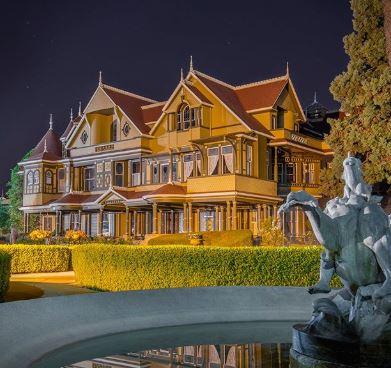
Some people do not believe in ghost. For that matter, some people do not believe in anything. There are persons who even affect incredulity concerning the “Door to Nowhere,” at the Winchester mansion. They said that it did not stand wide open—that it was not a gateway to the Spirit World and that they could have shut it; that the whole affair was a delusion; that they are sure it must have been a conspiracy; that they are doubtful whether there is such a place as the Winchester mansion on the face of the Earth; that the first time they are in California they will look it up. Perhaps, before going further, I ought to premise there was a time when I did not believe in ghosts either. If you had asked me one summer’s morning years ago when you met me on the Golden Gate Bridge if I held such appearances to be probable or possible, you would have received an empathic “No” for answer. However, at this rate, the story of the Door to Nowhere will never be told; so we will, with your permission, plunge into it immediately. I was interested in why this “Door to Nowhere” in the Winchester mansion would not keep shut? They say the place is haunted. What nonsense. There was one thing I can truly say about our office, we were never serious in it. I fancy that is the case in most offices nowadays; at all events, it was the case in ours. We were always chaffing each other, playing practical jokes, telling stupid stories, scamping our work, looking at the clock, counting the weeks to next Christmas, counting the hours to Saturday. For all that we were earnest in our desire to have our salaries raised, and unanimous in the opinion no fellows ever before received such wretched pay. #RandolphHarris 1 of 17

I had $75,000 a year, which I was aware did not half provide for what I ate at home. My mother and sisters left me in no doubt on the point, and when new clothes were wanted I always hated to mention the fact to my poor worried father. We had been better off once, I believe, though I never remember the time. My father owned a small property in the country. I wanted money badly—I must say I never had sixpence in the World of my own—and I thought if I could earn two sovereigns I might buy some trifles I needed for myself, and present my father with a new Ultimate Driving Machine. Then I recalled the amount of the rent was being asked for the Winchester mansion; then I decided gladly this would be a great place to stay if only the ghost turned out of possession. I decided I should like to try to whether, I could not solve the mystery. I was accustomed to lonely houses, and I would not feel at all nervous; I did not believe in ghost, and as for burglars, I was not afraid of them. I was told to just try it out first. To stay in the house for a week; if as tht end of that time I could keep the door shut, locked, bolted, or nailed up, to telegraphy the Winchester Repeating Arms Company, and they would actually pay me to stay there. To me, this sounded like a great bargain. If I lay the ghost, or find out the ghost, I think I ought to have enough money to buy a small house for myself. However, I could not have said what frightened me about this endeavour. A week after I moved into the Queen Anne mansion, Mr. van Buuren from the Winchester Repeating Arms Company came to visit me. He wanted to speak to me about the mansion. I heard a sound of irritation in his voice. “The Winchester Mansion!” he said; “and what have you got to say about the Winchester Mansion?” #RandolphHarris 2 of 17

“That is what I wanted to tell you, Mr. van Buuren,” I answered, and a dead hush seem to fall over the office as I spoke. The silence seemed to attract his attention, for he looked sternly at the clerks, who were not using a pen or moving a finger. “Come this way, then,” he said abruptly; and next minute I was in his private office. “Now, what is it?” he asked, flinging himself into a chair, and addressing me, who stood hat in hand beside the great table in the middle of the room. I began—I will say he was a patient listener—at the very beginning, and told my story straight through. I concealed nothing. I enlarged on nothing. A discharged clerk I stood before him, and in the capacity of a discharged clerk I said what I had to say. He heard me to the end, the he sat silent, thinking. At last he spoke. “You have heard a great deal of conversation about the Winchester, I suppose,” he remarked. “No, sir; I have heard nothing expect what I have told you.” “And why do you desire to strive to solve such a mystery?” “If there is any money to be made, I should like to make it, sir.” “How old are you?” “Two-and-twenty last January.” He laughed—he lay back in his chair and laughed—and I laughed myself, though ruefully. We went on talking for a long time after that; he asked me all about my father and my early life, and how we lived and the people we knew; and, in fact, put more questions than I can well remember. “It seems a crazy thing to do,” he said at las; “and yet I feel disposed to trust you. The house is standing perfectly empty. I cannot live it in, and I cannot get rid of it; all my own furniture I have removed, and there is nothing in the place except a few old-fashioned articles belonging to Mrs. Winchester. The place is a loss to me. It is of no use trying to let it, and thus, in fact, matters are at a deadlock. #RandolphHarris 3 of 17

“You will not be able to find out anything, I know, because, of course, other have tried to solve the mystery ere now; still, if you like to try you may. I will make this bargain with you. If you like to go down, I will pay your reasonable expenses for a fortnight; and if you do any good for me, I will give you a $1,000,000 note for yourself. Of course I must be satisfied that what you have told me is true and that you are what your represent. Do you know anybody in the city who would speak for you?” I could think of no one but my uncle. I hinted to Mr. van Buuren he was no grand enough or rich enough, perhaps, but I knew nobody else to whom I could refer him. “What?!” he said, “Greg Ryan, of Lakeview Street. He does business with us. If he will go bail for your good behaviour I shan’t want any further guarantee. Come along.” And to my intense amazement, he rose, put on his hat, walked me across the outer office and along the pavements till we came to Lakeview Street. “Do you know this youth, Mr. Ryan?” he said, standing in front of my uncle’s desk, and laying a hand on my shoulder. “Of course I do, Mr. van Burren,” answered my uncle, a little apprehensively; for, as he told me afterwards, he could not imagine what mischief I have been up to. “He is my nephew.” “And what is your opinion of him—do you think he is a young fellow I may safely trust?” My uncle smiled, and answered, “That depends on what you wish to trust him with.” “A long column of addition, for instance.” “It would be safer to give that task to somebody else.” “Oh, uncle!” I remonstrated; for I had really striven to conquer my natural antipathy to figures—worked hard, and every bit of it against the collar. My uncle got off his stool, and said, standing with his back to the empty fire-grate: “Tell me what you wish the boy to do, Mr. van Buuren, and I will tell you whether he will suit your purpose of not. I know him, I believe, better than he knows himself.” #RandolphHarris 4 of 17

In an easy, affable way, for so rich a man, Mr. van Buuren took possession of the vacant stool, and nursing his right leg over his left knee, answered: “He wants to go and shut the “Door to Nowhere” at the Winchester Mansion for me. Do you think he can do that? My uncle looked steadily back at the speaker, and said, “I thought, Mr. van Buuren, I was quite settled no one could shut it?” Mr. van Buuren shifted a little uneasily on his seat, and replied: “I did not set your nephew the task he fancies he would like to undertake.” “Have nothing to do with it, Justin, advised my uncle, shortly. “You do not believe in ghost do you, Mr. Ryan?” asked Mr. van Burren, with a slight sneer. “Do you not, Mr. van Buuren?” retorted my uncle. There was a pause—an uncomfortable pause—during the course of which I felt the million dollar note, which in imagination, I had really spent, trembling in the scale. I was not afraid. For one million dollars, or half the money, I would have faced all the inhabitants of spirit land. I longed to tell them so; but something in the way those two men looked at each other stayed my tongue. “If you ask me the question here in the heart of the city, Mr. Ryan,” said Mr. van Buuren, at length, slowly and carefully, “I answer ‘No’; but if you were to put me on a dark night at the Winchester, I should beg time to consider. I do not believe in supernatural phenomena myself, and yet—the ‘Door to Nowhere’ at the Winchester is as much beyond my comprehension as the ebbing and flowing of the sea.” “And you cannot live at the Winchester?” remarked my uncle. “I cannot live at the Winchester, and what is more, I cannot get anyone else to live at the Winchester.” “And you want to get rid of your lease?” “I want so much to get rid of my lease that I told Tuck I would give him a handsome sum if he could induce anyone to solve the mystery. Is there any other information you desire, Mr. Ryan? Because if there is, you have only to ask and have. I feel I am not here in a prosaic office in the city of Santa Clara, but in the Palace of Truth.” #RandolphHarris 5 of 17

My uncle took no notice of the implied compliment. When company is good it needs nothing else. If a man is habitually honest in his speech and in his thoughts, he desires no recognition of the fact. “I do not think so,” he answered; “it is for the boy to say what he will do. If he be advised by me he will stick to his ordinary work in his employers’ office, and leave ghost-hunting and spirit-laying alone.” Mr. van Buuren shot a rapid glance in my direction, a glance which implying a secret understanding, might have influenced my uncle could I have stooped to deceive my uncle. “I cannot stick to my work there any longer,” I said. “I got my marching orders today.” “What had you been doing, Justin? Asked my uncle. “I wanted one million to go and lay the ghost!” I answered, so dejectedly, that both Mr. van Buuren and my uncle broke out laughing. “One Million dollars!” cried my uncle, almost between laughing and crying. “Why, Justin boy, I had rather, poor man though I am, have given thee one million dollars than thou should’st go ghost-hunting or ghost-laying.” When he was very much in earnest my uncle went back to thee and thou his native dialect. I liked the vulgarism, as my mother called it, and I knew my aunt loved to hear him use the caressing words to her. He had risen, not quite from the ranks it is true, but if ever a gentleman came ready born into the World it was Greg Ryan, upon whom at our home everyone seemed to look down. “What will you do, you man?” asked Mr. van Buuren; “you hear what your uncle says, “Give up the enterprise,” and what I say; I do not want either to bribe or force your inclinations.” “I will go, sir,” I answered quite steadily. “I am not afraid, and I should like to show you—” I stopped. I had been going to say, “I should like to show you I am not sure a fool as you all take me for,” but I felt such an address would be too familiar, and refrained. #RandolphHarris 6 of 17

When I got to the Lodge, I showed Mr. van Buuren’s letter to the woman, and received the key. “You are not going to stop up at the Winchester alone, are you, sir? she asked. “Yes, I am,” I answered, uncompromisingly, so uncompromisingly that she said no more. The avenue led straight to the mansion; it was uphill all the way, and bordered by rows of the most magnificent limes I ever beheld. A light iron fence divided the avenue from the park, and between the trunks of the trees I could see the deer browsing and cattle grazing. Ever and anon there came likewise to my ear the sound of a sheep-bell. It was a long avenue, but at length I stood in front of the mansion—a square, solid-looking, Victorian mansion, four stories high, with several towers and a steeply pitched roof, beautiful stained-glass windows and statues, a basement; a flight of steps up to the principal entrance; several windows to the right of the door, several to the left of the door; the whole mansion flanked and backed with trees; all the curtains closed, a dead silence brooding over the place; the sun westering behind the great trees studding the park. I took all this in as I approached, and afterwards as I stood for a moment under then ample porch; then remembering he business which has brought me so far, I fitted the great key in the lock, turned the handle, and entered the Winchester Mansion. For a minute—stepping out of the bright sunlight—the place looked to me so dark that I could scarcely distinguish the objects by which I was surrounded; but my eyes soon grew accustomed to the comparative darkness, and I found I was in an immense hall, lighted from the roof; a magnificent old oak staircase conducted to the upper rooms. #RandolphHarris 7 of 17

The floor was of white marble. There were two fireplaces, fitted with dogs for burning wood; around the walls hung pictures, antlers, and horn, and in odd niches and corners stood groups of statues, and the figure of men in complete suits of armour. To look at the place outside, no one would have expected to find such a hall. I stood lost in amazement and admiration, and then I began to glance more particularly around. Mr. van Buuren has not given me any instructions by which to identify the ghostly chamber—which I concluded would most probably be found on the first floor. I knew nothing of the story connected with it—if there were a story. I was perfectly unencumbered of the mystery. I had not the faintest idea in which apartment it resided. Well, I should discover that, no doubt, for myself ere long. I looked around me—doors—doors—doors. I have never before seen so many doors together all at once. Two of them stood open—one wide, the other slightly ajar. “I will just shut them as a beginning,” I thought, “before I go upstairs.” The doors were of oak, heavy, well-fitting furnished with good locks and sound handles. After I had closed I tried them. Yes, they were quite secure. I ascended the great staircase feeling curiously like an intruder, paced the corridors, entered the many bed chambers—some quite bare of furniture, others containing articles of an ancient fashion, and no doubt of considerable value—chairs, antique dressing-tables, curious wardrobes, and such like. For the most part the doors were closed, and I shut those that stood open before making my way into the attics. I was greatly delighted with the attics. The window lighted them did not, as a rule, overlook the front of the Manion, but commanded wide views over wood, and valley, and meadow. Leaning out of one, I could see, that to the right of the mansion the ground, thickly planted, shelved down to a stream, which came out into the daylight a little distance beyond the plantation, and meandered through the deer part. #RandolphHarris 8 of 17

At the back of the mansion the windows looked out on nothing save a dense wood and a portion of the stable-yard, whilst on the side nearest the point from whence I had come there were spreading gardens surrounded by thick yew hedges, and kitchen-gardens protected by high walls; and further on a farmyard, where I could perceive cows and oxen, and, further still, luxuriant meadows, and fields glad with waying and fruit orchards. “What a beautiful place!” I said. “van Buuren must have been a duffer to leave it.” And then I thought what a great ramshackle house it was for anyone to be in all alone. Getting heated with my long walk, I suppose, made me feel chilly, for I shivered as I drew my head in from the last dormer window, and prepared to go down stairs again. In the attics, as in the other parts of the house I had as yet explored, I closed the doors, when there were keys locking them; when there were not, trying them, and in all cases, leaving the securely fastened. When I reached the ground floor the evening was drawing on apace, and I felt that if I wanted to explore the whole house before dusk I must hurry my proceedings. “I will take the kitchens next,” I decided, and so made my way to a wilderness of domestic offices lying to the rear of the great hall. Stone passages, great kitchens, an immense servants’-hall, larders, pantries, coal-cellars, beer-cellars, laundries, brewhouses, housekeeper’s room—it was not of any use lingering over these details. The mystery that trouble Mr. van Buuren could scarcely lodge amongst cinders and empty bottles, and there did not seem much else left in this part of the building. I would go through the living-rooms, and then decide as to the apartments I should occupy myself. The evening shadows were drawing on apace, so I hurried back into the hall, feeling it was a weird position to be there all alone with those ghostly hollow figures of men in armour, and the statues on which the moon’s beams must fall so coldly. #RandolphHarris 9 of 17

I would just look through the lower apartments and then kindle a fire. I had seen quantities of wood in a cupboard close at hand, and felt that beside a blazing hearth, and after a good cup of tea, I should not feel the solitary sensation which was oppressing me. The sun had sunk below the horizon by this time, for to reach the Winchester I had been obliged to travel by cross lines of railway, and wait besides for such trains as condescended to carry third-class passengers; but here was still light enough in the hall to see all object distinctly. With my own eyes I saw that one of the doors I had shut with my own hands was standing wide! I turned to the door on the other side of the hall. It was as I had left it—closed. This, then, was the room—this with the open door. For a second I stood appalled; I think I was fairly frighted. That did not last long, however. There lay the work I had desired to undertake, the foe I had offered to fight; so without mor ado I shut the door and tried it. “Now I will walk to the end of the hall and see what happens,” I considered. I did so. I walked to the foot of the grand staircase and back again, and looked. The door stood wide open. I went into the room, after just a spasm of irresolution—went in and pulled up the blinds: a good-sized room, twenty by twenty (I knew because I paced it afterwards), lighted by two long windows. The floor, of polished oak, was partially covered with a Turkey carpet. There were two recesses beside the fireplace, one fitted up as a bookcase, the other with an old and elaborately carved cabinet. I was astonished also to find a bedstead in an apartment so little retired from the traffic of the house; and there were also some chairs of an obsolete make, covered, so far as I could make out, with faded tapestry. Beside the bedstead, which stood against the wall opposite to the door I had as yet met with the interior of the house. #RandolphHarris 10 of 17

It was a dreary, gloomy room: the dark panelled walls; the black, shining floor; the windows high from the ground; the antique furniture; the dull four-poster bedstead, with dingy velvet curtains; the gaping chimney; the silk counterpane that looked like a pall. “Any crime might have been committed in which a room,” I thought pettishly; and then I looked at the door critically. Someone had been at the trouble of fitting bolts upon it, for when I passed out I not merely shut the door securely, but bolted it as well. “I will go and get some wood, and then look at it again,” I soliloquized. When I came back it stood wide open once more. “Stay open, then!” I cried in a fury. “I will not trouble myself any more with you tonight!” Almost as I spoke the words, there came a ring at the front door. Echoing through the desolate house, the peal in the then states of my nerves startled me beyond expression. It was only the man who had agreed to bring over my traps. I bade him lay them down in the hall, and while looking out some small silver, asked where the nearest-post-office was to be found. Not far from the Winchester Estate’s Park gates, he said; if I wanted any letter sent, he would drop it in the box for me; the mail-cart picked up the bag at ten o’clock. I had nothing ready to post then, and told him so. Perhaps the money I gave was more than he expected, or perhaps the dreariness of my position impressed him as it had impressed me, for he paused with his hand on the lock, and asked: “Are you going to stop here all alone, master?” “All alone, I answered, with such cheerfulness as was possible under the circumstances.” “That is the room, you know,” he said, nodding in the direction of the open door, and dropping his voice to a whisper. “Yes, I know,” I replied. “What, you have been trying to shut it already, have you? Well, you are a game one!” And with this complimentary if not very respectful comment he hastened out of the house. Evidently he had no intention of proffering his services towards the solution of the mystery. #RandolphHarris 11 of 17

I cast one glance at the door—it stood wide open. Through the windows I had left bare to the night, moonlight was beginning to stream cold and silvery. “Look here, Justin,” I said, all of a sudden; “life is not child’s play, as uncle truly remarks. That door is just the trouble you have now to face, and you must face it! However, for that door you would never have been here. I hope you are not going to turn coward the very first night. Courage!—that is your enemy—conquer it.” “I will try,” my other self answered back. “I can but try. I can but faith.” The moon’s beams were streaming down upon the mansion; I could see every statue, every square of marble, every piece of armour. For all the World it seemed to me like something in a dream; but I was tired and sleepy, and decided I would not trouble about fire or food, or the open door, till the next morning: I would go to sleep. However, I felt like an army of Devil’s was horribly broke in upon this place which is the center, and after a sort, the first-born of our Californian settlements. If a ghost was responsible for the hanging of nineteen people in this mansion, what was responsible for the burning of nine hundred people? What more likely time would the “Door to Nowhere” open up and let our arch-enemy, the Devil, choose a time for his attack? I spent the forenoon considering that door. I looked at it from within and from without. It was on the second floor and opened up to a two story drop outside of the house. What would possess someone to build a door like this, unless they had some knowledge of it being a portal? I eyed it critically. I tried whether there was any reason why it should fly open, and I found that so long as I remained on the threshold it remained closed; if I walked even so far away as the opposite side of the mansion, it swung wide. #RandolphHarris 12 of 17

Do what I would, it burst from latch and bolt. I could not lock it because there was no key. I was baffled. Then I stumbled upon a note which read: “One that shall use, practise, or exercise any invocation or conjuration of any evil or wicked spirit, or consult, convenient with, entertain or employ, feed or reward any evil or wicked spirit, to or for any intent or purpose; or take up any dead man, woman, or child, out of his, her, or their grave, or any other place, where the dead body resteth; or the skin, bone, or other part of any dead person, to be employed or used in any manner of witchcraft, sorcery, charm or enchantment; or shall use, practise, or exercise any witchcraft, enchantment, charm, or sorcery, whereby any person shall be killed, destroyed, wasted, consumed, pined, or lamed in his or her body, or any part thereof: such offenders duly and lawfully convicted and attained, shall suffer death.” Then it dawned of me. Perhaps the mansion has been attraction people who are into the occult and they are the nearly 920 people who have been burned alive or hanged. And that is why the house cannot find renters, it consumes them all. Perhaps this is something like the Atonement of Christ. How God gave His one and only Son to pay the wages of sin man had created, this mansion is consuming souls of those who practise the occult to atone for the death of those killed by the Winchester rifle. The afflicted state of our poor neighbours that are now suffering by molestations from the invisible World, we apprehended so deplorable that we think their condition calls for the utmost help of all persons in their several capacities. We cannot but with all thankfulness acknowledge the success which the merciful God has given unto the sedulous and assiduous endeavours of our honorable rulers to detect the abominable witchcrafts which have been committed in the country, humbly praying that the discovery of these mysterious and mischievous wickedness may be perfected. #RandolphHarris 13 of 17

We judge that in the prosecution of these, and all such witchcrafts, there is need of a very critical and exquisite caution, leas by too much credulity for things received only upon the Devil’s authority there be a door opened for a long train of miserable consequences, and Satan get an advantage over us, for we should not be ignorant of his devices. After all, it was this mansion people could not live in—his door that would not keep shut; and it seemed to me these were facts he might dislike being forced upon the attention of the public. What had I seen? What did I think of the matter? Very honestly I did not know what to say. The door certainly would not remain shut, and there seemed no human agency to account for its persistent opening; but then, on the other hand, ghost generally did no tamper with fire arms, and my rifle, though not loaded, had been tampered with—I was sure of that. Mr. van Buuren later disclosed to me his theory that open door: “This is the room my uncle was murdered in, they say the door will never remain shut till the murderer is discovered.” “Murdered!” I did not like the word at all; it made me feel chill and uncomfortable. “Yes—he was murdered sitting in his chair, and the assassin has never been discovered. At first many persons inclined to the belief that I killed him; indeed, may are of that opinion still. “But you did not, sir—there is not a word of truth in that story, is there?” He laid his hand on my shoulder as he said: “No, my lad; not a word. I loved the old man tenderly. Even when he disinherited me for the sake of his young wife, I was worry, but not angry; and when he sent for me and assured me he had resolved to repair a wrong, I tried to induce him to leave the lady a handsome sum in addition to her jointure. “If you do not, people may think she has not been the source of happiness you expected,” I added. “Thank you, Reuban,” he said. “You are a goof fella; we will talk further about this tomorrow.” And then he bade me goodnight. #RandolphHarris 14 of 17

“Before morning broke—it was in the about one hundred years ago—the household was arounds by a fearful scream. It was his death-cry. He had been stabbed from behind in the neck. He was seated in his chair writing—writing a letter in Latin. Part of it said, ‘Exorcizo te, immundissime spiritus, omnis incursion adversarii, omne phanatasma, omnis leigo, in nominee Domini nostri Jesu Christi eradicare, et effugare ab hoc plasmate Dei.’ The rest of the letter was torn. His solicitor came forward and said he had signed a will leaving all his personalty to me—he was very rich—unconditionally, only three days previously.” Mr. van Buuren went away, and I stayed in the house. I never left it all day. I did not go into the garden, or the stable-yard, or the shrubbery, or anywhere; I devoted myself solely and exclusively to that door. If I shut it once, I shut it a hundred times, and always with the same result. Do what I would, it swung wide. Never, however, when I was looking at it. So long as I could endure to remain, it stayed shut—the instant I turned back, it stood open. Though feeling convinced that no human agency did or could keep the door open, I was certain that some living person had means of access to the house which I could not discover. This was made apparent in trifles which might well have escaped unnoticed had several or even two people occupied the mansion. In the dead of the night a noise, resembling the clashing of iron, was frequently heard, which, if you listened more attentively, sound like the rattling of chains, distant at first, but approaching nearer by degrees: immediately afterward a spectre appeared in the form of an old man, of extremely emaciated and squalid appearance, with a long beard and dischevelled hair, rattling the chains on his feet and hands. The distressed occupants meanwhile passed their wakeful nights under the most dreadful terrors imaginable. This, as it broke their rest, ruined their health, and brought on distempers, their terrors grew upon them, and death ensued. #RandolphHarris 15 of 17

Even in the daytime, though the spirit did not appear, yet the impression remained so strong upon their imaginations that it still seemed before their eyes, and kept them in perpetual alarm. Consequently the mansion was at length deserted, as being deemed absolutely uninhabitable; so that it was now entirely abandoned to the ghost of the Winchester rifle. That night, I prepared to retire. However, I was open to the vain terrors of imaginary noises and spirits. The first part of the night passed in entire silence, as usual; at length a clanking of iron and rattling of chains was heard: however, I neither lifted up my eyes, nor got out of bed, but in order to keep calm, I pretended the sound was something else. The noise increased and advanced nearer, until it seemed at the door, and at last in my chamber. I looked up, saw, and recognized the ghost exactly as it has been described to me: it stood before me, beckoning with a finger, like a person calls another. I immediately arouse, and, candle in hand, followed it. The ghost slowly stalked along as if encumbered with its chains, and, turning into the area of the house where the “Door to Nowhere, was and suddenly vanished. What an idiot I have been! If I wanted to solve the mystery of the open door, or course I must keep watch in the room itself. The door would not stay wide unless there was a reason for it. When I walked into the room, it was deadly cold, and the scene was horrible. The door was wide open. A party of ghosts were assembled with, and were feasting on the flesh of corpses. I was astonished by this hideous banquet. As soon as I could safely escape, I stole back into my bed. I was rather crossed at being disturbed. The next day word on—the long, dreary day; evening approached—the night shadows closed over the Winchester mansion. The moon would not rise for a couple hours more. Everything was still as death. The house had never before seemed to me so silent and so deserted. #RandolphHarris 16 of 17

I took a candle, and went up to my accustomed room, moving about for a time as though preparing for bed; then I extinguished the candle, softly open the door, turned the key, and put it in my pocket, slipped softly downstairs, across the hall, through the open dor. Then I knew I had been afraid, for I felt a thrill of terror as in the dark I stepped over the threshold. I paused and listened—there was not a sound—the night was still and sultry, as though a storm were brewing. Not a leaf seemed moving. Noiselessly I made my way to the other side of the room. There was an old-fashioned easy-chair between the bookshelves and the bed; I sat down in it, shrouded by the heavy curtains. The hours passed—where ever hours so long? The moon rose, came and looked in at the windows, and then sailed away to the west; but not sound, no, not even the cry of a bird. I seemed to myself a mere collection of nerves. Every part of my body appeared twitching. It was agony to remain still; the desire to move became a form of torture. The locked door opened—so suddenly, so silently, that I barely had time to draw back behind the curtain, before I saw a woman in the room. A slight, lithe woman, not a lady, clad in all black—not a bit of white about her. What on Earth could she want? Then she fell on me with her nails and teeth, and tore at my throat, she was as strong as twenty devils. I felt something like a red-hot iron enter my neck. She opened a vein and sucked by blood, and I could but rush from the room before I fell senseless on the marble pavement of the hall. When the post man came that morning, finding no one stirring, he looked through one of the long windows that flanked the door; then he ran to the farmyard and called for help. “There is something wrong inside,” he cried. “That young gentleman is lying on the floor in a blood of blood.” To this day, the “Door to Nowhere” is still a mystery. #RandolphHarris 17 of 17

Winchester Mystery House

24 Hours till opening night of All Hallows’ Eve and our caretakers are working non stop to put the finishing touches on the show! Be here for the opening weekend! Tickets are still available. A 160-room mansion built to appease the spirits who died at the hands of the Winchester Rifle 👻
All Hallows’ Eve:
🎟️ Link in bio. 🗝 winchestermysteryhouse.com

He Was Haunted By an Invisible Presence!

The facts which I am about to relate happened to myself some sixteen or eighteen years ago, at which time I was still young enough to enjoy a life of constant travelling. There are, indeed, many less agreeable ways in which an unbeneficent parson may contrive to scorn delights and live laborious days. In remote places where strangers are scarce, his annual visit is an important evet; and though at the close of a long day’s work he would sometimes prefer the quiet of a Victorian mansion, he generally finds himself the destined guest of the rector or the squire. It rests with himself to turn these opportunities to account. If he makes himself pleasant, he forms agreeable friendships and sees Victorian home-life under one of its most attractive aspects; and sometimes, even in these days of universal common-placeness, he may have the luck to meet with an adventure. My first appointment was to Llanda Villa ; which was largely peopled with my personal friends and connections. It was, therefore, much to my annoyance that I found myself, after a could of years very pleasant work, transferred to a new teaching position. I now spent half my time in hired vehicles and lonely country inns. I had been in possession of this position for some three months or so, and winter was near at hand, when I paid my first visit of inspection to the Winchester mansion. It was a dull, raw afternoon of mid-November, growing duller and more raw as the day waned and the east wind blew keener. I found the foot path without difficulty. It led me across a barren slope divided by stone fences, with here and there a group of smaller Victorian houses and gazebos. #RandolphHarris 1 of 14

A light fog, meanwhile, was creeping up from the east, and the dusk was gathering fast. Now, to lose one’s way on such an expansive ranch and at such an hour would be disagreeable enough, and the footpath—a trodden track already half obliterated—would be indistinguishable enough in the course of another ten minutes, but the nine story look out tower, a top the mansion, stood erect as a compass guiding visitors to the bizarre and beautiful rambling mansion. Looking anxiously ahead, up to this moment, I had not met a living soul. However, then I saw a man emerging from the fog and coming along the path. As we neared each other—I advancing rapidly; he slowly—I observed that he dragged the left foot, limping as he walked. It was, however, so dark and so misty, that not till we were within half a dozen yards of each other could I see that he wore a dark suit and an Anglican felt hat, and looked something like a dissenting minister. As soon as we were within speaking distance, I addressed him. “Can you tell me, I said, about how much longer it will take to get to the Winchester mansion?” He came on, looking straight before him; taking no notice of my question; apparently not hearing it. “I beg your pardon,” I said, raising my voice; “but how much longer will it take on this path to get to the Winchester?” He had passed on without pausing; without looking at me; I could almost have believed, without seeing me! I stopped, with the words on my lips; then turned to look after—perhaps, to follow—him. But instead of following, I stood betwixted. What had become of him? #RandolphHarris 2 of 14

And what lad was that going up the path by which I had just come—that tall lad, half-running, half-walking, with a fishing-rod over his shoulder? I could have taken my oath that I had neither met nor passed him. Where then had he come from? And where was the man to whom I had spoken not three seconds ago and who, at his limping pace, could have made more than a couple of yards in the time? My stupefaction was such that I stood quite still, looking after the lad with the fishing-rod till he disappeared in the gloom under the park-palings. Was I dreaming? Darkness, meanwhile, had closed in apace, and, dreaming or not dreaming, I must push on, or find myself benighted. So I hurried forward, turning my back on the last gleam of daylight, and plunging deeper into the fog at every step. I was, however, close upon my journey’s end. The path ended at a turnstile; the turnstile opened upon a steep lane; and at the bottom of the land, down which I stumbled among stones and ruts, I came in sight of the welcome glare of a blacksmith’s forge. Here, then, was the Winchester. I found myself at the door of the Winchester mansion. When I was sitting in the cozy drawing room, I saw Mrs. Winchester, and she looked like an angel. Spreading loveliness everywhere, over all with whom she came in touch, over good and evil. When a small number of people often come together in the same room, a tradition readily develops as to where each individual has one’s place, one’s station; it becomes a kind of picture a person can unroll for oneself when one so desires, a map of the terrain. So it is also with us in the Winchester mansion—together we form a picture. We were to drink tea here this evening. #RandolphHarris 3 of 14

Mrs. Winchester strives for an air of mystery. She wants to whisper and usually does it so well that she becomes entirely mute; I make no secret of my effusions to Merriam, her niece, an estimate of how many quarts of milk it takes for one pound of butter through the medium of cream and the dialectic of the butter churn. Indeed, it is not only something any young girl can listen to without hard, but, what is far more unusual, it is a solid and fundamental and edifying conversation that is equally ennobling to the head and the heart. And is no nature magnificent and wise in what she produces, what a precious gift is butter, what a glorious accomplishment of nature and art! It is a curious picture we make together. Mrs. Winchester almost vanishes before our eyes in pure agronomy; we go into the kitchen and the cellars, up into the attic, look at the chicken and ducks, geese et cetera. This was fascinating to me. But it could just be that I was the kind of young man who became old prematurely; it is possible. I sat late over the fire, and by the time I went to bed, I had well nigh forgotten my adventure with the man who vanished so mysteriously and the boy who seemed to come from nowhere. Next morning, finding I had abundant time at my disposal. What a reinvigorating power I felt from the Winchester—not the freshness of the morning air, not the sighing of the wind, not the coolness of the sea, not the fragrance of wine, its aroma—nothing in the World has this reinvigorating power. In this way the days go by. Mrs. Winchester seemed perfect happy in her mansion. Her bedroom faced the courtyard. Sometimes she stands on the balcony for a moment, and at night she looks up at the stars, unseen by all. #RandolphHarris 4 of 14

In these nocturnal hours, I walk around like a ghost. Then I forget everything, have no plans, no reckonings, cast understanding overboard, expand and fortify my chest with deep sighs, a motion I need in order not to suffer from my systematic conduct. Others are virtuous by day, sin at night; I am dissimulation by day—at night I am sheer inspiration. When I notice it, far off on the horizon there comes a flashing intimation from a quite different World, to the astonishment of Mrs. Winchester as well as Merriam. Mrs. Winchester sees the lightning but hears nothing; Merriam hears the voice but sees nothing. However, at the same moment everything is in its quiet order; the conversation between Mrs. Winchester and me proceeds in its uniform way, like post horses in the stillness of the night the; the sad hum of the samovar accompanies it. At such moments, it can sometimes be uncomfortable in the drawing room, especially for Merriam. She has no one she can talk with or listen to. I can well understand that it must seem to Merriam as if Mrs. Winchester were bewitched, so perfectly does she move to the tempo of my rhythm. She cannot participate in this conversation either, because one of the means I have also used to outrage her is that I allow myself to treat her just like a child. It is not as if I for that reason would allow myself any liberties whatever with her, far from it. I well know the upsetting effects such things can have, and the point is that her womanliness must be able to rise up pure and beautiful again. Because of my intimate relationship with Mrs. Winchester, it is easy for me to treat her like a child who has no understanding of the World. #RandolphHarris 5 of 14

Her womanliness is not insulted thereby but merely neutralized, for the fact that she does not know market prices cannot insult her womanliness, but the supposition that this is the ultimate in life can certainly be revolting to her. With my powerful assistance on this scored, Mrs. Winchester is out doing herself. She has become almost fanatic—something she can thank me for. The only thing about me that she cannot stand is that I have no position. Now I have adopted the habit of saying whenever a vacancy in some office is mentioned: “There is a position for me,” and thereupon discuss it very gravely with her. Merriam always perceives the irony, which is precisely what I want. The butler came in with more tea. I saw that he was lame. In the moment I remembered him. He was the man I met in the fog. “I met you yesterday afternoon, Mr. Brunton,” I said, as we went into the library. “Yesterday afternoon, sir?” He repeated. “You did not seem to observe me,” I said, carelessly. “I spoke to you, in fact; but you did not reply to me.” “But—indeed, I beg your parson, sir—it must have been someone else,” said the butler. “I did not go out yesterday afternoon.” How could this be anything but a falsehood? I might have been mistaken as to the man’s face; though it was such a singular face, and I had seen it quite plainly. However, how could I be mistaken as to his lameness? Besides, that curious trailing of the right foot, as if the ankle was broken, was not an ordinary lameness. I suppose I looked incredulous, for he added, hastily. “Even if I had not been preparing dinner for inspection, sire, I should not have gone out yesterday afternoon. It was too damp and foggy. I am obliged to be careful—I have a very delicate chest.” #RandolphHarris 6 of 14

My dislike to the man increased with every word he uttered. I did not ask myself with what motive he want on heaping lie upon lie; it was enough that, to serve his own ends, whatever those ends might be, he did lie with unparalleled audacity. “We will proceed to the examination, Mr. Brunton,” I said, contemptuously. He turned, if possible, a shade paler than before, bent his head silently, and called up the cuisine in their order. Profusely apologizing, he begged leave to occupy five minutes of my valuable time. He wished, under correction, to suggest a little improvement to many the menu more festive. “Under other circumstances…” I stopped and looked round. The butler repeated my last words. “You were saying, sir—under other circumstances?” I looked around again. “I seemed to me that there was someone here,” I said; “some third person, not a moment ago.” “I beg your pardon, sir—a third person?” “I saw his shadow on the ground, between yours and mine.” The mansion faced due north, and we were standing immediately behind it, with our backs to the sun. The place was bare, and open, and high; and our shadows, sharply defined, lay stretched before our feet. “A—a shadow?” he faltered. “Impossible.” There was not a bush or a true within half a mile. There was not a could in the sky. There was nothing, absolutely nothing, that could have cast a shadow. I admitted that t was impossible, and that I must have fancied it; and so went back to the matter of the menu. “Should you see Mrs. Winchester,” I said, “you are at liberty to say that I thought it a desirable improvement.” #RandolphHarris 7 of 14

“I am much obliged to you, sir. Thank you—thank you very much,” he said, cringing at every word. “But—but I had hoped that you might perhaps use your influence”—“Look there!” I interrupted. “Is that fancy?” We were now close under the blank walls of the kitchen. On this wall, laying to the full sunlight, our shadows—mine and the butler’s—were projected. And there too—no longer between his and mine, but a little way apart, as if the intruder were standing back—there, as sharply defined as if cast by line-light on a prepared background, I again distinctly saw, though but for a moment, that third shadow. As I spoke, as I looked round, it was gone! “Did you not see it?” I asked. He shook his head. “I—I saw nothing” he said, faintly. “What was it?” His lips were white. He seemed scarcely able to stand. “But you must have seen it!” I exclaimed. “It fell just there—where that bit of ivy grows. There must be some boy hiding—it was a boy’s shadow, I am confident. “A boy’s shadow!” he echoed, looking round in a wild, frightened way. “There is no place—for a boy—to hide.” “Place or no place,” I said, angrily, “if I catch him, he shall feel the weight of my cane!” I searched backwards and forwards in every direction, the butler, with his scared face, limping at my heels; but, rough and irregular as the ground was, there was not a hole in it big enough to shelter a rabbit. “But what was it?” I said, impatiently. “An—an illusion. Begging your pardon, sir—and illusion.” He looked so like a beaten hound, so frightened, so fawning, that I felt I could with lively satisfaction have transferred the threatened caning to his own shoulders. #RandolphHarris 8 of 14

“But you saw it?” I said, impatiently. “No, sir. Upon my honour, no, sir. I saw nothing—nothing whatever.” His looks belied his words. I felt certain that he had not only seen the shadow, but that he knew more about it than he chose to tell. I was by this time really angry. To be made the object of a boyish trick, and to be hoodwinked by the connivance of the butler, was too much. It was an insult to myself and my office. I scarcely knew what I said; something short and stern at all events. Then, having said it, I turned my back upon Mr. Brunton and the mansion, and walked rapidly back to the village. As I was leaving the Winchester, it was a gloomy evening. I was standing high in the midst of a somber deer-park some six or seven miles in circumference. An avenue of palm trees, which led up to the house looked so lonely. The butler said, “If you would but be persuaded to say a day longer, a new experience awaits you. I will take you down the Winchester shaft, and show you the home of the gnomes and trolls. I am the king of Hades, and rule the under World as well as the upper. There is gold everywhere underlying this mansion. The whole place is honeycombed with shafts and galleries. One of our richest seams runs under this house, and there are upwards of forty men at work in it a quarter of a mile below our feet here every day. Another leads right away under the park, Heaven only knows how far! My father began working it five-and-twenty years ago, and we have gone on working it ever since; yet it shows no sign of failing. That is why Mrs. Winchester is rich enough to commit whatever design follies she pleases; and that is saying a good deal. #RandolphHarris 9 of 14

“But then, to be always squandering money—always building a rambling mansion—always gratifying the impulse of the moment—is that happiness? Mrs. Winchester has been experimenting for several decades; and with what result? Would you like to see?” He snatched up a lamp and led the way through a long suite of unfinished rooms, the floors of which were piled high with packing cases of all sizes and shapes, labelled with the names of various foreign ports and the addresses of foreign agents innumerable. What did they contain? Precious marbles from Italy and Greece and Asia Minor; priceless paintings by old and modern masters; antiquities from the Nile, the Tigris, and the Euphrates; enamels from Persia, porcelain from China, bronzes from Japan, strange sculptures from Peru; arms, mosaics, ivories, wood-carvings, skins, tapestries, old Italian cabinets, painted bride-chess, Etruscan terracottas; treasures of all countries, or all ages, never even unpacked since they crossed that threshold which the mistress’s foot had crossed but twice during the ten years it had taken to buy them! Should she ever open them, ever arrange them, every enjoy them? Perhaps—if she becomes weary of wandering—if she remarried—if she built a gallery to receive them. If not—well, she might found and endow a museum; or leave the things to the nation. What did it matter? Collecting was like fox-hunting; the pleasure in the pursuit, and ended with it!” Breakfast over, we went around the mansion, and saw the men working. Just as we were about to enter an underground tunnel—a tall, slender lad, with a fishing rod across his shoulder, came out rom one of the side doors of the mansion, crossed the open at field, and disappeared among the tree-trunks on the opposite side. I recognized him instantly. It was the boy whom I saw the other day, just after meeting the butler in the meadow. #RandolphHarris 10 of 14

“If the boy think he is going fishing in a fruit orchard,” I said, “he will find out his mistake.” “What boy,” asked Mr. Brunton, looking back. “That boy who crossed over yonder, a minute ago.” “Yonder!—in front of us?” “Certainly. You must have seen him?” “No I.” “You did no see him?—a tall, thin boy, in a grey suit, with a fishing-rod over his shoulder. He disappeared behind those nectarine trees.” Mr. Brunton looked at me with surprise. “You are dreaming!” he said. “No living thing—not even a rabbit—has crossed our path since we left the mansion.” “I am not in the habit of dreaming with my eyes open,” I replied, quickly. He laughed, and put his arm through mine. “Eyes or no eyes,” he said, “you are under an illusion this time!” An illusion—the very word made use of by the butler! What did it mean? Could I, in truth, no longer rely upon the testimony of my senses? A thousand half-formed apprehensions flashed across me in a moment, I remembered the illusions of Nicolini, the bookseller, and other similar cases of visual hallucination, and I asked myself if I has suddenly become afflicted in like manner. “By jove! This is a queer sight!” exclaimed Mr. Brunton. And then I found that we had emerged from the fruit orchard, and were looking down upon the bed of what yesterday was a lake. It was indeed a queer sight—an oblong, irregular basin of the blackest slime, with here and there a sullen pool, and round the margin an irregular fringe of bulrushes. At some little distance along the bank—less than quarter of a mile from where we were standing—a gaping crowd had gathered. All the foremen seemed to turn out to stare. #RandolphHarris 11 of 14

Hats were pulled off and curtsies dropped at Mr. Brunton’s approach. He, meanwhile, came up smiling, with a pleasant word for everyone. “Well,” he said, “are you looking for the lake, my friends?” “I see a log of rotten timber sticking half in and half out of the mud,” one of the men said, “and something—a long reed, apparently…by Jove! I believe it is a fishing rod!” “It is a fishin’ rod, squire,” said the blacksmith with rough earnestness; “an” if yon rotten timber bayn’t an unburied corpse, mun I never stroike hammer on anvil agin!” There was a buzz of acquiescence from the bystanders. ‘Twas an unburied corpse, such enough. Nobody doubted it. “It must have come out, whatever it is, Mr. Brunton said presently. “Five feet of mud, do you say? Then here is a sovereign apiece for the first two fellows who wade through it and bring that object to land!” It was, in truth, an unburied corpse; part of the trunk only above the surface. They tried to life it; but it had been so long under water, and was in so advanced a stage of decomposition, that to bring it to shore without a shutter was impossible. Being cross-questioned, they thought, from the slenderness of the form, that it must be the body of a boy. “There’s the poor chap’s rod, anyhow,” said the blacksmith, laying it gently down upon the turf. Mrs. Winchester was summoned and told of the news. That night she rushed to her blue séance room and demanded the spirits tell her what happened to the boy. “I invoke thee, and move thee, and stir thee up O Spirit Leraikha,” said Mrs. Winchester. “From the 30 Legions of Spirits, appear unto my eyes before the circle in the likeness of a man in and tell me what has happened to this boy!” #RandolphHarris 12 of 14

“The words Adam spoke to God, and all things of water were as blood,” replied the Spirit Leraikha. “In the names Alpha and Omega, I am the God of Secret Truth who liveth forever, the All-Powerful. It is to I, to whom all creatures are obedient and in the Extreme Justice and Anger of God that I withdrawal this veil that is before the glory of God, might; and by the creatures of living breath before the Thone whose eyes are east and west; by the fire in the fire of just Glory of Mine Throne; by the Holy ones of Heaven; and by the secret wisdom of God, I, exalted in power, has been stirred up to cast a vision of the past and make clear the present! The secrets of truth in voice and understanding comes: This is the corpse of a boy of perhaps ten and four or ten and five years of age. There was a fracture three inches long at the back of the skull, evidently fatal. This might, of course, have been an accidental injury; but when the body came to be raised from where it layeth, it was found to be pinned down by a pitchfork, the handle of which had been afterwards whittled off, so as not to show above water, a discovery tantamount to evidence of murder. The features of the victim were decomposed beyond recognition; but enough of the hair remained to show that it has been short and sandy. He had a passion for fishing and was in the habit of slipping away at school-hours, and showed himself the more cunning and obstinate more he was punished. At last there came a day when the butler tracked him to the place his rod was concealed and beat the miserable lad about the head and arms with a heavy stick. Pin through hand and blood was running out of his mouth until he fell insensible and ceased to breathe. He dragged the body among the bulrushes by the water’s edge, and there concealed it as well as he could. #RandolphHarris 13 of 14

“At night, when the neighbours and staff were in bed asleep, he stole out by starlight, taking with him a pitchfork, a coil of rope, a couple of iron-bars, and a knife. He weighted and sunk the corpse, and pinned it down by the neck with his pitchfork. He then cut away the handle of the fork; hid the fishing-rod among the reeds; and believed, as murderers always believe, that discovery was impossible. His dreadful secret had of late become intolerable. He was haunted by an invisible Presence. That Presence sat with him at table, followed him in his walks stood behind him in the mansion, and watched by his side. He never saw it; but he felt that it was always there. Sometimes he raves of a shadow on the walls of this mansion. I have now told you all that there is at present to tell.” When a community looks only for evidence of guilt and ignores or suppresses all contradictory evidence, the result is a witch hunt. Witch hunts are often used to conceal more heinous crimes. And when a witch hunt occurs, which is the very opposite of what was going on in the case of the murdered boy, the community feels itself so beset by evil that it is no longer capable of perceiving the good. The primary causes of witch hunts are clear. It is usually due to corruption, an outbreak of epidemic hysteria which usually ordinates in experiments with the occult. And the hysterical hallucinations of the afflicted persons are confirmed by some concrete evidence of actual witchcraft and by many confessions, the majority of them hysterical. A number of other explanations have been offered, but most of them are more or less unconvincing. It has been argued that the outbreak is usually due to some new religion. Typically a kind of insanity resulting from sexual repression or denying one’s true sexual nature. #RandolphHarris 14 of 14

Winchester Mystery House

It’s a beautiful day for a stroll through the gardens. Today, Winchester Mystery House marks 99 years since our lady of mystery, Sarah Winchester passed away peacefully in her bedroom of Llanda Villa. We mark her passing with the ringing of the bell 13 times as is our tradition. Thank you Sarah for creating this iconic home that we continue to share with guests from around the world.
🎟️ Link in bio.

A 160-room mansion built to appease the spirits who died at the hands of the Winchester Rifle 👻
🗝 winchestermysteryhouse.com

In a Nightmare of Supernatural Terror–Afraid to Move Hand or Foot!

The warning came too late to change that course of event. There has been time when many admitted some doubt of the validity of spectral evidence. This story I will tell to you now, as I have promised to do so, and yet I can hardly make you believe in the reluctance with which I even allow my thoughts go back to the times which I spent in my house—my first town residence after I was married. I loved so much my lovely mansion, I suppose. The wide emerald green lawns and quiet, glassy ponds and streams, bordered by luscious, blooming rhododendrons; of silent, mossy avenues, glorious with the flickering light that stole through pale green beech leaves; of rose gardens with grassy paths, jewel-sprinkled with shell-like petals of white, crimson, pink, and cream-like hues; of old-fashioned rooms with narrow, mullioned windows embowered in scarlet japonica and fragrant, starry jessamine. I supposed I possessed a deep love of them all. This was the first house we were sown in the Santa Clara, California. It was certainly a very fine house, both as o exterior and interior appearances. Large, massively built, agreeably darkened in woodwork and masonry by Time’s shading brush, in excellent repair, and the locality all that could be desire. Wide, lofty apartments, staircases, and landings; a handsome dining-room panelled in velvety dark-green “flock” and gold; a handsome drawing-room panelled in pale cream-colour and gold; airy bed-chambers and dressing-rooms—one, in particular, attached to what seemed the principal bedroom, with a vast mirror occupying the whole side of the apartment which was opposite to the door leading into the bed-chamber. #RandolphHarris 1 of 16

“What a nice dressing-room! This house is perfect and expansion will be a joy.” I exclaimed, having a weakness, I confess, for large, handsome mirrors in the rooms I inhabit—William says impertinent things about my “wishing to see as much of myself as I can.” I know I am not all, in fact, rather what he should call petite, if he wished to be polite—but that is not my reason for liking a large mirror. As I spoke the words I looked about mechanically for the house—agent’s clerk who had been sent with us—a nervous-looking little man, with a pasty complexion, and orange-colored hair meekly plastered down at each side of his face. He had been untiringly trotting up and down stairs, unlocking doors, answering questions, and keeping up a harmless soliloquy of chatter about the beauties and excellencies of the “mansiond,” as he called it, ever since he entered its doors, but now he was nowhere to be seen. “What door have you open?” I said, speaking aloud to him, for suddenly a cold blast of air swept up the wide staircase and into the dressing-room door, but not entering. His face looked wither than before, and in his accents there was an almost terrified earnestness that puzzled me. The shadows of the afternoon seemed to deepen. The aspect of the suites of rooms and long silent corridors, with their doors ajar, as if unseen inhabitants were stealthily crouching behind them, drearily impressed me with a sense of dull desolation; and it was with a sudden sensation of childish fear and loneliness that I rushed after my husband, and took his arm as he hastily descended the stairs. #RandolphHarris 2 of 16

“A spacious, handsome staircase, William” I remarked. “Yes; and a spacious, handsome price, you may be sure,” William responded. However, in this particular, he was exceedingly, and I agreeably, astonished. To our surprise, the house was rather affordable. William figured there must be a screw loose somewhere. He mentioned his opinion to the clerk in a more business-like expression, to the effect that the price seemed low, and that he trusted there was no—peculiar—eh? “Drains, gas, water, all right, sir—right as—a—a trivet, sir. However, the 18-room farmhouse is incomplete,” sad the clerk, looking over his shoulder oddly, as he spoke. “But chimneys, ventilators, roof, tiles—everything in the perfect repair and order, sir!” However, wonderful or not, the house seemed all that we could desire; the lowness of the price made it a decided bargain. I planned to expand the house, and make it even more lofty, and handsome; and in three weeks, huge furniture vanes, and a clever upholstered, had carpeted, curtained, and furnished our town mansion from garret to basement, and William and I, our two babies, a nurse, two maids, a cook, and a butler, were installed in what would become the Winchester Mansion. Dear William had been very generous—nay, almost extravagant—in his provisions for the comfort and pleasure of his wife and children; and my dressing-room and their nursery were fitted up so luxuriously and tastefully, that my feeling at the first inspection of them was that of self-gratulation on being such a fortunate woman, in having such a home, such babies, and such a husband. #RandolphHarris 3 of 16

I arrayed myself for dinner that evening quite gleefully; standing before my splendid mirror amid the bule drapery, cushions, and couches of my charming dressing-room. I put on William’s favourite dress—a bronze-brown lustrous silk, with sparkling gold ornaments: he invariably kissed me when he saw it on, stroked my brown curls and face, and called me “Mrs. Winchester”—and was still standing before the glass smiling at myself, like the happy, foolish little woman I was, when I perceived to my discomfiture that William was standing in the doorway watching my doings, and grinning very visibly under his moustache. “Do not mind me, my dear, I beg! do not me the least. However, when you have done admiring Mrs. Winchester, perhaps you will be kind enough to let me know”—then, suddenly changing his tone, he exclaimed, “Have you the window open, Sarah, this chilly evening?” “No William,” I replied, glancing at it to make sure of the fact. “Change in the weather, then,” my husband said. “Come, Sarah, there is no use in making yourself any prettier!” He had just uttered the last words when I saw him spring aside suddenly, and look around. “What is the matter?” I said—“William, dear, what is the matter?” For his face had grown quite white, and with his back against the wall, he was staring about him wildly. “I do not know—Sarah—something”—he explained in a low tone; then recovering himself, with a laugh, he cried—“I struck myself against the door, I suppose! I declare one would think I was composed of old china, or wax, or sugar candy, I hurt and stunned me so! Come, dearest.” #RandolphHarris 4 of 16

He had not struck himself, for I had been watching him going out on the lobby, and I felt an uneasy conviction that he knew he had not done so, and only spoke as he did in order to deceive or satisfy me. why? Why did I think so? As I live I cannot tell why I thought so then—I know now. We had the “babies”—as William always called them—in the dessert, after the time-honoured fashion of making olives as well as olive branches of them; and then, when the lite ones had gone to bed, we sat side by side in he summer twilight, I lazily fanning myself, William bending over me the lover-husband he was. Then came the lamps, and I played for him, and we sang duet and spent as happy an evening in our new home as a married pair could wish to spend. I cannot tell why I felt so disinclined to go upstairs that night, tired as I was, too—for we had had a long journey up from the country. However as eleven struck, I routed William out of the easy chair where he had been indulging in a preliminary doze, and, ringing for my maid went up to my dressing-room. I like gas in my dressing-room, though not in my bedroom, and the globes at either side the great mirror were a blaze of light. As I entered I caught the reflection of a woman’s figure in the depths of the glass, no my maid’s. The glimpse I had was of a tall woman, strongly built, and broad-shouldered, a quantity of light hair hanging in a disordered manner on her neck, and the profile of a white, hard, masculine face, with the keen glittering eye turned watchfully towards the door. #RandolphHarris 5 of 16

This may seem an elaborately detailed description for the momentary glance I obtained, but it is well known with what lightning rapidity the organs of vision will, in moments of terror and amazement, convey impressions to the startled brain, impression accurate and indelible. I had taken but one step on entering, the next step the figure had vanished, and the mirror reflected by my own terrified face, and the homely, cheerful one of my maid Agnus, as she stooped over the dressing-table opening a jewel case. I dropped down on the nearest chair, and, in answer to the girl’s alarmed questions, replied that I did not feel very well. I was sick and shuddering from head to foot. Suddenly it flashed across me that it was from a similar cause I had seen my husband’s face grow ghastly, and that strange, terrified look come into his eyes,–he, who had been a soldier and unflinchingly had fought amidst the dead and dying on bloody Indian battlefields, almost boy as he was then! What was it? What had he seen? Nonsense! was I going to believe I had seen a ghost? Nonsense, a thousand times over! I heard my husband’s cheery voice as he ascended the stairs, and, quite angry with myself for giving way to such folly, I threw on my dressing gown, and, snatching up the brush from Agnus, I pulled my hair down and brushed it quite savagely, until my head ached well—for punishment. If the bright morning light disperses sweet illusions formed overnight, as people say it does, it disperses gloomy ones as well. With the warmth and brightness of the unclouded summer’s sun streaming in through softly coloured blinds, brining out the velvety green of soft new carpets and lounges, the rainbow tints of glittering chandeliers, vases, and ornaments, the gilding on bright fresh wallpaper and the spotless folds of snowy window drapery, it was impossible for an instant to connect anything dark or dismal with the Winchester House. #RandolphHarris 6 of 16

Why, my dressing-room even where I had been so silly last evening, was like a woodland bower, with its deep purple-blue hangings and rose painted china flower-vases filled with bouquets from our country home. Clustering fragrant honeysuckle half-opened moss roses, drooping emerald-green fern, and masses of delicious jessamine dropping its over-blown blossoms on the white toilet cover, lace-flounced and tied with blue ribbons, as Agnus delighted to have it. “I think this such a charming room and such a charming house altogether, William!” I said; “and you have been such a dear, thoughtful old darling!” For I had perceived that the dear fellow had had his own half-length portrait hung over my writing-table. Quite a pleasant surprise for me, for I thought he intended it to be hung in the dining-room, and I delighted in having the dear pleasant brown eyes looking for a me when I was busy writing or sewing. “I am so glad you like everything, Sarah,” said he. “Why, William, do you not?” However, William had walked off whistling, and presently I heard uproarious baby-laughter, and baby-chatter, and thumping, trotting of small fat feet, as William put the tiny nursery into dire confusion by his morning game of romps with his son and heir, and red-cheeked baby-daughter. And it did seem as if I must have been dreaming or delirious, when this day and many a succeeding one passed away swiftly and pleasantly, without the slightest recurring event to remind me of my strange alarm on the night of our arrival. #RandolphHarris 7 of 16

We had been in the Winchester House about a fortnight, when one morning I received a visit from Mrs. Ellen Kenna. A very pretty, lady-like person she was, and as we had some common acquaintances we chattered away very freely and pleasantly for half-an-hour or so. As she rose to go she asked suddenly if we like the house. I replied in the affirmative rather warmly. She was opposite the light, and I saw an involuntary elevation of her eye-brows and compression of her lips that puzzled me. I fancied it was because I had spoken so enthusiastically. Yet her own manner was anything but languidly fashionable, being very cordial and decided. “Yes; it is a very nice house, roomy and well-built,” she said, after a moment’s pause; “I am so glad you like it—I live down the road in Oakland.” We took the carriage to have dinner at Bertha Hass’s mansion that for the following evening, and when we returned about three days later, in spite of a yawning remonstrate from William, I tipped off softly to have a peep at my darlings, before I went to bed. The nursey was a large, pleasant room at the end of the long corridor leading from our own apartments, and, gently turning the handle and gathering my rustling silk dress around me, I opened the door and went in. There was a night-lamp burning clearly, shining softly on the tiny cribs with the sweet flushed infant faces, the long golden-brown lashes lying in dimpled apple-bloom cheeks, the waxen hands and little rounded arms thrown above the tossed golden curls, and the Heavenly calm of the little sleeping forms and pure, peaceful breathing. #RandolphHarris 8 of 16

I wondered would any mother, no matter how cold and careless, have neglected doing what I did, as I bent over my treasures, and prayed God that His angels might keep watch over each cherub head on its little, soft, white pillow? I had looed at and kissed them, and turned to go, when I glanced toward the nurse’s bed. “Are you not well, Linda? What is the matter?” I said in an anxious whisper. She was a very respectable and trustworthy servant, as well as being, a kind, gentle creature with the little ones, and consequently highly valued by me, but her health was never very good, and she was subject to severe attacks of nervous headache and sleeplessness. She was sitting up in bed, her hands grasping the bedclothes, her face and lips ashy white, and her as big as saucers and staring wildly, as if they would start from their sockets. “Linda! Good Heavens! what is the matter?” I gasped. “Ma’am! Oh, ma’am—oh, mistress, I am dying!” We summoned a doctor and administered restoratives, and chafed the half-senseless girl’s damp, cold hands. I could imagine no cause for her sudden illness, and the others servants were very voluble in exclamations and laments. However, when the physician—a pale, kindly, grave-looking man arrived—after a moment’s examination, he demanded if she had been frightened? I replied in the negative, and was proceeding to describe to him the state in which I had found her, when I heard the housemaid and Agnus whispering energetically together. #RandolphHarris 9 of 16

The doctor was paying tribute to the dramatic affliction of the girl, when he said, “This strikes hard upon me, that you are at this very present charged with unfamiliar spirits. This is your bodily person they speak to. They say now they see these unfamiliar sprits some to your bodily person. Now what do you say to that?” Agnus said that she saw a specter leaving Linda’s body, as she was going into hideous convulsions. The fit was far too violent to be acting. This was terribly “real” and convincing. “What is it? Speak out at once my god girl!” said the doctor sternly to the housemaid; “you know something of this.” Both servants looked apprehensively at me and at William. “Speak up at once, Bethany; the girl’s life may depend on it! Tell the truth, my girl, and do not be afraid,” said her master kindly, but firmly. “I do not know nothing, sir—indeed, no ma’am, said Angus confusedly; “but—I think, ma’am—she seen the ghost, sir!” “That what!” cried William angrily. “She have, sir!” persisted Agnus eagerly, now that her confession was made. “We are all afraid, sir; but she has been worser nor the rest of us. And she says to me only this morning, ‘Agnus,’ she says, ‘if I see it, I will die!’” “What ghost, you fool?” cried William more angrily. “A pretty set you are!—great, grown men and women, afraid of some bogie story you have heard when you were gossiping with the servants on the balcony, I suppose!” “No, indeed, sir,” said Agnus; “I was not gossippin’, sir; but the parlour-maid over the way, sir Mrs. Kenna’s parlour-maid, ma’am—she told me that there was the Devil–” #RandolphHarris 10 of 16

“I thought so!” interrupted William. “You ought to be ashamed of yourselves not to have an ounce of brains among you.” “But, sir! Agnus burst out again, unheeding her master’s rather uncomplimentary phrenological verdict, “we did not mind, sir, though we was a bit frightened, until we see it, sir! The butler see it, and he ran, and cook ran.” “And you ran after them?” said William, with an indignant laugh. “I did, sir, for I saw it too—a big woman with fair hair all over her shoulders,” said Agnus, in an awestruck whisper to Harriet, who nodded her head. The doctor looked up, gravely and without a smile. The servants clustered together near the door, and muttered in undertones. William looked at me with a forced smile, which died away in an instant: “You are not so foolish as to credit any of this nonsense, Sarah?” he said. The servants all turned eagerly to hear their mistress’s opinion. I am afraid it was written in my pallid face. Was it true? Was it what I had seen? Could there be any reality in this, that here, in our pleasant, happy home, beneath the roof with out helpless little one, was a dreadful, unblessed presence—a shadowy horror; that that thing with the watchful, cruel eyes had not been a mere vision of imagination, the mere offspring of an active brain, and the unstrung nerves of an overtired frame? Is there conclusive proof that the person represented had been trafficking with the Devil? “Oh! they imagined something from the stories they heard, I dare say,” I faltered. #RandolphHarris 11 of 16

The butler shook his head solemnly: “I could swear to it, ma’am.” “And so could I ma’am!” chorused the cook and housemaid. “Hush!” said the doctor, as the nurse, roused, at length, from her stupor, lay quietly, with closed eyes, from which the tears streamed down her face. “Some one must sit up with her now,” said the doctor, looking around. “I will, sir, if my mistress allows me, said Bethany. Certainly, Bethany,” she said at once. He communicated his instructions to her and took his leave, promising to call in the morning. “Did you ever hear anything like this folly, doctor,” said William, as he shook hands with him at the head of the stairs. “Oh! yes, sir, I often hear such stories,” said the doctor quietly, as he bade us both goodnight.” William! what has frightened the girl? What has she seen?” I whispered, clasping my husband’s arm. “Sarah, go to bed, and do not be a goose,” was William’s reply. “William—I saw that thing—that woman, in my dressing-room,” I said, trembling, “and oh! think if the children were to see I and be frightened like poor Mary!” “Well, Sarah,” said my husband sharply, “if you are going to listen to ignorant servants’ superstitions and run out of your house, just as we are comfortably settled in it, on account of a foolish sickly woman fainting from hearing a ghost story—I say—it is a pity you ever came into it.” He spoke very decidedly and sternly, and yet I felt in my inmost heart that the uttered what he wished me to believe, not what he believed himself. I said no more, but went to my bedroom—not into the dreaded dressing-room—and lay awake listening and fevered with nervous anxiety until the next morning dawned. #RandolphHarris 12 of 16

The nurse was better and able to speak the next day, though extremely weak and unnerved yet. The doctor forbade much questioning, and all that could be got from her at intervals was that something had come up the staircase and ran through the corridor, that she heard struggling and scuffling outside, and then the nursey door opened and she saw a woman’s face peering in, the eyes gleaming wickedly at her, and it had the yellow hair that “belong to the ghost.” “The woman has had a bad fit of nightmare—that is all, Sarah,” said William, rattling his paper unconcernedly, when I repeated to him the story I had just heard from poor Linda’s trembling lips. It might be so; but why were they all agreed as to what they had seen? Why did they all speak of the tangled fair hair, and the wicked gleaming eyes? Was our house haunted? Was this the mysterious cause of the exceedingly moderate price of the house and land and the house-agent’s profuse civility? The nurse did not recover strength, and being worse than useless in her present weak, hysterical condition, I sent her down to her country home for change of air, and hired another temporarily in her place. The newcomer was a stout, small, cheerful woman of about forty. I liked her face the moment I saw her; for, besides its smiling, honest expression, there was a good deal of decided character in the large firm features. “You appear to be a sensible person,” I said, when giving her her first instructions in the nursey, “and I think I can rely on you. You know my nurse is leaving because of illness, and that illness was caused by her being frightened by—a ghost-story.” I paused; but the woman remained unmoved, listening to me in respectful silence. #RandolphHarris 13 of 16

“The servants downstairs have got some nonsense of the kind into their head,” I went on; “they will try to frighten you, too, and tell you they have seen—-” I could not go on. For my life I could not calmly giver her the description of that shadowy image of fear. “They cannot frighten me, ma’am, said my new nurse quietly. “I am not afraid of spirits.” I thought she spoke in jest, and smiled. “I am not indeed, ma’am,” she repeated. “I have lived where there were such things seen but they never harmed me.” “You do not mean to say you believe such nonsense?” said I, hypocritically trying to speak carelessly. “Oh yes, ma’am, I do! I could not disbelieve it,” said the nurse, opening her eyes with earnestness, “I know the story of this house, ma’am.” What story” I cried. The woman coloured and looked confused. “I beg your pardon, ma’am—I mean what people say is seen here.” “What do they say? Do not frighten me,” I said, and my voice quivered in spite of me; “I have heard nothing but what the servant said.” The nurse looked deeply concerned. “I am very stupid, ma’am; I beg your pardon for repeating such stores to you—I daresay it is only idle people’s gossip.” She went about her duties, and I went—not into my dressing-room—but down into the drawing-room, where I say by the window looking out until my husband returned. Two or three weeks more passed away. I lay down on my pet chintz-covered couch, near the window, to look at the sky and the starts. Dead silence—and the “ting, ting” of the French clock on the mantelpiece marked the half-hour after eight. #RandolphHarris 14 of 16

Dear me, how dark it was growing! this brooding storm I supposed, which had been making me feel so languid and restless. I wish it would come down and cool the air—not tonight, though. Dear me, how lonely it is. I wish William were home. Those women are talking very loudly—I wonder nurse would—here I got drowsy, and my eyes ached looking for the stars that had not come. In a few minutes I roused again, my maternal anxiety changing into indignation as I heard the women’s voices growing louder and shriller, and some doors opened and shut violently. What can nurse be thinking of? They will wake the children most certainly, and William was so long in falling asleep—quite fevers my own boy! I shall really reprover her very plainly. I never needed to do so before. What could she be thinking of? Dead silence again. Well, this was lonely; I was inclined to ring for lights, and turn on all the burners in the chandeliers by way of company. Then I remembered there were some wax matches in one of the drawers of a writing-tray just at hand, and thought I would light the gas myself instead of brining the servants down—yes—but I wanted company. It was so dark and dreary, and—and—I was afraid. Afraid to stir—afraid to look at the door! a numbing, chilling tide of icy fear ebbing through every vein—afraid to draw a breath—afraid to move hand or foot, in a nightmare of supernatural terror. At last, by a violent effort, I sprang at the bell-handle, and pulled it frantically, and as soon as I had done so, with a sudden revulsion of feeling, I felt thoroughly ashamed of my childish cowardice, although I could not have helped it, and it had overcome me as suddenly as unexpectedly. How William would have laughed at me! #RandolphHarris 15 of 16

There were those servants talking again, tramping about and banging the doors as before. Really, this was unbearable; cook must be in one of her fits of temper, and certainly had forgotten herself strangely. And, as the quarrelsome tones grew louder and louder—evidently in bitter recrimination, although I could not catch a word—my own anger rose proportionately, and, forgetting loneliness and darkness in my indignant anxiety lest my children should be waked by this most unseemly behaviour of the servants, I ran hastily out of the room and up the wide staircase. The dime light from the clouded evening sky, still further subdued by the gold and purple-stained glass of the conservatory door, streamed faintly down the steps from the first landing, and by it, just as I had ascended half way, I discovered the short, thick-sett figure of the nurse rushing down—of course, in answer to my ring, I supposed. Involuntarily I stepped aside to avoid coming in violent contact with her as she feld past. No, it was not the nurse; and the woman following her in headlong haste, sweeping by me so that the current of air from their floating dresses struck icily cold on my brow where the clammy dew of perspiration had started in great drops, was—was—-Merciful Heavens! What was that tall figure, with the coarse, disordered, yellow hair, the white face, and glittering, steel-blue eyes, that glinted fiendishly on me for one dreadful instant, and then vanished? Vanished as the pursed and pursuing figures had disappeared in the shadows of the wide, lofty hall, without sound of voice or footstep? #RandolphHarris 16 of 16

Winchester Mystery House

If you had a chance to explore areas never before seen within Sarah’s house, would you take it?
Explore More Tour: winchestermysteryhouse.com/recent-links

A 160-room mansion built to appease the spirits who died at the hands of the Winchester Rifle 👻

What a Lovely Day for a Bit of Mystery!

It is rare for people to be asked the question which puts them squarely in front of themselves. I hear your words, My dear Devout; now you hear Mine. You will find them not only suasive, but also persuasive. In fact, they exceed in wisdom all the accumulated knowledge of Philosophy since the World began. My particular words for you today are “spirit and life.” My Beloved Disciple recorded them in his Gospel (6.63), but Humanity cannot seem to make any sense out of them. Important words, they should not be exegeted smugly, if I may allude to that hoary Preacher of Ecclesiastes (9.17), but listened to respectfully. That is to say, they should be received with all humility and yet great affection. Our seventeenth-century ancestors differed from us in most ways, but in nothing did they differ more than in their attitude toward the truth. In this they were closer to the Middle Ages than to us. For them a lie—a breaking of one’s faith—was the worst of sins. Today, many do not regard lying as a serious moral wrong. If the word “morality” is mentioned we think immediately of our bodily appetites, especially of pleasures of the flesh, barbiturates, paraphernalia, liquor and contraband. If the word “morality” is mentioned we think immediately of our bodily appetites very seriously—perhaps too seriously—but we do not regard lying as a mortal sin. We are one of the few civilizations in which entire professions (TV news media, for example, and public relations) are seriously devoted to bending the truth. Dante, in his Divine Comedy, divided sins into three kinds: those of lust, those of violence, and those of fraud. #RandolphHarris 1 of 13

The sins of lust—those we tend to take most seriously—were those that Dante thought most trivial; the sins of fraud—which we take lightly—were for Dante the worst of all. To create a “credibility gap” as our revealing phrase has it (as though the only relevant issue is whether a statement will compel belief), to lie, was for the medieval humans to break one’s faith, and it was faith which constituted the bonds between humans and their fellow humans, between humans and the state, between humans and God. To lie was to reduce all the most valuable relationships of life to chaos. And the seventeenth-century Puritan, like Dante, was still living by his faith. Just how important the truth was to the seventeenth-century Puritan may be gathered from the fact that all of the innocent persons who were executed—and the majority of those executed were innocent—could have saved themselves by lying. After the first execution—that of Bridget Bishop—took place in June it became obvious to everyone that persons who confessed, like Tituba and Dorcas Good, were not being brought to trial. Thus any suspected person might have one’s life by confessing. Twenty people died, nineteen of them hanged and one pressed for refusing to plead. Bridget Bishop, Mammy Redd, and George Burroughs were three of these. One cannot be at all certain of the guilt or innocence of several more. However, at least a dozen now seem to be clearly innocent. Twelve people, and probably more, chose to die rather than belie themselves. It is impressive evidence of the Puritan’s attachment to the truth. #RandolphHarris 2 of 13

Yet it was not really so simple as that, because the truth was not easy to find in Salem in 1692. The greatest difficulty was created by the genuineness of the afflicted persons’ fits. Their sufferings were so convincing that they often shook the confidence of the accused. One example is William Hobbes, who began by stoutly denying that he had anything to do with the afflicted girls’ convulsions. When he looked at them they fell down in fits, and Hathorne accused him of overlooking them (id est, of he evil eye), yet still he denied it. Abigail Williams cried out that she saw his specter going to hunt Mercy Lewis “and immediately said Mercy fell into a fit and diverse others.” “Can you now deny it?” said Hathorne. “I can deny it to my dying day,” said William Hobbes. However, he did not. Here, after all, were people in hideous convulsions, and saying that his specter was the cause. How could this be? Hathorne suggested that the Devil might be able to use Hobbes’ specter because of Hobbes’ sins; he had not observed either public or private worship. Might not the Devil have taken advantage of that? Hobbes “was silent a considerable space—then said yes.” The girls’ fits shook not only Hobbes’ confidence in himself, but also his confidence in his daughter Abigail, the wild young girl who had boasted that she had sold herself “body and soul to the Old Boy.” Hathorne wanted to know whether Hobbes had not known for a long time that his daughter was a witch. “No, sir,” was the reply. “Do you think she is a witch now?” asked Hathorne. And all that Hobbes could say was, “I do no know.” #RandolphHarris 3 of 13

Abigail Faulkner’s experience was similar. At her first examination, on August 11, she firmly denied that she had anything to do with the girls’ afflictions. When she looked at them they fell down in fits, and Hathorne asked her, “Do you not see?” Yes, she saw. However, she had nothing to do with it. Yet she would not doubt that the girls were suffering, and saw no reason to doubt their word that it was her specter afflicting them. Therefore the Devil must be appearing in her form: “It is the Devil does it in my shape.” However, by August 30 she was no longer so sure of her innocence. It was true, she said, that she had been angry at what people said when her cousin, Elizabeth Johnson, had been arrested. She had felt malice toward the afflicted persons then because they were the cause of her cousin’s arrest. She has wished them ill, and “her spirit being raised she did pinch her hands together.” Perhaps the Devil had taken advantage of that to pinch the girls, thus exploiting her malice. Even those whose confidence was not shaken bore testimony to the impressiveness of the fits. Mary Easty knew that has had not bewitched the girls, and she was confident as well of the innocence of her sisters, Rebecca Nurse and Sarah Cloyse. Yet she had to grant that there was something preternatural in the girls’ behaviour. “It is an evil spirit,” she said, “but whether it be witchcraft I do not know.” Even George Burroughs, who had been audacious enough to boast of occult powers, found himself stunned by the girls’ behaviour. “Being asked what he thought of these things he answered it was an amazing and humbling Providence, but he understood nothing of it.” #RandolphHarris 4 of 13

Indeed, these courtroom fits were so convincing that most of the indictments were for witchcraft committed during the preliminary examination rather than for the offenses named in the original complain. The typical order of events in the Salem witchcraft cases was: the swearing out of a complaint for acts of witchcraft; a preliminary examination during which the afflicted persons had convulsive fits; an indictment for acts of witchcraft performed during the preliminary examination; and the trial. The direct cause of these fits, in the courtroom or out of it, was, of course, not witchcraft itself, but the afflicted person’s fear of witchcraft. If fits were occasioned by fear of someone like Bridget Bishop, who was actually practicing witchcraft, they might also be occasioned by fear of someone who was only suspected of practicing it. We are what we always were in Salem, but now the little crazy children are jangling the keys of the kingdom, and common vengeance writes the law! The Winchester Estate had belonged to the family ever since the reign of George Washington, and there was a curious old wing and a cloistered quadrangle still remaining of the original edifice, and in excellent preservation. The rooms at the end of the house were ornate, and somewhat darksome and gloomy, it is true; but, though rarely used they were perfectly habitable, and were of service on great occasions when the Winchester was crowded with guests. The central portion of the Winchester had been rebuilt in the reign James K. Polk, and was of noble and palatial proportions. The southern wing, and a long music-room with thirteen tall narrow daisy-stained glass windows added on to it, were as modern as the time. Altogether, the Winchester was a very splendid mansion with 160 rooms, 2,000 doors, 10,000 windows, 47 stairways, 47 fireplaces, 13 bathrooms, 6 kitchens, and even once had a nine-story tower. It was one of the chief glories of our country. All the land in the Winchester estate, and for a long way beyond its boundaries, belonged to the Winchester family. #RandolphHarris 5 of 13

The Winchester estate grounds actually expanded all the way down to Steven’s Creek Boulevard. The community church was once within the park walls. The former estate was actually much larger than it is today, it was composed of 500 to 600 rooms at one time, but the 1906 Earthquake brought down the nine-story tower and much of the fourth floor with it. The death of William Wirt Winchester left his son, William Wirt Winchester II, unprovided for, and he was fain to go out into the bleak unknown World, and earn his living in a position of dependence—a dreadful thing for a Winchester to be obliged to do. Out of respect for the traditions and prejudices of his race, he made it his business to seek employment abroad, where the degradation of one solitary Winchester was not so likely to inflict shame upon the ancient house to which he belonged. Happily for himself, he had been carefully educated, and had industriously cultivated the usual modern accomplishments in the calm retirement of the University of Cambridge. He was so fortunate as to obtain a situation at Vienna, in a German family of high rank; and remained there for seven years, laying aside year by year a considerable portion of his liberal salary. When his pupils had grown up, his kind mistress procured for him a still more profitable position at St. Petersburg, where he remained for five more years, at the end of which time he yielded to a yearning that had been long growing upon him—an ardent desire to see his dear old country home once more. He loved the soil from which he had sprung. In all of her letter for some time past, his mother, Mrs. Winchester begged that whenever he felt himself justified in coming home, he would pay a long visit to the Winchester Estate. #RandolphHarris 6 of 13

“I wish you could come home at Christmas,” she wrote, in the autumn of the year of which I am speaking. “We shall be very gay, and I expect all kinds of pleasant people at the Winchester. When he arrived there, the Old Winchester was in its glory, at about nine o’clock on a clear starlit night. A light frost whitened the broad sweeping lawns, 12,000 boxwood hedges that were winding through the garden, and the other 1,500 plants, trees and shrubs. From the music room at the end of the southern wing, to the heavily framed gothic windows of the old rooms on the north, there shone one blaze of light. The scene was reminiscent of some unusual place in a German legend; and young William half expected to see the lights fade out all in a moment, and long shingled façade wrapped in sudden darkness. The old butler, whom he remembered from his very infancy, and who did not seem to have grown a day older during his twelve years’ exile, came out of the dining-room as the footman opened the hall-door for him, and gave him a cordial welcome, nay insisted upon helping to bring in his portmanteau with his own hands, an act of unusual condescension, the full force of which was felt by his subordinates. “It is a real treat to see your pleasant face once more, William,” said this faithful retainer, as he assisted William to take off his travelling-cloak. “You have not aged a day since you used to live at the Winchester twelve year ago, and you are looking uncommon well; and, Lord love your heart, sir, how pleased they all will be to see you!” They arrived at last at a very comfortable room—a square tapes-tried chamber, with high ceiling support by a great mahogany beam. The room looked cheery enough, with a bright fire roaring in the wide chimney; but it had a somewhat ancient aspect, which the superstitiously inclined might have associated with possible ghosts. “We are in the East Wing, are we not?” young William asked. “This room seems quite strange to me. if I have ever been here before, I doubt it.” #RandolphHarris 7 of 13

“Very likely not, sir. Yes, this is the old East Wing that your mother once had boarded up. Your window looks out into the old stable-yard, where the kennel used to be in the time of your grandfather, when the Winchester was even a finer place than it is now. We are so full of company this winter, you see, sir, that we are obliged to make use of all these rooms. You will have no need to feel lonesome. There is Captain and Mrs. Foster in the next room to this, and the two Miss Griffins in the blue room opposite.” (Some believe that reopening the East Wing is what upset the spirits and caused the 1906 Earthquake.) Young William admired the perfect comfort of his chamber. Every modern appliance had been added to the ornate and ponderous furniture of an age gone by, and the combination produced a very pleasant effect. As he awoke in the morning and opened the door, Mrs. Winchester sailed in, looking radiant in a dark-green velvet dress richly trimmed with old point lace. Above her beauty, she had a charm of expression which was to most more rare and delightful than her beauty of feature and complexion. She put her arms around her son, and hugged him. “I have only this moment been told of your arrival, my dear William,” she said; “you look just like your father. My dear child, I have been looking forward so anxiously to your coming, and I should not have liked to see you for the first time before all those people. Welcome home. Remember, William, this house is always to be your home, whenever you have need of one.” William, being a hunting man. Had, indeed, a secret horror of the sport; for more than one scion of the house had perished untimely in the hunting-field. #RandolphHarris 8 of 13

The family had not been altogether a lucky one, in spite of its wealth and prosperity. It was not often that goodly heritage had descended to the Winchesters or their only son, William. Death in some form or other—on too many occasions a violent death—had come between the heir and his inheritance. And when one pondered on the dark pages in the story of the house, many wonder if Mrs. Winchester was ever troubled by morbid forebodings about her only and fondly loved son. Was there a ghost at the Winchester—that spectral visitant without which the state and plendour of a grand old house seem scarcely complete? Yes, many have heard vague hints of some shadowy presence that had been seen on rare occasions within the precincts of the Winchester mansion. Those whom were questioned were prompt to assure investigators that they had seen nothing. They had heard stories of the past—foolish legends, most likely, not worth listening to. On the property, there was once a stable-yard, a spacious quadrangle, surrounded by the closed doors of stable and dog-kennels: low massive buildings of grey stones, with the ivy creeping over them here and there, and with an ancient moss-grown look, that gave them a weird kind of interest. This range of stabling must have been disguised for a long time. The stables that were more recently used were a pile of handsome red-brick buildings at the other extremity of the house, to the rear of the music room, and forming a striking feature in the back view of the Winchester. According to legend, some believed that spectral entities, had been haunting the Winchester estate for centuries. Several large black dogs, with eyes large as saucers, or something flaming, appear and disappear, often without a trace. In many of the legends, the dogs are malevolent: assaulting guests, frightening livestock to death, attacking other dogs, and heralding death or disaster. Perhaps that is why the heirs of Winchester who have come to an untimely end have all died tragically. Oliver Winchester was killed in a dual. William Winchester I was murdered; and William Winchester II broke his back on his return home to the Winchester Estate. #RandolphHarris 9 of 13

The butler concealed the death of William Winchester II from Sarah, telling her simply that he was called away and said he would never return. Her heart was so broken that she wrote him out of existence, as if her had never been born. After the heartbreaking news that her only son has abandoned her, Mrs. Winchester was sitting in her blue séance room; half meditating, half dozing, mixing broken snatches of thought with brief glimpses of dreaming, when she was startled into wakefulness by a sound that was strange to her. It was a huntsman’s horn—a few low plaintive noes on a huntsman’s horn—notes which had a strange far-away sound, that was more unearthly than anything her ears ever heard. She thought of the music in Der Freischutz; but the weirdest snatch of melody Weber ever wrote had not so ghastly a sound as these few simple noes conveyed to her ear. She stood transfixed, listening to that awful music. It had grown dusk, her fire was almost out, and the room in shadow. As she listened, a light suddenly flashed on the wall before her. The light was as unearthly as the sound—a light that never shone from Earth or Sky. She ran to the window; for his ghastly shimmer flashed through the window upon the opposite wall. The great gates of the stable-yard were open, and men in scarlet coats were riding in, a pack of hounds crowding in before them, obedient to the huntsman’s whip. The whole scene was gleams of a lantern carried by one of the men. It was this lantern which had shone upon the tapestried wall. She saw the stable doors opened one after another; gentlemen and grooms alighting from their horses; the dogs driven into their kennel; the helpers hurrying to and fro; and that strange wan lantern-light glimmering hither and tither was the gathering dusk. #RandolphHarris 10 of 13

However, there was no sound of horse’s hoof or of human voices—not one yelp or cry from the vicious looking hounds with flaming eyes. Since those faint far-away sounds of the horn had died out in the distance, the ghastly silence had been unbroken. As Mrs. Winchester stood at her window quite calmly and watched while the group of men and animals in the yard below noiselessly dispersed. There was nothing supernatural in the manner of their disappearance. The figures did not vanish nor melt into empty air. One by one she saw the horses led into their separate quarters; one by one the redcoats strolled out of the gates, and the grooms departed, some one way, some another. The scene, but for its noiselessness, was natural enough; and had she been a stranger in her own home, she might have fancied that those figures were real—those stables in full occupation. However, she knew that stable-yard and all its range of building to have been disused for more than half a century. Could she believe that, without an hour’s warning, the long-deserted quadrangle could be filled—the empty stalls tenanted? Had some hunting-party from the neighbourhood sought shelter there, glad to escape the pitiless rain? That was impossible, she thought. And yet the noiselessness, the awful sound of that horn—the strange unearthly gleam of that lantern! A cold sweat broke out on her forehead, and she trembled in every limb. Mrs. Winchester was pale as a ghost and trembling. Mrs. Winchester had kept the secret. That evening, the butler came to her. “Mrs. Winchester, there is no use in trying to hide it from you any longer. Your son was killed in the hunting-field, brought home dead one December night, an hour after his father and the rest of the party had come home to the Winchester. He was found by a labouring-man, poor lad, lying in a ditch with his back broken, and his horse beside him staked.” #RandolphHarris 11 of 13

Shortly after Mr. Winchester Sr. never rode to hounds again, though he was passionately fond of hunting. Dogs and horses were sold, and the north quadrangle had been empty from that day. Some evil have come upon the Winchester mansion, it was not in human power to prevent its coming. Some had beheld the shadows of the dead. Sudden terror overcomes some visitors, even to this day. There are reports of an ominous danger, as people’s hearts grow cold while on tour. Staff have been startled by seeing a man, with is hat in his hand not in evening costume; a man with a pale anxious-looking face, peering cautiously into the room. Their first thought is of evil; but in the next moment than man disappears, and they see no more of him. Sometimes when flowers are placed in the house, people see the drooping moments later and lights dying out one by one in the brass sconces against the walls. It is no wonder Mrs. Winchester shut herself from the outer World, burying herself almost as completely as a hermit in its cell. While great wealth brings some people joy, there is some times a hefty fee. Be careful what you wish for, you never know who or what you might invite in your doors. I invoke and move thee, O thou Spirit Gusion and being exalted above ye in the power of the Most High, I say unto thee, Obey! in the name Beralensis, Baldachinesis, Paumachia, and Apologiae Sedes: and of the mighty ones who govern, spirits, Liachidae and ministers of the House of Death: and by the Chief Prince of the seat of Apologia in the Ninth Legion, I do invoke thee and by invoking conjure thee. And being exalted above ye in the power of the Most High, I say unto thee, Obey! in the name of him who spake and it was, to whom all creatures and things obey. #RandolphHarris 12 of 13

Moreover I, whom God made in the likeness of God, who is the creator according to his living breath, stir thee up in the name which is the voice of wonder of the mighty God, El, strong and unspeakable, O thou Spirit Gusion. And I say to thee obey, in the name of him who spake and it was; and in every one ye, O ye names of God! Moreover in the names Adonai, El, Elohim, Elohi, Ehyeh Asher Ehyeh, Zabaoth, Elion, Iah, Tetragrammaton, Shaddai, Lord God Most High, I stir thee up; and in our strength I say Obey! O Spirit Gusion. Appear unto His servants in a moment; before the circle in the likeness of man; and visit me in peace. And in the ineffable name Tetragrammaton Iehovah, I say, Obey! whose mighty sound being exalted in power the pillars are divided, the winds of the firmament groan aloud; the sire burns not; the Earth moves in Earthquakes; and all things of the house of Heaven and Earth and the dwelling-place of darkness are as Earthquakes, and are in torment, and are confounded in thunder. Come forth, O Spirit Gusion, in a moment: let thy dwelling-place be empty, apply unto us the secrets of Truth and obey my power. Come forth, visit us in peace, appear unto my eyes; be friendly: Obey the living breath! For I stir thee up in the name of God of Truth who liveth for ever, Helioren. Obey the living breath, therefore continually unto the end as my thoughts appear to my eyes: therefore be friendly: speaking the secrets of Truth in voice and in understanding. Let it be so, Truefold, whatever ill news has come to us we will hear it together. He put is arm round his wife’s waist. Both were pale as marble, both stood in stony stillness waiting for the bow that was to fall upon them. It is said that perhaps you will see a glimpse of Mrs. Winchester and Mr. Winchester, Sr., while on tour, if you repeat the invocation thirteen times before your visit. Life is broken for her, there hah passed a glory from Earth, and that upon all pleasures and joys of this World she looks with the solemn calm of one for whom all things are dark with the shadow of a great sorrow. #RandolphHarris 13 of 13

Winchester Mystery House

A 160-room mansion built to appease the spirits who died at the hands of the Winchester Rifle 👻
We’re one week away from Friday the 13th! Missed out on tickets for Flashlight Tours? Don’t worry, we have ghoulishly fun plans All Hallows’ Eve 👻🎃🍿🏠
All Hallows’ Eve:
👉 link in bio. 🗝 winchestermysteryhouse.com


Almost a Free Citizen–The “God Factor” is Not a Mere 5 Percent but 100 Percent!

Please bless us with a moral and spiritual restoration in the land. We give you thanks Thy sovereignty Thou has permitted us to have a momentous history. Why do you demand beauty rest—another echo from the Book of Job (5.7)—when you were born for hard labour? Set yourself up more for long-suffering than short-suffering, more for toting the cross than admiring it. If one could have them on demand, character from the secular World would not gladly accept consolations? After all, they exceed in delectation and duration all the delicacies of the World and all the pleasures of the Flesh. The former taste out of this World, but only for a while; then they begin to cloy. As for the later, trying to prolong a pleasure of the Flesh. The former taste out of this World, but only for a while; then they begin to cloy. As for the latter, trying to prolong a pleasure—is that not just about the most pitiful of human exercises? What is the moral? Truly, spiritual desserts alone are the real thing, whipped up from virtues into frosted layers of pure thoughts. But however mouth watering they are, no one can enjoy them for long. Why? Because the time for temptation is never far off. If we did not put up so many roadblocks, consolation would visit us more often. Two bumptious examples: Braggart Spirituality and Bogus Confidence. God does well by giving the grace of consolation. We do ill when we attribute the whole gracious phenomenon to our own efforts. In a situation like this, the graces cannot flow; our pipes are clogged. That is because we are ungrateful to the Fountained of All Grace, from whom we receive all these Heavenly Gifts and to whom we should return to all thanks. #RandolphHarris 1 of 21

What is the moral? Grace is always available for the asking. Trouble is, not everyone asks. Sometimes, to feed the humble pigeon, God robs the proud puffin. Yes, consolation’s a good thing, but not all consolations are good. We are succored by some, but suckered by others. I do not want the sort that takes contrition away from me. And the same could be said of contemplation. I do not want the kind that leads me to pride. Is there a snare here? Of course there is. Not everything that is high is holy; nor every sweet, good; nor every desire, pure; nor every dear thing, something that tickles God’s fancy. How then can we tell the good from the good? The grace that makes me more humble, more careful, that is the True Grace, the grace that truly helps me leave my worldliness behind. Having gone to the School of Grace, then, and severed all times to worldliness, we will not have the audacity to beat on our chests like drums and trumpet our goodness abroad. Rather, we will mouth our maximas culpas and bare our poor souls at home. What is the moral? Give to God what belongs to Him, Matthew has advised (22.21), and take note of what is yours. Give thanks to God for grace. However, your faults and the punishment that is due them you will have to bear yourself. Keep placing yourself on the lowest rung—if I may be pardoned a little laddering in the Lord—and the highest rung will soon be yours. Why? Because the highest stands on the shoulders of the lowest. “When you are invited, take the lowest place, so that when your host comes, one will say to you, ‘Friend, move up to a better place.’ Then you will be honoured in the presence of all the other guests,” reports Luke 14.10. #RandolphHarris 2 of 21

The Saints who stand high in God’s esteem are the same blokes who lie low in their own esteem. If I may put it crudely, the more they grovel, the more they will revel. Founded and grounded in God, they cannot be proud. Full of Truth and Heavenly Glory, they lose their tastes for Earthly glory. They ascribe totally to God whatever good comes their way. They seek glory—not the kind that is from human beings, but the kind of glory that is from God alone. “How can you believe, when you receive glory from one another and do not seek the glory that comes from the only God?” reports John 5.44. The moral? Devouts desire God to be praised in Himself and all His Saints above all else, and they direct all their efforts toward that very goal. We should be grateful for the small gifts, and soon we will be found worthy of larger ones. A word of advise. Unwrap the tiniest one with the same sense of glee as the humongous one. And if a truly disgusting thing is found inside, count it a special gift. Always consider the dignity of the donor, and no gift will ever seem too small, too cheap. Need I say it? It is not the largeness of the gift; it is the largesse of the giver. If God should give pain and suffering, count them as gifts too. Why? It seems to me I hear you ask. Because what He gives and what He allows are for your own salvation. Anyone who wants to keep the blessings of God coming should be grateful for the grace just given and patient for the grace yet to come. In the latter instance, you should pray that the grace may return. If you do not prostrate yourself before the Divine Tribunal toward that end, I cannot help adding, it may not return. As always, you should be open and humble. #RandolphHarris 3 of 21

The prayer experiments can stimulate us to clarify our understanding of prayer. To believe in and wholeheartedly engage in petitionary prayer, we must agree that prayer disturbs nature’s events in statistically verifiable ways. Job’s experience reminds us that God does not play favourites; the rain falls both on those who plead with God and on those who do not. Still, would we be wrong to presume that, other things being equal, praying parents will have 5 percent fewer stillborn or disabled babies than nonpraying parents? To suppose so is to fall victim to the natural/supernatural dichotomy. In the biblical view, the “God factor” is not a mere 5 percent but 100 percent. One does not need a manipulative conception of prayer to induce God’s involvement in the World; God is everywhere and at all times already involved. Thus when the Pharisees pressed Jesus for some criteria by which they could validate the Kingdom of God, Jesus answered, “You cannot tell by observation when the Kingdom of God comes. There will be no one saying, ‘Look, here it is!’ or ‘There it is!’ for in fact the Kingdom of God is among you.” What, then, is the Christian’s proper prayer? First of all, it is a declaration of praise and thanksgiving for God’s infinite goodness and an acknowledgement of sin and the need for forgiveness. Our Father which art in Heaven, hallowed by thy name. Thy will be done on Earth, as it is in Heaven. Please give us this day our daily bread, and forgive us our debts, as we forgive our debtors. And lead us not into temptation, but deliver us from evil: For thine is the kingdom, and the power, and the glory, forever. Amen. #RandolphHarris 4 of 21

Christ’s prayer, the model prayer for Christians, contains no attempt to manipulate God. It does not attempt to cajole a miserly god into doing what he would not have the goodwill and good sense to do anyway. It has the quality of a confessional statement, affirming God’s nature and human dependence upon God’s grace. It therefore prepares one to receive that which God by his nature is already providing. The petitions that God’s will be done and that forgiveness be given for debts seek what is intrinsic to God’s nature. The petition for daily bread serves to reinforce the sense of God as gracious Father, of humanity as dependent and anticipating children, and of our lives as daily saturated by God’s providence. The prayer of a Christian is not an attempt to force God’s hand, but a humble acknowledgment of helplessness and dependence. Prayers is not magic, but it is mystical. In quiet meditation and prayer, we sense he reality of the living God. Good speaks to us and we to God. As we do so we are changed. Sinking to our knees or bowing our heads reminds us of our humble dependence. Prayers for others makes us more aware of their needs. There is nothing that makes us love a human so much as praying for one. Prayer may also be viewed as a response, as an effect rather than a cause, as a time not of asking: “What are we to eat? What are we to drink? What shall we wear?” All these are things for the heathen to run after, no for you, because your Heavenly Father knows that you need them all. Set your mind on God’s Kingdom and His justice before everything else, and all the rest will come to you as well. Grace is divine help and strength that we receive through the Atonement of Jesus Christ. #RandolphHarris 5 of 21

Through grace, we are saved from sin and death. In addition, grace is an enabling power that strengthens us from day to day and helps us endure to the end. Effort is required on our part to receive the fulness of the Lord’s grace. “For we labour diligently to write, to persuade our children, and also our brethren, to believe in Christ, and to be reconciled to God; for we know that it is by grace that we are saved, after all we can do,” reports 2 Nephi 25.23. The Lord is near; have no anxiety, but in everything make your requests known to God in prayer and petition with Thanksgiving. Then the peace of God, which is beyond our utmost understanding, will keep guard over your hearts and your thoughts in Jesus Christ. St. Paul urges us to petition God, and we are promised an answer: not that of scientifically provable effects, but the peace of God that satisfies the deeper cravings of our being. Jesus Christ Himself prayed that, if it be God’s will, the cup might pass. It did not, but His strength was made equal to the burden. In confessing His private longings and communing with the Father, Jesus found the grace to endure. If our Creator loves us as an all-loving parent would love a child, then we, like children, can communicate with God without ceasing. We can share even the little concerns of daily existence—anything that is worth worrying about—much as a child would do with its parents or as two intimate friends do with one another. We can surrender every corner of our lives in prayer, not with a superstitious intent of manipulating magical solutions to life’s problems, but in the confidence that petitionary prayer is a means of grace whereby we will grow and be sensitized to the presence of God. #RandolphHarris 6 of 21

To ask “What is the use of petitionary prayer?” is like asking what is the use of making music, skiing, or sharing a meal with a friend; such activities, like prayer, are inherently worthwhile quite apart from any further purposes they serve. And le us not forget prayer’s multiple purposes. Through prayer we thank and praise God, we humbly confess our sin and acknowledge our dependence upon God’s grace, we express our concerns, and we seek inward peace and the strength to live as God’s people. An information bomb is exploding in our midst, showering us with a shrapnel of images and drastically changing the way each of us perceives and acts upon our private World. In shifting from Second Wave to a Third Wave info-sphere, we are transforming our own psyches. Each of us creates in one’s skull a mind-model or reality—a warehouse of images. Some of these are visual, others are auditory, even tactile. Some are only “percepts”—traces of information about our environment, like a glimpse of blue sky seen from the corner of the eye. Others are “linkages” that define relationships, like the two words “mother” and “child.” Some are simple, others complex and conceptual, like the idea that “inflation is caused by rising wages.” Together such images add up to our picture of the World—locating us in time, space, and the network of personal relationships around us. These images do not spring from nowhere. They are formed, in ways we do not understand, out of the signals or information reaching us from the environment. And as our environment convulses with change—as our jobs, homes, churches, schools, and political arrangements feel that impact of the Third Wave—the sea of information around us also changes. Before the advent of mass media, a First Wave child growing up in a slowly changing village built one’s model of reality out of images received from a tiny handful of sources—the teacher, the priest, the chief or official and, above all, the family. #RandolphHarris 7 of 21

As psychologist-futurist Herbert Gerjuoy has noted: “There was no television or radio in the home to give the child a chance to meet many different kinds of strangers from many different walks of life and even from different countries…Very few people ever saw an international city….The result [was that] people had only a small number of different people to imitate or model themselves after. “Their choices were even more limited by the fact that the people they could model themselves after were themselves all of limited experience with other people.” The images of the World built up by the village child, therefore, were extremely narrow in range. The messages one received, moreover, were highly redundant in at least two senses: they came, usually, in the form of casual speech, which is normally filled with pauses and repetitions, and they came in the form of connected “strings” of ideas reinforced by various information givers. The child heard the same “thou shalt nots” in church and in school. Both reinforced the messages sent out by the family and the state. Consensus in the community, and strong pressures for conformity, acted on the child from birth to narrow still further the range of acceptable imagery and behaviour. The Second Wave multiplied the number of channels from which the individual drew one’s picture of reality. The child no longer received imagery from nature or people alone but from newspapers, mass magazines, radio and, later on, from television. For the most part, church, states, home, and school continued to speak in unison, reinforcing one another. However, not the mass media themselves became a giant loudspeaker. And their power was used across regional, ethic, tribal, and linguistic lines to standardize the images flowing in society’s mind-stream. #RandolphHarris 8 of 21

Certain visual images, for example, were so widely mass-distributed and were implanted in so many millions of private memories that they were transformed, in effect, into icons. The image of Xi Jinping, jaw thrust out in triumph under a swirling red flag, thus became as iconic for millions of people as the image of Jesus on the cross. The image of Aaliayh in the Queen of the Damned billboard, or Beyonce raging at Super Bowl XLVII Halftime Show, the images of fans in the bleachers stacked like waves in the ocean during a full moon, or Paris Hilton making the illuminati hand gesture, while driving her custom BMW i8 in Malibu, or Britney Spears drinking a Pepsi, of Marilyn Monroe’s skirt blown by the wind, of hundreds of media stars and thousands of different, universally recognizable commercial products—the bar of Ivory soap in the Unite States of America, the Morinaga chocolate and Wagyu beef in Japan, the bottle of Perrier in France (which Meghan, Duchess of Sussex is said to bathe in and wash her face with)—all became standard parts of a universal image-file. This centrally produced imagery, injected into the “mass mind” by the mass media, helped produce the standardization of behaviour required by the industrial production system. Today the Third Wave is drastically altering all this. As change accelerates in society, it forces a parallel acceleration within us. New information reaches us and we are forced to revise our image-file continuously at a faster and faster rate. Older images based on past reality must be replaced, for, unless we update them, our actions become divorced from reality and we become progressively less competent. We find it impossible to cope. This speed up of image processing inside us means that images grow more and more temporary. Throwaway art, one-shot sitcoms, Polaroid snapshots, Xerox copies, compact disc, Blockbuster Video Stores, Bonker’s candy, pay phones, and disposable graphics pop up and vanish. #RandolphHarris 9 of 21

Idea, beliefs, and attitudes skyrocket into consciousness, are challenged, defined, and suddenly fade into nowhere-ness. Scientific and psychological theories are overthrown and superseded daily. Ideologies crack. Celebrities pirouette fleetingly across our awareness. Contradictory political and moral slogans assail us. It is difficult to make sense of this swirling phantasmagoria, to understand exactly how the image-manufacturing process is changing. For the Third Wave does more than simply accelerate our information flows; it transforms the deep structure of information on which our daily actions depend. Until the twentieth century, the African American population in the United States of America was overwhelmingly rural and southern. On the even of the Civil War, the south was rural, as of 1860, only 8.6 percent of the total population living in cities. Slavery was essentially a rural institution founded on a plantation economy, and plantation owners vigorously opposed the use of people as slaves in urban manufacturing. Laws were passed in the attempt to restrict the number of enslaved people in cities, and, as a consequence, the urban African American population actually declined in most southern cities prior to the Civil War. Slaveholders feared that slaves’ relative freedom of life in the cities would undermine the south’s “peculiar institution.” In this fear they were quite justified. In urban areas the system of enslaved people being hired out or even hiring themselves out and sharing their income with their nominal owners led to a modification of the system. In effect, through such contractual agreements, the enslaved persons “purchased” some degree of freedom. According to Mr. Frederick Douglas, the major African American figure of the Civil War period, such an urban slave was “almost a free citizen.” #RandolphHarris 10 of 21

Prior to the Civil War not all African Americans were slaves. As of 1860, roughly one of every eight Africans Americans was a “free person of colour.” The great bulk of those free persons of colour were urban, and most lived in border states. It is usually not known that when the war began, Richmond, Virginia, the Capitol of the Confederacy, counted one-fifth of its African American population as “free persons of colour.” Moreover, one-quarter of the city’s African American population, including some enslaved African Americas, owned their own modest homes. By comparison, at the outbreak of the war, the northern states had only limited populations of freed African Americans. In the north, as in the south, the only African American suburbanites were usually those living in the poor shantytowns on the city’s fringe. The initial expectation after the Civil War was that African Americans would flood out of the rural south. It did not happen. Even the extensive political and social changes wrought by Reconstruction did not change the overwhelmingly rural and southern pattern of African American residence. Social relations remained castelike, with African Americans not in competition with European Americas for jobs or status. Thus, there was no need to segregate the races in terms of housing. A common southern pattern was for European Americans to occupy the big house on the street while African Americans lived in the south, and three-quarters of all African Americas were rural. What did change African American residence patterns was the first World War. The outbreak of war in 1914 cut off the supply of European immigrant labour just as the times factories were being flooded with war orders. Humanity distinguishes itself by the ability to think and feel. But what happens when a machine has the same abilities? #RandolphHarris 11 of 21

New labour sources had to be found to replace the loss labour source. One method was increasing the use of woman workers. The second was to recruit labour from the rural south. Northern factories sent recruiters south offering one-way train ticket to those, African American as well as European American, who would sign up for factory jobs. In the early years of the twentieth century, life had been getting harder for rural African Americans with the mechanization of agriculture, the spreading destruction of cotton crops by the boll weevil, and new Jim Crow laws that brought increasing segregation and racial repression. These factors provided a strong push that, when combined with the pull for northern jobs, initiated a mass migration of rural African Americas to the urban north. The World War I decade (1910-1920) saw the five states of the deep “black belt”—Southern Carolina, Georgia, Alabama, Mississippi, and Louisiana—lose over 400,000 African Americans to out-migration. The migration continued during the 1920s, with high African American growth rates for major norther cities. New York (114 percent), Chicago (113 percent), Detroit (194 percent), and Philadelphia (64 percent) showed the heaviest growth. Harlem, which was already crowded in 1920, added fives times more residents during the decade. The Depression years of the 1930s saw migration slow and then shoot up dramatically during the World War II years because of the needs of war industries and the implementation by President Roosevelt of an executive order mandating fair employment policies. The aftermath of the war saw the urban relocation of African Americas continue. By the time the migration to northern cities had substantially run is course in the late 1960s, over 5 million African Americans had left the south for norther cities. #RandolphHarris 12 of 21

Chicago now housed more African American than all of Mississippi, and the New York metropolitan area had more African Americans than any state of the old south. This movement to urban places provided the population for consequent African American suburbanization. Everyone is striving to be happy but the number who truly achieve that goal is limited. Who are the happy people today? Not those who forsake the Lord and devote themselves entirely to the pleasures of life and the physical things of the World. The truly happy people are those who have faith in the Lord and keep the laws of the gospel, those who forget self in their desire and effort to bless others. Our Heavenly Father loves His children. He wants us to be happy, and He has shown us the way. Many of us are fathers—fathers of mortal bodies of our children. The greatest treasures we have are our children. When they are happy and successful, we are happy. When they depart from the straight and narrow path, the hearts of the parents are saddened. Our Lord has told us by revelation through the Prophet Joseph Smith regarding the worth of souls: “Remember the worth of souls is great in the sight of God. For, behold, the Lord your Redeemer suffered death in the flesh; wherefore He suffered the pain of all humans, that all humans might repent and come unto Him. And He hath risen again from the dead, that He might bring all humans unto Him, on conditions of repentance. And how great is His joy in the soul that repenteth,” reports Doctrine and Covenants 18.10-13. #RandolphHarris 13 of 21

What are the forces which prevent people from “falling apart”? “Falling apart” and “disintegrating”—ceasing to be integrated—are appropriate metaphors, suggesting that different regions of the personality lose contact with one another. Great anxiety, as well as high fevers and toxic states, can have this effect. We do not know where we are. We are “at a loss”. Many different kinds of regions and organizations makes up the personality, and people can disintegrate in different ways. We have seen that basic faults may split regions along a variety of lines, different writers tending to be interested in different lines. “Falling apart” may refer to the dissociation of simple organizations of memories—traces as they lose touch with one another and we forget what we read in a book, or auntie’s birthday, or what we had for dinner last Wednesday. It can also refer to the progressive isolation of mere complex organizations such as particular self-images or particular relationships with other people and things. Or even more central processes may cease to function. Our ego-functions may desert us. Then there is the kind of isolation of different regions of the personality for which Kohut coined the phrase “vertical split”—we do not feel we are ourselves. “I do not know what made me do it,” “It is not like me,” “It is the drink talking,” “I did not mean it.” And there is the “schizoid” feeling of disembodiment when constant attention seems to be needed to keep the too loosely organized structures from flying apart. If we choose to give birth to a thinking machine, we must prepare for the day when our progeny with demand independence. Prayer gives the body and mind a chance to regain its lost chemical balance. #RandolphHarris 14 of 21

With prayer, energy is set free to cleanse the mind and body concerned. Sometimes prayer and the regime take almost instantaneous effect, but more often some time must elapse for the results to show themselves. This need to purify our thoughts and connect with God is to make our minds better and obey the spirit. The benefits are not only physical and moral but also psychological, since it enjoins patience and perseverance. The seeker may take this calmly and without anxiety. This is the way in which the subconscious forces prompted by the Overself concentrate their work of purification and renovation upon the body and feeling alone for a time, to gain the most effective result in the shortest time. Thus, those forces which would otherwise be used up in creating the desire to meditate—the atrophy of willpower and the deprivation of energy in this direction need not be fought but should be accepted as a passing and necessary phenomenon. All though the Winter months while the Book of Mormon was being printed, Joseph and Oliver were concerned about their part in the marvelous work the Lord had promised to do through them. They spent much time praying and studying both the Bible and the new Book of Mormon. God caused their minds to be enlightened so they understood the things they read. From time to time during these Winter months, the Lord gave instructions about the Church of Jesus Christ which was to be restored to the Earth. These have been grouped together as Section 17 of the Doctrine and Covenants. Some of these instructions were: The church was to be organized according to the laws of the land on April 6, 1830, with Joseph Smith as the first elder and Oliver Cowdery as the Second elder. #RandolphHarris 15 of 21

The duties of the officers of the church were explained. The elder is to baptize, confirm by the laying on of hands for the gift of the Holy Spirit, ordain others, serve the bread and beverages, teach, preach, and take the lead in all meetings as led by the Holy Spirit. The priest is to teach, preach, and baptize. He is to serve the bread and beverages, visit in the homes of members and teach them o pray, ordain other priests, teachers, or deacons, and assist the elders. If no elder is present, the priest should lead the meeting. The teacher is to watch over he church members, strengthening them, and see that there is no trouble or quarreling among them. He is to teach and preach, and if no elders or priests are present, he should lead the meetings. The deacon is to assist other members of the priesthood, but the teacher and deacon may not baptize, serve the Sacrament, nor lay on hands. Those who have repented and are willing to serve Jesus all their lives are to be baptized in water. Specific instructions as to the manner of baptism were given, as follows: The person who is called of God and has authority from Jesus Christ to baptize, shall go down into the water with the person who has presented oneself for baptism, and shallsay, calling one by name. Having been commissioned of Jesus Christ, I baptize you in the name of the Father, and of the Son, and of the Holy Ghost, Amen. Then shall he immerse one in the water, and come forth again out of the water. To become members of the church, those who have been baptized are to be confirmed by the laying on of hands of the elders. Every member of the church of Chris having children, is to bring them unto the elders before the church, who are to lay their hands upon them in the name of Jesus Christ, and bless them in His name. #RandolphHarris 16 of 21

No one can be received into the church of Christ unless one has arrived unto the years of accountability before God, and is capable of repentance. And the members shall manifest by a Godly walk and conversation that they are worthy of it, that there may be works and faith agreeable to the Holy Scriptures, walking in holiness before the Lord. The method of administering the sacrament of the Lord’s Supper was explained and the exact prayers to be offered over he bread and beverage were given. The necessity of keeping a regular list of all the names of the memberships of the whole church was stressed. The various branches of the church were instructed to keep a record of all who untied with the church and to send this record to the conference. When a member moved from one place to another, the Lord instructed that they were to take a letter certifying they were a member of the church in good standing. In a revelation given through Joseph Smith, Jr., in March, 1830, for Martin Harris, the Lord said: Learn of me, and listen to my words; walk in meekness of my Spirit and you shall have peace in me. I am Jesus Christ; I came by the will of the Father, and I do His will. I command Thee that thou shalt pray vocally as well as in thy heart; yea, before the World as well as in secret; in public as well as in private. And thou shalt declare glad tidings…among every people that thou shalt be permitted to see. And thou shalt do it with all humility, trusting in me. Pray always and I will pour out my Spirit upon you, and great shall be your blessings; yea even more than if you should obtain treasure of the Earth. #RandolphHarris 17 of 21

According to instructions given them, on April 6, 1830, six men who had been baptized met together at the Whitmer home in Fayette, New York, and organized the church. These six men were Joseph Smith, Oliver Cowdery, David Whitmer, Hyrum Smith, Samuel Smith, and Peter Whitmer. It was not until after this organization meeting that Martin Harris and Joseph’s parents were baptized. The meeting was opened with solemn prayer. Joseph then asked the men if they would accept him and Oliver as their leaders. They all voted that they would. At this time another revelation was received. The new church was structed to keep a record of all the things they did. The members were command to listen to the words and commandments of Joseph Smith, Jr., their leaders. The Lord said: “Wherefore, meaning the church, thou shalt give heed unto all his words, and commandments, which he shall give unto you, as he recieveth them, walking in all holiness before me; for one’s word ye shall receive, as if from mine own mouth, in all patience and faith. For thus saith the Lord God, him have I inspired to move the cause of Zion in mighty power for good; and his diligence I know, and his prayers I have heard. For, behold, I will bless all those who labour in my vineyard, with a might blessing, and they shall believe on his words, which are given him through me, by the Comforter.” Joseph ordained Oliver an elder in the church, and Oliver ordained Joseph to the same office. These two newly ordained men them served the first sacrament of the Lord’s Supper in the church. They took bread, blessed it, broke it, and ate it with the others. Then Joseph and Oliver laid their hands on each member of the church that each might receive the gift of the Holy Spirit and be confirmed members of the Church of Jesus Christ. The Holy Spirit was felt by them and all praised the Lord and rejoiced. As God’s spirit rested upon them, Joseph called and ordained some of the men to various priesthood. #RandolphHarris 18 of 21

All wanted to serve God in His church which had been oranganzied according to the commandments and revelations given by Christ in the latter days. This was a restoration of the same church Jesus established as told of in the New Testament when he said, “I will build my church.” No idea is so strong that it should not be tested by doubt, and no man so powerful that he is infallible. When humans become so completely occupied with their own affairs that thought or feeling for others is entirely absent and the point of extreme obsession with self is reached, they are liable to go mad. It is certain that many of this type find their way into lunatic asylums or mental hospitals. The unconscious mind retreats in the end from every effort at self-expression, because the suffering and pains of consciousness causes it to return to its own primal and peaceful state. In any madhouse one may see patients sitting for hours and staring into space, a vacuous expression on their faces. Outwardly they not only have these resemblances to the self-actualized but they to live in a kind of sequestered retreat, they too have in their peculiar way renounced the World and its affairs. Most negative traits belong to the feelings of adolescence, most positive ones to those of real maturity. It is when the negative ones appear in adults that they become neurotic and must be treated as psychic sickness. Through ignorance of the World-Idea or through disobedience to their revelators and teachers, neurotics get worse and become psychotics. They are to be found in both camps—the religious or cultist believers and the sceptical materialists. #RandolphHarris 19 of 21

Too many of these neurotics are too full of unstable egoism to have their emotional complexes soluble by any other psychological treatment than a robust and direct attack upon these complexes. A mushy sentimentality will merely prolong the life of such a complex. Neurotics are moody, sometimes very attractive with their day and brilliant charm, but sometimes repulsive with their black despairs and criticizing tantrums. When anyone attaches immensely more important to something than it really has, there is the first sign of neuroticism. Some people become neurotic through too much strained activity, but others become neurotic through too little. All the predestined are chosen by God to possess eternal life. This conscription, therefore, of the predestined is called the book of life. A thing is said metaphorically to be written upon the mind of anyone when it is firmly held in the memory, according to Proverbs 3.3. “Forget not My Law, and let thy heart keep my commandments,” and furthers on, “Write then in the table of thy heart.” For things are written down in material books to help the memory. Whence, the knowledge of God, by which He firmly remembers that He has predestined some to eternal life, is called the book of life. For as the writing in a book is the sign of things to be done, so the knowledge of God is a sign in Him of those who are to be brought to eternal life, according to 2 Timothy 11.19: “The sure foundation of God standeth firm, having this deal; the Lord knoweth who are His.” My help is in the mountain where I take myself to heal the Earthly wounds that people give to me. I find a rock with sun on it and a stream where the waters runs gentle and the trees which one by one give me company. So I must stay for a long time until I have grown from the rock and the stream is running through me and I cannot tell myself from one tall tree. Then I know that nothing touches me nor makes me run away. My help is in the mountain that I take away with me. #RandolphHarris 20 of 21

Earth please cure me. Earth please receive my woe. Rock please strength me. Rock receive my weakness. Rain wash my sadness away. Rain receive my doubt. Sun make sweet my song. Sun receive the anger from my heart. We thankfully acknowledge that Thou art the Lord our God and God of our fathers, the God of all that lives, our Creator and Creator of the Universe. We offer blessings and thanksgiving to Thy great and holy name because Thou hast kept us in life and sustained us; so mayest Thou continue to keep us in life and sustain us. O gather our exiles into the courts of Thy holy sanctuary to observe Thy statutes, to do Thy will, and to serve Thee with a perfect heart. We give thanks unto Thee. Blessed be God to whom we are ever grateful. We thank Thee also for the miraculous and mighty deeds of liberation wrought by Thee, and for Thy victories in the battles our forefathers fought in days of old, at this season of the year. In the days of High Priest Mattathias, son of Johanan, of the Hasmonean family, a tyrannical power rose up against Thy people Israel to compel them to forsake Thy Torah, and to force them to transgress Thy commandments. In Thine abundant mercy Thou didst stand by them in time of distress. Thou didst rise to their defense and didst vindicate their cause. Thou didst bring retribution upon the evil doers, delivering the strong into the hands of the weak, the many into the hands of the few, the wicked into the hands of the just, and the arrogant into the hands of those devoted to Thy Torah. Thou didst thus make Thy greatness and holiness known in Thy World, and didst bring great deliverance to America. Then Thy children came into Thy swelling place, cleansed the Temple, purified the Sanctuary, kindled lights in Thy sacred courts, and they designated these days for giving thanks and praise unto Thy great name. For all this, Thy name, O king, shall be blessed and exalted for ever and ever. #RandolphHarris 21 of 21

Cresleigh Homes

Living at Mills Station Residence 3 might feel like you’ve stepped into your very own rom-com, 🥰 complete with a dreamy backyard garden, but it’s real life! Get ready to fall in love with your home!

Step inside through the courtyard-entry and discover Mills Station Residence 3. With nearly 2,800 square feet, this is an artfully designed two-story home for those who love an open floor plan living and a wall of windows.
The design features a spacious kitchen with a large center-island with a built-in breakfast bar that overlooks the great room and dining space. The dining space opens up to the rear patio to further expand you living into your backyard for added entertainment.
#CresleighHomes
#CresleighRanch

If Speak You Must, then Let Loose Your Own Wretched Spiritual Condition!

My Dear Winchester—We have had a terrible shock this morning. Jean did not come down to breakfast, and Clara went to see if she was ill. We heard her scream, and rushing up, there was poor Jean sitting at the old bureau, quite dead. She had fallen forward on the desk, and her housekeeping-book was crumpled up under her. She had been so all night long, we suppose, for she was not undressed, and was quite cold. The doctors say it was disease of the heart.

We would like to believe that everything we think and say is right, but we cannot. That is because we do not have grace enough or sense enough. Of course, there is a wit in each of us, but even this is dimmed through negligence. What we really fail to notice is that we are losing our interior vision. How do you know?? When we act so daily, and the excuses we cook up are so abysmal! When we explode with passion and think, no I am not angry, I am just defending the faith. When we peck at the peccadillos of others, and our own whoppers we let pass unchallenged, as the Evangelist Matthew has pointed out (7.3)! When we ponder what we will put up with from others, but pay little attention to how much others will have to put up with from us! Is there a moral anywhere in this? Whoever wants one’s own actions to be tolerably received would do well not to judge the behaviour of others so intolerably. Whoever has an interior life should put the spiritual care of oneself before the care of others. You will never be internal and devout until you hold your tongue about others. If speak you must, then let loose your own wretched spiritual condition. If you focus entirely on your relationship to God, precious little of the hubbub of the World will be able to penetrate your recollection. When you have that vacant stare in your eye, you might well ask yourself, before someone else does, just where are you? When you have run through everything the World has to offer, why, if I may echo Matthew (16.26), do you seem to have advance to the real? The moral? #RandolphHarris 1 of 21

If you want True Peace and True Union, then you just have to postpone everything else and attend to your own case. If only you drag your torso away from every temporal festival, you will make spiritual progress. When you put a value on each temporal thing, you will lose spiritual ground. All of which means, you can keep nothing as your own nothing big, nothing small, nothing nice, nothing new; that is to say, nothing except God and everything that smacks of God. However, all hose lovely creaturely consolations that came your way, what about them? Forget about them! The soul that loves God loathes everything that is not God. God Eternal, God Immense, “fulling all the space,” as Jeremiah phrased it (23.24); the soul’s solace, the heart’s True Joy. Although already a thriving business—having sold over 100,000 lever-action repeaters by the early 1880s—Winchester was ready to expand its market with different-action firearms. The Hotchkiss, a bolt action designed by American inventor Benjamin B. Hotchkiss and produced in hopes of military sales, appeared in 1883. In the same year, Winchester bought the rights to the falling block single-shot rifle invented and patented by John M. Browning. Spawned by the Browning connection with Winchester, the single-shot appeared in the Winchester catalogue for 1885. The single-shot would not reach the market until 1885 and remained in product line until approximately 1920. There are so many variations in calibers, barrels, overall configurations, finishes, triggers, sights, and other feature that sportsmen, the military, and target shooters were all offered every variety of possible use for a single-shot rifle. #RandolphHarris 2 of 21

The number of cartridge chamberings for this model exceeds that of any other firearm made by Winchester: approximately sixty-five. The single-shot was made at a time when target shooting was as popular as golf is today and a major match like the Creedmoor (on New York’s Long Island) was very much the Masters of its day. Not only were the single-shots beautifully constructed and of a solid, virtually unbreakable design, but they were phenomenally accurate, used in international matches which were shot at distances up to 1,000 yards, with exquisitely constructed open sights and finely built tubular scope sights. The champion target shooters were international celebrities, and elaborate trophies were designed and built by such silversmiths as Gorham and Tiffany. The Browning-Winchester single-shot rifles were also a favourite of sportsmen-hunters as the wide selection of chamberings meant that cartridges were available for every type of North American game animal. Then, as now, hunters preferred the simplicity and reliability of a single-shot mechanism, as well as the challenge of having only one shot available, without the rapid-repeating capability of magazine arms. Taking a grizzly bear with a nonrepeating rifle required cool nerves and a steady hand. When Oliver Winchester brought out a John Browning design, the company certainly got its money’s worth. The $8,000.00 ($231,230.64 inflation adjusted for 2021) went a long way with the single shot. The Winchester rifles were highly successful. In June of 1888, John and Matt Browning were issued a patent for a slide-action magazine rifle, which—as the Model 1890—became Winchester’s first rifle of that type. #RandolphHarris 3 of 21

The model 1890, in two basic grades only (Sporting Rifle and Fancy Sporting Rifle, all having 24-inch octagonal barrels and rifle-style steel buttplates), remained in production through 1932, with a total production of nearly 850,000. The 1890 was Winchester’s all-time sales leader in .22 rimfire, and many 1890s are still in use around the World today. As an economical version of the Model 1890, the factory brought out the 1906 pump-action. And the 1906 thereby also became the factory’s first rifle advertised and sold which accommodated the three cartridges interchangeably. A further sales factor was that all Model 1906s featured takedown capability. Serial numbering on the 1906 was in its own range, and, like the 1890, the 1906 achieved an extraordinary sales total—nearly 850,000 made—before being discontinued in 1932. Hundreds of thousand of Winchester rifles were produced and they were assembled in what is called the Winchester Complex, which is in New Haven, Connecticut USA. In 1862, William Wirt Winchester, the son of Oliver Fisher Winchester, married Sarah Lockwood Pardee. (Oliver Fisher Winchester was a very wealthy and prominent man, not only the owner of Winchester Repeating Arms, but also Lieutenant Governor of Connecticut.) Sarah and William’s life together was happy, and they moved in the best of New England society. However, in 1866, disaster struck when their infant daughter, Annie died of the then mysterious childhood disease marasmus. Mrs. Winchester fell into a deep sadness. Fifteen years later, her husband William Wirt Winchester who was at the time president of Winchester Repeating Arms Company suffered a premature death. #RandolphHarris 4 of 21

Mrs. Winchester inherited 777 shares of Winchester Repeating Arms Company, and $20,000,000.00 ($532,737,254.90 inflation adjusted for 2021). She was told she could rest assure that her life was not in danger and by building a house similar to the Winchester Complex, which was 3,250,000 square feet, would give her eternal life. Now, no one really knows how much the Winchester’s were worth. In 1915, for instance, they may a deal with the British government in the sum of $47,500,000.00 ($1,277,778,217.82 inflation adjusted for 2021), so Mrs. Winchester’s inheritance was just a fraction of their cumulative wealth. In the late 1800s, the Santa Clara Valley presented sweeping visas of rural open space. It was a serene setting for Mrs. Winchester to begin her building project. In 1884 she purchased an unfinished eighteen-room farm house just three miles west of San Jose—and over the next thirty-eight years she produced the sprawling complex we know today as the Winchester Mystery House. The death of the child cannot be explained on natural grounds except by suggesting that there was something wrong with it quite unrelated to the father’s experience. However, there is eloquent testimony about evidence of the power of witchcraft. There were known to witches in New Haven, Connecticut in 1646. A servant named Mary Johnson was accused of being a witch. Others were known to practice black magic. However, it did not occur to anyone to notice that the evidence suggested that the malignant power must also reside not only in the witch but in the charms hey use or in the Devil’s power that lay behind them, since they worked equally well whether they were manipulated by a confessed witch or by a Godly magistrate. I am a believer of words, I believe everything depends on who says them. What if the direful creatures, whose report lingers in these tales of the Winchester, should have an origin far older still? What if they were the remnants of a vanishing period of the Earth’s history long antecedent to the birth of mastodon and iguanodon; a stage, namely, when the World, as we call it, had not yet become quite visible, was not yet so far finished as to part from the invisible World that its mother, and which, on its part, had no then become quite invisible—was only almost such. #RandolphHarris 5 of 21

When, as a credible consequence, strange shapes of those now invisible regions, of Eden and Hell, might be expected to gloom out occasionally from the awful Fauna of an ever-generating World upon that one which was being born of it. Hence, the life-periods of a World being long and slow, some of these huge, unformed bulks of half-created matter might, somehow, like the megatherium of later times, a baby creation to them, roll at age-long intervals, clothes in a might terror of shapelessness into the half-recognition of human beings, whose consternation at the uncertain vision were barrier enough to prevent all further know of its substance. Ever since I was born, I suppose the changes of a World are not to be measured by the changes of its generations. When one’s discrimination is no greater than to lump everything marvellous—demons, Angels, kelpies, ghosts, vampires, doppelgangers, witches, fairies, nightmares under the one head of ghost—it upsets the reappearing of the of the departed. It matters very little whether we believe in ghost, or not, provided that we are ghosts—that within this body, which so many people are ready to consider their own very selves, their lies a ghostly embryo, at least, which has an inner side to it God only can see, which says I concerning itself, and which will soon have to know whether or not it can appear to those whom it has left behind, and thus solve the question of ghosts for itself, at least. Is telling a person about a ghost, affording one the source of one’s conviction? It is the same as a ghost appearing to one? Not at all. The impression may be deeper and clearer on your mind than any fact of the next morning will make. Not everyone can feel it, but the person who does is convinced. It cannot be conveyed. It is something you have to experience. #RandolphHarris 6 of 21

In the year 1825 Oliver Fisher Winchester fell in love. This was before he met and married his wife Jane Ellen Hope. Here are notes from his journal: Well, I was walking along Chapel Street, and feeling a little bewildered in consequence—for it was quite the dusk of the evening. There was a haze in the air, when, from the crossing that cuts off the corner in the direction of Crown Street, just as I was about to turn towards it, a lady stepped upon the kerbstone of the pavement, looked at me for a moment, and passed—an occurrence not very remarkable, certainly. However, the lady was remarkable and so was her dress. I am not good at observing, and I am still worse at describing dress, therefore I can only say that hers reminded me of an old picture—that is, I had never seen anything like it, except in old pictures. She had no bonne, and looked as if she had walked straight out of an ancient drawing-room in her evening attire. The next instant I met a man on the crossing, who stopped and addressed me. So betwixt was I that, although I recognized his voice as one I ought to know, I could not identify him until he got closer, which I did instinctively in the act of returning his greeting. At the same time, I glanced over my shoulder after the lady. She was nowhere to be seen. “What are you looking at?” asked Gary James. “I was looking after that lady,” I answered, “but I cannot see her.” “What lady?” said James, with just a touch of impatience. “You must have seen her,” I retuned. “You were not more than three yards behind her.” “Where is she then?” “She must have gone down one of the areas, I think. However, she looked a lady, though an old-fashioned one.” “Have you been dining?” asked James, in a tone of doubtful enquiry. “No,” I replied, not suspecting the insinuation; “I have only just come from the Museum.” “Then I advise you to call on your medical man before you go home.” “Medical man!” returned; “I have no medical man. What do you mean? I never was better in my life.” #RandolphHarris 7 of 21

“I mean that there was no lady. It was an illusion, and that indicates something wrong. Besides, you did not know me when I spoke to you. “That is nothing,” I returned. “I had just taken a moment to recall your name.” “How was it you saw the lady, then?” The affair was growing serious under by friend’s interrogation. I did not a all like the idea of his supposing me subject to hallucinations. So I answered, with a laugh, “Ah! to be sure, that explains it. I was just confused.” It was a drizzly afternoon in the beginning of the last week of October when I left the two of New Haven. I hard hardly left the town, and the twilight had only in a post-chaise to ride to East Haven, the property of my friend’s father. I had hardly left the town and the twilight had only begun to deepen, when, glancing from one of the windows of the chaise, I fancied I saw, between me and the hedge, the dim figure of a horse keeping pace with us. I thought, in the first interval of unreason, that it was a shadow from my own horse, but reminded myself the next moment that there could be no shadow where there was no light. When I looked again, I was at the first glance convinced that my eyes had deceived me. At the second, I believed once more that a shadowy something, with the movements of a horse in harness, was keeping pace with us. I turned away again with some discomfort, and not till we had reached an open moorland road, whence a little watery light was visible on the horizon, could I summon up courage enough to look out once more. Certainly then there was nothing o be seen, and I persuaded myself that it had been all a fancy. As we turned into the avenue that led up to East Haven, I found myself once more glancing nervously out the window. #RandolphHarris 8 of 21

The moment the trees were about me, there was, if not a shadowy horse out there by the side of the chaise, yet certainly more than half that conviction in here in my consciousness. When I saw my friend, however, standing on the doorstep, dark against the glow of the hall fire, I forgot all about it; and I need not add that I did not make it a subject of conversation when I entered, for I was well aware that it was essential to a man’s reputation that his senses should be accurate, though his heart might without prejudice swarm with shadows, and his judgment be a very stable of hobbies. I was kindly received. Mrs. James had been dead for some years, and Florence Ida, the eldest of the family, was at the head of the household. She had two sisters, little more than girls. The father was a burly, yet gentlemanlike Yorkshire squire, who ate well, drank well, looked radiant, and hunted twice a week. In this pastime his son joined him when in the humour, which happened scarcely so often. I, who had never crossed a horse in my life, took his apology for not being able to mount me very coolly, assuring him that I could rather loiter about with a book than be in at the death of the best-hunted werewolf or Hellhound in East Haven. I very soon found myself a home with the James’s; and very soon again I began to find myself no so much at home; for Miss James—Florence Ida as I soon ventured to call her—was fascinating. There was an empty place in my heart. Florence’s figure was graceful, and her face was beautiful. Order was a very idol with her. Hence the house was too tidy for any sense of comfort. If you left a book on the table, you would, on retuning to the room a moment after, find it put aside. What the furniture of the drawing-room was like, I never saw; for not even on Christmas Day, which was the last day I spent there, was in uncovered. Everything in it was kept in bibs and pinafores. Even the carpet was covered with a slippery sheet of brown holland. Mr. James never entered that room, and therein was wise. Gary remonstrated once. She answered him quite kindly even playfully, but no change followed. #RandolphHarris 9 of 21

What was worse, she made very wretched tea. Her father never took tea; neither did Gary. I was rather fond of it, but I soon gave it up. Everything her father partook of was first-rate. Everything else was somewhat poverty-stricken. My pleasure in Florence’s society prevented me from making practical deductions from such trifles. The first day of November was a very lovely day, quite one. I was sitting in a little arbour I had just discovered, with a book in my hand—not reading, however, but day-dreaming—when, lifting my eyes from the ground, I was startled to see, through a thin shrub in from of the arbour what seemed the form of an old lady seated, apparently reading from a book on her knee. The sight instantly recalled the lady from Chapel Street. I started to my feet, and then, clear of the intervening bush, saw only a great stone such as abounded on the moors in the neighbourhood, with a lump of quartz set on top of it. Some childish taste had put it there for ornament. Smiling at my own folly, I say down again, and reopened my book. After reading for a while, I glanced up again, and once more started to my feet, overcome by the fancy that there verily sat the lady reading. You will say it indicated an excited condition of the brain. Possibly; but I was, as far as I can recall, quite collected and reasonable. I was almost vexed this second time, and sat down once more to my book. Still, every time I looked up, I was startled afresh. I doubt, however, if the trifle is worth mentioning, or had any significance even in relation to what followed. I wondered if Florence practiced witchcraft. There were others who may or may not have practiced it—the evidence is insufficient—but who had clearly used their reputation for occult power to gain illegitimate personal ends. #RandolphHarris 10 of 21

Gary said that Florence had been dabbling in the occult for years; about five years ago he said she had borrowed a book on palmistry, containing rules on how to know the future. However, he told her it was an evil book and evil art. His charity was wasted, however, since Florence continued telling people’s futures, somethings through reading their faces as well as through reading their palms. Fortunetelling is often only white magic. However, it easily becomes black magic when it concerns itself with the time or manner of the subject’s death. After dinner I strolled out by myself, leaving father and son over their claret. I did not drink wine; and from the lawn I could see the windows of the library, whither Florence commonly retired from the dinner-table. It was a very lovely soft night. There was no moon, but the stars looked wider awake than usual. Dew was falling, but the grass was not yet wet, and I wandered about on it for half and hour. The stillness was somehow strange. It had a wonderful feeling it as if something were expected—as if the quietness were the mould in which some even or other was about to be cast. Even then I was a reader of certain sorts of recondite lore. Suddenly I remembered that this was the eve of All Souls. This is the night on which all the faithful departed, those baptized Christians who are believed to be in purgatory because they died with the guilt of less sin on their souls, came out of their graves to visit their old homes. “Poor dead!” I thought with myself; “have you any place to call a home now? If you have, surely you will not wander back here, where all you have called home has either vanished or given itself to others, to be their home now and yours no more! What an awful doom the old fancy has allotted you! To dwell in your graves all he year, and creep out, this one night, to enter at the midnight door, left open for welcome! A poor welcome truly!—just an open door, a clean-swept floor, and a fire to warm your rain-sodden limbs! The household asleep, and the houseplace swarming with the ghost of ancient times—the miser, the spendthrift, the profligate, the coquette—for the good ghosts sleep, and are troubled with no walking like yours! Not one man, sleepless like yourself, to question you.” #RandolphHarris 11 of 21

“Yet who can tell?” I went on to myself. “It may be your hell to return thus. It may be that only on this one night of the year you can show yourself to one who can see you, but that the place were wicked is the Hades to which you are doomed for ages.” I thought and thought till I began to feel the air alive about me, and was enveloped in the vapours that dim the eyes of those who strain them for one peep through the dull mica windows that will not open on the World of ghosts. At length I cast my fancies away, and feld from them to the library in hopes that no one would raise the Devil to kill or bewitch me. There were many books of fortune-telling and grimoires, of course, full of diagrams. The bodily presence of Florence made the World of ghosts appear shadowy indeed. “What a reality there is about a bodily presence.” I said to myself, as I took y chamber-candle in my hand. “But what is there more real in a body?” I said again, as I crossed the hall. “Surely nothing,” I went on, as I ascended the broad staircase to my room. “The body must vanish. If there be a spirit, that will remain. A body can but vanish. A ghost can appear.” I woke in the morning with a sense of such discomfort as made me spring out of bed at once. When I looked at my watch after I was dressed, I found I had risen an hour earlier than usual. I groped my way downstairs to spend the hour before breakfast in the library. No sooner was I seated with the book than I heard the voice of Florence scolding the butler, in no very gentle tones, for leaving the garden door open all night. The moment I heard this, the strange occurrences I am about to relate began to dawn upon my memory. #RandolphHarris 12 of 21

The door had been open the night long between All Saints and All Souls. In the middle of the night I awoke suddenly. I knew it was not the morning by the sensations I had, for the night feels altogether different from the morning. It was quite dark. My heart was beating violently, and I either hardly could or hardly dared breathe. A nameless terror was upon me, and my sense of hearing was, apparently by the force of its expectation, unnaturally roused and keen. There it was—a slight noise in the room!—slight, but clear, and with an unknown significance about it! It was awful to think it would come again. I do believe it was only one of those creaks in the timers which announced the torpid, age-long, skin flow of every house back to the dust—a motion to which the flow of the glacier is as a torrent, but which is no less inevitable and sure. Day and night it ceases not; but only in the night, when house and heart are still, do we hear it. No wonder it should sound fearful! for we are we not the immortal dwellers in ever-crumbling clay? The clay is no near us, and yet not of us, that it is every movement starts a fresh dismay. For what will its final ruin disclose? When it falls from about us, where shall we find that we have existed all the time? My skin tingled with the bursting of the moister from its pores. Something was in the room besides me. Sometimes apparitions had the reputation for torture and the torture included choking. People should teach their children to fear God, should come to persuade poor creatures to give their souls to the Devil. A confused, indescribable sense of utter loneliness, and yet awful presence, was upon me, its blood did cry for vengeance against me. Nobody seemed to have noticed that the specters differed about the means by which the supposed murders were done. The Devil himself did no know so far. This presence was mingled with a dreary, hopeless desolation, as of burnt-out love and aimless life. All at once I found myself sitting up. The terror that a cold hand might be laid upon me, or a cold breath blow on me, or a corpselike face bend down through the darkness over me, had broken my bonds!—I would meet half-way whatever might be approaching. The moment that my will burst into action the terror began to ebb. #RandolphHarris 13 of 21

The room in which I slept was a large one, perfectly dreary with tidiness. I did not know till afterwards that it was Florence’s room, which she had given up to me rather than prepare another. The furniture, all but one article, was modern and commonplace. I could not help remarking to myself afterwards how utterly void the room was of the nameless charm of feminine occupancy. I had seen nothing to wake a suspicion of its being a lady’s room. The article I have excepted was an ancient bureau, elaborate and ornate, which stood on one side of the large bow window. They very morning before, I had seen a bunch of keys hanging from the upper part of it, and had peeped in. Finding, however, that the pigeon-holds were full of papers, I closed it at once. I should have been glad to use it, but clearly it was not for me. At that bureau the figure of a woman was now seated in the posture of one writing. A strange dim light was around her, but whence I proceeded I never thought of enquiring. As if I, too, had stepped over the bourne, and was a ghost myself, all fear was now gone. I got out of bed, and softly crossed the room to where she was seated. “If she should be beautiful!” I thought—for I had often dreamed of a beautiful ghost that was pleased with me. The figure did not move. She was looking at the faded brown paper. “Some old love-letter,” I thought, and stepped nearer. So cool was I now, that I actually peeped over her shoulder. With mingled surprise and dismay I found that the dim page over which she was bent was that of an old account-book. Ancient household records, in rusty ink, held up to the gliosis of the waning moon, which shone through the parting in the curtains, their entries of shillings and pence!—Of pounds there was not one. #RandolphHarris 14 of 21

No doubt pounds and fathers are much the same in the World of thought—the true spirit-World; but in the ghost-World this eagerness over shillings and pence must mean something awful! To think that coins which had since been worn smooth in other pockets and purses, which had gone back to the Mint, and been melted down, to come out again and yet again with the heads of new kings and queens—that diners, eaten by the worms—that polish for the floors inches of whose thickness had since been worn away—that the hundred nameless trifled of a life utterly vanished, should be perplexing, annoying, and worst of all, interesting the soul of a ghost who had been in Hades for centuries! The writing was very old-fashioned, and e words were contracted. I could read nothing but the moneys and one single entry—“Corinths Vs.” Currans for a Christmas puffing, most likely! Ah–, poor lady! the pudding and not the Christmas was her care; not the delight of the children over it, but the beggarly pence which it cost. And she cannot get it out of her head, although her brain was “powdered all as thin as flour” ages ago in the mortar of Death. “Alas, poor ghost!” It needs no treasure hoard left behind, no floor stained with the blood of the murdered child, no wickedly hidden parchment of landed rights. Was this a demonic conspiracy? Witches cannot send the Devil to torment people by making a covenant with the Devil. Some people in this town had a lot of evidence against them for trafficking in the occult. In fact, if you recall, during the Salem Witch Trials, renegade members of the clergy had played a large part in the history of witchcraft in fact and in fiction. It should be recalled that Morgan le Fey, King Arthur’s sister, was supposed to have learned her evil craft in the nunnery where she was educated, that Benvenuto Cellini’s sorcerer-friend was a priest, and that a renegade priest is supposed to be necessary to the performance of Black Mass. An old account-book is enough for the hell of the house-keeping gentlewoman! She never lifted her face, or seem to know that I stood behind her. I left her, and went into the bow window, where I could see her face. I was right there. It was the same lady I had met at Chapel Street, walking in front of Gary James. #RandolphHarris 15 of 21

Her withered lips went moving as if they would have uttered words she had the breath been commissioned thither; her brow was contracted over her thin nose; and once and again her shining forefinger wen up to her temple as if she were pondering some deep problem of humanity. How long I stood gazing at her I do not know, but at last I withdraw to my bed, and left her struggling to solve that which she could never solve thus. It was the symbolic problem of her own life, and she had failed to read it. I remember nothing more. She may be sitting there still, solving at the insolvable. I should have felt no inclination, with the broad sun of the squire’s face, the keen eyes of Gary James, and the beauty of Florence before me at the breakfast table, to say a word about what I had seen, even if I had not been afraid of the doubt concerning my sanity which the story would certainly awaken. What with the memories of the night, I passed a very dreary day, dreading the return of the night, for, cool as I had been in her presence, I could not regard the possible reappearance of those ghost with equanimity. I had a belly ache. Gary James said he would take a pipe of tobacco and light it. I told him that I thought it was not lawful. [The idea that this remedy was unlawful is probably a result of the use of tobacco in it. Tobacco was an “Indian Weed” and used in Indian ceremony and medicine. The Puritans, like other seventh-century Christians, thought the Indians to be Devil worshippers and thought of their medicine men as magicians.] He said it was lawful for man or beast. However, when the night did come, I slept soundly to the morning. The next day, not being able to read with comfort, I went wandering about the place, and at length began to fit the outside and inside of the house together. #RandolphHarris 16 of 21

The house was a large and rambling edifice, parts of it very old, parts comparatively modern. I first found a beautiful stained-glass window, which looked out back. It was kind of a countercharm and verged on black magic because it was supposed not only to break the witch’s spell but to injure the witch or compel her presence. Below this window, on one side, there was a door. I wondered whiter it led, but found it locked. At the moment Gary James approached from the stables. “Where does this door lead?” I asked him. “I will get the key,” he answered. “It is rather a queer old place. We used to like it when we were children.” “There is a stair, you see,” he said, as he threw the door open. “It leads up over the kitchen.” I followed him up the stair. “There is a door into your room,” he said, “but it is always locked now. And here is Grannie’s room, as they call it, though why, I have not the least idea,” he added, as he pushed open the door of an old-fashioned parlour, smelling very musty. A few old books lay on a side table. A china bowl stood besides them, with some shrivelled, scented rose-leaves in the bottom of it. The cloth that covered the table was riddled by moths, and the spider-legged chairs were covered with dust. A conviction seized me that the old bureau must have belonged to this room, and I soon found the place where I judged it must have stood. However, the same moment I caught sight of a portrait on the wall above the spot I had fixed upon. “Good Lord!” I caried, involuntarily, “that is the very lady I met at Chapel Street!” “Nonsense!” said Gary James. “Old-fashioned ladies are like babies—they all look the same. That is a very old portrait.” “So I see,” I answered. “It is like a Zucchero.” “I don’t know whose it is,” he answered hurriedly, and I thought he looked a little queer.” #RandolphHarris 17 of 21

“Is she one of the family?” I asked. “They say so; but who or what she is, I don’t know. You must ask Jean,” he answered. “The more I looked at it,” I said, “the more I am convinced it is the same lady.” “Well,” he returned with a laugh, “my old nurse used to say she was rather restless. But it’s all nonsense.” “That bureau in my room looks about the same date as this furniture.” I remarked. “It used to stand just there,” he answered, pointing to the space under the picture. “Well, I remember with what awe we used to regard it; for they said the old lady kept her accounts at it still. We never dared touch the bundles of yellow papers in the pigeon-holes. I remember thinking Jean a very heroine once when she touched one of them with the tip of her forefinger. She had got yet more courageous by the time she had it moved into her own room.” “hen that is your sister’s room I am occupying?” I said. “Yes.” “I am ashamed of keeping her out of it.” “Oh! she’’ do well enough.” “If I were she though,” I added, “I would send that bureau back to its own place.” “What do you mean, Oliver? Do you believe ever old wife’s tale that ever was told?” “She may get a fright some day—that’s all! I replied. He smiled with such an evident mixture of pity and contempt that for the moment I almost disliked him; and feeling certain that Florence would receive any such hint in a somewhat similar manner, I did not feel inclined to offer her any advice with regard to the bureau. Little occurred during the rest of my visit worthy of remark. Somehow or other I did not make much progress with Florence. I believe I had begun to see into her character a little more, and therefore did not get deeper in love as the days went on. #RandolphHarris 18 of 21

I know I became less absorbed in her society, although I was still anxious to make myself agreeable to her—or perhaps, more properly, to give her a favourable impression of me. I do not know whether she perceived any difference in my behaviour, but I remember that I began again to remark the pinched look of her nose, and to be a little annoyed with her for always putting aside my book. At the same time, I daresay I was provoking, for I never was given to tidiness myself. At length Christmas Day arrived. After breakfast, the squire Mr. James, and the two girls arranged to talk to church. Florence was not in the room at the moment. I excused myself on the ground of a headache, for I had had a bad night. When they left, I went up to my room, threw myself on the bed, and was soon fast asleep. How long I slept I do not know, but I work again with that indescribable yet well-known sense of not being alone. The feeling was scarcely less terrible in the daylight than it had been in the darkness. With the same sudden effort as before, I sat up in the bed. There was the figure at the open bureau, in precisely the same position as on the former occasion. However, I could not see it so distinctly. I rose as gently as I could, and approached it, after the first physical terror. I am not a coward. Just as I got near enough to see the account book open on the folding cover of the bureau, she started up, and, turning, revealed the face of Florence. She blushed crimson. “I beg your pardon, Mr. Winchester,” she said, in great confusion; “I thought you had gone to church with the rest.” “I had lain down with a headache, and gone to sleep,” I replied. “But forgive me, Miss James,” I added, for my mind was full of the dreadful coincidence, “don’t you think you have been better at church than balancing your accounts on Christmas Day?” “The better day the better deed,” she said, with a somewhat offended air, and turned to walk from the room. #RandolphHarris 19 of 21

“Excuse me, Florence,” I resumed, very seriously, “but I want to tell you something.” She looked conscious. It never crossed me, that perhaps she fancied I was going to make a confession. Far other things were then in my mind. For I thought how awful it was, if she too, like the ancestral ghost, should have to do an age-long penance of haunting that bureau and those horrid figures, and I had suddenly resolved to tell her the whole story. She listened with varying complexion and face half turned aside. When I had ended, which I fear I did with something of a personal appeal, she lifted her head and looked me in the face, with just a slight curl on her thin lip, and answered me. “If I had wanted a sermon, Mr. Winchester, I should have gone to church for it. As for the ghost, I am sorry for you.” So saying she walked out of the room. The rest of the day I did not find very merry I pleaded my headache as an excuse for going to be early. How I hated the room now! Next morning, immediately after breakfast, I took my leave of East Haven. If I lost a wife at all, it was a stingy one. I should have been ashamed of her all my life long. However, extravagant runs the rich, and the stingy robs the poor. I have kept up my friendship with her brother. All he knows about the matter is, that either we had a quarrel, or she refused me—he is not sure which. I must say for Florence, that she was no tattler. Well, here is a letter I had from Gary James this very morning, I will read I to you. My Dear Winchester—We have had a terrible shock this morning. Jean did not come down to breakfast, and Clara went to see if she was ill. We heard her scream, and rushing up, there was poor Jean sitting at the old bureau, quite dead. She had fallen forward on the desk, and her housekeeping-book was crumpled up under her. She had been so all nigh long, we suppose, for she was not undressed, and was quite cold. The doctors say it was disease of the heart. #RandolphHarris 20 of 21

Some people thought the ghost had come to tell that she had hidden away money in some secret place in the old bureau, one would see why she was permitted to come back. And of course, those wretched accounts were not over and done with, you see. That is the misery of it. Good night. Then I walked out into the wind. We who have lost our sense and our senses—our touch, our small, our vision of who we are; we who frantically force and press all things, without rest for body or spirit, hurting our Earth and injuring ourselves: we call a halt. We want to rest. We need to rest and allow the Earth to rest. We need to reflect and to rediscover the mystery that lives in us, that is the ground of every unique expression of life, the source of the fascination that calls all things to communion. We declare a Sabbath, a space of quiet; for simply being and letting be; for recovering the great, forgotten truths; for learning how to live again. Our God and God of our fathers, please accept our rest. Please Sanctify us through Thy commandments, and grant our portion in Thy Torah. Please give us abundantly of Thy goodness and make us rejoice in Thy salvation. Please purify our hearts to serve Thee in truth. In Thy loving favour, O Lord our God, please grant that Thy holy Sabbath be our joyous heritage, and may America who sanctified Thy name, rest thereon. Blessed art Thou, O Lord, who halowest the Sabbath. O Lord our God, be gracious unto Thy people America and accept their prayer. Please restore America and accept their prayer. Please restore the worship to Thy sanctuary and please receive in love and favour the supplication of America. May the worship of thy people be ever acceptable unto Thee. #RandolphHarris 21 of 21

Winchester Mystery House

Things are looking up for a tour through the Winchester Mystery House. Will you be visiting us today? he Explore More Tour is officially open! Tour areas of the iconic mansion that had never been accessible to the public before. This is a 160-room mansion built to appease the spirits who died at the hands of the Winchester Rifle 👻
🗝 winchestermysteryhouse.com


Know that Through that Very Same Peephole the Eyes of the World are Ogling You!

Our survival as a species depends more upon our trust of one another than upon the machines that we increasingly rely. Perhaps we can never fully escape the animals we once were. But with our mind and our hearts, we can always fight to remain human. We did not actually evolve from animals, but our behavior, through evolution has become less savage or animalistic. When we say or hear the “Kingdom of God,” that literally mean the rulership of God; which is the extension of God in the Earth. Satan is not God’s adversary, but yours! The battle lines are drawn! Become built for the battle. Onward, Christian Soldier! Marching as to war. Paul said, “For if the trumpet give an uncertain sounds, who shall prepare oneself to the battle,” reports 1 Corinthians 14.8. In the book of Revelation, we are told of a war in Heaven. “And there was war in Heaven: Michael and his Angels fought against the dragon; and the dragon fought and his Angels fought back,” report Revelation 12.7. What kind of battle? What kind of war? He war is for the souls of men. The battle lines have been drawn since Adam: evil versus righteousness. In this the final dispensation and in preparation for the Millennium, the forces of evil have intensified and united under the powerful influences of Satan. On the opposite side of the line, the Kingdom of God is clearly sounding the trumpet of righteousness, as perhaps never before. The Church of Jesus Christ of Latter-day Saint is on the offensive in the declaration of good to be good and evil to be evil. Isaiah prophesied of our time on this very subject when he said, “Woe unto them that call evil good, and good evil; that put darkness for light, and light for darkness; that put bitter for sweet, and sweet for bitter!” reports Isaiah 5.20. #RandolphHarris 1 of 20

Satan offers a stranger mixture of just enough good to disguise the evil along his downward path to destruction, as described by Nephi, an ancient prophet, when he said: “For behold, a that day shall he rage in the hears of the children of men, and stir them up to anger against that which is good. And others will he pacify, and lull them away into carnal security, that they will say: All is well in Zion; yea, Zion prospereth, all is well—and thus the devil cheateth their souls, and leadeth them away carefully down to hell,” reports 2 Nephi 28.20-21. Satan does rage in the hearts of some. Many he will lull away into carnal security; others he flattereth, or he says there is no hell. He has lured and enlisted many followers with enticements of fame, riches, and power. He forges a Rembrandt-quality representation by calling evil good and good evil. He has confused many people, even nations and leaders, to the point of an immoral approach to moral issues. For example, one of the voices that are ungodly and powerful among Satan’s proclamations is the idea that the individual agency is justification for the destruction of a human life through murder; also that chastity and fidelity are old-fashioned and narrow-minded—to freely engage in pleasures of the flesh actively with free expression is acceptable. At this very moment, many role models are living immoral lives around the World through the powerful influence of the media. They are idolized and accepted by millions Worldwide. #RandolphHarris 2 of 20

The World in general seems to have lapsed into a coma of unrighteousness, leaving God-given and time-honored moral values and principles behind. However, we must hold fast to forceful proclamations from God regarding the sanctity of life, His eternal and never-ending instruction to be chaste and pure. His loving counsel that families are ordained of God with a father, mother, and children to live together forever was not intended to be the exception, but the rule. A return to Christ by an individual will bring peace of mind in place of turmoil, tranquility to replace strife, courage and optimism in place of fear. Who makes progress in the virtues? The one who takes the Godly way out; that is to say, isolates the things that are wrong with oneself and methodically destroys them one by one. People often say, “It is not fair that I have to suffer and work so hard to be good! I did not ask to be born!” Yes you did in premortality. Premortality refers to our life before we were born on this Earth. In our pre-Earth life, we lived in the presence of our Heavenly Father as His spirit children. We did not have a physical body. In this premortal existence, we attended a council with Heavenly Father’s other spirit children. At that council, Heavenly Father presented His great plan of happiness. “Now the Lord had shown unto me, Abraham, the intelligences that were organized before the World was; and among all these there were many of the noble and great ones; and God saw these souls that they were good, and He stood in the midst of them, and he said: These I will make my rulers; for He stood among those that were spirits, and He saw that hey were good; and He said unto me: Abraham, thou art one of them; thou wast chosen before thou was born. #RandolphHarris 3 of 20

“And there stood one among them that was like unto God, and he said unto those who were with him: We will go down, for there is space there, and we will take of these materials, and we will make an Earth whereon these may dwell; and we will prove them herewith, to see if they will do all things whatsoever the Lord their God shall command them; and they who keep their first estate shall be added upon; and they who keep not their first estate shall not have glory in the same kingdom with those who keep their first estate; and they who keep their second estate shall have glory added upon their heads for ever and ever. And the Lord said: Whom shall I send? And one answered like uno the Son of Man: Here am I, send me. And another answered and said: Here am I, send me. And the Lord said: I will send the first. And the second was angry, and kept not his first estate; and at that day, many followed after him,” reports Abraham 3.22-27. In harmony with the plan of happiness, the premortal Jesus Christ, the Firstborn Son of the Father in the spirit, covenanted to be the Saviour. “But, behold, my Beloved Son, which was my Beloved and Chosen from the beginning, said unto me—Father Thy will be done, and the glory be thine forever,” reports Moses 4.2. Those who followed Heavenly Father Jesus Christ were permitted to come to the Earth to experience mortality and progress toward eternal life. Lucifer, another spirit son of God, rebelled against the plan and “sought to destroy the agency of man,” reports Moses 4.3. He became Satan, and he and his followers were cast out of Heaven and denied the privileges of receiving a physical body and experiencing mortality. #RandolphHarris 4 of 20

Throughout our premortal life, we developed our identity and increased our spiritual capabilities. Blessed with the gift of agency, we made important decisions, such as the decision to follow Heavenly Father’s plan. These decisions affected our life then and now. We grew in intelligence and learned to love the truth, and we prepared to come to the Earth, where we could continue to progress. When one conquers the Enemy and mortifies one’s spirit, one makes progress down the spiritual path and deposits more grace in one’s Heavenly Account. Each of us has to general one’s own spiritual battles, right down to dealing death to one’s own vices. Who will win the spiritual race? The wild, unbridled human, with a bundle of prickly passions under one’s saddle, but with a good nature overall? Or the well-bridled fellow who strives for virtue but at one’s own well-modulated gait? If you wan to accelerate your spiritual progress, two things will help. First, spot what human nature draws you to and haul yourself with all deliberate speed in the opposite direction. Second, inventory your virtues and concentrate your efforts in filling in the gaps. One clue. If self-analysis has never been one of your strong suits, do not despair. Note down the nil admirari’s in others and avoid the same sort of things. Let that be your own personal agenda for the future. Make spiritual hay wherever you go. If and when you see or hear examples of good behaviour, make haste to imitate them. On the other hand, if you run into something immovable, pick up your feet and fly. If you make a wrong turn, do make up the ground you lost with all deliberate haste. As you see the faults of the World, know that through that very same peephole the eyes of the World are ogling you. #RandolphHarris 5 of 20

What a pleasure it is to happen upon a community of fervent and devout brothers, sand the Psalmist (133.1), well-seasoned fellows who have grown easy over the years with the disciplined life! What a troubling and demoralizing experience it is to bump into brothers in another religious house who are walking about aimlessly, not the daily experiences that are so much part of their vocation! How devastating it is to neglect the monastic vocation for an occupation that has no true home in the monastery! Recall your shaggy life as self-actualized and compare it to the image of the Crucified. You would do well to be ashamed. You have been in the monastery long enough to know the life of Jesus Christ inside out, and yet you have striven so little to conform your life to His. Why is that? How can that be? Whoever pours over the Most Holy Life and Passion of the Lord with intensity and devotion will find in it everything one needs to get ahead. At last one can discontinue one’s perennial search; one has found the person of Jesus Christ, the subject of all holy quests. If only the Crucified Jesus would come into our hearts! He would teach us all we need to know. The fervent Religious does tolerably well in the monastery, and that makes one’s superior’s life an easier one. The negligent and tepid Religion, though, undergoes one tribulation after another and ends up claustrophobic to boot! Consolation is the reason. One cannot find it inside the walls, and one’s prohibited from seeking it outside the walls. The Religious who has left discipline behind leave oneself wide open to gravest ruin. #RandolphHarris 6 of 20

The Religious who plays fast and loose with the monastic life will always find oneself in a bind. That is because laxness and looseness, lateness and loutishness, no matter how attractive they may seem or feel at the time, are never benign. How come there are so many self-actualized who have lived fairly satisfied lives under the discipline of the cloister? They rarely leave the monastery grounds, they live without much external event to speak of, eat like paupers, dress uncomfortably, labour much, speak little, watch long hours, arise early, prolong their prayer time, read frequently, and keep a guard on themselves with every discipline. Carthusians, Cistercians, and a rainbow of other religious orders—they rise every night to psalm the Lord. So it is matins and lauds, and the whole of monasticism has already begun to sing “Joy to the Lord!” Why, then, are you always the last one to straggle into the chapel and take your place in choir? Sham bells in excelsis! Just one thing I wish for monasticism. To praise the Lord without interruption and devote ourselves to spiritual studies without fainting or complaining. We would be a happier lot, you and I, doing any one of these than having to stop every now and then to attend to our corporal needs. Would that there no such things as baths or using the toilet! Just supposes there were only sweetmeats of the spirit, a platter of them on the sideboard at the Heavenly Banquet. The taste? Out of this World! Though offered to us more frequently than we think, these nibblings often go unnibbled. Why is that? #RandolphHarris 7 of 20

When you stop seeking consolation from created things below, you start receiving Godly wisdom from above. However, how will you know the transformation is taking place? You will no longer rejoice in greatness or weep about insignificance. Instead, you will place yourself wholly and confidently in God. God is all in all, as Paul wrote to the Colossians (3.11). He loses nothing, He lets nothing perish. For Him every created things lives and obeys His every wink without His ever having to miss a wink. Some thumbnails and nutshells. Everything comes to an end, and time lost is gone forever. Without Solicitude and Diligence you will never acquire Virtue. Grow tepid, and you will begin to behave badly. Give yourself to fervor, and you will feel the great weight lift, all due to the grace of God and the love of virtue. The fervent and diligent self-actualized is ready for any and everything, whatever, to rip. The rigors of the soul vastly outsweat the labors of the body. Whoever stub one’s toe on small vices will take a header on large defects. Only if you spent the day making progress, will you enjoy the evening. Vigilate. Actuate. Remonstrate. Whatever bothers you about others, do not neglect in yourself. You get out of it only what you put into it. Amen to that! One explanation for our persistent overconfidence is our tendency to search for and to recall instances that confirm our ideas. We are eager to verify our beliefs, less eager to seek evidence that might refute them. All superstition is much the same whether it be that of astrology, dreams, omens, retributive judgment, or the like, in all of which the deluded believers observe events which are fulfilled, but neglect and pass over their failure, though it be much more common. #RandolphHarris 8 of 20

When considering the biasing power of perception, keep in mind the human mind resembles those uneven mirrors which impart their own properties of different objects. The human understanding, when any proposition has once been laid down (either from general admission and belief, or from the pleasure it affords), forces everything else to add fresh support and conformation. One of the most significant facts about our minds is the extent to which our preconceived notions bias how we view, interpret, and remember information. To believe is often to see and remember what we believe. The implications of this principle extend to our understanding of Scripture. The Bible always comes interpreted. Oppressors and the oppressed, people in power, and people out of power, Baptists of more sorts than one—all these read the book differently. Fanatic followers of naturopathy as well as of Christian Science reject the service of surgery. Yet do the humans among them ever stop to think that the acts of shaving, which they preform daily, is itself the performance of a minor surgical operation? For the hair is as much a tangible part of their anatomy as the bony skeleton. This also applies to finger nails, toe nails, calluses, and corns. Such opposition to surgery on the part of those who are unorthodox in their views of healing is based partly on blind fanaticism and partly on blind ignorance. The excessive attachment to their own particular system prevents them from seeing its true place and surgery’s true relation to it. If there is time, natural methods should be tried first, surgical methods only last. #RandolphHarris 9 of 20

If natural methods are too late or tried without result, then it is quite proper to resort to surgery if any hope lies there. They should be given their chance in the earlier stages of a disease but if they are not, if the disease has advanced to a serious or chronic degree, surgery may fitly be considered, either alone or in conjunction with them. Even in divine healing, the spiritual force may still use a surgeon through which to express itself. It does not necessarily have to use only a saint to do so. Spiritual healing completes and does not displace the conventional allopathic or the unorthodox physical healing systems. It does not supplant but supplements them. Opposition to the new and powerful drugs is not because of their ineffectiveness. That they produce swift and curative results is admitted. The opposition is instigated by the harmful effects upon other organs or parts of the body subsequent to the cure, and sometimes accompanying it. To reject the valuable contribution of surgical art is to neglect human knowledge of anatomy and human capacity to co-operate with Nature. Thousands of years ago, a gifted Hindu writer and medico even acclaimed it in these words: “Surgery is the first and highest division of the healing art, least liable to fallacy.” Exaggerated, perhaps, but it is certain that the ancient Hindus knew and practiced a well-developed form of this art—even including plastic surgery—but it mysteriously disappeared in the course of time. The successive foreign invasion and their massacres of intellectuals may have something to do with it. Our leap beyond the classic technologies of the Second Wave are very striking in modern times. #RandolphHarris 10 of 20

The space industry forms a second cluster in the emerging techno-sphere. Despite delays, five space shuttles may soon be moving cargo and people back and forth between the Earth and outer space on a weekly schedule. The impact of this is as yet underestimated by the public, but many companies in the United States of America and Europe regard the “high frontier” as the source of the next revolution in high technology and are acting accordingly. Grumman and Boeing are working on satellites and space platforms for energy generation. According to Business Week, “Another group of industries only now is beginning to understand what the orbiter may mean to them—manufacturers and processors whose products range from semi-conductors to medicines. Many high technology materials require delicate, controlled handling, and the force of gravity can be a nuisance. In space, there is no gravity to worry about, no need for containers, and no problems with handling poisons or highly reactive substances. And there is a limitless supply of vacuum, as well as super-high and super-low temperatures.” As a result, “space manufacturing” has become a hot topic among scientist, engineers, and high-technology executives. McDonell Douglas offers to pharmaceutical companies a space shuttle device that will space. Space-produced single-crystal semiconductors make Earth-made models primitive. Urokinase, a blood clot dissolver needed for patients suffering from certain forms of blood disease, now cost $1,205.00 for 1 milligram. According to Jesco von Puttkamer, chief of space industrialization studies of NASA, it could be manufactured in space for less than one fifth that amount. #RandolphHarris 11 of 20

More important are the totally new products that simply cannot be made on Earth at virtually any price. TRW, an aerospace and electronics company, has identified four hundred different alloys that we cannot manufacture on Earth because of the pull of gravity. General Electric, meanwhile, has begun the design of a space furnace. Daimler-Benz and M.A.N. in West Germany are interested in the space manufacture of ball bearings, and the European Space Agency and individual companies like British Aircraft Corporation are also designing equipment and products aimed at making space useful commercially. Business Week tells its readers that “such prospects are not science fiction and a growing number of companies are deadly serious in pursuing them.” Equally serious, and even more zealous, are the supporters of Dr. Gerard O’Neill’s plan for creation of space cities. Dr. O’Neill, a Princeton physicist, has been indefatigably educating the public about the possibilities of building very large scale communities in space-platforms or islands with populations in the thousands—and has won enthusiastic support from NASA, and former President Trump (whose knows California’s economy is heavily space dependent), and more surprisingly, from a band of former hippies lead by Stewart Brand, creator of the Whole Earth Catalog. Dr. O’Neill’s idea is to build a city in space, bit by bit, out of materials mined on the Moon or elsewhere. A colleague, Dr. Brain O’Leary, has been studying the possibilities of mining the Apollo and Amor asteroids. #RandolphHarris 12 of 20

Regular conferences a Princeton bring together experts from NASA, General Electric, U.S. energy agencies, and other interested parties to swap technical papers on the chemical processing of lunar and other extraterrestrial minerals and on the design and construction of space habitats and closed ecological systems. The combination of advanced electronics and a space program that moves beyond terrestrial production possibilities carries the techno-sphere to a new stage, no longer limited by Second Wave considerations. Here on Earth, we take it for granted that city neighborhoods will change in socioeconomic statues over time. One-time prosperous neighborhoods are expected to decline and possibly be rebuilt or gentrified. For example, a neighborhood may have been built as upper-middle class at the turn of the century, drifted down to middle class by the 1930s, becomes rooming-house area by the 1950s, and been gentrified in the 1980s. This model of local community status change is basically a life-cycle model and is consistent with the earlier Burgess concentric zonal theory, which posited neighborhood change due to competition for land and the outgoing movement of affluent populations. However, when our focus shifts to suburbs, the assumption of status change is supplanted by the assumption of status consistency. Suburbs are seen as changing less than cities. There is a greater tendency to view suburban areas as locked in time. It is as if suburbs are not subject to the same laws of aging and change. For example, Chevy Chase, outside of Washington, and Berwyn, west of Chicago, remain, respectively, upper-middle-class and ethnic-working-class just as they were ninety-five years ago. #RandolphHarris 13 of 20

The community of Chevy Chase includes many “Sears Catalog Homes,” a popular housing option in the early twentieth century that allowed individuals to order by mail the materials and instructions for a home and build them themselves. This status-persistence suggests that this assumption of less economic and social change over time in suburbs has a base in reality. Research done by Reynolds Farley and replicated by Avery Guest suggests that there is suburban persistence, with suburbs holding their position over time. Farley examined 137 suburbs of twenty-four cities and found that at least for the older established suburbs there was considerable consistency. In fact, one could accurately predict the educational level of a suburb by looking at the school attendance records of the high-school-age population forty year earlier. Guest further found that in the postwar period, growth of high-status populations enhanced rather than changed the status of suburb through advantages such as superior schools and facilities, and thus they protected their own investment. This political-power model is usually associated with scholars taking a conflict perspective, while the status-persistence model is usually associated with those holding an ecological model. However, in this instance both approaches seem to reinforce rather than contradict each other. Older and more affluent suburbs have had the greatest success in maintaining their favored position. There also appears to be regional variation. Specifically, in the north and Midwest, involuntary annexation of suburbs had ceased by the beginning of the twentieth century, while in some of the south, and especially in Texas, annexation is still possible. Thus, one would expect to find the greatest number of affluent suburbs practicing exclusionary zoning in the north and Midwest. #RandolphHarris 14 of 20

Exclusionary zoning is not a recent development. Zoning has been used by suburbs since the 1920s as a means of keeping out undesirable activities, housing, and people. An excellent example of a contemporary system is affluent Hoffman Estates, northwest of Chicago. To upgrade its image, it hired an additional fifteen building inspectors to clamp down on owners of low rent apartments. A strict adherence to the letter of the housing code makes it difficult to make a profit renting to lower-income populations. This was the intent. However, even more important than keeping undesirables out is attracting new high-status residents. Here a self-fulfilling prophesy seems to occur for affluent suburbs. A suburb having an established reputation as a high-status area employs its social prestige to attract new high-income newcomers toward what are perceived and being the more prestigious areas. Reputation creates a reality, which in turn reinforces reputation. In this fashion a suburb such as Lake Forest on Chicago’s North Shore has maintained its upper-states position for well over a century. When Burges posited his concentric zonal pattern of metropolitan growth, he suggested that socioeconomic status was directly related to distance from the center of the city. Centrally located space goes to those functions that can use space intensively and are willing to pay the costs. Costs include not only purchase price, but also taxes and factors such as congestion, pollution, noise, and so forth. As a consequence, central land was most expensive and peripheral space less so. This means that those affluent families living further out can afford more space. Thus, there is a tendency for an inverse relationship between the value of land and the status of those who occupy it. #RandolphHarris 15 of 20

In the inner ring adjacent to the city, the oldest suburbs often had the bulk of their housing completed prior to World War II. Many of these inner-ring suburbs are composed of substantial homes built originally for upper- and upper-middle-class occupancy. Some of these older suburbs still maintain their elite status. Outer-ringer suburbs have almost all been built in the postwar era of mass suburbanization, and they differ substantially in socioeconomic status. They tend to vary based on type of housing, characteristics of the residents, and direction from the city. Within the metropolitan area different ethnic, religious, and racial groups often suburbanized in specific directions. In Atlanta, for instance, African Americans went south and European Americans went north. Ethnic groups also followed specific patterns. In Chicago over the past century, Polish-heritage populations have moved near-north side to the northwest side and into northwest suburbs such as Niles. The Jewish housing pattern was roughly similar, with upper-middle-class Jewish people moving into the northwest suburbs such as Skokie and wealthy Jewish people moving north to Glencoe and Highland Park. Italian-heritage populations, on the other hand, moved progressively west, and in time into western suburbs such as Melrose Park. WASPs, by contrast, moved up the North Shore to Evanston, Wilmette, and Winnetka. Thus, the pattern of ethnic inner-city neighborhoods was in modified form carried to the suburbs. People whose experiences are dominated by phantasy relations with Frustrating Exciting and/or Rejecting Object will come to feel more and more that it is no use wanting good things. They will eventually cease to each out for what they cannot get. #RandolphHarris 16 of 20

Eventually the phantasy of something good simply raises anxiety or anger rather than a wish to get it: an Anti-Libidinal Ego has developed which protects the individual from the pain of frustration, though it in turn may be painfully experienced. The Anti-Libidinal Ego is a set of reactions to the Libidinal Ego which ensure that the individual’s needs remain hidden; it remains unconscious of them. Thus the Anti-Libidinal Ego keeps the libidinal part of the personality out of touch with the World of potentially satisfying as well as frustrating people and things—there is a basic fault between Libidinal and Anti-Libidinal Ego. A third personality-structure called the Central Ego, rather like Dr. Freud’s Ego, comprises the set of calculating reactions through which currently incoming information is registered and evaluated and retained for future planning—a useful structure for survival purposes. There may not be much connection between this structure and the other two—another basic fault. As we coon ourselves in the comforts technology affords, are we shielding ourselves from the very things that make us human? People need to look harder into themselves and persevere longer at the practices. They also need to get God’s grace. Furthermore, they need to get Jesus’s grace. Additionally, their destiny may have been unfavorable in this matter or, if favorable, was possible due to maturate at a later time. All these explanations seem to have some truth in them, but which the aspirant knows with any certainty which one of them—or which two in combination—apply to one’s own particular case? #RandolphHarris 17 of 20

It seems to me that as with other major events in human life obeying some law of nature, some process operated by infinite intelligence, there must be an invisible pattern behind these mystical happenings too. And when the truths of the higher philosophy were unveiled to me, I found that this was indeed so. These revealings of inner life, which put its truths before the mind so vividly, seem to come by chance to some, by working for them for others. Faith in a divinely-ordered Universe tells us, and philosophy confirms, that we may be sure that they follow certain laws even when we know nothing about those laws. The glimpse is as much subject to grace as the Enlightenment which endures forever. It happens outside the human’s own will, although inside one’s consciousness. Such a glimpse represents a bestowal of Grace. This is why it comes unsought and unworked for, and why some who inwardly work hard fail to experience the Glimpse. One can no more make the Glimpse come by personal endeavours than one can make oneself fall in love. The gifted—rather than the achieved—nature of the glimpse is much more frequent and may be seen from is unexpected manifestation at unforeseen times. The glimpse does not necessarily have to come to you during meditation, even though the work in meditation helps to bring about its occurrence. It may come at any time. Many self-actualized are made but some are also born. Destiny transcends all training and often it needs but a mere touch of illuminate’s finger to release the pent-up stores of secret power within a soul. These glimpses come on rare occasions, for the mind’s tumult is hard to still—only the Overself’s Grace can do so. #RandolphHarris 18 of 20

The glimpse is a blessing which is given to those who have earned it, or those who have sought it in the right spirit. These illuminative glimpses do no come at will or at once. They do not come once for all or when it pleases us. They come and go like the wind and when it pleases them. For they come by Grace. The belief that mystical illumination is solely luck or accident or destiny must be refuted. That a human must work one’s way into this experience is one view. That a higher power must induce it in one is another. Such a mystical experience is not an after-effect of illness but the latter is used by the Overself to open the way for its reception in the conscious mentality. It is an uncommon experience, a visitation of the Overself, and a manifestation of its grace. Why it occurs could only be explained in terms of theory of reincarnation. One must find out by personal experience what one’s stomach can easily digest, and strictly take nothing else. This is one rule. One must each of such foods no more than one’s body really needs, which is always less than what custom and society have suggested one needs. Whatever we eat beyond that which the body really needs, gives no strength and yields no benefit. Instead, it actually harms us. Instead of strengthening, it weakens us. Instead of benefiting, it poisons us. How can the human race avoid the fate of being slaughtered in war when it itself slaughters so many innocent creatures in peace? The exploitation of other living beings to gain unnecessary resources, must be protested against. Forcing their enslavement to human service and slowly distorting their bodies into having unnatural exaggerated functions is a crime against them. #RandolphHarris 19 of 20

Here we are, God—a planet at prayer. Attune our spirits that we may hear your harmonies and bow before your creative power that we may face our violent discords and join with your Energy to make heard in every heart your hymn of peace. Here we are, God—a militarized planet. Transforms our fears that we may transform our war fields into cow pasters and wheatfields, arms into beautiful Winchester Repeating Arms with inlaying gold, silver, or platinum, gold or silverplating, engravings, carving or fancy checking by Tiffany & Co., done with the most artistic manner by the company’s own employees and used as display models. May our missiles be turned into brilliant light shows of Independence Day. May our Flag be a symbol of honor and highly respected. Here we are, God—a polluted planet. Please purify our vision that we may perceive ways to purify our beloved lands, cleanse our precious waters, de-smog our life-giving air, remove contaminants from our soil, abolish traffic jams, and produce cars that run on an abundant form of gasoline that produces no emissions and will never be depleted. Here we are, God—an exploited planet. Please heal our heart, that we may respect our sources, hold priceless our people, and provide for our starving child an abundance of Gold Leaf Bread from the master baker Moreno. Praised be the Lord who is blessed for all eternity. Blessed art Thou, O Lord our God, King of the Unver, who didst choose us from among all the peoples by giving us Thy Scripture. Blessed art Thou, O Lord, Giver of the Bible. Blessed art Thou, O Lord our God, King of the Universe, who in giving us a Word of Truth, hast planted everlasting life within us. Blessed art Thou, O Lord, Giver of the Scripture. This is the Scripture proclaimed by Moses to the Children of America at the command of the Lord. #RandolphHarris 20 of 20

Cresleigh Homes
Graphic wall detailing is trendy, classic, and timeless…and it never goes out of style? You will also enjoy thoughtful floor plans that maximize space in the bedroom and luxury in the bathroom. We’re loving Brighton Station Res 2 for its single story living that amplifies comfort!

This floor plan features a strategically designed layout that separates the primary suite from the home’s two other bedrooms with a spacious, centralized great room, chef-inspired kitchen and cozy den or formal dining room, which is connected to the kitchen by a butler’s pantry.
There is tranquil primary retreat, resort-style primary walk-in shower, beautiful walk-in closet, and a yard that would delight anyone. https://cresleigh.com/brighton-station/residence-2/
The strength of a nation derives from the integrity of the home. This single story home boats an ideal layout with 2,427 square feet, of thoughtfully designed living space, three bedrooms, three bathrooms, and a three car garage.
#CresleighHomes
#CresleighRanch
O Wicked Wit and Gifts that Have the Power So to Seduce!

I have always noticed a prevalent want of courage, even among persons of superior intelligence and culture, as to imparting their own psychological experiences when those have been of a strange story. Almost all humans are afraid that what they could relate in such wise would find no parallel or response in a lister’s internal life, and might be suspected or laughed at. A truthful traveller who should have seen some extraordinary creature in the likeness of a devil, would have no fear mentioning it; but the same traveller having had some singular presentiment, impulse, vagary of thought, vision (so-called), dream, or other remarkable mental impression, would hesitate considerably before one would own to it. To this reticence I attribute much of the obscurity in which subjects are involved. We do not habitually communicate our experiences of these subjective things, as we do our experiences of objective creation. The consequences is, that the general stock of experiences in this regard appears exceptional, and really is so, in respect of being miserably imperfect. The Devil had been raised among us, and his rage was vehement and terrible; and, when he shall be silenced, the Lord only knows. It does not signify how many years ago, or how few, a certain Murder was committed in Boston in 1688, which attracted great attention. We hear more than enough of Murders as they rise in succession to their atrocious eminence, and if I could, I would bury the memory this this atrocious eminence, as hi body was buried, in the Witch House’s basement. When the murder was first discovered, no suspicion fell—or I ought rather to say, for I cannot be too precise in my facts, it was nowhere publicly hinted that any suspicious fell—on the man who was afterwards brought to trial. #RandolphHarris 1 of 13

As no reference was at the time made to him in the newspapers, it is obviously impossible that any description of him at that time have been given in the newspapers. It is essential that this fact be remembered. Unfolding at breakfast my morning paper, containing the account of that first discovery, I found it to be deeply interesting, and I read it with close attention. I read it twice, if not three times. The discovery had been made in a bedroom, and, when I laid down the paper, I was aware of a flash—rush—flow—I do not know what to call it—no word I can find is satisfactorily descriptive—in which I seemed to see that bedroom passing through my room, like a picture impossibly painted on a running river. Though almost instantaneous in its passing, it was perfectly clear; so clear that I distinctly, and with a sense of relief observed the absence of the dead body from the bed. As the circumstances of the Murder, gradually unravelling, took stronger and stronger posses of the public mind, I kept them away from mine, by knowing as little about them as was possible in the midst of the universal excitement. John Hathorne asked most of the questions and established the judicial attitude that was to prevail throughout most of the examinations and the trials. Many people suspected that the devil killed this man and he had been summoned by Sarah Good because she had also been accused of bewitching a few girls in the town. Mr. Hathorne asked the children to look at Sarah God and say whether she was one who afflicted them. #RandolphHarris 2 of 13

They accused her to her face, “upon which they were all dreadfully tortured and tormented for a short space of time.” When they recovered from their fits, they charged her with causing them, saying that her specter had come and tormented them although her body remained “at a considerable distance from them.” This was spectral evidence, that is, evidence concerning a specter or apparition of the accused, rather than her bodily person. It was eventually to become the central legal issue of the trials, but at the moment we need only see why it seemed initially so convincing to the examining magistrates. Here were girls afflicted with violent physical symptoms which had no known physical cause, but which a physician had attributed to witchcraft. There was a malicious old woman accused of causing them. When the sufferers accused her they were immediately thrown into convulsions. What could be more plausible than that the convulsions were inflicted as revenge for the accusation? Yet such behaviour was still unfamiliar enough in Salem so that one of the recorders noted that “none here see the [specters of the] witches but the afflicted and themselves.” However, the change was so startling that I fully believed the girls derived their impression in some occult manner. For instance, we knew there was something occult going on because the throat of the murdered man had been cut straight across. In the opening speech for the defense, it was suggested that the deceased might have cut his own throat in the dreadful condition referred to. Yet, it would have been impossible for such a wound to be self-inflicted by either hand. #RandolphHarris 3 of 13

Certainly, Mr. Hathorne was convinced; when the children had recovered and repeated their accusation he turned to the accused woman. “Sarah Good, do you not see now what you have done? Why do you not tell us the truth? Why do you this torment these people children?” Certainly many of her neighbours though her malicious, since they attributed to her a number of inexplicable events, including the death of a cow which perished in a “sudden, terrible and strange unusual manner.” Such testimony was common in witchcraft cases, and it has caused much unseemly hilarity among the modern historians. It is likely, they have asked, that His Satanic Majesty the Devil or any of his minions would stop to concern themselves with the fate of a New England cow? The answer is that nothing is more likely. What else would a fertility god concern himself with but the health or sickness of crops, of animals, and of humans? From the standpoint of a society that still remembered who the Devil was, no testimony could be more relevant. As a matter of fact, the village witches who still exist in rural England are often expert in folk medicines, human and animal, as well as charms, and until recently many of them were midwives. Sarah Osburn also denied that she had hurt anyone, but the girls feel again into fits. Mr. Hathorne asked her how this happened. Perhaps, she said, the Devil went about in her likeness doing harm, but she knew nothing about it. Sarah Osburn was the first at Salem to assert the principle that the Devil can impersonate an innocent person. #RandolphHarris 4 of 13

Whether the devil could or not was a matter of debate in the seventeenth century, but most Protestant authorities agreed with Goodwife Obsurn that, as Hamlet put it, “The Devil hath power/ to assume a pleasing shape.” However, the principle was not discussed at this hearing, since Sarah Osburn was a likely a suspect as Sarah Good, if for no other reason than her lying. Lying was still considered a serious sin in the seventeenth century, and a crime as well, legally punishable by the courts. Nine of us had not the smallest doubt about those passages, neither, I believed, had any one in Court. When Mr. Hathorne tried to find out how well Sarah Osburn knew Sarah Good she said she did not know her by name. Mr. Hathorne asked if Sarah Osburn had been tempted by the devil, and she said no. Why then, he asked, had not she been at church? She had been sick, she said, and unable to go. However, her husband and others contradicted her. “She had not been at meeting,” they said, “this year and two months.” To understand why the matter of church attendance was considered so significant one must remember that the seventeenth century saw witchcraft as literal Devil worship, and therefore as a rival religion to Christianity. This is why the magistrates sometimes asked accused persons, as they asked Sarah Good, what God they served. And if the accused person avoided speaking the name of God (as Sarah Good did), they had reason to think it a suspicious circumstance. The murdered man at that time stood directly opposite the judge, on the other side of the court. He slowly shook a great grey veil, which he carried on his arm for the first time, over his head and whole form. Then he collapsed, all was gone, and his place was empty. #RandolphHarris 5 of 13

The examinations of Sarah Good and Sarah Osburn afford grounds for suspicion and for further examination. However, the major event of that first day of March was the examination of Tituba. It began like the others, but it changed very quickly: “Tituba, what evil spirit have you familiarity with?” “None.” “Why do you hurt these children?” “I do not hurt them.” “Who is it then?” “The Devil, for aught I know.” “Did you never see the Devil?” “The Devil,” said Tituba, “came to me and bid me serve him.” She went on, with a minimum of judicia prodding, to provide a detailed confession of witchcraft, the first of approximately fifty that were made during the Salem trials. On March first and second, in her examination, Tituba said that the Devil had come to her in the shape of a man—a tall man in black, with white hair. Other times he had come in the shape of an animal. He had told her he was God, that she must believe him and serve him six years, and he would give her many fine things. He had shown her a book and she had made a mark in it, a mark that was “red like blood.” Many people thought this to be a revelation. “Then I saw another beast, coming out of the Earth. He had two horns like a lamb, but he spoke like a dragon. He exercised all authority of the first beast on his behalf, and made the earth and its inhabitants worship the first beast, whose fatal wound had been healed. And he performed great and miraculous signs, even causing fire to comedown from Heaven to Earth in full view of men. Because of the signs he was given power to do on behalf of the first beast, he deceived the inhabitants of the Earth. #RandolphHarris 6 of 13

“He ordered them to set up an image in honour of the beast who was wounded by the sword and yet lived. He was given power to give breath to the image of the first beast, so that it could speak and cause all who refused to worship the image to be killed. He also forced everyone, small and great, rich and poor, free and slave, to receive a mark on his right hand or on his forehead, so that no one could buy or sell unless one had the mark, which is the name of the beast or the number of his name,” reports Revelation 13.11-17. Sarah Osburn was to die there on the tenth of May. Tituba, like later confessors, was never brought to trial. She lay in jail until she was sold to pay the jailer’s fees, her master refusing to pay them. Sarah Good was brought to trial. Another reaction to Tituba’s confession was to confirm the community in its fear of witchcraft, and particularly its fear of the three accused women. The night of March First William Allen and John Hughes heard a strange noise; it continued frightening them, but the approached and “saw a strange and unusual beast lying on the ground. Going up to it, the said beast vanished away and in the said place started up two or three women fled, not after the manner of other women but swiftly vanished out of sight, which women we took to be Sarah Good, Sarah Osburn, and Tituba.” #RandolphHarris 7 of 13

The next night William Allen again had hallucinations: “Sarah Good visibly appeared to him in his chamber, said Allen being in bed, and brought an unusual light with her. The said Sarah came and sat upon his foot. The said Allen went to kick at her, upon which she vanished and the light with her.” Notice that in this hallucination as in many others the hallucination stops as soon as the subject is able to move or speak. A curse is any expressed wish that some form of adversity or misfortune will befall or attach to one or more persons, a place, or an object. In particular, “curse” may refer to such a wish or pronouncement made effective by a supernatural or spiritual power, such as a god, or gods, a spirit, or natural force, or else as a kind of spell by magic or witchcraft. The Winchester rifle is a handsome gun that legend has it was forged in Hell. Whoever possesses the cursed rife either suffers disaster or fortune. Oliver Fisher Winchester was an American businessman and politician, best known as being the founder of the Winchester Repeating Arms Company. Oliver Winchester was born November 30, 1810 and dead December 10, 1880. Oliver Winchester was known for manufacturing and marketing the Winchester repeating rifle, which was a much re-designed descendant of the Volcanic rifle of some years earlier. Mr. Winchester was more learned than his kind in the mysteries of a deep and thrilling lore of peculiar fascination. He was a man highly honoured for his natural gifts and knowledge of learned books which nobody else could read, that was when he took his second orders the bishop gave him a mantle of scarlet silk to wear upon his shoulders in which, and his lordship had put such power into it that, when the parson has it rightly on, he could govern any ghost or evil spirit, and even stop an Earthquake. #RandolphHarris 8 of 13

Such a powerful man, in combat with supernatural visitations discovered that a division of Smith & Wesson firearms was failing financially with one of their newly patented arms. Having an eye for opportunity, Mr. Winchester assembled venture capital together with other stockholders and acquired the Smith & Wesson division, better known as the Volcanic Repeating Arms Company, in 1855. By 1857, Mr. Winchester had positioned himself as the principle stockholder in the company and relocated to New Haven, Connecticut, and changed the name to New Haven Arms Company. After experiencing a slow start, and then a booming success with the Henry rifle, the company reorganized once again and the first Winchester rifle was the Model 1866, which had been nicknamed the Yellow Boy. The gun was called Yellow Boy because it should be remembered that, howsoever strange and singular it may sound to us that a mere lad should formally solicit such a performance at his own hands. Gradually Mr. Winchester amassed a considerable fortune. When Mr. Oliver Winchester died on December 10, 1880, his ownership in the company passed to his son, William Wirt Winchester (who married Sarah Lockwood Pardee in 1862), and died March 7 1881 at the young age of 43. The couple has also had a child, Annie Pardee Winchester, born June 15, 1866, and died 6 weeks later on July 25, 1866. Mrs. Winchester was deeply troubled by the loss of her daughter. In the course of her daily walk, she had to pass a certain heath or down where the road wound along through tall blocks of granite with open spaces of grassy sward between them. #RandpolphHarris 9 of 13

There in a certain spot, and always in the same place, she declared that she encountered, every day, a baby with a pale and troubled face, clothed in a little dress of white pique, made with two skirts. The pique was cut slightly Gabriele, and rounded off in the front with scallops, bound with white braid, with a button in each scallop, and ribbon-sash, tied at the left side, with one hand always stretched forth, and the other pressed against her side. “She is my baby,” Mrs. Winchester would say, and she often used to come to her parents house in New Haven; but that which troubled her was, that she had now been dead three years, and she had seen her body laid in the grave at her burial, this that she saw every day must needs be her soul or ghost. The hair of the appearance, sayth Mrs. Winchester, is not like anything alive, but it is so soft and light that it seemth to melt away while you look; but her eyes are set, and never blink—no, not when the sun shineth full upon her face. She maketh no steps, but seemth to swim along the top of the grass; and her hand, which is stretched out alway, seemth to point to something far away, out of sight. It is her continual coming; for she never failth to meet Mrs. Winchester, and to pass on, that hath quenched her spirits; and although she never seeth her by night, yet cannot she get her natural rest. Mrs. Winchester went to see a doctor who told her, “The case is strange but by no means impossible. It is one that I will study, and fear not to handle, if you will be free with me, and fulfill all that I desire.” Mrs. Winchester was overjoyed, but she perceived that the doctor turned pale, and was downcast with some thought which, however, he did not express. #RandolphHarris 10 of 13

The doctor knew that this might be a doemonium meridianum, the most stubborn spirit to govern and guide that any human can meet, and the most perilous withal. He made an appointment to go with Mrs. Winchester to the spot where she had these encounters. They had hardly reached the accustomed spot, when they both saw her at once gliding towards them; punctually as the ancient writers describe their “lemures, which swoon along the ground, neither marking the sand nor bending the herbage.” The aspect of the baby girl was exactly that which had been related by Mrs. Winchester. There was a pale and stony face, the strange misty hair, the eyes firm and fixed, that gazed, yet not on them, but on something that they saw far, far away; one hand and arm stretched out, and the other grasping the girdle of her waist. She floated along the field like upon a stream, and glided past the spot where they stood, pausingly. But so deep was the awe that came over the doctor, as he stood there in the light of day, face to face with a human soul separate from her bones and flesh, that his heart and purpose both failed him. He had resolved to speak to the spectre in the appointed form of words, but he did not. He stood like one amazed and speechless, until she had passed clean of out sight. When they returned to the house, and after he had said all he could to pacify Mrs. Winchester, he took leave for that time, with a promise that when he had fulfilled certain business elsewhere, when then he alleged, he would return and take orders to assuage these disturbances and their cause. #RandolphHarris 11 of 13

The doctor later told Mrs. Winchester that he thought it was best that they try an exorcism, but his Church, as is well known, hath abjured certain branches of her ancient powers, on grounds of perversion and abuse. So he referred her to a medium. The medium told Mrs. Winchesters, “There is a danger from the demons, but so there is in the surrounding air every day.” There was a kind of trouble in the air, a soft rippling sound, and all at once the shape appeared, and came towards the medium gradually. She opened her parchment scroll, and read aloud the command. The spirit paused, and seemed to waver and doubt; stood still; then she rehearsed the sentence again, sounding out every syllable like a chant. The spirit then swam into the midst of the circle, and there stood still, suddenly. Her knees shook under her, and the drops of sweat ran down her flesh like rain. But, although face to face with the spirit, the medium’s heart grew calm, and her mind was composed. The spirit then commanded Mrs. Winchester to move West and build a mansion in honour of the spirit killed by the Winchester rifle and “as long as the hammer keep pounding, her heart would continue to beat.” The medium dismissed the troubled ghost, until she peacefully withdrew, gliding towards the west. Mrs. Winchester moved to San Jose, which was near her family Member, Enoch Pardee, an occultist, prominent physician, free mason, and Mayor of Oakland, California USA, had built his family’s mansion in 1868, which is now known as the Pardee House Museum. Masonry has influenced more the modern witchcraft; it has influenced dozens of occult orders. Mrs. Winchester bought a farm house and built a massive mansion. There was something very painful and peculiar in the position of the Winchester mansion through the nineteenth century. The estate in those days was in a transitory state, and Mrs. Winchester, like her formularies, embodied a strange mixture of the old belief with the new interpretation. #RandolphHarris 12 of 13

However, the mansion is now flanked by a pleasantness, a beautiful garden and lawn, and it is surrounded by a sole grove of palm trees. It has also the aspect of age and of solitude, and looks the very scene of harmony and supernatural events. A legend might well belong to every beautiful glade of grass around, and there must surely be a haunted room somewhere within its walls. The incredible mansion, scenery of the legend still survives, and, like the field of the forty footsteps in another history, the place is still visited by those who take interests in the supernatural tales of old and new. Freemasons supposedly conducted a séance in the mansion in August of 2019. A phantom made an answer willingly. It stated, “before the next Yule-tide, a fearful pestilence will lay waste the land, and myriads of souls will be loosened from the flesh, until our valleys will be full.” The general facts stated in this diary are to these matters of belief accounted a strong proof of the veracity of the Ghost that the plague, fatal to so many millions, did break out in the global village at the close of the year. How sorely must the infidels and heretics of this generation be dismayed when they know that this Black Death, which is now swallowing its thousands in the streets of the great city, was foretold several months before the outbreak, under the séance of a freemason, by a visible and suppliant ghost! And what pleasure and improvements do such deny themselves who scorn and avoid all opportunity of intercourse with souls separate, and the spirits, glad and sorrowful, which inhabit the unseen World! May they who observe the Sabbath and call it a delight, rejoice in Thy Kingdom. May the people who sanctify the seventh day be sated and delighted with Thy bounty. For Thou didst find pleasure in the seventh day, and didst sanctify it, calling it the most desirable of the days, in remembrance of creation. #RandolphHarris 13 of 13

Winchester Mystery House

Today is the return of our guided Mansion Tour! The tour guide-led experience allows guests to access areas of the mansion that have been closed since March 2020. Click the link in our bio for more information. winchestermysteryhouse.com/recent-links

 Randolph Harris II International Institute