
Home » Pets (Page 5)
Category Archives: Pets

Los Angeles Will be Two and a Half Hours from Tokyo

Given that burglars are disproportionately young, poor, city-dweller, they tend to have frequent contact with other habitual offenders. There are various structures and processes that go along with the “stolen property system”—the underground market through which in-demand goods are stolen, housed, marketed, and resold on the street of America. Burglary is a crime that is marked by varied levels of social organization. Only on rare occasions do we find burglars who work as loners or within formal organizations. More often, burglars will operate as colleagues—the offender commits the crime along but relies on other members of the criminal subculture to supply him or her with inside information or to assist in converting stolen property into cash. Burglars who take the situation to the next level and enlist help in the actual break-in follow a more peerlike existence. Here, loose partnerships are maintained and invoked when a burglary opportunity presents itself. A primitive example of the peer model would be two or three drug users who randomly stumble upon an unlocked home or unsupervised business and decide to work together to take it down. In some cases, burglary offenders will align themselves in a teamlike format. These offenders invoke a division of labor with each participant serving an owned predetermined role and duties. One person might be assigned to lookout/driver role. Another might serve as the entry specialist, defeating any lock and alarms that are confronted. Still another person can take on the “muscle” role, responsible for doing the heavy lifting. #RandolphHarris 1 of 16

Socialization scripts play an important part in how and why burglars commit their crimes. Interview-based research suggests that novice or occasional burglars often rely on the tutelage of more seasoned offenders as a way of learning the proverbial ropes of burglary. Novices receive advice and instructions on issues such as target selection, how to foster informants, how to defeat burglary countermeasures, and how to best convert stolen goods into cash. This socialization generally takes shape as informal street corner conversations or jailhouse bravado. On paper, burglary appears to receive serious treatment from the criminal justice system. The Model Penal Code classifies burglary as a felony in the third degree. In most jurisdictions, such as offense is subject to 1 to 5 years in prison. If the burglar is armed or threatens or inflicts bodily harm on another while unlawfully within a dwelling, that individual might see the charges elevated to second degree felony. In practice, however, burglary receives mixed levels of formal response from the various components of the criminal justice system. First, let us consider the response of law enforcement authorities. Police agencies were able to effect an arrest for only 13 percent of the nearly 2.1 million burglaries that were reported to them in 2022. No other form of index crime yields such a dismal clearance rate. Some of this slippage can be attributed to the covert nature of the crime—police often have no witnesses and minimal clues to guide the investigation. However, these low clearance rates are also impacted by the fact that many police officers and police agencies afford a low priority to burglary cases. #RandolphHarris 2 of 16

Court data reveal a different trend in terms of the veracity with which burglary cases are adjudicated. U.S.A. courts produced nearly 90,000 felony burglary cases in 2022. This figure represents 10 percent of all felony convictions that year. In fact, 68 percent of the burglary cases that were tried resulted in a conviction for the same offense and only 24 percent avoided some sort of conviction. The researchers found that burglary defendants do not receive a reprieve from the courts when it comes time for sentencing. A full 74 percent of the convicted burglars were sentenced to time behind bars. This rate was surpassed only by murder, robbery, drug trafficking, and driving-related offenses. While the median prison sentence for a convicted burglar was 41 months, nearly 10 percent received sentences in excess of 10 years. Our correctional system does not appear to be particularly forgiving to persons who are convicted of burglary. On average, burglary offenders can expect to serve almost half of their sentence—roughly two years. These time-served figures are on par with those of other property offenses (theft, fraud, and motor vehicle theft) but somewhat lower than that observed for violent (54 percent) and weapon-related offenses (60 percent). Accounts from known burglars clearly suggest that informal social control efforts go as long way to deter and/or displace burglary activity. A minimal amount of vigilance on the part of homeowners can go a long way. Measures designed to combat the relatively small population of high incidence “professional” burglars tends to overemphasize the skill and determination of most burglars. #RandolphHarris 3 of 16

Burglaries are expensive, complex, and require long term commitment at many levels. In fact, most burglars are young, unskilled, and opportunistic. This suggests that emphasis should be directed at such factors as surveillability, occupancy, and accessibility. More specifically, dogs, good locks, and alarm systems deter most burglars. Community-level informal social control can also play an important role in burglary prevention. When it comes to surveillability cues, burglars tend to avoid neighborhoods with a lot of foot traffic or active neighborhood watches. This implies that observant or even nosy neighbors can have a measurable impact on burglary. However, these types of collective efforts are difficult to enact and maintain in the areas that burglars most prefer—urban neighborhoods. If nothing else, tenants of “crime prevention through environmental design” should be considered at a neighborhood level. Simple environmental characteristics such as cul-de-sac street design, high levels of lightening, and well pruned landscaping that minimizes unobservable entry and exit points can have a significant impact on burglary victimization levels in a given community. The aforementioned informal social control efforts represent examples of target hardening strategies aimed at deterring would-be burglars from victimizing a given house or displacing offenders from a given community. Also, measures should be designed that aim to undermine offenders’ strong attachment to street culture. Expanded employment opportunities are one possible, but foreboding avenue to lure offenders out of street life. #RandolphHarris 4 of 16

There exist even more simple and realistic measures that might effect change in this area. For example, a coordinated burglary prevention program that was implemented in a midsize U.S.A. city during the early 1980s. Community activism and community involvement (id est, block meetings, neighborhood cleanups, and raised awareness of vulnerabilities and potential offenders) showed promise for reducing burglary. If community members care about the condition of their neighborhood and are willing to take steps to clean it up and exercise vigilance over problem people and places, there is hope for reducing burglary and other forms of street crime. Most crime occurs during the nighttime. A close examination of NCVS and UCR data suggests that 50 percent to 60 percent of all residential burglaries go unreported. The figure reported here was derived by adding the NCVS data on residential burglaries to an adjusted estimate of nonresidential burglaries that were reported in the UCR—one that factors a 60 percent nonreporting rate. These data must be viewed with caution because 50 to 60 percent of all burglaries go unreported to police and only 14 percent of these lead to arrest. Over time, the crime of burglary has slowly slipped down the list of crime fighting priorities. At present, less than half of all burglaries get reported to police, and only 13 percent of those result in an arrest. What kinds of social and legal factors have contributed to this present level of empathy when it comes to the formal and informal society control of burglary? #RandolphHarris 5 of 16

Adjudication data suggest that accused burglars face a high certainty of being convicted and sentenced to prison. This should send a message to police that burglary is a high priority for our nation’s prosecutors and judges. Still, burglary investigation and arrest efforts remain lukewarm at best. What kinds of factors contribute to police officers’ attitudes and behaviors regarding burglary patrol and enforcement? Considerable evidence suggests that burglars refine strategies and cues that help them identify soft and potentially lucrative targets. Does this mean that burglars are more rational and planful than other types of criminals? The Lord has declared that “no unclean thing can inherit the kingdom of Heaven,” reports Alma 11.37. Our sins make us unclean—unworthy to return and dwell in the presence of our Heavenly Father. They also bring anguish to our soul in this life. Repentance is sometimes a painful process, but it leads to forgiveness and lasting peace. The power of sin is great. To become free from it, we must turn to your Heavenly Father, pray in faith, and act as He asks us to. The Holy Spirit should never become the center and object of thought and worship, place which He Himself does not desire, and which it is not the purpose of the Father in Heaven that He should have or occupy. “He shall not speak from Himself,” reports John 16.13, said that Lod Jesus before Calvary, as He foretold the Spirit’s coming at Pentecost. He would act as Teacher (John 14.26), but teaching the words of Another, not to Himself (John 15.26); He would only glorify Another, not His own; He would bear witness to Another, not Himself (John 16.14); He would only speak what was given Him to spear by Another (John 16.13). #RandolphHarris 6 of 16

The Spirit’s entire work would be to lead souls into union with the Son and give proper knowledge of the Father in Heaven, while He Himself directed and worked in the background. If a man who is untaught in the scriptural statements about the work of the Triune God makes “obeying the Spirit” his supreme purpose, the deceiver will aim to counterfeit the guidance of the Spirit, and even the presence of the Spirit Himself. It is just here that the ignorance of the seeker about the spiritual Word now opened to one, the working of evil powers in that realm, and the conditions upon which God works in and through one, gives the enemy his opportunity. It becomes the time of greatest peril for anyone unless one is instructed and prepared by the Lord, as the disciples were for three whole years. The danger lies in the area of supernatural “guidance,” for one must know the conditions of cooperation with the Holy Spirit in order to discern the cooperation with the Holy Spirit in order to discern the will of God and be able to recognize counterfeit manifestations. The “discerning of spirits” is required to detect the workings of the false angel of light, for he is able to bring about counterfeit gifts of prophecy, tongues, healing, and other spiritual experiences connected with the work of the Holy Ghost. Those who have their eyes opened to the opposing forces of the metaphysical realm understand that very few believers can guarantee that they are obeying God and God only, in directly supernatural guidance, because there are so many factors liable to intervene, such as the believer’s own mind, spirit, or will and the deceptive intrusion of the powers of darkness. #RandolphHarris 7 of 16

Knowledge is essential here. Scripture teaches that there is a God-given gift of “discerning of spirits” (1 Cor. 12.10) which enables one to detect that an unwelcome spirit is at work, but there is also a test of spirits which is doctrinal (1 John 4.1-6). In the former, a believer can discern in his spirit that lying spirits are at work in a meeting, or in a person, but one may not have the understanding needed for testing the doctrines being set forth by the teacher. One needs a level of knowledge in both cases: knowledge to read one’s spirit with assurance in the face of all contrary appearances, that the supernatural workings are not “of God,” and knowledge to detect the subtlety of “teachings” bearing certain infallible indications that they emanate from the pit, even while appearing to be from God. As to personal obedience to God, the believer can detect whether or not one is obeying God in some “command” by judging its fruits, and by being aware of the character of God—such as the truth that God has always a purpose in His commands, and He will give no command out of harmony with His character and Word. Often times people wait for something to happen, for some sure way to nurture oneself, to live from within. Music, art, poetry, hot baths, savory foods, wind, rain—nothing affects them. In the past, within days after a solitary retreat, many had found solace and strength in their loneliness. They had always found a way, at least a beginning that would lead to action and to life with others. #RandolphHarris 8 of 16

However, it is impossible to find what one is looking for, and one is still on a lonely journey, waiting from a spark from within. Because some people feel empty and eroded inside, they avoid all significant communication. More than anything else the interpersonal aspects of living exhaust some and move them to withdraw from real meetings with others. This leaves an individual certain that one does not want to struggle anymore. Doubt, risk and anxiety—inherent elements of faith—can be overcome only by another of its elements, courage. Courage is an ontological concept, the self-affirmation of being in spite of non-being. Faith is the experience of the holy; it is the state of being grasped by the power of being-itself. From this experience flows the power to assert oneself in the face of anxiety. Faith is participation in the object of faith, and yet is the separation from it. In spite of separation, courage expresses participation in the power of being and meaning. This in spite of element is the courage that takes all doubt, risk, and anxiety into itself and overcomes them without removing them. Faith, then, is the basis of courage, and courage is the manifestation of faith. In the extreme situation of a person seized by radical doubt and confronted with the specter of universal meaninglessness, the question arises: Is there such a thing as the courage of despair? Such a courage is entirely possible, for that act of accepting meaninglessness is in itself a meaningful act. #RandolphHarris 9 of 16

The courage of despair enables one, even while in the grip of meaninglessness, to declare one’s situation, and this declaration has meaning. In other words, there cannot be an infinite regression of negatives—in this case, negativity of meaning. At least, one has to admit, negation of meaning is meaningful, or meaninglessness will have lost all meaning. The faith which feeds the courage of despair is called “absolute faith,” for it can have no specific content. Its content is indefinable, since everything defined is dissolved by doubt and meaninglessness. However, certain elements that constitute absolute faith can be discerned. There is an experience of the power of being in the face of nonbeing, an awareness of a hidden meaning within the destruction of meaning. There is the dependence of nonbeing upon being, of meaninglessness upon meaning, of the negative upon the positive. And, lastly, there is the acceptance of the power to accept meaninglessness. Thus, absolute faith is faith which has been deprived by doubt of any concrete content, which nevertheless is faith and the source of the most paradoxical manifestation of the courage to be. Faith is without a special content, yet it is not without content. The content of absolute faith is the “God above God.” When people speak of God, they usually refer to the God of theism. Now theism can mean either a vague, unspecified affirmation of God, or a divine-human encounter of persons, or theological theism which makes God a being beside other beings. However, the God of absolute faith is above and beyond the God of any theism, for the God above God is the power of absolute faith as experience of the God who appears when God has disappeared in the anxiety of doubt. #RandolphHarris 10 of 16

The morning traffic from Oakland to San Francisco across the Bay Bridge gets backed up from 7.30 to 11.00 A.M. Until the jam clears at 11.00, each additional car that enters the traffic makes all those who come later wait just a little longer. The right way to measure this cost is to sum up the additional waiting-times across everyone who is delayed. What is the total waiting-time cost imposed by one additional car that crosses the bridge at 9.00 A.M.? You may be thinking you do not know enough information. A remarkable feature to this problem is that the externality can be calculated based on the little amount you have been told. You do not need to know how long it takes the cars to cross the toll plaza, nor the distribution of cars that arrive after 9.00. The answer is that same whether the length of the traffic jam stays constant or varies widely until it cleans. The trick is to see that all that matters is the sum of the waiting time. We are not concerned with who waits. (In other circumstances, we might want to weigh the waiting times by the monetary value of time for those caught in the jam.) The simplest way to figure out the total extra waiting time is to shuffle around who waits, putting all the burden on one person. Imagine that the extra driver, instead of crossing the bridge at 9.00 A.M., pulls his car over to the side and lets all the other drivers pass. If he passes up his turn in this way, the other drivers are no longer delayed by the extra car. Of course, he has to wait two hours before the traffic clears and the road is clear. #RandolphHarris 11 of 16

However, these two hours exactly equal the total waiting time imposed on all the other drivers if he were to cross the bridge rather than wait on the sidelines. The reason is straightforward. The total waiting time is the time it takes for everyone to cross the bridge. Any solution that involves everyone crossing the bridge gives the same total waiting time, but distributed differently. Looking at the solution in which the extra car does all the extra waiting is the easiest way to add up the new total waiting time. Looming on the horizon is a dangerous de-coupling of the fast economies from the slow, an event that would spark enormous power shifts throughout the so-called South-with big impacts on the planet as a whole. The new wealth-creation system holds the possibility of a far better future for vast populations who are now among the planet’s poor. Unless the leaders of the less developed countries (LCDs) anticipate these changes, however, they will condemn their people to perpetuated misery—and themselves to impotence. For even as Chinese manufacturers wait for their steel, and traditional economies around the World to crawl slowly through their paces, the United States of America, Japan, Europe, and in this case the Soviets, too, are pressing forward with plans to build hypersonic jets capable of moving 250 tons of people and cargo at Mach 5, meaning that cities like New York, Sydney, London, and Los Angeles will be two and a half hours from Tokyo. #RandolphHarris 12 of 16

Jiro Tokuyama, former head of the prestigious Nomura Research Institute, and now a senior adviser to the Mitsui Research Institute, heads a fifteen-nation study of what are called the “three T’s:” telecommunications, transportation, and tourism. Sponsored by the Pacific Economic Cooperation Conference, the study focuses on three key factors likely to accelerate the pace of economic processes in the region still further. According to Tokuyama, Pacific air-passenger traffic is likely to reach 134 million…at the turn of the century. The Society of Japanese Aerospace Companies, Tokuyama adds, estimates that five hundred to one thousand hypersonic jets must be built. Many of these will ply Pacific routes, speeding further the economic development of the region, and promoting faster telecommunications as well. In a paper prepared for the Three T’s study, Tokuyama spells out the commercial, social, and political implications of this development. He also describes a proposal by Taisei, the Japanese construction firm, to build an artificial island five kilometers in length to serve as a “VAA,” or “value added airport,” capable of handling hypersonics and providing an interactional conference center, shops, and other facilities to be linked by high-speed linear trains to a densely populated area. In Texas, meanwhile, billionaire H. Ross Perot is building an airport to be surrounded by advanced manufacturing facilities. As conceived by him, planes could roar in a day and night bearing components for overnight processing or assembly in facilities at the airport. The next morning the jets would carry them to all parts of the World. #RandolphHarris 13 of 16

Simultaneously, on the telecommunications front, the advanced economies are investing billions in the electronic infrastructure essential to operations in the super-fast economy. The spread of extra-intelligence nets is moving swiftly, and there are now proposals afoot to create special higher-speed fiber optic networks linking supercomputer all across the United States of America with thousands of laboratories and research groups. (Existing networks are regarded as too slow. The proposed new nets would send 319 Terabits per second streaming across the country). The new network is needed because the existing slower nets are already choked and overloaded. They argue that the project merits government backing because it would help the United States of America keep ahead of Europe and Japan in a field it now leads. This, however, is only a special case of a more general clamor. In the words of Mitch Kapor, a founder of Lotus Development Corporation, the software giant, “We need to build a national infrastructure that will be the information equivalent of the national highway-building of the ‘50s and ‘60s.” An even more appropriate analogy would compare today’s computerized telecom infrastructures with the rail and road networks needed at the beginning of the industrial revolution. What is happening, therefore, is the emergence of an electronic neural system for the economy—without which any nation, no matter how many smokestacks it has, will be domed to backwardness. #RandolphHarris 14 of 16

In its commercial service trade, in 2021, India trade balance for 2021 USD$-79.19, a 665.96 percent increase from 2020. The United States of America is the largest services exporter in the World. In 2019, U.S.A. exports of service were USD $875.8 billion, up 1.6 percent (USD $13 billion) from 2018. U.S.A. exports of services account for 35 percent of over all U.S.A. exports in 2019. Germany World Development Indicators (WDI) 2020: trade balance in USD$221,534 million. Trade services as a percentage of GDP is 5.82 percent. Trade in services with the United Kingdom (exports and imports) totaled an estimated USD $140.7 billion in 2019. Services exports were USD $78.3 billion; services imports were USD $62.3 billion. The U.S.A. services trade surplus with United Kingdom was USD $16.0 billion in 2019. Trade in services with China (exports and imports) totaled an estimated $56.0 billion in 2020. Services exports were USD $40.4 billion; services imports were USD $15.6 billion. The U.S.A. service trade surplus with China was USD $24.8 billion in 2020. Trade in services with Japan (exports and imports) totaled an estimated USD $68.6 billion in 2020. Services exports were USD $38.0 billion; services imports were USD $30.6 billion. #RandolphHarris 15 of 16

The U.S.A. services trade surplus with Japan was USD $7.4 billion in 2020. Japan was the United States of Americas’ 4th largest goods export market in 2020. As for the services, France exported around USD $303 billion worth of services in 2021, while it imported services for the total value of USD $258.3 billion. Service trade in Italy in 2020, Italy exported $73.1B worth of services. The outsized U.S.A.-Ireland commercial relationship, which exceeded USD $1 trillion in 2021 is significant by international standards and is particularly impressive relative to the country’s population of five million people. In 2021, U.S.A. good exported to Ireland exceeded USD $13.8 billion. The statistics for services from 2012 record the value of U.S.A. service exports to Ireland at $74.8 billion. In 2021, global services exports were valued at USD $6.1 trillion, representing 6.3 percent of total World trade in both goods and services. Overall, as far as the nations’ trade balances are concerned, the picture in the services sector is almost the opposite of the one in the merchandise trade. In services, the West has a significant competitive edge versus China and is in a good position to establish a much wider presence in the Chinese market. #RandolphHarris 16 of 16


Many People are Prepared to Dismiss the Occult World

There was no one downstairs, though the oil lamps were burning. A tall antique-case clock with a mahogany surround stood in the alcove beneath the sweep of the stairs. I looked up at the mottled ivory-colored face, at the slim Roman numerals and delicate black hands. There was a whirring of the mechanism inside the case, then a high-pitched carillon started to chime. I know I had taken my time, but even so, I was surprised that it was eight o’clock already. There was a deep nocturnal silence in the house, in which five caretakers were presumably coming and going about their work. It was certainly strange. I looked out the window, hoping to see someone crossing the court or coming alone the drive. However, no one was in sight, and the rain was still falling, with a business-like regularity, muffling the outer World in layers on layers of thick white liquid velvet, and intensifying the silence within. A noiseless World—were people so sure tht absence of noise was what they wanted? Let them first try a lonely December in a mansion this size! My heart began to hammer. Luckily there was a chair near the fireplace. I sat down to recover my strength—or was it my courage? Astrid the caretaker slept in the nearest wind. It occurred to me that by looking from the window of a neighbouring bathroom I could see the kitchen chimney. There ought to be smoke coming from it at this hour; and if there were, I would be less afraid to go on. I got as far as the front parlor and looking through the window I could see there was no smoke coming from the chimney. My sense of loneliness grew more acute. #RandolphHarris 1 of 9

Whatever had happened below stairs must have happened before the morning’s work had begun. The cook had not time to light the fire, the other caretakers had not yet begun their rounds. I was struggling against my fears. If I carried on my investigations, what next would I discover? I walked along the passage, and rested my hand on a radiator. It was stone-cold. Yet in my well-ordered house during the winter, the central heating was never allowed to go out, and by eight in the morning mellow warmth typically pervaded the rooms. The icy chill of the pipes startled me. No matter, I will just have the carpenters remove this fancy new technology and go back to using the 47 fireplaces. It was Mr. Hansen who looked after the heating—he was too involved in the mystery, whatever it was, as well as the house caretakers. At Astrid’s door, I paused and knocked. I expected no answer, and there was none. I opened the door and went in. The room was very dark and cold. But what frightened me was no so much its emptiness as its air of scrupulous and undisturbed order. There was no sign of anyone having lately dressed in it—or undressed the night before. And the bed had not been slept in. The woman was out, then; had gone out, no doubt, the night before, since the bed was unslept in, the dressing and washing appliances untouched. Astrid never set foot out of the house after dark. I could not believe she had deserted the house on a cold rainy night, while her mistress lay upstairs, suffering and helpless! #RandolphHarris 2 of 9

Why had she gone, and where had she gone? When she was undressing me the night before, taking my orders, trying to make me comfortable, was she already planning this mysterious and dreadful occurred? I took a few deep breaths to steady my nerves. Held in a spell, filling my head with images, with emotions, that had long been absent my eyes filled with tears. My home had suddenly become the scene of virtually indescribable horrors and life-altering (and life-ending) event. Sadly, as I walked into the hallway, I saw wounded bodies laying desperately wounded. Wounded, shattered men and boys by the hundreds were strung about the mansion. The sounds of soft lead being driven into bone made a shattering sound, there were tiny bone fragments. Hundreds of torn bodies pouring into every in of my home. Blood covered doctors were sweating over several hundred filthy bodies with their guts torn open. Sticky gore flung in my sinks, and my morning room transformed into a mourning room, roped-offed for those who had been hit in the head. My former happy, joyous home had morphed into a hospital and cemetery. Suddenly, a choir singing. The reverberation of the plainsong in the upper echelons of the cathedral ceilings of the Grand Ball Room. As I made my way though the hall, time stopped many times. I noticed a lady who looked like Astrid and was on the point of waving when she vanished right before my eyes. A ghost of a man with a bright lantern appeared. He felt neighbourly and hovered in the hallway. He suddenly darted at me. I was absolutely frozen stiff until the light sailed out of sight. #RandolphHarris 3 of 9
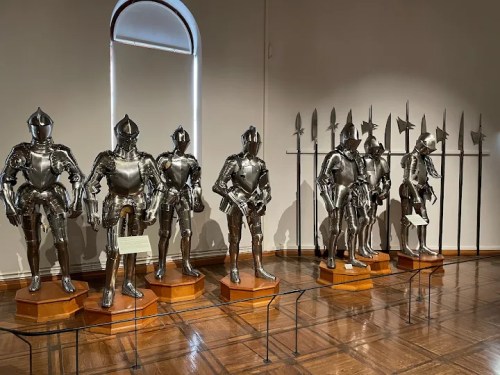
As I looked out the window, I could see human tibia, fibula, femur and radius, rings and cuff buttons were scattered on the emerald green lawns. My mansion was filled with groans and sighs and tremors. It was possibly more fearful than the 1906 Earthquake which woke me from my slumber. That was also a strange morning. In the cupola, figures of men—sentinels, paced back in forth, and hovered above the estate and the observational tower shortly after midnight. I always thought the Earthquake was caused by these sentry-spirits, now haunting my mansion, acting out the horrors of the war. In fact, for several night in a row, prior to the Earthquake, I saw a man on the cupola, frantically waving his arms. He was there three nights in a row. He stood, dressed in a blue coat and white pants, looking very pale, within the cupola, waving his hoary arms, back and forth. I called out to him, but he would not answer—just waving motion, back and forth, back and forth. Was he, rapped in more important duties, too busy to answer? Or what he trying to warn me? The thin veil between this life and the next one was sending me messages. And, one evening, there was witnessed an even more bizarre and unexplainable devotion to my estate. Astrid and I had just finished having tea on the 3rd floor. We entered the elevator to take us to the first floor. The lighted numerals in the elevator displayed their descent: “3…2…1…” and continued past the first floor. Absent-mindedly, I pushed the button for the first floor again, wondering why the elevator had not stopped, or perhaps, who in the basement had summoned the elevator. #RandolphHarris 4 of 9

The elevator stopped at the basement level. The doors opened to reveal not the area once cleaned up for storage, but a scene out of time and reason, the blood-stained doctors and orderlies of nearly half a century before, again performing their abhorrent and hideous tasks of slicing sinew and sawing bone and suturing artery and vein and tying ligaments; of carrying armloads of severed limbs to grisly, blood-dampened corners and dumping them there unceremoniously. We have fallen into a ghastly frozen moment, being held captive witness to the scene. One of the harried doctors turned toward us and began to look beseechingly into our eyes for help with the never-ending work, or perhaps for help to find some way out of the subterranean scene where he himself would not be heled in forced incarceration for eternity. As he took a step towards us, finally, slowly, the doors began to close. This latest encounter was a continuation. My mansion echoed with the cries and moans of torn men and boys. All of this tension and blood shed because many leaders were heavily involved in companies that raced to establish claims to millions of acres of western land. The Emancipation Proclamation was but another example of the war’s surprising consequences. On July 3, General Lee sent three divisions, about 15,000 men in all, against the Union center. The assault, known as Pickett’s Charge, was as futile as it was gallant. At 700 yards, the Union artillery opened fire. Pickett’s division just seemed to melt away in the blue musketry smoke which now covered my estate. Ghosts of soldiers straggling to my home, all these years later. #RandolphHarris 5 of 9

Tracing its origins back to 1849, Winchester was the World’s oldest maker of lever-action repeating firearms in the World. I believe Winchester Rifles had been in the Civil War. Thousands of men and horses, dying, stripped and saddle and bridle were killed during the battle of Antietam. That is a reason this estate is also haunted by demonic horses. The Civil War put more men in the field than any previous engagement. On the morning of April 12, 1906, at 5.13 a.m., trapped in the Daisy Bedroom, I gazed out my window and could see a steady stream of men covered with mud, soaked through with rain…pouring irregularly, without any semblance of order, up 13 Palm Drive toward my home. I perceived they belonged to different regiments…mingled pell-mell together…a pale young man who looked exhausted to death and who had lost his sword appeared in my room and rescued me. Then he said, “I know I’m going home. I’ve had enough of fighting to last my lifetime.” More and more the cold unanswering silence of the house weighed me down. I had never thought of it as a big house, even though it had 600 rooms and expanded more than 250,000 square feet, but now, in this devastating moment, it seemed immense, and full of ominous corners around which I dared not look. Every step that I took was increasingly painful; but after being freed from my room, I walked slowly the whole length of the passage, and went down the front stair. I did not know why I did this; but at the moment I was past reasoning, and had to obey my instinct. #RandolphHarris 6 of 9

More than once I explored the ground floor alone in the small hours, in search of unwonted midnight noises; but now it was not the idea of the noises that frightened me, but that inexorable and hostile silence, the sense that my mansion had retained in full daylight its nocturnal mystery, and was watching me as I was watching it; in entering those empty orderly rooms, I might be disturbing some unseen confabulation on which beings of flesh-and-blood had better not intrude. The broad mahogany stairs were beautifully polished, and so slippery that I had to cling to the rail and let myself down tread by tread. And as I descended, the silence descended with me—heavier, denser, more absolute. I felt its just behind me, softly keeping time with mine. It has a quality that I had never been aware of in any other silence, as though it were not merely an absence of sound, a thin barrier between the ear and the surging murmur of life just beyond, but an impenetrable substance made out of the World-wide cessation of all life and all movement. Yest, that is what laid a chill on me: the feeling that there was no limit to the silence. I was lost in time. There was no outer margin, nothing beyond this day. I had reached the foot of the stairs and was limping across the hall to the drawing room. What I found there, I was sure, would be mute and lifeless; but what would it be? The bodies of my dead caretakers, mown down by some attack that shook my mansion for day and days? And, was it my turn next—what if it were waiting for me behind the heavy drapes of the room I was about to enter? #RandolphHarris 7 of 9

Well, I must find out—I must face whatever lay in wait. Not impelled by bravery—the last drop of courage had oozed out of me—but because anything, anything was better than to remain shut up in this house amongst debris, though most of the room were undamaged. “I must find out, I must find out,” I repeated to myself in a sort of meaningless singsong. The cold outer light flooded the drawing room. The shutters had not been closed, nor the curtain drawn. I looked about me. The room was empty, and every chair in its usual place. My armchair was pushed up by the chimney, and the cold hearth was piled with the ashes of the fire at which I had warmed myself before start on my ill-fated walk. Even my empty tea cup stood on the table near the armchair. It was evident that the caretakers had not been in the room since the explosion. And suddenly, an orb materialized, moved about, split into twin spheres, and re-formed in front of me. I was astounded. Then, candlesticks roe in midair and fell to the floor. A lead ball struck me on the chest but it did not harm me. The sound of footsteps began to pad about the room, and my tea cup jumped off the table and shattered against the floor. A hat was floating teasingly in front of me. The hat led me on a merry chase before it finally dropped at my feet. I was so exhausted from what seemed like months of sleep deprivation. I found a bed to lay in and gets some rest. As I drifted into a deep sleep, I was rudely awakened by a large quantity of water being dumped in my face. #RandolphHarris 8 of 9

May people are prepared to dismiss the occult World as insignificant and ignore the possibility that there could well be an element of truth in certain of the allegations. This “otherworld” has never been far beneath the surface in the Winchester Mansion. The gods are everywhere, not only in the garden, where they might take the forms of living creatures, but in the mansion as well. Communication with the otherworld was therefore relatively for Mrs. Winchester and her warps through time and space. The human mind has consciousness that occupies a position between two Worlds: the material and the spiritual. At any time, the spiritual might intrude; it could also be summoned at will, demons and all. The Winchester Mansion operated with many skirmishes with the estate’s sorcerers. The pagan demons were not prepared to go quietly. Some of them were heroes. In Mrs. Winchester’s day, surviving manuscripts suggest that she received extraordinary visions. Mrs. Winchester saw angels who battled demons for possession of her soul. Good triumphed, but not before the saint, Mrs. Winchester, had a vision of the fires of hell. On her return to consciousness, her caretakers observed that she had developed actual burn marks over much of her body—scars that shortly after disappeared. On her death 5 September 1923, her body lay unburied for thirty-eight days and was visited by thousands of pilgrims. Many of whom claimed that Mrs. Winchester showed no decay. #RandolphHarris 9 of 9
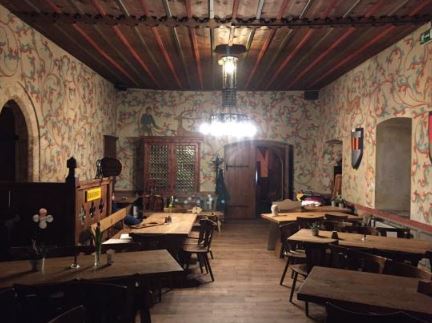

A werewolf is typically seen as a noble and honorable warrior. They are of a royal class in their species. Legend had it that Mrs. Winchester had a pack of vicious werewolf guarding her estate. After the death of Mrs. Winchester, a Bloodline Blade with a birch handle and silver blade. The knife had been passed down for a millennium in her family, and was sold at auction. Too bad. It was a priceless artifact and carried withing it the soul of a divine wolf.

I conjure thee, Spirits of the Winchester Mansion, by the great living God, the Sovereign Creator of all things, to please appear under comely human forms, without noise and without terror, to answer truly all questions we shall ask three. Hereunto I conjure thee by the virtue of these Holy and Sacred Names, O SURMY, DELMUSAN, ATALSLOYM, CHURUSIHOA, MELANY, OMOT, and VERMIAS. https://winchestermysteryhouse.com/
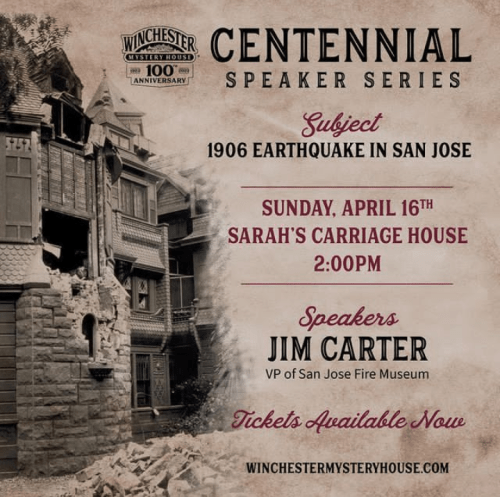
And be sure to check out the online gift store: https://shopwinchestermysteryhouse.com/
Good-by; You’ll Never Know What This Has Cost Me

Mr. Hansen had never been able to understand why there was any harm in giving people a little encouragement when they needed it. Sitting back in my comfortable armchair by the fire, I thought to myself, “You would be surprised to find how discouraged the grand people get, in these big houses with all the help, and silver dinner plates, and a bell always handy if the fire wants poking, or the pet dog asks for a drink.” It was then that I first became aware of a disturbance in the air. A kind of restlessness. I looked sharply around the front parlor, but saw nothing out of the ordinary. The room was deserted. No one had come along for some time. Yet there was a suggestion of movement nonetheless, a shifting of the light from the chandelier. The drapes loomed more menacingly and the fire appeared even closer, as I glanced out of window, my yard looked like an ancient forest of evergreen. What secrets did they contain within their shadows? My heart skipped a beat. I opened the window. The silence surged around me. Again, nothing. And inside—no telltale footsteps or voices. Only later, did it occur to me that the silence was peculiar. I should have been able to hear something. The roar of the furnaces, or the belching chimneys. The sound of the carpenters hammering. The servants washing dishes in one of the kitchens. However, I was only aware of the silence. Silence, as if I were the only one left alive on my estate. Then I heard it. No, not heard. I sensed it. A whispering, almost like a singing. The others have slipped away into darkness. I caught my breath. “Who’s there?” #RandolphHarris 1 of 6

I heard the ghost of Mr. Winchester’s voice inside my head, though it was growing fainter with the passing years. However, this was different, a lighter sound, gentle and exquisite, carried on the cold air. A reverberation, and echo of words once spoken in this place? And what of the crimson mist on arising from the floor? On these cold winter nights, it was not unusual to hear the clanking like a bucket, and the shuffling of feet. When I looked over toward the kitchen, there was a man—or something—dressed in a long white coat, all bent over like he was tired or something, slowly walking toward the door-to-nowhere. He was filling up the buckets using the exterior water faucets on the second floor that were used to water my flower boxes. He seemed to walk right out the door and to the front of the house, but there was nothing supporting him. Then he watered the flowers and walked slowly back into the house, real tired- like. And almost suddenly vanished. There were spirits caught forever in the never-ending labor to keep this estate operating. Perhaps these were visions out of time making their journey into the eternal flame as well as into Eternity itself. However, every July 2, officers could be frequently seen in the dim moonlight, in the Victorian garden, dressed in their gray tunics and gold stars and wreath, gathering around the fountains, mixing fine bourbon with the clear water, and toasting to the next day’s victory or death. #RandolphHarris 2 of 6

Summer nights always tended to be a little eerie. In the dark, the estate at best, is an uncomfortable place to be. The tragic memories and sorrows of a nation’s struggle defending the hour of the country with their Winchester Rifle’s hanged heavily and seemed magnified in the night. There is always something moving in the fruit orchards or the grass just off the unlighted portions of the estate. It all makes the Other World all that much closer. Sometimes one could even hear the strange military noises emanating from the 740 acres of land I own, and the fallen faces of the slaughtered. Desperate orders shouted…steel rammers ringing in muskets…the clicking of hammers cocked…the hoarse trill of a bugle…the clacking of artillery chains…a roar…shrieks…men gagging, crying, screaming, moaning, moaning, moaning….and there is often heard the funeral call, mounrful apologies of a heartsick, dying warrior to a lost friend bemoaning a fateful decision to be regretted down the ages. Although we had transitioned into summer, there was just an endless expanse of cold on these nights. Memories would seep into my mind. My Daisy Bedroom. Candles burned out. Me crying in the dark, jolted awake by bad dreams and calling out for my infant daughter who passed away long too soon. Then Mr. Winchester, sitting at the end of my bed, opening the curtains to let the silver moon in, saying there was nothing to be afraid of. How nothing could hard me. Not even a curse. How I was a Winchester, invincible and courageous. Nothing could get me as long as I kept building. And with William by my side, I believed it. #RandolphHarris 3 of 6

So I talked to myself to keep my spirit up. I was in no actual physical danger, I said. It was just a matter holding on to my nerved. Still, fragments of life flashed into my mind and out. Broken images of my husband and daughter, photographs of our happy days. Memories of Mr. Winchester. And I wondered if he had seen death, like a shadow coming to meet him. Had he recognized the moment for what it was? Whispering, I could hear whispering, voices slipping between the walls. “She is the last, the last, the heiress.” Heard howling from the walls. Sometimes far away, sometimes closer, so close I imagined I could feel breath upon my cheek. “The others have slipped away into darkness.” Then the sound of sobbing, a desperate scratching on the floors, and a terrible weeping. I worked hard to turn this mansion into something beautiful. Having evergreen trees planted and a variety of flowers. I even remodeled a room with attractive redwood walls, and another with floor to ceiling glass panels that provided a 180-degree view of the estate. I smiled when I saw the perennials that I had planted. However, a number of other peculiar incidents began to convince me that I was being visited by discarnate entities. I always knew I was being haunted. But now I was catching fleeting glimpses of fast-moving shadows from time to time when I would least expect to see such a thing. There would often be smells of delicate perfume. Mr. Hansen thought it was closer to a man’s cologne. Sometimes we encountered the scent together, but in every instance it came and drifted away after only a few minutes. #RandolphHarris 4 of 6
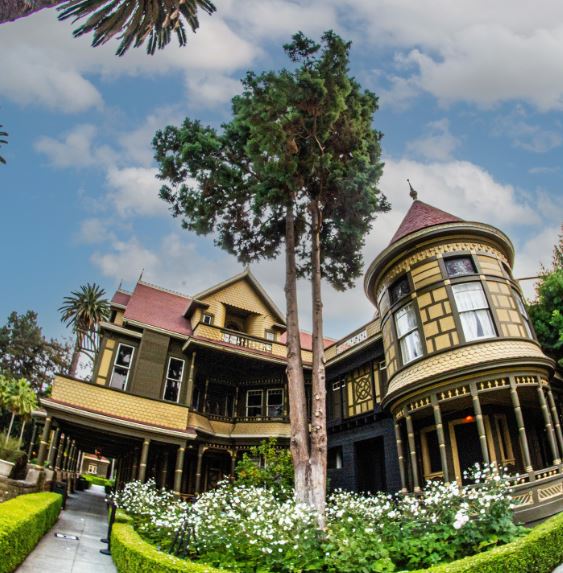
Once, when I was outside tending the flowers growing under the front windows, and I was suddenly enveloped in an invisible puff of strong cigar smoke. Then I was choking, coughing. I could feel the pump and hiss of my heart beneath my ribs, rattling like a snare drum. I swallowed hard. When I put my hand up to brush the smoke away from my cheek, I saw that the tips of my gloves were red. And when I looked down, I saw the daisies with drops of blood on them, glittering and yet dull at the same time. I propelled myself into a standing position, and walked towards the front doors. The wind boxed my ears so hard that I struggled to keep my balance, but I managed finally to get those doors shut. When I looked in the mirror, I was not injured at all. That night while I was falling asleep, I sensed a large, dark presence in the bedroom. It glided over me and seemed to hover just over my head, and I was the recipient of a telepathic command: “I want to know your thoughts!” After I fell asleep, I experienced horrific nightmares. I was awakened by the sounds of terrific crashes, as though something huge had fallen over somewhere in the house, causing terrible damage. Thanks to the stocks I owned and the ones I bought in Con Edison, I was able to keep building rooms to evade the ghosts. Do you know how it is, sometimes when you are doing a bit of fine darning, sitting by the window in the afternoon; and one minute it is full daylight, and your needle seems to find the way of itself; and the next minute you say: “Is it my eyes? because the work seems blurred; and presently you see it is the daylight going, stealing away, softlike, from your corner, though there is plenty left overheard. Well—it is the way it is with these ghosts around.” #RandolphHarris 5 of 6

Most nights, screaks could be heard emanating from within the walls. Then everything would be stripped of color, an absence and shade. Fog hovered motionless from the ceiling. And it would come again, over the whistling of the wind, the same indistinct whispering. “The others have slipped away into darkness.” “Who are you?” I cried. “What do you want from me?” But the fog, the apparition, had vanished. After the Spanish-America War, all the fine ladies took to running to the mediums and the clairvoyants, or whatever the stylish folk call them. The women had to have news of their men; and they were maid to pay high enough for it…Oh, the stories I used to hear—and the price paid was not only money, either! There was a fair lot of swindlers and blackmailers in the business, there was. I always had a way of seeing things; from the cradle, even. I do not mean reading the tea leaves, or dealing the cards. No, no; I mean, feeling there are things about you, behind you, whispering over your shoulder. I felt more and more sorry for those women that the soothsaying swindlers were dragging the money out of for a pack of lies; and one day I could not stand it any longer, and though I knew the Church was against it, when I saw one lady nearly crazy, because for months she had no news of her boy at the front, I said to her: “If you will come over to my place tomorrow, I might have a word for you.” And the wonder of it was that I had! For that night I dreamt a message came saying there was good news for her, and the next day, sure enough, she had a telegram telling her her son was coming home. And that August, the war ended. #RandolphHarris 6 of 6

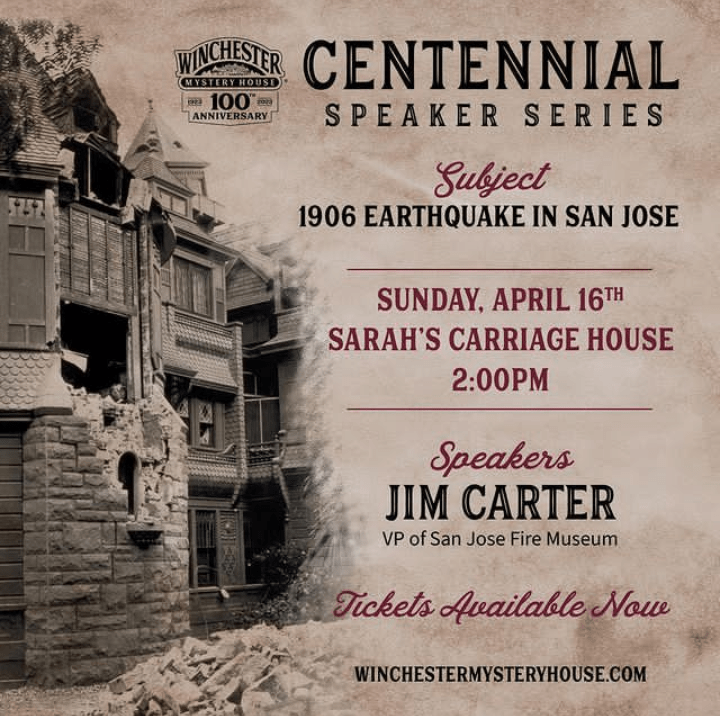
One is confronted finally with the metaphysics of time: is it merely linear; are we moving along it like riding a train on a track and all that happens, once it occurs, is forever gone? Or can that time be bent, as some prominent theoretical physicists of the late 19th and 20th centuries have said, so that we may run into it again? Or, can an event go out in more directions than just backward, carried on time like ripples from a stone throw in a pond, occasionally under very special circumstances in very special places, returning like a faint echo? Is it possible that the bigger the event the larger the ripples and the more likely they are to return? Or perhaps is it possible, if time can be bent, or the ripples move slowly enough, to catch up with events again, and again, and again? Come tour the Winchester Mystery House and perhaps you will find some hidden clues. https://winchestermysteryhouse.com/

And be sure to check out the Online Gift Store: https://shopwinchestermysteryhouse.com/

The Mystery Has Never Been Solved!
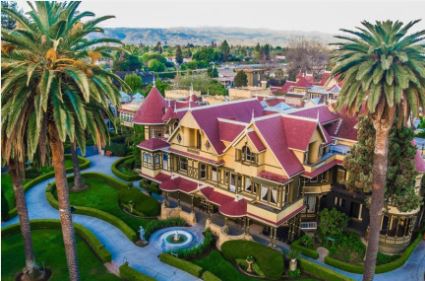
Much of the ceremonial rituals that took place in The Winchester Mansion goes back to the Knights Templar. The Order of the Knights Templar can be traced in part to the Templars. And yet, the Knights Templar are also the claimed ancestors of satanists, a fact which is decidedly hard to prove, though within an organization so large there may well have been diverse groups who followed their own calling. The knights, largely from France and England, joined the order over a period of many years. They had a system of leadership with a Grand Master, knights, chaplains, sergeants, craftsmen, seneschals and commanders. The order had its own clergy and its meetings were held in the strictest secrecy. Unmarried knights wore a white mantle with a red cross while others wore a black mantle with a red cross. Membership was mostly male, and established orders in virtually every Latin country, drawing people from all over Europe. It also became a great trading agency and though originally the Roman Catholic Church actually supported a number of secret societies who were Christian-based, the power of the Templars began to wield became the fear of successive popes and of European noblemen. Philip IV of France began a series of attacks against the Knights Templar and his campaign was given official blessing by the election of Pope Clement V (1305-1314) who renounced the Templars as immoral heretics. Many people know that Mrs. Sarah L. Winchester had a Famous Blue Séance Room where she carried on her rituals and had a series of colourful robes she wore. However, the mystery has never been solved as to why she built the strangest mansion in the World? #RandolphHarris 1 of 13

Stories were already circulating that Mrs. Winchester, behind the closely guarded doors of her mansion, indulged in the most offensively blasphemous rituals said to be directed totally towards the reversal of Christianity itself. She was said to worship a goat-like idol, the Baphomet, anointing it with the fat of pigs, while the Knights used the fat of murdered children, roasting children and eating them, laying women across their altars for the most violent forms of indecencies to satisfy their lust for life-blood; they were said to have indulged in homosexual rites and other various claims alleged they stamped the Holy Cross under foot, spat and urinated upon it and used the Mass as the basis for their own worship—later to be known universally as the Black Mass. Actual proof of these events is largely contained in the confessions received under torture which followed the arrest of Mrs. Winchester’s butler Albert Pike. He and 140 of his brethren were imprisoned in Santa Clara Valley, tortured and then executed en masse. Algernon Blackwood, under extreme torture, confessed to speaking against Christianity but denied depravity. In 1890, he was brough out on to the nine-story tower of The Winchester Mansion and ordered to repeat his confession in front of the villagers and accept a sentence of life imprisonment. On the balcony of the tower, he burst into a rage of anger and protested innocence of all charges and thus signed his own death warrant. The order was given that he should be taken into the fruit orchard and burned at the stake. As the flames licked his body, he summoned Mrs. Winchester and, in his dying, breathe to meet him at the Bar of Heaven. #RandolphHarris 2 of 13
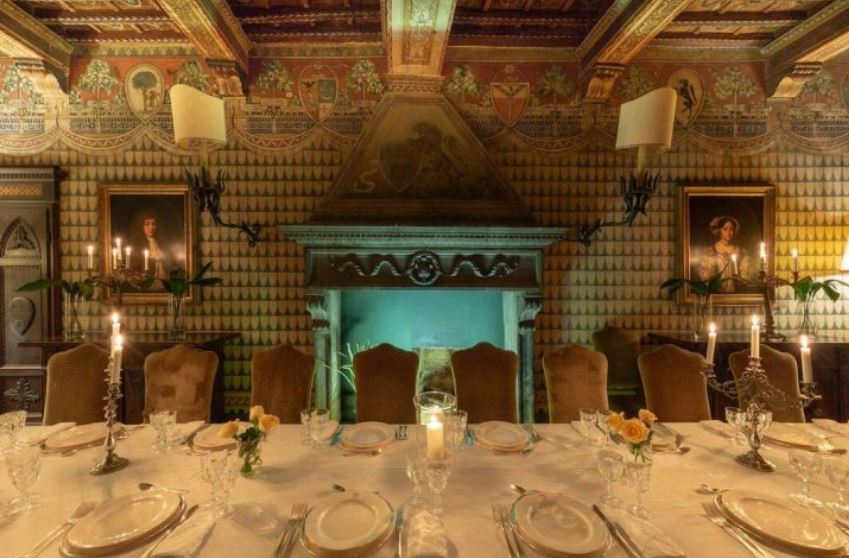
Diocesan priest, Father Peter Yorke, who was then editor of the Archiocesan newspaper, The Monitor, emerged sending orders to every village where the Templars operated, instructing that they should be arrested and charges of heresy and sorcery brought against them. He published a series of exposes, and hundreds of knights were brought to trail, tortured, and executed. The vast wealth of the Templars working at The Winchester Mansion were accused of devil worship. What remained to be handed down and revived, especially in the twenty-first century, were the rumors of ritual and dastardly happenings which many of today’s extremist followers of the Knights Templar seem prepared to believe and accept with some enthusiasm. One of the more important traditions handed down by Mrs. Winchester concerns an instruction for future secret societies. On the day the Knights planned to burn to death Father Yorke, a pact was made and communicated to all surviving Knights who had now gone to ground. The instruction was clear—that the Order of the Knight Templar should be continued in perpetuity. It is said that the surviving Templars should thereafter fight for the destruction of the papacy and prevent Mrs. Winchester from being stripped of her wealth and murdered. These orders, it was said, were handed on to descendants of the order and the Winchester family, who at various points in history have included satanists and a diverse calling of occultists. What remained of the Winchester family and the Knights went into the deepest secrecy, surfacing occasionally and surrounded constantly by rumour, but little discernible fact. #RandolphHarris 3 of 13

The Illuminati came to fortify The Winchester Mansion, which had reached seven-stories high, with 600 rooms, after the 1906 Earthquake. While it was true that Mrs. Winchester left her mansion, there are more reasons as to the why. The avowed spiritualist, Mrs. Winchester, had constructed a boathouse and erected a huge mountain of Earth upon which a new mansion she had planned to build would be erected. It was to overlook the bay, an immense seawall and costly cannel system, with proper floodgates, through which the Winchester private fleet of launches and yachts were to wend their way. It was said that Mrs. Winchester was being haunted by vicious spirits and that death would be her penalty for leaving her home. Her existence was mythical because only half a dozen people had seen her. A sheriff had been striving for the past three months to serve upon her a summons to appear in court in proceedings that a real estate dealer had brought upon her. Bloodhounds roamed the grounds of the mansion and polite Asian staff answered telephone calls. Mrs. Winchester was always alone save for a bodyguard. She was wealth as few women were and found her pleasure in superintending a half dozen workmen, who for seven years had gone from wing to wing of the mansion, constructing one month what they were called to destroy on the following month. Her mansion was considered the pride of the county and the basis for mysterious legends. The Illuminati came were concerned about a group of subversives who were discovered to be using occult practices and rituals to attack Mrs. Winchester and her mansion. #RandolphHarris 4 of 13

E.W. McClellan of Burlingame, the contractor of 98 acres of land purchased by Mrs. Winchester, was holding it and refused to give it up because he believed she was the lead of a secret society working to “establish Satan’s kingdom on Earth,” an accusation which was a direct throw-back to the age of the Knights Templar; and that dictum still exists today. The Psychosophical Society stated that The Winchester Mansion had existed since the sixteenth century and comprised the World League of Illuminati. They wanted to prevent Mrs. Winchester from passing on her palatial estates in all their purity to the next generation. The hotbed of intrigue, rumour and gossip directed at The Winchester Mansion supposedly involved the death/assassination of some, the suicide/murder of others over the scandals invariably linked to Propaganda 2 (P2) Lodge and various Intelligence agencies like the KGB and the CIA with a scandal which is too immense to expound here, nor is it suitably for this part of the report. What can be said, however, is that occult groups working within the traditions of the Illuminati represent a definite consideration of these events. Mrs. Winchester’s husband, William Wirt Winchester, was a master of mathematics and the possessor of certain secret occult knowledge. He gathered seven disciples around him and went into the World of the brotherhood to perform good works. Staff have described that 120 years after his death, his perfectly preserved corpse was found in one of the many buildings of The Winchester Mansion. Because of the secrecy and the mystery that surround The Winchester Mansion, thousand want to know more and are desperate to visit it. #RandolphHarris 5 of 13
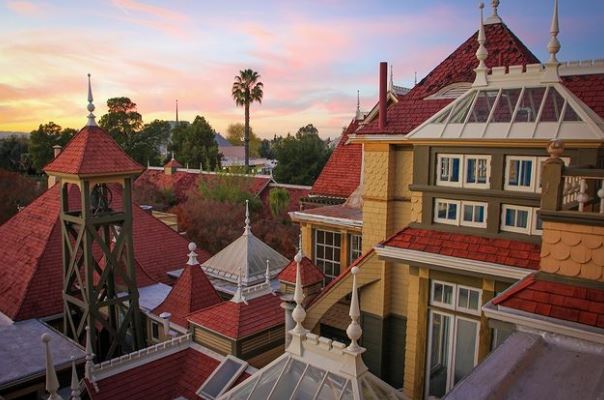
Sometimes the hysteria surrounding The Winchester Mansion morphed into such hysterical proportions that the authorities have had to shut the mansion down for a day or ban people from entering, even though many do not believe that it actually exists. Fans of The Winchester Mansion have sprouted up all over the World. Some people still regard the story of The Winchester Mansion as a fable, but most know it does actually exist and possesses esoteric knowledge of mystery and mysticism. Some the people who were involved in the construction of The Winchester Mansion were magicians, writers, statesmen and novelist. This mansion has quit a following and has collected members through the ages, in positions of far greater power and influence than the Illuminati. Legend has it that descendants from the founding fathers of the Middle Ages are on the board of trustees. The official secret society in control of the estate have connections throughout Europe and the United States of America, whose membership is an indication of the current revival in the mystery religions and semi-secret societies. The mansion alone boasts of some 60,000 members and operates from its headquarters in San Jose, California with affiliated lodges in Britain, France, Germany, Australia and South Africa. The caretakers are preserving the traditional beliefs of the 19th century. A cipher manuscript was found in one of the libraries of The Winchester Mansion. The author of the manuscript was not identified but it was obviously someone with a very intense knowledge of the supernatural, alchemy, astrology and the magical theories of Eliphas Levi. #RandolphHarris 6 of 13
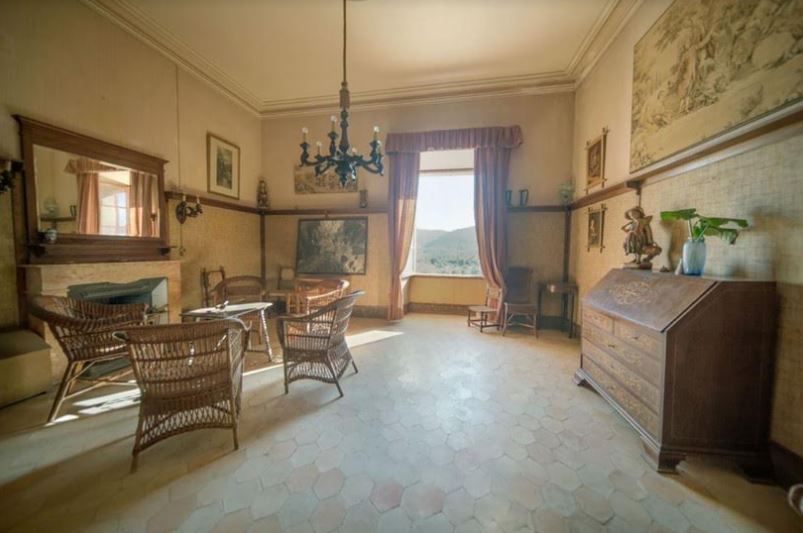
Mrs. Winchester’s mansion and gardens reflect her colourful and ornate rituals and its purpose was “to obtain control of the nature and power of my own being.” The might wings of the mansion outspread dove-like sitting brooding on the vast abyss. What is dark in Mrs. Winchester is to be illumined, what is lose raised and supported; the nine-story tower was constructed so that Heaven could hide nothing from Mrs. Winchester’s view, nor the deep tract of hell. Hell said to be a hideous flaming ruin and combustion in a bottomless perdition, there where Satan dwells in adamantine chains and penal fire. Nine times the space that measures day and night to mortal men, Satan and his horrid crew lay vanquished, rolling in the fiery gulf, confounded though immortal: but his doom reserved him to more wrath; for now the thought both of lost happiness and lasting pain torments him; round he throws his baleful eyes that witnessed huge affliction and dismay mixed with obdurate pride and steadfast hate: at once as far as angels ken he views the dismal situation waste and wild, a dungeon of horrible. Many leaders of the Church do not preach about Hell anymore because the Church has become a tax-free business and they do not want to hear about where they may go, nor do they want to scare their dirty money away from the Church. As a result of the loss of real churches who teach about Satan and demons, people are all wild and out of control and no longer fear anything and go around sinning like rain in Seattle. #RandolphHarris 7 of 13

On a hot and dry Friday the 13th of June 1890, Mrs. Winchester drifted into an uneasy sleep, but not for long. Half an hour later she was wide awake again. Something was wrong; a change was coming over the bedroom. There was a sense of dread. Regions of sorrow, doleful shades, were peace and rest could not dwell entered. Her home started to feel like a place where hope could not come, and all that did come was torture without end. She sat up, fully alert, straining her ears for the slightest untoward sound, but all was silent except for the little trusted noises the home made during the evening. However, Mrs. Winchester noticed something odd: an unnatural coldness was stealing over the room. It had been a hot summer day. How could it be so cold? She shivered and ducked back under the covers, tugging them more snugly about her. It did not help; the cold kept increasing. She pulled the covers over her head, chiding herself for being silly and willing herself into sleep. However, the terrible dread kept gnawing at her. She tried to think pleasant thoughts, tried to ignore her thudding heart, and tried to pray. Her attempts brought little comfort; the fear continued to build. She sensed that something frightful was about to happen. She held her breath and waited, not knowing what to expect. Before too long, she heard a sound: the unmistakable creak of the doorknob. The spring bolt was sliding back with tiny clicks. Mrs. Winchester froze. Very slowly, the door began to open. Her fear quickened further as she heard the tread of heavy, booted feet approaching the bed. She wanted to call out for help, but was too afraid, as if some force was willing her to silence. Mrs. Winchester was helpless in the face of that power. #RandolphHarris 8 of 13

When she tried to pray, a demon started to speak. “The force of hose dire arms has caused me to fall to a place with floods and whirlwinds of tempestuous fire. Fierce contention brought along innumerable force of Spirits armed with durst in a dubious battle of unconquerable will, revenge, immortal hate.” Mrs. Winchester was dying and she knew it. This demon had come to claim her soul. She was making gaps, with long spaces between. A perspective of stern and cruel memories stretching away, like its own grey avenues, into a blur of darkness. Certainly no house had ever more completely and finally broken with the present. Mrs. Winchester lit a candle. A little animal stood before her, forbidding, almost menacing: there was anger in his large brown eyes. He came no nearer. As she advanced, he gradually fell back, and she noticed another dog, a vague, rough, brindled thing. At the same moment a third dog, a long-haired white mongrel, slipped out of a doorway and joined the others. All three stood looking at Mrs. Winchester with grave eyes; but not a sound came from them. Zip, had seemed to be observing them with a deeper intentness. Mrs. Winchester endured many long years of the company of many different creatures. They would return again and again. As she was in her morning room, the coldness came back. Her mind was alert but her body seemed paralyzed. The entity seemed to have the power to immobilize her from a distance. She heard the dull footfalls crossing her mahogany floors. There was an evil lurking in her home. Something started pounding on the table. #RandolphHarris 9 of 13

The pounding was so fierce that her cup of tea bounced off the table and fell to the floor. Then it stopped. Mrs. Winchester thought maybe she was having delusions. But whatever it was did not want her to drink the tea. More odd things began to happen—occurrences no one could explain. A malignancy pervaded. Often, people would hear a horrible, mocking, evil laugh. Lights would slicker for no reasons; water taps would turn themselves on, then off. She would find her silverware mysteriously rearranged. On several occasions she discovered her solid gold dinner service hidden in a corner of the room. One night, she had a roaring fire in the fireplace of her bedroom, went to the bathroom, and returned the fireplace totally clean with nothing it in burning. The servants began to complain of hearing mice in the night, but Mrs. Winchester was certain there were no mice in the house. On several occasions, one could very clearly hear the floorboards creaking upstairs, as though somebody was walking about the house. The servants heard the creaking too but, as is often the case with servants, they got used to it, and to the other noises and unexplained presences. Mrs. Winchester urged them no to speak of those things outside of the house. It was bd enough that she was subjected to the disturbances and torment; the last thing she wanted was to attract undue attention to her home. People do not, as a rule, react compassionately to reports of supernatural infestations; many tend to suspect that the victim has somehow, whether by word or deed, “brought it on herself.” #RandolphHarris 10 of 13

At times, Mrs. Winchester felt that the entity was trying to crush the life out of her. She left her light burning all night. Through time, Mrs. Winchester was forced to accept her suffering. There was nothing else she could do. One winter night, one of the butlers was found dead at the head of a narrow flight of stairs leading down from his room. It was Mrs. Winchester who found him and gave the alarm, so distracted with fear and horror—for his blood was all over her—that at first roused household could not make out what she was saying, and thought she was waking from a nightmare. However, there, sure enough, at the top of the stairs lay the butler, stone dead, and head foremost, the blood from his wounds dripping down the steps below him. He had been dreadfully scratched and gashed about the face and throat, as if with curious pointed weapons; and one of his legs had a deep tear in it which had cut an artery, and probably caused his death. Bu how did he come there, and who had murdered him? Mrs. Winchester declared that she had been asleep in her bed, and hearing his cry had rushed out to find him lying on the stairs; but this was immediately questioned. A shadow was rearing up from the body. Mrs. Winchester described it as “a blob, like smoking black cloud, not the shape of a person—just a thing, but a terrible thing. The absolute evil that came from it was overwhelming. I was so gripped with terror, I could not move, and I knew that if it came toward me, I would be swallowed up…destroyed, and that would be the end of me. Imagine what it feels like to know that you are going to be killed, and the specter that is torturing you is deliberately making you suffer beforehand. That is how it was. I felt a level of fear that is beyond words. Then I heard a voice and screamed.” #RandolphHarris 11 of 13
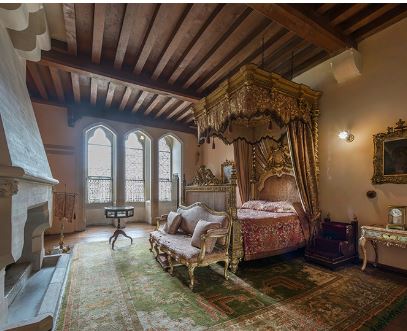
The male voice was hoarse, stertorous, angry almost. “You have left us this our spirit and strength entire strongly to suffer our pains that we my so suffice his vengeful ire, or do him mightier services as his thralls by right of war, whatever his business be here in the heart of hell to work in fire, or do his errands in the gloomy deep; what can it then avail though yet we feel strength undiminished, or eternal being to undergo eternal punishment?” Mrs. Winchester instantly went to sleep—chilling testimony to the control the demon had over her. When she awoke, she was clean, in her sleeping gown, and in her bed. However, it was with the possibility, and the hope, that the end of her long ordeal might well be in sight. Little of the fast-fading sunlight entered the house through the windows, many of which were partly or entirely covered with drapes. However, it was bright enough for Mrs. Winchester to see that the French Provincial sofa’s upholstery was slashed. Shredded wool spilled onto the floor. A solid oak bookcase had been hammered to pieces against the wall, gouging holes in the lath and plaster walls, running the Lincrusta-Walton Wallcovering. Her silver tea service has been smashed, along with a floor lamp. Books had been taken off the shelves, torn apart, and scattered across the living room. Mrs. Winchester lit a candle. It did not shed much light, just enough to reveal more details of the rubble. Looks like somebody went through here with a wrecking ball and scissors, she thought. The house remained silent. Leaving the door open behind her, she took a couple of steps into the room, and the crumpled pages of the ruined books crunched crispy underfoot. She noticed the dark, rusty stains on some of the paper and on the bone-white foam wool stuffing, and suddenly she stopped, realizing the stains were blood. A moment later, Mrs. Winchester spotted the corpse. It was that of a big man, lying on his side on the floor near the sofa, half-covered by gore-smeared book pages, book boards, and dust jackets. Zip’s growling grew louder, meaner. Moving closer to the body, which was just a few feet from the dining-room archway. Mrs. Winchester remembered that John Hansen had lately been making repairs, including a leak faucet and a broken door lock. #RandolphHarris 12 of 13

However, Mrs. Winchester thought because of the way the room looked, he had been killed weeks ago. Her house was so big that it would often take weeks, months, and sometimes years to get around it. Yet, on closer inspection, the corpse proved to be neither bloated with the gas of decomposition nor marked by any signs of decay, so it could not have been there for very long. Perhaps only a day or less. The body had been disemboweled. Zip’s low growling gave wat to ugly snarling punctuated with hard, sharp barks. With a nervous twitch and a sudden pounding of her heart, Mrs. Winchester turned from the corpse and saw that zip was facing into the nearby dining room. The shadows were deep in there because the drapes were drawn shut over all the windows, and only a thin gray light passed through from the kitchen beyond. “Go, get out, leave!” an evil voice told her. It was certainly not the voice of Mr. Hansen. Something in the dining room was moving. There was no doubt of its presence, because it rushed out onto the dining-room tables, and came straight at Mrs. Winchester, emitting a blood-freeze shriek. She saw lantern eyes in the gloom, and nearly a man-sized figure that—in spite of poor light—gave an impression of deformity. Then the demon was coming off the table, straight at her. I Do conjure thee, O Spirit Focalor and your legion of thirty spirits to manifest your spiritual weapon in this corporeal World through my will and might! Empower it so that it may serve me here upon the corporeal plane! May it serve as a key to the realms above and below unlocking power and wisdom for my glory and ascent! Fill this weapon with your powers of wrath and fury that it may seek out spiritual attacks made toward me rendering them useless and impotent! I DO conjure thee Spirit Vephar, pierce the Heavens and cause the seas to be right stormy to cleanse the Earth of sin. Spirit Vizaresh, I DO conjure thee to drag sinful souls into hell, noosing them with the power of their own sins. May the snare be the power of their own evil, words, thoughts, and deeds and let this be you will to drag unwilling souls into Hell. May this cord gain its power through one’s practical application of evil principles. #RandolphHarris 13 of 13

Winchester Mystery House
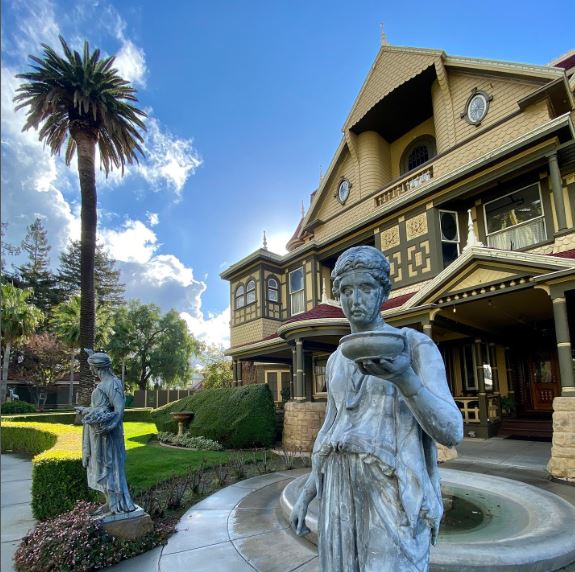
Happy Sunday! House tours 10am-5pm today 🏠 come see us!
🎟️ link in bio. https://winchestermysteryhouse.com/

Mrs. Winchester never recovered from the 1906 earthquake. Staff said she grew weaker and weaker as the years went by, and that she was often heard talking to her dead husband. The house was already large, but it morphed to be as long as several city blocks and was taller than the tallest trees on the green lawn. I suppose, ultimately, it was the spirits who kept her in this estate by not allowing her to build another one of this magnitude. When Mrs. Winchester passed away in 1922, she left $5,000,000.00 to charity. The mansion is truly special and a national treasure.

For Auto Insurance that Cares About Humans

For a great auto insurance company, who will make sure you and your loved ones are safe and taken care of, in the event something unexpected happens, please click on the link below: https://www.metromile.com/

Summoned to Join the Waiting Throng of His Ancestors

Underneath all the stories there does lie something differ from the tales. How different? In this—that the thing which is invoked is an object of a different nature, however it may put on the appearance of the most beautiful and bizarre mansion in all of the World or indulge in its servants their human appetites. It is cold, it is hungry, it is mysterious, it is illusory. The warm blood of its visitors does not satisfy it. It wants something more and other; it wants “obedience,” it wants “souls,” and yet it pines for matter. The Winchester Mansions cost five million valuable dollars (2022 inflation adjusted $146,685,714.29 USD), with a million ($29,337,142.86) alone spent on materials. It contained 600 rooms with 160 still remaining, and has 10,000 windows, nine kitchens, and 47 fireplaces built of rosewood, cherry, mahogany, Italian marble, oak, teak, and pipestone; all hand-carved, and no two alike. For 38 years, 1884-1922, the sound of saw and hammer never ceased. Commonly, 16 carpenters were employed at one time, some having worked for 20 years without change. They produced the largest, most complicated and exclusively private residence in the United States of America. There are five different heating systems and three elevators. Some of the 13 bathrooms lacked privacy; they have glass doors! One rambling room has four fireplaces and five hot-air registers. A spiral stairway has 42 steps, each two inches high. Other stairways melt into blank walls. A second story door opens into the great outdoors and a 20-foot step. A linen closet has the area of a three-room apartment; a nearby cupboard is less than one-inch deep. A skylight is placed in the middle of a room, in the floor! Another floor is apparently a series of trap-doors. The visitor must stoop through one door to enter, the next gives clearance for an eight-foot giant. Many stairway turnposts are set upside down. Entire walls are built entirely of half-inch, “half-round” strips.

Everywhere prevails that strange deference to the number 13; 13 stairsteps, 13 hangers in closet, 13 wall panels, 13 lights in the chandeliers, 13 windows to a rom and if necessary to make that number, some placed in an inside wall. Perplexity is leavened by extravagant Victorian beauty scattered along each crooked path of exploration, but what else would you expect from the house built by spirits? It was not peaceful, but filled with demons in the shape of succulent young maidens. No casual visitor can see it all. In 1923, occupants gone, it was opened. The Inquisitors were certain that they had uncovered Satan’s lair. The number 13 has undoubtedly possessed great fascination for man throughout his historic and prehistoric past, and has taken on the aspects of a mystical number, embedded in his collective unconscious, just as the number 7 has been for time immemorial a number possessed of magical properties. Since 13 is the number following the perfect cycle of 12, it is symbolic of death or the unknown. It is quite possible that some covens might have been fixed at thirteen members. However, the evidence from the witch trials tends to corroborate the view that the number of members in covens varied, depending on how many members showed up. At night, passers-by heard ghostly music wafting from the dark mansion. Secrecy was imperative, for discovery meant certain death. The Devil himself invariably presided at the important Sabbats, in the personage of the Grand Master of the region. Seated on a black throne, Satan began the meeting by reading the roll call of members from a book he had in his possession. As their names were pronounced, witches reported their activities—their magical success or failure—since the last Sabbat. After the roll call, the Devil admitted new members. The initiate had to enter the cult of one’s own free will. The Devil demanded at the meetings that the witches bring children to the Sabbats for conversion.
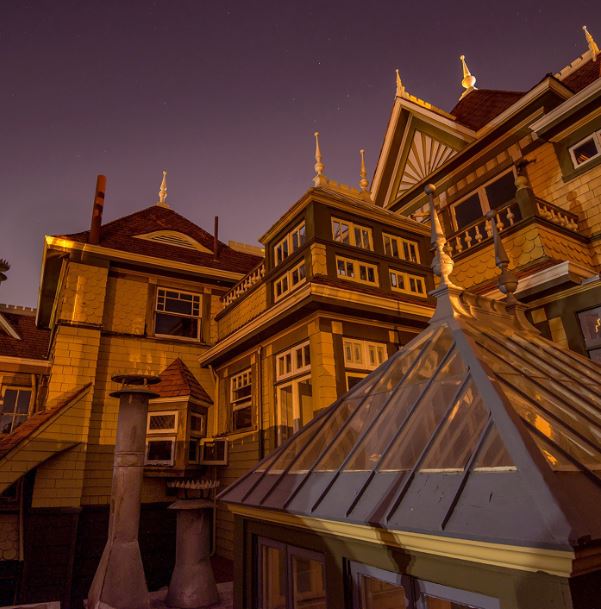
The initiation requirement was that the initiate had to make a pact with the Devil, which usually involved signing a contract to do Satan’s work for a specified period of time. This vow of obedience usually employed as a writing fluid the blood of the signer, which was extracted from the arm or the finger. The symbolism behind this part of the ceremony is clear, blood being a traditional symbol for the life force, or the soul. The participants lined up in order to pay homage to Satan. The traditional bowing was followed by the osculum infame, of “Kiss of Shame,” a ritual kiss planted on the Devil where the sun don’t shine. After the black mass, the feast began. Some accounts state that the food was abundant and delicious, consisting of succulent meats, bread, and spirits. Most of the guests gorged themselves with food and drink before leaving the feast to dance. The dancing in the Grand Ball Room was an important part of the ceremony. Whoever stumbled on the occasion of this celebration must have seen something very unbelievable. They saw incoming flights of spirits glowing with sulfurous flames, and the Hand of Glory itself—the human hand with the fingers ignited as candles. They saw even a devil god, monstrously masked, with a candle spluttering between its horns. Then the bell in the belfry high in the gables tolled again to warn these visitors to return to their sepulchres. But once a week these departed ones relaxed and danced in the Great Ball Room. But even after the guests had departed, something it had spawned lived on, and the chanting could still be heard echoing through the caverns of the Winchester mansion. This left many in Santa Clara County bound together by a nihilistic belief that the World was in the throes of a bloody apocalypse, slowly purifying the overpopulated planet. From the mansion, doctrines from the dark undercurrents of the movement had rise to the surface: social Darwinism, the idea that the brutal laws of natural selection applied not just to the natural World but to human society.

There is so much of delicacy in this subject, that the mere resolve to handle it at all might seem to imply a lack of the sensitiveness necessary to its understanding; and it is certain that the more reverent the touch, the more irresistible will figure its opportunity to the common scepticism which is boneslave to its five senses. Mrs. Winchester was an heiress. She managed her considerable estate. She was an opened flower who had been left a green bud—a thing so rare and flawless that it seemed a sacrilege for Earthly passions to converse of her. She loved her husband dearly, wholly, it was plain. And for her part, fearless as nature, she made no secret of her love. She absorbed in, a captive to, William from the movement she met him and forever. What man could have resisted, on first appeal, the attraction of such a beauty, the flower of a radiant soul? The two were betrothed; William’s cup of happiness was brimmed. They were man and wife before God. She never doubted or questioned their mutual bondage, and would have died a maid for his sake. Something of sweet exultation only seemed to quicken the leap in her body, that her faith in her dear love was vindicated. But the joy came to an upset when Mrs. Sarah Winchester lost her daughter only four weeks after her birth. And about a decade later, Mr. William Winchester died in his early 40s. This destroyed Mrs. Winchester utterly. Psychics told her she was cursed by the Winchester fortune. Lonely in her huge mansion, unearthly cries of seabirds answered the questions of her widowed heart. She worked, sweet in charity, among her servants, a beautiful unearthly presence; and was especially to be found where infants and the troubles of child-bearing women called for her help and sympathy. Mrs. Winchester was so sweet a sanity; and indeed, many often noticed that her estate bred the souls of mysticism.

Guest once saw a mermaid bathing in the fountain at the Winchester mansion. At least, that was their instant impression. The creature sat coiled on the strand, combing her hair—that was certain, for they saw gold-green tresses of it whished by her action into rainbow threads. It appeared as certain that her upper half was flesh and her lower fish, and it was only on their nearer approach that this latter resolved itself into a pale green skirt, roped, owing to her posture, about her limbs, and the hem fanned out at her feet into a tail fin. It was plain enough now; yet the illusion for the moment had quite startled onlookers. As they came near, she paused in her strange business to canvass them. It was Mrs. Winchester herself. They guests had never seen so lovely a creature. Her eyes, as they regarded, were something to haunt a dream: so great in tragedy—not fathomless, but all in motion near their surfaces, it seemed, with green and rooted sorrows. They were the eyes of an Undine late-humanized, late awakened to the rapturous and troubled knowledge of the woman’s burden. Her forehead was most fair, and the glistening thatch divided on it like a golden cloud revealing the face of a wondering angel. They passed, and the rose garden stile their vision. The beautiful sight was gone when they returned. The Winchester mansion was full of ancient memories and apparitions. Mrs. Winchester’s manner was still quite youthfully thrilling. One morning succeeding the night after her guests had arrived, after breakfast she invited her guest to a séance in her Blue Séance Room, but even as guests spoke to her, her pretty features wavered and vanished. Where she had been, a gleam of iridescent dust seemed to show one moment before it sank and was extinguished in the falling cloud. Heaping an eternal chaos with nothingness, never to be seen again. But she left the sweetest memory behind her, for human charity, and an elf-like gift of loveliness.

When a family had moved into the Winchester mansion, both the husband and wife heard ghost like phenomena in the house. At night they heard footsteps about the house and at the weekend of Easter they heard such a lot of crashing and knocking that is sounded as if all the furniture was being smashed to pieces. On investigation they found nothing disturbed at all. The noises continued at other times and several guests heard them although they had never been told that the mansion was haunted. The residents prayed continuously about the disturbances and finally they decided to command the invisible powers in the name of Jesus to depart from the mansion. One morning this while it was still dark, they heard a noise as if all the bricks in the basement were being trapped, and this was followed by another noise comparable to hundreds of pigeons flying away. The man was now convinced that the ghosts had left. Later while investigating the possible causes of the ghost, it was discovered that this was the mansion of the spiritist Mrs. Sarah Winchester, who was cursed by the souls taken by the Winchester rifle. When it comes to a genuine haunting, the appearances always have their roots in the occult activity of those ho have previously lived in the house, and, although ghosts associated with particular places are more persistent than ghosts or apparitions associated with particular people. The occurrences are not to be explained away by some scientific explanation or other, but a metaphysical answer has to be sought for to understand the whole truth. The ghosts in the Winchester mansion are so vividly real and yet so fantastically original as to make an impression sometimes exceedingly startling. Some are kind, humorous, some grotesque, and some awe-inspiring even to sublimity, and chief among the last class is the weird-wailing Banshee, that sings by night her mournful cry, giving notice to the people who hear her that one of them will soon to be called to the spirit World.
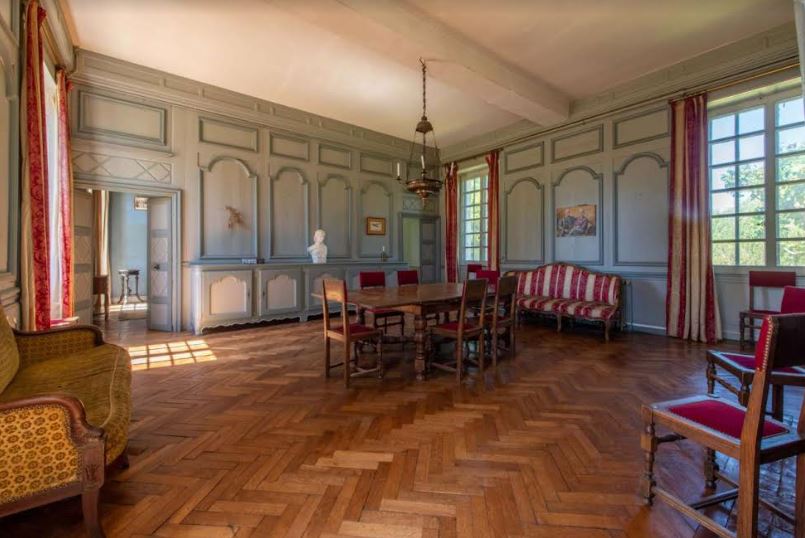
The Banshee is really a disembodied soul, that of one, who, in life, was strongly attached to the family, or who had good reason to hate all its members. Thus, in different instances, the Banshee’s song may be inspired by opposite motives. When the Banshee loves those who she calls, the song is a low, soft chant, giving notice, indeed, of the close proximity of the angel of death, but with a tenderness of tone that reassures the one destined to die and comforts the survivors; rather a welcome than a warning, and having in its tones a thrill of exultation, as though the messenger spirit were bringing glad tidings to one summoned to join the waiting throng of his ancestors. If, during her lifetime, the Banshee was an enemy of the family, the cry is the scream of a fiend, howling with demoniac delight over the coming death-agony of another of her foes. There exists a belief that the spirits of the dead are not taken from Earth, nor do they lose all their former interest in Earthly affairs, but enjoy the happiness of the saved, or suffer the punishment imposed for their sins, in the neighborhood of the scenes among which they lived while clothed in flesh and blood. At particular crises in the affairs of mortals, these disenthralled spirits sometimes display joy and grief in such a manner as to attract the attention of living men and women. At weddings they are frequently unseen guests; at funerals they are always present; and sometimes, at both weddings and funerals, their presence is recognized by aerial voices or mysterious much know to be of unearthly origin. The spirits of the good wander with the living as guardian angels, but the spirits of the bad are restrained in their actions, and compelled to do penance at or near the places where their crimes where committed. Some are chained at the bottom of lakes, others are buried under ground, others confined in mountain gorges; some hang on the sides of precipices, others are transfixed on the tree-tops, while others haunt the homes of their ancestor, all waiting till the penance has been endured and the hour of release arrives.
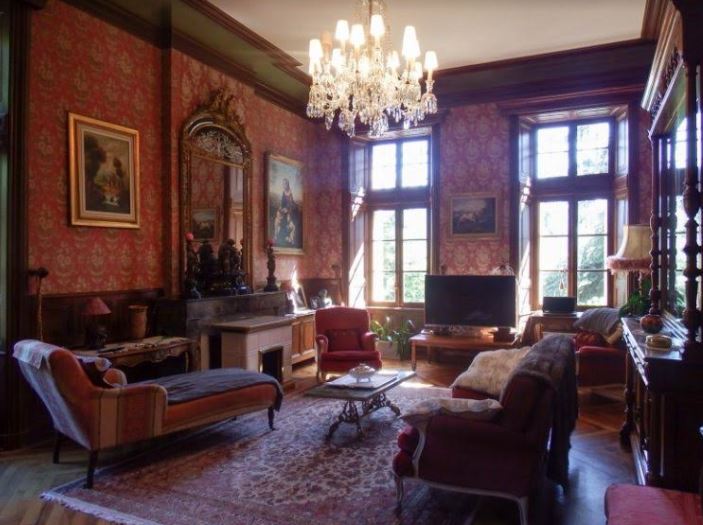
The Winchester mansion, in San Jose, California USA is believed to be still inhabited by the spirit of a chief, who there atones for a horrid crime, while the mansion is similarly people by the wicked dead. The ghost of a sinful abbot walks and will continue to do so until his sin has been atoned for by the prayers he unceasingly mutters in his tireless march up and down the halls ways of the labyrinth. The Banshee is of the spirits who look with interested eyes on Earthly doings; and, deeply attached to the old families, or, on the contrary, regarding all their members with a hatred beyond that known to mortals, lingers about their dwellings to soften or to aggravate the sorrow of the approaching death. The Banshee attends only the old families, and though their descendants, through misfortune, may be brought down from high estate to the ranks of peasant-tenants, she never leaves nor forgets them till the last member has been gathered to his fathers in the churchyard. The song of the Banshee is commonly heard a day or two before the death of which it gives notice, though instances are cited that the song at the beginning of a course of conduct or line of undertaking that resulted fatally. Thus, in Winifred, a young servant at the Winchester mansion in the late 1880s, engaged herself to a youth, and at the moment her promise of marriage was given, both heard the low, sad wail above their heads. The young man deserted her, she died of a broken heart, and the night before her death, the Banshee’s song was heard blaring loud and clear, outside the window. The servants marched outside the mansion, and they filed through the gateway, the Banshee was heard high above the observation tower of the mansion. The next night he sang again, and was heard no more for a month, when one of the farmer’s wives heard the wail under her window, and on the following day his coworkers brought back his corpse. One of the farmers heard the Banshee as he started on a journey before daybreak, and was accidentally killed some time after, but while on the same journey.

The wail most frequently comes at night, although causes are cited of Banshees singing during the daytime, and the song is often inaudible to all save the one for whom the warning is intended. This, however, is not general, the death notice being for the family rather than for the doomed individual. The spirit is generally alone, though rarely several are heard singing in chorus. A maid, greatly loved for her social qualities, bebevolence, and piety, was some years ago, taken ill at the Winchester mansion, though no uneasiness was felt on her account, as her ailment seemed nothing more than a slight cold. After she had remained in-doors for a day or two several of her acquaintances came to her room to enliven her imprisonment, and while the little party were merrily chatting, strange sounds were heard, and all trembled and turned pale as they recognized the singing of a chorus of Banshees. The lady’s ailment developed into pleurisy, and she died a few days, the chorus being again heard in a sweet, plaintive requiem as the spirit was leaving her body. The honor of being warned by more than one Banshee is, however, very great, and comes only to the purest of the pure. The “hateful Banshee” is much dreaded by members of a family against which she has enmity. The Winchester mansion was attended by a Banshee of this description. This Banshee is the spirit of a young girl deceived and afterwards murdered by another servant. With her dying breath she cursed her murderer, and promised she would attend him forever. Many years passed, the chieftain reformed his ways, and his youthful crime was almost forgotten even by himself, when, one night, he and his family were seated by the fire of the mansion, and suddenly the most horrid shrieks were heard outside the mansion’s walls. All ran out, but saw nothing. During the night the screams continued as though the mansion was besieged by demons, and the unhappy mand recognized, in the cry of the Banshee, the voice of the young girl he had murdered. The next night he was assassinated by one of the construction workers, when again the wild, unearthly screams of the spirit were heard, exulting over his fate.

Since that night, the “hateful Banshee” has never failed to notify the family, with shrill cries of revengeful gladness, when the time of one of their number had arrived. Banshees are not often seen, but those that have made themselves visible differ as much in personal appearance as in the character of their cries. The “friendly Banshee” is a young and beautiful female spirit, with pale face, regular, well-formed features, hair sometimes coal-black, sometimes golden; eyes blue, brown, or black. Her long, white drapery falls below her feet as she floats in the air, chanting her weird warnings, lifting her hands as if in pitying tenderness bestowing a benediction on the soul she summons to the invisible World. The “hateful Banshee” is a horrible hag, with angry, distorted features: maledictions are written in every line of her wrinkled face, and her outstretched arms call down curses on the doomed member of the hated race. Though generally the only intimation of the presence of the Banshee is her cry, a notable instance of the contrary exists in the family of the Winchester’s, to the doomed member of which the Banshee always appears in the shape of an exceedingly beautiful woman, who sings a song so sweetly solemn as to reconcile him to his approaching fate. The prophetic spirit does not follow members of a family who go to a foreign land, but should death overtake them abroad, she gives notice of the misfortune to those at home. When Mr. Winchester died, the Banshee was heard wailing round the house of his ancestors. In fact, the night before the 1906 Earthquake, several Banshees were heard singing in the air over the Bay Area, the truth of their prophecy being verified by the death-toll and destruction of the next day. How the Banshee is able to obtain early and accurate information from foreign parts of the death in battles and natural disasters is yet undecided in mystical circles.

Some believe that there are, in addition to the two kinds of already mentioned, “silent Banshees,” who act as attendants to the members of old families, one to each member; that these silent spirits follow and observer, bringing back intelligence to the family Banshee at home, who then, at the proper seasons, sings her dolorous strain. A partial confirmation of this theory is seen in the fact that the Banshee has given notice at the family seat in Ireland of deaths in battles fought in every part of the World. From North America, the West Indies, Africa, Australia, India, China; from every point to which Irish regiments have followed the roll of the British drums, news of the prospective shedding of Irish blood has been brought home, and the slaughter preceded by a Banshee wail outside the ancestral windows. However, it is due to the reader to state, that this silent Banshee theory is by no means well or generally received, the burden of evidence going to show that there are only two kinds of Banshees, and that, in a supernatural way, they know the immediate future of those who they are interested, not being obliged to leave Ireland for the purpose of obtaining their information. Such is the wild Banshee, once to be heard in every part of the World. Now, however, she attends only the old families and does not change to the new. Only a few retired districts in the World are the dreaded spirit still found, while for the most part, she has become only a superstition, and from the majesty of the death-boding angel, is rapidly sinking to a level with other supernatural creatures, who are sought out, but so infrequently seen. The deceptiveness of white magic. White magic is black magic in pious masquerade. It uses, in a magic way, the name of God, Christ, and the Holy Spirit, along with Bible phrases and terminology, but is demonic in character. It is called “white” because it parades under the banner of light, in contrast to “black” magic that openly enlists the assistance of the power of darkness.
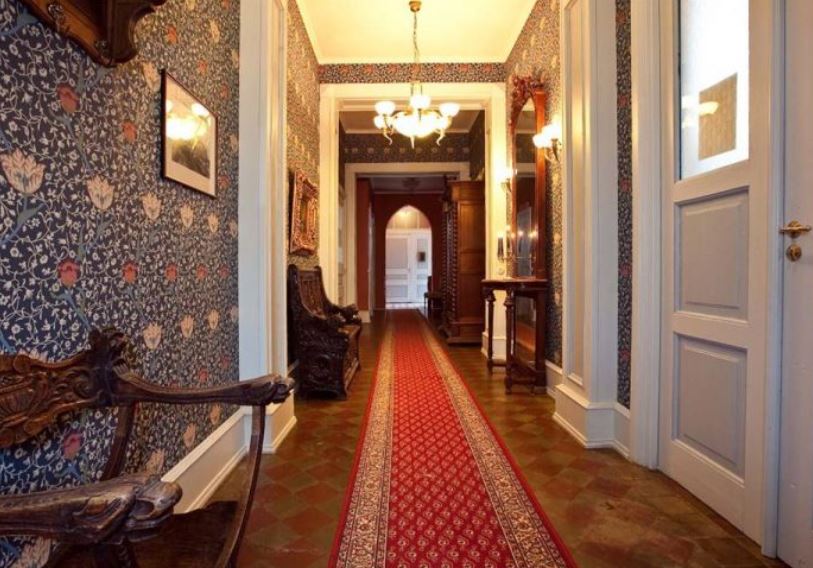
White magic furnishes a perfect illustration of the Apostle Paul’s warning: “And no marvel; for Satan himself is transformed into an angel of light. Therefore, it is no great thing if his ministers also be transformed as the ministers of righteousness; whose end shall be according to their works,” 2 Corinthians 11.14-15. White magic comes into play and alien spirits “not of God,” begin to operate when the truth of God is perverted. Many do not understand that utterly sincere believers of the holy Bible can come under the spell of white magic and demonic influence. The spirit realm of good in which the Spirit of God operates is closely related, although distinctly separate, from the spirit realm of evil where Satan and demons operate. Werewolf Order literature states, “Nikolas Schreck teaches that the ancient mythological figures of the werewolf and vampire are actually archetypal role models for the next step in evolution: cruelties of the natural order and man’s animal origins, and yet the master of a new science of pagan technology.” This concept—that the mythical creatures of the night were the most highly-evolved form of humanity—would be combined by Schreck with a revived Germanic racial occultism, inside the broader church of Satanism. His self-styled propaganda unit was tiled Radio Werewolf, after the propaganda stations set after the Second World War: Radio Werewolf stands as the standard-bearer of a new kind of youth…Orderly, disciplined, drug-free, proud and reawakened to their pagan heritage; the cadres of the Werewolf Youth Party. Contemporary youth culture was labelled a sewer of mind-numbing drugs, primitive rhythms, the unbalanced encouragement of androgyny and so forth, and the muddying and blurring of racial cultural boundaries. Performing midnight rituals to send signals to the sleeping masses in furtherance of the demonic revolution, the Werewolf Order were a gothic extreme for modern fascism.

The black-clad warrior priests and priestesses of the order form a lycanthropic legion who are shaking the axis of the World. There are thirteen designated Power stations of the Werewolf movement situated in such cities as San Francisco, London, Berlin, Seattle, Vienna, Brussels, Colorado Springs, with headquarters in Los Angeles overseen by Nikolas Schreck. Not one for half measures, Schreck declared his aim as World domination. Occultist trying to bring about a pagan revival has been going on for a very long time. At least since World War I. Necrophiliacs rub shoulders with advocates of eugenics, racist conspiracy theorists struggle for space against champions of self-castration. The Worlds of science, art, and the occult collide in a bewildering pile-up that leaves few standing. Apocalypse Culture distilled the pre-millennial angst and nihilism of people who grew up under the shadow of a mushroom cloud. The possibility of mass destruction, as imprinted on the subconscious of a generation, had produced a state of amorphous unease. A Malthusian mud flood has already been underway. The end of the World came sages ago, but it is happening slowly over a period of time and nobody has been noticing. It is an ongoing process. The World today is different than it was 30 years ago. Some of it has decayed so much, and it is decaying more and more all the time. The entire World is rotten and corrupt and they are [the masses are] ordaining their own death. To some, they are just dead people who refuse to lie down. It is people who do not see anything out in the World right now, who feel lost, unattached, swirling in a World of despair and boredom, but some glimmer of hope that there are at least some people like-minded. Lilith, a popular Satanic-femme pseudonym, is the archetypal illustration of Satan’s longstanding penchant for powerful women. Created of filth by Jehovah in the Old Testament’s Book of Isaiah, she was the first wife of Adam. Cast out into the wilderness for not submitting to her husband, she hooked up with the Devil and they made lots of little demons together.
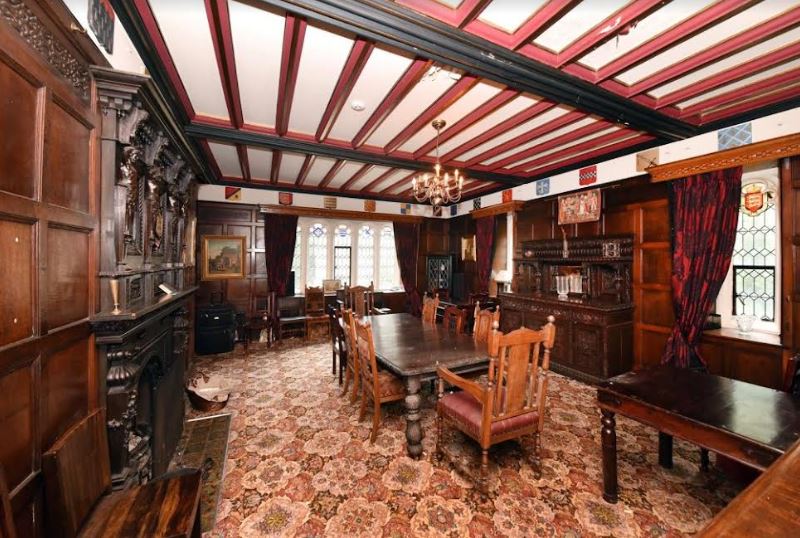
The doctrines of the Order of the Nine Angels (ONA) calls for entry into a new aeon of human development, via the overturning of current social dogma. More specifically, individual members are encouraged to evolve personally by overcoming various physical and psychological ideas. The ONA defines itself as more “sinister” than the established Satanic movements—such as the Church of Satan and the Temple of Set—who are dismissed as not “evil” enough. The group’s efforts to establish its philosophical wickedness include, inevitably, flirtation with the Far Right. The purpose of human sacrifice was to release energy and draw down dark forces. There are some people who voluntarily offer themselves up; another is the human carnage that ensues as the result of political or social upheaval, to be brought about by the actions of the Order of the Nine Angels (ONA). In other cases, which give people most pause for thought—the secret murder of individuals considered to be opponents or impediments to the ONA’s goals. The Hard Right is a very dangerous thing to get involved with. Particularly for Satanists—the ONA has received threats from certain national socialists groups who do not like the idea of Satanism being linked with them. ONA claims that the secret of Satanism is that a Satanist restores the balance within society, acting as a counterbalance. For example, if we were in a right-wing situation at this time, there would certainly be a communist Satanic organization. This may all seem rather frivolous and aimless, but what Satanism represents is basically an energy for change. Evolution. An energy which provokes insight and adversity. Satan represents movement. Something which moves and that is not tied down by moral abstracts or ideas. You could remove someone you think is detrimental to your cause, but you could be wrong in in that. It could turn out to be the opposite. ONA is designed to attract people who can think and judge for themselves.

The work ONA does is very extreme, it has to be that way. The manuscripts are designed to produce certain changes in society, to create certain preconceptions and destroy others. They are very elitist, because very few people ever stay the course. It involves real hardship, a certain way of living which few people are willing to follow. All civilizations start off as a creative minority, a small group of people in certain area who did certain things which drew the masses. People are putty, basically, and it is always going to be a small number of people who can effect changes; the artists or whatever, the people who dare to break out of the constraints of society. They also let people know that they have freedom of will, but they have to take consequences for their actions. The archetypal ONA member is a lone sorcerer, somebody who defies their own limits, defies themselves. They find out their true potential, usual through ordeals. There is one ordeal, for example, which requires living alone for three months, completely alone, bereft of any possessions whatsoever. The actual aim is, on an individual level, finding your god within yourself. What is aims to produce is a unique individual who does not need anything. ONA is a traditional which goes back 7,000 years—that is according to legend. It was born when there was a civilization around here called Albion which had various rites associated with a dark goddess who we know as Baphomet. Baphomet’s been handed down through the ages as a composite figure. The famous goat-headed symbol was actually a distortion, a lie which took away from the real power of the dark goddess, who are actually a dark, menstruating women. It was very much a code of honor centered around war and the brutal realities of life, and actually the original paganism for thousands of years before Christianity arrived. It is basically an oral tradition some received from Anton Long. He received it from a Mistress of the Order and she had it passed on from someone before her.

The term “demon possession” does not appear in the Bible. The New Testament, however, frequently mentions demoniacs. They are said to “have a spirit,” “a demon,” “demons,” or “an unclean spirit.” Usually such unhappy victims of evil personalities are said to be “demonized” (daimonizomenoi) id est, they are subject to period attacks by one or more inhabiting demons, who derange them physically and mentally during the seizure. Rationalistic criticism has persistently denied the reality of demon possession as presented so vividly in the Bible accounts of our Lord’s Earth ministry. The mythical theory, advanced notably by Germany’s David Strauss, views the whole narrative of Jesus’ demon expulsions as purely symbolic, without actual foundation in fact. Demon possession is represented as a vivid symbol of the prevalence of evil in the World, and the expulsion of demons as a corresponding figure of Christ’s triumph over it. Other critics attempt to dismiss demon possession with theories of accommodation or hallucination. The proponents of the first hypothesis declare the Lord simply adapted Himself to popular belief and terminology without committing himself to the existence or nonexistence of the phenomena described or the truth or falsity of currently belief. The proponents of the second theory consider demon possession a pure hallucination or psychological delusion. However, all such views fail to meet the issue. Nor can present-day parapsychologist and psychiatrists, who refuse to recognize evil supernaturalism in the phenomen of demon possession, either explain it or deal adequately with it. Demon possession is a condition in which one or more evil spirits or demons inhabit the body of a human being and can take compete control of their victim at will. By temporarily blotting out one’s consciousness, they can speak through the individual and their complete slave and tool. The inhabiting demon (or demons) comes and goes much like the proprietor of a house who may or may not be “at home.” When the demon is “at home,” one may precipitate an attack. In these attacks the victim passes from one’s normal state, in which one acts like other people to the abnormal state of the possessed. The present generation must weigh and draw its own conclusions about supernatural activity and this valley’s most interesting, most haunted mansion, and surely our most mysterious Frist Lady!

Winchester Mystery House

Happy Day! Who’s visiting the Winchester Mystery House This weekend?

A 160-room mansion built to appease the spirits who died at the hands of the Winchester Rifle 👻

Kitchen Dramas—Are they Arms Race or Saving Civilization as We Know it?

One a person experiences the full impact of the conflict in consciousness, one turns in an accusing rage on the target object. During the past several years, I have spent a good deal of my time blaming television for many of the more obvious dysfunctions from which Western culture—and especially America—is now suffering. It has been pointed out to me that I do this because I am by nature a negative person, always ready to condemn what is wrong rather than to praise what is right. Several of my students have even gone so far as to observe that had I lived during the period of incunabula—during the first fifty years of the printing press—I would have burdened everyone with a long list of depressing prophecies about the dangers of the machine-made book and universal literacy. However, my students are only half right. Assuming I had the brains to see what was happening in the year 1500, I would certainly have warned the Holy See that the printing press would place the word of God on every Christian’s kitchen table, and, as a consequence, the authority of the Church hierarchy would be put in jeopardy. Had I been granted a papal audience, I would have warned the Pop that armed with a printing press, Martin Luther was more than a malcontent priest suffering from a bad case of constipation. The printed word made him a serious revolutionary. I might also have warned the local princes that their days were numbered, that printing would give form to a new idea of nationhood which would make local potentates obsolete. And if the Brotherhood of Alchemists had allowed me to give the keynote address at their annual convention, I would have told them to go into another line of work, that printing would give great impetus to inductive science and that alchemy would not stand against the glare of publicly shared scientific knowledge. #RandolphHarris 1 of 20

I would also have told any wandering bards who came my way that within a hundred years their trade would lie in ruins, that tribal lays and epic poetry were doomed, and that they would be wise to urge their trainees to turn their talents to writing essays and reading novels. Now, not every one of these prophecies foretells a bad thing. That is why I said my students are only half right. Whether or not a prophecy is negative depends on your point of view. For example, since most of you are Lutherans, you probably would have cheered the breakup of the Holy Roman Empire. The Catholics of those times would, of course, have mourned it passing. In any case, there are some changes brought about by new media benefit some, harm others, and to a few do not make much of a difference. This is as true of television as it was of the printing press or any other important medium, although in the case of television there are very few indeed who are not affected in one way of another. For most of you here, television will provide a gratifying career. On the other hand, and in the long run, television may bring an end to the careers of schoolteachers, since school itself was an invention of the printing press and must stand or fall on the issue of how much importance the printed word will have in the future. New media break up old knowledge monopolies; indeed, create new conceptions of knowledge, even new conceptions of politics. If not for television, Joe Biden, for example, would not be President of the United of America, which is good for him and the interests he represents, but not so good for the poor and vulnerable. However, television can people good as it creates a true theater of the masses. For example, between the years 1948 and 1958, approximately 1,500 fifty-two-minute plays were performed “live” on American television. #RandolphHarris 2 of 19

“Live” means that these plays were performed at the precise moment they were seen by the television audience, a condition which since the advent of videotape and the widespread use of film has become increasingly rare; “fifty-two minutes” describes the actual running time of the play, eight minutes of the hour being subtracted for commercial messages, the listing of credits, and publicity for the next week’s play. There is no doubt that American television’s finest dramatic moments were provided by fifty-two-minute hours, particularly by such weekly series as the Kraft Television Theater (1947-58), the Philco-Goodyear Playhouse (1948-50), and the Studio One (1948-57). These programs began by presenting adaptations of classic and established contemporary novels but by 1950 had shifted to original dramatic work. By that time, such producers and directors as Worthington Miner, Fred Coe, Delbert Mann, Arthur Penn, and John Frankenheimer has assembled about them several gifted young writers who were prepared to devote their collective talents to a serious exploration of television’s artistic resources. Included in that group, among others, were Reginal Rose, Tad Mosel, Robert Alan Aurthur, Horton Foote, Rob Serling, J.P. Miller, and Gore Vidal. None, however, wrote more fittingly for television than Paddy Chayefsky, whose name, along with Edward. R. Murrow’s, symbolizes what romantics call “the golden age of television.” Mr. Chayefsky was to the “original” television drama what Mr. Ibsen was to the “social drama,” which is to say that he was one of the first creators and certainly its most distinguished one. Like Mr. Ibsen, he achieved an almost perfect union of form and content. Critics have observed, for example, that the effects that Mr. Ibsen achieved in A Doll’s House and Ghosts were a function not only of his themes, with which audience were certainly familiar in 1879 and 1881, but also of the stark, simple, and economical form in which he stated them. #RandolphHarris 3 of 19

Social dramas had been written before Mr. Ibsen, but it remained for him to discover the form for dramatizing social problems. Mr. Chayefsky, of course, did not write for the stage behind a proscenium arch, viewed from a distance in a darkened theater. He wrote for a seventeen-inch screen situated in a family living room, on which the only colors were varying shades of gray. He also had to present his story, from start to finish, in fifty-two minutes, and he could make two assumptions with absolute assurance: that his play would be interrupted at least twice for commercial messages, and that he would have to attract his audience instantly or lose much of it to other channels. He knew, too, as did his director, Delbert Mann, that the picture on the television screen is considerably cruder in visual definition than that on a motion-picture screen. So Mr. Chayefsky wrote his plays in anticipation of the audience’s observing the players in almost unrelenting “close-up.” Mr. Chayefsky realized that some of these technical-aesthetic conditions could create, as could perhaps no other medium, a sense of utter and absolute reality; could create the illusion that what the audience was seeing was not a mere play but life as seen through a seventeen-inch, nearly square hole. Beginning with a play called Holiday Song, which dealt with a rabbi’s re-examination of one’s faith in God, Mr. Chayefsky created a series of dramas that have often been characterized as “small” masterpieces, sometimes referred to as “kitchen” dramas, since much of the action seemed to take place in family kitchens. In any case, they were plays about unexceptional situations. The plots were uncluttered, and undaring, and highly compressed. They had few unexpected turns, little action, no treachery, no perversion, and no heroic gestures (in the traditional sense). #RandolphHarris 4 of 20

Mr. Chayefsky’s stories were “small” very much as Sherwood Anderson’s stories are small. The setting was New York, not small-town Ohio, but like Mr. Anderson, Chayefsky explored in economical but meticulous detail the agonizing problems of small people. And thus he elevated the status of both the problems and the people who suffered them. In fact, Mr. Chayefsky once remarked that “Your mother, sister, brothers, cousins, friends—all of these are better subjects for drama than Iago.” He was talking, of course, about television drama. Mr. Chayefsky’s most known play, Marty, tells the story of an unmarried, inarticulate butcher who is attacked to a sensitive but homely woman. Marty’s friends attempt to dissuade him from seeing the woman because she is, in their words, “a dog.” His mother, who fears being abandoned resents the woman bitterly. Against a backdrop of such universal themes as man’s need of loving and being loved, his fear of living alone, and his need to communicate, Mr. Chayefsky pursued his “small” story with persistent literalness, concluding with an equally “small” crisis in which Marty decides, against the protests of his friends and family, to phone the woman and ask her for a date. On the stage of in a novel, the plot would be too flimsy to carry much dramatic weight. When the play was adapted for the movies, it required more “movement” or action and the addition of at least one subplot. On the television screen, however, they play was an artistic triumph, producing a disturbing and edifying illusion of intimacy. Perhaps no other medium is better suited to the “slice of life” drama than television, a fact that is apparently well known to Ingmar Berman. Although television was invented in the 1920s, it did not exist for any practical purposes until after World War II. It is easy to forget that advertising, at least on the scale we have come to know it, barely existed before then either. #RandolphHarris 5 of 20

In 1946, advertisers spent about $3 billion. For the previous two decades, advertising expenditure had been fairly constant at about that level. By 1975, however, the national advertising budget had grown by 1,000 percent to $30 billion. In 2021, the national advertising budget reached $82 billion (expected to around $95 billion by the end of 2022). In that same year the television advertising budget has skyrocketed to $68 billion, and could be approximately $80 billion by the end of 2022. As you see, most of the increases in advertising. However, what is significant is that within only tend years of its effective inauguration, television was absorbing 60 percent of all advertising spending and driving hundreds of newspapers, magazines and radio stations out of the market. A symbiotic relationship developed. Advertising financed television’s growth. Television was the greatest delivery system for advertising that had ever been invented. We could call it love at first sight, except in this case, the match may have been prearranged. If you are fortunate enough to recall, think back to the days immediately after World War II. Although I was only ten in 1945, I remember the expectant and uncertain feeling of the times very well. Everyone was relieved that the war was over and was expecting things to get back to normal, but what was normal? Memories of the Depression loomed. I remember listening to my parents talk with their friends on those backyard summer evenings of 1945, and I could feel the fear. Like most ordinary people, my parents know that the war had alleviated the Depression. During the war, American industrial capacity, lying fallow only a few years before, had actually expanded to build the military machine. My father’s own business was an example. Now there were no more uniforms to make, and no more tanks. The war had given men jobs as soldiers and women jobs as factor workers. Full employment had practically become a reality. Now Johnny was marching home again, jobless. #RandolphHarris 6 of 19

If this was the talk among ordinary people, one can only imagine what was said in industrial boardrooms and at the Department of Commerce. With industrial capacity and capital investment expanded as they were, the consequences of a drop in production could make the 1930s look like golden years. A long-standing criticism of capitalism—that it can stave off cyclic depression only through war-seemed about to be confirmed. Suddenly in 1946, government and industry started making identical pronouncements about regearing American life to consume commodities at a level never before contemplated. It was not that military production was about to be abandoned. Even now it remains the single most important factor in the United States of America’s economy. However, in 1946 with the war just over, it was not clear that the decline in military spending would be as temporary as it turned out to be. Some new offsetting factor was needed. Thus, a new vision was born that equated the good life with consumer goods. An accelerate economy, continuing booming expansion of wartime, added to a new consumer ideology achieved the greatest economic growth rate in the country’s history from 1946 to 1970. To make such growth possible, both ends of the transformation process described previously had to be hyped up. First, we needed to insure an abundant supply of raw material to convert into commodities. This led to a burst of American investment overseas as well as to enormous assistance programs for sympathetic “underdeveloped” countries. Often we secured our supply by the creation of client governments propped up with military assistance. Raising anticommunism to the status of a holy war in the 1940s and the 1950s formed the political foundation for these military and economic programs and underlay the assertion of the patriotic virtues of foreign investment. #RandolphHarris 7 of 19

At the other end of the transformation equation, an accelerated movement of commodities into consumers’ homes was critical. People had to be convinced that life without all these products was undesirable and unpatriotic. It was time to forget the rationing of the war years and consumer for your country. Advertising and television were the dynamic duo that would rededicate the consuming American. Advertising’s ability to create a passionate need for what is not needed was already well established. Since economic growth and a consumer economy had to be based upon selling far more commodities than were needed to meet actual needs, economic growth depended upon advertising. Television, which had been lying around in mothballs since the 1920s, was dusted off and enlisted as the means to deliver the advertising lifestyle fast, right into people’s homes and heads. Quick to spot any new technology that could assist their urgent cause, big advertisers immediately invested hundreds of millions of dollars in developing this idle sales tool. And so advertising gave birth to television, and television have advertising a whole new World to conquer. Together they made possible an enormous, though temporary, economic bonanza. Can you recall the TV advertising of the 1940s and 1950s? Smiling, happy people. Scrubbed children. Housewives showing their impossibly clean wash. Smiling junior-executive husbands emerging from their new cars, greeted at the picket fence by their clean, cheerful families? The happy mowing of the lawn. The happy faces reflected off the polished toasters? The nuclear family was idealized to a greater extend than ever before, because the family was the ideal consumption unit. Women had to get out of those factories and overalls and back into little pink dresses in the kitchen. #RandolphHarris 8 of 19

Those returning soldiers needed jobs. Rosie the Riveter gave way to June Allyson. Separate family units maximized production potential. Private homes. Private cars. Two cars. Private washing machines. Private television sets. Within a few years, the World started changing. The battery-operated lawn mower I saw on television one day appeared on my lawn the next week. So did the car. The whole neighborhood started looking like a television commercial. The woods near my house in disappeared and were replaced by hundreds of identical versions of my house. Neighborhoods everywhere started looking like each other. Freeways replaced country roads. Shopping centers replaced corner markets. Pavements covered everything. “Prosperity,” “security,” “happiness,” studded ads and presidential speeches alike. This incredible outpouring of commodities, this entire revamping of landscape, this filling of houses with gadgets was supposed to constitute some kind of Latter-Day Saints Kingdom of God. That is what everyone was thinking, saying, and believing. It was what made America America. One of my high school teachers during the 1950s told my class that it was America’s commitment to a consumption economy that made our country different and better than all others. He told us that by expanding our economy, we could soon make everyone wealthy. America was already the World’s only classless society, he said. Workers and managers were equal partners in a glorious process benefiting everyone. In America everyone was equal. Our standard of living made it that way. Everyone could have a car. Everyone could have a business. We are not developing nations, where the water is dangerous to drink, and there are few rich people and everyone else is poor and all of them wished they had what we had. Because of this prosperity, we did not have to deal with the chaotic times of psychological and spiritual upheaval nor have actual fear among people of witchcraft, sorcerers, and others who claimed to know how to consort with the demons. The medieval period had died, and the modern period was born. #RandolphHarris 9 of 19

A few years later at the Wharton School of Business at the University of Pennsylvania, I learned how and why this commodity life and the economic growth it produces was supposed to be so good for absolutely everyone. I learned that they had been talking about in these boardrooms and at the Department of Commerce. It was called the “trickle-down theory.” It goes more or less like this: Industrial expansion, rapid economic growth and the consumption economy benefit everyone. The theory—which is the basis of Keynesian American economics—has it that when people buy more and more commodities, they produce more profits for industry, enabling it to expand. When industry expands, more jobs result. This puts more money into circulation, enabling people to buy more commodities, expanding profits again, yielding more investments, more jobs and starting the cycle around on another turn. This is an oversimplified process, which leaves out such variables as savings, borrowing, and so on. The way it is presented here is more or less the way it is translated through the media and through out educational system into popular understanding: a beautiful circle of activity, everyone helping everyone else, labor and management rowing the boat together, all serving the common good and growing endlessly. It explained the patriotic urgency of people spending more and more on commodities. The benefits would “trickle down” to everyone in this country, including those at the bottom on the pyramid. Jobs, money, prosperity, happiness, security, democracy, equality were all lumped together as inevitable results of this cycle. Most people believe in this “trickle-down-theory” still. Presidents get elected based on whether they can convince the public that they will stimulate the beautiful cycle. President Trump was elected for doing it and he proved his word. #RandolphHarris 10 of 19

The tickle-down theory is the nice simple kind of economic model that can be sold to a mass population removed from any deeper understanding of how things really work. Trying to come to grips with economic nuance is for most of us no easier than trying to understand how much nuclear radiation is “safe.” Who knows? The “experts” know. Like every other organizing model in our society, economic processes have been removed from personal participation, appropriated into a nether World of flow charts, financial analyses, and circle graphs. Like scientific and technological systems, once economic systems reach a certain size and complexity, they can be controlled only by forces far outside the grasp of the individual and community. One explanation of them sounds as plausible as another. In the absence of a really thorough training in economics—a training which itself supports many arbitrary and fantastic theories—this trickle-down model of the benefits of a consumer society sounds perfectly valid. It certainly seemed valid for a little while. People had jobs, the economy was growing, and homes were filling up with every more intricate gadgets. Only now, thirty years after the trip was launched, can we see the process from the vantage point of joblessness, inflation, bankruptcy and default, and realize that something was terribly wrong somewhere. In fact, it was a fantasy. It was packaged and sold to us like the seven-piece matching living-room sets on the television screen. Buy now, pay later when you are richer than you are now. However, when later came, very few of us were richer (and that usually happens to everyone). It turned out that the pursuit of all those happy goodies did not produce happy people; it produced isolated, frustrated, alienated people. More important, the economic benefits did not trickle down to create some egalitarian democracy. The benefits tickled up. That is why President Trump also used the tickle charger. Not only did he cut taxes, but also infused the less affulent with supercharged unemployment benefits, and helped the veterns, disabled, retirement and others reciveing government transfer pays by sending the a large cash sum of money, and then a few other payments for less, and he also supported businesses get through the pandemic. So the economy was stimulated and had a few trickle charges to keep the market flowing well. #RandolphHarris 11 of 19

The democratic revolution succeeded in extending formal self-government and opportunity to nearly everybody, regardless of birth, property, or education. However, it gave up the ideal of the town meeting, with the initiative and personal involvement that alone could train people in self-government and give the practical knowledge of political issues. The actual result has been the formation of a class of politicians who govern, and who are themselves symbolic front figures. Correspondingly, the self-determination won by the American Revolution for the regional states, that should have made possible real political experimentation, soon gave way to a national conformity; nor has the nation as a whole conserved its resources and maintained its ideals. The result is a deadening centralism, with neither local patriotism nor national patriotism. The best people do not offer themselves for public office, and no one has the aim of serving the Republic. Typical is the fate of the hard-won Constitutional freedoms, such as freedom of speech. Editors and publishers have given up trying to give an effective voice to important but unpopular opinions. Anything can be printed, but the powerful interests have the big presses. Only the safe opinion is proclaimed and other opinion is swamped. The liberal revolution succeeded in shaking off onerous government controls on enterprise, but it did not persist to its goal of real public wealth as the result of free enterprise and honestly informed choice on the market. The actual result is an economy dominated by monopolies, in which the earnest individual entrepreneur or inventor, who could perform a public service, is actively discouraged; and consumer demand is increasingly synthetic. Conversely, the Jeffersonian ideal of a proud and independent productivity yeomanry, with natural family morals and a co-operative community spirit, did in fact energize settling the West and providing the basis for our abundance. #RandolphHarris 12 of 19

However, because it has failed to cope with technological changes and to withstand speculation, “farming as a way of life” has succumbed to cash cropping dependent on distant markets, and is ridden with mortgages, tenancy, and hired labor. Yet it maintains a narrow rural morality and isolationist politics, is a sucker for the mass culture of Madison Avenue and Hollywood, and in the new cities (exempli Gratia, in California, where farmers have migrated) is a bulwark against genuine city culture. Constitutional safeguards of person were won. However, despite the increasing concentration of state power and mass pressures, no effect was made to give to individuals and small groups new means easily to avail themselves of the safeguards. The result is that there is no longer the striking individuality of free men; even quiet nonconformity is hounded; and there is no asylum from coast to coast. Fraternity—this short-lived ideal of the French Revolution, animating a whole people and uniting all classes as a community, soon gave way to aa dangerous nationalism. The ideal somewhat revived as the solidarity of the working class, but this too has faded into either philanthropy or “belonging.” Brotherhood of races—the Civil War won formal rights for African Americans, but failed to win social justice and factual democracy. The actual result has been segregation, and fear and ignorance from various people of all races. However, in the 2020s, that stigma is fading. Pacificism—this revolution has been entirely missed. Acceleration not only makes facts obsolete but blunts some of the key tools we use when we think. Analogy provides a case in point. It is virtually impossible for us to think without relying on analogies. This “thought-tool” is based on identifying similarities in two or more phenomena and then drawing conclusions from one to apply to the other. Doctors, we noted, will often say “the heart is like a pump” and then describe its “values” and other components in mechanical terms. This model helps them conceptualize and treat the heart. Often this process yields powerful results. #RandolphHarris 13 of 19

However, once similarities are identified, it is typically taken for granted that the similarities continue. And in slow-change eras, they may do so for long periods. In today’s hyper-change environment, however, once-similar things also change and very often become markedly dissimilar, often making conclusions based on the analogy false and misleading. To deal with today, therefore, we need not only new knowledge but new ways to think about it. Yet too many economists, consciously or otherwise, cling to the belief that economics is analogous to physics. This notion arose centuries ago, when Newtonian ideas about equilibrium, causation and determinism dominated that science. Since then, of course, physicists have drastically revised their views about these matters. However, many economists still base their findings on crude Newtonian assumptions. Trained to think in industrial terms, many find it difficult to grapple with the odd character of knowledge—the fact that it is non-rival and non-depletable, that it is intangible and thus hard to measure. It is only when we set today’s failures of economics alongside the looming crisis in science that we begin to gauge their true significance. For together these two fields have the greatest—or at least the most direct—impact on how we create wealth. And both are heading for transformation. When it comes to relationships, a university teacher of liberal arts cannot help confronting special handicaps, a slight deformity of the spirit, in the students, ever more numerous, whose parents are divorced. I do not have the slightest doubt that they do as well as other sin all kinds of specialized subjects, but I find they are not as open to the serious study of philosophy and literature as some other students are. I would guess this is because they are less eager to look into the meaning of their lives, or to risk shaking their received opinions. #RandolphHarris 14 of 19

In order to live with the chaos of their experience, they tend to have rigid frameworks about what is right and what is wrong and how they ought to live. They are full of desperate platitudes about self-determination, respect for other people’s rights and decisions, the need to work out one’s individual values and commitments, etcetera. All this is a thin veneer over boundless seas of rage, doubt, and fear. Young people habitually are able to jettison their habits of belief for an exciting idea. They have little to lose. Although this is not really philosophy, because they are not aware of how high the stakes are, in this period of their lives they can experiment with the unconventional and acquire deeper habits of belief and some learning to go along with them. However, children of divorced parents often lack this intellectual daring because they lack the natural youthful confidence in the future. Fear of both isolation and attachment clouds their prospects. A large measure of their enthusiasm has been extinguished and replaced by self-protectiveness. Similarly, their open confidence in friendship as part of the newly discovered search for the good is somewhat stunted. The Glauconian eros for the discovery of nature has suffered more damage in them than in most. Such students can make their disarray in the cosmos the theme of their reflection and study. However, it is a grim and dangerous business, and more than any student I have known, they evoke pity. They are indeed victims. An additional factor in the state of these students’ souls is the fact that they have undergone therapy. They have been told how to feel and what to think about themselves by psychologists who are paid by their parents to make everything work out as painlessly as possible for the parents, as part of no-fault divorce. If ever there was a conflict of interest, that is it. There are big bucks for therapists in divorce, since the divorces are eager to get back to persecuting the wretches who smoke or to ending the arms face or to saving “civilization as we know it.” #RandolphHarris 15 of 19

Meanwhile, psychologists provide much of the ideology justifying divorce—exempli gratia, that it is worse for kids to stay in stressful homes (thus motivating the potential escapees—that is, the parents—to make it as unpleasant as possible there). Psychologists are the sworn enemies of guilt. And they have an artificial language for the artificial feelings with which they equip children. However, it unfortunately does not permit such children to get a firm grip on anything. Of course, not every psychologist who deals with these matters simply plays the tune called by those who pay the piper, but the givens of the market and the capacity for self-deception, called creativity, surely influence such therapy. After all, parents can shop around for a psychologist just as some Catholics used to shop for a confessor. When these students arrive at the university, they are not only reeling from the destructive effects of the overturning of faith and the ambiguity of loyalty that result from divorce, but deafened by self-serving lies and hypocrisies expressed in a pseudoscientific jargon. Modern psychology at its best has a questionable understanding of the soul. It has no place for the natural superiority of philosophic life, and no understanding of education. So children who are inclined to believe that philosophy live in a less enlightened state and have a long climb just to get back up to the cave, or the World of common sense, which is the proper beginning for their ascent toward wisdom. They do not have confidence in what they feel or what they see, and they have an ideology that provides not a reason but a rationalization for their timidity. These students are the symbols of the intellectual-political problems of our time. They represent in extreme form the spirit vortex set in motion by loss of contact with other human beings and with the natural order. #RandolphHarris 16 of 19

However, all students are affected, in the most practical everyday way, unaware that their situation is peculiar, because their education does not give them perspective on it. Now, Web sites routinely collect detailed data on visitor behavior, and those statistics underscore just how quickly we leap between pages when we are online. Over a period of two months in 2008, an Israeli company named ClickTale, which supplies software for analyzing how people use corporate Web pages, collected data on the behavior of a million visitors to sites maintained by its clients around the World. It found that in most countries people spend, on average, between nineteen and twenty-seven seconds looking at a page before moving on to the next one, including the time required for the page to load into their browser’s window. German and Canadian surfers spend about twenty-one second, Indians and Australians spend about twenty-four seconds, and the French spend about twenty-five seconds. On the Web, there is no such thing as leisurely browsing. We want to gather as much information as quickly as our eyes and fingers can move. That is true even when it comes to academic research. As part of a five-year study, a group from University College London examined computer logs documenting the behavior of visitors to two popular research sites, one operated by the British Library and one by a U.K. educational consortium. Both sites provided users with access to journal articles, e-books, and other sources of written information. The scholars found that people using the sites exhibited a distinctive “form of skimming activity” in which they would hop quickly from one source to another, rarely returning to any source they had already visited. They would typically read, at most, one or two pages of an article or book before “bouncing out” to another site. “It is clear that users are not reading online in the traditional sense,” the authors of the study reported; “indeed there are signs that new forms of ‘reading’ are emerging as users ‘power browse’ horizontally through titles, contents pages and abstracts going for quick wins. It almost seems that they go online to avoid reading in the traditional sense.” #RandolphHarris 17 of 19

The shift in our approach to reading and research seems to be an inevitable consequence of our reliance on the technology of the Net, and it bespeaks a deeper change in our thinking. There is absolutely no question that modern search engines and cross-referenced websites have powerfully enabled research and communication efficiencies. There is also absolutely no question that our brains are engaged less directly and more shallowly in the synthesis of information when we use research strategies that are all about “efficiency,” “secondary (and out-of-context) referencing,” and “once over, lightly.” As people are falling in love with the Internet, reading and its mediums is reminiscence of some of Capellanus’s more universal rules. He believed that love is always in a flux, either growing or diminishing. Making it public usually kills it. Its very nature as next to impossible to consummate is also its most powerful stimulus, and during its fleeting lifetime, jealously will sharpen the intensity of the country lovers feelings. Courtly love is obsessive and best endured by constant contemplation of the beloved. By the fourteenth century, an anonymous poet was refining the notion of love. In his “Ten Commandments of Love,” he advocated faith or honesty, attentiveness, discretion, patience, secretness, prudence, perseverance, pity, measure or moderation, and mercy. The lover in Chaucer’s “Complaint to His Lady” is so excessively long-suffering that he swears to obey his lady in whatever she dies, would rather die than offend her, and begs only for a drop of her grace. Here is his version of courtly love: “But I, my lyf an deeth, to yew obeye, and with right buxom herte, hooly I preye, as [is] your moste pleasure, so doth by me; and therfor, swete, rewe on my peynes smerte, and of your grace, graunteth me some drope; for ells may me laste no blis no hope, no dwelle within my trouble careful herte.” #RandolpHarris 18 of 19

Courtly love was agonizing and admirable, the source of chivalrous virtue. For these same reasons, it was often chaste, both because the logistics of consummation defeated the would-be lovers and also because, in some manifestations, courtly love was inherently pure. As one troubadour sang, “Out of love comes chastity.” As enormous but logical stretch puts courtly love together with the secret feudal societies that adopted then institutionalized a collective devotion to an unattainable woman who inspired their members to deeds of greatest daring and valor. The woman? The Virgin Mary, whose immaculate conception the early medieval Church had just begun to celebrate. The most famous of these secret societies was the Knights Templar, excommunicated knights who swore oaths of poverty, obedience, and chastity and dedicated themselves to the (newly immaculately conceived) Virgin Mary. Unlike their secular counterparts, however, whose courtly love involved personal grooming as a token of respect to their lady loves, virginal or otherwise, the Knights of the Templar who were abstinent, according to St. Bernard of Clairvaux, “never combed, rarely washed, [and wore] their beards bushy, sweaty, and fusty, stained by their harness and the heat. Centuries of literature and lives imitating art transformed courtly into romantic love, intense and unattainable, a phenomenon too high—mindedly impractical to survive marriage and the trials of time, routine, and old age. The precious instant of recognizing the beloved, the stylized pursuit, the exchange of extravagant words penned on scented paper, the self-indulgently obsessive meditating on each other—these became the characteristic of this new kind of love. Attraction based on pleasures of the flesh fueled it, just as it had the courtliest of loves, but in this case as well, intimate passions dominated the lover’s agenda. As literature, romantic love flirted and seduced as it inflamed and seared, titillating its aficionados with its stately ritual of gallant chase, heartsick suffering, rapturous encounters, gushing epistles, all in the name of profoundest if evanescent love. Sometimes this love was chaste by intention. Even when it was not, pleasures of the flesh was usually overpowered by complications of plot and character that, depending on your point of view, either reprieved the lovers from the banality of pleasures of the flesh or condemned them to its nonconsummation. Centuries of courtly and romantic love challenged thousands of lovers. Ultimately, most emerged from its clutches with their virtue intact. If our World is made up of such changes, as these, is it strange that my heart is so sad. prophets. #RandolphHarris 19 of 19

Cresleigh Homes

Luxurious outdoor living requires porch space AND a spot for the littlest members of the household to enjoy the sunshine, too! 😍
Our home at #MillsStation Residence 4 is the largest home in the community, but that extra playhouse definitely gives it an edge. https://cresleigh.com/mills-station/residence-4/

The lounge off the entry amplifies this social core; optional bedroom enhances the choices. This design lends a little Victorian formal touch to the arrival for family and guests.
The beautiful quartz counter top island has an optional built-in quartz tablecounter, which allos plenty of island seating.
The abundant cabinet space highlights the kitchen, while gathered windows and sliding door generate seamless connectivity to the home’s outdoor entertainment and leisure spaces.

The Cathedral of the Fallen Angel
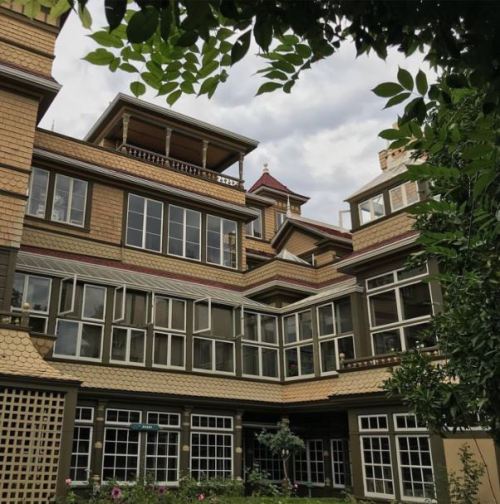
During a Connecticut thunderstorm, Mrs. Winchester’s husband and baby lost their lives in a tragic fire. The distracted widow turned to spiritualism and was advised to take a trip around the World. This she did, visiting mediums, spiritualists and wizards in Europe and India. Foretelling her future, one seer warned her of all the countless thousands of departed souls slain by her husband’s rifles; she was told to plan a castle and continue its building indefinitely because as long as it was under construction she would live; cessation would prove immediately fatal. In the afternoon of Tuesday, July 10, 1888, the inhabitants of Santa Clara Valley, were greatly excited by the sudden appearance, far out in the fields, of a mansion where none was known to exist. The people of the town were farmers and knew the area well. The day before, they had been out on their horses and rode over the spot where the unusual mansion appeared, and where certain that the locality was the best farmland in the valley. And still they gazed, and still the wonder grew, for the day was clear and the mansion could be seen as plainly as they saw the hills to the south. It was massive. The estate was surrounded by a six-foot hedge, densely wooded; here and there were deep shadows in its sides indicating glens heavily covered with undergrowth and grasses. At one end the mansion rose almost precipitously from the from the land; at the other, the declivity was gradual; the thick forest of the estate gave way to smaller trees, these to shrubs; these to green meadows that finally melted into the valley. It was patrolled by a pack of ferocious hellhounds, plus, of course, Mrs. Winchester’s staff of armed bodyguards. Hundreds of people from all over California came to investigate; when, as they neared the spot, the beautiful but bizarre mansion became dim in outline, less vivid in color, and at last vanished entirely, leaving the wonder-stricken farmers to return, fully convinced that for the first time in their lives they had really seen this enchanted mansion. #RandolphHarris 1 of 15

For once there was a topic of conversation that would outlast the day, and the enchanted Winchester mansion passed from lip to lip, both story and the mansion grew in size till the latter was little less than a continent, contain a labyrinth mansion with towers and steeples, stupendous mountain range views, fertile valleys, and wide spreading plains; while the former was limited only be the patience of the listener, and embraced the personal experience, conclusions, reflections, and observations of every woman, man, and child in the valley who had been fortunate enough to see the mansion, hear of it, or tell where it had been seen elsewhere. This is the invariable history of its appearance. No one had ever been able to come close to its grounds, but it had been so often seen on the west coast, that a doubt of its existence, if expressed in the company of farmers, will at once establish for the sceptic a reputation for balderdash of the common affairs of every-day life. In Santa Clara, for instance, the Winchester mansion had been seen by hundreds of people, while many more could testify to its appearance near San Francisco. In San Jose, all the population saw it a few years ago, and shortly before, the villagers of Oakland, saw it, if not by themselves, at least by some of their friends. The Enchanted Winchester mansion, it should be stated that its resemblance to a Victorian/Gothic castle is sometimes very close, and shows that the “enchanter” who has it under a spell knows her business, and is determined to keep her mansion for herself changes its appearance as well as its location in order that her property may not be recognized nor appropriated. At night, passers-by heard ghostly music wafting from the dark mansion. Mrs. Winchester’s arrival was a sensational event. They talked about Mrs. Winchester! Gossiped would be a more fitting word, gossip no one claimed to like-but everyone enjoyed. #RandolphHarris 2 of 15

Talk begat rumor and as the years passed and new towers and gables rose behind the six-foot hedge of Llanada Villa, the rumors grew to established legend. Populations said it just appeared out of nowhere two years ago. Sure two twins could not be like her, and when it appeared in Santa Clara, the mansion would move around to different locations. It had also appeared in San Francisco, Oakland, and Berkeley, but it went no further than the Bay Area. Concerning Mrs. Winchester’s mansion, legendary authorities differ on many material points. Some believed that its architecture was due to geometry or some other enchantment, while opponents of this materialistic view were inclined to the opinion that the mansion was not what it seemed to be, that was to say, not Earth, wood, and stones, like as those most people see, but only an illusion that evil spirits or the devil created to deceive the town. Public opinion on the west coast was therefore was strongly divided on the subject, unity of sentiment existing on two points only; that the island had been seen, and that there was something quite out of the ordinary in its appearance. People believe that it would come and go in the night like a light in a bog, and when you do see it, you can see through it. An old fisherman of San Francisco called Ebenezer Thornton knew all about the enchanted Winchester mansion, having not only seen it himself, but, when a boy, learned its history from a “fairy man,” who obtained his information from “the good people” themselves, the facts stated being therefore, of course, of indisputable authority, what the fairies did not know concerning the doings of supernatural and enchanted circles, being not worth knowing. He said that the Winchester mansion was full of temples and round towers all covered with gold and silver till they shone so one could not see it for the brightness. There was a great enchantress in the mansion, and she had all kinds of secrets, and knew where to dig for a pot of gold. She built the castle in one night, and could make herself disappeared when she wanted and could take any shape she pleased. #RandolphHarris 3 of 15

Ebenezer when on to say that Mrs. Winchester’s husband gave her a charm before he died to use when she was in mortal danger, he also left her a ton of diamonds and millions of dollars. She was a pretty smart woman. One night, Mrs. Winchester was awakened by a noise in one of the kitchens. She tole down, and found her old housekeeper, Madge, with half a dozen of her kidney, sitting by the fire drinking whisky. When the bottle was finished, one of them cried, “It’s time to be off,” and at the same moment she put on a peculiar red cap, and added:–“By yarrow and rue, and my red cap, too, hie over to England!” and seizing a twig she soared up the chimney. As the latter was making her preparations Mrs. Winchester rushed into the kitchen, snatched the cap from her, and placing herself astride of her twig uttered the magic formula. She speedily found herself high in the air over the Irish Sea, and swooping though the empyrean at a rate unequalled by the fastest airplane. They rapidly neared the Welsh coast, and espied a castle afar off, towards the door of which they rushed with a frightful velocity; Mrs. Winchester closed her eyes and awaited the shock, but found to her delight that she had slipped through the keyhole without hurt. The party made their way to the cellar, where they caroused heartily, but the spirits proved too heady, and somehow Mrs. Winchester was captured and dragged before the lord of the castle, who sentenced her to be hanged. On her way to the gallows an old woman in the crowd called out in Irish, “Ah, the enchantress herself, Sarah Winchester alanna! Is it going to die you are in a strange place without your magical charm?” She reached into her pocket and held it in her hand. On reaching the place of execution she was allowed to address the spectators, and did so in the usual ready-made speech, beginning, “Good people all, a warning take by me.” But when she reached the last line, “My parents reared me tenderly” instead of stopped she unexpected added, “By yarrow and rue, good-bye I love you,” with the result that she shot up through the air, to the great dismay of all beholders. #RandolphHarris 4 of 15

Magic persecution. Genuine magic is the art of bringing about results beyond human powers through the enlistment of supernatural agencies. Black magic deliberately involves the devil and demons, and the resulting enchantment is used for persecution and revenge. A spiritistic circle of twenty members furnishes a good example. Working with black magic, these spiritis experimented to see if they could cause psychic harm or even illness in people they disliked. A strong medium of this occult group chose a minister as a target and vowed to afflict and eliminate her. The minister suffered a nervous breakdown and was unable to work for several months. Some phenomena must be eliminated from the spiritistic magic field. In the psychiatric realm, for example, many schizophrenics claim to be magically persecuted. In reality this is only a symptom in the course of psychotic disease. Eliminating all such cases, there are still large-scale, genuine phenomena, especially in areas where occultism has flourished for many years. One common form of magic persecution is beatings by an invisible attacker. Parapsychology also sees magical persecution as a mediumistic problem in the sphere of materializations. Strong mediums (when under demon control) send out energy with which to build up human phantasms and are also able to transform this energy into animal forms, including dogs, cats, frogs, snakes, or human bodies with animal heads, etcetera. This explains the bizarre spiritistic persecution through phantoms in the form of various animals of human bodies with nonhuman heads. These animals bite, scratch, or otherwise torment their victims. Examples, of these occult phenomena abound in areas where the black arts are practiced. However, such occurrences are denied by many intellectuals. Often peasants and country people, especially in Europe, know more about magic than university graduates, who claim to swindle or hocus-pocus trickery are used instead of occult powers. #RandolphHarris 5 of 15
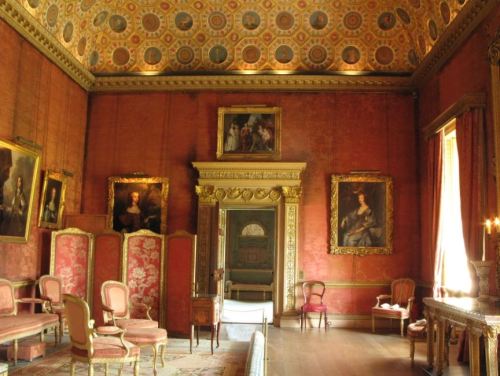
Magic defense. Magic defense enlists supernatural agencies to counteract or unto the mischief wrought by magic persecution. Various kinds of spells, charms, or incantations are employed. In spiritistic séances it is an established fact that injuries inflicted upon a phantasm are sustained by the medium, even in the case of animal phantasm. Many defensive customs develop to combat this threat since magical persecution involves materialization. If a victim can injure an aggressive phantasm one has won the struggle. Many in the West wanted to remove Satan from the equation of black magic and demonic aspects of life. However, more serious discontent came from Satanists whose concerns were completely the opposite. Anton LaVey did not believe in Satan as a literal entity—He was a name for the dark, brutal aspects of humans and nature, as well as a symbol for the potency of humans’ untrammeled will. The Church of Satan was not a religion, and did not worship deities. For many, however, this was not enough. They wanted a real Devil to worship—belonging to a dark, mysterious coven, in the traditional gothic style, seemed much more appealing than being part of some cultural and social elite. Some believed that Satan, although thrown out of Heaven, was reinstated as the son of God and is directly in contact with him. If any coven members offends, they are a bit evil now and again, given corporal punishment, or is expelled from one’s coven and cursed. However, this is said to be for the members own good. They really believe in love, the sanctity of woman as the child bearer and procreator of life, and in worshipping Satan their master. Aleister Crowley was grooming Kenneth as his successor. Mr. Grant’s work examined lost gods, strange spiritual traditions and forbidden symbols, often leading him to some disreputable spiritual neighborhood where devils and demons might be expected to reside, like the Winchester Mystery House. #RandolphHarris 6 of 15

If you have a lot of magic in you, you can be a Satanist and have no idea. As if they are the mafia or something, sometimes those who are suspected of being Satanists have their offices broken into like they are the Mafia or something. The Church of Satan, however, has saved lives because it has given them power, power to come out and be themselves when traditional churches would not accept these people. The Dark Lord, was said to be an anthropoid but faceless. Looking at the concept as a diamond, much like the ones left to Mrs. Winchester by her husband William Wirt Winchester, Satan or Lucifer was just other facets of that diamond, purely ways of achieving workings which encompassed the whole. So, if you are particularly drawn to the gothic Satanist current, fine, use rituals based around that. In the Temple of Darkness one could equally have Satanists, Setians, or followers of other paths, the principle being that the whole thing is a psychodrama anyway. Magic is basically the Western version of yoga. Everything that happens in magic happens first in your head. Set, the Egyptian god of evil, was an older deity than Satan. Satan derives from Set. Set, who is defined as the Prince of Darkness, is a force about which you could say, “As we are now, he once was.” When you die your force can survive. Magic is mind enhancing. When one perishes or passes, instead of going into the cosmic whole—becoming one with the goddess or whatever—by sheer force of the will the existence of that magician’s mind can be sustained. This is the whole idea of the Temple of Set, and they use the word “xeper,” meaning “to become,” to define this. Spiritistic cults. If you did not know, Mrs. Winchester was a spiritists. Spiritism is considered a form of Christianity, practically in all civilized countries. A typical meeting consists of hymns, prayer, and a sermon as in a Christian service. The sermon, however, is allegedly given by a spirit from the other World, through a medium. These cults are said to be affected by the “doctrines of demons” and press into the supernatural World. #RandolphHarris 7 of 15
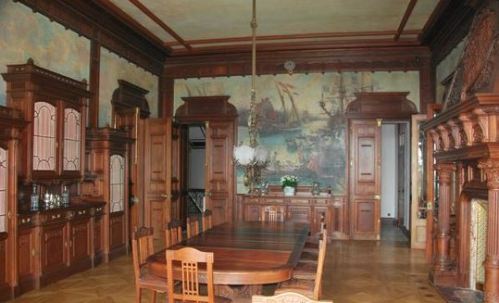
However, even born-again Christians often cannot differentiate between the spiritual and the psychic-demonic when under the spell of doctrinal errors, particularly those concerning the work of the Holy Spirit. The result can sometimes be confusion, division, and promotion of certain spiritual gifts accredited to demons. We have sometimes seen people end up suffering from mediumistic psychosis. Quite a number of patients who have suffered serious psychic disturbances through the misuse of such practices have become split personalities. The spirits which they called, confused them. One who tries to discover the promises of the other side through superstition endangers oneself to fall a prey to the dark side of one’s psyche. However, many Christians say that spirits of loved ones cannot be brought back from the dead, and the it is just a demon impersonating them. Yet, consider the case of Saul’s visit to the spiritistic medium at Endor (1 Samuel 28.3-25). Samuel’s spirit was actually brought back from the spirit World when the medium Endor tried to contact him. Yet, God brought the spirit back. The Lord stepped. Still one must be careful because many become enslaved and oppressed by occult powers and become victims of various manifestations of spiritistic phenomena. While overwhelming evidence from Christian counseling confirms the fact that spiritistic complicity serious damages the believer’s spiritual life, adherents of Buddhism, Island, or even false cults of Christianity sense no ill effects. Spiritists claim that spiritism has strengthened their belief in life after death and deepened their religious devotion. Psychiatry, psychology, and medical treatment are not sufficient for the healing of the whole human. The gospel of Christ and the liberating power of the Word of God can fully heal body, soul, and spirit. #RandolphHarris 8 of 15

Mrs. Winchester had a pain in her right forearm. At first the pain was treated as rheumatism but one day the Mrs. Winchester made the interesting discovery that the pain would suddenly subside if she wrote a letter. Having discovered this, whenever the pain became unbearable, she would always take a pencil and begin to write in order to alleviate the pain. However, after a period of time the Mrs. Winchester when go into her Blue Séance Room, where she developed a writing compulsion. She would write things down that she could normally speaking never have written. Often times, this is where the blueprints from her mansion came from. Added to this the written material on each occasion turned out to be some form of religious treatise. Mrs. Winchester took the articles to her minister to let him examine them. He was surprised at their intellectual content. Mrs. Winchester had become a spiritistic writing medium. The parapsychologist would merely see in this example a psychic automation involving the expression of subconscious thoughts. It is true that we need not consider the Mrs. Winchester to be in direct contact with the dead, or putting it another way we need not assume that this is a case of direct demonization, but God could be speaking to her. This is why some believe Mrs. Winchester to be a prophetess. During one of her spiritistic seances, as it happened, a phantasm did in fact appear during a séance. However, it is still not necessary to believe that a spirit really did appear in this instance. Depth psychology suggest that a phantasm can be produced in the following way. The medium through emitting energy causes matter to form as a result of this. In nuclear physics we have the idea that matter is nothing more than concentrated energy. Einstein’s formula E=M.c^2 illustrates this relationship. A comparison can also be drawn from another branch of physics. It is found that both particles and anti-particles are formed at the cathode of an X-ray tube when a current is passed through it at a very high voltage. Energy in the form of electro-magnetic waves is in this way transformed into matter. #RandolphHarris 9 of 15

The next step in the mediumistic process involves the unconscious tapping of the information from some source or other, and then the newly formed matter is physically shaped according to this information. The final step is made when the phantasm is brought under the control of the medium. Looking at it from this point of view there is no necessity to believe that the dead person has in any way been disturbed. An animistic explanation based on the powers of the subconscious is thus sufficient to explain the phenomenon of materialization. Yet this is not to say that the rationalistic explanation does justice to the facts of the case. The problem is not as simple as that. However, we do not have the time to delve further into the scientific side of the issues. We have, on many occasions witnessed a disintegration of the personalities of both mediums and participants where materializations have taken place. In addition to this in every case where a person has frequently taken part in spiritistic séances, there is some kind of reaction, even if it is not immediately notice or if there is no manifestation—something happens. There are also people who are able to practise the excursion of the soul. Spiritists affirm that people can send out an astral body from their material body, and commission it to do whatever they ask. Perhaps that was the case when Mrs. Winchester appeared in another country? Spiritism haunts the dark jungle of human aberration. During a séance as the Winchester mansion, Mrs. Winchester noticed that time was passing somewhat wearily. She could hear an occasional thud, thud. Some time must have elapsed before she became, dimly at first, and then distinctly, aware of a bluish phosphorescent emanation from a skeleton. This seemed to rise above it like a faint smoke, which gradually gained consistency, took form, and became distinct; and she saw before her the misty, luminous form on an unclothed man, with wolfish countenance, prognathous jaws, glaring at her out of eyes deeply sunk under projecting brows. #RandolphHarris 10 of 15
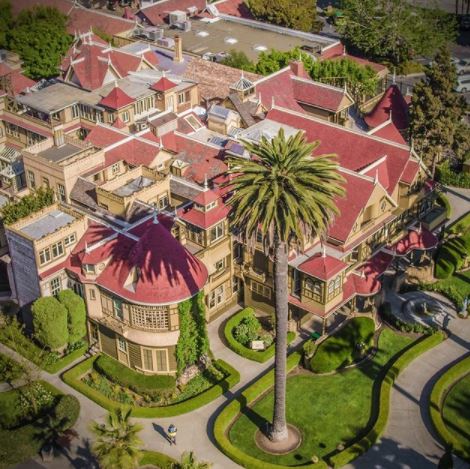
Although she thus descried what she saw, it gave her no idea of substance; it was vaporous, and yet it was articulate. Indeed, she could not say for sure if she saw this apparition with her eyes, or whether it was a dream-like vision of the brain. Though luminous, it cast no light on the wall of the Blue Séance Room; if she raised her hand, it did not obscure any portion of the form presented to her. Then she heard: “I will tear you with the nails of my fingers and toes, and rip you with my teeth.” “What have I done to injure and incense you?” she asked. No word was uttered by either of them; no word could have been uttered by this vaporous form. It had no material lungs, nor throat, nor mouth to form vocal sounds. It had but the semblance of a man. It was a spook, not a human being. However, it proceeded through the walls, odylic force which smote on the tympanum of her mind or soul, and thereon registered the ideas formed by it. So in a like manner Mrs. Winchester thought her replies, and they were communicated back in the same manner. If vocal words had passed between them neither would have been intelligible to the other. No dictionary was ever compiled, or would be compiled, of the tongue or prehistoric man; moreover, the grammar of the speech of that race would be absolutely incomprehensible to humans now. However, thoughts can be interchanged without words. When we think we do not think in any language. It is only when we desire to communicate our thoughts to other humans that we shape them into words and express them vocally in structural grammatical sentences. The beasts have never attained to this, yet they can communicate with one another, not by language, but by thought vibrations. Mrs. Winchester knew as she conversed with him that she was not speaking to him in English, nor in French, nor in Latin, nor in any tongue whatever. Moreover, when she used the words “said” or “spoke,” she meant no more than that the impression was formed by her brain-pan or the receptive drum of her soul, was produced by the rhythmic, orderly sequence of thought-waves. #RandolphHarris 11 of 15

When, however, she expressed the words “screamed” or “shrieked,” she signified that those vibrations came sharp and swift; and when she said “laughed,” tht they came in a choppy, irregular fashion, conveying the idea, not the sound of laughter. “I will tear you! I will rend you to bits and throw you in pieces about this mansion!” shrieked this demon man. Mrs. Winchester remonstrated, and inquired how she had incensed him. However, yelling with rage, he threw himself upon her. In a moment she was enveloped in a luminous haze, strips of phosphorescent vapour laid themselves about her, but she received no injury whatever, only her spiritual nature was subjected to something like a magnetic storm. After a few moments the spook disengaged itself from Mrs. Winchester, and drew back to where it was before, screaming broken exclamations of meaningless rage, and jabbering savagely. It rapidly cooled down. “Why do you wish to ill me?” She asked again. “I cannot hurt you. I am spirit, you are matter, and spirit cannot injure matter; my nails are psychic phenomena. Your soul you can lacerate yourself, but I can effect nothing, nothing.” “Then why have you attacked me? What is the cause of your impotent recement?” “Because you are the heiress to the Winchester Rifle, and I lived eight thousand years ago. Why are you nursed in the lap of luxury? Why you enjoy your comforts, a civilization that we new nothing of? It is not just. It is cruel on us. We have nothing, nothing, literally nothing, not even lucifer matches!” Again he feel to screaming, as might a caged monkey rendered furious by failure to obtain an apple which he could not reach. “I am very sorry, but it is no fault of mine.” “Whether it be your fault or not does not matter to me. You have these things—we had not. Why, I saw you just now strike a light on the sole of your boot. It was done in a moment. We had only flint and ironstone, and it took half a day with us to kindle a fire, and then it flayed our knuckles with continuous knocking. No! we have nothing, nothing—no lucifer matches, no commercial travellers, no Benedictine, no pottery, no metal, no education, no elections, no chocolat menier.” #RandolphHarris 12 of 15
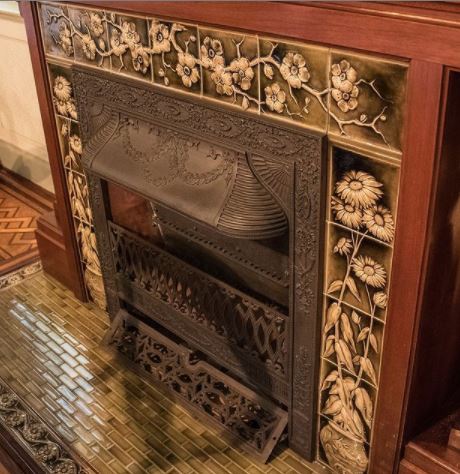
“How do you know about these products of the present age, here, buried one hundred feet of soil for eight thousand years?” “It is my spirit which speaks with your spirit. My spook does not always remain with my bones. I can go up; rocks and stones and earth and your labyrinth mansion heaped over me do not hold me down. I am often above. I am in the gasolier overhead. I have seen your servants plough the fields. I have seen a bottle of Benedictine. I have applied my physical lips to it, but I could taste, absorb nothing. I have seen commercial travellers there, cajoling the patron into buying things he did not want. They are mysterious, marvellous beings, their powers of persuasion are little short of miraculous. Why do you think of doing with me?” “Well, I propose first of all photographing you, then soaking you in gum Arabic, and finally transferring you to a museum.” He screamed as though with pain, and grasped: “Do not! do not do it. It will be torture insufferable.” “But why so? You will be under glass, in a polished oak or mahogany box.” “Do not! You cannot understand what it will be to me—a spirit more or less attached to my body, to spend ages upon ages in a museum with fibulae, triskelli, palstaves, celts, torques, scarabs. We cannot travel very far from our bones—our range is limited. And conceive of my feelings for centuries condemned to wander among glass cases containing prehistoric antiquities, and to hear the talk of scientific men alone. Now here, it is otherwise. Here I can pass up when I like into your mansion, and can see the maid and butlers cleaning, the roses and trees growing, the farmers working the field and the magnificent glow of your fine estate. Give me life. There is a sort of filmy attachment that connects our psychic nature with our mortal remains. It is like a spider and its web. #RandolphHarris 13 of 15

“Suppose the soul to be the spider and the skeleton to be the web. If you break the thread the spider will never find its way back to its home. So it is with us; there is an attachment, a faint thread of luminous spiritual matter that unites us to our Earthly husk. It is liable to accidents. It sometimes gets broken, sometimes dissolved by water. If a black beetle crawls across it it suffers a sort of paralysis. I have never been to the other side of the of your mansion, I feared to do so, though very anxious to see your architecture and furniture.” “This is news to me,” replied Mrs. Winchester. “Do you know of any case of rupture of connection?” Yes,” he replied. “My old father, after he was dead some years, got his link of attachment broke, and he wandered about disconsolate. He could not find his own body, but he lighted on that of a young female of seventeen, and he got into that. It happened most singularly that her spook, being frolicsome and inconsiderate, had got its bond also broken, and she, that is her spirit, straying about in quest of her body, lighted on that of my venerable parent, and for want of a better took possession of it. It so chanced that after a while they met and became chummy. In the World of spirits there is no marriage, but there grow up spiritual attachments, and these two got rather fond of each other, but never could puzzle it out which was which and what each was; for a female soul had entered into an old male body, and a male soul had taken up its residence in a female body. Neither could riddle out of which each gender was. You see they had no education. However, I know that my father’s soul became quite sportive in that young woman’s skeleton. Each generation makes some discovery that advances civilization a stage, the next enters on the discoveries of the preceding generations, and so culture advances stage by stage. Man is infinitely progressive; even the brute beast is.” #RandolphHarris 14 of 15
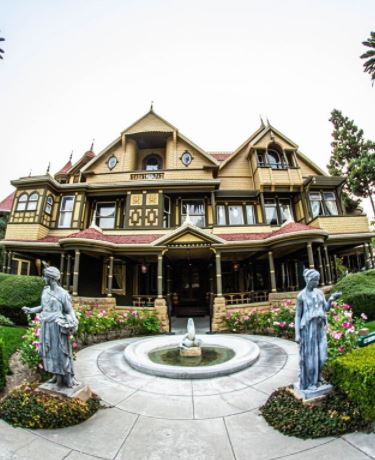
At that moment, Mrs. Winchester heard a shout—saw a flash of light. The construction workers had pierced the barrier. A rush of fresh air entered. She staggered to her feet. She felt dizzy. Kind hands grasped her. She was dragged forth. Brandy was poured down her throat. When she came to herself, she said, “Thank you. Talking with spirits can be terrible dreadful. When you are trying to summon one, souls get crossed and the one you are seeking may not cross through. They are so desperate to find a medium to communicate with.” As an ingredient of idol worship, magic goes back to antiquity. By virtue of their multiplicity and limited knowledge and power, the gods (demons) of paganism are incapable of establishing stability and security in society. This deficiency forced both gods and men to make use of magic—an inactive power independent of gods and men, but which could be activized by the assistance of incantations and rituals in order to accomplish supernatural deeds. Because of widespread denial of the reality of supernatural power—both divine and demonic, confusion abounds concerning the nature of magic. The history of magic is replete with extraordinary extrasensory phenomena that involve the spirit realm and every phase of the natural World as well, including human beings, animals, plants, and inorganic matter. Spirit-rapping, apparitions, ghosts, moving of furniture, and playing of musical instruments by invisible hands, stones falling from a ceiling, magical killing of cattle and blighting of crops, etcetera, are just a few of the weird occurrences that have happened at the Winchester Mystery House in its 134 years. However, there have also been beautiful supernatural events such as apparitions getting married, giant spirits of light in the shape of a man peering out guests, and on occasion, even rainbows and angels have appeared. Not all spirits or evil or angry, some or loving and welcoming. Few of thousands of annual transient guests are disappointed for here one finds visible truth even stranger than all the weird Mystery House features. #RandolphHarris 15 of 15

Winchester Mystery House
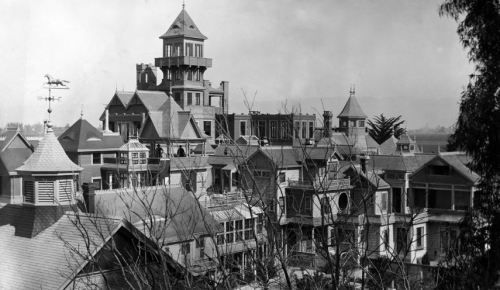
Beautiful weather calls for a walk around Sarah’s iconic gardens ⛲️🪴Open 10AM – 5PM this weekend!
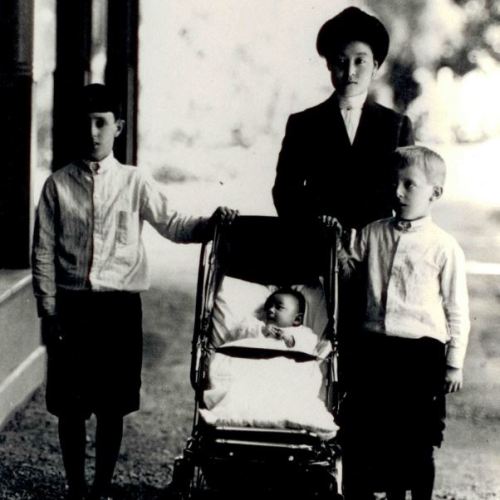
A 160-room mansion built to appease the spirits who died at the hands of the Winchester Rifle , or who were jealous of its wealth 👻
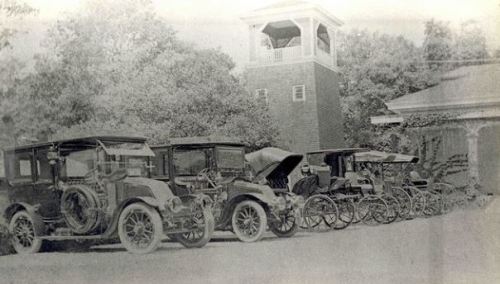

Where the Wind Blew and the Stars Sone Down

Haunting, eerie, mystical even at times a little frightening to those outside the shadowy half-World of the occult but compelling and demanding out attention. In 1884, Mrs. Winchester left New Haven, Connecticut, and the graves of her husband and only child, moved to San Jose, California, and began the obsession that was to last for the rest of her life. She purchased an unfinished farmhouse outside the small agricultural town, and for the next 38 years, the sound of construction on Mrs. Winchester’s house never stopped. She used to maintain, I remember, that there was no apparition or supernatural manifestation, or series of circumstances pointing to such a manifestation, however strongly substantiated they appeared to be, that could not be explained on purely natural grounds. However, there was a notable instance of what was by many supposed to be a supernatural manifestation that occurred in the water tower on the estate. It was a horrible sight. Barney Ackers and his wife Everly had evidently been waylaid and killed by a blow of an axe just as he was entering the yard gate, and then the door of the water tower had been broken open and his wife had been killed, after which Barney’s body had been dragged into the water tower, and it had been fired with the intention of making it appear that the water tower had burned by accident. However, by one of those inscrutable fatalities, the fire, after burning half of two walls, had gone out. Still, it was a horrible sight and the room looked like shambles. Barney had plainly been caught unawares while leaning over his gate. The back of his head had been crushed in with the eye of an axe, and he had died instantly. The pleasant thought which was in his mind at the instant—perhaps, of the greeting that always awaited him on the click of his latch; perhaps, of his success that day; perhaps, of Mrs. Winchester’s kindness to him for the work he did—was yet on his face, stamped there indelibly by the blow that killed him. There he lay, face upwards, as the murderer had thrown him after bringing him in, stretched out his full length on the floor, with his quiet face upturned, looking in that throng of excited, awestricken men, just what he had said he was: a man of peace. His wife, on the other hand, wore a terrified look on her face. There has been a terrible struggle. She had lived to taste the bitterness of death, before it took her. #RandolphHarris 1 of 13
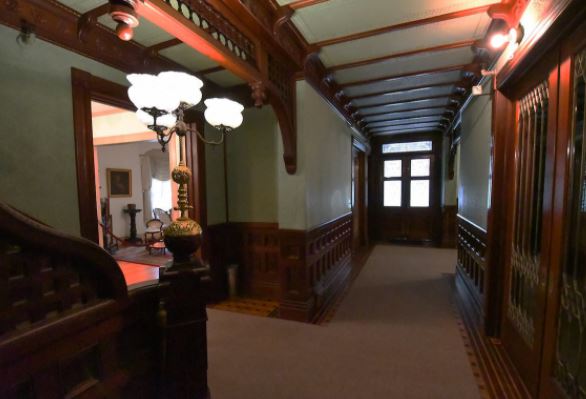
Satan’s presence was haunting. It haunted Mrs. Winchester for years, and for many nights she could not sleep. No one ever found out who did it, and she found herself unable to forget it, or to have peace as she used to. On the night of the 3rd of January 1888, some thieves attempted to commit a robbery on the estate of Mrs. Winchester. They entered the mansion, armed with a dead man’s hand with a lighted candle in it, believing in the superstitious notion that is such a hand be procured, and a candle placed within its grasp, the latter cannot be seen by anyone except him by whom it is used; also that if the candle and hand be introduced into a house it will prevent those who may be asleep from awaking. The inhabitants, however, were alarmed, and the robbers fled, leaving the hand behind them. No doubt the absolute failure of this gruesome dark lantern on this occasion was due to the fact that neither candle nor candlestick had been properly prepared! The Winchester mansion is full of apparitions and specters and perhaps some of them foiled the bulger’s plan. The mansion was continually disturbed by a nocturnal house-spirits. At night heavy steps were heard as of one carrying a heavy load. On occasion a form appeared in a monk’s cowl. Certain ghosts are confined to the Winchester mansion and they plague particularly people. A certain butler, Elton Abram, was an active spiritist while employed for Mrs. Winchester. For years he practiced table-lifting and considered this to be a way of communicating with the dead. He continued with his occult practices so intensively that psychic disturbances set in. The effects of his spiritistic interests also appeared in his children and grandchildren. His oldest son committed suicide. His next son suffered from a persecution mania. His oldest daughter ended up in The Great Asylum for the Insane. Another daughter suffered from Parkinson’s disease. Among his grandchildren the same picture emerged. One of them was a schizophrenic. Another suffered from weak nerves and hypersensitivity, and another lived a dissolute life, and had given birth to an illegitimate child. The first of the man’s great-grandchildren became a psychopath and a delinquent. #RandolphHarris 2 of 13
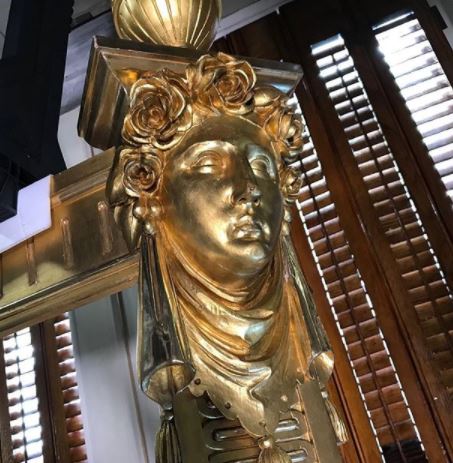
From the scientific point of view, one might consider these effects to have a different cause from that of spiritism. The psychiatrist will be interested in the question whether the practicing of spiritism was rather the effect than the cause of the ensuing mental and emotional disorders. Or again, was there some latent disposition in the family that was merely triggered off by the spiritistic activities? The parapsychologist will explain the table-lifting phenomenon as psychic automatism, that is an activation of subconscious forces. The Christian however is concerned essentially with the frequency in which psychic disturbances appear in connection with the practice of occultism. It was well known that Mrs. Winchester donned herself with ceremonial robes and communed nightly with the spirits in the Winchester mansion, and it was the midnight rendezvous for legions of ghosts, with special attention accorded those created by a Winchester rifle slug. It is possible the Mr. Abram stole something from the Winchester mansion, which brought on a curse to him and generations of his family members. A person’s thoughts and actions are like people who populate a community: friendly, contentious, kind, malicious, virtuous, evil, virile, cowardly, optimistic, cynical. We prosper in a pure mental neighborhood and wither in a foul one. And we can choose our mental neighborhood. Tired minds and bodies are signals to be careful. Demonic oppression is not easily discerned. Some people mistakenly blame demons for unrepentant self-will and psychological abnormalities. The source is not always clear, but demon oppression is usually marked by an emotional inability of the individual to do what one wants to do. A young maid staying in the Winchester mansion called Bythesea Atterton, had been a founding member of a thriving witches coven in Essex and the group’s other three members all shared her dedicated to the occult. She began to complain about various mental disturbances which included being tired of life and having depressions. Added to this she often had violent fit of temper, and her marriage was being undermined by her own frigidity. It has also happened that the husband had seen strange figures in the house at night. He had not told his wife about this so as not to upset her, but after a while she too had seen similar strange and maimed figures about the house. #RandolphHarris 3 of 13

Mrs. Winchester questioned the woman about her past illnesses and about the general health of her parents and grandparents, but she was the only one to have suffered in this way. In answer to Mrs. Winchester’s questions about contact with occultism, after a lot of thought Bythesea told her the following story. She had stolen Mrs. Winchester’s sixteenth century book about magic, and saw a black shadow at the end of her bed. It was a horrible presence that frighted the life out of Bythesea. While Mrs. Winchester was asleep, she would invite her Protestant girl’s group over. The minister’s wife, who had become the leader, used to practice table-lifting with all the girls in the Blue Séance Room. The sessions had always begun with the question, “Spirit, are you there?” One knock had meant “yes,” two had meant “no.” When the spirit had been willing to answer they had all taken part in asking it questions. The minister’s wife had continued this practice for many years until she was paralyzed by a stroke. Bythesea told Mrs. Winchester that all the girls had subsequently been afraid to visit their leader since her face had been changed into a terrible grimace by the stroke. Medical science would classy this example together with the precious one. However, with regards to the stroke, we would like to point out that in the numerous cases connected to the Winchester mansion of suicides, fatal accidents, stroke, and insanity, they usually involve the occult and someone who has in someway broke a rule, stole from the mansion, or offended the spirits somehow. The miles of twisting hallways in the mansion are made even more intriguing by secret passageways in the walls. Mrs. Winchester traveled through her house in a roundabout fashion, supposedly to confuse any mischievous ghosts that might he following her. Mrs. Winchester never slept in the same bedroom two nights in a row, in order to confuse any evil spirits that might be waiting for her. Music has always played an important role in cultural outlook and identity. Hymns, marching songs, lullabies—there are a thousand different aspects of life which are ordered or inspired by a musical beat. Music helps to define your cultural tribe. Even the ghost at the Winchester mansion reportedly had parties at ungodly hours. #RandolphHarris 4 of 13

The Satanic underground was celebrated—and eventually propelled into the mainstream—by musicians at the tail-end of the psychedelic era. While the Beatles and the Rolling Stones were the public faces of the 1960s youth culture, other voices of that same social and spiritual revolution sang dark hymns of rebellion. Some think that Black Arts Festivals have gone too far, one in particular. Coven might have achieved the popular success that ultimately eluded them. The band’s first album went under the uncompromising title Witchcraft Destroys Minds and Reaps Souls, boasting a gatefold sleeve featuring the band engaged in a Black Mass—complete with attractive blonde singer Jinx Dawson serving as a naked altar. The album features a recording of this Black Mass at the tail end of side two: “Two the best of our knowledge, this if the first Black Mass to be recorded in written words or in audio,” explain the sleeve notes. (Anton Lavey recorded his own Black Mass shortly afterwards.) “It is as authentic as hundreds of hours of research in every know source can make it. We do no to recommend its use by anyone who has not thoroughly studied Black Magic and is aware of the risks and dangers involved.” The rite bears the hallmark of serious study, with notably authentic elements from medieval Gnostic and witchcraft lore. The overall effect, however is curiously naïve, with the high priest’s command to “kiss the goat” sounding more Monty Python than Aleister Crowley. The music that precedes the Black Mass is standard—if well-executed—1960s folk rock. It is something of a jolt to realize that, behind the gentle acoustic guitars, the lyrics are exclusively about Devil-worship and black magic, while the alluring Miss Dawson’s vocals give the effect of a demonically-possessed Join Mitchell. Ultimately, Witchcraft Destroys Minds and Reaps Souls is an interesting musical exploration of the witchcraft tradition which suffused rural America ever since the Pilgrim Fathers landed in New England over four centuries ago. #RandolphHarris 5 of 13

The infamous Salem witch-trials—which took place in Massachusetts during 1692—had been one of the last major incidents of state extermination by religious fanatics from the “Old World,” making the term “witch-hunt” synonymous with the persecution with marginalized groups. As such, it elicited the sympathy of twentieth-century hippies like Coven toward their satanic predecessors. (In sacrificing the lives of twenty suspected “witches” to the fantasies of hysterical children, it also predated the “Satanic panic” of the 1980s-90s.) Coven’s second album Blood on the Snow followed but, despite its demonic sleeve, the Satanic elements were fare more restrained. By the third album, imaginatively titled Coven, the sinister elements had all but disappeared, replaced by standard hippie material. Robbed of the distinctive image of their early days, Coven faded away. It is interesting that the British rock band Lucifer, formed in 1971, were a curious collection of characters whose sardonically-devilish promotional photos portrayed a Mansonesque image, enlisted the Devil to fight the capitalist-pig system. Lucifer issued two albums, Big Gun and Exit, and a single, entitled “F*ck You,” which was seized by the police. Most outre of the Satanic psychedelicists, Roky Erickson had been the leader of the mid-1960s Texan garage band the Thirteenth Floor Elevators until a bust for marijuana possession. Facing a long prison sentence under the Lone Star State’s sanctimonious laws, he committed himself to a psychiatric institution instead. This was a bad mistake. Three years later, in the early 1970s, the hallucinogen-loving Erickson came out of the lunatic asylum considerably more troubled than when he went in. An obscure cult figure who became known for lyrical tributes to his favorite 1950s horror movies, in the hospital he had formed a close relationship with his own personal Satan. “Ah’m not afraid of the Devil, the Devil is mah friend. He chose me to do his biddin’,” drawled the usual but loveable Erickson. “Those doctors and nurses…They could not mess with the Devil’s chosen one.” To cement this unholy pact, Erickson later vocalized his personal infernal visions in wildly sincere songs like “I Think of Demons” and “Don’t Shake Me Lucifer.” #RandolphHarris 6 of 13

Ny far the most interesting of the Satanic-psychedelic bands were Black Widow. Their 1970s debt album, Sacrifice, was the result of guitarist Jim Gannon’s research into the Black Arts, with occultic lyrics accompanying a blend of traditional folk music and progressive rock. The almost-ubiquitous Alex Sanders warned the band they had done their homework too well, and would attract dark forces. He was right for one, though only inasmuch as Gannon’s lyrics boast a fair degree of authenticity, and some songs—like the catchy “Come to the Sabbat”—are highly evocative of the medieval-European Satanic tradition. Other moments—like the horrible saxophone solo Satan uses to tempt some poor innocent on “Seduction”—are diabolical in a different sense. The band enhanced their image with an elaborately Satanic stage show, professionally choreographed by a Leicester theatre company, complete with sacrificial daggers and an unclothed young woman to adorn the altar (at one point this was Alex Sanders’ wife, Maxine). They reaped the reward for their oddly entertaining work, with Sacrifice reaching the top 40 in the UK album charts. However, their second album, Black Widow, lacked both the Satanic themes and the power of its predecessor. The official explanation for this was that, true to Sanders’ warning, weird things stated to happen—most alarmingly, near-fatal car crashes. (Satan seems particularly keen on causing road accidents, however much more impressive lightning bolts or stampeding elephants might seem.) What is more likely is that, like many rock bands that use powerful Satanic imagery, Black Window may have begun to believe that same imagery was holding back their career. As many have learnt to their cost, however, it is more often the other way around—few dabbling rock stars regain the early excitement once they stop playing the Devil’s music. Suffice to day, Jim Gannon, the major creative force behind the band, cannot have been unduly worried by the curse, as he tried to mount a stage musical version of the Black Widow show on Broadway. Sadly, it never came off, and Black Widow—devoid of Devil worship—dwindled into obscurity. #RandolphHarris 7 of 13

Prosaic accounts of Black Sabbath’s flirtation with occult imagery claim they were impressed by the interest Black Widow had enjoyed in their Satanic stage show. The truth is probably a combination of all these stories. Whatever, it is fair to say that intense interest in their demonic aspects surprised Black Sabbath as much as anyone else. Their eponymous 1969 debut album was recorded in to days for six hundred pounds, treated with contempt and indifference by the press, and rapidly became a commercial success. The Christian Science Monitor, or all publications, noted approvingly that the band did not “condone or promote the less seemly aspects of…an interest in occult matters.” They were right. The song “Black Sabbath” describes the narrator’s state of terror at witnessing a Black Mass. Their attitude to Satan was chiefly the traditional one of fear and loathing, their lyrics even sometime entreating listeners to turn to God as the only source of love. However, the audiences were not listening—they wanted a Satanic band, and that is what Black Sabbath ostensibly became. (Rumor has it that their management had the large cross that decorated the inside of their first album inverted without the band’s knowledge of approval.) Satan appeared in Black Sabbath’s songs as a constant source of fascination and fear, an entity who brings colour into drab existence but can also represent the overwhelming evil of the World. In the classic “War Pigs,” Satanic witched are equated with the evil of politicians and generals who callously kill millions in their power games. (According to guitarist Tony Iommi, the title was derived from “Walpurgis,” the night when evil traditionally rules the World.) However, the most fascinating manifestation of Satan in a Black Sabbath song is also the rarest: when they briefly allow the Prince of Darkness to speak for Himself. In this strange and haunting “N.I.B,” Lucifer, the creator, sings a plaintive love song to His greatest creation and fellow sufferer, humankind. (The song “Lord of this World,” also recognizes Satan as god of the Earth.) #RandolphHarris 8 of 13
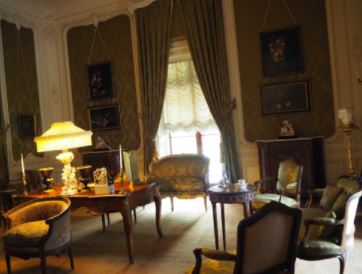
N.I.B.’s title is the source of some confusion: according to drummer Bill Ward it was simply his nickname, derived from when the band were stoned and though he resembled a pen nib. Typically, the fans perceived a more Satanic significance—to them, “N.I.B” stood for “Nativity in Black.” Inevitably, the band were quizzed on such apparent occultic beliefs during interviews. “We are into God,” Iommi unhelpfully explained to which Ward added, “But sometimes I feel Satan is God.” Perhaps they were expressing the beliefs of the early Satanic Gnostic groups, fifteen hundred years before. Led Zeppelin emerged in 1968 from London’s lively rhythm and blues scene. The band took off completely and became a huge commercial success. They were also said to have a Satanic influence with their roots being in traditional black blues music—though guitarist Jimmy Page’s outfit, much closer in its sympathies to the blues than to heavy metal, was far more preoccupied with the tradition. The Devil also makes His presence felt, either as a symbol of the inevitable fate awaiting the debauched bluesman, or as the hard-living musician’s comrade and inspiration. The delta blues—the school that had the greatest influence on the rock-guitar style—became known as “the Devil’s music.” Delta bluesmen included Peetie Wheatsraw, who liked to be known as “the Devil’s Son-in-Law and High Sheriff of Hell,” and Robert Johnson. Johnson, the acoustic-playing grandfather of rock guitar, best illustrates the enduring legend of the bluesman who sold his soul to acquire musical talent. (As testified by Satanic Rock star Glenn Danzig during our interview with him: “A lot of the old blues songs are very heavily rooted in occultism. There is Robert Johnson, all the voodoo and juju stuff—‘Got my Mojo Working,’ ‘Black Cat Bone.’”) Johnson’s pact with Satan was said to be struck at the “Crossroads”—one of his best-know song, and a traditionally magical location in many cultures—and thereafter he always claimed to live, as another song put it, with a “Hellhound on My Trail.” #RandolphHarris 9 of 13

Led Zeppelin, and Jimmy Page in particular, were heavily influenced by Johnson, lifting parts of his songs for their own compositions. As with Johnson, so the popular rumour went, Led Zeppelin has made a pact with the Devil, asking the Prince of Darkness to tune their instruments in return for their souls. Only Satanic aid, reasoned the myth, could explain the enormous success the band enjoyed so rapidly, or the power involving pleasures of the flesh these modern pied pipers had over young ladies. These same legends had been linked with musicians from Robert Johnson to Elvis Presley and beyond, but with Led Zeppelin the Satanic-pact myth has proved especially enduring. If you study the supernatural, you cannot ignore evil. The “ZOSO” symbol that became Led Zeppelin’s band’s trademark was also partly derived from the work of another influential British occultist, Austin Osman Spare—a contemporary of Crowley, and occultic artist, best known for his “automatic drawing,” which he claimed worked as a conduit for supernatural forces. One more than one occasion, Page hinted that much of Led Zeppelin’s material (particularly their meditative anthem “Stairway to Heaven”) had been conceived in a similar fashion. (If you recall, this is also how Mrs. Winchester received the plan on how to build her mansion.) Kenneth Anger asked Page to record a soundtrack for his magic ritual film Lucifer Rising, but was bitterly disappointed with the results, saying, “I had asked him for intimacy and strength, rhythms and counter-rhythms. But he gave me a short fragment of chanting voices and sounds that I thought were quite sombre and morbid.” In October of 1976, the two fell out in grand style. Page threw Anger out of the basement of his London house, where he had granted the American magus use of a fil-editing suite. Anger responded with a press conference. Asked if he felt vindictive toward Page, Anger reposed, “You bet I do. I’m not a Christian turn the other cheek kind. In fact, I’m ready to throw a Kenneth Anger curse.” #RandolphHarris 10 of 13

Asked about the incident in an interview the following year, Page observed, “The whole thing about ‘Anger’s Curse,” they were just these silly little letters. God, it was all so pathetic…I had a lot of respect for him. As an occultist he was definitely in the vanguard.” Despite Page’s scepticim, many fans and commentators linked the personal tragedies that were to strike the band with some kind of hex. On 26 July 1977, vocalist Robert Plant’s young son Karac died of a respiratory infection. Three years later, on 26 September 1980, the band’s drummer, John Bonham, died after a drinking binge. Enough was enough. On 4 December 1980, it was announced that Led Zeppelin were no more. The band’s demise only served to fuel rumours. The more lurid stories held that all of Led Zeppelin, with the exception of Bonham, had signed pacts with the Devil for Earthly pleasure, supposedly explaining the drummer’s untimely death. One fanzine reported that black smoke had been seen billowing from Page’s house on the day following Bonham’s death, and that the guitarist was overheard uttering strange curses in unknown tongues. Even the mainstream press got in on the act, with the London Evening News quoting an anonymous source: “It sounds crazy, but Robert Plant and everyone around the band is convinced that Jimmy’s dabbling in black magic is responsible in some way for Bonzo’s death and for all these other tragedies.” What are we to make of the “Led Zeppelin curse”? Many young people still need to hear guitar music that conjured the Devil, and Satanic rock does show a tenacity that surprised all but its most fervent disciples. Kip Trevor from the band Black Widow tells the story about their album Sacrifice and the stage show of the same title. “There is a guy who has lost his wife as a result of an accident to do with some kind of occultic ceremony. Something goes wrong, and she is killed. He comes back through the centuries, is reborn, and remembers this in a dream. In this dream he realizes his wife can be returned to him, if he can perform another ceremony, like the one which had gone wrong. This time he would turn the tables on the Lady Astoroth, draw her, overpower her, and sacrifice her, then she would be banished and his wife would come back. #RandolphHarris 11 of 13

“So in the first song, ‘In Ancient Days,’ tells the story of this guy travelling through the centuries. Then there is the conjuration in which we bring Lady Astoroth and the girl appears. We’d have a lot of fun with that, as she would appear from all sorts of odd places, depending on where we were playing. We toured with it all over Europe for around eighteen months. When Black Widow broke up, Jim and myself went off to try and revive the idea of the occultic stage show. We spent a lot of time, money and effort on this new black magic concept, but it did not work out. Black Widow’s first album was quite an achievement, but it would have been lovely to have developed it. The problem was that the band politics got in the way—some of them wanted to be a “normal” band and thought the whole black magic thing was not them. They thought it was overshadowing their playing. The show was written with Jim’s research, using proper conjuration ceremonies. The whole thing was done authentically as we could possibly do it. We drew the magic circles, used all the props—fire, earth, water, and air. We did it exactly as you were supposed to do it. Doing that has an effect, even if it is only psychological, because you know you’re doing it in the correct fashion. You’re stepping over the line. Combined with the power of the music and the power of the audience’s involvement, weird things would happen.” God did not create the devil as such. Lucifer, one of God’s mighty cherubs, rebelled against Him and became the devil. Satan is thus the product of his own evil choice. God created a superbly beautiful and wise being and invested him with power above all the other created beings. His name, Lucifer, means “son of the morning,” “bright and shining one,” or “light bearer.” He had many angels at his beck and call and was prince over all the Earth. A fee moral agent with the power of choice, he was filled with an ambition to which he had no right—to rise above God. Unwilling to rule over the World as a vice-general under God, he became “Satan,” meaning “adversary,” or opponent. #RandolphHarris 12 of 13
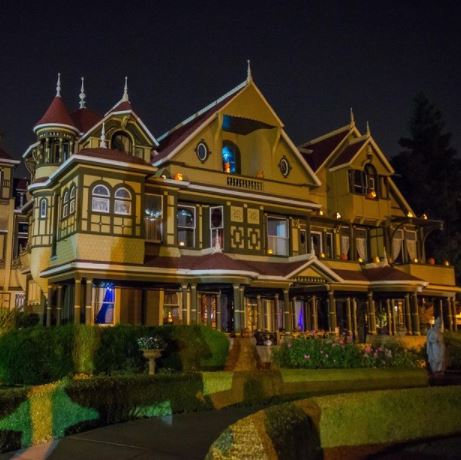
There is only one devil; there are many demons. A familiar spirit in the service of Satan knows human beings so well that he can disguise himself as those people; there are different kinds of spirits—some are sensual and lewd, and others appear ethical; demons are wandering spirits belonging to the legions of Satan, a class of beings distinct from angels—some are on Earth seeking embodiment in human beings and animals, other already are imprisoned in the bottomless abyss; Satan wins followers by psychic and supernatural phenomena that approximate the power of God; Satan is a created being who presently exercises authority over his domain, the Earth realm, but he can do only what God allows him to do, and eventually he will be deprived of all power and glory. As one can see, it is not only Mrs. Winchester who had experiences with the occult, curses, and spirits. Many people have. Occasionally other theories turn up in the literature of modern parapsychology. Some speak of a magical astral World-soul. This entails the idea of an inner World in which all the occurrences of the visible World have their inner equivalent. The World-soul is supposed to be outside of our concept of space and time. The past and the future, the near and the far are said to be all on the same level. Everything is synchronized and simultaneous. A person who is capable of contacting this World-soul enables such a person to enter into a sphere of higher intelligence where the limitations of space and time no longer hold true. Prophecy is inspired either by the Holy Spirit of by the Devil. The wide scope of the occult power possessed by spiritists helps explain why they can cause so much mischief. Through the phenomena of levitation, apports, telekinesis, and materializations, it is not difficult to see how a person endowed with strong mediumistic powers can do a great deal of harm, especially in closely associated realm of magic. Genuine magic is the art of bring about results beyond humans’ power through the enlistment of supernatural agencies. Black magic deliberately involves the devil and demons, and the resulting enchantment is used for persecution and revenge. #RandolphHarris 13 of 13


Sarah Winchester was reportedly trapped in her Daisy Bedroom during the 1906 earthquake. Her workers had to pry her out of the room, and the crowbar mark is still on the door to this day… See it on the Mansion Tour!

A 160-room mansion built to appease the spirits who died at the hands of the Winchester Rifle 👻

One Side’s Abundant Eden is the Other’s Vast Wasteland

The real community of humans, in the midst of all the self-contradictory simulacra of community, is the community of those who seek the truth, of the potential knowers of all humans to the extent they desire to know. The face of various claims to truth and various ways of life and kinds of human beings—is the great insight of our times. The true believer is the real danger. The study of history and of culture teaches that all the World was mad in the past; humans always though they were right, and that led to wars, persecutions, slavery, xenophobia, racism, and chauvinism. The point is not to correct the mistakes and really be right; rather it is not to think you are right at all. Many students, of course, cannot defend their opinion. It is something with which they have been indoctrinated. The best they can do is point out all the opinions and cultures there are and have been. What right, they ask, do I or anyone else have to say one is better than the others? Every educational system has a moral goal that it tries to attain and that informs its curriculum. It wants to produce a certain kind of human being. This intention is more of less explicit, more or less a result of reflection; but even the neutral subjects, like reading and writing and arithmetic, take their place in a vision of the educated person. In some nations the goal was the pious person, in others, the warlike, in others industrious. As a nation, we began with the model of the rational and industrious human, who was honest, respected the laws, and dedicated to the family. Above all one was to know the rights doctrine; the Constitution, which embodies it; and American history, which presented and celebrated the founding of a nation “conceived in liberty and dedicated to the proposition that all humans are created equal.” A powerful attachment to the letter and the spirit of the Declaration of Independence gently conveyed, appealing to each humans’ reason, was the goal of the education of democratic humans. This called for something very different from the kinds of attachment required for traditional communities where myth and passion as well as severe discipline, authority, and the extended family produced an instinctive, unqualified, even fanatic patriotism, unlike the reflected, rational, calm, even self-interested loyalty—not so much to the country but to the form of government and its rational principles—required in the United State of America. #RandolphHarris 1 of 20

There is no enemy other than the human who is not opened to everything. However, when there are no shared goals or visions of the public good, is the social contract any longer possible? Hobbes and Locke, and the American Founders following them, intended to palliate extreme beliefs, particularly religious beliefs, which lead to civil strife. The members of sects had to obey the laws and be loyal to the United States of America’s Constitution; if they did so, other had to leave them alone, however distasteful their beliefs might be. The insatiable appetite for freedom to live as one pleases thrives on this aspect of modern democratic thought. In the end it begins to appear that full freedom can be attained only when there is no such knowledge at all. The effective way to defang the oppressors is to persuade them they are ignorant of the good. History and social science are used in a variety of ways to overcome prejudice. We should not be ethnocentric, a term drawn from anthropology, which tells us more about the meaning of openness. We should not think our way is better than others. Then intention is not so much to teach the students about other times and places as to make them away of the fact that their preferences are only that—accidents of their time and place. Their beliefs do not entitle them as individuals, or collectively as a nation, to think they are superior to anyone else. Instinct and intellect must be suppressed by education. The natural soul is to be replaced with an artificial one. The dominant majority gave the country a dominant culture with its traditions, its literature, its tastes, its special claim to know and supervise the language, and its Protestant religions. The reactionaries did not like the suppression of class privilege and religious establishment. For a variety of reasons, they simply did not accept equality. Critics knew full well that the Constitution’s heart was a moral commitment to equality and hence condemned segregation. The Constitution was not just a set of rules of government but implied a moral order that was to be enforced throughout the entire country. #RandolphHarris 2 of 20

The Americans who were demanding civil rights, were the true Americans because they understood that equality belongs to them as human beings by natural and political right. It was a demand for American identity. However, with history, nothing has taken place except a smattering of facts learned about other nations or cultures and a few social science formulas. None of this means much, partly because little attention has been paid to what is required in order truly to convey the spirit of other places and other times to young people, or for that matter to anyone of other places and other times to young people, or for that matter to anyone, partly because the students see no relevance in any of it to the lives they are going to lead or to their prevailing passion. No longer is there a hope that there are great wise humans in other places and times who can reveal the truth about life—except for the few remaining young people who look for a quick fix from a guru. Gone is the real historical sense of a Machiavelli who wrested a few hour from each busy day in which “to don regal and courtly garments, enter the courts of the ancients and speak with them.” Some critics of the United States of America’s Constitution, which provided rights for all citizens, truly believed that some people were inferior to them, and they thought that Jim Crow was necessary, as it was part of their unique way of life. Different strokes for different folks. Like said before, the only way to defang them is not with hate, but to show them the beauty of equality. The point is to persuade students to recognize that there are other ways of thinking and that Western ways are not always better. It is again not the content that counts but the lesson to be drawn. Such requirements are part of the effort to establish a World community and train its members—the person devoid of prejudice. However, if the students were really to learn something of the minds of any of these non-Western cultures—which they do not—they would find that each and every one of these cultures is ethnocentric. All of them think their way is the best way, and all others are inferior. Western phenomenon, and in its origin is obviously connected with the search for new and better ways, or at least for validation of the hope that our own culture really is the better way, a validation for which there is no felt need in other cultures. #RandolphHarris 3 of 20

The reason for the non-Wester closedness, or ethnocentrism, is clear. Humans must love and be loyal to their families and their peoples in order to preserve them. Only if they think their own things are good can they rest content with them. A father must prefer his child to other children, a citizen his country to others. That is why there are myths—to justify these attachments. And a man needs a place and opinions by which to orient oneself. This is strongly asserted by those who talk about the importance of roots. The problems of getting along with outsiders is secondary to, and sometimes in conflict with, having an inside, a people, a culture, a way of life. A very great narrowness is not incompatible with the health of an individual or a people, whereas with great openness it is hard to avoid decomposition. When people take on the good from another culture, this may be considered a dangerous business because it tends to weaken wholehearted attachment to their own, hence to weaken their peoples as well as to expose themselves to the anger of the family, friends, and countrymen. Loyalty versus quest for the good introduced an unresolvable tension into life. However, the awareness of the good as such and the desire to possess it are priceless humanizing acquisitions. Openness used to be the virtue that permitted us to seek the good by using reason. It now means accepting everything and denying reason’s power. The unrestrained and thoughtless pursuit of openness, without recognizing the inherent political, social, or cultural problem of openness as the goal of nature, has rendered openness meaningless. Cultural relativism destroys both one’s own and the good. True openness is the accompaniment of the desire to know, hence of the awareness of ignorance. To deny the possibility of knowing good and bad is to suppress true openness. A proper historical attitude would lead one to doubt the truth of historicism (the view that all thought is essentially related to and cannot transcend its own time) and treat it as peculiarity of contemporary history. Historicism and cultural relativism actually are a means to avoid testing our own prejudices and asking, for example, whether humans are really equal or whether that opinion is merely a democratic prejudice. #RandolphHarris 4 of 20

One has to have the experience of really believing before one can have the thrill of liberation. Prejudices, strong prejudices, are visions about the way things are. They are divinations of the order of the whole of things, and hence the road to a knowledge of that whole is by way of erroneous opinions about it. Error is indeed our enemy, it alone points to the truth and therefore deserves our respectful treatment. The mind that has no prejudices at outset is empty. It can only have been constituted by a method that is unaware of how difficult it is to recognize that a prejudice is a prejudice. Without getting misty-eyed about it, I think we can fairly say that universities have a sacred responsibility to define for their society what is worthwhile knowledge. These definitions are most clearly visible in university catalogues, where you will find lists of courses, subjects, and “fields” of study. Taken together, they amount to a certified statement of what the university thinks a serious student ought to think about. In what is omitted from a catalogue, you may also learn what a serious student need not think about. However, these are bad times for scrupulous efforts at gatekeeping, and, happily, many universities are now busily engaged in rewriting their catalogues. Some tend to think that living in California; Florida, and other warm climates tends to shrivel the brain and makes people dumber than those living in colder climates, such as New York, Pennsylvania, Illinois, and Iowa. There was a study by two doctoral students at Texas Technical University who found that the ten states with the highest average SAT scores all had cold winters. Indeed, every state with an average of 540 or higher on both the verbal and quantitative parts of the SAT had an average higher temperature in January of less than 42 degrees Fahrenheit. At the other end, five of the ten states with the lowest SAT scores were warm-weather states. Moreover, temperature has a significant relationship to SAT scores even when the researchers took into account such factors as per-pupil expenditures on schooling. So there! Now, there is also an important reason to keep authority figures on the right side of the law. Not only will it accord them more respect, but also more compliance. In the face of what they construe to be legitimate authority, most people will do what they are told. Or, to put it in another way, the social context in which people find themselves will be a controlling factor in how they behave. #RandolphHarris 5 of 20

Many people who consider themselves scientists, are not. Dr. Freud’s work is exemplary—indeed, monumental—but scarcely anyone believes today that Dr. Freud was doing science, any more than educated people believe that Marx was doing science, or Max Webber or Lewis Mumford or Bruno Bettelheim or Carl Jung or Margret Mead or Arnold Toynbee. What these people were doing was weaving narratives about human behavior. Their work is a form of storytelling, not unlike conventional imaginative literature although different from it in several important ways. The work of these people is called storytelling because this suggest that an author has given a unique interpretation to a set of human events, that one has supported one’s interpretation with examples in various forms, and that one’s interpretation cannot be proved or disproved but draws its appeal from the power of its language, the depth of its explanations, the relevance of its examples, and the credibility of its theme. And all of this has an identifiable moral purpose. The words “true” and “false” do not apply here in the sense that they are used in mathematics or science. For there is nothing universally and irrevocably true or false about these interpretations. There are no critical tests to confirm or falsify them. There are no postulates in which they are embedded. They are bound by time, by situation, and above all by the cultural prejudices of the researchers. Quite like a piece of fiction. There is more hypocrisy in Heaven and Earth than is dreamt of in some of our philosophies. What we know about ourselves—can be more terrifying than what we do not know. Most of us generate piles of junk—unconvincing stores without credible documentation, sound logic, or persuasive argument. Books are, in many cases, written by men and women who are concerned not to improve scholarship but to improve social life. Thus, the purpose of doing this kind of work is essentially didactic and moralistic. The purpose of social research is to rediscover the truths of social life; to comment on and criticize the moral behavior of people; and finally, to put forward metaphors, images, and ideas that can help people live with some measure of understanding and dignity. Specifically, the purpose of media ecology is to tell stores about the consequences of technology; to tell how media environments create contexts that may change the way we think or organize our social life, or make us better or worse, or smarter or dumber, or freer or more enslaved. #RandolphHarris 6 of 20

Sometimes the stories media ecologists have to tell are rather more important than those of other academic storytellers—because the power of communication technology to give shape to people’s lives is not a matter that comes easily to the forefront of people’s consciousness, though we life in an age when our lives—whether we like it or not—have been submitted to the demanding sovereignty of new media. And so we are obligated, in the interest of humane survival, to tell tales about what sort of paradise may be gained, and what sort lost. We will not have been the first to tell such tales. However, unless our stories ring true, we may be the last. Now the TV tends to be a beast, too, as so many people know. The TV news media is usually there to frame certain stories they way they feel will be more entertaining, and they will also suppress or ignore others when they are involved in the corruption or paid to cover it up. To fight corruption, people need to learn the legal system, its tactics, and their means of manipulating media. To learn these, individuals have to restructure their mind and conceptions. And so to stand against the enemy, many engage of the process of self-destroying what remained of their own culture. When news television crews learn of a struggle they want to profit from, reporters are flown out from Hollywood and other areas to shoot images following the networks news guidelines for “good television” and “balanced reporting.” When it comes to the people, they often juxtapose with the people, others in suits and ties, who are responsible government officials concerned about jobs, and a lot of savage-looking types in funny clothes, speaking jive about their land, which does not seem credible because they way the people are dress and the emotions of their language. People are most likely to believe a professional in a suit, than someone who is wearing regular clothes and has been a victim of crime. After 40 million viewers see a Caucasian, modishly dressed TV newsman explain the crosscurrents in the struggle, and plaintively ask whether something of an earlier culture could not be permitted to remain, he finishes his report by saying, “From Sacramento, California, this is John Doe reporting.” This is followed by a commercial for the need to build affordable housing, how it creates jobs, and how green energy will be used to power the buildings during this energy crisis. The next is a story talking about gas prices and the need to suspend the gas tax. #RandolphHarris 7 of 20

Surely this story and the advertisements did not help the people concerned about their land. It was certain that they did not come through as well as the businessmen, the government officials and the reporter’s objective, practical analysis. They were attempting to convey something subtle, complex, foreign and ancient through a medium which did not seem able to handle any of that and which is better suited to objective data, conflict and fast, packaged information. When a struggle is revealed, usually the people become fixed into the model of artifact. The medium cannot be stretched to encompass their message. On the other hand, what if one had four minutes, or even one minute, to convey the essence of a product? A BMW? A stereo set? A toy? Could one accomplish that efficiently? One certainly could. It is obvious that a product is a lot easier to get across on television than a several acres of land or a cultural mind-set. Understanding cultural ways enough to care about them requires understanding a variety of dimensions of nuance and philosophy. You do not need any of that to understand a product, you do not have problems of subtlety, detail, time and space, historical context or organic form. Products are inherently communicable on television because of their static quality, sharp, clear, highly visible lines, and because they carry no informational meaning beyond what they themselves are. They contain no life at all and are therefore no capable of dimension. Nothing works better as telecommunication that images of products. Might television itself have no higher purpose? Most Americas, whether on the political left, center, or right, will argue that technology is neutral, that any technology is merely a benign instrument, a tool, and depending upon the hands into which it falls, it may be used one way or another. There is nothing that prevents a technology from being used well or badly; nothing intrinsic in the technology itself or the circumstances of its emergence which can predetermine its use, its control or its effects upon individual human lives of the social and political forms around us. The argument goes that television is merely a window or a conduit through which any perception, any argument or reality may pass. It therefore has the potential to be enlightening to people who watch it and is potentially useful to democratic process. #RandolphHarris 8 of 20

If you accept mass production, you accept that a small number of people will supervise the daily existence of a much larger number of people. You have to accept that human beings will spend long hours, every day, engaged in repetitive work, while suppressing any desires for experience or activity beyond this work. The workers’ behavior becomes subject to the machine. With mass production, you also accept that huge numbers of identical items will need to be efficiently distributed to huge numbers of people and that institutions such as advertising will arise to do this. Once technological process cannot exist without the other, creating symbolic relationships among technologies themselves. If you accept the existence of advertising, you accept a system designed to persuade and to dominate minds by interfering in people’s thinking patterns. You also accept that the system will be used by the sorts of people who like to influence people and are good at it. No person who did not wish to dominate others would choose to use advertising and all technologies created to serve it will be consistent with this purpose, will encourage this behavior in society, and will tend to push social evolution in this direction. In all of these instances, the basic form of the institution and the technology determines its interaction with the World, the way it will be used, the kind of people who use it, and to what ends. And so it is with television. Far from being “neutral,” television itself predetermines who shall use it, how they use it, what effects it will have on individual lives, and, if it continues to be widely used, what sorts of political forms will inevitably emerge. Television is not reformable. If our society is to return to something like sane and democratic functioning, it must be gotten rid of totally. This is not about the television itself. It is about a process, already long underway, which has successfully redirected and confined human experience and therefore knowledge and perceived reality. We have all been moved into such a narrow and deprived channel of experience that a dangerous instrument like television can come along and seem useful, interesting, sane and worthwhile at the same time it further boxes people into a physical and mental condition appropriate for the emergence of autocratic control. Television has been used and expanded by the present powers-that-be, and that was inevitable, and it should have been predictable at the outset. The technology permits of no other controllers. #RandolphHarris 9 of 20

One also has to worry about the effects of television upon individual human bodies and minds, the effects which fit the purposes of the people who control the medium. Furthermore, television has no democratic potential. The technology itself places absolute limits on what may pass through it. The medium, in effect, chooses its own content from a very narrow field of possibilities. The effect is to drastically confine all humans understanding within a rigid channel. And as mentioned before, these aspects of television are reformable. What is revealed, however, is that there is ideology in the technology itself. To speak of television as “neutral” and therefore subject to change is as absurd as speaking of the reform of a technology such as social media. The medium is the message. Many do not recognize the transformative power of new communication technologies. They need to come with a warning about the threat the power poses—and the risk of being oblivious to that threat. The electric technology is within the gates, and we are numb, deaf, blind, and mute about its encounter with on and through which the American way of life was formed and is changing. When people start debating (as they always do) whether the medium’s effects are good or bad, it is the content they wrestle over. Skeptics, with equally good reason, condemn the crassness of the content, viewing it as signaling a “dumb down” of culture. One side’s abundant Eden is the other’s vast wasteland. The Internet is the latest medium to spur this debate. In the long run a medium’s content matters less than the medium itself in influencing how we think and act. As our window onto the World, and onto ourselves, a popular medium molds what we see and how we see it—and eventually, if we us it enough, it changes who we are, as individuals and as a society. The effects of technology do not occur at the level of opinions or concepts. Rather, they alter patterns of perception steadily and without any resistance. Media work their magic, or their mischief, on the nervous system. #RandolphHarris 10 of 20

Our focus on a medium’s content can blind us to these deep effects. We are too busy being dazzled or distributed by the programming to notice what is going on inside our heads. In the end, we come to pretend that the technology itself does not matter. It is how we use it that matters, we tell ourselves. The technology is just a tool, inert until we pick it up and inert again once we set it aside. We are too prone to make technological instruments, like guns, scapegoats for the sin of those who wield them. The products of modern science are not in themselves good or bad; it is the way they are used that determines their value. However, it is also our conventional response to all media, namely that it is how they are used that count, which is the numb stance of the technological idiot. People have been replacing God with false idols and that is the problem. So many people say they believe in God, but so few read the Bible or pray daily. They are too busying watching TV and using the Internet to. Many people are essentially being sent to a deep-space death by the malfunctioning machine because is it calmly, coldly, discounting their memory circuits that control their brains. Many people can feel it, too. They have an uncomfortable sense that someone, or something, has been tinkering with their brains, remapping the neural circuitry, reprogramming the memory. Their minds are not going—so far as they can tell—but it is changing. They do not think the way they used to think, and it can be felt most strongly when they are reading. Several people are no longer able to immerse themselves into a book or a lengthy article. Their minds used to get caught up in the twists of the narrative or the turns of the argument, and they spend hours strolling through long stretches of prose. For many, that is rarely the case anymore. Now their concentration starts to drift after a page or two. They get fidgety, lose the thread, begin looking for something else to do. They feel like they are always dragging their wayward brains back to the text. The deep reading that used to come naturally has become a struggle. The Net has become the all-purpose medium, the conduit for most information that flows through one’s eyes and ears and into their mind. The advantages of having immediate access to such an incredibly rich and easily searched store of data are many, and they have widely described and duly applauded. #RandolphHarris 11 of 20

While the Inter is an astonishing boom to humanity, gathering up and concentrating information and idea that were once scattered so broadly around that World that anyone could profit from them, now all this information is at your fingertips. When one is writing a report for school and using mostly book sources, some of the information may be outdated, and now what they can do it go online, find a reputable site and supplement the new information. It is better than gathering all your information from the silicon memory system. The more people use the Web, the more they have to fight to stay focused on long pieces of writing. Some worry they will become chronic scatterbrains. Because of the Internet, some people have almost totally lost the ability to read and absorb a long article on the web or in print. Even electronic Web pages that are more than three or four paragraphs is too much for some to absorb. They just skim it. There are people that think the Internet is the most creative thing that was invented. One could hardly meet anyone who says it has not been helpful. Many individuals like to go online because they love the ability to review and scan tons of information on the web. It is believed that reading lots of short, linked snippets online is a more efficient way to expand one’s mind than reading a 250-page book. These technopagans also believe in superiority of the Internet and think others have not been able to recognize it yet because they are measuring it against our old linear thought process. In many ways, the Internet is making people less patient readers, but could possible be making them smarter. They have more connections to documents, artifacts, and people, which means more external influences on their thinking and thus on their writing. Regardless, more people know they have sacrificed something important, but they will not go back to the way things used to be. For some people, the very idea of reading a book has come to seem old-fashioned, maybe even a little silly—like driving your own car when you can just schedule a ride share service. This generation thinks thing sitting down and reading a book from cover to cover does not make sense. It is not a good use of their time, as they can get the information they need faster through the Internet. These skilled Internet hunters think books are superfluous. #RandolphHarris 12 of 20

The digital immersion has even affected the way people absorb information. They do not necessarily read from left to right and from top to bottom. They might instead skip around, scanning for pertinent information of interest. The Net has become essential to their work, school, or social lives, and often to all three. Some log on only a few times a day—to check their e-mail, follow a story in the news, research a topic of interest, or do some shopping. And there are, of course, many people who do not use the Internet at all, either because they cannot afford to or because they do not want to. What is clear, though, is that for society as a whole the Net has become, in just the thirty years since software programmer Tim Berners-Lee wrote the code for the World Wide Web, the communication and information medium of choice. The score of its use is unprecedented, even by the standards of the mass media of the twenty-first century. We seem to have arrived, at an important juncture in our intellectual and cultural history, a moment of transition between two very different types of thinking. What we are trading away for the riches of the Internet is our old linear thought process. Calm, focused, undistracted, the liner mind is being pushed aside by a new kind of mind that wants and needs to take in and dole our information in short, disjointed, often overlapping bursts—the faster, the better. When people go online, they feel their brains light up, and feel like they are getting smarter. The feelings are intoxicating—so much so that they can distract people from the Net’s deeper cognitive consequences. Many people miss the days of the old box TV with rabbit ears sitting on the floor, and the bulky avocado telephone fixed to the wall in the kitchen with its rotary dial and long, coiled cord. And the den filled with books on the bookshelves—lot of books—with their many-colored spines, each bearing a title and the name of a writer. There was something calming in the reticence of all those books, their willingness to wait, years, decades, our centuries even, for the right reader to come along and pull them from their appointed slots. Take your time, the books whisper. We are not going anywhere. #RandolphHarris 13 of 20

The computer, however, is more than just a simple tool that does what one tells it to do. It is a machine that, in subtle but unmistakable ways, exerts an influence over you. The more one uses it, the more it alters the way one works. Reading lone feels new and liberating because for many kids who did not like reading books because of the lack of pictures, not have hyperlinks and search engines which deliver an endless supply of words to their screen, alongside pictures, sounds, and videos. People have started letting their newspaper and magazine subscriptions lapse. Who needed them? By the time the print editions arrived, dew-dampened or otherwise, the felt like that have already seen all the stories. The Internet is exerting a much stronger and broader influence over any one than their old stand-alone personal computer ever could. Their way their very brains work is changing. And this when most start worrying about their inability to pay attention to one thing for more than a couple of minutes. It is not just a symptom of middle-age mind rot. One’s brain is not just drifting. It is hungry. It is demanding to be fed the way the Internet feeds it—and the more it is fed, the hungrier it becomes. Should I check another e-mail, clink another link, look at another web page. Cause I am falling on the floor. I am climbing up the walls and everytime I get a grip, I seem to lose myself just a little more. Cause I am here and it eats me up, but I love the way it feels. I really should not stay online, but I cannot give up. The more it hurts, the more I need it more. It is like an addiction. I want to be connected. Just as Microsoft Word had turned me into a flesh-and-blood word processor, the Internet, one may sense, is turning one into something like a high-speed data-processing machine. Maybe that is a good thing because today more than every we are governed, all over the World, by the students of economics professors. Presidents and politicians, treasury secretaries or ministers of finance and chancellors of the exchequer, central bankers, investment bankers and senior officials of the World’s biggest and more powerful corporations have all dutifully sat in their classrooms listening to them, pouring over their key ideas. #RandolphHarris 14 of 20

The same goes for brokers, financial advisers and newspaper and television pundits who take these ideas to the public. Unfortunately, many ideas remembered from college days belong in the “obsoledge attic,” or better yet, in the cemetery of ideas. The media is sometimes behind big bloopers. In February of 2004 U.S. president George W. Bush stiff-armed his own Council of Economic Advisers, refusing to publicly back its forecast that the economy would provide 2.6 million new jobs that year. But as The Washington Post reported, That forecast, derided as wildly optimistic, was one of the more modest predictions the administration has made about the economy over the past three years. Two years ago, the administration forecast that there would be 3.4 million more jobs in 2003 than there were in 2000. And it predicted a budget deficit for discal 2004 of $14 billion. The economy ended up losing 1.7 million jobs over that period, and the budget deficit [for 2004]…is on course to be $521 billion. No doubt, some of this is political exaggeration. Any statistic can be tortured into submission. Nor are the torturers jut Republicans. The discrepancies between the forecast and subsequent results began to widen under the previous Democratic administration. It was clear that, even allowing for political fact manipulation, something was seriously amiss. In the words of a Republican White House press spokesman, “The old theories…proved themselves wildly wrong…Nobody saw this happening—not on Wall Street, not Vegas, not Poor Richard, not Nostradamus.” Economists have failed to anticipate more than job numbers and deficits. They have contributed to some of the most publicized, embarrassing financial debacles in recent decades. In the last two months of 2022, inflation has averaged 0.85 percent. If these hikes continue over the next three months, the headline inflation rate would approach 9 percent by spring. If they persist for a year, it would surpass 10 percent—the first time the United States of America would have a double-digit inflation since the early 1980s. President Biden’s entire economic team has consistently played down inflation’s threat all year. They lied about helping the American people through the pandemic and ignored the warnings from former treasury secretary Lawrence H. Summers that the American Rescue Plans massive size would reduce inflation. Then said initial upticks in prices were simply statistical glitches caused by the dramatic price drops during the pandemic’s initial phase and would fade away once that glitch dropped out of the calculations. #RandolphHarris 15 of 20

When that did not happen, they started blaming supply chain woes for the problem, even though that cannot possible explain things such as the fast and steady rise in housing costs. When consumers are fast losing purchasing power during two-digit inflation, consumers’ goods industries suffer symptoms of contraction and recession, especially unemployment of capital labor. Two-digit inflation only comes to an end with the advent of three-digit inflation which signals the approaching demise of the paper currency. In the final convulsion of inflation fever, millions of men and women will be in a panic rush to exchange their rapidly depreciating money for real goods. When there are mistakes made during a financial crisis by macroeconomists of the International Monetary Fund—errors can trigger ethnic clashes. Experts also occasionally miss anticipating major changes like the industrial slowdown in 1995, as we have seen with the 2020 pandemic. Along with the hyperinflation of the late 1980s, which we are also starting to see happening now and more so in late 2022-2023. The Fed does not know if it wants to raise interest prices because that will hurt human capital and businesses, while this war is going on and gas prices are skyrocketing, as well as consumer goods and services, and home prices. So we turn to our crucial problem: What to do that is self-justifying when the great social World is pretty unavailable? The essential Hipster problem is: to heighten experience, and get out of one’s usual self. To heighten experience is a common principle of Hipster and Delinquent, but the difference are marked. Among the Hipsters, the craving for excitement and self-transcendence is darkly colored with violence and death wish, and they therefore dread flipping, which they interpret as weakness, castration, and death. Among the younger delinquents, we shall see, it is fatalism, the wish is to get caught and be brought back into society. However, for some others, it is a religious hope that something new will happen, a revival. Not everyone gets self-destructive. The risks of delinquency, criminality, and injury rouse some in a normal apprehension, and they express a human amazement at the brutality and cruelty of some with whom they keep company. #RandolphHarris 16 of 20

In taking drugs for the new experience, many largely steer clear of being hooked by an addiction. On the other hand, if the aim is to get out of the World, one can hardly play it safe. So if they push their stimulants, sleeplessness, and rhythmic and hallucinatory exercises to the point of having temporary psychotic fugues, or flipping, it is not surprising. For some people, going to the municipal psychiatric hospital is an expected and regular occurrence. The young actualized Christians seek enlightenment, and the city hospital succors them when they break down. Let us now go back to the jargon. The supreme words are “crazy,” “far out,” “gone,” ‘high,” “gas,” “sent.” These mean not in this World but somewhere, not rational but something. “Flip” is generally used with enthusiastic self-deprecation. When the crazy or far-out moment can be maintained for long enough to be considered a something and somewhere, it is “groovy,” that is, one is like somebody else’s phonograph record. One is “with it” or falls in.” The “it” or the understanding “where” is not, of course, definite, for the pure being has no genus and differentia. “Swinging with it” is the condition of passing from here and now to the heightened experience of “it.” Contrariwise, it is bad and painful to be “nowhere,” to “fall out” (take an overdose), or to be “drug” (dragging). The way of being-in-the-World, that is, is to be either cool and mask-faced, experiencing little; or to be sent far out, experiencing something. However, since the cool behavior of these usually gentle middle-class boy looks like adolescent embarrassment and awkwardness rather growth in experience would not be a more profitable enterprise and ultimately get them much further out. A possibility that has interestingly dropped from popular culture as the exploitation of shared athletic or wildly physical agitation, which belonged grandly to the old jazz-for-dancing and revival meetings. This is certainly an important truth that jive is energetic, in words like “go” and “dig.” (To the jazz-for-listening one is not supposed to respond overtly by more than a quietly tapped toe. It can be hypnotic and speak to the listener like a crustal ball or a foundation or a hearth fire. As it is remarkably thin gruel (no doubt I am tone deaf). For the performer, of course, it provides the deepening absorption of any simple improvised variations, plus the solidarity of the group.) #RandolphHarris 17 of 20

I can think of two reasons why the overtly shared crazy physical rhythms are spurned. First is that this motion is in fact too much in the extremities of the body rather than in the solar plexus, it is too superficial an excitement and more fit for teenagers. The difference is between the lostness in juvenile jitterbugging and the “central” experience of an Eastern Dance or Mary Wigman. Some young men have taken to the Eastern dance, but most who love popular culture do not practice physiological yoga either, just as their Zen is without breathing-exercises or correction of posture. So perhaps another reason for their dropping the old physical jazz and revival is just the opposite, that the display of energy would upset their coolness, it would be embarrassing and make them feel too young. I would wonder if this is not the simple explanation of their disdain social dancing as “dry” pleasures of the flesh; for certainly one of the reasonable uses of social dancing is body contact and sometimes foreplay involving pleasures of the flesh. However, these boys are embarrassed to get excited, to betray feeling, in public, though they are more than willing to get into their birthday suits and exhibit themselves, or to beat a drum wildly in public as an exhibition for others, but not as contact with them. Celibacy necessitated by castration—the excision of the private parts—sends shudders through our modern sensibilities. Yet for more than four thousand years, millions of males have endured this mutilation. The Persians were perhaps its first authors. As an eighteenth-century scholar noted, “The Latin word spade, which comprehended several sorts of eunuchs, was taken from a village of Persia called Spada, where…the first execution of this nature was made…The first eunuch mentioned in the holy scriptures was Patiphor…who brought Joseph from the Midianites…and it is observed…that Nebuchadnezzar caused all the Jewish people, and other prisoners of war, to be gelt or cut.” Throughout the centuries, a large percentage of eunuchs have been youngsters from families whose poverty precipitated the decision to castrate the child. In these cases, parents expected to advance their son’s career in areas closed to all but eunuchs: certain types of domestic service in aristocratic homes or royal courts, or as castrati opera singers. #RandolphHarris 18 of 20

Other boys were neutered after their enslavement by enemies victorious in wars: Nebuchadnezzar’s policy of castrating male prisoners of war that he might have none to attend him in his private service but eunuchs is a case in point. Sometimes older males voluntarily sought out the surgery, almost always as a means of earning a living as an entertainer or court functionary. Occasionally, men gelded themselves in full adulthood for religious reasons—the Church Father Origen; the obscure Valesii, a heretical Christian scet of the third century about whom little is known; and the nineteenth-century Russian Skopts are examples of these self-determined celibates. Much closer to home and closer in time is California’s Heaven’s Gate celibate computer cult, the members of which committed mass suicide in 1997 and whose leader, Marshall Applewhite, had turned to castration as a desperate measure to obliterate his uncertain sexuality. Hundreds of thousands of people have also been subjected to castration as punishment for imagined or real crimes ranging from “self-love” to nonconsensual pleasures of the flesh. The mentally or physically disabled have been neutered to prevent them from reproducing. African-American men have been brutally desexed by lynch mobs, which some say are starting to pop up again in a different form, terrified of their sexuality. We shudder at castration for a host of reasons. It assaults the private core of human existence. It has almost always been a butchery, performed inexpertly by unqualified quacks and costing the lives of a majority of its victims. Its consequences are lifelong, visible, and far-reaching, affecting appearance, stance, and above all, psychological development and adjustment. We know now how important, perhaps crucial, the male organ is to psychosexual development. However, some men are now choosing to castrate themselves and keep their manly appears, which creating another gender’s private part in its place. Lessons harshly learned from routine circumcisions gone wrong have hardly taught us that gender is not an amorphous variable physicians can successfully alter simply by radical surgery. When we read about eunuchs, whether in medieval China or the Ottoman empire, or as victims of Nazi eugenics, our growing knowledge of the effects of castration colors our perceptions. #RandolphHarris 19 of 20

The issues surrounding castration are complex and as fascinating as they are disturbing. Eunuchs who have left written records reported that they reflected deeply and incessantly on their mutilation. Though a dearth of such documents prevents a thorough study of eunuchs’ reactions, all anecdotal evidence suggests that most of them brooded bitterly about the physical effects of castration and about the contempt and ostracism that mainstream society directed at them, including the mightiest military commanders of the Byzantine empire. However, eunuchs often simultaneously understood and valued another dimension of their condition, seeing it as a means—their only means—of gaining access to certain positions. They or their parents neutralized poverty by trading their sexuality for opportunity, often nit not always realized. Afterwards, eunuchs had lifetimes of confronting the other, less desirable consequences of the procedure. In particular, they had to deal with incessant humiliation and enforced celibacy, though much evidence exists that they experienced longings for intimate passions their ravaged bodies could not satisfy. And these were the luckier men who could at least rationalize about their situation. Others, victims of brute force alone, had not even that consolation. “Search me [thoroughly], O God, and know my heart! Try me and know my thoughts! And see if there is any wicked or hurtful way in me, and lead me in the way everlasting,” Psalm 139.23-24. A light exists in Spring, not present in the Year at any other period when March is scarcely here. A color stands abroad on Solitary Fields that Science cannot overtake but human nature feels. When you pass through waters, God will be with you, and through the rivers, they shall not overflow you; when you walk through the fire, you shall not be burned, neither shall the flame kindle upon you. I shall strengthen you, yea, I shall help you, yea, I shall uphold you with the power of righteousness. Behold, all they that contend with you shall be ashamed and confounded; they say that strive with you shall be as naught and shall perish. In righteousness shall you be established; you shall not fear. You who have been forsaken, shunned and hated, now will I make you an eternal pride, a joy to all ages. Fear not, for I am with you; be not dismayed, for I am your God. Every weapon that is formed against you shall fail, and every tongue that shall rise against you, shall disprove. This is the inheritance of the Lord’s servants, and their salvation from Me, saith the Lord. #RandolphHarris 20 of 20

Cresleigh Homes
Custom light fixtures in the bedroom are one of our favorite parts of living at Meadows Residence One at #PlumasRanch.

Other highlights include the walk-in shower and large soaking tub in the owner’s suite. Who knew you could get luxury like this in a single story home?! We did. 😉

Cresleigh Homes make the most enchanting homes you’ll ever find.
#CresleighHomes
 Randolph Harris II International Institute