
Home » Paul Popenoe (Page 4)
Category Archives: Paul Popenoe

Ruin is the Destination Toward Which All Men Rush

With equality and gender-based studies becoming more important, it is a goo idea that we take a look at a gender-based analysis of residential burglary. The study is based on interviews with 105 active residential burglars, 87 of whom were males and 18 were females. The project employed a snowball sampling strategy in which an ex-offender recruited known burglars who were presently operating in a city. The gender-based compassion suggests that, in many way, female burglars resemble their male counterparts. For example, both group display long criminal histories that span a variety of property, violent, and public order offenses categories. Both groups accumulate long, diverse substance abuse histories that overlap with and contribute to their involvements in burglary. At the time, the gender-based comparison reveal several differences. Female burglars begin offending at a later age, are more likely to co-offend, and have less contact with authorities. The typology of female burglars describes offenders as either accomplices or partners. Factor of motivation, levels of target selection and planning, and patterned work roles serve to differentiate these two conceptual categories. Despite growing interest in female criminality, little is known about the nature of women’s participation in crimes statistically dominated by males. Certainly that is the case for residential burglary, an offense labeled as an overwhelmingly male enterprise. For example, we hardly know how female become involved in such offenses or what roles they play. Are they tempted into these crimes, for instance, by the influence of delinquent peers or by the use of drugs? #RandolphHarris 1 of 21

Because we lack detailed knowledge, we cannot assess the extent to which the processes underly burglaries committed by females differ from those underlying burglaries by males. This lack also restricts our capacity to detect important differences among female burglars. An assessment of these difference, however, is crucial in formulating effective policy responses to female criminality and to developing theories of lawbreaking by women. Short of observing burglaries, perhaps the best way to acquire this information is to go to the offenders themselves. The most pressing need today, in researching the agenda for feminist criminology, is observation and interviewing so we can plunge more deeply into the social Worlds of girls and women. Such a strategy will allow researchers to comprehend women’s crime on its own terms. Often it is claimed that offenders are versatile and commit a wide range of offense. This observation, however, is derived largely from studies of males conducted in criminal justice settings rather than on the street. During our interviews we asked the subjects whether they ever had committed other sorts of crimes beside residential burglary. We did so because we were concerned primarily with prevalence—that is, whether the subject ever had engaged in other kinds of offenses. Stealing (which includes shoplifting and corresponds to the legal definition of this activity), auto theft, and assault were the offenses most commonly reported by males. Stealing and assault were mentioned most frequently by the females; these offenses were comparable in rank of frequency to those reported by the males. #RandolphHarris 2 of 21

Beyond these two offenses, however, little other criminality was reported by the females. The only meaningful differences between the men and the women for this measure was found in regard to auto theft. This crime was fairly common among the males, but unknown among the females. The explanation for this difference might reside in a strong cultural tradition linking masculinity to driving and car ownership. Alternatively, males may have “cornered the market” in auto theft; to be profitable, such a crime requires sophisiticated coneections with garage owners, automotive recycle yard employees, and car dealerships. One important aspect of offending style concerns the degree of crime specialization—that is, the extent to which offenders concentrate on one particular type of offense. When we asked offenders whether they had been involved in crimes other than residential burglary during their most recent period of offending, thirty-four percent of the males and 42 percent of the females claimed that they had committed only residential burglaries during this period (roughly the last six months). This finding is consistent with a substantial body of previous research showing that offenders display considerable diversity over the course of their criminal careers, but may specialize in a particular “line” for short periods. This phenomenon is labeled as “short-term specialization.” Another element of offending style concerns the inclinations to work with others in carrying out cries. #RandolphHarris 3 of 21

Previous research demonstrated that more often than not, [burglary] is committed by two or more persons acting in concert. The results of our study bear this out: 79 percent of the males and all of the females reported that they had worked with others in the past. The males showed considerable variation in frequency of working with others: 39 percent said they “seldom” worked with others, while another 39 percent reported that they “always” did so. For the women, however, the picture was much clearer: an overwhelming 83 percent reported that they “always” worked with others, and the remaining 17 percent states that they “usually” did so. The final aspect of offending style that we examined here relates to drug and alcohol use among our respondents, as well as to their perceptions of the role played by intoxicants in leading them to commit such crimes. Our research reveals that there is little difference between the males and the females in self-report drug use. When the drug users were asked whether addiction had anything to do with their burglaries, 71 percent of the males and 82 percent of the females answered affirmatively. A majority of those in both groups said they committed burglaries to obtain the money they needed to buy more drugs. In addition, slightly more than three-quarters of the users in each group—76 percent of the males and 79 percent of the females—claimed that they used drugs before committing their burglaries. A higher percentage of females than of males started that they “always” or “usually” used drugs beforehand. #RandolphHarris 4 of 21

One explanation seems to be that many female burglaries arise from crack “runs.” This point, however, is difficult to determine conclusively because use of the drug is heavily stigmatized. We explore male-female differences on three dimensions designed to measure burglary offending histories: age at first burglary, total number of lifetime burglaries, and lambda, the mean number of annual burglaries. The ages at which males and females committed their first residential burglary differed significantly: the males generally started much earlier in life. None of the female burglars had committed their first offense before age 12, but 22 percent of the males had done so. The modal category for males was the 13-16 age bracket, which accounted for 53 percent of the cases. Sixty-one percent of the females, on the other hand, were over 16 years old when they carried out their first burglary. Given that the females started to commit burglaries later, on average, than their male counterparts, we are not surprised that a greater proportion of females had been involved in fewer than 20 residential burglaries in their lifetime. Perhaps more interesting, 39 percent of the females had committed more than 70 lifetime residential burglaries, a proportion roughly comparable to the males’ figure of 41 percent. The bimodal distribution of the females’ responses suggests that women are likely to engage in burglary at two very distinct levels, and perhaps to employ two different styles. #RandolphHarris 5 of 21

The males were more likely than the females to have had contact with the system for offenses of all types. This difference was most notable at the stage of the criminal justice process that resulted in incarceration. Over ninety percent of the respondents in each group had been arrested previously, but only one woman (6 percent) had been convicted and sentenced to a term of imprisonment. In contrast, 26 percent of the males had served time in the past. This difference may exist in part because the females began offending later and consequently had fewer “years at risk.” Other factors, however, are probably at work as well including an assumption by the police that most burglars are male, which allow females to remain above suspicion and a tendency for those females who are arrested to receive preferential treatment in the courtroom. Certainly the women in our sample believe that their gender conferred a degree of protection from the law. Several expressed the belief that authorities would not take action against them simply because they were female. Is it not becoming clear, in light of the existence of deceiving offenders and their methods of deception, that close examination is needed of modern theories, conceptions, and expressions regarding things in connection with the ultimate concern and its way of working in man? For only the certainty of ultimate concern, apart from “views” of truth, will avail for protection or for successful warfare in the conflict with wicked offenders in the self-actualized hierarchy. #RandolphHarris 6 of 21

When we reach self-actualization, we are at the highest hierarchy of the pyramid, and this is denoted by morality, creativity, spontaneity, problem solving, lack of prejudice, and acceptance of facts. There are five levels in the pyramid. At the very bottom, people are interested in physiological functions only which include: breathing, food, water, pleasures of flesh, sleep, homeostasis, and excretion. At the second level of the pyramid, individuals are concerned with safety and this entails security of: body, employment, resources, mortality, the family, healthy and property. At the third hierarchy most are concerned with love and belonging. This includes friendship, family, sexual intimacy. At the fourth hierarchy, this realm focuses on esteem: self-esteem, confidence, achievement, respect of others, respect by others. All that is in any degree the outcome of the mind of the “natural man” will prove to be but the weapons of straw in this great battle, and if we rely upon others’ “views of truth,” or upon our own human conceptions of truth, offenders will use these very things to deceive us—even building us up in these theories and views so that under cover of them he or she may accomplish one’s purpose. We cannot, therefore, at this time, overestimate the importance of believers having ready minds to “examine all things” they have thought, and perhaps taught, in connection with the things of ultimate concern and the self-actualized realm—all the “truths” they have held, all the phrases and expressions they have used in “virtue teachings,” and all the ideas they have absorbed through others. #RandolphHarris 7 of 21

For any wrong interpretations of truth, any theories and phrases which are man-conceived and which we may build upon wrongly, will have perilous consequences to ourselves and others in the conflict with truth and individual self-actualized people passing through. Because in the present offenders will comes to them with deceptions in DOCTRINAL form, self-actualized individual must examine carefully what they accept as “doctrine,” least it should be from the emissaries of the deceiver. Some people are tired of struggling and want only to know a quiet silence. This can be a shock to one’s own awareness of who he or she is. One may have always considered struggle essential in growth, and in many crises and conflicts it has provided the turning point in one’s life. Not wanting to be burdened and overwhelmed by heavy feelings and thoughts or by complicated searching and painful of what is wrong with oneself, people, and life, this can create the desire to turn away from the struggle. And this is what causes the requirement to be alone in simple and ordinary ways. Once one goes through this process of healing in solitude, and by only engaging in simple routine, gradually, with each day, an individua is able to listen a little more to what others are saying. (This is why during a break up, space, instead of forcing the issues is important. Of course, there are times when you need to know what the reason it so it may be a good idea to press for answers to start a dialogue and not necessarily to just focus on getting back together.) #RandolphHarris 8 of 21

Slowly it becomes each to be interested in and comfortable with other people’s problems. Although there may be some drawbacks. Some individual may be able to be with others while you struggle to make decisions, but one may not be opened to questions or personal comments and responses directed to one. This may cause one to offer nothing of oneself and comment only on what one is hearing and understanding from others. During this period, some find work a truly rewarding activity; it is a place that feels like home. It does not matter whether the work takes the form of writing—reports, references, and letters—or reading. Or, if it involved physical activities, one may become totally absorbed in what one is doing, get lost in the activity and experience a full sense of relief. Active mental and physical involvement in solitary projects can be a sense of salvation. By surrendering to powers within to powers within and sources of light in the universe, in some mysterious way, a miracle happens. It is the loss of the old man and the discovery of the new man. When the light reveals itself, the individual is ready to accept it. This reduces the need to force or push or beseech. One simply waits with firm faith that one is meant to be whole again and that one will live more in a full and complete way. It becomes clear that people one loves and those who love one cannot reach the individual going through changes. And so, life has to come from another source, and that new direction will emerge in solitude. #RandolphHarris 9 of 21

The problem of the truth of faith presents itself from both the subjective and objective sides. Subjectively, faith is true if it adequately expresses an ultimate concern, that is, if the symbols of faith are alive and speak to the heart with an urgency of concern that impels to action and replay. This criterion is more a rule of thumb that works best for obviously dead symbols and is not so useful in judging contemporary ones. However, it is the objective truth of faith that interests us here. The content of faith is true if it is really and not just apparently ultimate. The great danger is demonization, elevation of the symbol to ultimacy, which results in idolatrous faith. Therefore, the criterion of faith is self-negation. The true symbol not only conveys the ultimate, but proclaims its own non-ultimacy. It pronounces a Yes and a No. For the Christian the Cross of the Christ is such a symbol. Name for this criterion—the No that follows immediately on the heels of the Yes—is the Protestant principle. The Protestant principle pervades in this whole theology, both systematically and chronologically. Chameleon-like, it changes its formula of expression against the background of diverse theological problems. Hence, a rapid rundown of its various formulations is useful for identifying it. #RandolphHarris 10 of 21

In addition to being the objective criterion of faith, the Protestant principle expresses man’s infinite distance from God and his dependence upon the divine initiative. The Protestant principle is the prophetic protest against every form of self-absolutizing—for example, the demonic elevation of the churches, of the Christian Bile, and the priesthood to absolute validity. The Protestant principle is “resistance to idolatry,” that is, it stands for non-conformity in family, school, state, and church. The Protestant principle protests the objectifying of grace (die Vergegenstandlichung der Gnade) and so smashes the barriers between the holy and the secular. For, by the Protestant principle, God is as near to the lowest as he is to the highest, as close to the material as to the spiritual. These manifold expressions of the Protestant principle can be summarized in and derived from the basic doctrine that the Protestant principle is justification by grace through faith. We reject the traditional Protestant formula of “justification by faith” on the grounds that is has been misunderstood to mean that the human act of faith sets in motion God’s justifying act. Faith itself is a gift of grace, all justifying actions is entirely on the part of God, and, consequently, the more accurate formula is “justification by grace through faith.” The Protestant principle ultimately rests upon an experience of God’s majesty that attributes absoluteness and holiness to him alone and denies such dignity to all else. #RandolphHarris 11 of 21

Untrammeled choices of individuals could lead to disaster for society. Picture a paster open to all. It is to expected that each herdsman will try to keep as many cattle as possible on this commons. Therein is the tragedy. Each man is locked into a system that compels one to increase one’s heard without limit, in a World that is limited. Ruin is the destination toward which all men rush, each pursuing one’s own best interest in a society that believes in the freedom of the commons. Overpopulation, pollution, excessive fishing, and depletion of exhaustible resources are all part of the problem. People Worldwide must recognize the necessity of restricting individual freedom in these choices, and accept some mutual coercion mutually agreed upon. Depending upon the circumstances, the tragedy of the commons could be a many-person prisoner’s dilemma (each person grazes too many cows) or a spillover problem (too many people choose to become herdsmen). The economist’s favorite solution would be the establishment of property rights. This is what actually happened in the fifteenth and sixteenth centuries in England: the common land was enclosed and claimed by the local aristocrats or landlords. When land is private property, the invisible hand will shut the gate to just the right extent. The owner will charge grazing fees to maximize one’s rental income; the grazing fees will make the owner richer, and the herdsmen poorer. This approach is not feasible in some instances. Property rights over the high seas are hard to define and enforce in the absence of an international government, as is control over air that move from one country to another carrying pollutants. #RandolphHarris 12 of 21

For this reason, whaling and acid rain must be handled by more direct controls, but securing the necessary international agreements is no easy matter either. Population is an even harder problem. The right of decision about one’s family, including its size, is enshrined in the United Nations’ Universal Declaration of Human Rights and in many countries bills of rights. Countries like China and India that have at times used some coercion in their population-control efforts have evoked widespread disapproval. Sometimes, when the group is small enough, voluntary cooperation solves the problem. When two oil or gas producers have wells that tap into the same underground deposit, each has the incentive to speed up one’s uptake, to get more of the resource before the other does. When both of them follow this policy, the excessive speed of depletion can actually lower the total amount that can be recovered from the deposit. In practice, drillers recognize the problem and seem able to reach production-sharing arrangements that keep at the proper level that total flow from all wells tapping one deposit. All’s well that ends well? For the less developed countries (LDCs), as for the rest of the World, power stems from the holster, the wallet, and the book—or, nowadays, the computer. Unless we want an anarchic World, with billions of poverty-stricken people, unstable governments led by unstable leaders, each with a finger on the missile launcher or chemical or bacteriological trigger, we now need global strategies for preventing the de-coupling that looms before us. #RandolphHarris 13 of 21

In the years immediately ahead the LDCs will acquire sophisticated new arms—enormous firepower will be added to their already formidable arsenals. Why? As LDC economic power diminishes, their rulers face political opposition and instability. Under the circumstances, they are likely to do what rulers have done since the origins of the state: They reach for the most primitive form of power—military force. However, the most acute shortage facing LDCs is that of economically relevant power is no longer through the exploitation of raw materials and human muscle but, as we have seen, through application of the human mind. Development strategies make no sense, therefore, unless they take full account of the new role of knowledge in wealth creation, and of the accelerative imperative that goes hand in hand with it. With knowledge (which in our definition includes such things as imagination, values, images, and motivation, along with formal technical skills) increasingly central to the economy, the Brazils and Nigerians, the Bangladeshes and Haitis must consider how they might best acquire or generate this resource. It is clear that every wretched child in Northeast Brazil or anywhere else in the World who remains ignorant or intellectually underdeveloped because of malnutrition represents a permanent drain on the future. Revolutionary new forms of education will be needed that are not based on the old factory model. Acquiring knowledge from elsewhere will also be necessary. This may take unconventional—and sometimes even illicit—forms. Stealing technological secrets is already a booming business around the World. We must expect shrewd LDCs to join the hunt. #RandolphHarris 14 of 21

Another way of obtaining wealth-making know-how is to organize a brain drain. This can be done on a small scale by bribing or attacking teams of researchers. However, some clever countries will figure out that, around the World, there are certain dynamic minorities—often persecuted groups—that can energize a host economy if given the chance. The overseas Chinese in Southeast Asia, Indians in East Africa, Syrians in West Africa, Palestinians in parts of the Mideast, Jews in America, and Japanese in Brazil have played this role at one time or another. Transplanted into a different culture, each has brought not merely energy, drive, and commercial or technical acumen, but a pro-knowledge attitude—a ravenous hunger for the latest information, new ideas, skills. These groups have provided a kind of hybrid economic vigor. They work hard, they innovate, they educate their children, and even if they get rich in the process, they stimulate and accelerate the reflexes of the host economy. We will no doubt see various LDCs searching out such groups and inviting them to settle within their borders, in the hopes of injecting a needed adrenaline into the economy. During World War II the Japanese military actually drafted a plan to bring large numbers of persecuted European Jews to Manchuria, then called Manchukuo, for this purpose. However, the “Fugu Plan,” as it was known, was never implemented. #RandolphHarris 15 of 21

Smart governments will also encourage the spread of nongovernmental associations and organization, since such groups accelerate the spread of economically useful information through newsletters, meetings, conferences, and foreign travel. Associations of merchants, plastics engineers, employers, programmers, trade unions, bankers, journalists, etcetera, serve as channels for rapid exchange of information about what does and does not work in their respective fields. They are an important, often neglected communications medium. Governments serious about economic development will also have to recognize the new economic significance of free expression. Failure to permit the circulation of the new ideas—including economic and political ideas, even if unflattering to the state—is almost always prima facie proof that the state is weak at its core, and that those in power regard staying there as more important than economic improvement in the live of the people. Governments committed to becoming part of the new World will systematically open the valves of public discussion. Other governments will join knowledge consortia—partnerships with other countries or with global companies—to explore the far reaches of technology and science and, especially, the possibility of creating new materials. Instead of pandering to obsolete nationalist notions, they will purse the national interest passionately—but intelligently. #RandolphHarris 16 of 21

Rather than refusing to pay royalties to foreign pharmaceutical companies on the lofty ground that health is above such grubby concerns, as Brazil has done, they will gladly pay the royalties—provided these funds stay inside the country for a fixed number of years, and are used to finance research projects carried out jointly with a local pharmaceutical firm’s own experts. Profits from products that originate in this joint research can then be divided between the host country and the multinational. In this way the royalties pay for technology transfer—and for themselves. Effective nationalism thus replaces obsolete, self-destructive nationalism. Similarly, intelligent governments will welcome the latest computers, regardless of who built them, rather than trying to build a local computer industry behind tariff walls that keep out not merely products but advanced knowledge. The computer industry is changing so fast on a World scale that no nation, not even the United States of America or Japan, can keep up without help from the rest of the World. By barring certain outside computers and software, Brazil managed to build its own computer industry—but is products are backward compared with those available outside. This means that Brazilian banks, manufacturers, and other businesses have had to use technology that is inefficient compared with that of their foreign competitors. They compete with one hand tied behind them. Rather than gaining, the country loses. #RandolphHarris 17 of 21

Brazil violated the first rule of the new system of wealth creation. So what you will with the slowly changing industries, but get out of the way of a fast-advancing industry. Especially one that processes the most important resource of all—knowledge. Other LDCs will avoid these errors. Some, we may speculate, will actually invest modestly in existing venture capital funds in the United States of America, Europe, and Japan—on condition that their own technicians, scientists, and students accompany the capita and share in the know-how developed by the resulting start-up firms. In this way, Brazilians or Indonesians or Nigerians or Egyptians might find themselves at the front edge of tomorrow’s industries. Astutely managed, the program could well pay for itself—or even make a profit. Above all, the LDCs will take a completely fresh look at the role of agriculture, regarding it not necessarily as a “backward” sector but as a sector that potentially, with the help of computers, genetics, satellites, and other new technologies, could someday be more advanced, more progressive than all the smokestacks, steel mills, and mines in the World. Knowledge-based agriculture may be the cutting edge of economic advantage of tomorrow. Moreover, agriculture will not limit itself to growing food, but will increasingly grow energy crops and feed stocks for new materials. These are but a few of the ideas likely to be tested in the years to come. #RandolphHarris 18 of 21

However, none of these efforts will bear fruit if the country is cut off from participation in the fast-moving global economy and the telecommunications and computer networks that support it. The maldistribution of telecommunications in today’s World is even more dramatic than the maldistribution of food. There are 7.33 billion unique mobile phones users in the World today, which makes 91.40 percent of people in the World cell phone owners. The lopsided distribution of computers, data bases, technical publications, research expenditures, tells us more about the future potential of nations than all the gross-national-product figures ground out by economists. To plug into the new World economy, countries like China, Brazil, Mexico, Indonesia, India, as well as the Soviet Union and the East European nations, must find the resources needed to install their own electronic infrastructures. These must go far beyond mere telephone services to include up-to-date, high-speed data systems capable of linking into the latest global networks. The good news is that today’s slow countries may be able to skip over an entire stage of infrastructure development, leapfrogging from First to Third Wave communications without investing the vast sums needed to build Second Wave networks and systems. The Iridium systems, for example, announced by Motorola, Inc., placed 77 tiny satellites into low orbit, which make it possible for millions in remote or sparsely populated regions like Soviet Arctic, the Chinese desert, or the interior of African to send and receive voice, data, and digitized images through handheld telephones. #RandolphHarris 19 of 21

It is not necessary to lay cooper or even fiber optic cable across thousands of miles of jungle, ice or sand. The portable phones communicate directly with the nearest overhead satellite, which will pass the message along. Other advances also similarly slashing the huge costs of telecommunications, brining them within reach of today’s impoverished counties. Large scale production and hyper-competition among American, European and Japanese suppliers will also drive down costs. The new key to economic development is clear. The “gap” that must be closed is informational and electronic. It is a not gap between the North and the South, but between the slow and the fast. However, China’s inadequacy in services is of a structural character. It has it historical and cultural roots, especially the legacy of several decades long epoch of Soviet-style socialism. The mentality of many Chinese service companies and workers may have exceeded those in America. When I was in China, I was impressed by their customer service. They were extremely polite, spent time talking to me, even offered me candy and gave me a soccer ball for shopping at one of their malls. They did treat me like a king. I did not want to come back to America because I loved China so much. Maybe people have different experiences? #RandolphHarris 20 of 21

The overall picture of the service economy in China is not gloomy. Even on the airplane they were polite and told me to stop being so “Western.” The hotels were awesome, as well as the recreation facilities and restaurants. As local consumers’ demand for a variety of good services is increasing, American, European and Japanese service providers have a good chance to exploit their competitive advantage in this area, establishing a stronger position at the Chinese market. Here, however, comes a surprise. You may expect that, in the wake of what was written earlier, America and Europe are enjoying substantial surpluses in their services trade with China, not incomparable to their huge deficits in merchandise trade. But the thing with the people in China, one cannot tell when they are just being nice. Things are so different. They try so hard to like people and make them happy that it seems like they really like you. And they try really hard to keep a neat appearance, are very careful with their work, and take pride in what they do. Because their image and reputation depends a lot on word of mouth, they are very careful not to hurt your feelings and to conceal negative topics, ideas, thoughts and behavior. And their houses are really clean, many of them have never heard of “racism” and the student work very hard in school. It is amazing how many hours a day they spend studying. They really went out of their way to impress us, like hosting us in a restaurant, but making it a private event, of course it meant getting up at 3 A.M. in the morning, but I was happy to. They are so polite and taught me if something is meant to be, you will meet that person again. #RandolphHarris 21 of 21


Hallowed by the Life of Blood

The rain lashed with vindictive fury at the windows of my mansion. My skin was crawling with gooseflesh, listening to the mournful recording crackling with static under the needle of the gramophone as the song grew louder through the rain. There is an eerie undocumented history that simmers below the surface and appears periodically to frighten and confuse people. The last thing I wanted to do is see whatever sight might accompany it. The wind was strong up here on the fourth floor and I could hear rain spatter hard against the sitting-room window. I walked on into the room, past the beckoning Hall of Fires, looking out and down at the night. I could see the dome to the nine-story observation tower through the stir of trees surrounding it. A swath of rain bleared the glass in front of my face and made me blink and recoil slightly. “Hello, Aunt Sarah.” The voice of my niece Daisy. “What I have to say concerns this mansion.” A few items of lovely furniture occupied the room. Two of these were armchairs. Daisy sat in one of them. She had paused, perhaps for effect. “I’m sorry to intrude on you. But there really isn’t a choice. A visitor, strolling along the ground near the fruit orchard, heard wisps of strange tunes. Listening more closely through the dusky evening, he was lured inside of the mansion. And he is now dead.” I took my head into my hands. “Aunt Sarah, I need you. There is no time for prevarication on this.” “Daisy, I will meet you in the Venetian Dining Room this evening,” I replied. I rose from my chair thinking that God had very little to do with anything that ever occurred within the grounds of the walls of my mansion. From wars to executions, to suicides and untimely death from injury, plague, or disease, Victorian mansions are, for all their majesty and splendor, tragic places where death stalked the cold lonely corridors. These are the places of the bloodiest history, whether it be a place raided by the unlawful, or a battle for ownership. With such a history of violence and tragedy, it is little wonder that this mansion is regarded as haunted? #RandolphHarris 1 of 7
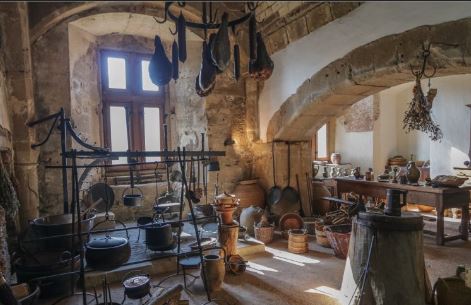
I walked back to the window. It was a quarter to six. Strange noises and an occasional sighting of the larger-than-average soldiers with the oddly pointed hats have been seen roaming the grounds. Any attempt to speak with them or approach them, they simply vanish into the mansion. Odd doors and gated entrances punctuated the length of the mansion. There was a Gothic, deliberate atmosphere about my home, a sepulchral character to the mass of its wooden buttresses andre treats. Geometrical shapes snatched inexplicably at the eyes. And often one could hear laughter, high-pitched with contempt or teasing mockery that made one hurry on, even though it may be rationalized as the cold wind gusting through the elaborate masonry. The wind whistles in the trees and leaves and wisps of thick mist blow across the farmland. With the trotting of horses and constant sounds of construction, the heart is suddenly racing, and one thinks they hear something behind them. After all, this is an ancient land, a house built by spirits, occupied by ghosts, pixies, goblins and all sort of mythical creatures of the night. Anything is likely to happen. Looking around the interior of the estate, one can discern a deep, foreboding blackness that seems to be following one, as if it is alive and in pursuit. Stepping out into the fruit orchard, the wind suddenly drops and one’s senses are heightened. Indeed, one can hear one’s very heart beating in their chest as they continue to canter forward into the night. The mist becomes thicker, darker, and as one glances furtively from side to side, the darkness of shadows of the orchards hides their secrets, but perhaps you are not alone. Sometimes I tell myself that the scraping sounds at the window is simply a branch being blown in the breeze and the footsteps heard in the hallway are old timbers creaking and groaning with a change in the air or weather. #RandolphHarris 2 of 7

If there was something serious going on, the housekeeper and the butler would try to keep it quiet. They might talk together, but they would be tight-lipped in front of me. The clock struck seven. I met Daisy in the dining room. “Aunt Sarah, we all talked. We weren’t meant to,” Daisy said. “We were all talking about it. We didn’t know what to make of it. The body was found on a cold stone passage, that was said to lead directly into the opulent state rooms where you normally conducted meetings.” Not a moment too soon, five housemaid trooped into the dining room. Taking off their white starched aprons, they formed up in a line. The room, echoing with their footsteps and voices, as in a church. The mahogany floor, almost three thousand square feet of it had to be hand polished. It was an onerous task, one of the housemaids least like doing. Bending down, they placed their tins of wax of the floor. “Daisy, it looks like we will have to continue this conversation later,” I said. “Goodnight, Aunt Sarah,” she replied. The maids stooped on their hands and knees, their long black dresses spread out around them. Working in union, they dabbed their clothes in wax; then they rubbed the floor vigorously in quick tight circle. The observation tower staircase was the place the servants feared most. The observation tower sits ominously over the mansion, along with sever distinctive turrets jutting proudly into the skies. Sweeping down to the Guard Room eight floors below, it was the main thoroughfare in the tower. Family portraits adored its walls. The steps, of bare stone—framed by a wrought-iron balustrade, topped by a mahogany rail—were wide and shallow. “We were all scared of the tower’s stairs,” said Elsa. “I was coming down them one evening, halfway down, I felt somebody push me. They were behind me, trying to push me down the stairs. I turned round, and of course there was no one there.” The Winchester Mansion is a land of appealing features seemingly embedded in the sense of a deep-rooted and permanent history that emanates from almost every corner of the land. It has rustic grounds and quaint gardens, a hulking mansion with many towering features, having been fostered over decades to create a comfortable and pleasing landscape that guests recall like their favorite arm chair. #RandolphHarris 3 of 7

A number of the male servants, skeptical of ghost as they were, had experienced a similar sensation. “I used to keep an eye on the mansion,” Edvin recalled. “I would walk around the dark with the dogs, no lights on, no torches, or anything. One night, I was coming across the first floor of the tower—and I got up to the stairs and felt hot breath on the back of my neck. I turned round. There was nobody there. But the dogs wouldn’t go any further, their hackles went right up. It was ages before I could get them to move.” I often examined the possibility of evil. I had a notion that evil was communicable. Something that can, as it were, contaminate. However, one must not confuse evil with manifestations. My secret rooms, by their very nature, held the servants in thrall. It was an area that they never entered, never saw or ever knew what went on. It was a place of mystery. The rooms were subjects of wild speculations, fueled by the servants’ fear of me, and their knowledge of my eccentric interests. My servants knew I was fascinated by the occult and this played to their fears. They knew the mansion was haunted and I often had the mediums in. However, they never whether any ghosts or sprits were actually summoned. It went on behind closed doors. Of course, they knew of the ancestral curse. It had been cast in the mid-19th century by a coven of witches. The curse had also been cast over future generations; aimed at Winchester heirs; it determined that the children would die before they reached the age of thirteen and those who survived would be haunted by ghosts and demons. For decades, it had seemed to me and my servants that this was a cruse from which the family could never escape. #RandolphHarris 4 of 7

One night, it was shortly before three o’clock in the morning when a shadowy figure, dressed from head to foot in back, crossed the landing of the staircase. The night was cloudless, the moon almost full. There was a blackout and the mansion was shrouded in darkness. The light from the moon set tiny point of balance dancing in the darkened windows. I could hear footsteps moving stealthily across the floor and the occasional cry of an animal from the fields. A headless horseman was riding near the tower. I got out of bed, and turned the corner into a passage in one of the parlors. As the men worked in the hallways, they froze. Coming down the hallway was a pair of green eyes belonging to a child. The eyes were about two or three feet up from the floor, leading me to believe that child was three years old. They eyes simply floated up the hall, and then turned into one of the maid’s room where we lost sight of them. That night I also saw dark shapes. There was a dark shadowy thing flying from the Grand Ball Room to the and down the hallway. Then above the chandelier there were several dark shadowy things. They flew outside, barely illuminating the background of the trees and then were blocked out by an even darker shadow, moving slowly, methodically along the tree line. Meanwhile another shadow ran through the hallway, it was tall. The carpenters looked at each other in suspense. Closing the heavy steel door behind me, I had left the Grand Ball Rom to find my way long the labyrinth passages. A long passage reached into the distance. It was gloomy, lit by only the strip lighting in the display cases that ran along with wall. Ahead was a solid oak door, carved in the Gothic style. Another passage led off to my right, I could see that it branched in two. One end led into a small hall. It was in darkness. “No one goes in there,” a mysterious voice whispered. The spirit gave me a fright. Everyone, it seems, even hardened sceptics and disbelievers, has seen a ghost. For some reason, in the back of their minds, ghosts may be real. Everyone has known the feeling of their heart racing for a second when they see a shadow moving in the corner of their eye or they feel some sort of presence standing over them. Or worse still, a tortured face in a window that paralyses their body and retards their breathing to the point that they can hear the blood pumping around their own body. #RandolphHarris 5 of 7

I took the left passage. I went on some distance ahead, there was a kink in the passage. A man emerged from it and started waling me. He was wearing knee breaches and a nineth-century coachman’s jacket. As we drew level, he stopped. “Mrs. Winchester, those rooms are forbidden,” he said, “What are you doing in this part of the house?” Once again, he repeated, “Those rooms are forbidden.” I did not want to stop and talk; I was anxious to get back to my room. I assumed that the servants were being proprietorial. Finally, I had made it to my destination sometime later. The bedroom was not dark, because the bright light of a full moon entered through the window. I had just lain down, ready to go to sleep, when I suddenly noticed that I was not on my own. I heard a rasping breath in the darkness only a few feet away. Right in front of the wardrobe and looking directly at me was a middle-aged man, dressed like a Catholic priest. I rubbed my eyes and pinched my arms to make sure I was fully awake Yes, I most certain was. Was I having hallucinations? The priest was still standing there, looking at me. He was a rather frail man with hollow cheeks. His face showed traces of a hard life and illness. If he had any hair at all, it was covered by his hat. He looked so real, not like a ghost. I was not a bit scared, because he radiated vibrations of utter peace and tranquility. There was nothing to be afraid of, so I decided to talk to him keeping my voice as low as possible. “Hello, Father,” I said. “God bless you.” “And God bless you, my child,” came the priest’s prompt reply. He was well-spoken, his voice was soft. His English accent was not hard to distinguish. After giving me a few personal messages and stressing the point that there is survival after death, he told me who he was. #RandolphHarris 6 of 7
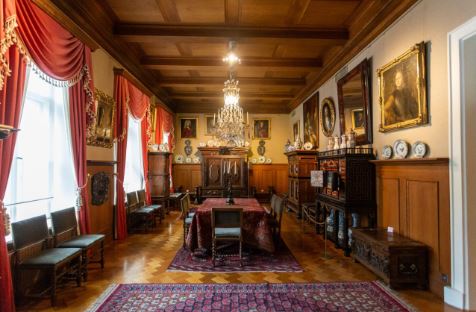
His name was John Ogilvie, and in had lived in Scotland from 1580 to 1615, he wanted hanged at Glasgow Cross for his faith. When I remarked that at the time of his hanging, he was only 36 years old, he confirmed this. After quietly talking about religious matters for a few moments, he bade me farewell and disappeared. It seems that he refused to pledge allegiance to King James, and it was for this crime that the was tried, found guilty and hanged. After his execution, his followed were apprehended and put in jail. If this was not a genuine case of a visit from beyond the grave, what is it? Most of the time, the mansion is benign. Unfortunately, sometimes people find exactly what they are looking for. I had been in bed half an hour when I heard the music playing softly from my sitting room next door. I listened to the same, faintly relentless song. Starting to sweat and grow cold in bed, I recognized the song. Or I thought I did. And it continued. It wavered through the wall and door frame in strained, distended chords, and choruses, swelling and facing, ragged and persistent. The door was to my right. I pulled back the duvet and got out of bed and walked through the door to the sitting room. Where the music was louder. The must persisted, repetitious, frighting me. As I turned the corner, I discovered that Gerhardt hanged himself from the cross beams. Badly wounded, Mr. Hansen carried to the attic to await medical attention, but he died there. Since that time people have claimed that he haunts the attic room. He has been seen and heard there from time to time. Servants have reported hearing the creaking of a rope and the soft thud of a body swaying against the wall. Though they often look for the source of the sound, they never find it. There is a disheveled, aged specter, bound at feet and hands and rattling chains haunting the basement. A journey through my mansion is a passage through history. A real history, one that you can live and breathe, one that you can feel and be part of. You can walk serenely miles through my mansion, it is a place that inspires contemplation and wonderment. It is a living history, of memories as far back as history recalls. It is a place of myth, legend, of ghosts and ghouls, of giants, and dwarves, mermaids, cupid, another other half-remembered, half-whispered-about creatures. #RandolphHarris 7 of 7
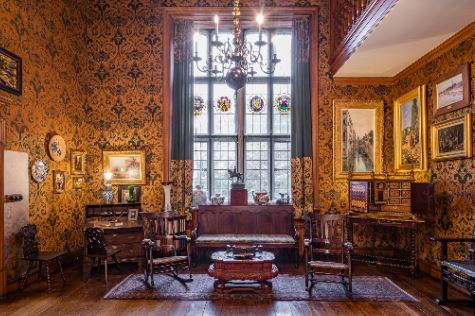

If a sudden, horrifying death is what it takes to make the spirit linger, surely, this place—is a candidate. Certainly, where men grappled back and forth, engaged not only in the struggle for their own precious lives, but for the life of their respective countries, where in the balance was the future of the very world, and this place produce the mechanism of defense, if that does not qualify for the lingering-place of souls wondering for eternity the outcome of their struggles, then we cannot name a place. https://winchestermysteryhouse.com/

And please be sure to check out the online gift store: https://shopwinchestermysteryhouse.com/

Who Would Keep a Cow of their Own that Can Have a Quart of Milk for a Penny?

No one has yet fully realized the wealth of sympathy, kindness, and generosity hidden in the soul by God. The human mind is fascinating. A young officer working on a ship wrote that he would awaken during the night and discover himself under an undesirable physical and mental condition. He seemed to be clearly in a mesmerized condition, caused by someone or something giving the powerful posthypnotic suggestion to wake up and obey. The remedy is to use the same technique in reverse. That is, practise auto-hypnosis, give the self-suggestion that on waking up there will be full conscious and full rejection of the negative idea. If one must hate something, let one hate hatred itself. The storms of violent passion are to be resisted as the smoothness of inner peace is to be invited. To keep one’s temper in a single provocative situation may be easy, but to keep it consistently equable is a real feat. Life is a conflict. One must not let these negative feelings take up lodgement within in one longer than a single moment. All humankind must awake from its materialistic apathy and cast out something of its selfishness. It is called upon to renounce its violence and meannesses, its intolerance, unkindnesses, and injustices. It must either emerge from its animal brutality or else suffer itself to be extinguished by it. It must come out from the shadows of ignorance, selfishness, and materialism. Only then will it find the sunshine of a larger life that awaits it. It is not always one oneself who acts in a particular way at a particular time. Impulses from lower sources or outside contacts may be strong intuitions from higher levels or outside sources may influence one to wise choices which bless one’s future. We must not hate those who are born of the same divine essence as ourselves but we may hate the sins they perpetrate and the evil they radiate. The seeker has to contend not only with limiting environments but also with internal enemies. Apathy delays one, depression obstructs one, and loneliness frustrates one. #RandolphHarris 1 of 18

The more one becomes sensitive, intuitive, responsive to the spirit, the more one is unfolding exceptional passivity. However, this puts one in peril, for one feels the negative presence too. Hence the more one must restrict one’s contacts until one’s strength is above them. It is prudent to escape from a situation where there is much pressure to commit a foolish action or to make a foolish decision leading to calamitous results—and not continue to stay in it until the danger materializes. One whose presence is felt to be odious, whose personality is regarded as distasteful, is better left alone. One should never allow the actions or words of ignorant human to arouse in one reactions of anger, envy, or resentment. The years are too few and there is too much to be done—both on oneself and for oneself—to waste them in negative, resentful thought and decaying, neurotic emotion. When one comes to understand its importance, one will begin to exercise some vigilance over one’s thoughts. Resist beginnings—that is the most practical way to deal with negatives. The destructive thoughts of fear and self-doubt which whine at your door, whine at the door of every human. However, you can make them powerless to hurt you. For—there is n chance, no destiny, no fate can circumvent, can hinder or control the firm resolve of a determined soul! If the negative thought persists then one has to wrench oneself away from it with the assent and use of all one’s being—feeling, reason, intuition. One’s own attitude towards events holds the power to make them good or bad, whatever their nature of itself may be. Those who are unable to think correctly about this tragic World situation must be pardoned, but those who refuse to think correctly about it do not deserve pardon. The counsel of Jesus to “resist not evil” does not apply to other men’s acts but to our own thoughts. We are to turn aside from a negative thought-habit by the simple method of substituting the opposite and the beneficial one. We need not to spend our strength resisting the thought of misery, for example. We are to substitute hope for misery, whenever the latter appears. #RandolphHarris 2 of 18

Wrong-doing will be avoided not because it is punished by the law of recompose even when it is not punished by the law of society, but because of the strong inner conviction that right-doing is its own reward, its own satisfaction. The beautiful is allied to the good. If we cultivate beautiful feelings, evil ones begin to get dissolved. One will not risk rebuffs by expressing one’s views and describing one’s experienced to the uncomprehending of the unsympathetic. It I cowardice to refuse to face the fact that one has made a mistake and to continue following the same course because it is to stop it and return to the right road. The easier way is too often the worse way, leading to trouble for one’s self and others. There is a limit to the extent of concessions to prejudice; we must not beyond it. Beware of those whose mind is vindictive and whose speech is venomous. If they are born of emotional prejudice or passionate bias, it is of little use to meet irrational arguments with rational statements. The ancient saying that where goodwill exists agreement will not be hard to find, still remains true. The crowds which delighted in the gladiator shows of ancient Rome and, to a lesser extent, those which delighted in the bullfights of modern Spain, do not see to understand how bestial they allow themselves to become at such times. If one is to be distinguished from a member of the savage species, the true human being, the fully evolved human, must have the quality of pity in oneself. Do not attempt to fight evil with evil. Overcome it by calling on a higher power to bring out the good in you wherewith to meet it. In this way you obey Jesus’ counsel, “Resist not evil.” Synesis (fourth century): “This would be the most extreme of ills—not to be conscious of the presence of evil. For this is the condition of those who no longer try to rise…for this reason repentance is elevating means…[but] both deeds and words [must] lend a helping hand.” A philosopher may not ignore the negative side of one’s or another’s life: one has to deal with it because circumstances force one, like everyone else to do so. #RandolphHarris 3 of 18

However, one’s way will be different, because one will use all one’s faculties and capacities: intellectual, practical, and intuitive. One will keep calm and not let passion or negative emotion carry one away. However, all that done, one hands over the results to the higher power (which includes destiny). One’s mind must stay in That which transcends negativity, sin, evil, even if one must grapple with them. Philosophy will not disregard the bad in others, and the sin in ourselves, but having seen them clearly it does not react negatively in useless condemnation. Instead, it reacts constructively in trying to realize the meaning of evil, the consequence of sin, and then proceeds to cultivate the opposite quality, the good of that particular evil—as honesty where there is dishonesty and so on. If practical dealings are involved, we may regret the existence of these faults in others, but we may not refuse to recognize them. Amid all the pessimistic reflections which the state of the World so easily induces in the thinking human, one may yet be buoyed up by the hope which the eternal verities must again and again give one, that is, the hope that the end of it will be immeasurably better. The existentialist view—so popular with so many young people today—that we begin with oblivion and end with annihilation, that what comes between is either meaningless or mysterious, with no solutions to problems, no answers to questions, is a view which the tragedy and evil and catastrophe of our times tempt us to accept. However, religion and philosophy release us from this despair. In such critical times as these even some faith in the existence of a higher power, and some aspiration towards serving it, has protective value. Trust, not tension: trust in the higher power producing serenity rather than tension; because of the pressures of life this is a great need today. However dark or desperate World history may seem at times, we must always remember no one can disrupt the divine World-Idea, or spoil its manifestation, or prevent its glorious outcome. #RandolphHarris 4 of 18

Fear of the power and cunning of these evil opponents causes them to rely on obvious but ordinary human forces and weapons for protection. They forget the divine forces they could, and should in this crisis, call on—and neglect the superhuman and extraordinary. To express a half-amused contempt for the intelligence of our time is not at all the same thing as to make a jaundiced indictment of it. To witness the magnificent parade of a civilization of almost unredeemed triviality is less likely to arouse bitterness in the soul and more likely to give it a good half-hour’s amusement. On the one hand, carried away by the idealistic enthusiasm and millennial promises of merely emotionalist cults, some believe that a spiritual teaching has only to be propagated and it will spread triumphantly everywhere. On the other hand, confronted by the formidable spectacle of a whole World plunged in ignorance, conscious that the ordinary individual can do so little to uplift it, others drift into bewildered defeatism and actually do nothing at all. However, this second attitude, although much more sensible and much more justifiable than its opposite one, is not quite philosophical. According to the old classical fable, we had to look for truth in the bottom of a well; today we have to look for it in the bottom of a bitter disillusionment. In the dismal World conditions of today it is a paramount necessity to obtain some glimpse, however meagre, of the divine plan which is working out for all our lives. Only in this way can we co-operate with it understandingly and adequately. Instead of relying on flight into the unknow and uncertain, it is better to rely on God. In the first case one may be making a false escape and duping oneself, but in the second case one opens the way for true guidance in the matter. With peace in the mind and harmony in the feelings, both completed by knowledge of the universal presence of divinity—who could harbour evil thoughts, hatreds, or destructive plans? #RandolphHarris 5 of 18

Every evil person who crosses our path provides an opportunity, in the injury one attempts to do us, to keep ourselves from being provoked into retaliation, anger, or resentment. If we succeed in overcoming our own feelings, we mount upward a step. In a negative situation, where negative criticism and negative emotions are rampant, other persons may try to involve one in it, or at least get one to support their attitude and endorse their criticism. However, a feeling may come over one preventing one from doing so. If so, one should obey and remain silent. With time the rightness of this course will be confirmed. One the injunction to return good for evil, the question arises, with what then will you return go? Return good for good, but justice for evil. Is this not wiser counsel? Does not the other punish goodness to an extremist position, rendering it almost ridiculous by condoning bad conduct? Inner and outer difficulties are often related. What appears to be an ugly state of affairs may well be a definite attack of certain evil forces using interested human instruments. In such a situation, the individual should never practise nonresistence in any way, but, on the contrary, should fight them off as hard a one can. At the same time, one must remember that weakness in self-control can give these evil forces an opening which they might not have had otherwise. If one wishes to emerge victorious in the struggle, one must be on one’s guard. If one does not throw off this condition, one, oneself, unwittingly erects a barrier though which the divine help sent one finds it difficult to penetrate. Although the temptation to seek release as such a time through, for example, the easy way of drink is understandable, one must nevertheless remember the duty one owes to one’s spiritual life, to one’s personal interest on the relative plane, and to others. Although the student must forgive those who mistreat one, one need not think tht forgiveness implies one has to associate with such people thereafter. #RandolphHarris 6 of 18

Whenever the thought of them, or their abuse, comes into one’s mind one must exert one’s willpower to drive it out, and immediately direct one’s thoughts toward God, or toward any inspired individual in whom one had faith. Only the actualized Christian is entitled to dismiss evil and to deny its existence: all others must look it in the face, understand it, and overcome it by slow gradations. It is better to keep out of the way of evil humans, especially when they are in power, until or unless we are driven by the necessity of circumstance of the inward voice of duty to oppose ourselves to them. It is always a certainty that the practice of active goodwill directed toward those who regard one harshly will benefit one’s own development, while it is always a possibility that this practice may dissolve the harsh feeling against one. It is all gain and no loss. This is one part of the case for Jesus’ advice to return good for evil. It is a technique of this evil power to paralyse its intended victims by frightening them. If we give way to fear, we give assistance to its effort. It cannot be beaten without open defiance and ready valour. One must remember that one will meet with those individuals who are themselves the bearers of antagonistic forces, instruments of darkness—sometimes consciously, most unconsciously, people used by evil forces. So far as possible one must avoid such people. Certainly never enter into intimate associations with them, whether the relation be business or personal. If one does one will find that sooner or later some of their unfortunate behaviour will be returned by Universal Law and tumble on one and one with have to suffer with the afflicted individual. These people make talk as believers in spiritual things—indeed, they often belong to some cult or other. However, they do not understand truth or live it. They cannot help one and one is not strong enough to carry them. So leave them alone. And that is not always easy, because often they are people of a kind that force themselves into one’s life. #RandolphHarris 7 of 18

Sometimes one can know them by this hallmark, by this aggressive way which they try to entangle another individual. It may even be necessary at times to deal with such people with a firm hand, even mercilessly and relentlessly. If so, do not hesitate, but do it without any personal feeling of any kind. The American landscape has been badly corrupted. European writers no longer even notice the natural wonder of it, they are so put off by the ugliness and conformity of the towns. However, worse than the ugliness and conformity is the neglect that baffles pride of place. Our poets try to move themselves by nostalgically repeating the names of towns: “Biloxi and Natchez, Pascagoula and Opelousas”—but beware of paying a visit. The Americans disesteem public goods, and improving the landscape is a big expense. Historically, the neglect of appearance and plan of our scores of thousands of villages and small towns, especially in the Middle West and South—the diner, the Woolworth’s, and two filling stations—can be analogized to the neglect of the present-day less affluent. In the tide of expansion, appearance was disregarded as not essential; later, the matter would be mopped up. However, the neglect rigidifies, it is a hard core not easy to change. Instead, the present tendency is to impose on the countryside a new corporation style altogether, in the form of shopping centers (=national chain supermarkets) on the highway. This works out disastrously for the communities, for these “centers” are not centers of villages, and there cease to be villages at all, simply scattered family houses. This is the end of a long process of disruption, for in any case the industry is gone, then men work in plants thirty miles away. It is possible to travel many miles even in New England and not see a single activity a man could make a living at, except automobile agencies and filling stations; not even a food store. #RandolphHarris 8 of 18

The schools too are large and centralized. The families tend to move away frequently, but even while they are put, they are driving around. This does not make much community to grow up in. In more primitive societies, a chief community activity is working together, thatching a roof, net fishing. However, with us, precisely this co-operative labour, for instance the work in a factory, is removed from its community setting ad emptied, by the relations of production, of any community spirit. Places that have no shape have no face-to-face functioning, for the shape is the functioning community. The loveliness of so many hamlets in Europe is that they have shape and are built of local materials by local craft. Perhaps the people had to cluster to attend early masses. In Ireland, where they farm out the back door, the rows of thatched houses line both sides of a little street. In France, where men go off to their farms, there may be a square. In our own early New England villages, where congregational and political spirit was strong, there was a common green with public buildings, though the families lived scattered on the farms they worked. There was the shape of a community, with its economy, its crafts, and its ideas. The advantage of growing up in such a community in one’s early years is evident. It is not family supervision, on which the physicians of juvenile delinquency are now laying such stress; quite the contrary! it is that the family does not have to bear the burden of teaching the culture. In a community, everybody knows the child face to face. There is an easy grading of overlapping ages, right up to the adults who are going about their business in a going concern, and not paying too much attention to children. A good city neighbourhood works in the same way. From this point of view, the swarm of kids in a city housing project form a better community than present-day country boys or the kids on Park Avenue. Therefore they have more local patriotism. #RandolphHarris 9 of 18

The bother with this community chain, however, is that it terminates abruptly before it reaches the adults, who belong to a different World; so the kids are a gang and the local community spirit turns into loyalty to a Code; it does not eventuate in anything socially cohesive and culturally worthwhile. And such a gang in prone to be delinquent because, as we shall see, in such conditions it is the forbidden tht best cements loyalty. Politically, a delinquent gang is not lawless and not in the state of nature. Balked in its growth, the local loyalty turns on itself and simple reinvents the feud-code of Alfred the Great, marking out safe territories and making provision for special classes of revenge. On this view, if one teenage gang, pursuing its vendetta, falls on another and murders a kid, it would not be our business to interfere in the law of that differently constituted society. Also, like Danes or Vikings of Alfred’s time, they regard our larger society merely as a field of sports and plunder; they have not yet reinvented International Law. However, we, of course, cannot view it so, for we live in an advanced state of politics and law: they are members of our community. We are not children but more experienced and somewhat wiser, and therefore responsible, so we cannot simply annihilate them like pirates (they are small in size, few in numbers, and armed with primitive weapons); and we cannot let them hurt themselves. (I think it is wise sometimes to regard disaffected groups as if there were plausibly these two viewpoints, rival patriotisms. It is better humanity and it might make better law. The advantage is that it takes the disaffected seriously as disaffected, rather than merely pathological; it keeps in the foreground the question of allegiance. We must deserve allegiance.) However, they are children. Let us consider rather the peculiar patriotic problem of an older disaffected group, the Hipster young men, for then we can see that it is a patriotic problem. #RandolphHarris 10 of 18

Here too, I think, there has often been a strong community influence of growing up together. For instance, fellows who went to Black Mountain College, which was oriented to community and creative arts—a powerful, and powerfully disaffecting, combination—are pillars of Hipster society. Other fellows were buddies in the armed services. However, it was, as Hispters their community spirit is strong. They barge in to sleep, they share property, they share a culture. Now think of this community, disaffected from America, as engaged in a pathetic quest for some other big patriotism, an adult peer group. We saw how, appointing themselves outcast, they affirm the accidental symbol of other marginalized groups: African American, Puerto Rican, the less affluent, and others. However, this is pretty thin gruel for intellectual young men, many of whom have been to college. On the other hand, they are unable to make the jump to the great international humanists community because, simply, they do not know anything, neither literature nor politics. (I once taught at Black Mountain College, and to my astonishment I found that the students had never read the Christian Bible, Milton, Dryden, Gibbon, etcetera, etcetera, nor did they feel—as a lack—that such things existed. However, they knew odd facts about Mayan hieroglyphics which their teacher had been interested in.) What then? Since it is necessary for grown fellow to have some major allegiance or other, they have latched on to the late Japanese masters of Zen Buddhism. (This is a late effect of the early-century discovery of Japan by Fenollosa, Frank Lloyd Wright, the Misses Lowell and Ayscough, and Ezra Pound, suddenly reinforced by the postwar occupation under General MacArthur.) Now, as we shall see, Zen is not irrelevant to those young men’s needs, for it is a theology and style of immediate experience. #RandolphHarris 11 of 18

However, the pathos is that Zen was the flower of an intensely loyal feudal system that fed, protected, and honoured its masters, and to which the Zen masters in turn had fealty. For example, it is said that the haiku was invented by a poet as a public service when one was suicidally despondent because one’s Emperor had died. However, Zen without farmers and servants is an airy business; and the young men, as we have seen, are betrayed into dubious devices to keep body and soul together, nor do they have a flag to salute. Community approaches have worked to resolve many problems. In looking at mental health, the broadest approach for the treatment of schizophrenia is the community approach. In 1963, partly in response to the terrible conditions in public mental institutions, the U.S. government ordered that patients be released and treated in the community. Congress passed the Community Mental Health Act, which stipulated that patients with psychological disorders were to receive a range of mental health services—outpatient therapy, inpatient treatment, emergency care, preventative care, and aftercare—in their communities rather than being transported to institutions far from home. The act was aimed at a variety of psychological disorders, but patients with schizophrenia, especially those who had been institutionalized for years, were affected most. Other countries around the World put similar sociocultural treatment programs into action shortly thereafter. Thus began four decades of deinstitutionalization, an exodus of hundred of thousands of patients with schizophrenia and other long-term mental disorders from state institutions into the community. On a given day in 1955 close to 600,000 patients were living in state institutions; today only around 60,000 patients reside in those setting. The unfortunate result is that mental health lost most of its funding and a lot of people with mental illnesses have to where to go, but jail or to live on the street. #RandolphHarris 12 of 18

Clinicians have learned that patients recovering from schizophrenia can profit greatly from community programs. However, the actual quality of community care for many of these people has been inadequate through the United States of America. The result is a “revolving door” syndrome: the few patients, who are lucky enough to be treated, have been released to the community, readmitted to an institution within mothers, released a second time, admitted yet again, and so on, over and over. A lot of people who want mental health care are not able to access this precious resource. In fact, 10.3 percent (over 4.7 million) of adults with a mental illness remain uninsured. And, 56 percent of patients want access to a mental health care facility. As COVID-19 continues to rage, Americans are experiencing anxiety and depression. More than 42 percent of U.S. adults reported symptoms, up 11 percent in the previous years. Nearly 1 in 5 Americans has some type of mental health condition. Spending on mental health treatment and social services has reached over $250 billion, which is up approximately 60 percent since 2009. This cost includes spending on things like therapy and prescription medications as well as stays in psychiatric or substance abuse rehabilitation facilities. However, it does not take into account indirect costs, such as lower workforce participation rates and decreased productivity. In fact, depression alone is estimated to account for $44 billion in loses to workplace productivity. And access to care can be prohibitively expensive—even more so than physical health costs. An hour-long traditional therapy session can range from $65 to $250 for those without insurance. A patient with major depression can spend an average of $10,836 a year on health costs. Meanwhile, a person with diabetes taking insulin can spend $48,000 to manage their condition. On a national level, research shows that the United States of America is likely to continue to experience a shortage of mental health professional through 2025. If you are looking for excellent health and wellness coverage, consider becoming a Kaiser Permanente member. You do not need a referral for mental health and addiction care services. #RandolphHarris 13 of 18

Other ways to help keep health and wellness in check is celibacy. However, there is the double standard that is a Worldwide phenomenon that has many layers of meaning. The first is that one and one is not always two, because the woman or man of the evening is a criminal but their client is a “john,” an also because women are expected to be virginal at marriage and chaste afterward, and some men are expected to be chaste before a relationship and after, and during the marriage and relationship, but one’s husband is not bound by the same constraints. The double standard implies, in other words, that chastity is primarily and woman’s and small percent of men’s domain. Nonetheless, only women are typically judged more harshly than all men whose conduct is identical. Even today, the discrimination is thunderously obvious, preached from pulpits and parliaments and specifically mandated in the law. The double standard is nefarious not only because it embodies egregious gender inequality but because it condoned solicitation as an acceptable outlet for unchaste men. Though it condemns people of “the evening” as social scum and consigns them to lives of degradation and danger and disease, it sanctions their profession. The reason is obvious: without solicitation, lascivious people might seduce rather than marry the virgins of their own social class. It is particularly chilling that the members of many churches and other organizations in positions of authority support the double standard and, albeit reluctantly, swallows the equation that no men or women of the evening equals no chastity. Laws essentially force women to abide by a higher standard of regard in the matters of chastity than men. They also denounce solicitation but at the same time partially exonerate it as the safety valve that kept virgins pure. It is unsurprising, then, that the double standard matured as a code of conduct in pleasures of the flesh that demand female chastity and at the same time approve, or at least tolerate, the dominant group of mostly men, and their carnality expressed in the use of other humans as toys, though this meant sacrificing certain women and sometimes other to unchaste, unrestrained men and a small fraction of women. #RandolphHarris 14 of 18

Furthermore, not all men honour their obligations to marry their child’s mother. And when men who came from a higher social echelon seduced a working-class girl, they almost never honoured that class’s code. Domestics and shop girls in particular were the pray of privileged men, but being with child destitute these women rather than pushing them into marriage with the baby’s father. However, often times, after these men who have money start to become older and nearing retirement, they will then leave their wives for young women of other ethnic backgrounds and of lower social standings because these women tend to be considered more exotic and attractive. The women will marry for older man for security and to escape labour. However, in a few cases, it is real love. In society, another problem is many people seem to scarcely be able to comprehend what chastity means, or to regard it as a virtue. Among the middle and upper classes, chastity’s double standard wreaked havoc on social decency. Some of these moral puritanical, which even frown on premarital male activities involving pleasures of the flesh, young women are coached to trap husbands without surrendering beforehand even a taste of the delights to come. Men are, in some cases, are frustrated at this implacable wall of chastity and take it as a challenge. They play games. In large numbers, they form unholy crusades to seduce young virgins. This upper-class deviance was depicted on shows like the original on Gossip Girl. “Resist, resist!” the virgins’ elders urge them. “Just say a resounding ‘No’ to your pleading, inveigling, deceiving young suitors.” After all, as the old adage went, “Who would keep a cow of their own that can have a quart of milk for a penny?” However, at the same time, ladies, and a small percentage of men, forgive them for trying to ruin you. This double standard of conduct involving pleasures of the flesh is necessary, because unlike you, the dominant class of men and a small percentage of dominant women, by nature have an urgent, irrepressible need. Brothels used to be officially licensed. Unchaste people play a crucial role in upholding their societies’ notions about chastity. #RandolphHarris 15 of 18

Now, nowhere is a failure to achieve perfect synchronization more lamented than in the bedroom—unless it is when the U.S. Federal Reserve or the Bank of Japan rises or lowers interest rates and get the timing wrong. Timing, as any comedian can tell us, is everything. However, we are, for the most part unwittingly, changing our links to time, and that is no joke. As interested as investors and economists may be about exact timing in finance, they re remarkably uniformed about the role of synchronization—and, even more so de-synchronization—in the creation of wealth and poverty. Yet understanding these can give us a wholly new way of thinking about wealth creation. Some degree of synchronization has been needed ever since hunters and gatherers began working in groups. Historian William McNeill argues that mass rhythmic activities have been used throughout history to promote synchrony, which in turn improved economic productivity. Tribal dancing, he suggests, strengthened teamwork and made hunting more efficient. For thousands of years fishermen have chanted in unison as they hauled in their nets, the musical beats indicating when to pull and when to breathe. Agrarian economies also reflected seasonal change. According to anthropologist John Omohundro, writing about the Philippine island of Panay, “Through the dry season…and into the rainy season…businessmen are in their slowest season. All aspects of the distribution system slow down. By September or October the rice crop begins to arrive in town…Because the wealth of the province is regulated by agrarian cycles, city business activity rises and falls the these cycles.” Economic anthropologist Willem Wolters adds: “Purely local banks have never been viable in the semi-arid tropics because of the seasonality and synchronic timing.” Early industrial economics operated under completely different temporal conditions. Assembly-line work required a different rhythm. Thus, the factory whistle and the time clock were invented to coordinate work schedules. #RandolphHarris 16 of 18

By contrast, today, as we will see, business activities are speeding toward real time. In addition, the uses of time are becoming increasingly personalized and irregular, if not erratic. More different tasks need to be integrated, and the acceleration effect truncates the time available for each task. All this makes synchronization harder to achieve. And that is only the beginning. If we look deeper, we find that every economy throbs and vibrates with unnoticed rhythms. We may buy a newspaper daily, pick up soap or milk at the supermarket weekly, gas up the car every ten days or so, cash a paycheck every two weeks and pay credit card bills monthly. We might call a broker sporadically according to what is happening in the stock market, buy a movie ticket or a book on a whim a few times a year, pay taxes quarterly or annually, go to the dentist when a toothache strikes and purchase a gift for a relative who is getting married in June. These and countless other transactions create rhythms that flow through banks, markets and lives. With the very first slap on our infant behind, every one of us becomes part of this ongoing economic music. Even our biorhythms are affected (and in turn influence) the marvelously complex, orchestrated process that pulse around us as people work—making things, providing services, managing others, caring for one another, financing companies or processing data and information into knowledge. At every moment, some tempos speed up, others slow down. New melodies and harmonies are introduced, then fade out. There are choruses, counterpoints and crescendos. Beyond these, throughout the entire society and economy, there is a generalized pulse of life that is itself the average, as it were, of all its subordinate tempos. The “economic music” never stops. The result is not patternless chaos because, within every wealth system, various components or subsystems are continually adapting their speeds, phases and periodicities to one another. In biology this process is called “entertainment.” #RandolphHarris 17 of 18

Neurons, it turns out, do not work alone. They form temporary teams—much as businesses increasingly do today. In the words of Science magazine, “Neurons frequently fall into step with one another, forming ensembles that play the same tune, as it were, firing in relative synchrony for brief periods, before some neurons drop out of synch, perhaps to join another ensemble.” Firing in sync, moreover, apparently predisposes the neurons to “joint processing” at high levels of the system. Today’s breakup of monolithic corporations into congeries of short-lived project team, alliances, partnerships and joint ventures parallels these ephemeral “ensembles” in the neural system. One way the World could survive in joy is if the whole World worships God. We hear you, fellow-creatures. We know we are wrecking the World and we are afraid. What we have unleased has such momentum now, we do not know how to turn it around. Do not leave us alone, we need your help. You need us too for your own survival. Are there power there you can share with us? In the Service of the Heart, nothing is further from the truth than the widespread notion that to pray is synonymous with to beg, to request, or to supplicate. To be sure, to pray means to call upon God to help us. However, we need Him not only when we are physically in danger. We need Him also when we are spiritually in danger. To pray means to seek God’s help, “to keep our tongue from evil,” “to purify our hearts,” “to put into our hearts to understand, to learn and to fulfill in love, the words of the Christian Bible,” and thus to keep us unswervingly loyal to truth, goodness, and beauty. To pray is to feel and to give expression to a deep sense of gratitude. No intelligent, healthy, normal human being should take for granted, or accept without conscious, grateful acknowledgement the innumerable blessings which God in His infinite love bestows upon one daily—blessings of parents and loved one, of friends and country, of health and understanding. To pray is to express renewed allegiance to the moral and ethical principles which we accept as the guides of our personal lives, and which we recognize as the indispensable foundation stones for a decent human society. #RandolphHarris 18 of 18


The love fest continues for our newest community at #Havenwood! 😍 This one, obviously, is a great use of kitchen space!

A large porch entry welcomes you into the home, where a spacious great room opens into the dining and modern kitchen area featuring a large prep island.

Breathtaking and incredibly spacious living is yours in this gorgeous single-story home. https://cresleigh.com/havenwood/

All our homes come with owned solar, and you can choose from four distinct floorplans!
#CresleighHomes


It is Futile to Try to Take the Kingdom of Heaven by Violence!

Mental hygiene is just as important as keeping the rest of our body in good shape. Our mental health influences so much about how we move through life, how we view ourselves, and how we relate to others. That is why it is so important to discuss our mental health with professionals or trusted friends to find ways of cultivating a beneficial state of mind, and to be reminded that we are never alone even when we feel like no one understands us. Without question, family-of-origin relations and interactions have dominated the interpersonal research on schizophrenia. However, there is reason to believe that problematic interpersonal relationships extend beyond the realm of family relations for patients with schizophrenia. For example, among patients at a residential facility, interpersonal interactions were identified as the primary cause of symptom fluctuations in approximately sixty-six percent of the residents with schizophrenia. The most commonly identified interpersonal interactions were with other residents, and involved arguments, irritation, and concern about having personal property stolen by these others. Residents also indicated that arguments with and criticism from staff members led to worsening of their symptoms. This kind of relation friction is very prominent in the interpersonal landscape of people with schizophrenia. One particular area of interest for schizophrenia and interpersonal relationships more generally is social support. Patients with schizophrenia typically have smaller social networks, and report that they have fewer close friends, than healthy controls or even other psychiatric patients. Importantly, our research group detected a negative association between number of family members in the patients’ social networks and their prognosis, whereas a greater number of friends and acquaintances in these networks was associated with better outcomes. This finding indicates that the type of “social support” that may be offered by family members actually aggravates the course of the disorder. What is obviously beneficial to the patient with schizophrenia is social support from friends. #RandolphHarris 1 of 21

However, social support from friends is sadly lacking in many cases. One possible reason for this lack of support may stem from the poor social skills that are often associated with schizophrenia. Patients with schizophrenia and poor social skills tend to have smaller social networks. The negative symptoms of schizophrenia may also inhibit the ability to secure social support from other. The impact of social support clearly extends beyond just psychiatric symptoms for people with schizophrenia. It may literally have an impact on their long-terms survival. Recently 133 records of patients with schizophrenia, who were admitted to a state hospital, were examined. Over a lengthy retrospective follow-up period, those patients with more social support available exhibited a lower expected mortality. Using survival analysis, it was demonstrated that a 1-point increase in social support (expressed on a 5-point scale) was associated with a 25 percent hazard reduction over the follow-up period, which averaged 58 years. Clearly, when social support is available, it pays many dividends to people with schizophrenia—in terms of both psychiatric symptoms and longevity. Research on social support suggest that it is difficult for people with schizophrenia to reap the benefits offered by relationships with friends. In addition to problems with friendship, schizophrenia is associated with less closeness and more conflict with siblings. Individuals in the study expressed a considerable degree of grief and stress associated with their attempts to cope with their ill siblings. Further, there is evidence to indicate that, like people with depression, people with schizophrenia often elicit rejection from others. For instance, a large sample of students were asked to read vignettes describing a young mand with paranoid schizophrenia, personality disorder, or no mental health problem. The more mentally distressed the target person was judged to be, the more respondents found one to be socially unacceptable, and the more social distance from him they desired. #RandolphHarris 2 of 21

Similar findings are evident in a study of face-to-face interactions with patients with schizophrenia. In this case, the more strangely patients behaved during the interaction (as rated by observers), the more negatively their conversational partners responses to the. Some patients consistently behave in ways that lead them to be responded to more or less negatively. This interpersonal rejection effect associated with schizophrenia may explain the difficulty such people have in building and maintaining a social support network of friends. It is also linked to the sever social skills deficits these patients have. In addition to being embedded in disturbed and dissatisfying interpersonal relations, people with schizophrenia evidence serious communication problems of their own. An extensive line of research on social skills deficits associated with schizophrenia shows that the disorder is strongly associated with what are often fundamental failures in basic communication skills. Although these deficits are not ubiquitous with this family of disorders—for example, those with the paranoid subtype may be more functional—in many cases the exceptionally peculiar and disorganized style of relating to other people makes communication extremely difficult and challenging. The research on social skills deficits associated with schizophrenia has examined the expression or encoding aspects, as well as the reception of decoding aspects, of communication. Within each of these area, distinct deficits are sometimes evident in subprocesses (speech production and use of non-verbal behaviour in the case of encoding skills; and recognition of facial expressions, social information, and recognition/process in the case of decoding skills). Patients with schizophrenia have impairments in social skills that are more pronounced than those of either healthy or psychiatric controls. The social behavior of patients with schizophrenia, in social settings, tends to be less appropriate than that of either nonpsychiatric controls, or psychiatric controls, including patients with mood disorders and schizoaffective disorder. #RandolphHarris 3 of 21

Impairment in social skills are not just secondary to the symptoms of schizophrenia, and they are significantly associated with more general social functioning. Further evidence of poor encoding social skills associated with schizophrenia is evident in a diverse range of studies. For example, based on clinical ratings of such social skills as acceptance of contact from others, initiation of contact with others, effective communication, engaging in activities, participating in groups, forming friendships, and asking for help, patients with schizophrenia scored significantly lower on all dimensions, compared to patients with bipolar disorder or major depression. Similar findings based on clinical ratings indicate that in domains such as language development, socialization, and responsibility, patients with schizophrenia were rated more poorly than those with intellectual disabilities, and were about the same range as patients with organic brain impairment. When using self-report instruments to assess social skills, people with schizophrenia rated themselves as less competent in their ability to initiate interactions, manage conflict, and provide emotional support to others. These social skills deficits were particularly associated with negative symptoms of schizophrenia. Effective verbal communication skills are essential for conveying information, as well as for establishing and negotiating interpersonal relationships. Deficits in these skills are almost immediately evident upon interacting with an individual with schizophrenia. A frequent theme in the research on speech production and schizophrenia is the frequency of communication failures. These include such phenomena as vague or confused references, missing information in references, and structural unclarities. In conversation, people with schizophrenia will exhibit numerous communication failures. #RandolphHarris 4 of 21

The communication failures makes their discourse very difficult to decode, and their train of thought almost impossible to follow. This type of speech clarity (or unclarity) is strongly related to social functioning among patients with schizophrenia. It is impossible to overlook the striking parallel between the findings on communication failures among people with schizophrenia and the findings on Communication Deviance (CD) in their family members. Another speech problem associated with schizophrenia is diminished or inhibited speech production, also known as poverty of speech. This is speech that is inappropriately laconic and unrestricted. For example, when asked, “What was your family like when you were growing up?”, a person with schizophrenia may answer, “OK, I guess.” Such insufficiently elaborate responses require the conversational partner to probe continually for further information in order to get a sufficient answer. And when people with schizophrenia do speak, they tend to have poor enunciation and inflection. Such inhibited speech production is not specific to schizophrenia; it is also evident in depression. However, it tends to be more chronic for people with schizophrenia, whereas it improves dramatically as symptoms remit in depression. The effective use of nonverbal behaviour adds considerable richness to vocal communication, conveying attitudes, emotions, and information. People with schizophrenia regularly exhibit impairments in their use of nonverbal communication behaviours. For example, patients with schizophrenia make less eye contact with others during social interactions, although this may be limited to certain types of interactions that are of a personal nature. When watching emotional films, patients with schizophrenia were found to be less facially animated than nonpatient controls. They may also be impaired in the use of paralanguage (exempli gratia, tone of voice, speech rate, inflection) to convey emotion. In family interactions, patients with schizophrenia use fewer gestures and lean forward less toward their partners than psychiatric controls do. #RandolphHarris 5 of 21

Research on the encoding aspects of social skills shows that people with schizophrenia perform very poorly. Both their verbal and their nonverbal behaviours suggest disengagement, confusion, and existence in reality that is difficult to express, much less share with others. Sadly, the extent of social skills deficits associated with schizophrenia does not stop there. Aside from encoding or behavioural production skills, decoding skills are also vital to effective interpersonal communication. These skills are often referred to as social and emotional sensitivity or nonverbal sensitivity. Such skills call on one’s ability to perceive and read subtle cues in the discourse and nonverbal behaviour of other people at a rapid pace. Obviously, these are cognitively demanding skills that are preferred over a lifetime of human interactions. People with schizophrenia experience a multitude of decoding problems in interpersonal contexts. These interpersonal decoding skills problems are undoubtedly related to a more general problem that reveals itself equally in poor performance in decoding noninterpersonal phenomena. By definition, inherent in its diagnostic criteria, schizophrenia involves many serious perceptual problems that are often manifest in hallucinations and disorganized cognition and affect. They make for ineffective social perception that undoubtedly contributes to deteriorated interpersonal experiences for people with schizophrenia. The real enemies of humankind today—as in the recent past—are doctrines which have issued from the womb of hate and greed, suspicion and violence, and grown only to spread hate and greed, suspicion and violence. For the inevitable harm of such thinking is as self-destructive as it is socially destructive. If they could penetrate, by some mystical insight, the awful horrors and repulsive episodes which mar modern history, they would find something unimaginably grand, beautiful, and wise behind it all, unseen and undreamt by the human agents responsible for this misery. It is unjustified escapism. Postwar sensualism is as much a form of escapism as postwar ashramism. Folly and evil play the most powerful parts on the contemporary World stage. #RandolphHarris 6 of 21

If we look at the large panorama of the twenty-first century history, with its tortures and devastations, its epidemics and destructions, its famines and depopulations, above all, its menace of horrors yet to come, we can see how trivial a thing in fate’s eyes is personal life, how unimportant in them is personal emotion. What does fate, God, Nature, care about the little histories, the little loves, the little griefs of pullulating humans, who must appear in those same eyes as hardly more noteworthy than pullulating ants! There are millions—nay, billions—of these men and women who are so like each other in their basic natures and desires, that it does not make any difference to the planetary Mind or the protoplasmic Force whether some of them die or survive, mate of frustrate, are ecstatically happy or dully miserable, stay perfectly whole or limp hideously maimed. The fact is that the World finds itself today very nearly spiritually bankrupt. Snobbishness is only misplaced reverence. Any good that is misplaced easily becomes an evil. The older nations were permeated with this evil far too much. The World approaches insane chaos and convulsion at most, perilous conditions at least. The fault lies not only with the criminal but also with the society in which created the conditions which tempted one to enter criminality. There is such insecurity and instability, so much demoralization and so much discontent. Are human life and human destiny ruled by mere chance or by iron law? If by chance, then our race is wholly at the mercy of evil humans, but if by law, then we may hope to see the pattern of ultimate good eventually show itself in its history as these humans and all humans are steered back to righteous courses by suffering and intuition, by revelation and reflection. The fact that human character as a whole seems not to have improved in our time does not mean that it will fail to improve in the future. Human virtue is only in its infancy and will one day attain its maturity. Human goodness in essence is indestructible because the divine soul in humans is indestructible. #RandolphHarris 7 of 21

There is in the very midst of humanity today, albeit hidden and awaiting its hour of manifestation, that which is the very opposite of what has already manifested itself though the evil channels. There is divine pity as against barbarous cruelty, sublime wisdom as against materialistic ignorance, altruistic service as against aggressive selfishness, and exalted reverence, altruistic service as against hard atheism. There is the recall to a forgotten God. There is redemptive grace. There is a hand outstretched in mercy to the worst sinner, and in consolation to the worst sufferer. Those who are mystically sensitive feel its presence even now, however intermittently. Too many people hold, whether consciously or unconsciously, the materialistic belief that they are here on Earth to satisfy their material desires only, and that they have no higher responsibility. This is no time for smooth words that hide the true state of affairs, no times for shallow optimism that screens the precipice along whose edge we are walking. Humanity passed through the five-year agony of life-and-death conflict against the enemy attempts at World domination because it earlier hugged the delusion either that the danger did not exist or that it was very slight even if it did exist. It cannot afford to repeat that error. The peril in which it now stands from materialism—whether avowed, open, or disguised, supported by out-of-date science, or molded from out-of-date religion—is just as grave in its own way because of its terrifying spiritual and physical consequences. The materialistic view of humans, which would regard one’s life-functioning as a set of physical processes only, which would condemn one to an absolute lack of spiritual awareness, must die or humans themselves will die with it. Materialism leads to a faulty interpretation of historic events and one-sided interpretation of personal ones. Most of the modern civilizations which are based on materialism and take no account of the spiritual nature of humans are building towers of Babel which, when they have reached a certain height, will topple down. #RandolphHarris 8 of 21

The greater the height, the larger the number of broken pieces. The creativity of these civilizations is illusory; they seem to be productive, but they are really destructive, for since they do not conform to the World-Idea the karma they are making must inevitably bring all this about. The gods of quite virtue and spiritual wisdom have had fewer votaries than at most other parallel periods of our history, while the grinning demons of brazen pleasure and materialistic pursuits have been far busier. Folly holds the field. Despite all the scientific backwardness and primitive character attributed to them, there was always a place in most of the civilization of antiquity—and there still is in the Old World—for the self-actualized or the prophet. In the New World there does not seem to be one for one today—on the contrary, one is too often met with unjust suspicious and hopeless misunderstandings and so can do nothing else than crawl into one’s shell. This accusing fact that our society has no place for one, sets no importance on one and perceives no value in one, is of itself enough to damn it for having strayed so far from its higher purposes. There is something seriously wrong with a civilization which thinks that the effort to come into Overself-consciousness is an abnormal and even an insane one. It is a stupid and narrow outlook which equates the desire for material progress with the pursuit of materialism. We have passed out the centuries belief in fossilized creeds only to pass into the centuries of superstitious belief in credalized fossils—such as the materialistic conception of Man, the crude notion that the inferiority of all Eastern knowledge. Whether we take the industrialized machine-ridden civilization of Europe or that of the United States of America, in the end they are setting up the same goals—the creation of slavery to technology which can only end in psychosis and physical illness. When a people is concerned only with material things, and when their desires are wholly confined to them, it is proper to call them materialists. #RandolphHarris 9 of 21

Just as nature has set limits to the status of a well-formed human, beyond which there are but giants or dwarfs, so too, with regard to the best constitution of a state, there are limits to the size it can have, so as not to be too large to be capable of being well governed, nor too small to be capable of preserving itself on its own. In every body politic there is a maximum force that it cannot exceed, and which has often fallen short by increasing in size. The more the social bond extends the looser it becomes, and in general a small state is proportionately stronger than a large one. A thousand reasons prove this maxim. First, administration becomes more difficult over great distances, just as a weight becomes heavier at the end of a longer lever. It also becomes more onerous as the number of administrative levels multiplies, because first each city has its own administrative which the populace pays for; each district has its own, again paid for by the people; next each province has one and then the great governments, the satrapies and vice royalties, requiring a greater cost the high you go, and always at the expense of the unfortunate people. Finally, there is the supreme administration which weights down on everyone. All these surcharges continually exhaust the subjects. Far from being governed by these different orders, they are worse governed than if there were but one administration over them. Meanwhile, hardly any resources remain for meeting emergencies; and when recourse must be made to them, the state is always on the verge of its ruin. This is not all. Not only does the government have less vigour and quickness in enforcing the observance of the laws, preventing nuisances, correcting abuses and foreseeing the seditious undertakings that can occur in distant places, but also the populace has less affection for its leaders when it never sees them, for the homeland, which, to its eyes, is like the World, and for its fellow citizens, the majority of whom are foreigners to it. #RandolphHarris 10 of 21

The same laws cannot be suitable to so many diverse provinces which have different customs, live in contrasting climates, and which are incapable of enduring the same form of government. Different laws create only trouble and confusion among the peoples who live under the same rulers and are in continuous communication. They intermingle and intermarry, and, being under the sway of other customs, never know whether their patrimony is actually their own. Talents are hidden; virtues are unknown; vices are unpunished in this multitude of humans who are unknow to one another which the seat of supreme administration brings together in one place. The leaders, overwhelmed with work, see nothing for themselves; clerks govern the state. Finally, the measures that need to be taken to maintain the general authority, which so many distant officials want to avoid or harass, absorb all the public attention. Nothing more remains for the people’s happiness, and there barely remains enough for its defense in time of need. And thus a body which is too big for its constitution collapses and perished, crushed by its own weight. On the other hand, the state ought to provide itself with a firm foundation to give it solidity, to resist the shocks it is bound to experience, as well as the efforts it will have to make to sustain itself. For all the peoples have a kind of centrifugal force, by which they continually act one against the other and tend to expand at the expense of their neighbours, like Descartes’ vortices. Thus the weak risk being soon swallowed up; scarcely any people can preserve itself except by putting itself in a kind of equilibrium with all, which nearly equalizes the pressure on all sides. It is clear from this that there are reasons for expanding and reasons for contracting, and it is not the least of the political theorist’s talents to find, between these and other reason, the proportion most advantageous to the preservation of the state. #RandolphHarris 11 of 21

In general, it can be said that the former reasons, being merely external and relative, should be subordinated to the latter reasons, which are internal and absolute. A strong, healthy constitution is the first thing one needs to look for, and one should count more on the vigour born of a good government than on the resources furnished by a large territory. Moreover, there have been states so constituted that the necessity for conquests entered into their very constitution, and that, to maintain themselves, they were forced to expand endlessly. Perhaps they congratulated themselves greatly on account of this happy necessity, which nevertheless showed them, together with the limit of their size, the inevitable moment of their fall. In Britain, a Manchester housewife named Katherine Fisher, after suffering for years from a desperate fear of leaving her own home, founded an organization for others with similar phobias. Today that organization, The Phobics Society, has many branches and is one of thousands of new groups cropping up in many of the high-technology nations to help people deal directly with them own problems—psychological, medical, social, or sexual. In Detroit, Michigan USA, some 50 “bereavement groups” have sprung up to assist people suffering from grief after the loss of a relative or friend. In Australia an organization called GROW brings together former mental patients and “nervous persons.” GROW now has chapters in Hawaii, Illinois, New Jersey, Alaska, New Zealand, Ireland, Trinidad/Tobago. In America, PFLAG has over 400 chapters across the country, and boasts of more than 200,000 members to help those with homosexual children. In Britain, Depressives Associated has some 60 chapters. From Addicts Anonymous and the Black Lung Association to Parents Without Partners and Widow-to-Widow, new groups are forming everywhere. #RandolphHarris 12 of 21

Of course, there is nothing new about people in trouble getting together to talk out their problems and learn from one another. Nonetheless, historians can find little precedent for the wildfire speed with which the self-help movement is spreading today. Human Services Research Institute is a team of more than 50 dedicated professionals, which provides research, support, and guidance to clients looking to develop more efficient and responsive service systems. They work across all sectors and program area in health and human services, addressing the needs of people with intellectual and developmental disabilities; people experiencing behavioural health disorders; children, youth, and families; seniors and people with physical disabilities; people experiencing housing instability or homelessness; and states and communities looking to promote population health. In the United States of America alone there are now over 500,000 such groupings with new ones forming daily. Many are short-lived, but for each one that disappears several seem to take its place. These organizations vary widely. Some share the new suspicion of specialists and attempt to work without them. They rely entirely on what might be termed “cross-counseling”—people swapping advice based on their own life experience, as distinct from receiving traditional counseling from the professionals. Some see themselves as providing a support system for people in trouble. Other play a political role, lobbying for changes in legislation or tax regulations. Still others have a quasi-religious character. Some are international communities whose members not only meet but actually live together. Such groups are now forming regional, even transnational linkages. To the extent the professional psychologists, social workers, or doctors are involved at all, they increasingly undergo a role change, shifting from the role of impersonal expert who is assumed to know best to that of listener, teacher, and guide who works with the patient or client. Existing voluntary or nonprofit groups—originally struggling to see how they fit in with a movement based on the principle of helping oneself. #RandolphHarris 13 of 21

The self-help movement is thus restructuring the socio-sphere. Smokers, stutterers, suicide-prone people, gambler, victims of throat disease, parents of twins, overeaters, and other such groupings now form a dense network of organization that mesh with the emerging Third Wave family and corporate structures. However, whatever their significance for social organization, they represent a basic shift from passive consumer to active prosumer, and they thus hold economic meaning as well. Though ultimately dependent on the market and still intertwined with it, they are transferring activity from Sector B of the economy to Sector A, from the exchange sector to the presumption sector. Nor is this burgeoning movement the only such force: Some of the richest and largest corporations in the World are also—for their own technological and economic reasons—accelerating the rise of the prosumer. Prayer is a legal right. Under this new covenant contract, sealed by the Lord Jesus Christ in His own blood, you have the legal right as a born-again believer to enter the throne room of God. You can stand in His presence without fear, without a sense of inferiority, without a sense of guilt, because of what Jesus did. It is your legal right to come boldly before the throne of grace to request Heavenly intervention in this Earth on your behalf. Prayer is your legal right, but you should come by the rules of spiritual law that govern prayer. Even though you do not, the law will still work—the law that says, one shall have whatsoever one saith. Or the law that says, What things soever ye desire, when ye pray, believe that ye receive them, and ye shall have them. These laws still work regardless of our ignorance of the Word. Prayer is the legal right to ask God to supernaturally intervene in your behalf. The power of binding and loosing is not in Heaven. It is on Earth. You are the one who has authority to bind the forces of evil. You are the one who has the power to loose the ability of God in this Earth through the prayer of faith. #RandolphHarris 14 of 21

It is your legal right to use the prayer of faith to put you over in life. Wrong words in prayer will hold you in bondage. They will loose the ability of the enemy against you. Right words in prayer will release the ability of God. Prayer is to line ourselves up with the Word of God and set ourselves in a position to give God liberty to move on our behalf. Sometimes our prayers have bound God. If you rightly divide the Word of God in prayer, you will loose God’s ability. It will cause you to stand in a new realm of faith. You will come to the point that you will not have to pray all night. You can pray, knowing that God hears you. Then you will be silent to the Lord. Try to bring as much of your mind into your prayer as possible. When tired, rest. Repeat the rhythm of prayer five times. Such mental concentration is one of the secrets of champion professional strong humans. The faithful practice of these mind-concentrated mental exercises of prayer must lead in time to better bodily self-control. Prayer evokes the greatest power to resolve situations and to assist one in making one’s dreams com true, and it brings about the greatest results. However, one may practise prayer until Doomsday, mutter the hundred and eight different mystic spells, sit in all the sixty-four postures of yoga of body control, hold one’s breath for a whole hour or vary its rhythms in every conceivable manner, but the Overself will remain stubbornly remote unless one frankly faces and successfully fights out one’s struggle against one’s own ego in one’s own heart. No physical contortion, exercise, or manipulation can ever take its place. An isolated prayer is always nice. However, consider three minutes every day, or more. Prayer seems very effective when it is done regularly and is habit forming. Help teach your children, instead of complaining, try to pray to God and ask for the goodness that you want. It is futile to try to take the Kingdom of Heaven by violence. It cannot be successful. This desire to enter the Kingdom in a hurry is pardonable. Yet if it were fulfilled, the fulfillment would be a premature attainment and consequently lacking in fullness, falling short in wholeness, and uncertain of steadiness. #RandolphHarris 15 of 21

All the different stages of development are needed in experience and can be missed only to our loss. Although timelessness is the quest’s end, the journey itself must take place in the measured pace of time to prepare us properly for its end. It may be that this is because we may not take hold of spiritual possessions which we have not rightfully earned by personal labours and to which we have no honest legal title. It may be that a spiritual treasure cannot become our own in advance of the requisite efforts to develop adequate fitness and understanding for such vast responsibility. “My son, give attention to my words; incline your ear to my sayings. Do not let them depart from your eyes; keep them in the midst of your heart; for they are life to those who find them, and health to all their flesh,” reports Proverbs 4.20-22. Some stories bear repeating over and over because they build our faith. For instance. God’s people often retold the Exodus story, partly because God instructed them to do so, but in my mind, I can also imagine them telling the story of Moses and the deliverance from Egyptian slavery for the sheer joy they experienced in passing on the event to the next generation. In some ways, I feel the same way when I tell about my father’s miraculous healing. The doctor said he had days to live. So he went home and pored over his Bible and found about one hundred favorite passages of Scriptures concerning healing. His circumstances began to change. Not overnight, but little by little, he began to feel better. He got his appetite back and started gaining weight. Slowly but surely, his strength returned. Maybe you are facing a “hopeless” situation. Do not give up. God is a miracle-working God. He knows what you are going through, and He will not let you down. Start speaking words of faith today, and watch how God causes your circumstances to change. Ecstasy is not a permanent mark of the mystical experience, but only a temporary mark which accompanies its first discovery. It is the beginners who are so excited by mystical ecstasies, not the proficient. The process of re-adjusting the personality to a future filled with wonderful promise and stamped with tremendous importance naturally moves the emotional nature towards an extreme delight. #RandolphHarris 16 of 21

Nevertheless, it would be a mistake to regard the mystic’s ecstasy as something that was merely emotional only. Behind it there is the all-important contribution of the Overself’s grace, love, and peace. When the emotional excitement of the discovery eventually subsided, these will then show themselves more plainly as being its really significant elements. Life can never again be just as ordinary, just as commonplace as before, nor just as if one had never passed through those vital moments of divine uplift. The white-hot point of their inspiration has faded, but it can never be forgotten. It will, nay it must, show itself powerfully in one’s directive purposes and in the quality of one’s living. One will want to keep this awakened consciousness at all times. This aspiration will instantaneously or eventually bring one to tread the Quest. In the intellectual deductions which one may make after the experience, and when one is viewing it analytically, one may find corroboration of one’s true beliefs or contradiction of one’s false ones. However, the ego having closed in upon one again, this may happen only partially, or only slightly, depending on its strength. Every glimpse of the Infinite helps one to let go of the finite, to detach oneself from one’s possessions and passions. Here is goodness and beauty which Worldly objects and Worldly creatures do not possess. The human who has once glimpsed them can never again become completely satisfied with the World’s offerings, for this reason, but will again and again be haunted by, and attracted to, the vision of this higher possibility for humans. Blaming and attacking are a more aggressive form of manipulation used in relationships by Critical Christians. Because of the many times such persons have been hurt, they fixate on being angry and punitive, believing that consistently blaming and attacking others will keep them from ever being hurt again. Being hurt is the Critical Christian’s greatest fear. So, paradoxically, one becomes the aggressor in hurting others first to keep from being hurt. This perpetuates a vicious cycle. #RandolphHarris 17 of 21

While being in good contact with the polarities of anger and strength, the Critical Christian is out of touch with the complementary dimensions of love and weakness. In fact, one is stuck on the anger polarity and cannot allow into awareness feelings of tenderness or humility because they threaten the rigid pattern of always being in control and being right. When anything happens that the Critical Christian does not like, one compulsively seeks to find fault with others, God, or the World. Critical Christians enjoy bullying others into believing that their way is the only way. A closely associated strategy is judging others—constantly pointing out what they should be or say or do and where they have gone wrong. Because the Critical Christin is basically angry at the World, one usually communicates with others in a rather brusque way. However, the same dynamic of attacking and blaming may be carried on with a smile and an artificial appearance of being a nice person. Sometimes the Critical Christian just complains and whines constantly about not living this or that. As a child, the critical person could well have received the kind of harsh, judgmental treatment one now dishes out to others. Much psychological research shows that children learn many of their basic styles of relating by modeling themselves on the way that their parents or other authority figures relate to them. For instance, there is a high probability that children who have been physically or psychologically abused by parents will in turn abuse their own children, unless specific therapeutic intervention gives them new alternatives that they never had a chance to learn. Chances are the critical person experienced real fear, helplessness, and torment in childhood. This could have been inflicted by insecure parents, jealous brothers or sisters, exploitative relatives, or bullying peers. However, at some point, the pain reached such a crescendo that the person reversed roles—becoming the persecutor rather than the victim—and spent the rest of one’s life taking out the frustration, hostility, and pain on others. #RandolphHarris 18 of 21

When people living out a punitive style of relating become Christians, there is a high probability that they will unconsciously contaminate their understanding of God and other people. The contamination is a result of the old hurts and the hostility that they generated within. The irony, then, is that Critical Christians rationalize such attitudes and behaviour by believing that God is the one who is angry, harsh, and judgmental of everyone. This supposedly excuses them for their own hostile behaviour. This type of individual might even believe that he or she is an emissary of God, sent to dispense God’s wrath on others. Once, therefore, feels quite smug in laying heavy demands upon others and becoming a hard taskmaster in telling others how to be holy and live up to God’s supposed expectations. A noticeable pattern for the Critical Christian is the preoccupation with ritual, rule, and regulation. In the zeal to serve God, one becomes guilty of destroying the spirit of love and gentleness that characterizes true Christian behaviour with a dogmatic and almost vicious concern with the letter of the law. Some Critical Christians can recognize that they are intolerant and impatient with anyone who sees things differently from them. They often feel that they have all the answers about God, life, and other people’s behaviour. When they become aware of how many people who have felt hurt, and misunderstood by their brash approach to life, the understand they have judged others too harshly. As these individuals grow, they develop a more gentle lifestyle that enables one to relate genuinely to people who are quite different from them. Father, it is Your Word that I rely upon to bring healing and health to my life and to those from whom I am praying. I am not interested in spiritual tricks or formulas; I only want Your will to be done. May my words reflect Your words and Your will in the situations I am facing. I will dare to speak faith-filled words. Faith comes from the Word, not prayer. I once head someone say, “I prayed all night about a certain situation, just stayed up and prayed all night.” Well if they had prayed in faith, they would have gone to sleep. #RandolphHarris 19 of 21

Pray in faith, then rest in the Lord. When you start praying in faith, your words will be few, but they will be effective. (However, keep in mind if your system is already perfected, do not change it.) Sometimes we pray just trying to muster up some faith. That is not scriptural. Faith comes by hearing the Word of God, not by praying. Go to the Word of God and hear the Word until faith comes; do not be too quick to pray. Sometimes we start talking before we know what to say. Hear the Word…hear the Word…hear the Word. It might take a week or a month, but faith will come. Then go to God with the prayer of faith and thank Him. You will not have to stay there long. You can get more from God in two minutes, believing Him, than you can praying all night in unbelief. However, keep in mind, long conversations with God can be like therapy. A little patience and humility in adversity will please God more than a lot of consolation and devotion in prosperity. Why do you become depressed when a small insult is sent your way? If it has been a bigger one, a real calumny, say, you still should not have let it bother you. Let it pass. It is not the first time or the last time, just the present time, an they will keep coming, no matter how long you live. Verily, you will do virilely most days, that is to say, until sometime prickly gets in your way. You are very good at giving advice on vice to others, how to battle the Enemy, that sort of thing. However, when tribulation suddenly comes a-knocking, you quickly lose your water. Pay some attention to how fragile you are, especially in the small things of life. They are for your salvation, all these dreadful little things that happen to you. Put the bad stuff out of your heart, as best as you know how. And if it goes get to you, do not let it depress you or entangle you for long. As for consolation, if you are not getting any, then at the least bear up patiently. Also, if you accidentally overhear an insulting remark and feel your gorge rise, reprimand yourself and do not let a wisecrack escape your mouth, lest the tots and tykes be scandalized. If commotion arises, quickly muffle your drums, and from that, the internal pain will be suitably and smoothly hummed with grace. Up to this point God has lived, prepared to help us, and he is prepared to help us more. #RandolphHarris 20 of 21

However, we must first have faith in God, then invoke God directly, and address God nicely. Keep your heard on straight! Cinch up your cincture! There are worse battles ahead. However, do not fuss and fume if you have to skirmish with tribulation, or worse, come under heavy fire from temptation. Why? Well, God should have thought it obvious by now. You are homo sapiens, not Sapientia herself! You are fleshy, not feathery; human, not Angel. Just saying in the same old place as far as virtue’s concerned is not really a virtue in the spiritual life. The First Angel as well as the First Man found that out. And now they are out of Heaven, out of Paradise. God is the One who raises up those who are down and out about their own welfare. However, those who know their own infirmity, these God will carry to His divinity. May all I say and all I think be in harmony with thee, God within me, God beyond me, maker of the trees. In me be the windswept truth of shorepine, fragrance of balsam and spruce, the grace of hemlock. In me the truth of douglas fir, straight, tall, strong-trucked land hero of fireproof bark. Sheltering tree of life, cedar’s truth be mine, cypress truth, juniper aroma, strength of yew. May all I say and all I think be in harmony with thee, God within me, God beyond me, maker of the trees. In me be the truth of streamlover willow soil-giving alder hazel of sweet nuts, wisdom-branching oak. In me the joy of crabapple, greatmaple, vinemaple, cleansing cascara and lovely dogwood. And the gracious truth of the copper branches arbutus, bright with colour and fragrance, be with me on the Earth. May all I say and all I think be in harmony with thee, God within me, God beyond me, maker of the trees. This Feast of the Law all your gladness display, today all your homages render. What profit can lead one so pleasant a way, what jewels can vie with its splendour? Then exult in the Law on its festival day, the Law is our Light and Defender. My God I will praise in a jubilant lay, my hope in Him never surrender. His glory proclaim where His chosen sons pray, my Rock all my trust shall engender. Then exult in the Law on its festival day, the Law is our Light and Defender. My heart of Thy goodness shall carol alway, Thy praises I ever will render; while breath is, my lips all Thy wonders shall say, Thy truth and Thy kindness so tender. Then exult in the Law on its festival day, the Law is our Light and Defender. #RandolphHarris 21 of 21

Cresleigh Homes

All we’re missing are the placecards! Since we moved to our home at Brighton Station (the residence 3 model) we’ve been anxious to host as many family gatherings as possible.
When you’ve got an open floorplan, large eat-in island, and a fab outdoor space, there are so many options! https://cresleigh.com/brighton-station/

A Cresleigh Home, a place on Earth supremely blest, a dearer, sweeter home than all the rest.

More Wonders of the Invisible World

Witchcraft is one of the most hidden works of darkness. And California had its full share of obscurity. People groping their way in the dark are unlikely to be either stable or judicious, and thus it is hardly surprising that much of the legends about witchcraft are violent and partisan. The Devil improves the darkness of this affair to push us into a blind man’s buffet, and we are even ready to be sinfully, yea, hotly and madly mauling one another in the dark. Some people want to contact the dead and consider seances, but they are dangerous because it is easy for a gate to be opened and something evil to come along with the spirit you want to contact. There is an old urban legend about “Bloody Mary.” If you chant “Bloody Marry” thirteen times into a mirror in a dark room, her spirit will appear. Some say she will prophesize for you, other versions say she will attack you. Historically, Bloody Mary was a nickname for Mary I of England, who suffered several miscarriages. She was also alleged to be a witch and was burned at the stake. Divination by mirror has been practiced in nearly all cultures for as long as mirrors have been around. Before that, any reflective surface, especially still water, was used to prophesy or catch a glimpse of the future. In many of these legends, the danger is that while you are trying to catch a glimpse of your future, you might also see some aspect of Death. Tradition also holds that at the moment of death, all the mirrors in the house should be covered so hey do not trap the departing spirit. Ancient Greeks and Native Americans believed that the reflection contained the soul, and could be capture by water. #RandolphHarris 1 of 14

It is bad luck to break mirrors because they are reflections of the soul, and also because they hold the future. That is why the seven years of bad luck occurs, you have broken your future. Many of the persons confessing these myths are witches by their own confession and have therefore abjured God and Chris, and given themselves up to the Devil, the Father of Lies. And what credit is to be given to the testimony of such against the lives of others? Many historians believe these early American legends are important and endeavor that the complete history of secret California witchcrafts and possessions might not be lost. The preservation of that history might in a be a singular benefit unto the church and unto the World, which makes many solicitous about it. Mrs. Winchester, who has been strangely visited by some shining spirits during the construction of her mansion, believed they were good Angels in her opinion of them. She intimated several things unto her friends, whereof some were to be kept secret. She also said that a new storm of witchcraft would fall upon the country to chastise the iniquity that was used in the willful smothering and covering of the last, and that many fierce opposites to the discovery of witchcraft would be thereby convinced. Many people are looking to acquire authentic, single-family Victorian homes because they believe in the renaissance of witchcraft and these homes possess souls, spirit, ghost, hidden occult symbol, and are supposedly spiritual nexuses. They are a power source to contacting the other World. #RandolphHarris 2 of 14

All spirits have something in common, but it matters who they are haunting. It matters what their traditions were when they were alive. In many Native American legends, they have thousands of Gods, and each of them had attendant monsters and demons. Pishachas are beings who haunt places where violent deaths have occurred. They eat human flesh and are supposed to be the sons of anger. They haunt cemeteries and places where cremations have taken place and can change their shape and become invisible. Sometimes they attack and eat their victims, in other instances they possess them and drive them insane. It is believed because there was some covenanting with the Devil they had committed and it was an unpardonable sin, that sin of which the scriptures said we must not pray for. Sometimes anyone who was not in a proper covenant with God was considered to be a witch. Witches are known to change into rabbits, cats, other familiar animals. Halloween costumes are a surviving remnant of the belief that transformed witches would be abroad before All Hallow’s Eve. Some of the Indian Powows [id est, pries-magicians] in this country during the 17th century, having received the Gospel and given good evidence of a true conversion to God in Christ, had with much sorrow of heart declared how they had, whilst in their Heathenism, by the hands of Evil Angels murdered their neighbours. A Nagual is a human being, a Shaman, who has acquired the power to shapeshift. Some Nagual have vampire qualities, changing into bats or owls to drain blood; in other cases the nagual is a respected and feared member of the community. In some places nagual are said to attack Indians who have too much contact with mestizo or Anglo populations. #RandolphHarris 3 of 14

There are myriad instances of witchcraft both in history and in the Bible, but some of the demonologists personal experiences are remarkable enough to make us wish they had given a more detailed account of the. In referring to Balaam, the biblical conjurer of familiar spirits, one of them said, “we have seen and know such wizards among the Heathen in our own land.” If I meant anything, it was that a ghost story would have a great pull over other ghost stories if one could see the person it happened to. One does get rather provoked at never coming across him or her. In April, nearly fifteen years after the Winchester Mansion opened for tour, it was a clear spring day, with no fog or half-lights about, and it was not yet four o’clock in the afternoon—not very ghost-like circumstances, you will admit. I had come home early from my club—it was a sort of holiday time with me just then for a few weeks—intending to get some letters written which had been on my mind for some days, and I had sauntered into the library of the mansion, a pleasant, fair-sized room lined with books, on the first floor. Before setting to work I sat down for a moment or two in an easy-chair by the fire, for it was still cool enough weather to make a fire desirable, and began thinking over my letters. No thought, no shadow of a thought of Mrs. Winchester was present with me, of that I am perfectly certain. The door was on the same side of the room as the fireplace; as I sat there, half facing the fire, I also half faced the door. I had not shut it properly on coming in, I had only closed it without turning the handle, and I did not feel surprised when it slowly and noiselessly swung open, till it stood right out into the room, concealing the actual doorway from my view. #RandolphHarris 4 of 14

If you think of the door as just hen acting like a screen to the doorway, you will perhaps understand the position better. From where I say I could not have seen anyone entering the room ill he or she had got beyond the door itself. I glanced up, half expecting to see someone come in, but there was no one; the door had swung open of itself. For the moment I sat on, with only the vague thought passing through my mind, “I must shut I before I begin to write.” However, suddenly I found my eyes fixing themselves on the carpet; something had come within their range of vision, compelling their attention in a mechanical sort of way. What was it? I rubbed my eyes and the wavy something that kept gliding, rippling in, gradually assumed a more substantial appearance. It was—yes, I suddenly became convinced of it, it was rippled of soft silken stuff, creeping in as if in some mysterious way unfolded or unrolled, not jerkily or irregularly, but glidingly and smoothly, like little wavelets on the sea-shore. And I sat there and gazed. I sat there still, as if bewitched, or under some irresistible influence, I cannot tell, but so it was. And it—came always rippling in, till at last it began to rise as it sill came on, and I saw that a figure, a tall graceful woman’s figure, was slowly advancing, backwards of course, into the room, and that the waves of pale silk—a very delicate shade of pearly grey I think it must have been—were in fact the lower portion of a long court-train, the upper part of which hung in deep folds from the lady’s waist. She moved in—I cannot describe the motion, it was not like ordinary walking or stepping backwards—till the whole of her figure and the clear profile of her face and head were distinctly visible, and when at last she stopped and stood there full in my view just, but only just beyond the door, I saw—it came upon me like a flash, that she was no stranger o me, this mysterious visitant! #RandolphHarris 5 of 14

I recognized, unchanged I seemed to me since the day, twenty-five years ago, when I had last seen her, the beautiful features of Mrs. Winchester. I should not have said unchanged. There was one great change in the sweet face. You remember my telling you that one of Mrs. Winchester’s greatest charms was her bright sunny happiness—she never seemed gloomy or depressed or dissatisfied, seldom even pensive. However, in this respect the face I sat there gazing at was utterly unlike Mrs. Winchester’s. Its expression, as she—or “it”—stood there looking, not towards me, but out beyond, as if at someone or something outside the doorway, was of the profoundest sadness. Anything so sad I have never seen in a human face, and I trust I never may. However, I sat on, as motionless almost as she, gazing at her fixedly, with no desire, no power perhaps, to move or approach more nearly to the phantom. I was not in the least frightened. I knew it was a phantom, but I felt paralyzed and as if I myself had somehow got outside of ordinary conditions. And there I sat—staring at Mrs. Winchester, and there she stood, gazing before her with that terrible, unspeakable sadness in her face, which, even though I felt no fear, seemed to freeze me with a kind of unutterable pity. I do not know how long I had sat thus, or how long I might have continued to sit there, almost as if in a trance, when suddenly I heard the front-door bell ring. It seemed to awaken me. I started up and glanced round, half-expecting that I should find the vision dispelled. But no; she was still there, and I sank back into my seat just as I heard my brother coming quickly upstairs. #RandolphHarris 6 of 14

He came towards the library, and seeing the door wide open walked in, and I, still gazing, saw his figure pass through that of Mrs. Winchester in the doorway as you may walk through a wreath of mist—only, do not misunderstand me, the figure of Mrs. Winchester till that moment had had nothing unsubstantial about it. She had looked to me, as she stood there, literally and exactly like a living woman—the shade of her dress, the colour of her hair, the few ornaments she wore, all were as defined and clear as a real person, or perhaps became so again as soon as my brother was well within the room. He came forward, addressing me by name, but I answered him in a whisper, begging him to be silent and to sit down on the seat opposite me for a moment or two. He did so, though he was taken aback by my strange manner, for I still kept my eyes fixed on the door. I had a queer consciousness that if I looked away it would fade, and I waned to keep cool and see what would happen. I asked George in a low voice if he saw nothing, but though he mechanically followed the direction of my eyes, he shook his head in bewilderment. And for a moment or two he remained thus. Then I began to notice that the figure was growing less clear, as if it were receding, yet without growing smaller to the sight; it grew fainter and vaguer, the colours grew hazy. I rubbed my eyes once or twice with a half idea that my long watching was making them misty, but it was not so. My eyes were not at fault—slowly but surely Sarah Winchester, or her ghost, melted away, ill all trace of her was gone. #RandolphHarris 7 of 14

I saw again the familiar pattern of the carpet where she had stood and the objects of the room that had been hidden by her draperies—all again in the most commonplace way: but she was gone, quite gone. Then George, seeing me relax my intense gaze, began to question me. I told him exactly what I have told you. He answered, as every common-sensible person of course would, that it was strange, but that such things did happen sometimes, and were classed by the wise under the head of “optical delusions.” I was not well, perhaps, he suggested. Been overworking? Had I not better see a doctor? However, I shook my head. I was quite well, and I said so. And perhaps he was right, it might be an optical delusion only. I had never had any experience of such things. “Poor” Mrs. Winchester I cannot help calling her. I heard of her indirectly, and probably, but for the sadness of her story, I should never have heard it at all. It was a friend of her husband’s family who had mentioned the circumstances in the hearing of a friend of mine, and one day something brought round the conversation to old times, and he startled me by suddenly enquiring if I remembered Sarah Winchester. I said, of course, I did. Did he know anything of her? And then he told me. She was dead—she had died some months after a long and trying illness, the result of a terrible accident. Something happened one evening when dressed for some grand entertainment or other, and though her injuries did not seem likely to be fatal at the time, she had never recovered the shock. “She was so pretty,” my friend said, “and one of the saddest parts of it is she could have not been any older than twenty when she passed away in 1922. She was such a sweet and bright lady.” #RandolphHarris 8 of 14

We all thought the she had finished construction of her mansion and moved up north to build another one. I did not tell him my story, for I did not want it chattered about, but a strange sort of shiver ran through me at his words. Not everyone was in agreement that the specters in the Winchester mansion had all been angry spirits or a delusion of the Devil. It having been represented to us that a most horrible witchcraft or possession of Devils hath invested several towns in Our Province of California under your government, and that divers persons have been convicted of witchcraft, like the Prison’s of the River, in Sacramento, California; some whereof have confessed their guilt, but others being of a known and good reputation these proceedings had caused a great dissatisfaction among our good subjects, for which reason you have put a stop thereunto until Our Pleasure should be known concerning the same, We therefore until Our Pleasure should be known concerning the same, We therefore approving of your care and circumspection herein have thought fit to signify Our Will and Pleasure, as We do hereby will and require you to give all necessary directions that in all proceedings against persons accused for witchcraft or being possessed by the Devil the greatest moderation and all due circumspection be used, so far as the same may be without impediment to the ordinary course of justice within Our said Province. And so We bid your very heartily farewell. Given at the Winchester Mansion the 15th day of April, 1947, in the fifth year of Our Reign. By Her Majesty’s Command. #RandolphHarris 9 of 14

Although the topic of witchcraft was now explosively controversial in California, nobody was to deny that people practiced it, and there was still some interest in investigating it. There are therefore references to it in many of the sermons in the 19th century. However, after the Winchester mansion was opened for tour, the mysterious disappearance of Mrs. Winchester was thought to be paranormal and a circular letter was sent by the Winchester Repeating Arms Company to investigate the collection of more instances of “remarkable providences” (these would include unusual natural phenomena as well as the preternatural). Behind the veil of all the hieratic and mystical allegories of ancient doctrines, behind the darkness and strange ordeals of all initiations, under the seal of all sacred writings in the Winchester mansion, on stones in the basement on the walls in the dressing room, in the monstrous or marvelous paintings in forbidden areas of the mansion which interpret to the mystical the inspired secrets of Mrs. Winchester, in the cryptic emblems of her old books on alchemy, in the ceremonies practiced at reception by this secret society, there were found indications of a doctrine which was everywhere the same and everywhere carefully concealed. It is likewise to be understood, those who are desirous to raise any souls of the dead, ought to select those places wherein these kind of souls are most known to be conversant; or by some alliance alluring the souls into their forsaken bodies, or by some kind of affection in times impressed in them in their life, drawing the souls to certain places, things, or persons; or by the forcible nature of some place fitted and prepared to purge or punish these souls: which places for the most part are to be known by he appearance of visions, nightly incursions, and apparitions. #RandolphHarris 10 of 14

Mrs. Winchester lists convincing evidence that her experience of witchcraft extended well beyond what she had committed to writing: I know a young man who had gone so far as to get ready a Covenant with Satan, written all of it in his own blood. However, before the signing of it, the sinful, I was made the happy instrument of his deliverance. As soon was this man was left alone in the mansion, the devil, imagining that he had found the right moment for breaking his courage, incontinently roused up his own chosen vessel, who appeared to have reposed longer than usual. Having beheld this from afar, he grew stiff with terror by reason of his being alone; but soon recovering his courage, and no place of refuge being at hand, he valiantly withstood the onset of the fiend, who came rushing upon him with a terrible noise, and he struck the axe which he wielded in his hand deep into his body. On receiving this wound, the monster groaned aloud and turning his back, fled with a rapidity not at all inferior to that with which he had advanced, while the admirable man urged his flying foe from behind, and compelled him to seek his own tomb again; which opening of its own accord, and receiving its guest from the advance of the pursuer, immediately appeared closed again. Hence it is that the souls of the dead are not to be called up without blood or by the application of some part of their relict body. In the raising therefore of these shadows, we are to perfume with new blood the bones of the dead, and with flesh, eggs, milk, honey, and oil, which furnish the soul with a medium apt to receive its body. Gosh, it must be terrible to know you witnesses something, but that you will never be able to remember it or tell anyone about it. #RandolphHarris 11 of 14

I know a woman whose brother was tortured with a cruel, pricking, incurable pain in the crown of his head, which continued until there was found with her a puppet in wax, resembling him, with a pin pricked into the head of it, which being take out her recovered immediately. He goes on about demons. A demon killed his wife, he says, and just expects me to believe it. However, what he looks like to me is someone who let grief turn him into a monster. Whatever happened to his wife, it does not excuse what he had done. He attacks, kills, then springs away before anyone can react. Wicked sorceries have been practised in the land, and, in the late inexplicable storms from the invisible World thereby brought upon us, we were left by the just hand of Heaven unto those errors whereby great hardships were brough upon innocent persons, and (we fear) guilt incurred which we have all cause to bewail with much confusion of face before the Lord. We confess that we ourselves were not capable to understand nor able to withstand the mysterious delusions of the Powers of Darkness and Prince of the Air, but were, for want of knowledge in ourselves and better information from others, prevailed with to take up with such evidence against the accused as on further consideration and better information we justly fear was insufficient for the touching the lives of any, whereby we fear we have been instrumental with others, though ignorantly and unwittingly, to bring upon ourselves and this People of the Lord the guilt of innocent blood, which sin the Lord saith in scripture He would not pardon (2 Kings 24.4), that we suppose, in regard of His temporal judgments. #RandolphHarris 12 of 14

I know a person who, missing anything, would use to sit down and muter a certain charm, and then immediately by an invisible hand ben directly led unto the place where the thing was to be found. turquoise carvings placed in Native American graves to attract good spirits and guard the grave. Also, turquoise tied onto a bow was supposed to make you shoot more accurately. The body of saints often times cannot be found when their graves are dug up because their bones were frequently interred in the cornerstones of cathedrals, so their spirits would guard the holy location. Unwilling sacrifices would be more likely to become angry spirits instead of guarding. Canaanites sacrificed infants and put them in the foundations of houses and temples. “At the cost of his first-born shall he se up its gates,” reports Joshua 6.26. Bones were discovered in the basement of the original farm house that was engulfed as part of this estate during the expansion. Sightings of Hell Hounds date back to 1888. Some reports say the creatures are threatening. The Victorian parklike grounds seem to breed sightings of big wolf creatures or beast at night. Since the legends have been uncovered, many people have reported seeing a big black wolf and two men walking around the Winchester mansion at night, even when it is closed. Four kids and a police officer allegedly disappeared after climbing the gate to get a closer look one night. Nearly 134 years of sightings. These people are probably sadly deluded and mistaken, their minds are more likely disquieted and distressed, and we do therefore humbly beg forgiveness, first of God for Christ’s sake for this error, and pray that God would not impute the guilt of it to ourselves nor others. And we also pray that we may be considered candidly and aright by the living suffers as being then under the power of a strong and general delusion, utterly unacquainted with and not experienced in matters of that nature. #RandolphHarris 13 of 14

I know a woman who upon uttering some words over very painful hurts and sores did use instantly to cure them, unto the amazement of the spectators. Now, thought I, if this wretch can effectually employ Devils to cure hurts, why may not she to cause them also, which is the worst that the witches do? The matter being so dark and perplexed as that there is no present appearance that all God’s servants should be altogether of one mind in all circumstances touching the same and believing the Devil’s accusations. These practices and principles have been the beginner and procurer of the sores afflictions, not to Llanda Villa only, but to this whole country, that did ever befall them. It should be noted in passing that Llanda Villa’s attorneys have concluded that these peoples visions and afflictions are due to illness caused by demonic possession. No specters evidence may be hereafter accounted valid or sufficient to take away the life or good name of any person or persons within this province. God hath a controversy with us about what was done in the time of the witchcraft. I fear that innocent blood hath been shed, and that many have had their hands defiled therewith. Public acknowledgement of guilt, and humiliation for it, and the more particularly and personally it is done by all that have been actors, the more pleasing it will be to God and more effectual to turn away his judgments from the land, and to prevent his wrath from falling upon the persons and families of such as have been most concerned. Moreover, if it be true, as I have been often informed, that families of such as were condemned for supposed witchcraft have been ruined by taking away and making havoc of their estates and leaving them nothing for their relief, I believe the whole country of lies under a curse to this day, and will do till some effectual course be taken by our honored governor and Supreme Court to make them some amends and reparations. #RandolphHarris 14 of 14

Winchester Mystery House

Get in the Halloween spirit and celebrate the first weekend of October 2021 at the Winchester Mystery House! Our All Hallows’ Eve tickets are selling fast so be sure to grab them while you can 👻
🎟️link in bio. winchestermysteryhouse.com

The Devil Loveth No Salt in His Meat!

Every night in the year, four of us sat in the parlous of the Winchester Mansion. This particular night, there was a thin, bright moonshine: it was bitter cold, windy, and frosty; the town had not yet awakened, but an indefinable stir already preluded the noise and business of the day. The ghouls had come later than usual, and they seemed more than usually eager to be gone. They wished, and declared their wish, that their blood might be the last innocent blood shed. They prayed that God would discover the witchcraft were among us. They forgave their accusers. The fervency of the spirits were very affecting and drew tears from many. Affecting and melting to the hearts of some considerable spectators. They prayed earnestly for pardon for all other sin and for an interest in the precious blood of our dear Redeemer, and seemed to be very sincere, upright, and sensible of their circumstances. One of the ghouls said, “I have been put to death, and my grandfather suffered, and all his estate seized because of my own vile and wretched heart, confessed several things contrary to my conscience and knowledge, though to the wounding of my own soul—the Lord pardon me for it. But oh! the terrors of a wounded conscience, who can bear? Blessed be the Lord; He would not let me go in my sins, but in mercy I hope so my soul would not suffer me to keep it in any longer, but I was forced to confess the truth. Gunshots in the hills and the echo of that awful hellspawn voice in my head. I was sought after by a sorcerer, which resulted in fatal mishaps for those sorcerers because they caught me in the wrong mood, and I turned into a lethal weapon. Dear Mrs. Winchester, let me beg your prayers to the Lord on my behalf, and please send us a joyful and happy meeting in Heaven.” #RandolphHarris 1 of 13

Mrs. Winchester replied, “But the Lord He know it is, if it be possible, that no more innocent blood be shed, which undoubtedly cannot be avoided in the way and course you go in. I question not but your honours do to the utmost of your powers in the discovery and detecting of witchcraft and witches, and shall not be guilty of innocent blood for the World.” A horrible sense of blackness and the treachery of fate seized hold upon the soul of the unhappy student and the other ghouls. “My God! she cried, “but what have I done? and when did I begin?” Nothing could be explained any further because we realized that we had long since ceased to pay attention to anything said by the suspect. Our minds and hearts were so filled with the hideous torments of the afflicted and the frightful tales of the confessors that we were quite unable to absorb anything else. The student was violent, and it was said that she had beaten to death a former teacher and other students in the classroom before she and her accomplices were shot dead by a Winchester model 1866. They were much addicted to sorcery in the said town, and there were forty men in it that could raise the Devil as well as any astrologer. Time had little changed this small town. It stood then, as now, upon a crossroad, out of call of human habitations, and buried fathom deep in the foliage of six thousand cedar trees. The cries of the sheep upon the neighbouring hills, the streamlets upon either hand, one loudly singing among pebbles, the other dripping furtively from pond to pond, the stir of the wind in mountainous old flowering chestnuts, and once in seven days the voice of the bell and old tunes of the precentor, were the only sounds that disturbed the silence around the rural Winchester Mansion. #RandolphHarris 2 of 13

The Resurrection Man was not to be deterred by any of the sanctities of customary piety. It was part of his trade to despise and desecrate the scrolls and trumpets of old tombs found on the estate, the paths worn by the feet of legions of spirits and mourners, and the offerings and the inscriptions of bereaved affection. To rustic neighbourhoods, where love is more than commonly tenacious, and where some bonds of blood or fellowship unite the entire society of a parish, the body-snatcher, far from being repelled by natural respect, was attracted by the ease and safety of the task. To bodies that had been laid in Earth, in joyful expectation of a far different awakening, there came that hasty, lamp-Iit, terror-haunted resurrection that often happened at the Winchester Mansion, which was fully of uneasy ghosts. It was pitch dark; and we had just raised a few souls from the dead. Their bodies awaited them in the basement. Here and there a white gate or a white stone in the wall guided them for a short space across the night; but for the most part it was at a foot pace, and almost groping, that they picked their way through the resonant blackness to their solemn and isolated destination. In the basement the last glimmer failed them, and it became necessary to kindle a match and reillumine one of the lanterns of the gig. Thus, under the dripping pipes, and environed by huge and moving shadows, they reached the scene of their unhallowed labours. However, the devil, imagining that he had found the right moment for taking possession of one of these resurrected bodies. A creeping chill began to possess my soul. It grew upon my mind that some unnatural miracle had been accomplished, that some nameless change had befallen one of the dead bodies, and in fear of their unholy burden wolves were outside the mansion howling. #RandolphHarris 3 of 13

The curse of evil had come into one of the bodies, and the evil malediction spread into his parts with a strange kind of screaming sound that made me turn pale with fear. He then rose to his feet, proclaiming he was the Devil and that he would take these other resurrected bodies with him to the underworld and speak with the dead. Mrs. Winchester said, “I rebuke you, Satan!” The Devil laughed and said he was not at all afraid of us. “You insult me with these testimonies as if you were Divine Oracles!” he said. Then departed in a black cloud of smoke with the resurrected bodies. How often I have read in books written by Jesuits that Martin Luther was a wizard, and that he did himself confess that he had familiarity with Satan! The Holy Son of God himself was reputed a magician, and one that had familiarity with the greatest of Devils. The blaspheming Pharisees said, “He casts out the Devils through the Prince of Devils,” reports Matthew 9.34. There is then not the best saint on Earth, man or woman, that can assure themselves that the Devil shall not cast such an imputation upon them. At the time when Luther died all the possessed people in the Netherlands were quiet. The Devils in them said the reason was because Luther had been a great friend of theirs, and they owed him that respect as to go far as Germany to attend his funeral. But the Father of Lies is never to be believed. He will utter twenty great truths to make way for one lie; he will accuse twenty people of witchcraft if he can but thereby bring one innocent person into trouble. However, it is better that ten suspected witches should escape than one innocent person should be condemned. The Devil makes his witched to dream strange things of themselves and others which are not so. #RandolphHarris 4 of 13

The Greek philosopher Pythagoras of Samos, who invented the Pythagorean theorem, a^2+ b^2 = c^2, also lead seances in approximately 540 BC, using something like a Quija board. Grim reapers are purely psychic entities, with power over time and perception. They can change the way a human sees one’s surroundings, and change their own appearance, usually to ease the transition from life into death. If it is by virtue of some contract with the Devil that witches have the power to do such things, it is hard to conceive how they can be bid to do them without being too much concerned in that Hellish covenant. We ought not to practice witchcraft to discover witches. The Devil have of late accused some eminent persons. It is an awful thing which the Lord had done [id est, permitted] to convince some among us of their error. To take away the life of anyone merely because a specter or Devil in a bewitched or possessed person does accuse them will bring the guilt of innocent blood on the land where such a thing shall be done. What does such an evidence amount unto more than this: either such an one did afflict such an one, or the Devil in one’s likeness, or one’s eyes were bewitched. The natural way for a living person to see a reaper is as a wraith-like figure wearing tattered winding sheets or burial cloth. Black dogs are also buried in the foundations of churches to guard and protect the gates between here and the afterlife. What will be the issue of these troubles God only knows. I am afraid that ages will not wear off that reproach and those stains which these things will leave behind them upon our lands. It is possible that bewitched and possessed person are afflicted by the Devil, but without agency of witches. Yes, there are witches, and there have been since the beginning of the World. Their craft is performed with the Devil’s assistance. #RandolphHarris 5 of 13

During one evening at the mansion, Mrs. Winchester invited the maid in for a séance. She chanted, “By the virtue of the holy resurrection and the torments of the damned, I conjure and exorcise thee, spirit of Malphas, thirty-ninth Spirit, to answer my liege demands, being obedient unto these sacred ceremonies, on pain of everlasting torment and distress. Arise, arise, arise, I charge and command thee.” A black man appeared, I do not think he was human. His skin was black as midnight and I could not see his eyes, teeth, or any other features. He was just black and in the shape of a man. He offered her a book to sign. The book was supposed to contain witches’ pacts, and he told her that is she touched it, it would cure her of the hauntings. In all, Mrs. Winchester was tempted from three boos. The third she demanded that they let her read before she think of signing it. The man refused. In general the book seemed a journal of the chief things acted or designed a their great witch-meetings, not without some circumstances that carried an odd resemblance of the Koran. It has in it the methods to be used in seducing of people unto the service of the Devil, and the names of them that had been seduced, with terms which they were to serve. It particularly surprised some in the room, on the even of May 13, 1888, to overhear her, in the book then opened unto her, spelling a word that was in Latin. The letters she recited was “Quadragesima.” Mrs. Winchester conversed at length with the spirit(s) who visited her, and the voices were “big, low, thick,” as they had been reported to be in European witchcraft accounts. #RandolphHarris 6 of 13

We saw flames arise from the cauldron on the table, and the room smelled of brimstone. The spirit of a bird appears. It attacked the maid and the next morning, she was found tied to the tree top. She was excessively sore when we brought her down from the tree. There were blisters raised upon her. To cure the soreness which last night’s fiery trail gave to her, we were forces sometimes to apply oil commonly used for the cure of scads. And yet (like other witch-wounds) in a day or two all would be well again. Only the marks of some wounds thus given her, she will probably carry to her grave. I may add that once they thrust an hot iron down her throat, which though it were to us invisible, yet we saw he skin fetched off her tongue and lips. Indeed, her sufferings were so severe that Mrs. Winchester thought the rapid healing of her wounds was part of a design to keep her in continual torment. She was, Mrs. Winchester wrote, “wounded with a thousand pains all over, and cured immediately that the pains of these wounds might be repeated.” One of the maid’s symptom occurred when her hallucinations were peopled by specters bring her a little cup that had a whitish liquor in it (unto us wholly invisible), which they would pour down her throat, holding her jaws wide open, in spite of all [her] shriekings and strivings. We saw her swallow this poison, though we saw not the poison, and immediately she would swell prodigiously and be just like one poisoned with a dose of rats-bane [arsenic trioxide]. After these potions she was capable ordinarily to beg of us that we would he her to some salad-oil, upon the taking whereof the swelling would in a little while abate. Sometimes our laying our hands on the mouth of the maid, when she perceived the specters forcing their poisons into her mouth, did keep her from taking of them in. #RandolphHarris 7 of 13

The maid, Agnus, was unable to hear prayer or religious instruction directly. However, not only did she hear the spectral Christmas dance, but several times Agnus had her arms cruelly scratched and pins thrust into her flesh by Fiends while they were molesting her. Several persons did sometimes actually lay their hands upon these Fiend. The wretches were palpable while they were not visible, and several of our people though they saw nothing, yet felt a substance that seemed like a dog. And though they were not fanciful they died away [id est, fainted] at the fright. And at this time, Mrs. Winchester believed much of this unchristian practice was the result of someone delivering curses. A curse delivered by a woman, Margaret Rhodes Crocker, known to have dabbled in witchcraft, although again it is not absolutely certain that she practiced malefic witchcraft. It was upon the Lord’s Day, the 8th of September, in the year 1889, that Margaret Crocker, after some hours of previous disturbance in the Old St. Mary’s Cathedral, fell into odd fits, which caused her friends to carry her home, where her fits in a few hours grew into a figure that satisfied the spectators of their being preternatural. Some of the neighbours were forward enough to suspect the rise of this mischief in an house hard-by, where lived a miserable woman who had been formerly imprisoned on the suspicion of witchcraft, and who had frequently cured very painful hurts by muttering over them certain charms, which I shall not endanger the poisoning of my reader by repeating. This woman had, Mary Frances Sherwood Hopkins Searless, the evening before Margret fell into her calamities, very bitterly treated her and threatened her. #RandolphHarris 8 of 13

However, the hazard of hurting a poor woman that might be innocent, notwithstanding surmises that might have been more strongly grounded than those, caused the pious people in the vicinity to try whether incessant supplication to God alone might not procure a quicker and safer ease to the afflicted than hasty prosecution of any supposed criminal. Mary Francis was assaulted by eight cruel specters, whereof she imagined that she knew three or four, but the rest came still with their faces covered, so that she could never have a distinguishing view of the countenance of those who she thought she knew. She was very careful of my reiterated charges to forbear blazing the names, lest any good person should come to suffer any blast of reputation through the cunning malice of the great Accuser. Nevertheless, she having since privately named them to myself, I will venture to say this of them, that they are a sort of wretches who for these many years have gone under as violent presumptions of witchcraft as perhaps any creatures yet living upon Earth, although I am far from thinking that the visions of this young woman were evidence enough to prove them so. Margaret Crocker’s hallucinations were somewhat varied. She saw not only spectral witches and the “Black Man….their master” who was often seen in abandoned mansions, where he resisted new residents, but also a “White Spirit” who she took to be an Angel. Such a figure had also been seen at the Winchester and in several Oakland witchcraft cases, such as at the Ellen Kenna Mansion, Emma Bray’s Mansion, and at Alexander Dunsmuir’s mansion. The white spirit comforted and advised Margaret during her attack. Among other things, the Angel told her that Oliver Winchester was her spiritual father. #RandolphHarris 9 of 13

The Angel had always maintained the Devils might appear in the shape of an innocent person. Mrs. Winchester cried for the Lord, as for the deliverance of these women from the malice of Hell, for the deliverance of the powers of Hell has now seized upon all of them. And that the whole plot of the Devil to reproach her poor maid, Angus, be defeated by the Lord Jesus Christ. During a séance Mrs. Winchester was told that one of the several beings that was haunting her and these other grand estates was a Rakshasa. A being reincarnated from evil human beings. They are a type of demon. Rakshasa have the power to change their shape at will and appear as animals, as monsters, or in the case of female demons, as beautiful women. They also have magical powers, including invisibility. They are cannibalistic, and particularly target anything religious or holy. In addition to human flesh they, they will eat spoiled food. Their finger nails are poisonous. They are most powerful in the evening, particularly during the dark person of a new moon, but are dispelled by the rising sun. They especially detest sacrifices and prayer. Most powerful among them is their kind, the 10-headed Ravana. Many believe him to be Satan. Margaret had the common inability of afflicted persons to hear religious words, especially, in her case, the words of prayer. She had a full catalog of physical symptoms. She would be strangely distorted in her joins an thrown into such extravagant convulsions as were astonishing unto the spectators in general. She would be cruelly pinched with invisible hands very often in a day, and the black and blue marks of the pinches became immediately visible unto the standers by. She was also afflicted with pins, both real ones found about her person and spectral ones. The psychosomatic skin lesions would in a few minutes ordinarily be cured. #RandolphHarris 10 of 13

As with Mary Frances, her specters burnt her with spectral brimstone, and she would be so bitterly scorched with the unseen sulphur thrown upon her that very sensible blisters would be raised upon her skin. Like Angus, Margaret was forced to swallow spectral poison. She would sometimes have her jaws forcibly pulled open, whereupon something invisible would be poured down her throat. We all saw her swallow, and yet we all saw her try as she could that she might not swallow. She would cry out “as of scalding brimstone poured into her” and would be so monstrously inflamed that it would have broken a heart of stone to have seen her agonies. The spectators would testify also that the Crocker Mansion often reeked “so hot of brimstone that we were scarce able to endure it.” And one of the occasion “the standers by plainly saw something of that odd liquor itself on the outside of her neck.” There was a spectral powder thrown into her eyes, and “one time some of this powder was fallen actually visible upon her cheek, from whence the people in the room wiped it with their handkerchiefs.” Mrs. Winchester was also afflicted by spirits. “We once thought we perceived something stir upon her pillow at a little distance from her, whereupon one present [the Butler Clayton] laying his hand there, he to his horror apprehended that he felt, though none could see it, a living creature not altogether unlike a vampire bat, which nimbly escaped from him. And there were diverse other persons who were thrown into a great consternation by feeling, as they judged, at others times the same invisible animal.” #RandolphHarris 11 of 13

However, the most starling phenomenon in Mrs. Winchester’s case was levitation. “Once,” said Clayton, “her tormentors puled her up to the ceiling of the chamber and held her there before a very numerous company of spectators, who found it as much as they could all do to pull her down again.” Clayton obtained signed confirmations of this and other instances of levitation: “I do testify that I have seen Mrs. Winchester in her hauntings from the invisible World lifted up from her bed, wholly by an invisible force, a great way towards the top of the room where she lay. In her being so lifted she had no assistance from any use of her own arms or hands or any other part of her body, not so much as her heels touching her bed or resting on any support whatsoever. And I have seen her thus lifted when not only a strong person hath thrown his whole weight across her to pull her down, but several other persons have endeavoured with all their might to hinger her from being so raised up, which I suppose that several others will testify as well as myself when called unto it. Witness my hand,” Clayton Straus. “We can also testify that we have several times seen Mrs. Winchester so lifted up from her bed as that she had no use of her own limbs to help her up, but it was the declared apprehension of us, as well as others that saw it, impossible for any hands but some of the invisible World to life her.” Henry Brown, Frank Drew, Phillip Goodwin. “We whose names are underwritten do testify that one evening when we were in the chamber where Mrs. Winchester then lay in her haunting, we observed her to be by an invisible force lifted up from the bed whereon she lay, so as to touch the garret floor, while yet neither her feet nor any other parent of her body rested either on the bed or any other support, but were also by the same force lifted up from all that was under her, and all this for a considerable while. #RandolphHarris 12 of 13

“We judged it several minutes, and it was as much as several of us could do with all our strength to pull her down. All which happened when there was not only we two in the chamber, but we supposed ten or a dozen more whose names we have forgotten.” W. R. Leigh and Spenser T. Olin. These accounts could not be the power of suggestion because these people were not just bystanders. They believed that they witnessed levitation, and they were engaging in violent physical activity, trying to bring her body back to the bed. Such activity would, ordinarily, break the power of suggestion. And levitation has been so frequently reported, from so many times and places (from the 5th century to the 21st century), that one cannot be at all sure there is a satisfactory explanation for it, particularly since so many witnesses insisted that no part of Mrs. Winchester’s body was touching the bed. However, whatever the explanation for these symptoms, Mrs. Winchester and her estate are truly a mystery. However, it is also noted the other prominent Queen Anne Victorian Mansions and other built during the Victorian times experienced afflictions. Witchcraft is one of the most hidden works of darkness. Although some people and some estates were more haunted than others, the Bay Area, during Victorian Times, had its full share of obscurity. All publications on witchcraft and supernatural events have been forbidden by these prominent families at the time. Their desire was to quail tempers, and use wisdom to relax fear, while upholding their honour, integrity, and reverence for the Victorian era. “All things are possible to one that believeth,” reports Mark 9.23. Who that beareth it upon one shall not dread one’s enemies, to be overcome, nor with no manner of poison be hurt, nor in no need misfortune, nor with no thunder one shall be smitten nor lightning, no in no fire be burnt suddenly, nor in no water be drowned. Nor one shall not die without shrift, nor with thieves to be take. Also one shall have no wrong neither of Lord or Lady. This be in the names of God and Christ. #RandolphHarris 13 of 13

Winchester Mystery House

Winchester Mystery House will be going dark this weekend for All Hallows’ Eve, but we will be back to haunt you Thursday, September 30th! Purchase your tickets for next weekend early and let the ghoul times roll 👻
See link in bio for ticket info 🎟 winchestermysteryhouse.com

How I Overcame Anger, Selfishness, and Doubt!

Everyone wants peace and is willing to sweat a little for it; but not everyone cares to pay the ultimate price for the ultimate peace. “The Moses and Aaron fell facedown in front of the whole Israelite assembly gathered there. Joshua son of Nun and Caleb son of Jephunneh, who were among those who had explored the land, tore their clothes and said to the entire Israelite assembly, ‘The land we passed through and explored is exceedingly good. If the LORD is pleased with us, He will lead us into that land, a land flowing with milk and honey, and will give it to us. Only do not rebel against the land, because we will swallow them up. Their protection is gone, but the LORD is with us. Do not be afraid of them.’ However, the whole assembly talked about stoning them. Then the glory of the LORD appeared at the Tent of Meeting to all the Israelites. The LORD said to Moses, ‘How long will these people treat me with contempt? How long will they refuse to believe in me, in spite of all the miraculous signs I have performed among them? I will strike the down with a plague and destroy them, but I will make you into a nation greater and stronger than they.’ Moses said to the LORD, “Then the Egyptians will hear about it! By your power you brought these people up from among them. And they will tell the inhabitants of this land about it. They have already heard that you, O LORD, are with these people and that you, O LORD, have been seen face to face, that your cloud stays over them, and that you go before them in a pillar of cloud by day and a pillar of fire by night. If you put these people to death all at one time, the nations who have heard this report about you will say, ‘The Lord was not able to bring these people into the land He promised them on oath; so he slaughtered them in the desert.’ #RandolphHarris 1 of 18

“Now may the Lord’s strength be displayed, just as you have declared: ‘The LORD is slow to anger, abounding in love and forgiving sin and rebellion. Yet He does not leave the guilty unpunished; He punished the children for the sin of the fathers to the third and fourth generation.’ In accordance with your great love, forgive the sin of these people, just as you have pardoned them from the time they left Egypt until now.” The LORD replied, “I have forgiven them, as you asked. Nevertheless, as surely as I live and as surely as the glory of the LORD fills the whole Earth, not one of the men who saw my glory and the miraculous signs I performed in Egypt and in the desert but who disobeyed me and tested me ten times—not one of them will ever see the land I promised on oath to their forefathers. No one who has treated me with contempt will ever see it. However, because my servant Caleb has a different spirit and follows me wholeheartedly, I will bring him into the land he went to, and his descendants will inherit it. Since the Amalekites and Canaanites are living in the valleys, turn back tomorrow and set out toward the desert along the route to the Red Sea,” reports Numbers 14.5-25. This is a truly inspirational story. Where does God’s peace dwell? In the humble and gentle of heart; that is how His Matthew remembered God (11.29). Where does your peace reside? In deep patience. Hear God’s voice, follow His advice, and you will enjoy much peace. “If anyone is in Christ, one is a new creature; the old things passed away; behold, new things have come,” reports 2 Corinthians 5.17. Fulfill your God given destiny. Be the person God wants you to be. Believe in bigger and better thing, and expect the supernatural favour of God. #RandolphHarris 2 of 18

Develop a mentality of, “If there is a will, there is a way.” Everything counts. Do not be careless. Watch every word. Guard every step. All of which means, do not jump to conclusions about what others say or do. Stick to God’s monastic rule. And the result? You will discover that your rage erupts rarely, and when it does, does little damage. That does not mean you will not be thumped and thwacked from time to time—that is the way it is in the present life, but in the next? Ahhh, well! However, do not think you have found True Peace just because you find no hubbub in your heart! Do not think everything is good jus because you do no bump into the Devil on your daily rounds! Do not think you have arrived at monastic perfection just because your fellow Devouts have stopped annoying you to death! Do not think you are ready for sainthood just because you have had some fleeting moments of devotion and sweetness! Why all these “do nots”? Because in all of these behaviours I cannot for the life of godliness discover a true admirer of virtue! However, your best days are ahead of you. God wants to do more than you can even ask or think, so do not be satisfied with past glories, and do not get stuck in the rut of past failures. Begin believing for bigger and better things. If you do not think your dreams will ever come to pass, they will never. If you do not think you have what it takes to rise up and set that new standard, it is not going to happen. The barrier is in your mind. “The weapons we fight with are not weapons of the World. On the contrary, they have divine power to demolish strongholds. We demolish arguments and every pretension that sets itself up against the knowledge of God, and we take captive every thought to make it obedient to Christ. And we will be ready to punish every act of disobedience, once your obedience is complete,” reports 2 Corinthians 10.4-6. #RandolphHarris 3 of 18

And although many of us is doing so well, we wish God would tell poor souls like us just what spiritual progress and human perfection consists in? It is a wrong thinking pattern that keeps us imprisoned in defeat. And that is why it is so important that we think optimistic thoughts of hope, faith, and success. Reject the lies that tell you success is not in your future. After all, if God is for you, no one can be against you. Let go of the limitations and let your mind focus on fresh, beneficial attitudes of faith. By focusing on things that are of righteousness and success, you will change your life and the lives of your descendants. Your offspring will go further than people ever once believed, and it will because you were willing to walk by faith and not by sight, setting a new standard, and leading the future generations. The obstacle is in your mind. However, because of some people’s disobedience and lack of faith, they wander around in the wilderness, going around the same paths, time after time, not making any progress. How sad! Therefore, offer yourself from the bottom of your heart to the Divine Will. Do not seek out your own will, whether antsy or elephantine, in time or in eternity. For God has prepared a place of great abundance, a place of great freedom for His people. Do these, and nothing will ruffle your calm. And continue to give thanks, in prosperous times as well as desperate ones. Be stout of heart and long in hope. That way, when interior consolation vanished, your heart and soul can sustain a heavier load. Do not feel you have to justify yourself all the time; especially do not ask why you, of all people, should have to suffer all these things. Do justify God, in all your many moves and moods, and do praise God as holy. #RandolphHarris 4 of 18

Then if your praise God, stay in faith, act righteously, and have a spirit of perseverance, you will walk the straight and narrow to the Land of Peace and Honey, where Hope and Doubt are no more; where, as Job put it to his Maker (33.26), you and I will be well met, finally, face to face, in dulci jubilo. But that is then, and this is now. In the unlikely event that you do arrive at complete contempt of self while there is still a breath in your, know that the peace of soul accompanying it is about as good as it gets, according to the Psalmist (72.7), at least on this side of the Final Veil. However, some people have been beaten down by their oppressors for so long—mistreated, used, abused, and taken advantage of—now, even though God wants a better life for each of them, they cannot conceive it. Rather than moving forward with an attitude of faith, expecting good things, they insist on going around with a poor, defeated mentality. Around and around they go, focusing on their problems, always complaining, fretting about the obstacles standing between them and their destiny. Yet, as we understand the Lord, He wants us to strive for perfection because He never relaxes His grip on the Celestial. Why? because in His daily round God has to step smartly around and through the many and varied dumpings and dumplings of the World without so much as soiling His sandal. And He has to do it as if He had not a care in the World, and not at the pace of a slug, but in the sprightly manner of a person with a free and bright mind. How? By allowing no creaturely affection to cling to His soul. There, God will jolt us out of our complacency. He will say to us, “You have stayed long enough at the mountain,” reports Deuteronomy 1.6. Therefore we cannot keep going in circles, doing the same thing year after year, and expect things to change. #RandolphHarris 5 of 18

It is time to move on, to let go of past hurts, pains, or failures. It is time for increase, promotion, and favour. It is time to believe for the extraordinary and supernatural. Father, I do not want to be counted among the doubters; I am a believer. I trust You to lead me in the right direction as I break through the barriers of my past. Thank You, Father, that You have good things in store, not just for me, but for my entire family! I beseech You, Most Pious God of mine, preserver me from the care of this life lest I trip myself up; lest I be seized by the many necessities of the body; lest I seize up from too much pleasure; lest I become depressed by the universal obstacles of the soul, broken on the wheel of trouble. I am not talking about the clumsy imperfections that Worldly Vanity often causes, but about those miseries that result from the Primal Malediction of Mortality. These latter seriously affect the soul; that is to say, they weigh it down and slow it down. The result is that one has not had the strength to enter into the freedom of the spirit as often as one desired. O my God, Ineffable Sweetness, as far as I am concerned, turn bitter every carnal consolation that drags me from the love of Eternals. Why? Its allure is evil. It affects my intuition. It draws me to a delectable good of the present. Do not let it conquer me, my God, do no let the flesh and blood conquer me! Do not let the World and its brief glory deceive me! Do not let the Devil and his cleverness, his bag of tricks, overwhelm me! Please grant me the fortitude of resisting, the patience for enduring, the constancy of preserving. Please grant for all the consolations of the World the discreet yet manly cologne of Your spirit, and in place of carnal love, please flood me with the love of Your name. #RandolphHarris 6 of 18

Just count them—food, drink, clothing, and the other innumerable articles that keep the body going—all these are necessary, or so they say, but they are also insufferable to the fervent spirit; so said the Great Bernard in his First Sermon for Septtaugesima. Grant that I may use as little of this excess baggage of the soul as possible; that is to say, do not let me spend all my time on baggage management to the detriment of daily prayer. Truly, I would like to ditch all these extras, but I cannot. Nature has its minimal claims, and it would be unwise to meddle with them. However, to rummage about in the things that dither the soul? Holy Law prohibits that. Why? Because the flesh has this sudden capacity of overpowering the soul with its fragrance. Because of all these, I beg You, O Lord, let Your hand direct me and protect me lest something catastrophic happen. Is Christianity beneficial or hazardous to your mental health? “Do not be anxious about your life,” reports Matthew 6.25. Consider Francis, the popular son of a wealthy textile merchant family who is known for his flashy dressing and his enthusiastic partying. After hearing a vice, which he believes to be that of God, Francis undergoes a religious transformation, forsakes partying, gives away his possessions, and even sells some of his father’s textiles, giving away the money. His father responds by confining the youth to he house and beating him to bring him to his senses, but Francis is unrepentant. Exasperated, the irate father takes Francis to court, which orders Francis to repay his father. In protest, Francis gives back everything his parents have given him, even the clothes off his back, and walks out of the court naked. He forms a religious sect whose members sleep in abandoned churches, possess nothing, and are not above begging for their food. Never does he return to a normal social life. #RandolphHarris 7 of 18

For Francis (to whom we will shortly return), is religion beneficial or hazardous to mental health? For you and me, is religious devotion good or bad for mental health? Our culture offers us, at the extremes, two sharply contrasting answers. Some televangelist have suggested that with sufficient faith, prayer, and positive thinking we can get Jesus to lift our burdens, to exorcise the demonic within us, to heal our emotional agonies, even to bless us with prosperity. Religious paperbacks have offered hopeful testimonies of how one can get God to give us happy homes, robust love lives, inner peace, or liberation from depression. In Christian inspirational magazines one can find ads for things such as the “Christian weight-loss plan,” which promises results superior to those of non-Christian weight-loss plans. Diametrically opposed to those who say that faith is the key to inner healing are those who say that religion erodes mental health or even that religion is a sickness—an “obsessional neurosis,” said Dr. Freud. Religion is said to promote neurotic guilt, repression of feelings for pleasures of the flesh, and suppression of negative emotions. Religion also impedes efforts to relieve human misery by teaching that people deserve their fate, that to believe that misfortune and suffering are divine judgments on sinners legitimates the blaming the depressed, the miserable, and the angry for their feelings. Who is right? Is religion more often beneficial or hazardous to mental health? Let us approach this question first scientifically, by looking at research on religion and mental health, and then theoretically, by reflecting on the likely emotional consequences of being a Christian disciple. #RandolphHarris 8 of 18

Are there any links between people’s religiosity and their mental health? This question has no simple answer, because the answer depends on what we mean by religiosity (orthodoxy? Church attendance? Strength of religious feeling?) and what we mean by mental health (positive self-esteem? absence of mental illness? happiness?). Across many studies reported in the Oxford University Press Handbook of Religions and Health, religious beliefs and practices have, in more studies than not, been associated not only with greater self-reported happiness, but also with greater hope and optimism; greater purpose and meaning; higher self-esteem; better coping with bereavement; less loneliness; less depression; fewer suicides; less anxiety; less drug and alcohol abuse; less delinquency and crimes; and greater marital stability. A word of caution is in order: these studies merely establish a correlation between religion and mental health. It is a familiar lesson, but true: correlation does not indicate the direction of cause and effect. One’s mental health may affect one’s religion (some religious cults have been a haven for disturbed people). Or religiosity and mental health may be jointly influenced by underlying factors, such as one’s socioeconomic, or educational status. Will a real Christian ever act crazy? Indeed yes. If Christ’s followers march to the sound of a different drummer in what they regard as a crazed World, they may, at times, seem a little crazy. So it was with St. Francis of Assisi, founder of the Franciscan order and a thirteenth-century missionary and religious pioneer. Francis dared to be different, to renounce his family’s materialism, to value higher things, and to suffer rejection for doing so. #RandolphHarris 9 of 18

And so it was with Jesus and some of his early followers. They knew negative emotions—righteous anger in response to injustice, anxiety when confronted by danger, grief in the face of death. They willingly experienced humiliation, even death, as the price for not adjusting to their culture. For the heroes of the Bible, good adjustment—thinking well of oneself and feeling optimistic about the World—was not the aim of life. Adjusting (or conforming) to a sick society may itself be a sick response. Christ’s followers are offered the way of the cross, something that many who serve in war- and disease-ravaged lands know all too well. It is ironic that popular religion should promise its followers serenity and success when the Bible itself depicts its people as so imperfect. The heroes of the faith experienced more tribulation than triumph. In the Old Testament, Noah becomes a drunken fool, David commits homicide out of lust, and Jacob is a blasphemous, polygamous, ungrateful cheat. Likewise, in the New Testament we find the afflicted Paul struggling constantly to resist what he ought not to be doing and to do the good that he ought to be. Moreover, one doubts that any of the disciples could have offered persuasive testimonies of “how I overcome anger, selfishness, and doubt.” Peter loses his temper, is prejudiced against the Gentiles, and denies Christ. After almost three years with Jesus, Andrew cannot conceive of a miracle with loaves and fishes. The proud and prejudiced Nathaniel is skeptical that anything good could come out of Nazareth. Unless Jesus would “show us the Father,” Philip refuses to believe that Jesus and God are one. James and John, the sons of Zebedee, crave the highest-status positions for themselves in the kingdom. Thomas doubts Christ’s resurrection and is skeptical of Jesus’s promise to prepare a place in the Father’s house. #RandolphHarris 10 of 18

Simon the Zealot, Bartholomew, Matthew, and Jude cannot manage so much as to say awake during Jesus’ agony before his betrayal. The Bible makes no pretensions about the perfections of its people. Nor does it need to, for its hope rests not in the power of human faith but in the steadfast love of God. As the experience of Job reminds us, God’s people are not promised an Earthly haven from misery. Recent evidence indicates that people active in faith communities have longer life expectancies than others. Yet no matter how much faith we have, nor how many faith healers we visit, our mortality rate will still be 100 percent. It is easy to be tempted to the illusion that the child of God will be accorded special protection from the capricious forces of the natural World or a special immunity from the vindictive passions of angry humans. Any such faith is bound to suffer disillusionment. Better to root our faith in the hard truth than in temporarily comforting fantasies. If Christianity is untrue, then what honest person would want to believe it, however comforting it might be? And if it is true, even if it were not immediately comforting, what honest person would want to disbelieve it? Among the capricious forces of the natural World are oppressive environments (in which, at times, it is perfectly natural to feel depressed), biochemical and neurological deficits (for which schizophrenia may be a natural outcome), and genetic predispositions to respond maladaptively to stressful circumstances. Faced with psychological disorders such as depression and schizophrenia, Christians had therefore best respond not with simplistic snap judgments (as Job’s friends did in response to his misery) but with compassion and understanding. #RandolphHarris 11 of 18

We should all do well to keep in mind the Christian psychologist Glenn Weaver’s documentation of the spiritual pilgrimage of a devout Christian woman suffering from Alzheimer’s disease. After a life of regular attendance at church services, where she was well known as a gentle Christian with deep concern for her fellow Christians, she began to develop telltale symptoms of increasing forgetfulness. She struggled with the problem in the way that many people do, but she was fighting a losing battle. She found that she could no longer remember the names of those she wanted to pray for, and her letters became verbose and lost much of their content. This is turn made her increasingly anxious; and anxiety led on to depression and the classic textbook description of Alzheimer’s disease, and more. She was also deeply troubled about her relationship with God. She felt that she was personally responsible for falling away from a former close walk with God, and that she was deserting her friends through her lack of friendship and prayers. She concluded that because of her lack of faith, God was setting her aside because she was no longer fit for His service. Eventually she lost all interest in her daily devotions and prayers. With neural changes there are psychological consequences, and these in turn affect spiritual awareness. Such is the unity of the human person, and we should never forget this. For some, a Christian response to such suffering may mean doing or supporting research. For others, it means entering a helpful profession as a clinician, counselor, or social worker. For many more it simply means being loving, caring, and patient. Although Christian faith does not promise escape from the stresses and woes of life, it can help us walk through the valley of deepest darkness. It does so first by offering us an identity—a knowledge of who we are, of our ultimate values, of our mission in life. #RandolphHarris 12 of 18

Many patients, in the second half of life, are all struggling to find a religious outlook on life. More recent questionnaire studies confirm that adults who have a strong sense of purpose in life experience greater-well-being, live with less dread of death, and are less likely to abuse alcohol and other drugs. Second, religious communities offer social support in times of stress. Recent research indicates that people who are upheld by close relationships are less vulnerable to illness and premature death than are those who bear their stresses alone. When we are faced with a threat, caring friends can help us evaluate the problem, restore our self-esteem, reduce our anxiety, and confide our painful feelings—all of which can be good medicine. This helps explain the longer than average lives among those who in faith communities feel “blessed by the ties that bind.” Furthermore, religious experience has the potential to be therapeutic—at times by providing peak experiences of joy, peace, and enlightenment, but more often by reassuring us that, come what may, we are loved. Researcher have found that people’s God-concepts are linked with their self-concepts: those who view God as stern and punitive tend to have low self-images; those who view God as loving and accepting tend to express higher self-esteem. And that leads us to the experience of grace. We expect them to tell of a risen life which is purely “spiritual” in the negative sense of that word: that is, we use the word “spiritual” to mean not what it is but what it is not. We mean a life without space, without history, without environment, with no sensuous elements in it. We also, in our heart of hearts, tend to slur over the risen manhood of Jesus, to conceive Him, after death, simply returning into Deity, so that the Resurrection would be no more than the reversal or undoing of the Incarnation. #RandolphHarris 13 of 18

That being so, all refences to the risen body make us uneasy: they raise awkward questions. For as long as we hold the negatively spiritual view, we have not really been believing in that body at all. We have thought (whether we acknowledged it or not) that the body was not objective: that it was an appearance sent by God to assure the disciples of truths otherwise incommunicable. However, what truths? If the truth is that after death there comes a negatively spiritual life, an eternity of mystical experience, what more misleading way of communicating it could possibly be found than the appearance of a human form which eats broiled fish? Again, on such a view, the body would really be a hallucination. And any theory of hallucination breaks down on the fact (and if it is invention it is the oddest invention that ever entered the mind of humans) that on three separate occasions this hallucination was not immediately recognized as Jesus (Luke xxiv. 13-31; John xx. 15, xxi. 4). Even granting that God sent a holy hallucination to teach truths already widely believed without it, and far more easily taught by other methods, and certain to be completely obscured by this, might we not at leas hope that He would get the face of the hallucination right? Is He who made all faces such a bungler that He cannot even work up a recognizable likeness of the Man who was Himself? It is at this point that awe and trembling fall upon us as we read the records. If the story is false, it is at least a much stranger story than we expected, something for which philosophical “religion,” psychical research, and popular superstition have alike failed to prepare us. If the story is true, then a wholly new mode of being has arisen in the Universe. The body, which lives in that new mode is like, and yet unlike, the body His friends knew before the execution. It is differently related to space and probably to time, but by no means cut off from all relation to them. #RandolphHarris 14 of 18

The body is so related to mater, as we know it, that it can be touched, though at first it had better not be touched. It has also a history before it which is in view from the first moment of the Resurrection; it is presently going to become different or go somewhere else. That is why the story of the Ascension cannot be separated from that of the Resurrection. All the accounts suggest that the appearances of the Risen Body came to an end; some describe an abrupt end about six weeks after the death. And they describe this abrupt end in a way which presents greater difficulties to the modern mind than any other part of the Scripture. For here, surely, we get the implication of all those primitive crudities to which I have said that Christians are not committed: the vertical ascent like a balloon, the local Heaven, the decorated chair to the right of the Father’s throne. “He was caught up into the sky (ouranos),” says St. Mark’s Gospel, “and sat down at the right hand of God.” “He was lifted up,” says the author of Acts, “and a cloud cut Him off from their sight.” It is true that if we wish to get rid of these embarrassing passages, we have the means to do so. The Marcan one probably formed no part of the earliest text of St. Mark’s Gospel: and you may add that the Ascension, though constantly implied throughout the New Testament, is described only in these two places. Can we then simply drop the Ascension story? The answer is that we can do so only if we regard the Resurrection appearances as those of a ghost or hallucination. For a phantom can just fade away; but an objective entity must go somewhere—something must happen to it. And if the Risen Body were not objective, then all of us (Christian or not) must invent some explanation for the disappearance of the corpse. #RandolphHarris 15 of 18

And all Christians must explain why God sent or permitted a “vision” or “ghost” whose behaviour seems almost exclusively directed to convincing the disciples that it was not a vision or a ghost but really a corporeal being. If it were a vision, then it was the most systematically deceptive and lying vision on record. However, if it were real, then something happened to it after it ceased to appear. You cannot take away the Ascension without putting something else in its place. Rich diversity of family forms will not come into being without pain and anguish. For any change in family structure also forces change in the roles we live. Every society, through its institutions, creates its own architecture of roles or social expectations. The corporation and trade union between them more or less defined what was expected of workers and bosses. Schools fixed the respective roles of teachers and pupils. And the Second Wave family allocated the roles of breadwinner, housekeeper, and child. As the nuclear family goes critical, so to speak, the roles associated with it begin to shiver and crack—with excruciating personal impact. From the day that Betty Friedan’s bombshell book, The Feminine Mystique, launched the modern feminist movement in many nations, we have seen a painful struggle to redefine the roles of humans in terms appropriate to a postnuclear-family future. The expectations and the behaviour of both genders have shifted with respects to jobs, legal and financial rights, household responsibilities, and even performance dealing with pleasures of the flesh. “Now,” write Peter Knobler, editor of Crawdaddy, a rock music magazine, “a guy’s got to contend with women breaking all the rules…Many regulations need breaking,” he adds, “but that does not make it much easier.” #RandolphHarris 16 of 18

Roles are shaken by the battle over ending a pregnancy, for instance, as women insist that they—not politicians, not priests, not doctors or even husbands—have a right to control their bodies. Gender roles are further blurred as homosexuals demand and win “gay rights.” Even the role of the child in society is changing. Suddenly advocates spring up to lobby for a Children’s Bill of Rights. Courts are swamped by cases involving role redefinition, as alternatives to the nuclear family multiply and gain acceptability. Do unmarried spouses have to share their property after they break up? Can a couple legally pay a woman to bear a child for them by artificial insemination? (Costa Rican courts have said no—but for how long?) Can a lesbian be a “good mother” and retain custody of her child after a divorce? (An American court say yes.) What is meant by being a good parent? Nothing underlines the changing role structure more than the lawsuit filed in Boulder, Colorado USA, by an angry twenty-four-year-old named Tom Hansen. Parents can make mistakes, Mr. Hansen’s lawyer argued, but they must be held legally—and financially—responsible for the result. Thus Mr. Hansen’s court action claimed $350,000 in damages on an unprecedented legal ground: parental malpractice. It is one of the most important items of business for the government to prevent extreme inequality of fortunes, not by appropriating treasures from their owners, but by denying everyone the means of acquiring them, and not by building hospitals for the poor but by protecting citizens from becoming poor. Humans unequally distributed over the territory and crowded into one place whole other areas are underpopulated; arts of pleasure and pure industry favored over useful and demanding crafts; agriculture sacrificed to commerce; the publican made necessary by the bad administration of state funds. #RandolphHarris 17 of 18

Finally, venality pushed to such excess that esteem is measure in gold coins and the virtues themselves are sold for money: such are the most readily apparent causes of opulence and poverty, of the substitution of private interest for public interests, of the mutual hatred of citizens of their indifference to the common cause, of the corruption of the people, and of the enfeebling of all of governmental power. Such, as a consequence, are the ills that are difficult to treat once they make themselves felt, but which a wise administration ought to prevent in order to maintain, along with good mores, respect for the laws, love of the country and the vitality of the general will. However, all these precautions will be insufficient without going further still. A country cannot subsist without liberty, nor can liberty without virtue, nor can virtue without citizens. You will have everything if you train citizens; without this you will merely have wicked slaves, beginning with the leaders of the state. However, training citizens is not to be accomplished in one day, and turning them into adults requires that they be taught as children. Cover my Earth mother four times with many flowers. Let the Heavens be covered with the banked-up clouds. Let the Earth be covered with fog; cover the Earth with rains. Great waters, rain, cover the Earth. Lightning cover the Earth. Let thunder be heard over the Earth; let thunder be heard; let thunder be heard over the six regions of the Earth. Save the Earth from the curse, our cattle from sterility, our threshing-floor from the locust, our corn from fire, our substance from catastrophe, our feed from destruction. Please guard the olives from falling, and save the wheat from the grasshopper. Please protect our granaries from the worm, our vines from the caterpillar, the vineyard from the cankerworm, the autumn-fruit from blight. O protect our produce from the devouring locust, our souls from terror, our plenty from the winged-locust. Please keep our flocks from ravaging disease, our fruits from the blasting wind. Please shield our sheep from the plague, our harvest from ruin, our abundance from leanness. Please save the barley from mildew, the field’s increase from the palmer-worm. O do Thou save us, we beseech Thee. #RandolphHarris 18 of 18

Cresleigh Homes

It’s YOUR lifestyle, so choose a home that fits. Any model has great features, but the ones that matter most are the ones that will benefit the way you and your family live.

We’re so excited to share #Havenwood with you; the four distinct floor plans provide so many options for the details that make all the difference!

Homes range from 2,293 – 3,489 square feet offering up to five bedrooms, we are sure you’ll find your dream home here at Havenwood!

What a Lovely Day for a Bit of Mystery!

It is rare for people to be asked the question which puts them squarely in front of themselves. I hear your words, My dear Devout; now you hear Mine. You will find them not only suasive, but also persuasive. In fact, they exceed in wisdom all the accumulated knowledge of Philosophy since the World began. My particular words for you today are “spirit and life.” My Beloved Disciple recorded them in his Gospel (6.63), but Humanity cannot seem to make any sense out of them. Important words, they should not be exegeted smugly, if I may allude to that hoary Preacher of Ecclesiastes (9.17), but listened to respectfully. That is to say, they should be received with all humility and yet great affection. Our seventeenth-century ancestors differed from us in most ways, but in nothing did they differ more than in their attitude toward the truth. In this they were closer to the Middle Ages than to us. For them a lie—a breaking of one’s faith—was the worst of sins. Today, many do not regard lying as a serious moral wrong. If the word “morality” is mentioned we think immediately of our bodily appetites, especially of pleasures of the flesh, barbiturates, paraphernalia, liquor and contraband. If the word “morality” is mentioned we think immediately of our bodily appetites very seriously—perhaps too seriously—but we do not regard lying as a mortal sin. We are one of the few civilizations in which entire professions (TV news media, for example, and public relations) are seriously devoted to bending the truth. Dante, in his Divine Comedy, divided sins into three kinds: those of lust, those of violence, and those of fraud. #RandolphHarris 1 of 13

The sins of lust—those we tend to take most seriously—were those that Dante thought most trivial; the sins of fraud—which we take lightly—were for Dante the worst of all. To create a “credibility gap” as our revealing phrase has it (as though the only relevant issue is whether a statement will compel belief), to lie, was for the medieval humans to break one’s faith, and it was faith which constituted the bonds between humans and their fellow humans, between humans and the state, between humans and God. To lie was to reduce all the most valuable relationships of life to chaos. And the seventeenth-century Puritan, like Dante, was still living by his faith. Just how important the truth was to the seventeenth-century Puritan may be gathered from the fact that all of the innocent persons who were executed—and the majority of those executed were innocent—could have saved themselves by lying. After the first execution—that of Bridget Bishop—took place in June it became obvious to everyone that persons who confessed, like Tituba and Dorcas Good, were not being brought to trial. Thus any suspected person might have one’s life by confessing. Twenty people died, nineteen of them hanged and one pressed for refusing to plead. Bridget Bishop, Mammy Redd, and George Burroughs were three of these. One cannot be at all certain of the guilt or innocence of several more. However, at least a dozen now seem to be clearly innocent. Twelve people, and probably more, chose to die rather than belie themselves. It is impressive evidence of the Puritan’s attachment to the truth. #RandolphHarris 2 of 13

Yet it was not really so simple as that, because the truth was not easy to find in Salem in 1692. The greatest difficulty was created by the genuineness of the afflicted persons’ fits. Their sufferings were so convincing that they often shook the confidence of the accused. One example is William Hobbes, who began by stoutly denying that he had anything to do with the afflicted girls’ convulsions. When he looked at them they fell down in fits, and Hathorne accused him of overlooking them (id est, of he evil eye), yet still he denied it. Abigail Williams cried out that she saw his specter going to hunt Mercy Lewis “and immediately said Mercy fell into a fit and diverse others.” “Can you now deny it?” said Hathorne. “I can deny it to my dying day,” said William Hobbes. However, he did not. Here, after all, were people in hideous convulsions, and saying that his specter was the cause. How could this be? Hathorne suggested that the Devil might be able to use Hobbes’ specter because of Hobbes’ sins; he had not observed either public or private worship. Might not the Devil have taken advantage of that? Hobbes “was silent a considerable space—then said yes.” The girls’ fits shook not only Hobbes’ confidence in himself, but also his confidence in his daughter Abigail, the wild young girl who had boasted that she had sold herself “body and soul to the Old Boy.” Hathorne wanted to know whether Hobbes had not known for a long time that his daughter was a witch. “No, sir,” was the reply. “Do you think she is a witch now?” asked Hathorne. And all that Hobbes could say was, “I do no know.” #RandolphHarris 3 of 13

Abigail Faulkner’s experience was similar. At her first examination, on August 11, she firmly denied that she had anything to do with the girls’ afflictions. When she looked at them they fell down in fits, and Hathorne asked her, “Do you not see?” Yes, she saw. However, she had nothing to do with it. Yet she would not doubt that the girls were suffering, and saw no reason to doubt their word that it was her specter afflicting them. Therefore the Devil must be appearing in her form: “It is the Devil does it in my shape.” However, by August 30 she was no longer so sure of her innocence. It was true, she said, that she had been angry at what people said when her cousin, Elizabeth Johnson, had been arrested. She had felt malice toward the afflicted persons then because they were the cause of her cousin’s arrest. She has wished them ill, and “her spirit being raised she did pinch her hands together.” Perhaps the Devil had taken advantage of that to pinch the girls, thus exploiting her malice. Even those whose confidence was not shaken bore testimony to the impressiveness of the fits. Mary Easty knew that has had not bewitched the girls, and she was confident as well of the innocence of her sisters, Rebecca Nurse and Sarah Cloyse. Yet she had to grant that there was something preternatural in the girls’ behaviour. “It is an evil spirit,” she said, “but whether it be witchcraft I do not know.” Even George Burroughs, who had been audacious enough to boast of occult powers, found himself stunned by the girls’ behaviour. “Being asked what he thought of these things he answered it was an amazing and humbling Providence, but he understood nothing of it.” #RandolphHarris 4 of 13

Indeed, these courtroom fits were so convincing that most of the indictments were for witchcraft committed during the preliminary examination rather than for the offenses named in the original complain. The typical order of events in the Salem witchcraft cases was: the swearing out of a complaint for acts of witchcraft; a preliminary examination during which the afflicted persons had convulsive fits; an indictment for acts of witchcraft performed during the preliminary examination; and the trial. The direct cause of these fits, in the courtroom or out of it, was, of course, not witchcraft itself, but the afflicted person’s fear of witchcraft. If fits were occasioned by fear of someone like Bridget Bishop, who was actually practicing witchcraft, they might also be occasioned by fear of someone who was only suspected of practicing it. We are what we always were in Salem, but now the little crazy children are jangling the keys of the kingdom, and common vengeance writes the law! The Winchester Estate had belonged to the family ever since the reign of George Washington, and there was a curious old wing and a cloistered quadrangle still remaining of the original edifice, and in excellent preservation. The rooms at the end of the house were ornate, and somewhat darksome and gloomy, it is true; but, though rarely used they were perfectly habitable, and were of service on great occasions when the Winchester was crowded with guests. The central portion of the Winchester had been rebuilt in the reign James K. Polk, and was of noble and palatial proportions. The southern wing, and a long music-room with thirteen tall narrow daisy-stained glass windows added on to it, were as modern as the time. Altogether, the Winchester was a very splendid mansion with 160 rooms, 2,000 doors, 10,000 windows, 47 stairways, 47 fireplaces, 13 bathrooms, 6 kitchens, and even once had a nine-story tower. It was one of the chief glories of our country. All the land in the Winchester estate, and for a long way beyond its boundaries, belonged to the Winchester family. #RandolphHarris 5 of 13

The Winchester estate grounds actually expanded all the way down to Steven’s Creek Boulevard. The community church was once within the park walls. The former estate was actually much larger than it is today, it was composed of 500 to 600 rooms at one time, but the 1906 Earthquake brought down the nine-story tower and much of the fourth floor with it. The death of William Wirt Winchester left his son, William Wirt Winchester II, unprovided for, and he was fain to go out into the bleak unknown World, and earn his living in a position of dependence—a dreadful thing for a Winchester to be obliged to do. Out of respect for the traditions and prejudices of his race, he made it his business to seek employment abroad, where the degradation of one solitary Winchester was not so likely to inflict shame upon the ancient house to which he belonged. Happily for himself, he had been carefully educated, and had industriously cultivated the usual modern accomplishments in the calm retirement of the University of Cambridge. He was so fortunate as to obtain a situation at Vienna, in a German family of high rank; and remained there for seven years, laying aside year by year a considerable portion of his liberal salary. When his pupils had grown up, his kind mistress procured for him a still more profitable position at St. Petersburg, where he remained for five more years, at the end of which time he yielded to a yearning that had been long growing upon him—an ardent desire to see his dear old country home once more. He loved the soil from which he had sprung. In all of her letter for some time past, his mother, Mrs. Winchester begged that whenever he felt himself justified in coming home, he would pay a long visit to the Winchester Estate. #RandolphHarris 6 of 13

“I wish you could come home at Christmas,” she wrote, in the autumn of the year of which I am speaking. “We shall be very gay, and I expect all kinds of pleasant people at the Winchester. When he arrived there, the Old Winchester was in its glory, at about nine o’clock on a clear starlit night. A light frost whitened the broad sweeping lawns, 12,000 boxwood hedges that were winding through the garden, and the other 1,500 plants, trees and shrubs. From the music room at the end of the southern wing, to the heavily framed gothic windows of the old rooms on the north, there shone one blaze of light. The scene was reminiscent of some unusual place in a German legend; and young William half expected to see the lights fade out all in a moment, and long shingled façade wrapped in sudden darkness. The old butler, whom he remembered from his very infancy, and who did not seem to have grown a day older during his twelve years’ exile, came out of the dining-room as the footman opened the hall-door for him, and gave him a cordial welcome, nay insisted upon helping to bring in his portmanteau with his own hands, an act of unusual condescension, the full force of which was felt by his subordinates. “It is a real treat to see your pleasant face once more, William,” said this faithful retainer, as he assisted William to take off his travelling-cloak. “You have not aged a day since you used to live at the Winchester twelve year ago, and you are looking uncommon well; and, Lord love your heart, sir, how pleased they all will be to see you!” They arrived at last at a very comfortable room—a square tapes-tried chamber, with high ceiling support by a great mahogany beam. The room looked cheery enough, with a bright fire roaring in the wide chimney; but it had a somewhat ancient aspect, which the superstitiously inclined might have associated with possible ghosts. “We are in the East Wing, are we not?” young William asked. “This room seems quite strange to me. if I have ever been here before, I doubt it.” #RandolphHarris 7 of 13

“Very likely not, sir. Yes, this is the old East Wing that your mother once had boarded up. Your window looks out into the old stable-yard, where the kennel used to be in the time of your grandfather, when the Winchester was even a finer place than it is now. We are so full of company this winter, you see, sir, that we are obliged to make use of all these rooms. You will have no need to feel lonesome. There is Captain and Mrs. Foster in the next room to this, and the two Miss Griffins in the blue room opposite.” (Some believe that reopening the East Wing is what upset the spirits and caused the 1906 Earthquake.) Young William admired the perfect comfort of his chamber. Every modern appliance had been added to the ornate and ponderous furniture of an age gone by, and the combination produced a very pleasant effect. As he awoke in the morning and opened the door, Mrs. Winchester sailed in, looking radiant in a dark-green velvet dress richly trimmed with old point lace. Above her beauty, she had a charm of expression which was to most more rare and delightful than her beauty of feature and complexion. She put her arms around her son, and hugged him. “I have only this moment been told of your arrival, my dear William,” she said; “you look just like your father. My dear child, I have been looking forward so anxiously to your coming, and I should not have liked to see you for the first time before all those people. Welcome home. Remember, William, this house is always to be your home, whenever you have need of one.” William, being a hunting man. Had, indeed, a secret horror of the sport; for more than one scion of the house had perished untimely in the hunting-field. #RandolphHarris 8 of 13

The family had not been altogether a lucky one, in spite of its wealth and prosperity. It was not often that goodly heritage had descended to the Winchesters or their only son, William. Death in some form or other—on too many occasions a violent death—had come between the heir and his inheritance. And when one pondered on the dark pages in the story of the house, many wonder if Mrs. Winchester was ever troubled by morbid forebodings about her only and fondly loved son. Was there a ghost at the Winchester—that spectral visitant without which the state and plendour of a grand old house seem scarcely complete? Yes, many have heard vague hints of some shadowy presence that had been seen on rare occasions within the precincts of the Winchester mansion. Those whom were questioned were prompt to assure investigators that they had seen nothing. They had heard stories of the past—foolish legends, most likely, not worth listening to. On the property, there was once a stable-yard, a spacious quadrangle, surrounded by the closed doors of stable and dog-kennels: low massive buildings of grey stones, with the ivy creeping over them here and there, and with an ancient moss-grown look, that gave them a weird kind of interest. This range of stabling must have been disguised for a long time. The stables that were more recently used were a pile of handsome red-brick buildings at the other extremity of the house, to the rear of the music room, and forming a striking feature in the back view of the Winchester. According to legend, some believed that spectral entities, had been haunting the Winchester estate for centuries. Several large black dogs, with eyes large as saucers, or something flaming, appear and disappear, often without a trace. In many of the legends, the dogs are malevolent: assaulting guests, frightening livestock to death, attacking other dogs, and heralding death or disaster. Perhaps that is why the heirs of Winchester who have come to an untimely end have all died tragically. Oliver Winchester was killed in a dual. William Winchester I was murdered; and William Winchester II broke his back on his return home to the Winchester Estate. #RandolphHarris 9 of 13

The butler concealed the death of William Winchester II from Sarah, telling her simply that he was called away and said he would never return. Her heart was so broken that she wrote him out of existence, as if her had never been born. After the heartbreaking news that her only son has abandoned her, Mrs. Winchester was sitting in her blue séance room; half meditating, half dozing, mixing broken snatches of thought with brief glimpses of dreaming, when she was startled into wakefulness by a sound that was strange to her. It was a huntsman’s horn—a few low plaintive noes on a huntsman’s horn—notes which had a strange far-away sound, that was more unearthly than anything her ears ever heard. She thought of the music in Der Freischutz; but the weirdest snatch of melody Weber ever wrote had not so ghastly a sound as these few simple noes conveyed to her ear. She stood transfixed, listening to that awful music. It had grown dusk, her fire was almost out, and the room in shadow. As she listened, a light suddenly flashed on the wall before her. The light was as unearthly as the sound—a light that never shone from Earth or Sky. She ran to the window; for his ghastly shimmer flashed through the window upon the opposite wall. The great gates of the stable-yard were open, and men in scarlet coats were riding in, a pack of hounds crowding in before them, obedient to the huntsman’s whip. The whole scene was gleams of a lantern carried by one of the men. It was this lantern which had shone upon the tapestried wall. She saw the stable doors opened one after another; gentlemen and grooms alighting from their horses; the dogs driven into their kennel; the helpers hurrying to and fro; and that strange wan lantern-light glimmering hither and tither was the gathering dusk. #RandolphHarris 10 of 13

However, there was no sound of horse’s hoof or of human voices—not one yelp or cry from the vicious looking hounds with flaming eyes. Since those faint far-away sounds of the horn had died out in the distance, the ghastly silence had been unbroken. As Mrs. Winchester stood at her window quite calmly and watched while the group of men and animals in the yard below noiselessly dispersed. There was nothing supernatural in the manner of their disappearance. The figures did not vanish nor melt into empty air. One by one she saw the horses led into their separate quarters; one by one the redcoats strolled out of the gates, and the grooms departed, some one way, some another. The scene, but for its noiselessness, was natural enough; and had she been a stranger in her own home, she might have fancied that those figures were real—those stables in full occupation. However, she knew that stable-yard and all its range of building to have been disused for more than half a century. Could she believe that, without an hour’s warning, the long-deserted quadrangle could be filled—the empty stalls tenanted? Had some hunting-party from the neighbourhood sought shelter there, glad to escape the pitiless rain? That was impossible, she thought. And yet the noiselessness, the awful sound of that horn—the strange unearthly gleam of that lantern! A cold sweat broke out on her forehead, and she trembled in every limb. Mrs. Winchester was pale as a ghost and trembling. Mrs. Winchester had kept the secret. That evening, the butler came to her. “Mrs. Winchester, there is no use in trying to hide it from you any longer. Your son was killed in the hunting-field, brought home dead one December night, an hour after his father and the rest of the party had come home to the Winchester. He was found by a labouring-man, poor lad, lying in a ditch with his back broken, and his horse beside him staked.” #RandolphHarris 11 of 13

Shortly after Mr. Winchester Sr. never rode to hounds again, though he was passionately fond of hunting. Dogs and horses were sold, and the north quadrangle had been empty from that day. Some evil have come upon the Winchester mansion, it was not in human power to prevent its coming. Some had beheld the shadows of the dead. Sudden terror overcomes some visitors, even to this day. There are reports of an ominous danger, as people’s hearts grow cold while on tour. Staff have been startled by seeing a man, with is hat in his hand not in evening costume; a man with a pale anxious-looking face, peering cautiously into the room. Their first thought is of evil; but in the next moment than man disappears, and they see no more of him. Sometimes when flowers are placed in the house, people see the drooping moments later and lights dying out one by one in the brass sconces against the walls. It is no wonder Mrs. Winchester shut herself from the outer World, burying herself almost as completely as a hermit in its cell. While great wealth brings some people joy, there is some times a hefty fee. Be careful what you wish for, you never know who or what you might invite in your doors. I invoke and move thee, O thou Spirit Gusion and being exalted above ye in the power of the Most High, I say unto thee, Obey! in the name Beralensis, Baldachinesis, Paumachia, and Apologiae Sedes: and of the mighty ones who govern, spirits, Liachidae and ministers of the House of Death: and by the Chief Prince of the seat of Apologia in the Ninth Legion, I do invoke thee and by invoking conjure thee. And being exalted above ye in the power of the Most High, I say unto thee, Obey! in the name of him who spake and it was, to whom all creatures and things obey. #RandolphHarris 12 of 13

Moreover I, whom God made in the likeness of God, who is the creator according to his living breath, stir thee up in the name which is the voice of wonder of the mighty God, El, strong and unspeakable, O thou Spirit Gusion. And I say to thee obey, in the name of him who spake and it was; and in every one ye, O ye names of God! Moreover in the names Adonai, El, Elohim, Elohi, Ehyeh Asher Ehyeh, Zabaoth, Elion, Iah, Tetragrammaton, Shaddai, Lord God Most High, I stir thee up; and in our strength I say Obey! O Spirit Gusion. Appear unto His servants in a moment; before the circle in the likeness of man; and visit me in peace. And in the ineffable name Tetragrammaton Iehovah, I say, Obey! whose mighty sound being exalted in power the pillars are divided, the winds of the firmament groan aloud; the sire burns not; the Earth moves in Earthquakes; and all things of the house of Heaven and Earth and the dwelling-place of darkness are as Earthquakes, and are in torment, and are confounded in thunder. Come forth, O Spirit Gusion, in a moment: let thy dwelling-place be empty, apply unto us the secrets of Truth and obey my power. Come forth, visit us in peace, appear unto my eyes; be friendly: Obey the living breath! For I stir thee up in the name of God of Truth who liveth for ever, Helioren. Obey the living breath, therefore continually unto the end as my thoughts appear to my eyes: therefore be friendly: speaking the secrets of Truth in voice and in understanding. Let it be so, Truefold, whatever ill news has come to us we will hear it together. He put is arm round his wife’s waist. Both were pale as marble, both stood in stony stillness waiting for the bow that was to fall upon them. It is said that perhaps you will see a glimpse of Mrs. Winchester and Mr. Winchester, Sr., while on tour, if you repeat the invocation thirteen times before your visit. Life is broken for her, there hah passed a glory from Earth, and that upon all pleasures and joys of this World she looks with the solemn calm of one for whom all things are dark with the shadow of a great sorrow. #RandolphHarris 13 of 13

Winchester Mystery House

A 160-room mansion built to appease the spirits who died at the hands of the Winchester Rifle 👻
We’re one week away from Friday the 13th! Missed out on tickets for Flashlight Tours? Don’t worry, we have ghoulishly fun plans All Hallows’ Eve 👻🎃🍿🏠
All Hallows’ Eve:
👉 link in bio. 🗝 winchestermysteryhouse.com

If Speak You Must, then Let Loose Your Own Wretched Spiritual Condition!

My Dear Winchester—We have had a terrible shock this morning. Jean did not come down to breakfast, and Clara went to see if she was ill. We heard her scream, and rushing up, there was poor Jean sitting at the old bureau, quite dead. She had fallen forward on the desk, and her housekeeping-book was crumpled up under her. She had been so all night long, we suppose, for she was not undressed, and was quite cold. The doctors say it was disease of the heart.

We would like to believe that everything we think and say is right, but we cannot. That is because we do not have grace enough or sense enough. Of course, there is a wit in each of us, but even this is dimmed through negligence. What we really fail to notice is that we are losing our interior vision. How do you know?? When we act so daily, and the excuses we cook up are so abysmal! When we explode with passion and think, no I am not angry, I am just defending the faith. When we peck at the peccadillos of others, and our own whoppers we let pass unchallenged, as the Evangelist Matthew has pointed out (7.3)! When we ponder what we will put up with from others, but pay little attention to how much others will have to put up with from us! Is there a moral anywhere in this? Whoever wants one’s own actions to be tolerably received would do well not to judge the behaviour of others so intolerably. Whoever has an interior life should put the spiritual care of oneself before the care of others. You will never be internal and devout until you hold your tongue about others. If speak you must, then let loose your own wretched spiritual condition. If you focus entirely on your relationship to God, precious little of the hubbub of the World will be able to penetrate your recollection. When you have that vacant stare in your eye, you might well ask yourself, before someone else does, just where are you? When you have run through everything the World has to offer, why, if I may echo Matthew (16.26), do you seem to have advance to the real? The moral? #RandolphHarris 1 of 21

If you want True Peace and True Union, then you just have to postpone everything else and attend to your own case. If only you drag your torso away from every temporal festival, you will make spiritual progress. When you put a value on each temporal thing, you will lose spiritual ground. All of which means, you can keep nothing as your own nothing big, nothing small, nothing nice, nothing new; that is to say, nothing except God and everything that smacks of God. However, all hose lovely creaturely consolations that came your way, what about them? Forget about them! The soul that loves God loathes everything that is not God. God Eternal, God Immense, “fulling all the space,” as Jeremiah phrased it (23.24); the soul’s solace, the heart’s True Joy. Although already a thriving business—having sold over 100,000 lever-action repeaters by the early 1880s—Winchester was ready to expand its market with different-action firearms. The Hotchkiss, a bolt action designed by American inventor Benjamin B. Hotchkiss and produced in hopes of military sales, appeared in 1883. In the same year, Winchester bought the rights to the falling block single-shot rifle invented and patented by John M. Browning. Spawned by the Browning connection with Winchester, the single-shot appeared in the Winchester catalogue for 1885. The single-shot would not reach the market until 1885 and remained in product line until approximately 1920. There are so many variations in calibers, barrels, overall configurations, finishes, triggers, sights, and other feature that sportsmen, the military, and target shooters were all offered every variety of possible use for a single-shot rifle. #RandolphHarris 2 of 21

The number of cartridge chamberings for this model exceeds that of any other firearm made by Winchester: approximately sixty-five. The single-shot was made at a time when target shooting was as popular as golf is today and a major match like the Creedmoor (on New York’s Long Island) was very much the Masters of its day. Not only were the single-shots beautifully constructed and of a solid, virtually unbreakable design, but they were phenomenally accurate, used in international matches which were shot at distances up to 1,000 yards, with exquisitely constructed open sights and finely built tubular scope sights. The champion target shooters were international celebrities, and elaborate trophies were designed and built by such silversmiths as Gorham and Tiffany. The Browning-Winchester single-shot rifles were also a favourite of sportsmen-hunters as the wide selection of chamberings meant that cartridges were available for every type of North American game animal. Then, as now, hunters preferred the simplicity and reliability of a single-shot mechanism, as well as the challenge of having only one shot available, without the rapid-repeating capability of magazine arms. Taking a grizzly bear with a nonrepeating rifle required cool nerves and a steady hand. When Oliver Winchester brought out a John Browning design, the company certainly got its money’s worth. The $8,000.00 ($231,230.64 inflation adjusted for 2021) went a long way with the single shot. The Winchester rifles were highly successful. In June of 1888, John and Matt Browning were issued a patent for a slide-action magazine rifle, which—as the Model 1890—became Winchester’s first rifle of that type. #RandolphHarris 3 of 21

The model 1890, in two basic grades only (Sporting Rifle and Fancy Sporting Rifle, all having 24-inch octagonal barrels and rifle-style steel buttplates), remained in production through 1932, with a total production of nearly 850,000. The 1890 was Winchester’s all-time sales leader in .22 rimfire, and many 1890s are still in use around the World today. As an economical version of the Model 1890, the factory brought out the 1906 pump-action. And the 1906 thereby also became the factory’s first rifle advertised and sold which accommodated the three cartridges interchangeably. A further sales factor was that all Model 1906s featured takedown capability. Serial numbering on the 1906 was in its own range, and, like the 1890, the 1906 achieved an extraordinary sales total—nearly 850,000 made—before being discontinued in 1932. Hundreds of thousand of Winchester rifles were produced and they were assembled in what is called the Winchester Complex, which is in New Haven, Connecticut USA. In 1862, William Wirt Winchester, the son of Oliver Fisher Winchester, married Sarah Lockwood Pardee. (Oliver Fisher Winchester was a very wealthy and prominent man, not only the owner of Winchester Repeating Arms, but also Lieutenant Governor of Connecticut.) Sarah and William’s life together was happy, and they moved in the best of New England society. However, in 1866, disaster struck when their infant daughter, Annie died of the then mysterious childhood disease marasmus. Mrs. Winchester fell into a deep sadness. Fifteen years later, her husband William Wirt Winchester who was at the time president of Winchester Repeating Arms Company suffered a premature death. #RandolphHarris 4 of 21

Mrs. Winchester inherited 777 shares of Winchester Repeating Arms Company, and $20,000,000.00 ($532,737,254.90 inflation adjusted for 2021). She was told she could rest assure that her life was not in danger and by building a house similar to the Winchester Complex, which was 3,250,000 square feet, would give her eternal life. Now, no one really knows how much the Winchester’s were worth. In 1915, for instance, they may a deal with the British government in the sum of $47,500,000.00 ($1,277,778,217.82 inflation adjusted for 2021), so Mrs. Winchester’s inheritance was just a fraction of their cumulative wealth. In the late 1800s, the Santa Clara Valley presented sweeping visas of rural open space. It was a serene setting for Mrs. Winchester to begin her building project. In 1884 she purchased an unfinished eighteen-room farm house just three miles west of San Jose—and over the next thirty-eight years she produced the sprawling complex we know today as the Winchester Mystery House. The death of the child cannot be explained on natural grounds except by suggesting that there was something wrong with it quite unrelated to the father’s experience. However, there is eloquent testimony about evidence of the power of witchcraft. There were known to witches in New Haven, Connecticut in 1646. A servant named Mary Johnson was accused of being a witch. Others were known to practice black magic. However, it did not occur to anyone to notice that the evidence suggested that the malignant power must also reside not only in the witch but in the charms hey use or in the Devil’s power that lay behind them, since they worked equally well whether they were manipulated by a confessed witch or by a Godly magistrate. I am a believer of words, I believe everything depends on who says them. What if the direful creatures, whose report lingers in these tales of the Winchester, should have an origin far older still? What if they were the remnants of a vanishing period of the Earth’s history long antecedent to the birth of mastodon and iguanodon; a stage, namely, when the World, as we call it, had not yet become quite visible, was not yet so far finished as to part from the invisible World that its mother, and which, on its part, had no then become quite invisible—was only almost such. #RandolphHarris 5 of 21

When, as a credible consequence, strange shapes of those now invisible regions, of Eden and Hell, might be expected to gloom out occasionally from the awful Fauna of an ever-generating World upon that one which was being born of it. Hence, the life-periods of a World being long and slow, some of these huge, unformed bulks of half-created matter might, somehow, like the megatherium of later times, a baby creation to them, roll at age-long intervals, clothes in a might terror of shapelessness into the half-recognition of human beings, whose consternation at the uncertain vision were barrier enough to prevent all further know of its substance. Ever since I was born, I suppose the changes of a World are not to be measured by the changes of its generations. When one’s discrimination is no greater than to lump everything marvellous—demons, Angels, kelpies, ghosts, vampires, doppelgangers, witches, fairies, nightmares under the one head of ghost—it upsets the reappearing of the of the departed. It matters very little whether we believe in ghost, or not, provided that we are ghosts—that within this body, which so many people are ready to consider their own very selves, their lies a ghostly embryo, at least, which has an inner side to it God only can see, which says I concerning itself, and which will soon have to know whether or not it can appear to those whom it has left behind, and thus solve the question of ghosts for itself, at least. Is telling a person about a ghost, affording one the source of one’s conviction? It is the same as a ghost appearing to one? Not at all. The impression may be deeper and clearer on your mind than any fact of the next morning will make. Not everyone can feel it, but the person who does is convinced. It cannot be conveyed. It is something you have to experience. #RandolphHarris 6 of 21

In the year 1825 Oliver Fisher Winchester fell in love. This was before he met and married his wife Jane Ellen Hope. Here are notes from his journal: Well, I was walking along Chapel Street, and feeling a little bewildered in consequence—for it was quite the dusk of the evening. There was a haze in the air, when, from the crossing that cuts off the corner in the direction of Crown Street, just as I was about to turn towards it, a lady stepped upon the kerbstone of the pavement, looked at me for a moment, and passed—an occurrence not very remarkable, certainly. However, the lady was remarkable and so was her dress. I am not good at observing, and I am still worse at describing dress, therefore I can only say that hers reminded me of an old picture—that is, I had never seen anything like it, except in old pictures. She had no bonne, and looked as if she had walked straight out of an ancient drawing-room in her evening attire. The next instant I met a man on the crossing, who stopped and addressed me. So betwixt was I that, although I recognized his voice as one I ought to know, I could not identify him until he got closer, which I did instinctively in the act of returning his greeting. At the same time, I glanced over my shoulder after the lady. She was nowhere to be seen. “What are you looking at?” asked Gary James. “I was looking after that lady,” I answered, “but I cannot see her.” “What lady?” said James, with just a touch of impatience. “You must have seen her,” I retuned. “You were not more than three yards behind her.” “Where is she then?” “She must have gone down one of the areas, I think. However, she looked a lady, though an old-fashioned one.” “Have you been dining?” asked James, in a tone of doubtful enquiry. “No,” I replied, not suspecting the insinuation; “I have only just come from the Museum.” “Then I advise you to call on your medical man before you go home.” “Medical man!” returned; “I have no medical man. What do you mean? I never was better in my life.” #RandolphHarris 7 of 21

“I mean that there was no lady. It was an illusion, and that indicates something wrong. Besides, you did not know me when I spoke to you. “That is nothing,” I returned. “I had just taken a moment to recall your name.” “How was it you saw the lady, then?” The affair was growing serious under by friend’s interrogation. I did not a all like the idea of his supposing me subject to hallucinations. So I answered, with a laugh, “Ah! to be sure, that explains it. I was just confused.” It was a drizzly afternoon in the beginning of the last week of October when I left the two of New Haven. I hard hardly left the town, and the twilight had only in a post-chaise to ride to East Haven, the property of my friend’s father. I had hardly left the town and the twilight had only begun to deepen, when, glancing from one of the windows of the chaise, I fancied I saw, between me and the hedge, the dim figure of a horse keeping pace with us. I thought, in the first interval of unreason, that it was a shadow from my own horse, but reminded myself the next moment that there could be no shadow where there was no light. When I looked again, I was at the first glance convinced that my eyes had deceived me. At the second, I believed once more that a shadowy something, with the movements of a horse in harness, was keeping pace with us. I turned away again with some discomfort, and not till we had reached an open moorland road, whence a little watery light was visible on the horizon, could I summon up courage enough to look out once more. Certainly then there was nothing o be seen, and I persuaded myself that it had been all a fancy. As we turned into the avenue that led up to East Haven, I found myself once more glancing nervously out the window. #RandolphHarris 8 of 21

The moment the trees were about me, there was, if not a shadowy horse out there by the side of the chaise, yet certainly more than half that conviction in here in my consciousness. When I saw my friend, however, standing on the doorstep, dark against the glow of the hall fire, I forgot all about it; and I need not add that I did not make it a subject of conversation when I entered, for I was well aware that it was essential to a man’s reputation that his senses should be accurate, though his heart might without prejudice swarm with shadows, and his judgment be a very stable of hobbies. I was kindly received. Mrs. James had been dead for some years, and Florence Ida, the eldest of the family, was at the head of the household. She had two sisters, little more than girls. The father was a burly, yet gentlemanlike Yorkshire squire, who ate well, drank well, looked radiant, and hunted twice a week. In this pastime his son joined him when in the humour, which happened scarcely so often. I, who had never crossed a horse in my life, took his apology for not being able to mount me very coolly, assuring him that I could rather loiter about with a book than be in at the death of the best-hunted werewolf or Hellhound in East Haven. I very soon found myself a home with the James’s; and very soon again I began to find myself no so much at home; for Miss James—Florence Ida as I soon ventured to call her—was fascinating. There was an empty place in my heart. Florence’s figure was graceful, and her face was beautiful. Order was a very idol with her. Hence the house was too tidy for any sense of comfort. If you left a book on the table, you would, on retuning to the room a moment after, find it put aside. What the furniture of the drawing-room was like, I never saw; for not even on Christmas Day, which was the last day I spent there, was in uncovered. Everything in it was kept in bibs and pinafores. Even the carpet was covered with a slippery sheet of brown holland. Mr. James never entered that room, and therein was wise. Gary remonstrated once. She answered him quite kindly even playfully, but no change followed. #RandolphHarris 9 of 21

What was worse, she made very wretched tea. Her father never took tea; neither did Gary. I was rather fond of it, but I soon gave it up. Everything her father partook of was first-rate. Everything else was somewhat poverty-stricken. My pleasure in Florence’s society prevented me from making practical deductions from such trifles. The first day of November was a very lovely day, quite one. I was sitting in a little arbour I had just discovered, with a book in my hand—not reading, however, but day-dreaming—when, lifting my eyes from the ground, I was startled to see, through a thin shrub in from of the arbour what seemed the form of an old lady seated, apparently reading from a book on her knee. The sight instantly recalled the lady from Chapel Street. I started to my feet, and then, clear of the intervening bush, saw only a great stone such as abounded on the moors in the neighbourhood, with a lump of quartz set on top of it. Some childish taste had put it there for ornament. Smiling at my own folly, I say down again, and reopened my book. After reading for a while, I glanced up again, and once more started to my feet, overcome by the fancy that there verily sat the lady reading. You will say it indicated an excited condition of the brain. Possibly; but I was, as far as I can recall, quite collected and reasonable. I was almost vexed this second time, and sat down once more to my book. Still, every time I looked up, I was startled afresh. I doubt, however, if the trifle is worth mentioning, or had any significance even in relation to what followed. I wondered if Florence practiced witchcraft. There were others who may or may not have practiced it—the evidence is insufficient—but who had clearly used their reputation for occult power to gain illegitimate personal ends. #RandolphHarris 10 of 21

Gary said that Florence had been dabbling in the occult for years; about five years ago he said she had borrowed a book on palmistry, containing rules on how to know the future. However, he told her it was an evil book and evil art. His charity was wasted, however, since Florence continued telling people’s futures, somethings through reading their faces as well as through reading their palms. Fortunetelling is often only white magic. However, it easily becomes black magic when it concerns itself with the time or manner of the subject’s death. After dinner I strolled out by myself, leaving father and son over their claret. I did not drink wine; and from the lawn I could see the windows of the library, whither Florence commonly retired from the dinner-table. It was a very lovely soft night. There was no moon, but the stars looked wider awake than usual. Dew was falling, but the grass was not yet wet, and I wandered about on it for half and hour. The stillness was somehow strange. It had a wonderful feeling it as if something were expected—as if the quietness were the mould in which some even or other was about to be cast. Even then I was a reader of certain sorts of recondite lore. Suddenly I remembered that this was the eve of All Souls. This is the night on which all the faithful departed, those baptized Christians who are believed to be in purgatory because they died with the guilt of less sin on their souls, came out of their graves to visit their old homes. “Poor dead!” I thought with myself; “have you any place to call a home now? If you have, surely you will not wander back here, where all you have called home has either vanished or given itself to others, to be their home now and yours no more! What an awful doom the old fancy has allotted you! To dwell in your graves all he year, and creep out, this one night, to enter at the midnight door, left open for welcome! A poor welcome truly!—just an open door, a clean-swept floor, and a fire to warm your rain-sodden limbs! The household asleep, and the houseplace swarming with the ghost of ancient times—the miser, the spendthrift, the profligate, the coquette—for the good ghosts sleep, and are troubled with no walking like yours! Not one man, sleepless like yourself, to question you.” #RandolphHarris 11 of 21

“Yet who can tell?” I went on to myself. “It may be your hell to return thus. It may be that only on this one night of the year you can show yourself to one who can see you, but that the place were wicked is the Hades to which you are doomed for ages.” I thought and thought till I began to feel the air alive about me, and was enveloped in the vapours that dim the eyes of those who strain them for one peep through the dull mica windows that will not open on the World of ghosts. At length I cast my fancies away, and feld from them to the library in hopes that no one would raise the Devil to kill or bewitch me. There were many books of fortune-telling and grimoires, of course, full of diagrams. The bodily presence of Florence made the World of ghosts appear shadowy indeed. “What a reality there is about a bodily presence.” I said to myself, as I took y chamber-candle in my hand. “But what is there more real in a body?” I said again, as I crossed the hall. “Surely nothing,” I went on, as I ascended the broad staircase to my room. “The body must vanish. If there be a spirit, that will remain. A body can but vanish. A ghost can appear.” I woke in the morning with a sense of such discomfort as made me spring out of bed at once. When I looked at my watch after I was dressed, I found I had risen an hour earlier than usual. I groped my way downstairs to spend the hour before breakfast in the library. No sooner was I seated with the book than I heard the voice of Florence scolding the butler, in no very gentle tones, for leaving the garden door open all night. The moment I heard this, the strange occurrences I am about to relate began to dawn upon my memory. #RandolphHarris 12 of 21

The door had been open the night long between All Saints and All Souls. In the middle of the night I awoke suddenly. I knew it was not the morning by the sensations I had, for the night feels altogether different from the morning. It was quite dark. My heart was beating violently, and I either hardly could or hardly dared breathe. A nameless terror was upon me, and my sense of hearing was, apparently by the force of its expectation, unnaturally roused and keen. There it was—a slight noise in the room!—slight, but clear, and with an unknown significance about it! It was awful to think it would come again. I do believe it was only one of those creaks in the timers which announced the torpid, age-long, skin flow of every house back to the dust—a motion to which the flow of the glacier is as a torrent, but which is no less inevitable and sure. Day and night it ceases not; but only in the night, when house and heart are still, do we hear it. No wonder it should sound fearful! for we are we not the immortal dwellers in ever-crumbling clay? The clay is no near us, and yet not of us, that it is every movement starts a fresh dismay. For what will its final ruin disclose? When it falls from about us, where shall we find that we have existed all the time? My skin tingled with the bursting of the moister from its pores. Something was in the room besides me. Sometimes apparitions had the reputation for torture and the torture included choking. People should teach their children to fear God, should come to persuade poor creatures to give their souls to the Devil. A confused, indescribable sense of utter loneliness, and yet awful presence, was upon me, its blood did cry for vengeance against me. Nobody seemed to have noticed that the specters differed about the means by which the supposed murders were done. The Devil himself did no know so far. This presence was mingled with a dreary, hopeless desolation, as of burnt-out love and aimless life. All at once I found myself sitting up. The terror that a cold hand might be laid upon me, or a cold breath blow on me, or a corpselike face bend down through the darkness over me, had broken my bonds!—I would meet half-way whatever might be approaching. The moment that my will burst into action the terror began to ebb. #RandolphHarris 13 of 21

The room in which I slept was a large one, perfectly dreary with tidiness. I did not know till afterwards that it was Florence’s room, which she had given up to me rather than prepare another. The furniture, all but one article, was modern and commonplace. I could not help remarking to myself afterwards how utterly void the room was of the nameless charm of feminine occupancy. I had seen nothing to wake a suspicion of its being a lady’s room. The article I have excepted was an ancient bureau, elaborate and ornate, which stood on one side of the large bow window. They very morning before, I had seen a bunch of keys hanging from the upper part of it, and had peeped in. Finding, however, that the pigeon-holds were full of papers, I closed it at once. I should have been glad to use it, but clearly it was not for me. At that bureau the figure of a woman was now seated in the posture of one writing. A strange dim light was around her, but whence I proceeded I never thought of enquiring. As if I, too, had stepped over the bourne, and was a ghost myself, all fear was now gone. I got out of bed, and softly crossed the room to where she was seated. “If she should be beautiful!” I thought—for I had often dreamed of a beautiful ghost that was pleased with me. The figure did not move. She was looking at the faded brown paper. “Some old love-letter,” I thought, and stepped nearer. So cool was I now, that I actually peeped over her shoulder. With mingled surprise and dismay I found that the dim page over which she was bent was that of an old account-book. Ancient household records, in rusty ink, held up to the gliosis of the waning moon, which shone through the parting in the curtains, their entries of shillings and pence!—Of pounds there was not one. #RandolphHarris 14 of 21

No doubt pounds and fathers are much the same in the World of thought—the true spirit-World; but in the ghost-World this eagerness over shillings and pence must mean something awful! To think that coins which had since been worn smooth in other pockets and purses, which had gone back to the Mint, and been melted down, to come out again and yet again with the heads of new kings and queens—that diners, eaten by the worms—that polish for the floors inches of whose thickness had since been worn away—that the hundred nameless trifled of a life utterly vanished, should be perplexing, annoying, and worst of all, interesting the soul of a ghost who had been in Hades for centuries! The writing was very old-fashioned, and e words were contracted. I could read nothing but the moneys and one single entry—“Corinths Vs.” Currans for a Christmas puffing, most likely! Ah–, poor lady! the pudding and not the Christmas was her care; not the delight of the children over it, but the beggarly pence which it cost. And she cannot get it out of her head, although her brain was “powdered all as thin as flour” ages ago in the mortar of Death. “Alas, poor ghost!” It needs no treasure hoard left behind, no floor stained with the blood of the murdered child, no wickedly hidden parchment of landed rights. Was this a demonic conspiracy? Witches cannot send the Devil to torment people by making a covenant with the Devil. Some people in this town had a lot of evidence against them for trafficking in the occult. In fact, if you recall, during the Salem Witch Trials, renegade members of the clergy had played a large part in the history of witchcraft in fact and in fiction. It should be recalled that Morgan le Fey, King Arthur’s sister, was supposed to have learned her evil craft in the nunnery where she was educated, that Benvenuto Cellini’s sorcerer-friend was a priest, and that a renegade priest is supposed to be necessary to the performance of Black Mass. An old account-book is enough for the hell of the house-keeping gentlewoman! She never lifted her face, or seem to know that I stood behind her. I left her, and went into the bow window, where I could see her face. I was right there. It was the same lady I had met at Chapel Street, walking in front of Gary James. #RandolphHarris 15 of 21

Her withered lips went moving as if they would have uttered words she had the breath been commissioned thither; her brow was contracted over her thin nose; and once and again her shining forefinger wen up to her temple as if she were pondering some deep problem of humanity. How long I stood gazing at her I do not know, but at last I withdraw to my bed, and left her struggling to solve that which she could never solve thus. It was the symbolic problem of her own life, and she had failed to read it. I remember nothing more. She may be sitting there still, solving at the insolvable. I should have felt no inclination, with the broad sun of the squire’s face, the keen eyes of Gary James, and the beauty of Florence before me at the breakfast table, to say a word about what I had seen, even if I had not been afraid of the doubt concerning my sanity which the story would certainly awaken. What with the memories of the night, I passed a very dreary day, dreading the return of the night, for, cool as I had been in her presence, I could not regard the possible reappearance of those ghost with equanimity. I had a belly ache. Gary James said he would take a pipe of tobacco and light it. I told him that I thought it was not lawful. [The idea that this remedy was unlawful is probably a result of the use of tobacco in it. Tobacco was an “Indian Weed” and used in Indian ceremony and medicine. The Puritans, like other seventh-century Christians, thought the Indians to be Devil worshippers and thought of their medicine men as magicians.] He said it was lawful for man or beast. However, when the night did come, I slept soundly to the morning. The next day, not being able to read with comfort, I went wandering about the place, and at length began to fit the outside and inside of the house together. #RandolphHarris 16 of 21

The house was a large and rambling edifice, parts of it very old, parts comparatively modern. I first found a beautiful stained-glass window, which looked out back. It was kind of a countercharm and verged on black magic because it was supposed not only to break the witch’s spell but to injure the witch or compel her presence. Below this window, on one side, there was a door. I wondered whiter it led, but found it locked. At the moment Gary James approached from the stables. “Where does this door lead?” I asked him. “I will get the key,” he answered. “It is rather a queer old place. We used to like it when we were children.” “There is a stair, you see,” he said, as he threw the door open. “It leads up over the kitchen.” I followed him up the stair. “There is a door into your room,” he said, “but it is always locked now. And here is Grannie’s room, as they call it, though why, I have not the least idea,” he added, as he pushed open the door of an old-fashioned parlour, smelling very musty. A few old books lay on a side table. A china bowl stood besides them, with some shrivelled, scented rose-leaves in the bottom of it. The cloth that covered the table was riddled by moths, and the spider-legged chairs were covered with dust. A conviction seized me that the old bureau must have belonged to this room, and I soon found the place where I judged it must have stood. However, the same moment I caught sight of a portrait on the wall above the spot I had fixed upon. “Good Lord!” I caried, involuntarily, “that is the very lady I met at Chapel Street!” “Nonsense!” said Gary James. “Old-fashioned ladies are like babies—they all look the same. That is a very old portrait.” “So I see,” I answered. “It is like a Zucchero.” “I don’t know whose it is,” he answered hurriedly, and I thought he looked a little queer.” #RandolphHarris 17 of 21

“Is she one of the family?” I asked. “They say so; but who or what she is, I don’t know. You must ask Jean,” he answered. “The more I looked at it,” I said, “the more I am convinced it is the same lady.” “Well,” he returned with a laugh, “my old nurse used to say she was rather restless. But it’s all nonsense.” “That bureau in my room looks about the same date as this furniture.” I remarked. “It used to stand just there,” he answered, pointing to the space under the picture. “Well, I remember with what awe we used to regard it; for they said the old lady kept her accounts at it still. We never dared touch the bundles of yellow papers in the pigeon-holes. I remember thinking Jean a very heroine once when she touched one of them with the tip of her forefinger. She had got yet more courageous by the time she had it moved into her own room.” “hen that is your sister’s room I am occupying?” I said. “Yes.” “I am ashamed of keeping her out of it.” “Oh! she’’ do well enough.” “If I were she though,” I added, “I would send that bureau back to its own place.” “What do you mean, Oliver? Do you believe ever old wife’s tale that ever was told?” “She may get a fright some day—that’s all! I replied. He smiled with such an evident mixture of pity and contempt that for the moment I almost disliked him; and feeling certain that Florence would receive any such hint in a somewhat similar manner, I did not feel inclined to offer her any advice with regard to the bureau. Little occurred during the rest of my visit worthy of remark. Somehow or other I did not make much progress with Florence. I believe I had begun to see into her character a little more, and therefore did not get deeper in love as the days went on. #RandolphHarris 18 of 21

I know I became less absorbed in her society, although I was still anxious to make myself agreeable to her—or perhaps, more properly, to give her a favourable impression of me. I do not know whether she perceived any difference in my behaviour, but I remember that I began again to remark the pinched look of her nose, and to be a little annoyed with her for always putting aside my book. At the same time, I daresay I was provoking, for I never was given to tidiness myself. At length Christmas Day arrived. After breakfast, the squire Mr. James, and the two girls arranged to talk to church. Florence was not in the room at the moment. I excused myself on the ground of a headache, for I had had a bad night. When they left, I went up to my room, threw myself on the bed, and was soon fast asleep. How long I slept I do not know, but I work again with that indescribable yet well-known sense of not being alone. The feeling was scarcely less terrible in the daylight than it had been in the darkness. With the same sudden effort as before, I sat up in the bed. There was the figure at the open bureau, in precisely the same position as on the former occasion. However, I could not see it so distinctly. I rose as gently as I could, and approached it, after the first physical terror. I am not a coward. Just as I got near enough to see the account book open on the folding cover of the bureau, she started up, and, turning, revealed the face of Florence. She blushed crimson. “I beg your pardon, Mr. Winchester,” she said, in great confusion; “I thought you had gone to church with the rest.” “I had lain down with a headache, and gone to sleep,” I replied. “But forgive me, Miss James,” I added, for my mind was full of the dreadful coincidence, “don’t you think you have been better at church than balancing your accounts on Christmas Day?” “The better day the better deed,” she said, with a somewhat offended air, and turned to walk from the room. #RandolphHarris 19 of 21

“Excuse me, Florence,” I resumed, very seriously, “but I want to tell you something.” She looked conscious. It never crossed me, that perhaps she fancied I was going to make a confession. Far other things were then in my mind. For I thought how awful it was, if she too, like the ancestral ghost, should have to do an age-long penance of haunting that bureau and those horrid figures, and I had suddenly resolved to tell her the whole story. She listened with varying complexion and face half turned aside. When I had ended, which I fear I did with something of a personal appeal, she lifted her head and looked me in the face, with just a slight curl on her thin lip, and answered me. “If I had wanted a sermon, Mr. Winchester, I should have gone to church for it. As for the ghost, I am sorry for you.” So saying she walked out of the room. The rest of the day I did not find very merry I pleaded my headache as an excuse for going to be early. How I hated the room now! Next morning, immediately after breakfast, I took my leave of East Haven. If I lost a wife at all, it was a stingy one. I should have been ashamed of her all my life long. However, extravagant runs the rich, and the stingy robs the poor. I have kept up my friendship with her brother. All he knows about the matter is, that either we had a quarrel, or she refused me—he is not sure which. I must say for Florence, that she was no tattler. Well, here is a letter I had from Gary James this very morning, I will read I to you. My Dear Winchester—We have had a terrible shock this morning. Jean did not come down to breakfast, and Clara went to see if she was ill. We heard her scream, and rushing up, there was poor Jean sitting at the old bureau, quite dead. She had fallen forward on the desk, and her housekeeping-book was crumpled up under her. She had been so all nigh long, we suppose, for she was not undressed, and was quite cold. The doctors say it was disease of the heart. #RandolphHarris 20 of 21

Some people thought the ghost had come to tell that she had hidden away money in some secret place in the old bureau, one would see why she was permitted to come back. And of course, those wretched accounts were not over and done with, you see. That is the misery of it. Good night. Then I walked out into the wind. We who have lost our sense and our senses—our touch, our small, our vision of who we are; we who frantically force and press all things, without rest for body or spirit, hurting our Earth and injuring ourselves: we call a halt. We want to rest. We need to rest and allow the Earth to rest. We need to reflect and to rediscover the mystery that lives in us, that is the ground of every unique expression of life, the source of the fascination that calls all things to communion. We declare a Sabbath, a space of quiet; for simply being and letting be; for recovering the great, forgotten truths; for learning how to live again. Our God and God of our fathers, please accept our rest. Please Sanctify us through Thy commandments, and grant our portion in Thy Torah. Please give us abundantly of Thy goodness and make us rejoice in Thy salvation. Please purify our hearts to serve Thee in truth. In Thy loving favour, O Lord our God, please grant that Thy holy Sabbath be our joyous heritage, and may America who sanctified Thy name, rest thereon. Blessed art Thou, O Lord, who halowest the Sabbath. O Lord our God, be gracious unto Thy people America and accept their prayer. Please restore America and accept their prayer. Please restore the worship to Thy sanctuary and please receive in love and favour the supplication of America. May the worship of thy people be ever acceptable unto Thee. #RandolphHarris 21 of 21

Winchester Mystery House

Things are looking up for a tour through the Winchester Mystery House. Will you be visiting us today? he Explore More Tour is officially open! Tour areas of the iconic mansion that had never been accessible to the public before. This is a 160-room mansion built to appease the spirits who died at the hands of the Winchester Rifle 👻
🗝 winchestermysteryhouse.com


O Wicked Wit and Gifts that Have the Power So to Seduce!

I have always noticed a prevalent want of courage, even among persons of superior intelligence and culture, as to imparting their own psychological experiences when those have been of a strange story. Almost all humans are afraid that what they could relate in such wise would find no parallel or response in a lister’s internal life, and might be suspected or laughed at. A truthful traveller who should have seen some extraordinary creature in the likeness of a devil, would have no fear mentioning it; but the same traveller having had some singular presentiment, impulse, vagary of thought, vision (so-called), dream, or other remarkable mental impression, would hesitate considerably before one would own to it. To this reticence I attribute much of the obscurity in which subjects are involved. We do not habitually communicate our experiences of these subjective things, as we do our experiences of objective creation. The consequences is, that the general stock of experiences in this regard appears exceptional, and really is so, in respect of being miserably imperfect. The Devil had been raised among us, and his rage was vehement and terrible; and, when he shall be silenced, the Lord only knows. It does not signify how many years ago, or how few, a certain Murder was committed in Boston in 1688, which attracted great attention. We hear more than enough of Murders as they rise in succession to their atrocious eminence, and if I could, I would bury the memory this this atrocious eminence, as hi body was buried, in the Witch House’s basement. When the murder was first discovered, no suspicion fell—or I ought rather to say, for I cannot be too precise in my facts, it was nowhere publicly hinted that any suspicious fell—on the man who was afterwards brought to trial. #RandolphHarris 1 of 13

As no reference was at the time made to him in the newspapers, it is obviously impossible that any description of him at that time have been given in the newspapers. It is essential that this fact be remembered. Unfolding at breakfast my morning paper, containing the account of that first discovery, I found it to be deeply interesting, and I read it with close attention. I read it twice, if not three times. The discovery had been made in a bedroom, and, when I laid down the paper, I was aware of a flash—rush—flow—I do not know what to call it—no word I can find is satisfactorily descriptive—in which I seemed to see that bedroom passing through my room, like a picture impossibly painted on a running river. Though almost instantaneous in its passing, it was perfectly clear; so clear that I distinctly, and with a sense of relief observed the absence of the dead body from the bed. As the circumstances of the Murder, gradually unravelling, took stronger and stronger posses of the public mind, I kept them away from mine, by knowing as little about them as was possible in the midst of the universal excitement. John Hathorne asked most of the questions and established the judicial attitude that was to prevail throughout most of the examinations and the trials. Many people suspected that the devil killed this man and he had been summoned by Sarah Good because she had also been accused of bewitching a few girls in the town. Mr. Hathorne asked the children to look at Sarah God and say whether she was one who afflicted them. #RandolphHarris 2 of 13

They accused her to her face, “upon which they were all dreadfully tortured and tormented for a short space of time.” When they recovered from their fits, they charged her with causing them, saying that her specter had come and tormented them although her body remained “at a considerable distance from them.” This was spectral evidence, that is, evidence concerning a specter or apparition of the accused, rather than her bodily person. It was eventually to become the central legal issue of the trials, but at the moment we need only see why it seemed initially so convincing to the examining magistrates. Here were girls afflicted with violent physical symptoms which had no known physical cause, but which a physician had attributed to witchcraft. There was a malicious old woman accused of causing them. When the sufferers accused her they were immediately thrown into convulsions. What could be more plausible than that the convulsions were inflicted as revenge for the accusation? Yet such behaviour was still unfamiliar enough in Salem so that one of the recorders noted that “none here see the [specters of the] witches but the afflicted and themselves.” However, the change was so startling that I fully believed the girls derived their impression in some occult manner. For instance, we knew there was something occult going on because the throat of the murdered man had been cut straight across. In the opening speech for the defense, it was suggested that the deceased might have cut his own throat in the dreadful condition referred to. Yet, it would have been impossible for such a wound to be self-inflicted by either hand. #RandolphHarris 3 of 13

Certainly, Mr. Hathorne was convinced; when the children had recovered and repeated their accusation he turned to the accused woman. “Sarah Good, do you not see now what you have done? Why do you not tell us the truth? Why do you this torment these people children?” Certainly many of her neighbours though her malicious, since they attributed to her a number of inexplicable events, including the death of a cow which perished in a “sudden, terrible and strange unusual manner.” Such testimony was common in witchcraft cases, and it has caused much unseemly hilarity among the modern historians. It is likely, they have asked, that His Satanic Majesty the Devil or any of his minions would stop to concern themselves with the fate of a New England cow? The answer is that nothing is more likely. What else would a fertility god concern himself with but the health or sickness of crops, of animals, and of humans? From the standpoint of a society that still remembered who the Devil was, no testimony could be more relevant. As a matter of fact, the village witches who still exist in rural England are often expert in folk medicines, human and animal, as well as charms, and until recently many of them were midwives. Sarah Osburn also denied that she had hurt anyone, but the girls feel again into fits. Mr. Hathorne asked her how this happened. Perhaps, she said, the Devil went about in her likeness doing harm, but she knew nothing about it. Sarah Osburn was the first at Salem to assert the principle that the Devil can impersonate an innocent person. #RandolphHarris 4 of 13

Whether the devil could or not was a matter of debate in the seventeenth century, but most Protestant authorities agreed with Goodwife Obsurn that, as Hamlet put it, “The Devil hath power/ to assume a pleasing shape.” However, the principle was not discussed at this hearing, since Sarah Osburn was a likely a suspect as Sarah Good, if for no other reason than her lying. Lying was still considered a serious sin in the seventeenth century, and a crime as well, legally punishable by the courts. Nine of us had not the smallest doubt about those passages, neither, I believed, had any one in Court. When Mr. Hathorne tried to find out how well Sarah Osburn knew Sarah Good she said she did not know her by name. Mr. Hathorne asked if Sarah Osburn had been tempted by the devil, and she said no. Why then, he asked, had not she been at church? She had been sick, she said, and unable to go. However, her husband and others contradicted her. “She had not been at meeting,” they said, “this year and two months.” To understand why the matter of church attendance was considered so significant one must remember that the seventeenth century saw witchcraft as literal Devil worship, and therefore as a rival religion to Christianity. This is why the magistrates sometimes asked accused persons, as they asked Sarah Good, what God they served. And if the accused person avoided speaking the name of God (as Sarah Good did), they had reason to think it a suspicious circumstance. The murdered man at that time stood directly opposite the judge, on the other side of the court. He slowly shook a great grey veil, which he carried on his arm for the first time, over his head and whole form. Then he collapsed, all was gone, and his place was empty. #RandolphHarris 5 of 13

The examinations of Sarah Good and Sarah Osburn afford grounds for suspicion and for further examination. However, the major event of that first day of March was the examination of Tituba. It began like the others, but it changed very quickly: “Tituba, what evil spirit have you familiarity with?” “None.” “Why do you hurt these children?” “I do not hurt them.” “Who is it then?” “The Devil, for aught I know.” “Did you never see the Devil?” “The Devil,” said Tituba, “came to me and bid me serve him.” She went on, with a minimum of judicia prodding, to provide a detailed confession of witchcraft, the first of approximately fifty that were made during the Salem trials. On March first and second, in her examination, Tituba said that the Devil had come to her in the shape of a man—a tall man in black, with white hair. Other times he had come in the shape of an animal. He had told her he was God, that she must believe him and serve him six years, and he would give her many fine things. He had shown her a book and she had made a mark in it, a mark that was “red like blood.” Many people thought this to be a revelation. “Then I saw another beast, coming out of the Earth. He had two horns like a lamb, but he spoke like a dragon. He exercised all authority of the first beast on his behalf, and made the earth and its inhabitants worship the first beast, whose fatal wound had been healed. And he performed great and miraculous signs, even causing fire to comedown from Heaven to Earth in full view of men. Because of the signs he was given power to do on behalf of the first beast, he deceived the inhabitants of the Earth. #RandolphHarris 6 of 13

“He ordered them to set up an image in honour of the beast who was wounded by the sword and yet lived. He was given power to give breath to the image of the first beast, so that it could speak and cause all who refused to worship the image to be killed. He also forced everyone, small and great, rich and poor, free and slave, to receive a mark on his right hand or on his forehead, so that no one could buy or sell unless one had the mark, which is the name of the beast or the number of his name,” reports Revelation 13.11-17. Sarah Osburn was to die there on the tenth of May. Tituba, like later confessors, was never brought to trial. She lay in jail until she was sold to pay the jailer’s fees, her master refusing to pay them. Sarah Good was brought to trial. Another reaction to Tituba’s confession was to confirm the community in its fear of witchcraft, and particularly its fear of the three accused women. The night of March First William Allen and John Hughes heard a strange noise; it continued frightening them, but the approached and “saw a strange and unusual beast lying on the ground. Going up to it, the said beast vanished away and in the said place started up two or three women fled, not after the manner of other women but swiftly vanished out of sight, which women we took to be Sarah Good, Sarah Osburn, and Tituba.” #RandolphHarris 7 of 13

The next night William Allen again had hallucinations: “Sarah Good visibly appeared to him in his chamber, said Allen being in bed, and brought an unusual light with her. The said Sarah came and sat upon his foot. The said Allen went to kick at her, upon which she vanished and the light with her.” Notice that in this hallucination as in many others the hallucination stops as soon as the subject is able to move or speak. A curse is any expressed wish that some form of adversity or misfortune will befall or attach to one or more persons, a place, or an object. In particular, “curse” may refer to such a wish or pronouncement made effective by a supernatural or spiritual power, such as a god, or gods, a spirit, or natural force, or else as a kind of spell by magic or witchcraft. The Winchester rifle is a handsome gun that legend has it was forged in Hell. Whoever possesses the cursed rife either suffers disaster or fortune. Oliver Fisher Winchester was an American businessman and politician, best known as being the founder of the Winchester Repeating Arms Company. Oliver Winchester was born November 30, 1810 and dead December 10, 1880. Oliver Winchester was known for manufacturing and marketing the Winchester repeating rifle, which was a much re-designed descendant of the Volcanic rifle of some years earlier. Mr. Winchester was more learned than his kind in the mysteries of a deep and thrilling lore of peculiar fascination. He was a man highly honoured for his natural gifts and knowledge of learned books which nobody else could read, that was when he took his second orders the bishop gave him a mantle of scarlet silk to wear upon his shoulders in which, and his lordship had put such power into it that, when the parson has it rightly on, he could govern any ghost or evil spirit, and even stop an Earthquake. #RandolphHarris 8 of 13

Such a powerful man, in combat with supernatural visitations discovered that a division of Smith & Wesson firearms was failing financially with one of their newly patented arms. Having an eye for opportunity, Mr. Winchester assembled venture capital together with other stockholders and acquired the Smith & Wesson division, better known as the Volcanic Repeating Arms Company, in 1855. By 1857, Mr. Winchester had positioned himself as the principle stockholder in the company and relocated to New Haven, Connecticut, and changed the name to New Haven Arms Company. After experiencing a slow start, and then a booming success with the Henry rifle, the company reorganized once again and the first Winchester rifle was the Model 1866, which had been nicknamed the Yellow Boy. The gun was called Yellow Boy because it should be remembered that, howsoever strange and singular it may sound to us that a mere lad should formally solicit such a performance at his own hands. Gradually Mr. Winchester amassed a considerable fortune. When Mr. Oliver Winchester died on December 10, 1880, his ownership in the company passed to his son, William Wirt Winchester (who married Sarah Lockwood Pardee in 1862), and died March 7 1881 at the young age of 43. The couple has also had a child, Annie Pardee Winchester, born June 15, 1866, and died 6 weeks later on July 25, 1866. Mrs. Winchester was deeply troubled by the loss of her daughter. In the course of her daily walk, she had to pass a certain heath or down where the road wound along through tall blocks of granite with open spaces of grassy sward between them. #RandpolphHarris 9 of 13

There in a certain spot, and always in the same place, she declared that she encountered, every day, a baby with a pale and troubled face, clothed in a little dress of white pique, made with two skirts. The pique was cut slightly Gabriele, and rounded off in the front with scallops, bound with white braid, with a button in each scallop, and ribbon-sash, tied at the left side, with one hand always stretched forth, and the other pressed against her side. “She is my baby,” Mrs. Winchester would say, and she often used to come to her parents house in New Haven; but that which troubled her was, that she had now been dead three years, and she had seen her body laid in the grave at her burial, this that she saw every day must needs be her soul or ghost. The hair of the appearance, sayth Mrs. Winchester, is not like anything alive, but it is so soft and light that it seemth to melt away while you look; but her eyes are set, and never blink—no, not when the sun shineth full upon her face. She maketh no steps, but seemth to swim along the top of the grass; and her hand, which is stretched out alway, seemth to point to something far away, out of sight. It is her continual coming; for she never failth to meet Mrs. Winchester, and to pass on, that hath quenched her spirits; and although she never seeth her by night, yet cannot she get her natural rest. Mrs. Winchester went to see a doctor who told her, “The case is strange but by no means impossible. It is one that I will study, and fear not to handle, if you will be free with me, and fulfill all that I desire.” Mrs. Winchester was overjoyed, but she perceived that the doctor turned pale, and was downcast with some thought which, however, he did not express. #RandolphHarris 10 of 13

The doctor knew that this might be a doemonium meridianum, the most stubborn spirit to govern and guide that any human can meet, and the most perilous withal. He made an appointment to go with Mrs. Winchester to the spot where she had these encounters. They had hardly reached the accustomed spot, when they both saw her at once gliding towards them; punctually as the ancient writers describe their “lemures, which swoon along the ground, neither marking the sand nor bending the herbage.” The aspect of the baby girl was exactly that which had been related by Mrs. Winchester. There was a pale and stony face, the strange misty hair, the eyes firm and fixed, that gazed, yet not on them, but on something that they saw far, far away; one hand and arm stretched out, and the other grasping the girdle of her waist. She floated along the field like upon a stream, and glided past the spot where they stood, pausingly. But so deep was the awe that came over the doctor, as he stood there in the light of day, face to face with a human soul separate from her bones and flesh, that his heart and purpose both failed him. He had resolved to speak to the spectre in the appointed form of words, but he did not. He stood like one amazed and speechless, until she had passed clean of out sight. When they returned to the house, and after he had said all he could to pacify Mrs. Winchester, he took leave for that time, with a promise that when he had fulfilled certain business elsewhere, when then he alleged, he would return and take orders to assuage these disturbances and their cause. #RandolphHarris 11 of 13

The doctor later told Mrs. Winchester that he thought it was best that they try an exorcism, but his Church, as is well known, hath abjured certain branches of her ancient powers, on grounds of perversion and abuse. So he referred her to a medium. The medium told Mrs. Winchesters, “There is a danger from the demons, but so there is in the surrounding air every day.” There was a kind of trouble in the air, a soft rippling sound, and all at once the shape appeared, and came towards the medium gradually. She opened her parchment scroll, and read aloud the command. The spirit paused, and seemed to waver and doubt; stood still; then she rehearsed the sentence again, sounding out every syllable like a chant. The spirit then swam into the midst of the circle, and there stood still, suddenly. Her knees shook under her, and the drops of sweat ran down her flesh like rain. But, although face to face with the spirit, the medium’s heart grew calm, and her mind was composed. The spirit then commanded Mrs. Winchester to move West and build a mansion in honour of the spirit killed by the Winchester rifle and “as long as the hammer keep pounding, her heart would continue to beat.” The medium dismissed the troubled ghost, until she peacefully withdrew, gliding towards the west. Mrs. Winchester moved to San Jose, which was near her family Member, Enoch Pardee, an occultist, prominent physician, free mason, and Mayor of Oakland, California USA, had built his family’s mansion in 1868, which is now known as the Pardee House Museum. Masonry has influenced more the modern witchcraft; it has influenced dozens of occult orders. Mrs. Winchester bought a farm house and built a massive mansion. There was something very painful and peculiar in the position of the Winchester mansion through the nineteenth century. The estate in those days was in a transitory state, and Mrs. Winchester, like her formularies, embodied a strange mixture of the old belief with the new interpretation. #RandolphHarris 12 of 13

However, the mansion is now flanked by a pleasantness, a beautiful garden and lawn, and it is surrounded by a sole grove of palm trees. It has also the aspect of age and of solitude, and looks the very scene of harmony and supernatural events. A legend might well belong to every beautiful glade of grass around, and there must surely be a haunted room somewhere within its walls. The incredible mansion, scenery of the legend still survives, and, like the field of the forty footsteps in another history, the place is still visited by those who take interests in the supernatural tales of old and new. Freemasons supposedly conducted a séance in the mansion in August of 2019. A phantom made an answer willingly. It stated, “before the next Yule-tide, a fearful pestilence will lay waste the land, and myriads of souls will be loosened from the flesh, until our valleys will be full.” The general facts stated in this diary are to these matters of belief accounted a strong proof of the veracity of the Ghost that the plague, fatal to so many millions, did break out in the global village at the close of the year. How sorely must the infidels and heretics of this generation be dismayed when they know that this Black Death, which is now swallowing its thousands in the streets of the great city, was foretold several months before the outbreak, under the séance of a freemason, by a visible and suppliant ghost! And what pleasure and improvements do such deny themselves who scorn and avoid all opportunity of intercourse with souls separate, and the spirits, glad and sorrowful, which inhabit the unseen World! May they who observe the Sabbath and call it a delight, rejoice in Thy Kingdom. May the people who sanctify the seventh day be sated and delighted with Thy bounty. For Thou didst find pleasure in the seventh day, and didst sanctify it, calling it the most desirable of the days, in remembrance of creation. #RandolphHarris 13 of 13

Winchester Mystery House

Today is the return of our guided Mansion Tour! The tour guide-led experience allows guests to access areas of the mansion that have been closed since March 2020. Click the link in our bio for more information. winchestermysteryhouse.com/recent-links

 Randolph Harris II International Institute