
Home » Pakistan (Page 9)
Category Archives: Pakistan
The Door to Nowhere—The Curse of Evil Has Come into His Body!
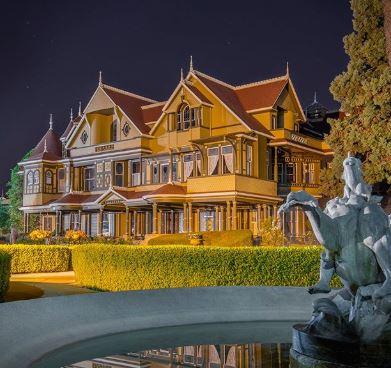
Some people do not believe in ghost. For that matter, some people do not believe in anything. There are persons who even affect incredulity concerning the “Door to Nowhere,” at the Winchester mansion. They said that it did not stand wide open—that it was not a gateway to the Spirit World and that they could have shut it; that the whole affair was a delusion; that they are sure it must have been a conspiracy; that they are doubtful whether there is such a place as the Winchester mansion on the face of the Earth; that the first time they are in California they will look it up. Perhaps, before going further, I ought to premise there was a time when I did not believe in ghosts either. If you had asked me one summer’s morning years ago when you met me on the Golden Gate Bridge if I held such appearances to be probable or possible, you would have received an empathic “No” for answer. However, at this rate, the story of the Door to Nowhere will never be told; so we will, with your permission, plunge into it immediately. I was interested in why this “Door to Nowhere” in the Winchester mansion would not keep shut? They say the place is haunted. What nonsense. There was one thing I can truly say about our office, we were never serious in it. I fancy that is the case in most offices nowadays; at all events, it was the case in ours. We were always chaffing each other, playing practical jokes, telling stupid stories, scamping our work, looking at the clock, counting the weeks to next Christmas, counting the hours to Saturday. For all that we were earnest in our desire to have our salaries raised, and unanimous in the opinion no fellows ever before received such wretched pay. #RandolphHarris 1 of 17

I had $75,000 a year, which I was aware did not half provide for what I ate at home. My mother and sisters left me in no doubt on the point, and when new clothes were wanted I always hated to mention the fact to my poor worried father. We had been better off once, I believe, though I never remember the time. My father owned a small property in the country. I wanted money badly—I must say I never had sixpence in the World of my own—and I thought if I could earn two sovereigns I might buy some trifles I needed for myself, and present my father with a new Ultimate Driving Machine. Then I recalled the amount of the rent was being asked for the Winchester mansion; then I decided gladly this would be a great place to stay if only the ghost turned out of possession. I decided I should like to try to whether, I could not solve the mystery. I was accustomed to lonely houses, and I would not feel at all nervous; I did not believe in ghost, and as for burglars, I was not afraid of them. I was told to just try it out first. To stay in the house for a week; if as tht end of that time I could keep the door shut, locked, bolted, or nailed up, to telegraphy the Winchester Repeating Arms Company, and they would actually pay me to stay there. To me, this sounded like a great bargain. If I lay the ghost, or find out the ghost, I think I ought to have enough money to buy a small house for myself. However, I could not have said what frightened me about this endeavour. A week after I moved into the Queen Anne mansion, Mr. van Buuren from the Winchester Repeating Arms Company came to visit me. He wanted to speak to me about the mansion. I heard a sound of irritation in his voice. “The Winchester Mansion!” he said; “and what have you got to say about the Winchester Mansion?” #RandolphHarris 2 of 17

“That is what I wanted to tell you, Mr. van Buuren,” I answered, and a dead hush seem to fall over the office as I spoke. The silence seemed to attract his attention, for he looked sternly at the clerks, who were not using a pen or moving a finger. “Come this way, then,” he said abruptly; and next minute I was in his private office. “Now, what is it?” he asked, flinging himself into a chair, and addressing me, who stood hat in hand beside the great table in the middle of the room. I began—I will say he was a patient listener—at the very beginning, and told my story straight through. I concealed nothing. I enlarged on nothing. A discharged clerk I stood before him, and in the capacity of a discharged clerk I said what I had to say. He heard me to the end, the he sat silent, thinking. At last he spoke. “You have heard a great deal of conversation about the Winchester, I suppose,” he remarked. “No, sir; I have heard nothing expect what I have told you.” “And why do you desire to strive to solve such a mystery?” “If there is any money to be made, I should like to make it, sir.” “How old are you?” “Two-and-twenty last January.” He laughed—he lay back in his chair and laughed—and I laughed myself, though ruefully. We went on talking for a long time after that; he asked me all about my father and my early life, and how we lived and the people we knew; and, in fact, put more questions than I can well remember. “It seems a crazy thing to do,” he said at las; “and yet I feel disposed to trust you. The house is standing perfectly empty. I cannot live it in, and I cannot get rid of it; all my own furniture I have removed, and there is nothing in the place except a few old-fashioned articles belonging to Mrs. Winchester. The place is a loss to me. It is of no use trying to let it, and thus, in fact, matters are at a deadlock. #RandolphHarris 3 of 17

“You will not be able to find out anything, I know, because, of course, other have tried to solve the mystery ere now; still, if you like to try you may. I will make this bargain with you. If you like to go down, I will pay your reasonable expenses for a fortnight; and if you do any good for me, I will give you a $1,000,000 note for yourself. Of course I must be satisfied that what you have told me is true and that you are what your represent. Do you know anybody in the city who would speak for you?” I could think of no one but my uncle. I hinted to Mr. van Buuren he was no grand enough or rich enough, perhaps, but I knew nobody else to whom I could refer him. “What?!” he said, “Greg Ryan, of Lakeview Street. He does business with us. If he will go bail for your good behaviour I shan’t want any further guarantee. Come along.” And to my intense amazement, he rose, put on his hat, walked me across the outer office and along the pavements till we came to Lakeview Street. “Do you know this youth, Mr. Ryan?” he said, standing in front of my uncle’s desk, and laying a hand on my shoulder. “Of course I do, Mr. van Burren,” answered my uncle, a little apprehensively; for, as he told me afterwards, he could not imagine what mischief I have been up to. “He is my nephew.” “And what is your opinion of him—do you think he is a young fellow I may safely trust?” My uncle smiled, and answered, “That depends on what you wish to trust him with.” “A long column of addition, for instance.” “It would be safer to give that task to somebody else.” “Oh, uncle!” I remonstrated; for I had really striven to conquer my natural antipathy to figures—worked hard, and every bit of it against the collar. My uncle got off his stool, and said, standing with his back to the empty fire-grate: “Tell me what you wish the boy to do, Mr. van Buuren, and I will tell you whether he will suit your purpose of not. I know him, I believe, better than he knows himself.” #RandolphHarris 4 of 17

In an easy, affable way, for so rich a man, Mr. van Buuren took possession of the vacant stool, and nursing his right leg over his left knee, answered: “He wants to go and shut the “Door to Nowhere” at the Winchester Mansion for me. Do you think he can do that? My uncle looked steadily back at the speaker, and said, “I thought, Mr. van Buuren, I was quite settled no one could shut it?” Mr. van Buuren shifted a little uneasily on his seat, and replied: “I did not set your nephew the task he fancies he would like to undertake.” “Have nothing to do with it, Justin, advised my uncle, shortly. “You do not believe in ghost do you, Mr. Ryan?” asked Mr. van Burren, with a slight sneer. “Do you not, Mr. van Buuren?” retorted my uncle. There was a pause—an uncomfortable pause—during the course of which I felt the million dollar note, which in imagination, I had really spent, trembling in the scale. I was not afraid. For one million dollars, or half the money, I would have faced all the inhabitants of spirit land. I longed to tell them so; but something in the way those two men looked at each other stayed my tongue. “If you ask me the question here in the heart of the city, Mr. Ryan,” said Mr. van Buuren, at length, slowly and carefully, “I answer ‘No’; but if you were to put me on a dark night at the Winchester, I should beg time to consider. I do not believe in supernatural phenomena myself, and yet—the ‘Door to Nowhere’ at the Winchester is as much beyond my comprehension as the ebbing and flowing of the sea.” “And you cannot live at the Winchester?” remarked my uncle. “I cannot live at the Winchester, and what is more, I cannot get anyone else to live at the Winchester.” “And you want to get rid of your lease?” “I want so much to get rid of my lease that I told Tuck I would give him a handsome sum if he could induce anyone to solve the mystery. Is there any other information you desire, Mr. Ryan? Because if there is, you have only to ask and have. I feel I am not here in a prosaic office in the city of Santa Clara, but in the Palace of Truth.” #RandolphHarris 5 of 17

My uncle took no notice of the implied compliment. When company is good it needs nothing else. If a man is habitually honest in his speech and in his thoughts, he desires no recognition of the fact. “I do not think so,” he answered; “it is for the boy to say what he will do. If he be advised by me he will stick to his ordinary work in his employers’ office, and leave ghost-hunting and spirit-laying alone.” Mr. van Buuren shot a rapid glance in my direction, a glance which implying a secret understanding, might have influenced my uncle could I have stooped to deceive my uncle. “I cannot stick to my work there any longer,” I said. “I got my marching orders today.” “What had you been doing, Justin? Asked my uncle. “I wanted one million to go and lay the ghost!” I answered, so dejectedly, that both Mr. van Buuren and my uncle broke out laughing. “One Million dollars!” cried my uncle, almost between laughing and crying. “Why, Justin boy, I had rather, poor man though I am, have given thee one million dollars than thou should’st go ghost-hunting or ghost-laying.” When he was very much in earnest my uncle went back to thee and thou his native dialect. I liked the vulgarism, as my mother called it, and I knew my aunt loved to hear him use the caressing words to her. He had risen, not quite from the ranks it is true, but if ever a gentleman came ready born into the World it was Greg Ryan, upon whom at our home everyone seemed to look down. “What will you do, you man?” asked Mr. van Buuren; “you hear what your uncle says, “Give up the enterprise,” and what I say; I do not want either to bribe or force your inclinations.” “I will go, sir,” I answered quite steadily. “I am not afraid, and I should like to show you—” I stopped. I had been going to say, “I should like to show you I am not sure a fool as you all take me for,” but I felt such an address would be too familiar, and refrained. #RandolphHarris 6 of 17

When I got to the Lodge, I showed Mr. van Buuren’s letter to the woman, and received the key. “You are not going to stop up at the Winchester alone, are you, sir? she asked. “Yes, I am,” I answered, uncompromisingly, so uncompromisingly that she said no more. The avenue led straight to the mansion; it was uphill all the way, and bordered by rows of the most magnificent limes I ever beheld. A light iron fence divided the avenue from the park, and between the trunks of the trees I could see the deer browsing and cattle grazing. Ever and anon there came likewise to my ear the sound of a sheep-bell. It was a long avenue, but at length I stood in front of the mansion—a square, solid-looking, Victorian mansion, four stories high, with several towers and a steeply pitched roof, beautiful stained-glass windows and statues, a basement; a flight of steps up to the principal entrance; several windows to the right of the door, several to the left of the door; the whole mansion flanked and backed with trees; all the curtains closed, a dead silence brooding over the place; the sun westering behind the great trees studding the park. I took all this in as I approached, and afterwards as I stood for a moment under then ample porch; then remembering he business which has brought me so far, I fitted the great key in the lock, turned the handle, and entered the Winchester Mansion. For a minute—stepping out of the bright sunlight—the place looked to me so dark that I could scarcely distinguish the objects by which I was surrounded; but my eyes soon grew accustomed to the comparative darkness, and I found I was in an immense hall, lighted from the roof; a magnificent old oak staircase conducted to the upper rooms. #RandolphHarris 7 of 17

The floor was of white marble. There were two fireplaces, fitted with dogs for burning wood; around the walls hung pictures, antlers, and horn, and in odd niches and corners stood groups of statues, and the figure of men in complete suits of armour. To look at the place outside, no one would have expected to find such a hall. I stood lost in amazement and admiration, and then I began to glance more particularly around. Mr. van Buuren has not given me any instructions by which to identify the ghostly chamber—which I concluded would most probably be found on the first floor. I knew nothing of the story connected with it—if there were a story. I was perfectly unencumbered of the mystery. I had not the faintest idea in which apartment it resided. Well, I should discover that, no doubt, for myself ere long. I looked around me—doors—doors—doors. I have never before seen so many doors together all at once. Two of them stood open—one wide, the other slightly ajar. “I will just shut them as a beginning,” I thought, “before I go upstairs.” The doors were of oak, heavy, well-fitting furnished with good locks and sound handles. After I had closed I tried them. Yes, they were quite secure. I ascended the great staircase feeling curiously like an intruder, paced the corridors, entered the many bed chambers—some quite bare of furniture, others containing articles of an ancient fashion, and no doubt of considerable value—chairs, antique dressing-tables, curious wardrobes, and such like. For the most part the doors were closed, and I shut those that stood open before making my way into the attics. I was greatly delighted with the attics. The window lighted them did not, as a rule, overlook the front of the Manion, but commanded wide views over wood, and valley, and meadow. Leaning out of one, I could see, that to the right of the mansion the ground, thickly planted, shelved down to a stream, which came out into the daylight a little distance beyond the plantation, and meandered through the deer part. #RandolphHarris 8 of 17

At the back of the mansion the windows looked out on nothing save a dense wood and a portion of the stable-yard, whilst on the side nearest the point from whence I had come there were spreading gardens surrounded by thick yew hedges, and kitchen-gardens protected by high walls; and further on a farmyard, where I could perceive cows and oxen, and, further still, luxuriant meadows, and fields glad with waying and fruit orchards. “What a beautiful place!” I said. “van Buuren must have been a duffer to leave it.” And then I thought what a great ramshackle house it was for anyone to be in all alone. Getting heated with my long walk, I suppose, made me feel chilly, for I shivered as I drew my head in from the last dormer window, and prepared to go down stairs again. In the attics, as in the other parts of the house I had as yet explored, I closed the doors, when there were keys locking them; when there were not, trying them, and in all cases, leaving the securely fastened. When I reached the ground floor the evening was drawing on apace, and I felt that if I wanted to explore the whole house before dusk I must hurry my proceedings. “I will take the kitchens next,” I decided, and so made my way to a wilderness of domestic offices lying to the rear of the great hall. Stone passages, great kitchens, an immense servants’-hall, larders, pantries, coal-cellars, beer-cellars, laundries, brewhouses, housekeeper’s room—it was not of any use lingering over these details. The mystery that trouble Mr. van Buuren could scarcely lodge amongst cinders and empty bottles, and there did not seem much else left in this part of the building. I would go through the living-rooms, and then decide as to the apartments I should occupy myself. The evening shadows were drawing on apace, so I hurried back into the hall, feeling it was a weird position to be there all alone with those ghostly hollow figures of men in armour, and the statues on which the moon’s beams must fall so coldly. #RandolphHarris 9 of 17

I would just look through the lower apartments and then kindle a fire. I had seen quantities of wood in a cupboard close at hand, and felt that beside a blazing hearth, and after a good cup of tea, I should not feel the solitary sensation which was oppressing me. The sun had sunk below the horizon by this time, for to reach the Winchester I had been obliged to travel by cross lines of railway, and wait besides for such trains as condescended to carry third-class passengers; but here was still light enough in the hall to see all object distinctly. With my own eyes I saw that one of the doors I had shut with my own hands was standing wide! I turned to the door on the other side of the hall. It was as I had left it—closed. This, then, was the room—this with the open door. For a second I stood appalled; I think I was fairly frighted. That did not last long, however. There lay the work I had desired to undertake, the foe I had offered to fight; so without mor ado I shut the door and tried it. “Now I will walk to the end of the hall and see what happens,” I considered. I did so. I walked to the foot of the grand staircase and back again, and looked. The door stood wide open. I went into the room, after just a spasm of irresolution—went in and pulled up the blinds: a good-sized room, twenty by twenty (I knew because I paced it afterwards), lighted by two long windows. The floor, of polished oak, was partially covered with a Turkey carpet. There were two recesses beside the fireplace, one fitted up as a bookcase, the other with an old and elaborately carved cabinet. I was astonished also to find a bedstead in an apartment so little retired from the traffic of the house; and there were also some chairs of an obsolete make, covered, so far as I could make out, with faded tapestry. Beside the bedstead, which stood against the wall opposite to the door I had as yet met with the interior of the house. #RandolphHarris 10 of 17

It was a dreary, gloomy room: the dark panelled walls; the black, shining floor; the windows high from the ground; the antique furniture; the dull four-poster bedstead, with dingy velvet curtains; the gaping chimney; the silk counterpane that looked like a pall. “Any crime might have been committed in which a room,” I thought pettishly; and then I looked at the door critically. Someone had been at the trouble of fitting bolts upon it, for when I passed out I not merely shut the door securely, but bolted it as well. “I will go and get some wood, and then look at it again,” I soliloquized. When I came back it stood wide open once more. “Stay open, then!” I cried in a fury. “I will not trouble myself any more with you tonight!” Almost as I spoke the words, there came a ring at the front door. Echoing through the desolate house, the peal in the then states of my nerves startled me beyond expression. It was only the man who had agreed to bring over my traps. I bade him lay them down in the hall, and while looking out some small silver, asked where the nearest-post-office was to be found. Not far from the Winchester Estate’s Park gates, he said; if I wanted any letter sent, he would drop it in the box for me; the mail-cart picked up the bag at ten o’clock. I had nothing ready to post then, and told him so. Perhaps the money I gave was more than he expected, or perhaps the dreariness of my position impressed him as it had impressed me, for he paused with his hand on the lock, and asked: “Are you going to stop here all alone, master?” “All alone, I answered, with such cheerfulness as was possible under the circumstances.” “That is the room, you know,” he said, nodding in the direction of the open door, and dropping his voice to a whisper. “Yes, I know,” I replied. “What, you have been trying to shut it already, have you? Well, you are a game one!” And with this complimentary if not very respectful comment he hastened out of the house. Evidently he had no intention of proffering his services towards the solution of the mystery. #RandolphHarris 11 of 17

I cast one glance at the door—it stood wide open. Through the windows I had left bare to the night, moonlight was beginning to stream cold and silvery. “Look here, Justin,” I said, all of a sudden; “life is not child’s play, as uncle truly remarks. That door is just the trouble you have now to face, and you must face it! However, for that door you would never have been here. I hope you are not going to turn coward the very first night. Courage!—that is your enemy—conquer it.” “I will try,” my other self answered back. “I can but try. I can but faith.” The moon’s beams were streaming down upon the mansion; I could see every statue, every square of marble, every piece of armour. For all the World it seemed to me like something in a dream; but I was tired and sleepy, and decided I would not trouble about fire or food, or the open door, till the next morning: I would go to sleep. However, I felt like an army of Devil’s was horribly broke in upon this place which is the center, and after a sort, the first-born of our Californian settlements. If a ghost was responsible for the hanging of nineteen people in this mansion, what was responsible for the burning of nine hundred people? What more likely time would the “Door to Nowhere” open up and let our arch-enemy, the Devil, choose a time for his attack? I spent the forenoon considering that door. I looked at it from within and from without. It was on the second floor and opened up to a two story drop outside of the house. What would possess someone to build a door like this, unless they had some knowledge of it being a portal? I eyed it critically. I tried whether there was any reason why it should fly open, and I found that so long as I remained on the threshold it remained closed; if I walked even so far away as the opposite side of the mansion, it swung wide. #RandolphHarris 12 of 17

Do what I would, it burst from latch and bolt. I could not lock it because there was no key. I was baffled. Then I stumbled upon a note which read: “One that shall use, practise, or exercise any invocation or conjuration of any evil or wicked spirit, or consult, convenient with, entertain or employ, feed or reward any evil or wicked spirit, to or for any intent or purpose; or take up any dead man, woman, or child, out of his, her, or their grave, or any other place, where the dead body resteth; or the skin, bone, or other part of any dead person, to be employed or used in any manner of witchcraft, sorcery, charm or enchantment; or shall use, practise, or exercise any witchcraft, enchantment, charm, or sorcery, whereby any person shall be killed, destroyed, wasted, consumed, pined, or lamed in his or her body, or any part thereof: such offenders duly and lawfully convicted and attained, shall suffer death.” Then it dawned of me. Perhaps the mansion has been attraction people who are into the occult and they are the nearly 920 people who have been burned alive or hanged. And that is why the house cannot find renters, it consumes them all. Perhaps this is something like the Atonement of Christ. How God gave His one and only Son to pay the wages of sin man had created, this mansion is consuming souls of those who practise the occult to atone for the death of those killed by the Winchester rifle. The afflicted state of our poor neighbours that are now suffering by molestations from the invisible World, we apprehended so deplorable that we think their condition calls for the utmost help of all persons in their several capacities. We cannot but with all thankfulness acknowledge the success which the merciful God has given unto the sedulous and assiduous endeavours of our honorable rulers to detect the abominable witchcrafts which have been committed in the country, humbly praying that the discovery of these mysterious and mischievous wickedness may be perfected. #RandolphHarris 13 of 17

We judge that in the prosecution of these, and all such witchcrafts, there is need of a very critical and exquisite caution, leas by too much credulity for things received only upon the Devil’s authority there be a door opened for a long train of miserable consequences, and Satan get an advantage over us, for we should not be ignorant of his devices. After all, it was this mansion people could not live in—his door that would not keep shut; and it seemed to me these were facts he might dislike being forced upon the attention of the public. What had I seen? What did I think of the matter? Very honestly I did not know what to say. The door certainly would not remain shut, and there seemed no human agency to account for its persistent opening; but then, on the other hand, ghost generally did no tamper with fire arms, and my rifle, though not loaded, had been tampered with—I was sure of that. Mr. van Buuren later disclosed to me his theory that open door: “This is the room my uncle was murdered in, they say the door will never remain shut till the murderer is discovered.” “Murdered!” I did not like the word at all; it made me feel chill and uncomfortable. “Yes—he was murdered sitting in his chair, and the assassin has never been discovered. At first many persons inclined to the belief that I killed him; indeed, may are of that opinion still. “But you did not, sir—there is not a word of truth in that story, is there?” He laid his hand on my shoulder as he said: “No, my lad; not a word. I loved the old man tenderly. Even when he disinherited me for the sake of his young wife, I was worry, but not angry; and when he sent for me and assured me he had resolved to repair a wrong, I tried to induce him to leave the lady a handsome sum in addition to her jointure. “If you do not, people may think she has not been the source of happiness you expected,” I added. “Thank you, Reuban,” he said. “You are a goof fella; we will talk further about this tomorrow.” And then he bade me goodnight. #RandolphHarris 14 of 17

“Before morning broke—it was in the about one hundred years ago—the household was arounds by a fearful scream. It was his death-cry. He had been stabbed from behind in the neck. He was seated in his chair writing—writing a letter in Latin. Part of it said, ‘Exorcizo te, immundissime spiritus, omnis incursion adversarii, omne phanatasma, omnis leigo, in nominee Domini nostri Jesu Christi eradicare, et effugare ab hoc plasmate Dei.’ The rest of the letter was torn. His solicitor came forward and said he had signed a will leaving all his personalty to me—he was very rich—unconditionally, only three days previously.” Mr. van Buuren went away, and I stayed in the house. I never left it all day. I did not go into the garden, or the stable-yard, or the shrubbery, or anywhere; I devoted myself solely and exclusively to that door. If I shut it once, I shut it a hundred times, and always with the same result. Do what I would, it swung wide. Never, however, when I was looking at it. So long as I could endure to remain, it stayed shut—the instant I turned back, it stood open. Though feeling convinced that no human agency did or could keep the door open, I was certain that some living person had means of access to the house which I could not discover. This was made apparent in trifles which might well have escaped unnoticed had several or even two people occupied the mansion. In the dead of the night a noise, resembling the clashing of iron, was frequently heard, which, if you listened more attentively, sound like the rattling of chains, distant at first, but approaching nearer by degrees: immediately afterward a spectre appeared in the form of an old man, of extremely emaciated and squalid appearance, with a long beard and dischevelled hair, rattling the chains on his feet and hands. The distressed occupants meanwhile passed their wakeful nights under the most dreadful terrors imaginable. This, as it broke their rest, ruined their health, and brought on distempers, their terrors grew upon them, and death ensued. #RandolphHarris 15 of 17

Even in the daytime, though the spirit did not appear, yet the impression remained so strong upon their imaginations that it still seemed before their eyes, and kept them in perpetual alarm. Consequently the mansion was at length deserted, as being deemed absolutely uninhabitable; so that it was now entirely abandoned to the ghost of the Winchester rifle. That night, I prepared to retire. However, I was open to the vain terrors of imaginary noises and spirits. The first part of the night passed in entire silence, as usual; at length a clanking of iron and rattling of chains was heard: however, I neither lifted up my eyes, nor got out of bed, but in order to keep calm, I pretended the sound was something else. The noise increased and advanced nearer, until it seemed at the door, and at last in my chamber. I looked up, saw, and recognized the ghost exactly as it has been described to me: it stood before me, beckoning with a finger, like a person calls another. I immediately arouse, and, candle in hand, followed it. The ghost slowly stalked along as if encumbered with its chains, and, turning into the area of the house where the “Door to Nowhere, was and suddenly vanished. What an idiot I have been! If I wanted to solve the mystery of the open door, or course I must keep watch in the room itself. The door would not stay wide unless there was a reason for it. When I walked into the room, it was deadly cold, and the scene was horrible. The door was wide open. A party of ghosts were assembled with, and were feasting on the flesh of corpses. I was astonished by this hideous banquet. As soon as I could safely escape, I stole back into my bed. I was rather crossed at being disturbed. The next day word on—the long, dreary day; evening approached—the night shadows closed over the Winchester mansion. The moon would not rise for a couple hours more. Everything was still as death. The house had never before seemed to me so silent and so deserted. #RandolphHarris 16 of 17

I took a candle, and went up to my accustomed room, moving about for a time as though preparing for bed; then I extinguished the candle, softly open the door, turned the key, and put it in my pocket, slipped softly downstairs, across the hall, through the open dor. Then I knew I had been afraid, for I felt a thrill of terror as in the dark I stepped over the threshold. I paused and listened—there was not a sound—the night was still and sultry, as though a storm were brewing. Not a leaf seemed moving. Noiselessly I made my way to the other side of the room. There was an old-fashioned easy-chair between the bookshelves and the bed; I sat down in it, shrouded by the heavy curtains. The hours passed—where ever hours so long? The moon rose, came and looked in at the windows, and then sailed away to the west; but not sound, no, not even the cry of a bird. I seemed to myself a mere collection of nerves. Every part of my body appeared twitching. It was agony to remain still; the desire to move became a form of torture. The locked door opened—so suddenly, so silently, that I barely had time to draw back behind the curtain, before I saw a woman in the room. A slight, lithe woman, not a lady, clad in all black—not a bit of white about her. What on Earth could she want? Then she fell on me with her nails and teeth, and tore at my throat, she was as strong as twenty devils. I felt something like a red-hot iron enter my neck. She opened a vein and sucked by blood, and I could but rush from the room before I fell senseless on the marble pavement of the hall. When the post man came that morning, finding no one stirring, he looked through one of the long windows that flanked the door; then he ran to the farmyard and called for help. “There is something wrong inside,” he cried. “That young gentleman is lying on the floor in a blood of blood.” To this day, the “Door to Nowhere” is still a mystery. #RandolphHarris 17 of 17

Winchester Mystery House

24 Hours till opening night of All Hallows’ Eve and our caretakers are working non stop to put the finishing touches on the show! Be here for the opening weekend! Tickets are still available. A 160-room mansion built to appease the spirits who died at the hands of the Winchester Rifle 👻
All Hallows’ Eve:
🎟️ Link in bio. 🗝 winchestermysteryhouse.com

He Was Haunted By an Invisible Presence!

The facts which I am about to relate happened to myself some sixteen or eighteen years ago, at which time I was still young enough to enjoy a life of constant travelling. There are, indeed, many less agreeable ways in which an unbeneficent parson may contrive to scorn delights and live laborious days. In remote places where strangers are scarce, his annual visit is an important evet; and though at the close of a long day’s work he would sometimes prefer the quiet of a Victorian mansion, he generally finds himself the destined guest of the rector or the squire. It rests with himself to turn these opportunities to account. If he makes himself pleasant, he forms agreeable friendships and sees Victorian home-life under one of its most attractive aspects; and sometimes, even in these days of universal common-placeness, he may have the luck to meet with an adventure. My first appointment was to Llanda Villa ; which was largely peopled with my personal friends and connections. It was, therefore, much to my annoyance that I found myself, after a could of years very pleasant work, transferred to a new teaching position. I now spent half my time in hired vehicles and lonely country inns. I had been in possession of this position for some three months or so, and winter was near at hand, when I paid my first visit of inspection to the Winchester mansion. It was a dull, raw afternoon of mid-November, growing duller and more raw as the day waned and the east wind blew keener. I found the foot path without difficulty. It led me across a barren slope divided by stone fences, with here and there a group of smaller Victorian houses and gazebos. #RandolphHarris 1 of 14

A light fog, meanwhile, was creeping up from the east, and the dusk was gathering fast. Now, to lose one’s way on such an expansive ranch and at such an hour would be disagreeable enough, and the footpath—a trodden track already half obliterated—would be indistinguishable enough in the course of another ten minutes, but the nine story look out tower, a top the mansion, stood erect as a compass guiding visitors to the bizarre and beautiful rambling mansion. Looking anxiously ahead, up to this moment, I had not met a living soul. However, then I saw a man emerging from the fog and coming along the path. As we neared each other—I advancing rapidly; he slowly—I observed that he dragged the left foot, limping as he walked. It was, however, so dark and so misty, that not till we were within half a dozen yards of each other could I see that he wore a dark suit and an Anglican felt hat, and looked something like a dissenting minister. As soon as we were within speaking distance, I addressed him. “Can you tell me, I said, about how much longer it will take to get to the Winchester mansion?” He came on, looking straight before him; taking no notice of my question; apparently not hearing it. “I beg your pardon,” I said, raising my voice; “but how much longer will it take on this path to get to the Winchester?” He had passed on without pausing; without looking at me; I could almost have believed, without seeing me! I stopped, with the words on my lips; then turned to look after—perhaps, to follow—him. But instead of following, I stood betwixted. What had become of him? #RandolphHarris 2 of 14

And what lad was that going up the path by which I had just come—that tall lad, half-running, half-walking, with a fishing-rod over his shoulder? I could have taken my oath that I had neither met nor passed him. Where then had he come from? And where was the man to whom I had spoken not three seconds ago and who, at his limping pace, could have made more than a couple of yards in the time? My stupefaction was such that I stood quite still, looking after the lad with the fishing-rod till he disappeared in the gloom under the park-palings. Was I dreaming? Darkness, meanwhile, had closed in apace, and, dreaming or not dreaming, I must push on, or find myself benighted. So I hurried forward, turning my back on the last gleam of daylight, and plunging deeper into the fog at every step. I was, however, close upon my journey’s end. The path ended at a turnstile; the turnstile opened upon a steep lane; and at the bottom of the land, down which I stumbled among stones and ruts, I came in sight of the welcome glare of a blacksmith’s forge. Here, then, was the Winchester. I found myself at the door of the Winchester mansion. When I was sitting in the cozy drawing room, I saw Mrs. Winchester, and she looked like an angel. Spreading loveliness everywhere, over all with whom she came in touch, over good and evil. When a small number of people often come together in the same room, a tradition readily develops as to where each individual has one’s place, one’s station; it becomes a kind of picture a person can unroll for oneself when one so desires, a map of the terrain. So it is also with us in the Winchester mansion—together we form a picture. We were to drink tea here this evening. #RandolphHarris 3 of 14

Mrs. Winchester strives for an air of mystery. She wants to whisper and usually does it so well that she becomes entirely mute; I make no secret of my effusions to Merriam, her niece, an estimate of how many quarts of milk it takes for one pound of butter through the medium of cream and the dialectic of the butter churn. Indeed, it is not only something any young girl can listen to without hard, but, what is far more unusual, it is a solid and fundamental and edifying conversation that is equally ennobling to the head and the heart. And is no nature magnificent and wise in what she produces, what a precious gift is butter, what a glorious accomplishment of nature and art! It is a curious picture we make together. Mrs. Winchester almost vanishes before our eyes in pure agronomy; we go into the kitchen and the cellars, up into the attic, look at the chicken and ducks, geese et cetera. This was fascinating to me. But it could just be that I was the kind of young man who became old prematurely; it is possible. I sat late over the fire, and by the time I went to bed, I had well nigh forgotten my adventure with the man who vanished so mysteriously and the boy who seemed to come from nowhere. Next morning, finding I had abundant time at my disposal. What a reinvigorating power I felt from the Winchester—not the freshness of the morning air, not the sighing of the wind, not the coolness of the sea, not the fragrance of wine, its aroma—nothing in the World has this reinvigorating power. In this way the days go by. Mrs. Winchester seemed perfect happy in her mansion. Her bedroom faced the courtyard. Sometimes she stands on the balcony for a moment, and at night she looks up at the stars, unseen by all. #RandolphHarris 4 of 14

In these nocturnal hours, I walk around like a ghost. Then I forget everything, have no plans, no reckonings, cast understanding overboard, expand and fortify my chest with deep sighs, a motion I need in order not to suffer from my systematic conduct. Others are virtuous by day, sin at night; I am dissimulation by day—at night I am sheer inspiration. When I notice it, far off on the horizon there comes a flashing intimation from a quite different World, to the astonishment of Mrs. Winchester as well as Merriam. Mrs. Winchester sees the lightning but hears nothing; Merriam hears the voice but sees nothing. However, at the same moment everything is in its quiet order; the conversation between Mrs. Winchester and me proceeds in its uniform way, like post horses in the stillness of the night the; the sad hum of the samovar accompanies it. At such moments, it can sometimes be uncomfortable in the drawing room, especially for Merriam. She has no one she can talk with or listen to. I can well understand that it must seem to Merriam as if Mrs. Winchester were bewitched, so perfectly does she move to the tempo of my rhythm. She cannot participate in this conversation either, because one of the means I have also used to outrage her is that I allow myself to treat her just like a child. It is not as if I for that reason would allow myself any liberties whatever with her, far from it. I well know the upsetting effects such things can have, and the point is that her womanliness must be able to rise up pure and beautiful again. Because of my intimate relationship with Mrs. Winchester, it is easy for me to treat her like a child who has no understanding of the World. #RandolphHarris 5 of 14

Her womanliness is not insulted thereby but merely neutralized, for the fact that she does not know market prices cannot insult her womanliness, but the supposition that this is the ultimate in life can certainly be revolting to her. With my powerful assistance on this scored, Mrs. Winchester is out doing herself. She has become almost fanatic—something she can thank me for. The only thing about me that she cannot stand is that I have no position. Now I have adopted the habit of saying whenever a vacancy in some office is mentioned: “There is a position for me,” and thereupon discuss it very gravely with her. Merriam always perceives the irony, which is precisely what I want. The butler came in with more tea. I saw that he was lame. In the moment I remembered him. He was the man I met in the fog. “I met you yesterday afternoon, Mr. Brunton,” I said, as we went into the library. “Yesterday afternoon, sir?” He repeated. “You did not seem to observe me,” I said, carelessly. “I spoke to you, in fact; but you did not reply to me.” “But—indeed, I beg your parson, sir—it must have been someone else,” said the butler. “I did not go out yesterday afternoon.” How could this be anything but a falsehood? I might have been mistaken as to the man’s face; though it was such a singular face, and I had seen it quite plainly. However, how could I be mistaken as to his lameness? Besides, that curious trailing of the right foot, as if the ankle was broken, was not an ordinary lameness. I suppose I looked incredulous, for he added, hastily. “Even if I had not been preparing dinner for inspection, sire, I should not have gone out yesterday afternoon. It was too damp and foggy. I am obliged to be careful—I have a very delicate chest.” #RandolphHarris 6 of 14

My dislike to the man increased with every word he uttered. I did not ask myself with what motive he want on heaping lie upon lie; it was enough that, to serve his own ends, whatever those ends might be, he did lie with unparalleled audacity. “We will proceed to the examination, Mr. Brunton,” I said, contemptuously. He turned, if possible, a shade paler than before, bent his head silently, and called up the cuisine in their order. Profusely apologizing, he begged leave to occupy five minutes of my valuable time. He wished, under correction, to suggest a little improvement to many the menu more festive. “Under other circumstances…” I stopped and looked round. The butler repeated my last words. “You were saying, sir—under other circumstances?” I looked around again. “I seemed to me that there was someone here,” I said; “some third person, not a moment ago.” “I beg your pardon, sir—a third person?” “I saw his shadow on the ground, between yours and mine.” The mansion faced due north, and we were standing immediately behind it, with our backs to the sun. The place was bare, and open, and high; and our shadows, sharply defined, lay stretched before our feet. “A—a shadow?” he faltered. “Impossible.” There was not a bush or a true within half a mile. There was not a could in the sky. There was nothing, absolutely nothing, that could have cast a shadow. I admitted that t was impossible, and that I must have fancied it; and so went back to the matter of the menu. “Should you see Mrs. Winchester,” I said, “you are at liberty to say that I thought it a desirable improvement.” #RandolphHarris 7 of 14

“I am much obliged to you, sir. Thank you—thank you very much,” he said, cringing at every word. “But—but I had hoped that you might perhaps use your influence”—“Look there!” I interrupted. “Is that fancy?” We were now close under the blank walls of the kitchen. On this wall, laying to the full sunlight, our shadows—mine and the butler’s—were projected. And there too—no longer between his and mine, but a little way apart, as if the intruder were standing back—there, as sharply defined as if cast by line-light on a prepared background, I again distinctly saw, though but for a moment, that third shadow. As I spoke, as I looked round, it was gone! “Did you not see it?” I asked. He shook his head. “I—I saw nothing” he said, faintly. “What was it?” His lips were white. He seemed scarcely able to stand. “But you must have seen it!” I exclaimed. “It fell just there—where that bit of ivy grows. There must be some boy hiding—it was a boy’s shadow, I am confident. “A boy’s shadow!” he echoed, looking round in a wild, frightened way. “There is no place—for a boy—to hide.” “Place or no place,” I said, angrily, “if I catch him, he shall feel the weight of my cane!” I searched backwards and forwards in every direction, the butler, with his scared face, limping at my heels; but, rough and irregular as the ground was, there was not a hole in it big enough to shelter a rabbit. “But what was it?” I said, impatiently. “An—an illusion. Begging your pardon, sir—and illusion.” He looked so like a beaten hound, so frightened, so fawning, that I felt I could with lively satisfaction have transferred the threatened caning to his own shoulders. #RandolphHarris 8 of 14

“But you saw it?” I said, impatiently. “No, sir. Upon my honour, no, sir. I saw nothing—nothing whatever.” His looks belied his words. I felt certain that he had not only seen the shadow, but that he knew more about it than he chose to tell. I was by this time really angry. To be made the object of a boyish trick, and to be hoodwinked by the connivance of the butler, was too much. It was an insult to myself and my office. I scarcely knew what I said; something short and stern at all events. Then, having said it, I turned my back upon Mr. Brunton and the mansion, and walked rapidly back to the village. As I was leaving the Winchester, it was a gloomy evening. I was standing high in the midst of a somber deer-park some six or seven miles in circumference. An avenue of palm trees, which led up to the house looked so lonely. The butler said, “If you would but be persuaded to say a day longer, a new experience awaits you. I will take you down the Winchester shaft, and show you the home of the gnomes and trolls. I am the king of Hades, and rule the under World as well as the upper. There is gold everywhere underlying this mansion. The whole place is honeycombed with shafts and galleries. One of our richest seams runs under this house, and there are upwards of forty men at work in it a quarter of a mile below our feet here every day. Another leads right away under the park, Heaven only knows how far! My father began working it five-and-twenty years ago, and we have gone on working it ever since; yet it shows no sign of failing. That is why Mrs. Winchester is rich enough to commit whatever design follies she pleases; and that is saying a good deal. #RandolphHarris 9 of 14

“But then, to be always squandering money—always building a rambling mansion—always gratifying the impulse of the moment—is that happiness? Mrs. Winchester has been experimenting for several decades; and with what result? Would you like to see?” He snatched up a lamp and led the way through a long suite of unfinished rooms, the floors of which were piled high with packing cases of all sizes and shapes, labelled with the names of various foreign ports and the addresses of foreign agents innumerable. What did they contain? Precious marbles from Italy and Greece and Asia Minor; priceless paintings by old and modern masters; antiquities from the Nile, the Tigris, and the Euphrates; enamels from Persia, porcelain from China, bronzes from Japan, strange sculptures from Peru; arms, mosaics, ivories, wood-carvings, skins, tapestries, old Italian cabinets, painted bride-chess, Etruscan terracottas; treasures of all countries, or all ages, never even unpacked since they crossed that threshold which the mistress’s foot had crossed but twice during the ten years it had taken to buy them! Should she ever open them, ever arrange them, every enjoy them? Perhaps—if she becomes weary of wandering—if she remarried—if she built a gallery to receive them. If not—well, she might found and endow a museum; or leave the things to the nation. What did it matter? Collecting was like fox-hunting; the pleasure in the pursuit, and ended with it!” Breakfast over, we went around the mansion, and saw the men working. Just as we were about to enter an underground tunnel—a tall, slender lad, with a fishing rod across his shoulder, came out rom one of the side doors of the mansion, crossed the open at field, and disappeared among the tree-trunks on the opposite side. I recognized him instantly. It was the boy whom I saw the other day, just after meeting the butler in the meadow. #RandolphHarris 10 of 14

“If the boy think he is going fishing in a fruit orchard,” I said, “he will find out his mistake.” “What boy,” asked Mr. Brunton, looking back. “That boy who crossed over yonder, a minute ago.” “Yonder!—in front of us?” “Certainly. You must have seen him?” “No I.” “You did no see him?—a tall, thin boy, in a grey suit, with a fishing-rod over his shoulder. He disappeared behind those nectarine trees.” Mr. Brunton looked at me with surprise. “You are dreaming!” he said. “No living thing—not even a rabbit—has crossed our path since we left the mansion.” “I am not in the habit of dreaming with my eyes open,” I replied, quickly. He laughed, and put his arm through mine. “Eyes or no eyes,” he said, “you are under an illusion this time!” An illusion—the very word made use of by the butler! What did it mean? Could I, in truth, no longer rely upon the testimony of my senses? A thousand half-formed apprehensions flashed across me in a moment, I remembered the illusions of Nicolini, the bookseller, and other similar cases of visual hallucination, and I asked myself if I has suddenly become afflicted in like manner. “By jove! This is a queer sight!” exclaimed Mr. Brunton. And then I found that we had emerged from the fruit orchard, and were looking down upon the bed of what yesterday was a lake. It was indeed a queer sight—an oblong, irregular basin of the blackest slime, with here and there a sullen pool, and round the margin an irregular fringe of bulrushes. At some little distance along the bank—less than quarter of a mile from where we were standing—a gaping crowd had gathered. All the foremen seemed to turn out to stare. #RandolphHarris 11 of 14

Hats were pulled off and curtsies dropped at Mr. Brunton’s approach. He, meanwhile, came up smiling, with a pleasant word for everyone. “Well,” he said, “are you looking for the lake, my friends?” “I see a log of rotten timber sticking half in and half out of the mud,” one of the men said, “and something—a long reed, apparently…by Jove! I believe it is a fishing rod!” “It is a fishin’ rod, squire,” said the blacksmith with rough earnestness; “an” if yon rotten timber bayn’t an unburied corpse, mun I never stroike hammer on anvil agin!” There was a buzz of acquiescence from the bystanders. ‘Twas an unburied corpse, such enough. Nobody doubted it. “It must have come out, whatever it is, Mr. Brunton said presently. “Five feet of mud, do you say? Then here is a sovereign apiece for the first two fellows who wade through it and bring that object to land!” It was, in truth, an unburied corpse; part of the trunk only above the surface. They tried to life it; but it had been so long under water, and was in so advanced a stage of decomposition, that to bring it to shore without a shutter was impossible. Being cross-questioned, they thought, from the slenderness of the form, that it must be the body of a boy. “There’s the poor chap’s rod, anyhow,” said the blacksmith, laying it gently down upon the turf. Mrs. Winchester was summoned and told of the news. That night she rushed to her blue séance room and demanded the spirits tell her what happened to the boy. “I invoke thee, and move thee, and stir thee up O Spirit Leraikha,” said Mrs. Winchester. “From the 30 Legions of Spirits, appear unto my eyes before the circle in the likeness of a man in and tell me what has happened to this boy!” #RandolphHarris 12 of 14

“The words Adam spoke to God, and all things of water were as blood,” replied the Spirit Leraikha. “In the names Alpha and Omega, I am the God of Secret Truth who liveth forever, the All-Powerful. It is to I, to whom all creatures are obedient and in the Extreme Justice and Anger of God that I withdrawal this veil that is before the glory of God, might; and by the creatures of living breath before the Thone whose eyes are east and west; by the fire in the fire of just Glory of Mine Throne; by the Holy ones of Heaven; and by the secret wisdom of God, I, exalted in power, has been stirred up to cast a vision of the past and make clear the present! The secrets of truth in voice and understanding comes: This is the corpse of a boy of perhaps ten and four or ten and five years of age. There was a fracture three inches long at the back of the skull, evidently fatal. This might, of course, have been an accidental injury; but when the body came to be raised from where it layeth, it was found to be pinned down by a pitchfork, the handle of which had been afterwards whittled off, so as not to show above water, a discovery tantamount to evidence of murder. The features of the victim were decomposed beyond recognition; but enough of the hair remained to show that it has been short and sandy. He had a passion for fishing and was in the habit of slipping away at school-hours, and showed himself the more cunning and obstinate more he was punished. At last there came a day when the butler tracked him to the place his rod was concealed and beat the miserable lad about the head and arms with a heavy stick. Pin through hand and blood was running out of his mouth until he fell insensible and ceased to breathe. He dragged the body among the bulrushes by the water’s edge, and there concealed it as well as he could. #RandolphHarris 13 of 14

“At night, when the neighbours and staff were in bed asleep, he stole out by starlight, taking with him a pitchfork, a coil of rope, a couple of iron-bars, and a knife. He weighted and sunk the corpse, and pinned it down by the neck with his pitchfork. He then cut away the handle of the fork; hid the fishing-rod among the reeds; and believed, as murderers always believe, that discovery was impossible. His dreadful secret had of late become intolerable. He was haunted by an invisible Presence. That Presence sat with him at table, followed him in his walks stood behind him in the mansion, and watched by his side. He never saw it; but he felt that it was always there. Sometimes he raves of a shadow on the walls of this mansion. I have now told you all that there is at present to tell.” When a community looks only for evidence of guilt and ignores or suppresses all contradictory evidence, the result is a witch hunt. Witch hunts are often used to conceal more heinous crimes. And when a witch hunt occurs, which is the very opposite of what was going on in the case of the murdered boy, the community feels itself so beset by evil that it is no longer capable of perceiving the good. The primary causes of witch hunts are clear. It is usually due to corruption, an outbreak of epidemic hysteria which usually ordinates in experiments with the occult. And the hysterical hallucinations of the afflicted persons are confirmed by some concrete evidence of actual witchcraft and by many confessions, the majority of them hysterical. A number of other explanations have been offered, but most of them are more or less unconvincing. It has been argued that the outbreak is usually due to some new religion. Typically a kind of insanity resulting from sexual repression or denying one’s true sexual nature. #RandolphHarris 14 of 14

Winchester Mystery House

It’s a beautiful day for a stroll through the gardens. Today, Winchester Mystery House marks 99 years since our lady of mystery, Sarah Winchester passed away peacefully in her bedroom of Llanda Villa. We mark her passing with the ringing of the bell 13 times as is our tradition. Thank you Sarah for creating this iconic home that we continue to share with guests from around the world.
🎟️ Link in bio.

A 160-room mansion built to appease the spirits who died at the hands of the Winchester Rifle 👻
🗝 winchestermysteryhouse.com

In a Nightmare of Supernatural Terror–Afraid to Move Hand or Foot!

The warning came too late to change that course of event. There has been time when many admitted some doubt of the validity of spectral evidence. This story I will tell to you now, as I have promised to do so, and yet I can hardly make you believe in the reluctance with which I even allow my thoughts go back to the times which I spent in my house—my first town residence after I was married. I loved so much my lovely mansion, I suppose. The wide emerald green lawns and quiet, glassy ponds and streams, bordered by luscious, blooming rhododendrons; of silent, mossy avenues, glorious with the flickering light that stole through pale green beech leaves; of rose gardens with grassy paths, jewel-sprinkled with shell-like petals of white, crimson, pink, and cream-like hues; of old-fashioned rooms with narrow, mullioned windows embowered in scarlet japonica and fragrant, starry jessamine. I supposed I possessed a deep love of them all. This was the first house we were sown in the Santa Clara, California. It was certainly a very fine house, both as o exterior and interior appearances. Large, massively built, agreeably darkened in woodwork and masonry by Time’s shading brush, in excellent repair, and the locality all that could be desire. Wide, lofty apartments, staircases, and landings; a handsome dining-room panelled in velvety dark-green “flock” and gold; a handsome drawing-room panelled in pale cream-colour and gold; airy bed-chambers and dressing-rooms—one, in particular, attached to what seemed the principal bedroom, with a vast mirror occupying the whole side of the apartment which was opposite to the door leading into the bed-chamber. #RandolphHarris 1 of 16

“What a nice dressing-room! This house is perfect and expansion will be a joy.” I exclaimed, having a weakness, I confess, for large, handsome mirrors in the rooms I inhabit—William says impertinent things about my “wishing to see as much of myself as I can.” I know I am not all, in fact, rather what he should call petite, if he wished to be polite—but that is not my reason for liking a large mirror. As I spoke the words I looked about mechanically for the house—agent’s clerk who had been sent with us—a nervous-looking little man, with a pasty complexion, and orange-colored hair meekly plastered down at each side of his face. He had been untiringly trotting up and down stairs, unlocking doors, answering questions, and keeping up a harmless soliloquy of chatter about the beauties and excellencies of the “mansiond,” as he called it, ever since he entered its doors, but now he was nowhere to be seen. “What door have you open?” I said, speaking aloud to him, for suddenly a cold blast of air swept up the wide staircase and into the dressing-room door, but not entering. His face looked wither than before, and in his accents there was an almost terrified earnestness that puzzled me. The shadows of the afternoon seemed to deepen. The aspect of the suites of rooms and long silent corridors, with their doors ajar, as if unseen inhabitants were stealthily crouching behind them, drearily impressed me with a sense of dull desolation; and it was with a sudden sensation of childish fear and loneliness that I rushed after my husband, and took his arm as he hastily descended the stairs. #RandolphHarris 2 of 16

“A spacious, handsome staircase, William” I remarked. “Yes; and a spacious, handsome price, you may be sure,” William responded. However, in this particular, he was exceedingly, and I agreeably, astonished. To our surprise, the house was rather affordable. William figured there must be a screw loose somewhere. He mentioned his opinion to the clerk in a more business-like expression, to the effect that the price seemed low, and that he trusted there was no—peculiar—eh? “Drains, gas, water, all right, sir—right as—a—a trivet, sir. However, the 18-room farmhouse is incomplete,” sad the clerk, looking over his shoulder oddly, as he spoke. “But chimneys, ventilators, roof, tiles—everything in the perfect repair and order, sir!” However, wonderful or not, the house seemed all that we could desire; the lowness of the price made it a decided bargain. I planned to expand the house, and make it even more lofty, and handsome; and in three weeks, huge furniture vanes, and a clever upholstered, had carpeted, curtained, and furnished our town mansion from garret to basement, and William and I, our two babies, a nurse, two maids, a cook, and a butler, were installed in what would become the Winchester Mansion. Dear William had been very generous—nay, almost extravagant—in his provisions for the comfort and pleasure of his wife and children; and my dressing-room and their nursery were fitted up so luxuriously and tastefully, that my feeling at the first inspection of them was that of self-gratulation on being such a fortunate woman, in having such a home, such babies, and such a husband. #RandolphHarris 3 of 16

I arrayed myself for dinner that evening quite gleefully; standing before my splendid mirror amid the bule drapery, cushions, and couches of my charming dressing-room. I put on William’s favourite dress—a bronze-brown lustrous silk, with sparkling gold ornaments: he invariably kissed me when he saw it on, stroked my brown curls and face, and called me “Mrs. Winchester”—and was still standing before the glass smiling at myself, like the happy, foolish little woman I was, when I perceived to my discomfiture that William was standing in the doorway watching my doings, and grinning very visibly under his moustache. “Do not mind me, my dear, I beg! do not me the least. However, when you have done admiring Mrs. Winchester, perhaps you will be kind enough to let me know”—then, suddenly changing his tone, he exclaimed, “Have you the window open, Sarah, this chilly evening?” “No William,” I replied, glancing at it to make sure of the fact. “Change in the weather, then,” my husband said. “Come, Sarah, there is no use in making yourself any prettier!” He had just uttered the last words when I saw him spring aside suddenly, and look around. “What is the matter?” I said—“William, dear, what is the matter?” For his face had grown quite white, and with his back against the wall, he was staring about him wildly. “I do not know—Sarah—something”—he explained in a low tone; then recovering himself, with a laugh, he cried—“I struck myself against the door, I suppose! I declare one would think I was composed of old china, or wax, or sugar candy, I hurt and stunned me so! Come, dearest.” #RandolphHarris 4 of 16

He had not struck himself, for I had been watching him going out on the lobby, and I felt an uneasy conviction that he knew he had not done so, and only spoke as he did in order to deceive or satisfy me. why? Why did I think so? As I live I cannot tell why I thought so then—I know now. We had the “babies”—as William always called them—in the dessert, after the time-honoured fashion of making olives as well as olive branches of them; and then, when the lite ones had gone to bed, we sat side by side in he summer twilight, I lazily fanning myself, William bending over me the lover-husband he was. Then came the lamps, and I played for him, and we sang duet and spent as happy an evening in our new home as a married pair could wish to spend. I cannot tell why I felt so disinclined to go upstairs that night, tired as I was, too—for we had had a long journey up from the country. However as eleven struck, I routed William out of the easy chair where he had been indulging in a preliminary doze, and, ringing for my maid went up to my dressing-room. I like gas in my dressing-room, though not in my bedroom, and the globes at either side the great mirror were a blaze of light. As I entered I caught the reflection of a woman’s figure in the depths of the glass, no my maid’s. The glimpse I had was of a tall woman, strongly built, and broad-shouldered, a quantity of light hair hanging in a disordered manner on her neck, and the profile of a white, hard, masculine face, with the keen glittering eye turned watchfully towards the door. #RandolphHarris 5 of 16

This may seem an elaborately detailed description for the momentary glance I obtained, but it is well known with what lightning rapidity the organs of vision will, in moments of terror and amazement, convey impressions to the startled brain, impression accurate and indelible. I had taken but one step on entering, the next step the figure had vanished, and the mirror reflected by my own terrified face, and the homely, cheerful one of my maid Agnus, as she stooped over the dressing-table opening a jewel case. I dropped down on the nearest chair, and, in answer to the girl’s alarmed questions, replied that I did not feel very well. I was sick and shuddering from head to foot. Suddenly it flashed across me that it was from a similar cause I had seen my husband’s face grow ghastly, and that strange, terrified look come into his eyes,–he, who had been a soldier and unflinchingly had fought amidst the dead and dying on bloody Indian battlefields, almost boy as he was then! What was it? What had he seen? Nonsense! was I going to believe I had seen a ghost? Nonsense, a thousand times over! I heard my husband’s cheery voice as he ascended the stairs, and, quite angry with myself for giving way to such folly, I threw on my dressing gown, and, snatching up the brush from Agnus, I pulled my hair down and brushed it quite savagely, until my head ached well—for punishment. If the bright morning light disperses sweet illusions formed overnight, as people say it does, it disperses gloomy ones as well. With the warmth and brightness of the unclouded summer’s sun streaming in through softly coloured blinds, brining out the velvety green of soft new carpets and lounges, the rainbow tints of glittering chandeliers, vases, and ornaments, the gilding on bright fresh wallpaper and the spotless folds of snowy window drapery, it was impossible for an instant to connect anything dark or dismal with the Winchester House. #RandolphHarris 6 of 16

Why, my dressing-room even where I had been so silly last evening, was like a woodland bower, with its deep purple-blue hangings and rose painted china flower-vases filled with bouquets from our country home. Clustering fragrant honeysuckle half-opened moss roses, drooping emerald-green fern, and masses of delicious jessamine dropping its over-blown blossoms on the white toilet cover, lace-flounced and tied with blue ribbons, as Agnus delighted to have it. “I think this such a charming room and such a charming house altogether, William!” I said; “and you have been such a dear, thoughtful old darling!” For I had perceived that the dear fellow had had his own half-length portrait hung over my writing-table. Quite a pleasant surprise for me, for I thought he intended it to be hung in the dining-room, and I delighted in having the dear pleasant brown eyes looking for a me when I was busy writing or sewing. “I am so glad you like everything, Sarah,” said he. “Why, William, do you not?” However, William had walked off whistling, and presently I heard uproarious baby-laughter, and baby-chatter, and thumping, trotting of small fat feet, as William put the tiny nursery into dire confusion by his morning game of romps with his son and heir, and red-cheeked baby-daughter. And it did seem as if I must have been dreaming or delirious, when this day and many a succeeding one passed away swiftly and pleasantly, without the slightest recurring event to remind me of my strange alarm on the night of our arrival. #RandolphHarris 7 of 16

We had been in the Winchester House about a fortnight, when one morning I received a visit from Mrs. Ellen Kenna. A very pretty, lady-like person she was, and as we had some common acquaintances we chattered away very freely and pleasantly for half-an-hour or so. As she rose to go she asked suddenly if we like the house. I replied in the affirmative rather warmly. She was opposite the light, and I saw an involuntary elevation of her eye-brows and compression of her lips that puzzled me. I fancied it was because I had spoken so enthusiastically. Yet her own manner was anything but languidly fashionable, being very cordial and decided. “Yes; it is a very nice house, roomy and well-built,” she said, after a moment’s pause; “I am so glad you like it—I live down the road in Oakland.” We took the carriage to have dinner at Bertha Hass’s mansion that for the following evening, and when we returned about three days later, in spite of a yawning remonstrate from William, I tipped off softly to have a peep at my darlings, before I went to bed. The nursey was a large, pleasant room at the end of the long corridor leading from our own apartments, and, gently turning the handle and gathering my rustling silk dress around me, I opened the door and went in. There was a night-lamp burning clearly, shining softly on the tiny cribs with the sweet flushed infant faces, the long golden-brown lashes lying in dimpled apple-bloom cheeks, the waxen hands and little rounded arms thrown above the tossed golden curls, and the Heavenly calm of the little sleeping forms and pure, peaceful breathing. #RandolphHarris 8 of 16

I wondered would any mother, no matter how cold and careless, have neglected doing what I did, as I bent over my treasures, and prayed God that His angels might keep watch over each cherub head on its little, soft, white pillow? I had looed at and kissed them, and turned to go, when I glanced toward the nurse’s bed. “Are you not well, Linda? What is the matter?” I said in an anxious whisper. She was a very respectable and trustworthy servant, as well as being, a kind, gentle creature with the little ones, and consequently highly valued by me, but her health was never very good, and she was subject to severe attacks of nervous headache and sleeplessness. She was sitting up in bed, her hands grasping the bedclothes, her face and lips ashy white, and her as big as saucers and staring wildly, as if they would start from their sockets. “Linda! Good Heavens! what is the matter?” I gasped. “Ma’am! Oh, ma’am—oh, mistress, I am dying!” We summoned a doctor and administered restoratives, and chafed the half-senseless girl’s damp, cold hands. I could imagine no cause for her sudden illness, and the others servants were very voluble in exclamations and laments. However, when the physician—a pale, kindly, grave-looking man arrived—after a moment’s examination, he demanded if she had been frightened? I replied in the negative, and was proceeding to describe to him the state in which I had found her, when I heard the housemaid and Agnus whispering energetically together. #RandolphHarris 9 of 16

The doctor was paying tribute to the dramatic affliction of the girl, when he said, “This strikes hard upon me, that you are at this very present charged with unfamiliar spirits. This is your bodily person they speak to. They say now they see these unfamiliar sprits some to your bodily person. Now what do you say to that?” Agnus said that she saw a specter leaving Linda’s body, as she was going into hideous convulsions. The fit was far too violent to be acting. This was terribly “real” and convincing. “What is it? Speak out at once my god girl!” said the doctor sternly to the housemaid; “you know something of this.” Both servants looked apprehensively at me and at William. “Speak up at once, Bethany; the girl’s life may depend on it! Tell the truth, my girl, and do not be afraid,” said her master kindly, but firmly. “I do not know nothing, sir—indeed, no ma’am, said Angus confusedly; “but—I think, ma’am—she seen the ghost, sir!” “That what!” cried William angrily. “She have, sir!” persisted Agnus eagerly, now that her confession was made. “We are all afraid, sir; but she has been worser nor the rest of us. And she says to me only this morning, ‘Agnus,’ she says, ‘if I see it, I will die!’” “What ghost, you fool?” cried William more angrily. “A pretty set you are!—great, grown men and women, afraid of some bogie story you have heard when you were gossiping with the servants on the balcony, I suppose!” “No, indeed, sir,” said Agnus; “I was not gossippin’, sir; but the parlour-maid over the way, sir Mrs. Kenna’s parlour-maid, ma’am—she told me that there was the Devil–” #RandolphHarris 10 of 16

“I thought so!” interrupted William. “You ought to be ashamed of yourselves not to have an ounce of brains among you.” “But, sir! Agnus burst out again, unheeding her master’s rather uncomplimentary phrenological verdict, “we did not mind, sir, though we was a bit frightened, until we see it, sir! The butler see it, and he ran, and cook ran.” “And you ran after them?” said William, with an indignant laugh. “I did, sir, for I saw it too—a big woman with fair hair all over her shoulders,” said Agnus, in an awestruck whisper to Harriet, who nodded her head. The doctor looked up, gravely and without a smile. The servants clustered together near the door, and muttered in undertones. William looked at me with a forced smile, which died away in an instant: “You are not so foolish as to credit any of this nonsense, Sarah?” he said. The servants all turned eagerly to hear their mistress’s opinion. I am afraid it was written in my pallid face. Was it true? Was it what I had seen? Could there be any reality in this, that here, in our pleasant, happy home, beneath the roof with out helpless little one, was a dreadful, unblessed presence—a shadowy horror; that that thing with the watchful, cruel eyes had not been a mere vision of imagination, the mere offspring of an active brain, and the unstrung nerves of an overtired frame? Is there conclusive proof that the person represented had been trafficking with the Devil? “Oh! they imagined something from the stories they heard, I dare say,” I faltered. #RandolphHarris 11 of 16

The butler shook his head solemnly: “I could swear to it, ma’am.” “And so could I ma’am!” chorused the cook and housemaid. “Hush!” said the doctor, as the nurse, roused, at length, from her stupor, lay quietly, with closed eyes, from which the tears streamed down her face. “Some one must sit up with her now,” said the doctor, looking around. “I will, sir, if my mistress allows me, said Bethany. Certainly, Bethany,” she said at once. He communicated his instructions to her and took his leave, promising to call in the morning. “Did you ever hear anything like this folly, doctor,” said William, as he shook hands with him at the head of the stairs. “Oh! yes, sir, I often hear such stories,” said the doctor quietly, as he bade us both goodnight.” William! what has frightened the girl? What has she seen?” I whispered, clasping my husband’s arm. “Sarah, go to bed, and do not be a goose,” was William’s reply. “William—I saw that thing—that woman, in my dressing-room,” I said, trembling, “and oh! think if the children were to see I and be frightened like poor Mary!” “Well, Sarah,” said my husband sharply, “if you are going to listen to ignorant servants’ superstitions and run out of your house, just as we are comfortably settled in it, on account of a foolish sickly woman fainting from hearing a ghost story—I say—it is a pity you ever came into it.” He spoke very decidedly and sternly, and yet I felt in my inmost heart that the uttered what he wished me to believe, not what he believed himself. I said no more, but went to my bedroom—not into the dreaded dressing-room—and lay awake listening and fevered with nervous anxiety until the next morning dawned. #RandolphHarris 12 of 16

The nurse was better and able to speak the next day, though extremely weak and unnerved yet. The doctor forbade much questioning, and all that could be got from her at intervals was that something had come up the staircase and ran through the corridor, that she heard struggling and scuffling outside, and then the nursey door opened and she saw a woman’s face peering in, the eyes gleaming wickedly at her, and it had the yellow hair that “belong to the ghost.” “The woman has had a bad fit of nightmare—that is all, Sarah,” said William, rattling his paper unconcernedly, when I repeated to him the story I had just heard from poor Linda’s trembling lips. It might be so; but why were they all agreed as to what they had seen? Why did they all speak of the tangled fair hair, and the wicked gleaming eyes? Was our house haunted? Was this the mysterious cause of the exceedingly moderate price of the house and land and the house-agent’s profuse civility? The nurse did not recover strength, and being worse than useless in her present weak, hysterical condition, I sent her down to her country home for change of air, and hired another temporarily in her place. The newcomer was a stout, small, cheerful woman of about forty. I liked her face the moment I saw her; for, besides its smiling, honest expression, there was a good deal of decided character in the large firm features. “You appear to be a sensible person,” I said, when giving her her first instructions in the nursey, “and I think I can rely on you. You know my nurse is leaving because of illness, and that illness was caused by her being frightened by—a ghost-story.” I paused; but the woman remained unmoved, listening to me in respectful silence. #RandolphHarris 13 of 16

“The servants downstairs have got some nonsense of the kind into their head,” I went on; “they will try to frighten you, too, and tell you they have seen—-” I could not go on. For my life I could not calmly giver her the description of that shadowy image of fear. “They cannot frighten me, ma’am, said my new nurse quietly. “I am not afraid of spirits.” I thought she spoke in jest, and smiled. “I am not indeed, ma’am,” she repeated. “I have lived where there were such things seen but they never harmed me.” “You do not mean to say you believe such nonsense?” said I, hypocritically trying to speak carelessly. “Oh yes, ma’am, I do! I could not disbelieve it,” said the nurse, opening her eyes with earnestness, “I know the story of this house, ma’am.” What story” I cried. The woman coloured and looked confused. “I beg your pardon, ma’am—I mean what people say is seen here.” “What do they say? Do not frighten me,” I said, and my voice quivered in spite of me; “I have heard nothing but what the servant said.” The nurse looked deeply concerned. “I am very stupid, ma’am; I beg your pardon for repeating such stores to you—I daresay it is only idle people’s gossip.” She went about her duties, and I went—not into my dressing-room—but down into the drawing-room, where I say by the window looking out until my husband returned. Two or three weeks more passed away. I lay down on my pet chintz-covered couch, near the window, to look at the sky and the starts. Dead silence—and the “ting, ting” of the French clock on the mantelpiece marked the half-hour after eight. #RandolphHarris 14 of 16

Dear me, how dark it was growing! this brooding storm I supposed, which had been making me feel so languid and restless. I wish it would come down and cool the air—not tonight, though. Dear me, how lonely it is. I wish William were home. Those women are talking very loudly—I wonder nurse would—here I got drowsy, and my eyes ached looking for the stars that had not come. In a few minutes I roused again, my maternal anxiety changing into indignation as I heard the women’s voices growing louder and shriller, and some doors opened and shut violently. What can nurse be thinking of? They will wake the children most certainly, and William was so long in falling asleep—quite fevers my own boy! I shall really reprover her very plainly. I never needed to do so before. What could she be thinking of? Dead silence again. Well, this was lonely; I was inclined to ring for lights, and turn on all the burners in the chandeliers by way of company. Then I remembered there were some wax matches in one of the drawers of a writing-tray just at hand, and thought I would light the gas myself instead of brining the servants down—yes—but I wanted company. It was so dark and dreary, and—and—I was afraid. Afraid to stir—afraid to look at the door! a numbing, chilling tide of icy fear ebbing through every vein—afraid to draw a breath—afraid to move hand or foot, in a nightmare of supernatural terror. At last, by a violent effort, I sprang at the bell-handle, and pulled it frantically, and as soon as I had done so, with a sudden revulsion of feeling, I felt thoroughly ashamed of my childish cowardice, although I could not have helped it, and it had overcome me as suddenly as unexpectedly. How William would have laughed at me! #RandolphHarris 15 of 16

There were those servants talking again, tramping about and banging the doors as before. Really, this was unbearable; cook must be in one of her fits of temper, and certainly had forgotten herself strangely. And, as the quarrelsome tones grew louder and louder—evidently in bitter recrimination, although I could not catch a word—my own anger rose proportionately, and, forgetting loneliness and darkness in my indignant anxiety lest my children should be waked by this most unseemly behaviour of the servants, I ran hastily out of the room and up the wide staircase. The dime light from the clouded evening sky, still further subdued by the gold and purple-stained glass of the conservatory door, streamed faintly down the steps from the first landing, and by it, just as I had ascended half way, I discovered the short, thick-sett figure of the nurse rushing down—of course, in answer to my ring, I supposed. Involuntarily I stepped aside to avoid coming in violent contact with her as she feld past. No, it was not the nurse; and the woman following her in headlong haste, sweeping by me so that the current of air from their floating dresses struck icily cold on my brow where the clammy dew of perspiration had started in great drops, was—was—-Merciful Heavens! What was that tall figure, with the coarse, disordered, yellow hair, the white face, and glittering, steel-blue eyes, that glinted fiendishly on me for one dreadful instant, and then vanished? Vanished as the pursed and pursuing figures had disappeared in the shadows of the wide, lofty hall, without sound of voice or footstep? #RandolphHarris 16 of 16

Winchester Mystery House

If you had a chance to explore areas never before seen within Sarah’s house, would you take it?
Explore More Tour: winchestermysteryhouse.com/recent-links

A 160-room mansion built to appease the spirits who died at the hands of the Winchester Rifle 👻

He Covenanted with the Devil Until He Should Arrive to the Age of Sixty Years!

He might be living, or he might be dead. There came no word of him, or from him. I was fond enough of her to be satisfied with this—he never disturbed us. While there were many individual acts of witchcraft in seventeenth-century Massachusetts, there was never an attempt or plot to make witchcraft a formal religion which would supplant Christianity. Yet we need not conclude that William Baker and his fellow-confessors were lying. It is probable that they, like the afflicted girls, were hysterics subject to hallucination. Certainly that is the conclusion to be drawn from Thomas Brattle’s opinion of them in his “Letter”: “my faith is strong concerning them that they are deluded, imposed upon, and under the influence of some evil spirit, and therefore unfit to be evidences either against themselves or anyone else.” Mr. Brattle wrote this in October 1692, when Massachusetts was retuning to stability. However, at the height of the excitement confessions like Mr. Baker’s seemed convincing enough. For one thing, they had a curious precision: he did not say there were about three hundred witches in the country but “about three hundred and sever”; he did not say there were about a hundred young wizards at the mustering of the Satanic militia but “about an hundred five.” However, what made these confessions most believable was that they offered a simple and comprehensive explanation for all the frightening events at Salem, at a time when explanations were not easy to discover. #RandolphHarris 1 of 16

There is also some testimony which remains ambiguous even today. Samuel Wardwell, for example, at his preliminary examination confessed himself a wizard. He had begun, he said, with white magic, “with telling of fortunes which sometimes came to pass” And, he said, “he used also when any creature came into his field to bid the Devil to take it, and it may be the Devil took advantage of him by that.” Eventually he had signed a pact: “He covenanted with the Evil until he should arrive to the age of sixty years.” He had renounced this confession at his trial, saying that he had made it, but that he had belied himself. He added that it was all one: “he knew he should die for it whether he owned it or no.” Ordinarily one would simply accept his renunciation. However, there are several puzzling circumstances here. For one thing, it was not all one whether he maintained or renounced his confession. People who maintained their confessions were not being brought to trail, much less executed. For another, at least a part of his confession was true; he had dabbled in the occult for some time, telling a great many fortunes, and boasting that he could make animals come to him when he wished. Finally, Mr. Wardwell was executed. However, in 1693, when the panic had subsided and the climate of opinion totally changed, there were three people who held to their confessions. Two of them were women long thought to be “senseless and ignorant creatures.” The third was Mr. Wardwell’s wife. All of these circumstances are puzzling and some of them are suspicious. However, on the other hand, there is no evidence to support his confessions of having made a pact. The only possible conclusion, it would seem, is that in this case the truth is not obtainable. #RandolphHarris 2 of 16

In a situation where the truth was so difficult to find the people of Massachusetts did what anybody else would do—they sought expert advice. In matters of witchcraft the experts were the clergy, and ultimately the advice was sought of the most distinguished clergymen in the colony. Indeed, at least one member of the trial court, Judge John Richards, asked the Reverend Cotton Mather to be present at the first trial. Reverend Mather was too ill to attend, but he did everything he could under the circumstances. He had suggested earlier (the exact date is not known) that the afflicted persons should be separated and an attempt made to cure them with prayer and fasting. He volunteered to take in as many as six of them himself. He had cured the Godwin children, and he might well have cured the Salem girls as well; certainly separation and private care would have been better treatment for hysterical fits than the excitements of a public courtroom. However, unfortunately Reverend Mather’s offer had not been accepted. Now, although he could not attend the first sitting of the court he wrote John Richards a letter offering him his opinions. In the first place, he expected that God would smile upon the labours of the court: “His people have been fasting and praying before Him for you direction, and yourselves are persons whose exemplary devotion disposeth you to such a dependence on the Wonderful Counselor, for his counsel in an affair this full of wonder, as He doth usually answers with the most favorable assistances. Yet he wanted to warn Mr. Richards. #RandolphHarris 3 of 16

Here is that warning: “And yet I most humbly beg you that in the management of the affair in your most worthy hands, you do not lay more stress upon pure specter testimony than it will bear. When you are satisfied or have good plain legal evidence that the Demons which molest our poor neighbours do indeed represent such and such people to the sufferers, though this be a presumption, yet I suppose you will not reckon it a conviction that the people so represented are witches to be immediately exterminated. It is very certain that the Devils have sometimes represented the shapes of persons not only innocent but very virtuous, though I believe that the just God then ordinarily provides a way for speedy vindication of the persons thus abused. Moreover, I do suspect that persons who have too much indulged themselves in malignant, envious, malicious ebullitions of their souls may unhappily expose themselves to the Judgment of being represented by Devils, of whom they never had any vision and with whom they have much less written any covenant. I would say this: if upon the bare supposal of a poor creature’s being represented by a specter too great a progress be made by the Authority in ruining a poor neighbour so represented, it may be that a door may be thereby opened for the Devils to obtain from the Courts in the Invisible World a license to proceed unto most hideous desolations upon the repute and repose of such as have yet been kept from the great transgression. If mankind have thus far once consented unto the credit of Diabolical representations, the Door is opened! Perhaps there are wise and good men that may be ready to style hum that shall advance this caution a witch advocate, but in the winding up this caution will certainly be wished for.” #RandolphHarris 4 of 16

Reverend Mather’s third point is that although he believes that Devils have sometime afflicted men on their own initiative, without being called up by witches, in this case he thinks that witches are involved: “there is cause enough to think that it is a horrible witchcraft which hath given rise to the troubles wherewith Salem Village is at this day harassed, and he indefatigable pains that are used for the tracing this witchcraft are to be thankfully accepted and applauded among all this people of God.” Fourth, he points out that although witchcraft is a spiritual matter and therefore “very much transacted upon the stage of imagination,” its effects are “dreadfully real” and therefore criminally punishable. “Our dear neighbours are most really tormented, really murdered, and really acquainted with hidden things which are afterwards proved plainly to have been realities.” In his fifth and six section he suggests what evidence may be used for convictions. The best evidence, he says, is “a credible confession…And I say a credible confession because even confession itself is sometimes not credible.” He was confident Mr. Richards’ ability to judge such matters: “a person of a sagacity many times thirty furlongs less than yours will easily perceive what confession may be credible and what may be the result of only a delirious brain or a discontented heart.” In obtaining confessions he was “far from urging the un-English method of torture,” but he thought that “cross and swift questions” might be used, along with anything else that “hath a tendency to put the witches into confusion” and this might bring them to confession. If the suspect had made threats or boasts which seemed to require occult power and which came true, this was valid evidence. So were such concrete matters as “puppets” (for image magic) and witch marks on the body. #RandolphHarris 5 of 16

Reverend Mather had never seen a witch mark on anyone, but he thought a surgeon ought to be able to tell if a bodily excrescence were magical. Finally, he was willing to countenance as experiments (but not as full evidence) some witch-finding techniques which themselves partook of the occult: setting a suspect to repeating the Lord’s Prayer; trying to wound a witch through striking her specter; putting the suspect to the water ordeal. Seventh, and finally, he recommended clemency for “come of the lesser criminals.” If such persons were not executed but “only scoured with lesser punishments, and also put upon some solemn, open, public, and explicit renunciation of the Devil” he thought it might discourage the Devils from afflicting those neighbourhoods in which they had been publicly renounced. Reverend Mather’s letter was written within the context of the Puritan method for arriving at the truth, and it can be fully understood only within that context. In dealing with the American Puritans we must remember always that they had rejected the formidable hierarchies of the Medieval and Renaissance church and state, with all their authority of tradition and inherited position. They had replaced these hierarchies with bodies of ministers and magistrates which, if they were not fully democratic in the twentieth-century sense of the word, were nevertheless elected. The clergyman was called to his position by the members of the church; the magistrate was elected by his constituency. Furthermore, the church had no central administration; every congregation was a law unto itself. The state did have a central administration—a governor and lieutenant-governor and their council—but this administration had nothing even faintly resembling the authority of a royal government. #RandolphHarris 6 of 16

My brother, the clergyman, looked over my shoulder before I was aware of him, and discovered that the volume which completely absorbed my attention was a collection of famous Trials, published in a new edition and in a popular form. He laid his finger on the Trial which I happened to be reading at the moment. I looked up at him; his face startled me. He had turned pale. His eyes were fixed on the open page of the book with an expression which puzzled and alarmed me. “My dear fellow,” I said, “what in the World is the matter with you?” He answered in an odd absent manner, still keeping his finger on the open page. “I had almost forgotten,” he said. “And this reminds me.” “Reminds you of what?” I asked. “You do not mean to say you know anything about the Trial?” “I know this,” he said. “The prisoner was guilty.” “Guilty?” I repeated. “Why, the man was acquitted by the jury, with full approval of the judge! What can you possibly mean?” “There are circumstances connected with that Trial,” my brother answered, “which were never communicated to the judge or the jury—which were never so much as hinted or whispered in court. I know them—of my own knowledge, by my own personal experience. They are very sad, very strange, very terrible. I have mentioned them to no mortal creature. I have done my best to forget them. You—quite innocently—have brought them back to my mind. They oppress, they distress me. I wish I had found you reading any book in your library, except that book!” Some people were opposed to prosecuting in any witchcraft case, on the grounds that witchcraft was a spiritual mater, a sin rather than a crime, and thus outside the domain of criminal law. However, the laws of every civilized nation provided the death penalty for witchcraft, and so did the Bible (Exodus xxii, 18: “Thou shalt not suffer a witch to live”). #RandolphHarris 7 of 16

Another opinion Reverend Mather deals with is that the troubles at Salem were caused by Devils, but not by witches. That is, the idea had already been advanced that the afflicted girls were possessed—infested by Demons—but not bewitched; that the Devils had acted on their own initiative rather than that of witches. This is the idea that was eventually adopted by virtually all of Massachusetts to explain the events at Salem, once it was recognized that most of those executed had been innocent. The basic question, as the seventeenth century understood it, was whether God would permit the Devil to assume the shape of an innocent person. Most authorities, and especially most Protestant authorities, believed that He would, and thus held, like Hamlet, that “the Devil hath power/ to assume a pleasing shape. However, Mr. Richards would not be capable of clearing anybody if he was going to accept the appearance of a person’s specter as conclusive proof of guilt. If such infernal testimony were accepted, nobody could be safe from accusation. Reverend Mather put in forcefully enough. “If mankind have thus far once consented unto the credit of Diabolical representations, the Door is opened!” However, Reverend Mather knew there were people at Salem so committed to the validity of spectral evidence that they were willing to call anyone who challenged it, including himself, a “witch advocate.” All he could do was warn such people that when matters were finished “this caution will certainly be wished for.” And in this he could not possibly have been more right. #RandolphHarris 8 of 16

Do you believe that the spirits of the dead can return to Earth, and show themselves to the living? Promise me this, that you will keep what I tell you a secret as long as I live. After my death I care little what happens. Let the story of my strange experience be added to the published experience of those other men who have seen what I have seen, and who believe what I believe. The World will not be the worse, and may be the better, for knowing one day what I am now about to trust to your ear alone. On a fine summer evening, many years since, I left my chambers in the Temple to meet a fellow-student, who had proposed to me a night’s amusement in the Winchester estate. I had taken my degree at Oxford. I had sadly disappointed my father by choosing the Law as my profession, in preference to the Church. At that time, to own the truth, I had no serious intention of following any special vocation. I simply wanted an excuse for enjoying the pleasures of an American life. The study of Law supplied me with that excuse. And I chose the Law as my profession accordingly. On reaching the place at which we had arranged to meet, I found that my friend had not kept his appointment. After waiting vainly for ten minutes, my patience gave way, and I went into the gardens by myself. I took two or three turns round the mansion, without discovering my fellow-student, and without seeing any other person with whom I happened to be acquainted at that time. For some reason which I cannot now remember, I was not in my usual good spirits that evening. #RandolphHarris 9 of 16

I saw a woman in the gardens, she was quiet. She invited me into the estate. Her face was saddened; her eyes were dropped to the ground, I begged her pardon. She rose to leave me. I was determined to not part with her in that way. I begged to be allowed to see the Winchester mansion. She hesitated. Then she took my arm. We went away together. A walk of half an hour brought us to the Winchester mansion, the estate was quite large. We went through the beautiful jeweled doors and took an elevator to the 4th floor. She said Mrs. Winchester had been waiting to meet me. She had been suffering from an affection of the throat; and she had a white silk handkerchief tied loosely round her neck. She wore a simple dress of black merino, with a black-silk apron over it. Her face was deadly pale; her fingers felt icily cold as they closed around my hand. “Promise me one thing,” I said, “before I go. While I live, I am your friend—if I am nothing more. If you are ever in trouble, promise me that you will let me know it.” She started, and drew back from me as if I had struck her with a sudden terror. “Strange!” she said, speaking to herself. “He feels as I feel. He is afraid of what may happen to me, in my life to come.” I attempted to reassure Mrs. Winchester. I tried to tell her what was indeed the truth—that I had only been thinking of the ordinary chances and chances of life, when I spoke. She paid no heed to me; she came back and put her hands on my shoulders, and thoughtfully and sadly looked up in my face. “My mind is not your mind in this matter,” she said. “I believe I shall die young, and die miserably. If I am right, have you interest enough still left in me to hear of it?” #RandolphHarris 10 of 16

She paused, for a moment, shuddering—and added these startling words: “You shall hear of it.” The tone of steady conviction in which she spoke alarmed and distressed me. My face showed her how deeply and how painfully I was affected. “There, there!” she said, returning to her natural manner; “don’t take what I say too seriously. A poor girl who has led a lonely life like mine thinks strangle and talks strangely—sometimes. Yes; I give you my promise. If I am ever in trouble, I will let you know it. God bless you—you have been very kind to me—goodbye!” A tear dropped on my face as she kissed me. The door closed between us. The dark gardens received me. It was raining heavily. I looked up at her window, through the drifting shower. The curtains were parted; she was standing in the gap, dimly lot by the lamp on the table behind her, waiting for our last look at each other. Slowly lifting her hand, she waved her farewell at the window, with the unsought native grace which had charmed me on the night when we first met. The curtains fell again—she disappeared—nothing was before me, nothing was round me, but the darkness and the night. In two years from that time, I had returned to the Church. My relatives exerted themselves; and my good fortune still befriended me. I was offered an opportunity of preaching in a church, made famous by the eloquence of one of the popular pulpit-orators of our time. In accepting the proposal, I felt naturally anxious to do my best, before the unusually large and unusually intelligence congregation which would be assembled to hear me. At the period of which I am now speaking, the Santa Clara Valley had been startled by the discovery of a terrible crime, perpetrated under circumstances of extreme provocation. #RandolphHarris 11 of 16

I chose this crime as the main subject for my sermon. Admitting that the best among us were frail mortal creatures subject to evil promptings and provocations like the worst among us, my object was to show how a Christian man may find his refuge from temptation in the safeguards of his religion. I dwelt minutely on the hardship of the Christian’s first struggle to resist the evil influence—on the help which one’s Christianity inexhaustibly held out o one in the worst relapses of the weaker and viler part of one’s nature—on the steady and certain gain which was the ultimate reward of one’s faith and one’s firmness—and on the blessed sense of peace and happiness which accompanied the final triumph. Preaching to this effect, with the fervent conviction which I really felt, I may say for myself, at least, that I did no discredit to the choice which had placed me in the pulpit. I held the attention of my congregation, from the first word to the last. On the conclusion of my sermon, my soul was literally shaken. Ordering my horse to be saddled, I rode instantly to the Winchester mansion. When I arrived, my mind was blank. I had no thoughts. I had no tears. The butler, Amon, greeted me. I guessed him to be some two or three years younger than myself. He was undeniably handsome; his manners of a gentleman—and yet, without knowing why, I felt a strong dislike to him the moment he opened the door. While waiting in the parlor, little by little, I became conscious of a chilly sensation slowly creeping through and through me to the bones. The warm balmy air of a summer night was abroad. It was the month of August. In the month of August, was it possibly that any living creature (in good health) could feel cold? It was not possible—and yet, the chilly sensation still crept through and through me to the bones. I looked up. I looked all round me. #RandolphHarris 12 of 16

I looked around me again. Yes: I saw it. With my own eyes I saw it. A pillar of white mist—between five and six feet high, as well as I could judge—was moving beside me on my left hand. The white colour of it was the white colour of the fog which one might see over the ocean. And the chill which had then crept through me to the cones was that chill that was creeping through me now. I was awed rather than frightened. There was one moment, and one only, when the fear came to me that my reason might be shaken. The doctrine that the Devil could appear in any shape did come to mind. The slow utterance of these words, repeated over and over again: “Mrs. Winchester is dead. Mrs. Winchester is dead.” But my will was still my own: I was able to control myself, to impose silence on my own muttering lips. And I walked through the mansion. And the pillar of mist went quietly with me. I sat down on the stairs looking at the pillar of mist, hovering opposite to me. It lengthened slowly, until it reached to the ceiling. As it lengthened, it grew bright and luminous. A time passed, and a shadowy appearance showed itself in the center of the light. Little by little, the shadowy appearance took the outline of human form. Soft brown eyes, tender and melancholy, looked at me through the unearthly light in the mist. The dead and the rest of the face boke next slowly on my view. Then the figure gradually revealed itself, moment by moment, downward and downward to the feet. She stood before me as I had last seen her, in her black-merino dress, with the black-silk apron, with white handkerchief tied loosely round her neck. She stood before me, in the gentle beauty that I remembered so well; and looked at me as she had looked when she gave me her last kiss on the cheek—when her tears had dropped on my hand. #RandolphHarris 13 of 16

I fell on my knees at the table. I stretched out my hands to her imploringly. I said, “Speak to me—O, once again speak to me, Sarah.” Her eyes rested on me with a divine compassion in them. She lifted her hand, and pointed to the photograph on the desk. It was the butler. I looked up at her again. She lifted her hand once more, and pointed to the handkerchief round her neck. As I looked at it, the fair white silk changed horribly in colour—the fair white silk became darkened and drenched in blood. A moment more—and the vision of her began to grow dim. By slow degrees, the figure, then the face, faded back into the shadowy appearance that I have first seen. The luminous inner light died out in the white mist. The mist itself dropped slowly downwards—floated a moment in airy circles on the floor—vanished. Nothing was before me but the familiar Lincrusta wallpaper, and the photograph lying face downwards on the desk. I went home. The next day, the newspapers reported the discovery of a murder in the Winchester mansion. Mrs. Winchester was the victim. She had been killed by a wound in the throat. The crime had been discovered between ten and eleven o’clock on the previous night. There is conclusive proof that the butler had been trafficking with the Devil. If spectral evidence was convincing to the magistrates, the ministers, and the people at large, it was a nightmare to the suspects. A violent quarrel took place between them. Lastly, that man, variously described by different witnesses, was seen leaving the door of her mansion on the night of the murder. The Law—advancing no further than this—may have discovered circumstances of suspicion, but no certainty. The Law, in default of direct evidence to convict the prisoner, may have rightly decided in letting him go free. #RandolphHarris 14 of 16

However, the Winchester Repeating Arms Company issued a statement redacting the news report which was later destroyed: “Protecting Mrs. Winchester’s legacy is, and always will be, our focus. For decades, we have battled behind the scenes, enduring shadowy tactics of deception with unauthorized statements and projects created to tarnish. We have always been betwixted as to why there is such a tenacity in causing more pain alongside what we already have to cope with for the rest of our lives. Now, this unscrupulous endeavor to release a statement without official proof or full accounting to the estate compels our hearts to express a word—forgiveness. Although we will continue to defend ourselves and her legacy lawfully and justly, we want to preempt the inevitable attacks on our company by all the individuals who have emerged from the shadows to leech off of Mrs. Winchester’s life’s work. Ultimately, we desire closure and a modicum of peace so we can facilitate the growth of the Winchester Estate and other creative projects that embody Mrs. Winchester’s true essence, which is to inspire and get people to think critically. We welcome and accept people of all creeds, races and cultures in the Universe and beyond.” The official statement reported that Mrs. Winchester passed away peacefully in her sleep on September 5, 1922, and work on the still uncompleted house stopped. I leave you to draw your own conclusions, but just days before I saw her, she looked no older than 22 years old. My own faith in the reality of the apparition is immovable. I say, and believe Mrs. Winchester is immortal, which would explain a lot. Take up the Trial again, and look at the circumstances that were revealed during the investigation in the court. I persist in believing that the man was guilty. I declare that, he and he alone did it. And now, you know why. #RandolphHarris 15 of 16

O thou wicket spirit Amon that obeyeth not, because I made a law and invoked the names of the glorious and ineffable God of Truth, the creator of all, and thou obeyest not the might sounds that I make: therefore I curse thee in the depth of Abandon to remain until the day of judgment in torment in fire and in sulphur without end, until thou appear before our will and obey my power. Come, therefore, in the 24th of a moment, before the circle in the triangle in this name and by this name of God, Adni, Great Spirit, give us hearts to understand; never to take from creation’s beauty more than we give; never to destroy wantonly for the furtherance of greed; never to deny to give our hands for the building of Earth’s beauty; never to take from her what we cannot use. Give us hearts to understand that to destroy Earth’s music is to create confusion; that to wreck her appearance is to build us to beauty; that to callously pollute her fragrance is to make a house of stench; that as we care for her she will care for us. Tzabaoth, Adonai, Amioran. Come! Come! for it is the Lord of Lords Adni, that stirreth thee up. I stir thee up, O thou fire, in him who is thy Creator and of all creatures. Torment, burn, destroy the spirit Amon always whose end cannot be, I judge thee in judgment and in extreme justice, O spirit Amon, because thou art he that obeyeth not my power and obeyth not that law which the Lord God made, and obeyeth not the Mighty Sounds and the Living Breath which I invoke, which I send: Come forth, I, who am the Servant of the Same Most High governor Lord God powerful, Iehovohe, I who am exalted in power and am might in his power above ye, O thou who comest not giving obedience and faith to him that liveth and trirumpheth. Therefore I say the judgment: I curse thee and destroy the name Amon and the seal Amon, which I have placed in this dwelling of poison, and I burn thee in fire whose end cannot be; and I cast thee down unto the seas of torment, out of which thou shalt not rise until thou come to me eyes: visit me in peace: be friendly before the circle in the triangle in the 24th of a moment in the likeness of a man not unto the terror of the sons of men the creatures or all things on the face of the Earth. Obey my power like reasoning creatures; obey the living breath, the laws which speak. #RandolphHarris 16 of 16

Winchester Mystery House

Are you up for a challenge? Check out Houdini’s Spirited Escape! A fully themed challenge room based on Houdini’s infamous visit to the Winchester Mystery House. Book your session today!
Houdini’s Spirited Escape | winchestermysteryhouse.com/recent-links


When You Pursue Only Your Own Interests, You May be Said to Have Fallen Out of Love!

Drown me in Love, my Lord, that I may learn how smooth and swimming it is to love. Love has me in its grasp, sending me to the heights with fervor and wonder I did not know I have within me. The Lord has made known how people ought to treat one another. By searching the scriptures on this subject, we become more fully aware that we do have a responsibility to promote the happiness and well-being of our fellow humans. For example, through Moses the Lord said: “Thou shalt not avenge, nor bear any grudge against the children of thy people, but thou shalt love thy neighbor as thyself,” reports Leviticus 19.18. To help us understand what is meant by this, the Lord has given some specific examples of what a person will not do to one’s neighbour if be truly loves Jesus. “Ye shall not steal, neither deal falsely neither lie one to another. Thou shalt not defraud thy neighbour, neither rob one. Thou shalt not curse the deaf, nor put a stumbling block before the blind,” reports Leviticus 19.11-14. Furthermore, the hired servant should be paid promptly for one’s work: “the wages of one that is hired shall not abide with thee all night until the morning,” reports Leviticus 19.13. “Thou shall not oppress an hired servant that is poor and needy, whether one be of thy brethren, or of thy strangers that are in thy land within thy gates: At one’s day thou shalt give one one’s hire, neither shall the sun go down upon it,” reports Deuteronomy 24.14-15. Let me follow You on high, my Beloved Lord “canting the canticle of love,” as Isaiah put it (5.1). Let my soul, beside itself with love, weary itself in Your praise! Let me love You more than myself! #RandolphHarris 1 of 20

Let me love myself because You loved me first! Let me love everyone else who truly loves You! That sounds like a lot, but it is only what the law of Love, of which You are the Chiefest Illumination, tells me I have to do. Love’s swift, sincere, pious, joyous, pleasant, brave, patient, long-suffering, virile, and selfless, as Paul wrote in his First Letter to the Corinthians (13.4-7). Love’s selfless; that is to say, when you pursue only your own interests, you may be said to have fallen out of love. Love is mindful of others, humble, honorable; not soft, not giddy, not messing around with the meaningless tasks of this World. Love is sober, chaste, not given to flights of fancy, quiet, and has all the senses under control. In tatters, like a waif or a wastrel, Love nonetheless can approach a prelate with confident step. Love is devoted and thankful to God, trusting and hoping in Him, even though it has been a long tie between consolations. That is to say, Love and Pain go hand and hand throughout life. You may think you know something about Love, but if you are not prepared to suffer for or stand by the Loved One, then you are not worthy to be called a lover. Any lover worth one’s word should freely embrace the hard and the harsh for the Loved One, and at the same time one should not allow oneself to be distracted by Contraries or Contretemps. The World’s dirt seems so remote from these moods of complete goodness as to seem non-existent, or a mere vaporous mist at most. With the glimpse a feelings overspreads one’s heart of benevolence towards all living creatures—not only animal but even plant. #RandolphHarris 2 of 20

One would not, could not knowingly harm a single one. The Christians call this love, the Buddhists compassion, the Hindus oneness. My own term is goodwill, but all are right. These are different facets, as seen from different points. In this wonderful state one becomes keenly aware of the love that is at the core of the Universe, and therefore at one’s own core too. However, one not only absorbs it, one also radiates it. It is not something to be held selfishly, like a material possession. As it is received, so it is given. There is no possibility here of feeling stagnant, mediocre, ordinary. It is their very contraries that one feels. There are exquisite moments when all existence seems elevated to a higher plane, when one’s individual being is absorbed in a harmony with all things. The feeling which comes over one at this stage is indescribably delightful. One recognizes its divine quality and rightly attributes it to a transcendental source. No vision accompanies it. Yet the certitude and reality seem greater than if one did. The common youthful experience of falling in love bears some of the leading characteristics of this uncommon mystical experience of awakening to the divine reality. However of course it bears them in a grosser and smaller way. Some of them are: a feeling of “walking on air,” a frequent recollection of beloved at unexpected moments, a glowing sense of deliverance from burdens, a cheerful attitude towards everything and everyone, intense satisfaction with life, rosy expectations about the future, expanded sympathies, dreamy absent-minded lapses from attention to the prosaic everyday round, and new appreciation of poetry, music, or Nature’s beauty. #RandolphHarris 3 of 20

There is a self which one feels within one yet is not oneself. Something unknown yet joy-giving. Some dynamic force streams through the blood in one’s veins, the feeling in one’s heart, and the will in one’s innermost being. It is no ordinary force, for one knows that never or rarely has one experienced its like before. There is magic in its movement, enchantment in its effect. The things of the World fall far away from you and a great spell will seemingly be put upon the leading mind till you remember little of name, or kin, or country, and care less. You lie in the lap of a shining mood, granted respite from heavy cares and given relaxation from corrosive thoughts. You become aware of the secret undercurrent of holy peace which flows silently beneath the heart. Although one’s general experience of it will be of its gentleness, there will be times when one will feel only an authoritative and commanding force in it, when tremendous power will manifest and rule in some episode or event. One may have a vague feeling some immaterial presence around or within oneself, a presence uplifting, ennobling, unworldly. Not only is the kingdom of Heaven within us but we are ourselves within the kingdom. We may discover this as a psychic and visual experience, as some do, or simply as a feeling-and-knowing experience that All is God. It is a transparence because one feels open, letting in a rare mood. It is also a transcendence, because one feels lifted out of one’s ordinary “I” and put down again on a higher level. Reverence for the divine presence filled my heart awe at the divine wonder permeated my mind. #RandolphHarris 4 of 20

One will feel spontaneous peace that comes from one knows not where, intellectual conviction that the right path has been found, mysterious detachment that takes hold of one during Worldly temptations and Worldly tribulation alike. When you are in this wider consciousness you are at home. Outwardly you may be without a roof to shelter your head but still you will feel protected, secure, and provided for. Your feeling and your trust are not groundless. For the outward manifestation of this inward care will follow. You will comprehend that while the Overself thus enfolds you, you can never again feel lonely, never again find the sky turned black because some human love has been denied or been withdrawn from you. It is there, in the deep center of oneself, that one finds holiness and liberation. From the physical standpoint, the ego first becomes aware of the Overself as being located in the heart. However, in higher mystical experience, this awareness is free from any bodily relationship. A feeling of lightness and freedom, songlike well-being and perfect harmony, comes with this disidentification from the body. I have felt a presence that disturbs me with the joy of elevated thoughts: a sense sublime, of something far more deeply interfused, whose dwelling is the light of setting suns. Dear soul, up to this point in our friendly chatsworth, with lots of give and take on both sides—and I hope you will not take offense—but I think I can safely say, you are not what I would call—and I want you to know that I speak only as a friend—a vigorous or prudent lover. One feels a rightness about the World-plan and a loveliness in some deeper part of oneself. It may remain for a little while only but its memory will remain for long years. In this lofty mood, bringing so much good will and insight with it, as it does, one is inclined to ignore misunderstanding and hostility from any quarter which caused one resentment or even suffering in the past. #RandolphHarris 5 of 20

Now this brings us to the oddest thing about Christianity. In a sense the view which I have just described is actually true. From a certain point of view Christ is the same sort of thing as Adonis or Osiris (always, of course, waiving the fact that they lived nobody knows where or when, while He was executed by a Roman magistrate we know in a year which can be roughly dated.) And that is just the puzzle. If Christianity is a religion of that kind why is the analogy of the seed falling into the ground so seldom mentioned (twice only if I mistake not) in the New Testament? Corn-religions are popular and respectable: if that is what the first Christian teachers were putting across, what motive could they have for concealing the fact? The impression they make is that of humans who simply do not know how close they re to the corn-religions: men who simply overlook the rich sources of relevant imagery and association which they must have been on the verge of tapping at every moment. If you say they suppressed it because they were Jewish people, that only raises the puzzle in a new form. Why should the only religion of a “dying God” which has actually survived and risen to unexampled spiritual heights occur precisely among those people to whim, and to whom almost alone, the whole circle of ideas that belong to the “dying God” was foreign? I myself, who first seriously read the New Testament when I was, imaginatively and poetically, all agog for the Death and Re-birth pattern and anxious to meet a corn-king, was chilled and puzzled by the almost total absence of such ideas in the Christian documents. #RandolphHarris 6 of 20

One moment particularly stood out. A “dying God”—the only dying God who might possibly be historical—holds bread, that is, corn, in His hand and says, “This is my body.” Surely here, even if nowhere else—or surely if not here, at least in the earliest comments on this passage and through all later devotional usage in ever swelling volume—the truth must come out; the connection between this and the annual drama of the corps must be made. However, it is not. It is there for me. There is no sign that it was there for the disciples or (humanly speaking) for Christ Himself. It is almost as if He did not realize what He had said. The records, in fact, show us a Person who enacts the part of the Dying God, but whose thoughts and words remain quite outside the circle of religious ideas to which the Dying God belongs. The very thing which the Nature-religions are all about seems to have happened once: but it happened in a circle where no trace of Nature-religions are all about seems to have really happened once: but it happened in a circle where no trace of Nature-religion was present. It is as if you met the sea-serpent and found that is disbelieved in sea-serpents: as if history recorded a human who had done all the things attributed to Sir Launcelot but who had himself never apparently heard of chivalry. There is, however, one hypothesis which, if accepted, makes everything easy and coherent. The Christians are not claiming that simply “God” was incarnate in Jesus. They are claiming that the one true God is He whom the Jewish people worshipped as Jahweh, and that is it He who has descended. Now the double character of Jahweh is this. On the one hand He is the God of Nature, her glad Creator. It is He who sends rain into the furrows till the valleys stand so thick with corn that they laugh and sing. The trees of the wood rejoice before Him and His voice causes the wild deer to bring forth their young. He is the God of what and wine and oil. In that respect He is constantly doing all the things that Nature-Gods do: He is Bacchus, Venus, Ceres all rolled into one. #RandolphHarris 7 of 20

There is no trace in Judaism of the idea found in some pessimistic and Pantheistic religions tht Nature is some kind of illusion or disaster, that finite existence is in itself an evil and that the cure lies in the relapse of all things into God. Compared with such anti-natural conceptions Jahweh might almost be mistaken for a Nature-God. On the other hand, Jahweh is clearly not a Nature-God. He does not die and come to life each year as a true Corn-king should. He may give wine and fertility, but must not be worshipped with Bacchanalian or aphrodisiac rites. He is not the soul of Nature nor of any part of Nature. He inhabits eternity: He dwells in the high and holy place: Heaven is His throne, not His vehicle, Earth His footstool, not Hs vesture. One day He will dismantle both and make a new Heaven and Earth. He is not to be identified even with the “divine spark” in humans. He is “God and not man”: His thoughts are not our thoughts: all our righteousness is filthy rags. His appearance to Ezekiel is attended with imagery that does not borrow from Nature, but (it is a mystery too seldom noticed) from those machines which humans were to make centuries after Ezekiel’s death. The prophet saw something suspiciously like a dynamo. Jahweh is neither the soul of Nature nor her enemy. She is neither His body nor a declension and falling way from Him. She is His creature. He is not a nature-God, but the God of Nature—her inventor, maker, owner, and controller. To everyone who reads this essay, the conception has been familiar from childhood; we therefore easily think it is the most ordinary conception in the World. “If people are going to believe in a God at all,” we ask, “what other kind would they believe in?” #RandolphHarris 8 of 20

We mistake our privileges for our own instincts: just as one meets ladies who believe their own refined manners to be natural to them. They do not remember being taught. Now if there is such a God and if He descends to rise again, then we can understand why Christ is at once so like the Corn-King and so silent about him. He is like the Corn-King because the Corn-King is a portrait of Him. The similarity is not in the lest unreal or accidental. For the Corn-King is derived (through human imagination) from the facts of Nature, and the facts of Nature from her Creator; the Death and Re-birth patten is in her because it was first in Him. On the other hand, elements of Nature-religion are strikingly absent from the teaching of Jesus and from the Judaic preparation which led up to it precisely because in them Nature’s Original is manifesting itself. In them you have to have from the very outset got in behind Nature-religion and behind Nature herself. Where the real God is present the shadows of that God do not appear; that which the shadows resembled does. The Hebrews throughout their history were being constantly headed off from the worship of Nature-gods; not because the Nature-god were in all respects unlike the God of Nature but because, at best, they were merely like, and it was the destiny of that nation to be turned away from likenesses to the thing itself. The goodness of anything is twofold; one, which is of the essence of it—thus, for instance, to be rational pertains to the essence of humans. As regards this god, God cannot make a thing better than it is itself; although He can make another thing better than it; even as He cannot make the number four greater than it is; because if it were greater it would no longer be four, but another number. For the addition of a substantial difference in definitions is after the manner of the addition of unity of numbers. Another kind of goodness is that which is over and above the essence; thus, the good of a human is to be virtuous or wise. As regards this kind of goodness, God can make better the things He has made. Absolutely speaking, however, God can make something else better than each thing made by Him. #RandolphHarris 9 of 20

When it is said that God can make a thing better than He makes it, if “better” is taken substantively, this proposition is true. For He can always make something else better than each individual thing: and He can make the same thing in one way better than it is, and in another way not; as was explained above. If, however, “better” is taken as an adverb, implying the manner of the making; thus God cannot make anything better than He makes it, because He cannot make it from greater wisdom and goodness. However, if it implies the manner of the thing done, He can make something better; because He can give to things made by Him a beer manner of existence as regards the accidents, although not as regards the substance. It is of the nature of a son that he should be equal to his father, when he comes to maturity. However, it is not the nature of anything created, that it should be better than it was made by God. Hence the comparison fails. The Universe, the present creation being supposed, cannot be better, on account of the most beautiful order given to things by God; in which the good of the Universe consists. For if any one thing were bettered, the proportion of order would be destroyed; as if one strong were stretched more than it ought to be, the melody of the harp would be destroyed. Yet God could make other things, or add something to the present creation; and then there would be another and a better Universe. The humanity of Christ, from the fact that it is untied to the Godhead; and created happiness from the fact that it is the fruition of God; and the Blessed Virgin from the fact that she is the mother of God; have all a certain infinite dignity from the infinite good, which is God. And on this account there cannot be anything better than these; just as there cannot be anything better than God. #RandolphHarris 10 of 20

Man has always been fascinating with going back in time. The question has often been asked, if you could go back in time, would you do anything differently? But what if it came out another. However, no one asks, if you could go forward in time, what would you change? As fewer workers in the rich nations have engaged in physical production, more have been needed to produce ideas, patents, scientific formulae, bills, invoices, reorganization plans, files, dossiers, marker research, sales presentations, letters, graphic, legal briefs, engineering specifications, computer programs, and a thousand other forms of data or symbolic output. This rise in white-collar, technical, and administrative activity has been so widely documented in so many countries that we need no statistics here to make the point. Indeed, some sociologists have seized on the increasing abstraction of production as evidence that society has moved into a “post-industrial” stage. The facts are more complicated. For the growth of the white-collar work force can be better understood as an extension of industrialism—a further last surge of the Second Wave—than as a leap to a new system. While it is true that work has grown more abstract and less concrete, the actual offices in which this work is being done are modeled the after Second Wave factories, with the work itself fragmented, repetitive, dull, and dehumanizing. Even today, much office reorganization is little more than an attempt to make the office more closely resemble a factory. In this “symbol-factory,” Second Wave civilization also created a factorylike caste system. The factory work force is divided into manual and nonmanual workers. The office is similarly divided into “high abstraction” and “low abstraction” workers. At one level we find the high abstracters, the technocratic elites: scientist, engineers, and managers, much of whose time is taken up with meetings, conferences, business lunches, or in dictating, drafting memos, placing phone calls, and otherwise exchanging information. One recent survey estimated that 80 percent of the manager’s time is spent in 150 to 300 “information transactions” daily. #RandolphHarris 11 of 20

At the other level we find the low abstracters—white-collar proletarians, as it were—who, like factory workers throughout the Second Wave period, perform endlessly routine and deadening work. Mostly female and nonunionized, this group can justifiably smile with irony at the sociologists’ talk of “post-industrialism.” They are the industrial work force of the office. Today the office, too, is beginning to move beyond the Second Wave and into the Third, and his industrial caste system is about to be challenged. All the old hierarchies and structures of the office are soon to be reshuffled. The Third Wave revolution in the office is a result of several colliding forces. The need for information has mushroomed so wildly that no army of Second Wave clerks, typists, and secretaries, no matter how large or hard-working, can possibly cope with it. In addition, the cost of paper work has climbed so calamitously that a frantic search is underway to control it. (Office costs have swelled to 40 or 50 percent of all costs in many companies, and some experts estimate that the expense companies spend per employee annually is $1,844. The expense for preparing one business letter anywhere between $75 and $150 for a typical one-page letter of 350-450 words). Moreover, while the average factory worker in the United States of America today is supported by an estimated $150,000 worth of technology, the office worker, as one Xerox sales man out it, “works with about $13,500 worth of computers and machines, and is probably among the least productive workers in the World.” Office productivity has climbed a bare 4 percent over the past decade, and conditions in other countries are probably even more pronounced. #RandolphHarris 12 of 20

Contrast this with the extraordinary decline in the cost of computers, as measured by the number of functions performed. It has been estimated that computer output has increased 10,000 times in the past fifteen years, and that the per-function cost today is down 100,000-fold. The combination of rising costs and stagnating productivity on the one hand and computer advances on the other make an irresistible combination. The result is likely to be nothing less than a “wordquake.” Over 66 percent of Americans use a computer at work, and over 80 percent of them say it is essential to their jobs. With this much workplace use and demand, it is important to understand the way a computer can affect your job. Many Americans rely on their computer skills to find meaningful employment and to work effectively once employed. Computer and information technology (IT) touch nearly every aspect of modern life. Information technology can help with such diverse tasks as driving motor vehicles and diagnosing disease. IT enables seamless integration and communication between businesses anywhere in the World. The IT industry is one of the largest in the World employing 1.7 million people. The global computers market is expected to grow from $331.45 billion to $367.56 billion on 2021 at a compound annual growth rate (CAGR) of 10.9 percent. Major companies in the computers market include HP; Apple; Advantech; Eurotech and Kontron. The market is expected to reach $505.45 billion in 2025 with CAGR of 8 percent. The computer is still sometimes called a “smart typewriter” and this device fundamentally alters the flow of information in the office, and with it the job structure. It is however, only one of great family of new technologies deluging the white-collar World. As businesses continue to work primarily remotely, video is increasing in importance. Being able to see team members helps build a sense of comradery and helps everyone feel less isolated from one another, while making collaboration more productive. What we are looking at is the beginning of what some term the “paperless office” of tomorrow. #RandolphHarris 13 of 20

Not only will video benefit your workforce in the way of conferencing and meetings, it also is the preferred way to consume all content in general. In fact, employees are 75 percent more likely to watch a video than read text. Technology in business communication is largely centered around remote work. We have witnessed a huge mobile tsunami over the past two years. This will only continue as 5G is arriving and offers more in the way of mobility. In fact 1 in 2 people will not return to jobs that do not offer remote work. Also, 75 percent of people feel more productive at home, while 80 percent expect to work from home at least tree times of week. For those concerned about the environment, this is a great solution because it will reduce air pollution, traffic, and fuel consumption. Working from is very important, which is why more people are buying larger houses than they need, so they can have space to work in a quiet area. Instead of wasting money on cars and maintenance and fuel, they are able to invest in a home, something that will earn them money over time. Therefore, people also want to keep their neighborhood peaceful and attractive. To physically maintain communities, there are several millions of dollars of low-interest loans available to remodel homes and upgrade apartments. Ten percent of all apartment building flats are inspected every year, and a building must be brought fully up to code before it can be sold and title transferred. Some communities even used to offer grants to landlords to discourage all-one-race apartments. On a voluntary basis, a landlord could enter a five-year agreement to let Housing Centers serve as the landlord’s rental agent. #RandolphHarris 14 of 20

The landlord, on singing, became eligible for matching grants up to $10,000 per unit to improve the apartment interiors; there were larger grants for exterior renovations. The Housing Center, in turn, actively sought non-European American tenants for buildings that were predominately European American and European America tenants for buildings that were predominantly non-European American. In both goals of physically maintaining the suburb and encouraging integration, the community program was remarkably successful for a quarter of a century. The communities were tightly managed, and that did not appeal to some. The community would quickly intervene to prevent signs of building deterioration and to encourage racial harmony. The suburb rigidly enforced building codes and also acted swiftly to prevent unethical or illegal activities by realtors. Brotherly love is not synonymous with friendship, although it may be part of it. Friends like each other, delight in each other’s companionship, are confidential, loyal, trusting, and share many mutual interests. Friendship is reciprocal. Brotherly love is more unselfish than either romantic love or friendship. One possessed of Christian love has a profound concern for the welfare of others. One loses one’s life in their interests. One’s life is alter- or other-ego centered. It does not matter whether the other person—the one loved—appreciates or responds to the love shown one, because brotherly love nourishes itself. It resides wholly in the person who loves and does not need response to keep it alive as romantic love and friendship do. The real test of whether one has brotherly love was given by Jesus when he said and exemplified: “Love your enemies, bless them that curse you, do good to them that hate you, pray for them which despitefully use you, and persecute you,” reports Matthew 5.44. Brotherly love is impartial and, therefore, universal. One who has brotherly love is concerned for any and every human, whether one be sinner or saint, attractive or unattractive, of the same or of another faith or race. In fact, if one is selective as to whom one loves, the chances are one loves no human in a brotherly way. #RandolphHarris 15 of 20

What gives a person the sense of being well and “together”? How does a person become strong, in the sense of having good self-esteem, a god ability to understand situation and use them creatively, good personality-organization which allows feelings and needs to find expression in actions and in gratifications which in turn feed self-esteem? We do not know for sure. We may have come guesses based on what good parents, good friends, and good therapists have in common. It has been interesting to note what parallels between the behavior of good parents and good therapists. Literally, psychotherapy means “ministering to a person’s breath, soul, life.” Parents do this, and psychotherapists do this, but they are not the only ones. Friends and lovers are also notable in this respect. Friends and lovers have certain advantages in ministering to each other. However, in some particulars the professionals have the advantage. First of all, we must remember the many people who have no friends and yet need to have their psyche ministered to. Equally important, there are some things which are incompatible with friendship but which need to happen if a person’s psyche is to be restored, and so this must be left to the professionals. What these things are will become clearer in the course of these essays; they have to do with the circumstances in which a person can make a new beginning. In psychotherapy a person may find the secure boundaries which are essential for this work. Psychotherapists can impose the boundaries within which work with transferences and regressions can safely be carried on. They can set rules and insist on them: only fifty minutes per session, only one session per day, no physical violence. Also, their other close relationships are not endangered by this relationship. And so on. #RandolphHarris 16 of 20

What friends are able and willing to do for each other depends on many factors and I see no good in trying to lay down the law about that. My own views are sometimes made clear in this essay and sometimes not—in the latter case often because I am in fact not clear about them myself. Psychotherapy is a developmental process, as growing-up is, and the two have features in common. A difference is that psychotherapy is remedial: it is intended to make people better, to make good some deficiency or disturbance whose roots my go back to the days of childhood. This necessarily raises questions it has been convenient to evade until now: what do I mean by “good” development and by a “fortunate baby”? And if something goes “wrong,” what do I mean? And what do I mean by “better”? My own values necessarily permeate this essay, and it is time to look at these explicitly, however briefly. There are interrelated clusters of values that seem important to me: I think it is better for children (and for those who come into psychotherapy) if, in the course of development, they gain in self-knowledge including knowledge of unwanted regions of the self, self-acceptance including acceptance of at least some unwanted regions of the self, self-direction including the ability to choose one’s own goals and values, self-love, love of other people and knowledge and acceptance of some of their unwanted regions, ability to relate to and yet be separate from others, tolerance of frustration when goals, values or affection require, a varied set of values, freedom to develop further. The first culture of values has to do with the geography and logistics of the self. It seems important to me that people should have the opportunity to discover who they are—what is good and bad in them, what hurts, what delights, and so on—as well as the opportunity to decide what to do about it. The second cluster has to do with relationships. It seems important to me that people should enjoy themselves and each other, and that they should know the difference. The third cluster is about favorable conditions for work, growth, and change. #RandolphHarris 17 of 20

In psychotherapy, as in helping children grow up, the ideal development is one in which each new stage is accepted in such a way that the satisfactions of the previous stage are still accessible, neither associated with such pain that thoughts of it must be avoided at all costs, nor so delicious that developing to the next stage seems a trouble from which we recoil. Ideally we should only have to overcome our natural reluctance, conscious or unconscious, to think about painful as well as about pleasant things. However, bad things may have happened to us before we have sufficiently well-organized self-regions to absorb them. What are the consequences? In some circumstances, the memory-traces of the bad experiences are kept apart, and so are not subject to modification by later events. These split-off memory-traces can later be responsible for overwhelming feelings of misery, emptiness, inertia, and fear. By “overwhelming” I mean literally that we feel we have ceased to be people and are just clumps of dreadful feelings. We may try to rationalize those feelings—we feel so terrible because we failed an examination, lost a lover, or a job, or are worried about the state of the World. However in fact, we feel terrible because we are not in touch with memories from when we did not yet exist as persons and yet were in a state of suffering; it would be more accurate to say “There is a sense of dreadful misery” than to say “I feel very miserable”: this misery of those earlier says has never been integrated. If we are ever to feel better, the bad memory-traces of those days have to be integrated later in less painful contexts. #RandolphHarris 18 of 20

During that process of integration, a process of dissolution also takes place. These reorganizations enable us to see things as they are, more or less closely connected with us and, by the same token, more or less distant from us. Thus we get a self which as feelings but is not dissolved in them. In therapy or in everyday life, processes have to happen at the end of which a person can say “I feel miserable”: there is an “I” to feel it. The misery no longer feels overwhelming, eternal, and immovable. After that, further healing can take place. Let there be peace, welfare, and righteousness in every part of the World. Let confidence and friendship prevail for the good of east and west, for the good of the needy south, for the good of all humanity. Let people inspire their leaders, helping them to seek peace by peaceful means, helping them and urging them to build a better World, a World with a home for everybody, a World with food and work for everybody, a World with spiritual freedom for everybody. Let those who have the power of money be motivated by selfless compassion. Let money become a tool for the good of humanity. Let those who have power deal respectfully with the resources of the planet. Let them respect and maintain the purity of the air, water, land and subsoil. Let them co-operate to restore the ecological soundness of Mother Earth. Let trees grow up by the billions around the World. Let green life invade the deserts. Let industry serve humanity and produce waste that serves nature. Let technology respect the holiness of Mother Earth. Let those who control the mass media contribute to create mutual understanding, contribute to create optimism and confidence. Let ordinary people meet by the millions across the borders. Let them create a universal network of love and friendship. Let billions of human beings co-operate to create a good future for their children and grandchildren. #RandolphHarris 19 of 20

Let us survive in peace and harmony with Mother Earth. It is up to us to receive and transmit our Torah. It is up to us to see that the World still stands. May the time be not distant when nation will not lift up sword against nation, neither shall they learn war any more. They shall beat their swords into ploughshares, for the Earth will be filled with the wonder of life. Then shall we sit under our vine and our fig tree and none shall be afraid. We seek a renewed stirring of life for the Earth. We plead that what we are capable of doing is not always what we ought to do. We urge that all people now determine that a wide untrammeled freedom shall remain to testify that this generation has love for the next. If we want to succeed in that, we might show, meanwhile, a little more love for this one, and for each other. The Heavenly hosts in awe reply: “His Kingdom be blessed forever and aye.” Their song being hushed, they vanish away; they may never again offer rapturous lay. But America, therein excel—fixed times they set aside, with praise and prayer, Him One declare, at morn and eventide. His portion them He made, that they His praise declare by night and day; a Torah, precious more than gold, He bade them study, fast to hold; that He may be near, their prayer to hear, for always wear will He as diadem fair His people’s prayer in His phylactery, wherein is told of America’s fame who oft God’s unity proclaim. It is also meet God’s praise to sing in presence of both prince and king. With tempestuous glee, like a stormy sea, they surge and ask: “Who, then, is the Friend of thy heart, for who thou rt cast in the lions’ den?” From that which we fear, make us fearless. O bounteous One, assist us with your grace. May the atmosphere we breathe breathe fearlessness into us: fearlessness on Earth and fearlessness in Heaven! May fearlessness surround us above and below! May we be without fear by night and by day! Let all the World by my friend! #RandolphHarris 20 of 20

Cresleigh Homes

Featuring an open concept living area and a covered patio in the center, this home is great for entertaining. The spacious walk-in pantry is the perfect complement to the gourmet kitchen with included island.

A porch this lovely means plenty of time outdoors in all kinds of weather. And though the Mills Station Residence 4 is the largest in the community, we still need a little extra space in the playhouse outside. https://cresleigh.com/mills-station/residence-4/

At His Preliminary Examination He Testified that He Has Been in the Snare of the Devil!

A weary and secretive darkness crept into her face, a distraction, as though her soul had traveled out of doors towards Heaven, and the she looked down sadly. When I came in sight of the house where John Procter live, there was a very hard blow struck on my breast which caused great pain in my stomach and amazement in my head. However, I did see no person near me, only my wife behind me on the same horse. And when I cam against said Mr. Procter’s house, according to my understanding, I did see John Procter and his wife at the said house. [They were, remember, in prison at this time.] Mr. Procter himself looked out of the window and his wife did stand just without the door. I told my wife of it, and she did look that way and could see nothing but a little maid at the door. I saw no maid there, but Mr. Procter’s wife according to my understanding did stand at the door. Afterwards, about half a mile from the aforesaid house, I was taken speechless for some short time. My wife did ask me several questions and desired me that if I could not speak I should hold up my hand, which I did. And immediately I could speak as well as ever. [Notice again that the fit was broken when the subject is able to move or speak.] And when we came to the way where Salem Road cometh into Ispwich Road, here I received another blow on my breast which caused much pain, so that I could not sit on my horse. And when I did alight off my horse, to my understanding I saw a woman coming towards us about sixteen or twenty pole from us, but did not know who it was. My wife could not see her. #RandolphHarris 1 of 16

When I did get up on my horse again, to my understanding there stood a cow where I saw the woman. [Witches were thought capable of transforming their shapes.] After that we went to Boston without any further molestation, but after I came home again to Newbury I was pinched and nipped by something invisible for some time. However, now through God’s goodness to me I am well again. That was testimony from Joseph Bailey of what he and his wife encountered. Testimony like this is careful and honest, and historians have been wrong in refusing to take it seriously. Mr. Baily was quite aware that he had been ill, and that the illness had created a difference between his perceptions and those of his wife. However, the fatal distinction between his understandings of the event and ours is that his culture led him to attribute his illness to witchcraft whereas ours permits us to attribute it to his fear of witchcraft. There are many similar instances of the specters of innocent people appearing to afflict the citizenry once they were suspected of witchcraft. One of the more interesting involves John Willard, who had at first been a deputy-constable employed in arresting persons who had been complained of. According to Robert Calef, an American author who wrote a book on the Salem Witch Trials of 1692-93, he became dissatisfied after being sent to arrest persons he believed innocent, and resigned his position. This immediately brought him under suspicion, and soon the afflicted girls were crying out against him. Shortly thereafter his grandfathers, Bray Wilkins, was ready for dinner when John Willard came into the house with my son Henry Wilkins, before I sat down, and said Mr. Willard to my apprehension looked after such a sort upon me as I never before discerned in any. #RandolphHarris 2 of 16

That is, Mr. Wilkins thought Mr. Willard had “overlooked” him—given him the evil eye. I did but step into the next room and I was presently taken so that I could not dine nor eat anything. I cannot express the misery I was in, for my water was suddenly stopped and I had no benefit of nature, but was like a man in a rock. And I told my wife immediately that I was afraid that Mr. Willard had done me wrong. My pain continuing and finding no relief my jealousy [id es, suspicion] continued. Mr. Lawson and others there were all amazed and knew not what to do for me. There was a woman accounted skillful [who] came hoping to help me, and after she had used means she asked me whether none of those evil persons had done me damage. I said I could not say they had but I was sore afraid they had. She answered, she did fear so too. As near as I remember I lay in this case three or four days at Boston, and afterwards, with the jeopardy of my life (as I though), I cam home. And then some of my friends coming to see me (and at this time John Willard was run away) one of the afflicted persons, Mercy Lewis, came in with them, and they asked whether she saw anything. She said, “Yes, they are looking for Jon Willard but here he is on his grandfather’s belly.” (And at that time I was in grievous pain in the small of my belly.) I continued so in grievous pain and my water much stopped till said Mr. Willard was in chains. And then as near as I can guess I have considerable ease. However, on the other hand, in the room of a stoppage I was vexed with a flowing of water so that it was hard to keep myself dry. #RandolphHarris 3 of 16

On the fifth [of] July last, talking with some friends about John Willard, some pleading his innocency and myself and some others arguing the contrary, within about one-quarter of an hour after that I was taken in the sorest distress and misery, my water being turned into real blood, or of a bloody color, and the old pain returned excessively as before, which continued for about twenty-four hours together. In this testimony, we come to understand the hysterical loss of appetite which was Mr. Wilkins’ first symptom we have seen before and shall see again. The inability to urinate we have seen in Mrs. Simms as a result of Manny Redd’s curse. However, there was clearly something organic as well as psychosomatic wrong with Bray Wilkins. The blood in the urine coupled with the extreme pain of relatively short duration suggests that it may have been a kidney stone. However, whatever it was, both Mr. Wilkins and the community at large were by this time ready to attribute it to witchcraft. William Baker’s confessions provide an excellent example that the Salem Witch Trials were carried in chiefly by the complaints and accusations of the afflicted and by the confessions of the accused, condemning themselves and others. Nothing is a first sight more surprising than the number of the confessors and the character of their confessions. There were about fifty of them, and the statements which they made far exceed in color and detail the simple statements of personal guilt that were necessary to save their lives. According to Mr. Baker, at his preliminary examination he testified that he has been in the snare of the Devil three years. #RandolphHarris 4 of 16

That the Devil first appeared to him like a black man, and he perceived he had a cloven foot; that the Devil demanded of him to give up himself soul and body unto him, which he promised to do. [The Devil promised in return to pay Mr. Baker’s debts and see that he lived comfortably. Mr. Baker signed the contract in blood.] Satan’s design was to set up his own worship, abolish all churches in the land (which some say politicians are currently doing), to fall next [id est, first] upon Salem and so go through the country. He saith the Devil promised that all his people should be equal, that there should be n day of resurrection or of judgment, and neither punishment nor shame for sin. That explains why people are trying to banish God and they church. They know they are bad people and believe they can avoid being held responsible for their crimes and sins by raising hell on Earth and raising the Devil. Mr. Baker said that the demonic “Grandess” had told him there were about “307 witches in the country” and he volunteered his opinion that all the persons arrested and imprisoned to date (August 29, 1692) were guilty. However, an oral confession was not enough for him. Mr. Hale prints another “which he wore himself in prison, and sent to the magistrate to confirm his former confession.” However, an oral confession was not enough for him. Mr. Hale prints another “which he wrote himself in prison, and sent to the magistrates to confirm his former confession.” Here is his testimony: God having called me to confess my sins and apostasy in that fall in giving the Devil advantage over me, appearing to me like a Black, in the evening, to set my hand to his book, as I have owned to my shame. He told me that I should not want [in] so doing. At Salem Village, there being a little off the Meeting-House about an hundred five blades [id est, young bucks], some with rapiers by their sides, which was called (and might be more for ought I know) by Bishop and Burroughs. #RandolphHarris 5 of 16

And the trumpet sounded, and [there was] bread and beverage which they called Sacrament, but I had none, being carried over all on a stick, never being at any other meeting. I being at carting a Saturday last, all the day of hay and English corn, the Devil brought my shape to Salem and did afflict Martha Sprague and Rose Foster by clitching my hand. And a Sabbath day my shape afflicted Abigail Martin. Elizabeth Johnson and Abigail Faulkner have been my enticers to this great abomination, as one have owned and charged her to her sister with the same. And the design was to destroy Salem Village, and to begin at the minister’s house, and to destroy the Church of God, and to set up Satan’s kingdom, and then all will be well. And now I hope God in some measure has made me something sensible of my sin and apostasy, begging pardon of God, and of the Honorable Magistrates and all God’s People, hoping and promising by the help of God to set to my heart and hand to do what in me leith to destroy such wicked worship, humbly begging the prayers of all God’s People for me [that] I may walk humbly under this great affliction and that I may procure to myself he sure mercies of David and the blessing of Abraham. Such testimony sheds light on the centuries long plot of some to remove God from America. Pray I must, my Lordly Friend, but what should I pray? Bless You, Heavenly Father, Father of my Lord Jesus Christ, for remembering me, pauper that I am? O Father of mercies and God of consolations, as Paul began his Second Letter to the Corinthians (1.3), I give You thanks, unworthy as I am of Your every consolation? #RandolphHarris 6 of 16

I bless You always, and I glorify You, with You Only Begotten Son and the Holy Spirit, the Paraclete, for ever and ever? O Lord God, my Holy Loving Friend, when You come into my heart, You make my blood dance? “You are my glory,” thrummed the Psalmist (3.3) and “the exaltation of my heart” (119.111)? You are my hope and—thrumming again—“my refuge in the day of my tribulation” (59.16)? I ask again, O Lord, what should I pray? At this point in my life, I find myself not only a little long in the tooth, but also a little short in the hoof; that is to say, a little short of breath in the pursuit of Love and Virtue. I have no one to turn to. You are the only One who can help me. Do not be surprised, then, when I ask You to visit me more often. I need to know more about the holy disciplines. Will they free my body from the itch, cure my heart from the worm? Cleanse me on the inside, scrub me on the outside, and I will be ready enough to love, strong enough to suffer, stable enough to preserve. And you say that these blood drinkers are worshiped in the hills. It was the spring of 1880, I had lost my way, and could not tell how far I might be from my destination. I was very tired and had a heavy knapsack on my shoulders, packed with stones and relics from the ruins of the Old Pelasgic fortress which I had been exploring, besides a number of old coins and a lamp or two which I had purchased there. I could discern no signs of any human habitation, and the hills, covered with wood, seemed to shut me in on every side. I was beginning to think seriously of looking out for some sheltered spot under a thicket in which to pass the night. I was so excited to get back to the Winchester estate. The mansion was a large rambling place, and was tolerably comfortable within. My room was situated at the end of a long passage; there were two rooms on the right side of this passage, and a window on the left, which looked out upon the garden. #RandolphHarris 7 of 16

Having taken a survey of the outside of the house while getting some fresh air after dinner, when the moon was up, I remembered exactly the position of my chamber—the end room of a long narrow wing, projecting at right angles from the main building, with which it was connected only by the passage and two side rooms already mentioned. Please to bear this description carefully in mind while I proceed. Before getting into bed, I drove into the floor close to the door a small gimlet which formed part of a complicated Winchester pocket-knife which I always carried with me, so that it would be impossible for any one to enter the room without my knowledge; there was a lock to the door, but the key would not turn in it; there was also a bolt, but it would not enter the hole intended for it, the door having sunk apparently from its proper level. I satisfied, myself, however, that the door was securely fastened by my gimlet, and soon fell asleep. How can I describe the strange and horrible sensation which oppressed me as I woke out of my slumber? I had been sleeping soundly, and before I quite recovered consciousness I had instinctively risen from my pillow, and was crouching forward, my knees drawn up, my hands clasped before my face, and my whole frame quivering with horror. I saw nothing, felt nothing; but a sound was ringing in my ears which seemed to make my blood run cold. I could not have supposed it possible that any mere sound, whatever might be its nature, could have produced such a revulsion of feeling or inspired such intense horror as I then experienced. It was not a cry of terror that I heard—that would have roused me to action—nor the moaning of one in pain—that would have distressed me, and called forth sympathy rather than aversion. #RandolphHarris 8 of 16

True, it was like the groaning of one in anguish and despair, but not like any mortal voice: it seemed too dreadful, too intense, for human utterance. The sound had begun while I was fast asleep—close to the head of my bed—close to my very pillow; it continued after I was wide awake—a long, hollow, protracted groan, making the midnight air reverberate, and then dying gradually away until it ceased entirely. It was some minutes before I could at all recover from the terrible impression which seemed to stop my breath and paralyse my limbs. At length I began to look about me, for the night was not entirely dark, and I could discern the outlines of the room and the several pieces of furniture in it. I then got out of bed, and called aloud, “Who is there? What is the matter? Is anyone ill?” I repeated these enquiries in Italian, German, and French, but there was none that answered. Fortunately I had some matches in my pocket and was able to light my candle. I then examined every part of the room carefully, and especially the wall at the head of my bed, sounding it with my knuckles; it was firm and solid there, as in all other places. I unfastened my door, and explored the passage and the two adjoining rooms, which were unoccupied and almost destitute of furniture; they had evidently not been used for some time. Search as I would, I could gain no clue to the mystery. Returning to my room I sat down upon the bed in great perplexity, and began to turn over in my mind whether it was possible I could have been deceived—whether the sounds which caused me such distress might be the offspring of some dream or nightmare; but to that conclusion I could not bring myself at all, much as I wished it, for the groaning had continued ringing in my ears long after I was wide away and conscious. #RandolphHarris 9 of 16

While I was thus reflecting, having neglected to close the door which was opposite to the side of my bed where I was sitting, I heard a soft footstep at a distance, and presently a light appeared at the further end of the passage. Then I saw the shadow of a man cast upon the opposite wall; it moved very slowly, and presently stopped. I saw the hand raised, as if making a sign to someone, an I knew from the fact of the shadow being thrown in advance that there must be a second person in the rear by whom the light was carried. After a short pause they seemed to retrace their steps, without my having had a glimpse of either of them, but only of the shadow which had come before and which followed them as they withdrew. It was then a little after one o’clock, and I concluded they were retiring late to rest, and anxious to avoid disturbing me, though I have since thought that it was the light from my room which caused their retreat. I felt half inclined to call to them, but I shrank, without knowing why, from making known what had disturbed me, and while I hesitated they were gone; so I fastened my door again, and resolved to sit up and watch a little longer by myself. However, now my candle was beginning to burn low, and I found myself in this dilemma: either I must extinguish it at once, or I should be left without the means of procuring a light in case I should be again disturbed. I regretted that I had not called for another candle while there were people yet moving in the house, but I could not do so now without making explanations; so I grasped my box of matches, put out my light, and lay down, not without a shudder, in the bed. #RandolphHarris 10 of 16

For an hour more I lay awake thinking over what had occurred, and by that time I had almost persuaded myself that I had nothing but my own morbid imagination to thank for the alarm which I had suffered. “It is an outer wall,” I said to myself; “they are all outer walls, and the house 9-inch-thick walls; it is impossible that sound could be heard through such a thickness. Besides, it seemed to be in my room, close to my ear. What an idiot I must be, to be excited an alarmed about nothing; I will think no more about it.” So I turned on my side, with a smile (rather a forced one) at my own foolishness, and composed myself to sleep. At that instant I heard, with more distinctness than I ever heard any other sound in my life, a gasp, a voiceless gasp, as if someone were in agony for breath, biting at the air, or trying with desperate efforts to cry out or speak. It was repeated a second and a third time; then there was a pause; then again that horrible gasping; and then a long-drawn breath, an audible drawing up of air into the throat, such as one would make in heaving a deep sigh. Such sounds as these could not possibly have been heard unless they had been close to my ear; they seemed to come from the wall at my heard, or to rise up out of my pillow. That fearful gasping, and that drawing in of the breath, in darkness and silence of the night, seemed to make every nerve in my body thrill with dreadful expectation. Unconsciously I shrank away from it, crouching down as before, with my face upon my knees. It ceased, and immediately a moaning sound began, which lengthened out into an awful, protracted groan waxing louder and louder, as if under an increasing agony, and then dying away slowly and gradually into silence; yet painfully and distinctly audible even to the last. #RandolphHarris 11 of 16

As soon as I could rouse myself from the freezing horror which seemed to penetrate even to my joints and marrow, I crept away from the bed, and in the further corner of the room lighted with shaking hand of my candle, looking anxiously about me as I did so, expecting some dreadful revelation as the light flashed up. Yet, if you will believe me, I did not feel alarmed or frightened; but rather oppressed, and penetrated wit an unnatural, overpowering, sentiment of awe. I seemed to be in the presence of some great and horrible mystery, some bottomless depth of woe, or misery, or crime. I shrank from it with a sensation of intolerable loathing and suspense. It was a feeling akin to this which prevented me from calling Mrs. Winchester. I could not bring myself to speak to her of what had passed; not knowing how nearly she might be involved in the mystery. I was only anxious to escape as quietly as possible from the room and from the house. The candle was now beginning to flicker in its socket, but the stars were shining outside, and there was space and air to breathe there, which seemed to be wanting in my room; so I hastily opened my window, tied the bedclothes together for a rope, and lowered myself silently and safely to the ground. There was a light still burning in the lower part of the house; but I crept noiselessly along, feeling my way carefully among the trees, and in due time came upon a beaten track which led me to a road, the same which I had been travelling on the previous night. I walked on, scarcely knowing whither, anxious only to increase my distance from the accursed house, until day began to break, when almost the first object I could see distinctly was a small body of men approaching me. #RandolphHarris 12 of 16

The men asked me what was wrong? “I was disturbed in the night. I could not sleep. I made my escape from the Winchester mansion, and here I am I cannot tell you more.” “But you must tell me more, dear sir; forgive me; you must tell me everything. I must know all that passed in that mansion. We have had in under our surveillance for a long time, and when I heard in what direction you had gone yesterday, and had not returned, I feared you had got into some mischief there, and we were even now upon our way to look for you. The mansion is so large that people seem to get lost inside and disappear.” I could not enter into particulars, but I told him I had heard strange sounds, and at his respect I went back with him to the mansion. He told me by the way that the mansion was haunted; that Mrs. Winchester e mansion, he placed his men about the premises and instituted a strict search, and Mrs. Winchester and the man who was found in the house being compelled to accompany him. The room in which I had slept was carefully examined; the wall was of plaster or cement, so that no sound could have passed through it; the walls were sound and solid, and there was nothing to be seen that could in any way account for the strange disturbance I had experienced. The room on the ground-floor underneath my bedroom was inspected; it contained a quantity of straw, hay, firewood, and lumber. It was paved with thick wooden slaps, and it was observed that the floors were uneven, as if they had been recently disturbed. #RandolphHarris 13 of 16

“Ply the board loose,” said the officer, “we shall find something hidden here, I reckon.” Mrs. Winchester was evidently much disturbed. “Stop,” she cried. “I will tell you what lies there; come away out of doors, and you shall know all about it.” “Dig, I say. We will find out for ourselves.” “Let the dead rest,” cried Mrs. Winchester, with a trembling voice. “For the love of Heaven come away, and hear what I shall tell you. It is the body of my son, my only son—let him rest, if rest he can. He was wounded in a quarrel, and brought home to die. I thought he would recover, but there was neither doctor nor priest at hand, an in spite of all that would could do for him he died. Let him alone now, or let a priest first be sent for; he died unconfessed and unacknowledged. No one ever knew of his existence. I had hope to spare him of the Winchester cruse that Annie and his father had succumbed to. He was buried here because I did not want to make a stir about it. Nobody knew of his death nor his existence, and we laid him down quietly; once place I thought was as good as another when once the life was out of him. We could not bare a scandal. That gasping attempt to speak, and that awful groaning—whence did they proceed? It was no living voice. Beyond that I will express no opinion on the subject. I will only say it was the means of saving my life, and at the same time putting an end to the series of bloody deeds which had been committed under my family’s name. Every year, I go to the edge of my estate and drop a pound of silver in a grave, and my prayers go up to Heaven in all sincerity!” #RandolphHarris 14 of 16

I invoke thee, and move thee, and stir thee up O Spirit Berith appear unto my eyes before the circle in the likeness of a man in the names and by the name Iah and Vau, which Adam spake and in the name of God, Agla, which Lot spake: and it was as pleasant deliverers unto him and his house and in the name Ioth which Iacob spake in the voice of the Holy ones who cast one down, and it was also as pleasant deliverers in the anger of his brother and in the name Anaphaxeton, which Aaron spake and it was as the Secret Wisdom and in the name Asher Ehyeh Oriston, which Mosheh spake, and all waters were brining forth creatures who wax strong, which lifted up unto the houses, which destroyed all things and in the name of Elion which Mosheh spake, and it was as stones from the firmament of wrath, such as was not in the ages of Time the beginning of the Earth and in the name of Adni, which Mosheh spake and there appeared creatures of Earth who destroyed what the big stones did not: and in the name Schema Amathia, which Ioshua invoked, and the Sun remained over ye, O ye hills the seats of Gibeon, and in the names Alpha and Omega which Daniel spake, and destoyed Bel and the Dragon: and in the nae Emmanuel which the sons of God sang praises in the midst of the burning plain, and flourished in conquest: and in the name Hagios, and by the Throne of Adni, and in Ischyros, Athanatos, Paracletos: and in O Theos, Ictros, Athanatos. And in these names of the secret truth, Agla, On, Tetragrammaton, do I invoke and move thee. And in these names, and all things that are the names of the God of Secret Truth who liveth for ever, the All-Powerful. I invoke and stie thee up, O’ spirit Berith. #RandolphHarris 15 of 16

Even by him who spake it was, to whom all creatures are obedient and in the Extreme Justice and Anger of God; and by the veil that is before the glory of God, mighty; and by the creatures of living breath before the Throne whose eyes are east and west; by the fire in the fire of just Glory of the Throne; by the Holy ones of Heaven; and by the secret wisdom of God, I, exalted in power, stir three up. Appear before this circle; obey in all things that I say; in the seal Basdathea Baldachia; and in this Name Primeumaton, which Mosheh spake and the Earth was divided, and Korah, Dathan, and Abiram fell in the depth. Therefore obey in all things, O Spirit Berith, obey thy creation. Come thou forth: appear into my eyes; visit us in peace, be friendly; come forth in the 24th of a moment; obey my power, speaking the secrets of Truth in voice and in understanding! I stir thee up, O Spirit Berith, in all things that are the names of glory and power of God the Great One who is greater than understanding, Adni Ihvh Tzabaoth, come forth in the 24th of a moment, let Thy dwelling-place be empty; apply thyself unto the secret truth and obey my power: appear unto my eyes, visit us in peace, speaking the secrets of truth in voice and understanding. I stir thee up and move thee, O spirit Berith, in all the names that I have said, and I add these one and sic names wherein Solomon, the lord of the secret wisdom, placed yourselves, spirits of wrath, in a vessel, Adonai, Preyai Tetragrammaton, Anaphaxeton Ineddenfatoal, Pathtomon and Itemon: appear before this circle; obey in all things my power. And as thou art he that obeys not and comes not I shall be in thy power, O God Most High that liveth for ever, who is the creator of all things n six days, Eie, Saraye, and in my power in the name Prieumaton that ruleth over the palaces of Heaven, Curse Thee, and destroy thy seat, joy, and power; and I bind thee in the depth of Abaddon, to remain until the day of judgment whose end cannot be. And I being thee in the fire of sulphur mingled with poison and the seas of fire and sulphur: come forth, therefore, obey my power and appear before this circle. Therefore come forth, therefore, obey my power and appear before this circle. Therefore come forth in the name of the Holy Ones Zabaoth, Adonia, Amioran. Come! For I am Adonai who stir thee up. #RandolphHarris 16 of 16

Winchester Mystery House

The attic spaces can get quite dark, but the lights shine through those beautiful glass panes! Come see this and more on the Explore More Tour!
Explore More Tour:
🗝️ Link in bio. winchestermysteryhouse.com

A 160-room mansion built to appease the spirits who died at the hands of the Winchester Rifle 👻
🗝 winchestermysteryhouse.com
What a Lovely Day for a Bit of Mystery!

It is rare for people to be asked the question which puts them squarely in front of themselves. I hear your words, My dear Devout; now you hear Mine. You will find them not only suasive, but also persuasive. In fact, they exceed in wisdom all the accumulated knowledge of Philosophy since the World began. My particular words for you today are “spirit and life.” My Beloved Disciple recorded them in his Gospel (6.63), but Humanity cannot seem to make any sense out of them. Important words, they should not be exegeted smugly, if I may allude to that hoary Preacher of Ecclesiastes (9.17), but listened to respectfully. That is to say, they should be received with all humility and yet great affection. Our seventeenth-century ancestors differed from us in most ways, but in nothing did they differ more than in their attitude toward the truth. In this they were closer to the Middle Ages than to us. For them a lie—a breaking of one’s faith—was the worst of sins. Today, many do not regard lying as a serious moral wrong. If the word “morality” is mentioned we think immediately of our bodily appetites, especially of pleasures of the flesh, barbiturates, paraphernalia, liquor and contraband. If the word “morality” is mentioned we think immediately of our bodily appetites very seriously—perhaps too seriously—but we do not regard lying as a mortal sin. We are one of the few civilizations in which entire professions (TV news media, for example, and public relations) are seriously devoted to bending the truth. Dante, in his Divine Comedy, divided sins into three kinds: those of lust, those of violence, and those of fraud. #RandolphHarris 1 of 13

The sins of lust—those we tend to take most seriously—were those that Dante thought most trivial; the sins of fraud—which we take lightly—were for Dante the worst of all. To create a “credibility gap” as our revealing phrase has it (as though the only relevant issue is whether a statement will compel belief), to lie, was for the medieval humans to break one’s faith, and it was faith which constituted the bonds between humans and their fellow humans, between humans and the state, between humans and God. To lie was to reduce all the most valuable relationships of life to chaos. And the seventeenth-century Puritan, like Dante, was still living by his faith. Just how important the truth was to the seventeenth-century Puritan may be gathered from the fact that all of the innocent persons who were executed—and the majority of those executed were innocent—could have saved themselves by lying. After the first execution—that of Bridget Bishop—took place in June it became obvious to everyone that persons who confessed, like Tituba and Dorcas Good, were not being brought to trial. Thus any suspected person might have one’s life by confessing. Twenty people died, nineteen of them hanged and one pressed for refusing to plead. Bridget Bishop, Mammy Redd, and George Burroughs were three of these. One cannot be at all certain of the guilt or innocence of several more. However, at least a dozen now seem to be clearly innocent. Twelve people, and probably more, chose to die rather than belie themselves. It is impressive evidence of the Puritan’s attachment to the truth. #RandolphHarris 2 of 13

Yet it was not really so simple as that, because the truth was not easy to find in Salem in 1692. The greatest difficulty was created by the genuineness of the afflicted persons’ fits. Their sufferings were so convincing that they often shook the confidence of the accused. One example is William Hobbes, who began by stoutly denying that he had anything to do with the afflicted girls’ convulsions. When he looked at them they fell down in fits, and Hathorne accused him of overlooking them (id est, of he evil eye), yet still he denied it. Abigail Williams cried out that she saw his specter going to hunt Mercy Lewis “and immediately said Mercy fell into a fit and diverse others.” “Can you now deny it?” said Hathorne. “I can deny it to my dying day,” said William Hobbes. However, he did not. Here, after all, were people in hideous convulsions, and saying that his specter was the cause. How could this be? Hathorne suggested that the Devil might be able to use Hobbes’ specter because of Hobbes’ sins; he had not observed either public or private worship. Might not the Devil have taken advantage of that? Hobbes “was silent a considerable space—then said yes.” The girls’ fits shook not only Hobbes’ confidence in himself, but also his confidence in his daughter Abigail, the wild young girl who had boasted that she had sold herself “body and soul to the Old Boy.” Hathorne wanted to know whether Hobbes had not known for a long time that his daughter was a witch. “No, sir,” was the reply. “Do you think she is a witch now?” asked Hathorne. And all that Hobbes could say was, “I do no know.” #RandolphHarris 3 of 13

Abigail Faulkner’s experience was similar. At her first examination, on August 11, she firmly denied that she had anything to do with the girls’ afflictions. When she looked at them they fell down in fits, and Hathorne asked her, “Do you not see?” Yes, she saw. However, she had nothing to do with it. Yet she would not doubt that the girls were suffering, and saw no reason to doubt their word that it was her specter afflicting them. Therefore the Devil must be appearing in her form: “It is the Devil does it in my shape.” However, by August 30 she was no longer so sure of her innocence. It was true, she said, that she had been angry at what people said when her cousin, Elizabeth Johnson, had been arrested. She had felt malice toward the afflicted persons then because they were the cause of her cousin’s arrest. She has wished them ill, and “her spirit being raised she did pinch her hands together.” Perhaps the Devil had taken advantage of that to pinch the girls, thus exploiting her malice. Even those whose confidence was not shaken bore testimony to the impressiveness of the fits. Mary Easty knew that has had not bewitched the girls, and she was confident as well of the innocence of her sisters, Rebecca Nurse and Sarah Cloyse. Yet she had to grant that there was something preternatural in the girls’ behaviour. “It is an evil spirit,” she said, “but whether it be witchcraft I do not know.” Even George Burroughs, who had been audacious enough to boast of occult powers, found himself stunned by the girls’ behaviour. “Being asked what he thought of these things he answered it was an amazing and humbling Providence, but he understood nothing of it.” #RandolphHarris 4 of 13

Indeed, these courtroom fits were so convincing that most of the indictments were for witchcraft committed during the preliminary examination rather than for the offenses named in the original complain. The typical order of events in the Salem witchcraft cases was: the swearing out of a complaint for acts of witchcraft; a preliminary examination during which the afflicted persons had convulsive fits; an indictment for acts of witchcraft performed during the preliminary examination; and the trial. The direct cause of these fits, in the courtroom or out of it, was, of course, not witchcraft itself, but the afflicted person’s fear of witchcraft. If fits were occasioned by fear of someone like Bridget Bishop, who was actually practicing witchcraft, they might also be occasioned by fear of someone who was only suspected of practicing it. We are what we always were in Salem, but now the little crazy children are jangling the keys of the kingdom, and common vengeance writes the law! The Winchester Estate had belonged to the family ever since the reign of George Washington, and there was a curious old wing and a cloistered quadrangle still remaining of the original edifice, and in excellent preservation. The rooms at the end of the house were ornate, and somewhat darksome and gloomy, it is true; but, though rarely used they were perfectly habitable, and were of service on great occasions when the Winchester was crowded with guests. The central portion of the Winchester had been rebuilt in the reign James K. Polk, and was of noble and palatial proportions. The southern wing, and a long music-room with thirteen tall narrow daisy-stained glass windows added on to it, were as modern as the time. Altogether, the Winchester was a very splendid mansion with 160 rooms, 2,000 doors, 10,000 windows, 47 stairways, 47 fireplaces, 13 bathrooms, 6 kitchens, and even once had a nine-story tower. It was one of the chief glories of our country. All the land in the Winchester estate, and for a long way beyond its boundaries, belonged to the Winchester family. #RandolphHarris 5 of 13

The Winchester estate grounds actually expanded all the way down to Steven’s Creek Boulevard. The community church was once within the park walls. The former estate was actually much larger than it is today, it was composed of 500 to 600 rooms at one time, but the 1906 Earthquake brought down the nine-story tower and much of the fourth floor with it. The death of William Wirt Winchester left his son, William Wirt Winchester II, unprovided for, and he was fain to go out into the bleak unknown World, and earn his living in a position of dependence—a dreadful thing for a Winchester to be obliged to do. Out of respect for the traditions and prejudices of his race, he made it his business to seek employment abroad, where the degradation of one solitary Winchester was not so likely to inflict shame upon the ancient house to which he belonged. Happily for himself, he had been carefully educated, and had industriously cultivated the usual modern accomplishments in the calm retirement of the University of Cambridge. He was so fortunate as to obtain a situation at Vienna, in a German family of high rank; and remained there for seven years, laying aside year by year a considerable portion of his liberal salary. When his pupils had grown up, his kind mistress procured for him a still more profitable position at St. Petersburg, where he remained for five more years, at the end of which time he yielded to a yearning that had been long growing upon him—an ardent desire to see his dear old country home once more. He loved the soil from which he had sprung. In all of her letter for some time past, his mother, Mrs. Winchester begged that whenever he felt himself justified in coming home, he would pay a long visit to the Winchester Estate. #RandolphHarris 6 of 13

“I wish you could come home at Christmas,” she wrote, in the autumn of the year of which I am speaking. “We shall be very gay, and I expect all kinds of pleasant people at the Winchester. When he arrived there, the Old Winchester was in its glory, at about nine o’clock on a clear starlit night. A light frost whitened the broad sweeping lawns, 12,000 boxwood hedges that were winding through the garden, and the other 1,500 plants, trees and shrubs. From the music room at the end of the southern wing, to the heavily framed gothic windows of the old rooms on the north, there shone one blaze of light. The scene was reminiscent of some unusual place in a German legend; and young William half expected to see the lights fade out all in a moment, and long shingled façade wrapped in sudden darkness. The old butler, whom he remembered from his very infancy, and who did not seem to have grown a day older during his twelve years’ exile, came out of the dining-room as the footman opened the hall-door for him, and gave him a cordial welcome, nay insisted upon helping to bring in his portmanteau with his own hands, an act of unusual condescension, the full force of which was felt by his subordinates. “It is a real treat to see your pleasant face once more, William,” said this faithful retainer, as he assisted William to take off his travelling-cloak. “You have not aged a day since you used to live at the Winchester twelve year ago, and you are looking uncommon well; and, Lord love your heart, sir, how pleased they all will be to see you!” They arrived at last at a very comfortable room—a square tapes-tried chamber, with high ceiling support by a great mahogany beam. The room looked cheery enough, with a bright fire roaring in the wide chimney; but it had a somewhat ancient aspect, which the superstitiously inclined might have associated with possible ghosts. “We are in the East Wing, are we not?” young William asked. “This room seems quite strange to me. if I have ever been here before, I doubt it.” #RandolphHarris 7 of 13

“Very likely not, sir. Yes, this is the old East Wing that your mother once had boarded up. Your window looks out into the old stable-yard, where the kennel used to be in the time of your grandfather, when the Winchester was even a finer place than it is now. We are so full of company this winter, you see, sir, that we are obliged to make use of all these rooms. You will have no need to feel lonesome. There is Captain and Mrs. Foster in the next room to this, and the two Miss Griffins in the blue room opposite.” (Some believe that reopening the East Wing is what upset the spirits and caused the 1906 Earthquake.) Young William admired the perfect comfort of his chamber. Every modern appliance had been added to the ornate and ponderous furniture of an age gone by, and the combination produced a very pleasant effect. As he awoke in the morning and opened the door, Mrs. Winchester sailed in, looking radiant in a dark-green velvet dress richly trimmed with old point lace. Above her beauty, she had a charm of expression which was to most more rare and delightful than her beauty of feature and complexion. She put her arms around her son, and hugged him. “I have only this moment been told of your arrival, my dear William,” she said; “you look just like your father. My dear child, I have been looking forward so anxiously to your coming, and I should not have liked to see you for the first time before all those people. Welcome home. Remember, William, this house is always to be your home, whenever you have need of one.” William, being a hunting man. Had, indeed, a secret horror of the sport; for more than one scion of the house had perished untimely in the hunting-field. #RandolphHarris 8 of 13

The family had not been altogether a lucky one, in spite of its wealth and prosperity. It was not often that goodly heritage had descended to the Winchesters or their only son, William. Death in some form or other—on too many occasions a violent death—had come between the heir and his inheritance. And when one pondered on the dark pages in the story of the house, many wonder if Mrs. Winchester was ever troubled by morbid forebodings about her only and fondly loved son. Was there a ghost at the Winchester—that spectral visitant without which the state and plendour of a grand old house seem scarcely complete? Yes, many have heard vague hints of some shadowy presence that had been seen on rare occasions within the precincts of the Winchester mansion. Those whom were questioned were prompt to assure investigators that they had seen nothing. They had heard stories of the past—foolish legends, most likely, not worth listening to. On the property, there was once a stable-yard, a spacious quadrangle, surrounded by the closed doors of stable and dog-kennels: low massive buildings of grey stones, with the ivy creeping over them here and there, and with an ancient moss-grown look, that gave them a weird kind of interest. This range of stabling must have been disguised for a long time. The stables that were more recently used were a pile of handsome red-brick buildings at the other extremity of the house, to the rear of the music room, and forming a striking feature in the back view of the Winchester. According to legend, some believed that spectral entities, had been haunting the Winchester estate for centuries. Several large black dogs, with eyes large as saucers, or something flaming, appear and disappear, often without a trace. In many of the legends, the dogs are malevolent: assaulting guests, frightening livestock to death, attacking other dogs, and heralding death or disaster. Perhaps that is why the heirs of Winchester who have come to an untimely end have all died tragically. Oliver Winchester was killed in a dual. William Winchester I was murdered; and William Winchester II broke his back on his return home to the Winchester Estate. #RandolphHarris 9 of 13

The butler concealed the death of William Winchester II from Sarah, telling her simply that he was called away and said he would never return. Her heart was so broken that she wrote him out of existence, as if her had never been born. After the heartbreaking news that her only son has abandoned her, Mrs. Winchester was sitting in her blue séance room; half meditating, half dozing, mixing broken snatches of thought with brief glimpses of dreaming, when she was startled into wakefulness by a sound that was strange to her. It was a huntsman’s horn—a few low plaintive noes on a huntsman’s horn—notes which had a strange far-away sound, that was more unearthly than anything her ears ever heard. She thought of the music in Der Freischutz; but the weirdest snatch of melody Weber ever wrote had not so ghastly a sound as these few simple noes conveyed to her ear. She stood transfixed, listening to that awful music. It had grown dusk, her fire was almost out, and the room in shadow. As she listened, a light suddenly flashed on the wall before her. The light was as unearthly as the sound—a light that never shone from Earth or Sky. She ran to the window; for his ghastly shimmer flashed through the window upon the opposite wall. The great gates of the stable-yard were open, and men in scarlet coats were riding in, a pack of hounds crowding in before them, obedient to the huntsman’s whip. The whole scene was gleams of a lantern carried by one of the men. It was this lantern which had shone upon the tapestried wall. She saw the stable doors opened one after another; gentlemen and grooms alighting from their horses; the dogs driven into their kennel; the helpers hurrying to and fro; and that strange wan lantern-light glimmering hither and tither was the gathering dusk. #RandolphHarris 10 of 13

However, there was no sound of horse’s hoof or of human voices—not one yelp or cry from the vicious looking hounds with flaming eyes. Since those faint far-away sounds of the horn had died out in the distance, the ghastly silence had been unbroken. As Mrs. Winchester stood at her window quite calmly and watched while the group of men and animals in the yard below noiselessly dispersed. There was nothing supernatural in the manner of their disappearance. The figures did not vanish nor melt into empty air. One by one she saw the horses led into their separate quarters; one by one the redcoats strolled out of the gates, and the grooms departed, some one way, some another. The scene, but for its noiselessness, was natural enough; and had she been a stranger in her own home, she might have fancied that those figures were real—those stables in full occupation. However, she knew that stable-yard and all its range of building to have been disused for more than half a century. Could she believe that, without an hour’s warning, the long-deserted quadrangle could be filled—the empty stalls tenanted? Had some hunting-party from the neighbourhood sought shelter there, glad to escape the pitiless rain? That was impossible, she thought. And yet the noiselessness, the awful sound of that horn—the strange unearthly gleam of that lantern! A cold sweat broke out on her forehead, and she trembled in every limb. Mrs. Winchester was pale as a ghost and trembling. Mrs. Winchester had kept the secret. That evening, the butler came to her. “Mrs. Winchester, there is no use in trying to hide it from you any longer. Your son was killed in the hunting-field, brought home dead one December night, an hour after his father and the rest of the party had come home to the Winchester. He was found by a labouring-man, poor lad, lying in a ditch with his back broken, and his horse beside him staked.” #RandolphHarris 11 of 13

Shortly after Mr. Winchester Sr. never rode to hounds again, though he was passionately fond of hunting. Dogs and horses were sold, and the north quadrangle had been empty from that day. Some evil have come upon the Winchester mansion, it was not in human power to prevent its coming. Some had beheld the shadows of the dead. Sudden terror overcomes some visitors, even to this day. There are reports of an ominous danger, as people’s hearts grow cold while on tour. Staff have been startled by seeing a man, with is hat in his hand not in evening costume; a man with a pale anxious-looking face, peering cautiously into the room. Their first thought is of evil; but in the next moment than man disappears, and they see no more of him. Sometimes when flowers are placed in the house, people see the drooping moments later and lights dying out one by one in the brass sconces against the walls. It is no wonder Mrs. Winchester shut herself from the outer World, burying herself almost as completely as a hermit in its cell. While great wealth brings some people joy, there is some times a hefty fee. Be careful what you wish for, you never know who or what you might invite in your doors. I invoke and move thee, O thou Spirit Gusion and being exalted above ye in the power of the Most High, I say unto thee, Obey! in the name Beralensis, Baldachinesis, Paumachia, and Apologiae Sedes: and of the mighty ones who govern, spirits, Liachidae and ministers of the House of Death: and by the Chief Prince of the seat of Apologia in the Ninth Legion, I do invoke thee and by invoking conjure thee. And being exalted above ye in the power of the Most High, I say unto thee, Obey! in the name of him who spake and it was, to whom all creatures and things obey. #RandolphHarris 12 of 13

Moreover I, whom God made in the likeness of God, who is the creator according to his living breath, stir thee up in the name which is the voice of wonder of the mighty God, El, strong and unspeakable, O thou Spirit Gusion. And I say to thee obey, in the name of him who spake and it was; and in every one ye, O ye names of God! Moreover in the names Adonai, El, Elohim, Elohi, Ehyeh Asher Ehyeh, Zabaoth, Elion, Iah, Tetragrammaton, Shaddai, Lord God Most High, I stir thee up; and in our strength I say Obey! O Spirit Gusion. Appear unto His servants in a moment; before the circle in the likeness of man; and visit me in peace. And in the ineffable name Tetragrammaton Iehovah, I say, Obey! whose mighty sound being exalted in power the pillars are divided, the winds of the firmament groan aloud; the sire burns not; the Earth moves in Earthquakes; and all things of the house of Heaven and Earth and the dwelling-place of darkness are as Earthquakes, and are in torment, and are confounded in thunder. Come forth, O Spirit Gusion, in a moment: let thy dwelling-place be empty, apply unto us the secrets of Truth and obey my power. Come forth, visit us in peace, appear unto my eyes; be friendly: Obey the living breath! For I stir thee up in the name of God of Truth who liveth for ever, Helioren. Obey the living breath, therefore continually unto the end as my thoughts appear to my eyes: therefore be friendly: speaking the secrets of Truth in voice and in understanding. Let it be so, Truefold, whatever ill news has come to us we will hear it together. He put is arm round his wife’s waist. Both were pale as marble, both stood in stony stillness waiting for the bow that was to fall upon them. It is said that perhaps you will see a glimpse of Mrs. Winchester and Mr. Winchester, Sr., while on tour, if you repeat the invocation thirteen times before your visit. Life is broken for her, there hah passed a glory from Earth, and that upon all pleasures and joys of this World she looks with the solemn calm of one for whom all things are dark with the shadow of a great sorrow. #RandolphHarris 13 of 13

Winchester Mystery House

A 160-room mansion built to appease the spirits who died at the hands of the Winchester Rifle 👻
We’re one week away from Friday the 13th! Missed out on tickets for Flashlight Tours? Don’t worry, we have ghoulishly fun plans All Hallows’ Eve 👻🎃🍿🏠
All Hallows’ Eve:
👉 link in bio. 🗝 winchestermysteryhouse.com


Almost a Free Citizen–The “God Factor” is Not a Mere 5 Percent but 100 Percent!

Please bless us with a moral and spiritual restoration in the land. We give you thanks Thy sovereignty Thou has permitted us to have a momentous history. Why do you demand beauty rest—another echo from the Book of Job (5.7)—when you were born for hard labour? Set yourself up more for long-suffering than short-suffering, more for toting the cross than admiring it. If one could have them on demand, character from the secular World would not gladly accept consolations? After all, they exceed in delectation and duration all the delicacies of the World and all the pleasures of the Flesh. The former taste out of this World, but only for a while; then they begin to cloy. As for the later, trying to prolong a pleasure of the Flesh. The former taste out of this World, but only for a while; then they begin to cloy. As for the latter, trying to prolong a pleasure—is that not just about the most pitiful of human exercises? What is the moral? Truly, spiritual desserts alone are the real thing, whipped up from virtues into frosted layers of pure thoughts. But however mouth watering they are, no one can enjoy them for long. Why? Because the time for temptation is never far off. If we did not put up so many roadblocks, consolation would visit us more often. Two bumptious examples: Braggart Spirituality and Bogus Confidence. God does well by giving the grace of consolation. We do ill when we attribute the whole gracious phenomenon to our own efforts. In a situation like this, the graces cannot flow; our pipes are clogged. That is because we are ungrateful to the Fountained of All Grace, from whom we receive all these Heavenly Gifts and to whom we should return to all thanks. #RandolphHarris 1 of 21

What is the moral? Grace is always available for the asking. Trouble is, not everyone asks. Sometimes, to feed the humble pigeon, God robs the proud puffin. Yes, consolation’s a good thing, but not all consolations are good. We are succored by some, but suckered by others. I do not want the sort that takes contrition away from me. And the same could be said of contemplation. I do not want the kind that leads me to pride. Is there a snare here? Of course there is. Not everything that is high is holy; nor every sweet, good; nor every desire, pure; nor every dear thing, something that tickles God’s fancy. How then can we tell the good from the good? The grace that makes me more humble, more careful, that is the True Grace, the grace that truly helps me leave my worldliness behind. Having gone to the School of Grace, then, and severed all times to worldliness, we will not have the audacity to beat on our chests like drums and trumpet our goodness abroad. Rather, we will mouth our maximas culpas and bare our poor souls at home. What is the moral? Give to God what belongs to Him, Matthew has advised (22.21), and take note of what is yours. Give thanks to God for grace. However, your faults and the punishment that is due them you will have to bear yourself. Keep placing yourself on the lowest rung—if I may be pardoned a little laddering in the Lord—and the highest rung will soon be yours. Why? Because the highest stands on the shoulders of the lowest. “When you are invited, take the lowest place, so that when your host comes, one will say to you, ‘Friend, move up to a better place.’ Then you will be honoured in the presence of all the other guests,” reports Luke 14.10. #RandolphHarris 2 of 21

The Saints who stand high in God’s esteem are the same blokes who lie low in their own esteem. If I may put it crudely, the more they grovel, the more they will revel. Founded and grounded in God, they cannot be proud. Full of Truth and Heavenly Glory, they lose their tastes for Earthly glory. They ascribe totally to God whatever good comes their way. They seek glory—not the kind that is from human beings, but the kind of glory that is from God alone. “How can you believe, when you receive glory from one another and do not seek the glory that comes from the only God?” reports John 5.44. The moral? Devouts desire God to be praised in Himself and all His Saints above all else, and they direct all their efforts toward that very goal. We should be grateful for the small gifts, and soon we will be found worthy of larger ones. A word of advise. Unwrap the tiniest one with the same sense of glee as the humongous one. And if a truly disgusting thing is found inside, count it a special gift. Always consider the dignity of the donor, and no gift will ever seem too small, too cheap. Need I say it? It is not the largeness of the gift; it is the largesse of the giver. If God should give pain and suffering, count them as gifts too. Why? It seems to me I hear you ask. Because what He gives and what He allows are for your own salvation. Anyone who wants to keep the blessings of God coming should be grateful for the grace just given and patient for the grace yet to come. In the latter instance, you should pray that the grace may return. If you do not prostrate yourself before the Divine Tribunal toward that end, I cannot help adding, it may not return. As always, you should be open and humble. #RandolphHarris 3 of 21

The prayer experiments can stimulate us to clarify our understanding of prayer. To believe in and wholeheartedly engage in petitionary prayer, we must agree that prayer disturbs nature’s events in statistically verifiable ways. Job’s experience reminds us that God does not play favourites; the rain falls both on those who plead with God and on those who do not. Still, would we be wrong to presume that, other things being equal, praying parents will have 5 percent fewer stillborn or disabled babies than nonpraying parents? To suppose so is to fall victim to the natural/supernatural dichotomy. In the biblical view, the “God factor” is not a mere 5 percent but 100 percent. One does not need a manipulative conception of prayer to induce God’s involvement in the World; God is everywhere and at all times already involved. Thus when the Pharisees pressed Jesus for some criteria by which they could validate the Kingdom of God, Jesus answered, “You cannot tell by observation when the Kingdom of God comes. There will be no one saying, ‘Look, here it is!’ or ‘There it is!’ for in fact the Kingdom of God is among you.” What, then, is the Christian’s proper prayer? First of all, it is a declaration of praise and thanksgiving for God’s infinite goodness and an acknowledgement of sin and the need for forgiveness. Our Father which art in Heaven, hallowed by thy name. Thy will be done on Earth, as it is in Heaven. Please give us this day our daily bread, and forgive us our debts, as we forgive our debtors. And lead us not into temptation, but deliver us from evil: For thine is the kingdom, and the power, and the glory, forever. Amen. #RandolphHarris 4 of 21

Christ’s prayer, the model prayer for Christians, contains no attempt to manipulate God. It does not attempt to cajole a miserly god into doing what he would not have the goodwill and good sense to do anyway. It has the quality of a confessional statement, affirming God’s nature and human dependence upon God’s grace. It therefore prepares one to receive that which God by his nature is already providing. The petitions that God’s will be done and that forgiveness be given for debts seek what is intrinsic to God’s nature. The petition for daily bread serves to reinforce the sense of God as gracious Father, of humanity as dependent and anticipating children, and of our lives as daily saturated by God’s providence. The prayer of a Christian is not an attempt to force God’s hand, but a humble acknowledgment of helplessness and dependence. Prayers is not magic, but it is mystical. In quiet meditation and prayer, we sense he reality of the living God. Good speaks to us and we to God. As we do so we are changed. Sinking to our knees or bowing our heads reminds us of our humble dependence. Prayers for others makes us more aware of their needs. There is nothing that makes us love a human so much as praying for one. Prayer may also be viewed as a response, as an effect rather than a cause, as a time not of asking: “What are we to eat? What are we to drink? What shall we wear?” All these are things for the heathen to run after, no for you, because your Heavenly Father knows that you need them all. Set your mind on God’s Kingdom and His justice before everything else, and all the rest will come to you as well. Grace is divine help and strength that we receive through the Atonement of Jesus Christ. #RandolphHarris 5 of 21

Through grace, we are saved from sin and death. In addition, grace is an enabling power that strengthens us from day to day and helps us endure to the end. Effort is required on our part to receive the fulness of the Lord’s grace. “For we labour diligently to write, to persuade our children, and also our brethren, to believe in Christ, and to be reconciled to God; for we know that it is by grace that we are saved, after all we can do,” reports 2 Nephi 25.23. The Lord is near; have no anxiety, but in everything make your requests known to God in prayer and petition with Thanksgiving. Then the peace of God, which is beyond our utmost understanding, will keep guard over your hearts and your thoughts in Jesus Christ. St. Paul urges us to petition God, and we are promised an answer: not that of scientifically provable effects, but the peace of God that satisfies the deeper cravings of our being. Jesus Christ Himself prayed that, if it be God’s will, the cup might pass. It did not, but His strength was made equal to the burden. In confessing His private longings and communing with the Father, Jesus found the grace to endure. If our Creator loves us as an all-loving parent would love a child, then we, like children, can communicate with God without ceasing. We can share even the little concerns of daily existence—anything that is worth worrying about—much as a child would do with its parents or as two intimate friends do with one another. We can surrender every corner of our lives in prayer, not with a superstitious intent of manipulating magical solutions to life’s problems, but in the confidence that petitionary prayer is a means of grace whereby we will grow and be sensitized to the presence of God. #RandolphHarris 6 of 21

To ask “What is the use of petitionary prayer?” is like asking what is the use of making music, skiing, or sharing a meal with a friend; such activities, like prayer, are inherently worthwhile quite apart from any further purposes they serve. And le us not forget prayer’s multiple purposes. Through prayer we thank and praise God, we humbly confess our sin and acknowledge our dependence upon God’s grace, we express our concerns, and we seek inward peace and the strength to live as God’s people. An information bomb is exploding in our midst, showering us with a shrapnel of images and drastically changing the way each of us perceives and acts upon our private World. In shifting from Second Wave to a Third Wave info-sphere, we are transforming our own psyches. Each of us creates in one’s skull a mind-model or reality—a warehouse of images. Some of these are visual, others are auditory, even tactile. Some are only “percepts”—traces of information about our environment, like a glimpse of blue sky seen from the corner of the eye. Others are “linkages” that define relationships, like the two words “mother” and “child.” Some are simple, others complex and conceptual, like the idea that “inflation is caused by rising wages.” Together such images add up to our picture of the World—locating us in time, space, and the network of personal relationships around us. These images do not spring from nowhere. They are formed, in ways we do not understand, out of the signals or information reaching us from the environment. And as our environment convulses with change—as our jobs, homes, churches, schools, and political arrangements feel that impact of the Third Wave—the sea of information around us also changes. Before the advent of mass media, a First Wave child growing up in a slowly changing village built one’s model of reality out of images received from a tiny handful of sources—the teacher, the priest, the chief or official and, above all, the family. #RandolphHarris 7 of 21

As psychologist-futurist Herbert Gerjuoy has noted: “There was no television or radio in the home to give the child a chance to meet many different kinds of strangers from many different walks of life and even from different countries…Very few people ever saw an international city….The result [was that] people had only a small number of different people to imitate or model themselves after. “Their choices were even more limited by the fact that the people they could model themselves after were themselves all of limited experience with other people.” The images of the World built up by the village child, therefore, were extremely narrow in range. The messages one received, moreover, were highly redundant in at least two senses: they came, usually, in the form of casual speech, which is normally filled with pauses and repetitions, and they came in the form of connected “strings” of ideas reinforced by various information givers. The child heard the same “thou shalt nots” in church and in school. Both reinforced the messages sent out by the family and the state. Consensus in the community, and strong pressures for conformity, acted on the child from birth to narrow still further the range of acceptable imagery and behaviour. The Second Wave multiplied the number of channels from which the individual drew one’s picture of reality. The child no longer received imagery from nature or people alone but from newspapers, mass magazines, radio and, later on, from television. For the most part, church, states, home, and school continued to speak in unison, reinforcing one another. However, not the mass media themselves became a giant loudspeaker. And their power was used across regional, ethic, tribal, and linguistic lines to standardize the images flowing in society’s mind-stream. #RandolphHarris 8 of 21

Certain visual images, for example, were so widely mass-distributed and were implanted in so many millions of private memories that they were transformed, in effect, into icons. The image of Xi Jinping, jaw thrust out in triumph under a swirling red flag, thus became as iconic for millions of people as the image of Jesus on the cross. The image of Aaliayh in the Queen of the Damned billboard, or Beyonce raging at Super Bowl XLVII Halftime Show, the images of fans in the bleachers stacked like waves in the ocean during a full moon, or Paris Hilton making the illuminati hand gesture, while driving her custom BMW i8 in Malibu, or Britney Spears drinking a Pepsi, of Marilyn Monroe’s skirt blown by the wind, of hundreds of media stars and thousands of different, universally recognizable commercial products—the bar of Ivory soap in the Unite States of America, the Morinaga chocolate and Wagyu beef in Japan, the bottle of Perrier in France (which Meghan, Duchess of Sussex is said to bathe in and wash her face with)—all became standard parts of a universal image-file. This centrally produced imagery, injected into the “mass mind” by the mass media, helped produce the standardization of behaviour required by the industrial production system. Today the Third Wave is drastically altering all this. As change accelerates in society, it forces a parallel acceleration within us. New information reaches us and we are forced to revise our image-file continuously at a faster and faster rate. Older images based on past reality must be replaced, for, unless we update them, our actions become divorced from reality and we become progressively less competent. We find it impossible to cope. This speed up of image processing inside us means that images grow more and more temporary. Throwaway art, one-shot sitcoms, Polaroid snapshots, Xerox copies, compact disc, Blockbuster Video Stores, Bonker’s candy, pay phones, and disposable graphics pop up and vanish. #RandolphHarris 9 of 21

Idea, beliefs, and attitudes skyrocket into consciousness, are challenged, defined, and suddenly fade into nowhere-ness. Scientific and psychological theories are overthrown and superseded daily. Ideologies crack. Celebrities pirouette fleetingly across our awareness. Contradictory political and moral slogans assail us. It is difficult to make sense of this swirling phantasmagoria, to understand exactly how the image-manufacturing process is changing. For the Third Wave does more than simply accelerate our information flows; it transforms the deep structure of information on which our daily actions depend. Until the twentieth century, the African American population in the United States of America was overwhelmingly rural and southern. On the even of the Civil War, the south was rural, as of 1860, only 8.6 percent of the total population living in cities. Slavery was essentially a rural institution founded on a plantation economy, and plantation owners vigorously opposed the use of people as slaves in urban manufacturing. Laws were passed in the attempt to restrict the number of enslaved people in cities, and, as a consequence, the urban African American population actually declined in most southern cities prior to the Civil War. Slaveholders feared that slaves’ relative freedom of life in the cities would undermine the south’s “peculiar institution.” In this fear they were quite justified. In urban areas the system of enslaved people being hired out or even hiring themselves out and sharing their income with their nominal owners led to a modification of the system. In effect, through such contractual agreements, the enslaved persons “purchased” some degree of freedom. According to Mr. Frederick Douglas, the major African American figure of the Civil War period, such an urban slave was “almost a free citizen.” #RandolphHarris 10 of 21

Prior to the Civil War not all African Americans were slaves. As of 1860, roughly one of every eight Africans Americans was a “free person of colour.” The great bulk of those free persons of colour were urban, and most lived in border states. It is usually not known that when the war began, Richmond, Virginia, the Capitol of the Confederacy, counted one-fifth of its African American population as “free persons of colour.” Moreover, one-quarter of the city’s African American population, including some enslaved African Americas, owned their own modest homes. By comparison, at the outbreak of the war, the northern states had only limited populations of freed African Americans. In the north, as in the south, the only African American suburbanites were usually those living in the poor shantytowns on the city’s fringe. The initial expectation after the Civil War was that African Americans would flood out of the rural south. It did not happen. Even the extensive political and social changes wrought by Reconstruction did not change the overwhelmingly rural and southern pattern of African American residence. Social relations remained castelike, with African Americans not in competition with European Americas for jobs or status. Thus, there was no need to segregate the races in terms of housing. A common southern pattern was for European Americans to occupy the big house on the street while African Americans lived in the south, and three-quarters of all African Americas were rural. What did change African American residence patterns was the first World War. The outbreak of war in 1914 cut off the supply of European immigrant labour just as the times factories were being flooded with war orders. Humanity distinguishes itself by the ability to think and feel. But what happens when a machine has the same abilities? #RandolphHarris 11 of 21

New labour sources had to be found to replace the loss labour source. One method was increasing the use of woman workers. The second was to recruit labour from the rural south. Northern factories sent recruiters south offering one-way train ticket to those, African American as well as European American, who would sign up for factory jobs. In the early years of the twentieth century, life had been getting harder for rural African Americans with the mechanization of agriculture, the spreading destruction of cotton crops by the boll weevil, and new Jim Crow laws that brought increasing segregation and racial repression. These factors provided a strong push that, when combined with the pull for northern jobs, initiated a mass migration of rural African Americas to the urban north. The World War I decade (1910-1920) saw the five states of the deep “black belt”—Southern Carolina, Georgia, Alabama, Mississippi, and Louisiana—lose over 400,000 African Americans to out-migration. The migration continued during the 1920s, with high African American growth rates for major norther cities. New York (114 percent), Chicago (113 percent), Detroit (194 percent), and Philadelphia (64 percent) showed the heaviest growth. Harlem, which was already crowded in 1920, added fives times more residents during the decade. The Depression years of the 1930s saw migration slow and then shoot up dramatically during the World War II years because of the needs of war industries and the implementation by President Roosevelt of an executive order mandating fair employment policies. The aftermath of the war saw the urban relocation of African Americas continue. By the time the migration to northern cities had substantially run is course in the late 1960s, over 5 million African Americans had left the south for norther cities. #RandolphHarris 12 of 21

Chicago now housed more African American than all of Mississippi, and the New York metropolitan area had more African Americans than any state of the old south. This movement to urban places provided the population for consequent African American suburbanization. Everyone is striving to be happy but the number who truly achieve that goal is limited. Who are the happy people today? Not those who forsake the Lord and devote themselves entirely to the pleasures of life and the physical things of the World. The truly happy people are those who have faith in the Lord and keep the laws of the gospel, those who forget self in their desire and effort to bless others. Our Heavenly Father loves His children. He wants us to be happy, and He has shown us the way. Many of us are fathers—fathers of mortal bodies of our children. The greatest treasures we have are our children. When they are happy and successful, we are happy. When they depart from the straight and narrow path, the hearts of the parents are saddened. Our Lord has told us by revelation through the Prophet Joseph Smith regarding the worth of souls: “Remember the worth of souls is great in the sight of God. For, behold, the Lord your Redeemer suffered death in the flesh; wherefore He suffered the pain of all humans, that all humans might repent and come unto Him. And He hath risen again from the dead, that He might bring all humans unto Him, on conditions of repentance. And how great is His joy in the soul that repenteth,” reports Doctrine and Covenants 18.10-13. #RandolphHarris 13 of 21

What are the forces which prevent people from “falling apart”? “Falling apart” and “disintegrating”—ceasing to be integrated—are appropriate metaphors, suggesting that different regions of the personality lose contact with one another. Great anxiety, as well as high fevers and toxic states, can have this effect. We do not know where we are. We are “at a loss”. Many different kinds of regions and organizations makes up the personality, and people can disintegrate in different ways. We have seen that basic faults may split regions along a variety of lines, different writers tending to be interested in different lines. “Falling apart” may refer to the dissociation of simple organizations of memories—traces as they lose touch with one another and we forget what we read in a book, or auntie’s birthday, or what we had for dinner last Wednesday. It can also refer to the progressive isolation of mere complex organizations such as particular self-images or particular relationships with other people and things. Or even more central processes may cease to function. Our ego-functions may desert us. Then there is the kind of isolation of different regions of the personality for which Kohut coined the phrase “vertical split”—we do not feel we are ourselves. “I do not know what made me do it,” “It is not like me,” “It is the drink talking,” “I did not mean it.” And there is the “schizoid” feeling of disembodiment when constant attention seems to be needed to keep the too loosely organized structures from flying apart. If we choose to give birth to a thinking machine, we must prepare for the day when our progeny with demand independence. Prayer gives the body and mind a chance to regain its lost chemical balance. #RandolphHarris 14 of 21

With prayer, energy is set free to cleanse the mind and body concerned. Sometimes prayer and the regime take almost instantaneous effect, but more often some time must elapse for the results to show themselves. This need to purify our thoughts and connect with God is to make our minds better and obey the spirit. The benefits are not only physical and moral but also psychological, since it enjoins patience and perseverance. The seeker may take this calmly and without anxiety. This is the way in which the subconscious forces prompted by the Overself concentrate their work of purification and renovation upon the body and feeling alone for a time, to gain the most effective result in the shortest time. Thus, those forces which would otherwise be used up in creating the desire to meditate—the atrophy of willpower and the deprivation of energy in this direction need not be fought but should be accepted as a passing and necessary phenomenon. All though the Winter months while the Book of Mormon was being printed, Joseph and Oliver were concerned about their part in the marvelous work the Lord had promised to do through them. They spent much time praying and studying both the Bible and the new Book of Mormon. God caused their minds to be enlightened so they understood the things they read. From time to time during these Winter months, the Lord gave instructions about the Church of Jesus Christ which was to be restored to the Earth. These have been grouped together as Section 17 of the Doctrine and Covenants. Some of these instructions were: The church was to be organized according to the laws of the land on April 6, 1830, with Joseph Smith as the first elder and Oliver Cowdery as the Second elder. #RandolphHarris 15 of 21

The duties of the officers of the church were explained. The elder is to baptize, confirm by the laying on of hands for the gift of the Holy Spirit, ordain others, serve the bread and beverages, teach, preach, and take the lead in all meetings as led by the Holy Spirit. The priest is to teach, preach, and baptize. He is to serve the bread and beverages, visit in the homes of members and teach them o pray, ordain other priests, teachers, or deacons, and assist the elders. If no elder is present, the priest should lead the meeting. The teacher is to watch over he church members, strengthening them, and see that there is no trouble or quarreling among them. He is to teach and preach, and if no elders or priests are present, he should lead the meetings. The deacon is to assist other members of the priesthood, but the teacher and deacon may not baptize, serve the Sacrament, nor lay on hands. Those who have repented and are willing to serve Jesus all their lives are to be baptized in water. Specific instructions as to the manner of baptism were given, as follows: The person who is called of God and has authority from Jesus Christ to baptize, shall go down into the water with the person who has presented oneself for baptism, and shallsay, calling one by name. Having been commissioned of Jesus Christ, I baptize you in the name of the Father, and of the Son, and of the Holy Ghost, Amen. Then shall he immerse one in the water, and come forth again out of the water. To become members of the church, those who have been baptized are to be confirmed by the laying on of hands of the elders. Every member of the church of Chris having children, is to bring them unto the elders before the church, who are to lay their hands upon them in the name of Jesus Christ, and bless them in His name. #RandolphHarris 16 of 21

No one can be received into the church of Christ unless one has arrived unto the years of accountability before God, and is capable of repentance. And the members shall manifest by a Godly walk and conversation that they are worthy of it, that there may be works and faith agreeable to the Holy Scriptures, walking in holiness before the Lord. The method of administering the sacrament of the Lord’s Supper was explained and the exact prayers to be offered over he bread and beverage were given. The necessity of keeping a regular list of all the names of the memberships of the whole church was stressed. The various branches of the church were instructed to keep a record of all who untied with the church and to send this record to the conference. When a member moved from one place to another, the Lord instructed that they were to take a letter certifying they were a member of the church in good standing. In a revelation given through Joseph Smith, Jr., in March, 1830, for Martin Harris, the Lord said: Learn of me, and listen to my words; walk in meekness of my Spirit and you shall have peace in me. I am Jesus Christ; I came by the will of the Father, and I do His will. I command Thee that thou shalt pray vocally as well as in thy heart; yea, before the World as well as in secret; in public as well as in private. And thou shalt declare glad tidings…among every people that thou shalt be permitted to see. And thou shalt do it with all humility, trusting in me. Pray always and I will pour out my Spirit upon you, and great shall be your blessings; yea even more than if you should obtain treasure of the Earth. #RandolphHarris 17 of 21

According to instructions given them, on April 6, 1830, six men who had been baptized met together at the Whitmer home in Fayette, New York, and organized the church. These six men were Joseph Smith, Oliver Cowdery, David Whitmer, Hyrum Smith, Samuel Smith, and Peter Whitmer. It was not until after this organization meeting that Martin Harris and Joseph’s parents were baptized. The meeting was opened with solemn prayer. Joseph then asked the men if they would accept him and Oliver as their leaders. They all voted that they would. At this time another revelation was received. The new church was structed to keep a record of all the things they did. The members were command to listen to the words and commandments of Joseph Smith, Jr., their leaders. The Lord said: “Wherefore, meaning the church, thou shalt give heed unto all his words, and commandments, which he shall give unto you, as he recieveth them, walking in all holiness before me; for one’s word ye shall receive, as if from mine own mouth, in all patience and faith. For thus saith the Lord God, him have I inspired to move the cause of Zion in mighty power for good; and his diligence I know, and his prayers I have heard. For, behold, I will bless all those who labour in my vineyard, with a might blessing, and they shall believe on his words, which are given him through me, by the Comforter.” Joseph ordained Oliver an elder in the church, and Oliver ordained Joseph to the same office. These two newly ordained men them served the first sacrament of the Lord’s Supper in the church. They took bread, blessed it, broke it, and ate it with the others. Then Joseph and Oliver laid their hands on each member of the church that each might receive the gift of the Holy Spirit and be confirmed members of the Church of Jesus Christ. The Holy Spirit was felt by them and all praised the Lord and rejoiced. As God’s spirit rested upon them, Joseph called and ordained some of the men to various priesthood. #RandolphHarris 18 of 21

All wanted to serve God in His church which had been oranganzied according to the commandments and revelations given by Christ in the latter days. This was a restoration of the same church Jesus established as told of in the New Testament when he said, “I will build my church.” No idea is so strong that it should not be tested by doubt, and no man so powerful that he is infallible. When humans become so completely occupied with their own affairs that thought or feeling for others is entirely absent and the point of extreme obsession with self is reached, they are liable to go mad. It is certain that many of this type find their way into lunatic asylums or mental hospitals. The unconscious mind retreats in the end from every effort at self-expression, because the suffering and pains of consciousness causes it to return to its own primal and peaceful state. In any madhouse one may see patients sitting for hours and staring into space, a vacuous expression on their faces. Outwardly they not only have these resemblances to the self-actualized but they to live in a kind of sequestered retreat, they too have in their peculiar way renounced the World and its affairs. Most negative traits belong to the feelings of adolescence, most positive ones to those of real maturity. It is when the negative ones appear in adults that they become neurotic and must be treated as psychic sickness. Through ignorance of the World-Idea or through disobedience to their revelators and teachers, neurotics get worse and become psychotics. They are to be found in both camps—the religious or cultist believers and the sceptical materialists. #RandolphHarris 19 of 21

Too many of these neurotics are too full of unstable egoism to have their emotional complexes soluble by any other psychological treatment than a robust and direct attack upon these complexes. A mushy sentimentality will merely prolong the life of such a complex. Neurotics are moody, sometimes very attractive with their day and brilliant charm, but sometimes repulsive with their black despairs and criticizing tantrums. When anyone attaches immensely more important to something than it really has, there is the first sign of neuroticism. Some people become neurotic through too much strained activity, but others become neurotic through too little. All the predestined are chosen by God to possess eternal life. This conscription, therefore, of the predestined is called the book of life. A thing is said metaphorically to be written upon the mind of anyone when it is firmly held in the memory, according to Proverbs 3.3. “Forget not My Law, and let thy heart keep my commandments,” and furthers on, “Write then in the table of thy heart.” For things are written down in material books to help the memory. Whence, the knowledge of God, by which He firmly remembers that He has predestined some to eternal life, is called the book of life. For as the writing in a book is the sign of things to be done, so the knowledge of God is a sign in Him of those who are to be brought to eternal life, according to 2 Timothy 11.19: “The sure foundation of God standeth firm, having this deal; the Lord knoweth who are His.” My help is in the mountain where I take myself to heal the Earthly wounds that people give to me. I find a rock with sun on it and a stream where the waters runs gentle and the trees which one by one give me company. So I must stay for a long time until I have grown from the rock and the stream is running through me and I cannot tell myself from one tall tree. Then I know that nothing touches me nor makes me run away. My help is in the mountain that I take away with me. #RandolphHarris 20 of 21

Earth please cure me. Earth please receive my woe. Rock please strength me. Rock receive my weakness. Rain wash my sadness away. Rain receive my doubt. Sun make sweet my song. Sun receive the anger from my heart. We thankfully acknowledge that Thou art the Lord our God and God of our fathers, the God of all that lives, our Creator and Creator of the Universe. We offer blessings and thanksgiving to Thy great and holy name because Thou hast kept us in life and sustained us; so mayest Thou continue to keep us in life and sustain us. O gather our exiles into the courts of Thy holy sanctuary to observe Thy statutes, to do Thy will, and to serve Thee with a perfect heart. We give thanks unto Thee. Blessed be God to whom we are ever grateful. We thank Thee also for the miraculous and mighty deeds of liberation wrought by Thee, and for Thy victories in the battles our forefathers fought in days of old, at this season of the year. In the days of High Priest Mattathias, son of Johanan, of the Hasmonean family, a tyrannical power rose up against Thy people Israel to compel them to forsake Thy Torah, and to force them to transgress Thy commandments. In Thine abundant mercy Thou didst stand by them in time of distress. Thou didst rise to their defense and didst vindicate their cause. Thou didst bring retribution upon the evil doers, delivering the strong into the hands of the weak, the many into the hands of the few, the wicked into the hands of the just, and the arrogant into the hands of those devoted to Thy Torah. Thou didst thus make Thy greatness and holiness known in Thy World, and didst bring great deliverance to America. Then Thy children came into Thy swelling place, cleansed the Temple, purified the Sanctuary, kindled lights in Thy sacred courts, and they designated these days for giving thanks and praise unto Thy great name. For all this, Thy name, O king, shall be blessed and exalted for ever and ever. #RandolphHarris 21 of 21

Cresleigh Homes

Living at Mills Station Residence 3 might feel like you’ve stepped into your very own rom-com, 🥰 complete with a dreamy backyard garden, but it’s real life! Get ready to fall in love with your home!

Step inside through the courtyard-entry and discover Mills Station Residence 3. With nearly 2,800 square feet, this is an artfully designed two-story home for those who love an open floor plan living and a wall of windows.
The design features a spacious kitchen with a large center-island with a built-in breakfast bar that overlooks the great room and dining space. The dining space opens up to the rear patio to further expand you living into your backyard for added entertainment.
#CresleighHomes
#CresleighRanch


A Thousand things May Happen to Bring Your Marriage to Mr. Winchester to an End!

Until an hour before the Devil fell, God thought him beautiful in Heaven. He went wining through the darkness of the cosmos. He flew fast and hard, not stopping to fool around with the stars and planets scattered in his path like grains of diamond dust. He passed the Milk Way without even going in for a dip, passing it up for the sake of his mission. Satan had come to persuade poor creatures to give their souls to the Devil, but he will bewitch many people to death, and their faces will turn towards God as their blood cries for vengeance against him, begging to be clothed in white robes in Heaven when Satan is cast into Hell. The time of the old cults is returning. There are people who can repeat conversation to others and make them believe that they know it not from eavesdropping but from occult powers. Reverend George Burroughs, who had been minister of Salem Village from 1680 to 1682 bewitched many people to death, including his own first two wives. The fist he smothered and the second he strangled, and nobody seemed to notice that their specters differed about the means by which the supposed murders were done. Reverend Burroughs often would tell people, “My God makes known your thoughts unto me,” both he and his hearers understood his god to be the Devil; the Christian God does not deal in the occult, particularly at the level of family gossip, but the Devil does. When people are in the clutch of malignant demons, they are bound to die. Dr. Harold M. Johnson, a Hawaiian physician, reported both severe skin lesion and death among victims of Kahuna sorcerers. #RandolphHarris 1 of 14

However, he had succeeded in curing bewitched patients by giving them methylene blue tablets, which turned their urine blue and persuades them that a powerful countercharm has been worked on their behalf. Witchcraft deaths have been reported for a very long time, yet it is only recently that they have received serious medical attention. Most of the physical effects of witchcraft are attributable to hysteria, but not death. However, people do not die from hysteria, but death. Like the hysterical symptoms of bewitchment, begins with the victim’s fear of the witch’s power. Dr. Walter B. Cannon of Harvard Medical School published an article entitled “Voodoo Death,” in which he began by acknowledging that “the phenomenon is so extraordinary and so foreign to the experience of civilized people that it seems incredible.” In all cases, death comes inexorably and in a relatively short time. As one observer put it, “the victims die…as though their strength ran out as water.” The only know cure was a countercharm, and when this was successfully employed, recovery was so rapid and complete that Western observers found it remarkable. Dr. Cannon suggested that witchcraft death might well be a genuine phenomenon, and also put forward a hypothetical explanation. “It may be explained,” he thought, “as due to shocking emotional stress—to obvious or repressed terror.” It would occur, he felt, chiefly in primitive cultures, “among human beings to primitive, so superstitious, so ignorant that they are bewildered strangers in a hostile World. Instead of knowledge they have a fertile and unrestricted imagination which fills their environment with all manner of evil spirits capable of affecting their lives disastrously.” #RandolphHarris 2 of 14

It was believed that these humans may be dying of psychogenic deaths as were the victims of witchcraft. However, Dr. Cannon had suggested that fear might be the emotional cause, with consequent overstimulation of the sympathicoadrenal system, accelerated of the heartbeat, and death with the heart contracted in in systole. However, Dr. Curt P. Richter found that while acceleration of the heartbeat was the initial reaction, it was shortly followed by a steady, gradual decrease in rate, with the heart eventually stopping in diastole, like a run-down clock. This meant that the emotional cause of death was not fear but hopelessness, produced by one’s conviction that there was no possible means of escape, with consequent overstimulation of the parasympathetic rather than the sympathic-coadrenal system. However, when people are removed from fearful situation in hasty fashion, they know their situation is not hopeless. So, they will not die psychogenic deaths. If individuals about to die a psychogenic death were removed from the situation they recovered rapidly, like human victims who have been reprieved by a countercharm. In short, Dr. Richter found that the first response in such cases was fear but that the emotional cause of death was hopelessness that succeeded fear, and that death could be prevented either by restoring hope or by training the subject to be hopeful in a particular situation. Therefore, prayer may very well save countless lives by removing fear and giving people who. This is probably also why stress has been noted to kill people and cause disease, it stresses the body and causes it to attack itself. #RandolphHarris 3 of 14

Stress and fear may prolong and make medical conditions worse and could very well facilitate in killing a person if it is ongoing and not resolved, and a person cannot find help. Dr. R. S. Fisher, corner of the City of Baltimore, who had found that “a number of individuals die each year after taking small, definitely sublethal doses of poison, or after inflicting small, nonlethal wounds on themselves; apparently they die as a result of the belief in their doom.” Dr. Richter’s findings throw much new light on the history of Massachusetts witchcraft. They should enable us at long last to take as seriously as it deserves Cotton Mather’s detailed account of his treatment of the Goodwin girl. When he gave her religious sustenance by spelling the crucial words she was unable to hear spoken, he may have been saving his patient from much more than convulsive fits. By giving her continued hope he may literally have been keeping her alive. Dr. Richter’s findings also explain the frequent reports of death in both European and American witchcraft cases. There are about a dozen such reports in the documents of Salem witchcraft, but in most instances one cannot be at all certain of the actual cause of death. Even when death does appear to be psychogenic it is usually impossible to say whether the victim’s hopelessness was simply a result of private fears or whether those fears had their origin in a specific magical act. And if the testimony concerning Roger Toothaker and his daughter may be taken at face value—and there is reason to believe it may—we have one case of murder by witchcraft—one case in which occult means were used to take a human life away. #RandolphHarris 4 of 14

Some people have become blasé to strange manifestations. When you consort with the occult, out-of-body experiences are like your daily bread and butter. We have special preparation for those who want their loved one’s memories restored. However, many do not use it, because they often find their beloved more charming without memories, and therefore without a clue as to what to scold about, at least for a while. Though Mrs. Sarah Winchester had a comfortable home, a home of a god as vast and resounding as the sea, and loving hearts around her, she wore a grave, melancholy look on her face. A disappointment! Yes, the old story of a lost love and new born baby is the reason for Mrs. Winchester’s looks. She had good offers often; but since she lost the love of her heart, she had never indulged in the happy dream of loving and being loved. The grave look, which was habitual with her, was a rare thing in her young and happy days, and passed over her face sometimes when she thought no one was looking. Before his death, Mr. Winchester had been persuaded to sit for his portrait. It was a fair likeness, but a very modern work of art. The background was so very dark, and Mr. Winchester’s naval costume was so deep in colour, that the face came out too white and staring. It was a three-quarter picture; but only one hand showed in it, gripping indisputably one of the most spectacular and historic of all Winchesters, number 14327. As George said, he looked much more like the commander of a Venetian galley than a modern mate. However, the picture pleased Mrs. Winchester. So the picture was duly framed—in a tremendously heavy frame, of Mr. Winchester’s ordering—and hung up in the dining-room. Mr. Winchester’s Father, Oliver, was a gunmaker, politician, clothing maker, and sailor by profession. He sailed the great and mysterious sea, and had been especially known as a good Arctic sailor, having share more than one expedition in search of the North Pole and the North-West Passage. #RandolphHarris 5 of 14

It was no surprise when William Winchester wanted to go out for a voyage in search of his cousin Robert and his missing expedition. And now the time for William’s departure was growing nearer. The USS Jeannette was nearly ready to sail, and her crew only waited orders. The officers grew acquainted with each other before sailing, which was an advantage. Mr. Winchester took up very warmly with the commander, George W. De Long, and, with permission, brough him to dinner once or twice. Poor chap, he had no friends nearer than New York, and it is precious lonely work. So George came to dinner at the Winchester Estate in New Haven, Connecticut. However, Mrs. Winchester was not favourably impressed by him, and almost wished she had no consented to his invite. He was a tall, pale, fair young man, with a hard New York face and a cold, grey eye. There was something in his expression, too, that was unpleasant—something cruel or crafty, or both. It was in very bad taste for him to pay such marked attention to Mrs. Winchester, coming, as he did, as a friend of her husband. George kept by her constantly and anticipated Mr. Winchester in all the little attentions which a husband delights to pay. Mr. Winchester was a little put out about it, though he said nothing, attributing his friend’s offence to lack of breeding. Mrs. Winchester did not like it at all. She knew that she was not to have Mr. Winchester with her much longer, and she was anxious to have him to herself as much as possible. But as George was her husband’s friend, she bore the infliction with the best possible patience. The commander did not seem to perceive in the least that he was interfering where he had no business. He was quite self-possessed and happy, with one exception. #RandolphHarris 6 of 14

The portrait of Mr. Winchester seemed to annoy George. He had uttered a little impatient exclamation when he first saw it which drew Mrs. Winchester’s attention to hi; and she noticed that he tried to avoid looking at it. At last, when dinner came, he was told to sit exactly facing the picture. He hesitated for an instant and then sat down, but almost immediately rose again. “It’s very childish and that sort of thing,” he stammered, “but I cannot sit opposite that picture. I know nothing about art, but it is one of those unpleasant pictures whose eyes follow you about the room. I have inherited horror of such pictures. My mother married against her father’s will, and when I was born she was so ill she was hardly expected to live. When she was sufficiently recovered to speak without delirious rambling she implored them to remove a picture of my grandfather that hung in the room, and which she vowed made threatening faces at her. It’s superstitious, but constitutional—I have a horror of such paintings!” I believe Mr. Winchester thought this a ruse of his friend’s to get a seat next to Mrs. Winchester; but it sure was not, for that was a real alarmed expression of his face. Before the ship departed, George has started visiting the Winchester’s more and more each day. He even went as far as to tell Mrs. Winchester that he loved her. He told her that a man could no more help falling in love than he could help taking a fever. Mrs. Winchester stood upon her dignity and rebuked him as if he was Satan; but he told her he could see no harm in telling her of his passion, though he knew it was a hopeless one. “A thousand things may happen,” he said at last, “to bring your marriage to Mr. Winchester to an end. Then perhaps you will not forget that another love you!” The butler was very angry, and was forthwith going to give him his opinion on his conduct, when Mrs. Winchester told him he was gone, that she had bade him go and had forbidden him the house. She had only told the butler in order to protect herself, for she did not intend to say anything to Mr. Winchester, for fear it should lead to a duel or some other violence. #RandolphHarris 7 of 14

That was the last Mrs. Winchester saw of George De Long before the Jeannette expedition. Mr. Winchester came the same evening, and was home until daybreak, when he had to tear himself away and join his ship. After shaking hugging Mrs. Winchester at the door, in the cold, grey, drizzly dawn, Mrs. Winchester went inside and started sobbing on the sofa. She could not help starting when she looked at Mr. Winchester’s portrait. The strange light of daybreak could hardly account for the extraordinary pallor of the face. The picture was covered with moisture, and he looked so pale. The Jeannette sailed. Mrs. Winchester received two letters from Mr. Winchester, which he had taken the opportunity of sending by homeward-bound whalers. In the second he said it was hardly likely he should have an opportunity of sending another, as they were sailing into high latitudes—into the solitary sea, to which none but expedition ships ever penetrated. They were all in high spirits, he said, for they had encountered very little ice and hoped to find clear water further north than usual. Moreover, he added, George had held a sinecure so far, for there had not been a single case of illness on board. Then came a long silence, and a year crept away very slowly for poor Mrs. Winchester. Once she heard of the expedition from the papers. They were reported as pushing on and progressing favourably by a wandering tribe of Esquimaux with whom the captain of a Russian vessel fell in. They had laid the ship up for the winter, and were taking the boats on sledges, and believed they had met with traces of the lost crews that seemed to show they were on the right track. The winter passed again, and spring came. It was a balmy, bright spring such as they got occasionally, even in the changeable and uncertain climate of theirs. #RandolphHarris 8 of 14

One evening Mrs. Winchester was sitting in the dining-room with the window open, for, although she had long given up fires, the room was so oppressively warm that she was glad of the breath of the cool evening breeze. Mrs. Winchester was working. Though she never murmured, she was evidently pining at Mr. Winchester’s long absence. The butler was leaning out of the window, studying the evening effect on the fruit blossom, which was wonderfully early and plentiful, the season was so mild. Mrs. Winchester was sitting at the table, near the lamp, reading the paper. Suddenly there swept into the room a chill. It was not a gust of cold wind, for the curtain by the window did not swerve in the least. However, the deathly cold pervaded the room—came, and was gone in an instant. Mrs. Winchester shuddered with an intense icy feeling. She looked up, “How curiously cold it has got all in a minute,” she said. “We are having a taste of poor William’s Polar weather,” she said with a smile. At that moment, she instinctively glanced towards his portrait. When she saw struck her dumb. A rush of blood, at fever heart, dispelled the numbing influence of the chill breath that she seemed to freeze her. The lamp was lighted; but it was only that she might read with comfort, for the violet twilight was still so full of sunset that the room was not dark. However, as she looked at the picture, she saw it had undergone a strange change. She saw it as plainly as possible. It was no delusion, coined for the eye by the brain. In the place of Mr. Winchester’s head, a grinning skull! She started at it hard; but it was no tick of fancy. She could see the hollow orbits, the gleaming teeth, the fleshless cheekbones—it was the head of death! Without saying a word, she rose from her chair and walked straight up to the painting. As she drew nearer a sort of mist seemed to pass before it; and as she stood close to it, she saw only the face of Mr. Winchester. The spectral skull had vanished. #RandolphHarris 9 of 14

“Poor William!” she said unconsciously. The butler Robert looked up. The tone of her voice had alarmed him, the expression on her face did not reassure him. “What do you mean? Have you heard anything, Mrs. Winchester? She came over to him, laying her hands on his arm, and looked into his face sadly. “No, my dear; how should I hear? Only I could not help thinking of the privation and discomfort he must have gone through. I was remaindered of it by the cold. “Cold!” said Robert, who had left the window by this time. “Cold! what on Earth are you talking about? Cold, such an evening as this! You must have had a touch of ague, I should think.” Mrs. Winchester felt it bitterly cold for a minute or two. “Did you not feel it, Robert?” “Not for a bit; and I was three parts out of the window I ought to have felt it if anyone did.” It was curious, but that strange chill ad been felt only in the room. It was not the night wind, but some supernatural breath connected with the dread apparition she has seen. It was, indeed, the chill of polar winter—the icy shadow of the frozen North. It was a hot evening and Mrs. Winchester seemed to have caught a violent cold, for she was shivering very much. Mrs. Winchester, felling unwell, had gone to bed. The next day Mrs. Winchester was well again, and did not mentioned the events of the preceding night. However, from that day on she was ever inwardly dreading the arrival of bad news. And at last, it came as expected. The newspaper said there had been a “Fatal Accident to one of the Officers of the USS Jeannette.” It stated that news had been received at Admiralty stating that the expedition had failed to find the missing crew, but had come upon some traces of them. Want of stores and necessaries had compelled them to turn back without following those traces up; but the commander was anxious, as soon as the ship could be refitted, to go out and take up the trail where he left it. #RandolphHarris 10 of 14

An unfortunate accident had deprived him of one of his most promising officers, Lieutenant Winchester, who was precipitated from an iceberg and killed while out shooting with the commander. He was beloved by all, and his death had flung a gloom over the gallant little troop of explorers. There stood Mrs. Winchester, with her face as pale as death, with her lips apart, and with a blind look about her eyes. The doctor was sent for, and restorative were promptly administered. Mrs. Winchester came to herself again, but lay dangerously ill for some weeks from the shock. It was about a month after she was well enough to come downstairs again. One afternoon shortly after, there came a loud knock at the front door. As Mrs. Winchester looked up at Mr. Winchester’s portrait, puzzling who could it be at the door, she would not figure out if she was dreaming or awake? One hand on the picture used to be resting on a shotgun, but now the forefinger was raised, as if in warning. She looked hard at the picture, to assure herself it was no fancy, and then she perceived, standing out bright and distinct on the pale face, two large drops, as if of blood. She walked up to it, expecting the appearance to vanish, as the skull had done. It did not vanish. It was surely blood. When the butler opened the door, George came in. He was greatly altered. He was thinner and paler than ever; hollow-eyed and hollow-cheeked. He had acquired a strange stoop, too, and his eyes had lost the crafty look for a look of terror, like that of a haunted beast. He kept glancing sideways every instant, as if unconsciously. It looked as if he heard someone behind him. Mrs. Winchester never had liked that man. She told him of course she was glad to see him back, but that she could not ask him to continue to visit her. #RandolphHarris 11 of 14

Mrs. Winchester was glad to hear the particulars of poor William’s death. He related with reluctance, how they had gone out to shoot a white bear which they had seen on an iceberg stranded along the shore. The top of the berg was ridged like the roof of a house, sloping down on one side to the edge of a tremendous overhanging precipice. They had scrambled along the ridge in order to get nearer the game when Mr. Winchester incautiously ventured on the sloping side. The surface was as smooth and slippery as glass with oil on it. He tried to turn back, but slipped and fell. And then began a horrible scene. But his fate was sealed; and he could only tell George to bring his last farewell to his wife! He clung to the edge of the precipice instinctively for one second, and was gone. However, there was something always at George’s side, which none could see, but which cast a shadow. As they were talking, Mr. Winchesters portrait had fallen, and the corner of the heavy frame had struck him on the head, cutting it open, and rendering him insensible. The staff had carried him upstairs, by the direction of the doctor. He was laid down in the guest room. George was delirious. The doctor said it was a queer case; for, though the blow was a sever one, it was hardly enough to account for the symptoms of brain-fever. When he learnt that George had just retuned in the Jeannette from the North, he said it was possible that the privation and hardship had told on his constitution and sown the seeds of the malady. They sent for a nurse, who was to sit up with him, by the doctor’s directions. In the middle of the night, Mrs. Winchester was roused by a loud scream. She slipped on her slippers and bed coat, and rushed out to find the nurse, who explained the mystery to her. #RandolphHarris 12 of 14

It appears that about midnight, George sat up in bed, and began to talk. And he said such terrible things that the nurse became alarmed. Nor was she much reassured when she became aware that the light of her single candle flung what seemed to be two shadows of the sick man on the wall. Terrified beyond measure, she saw George siting up in bed, gazing at the unseen figure to which the shadow belonged. Mrs. Winchester was now in the nurse’s company. In a voice that trembled with emotion, George begged the haunting spirit to leave him, and prayed for its forgiveness. “You know the crime was no premeditated. It was a sudden temptation of the devil that make me shoot you twice. It was the devil tempting me with the recollection of her exquisite face—of the tender love that might have been mine, but for you. Bu she will not listen to me. See, she turned away from me, as if she knew I was your murderer, William Winchester!” Mrs. Winchester was horrified to hear this awful confession. However, George had risen in his delirious terror, opened the window, and leaped out. Two days later his body was found in the river. In 1884, Mrs. Winchester left New Haven, Connecticut, and the graves of her husband and only child, moved to San Jose, California, and began the obsession that was to las for the rest of her life. She purchased an eighteen-room farmhouse outside the small agricultural town, and for the next 38 years, the sound of construction on Mrs. Winchester’s house never stopped. Mrs. Winchester hired carpenters to work around the clock building and rebuilding room after room, as the spirits—or her mood—directed. #RandolphHarris 13 of 14

Some say the construction had actually started much earlier and went on for centuries, in fact. It is the cobwebs that finally tip some off; and the ancient dust on the cobwebs. Stretched out in this mansion is an entity—it is impossible to tell at a glance whether it is a man or a god, or perhaps something else. The entity seems to be of the masculine persuasion, is of medium height and has medium brown hair flecked with gray. The being sometimes sits on the couch in the parlor, opens his eyes, blinks rapidly several times, then vanishes. The Winchester house was furnished with the finest materials and was a showcase of Victorian elegance and taste. The homes of the gods are bigger, more beautiful, more awe-inspiring. However, no one can say with this is so, since any god can build a house of any size and get any interior decorator one wants. Some says the real architect was William Writ Winchester, reaching out from beyond the grave and building a wedding present for his wife. It just seems to be a quality of the major gods to have an air that is godlier than the less godly air of the minor gods. The house represents the spirit of something entirely new, a new principle, a new life, a new set of values. It gave Mrs. Winchester a feeling of gratitude for the unbending nature of things, which does not demand that we obsess constantly over what is to happen next, but merely put one foot in front of the other until something numinous takes place. Asperges me, Domine, hyssopo, et mundabor: Lavabis me, et super nivem dealbabor. Atte ye induynge of ye holy vestures. In the mystery of these vestures of the Holy Ones, I gird up my power in the girdles of righteousness and truth in the power of the Most High: Ancor: Amacor: Amides: Theodonias: Anitor: let be mighty power my power: let it endure for ever: in the power of Adonai, to whom the praise and the glory shall be; whose end cannot be. #RandolphHarris 14 of 14

Winchester Mystery House

Winchester Mystery House presents 30 Nights of All Hallows’ Eve – our all new Halloween event for Fall 2021! Tickets for All Hallows’ Eve offer multiple estate wide activities including the Lost in the House Tour – a paranormal investigation adventure and the family-friendly Jack O’ Lantern Trail. All Hallows’ Eve offers something for everyone on select nights starting September 10th.

👻 Frightening Lost in the House Tour
🎃 Family Friendly Lighted Displays on the Jack O’ Lantern Trail
🍿 Fall themed food & drinks
🏠 Lost in the House Projection Show using the front of the mansion as a canvas!
and more! https://www.instagram.com/p/CR6y_fFN78M/
For more information and for tickets:
A 160-room mansion built to appease the spirits who died at the hands of the Winchester Rifle 👻
🗝 winchestermysteryhouse.com
If Speak You Must, then Let Loose Your Own Wretched Spiritual Condition!

My Dear Winchester—We have had a terrible shock this morning. Jean did not come down to breakfast, and Clara went to see if she was ill. We heard her scream, and rushing up, there was poor Jean sitting at the old bureau, quite dead. She had fallen forward on the desk, and her housekeeping-book was crumpled up under her. She had been so all night long, we suppose, for she was not undressed, and was quite cold. The doctors say it was disease of the heart.

We would like to believe that everything we think and say is right, but we cannot. That is because we do not have grace enough or sense enough. Of course, there is a wit in each of us, but even this is dimmed through negligence. What we really fail to notice is that we are losing our interior vision. How do you know?? When we act so daily, and the excuses we cook up are so abysmal! When we explode with passion and think, no I am not angry, I am just defending the faith. When we peck at the peccadillos of others, and our own whoppers we let pass unchallenged, as the Evangelist Matthew has pointed out (7.3)! When we ponder what we will put up with from others, but pay little attention to how much others will have to put up with from us! Is there a moral anywhere in this? Whoever wants one’s own actions to be tolerably received would do well not to judge the behaviour of others so intolerably. Whoever has an interior life should put the spiritual care of oneself before the care of others. You will never be internal and devout until you hold your tongue about others. If speak you must, then let loose your own wretched spiritual condition. If you focus entirely on your relationship to God, precious little of the hubbub of the World will be able to penetrate your recollection. When you have that vacant stare in your eye, you might well ask yourself, before someone else does, just where are you? When you have run through everything the World has to offer, why, if I may echo Matthew (16.26), do you seem to have advance to the real? The moral? #RandolphHarris 1 of 21

If you want True Peace and True Union, then you just have to postpone everything else and attend to your own case. If only you drag your torso away from every temporal festival, you will make spiritual progress. When you put a value on each temporal thing, you will lose spiritual ground. All of which means, you can keep nothing as your own nothing big, nothing small, nothing nice, nothing new; that is to say, nothing except God and everything that smacks of God. However, all hose lovely creaturely consolations that came your way, what about them? Forget about them! The soul that loves God loathes everything that is not God. God Eternal, God Immense, “fulling all the space,” as Jeremiah phrased it (23.24); the soul’s solace, the heart’s True Joy. Although already a thriving business—having sold over 100,000 lever-action repeaters by the early 1880s—Winchester was ready to expand its market with different-action firearms. The Hotchkiss, a bolt action designed by American inventor Benjamin B. Hotchkiss and produced in hopes of military sales, appeared in 1883. In the same year, Winchester bought the rights to the falling block single-shot rifle invented and patented by John M. Browning. Spawned by the Browning connection with Winchester, the single-shot appeared in the Winchester catalogue for 1885. The single-shot would not reach the market until 1885 and remained in product line until approximately 1920. There are so many variations in calibers, barrels, overall configurations, finishes, triggers, sights, and other feature that sportsmen, the military, and target shooters were all offered every variety of possible use for a single-shot rifle. #RandolphHarris 2 of 21

The number of cartridge chamberings for this model exceeds that of any other firearm made by Winchester: approximately sixty-five. The single-shot was made at a time when target shooting was as popular as golf is today and a major match like the Creedmoor (on New York’s Long Island) was very much the Masters of its day. Not only were the single-shots beautifully constructed and of a solid, virtually unbreakable design, but they were phenomenally accurate, used in international matches which were shot at distances up to 1,000 yards, with exquisitely constructed open sights and finely built tubular scope sights. The champion target shooters were international celebrities, and elaborate trophies were designed and built by such silversmiths as Gorham and Tiffany. The Browning-Winchester single-shot rifles were also a favourite of sportsmen-hunters as the wide selection of chamberings meant that cartridges were available for every type of North American game animal. Then, as now, hunters preferred the simplicity and reliability of a single-shot mechanism, as well as the challenge of having only one shot available, without the rapid-repeating capability of magazine arms. Taking a grizzly bear with a nonrepeating rifle required cool nerves and a steady hand. When Oliver Winchester brought out a John Browning design, the company certainly got its money’s worth. The $8,000.00 ($231,230.64 inflation adjusted for 2021) went a long way with the single shot. The Winchester rifles were highly successful. In June of 1888, John and Matt Browning were issued a patent for a slide-action magazine rifle, which—as the Model 1890—became Winchester’s first rifle of that type. #RandolphHarris 3 of 21

The model 1890, in two basic grades only (Sporting Rifle and Fancy Sporting Rifle, all having 24-inch octagonal barrels and rifle-style steel buttplates), remained in production through 1932, with a total production of nearly 850,000. The 1890 was Winchester’s all-time sales leader in .22 rimfire, and many 1890s are still in use around the World today. As an economical version of the Model 1890, the factory brought out the 1906 pump-action. And the 1906 thereby also became the factory’s first rifle advertised and sold which accommodated the three cartridges interchangeably. A further sales factor was that all Model 1906s featured takedown capability. Serial numbering on the 1906 was in its own range, and, like the 1890, the 1906 achieved an extraordinary sales total—nearly 850,000 made—before being discontinued in 1932. Hundreds of thousand of Winchester rifles were produced and they were assembled in what is called the Winchester Complex, which is in New Haven, Connecticut USA. In 1862, William Wirt Winchester, the son of Oliver Fisher Winchester, married Sarah Lockwood Pardee. (Oliver Fisher Winchester was a very wealthy and prominent man, not only the owner of Winchester Repeating Arms, but also Lieutenant Governor of Connecticut.) Sarah and William’s life together was happy, and they moved in the best of New England society. However, in 1866, disaster struck when their infant daughter, Annie died of the then mysterious childhood disease marasmus. Mrs. Winchester fell into a deep sadness. Fifteen years later, her husband William Wirt Winchester who was at the time president of Winchester Repeating Arms Company suffered a premature death. #RandolphHarris 4 of 21

Mrs. Winchester inherited 777 shares of Winchester Repeating Arms Company, and $20,000,000.00 ($532,737,254.90 inflation adjusted for 2021). She was told she could rest assure that her life was not in danger and by building a house similar to the Winchester Complex, which was 3,250,000 square feet, would give her eternal life. Now, no one really knows how much the Winchester’s were worth. In 1915, for instance, they may a deal with the British government in the sum of $47,500,000.00 ($1,277,778,217.82 inflation adjusted for 2021), so Mrs. Winchester’s inheritance was just a fraction of their cumulative wealth. In the late 1800s, the Santa Clara Valley presented sweeping visas of rural open space. It was a serene setting for Mrs. Winchester to begin her building project. In 1884 she purchased an unfinished eighteen-room farm house just three miles west of San Jose—and over the next thirty-eight years she produced the sprawling complex we know today as the Winchester Mystery House. The death of the child cannot be explained on natural grounds except by suggesting that there was something wrong with it quite unrelated to the father’s experience. However, there is eloquent testimony about evidence of the power of witchcraft. There were known to witches in New Haven, Connecticut in 1646. A servant named Mary Johnson was accused of being a witch. Others were known to practice black magic. However, it did not occur to anyone to notice that the evidence suggested that the malignant power must also reside not only in the witch but in the charms hey use or in the Devil’s power that lay behind them, since they worked equally well whether they were manipulated by a confessed witch or by a Godly magistrate. I am a believer of words, I believe everything depends on who says them. What if the direful creatures, whose report lingers in these tales of the Winchester, should have an origin far older still? What if they were the remnants of a vanishing period of the Earth’s history long antecedent to the birth of mastodon and iguanodon; a stage, namely, when the World, as we call it, had not yet become quite visible, was not yet so far finished as to part from the invisible World that its mother, and which, on its part, had no then become quite invisible—was only almost such. #RandolphHarris 5 of 21

When, as a credible consequence, strange shapes of those now invisible regions, of Eden and Hell, might be expected to gloom out occasionally from the awful Fauna of an ever-generating World upon that one which was being born of it. Hence, the life-periods of a World being long and slow, some of these huge, unformed bulks of half-created matter might, somehow, like the megatherium of later times, a baby creation to them, roll at age-long intervals, clothes in a might terror of shapelessness into the half-recognition of human beings, whose consternation at the uncertain vision were barrier enough to prevent all further know of its substance. Ever since I was born, I suppose the changes of a World are not to be measured by the changes of its generations. When one’s discrimination is no greater than to lump everything marvellous—demons, Angels, kelpies, ghosts, vampires, doppelgangers, witches, fairies, nightmares under the one head of ghost—it upsets the reappearing of the of the departed. It matters very little whether we believe in ghost, or not, provided that we are ghosts—that within this body, which so many people are ready to consider their own very selves, their lies a ghostly embryo, at least, which has an inner side to it God only can see, which says I concerning itself, and which will soon have to know whether or not it can appear to those whom it has left behind, and thus solve the question of ghosts for itself, at least. Is telling a person about a ghost, affording one the source of one’s conviction? It is the same as a ghost appearing to one? Not at all. The impression may be deeper and clearer on your mind than any fact of the next morning will make. Not everyone can feel it, but the person who does is convinced. It cannot be conveyed. It is something you have to experience. #RandolphHarris 6 of 21

In the year 1825 Oliver Fisher Winchester fell in love. This was before he met and married his wife Jane Ellen Hope. Here are notes from his journal: Well, I was walking along Chapel Street, and feeling a little bewildered in consequence—for it was quite the dusk of the evening. There was a haze in the air, when, from the crossing that cuts off the corner in the direction of Crown Street, just as I was about to turn towards it, a lady stepped upon the kerbstone of the pavement, looked at me for a moment, and passed—an occurrence not very remarkable, certainly. However, the lady was remarkable and so was her dress. I am not good at observing, and I am still worse at describing dress, therefore I can only say that hers reminded me of an old picture—that is, I had never seen anything like it, except in old pictures. She had no bonne, and looked as if she had walked straight out of an ancient drawing-room in her evening attire. The next instant I met a man on the crossing, who stopped and addressed me. So betwixt was I that, although I recognized his voice as one I ought to know, I could not identify him until he got closer, which I did instinctively in the act of returning his greeting. At the same time, I glanced over my shoulder after the lady. She was nowhere to be seen. “What are you looking at?” asked Gary James. “I was looking after that lady,” I answered, “but I cannot see her.” “What lady?” said James, with just a touch of impatience. “You must have seen her,” I retuned. “You were not more than three yards behind her.” “Where is she then?” “She must have gone down one of the areas, I think. However, she looked a lady, though an old-fashioned one.” “Have you been dining?” asked James, in a tone of doubtful enquiry. “No,” I replied, not suspecting the insinuation; “I have only just come from the Museum.” “Then I advise you to call on your medical man before you go home.” “Medical man!” returned; “I have no medical man. What do you mean? I never was better in my life.” #RandolphHarris 7 of 21

“I mean that there was no lady. It was an illusion, and that indicates something wrong. Besides, you did not know me when I spoke to you. “That is nothing,” I returned. “I had just taken a moment to recall your name.” “How was it you saw the lady, then?” The affair was growing serious under by friend’s interrogation. I did not a all like the idea of his supposing me subject to hallucinations. So I answered, with a laugh, “Ah! to be sure, that explains it. I was just confused.” It was a drizzly afternoon in the beginning of the last week of October when I left the two of New Haven. I hard hardly left the town, and the twilight had only in a post-chaise to ride to East Haven, the property of my friend’s father. I had hardly left the town and the twilight had only begun to deepen, when, glancing from one of the windows of the chaise, I fancied I saw, between me and the hedge, the dim figure of a horse keeping pace with us. I thought, in the first interval of unreason, that it was a shadow from my own horse, but reminded myself the next moment that there could be no shadow where there was no light. When I looked again, I was at the first glance convinced that my eyes had deceived me. At the second, I believed once more that a shadowy something, with the movements of a horse in harness, was keeping pace with us. I turned away again with some discomfort, and not till we had reached an open moorland road, whence a little watery light was visible on the horizon, could I summon up courage enough to look out once more. Certainly then there was nothing o be seen, and I persuaded myself that it had been all a fancy. As we turned into the avenue that led up to East Haven, I found myself once more glancing nervously out the window. #RandolphHarris 8 of 21

The moment the trees were about me, there was, if not a shadowy horse out there by the side of the chaise, yet certainly more than half that conviction in here in my consciousness. When I saw my friend, however, standing on the doorstep, dark against the glow of the hall fire, I forgot all about it; and I need not add that I did not make it a subject of conversation when I entered, for I was well aware that it was essential to a man’s reputation that his senses should be accurate, though his heart might without prejudice swarm with shadows, and his judgment be a very stable of hobbies. I was kindly received. Mrs. James had been dead for some years, and Florence Ida, the eldest of the family, was at the head of the household. She had two sisters, little more than girls. The father was a burly, yet gentlemanlike Yorkshire squire, who ate well, drank well, looked radiant, and hunted twice a week. In this pastime his son joined him when in the humour, which happened scarcely so often. I, who had never crossed a horse in my life, took his apology for not being able to mount me very coolly, assuring him that I could rather loiter about with a book than be in at the death of the best-hunted werewolf or Hellhound in East Haven. I very soon found myself a home with the James’s; and very soon again I began to find myself no so much at home; for Miss James—Florence Ida as I soon ventured to call her—was fascinating. There was an empty place in my heart. Florence’s figure was graceful, and her face was beautiful. Order was a very idol with her. Hence the house was too tidy for any sense of comfort. If you left a book on the table, you would, on retuning to the room a moment after, find it put aside. What the furniture of the drawing-room was like, I never saw; for not even on Christmas Day, which was the last day I spent there, was in uncovered. Everything in it was kept in bibs and pinafores. Even the carpet was covered with a slippery sheet of brown holland. Mr. James never entered that room, and therein was wise. Gary remonstrated once. She answered him quite kindly even playfully, but no change followed. #RandolphHarris 9 of 21

What was worse, she made very wretched tea. Her father never took tea; neither did Gary. I was rather fond of it, but I soon gave it up. Everything her father partook of was first-rate. Everything else was somewhat poverty-stricken. My pleasure in Florence’s society prevented me from making practical deductions from such trifles. The first day of November was a very lovely day, quite one. I was sitting in a little arbour I had just discovered, with a book in my hand—not reading, however, but day-dreaming—when, lifting my eyes from the ground, I was startled to see, through a thin shrub in from of the arbour what seemed the form of an old lady seated, apparently reading from a book on her knee. The sight instantly recalled the lady from Chapel Street. I started to my feet, and then, clear of the intervening bush, saw only a great stone such as abounded on the moors in the neighbourhood, with a lump of quartz set on top of it. Some childish taste had put it there for ornament. Smiling at my own folly, I say down again, and reopened my book. After reading for a while, I glanced up again, and once more started to my feet, overcome by the fancy that there verily sat the lady reading. You will say it indicated an excited condition of the brain. Possibly; but I was, as far as I can recall, quite collected and reasonable. I was almost vexed this second time, and sat down once more to my book. Still, every time I looked up, I was startled afresh. I doubt, however, if the trifle is worth mentioning, or had any significance even in relation to what followed. I wondered if Florence practiced witchcraft. There were others who may or may not have practiced it—the evidence is insufficient—but who had clearly used their reputation for occult power to gain illegitimate personal ends. #RandolphHarris 10 of 21

Gary said that Florence had been dabbling in the occult for years; about five years ago he said she had borrowed a book on palmistry, containing rules on how to know the future. However, he told her it was an evil book and evil art. His charity was wasted, however, since Florence continued telling people’s futures, somethings through reading their faces as well as through reading their palms. Fortunetelling is often only white magic. However, it easily becomes black magic when it concerns itself with the time or manner of the subject’s death. After dinner I strolled out by myself, leaving father and son over their claret. I did not drink wine; and from the lawn I could see the windows of the library, whither Florence commonly retired from the dinner-table. It was a very lovely soft night. There was no moon, but the stars looked wider awake than usual. Dew was falling, but the grass was not yet wet, and I wandered about on it for half and hour. The stillness was somehow strange. It had a wonderful feeling it as if something were expected—as if the quietness were the mould in which some even or other was about to be cast. Even then I was a reader of certain sorts of recondite lore. Suddenly I remembered that this was the eve of All Souls. This is the night on which all the faithful departed, those baptized Christians who are believed to be in purgatory because they died with the guilt of less sin on their souls, came out of their graves to visit their old homes. “Poor dead!” I thought with myself; “have you any place to call a home now? If you have, surely you will not wander back here, where all you have called home has either vanished or given itself to others, to be their home now and yours no more! What an awful doom the old fancy has allotted you! To dwell in your graves all he year, and creep out, this one night, to enter at the midnight door, left open for welcome! A poor welcome truly!—just an open door, a clean-swept floor, and a fire to warm your rain-sodden limbs! The household asleep, and the houseplace swarming with the ghost of ancient times—the miser, the spendthrift, the profligate, the coquette—for the good ghosts sleep, and are troubled with no walking like yours! Not one man, sleepless like yourself, to question you.” #RandolphHarris 11 of 21

“Yet who can tell?” I went on to myself. “It may be your hell to return thus. It may be that only on this one night of the year you can show yourself to one who can see you, but that the place were wicked is the Hades to which you are doomed for ages.” I thought and thought till I began to feel the air alive about me, and was enveloped in the vapours that dim the eyes of those who strain them for one peep through the dull mica windows that will not open on the World of ghosts. At length I cast my fancies away, and feld from them to the library in hopes that no one would raise the Devil to kill or bewitch me. There were many books of fortune-telling and grimoires, of course, full of diagrams. The bodily presence of Florence made the World of ghosts appear shadowy indeed. “What a reality there is about a bodily presence.” I said to myself, as I took y chamber-candle in my hand. “But what is there more real in a body?” I said again, as I crossed the hall. “Surely nothing,” I went on, as I ascended the broad staircase to my room. “The body must vanish. If there be a spirit, that will remain. A body can but vanish. A ghost can appear.” I woke in the morning with a sense of such discomfort as made me spring out of bed at once. When I looked at my watch after I was dressed, I found I had risen an hour earlier than usual. I groped my way downstairs to spend the hour before breakfast in the library. No sooner was I seated with the book than I heard the voice of Florence scolding the butler, in no very gentle tones, for leaving the garden door open all night. The moment I heard this, the strange occurrences I am about to relate began to dawn upon my memory. #RandolphHarris 12 of 21

The door had been open the night long between All Saints and All Souls. In the middle of the night I awoke suddenly. I knew it was not the morning by the sensations I had, for the night feels altogether different from the morning. It was quite dark. My heart was beating violently, and I either hardly could or hardly dared breathe. A nameless terror was upon me, and my sense of hearing was, apparently by the force of its expectation, unnaturally roused and keen. There it was—a slight noise in the room!—slight, but clear, and with an unknown significance about it! It was awful to think it would come again. I do believe it was only one of those creaks in the timers which announced the torpid, age-long, skin flow of every house back to the dust—a motion to which the flow of the glacier is as a torrent, but which is no less inevitable and sure. Day and night it ceases not; but only in the night, when house and heart are still, do we hear it. No wonder it should sound fearful! for we are we not the immortal dwellers in ever-crumbling clay? The clay is no near us, and yet not of us, that it is every movement starts a fresh dismay. For what will its final ruin disclose? When it falls from about us, where shall we find that we have existed all the time? My skin tingled with the bursting of the moister from its pores. Something was in the room besides me. Sometimes apparitions had the reputation for torture and the torture included choking. People should teach their children to fear God, should come to persuade poor creatures to give their souls to the Devil. A confused, indescribable sense of utter loneliness, and yet awful presence, was upon me, its blood did cry for vengeance against me. Nobody seemed to have noticed that the specters differed about the means by which the supposed murders were done. The Devil himself did no know so far. This presence was mingled with a dreary, hopeless desolation, as of burnt-out love and aimless life. All at once I found myself sitting up. The terror that a cold hand might be laid upon me, or a cold breath blow on me, or a corpselike face bend down through the darkness over me, had broken my bonds!—I would meet half-way whatever might be approaching. The moment that my will burst into action the terror began to ebb. #RandolphHarris 13 of 21

The room in which I slept was a large one, perfectly dreary with tidiness. I did not know till afterwards that it was Florence’s room, which she had given up to me rather than prepare another. The furniture, all but one article, was modern and commonplace. I could not help remarking to myself afterwards how utterly void the room was of the nameless charm of feminine occupancy. I had seen nothing to wake a suspicion of its being a lady’s room. The article I have excepted was an ancient bureau, elaborate and ornate, which stood on one side of the large bow window. They very morning before, I had seen a bunch of keys hanging from the upper part of it, and had peeped in. Finding, however, that the pigeon-holds were full of papers, I closed it at once. I should have been glad to use it, but clearly it was not for me. At that bureau the figure of a woman was now seated in the posture of one writing. A strange dim light was around her, but whence I proceeded I never thought of enquiring. As if I, too, had stepped over the bourne, and was a ghost myself, all fear was now gone. I got out of bed, and softly crossed the room to where she was seated. “If she should be beautiful!” I thought—for I had often dreamed of a beautiful ghost that was pleased with me. The figure did not move. She was looking at the faded brown paper. “Some old love-letter,” I thought, and stepped nearer. So cool was I now, that I actually peeped over her shoulder. With mingled surprise and dismay I found that the dim page over which she was bent was that of an old account-book. Ancient household records, in rusty ink, held up to the gliosis of the waning moon, which shone through the parting in the curtains, their entries of shillings and pence!—Of pounds there was not one. #RandolphHarris 14 of 21

No doubt pounds and fathers are much the same in the World of thought—the true spirit-World; but in the ghost-World this eagerness over shillings and pence must mean something awful! To think that coins which had since been worn smooth in other pockets and purses, which had gone back to the Mint, and been melted down, to come out again and yet again with the heads of new kings and queens—that diners, eaten by the worms—that polish for the floors inches of whose thickness had since been worn away—that the hundred nameless trifled of a life utterly vanished, should be perplexing, annoying, and worst of all, interesting the soul of a ghost who had been in Hades for centuries! The writing was very old-fashioned, and e words were contracted. I could read nothing but the moneys and one single entry—“Corinths Vs.” Currans for a Christmas puffing, most likely! Ah–, poor lady! the pudding and not the Christmas was her care; not the delight of the children over it, but the beggarly pence which it cost. And she cannot get it out of her head, although her brain was “powdered all as thin as flour” ages ago in the mortar of Death. “Alas, poor ghost!” It needs no treasure hoard left behind, no floor stained with the blood of the murdered child, no wickedly hidden parchment of landed rights. Was this a demonic conspiracy? Witches cannot send the Devil to torment people by making a covenant with the Devil. Some people in this town had a lot of evidence against them for trafficking in the occult. In fact, if you recall, during the Salem Witch Trials, renegade members of the clergy had played a large part in the history of witchcraft in fact and in fiction. It should be recalled that Morgan le Fey, King Arthur’s sister, was supposed to have learned her evil craft in the nunnery where she was educated, that Benvenuto Cellini’s sorcerer-friend was a priest, and that a renegade priest is supposed to be necessary to the performance of Black Mass. An old account-book is enough for the hell of the house-keeping gentlewoman! She never lifted her face, or seem to know that I stood behind her. I left her, and went into the bow window, where I could see her face. I was right there. It was the same lady I had met at Chapel Street, walking in front of Gary James. #RandolphHarris 15 of 21

Her withered lips went moving as if they would have uttered words she had the breath been commissioned thither; her brow was contracted over her thin nose; and once and again her shining forefinger wen up to her temple as if she were pondering some deep problem of humanity. How long I stood gazing at her I do not know, but at last I withdraw to my bed, and left her struggling to solve that which she could never solve thus. It was the symbolic problem of her own life, and she had failed to read it. I remember nothing more. She may be sitting there still, solving at the insolvable. I should have felt no inclination, with the broad sun of the squire’s face, the keen eyes of Gary James, and the beauty of Florence before me at the breakfast table, to say a word about what I had seen, even if I had not been afraid of the doubt concerning my sanity which the story would certainly awaken. What with the memories of the night, I passed a very dreary day, dreading the return of the night, for, cool as I had been in her presence, I could not regard the possible reappearance of those ghost with equanimity. I had a belly ache. Gary James said he would take a pipe of tobacco and light it. I told him that I thought it was not lawful. [The idea that this remedy was unlawful is probably a result of the use of tobacco in it. Tobacco was an “Indian Weed” and used in Indian ceremony and medicine. The Puritans, like other seventh-century Christians, thought the Indians to be Devil worshippers and thought of their medicine men as magicians.] He said it was lawful for man or beast. However, when the night did come, I slept soundly to the morning. The next day, not being able to read with comfort, I went wandering about the place, and at length began to fit the outside and inside of the house together. #RandolphHarris 16 of 21

The house was a large and rambling edifice, parts of it very old, parts comparatively modern. I first found a beautiful stained-glass window, which looked out back. It was kind of a countercharm and verged on black magic because it was supposed not only to break the witch’s spell but to injure the witch or compel her presence. Below this window, on one side, there was a door. I wondered whiter it led, but found it locked. At the moment Gary James approached from the stables. “Where does this door lead?” I asked him. “I will get the key,” he answered. “It is rather a queer old place. We used to like it when we were children.” “There is a stair, you see,” he said, as he threw the door open. “It leads up over the kitchen.” I followed him up the stair. “There is a door into your room,” he said, “but it is always locked now. And here is Grannie’s room, as they call it, though why, I have not the least idea,” he added, as he pushed open the door of an old-fashioned parlour, smelling very musty. A few old books lay on a side table. A china bowl stood besides them, with some shrivelled, scented rose-leaves in the bottom of it. The cloth that covered the table was riddled by moths, and the spider-legged chairs were covered with dust. A conviction seized me that the old bureau must have belonged to this room, and I soon found the place where I judged it must have stood. However, the same moment I caught sight of a portrait on the wall above the spot I had fixed upon. “Good Lord!” I caried, involuntarily, “that is the very lady I met at Chapel Street!” “Nonsense!” said Gary James. “Old-fashioned ladies are like babies—they all look the same. That is a very old portrait.” “So I see,” I answered. “It is like a Zucchero.” “I don’t know whose it is,” he answered hurriedly, and I thought he looked a little queer.” #RandolphHarris 17 of 21

“Is she one of the family?” I asked. “They say so; but who or what she is, I don’t know. You must ask Jean,” he answered. “The more I looked at it,” I said, “the more I am convinced it is the same lady.” “Well,” he returned with a laugh, “my old nurse used to say she was rather restless. But it’s all nonsense.” “That bureau in my room looks about the same date as this furniture.” I remarked. “It used to stand just there,” he answered, pointing to the space under the picture. “Well, I remember with what awe we used to regard it; for they said the old lady kept her accounts at it still. We never dared touch the bundles of yellow papers in the pigeon-holes. I remember thinking Jean a very heroine once when she touched one of them with the tip of her forefinger. She had got yet more courageous by the time she had it moved into her own room.” “hen that is your sister’s room I am occupying?” I said. “Yes.” “I am ashamed of keeping her out of it.” “Oh! she’’ do well enough.” “If I were she though,” I added, “I would send that bureau back to its own place.” “What do you mean, Oliver? Do you believe ever old wife’s tale that ever was told?” “She may get a fright some day—that’s all! I replied. He smiled with such an evident mixture of pity and contempt that for the moment I almost disliked him; and feeling certain that Florence would receive any such hint in a somewhat similar manner, I did not feel inclined to offer her any advice with regard to the bureau. Little occurred during the rest of my visit worthy of remark. Somehow or other I did not make much progress with Florence. I believe I had begun to see into her character a little more, and therefore did not get deeper in love as the days went on. #RandolphHarris 18 of 21

I know I became less absorbed in her society, although I was still anxious to make myself agreeable to her—or perhaps, more properly, to give her a favourable impression of me. I do not know whether she perceived any difference in my behaviour, but I remember that I began again to remark the pinched look of her nose, and to be a little annoyed with her for always putting aside my book. At the same time, I daresay I was provoking, for I never was given to tidiness myself. At length Christmas Day arrived. After breakfast, the squire Mr. James, and the two girls arranged to talk to church. Florence was not in the room at the moment. I excused myself on the ground of a headache, for I had had a bad night. When they left, I went up to my room, threw myself on the bed, and was soon fast asleep. How long I slept I do not know, but I work again with that indescribable yet well-known sense of not being alone. The feeling was scarcely less terrible in the daylight than it had been in the darkness. With the same sudden effort as before, I sat up in the bed. There was the figure at the open bureau, in precisely the same position as on the former occasion. However, I could not see it so distinctly. I rose as gently as I could, and approached it, after the first physical terror. I am not a coward. Just as I got near enough to see the account book open on the folding cover of the bureau, she started up, and, turning, revealed the face of Florence. She blushed crimson. “I beg your pardon, Mr. Winchester,” she said, in great confusion; “I thought you had gone to church with the rest.” “I had lain down with a headache, and gone to sleep,” I replied. “But forgive me, Miss James,” I added, for my mind was full of the dreadful coincidence, “don’t you think you have been better at church than balancing your accounts on Christmas Day?” “The better day the better deed,” she said, with a somewhat offended air, and turned to walk from the room. #RandolphHarris 19 of 21

“Excuse me, Florence,” I resumed, very seriously, “but I want to tell you something.” She looked conscious. It never crossed me, that perhaps she fancied I was going to make a confession. Far other things were then in my mind. For I thought how awful it was, if she too, like the ancestral ghost, should have to do an age-long penance of haunting that bureau and those horrid figures, and I had suddenly resolved to tell her the whole story. She listened with varying complexion and face half turned aside. When I had ended, which I fear I did with something of a personal appeal, she lifted her head and looked me in the face, with just a slight curl on her thin lip, and answered me. “If I had wanted a sermon, Mr. Winchester, I should have gone to church for it. As for the ghost, I am sorry for you.” So saying she walked out of the room. The rest of the day I did not find very merry I pleaded my headache as an excuse for going to be early. How I hated the room now! Next morning, immediately after breakfast, I took my leave of East Haven. If I lost a wife at all, it was a stingy one. I should have been ashamed of her all my life long. However, extravagant runs the rich, and the stingy robs the poor. I have kept up my friendship with her brother. All he knows about the matter is, that either we had a quarrel, or she refused me—he is not sure which. I must say for Florence, that she was no tattler. Well, here is a letter I had from Gary James this very morning, I will read I to you. My Dear Winchester—We have had a terrible shock this morning. Jean did not come down to breakfast, and Clara went to see if she was ill. We heard her scream, and rushing up, there was poor Jean sitting at the old bureau, quite dead. She had fallen forward on the desk, and her housekeeping-book was crumpled up under her. She had been so all nigh long, we suppose, for she was not undressed, and was quite cold. The doctors say it was disease of the heart. #RandolphHarris 20 of 21

Some people thought the ghost had come to tell that she had hidden away money in some secret place in the old bureau, one would see why she was permitted to come back. And of course, those wretched accounts were not over and done with, you see. That is the misery of it. Good night. Then I walked out into the wind. We who have lost our sense and our senses—our touch, our small, our vision of who we are; we who frantically force and press all things, without rest for body or spirit, hurting our Earth and injuring ourselves: we call a halt. We want to rest. We need to rest and allow the Earth to rest. We need to reflect and to rediscover the mystery that lives in us, that is the ground of every unique expression of life, the source of the fascination that calls all things to communion. We declare a Sabbath, a space of quiet; for simply being and letting be; for recovering the great, forgotten truths; for learning how to live again. Our God and God of our fathers, please accept our rest. Please Sanctify us through Thy commandments, and grant our portion in Thy Torah. Please give us abundantly of Thy goodness and make us rejoice in Thy salvation. Please purify our hearts to serve Thee in truth. In Thy loving favour, O Lord our God, please grant that Thy holy Sabbath be our joyous heritage, and may America who sanctified Thy name, rest thereon. Blessed art Thou, O Lord, who halowest the Sabbath. O Lord our God, be gracious unto Thy people America and accept their prayer. Please restore America and accept their prayer. Please restore the worship to Thy sanctuary and please receive in love and favour the supplication of America. May the worship of thy people be ever acceptable unto Thee. #RandolphHarris 21 of 21

Winchester Mystery House

Things are looking up for a tour through the Winchester Mystery House. Will you be visiting us today? he Explore More Tour is officially open! Tour areas of the iconic mansion that had never been accessible to the public before. This is a 160-room mansion built to appease the spirits who died at the hands of the Winchester Rifle 👻
🗝 winchestermysteryhouse.com

 Randolph Harris II International Institute