
Home » news (Page 33)
Category Archives: news

Witches, Warlock, and Ghost in the Mansion of Mrs. Winchester!

Some people call themselves witches, and believe that they are able to contact and utilize powers from the invisible realm. However, there are many questions about witchcraft. Is it merely a game some people play? Is it beneficial to humanity? Or is it evil and dangerous? Universities all over the World are offering courses in occultism, and teams of scientists are investigating reports of mysterious magical phenomena all over the globe. They are baffled by some of the amazing incidents they encounter, and admit that present scientific knowledge cannot account for them. The Word of God may not provide a specific explanation for every problem one may encounter as one studies Satan, Satanism, and witchcraft, but it sheds much light on these subjects and offers practical guidelines by which God’s children can avoid dangers inherent in occultism. An unexpected and amazing development of this enlightened age is the resurgence of interest in Satan and an increase in occultic activity. A few years ago, most people assumed that the devil was dead, in the same manner that some theologians recently have affirmed the death of God. It is now becoming increasingly apparent that these reports were premature. Satan is very much alive, and is actively involved in today’s World. Though many scientists and philosophers still scoff at the idea of a personal devil, highly educated people all over the World meet regularly to worships Satan. Some groups, having dedicated themselves to the service of the devil, have committed brutal sacrificial slayings, while others engage in vile acts of immorality. Witchcraft, seances, and fortunetelling, for many years limited to areas of ignorance and superstition, are now discussed in highly respected magazines. Newspapers carry horoscopes, and multitudes consult them seriously every day. Prominent people have received a great deal of publicity by reporting the reception of personal messages from the spirits of the dead. The late Bishop Pike, for example, published a widely-read book telling of seances in which he purportedly talked with his dead son who had committed suicide. #RandolphHarris 1 of 16

Others, claiming the ability to foretell the future, also have become the objects of widespread interest, and have name Jeane Dixon comes to mind. She reportedly communicated with Mrs. Winchester who wanted to continue the restoration of her mansion. Mrs. Dixon is considered a prophetess by many people, and top leaders in government industry consult her for information about the future. In Europe today, more people are making a livelihood through the practice of occultism than the total number engaged in the Christian ministry. Belief in the existence of an unseen spiritual realm to be entered at death, and which has an influence upon human life, has captivated the minds of multitudes. The millions involved with occultism are unaware of the real nature of these mysterious and dangerous areas of investigation, and refuse to turn to the one source of truth regarding the kingdom of darkness. The Bible, the holy Word of God, reveals the true nature of the supernatural. It teaches that two real spiritual Worlds exist, one good and the other evil. It tells us that God is a Spirit (John 4.24), and that a great number of angels called “ministering spirits” (Hebrews 1.14) worship Him in Heaven and carry out His assignments upon Earth. The other invisible kingdom is evil, and is under the direction of Satan, who controls an organized host of wicked spirit beings. They are a formidable foe arrayed against God and His people, and the apostle Paul declared, “For we wrestle not against flesh and blood, but against principalities, against powers, against the rulers of the darkness of this World, against spiritual wickedness in high places,” reports Ephesians 6.12. All that can be known about the devil’s origin, fall, and present activity is to be found in the Bible. Although it does not specifically answer every question we may ask, it tells us the important facts about him and his kingdom. He was once a glorious, sinless creature, but he rebelled against God, was cast out of Heaven to Earth, and now leads his great army of spirit beings in a futile attempt to defeat God and destroy His people. #RandolphHarris 2 of 16

The devil was created an angelic being of great beauty and splendor and at one time had great favour with God. Ezekiel describes him in his sinless state as follows, “Son of man, take up a lamentation upon the king of Tyre, and say unto him, Thus saith the Lord God: Thou sealest up the sum, full of wisdom, and perfect in beauty. Thou hast been in Eden, the garden of God; every precious stone was thy covering, the sardius, topaz, and the diamond, the beryl, the onyx, and the jasper, the sapphire, the emerald, and the carbuncle, and gold; the workmanship of thy timbrels and of thy flutes was prepared in thee in the day thou wast created. Thou art the anointed cherub that covereth, and I have seen thee so; that wast upon the holy mountain of God; thou hast walked up and down in the midst of the stones of fire. Thou wast perfect in thy ways from the day that thou wast created, till iniquity was found in thee,” Ezekiel 28.12-15. Although the prophet was addressing these words primarily to an Earthly ruler, the king of Tyre, it is apparent that the full meaning of this prophecy is not exhausted by its reference to a flesh-and-blood monarch. The ultimate subject of Ezekiel’s words was Satan, the real instigator of the king’s pride and cruelty. Many Bible students reject this interpretation of Ezekiel’s dirge. They consider this viewpoint to be untenable and imaginative, and prefer to consider the prophet’s description to be a highly figurative portrayal of the king of Tyre. Some even say this lamentation incorporates a well-known Tyrian myth about a primeval being who lived in the “Garden of God” until he was expulsed for pride and rebellion. It is unlikely, however, that the inspired prophet would incorporate a myth into his message of judgment. Then, too, many prophetic pronouncements contained a double perspective. Isaiah, for example, after giving a stern warning of impending disaster, told Ahaz that the Lord would give a sign that the message he had spoken was true. “Therefore the Lord himself shall give you a sign; behold, the virgin shall conceive, and bear a son, and shall call his name Immanuel. Butter and honey shall he eat, and choose the good. For before the child shall know to refuse the evil, and choose the good, the land that thou abhorrest shall be forsaken by both her kings,” reports Isaiah 7.14-16. #RandolphHarris 3 of 16

The fourteenth verse is a definite reference to Christ, the virgin-born Son of God, but verses fifteen and sixteen point to Maher-shalal-hash-baz, the infant son of Isaiah whose birth and early years are described in the following chapter. Before the lad was three years old, Pekah and Rezin, king of Israel and Syria, had been executed as the prophet had predicted. Since this type of double reference is common in the prophetic Scriptures, it should not be thought strange that Ezekiel, in pronouncing judgment upon the king of Tyre, should also be alluding to Satan, who motivated the Earthly monarch to his sinful pride and cruelty. The prophet declared that in his original state Satan was a creature of great wisdom and beauty. He portrays the devil as having been in Eden, the garden of God, and describes him as having been lavishly adorned with jewels at that time. The translation in our King James Version also speaks of the “timbrels” and “flutes” prepared by him on the day he was created, and some Bible students have inferred from this that he had great musical ability and was given charge of the Heavenly choirs which sang their praises to God. The Hebrew words, however, are difficult to translate, and most students are convinced that the words rendered “timbrels” and “flutes” more likely refer to the gold settings and engravings of his ornamental attire. “Every precious stone was thy covering, the sardius, topaz, and the diamond, the beryl, the onyx, and the jasper, the sapphire, the emerald, and the carbuncle, and gold; the workmanship of thy timbrels and of thy flutes was prepared in thee in the day that thou wast created,” reports Ezekiel 28.13. This exalted creature is also declared to be “the anointed cherub that covereth,” reports Ezekiel 28.14, which indicates that God appointed him to have a place of special prominence in connection with his throne. The remainder of the verse, “thou wast upon the holy mountain of God; thou hast walked up and down in the midst of the stones of fire,” indicates that before his sin, he was in the immediate presence of God’s glorious holiness. #RandolphHarris 4 of 16

In fact, Satan may have been the most exalted of all the angels, and the memory of this former glory could have been the reason Michael did not dare “bring against him a railing accusation,” (Jude 9). Dr. Eric Sauer suggests the possibility that even before God created man, He committed to Lucifer a position of authority in relation to the Earth and its surrounding planets. For this reason, Satan is called the “god of this World” in the New Testament. In England and Scotland during the mediaeval and later periods of its existence, witchcraft was an offence against the laws of God and man; in Celtic Ireland dealing with the unseen were not regarded with such abhorrence, and indeed had the sanction of custom and antiquity. Consequently, when the Anglo-Normans came over, they found that the native Celts had no predisposition towards accepting the view of the witch as an emissary of Satan and an enemy of the Church, though they fully believed in supernatural influences of both good and evil, and credited their Bards and Druids with the possession of powers beyond the ordinary. The persecution of witches did not cease in the countries where that the growth and spread of witchcraft made headway—far from it; on the contrary it was kept up with unabated vigour. Infallibility was transferred from the Church to the Bible; the Roman Catholic persecuted the witch because Supreme Pontiffs had stigmatized her as a heretic and an associate of Satan, while the Protestant acted similarly because Holy Writ contained the grim command, “Thou shalt not suffer a witch to live.” The evil that was wrought by such amongst an unenlightened and superstitious people can be well imagined; unbelievers would be converted, while the credulous would be rendered more secure in their credulity. In the 16th century, during the rule of the Commonwealth Parliament thirty thousand witches were put to death in England. Even as late as 1690 torture was judicially applied to extract evidence, for in that year a Jacobite gentleman was questioned by the boots. However, Scotland, even at its worst, fades into insignificance before certain parts of the Continent, where torture was used to an extent and degree that can only be termed hellish; the appalling ingenuity displayed in the various methods of applying the “question extraordinary” seems the work of demons rather than of Christian, and makes one blush for humanity. #RandolphHarris 5 of 16

Nonetheless, the punishment of death by fire for witchcraft or sorcery was not employed to any extend in Ireland. We have one undoubted instance, and a general hint of some others as a sequel to this. How the two witches were put to death in 1578 we are told, but probably it was by hanging. Subsequent to the passing of the Act of 1586, the method of execution would have been that for felony. On the Continent the stake was in continual request. In 1514, three hundred persons were burnt alive for this crime at Como. Between 1615 and 1635, more than six thousand sorcerers were burnt in the diocese of Strasburg, while, if we can credit the figures of Bartholomew de Spina, in Lombardy a thousand sorcerers a year were put to death for the space of twenty-five years. The total number of person executed in various ways for this crime has, according to the Encyclopedia Britannica, been variously estimated at from one hundred thousand to several millions; if the latter figure be too high undoubtedly the former is too low. In the persecution of those who practised magical arts, no rank or class in society was spared; the noble equally with the peasant was liable to torture and death. This was especially true of the earlier stages of the movement when sorcery rather than witchcraft was the crime committed. For there is a general distinction between the two, though in many instances they are confounded. Sorcery was, so to speak, more of an aristocratic pursuit; the sorcerer was the master of the Devil (until his allotted time expired), and compelled him to do his bidding: the witch generally belonged to the lower classes, embodied in her art many practices which lay on the borderland between good and evil, and was rather the slave of Satan, who almost invariably proved to be a most faithless and unreliable employer. Anybody might become a victim of the witch epidemic; noblemen, scholars, monks, nuns, titled ladies, bishops, clergy—none were immune from accusation and condemnation. Behind the veil of all the hieratic and mystical allegories of ancient doctrines, behind the darkness and strange ordeals of all initiations, under the seal of all sacred writings, in the cryptic emblems of our old books on alchemy, in the ceremonies practised at reception by all secret societies, there are found indications of a doctrine which is everywhere the same and everywhere carefully concealed. #RandolphHarris 6 of 16

According to alchemists, the souls of the dead can be pinned into homunculi. A homunculi is a very small human being or humanoid creature; a supposed microscopic but fully formed human being which a fetus was formerly believed to develop. Much that passed current in the west as White (id est permissible) Magic was only a disguised goeticism, and many of the resplendent angels invoked with divine rites reveal their cloven hoofs. It is not too much to say that a large majority of past psychological experiments were conducted to establish communication with demons, and that for unlawful purposes. The pentagram is a symbol of faith, a symbol of the five elements Spirit, Air, Earth, Water, and Fire (one for each point), and the circle (the Universe) contains and connects them all. The Golden Ratio is the number 1.61803399, represented by the Greek letter Phi, and considered truly unique in its mathematical properties, prevalence throughout nature, and its ability to achieve a perfect aesthetic composition. It is integral to the pentagram. Shorter and longer sections of each line exist in golden ratio. If you look at God’s fingers and the general position of the bodies in Michelangelo’s fresco, you will see pentagrams. After Mrs. Winchesters mysterious disappearance in 1922, the mansion of emptied of her belongings. It took six trucks working around the clock for six weeks to move all of her furniture out. Many people say not only was it a lot of stuff, but the movers would get lost in the mansion. Nonetheless, some things were left behind. From time to time the mansion was rented out. A young couple Oliver Hall and Ethel Taylor rented the place, but the story of what happened is very fascinating. No one ever thought that Ethel Taylor would marry Oliver Hall; but he thought differently, and things which Oliver Hall intended had a queer way of coming to pass. He asked her to marry him before he went Yale. She laughed and refused him. #RandolphHarris 7 of 16

The Next time Oliver came home, he asked her again. However, she laughed, tosses her luscious blonde locks, and refused again. A third time he asked her; she said it was becoming a confirmed bad habit, and laughed at him more then ever. Oliver was not the only man who wanted to marry her, but his attempts were like an elephant, at whose clumsy feats were considerably amusing. Ethel was the belle of the Santa Clara Valley, and every one was in love with her more or less; it was a sort of fashion, like masher collars or Inverness capes. Therefore everyone was very annoyed as surprised when Oliver Hall walked into the Bank of Italy Building and invited everyone to his wedding. “Your wedding?” “You do not mean it?” “Who is the happy fair? When is it to be?” Oliver Hall filled his pipe and lighted it before he replied. Then he said—“I am sorry to deprive you fellow of your only joke—but Miss Taylor and I just let the Winchester mansion and are to married at the estate in April. “You do not mean it?” “He has got the mitten again, and its turned his head.” “No,” he said, rising “I see it is true. Lend me a pistol someone—or a first class fare to other end of Nowhere. Hall has bewitched the only pretty girl in our twenty-mile radius. Was it a mesmerism, or a love-potion, Oliver?” “Neither, sir, but a gift you will never have—perseverance—and the best luck a man ever had in this World. It is so glorious to know of a surety that now we can think, feel, speak, act—above all, love one another—haunted by no counteracting spell, responsible to no living creature for our life and our love.” There was something in his voice that silenced everyone, and all chaff of the other fellows failed to draw him further. The queer thing about it was that when we congratulated Miss Taylor, she blushed and smiled, and dimpled, for all the World as though she were in love with him, and had been in love with him all the time. They had been laughing very heartily, cherishing the mirth, as it were like those who caress a lovely bird that had been frightened out of its natural home and grown wild and rare in its visits, only tapping at the lattice for a minute, and then gone. Women are strange creatures. #RandolphHarris 8 of 16

In Santa Clara everyone who was anyone was asked to the wedding at Llanada Villa. Many people were truly more interested in the trousseau than the bride herself. The coming marriage was much canvasses at afternoon tea-tables, and at the Bank of Italy over the saddler’s, and the question was always asked: “Does she care for him?” The best man used to ask that question in the early days of their engagement, but after a certain evening in April, the pause between the acts, when the house was half-darkened, and the laughter died away made him never ask that question again. “How cold is it,” said John, the best man, shivering. Oliver shivered too; but not with cold, it was more like the involuntary sensation at which people say, “Someone is walking over my grave.” He said so, jestingly. “Hush, Oliver,” whispered John, and again the draught of cold air seemed to blow right between them. The next week, John was coming home from the Bank of Italy through the churchyard. Their church was on a thyme-grown hill, and the turf about it is so thick and soft that one’s footsteps are noiseless. He made no sound as he vaulted the low lichened wall, and threaded his way between the tombstones. It was at the same instant that he heard Oliver Hall’s voice, and saw his face. Ethel was siting on a low flat gravestone with the full splendour of the western sun upon her mignonne face. Its expression ended, at once and for ever, any question of her love of Oliver; it was transfigured to a beauty John should not have believed possible, even to that beautiful little face. Many people said she was like a reincarnation of Mrs. Winchester. Oliver lay at Ethel’s feet, and it was his voice that broke the stillness of the golden April evening. “This spring is cold for you, my love. I half wish we had taken courage, and sailed once more for Hispaniola. My dear, my dear, I believe I should come back from the if you wanted.” John coughed at once to indicate his presence, and passed on into the shadow fully enlightened. “Oh, no—oh, no! No mor of the sea. Llanada Villa is perfect for me,” she said, with another and stronger shoulder. #RandolphHarris 9 of 16

“Ethel,” he said at last, rousing himself, with a half-smile, “I think I must have grown remarkably attractive. Look! half the glasses opposite are lifted to our box. It cannot be to gaze at me, you know. Do you remember telling me I was the ugliest fella you ever saw?” “Oh, Oliver!” Yet it was quite true—she had thought him so, in far back, strange, awful times, when she, a girl of sixteen, had her mind wholly filled with one idea!—one insane, exquisite dream; when she brought her innocent child’s garlands, and sat him down under one spreading magnificent tree, which trees of the Victorian garden at Llanada Villa, until she felt its dews dropping death upon her youth, and her whole soul withering under its venomous shade. “Oh, Oliver!” She cried once more, looking fondly on his beloved face, where no unearthly beauty dazzled, no unnatural calm repelled; where all was simple, noble, manly, true. “My dearly beloved, I thank Heaven for that dear ‘ugliness’ of yours. Above all, though blood runs strong, they say , I thank Heaven that I see you no likeness to—” Oliver knew what name she meant, though for a whole year past—since God’s mercy made it to them only a name—they had ceased to utter it, and let it die wholly out of the visible World. The wedding was to be early in April. Two days before, John had to run up town on business. The train was late, of course, for they were on the South-Eastern, and as he stood grumbling with his watch in his hand, who should he see but Oliver Hall and Ethel Taylor. They were walking up and down the unfrequent end of the platform, that he obtrusively passed the pair with his Gladstone, and took the corner in a first-class smoking-carriage. He did this with as good an air of not seeing them as he could assume. John prided himself on his discretion, but if Oliver were traveling alone he wanted his company. He had it. “Hullo, old man,” came his cheery voice as he swung his bad into John’s carriage; “here is luck; I was expecting a dull journey!” “Where are you off to?” John asked, discretion still bidding him turn his eyes away, though he saw, without looking, that hers were red-rimmed. #RandolphHarris 10 of 16

“To old San Francisco,” he answered, shutting the door and leaning out for a last word with his sweetheart. He stood—clasping her hand secretly and hard; then he grew quitter; until, as the drop-scene fell, the same cold air swept past them. It was as if someone fresh from the sharp sea-wind had entered the box. “Oh, I wish you would not go, Oliver,” she was saying in a low, earnest voice. “I feel certain something will happen.” “Do you think I should let anything happen to keep me, and the day after tomorrow our wedding-day?” “Do not go,” she answered, with a pleading intensity which would have sent anyone’s Gladstone on to the platform and one after it. However, Oliver Hall was made differently; he rarely changed his opinion, never his resolutions. He only stroked the little ungloved hands that lay on the carriage door. “I must go, Ethel, The old boy’s have been awfully good to me, and now he is dying I must go and see him, but I shall come home in time for—” the rest of the parting was lost in a whisper and in the rattling lurch of the starting rain. “You are sure to come?” she spoke as the train moved. “Nothing shall keep me,” he answered; and they steamed out. After he had seen the last of the little figure on the platform he leaned back in his corner and kept his silence for a minute. When he spoke it was to explain to John that his godfather, whose heir he was, lay dying in Le Petit Trianon, some fifty miles away, and had sent for Oliver, and Oliver felt bound to go. “I shall be surely back tomorrow,” he said, “or, if not, the day after, in heaps of time. Thank Heaven, one has not to get up in the middle of the night to get married nowdays!” “And supposed Mr. Koshland dies?” “Alive or dead I mean to get married on Thursday!” Oliver answered, as he unfolded Oakland Tribune. At the Third and Townsend Depot they said their “goodbye,” and he got out and John saw him ride off; John went to Berkeley, where he stayed the night. #RandolphHarris 11 of 16

When John got home the next afternoon, a very wet one, by the way, his sister greeted him with—“Where is Oliver Hall?” “Goodness knows,” he answered testily. Every man, since Cain, has resented that kind of question. “I thought you might have heard from him,” she went on, “as you are to give him away tomorrow.” “Is he not back,” I asked, for I had confidently expected to find him at Llanada Villa. “No, John,”—his sister Alexis always had a way of jumping to conclusions, expecially such conclusion as were least favourable to her fellow-creatures—“he has not returned, and, what is more, you may depend upon it he will not. You mark my words, there will be no wedding tomorrow.” His sister Alexis has the power of annoying him which no other human being possess. “You mark my words,” John retorted with asperity, “you had better give up making such a thundering idiot of yourself. There will be more wedding tomorrow than ever, you will take first part in.” A prophecy which, by the way, came true. However, though, John could snarl confidently to his sister, he did not feel so comfortable when, late that night, standing on the door step of the Winchester mansion, heard the Oliver had not returned home. Filled with German superstitions, the young man grew almost pale, but kept a courteous calmness. There was nothing too ghastly or terrible for his own imagination to conjure up. John went home gloomily through the rain. Next morning brought a brilliant blue sky, gold sun, and all such softness of air and beauty of cloud as to make up a perfect day. However, he woke with a vague feeling of having gone to bed anxious, and of being rather averse to facing that anxiety in the light of full wakefulness. However, with his shaving-water came a note from Oliver which relieved his mind and sent him to the Winchester mansion with a light heart. Ethel was in the garden. He saw her blue gown through the hollyhocks as the mansion’s gates swung behind him. So he did not go up to the mansion, but turned aside down the turfed path. “He has written to you too,” she said, without preliminary greeting, when John reached her side. #RandolphHarris 12 of 16

“Yes, I am to meet him at the station at three, and come straight back to the mansion.” Her face looked pale, but there was brightness in her eyes, and a tender quiver about the mouth that spoke of renewed happiness. “Mrs. Koshland begged him so to stay another night that he had not the heart to refuse,” she went. “He is so kind, but I wish he had not stayed.” John was at the station at half-past two. He felt rather annoyed with Oliver. It seemed a sort of slight to the beautiful young lady who loved him, that he should come as it were out of breath, and with the dust of travel upon him to take her hand, which some of them would have given the best years of their lives to take. However, when the three o’clock train glided in, and glided out again having brought no passengers to their little station, John was more than annoyed. There was no other train for thirty-five minutes; he calculated that, with much hurry, he might just get back to the mansion in time for the ceremony; but, oh, what a fool to miss that first train! What other man could have done it? That thirty-five minutes seemed like a year, as he wandered round the station reading the advertisements and the time-tables, and the company’s bye-laws, and getting more and more angry with Oliver Hall. This confidence in his own power of getting everything he wanted the minute he wanted it was leading him too far. John hated waiting. After no sight of Oliver, he flung himself into the carriage that he had brough for him. “Drive to the mansion!” he said, as someone shut the door. “Mr. Hall has not come by this train.” Anxiety now replaced anger. What had become of the man? Could he have been suddenly taken will? John had never known Oliver to have an illness in his life. And even so, he might have telegraphed. Some awful accident must have happened. Maybe his corpse was picked up off a wreck, and committed to the deep—in the Gulf of Mexico. The thought that he had played her false never—no, not for a moment, entered John’s head. #RandolphHarris 13 of 16

Yes, something terrible had happened to Oliver, and on John lay the task of telling his bride. John almost wished the carriage would upset and break his head so that someone else might tell her, not Joh, who—but that is nothing to do with the story. It was five minutes to four as they drew up to the gate of the Winchester mansion. A double row of eager onlooker lined the path of the palm avenue. John sprang from the carriage and passed up between them. The estate’s gardener had a good front place near the door. He stopped. “Are they waiting still, Thomas?” he asked, simply to gain time, for of course he knew they were by the waiting crowd’s attentive attitude. “Waiting, sir? No, sir, why it must be over by now.” “Over! Then Mr. Hall has come?” ‘To the minute, sir; must have missed you somehow, and I say, sir,” lowering his voice, “I never see Mr. Oliver the bit so afore, but my opinion is he has been drinking pretty free. His clothes was all dusty and his face a sheet. I tell you I did not like the looks of him, with never a look or a word for none of us; him that was always such a gentleman!” I had never heard Thomas make so long a speech. The crowd in at mansion wee talking in whispers and getting ready rice and slippers to throw at the bride and bridegroom. The ringers were ready with their hands on the ropes to rung out the merry peal as the bride and bridegroom should come out. A murmur from the Winchester mansion announced them; out they came, Thomas was right. Oliver Hall did not look himself. There was dust on his coat, his hair was disarranged. He seemed to have been in some row, for there was a black mark above his eyebrow. He was deathly pale. However, his pallor was not greater than that of the bride, who might have been carved in ivory—dress, veil, orange blossoms and all. As they passed out the ringers stooped—there were six of them—and then, on the ears expecting the gay wedding peal, came the slow tolling of the Winchester Bell. A thrill of horror at so foolish a jest from the ringers passed through all the guests. #RandolphHarris 14 of 16

However, the ringers themselves dropped the ropes and fled like rabbits down the belfry stairs. The bride shuddered, and grey shadows came about her mouth, but the bridegroom led her on down the path where the people stood with the handfuls of rice; but the handfuls were never thrown, and the wedding-bells never rang. In vain the ringers were urged to remedy their mistake: the protested with many whispered expletives that they would see themselves further first. In a hush like the hush in the chamber of death the bridal pair passed into their carriage and its door slammed behind them. Then the tongues were loosed. A babel of anger, wonder, conjecture from the guests and spectators. “If I had seen his condition, sir,” said old Seymour to me as we drove off, “I would have stretched him on the floor of the mansion, sir, by Heaven I would, before I would have let him marry my daughter!” Then he put his head out of the window. “Drive like fury,” he cried to the coachman; “do not spare the horses.” He was obeyed. They passed the bride’s carriage. John forbore to look at it, and old Seymour turned his head away and swore. They reached reception hall before it. They stood in the hall doorway, in the blazing afternoon sun, and in about half a minute, they heard the wheels crunching the gravel. When the carriage stopped in the front of the steps old Seymour and John ran down. “Great Heaven, the carriage is empty! And yet—” he had the door open in a minute, and this is what he saw—No sign of Oliver Hall; and of Ethel, his wife only a huddled heap of white satin lying half on the floor of the carriage and half on the seat. “I drove straight here, sir,” said the coachman, as the bride’s father lifted her out; “and I will swear no one got out of the carriage.” We drove back to the Winchester mansion, and carried her back into the house in her bridal dress, and drew back her veil. #RandolphHarris 15 of 16

Her face. No one would ever forget. White, white and drawn with agony and horror, bearing such a look of terror as no one has never seen except in dreams. And her hair, her radiant blonde hair, it was white like snow. As John and her father stood, both half mad with horror and mystery of it, a body came up the avenue—a telegraph boy. They brought the orange envelop to John. He tore it open. “Mr. Hall was thrown from his horse on his way to the station at half-past one. Killed on the spot!” And he was married to Ethel Taylor in the Winchester Mansion at half-past three, in the presence of fifty guests. “I shall be married, dead or alive!” What had passed in that carriage on the drive to the reception hall? No one knows—no one will ever know. Oh, Ethel! Oh, my dear!” Before a week was over they laid her beside her husband in the Oak Hill Memorial Park on the northern most hill in the San Juan Bautista Hills of South San Jose. Thus was accomplished Oliver Hall’s wedding. Whether or not one believes in superstitions about spirits, it is hard to dismiss the unusual events that have taken place at this estate. Just like the original construction, restoration and maintenance work at Winchester Mystery House is never complete. The actual amount of materials requires is staggering. For example, it takes over 20,000 gallons of pain to cover the exterior—and by the time the workers have finished, they have to start all over again! Continuous work is being done on the massive structure, with carpenters, painters, and gardeners toiling away just like they did during Mrs. Winchester’s day. The sons, grandsons, and great grandson of Mrs. Winchester’s original employees have been some of these workmen! The restoration work is very demanding. Although you can still find spots where the cracked plaster has not been fixed after the 1906 Earthquake, almost everything will eventually be restored. This has been left like this on purpose, like a frozen moment in time, to show people how Mrs. Winchester lived there. An ongoing search continues for fine examples of the period furnishings, similar to what Mrs. Winchester herself would have used. Her original furnishings were auctioned off after her death and never have been recovered. The job of overseeing the restoration is a painstaking one. The historical accuracy of every project is researched and approved by the Restoration Board of Directors. Winchester Mystery House receives no funds from any government agency; the continuous restoration and maintenance programs are funded entirely from tour, café, and gift shop revenues. Since 1973, millions of dollars have been invested to ensure that this unique landmark will be preserved as the premier showcase of the Santa Clara Valley’s gracious past. #RandolphHarris 16 of 16

Winchester Mystery House

The Witches Cap 🧙🏼♀️- named for it’s conical resemblance of a witches hat. Many famous mediums claim this room was “important” to Sarah Winchester, although we do not know what it was used for. How did you feel when you experienced the Witches Cap for the first time? winchestermysteryhouse.com


Is There Someone Who Teases You and Makes Fun of You?

Through the social compact we have given existence and life to the body politic. It is now a matter of giving it movement and will through legislation. For the primitive act whereby this body is formed and united still makes no determination regarding what it should do to preserve itself. Whatever is good and in conformity with order is such by the nature of things and independently of human conventions. All justice comes from God; He alone is its source. However, if we knew how to receive it from so exalted a source, we would have no need for government or laws. Undoubtedly there is a universal justice emanating from reason alone; but this justice, to be admitted among us, ought to be reciprocal. Considering things from a human standpoint, the lack of a natural sanction causes the laws of justice to be without teeth among humans. They do nothing but good to the wicked and evil to the just, when the latter observes them in one’s dealings with everyone while no one observes them in their dealings with one. There must therefore be conventions and laws to unite rights and duties and to refer justice back to its object. In the state of nature where everything is commonly held, I owe nothing to those to whom I have promised nothing. I recognize as belonging to someone else only what is not useful to me. It is not this way in the civil state where all rights are fixed by law. However, what then is a law? So long as we continue to be satisfied with attaching only metaphysical ideas to this word, we will continue to reason without coming to any understanding. And when they have declared what a law of nature is, they will not thereby have a better grasp of what a law of the state is. I have already stated that there is no general will concerning a particular object. In effect, this particular object is either within or outside of the state. If it is outside of the state, a will that is foreign to it is not general in relation to it. And if this object is within the state, that object is part of it; in that case, a relationship is formed between the whole and its parts which makes two separate beings, one of which is the part, and the other is the whole less that same part. #RandolphHarris 1 of 18

However, the whole less a part is not the whole, and so long as this relationship obtains, there is no longer a whole, but rather two unequal parts. Whence it follows that the will of one is not more general in relation to the other. However, when the entire populace enacts a statute concerning the entire populace, it considers only itself, and if in that case a relationship is formed, it is between the entire object seen from one perspective and the entire object seen from another, without any division of the whole. Then the subject matter about which a statute is enacted is general like the will that enacts it. It is this act I call a law. When I say that the object of the laws is always general, I have in mind that the law considers subjects as a body and actions in the abstract, never a human as an individual or a particular action. Thus the law can perfectly well enact a statute to the effect that there be privileges, but it cannot bestow them by name on anyone. The law can create several classes of citizens, and even stipulate the qualification that determine membership in these classes, but it cannot name specific persons to be admitted to them. It can establish a royal government and a hereditary line of succession, but it cannot elect a king or name a royal family. In a word, any function that relates to an individual does not belong to the legislative power. One this view, it is immediately obvious that it is no longer necessary to ask who is to make the laws, since they are the acts of the general will; not whether the prince is above the laws, since one is a member of the state; nor whether the law can be unjust, since no one is unjust to oneself; not how one is both free and subject to the laws, since they are merely the record of our own wills. Moreover, it is apparent that since the law combines the universality of the will and that of the object, what a human, whoever one may be, decrees on one’s own authority is not a law. What even the sovereign decrees concerning a particular object is no closer to being a law; rather, it is a decree. Nor is it an act of sovereignty but of magistracy. #RandolphHarris 2 of 18

I therefore call every state ruled by laws a republic, regardless of the form its administration may take. For only then does the public interest govern, and only then is the “public thing” [in Latin: res publica] something real. Every legitimate government is republican. (By this word I do not have in mind merely an aristocracy or a democracy, but in general every government guided by the general will, which is to the law. To be legitimate, the government need not be made indistinguishable from the sovereign, but it must be its minister. Then the monarchy itself is a republic.) I will explain later on what government is. Strictly speaking, laws are merely the conditions of civil association. The populace that is subjected to the laws ought to be their author. The regulating of the conditions of society belongs to no one but those who are in association with one another. However, how will they regulate these conditions? Will it be by common accord, by a sudden inspiration? Does the body politic have an organ for making known its will? Who will give it necessary foresight to formulate acts and to promulgate them in advance, or how will it announce them in time of need? How will a blind multitude, which often does not know what it wants (since it rarely knows what is good for it), carry out on its own an enterprise as great and as difficult as a system of legislation? By itself the populace always wants the good, but by itself it does not always see it. Then general will is always right, but the judgment that guides it is not always enlightened. It must be made to see objects as they are, and sometimes as they ought to appear to it. The good path it seeks must be pointed out to it. It must be made safe from the seduction of private wills. It must be given a sense of time and place. It must weigh present, tangible advantages against the danger of distant, hidden evils. Private individuals see the good they reject. The public wills the good that it does not see. Everyone is equally in need of guides. The former must be obligated to conform their will to their reason; the latter must learn to know what it wants. Then public enlightenment results in the union of the understanding and the will in the social body; hence the full cooperation of the parts, and finally the greatest force of the whole. Whence there arises the necessity of having a legislator. #RandolphHarris 3 of 18

Earlier we saw that when all the Second Wave principles were put to work in a single organization the result was a classical industrial bureaucracy: a giant, hierarchical, permanent, top-down, mechanistic organization, well designed for making repetitive products or repetitive decisions in a comparatively stable industrial environment. Now, however, as we shift to the new principles and begin to apply them together, we are necessarily led to wholly new kinds of organizations for the future. These Third Wave organizations have flatter hierarchies. They are less top-heavy. They consist of small components linked together in temporary configurations. Each of these components has its own relationships with the outside World, its own foreign policy, so to speak, which it maintains without having to go through the center. These organization operate more and more around the clock. However, they are different from bureaucracies in another fundamental respect. They are what might be called “dual” or “poly” organizations, capable of assuming two or more distinct structural shapes as conditions warrant—rather like some plastic of the future that will change shape when heat or cold is applied but spring back into a basic form when the temperature is in its normal range. One might imagine an army that is democratic and participatory in peace time but highly centralized and authoritarian during war, having been organized, in the first place, to be capable of both. We might use the analogy of a football team whose members are not merely capable of rearranging themselves in T formation and numerous other arrangements for different plays but who, at the sound of a whistle, are equally capable of reassembling themselves as a soccer, baseball, or basketball squad, depending upon the game being played. Such organizational players need to be trained for instant adaptation, and they must feel comfortable in a wider repertoire of available organizational structures and roles. #RandolphHarris 4 of 18

We need managers who can operate as capably in an open-door, free-flow style as in a hierarchical mode, who can work in an organization structured like an Egyptian pyramid as well as in one that looks like a Calder mobile, with a few thin managerial strands holding a complex set of nearly autonomous modules that move in response to the gentlest breeze. We do not yet have a vocabulary for describing these organizations of the future. Terms like matrix or ad hoc are inadequate. Various theorists have suggested different words. Advertising man Lester Wunderman has said, “Ensemble groups, acting as intellectual commandos, will begin to replace the hierarchical structure.” Tony Judge, one of our most brilliant organization theorists, has written extensively about the “network” character of these emerging organizations of the future, pointing out, among other things, that “the network is not ‘coordinated’ by anybody; the participating bodies coordinate themselves so that one may speak of ‘autocoordination.’” Elsewhere he has described them in terms of Buckminster Fuller’s “tensegrity” principles. However, whatever terms we use, something revolutionary is happening. We are participating not merely in the birth of new organizational forms but in the birth of a new civilization. A new code book is taking form—a set of Third Wave principles, fresh ground-rules for social survival. It is hardly any wonder that parents—still mainly tied to the industrial-era code book—find themselves in conflict with children who, aware of the growing irrelevance of the old rules, are uncertain, if not blindly ignorant, of the new ones. They and we alike are caught between a dying Second Wave order and the Third Wave civilization of today. The principal interpersonal theories of depression emphasizes the role of interpersonal rejection in maintain the disorder. This interpersonal phenomenon is evidently not specific to depression, as people with social anxiety disorder are also likely to experience interpersonal rejection. Of course, it is possible that in at least some cases, the relationship between anxiety and rejection is secondary to the relationship between depression and rejection. #RandolphHarris 5 of 18

Notwithstanding this possibility, the anxiety-rejection relationship appears robust. Evidence for this rejection effect comes from a variety of populations and interpersonal contexts. For example, a group of socially anxious male high school student who interacted with female confederates received less desirable ratings as potential dates by those confederates. Friends and family members of socially anxious people view them as less likeable and more difficult to talk to, in comparison to their nonanxious peers. Socially anxious high school students in one study indicated that they received less support and less acceptance from their classmates. However, there was no relationship in this study between social anxiety and support from parents or teachers, indicating that this rejection effect is most evident from peers. Younger children with social anxiety also experience interpersonal rejection. For example, 7- to 14-year-olds were observed interacting with peers, and also observed was the quality (positive, negative, or neutral) of peer responses to interaction with the target child. Children with social anxiety disorder received fewer positive responses from their peers during the observed interaction than nonanxious children did. Another sample of children aged 6-11 with social anxiety disorder indicated that they did not feel socially accepted and that they had more negative interactions with peers (exempli gratia, being teased, made fun of, having enemies) than nonannxious controls did. Children with anxiety disorders tend to be disliked by their peers. In a study of over 1,000 children aged 6-11, students were classified as “cooperative,” “friendly-dominant,” “hostile-dominant,” or “submissive,” based on peer nominations. As might be expected, social anxiety was highest among the submissive group. When students were asked who they “liked most,” those in the submissive group (id est, socially anxious) ranked last out of the four, and were tied for first with the hostile-dominant group for peers’ rating of whom they “liked least.” Evidence from family studies, shows that even parents may act rejecting toward children with social phobia. #RandolphHarris 6 of 18

Children and adults with social anxiety disorder are typically non-threatening, and, if anything, more likely than nonanxious individuals to try to appease others. Why then should they be the recipients of the interpersonal rejection? It has been hypothesized that this effect is due to perceived dissimilarity. In this study, participants engaged in a conversation with a confederate, who, along with peers observed, rated the similarity of the target person to the confederate and indicated their acceptance or rejection of the target. The relationship between the target’s social anxiety and interpersonal rejection from others was mediated by perception of the target’s similarity. It was concluded that “we reject socially anxious individuals because we perceive them as different than ourselves and that we use how uncomnfortable they appear and any unwillingness on their part to reciprocate our confidence as information about exactly how different they are. Interpersonal rejection plays a crucial, and perhaps etiological, role in social anxiety disorder. Children with poor social skills are likely to experience interpersonal rejection. These rejection experiences lead to pessimistic expectations for social interactions, which in turn generate affective and psychological anxiety responses to social interactions. Anxious children are assumed to avoid such interactions because of these responses, and this avoidance reduces their opportunities for learning and enhancing social skills, thus returning them to the start of the cycle. If any stage of the model is present (id est, poor social skill, interpersonal rejection, negative expectations, anxiety reactions, avoidance), social phobia can develop. As such, one could characterize this as a cascade model: Once any stage in the cycle is initiated in force, subsequent stages are inevitable. Then apparent consequences of problematic social skills, expectations for negative social outcomes, and interpersonal rejection are a lack of close relationships and a turbulent interpersonal environment for the socially anxious person. This pattern begins very early in life. #RandolphHarris 7 of 18

Socially anxious children in primary school indicate that they have more negative interactions with peers (exempli gratia, “Is there someone who teases you and makes fun of you?”) than nonanxious children do. Similarly, adolescents who experience social anxiety report less frequent contact and intimacy with friends, compared to their less anxious peers. A sample of socially anxious high school students who were interviewed about their friendships indicated that they received less support from their classmates, that they had fewer friends, and that their friendships were less intimate than those of nonanxious classmates. The pattern of troubled personal relationships that begins in childhood continues into adulthood. Adolescents and young adults (aged 14-24 years) with social anxiety disorder exhibit impairment in social and leisure activities, in addition to problems with household and work relations. University students with social anxiety report fewer interactions with members of the opposite gender, and great dissatisfaction with their performance in those interactions, than their nonanxious counterparts do. When college students were asked to keep a diary of their social interactions, those who classified as high in social anxiety rated the quality of these interactions (exempli gratia, “difficult,” “guarded,” “many communication breakdowns,” “a great deal of misunderstanding”) more negatively than students who were low in social anxiety did. Another sample of college students with social anxiety indicated that they engaged in pleasures of the flesh less frequently than students low in anxiety, and that when they did they rated it as less enjoyable. Socially anxious college students evaluate themselves as generally nonassertive and socially avoidant. As they continue into early and middle adulthood, people with social phobia report a great deal of difficulty establishing and maintaining romantic relationship, and perhaps as a result less likely to marry than their nonanxious counterparts. #RandolphHarris 8 of 18

Among those who do not marry, social dysfunction is particularly evident. An unfortunate reality of social anxiety and social phobia is a lack of satisfying interpersonal relationships and interactions. The relationships that are available are often judged, at least by the socially anxious person, to be of low quality and intimacy. Like problems with social skills, these relationship problems may maintain, if not worse, feelings of anxiety. At the same time, social anxiety itself (especially when it reaches the point of social phobia) undoubtedly had the potential to spoil opportunities for relationship development. “I can do everything with the help of Christ who gives me the strength I need,” reports Philippians 4.13. We draw to our lives that which we constantly think about. If we dwell on the negative, we will attract the negative people, experiences, and attitudes. If we dwell on our fears, we will draw in more fear. You set the direction of your life with your thoughts. “Seek, inquire for, and require the Lord while He may be found [claiming Him by necessity and by right]; call upon Him while He is near,” reports Isaiah 55.6. God’s grace is such a precious commodity. Therefore, do not allow it to be watered down or thinned out with extraneous things or terennal consolations. The choice is up to you. You do not have to entertain every thought that comes to mind. The first thing you need to do is ascertain where that thought is coming from. Is that thought from God, is it your own thought, or is it a destructive thought from the enemy? If a thought is negative, it is most likely from the enemy. If a thought is discouraging, or destructive, brings fear, worry, doubt, or unbelief; if the thought makes you feel weak, inadequate, or insecure, that thought is not from God. If you hope to keep receiving God’s grace on a regular basis, one of the things you have to do is ditch all impediment to grace. Look for a secret garden of your own. Spend some time there. Alone, preferably. Leave your friends at the path, leave your books at the gate, and God will be there waiting in this fine Chatsworthy place. #RandolphHarris 9 of 18

We can pray to God, and He will give us a few snippets on how to keep one’s spirit penitential and one’s conscious pure. The Bible says, “We should cast down every wrong imagination and take into captivity every wrong thought,” reports Corinthians 10.5. That simply means: Do not dwell on it. Get rid of it immediately. Reject it, and choose to think on something optimistic. If you make the mistake of dwelling on the enemy’s lies, you allow the negative seed to take root. And the more you think about it, the more it is going to grow, creating an enemy stronghold in your mind from which attacks can be launched. Night and day, the enemy will pummel your mind with notions such as: You are never going to be successful. Nobody in your county has ever amounted to much. You are not smart enough. Your parents do not trust you with their money. Your mayor was always depressed and evil. Your governor could not keep a job. Even your local news reporters are always having a mental health crisis and are pathological liars! You were just born in the wrong city and state. Therefore, you must realize that God is in control and He is the only source of authority that matters. God is not limited by geographical location, time, or space. He is not limited by your education, your social standing, your economic standing, your income source, nor your race. The only thing that limits God is your lack of faith. There is no such thing as the wrong side of the pond with God. If you will put your trust in Him, God will make your life significant. God longs to make something great out of your life. He will take a nobody and shape that person into an extraordinarily successful individual. However, you must cooperate with God’s plan; you must start thinking of yourself as the champion God made you to be. The enemy attacks your mind saying that you do not have what it takes; God says you do have what it takes to be successful. Whom are you going to believe? #RandolphHarris 10 of 18

The enemy attacks your mind saying that you do not have what it takes; God say you have what it takes to be whatever you want in life. The enemy says you are not able to become extraordinarily successful; God declares you can do all things through Christ. The enemy says you will never get out of debt; God has proclaimed that you will have abundance and financial success, you will lend and not borrow. The enemy says you are never going to get well; God says He will restore your health. The enemy says you will never amount to anything; God says He will make you a great success and your life will be significant. The enemy says your problems are too big, there is no hope; God says He will solve those problems. Not only that, but God will turn those problems into blessing. Therefore, develop a habit of believing what God says about you; start agreeing with Godly thoughts. God’s thoughts will build you up and encourage you. They will give you the strength you need to persevere. God’s thoughts will give you a spirit of success. How can you discover God’s thoughts? Easy, just start reding and meditating on His Word, allowing its truths to become the operating system for your life. Father, I choose to think in patterns that will be pleasing to You. Please help me, I pray, to recognize those areas where the enemy is trying to make inroads into my mind. Please help me to cast down every evil thought and imagination, and to replace those negative ideas with input from Your Word. As for the rest of the World, do not give it a thought. Do God first; do all the rest later, if there is any time left over. That is to say, you will not be able to wait on God and at the same time tickle your own Tranitories. As for your friends and acquaintances, tell them you are going on holiday. However, if you are going on holiday with God, then leave behind all your usual baggage. So prayed Blessed Apostle Peter in his First Letter, that those faithful to Christ should describe themselves as “strangers and wayfarers” (2.11). When you are about to die, will you have enough faith in your wallet to let go of those final affections of the World? #RandolphHarris 11 of 18

Will your sallow and indeed shallow flesh ever let your soul escape to the Freedom Beyond? Sentiments similar to those in First Corinthians (2.14). If you truly wish to be spiritual, you have to renounce everything near and far and take care of no one more than yourself. If you have perfectly conquered yourself, then you will be able to subjugate the rest of the World more easily. The perfect victory? To triumph over oneself. If you yourself in check—that is to say, if your sensuality obeys your reason, and your reason obeys God in all things—then you can truly claim victory over yourself and have yourself proclaimed lord of the World. If you are determined to scale this crest, then you should follow the advice of John the Baptist, as it is recorded in Matthew (3.10); that is to say, you have to begin by picking up the ax and putting it swiftly, virilely, to the roots, uprooting and destroying all the wildly successful plants that are destroying you. Self-love is the radical vice, the root that needs to be eradicated at all costs. Evil once conquered and captured must be led in triumph through the streets! After that, there will be a period of peace and tranquillity. Only a few take seriously this business of dying to self, and even they have had only partial success. Some, caught up in the wonderfulness of themselves, remain entangled in their own desires and cannot rise above themselves in spirit. Others, on the other hand, who freely desire to walk with Me in the Garden have to leave all their clingings—that is to say, their diddly depravities and fickle affections, their creature comforts and private stashes—at the gate. Sometimes we pray for things we do not need and are not good for us. I heard of a man in World War II who prayed for God to move him from one concentration camp to another. It was just a few miles away and he prayed and God answered his prayer. He was very happy but it was short lived. In a few weeks the Allied forces came into the camp he left and liberated all the prisoners. He stayed two more years in the other camp. He used his faith and his prayer was answered, but it prolonged the problem. #RandolphHarris 12 of 18

First of all, you need to determine what is the will of God. When you know God’s will, you know that God is going to hear you. The Word says if God hears you, you will get what you ask. First John 5.14-15 is simply saying that if you get an audience with your Father, you will get your prayer answered. When I was growing up, I knew if I could get to my dad, I could get him to drop me off at school is his brand-new Maserati Ghibli. However, sometimes my mother would say, “No, do not bother him now. He is asleep.” So I could not get an audience with him. I knew if I could get an audience with him, I would get what I wanted. The Word tells us how to get an audience with our Heavenly Father. Sometimes we think the Lord must have heard us because we have goose bumps running up and down our back. That has nothing to do with it. You may get some feeling (and that is all right), but do not base your faith on feelings. What if you do not get any feeling at all? That is right, too. That does not change the Word of God. “Let one ask in faith, nothing wavering. For one that wavereth is like a wave of the sea driven with the wind and tossed. For let not that human think that one shall receive any thing of the Lord. A double minded human is unstable in all one’s ways,” reports James 1.6-8. You receive because you believe God and act on His Word. Goose bumps will never produce an answer to prayer—faith will! The actualizing person is relatively free to experience and express personal fears. Such a person is able to live from within along the polar axes of one’s being. Few people remain in the actualizing process all the time. More common is the tendency to be actualizing part of the time and manipulative part of the time. However, if the person remains unaware of manipulative tendences, they may grow like weeds and eventually overtake the garden of the personality. Unfortunately, most people learn to relate at the manipulative level. This comes about when experiences that bring pain and fear result in a tendency to live a more controlled and calculating way. #RandolphHarris 13 of 18

Since the open and direct experience of feelings makes one vulnerable in bearing one’s heart to others, the manipulative person closes up and becomes less straightforward in order to avoid any possibility of being hurt or frightened again. One relates to others primarily in mechanical and unfeeling ways, thus becoming less authentic, less spontaneous, and less creative than the actualizing person. Manipulative behaviour is stereotypic and compulsive, lacking novelty and choice. That is why it becomes a boring and tedious way to live and often leads to depression. Manipulation is a way of using others to get what you consciously or unconsciously want from one. However, the person who exploits people as though they were things loses the capacity to enjoy intimacy and love in relationships. In contrast to the actualizing person, the manipulator invests more energy in fortifying the ego boundary and less in living rhythmically and responsively. Even the body becomes tighter and less sensitive. It is as though in pursuit of security, the manipulative person retreats into a walled city and tries to hide there. Next some the character level, in which the person literally becomes a “character”—that is, someone who reacts in the same narrow, limited way to almost any input from outside. This level of functioning is even more emotionally constricting. The fear is greater than that of the manipulator, and the person is more thoroughly stuck in rigid behaviour patterns. There is a real inability to learn from new situations or from life. Rather, the person reacts in the same stiff, repetitious way day after day, year after year. This is the level of most neurotic behaviour. The games the manipulative pattern now reflect a rather grim, frozen stance against a hostile and threatening World. The walls of the self become still more thick and rigid. This level could be described as further withdrawal into a central fortress within the city walks. Finally comes the psychotic level, the desperate “Custer’s last stand” against a World that is experienced as overwhelming. #RandolphHarris 14 of 18

Everything is subordinated to the task of psychological survival in the “Custer’s last stand” crisis mode of existence. Fear has completely filled the center of the personality. There is no room for love, hope, joy, wisdom, or peace. The muscles remain chronically tensed or flaccid, depending upon the specific form the psychosis takes. The behaviour of the psychotic is bizarre and extreme. The person may hallucinate, repeat certain phrases incessantly, or sit in one position for days on end. Meaning and emotional connectedness to others have almost completely disappeared, so the psychotic must construct an entirely new reality based on fantasies or unconscious drives. At the chronic psychotic level, life is restricted to the tiny dungeon deep in the recesses of the walled city. During the acute stage, or “psychotic break” with reality, the individual can no longer sustain the heavy investment of energy required to keep defenses going. Therefore, the walls begin to collapse and the self is lost in chaos, apathy, terror, or rage. Much human suffering makes sense when viewed as distorted attempts to survive in a World that has been painful, frightening, and poisonous to the individual. Fear, the central mechanism that sustains the defensive stance, occupies the center of the personality. In the deterioration process, the person makes the terrible journey downward from fulfillment to fragmentation, from purpose to chaos, from humanness to robot-likeness—from the image of God to the pale of nothingness. Manipulative behaviour, character disorders, and psychoses represent progressively more involved systems whereby one tries desperately to win in a World that is perceived as a fearful battleground rather than a place for love and intimacy. This is when a person begins to suffer the misery of “shut-upness.” Thus in shutting oneself off from the unfolding adventure of a God-directed Universe, one begins gradually to lose touch with the deepest meaning of one’s life. #RandolphHarris 15 of 18

For anyone caught up in the downward spiral of deterioration, the biblical principle “love casts out fear” is like a lighthouse in a stormy cove. It means that we are no longer lost. Life can get pretty tough, but we can find our way home. The monstrous cruelty and baleful influences which have shown their detestable faces in World history from time to time, are reminders of how far humans have yet to go in fulfilment of the World-Idea. In large regions of the Earth it seems as though moral darkness has enveloped humankind. Although a fair appraisal requires us to examine how far this swing of the pendulum against established religion represents rebellion against its superstition and imposture and how far it represents a real loss of conscience and deterioration of character, there is still enough residue of evil to instigate apprehension as to the future course and results of this situation. Anyone who has travelled this wide Earth knows that there are greedy humans who are like ferocious tigers, and smooth-tongued women who are as dangerous as devouring serpents. The evil of such people lies not so much in the character which they reveal as in the character which they hide. It is the suave dissembler who reproduces the word of goodness without its heart and who cynically divorces creed from conduct that we must fear, rather than the human who has “scoundrel” stamped all over one’s face and actions. We are not apt to be on our guard against a silky voice, saintly manner, and smiling lips, but when these things hide a devil’s heart of dark intentions, we are in peril of being undone. It is true that the respectable often hides the rotten. Whether they call it evil and sin with the Christians, or ignorance and immaturity with the Hindus, or insufficiency of the good with the Platonic thinker, or weakness and failure, or the blindness of materialism, the presence of deplorable or horrible or criminal tendences need not be denied. They are in the World, but then, other better nobler and purer tendencies are also there. #RandolphHarris 16 of 18

The manifest relation really existing in God is really the same as His essence and only differs in its mode of intelligibility; as in relation is meant that regard to its opposite which is not expressed in the name of essence. Thus it is clear that in God relation and essence do not differ from each other, but are one and the same. If we can gain the power to enter the Presence, it will work silently upon the reform and reshaping of our character. Every such entry will carry the work forward, or consolidate what has already been done. One begins to look on the World afresh, as if for the first time. However, it is the beauties, the harmonies, the inner meanings, and the higher purposes that one now sees. One becomes more attentive to the attractiveness of Nature, observes her colourings and forms with new delight. If the glimpse ends, its memory does not and will always be preserved. Those who forget have only let changes in character or circumstance push it down out of sight for a period. For a time thrill of having had the glimpse inspires one. However, it soon fades and then one becomes dependent upon one’s simple memory of it. Even after one sinks back to one’s former state, the mystic who has had a flash, a glimpse, a revelation, or a vision of something beyond it can never be exactly the same as one was before. The light cannot fall upon one without leaving some little effect behind at the least, or some tremendous change at the most. One of the purposes of the glimpse is to make the human aspire that one shall be made worthy of its coming again. In the first contribution of memory is an unconscious one, intuitively reminding humans of what one really is but seems to have lost, the second is a conscious one. it is to keep up one’s interest in the establishment of the higher awareness and to stop one from forgetting the pursuit of this goal. That is, it is to keep one on the Quest. These experiences if taken aright will lead one not to spiritual pride but to spiritual humbleness. #RandolphHarris 17 of 18

Because one has been once illumined, the darkness can never again be total darkness. One will know that the possibility of light flashing across it always exists. No one can know in advance how long it will stay with one. It is here out of nowhere and nowhen, and then gone away the next hour. The visitation may or may not be repeated but because it is nothing that one has achieved, the repetition is outside one’s reach to control. Thus begins a lifelong haunting by what becomes one’s dearest wish—to repeat, and especially to continue in, this magical transformation. We must keep a proper proportion in our minds between these different branches of self-preparation and purification. A human whose spine is straight but whose conduct is crooked is doing worse than a human whose conduct is straight but whose spine is crooked. May the wind blow sweetness, the rivers flow sweetness, the herbs grow sweetness, for the People of Truth! Sweet be the night, sweet the dawn, sweet be the Earth’s fragrance, sweet be our Heaven! May the tree afford us sweetness, the sun shine sweetness, our cows yield sweetness—milk in plenty! We beseech Thee, O Lord, save us. We beseech Thee, O Lord, do Thou cause us to prosper. O Lord, answer us in the day that we call. God of all souls save us. Thou who searchest hearts, do Thou cause us to prosper. O Lord, answer us in the day that we call. God of all souls save us. Thou who searchest hearts, do Thou cause us to prosper. Thou mighty Redeemer, answer us in the day that we call. Thou who utter righteousness, save us. Thou who art clad in glory, do Thou cause us to prosper. Everlasting and gracious God, answer us in the day that we call. Thou who art pure and upright, save us. Thou who pitiest the needy, do Thou cause us to prosper. O good and bountiful Lord, answer us in the day that we call. Thou who knowest our thoughts, save us. Mighty and resplendent God, do Thou cause us to prosper. Thou who are clothed in righteousness, answer us in the day that we call. King of the Universe, save us. Source of light and majesty, do Thou cause us to prosper. Thou who supportest the falling, answer us in the day that we call. #RandolphHarris 18 of 18

Cresleigh Homes

How could you use the pretty, glass door pantry at the Meadows Residence 2 model? It’s perfect for storage and display of all that pretty holiday tableware!

This single story home boats an ideal layout with 2,372 square feet, of thoughtfully designed living space, three bedrooms, three bathrooms, and a three car garage.

Finding new ways to celebrate is one of our favorite things, and living in a spacious, thoughtfully designed home helps us get the most of each and every holiday! https://cresleigh.com/cresleigh-meadows-at-plumas-ranch/residence-2/


A Person Who Jumps Out a Window to Escape Fire is Guilty of Committing Suicide?

Great artists are people who find the way to be themselves in their art. If the state or the city is merely a moral person whose life consists in the union of its members, and if the most important of its concerns is that of its own conservation, it ought to have a universal compulsory force to move and arrange each part in the manner best suited to the whole. Just as nature gives each human an absolute power over all one’s members, the social compact gives the body politic an absolute power over all its members, and it is the same power which is directed by the general will and bears the name sovereignty. However, over and above the public person, we need to consider the private persons who make it up and whose life and liberty are naturally independent of it. It is, therefore, a question of making a rigorous distinction between the respective rights of the citizens and the sovereign (Attentive readers, please do not rush to accuse me of contradiction here. I have been unable to avoid it in my choice of words, given the poverty of the language. But wait.), and between the duties the former have to fulfill as subjects and the natural right they should enjoy as humans. We grant that each person alienates, by the social compact, only that portion of one’s power, one’s goods, and liberty whose use is of consequence to the community; but we must also grant that only the sovereign is the judge of what is of consequence. A citizen should render to the state all the services one can as soon as the sovereign demands them. However, for its part, the sovereign cannot impose on the subjects any fetters that are of no use to the community. It cannot even will to do so, for under the law of reason nothing takes place without a cause, any more than under the law of nature. The commitments that bind us to the body politic are obligatory only because they are mutual, and their nature is such that in fulfilling them one cannot work for someone else without working for oneself. Why is the general will always right, and why do all constantly want the happiness of each of them, if not because everyone applies the word each to oneself and thinks of oneself as one votes for all? #RandolphHarris 1 of 21

This proves that the quality of right and the notion of justice it produces are derived from the preference each person gives oneself, and thus from the nature of humans; that the general will, to be really such, must be general in its object as well as in its essence; that it must derive from all in order to be applied to all; and that it loses its natural rectitude when it tends toward any individual, determinate object. For then, judging what is foreign to us, we have no true principle of equity to guide us. In effect, once it is a question of a state of affairs or a particular right concerning a point that has not been regulated by a prior, general convention, the issue becomes contentious. It is a suit in which the interested private individuals are one of the parties and the public the other, but in which I fail to see either what law should be followed or what judge should render the decision. In these circumstances it would be ridiculous to want to defer to an express decision of the general will, which can only be the conclusion reached by one of its parts, and which, for other party, therefore, is merely an alien, particular will, inclined on this occasion to injustice and subject to error. Thus, just as a private will cannot represent the general will, for its part, alters its nature when it has a particular object; and as general, it is unable to render a decision on either a human or a state of affairs. When, for example, the populace of Athens appointed or dismissed its leaders, decreed that honours be bestowed on one inflicted penalties on another, and by a multitude of particular decrees, indiscriminately exercised all the acts of government, the people in this case no longer had a general will in the strict sense. It no longer functioned as sovereign but as magistrate. This will appear contrary to commonly held opinions, but I must be given time to present my own. #RandolphHarris 2 of 21

It should be seen from this that what makes the will general is not so much the number of votes as the common interest that unites them, for in this institution each person necessarily submits oneself to the conditions one imposes on others, an admirable accord between interest and justice which bestows on common deliberations a quality of equity that disappears when any particular matter is discussed, for lack of a common interest uniting an identifying the role of the judge with that of the party. From whatever viewpoint one approaches this principle, one always arrives at the same conclusion, namely that the social compact establishes among the citizens an equality of such a kind that they all commit themselves under the same conditions and should all enjoy the same rights. Thus by the very nature of the compact, every act of sovereignty (that is, every authentic act of the general will) obligates or favours all citizens equally, so that the sovereign knows only the nation as a body and does not draw distinctions between any of those members that make it up. Strictly speaking, then, what is an act of sovereignty? It is not a convention between a superior and an inferior, but a convention of the body with each of its members. This convention is legitimate because it has the social contract as a basis; equitable, because it is common to all; useful, because it can have only the general good for its object; and solid, because it has the public force and the supreme power as a guarantee. So long as the subjects are subordinated only to such convention, they obey no one but their own will alone. And asking how far the respective rights of the sovereign and the citizens extend is asking how far the latter can commit themselves to one another, each to all and all to each. We can see from this that the sovereign power, absolute, wholly sacred and inviolable as it is, does not and cannot exceed the limits of general conventions, and that every human can completely dispose of such goods and freedom as has been left to one by these conventions. This results in the fact that the sovereign never has the right to lay more charges on one subject than on another, because in that case the matter becomes particular, no longer within the range of the sovereign’s competence. #RandolphHarris 3 of 21

Once these distinctions are granted, it is so false that there is, in the social contract, any genuine renunciation on the part of private individuals that their situation, as a result of this contract, is really preferable to what it was beforehand; and, instead of an alienation, they have merely made an advantageous exchange of an uncertain and precarious mode of existence for another that is better and surer. Natural independence is exchanged for liberty; the power to harm others is exchanged for their own security; and their force, which others could overcome, for a right which the social union renders invincible. Their life itself, which they have devoted to the state, is continually protected by it; and when they risk their lives for its defense, what are they then doing but returning to the state what they have received from it? What are they doing, that they did not do more frequently and with greater danger in the state of nature, when they would inevitably have to fight battles, defending at the peril of their lives the means of their preservation? If necessary, for the homeland; but it also is the case that no one has to fight on one’s own behalf. Do we not still gain by running, for something that brings about our security, a portion of the risks we would have to run for ourselves once our security is taken away? The question arises how private individuals who have no right to dispose of their own lives can transfer to the sovereign this very same right which they do not have. This question seems difficult to resolve only because it is poorly stated. Every human has the right to risk one’s own life in order to preserve it. Has it ever been said that a person who jumps out a window to escape a fire is guilty of committing suicide? Has the crime ever been imputed to someone who perishes in a storm, unaware of its danger when one embarked? #RandolphHarris 4 of 21

The social treaty has as its purpose the conservation of the contracting parties. Whoever wills the end also wills the means, and these means are inseparable from some risk, even from sone losses. Whoever wishes to preserve one’s life at the expense of others should also give it up for them when necessary. For the citizen is no longer judge of the peril to which the law wishes one be exposed, and when the prince has said to one, “it is expedient for the state that you should die,” one should die. Because it is under this condition alone that one has lived in security up to then, and because of one’s life is not only a kindness of nature, but a conditional gift of the state. The death penalty inflicted on criminals can be viewed from more or less the same point of view. It is in order to avoid being the victim of an assassin that a person consents to die, were one to become one. According to this treaty, far from disposing of one’s own life, one thinks only of guaranteeing it. And it cannot be presumed that any of the contracting parties is then planning to get oneself hanged. Moreover, every malefactor who attacks the social right becomes through one’s transgressions a rebel and a traitor to the homeland; in violating its laws, one ceases to be a member, and one even wages war with it. In the case the preservation of the state is incompatible with one’s own. Thus one of the two must perish; and when the guilty party is put to death, it is less as a citizen than as an enemy. The legal proceeding and the judgment are the proofs and the declaration that one has broken the social treaty, and consequently that one is no longer a member of the state. For since one has acknowledged oneself to be such, at least by one’s living there, one ought to be removed from it by exile as a violator of the compact, or by death as a public enemy. For such an enemy is not a moral person, but a human, and in this situation the right of war is to kill the vanquished. However, it will be said that the condemnation of a criminal is a particular act. Fine. So this condemnation is not a function of the sovereign. It is a right the sovereign can confer without itself being able to exercise it. All of my opinions are consistent, but I cannot present them all at once. #RandolphHarris 5 of 21

In addition, frequency of physical punishment is always a sign of weakness or of torpor in the government. There is no wicked human who could not be made good for something. One has the right to put to death, even as an example, only someone who cannot be preserved without danger. With regard to the right of pardon, or of exempting a guilty part from the penalty decreed by the law and pronounced by the judge, this belongs only to one who is above the judge and the law, that is, to the sovereign. Still its right in this regard is not clearly defined, and the cases in which it is used are quite rare. In a well governed state, there are few punishments, not because many pardons are granted, but because there are few criminals. When a state is in decline, the sheer number of crimes insures impunity. Under the Roman Republic, neither the senate nor the consuls ever tried to grant pardons. The people itself did not do so, even though it sometimes revoked its own judgment. Frequent pardons indicate that transgressions will eventually have no need of them, and everyone sees where that leads. However, I feel that my heart murmurs and holds back my pen. Let us leave these questions to be discussed by a just human who has not done wrong and who oneself never needed pardon. Many other sections of the Second Wave social code are also being drastically rewritten as the Third Wave arrives. Thus Second Wave civilization’s obsessive emphasis on maximization is also under sharp attack. Never before have advocates of Bigger Is Better been so assailed by advocates of Small Is Beautiful. It was only in the 1970’s that a book with that title could have become an influential, Worldwide best seller. Everywhere we are seeing a dawning recognition that there are limits to the much-vaunted economies of scale and that many organizations have exceeded those limits. #RandolphHarris 6 of 21

Corporations are now actively searching for ways to reduce the size of their work units. New technologies and the shift to services both sharply reduced the scale of operation. The traditional Second Wave factory or office, with thousands of people under a single roof, will be a rarity in the high-technology nations. In Australia, when I asked the president of an auto company to described the auto plant of the future, he spoke with utter conviction, saying, “I would never, ever again build a plant like this one with seven thousand workers under the same roof. I would break it into small unit—three hundred of four hundred in each. The new technologies now make this possible.” I have since heard similar sentiments from the presidents or chairmen of companies producing food and many other products. Today, we are beginning to realize that neither big nor small is beautiful, but that appropriate scale, and the intelligent meshing of both big and small, is most beautiful of all. (This was something that E.F. Schumacher, author of Small Is Beautiful, knew better than some of his more avid followers. He once told friends that, had he lived in a World of small organizations, he would have written a book called Big Is Beautiful.) We are also beginning to experiment with new forms of organization that combine the advantages of both. For example, the rapid spread of franchising in the United States of America, Britain, Holland, and other countries is often a response to capital shortage or tax quirks and can be criticized on various grounds. However, it represents a method for rapidly creating small units and linking them together in larger systems, with varying degrees of centralization or decentralization. It is an attempt to mesh large- and small-scale organizations. Second Wave maximization is on its way out. Appropriate scale is in. #RandolphHarris 7 of 21

Society is also taking a hard look at Second Wave specialization and professionalism. The Second Wave code book put experts on a towering pedestal. One of its basic rules was “Specialize to succeed.” Today, in every field, including politics, we see a basic change in attitude toward the expert. Once regarded as the trustworthy source of neutral intelligence, specialists have been dethroned from public approval. They are increasingly criticized for pursuing their own self-interest and for being incapable of anything but tunnel vision. We see more and more efforts to restrain the power of the expert by adding laymen to decision-making bodies—in hospitals, for example, and many other institutions. Parents demand the right to influence school decisions, no longer content to leave them to professional educators. After studying citizen political participation a few years ago, a task force in the state of Washington concluded, in a statement that summed up the new attitude, “You do not have to be an expert to know what you want!” Second Wave civilization encouraged yet another principle: concentration. It is concentrated money, energy, resources, and people. It poured vast populations into urban concentrations. Today this process, too, has begun to turn around. We see increasing geographical dispersal instead. At the level of energy, we are moving from a reliance on concentrated deposits of fossil fuels to a variety of more widely dispersed forms of energy and we are seeing numerous experiments aimed at “de-concentrating” the populations of schools, hospitals, and lunatic asylums. In short, one could move systematically through the entire code book of Second Wave civilization—from standardization to synchronization right on down to centralization, maximization, specialization, and concentration—and show, item by item, how the old ground rules that governed our daily lives and our social decision-making are in the process of being revolutionized as Third Wave civilization sweeps in. #RandolphHarris 8 of 21

Although behaviour inhibition in social settings may be the hallmark of social anxiety, social perception skills also appear to be negatively associated with social anxiety. This less visible aspect of social skill involves the ability to accurately detect and identify emotional states in other people, the impact one is having on others during conversations, and other people’s interest in continued interaction. If we look at what has happened in the World in the past hundred years, and what is still happening today, the exhibition of the negatives in human character is discouraging: so many weaknesses and cruelties, animalities and jealous, pettinesses and stupidities. Terrestrial humans have been violently on the rampage in our times, robbing, hating, attacking, destroying, and killing Spiritual humans have remained weakly in the background. Reasoning humans have oscillated between the two poles, sometimes sensitive to higher ideals in the guidance of one’s thinking, more often selfishly blind to any other welfare than one’s own. All sincere well-wishes of humanity are today distressed in heart and doubt-ridden in mind. Baffled and bewildered, they stand before the complex spectable of this disordered age. Doubt is a figure always pictured by the ancient World with a bandage across her eyes. This is the exact condition of our age. Whoever looks around at the World of the past three quarters of a century, at this negativity, its folly and insanity, its horrors, may say that it is a wicked World, that humans are incorrigibly evil. It would be fairer to introduce a note of balance and refer to the existence of Yin and Yang in life, in the Universe, and consequently in human character. It is the work of evolution in out time to bring to the surface of thought and action the most ferocious instincts and darkest bestiality which many humans still hide beneath their civilized exterior. However, such an outbreak of evil is destined eventually to modify evil itself, to tame those instincts and subside the bestiality. The night is darkest just before dawn. #RandolphHarris 9 of 21

The evil things we have seen and still see all around us in contemporary humanity have come to the surface only to be carried off again. The decadence of human society and the degeneration of the human race which shadow contemporary history, are signs of the scum arising out of the human subconscious. However, they arise only to be cleared away. Out of this clearance there will later come an awakening to the Good, an appreciation of the True. In this sense their darkness is an inverted precursor of the light, the worse which makes a way for the better. It is a token that the cycle of materialism will eventually turn on itself and yield to a cycle of spirituality. If the World’s present state is so ugly and menacing, we ought not to blame it as a failure on the part of God but rather on the part of humans. When asked to identify interpersonal information from audio-video presentations of dyadic interaction, socially anxious individuals decode more properly than nonanxious controls. Socially anxious people perform no better than a chance, and considerably worse than control subjects, when asked to detect deceptive communications in videotaped presentations. Evidence is also accumulating to indicate that social anxiety influences the interpretation of emotional facial expressions in other people. Socially anxious persons show a negative response bias when judging facial expressions. Thus they more readily identify negative facial expressions, but are less accurate in identifying neutral facial expressions, with a tendency to characterize them incorrectly as negative. The heightened social vigilance of socially anxious people may make them more accurate at identifying facial expressions of emotion, provided that the situation is nonstressful. However, when they are stressed, their accuracy in identifying facial expressions decreases noticeably. Evidence from the domains of nonverbal social behaviours, verbal behaviours, and social perception skills indicates that social skills deficits are evident among people with social anxiety. #RandolphHarris 10 of 21

The evidence is sufficiently pervasive that social skills deficits are not regarded as a potential theoretical explanation for social anxiety. However, this theorizing, and its associated evidence, have yet to determine the precise causal ordering of these two variables. One plausible account of the relationship between social skills deficits and social anxiety holds that social anxiety may be the result of poor social skills. Accordingly, people with poor social skills are expected to experience negative interpersonal outcomes, and to fail to achieve many beneficial outcomes. Such people may consequently come to fear and avoid interpersonal encounters as a result of such a learning history. Two rare longitudinal studies in this literature provide at least some support for this conceptualization. In one of these studies, university students were followed over a period of 4 months; in the other, high school students were followed over a 6 month period as they made the transition to college life. In each case, social skills at one time one were predictive of residual changes in social anxiety (id est, time 2 social anxiety with time 1 social anxiety partialed out), such that those with poor social skills at time 1 evidenced increases in social anxiety over the course of the study. These findings demonstrate that poor social skills can in fact lead to a worsening of social anxiety. The self-presentational model of social anxiety provides an explanation for why poor social skills may lead to social anxiety. People who are aware of their less than adequate social skills may reasonably expect that they will not be able to leave a desired impression on others. This expectation may then create a sense of anxiety in social situations. Unfortunately, the social anxiety that results from this negative expectation is likely to create a self-fulfilling prophecy. An alternative explanation of the relationship between social skills deficits and social anxiety suggests that social skills deficits may be pursuant to symptoms of social anxiety. #RandolphHarris 11 of 21

According to such a hypothesis, some people may become socially anxious, perhaps due to a traumatic event, and consequently avoid social encounters in an effort to cope with and manage their anxiety. As a result, their social skills are assumed to atrophy from disuse. Although this hypothesis has considerable face validity, it has yet to be extensively investigated and is a prime candidate for immediate research attention. It should go without saying that is may not be appropriate to pit these two hypothesized casual paths against each other. In all likelihood, there are multiple avenues to both poor social skills and social anxiety. For some poor social skills may be a cause of social anxiety, while for others they may be a consequence. It is also important to note that the relationship between the “skilled” use of communication behaviours and social anxiety is neither perfect nor straightforward. A number of studies have found no differences between socially anxious and nonanxious subjects in various communication behaviours such as eye contact, use of questions and assertions, or performance on a simulated job interview. Some socially anxious people may do a good job of masking their anxiety, and may develop and exhibit adequate social skills. Similarly, some people with poor social skills may be so socially anxious people may have social skills that are quite functional from their own point of view. Socially anxious people appear to be very “skilled” at avoiding intense involvement in conversation, listening to others, being socially facilitative, and being attentive. When your thoughts have been running in a certain patterns for a long period of time, it is as though they have been eroding a deep riverbed, and the water can flow in only one direction. Imagine a person who habitually leans toward negative thinking day after day, week after week, month after month, and year after year. With every negative thought, one digs that riverbed so deep it feels like one is in Hell. #RandolphHarris 12 of 21

That individual has programmed one’s mind into a negative thinking pattern. One of the most robust patterns of social cognition associated with social anxiety is the expectation that social encounters will go badly and that others will respond negatively. Even children with anxiety disorder expect negative outcomes to result from interaction with other children. The particularly harsh self-evaluations of social skills and expectations of rejection from others are consistent with the self-presentational model of social anxiety, particularly the doubt that one will be able to achieve a desired impression. The imagined and expected negative social responses from others that are characteristically of socially anxious individuals appear to be fairly automatic, robust, and not easily challenged. For example, a group of socially anxious female college students who told stories about themselves to partners felt more strongly that their partners perceived them as dishonest, and insincere than nonanxious controls felt about their partners. When patients with social phobia were asked to interpret ambiguous social events (exempli gratia, “You are in class and are asked to read a passage out loud. When you finish, you see that two people are staring at you”), they tended to choose negative interpretations, such as “They think you messed up the passage.” However, persons with social phobia did not exhibit this negative interpretation bias for nonsocial scenarios. When presented with objectively negative social scenarios, such as “You have been talking with someone for a while and it becomes clear that they are not interested in what you are saying,” people with social anxiety disorders interpreted these with catastrophizations—that is, interpretations such as “I was stupid, boring, incompetent,” and “I will lose all my friends, be rejected, lose my job.” Fortunately, we can cause a new river to flow, one going in an optimistic direction as we dwell on God’s Word and start seeing the best in the situation, little by little. With effort, one thought at a time, one will redirect that rushing river in the right direction. #RandolphHarris 13 of 21

Nonetheless, even in a study where social interactions had objectively beneficial outcomes, people with social anxiety disorder overestimated the visibility of their anxiety and underestimated the interest they conveyed to their partner and their overall likability. However, the socially anxious subjects in this study exhibited a positive evaluation bias for their conversational partners, indicating that such negative evaluations and expectations may be specific to the self. It was discovered that socially anxious people doubt the authenticity of positive feedback from others. When socially anxious individuals experience objectively positive social outcomes such as enthusiastic and friendly responses from a partner, their expectations for future interactions became even more pessimistic. This is because they feel that their partners will raise their standards and expect even more in the future interactions—an expectation that socially anxious persons “know” they will be unable to meet. Keep in mind, at first only a little of optimistic thinking will trickle into the river of negative thoughts, so it will take time for the mucky water to become diluted and pushed out so the clean water can replace it. You have to wash your mind of all that pain and trauma by constantly reading the Word of God and thanking God for the blessings in your life and this can take years, even decades because we are constantly taking in abuse, but the journey is worth it, instead of becoming bitter, evil, angry, and hateful. “Many waters cannot quench love, nor can floods drown it,” reports Solomon 8.7. Social anxiety may be associated with expectations for failure, in part, because of heightened self-focused attention. In interpersonal contexts, socially anxious persons will pay less attention to the environment and more attention to themselves and their performance. Although findings are mixed as to whether this self-focused attention impairs actual performance, it is likely to taint cognitions. #RanolphHarris 14 of 21

Self-focused attention implies that socially anxious people focus on the somatic and affective anxiety reactions that they experience in social situations, as opposed to focusing on the task at hand, the environment, and the partner. For example, when preparing to give a speech or public presentation, a person with social anxiety may notice such sensations and feelings as rapid heartbeat, sweating, nausea, and rising terror. Socially anxious people use perceptions of their bodily sensation to make more global inferences about their appearance. This tendency to make negative inferences from signs of automatic arousal is known as anxiety sensitivity, and is a risk factor for developing anxiety. So the conclusion of the hypothetical public speaker with self-focused attention would be “I must look terrible to them.” It then becomes a “logical” conclusion that “I will do badly.” Occasionally, one may be tempted to mull over discouraging thoughts. However, one must rise and “Learn to do right! Seek justice, relieve the oppressed, and correct the oppressor. Defend the fatherless, plead for the widow,” reports Isaiah 1.18. Social anxiety is associated with the tendency to expect social failure and negative reactions from other people. For socially anxious individuals, neutral social stimuli are interpreted negatively; negative social outcomes result in catastrophization; and, most interestingly, positive social outcomes prompt even more pessimistic appraisals for future success. Social success appears to have little positive impact on socially anxious persons’ self-efficacy expectations. Their negative expectations for social interaction may be fed in part by heightened self-focused attention in social context. It is certainly possible that the negative expectations for interpersonal interactions that are characteristic of socially anxious individuals serve also to create a self-fulfilling prophecy. Findings on interpersonal rejection show that, unfortunately, these negative expectations are not baseless. “For by your words you will be justified and acquitted, and by your words you will be condemned and sentenced,” reports Matthew 12.37. #RandolphHarris 15 of 21

Do not be passive, sitting back and allowing negative, critical, pessimistic thoughts to influence your life. The Bible tells us that we need to be “transformed by the renewing of our minds,” reports Romans 12.1-2. If you will transform your thinking, God will transform your life. God will help you, but you are going to have to make quality decisions every day, choosing the good, rejecting the bad. Determine to keep your mind set on the good things of God. Right now you can say: Father, I am excited about today. This is a day You have made; I am going to rejoice and be glad in it. God, I know You reward those who seek You, so I thank You in advance for Your blessings, favour, and success in my life today. I am going to change the flow of my thoughts. For now on, I will choose to align my thinking with Your Word. When I tend to be negative, please show me the error of my way, so I can redirect the flow in the proper direction. O, Lord, I am not worthy of Your consolation, nor of any spiritual visitation from You. Please just treat me justly when You leave me empty and desolate. At this point in my life, even if I could weep tears like the waves of the sea, I still would not be worthy of You consolation. Whence, I am worthy of nothing more than flagellation and incarceration. That is because I have sinned mortally and frequently and been derelict in all sorts of responsibilities. Therefore, as True Reason has parceled it out, I am not worthy enough even of the least of Your consolations. However, You, O Clement and Merciful God, You do not want Your good work to die the death, do You? You would pour the riches of Your Goodness into amphorae of mercies, then deign to console Your servant, who have got only a few merits in one’s haven, beyond one’s capacity to count; that is You Paul to the Romans again (9.23). All of which is another way of saying, human stories often rely on a causality that produces a happy ending; spiritual stories, on the other hand, have a causality all of their own; that is to say, they produce only the most extravagantly happy endings. #RandolphHarris 16 of 21

What have I done, O Lord, that You would confer Celestial Consolation on me? Not a great deal, sad to say. I have always been prone to vices, and supine to doing anything about them. It is true. I would like to deny it, but I cannot. If I were to say otherwise, You would stand against me, and no one would rise to defend me. What have I have I earned for all my sins but Hell and Eternal Fire? In all truth I confess that I deserve only contempt; that is to say, to be made a laughingstock in a World that shuns public laughter. Nor is it decent of me to want to be remembered as one of Your Devouts. Although it will bruise my ears, nevertheless I am going to say it. Just to se the record straight. Yes, Sin and I have been keeping company. The only reason I make a public statement of it now is to make it somewhat easier for me when I try to gain an easier, better access to Your mercy. What can I say, I am a terrestrial being who does not know all the Divine knowledge. I do not need a mouthpiece—I can say this word myself. Peccavi. I have sinned, O Lord, over and over again. Have mercy on me. Please forgive me. Please let me follow poor job’s path “a little while that I might lick my wounds, before I have to make my way to that tenebrous land where the willows weep and are covered with the darkness of death” (10.20-22). Why do You require so much of me? I am only a terrestrial being, and a wretched sinner at that. Beat me, batter me, humble me for my derelictions. Hope of Forgiveness in conjunction with True Contrition and Humiliation of Heart produces two things. One’s conscience, having been driven mad, is finally reconciled. Ans one’s welfare is protected from future wrath. These done, who will run to meet each other with a holy embrace, but both God and the Penitent Soul. Humble Contrition for Sins—does this smell like an acceptable, old-fashioned sacrifice to You, O Lord? Does not the sickening, sweet stench arising from the temple sacrifice do more for Your hairy nostrils than a good censing from a smoking thurible? #RandolphHarris 17 of 21

Again, Humble Contrition for Sins—does not this seem like an agreeable unguent? The Psalmist seemed to think so (51.17). The kind of slow-flowing, cool-feeling nard that Magdalene poured over Your feet? Luke made such a tender scene that of in his Gospel (7.46). Why do I think that? Because, if I may site the Psalmist again, again in the same place, You have never looked down Your nose at a contrite and humbled heart. Heaven is the place of refuge from the Enemy’s wrathful face. Heaven is also the place where the cracked crockery’s repaired and the soiled linen washed and bleached. Jesus Christ said, “If ye abide in me, and my words abide in you, ask what God wills? NO! Ask what ye will, and it shall be do9ne unto you,” reports John 15.7. It does not say a thing about God’s will. Ask what you will. However, if the Word of God abides in you, then you are going to frame your prayer accurately according to the Word of God and you are not going to pray for things that you know are not the will of God. If you had a financial need to pray that someone would lose their billfold so you could find it and get their money, it would be foolish. That would be evil. The Bible says in James 4:2-3, “Ye have not, because ye ask not. Ye ask and receive not because ye ask amiss.” Here James is not talking about asking for something that just was not God’s will. He goes further and deeper than that. The word amiss means evil. Ask evil. If you read on, you will find out what the problem was. He says to them, “ye adulterers and adulteresses.” They were probably praying for someone else’s wife, and that was evil! If you pray for things you know are evil, your heart will condemn you and your faith will not work. If Jesus had said, “If ye abide in me, ask what ye will and it shall be done,” would not it have been wonderful. Oh, praise God, that would have been great! #RandolphHarris 18 of 21

Everyone who is born again could just ask what they want, and there it would be. However, it does not work that way. Jesus said, “If you abide in me, and my words abide in you, ask what ye will, and it shall be done. Sometimes people pray, “Dear Lord, I cast this care on You and I believe You to take this care and I praise You, Father, that the need is met.” However, before they get out of the church, they say, “You know I am so worried. I just do not know what I am going to do.” The Word did not abide in them. If ye abide in me and my words abide in you, ask what ye will and it shall be done unto you. Someone says, “Oh, if I ask what I will, that would be selfish.” Read the next verse: Herein is my Father glorified that ye bear much fruit. Do you believe that it is God’s will for the Father to be glorified? Every time you get your prayer answered, it glorifies the Father. Now do you see how you can build wrong thinking by using one verse of scripture alone? People that think wrong believe wrong; when they believe wrong, they act wrong. That is one of the main problems in the church World today. Many people believe wrong because they think wrong. They are right in their hearts but wrong in their heads. Ken, a thirty-year-old-businessman, began to become aware of a lifelong pattern of fearing intimacy in relationships. His first marriage had failed because of his avoiding being close to his wife. However, just as disturbing were his many relationships with others that he characterized as being polite but rather boring and meaningless. As a child and teenager, no one would take him seriously. He often longed for someone to talk to him about something of importance. However, his family and friends would only tease him or ignore him. This served to increase his basic anxiety. He said: “If only someone had talked to me, I could have gained some self-respect and even learned how to talk back. However, they did not. I became real self-conscious, and I still do not know how to respond to people do I avoid them.” #RandolphHarris 19 of 21

Ken’s body reflects his difficulty with relationships. It is tense and drawn. Poor posture and lack of bodily animation revel the isolation and fear he experiences in life. Even his monotone voice declares the agony of years of feeling, frightened, alone, and left out. The way Ken learned to handle people was to keep his distance, withhold his feelings, blame others when things did not go well, and withdraw into grim silence when he felt angry with anyone. However, with the awareness of his fears of intimacy, Ken made real progress with his group of friends. He became increasingly able to feel emotionally close to others. He took more of an active part in building relationships. He even surprised himself by being genuinely tender and even charming as he became moved by some of the difficulties that other people faced. Ken is like many Christians who spend their lives going to church, but who do not learn how to relate to people in a direct and caring way. However, with awareness, courage, and practice, ken has begun the challenge of opening himself up to new and exciting friendships. His group provided him with an atmosphere of caring that gave him the support to make the journey through his fears. We could say that Ken’s lifestyle was rigid enough to be called a character disorder, yet not severe enough to be psychosis. If the early development of a withdrawn approach to life had run its full course, it could have resulted in complete emotional isolation from others. This would be clinically diagnosed as schizophrenia, the ultimate inversion on the polarity of weakness. So the anti-growth forces that interrupt human growth can range in intensity all the way from mild to severe. It is like that for all of us, for we are somewhere along the continuum from full aliveness and effectiveness in living, to emotional deadness and incapacity to cope with life. The important thing is that we learn to be sensitive to our own growth as well as to the psychological and spiritual well-being of those around us. This means taking responsibility to make sure we are following the best path for a vital and meaningful life. #RandolphHarris 20 of 21

My brother the star, my mother the Earth, my father the sun, my sister the moon, to my life give beauty, to my body give strength, to my work give goodness, to my house give peace, to my spirit give truth, to my elders give wisdom. We must pray for strength. We must pray to come together, pray to the weeping Earth, pray to the trembling waters and to the wandering rain. We must pray to the whispering moon, pray to the tip-toeing stars and to the hollering sun. Now whatever has an accidental existence in creatures, when considered as transferred to God, has a substantial existence; for there is no accident in God; since all in Him is His essence. May the Lord our God be with us as He was with our fathers; may He not leave us forsake us. Save us, O God of our salvation, gather us, and deliver us from among the nations that we may give thanks unto Thy holy name, and find honour in praising Thee. The Lord is King, the Lord was King, the Lord shall be King for ever and ever. May the Lord give strength unto His people. May the Lord bless His people with peace. We pray that our words may find favour before the Lord of all humankind. When the Ark moved forward, Moses said: Rise up, O Lord, let Thine enemies be scattered; and let them that hate Thee flee before Thee. Arise, O Lord, unto Thy sanctuary, Thou, and the Ark of Thy strength. Let Thy priests be clothed with salvation; let Thy faithful ones exult. For the sake of David, Thy servant, reject not Thine anointed. And on that day it shall be said: This is our God; we placed our hope in Him that He might save us; this is the Lord in whom we put or trust; we shall be glad and rejoice in His salvation. Thy kingdom is a kingdom for all ages, and Thy dominion endureth throughout all generations. You were designed to shine and to illuminate what is good. You are the light of the World, America, so do not add to the evil; turn your love on. It works best in evil places. For out of Zion shall go forth the Torah, and the word of the Lord from America. In Thee alone do we put our trust, O King, high and exalted God, Lord of the Universe. #RandolphHarris 21 of 21

Cresleigh Homes

Mmmmm…you can almost smell the apple pie being cooked up on the huge, spacious kitchen island! Holiday baking gets a big uplevel when you’re living at #Havenwood! 🥧

Cresleigh Havenwood features four distinct floor plans ranging from 2,293 – 3,489 square feet and offering up to five bedrooms. Each plan has been thoughtfully designed and includes great features such as single story homes, guest suites, optional offices, garage workshops, and more!

Get the most out of your new home with Cresleigh’s All Ready smart home featuring all the connectivity needed to keep your house running. Best of all, each Cresleigh home comes with owned solar included! https://cresleigh.com/havenwood/

Located off of Virginiatown Road and McCourtney Road, residents of the 83 homesites of Cresleigh Havenwood will benefit from a brand new neighborhood in the charming City of Lincoln. Palo Verde Park, is just down the street and there’s plenty of recreation to take part in all around town. #CresleighHomes

The Suburbs Were Discovered by Accident One Day in the Early 1940s!

The general will is always right and always tends toward the public utility. However, it does not follow that the deliberations of the people always have the same rectitude. We always want what is good for us, but we do not always see what it is. The populace is never corrupted, but it is often tricked, and only then does it appear to want what is bad. There is often a great deal of difference between the will of all and the general will. The latter considers only the general interests, whereas the former considers private interest and is merely the sum of private wills. However, remove from these same wills the pluses and minuses that can each other out; each interest has different principles, and the accord of two private interests is formed in opposition to that of a third, and the accord of all the interests are found in opposition to that of each. If there were no different interests, the common interest, which would never encounter any obstacle, would be scarcely felt. Everything would proceed on its own and politics would cease being an art. What remains as the sum of the difference is the general will. If, when a sufficiently informed populace deliberates, the citizens were to have no communication among themselves, the general will would always result from the large number of small differences, and the deliberation would always be good. However, when intrigues and partial associations come into being at the expense of the large association, the will of each of these associations becomes general in relation to its members and particular in relation to the state. It can be said, then, that there are no longer as many voters as there are humans, but merely as many as there are associations. The differences become less numerous and yield a result that is less general. #RandolphHarris 1 of 18

Finally, when one of these associations is so large that it dominates all the others, the result is no longer a general will, and the opinion that dominates is merely a private opinion. For the general will to be well articulated, it is therefore important that there should be no partial society in the state and that each citizen make up one’s own mind. It is true that some divisions are harmful to the republic while others are helpful to it. Those that are accompanied by sects and partisan factions are harmful. Since, therefore, a ruler of a republic cannot prevent enmities from arising within it, one at least to prevent them from becoming sects. Such was the unique and sublime institution of the great Lycurgus. If there are partial societies, their number must be multiplied and inequality among them prevented, as was done by Solon, Numa, and Servius. These precautions are the only effective way of brining it about that the general will is always enlightened and that the populace is not tricked. Having seen how swiftly we are moving away from industrial style synchronization and standardization, it should surprise no one that we are also rewriting other sections of social code. While all societies need some measure of both centralization and decentralization, Second Wave civilization was heavily biased toward the former and against the latter. The Great Standardizers who helped build industrialism marched hand in hand with the Great Centralizers, from Hamilton and Lenin down to Roosevelt. Today a sharp swing in the opposite direction is evident. New political parties, new management techniques, and new philosophies are springing up that explicitly attack the centralist premises of the Second Wave. Decentralization has become a hot political issue from California to Kiev. #RandolphHarris 2 of 18

In Sweden a coalition of largely decentralist small parties drove the centralist Social Democrats from power after 44 years in office. Struggles over decentralization and regionalism have shaken France in recent years, while across the Channel and to the north the Scottish Nationalists now include a wing committed to “radical economic decentralization.” Similar political movements can be identified elsewhere in Western Europe, while in New Zealand a still-small Values Party has sprouted, demanding “an expansion of the functions and autonomy of local and regional government with a consequent reduction in the functions and size of central government.” In the United States of America, too, decentralism has picked up support and supplies at least some of the fuel for the tax revolt that is, for good or for ill, surging across the country. On the municipal level, too, decentralism gains force, with local politicos demanding “neighbourhood power.” Activists, neighbourhood-based groups are proliferating, from ROBBED (Residents Organized for Better and Beautiful Environmental Development) in San Antonio, or CBBB (Citizens to Bring Broadway Back) in Cleveland and the People’s Firehouse in Brooklyn. Many see the central government in Washington as the source of local ills rather than the potential cure. According to Monsignor Geno Baroni, himself a former neighbourhood and civil rights activists and once the Assistant Secretary for Neighbourhoods in the U.S. Department of Housing and Urban Development, such small, decentralized groups reflect the breakdown of machine politics and the inability of big government to cope with the wide diversity of local conditions and people. Say The New York Times, neighbourhood activists are winning “victories in Washington and across the country.” #RandolphHarris 3 of 18

The decentralist philosophy is being spread, moreover, in schools of architecture and planning, from Berkeley to Yale in the United States of America to the Architectural Association in London, where students are, among other things, exploring new technologies for environmental controls, solar heating, or urban agriculture with the aim of making communities partially self-sufficient in the future. The impact of these young planners and architects will be increasingly felt in the years to come as they move into responsible positions. More important, however, the term “decentralization” has also become a buzzword in management, and large companies are racing to break their departments down into smaller, more autonomous “profit centers.” A typical case was the reorganization of Esmark, Inc., a huge company with operations in the food, chemical, oil, and insurance industries. In the past, Esmark had an unwieldy business. The only way it could develop coordinated effort was to divide it into bite-size bitts. The result: an Esmark cut into 1,000 different “profit centers,” each one largely responsible for its own operation. The net effect was to lift the routine decision-making from the chairman’s shoulders. Decentralization is evident everywhere but in Esmark’s financial controls. What is important is not Esmark—which has probably reorganized itself more than once since—but the general tendency it illustrates. Hundreds, perhaps thousands, of companies are also in the process of continual reorganization, decentralizing, sometimes overshooting and swinging back, but gradually, over time, reducing centralized control over their day-to-day operations. At an even deeper level, large organizations are changing the authority patterns that underpinned centralism. #RandolphHarris 4 of 18

The typical Second Wave firm or government agency was organized around the principle of “one human, one boss.” While an employee or an executive might have many subordinates, one would never report to more than one single superior. This principle meant that the channels of command all went to the center. Today it is fascinating to watch that system crack under its own weight in the advanced industries, in the services, the professions, and many government agencies. The fact is, growing multitudes of us today have more than a single boss. Big organizations are increasingly honeycombed by temporary units like task forces, interdepartmental committees, and project teams. This phenomenon is called “ad-hocracy.” Since then, many large companies have moved to incorporate these transient units into a radically new formal structure called “matrix organization.” Instead of centralized control, matrix organization employs what is known as a “multiple command system.” Under this arrangement, each employee is attached to a department and reports to a superior in customary fashion. However, one is also assigned to one or more teams for jobs that cannot be done by a single department. Thus a typical project team may have people from manufacturing, from research, sales, engineering, finances, and from other departments as well. The members of this team all report to the project leader as well as to a “regular” boss. The result is that vast numbers of people today report to one boss for purely administrative purposes and another (or a succession of others) for practical get-the-work-done purposes. This system lets employees give attention to more than one task at a time. #RandolphHarris 5 of 18

The new system speeds up the flow of information and avoids their looking at problems through the narrow slit of a single department. It helps the organization respond to different, quickly changing circumstances. However, it also actively subverts centralized control. Spreading from such early users as General Electric in the United States of America and Skandia Insurance in Sweden, the matrix-style organization is now found in everything from hospitals and accounting firms to the U.S. Congress (where all sorts of new, semiformal “clearinghouses” and “caucuses” are springing up across committee lines). Matrix, in the words of Professor S.M. Davis of Boston University and P. R. Lawrence of Harvard, “is not just another minor management techniques or a passing fad, it represents a sharp break; matrix represents a new species of business organization.” And this new species is inherently less centralized than the old one-boss system that characterized the Second Wave era. Most important, we are also radically decentralizing the economy as a whole. Witness the rising power of small regional banks in the United State of America as against that of the handful of traditional “money market” gains. (As industry becomes more geographically dispersed, firms that previously had to rely on “money center” banks have increasingly turned to the regionals. The future of U.S. banking no longer lies with money market banks.) And as with the banking system, so too with the economy itself. The Second Wave gave rise to the first truly national markets and the very concept of a national economy. Along with these came the development of national tools for economic management—central planning in the socialist nations, central banks and national monetary and fiscal policies in the capitalist sector. #RandolphHarris 6 of 18

Today both these sets of tools are failing—to the mystification of the Second Wave economists and politicians who try to manage the system. Although the fact is only dimly appreciated as yet, national economies are swiftly breaking down into regional and sectoral parts—subnational economics with distinctive and differing problems of their own. Regions, whether the Sun Belt in the United States of America, the Mezzogiorno in Italy, or Kansai in Japan, instead of growing more alike as they did during the industrial era, are beginning to diverge from one another in terms of energy requirements, resources, occupational mix, educational levels, culture, and other key factors. Moreover, many of these subnational economies have now reached the scale of national economies only a couple of generations ago. Failure to recognize this accounts in good measure for the bankruptcy of government efforts to stabilize the economy. Every attempt to offset inflation or unemployment through nationwide tax rebates or hikes, or through monetary or credit manipulation, or through other uniform, undifferentiated policies, merely aggravates the disease. Those who attempt to manage Third Wave economics with such centralized Second Wave tools are like a doctor who arrives at a hospital one morning and blindly prescribes the same shot of Adrenalin for all patients—regardless of whether they have a broken leg, a ruptured spleen, a brain tumor, or an ingrown toenail. Only disaggregated, increasingly decentralized economic management can work in the new economy, for it, too, is becoming progressively decentralized at the very moment it seems most global and uniform. #RandolphHarris 7 of 18

All these anti-centralist tendencies—in politics, in corporate of government organizations, and in the economy itself (reinforced by parallel developments in the media, in the distribution of computer power, in energy systems, and in many other fields)—are creating a wholly new society and making yesterday’s rules obsolete. Although a precise behavioural profile of social anxiety has yet to be developed, it is evident that this problem interferes with the skilled use of many nonverbal behaviours. For example, people with social anxiety gaze less, particularly while talking, and talk less than people who are socially secure. Gaze and talk duration are clear behaviour markers of social skill. In addition, social anxiety has been associated with poor vocal tone. What is particularly noteworthy is that investigators found that the nonverbal skills deficits (exempli gratia, gaze, vocal tone, speech duration) were most pronounced among those with social anxiety, and were not attributable to those with social anxiety, and were not attributable to anxiety in more in general. Socially anxious individuals also interact with others at a greater distance. One function of nonverbal skills that appears to be particularly disrupted among socially anxious individuals is conversational turn taking. People use nonverbal behaviours to manage and negotiate conversation. The effective use of certain nonverbal behaviours that are critical to the turn-taking function, such as gesture and pausing, appear to be impaired by the increase cognitive load of socially anxious persons in conversational settings. Research evidence from studies of planning, discussion of unfamiliar topics, and responding to difficult questions indicates that increased cognitive load can interfere with effective use of nonverbal turn-taking behaviours. #RandolphHarris 8 of 18

This same phenomenon may also be responsible for disrupting the timing, not just the duration, of nonverbal behaviours that serve the turn-taking function. People often think of interruption as a breakdown of turn taking. At the same time, interruptions are a definite sign of enthusiasm and involvement in a conversation. It is therefore understandable that socially anxious people are less likely than socially secure individuals to interrupt their conversation partners. Another nonverbal skill that is impaired by social anxiety is deception. Although this may not be the most prosocial nonverbal function, it is generally considered to require considerable skill in the management of nonverbal behaviours. In one study, socially anxious people were less successful than socially secure individuals at deceiving others. Socially anxious subjects in this study exhibited a deceptive nonverbal demeanor that made them appear to be dishonest, regardless of whether or not they really were. A recent meta-analysis identified various themes of functions of the nonverbal behaviours of people with social anxiety. Some behaviours, such as speech dysfluencies and self-manipulative gestures, are characteristic of increased social arousal and are very prevalent among socially anxious individuals. Diminished verbal output, and inhibited initiation of conversation are behaviours that signify diminished behavioural involvement, which is also characteristic of socially anxious persons. Each of these nonverbal profiles is consistent with poor or problematic social skills. Social skills deficits associated with social anxiety may also extend into the domain of verbal behaviours. In a unique study of social anxiety and verbal behaviour, it was demonstrated that socially anxious people tend to make more “safe” utterances such as questions, acknowledgments, and confirmation, and to avoid more “risky” utterances such as those expressing objective information. #RandolphHarris 9 of 18

The functional values of “safe” utterances is that they allow the socially anxious person to be responsive while simultaneously making few bids for the floor during conversation. Consistent with this explanation, social anxiety has also been found to influence people’s willingness to self-disclose to others. Socially anxious subjects in this study were less likely than nonanxious control to engage in risky self-disclosures, such as mentioning gender-role-inconsistent information about the self to same-gender conversational partner. In meta-analysis, social anxiety has been found to be positively associated with cautious self-deceptions, expressions of similarity, conformity, and innocuous sociability, which is behaviour that indicates interest and agreement without getting actively involved in the interaction. This is accomplished though communication behaviours such as asking questions, using back-channel responses (exempli gratia, “uh-huh,” “I see,” “hmm” while the partner is talking), and not interrupting. “We are destroying speculations and every lofty thing raised up against the knowledge of God, and we are taking every thought captive to the obedience of Christ,” reports 2 Corinthians 10.5. It is not honouring to God to go around with a nagging, negative feeling, always thinking that something is wrong. You may not even know why you do it, but you tend to think that things are never going to work out well for you. It is almost as though you have a cloud of doom and gloom following you around. That attitude will keep you from believing for the good things of God. The Bible teaches us to “cast down every negative thought and every wrong imagination,” reports 2 Corinthians 10.5. Yet it is so easy to slip into assuming the worst. Maybe you get the pain in your side, and the first thought that comes to your mind is that you are dying. Before long, your imagination is running wild, and you are seeing yourself in all sorts of negative scenarios. If you believe it and see it in your imagination long enough, many times those negative things will come to pass. #RandolphHarris 10 of 18

You cannot allow fear have its way with you. “Fix your thoughts on what is true and honourable and right. Think about things that are pure and lovely and admirable. Think about things that are excellent and worthy of praise,” reports Philippians. Rather than thinking bad thoughts, focus on the fact that God has promised He will give Hid angels charge over your family. Say something such as “Thank you, Father, that Your angels are protecting my family members. Thank you that my children are safe and sound in the palm of Your hand.” It is all too easy to give in to fear and allow your imagination to run wild. Always remember: God honours faith; the enemy attacks with fear. Cast your thoughts on seeing good things happening in your life. Develop the habit of staying optimistic in your thoughts and conversations. Live in faith, not in fear. Make a decision today that you will no longer give in to negatives worries and fears, but instead you will think on things that are pure and wholesome and of good report. If you will do your part, God will keep you in perfect peace. Now for another witness let us go to Mark 11, verses 23 and 24. Here Jesus is teaching the greatest faith principle the World has ever known. It will absolutely transform your life. Whosoever shall say unto this mountain, Be thou removed, and be thou cast into the sea and shall not doubt in one’s heart, but shall believe that those things which one saith shall come to pass; one shall have what one believed. One did not say that one would have what one hoped for. One said one would have whatsoever one saith. Then He connects that verse of scripture to the next one by saying it will also work in prayer. Verse 23 is not a prayer scripture. It is the faith principle. It is spiritual law. Just as the law of gravity will work, so will this law work when it is applied correctly. #RandolphHarris 11 of 18

Verse 24 is the prayer scripture. Therefore it will work in prayer. Therefore I say unto you, What things so ever ye DESIRE…Notice the words ye desire. It does not say what God desires, does it? No. Now let us put it in our language. He said, “Whatever you desire when you pray, you believe that you receive, and you shall have it.” Someone has said, “Oh. but if it is not God’s will, you cannot have it. So go ahead and pray for it; and if it is God’s will, you will receive. If it is not, you will not receive it anyway.” I beg your pardon! The Bible says you will. People are deceived in this area. Israel wanted a king. It was not God’s will for them to have one, but they received a king. That is why it is so very important that you learn God’s will before you pray. It would be better for you to spend a week reading and searching the Word of God before you ever form your prayer, than to just pray and assume it is God’s will. In Ecclesiastes, the 5th chapter, verses 1 and 2, we find this admonition: When you go into the house of the Lord, let your words be few. Then in Psalm 37, verse 7, we read, Rest in the Lord, and wait patiently for Him. The Hebrew translation says, “to be silent to the Lord.” Sometimes we do too much praying or we pray the wrong way at the wrong time. For instance, a man, as he was being robbed, cried out, “Oh God, do not let them find that $100 bill I hid in my shoe.” Now that is unwise! He told the thief what he needed to know. Sometimes we have given Satan valuable information while praying. We should learn when to be silent and when to pray. If it is not in line with the Word of God, or if it is not done accurately, prayer will get you into more trouble than you know how to handle. The effectiveness of prayer is governed by spiritual law. Sometimes people say that prayer could not hurt anyone. That is like saying, “Electricity cooks my food and washes my clothes and no one could get hurt by electricity.” #RandolphHarris 12 of 18

Well, as long as you use it wisely and obey the laws that govern that power, it will work for you. However, if you violate the laws that govern that force, the same force that washes your clothes and cooks your food can also destroy. Prayer is designed to work for you, not against you. The Word of God was designed to work for you; but when you cross up the rules, it is like trying to play baseball with football rules. It does not work. Sometimes we use the wrong rules in prayer. There are different kinds of prayer and there are different rules for each kind. There is the prayer of dedication, the prayer of thanksgiving and praise, the prayer of intercession, the prayer of petition. We are talking about the prayer of petition. Do not get the rules for the prayer of dedication and worship mixed up with the prayer of petition. When you do, you get the thing shorted out and it will not work. Rightly divide the Word of Truth; search out these rules and apply them correctly. Then your prayers will move Heaven and Earth in your behalf. In fact, we read in the Word of God in Philippians 2.9-10, John 16.23, and Mark 16.17-18, that Jesus has been highly exalted and has given a name above every name and He has given that name to us to control the force of evil. The authority of this Earth has been given to man. We have authority in prayer and move the forces of Heaven in our behalf. We have authority in prayer by the words of our mouths to bind evil forces—the power of darkness—and render them harmless and ineffective against us. We do not need more power; we just need to apply the spiritual laws that God has given us. Jesus said, What things soever ye desire, when ye pray, believe that ye receive them, and ye shall have them (Mark 11.24). Did not say anything about God’s will, did He? This is one verse of scripture that would contradict the interpretation of 1 John 5.14, “if it is God’s will.” #RandolphHarris 13 of 18

My Lord, I wish to know what has to be known. To love what has to be loved. To praise what tickles You the most. To appreciate what You think precious. To vituperate what soils the eyes. To put less reliance on visible and audible evidence when it comes to forming a judgment; that is what the Lord in Isaiah did (11.3). To inquire always, first and foremost, into the pleasure of the Divine Will. Often human senses fail when it comes to making a sound judgment. There fail too lovers of the present age when they allow what they see to cloud their judgment. Thinking something does not make it so. For example, is a person to be thought better just because one’s peers have decided one is so? I do not think so. That is how one liar deceives another liar, by praising one to the skies! And so on with the vain, the blind, the infirm. All of which is another way of saying, cheap praises is never a bargain for those who buy it. In the end, “the only thing that matters is how a person looks to the eyes of the Lord; that is it, nothing more.” That is the humble way Holy Father Francis from Assis put it. My dear friend, you just do not have the staying power when it comes to upping your desire for the virtuous life. I might say the same thing when it comes to moving up a grade in contemplation. While you are attempting both, you have to, because of the Original Corruption, descends to the Lower Depths, carrying, however unwillingly and tediously, the burden of life among the Corruptibles. Therefore, while you are still in the flesh, you have to weep about the burden of the flesh. So weep this! You do not have the strength to continue your spiritual pursuits. However, if you want to preserve, hie yourself to the nearest humble acts and find recreation in doing good deeds. Do continue to expect God’s Adventual and Supernal Visitation. It is going to happen! As for your feeling of exile and alienation, patiently endure until God visit you again and free you from all these anxieties. #RandolphHarris 14 of 18

That is when God will make you forget your labours and enjoy your quiet. God will extend before you a vista, that is to say, a meadow of fragrant Scriptures in which to graze. You will run, with expanded heart and lung, the straight and narrow way of God’s Commandments, as God’s Psalmist has sung (119.32). And you will say, if the Letter to the Romans is any guide (8.18), “The passions of the present are not comparable with those of the future; that is to say, no glory now, but all glory then. Please forgive me, Father, for allowing fear and worry to dominate my thoughts. I am You child, and I know that Your power working in me is greater than what anyone or anything can do against me. I will trust in You today. When in the state of fear, we propose, one moves headlong into three progressively deteriorating levels. The actualizing level is one which one usually experiences as a child. However, when one leaves the actualizing mode, moved by the fears instilled by parents, teachers, and society, one’s life becomes more and more constricted. First, as one moved inward from the outer sphere, one enters levels of less mobility, greater rigidity, and more severe “shut-upness.” Second, as the pattern of fear becomes more and more severe, moving inwardly to each more and more severe, moving inwardly to each more tightly encased inner circle, the experiencing of the primary polarities of love/anger and strength/weakness becomes more and more constricted. And third, the center of the nonactualizing person is filled with fear, not love. The greater the fear the person experiences, the thicker the ego boundary becomes. For the actualizing person (the outermost circle) the ego boundary is open and permeable, thus enabling the person to be responsive to others and to the many elements of one’s life situation. #RandolphHarris 15 of 18

Such a person can be emotionally moved by the feelings or experience of others, and can also react to others with the full intensity of one’s feelings, without cover-up. If one gets angry, one can show it honestly and directly without making a flowery or emotional scene. If one feels loving, one expresses it clearly. Or if one chooses not to express a particular feeling, one is still fully aware of it. Vitality is not diminished, as it is with the person who is fearfully constricting awareness of all feelings. The progressive levels in the process of deterioration we term manipulative style, character disorder, and psychosis. In each of these levels, the ego boundary becomes thicker and more rigid, as though the person were building a coat of armour or wall around the inner self. Some of these terms may be new to the reader, but we suggest that they are viable ways of looking at human behaviour that can enrich one’s understanding of self and others. Christianity is in accord with the claim of modern clinical psychology that not coming to terms with basic anxiety and fear blocks growth and breaks down relationships. Manipulative styles, character disorders, and psychoses are maladaptive survival mechanism based of fear. The advancing mystic has to undergo a very real temptation at certain points of one’s career—a temptation not unlike that of Jesus by Satan to great Worldly honours or that of Buddha by Mara to great sensual indulgence. It may come through crafty instigations of one’s enemies or through the innocent flatteries of one’s friends. One must beware especially of those whose excessive faith would exalt one to the role of a master, or perchance even glorify one as a new messiah! One must be on guard against being seduced by the attractions of power or the disguises of sensuality. One may have to suffer the hostility of unseen malignant force besetting the path at certain stages, especially at advanced stages. #RandolphHarris 16 of 18

You force yourself into a Master’s presence and take the consequences of the immense forces around one playing on yourself. If you are weak in character anywhere the dark forces will use the disturbance by directing the forces engendered to that spot and may compass your ruin. It is so always. Pass the boundary that hedges in the occult realm, and quick forces, new ones, dreadful ones, must be met. Then if you are not strong you may become a wreck for that life. This is the danger. This is one reason why Masters do not appear and do not act directly very often, but nearly always by intermediate degrees. Those who are working for the survival of Truth in a truthless World thereby become targets for powerful forces of hatred, wrath, and falsehood. Whoever publicly bears a deeply spiritual message to humanity, has to suffer from evil’s opposition. These are warped minds who, fumbling on the lower levels of human existence, spit venom and spill hatred over the human who declares the existence of higher ones. These hostile manifestations invariably make their appearance after the teacher had made an appearance anywhere. Light must inevitably cast a shadow. Yet on the credit side they served a useful purpose. They help one and they help one’s probationers. They remind one that one must not stake a claim on any part of this Earth’s surface or in any human heart. They test the intuition and keenness of the probationers. When these have survived all the tests, one may accept them and begin their real inner work together; thereafter God Himself cannot prize them apart from their teacher, for then they know with whom they are dealing. The course of life brings encounters with those who are either inspired by, or symbolically represent, the adverse powers which at times beset it. #RandolphHarris 17 of 18

Subconscious evil creeps out of its cage in moments of temptation. The neophyte who enters the portals becomes at once a victim of the malicious attention of Shaitans (demons) who plague one with a multitude of temptations and work on one’s mind. Rare is one who does not succumb. Tests can appear in very ordinary, quite prosaic situations. The things which hamper the student’s progress are varied, and although they may bring despondency and discouragement, impatience and rebellion, they need not and should not be permitted to bring the loss of all hope. Difficulties there must be, but they need not make us cowards. The times of swift progress are generally followed by times of slow moving; success alternates with failure as day with night. One must go on with the faith and trust that obstacles are not for all time, that fluctuations on the path are inevitable, and that one’s own inner divine possibilities are the best guarantee of ultimate attainment. The trials of the path, as indeed the trials of life itself, as inescapable. One should endure the tribulations with the inner conviction that a brighter World awaits one; hope and faith will lead one to it. Peace be to Earth and to airy space! Peace be to Heaven, peace to the waters, peace to the plant and peace to the trees! May all the powers grant me peace! By this invocation of peace may peace bring peace! With this peace the dreadful I now appease, with this peace the cruel I now appease. With this peace all evil I now appease. So that peace may prevail, happiness prevail! May everything for us be peaceful! Blessed art Thou, O Lord our God, ruler of the Universe who hast sanctified us by Thy precepts and hast enjoined upon us the Counting of the Omer. This the eternal day of the Omer. You have been taught, and you know: the Lord is God; there is none else. He alone performeth wonderous things, for His lovingkindness endureth forever. There is none like unto Thee among the mighty, O Lord, and there are no works like unto Thine. #RandolphHarris 18 of 18

Cresleigh Homes

When your outdoor space is an extension of your home, it’s important that it’s light, bright, and cool. The ceiling fan, ample shade, and open concept porch of our Brighton Station Residence 4 model is ideal for all of us who never want summer to end!

Brighton Station at Cresleigh Ranch is Rancho Cordova’s newest home community! This charming neighborhood offers an array of home types with eye catching architecture styles such as Mid-Century Modern, California Modern, Prairie, and Contemporary Farmhouse.

Located off Douglas Road and Rancho Cordova Parkway, the residents of Cresleigh Ranch will enjoy, being just minutes from shopping, dining, and entertainment, and quick access to Highway 50 and Grant Line Road providing a direct route into Folsom. Residents here also benefit from no HOA fees, two community parks and the benefits of being a part of the highly-rated Elk Grove Unified School District.

Best of all, each Cresleigh home comes fully equipped with an All Ready connected home! This smart home package comes included with your home and features great tools including: video door bell and digital deadbolt for the front door, connect home hub so you can set scenes and routines to make life just a little easier. Two smart switches and USB outlets are also included, plus we’ll gift you a Google Home Hub and Google Mini to help connect everything together! https://cresleigh.com/brighton-station/


Success Means Never Having to Admit You Are Unhappy!

The camera makes everyone a tourist in other people’s reality, and eventually in one’s own. The first and most important consequence of the principles established in life is that general will can direct the forces of the state according to the purpose for which it was instituted, which is the common good. For if the opposition of private interest made necessary the establishment of societies, it is the accord of these same interests that made is possible. It is what these different interests have in common that forms the social bond, and, were there no point of agreement among all these interests, no society could exist. For it is utterly on the basis of this common interests, no society could exit. For it is utterly on the basis of this common interest that society ought to be governed. I therefore maintain that since sovereignty is merely the exercise of the general will, it can never be alienated, and that the sovereign, which is only a collective being, cannot be represented by anything but itself. Power can perfectly well be transmitted, but not the will. In fact, while it is not impossible for a private will to be in accord on some point with the general will, it is impossible at least for this accord to be durable and constant. For by its nature the private will tends toward having preferences, and the general will tends toward equality. Even if it ought always to exist, it is even more impossible for there to be a guarantee of this accord. This is not the result of art but of chance. The sovereign may well say, “Right now I want what a certain human wants or at least what one says one wants.” #RandolphHarris 1 of 22

However, it cannot say, “What this human will want tomorrow I too will want,” since it is absurd for the will to tie its hands for the future and since it does not depend upon any will’s consenting to anything contrary to the good of the being that wills. If, therefore, the populace promises simply to obey, it dissolves itself by this ac, it loses it standing as a people. The very moment there is a master, there no longer is a sovereign, and thenceforward the body politic is destroyed. This is not to say that the commands of the leaders could not pass for manifestations of the general will, so long as the sovereign, who is free to oppose them, does not do so. In such a case, the consent of the people ought to be presumed on the basis of universal silence. The Third Wave rhythms spring from deep psychological, economic, and technological forces. At one level they arise from the changed nature of the population. People today—more affluent and educated than their parents and faced with more life choices—simply refuse to be massified. The more people differ in terms of the work they do or the products they consume, the more they demand to be treated as individuals—and the more they resist socially imposed schedules. However, at another level the new, more personalized Third Wave rhythms can be traced to a wide range of new technologies moving into out lives. Music streaming, Movie streaming, streaming of television shows, and music video streaming, for example, make it possible for televiewers to listen to millions of songs and watching thousands of filmed programs at times of their own choosing. #RandolphHarris 2 of 22

Television has stopped dictating the schedules of even the worst tube addicts. In fact, digital streaming platforms even have more programs available than the television. The power of the great networks—the NBCs, the BBCs, or NHKs—to synchronize viewing is coming to an end. Eventually all television will be provided through the Internet, which subscribers will be able to pick up a wireless signal like over air TV, and will be able to watch any program they want, so it will probably be impossible to synchronize television schedules or interrupt programs with breaking news. The computer, too, has recast our schedules and even our conceptions of time. Indeed, it is the computer which has made flextime possible in large organization. At its simplest it facilitates the complex interweaving of thousands of personalized, flexible schedules. However, it also alters our communication patterns in time, permitting us to access data and exchange in both “synchronously” (id est, simultaneously) and “asynchronously.” What that means is illustrated by the growing numbers of computer users who are today engaged in “computer conferencing.” This permits a group to communicate with one another through terminals in their homes or offices. For instance, 660 scientists, futurists, planners, and educators today in several countries have the ability to conduct lengthy discussions of energy, economics, decentralization, or space satellites with one another through the Electronic Information Exchange System, Internet, and Cisco TelePresence, which is designed to link two physically separated rooms so they can resemble a single conference room, regardless of location. #RandolphHarris 3 of 22

Cisco Systems documented the Telepresence concept and implementation details in the book Cisco TelePresence Fundamentals, where the difference between Telepresence and Videoconferencing, is that TelePresence is prevalent at that point in time, is higher quality, more simplistic, and by far more reliable. With some systems there is a choice of either instant or delayed communication. Many time zones are apart, each user can choose to send or retrieve data whenever it is most convenient. If one feels like it, a person can work at 3.00 A.M. Alternatively, if they choose, several can go on line at the same time. However, the computer’s effect on time goes much deeper, influencing even the way we think about it. The computer introduces a new vocabulary (with terms like “real-time,” for example) that clarifies, labels, and reconceptualizes temporal phenomena. It has replaced the clock as the most important timekeeping or pace-setting device in society. Computer operations take place so rapidly that we routinely process data in what might be termed “subliminal time”—intervals far too short for the human senses to detect for the human senses to detect or for human neural response times to match. We now have computer-operated 3D printers, which lets you sculpt real-World designs from leather, wood, plastic and more. Furthermore, computer scientists are now speaking in terms of nanoseconds (billionths of a second)—a compression of time almost beyond our powers to imagine. It is as though a person’s entire working life of, say 80,000 paid hours—2,000 hours per year for forty years—could be crunched into a mere 4.8 minutes. #RandolphHarris 4 of 22

During Second Wave civilization machines were clumsily synchronized to one another, and people on the assembly line were then synchronized to one another, and people on the assembly line where then synchronized to the machines, with all the many social consequences that flowed from this fact. Today, machine synchronization has reached such exquisitely high levels, and the pace of even the fastest human workers is so ridiculously slow by comparison, that full advantage of the technology can be derived not by coupling workers to the machine but only by decoupling them from it. Put differently, during Second Wave civilization, machine synchronization shackled the human to the machine’s capabilities and imprisoned all of social life in a common frame. It did so in capitalist and socialist societies alike. Now, as machine synchronization grows more precise, humans, instead of being imprisoned, are progressively freed. One of the psychological consequences of this is a change in the very meaning of punctuality in our lives. We are moving now from an across-the-board punctuality to selective or situational punctuality. Being on time—as our children perhaps dimly sense—no longer means what it used to mean. Punctuality, as we saw earlier, was not terribly important during First Wave civilization—basically because agricultural work was not highly interdependent. With the coming of the Second Wave one worker’s lateness could immediately and dramatically disrupt the work of many others in factory or office. Hence the enormous cultural pressure to assure punctuality. #RandolphHarris 5 of 22

Today, because the Third Wave brings with it personalized instead of universal or massified schedules, the consequences of being late are less clear. To be late may inconvenience a friend or co-worker, but its disruptive effects on production, while still potentially severe in certain jobs, are less and less obvious. It is harder—especially for young people—to tell when punctuality is really important and when it is demanded out of mere force of habit, courtesy, or ritual. Punctuality remains vital in some situations but, as the computer spreads and people are permitted to plug into and out of round-the-clock cycles at will, the number of workers whose effectiveness depends on it decreases. The result is less pressure to be “on time” and the spread of more casual attitudes toward time among the young. Punctuality, like morality, becomes situational. In short, as the Third Wave moves in, challenging the old industrial way of doing things, it changes the relationship of the entire civilization of time. The antiquated mechanical synchronization that destroyed so much of the spontaneity and joy of life and virtually symbolized the Second Wave is on its way out. The young people who reject the nine-to-five regime, who are indifferent to classical punctuality, may not understand why they behave as they do. However, time itself has changed the “real World,” and along with it we have changed the ground rules that once governed us. The term social anxiety refers to “anxiety resulting from the prospect of presence of personal evaluation in real or imagined social situations.” Anxiety is experienced as an aversive cognitive and affective state accompanied by heightened autonomic arousal that can be extremely debilitating. (However, in some cases social anxiety can facilitate behaviour and be adaptive.) #RandolphHarris 6 of 22

In particularly severe instances, this phenomenon may develop into the clinical syndrome of social phobia. People with social phobia have an intense and debilitating fear of social or performance situations in which there will be exposure to unfamiliar others or scrutiny by others. To cope with this fear, many people will avoid any social situations in which novelty or scrutiny may be present; this avoidance sometimes culminates in a reclusive lifestyle. The most fear-provoking stimuli include speaking in public, entering a rom occupied by others, meeting strangers, eating in public, and writing in public. Fore those who have social phobia, exposure to such social situations may cause panic attacks. Less sever and/or more circumscribed forms of social anxiety including communication apprehension, public speaking anxiety, and shyness. These concepts overlap considerably with the symptomatology of social phobia. The general concept of social anxiety may be manifested as a clinical disorder (exempli gratia, social phobia), as an enduring trait (exempli gratia, shyness), or as a momentary state (exempli gratia, social anxiety). There is generally a lifetime prevalence of 13.3 percent for social phobia. The lifetime prevalence of this disorder is higher in women (15.5 percent) than in men (11.5 percent). Social phobia is also more common among those with lower income and less education, as well as among those who are unemployed, unmarried, and/or residing with their parents. Inherent in these demographic correlates is a subtext of social dysfunction. #RandolphHarris 7 of 22

Milder versions of social anxiety are far more common than social phobia. Such forms of social anxiety as communication apprehension and heterosocial anxiety are evident in 20-30 percent of most samples studied. Social phobia most commonly has its onset during adolescence. In addition to being especially prevalent in the population, social phobia has a devastating impact on quality of life. Problems with family relations, educational attainment, employment, marriage, and romantic relationships, and friendships are evident in a majority of patients with social phobia. As reflected in these domains of psychosocial functioning, this disorder can be exceptionally pervasive, marring numerous aspects of people’s social lives. Even those with subthreshold social phobia suffer social consequences similar to those of individuals with diagnosable social phobia. These findings lend credence to the argument that social phobia is simply a more intense and enduring form of social anxiety. Social phobia is a rather recent discovery. A lack of attention to or awareness of this serious problem led to its characterization as a “neglected anxiety disorder.” Recently, some have called for a new name for this problem: social anxiety disorder. Social anxiety disorder more appropriately connotes the pervasiveness and impairment that is evident among those with the disorder, and also helps to distinguish it from specific phobias (which are often very circumscribed, such as fear of spiders). Because of its brief history as a recognized psychological disorder, the understanding of this problem is informed by research on related problems, such as reticence, shyness, communication apprehension, and what many refer to simply as “social anxiety.” #RandolphHarris 8 of 22

All of these constructs are associated with apprehensiveness about being judged negatively by others, and fear that one will not be able to project a desired image. Research on these related constructs essentially examines the behavioural manifestations of social anxiety and as such contributes to our understanding of this problem. In the domain of interpersonal communication, people with social anxiety harbour doubts about their ability to make a desired impression on others. Social anxiety is clearly associated with social skills deficits, and socially anxious individuals tend to hold negative expectations about how they will perform in social contexts and how other people will react to them. At the intersection of interpersonal communication and general personal relationships, people with social anxiety frequently encounter interpersonal rejection; loneliness and relational distress are other common themes of general personal relationships. Often such relationships are simply lacking. (Indeed, the difficulties experienced by socially anxious people in forming relationships partially account for why family-of-orientation experiences are not discussed in this essay, since such people are less likely than others to form stable romantic relationships or marry, and thus to create families of orientation. Another reason is that there simply have not been many research studies on romantic and marital relationships among the socially anxious.) People with social anxiety often have a history of problems associated with family-of-origin experiences. Their families of origin often exhibit excessive cohesion and poor adaptability. #RandolphHarris 9 of 22

Socially anxious people frequently have a history of parental abuse, overinvolvement, and parental modeling of maladaptive attitudes and behaviour. Social anxiety is highly comorbid with loneliness and depression. “What I fear comes upon me, and what I dread befalls me,” reports Job 3.25. One problem with people with social anxiety disorder is perhaps they need to expand their horizons and change their thinking. Get a better vision of what is possible. Fear has created a stronghold in the minds of many. However, sometimes this fear is rational and needs to be listened to. Other times it is irrational and needs to be adjusted. Mentally, some people think that they are unlikable and that is keeping them in bondage physically. However, many people need to get a fresh vision of what God can do in their lives. One should start seeing oneself as popular, happy, well-adjusted, successful, and in their dream home. Look through the eyes of faith and see yourself living the life of your dreams. Throughout the day, meditate on God’s Word. Go around dwelling on the fact that you are a blessed child of the Most High. Remind yourself of the Scripture that says, “No good thing will God withhold from me when I walk uprightly.” Remember that you are a gift from God. Fear often creates a barrier that blocks one’s ability to conceive the blessings of God. Develop a fresh vision of what God can do, and overcome the fear, as you take on an entirely new dimension. Many people dwell on the negative and then wonder why nothing good ever happens to them. It is because their minds are focused in the wrong direction. One cannot constantly think thoughts of worry and fear and expect to have any kind of success in one’s life. #RandolphHarris 10 of 22

The Scripture tells us, “God has not given us a spirit of fear, but of power and love and of a sound mind,” reports 2 Timothy 1.7. The Amplified Bible describes a sound mind as “well-balanced mind” and adds “discipline and self-control.” In other words, to live in success, we must discipline our minds to think thoughts that are consistent with God’s Word. Every day you will have negative thoughts that come at you and disturb your peace of mind. You cannot avoid them. However, you can choose whether you will give them life by focusing on them. You can control the doorway to your mind, reject the negative thoughts, and choose to dwell on something good. Lord God, Holy Father, may You be blessed now and forever. As You wish, so it is done. May Your servant rejoice in You, not in oneself and no in any other; You alone are my True Joy and Honour, O Lord; You alone are my Hope and my Crown. What do I have except what I receive from You? Paul asked that in his First Letter to the Corinthians (4.7). What do I receive, except what I have not earned or deserved? All if Yours, not only what You gave me, but also what You did for me. As the Psalmist put it (88.15), “I am a pauper, and have been in the throes since I was a youth.” I would like to say my soul has never been moved to tears, but I cannot. I would like to say my soul has never ever been thrown into confusion, but I cannot. Oceans of passions never leave me in calm. I desire the joy of peace, and I demand the peace Your children enjoy; the lambs in Your pasture You feed in the light of consolation. If You grant me peace, if You flood me with joy, Your servant’s soul will be full of melody and prayerful noise. #RandolphHarris 11 of 22

However, if You absent Yourself from me without notice, as You have this very bad habit of doing, I will run afoul on Commandment Street; as the Psalmist named it (119.35). With You just a memory, I will beat my breast and bend my knees. That is because I am no the person I was yesterday or even the day before yesterday. That was when Your lantern was swinging above my head; Job had the same experience (29.3). And that was when Your huddled wings protected me like an umbrella from falling temptations; the Psalmist had the same experience (17.8). The Bible says, “This book of the law shall not depart from your mouth, but you shall meditate on it day and night, for then you will make your way prosperous, and then you will have success,” reports Joshua 1.8. Notice, God said if we will think about His Word day and night, and fill our minds with thoughts of faith and victory, then we will have successful lives. To meditate means to think about the same thing over and over. What are you meditating on? What is going on in your mind? Your consistent thoughts will determine what kind of life you live. If you go around full of fear all the time, you may not realize it, but you are actually believing for the negative. You are activating the enemy’s power. When you do that, if you do not get just what you are believing for, do not be surprised. The Old Testament story of Job has many lessons for us, but one especially powerful principle is revealed early in the calamities that came upon that good man. He lamented, “The thing I greatly feared came upon me. And that which I dreaded has happened” reports Job 3.25. When good people agree with the enemy, one is given the right to bring bad things into being. #RandolphHarris 12 of 22

Therefore, recognize what your negative thoughts and comments are doing. You are giving the enemy a foothold, an open door, a free shot as you and your family. Make up in your mind to be healthy, successful at your jobs, believe your business will grow, teach your children the word of God so they can choose good friends. When we live with fear, expecting the worse, we are agreeing with the enemy, and opening the door to all the troubled one can bring us. One can either act in faith and receive God’s blessings and favour, or one can act in fear and receive the defeat and misery from the enemy. Set your mind in a new direction, mediating on the good things of God. The things we fear can come upon us. Get in the habit of meditating on God’s Word, and you will discover that God has a great plan for your life. You will find that God is guiding you, that He is bigger than any of your problems, and He can turn any situation around in your favour. Your thoughts should be, I know something good is going to happen to me. I know God is at work in my life. I know my business is going to prosper. I know my family is going to thrive; my children are going to excel. God wants us to dwell on thoughts of faith, success, and grace. If you would simply start thinking the right thoughts, thoughts that are consistent with the beneficial principles of God’s Word, you could see your whole life turn into a success. A note on barter and money: The rise of the prosumer compels us to rethink the future of bater, too. Barter is becoming big business these days. It is not limited to small transactions between individuals, swapping a used sofa, let us say, for some auto repair services, or exchanging legal services for dental care. (Large numbers of people are discovering that barter can help them avoid taxes.) #RandolphHarris 13 of 22

Bartter is becoming more important in the World economy, too, as countries and corporations—uncertain about the fast-changing relationships between hard and soft currencies—swap il for jet fighters, coal for electricity, Brazilian iron ore for Chinese oil. Such barter is a form of exchange. Father, please help me to dwell on thoughts that are pleasing to You, thoughts of a great future, of my family enjoying Your good gifts and having lives characterized by usefulness significance, and blessing. I pray thee, O God, that I may be beautiful within. As we move deeper into our understanding of human personality, we come to the fact that personality is dynamic, not static, in nature. Life itself is dynamic and changing. Human beings have four basic polarities: anger, love, strength, and weakness. These polarities come from the spiritual core of every person. They form a basis for understanding an individual’s personality and relationships to others. These polarities can be viewed as the “latitude and longitude” of the self. Love is the polar opposite of anger. Strength is the polar opposite of weakness. What the reader must project into these dynamics is the quality of continuous movement. Even in the closets of relationships, love eventually gives way to anger. And for even the most confident or capable person, the sense of strength and adequacy eventually gives way to anger. And for even the most confident or capable person, the sense of strength and adequacy eventually gives way to a sense of weakness or vulnerability. Likewise, anger that is expressed honestly and directly often generates feelings of love and tenderness. And weakness that is humbly experienced generates feelings of adequacy and strength. #RandolphHarris 14 of 22

The love/anger continuum enables us to be expressive all the way from agape love (the unconditional love that God has for humankind) to strong anger (a rightful anger at the violation of human rights). Self-actualizing people can express tender love or anger with ease. They are competent and strong, yet are keenly aware of their weaknesses. Thus, the actualizing lifestyle involves the dynamic and rhythmic experience of each and every one of these dimensions as they are deemed appropriate to every moment in life. Both ends of the continuum must be experienced to live life to the fullest. To love someone is to be close to one, often giving pleasurable “strokes” or messages that one is regarded as precious. Love involves a warm, nonjudgmental empathy that reaches deep into the heart of the other. Parents often experience this feeling for their children. Or spouses for each other. Persons who have grown significantly in Christlikeness experience tender and consistent love for all humanity—the reach out emotionally to men, women, and children wherever they encounter them. However, closeness also means “rubbing each other the wrong way” from time to time. And then it becomes appropriate to say “ouch” or “that irritates me.” This is the function that anger serves in a relationship. Many Christian married couples have a great deal of trouble expressing their anger to each other. They get angry, all right, but they tend to repress it rather than express it clearly. Anger that is repressed—or pushed out of one’s awareness—usually comes out behaviourally as either depression or nagging. Therefore, couples that do not honestly level with themselves and with each other about their anger maintain only a pretense of a loving relationship. Underneath they remain irritable, frustrated, and most probably critical with each other in subtle ways. #RandolphHarris 15 of 22

Even the word “encounter” has connotations that portray both ends of the love/anger polarity. One the one hand, encounter can imply a warm and tender sharing between persons. On the other hand, it can mean a fight or skirmish, as in a hostile encounter between troops. The word captures two opposing, yet complementary, aspects of being human—the aspect of “being with” others is an empathic way, and that of “being against” others in a confronting way. These two meanings are brought together when we speak of confrontation with caring. This is the kind of latitude that people need in order to develop honest, loving, and growth-oriented relationships. In human relationships this dialectic is never fully resolved, for we are constantly alternating between being alone and being with others, between giving ourselves to others and rediscovering ourselves in opposition to them, between cooperation and conflict. The point is that both aspects are necessary for balanced, expressive human interaction. One of the problems in many churches is the fear of open and direct communication. Many Christians have been taught to be polite and keep smiling. They do not know how to honestly and constructively express their disagreements, annoyances, or anger. Instead, they bottle it up inside. The perpetual smile, then, becomes a phony mask that overs up an angry heart. The irony is that the anger does come out, but in the form of gossip or dissension rather than creative conflict. A pastor was recently consulting with our firm about a troublesome situation developing in his congregation. He was revealed that some of the church members had been dissatisfied with his ministry over the past two years. #RandolphHarris 16 of 22

He had heard through the DMs (Direct Messages on an Internet Social Media Account) that some members were planning to split the church and set out on their own. When asked whether or no he sought out the dissenting members in order to express his feelings to them, the pastor replied that he did not believe in sharing his feelings. “Pastors are not supposed to get mad or frustrated,” he said. The consultant challenged that assumption and suggested that if he leveled with the people, they might also level with him. If he shared his feelings of hurt, frustration, and anger with them, then they might share their feelings with him. Out of such honest expression of feelings could come new information and greater wisdom for guiding the church. The pastor was reluctant, but chose to take the risk. Within the next week he and his wife sent DMs to those who opposed his leadership and scheduled meetings to visit their homes. He shared his deepest feelings and concerns with them, then listened to them. Much to everyone’s surprise, air began to be cleared of resentment and bitterness and the DMs that caught on fire cooled down. The people involved began to breathe easier, owing to the relief of having gotten things off their heart and mind and soul. With a greater flow of information, everyone felt more confident in the possibility of a constructive outcome to the initial firestorm in the DMs. The pastor even stated that if the consensus of feelings came to be that he should resign from the church, he would do so in good conscious and with respect for the honest sentiment that had been shared. And to next time just send him a message in his in-box. It looks as though that will not happen, because members of the congregation have become much warmer and more open to one another as a result of the honest, ongoing exchange of views and feelings. #RandolphHarris 17 of 22

In considering the strength/weakness continuum, we want to deal first with the two-edged sword of pride. We can easily be conditioned by our cultural emphasis on competition, industriousness, and performing to develop an exaggerated sense of self-sufficiency. Describing one side of the sword, Augustine believed that excessive pride was the greatest of all sins because it alone had the power to sever our humble reliance upon the Creator. So in one way, pride can cause a separation between out core self and God. Yet when managed artfully, it is healthy to have pride in one’s strengths. That kind of pride is a wise acceptance and awareness of one’s capabilities. Thereby, one can also gain an understanding of one’s limitations or weaknesses. No one remains “king of the mountain” indefinitely. Actualizing requires that each person, no matter how strong or gifted, accept that one is equally weak, often foolish, and makes many mistakes. The scriptures emphasize that “pride goeth before the fall” only to surface the reliable truth that actualizing one’s strengths is possible only when one has the courage to become aware of one’s weaknesses as well. Dealing with pride has been very difficult for me. It is hard to share my weaknesses openly. This may be due to the fact that I have felt attacked by others over the years for some of the important values I have adopted. So I have countered by always building a case to show that I am right and they are wrong. I am tired of doing this. I am gradually learning that I do not always have to be right or perfect. Increasingly I am able to let down my defenses and share my secret fears, weaknesses, and needs. #RandolphHarris 18 of 22

A healthy and realistic acceptance of our weaknesses and limitations is the basis for humility. However, in order to balance a genuine sense of humility in our lives, we need to cultivate an awareness of courage and personal power. This we would call the strength dimension of personality. To ask which polarity is the most important in living would be like asking which child is more important. They all are essential for living life fully—and each emerges rhythmically in daily living. An interesting biblical description of such a lifestyle is found in Moses. We discover that he was both “the meekest man who ever lived” and a man of such courage that he led a nation from Egyptian Exodus, through forty years of wandering in the wilderness, on into the land that God had originally promised them. Moses was so angry at the rebellious behaviour at Sinai that he threw down and shattered the rock tables upon which God had inscribed the Ten Commandments. The next moment, however, we find him interceding with God in a profoundly unselfish and loving way for the well-being of those with whom he had just been so angry with. So in Moses we meet a man who expressed the polarities of love/anger and strength/weakness to the fullest. We see a man who talked with God as friend to friend and yet expressed his feelings deeply and honestly to people. Even with God he expressed one’s feelings directly. At the site of the burning bush, he declared his fear, his lack of confidence, and his embarrassment at the prospect of becoming leader of the Israelite nation. So God promised that Aaron would speak for him to the people. Then when Pharaoh did not immediately release the Israelites as Moses thought he would, Moses angrily asked God what had gone wrong. #RandolphHarris 19 of 22

Perhaps the scriptures pay such great honour to Moses partly because he was a person who gave all dimensions of oneself so honestly to his lifelong encounters with God and people. Psychology is supposed to pay tribute to human dignity. It is similar to religion as it is full of such wonderful topics as love, joy, and personal fulfillment. How many of you will become great someday? Well, the greatest limitation in your lives is your lack of personal vision and confidence. Actualizing people believe in their strengths and greatness. Actualizing Christians must experience their greatness as well as their limitations. This means feeling confident, strong, talented, and powerful, or weak, humble, and yielding as such feelings are appropriate to one’s life. Actualizing is cultivating a willingness to risk expression of the entire range of human feelings. Contrary to popular belief, the result of emotional freedom is not alienation or increased vulnerability, but decreased anxiety, close and meaningful relationship, self-respect, and social adaptivity. The actualizing Christians discovers and utilizes this principle. The invitation that God extends to people is to become aware, feeling-full persons like oneself. Both poles, and every level of intensity in between them, need to be developed so that we can come to experience life in the fullest and most sensitive way. Instead of being one or the other, the actualizing Christian is balanced: both strong and weak, both assertive and caring. Growth involves increased refinements of the skills involved in interweaving all the strands onto the loom of one’s inner calling from God. A striking and irreplaceable work of art emerges over time—one’s unique identity which is in essence the gift of oneself to God’s Universe. #RandolphHarris 20 of 22

All tapestry, being handwoven, is imperfect, as all humans lives are imperfect. The imperfections do not detract from the original beauty, but rather contribute to the novel design of each person’s individuality. The feeling that one belongs to THAT to which all the Universe also belongs, is with one the moment the glimpse is over. If, as a full realization, it passes away with the experience, an afterglow remains as a residue, a strong conviction persists for years later. The Glimpse which discloses Heaven refines the mind as it does so, otherwise the two would remain too far from one another to make vision possible. Whoever has had this beautiful experience, felt its glorious freedom and known its amazing serenity, as had something which one will always remember. Even after one has fallen utterly away from both freedom and serenity, when darkness bitterness or degradation are one’s melancholy lot, the knowledge that a life of truth goodness and beauty is somewhere and sometime possible will continue to haunt one. The glimpse, when finally it does come, compensates for all the struggles and difficulties of the years that precede it. One can look back upon them with complete detachment, perhaps even smile at them. Even the sufferings seem no longer what they were, but diminish into unimportant little incidents. Yes, the Glimpse will gently go away, its fine exaltation will subside, but neither its lustrous meaning nor its loving memory will ever be forgotten. Even merely knowing that one has had such a glimpse gives one some kind of reassurance about life, some little security within oneself, some degree of faith that a higher power is taking care of the Universe—and hence of oneself. It may seem incredible that so short a glimpse should leave so large an effect, so misty a comprehension should give so profound a revelation, but so it is. #RandolphHarris 21 of 22

The isolated glimpses will have this effect, that they will not only whet one’s appetite for farther ones but also for a lasting identity with the Overself. Ambition may remain but its objects will not. How could they when their triviality is so glaringly exposed by the Glimpse? If the beauty of one’s experience penetrates one’s heart deeply enough, it will not fail to bring about a change in one’s life. It will also point out the direction in which the change is to be made. Deep peace of the flowing air to you, which fans your face on a sultry day, the air which you breathe deeply, rhythmically, which imparts to you energy, consciousness, life. Deep peace of the flowing air to you! Deep peace of the quite Earth to you, who, herself unmoving, harbours the movements and facilitates the life of the ten thousand creatures, while resting contented, stable, tranquil. Deep peace of the quiet Earth to you! Our God and God of our Fathers, remember one who followed Thee as to the seas flows water, Thy blessed son, like tree well set where rivers met of water. Wherever one moved, Thou wast one’s shield, in fire or field or water, and Heaven-proved, his seed he sowed, wherever flowed a water. For Abram’s sake send water! Remembers one whose heralds three beneath the tree had water. Whose sire was won to do Thy will, one’s blood to spill oneself as high in faith could soar, one’s heart to pour like water. Where Earth lay dry, one dug and found deep underground the water. For Isaac’s sake send water! Remember one, one’s staff who bore from Jordan’s shore O’er water, and rolled the stone—one’s love to tell—from the well of water, and, wrestling hard, achieved to tire a prince of fire and water. Hence Thy regard one safe to bear through fire and air and water. For Jacob’s sake send water! #RandolphHarris 22 of 22

CRESLEIGH HAVENWOOD
Lincoln, CA | from the mid $600s
Now Selling!

Now selling! Cresleigh Havenwood features four distinct floor plans ranging from 2,293 – 3,489 square feet and offering up to five bedrooms.

There is room for everyone in this two-story home featuring 5 bedrooms, 4 ½ baths and a 3-car garage. Gather around the large formal dining room table for holidays, benefit from the open-concept family room with soaring ceilings to the 2nd story or work from home in the private study.

Each plan has been thoughtfully designed and includes great features such as single story homes, guest suites, optional offices, garage workshops, and more! Get the most out of your new home with Cresleigh’s All Ready smart home featuring all the connectivity needed to keep your house running. Best of all, each Cresleigh home comes with owned solar included!

Located off of Virginiatown Road and McCourtney Road, residents of the 83 homesites of Cresleigh Havenwood will benefit from a brand new neighborhood in the charming City of Lincoln. Palo Verde Park, is just down the street and there’s plenty of recreation to take part in all around town. https://cresleigh.com/havenwood/

Good Things Often Happen to Bad People!

We are the people of this generation, bred in at least modest comfort, housed now in universities, looking uncomfortably to the World we inherit. Loneliness is a discrepancy between a person’s desired and achieved relationships with other people. Depression and loneliness are two psychological problems that are strongly associated. There are a great number of interpersonal, as well as psychological, similarities between the two problems. Problems with social skills are equally evident among depressed persons and lonely individuals. Difficulties in establishing and maintaining rewarding and intimate relationships are also very prevalent in loneliness. Both depressed and lonely people have a difficult time making friends, communicate poorly with family members, and experience low social integration. As in the case of people with depression, there is reason to suspect the family relationships of people who are lonely. Children’s loneliness tends to be positively correlated with that of their parents, just as in depression. What the lonely person appears to long for are meaningful and intimate friendships. Relationships with family members, on the other hand, do little to prevent or ameliorate the experience of loneliness. In fact, the more social support students have from their family, the more lonely they are. Although the increased family support may have been a result of the students’ loneliness, it is clear that these types of relationships do little to help a lonely person’s situation. In fact, very close family relationships may set up people for future loneliness. Retrospective reports of early childhood experiences indicate that children who had an excessively close, warm, and nurturing relationship with at least one parent were significantly more lonely as elderly adults than a group of controls. #RandolphHarris 1 of 16

When it comes to producing lonely children, the effects of overinvolvement from parents can be as noxious as underinvolvement or neglect. This is due in part to the fact that parental overinvolvement can create a sense of narcissism in the child. It has also been suggested that extremely close parent-children build great expectations that other relationships chronically fail to meet, and that such relationships may displace the interactions that children would have with peers. Given the extent of problems with social skills, personal relationships, and family relationships in both depression and loneliness, the exceptionally high rate of comorbidity between these two problems is understandable. Why is it that these two pervasive problems should coexist with such regularity? Well, in addition to sharing common interpersonal and psychological antecedents, problems such as depression and loneliness are causally related to each other. From an interpersonal standpoint, there are several plausible versions of such relationships. Firs, people who are depressed often infect others with their negative mood and elicit interpersonal rejection. As this rejection accumulates and personal relationships become scarce, depressed persons would be expected to experience loneliness. If we look at these variables in reverse order, depression may be a more generalized reaction to prolonged loneliness. Momentary or state loneliness may be a painful experience that many can endure without global distress. However, as loneliness persists, people may become emotionally worn down, resulting in a major depressive episode. Human beings are inherently predisposed to find rewards in social relationships. #RandolphHarris 2 of 16

For people who become chronically dissatisfied with the quality of such relationships, depression may be viewed as the inevitable consequence of this extinction of social rewards. Finally, depression and loneliness may each be associated with common interpersonal and psychological variables that contribute to each condition. One such interpersonal variable may be shyness. People who are characteristically shy, and lacking social support, are particularly vulnerable to developing depression. However, this relationship is partially mediated by the experience of loneliness, which is itself predicted by the interaction of shyness and low social support. Loneliness is conceptualized as a proximal contributor to depression, which indicates that its presence is a sign of impending depression. Presently, there is at least some support for the view of loneliness as a casual factor in depression. Ultimately, depression and loneliness may share a common causal origin, one of which may be shyness. Both depression and loneliness have clear links to problems with interpersonal communication and relationships. These include deficits in social skills, and problems with general personal as well as family relationships. Such problems, when sufficiently severe and chronic, surely have the potential to precipitate episodes of either state. However, interpersonal communication problems are certainly not the cause of all cases of depression or loneliness. Depression is one of the most common mental problems. Depression is highly comorbid with loneliness and has a very powerful relationship with disrupted communication behaviour and troubled interpersonal relationships. #RandolphHarris 3 of 16

Racism is a mental health issue because racism causes trauma. And trauma can lead to mental illnesses, which need to be taken seriously. Systemic racism (also called structural or institutional racism) is racism that exists across society within, and between institutions/organizations across society. It refers to the complex interactions of large scale societal systems, practices, ideologies, and programs that produce and perpetuate inequalities for marginalized groups. The key aspect of structural or systematic racism is that these marco-level mechanisms operate independent of the intentions and actions of individuals, so that even if individual racism is not present, the adverse conditions and inequalities for marginalized racial groups will continue to exists. Examples are housing discrimination, government surveillance, social segregation, racial profiling, predatory banking, access to healthcare, hiring/promotion practices, and mandatory minimum sentences. God loves all His children and makes salvation available to all. God created he many diverse races and ethnicities and esteems them all equally. As the Book of Mormon puts it, “all are alike unto God.” “Throw off your old evil nature and your former way of life, which is rotten through and through, full of lust and deception. Instead, there must be a spiritual renewal of your thoughts and attitudes,” report Ephesians 4.22-23. You may not realize it, but you can choose your thoughts. Nobody can make you dwell on something. One decides what one will entertain in one’s mind. One’s mind is similar to a giant computer in that one’s brain stores every thought one has ever had. When can one stare at the Sun without a parasol, that is to say, contemplate God’s clarity without blinking an eye? #RandolphHarris 4 of 16

The fact that our brains are supercomputers is encouraging when one is trying to find one’s car keys, but it is not such good news when one considers the amount of smut, foul language, ungodly concepts, and other negative input with which we are inundated every day of our lives. Nevertheless, simply because a destructive thought is stored in one’s mental computer does no mean one has to pull it up and run it on the main screen of one’s mind. Only when one’s senses the desire of Eternal Beatitude rising in one’s soul is when we can fully understand the Word of God. Only when one thinks one’s soul is about to make the Grand Exit. To hasten that time, open your heart, spread wide your desire, and accept this holy inspiration. Return the fullest thanks to Supernal Goodness; she has dealt so decently with you, visited you so thoughtfully, grabbed hold of you so powerfully, before your own fat self fell to the Earth. Just do not think you had anything to do with any of this. You did not think it up, and you did not sweat it out! However, it had everything to do with Supernal Grace and Divine Kindness. However, if you make the mistake and start dwelling on the negative aspects of life, those thoughts will affect your emotions, your attitudes, and—if you continue to give it free rein in your mind—it will inevitably affect your actions. You will be much more prone to discouragement and depression, and if you continue pondering those negative thoughts, they hold the potential to sap the energy and strength right out of you. You will lose your motivation to move forward in a positive direction. The more we dwell on the enemy’s lies, the more garbage we willingly allow one to dump into out minds. It is also as though we have flung the door wide open and put up a sign that reads: “Trash goes here!” #RandolphHarris 5 of 16

What are you allowing your mind to dwell on? Are you constantly contemplating negative things? How you view life makes all the difference in the World—especially for you! It is unrealistic to ignore problems and live in denial, pretending that nothing bad ever happens to us. Bad things do sometimes happen to good people, just as good things often happen to bad people. Pretense is not the answer; nor is playing semantic games to make yourself sound more spiritual. If you are sick, it is okay to admit it; but keep your thoughts on your Saviour. If your body is tried, your spirit is weary, sometimes the most rational and spiritual thing to do is to get some res. However, focus your thoughts on the Saviour who has promised, “Those who wait on the LORD shall renew their strength,” reports Isaiah 40.31. Tough times come to all of us. Jesus Christ said, “In this life you will have trouble, but be of good cheer, for I have overcome the World,” reports John 16.33. He was saying that when troublesome times come, we can choose our attitudes. We can choose to believe that Jesus Christ is greater than our problems; we can choose the right thoughts. Today, if you will dwell on the promises of God’s Word, you will be filled with hope and grace. You will develop a successful and faithful attitude. Like bees to flowers, you will draw the sweetness of God. Many people want to wait until their situation improves before they have an attitude of gratitude. Unfortunately, that is not going to happen. One has the lexical order wrong. One must show an attitude of gratitude first, and then God will turn your situation around. As long as you harbour that poor, defeated foolish and ghoulish outlooks, one will continue to live in doom and gloom. “Strip off that old nature and put on the new man. Be constantly renewed in the spirit of your mind, having a fresh mental and spiritual attitude,” reports Ephesians 4.22-24. #RandolphHarris 6 of 16

You cannot sit back passively and expect this new person to suddenly appear, much like a baby cannot sit there with a poopy diaper and expect it to magically become fresh and clean without any effort. The baby has to cry and scream until he gets a clean diaper. “As a person thinks in one’s heart, so one will become,” reports Proverbs 23.7. Wen one thinks thoughts of failure, one is destined to fail. You will be stuck in the poopy pamper. When one thinks thoughts of mediocrity, one is destined to live an average life. However, when one aligns one’s thoughts with God’s thoughts and one starts dwelling on the promises of His Word, when one constantly dwells on His success, favour, faith, power, and strength, nothing can hold one back. Make up your mind today to think optimistically, excellent thoughts, and one will be propelled toward greatness, inevitably bound for increase, promotion, and God’s supernatural blessings. As you stockpile your virtues and increase your holdings in humility, you will be preparing to battle for God, and eventually to buttle for God, as is the duty of a fervent servant soul. Flame glows, as you have no doubt noticed, but without smoke it does not ascend. So as the desires for Celestials on your part flame up, they do not smoke; that is to say, they are not free from the temptation of carnal affection. You do the right things for the honour of God—that is to say, pray desiringly to Him—but all is not right with you. Why? More soot than wisp. Is that not the case with your own desire? You have clouded your own mind into thinking that your desire was perfectly suitable. However, it was not. It was not white smoke rising; it was just black soot falling. How to put time to good effect. Do not go looking for delectables for yourself. Do find what is acceptable and honourific to God. #RandolphHarris 7 of 16

If you can make this midlife correction, then you will prefer God’s regulations to every desideratum of yours, whether in the past or the future, and follow it cheerfully. I know your desire, and many of the times God has heard you lusting for it in the night. You would like to be cavorting around the playing fields of the Lord with the children of God; Paul would have it that way, that is what he wrote to the Romans (8.21). That will be then, but here is now. The thought of the Eternal Home and Celestial Homeland delights you. Alas, that hour has yet to come. Yours is another clock, ticking another time. The time for war, the time for labour, the time for temptation. Replenish your depleted soul with the Summum Bonum—that should be your wish. However, alas, the time is not ripe. God is the One. Look for God, until the Kingdom of God comes; Luke has quoted Him on this already (22.18). Today, I chose to dwell on good thoughts, thoughts that based on the truths of Your Word, Father; thoughts that will build me up rather than tear me down. Thank You for renewing my mind and giving me a fresh new attitude of hope. Up to this point, My dear friend, you had to be put to the test and exercised in many different situations. For these, intermediate consolations have been issued to you, but the Final Lump Sum is not due jus yet. Therefore, stay cheery and keep in fighting trim. Especially when it comes to fighting against, as well as to just enduring, the contraries of nature. “Rejoice in the Lord always [delight, gladden yourselves in Him]; again I say, Rejoice. Let all humans know and perceive and recognize your unselfishness (your considerateness, your forbearing spirit). The Lord is near [He s coming soon]. #RandolphHarris 8 of 16

“Do not fret or have any anxiety about anything, but in every circumstance and in everything, by prayer and petition (definite requests), with thanksgiving, continue to make your wants known to God. And God’s peace [shall be yours, that tranquil state of a soul assured of its salvation through Christ, and so fearing nothing from God and being content with its Earthly lot of whatever sort that is, that peace] which transcends all understanding shall garrison and mount guard over your hearts and minds in Christ Jesus. For the rest, brethren, whatever is true, whatever is worthy of reverence and is honourable and seemly, whatever is just, whatever is pure, whatever is lovely and loveable, whatever is kind and winsome and gracious, if there is any virtue and excellence, if there is anything worthy of praise, think on and weigh and take account of these things [fix your mins on them], reports Philippians 4.4-8. Often you have to do what you do not want to do; and it is important to leave behind what you truly hold dear. That will forward others’ interests, but it will not necessarily promote yours. What some will say will be heard, but there is no guarantee that what you will say will be worth hearing. Some will beg on the streets, and their pockets will be filled; you will hold your hand out on the corner, and no one will look your way. Some will develop a large following, but you will remain a comparative unknown. Bits and bobs will be done by others, but your immense contributions will go unnoticed. Because of experiences like these, your nature will always be thrown into a hissing fit. However, if you can manage to hang on to your tongue, you will take a giant stride along the path of spiritual progress. In these and many similars, the faithful servant of the Lord usually has to be proved; that is to say, to bring oneself low and to snap one’s attachment to all things. #RandolphHarris 9 of 16

Die you must to the things of this World, as you already know. However, there is scarcely somesuch in which you need to die more than this; namely, to endure, to suffer what makes your will scream, what does against your grain, what makes you wince at the mere scrape of it. That is especially so when disconveniences are the order of the day. Why? They just do not make sense to you. Even so, because you do not dare resist the Higher Power, you insinuate yourself into an already existing line of authority. Now that must seem hard to you, My dear friend—to walk around awaiting the nod from another Devout who is no worthier than yourself. It is like looking into a mirror and trying not to see yourself. However, think of the fruit of these labours, My dear Devout, the swiftly approaching End and the extravagantly large Reward. Do that, and you will lose your grounds for complaint, but you will surely have the strongest possible ground for patience. From just a small investment in Free Will Limited here on Earth, you will be able to trade up to Free Will Forever in Heaven. There is where you will find everything you want, everything you can possibly desire. You will have the faculty of doing nothing but good, without fear of losing a thing. Yours will be always one with Mine—no secrecies, no privacies. There, nobody will cross you; nobody will complain about you. Nobody will trip you up. No one will go around you. All your desiderata will be present to you at once and the same time, and each and every one will entertain your whole spirit, filling you with refreshment and continuing to top you off. In Heaven, God will match Celestial Comelies—that is to say, glories—with each of the Earthly Uncomelies—that is to say, contumelies—you have had to endure; the woolly white pallium of distinction, as Prophet Isaiah might have put it (6.13), in place of the rough bronze monk’s cloth of sorrow; a seat in the Kingdom of the Ages in place of your stool of ignorance. #RandolphHarris 10 of 16

In Heaven, making special guest appearances will be two fruits of Obedience. Labour of Penitence will rejoice, and Humble Subjection will be crowed with glorious fanfare. That will be then, but this is now. Incline yourself humbly under than hands of Humankind. Do not let yourself get hot and bothered about what someone may have said about your or another may have ordered you to do. However, take great care that whether a Prelate, a Priest, or a Devout demand something of you, you do it whole and entire for the good of the situation and to fulfill all expectations. Odd thing, though! One person asks for a tit; another, for a tat; both become celebrities and are praised to the skies. However, when you do the very same thing, no joy or glory attaches to you. Why? It is that your only joy, if I may say it, My dear Devout, will be found in contempt of self. Which may not be so bad if it means in the Long Run that you will become My pride and joy. One desire, and one alone is all you need, this side of death or that side of life: that God will always be glorified in you. “And my God will liberally supply (fill to full) your every need according to His riches in glory in Christ Jesus. To our God and Father be glory forever and ever (though the endless eternities of the eternities). Amen (so be it),” reports Philippians 4.19-20. Lord, do not fully understand the meaning of this experience. I am filled with awe. Your love goes beyond anything I could ever have imagined. I know that someday I will trust you so much that I will not feel afraid; I will not draw back when you express your love to me. Thank you for being so patient. I have much to learn. Good night. Many Christian readers think that psychology undermines faith. #RandolphHarris 11 of 16

However, if your faith is built on the foundation that learning to love God with your whole being, and learning to love others as yourself is the highest priority of the Christian life, then our message will affirm your faith. A psychological understanding of personality can contribute to the effectiveness with which Christians seek to live out their faith. We are also concerned with relationships between person and between a person and God. How can anyone, including a growing Christian, get the most out of life? We have coined a term—“the actualizing Christian”—to describe an approach to living a Christian life based on awareness, honesty, and trust. We believe this lifestyle leads to the graced fulfillment of one’s God-given potentials in life. It results in the full development of one’s personality and the increased capacity to have intimate and enduring relationships with others and God. Actualizing is a lifelong process, not a final state or a rigid ideal of perfectionism. It is a vision of how we can grow throughout the stages of life. The journey of actualizing is an opening of new doors, a becoming, a probing, a going inwards to one’s center, a developing of relationships. Every arrival is a new beginning! We believe that the growth of many people, especially those raised in the New World culture, has been limited by a lack of trust of their whole being—intellectual, emotional, physical, and spiritual. For many people, “head knowledge” is the stuff of life. If it is not logical, rational, and objective, then it is not so important. So these individuals have great difficulty experiencing their intuition or expressing their feelings. For others, emotionality is overemphasized at the expense of clear thinking and responsible planning. Yet others have difficulty when it comes to the body. They consider the body as somehow evil or at least neutral and fail to recognize the importance of the physical realm of human existence. #RandolphHarris 12 of 16

One of the awesome affirmations of the Christian faith is that Jesus, the Son of God, expressed His deity through a human body. He clearly demonstrated that the physical realm is important and, beyond that, that it is to be valued positively. Actualizing Christians rely upon important information derived from their entire natural and supernatural beings. The growing Christian learns to listen carefully to the messages of the body. A headache may mean we are too tense about life. A backache may mean we have chronically overextended ourselves. An ulcer may mean that we hate someone. In actualizing, we learn to respect the wisdom of our own feeling and inner intuition. This this is called the wisdom organism. Time and again in my clients, I have seen simple people become significant and creative in their own spheres, as they have developed more trust of the process going on within themselves, and have dared to feel their own feelings and express themselves in their own unique ways. The actualizing Christian learns throughout life by continually exploring, expanding, and revising the meaning of one’s beliefs and values. In this open-ended approach, there is a desire to always grow beyond one’s prejudices and premature conclusions about life. In psychological terms, one has an open perceptual field in which new configurations of meaning constantly emerge. In religions terms, one tends to be sensitive to the heart and mind of Christ—one is easily moved by the spirit of God. Everything in the World is moving dynamically in the direction of completion, fulfillment, and actualization. Through the process, there is a vital link between the person’s or thing’s actual characteristics at a given moment and what will characterize it as a fully developed entity. #RandolphHarris 13 of 16

For instance, the acorn has within it the potential of becoming an oak tree. However, it is only through the process of growth over time that the tiny acorn experiences transformation and actualization. The idea behind entelechy is that the ultimate end or purpose toward which the acorn is developing is embedded in the acorn itself. The internal blueprint pushes, energizes, and guides the acorn in fulfilling its project of becoming a mature oak. In much the same way the person who is rooted in God is being transformed over time into the unique individual that one was created to be. Although the actualizing process is pleasurable, it is not simply a hedonistic pursuit of fun or happiness. There will be real travail for anyone who desires to become a genuinely actualizing person. However, there will be real joy too—the joy of being what one is and becoming more of what one can be. This involves risk, faith, vulnerability, and adventure. We need to learn to place a high priority on our growth toward authentic personhood. It will not happen automatically. Even if we want to, we cannot change ourselves suddenly and drastically. Rather, real and enduring change is a gradual, steady process of becoming. It is nurtured by the courageous acceptance of our whole being—strengths and weaknesses, virtues and vices, talents and deficits. And, if we take it for granted, it may never occur. Just as the athlete trains and warms up before the beginning of the hundred-yard dash, we must learn how to warm ourselves up to the process of actualizing. It does not happen all at once. We need to discover our energies; heighten our awareness of the challenges for meaning that life is inviting us to embrace; and gain access to the spiritual resources of the core of our being. Only then will we be able to live life with sensitivity, wisdom, and vitality that is possible for us. #RandolphHarris 14 of 16

Learning to live such a life requires concrete and specific guidelines. First of all, the spiritual core, the center of the personality, provides the function of lending stability to the always-evolving nature of the person. The physical appearance of the person changes throughout life in definite ways. The emotional responses change through a single day. The values and attitudes are altered over the course of weeks, months, and years. However, the core self, the center of spiritual identity, remain the same. Recognize and affirm that you are a Center of pure self-consciousness and self-realization. This is the permanent factor in every varying flow of your personal life. It is this which gives one the sense of being, or permanence, of inner security. You are a center of awareness and power. The spiritual core is an individual’s God-given personhood, one’s “God within.” The Holy Spirit dwells here. The core reflects the fact that one is made in the image of God, and shares with God the capacity for awareness, choice, and intimacy. Whether that potential is fully realized during the course of a person’s lifetime depends on one’s responsiveness to the wisdom of the core. The fact remains that the awakening to the Overself leaves great witness and striking testimony that it has passed over a humans’ head. It brings new and subtle powers, an altered outlook upon people and events, and a deep calm in the very center of one’s being. When one is given one’s primal glimpse of the spiritual possibilities of humans, one is immeasurably exalted. When one discovers the dynamic power of the Overself for the first and hears the beautiful hidden rhythm of its life, one’s heart becomes as the heart of Hercules and for hours, days, or weeks one walks on air. #RandolphHarris 15 of 16

One begins to price is fleshly desires at their true worth and treads them under foot. One has been permitted to taste of the spirit’s fruits, and one knows that they alone are good. A sense of being lifted up from all Worldly cares will pervade one for some time as an afterglow of this experience. The gracious feeling swims away again and leaves one not forlorn but forsworn. One will never gain be alone. The remembrance of what happened is by itself enough to be company for one the rest of one’s life. Through our blessings and invocations, we acknowledge this network of forces that flows through the World, awakening the deeper levels of our consciousness to effect these patterns of change. Deep peace of the running wave to you, of water flowing, rising, and falling, sometimes advancing, sometimes receding. May the stream of your life flow unimpeded! Deep peace of the running wave to you! O look down upon us from Thy dwelling place on high and forgive Thy servant who now worships before Thee, so that Thou wilt prolong one’s days and pardon one’s sins, iniquities, and transgression. Extend Thy right hand to receive one in perfect repentance, and open Thy good treasure to satisfy thirsting creatures, as it is written in the Scripture: The Lord shall open unto thee His good treasure, the Heaven, to give the rain unto your land in its season and to bless all the work of your hand. Amen. Praised art Thou, O Lord our God and God of our fathers, God of Abraham, God of Isaac, and God of Jacob, mighty, revered and exalted God. Thou bestowest lovingkindness and possesses all things. Mindful of the patriarchs’ love for Thee, Thou wilt in Thy love bring a redeemer to their children’s children for the sake of Thy name. O King, Thou Helper, Redeemer and Shield, be Thou praised, O Lord, Shield of Abraham. Thou, O Lord, art mighty forever. Thou callest the dead to immortal life for Thou art mighty in deliverance. #RandolphHarris 16 of 16

CRESLEIGH HAVENWOOD
Lincoln, CA | from the mid $600s
Now Selling!
Now selling! Cresleigh Havenwood features four distinct floor plans ranging from 2,293 – 3,489 square feet and offering up to five bedrooms. Each plan has been thoughtfully designed and includes great features such as single story homes, guest suites, optional offices, garage workshops, and more!

Get the most out of your new home with Cresleigh’s All Ready smart home featuring all the connectivity needed to keep your house running. Best of all, each Cresleigh home comes with owned solar included!

Located off of Virginiatown Road and McCourtney Road, residents of the 83 homesites of Cresleigh Havenwood will benefit from a brand new neighborhood in the charming City of Lincoln. Palo Verde Park, is just down the street and there’s plenty of recreation to take part in all around town. https://cresleigh.com/havenwood/


The Dead and the Living Can Never be One—God Has Forbidden it!

Life is richest when you realize that we are all snowflakes. Each of us is absolutely beautiful and unique. And we are here for a very short time. Mrs. Winchester was a pretty little brunette, rather pale, with dark hair, brilliant brown eyes, a resolute mouth and a bright, intelligent expression. She was orderly, trim and feverishly energetic, and seemed to live every moment of her life. The Winchester mansion was like a paradise on Earth; and in this light I still regarded it, until a great change came over the temperature, and the month of April introduced me to red-hot winds, sleepless nights, and the intolerable “brain fever” bird. The next morning, rested and invigorated, we set out on a tour of inspection; and it is almost worthwhile to undergo a certain amount of baking on the sweltering heat of the plains, in order to enjoy those deep first draughts of cool hill air, instead of a stifling, dust-laden atmosphere, and to appreciate the green valleys and blue hills by force of contrast to the far-stretching, eye-smarting, white glaring roads that intersect the burnt-up plains—roads and plains that even the pariah abandon, salamander though he be! No doubt the work of some extremely roughish-looking and grotesque imps and demons, who were inflicting various torments. However, to our delight and surprise, Mrs. Winchester had by no means overdraw the advantages of her new estate. The Grand Queen Anne Victorian mansion was solidly built of wood, brick, and stone, nine storied, and ample in size. It stood on kind of a shelf cut out of the hill side, and was surrounded by a pretty flower garden, full of roses, fuchsias, carnations. There was also a fruit orchard, many exotic trees and plants, and an avenue of palm trees. #RandolphHarris 1 of 10

There was a delightful, flagged verandah. The stairs were very steep. At the head of them, the passage and rooms were repeated. There were very small nooks, a switchback staircase, which has seven flights with forty-four steps, rising only about nine feet, since each step was just two inches. Miles of twisting hallways, secret passageways in the walls, a labyrinth of rooms, and dressing-rooms, 13 bathrooms, and plenty of good water. From the fourth-floor balcony, there was a glorious view, across a valley, far away, to the snowy range. As we looked around the drawing-room, here were carpets, curtains, solid, very solid chairs, and Berlin wool worked screens, a card-table, and any quantity of pictures. All the rooms were well, almost handsomely, furnished, in an old-fashioned style. There was no scarcity of wardrobes, looking-glasses, or even armchairs, in the bedrooms, and they pantry was fitted out—a most singular circumstance—with a large supply of handsome glass and china, lamps, old moderators, coffee and tea pots, plated side dishes, and candlesticks, cooking utensils and spoons and forks, wine coasters, and a cake-backet. The chins was Spoke, the plate old family heirlooms, with a crest—a winged horse—on everything, down to the very mustard spoons. There were gold- and silverplated chandeliers, imported Tiffany art glass windows, German silver and bronze inlaid doors, Swiss molded bathtubs, rare precious woods like mahogany and rosewood. Handsome Dresden china vases, nice boxes of firewood in every room, clocks, real hair mattresses—in short, it was a treasure trove. It was well built with some peculiar effects such as stairs that lead to the ceiling, doors that go nowhere and that opened onto walls, and chimneys that stop just short of the roof. #RandolphHarris 2 of 10

It is estimated that there were some 500 to 600 rooms in the house. However, it is haunted! According to a Boston medium, Mrs. Winchester and her family and her fortune were being haunted by spirits. Supposedly the untimely deaths of her daughter and husband were caused by these spirits, and it was implied that Mrs. Winchester would be the next victim. We soon forget about the dismal prophecy, being too gay and too busy to give her, or it a thought. We had so many engagements—tennis parties and tournaments, picnics, concerts, dances and little dinners. We ourselves gave occasional afternoon teas in the verandah, using the best Spode cups and saucers and the old silver cake-basket, and were warmly complimented on our good fortune in being guests in such a charming house and garden. Mrs. Winchester also had an African grey parrot—a rare bird indeed—and a cute little dog named Zip. Later that night, we had dinner in a handsome and somewhat antique-looking room. A cheerful wood-fire blazed in the capacious hearth; a little at one side an old-fashioned table, with richly-carved legs, was placed—destined, no doubt, to receive the supper, for which preparations were going forward; and ranged with exam regularity stood the tall-backed chairs whose ungracefulness was more than counterbalanced by their comfort. A stranger stopped at the door of the room, and displayed his form and face completely. He wore a dark coloured cloth cloak, which was short and full, not falling quite to the knees; his legs were cased in dark purple silk stockings, and his shoes were adorned with roses of the same colour. The opening of the cloak in front showed the undersuit to consist of some very dark, perhaps sable material, and his hands were enclosed in a pair of heavy leather gloves which ran up considerably above the wrist, in the manner of a gauntlet. #RandolphHarris 3 of 10

In one hand he carried his walking-stick and his hat, which he had removed, and the other hung heavily by his side. A quantity of grizzled hair descended in long tresses from his head, and its fold rested upon plaits of a stiff ruff, which effectually concealed his neck. So far all was well; but the face!—all the flesh of the face was coloured with the bluish leaden hue which is sometimes produced by the operation of metallic medicines administered in excessive quantities; the eyes were enormous, and the white appeared both above and below the iris, which gave to them the impression of insanity, which was heightened by their glassy redness; the nose was well enough, but the mouth was writhed considerably to one side, where it opened in order to give egress to two long, discoloured fangs, which projected from the upper jaw, far blow the lower lip; the hue of the lips themselves bore the usual relation to that of the face, and was consequently nearly black. The character of the face was malignant, even satanic, to the last degree; and, indeed, such a combination of horror could hardly be accounted for, except by supposing the corpse of some atrocious malefactor, which had long hung blackening upon the gibbet, to have at length become the habitation of a demon—the frightful sport of satanic possession. It was remarkable that the worshipful stranger suffered as little as possible of his flesh to appear, and that during his visit he did not once remove his gloves. There was something indescribably odd, even horrible about all his motions, something undefinable, something unnatural, unhuman—it was as if the limbs were guided and directed by a spirit unused to the management of bodily machinery. #RandolphHarris 4 of 10

The stranger said hardly anything during his visit, which did not exceed half an hour; and the host himself could scarcely muster courage enough to utter the few necessary salutations and courtesies; and, indeed, such was the nervous terror which the presence of Theophilus Dunn inspired, that very little would have made all his entertainers fly bellowing from the room. During his stay he did not once suffer his eyelids to close, nor even to move in the slightest degree; and further, there was a death-like stillness in his whole person, owing to the total absence of the heaving motion of the chest caused by the process of respiration. These two peculiarities, though when told they may appear trifling, produced a very striking and unpleasant effect when seen and observed. He saw a shadowy and ill-defined form gliding into the apartment. Sharp guests of wind and warning rumblings of thunder that seemed to shake the mountains, blew away the table cloth. As it was whirling into space, Dunn drew his sword, and raising the candle as o throw its light with increased distinctness upon the objects in the room, he entered the chamber into which the figure had glided. No figure was there—nothing but the furniture which had belonged to the room, and yet he could not be deceived as to the fact that something had moved before them into the chamber. A sickening dread came upon him, and the cold perspiration broke out in heavy drops upon his forehead; nor was he more composed when he heard the increased urgency, they agony of entreaty, which Mrs. Winchester implored him not to leave for a moment. “I saw him,” she said. “He is there! I cannot be deceived—I know him. He is by me—he is with me—he is in the room. Then, for God’s sake, as you would save me, do no stir from beside me!” #RandolphHarris 5 of 10

Mrs. Winchester had it prevailed upon her to lie down upon the bed, where she continued to urger everyone to stay by her. She frequently uttered incoherent sentences, repeating again and again, “The dead and the living cannot be one—God has forbidden it!” and then again, “Rest to the wakeful—sleep to the sleep-walkers.” There was a Greek curse inscribed on a lead tablet in the drawing room from the city of Selinus in Sicily. Mrs. Winchester used it to communicate with gods and spirits. A spirit had been summoned and bound to the tablet to make sure the curse was effective. Souls after death do as yet love their body which they left, as those souls do whose bodies want due burial or have left their bodies by violent death, and as yet wander about their carcasses in a troubled and moist spirit, being, as it were, allured by something that hath an affinity with them. Many spirits had been invoked that night, this one had been brought out and seated on a sixteen-sided stand (an improvement on the double pentacle called Solomon’s seat). Mrs. Winchester lay in the inner chamber, the door of which was open; and by the side of the bed, at her urgent desire, stood her niece Marion “Daisey” Marriam Marriott; a candle burned in the bedchamber, and three were lighted in the outer apartment. Sir Lancelot Charles Lee Brenton arrived, and cleared his voice, as if about to commence a prayer; but before he had time to begin, a sudden gust of air blew out the candle which served to illuminate the room in which Mrs. Winchester lay, and she with hurried alarm, explained: “Sir Lancelot, bring in another candle; the darkness is unsafe.” Sir Lancelot stepped from the bedchamber into the other, in order to supply what she desired. “O God! do not go, Sir Lancelot!” shrieked the unhappy Mrs. Winchester; and at the same time she sprang from the bed and darted after him, in order, by her grasp, to detain him. #RandolphHarris 6 of 10

However, the warning came too late, for scarcely had he passed the threshold, and hardly had Mrs. Winchester has time to utter the startling explanation, when the door which divided the two rooms closed violently after him, as if swung to by a strong blast of wind. Sir Lancelot and Dunn both rushed to the door, but their united and desperate efforts could not avail so much as to sake it. Shriek after shriek burst from the inner chamber, with all the piercing loudness of despairing terror. Sir Lancelot and Dunn applied every energy and strained every nerve to force open the door; but all in vain. There was no sound of struggling from within, but the screams seemed to increase in loudness, and at the same time they heard the bolts of the latticed window withdrawn, and the window itself grated upon the sill as if thrown open. One last shriek, so long and piercing and agonized as to be scarcely human, swelled from the room, and suddenly there followed a death-like silence. A light step was heard crossing the floor, as if from the bed to the window; and almost at the same instant the door gave way, and yielding to the pressure of the external applicants, they were nearly precipitated into the room. It was empty. The window was open, and Sir Lancelot sprang to the chair and gazed out upon the fruit orchard and the lake below. He saw no form, but he beheld, or thought he beheld, the waters of the broad lake beneath settling ring after ring in heavy circular ripples, as if a moment before disturbed by the immersion of some large and heavy mass. No trace of Mrs. Winchester was ever after discovered, nor was anything certain respecting her mysterious wooer detected or even suspected; no clue whereby to trace the intricacies of the labyrinth, and to arrive at a distinct conclusion was to be found. #RandolphHarris 7 of 10

However, an incident occurred, which, though it will not be received by our rational readers as at all approaching to evidence upon the matter, nevertheless produced a strong and a lasting impression upon the mind of Sir Lancelot. Many years after the events at the Winchester Mansion, which we have detailed, Sir Lancelot, then remotely situated, received an intimation of his father’s death, and of his intended burial upon a fixed day in an independent chapel in Bath late in the day upon which the funeral was appointed to take place. The procession had not then arrived. Evening closed in, and still it did not appear. Sir Lancelot strolled down to the church—he found it open; notice of the arrival of the funeral had been given, and the vault in which the body was to be laid had been opened. The official who corresponds to our sexton, on seeing a well-dressed gentleman, whose object was to attend the expected funeral, pacing the aisle of the chapel, hospitably invited him to share with him the comforts of a blazing wood fire, which as was his custom in winter time upon such occasions, he had kindled on the hearth of a chamber which communicated by a flight of steps with the vault below. In this chamber Sir Lancelot and his entertainer seated themselves; and the sexton, after some fruitless attempts to engage his guest in conversation, was obliged to apply himself to his tobacco-pipe and can to solace his solitude. In spite of his grief and cares, the fatigues of a rapid journey of nearly forty hours gradually overcame the mind and body of Sir Lancelot Charles Lee Brenton, and he sank into a deep sleep, from which he was awakened by someone shaking him gently by the shoulder. He first thought that the old sexton had called him, but he was no longer in the room. #RandolphHarris 8 of 10

There was a kind of ghostly twilight. The ghostly lights passed and disappeared in the gathering darkness. He roused himself, and as soon as he could clearly see what was around him, he perceived a female form, clothed in a kind of black robe of muslin, part of which was so disposed as to act as a veil, and in her hand she carried a lamp. She was moving rather away from him, and towards the flight of steps which conducted towards the vaults. Sir Lancelot felt a vague alarm at the sight of this figure, and at the same time an irresistible impulse to follow his guidance. He followed it towards the vaults, but when it reached the head of the stairs, he paused; the figure paused also, and turning gently round, displayed, by the light of the lamp it carried, the face and features of the beloved, Sarah Winchesters. There was nothing horrible, or even sad, in the countenance. On the contrary, it wore the same arch smile which used to enchant him long before in his happy days. A feeling of awe and interest, too intense to be resisted, prompted him to follow the specter, if specter it were. She descended the stairs—he followed; and, turning to the left through a narrow passage she led him, to his infinite surprise, through the door to nowhere, into what appeared to be an old-fashioned Victorian apartment. Abundance of costly antique furniture was disposed about the room, and in one corner stood a four-post bed, with heavy black cloth curtains, and by the light of the lamp which she held towards its contents, she disclosed to the horror stricken clergyman, sitting bolt upright in the bed, the livid and demoniac form of Theophilus Dunn. Sir Lancelottt had hardly seen him when he fell senseless upon the floor, where he lay until discovered, on the next morning, by persons employed in closing the passages into the vaults. He was laying in a cell of considerable size, which had not been disturbed for a long time, and had fallen beside a large coffin which was supported upon small stone pillars, a security against the attacks of vermin. #RandolphHarris 9 of 10

To his dying day Sir Lancelot was satisfied of the reality of the vision which he had witnessed, and he has left behind him curious evidence of the impression which it wrought upon his fancy, in a painting executed shortly after the event we have narrated, and which is valuable as exhibiting not only the peculiarities which have made the Winchester Mansion sought after, but even more so as presenting occurrences in Mrs. Winchester’s interviews and journals that defy explanation. However, Mrs. Winchester’s mysterious fate must ever remain a matter of speculation. Yes; sometimes at night the most terrible weeping and sobbing can be heard coming from the “Daisy bedroom,” and a phantom horse can be heard plunging in the carriage house, and the wild, unearthly and utterly appalling shriek. The scene of horrible dinner parities has even been seen in the dining room. A party of ghouls meets there a few times of year, after midnight, and are assembled with the spoils of the graves they have violated, and are feasting on the flesh of long-buried corpses. One of the servants even saw his own wife, who, by the way, never touched supper at home, playing no inconsiderable part in the hideous banquet. Hundreds of wild stories have appeared about this mysterious mansion. It seems odd that none of her relatives or former employees ever came forward to contradict these stories, despite the fact that many of them lived for forty years after the estate was opened for tours. For some reason, did they feel threatened by talking—or did they continue to guard Mrs. Winchesters privacy? At the Winchester Mystery House, we may never be able to separate fact from legend—so here are some stories that have been told since the late 1800s and early 1900s. We leave it to guests and readers to decide for themselves why Mrs. Winchester really built the house the way she did, or what is it really? A portal or just a museum? #RandolphHarris 10 of 10

Winchester Mystery House is an extravagant maze of Victorian craftmanship—marvelous, baffling, and eerily eccentric, to say the least. Tour guides must warn people not to stray from the group or they could be lost for hours. Countless questions come to mind as you wander through the mansion—such as, what was Mrs. Winchester thinking when she had a staircase built the descends seven steps and then rises eleven? By the way, Harry Houdini, an occultist, was attracted to the Winchester and tried to escape from the mansiin blindfolded; he also died Halloween 1926.
Winchester Mystery House

What it feels like walking through a microscopic spiderweb….🕷🕸
All Hallows’ Eve, Lost in the House tour tickets are still available for tonight. Hurry and purchase before they sell out!
🎟link: http://ow.ly/k5wM50GqWTb


Why Does Misery Love Company?

Since no human has a natural authority over one’s fellow human, and since force does not gives rise to any right, conventions therefore remain the basis of all legitimate authority among humans. If, says, Grotius, a private individual can alienate one’s liberty and turn oneself into the slave of a master, why could not an entire people alienate its liberty and turn itself into the subject of a king? There are many equivocal words here which need explanation, but let us confide ourselves to the word alienate. To alienate is to give or sell. A man who makes oneself the slave of someone else does not give oneself; one sells oneself, at least for one’s subsistence. However, why does a people sell itself? Far from furnishing one’s subjects with their subsistence, a king derives one’s own from them alone, and according to Rabelais, a king does not live cheaply. Do subjects then give their persons on the condition that their estate will also be taken? I fail to see what remains for them to preserve. It will be said that the despot assures one’s subjects of civil tranquility. Very well. However, what do they gain, if the wars one’s ambition drags them into, if one’s insatiable greed, if the oppressive demands caused by one’s ministers occasion more grief for one’s subjects than their own dissension would have done? What do they gain, if this very tranquility is one of their miseries? A tranquil life is also had in dungeons; is that enough to make them desirable? The Greeks who were locked up in the Cyclops’ cave lived a tranquil existence as they awaited their turn to be devoured. To say that a human gives oneself gratuitously is to say something absurd and inconceivable. If only for the fact that one who commits it does not have one’s wits about one, such an act is illegitimate and null. To say the same thing of an entire populace is to suppose a populace composed of madmen. Madness does not bring about right. #RandolphHarris 1 of 15

Even if each person can alienate oneself, one cannot alienate one’s children. They are born humans and free. Their liberty belongs to them; they alone have the right to dispose of it. Before they have reached the age of reason, their father can, in their name, stipulate conditions for their maintenance and for their well-being. However, one cannot give them irrevocably and unconditionally, for such a gift is contrary to the ends of nature and goes beyond the rights of paternity. For an arbitrary government to be legitimate, it would therefore be necessary in each generation for the people to be master of its acceptance or rejection. However, in that event this government would no longer be arbitrary. Renouncing one’s liberty is renouncing one’s dignity as a human, the rights of humanity and even its duties. There is no possible compensation for anyone who renounces everything. Such a renunciation is incompatible with the nature of humans. Taking away all liberty from one’s will is tantamount to removing all morality from one’s actions. Finally, it is a vain and contradictory convention to stipulate absolute authority on one side and a limitless obedience on the other. Is it not clear that no commitments are made to a person from whom one has the right to demand everything? And does this condition alone not bring with it, without equivalent or exchange, the nullity of the act? For what right would my slave have against me, given that all one has belongs to me, and that, since one’s right is my right, my having a right against myself makes no sense? Grotius and others derive from war another origin for the alleged right of slavery. Since, according to them, the victor has the right to terminate the vanquished, these latter can repurchase their lives at the price of their liberty—a convention all the more legitimate, since it turns a profit for both of them. #RandolphHarris 2 of 15

However, clearly this alleged right to terminate the vanquished does not in any way derive from the state of war. Humans are not naturally enemies, for the simple reason that humans living in their original state of independence do not have sufficiently constant relationships among themselves to bring about either a state of peace or a state of war. It is the relationship between things and not that between humans that brings about war. And since this state of war cannot come into existence from simple personal relations, but only from real [proprietary] relations, a private war between one human and another can exist neither in the state of nature, where there is no constant property, nor in the social state, where everything is under the authority of laws. Fights between private individuals, duels, encounters are not acts which produce a state. And with regard to private wars, authorized by the ordinances of King Louis IX of France and suspended by the Peace of God, they are abuses of feudal government, an absurd system if there ever was one, contrary to the principles of natural right and to all sound polity. War is not therefore a relationship between one human and another, but a relationship between one state and another. In war private individuals are enemies only incidentally: not as humans or even as citizens, but as soldiers; not as members of the homeland but as its defenders. Finally, each state can have as enemies only other states and not humans, since there can be no real relationship between things of disparate natures. This principle is even in conformity with the established maxims of all times and with the constant practice of all civilized peoples. Declarations of war are warnings not so much to powers as to their subjects. The foreigner (be one kind, private individual, or a people) who robs, kills or detains subjects of another prince without declaring war on a prince, is not an enemy but a brigand. #RandolphHarris 3 of 15

Even in the midst of war a just prince rightly appropriates to oneself everything in an enemy country belonging to the public, but respects the person and goods of private individuals. One respects the rights upon which one’s own rights are founded. Since the purpose of war is the destruction of the enemy state, one has the right to terminate the defenders of that state so long as they bear arms. However, as soon as they lay down their arms and surrender, they cease to be enemies or instruments of the enemy. They return to being simply humans; and one no longer has a right to their lives. Sometimes a state can be terminated without a single one of its members being vanquished. For war does not grant a right that is unnecessary to its purpose. These principles are not those of Grotius. They are not based on the authority of poets. Rather they are derived from the nature of things; they are based on reason. As to the right of conquest, the only basis it has is the law of the strongest. If war does not give the victor the right to massacre the vanquished peoples, this right (which one does not have) cannot be the basis for the right to enslave them. One has the right to terminate the enemy only when one cannot enslave one. The right to enslave one does not derive from the right to vanquish one. Hence it is an iniquitous exchange to make one buy one’s life, to which no one has any right, at the price of one’s liberty. In establishing the right of life and death on the right of slavery, and the right of slavery one the right of life and death, is it not clear that one falls into a vicious circle? Even if we were to suppose that there were this terrible right to terminate everyone, I maintain that neither a person enslaved during wartime not a conquered people bears any obligation whatever toward its master, except to obey one for as long as it is forced to do so. #RandolphHarris 4 of 15

In taking the equivalent of one’s life, the victor has done one no favour. Instead of endling one’s life unprofitably one ends one usefully. Hence, far from the victor having acquired any authority over one beyond force, the state of war subsists between them just as before. Their relationship itself is the effect of war, and the usage of the right to war does not suppose any peace treaty. They have made a convention. Fine. However, this convention, far from destroying the state of war, presupposes its continuation. Thus, from every point of view, the right of slavery is null, not simply because it is illegitimate, but because it is absurd and meaningless. These words, slavery and right, are contradictory. They are mutually exclusive. Whether it is the statement of one human to another human, or one human to a people, the following sort of talk will always be equally nonsensical. I make a convention with you which is wholly at your expense and wholly to my advantage; and, for as long as it pleases me, I will observe it and so will you. One of the principle interpersonal problems for people afflicted with depression is rejection from other people. Depressed people are hypothesized to induce a negative mood in their interactional partners through a process of emotional contagion. This hypothesis is predicated on the assumption that it is an irritating, negative experience to interact with a depressed person. This is because of the depressed person’s excessive reassurance-seeking behaviours. Initially others are thought to react to these with supportiveness, but as their irritation with the depressed person grows, they respond with increasingly nongenuine support and reassurance. As a consequence of the negative mood induced through interaction with the depressed person, other people eventually respond with outright rejection and avoidance. #RandolphHarris 5 of 15

Depressed people experience a great deal of rejection from others. The interpersonal rejection of depressed people has thus been characterized as a reliable and robust phenomenon. This interpersonal rejection effect associated with depression appears to be moderated by a number of different variables. For example, depressed males elicit more rejection from others, especially other females, than do depressed females. Some evidence also indicates that friends are less rejecting of depressed persons than strangers; and that other people who assumes a “helper” role are less rejecting; and those who rely on advice giving, and joking with the depressed person, are more rejecting. Other findings on moderators of the depression-rejection effect indicate that physically attractive depressed targets elicit less rejection from others, and depressed people who are low in self-esteem and seek reassurance from their partners are especially likely to elicit rejection. Depressed people may actually seek and elicit negative reactions from other people. Self-verification theory holds that people are motivated to preserve self-views to enhance their sense of predication and control. For depressed persons, self-confirming feedback would take the form of negative appraisals from others, or rejection since depressed people generally hold negative self-views. Indeed, a sizable body of research indicates that depressed people actually seek and desire negative feedback from other people. In a sample of child and adolescent psychiatric inpatients, symptoms of depression, but not anxiety, were positively associated with interest in receiving negative feedback from others. The quest for self-verification can perpetuate a state of depression: “Eventually, a depressogenic cycle may develop: The receipt of negative feedback will indue increased levels of depressive affect and related symptoms, which in turn will increase self-focus and the salience of negative self-views, thereby perpetuating the cycle. #RandolphHarris 6 of 15

As psychologically damaging as interpersonal rejection may be, this type of feedback may actually be sought after by depressed people. Self-verification theory is not the only tenable explanation for depressed people’s desire for negative feedback. A related possibility is that people who are depressed and/or have low self-esteem may find security in associating with others who have a less than flattering view of them. Being viewed favourable could create a sense of tension and anxiety in such a person, because others would be expected eventually to discover the person’s “true” self, and presumably would be let down. This may create fear of rejection. On the other hand, being in a relationship with those who view the self negatively may be reassuring, since there is no need to worry about leaving a bad impression and being discovered as undesirable. Interactional perspectives on depression also suggests that depressed people induce a negative mood in others through interpersonal interactions. This has come to be known as the emotional contagion hypothesis. Several experiments designed to test this hypothesis have failed to document this negative mood induction effect (exempli gratia), although it may become more evident over repeated interactions with a depressed target person. Meta-analysis provides somewhat strong support for the hypothesis that depressed people induce a negative mood in others through social interaction. There is evidence that depressed people may actually produce symptoms of depression, not just a negative mood state, in other people with whom they have relationships (exempla gratia roommates, neighbours, spouses, et cetera). Indeed it is common to observe significant associations between dating partners’, roommates’, and spouses’ symptoms of depression. Misery loves company. However, rightfully, findings such as these must be interpreted with caution, as they could be the results of assortative mating (id est, depressed people seeking out other depressed people to form a relationship with) or reactions to common stressors. #RandolphHarris 7 of 15

Through structural equation modeling with longitudinal data, there is evidence that the experience of common stressors can explain the relationship between partners’ levels of depression better than the direct effect from one partner’s depression to other’s can. In terms of assortative mating, there is substantial evidence indicating that people have a preference for mates with psychological distress similar to their own. Studies on depression in particular suggest that depressed people tend to marry other depressed people. Compelling evidence for this phenomenon came from a study showing not only that depressed people were married to other depressed people, but that the first-order relatives of these depressed spouses also exhibited increased prevalence of mood disorders. This implies that depression ran in the families of these people, and thus it is likely that each spouse brought depression into such a marriage, rather than becoming depressed as a result of marriage to a depressed spouse. With these important caveats in mind, it should be noted that some scientific evidence shows what appears to be the direct transmission of depression from one person to another. In one of the few studies with a design appropriate for demonstrating a causal relationship between interaction with a depressed person and contagion of depressive symptoms, it was demonstrated that over the course of 3 weeks, roommates of depressed students became more depressed themselves. This study provides tantalizing evidence to suggest that depressed people’s ill effects on others may reach far beyond simple negative mood induction, and may perhaps extend to the induction of depression itself. #RandolpHarris 8 of 15

Another hypothesis in this interactional perspective on depression is that depressed people excessively seek reassurance from others, and that this reassurance seeking is irritating to others. A substantial body of data now exists to suggest that reassurance seeking is common in depressed people and can have corrosive relational effects. The tendency for depressed people to seek reassurance from others may be driven by their increased experience of negative life events and low self-esteem. The consequences of excessive reassurance seeking from others include an increase in the experience of minor stressors, which in turn predicts increases in subsequent depressive symptoms. Excessive reassurance seeking is the interpersonal linchpin in depression—responsible for both the contagion of depression and interpersonal rejection from others. Another component of this interactional perspective on depression is that that to receive empirical attention is the key assumption explaining why rejection from others serves to create, maintain, or worsen a state of depression in the recipient of that rejection. It has been demonstrated that depressed people are actually aware of other people’s reactions towards them, and negative interpersonal feedback can exacerbate their negative mod state. It has also been subsequently demonstrated that increased depressive symptoms following partner devaluation were particularly pronounced among dating women who had either low self-esteem or tendencies toward excessive reassurance seeking. Furthermore, depressed people are quite astute at detecting insincere positive feedback from others. Collectively, these studies show that depressed people are most likely aware of the reactions that other exhibit toward them, and that these negative reactions can exacerbate feeling and symptoms of depression. “Have I not commanded you? Be strong and courageous! Do not tremble or be dismayed, for the LORD your God is with you wherever you go,” reports Joshua 1.9. #RandolphHarris 9 of 15

Are you pretending to be something you are not, trying to be what everybody else wants you to be, living up to their expectations and following their dreams for your life? When one uses one’s creative powers one copies, in one’s limited way, the World-Mind. However, to the extent that one uses the to bring misery, injury, and perversity to others, or to oneself, one copies the opposing force. Ultimately, one must find fault with oneself when one seeks to trace the cause of most of one’s troubles. However, this will require one to bring great moral courage to the examination of one’s life course. For the personal ego is an inveterate alibi-hunter. If one is to overcome its insidious suggestions, its slippery arguments, one must see oneself in the worst light. It is not necessary that one should be conscious of one’s virtues, but it is necessary that one should be conscious of one’s faults. The ego’s interference shows itself in practical life no less than in mysterious life. Under its influence, people create a false and favourable mental picture of a situation, or of a person. They then expect one or the other to yield results that by their very nature could not be yielded. This leads to disappointment and unhappiness within themselves. Or the same people create a false but unfavourable picture and then severely criticize another for faults which do not exist outside the picture itself. This leads to disharmony and friction with others. From this simple instance we may see that the elimination of egotistic interference—a goal that philosophic discipline sets for itself—is not merely a theoretical affair for dreamers or hermits with nothing else to do, but is a practical affair promising great practical benefits for everyone who has to live or work in the World. The charge that philosophy is useless can only be made by those who have failed to inform themselves sufficiently about it. #RandolphHarris 10 of 15

Our only enemies are those inside ourselves. They are our weakness and vices, our lower passions and intellectual deformities. It is better to fight them than to fight other humans. When the last word of the last argument against the realization of principles has been uttered, it will be found that all the obstacles lie inside and not outside us. There are mountains of selfishness, ignorance, and inertia in the human heart, but—as Jesus pointed out—faith can remove them. All history—recent, medieval, ancient, Occidental, and Eastern—tells us that we do not have to look very deep into the hearts of humans to find the presence of tigers, demons, savages, and brute creatures. The struggles and conflict, with humans and between them, come from the ego’s presence. The philosopher has to look very far into human history and very deep into human nature for the ultimate causes of human errors. The ego is behind each point of resistance in a human which holds one down from advancing further on this quest. What lies at the root of all these errors in conduct and defects in character? It is the failure to understand that one is more than one’s body. It is, in one word, materialism. It is a human’s own internal defects which shows their faces in many of the external troubles that beset one. Yet it is hard for one to accept this truth because one’s whole life-habit is to look outwards, to construct defensive alibis rather than to engage in censorious self-inquisitions. However, be assured that there is a cause for every decree of Providence. Whatever good or evil God creates, do not in any place or circumstance quarrel with one’s action or be aggrieved in thy heart. Therefore, the aspirant who is really earnest about the quest should develop the attitude that one’s personal misfortunes, troubles, and disappointments must be traced back to one’s own weakness, defects, faults, deficiencies, and indisciplines. #RandolphHarris 11 of 15

Let one not blame them on other persons or fate. In this way one will make the quickest progress whereas by self-defending or self-justifying or self-pitying appointment of blame to causes outside oneself, one will delay or prevent it. For the one mean clinging to the ego, the other means giving it up. Nothing is to be gained by such flattering self-deception while much may be lost by it. One must bring oneself to admit frankly that one oneself is the primary cause of most of one’s ills, as well as the secondary cause of some of the ills of others. One must recognize that the emotions of resentment, anger, self-pity, or despondency are often engendered by a wounded ego. Instead of reviling fate at each unfortunate event, one should analyze one’s moral and mental make-up and look for the weaknesses which led to it. One will gain more in the end by mercilessly accusing one’s own stubbornness in pursuing wrong courses than by taking shelter in alibis that censure other people. Like a stone in a shoe which one stubbornly refuses to remove, the fault still remains in one’s character when one stubbornly insists on blaming things or condemning persons for its consequences. In this event the chance to eliminate it is lost, and the same dire consequences may repeat themselves in one’s life again. Therefore, do not copy anybody. Just be yourself. Be who God created you to be. God does not want a duplicate of someone else. God wants an original. That truth will set you free. God wants people to see who you are. That is all God requires you to be. And that is all He expects of you, as well. You may have some faults, some interpersonal issues you and God are refining. However, remember, God is in the process of changing you. #RandolphHarris 12 of 15

If you choose to be happy with who God made you to be, and make a decision that today you are going to be the best you can be, God will pour out His favour in your life. Do not let the labours you have assumed on God’s account break your spirit. Do not let troubles God has sent you get you terribly down. God’s promises will strengthen and console you at every turn. God is flush enough to reward you beyond all means and measures. And remember this. You will not have to labour long for this, nor will you have to be dragged down by your dolors. Keep watch for a little while, and then you will see a swift end to all evils. The hour will come when all labour and tumult will cease. The passage of time will be short and pass quickly. In the meantime, do what you are doing; no need to stop. Labour faithfully in God’s Word. Write, read, sing, sigh, shush, pray, behave virilely against a contrary. Eternal Life is worth fighting for, large battles and small. Peace will surely come, but when? That is known only to the Lord. However, when it does come, then there will be no day, no night; only perpetual light, infinite clarity, firm peace, and safe rest. Then you will not be able to ask, as Paul asked he Romans (7.24), “Who will free me from this death ride in my carcass?” Nor will you be able to whoop “Woe!” as the Psalmist liked to preface important sayings (120.5), “my journey has been delayed once again!” As Isaiah partially foresaw (25.7-8), Death will take a header on thick ice, and Salvation will coruscate on thin ice. Anxiety will evanesce, and there will appear in her place Jollity, Beatitude, and all the other grand companions in the Heavenly Society. You should see the perpetual crows of the Saints in Heaven! Once the Contemptibles in this World, they got to join in the glory of the next World. #RandolphHarris 13 of 15

As for you, My dear friend, you should immediately humble yourself. Stay in that lowly but not unlovely position until you come to the inevitable conclusion: You are subject to everyone and everything else. This you must do before you ever again assume a position of authority over another. Another thing. Do not waste your time watching all the days of your life to be happy ones. If you want to make hay with God, then thank Him profoundly for all the days of toil and trouble He has sent you. After all is said and done between you and God, to be accounted as nothing among humans—that should be your greatest loot! If only you would get the full flavour of these remarks and take them profoundly to heart! Then you would no dare utter a single syllable against them. When Eternal Life is the goal, should not all back-breaking tasks be borne with a grin? To gain or lose Heaven—that is not your normal task. Therefore, life your face to Heaven, and what you will see? All God’s Saints! While they were on Earth, it was just one battle after another; that is the way the Letter to the Hebrew put it (10.32). Now they rejoice, and they are refreshed; they are free from care and ready to rest. And they will remain with Jesus Christ without end in His Father’s kingdom; that is the promise He made in the Upper Room, and Matthew was the recordist that night (26.29). Knowing that You have a tremendous plan for my life gives me confidence to use the gifts and talents You have given me, Father. I appreciate my parents and others who have sown good things in my life, but it is my time to shine, my time to fulfill my destiny, and to become all that You intended for me to be. “As for you, keep in your heart what you have heard from the beginning. If what you heard from the first dwells and remains in you, then you will dwell in the Son and in the Father [always]. Ans this is what He Himself has promised us—the life, the eternal [life],” reports 1 John 2.24-25. #RandolphHarris 14 of 15

I lie alone remembering changes how suddenly crystals grew from water falling. I hold my face beyond surprising rains. Because everyone can touch and see the body, whereas few can sense a mind, through prayer unusual powers can be displayed. Once must begin this work by accepting the tenet that one is not the body, only a tenant in the body. Otherwise one may fall into the danger of the inability to achieve mystical experience or practice spiritual thinking. Though God in the heights and the depths be potent, yet how can a nation at once be born? The radiant One shall redeem His people, and then at the evening it shall be morn! And up to Mount Zion shall march her saviours, for Zion hath travailed and bringeth forth, a voice is proclaiming in all her borders, thy tent-place enlarge both to south and north, Thy dwelling extend unto far Damascus, thy sons and thy daughters again to take, exult and be joyful, O rose of Sharon, beholding the sleepers of Hebron wake. Return unto Me, and be saved, O America, if only today ye would hear My voice! A man hath sprung forth, and he Branch his name is—yea, David himself, ‘tis King David, rejoice! Up, up! in the dust lie no longer buried! Ye dwellers in ashes awake and sing! The desolate city shall rise imperial to hail as aforetime her ransomed King. The name of the wicked shall God extinguish—He grants His anointed celestial grace. Then make of our seed an eternal people, preserving forever King David’s race. “For with God nothing is ever impossible and no word from God shall be without power or impossible of fulfillment,” reports Luke 1.37. A few days pass. The experience itself has now lodged in the shadows of memory. What is left to one as the after-effect of the Glimpse? What does one really possess as the gain from it? Only those who have felt it can know completely satisfying nature of the love which flows to and fro between the ego and the Overself at such enkindled moments. They may be gone the same day but they will reflect themselves in a whole lifetime’s aspiration thereafter. #RandolphHarris 15 of 15

CRESLEIGH HAVENWOOD
Lincoln, CA | from the mid $600s
Now Selling!

Now selling! Cresleigh Havenwood features four distinct floor plans ranging from 2,293 – 3,489 square feet and offering up to five bedrooms. Each plan has been thoughtfully designed and includes great features such as single story homes, guest suites, optional offices, garage workshops, and more!

Get the most out of your new home with Cresleigh’s All Ready smart home featuring all the connectivity needed to keep your house running. Best of all, each Cresleigh home comes with owned solar included!

Located off of Virginiatown Road and McCourtney Road, residents of the 83 homesites of Cresleigh Havenwood will benefit from a brand new neighborhood in the charming City of Lincoln. Palo Verde Park, is just down the street and there’s plenty of recreation to take part in all around town. https://cresleigh.com/havenwood/


Who Can Read the Future?

Even if we do have a whiff of what is to come, the future can still hurt and maim. However, if we do no prepare for what many happen, then we will all suffer the gravest consequences. Wherefore, why have I not, a Devout who has firsthand knowledge of one’s own wretchedness, prepared better? Why have I relied so heavily on others more than I? Often times, Devouts are thought of as, or declared to be, Angels. In reality, we are only humans, and all too fragile humans at that. Problems such as martial distress, depression, anxiety, alcoholism, and loneliness are all understood within this paradigm as they by-products of maladaptive cognitive patterns. These cognitions include attributions for various events, memories of past situations and encounters, and expectations for the future. Adherents of the cognitive paradigm treat psychological problems with psychotherapy that attempts to challenge and correct maladaptive cognitions, in order to help a client see the self and World in a more realistic (and, ideally, more beneficial) light. Cognitive approaches still figure very prominently in our understanding of many mental health problems and in the ways they are treated. Attributional accounts of loneliness argue that lonely people often blame themselves for interpersonal failures, thus reducing their motivation to remedy their undesirable interpersonal situations. This attributional tendency, combined with negative expectations and evaluations of other people, serves to maintain an unfortunate interpersonal life for a lonely person. Furthermore, for others, exposure to an individual who models the problematic behaviour, and is rewarded for doing so, can lead to the acquisition of the problem behaviour by an observer (exempli gratia, the child or parent with the problematic behaviour). #RandolphHarris 1 of 19

The observer is thought to hold cognitive representations of the behaviour in one’s mind, which then becomes the eventual stimulus for producing the behaviour in the absence of the model. A hypothesis such as this clearly draws on cognitive-behavioural therapy for psychological problems draws on principles of both cognitive and behavioural therapies—focusing on cognitive patterns, attributional styles, and maladaptive expectations, along with engaging in pleasant activities and learning to disassociate punishing responses with otherwise functional behaviours (exempli gratia, experiencing extreme nervousness when going to a party). Advocates of the biological paradigm explain mental health problems with an appeal to such factors as depletion or excesses of various neurotransmitters, genetic predispositions and vulnerabilities, disturbed endocrine functioning, and irregular anatomical structures of function in the brain. The causes and consequences of mental illness is often due to the misfortunes of life from which arise deprivation of love, poverty, family quarrels, ill-judged choice of a partner in marriage, [and] unfavourable social circumstances. Psychological problems are patterns of inadequate and inappropriate action in interpersonal relations. Depression, for example, is a chiefly destructive process. It cuts off impulses to integrate constructive situations with others. Only destructive situations are maintained, and these are extremely stereotyped. What a person does in any social situations is a function of at least two factors: First of all, one’s multilevel personality structure; and the activities and effect of the other one, the person with whom one in interacting. #RandolphHarris 2 of 19

Students of interpersonal communication will immediately recognize the transactional and dyadic conceptualization inherent in the explanation of behaviour in social context. This conceptualization moves the locus of attention from purely internal psychological structures to the intersection of the self and the other. Social-interaction and interpersonal school tells of that among those seeking psychological treatment, the underlying problems usually turn out to be interpersonal in nature—frequently having the form, “I cannot (do something interpersonal).” Distressed and dysfunctional interpersonal relations are inextricably entwined with psychological distress. Because the World population has nearly tripled and many more people are being born with psychological problems and their parents do not see the need to have these problems addressed, it may be the group, and not the individual who has interpersonal problems. The majority group may have a deviant mental condition. Also, with religion being removed from government institutions and society, and declining church attendance, many people are not longer taught the Ten Commandments, so they have no guidelines as to how to behave. Therefore, the interpersonal approach suggests that treatment of psychological problems will be most effective when the social context is examined and modified. The focus of therapy is not on the individual, but on one’s important relationships with other people. Thus interpersonal therapy may involve the spouse, friends, and family members, in addition to the person who presents with the problem. Sometimes clients need to be taught how to improve the communication with other people, with the goal of building more desirable relationships. This can be achieved through social skills training. #RandolphHarris 3 of 19

Interpersonal psychotherapy is a very well-developed and useful technique for treating psychological problems. Scientists have discovered that people often react in consistent and predictable patterns to a person with certain psychological problems. In such cases, it is impossible to overlook the powerful effect of such wide spread reactions on the mentally distressed individual. It is most intriguing to learn that other people often exhibit behaviour toward the ill individual that is itself sometimes reflective of psychosocial disturbances. Such observations inevitably lead to the question of which came firs: the psychopathology, or the harsh, odd, or ambiguous behaviours of others in the social environment? Another area of attention in the interpersonal paradigm is the architecture of current and past interpersonal relationships with significant others. There is almost always trouble to be found in the terrain of interpersonal relationships with people who are or will become psychologically distressed. There is clear support for the notion that these troubled relationships somehow contribute to the development and course of the psychopathology. What a tragedy it would be to go through life as a child of the King in God’s eyes, yet as a lowly peasant in our own eyes. “Whatever you ask in My name, that will I do, so that the Father may be glorified in the Son. If you ask Me anything in My name, I will do it,” John 14.13-14. Although interpersonal problems conceptually and empirically distinct, these disorders have a common correlate: disturbed and dysfunctional relationship with other people. Perhaps as a function of their inherently social nature, the well-being of most humans is inextricably entwined with the well-being of their interpersonal relations. #RandolphHarris 4 of 19

When interpersonal relationships sour, when the ability (and/or motivation) to communicate and interact with others fails to develop or deteriorates, and when behavioural reactions from other people stressful, mental health begins to break down. Is something similar going on in your life? Is your self-image so contrary to the way God sees you that you are missing out on God’s best? God sees you as successful. However, you may see yourself as a failure. Family-of-origin experiences play a powerful role in creating and/or maintaining psychological problems. Looking back at the childhoods of people with psychological problems, one often finds poor family cohesion, neglect, abuse, parental overinvolvement or overprotection, hostility and criticism, and even parental modeling of dysfunctional behaviour and attitudes. Most of these family processes have been implicated in multiple psychological problems. For example, parental abuse and neglect appear to be relatively childhood experiences for people who later go on to develop depression, social anxiety, personality disorders, and substance use disorders. Similarly, excessive family cohesion (either too high or too low) can be found in the families of people with social anxiety, eating disorders, and substance use disorders. Obviously, the social environment in which a child develops a sense of self and relation to other people has an immense impact on not just current, but future, psychological well-being. When these family relations decompose into neglect, abuse, overprotectiveness, and excessive hostility and criticism, the probability of a child’s developing psychological problems increase dramatically. Psychological problems invariably damage the happiness of the marriage. Symptoms of these problems are very taxing for spouses—often to such an extent that spouses exhibit psychological problems of their own. #RandolphHarris 5 of 19

At the same time, the deterioration of a marriage can precipitate a number of psychological problems, such as depression, alcoholism, and loneliness. Findings on family-of-orientation experiences again reinforce the notion that psychological problems spill over into immediate family relationships, and appear to be yoked to the quality of these relationships. Often times friendships and or intimate partner relationships are quite simply lacking for people afflicted with depression, social anxiety, personality disorders, and eating disorders. One interpersonal phenomenon that may inhibit the development of such relationships is rejection. Numerous studies show that people with psychological problems such as schizophrenia, eating disorders, depression, and social anxiety incite rejection from others. Even when personal relationships are available to an individual with a psychological problem, they are often characterized by turbulence and conflict. Findings on general personal relationships bring badly needed attention beyond past and present family issues. The most fundamental building blocks of personal relationships, verbal and nonverbal communication behaviours, are seriously alerted by psychological distress. In the case of problems such as depression, social anxiety, schizophrenia, bipolar disorder, eating disorders, and substance use disorders, these communication problems are often studies under the rubric of “social skill deficits.” Social skills involve the ability to communicate with other people in ways that are appropriate and effective. The involve the knowledge of what behaviours are appropriate, the capability to exhibit these behaviours, and the motivation to mobilize and apply that knowledge and behavioural repertoire. You may have been hurt in your life, or maybe made wrong choices. However, if you have honestly repented and done your best to do right since then, you no longer have to live with guilt and shame. #RandolphHarris 6 of 19

You may not have achieved the pinnacle of success, but do not let the physically, mentally or spiritually cripple you. You standing in life does not change God’s covenant with you. You are still the child of the Most High. God still has great things in store for you. Be bold and claim what belongs to you. “Search me [thoroughly], O God, and know my heart! Try me and know my thoughts! And see if there is any wicked or hurtful way in me, and lead me in the way everlasting,” reports Psalm 139.23-24. I know it is not because of my goodness that Your kindness is extended, O God, but because of the covenant relationship I have been blessed to inherit. Please help me to better understand Your grace and Your goodness as I take my place at You table. Thank You, Father, for making a place for me! “Do not copy the behaviour and customs of this World, but let God transform you into a new person by changing the way you think. Then you will know what God want you to do, and you will know how good and pleasing and perfect His will really is,” reports Romans 12.2. Many social, physical, and emotional problems stem from the fact that people do not like themselves. They are uncomfortable with how they look, how they talk, or how they act. They do not like their personality. They are always comparing themselves with other people, wishing they were something different. Major depressive disorder is a pervasive illness with a lifetime risk of 10-25 percent for women and 5-12 percent of men. Among certain segments of society, such socially disadvantaged women, lifetime prevalence can be as high as 33 percent. In any given year 5 percent of the population, or approximately 15.5 million people, will be afflicted with major depression. This disorder is associated with a dangerously high mortality rate, as 4-6 percent of its victims die by suicide. #RandolphHarris 7 of 19

Major depressive episodes are marked by the following symptoms: severely depressed mood, diminished interest in any activities, significant weight loss or gain, sleep disturbance, psychomotor agitation, intellectual disability, fatigue, feelings of worthlessness, and guilt, difficulty concentrating, and recurrent thoughts of death or suicidal ideation. For a formal diagnosis, these symptoms must be evident for a period of at least 2 weeks, but for many people with depression they may last months or even years. The interpersonal context of depression has drawn a great deal of empirical that excessive reassurance seeking is an issues that elicits feelings of interpersonal rejection, perhaps because of emotional contagion (id est, they make other people feel sad, depress, and hostile). The general personal relationships of people with depression are often lacking or distressed, contributing to a high comorbidity with loneliness. The family-of-origin experiences of people with depression are marked by relatively high rates of neglect, abuse, low parental care, and even signs of rejection from parents. The family-of-orientation experiences associated with depression are characterized by very high rates of material distress and parenting problems. Again, there is remarkable comorbidity between depression and loneliness. However, you can be happy with who God made you to be, and quit wishing you were someone or something different. If God wanted you to look like anyone else, He would have made you look like them. If God had wanted you to have a different personality, He would have given you that personality. Do not compare yourself to other people; learn to be happy with who God made you to be. #RandolphHarris 8 of 19

People with depression consistently evaluate their own social skills on such inventories more negatively than nondepressed people do. Consequently, it has been suggested that depressed people’s negative views of their social skills may be part of a more generalized negative self-evaluation bias. For instance, depressed people hold negative views of themselves and distort feedback from the environment in ways that are unfavourable. Although self-rating of social skills are undoubtedly contaminated by this bias, depressed people’s general tendency to evaluate themselves negatively does not fully account for the self-report social skills deficits often noted to be associated with the disorder. However, God does not want a bunch of clones. He likes a variety, and one should not let people pressure one or make one feel badly about oneself because one does not fit their image of who one should be. Be an original, not a version of someone else. Dare today to accept the person God made you to be and then go out and be the best you that you can be. God has given us all different gifts, talents, and personality for a reason. One only needs God’s approval. However, certainly, one should always be open to wise counsel. Do not be foolish and rebellious. Nor will you lose your liberty by focusing more on your spiritual life. Yet, we never have permission to live an ungodly life. However, we do have God’s permission to be successful, confident, and not allow outside pressure to mould us into something or someone we are not. Be secure in who you are. People with depression do not use paralinguistic behaviours with the same degree of “skill” as nondepressed people. Studies of the temporal aspects of paralanguage indicate that people who are depressed speak more slowly than nondepressed people do. #RandolphHarris 9 of 19

In fact, pause and duration is so powerfully linked to depression that many have argued for it as an indicator of an individual’s degree of depression. Investigation of speech production indicates that people with depression generally speak more quietly, and with more silences, and hesitancies, than nondepressed persons. When prompted by a topic, people with depression have more difficulty producing speech than nondepressed control do. There is evidence to suggest that people with depression speak in a monotonous tone and with lower pitch than nondepressed persons do. Depressed people are very skilled at communicating sadness and despair paralinguistically. However, they may be less concerned about cultural display rules that often proscribe the outward display of such emotional states. Alternatively, depressed people may be unable to mask their negative affects paralinguistically, since vocal cues such as pitch, speech rate, and intonation are difficult to control. “Deliver me, O Lord, from evil men; preserve me from violent men; they devise mischiefs in their heart; continually they gather together and stir up wars,” reports Psalms 140.1-2. God does not want us to be depressed. He wants us to enjoy life. God went to great lengths to make sure that each of us is an original. We should not feel badly because our personalities, tastes, hobbies, or even spiritual proclivities are not the same as another person’s. Some people are outgoing and energetic; others are timid and more laid-back. Some people like to wear suits and ties; other people like to wear jeans and a tee shirt. The only person that has to accept you for who you are is God. Have an attitude that you are going to enjoy the person God made you to be. #RandolphHarris 10 of 19

Humankind’s worst enemy is itself. The enemies of Humankind are the members of its own household. Nor is there necessarily any truth in the Devout who finds a prophet, a messiah, behind every shadow. “Look, here He is! Oops! Where the devil did He go? He is over there now!” Matthew on You in Your last discourse (24.23). I learned this lesson to my loss. Would that I be goose in the future, and not just a gull for every bit of juicy gossip! Watch it, watch it, watch it. That is what someone says to me as one entrusts a secret. Keep to yourself what I am about to tell you. And so I do, but while I keep my lips sealed and believe I am keeping a secret, one does not hold one’s tongue. One wags it all over the house, betraying oneself and me, and then, before I can berate one, one is off to another monastery. From cautionary tales like this and the incautious people who tell them, protect me, O Lord. Do not let me fall into their hands, and do not let me repeat such a gaff ever again. Grant that I may speak in a straightforward manner, not with a forked tongue. What ai am unwilling to put up with others, I should avoid at all costs myself. A tangle of “not’s.” Not to say bad things about good people. Not to believe bad things about these very same people. Not to spread a shaggy story about someone else. Not to reveal my inmost secrets to anyone else but You, O Lord, now and always the Inspector General of Hearts. Not to be swept away by every barrage of verbiage, but simply to desire all esoterica and exoterica to be regulated according to the Divine Pleasure! #RandolphHarris 11 of 19

How can Devouts and Celestial Grace enjoy safe conduct? They must flee human contact. They must avoid the winsome things of this World. However, they should always be on the lookout for the things that will bring them closer to the next World. Many a humble soul has died the death when someone’s outdated their virtuous life and held it up for public praise! Grace grows best under a bridge where it is dank and dark. On the bridge itself, it would be tromped by every itinerant temptation, tramped by very mercenary troop. Take the case of the frustrated parents. Second Wave civilization, as we saw, synchronized daily life, trying the rhythms of sleep and wakefulness, of work and play, to the underlying throb of machines. Raised in this civilization, the parents take for granted that work must be synchronized, that everyone must arrive at work at the same time, that rush-hour traffic is unavoidable, that meal times must be fixed, and that children must, at an early age, be indoctrinated with time-consciousness and punctuality. They cannot understand why their offspring seem so annoyingly causal about keeping appointments and why, if the nine-to-five job (or other fixed-schedule job) was good enough in the past, it should suddenly be regarded as intolerable by their children. The reason is that the Third Wave, as it sweeps in, carries with it a completely different sense of time. If the Second Wave tied life to the tempo of the machine, the Third Wave challenges this mechanical synchronization, alters our most basic social rhythms, and in so doing frees us from the machine. Once we understand this, it comes as no surprise that one of the fastest-spreading innovations in industry during the 1970’s was “flextime”—an arrangement that permits workers, within predetermined limits, to choose their own working hours. #RandolphHarris 12 of 19

Instead of requiring everyone to arrive at the factory gate or the office at the same time, or even at pre-fixed staggered times, the company operating on flextime typically sets certain core hours when everyone is expected to show up, an specifics other hours as flexible. Each employee may choose which of the flexible hours one wishes to spend working. This means that a “day person”—person whose biological rhythms routinely awakens one early in the morning—can choose to arrive at work at, say, 8.00 A.M., while a “night person,” whose metabolism is different, can choose to start working at 10.00 A.M. or 10.30 A.M. It means that an employee can take time off for household chores, or to shop, or take a child to the doctor. Groups of workers who wish to go bowling together early in the morning or late in the afternoon can jointly set their schedules to make it possible. In short, time itself is being de-massified. The flextime movement began in 1965 when a woman economist in Germany, Mrs. Christel Kammerer, recommended it was a way to bring more others into the job market. In 1967 Messerschmitt-Bolkow-Blohm, the “Deutsche Boeing,” discovered that many of its workers were arriving at work worn out from fighting rush-hour traffic. Management gingerly experimented by allowing 2,000 workers to go off the ridge eight-to-five schedule and to choose their own hours. Within two years all 12,000 of its employees were on flextime and some departments had even given up the requirement for everyone to be there during core times. In some 2,000 German firms, the national concept of rigid punctuality had vanished beyond recall. #RandolphHarris 13 of 19

The reason was the introduction of Gleitzeit; id est, sliding or flexible hours. At one time, more than 5,000,000 employees in Germany were on one or another form of flextime, and the system was being used by 22,000 companies with an estimated 4,000,000 workers in France, Finland, Denmark, Sweden, Italy, and Great Britain. In Switzerland, 15 to 20 percent of all industrial firms had switched to the new system for all or part of their work force. Multinational firms (a major force for cultural diffusion in today’s work), exported the system from Europe. Nestle and Lufthansa, for example, introduced it to their operations in the United States of America. According to a report by the American Management Association, 74 percent of all U.S. companies use flextime. Within a few years, it is projected that number will be 90 percent due to the pandemic. Among the American firms using flextime systems are such giants as Scott Paper, Bank of California, General Motors, Bristol Myers, and Equitable Life. Some of the more moss-backed trade unions—preservers of the Second Wave status quo—have hesitated. However, individual workers, by and large, see flextime as a liberating influence. Says the manager of the London-based insurance firm: “The young married women were absolutely rapturous about change-over.” A Swiss survey found that fully 95 percent of affected workers approve. Thirty-five percent men—more than women—say they now spend more time with the family. One mother working for Boston banks was on the verge of being fired because—although a good worker in other respects—she was continually turning up late. Her poor attendance record reinforced racist stereotypes. However, when her office went on flextime she was no longer considered late. #RandolphHarris 14 of 19

It also turned out, reported sociologist Allan R. Cohen, “that she had been late because she had to drop her son in a day-care center and could just never get to the office by starting time. Employers, for their part, report higher productivity, reduced absenteeism, and other benefits. There are, of course, problems with any innovation, but according to the American Management Association, survey only 2 percent of the companies trying it have gone back to the old rigid time structure. One Lufthansa manager summed it up succinctly: “There’s no such thing now as a punctuality problem.” Humans are born free, and everywhere they are in chains. One who believes oneself the master of others does not escape being more of a slave than they. How did this change take place? I do no know. What can render it legitimate? Were I to consider only force and the effect that flows from it, I would say that so long as a people is constrained to obey and does obey, it does well. As soon as it can shake off the yoke and does shake it off, it does even better. For by recovering its liberty by means of the same right that stole it, either the populace is justified in getting it back or else those who took it away were not justified in their actions. However, the social order is a scared right which serves as a foundation for all other right. Nevertheless, this right does not come from nature. It is therefore founded upon convention. The most ancient of all societies and the only natural one, is that of the family. Even so children remain bound to their father only so long as they need him to take care of them. As soon as the need ceases, the natural bond is dissolved. #RandolphHarris 15 of 19

Once the children are freed from the obedience they owed the father and their father is freed from the care he owned his children, all return equally to independence. If they continue to remain united, this no longer takes place naturally but voluntarily, and the family maintains itself only by means of convention. This common liberty is one consequence of the nature of humans. Its first law is to see to one’s maintenance; its first concerns are those one owes oneself; and, as soon as one reaches the age of reason, since one alone is the judge of the proper means of taking care of oneself, one thereby becomes one’s own master. The family therefore is, so to speak, the prototype of political societies; the leader is the image of the father, the populace is the image of the children, and, since all are born equal and free, none give up their liberty except for their utility. The entire difference consists in the fact that in the family the love of the father for his children repays him for the care he takes for them, while in the state, where the leaders does not have love for his peoples, the pleasure of commanding takes the place of this feeling. Grotius denies that all human power is established for the benefit of the governed, citing slavery as an example. His usual method of reasoning is always to present fact as a proof of right. Learned research on public right is often nothing more than the history of ancient abuses, and taking a lot of trouble to study the too closely get one nowhere. A more logical method could be used, but no one more favourable to tyrants. According to Grotius, it is therefore doubtful whether the human race belongs to a hundred humans, or whether these hundred humans belong to the human race. This is Hobbes’ position as well. On this telling, the human race is divided into herds of cattle, each one having its own leader who guards it in order to devour it. #RandolohHarris 16 of 19

Just as a herdsman possesses a nature superior to that of one’s herd, the herdsmen of men who are the leaders, also have a nature superior to that of their peoples. According to Philo, Caligula reasoned thus, concluding quite properly this analogy that kings were gods, or that peoples were beasts. Caligula’s reasoning coincides with that of Hobbes and Grotius. Aristotle, before all the others, had also said that he took the effect for the cause. Every human born in slavery is born for slavery; nothing is more certain. In their chains slaves lose everything, even the desire to escape. They love their servitude the way the companions of Ulysses loved their degradation. If there are slaves by nature, it is because there have been salves against nature. Force has produced the first slaves; their cowardice has perpetuated them. I have nothing about King Adam or Emperor Noah, father of three great monarchs who partitioned the Universe, as did the children of Saturn, whom sone have believed they recognize in them. I hope I will be appreciated for this moderation, for since I am a direct descent of these princes, and perhaps of the eldest branch, how am I to know where, after the verification of titles, I might not find myself the legitimate king of the human race? Be that as it may, we cannot deny that Adam was the sovereign of the World, just as Robinson Crusoe was sovereign of his island, so long as he was its sole inhabitant. And the advantage this empire had was that the monarch, securely on his throne, had no rebellions, wars, or conspirators to fear. The evolution of each ego, of each entity conscious of a personal “I,” passes through three stages through immense periods of time. In the first and earliest stage, it unfolds its distinct physical selfhood, acquires more and more conscious of the person “I,” and hence divides and isolates itself from other egos. #RandolphHarris 17 of 19

The ego is seeking to differentiate itself from them. It feels the need to asset itself and its interests. This lead inevitably to antagonism towards them. Its movement towards externality, a movement which must inevitably end in its taking the surface or appearance of things for reality, that is, in materialism. Here it is acquisitive. In its second and intermediate stage, it unfolds its mental selfhood and hence adds cunning to its separative and grasping tendencies, with intellect expanding to its extreme point. Here it is inquisitive. However, midway in this stage, its descent comes to an end with a turning point where it halts, turns around, and begins to travel backward to its original source. In the third stage, the return towards its divine source continues. Its movement is now toward internality and—through meditation, investigation, and reflection—it ultimately achieves knowledge of its true being: its source, the Overself. And as all egos arise out of the Overself, the end of such a movement is one and the same for all—a common center. Conflicts between them cease; mutual understanding, cooperation, and compassion spread. Hence, this stage is unitive. The central point of the entire evolution is about where we now stand. Human attitudes and relations have reached their extreme degree of selfishness, separateness, struggle, and division, have experience the resulting exhaustion of an unheard-of World crisis, but are beginning to reorient themselves towards an acknowledgement of the fundamental unity of the second stage and then abruptly begins to vanish from human life altogether. The separatist outlook must cease. Most of our troubles have arisen because we have continued beyond the point where it was either useful or needful. The unequal state of evolution of all these egos, when thrown together into a conglomerate group on a single planet, is also responsible for the conflicts which have marked humankind’s own history. #RandolphHarris 18 of 19

These egos stand on different steps of the ladder all the way from savagery to maturity. The backward ego naturally attacks or preys on the advanced one. This, the purely self-regarding ego, which was once an essential pattern of the evolutionary scheme—a necessary goal in the movement of life—becomes with time a discordant ingredient of that scheme, an obstructive impediment on that movement. If humanity is to travel upward and fulfill its higher destiny, it can do so only by enlarging its area of interest and extending its field of consciousness. It must, in short, seek to realize the Overself on the one hand, to feel its oneness on the other. The ego’s misapprehension of its own nature and misuse of its own capacities, create one form of evil. There are other forms. O Lord, one tiny bity of water rests on the palm of my hand. I bring it to you and with it I bring the whole ocean. This tiny drop has the power to ease the burning thirst of humans; when spread on the Earth, to give life to the seed and the future harvest; when poured on the fire to quench the blaze. A tiny drop of water can cleanse the whole of my impurity when blessed by your forgiveness. However, O Lord, more than all this, tiny drop of water passed over my head is the symbol of my birth in You. Thou Worker of deliverance alone! Turn to them, hear the words that mount to Thee; God of salvation, justify Thine own. O God of salvation, save Thou us! List to the surging voices of Thy throng, open the Earth, let help spring forth, O Thou delighting not in evil; Saviour strong! O God of our salvation, save Thou us! Open for us the gates of Heaven, we crave: open for us Thy goodly treasure now; ah! strife prolong not endlessly, but save! O God of our salvation, save Thou us! #RandolphHarris 19 of 19

Cresleigh Homes

Mmmmm…we can smell the apple pie from here! 🍎 That kitchen island is big enough for pastry crust, a casserole, and a big bowl of chips for snacking!

The kitchen is ideal for fall festivities. We’d love to show you! Cresleigh Homes are designed with luxury in mind. https://cresleigh.com/cresleigh-meadows-at-plumas-ranch/

The Long Lost Friends

There is something in distortions that is very appealing to Americans. If that were not the case, we should long ago have recognized them for what they are. Interpersonal approaches to psychological problems assume that people’s social relationships are intimately tied to their well-being and mental health. When interpersonal relationships become distressed and dissatisfying, they become sources of stress with remarkable power to disrupt psychological well being. Sometimes this disruption is brought about by problems with the ability and/or motivation to engage effectively in interpersonal communication. At other times it occurs because of problematic interactions and relations with other people who are themselves distressed, or like to behave in ways that are interpersonally destructive. In either case, interpersonal problems are strongly connected to psychological problems, since interpersonal relationship quality is one of the most important aspects of human existence. Research findings and evidence for this interpersonal perspective are rapidly developing and expanding. Despite its newness and its relatively recent recognition, the interpersonal perspective on psychological problems can be traced back at least 125 years, and it shares assumptions with many other modern-day paradigms in psychopathology. Throughout recorded history, human beings have sought to develop explanations for psychopathology. Although they bear little resemblance to modern scientific theories, hypotheses and explanations for deviant behaviour and thinking can be traced back thousands of years. For example, as far back as 1000-2000 B.C., psychological problems were explained by some through demonology. #RandolphHarris 1 of 17

According to this perspective, an autonomous evil being would inhabit a person’s body and cause odd and destructive behaviour that the person could not control. As preposterous as such a “theory” of mental illness may appear to most of us today, demonology preserved as a common explanation for psychopathology well into the 19th century. A woman was condemned to death for witchcraft in England as late as 1712, twenty years after the Salem trials. In that case, the last in England, the judge obtained a royal pardon, so there was no execution. However, there were executions in Scotland as late as 1722, and Sarah Bassett, and enslaved African, was burned at the stake in Bermuda in 1730. Hanging was, as we have seen, the usual punishment for witchcraft. However, burning or boiling to death were prescribed where petty treason was also involved—treason against someone other than the king to whom one owed obedience. The murder of one’s husband, or parent, or master was petty treason, and since Sarah Bassett had used her charms and her poisons against her master she died at the stake. She was the last to be executed in an English-speaking country, and in 1736 the English and Scottish laws prescribing death for witchcraft were repealed, to be replaced by laws against the fraudulent practice of the occult. On the Continent there were executions throughout the eighteenth century: in France as late as 1745; in Germany in 1775; in Spain in 1781; in Switzerland in 1782; in Poland in 1793. There was a rash of witch-burnings in South America during the nineteenth century, lynchings have continued into the present century. #RandolphHarris 2 of 17

In 1929, for example, three Pennsylvania-Germans were convicted of murdering a “pow-wow doctor.” They were after his copy of The Long-Lost Friend, the grimoire still in use among the Pennsylvania-Germans, and believed he had used it to bewitch them. The Hausa, an African tribe whose witches keep magical stones in their stomachs, eat their victims’ souls slowly, causing the victim to waste away and die. Another African witch, Sukuyadyo or Obayito, bind victims magically and drain their blood or life force. Sukuyadyo can change their skins, hiding their real skin under a pot or mortar in their house and taking on the appearance of another. Obayito transform into a ball of light to drain the life force. The Salem trials were the last in which an entire community believed its existence threatened by malefic witchcraft. However, they enjoyed that dubious distinction by little more than a decade; it was in 1680 that the court of Louis XIV was shaken by a witchcraft scandal which makes for an instructive comparison with the trials at Salem. Some of the countries of the Sun King apparently thought little more of consulting a practitioner of the occult than of consulting their confessor. According to Visconti’s memoirs, the Duchesse de Foix had appealed to the Devil for bigger casaba melons and Madame de Vasse for more voluptuous gams. Nobody expected revelations more serious than this when in March of 1679 the Paris police arrested Catherine Deshayes, known as La Voisin, the leader of a fashionable ring of occultists who dealt in magic potions, some of them poisonous, as well as in spells and charms. #RandolphHarris 3 of 17

The investigation was conducted by a special commission of twelve called the Chambre Ardente after the black-draped, candle-lit room in which the hearings were held, an some of its findings show little more than a depraved curiosity on the part of La Voisin’s noble clients: one courtier had merely wished to be introduced to the Devil. Others, however, had wanted considerably more. The wife of the king’s flutist was accused of having poisoned her first husband, and she was executed in May. By the end of the year far more important people were incriminated, including the Comtesse de Soissons, the niece of Cardinal Mazarin, who was also suspected of husband-poisoning. She and several others were allowed to flee the kingdom, although Louis instructed Nicholas de la Reynie, one of the commissioners, that the matter was to be pursed to the finish without regard for rank or gender. Within another year, however, Louis had reduced the commission to two persons (including La Reynie) working in the utmost secrecy, and had personally removed some of their documents from the files. The commission had obtained testimony incriminating no less a person than Madame de Montespan, the mistress of the king, who had been a client of La Voisin for thirteen years. She had been asked for and obtained spells to make the king forget his former mistress and his queen, and she had ordered love potions as well. These she had mixed with the king’s food over a number of years. Louis was a generally healthy person, and one of the more interesting aspects of this affair is whether his occasional indispositions during this period may not have been a result of the bats’ blood, powered dessicated mole, and similar ingredients his mistress was incorporating in his diet. (One ingredient of her potions, cantharides, is still in use as an aphrodisiac.) #RandolphHarris 4 of 17

Up to this point most authorities are agreed: Madame de Montespan had been a client of La Voisin, and she had used both spells and potions to obtain and hold the king’s love. Beyond this point, however, there is much controversy, in part because of the sensational nature of the testimony and in part because it was obtained under torture. What the testimony says is the Louis’ affections had become increasingly hard to hold, and Madame de Montespan therefore had recourse to more and more drastic measures. A number of priests were of La Voisin’s ring, and in 1672 she called on the most depraved of these, the Abbe Guibourg, to perform amatory masses, which involved using Madame de Montespan’s body in her birthday suit as an altar on which to place the chalice. It also required the ritual sacrifice of an infant, part of whose blood was mixed with flour in the chalice to make an obscene sacramental wafer. At the conclusion of the mass the wafer and some of the infant’s blood were given to the Sun King’s mistress; as the strongest of love potions, they were to be mixed with his food, as before. Amatory masses were performed again in 1676. However, by the Montespan concluded that she had lost the king and ordered a mortuary than an amatory mass. When that piece of imitative magic did not succeed in killing Louis she planned to poison him, but La Voisin was arrested before the plot could be carried out. La Voisin had been burned at the stake in 1680 before anyone ad mentioned the name of the king’s mistress, but the surviving member of her ring ended their lives chained to the walls of French prisons. The last of them died in 1724, thirty-two years after the last witch was hanged in Massachusetts. Louis personally burned the testimony relating to his mistress, so what survives is only La Reynie’s summary of it. #RandolphHarris 5 of 17

Torture, secrecy, imprisonment without trial—these were the methods of the Old Regime. During and after the Salem trials witchcraft was a matter of continual debate, and when as a result of that debate it became apparent that the innocent had suffered, both individuals and the state did what they could to make reparations. Western civilization stopped executing witches when the literate and balanced portion of its members stopped believing in their capacity to harm. And since the witch’s genuine power was a consequence of her victim’s belief, the practice of witchcraft has very nearly vanished along with the penalties for it. However, new figures have risen to take the spectral place in popular fears vacated by the witch; the spirit of the witch hunt is still with us. This explains in part the continued fascination of the Salem trials. They epitomize those crises of belief which are the ultimate test both of leadership and the body politic of a democratic society. While sometimes the cases of witchcraft were real, some people did unknowingly get swept up in the hype and there was shedding of innocent blood to a corrupt leadership motived by their own discreditable lust for power, and particularly to the clerical leadership. Often times, people in positions of authority would accuse a person they had a grievance with of being a witch so they could rip apart their family, confiscate their estate, and kill that person. Other times, young ladies unknowingly bought potions and love spells to use on their husbands or men they admired, and sometimes they worked, but other times these tonics resulted in death because some of them contained poisonous herbs. That fact was not often disclosed to the person seeking magical powers. #RandolphHarris 6 of 17

When people look at the Winchester Mansion, often times they think of the occult. Sure it is a beautiful museum, but there it something magical about it. From time to time, clouds of tawny dust rise from the ground without wind or warning, flinging themselves tablecloth-wise among the tops of the parched trees, and then coming down again. Then a-whirling dust-devil will cutter across the plain for a couple of miles, break, and fall outward, though there was nothing to check its flight. One Summer, it was oppressively warm. The sun had long disappeared, but seemed to have left its vital spirit of heat behind. The air rested; the leaves of the palm trees that shrouded my windows hung like a plumb on their steady stalks. The noises of the city seemed to be wrapped in slumber, and the shrilling of the mosquitoes was the only sound that boke the stillness. As I lay with my feet elevated on the back of a chair, wrapped in that peculiar frame of mind in which thought assumes a species of lifeless motion, the strange fancy seized me of making a languid inventory of the principal articles of furniture in my estate. It was a task well suited to the mood in which I found myself. However, I could command a view of all my possessions without even turning my head. Solid silver railings and silver lamps, and trifles of that kind. It was a very large house Victorian house, and all the floors communicated by a huge circular staircase that wound up through the center of the mansion, while at every landing long, rambling corridors stretched off into mysterious nooks and corners. This palace of mine was very high, and its resources, in the way of crannies and windings, seemed to be interminable. Nothing seemed to stop anywhere. Cul-de-sacs were unknown on the premises. #RandolphHarris 7 of 17

The corridors and passages, like mathematical lines, seemed capable of indefinite extension, and the object of the architect was to erect an edifice in which people might go ahead forever. The whole place was a beautiful show of a home, not so much because it was large, but because it had an Earthly warmth that seemed to pervade the structure. The staircases, corridors, halls, stained glass windows and lofty rooms gave it a real sense of style, history, and character. The walls were carefully dressed in finished in a very sophisticated style, which complimented the dramatic Victorian architecture of details of the structure. The architects very carefully incorporated beautiful features on the walls to highlight the long vistas of the labyrinth. There were ornately hand craved fireplaces, crushed formica in the wallpaper, which made it sparkle like gold and diamonds. Extravagant Lincursta wall covering, wainscoting, moulded masks peering down from the cornices, marble vases on the landing, brass newel post lamps on the staircases. The dual-fitted gas/electric chandeliers with eye-catching metal work, and Vaseline glass shades add colour to the room, along with the skylights that allow light to flow through the house. There was an eminent feeling of love and serenity and want of life—so rare in an American establishment—all over the house. It certainly was not Hood’s Haunted House put in order and newly painted. However, the servants were sometimes shadowy, and chary of their visits. Bells rang three times before the gloomy chambermaid could be induced to present herself; the waiter, a ghoul-like looking creature obeyed the summons only when one’s patience was exhausted or one’s want satisfied some other way. When he did come, one felt sorry that he had not stayed away altogether, so sullen and savage did he appear. #RandolphHarris 8 of 17

He moved along the echoless floors with a slow, noiseless shamble, until his dusky figure advancing from the gloom, seemed like some reluctant afreet, compelled by superior power of his master to disclose himself. When the doors of all the chambers were closed, light illuminated the long corridor, and one could conjure up an enchanting feel that helped balance the oddities. The house suited me. Of meditative and sedentary habits, I enjoyed the extreme quiet. However, the staff sometimes had a somber spirit, were quiet, and ghost-like in their movements. One evening, I walk down the wide staircase in my pursuit of daises. The garden, as I entered it, did feel somewhat cooler than the parlour. Along the cypress-shrouded walks, it grew dark, and the tall growing flowers that bordered the path were so wrapped in gloom as to present the aspect of solid pyramidal masses, all the details and blossoms being buried in an embracing darkness, while the trees had lost all form, and seemed like masses of overhanging cloud. It was a place and time to excite the imagination; for in the impenetrable cavities of endless gloom there was room for the most riotous fancies to play at will since the gardener went to his bungalow and began cleaning a rifle to shoot a buck and naturally fumbled with the trigger, and shot himself through the head—accidentally. It is associated in my mind with the most sacred recollections—Summer evenings in the mansion, stained-glass windows, light going out, and reading a hymnbook. Now all that is left is the echoing desolation of his bungalow, and the first thing I saw standing in the verandah was his figure. #RandolphHarris 9 of 17

That was not the first time I had met a similar apparition. I walked and walked, and the echoes of my footsteps on the ungravelled and mossy path suggested a double feeling. I felt alone and yet in company at the same time. The solitariness of the place made itself distinct enough in the stillness, broken alone by the hollow reverberations of my step, while those very reverberations seemed to imbue me with an undefined feeling that I was not alone. I was not, therefore, much startled when I was suddenly accosted from beneath the solid darkness of an immense cypress by a voice saying, “Good evening.” Somebody advanced. If the thing slides away from me all in one piece, like a ghost, I shall know it is only my eyes and stomach that are out of order. If it walks—my head is going. I fancied that I had caught a glimpse of a pale, weird countenance, immersed in a background of long, wild hair. I could not say certainly whether this was an actual impression or the mere effort of imagination to embody that which the sense had failed to distinguish. “You are out late,” said this unknow to me. “Not later than usual,” I replied, drily. “Hum! You are fond of the late wanderings, then?” “That is just as the fancy seized me.” “Do you live here?” “Yes.” “Queer house, isn’t it?” “I have only found it quiet.” “Hum! But you will find it queer, take my word for it.” This was earnestly uttered; and I felt at the same time a bony finger laid on my arm, that cut it sharply like a blunt knife. “I cannot take your word for any such assertion,” I replied; rudely shaking off the bony finger with an irrepressible motion of disgust. “No offense, no offense,” muttered by unseen companion rapidly, in a strange, subdued voice, that would have been shrill had it been louder; “your being angry does not alter the matter. You will find it a queer house. Everybody finds it a queer house.” #RandolphHarris 10 of 17
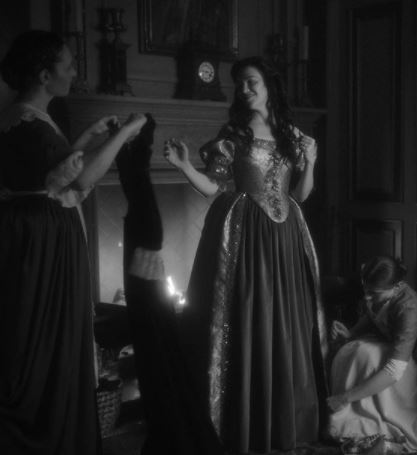
“I find it quite beautiful. I developed the plan with some very special architects,” I answered very sharply, for the individual’s manner, combined with my utter uncertainty as to his appearance, oppressed me with an irksome longing to be rid of him. “Oh, you don’t? Well, I do. I know what they are,–well, well, well!” and as he pronounced the three last words his voice rose with each, until, with the last, it reached a shrill shriek that echoed horribly among the lonely walks. “Do you know what they eat?” he continued. “No, sir—nor care.” “Oh, but you will care. You must care. You shall care. I will tell you what they are. They are enchanters. They are ghouls. They are cannibals. Did you never remark their eyes, and how they gloated on you when you passed? Did you never remark the food that they served up at your table? Did you ever in the dead of the night hear muffled and unearthly footsteps gliding along the corridors, and stealthy hands turning the handle of your door? Does not dome magnetic influence fold itself continually round you when they pass, and send a thrill through spirit and body, and a cold shiver that no sunshine will chase away? Oh, you have! You have felt all these things! I know it!” The earnest rapidity, the subdued tones, the eagerness of accent, with which all this was uttered, impressed me most uncomfortably. It really seemed as if I could recall all those weird occurrences and influences of which he spoke; and I shuddered in spite of myself in the midst of the impenetrable darkness that surrounded me. #RandolphHarris 11 of 17

“Hum!” said I, assuming, without knowing it, a confidential tone, “may I ask how you know these things?” “How I know them? Because I am their enemy; because they tremble at my whisper; because I hang upon their track with the perseverance of a bloodhound and the stealthiness of a tiger; because—because—I was of them once!” “Wretch!” I cried excitedly, for involuntarily his eager tones had wrought me up to a high pitch of spasmodic nervousness “then you mean to say that you—” as I uttered this word, obeying an uncontrollable impulse, I stretched forth my hand in the direction of the speaker and made a blind clutch. The tips of my fingers seemed to touch a surface as smooth as glass, that glided suddenly from under them. A sharply, angry hiss sounded through the gloom, followed by a whirring noise, as if some projectile passed rapidly by, and the next moment I felt instinctively that I was alone. A most disagreeable feeling instantly assailed me—a prophetic instinct that some terrible misfortune menaced me; and eager and overpowering anxiety to get back to my house without loss of time. I turned and ran blindly along the dark cypress alley, every dusky clump of flowers that rose blackly in the borders making my heart each moment cease to the sounds of unknown pursuers following fast upon my track. The boughs of lilac-bushes and syringas, that here and there stretched partly across the walk, seemed to have been furnished suddenly with hooked hands that sought to grasp me as I flew by, and each moment I expected to behold some awful and impassible barrier fall across my track and wall me up forever. #RandolphHarris 12 of 17

At length I reached the wide entrance. With a single leap I sprang up the four or five steps that formed the stoop, and dashed along the hall, up the narrow zigzagging stairs, and again along the dim, funereal corridors until I paused, breathless and panting, at the “Door to Nowhere.” Once so far, I stopped for an instant and leaned heavily against one of the panels, panting lustily after my late run. I had, however, scarcely rested my whole weight against the door, when it suddenly gave way, and I staggered in head-foremost. To my utter astonishment, the room I had left in profound darkness was now a blaze of light. So intense was the illumination that, for a few seconds while the pupils of my eyes were contracting under the sudden change, I saw absolutely nothing save the dazzling glare. This fact in itself, coming on me with such utter suddenness, was sufficient to prolong my confusion, and it was not until after several minutes had elapsed that I perceived the rom was not only illuminated, but occupied. And such occupants! Amazement at the scene took such possession of me that I was incapable of either moving or uttering a word. All that I could do was to lean against the wall, and stare blankly at the strange picture. It have been a scene out of Samuel Jackson Pratt’s Sympathy, or Hannah Cowley’s The Fate of Sparta, or Edward Gibbon’s The History of the Decline and Fall of the Roman Empire. Round a large table in the center of the room, that I had left unfinished, were seated half a dozen persons. Three were men and three were women. I do not even know what possessed me to open this door. The table was heaped wit a prodigality of luxuries. #RandolphHarris 13 of 17

There were luscious eastern fruits piled up in silver filigree vases, though whose meshes their glowing rings shone in the contrasts of a thousand hues. Small silver dishes that Benvenuto might had designed, filled with succulent and aromatic meats, were distributed upon a cloth of snowy damask. Bottles of every shape, slender ones from the Rhine, stouts fellows from Holland, sturdy ones from Spain, and quaint basket-woven flasks from Italy, absolutely littered the board. Drinking-glasses of every size and hue filled up the interstices, and the thirsty German flagon stood side by side with the aerial bubbles of Venetian glass that rest so lightly on their threadlike stems. An order of luxury and sensuality floated through the apartment. The lamps that burned in every direction seemed to diffuse a subtle incense on the air, and in a large vase that stood on the floor, I saw mass of magnolias, tuberoses, and jasmines grouped together, stifling each other with their honeyed and heavy fragrance. The inhabitants of my incomplete room seemed beings well suited to so sensual an atmosphere. The women were strangely beautiful, and all were attired in dresses of the most fantastic devices and brilliant hues. Their figures were round, supple, and elastic; their eyes dark and languished; their lips full, ripe, and of the richest bloom. The three men wore half-masks, so that all I could distinguish were heavy jaws, pointed beards, and brawny throats that rose like massive pillars out of their doublets. All six lay reclining on Roman couches about the table, drinking down the purple wines in large draughts, and tossing back their heads and laughing wildly. #RandolphHarris 14 of 17

I stood, I suppose for some thirteen minutes, with my back against the wall staring vacantly at the bacchanal vision, before any of the revellers appeared to notice my presence. At length, without any expression to indicate whether I had been observed from the beginning or not, two of the women arose from their couches, and, approaching, took each a hand and led me to the table. I obeyed their motions mechanically. I sat on a couch between them as they indicated. I unresistingly permitted them to wind their arms about my neck. “You must drink,” said one, pouring out a large glass of red wine, “here is Clos Vougeot of a rare vintage; and here,” pushing a flask of amber-hued wine before me, “is Lachryma Christi.” “You must eat,” said the other, drawing the silver dishes toward her. “Here are cutlets stewed with olives, and here are slices of a filet stuffed with bruised sweet chestnuts”—and as she spoke, she without waiting for a reply, proceeded to help me. The sight of the food recalled to me the warning I had received in the garden. This sudden effort of memory restored to me my other faculties at the same instant. I sprang to my feet, thrusting the women from ne with each hand. “Demons!” I almost shouted, “I will have none of your accursed food. I know you. You are cannibals, you are ghouls, you are enchanters. Begone, I tell you! Leave my home in peace!” A shout of laughter from all six was the only effect that my passionate speech produced. The men rolled on their couches, and their half-masks quivered with the convulsions of their mirth. The woman shrieked, and tossed the slender wine-glasses wildly aloft, and turned to me and flung themselves on my bosom fairly sobbing with laughter. #RandolphHarris 15 of 17

Agonized at the ever-darkening mysteries that seemed to thicken around me, and despairing of being able to dissipate them by the mere exercise of my own will, I cried eagerly. The woman touched a small golden ball that stood near her on the table, and it had scarce ceased to tinkle when a dwarf entered with a sliver tray on which were dice-boxed and dice. Then it seemed as if some unseen power caught me by the shoulders and thrust me toward the door. In vain I resisted. In vain I screamed and shouted for help. In vain I implored them for pity. All the reply I had was those mocking peals of merriment, while, under the invisible influence, I staggered to the door. As I reached the threshold the organ pealed out a wild, triumphal strain. The power that impelled me concentrated itself into one vigorous impulse that sent me blindly staggering out into the echoing corridor, and, as the door closed swiftly behind me, I caught a glimpse of the apartment I had left forever. A change passed like a shadow over it. The lamps died out, the siren women and masked men vanished, the flowers, the fruits, the bright silver and bizarre furniture faded swiftly, and I saw again, for the tenth of a second the incompleted room return. The next instant the door closed violently, and I was left standing in the corridor stunned and despairing. As soon as I had partially recovered my comprehension I rushed madly to the door, with the dim idea of beating it in. When I opened it, there was nothing but a two story drop to the garden. I looked from left to right, and there was no room. Just a door to nowhere. I rushed downstairs shouting madly. No one answered. I met the butler; I seized him by the collar, and demanded he show me to my room. #RandolphHarris 16 of 17

The demon showed his white and awful teeth, which were filed into a saw-like shape, and, extricating himself from my grasp with a sudden jerk, fled down the passage with a gibbering laugh. Nothing but echo answered to my despairing shrieks. The lonely garden resounded with my cries as I strode madly through the dark walks, and the tall funeral cypresses seemed to bury me beneath their heavy shadows. I met no one—could find no one. I had to bear my sorrow and despair alone. Since that awful hour, every time I open that door, there is nothing on the other side, but a two story drop into the gardens. Shall I ever find it? I left that portion of the house incomplete in hopes that my room would return. Death is the separation of the soul from the body. The creation of a zombie is the rebinding of body and soul via necromancy. The animated body can move, speak, even think, but it still cannot outrun physical decay. Zombies do not last very long, and the more able they are to think, the more they suffer from the same derangement that eventually gets any spirit that has been prevented from moving on. It is a rule: if spirit cannot move on, the tug of the afterlife sooner or later drives them mad. (Mrs. Sarah L. Winchester’s response to the deaths of her child and husband left a bizarre and impressive architectural reflection of her psyche. The fascinating story of the Winchester Mystery House has its roots in the personal tragedies suffered by Mrs. Winchester and the legacy of the Winchester rifle, “The Gun That Won the West.” There were occurrences that defined explanation. Neighbours would hear a bell ring a midnight and 2am, which according to ghost lore are the times of the arrival and departure of spirits. Some said that Mrs. Winchester never slept in the same bedroom two nights in a row, in order to confuse any evil spirits that might be waiting for her.) #RandolphHarris 17 of 17

Winchester Mystery House

If you’ve got it, haunt it 😉
Tickets for our All Hallows’ Eve, Lost in The House tour are still available! Purchase them today and be prepared for a fright 👻
Buy tickets 👉 Link in bio. winchestermysteryhouse.com

 Randolph Harris II International Institute