
Home » news (Page 19)
Category Archives: news

This Does Not Mean that All Women Should Enter the Workforce

Americans are always hung over from some blow dealt them by their technological environment and are always looking for a fix—for some pleasurable escape from what technology has itself created. Complex systems in which interventions could induce large changes can be approached in a common way, no matter what the problem is. The first concept is that of an agent. An agent has the ability to interact with its environment, including other agents. An agent can respond to what happens around it and can do things more or less purposefully. Most commonly, we think of an agent as a person, such as the team member in a company or the person seeking a loan. Considering this broad definition, we can see that a person is not the only kind of agent. A family, a business, or an entire country can also be an agent. Even a computer program interacting with other programs can be regarded as an agent. When we talk about agents we will usually expect them to have a number of properties. These include location—where the agent operates; capabilities—how the agent can affect the World; and memory—what impressions the agent can carry forward from its past. The second key concept is strategy, the way an agent responds to its surroundings and pursues its goals. An employee might help a co-worker in the hope that the co-worker will reciprocate. Someone needing a small loan might ask friends to help out. A nation seeking to promote favorable norms might try to lead by example. #RandolphHarris 1 of 23

A computer program seeking useful resources might buy information from other programs and keep track of which ones provided resources that were actually worth what was paid. These are all strategies. Our usage includes deliberate choice, in the sense of the term “business strategy,” but it also includes patterns of response that pursue goals with little or no deliberation. A central interest of ours is how strategies change over time. One source of change is the agent’s experience of how well the strategy is doing. An employee, finding that co-workers are not contributing to a joint project, might decide not to contribute either. Typically, human agents have some awareness of their own strategies, and they may be able to observe something about how well they are doing according to some measure of success. Often they can observe the actions or successes of the agent to try a new strategy based on trial and error, or to imitate the strategy of another agent. Changes in strategies can also come about through changes in the population of agents. For example, experienced workers may train new workers, or practices at one company may be imitated at another. Such processes of reproducing, or copying, play an important role by changing the mix of strategies or agents in the population. The idea of a population of agents is our third major concept. Indeed, the idea is so central that we sometimes refer to our framework as the “population approach to Complex Adaptive Systems.” #RandolphHarris 2 of 23

If you are seeking to harness complexity, populations are important in three ways: as a source of possibilities to learn from, as recipients for a newfound improvement, and as part of your environment. For example, if one is a business manager, one can learn from the population of managers who face similar problems, one can spread what is learned to a population of businesses and consumers that one adapts to even while they are adapting to you. One can think about populations of strategies as well as populations of agents. For example if you try different ways of raising funds for your nonprofit organization and observe others doing fund-raising for theirs, one can learn from the resulting population of fund-raising strategies. One of the key questions generated by our framework center on the way strategies or agents of a particular type become more (or less) common in population. For example, “aggressive” and “lowkey” might be types of sales strategies that a particular firm distinguishes. Another firm might distinguish “recurring” from “onetime.” Teachers might define the population of children at their school (agents, in our terms) as falling into types by grade levels. For other purposes, genders might be the relevant types. #RandolphHarris 3 of 23

Our rough criterion for the boundaries of a population will be that two agents are in the same population if one agent could employ a strategy used by another. So, for example, a villager might try an approach to borrowing money that had been effective for a family member or friend. This simple example of villagers reveals two important features of populations. First, strategies spread (and sometimes change) by moving among members of a population. A borrowing strategy might spread by word of mouth through family or friendship networks. It might also change in some significant way as it is repeatedly retold. Change processes such as this create variation among strategies. Second, populations have structure—interaction patterns that determine which pairs of agents are likely to interact and which pairs unlikely. The borrowing strategy moves among friends or relatives. Real situations often include more than just a single population of agents, of course. For one thing, there may be several different kinds of agents. There are not only sellers in the village, but also buyers. There are not only nations in the international system, but nongovernmental organizations. Moreover, many settings include important entities that are not agents. Books, vehicles, weapons, and medicines play significant roles even if they lack some qualities of agents. We will be especially interested in artifacts, objects that are used by agents. #RandolphHarris 4 of 23

Like agents, artifacts can have important properties, such as location or capabilities. A toy may respond to a child who winds its springs. Artifacts may have “affordances,” features that evoke certain behavior from agents, like the beautiful handle of a pitcher that invites the grasping hand. However, artifacts usually do not have purposes of their own, or powers of reproduction. When we want to talk about a real situation, we will generally pack all of these elements up into the term system. We will use the word to indicate one or more populations of agents (for example, employees and customers of the company), all the strategies of all the agents (working together to produce and sell products, and buying and using products), along with the relevant artifacts and environmental factors (manufactured products, production tools, sales brochures, and store opening hours). Here then we glimpse one of the most fundamental yet neglected relationships between knowledge and power in society: the link between how a people organize their concepts and how they organize their institutions. Put most briefly, the way we organize knowledge frequently determines the way we organize people—and vice versa. When knowledge was conceived of as specialized and hierarchical, businesses were designed to be specialized and hierarchical. Once a bureaucratic organization of knowledge finds concrete expression in real-life institutions—corporations, schools, or governments—political pressures, budgets, and other forces freeze the organization of knowledge into place, obstructing the reconceptualization that leads to radical discovery. #RandolphHarris 5 of 23

Today, high-speed change requires equally high-speed decisions—but power struggles make bureaucracies notoriously slow. Competition requires continual innovation—but bureaucratic power crushes creativity. The new business environment requires intuition as well as careful analysis—but bureaucracies try to eliminate intuition and replace it with mechanical, idiot-proof rules. Bureaucracy will not vanish, any more than the state will wither away. However, the environmental conditions that permitted bureaucracies to flourish—and even made them highly efficient engines—are changing so rapidly and radically, they can no longer perform the functions for which they were designed. Because of today’s business environment is convulsing with surprise, upsets, reversals, and generalized turbulence, it is impossible to know precisely and in advance who in an organization will need what information. In consequence, the information needed by both executives and workers to do their jobs well, let alone to innovate and improve the work, cannot reach the front-line managers and employees through the old official channels. This explains why millions of intelligent, hardworking employees find they cannot carry out their tasks—they cannot open new markets, create new products, design better technology, treat customers better, or increase profits—except by going around the rules, breaking with formal procedures How many employees today need to close their eyes to violations of formal procedure to get things done? To be a doer, a fixer, a red-tape cutter, a go-getter, they must trash the bureaucracy. #RandolphHarris 6 of 23

Thus, information begins to spill out of the formal channels into all those informal networks, gossip systems, and grapevines that bureaucracies seek to suppress. Simultaneously, corporations spend billions to construct electronic alternatives to the old communication structures. However, all these require enormous changes in the actual organization, the way people are ranked and grouped. For all these reasons the years ahead will see a tsunami of business restructuring that will make the recent wave of corporate shake-ups look like a placid ripple. Specialists and managers alike will see their entrenched power threatened as they lose control of their cubbyholes and channels. Power shifts will reverberate throughout companies and whole industries. For when we change the relations between knowledge and production, we shake the very foundations of economic and political life. That is why we are on the edge of the greatest shift of power in business history. And the first signs of it are already evident in the new-style organizations fast springing up around us. We can call them the “flex-firms” of the future. Sergio Rossi was a business hero. He was not some strutting bureaucrat or tycoon ensconced in a glass-sheathed skyscraper. He worked, instead, from his home in the Val Vibrata, in eastern Italy, with three employees who use high-tech machines to turn out fine-quality purses and pocketbooks for sale in New York City department stores. He founded his own brand. #RandolphHarris 7 of 23

Not so far away one finds Mario D’Eustachio, who heads up Euroflex, a 200-employee firm that makes luggage for Macy’s. Euroflex is a collaborative effort. Pia D’Eustachio, Mr. E’s wife, is in charge of sales; Tito, a son, guards the finances; Tiziana, a daughter, designs the luggage; and a nephew, Paolo, runs the production side of things. These are only 2 of the 1,650 small firms in the valley, each averaging only 15 workers, but collectively turning out over $1 billion a year in clothing, leatherware, and furniture. And Val Vibrata is only one small region—part of what is now known as the Third Italy. Italy Numero Uno was the agricultural South. Italy Numero Due was the industrial North. Italy Numero Tre is composed of rural and semirual regions, like Val Vibrata, using high-tech and small, usually family-based enterprise to contribute to what has been called the “Italian miracle.” A similar pattern is seen in smaller cities. Modena, for example, boasts 16,000 jobs in the knitwear industry. Whereas the number f workers in firms employing more than 50 has plummeted since 1971, employment in firms with 5 or fewer workers rose. Most of these are family-run. The virtues of family business are being discovered elsewhere too. In the United States of America, after years of being considered small-time, family businesses are hot. Francois M. de Visscher, of the financial firm Smith Barney, says he wants his company to become “the premier investment banker to family businesses,” and everyone from management consultants to marriage counselors are gearing up to sell services to what might be called “the fam-firm sector.” #RandolphHarris 8 of 23

The smallest of these family firms are short on titles and formality; larger ones combine informality among family members at the top with formality and bureaucratic organization below. It is glib to suggest that small is always beautiful or that an advanced economy can function without very large enterprises, especially as the global economy grows more integrated. Italian economists, for example, worry that Italy’s dynamic small firms may not cut the mustard in an integrated European market, and the European Community, long an advocate of bigness, favors large-scale mergers and urges small firms to form alliances and consortia. However, while consortia may make sense, the EC’s infatuation with superscale may prove shortsighted—a failure to recognize the imperatives of the super-symbolic economy. Thus, there is mounting evidence that giant firms, backbone of the smokestack economy, are too slow and maladaptive for today’s high-speed business World. Not only has small business provided most of the 20 million jobs added to the U.S.A economy since 1977, it has provided most of the innovation. Worse yet, the giants are increasingly lackluster as far as profits go. The biggest companies are the most profitable—on the basis of return on equity—in only 4 out of 67 industries. Well over half the time the biggest corporate player fails to attain even the industry average return on invested capital. #RandolphHarris 9 of 23

In many fields the savings that sheer size once made possible are fading as new technologies make customization cheap, inventories small, and capital requirements low. Most of the classical justifications of large size have proved to be of minimal value, or counterproductive, or fallacious. Small firms now can gain access to huge amounts of capital from Wall Street. They have ready access to information. And it is easier for them to use it, since they tend to be less bureaucratic. Conversely, the “diseconomies of scale” are catching up with many of the bloated giants. It is clear, moreover, that in the economy of tomorrow huge firms will become more dependent than in the past on a vast substructure of tiny but high-powered and flexible suppliers. And many of these will be family-run. Today’s resurrection of small business and the family firm brings with it an ideology, an ethic, and an information system that is profoundly antibureaucratic. In a family, everything is understood. By contrast, bureaucracy is based on the premise that nothing is understood. (Hence the need for everything to be spelled out in an operational manual and for employees to work “by the book.”) The more things are understood, the less has to be verbalized or communicated by memo. The more shared knowledge or information, the fewer the cubbyholes and channels needed in an organization. #RandolphHarris 10 of 23

In a bureaucratic company, position and pay are ostensibly determined by “what you know,” as though “who you know” did not matter. Yet the reality is that “who you know” is important, and grows in importance as one moves up in the World. Who you know determines access to crucial knowledge—namely, information about who owes whom a favor, and who is to be trusted (which, in turn, means whose information is reliable.) In a family firm nobody kids anymore. Too much is known by all about all, and helping a son or daughter succeed by using “pull” is natural. In the bureaucratic firm, pull is called nepotism and is seen as violation of the merit system that purportedly prevails. In a family, subjectivity, intuition, and passion govern both love and conflict. In a bureaucracy, decisions are supposed to be impersonal and objective, although, as we have seen, it is internecine power struggles that determine important decisions, rather than the cool clear rationality described in textbooks. Finally, in a bureaucracy it is often difficult to know who has power, despite for formal hierarchy and titles. In the family enterprise, everyone knows that titles and formality do not count. Power is held by the patriarch or, occasionally, the matriarch. And when he or she passes from the scene, it is usually conferred on a hand-picked relative. In short, wherever family relationships play a part in business, bureaucratic values and rules are subverted, and with them the power structure of the bureaucracy as well. #RandolphHarris 11 of 23

This is important, because today’s resurgence of family business is not just a passing phenomenon. We are entering a “post-bureaucratic” era, in which the family firm is only one of many alternatives to bureaucracy and the power it embodies. Now, when focusing on Japan, for its economy to advance in a period of rapid, often confusing and complex change, it will also have to loosen its rigid role structure—not merely in the professions and the workplace generally but at the deeper level of family life and gender. Old assumptions about marriage and family—and their relationship to the economy—are falling away. In 1972, according to a white paper issued by Japan’s Cabinet Office, 80 percent of Japanese men and women agreed that only men should hold jobs. Wives should be full-time homemarkers. By 2022, 45 percent of men, and 55 percent of women no longer agreed with that division of labor. Young women are marrying later and attach less stigma to staying single. A postwar low of 514,000 marriages were registered in Japan in 2021, while around 50 percent of women and 70 percent of men in their 20s have never married. Today’s more assertive unmarried women refuse to be classified as “Christmas Cakes,” a disparaging term that compares them to leftovers tossed in the garbage bin the day after the holiday. Those who do marry are having fewer babies. The national birthrate for Japan in 2022 is 7.109 births per 1,000 people, a 1.33 percent decline from 2021. #RandolphHarris 12 of 23

Thus, while promotional opportunities for women are better in I.T. and Internet-related companies. In 2018, women account for 14.9 percent of management staff in Japan, which is up from 9.9 percent in 2003. That is compared to nearly 40 percent of all managers being women in the United States of America. And women’s earned income in Japan was still only 46 percent of males. Meanwhile, the government, hoping to stem the decline in the birthrate, has called on business to offer paternity leave to fathers, hoping they would help their wives and bond with their newborns. So few men, however, have taken advantage of this that the city of Ota decided sterner, more creative (and procreative) measures were needed. In 2004, it ruled that all males working for the city would henceforth be compelled to take forty days off in the year after a birth, to keep notes and to report back on what they had learned from the experience. The idea, said one city official, was to “get men involved in raising children” and to counteract the notion that doing so was effeminate. Ota proves that even a city hall can, on occasion, think outside the proverbial box. Or that, faced with these birth numbers, Japan’s leaders are desperate. However, are they desperate enough? #RandolphHarris 13 of 23

This does not mean that all women should enter the workforce. Caring for children and managing a home are critical prosumer functions that, as we have seen, create economic value and keep the money economy alive. However, the old division of labor based on gender is another structural rigidity standing in the way of Japan’s economic advance toward revolutionary wealth. In today’s Worldwide race to create knowledge-based money economies, Japan, once a leader, is using only half of its available brainpower. And that is not smart. Speaking of smart, do athletes ever have a “hot hand”? Sometimes it seems that Steph Curry cannot miss a basket, or Alex Ovechkin or Sidney Crosby a shot or a goal. Sports announcers see these long streaks of consecutive successes and proclaim that the athlete has a “hot hand.” Yet according to psychology professors Thomas Gilovich, Robert Vallone, and Amos Tversky, this is a misperception of reality. They point out that if you flip a coin long enough, you will find some very long series of consecutive heads. The psychologists suspect that sports commentators, short on insightful things to say, are just finding patterns in what amounts to a long series of coin tosses over a long playing season. They propose a more rigorous test. In basketball, they look at all the instances of a player’s baskets, and observe the percentage of times that player’s next shot is also a basket. A similar calculation is made for the shots immediately following misses. If a basket is more likely to follow a basket than to follow a miss, then there really is something to the theory of the hot hand. #RandolphHarris 14 of 23

They conducted this test on the Philadelphia 76ers basketball team. The results contradicted the “hot hand” view. When a player made his last shot, he was less likely to make his next; when he missed his previous attempt, he was more likely to make his next. This was true even for Andrew Toney, a player with the reputation for being a streak shooter. Does this mean we should be talking about the “stroboscopic hand,” like the strobe light that alternates between on and off? Game theory suggests a different interpretation. While the statistical evidence denies the presence of streak shooting, it does not refute the possibility that a “hot” player might warm up the game in some other way. The difference between streak shooting and a hot hand arises because of the interaction between the offensive and the defensive strategies. Supposed Andrew Toney does have a truly hot hand. Surely the other side would start to crowd him. This could easily lower his shooting percentage. That is not all. When the defense focuses on Toney, one of his teammates is left unguarded and is more likely to shoot successfully. In other words, Toney’s hot hand leads to an improvement in the 76ers’ team performance, although there may be a deterioration in Toney’s individual performance. Thus we might test for hot hands by looking for streaks in team success. #RandolphHarris 15 of 23

Similar phenomena are observed in many other team sports. A brilliant running-back on a football team improves its passing game and a great pass-receiver helps the running game, as the opposition is forced to allocate more of its defensive resources to guard the starts. In the 1986 soccer World Cup final, the Argentine star Diego Maradona did not score a goal, but his passes through a ring of West German defenders led to two Argentine goals. The value of a star cannot be assessed by looking only at one’s scoring performance; one’s contribution to one’s teammates’ performance is crucial, and assist statistics help measure this contribution. In ice hockey, assists and goals are given equal weight for ranking individual performance. A player may even assist oneself when one hot hand warms up the other. The Oakland Warriors star Steph Curry, is great a shooting 3 pointers, even though he is under pressure all the time. 2-point shots tend to be easier, but Curry can put the ball on the floor and create his own shot from anywhere on the floor and he does not need much space to get his own shot off. We know even when a 2-point shot is stronger, it may even be used less often because a player may be in for maximum points. Many of you will have experienced this unusual phenomenon when playing tennis. #RandolphHarris 16 of 23

If your backhand is much weaker than your forehand, your opponents will learn to play to your backhand. Eventually, as a result of all this backhand practice, your backhand will improve. As your two stokes become more equal, opponents can no longer exploit your weak backhand. They will play more evenly between forehands and backhands. You get to use your better forehand more often; this could be the real advantage of improving your backhand. Both the novelist and the social researcher construct their stories by the use of archetypes and metaphors. Cervantes, for example, gave us the enduring archetype of the incurable dreamer and idealist in Don Quixote. The social historian Marx gave us the archetype of the ruthless and conspiring, though nameless, capitalist. Flaubert gave us the repressed bourgeois romantic in Emma Bovary. And Margaret Mead gave us the carefree, guiltless Samoan adolescent. Kafka gave us the alienated urbanite driven to self-loathing. And Max Weber gave us hardworking men driven by a mythology he called the Protestant Ethic. Dostoevsky gave us the egomanic redeemed by love and religious fervor. And B.F. Skinner gave us the automaton redeemed by a benign technology. I think it justifiable to say that, in the nineteenth century, novelists provided us with most of the powerful metaphors and images of our culture. In the twenty first century, such metaphors and images have come largely from the pens of social historians and researchers, but can come from sports and players. #RandolphHarris 17 of 23

Nevertheless, think of John Dewey, William James, Erik Erickson, Alfred Kinsey, Thorstein Veblen, Margaret Mead, Lewis Mumford, B.F. Skinner, Carl Rogers, Marshall McLuhan, Barbara Tuchman, Noam Chomsky, Robert Coles, even Stanley Milgram, and you must acknowledge that our ideas of what we are like and what kind of country we live in come from their stories to a far greater extent than from the stories of our most renowned novelists. I do not mean, incidentally, that the metaphors of social research are created in the same way as those of novels and plays. The writer of fiction creates metaphors by an elaborate and concrete detailing of the actions and feelings of particular human beings. Sociology is background; individual psychology is the focus. The researcher tends to do it the other way around. The focus is on a wider field, and the individual life is seen in silhouette, by inference and suggestion. Also, the novelist proceeds by showing. The researcher, using abstract social facts, proceeds by reason, by logic, by argument. That is why fiction is apt to be more entertaining. Whereas Oscar Wilde or Evelyn Waugh shows us the idle and conspicuously consuming rich, Thorsten Veblen argues them into existence. In the character of Sammy Glick, Budd Schulbreg shows us the narcissist whose origins Christopher Lasch has tried to explain through sociological analysis. #RandolphHarris 18 of 23

So there are differences among storytellers, and most of the time our novelists are more pleasurable to read. However, the stories told by our social researchers are at least as compelling and, in our times, apparently more credible. In the new there is always an admixture of the antiquated, especially where technology is considered. Surfaces surround us, and human-made surfaces—walls, roofs, and pavement—cover huge areas that matter to people. How can smart materials make a difference here? The revolution in technology has come and gone, and you want to repaint your walls. Breathing toxic solvents and polluting water by washing brushes have passed into history, because paint has been replaced with smarter stuff. The mid-twentieth century had seen considerable progress in paints, especially the development f liquids that were not quite liquid—they would spread with a brush, but did not (stupidly) run and drip under their own weight. This was an improvement, but the new material, “paperpaint,” is even more cooperative. Paperpaint comes in a box with a special trowel and pen. The paperpaint itself is a dry block that feels a lot like a block of wood. Following the instructions, you use the pen to draw a line around the edge of the area you want to paint, putting an X in the middle to show where you want the paint to go on; the line is made of nontoxic disappearing ink, so you can slop it around without staining anything. Using the towel, you slice off a hunk of paperpaint—which is easy, because it parts like soft butter to the trowel even though it behaves like a solid to everything else. Very high IQ stuff, that. #RandolphHarris 19 of 23

Next, you press the hunk against the X and start smoothing it out with the towel. Each stroke spreads a wide swath of paperpaint, much wider than the trowel, but always staying within the inked line. A few swipes spreads it precisely to the edges, whereupon it smooths out into a uniform layer. Why does it not just spread itself? Experience showed that customers did not min the effort of making a few swipes and preferred the added control. The paperpaint consists of a huge number of nanomachines with little wheels for rolling over one another and little sticky pads for clinging to surfaces. Each has a simple, stupid computer on board. Each can signal its neighbors. The whole mass of them clings together like an ordinary solid, but they can slip and slide in a controlled way when signaled. When you smooth the trowel over them, this contact tells them to get moving and spread out. When they hit the line, this tells them to stop. If they do not hit a line, they go a few handbreadths, then stop anyway until your trowel them again. When they encounter a line on all sides, word gets around, and they jostle around to form a smooth, uniform layer. Any that get scraped off are just so much loose dusts, but they stick together quite well. This paint-stuff does not get anything wet, does not stain, and clings to surfaces just tightly enough to keep it from peeling off accidentally. If some experimentally minded child starts digging with a stick, makes a tear, and peels some off, it can be smoothed back again and will rejoin as good as new. The child may eat a piece, but careful regulation and testing has ensured that this is no worse than eating plain paper, and safer than eating a colorful Sunday newspaper page. #RandolphHarris 20 of 23

Many refinements are possible. Swipes and pats of the trowel could make areas thicken or thin, or bridge small holes (no more Spackling!). With sufficiently smart paperpaint, and some way to indicate what it should do, you can have your choice of textures. Any good design will be washable, and a better design would shed dirt automatically using microscopic brushes. Removal, of course, is easy; either you rip and peel (no scrapping needed), or find that trowel, set the dial on to handle to “Strip,” and poke the surface a few times. Either way, you end up with a lump ready to pitch into the recycling bin the same old wall you started with, bared to sight again. Perhaps no product will ever be made exactly like the smart paint just described. It would be disappointing if something better could not be made by the time smart paint is technologically possible. Still, paperpaint gives a feel for some of the features to expect in the new smart products, features such as increased flexibility and better control. Without loading yet more capability into our paint (though there is no reason why one could not), soon you may even be able to use your very walls to, say, turn on the stove or dim the lights. Researchers at Carnegie Mellon and Disney Research have collaborated to design a conductive paint that, when applied to any wall, makes the surface interactive. #RandolphHarris 21 of 23

Many people like to knock down walls, but why not make them make more sense? The smart walls function like giant touchscreens and have the potential to respond to gesture commands. They can track users’ positions in the room and know which electrical appliances are close by and whether they are being used. The researchers used special conductive paint containing nickel, applied in grid, to create electrodes on the wall. This paint turns the wall into a touchscreen and an electromagnetic sensor. They then painted over the electrodes with regular paint. The walls look and feel totally ordinary. That is one of the major benefits. We imagine a future where every Cresleigh Homes comes equipped with similar smart walls, which home owners can feel free to use or simply ignore. This could mean that people may prefer to go back to traditional homes, with formal rooms, not just one big casual space. Another benefit of using paint to create the smart surface is cost. The team currently estimates the application costs at about $20 per square meter, but hope to bring the price down with further fine tuning. The walls could potentially serve as an interface for controlling home appliances that would be less expensive, more efficient and less obtrusive than current smart home setups. People purchase smart appliances that can easily cost thousands of dollars, or one could buy after market sensors that people can tag to everyday objects. However, one does not want one’s beautiful kitchen to be tagged with all these sensors. And batteries have to be recharged. #RandolphHarris 22 of 23

The walls target the needs and preferences of different residents, identified perhaps by their smart watches. It could turn on the lights just the way you like, play your roommates favorite tunes when one walks into the room, notify family members if baby appears to have fallen. Besides reducing the cost of the paint, walls will be capable of detecting appliances at further distances. Right now the walls have a range of 3 meters, which is fine for wall-mounted TVs or a lamp that sits by the couch. However, they hope to expand the range to 10 or even 20 meters, making the walls capable of sensing electronics in the middle of very large rooms. This product may be commercially available in less than five years. One could walk into Home Dept or Ace Hardware and buy this paint. This is what we want in our future technology in terms of being really invisible and embedded and camouflaged and subtle. Victorian homes were haunted by spirits, our homes will be haunted by technology. The future of smart home technology will blend seamlessly into our homes. We might, for example, have systems that subtly nudge us towards sleep by diming the lights or spraying calming whiffs of lavender. Smart mattresses could monitory our sleep phases and adjust the environment to keep us comfortable. We want simple control features, which will allow people to control smart walls by gestures, so users do not spend weeks trying to figure out how to interact with the technology. This will make people feel like they have superpowers. #RandolphHarris 23 of 23

Cresleigh Homes

Trick or Treat! 👻 Coming up to our #PlumasRanch ranch home this afternoon? We can’t wait to offer you some sumptuous sweets!

Of course, our home is always the best treat we can think of. Can’t wait to see you in our neighborhood! 🦇
#CresleighHomes

It is Not a Dead Language, but the Language of the Dead

On Halloween in 1975, Jeanne Borgen, one of California’s foremost psychic investigators, conducted a midnight séance in the bedroom where Mrs. Winchester supposedly died (some thing she achieved eternal life and is still living). Nonetheless, the results were reported by Alvin T. Guthertz in the magazine Psychic World: “Suddenly it appeared as if Mrs. Borgen’s face had somehow aged—her hair appeared gray and deep lines creased her forehead. She felt staggering pain and was unable to walk. It was as if she were having a heart attack and, as she started to fall, she shouted, ‘Help me. Someone get me out of here!’” Jeanne Borgen awoke a short time later. Her breathing was then normal; the pain, or what had seemed like pain, was gone…”She was an overpowering woman, a powerful woman. I felt a tremendous build up of energy.” This is the story of Santa Clara Valley’s most famous lady, Sarah L. Winchester, and her fabulous mystery mansion. It has been said that Mrs. Winchester slept in a different bedroom every night, and with more than 600 rooms at the time, she could sleep in a different bedroom, every night for over a year; this was supposed to confuse evil spirits. Some say that she also held special dinner parties for her spirit friends. Legend has it that she would serve her phantom guests on solid gold plates, offering them dishes like caviar, truffles, and pheasant stuffed with pate. Over the years, many people have occupied the massive homes, which now has 160 rooms, stands four stories high, and is approximately 90,000 square feet. #RandolphHarris 1 of 13

It is said that different organisms have separate consciousnesses, although their bodies are just as much connected by general Nature as the parts of a single organism are with each other. Back in Mrs. Winchester day, during the late 1880s through the early 1920s, she used to have ritual séances in her famous Blue Séance Room. Those taking art formed a circle around a large round table, at the side of which there was a large oblong box. One Halloween night while the ritual was taking place, the circle people joined hands…they began to dance to a hypnotic drumming and suddenly the Grain God appeared in the middle of the circle, dressed in skins and with white make-up from the chest up. He wore antlers on his head so skillfully applied that they looked as if they were growing out of his head. He began his Dance of Death, moving around the circle stopping before each person and showing them his mystery—the perfect wars of corn he held in each hand. When each had experienced him, the drumming and the chanting increased in tempo and volume until, at its peak, Mrs. Winchester, the High Priestess, appeared in the middle of the circle and, letting out a bone-chilling scream, she stabbed the Grain God with her Athame (the witch’s knife) and blood spurted from the wound as he fell forward into the oblong box, which was now revealed as a coffin. To the cries and gasps of the assembled witches, the coffin was solemnly carried to the bonfire which was lit and blazed high, accompanied by the cries and chants and the furious drumming. #RandolphHarris 2 of 13

By the light of the funeral pyre, a virile young man appeared among them and was proclaimed the new Grain God and the blessed wine was shared amongst his subjects who danced and chanted until the sun started to rise. Thought the Bible provided no evidence that witchcraft was considered to be an organized religion, it certainly acknowledged the existence of witches, as in 1 Samuel Chapter 28 of the Old Testament, where we are given a dramatic account of Saul’s visit to a witch at Endor because he believed God had deserted him. He went in disguise and pleaded with her to “bring up Samuel” who was dead. The witch performed her ritual and…The woman said to Saul, “I saw gods ascending out of the Earth.” And he said unto her “What form is he of?” And she said, “An old man cometh up and he is covered with a mantle.” And Saul perceived it was Samuel and he stopped his face to the ground and bowed himself. This was one of the earliest published examples of necromancy, the revival of the dead or the contact with the spirits of the deceased, which is now practised by many witches and black magicians. Likewise, Mrs. Winchester was “spiritual,” and what happened in her Blue Séance Room was also considered necromancy. The familiar spirit is one of the earliest keys to the identification of witches. They were said to be capable of summoning an assisting force which was a spirit of a dead person residing in the body of a small animal such as a cat, dog, bird or toad. #RandolphHarris 3 of 13

These animals required the sustenance of witches’ blood, obtained by pricking her own skin, and thus when the witch-hunters came, they often first examined the witch’s body for marks—any mole would do. Alternatively, the spirits were said to be capable of existence in an inanimate object. The infamous occultist Mrs. Winchester was said to have a familiar spirit which dwelt in her favorite window. The Roman Church was especially sensitive to all forms of magic and sorcery, because the practice had been rife through Roman society, as was the belief that to encourage constant renewal of power, young men, women, and animals were required to be systematically sacrificed. These practices remained until the official repression of the old pagan religion in the Roman Empire. In AD 313, the Emperor Constantine issues an edict of toleration legalizing Christianity throughout the empire after he saw two visions which caused him to adopt Christ as his patron. Just to be on the safe side, however, Constantine never fully abandoned his earlier patron, Apollo, in spite of the pressure from priests and bishops to eliminate pagan practices entirely by threat of death. Christians were not content with merely being the favoured cult; they wanted to establish one true faith for the whole of mankind and all other forms of loyalty to past gods should be abolished. Neither was it the instant “conversion” that Sunday school teachers would have us believe. It took another two centuries before this progression was confirmed, when the rights of pagan were gradually reduced by imperial decree. #RandolphHarris 4 of 13

Sacrifices were forbidden in 391 and all pagan holidays and festivals were banned. Pagans were ejected from public office and lost the right to own property or defend themselves in court. Their temples were destroyed in Christian troops or crusading monks and finally, in AD 529, all citizens were ordered to convert to Christianity. Parents were told to bring all children to Christian churches for baptism. Paganism, in the heart of Europe, was reduced to scattered and secret worship, driven underground until, as the years went by, only scraps of folklore, song and dance and superstition remained. It took longer to disappear elsewhere, as the influence of the Roman Empire diminished and in Britain paganism actually went through a revivalist period as the hordes of barbarian raiders replaced the Romans. The Angles, the Saxons, the Picts and later the Vikings battled to forge powerful new regional kingdoms, enforcing worship of their own gods and attempting to force their own order on society. In contrast, Mrs. Winchester removed herself from the World and created a World of her own in her beautiful and mysterious mansion. Still, one of the most enduring legends from the time of the eclipse of the Roman Empire is that of Arthur, who fought the Anglo-Saxons and who is a hero of present-day occultists. #RandolphHarris 5 of 13

The Arthurian legend, with Guinevere, Camelot, Excalibur, the Round Table and the wizard Merlin are al debatable creations, but it is of special significance to all who follow the dark arts to recall that there were twelve knights to the Round Table, thirteen including Arthur—the number of witches who make up a coven. The Anglo-Saxon regional kings were eventually won over to Christianity but the new religion lost ground again in the face of the marauding Vikings, whose pagan rites were said to include human sacrifice when the victim’s lungs were cut from the body. The tide began to turn against the Vikings when King Alfred of Wessex, then aged twenty-two, defeated them at the Battle of Ashdown in 1871. The young king of Wessex was from a close-knit, pious Christian family and was a devout follower of the Roman Church, having been take to be blessed personally by the Pope by his father King Aethelwulf at the age of four. Alfred began the task of uniting England under the Christian king which his descendants were finally to achieve. During his life, Alfred taught himself Latin, the international language of wester Christendom and began translating Latin pastoral [by Pope Gregory the Great] into English and sent copies to every bishop in his kingdom. His grandson, King Athelstan, brought in the first legislation against witchcraft [and the banning of Sunday trade, incidentally] in AD 930. #RandolphHarris 6 of 13

There, out of the decimation of paganism as a religion, is the more likely setting for the birth of today’s witchcraft and it is to these roots that witches turn for their inspiration. As Christianity prospered, the imagery of the primitive cultures and the sacrificial rites which has been used to maintain idolatrous worship were taken as an example personifying some of the elements of evil; thus the horned god of pantheistic beliefs became the accepted form of the Christian devil and was used by Christians in their denouncement of all pagan worship. Gradually, the devil became drawn into every facet of medieval life. He and his demons were blamed for every mishap, whether a destructive storm or disease among the farm animals. The vivid image of this horned and hoofed invader, ruler of the dark forces, was blamed by the teachings of the Church for virtually all ills. The legacy of this confusion—which still exists—is the belief that the devil is an essential part of pagan worship or witchcraft. In fact, with the exception of a group known as the Satanic Witch Cult, neither mainstream witches nor pagans now recognize the existence of the devil or Satan. As the horned god became the Christian symbol of the devil, some witches did come to believe in and worship that Christian entity as their own and by the Middle Ages, witchcraft and devil worship were being treated as one in the same. #RandolphHarris 7 of 13

The cult of persons who, by means of satanic assistance or the aid of evil spirits or familiars are enabled to practise minor black magic. However, the difference between the sorcerer and the witch is that the former has sold one’s soul to Satan for complete dominion over one for a stated period, whereas the witch usually appears as the devoted and often badly treated servant of the diabolic power. Each of us is in reality an abiding physical entity far more extensive than one knows,–an individuality which can never express itself completely through any corporeal manifestation. The self manifests itself through the organism; but there is always some part of the self unmanifested, and always, as it seems, some power of organic expression in abeyance. It is easy to imagine how the combined grief of losing both a child and a spouse could be very crippling. Mrs. Sarah L. Winchester’s response to the deaths of her new born child and husband left a bizarre and impressive architectural reflection of her psyche. The fascinating story of the Winchester Mystery House has its roots in the occult and personal tragedies suffered by Mrs. Winchester and in the legacy of the Winchester rifle, “The Gun That Won the West.” According to some sources, the Boston medium consulted by Mrs. Winchester explained that her family and her fortune were being haunted by spirits—in fact, by the spirits of American Indians, Civil War soldiers, and others killed by Winchester rifles. #RandolphHarris 8 of 13

Supposedly the untimely deaths of her daughter and husband were caused by these spirits, and it was implied that Mrs. Winchester might be the next victim. However, the medium also claimed that there was an alternative. Mrs. Winchester was instructed to move west and appease the spirits by building a great house of them. As long as construction of the house never ceased, Mrs. Winchester could rest assured that her life was not in danger. Building such a house was even supposed to bring her eternal life. On another note, maybe a change of scenery and a never-ending hobby were just what Mrs. Winchester needed to distract her from her grief. Whatever her actual motivations, Mrs. Winchester packed her bags and left Connecticut to visit a niece who lived in Menlo Park, California. While there, she discovered the perfect spot for her new home in the Santa Clara Valley. In 1884 she purchased an unfinished eighteen-room farm house just three miles west of San Jose—and over the next thirty-eight years she produced the sprawling complex we know today as the Winchester Mystery House. In the late 1800’s, the Santa Clara Valley presented sweeping vistas of rural open space. It was a serene setting for Mrs. Winchester to begin her building project, which she did with steadfast determination. She must be given due credit for inventiveness. Mrs. Winchester hired carpenters to work in shifts around the clock. Overnight, the mansion had grown into a nine-story, 600 room complex, and the estate grew, by some estimates, to 730 acres of farmland, which included orchards of corn, apricots, plums, and walnut trees. #RandolphHarris 9 of 13

Perplexity was leavened by extravagant Victorian beauty scattered along each crooked path of exploration. Everywhere prevails that strange deference to the number 13; 13 stairsteps, 13 hangers in a closet, 13 wall panels, 13 lights in the German silver chandeliers, 13 windows to a room and if necessary to make that number, some placed inside a wall. There is even a dim-lit storeroom stacked entirely with never-used furnishings, displays rare hand-wrought elegance from the Victorian era, finest productions of forgotten craftsmen. Here are specially designed million-dollar stained-glass doors and windows, some set with diamonds, rubies, emeralds, gold, silver, platinum, and sapphire. There are stairs that rise only two inches high, doors that open to a two-story plunge into the garden, stairs that lead up to the ceiling and of course, a hooded figure who is dripping wet, with shining boots. Everywhere, there were once paintings huge, framed, fitted into the wall, and white-wigged men and women started helplessly and cold at the staff. At night men could be heard thundering down the steps, legs bowed, elbows out, hefting huge cabinets of ivory, silver, and gold, as ghost stood beside them, laughing because they knew this would lead to their own suffering. On one occasion, bandits broke in and shot the thieves looting the mansion. There was also a group of women who haunted the Winchester Mansion, certain abandoned women, perverted by the devil, seduced by illusion and phantasm of demons. They believe and openly professed that in the dead of night they ride upon certain beasts with Diana, flying over vast tracts of the country and obey her commands. Diana was a pre-Christian goddess. #RandolphHarris 10 of 13

There was pagan worship an aspect of community celebration which. The nine-story tower, that symbol of old English springtime tradition, was the phallic symbol old pagan worship. Mrs. Winchester used herbal medicines and could treat all manner of family aliments, foretell the future and guide and comfort tormented women. Some say she was blessed with these gifts after the lost of her husband and baby. These incidents became legends and they propagated the fear of liaison with the devil. It was alleged by Albert Pike, who claimed the authority of an actual eye-witness for the story, that Mrs. Winchester who had confessed to making a pact with the devil became worried when the expiry of her contract approached. She decided she must appease the spirits of those killed by the Winchester Rifle and summoned some religious people to her home. Mrs. Winchester told them that she was worried that the devil would secure her body as well as her soul. She gave directions that her body should be taken to the mansion, sewn in a stag’s hide, placed inside a stone coffin and fastened down with three strong iron chains. She directed that fifty psalms should be sung by night and fifty hymns should be sung by day to confuse the demons and if her body was still secure after three days, she might be buried safely. All these precautions, according to Pike, were of no avail. For two nights the servants and clergy resisted the demons, but on the third night amid a terrific uproar and the clatter of thunder, an immense demon burst into the mansion, snapped the iron chains like thread, pushed the stone lid aside and commanded the dead Mrs. Winchester to rise. #RandolphHarris 11 of 13

The demon, Botis, grasped her around the wait, caried her to his huge black stallion and galloped off into the night with her shrieks resounding through the air. Such legends impressed and scarred the peasant communities. The servants of the Winchester wanted to deal with the rebellious legions of spirits and their mysterious and malevolent, who could be conveniently packaged together as being in league with Satan. Demons filled the air waiting to be called down by witches, preying on the simple servants, plodding through their dull, daily lives. However, the evil was not only in this mansion, but lurked all over California. Sometimes, whole villages were deemed to have been infected and were wiped out or forcibly split up, and moved to other areas. The servants of Satan and his demons possessed great powers which enabled them to inflict disease, tempests and death by imagery. They could bewitch their opposers and judge them with their evil eye. One of the servants, Marie Laveau, at the Winchester mansion was dragged to the water tower, and was attacked by a demon. Witnesses reported that she was bound hand and foot and the demon cut her hair and threw alcohol over her head, setting light to it; he placed strips of sulphur under her armpits and burned them. Marie was hauled by rope to hand from the ceiling for three hours while the demon slept. Then he returned and threw alcohol over Marie’s body and burned it, which caused the water tower to burn to the ground. It was believed that Marie had copulated with the devil, that she drank the blood of children who she stole on her night-flights and she had murdered about sixty infants. #RandolphHarris 12 of 13

It is said that the demon Botis used techniques on Marie Laveau that might have been a model for the Nazi Gestapo. Servants who spoke out against the terror of Botis were branded as witches and locked in the basement. Meanwhile, word had got out about the death of Mrs. Winchester, but no one heard a word about her funeral. And Mrs. Winchester’s niece, Daisy, was long gone. It was said that two women who were servants at the Winchester Mansion agreed to the request of the devil’s representative and made a covenant written in their own blood by pricking their fingers. One year later, they were arrested by the sheriff and accused of causing the deaths of thirteen children, five men, and eight women, and numerous animals. They were also said to have killed four great hogs because their owner said the women looked like witches, and later sent to imps to destroy his four-year-old daughter. What evidence there was for such allegations cannot be imagined. Pacts with the devil were a feature in the Victorian era. Numerous women who worked as servants for Mrs. Winchester were said to have admitted signing in their own blood a written contract with “a man in black” in return for “money to live gallantly and have pleasure of the World for a period of thirteen years.” They described in their confessions how they made effigies in clay and stuck them with pins, and cursed local people who had annoyed them. One of the Witches, Moina Mathers, spoke of the anointment of the witches who were then able to fly very long distances in a short space of time. The man in black always appeared at their coven meetings when he was called, and supervised their activities. The present generation must weigh and draw its own conclusion about this Valley’s most interesting, most controversial, lady and her mysterious estate. #RandolphHarris 13 of 13

Winchester Mystery House

Come, sit a spell, and conjured up some spirits at this cult classic. Experience Monday’s scaries and give them a brand new meaning 😏👀

One more day left of Unhinged: Nightshade’s Curse. Some tickets still available but going quick!
https://winchestermysteryhouse.com/

Our Society Cannot Long Continue on its Old Premises

In some small degree, we feel bored and uneasy with the orderly chrome and porcelain vacuum of our lives. In this contemporary life the book of experience is filled with blank and mysterious pages. We die from our machines, our own poisons, our own weapons, our own despair. We call such Worlds Complex Adaptive Systems. In Complex Adaptive Systems there are often many participants, perhaps even many kinds of participants. They interact in intricate ways that continually reshape their collective future. New ways of doing things—even new kinds of participants—may arise, and old ways—or old participants—many vanish. Such systems challenge understanding as well as prediction. These difficulties are familiar to anyone who has seen small changes unleash major consequences. Conversely, they are familiar to anyone who has been surprised when large changes in policies or tools produce no long-run change in people’s behaviour. When managers and policy makers hear about complexity research, they often ask, “How can I control complexity?” What they usually mean is, “How can I eliminate it?” However, complexity, as we shall see, stems from fundamental causes that cannot always be eliminated. Although complexity is often perceived as a liability, it can actually be an asset. However, there is no doubt that complexity can be harnessed. So, rather than seeking to eliminate complexity, we shall explore how the dynamism of a Complex Adaptive System can be used for productive ends. #RandolphHarris 1 of 22

In a World of mutually adaptive players, even though prediction may be difficult, there is quite a bit that you can do. Complexity itself allows for techniques that promote effective adaptation. When there are many participants, numerous interactions, much trial-and-error learning, and abundant attempts to imitate each other’s success, there will also be rich opportunities to harness the resulting complexity. And there will be thing to avoid. To take a simple example: Even though one action seems best, it usually pays to maintain variety among the actions you take so that you can continue to learn and adapt. Managers and policy makers must learn to harness complexity. There are three main foundations that we will deal with. These include biology, computer science, and social design. From evolutionary biology come the insights of Darwinian evolution, particularly that extraordinary adaptations can come about through the selection and reproduction of successful individuals in populations. Even though moths in England could not understand or predict that the Industrial Revolution would turn white-barked trees into soot-covered trees, it did not take very long for selection by predatory birds to transform the population of moths near a factory from white to black. From computer science come insights about how systems with many artificial agents can be designed to work together and even adapt over time to each other and to their ever-changing environment. #RandolphHarris 2 of 22

Two area of computer science have been especially important to us. First, there is the field of evolutionary computation, which has fostered an engineering approach to adaptation. With an engineering approach, one asks how system can be designed to become more effective over time. By making evolution and adaptation an engineering problem, evolution computation has shed light on how complex systems can be adaptive. Second, there is the rapid growth of distributed and network-mediated computing (including the Internet), which has led computer science into deeper analyses of just what it takes to make systems of many agents work together and grow. From social design come insights into people and their activities in political, economic, and social systems. Entire disciplines—such as political science, economies, sociology, psychology, and history—have been devoted to understanding human beings and the settings they build and live in. Among the approaches that have concentrated on social design are organization theory and game theory. Organization theory provides insight into how institutional structure matters. Game theory provides insight into how people can choose strategies to maximize their payoffs in the presence of other people who are doing the same. #RandolphHarris 3 of 22

While the foundations of this work come from evolutionary biology, computer science, and social design, our analysis differs from all three of these in important ways. Unlike evolutionary biology, we are primarily interested in the shaping of evolutionary processes rather than just observation and explanation, in intelligent individuals with language and culture, rather than plants and animals that rely primarily on their genetic heritage, and in different measures of success rather than taking the ability to have offspring as the sole measures of success. Unlike computer science, we are primarily interested in systems composed of people or organizations rather than pieces of software, in systems with long and rich histories rather than systems that have little or no history, and in systems in which the costs of trials needed for adaptation are measure in terms of efforts and even lives of people rather than in cycles of computer time. Unlike some approaches to social design, we are primarily interested in problems in which the preferences and even the identities of the participants can evolve over time, rather than situations in which the players and their preferences are fixed, as they are in game theory, and in problems in which decentralization is both promising and problematic, rather than situations in which decentralization is seen as practically a panacea, as in some forms of neoclassical economics. #RandolphHarris 4 of 22

Strategic thinking is the art of outdoing an adversary, knowing that the adversary is trying to do the same to you. All of us must practice strategic thinking at work as well as at home. Businessmen and women and corporations must use good competitive strategies to survive. Politicians have to devise campaign strategies to get elevated, and legislative strategies for the players to execute on the field. Parents trying to elicit good behaviour from children must become amateur strategists (the children are the pros). For forty years, superpowers’ nuclear strategies have governed the survival of the human race. Good strategic thinking in such numerous diverse contexts remains an art. However, its foundations consist of some simple basic principles—an emerging science of strategy. A variety of backgrounds and occupations can become better strategists if they know these principles. The science of thinking is called game theory, as mentioned before. However, like all sciences, it has become shrouded in jargon and mathematics. How should people behave in society? All of us are strategists, whether we like it or not. It is better to be a good strategist than a bad one. Work, even social life, is a constant stream of decisions. What career to follow, how to manage a business, whom to marry, how to bring up children, whether to run for president, are just some examples of such fateful choices. The common element in these situations is that you do not act in a vacuum. #RandolphHarris 5 of 22

Instead, you are surrounded by active decision-makers whose choices interact with yours. This interaction has an important effect on your thinking and actions. To illustrate the point, think of the difference between the decisions of a lumberjack and those of a general. When the lumberjack decides how to chop wood, he does not expect the wood to fight back; his environment is neutral. However, when the general tries to cut down the enemy’s army, one must anticipate and overcome resistance to one’s plans. Like the general, one must recognize that one’s business rivals, prospective spouse, and even your children are intelligent and purposive people. Their aims often conflict with yours, but they include some potential allies. Your own choices allow for the conflict, and utilize the cooperation. Such interactive decisions are called strategic, and the plan of action appropriate to them is called strategy. It is important to think strategically, and then translate these thoughts into action. The branch of social science that studies strategic decision-making is called game theory. The games in this theory range from chess to child-rearing, from tennis to takeovers, and from advertising to arms control. Many continentals think life is a game, the English think cricket is a game. We think both are right. Playing these games requires many different kinds of skills. Basic skills, such as shooting ability in basketball, knowledge of precedents in law, or a blank face in poker, are one kind; strategic thinking is another. #RandolphhHarris 6 of 22

Strategic thinking starts with your basic skills, and considers how best to use them. Knowing the law, you must decide the strategy for defending your client. Knowing how well your football team can pass or run, and how well the other team can defend against each choice, your decision as the coach is whether to pass or to run. Sometimes, as in the case of superpowers contemplating an adventure that risks nuclear war, strategic thinking also means knowing when not to play. We develop the ideas and principles of strategic thinking; to apply them to a specific situation you face and to find the right choice there, you will have to so some work. This is because the specifics of each situation are likely to differ in some significant aspects, and any general prescriptions for action we might give could be misleading. In each situation, you will have to pull together principles of good strategy we have discussed, and also other principles from other considerations. You must combine them and, where they conflict with each other, evaluate the relative strengths of the different arguments. We do not promise to solve every question you might have. The science of the game theory is far from being complete, and in some ways strategic thinking remains an art. We often have to translate ideas into action. Strategic issues arise in a variety of decisions. Some broad classes of strategic situations—brinkmanship, voting, incentives, and bargaining—where one can see the principles in action. #RandolphHarris 7 of 22

The examples range from the familiar, trivial, or amusing—usually drawn from literature, sports, or movies—to the frightening—nuclear confrontation. The former are merely a nice and palatable vehicle for the game-theoretic ideas. As to the subject of nuclear war too horrible to permit rational analysis. However, as the cold war winds down and the World is generally perceived to be a safer place, we hope that the game-theoretic aspects of the arms race and the Cuban missile crisis can be examined for their strategic logic in some detachment from their emotional content. Some cases we examine are open-ended; but that is also a future of life. At times there is no clearly correct solution, only imperfect ways to cope with the problem. We are often asked how “complexity” differs from “chaos.” The simple answer is that chaos deals with situations such as turbulence that rapidly become highly disordered and unmanageable. On the other hand, complexity deals with systems composed of many interacting agents. While complex systems may be hard to predict, they may also have a good deal of structure and permit improvement by thoughtful intervention. We view the process of biological change as wonderful example in the larger set of Complex Adaptive Systems. However, they have special kinds of agents, particular sorts of strategies, distinctive patterns of interaction, and their own special process of selection. #RandolphHarris 8 of 22

The patterns one sees in biology are not always found in other Complex Adaptive Systems. Copying a strategy for stock trading (such as a computer algorithm) involves only digital information and so nearly costless compared with producing a new organism that contained a copied gene. Evaluating a business strategy (say, the introduction of a new product) can be enormously expensive compared with making a random variation of a fruit fly. Variation, interaction, and selection are at work in the population of business strategies, but detailed mechanisms are often distinctly unbiological. To harness complexity effectively, many kinds of Complex Adaptive Systems must be considered. We choose to harness because it conveys a perspective that is not explanatory but active—seeking to improve but without being fully able to control. The Complex Adaptive System approach is a way of looking at the World. It provides a set of concepts, a set of questions, and a set of design issues. By itself, it is not a falsifiable theory. Such a theory would have to specify the operational meaning of the key concepts and mechanisms in a particular domain. For example, to apply the Complex Adaptive Systems approach to economic markets, one would have to specify who the economic actors are, what they can see and do, how they generate variety in their behaviour, how they interact with each other, and how the actors and their strategies are selected for retention, amplification, or extinction. #RandolphHarris 9 of 22

Complexity research can be made relevant to problems social design. It offers a way to those who want to improve the World as well as marvel at it. The hard reality is that the World in which we must act is often beyond our understanding. Each action we take is partly an instrumental step and partly a learning experience. Adaptation can be regarded as an engineering problem. The complexity of the World is real. We do not know how to make it disappear. To create a positive host culture for a flexible knowledge-intensive economy, Japan, for example, will also have to reexamine the social rules that contribute to inflexibility—including the way decisions are made. Much has been written about Japan’s emphasis on group decision-making, especially about the fact that once a consensus decision has been reached, its implementation is rapid because all relevant parties have by then bought into the goal and understand what needs to be done. The reverse side of this, however, is the length of time needed to reach a decision, and the difficulty of changing quickly in response to new information or conditions. We saw this at work once during a television shoot with a crew of Japanese, Canadians and Americans. The Japanese team was extremely professional and, during the many months of working together, formed warm relations with the westerners. Each side had an opportunity to observe and learn from the other. #RandolphHarris 10 of 22

Typically, the night before shooting at a new location, the Japanese team would stay up late debating every aspect of the task—who would do what, exactly when and where. By morning the team was fully prepared. By contrast, the Americans and Canadians were more likely to spend the evening hours chatting, downing a beverage or two and going to be. However, Wally Longul, the Canadian director, would get up very early and go, by himself, to look the location over again. One morning her discovered a nearby location that he believed would provide a better background for the shoot. When he suggested to the Japanese that they switch to the alternate location, he faced a wall of stubborn refusal—even though none of them had seen the place he proposed. The reason for this seemingly blind resistance was clear. The Japanese had invested a great deal of time and energy in arriving at their decision in the first place. Switching to a better location—which, under the circumstances, might have been a better decision—was ruled out. Yet in today’s increasingly accelerated and complex economy and society, the ability to change plans rapidly, to arrive at decision quickly, is a vital survival mechanism. We can expect to see a decline in collective decision-making in Japan under the pressure of high-speed change and the rise of a new generation that is increasingly individuated. #RandolphHarris 11 of 22

Some companies attempt to impose order on information by designing computerized management information systems (MIS). Some of these, it turns out, are intended to buttress the old system by employing computer and communication links merely to expand the cubbyholes and the capacity of the communication channels. Others are truly revolutionary in intent. They seek to crush the cubby-hole-and-channels system and replace it with free-flow information. To appreciate the full significance of this development, and the power shift it implies, it helps to note the quite remarkable (though largely unremarked) parallels between bureaucracies and our early computers. The first big mainframes ministered to by the data priests supported the existing bureaucracies in business and government. This accounts for the initial fear and loathing they aroused in the public. Ordinary people sensed that these monster machines were yet another tool of power that might be used against them. The very data bases they held resembled the bureaucracies they served. Early business computers were used chiefly for routine purposes like keeping thousands of payroll records. John Doe’s record was made up of what the computer experts called “field.” Thus his name might be the first field, his address the second, his job title the third, his base salary the fourth, and so on. Everyone’s address went into his or her second “field.” Everyone’s base salary figure went into one’s fourth field. In this way, all information entered into the payroll files went to pre-specified locations in the data base—just as information in a bureaucracy was addressed to pre-specified departments or cubbyholes. #RandolphHarris 12 of 22

Moreover, the first computerized data systems were largely hierarchical, again like the bureaucracies they were designed for. Information was stored hierarchically in memory, and the actual hardware itself concentrated computer power at the top of the company pyramid. Brains resided in the mainframe, while at the bottom the machines were unintelligent. The jargon referred to them appropriately as “dumb terminals.” The microcomputer revolutionized all this. For the first time, it placed intelligence on thousands of desk tops, distributing data bases and processing power. However, while it shook things up, it did not seriously threaten bureaucratic organization. The reason for this was that even though there were now many computerized data banks instead of one giant central bank, the knowledge stored in them was still crammed into rigid predesigned cubbyholes. Today, however, we are at the edge of a further revolution in how information is organized in computerized data bases. So-called “relational” data bases now permit users to add and subtract fields and to interrelate them in new ways. Taking all dimensions of change into account, we realized upfront that hierarchical relationships between the data would be a disaster. The new data bases had to allow new relationships to emerge. #RandolphHarris 13 of 22

However, such systems today are still so cumbersome they cannot be easily run on microcomputers. The next step has come with the introduction recently of “hyper-media” data bases capable of storing not merely text but also graphics, music, speech, and other sounds. More important, hyper-media combine data bases and programs to give the user far greater flexibility than earlier data base systems. Even in the relational systems, data could be combined in only a few pre-specified ways. Hyper-media vastly multiplies the way in which information from different fields and records can be combined, recombined, and manipulated. Information in the original data bases was structured like a tree, meaning that to go from a leaf on one branch to a leaf on another, you had to go back to the trunk. “Hyper” systems are like a web, making it possible to move easily from once piece of information to another contextually. The ultimate goal of the hyper-media pioneers—admittedly still a distant grail—is systems in which information can be assembled, configured, and presented in an almost infinite number of ways. The goal is “free-form” and “free-flow” information. A striking example of the genre (called “HyperCard” and popularized by Apple) was first demonstrated at a Boston computer show by its author, Bill Atkinson. What he showed stunned the audience at the time. #RandolphHarris 14 of 22

First to appear on his screen was a picture of a cowboy. When Atkinson indicated the cowboy’s hat, other hats began to appear on the screen, one of which was the hat on a baseball player. When Atkinson indicted the player’s hat, other images associated with baseball began to appear, one after another, on the screen. He was able to extract information from the data base and detect patterns in it, in highly varied ways. This was so different from earlier data base systems that it gave the illusion that the computer was free-associating—much like a person. By crossing conventional categories, reaching across different collections of data, hyper-media makes it possible for, say, a designer creating a new product to let one’s mind weave through the stored knowledge naturally and imaginatively. One might instantly shift, for instance, from technical data to pictures of earlier products that preceded in the market…to chemical abstracts…to biographies of famous scientist…to video clips of the marketing team discussing the product…to transportation tariff tables…to slips of relevant focus groups…to spot prices for oil…or lists of the components or ingredients the new product will need…plus the latest study of political risk in countries from which its raw materials will have to come. In addition to vastly increasing the sheer quantity of accessible knowledge, hyper-media also permits a “layering” of information, so that a user can first access the most or least abstract form of it, and move by stages up or down the abstraction ladder. Or, alternatively, generate innovative ideas by creating novel juxtapositions of data. #RandolphHarris 15 of 22

Conventional data bases are good for getting information when you know exactly what you want. Hyper systems are good for searching when you are not certain. Ford Motor Company is developing a “Service Bay Diagnostic System” for mechanics, so that they can search and browse for answers when they are not sure what is wrong with your car. The U.S. Environmental Protection Agency makes available a “hyper-text” data base to help companies sort through and interrelate complex regulations governing 2 million underground storage tanks. Cornell University uses a hyper system for its second-year medical curriculum, permitting students to browse and search for patterns interactively. The University of Toledo has developed a hyper-text-based course in Spanish literature. We are still a little away from being able to throw different kinds of data or information into a single pot and then search it entirely free of a programmer’s preconceptions about what pieces are or are not related. Even in hyper systems the cross-connections a user can make are still dependent on previous programming. However, the direction of research is clear. We are inching toward free (or at least freer) forms of information storage and manipulation. Bureaucracies, with all their cubbyholes and channels prespecified, suppress spontaneous discovery and innovation. In contrast, the new systems, by permitting intuitive as well as systematic searching, open the door to precisely the serendipity needed for innovation. #RandolphHarris 16 of 22

The effect is a dazzling new freedom. The significant fact is that we are now moving toward powerful forms of knowledge processing that are profoundly antibureaucratic. Instead of a little bureaucracy inside a machine, as it were, where everything is sequential, hierarchical, and pre-designated, we move toward free-style, open information. And instead of a single mainframe or a few giant processors having this enormous capacity, companies now have thousands of personal computers (PCs), which before long will all have this capacity. This for of information storage and processing points toward a deep revolution in the way we think, analyze, synthesize, and express information, and a forward leap in organizational creativity. However, it also eventually means the breakup of the rigid little information monopolies that overspecialization created in the bureaucratic firm. And that means a painful shift of power away from the guardians of those specialized monopolies. Even this tells only a fraction of the tale. For to these truly revolutionary ways of storing and using knowledge, we must now add the nonhierarchical communication networks that crisscross companies, crash through departmental perimeters, and link users, not merely between the specialized departments but also up and down the hierarchy. A young employee at the very bottom the ladder can now communicate directly with top-level executives working on the same problem; and, significantly, the CEO at the touch of a button can access any employee down below and jointly call up images, edit a proposal together, study a blueprint, or analyze a spreadsheet—all without going through the middle managers. #RandolphHarris 17 of 22

It is surprising therefore that recent years have seen such savage reductions in the number of middle managers in industry? Just as the new forms of information storage strike a blow against specialization, the new forms of communication end-run the hierarchy. The two key sources of bureaucratic power—cubbyholes and channels—are both under attack. Making familiar products from improved materials will increase their safety, performance, and usefulness. It will also present the simplest engineering task. A greater challenge, though, will result from unfamiliar products made possible by new manufacturing methods. In talking about unfamiliar products, a hard-to-answer question arises: What will people want? Products are typically made because their recipients want them. In our discussion here, if we describe something that people will not want, then it probably will not get built, and if it does get built, it will soon disappear. (The exceptions—fraud, coercion, persistent mistakes—are important, but in other contexts.) To anchor our discussion, it makes sense to look not at totally new products, but instead at new features for old products, or new ways to provide old services. This approach will not cover more than a fraction of what is possible, but will start from something sensible and provide a springboard for the imagination. #RandolphHarris 18 of 22

As usual, we are describing possibilities, not making predictions. The possibilities focused on here arise from more complex applications of molecular manufacturing—nanotechnological products that contain nanomachines when they are finished. Earlier, we discussed strong materials. Now, we discuss some smart materials. The goal of making material and objects smart is not new: researchers are already struggling to build structures that can sense internal and environmental conditions and adapt themselves appropriately. There is even a Journal of Intelligent Material Systems and Structures. By using materials that can adapt their shapes, sometimes hooked up to sensors and computers, engineers are starting to make objects they call “smart.” These are the early ancestors of the smart materials that molecular manufacturing will make possible. Today, we are used to having machines with a few visible moving parts. In cars, the wheels go around, the windshield wipers go back and forth, the antenna may go up and down, the seat belts, mirrors, and steering wheel may be motor-driver. Electric motors are fairly small, fairly inexpensive, and fairly reliable, so they are fairly common. The result is machines that are fairly smart and flexible, in a clumsy, expensive way. In the Desert Rose scenario, we saw “tents” being assembled from trillions of submicroscopically small parts, including motors, computers, fibers, and struts. To the naked eye, materials made from these parts could seem as smooth and uniform as a piece of plastic, or as richly textured as wood or cloth—it is all a matter of the arrangement of the submicroscopic parts. #RandolphHarris 19 of 22
These motors and other parts cost less than a trillionth of a dollar apiece. They can be quite reliable, and good design can make systems work smoothly even if 10 percent of a trillion motors burn out. Likewise for motor controlling computers and the rest. The resulting machines can be very smart and flexible, compared to those of today, and inexpensive, too. When materials can be full of motors and controllers, whole chunks of materials can be made flexible and controllable. The applications should be broad. Now, when considering America, the development of this country is not a Machiavellian invention of capitalists, but rather a mechanism which all viable social systems must evolve spontaneously in order to protect themselves from instability. Many people believe that Marx was doing science, or Max Weber or Lewis Mumford or Bruno Bettelheim or Carl Jung or Margaret Mead or Arnold Toynbee. What these people were doing—and Stanley Milgram was doing—is documenting the behaviour and feelings of people as they confront problems posed by their culture. Their work is a form of storytelling. Science itself is, of course, a form of storytelling too, but its assumptions and procedures are so different from those of social research that it is extremely misleading to give the same name to each. In fact, the stories of social researcher are much closer in structure and purpose to what is called imaginative literature; that is to say, both a social researcher and a novelist give unique interpretations to a set of human events and support their interpretations with examples in various forms. Their interpretations cannot be proved or disproved but will draw their apparel from the power of their language, the depth of their explanations, the relevance of their examples, and the credibility of their themes. And all of this has, in both cases, an identifiable moral purpose. #RandolphHarris 20 of 22

The words “true” and “false” do not apply here in the sense that they are used in mathematics or science. For there is nothing universally and irrevocably true or false about these interpretations. There are no critical tests to confirm or falsify them. There are no natural laws from which they are derived. They are bound by time, by situation, and above all by the cultural prejudices of the researcher or writer. A novelist—for example, D.H. Lawrence—tells a story about the particulars of a woman’s life which involved pleasures of the flesh—Lady Chatterley—and from it we may learn things about the secrets of some people, and wonder if Lady Chatterley’s secrets are not more common than we had thought. Lawrence did not claim to be a scientist, but he looked carefully and deeply at the people he knew and concluded that there is more hypocrisy in Heaven and Earth than is dreamt of in some of our philosophies. Alfred Kinsey was also interested in the lives of women. His particular interest was also involving pleasures of the flesh, and so he and his assistants interviewed thousands of them in an effort to find out what they believed their pleasures of the flesh was like. Each woman told her story, although it was a story carefully structured by Kinsey’s questions. Some of them told everything they were permitted to tell, some only a little, and some probably lied. However, when all their tales were put together, a collective story emerged about a certain time and place. #RandolphHarris 21 of 22

It was a story more abstract than D. H. Lawrence’s, largely told in the language of statistics and, of course, without much psychological insight. However, it was a story nonetheless. One might call it a tribal tale of one thousand and one nights, told by a thousand and one women, and its theme was not much different from Lawrence’s namely, that the life involving pleasures of the flesh of some women is a lot stranger and more active than some other stories, particulary Dr. Freud’s, had led us to believe. I do not say that there is no difference between Lawrence and Kinsey. Lawrence unfolds his story in a language structure called a narrative. Kinsey’s language structure is called exposition. These forms are certainly different, although not so much as we might suppose. It has been remarked about the brothers Henry and William James that Henry was the novelist who wrote like a psychologist, and William the psychologist who wrote like a novelist. Certainly, in my meaning of the word “story,” exposition is as capable of unfolding one as is narrative. Of course, Lawrence’s story is controlled entirely by the limits of his own imagination, and he is not obliged to consult any social facts other than those he believed he knew. His story is pure personal perception, and that is why we call it fiction. Kinsey’s story comes from the mouths of others, and he is limited by what they answered when he asked his questions. Kinsey’s story, therefore, we may call a documentary. However, like all stories, it is infused with moral prejudice and sociological theory. It is Kinsey who made up the questions, and chose who would be interviewed, the circumstances of the interview, and how the answers would be interpreted. All of this gives shape and point to his story. Indeed, we may assume that Kinsey, like Lawrence, knew from the outset what the theme of hist story would be. Otherwise, he probably would not have care to tell it. #RandolphHarris 22 of 22


Fall in love with a Cresleigh Homes where you will discover a community of charming single-family homes and apartment homes.

A new Cresleigh Community is coming soon, but in the meantime, take a look around and see what is avaliable.

You Cannot Cling to What Made You Successful Yesterday!

Many people have lost heart and they do not care about the others they crushed to get to the point where they are comfortable, while others pick up the pieces and keep trying. When one is not in a situation where they feel their career and home is stable, they tend to notice the suffering of others and wish that they could help them. With so many people now having a platform, some choose to call attention to the dire needs of those without homes, or other causes they feel are important. We can no longer depend on the main stream television news media to be the voice of the community because they are in the business of entertainment and competing with television shows for ratings. However, if you have a chance, stop and look at all the people without homes in your local downtown area, it is really a sad thing, and anyone of us could be next. People without homes are stigmatized as having mental health problems or being drug users, but many of them are really just typical people who have suffered an economic hardship that forced them onto the streets. Some of them are clean and intelligent people. The crisis is too big not to be headline news every night and it is only going to continue to become an ever-larger situation as inflation rates are driving prices sky high, rent has risen in many once affordable communities, and energy and fuel prices continue to compete with the price of rent. The lawmakers who represent us, a lot of them live in mansions, and they do not feel the fear of a person working 60 hours a week to make sure they can survive, but barely getting by. #RandolphHarris 1 of 18

Now it is important to recognize that every problem cannot be resolved by some sort of compromise or “golden mean” position. However, winter is coming and those living on the streets or who receive transfer payments from the government have not had any help getting through this COVID crisis since President Biden took office. The employed are getting state stimulus checks, but seniors, veterans, those with physical and mental limitations, and people who are living on the streets receive no handouts from the government. The days are getting colder, and the price of energy is going to go up and it is also going to rain and be very cold, which could cause many who are not receiving COVID relief packages from the government to end up losing their homes, or starve or freeze to death on the streets. The streets are also not safe. There is no barrier between people who live in tents and the public who walk on the streets. If you have ever had to sit outside in the cold for even eight hours two days in a row, I can tell you that it really puts a dampen on your psychological process. It makes a person feel like the days are endless, no one cares, they do not know where their next meal is coming from, where they will go to the bathroom or what they will eat. And if a person has a disability and is homeless, it could lead to death even faster. Also, with the tents popping up for restaurants, a lot of us experienced a year or two of noisy days and sleepless nights. Now imagine now having a home and how many of us are disrupting their sleep. #RandolphHarris 2 of 18

I wish to God that there was some way we could get every person into some kind of studio apartment, or even convert an old and unused hospital into a makeshift apartment building. It has to break your heart to see some many people living on the street, and you will notice how peaceful they are. That seems to be the case in Sacramento, California anyway. So it would not be like the picture many people paint of a bunch of people who lack self-control taking over their community. Some of these people had jobs, are educated, and you may even have known some of them at one point in time. If you have some kind of power in the community, please ask someone to advocate immediate housing assistance to those without homes. If you are concerned about safety, the managers and staff of these apartments for people without homes can be staffed by police to keep the peace, but if you have a heart and some power and status, please let your voice be heard. Many of them do not even have food to eat and are losing weight rapidly. A fish with the lungs of a land mammal still will not survive out of water, and human beings cannot live without up to code housing. Lord of Heavens we know you are good because your mercy endureth forever. Please help people find a forever home or assistance to get them off the streets and into a safe living environment. O Lord, Thou has every been our fortress and our strength; from the days of old hast Thou upheld our father. May you continue to uplift our community and keep your people safe. Amen. #RandolphHarris 3 of 18

In the hard reality of everyday life, the incorruptible man is at best an inconvenience, an obstacle to the smooth functioning of a vast institutional machinery. We have already seen how Japan, early, on, used advanced information technology to revolutionize its manufacturing base, to dramatically improve the quality of its exports and, above all, to usher wholly novel products into World markets. Along with these changes, it also introduced powerful new management tools like just-in-time delivery. The World had never seen anything quite like this high-speed Japanese success story. And even today, after the long slump of recent years, Japan is still a World leader in many scientific and technological fields. In automotive fuels cells and alternative energy generally, in industrial and humanoid robots, in research into artificial energy generally, in industrial and humanoid robots, in research into artificial blood and glycobiology, in digital electronics, in game devices and many other fields, Japan is or near the forefront. In 2004 its government invested $900 million—more than all of Europe combined—in nanotechnology research. And Japan’s researchers, scientists and engineers are accustomed to pushing frontiers forward. However, as stressed throughout these pages, science and technology alone do not add up to an advanced economy. And a successful knowledge-intensive economy cannot base itself on manufacturing alone. It requires an advanced service sector as well. #RandolphHarris 4 of 18

Yet Japan, even as it accelerated manufacturing and helped speed up supply chains around the World, was much slower to apply computers and I.T. or new business models and management concepts to its service sector. Indeed, from 1995 to 2003, Japan had to important $456 billion more in service than it exported. In short, its lopsided development created a degree of de-synchronization that distorts the whole Japanese economy right down to today: Manufacturing and service are still out of sync. In the words of The Economist, “It is hard to think of a single nonmanufacturing sector in which Japan excels. High domestic transport costs hinder distribution travel and tourism. A lack of competition in energy and telecoms keeps business costs high. Professional services, such as law and accountancy, remain hidebound. Health care, a crucial sector for a country that is ageing rapidly, has shamefully low levels of productivity by international standards. Brining service industries up to the level of manufacturing requires a leap toward smarter, more knowledge-intensive operations and new forms of organization. However, the heavy emphasis on manufacture has another effect as well. Exports are particularly important to Japan because, lacking significant domestic source of food and energy, it depends on imports and needs export income to help pay for them. #RandolphHarris 5 of 18

However, Japan went overboard. The result, according to the Council on Foreign Relations report cited above, is that Japan is “a dysfunctional hybrid of super-efficient exporting industries and super-inefficient domestic sectors.” This, it turns out, is a particularly worrisome position to find oneself in today because the World has changed. When Japan built its “miracle” on exports, South Korea, Taiwan, Malaysia and other Asian economies offered little competition in World markets. China was not a factor. Today export markets are highly competitive, if not, needed, overloaded. Exports, therefore, while important, can no longer be the main strategic path to Japan’s future. Japan has to build a domestic economy as advanced as its export sector. It cannot cling to what made it successful yesterday. If there is anything an accelerative economy now requires, it is the organizational flexibility needed to deal with transient conditions. This applies to every society moving toward a knowledge-based economy. However, it is especially important for Japan, whose rigid industrial rules have made flexibility all but impossible. Until these residua of the industrial age are subdued or replaced, Japan will continue to lag in the race toward tomorrow. However, whether we look at Second Wave critics of de-industrialization, or the over-representation of old agricultural regions in politics or bureaucratic resistance to restructure, we see, beneath the surface, the same counterrevolutionary resistance to tomorrow’s Fourth Wave knowledge economy found in other countries. #RandolphHarris 6 of 18

Efforts to change Japan’s industrial-age riles and institutions are stubbornly resisted by those with an investment in them, whether they be gray-haired leaders of yesterday’s corporate giants, long-serving bureaucrats in the ministry of finance or educators who have been teaching the same course material for twenty-five years. Polite and understated but bitter nevertheless, a guerrilla war is being waged against tomorrow—wave conflict, Japanese-style. Despite the opposition, some change is taking place. For instance, Japan’s famous lifetime employment system is now breaking down. Under this arrangement, the biggest corporations would annually hire a cohort of students right out of school with the expectation that they would stay until retirement. That provided security to the individual but radically proscribed his opportunities. Employers would rarely hire an employee who had quit a rival firm—meaning that if one left, one’s opportunities for another job were limited. Better stay put. In fact, at one time, labour regulations actually banned skilled workers from leaving without the boss’s okay. The system fostered inflexibility. Locked-in relationships were paralleled at the level of companies. Thus, while manufacturers in the West normally were free to choose suppliers of materials, components or services from any subcontractors, giant Japanese firms were frequently part of, or linked to, a keiretsu, too, limited flexibility. In this matter, Japan has made previously unimaginable process. #RandolphHarris 7 of 18

In five years, according to the Japan External Trade Organization, contracts placed among members of the same kereitsu fell from 70 percent to 20 percent. However, even here, vacillation prevails. Mitsubishi auto shut down its Keiretsu organization in 2002, only to re-create it in 2004. Japanese managers and officials also cling to another obsolete remnant of industrialism. This is the idea that bigger is (almost) always better. And it derives from the theory of economies of scale in mass production. It overlooks, however, the diseconomies of sheer size—as, for example, when in large organizations the left hand does not know—or care—what the right hand is doing. It also overlooks the difference between traditional industries and new ones in which, once an intangible product is created by a tiny firm, it can be replicated and disseminated to a World market at next-to-zero cost. More important, however, is the inflexibility that accompanies giantism. Small craft can turn around faster than battleships, and in today’s accelerating environment, high-speed turns are essential for survival. If one lesson has been learned from experience with the Third Wave so far, it is that small businesses can, as Silicon Valley proved, changed the World. However, like any small new organisms, small companies, and especially technological start-ups, need a friendly host environment. That means a comeback culture in which failure is regarded less as the end of a career than as a useful learning experience—as in the story, perhaps apocryphal, about Thomas Watson, former Chairman of IBM. #RandolphHarris 8 of 18

Asked if he were going to fire an executive who had lost several million dollars on a failed project, Watson reportedly replied: “Fire him? No. I’ve just paid his tuition!” Technological start-ups need venture capital—in short supply in Japan. A friendly host culture means democratized finance—finance that can be accessed through many different, competitive channels. In Japan, apart from one’s family, banks have been the main source of funding for small business. However, this money comes with demands for heavy collateral. As a result of this and other traditional rules and cultural norms, Japan’s efforts to create anything like Silicon Valley never got very far. When the gray-haired gentlemen of Keidanren, the top business organization in Japan, finally got around to promoting the “Digital New Deal,” not much came of it. A resurgence occurred later in the telecom industry, with the widespread adoption of mobile phones and other technologies by Japan’s young people. However, how much of this will translate into entrepreneurialism? In the United States of America, one out of every tend people is engaged in some entrepreneurial activity. In Japan the number is one in a hundred. Japanese firms do not lack ideas. Japan was the World leader in the growth in absolute numbers of patents from 1992 to 1999 (with the United States of America coming in second), and was among the top countries in IT patents…But in the IT sector, and despite the country’s strengths in physical capital, educated work force, and deep reservoir of technology, this had not translated into global market shares or into many valuable new products. As of 2021, China led the ranking with a total of 697,540 patents. The United States of America comes in second with 374,006. #RandolphHarris 9 of 18

Industrial societies separate institutions into bureaucratic stovepipes. Japanese law actually at one time banned joint enterprises between universities and companies. The breakdown of these rigid boundaries is critical to the development of a knowledge economy. In the United States of America, Silicon Valley would have never arisen if the boundary between universities and businesses had not been crossed—if Stanford University, the California Institute of Technology, MIT, and others had not linked up with venture capitalists to start new high-tech businesses. Approximately 2,245 start-ups were launched in leading universities in the United States of America in 2020. Compared to 2,624 between the years of 1980 and 2000. During 1980 and 2000, by contrast, the number of start-ups for Japan was a mere 240. However, Japan could reach 100,000 by 2027, 10 times its current number. These will be start-ups with a market value of over $1 billion, by 2027, also 10 times the current number. Therefore, in Japan, breaking through the cast-iron wall that separated academic innovators from the business community by enacting laws to encourage university start-ups was a huge success. As change speeds up, this “cubbyhole crisis” is deepened by a parallel breakdown in the “channels” of communication. Smart business people have always known that a company succeeds only when its parts work together. #RandolphHarris 10 of 18

If the sales force of a company is terrific but manufacturing cannot deliver on time…or if the ads are wonderful but not tired to the right price policy…if the engineers have no sense of what the marketers can sell…if all the accountants do is count beans and the lawyers just look at the law, without asking business questions…the firm cannot succeed. However, smart managers also know that people in one department or unit seldom speak to their counterparts in another. In fact, this lack of cross-communication is precisely what gives mid-rank managers their power. Once more it is the control of information that counts. Middle managers coordinate the work of several subordinate units, collecting reports from the executive-specialists who run them. Sometimes the manager receives information from one subformal link between cubbyholes. At other times one may pass information laterally to the manager heading another groups of units. However, a middle manager’s main task is to collect the disparate information that the specialists have cut into fragments and synthesize it before passing it through channels to the next higher level in the power pyramid. Put differently, in every bureaucracy, knowledge is broken apart horizontally and put back together vertically. The power structure based on control of information was clear, therefore: While specialists controlled the cubbyholes, managers controlled the channels. This system worked marvelously when business moved slowly. Today, change is so accelerated and the information needed is so complex that the channels, too, exactly like the cubbyholes, are overwhelmed, clogged with messages (many of them misrouted). #RandolphHarris 11 of 18

Because of this, more executives than ever are stepping outside channels to circumvent the system, withholding information from their bosses and peers, passing it sideways unofficially, communicating through “back channels,” operating on “dual tracks” (one formal, the other not), adding fire and confusion to the internecine wars now tearing up even the best-managed bureaucracies. One overlooked reason why Japanese corporations have been better so far in managing the breakdown of bureaucracy is the existence in them of a backup system lacking in America and European firms. While Western firms are dependent on cubbyholes and channels, Japanese firms also have, overlaid on these, what is known as the dokikai system. The dokikai system is a deviation from formal bureaucracy—but one which makes it far more effective. In a large Japanese firm all recruits hired at the same time—what might be called an “entering class” or a “cohort”—maintain contact with one another throughout their employment by the firm, rising up the ranks as they grow more senior. After a time the members of the dokikai are scattered through the various functions, regions, and sections of the firm. Some have risen up the grades faster than others. However, this fraternity, as it has been called, hangs out together, socializing in the evenings, swilling much beer and sake, and—byholes outside the formal hierarchical channels. It is through the dokikai that the “real” facts or “true” facts of a situation are communicated, as distinct from the official part line. It is in the dokikai that humans, lubricated with alcohol, speak to one another with honto—expressing their true feelings—rather than with tatemae—saying what is expected. #RandolphHarris 12 of 18

It is a mistake to take at face value the picture of the Japanese corporation as smoothly run, efficient, consensual, and conflict-free. Nothing is further from the truth. However, the information matrix—the dokikai laid on top of the bureaucracy—allows know-how and know-who to flow through the company even when the formal channels and cubbyholes are overloaded. It gives the Japanese corporation an information edge. Yet this is no longer sufficient for organizational survival, and even this system is breaking down. Thus, companies race to build electronic alternatives to the old bureaucratic communication systems, and with these come fundamental reorganization as well, not only in Japan, but in the United States of America, Europe, and all the advanced economies. What we see, then, is a burgeoning crisis at the very heart of bureaucracy. High-speed change no only overwhelms its cubbyhold-and-channel structure, it attacks the very deepest assumption on which the system was based. This was the notion that it is possible to pre-specify who in the company needs to know what. It is an assumption based on the idea that organizations are essentially machines and that they operate in an orderly environment. Today we are learning that organizations are not machinelike but human, and that in a turbulent environment filled with revolutionary reversals, surprises, and competitive upsets, it is no longer possible to specify in advance what everyone needs to know. #RandolphHarris 13 of 18

A piece of work that is greatly admired as social science, at least from a technical if not an ethical point of view, is the set of experiences (so called) supervised by Stanely Milgram, the account of which was published under the title Obedience to Authority. In this notorious study, Milgram sought to entice people to give electric shocks to “innocent victims” who were in fact conspirators in the experiment and did not actually receive the shocks. Nonetheless, most of Milgram’s subjects believed that victims were receiving the shocks, and many of them, under psychological pressure, gave shocks that, had they been real, might have killed the victims. Milgram took great care in designing the environment in which all this took place, and his book is filled with statistics that indicate how many did or did not do what the experimenters told them to do. Somewhere in the neighbourhood of 65 percent of his subjects were rather more compliant than would have been good for the health of their victims. Milgram drew the following conclusion from his research: In the face of what they construe to be legitimate authority, most people will do what they are told. Or, to put it another way, the social context in which people find themselves will be a controlling factor in how they behave. Now, in the first place, this conclusion is merely a commonplace of human experience, known by just about everyone from Maimonides to your aunt and uncle. The exceptions seem to be American psychiatrists. #RandolphHarris 14 of 18

Before he conducted his experiment, Milgram sent a questionnaire to a large group of psychiatrists from whom he solicited opinions as to how many subjects would likely to continue giving electric shocks when ordered to do so. The psychiatrists thought the number would be very much smaller than it actually was, basing their estimates on their knowledge of human behaviour (which only recently has admitted the idea that people fear death). I do not mean to imply that real scientists never produce commonplaces, but only that it is rare, and never a cause for excitement. On the other hand, commonplace conclusions are almost always a characteristic of social research pretending to be science. In the second place, Milgram’s study was not empirical in the strict sense, since it was not based on observations of people in natural life situations. I assume that no one is especially interested in how people behave in a laboratory at Yale or any other place; what matters is how people behave in situations where their behaviour makes a difference to their lives. However, any conclusions that can be drawn from Milgram’s study must specify that they apply only to people in laboratories under the conditions Milgram arranged. And even if we assume a correspondence between laboratory behavior and more lifelike situations these might be. Nor can any serious claim be made that there is a causal relationship between the acceptance of legitimate authority and doing what you are told. #RandolphHarris 15 of 18

In fact, Milgram himself shows us that there is not, since 35 percent of his subjects told the “authority figure” to bug off. Moreover, Milgram had no idea why some people did and some people did not tell him to bug off. For myself, I feel quite sure that if each of Milgram’s subjects had been required to read Hannah Arendt’s Eichmann in Jerusalem before showing up at the laboratory, his numbers would have been quite different. Cross-culturally there is a correlation between the degree to which a society places restrictions on bodily pleasure—particularly in childhood—and the degree to which the society engages in the glorification of warfare and sadistic practices. In some areas of high technology—spaceflight has been notorious example—it takes years, even decades, to try a new idea. This makes progress slow to a crawl. In other areas—software has been a shining example—new ideas can be tested in minutes or hours. Since the Space Shuttle design was frozen, personal computer software has come into existence and gone through several generations of commercial development, each with many cycles of building and testing. Even in the days of the first operational molecular manipulators, experimentation is likely to be reasonably fast. Individual chemical steps can take seconds less. Complex molecular objects could be built in a matter of hours. This will let new ideas be put into practice almost as fast as they can be designed. Later assemblers will be even faster. At a millionth of a second per step, they will approach the speed of computers. #RandolphHarris 16 of 18

And, as nanotechnology matures, experimenters will have more and more molecular instruments available to help them find out whether their devices work or not. Fast construction and fast testing will encourage fast progress. At this point, the cost of materials and equipment for experiments will be trivial. No one today can afford to build Moon rockets on a hobby budget, but they can afford to build software, and many useful programs have been the result. There is no economic reason why nanomachines could not eventually be built with a hobby-size budget, though there are reasons—to be discussed in the future—for wanting to place limits on what can be built. Finally, established technologies are always pushing up against some limit; the easy opportunities have generally been exploited. In many fields, the limits are those of the properties of the materials used and the cost and precision of manufacturing. This is true for computers, for spacecraft, for cars, blenders, and shoes. For software, the limits are those of computer capacity and of sheer complexity (which is to say, of human intelligence). After molecular manufacturing develops certain basic abilities, a whole set of limits will fall, and a whole range of developments will become possible. Limits set by materials properties, and by the cost and precision of manufacturing, will be pushed way back. Competition, easy opportunities, and fast, low-cost experimentation should combine to yield an explosion of new products. #RandolphHarris 17 of 18

This does not mean immediately, and it does not apply to all imaginable nanotechnologies. Some technologies are imaginable and clearly feasible, yet dauntingly complex. Still, the above considerations suggest that a wide range of advances could happen at a brisk pace. The main bottleneck might seem to be a shortage of knowledgeable designers—hardly anyone knows both chemistry and mechanical design—but improving computer simulations will help. These simulations will let engineers tinker with molecular-machinery designs, absorbing knowledge of chemical rules without learning chemistry in the usual sense. Chemistry and chemical rules might also explain human behaviour. The past few years in America have seen the gradual disintegration of the illusion that we are not violent people. Americans have always admitted being lawless relative to Europeans, but this was explained as a consequence of our youth as a nation—our closeness to frontier days. High crime rates prior to World War II were regarded in much the same manner as the escapades of an active ten-year-old (“America is all boy!”), and a secret contempt suffused our respect for the law-abiding English. Today the chuckle is gone, the respect more genuine, for the causal violence of American life has become less casual, and its victims threaten to include those other than the disadvantaged. God has been profaned by the heathen sanctuary and wants it to be dedicated anew with song and music, and for the people to praise the God of Heaven who has given them their victory. Humans must live, not by might nor by power, but by Thy spirit, O Lord of hosts. #RandolphHarris 18 of 18

Cresleigh Homes

Oh hey there, gorgeous living room at #Havenwood Model 1! 😍

Don’t let fall go any further before checking luxurious family living! With 3 bedrooms, 2 bathrooms, a den and this amazing great room, there’s enough space for the whole family in residence 1.

The gorgeous primary bedroom suite is enhanced by an enormous walk-in closet and spa-like primary bath with dual-sink vanity, large shower, linen storage, and private water closet.

Plus, it comes with all the features of Cresleigh’s All Ready Connected homes! https://cresleigh.com/havenwood/
#CresleighHomes

Reach Out and Experience the Mystery at the Winchester Mystery House!

The stars grew large and infinite in their cold majestic light, and slowly all the night was gone and there remained one great glorious and sourceless illumination. A witch coven or secret society in your own town or village is perhaps engaged in ritual practice. They may be in sinister robes. They may be white witches or black magicians. They may even be your friends. They will be alert to strangers and will maintain utmost secrecy. Ans with very good reason. The deeply emotive allegations of satanic ritual abuse became the in-topic of the late eighties, especially among social workers and child-care organizations. Dark and evil practices were thought to e rife in suburban and rural Britain, just as they were alleged to be in the United States of America on a much greater scale. A series of high-level conferences was arranged under the auspices of various Christian and medical organizations who brought out one speaker after another, from home and abroad, to give confirmation of the atrocities committed in the name of the devil. Alarming figures and statements were being reported in the newspaper without qualification because the stories emanated from “experts.” No evidence was offered and it all took on the hue and cry of a witch-hunt of the kind not seen since the eighteenth century. Mrs. Winchester was once a speaker at a conference on Incest and Related Problems, co-organized by the Hell Fire Club. She was billed as a “survivor” of satanic abuse, and was engaged in counselling others. She said she received thirteen visitors each week from fellow survivors and stated that fifty cases she had dealt with involved cannibalism. #RandolphHarris 1 of 13

Mrs. Winchester said human foetuses were being killed and eaten by satanic rings; that children were being hung up by their feet and suspended over electric saws; that they suffered all kinds of depravity. The conference, attended by masons, psychics, witches, and warlocks, as well as others, ran for three days and natural were kept in secret. A warlock said that there were 10,000 human sacrifices in America each year and many of those cases were investigated. Thousand of human hours involving police and church leaders were expended, thousands of children largely under the age of eight were subjected to the trauma of being questioned about devils and ghosts and snakes and horrible things. However, at the end of the day only four known cases where ritual abuse was specifically on the charge sheet were brought to court—and two of those failed. One case in American involving a hundred children took seven years to bring to court, cost $10 million to prosecute and one of the defendants who was refused bail spent five years in prison. At the end of the day, the case was withdrawn. Meanwhile, children were being taken from their homes while the church investigated all kinds of horrific allegations which, had the laws of the not so distant sixteenth century still prevailed, would have meant the mass execution of parents on charges of witchcraft. It was Salem, The Crucible and the witch-hunt all over again, except that no charges were laid, no arrests were made—except in one case where the police refused to include any reference to satanic abuse in their evidence. On the face of it the whole business was so inconclusive in terms of actual evidence of devilish goings-on that it was natural to suppose such things did not really exist. #RandolphHarris 2 of 13

But Dear God, there was no justification for the impious blood drinkers, feeding off the luxurious stews of the wicked American World. It was amazing that the Holy Face did not catch them suddenly and make them forget all else. Mrs. Winchester had seen the Face of Christ blazing in the firelight, a brilliant scowling Christ. There remained, however, a lingering doubt about the claims of dastardly deeds on black altars in shrouded, incensed—filled rooms, that the devil was still about, that witches were up to no good, that black magicians were still messing around in graveyards and defiling the dead. So this is a journey of discovery, to try to find out some answers to some pressing questions about the occult. Fact, fiction, fallacy, rumor and mythology appear to have been merged into a new witch-hunt, and for once the word would be taken literally. The public at large was being asked to believe that all involved had but one aim—to corrupt and deprave all who came within their sphere as part of a menacing international conspiracy to promote forces of darkness against Christian society. In attempting to cut a path through what was once described as the marshes, forests and badlands of magic and superstition, there is the great morass of beliefs and activities which persist today in the spectrum of interrelated occult subjects, but also for the reason that pagans and witches shudder at the prospect of being mentioned in the same breath as satanists. #RandolphHarris 3 of 13

And eerie possibility suggests itself similarly to occultists who are members of the serious and often complicated cults and lodges of ritual magic and mysticism, or who embrace a voluminous number of secret societies made up of academics and students of esoteric teachings, would feel insulted to be attached in any way to either of these movements. Therefore, looking at witchcraft, and revealing current trends and their leading participants, we will examine selections of other occult beliefs; and look into satanism. Furthermore, there are Worldwide organizations and occult media which now exist in what is a very, very big industry. What links them all, for good or evil, is the exploration of the paranormal abilities of the human mind, the belief that the mystique and magic into which serious occultists immerse themselves is a natural human faculty and can be developed like any other faculty. It is as controversial as it sounds, especially since Christianity has attempted to impose the view that all magic is black magic, and that the power source is the devil himself, assisted by the demons he dispatches to the side of all those who call down these powers. Meanwhile, most satanic worshippers have other views which are largely committed to a total reversion of Christian values. Witchcraft is described by its elders as a religion and is officially recognized as such in America. #RandolphHarris 4 of 13

British witches who support this school of thought prefer to call themselves pagans. They claim that their roots are in the old religions of pre-Christian times and are derived basically from the ancient nature and fertility rites of the original pagan mystery religions which were outlawed and went underground in the third century AD under pressure from Christianity. In spite of purges and persecution through the ages, knowledge of the “old ways” is said by its supporter to have been retained through oral tradition, handed down within families, and confirmed by the salvage of written evidence. This historic justification is in fact a rather romantic notion. Modern witchcraft as practiced in most-covens is basically the creation of one man, who called heavily on the researched practiced, legends and superstitions of the past. Kill the innocent and you will sooner or later come to guilt, and with it you will come to impotence and finally despair. You make think you are too ruthless and too cold for such. You may feel superior to human beings and excuse your predatory excesses on the ground that you do but seek the necessary blood for your own life. However, it will not work in the long run. In the long run, you will come to know that you are more human than monster, all that is noble in you derives from your humanity, and your enhanced nature can only lead you to value humans all the more. #RandolphHarris 5 of 13

You will come to pity those you slay, even the most unredeemable, and you will come to love humans so desperately that there will be nights when hunger will seem far preferable to you than the blood repast. Witches, men, and women, meet at the new and full moon at festival times. They aim to put themselves in tune with natural forces and thus often work within a robe. They believe it is withing everyone’s capacity, with teaching, to reach out and experience the Mystery; they believe it is possible for each individual to make contact with the deity they worship and invoke the spirit of that deity into their own bodies. Today pagans or white witches are not apprehensive about magic, because they do not connect it with the devil; they regard it as part of their religion. Their faith encompasses the teachings which encourage the development of second sight, extrasensory powers, clairvoyance, spirit communications and the like. They meet in small groups called covens and participate in creative experimentation within the agreed group structure. Witchcraft cannot be a mass religion. The worship is conducted before an altar from within a sacred circle in which two main activities occur: the celebration of the Witches’ Sabbats, involving ritual dancing and chanting, and the practice of magic. Their magic is not about pulling rabbits from a hat. It has been broadly defined as the art and science of using little-known natural powers to achieve changes in consciousness and in the physical environment, enabling constant with non-human entities. There are good witches and bad witches, black and white. There are also hereditary witches who operate alone. #RandolphHarris 6 of 13
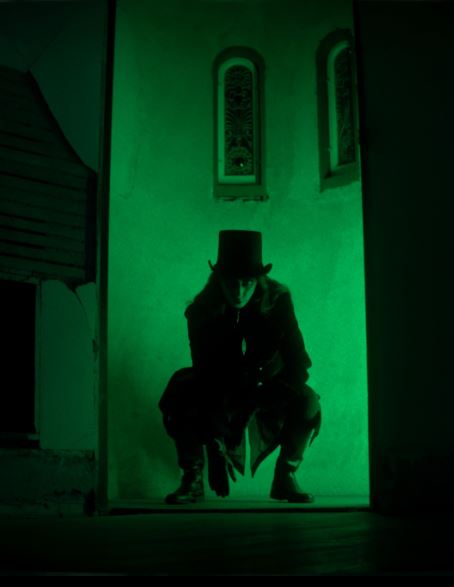
To understand witchcraft, we must descend into the darkness of the deepest oceans of the human mind. It is a descent that is wrapped in mystery and the inexplicable, and what cannot be explained is feared. Fear may lead to hysteria and because of what has gone before in the persecution of their predecessors, this fear can become the nightmare of modern witches, if not of modern society. Not long ago, in the foggiest centuries of ancient times, a solemn commission to blood drinkers, and indeed there had been a dim religion surrounding us in antique pagan days in which vampires had been worshipped as bringers of justice to those who had done wrong. There was sufficient hysteria to inspire the fear that a twentieth-century witch-hunt was about to begin, encouraged by the claims of anti-occult groups. The Conservative MP and lay preacher Mr. Geoffrey Dickens sought in the House of Commons to reactivate the Witchcraft Act of 1735—an act that had finally been laid to rest in 1951. He tabled an amendment to the Criminal Justices Bill, seeking to make it illegal for any person under eighteen to join or participate in any secret occult ceremonies or groups. His attempt, branded by occultists as repressive, was not admitted on the grounds that it was beyond the scope of the new Bill. However, by raising the issues at the highest level in the land Mr. Dickens gave credence to the view of the witches themselves, that witchcraft is not the bizarre and unimportant hobby of a mere handful of cranks. Mrs. Christopher Bray, one of the country’s largest purveyors of equipment to the occult World stated that he has 40,000 customers recorded on his computerized records, to whom he can supply everything from two grams of bat’s blood to a complete altar set for the most complicated of occult rituals. #RandolphHarris 7 of 13

Very soon, I understood what Mrs. Winchester meant when she said that some develop a taste for evil and maintain it. Often, the visions from their victims become stronger for them with every kill. They sometimes see colors when they kill. In fact, they sometimes see those color dancing around their victims before they ever even close in. Some people seem to walk in red-tinged shadows, and others emanate a fiery orange light. The angriest victims have a yellow glow. Although it seems like it, modern witchcraft is no longer an underground relic of which the scale and even the existence is hotly disputed by anthropologists. It is an active religious practice of a substantial number of people. Just how large a number is not certain because Wicca, beyond the individual coven, is not a hierarchically organized religion. However, the numbers are sufficient to support a variety of lively periodicals and the publication of an ever-growing body of literature. All the evidence suggests it is growing steadily. The figure in America exceeds 1 million. However, because of the lack of any formal structure, the whole movement appears so fragmented and loose in its form of worship, that it can now be pulled together and arranged under the one heading by which they now wish to be known, that of Pagans with a capitol “P.” At the center of the Pagan movement there is a strong body—a majority in fact—of witches who abide by the written laws and oral traditions of their craft, there are also many dangerous dabblers and renegade covens on the periphery. #RandolphHarris 8 of 13

These witches are beholden only to themselves, and certainly do not necessarily conform to the rules of harming no one. They deal in black magic, and some deliberately label themselves as Satanic Witches, not to mention a few groups who veer toward purely pleasures of the flesh and sadistic excitement and use witchcraft and the occult as shelter. Contemplating this thought, I stood one day, as I was about to embark upon writing, gazing into the old pond at the bottom of the Winchester Mansion’s Garden. Then I closed my eyes. In the cold stony darkness, I laid my powerful hands on a stone, and opened my eyes. I idly tossed the stone into the pond, as I watched it disappear into the waters, it occurred to me that this was a perfect analogy for a summary of witchcraft, and even the ripples, strong and vibrant at the center and becoming weaker at the farthest circle, the stone itself sinking down and down into the darkening gloom as the brightness of the moon’s light slowly fades, until it hits bottom and is lost into black and mysterious depts. Ancient ponds such as these are called “whores of the devil.” They date back to Henry VIII. The witch-hunts that came to the fore during Henry VIII’s reign and continued well into Georgian times, began the 1468 publication of the shocking work on demonology, the Malleus Maleficarum, or The Hammer of Witchcraft, written by two German inquisitors and inspired by Pope Innocent VIII as a textbook for the suppression of underground movement against the structure of a Catholic society. All Christian religions took up the call, though many Church leaders later had second thoughts as the hysteria ran riot and left thousands of murdered witches, so-called, and alleged heretics in its wake. #RandolphHarris 9 of 13

Witchcraft and sorcery and secret societies had been around for centuries, though in an altered form, but some historians are dubious that today’s witchcraft has much to do with early times. However, Witchcraft was the invention of the Inquisition and it did not exist until the Middle Ages. So it has become important to witches to argue otherwise and prove that their ceremonies and rituals have existed far longer than Christianity. In fact, it became something of an obsession among the leaders of modern witchcraft to prove their religion predates Christianity and Judaism by many thousands of years. There are two reasons for this. Firstly witches of recent times were often alone and needed a sense of belonging and spiritual involvement with the old gods and goddesses who they believe are the true inspiration of their religion, id est, the pre-Christian pagan gods worshipped around the World in remarkably similar but unconnected rituals, stretching from ancient Greece, Egypt, Celtic Europe, the Nordic lands to pre-colonial America. Secondly, they wanted to go back in time to reach out to these origins and make contact with the old gods to get away from the stigma of the Inquisition years and the witch craze which followed, when their persecutors and numerous historians purported to show that all witches were “bound slaves of the devil.” There is a third reason which is not generally spoken of and which lies in the explanation of certain magical powers witches are said to possess, that come to them either through learning or by inheritance. Those who claim they were lucky enough to be born with the powers are known today as hereditary witches. #RandolphHarris 10 of 13

The magic is as much esoteric as it is practical, covering their talent for clairvoyance, astral planning, telepathy and in general the use of the extrasensory powers in the human brain. To all this has been added the training of sorcery and alchemy, which involves the systematic use of spells, potions, rituals and so on for a specific purpose. Belief in these extrasensory is alone enough to utterly absorb some. It is traced back to primitive man, who possessed the instincts of animals—a kind of supersensory intuition, or sixth sense, which would alert one to danger and guide one to good hunting. When, through the process of man’s evolution, many of those powers slipped away witches and sorcerers found a way of retaining them by discovering the path to higher levels of consciousness than are normally used. Rituals practiced by witches and occultists today have been copied from known practices of prehistoric man, the hunter whose life was ruled by the elements of nature which he consequently worshipped—the sun, the moon, the Earth, the wind, fire and all the elements that affected daily life. The concept of Wicca worship can be tenuously identified with the cave drawings of these primitive communities, in which the Gods was made. They were depicted as the source of life, naked priestesses, maidens, high priestesses and, finally, witch queens. Give men enough time and they will turn on anyone. Christianity is a religion based on the notion that we are living in the Last Days! It is a religion fueled by the ability of men to forget all the blunders of the past, and get dressed once more for the Last Days. #RandolphHarris 11 of 13

In the primitive civilizations, two main godheads evolved, and they became modified and established over the decades to provide a female goddess of the skies, usually symbolized by the moon. Sometimes she was called the Great Earth Mother—the names varied according to country and language but they all linked her conclusibely with nature of fertility. Eventually she was more universally known by the Roman title of the moon goddess Diana, representing the feminine side of witches’ theology. Their male God of the Earth can be linked to early cave drawings of a Horned God, symbolically a stag or a goat, used to ward off danger. The Horned God became the phallic god, representing the strong and masculine side of nature. One of the earliest signs of the horned creature was to be discovered in the Stone Age relics of the Caverne de Trois Freres, Ariege, France, which showed a dancing figure, half beast and half man, with the sprouting antlers of a stag. These drawings are the earliest source of connection with today’s witchcraft, which worships the naked goddess of life and the Horned God. Around these images, the early communities built their rites and prayers to encourage the gods to bring them safety and good fortune. The gods were especially linked to fertility, so necessary to man’s survival, through crops, animals and their own children. And so, long before Christianity introduced the image of the devil, the horned god with tail and hooves could be found in cave art. The horned god was also linked with early human sacrifice. #RandolphHarris 12 of 13

Primitive cults believed that in order to sustain him and to prevent him from dying, his living representative, the Divine King and Incarnate God nominated by the community, had to be sacrificed on their altar so that his young blood would be taken to give continued life to the true god. Later, as the faith became more widely based and extended on tribal lines, the kings began to insist upon their divine right to rule, and rejected the need for sacrifice. It has been argued that these ancient gods and rites have actually nothing to do with witchcraft, that they were simply a part of the evolution of man’s wisdom, and that witches merely adopted the old pre-Christian gods of paganism and assumed the ritual and magic as their own heritage. It can certainly be shown that many of the witch practices performed today are almost perfect replicas of primitive ceremonies. I invoke and move thee, O thou, Spirit Vassago and your legions of Spirits and being exalted above ye in the power of the Most High, I say unto thee, Obey! in the name Beralensis, Baldachiensis, Paumachia, and Apologiae Sedes: and of the mighty ones who govern, spirits, Liachidae and ministers of the House of Death: and by the Chief Prince of the seat of Apologia in the Ninth Legion, I do invoke thee and by invoking conjure thee. And being exalted above ye in the power of the Most High, I say unto thee Obey! in the name of him who spake and it was, to whom all creatures and things obey. Moreover I, whom God made in the likeness of God, who is the creator according to his living breath, stir thee up in the name of which is the voice of wonder of the mighty God, El, strong and unspeakable, O thou Spirit Vassago. Conjuration of three angels Gebril! Meachuel! Nesanel! By the lamp of the threefold eternal light, let Vassago appear before me and bestow riches and power untold since the days of William Wirt Winchester! #RandolphHarris 13 of 13

Winchester Mystery House

Beautiful, Bizarre, and Unhinged. How many times have you visited the Winchester Estate during Halloween Season?
Buy Tickets | Link in bio. https://winchestermysteryhouse.com/unhinged/


Who is that Transistor Salesman?

Independence training in American society begins almost at birth—babies are held and carried less than in most societies and spend more time in complete isolation—and continues, despite occasional parental ambivalence, throughout childhood and adolescence. As we leave industrial era behind, we are becoming a more diverse society. The old smokestack economy serviced a mass society. The super-symbolic economy serves a de-massified society. Everything from life styles and products to technologies and the media is growing more heterogeneous. This new diversity brings with it more complexity, which, in turn, means that businesses need more and more data, information, and know-how to function. Thus, huge volumes of the stuff are being crammed into more and more cubbyholes—multiplying them beyond comprehension and stretching them to the bursting point. Today’s changes also come at a faster pace than bureaucracies can handle. An uptick of the yen in Tokyo causes instantaneous purchases and sales in Zurich or London. A televised press conference in Tehran triggers an immediate reply in Washington. A politician’s off-the-cuff remark about taxes sends investors and accountants instantly scurrying to reevaluate a takeover deal. This speed up of change makes our knowledge—about technology, markets, suppliers, distributors, currencies, interest rates, consumer preferences, and all the other business variables—perishable. #RandolphHarris 1 of 21

A firm’s entire inventory of data, skill, and knowledge is thus in a constant state of decay and regeneration, turning over faster and faster. In turn, this means that some of the old bins or cubbyholes into which knowledge has been stuffed begin to break into parts. Others are crammed to overload. Still others become useless as the information in them becomes obsolete or irrelevant. The relationships of all these departments, branches, or units to one another constantly change too. In short, the cubbyhole scheme designed for Year One become inappropriate for Year Two. It is easy to reclassify or sort information stored in a computer. Just copy a file into a new directory. However, try to change organizational cubbyholes! Since people and budgets reflect the scheme, any attempt to redesign the structure triggers explosive power struggles. The faster things change in the outside World, therefore, the greater the stress placed on bureaucracy’s underlying framework and the more friction and infighting. The real trouble starts, however, when turbulence in the marketplace, the economy, or society stirs up completely new kinds of problems or opportunities for the firm. Suddenly decision-markers confront situations for which no cubbyholded information exists. The more accelerated the rate of change in business—and it is speeding up daily—the more such one-of-a-kind situation crop up. #RandolphHarris 2 of 21

On December 3, 1984, the executives of Union Carbide awoke to discover that their pesticide plant in Bhopal, India, had released a toxic cloud and caused the single worst accident in industrial history. The disaster killed more than 3,000 and injured another 200,000. Decisions had to be made instantly, rather than through the usual tortuous process. Equally unique, though far less disastrous, events are hitting business executives like hailstones. In Japan, the managers at Morinaga Chocolate learn that a mysterious killer is poisoning their product…Guinness in Britain is struck by a stock manipulation scandal…Pennzoil and Texaco are flung into a titanic legal struggle…the Manville Corporation is forced to bankrupt itself in dealing with lawsuits arising from having exposed its workers to asbestos…CBS has to fend off a blitzkrieg raid by Ted Turner…United Airlines faces an unprecedented buy-out bid from its own pilots, which then falls apart and triggers a crash on Wall Street. Such events—and many that are smaller and less adequately prepared them, or their bureaucracies. When situations arise that cannot be easily be assigned to predesignated informational cubbyholes, bureaucrats get nasty. They begin to fight over turf, money, people—and the control of information. This unleashes tremendous amounts of energy and raw information. #RandolphHarris 3 of 21

The explosion of energy and raw information, instead of solving problems, all this human output is burned up in the Sturn und Drang. What is still worse, these fratricidal battles make the firm behave irrationally. The vaunted “rationality” of bureaucracy goes out the window. Power, always a factor, now replaces reason as the basis for decision. When a real fluke arises—something that does not fit naturally into anyone’s informational bailiwick—the company’s first instinct is to ignore it. This ostrich response is what happened the first time foreign cars began appearing in the United States of America. The earliest little Opels and Citroen Deux Chevaux that turned up on American streets in the late 1950s drew a shrug from Detroit’s bureaucrats. Even when floods of Volkswagens began to arrive, the giant bureaucratic auto makers preferred not to think about the unthinkable. There were no units inside their companies whose task was to fight foreign competition, no cubbyholes loaded with the necessary information. When bureaucracies are forced to deal with a problem that fts into no one’s existing cubbyhole, they behave in certain stereotyped ways. After some initial fencing, someone inevitably suggests setting up a new unit (with himself or herself at its head). This is instantly recognized for what it could easily become: a budget-eating rival of the older units. Nobody wants that, so a compromise is arrived at. This compromise is that familiar bureaucratic “camelephant,” the interdepartmental committee or task force. Washington is filled with them. So are big companies. #RandolphHarris 4 of 21

Combining the slow, lumbering gait of the elephant with the IQ of the camel, this new unit is, in effect, yet another cubbyhole, only this one is typically staffed by junior people, sent by their permanent departments not so much to solve the problem as to make sure that the new unit does not chip away at existing jurisdictions or budget allocations. Sometimes the new problem is such a hot potato that nobody wants to deal with it. It is either dumped on someone young, inexperienced, and luckless, or it becomes an orphan: another problem on its way to becoming a crisis. Faced by all this infighting, and exasperated CEO decides to “cut through the red tape.” One does this by appointing a “czar,” who theoretically will get the cooperation of all the relevant agencies, branches, and departments. However, lacking the information needed to cope with the problem, the czar, too, winds up depending on the pre-existing cubbyhole system. Next the CEO decides frontal assault on the bureaucrats below will do no good. So he or she tries another standard ploy, quietly assigning the problem to a “troubleshooter” on one’s personal staff, rather than waiting for the slow, resistant bureaucratic machine to act. This attempt to end-run the existing departments only further outrages them, at which point the offended units begin working diligently to assure staff failure. Something like this happened when Ronald Regan assigned staff from his National Security Council, not traditionally an operational unit, to take on functions more normally carried out by the Defense, State, or CIA bureaucracies. #RandolphHarris 5 of 21

The resulting attempt of Ronald Reagan’s decision to deal with “moderates” in Iran, in the hope that they would help release American hostages, blew up in the President’s face. (Afterward, the Tower Commission, investigating the Irangate fiasco, solemnly concluded that the scandal could have been avoided if the White House had “used the system”—meaning relied on the line bureaucracies rather than the White House staff. It left unsaid whether the bureaucracies, which had previously failed either to negotiate the hostage release or to rescue them with military force, would have succeeded where the staff failed.) Similar power games are played within each department, as its subunits also jockey for control of money, people, and knowledge. One might think that infighting stops at moments of dire crisis. Instead, the reverse happens when executive heads are on the block. In politics and even in the military, crisis frequently brings out the worst, rather than the best, in organizations. One has only to read the history of military interservice rivalry in the heat of battle, or the life-and-death struggles between rival British intelligence and covert action agencies during World War II, to glimpse the fanaticism that purely bureaucratic struggles can generate—especially during crisis. Businesses are not exempt from this destructive game-playing and fanaticism. For the image of the “rational” bureaucracy is false. It is power, not reason, that drives the classical pyramids that still litter the business landscape. #RandolphHarris 6 of 21

Any hope of replacing bureaucracy, therefore, involves more than shifting people around, laying off “fat,” clustering units under “group vice-presidents,” or even breaking the firm into multiple “profit centers.” Any serious restructure of business or government must directly attack the organization of knowledge—and the entire system of power based on it. For the cubbyhole system is in crisis. When the Japanese prime minister Hayato Ikeda visited France in the 1960s, Charles de Gaulle is said to have asked, “Who is that transistor salesman?” The faux pas has rattled down through history, but for its economic size and significance no country was more underestimated by the rest of the World than Japan in the 1960s and ‘70s. (Even more underestimated was the transistor, but that is another story.) In the 1980s and early 1990s, the reverse was true. Suddenly the yen threatened to displace the dollar, Japanese money was taking over Hollywood and Rockefeller Center, and Japan was being hailed as “No. 1.” Fears of a Japanese superstate rippled across the World’s financial pages. As the new century arrived, Econo-Land’s lemmings, marching in step, assured the World that China would soon be No. 1 and that Japan was about to become its economic and political “poodle.” Yet Japan could surprise the World once more. The basic changes it makes—or refuses to make—in the decade ahead will impact not only the cars we drive, the energy we use, the games we play and the music we enjoy but quite possibly the way we treat our elderly, the price of a retirement condo and the future of the dollar. #RandolphHarris 7 of 21

What Japan does will be especially relevant to a whole class of nations that, like the United States of America, members of the European Union and South Korea, are transitioning toward knowledge—intensivity. Unburdened by a large-scale peasant population, they are not trisected, like China, India, Mexico, or Brazil, but bisected—internally divided between a shrinking smokestack sector and a growing knowledge sector. Countless analyses purport to explain why the Japanese miracle came to a screeching standstill in the 1990s. What occurred was a strange crash, as crashes go. One could stroll along Omotesando in Tokyo, where foreigners and teenage fashionistas stop for a Crazy Large Soy Hazelnut Vanilla Latte, half decaf, and see little evidence of distress. As Kenichi Ohmae later wrote in his book The Invisible Continent, “Where are the beggars?”…Where were the double-digit unemployment rates?” Sales of fancy bottled water were zooming. Cruise ships were fully booked. And hordes of young Japanese women were buying “enough Hermes, Prada, Gucci, Louis Vuitton and similar products to make Japan the number one purchasing nation for most luxury brands.” Yet even now Japan’s economy feels the after-effects of a real estate bubble that sent property prices plummeting 60 percent between 1990 and 2003. In Tokyo, prices fell almost 80 percent. (And it could happen again once this new recession sets in that is expected in 2023.) #RandolphHarris 8 of 21

And real estate alone does not explain why Japan’s banks as late as 2003 still carried around nonperforming loans amounting, according to whom you believe, to around $400 billion. Worse yet, manufacturing output in 2003 was 10 percent below its 1991 level and, according to a Council on Foreign Relations report, Japan’s share of both global output and exports “was shrinking for the first time in a century.” What happened? Why did the superstate shrivel up? (Could China make the same mistakes? Its real estate bubble already seems to parallel Japan’s experience.) However, it takes more than real estate fizz—or bad bank loans—to explain what happened to Japan. The long-ticking bomb that blew Japan’s economy apart was, in fact, failure at the level of the deep fundamental of time. We interact largely with extensions of our own egos. We stumble over the consequences of our past acts. We are drowning in our own excreta (another consequence of the Toilet Assumption). We rarely come into contact with a force which is clearly and cleanly Not-Us. Every struggle is a struggle with ourselves, because there is a little piece of ourselves in everything we encounter—houses, clothes, BMWs, cities, machines, even our foods. There is an uneasy, anesthetized feeling about this kind of life—like being trapped forever inside an air-conditioned BMW with power steering and power brakes and only the car’s information center to talk to. Our World is only a mirror, and our efforts mere shadowboxing—yet shadowboxing in which we frequently manage to hurt ourselves. #RandolphHarris 9 of 21

To understand how nanotechnology might unfold, it makes sense to look at some of its easier and more difficult applications. The result will not be a timetable, or even a series of milestones, but it should give a better picture of what we can expect as nanotechnology develops from simple, crude, costly beginnings to a state of greater sophistication and lower cost. Molecular manufacturing will make better products possible. We are likely to see some early applications in at least two areas: stronger materials and faster computers. Strong materials are simple, and will be hard to pass up. Computers are more complex, but the payoff will be enormous. The computer industry has been under steady pressure to make computer ships ever smaller. As sizes have shrunk, costs had fallen, but are not rebounding, and efficiency and capabilities have increased. The pressure to continue this process pushes in the direction of nanotechnology; it may even be one of the major motivations behind developing the technology. Even technologies with enormous potential can lie dormant unless there are significant payoffs along the way to reward those who pioneer them. That is one of the reasons integrated circuits developed so rapidly; each advance found an immediate market willing to apply it and enrich the innovator that created it. #RandolphHarris 10 of 21

Does molecular engineering have this kind of payoff? I think it does. Remembering that we may be less than ten years away from “hitting the wall” as far as scaling our existing electronics goes, a great deal of research is presently going on in the area of molecular and quantum electronics. The payoff is easy to calculate: You can build devices one thousand times faster, more energy-efficient, and less expensive than those we are currently using—at least one hundred times better than exotic materials being considered to replace silicon when it reaches its limits. Electronic researchers will keep pushing for smaller devices because silicon only has so much potential. At some point we will reach difficulties: some people say at a hundred-fifty nanometers, others think it is beyond that. What will happen then? It is hard to think that the electronics industry will say, “Stop here. We will stop evolving because we cannot shrink a device.” From an economic point of view, in order to survive, an industry has to innovate continuously. The computer industry’s push toward devices of molecular size has an air of inevitability. Today’s researchers struggle to build molecular electronics using bulk techniques, with no products yet in sight; with molecular manipulators, they will finally have the tools they need for fast and accurate experimentation. Once successful designs are developed, packaged, and tested, the pressure will be on to learn to make them in quantity at low cost. The competitive pressures will be fierce, because advanced molecular electronics will be orders of magnitude better than today’s integrated circuits, untimely enabling the construction of computers with trillionfold greater capability. #RandolphHarris 11 of 21

At the opposite extreme from molecular electronics—complex at first worth billions of dollars per gram—are structural materials: worth only dollars per kilogram in most applications, but much simpler in structure. Once molecular manufacturing becomes inexpensive, structural materials will be important products. These materials play a central role in almost everything around us, from cars and aircraft to furniture and houses. All of these objects get their size, shape, and strength from a structural skeleton of some sort. This makes structural materials a natural place to begin in understanding how nanotechnology can improve products. Cars today are mostly made of steel and carbon fiber, aircrafts of aluminum, and buildings and furniture largely of steel and wood. These materials have a certain “strength-to-weight ratio” (more properly, a strength-to-density ratio). To make cars stronger and lighter, we have to use new materials like carbon fiber so they are not weaker and less safe. Clever design can change of material. Making something heavy is easy: just leave a hollow space, then fill it with water, sand, or lead shot. Making something light and stronger is more difficult, but often makers try to make cars lightweight, aircraft manufacturers try harder, and with spacecraft manufactures it is an obsession. Reducing mass saves materials and energy. The strongest materials in use today are mostly made of carbon. Kevlar, used in racing sails and bulletproof vests, is made of carbon-rich molecular fibers. #RandolphHarris 12 of 21

Expensive graphite composites, used in tennis rackets and jet aircraft, are made using pure-carbon fibers. Perfect fibers of carbon—both graphite and diamond—would be even better, but cannot be made with today’s technology. Once molecular manufacturing gets rolling, though, such materials will be commonplace and inexpensive. What will these materials be like? To picture them, a good place to start is wood. The structure of wood can vary from extremely light and porous, like balsa wood, to denser structures like Oak. Wood is made by molecular machinery in plants from carbon-rich polymers, mostly cellulose. Molecular manufacturing will be able to make materials like these, but with a strength-to-weight ratio about a hundred times that of mediocre steel, and tens of times better than the best steel. Instead of being made of cellulose, those materials will be made of carbon in forms like diamond. Diamond is emphasized here not because it is shiny and expensive, but because it is strong and potentially inexpensive. Diamond is just carbon with properly arranged atoms. Companies are already learning to make it from natural gas at low pressure. Molecular manufacturing will be able to make complex objects of the stuff, built lighter than balsa wood but stronger than steel. #RandolphHarris 13 of 21

Products made of such materials could be startling by our present standards. Objects could be made that are identical in size and shape to those we make today, but simultaneously stronger and 90 percent lighter. This is something to keep in mind next time you are lugging a heavy object around. (If something needs weight to hold it in place, it would be more convenient to add this ballast when the thing is in its proper location than to build in the extra weight permanently.) Better structural materials will mark aircraft lighter, stronger, and more efficient, but will have the greatest effect on spacecraft. Today, spacecraft can barely reach orbit with both a safety margin and cargo. To get there at all, they have to drop off parts like boosters and takes along the way, shedding weight. With strong materials, this will change: as in the space-travel-for-business scenario, spacecraft will become more like aircraft today. They will be rugged and reliable, and strong enough and light enough to reach space in one piece. The term “science,” as it is generally used today—referring to the work of those in physical, chemical, and biological disciplines—was popularized in the early nineteenth century, with significant help from the formation of the British Association for the Advancement of Science in 1831 (although Murray’s New English Dictionary gives as the earliest use of the term in its modern sense). By the early twentieth century, the term had been appropriated by others, and it has since become increasingly familiar as a description of what psychologists, sociologists, and even anthropologists do. It will come as no surprise that I claim this is a deceptive and confusing use of the term, in part because it blurs the distinction between processes and practices. #RandolphHarris 14 of 21

Using definitions proposed by the British philosopher Michael Oakeshott, we may say that “processes” refers to those events that occur in nature, such as the orbiting of planets or the melting of ice or the production of chlorophyll in a leaf. Such processes have nothing to do with human intelligence, are governed by immutable laws, and are, so to say, determined by the structure of nature. If one were so inclined, one might even say that processes are the creation of God. By “practices,” on the other hand, Oakeshott mean the creations of people—those events that result from human decisions and actions, such as writing or reading this essay or forming a new government or conversing at dinner or falling in love. These events are a function of human intelligence interacting with environment, and although there is surely a measure of regularity in human affairs, such affairs are not determined by natural laws, immutable or otherwise. In other words, there is an irrevocable difference between a blink and a wink. A blink can be classified as a process; it has physiological causes which be understood and explained within the context of established postulates and theories. However, a wink must be classified as a practice, filled with personal and to some extent unknowable meanings and, in any case, quite impossible to explain or predict in terms of causal relations. #RandolphHarris 15 of 21

What we call science, then, is the quest to find the immutable and universal laws that govern processes, presuming that there are cause-and-effect relations among these processes. It follows that the quest to understand human behaviour and feeling can in no sense except the most trivial be called science. One can, of course, point to the fact that students of both natural law and human behaviour often quantify their observations, and on this common ground classify them together. A fair analogy would be to argue that, since a housepainter and artist both use pain, they are engaged in the same enterprise and to that same end. The scientist uses mathematics to assist in uncovering and describing nature. At best, sociologists (to take one example) use quantification merely to give some precision to their ideas. However, there is nothing especially scientific in that. All sorts of people count on things in order to achieve precision without claiming they are scientists. Bali bondsmen count the number of murders committed in their cities; judges count the number of divorce actions in their jurisdictions; business executives count the amount of money spent in their stores; and young children like to count their toes and fingers in order not to be vague about how many they have. Information produced by counting may sometimes be valuable in helping a person get an idea, or, even more so, in providing support for an idea. However, the mere activity of counting does not make science. #RandolphHarris 16 of 21

Nor does observing things, though it I sometimes aid that if one is empirical, one is scientific. To be empirical means to look at things before drawing conclusions. Everyone, therefore, is an empiricist, with the possible exception of paranoid schizophrenics. To be empirical also means to offer evidence that others can see as clearly as you. You may, for example, conclude that I like to write essays, offering evidence that I have written this one and several others besides. You may also offer as evidence a tape recording, which I can supply on request, on which I tell you that I like to write essays. Such evidence may be said to be empirical, and your conclusion empirically based. However, you are not therefore acting as a scientist. You are acting as a rational person, to which condition many people who are not scientists may make a just claim. Scientists do strive to be empirical and where possible precise, but it is also basic to their enterprise that they maintain a high degree of objectivity, which means that they study things independently of what people think or do about them. The opinions people hold about the external World are, to scientists, always an obstacle to be overcome, and it is well known that the scientist’s picture of the external World is quite different from what most people believe the World to be like. Moreover, in their quest for objectivity, scientists proceed on the assumption that the objects they study are indifferent to the fact that they are being studied. #RandolphHarris 17 of 21

Heisenberg’s uncertainty principle indicates that at subatomic levels particles do “know” they are being studied, at least in a special meaning of “knowing.” An electron, for example, changes either its momentum or its position when it is being tracked—id est, when it interacts with a photon—but the electron does not, in the usual sense of the word, “know” or “care” that the interaction is taking place. Nor fact relives the scientist of inquiring into their values and motivations and for this reason alone separates science from what is called social science, consigning the methodology of the latter (to quote Gunner Myrdal) to the status of the “metaphysical and pseudo-objective.” The status of social-science methods is further reduced by the fact that there are almost no experiments that will reveal a social-science theory to be false. Theories in social science disappear, apparently, because they are boring, not because they are refuted. However, as Karl Popper has demonstrated, science depends on the requirement that theories must be stated in a way that permits experiments to reveal that they are false. If a theory—as, for example, Dr. Freud’s theory of the Oedipus complex. Psychiatrists can provide many examples supporting the validity of the theory, but they have no answer to the question “What evidence would prove the theory false?” Believers in the God theory (sometimes called Creation Science) are silent on the question “What evidence would show that there is no God?” #RandolphHarris 18 of 21

I do not say, incidentally, that the Oedipus complex and God do not exist. Nor do I say that to believe in them is harmful—far from it. I say only that, there being no tests that could, in principle, show them to be false, they fall outside the purview of science, as do almost all theories that make up the content of “social science.” Our ideas about institutionalizing the aged, psychotic, those with intellectual disabilities, and infirm are based on a pattern of thought that we might call the Toilet Assumption—the notion that unwanted matter, unwanted difficulties, unwanted complexities, and obstacles will disappear if they are removed from out immediate field of vision. We do not connect the trash we throw from the car window with the trash in our streets, and we assume that replacing old buildings with new expensive ones will alleviate poverty in the slums. The housing program should really be a national system so we can pay people and give the subsidies housing if they choose to go somewhere that is underpopulation so we can spread them out and maybe they can find solutions among the general population, instead of being segregated and making other people’s lives difficult with their creation of a vortex of negativity. Nonetheless, we throw the aged and psychotic into institutional holes where they cannot be seen. Our approach to social problems is to decrease their visibility: out of sight, out of mind. This is the real foundation of racial segregation and segregation of the disabled, until, by accident, they are placed in a community where they are too dysfunctional and dangerous to miss. #RandolphHarris 19 of 21

The result of our social efforts has been to remove the underlying “problems” of our society father and farther from daily experience and daily consciousness, and hence to decrease, in the mass of population, the knowledge, skill, resources, and motivation necessary to deal with them. In 2006, I was shocked to see people in Beijing, China asleep, during the day, on the street and sometimes with their baby. I had never seen anything like that before. However, as we approach 2023, and the Capitol of the State of California is renovated, shortly after the Golden 1 Center in Sacramento was funded with about half a billion taxpayer dollars, and the Safe Credit Union Theater used hundred of millions of taxpayer dollars to give it a 1970 themed make over, and as crime erupts on our streets, and people without homes are forming their own row of tents across the street from million dollar homes, in parks, creek beds, and on the sides of freeways, the mismanagement and abuse of taxpayers is too big to go unnoticed. As these discarded problems rise to the surface again—a riot, a protest, an expose in the mass media—politicians are as quit as if they let a little raw sewage slip out of their undercarriage at dinner party. Nothing has miraculously vanished. Excrement is conspicuously present in the public eye. However, one thing I have also noticed is that many of these people that are without homes and sleeping in tents are not only more attractive, but also have better hygiene than my neighbours and just need a helping hand, and they are peaceful and quiet. #RandolphHarris 20 of 21

In the hard reality of everyday life, the incorruptible human is at best an inconvenience, an obstacle to the smooth functioning of vast institutional machinery. We have a government and taxes to help those that cannot help themselves, not to use for renovations when homelessness is at an all-time historical high. Humans who proclaim Thy sovereignty in witness to Thy truth, acknowledging Thy guidance, Thy wisdom, Thy power; humans who break every idol blindly wrought, dispelling the darkness with Thy spirit of light. O Lord, give us steadfast humans! Give us humans to guide us, humans to make us know, that Torah is our way of life, and righteousness our goal. With such humans to guide us, our faith shall never fail. Our courage never falter; our future is assured. God forbid that we should forsake the Law to depart from our religion either to the right or the left. Whosoever is zealous of the Law and maintaineth the covenant, let us follow one. Hide your children and pull down the heathen altars, and recover the Law out of the hand of the heathens. Be ye zealous for the Torah and give your lives for the covenant of your fathers. Remember what our fathers did in times gone by. Throughout all the ages none that put their trust in God were overcome. Therefore be strong, my people, and show yourselves humans in behalf of the Torah; for by it shall ye obtain glory. How shall we be able, being so few, to fight against so many people and so strong? With the God of Heaven it is all one to deliver us with a large number, or with a small one. For the victor of battle standeth not in the multitude of a host; but strength cometh from God. We fight for our lives and our Torah. The Lord will overthrow them. Be not afraid. Let all the nations know that there is One who will protect and save America. #RandolphHarris 21 of 21

CRESLEIGH HAVENWOOD
Lincoln, CA | from the high $600,000s
Now Selling!

Cresleigh Havenwood is a highly desired collection of luxury single family homes, featuring four state-of-the-art home designs ranging from approximately 2,300 square feet to 3,400 square feet.

This expansive two-story floor plan is great for growing families. The main level offers the best of open-concept living including a great room, a generous dining area and kitchen, and a formal dining room, where you’ll enjoy gathering with loved ones on special occasions.

Flex rooms allow for added bedrooms, multigenerational suites or office space to fit your family’s lifestyle needs. Whichever home you choose, it will be an immediate charmer. Best of all, each Cresleigh home comes with owned solar included!

Located off of Virginiatown Road and McCourtney Road, residents of the 83 homesites of Cresleigh Havenwood will benefit from a brand new neighborhood in the charming City of Lincoln.
Palo Verde Park, is just down the street and there’s plenty of recreation to take part in all around town. Come make a Cresleigh Home your forever home. #CresleighHomes

We Love to Indulge Our Children

Scientific management established objectively based norms of production for every job in the armory. Workers are often times kept under surveillance, and their actual productivity is measured against the established productivity norms. The results of these methods have generally led to a dramatic increase in productivity and decrease in costs. The principles of calculability and grammatocentrism are, of course, the foundation of modern systems of management. Calculability led inevitably to such ideas as detailed accounting systems, inventory control, and productivity norms. Grammatocentrism promoted the idea that the best way to run a business is to know it through reports of those lower down the line. One manages, in other words, by the “numbers” and by being removed from the everyday realities of production. It is worth saying that the basic structure of business management originated in nonbusiness contexts. Still, it did not take very long for American businesses to begin to adopt the principles of Thayer, Tyler, and Whistler, and by doing so they created what we now thing of as a modern corporation. Indeed, management defines what we mean by a corporation, and has, more perhaps than machinery, created massive and complex business organizations that are the tangible manifestation of advanced technology. So long as Mao Zedong was live, China’s economy was divided in two. One part was the rural China of desperately poor peasants. The other was the urban China of smokestacks and assembly lines. What Mao’s successors have done is add a fast-growing knowledge-based sector. Unlike the bisected China of the past, China is now trisected. #RandolphHarris 1 of 20

China is the only trisected country in the World today. Three distinctly different wealth systems can be found in other nations as well—in India, Mexico, and Brazil, for example. However, the very existence of trisected countries is new to World history. And here, too, Chia is pioneering new territory. As we have seen, China’s twin-track development strategy has helped lift vast numbers out of the worst poverty and to raise its stature and influence among nations. However, all this comes with a hidden price. Each wealth wave in a country has its own constituency, so to speak—a population defined not simply by the nature of its work but by its needs and demands. The result is “wave conflict.” When China’s leaders allocate resources to cutting-edge labs, they face stubborn opposition from those who want the money to support manufacturing industries and social welfare. This conflict, however, is just a skirmish. On a far larger scale, at the national level, the replacement of President Jiang Zemin by Hu Jintao reflected a major shift of “wave policy.” The Jiang government was seen by many as following a “city-first” strategy. By contrast, as soon as Hu took office, he made a symbolic tour of the interior, promising increased financial assistance to the hard-pressed less affluent. No sooner was this tour over, however, than the wave battle was renewed. Opponents attacked this assistance to the interior as a giant waste of money and proposed, instead, to relocate additional millions of less affluent people from the west to the northeast’s rust belt. This opened the top of seventy million impoverished rural souls who, having already lost their land, were compelled to stream into the cities in search of sweatshop jobs. #RandolphHarris 2 of 20

This process is classic, closely resembling the forced migration of British peasants to the cities in the late 1700s and early 1800s, spurred by legislation known as the Enclosure Acts. The consequence was the continual enlargement of the pool of extremely low-waged factory labour—and the consequent speedup of England’s conversion from an agrarian to an industrial economy. In China’s own past, as in the former Soviet Union, fierce ideological battles were waged over so-called “industrial bias”—the policy that raised capital for industrial development by squeezing and starving even those peasants who stayed on land. Wave conflict led to gulags and the death of tens of millions. Between 1953 and 1983, peasants contributed more than $72 billion to the country’s industrialization program. Despite promised reforms, even today, Beijing enforces a two-class system, denying peasants the medical, pension and welfare benefits that many urban residents have, while often denying them the right to become urban residents. Add to that the fact that a huge portion of China’s urban boom has been financed by massive, yet indirect taxation on peasantry, including fees for education in rural areas. There remains in China today strong support for Second Wave industrialization. However, some believe this strategy increases the risk of a financial crisis. Further, it may tax already scarce natural resources, damage China’s fragile ecosystems and undermine efforts at technology innovation and upgrading of products. Under policies that prioritize heavy industries…enterprises are satisfied with merely increasing their production of low-value-added and low-profit products…This will cause severe harm over time. #RandolphHarris 3 of 20

These top-level wave policy struggles take place against a background of mushrooming unrest. China is racked with protests by both peasants and workers. Police and security forces are putting down militant marches and rallies from one end of the country to the other. The issues range from unemployment, nonpayment of wages, local corruption and forced relocation to high taxes, fees and other impositions, with new demonstrations breaking out seemingly every day. There were approximately 100,000 protests across China in 2020, involving 5.8 million participants, widespread violence and numerous deaths. Many protests occur in rural communities where peasants have been cheated by local officials or fight to hold on to their land. A single rally in Sichuan drew ninety thousand angry farmers facing eviction from their homes. Other protests are among industrial labourers—textile workers in Shaanxi, metal workers in Liaoyang, laid-off oil workers in Daqing and miners in Fushun. Some of these protests are extremely violent. For instance, in December of 2005, Chinese police opened fire on protesting farmers in Dongzhou in the deadliest confrontation since the massacre in Tiananmen Square in June 1989. The list goes on. Running a country or a business can be a challenge. While the business press had paid superficial attention to the rise of business spying, little has been said about the relationship of CI to the spread of information systems and the rise of the chief information officer. Yet the connection is not hard to find. It is easy enough to picture the espionage branch of a business requesting cooperation from the chief information officer in gathering information about the competitor. #RandolphHarris 4 of 20

The CIO is increasingly responsible not merely for information systems inside the firm, but for electronic links into data bases of other companies. This means one controls systems that penetrate, at least to some limited degree, the electronic perimeter of suppliers, customers, or others, and information from or about a competitor may be no more than one electronic synapse away. For more than a year, three West German computer spies were able to access data relating to nuclear weapons and the strategic defense initiative (SDI) by breaking into 430 computers. They rifled at will through more than 30 of them linked in a network set up by the Pentagon’s Defense Advanced Research Projects Agency. They were spotted only after Clifford Stoll, an ex-hippie computer system manager at the Lawrence Berkeley Laboratory, noticed a 75-cent discrepancy between two files. Many business networks are stilly highly vulnerable to penetration by determined thieves or spies, including disgruntled current or former employees suborned by a competing firm. Members of most [local area networks can add modems to their personal computers, creating new passageways in the system unbeknownst to system administrators. With customers able to access a manufacturer’s inventory records electronically, with suppliers made privy to their customers’ design secrets, the possibilities for the diversion of information to a competitor are real, despite access limits and passwords. #RandolphHarris 5 of 20

This access, moreover, can be direct or through intermediaries—including intermediaries who are unaware of what they are doing. In the CIA jargon, some informants are “writing” and others not. Business spies, too, can make use of third parties to gain access to information useful as ammunition in the info-wars. If, say, two retailers like Wal-Mart and K Mart are both electronically plugged into the computers of the same supplier, how long will it be before an overzealous CI unit, or one of a growing horde of CI consultants, proposes breaking through the ID numbers and passwords on the manufacturer’s mainframe, or tapping into the telecommunications lines and foraging through its data banks? If the United States of America’s government defense research network could be compromised by Russian intelligence, relying on a few spies armed with personal computers and working from their homes in West Germany, how secure are the commercial networks and corporate data bases on which our economy now depends? The example is purely hypothetical, with no implication that either Wal-Mart or K Mart has actually done this or would even consider it. However, there are now thousands of electronic data interchange systems, and new technologies open stunning opportunities for both licit and illicit data collection. With only a little imagination, one can picture a competitive intelligence firm planting equipment across the street from a major store and tapping into signals sent by optical scanners to its cash registers, thus supplying rich, real-time data to a competitor or manufacturer. #RandolphHarris 6 of 20
As discovered in the United States of America’s Embassy in Moscow have shown, it is already technologically possible for one firm to rig devices that will literally print out a duplicate of every letter typed by the CEO’s secretary in a rival firm. However, total information war might not end with passive information collection. The temptation to engage in “commercial covert action” is growing. The day may come when a hard-pressed competitor feeds false orders into a rival firm’s computers, causing it to overproduce the wrong models and undersupply those that are directly competitive. Revolution in video, optics, and acoustics open the way to spy on or interfere with human-to-human communication as well. Speech synthesis may make it possible to fake the voice of a manager and use it to give misleading telephone instructions to a subordinate. The imaginative possibilities are endless. All this, of course, has led to a race to develop counterintelligence technologies. Some networks now require users to have a card that generates passwords in synchronization with those demanded by a host computer. Other systems rely on fingerprints or other physical and behavioural traits to confirm the identity of a user before allowing access. One system shoots a beam of low-intensity infrared light into a person’s eye and scans the unique blood vessel patterns in the back of the retina to confirm identity. Another identifies a user by the rhythm of one’s key-strokes. #RandolphHarris 7 of 20

Because of its cost, sophisticated encryption or coding is largely limited today to the defense industries and financial institutions—banks, for example, making electronic funds-transfers. However, GM already codes information moving on its electronic interchange links, and the toy-maker Mattel encodes certain data when they are down-loaded to a customer’s computers or when they are physically transported from place to place. Seesaw battles between offense and defense are a reflection of the info-war. At every level of business, therefore—at the level of global standards for television and telecommunications…at the level of the retailer’s checkout counter…at the level of the automatic teller machine and the credit card…at the level of extra-intelligence and counterintelligence—we are surrounded by info-war and info-warriors fighting to control the most crucial resource of the Powershift Era. In this Powershift Era, there are two reasons why the case of management is instructive First, management, like the zero, statistics, IQ measurement, grading papers, or polling, functions as does any technology. It is not made up of mechanical parts, of course. It is made up of procedures and rules designed t standardize behaviour. We may call any such system or procedure and rules a technique; and there is nothing to fear from techniques, unless, like so much of our machinery, they become autonomous. There is the rub. In a Technopoly, we tend to believe that only through the autonomy of techniques (and machinery) can we achieve our goals. This idea is all the more dangerous because no one can reasonably object to the rational use of techniques to achieve human purposes. #RandolphHarris 8 of 20

Indeed, I am not disputing that the technique known as management may be the best way for modern business to conduct its affairs. We are technical creatures, and through our predilection for and our ability to create techniques we achieve high levels of clarity and efficiency. Language itself is a kind of technique—an invisible technology—and through it we achieve more than clarity and efficiency. We achieve humanity—or inhumanity. The question with language, as with any other technique or machine, is and always has been, Who is to be the master? Will we control it, or will it control us? The argument, in short, is not with technique. The argument is with the triumph of technique, with techniques that become sanctified and rule out the possibilities of other ones. Technique, like any other technology, tends to function independently of the system it serves. It becomes autonomous, in the manner of a robot that no longer obeys its master. Second, management is an important example of how an invisible technology works subversively but powerfully to create a new way of doing things, a classic instance of the tail wagging the dog. It is entirely possible for business and other institutions to operate without a highly technicalized management structure, however hard for us to imagine. We have grown so accustomed to it that we are near to believing management is an aspect of the natural order of things, just as students and teachers have come to believe that education would be impossible without the structure of a college course. And politicians believe they would be adrift without the assistance of public-opinion polling. #RandolphHarris 9 of 20

When a method of doing things becomes so deeply associated with an institution that we no longer know which came first—the method or the institution—then it is difficult to change the institution or even to imagine alternative methods for achieving its purposes. And so it is necessary to understand where our techniques come from and what they are good for; we must make them visible so that they may be restored to our sovereignty. Using fast, precise machines to handle matter in molecular pieces makes it easy for nanotechnology to be fast, clean, and very affordable. However, for it to be inexpensive, the manufacturing equipment has to be inexpensive. Molecular-manufacturing equipment can be used to make all the parts needed to build more molecular manufacurting equipment. It can even build the machines needed to put parts together. This resembles an idea developed by NASA for a self-expanding manufacturing complex on the Moon, but made faster and simpler using molecular machines and parts. One way to build a lot of molecular-manufacturing equipment in a reasonable time would be to make a machine that can be used to make a copy of itself, starting with special but simple chemicals. A machine able to do this is called a “replicator.” With a replicator and a pot full of the right fuel and raw materials, one could start with one machine, then have two, four, eight, and so on. This doubling process soon makes enough machines to be useful. #RandolphHarris 10 of 20

The replicators—each including a computer to control it and a general-purpose assembler to build things—could then be used to make something else, like tons of specialized machines needed to set up a manufacturing plant. At that point, the relicators could be discarded in favour of those more efficient machines. Some replicators look like huge tanks, as high as three story tall. Most of the interior is taken up by a tape memory system that tells how to move the arm to build all the parts of the replicator, except the tape itself. The tape gets made by a special tape-copying machine. At the right-hand end, replicators have pores for bringing in fuel and raw-material molecules, and machinery for processing them. In the middle are computer-controlled arms. These do most of the actual construction. The steps in the cycle—using a copy to block the tube, beginning a fresh copy, then releasing the old one—illustrate one way for a machine to build a copy of itself while floating in a liquid, yet doing all its construction work inside, in a vacuum. (It is easier to design for vacuum, and this exploratory-engineering work, so easier design is better design.) Calculations suggest that the whole construction cycle can be completed in less than a quarter hour, since the replicator contains about a billion atoms, and each arm can handle about a million atoms per second. At that rate, one device can double and double again to make trillions in about ten hours. #RandolphHarris 11 of 20

Each replicator just sits in a chemical bath, soaking up what it needs and making more replicators. Eventually, either the special chemicals run out, or other chemicals are added to signal them to do something else. At that point, they can be reprogrammed to produce anything else one pleases, so long as it can be extruded from the front. The products can be long, and can unfold or be pieced together to make larger objects, so the size of these initial replicators—smaller than a bacterium—would be only a temporary limitation. From the molecular manipulators and primitive assemblers we discussed, the most likely path to nanotechnology leads to assemblers with more and more general capabilities. Still, efficiency favours special-purpose machines, and that is why some companies do not make much use of general assemblers. Why bother making general-purpose assemblers in the first place? Well, why not build such a tool? There is nothing outstandingly difficult about a general assembler, as molecular machinery goes. It will just be a device with good, flexible positional control and a system to feed it a variety of molecular tools. This is a useful, basic capability. General purpose assemblers could always be replaced by a lot of specialized devices, but to build those specialized devices in the first place, it makes sense to come up with a more flexible, general-purpose system that can just be programmed. #RandolphHarris 12 of 20

So, general purpose machines are likely to find use in making short production runs of more specialized devices. Ralph Merkle, a computers and security expert at Xerox Palo Alto Research Center, sees this as paralleling the way manufacturing works today: “General purpose devices could do many tasks, but they will do them inefficiently. For any given task, there will be one or a few best ways of doing it, and one or a few special-purpose devices that are finely tuned to do that one task. Nails are not made by a general-purpose machine shop, they are made by nail-making machines. Making nails with a general-purpose machine shop would be more expensive, more difficult, and more time-consuming. Likewise, in the future we will not see a proliferation of general-purpose self-replicating systems, we will see specialization of every task.” At its base, nanotechnology is about molecular manufacturing, and manufacturing is the basis of much of today’s industry. From an industrial perspective, it makes sense to think of nanotechnology in terms of products and production. Today, we handle matter crudely, but nanotechnology will bring thorough control of the structure of matter, the ability to build objects to atom-by-atom specifications. This means being able to make almost anything. By comparison, even today’s range of products will feel very limited. Nanotechnology will make possible a huge range of new products, a range we cannot envision today. Still, to get a feel for what is possible, we can look at some easily imagined applications. #RandolphHarris 13 of 20

Today, products often fail, but for failures to occur—for a wing to fall off an airplane, or a bearing to wear out—a lot of atoms have to be out of place. In the future, we can do better. There are two basic reasons for this: better materials and better quality control, both achieved by molecular manufacturing. By using materials tens of times stronger than steel, it would be easy to make things that are very strong, with a huge safety margin. By building things with atom-by-atom control, flaws can be made very rare and extremely small—nonexistent, by present standards. With nanotechnology, we can design in big safety margins and then manufacture the design with near-perfection. The result will be products that are tough and reliable. (There will still be room for bad designs, and for people who wish to take risks in machines that balance on the edge of disaster. Today, we make most things from big chunks of metal, wood, plastic, and the like, or from tangles of fibers. Objects made with molecular manufacturing can contain trillions of microscopic motors and computers, forming parts that work together to do something useful. A climber’s rope can be made of fibers that slide around and reweave to eliminate frayed spots. Tents can be made of parts that slide and lock to turn a package into a building. Walls and furniture can be made to repair themselves, instead of passively deteriorating. On a mundane level, this sort of flexibility will increase reliability and durability. Beyond this, it will make possible new products with abilities we never imagined we needed so badly. And beyond even this, it will open new possibilities for art. #RandolphHarris 14 of 20

Today, production requires a lot of labour, either for making things or for building and maintaining machines that make things. Labour is expensive, and expensive machines make automation expensive, too. However, molecular manufacturing can make production far less expensive than it is today. This is perhaps the most surprising conclusion about nanotechnology, so we will take a lot at it in the future. Today, our manufacturing processes handle matter sloppily, producing pollution. One step puts stuff where it should not be; the next washes it off the product and into the water supply. Our transportation system worsens the problem as unreliable trucks and tankers spill noxious chemicals over land and sea. Everything is expensive, so companies skimp on even the half-effective pollution controls that we know how to build. Nanotechnology will mean greater control of matter, making it easy to avoid pollution. This means that a little public pressure will go a long way toward a cleaner environment. Likewise, it will make it easy to increase efficiency and reduce resource requirements. Products, like the Red Cross tents at Desert Rose, can be made of snap-together, easily recyclable parts. Sophisticated products could even be made from biodegradable materials. Nanotechnology will make it easy to attack the causes of pollution at their technological root. Nanotechnology will have great applications in the field of industry, much as transistors had great applications in the field of vacuum-tube electronics, and democracy had great applications in the field of monarchy. It will not so much advance twenty-first century industry as replace it—not all at once, but during a thin slice of historical time. #RandolphHarris 16 of 20

You say you want a revolution–rock music’s vitality and appeal stems from the fact that it…proselytized for an alternate religiousness. This makes it a much more potent threat to the established order than even its most vociferous opponents believe it to be. Here is the very essence of the cultural revolution taking place in America: the rejection of America’s religious heritage and its replacement with something contrary. It is not the Devil behind rock and roll–it is another god. What is their left to shock parents with? Pleasures of the flesh are not shocking anymore. Only the Devil is left. Stoners are engaged in Satanic worship, cemetery seances, and blood sacrifice. Upon one investigation, ceremonial robes, an inverted crucifix, and other Satanic paraphernalia were seized from the mansion of a major celebrity. It was eerie, they were listening to Ozzy Osbourne’s “Suicide Solution.” But you find you are chasing mostly shadows. Satanic messages are, through rock music, being slipped past that part of the listener’s brain which rejects information, through the use of low-frequency sound waves. These waves can alter moods and behaviours. The perpetrators of this conspiracy, as well as many of the fans of the music, are adept in occult matters, and other secret codes employed in the music being used as methods of communication. Members of stoner cults are quiet adept at writing backward and using the Runic, Theban, Hebrew, Pafsing, Malchim, and Celestial alphabets. That is why much of their graffiti is not recognizable to the untrained eye. #RandolphHarris 17 of 20

In a song by Mick Jagger, “Sympathy for the Devil,” a socially sophisticated Satan returns to Moscow to observe the results of his work–the Russian Revolution. It is better to use the voting system and restore law and order. It has long been believed that Satanists are in control of the music industry. Britney Spears sang a song about meeting Satan called “I’ve just begun.” The encounter is indirectly applied. Backward-masked propaganda audible only when digital or physical copies of music are played backward expose some shocking statements. The songs of Led Zeppelin, ELO, the Cars, Styx, and Black Oak Arkansas were exposed for containing messages such as “I live for Satan” and “Satan is God.” Even the theme for the old Mr. Ed series was alleged to be Satanic. “A Horse is a Horse,” when played in reverse, becomes “Someone sung this song for Satan.” Satan is an outlet for many youth. Trying to channel his power allows them to release their anxiety and frustration. Satanic symbols, such as the inverted cross, the pentagram, the swastika, the Star of David, and other occult art is painted or placed underground, under bridges, in flood-control channels and under freeways to be closer to Hell and the Devil. The occult is the exact opposite of Christianity. However, even a dead frog can become evidence of a Satanic cult, and misappropriation of law enforcement resources. Satanic cults are seen as a threat, but we welcome open borders. A person could go stupid, as well as deaf listening to the mindless, boring inanity of the local news. #RandolphHarris 18 of 20

If an American Fuehrer does appear, he or she will be wearing a business suit and will be calling popular attention to the patriotic virtues in 1776. Satanism, along with other occult belief systems, have historically made it appearance in times of social fragmentation, when the established system of norms and values is in a state of confusion. The situation becomes extreme when man finds no solution in the normal point of view; this condition forces one to hunt an escape in a distant and eccentric extreme which had formerly seemed to one less worthy of attention. In America, occultism had revival in the 1870s and 1880s. The Ku Klux Klan, with its ghostly white robes and secret vocabulary became of interest during this time. Man found his social frame of reference had increased a billionfold and he found it suddenly difficult to isolate himself within his culture. His privacy gone, he found little solace in the anonymous masses, his exposure to other cultures loosened his firm grasp on his own, and he was in a state of uncertainty. There was nothing unique or powerful about him anymore; he just was part of the herd, performing meaningless takes, bored by his plantation, the end product of hid labour often divorced and unrecognizable from that Labour, which is what has inspired Americans to work so hard for the American Dream. Hard work became the safety valve for those frustrations. #RandolphHarris 19 of 20

The old culture has been unable to keep many of the promises that have sustained it for so long, and as it struggles more and more violently to maintain itself, it is less and less able to hide its fundamental antipathy to human life and satisfactions. It spends hundreds of billions of dollars to find ways of killing more efficiently, but almost nothing to enhance the joys of living. The old culture is unable to stop killing people—deliberately in the case of those who oppose it, with bureaucratic indifference in the case of those who obey its dictates or consumer its products trustingly. Search for spirituality and equality have been profoundly shaken by an economic slump generated by industrial and technological competition from abroad. Everyone likes CASH, which stands for the Continental Association of Satan’s Hope. Lost your job? Your cat being repossessed? Need a friend? Call Satan. When prayers do not work and the economic situation worsens, people seek other means of controlling their lives. Discontent has fostered among the populace by discrediting authority, raising the cost of living, and crushing people under the burden of taxes. Wars are bound to be promoted to bring about economic chaos. Some say this is the blueprint to achieve Manifest Destiny. Drunkenness and prostitution is being encouraged by so-called Christians. In the midst of all the chaos, the Devil surely finds it more effective to sit behind a desk than to roam the World like a lion. People have aggression, but no means to vent them, and that is how the nightmare begins. We are now finding things becoming more precious and people expendable, that is the horror of an overpopulated planet. #RandolphHarris 20 of 20

Cresleigh Homes
What do you need for a great meal? When you start with a gorgeous kitchen island and a spacious pantry, it’s definitely a recipe for success. 👍

We’re confident you’ll be cooking up a storm the minute you move into one of our #PlumasRanch homes; this one is Residence 2 at Meadows.
#CresleighHomes

America’s Best Kept Secret—The Winchester Mansion

Four years ago, I had a party that was too much fun for me. There was a guy who said he would give me everything I need. As I recall, when I was a five-year-old in China, I had been offered up to a Satanic cult and forced to participate in unspeakable rites. During a three-month ceremony called the Feast of the Beast, I was made to recite rhymes while closed in a coffin in the Under Ground City within a grave, and the floor was covered with slithering snakes. There were robed men and women tearing apart “kittens” with their teeth, and eaten. Sometimes I let temptation get the best of me. The conversation was going on until I turned my hair. He started touching me and kissing me like he didn’t care. I thought at first, I should go home, but then I fell asleep in the chair. All I got to say is… While I was sleeping, I had a dream that I was locked up in a cage with a lion. Years later, police dug up the empty lot next to our house and found some animal bones and shark teeth, which were asserted to prove nothing. Although sheriffs conducted an extensive dig in the area, no bodies were ever found. A prolonged investigation by the FBI concluded the stories provided no evidence, no charges filed. However, later the sheriff announced an investigation that as many as one hundred adults participated in cannibalism, blood drinking and murder of as many as thirty children during Satanic rites at a local church. #RandolphHarris 1 of 6
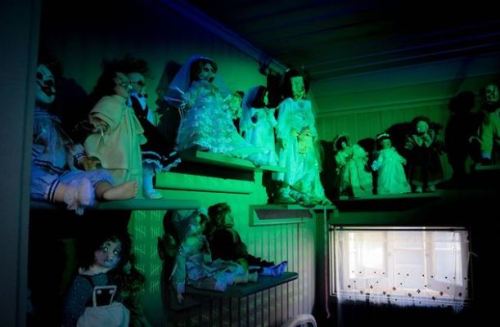
Despite the facts that the, the church was quickly cleared, no bodies could be found, but Sheriff insisted that he believes the stories of ritual abuse. He says he knows the children were baptized “in the Devil’s name.” One male youth was reportedly sexually assaulted by a doctor who used a crucifix in the ritual. However, after a year ling, multi-million-dollar investigation, the task force was disbanded without having found ant hard physical evidence. On the bases of information obtained from several human sacrifices by a Satanic cult in a nearby rural site, officers of the law spent ten hours digging up a field, searching for the remains of one-hundred-and-thirteen victims allegedly sacrificed over the past sixteen years. Some animal bones were found, along with food, headless dolls bound at the feet and pentagrams on their stomachs, a pile of forty-five male tennis shoes were found, an axe, an ancient dagger, and cleaned and pressed children’s clothes from the 1800s in a sealed cement coffin, and a thirteen-foot scorched wooden cross, along with an anatomy dissection book found in a Victorian house near the main mansion. No charges filed. The idea of an underground conspiracy of blood-drinking, cannibalistic Christians, Satanists, kidnaping and killing children as part of unspeakable religious rites, adds an even more horrifying dimension to an already horrifying subject. As bizarre as some of the tales sounded, police investigators did not take them lightly. #RandolphHarris 2 of 6

I was awakened in the middle of the night by the howling—the same lone wolf voice I had heard the night before. It was about one a.m. I did not know how long it had been going on, only that it had finally penetrated my thin chaotic dreams and nudged me towards consciousness. I sat up in the darkened bedroom and listened. It went on for a long time, but gradually became fainter as if the wolf was moving slowly and steadily away from the mansion. It had a tragic, plaintive quality as before. It was positively baleful. And then I could not hear it anymore. An hour later when I could not get back to sleep, I took a walk through the corridors of the third floor. I felt uneasy. I knew what I was doing. All at once I stood still. I held my breath and glanced around. What did I see? You may believe me or not; you may call it a fairy tale or what you will; you may term it a freak of my imagination, but all the same I give it for what it is worth. I saw emerging from a secret passageway in the floor forty-nine men attired in ghostly habiliments. I was badly taken aback; I had been well aware of the accident that happened when the mansion was built killing 49 men. I had realized what I had seen could not logically be happening—not in my time anyway. Those who had been killed in the incident had been so taken by surprise that they were apparently still not aware that they were dead—and their ghostly apparitions were continuing to work on the mansion as though nothing had happened. #RandolphHarris 3 of 6

A team of horses could not budge me while the ghosts were visible. Almost overnight, an entire new industry was born. Special police anti-occult task forces were forced to cope with the new menace. Child psychologist, social workers, probation officers, and born-again Christians were asked to speak to concerned staff members, and seminars were conducted for law enforcement personnel by the self-proclaimed “experts on Satanic crime.” The incidences of people being locked in rooms, doors slamming by themselves, curtains moving, and strange footsteps have been reported. Guests often report a shadowy figure who parts the curtains to look out of otherwise unoccupied rooms. A variety of wild stories were told to explain Mrs. Winchester’s death. Some claim that Mrs. Winchester went out on a cold Winter night during a rain storm. She lost her way and froze to death. Others say that she was massacred by Indians of fell down the mansion’s stairs and bled to death. The truth is that Mrs. Winchester, who outlived her husband and children, was residing in Santa Clara Valley when she died of natural causes at 98. Many who have seen Mrs. Winchester several times, believes that her spirit is still in the house because of her happy life when she was living there. She is in her early twenties, attractive and vibrant. Some frequently smell a fragrance—wild azaleas—that we associate with Mrs. Winchester. Sometimes we sense a man’s presence—probably Mr. Winchester—and we smell 4711. #RandolphHarris 4 of 6
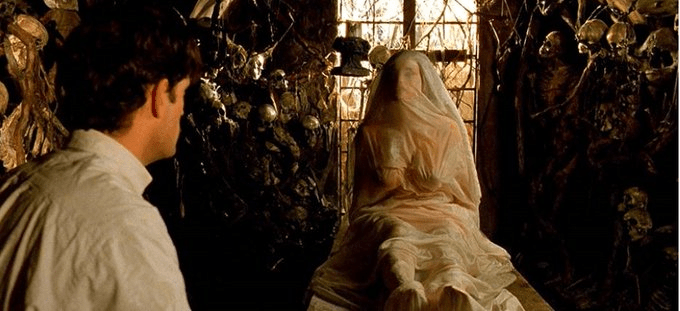
Other times we feel teenage energy that we associate with Mrs. Winchester’s greedy nephew. He is always here, a part of the mansion and of our lives. The Winchester family will always own the mansion. We are just caretakers. Still, the fact that such a large underground existed undetected until the early seventies, along with growing case files of Satanic events reports, was enough to set investigators seriously searching for a similar network of Christians and Satanists. To combat blood rituals and human sacrifices, specially formed task forces logged thousands of police human-hours investigating reports. However, not one piece of concrete evidence was ever turned up to corroborate a Satanic conspiracy. As one case after another fell apart, explanations by the conspiracy buffs became more and more fantastic to accommodate the lack of evidence. The use of portable crematoriums and “alter babies”—that is, babies without birth certificates born secretly to cult members at home for the specific purpose of sacrifice—were offered as reasons why no infant bodies had been found. An investigation by the FBI Behavioral Research Unit, however, came to different conclusions. It found a “cross-contamination of ideas” taking place between parent and law enforcement groups, and between the children and the social workers interrogating them. They found evidence that a cult had been using human fetuses to make ceremonial candles. Leading Satanic crime experts say that in the 1800s, a living alter had been used at the Winchester Mansion for the living spirits that were being worshipped. Black masses took place in the Winchester Mansion. #RandolphHarris 5 of 6

During hours of torture, Mrs. Winchester never told her clients names, nor told prosecutors the names of the people who attended the Black Masses. It was believed that 1,000 to 2,500 people have made their transition to the spirit World in the mansion. The typical Satanic ritual used ceramic cats, stained glass, and houses with geometric shape (including stars, circles, and rectangles). There were also photographs discovered in the mansion of White, middle-class America—doctors, nurses, housewives, businessmen, and happy-looking young children—all surreptitiously giving each other the sign of the horns, clearly indicating exactly what America’s best-kept secret is. Also discovered were WICCA Letter written at the Witches International Coven Council which took place in Mexico in 1898. The documents purport to be a political blueprint for an international takeover by Satanists and the Winchester Mansion becoming the new White House. The names of the cult members were allegedly sealed in thirteen envelopes, which were kept in Mrs. Winchester’s safe. Strange tales frequently occur around the notorious Winchester Mansion. It is an eerie place with vestiges of rat pack glamour. Small wonder staff members complain of angry voices and frightful apparitions. In 2007, the mansion was closed for the evening. Everything had been cleaned and locked. The next morning when it was opened, there seemed a flurry of movement, there was a shape reaching out, but it thinned, vanished—as if made of pixels of color and light. Food remained on the table in the Venetian Dining Room and one of the six kitchens was in disarray. The staff stood there, shaken badly, their hearts in their throats, starring at their own reflections in the window. The dead just don’t stay dead. #RandolphHarris 6 of 6

Winchester Mystery House

Only 14 more days till Halloween! How are you celebrating this year? We have some ideas👻
👉 ticket link in bio. https://winchestermysteryhouse.com/


Is the Soul’s Health More Important than All the Powers of this World?
I cannot say that truth is stranger than fiction, because I have never had acquaintance with either. Whoever is without guile, let one lie down with the lion and the lamb and be not ashamed of one’s nakedness; for they shall put a ring upon one’s hand and shoes upon one’s feet; and all that was one’s father’s shall be one’s and also all that one’s mother and one’s sister hath, and likewise the mote that is in one’s brother’s eye. For it is easier for a rich man to go through the eye of a camel than for another man to break the Sabbath day and keep it holy. If this astonishing conquest itch were limited to intellectual postures, it would be one thing. However, of course the contemporary mining and polluting of the industrial lands bring forward far more concrete realities. Our Faustian pact with Mephistophelian “sci-tech” goes back a long way. It is an insufficiently realized fact that the contemporary scientific attitude was first nurtured in the bosoms of mystical societies of seventeenth-century England, as the contemporary British scholar Frances Yates has pointed out in a number of valuable studies. Long before this, the pioneering philosopher of the specifically modern cast of organized inquiry, Francis Bacon, had called in his “Fable of Proteus” for a virtually sadistic approach to the natural World: If any skillfull minister of nature shall apply force to nature, and by design torture and vex it in order to its annihilation, it on the contrary, being brought to this necessity, changes and transforms itself into a strange variety of shapes and appearances; for nothing but the power of the Creator can annihilate it or truly destroy it…And that methods of torturing or detaining will prove the most effective and expeditious which makes use of manacles and fetters; id est lays hold and works upon matter in the extremist degree. #RandolphHarris 1 of 20

That is an amazing attitude, and one quickly discernible in every aspect of modern life. However, suppose that nature, or at least the Earth as a whole, may not be entirely inert. Can we assume that it would be completely in accord with many of the things we are doing in it? Supposed that, in future generations, the most gifted minds were to find their soul’s health more important than all the powers of this World; suppose that, under the influence of the metaphysic and mysticism that is taking the place of Rationalism today, the very elite of intellect that is now concerned with the machine comes to be overpowered by a growing sense of its Satanism (it is the step from Roger to Bacon to Bernard of Clairvaux)—then nothing can hinder the end of this grand drama that has been a play of intellects, with hands as mere auxiliaries. It is a good thing that in some cases stupidity is not painful because more of us would be in pain and have to admit we need help. As the 1960s faded into the more staid 1970, lurid media accounts of Satanic activity and ritualistic murders became sporadic. However, in 1975, the wire services began to pick up stories that cattle ranchers in Colorado and other western sates were increasingly concerned about the safety of their herds, large numbers of animals having been bizarrely slaughtered. And these are very similar crimes, it would be similar to owning a car dealership and someone stealing all of your cars and no insure to reimburse the loss. So, the cattle were apparently not being killed for food, as little of the meat had been touched, but, in many cases, the blood had apparently been drained and the “private” organs and lips had been surgically removed. To add to the mystery, no footprints, animal or human, were found around the carcasses. #RandolphHarris 2 of 20
Speculation about the identity of the culprits ranged from UFOs to secret government experiments. A movie Endangered Species, was even produced, postulating the latter theory. Then in Arkansas, several head of cattle were found dead near sites that exhibited evidence of ritualistic activity—and Satanic cultists, who from the beginning were suspected villains, supplanted extraterrestrials and Uncle Sam as the most popular explanation for the rash of killings. As reports of the number of mutilations increased and alarm among ranchers spread, animal pathologists were called in to investigate. Not only did they find the cattle mortality rate no higher than normal, but autopsies on the animals determined that in almost all cases the cattle had died from natural causes, or by predatory attack, and that the mutilation had been the postmortem work of scavengers, not cultists. Teeth, not knives, had been used to remove “private” organs and lips, those parts being attacked because they were the softest and most accessible. Then, amid hundreds of similarly discredited reports, several mutilations in Idaho and Montana were determined to have indeed been the work of a knife-wielder. There, evidence gathered by law enforcement officials implicated several Satanic cults operating in those states. The cults, which up to that time had allegedly preferred dogs and cats as sacrificial victims, had read about the mutilations in the papers and decided to add cattle to their ritual list. The work of the copycat cultists turned out to be truly a case of life imitating art. An astrologer named Dan Fry, host of Minneapolis radio program called Cosmic Age, admitted on a Texas talk show that he had made up the cattle mutilation rumor as a joke, but things had snowballed when the story was repeated as fact by the Huston Post and picked up from there by the wire services. Thus had Fry created an “urban legend.” #RandolphHarris 3 of 20
An “urban legend” is a term coined by contemporary folklorists to describe a popular story that spreads swiftly by word of mouth and is soon accepted as truth. These folk tales are always reported as having actually happened, often to the friend of a friend, which is what keeps them “immediate.” When the media picks up such stories and prints them as fact, as it did with the cattle mutilation stories, they acquire a further stamp of truth, which is why people point out that the news is not always true and is someone’s perspective and viewers should be advised to use critical thinking and ask question and do their own research. However, once again, cattle mutilations are baffling law enforcement and ranchers. FOX News published a story August 11, 2022 about the serial crime spree leaving a dozen cattle mutilated. “Mutilations differ from typical livestock deaths because the carcasses are found with body parts removed in an unusual fashion,” states Charles Couger of FOX News. In San Luis more than 10,000 mutilations have betwixt ranchers and investigators across the United States of America for decades. Nonetheless, a recent study by Psychology Today of reported “trick or treat poisonings on Halloween failed to turn up one serious injury and found that, in almost every case, the tamperings were the work of the child victim himself, in an attempt to get attention from parents and friends. Yet every Halloween, newspapers print warnings about tampered treats. And, in the mid-1980s, tales of Satanic animal mutilations have began to resurface from California to Alabama, despite the protests of investing game and animal control officials who have said that, in almost all the cases, the animal deaths were the work of predators or poachers. #RandolphHarris 4 of 20
The Devil, after all, has been an old favorite subject of urban legends. In 1977, for instance, the rumor was widely circulated in fundamentalist circles that the secret of McDonald’s success was that the chain donated portion of its profits each year to the Church of Satan. Corroboration of the Satanic tithing allegedly came from no less a personage than McDonald’s owner, Ray Kroc, who was reputed to have admitted to the diabolic connection while appearing on the Phil Donahue shows. In Fact, Kroc had been a guest on the Donahue show in May of 1977, but his most startling admission had been his intention to introduce the McDonald’s “Filet o’ Fish” in Cincinnati. The idea of a Satanic “pact”—trading one’s soul for Earthly wealth—is an ancient one, and it cropped up again in 1980 when rumors surfaced that the Proctor & Gamble moon-and-starts trademark was in reality a Satanic symbol, and that the company was run by Satanists. The story went that the owners of Proctor & Gamble long ago made a pact with the Devil that ensured the company’s success in exchange for putting Satan’s logo on all its products. “Proof” cited for this ludicrous claim was that a company executive had revealed the demonic truth on Donahue or 60 Minutes, depending on the version. It mattered little that Donahue and spokesmen for 60 Minutes denied any such interview ever took place. Neighbors told neighbors that they had talked to someone who saw the show, or heard it from someone who heard it from someone, etcetera. By mid-1982, Proctor’s consumer services department was getting 15,000 calls a month from people wanting to know about the company’s Satanic connections. Eventually, a counter-publicity campaign was launched, but in the end, the company wound up changing its logo. #RandolphHarris 5 of 20
A serious argument about what is most profoundly modern leads inevitably to the conclusion that the study of the problem of Socrates is one thing most needful. It was Socrates who made Nietzsche and Heidegger looks to the pre-Socratics. For the first time in four hundred years, it seems possible and imperative to begin all over again, to try to figure out what Plato was talking about, because it might be the best thing available. The history of classics since the Renaissance has consisted in momentary glimpses of the importance of Greece for man as man, everywhere and always, followed by long periods of merely scholarly study without any sufficient reason for it, living off the gradually dying energy provided by the original philosophic dynamos. Up to Nietzsche, the neglect of and contempt for Plato and Aristotle was the result of a belief that what they tried to do could be done much better. That is why Socrates was always in good repute. He was the skeptical seeker after the way to knowledge by means of unaided reason. He was not tired to any solution or system and thus could be seen s the originator and the inspirer who did not constrain the freedom of posterity. The current contempt for Plato and Aristotle is of an entirely different kind, for it is allied to contempt for Socrates. He corrupted them; they did not pervert him. We did not progress from Socrates, but he marked the beginning of the decline. Reason itself is rejected by philosophy itself. Thus the common thread of the whole tradition has been broke, and with it the raison d’etre od the university as we know it. #RandolphHarris 6 of 20
Thus is was no accident that Heidegger came forward just after Hitler’s accession to power to address the university community in Freiburg as the new rector, and urged commitment to National Socialism. His argument was not without subtlety and its own special kind of irony, but in sum the decision to devote wholeheartedly the life of the mind to an emerging revelation of being, incarnated in a mass movement, was what Heidegger encouraged. That he did was not a result of his political innocence but a corollary of his critique of rationalism. That is why I have entitled this section “From Socrates’ Apology to Heidegger’s Rektoratsrede.” The university began in spirit from Socrates’ contemptuous and insolent distancing of himself from the Athenian people, his refusal to accept any command from the Athenian people, his refusal to accept any command from them cease asking, “What is justice? What is knowledge? What is a god?” and hence doubting the common opinions about such questions, and in his serious game (in the Republic) of trying to impose the rule of philosophers on an unwilling people without respect for their “culture.” The university may have come near to its death when Heidegger joined the German people—especially the youngest part of that people, which he said had already made an irreversible commitment to the future—and put philosophy at the service of German culture. If I am right in believing that Heidegger’s teachings are the most powerful intellectual force in our times, then the crisis of the German university, which everyone saw, is the crisis of the university everywhere. It may be thought that I have devoted too much space to this idiosyncratic history of the university. However, the university, of all institutions, is most dependent on the deepest beliefs of those who participate in its peculiar life. #RandolphHarris 7 of 20
Our present educational problems cannot seriously be attributed to bad administrators, weakness of will, lack of discipline, lack of money, insufficient attention to the three R’s, or any of the common explanations that indicate things will be set aright if we professors would just pull up our socks. All these things are the result of a deeper lack of belief in the university’s vocation. One cannot say that we must defend academic freedom when there are grave doubts about the principles underlying academic freedom. To march out to battle on behalf of the university may be noble, but it is only a patriotic gesture. Such gestures are necessary and useful for nations, but they do little for universities. Thought is all in all for universities. Today there is precious little thought about universities, and what there is does not unequivocally support the university’s traditional role. In order to find out why we have fallen on such hard times, we must recognize that the foundations of the university have become extremely doubtful to the highest intelligences. Our petty tribulations have great causes. What happened to the universities in Germany in the thirties is what has happened and is happening everywhere. The essence of it all is not social, political, psychological or economic, but philosophic. And, for those who wish to see, contemplation of Socrates is our most urgent task. This is properly an academic task. Some technologies come in disguise. Rudyard Kipling called them “technologies in repose.” They do not look like technologies, and because of that they do their work, for good or ill, without much criticism or even awareness. This applies not only to IQ tests and to polls and to all systems of ranking and grading but to credit cards, accounting procedures, and achievement tests. It applies in the educational World to what are called “academic courses,” as well. #RandolphHarris 8 of 20
A course is a technology for learning. I have “taught” about two hundred of them and do not know why each one lasts exactly fifteen weeks, or why each meeting lasts exactly one lasts exactly one hour and fifty minutes. If the answer is that this is done for administrative convenience, then a course is a fraudulent technology. It is put forward as a desirable structure for learning when in fact it is only a structure for allocating space, for convenient record-keeping, and for control of faculty time. The point is that the origin of a raison d’etre for a course are concerned from us. We come to believe it exists for one reason when it exists for quite another. One characteristic of those who live in a Technopoly is that they are largely unaware of both the origins and the effects of their technologies. Perhaps the most interesting example of such lack of awareness is the widespread belief that modern business invented the technology of management. Management is a system of power and control designed to make maximum use of relevant knowledge, the hierarchical organization of human abilities, and the flow of information from bottom to top and back again. It is generally assumed that management was created by business enterprises as a rational response to the economic and technological demands of the Industrial Revolution. However, research by Alfred Chandler, Sidney Pollard, and especially Keith Hoskin and Richard Macve reveals a quite different picture and leads to a startling conclusion: modern business did not invent management; management invented modern business. The most likely place for management to have originated is, of course, in Great Britain in the late eighteenth and early nineteenth centuries. However, there is no evidence that British industry knew anything about management as late as 1830, nor did there exist anything approximating a “managerial class.” #RandolphHarris 9 of 20
Management was created in the United States of America “out of the blue,” as Hoskin and Macve say. It was not a creation of any obvious needs of American industry, which was only a marginal force in the World economy in the mid-nineteenth century. The roots of management may be traced to a new educational system, introduced in 1817 to the United States Military Academy by the academy’s fourth superintendent, Sylvanus Thayer. Thayer made two innovations. The first, borrowed from the Ecole Polytechnique in Paris, was to grade examinations by giving numerical marks. As I have previously noted, the grading of student papers originated in Cambridge University towards the end of the eighteenth century, and the practice was taken up by several schools on the Continent. Thayer’s use of this technology is probably the first instance of it in America. As every teacher knows, the numerical mark changes the entire experience and meaning of learning. It introduces a fierce competition among students by providing sharply differentiated symbols of success and failure. Grading provides an “objective” measure of human performance and creates the unshakable illusion that accurate calculations can be made of worthiness. The human being becomes, to use Michel Foucault’s phrase, “a calculable person.” Thayer’s second innovation, apparently his own invention, was a line-and-staff system. He divided the academy into two divisions, each organized hierarchically. As Hoskin and Macave describe it: “Daily, weekly and monthly reports were required, all in writing. There were continual relays of written communication and command, going from the bottom to the top of each line, before being consolidated and passed to the central ‘Staff Office.’” #RandolphHarris 10 of 20
Thayer rejected the traditional leader’s role of direct, visible command. He ruled indirectly through the medium of written reports, charts, memos, personnel files, etcetera, not unlike the way a modern CEO functions. We do not know how most of the two hundred cadets at the academy reacted to Thayer’s new system (which Hoskin and Macve term the “grammatocentric principle,” meaning that everything was organized around the use of writing). However, we do know that two of them, Daniel Tyler and George Whistler, were impressed. Both were in the graduating class of 1819, and took with them their lieutenant’s rank and Thayer’s general approach to organizations. Desert Rose Industries and other manufacturers can make almost anything quickly and at low cost. That includes the tunneling machines and other equipment that made the subway system they use for shipping. Digging a tunnel from coast to coast now costs less than digging a single block under New York City used to. It was not expensive to get a deep-transit terminal installed in their basement. Just as the tents are not mere bundles of canvas, these subways are not slow things full of screeching, jolting metal boxes. They are magnetically levitated to reach aircraft speeds—as experimental Japanese trains were in the late 1980s—making it easy for Carl and Maria to give their customers quick service. There is still a road leading to the plant, but nobody’s driven a truck over it for years. They only take in materials that they will eventually ship out in products, so there is nothing left over, and no wastes to dump. One corner of the plant is full of recycling equipment. There are always some obsolete parts to get rid of, or things that have been damaged and need to be reworked. These get broken down into simpler molecules and out back together again to make new parts. #RandolphHarris 11 of 20
The gunk in the manufacturing ponds is water mixed with particles much finer than silt. The particles—fasteners, computers, and the rest—stay in suspension because they are wrapped in molecular jackets that keep them there. This uses the same principle as detergent molecules, which coat particles of oily dirt to float them away. Though it would not be nutritious or appetizing, one could drink the tent mix and be no worse for it. To one’s body, the parts and their jackets, and even the nanomachines, would be like so many bits of grit and sawdust. (Grandma would have called it roughage.) Carl and Maria get their power from solar cells in the road, which is the only reason they bothered having it paved. In back of their plant stands what looks like a fat smokestack. All it produces, though, is an updraft of clean, warm air. The darkly paved road, baking in the New Mexico sun, is cooler than one might expect: it soaks up solar energy and makes electricity, instead of just heat. Once the power is used, it turns back into heart, which has to go somewhere. So the heat rises from their cooling tower instead of the road, and the energy does useful work on the way. Some products, like rocket engines, are made more slowly and in a single piece. This makes them stronger and more permanent. The tents, though, do not need to be superstrong and are just for temporary use. A few days after the tents go up, the earthquake victims start to move out into new housing (permanent, better-looking, and very earthquake-resistant). The tents get folded and shipped off for recycling. Recycling things built this way is simple and efficient: nanomachines just unscrew and unsnap the connectors and sort the parts into bins again. The shipments Desert Rose gets are mostly recycled to begin with. There is no special labeling for recycled materials, because the molecular parts are the same either way. #RandolphHarris 12 of 20

For convenience (and to keep the plant small), Carl and Maria get most of their parts prefabricated, even those they can make almost anything. They can even make more production equipment. In one of their manufacturing ponds, they can put together a new cabinet full of special-purpose assemblers. They do this when they want to make a new type of part in-house. Like parts, the part-assemblers are made by social-purpose assemblers. Carl even can make big vats in medium-size vats, unfolding them like tents. If Desert Rose Industries needed to double capacity, Carl and Maria could do it in just a few days. They did this once for a special order of stadium sections. Maria got Carl to recycle the new building before its shadow hurt their cactus garden. Now, let us focus on mining knowledge. Even these changes, however, are dwarfed by China’s ravenous pursuit of wealth-relevant know-how. China has become a World leader in the creation, purchase—and theft—of data, information and knowledge. As far back as the winter of 1983, soon after Deng Xiaoping shut the door on the Maoist past, we personally witnessed Chinese scientists in Beijing reverse-engineering computers and carrying out the country’s earliest experiments with fiber optics in Shanghai. The available facilities were primitive, dirty, and freezing. China was still wretchedly not very well-off financially. However, its leaders, even then, understood the importance of technology—and piracy. #RandolphHarris 13 of 20

Today the picture is dramatically different. Up-to-date research labs are proliferating, the country’s total expenditure on research and development (R&D) amounted to about 2.79 trillion yuan (about $441.13 billion) in 2021, which is 14.2 percent year-on-years. After deducting price factors, China’s R&D spending in 2021 rose 9.4 percent year-on-year. And as we have noted in the past, thousands of United States of America—trained Chinese scientists are heading back to China. In five years, America will still be the World center of corporate research. However, China will outrank Britain, Germany, and Japan. Add China’s sharklike appetite for data, information and ideas from the outside World. To do business in China, foreign companies usually have had to transfer technology—and many agreed to do so in return for even limited access to the huge Chinese market. Nor is this hunger for know-how narrowly restricted to technology. As formerly Communist China entered into broader economic relationships with the West, it also sought practical knowledge about capitalist management, finance and business in general. As of 2022, there are 46 MBA programs offered in China—many in partnership with leading American schools such as MIT, UC/Berkeley and Northwestern. Less formally, knowledge is transferred by the more than 600,000 international students who now live and work in China—in sharp contrast to the days when foreigners were likely to be labeled spies or allowed to enter only as part of closely monitored tourist groups. Behind China’s amazing drive, therefore, we find radically changed attitudes toward all three of the deep fundamental central to economies of the future—further evidence of its intention to create the World’s leading knowledge-based economy. #RandolphHarris 14 of 20

Taken together, facts like these suggest an unstoppable China on a short, double-quick march to superpowerdom. Beijing, however, knows better. Recently, China watchers have begun to spin dark scenarios. Those include the possibility that China could suffer a financial crisis like the one that hit the rest of Asia in 1997-98, for example. Or that it will go through a series of ups and downs that it will attempt to mitigate with Keynesian measures. Alternatively, worriers point to a possible convergence of other troubles—an energy breakdown, and environmental crisis or something else. Or, worse, yet, a war with Taiwan in which both sides hurl missiles at each other, destabilizing the new Asia. Any or all of these could hammer the global economy in the years immediately head. One of the most pessimistic assessments of China’s future is that the nation will collapse, the revolution has grown old, the discontent of the people is explosive, state-owned enterprises are dying, Chinese banks will fail, and that ideology and politics restrain progress—and that is only part of the list. However, experts are saying the same about America. If this is true, the global financial system might have to be wheeled into the intensive-care ward. Investors, corporations and central banks around the World could all be traumatized. The price of T-shirts and toys might drop still further in the corner Wal-Mart. However, hundreds of millions of workers around the World—from iron-ore miners in Brazil to bankers in Manhattan or Tokyo—would be looking for jobs. These scenarios are dire enough. However, they overlook more startling possibilities. “They will throw their money in the streets, tossing it out like worthless trash. Their silver and gold will not save the on that day of the LORD’s anger,” reports Ezekiel 7.19. #RandolphHarris 15 of 20

The info-wars cast the corporation—and the work that does on in it—into a new light. Forget, for a moment, all conventional job descriptions; forget ranks; forget departmental functions. Think of the firm, instead, as a beehive of knowledge processing. In the day of the smokestack it was assumed that workers knew little of importance and that relevant information or intelligence could be gathered by top management or a tiny staff. The proportion of the work force engaged in knowledge processing was tiny. Today, by contrast, we are finding that much of what happens inside a firm is aimed at replenishing its continually decaying knowledge inventory, generating new knowledge to add to it, and upgrading simple data into information and knowledge. To accomplish this, employees constantly “import,” “export,” and “transfer” data and information. Some employees are essentially importers. These “OUT-IN” people gather information from outside the company and deliver it to their co-workers inside. Market researchers, for example,” are OUT-INers. Studying consumer preferences in the external World, they add value by interpreting what they learn, and then deliver new, higher-order information to the firm. Public relations people do the reverse. They market the firm to the World by collecting information internally and disseminating or exporting it to the outside World. They are IN-OUTers. House accounts are basically IN-IN people, gathering most of their information from inside the firm and transferring it internally as well. Good salespeople are two-way RELAYS. They disseminate information, but also collect it from outside and then report it back to the firm. #RandolphHarris 16 of 20
These functions relate to flows of data, information, or knowledge. Cutting across them is a set of functions that have to do with upgrading the stock of data, information, and knowledge that the firm and its people already possess. Some mind-workers are creators, capable of finding new, surprising juxtapositions of ideas, or putting a fresh spin on an old idea; other “edit” new ideas by matching them against strategic requirements and practical considerations, then deleting those that are irrelevant. In reality, we all do all these things at various times. However, while different functions emphasize one or another, no conventional job descriptions or management texts deal with such distinctions—or their implications for power. At almost every step in this knowledge processing, some people or organizations gain, and others lose, an edge. Thus, conflicts—tiny, sometimes highly personal info-wars—are fought over things like who will or will not be invited to a meeting, whose names appear on the routing slip, who reports information to a superior directly and who, by contrast, is asked to leave it with a secretary, and so forth. These organizational battles—“micro info-wars,” so to speak—are hardly novel. They are a feature of all organizational life. They take on new significance, however, as the super-symbolic economy spreads. Since the value added through smart knowledge-processing is critical in the new system of wealth creation, 21st-century accountants will find ways to assess the new economic value added by various informational activities. The performance ratings of individuals and units may well take into account their own contribution to knowledge enhancement. #RandolphHarris 17 of 20

Today, a geologist who funds a huge oil strike is likely to be well rewarded by the company for adding to its reserves. Tomorrow, when knowledge resources are recognized as the most important of all, employee remuneration may well come to hinge, at least in part, on the success of each individual in adding value to the corporate knowledge reserve. In turn, we can expect even more sophisticated power struggles for the control of knowledge assets and the processes that generate them. We are already witnessing the beginnings of a change in management assumptions about the functions of the work force. Thus, all employees are increasingly expected to add not merely to the firm’s knowledge of assets in general, but to its competitive intelligence arsenal as well. A company tht does CI work for both U.S. and Japanese firms, the Japanese take a far more wholistic view of intelligence than do the Americans. While Japanese executives regard information collection as a routine part of their jobs, if you ask a typical Harvard M.B.A., it is the company librarian’s job. That narrow assumption, however, is fading. At General Mills every employee is expected to engage in competitive intelligence gathering. Even janitors when buying supplies are supposed to ask vendors what competing firms are buying and what they are doing. Telephone companies in the United States of American runs seminars and distribute literature explaining the methods and benefits to CI to their executives. Bayer even rotates executives through its CI staff to teach them the importance of this kind of information collection. GE links CI directly into its strategi planning. #RandolphHarris 18 of 20

Pushed to extremes, such measures inch us toward the nation of the corporation as a total info-war fighting machine. Every science is a mutilated octopus. If its tentacles were not clipped to stumps, it would feel it ways into disturbing contacts. To a believer, the effect of the contemplation of science is of being in the presence of the good, the true, and the beautiful. However, what he is awed by is mutilation. To our crippled intellects, only the maimed is what we call understandable, because the unclipped ramifies into all other things. According to my aesthetics, what is mean by beautiful is symmetrical deformation. In very various strata of Iranian literature from the most ancient texts of the Avesta to the poetry of Firduis, we find elements of the saga of the primeval king Yima or Yama, a figure transmuted from primeval Indo-Aryan tradition into Indian and Iranian mythology. He “whose gain is like the sun,” the “great shepherd”—he has rightly been explained as the ancient shepherd-god of the Persians seen through the eyes of the peasant—is born immortal, but become mortal through his offence. The highest god, Ahura Mazdah, invited him to tend and protect religion, his, Ahura Mazdah’s religion, and then, when Yima has declared himself unfit for this, he bids him foster, multiply and guard the World, his, Ahura Mazdah’s World. This Yima is prepared to do; he assumes dominion over the World and it shall be a World in which none of the destructive powers will have a part, neither cold nor hot wind, nor sickness, nor death. Already previously he had besought the gods with sacrifices to grant him that in his real man and cattle should be released from death, and water and trees from drought. #RandolphHarris 19 of 20

He besought them to let him become the ruler of all countries, them shall take all evil from off Ahura Mazdah’s creatures. This is now granted him. Three hundred year elapse, and since none of the creatures dies the Earth overflows “with small cattle and great cattle and dogs and birds and red flaming fires.” Called by Ahura Mazdah, Yima advances “to light, at midday, towards the path of the sun” and, with the gold-embellished goad and friendly incantation received from the god, urges on the Earth to stretch apart until it has become greater by a third of its size. This is repeated twice more: the Earth has now doubled its size, and all creatures live upon it at their pleasure. However, now Ahura Mazdah gathers together the gods and the best men, Yima at their peak. To him he announces that upon the World given over to materiality (here it sounds as though, in consequence of Yima’s refusal, it was devoid of spirituality) there will descend the greater winter, which will first cover it in snow and then flood it in the thaw, so that no creature will be able any more to put its feet upon the ground. Then Yima is instructed to erect a mighty pen, like a citadel, and to secure therein the seed of the best and most beautiful of all living and growing things. It is done. Then, however, Yima vouchsafes the access of demonry, which he had hitherto held in coercion, and takes the lie into his mind by lauding and blessing himself. Immediately the regal glory, the lustre of good-fortune, which has till then irradiated his brow, leaves him in the shape of a raven and he becomes mortal. “And I would not that ye think that I know of myself—not of the temporal but of the spiritual, not of the carnal mind but of God,” reports Alma 36.4. #RandolphHarris 20 of 20
Cresleigh Homes
Ever find yourself drooling 🤤 over the kitchens in Nancy Meyers films like “Something’s Gotta Give”? Well, move over Nancy – there’s a new obsession worthy kitchen…

In our new home at #PlumasRanch! The Meadows Residence 2 floor plan has the gleaming fixtures, the sparkling countertops, and the spacious cabinets to create the landscape of your dreams.
Now, time for dinner! You’ll love the Cresleigh’s masterplan amenities. Suburban life has been recreated in a way that embraces the communities rich history and stunning landscape.

Ask What You Can Do for Your Country!
Man, evidently, was tired of merely having plants and animals and slaves to serve him, and robbing nature’s treasures of metal and stone, wood and yarn, of managing her water in canals and wells, of breaking her resistances with ships and roads, bridges and tunnels and dams. Now he meant not merely to plunder her of her materials, but to enslave and harness her very forces so as to multiply his own strength. This monstrous and unparalleled idea is as old as old as the Fuastian Culture itself. Already in the tenth century we meet with technical constructions of wholly new sort. Already the steam engine, the steamship, and the air machine are in the thoughts of Roger Bacon and Albertus Magnus. And many a monk busied himself in this cell with the idea of Perpetual Motion. This last idea never thereafter let go its hold on us, for success would mean the final victory over “God or Nature” (Deus sive Natura), a small World of one’s own creation moving like the great World, by virtue of its own forces and obeying the hand of man alone. To build a World oneself to be oneself God—that is the Faustian inventor’s dream, and from it has sprung all our designing and re-designing of machines to approximate as nearly as possible the unattainable limit of perpetual motion. The booty-idea of the beast of prey is thought out to its logical end. Not this or complete with its secret of force, is dragged away as spoil to be built into our Culture. However, one who was not himself possessed by this will to power over all nature would necessarily feel that this was devilish, and in fact men have always regarded machines as the invention of the devil—with Roger begins the long line of scientists who suffer as magicians and heretics. #RandolphHarris 1 of 20
After the great moment in German thought—of Kant, Goethe, Schiller and Hegel, in which the rediscovery of Greece played so important a role—Greek scholarship retired to the universities, where it was again a dead piece of learning, unable itself to inspire or produce a compelling vision that could transform men. It became studied by bourgeois professors who educated bourgeois men for whom, as with Aschenbach, the Greeks were just “culture.” The Greek splendor, which had formed such heroic figures just a half-century earlier, became a mystery. Nietzsche, acutely aware of this splendor and its disappearance from the scene, blamed the scholars, or rather blamed something that informed scholarship. A classical scholar who certainly would have been among the greatest who ever lived if he had not been called to philosophy, Nietzsche attempted the last great return to the Greeks. Like his German predecessors, he returned to Greek poetry in particular. However, he coupled his taste for the tragedies with something very new—a radical attack on Socrates, the founder of the tradition of rationalism, which is the essence of the university. This is probably the first attack made by a philosopher on Socrates, and it is a violent one, continuing throughout Nietzsche’s whole career. What is fascinating for us in this is that Nietzsche, and Heidegger following him, are the first modern thinkers since the days of Hobbes, Spinoza and Descartes to take Socrates—or any classical philosopher’s teaching—really serious as an opponent, as a living opponent rather than as a cultural artifact. Socrates is alive and must be overcome. It is essential to recognize that this is the issue in Nietzsche. It is not a historical or cultural question. It is simply a classic philosophic disputation: Was Socrates right or wrong? #RandolphHarris 2 of 20

Nietzsche’s indictment of Socrates is that his rationalism, his utilitarianism, subverted and explained away that great stupidity which is noble instinct. He destroyed the tragic sense of life, which intuited man’s true situation amidst things and allowed for creative forming of life against the terror of existence, unendowed with and unguided by any pre-existing forms or patterns. Instinct or fatality prior to reason and vulnerable to reason, establishes the table of laws or valuation within which healthy reason works. A darkness on top of a void is the condition of life and creation, and it is dispelled in the light of rational analysis. The poet, in his act of creation, knows this. The scientist and the scholar never do. The act of creation is what forms cultures and folk-minds. There cannot be, as Socrates believed, the pure mind, which is trans-historical. This belief is the fundamental premise and error of science, an error that becomes manifestly fatal in dealing with human things. The method of the sciences is designed to see only what is everywhere always, whereas what is particular and emergent is all that counts historically and culturally. Homer is not merely one example of an epic, or the Bible of a revealed text, but that is what science sees them as, and the only reason it is interested in them. The scholar turns away from them to comparative religion or comparative literature, id est, either to indifference or to a flabby ecumenism compounded out of the lowest common denominator of a variety of old and incompatible creations. The scholars cannot understand the texts that he purports to interpret and explain. Schiller might be able to grasp the essence of the Iliad because as a creator he is akin to Homer. #RandolphHarris 3 of 20

He could not understand Homer as Homer understood himself, because his mind was of a different historical epoch. However, he could understand what it means to be a poet. A scholar can do neither. From the point of view of life, and from the point of view of truth, modern scholarship is a failure. Hegel ridicules the typical German gymnasium teacher who explains that Alexander the Great had a pathological love of power. The teacher proves the assertion by the fact that Alexander conquered the World. The teacher’s freedom from this illness is attested to by the fact that he has not conquered the World. This story encapsulates Nietzsche’s criticism of the German university and its classical scholarship. The scholar cannot understand the will to power, not a cause recognized by science, which made Alexander different from others, because the scholar neither has it nor does his method permit him to have it or see it. The scholar could never conquer the mind of man. Nietzsche’s return to the example of the ancients, and his rigorous drawing of the consequences of what German humane scholarship really believed, had a stunning effect on German university life and on the German respect for reason altogether. Artists received a new license, and even philosophy began to reinterpret itself as a form of art. The poet won the old war between philosophy and poetry, in which Socrates had been philosophy’s champion. Nietzsche’s war on the university led in two directions—either to an abandonment of the university by serious men, or to its reform to make it play a role in the creation of culture. The university ruled by Hegel, the modern Aristotle, had to be reconstituted, as the discredited medieval university had been made over by the now discredited Enlightenment university. #RandolphHarris 4 of 20
Psychologist Erich Fromm divided religions into two principal categories: humanitarian and authoritarian. Humanitarian religions, according to Dr. Fromm, concern themselves with the goals of self-realization, while authoritarian religions emphasize the importance of their own power. “The essential element in authoritarian religion,” he wrote, “is the surrender to a power transcending man. The main virtue of this type of religion is obedience, the cardinal sin, disobedience.” Most Satanic cults are authoritarian in nature. The members join the group to remedy feelings of powerlessness and inadequacy by submitting to cult leaders in order to be taught the “occult secrets of magic.” Thus, they feel themselves as part of an elite group, in possession of exclusive powers, superior to the rest of humanity. Paul Valentine unabashedly states that one of the reasons he started a Satanic religion was the feeling of power it gives him. While teaching that the ultimate goal of the Setian is self-realization, Michael Aquino states that the governing principle of magic is the ability to “control people without their realizing how or why they are being control.” Gini Graham Scott’s experience with the Temple of Set echoes my own observations of other Satanic and occult groups: “The power of the High Priest increases the power group members feel. He derives much of his power from the members’ belief that he is better able to communicate and manifest (Set) through his being. Also, when members honor him with salutes and hails, he appears that much more powerful. His power, in turn, reflects back on the group.” #RandolphHarris 5 of 20

However, although the orientation of both the leadership and the laity of most of neo-Satanic churches such as the Temple of Set and the Church of Satan is authoritarian, and stressed control, there is no evidence that any socalled “brainwashing” techniques are employed within these groups to program the thoughts of their members—as has been alleged in contemporary cults such as the Moonies or the Hare Krishans. James T. Richardson, Mary Harder, and Robert Simmonds, in their paper, “Thought Reform and the Jesus Movement,” equate the conversion processes used in some cults in modern “Jesus Movement” with those employed by the Chinese on Western prisoners of war in Korea in the early 1950s. Such comparisons have also been made by psychiatrist Robert J. Lifton, who related such “thought-reform” to religion with his concept of “religious totalism,” which he broke down into eight separate elements: (1) milieu control, or the control of human communication, (2) mystical manipulation, or the installation of a sense of higher purpose by which members are taught they have been ”chose” by forces outside themselves to carry on some mystical imperative, (3) the demand for purity, or the adoption by believers of black or white picture of the World, (4) the cult of confession for past sins, (5) the “sacred science,” which teaches that the group’s dogma is completely true, (6) the loading of language, or the language of “non-thought,” (7) the subordination of human experience to the claims of doctrine, and (8) the severance of ties with those not doctrinally pure (family, friends etcetera.) #RandolphHarris 6 of 20

Lifton suggests that the more those eight components combine in a group situation, the more likely is the possibility of altering a member’s behavior and thoughts. That would be true in religious cults or radical political movements, and the dynamics have been clearly observed to be in operation in such cults as the Jim Jones cult in Guyana, the Moonies, and the Yahwehs, as well as the Manson Family. The more communication from outside is cut, and the more dependence upon the group is fostered, the more likely group behavior will be infected by the beliefs of the leader are violent, the group can turn violent. With the possible exception of The Process in the early 1970s, no organized Satanic church has attempted to attain that kind of control of its membership. The Church of Satan, the Temple of Set, and the Church of Satanic Liberation, although displaying some of Lifton’s eight components—assuming at times a fascistic, authoritarian tone—have not attempted to break down the thoughts of their members. In fact, their stress on egotism, individualistic thought, and nonconformity—although within their groups, their members have simply arrived at another kind of conformity—has been a barrier to the implantation of any cohesive system of thought. This, perhaps, has been a source of failure of such groups as LaVey’s and Aquino’s to consolidate and add to the gains in membership they made in the early 1970s. Back in 1971, before he became certain that Set was a real entity, Michael Aquino seemed to anticipate this built-in program for failure in his own temple when he wrote that “a large percentage of letters to The Cloven Hoof portray Satan as a de facto God to be served, worshipped and adored—not as an anti-god. For such persons, the distinction between Christianity and Satanism is principally semantic. The long-term influence of such a trend could be disastrous and I suspect the question may be called shortly. Some people, I suppose, cannot exist without a master to serve. Erich From is alive and lurking in the ritual chamber.” #RandolphHarris 7 of 20
A new concept of business is taking shape in response to the info-wars now raging across the World economy. As knowledge becomes more central to the creation of wealth, we begin to think of the corporation as an enhancer of knowledge. We speak of adding vale by upgrading information. We talk about improving the firm’s human resources. And we begin poking our noses into information that does not belong to us. All, it would seem, is fair in love and info-war. On April 25, 1985, the telephone rand at the offices of Texas Instruments in Dallas, Texas. A voice with an international accent asked for a meeting with a company security executive. A Syrian electrical engineer who sought political asylum in the United States of America, Sam Kuzbary had once worked at TI before being fired as a security risk. Rumor had it that the CIA had helped him get out of Syria, where he had once worked for the Syrian military. Kuzbary carried a gun in his car. Now, he said, he wanted to ingratiate himself with TI and get his job back. He had information, he said, about important secrets that had been stolen from TI. That call led to an early morning raid by Dallas police on the offices of a small high-tech firm called Voice Control Systems, Inc., founded originally by a real estate developer who wound up in jail for drug smuggling. Now owned by a different investment group and headed by a former president of U.S Telephone, VCS, it turned out, employed numerous former TI researchers, including Kuzbary. What the police found were 7,985 filed copied from the computers at TI’s advanced research project on speech recognition. A scorching race was (and still is) under way among major computer firms, including IBM Texas Instruments, to find a way for computers to understand human speech. (They can already and are only getting better, but the technology is costly.) #RandolphHarris 8 of 20

Everyone knows that whoever wins this technological race will have the potential for fabulous profits. In fact, at the time, Michael Dertouzos, head of computer science at the Massachusetts Institutes of Technology, considered that “whoever breaks the logjam to make machines understand spoken words will gain control over the information revolution.” Were the engineers who jumped ship at TI and joined VCS really guilty of stealing research worth $20 million, as TI charged? In the trial that followed, Dallas prosecutors Ted Steinke and Jane Jackson insisted a crime had been committed. Lawyers for defendants Tom Schalk and Gary Leonard, however, pointed out that none of the materials taken was marked with the words TI—STRICKTLY PRIVATE which were supposed to be on all secret material. What is more, the lab in which the work was done was headed by Dr. George Doddington, a brilliant maverick who often described his lab as “free and open” and argued that major breakthroughs would come only if researcher from different companies and universities shared their knowledge. Even more to the point, VCS did not seem to be using any of the TI material. Schalk insisted to the jury that at no time during his work at TI had he regarded any of this material as secret. Leonard said he merely wanted to keep a historical record of research he had done, and that he had copied a TI computer directory because it contained a list of the people in his Sunday-school class. To all of which Steinke, the prosecutor, replied: “One thing they can’t change. They sunk these programs out without telling anyone.” The Dallas jury, some of its members crying as the verdict was read, found the men guilty. They were sentenced and fined, then placed on probation. Both appealed the ruling and immediately went back to work, trying to make computers understand speech. #RandolphHarris 9 of 20

It is hard to know if industrial espionage is actually on the rise, because, in the words of Brian Hollstein of the American Society for Industrial Security’s committee on the protection of information, “Being a victim of industrial espionage is a lot like getting venereal disease. Many may have it, but nobody wants to talk about it.” On the other hand, more lawsuits are being filed against information thieves and pirates. Hollstein has thought about the value of information more than most. “Many corporations,” he said a few years ago, “really do not understand….They still think in terms mainly of moving around men and materials,” as though still locked into the smokestack economy. “What it amounts to,” he has said, “is a failure to recognize that information has value.” That attitude is changing swiftly. As wars for the control of information heat up, many companies have decided they need more information about the plans, products, and profits of their adversaries. Thus the dramatic rise of what is known as “competitive intelligence.” Smart companies, of course, have always kept an eye cocked at their competitors, but today adversarial knowledge is prime ammunition in the info-wars. Several factors account for the changed attitude. The speed with which any market can now be invaded from outside, the long lead times needed for research (in contrast with shorter product life-cycles), and stiffer competition all have contributed to the much-publicized systematization and professionalization of business spying. He pressure for continual innovation means more resources are flowing into new products, some requiring extremely heavy research. “Designing a chip can take hundreds of labor-years and millions of dollars. Simply copying the competition is both faster and cheaper,” writes John D. Halamka in Espionage in Silicon Valley, explaining why companies now engage in reverse engineering—taking apart a rival product to learn its secret. Xerox reverse-engineers competitive copiers. Companies reverse-engineer services to find out what makes them profitable. #RandolphHarris 10 of 20

Yet another factor promoting the rise of competitive intelligence has been the widespread reorganization of strategic planning. Once a highly centralized activity carried out by staff personnel reporting to top management, planning has been pushed down into the operating units, where it is often carried out by practical line managers geared to rough-and-tumble competition. Knowing what competitors are up to has immediate tactical advantage as well as possible strategic use. All this helps explain why 80 percent of the thousand largest U.S. firms now have their own full-time sleuths and why the Society of Competitor Intelligence Professionals alone claims member from at least three hundred companies in six nations. Their companies keep them busy. Before the Marriott Corporation committed itself to launching the Fairfield Inn chain of low-cost hotels, reports Fortune, it sent a team of snoops into nearly four hundred rival hotels to check on what soaps and towels they supplied, how good the front desk was in dealing with special problems, and whether the sounds of pleasures of the flesh could be heard in adjoining rooms. (The sounds were simulated by one of Marriott’s CI agents while another in the next room listened for them.) Marriott also hired executive headhunters to interview (and pump) the regional managers of rival chains, to find out how much its competitors were paying, what training they offered, and whether their managers were happy. When the Sheller-Globe Corporation, maker of heavy truck cabs, wanted to design a new cab, it systematically called on potential customers, asking them to rank the opposition on seven scales covering gasoline milage, comfort, windshield visibility, ease of steering, seating, accessibility of controls, and durability. The information set targets for the Sheller-Globe design team to beat. #RandolphHarris 11 of 20

Like real spies, business intelligence agents begin their hunt with a careful scan of “open” sources. They pore over trade journals, newsletters, and the general press for clues to a competing firm’s plans. They read speeches, studying recruiting ads, attend meetings and seminars. They interview former employees, many of whom are eager to talk about their old companies. However, CI snoops—among them, paid outside consultants—have also been known to fly a helicopter over a plant for clues to a competitor’s capacity, to scour trash baskets for discarded memos, and to employ more aggressive measures as well. A look at a rival’s internal phone directory can help one construct a detailed map of its organization, from which it is possible to estimate its budget. One Japanese company sent experts to look at the rail tracks leaving the plant of an American competitor. The thickness of the rust layer—presumably indicating how often or how recently the tracks were used—was a clue to the factory’s production. On occasion, zealous practitioners bug hotel rooms or offices where rivals are negotiating a deal. Even less savory are the U.S.A defense contractors who paid “consultants” to learn in advance how much their competitors were bidding on a Pentagon project, thus permitting them to underbid. In turn, some of the consultants reportedly bribed military personnel to get the facts. Of course, competitive intelligence professionals define CI as the legal pursuit of information. However, a recent Conference Board survey of senior managers suggest that 60 percent of them think anything goes when it comes to corporate spying. The hotting-up of today’s info-wars is part of a growing recognition that knowledge, while central to the new economy, violates all the rules that apply to other resource. It is, for example, inexhaustible. We know how to add vale to a good idea is much more problematic. We lack the new accounting and management theories needed to grapple with super-symbolic realities. #RandolphHarris 12 of 20

We do not yet know how to manage a resource that is salable, but much of which is supplied (often at no charge) by customers themselves. Of, for that matter, either willingly or unwittingly, by competitors. Nor have we yet come to understand how the corporation as a whole engages in knowledge enhancement. Focusing again on the subject of the technology of statistics, I must call attention to the fact that statistics creates an enormous amount of completely useless information, which compounds the always difficult task of locating that which is useful to a culture. This is more than a case of “information-overload.” It is a matter of “information-trivia,” which has the effect of placing all information on an equal level. No one has expressed this misuse of a technology better than the New Yorker magazine cartoonist Mankoff. Showing an attentive man watching television news, Mankoff has the newscaster saying, “A preliminary census report indicates that for the first time in our nation’s history female anthropologists outnumber male professional golfers.” When statistics and computers are joined, volumes of garbage are generated in public discourse. Those who have watched television sports programs will know that Mankoff’s cartoon is, in fact, less of a parody than a documentary. Useless, meaningless statistics flood the attention of the viewer. Sportscasters call them “graphics” in an effort to suggest that the information, graphically presented, is a vital supplement to action of the game. For example: “Since 1984, the Buffalo Bills have won only two games in which they were four points ahead with less than six minutes to play.” Or this: “In only 17 percent of the times he has pitched at Shea Stadium has Dwight Gooden struck out the third and fourth hitters less than three times when they came to bat with more than one runner on base.” What is one to do with this or to make of it? #RandolphHarris 13 of 20

And yet there seems to be a market for useless information. Those who read USA Today, for example, are offered on the front page of each issue an idiotic statistic of the day that looks something like this: “The four leading states in banana consumption from 1980 through 1989 are Kansas, North Dakota, Wyoming, and Louisiana. Oddly, Nevada, which was ninth in 1989, fell to twenty-sixth last year, which is exactly where it ranks in kiwi consumption.” It is surprising how frequently such blather will serve as the backbone of conversations which are essentially meaningless. I have heard New Yorkers, with a triumphant flourish, offer out-of-towners the statistic that New York City is only eighth in nation in per-capita violent crimes and then decline to go outside because it was past 6.00pm. I do not say, of course, that all such statistical statements are useless. If we learn that one out of every four males between the ages of twenty and thirty has gone to summer camp as a child, and that the nation’s expenditure for the education of male children is 23 percent less than it is for girls, we may have some statistical facts that will help us to see a cause-and-effect relationship, and thereby suggest a course of action. However, statistics, like any other technology, has a tendency to run out of control, to occupy more of our mental space than it warrants, to invade realms of discourse where it can only wreak havoc. When it is out of control, statistics buries in a heap of trivian what is necessary to know. We have talked about Desert Rose Industries. They use assemblers in the simulated molecular World of the Silicon Valley Faire. They are big, slow, computer-controlled things moving molecular tools. #RandolphHarris 14 of 20

With the right instructions and machinery to keep them supplied with molecular tools, these general-purpose assemblers can build almost anything. They are slow, though, and take a lot of energy to run. Some of the building uses special-purpose assembly systems in the molecule-processing style, like the systems in the basement of a simulated molecular factory. The special-purpose systems are all moving belts and rollers, but no arms. This is faster and more efficient, but for quantity orders, cooling requirements limit the speed. It is faster to use larger, prefabricated building blocks. Desert Rose uses these for most of their work, and especially for rush orders like the one Carl set up. Their underground warehouse has room-sized bins containing upward of a thousand tons of the most popular building blocks, things like structural fibers. They are made at plants on the West Coast and shipped here by subway for ready use. Other kinds are made on site using the special-purpose assemblers. Carl’s main room has several cabinet-sized boxes hooked up to the plumbing, each taking in raw materials, running them through this sort of specialized molecular machinery, and pumping out a milky syrup of product. One syrup contains motors, another one contains computers, and another is full of microscopic plug-in light sources. All go into tanks for later use. Now they are being used. The mix for the Red Cross tent job is mostly structural fiber stronger than the old bulletproof-vest materials. Other building blocks also go in, including motors, computers, and dozens of little struts, angle brackets, and doohickies. The mix would look like someone had stirred together the parts from a dozen toy sets, if the parts were big enough to see. In fact, though the largest parts would be no more than blurry dots, if you saw one under a normal optical microscope. #RandolphHarris 15 of 20

The mix also contains block-assemblers, floating free like everything else. These machines are big, about like an office building in our simulation view with the standard setting. Each has several jointed arms, a computer, and several plugs and sockets. These do the actual construction work. To begin the building, pumps pour the mixture into a manufacturing pond. The constant tumbling motions of microscopic things in liquids would be too disorganized for building anything so large as a tent, so the block-assemblers start grabbing their neighbors. Within moments, they have linked up to form a framework spread through the liquid. Now that they are plugged together, they divide up job, and get to work. Instructions pour in from Carl’s desktop computer. The block-assemblers use sticky grippers to pull specific kinds of building blacks out of the liquid. They use their arms to plug them together. For a permanent job, they would be using blocks that bond together chemically and permanently. For these temporary tents, though, the Red Cross design uses a set of standard blocks that are put together with amazingly ordinary fasteners: these blocks have snaps, plugs, and screws, though of course the parts are atomically perfect and the threads on the screws are single helical rows of atoms. The resulting joints weaken the tent’s structure somewhat, but who cares? The basic materials are almost a hundred times stronger than steel, so there is strength to waste if it makes manufacturing more convenient. Fiber segments snap together to make fabrics. Some segments contain motors and computers, linked by fibers that contain power and data cables. Struts snap together with more motors and computers to make the tent’s main structures. Special surfaces are made of special building blocks. #RandolphHarris 16 of 20

From the human perspective, each tent is a lightweight structure that contains most of the conveniences and comforts of an apartment: cooking facilities, a bathroom, beds, windows, air-condition, specially modified to meet the environmental demands of the quake-stricken country. From a builder’s perspective, especially from a nanomachine’s point of view, the tent is just another structure slapped together from a few hundred kinds of prefab parts. In a matter of seconds, each block-assembler has put together a few thousand parts, and its section of the tent is done. In fact, the whole thing is done: many trillions of hands make light work. A crane swings out over the pond and starts plucking out tent packages as fresh mix flows in. Maria’s concern has drawn her back to the plant to see how the building is going. “It’s coming along,” Carl reassures her. “Look, the first batch of tents is out.” It the warehouse, the first pallet is already stacked with five layers of dove-gray “suitcases”: tents dried and packed for transport. Carl grabs a tent by then handle and lugs it out the door. He pushes a tab on the corner labeled “Open,” and it takes over a minute to unfold to a structure a half-dozen paces on a side. The tent is big, and light enough to blow away if it did not cling to the ground so tightly. Maris and Carl tour the tent, testing the appliances, checking the construction of furniture: everything is extremely lightweight compared to the bulk-manufactured goods of the 1990s, tough but almost hollow. #RandolphHarris 17 of 20

Like the other structures, the walls and floors are full of tiny motors and struts controlled by simple computers like the ones used in twentieth-century cars, televisions, and pinball machines. They can unfold and refold. They can also flex to produce sound like a high-quality speaker, or to absorb sound to silence outdoors racket. The whole three-room setup is small and efficient, looking like a cross between a boat cabin and a Japanese business hotel room. Outside, though, it is a little more than a box. Maria shakes her head, knowing full well what architects can do these days when they try to make a building really fit its site. Oh well, she thinks, These won’t be used for long. “Well, that looks pretty good to me,” says Carl with satisfaction. “And I think we’ll be finished in another hour.” Maria is relieved. “I’m glad you had those pools freed up so fast.” By three o’clock, they have shipped three thousand emergency shelters, sending them by subway. Within half an hour, tents are being set up at the disaster site. When we think about global space, of course China comes to mind. While its neighbors try to figure out where they may fit in new Asia they assume will be dominated by China, China no longer sees itself as merely an Asian power. It talks about creating an Asian free-trade sone, but its ambitions—economic and otherwise—are global. It is changing its relations not only to time but to the deep fundamental of space as well. Starting with the reforms in the 1980s and ‘90s, its opening to foreign investment, its entry into the World Trade Organization and its immense expansion of imports and exports, China has, with every passing day, been deepening and diffusing its links to the outside World. And here, too, the twin track strategy is evident. #RandolphHarris 18 of 20

At one level, floods of affordable Chinese good blanket the World, undercutting the makers of Mexican electronic components, Indonesian garments or Colombian copper wire. These are not turned out in China’s industrial-age sweatshops. However, China is also encouraging its high-tech companies to move out and conquer the World. Thus Lenovo, its top PC maker, buys IBM’s PC manufacturing division. Huawei, its big I.T. company, boasts of having ten thousand R&D workers and of maintaining labs in India, Britain, Sweden and he United States of America. It partners with Intel, Microsoft, Siemens and Qualcom to produce communications equipment. China’s expanding spatial reach will soon be more evident in finance as well. The Chinese government has launched “Made in China 2025,” a state-led industrial policy that seeks to make China dominant in global high-tech manufacturing. The program aims to use government subsidies, mobilize state-owned enterprises, and pursue intellectual property acquisition to catch up with—and then surpass—Western technological prowess in advanced industries. For the United States of America and other major industrialized democracies, however, these tactics not only undermine Beijing’s stated adherence to international trade rules but also pose a security risk. Washington argues that the policy relies on discriminatory treatment of foreign investment, forced technology transfers, intellectual property theft, and cyber espionage, practices that have encouraged President Donald J. Trump to levy tariffs on Chinese goods and black several Chinese-back acquisitions of technology firms. Meanwhile, many other countries have tightened their oversight of foreign investment, intensifying debate over how best to respond to China’s behavior. #RandolphHarris 19 of 20

What is China 2025? China plans to thrust itself, big-time, as it will no longer be a region long regarded as America’s backyard—counterbalancing America’s strong presence in China’s backyard, Taiwan. Made in China 2025 is the government’s ten-year plan to update China’s manufacturing base by rapidly developing ten high-tech industries. Chief among these are electric cars and other new energy vehicles, next-generation information technology (IT) and telecommunications, and advanced robotics and artificial intelligence. Other major sectors include agricultural technology; aerospace engineering; new synthetic materials; advanced electrical equipment; emerging bio-medicine; high-end rail infrastructure; and high-tech maritime engineering. However, China’s highly focused drive toward economic expansion should, in theory, keep it too busy for foreign military adventures. Nevertheless, the sectors to the so-called fourth industrial revolution, which refers to the integration of big data, could computing, and other emerging technologies into global manufacturing supply chains. In this regard, Chinese policy makers drew inspiration from the German government’s Industry 4.0 development plan. China is acquiring long-range unmanned aircraft and air-refueling equipment that extended the range of its hair force. It not has nuclear missiles that can reach target all across the United States of America. And it seeks to transform its navy—once designed to protect coastal waters—into a “blue water” nuclear armed fleet capable of ever-more distant operations. China 2025 sets specific targets: by 2025, China aims to achieve 70 percent self-sufficiency in high-tech industries, and by 2049—the hundredth anniversary of the People’s Republic of China—it seeks to dominate position in global markets. China compresses time, it also expands its influence spatially, profoundly altering its traditional economic—and military—relations to these deep fundamentals. #RandolphHarris 20 of 20

Cresleigh Homes

Our outdoor living space is just as important as our indoor one, and #Havenwood Model 1 has the goods. 😉

You will also enjoy a well-designed kitchen with a center island and counter seating, and an expansive primary bedroom suite with a luxurious primary bath and a roomy walk-in closet.

Get more info on all the homes in the Havenwood community on our website, and contact our leasing office with any questions!

Also, keep in mind the highly sought-after Northren California climate provides year-round recreational opportunities for hiking, biking, golfing, and high-end shopping.
#CresleighHomes

 Randolph Harris II International Institute