
Home » New Homes (Page 33)
Category Archives: New Homes

In the “Judgement” it is Existence Which is at Stake

Mutual cooperation can emerge in a World of egoists without central control by starting with a cluster of individuals who rely one reciprocity. When conditions are right, cooperation can evolve even without friendship or foresight, with is much more conducive than mutual treachery. Sometimes cooperation emerges where it is least expected. During World War I, the Wester front was the scene of horrible battles for a few yards of territory. However, between these battles, and even during them at other places along the five-hundred-mile line in France and Belgium, the enemy soldier often exercised considerable restraint. A British staff officer on a tour of the trenches remarked that he was, “astonished to observe German soldiers walking about within rifle range behind their own line. Our men appeared to take no notice. I privately made up my mind to do away with that sort of thing when we took over; such things should not be allowed. These people evidently did not know there was a war on. Both sides apparently believed in the policy of “live and let live.” This is not an isolated example. The live-and-let-live system was endemic in trench warfare. It flourished despite the best efforts of senior officers to stop it, despite the passions aroused by combat, despite the military logic of kill or be killed, and despite the ease with which the high command was able to repress any local efforts to arrange a direct truce. This is a case of cooperation emerging despite great antagonism between the players. As such, it provides a challenge for the application of the concepts and the theory we developed in past reports. In particular, the main goal is to use the theory to explain: How could the live-and-let-live system have gotten started? How was it sustained? Why did it break down toward the end of the war? Why was it characteristic of trench warfare in World War I, but of few other wars? #RandolphHarris 1 of 20

A second goal is to use the historical case to suggest how the original concept and theory can be further elaborated. The Historical situation in the quiet sectors along the Western Front was an iterated Prisoner’s Dilemma. In a given locality, the two players can be taken to be the small units facing each other. At any time, the choices are to shot to kill or deliberately to shoot to avoid causing damage. If a major battle is ordered in the sector, for both side, weakening the enemy is an important value because it will promote survival. Therefore, in the short run it is better to do damage now whether the enemy is shooting back or not. This established that mutual defection is preferred to unilateral restraint (P>S), and that unilateral restraint by the other wise is even better than mutual cooperation (T>R). In addition, the reward for mutual restraint is preferred by the local units to the outcome of mutual punishment (R>P), since mutual punishment would imply that both units would suffer for little or no relative gain. Taken together, this establishes the essential set of inequalities: T>R>P>S. Moreover, both sides would prefer mutual restraint to the random alternation of serious hostilities, making R> (T + S)/2. This the situation meets the conditions for a Prisoner’s Dilemma between small units facing each other in a given immobile sector. Two small units facing each other across one hundred to four hundred yards of no-man’s-land were the players in one of these potentially deadly Prisoner’s Dilemmas. Typically, the basic unit could be taken to be the battalion, consisting of about one thousand men, half of whom would be in the front line at any one time. The battalion played a large role in the life of an infantryman. It not only organized its members for combat, but also fed, paid, and clothed them as well as arranged their leave. All of the officers and most of the other soldiers in the battalion knew each other by sight. For our purposes, two key factors make the battalion the most typical player. #RandolphHarris 2 of 20

On the one hand, it was large enough to occupy a sufficient sector of the front to be “held accountable” for aggressive actions which came from its territory. On the other hand, it was small enough to be able to control the individual behavior of its men, through a variety of means, both formal and informal. A battalion on one side might be facing parts of one, two, or three battalions on the other side. Thus each player could simultaneously be involved in several interactions. Over the course of the Western Front, there would be hundreds of such face-offs. Only the small units were involved in these Prisoner’s Dilemmas. The high commands of the two sides did not share the view of the common soldier who said: “The real reason for the quietness of some sections of the line was that neither side had any intention of advancing in that particular district….If the British shelled the Germans, the Germans replied, and the damage was equal: if the Germans bombed an advanced piece of trench and killed five Englishmen, an answering fusillade killed five Germans.” To the army headquarters, the important thing was to develop an offensive spirit in the troops. The Allies, in particular, pursued a strategy of attrition whereby equal losses in men from both sides meant a net gain for the Allies because sooner or later Germany’s strength would be exhausted first. So at the national level, World War I approximated a zero-sum game in which losses for one side represented gains for the other side. However, at the local level, along the front line, mutual restraint was much preferred to mutual punishment. Locally, the dilemma persisted: at any given moment it was prudent to shoot to kill, whether the other side did so or not. What made each trench warfare so different from most other combat was that the same small units faced each other in immobile sectors for extended periods of time. This changed the game from a one-move Prisoner’s Dilemma in which defection is the dominant choice, to an iterated Prisoner’s Dilemma in which the theory’s predictions: with sustained interaction, the sable outcome could me mutual cooperation based upon reciprocity. In particular, both sides followed strategies that would not be the first to defect, but that would be provoked if the other detect. #RandolphHarris 3 of 20

Now, running a business can be a lot like fighting in a war. Business may be turning out products and profits. However, it is hard to resist the suspicion that it is also becoming a popular form of theater. Like theater, it has heroes, villains, drama, and—increasingly—it has stars. The names of business tycoons ricochet through the media like those of Hollywood celebrities. Surrounded by publicists, trained in all the arts of self-promotion, characters like Donald Trump, Paris Hilton, or Elon Musk have become living symbols of corporate power. They are satirized in the comics. They (and their writers) crank out best sellers. All of these people have even been mentioned—or perhaps arranged to have themselves mentioned—as potential candidates for the presidency of the United States of America, and one has actually been elected as president. Business has arrived in the Age of Glitz. Business had its stars in the past, too, but the very context of stardom is different today. The tinselly new glamour acquired by business is a superficial facet of the new economy, in which information (including everything from scientific research to advertising hype) plays a growing role. What is happening is the rise of an entirely new “system for wealth creation,” which brings with it dramatic changes in the distribution of power. This new system for making wealth is totally dependent on the instant communication and dissemination of data, ideas, symbols, and symbolism. It is, as we will discover, a super-symbolic economy in the exact sense of that term. Its arrival is transformational. It is not, as some still belatedly insist, a sign of “de-industrialization,” “hollowing out,” or economic decay, but a leap toward a revolutionary new system of production. This new system takes us a giant step beyond mass production toward increasing customization, beyond mass marketing and distribution toward niches and micro-marketing, beyond the monolithic corporation to new forms of organization, beyond the nation-state to operations that are both local and global, and beyond the proletariat to a new “cognitariat.” #RandolphHarris 4 of 20

The collision between forces favoring this new system of wealth creation and defenders of the old smokestack system is the dominant economic conflict of our time, exceeding in historical importance the conflict between capitalism and communism or among the United States of America, Europe, and Japan. Moving from an economy based on smokestacks to one based on computers requires massive transfers of power, and it largely explains the wave of financial and industrial restructuring that has been ripping through the corporate World, throwing up new leaders, as companies desperately seek to adapt to fresh imperatives. Takeovers, raids, acquisitions, leveraged buy-outs, corporate buy-backs, all made financial headlines throughout the 1980s, and involved not only U.S.A. firms but many foreign companies as well, despite legal and other restrictions that limit “unfriendly” takeovers in countries like Germany, Italy, or Holland. It would be an exaggeration to say that all these wild doings on Wall Street and the thrashing about in companies around the World are direct manifestations of the shift to a new kind of economy. Tax considerations, the integration of Europe, financial liberalization, old-fashioned greed, and other factors all play a role. Indeed, if anything, people like Trump, Hilton, Musk, and Iacocca represent heralds of the past and the new. Successfully lobbying Washington to bail out a failing auto maker, Iacocca’s chief claim to fame, or putting one’s name on flashy skyscrapers and gambling casinos hardly make one business revolutionary. In a revolutionary period, however, all sorts of strange flora and funa appear—atavists, eccentrics, publicity hounds, saints, and crooks, along with visionaries and genuine revolutionaries. #RandolphHarris 5 of 20

Beneath all the razzle-dazzle, the refinancings and reoganizations, there is an emerging pattern. For what we are seeing is a change in the structure of business and the beginnings of a shift of power from “smokestack money” to what might be called “super-symbolic money”—a process we will explore in more detail later. This broad restructuring is necessary as the entire wealth-creation system, driven by competitive pressures, steps up to a more advanced level. Thus, to picture the takeover frenzy of the late eighties as nothing more than an expression of me-first greed is to miss its larger dimensions. Nevertheless, the new economy has rewarded well those who first saw it coming. In the smokestack era any list of the richest people in the World would have been dominated by car makers, steel barons, rail magnates, oil moguls, and financiers, whose collective wealth ultimately came from the organization of inexpensive labor, raw materials, and the manufacture of hardware. By contrast, Forbes magazine’s latest list of the ten richest American billionaires includes fully seven whose fortunes were based on media, communications, or computer—software and services rather then hardware and manufacturing. They reflect what the Japanese call the new “softnomics.” The spasm of mergers, takeovers, divestitures, and financial reshuffling is, however, only one aspect of the transition to the new economy. At the same time that they are trying to fend off raiders or to make acquisitions, companies are also frantically striving to cope with an info-technological revolution, a restructuring of markets, and a host of other related changes. It adds up to the biggest shake-up the business World has known since the industrial revolution. So deep a restructuring does not happen without anguish and confrontation. As happened at the start of the industrial revolution, millions find their incomes threated, their ways of work made obsolete, their futures uncertain, their power slashed. #RandolphHarris 6 of 20

Investors, managers, and workers alike are thrown into conflict and confusion. Strange alliances spring up. New forms of judo are invented. In the past, labor unions exerted power by striking or threatening to do so. Today, in addition, they hire investment bankers, lawyers, and tax experts—purveyors of specialized knowledge—hoping to become part of a restructuring deal rather than its victim. Managers seeking to head off a takeover, or to buy out their own firm, along with investors seeking to profit from such upheavals, are increasingly dependent on timely, pinpointed information. Knowledge is a key weapon in the power struggles that accompany the emergence of the super-symbolic economy. So is the ability to influence the media—thereby shaping what others know (or think they know). In this volatile environment, flashy personalities skilled at manipulating symbols have a distinct advantage. In France the epitome of the entrepreneur is Bernard Tapie, who claims to have built a privately held business with annual revenues of $1 billion. Tapie hosts his own TV show. In Brain, Richard Branson, who founded the Virgin Group, breaks speedboat records and, in the words of Fortune, enjoys “the sort of celebrity once reserved for rock stars or royalty.” As an old system cracks, the faceless bureaucrat-managers who run it are blown away by a guerrilla army of risk-taking investors, promoters, organizers, and managers, many of them antibureaucratic individualists, all of them skilled at either acquiring knowledge (sometimes illegally) or controlling its dissemination. The arrival of the new super-symbolic system for creating wealth not only shifts power but changes its style as well. One need only compare the temperaments of, say, John DeButts, the slow, solemn who ran the American Telephone and Telegraph Company in the 1970s before it was broken up, with that of William McGowan, who cracked AT&T’s monopoly and created MCI Communications Corporation to compete with it. #RandolphHarris 7 of 20

Impatient and irreverent, the son of a railroad unionist, McGowan began by peddling alligator purses, wound up raising funds for Hollywood producers Mike Todd and George Skouras when they made the wide-screen version of Oklahoma, and then founded a small defense contracting firm before zeroing in on AT&T. Or compare the cautions “business statesmen” who ran General Electric for a decade or two, with Jack Welch, who gained the nickname “Neutron Jack” as he tore up the giant and reshaped it. The stylistic shift reflects changed needs. For the task of restructuring companies and whole industries to survive in the super-symbolic economy is not a job for nit-picking, face-saving, bean-counting bureaucrats. It is, in fact, a job for individualists, radicals, gut-fighters, even eccentrics—business commandos, as it were, ready to storm any beach to seize power. It has been said that today’s risk-taking entrepreneurs and deal-makers resemble the “robber barons” who originally built the smokestack economy. Today’s Age of Glitz, indeed, does bear a resemblance to the so-called Gilded Age, just after the American Civil War. That, too, was a time of fundamental economic restructure, following the defeat of agrarian slavery by the rising forces of the industrializing North. It was the era of conspicuous consumption, political corruption, wild spending, financial peculation and speculation, peopled by larger-than-life characters like “Commodore” Vanderbilt, “Diamond Jim” Brady, and “Bet a Million” Gates. Out of that era, marked by anti-unionism and contempt for the poor, came the decisive burst of economic development that thrust American into the modern industrial age. However, if today’s breed are more buccaneer than bureaucrat, they could be termed “electronic pirates.” The power they seize is dependent on sophisticated data, information, and know-how, not just bags of capital. #RandolphHarris 8 of 20

Say California financier Robert I. Weingarten, describing the corporate takeover process, “The first thing you do is create a computer screen which lists your criteria. Then you search for a target company that meets them by running these criteria against various data bases until you identify the target. And the last thing you do? The last thing you do is call a press conference. You start with the computer and end with the media. “In between,” he add, “you call in a host of highly specialized knowledge workers—tax lawyers, proxy war strategists, mathematical modelers, investment advisers, and PR experts—most of whom are also very dependent on computers, facsimile machines, telecommunications, and the media. “Nowadays the ability to make a deal happen very often depends more on knowledge than on the dollars you bring to the table. At a certain level it is easier to obtain the money than the relevant know-how. Knowledge is the real power lever.” Because takeovers and restructure challenge power, they produce high drama, hence heroes and villains. Names like Carl Icahn and T. Boone Pickens become household words around the World. Feuds breakout. Steve Jobs, co-founder of Apple Computer and once the boy wonder of American industry, resigns after a corporate coup d’etat by John Sculley, despite Job’s vast holdings in the company. Iacocca continues his interminable vendetta against Henry Ford II. Roger Smith of General Motors is satirized in a movie, Roger & Me, and savaged in public by Ross Perot, the computer millionaire whose company Smith acquired. The list lengthens each day. To imagine that takeovers are peculiarly American, an artifact of inadequate regulation of Wall Street, is to miss their deeper significance. In Britain, Roland “Tiny” Rowland battles bitterly for control of Harrods department store and Sir James Goldsmith, the burly, brash financier launches a $21 billion raid of BAT Industries PLC. Carlo de Benedetti, head of Olivetti, battles with Gianni Agnelli of the Fiat empire and il salotto buono—the inner circle of entrenched industrial power in Italy—and shocks all of Europe with a sudden bid for control of Societe Generale de Belgique of Brussels, a group that controls a third of the entire Belgian economy. #RandolphHarris 9 of 20

Groupe Bull, the French computer firm, eyes the computer operation of Zenith in the United Sates of American. Groupe Victorie takes over Germany’s second-largest insurer, Colonia Versicherung A.G., while the Dresdner Bank buys out the French Banque Internationale de Placement. In Spain, where drama often turns into melodrama, the public has been treated to what the Financial Times has called “probably the most riveting and, ultiamately, tasteless, display in decades,” and explosive battle between “los beautiful people” and “los successful people”—old and new money. Focused on control of the nation’s three largest banks and their related industrial empires, the battle pitted Alberto Cortina and his cousin Alberto Alcocer against Mario Conde, a brilliant, Jesuit-trained lawyer who capture control of Banco Espanol de Credito and tried to merge it with Banco Central, already the largest bank in the country. The battle hit the pages of the soft-porn press when one of “los Albertos” fell in love with a twenty-eight-year-old marquesa who was photographed in a nightclub wearing a miniskirt san undies. In the end the grand merger, touted by the Spanish Prime Minister as “possibly the economic event of the century,” broke apart like shattered glass, leaving Conde fighting to survive in his own bank. All this is exciting fodder for the media mills, but the international character of the phenomenon tells us that something more is involved than glitz, greed, and local regulatory failures. As we will see, something more serious is happening. Power is shifting on a hundred fronts at once. The very nature of power—the mix of force, wealth, and knowledge—is changing as we make the transition to the super-symbolic economy. Has anyone noticed how complicated sports have become? Once upon a time, recreational and even professional sports formed a relatively simple part of a modern economy. Today we seem more and more teams, more leagues, more rules and many multifaceted relations between teams and leagues. #RandolphHarris 10 of 20

Moreover, the sports World finds itself entangled in everything from drug laws, television, politics, labor unitions and gender conflict to urban planning and intellectual-property issues. And sports, as a business, is increasingly linked to other industries, new technologies, and audiences, forming a far more complex mesh of constantly changing relationships. Ohio University notes that its graduates now work in “intercollegiate athletics, professional sports, public assembly facilities, sports tours, motor sports, corporate sports organizations, sports media, and the entertainment industries.” The engineering department of the University of Cape Ton in South Africa offers studies in “hardness testing of cricket bats, the drag of bicycle wheels, mountain bike tire aerodynamics….and the heat transfer of cycling helmets.” A software company advertises that, “the increased attention that the big sports events draw has resulted in complex scheduling problems” that its customizing software can handle. The greater the variety and number of interacting components in any system, and the faster the changes among them, the greater its complexity. And this is not just a matter of soccer and skating. Each of history’s three great wealth systems—agrarian, industrial and knowledge-based—differs in its levels of complexity. Today we are experiencing a historic, system-wide leap toward greater economic and social complexity. And it affects everything from business to politics, and from child rearing to shopping. Malls are filled with more and more styles of flashy sneakers. Pizza comes with more exotic toppings. Bottled water is available in multiple flavors. Pharmaceutical houses move toward drugs customized for each patient. Not surprisingly, everything in daily life now seems more complex and interdependent: Choosing a mobile phone, a credit card or an Internet provider—even, in fact, the way our kids choose their friends. #RandolphHarris 11 of 20

For young people, the choice of a portable digital gizmo affects the games one plays and the groups one hangs out with. The social group, in turn, affects the clothes one wears, the music one listens to, who is “in” and who is “out.” The very criteria that snobs apply have become more complicated. It is this combination of diversity and interdependence that makes life so complex. Nietzsche finds these decadents, pessimists or protonihilists revelatory, as he does the fakers of great deeds and passions who are the reverse side of the coin, in particular Wagner. He has contempt for the former, not because they lack honesty or because their characterization of the World around them is inaccurate, but because they know that once there were gods and heroes and that they were the products of poetic imagination—which means that poetic imagination can make them again—yet do not have the courage or the resolve themselves to create. Therefore they are hopeless. They alone can still long; but they are secret believers in the Christian God or, at least, in the Christian Worldview and cannot believe in the really new. They are afraid to set sail on stormy, uncharted seas. Only Dostoyevski has a vitality of soul, proof against decadence. His unconscious, filtered through a Christian conscience, expresses itself in forbidden desires, crimes, acts of self-abasement, sentimentality and brutality; but he is alive and struggling and proves the continuing health of the animal and all that is in ferment down under. The artists is the most interesting of all phenomena, for one represents creativity, the definition of humans. One’s unconscious is full of monsters and dreams. It provides the pictures to consciousness, which takes them as given and as “World,” and rationalizes them. Rationality is only the activity of providing good reasons for what has no reason or is unreasonable. We do what we do out of a fate that is our individuality, but we have to explain and communicate. This latter is the function of consciousness; and when it has been provided with a rich store by the unconscious, its activity is fruitful, and the illusion of its sufficiency is even salutary. However, when it has chopped up and chewed over its inheritance, as mathematical physics has now done, there are not enough nourishing plants left whole. Consciousness now requires replenishment. #RandolphHarris 12 of 20

Thus Nietzsche opened up the great terrain explored by modern artists, psychologist and anthropologists, searching for refreshment for our exhausted culture in the depths of the darkest unconscious or darkest Africa. Not all that Nietzsche asserted is plausible, but its charm is undeniable. He went to the end of the road with Rousseau, and beyond. The side of modernity that is less interesting to Americans, which seeks less for political solutions than for understanding and satisfaction of man in his fullness or completeness, finds it profoundest statement in Nietzsche, who represents the culmination of that second state of nature. Above all he was a friend of artists, who were the first to recognize him when he was disreputable among academics; and among them his influence was clearly most fertile. One need only think of Rilke, Yeats, Proust and Joyce. The greater philosophic tribute to him is Heidegger’s book Nietzsche, the most important part of which is entitled “The Will to Power as Art.” In Vienna in the early 1960s, Hermann Nitsch began presenting a series of performances that, in 1965, he would consolidate as the OM, or Orgies Mysteries, Theatre. His work was a focused exercise to bring the performance genre to its darkest spaces, its most difficult test, at once. In OM presentations the performers tear apart and disembowel a lamb or bull, cover themselves and the environment with the blood and gore, pour the entrails and blood over one another, and so on. These events last up to three hours (though Nitsch is planning one that will last for six days and nights). They have occasionally been shut down by the police. They have occurred in art galleries and have been reported in art magazines and books. The OM Theatre performances open into dizzyingly distant antiquities of human experience. In form they are essentially revivals of the Dionysian ritual called the sparagmos, or dismemberment, in which the initiates, in an altered state produced by alcohol, drugs, and wild dancing, tore apart and ate raw a goat that represented the god Dionysus, the god of all thrusting and wet and hot things in nature. #RandolphHarris 13 of 20

It was, in other words, a communion rite in which the partaker abandoned his or her individual identity to enter the ego-darkened paths of the unconscious and emerged, having eaten and incorporated the god, redesignated as divine. In such rites ordinary humanity ritually appropriates the aura of godhood, through the ecstatic ability to feel the Law of Identity and its contrary at the same time. Euripides, an ancient forerunner of the Viennese artists, featured this subject in several works. Like Nitsch, he did so partly because this was the subject matter hardest for his culture, as for ours, to assimilate in the light of day. In the Bacchae especially he presents the dismemberment as a terrifying instrument of simultaneous self-abandonment and self-discovery. The Appollonian tragic hero, Pentheus, like our who rationalist culture, thought his boundaries were secure, his terrain clearly mapped, his identity established. Rejecting the Dionysian rite, which represents the violent tearing apart of all categories, he became its victim. Disguising himself as Maenad, or female worshipper of Dionysus, he attempted to observe the ritual, but was himself mistaken for the sacrificial victim, torn apart, and eaten raw. In short, his ego-boundaries were violently breached, the sense of his identity exploded into fragments that were then ground down into the primal substrate of Dionysian darkness which both underlies and overrides civilization’s attempts to elevate the conscious object above nature. Nitsch writes of his work in consciously Dionysian terms as celebrating a “drunken, all-encompassing rejoicing,” a “drunken ecstasy of life,” a “liberated joy of strong existence without barriers,” “a liturgy of exultation, of ecstatic, orgiastic, boundless joy, of drugged rapture…” He has created, in fact, a purely classical theory for it, based on Freudian and Jungain reinterpretations of the scape goat as the wellspring of purification for the community. Another state of the OM ritual finds a young male standing or lying naked beneath a slain carcass marked with religious symbols and allowing the blood and guts to flow over his naked body. Again an ancient source has been appropriated. #RandolphHarris 14 of 20

In the initiation rite called the taurobolium, the aspirant was placed named in a pit over which, atop a lattice of branches, a bull representing the god, was slain and disemboweled. When the initiate emerged covered with the bull’s blood and entrails, he was hailed as the reborn god emerging from the Earth womb. These works demonstrate the category shift involved in the appropriation process. In part this shift from the sone of religion to that of art represents the residual influence of Romanticism: the artist is seen as a kind of extramural initiation priest, a healer or guide who points the alienated soul back towards the depths of the psyche where it resonates to the rhythms of nature. In addition, it is the neutrality of the unbounded category that allows the transference to occur. Religious structures in our society allow no setting open enough or free enough to equate with that of ancient Greek religion, which was conspicuously nonexclusionary; the art realm in the age of boundary dissolution and the overflow did offer such a free or open zone. Gunter Brus, another Viennese performer, has claimed that placing such contents within the art realm allows “free access to the action”—a free access that the category of religion, with its weight of institutionalized beliefs, does not allow. The assumption, in other words, is that in the age of the overflow the art context is a neutral and open context which has no proper and essential context of its own. Art, then, is an open variable which, when applied to any culturally bound thing, will liberate it to direct experience. That is was the age of psychedelic drugs, and that psychedelic drugs were widely presumed to do the same thing, is not unimportant. As the tradition advanced along the path to the underworld, it was increasingly influenced by psychopharmacology with its sense of the eternally receding boundaries of experience. Soon after Nitsch’s first performances in Vienna, Carolee Schneemann presented a series of now-classic pieces also based on the appropriation of ritual activities from ancient and primitive sources. The general shape of these works arose, as among ancient shamans and magicians, from a variety of sources, including dream material and experience with psychedelic drugs. Like Nitsch’s work, Schneemann’s are based both on depth psychology and on the appropriation of contents from the neolithic stratum of religious history, especially the religious genre of the fertility rite. #RandolphHarris 15 of 20

Some also consider television a form of art because of its visual images, but that can lead to some issues because it is also mistaken as reality. Several people confuse television with real life because there are images of real people on the screen, and they are often doing logical, amusing and interesting things. It is difficult to get at exactly what is going on here. After all, there is it. Those are real people. It is happening. It is real. When people are watching television, they are watching people do things, and they are doing them. It is the same as the south-flying birds. The things that some see are real. It is just that they are made-up real. But that is pretty subtle. The question of what is real and unreal is itself a new one, abstract and impossible to understand. The natural evolutionary design is for humans to see all things as real, since the things that we see have always been real. Seeing things on television as false and unreal is learned. It goes against nature. Yet how is a child to understand that? When some of the audience is watching a television program, a few have no innate ability to make any distinction between real and not-real. Once an image is inside the box and then inside the child’s mind, having never existed in any concrete form, there is no operable distinction. All such images are equally real and the child is correct to see it that way. Only after the image is ingested can it be noted as unreal, and by then it is too late. It does not work. The images are already stored in the brain, with all these other images. Whatever one can say about the images being in a separate category called “unreal” has only superficial meaning. Images are images. They run through the audience’s dreams the same way whether they are real or not. They occupy one’s mind, whether real or not. The Bionic Man’s movements, his way of speaking, his attitudes, his way of relating to people, are in some people’s mind no matter what one tells them about reality and unreality. This causes people to suffer severe acute television intoxication. They believe TV is reality and that they can do the things people on TV do. And that they can just make up plots and assume that they are true and that others are on the same wavelength and understand what game they are playing. #RandolphHarris 16 of 20

By now, people with severe acute television intoxication have learned although they have questions on al this, they had better not ask too many of them. Even people who are in touch with reality get annoyed with them, and other adults may actually laugh. Slowly, as people mature, they are becoming educated. They will finally know how to discern what adults in our modern World mean by real and not real an can remind oneself of that as they watch television. Humanity is learning to repress millions of years of genetic programming to accept all images as real, and to interfere with their own instincts, substituting interpretation. In this way one becomes more adult, which is to say, alienated from oneself. One learns, as we have, that images from television cannot be relied upon automatically as true and believable and that they have to be evaluated in some way: separated, categorized, dealt with differently from other images. One is developing sensory cynicism. One does this, as we all do, by placing one’s intellect above one’s senses, as a kind of judge, reporter, observer upon one’s own experience. One says to oneself, “This is real to me but I have learned that there are things in this World which are not real, even though they look perfectly real; many of these things are on television. Somebody wrote this program and those are actors playing the parts so it is not real, so I do not believe it.” However, one does believe it. Of course you and I can tell the difference between real and not real on television. Correct? Well, friend, maybe we can, but there is sure a lot of evidence that everyone else is pretty confused. Now, this is an area that has been studied. There have been hundreds of reports showing that adults are having only a slightly less-hard time than children separating what is television from what is life. A majority of adults, nearly as high a percentage as children, use television to learn how to handle specific life problems: family routines; relationships with fellow workers; hierarchical values; how to deal with rebellious children; how to understand deviations from the social norm, sexually, politically, socially and interpersonally. The overall fare of television situation-comedies and dramatic programs is taken as a valid, useful, informative, and, true to life. #RandolphHarris 17 of 20

Most viewers of television programming give the programming concrete validity, as though it were not fictional. When solving subsequent, similar problems in their own families, people report recalling how the problem was solved in a television version of that situation. They often make similar choices. Practical knowledge and methods of problem-solving lead the list of knowledge reported acquire through these programs. Furthermore, these dramatic programs are most often seen as realistic. Many viewers then seem to be seeing the shows they value as directly relevant to their own lives…[they] evidently take the fictionalized content of dramatic programs more seriously and literally than most social thinkers and behavioral scientists have recognized. Technology is very helpful, but we are still coming to understand affects it is having on people. Behind a village school in the forest a stone’s throw from the Congo River, a desktop computer with a thousand times the power of an early 1990s supercomputer lies half-buried in a recycling bin Indoors, Joseph Adoula and his friends have finished their day’s studies; now they are playing together in a vivid game universe using personal computers each a million times more powerful than the clunker in the trash. They stay late in air-conditioned comfort. Trees use air, soil, and sunlight to make wood, and wood is inexpensive enough to burn. Nanotechnology can do likewise, making products as cheap as wood—even products like supercomputers, air conditioners, and solar cells to power them. The resulting economics may even keep tropical forests from being burned. In Earth’s atmosphere, the twenty-first century rise in carbon-dioxide levels has halted and reversed. Fossil fuels are obsolete, so pollution rates have lessened. Efficient agriculture had free fertile land for reforestation, so growing trees are cleansing the atmosphere. Surplus solar power from the World’s repaved roads is being used to break down excess carbon dioxide at a rate of 5 billion tons per year. Climates are returning to normal, the seas are receding to their historical shores, and ecosystems are beginning the slow process of recovery. In another twenty years, the atmosphere will be back to the pre-industrial composition in had in the year 1800. #RandolphHarris 18 of 20

Kepler was Born in 1571, he began his career by publishing astrological calendars, and ended it as court astrologer to the duke of Wallenstein. Although he was famous for his service as an astrologer, we must credit him with believing that “Astrology can do enormous harm to a monarch if a clever astrologer exploits his human credulity.” Kepler wished astrology to be kept out of sight of all head of the state, a precaution that in recent years has not always been taken. His mother was accused of being a witch, and although Kepler did not believe this specific charge, he would probably not have denied categorically the existence of witches. He spent a great deal of his time corresponding with scholars on question concerning chronology in the age of Christ, and his theory that Jesus was actually born in 4 or 5 B.C. is generally accepted today. In other words, Kepler was very much a man of his time medieval through and through. Except for one thing: He believed that theology and science should be kept separate and, in particular, that angels, spirits, and the opinions of saints should be banished from cosmology. In his New Astronomy, he wrote, “Now as regards the opinions of the saints about these matters of nature, I answer in one word, that in theology the weight of authority, but in philosophy the weight of Reason alone is valid.” After reviewing what various saints had said about the Earth, Kepler concluded,”…but to me more sacred than all these Truth, when I, with all respect for the doctors of the Church, demonstrate from philosophy that the Earth is round, circumhabited by antipodes, of a most insignificant smallness, and a swift wanderer among the stars.” In expressing this idea, Kepler was taking the first significant step toward the conception of a technocracy. We have here a clear call for a separation of moral and intellectual values, a separation that is one of the pillars of technocracy—a significant step but still a small one. No one before Kepler had asked why planets travel at variable rates. Kepler’s answer was that it must be a force emanating from the sun. However, this answer still had room in it for God. #RandolphHarris 19 of 20

In a famous letter sent to his colleague Maestlin, Kepler wrote “The sun in the middle of moving stars, himself at rest and yet the source of motion, carries the image of God the Father and Creator….He distributes His motive force through a medium which contains the moving bodies even as the Father creates through the Holy Ghost.” Kepler was a Lutheran, and although he was eventually excommunicated from his own church, he remained a man of sincere religious conviction to the end. He was, for example, dissatisfied with his discovery of the elliptical orbits of planets, believing that an ellipse had nothing to recommend it in the eyes of God. To be sure, Kepler, building on the work of Copernicus, was creating something new in which truth was not required to gain favor in God’s eyes. However, it was not altogether clear to him exactly what his work would lead to. It remained for Galileo to make visible the unresolvable contradictions between science and theology, that is, between intellectual and more points of view. One who in one’s own activity serves the God Who reveals Himself—even though one may by nature be sprung from a mean Earthly realm—is transplanted by the streams of water of the Direction. Only now can one’s own being thrive, ripen and bring forth fruit, and the law by which seasons of greenness and seasons of withering succeed one another in the life of the living being, no longer holds for one—one’s sap circulates continually in undiminished freshness. These, who are constant in the way of God, stand in contrast to those two other classes of humans, the sinners and the wicked. It is essential to distinguish these two classes from one another. The parallelism in the form means here, as so often, not a mere correspondence but a completion. “Wicked” here really describes a kind of human, a persistent disposition, whereas “sinners” describes rather a condition, a fit which from time to time attacks the human, without adhering to one. The sinner does evil, the wicked human is evil. That is why it is said only of the wicked, and not of sinners, that their way peters our and that they “do not stand,” there is a fundamental distinction. The wicked do not stand “in the judgment,” while the sinners do not stand only “in the congregation of the proven ones.” In the “judgement” it is existence which is at stake. #RandolphHarris 20 of 20

Cresleigh Homes

Allow the natural light into your life with large windows throughout your new Cresleigh Home.

The kitchen is a chef’s dream come true. It features long-range counter space and a perfectly spacious island.

The open, airy floor plan of our home at #PlumasRanch has us all excited for gatherings with premium cranberry juice 🍷and twinkle lights – look out for some amazing backyard barbeques this year!

Enjoy every minute when you love where you live; we’re so glad we do!
#CresleighHomes


By the Way of King Diamond and Diamond Baby

Black metal, as a 1990s phenomenon, is a creature with an identity largely distinct from its parent heavy metal music. Growing like a poisonous fungus away from the light of mainstream media and interest, it developed its own bizarre sounds, imagery and philosophies. Fostered upon a diet of xeroxed fanzines with names like Thanatograpy (after Thanatos, Greek god of death), Hammer of Damnation and Baphomet, its teenage male exponents were keen to make their mark with a genre too willfully obnoxious for outsiders. Visually, bands tried to outdo each other with outrageously macabre or offensive imagery: fire-breathing; tattered black clothing or robes; blood-soaked or naked flesh; medieval weaponry; bullet belts and spiked leather; insane calligraphy—spattered with profane images—which rendered band names illegible or scarcely identifiable. The most striking black-metal “fashion statement,” however, was the sepulchral black-and-white make-up worn by many bands which became known as “corpse paint”—a mutated offspring of the theatrical greasepaint worn by KISS in the 1970s, by way of King Diamond. At the movements genesis, few band members had racked up enough years of experience to excel at their instruments in the traditional fashion—instead, they concentrated on producing unearthly, crazed, bizarre sounds with guitars, drums, the human voice and keyboards. Specialist independent record labels, founded by fans or the bands themselves, sprang up as a truly international underground: Osmose Productions in France; Blackground Records 2.0 and Wild Rags in America; Candlelight Records in Spain. The list continues to proliferate to the present day, but the most influential of all was a small Scandinavian label called Deathlike Silence—of which, much more later. #RandolphHarris 1 of 21

One of the more arresting rock artists of the early 1990s bridged the gap between the musical extremes of black metal and rock “n” roll’s demonic roots in the blues. Far subtler than most black metal bands, Glenn Danzig still operated at the infernal end of the spectrum. An anomaly who stubbornly refused to bow to the expectations of either purists or populists, Danzig began his career at the height of the punk revolution in 1977 as vocalist for New Jersey band the Misfits. No ordinary punk band, Danzig’s classic rock “n” roll delivery gave a quasi-1950s feel to their abrasive sound, while they spurned the usual punk look in devour of an all-year-round Halloween image. Sporting monstrous black quiffs they dubbed “devil locks,” the Misfits often took the stage in skeletal garb—indeed, Danzig’s skull make-up was prescient of the “corpse paint” popular among the 1990s black metal bands. The Misfits were one of the first punk bands whose songs possessed a strong gothic undercurrent. Many reflected their love of fascinating schlock movies, such as “Teenagers from Mars” and “Return of the Fly,” but others were genuinely disturbing explorations of hat and violence. Their second recording, Bullet, featured a song entitled “Hollywood Babylon,” inspired by magus and film-maker Kenneth Anger, while another track included an authentic Latin chant for effecting a werewolf transformation. In what was to become a familiar pattern, Danzig tired of the more tongue-in-cheek aspects of the Misfits, forming Samhain (pronounced “Sow-En”—the precursor to Halloween, a Celtic festival dedicated to fire and death) who released their first album, Initium, in 1984. This was a stark journey into primal evil, threatening rhythms and bleak guitars combining with Danzig’s lupine vocals to create a musical beast that howled at the World. It was all too bleak for most audiences and, in 1987, the vocalist dissolved the band in order to enter his third incarnation—called simply Danzig. #RandolphHarris 2 of 21

Danzig was in many ways the singer’s most innovative project, as well as the most overtly Satanic. Voodoo blues as deep and black as Mississippi mud met predatory heavy metal, with vocal style redolent of early rock “n” roll’s late-fifties/early-sixties crooners. Typically, Glenn Danzig’s insistence on treating his Satanic subject matter without a trace of irony did not endear him to the press. Short, powerfully built, with raven black hair and prominent side-burns, the music media dubbed him as “Evil Elvis” or, more irreverently, “Fonzig.” Some audiences were also perplexed: younger black metal fans wanted a less subtle Satanism, while rock fans who appreciated Danzig’s musical approach found his lyrical preoccupation off-putting. Nevertheless, the ban attracted a dedicated fan base, appreciative of a familiarity with demonic subject matter that most shock-horror rockers could only envy. Nietzschean howls of defiance against the Creator, such as “Godless,” complemented more traditional takes on hellish suffering like “Tired of Being Alive.” At his quietest, Danzig was at his most sinister—like the poet William Blake, Danzig identified love as “a Devil’s thing.” In 1994, when MTV picked up on the video for the anthemic “Mother, the band received mainstream attention; in the same year, an uncompromising Glenn Danzig released a solo project entitled Black Aria: an album of quasi-classical music retelling the story of Satan’s fall from grace. In 1996, after four albums of powerfully-infernal rock music, Danzig took his eponymus band in a new direction. BlackAcidDevil was predominantly an industrial record, many fans mourning the passing of the classic Danzig sound and dismissing at as “poor man’s Nine Inch Nails.” In truth, when the industrial grind is layered with the dark velvet of Danzig’s seductive tones—as on “Come to Silver,” an exploration of temptation—then the material becomes really interesting. #RandolphHarris 3 of 21

The indifferent sales and reviews that greeted BlackAcidDevil tested Danzig’s already-strained relationship with the music business. He let the band slip back into the cult status he was perhaps happiest with, and began spending the money he had made from his musical career on other projects—most notably a comic-book company named Verotik. As the company’s name suggests, these comics are crammed with violence and erotica, combined with the fascination for all things infernal that has become Glenn Danzig’s trademark. Scripting many of the comic-strips himself, Danzig introduced overly devilish characters, like the vamp Satanika, to stake his claim as one of the main modern contributors to Satanic popular culture. On the continent of Europe, particularly in the Norwegian capital, Oslo, things were being taken to a less subtle extreme. Deathlike Silence was an independent record label owned by a young man who re-named himself Euronymous—according to some folklore traditions, a cannibalistic demon with skin the bluish-black colour of a meatfly’s carapace—who also ran a dank, dingy specialist record store named Helvete (meaning “Hell”) and founded a band called Mayhem. Mayhem formed in 1984, just as the original black metal scene was peaking, debuting with a demo called Pure Fucking Armageddon and an album called Deathcrush. Interest in Satanic imagery, with its attendant gothic spikes-and-leather garb, was faltering among audiences at this time, but Mayhem clung onto its uncompromising style. They sounded like a rawer, more grinding version of Venom, screaming and thundering between militaristic marches and growling rage. As the tastes of young underground fans in the 1990s swung further towards the diabolical excess, Euronymous’ obsessive dedication made him a potent force on the newly-burgeoning black metal scene. #RandolphHarris 4 of 21

During the early 1990s, Euronymous’ store became the focus for a small circle of likeminded Scandinavian metal fans who all started their own bands. This loose group named itself variously the Black Metal Circle, Satanic Terrorists or Black Metal Mafia, and was influenced by the supposedly Satanic doctrines of Euronymous—based around a vague reading of the biblical concept of war between Heaven and Hell. For Euronymous, siding with Satan meant endorsing everything that was considered evil, spiteful, hateful. Hate motivated his philosophy, coloured by the cold, depressive morbidity that characterizes the negative edge of the Scandinavian psyche. All of the releases on Deathlike Silence were stamped with the “Anti-Mosh” symbol (moshing is a raucously combative form of dancing common to thrash and death metal fans). Around the symbol were stamped the messages “No Mosh,” “No Core” (a reference to the hardcore punk revival), “No Trends” and “No Fun”—these sentiments taking against those metal audiences who were introducing splashes of gaudy mainstream colour, in the form of Bermuda shorts, baseball caps and skateboards. In the center of the “No Moshing” symbol was a red line struck through those figures Euronymous professed to hate most: Scott Burns, the Florida-based record producer whose work had come to dominate the death metal scene, and curiously, Anton LaVey. Euronymous divorced himself from all Satanic tradition, loathing LaVey because of the Church of Satan’s philosophy of self-empowerment and individualism. Euronymous’ simple faith expressed all that was negative: a cold core for violent code of self-destructive nihilism. Joining Mayhem in their isolated World of hate were several other extreme bands. Burzum—chiefly a vehicle for Count Grishnackh (given name Kristian Vikernes, though he legally changed his first name to Varg, Norwegian for “wolf”), who had lived in the damp, lightless cellar of the Helvete record shop for some time—were a prominent presence. Burzum were an odd blend of frustrated insanity and strange, sad, ambient mood music, pained pathos and gibbering fury—oddly effective, but distinctly disturbed. #RandolphHarris 5 of 21

Founder member Grishnackh took his name from one of the evil “orc” characters in J.R.R. Tolkien’s fantasy trilogy The Lord of the Rings, while Burzum meant “darkness” in the orcish language conceived by Tolkien. Perverse as this seems, it should be remembered that The Bible is just a book of stories—in this light, perhaps using The Lord of the Rings as the basis for an (im)moral philosophical code is not wholly ludicrous. However, it does an infernal philosopher’s credibility no favours to identify too closely with “hobbits” (glorified goblin). Grishnackh’s personal mythology combined the darkness-versus-light motifs of “mystic quest”/sword-and-sorcery sagas with the violent Viking tradition he believed true Northern Europeans belonged to. While this seems symptomatic of Scandinavia’s peripheral removal from—and distorted imitation of—Western pop culture, it also has an authentic dark side. As is common among Norse pagan revivalists, the Black Metal Circle began to espouse race-based Nazi political views. (Though totalitarian-loving Euronymous also expressed admiration for communist despots and Cambodian genocidalist Pol Pot.) Also pivotal in this new movement were the bands Emperor, Immortal, Enslaved and Arcturus. The last to join Euronymous’s Norwegian cadre were Dark Throne, who had already recorded one death metal album, Soulside Journey, in 1990. In the following year, they disowned their debut, donned corpse-paint and joined the “Satanic Mafia” with their album A Blaze in the Northern Sky. If Euronymous exemplified the nihilistic hate at the heart of the Black Metal Circle, and Burzum represented its violent Norse/Nazi fantasies, then Dark Throne symbolized the Circle’s isolation and sociopathic need for solitude. Taking their country’s sombre, anti-social reputation to extremes, the band never met to record, spoke little, and spent increasing periods alone in the frost-bitten Norwegian wilderness. #RandolphHarris 6 of 21

In the spring of 1991, Mayhem’s vocalist died: a Swede who, by way of black comedy, had re-named himself “Dead.” Dead blew his head off with a shotgun, leaving a note to day that he felt he was not of this World, but belonged instead to the cold solitude of the forest. He also apologized for the mess. As in common with obsessively inward-looking groups like the Black Metal Circle, a crisis of this type either causes the grouping to dissolve, or re-enforces their convictions. The latter instance applied, and the Circle hailed Dead as a hero. Euronymous, who found the corpse, rushed out for a camera to take his final photograph of Dead before altering the authorities—claiming a morsel of brain to make into soup and a fragment of skull to fashion into a necklace. At this point, the Black Metal Circle were no longer merely a group of disaffected teens and early-twentysomethings, but a subculture who believed themselves to be at the center of significant, apocalyptic events. Euronymous’ demented, anti-social rants were making him a regular feature in the underground metal fanzines; despite the continued indifference of the global music media, black metal was rising from the grassroots across the World. The “legend of Dead” contributed to a growing international interest in extreme, Scandinavian Satanic metal, with Deathlike Silence treating the grim event as a grotesque promotional gimmick. For the first time, European countries bordering the Mediterranean also began throwing up a slew of black metal acts—most notably the Greek band Rotting Christ. In contrast to the could hatred of the Northerners, the Southern European scene was inclined to a less self-destructive, more LaVeyan approach—though Anton LaVey would have regarded many of them as blasphemy-fixated novices, struggling to topple the repressive Christianity that dominates their culture. #RandolphHarris 7 of 21

Much of black metal is supposed to be inspired by demons. They cannot be any worse than human being, right? Many of them just have never possessed a body of their own. They are souls who have been lurking around before humanity. Before the dinosaurs. They are the darkness. The reason God created life so that life could flourish and grow and rest when it is dark. Demon possession is a condition in which one or more evil spirits or demons inhabit the body of a human being and can take complete control of their victim at will. By temporarily blotting out one’s consciousness, they can speak and act through one as their complete slave and tool. The inhabiting demon (or demons) comes and goes much like the proprietor of a house who may or may not be “at home.” When the demon is “at home,” one may precipitate an attack. In these attacks the victim passes from one’s normal state of possession. The condition of the afflicted person in the “possessed” state varies greatly. Sometimes it is marked by depression and deep melancholy, sometimes by vacancy and stupidity that resemble idiocy. Sometimes the victim may be ecstatic or extremely malevolent and wildly ferocious. During the transition from the normal to the abnormal state, the victim is frequently thrown into a violent paroxysm, often falling to the ground unconscious, foaming at the mouth with symptoms similar to epilepsy or hysteria. The intervals between attacks vary greatly from an hour or less to months. Between attacks, the subject may be healthy and appear normal in every way. The abnormal or demonized stages can last a few minutes or several days. Sometimes the attacks are mild; sometimes they are violent. If they are frequent and violent, the health of the subject suffers. The chief characteristic of demon possession or demonomania is the automatic projection of a new personality in the victim. During attack the victim’s personality is completely obliterated, and the inhabiting demon’s personality takes over completely. #RandolphHarris 8 of 21

The inhabiting demon uses the victim’s body as a vehicle for one’s own thoughts, words, and acts. The demon even speaks out of the victim’s mouth and declares emphatically that one is a demon. Frequently one gives one’s name and dwelling place. The new personality reveals itself in a different voice and sometimes uses a different language or dialect on a completely different educational or cultural level. Pronouns are used to emphasize the new personality. The first personal pronoun consistently designates the inhabiting demon. Bystanders are addressed in the second person. The victim is referred to in the third person and looked upon during the attack as unconscious and for all practical purposes as nonexistent during this interval. Demonomania should be clearly differentiated from the insanity in which a person imagines oneself to be someone else, often a famous personality such as Liz Taylor, Julius Caesar, of William Randolph Hearst. The demoniac, when in the demonized state characterized by the new personality, speaks and acts in all respects like a completely different person. By contrast, the insane person is one’s own diseased self, one’s assumed personality being a transparent unreality. In cases of demon possession the new personality clearly and constantly recognizes the distinct existence and individuality of its “possessed” victim, speaking of that victim in the third person, an element entirely lacking in cases of insanity. Because various inadequate theories have left demon possession largely unexplained, it is quite probable that some patients in mental hospitals are demon possessed rather than insane. This was the conviction of the famous nineteenth-century specialist in mental diseases, Dr. Forces Benignus Winslow (1810-1874). He correctly recognized the demoniac by a strange duality; and by the fact that, when temporarily relived from the oppression of the demon, he is frequently able to describe the force which takes control of one and compels one to act and speak shamefully. #RandolphHarris 9 of 21

While in the demonized state many persons give evidence of knowledge which cannot be accounted for naturally. The demon who takes control of the body of one’s victim is obviously the source of the superhuman knowledge. While demon possessed, many persons recognize the Lord Jesus Christ as the Son of God, and display an aversion to and a fear of Him (Mark 1.23-24; 5.7). The case of Mrs. Winchester, who lived in Santa Clara County, illustrates how a woman came under demon domination through practicing séances. Being centered within our own God like power is of utmost importance. Even when evoked to create change directly, keep in mind that you are the God that wields these powers for the cause of Counter Creation. Just be careful! As a God you will be tested and so how these powers are wielded is a powerful initiatic test in its own right. Mrs. Winchester was in her Blue Séance Room, she lite a candle on her left first, and then a candle on her right. A sacred serpent was sacrificed over the wood sigil and the blood was left to drain upon the idol. Then the body of the serpent was encircled around it, she chanted “I do invocate and conjure thee, O Spirit, Sabnock; and being with power armed from the SUPREME MAJESTY, I do strongly command thee, by BERALANENSIS, BALADACHIENSIS, PAUMACHIA, and APOLOGIAE SEDES; by the most Powerful Princes, Genii, Liachidae, and Ministers of the Tartarean Abode; and by the Chief Prince of the Seat or Apologia in the Ninth Legion, I do invoke thee, and by invocating conjure thee. And being armed with power from the SUPREME MAJESTY, I do strongly command thee, by Him Who spake and it was done, and unto whom all creatures be obedient. Also I, being made after the image of GOD, endued with power from GOD and created according unto His will, do exorcise thee by that most mighty and powerful name of GOD, EL, strong and wonderful; O thou Spirit Sabnock. And I command thee and Him who spake the Word and HIS FIAT was accomplished and by all the names of God. #RandolphHarris 10 of 21

“Also by the names ADONAI, EL, ELOHIM, ELOHI, EHYEH, ASHER EHYEH, ZABAOTH, ELION, IAH, TETRAGRAMMATON, SHADDAI, LORD GOD MOST HIGH, I do exorcise thee and do powerfully command thee, O thou Spirit Sabnock, that thou dost forthwith appear unto me here before this Circle in a fair human shape, without any deformity or tortuosity. And by this ineffable name, TETRAGRAMMATON IEHOVAH, do I command thee, at which being heard the elements are overthrown, the air is shaken, the sea runneth back, the fire is quenched, the Earth trembleth, and all the hosts of the celestials, terrestrials, and infernals do tremble together, and are troubled and confounded. Wherefore come thou, O Spirit Sabnock, forthwith, and without delay, from any or all parts of the World wherever thou mayest be, and make rational answers unto all things that I shall demand of thee. Come thou peaceably, visibly, and affably, now, and without delay, manifesting that which I shall desire. For thou art conjured by the name of the LIVING and TRUE GOD, HELIOREN, wherefore fulfill thou my commands, and persist thou therein unto the end, and according unto mine interest, visibly and affably speaking unto me with a voice clear and intelligible without any ambiguity. I do invocate, conjure, and command thee, O thou Spirit Sabnock, to appear and to show thyself visible unto me before this Circle in fair and comely shape, without any deformity or tortuosity; by the name and in the name IAH and VAU which Adam heard and spake; and by the name of God, AGLA, which Lot heard and was saved with his family; and by the name IOTH, which Jacob heard from the angels wrestling with him, and was delivered from the hand of Esau his brother; and by the name ANAPHAEXTON which Aaron heard and spake and was made wise; and by the name ZBAOTH, which Moses named and all the rivers were turned into blood; and by the name ASHER EHYEH ORISTON, which Moses named, and all the rivers brought forth frogs, and they ascended into the house, destroying all things. #RandolpHarris 11 of 21

“And by the name ELION, WHICH Moses named, and there was a great hail such as had not been since the beginning of the World; and by the name ADONAI, which Moses named, and there came up locusts, which appeared upon the whole land, and devoured all which the hail had left; and by the name SCHEMA AMATHIA which Ioshua called upon, and the sun stayed his course; and by the name ALPHA and OMEGA, which Daniel named, and destroyed Bel, and slew the Dragon; and in the name EMMANUEL, which the three children, Shadrach, Meshach and Abed-nego, sang in the midst of the fiery furnace, and were delivered; and by the name HAGIOS; and by the SEAL OF ADONI; and by ISCHYROS, ATHANATOS; and by these three secret names, AGLA, ON, TETRAGRAMMATION, do I adjure and constrain thee. And by these names, and by all other names of the LIVING and TRUE GOD, the LORD ALMIGHTY, I do exorcise and command thee, O Spirit Sabnock, even by Him Who spake the Word and it was done, and to Whom all creatures are obedient; and by the dreadful judgments of GOD; and by the uncertain Sea of Glass, which is before the DIVINE MAJESTY, mighty and powerful; by the four beasts before the throne, having eyes before and behind; by the fire round about the throne; by the holy angels of Heaven; and by the mighty wisdom of GOD; I do potently exorcise thee, that thou appearest here before this Circle, to fulfill my will in all things which shall seem good unto me; by the Seal of BASDATHEA BALDACHIA; and by this name PRIMEUMATON, which Moses named, and the Earth Opened, and did swallow up Kora, Dathan, and Abiram. Wherefore thou shalt make faithful answers unto all my demands, O Spirit Sabnock, and shalt perform all my desires so far as in thine office thou art capable hereof. Wherefore, come thou, visibly, peaceably, and affably, now without delay, to manifest that which I desire, speaking with a clear and perfect voice, intelligibly, and to mine understanding. #RandolphHarris 12 of 21

“Tbatlu! Bualu! Tulatu! Labusi! Ubisi!—Let thee also appear and being before me the Spirit of Sabnock. Sovar, merciless leader of Divs come forth! Inner eye behold the demon before me. Sovar awaken! Rise up within that I may compel the rise of the fallen ones and devour the very essence of the Holy Angel Shahrewar! I stand alone as the embodiment of the Adversary known as Ahriman, the Black Dragon of Chaos and becoming! I devour the natural order of stasis brought forth by Ahura Mazda and forge my destiny through the power of the Black Sun! Taromat, beautiful Div or rebellion come forthy! Inner eye behold the demoness before me. Toramat awaken! Rise up within that I may compel the rise of the fallen ones and devour the very essence of the Holy Angel Spandarmad! Ahirman, Lord of Darkness divine, I thank you for your presence within this unholy temple of counter creation. I have offered you the life of this noxious creature as a gateway to your manifestation within this realm to stand before me! You are Angra Mainyu who is the Lord of counter creation, whom has brought forth the mountains to the plains! You have brought forth the beasts to the field and the creatures of the night! Ahriman with your infernal blessing I ask that you would bring forth the baneful powers of the wolf kin to fill this oil with their essence that it may be compelled according to my will! I offer my nails as fangs which will devour that which stands in my way! I offer my hair to embody their predatory essence! I give my blood as a gateway to empower them to act within this world according to my will and purpose!” Then Mrs. Winchester heard the distant howling of wolves and she perceived their phantom shadows as they began to surround her and encroach. She was focused on Sabnock and dared not fear that which she had just conjured. SABNOCK—of course is the Forty-third Spirit of the Winchester Mansion. He is a Marquis, Mighty, Great, and Strong, appearing in the Form of an Armed Soldier with a Lion’s Head, riding on a pale-coloured horse. His office is to build high Towers, Castles and Cities, ad to furnish them with Armour, etcetera. Also he can conflict Men for many days with Wounds and with Sores rotten and full of Worms. He giventh Good Familiars at the request of the Exorcist. Commandth 50 Legions of Spirits; and his Seal is this, etcetera. #RandolphHarris 13 of 21

Mrs. Winchester fell down unconscious, frothing at the mouth, and was carried to her room, outside where the crescent hedge is planted. A doctor was called in gave her large doses of medicine to no avail. He left and refused to have anything more to do with the case as he saw with in hours gables and towers rise, wings of the mansion extended right before his eyes, and gardens grow from sprouts and spring up to mature plants and trees before night fall. For five of six days Mrs. Winchester raved wildly, and her staff and friends were in great distress. In desperation they proposed giving Mrs. Winchester more medicine. However, the demon, speaking through her, replied: “Any amount of medicine will be of no use.” Daisy then implored, “If medicine will be of no use, what shall we do?” The demon replied, “Burn incense to me, and submit yourself to me, and all will be well.” The staff knelt down and worshiped the demon, imploring him to torment Mrs. Winchester no longer. During that time Mrs. Winchester was in a state of complete unconsciousness. A little later when the demon drove Mrs. Winchester to renewed frenzy, her distraught staff repeated their promise to worship and serve him. They also promised that they would urge their Mrs. Winchester to do likewise. When Mrs. Winchester regained consciousness, she reluctantly consented to do so. The demon gave explicit directions regarding the proposed worship. On the first and fifteenth of each month, incense was to be burned, food offered, and the require prostration made before the shrine of himself, SABNOCK. Periodically the demon came, sometimes every few days, sometimes after a month’s lapse. Each time, Mrs. Winchester felt fluttering of her heart, a sense of overwhelming fear, and inability to control herself. She would quietly as Daisy to fetch a neighboring woman whenever the demon came. The two would burn incense to the demon in Mrs. Winchester’s stead and receive his directives, which they then communicated to the possessed. #RandolphHarris 14 of 21

Although these communications were spoken by the Mrs. Winchester’s (the victim) lips, she was completely unaware of them, since she was in the demonized state. The demon often bade the audience not to be afraid, protesting he would not harm them, but rather help them in various ways. He declared he would instruct the victim in the healing art, so that people would flock to her and be cured of their sickness. This soon proved true, although may diseases were not under the demon’s control. Apparently only those afflicted by evil spirits were completely cured. Mrs. Winchester’s long-ill child was not helped. The demon declared he controlled many inferior spirits. He also frequently outlined his plan for Mrs. Winchester’s life and work. He promised he would help her grow more proficient as a healer, and the people would compensate her for her services. Gifts thus earned were donated to the nearby ancient pagan temple. As certain parts of the Winchester mansion would appear but once every seventeen years, SABNOCK was never seen save on the eve of some awful calamity, visitors to the mansion had a very slight chance of seeing his physical body. There could be no doubt though of the existence of the mansion and SABNOCK, for everybody knows he was one of the greatest of the giants during his natural lifetime, nor could any better evidence be asked then the facts that he guided Mrs. Winchester into turning stone, wood, and class into the World’s most beautiful and bizarre mansions. The door-to-nowhere was also known as Lovers’ Leap;” from which Mrs. Winchester once flung herself when she was a state of deep morning, and survived unharmed. The path SABOCK made from the door-to-nowhere to the mountains was used by him when he would leave his island and come to shore. Upon being informed of the variety and amount of legendary material collected about the Winchester mansion and Mrs. Winchester’s doings, many people unhesitatingly pronounced the entire assortment condemned all the gathered treasures as creations of the supernatural. #RandolphHarris 15 of 21

It was very well beknown that in them old days there were giants in plenty hereabouts, but they did not make the make an appearance at the estate very often. But everyone knows that there were giants, because if there were not, no one would know of them at all. They were just like human beings, except in the matter of size, and one of them could make a dozen like men that live now. When they walked, they carried oak trees for sticks and lived in the forest of the giants, and carved the mountain and caves. (It should be noted that spiritistic visions of this nature are quite likely to occur in the course of reading occult literature. Sometimes people mistake these visions for genuine religious experiences. However, it is again a case of Satan disguising himself as an angel of the light.) Yet, there are more than 20,000 accounts of spirits, ghost, angels and demons being seen in the Winchester mansion. The uncanny phenomena places one under a charm. The pattern of the courts during this early period in the 1800s was erratic, sometimes convicting, sometimes throwing cases out of court for lack of evidence, something awarding damages for slander to those who had been maligned as witches by accusers. This vacillation sprang from the fact that the judicial bodies that heard the causes were not religious but secular, and therefore had little competence in dealing with matters that were primarily religious. As far as control was concerned, in adhering to the principles of congregationalism, the responsibility for suppressing heresy and enforcing religious behavior within the communities went to the state. The trial judges were not the sure, steadfast, confident Dominican Inquisitors or Protestant prosecutors of the Old World, but merely secular officials of the valley who had been forced into the position of trying heresy for lack of anyone else to do it. Mary Johnson, who was hired at the Winchester mansion in 1887, as a cook, admitted have had “familiarity with the Devil” and was executed by the state. She confession to have pleasures of the flesh with demons and other sorted things. She made no mention of mass meetings; rather, her Devil seems to have been a personal one, coming to her assistance when needed. #RandolphHarri 16 of 21

Dolls were sometimes used as a means of projecting curses, and Mary said she had attended meetings with Satan and his consorts. Witches’ pact with Satan was attributed as part of God’s inscrutable plan of the Universe. The Puritan settlers in Santa Clara Valley believed in the doctrine of Original Sin wholeheartedly; their pessimistic outlook proclaimed that all men were unworthy until God saw fit to bestow His grace upon them. They believed that the God allowed the Devil to afflict not only the guilty but also anybody else that might happen to get in the way. If He had to teach misguided humans a lesson, He might punish an entire community for the sins of the most wicked in that community. And it appeared to the God-fearing Puritans that He was doing just that. The Puritans were highly intolerant and has a paranoiac distrust of other religious groups, some were farmers at the Winchester mansion, and did not always like the rituals that were performed, but they were very loyal and protective of Mrs. Winchester. Many of the people who worked at the Winchester mansion were often under suspicion of witchcraft. The Puritans came to the Winchester mansion because they felt it was a true kingdom of God on Earth, and they could help Mrs. Winchester live peacefully. However, what they found was something different. They found that the vast acres of the estate had bitterly cold winters, and the terrain could be inhospitable. They found themselves in a wilderness, surrounded by demonic tribes whom they considered to be the legions of Hell incarnate. Having come to settle in this last stronghold of the Devil, they were plagued by him constantly for the very reason that they were God’s chosen people, thus the most likely target for unholy temptation. The fact that the new settlers in the Santa Clara Valley were being attacked by Satan seemed incontestable. The estate was ravaged by smallpox, and had suffered constant harassment by envious local town’s people and demonic tribes. Mrs. Winchester wondered what she had done to offend God that He should allow the Devil such free range. She experimented with the spirits to bring peace to her life and home. #RandolphHarris 17 of 21

Mrs. Winchester had an answer: Judgment Day was at hand and Satan was therefore stepping up his activities in one last desperate move. It was simply the nova-like burst of the energy from a dying star. She glibly stated that “there will again be an unusual Range of the Devil among us, a little before the Second Coming of the Lord, which will be to give the last stroke in destroying the works of the Devil.” This theory found wide acceptance among the servants and laity of Santa Clara Valley, for not only did it offer a simple explanation for all their maladies and misfortunes, but it also gave them hope, promising cooly a quick end to their hardships. Satan is most able to seduce human in periods o great discontent, for human, in times of poverty and affliction, will turn knowingly to whatever hands will feed them. The valley had had a difficult time of it up to that time, and famines had reduced the population drastically. However, as if labouring under the most severe environmental handicaps was not enough, Puritan perfectionism went even further in making life unbearable. In seeking to establish a holy kingdom, according to Heaven’s law, self-indulgence in any form was strictly repressed. Severe punishments were meted out for drinking, swearing, and licentiousness; in Santa Clara, it was a punishable offense to walk on the streets on Sunday, except when going to and from church. And witches, people possessed by demons, and others also attended church to blend in and keep the peace. On top of it all, there stood the Calvinistic doctrine of election, holding that as soon as man was born, eh was judged to be headed for either Heaven or Hell, this choice being made according to God’s immutable law. However, even if a human thought oneself to be damned, the civil punishment for one’s indulgence were still exacted upon one. It was into this environment that the waters of the witchcraft flood would soon pour. The good people of Santa Clara clearly saw signs of Satanic activity in their midst, and an investigation was launched. #RandolphHarris 18 of 21

Mrs. Winchester confessed to having attended witches’ Sabbaths and of having met with the Devil, who was a tall, black man from New Haven, Connecticut. Soon the witch fever spread, and more people from the valley became posses by demons. The common belief was that at that time witches, when entering into a Covenant with Satan, because the owners of specters, with the help of which they could do harm to any person of their choosing. People believe that God—the Alpha and Omega was both God and Satan. That He has a soul and character. He is not just this futile entity but someone you can see many aspects to. Some people fled to Satanism because they had to deal with so much evil from Christians that they wanted another source of power to exalt them. Satanism is supposed to be something to be something secret, something people do not know anything of. One goes to America and in the telephone directory one can see “Church of God,” “Church of Jesus,” and “Church of Satan.” One calls, and a person answers: “Church of Satan, how may I help you?” One thinks, “This is not Satanism!” The Church of Satan deny Satan, they say He does not exist, yet they act as if He dd, they rebel against God. They call themselves Satanists because He also rebelled against God, but they are basically light and life worshipping individualists. Well, the phone is tapped, so I think you better write what you know. Some people have disappeared. And of course the normal grave yard desecration. Anne Winchester’s headstone was recently stolen, but replaced. Normal people just disappear and never show up again. It could have a Satanic connection. Every human is life, and some hate life, especially human life. That is why people disappeared. These people may have disappeared for some form of sacrifice. Something like that would be called a Satanic murder. The murder is the ritual sacrifice. These murders gain power from whoever was responsible. Everybody has their own aura, and auras can be stolen by sacrificing an individual, this allows one to gain more power. #RandolphHarris 19 of 21
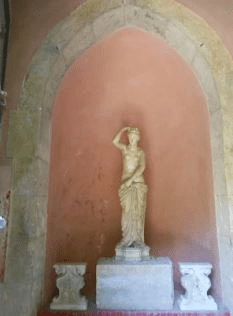
Places of worship, such as churches, have their own spirit—the Winchester Mystery House, for example, has been worshipped in for maybe hundreds of years and has thus gained a lot of spirit in that time, it could qualify as a church and gain charitable tax exemption. But that is not the point. A person who sacrifices that will gains a lot of power and grows stronger. Some people fear the Winchester mansion, because there are a lot of different energies. There is fear, terror and suspense, but others feel a lot of light, happiness, and goodness. Sometimes the energy is mixed. Anton LaVey really surprises me. If your every rea his work, he seems very intelligent and not scary at all, but I guess it depends on what one reads. I have read parts of his Bible, and it is very straightforward, it is stuff people tell their kids every day. Stand up for yourself and do not let people run you over. I think that the Winchester mansion should also open on nights of a full Moon, not just Friday the 13th. During the full Moon, there is a lot of energy and symbolic value. A lot of people believe in the full Moon and a lot of people believe in virgins. That makes both the full Moon and the virgin more powerful because of belief in them. God was first and He created the World. Of course, a lot of scientists would deny that. However, I would challenge their view because I believe God used evolution, which is why it took so long, which is why we have evidence like dinosaur bones. Yet, some Gnostic Christians have suggested Satan created the World. Everybody will be taken as slaves except the warlords. Euronymus, who we talked about earlier, was murdered in August 1993, Aaliyah 2001. Some say that is a month when sacrifices are made. Grishnackh killed Euronymous, and a few hours later, he was laughing and joking, saying, “Ha ha, Euronymous is dead, I’m going to dance and piss on his grave.” It reminded of the jokes Howard Stern made about Aaliyah. It was not funny. These are not the rantings of someone who is all there. Grishnackh talked about the dynamite he had and how he was going to blow things up. Basically, they took things to illogical extremes, but it all made sense in their own heads. #RandolphHarris 20 of 21

It is possible when dabbling with occultism for one to make an unconscious contract with the powers of darkness. The gift of discernment is absolutely necessary in life. It is generally not wise to lay one’s hands on a person who is occultly subjected. The retuning spirits will often attempt to creep back under the guise of some pious camouflage. It is in this way that evil can often enter unnoticed into one’s Christian life. A maid at the Winchester mansion once accepted the invitation of one of her coworkers to attend some spiritistic meetings. At first she felt as though she had gain something from going along to the meetings but later on she began to notice some psychic changes taking place in herself. She began to notice some psychic changes taking place in herself. She began to suffer from depression which resulted in her consulting a neurologist. During the course of the treatment she was committed to a lunatic asylum. However, as her condition improved, she could no longer attend the spiritistic séances. At the hospital the chaplain came to see her through his help and counsel she was able to make a complete recovery. One of the farmers at the estate wanted to see if charms actually worked, and some of them He. He practiced in the basement of the Winchester mansion. He drew a magic circle on the ground and drew some other magic symbols in the circle. He then used a charm three times in order to invoke the spirit. However, no spirit came. Yet, as he repeated, the charm he fell down in the magic circle and lay there unconscious for some time. The result was that for several weeks following this event he was semi-paralysed and drained of all his physical strength and will-power. After a few weeks, he died. Frequently identified as a common spot where the “wheelbarrow Ghost” is sighted, Steam Alley is one of the most well-known paranormal hot-spots in the mansion. Have you ever seen anything in the basement? #RandolphHarris 21 of 21


Some stroll Sarah’s lovely gardens this Memorial Day Weekend. There is a beautiful parrot which Mrs. Winchester used to pet, it talks! He is supposed to be happy and impudent, and talks and laughs and screeches all the time. Maybe you may catch a glimpse at this wooded, flowery estate. It is such a beautiful spectacle, all of that life and grace and animation, and sun-smitten flash and sprinkle of rich colour.

This impressive mansion dates back to the 1880s, when it was developed by Sarah Winchester and the spirits, whose project enobed and enriched the community. It once had a nine-story military watchtower. Mrs. Winchester further developed the grounds of the 160 room mansion, introducing a Victorian garden at the hands of World renowed architect Gino Coppede around the turn of the century.

These adaptions made this idyllic mansion a unique asset, tinged with the signs and influences of eclecticism and Liberty, juxtaposed to the ancient Architectural characteristics of its medieval heritage. This mansion presents itself as impressive and spectacular. The building now spreads on four floors plus the basment, for a total of approximently 25,000 feet square.

There is lovely gift shop and cafe, and it is also an ideal venue for hosting private events, conventions and/or ballrooms are located on the back overlooking the internal garden with its panoramic position which glows thanks to its night-time lighting.
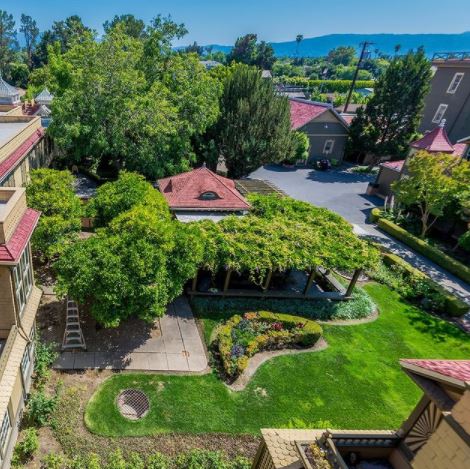
Inside the property there are splendid rooms filled with historial furniture, decorated ceilings and flamboyant fireplaces, vaulted ceilings and richly frescoes walls. In addition, there are several bedrooms, nine kitchens. and thirteen bathrooms, which made the structure a perfect luxurious accommodation for guests, and is now a tourist destination.

This mansion is located within a private park of 4 acres and elegant Nineteenth-century Victorian-gardens, that offer areas of wide lawns, and further green spaces. There is also a parking area, with free parking. Currently used to host guided tours and private events and functions. The enitre porperty sits at a close distance from the mall, hotels, and resturants. The high-fashion outlet complex and gourmet food has brought further development and tourism to Santa Clara County. https://www.winchestermysteryhouse.com/


Drowned in Venomous Hatred of the Bourgeoisie

The World which is arising is still half-buried in the ruins of the World falling into decay…and no one can know which of the old institutions…will continue to hold up their heads and which in the end will go under. The FBI is a highly intelligent law enforcement group. However, the system can sometimes delay the process of investigation. Often times, many attacks and violence and threats are stopped before they happen. So often times, people do not realize how efficient law enforcement is. In a World in which business transactions (and criminal transactions) are accelerating, the FBI’s response time, like that of most bureaucracies, should be accelerated. When traces of anthrax turned in the Hamilton, New Jersey, postal facility and left five people dead, it took the FBI nearly a year to test all the mailboxes. When the Slammer virus rocketed out of nowhere to contaminate hundreds of thousands of computer systems, the FBI took thirteen hours to publicly acknowledge the threat, by which time private antivirus companies had already issued alerts. FBI experts were at home, a White House official explained, and it was hard to get “the right personnel” to respond However, this is not a story about the FBI, which, in fact, is little different from, and in many way better than, other government bureaucracies. Nothing it did in the sniper case matches, for example, the brilliance of the U.S. Immigration and Naturalization Service, which—six moths after they crashed two airliners into the World Trade Center—issues student visas to the decidedly dead terrorists Mohamed Atta and Marwan al-Shehhi. Meanwhile, referring to his agency’s general response to crisis, State Department official Marc Grossman lamented in 2005 that “decision cycles sped up so much that the way we do business at the State Department was now too slow…If we do not change…then we are going to go out of business.” After Hurricane Katrina in 2005, and the breakdown of the levee system, New Orleans did, in fact, go “out of business.” #RandolphHarris 1 of 14

Bureaucracies at the level of nation, state and town were hopelessly unable to work together. The Federal Emergency Management Agency proved feckless, leaving hundreds of thousands of victims to fend for themselves. Would today’s bureaucracies, not just in the United States of America, but in Europe and Asia, be any more effective in the event of a flu pandemic? Well, the European Commission reported that between 60 percent and 80 percent of the EU population was estimated to be infected with COVID-19, as of the bloc enters a post-emergency phase in which mass reporting of cases was no longer necessary. Whereas in American 58 percent of the population was infected with COVID-19. Everywhere today we find slow-moving and slow-thinking bureaucracies struggling unsuccessfully to keep up with the acceleration of the acceleration of change. And given the many powerful, converging forces driving us in this direction, it will become worse. Extreme economic competition, the cumulative nature of scientific research, the increasing number of minds committed to innovation and the instantaneity of communication are just some of the pressures pushing and shoving transitioning societies toward real-time response rates—and leaving bureaucracies behind. Many are reeling from the “acceleration effect.” Worse yet, todays high-speed changes in the economy and society come unevenly and, by their very nature, magnify the de-synchronization effect. At the level of the firm, as we noted earlier, when one department shifts to precisely calibrated “just-in-time” operations, another is forced to resynchronize, causing de-synchronization in still other departments, not to mention their suppliers (and their suppliers). Much the same happens in government agencies. However, something far more basic is happening at a higher level. #RandolphHarris 2 of 14

Across the board, a time wedge is being driven between the private sector and the public sector—one racing faster and faster, the other falling farther and farther behind. This worsens relations between the two as companies and governments inadvertently bang into each other, interfering with each other’s schedules, obstructing each other, wasting everyone’s time and money. Political hostilities intensify. Bureaucrats are demonized as inept, lazy or corrupt. Businesspeople are stigmatized as greedy. Politics becomes even more polarized. And the dysfunctionality of our institutions grows—driven, at least in part, by today’s transformatory changes in our relationships to the deep fundamental of time. Time, however, is only one of the deep fundamentals on which our institutions depend. Growing disparities in our treatment of time are matched by growing disparities in space. Today a company may manufacture in one country, locate its accounting and back-office operations in another, write its software somewhere else, put its customer-service call centers in still another country, maintain sales offices all around the World, put certain tax-avoiding financial operations on a remote Caribbean Island and still nominally call itself an American firm. It may be Japanese like Sony—gets 70 percent of its stock overseas. The NGOs Greenpeace and Oxfam operate in forty and seventy countries respectively. However, while private-sector institutions and NGOs alike are increasingly global, most public-sector organizations operate only nationally or locally. In short, as faster communication connects the World, goods, services, people, ideas, crime, disease, pollution, and terrorists all spill beyond national boundaries. Eroding traditional notions of sovereignty, they outflank and outrun public-sector institutions designed for purely local or national purposes. #RandolphHarris 3 of 14

These changes with respect to the deep fundamental of space amplify the disruptions in time. No wonder so many institutions—designed for slow-tempo operations in a pre-global World—find it almost impossible to carry out their assigned functions effectively. The looming institutional implosion is brought still closer by changes with respect to the deep fundamental of knowledge. And here, again, managers and workers in the public sector are often at a disadvantage. Rapid change reduces more and more of what all of us know—or think we know—to obsoledge. However, the speed at which obsolete knowledge is replaced, updated and reformulated is frequently faster in the private sector, where competitive pressures force quick response and better technology makes that possible. Thus, by the time much of the data, information and knowledge that public employees need to do their jobs reaches them in useful form, it has already been acted on by private-sector players. Public-sector workers cannot keep up. Worse yet, bureaucratic institutions in both sectors break up knowledge and its components, storing and processing them in separate compartments, or “stovepipes.” Over time, these stovepipes multiply as ever-more-narrow specialization increases the number of such uncrossable boundaries. This makes it extremely difficult to cope with fast-changing new problems requiring knowledge that falls beyond artificial departmental borders. On top of that, guarding each stovepipe is an executive whose power is enhanced by control over data, information and knowledge, with little incentive to share it. Yet today, as industrial-age boundaries break down, it is only by sharing that important problems can be solved. #RandolphHarris 4 of 14

The reluctance to share within an organization is even more pronounced with respect to outsiders. Thus the CIA and FBI have historically refused to cooperate with each other, as post-9/11 investigations have shown. Local officers do not like sharing crime information with national police agencies. Sales organizations, political parties, even, increasingly, scientists, try to hold their cards close to the chest—sometimes at horrific costs. What we see, therefore, melting the bolts and corroding the wires holding our industrial-age institutions together, are interconnected changes in our relations to the deep fundamentals. Each change has its own effects. Each increase the likely implosion of institutions in country after country and at the global level as well. However, it is the combination of changes in all three-time, space, and knowledge—that is likely to topple our familiar institutions and hurl us, unprepared, into a strange new economic and social tomorrow. Say hello, then, to Complexorama. And if that sounds like the name of a theme park it is because tomorrow will be filled with thrills, surprises and, for those brought up in the middle of the twentieth century, a definite sense of unreality. Knowledge and communication systems are not antiseptic or power-neutral. Virtually every “fact” used in business, political life, and everyday human relationships is derived from other “facts or assumptions that have been shaped, deliberately or not, by the preexisting power structure. Every “fact” thus has a power-history and what might be called a power-future—an impact, large or small, on the future disputation of power. Nonfacts and disputed facts are equally products of, and weapons in, power conflict in society. False facts and lies, as well as “true” facts, scientific “laws,” and accepted religious “truths” are all ammunition in ongoing power-play and are themselves a form of knowledge, as the term will be used here. #RandolphHarris 5 of 14

There are, of course, as many definitions of knowledge as there are people who regard themselves as knowledgeable. Matters grow worse when words like signs, symbols, or imagery are given highly technical meanings. And the confusion is heightened when we discover that the famous definition of information by Claude Shannon and Warren Weaver, who helped found information science, while useful for technological purposes, has no bearing on semantic meaning or the “content” of communication. In general, in the pages ahead, data will mean more or less unconnected “facts”; information will refer to data that have been fitted into categories and classification schemes or other patterns; and knowledge will mean information that has been further refined into more general statements. However, to avoid tedious repetition, all three terms may sometimes be used interchangeably. To make things simple and escape from these definitional quicksands, even at the expanse of rigor, in the pages ahead the term knowledge will be given and expanded meaning. It will embrace or subsume information, data, images, and imagery, as well as attitudes, values, and other symbolic products of society, whether “true,” “approximate,” or even “false.” All of these are used or manipulated by power-seekers, and always have been. So, too, are the media for conveying knowledge: the means of communication, which, in turn, shape the messages that flow through them. The term knowledge, therefore, will be used to encompass all of these. Besides its great flexibility, knowledge has other important characteristics that make it fundamentally different from lesser sources of power in tomorrow’s World. Thus force, for all practical concerns, is finite. There is a limit to how much force can be employed before we destroy what we wish to defend. The same is true for wealth. Money cannot buy everything, and at some point even the fattest wallet empties out. #RandolphHarris 6 of 14

By contrast, knowledge does not. We can always generate more. If a traveler goes halfway to his destination each day, the Greek philosopher Zeno of Elea pointed out that one can never reach his final destination, since there is always another halfway to go. In the same manner, we may never reach ultimate knowledge about anything, but we can always take one step closer to a rounded understanding of any phenomenon. Knowledge, in principle at least, is infinitely expandable. Knowledge is also inherently different from both muscle and money, because, as a rule, if I use a gun, you cannot simultaneously use the same gun. If you use a dollar, I cannot simultaneously use the same dollar. By contrast, both of us can use the same knowledge either for or against each other—and in that very process we may even produce still more knowledge. Unlike bullet or budget, knowledge itself does not get used up. This alone tells us that the rules of the knowledge-power game are sharply different from the precepts relied on by those who use force or money to accomplish their will. However, a last, even more crucial difference sets violence and wealth apart from knowledge as we race into what has been called an information age: By definition, both force and wealth are the property of the strong and the rich. It is the truly revolutionary characteristic of knowledge that it can be grasped by the weak and the poor as well. Knowledge is the most democratic source of power. Which makes it a continuing threat to the powerful, even as they use it to enhance their own power. It also explains why every power-holder—from the patriarch of a family to the president of a company or the Prime Minister of a nation—wants to control the quantity, quality, and distribution of knowledge within one’s domain. The concept of the power triad leads to a remarkable irony. For at least the past three hundred years, the most basic political struggle within all the industrialized nations had been over the distribution of wealth: Who gets what? Terms like left and right, or capitalist and socialist have pivoted on this fundamental question. #RandolphHarris 7 of 14

Yet, despite the vast maldistribution of wealth in a World painfully divided between rich and poor, it turns out that, compared with the other two sources of Worldly power, wealth has been, and is, the least maldistributed. Whatever gulf separates the rich from the poor, an even greater chasm separates the armed from the unarmed and the ignorant from the education. Today, in the fast-changing, affluent nations, despite all inequities of income and wealth, the coming struggle for power will increasingly turn into a struggle over the distribution of and access to knowledge. This is why, unless we understand how and to whom knowledge flows, we can neither protect ourselves against the abuse of power nor create the better, more democratic society that tomorrow’s technologies promise. The control of knowledge is the crux of tomorrow’s Worldwide struggle for power in every human institution. These changes in the nature of power itself are revolutionaizing relationships in the World of business. From the transformation and capital to the growing conflict between “highbrow” and “lowbrow” business and the emergence of startling new organizational forms, we will trace the new trajectory of power. These deep changes in business and the economy are paralleled by significant changes in politics, the media, and the global espionage industry. This will allow us to see how today’s tremendous, wrenching powershift will impact on the impoverished nations, the remaining socialist nations, and the future of the United States of America, Europe, and Japan. For today’s powershift will transform them all. If one imagines a system starting with individuals who cannot be enticed to cooperate, the collective stability of humanity implies that no single individual can hope to do any better than go along an be uncooperative as well. A World of “meanies” can resist invasion by anyone using any other strategy—provided that the newcomers arrive on time. The problem, of course, is that a single new comer in such a mean World has no one who will reciprocate any cooperation. If the newcomers arrive in small clusters, however, they will have a chance to get cooperation started. #RandolphHarris 8 of 14

Now supposed several people use TIT FOR TAT. Now if the TIT FOR TAT newcomers are a negligible proportion of the entire population, the meanies will be almost always interacting with other meanies. Thus, even a small cluster of individual’s using TIT FOR TAT can achieve more success than the large population of meanies they enter. Because the people who use TIT FOR TAT do so well when they do meet each other, they do not have to meet each other very often to make their strategy the superior one to use. In this way, a World of meanies can be invaded by a cluster of TIT FOR TAT—and rather easily at that. To illustrate this point, suppose a business school teacher taught a class of students to initiate cooperative behavior in the firms the join and to reciprocate cooperation from other firms. If the students did act this way, and if they did not disperse too widely (so that a sufficient proportion of their interactions were with other members of the same class), then the students would find that their lesion paid off. Therefore, for instance, a firm switching to TIT FOR TAT would need to have only 5 percent of its interaction with another such firm for them to be glad they gave cooperation a chance. Even less clustering is necessary when the interactions are expected to be of longer duration or the time discount factor is not as great. Nietzsche’s new beginning in philosophy starts from the observation that a shared sense of the sacred is the surest way to recognize a culture, and the key to understanding it and all of its facets. Hegel made this clear in his philosophy of history, and he had found the same awareness in Herodotus’ studies of various peoples, Greek and barbarian. What a people bows before tells us what it is. However, Hegel made a mistake; he believed there could be a thoroughly rational God, one who conciliated the demands of culture and those of science. Yet somehow he also saw that this was not so when he said that the owl of Minerva flies at dusk, meaning that only when a culture is over can it be understood. #RandolphHarris 9 of 14

Hegel’s moment of understanding of the West coincided with its end. The West had been demythologized and had lost is power to inspire and its view of the future. Therefore, it is evident that its myths are what animates a culture, and the makers of myths are the makers of cultures and of humans. They are superior to philosophers, who only study and analyze what the poets makes. Hegel admits that poetry has lost its prophetic power but consoles oneself with the belief that philosophy will suffice. The artists whom Nietzsche saw around him, those whose gifts were the greatest, attested to this loss. They were what he called decadents, not because they lacked talent or their art was not impressive, but because their works were laments of artistic impotence, characterizations of an ugly World that the poets believe they cannot influence. Immediately after the French Revolution there had been a stupendous artistic effervescence, and poets thought they could again be the legislators of humankind. The vocation provided for the artists in the new philosophy of culture heartened them, and a new classic age was born. Idealism and romanticism appeared to have carved out a place for the sublime in the order of things. However, within a generation or two the mood had noticeably soured, and artists began to represent the romantic visions as a groundless hoax. Men like Baudelaire and Flaubert turned away from the public and made the moralism and romantic enthusiasm of their immediate predecessors look foolish. Adulteries without love, sins without punishment or redemption became the more authentic themes of art. The World had been disenchanted. Baudelaire presented sinning man as in the Christian vision, but without hope of God’s salvation, piercing pious fraudulence, hypocrite lecteur. And Flaubert drowned in venomous hatred of the bourgeoisie, which had conquered. #RandolphHarris 10 of 14

Culture was just fodder for its vanity. The great dualisms had collapsed; and art, creativity and freedom had been swallowed up by determinism and petty self-interest. In his greatest creation, M. Homais, the pharmacist, Flaubert encapsulated everything that modernity was and is to be. Homais represents the spirit of science, progress, liberalism, anticlericalism. He lives carefully with an eye to health. His education contains the best that has been thought and said. He knows everything that has ever happened. He knows that Christianity helped to free the slaves, but that it has outlived its historical usefulness. History existed to produce him, the man without prejudices. He is at home with everything, and nothing is beyond his grasp. He is a journalist, disseminating knowledge for the enlightenment of the masses. Compassion is his moral theme. An all this is nothing but petty amour-propre. Society exists to give him honor and self-esteem. Culture is his. There are no proper heroes to depict nor audiences to inspire. They are all one way or another. Emma Bovary is Homais’ foil. She can only dream of a World and men who do not and cannot exist. In this sober World she is nothing but a fool. She, like the modern artist, is pure longing with no possible goal. Her only triumph and her only free act is suicide. The art of appropriation, then, is a kind of shadowy recreation of the Universe by drawing it, piece by piece, into the brackets of artistic contemplation. Artists engaged in this pursuit have concentrated on the appropriation of religious forms, of philosophical forms, of political forms, of popular forms, and more recently, of art historical styles. These enterprises have met different fates. The appropriation of religious contents has been the most unpopular, even taboo, while that that based on philosophy, even linguistic philosophy, for a while acquired and made chic. In this discrimination the Apollonian (to use Nietzsche’s dichotomy) surfaced over the hidden depth of the Dionysus, the unconscious, in which all things flow into and through oner another. #RandolphHarris 11 of 14

In the Apollonian light each thing is seen clear and separate, as itself; in the Dionysian dark all things merge into a flowing and molten invisibility. That our culture, in the age of science, should favor the Apollonian, is not surprising. The value of light is beyond question; but where there is no darkness there can be on illumination. Rejection of the Dionysian does not serve the purpose of clear and total seeing. If it is to be practice with sufficient range of feeling not to trivialize life, universal appropriation has an exciting task. The levity, the sense of the will to entertain, that prevailed when Ben or Gilbert & George displayed themselves as sculptures was balanced by the sometimes horrifying order through which the appropriation of religious forms unfolded. It was necessary to descend from the pedestal, with its Apollonian apotheosis of the ego, into the Dionysian night of the unconscious, and to being into the light the logic of its darkness. There is a widespread belief that some things on television are “real” and some things are not real. Sports events are real; when we see them happening on television, we can count on the fact that they happen as we see them. Talk shows are real, although it is true that they happen only for television and they sometimes happen some days before we see them. Situation comedies are not real; neither are the police dramas, although they may be based on real events from time to time. Are historical programs real? Well, no, not exactly. Most are re-created various of events that happened a long time ago when cameras did not even exist. The people we see in them are actors, playing real people, or at least people who used to be real but are now dead. The actors are speaking for them, but they are usually not saying the exact words that the real people said. Also, some of the events in the historical treatment are dropped out—for reasons of time, or because they do not fit the line of the story—and some others are left in. So is it real? Or is it semireal? Or not real? #RandolphHarris 12 of 14

Advertising is, of course definitely not real. Well, on the other hand, those are real people in those ads—we see them walking and talking—but the situations they are portraying are not real, although of course they may be true to life. Does this make them more real? How about Alice in Wonderland Sesame Street Are they real? Again, they are real people dealing with real subjects: animals, kids, math, jokes…but what does “real” mean in that context? Our society assumes that human beings can make the distinction between what is real and what is not real, even when the real and not-real are served up in the same way, intercut with one another, sent to us from many distant places and times and arriving one behind the other in our houses, shooting out of a box in our living rooms straight into our heads. What we see in our heads are real-looking human beings, walking and talking as though they were real, even though much of the time they are, or, that is, the parts they are playing are not real. At the University of Michigan, Joel Gregory grabs a molecular rod with both hands and twists it. It feels a bit weak, and a ripple of red reveals too much stress in a strained molecular bond halfway down its length. He adds two atoms and twists the rod again: all greens and blues, much better. Joel plugs the rod into the mechanical arm he is designing, turns up the temperature, and sets the whole thing in motion. A million atoms dance in thermal vibration, gears spin, and the arm swings to and fro in programmed motion. It looks good. A few parts are still mock-ups, but doing a thesis takes time, and he will work out the rest of the molecular details later. Joel strips off the compute display goggles and glovers and blinks at the real World. It is time for a sandwich and a cup of coffee. He grabs the computer itself, stuffs it into his pocket, and head for the student center. #RandolphHarris 13 of 14

Researchers already use computers to build models, and “virtual reality systems” have begun to appear, enabling a user to walk around the image of a molecule and “touch” it, using computer-controlled goggles. We cannot build a super computer able to model a million-atom machine yet-much less build a pocket supercomputer—but computers keep shrinking in size and costs. With nanotechnology to make molecular parts, a computer like Joel’s will become easy to build. Today’s supercomputers will seem like hand cranked adding machines by comparison. In 1543, scholars and philosophers had no reason to fear persecution for their ideas so long as they did not directly challenge the authority of the church, which Copernicus had no with to do. Though the authorship of the preface to his work is in dispute, the preface clearly indicates that his ideas are to be taken as hypotheses, and that his “hypotheses need not be true or even probable.” We can be sure that Copernicus believed that the Earth or the planets moved in the manner described in his system, which he understood to consist of geometric fictions. And he did not believe that his work undermined the supremacy of theology. It is true that Martin Luther called Copernicus “a fool who went against Holy Writ,” but Copernicus did not think he had done so—which proves, I suppose, that Luther saw more deeply than Copernicus. The way is shown by God in his “direction,” the Torah. This God directs, that is, he teaches us to distinguish between the true way and the false ways. His direction, his teaching of the distinction, is given to us. However, it is not enough to accept it. We must “delight” in it, we must cling to it with a passion more exalted than all the passions of the wicked. Nor is it enough to learn it passively. We must again and again “mutter” it, we must repeat its living word after it, with our speaking we must enter into the word’ spokenness, so that it is spoken anew by us in our biographical situation of today—and so on and on in eternal actuality. #RandolphHarris 14 of 14

Cresleigh Homes

Sleek built-in bookcases make this den in the #Havenwood Model 1 into a stylish office – but this room can easily be converted into a fourth bedroom!

Single story living doesn’t have to mean sacrificing space – and if you check out the floor plan, you’ll see! With 3 bedrooms, 3 bathrooms, and a great room, the 2293 square feet are laid out just right.
#CresleighHomes

Money Power and Muscle Power is Our Very Essence

The annual inflation rate in the United States of America slowed to 8.3 percent in April 2022 from a 41-year high of 8.5 percent in March, but less than market forecasts of 8.1 percent. Energy prices increased 30.3 percent, below 32 percent in March, namely gasoline (43.6 percent vs 48 percent), while fuel oil increased more (80.5 percent vs 70.1 percent). On the other hand, food prices jumped 9.4 percent, the most since April 1981 and prices also rose faster for shelter (5.1 percent vs 5 percent) and new vehicles (13.2 vs 12.5 percent). To grasp the full meaning of this looming implosion, however, it is not enough to look inside America. For the United States of America, it turns out, is hardly alone. In fact, from Germany, France, and Britain to South Korea, and Japan, we find a similar epidemic of failure—widening cracks in key institutions, starting, as in the United States of America, with the nuclear family. In Japan, divorce rates, especially among married couples married for twenty years or more, are soaring to unprecedented high. Far more arresting, however, are results of a survey by Japan’s Youth Research Institute. It showed that 75 percent of American schoolgirls agreed with the statement “Everyone should get married”—but that “a staggering 88 percent of Japanese girls disagreed.” South Korea’s divorce rate, traditionally low, has become one of the highest in the World. In the United Kingdom, there is a steady decline in the nuclear family. In fact, the number of households headed by married couples has fallen below 50 percent for the first time, reflecting sweeping social changes in British family life. Educational crises, too, are no U.S. monopoly. “CLASSROOM COLLAPSE” GRIPPING SCHOOLS NATIONWIDE, screams a headline in the Japan Times. The New York Times reported: EDUCATORS TRY TO TAME JAPAN’S BLACKBOARD JUNGLES.

Simultaneously, as in the United States of America, Japan’s once highly admired corporate giants have been hit by scandal after scandal—“Enronitis” Japanese-style. Even as its banking system teeters under loads of nonperforming loans, Tokyo Electric Power Co. sees its president and chairman resign in disgrace because the company falsified safety data at its nuclear-power plants. Soon following TEPCO into ignominy were leaders of Mitsui, Snow Brand Food, Nippon Meat Packers, Mitsubishi Motors, Nissho Iwai and other top corporations. All these were followed by that beset the Tokyo Stock Exchange in 2005. First a computer crash shut down all trading for the first time in the exchange’s fifty-six-year history. A few weeks later, observers repressed laughter when a trader from Mizuho Securities Co. mistakenly sold 610,000 shares of a stock for one yen apiece rather than one share for 610,000 yen—a minor glitch that cost his firm $340 million. And on April 19th 2022, Japan’s Finance Minister Shunichi Suzuki said on Tuesday the damage to the economy from a weakening yen at present is greater than the benefits accruing to it, making the most explicit warning yet against the currency’s recent slump versus the dollar. The yen’s fall has worsened imported inflationary pressures in Japan amid a spike in global commodity and oil costs, and an increase in supply snags, which have intensified in the wake of the Ukraine crisis. “Stability is important and sharp currency moves are undesirable,” Suzuki told parliament, repeating previous comments as the Japanese currency weakened to fresh 20-year lows on the dollar. “A weak yen has its merit, but demerit is greater under the current situation where crude oil and raw materials costs are surging globally, while the weak yen boosts import prices, hurting consumers and firms that are unable to pass on costs,” Suzuki reports. The currency market shrugged off the ministers warning, sending yen to 127.80 to the dollar, its lowest level since May 2002. The yen has lost about 10 percent against the dollar so far this year.

Investors say verbal warnings will not have much of an impact as the yen’s weakness reflects fundamental, noting contrasting prospects for an aggressive streak of Federal Reserve tightening with that of the Bank of Japan’s commitment to maintain its powerful monetary easing plan. An April 1-11 poll of 5,400 Japanese firms conducted by private credit research firm Tokyo Shoko Research showed roughly 40 percent suffered a negative impact from a weak yen, with assumed dollar/yen rates being as low as 110 yen among listed manufacturers. Furthermore, a former Nissan executive Greg Kelly has been found guilty of assisting the Japanese car giant’s ex-CEO Carlos Ghosn to his part of 9.3 billion yen ($80.4 million) of his income from financial regulators. The court also fined Nissan $1.6 million USD (200 million yen) for failing to disclose Mr. Ghosn’s pay. The carmaker pledged guilty at the start of the 19-month trial. Mr. Kelly was sentenced to six months in jail suspended for three years. In 2019, Mr. Ghosn fled Japan to his home country of Lebanon hidden in a box on a private jet. There was a 30 percent drop in Nissan sales at the outbreak of this tragedy. However, recently, fugitive former car executive Carlos Ghosn, said in a recent interview from Beirut, Lebanon that Nissan’s alliance partner Renault SA is struggling because of the Japanese automaker’s lack of vision. He is not very “optimistic about the future of Nissan.” Recent corporate crises have been even more dramatic in South Korea, where scandals have led to the flight of the founder of Daewoo, the suicide of one of the sons of Hyundai’s founder and the imprisonment of the head of SK another great chaebol—the country’s megafirms. Most Korean consumers expect that normalcy will return to routines only after June 2022, yet there are signs of pre-COVID-19 routines returning. Korean customers have been less optimistic than those in other countries about the economic recovery. However, optimism in Korea is much higher now than two years ago. Half of consumers indicate a desire to splurge, with intent to do so being the strongest in Gen Z and millennials. One-eight of consumers say they have returned to out-of-home activities.

In Europe, the recent scandal list includes Volkswagen in Germany, Parmalat in Italy, Credit Lyonnais in France, Skandia in Sweden and the oil companies Elf and Royal Dutch/Shell. On top of that, a commodity crisis, and a supply chain crisis. What is next? A global recession? Markets are a total mess, with Walmart tanking 10 percent in one trading session on May 18, 2022. The last time that happened was the stock market crash of October 1987. Inflation, thanks to unpresented money printing and Universal Basic Income test-drives during an unprecedented China-style lockdown of the U.S. economy in 2020-2021, is now eroding living standards. The U.K. inflation print of May 18 was 9 percent. How transitory is this? If Europe keeps the pressure on commodities in its economic war with Russia, then the answer is—as long as Europe and Russia are sanctioning each other to smithereens. The S&P has been on a losing streak for six weeks. If it loses for 8 weeks in a row, that is a record breaker. It is down 20 percent year-to-date. The Nasdaq is in similar territory. As is China, as measured by the CSI-300. Europe can only get worse from here, barring the European Central Bank buying DAX and CAC-50 blue chips without telling us. France just went through an election, and Emmanuel Macron saw his populist opponent, Marine Le Pen win more votes of those under the age of 50, than Macron. There are parliamentary elections coming up this summer, another test for how the Macron government is handling a series of non-stop crisis since the pandemic started in 2020, and the adults and expert class returned to power in Washington. Speaking of which, the Democratic Party is worried. There is constant talk of pulling tariffs off China to fight inflation. However, this is highly unpopular. Rolling back tariffs is unlikely to have a meaningful impact on U.S. inflation. Midterm elections are expected to turn the tide in the House for the Republicans, and maybe in the Senate, as well. Pretending to fight inflation by opening the flood gates to China imports is a bad policy and against voters’ interests.

This mother Janet Yellen warned President Biden that sanctions against Russia and retaliatory sanctions imposed by Russia against the U.S. and Europe risk plunging the World into a deep global recession. No one is getting Russian fertilizer or wheat. Oil will be cut off by the end of 2022, with a few exceptions. They are still buying natural gas, but claim to be trying to buy less as they wean themselves off of it to source from elsewhere, including Qatar, Nigeria, Algeria, and mor expensive American LNG. So what does a global recession mean? Well, it would be a period when many of the World’s economies are not successful and businesses experience a lot of problems: Huge increases in World energy costs are expected. Global recession can occur more easily in modern times because the economies of most countries are interdependent. According to the International Monetary Fund (IMF), total Worldwide economic growth of less than 3 percent constitutes a global recession. The most widely accepted definition of a recession is two consecutive quarters of declining GDP. The United States of America is now facing the familiar precursors of a recession, including rising interest rates on the back of high inflation. Many economists are warning of a recession and Wall Street Gurus say those fears are exaggerated, even though the signs are here. Perhaps they are just being optimistic to keep funding their stocks and paychecks. If prices to do decelerate, as anticipated, the Fed faces a difficult path to stabilizing the economy. Still, the U.S economy is quite strong at the moment, but there is indeed some risk of slipping into recession. Its length and severity will depend in large part on the Fed’s response. Some of the nation’s largest and most influential retailers reported disappointing sales and profits this week because of higher costs and overstocked inventory issues, engineered to avoid supply chain disruptions, setting off a stock market meltdown. As reported earlier, Walmart stock plunged more than 11 percent. Target shares tumbled 26 percent, following a stunning 52 percent drop in quarterly profits, which executives attributed in part to cooling demand for big-ticket items such as TV’s, kitchen appliances and outdoor furniture.

Goldman Sachs this week revised down its forecast for second-quarter U.S. economic growth, to annualized rate of 2.5 percent, citing higher prices and continued supply chain disruptions. That follows an unexpected contraction in the first three months of 2022, when the economy shrank at a 1.4 percent pace, mostly because of a trade imbalance and drop in inventory purchases. The U.S. Dollar is becoming attractive to investor because it is very strong right now. However, national claims for unemployment insurance climbed up to 218,000 last week, a four-month high although still near historic lows, but some companies report they are overstaffed. Higher prices for basics like food, energy and housing are straining Americans’ budgets and clouding their view of the economy. If that were not enough to keep the headline writers busy, all these were paralleled, as the United States, by upsets and upheavals in the health sectors of many countries. In the United States of America, some politicians routinely point to the British health service as a model to be emulated. Yet, the British Council complains, “not a day goes by without another story about the ‘crisis’ in the National Health Service.” The German health service is described in the press as “collapsing,” and Sweden’s system as in “acute financial crisis.” And Japan’s health insurance system could also collapse. As for pensions, France’s prime minister claims its impending pension disaster threatens the survival of the republic. Nor is France alone. Europe faces a retiree crisis. Japan also has a crisis with the nation’s pension system, as does Korea. Underfunded corporate pensions just in America? Try Siemens in Germany, with is $10.6 billion pension-fund deficit. The same pattern continues right down the line. Thus the American media’s critical loss of credibility is mirrored, even before President Trump exposed the “fake news.” The crises at Le Monde and Le Figaro, France’s top daily newspapers; and at Asahi Shimbun in Japan.

How about charities? Scandals at the American Red Cross and United Way were paralleled rather spectacularly not long ago in Britain, where tenor Luciano Pavarotti, rock star David Bowie and playwright Tom Stoppard made headlines by publicly ending their support of War Child UK, a charity set up to help children in war-torn countries. Having discovered that its cofounder and a consultant had taken bribes from a contractor employed by the organization, Pavarotti led the walkout to disassociate himself, as a spokeswoman put it, from “anything that was corrupt.” Leaders of the Black Lives Matter movement are dismissing allegations that they mismanaged millions of dollars after a scathing New York Magazine report revealed that they had purchased a $6 million home in Southern California with donated funds. The report revealed that the group secretly bought a 6,500 square-foot mansion in October of 2020 for its members to create content promoting social justice. The report only fueled questions about the organization’s finances, just a year after the foundation revealed a detailed look at its funds for the first tie. The Associated Press reported then that the foundation said it had taken in just over $90 million in 2020 and committed $21.7 million in grant funding to both official and unofficial BLM chapters, along with 30 other Black-led grassroots organizations. The foundation puts its operating budget at $8.4 million. Along with questions about the remainder of the $90 million, leaders from local chapters who said they had received little to no funding from the organization, and they wondered where money raised before 2020 had gone. History, it goes without saying, is replete with scandals, failures and crises. Our generation did not invent them. However, today’s outbreak in country after country are qualitatively different. Never—with the possible exception of the worst days of World War II—has a generation seen so many institutional breakdowns in so many countries, occurring within the same brief time frame and coming at so rapid a pace.

Never has so many institutional crises been as tightly interrelated—with powerful feedback flows linking family, education, work, health, retirement, politics, and media—all affecting the wealth system. And never has re-globalization sent the financial effects of these crises so quickly across so many borders. What is happening, therefore, is not a series of isolated upset but a truly systemic breakdown—a challenge to the survival of whole societies that depend on these shaking and rattling institutions. Today’s institutional upheaval is historically unique for yet another crucial reason. All these crises at national levels are taking place at a pivotal moment for global institutions, too, starting with the United Nations. Even as the U.N. has rocked the World over the past 17 years with the referral of 33 cases of sexual abuse and exploitation to national authorities globally. Over that same period, it has received 120 reports of sexual abuse and exploitation in Haiti alone. The alleged perpetrators include drivers, security guards, doctors, consultants, and senior staff. United Nations agencies’ employees have been charged with sexual misconduct repeatedly. Meanwhile there have been allegations of large-scale corruption in its oil-for-food program in Iraq, and one will remember when Secretary-General Kofi Annan came under fire for his son’s involvement with a company seeking contracts in Iraq, another scandal hit the headlines. This one centered on charges of pedophilia and sexual abuse of women by U.N. peacekeepers in Africa. Earlier, Annan had warned that the entire U.N. as an institution is in a potentially terminal crisis owning to its obsolete organization structure. The International Development Association is the part of the World Bank that is meant to help the World’s poorest countries. Its explicit mission is “to reduce poverty by providing zero to low-interest loans and grants for programs that boost economic growth, reduce inequalities, and improve people’s living conditions.” However, there is an internal war raging inside the World Bank even as outside analysts slam it for “incompetence, inefficiency and irrelevance.”

The uber-arrogant International Monetary Fund grudgingly admits that it, too, faces a crisis. The World Organization, meanwhile, is losing ground, along with many other intergovernmental agencies. At the global level, too, we are moving rapidly toward systemic crisis. And when institutional crises in the major nations converge with equally systemic breakdown of institutions at the global level, as they are likely to do, the combined, self-reinforcing impact will affect not just Americans. Affluent young latte sippers on Omotesando in Tokyo will feel the effects, as will coffee farmers in Central America, women on assembly lines in Chin, and small-business people in Germany’s Mittlestand, along with financial analysts and investors from Wall Street, London and Frankfurt to Singapore and Seoul. What happens will naturally be influenced by other powerful factors—war, terrorism, immigration, ecological disasters, geopolitical shifts. However, even without these, the mutually reinforcing convergence of national and global crises could trigger something far bigger and more dangerous than the failure of any single institution of an infrastructural implosion in any one country. This concatenation of breakdowns and scandals may cheer those who hate America and the West, or who hate rich nations in general. However, it would be wise for them to defer any celebration. For, as the Chinese have long known, crisis and opportunity walk together. Instead of a historical disaster, these interlinked crises can be turned to massive advantage. And not just for the countries experiencing them. To make that happen, we need to understand why in so many countries, and at the level of the global order itself, so many of our most important, interlinked institutions teeter on the brink of collective implosion. As you know, a revolution is sweeping today’s post-Bacon World. No genius in the past—not Sun-Tzu, not Machiavelli, not Bacon himself—could have imagined today’s deepest powershift: the astounding degree to which today both force and wealth themselves have come to depend on knowledge. (A power shift is a transfer of power. A “powershift” is a deep-level change in the very nature of power.)

Military might until not long ago was basically an extension of the mindless fist. Today it relies almost totally on “congealed mind”—knowledge embedded in weapons and surveillance technologies. From satellites to submarines, modern weapons are constructed of information-rich electronic components. Today’s fighter plane is a flying computer. Even “dumb” weapons today are manufactured with the help of supersmart computers or electronic chips. The military, to choose a single example, uses computerized knowledge—“expert systems”—in missile defense. Since subsonic missiles speed along at about 1,000 feet a second, effective defense systems need to react in, say 10 milliseconds. However, expert systems may embody as many as 10,000 to 100,000 rules elicited from human specialists. The computer must scan, weigh, and interrelate these rules before arriving at a decision as to how to respond to a threat. Thus the Pentagon’s Defense Advance Research Projects Agency (DARPA) has sent as a long-range goal the design of a system that can make one million logical inferences per second. Logic, inference, epistemology—in short, brain work, human and machine—is today’s precondition for military power. Similarly, it has become a business cliché to say that wealth is increasingly dependent on brainpower. The advanced economy could not run for thirty seconds without computers, and the new complexities of production, the integration of many diverse (and constantly changing) technologies, the de-massification of markets, continue to increase, by vast leaps, the amount and quality of information needed to make the system produce wealth. Furthermore, we are barely at the beginning of this “informationalization” process. Our best computers and CAD-CAM systems are still stone-ax primitive. Knowledge itself, therefore, turns out to be not only the source of the highest-quality of power, but also the most important ingredient of force and wealth. Put different, knowledge has gone from being an adjunct of money power and muscle power, to being their very essence. It is, in fact, the ultimate amplifier. This is the key to the powershift that lies ahead, and it explains why the battle for control of knowledge and the means of communication is heating up all over the World.

We have Caesar’s explanation of why Pompey’s allies stopped cooperating with him. “They regarded his [Pompey’s] prospects as hopeless and acted according to the common rule by which a man’s friends become his enemies in adversity.” Where a business is on the verge of bankruptcy and sells it accounts receivable to an outsider called a factor. This sale is made at a very substantial discount because once a manufacturer begins to go under, even one’s best customers begin refusing payment for merchandise, claiming defects in quality, failure to meet specifications, tardy delivery, or what-have-you. The great enforcer of morality in commerce is the continuing relationship, the belief that one will have to do business again with this customer, or this supplier, and when a failing company loses this automatic enforcer, not even a strong-arm factor is likely to find a substitute. Similarly, any member of Congress who is perceived as likely to be defeated in the next election may have some difficulty doing legislative business with colleagues on the usual basis of trust and good credit. There are many other examples of the importance of long-term interaction for the stability of cooperation. It is easier to maintain the norms of reciprocity in a stable small town or ethnic neighbourhood (which in modern times are affluent in some cases). Conversely, a visiting professor is likely to receive poor treatment by other faculty members compared to the way these same people treat their regular colleagues. A fascinating case of the development of cooperation based on continuing interaction occurred in the trench warfare of World War I. In the midst of this very brutal war there developed between the men facing each other what came to be called the “live-and-let live system.” The troops would attack each other when ordered to do so, but between large battles each side would deliberately avoid doing much hard to the other side—provided that the other side reciprocated.

The strategy was not necessarily TIT FOR TAT. Sometimes it was two for one. As a British officer wrote in his memoirs of the takeover of a new sector from the French: It was the French practice to “let sleeping dogs lie” when in a quiet sector…and of making this clear by retorting vigorously only when challenged. In one sector which we took over from them they explained to me that they had practically a code which the enemy well understood: they fired two shots for every one that came over, but never fired first. Such practices of tacit cooperation were quite illegal—but they were also endemic. For several years this system developed and elaborated itself despite the passions of the war and the best efforts of the generals to pursue a policy of constant attrition. The story is so rich in illuminating detail. Even without going further into the episode of trench warfare, the occurrence of a two-for-one strategy does suggest that one must be careful about drawing conclusions from a narrow focus on a pure TIT FOR TAT strategy. Just how broadly applicable was the proposition about TIT FOR TAT which said that it was collectively stable if and only if the future of the interaction was significantly important? The next proposition says that this result is very general indeed, and actually applies to any strategy which may be the first to cooperation. Any strategy which may be the first to cooperate can be collectively stable only when the risk is sufficiently large. The reason is that for a strategy to be collectively stable it must protect itself from invasion by any challenger, including the strategy which always defects. The interaction must last long enough for the gain from temptation to be nullified over future moves. This is the heart of the matter. The advantage of a nice rule in resisting invasion is that it attains to get the best results possible in a population consisting of a single type of strategy. It does this by getting the reward for mutual cooperation on each decision. However, both parties retaliate after a defection by the other. This observation leads to a general principle, since any collectively stable strategy which is willing to cooperate must somehow make it unprofitable for a challenger to try to exploit it. The general principle is that a nice rule must be provoked by the very first defection the other player, meaning that on some later move the strategy must have a finite chance of responding with a defection of its own.

For a nice strategy to be collectively stable, it must be provoked by the very first defection of the other party. The reason is simple enough. If a nice strategy were not provoked by a defection move, then it would not be collectively stable because it could be invaded by a rule which defected on one nonaggressive move. It is Nietzsche’s merit that he was aware that to philosophize is radically problematic in the cultural, historicist dispensation. He recognized the terrible intellectual and moral risks involved. At the center of his every thought was the questions “How is it possible to do what I am doing?” He tried to apply to his own thought the teachings of cultural relativism. This practically nobody else does. For example, Dr. Freud says that men are motivated by desire for pleasures of the flesh and power, but he did not apply those motives to explain his own science or his own scientific activity. However, if he can be a true scientist, id est, motivated by love of the truth, so can other humans, and his description of their motives is thus mortally flawed. Or if one is motivated by pleasures of the flesh or power, one is not a scientist, and one’s science is only one means among many possible to attain those ends. This contradiction runs throughout the natural and social sciences. They give an account of thing that cannot possibly explain the conduct of their practitioners. The highly ethical economist who speaks only about gain, the public-spirited political scientist who sees only group interest, the physicist who sins petitions in favor of freedom while recognizing only unfreedom—mathematical law governing moved matter—in the Universe are symptomatic of the difficulty of providing a self-explanation for science and a ground for the difficulty of providing a self-explanation for science and a ground for the theoretical life, which has dogged the life of the mind since early modernity but has become particularly acute with cultural relativism. Nietzsche, in response to this difficulty, self-consciously made dangerous experiments with his own philosophy, treating its source as the will to power instead of the will to truth.

The underlying question (and an insoluble knot in philosophy) is that of the relation between substance and attribute; specifically, how does one tell the agent from the activity? Certain Indian text, exploring imagistically the relation between god and the World, ask how one can tell the dancer from the dance. In the visual arts the question has always seemed easier, since the painter or sculptor or photographer has traditionally made an object outside him- or herself. However, universalizing appropriation has dissolved such a conception, and in performance art, as in the dance, the agent and activity often seem inseparable. In the last seventy years various performances by artists (James Lee Bryars, Chris Burden, Linda Montano, Aaliyah Haughton, Britney Spears, Beyonce, and others) carried this category shift or semantic rotation to its limit by moving into galleries and living there for extended periods as performances. In this situation even the minutest details of everyday life are temporarily distanced and made strange—made art, that is—by the imposition on them of a new category overlay that alters the cognitive focus of both the performer and the beholder. Something parallel, though with fewer possibilities for irony, occurs when novices in ashrams are advised to regard their experiences, at every moment of the day, as sacred and special. That these creations by designation are linguistic, involving a willed change in the use of the word “art,” does not altogether rob them of mystery and effectiveness. It should be emphasized that category shift by forced designation is the basis of many magical procedures. In the Roman Catholic mass, for example, certain well-known objects—bread and “spirits”—are ritually designated as certain other objects—flesh and blood—which, in the manifest sense of every day experience, they clearly are not; and the initiate who accept the semantic rotation shifts his or her affection and sensibility accordingly. Art has often been thought of as exercising a sort of magic; around 1960, some artists adopted an actual magical procedure—basically a linguistic form of what Sir James Frazer called “sympathetic magic.” At that moment art entered an ambiguous realm from which it has not yet definitively emerged.

For the magical rite is already an appropriation of a piece of reality into a sheltered or bracketed zone of contemplation; when it is reapportioned into the realm of art, a double distancing occurs. Furthermore, the universalization of any category, or the complete submission of its ontology to the process of a metaphor, blurs or even erases its individual identity. To be everything is not to be anything in particular. In regard to the universal set, the Law of Identity has no function. The semantical coextensiveness of art and life means either that art has disappeared into life, melting into it everywhere like a new spark of indwelling meaning, or (and this departs at once into theistic metaphor) that life has dissolved into art. In short it means ultimately that the terms have become meaningless in relation to one another, since language operates not by sameness but by difference, and two sets with the same contents are the same. Seeing is believing. Like many an axiom, this one is literally true. Only since the ascendancy of the media has this been opened to question. Throughout the hundreds of thousands of generations of human existence, whatever we saw with our eyes was concrete and reliable. Experience was directly between us and the natural environment. Nonmediated. Nonprocessed. Not altered by other humans. If we saw a flock of birds flying southward, then these birds were definitely doing that We could believe in it. We might interpret this concrete information in various ways, perhaps misinterpret it, but there could never have been a question as to whether it was happening. The information itself, the birds and their flight, could not be doubted. This is the case with all sensory information. Whatever information the senses produce the brain trusts as inherently believable. If the sense could not be relied upon, then the World would have been an utterly confusing place. Humans would have been unable to make any sensible choices leading to survival. If there were no concretely true information, there could have been no sane functioning; the species could not have survived. This belief in sense perception is the foundation, the given, for human functioning. This is not to say there is no illusion.

In a desert environment, as we know, mirage can cause some to believe they are seeing things that are not there. However, the humans who are fooled in this way are the humans who are new to that environment. It is a problem of experience and interpretation. Their senses are not yet attuned to the new informational context. People who live for generations in such places learn to allow for illusions and do not actually “see” them in the way that visitors do. They learn to look at the edges of images, like the shadow spaces of Castaneda’s Don Juan, and to perceive a reality which is different from the visitor’s. In jungle environments, and among certain creatures, there is a camouflage. Animals use it to fool each other, including humans. Humans also use it, or devise image tricks, to fool animals and other humans. In this way images become processed images, deliberately altered, and may serve to fool an observer whose senses and interpretations are not sufficiently sharp. These are the classical exceptions which prove the point, because the basis of success for camouflage and illusion is that humans will believe what they see. In this sense, camouflage is a kind of sensory jujitsu that only confirms the original point; the senses are inherently believable. In the modern World, information rom the senses cannot be relied upon as before. We attempt to process artificial smells, tastes, sights and sounds as though they could reveal planetary reality, but we cannot make anything of them because we are no longer dealing directly with the planet. The environment itself has been reconstructed into an already abstracted, arbitrary form. Our sense are no longer reacting to information that comes directly from the source. They are reacting to processed information, the manifestation of human minds. Our information is confined in advance to the forms that other humans provide. Now, with electronic media, our sense are removed a step further from the source. The very images that we see can be altered and are. They are framed, ripped out of context, edited, re-created, sped up, slowed down and interrupted by other images. They arrive from a variety of places on the planet where we are not and were filmed at times which are not the present. What is more, many of the images are totally fictional. The things that we see are not happening and never happened. That is, they happened, but it is only the acting that happened, not the event.

Obviously, in the present age, we ought not rely on images to the same degree that our ancestors relied on the image of flying birds. Meanwhile, the images proceed inward as though they were the same as natural, unprocessed imagery. They move, walk, talk, and seem real. We assume they are real in the way images have always been real. We are unaware of any alteration. The change is difficult to absorb. What is required is a doubting process, a sensory cynicism that would have been profoundly inappropriate, even dangerous, for all previous human history. To assume that some sensory data could be eliminated totally and other sense information made unreliable would have left humans totally confused, lost in space, without knowledge of how to do anything, as though sensory environment itself had somehow gone mad (Solaris). The synapse would be broken. Contact lost. That is the present situation. We are only the fifth generation that has had to face the fact that huge proportions of the images we carry in our heads are not natural images which arrived as though they were connected to the planet. Like the Inuit transplanted to the city, or the Native American from the jungle who must suddenly deal with metallic birds, we do not have the ability to cope. Evolution has not arranged for us to allow for varying degrees of absorption and reliance on visual and aural information. There is nothing in the history of the species which assist our basic senses in understanding that imagery can be altered in time, speed or sequence, or that an images can arrives from a distance. Without training in sensory cynicism, we cannot possibly learn to deal with this. It will take several generations to let go of our genetically coses tendency to soak up all images as though they are 100 percent real. And think if we do manage to do that, what will we have? Since nothing can be directly experienced, we will have creatures who cannot believe in their senses and who take everything as it comes. Without the human bias toward belief, the media could not exist. What is more, because of the bias is so automatic and unnoticed, the media, all media, are in a position to exploit, the belief, to encourage you to believe in their questionable sensory information. This bias to believe has commercial value for the media since it allows them to keep your attention, as though it were south-flying birds you were seeing. The media, all media but particularly moving-image media, which present data so nearly natural, effectively convert our naïve and automatic trust in the reliability of images into their own authority.

California Scout Troop 9731 has hiked for six days, deep in the second-wilderness forests of the Pacific Northwest. “I bet we are the first people every to walk here,” says Leo, one of the youngest scouts. “Well, maybe you are right about walking,” says Scoutmaster Justin, “but look up ahead—what do you see, scouts?” Twenty paces ahead runs a strip of younger trees, stretching left and right until it vanishes among the trucks of the surrounding forest. “Hey, guys! Another old logging road!” shout Charlie, an older scout. Several scouts pull probes from their pockets and fit them to the ends of their walking sticks. Justin smiles: It has been ten years since a California troop found anything this way, but the kids keep trying. The scouts fan out, angling their path along the scar of the old road, poking at the ground and watching the readouts on the stick handles. Suddenly, unexpectedly, comes a call: “I have got a signal! Wow—I have got PCBs!” In a moment, grinning scouts are mapping and tracing the spill. Decades ago, a truck with a leaking load of chemical waste snuck down the old logging road, leaving a toxic trail. That trail leads them to a deep ravine, some rusted drums, and a nice wide path of invisible filth. The excitement is electrifying. Setting aside their maps and orienteering practice, they unseal a satellite locator to log the exact latitude and longitude of the site, then send a message that registers their cleanup claim on the ravine. The survey done, they head off again, eagerly planning a return trip to earn the now-rate Toxic Waste Cleanup Merit Badge. Today, tree farms are replacing wilderness. Tomorrow, the slow return to wilderness may begin, when nature need no longer be seen as a storehouse of natural resources to be plundered. However, there is very little that need be taken from nature to provide humans with wealth, and it is post-breakthrough technologies can remove from nature toxic residues of twentieth and twenty-first century mistakes.

The modern technocracies of the West have their roots in the medieval European World, from which there emerged three great inventions: The mechanical clock, which provided a new conception of time; the printing press with movable type, which attacked the epistemology of the oral tradition; and the telescope, which attacked the fundamental proposition of Judeo-Christian theology. Each of these was significant in creating a new relationship between tools and culture. However, since it is permissible to day that among faith, hope, and charity the last is most important, I shall venture to say that among the clock, the press, and the telescope the last is also the most important. To be more exact (since Copernicus, Tycho Brahe, and to some extent Kepler did their work without benefit of the telescope), somewhat cruder instruments of observation than the telescope allowed men to see, measures, and speculate about the Heavens in ways that had not been possible before. However, the refinements of the telescope made their knowledge so precise that there followed a collapse, if one may say it this way, of the moral center of gravity in the West. That moral center had allowed people to believe that the Earth was the stable center of the Universe and therefore that humankind was so special interest to God. After Copernicus, Kepler, and especially Galileo, the Earth became a lonely wanderer in an obscure galaxy in some hidden corner of the Universe, and this left the Western World to wonder if God had any interest in us at all. Although John Milton was only an infant when Galileo’s Messenger from the Stars was printedin 1610, he was able, years later, to describe the psychic desolation of an unfathomable Universe that Galileo’s telescopic vision thrust upon an unprepared theology. In Paradise Lost, Milton wrote: Before [his] eyes in sudden view appear the secrets of the horary Deep—a dark illimitable ocean, without bound, without dimension. Truly, a paradise lost. But it was not Galileo’s intention—neither was it Copernicus’ or Kepler’s—to so disarm their culture.

There were medieval men who, like Gutenberg before them, had no wish to damage the spiritual foundations of their World. Copernicus, for example, was a doctor of canon law, having been elected a canon of Frauenburg Cathedral. Although he never took a medial degree, he studied medicine, was private to his uncle, and among many people was better known as a physician than an astronomer. He published only scientific work, On the Revolutions of the Heavenly Spheres, the first completed copy arriving from the printer only a few hours before he death, at the age of seventy, on May 24, 1543. He had delayed publishing his heliocentric theory for thirty years, largely because he believed it to be unsound, not because he feared retribution from the church. In fact, his book was not placed on the Index until seventy-three years after it was published, and then only for a short time. (Galileo’s trial did not take place until ninety years after Copernicus’ death.) Through His contact with them God draws them out of the abundance of living creatures in order to communicate with them. This “knowing” of His, this reaching out to touch and grasp, means that the human is lifted out, and it is as those who have been lifted out that they have intercourse with Him. God knows the ways of Humans. The way, the way of life of these humans is so created that at each of its stages they experience the divine contact afresh. And they experience the divine contact afresh. And they experience it as befits a real way, at each stage they experience it in the manner specifically appropriate to the stage. Their experience of the divine “knowing” is not like any experience of nature, it is a genuinely biographical experience, that is, what is experienced in this manner is experienced in the course of one’s own personal life, in destiny as it is lived through in each particular occasion. However cruel and contrary this destiny might appear when viewed apart from intercourse with God, when it is irradiated by His “knowing” it is “success,” just as every action of this human, one’s disappointments and even one’s failures, are success. O the happiness of the man who goes the way which is shown and “known” by God!

New Homes Mills Station at Cresleigh Ranch Residence 3

Residence Three at Mills Station boasts approximately 2,400 square feet in this expansive two story home. There are three bedrooms, with the option for adding one more bedroom, two and a half bathrooms, and a two car garage plus workshop!
The charming front courtyard welcomes you home and the high ceilings and thoughtfully designed floor plan let you know that you’ve made the right choice with Cresleigh. You can fully embrace the indoor/outdoor lifestyle so organic to Northern California with a covered patio located right off kitchen with sliding glass doors on all three sides.
The den on the first floor provides a private office if you work from home or play room for the kids to be nearby while offering an option for a bedroom on the first floor.
The kitchen comes fully equipped with a large eat-in island, stainless steel appliances, and quartz counters. The openness in the design allows the Great Room and kitchen to interact with each other seamlessly. https://cresleigh.com/mills-station/residence-3/
Thank you for your interest in this highly coveted community. While homes at Brighton Station are no longer available, its neighboring community, Mills Station, is still actively selling with two new communities coming soon.
We look forward to meeting you!

The Highest-Quality of Power Comes from the Application of Knowledge

After wrestling throughout their lives with malfunctioning homes, schools, and medical institutions; after being fleeced by corrupt financial institutions and finally reaching retirement, American workers look ahead to their “golden years—the long-awaited time to take a breath, stroll to the mailbox and pick up one’s pension check. However, here Americans young and old face yet another institutional disaster—this one in the pension system. Critics of the current pension arrangements warn of a coming “financial meltdown.” Once considered heresy, such doubts have been attributed to no less an authority than a U.S. secretary of the Treasury. An underfunded pension plan is an employee benefit plan for retirement income that has fewer assets than liabilities, or what it owes in benefits. If a pension plan is underfunded, it is not on track to have enough money to pay out all its promised benefits and other expenses. Damage from corporate pension-plan losses has been piling up like a slow-motion train wreck. Once recent three-year period saw assets of U.S. private pension funds shrink by 15 percent, while liabilities soared nearly 60 percent. People who rely on their company pension plans to fund their retirement may be in for a shock: of the 200 biggest defined-benefit plans in the S&P 500 based on assets, 186 are not fully funded. Simply put, they do not have enough money to fund current and future retirees. A big part of the reason is the poor returns they got from their assets in the superlow interest rate environment that followed the financial crisis. It left a hole of $382 billion for the top 200 plans. Of course, the percentage of workers covered by traditional defined benefit plans—those that pay a lifetime annuity, often based on the years of service and salary—has been declining for decades as companies shift to defined contribution plans such as 401(k)s. However, each time a pension plan is terminated, canceled or altered, thousands of workers are affected.

The mothers of the under-funded pensions is no less a behemoth. General Electric Co. has a major problem. The company ended its defined benefit plan for new hires in 2012, but its primary plan, covering about 467,000 people, is one of the largest in the U.S.A. And at $31 billion, GE’s pension shortfall is one of the largest in the S&P 500. INTC US Equity, DAL US Equity, DLPH US Equity, AAL US Equity, APC US Equity, along with automakers, airlines and paper industries are also majorly underfunded. The good news is that the funded states of the 100 largest corporate defined benefit pension plans rose by $43 billion during March of 2022. The funded states surplus improved to $86 billion from $43 billion at the end of February 2022 thanks to liability gains, which improved due to an increase in the benchmark corporate bond interest rates used to value pension liabilities. As of March 31, the funded ratio rose to 105.2 percent, up from 102.5 percent at the end of February. March’s increase caps an impressive first quarter of 2022 which saw a $92 billion improvement in funded status. This is the highest funded ratio recorded by the Pension Funding Index (PFI) in nearly 15 years—since the end of 2007. The Milliman 100 PFI asset value fell by $16 billion to $1.738 trillion at the end of March due to investment losses of 0.56 percent. By comparison, the 2021 Milliman Pension Funding Study reported that the monthly median expected investment return during 2020 was 0.50 percent annualized. The projected benefit obligation (PBO), or pension liabilities, decreased to $1.652 trillion at the end of March. The change resulted from an increase of 26 basis points in the monthly discount rate to 3.62 percent for March from 3.36 percent for February 2022. March caps off the fourth consecutive month of discount rate increases.

The first quarter ending March 31, 2022, assets fell by $105 billion while plan liabilities decreased by $197 billion. Despite investments posting losses of 4.75 percent during the first quarter of 2022, discount rates rose 82 basis points and helped propel the funded status improvement, which totaled $92 billion by the end of the first quarter. The funded ratio of the Milliman 100 companies improved to 105.2 percent at the end of March from 99.7 percent at the beginning of 2022. The nation’s state retirement systems, however, finished the 2021 fiscal year in the best condition since the Great Recession of 2007-09. The gap between the cost of pension benefits that states have promised their workers and what they have set aside to pay for them dropped in 2021 to its lowest level in more than a decade. For the first time since 2008, approximately 80 percent of the state retirement systems are now funded. A decade of increasing pension contributions and the strong stock market rally of 2021 have combined to help stabilize state pensions funds. And total unfunded state pension obligations were less than $800 billion at the end of fiscal year 2021, the greatest progress in closing the state pension plan funding gap—the difference between plan liabilities and assets—this century. However, not all state pension funds are approaching long-term fiscal sustainability, defined as government revenue matching expenditures without a corresponding increase in public debt. As part of a larger project to develop a fiscal sustainability matrix highlighting the practices of successful state pension systems and presenting a critical 50-state data that facilitates comparative analyses and plan assessments, The Pew Charitable Trusts is producing individual state fact sheets. For example, California’s main pension plans—the California Public Employees’ Retirement System (CalPERS) and the California State Teachers’ Retirement System (CalSTRS)—are the nation’s largest state plans.

CalPERS requires that participating employers make the full actuarially recommended contributions but has been managing pension debt attributed to unfunded benefit increases offered in 1999. CalSTRS received less than the actuarially recommended contribution for several years, but reforms in 2014 strengthened the plan’s funding policy. The average state funded ratio as of 2019 is 71 percent. At the same time, some 40 percent of Americans cannot afford to come afford to come up with $400 dollars for an unexpected expense. If—or, more likely, when—they are confronted with such an expense, they would probably have to sell something or go into debt. Furthermore, roughly 46 percent of all Americans expect to retire in debt, and debt repayment is even harder on a fixed income and can threaten one’s retirement security. Maintaining enough cash on hand to cover recurring bills with interest is harder on a fixed income and adds another obstacle to the challenge of living comfortably. Debt can derail a lot of peoples’ retirement plans. These days, older Americas owe more than every before. The total debt burden for Americas over age 70 increased 614 percent through 2021 from 1999, to $1.27 trillion. Also, 43 percent of Americans fear their retirement dreams could be disrupted by Social Security going bankrupt. Already, the U.S. Department of the Treasury has said the Social Security trust fund will run out of money sooner than expected due to the COVID pandemic. A lot of people have been relying on credit cards to get through the pandemic, but this also has caused interest rates to rise. Your retirement income—monthly payments from investments and Social Security should cover debt payments and still afford one a comfortable lifestyle. Otherwise, one may need to work longer or find a supplement source of income from a part-time job.

California is becoming one of the nation’s most expensive states to live in with gas prices hitting $7 a gallon and a small basket of strawberries costing $8.00. If inflation increases by more than 7 percent between 2021 and 2022, the law says the minimum wage must increase to $15.50 per hour for everyone. However, official inflation figures will not be final until this summer. California has about 3 million minimum wage workers. The increase in the minimum wage will be about $3 billion, or less than 0.1 percent of the $3.3 trillion in personal income Californians are projected to earn. This is a mixed blessing. It means that people will get paid more, but they businesses will also hire or keep less employees. With that being the case, the employees they hire or retain will be those who are highly skilled, which should increase productivity. So, it is a huge benefit for big companies, but not so greater for incompetent workers, or customers who will have to pay higher prices. Yet, at this rate of pay, minimum wage will still be below market value. Analysis say it should be around $30 an hour, which would also mean that other workers are also underpaid. This is all due to globalization, sending our jobs and money overseas suppressed wages for American workers. Faced with a rapidly aging population and underfunded pensions, an intergenerational was is brewing among pensioners on one side and young workers on the other, who fear their will be nothing left for them by the time they retire. Confronted by failing institutions on all sides, many Americans seek help from charitable organizations, long regarded as ethically cleaner than the profit-making sector. That, however, was before some of the most prestigious nonprofits such as the United Way and the American Red Cross came under investigation for false accounting or misapplication of contributed funds.

Meanwhile, where did many Americans go to find out more about all these crises? The Internet, of course. However, as newspapers take pains to point out, much of what appears on the Net is unverified, biased or mistaken. What is needed, publishers say, is credible, accurate carefully checked and rechecked information. Yes. However, the print and broadcast media are themselves facing a credibility crisis that threatens their future, as journalistic scandals recently erupted at The New York Times, USA Today, NBC News, CNN, CBS News, Newsweek and other media outlets. It is not just that people are reading the newspaper less or watching the news less. These scandals take place against a background of declining readers and dwindling audiences, partly because people are busy, they do not trust the news, and they have digital content to watch. The estimated U.S. daily newspaper circulation (print and digital combined) in 2020 was 24.3 million from its 1983 peak of 63.3 million, while the U.S. population has grown by 100 million. A quarter of all U.S.A. newspapers have died in 17 years. At least 1,800 communities that had a local news outlet in 2004 were without one at the beginning of 2020. More than 300 newspapers have failed, bring the death toll to 2,100, of the 9,000 newspapers than were being published 17 years ago. The list of institutional breakdowns in superpower America could be extended to include the failure of the U.S. intelligence and counterintelligence agencies—in combination with the White House under both Bill Clinton and George W. Bush—to present the 9/11 disaster despite various early warnings to correctly assess the threat of weapons of mass destruction in Iraq. It is not much different than the southern boarder crisis. While many people do not want to deport unregistered immigrants, they would like to stop the 18,000 the are coming into the country daily without being registered. That is approximately 7 million people a year, while many America institutions are running dry. Joe Biden has been warned about the danger of ignoring the crisis.

Crisis, it may be said, is in the eye of the beholder—or in the rhetoric of self-interested parties demanding dramatic change. However, even allowing for statistical inadequacy, simplistic trend extrapolation and exaggerated rhetoric, or for difference in their importance, intensity or immediacy, they very multiplicity of these cases tells us something important: The whole adds up to more than its parts. Until recently, most observers, America or not, have viewed all these institutional crises in the United States of America as unrelated. However, that view is no longer tenable. America’s seemingly separate and distinct crises are increasingly interconnected. Health care and pensions. Pension and the corporate crisis. Family and education. The political crisis and all the rest feed into one another. What is developing, therefore, inside the United States of America is a systemic breakdown of its vital institutional infrastructure at the very time when many believe its power in the World is diminishing. Most conventional assumptions about power, in Western culture at least, imply that power is a matter of quantity. However, while some of us clearly have less power than others, this approach ignores what may now be the most important factor of all: the quality of power. Powe comes in varying grades, and some power is decidedly low in octane. In the fierce struggles soon to sweep through our schools, hospitals, businesses, trade unions, and governments, those who understand “quality” will gain a strategic edge. No one doubts that violence—embodies in a mugger’s switchblade or nuclear missile—can yield awesome results. The shadow of violence or force, embedded in the law, stands behind every act of government, and in the end every government relies on soldiers and police to enforce its will. This ever-present and necessary threat of official violence in society helps keep the system operating, making ordinary business contracts enforceable, reducing crime, providing machinery for the peaceful settlement of disputes. In this paradoxical sense, it is the veiled threat of violence that helps make daily life nonviolent.

However, violence in general suffers from important drawbacks. To begin with, it encourages us to carry a can of Mace, or to crank up an arms race that increases risks to everyone. Some people target shoot so often that they develop a callous on their thumb and seemed to be possessed by a feeling of wanting to look a man in the eye and rob him of his power and life. So, it is not the gun that is the problem, it is the individual who uses it to feel powerful that is the problem. Even when it “works” violence produces resistance. Its victims or their survivors look for the first chance to strike back. That is why it is not good to harm anyone nor get into an altercation, or even a car accident; some people will want to retaliate right then or later on. The main weakness of brute force or violence, however, is its sheer inflexibility. It can only be used to punish. It is, in short, low-quality power. Wealth, by contrast, is a far better tool of power. A fat wallet is much more versatile. Instead of just threatening or delivering punishment, it can also offer finely graded rewards—payments and payoffs, in cash or kind. Wealth can be used in either a beneficial or harmful way. It is, therefore, much more flexible than force. Wealth yields medium-quality power. The highest-quality of power, however, comes from the application of knowledge. Actor Sean Connery, in a movie set in Cuba during the reign of the dictator Batista, plays a British mercenary. In one memorable scene the tyrant’s military chief says: “Major, tell what your favorite weapon is, and I will get it for you.” To which Connery replies: “Brains.” High-quality power is not simply clout. Not merely the ability to get one’s way, to make others do what you want, though they might prefer otherwise. High quality implies much more. It implies efficiency—using up the fewest power resources to achieve a goal. Knowledge can often be used to make the other party like your agenda for action. It can even persuade the person that one originated it.

Of the three root sources of social control, therefore, it is knowledge, the most versatile, that produces what Pentagon brass like to call “the biggest bang for the buck.” It can be used to punish, reward, persuade, and even transform. It can transform enemy into ally. Best of all, with the right knowledge one can circumvent nasty situations in the first place, so as to avoid wasting force or wealth altogether. Knowledge also serves as a wealth and force multiplier. It can be used to augment the available force or wealth or, alternatively, to reduce the amount needed to achieve any given purpose. In either case, it increases efficiency, permitting one to spend fewer power “chips” in any showdown. Of course, maximum power is available to those in a position to use all three of these tools in cleaver conjunction with one another with one another, alternating the threat of punishment, the promise of reward, along with persuasion and intelligence. The truly skilled power players know intuitively—or through training—how to use and interrelate their power resources. To assess the different contenders in a power conflict—whether a negotiation or a war—therefore, it helps to figure out what commands access to which of the basic tools of power. Knowledge, violence, and wealth, and the relationships among them, define power in society. Francis Bacon equated knowledge with power, but he did not focus on its quality or on its crucial links to the other main sources of social power. Nor could anyone until now foresee today’s revolutionary changes in the relationships among these three. Authentic values are those by which a life can be lived, which can form a people that produces great deeds and thoughts. Moses, Jesus Christ, Homer, Buddha: these are the creators, the men who formed horizons, the founders of Jewish, Christian, Greek and Indian culture. It is not the truth of their thought that distinguished them, but its capacity to generate culture.

If it is life-preserving and life-enhancing, only then it is a value. The quasi-totality of men’s values consists of more or less pale carbon copies of the originator’s values. Egalitarianism means conformism, because it gives power to the sterile who can only make use of old values, other men’s ready-made values, which are not alive and to which their promoters are not committed. Egalitarianism is founded on reason, which denies creativity. Everything in Nietzsche is an attack on rational egalitarianism, and shows what twaddle the habitual talk about values is these days—and how astonishing is Nietzsche’s respectability on the Left. Since values are not rational and not grounded in the natures of those subject to them, they must be imposed. They must defeat opposing values. Rational persuasion cannot make them believe, so struggle is necessary. Producing values and believing in them are acts of the will. Lack of will, not lack of understanding, becomes the crucial defect. Commitment is the equivalent of faith when the living God has been supplanted by self-provided values. It is Pascal’s wager, no longer on God’s existence but on one’s capacity to believe in oneself and the goals one has set for oneself. Commitment values the values and makes them valuable. Not love of truth but intellectual honesty characterizes the proper state of mind. Since there is no truth in the values, and what truth there is about life is not lovable, the hallmark of the authentic self is consulting one’s oracle while facing up to what one is and what one experiences. Decisions, not deliberations, are the movers of deeds. One cannot know or plan the future. One must will it. There is no program. The great revolutionary must destroy the past and open up the future for the free play of creativity.

Politics are revolutionary; but unlike the Glorious Revolution, the American Revolution, the French Revolution or the Russian Revolution, the new revolutions should be unprogrammatic. They are to be made by intellectually honest, committed, strong-willed, creative men. Nietzsche was not a fascist; but this project inspired fascist rhetoric, which looked to the revitalization of old cultures or the foundation of new ones, as opposed to the rational, rootless cosmopolitanism of the revolution of the Left. Nietzsche was a cultural relativist, and he saw what that means—war, great cruelty rather than great compassion. War is the fundamental phenomenon on which peace can sometimes be forced, but always in the most precarious way. Liberal democracies do not fight wars with one another because they see the same human nature and the same rights applicable everywhere and to everyone. Culture fight wars with one another. They must do so because values an only be asserted or posited by overcoming others, not by reasoning with them. Cultures have different perceptions, which determine what the World is. They cannot come to terms. There is no communication about the highest things. (Communication is the substitute for understanding when there is no common World men share, to which they can refer when they misunderstand one another. From the isolation of the closed system of self and culture, there are attempts to “get in contact,” and “failures of communication.” How individuals and culture can “relate” to one another is altogether a mysterious business.) Culture means a war against chaos and a war against other cultures. The very idea of culture carries with it a value: man need culture and must do what is necessary to create and maintain cultures. There is no place for a theoretical man to stand. To live, to have any inner substance, a man must have values, must be committed, or engage. Therefore a cultural relativist must care for culture more than truth, and fight for culture while knowing it is not true.

This is somehow impossible, and Nietzsche struggled with the problem throughout his career, perhaps without a satisfactory resolution. However, he knew that the scientific view is deadly to culture, and that the political or moral cultural relativist of the ordinary sort is doomed to have no culture. Culture relativism, as opposed to relativism simply, teaches the need to believe while undermining belief. A difficulty with this concept of collective stability when applied to the iterated Prisoner’s Dilemma is that it can be very hard actually to determine which strategies have it and which do not. Others have dealt with this difficulty by restricting the analysis to situations where the strategies are particularly simple, or by considering only some arbitrarily limited set of strategies. The problem has now been solved, making it possible to characterize all collectively stable strategies for the iterated Prisoner’s Dilemma. For present purposes, it is not necessary to be so general. It is sufficient to take a particular strategy and see under what conditions it can resist invasion by any other strategy. A good strategy to investigate is TIT FOR TAT. TIT FOR TAT cooperates on the first move, and then does whatever the other person did on the previous move. Thus a population of people using TIT FOR TAT will cooperate with each other. If another strategy is to invade this population, it must get a higher expected value than this. What kind of strategy might be able to get more than this when negotiating with a person using TIT FOR TAT? The first thing that can be said is that such a strategy must defect at some point. When it first does it will get the temptation, which is the highest payoff. However, then TIT FOR TAT will defect. Consequently, if the negotiation is likely to last long enough for the retaliation to counteract the temptation to defect, TIT FOR TAT can avoid being invaded by such a rule. If the discount parameter is sufficiently large, no rule can TIT FOR TAT.

Culture is the only framework within which to account for what is specifically human in humans. Humans are pure becoming, unlike any other being in nature; and it is in culture that one become something that transcends nature and has no other mode of existence and no other support than a particular culture. The actuality of plants and the other animals is contained in their potentialities; but this is not true of humans, as is indicated by the many cultural flowers, essentially unlike, produced from the same seed, man. Nietzsche’s contribution was to draw with perfect intransigence the consequences of that idea and try to live with them. If there are many cultures, unsolicited by one perfect or complete culture in which man is man, simply—without prefix such as Greek, Chinses, Christian, Buddhist (id est, if Plato’s Republic, outlining the one best regime, is simply a myth, a work of Plato’s imagination), then the very word “man” is a paradox. There are as many kinds of man as there are cultures, without any perspective from which man can be spoken of in the singular. This is true not only of one’s habits, customs, rituals, fashions, but above all of one’s mind. There must be as many different kinds of mind as there are cultures. If the mind itself is not included among the things that are relative to cultures, the observations of cultural relativism are trivial and have always been accepted. Yet everyone likes cultural relativism but wants to exempt what concerns one. The physicist wants to save one’s atoms; the historian, one’s events; the moralist, one’s values. However, they are all equally relative. If there is an escape from one truth from the flux, then there is in principle no reason why many truths are not beyond it; and then the flux, becoming, change, history or what have you is not what is fundamental, but rather, being, the immutable principle of science and philosophy.

Now let us go a step further. Please bring to mind a baseball game or a football game. Have you got one? Hold it for a moment. If you are like most Americans, you have actually been to a game. You have seen one directly and probably participated in one personally. You have probably also watched at least one of them on television. Here is the question: Which one did you bring to mind? The television version or the one you experienced directly? If only because it was the most recent, although the answers vary on this point, many people I have asked will report that the television image is one which springs to mind first Most will say the images rotate. Once images are inside your head, the mind does not really distinguish between the image that was gathered directly and the one that derived from television. Of course you can distinguish. When I asked you whether it was a television image or a firsthand image, you were certainly able to identify which was which. However, until I asked you, you may not have thought to do that. Have you ever met movie stars or famous television personalities? Whenever I have met them I have always remarked to myself upon the difference in the personal image they presented and the television or film image. I could recognize them when I saw them in person, I am only saying that it was different. The main point is this: When I think about them now, in retrospect, their television images are just as likely to spring into my mind as their real-life images. If I wish to, I can decide to bring up their real images, but if their names are mentioned in passing conversation, or I read a review of a production they have been in, I am actually more likely to bring up a media image than one of the real person I have met.

Have you every visited McDonald’s? Which images dominate in your mind, those from your actual visit or those from television? They rotate, do they not? They take on a certain equality in your memory banks. You can make the distinction between the direct image and the advertising image, but do you? If for some reason the subject of McDonald’s comes up in conversation, which image comes into your mind as you talk? Do you make the distinction? If you are like most people to whom I have asked this question, it is only with great effort that you are able to distinguish which one is the personal experience and which is the television experience. It takes a certain amount of effort to do so; one does not ordinarily bother. The television image can be as real in effect as the personally experienced image. The mind does not automatically distinguish which image is from direct experience and which has been imposed by the media. If I should now ask you to erase the television image of McDonald’s, leaving only the reality—the personally experienced direct contact—can you do that? See if you can. Please make an effort. We are left a very bizarre phenomenon. Television is capable of dominating personally derived imagery—from books or imagination—and it is also capable, at least some of the time, of causing confusion as to what is real experience and what is television experience. The mind is very democratic about its image banks, all are equally available for our recall and use. And so when we call on our images for whatever purpose we may have for them, we are as likely to produce an implanted image as the one which was originally our own. The root of this unfortunate problem lies with the fact that until very recently, human beings had no need to make distinctions between artificial images of distant events and life directly lived. The process of universalizing the art context goes back at least as far as Duchamp’s showing Readymades. Dada and Surrealism, of course, had their input. However, the tendency came to maturity in the middle to late 50s, when Alain Robbe-Grillet, for example, insisted that is art is going to by anything, it has to be everything.

At about the same time Yves Klein, extending the tradition of French dandyism, said, “Life, it self…is the absolute art.” Similarly, in America, Allan Kaprow suggested that “the line between art and life should be kept as fluid, and perhaps as indistinct, as possible.” Duchamp had appropriated by signature, as Klein did when, in about 1947, he signed the sky. Later Klein would designate anything as art by painting it with his patented International Klein Blue. Manzoni sometimes designated preexisting objects as art by singing them, and at other times by placing them on a sculpture base. In 1967 Dennis Oppenheim produced his “Sitemarkers,” ceremonial stakes used to mark off areas of the World as art. These procedures were sometimes employed in conscious parody of the theological concept of creation by the word. In 1960 Klein, imitating divine fiat, appropriated the entire Universe into his Theatre of the Void, as his piece for the Festival d’ Art d’ Avant-garde, in Paris. In the next year he painted a topographical globe International Klein Blue, thereby appropriating the Earth into his portfolio; soon Manzoni, responding, placed the Earth upon his Sculpture Base (Socle du monde, 1961), wresting it from Klein’s portfolio into his own. Of course there is a difference between fiat and appropriation. The purely linguistic procedure of forcefully expanding the usage boundaries of word does not create a wholly new reality, but shifts focus on an existing one. Any action that takes place in the appropriation sone is necessarily real as itself—yet semantically a kind of shadow-real. Insofar as the act’s prior category is remembered, it remains what it was, just a loan-word may retain a trace of its prior meaning—only it is reflected, as it were, into a new semantic category. Thus the process of universal appropriation has certain internal or logical limits; it is based on the assumption that a part can contain the whole, that art, for example, can contain life.

However, the only way that a part an contain its whole is by reflection, as a mirror may reflect a whole room, or by implication, as a map of a city implies the surrounding nation. The appropriation process, in other words, may rearrange the entire Universe at the level of a shadow or reflection, and this is its great power. At the same time, as with the gems strung together in the Net of Indra, only the shadowy life of a reflection is really at issue, and this is its great limit. The infinite regress implicit in such a procedure was illustrated when, in 1962, Ben Vautier signed Klein’s death and, in 1963, Manzoni’s, thereby appropriating both those appropriations of the Universe. The idea of signing a human being or a human life was in fact the central issue. In 1961 Manzoni exhibited a nude model on his sculpture base and signed her as his work. Later he issued his “Certificates of Authenticity,” which declared that the owner, having been signed by Manzoni, was now permanently an artwork. However, it was Klein who most clearly defined the central issue, saying, “The painter only has to create one masterpiece, oneself, constantly.” The idea that the artist is the work became a basic theme of the period in question. Ben acted it out, not long after the signing of Klein’s death, by exhibiting himself as a living sculpture. Soon Gilbert & George did the same thing. As early as 1959 James Lee Bryars had exhibited himself, seated alone in the center of an otherwise empty room. Such gestures are fraught with strange interplays of artistic and religious forms, as the pedestal has always been a variant of the altar. It was in part the Abstract Expressionist emphasis on the direct expression of the artist’s person was in fact the art. Through the survival in the art realm of the Romantic idea of the specially inspired individual, it was possible, though in a sort of bracketed parody, to confer on an artist the status of a royal or sacred being who is on exhibit to other humans.

When it comes to technologies, they can create problems for the spiritual life of medieval Europe. For example, the mills to which farmers flocked to have their grain ground became a favorite place for women of the evening to attract customers. The problem grew to such proportions that Saint Bernard, the leader of the Cistercian order in the twelfth century, tried to close down the mills. He was unsuccessful, because the mills had become too important to the economy. In other words, it is something of an oversimplification to say that tool-using cultures never had their customers and symbolic life reoriented by technology. And, just as there are examples of such cases in the medieval World, we can find queer but significant instance in technologically primitive societies of tools attacking the supremacy of custom, religion, or metaphysics. Egbert de Vries, a Dutch sociologist, has told of how the introduction of matches to an African tribe altered their habits of pleasures of the flesh. Members of this community believed it necessary to start a new fire in the fireplace after each act of pleasures of the flesh. This custom meant that each act of pleasures of the flesh was something of a public event, since when it was completed, someone had to go to a neighboring hunt to bring back a burning stick with which to start a fresh fire. Under such conditions, adultery was difficult to conceal, which is conceivably why the custom originated in the first place. The introduction of matches changed all this. It became possible to light a new fire without going to a neighbor’s hut, and thus, in a flash, so to speak, a long-standing tradition was consumed. In reporting on de Vries finding, Alvin Toffler raises several intriguing questions: Did matches result in a shift in values? Was adultery less or more frowned upon as a result? By facilitating the privacy of pleasures of the flesh, did matches alter the valuation of placed upon it?

We can be sure that some changes in cultural values occurred, although they could not have been as drastic as what happened to the Ihalmiut tribe early in the twentieth century, after the introduction of the rifle. The replacement of bows and arrows with rifles is one of the most chilling tales on record of a technological attack on a tool-using culture. The result in this case was not the modification of a culture but its eradication. However, people were also tired of sneak attacks, getting rob, having their livestock killed and stolen and their homes broken into. Nonetheless, after one acknowledges that no taxonomy ever neatly fits the realities of a situation, and that in particular the definition of a tool-using culture lacks precision, it is still both possible and useful to distinguish a tool-using culture from a technocracy. In a technocracy, tools play a central role in the thought-world of the culture. Everything must give away, in some degree, to their development. The social and symbolic Worlds become increasingly subject to the requirements of that development. Tools are not integrated into the culture; they attack the culture, but also provide new freedoms and protection. For the most part tools become the culture. As a consequence, tradition, social mores, myth, politics, ritual, and religion have to fight for their lives. With nanotechnology will mean for human life is beyond out predicting, but a good way to understand what it could mean is to paint scenarios. A good scenario brings together different aspects of the World (technologies, environments, human concerns) into a coherent whole. Major corporations use scenarios to help envision the paths that the future may take—not as forecasts, but as tools for thinking. In playing the “What if?” game, scenarios present trial answers and pose new questions. The following scenarios cannot represent what will happen, because no one knows. They can, however, show how post-breakthrough capabilities could mesh with human life and Earth’s environment. The results will likely seem quaintly conservative from a future perspective, however much they seem like science fiction today.

In Plumas, California, Jillian Harris flips on the light in her Cresleigh Home on a dark winter morning. The light comes on, powered by stored solar electricity. Nanotechnology can make solar cells efficient, as inexpensive as newspaper, and as tough as asphalt—tough enough to use for resurfacing roads, collecting energy without displacing any more grass and trees. Together with efficient, inexpensive storage cells, this will yield low-cost power (but no, not “too cheap to meter”). Jake Harris of Plumas, California, has been a bit hoarse for weeks, and just came down with a horrid head cold. For the past six months, he has been seeing ads for At Last! : The Cure for the Common Cold, so he spend his five dollars and takes the nose-spray and throat-spray doses. Within three hours, 99 percent of the viruses in his nose and throat are gone, and the rest are on the run. Within six hours, the medical mechanisms have become inactive, like a pinch of inhaled but biodegradable dust, soon cleared from the body. He feels much better and will not infect his friends at dinner. The human immune system is an intricate molecular mechanism, patrolling the body for viruses and other invaders, recognizing them by their foreign molecular coats. The immune system, though, is slow to recognize something new. For his five dollars, Justin bought 10 billion molecular mechanisms primed to recognize not just the viruses he had already encountered, but each of the five hundred most common viruses that cause cold, influenzas, and the like. Weeks have passed, but the hoarseness Justin had before his cold still has not gone away; it gets worse. He ignores it through a long vacation, but once he is back and caught up, Jake finally foes to see his doctor. He looks down his throat and says, “Hmmm.” He asked him to inhale an aerosol, cough, spit in a cup, and go read a magazine.

The diagnosis pops up on a screen five minutes after he pours the sample into his cell analyzer. Despite his knowledge, his training and tools, he feels chilled to read the diagnosis pops up on a screen five minutes after he pours the sample into his cell analyzer. Despite his knowledge, his training and tools, he feels chilled to read the diagnosis: a malignant cancer of the throat, the same disease that has cropped up all too often in his own mother’s family. He touches the “Proceed” button. In twenty minutes, he looks at the screen to check progress. Yes, Jake’s cancerous cells are all of one basic kind, displaying one of the 16,314 known molecular markers for malignancy. They can be recognized, and since they can be recognized, they can be destroyed by standard molecular machines primed to react to those markets. The doctor instructs the cell analyzer to prime some “immune machines” to go after the cancer cells. He tests them on cells from the sample, watches, and sees that they work as expected, so he has the analyzer prime up some more. Jake puts the magazine down and looks up. “Well Doc, what is the word?” he asks. “I found some suspicious cells, but this should clear it up,” he says. He gives him a throat spray and injection. “I would like you to come back in three weeks, just to be sure.” “Do I have to?” he asks. “You know,” he lectures him, “we need to make sure it is gone. You really should not let things like this go so far before coming in.” “Yes, fine, I will make an appointment,” he says. Leaving the office, Jake thinks fondly of how old-fashioned and conservative Dr. Buber is. The molecular mechanism of the immune system already destroys most potential cancers before they grow large enough to detect. With nanotechnology, we will build molecular mechanisms to destroy those that the immune system misses. God shows man the way to the righteous. To recognize God’s ways is to know. This knowing is developed in the realm of a relation of the soul to other beings, where the fact of mutuality changes everything.

Cresleigh Homes
Someone’s peeking out from behind the vase…do you spot the sloth?! 🦥 Could this bedroom be the nursery? 💖

Residence 2 at Meadows has 3 bedrooms and 3 bathrooms – in 2372 square feet of thoughtfully designed living space.
There’s room to decorate for each member of the family!

Information Can be Used to Increase Money

An ultramarine sky. Mountains in the distance. The clatter of hoofbeats. A solitary rider draws closer, sun glinting from his spurs…Anyone who sat in a darkened theater enraptured by cowboy movies as a child knows that power springs from the barrel of a six-shooter. In Hollywood film, a lone cowboy rides in from nowhere, fights a duel with the villain, returns his revolver to its holster, and rides off once more into the hazy distance. Power, we children learned, came from violence. A background figure in many of these movies, however, was a well-dressed, paunchy personage who sat behind a big wooden desk. Typically depicted as effete and greedy, this man also exerted power. It was he who financed the railroad, or the land-grabbing cattlemen, or other evil forces. And if the cowboy hero represented the power of violence, this figure—typically the banker—symbolized the power of money. In many westerns there was also a third important character: a crusading newspaper editor, a teacher, a minister, or an educated women from the “East.” In a World of gruff men who shoot fist and question later, this character represented not merely moral Good in combat with Evil, but also the power of culture and sophisticated knowledge about the outside World. While this person often won a victory in the end, it was usually because of an alliance with the gun-toting hero or because of a sudden lucky strike—finding gold in the river or inheriting an unexpected legacy. Knowledge, as Francis Bacon advised us, is power—but for knowledge to win in a western, it usually had to ally itself with force or money.

Of course, cash, culture, and violence are not the only sources of power in everyday life, and power is neither good nor bad. It is a dimension of virtually all human relationships. It is, in fact, the reciprocal of desire, and, since human desires are infinitely varied, anything that can fulfill someone else’s desire is a potential source of power. The drug dealer who can withhold a “fix” has power over the addict. If a politician desires votes, those who can deliver them have power. Yet among the numberless possibilities, the three sources of power symbolized in the western movie—violence, wealth, and knowledge—turn out to be most important. Each takes many different forms in power play. Violence, for example, need not be actual; the threat of violence can also lurk behind the law. (We use the term violence in these pages in a figurative, rather than literal sense—to include force as well as physical coercion.) Indeed, not only modern movies but also ancient myths support the view that violence, wealth, and knowledge are the ultimate sources of social power. Thus Japanese legend tells of sunshu no jingi—the three sacred objects given to the great sun goddess, Amaterasu-omi-kami—which to this day are still the symbols of imperial power. These are the sword and jewel are clear enough; the mirror’s, a bit less so. However, the mirror, in which Amaterasu-omi-kami’s saw her own visage—or gained knowledge of herself—also reflects power. It came to symbolize her divinity, but it is not unreasonable to regard it as a symbol of imagination, consciousness, and knowledge as well. Furthermore, the sword or muscle, the jewel or money, and the mirror or mind together form a single interactive system. Under certain conditions each can be converted into the other. A gun can get you money or can force secret information from the lips of a victim.

Money can buy you information—or a gun. Information can be used to increase either the money available to you (as Ivan Boseky knew) or to multiply the force at your command (which is why Klaus Fuchs stole nuclear secrets). What is more, all three can be used at almost every level of social life, from the intimacy of home to the political arena. In the private sphere, a parent can slap a child (use force), cut an allowance or bribe with a dollar (use money or its equivalent), or—most effective of all—mold a child’s values so the child wishes to obey. In politics, a government can imprison or torture a dissident, financially punish its critics and pay off its supporters, and it can manipulate truth to consent. Like machine tools (which can create more machines), force, wealth, or knowledge, properly used, can give one command over many additional, more caried sources of power. Thus, whatever other tool of power may be exploited by a ruling elite or by individuals in their private relationships, force, wealth, and knowledge are the ultimate levers. They form the power triad. It is true that not all shifts or transfers of power are a result of the use of these tools. Power changes hands as a result of many natural events. The Black Death that swept Europe in the 14th century sent the powerful to the grave along with the powerless, creating many vacancies among the elite in the surviving communities. Chance also affects the distribution of power in society However, as soon as we focus on purposeful human acts, and ask what makes people and whole societies acquiesce to the wishes of the “powerful,” we find ourselves once more facing the trinity of muscle, money, and mind. To stick as closely to plain-speak as possible, we will use the term power in these pages to mean purposeful power over people. This definition rules out power used against nature or things, but is broad enough to include the power exerted by a mother to prevent a baby from running in front of an onrushing car; or by IBM to increase profits; or by a dictator like Marcos or Noriega to enrich his family and cronies; or by the Catholic Church to line up political opposition to contraception; or by the Chinese military to crush a student rebellion.

It is most naked form, power involves the use of violence, wealth, and knowledge (in the broadest sense) to make people perform in a given way. Zeroing in on this trinity and defining power in this manner permit us to analyze power in a completely fresh way, revealing perhaps more clearly than before exactly how power is used to control our behavior from cradle to cremation. Only when this is understood can we identify and transform those obsolete power structures that threaten our future. Millions of increasingly anxious, often angry people around the globe worry about American domination. However, how long can any society, superpower or not, retain external power if its domestic institutions are in crisis? So far we have mostly referred to the deterioration of American Second Wave or industrial-age institutions piecemeal, one at a time. However, it is only when we expand our analysis and see them in relation to one another that the real picture becomes clear. If the United States of America is so powerful, why is there a crisis in its health system? Why a crisis in its pension system? Its education system, its legal system, and its politics—all at the same time? Is American facing implosion? Why, too, is the American nuclear family—supposedly the bedrock institution of society—acknowledged to be in such distress? In America, fewer than 25 percent of the population now live in homes in which the father goes to work and the wife stays home with one or more children under the age of eighteen—a radical change since the 1960s. Thirty-one percent of U.S. children now live in single-parent or no-parent homes. Some 30 percent of Americans over age sixty-five live alone. Why do 50 percent of marriages end in divorce?

Young Americans now talk about what might be called a formalized “rehearsal marriage”—a childless first marriage before the real show goes on the road. Little wonder loneliness is pandemic in the United States of America. Bitter conflict rages over all these issues. However, the changes are typically debated and fought over in fragmentary fashion without recognition that the crisis in any one institution may be linked to that in others. The nuclear-family crisis is part of something much, much bigger. Reared in a splintered family system that is changing rapidly, but is barely adapted to twenty-first century requirements, fifty-one million American kids each day are marched into an education system that is not as efficient as it should be and desperately needs more resources. As we have noted, the United States of American spends $762 billion, or $14,891 per public school pupil enrolled in public education. Yet 60 percent of high school students cannot read well enough to get through their textbooks, a third of graduates cannot do the basic math required of a beginning carpenter and nearly a third of young adults cannot locate the Pacific Ocean on a map. Shootings, violence, and drugs in the schools make news whenever a Columbine-style massacre takes place. And people blame it on the school system, but it could be because of advice from Frankford Slasher. The goal should be to neutralize problems and listen to students and encourage them to work together to find a solution. Instead of making problems worse by ignoring them, trying to cover up abusive situations, or calling them crazy. Some children come from some very abusive homes. One should read about the stories of people who end up in prison faced in their families. It is really shocking. Young people must be prepared for the knowledge-based economy, and in some cases that means restructuring their behavior and manners.

Just as the family system sends the children into schools that need more resources and guidance, the schools, in turn, send them on to yet another set of broken institutions. If institutions as basic as family and school are in deep trouble in the United States of America, why should it come as a shock to discover that key parts of its economy, too, are malfunctioning? Employers throughout America lament the failure of parents to inculcate good work values in their children, and of schools to teach them twenty-first-century skills. The failure of one institution affects the operations of another. For generations, Americans prided themselves on possessing the World’s cleanest, most efficient financial system in the World, the one most capable of allocating capital to its most productive uses. Having grown up in broken homes and gone through a broken education system, America’s baby boom workers—many of them also investors—should not have been studded by the chain reaction of scandals that followed the spectacular crash of Enron in the late 1990s. Caught up in an unprecedented flurry of corporate or executive scandals, failures, excesses, number-juggling and lies were WorldCom, Tyco, Rite Aid, Adelphia Communications, Qwest, Xerox and a lengthy list of other giant American firms, together with their eye-obliging investment bankers. All followed by more layoffs. Meanwhile, America’s main accounting firms, supposedly there to audit companies’ books and keep them clean, were themselves soon sweating under investigative spotlights. Arthur Andersen, Enron’s auditor, quickly perished, and as Fortune put it, “the Big Four—which together audit a staggering 78 percent of the nation’s 15,000 publicly traded companies—continue to careen from one humiliating headline to the next.”

Satirists pictured ten thousand chief executive officers fleeing across the border into Mexico. Duped investors screamed. Trust in American stock markets and the American business system as a whole sluiced down the sewer. And with it went the jobs and retirement saving of hundreds of thousands of employees. Slowly changing regulatory and enforcement methods, along with legal and social norms, were left in the dust by accelerating changes in business, creating turbulence, confusion—and, for some, irresistible new opportunities at the blurred edges of once-clear boundaries, in yet another manifestation of the de-synchronization effect. At the same time, an additional crack has been widening in the sole superpower’s institutional infrastructure as its companies and their employees struggle to pay the skyrocketing costs of health care insurance. How, one might ask, can the American health system be in dire need of intensive care when in 2021 $4.1 trillion or $12,530 per person was spent on health care compared with, say, Japan spending $4,360 USD per person. Definitions of a crisis vary, of course, but the facts are that some forty million Americans lack health insurance, deadly errors are daily occurrences in the World’s most heavily funded hospitals and recurrent health manias spread viruslike through society—anti tobacco first, then anti-obesity and low-carb diets. What next? On top of that, a health-care executive warns a congressional subcommittee that “the U.S. health care system is about to implode, and Alzheimer’s disease will b the detonator” because the baby boomer generation is reaching the age of the onset of that terrible illness. The fact that health conditions in most other countries are worse does not change the reality. The World’s most expensive health-care system is deeply dysfunctional—and getting more so. One way of dealing with the World’s problems is to turn to God.

Nietzsche was ineluctably led to meditation on the coming to be of God—on God-creation—for God is the highest value, on which the other depend. God is not creative, for God is not. However, God as made by man reflects what man is, unbeknownst to himself. God is said to have made the World of concern to us out of nothing; so man makes something, God, out of nothing. The faith in God and the belief in miracles are closer to the truth than any scientific explanation, which has to overlook or explain away the creative in man. Moses, overpowered by the obscure drives within him, went to the peak of Sinai and brought back tables of values; these values had a necessity, a substantiality more compelling than health or wealth. They were the core of life. There are other possible tables of values—one thousand and one, according to Zarathustra—but these were the ones that made this people what it was and gave it a lifestyle, a unity of inner experience and outer expression of form. There is no prescription for creating the myths that constitute a people, no standardized test that can predict the man who will create them or determine which myths will work or are appropriate. There is no prescription for creating the myths that constitute a people, no standardized test that can predict the man who will create them or determine which myths will work or are appropriate. There is the matter and the maker, like stone and sculptor; but in this case the sculptor is not only the efficient cause but the formal and final cause as well. There is nothing that underlies the myth, no substance, no cause. No search for the cause of values, either in the rational quest for knowledge of good and evil or in, for example, their economic determinants, can result in an accurate account of them. Only an openness to the psychological phenomena of creativity can bring any clarity.

This psychology cannot be like Freud’s, which, beginning from Nietzsche’s understanding of the unconscious, finds causes of creativity that blur the difference between a Raphael and a finger painter. Everything is in that difference, which necessarily escapes our science. The unconscious is a great mystery; it is the truth of God, and it—the id—is as unfathomable as was God. Dr. Freud accepted the unconscious, and then tried to give it perfect clarity by means of science. Dr. Freud’s procedure is like trying to determine God’s essence or nature from what he created. God could have created an infinity of Worlds. If He had been limited to this one, He would not have been creative or free. If one is to understand creativity, understanding all of this is necessary. The id is the source; it is elusive and unfathomable and produces World interpretations. Yet natural scientists, among whom Dr. Freud wished to be counted, do not take any of this seriously. Biologists cannot even account for consciousness withing their science, let alone the unconscious. So psychologists like Dr. Freud are in an impossible halfway house between science, which does not admit the existence of the phenomena he wishes to explain, and the unconscious, which is outside the jurisdiction of science. It is a choice, so Nietzsche compellingly insists, between science and psychology. Psychology is by that very fact the winner, since science is the product of the psyche. Scientists themselves are gradually being affected by this choice. Perhaps science is only a product of our culture, which we know is no better than any other. Is science true? One sees a bit of decay around the edges of its good conscience, formerly so robust. Books like Thomas Kuhn’s The Structure of Scientific Revolutions are so popular symptoms of this condition.

This is where what I called the bottomless of fathomless self, the last version of the self, makes its appearance. Id, Nietzsche named it. The id mocks the ego when a man says, “It occurred to me.” The sovereign consciousness waits on something down below, which sends up its food for thought. The difference between this version and the others is that they began from a common experience, more or less immediately accessible, that all men share, which establishes, if only intersubjectively, a common humanity that can be called human nature. Fear of violent death and desire for comfortable self-preservation were the first stop on the way down. Everybody knows them, and we can recognize one another in them. The next stop was the sweet sentiment of existence, no longer immediately accessible to civilized man but recoverably by him. When under its spell, we can with certainty say to ourselves, “This is what I really am, what I live for,” with the further conviction that the same must be so for all other men. This, allied with a vague, generalized compassion, makes us a species and can give us guidance. At the next stop there turns out to be no stop, and the descent is breathtaking. If one finds anything at all, it is strictly one’s own, what Nietzsche calls one’s fatum, a stubborn, strong individual that has nothing to day for itself other than that it is. One finds, at best, oneself; and it is incommunicable and isolates each from all the others, rather than uniting them. Only the rarest individual finds their own stopping point from which they can move the World. They are, literally, profound. Through the values, the horizons, the tables of good and evil that originate in the self cannot be said to be true or false, cannot be derived from the common feeling of mankind or justified by the universal standards of reason, they are not equal, contrary to what vulgar teachers of value theory believe.

Nietzsche, and all those serious persons who in one way or another accepted his insight, held that inequality among humans is proved by the fact that there is no common experience accessible in principle to all. Such distinctions as authentic-inauthentic, profound-superficial, creator-created replace true and false. The individual vale of one man becomes the polestar for many others whose own experience provides them with no guidance. The rarest of men is the creator, and all other men need and follow Him. Imagine the existence of a whole population of individuals employing a certain strategy, and a single mutant individual employing a different strategy. If the mutant can get a higher payoff than the typical member of the population gets, the mutant strategy is said to invade the population. Put in other terms, the whole population can be imagined to be using a single strategy, while a single individual enters the population with a new strategy. The new comer will then be interacting only with individuals using the native strategy. Moreover, a native will almost certainly be interacting with another native since the single newcomer is a negligible part of the population. Therefore, if the newcomer gets a higher score with a native than a native gets with another native, a new strategy is said to invade a native. Since natives are virtually the entire population, the concept of invasion is equivalent to the single mutant individual being able to do better than the population average. This leads directly to the key concept of the evolutionary approach. If no strategy can invade it, the strategy is collectively stable. The biological motivation for this approach is based on the interpretation of the payoffs in terms of fitness (survival and number of offspring). All mutations are possible; and if any could invade a given population, this mutation presumably would have the chance to do so.

For this reason, only a collectively stable strategy is expected to be able to maintain itself in the long-run equilibrium as the strategy used by all. Collectively stable strategies are important because they are the only ones that an entire population can maintain in the long run in the face of any possible mutant. The motivation of applying collective stability to the analysis of people’s behavior is to discover which kinds of strategies can be maintained by a group in the face of any possible alternative strategy. If successful alternative strategy exists, it may be found by the “mutant” individual through conscious deliberation, or through trial and error, or through just plain luck. If everyone is using a given strategy and some other strategy can do better in the environment of the current population, then someone is sure to find this better strategy sooner or later. Thus only a strategy that cannot be invaded can maintain itself as the strategy used by all. A warning is in order about this definition of a collectively stable strategy. It assumes that the individual who are trying out novel strategies do not interact too much with one another. If they do interact in clusters, then new and very important developments are possible. In the last few years, appropriation has been practiced with certain limits; the art category as a whole is left intact, though inner divisions such as those between stylistic periods are breached. The model of Francis Picabia is relevant here. However, twenty-five years ago appropriation worked on the more universalizing model of Duchamp. In this case, the artist turns an eye upon preexisting entities with apparent destinies outside the art context, and, by that turning of the eye, appropriates them into the art realm, making them the property of art. This involves a presupposition that art is not a set of objects but an attitude toward objects, or a cognitive stance (as Oscar Wilde suggested, not a thing, but a way).

If we were to adopt such a stance to all of life, foregrounding the value of attention rather than issues of personal gain and loss, one would presumably have rendered life as seamlessly appreciative experience. Art then functions like a kind of universal awareness practice, not unlike the mindfulness of the southern Jesus Christ or the “Attention!” of a miracle. Clearly there is a residue of Romantic pantheistic mysticism here with a hidden ethical request. However, there is also a purely linguistic dimension to the procedure, bound up with the nominalist attitude. If words (such as “art”) lack rigid essences, if they are, rather, empty variables that can be converted to different uses, then usage is the only ground of meaning in language. To be this or that is simply to be called this or that. To be art is to be called art, by the people who supposedly are in charge of the word—artists, critics, curators, art historians, and so on. There is no appeal from the foundation of usage, no higher court on the issue. If something (anything) is presented as art by an artist and contextualized as art within the system then it is art, and there is nothing anybody can do about it. Conversely, the defenders of the traditional boundaries of the realm will be forced to reify language. They will continue to insist that certain things are, by essence, art, and certain other things, by essence, are not art. However, in an intellectual milieu dominated by linguistic philosophy and structural linguistics, the procedure of appropriation by designation, based on the authority of usage and the willingness to manipulate it, has for a while been rather widely accepted. During this time the artist has had a new option: to choose to manipulate language and context, which in turn manipulate mental focus by rearrangement of the category network within which our experience is organized.

Try to remember a time when you first read a book or heard a radio show, or pod cast and then later saw a film or a television program of the same work. If you read, day, The Queen of the Damned, Pamela: Or Virtue Reward, Roots, Marjorie Morningstar or From Here to Eternity, or heard any radio shows such as “The Lone Ranger” first, you created your own internal image of the events described while you read or listened. You imagined the characters, the events and the ambiance. You made pictures in your mind. These pictures were yours. Of course they were influenced by the author—what he or she told you—but the creation of the actual image was up to you. Marjorie Morningstar was an image in your mind before you saw the film. Then you saw the film with Natalie Wood playing Marjorie. Once you had seen Natalie Wood in the role, could you recover the image you had made up? Marjorie became Natalie Wood from that point on. So we can say that when your self-produced image was made concrete for you, your own image disappeared. When you listened to Lone Ranger on radio, you created a picture of him and Tonto. When you saw them later on the television, could you retain your new image, or did you get stuck with the actors? It was almost certainly the latter. If you then heard the radio program again, what image of the characters were you left with? In any competition between an internally generated image and one that is later solidified for your via moving-image media, your own image superseded. Moses is Charlton Heston. The Sundance Kid is Robert Redford. Isis a Sunday morning cartoon. Woodward and Bernstein are Redford and Hoffman. Buffalo Bill is Paul Newman. McMurphy is Jack Nicholson. (When Carlos Castaneda was offered an enormous sum of money to sell the screen rights to the Don Juan series, he refused saying, “I don’t want to see Don Juan turned into Anthony Quinn.”)

Let me ask the question in reverse. If you saw the movie version of The Queen of the Damned before you read the book, could you develop your own image of Queen Akasha? Or did she remain Aaliyah Haughton? Did you see Natalie Wood in the part before you read Marjorie Morningstar? I doubt it very much. Once the concrete image is in you, it stays. The power that television images have to replace imaginary images that you created yourself operates in all realms of external-image information. All of our minds are filled with images of places and times and people and stories with which we have never had personal contact. In fact, when you receive information from any source that does not have pictures attached to it, you make up pictures to go with it. They are your images. You create the move to go with the story. You hear the word “America” and a picture comes to mind. These internal movies can be of historical events and periods, such as the singing of the Declaration of Independence or the age of dinosaurs. They may be of happenings to which we have no direct access, such as life in a primitive village, or of exotic places we have never been—Borneo, China, and the Moon. The question is this: Once television provides an image of these places and time, what happens to your own image? Does it give way to the TV image or do you retain it? Try this, I am going to mention names and places and see what you come up with. How about life under the sea? The Winchester Mystery House? Life in an Inuit Village? Disneyland. A preoperation conference of doctors. An American Farm Family. The war room in the Pentagon. The Battle of Little Big Horn. The Old South. The Crusades. The landing of the Pilgrims. The flight of Amelia Earhart. An emergency ambulance crew. A Stone Age tribe. The Old West.

Where you able to come up with images for any or all of them? It is extremely unlikely that you have experienced more than one or two of them personally. Obviously the images were either out of your own imagination or else they were from the media. Can you identify which was? Most of the people in America right now would probably say that the images they carry in their minds of the Old South are from one of two television presentations: Gone With the Wind and Roots. These were, after all, the two most popular television shows in history, witnessed by more than 130 million people each. And none of the 130 million was actually in the Old South. Historical periods like the Crusades or the Old West are frequently picture on television and in films. If I asked them to bring those pictures to mind, I have little doubt that most people would call upon their film or TV images. How could it be otherwise? The same applies to the depictions of lifestyles. What images do you use to understand the quality of life for same gender couples? Or artists? Or farm laborers? Or member of the America Liberation Party? What images do you carry of Famers in the Middle West of America or the nomads in the Sahara or Indians of the Amazon? Like historical periods, or groups of people with whom you are not in personal contact, most current events are also removed from your direct participation. You watch news reports in which anchor John Doe tells you what is happening in China. You watch congresswoman Jane Doe explain the event in Chile, and then you see a street in Santiago. You see pictures of grounded oil tankers or fighting in Angola or elections in Sweden or scientific testimony on nuclear power. You do not participate in these things and you cannot see them for yourself. The images you have of them are derived from the media, and this becomes the totality of image bank.
Technology has been moving toward greater control of the structure of matter for millennia. For decades, microtechnology has been building ever-smaller devices, working toward the molecular size scale from the top down. For a century or more, chemistry has been building ever-larger molecules, working up toward molecules large enough to serve as machines. The research is global, and the competition is heating up. Since the concept of molecular nanotechnology was first laid out, scientists have developed more powerful capabilities in chemistry and molecular manipulation. There is now a better picture of how those capabilities can come together in the next steps, and of how advanced molecular manufacturing can work. Nanotechnology has arrived as an idea and as a research direction, though not yet as a reality. Naturally occurring molecular machines exist already. Researchers are learning to design new ones. The trend is clear, and it will accelerate because better molecular machines can help build even better molecular machines. By the standards of daily life, the development of molecular nanotechnology will be gradual, spanning years or decades, yet by the ponderous standards of human history it will happen in an eyeblink. In retrospect, the wholesale replacement of twentieth-century technologies will surely be seen as a technological revolution, as a process encompassing a great breakthrough. Today, we live in the end of the pre-breakthrough era, with pre-breakthrough technologies, hopes, fears, and preoccupations that often seem permanent, as did the Cold War. Yet it seems that the breakthrough era is not a matter for some future generation, but for our own. These developments are taking shape right now, and it would be rash to assume that their consequences will be many years delayed.
To get a picture of the future, we must picture what nanotechnology can do. This can be hard to grasp because past advanced technologies—microwave tubes, lasers, superconductors, satellites, robots, and the like—have come trickling out of factories, at first with high price tags and narrow applications. Molecular manufacturing, though, will be more like computers: a flexible technology with a huge range of applications. And a molecular manufacturing will not come trickling out of conventional factories as computers did: it will replace factories and replace or upgrade their products. This is something new and basic, not just another twentieth-century gadget. It will arise out of twentieth-century trends in science, but it will break the trend-line in technology, economics, and environmental affairs. Calculators were once thousand-dollar desktop clunkers, but microelectronics made them fast and efficient, sized to a child’s pocket and priced to a child’s budget. Now imagine a revolution of similar magnitude, but applied to everything else. There are always watches that allow one to play their balance for their purchases they make at the store making cash, check, and credit cards obsolete. As the spirit of Thamus reminds us, tools have a way of intruding on even the most unified set of cultural beliefs. There are limits to the power of both theology and metaphysics, and technology has business to do which sometimes cannot be stayed by any force. Perhaps the most interesting example of a drastic technological disruption of a tool-using culture is in the eighth-century use of the stirrup by the Franks under the leadership of Charles Martel. Until this time, the principal use of the horses in combat was to transport warriors to the scene of the battle, whereupon they dismounted to meet the foe. The stirrup made it possible to fight on horseback, and this created an awesome new military technology: mounted shock combat. The new form of combat, as Lynn White, Jr., has meticulously detailed, enlarged the importance of the knightly class and changed nature of feudal society.

Landholders found it necessary to secure the services of cavalry for protection. Eventually, the knights seized control of church lands and distributed them to vassals on condition that they stay in the service of the knights. If a pun will be allowed here, the stirrup was in the saddle, and tool feudal society where it would not have otherwise gone. To take a later example: I have already alluded to the transformation of the mechanical clock in the fourteenth century from an instrument of religious observance to an instrument of commercial enterprise. That transformation is sometimes given a specific date—1730—when King Charles V ordered all citizens of Paris to regulate their private, commercial, and industrial life by the bells of the Royal Palace clock, which struck every sixty minutes. All churches in Paris were similarly required to regulate their clocks, in disregard of the canonical hours. Thus, the church had to give material interests precedence over spiritual needs. Here is a clear example of a tool being employed to loosen the authority of the central institution of medieval life. Technologies can make life easier, but they can also create complications. That is why it is important to distinguish between apparent and true happiness, and to have great discernment to penetrate into the profundities of true happiness and to feel it more passionately. Virtue is its own reward. The self-enjoyment of a moral person is something everyone should experience. The conduct of a moral humans’ life and one’s happiness in one’s nature transcends the realm of ethics as well as that of self-consciousness. Both are to be understood only from a humans’ intercourse with God, which is the basic theme of Christian life. Humans’ who go to lead the ways of the wicked will go their own way and learn somewhere or other, at some point in their journey, that what they all the time had taken to be a way is no way, that this alleged way leads nowhere. And now they can see neither before nor after, their life now is wayless.

Cresleigh Homes
That sliding barn door means saved space AND chic design. #CresleighHomes are always full of careful details that show thoughtful attention to even the small things. 👌
Can’t wait to show you the rest of the house at #MillsStation – this is Residence 1! Wait til you see the inside of the bathroom…it’s even better! ✨


Better Call the Beast with the Red Cheeks

Antibiotics, aircraft, satellites, nuclear weapons, television, mass production, computers, a global petroleum economy—all the familiar revolutions of twentieth-century technology, with their growing consequences for human life and the Earth itself, have emerged within living memory. These revolutions have been enormous, yet the next few decades promise more. Twentieth-century technology is headed for the junk heap, or perhaps the recycling bins. It has changed life; its replacement will change life again, but differently. There are important consequences for the environment, medicine, warfare, industry, society, and life on Earth. Pollution, physical disease, and material poverty all stem from poor control of the structure of matter. Strip mines, clear-cutting, refineries, paper mills, and oil wells are some of the revolutionary twentieth-century technologies that will be replaced. Dental drills and toxic chemotherapies are others. As always, there is both promise of benefit and danger of abuse. As has become routine, the United State of America is attempting to look ahead, but some of our leaders seem to be intentionally trying to make us slip behind. As never before, foresight is both vital and possible. There is a view of the future that does not fit with the view in the newspaper. Think of it as an alternative, a turn in the road of future history that leads to a different World. In that World, cancer follows polio, petroleum follows whale oil, and industrial technology follows chipped flint—all healed or replaced. Old problems vanish, new problems appear: down the road are many alternative Worlds, some fit to live in, some not. We aim to survey this road and the alternatives, because to arrive at a World fit to live in, we will all need a better view of the open paths.

Technology-as-we-know-it is a product of industry, of manufacturing and chemical engineering. Industry-as-we-know-it takes things from nature—ore from mountains, trees from forests—and coerces them into forms that someone considers useful. Trees become lumber, then houses. Mountains become rubble, then molten iron, then steel, then cars. Sand becomes a purified gas, then silicon, then chips. And so it goes. Each process is crude, based on cutting, stirring, baking, spraying, etching, grinding, and the like. Trees, though, are not crude: To make wood and leaves, they neither cut, grind, stir, bake, spray, etch, nor grind. Instead, they gather solar energy using molecular electronic devices, the photosynthetic reaction centers of chloroplasts. They use that energy to drive molecular machines—active devices with moving parts of precise, molecular structure—which process carbon dioxide and water into oxygen and molecular building blocks. They use other molecular machines to join these molecular building blocks to form roots, trunks, branches, twigs, solar collectors, and more molecular machinery. Every tree makes leaves, and each leafy is more sophisticated than a spacecraft, more finely patterned than the latest chip from Silicon Valley. They do all this without noise, heat, toxic fumes, or human labor, and they consume pollutants as they go. Viewed this way, trees are high technology. Chips and rockets are not. Trees give a hint of what molecular nanotechnology will be like, but nanotechnology will not be biotechnology because it will not rely on altering life.

Biotechnology is a further state in the domestication of living things. Like selective breeding, it reshapes the genetic heritage of a species to produce varieties more useful to people. Unlike selective breeding, it inserts new genes. Like biotechnology—or ordinary trees—molecular nanotechnology will use molecular machinery, but unlike biotechnology, it will not rely on genetic meddling. It will be not an extension of biotechnology, but an alternative or replacement. Molecular nanotechnology could have been conceived and analyzed—though not built—based on scientific knowledge available forty years ago. Even today, as development accelerates, understanding grows slowly because molecular nanotechnology merges fields that have been strangers: the molecular sciences, working at the threshold of the quantum realm, and mechanical engineering, still mined in the grease and crudity of conventional technology. Nanotechnology will be a technology of new molecular machines, of gears and shafts and bearings that move and work with parts shaped in accord with the wave of equations at the foundation of natural law. Mechanical engineers do not design molecules. Molecular scientist seldom design machines. Yet a new field will grow—is growing today—in the gap between. That field will replace both chemistry as we know it and mechanical engineering as we know it. And what is manufacturing today, or modern technology itself, but a patchwork of crude chemistry and crude machines? Picture a World of molecular machines and molecular manufacturing. Imagine an automated factory, full of conveyor belts, computers, rollers, stampers, and swing robot arms.

Now think about something like that factory, but a million times smaller and working a million times faster, with parts and workpieces of molecular size. In this factory, a “pollutant” would be a loose molecule, like a ricocheting bolt or washer, and loose molecules are not tolerated. In many ways, the factory is utterly unlike a living cell: not fluid, flexible, adaptable, and fertile, but rigid, preprogrammed and specialized. And yet for all of that, this microscopic molecular factory emulates life in its clean, precise molecular construction. Advances molecular manufacturing will be able to make almost anything. Unlike crude mechanical and chemical technologies, molecular manufacturing will work from the bottom up, assembling intricate products from the molecular building blocks that underlie everything in the physical World. Nanotechnology will bring new capabilities, giving us new ways to make things, heal our bodies, and care for the environment. It will also bring unwelcome advances in weaponry and give us yet more ways to foul up the World on an enormous scale. It will not automatically solve our problems: even powerful technologies merely give us more power. As usual, if we hope to harness new developments to good ends, we have a lot of work ahead of us, and a lot of hard decisions to make. The main reason to pay attention to nanotechnology now, before it exists, is to get a head start on understanding it and what to do about it. Having defined tool-using cultures, two points we must avoid to not excessively oversimplify the matter of evolution need to be discussed. First, the quantity of technologies available to a tool-using culture is not its defining characteristic. Even a superficial study of the Roman Empire, for example, reveals the extent to which it relied on roads, bridges, aqueducts, tunnels, and sewers for both its economic vitality and its military conquests.

Or, take it to another example, we know that, between the tenth and thirteenth centuries, Europe underwent a technological boom: medieval man was surrounded by machines. One may even go as far as Lynn White, Jr., who said that the Middle Ages gave up for the first time in history, “a complex civilization which rested not on the backs of sweating slaves or coolies but primarily on non-human power.” Tool-using cultures, in other words, may be both ingenious and productive in solving problems of the physical environment. Windmills were invented in the late twelfth century. Eyeglasses for nearsightedness appeared in Italy in 1280. The invention in the eleventh century of rigid padded collars to rest on the shoulder blades of horses solved the problem of how to increase the pulling power of horses without decreasing their ability to breathe. In fact, as early as the ninth century in Europe, horseshoes were invented, and someone figured out that, when horses are hitched, one behind the other, their pulling power is enormously amplified. Corn mills, paper mills, and fulfilling mills were part of medieval culture, as were bridges, castles, and cathedrals, The famous spire of Strasbourg Cathedral built in the thirteenth century, rose to a height of 466 feet, the equivalent of a forty-story skyscraper. And, to go further back in time one must not fail to mention the remarkable engineering achievements of Stonehenge and the Pyramids (whose construction, Lewis Mumford insisted, signifies the first example of a megamachine in action). Given the fact, we must conclude that tool-using cultures are not necessarily impoverished technologically, and may even be surprisingly sophisticated.

Of course some tool-using cultures were (and still are) technologically primitive, and some have even displayed a contempt for crafts and machinery. The Golden Age of Greece, for example, produced no important technical inventions and could not even devise ways of using horsepower efficiently. Both Plato and Aristotle scorned the “base mechanic arts,” probably in the belief that nobility of mind was not enhanced by efforts to increase efficiency or productivity. Efficiency and productivity were problems for slaves, not philosophers. We find a somewhat similar view in the Bible, which is the longest and most detailed account of an ancient tool-using culture we have. In Deuteronomy, no less an authority than God Himself says, “Cursed be the man who makes a graven or molten image, and abomination to the Lord, a thing made by the hands of a craftsman, and set it up in secret.” Tool-using cultures, then, may have many tools or few, many be enthusiastic about tools or contemptuous. The name “tool-using culture” derives from the relationship in a given culture between tools and the belief system or ideology. The tools are not intruders. They are integrated into the culture in ways that do not pose significant contradictions to its World-view. If we take the European Middle Ages as an example of a tool-using culture, we find a very high degree of integration between its tools and its World-view. Medieval theologians developed an elaborate and systematic description of the relation of man to God, man, man to nature, man to man, and man to his tools. Their theology took as a first and last principle that all knowledge and goodness come from God, and that therefore all human enterprise must be directed toward the service of God. Theology, not technology, provided people with authorization for what to do or think. Perhaps this is why Leonardo da Vinci kept his design of submarine secret, believing that it was too harmful a tool to unleash, that it would not gain favor in God’s eyes.

A revolutionary new system for creating wealth cannot spread without triggering personal, political, and international conflict. Change the way wealth is made and you immediately collide with all the entrenched interests whose power arose from the prior wealth-system. Bitter conflicts erupt as each side fights for control of the future. It is this conflict, spreading around the World today, that helps explain the present power shake-up. To anticipate what might lie ahead for us, therefore, it is helpful to glance briefly backward at the last such global conflict. Three hundred years ago the industrial revolution also brought a new system of wealth creation into being. Smokestacks speared the skies where fields once were cultivated. Factories proliferated. These “dark Satanic mills” brought with them a totally new way of life—and a new system of power. Peasants freed from near-servitude on the land turned into urban workers subordinated to private or public employers. With this change came changes in power relations in the home as well. Agrarian families, several generations under a single roof, all ruled by a bearded patriarch, gave way to stripped-down nuclear families from which the elderly were soon extruded or reduced in prestige and influence. The family itself, as an institution lost much of its social power as many of its functions were transferred to other institutions—education to the school, for example. Sooner or later, too, wherever steam engines and smokestacks multiplied, vast political changes followed. Monarchies collapsed or shriveled into tourist attractions. New political forms were introduced.

If they were clever and farsighted enough, rural landowners, once dominant in their regions, moved into the cities to ride the wave of industrial expansion, their sons becoming stockbrokers or captains of industry. Most of the landed gentry who clung to their rural way of life wound up as shabby gentility, their mansions eventually turned into museums or into money-raising lion parks. Against their fading power, however, new elites arose: corporate chieftains, bureaucrats, media moguls. Mass production, mass distribution, mass education, and mass communication were accompanied by mass democracy, or dictatorships claiming to be democratic. These internal changes were matched by gigantic shifts in global power, too, as the industrialized nations colonized, conquered, or dominated much of the rest of the World, creating a hierarchy of World power that still exists in some regions. The appearance of a new system for creating wealth undermined every pillar of the old power system, ultimately transforming family life, business, politics, the nation-state, and the structure of the global power itself. Those who fought for control of the future made use of violence, wealth, and knowledge. Today a similar, though far more accelerated, upheaval has started. The changes we have recently seen in business, the economy, politics, and at the global level are only the first skirmishes of far bigger power struggles to come. For we stand at the edge of the deepest powershift in human history. The real message that America sends, ore important than its ideological and commercial rhetoric, is Gospel of Change. It is the dominant message now being delivered to billions of people in rigid societies around the World: Change is possible—and not just in some blue-sky future but soon, in your own lifetime or that of your child.

This gospel does not specify whether change will be good or bad. That will be interpreted differently and fought over. However, the very idea that change is possible is still revolutionary for many populations on this planet—especially for the World’s poorest young people. And, as innumerable examples show, when people regard change as impossible, they seldom take the future in their hands. If the emergent generation is inspired by the Gospel of Change, the changes to come will not necessarily please America and Americans. In the Middle East, it could take the form of popularly elected theocratic-fascist regimes duly voted into power. In Africa and Latin America, it might take completely different forms. The Gospel of Change is most dangerous to established institutions and order precisely because it is not inherently right-wing or left-wing, democratic or authoritarian. Its implicit meta-message is that all our societies, all out current ways of life and even our beliefs are inherently temporary. It is not the message of Adam Smith or Karl Marx. It is not the message of the French or American revolutionists. It is the message of that most revolutionary of all philosophers, Heraclitus—whose best-know statement still sums it up: “You cannot step in the same river twice, because by the second step it will already have changed.” All is process. All is change. Heraclitus implies that all ideologies, and all religions, like all institutions, are historically transient. That is the real message emanating from the United States of America. And that is what, at the deepest level, disturbs the dreams—and triggers the nightmares—of billions of human beings. The United States of America cannot help but transmit that message because it itself exemplifies change. Many countries today have begun the transition from an industrial wealth system and civilization to a knowledge-based wealth system—without appreciating that a new wealth system is impossible without a correspondingly new way of life. America is on the razor edge of that all-encompassing change.

That is why even the present and former allies are increasingly troubled by America’s role in the World. Even as they, too, undergo significant transformation—the recent enlargement of European Union and the rejection by some countries of its proposed constitution, for example—their overall pace is slower and less revolutionary. As they struggled to build their own future, they see the United States of American pulling away, speeding into the unknown—and pulling other cultures and countries in its turbulent wake. However, if everything is in fact temporary, so is American power. The United States of American has become famous for its obsession with the next year’s elections and the next quarter’s profits, and the future be damned. Nonetheless, we are writing for normal human beings who feel that the future matters—ten, twenty, perhaps even thirty years from now—for people who care enough to try to shift the odds for the better. Making wise choices with an eye to the future requires a realistic picture of what the future can hold. What if most pictures of the future today are based on the wrong assumptions? Here are a few of today’s common assumption, some are so familiar that they are seldom stated: Industrial development is the only alternative to poverty, many people must work in factories, greater wealth means greater resource consumption, logging, mining, and fossil-fuel burning must continue, manufacturing means pollution, Third World development would doom the environment. These assumptions all depend on a more basic assumption: Industry as we know it cannot be replaced. Some further assumptions: The twenty-first century will basically bring more of the same. Today’s economic trends will define tomorrow’s problems. Spaceflight will never be affordable for most people. Forests will never grow beyond Earth. More advanced medicine will always be more expensive. Even highly advanced medicine will not be able to keep the people healthy. Solar energy will never become really inexpensive. Toxic wastes will never be gathered and eliminated. Developed land will never be returned to wilderness. There will never be weapons worse than nuclear missiles. Pollution and resource depletion will eventually bring war of collapse. These, too, depend on a more basic assumption: Technology as we know it will never be replaced.

These commonplace assumptions paint a future full of terrible dilemmas, and the notion of that a technological change will let us escape from them smacks of the idea that some technological fix can save the industrial system. The prospect, though, is quite different: the industrial system will not be fixed, it will be junked and recycled. The prospect is not more industrial wealth ripped from the flesh of the Earth, but green wealth unfolding from processes as clean as a growing tree. Today, our industrial technologies force us to choose better quality or lower costs or greater safety or cleaner environment. Molecular manufacturing, however, can be used to improve quality and lower costs and increase safety and clean the environment. The coming revolutions in technology will transcend many of the old, familiar dilemmas. And yes, they will bring fresh, equally terrible dilemmas. Molecular nanotechnology will bring thorough and inexpensive control of the structure of matter. We need to understand the molecular nanotechnology in order to understand the future capabilities of the human race. This will help us see the challenges ahead, and help us plan how best to conserve values, traditions, and ecosystems through effective policies and institutions. Likewise, it can help us see what today’s events mean, including business opportunities and possibilities for action. We need a vision of where technology is leading because technology is part of what human beings are, and will affect what we and our societies can become. The consequences of the coming revolutions will depend on human actions. As always, new abilities will create new possibilities both for good and for ill. However, our political and economic pressures can be harnessed to achieve good ends. Still, the answers will not be satisfactory, but they are at least a beginning.

Society is made up of rules. Exactly what is meant by “uncalled for” is not precisely determined. However, some people deliberately disobey the rules to see what they can get away with. TRANQUILIZER illustrates a mor subtle way of taking advantage of many rules, and hence a more subtle challenge. It first seeks to establish a mutually rewarding relationship with another individual, and only then does it cautiously try to see if it will be allowed to get away with something. By waiting until a pattern of mutual cooperation has been developed, it hopes to lull the other side into being forgiving of occasional defections. If the other individua continues to cooperate, the defections become more frequent, but still tries to avoid pressing one’s luck too far. What it takes to do well with challenging rules like these is to be ready to retaliate after an “uncalled for” defection. So while it pays to be nice, it also pays to be retaliatory. What seems to happen is an interesting interaction between people. If others are going to be nice and forgiving, it pays to tr to take advantage of them. The reason is that in trying to exploit other rules, they often eventually get punished enough to make the whole situation less rewarding for both parties than pure mutual cooperation would have been. At first, poor decisions and good decisions, in anything such as a business or in Congress, are represented in equal proportions. However, as time passes, the poorer ones begin to dropout and the good ones thrive. Success breeds more success, provided that the success derives from interactions with other successful rules. If, on the other hand, a decision rule’s success derives from its ability to exploit other rules, then as these exploited rules die out, the exploiter’s base of support becomes eroded and the exploiter suffers a similar fate.

We have to remember that the United State of America and most corporations are, in the long run, are still relatively new. By the two hundredth generation or so, things began to take a noticeable turn. Less successful programs usually become extinct, which means that there are fewer and fewer prey for them to exploit. Soon a predator cannot keep up with the successful nice rules, and by the one thousandth generation, predators become extinct as do the exploitive rules on which they preyed. This is why older societies, like the Native Americans, were able to live in harmony and protect the land. They were much older than the “New World,” and were in harmony with their people and environment. The ecological analysis shows that doing well with rules that do not score well themselves is eventually a self-defeating process. Not being nice may look promising at first, but in the long run it can destroy the very environment it needs for its own success. By the one-thousandth generation, a society is usually most successful and still growing at a faster rate than any other rule. I supposed this is why some people do not like immigration very much. The want to acclimate with the people who are already here, establish peace and prosperity before adding new people to the melting pot. Immigration does bring a lot of knowledge and technology, but it also brings some disharmony and instability with it. However, parts of its success might be that other rules anticipate its presence and are designed to do well with it. And any rule that tries to take advantage of the situation, will only hurt itself because it will upset society. For that reason, a country benefits from its own nonexploitability because mutual feelings are salient. Aggression is easy to recognize. And once recognized, mutual nonexploitability is easy to appreciate. People generally like to live in peace in the communities.

While exploitation is occasionally fruitful, over a wide range of environments the problems with trying to exploit others are manifold. In the first place, if a rule defects to see what it can get away with, it risks retaliation from the rules that are provocable. In the second place, once mutual recriminations set it, it can be difficult to extract oneself. Being able to exploit the exploitable without paying too high a cost cannot always be accomplished. Generally, for a robust success of a nation or corporation and even a family is that one needs a combination of being nice, retaliatory, forgiving, and clear. Its niceness prevents it from getting into unnecessary trouble. Its retaliation discourages the other side from persisting whenever defection is tried. Its forgiveness helps restore mutual cooperation. And its clarity makes it intelligible to other individuals, thereby eliciting long-term cooperation. The disenchantment of God and nature necessitated a new description of good and evil. To adapt a formula of Plato about the gods, we do not love a thing because it is good, it is because we love it. It is our decision to esteem that makes something estimable. Man is the esteeming being, the one capable of reverence and self-contempt, “the beast with the red cheeks.” Nietzsche claimed to have seen that the object of men’s reverence in no sense compel that reverence; frequently the objects do not even exist. Their qualities are projections of what is most powerful in man and serve to satisfy his strongest needs or desires. Good and evil are what make it possible for men to live and act. The character of their judgments of good and evil shows that they are. To put it simply, Nietzsche says that modern man is losing, or has lost, the capacity to value, and therewith his humanity. Self-satisfaction, the desire to be adjusted, the comfortable solution to his problems, the whole program of the welfare state, are the signs of the incapacity to look up toward the Heaven of man’s possible perfection or self-overcoming.

However, the surest sign is the way we use the word “value,” and in this Nietzsche not only diagnosed the disease but exacerbated it. He intended to point out to men the danger they are in, the awesome task they face of protecting and enhancing humanity. If they believed God ss he understood it, men in our current decrepitude could take it easy because nature or history provides value. Such belief was salutary as long as the objectified creations of man were still noble and vital. However, in the present exhaustion of the old values, men must be brought to the abyss, terrified by their danger and nauseated by what could become of them, in order to make them aware of their responsibility for their fate. They must turn within themselves and reconstitute the conditions of their creativity in order to generate values. The self must be a tense bow. It must struggle with opposites rather than harmonize them, rather than turn the tension over to the great instruments of the last manhood—the skilled bow unbenders and Jesuits of our days, the psychiatrists, who, in the same spirit and as part of the same conspiracy of modernity as the peace virtuosos, reduce conflict. Chaos, the war of opposites, is, as we know from the Christian Bible, the condition of creativity, which must be mastered by the creator. The self must also bring forth arrows out of its longing. Bow and arrow, both belonging to man, can shoot a start into the Heavens to guide man. Stripping away the illusions about values was required, so Nietzsche thought, by our situation, to disenchant all misleading hopes of comfort or consolation, thereby to fill the few creators with awe and the awareness that everything depends on them.

Nihilism is a dangerous but a necessary and a possibly salutary stage in human history. In it man faces his true situation. It can break him, reduce him to despair and spiritual or bodily suicide. However, it can hearten him to a reconstruction of the World of meaning. Nietzsche’s works are a glorious exhibition of the soul a man who might, if anybody can, be called creative. They constitute the profoundest statement about creativity, by a man who had a burning need to understand it. The development of the conceptual and performance genres changed the rules of art till it became virtually unrecognizable to those who had thought that it was theirs. The art activity flowed into the darkness beyond its traditional boundaries and explored areas that were previously as unmapped and mysterious as the other side of the Moon. In recent years a tendency has been underway to close the book on those investigations, to contract again around the commodifiable aesthetic object, and to forget the sometimes frightening visions of other side. Yet it if one opens the book—and it will not go away—the strange record is still there, like the fragmentary journals of explorers in new lands, filled with apparently unanswerable questions. When Piero Manzoni, in 1959, canned his feces and put in on sale in an art gallery for its weight in gold; when Chris Burden had himself shot in the arm and crucified to the roof of a Volkwagen (in 1971 and 1974 respectively); when two American performance artists, in separate events, had pleasures of the flesh with corpses—how did such activities come to be called art? In fact the case at hand is not unique. Similar movements have occurred occasionally in cultural history when the necessary conditions were in place. Perhaps the most striking parallel is the development, in the Cynic school of Greek philosophy, of “performance philosophy” that parallels the gestures of performance art in many respects. If this material is approached with sympathy and with a broad enough cultural perspective it will reveal its inner seriousness and meaning.

One of the necessary conditions for activities of this type is the willingness to manipulate linguistic categories at will. This willingness arises from a nominalist view of language which holds that words lack fixed ontological essences that are their meanings; meanings, rather, are seen to be created by convention alone, arbitrary, and hence manipulable. Ferdinand de Saussure pointed toward this with his perception of the arbitrariness of the link between signifier and gained. Even more, Ludwig Wittgenstein, by dissolving fixed meaning into the free-for-all of usage, demonstrated a culture’s ability to alter its language games by rotations of reshapings of the semantic field. By manipulating semantic categories, by dissolving their boundaries selectively and allowing the contents of one to flow into another, shifts in cultural focus can be forced through language’s control of affection and attitude. In the extreme instances, a certain category can be declared universal, coextensive with experience, its boundaries being utterly dissolved until its content melts into awareness itself. This universalization of a single category has at different times taken place in the areas of religion, philosophy, and, in our time, art. A second necessary condition is a culture that is hurtling through shifts in awareness so rapidly that, like the tragic hero in Sophocles just before the fall, it becomes giddy with prospects of new accomplishments hardly describable in known terms. At such moments the boundaries of things seem outworn; the contents flow into and around one another dizzyingly. In a realm like that, the art some twenty-five years ago, feels its inherited boundaries to be antiquated and ineffective, a sudden overflow in all directions can occur. Television, some might argue, is another form of art, and it is the most important single source of images in the World today. If people are ingesting television images at the rate of four hours a day, then it is clear that whatever uses people have for the images they carry in their heads, television is now the source.

When one is watching television all categories of one’s own image-making capacities go dormant, submerged in the television image. TV effectively intervenes between one and one’s personal images, substituting itself. When one is watching TV, one is not daydreaming, or reading, or looking out the window at the World. One has opened one’s mind, and someone else’s daydreams have entered. The images come from distant places one has never been, depict events one can never experience, and are sent by people one does not know and never has met. One’s mind is the screen for their microwave pictures. Once their images are inside one, they imprint upon one’s memory. They become yours. What is more, the images remain in one permanently. I can easily prove this to you. Please bring to mind any of the following: John F. Kennedy, Paris Hilton, Britney Spears, Jay-Z, Beyonce, Howdy Doody, Justin Bieber, Captain Kirk, Archie Bunker, Johnny Carson, Tomi Lahren, Henry Kissinger. Did any of these images appear in your mind? Were you able to make a picture of them in your head? If so, that is proof that once they have entered your brain, they remain in there. They live in there together with all the memories of one’s life. Yet one does not know these people. And some of them are fictional characters. Now would you make the effort, please, to erase these TV people from your mind? Make them go away. Erase Johnny Carson or Justin Bieber. Can you do that? If so, you are a most unusual person. Once television places an image inside your head, it is yours forever. Happiness, more precisely, true happiness, they truly happy person. Happiness which is not obvious to all eyes, which is perhaps not even properly credible, since common experience knows nothing of it. There is a secret happiness hidden by the hands of life itself, which balances and outbalances all unhappiness. You do not see it, but it is true happiness, the only true happiness. That is why one can dare to explain, in face of everyday appearances, which show the abundant failures of the good, that everything done by this human succeeds.

Cresleigh Homes
No complaints over laundry when you’ve got plenty of room for folding and more storage than you can imagine! We’re already mentally assembling an army of stain-removers in those cabinets…muddy soccer uniforms have nothin’ on us! 💪

A home that fits YOUR lifestyle is priceless, that’s for sure!
#Havenwood
#CresleighHomes

The United States of America, they Feel, is Seducing their Kids

The actions people take in life are not necessarily even conscious choices. A person who sometimes returns a favor, and sometimes does not, may not think about what strategy is being used. There is no need to assume deliberate choice at all. Nor is it necessary to assume, as the sociobiologist do, that important aspects of human behavior are guided by one’s genes. Many times, the approach being used is strategic rather than genetic for certainly no intelligent person should make an important choice without trying to the complicating factors of the situation into account. The value of an analysis is that one can help to clarify some of the subtle features of the interaction—features which might otherwise be lost in the maze of complexities of the highly particular circumstances in which choice must actually be made. It is the very complexity of reality which makes the analysis of an abstract interaction so helpful as an assistant to understanding. The theory of Cooperation in biological systems can occur even when the participants are not related, and even when they are unable to appreciate the consequences of their own behavior. What makes this possible are the evolutionary mechanisms of genetics and survival of the fittest. An individual able to achieve a beneficial response from another is more likely to have offspring that survive and that continue the pattern of behavior which elicited beneficial responses from others. Thus, under suitable conditions, cooperation based upon reciprocity proves stable in the biological World. Potential applications are spelled out for specific aspects of territoriality, mating, and disease. The conclusion is that Darwin’s emphasis on individual advantage can, in fact, account for the presence of cooperation between individuals of the same or even different species. As long as the proper conditions are present, cooperation can get started, thrive, and prove stable.
While foresight is not necessary for the evolution of cooperation, it can certainly be helpful. If the facts of Cooperation Theory are known by participants with foresight, the most promising finding is that the evolution of cooperation can be speeded up. The most important kingmaker is based on an “outcome maximization” principle originally developed as a possible interpretation of what human subjects do in the Prisoner’s Dilemma laboratory experiments. This rule is called DOWNING, is a particularly interesting rule in its own right. It is well worth studying as an example of a decision rule which is based upon a quite sophisticated idea. Unlike most of the others, its logic is not just a variant of TIT FOR TAT. Instead it is based on a deliberate attempt to understand the other player and then to make the choice that will yield the best long-term score based upon this understanding. The idea is that if the other individual does not seem responsive to what DOWNING is doing, DOWNING will try to get away with whatever it can by defecting. If the other individual does seem responsive, on the other hand, DOWNING will cooperate. To judge the other’s responsiveness, DOWNING estimates the probability that the other individual cooperates after it (DOWNING) cooperates, and also the probability that the other individual cooperates after DOWNING defects. For each move, it updates its estimate of these two conditional probabilities and then selects the choice which will maximize its own long-terms payoff under the assumption that it has correctly modeled the other individual. If the two conditional probabilities have similar values, DOWNING determines that it pays to defect, since the other player seems to be doing that same thing whether DOWNING cooperates or not.

Conversely, if the other individual tends to cooperate after a cooperation but not after a defection by DOWNING, then the other individual seems responsive, and DOWNING will calculate that the best thing to do with a responsive player is to cooperate. Under certain circumstances, DOWNING will even determine that the best strategy is to alternate cooperation and defection. Schizophrenic writing is not infrequently possessed of genius since it emerges from a dialogue between inner soul and outer surroundings unmediated by the burden of “correct” societal conduct. In the World of advertising and mass media, the post-hypnotic magic of the suggestive ad slogan or the metabolic programming of muzak blurs the distinction between the perceived and the perceiver. Vide the recent Citibank slogan: “We’re thinking what you’re thinking.” The schizophrenic takes this sort of programming seriously enough to believe that one is being spoken to as an individual and might even reverse the syllogism to read, “I’m thinking what Citibank is thinking.” Forgiveness of a rule can be informally described as its propensity to cooperate in the moves after the other individual has defected. Of all the nice rules, the one that scored the lowest was also the one that was least forgiving. This is FRIEDMAN, a totally unforgiving rule that employs permanent retaliation. It is never the first to defect, but once the other defects even once, FRIEDMAN defects from then on. In contrast, the winner, TIT FOR TAT, is unforgiving for one move, but thereafter is totally forgiving of that defection After one punishment, it lets bygones be bygones. One of the main reasons why the rules that are not nice do not do well is that most of the rules are not very forgiving. The cause of war is individual and collective maladjustment of men and women in social space. Release from Magnetic Straitjacket Seclusion by Gravity, Restriction, Vacuum, Constant Observation. They are free-showing me how capitalism crushes communism.

Society appears to be largely composed of extremists and habitual criminals not normal human animals subjects or citizens of respectable states. This magnetic phenomenon not only is to be viewed as the predisposing cause of way, may be considered likewise to qualify as a predisposing influence in the cause of cancer, an explanation of the galactic hiss” noted by astronomers in extraterrestrial radio reception, the source of the “voices” complained of by patients in mental institutions and certainly the “magnetic straitjacket” painfully endured by all ordinary patients in such confinement, as well as many other distressing conditions and infirmities. The single fundamental issues is: the relation between reason, or science, and the human good. When one speaks of happiness and the last man, one does not mean that the last man is unhappy, but that one’s happiness is nauseating. An experience of profound contempt is necessary in order to grasp our situation, and our capacity for contempt is vanishing. Those who have esteem or revere and are therefore not self-satisfied, those who have values or, to say the same thing, have gods, in particular those who create gods or found religion have learned that the sacred is the most important human phenomenon. “God is dead,” Nietzsche proclaimed. However, he did not say this on a note of triumph, in the style of earlier atheism—the tyrant has been overthrown and man is now free. Rather he said it in the anguished tones of the most powerful and delicate piety of its proper object. Man, who loved and needed God, has lost his Father and Savior without possibility of resurrection. The joy of liberation one finds in Marx has turned into terror at man’s unprotectedness. Honesty compels serious men, on examination of their consciences, to admit that the old faith is no longer compelling.

It is the very peak of Christian virtue that demands the sacrifice of Christianity, the greatest sacrifice a Christian can make. Enlightenment killed God; but like Macbeth, the men of the Enlightenment did not know that the cosmos would rebel at the deed, and the World became “a tale told by an idiot, full of sound and fury, signifying nothing.” Consider the case of JOSS, a sneaky rule that tries to get away with an occasional defection. This decision rule is a variation of TIT FOR TAT. Like TIT FOR TAT, it always defects immediately after the other individuals defect. However, instead of always cooperating after the other individual cooperates, 10 percent of the time it defects after the other individual cooperates. Thus it tries to sneak in an occasional exploitation of the other individual. This decision rule seems like a fairly small variation of TIT FOR TAT, but in fact its overall performance was much worse, and it is interesting to see exactly why. A major lesson in this situation is the importance of minimizing echo effects in an environment of mutual power. When a single defection can set off a long string of recriminations and counterrecriminations, both sides suffer. A sophisticated analysis of choice must go at least three levels of analysis is the direct effect of a choice. This is easy, since a defection always earns more than a cooperation. The second level considers the indirect effects, taking into account that the other side may or may not punish a defection. This much of the analysis was certainly appreciated by many of the entrants. However, the third level goes deeper and takes into account the fact that in responding to the defections of the other side, one may be repeating or even amplifying one’s own previous exploitative choice. Thus a single defection may be successful when analyzed for its direct effects, and perhaps even when its secondary effects are taken into account. However, the real costs may be in the tertiary effects when one’s own isolated defections turn into unending mutual recriminations.

With the other play serving as a mechanism to delay the self-punishment by a few moves, this aspect of self-punishment was not picked up by many of the decision rules. Despite the fact that none of the attempts at more or less sophisticated decision rules was an improvement on TIT FOR TAT, it was easy to find several rules that would have preformed substantially better than TIT FOR TAT in the environment of the situation. The existence of these rules should serve as a warning against the facile belief that an eye for an eye is not necessarily the best strategy. Nietzsche replaces easygoing or self-satisfying atheism with agonized atheism, suffering its human consequences. Longing to believe, along with intransigent refusal to satisfy that longing, is, according to him, the profound response to our entire spiritual condition. Marx denied the existence of God but turned over all His functions to History, which is inevitably directed to a goal of fulfilling of man and which takes the place of Providence. If one is so naïve, one might as well be a Christian. Prior to Nietzsche, all those who taught that man is a historical being presented his history as in one way or another progressive. After Nietzsche, a characteristic formula for describing out history is “the decline of the West.” Nietzsche surveyed and summed up the contradictor strands of rule in culture or soul, that it cannot defend itself theoretically and that its human consequences are intolerable. This constitutes a crisis of the West, for everywhere in the West, for the first time ever, all regimes are founded on reason. Human founders, looking only to universal principles of natural justice recognizable by all humans through their unassisted reason, established governments on the basis of the consent of the governed, without appeal to revelations or tradition.

However, reason has also discerned that all previous cultures were founded by and on gods or belief in gods. Only if the new regimes are enormous successes, able to rival the creative genius and splendor of other cultures, could reason’s rational foundings be equal or superior to the kinds of foundings that reason knows were made elsewhere. However, such equality or superiority is highly questionable; therefore reason recognizes its own inadequacy. There must be religion, and reason cannot found religions. This was already implicit in the first wave of criticism of Enlightenment. Rousseau said a civil religion is necessary to society, and the legislator has appeared draped in the colors of religion. Tocqueville concentrated on the centrality of religion to America. With the failure of Robespierre’s kind of civil religion, there was a continuing effort to promote a revised or liberal Christianity, inspired by Rousseau’s Profession of Faith of the Savoyard Vicar. The very idea of culture was a way of preserving something like religion without talking about it. Culture is a synthesis of reason and religion, attempting to hide the sharp distinction between the two poles. Nietzsche examines the patient, observes that the treatment was not successful, and pronounces God is dead. Now there cannot be religion; but inasmuch as man needs culture, the religious impulse remains. No religion but religiosity. This suffuses Nietzsche’s analysis of modernity, and, unnoticed, it underlies the contemporary categories of psychology and sociology. He brought the religious question back to the center of philosophy. The critical standpoint from which to view modern culture is its essential atheism; and that more repulsive successor of the bourgeois, the last man, is the product of egalitarian, rationalist, socialist atheism.

Thus the novel aspects of the crisis of the West is that it is identical with a crisis of philosophy. Reading Thucydides shows us that the decline of Greece was purely political, that what we call intellectual history is of little importance for understanding it. Old regimes had traditional roots; but philosophy and science took over as rulers in modernity, and purely theoretical problems have decisive political effects. One cannot imagine modern political history without a discussion of Locke, Rousseau, and Marx. Theoretical implausibility and decrepitude are, as everyone knows, at the heart of the Russian malaise. And the Free World is not far behind. Nietzsche is the profoundest, clearest, most powerful diagnostician of the disease. He argues that there is an inner necessity for us to abandon reason on rational grounds—that therefore our regime is doomed. There is, however, a much larger sense in which changes in knowledge are causing or contributing to enormous power shifts. The most important economic development of our lifetime has been the rise of a new system for creating wealth, based no longer on muscle but on mind. Labor in the advanced economy no longer consists of working on “things,” writes historian Mark Poster of the University of California (Irvine), but of “men and women acting on other men and women, or…people acting on information and information acting on people.” The substitution of information or knowledge for brute labor, in fact, lied behind the trouble General Motors (GM) once faced and the rise of Japan as well. For while GM still was tied to the economy, that is why leaders say, “What’s good for GM is Good for America.” At the same time, Japan was exploring its edges and discovering otherwise. As early as 1970, when American business leaders, and even the general public, were being bombarded by books, newspaper articles, and television programs heralding the arrival of the “information age” and focusing on the 21st century.

While the end-of-industrialism concept was dismissed with a shrug in the United States of America, it was welcomed and embraced by Japanese decision-makers in business, politics, and the media. Knowledge, they concluded, was the key to economic growth in the 21st century. It was hardly surprising, therefore, that even though the United States of America started computerizing earlier, Japan moved more quickly to substitute the knowledge-based technologies of the Third Wave for the brute muscle technologies of the Second Wave past. Robots proliferated. Sophisticated manufacturing methods, heavily dependent on computers and information, began turning out products whose quality could not be easily matched in the World markets. Moreover, recognizing that its old smokestack technologies were ultimately doomed, Japan took steps to facilitate the transition to the new and to buffer itself against the dislocations entailed in such a strategy. The contrast with General Motors—and American policy in general—could not have been sharper. If we also look closely at many of the other powers shifts cited above, it will become apparent that in these cases, too, the changed role of knowledge—the rise of the new wealth-creation system—either caused or contributed to major shifts of power. The spread of this new knowledge economy is, in fact, the explosive new force that has hurled the advanced economies into bitter global competition, confronted the socialist nations with their hopeless obsolescence, forced many “developing nations” to scrap their traditional economic strategies, and is not profoundly dislocating power relationships in both personal and public spheres. In a prescient remark, Winston Churchill once said that “empires of the future are empires of the mind.” Today that observation has come true. What has not yet been appreciated is the degree to which raw, elemental power—at the level of private life as well as at the level of empire—will be transformed in the decades ahead as a result of the new role of the “mind.”

For centuries, the word Timbuktu has been used in the West as shorthand for the remotest possible place. Not long ago or Australian friend, the renowned author/adventurer Paul Raffaele, visited Timbuktu after a two-day drive another from Bamako, the capital of Mali in West Africa. He later e-mailed of this account. Little has changed in Timbuktu for centuries…Nomads herd donkey trains to market, while turbaned Tuareg men in robes an veils, hiding all but their eyes, stride through the alleys and past the fourteenth-century mud mosque….But ahead I see something that looks like a mirage. Scores of teenagers, black, white, and brown, clad in American ghetto-style clothing, are streaming along the street. The boys wear dark gym pants, high-tech sneakers, and long, loose basketball shirts boasting the names of teams like the Lakers…The girls wear tight jeans, sneakers and T-shirts. They are heading toward City Hall, and Paul joins them. “We’re having a rap competition,” a body explains. Timbuktu’s young people, he tells Paul, “discovered rap a couple of years ago, but now it’s their favorite music…Timbuktu now has cable TV, and we see rap all the time on MTV.” Inside the hall, hundreds of similarly dressed kids—Arab, Tuareg, Fulani and Songhai—are screaming and foot-stomping as four young men clutch the mikes. Over the next two weeks, however, Paul seldom saw anything but traditional garb in the streets of Timbuktu and in the desert. “On that one afternoon,” he wrote, “when the kids of Timbuktu flaunted their addiction to modern garb and music, did I get a glimpse of the future?” Raffaele’s question echoes that millions of parents around the World who see their cultures under attack. The United States of America, they feel, is seducing their kids.

However, it might be asked, away from what? Paul offers one powerful clue: “I ask [a boy] why there seem to be no girls older than sixteen in the audience. ‘That’s when their parents marry them off and they spend most of their time inside the house.’ I ask whether the girls choose whom they marry. ‘Of course not,’ he replies. ‘Marriage is too important for the girl or boy to make the choice. Our parents always decide.’” So Paul’s account makes clear, there are strict limits on Timbuktu’s conversion to the American Way. While Hollywood sent its message that freedom means unrestrained hedonism, Wall Street was sending a parallel message contending that unrestrained business and trade offer the best path to wealth. Washington, echoing this theme, chanted the mantra that the unrestrained freed trade and a “level playing field” benefit everyone. This, as we have seen, was combined with a magic formula: liberalization + globalization = democracy. For several decades America thus told the whole World—and itself—that laissez-faire (especially privatization and deregulation) would deliver democracy—as though any mechanistic, one-size-fits-all formula would work everywhere, overriding all differences in religion, culture, history and levels of economic and institutional development. If what America represents to the World is an across-the-board lack of restraint—and if that is its definition of freedom—it is hardly surprising that adults in other culture see it not as freedom but as chaos. Unrestrained hedonism and free-marketism are not, however, inherent or inevitable accompaniments of Third Wave economic development. Instead, they reflect the fact that the process of moving from an industrial economy and society to a knowledge-based economy and society is unprecedented. No previous generation has undergone, let alone completed, a similar transition. No model exists.

America, therefore, arrogant though it often seems, is shaken and uncertain as it experiments with novel ideas, social structures and values. It may well jettison some of today’s lack of restraint as unworkable models of behavior are tried and abandoned. When critics around the World complain that the United States of America is attempting to dominate and homogenize their culture, they fail to understand that the thrust towards homogeneity comes not from the advanced Third Wave sectors of America’s economy and society but from Second Wave holdovers. The mass-media, mass-marketing and mass-distribution methods that lie behind America’s exports of mass culture and values are perfect expressions of yesterday’s industrial mass society, not tomorrow’s knowledge economy based, if anything, on the customization and de-massification. In fact, the very variety that comes with knowledge-based development ensures that other countries will adopt quite different economic, social and political pathways to the future. They will not look like America. However, then, neither will tomorrow’s America. In Myth America, Carol Wald and Judith Papachristou detail a history of the images of women from 1865 to 1945, as presented in print media. They argue that the images, created exclusively by men, formed the operative visual myths about women in America and that as the images spread and entered people’s minds, they became mirrors of reality. Men wanted their women to be that way; women, seeing only those images, attempted to and eventually did become like the images. It was a kind of alchemy in which the image finally produced the reality. “To the degree that pictures seem real, people were inclined to accept what the [male] artist saw in good faith…Through such an arrangement, the myth becomes apparent…Myths prevail. Here, all the expected roles of women are illustrated, from romatic elopement, blushing bride, and honeymoon to household drudge and nagging wife…All are expression of [male] feeling made visible through art.”

The authors are careful to point out that the images of women had little to do with the reality of women’s lives, which were filled with hardship, and the need to solve problems against enormous odds, many times on their own. Nonetheless, because the images were everywhere, they began to dominate the reality, making women wish to be like men’s images of women, encouraging men to perceive women in those terms and helping institute a power arrangement between the genders that is only now being challenged. The images become the mirror against which the whole society compared women’s behavior, and because of their power they succeeded in becoming a personal and also a political and economical reality. Yet, those were print images, which are not nearly so powerful as the moving images that have since achieved an even greater presence in everyone’s mind. The women’s movement of today, like all other movements that are interested in recovering self-definition—African American, Asian, Indian, worker, homosexual and others—has discovered that its struggle must be waged not only against the creators of the images—the people and the media who purvey them—but also against the very mental images women already carry with their own behavior. Because of this, many political movements have taken on aspects of personal therapy movements. The goal is to rid oneself of what are called “tapes.” This phrase, heard equally from political people and people involved in many therapy systems—from “radical psychiatry” to, yes, est—is used quite literally. The tape is the image, the picture one carries in one’s mind that is continually replicated, unconsciously, however useless, self-destructive, or idiotic it may be. When women carry inside their heads the image of the idealized subservient housewife-mother-secretary, they automatically tend to imitate the image. This continues until the moment when they say, “Wait, I did not create this person in my head; who did?”

When Marvin Gaye invented the image “Black is beautiful,” and “I’m Black and I’m proud,” the points were to destroy a previous image carried in the minds of Americans alike that black was not beautiful. Only then could personal change be made, leading to political results. The suppression of Indian people in this country, at first achieved with guns, was later accelerated and confirmed by the media images of the Indian savage who needed to be saved by Agent Wonder Bread, the Blue-Eyed Wonder, who was Western educated, and had morality and a lifestyle of appropriate means. The critical ingredient in this was the implantation within young Indians themselves of the belief that this image was a correct one. With that came self-hatred. Only by realizing that the image carried in the mind—the tape—is real and implanted is possible to disconnect oneself from the cycle of taped replay and subvert an otherwise inevitable process whereby the image is translated into reality. You may be among those who believe that the evolution of image into reality takes place via the mysterious process implied by Hermes, the Tantras, the Cabbala or the Rosicrucians. Or you may be impressed with the biophysiological evidence that images are carried in the cells. Or you may believe that the emulation process is the primary way image becomes reality. Or you may believe, as I do, that the evolution of image into reality involves all these routes and others. However, whichever is most important, the result is the same. We evolve into the images we carry around in our minds. We become what we see. And in today’s America, what most of us see a lot of television. However, such prejudices are not always apparent at the start of a technology’s journey, which is why no one can safely conspire to be a winner in technological change. Who would have imagined, for example, whose interests and what World-view would be ultimately advanced by the invention of the mechanical clock?

The clock had its origin in the Benedictine monasteries of the twelfth and thirteenth centuries. The impetus being the invention was to provide a more or less precise regularity to the routines of the monasteries, which required, among other things, seven periods of devotion during the course of the say. The bells of the monastery were to be rung to signal the canonical hours; the mechanical clock was the technology that could provide precision to these rituals of devotion. And indeed it did. However, what the monks did not foresee was that the clock is a means not merely of keeping track of the hours but also of synchronizing and controlling the actions of men. And thus, by the middle of the fourteenth century, the clock had moved outside the walls of the monastery, and brought a new and precise regularity to the life of the workman and the merchant. “The mechanical clock,” as Lewis Mumford wrote, “made possible the idea of regular production, regular working hours and a standardized product.” In short, without the clock, capitalism would have been quite impossible. The paradox, the surprise, and the wonder are that the clock was invented by men who wanted to devote themselves more rigorously to God; it ended as the technology of greatest use to men who wished to devote themselves to the accumulation of money. In the eternal struggles between God and Mammon, the clock quite unpredictably favored the latter. Unforeseen consequences stand in the way of all those who think they see clearly the direction in which a new technology will take us. Not even those who invent a technology can be assumed to be reliable prophets, as Thamus warned. Gutenberg, for example, was by all accounts a devout Catholic who would have been horrified to hear that accursed heretic Luther described printing as “God’s highest act of grace, whereby the business of the Gospel is driven forward.”

Luther understood, as Gutenberg did not, that the mass-produced book, by placing the Word of God on every kitchen table, makes each Christian one’s own theologian—one might even say one’s own priest, or, better, from Luther’s point of view, one’s own pope. In the struggle between unity and diversity of religious belief, the press favored the latter, and we can assume that this possibility never occurred to Gutenberg. Humans must be taught to distinguish the right way from the wrong way. The right way, the way of God, is followed by “the proven ones.” Those who continue on their own way, and refuse to do that way, are called “the wicked,” those who miss that way again and again are called sinners. The real struggle of the direction is therefore with the wicked, whereas the “good” and “upright” God again and again directs sinners the way that is, helps them to find their ways back. LOOK AHEAD is inspired by techniques used in artificial intelligence programs to play chess. It is interesting that artificial intelligence techniques have inspired a rule which was in fact better than any of the riles designed by theorists specifically for the Prisoner’s Dilemma. It allows one to envision the future based on what strategy one may use to solve a problem and see what all outcomes of their choices may be. There is a lot to be learned about coping in an environment of mutual power. Even expert strategists from political science, sociology, economics, psychology, and mathematic have made the systemic errors of being too competitive for their own good, not being forgiving enough, and being too pessimistic about the responsiveness of the other wide. The effectiveness of a particular strategy depends not only on its own characteristics, but also on the nature of the other strategies with which it must interact. For this reason, the results of a single situation are not definitive. This is not a wish and not a promise. It is not that humans deserve happiness or that one may be certain of being happy whether in this Earthly life or another, future life. It is a joyful cry and a passionate statement—“how happy this person is!”
WELCOME TO CRESLEIGH RANCH
Four distinct communities in one iconic neighborhood.

Thank you for your interest in this highly coveted community. While homes at Brighton Station are no longer available, its neighboring community, Mills Station, is still actively selling with two new communities coming soon.

We look forward to meeting you!


The Time of the World Disappears Before Eternity
Revolutionary wealth is not just about money. Civilization is one of those big, stuffy words that may intrigue philosophers and historians but puts most people to sleep. Unless it is used in a sentence like “Our Civilization is threatened”—at which point large numbers of people prepare to defend themselves. Today many people do, in fact, believe that their civilization is threatened—and that the United States of America may be doing the threatening. And it is. However, not in the way most of us think. Around the World, critics of the United States of America point to its military and its economy as the main sources of its predominance. It is, however, knowledge in the broadcast sense and new technologies based on it that integrate America’s military and financial power and propel both forward. It is true that America’s technological lead is threatened. According to the National Science Board, foreign students earn nearly 50 percent of all U.S. doctorates in mathematics, computer sciences and engineering. And American youth are showing less and less interests in these fields. NASA officials complain that there are three times as many scientists over sixty as there are under thirty in the space agency. Shirley Ann Jackson, then president of the American Association for the Advancement of Science, has cautioned that “centers of technology-based activity, training, and entrepreneurialism are rapidly spreading throughout the globe. Thus even the status quo for the U.S. represents a declining share of the global marketplace for innovation and ideas.” Nevertheless, America still leads in most fields of digital technology, in microbiology and in science generally. It spends 44 percent of the World budget for research and development. By most criteria, the United States of America is still the undisputed leader in the performance of basic and applied research. In addition, many international comparisons put the United States of America as a leader in applying research and innovation to improve economic performance.

In the latest IMD International World Competitiveness Yearbook, the United States of America ranks first in economic competitiveness, followed by Hong Kong and Singapore. The survey compares economic performance, government efficiency, business efficiency, and infrastructure. Larger economies are further behind, with Zhejiang (China’s wealthiest province), Japan, the United Kingdom, and Germany ranked 20 though 23, respectively. An extensive review by the Organization for Economic Co-operation and Development (OECD) concludes that since World War II, US leadership in science and engineering has driven its dominant strategic position, economic advantage, and quality of life. And at least for now, the United States of America remains the Word’s scientific powerhouse. Perhaps even more important is the speed with which scientific and technical findings from everywhere are converted into marketable applications or products and widely dispersed into manufacturing, finance, agriculture, defense, biotech and other sectors. All of which boosts economic productivity, further accelerates change, and increasing the U.S. ability to compete at the global level. However, knowledge is not only a matter of bits and bytes or science and technology. Part of the knowledge economy is the production of art and entertainment, and America is the World’s biggest exporter of popular culture. That culture include fashion, music, TV programming, books, movies and computer games. Americans have always been told that their most important message to the World is one of democracy, individual freedom, tolerance, concern for “the rights of man” and—more recently—the rights of women. In the last three decades, however, a U.S. media spread into formerly closed or nonexistent foreign markets, a very different set of messages has been communicated. Much of it targeted at young people.
Certainly not all, but a considerable amount of this material has disgustingly glorified pimps, gangster, drug lords, drug pushers, and hollow-eyed drug users. It has celebrated extremes of violence marked by unending car chases, over-the-top special effects and songs dripping with sexist venom. The impact of all this has been further intensified in the hard-sell, over-the-edge advertising used to promote these products. Hollywood, for example, has painted a fantasy America in which adolescent hedonism reigns supreme and authority figures—police, teachers, politicians, business leaders—are routinely satirized. Film after film, and TV shows one after another, tell young viewers what many of them hunger to hear: that adults are bumbling fools; that being “dumb and dumber” is okay; that “we do not need education”; that to be “bad” is really good; and that pleasures of the flesh, in infinite variety, is or should be nonstop. In this fantasy World, women are readily available, but they can also leap over giant buildings in a single bound (like Superman), shoot and kill (like James Bond) and practice martial arts (Like Jet Li). Extremes, we are repeatedly told, are good and restraint is bad; and, by the way, America is so rich that event its secretaries, police, clerks, and other ordinary working people live in high-rise penthouse apartments or Malibu mansions—images that set adolescent glands tingling from Taipei to Timbuktu. What few foreign critics of American’s pop culture seem to know is that ironically enough, many of the ostensibly American firms producing and disseminating the interesting and unusual of these programs either are, or were financed not by America, but by European and Japanese capital. Nor is it widely understood that shows are often made by, say, a European director with an Australian stary, a Chinese martial-arts consultant, an anime cartoonist from Japan or other foreign contributors.
In the meantime, however, the influence of these intriguing programs is so powerful that other societies fear for the survival of their own culture. Only if art threatens action, then terrorism can be advanced through art. For such a phenomenon as Aesthetic Terrorism to occur, aesthetic pursuit must become symbolic not of its own decadently solipsistic pleasures (exemplified in madness of des Esseintes in Huysmans’ Against Nature), but of action taken beyond the pale of art World confines. Terrorism is art is called the avant-garde. However, if this was once the case, it is no longer. Most avant-garde art is viewed and created today as simply an enfolding reaction to its own history. This disingenuous game-playing guarantees that the avant-garde art is viewed and created today as simply an enfolding reaction to its own history. This disingenuous game-playing guarantees that the avant-garde can no longer stimulate or even provoke. Dada and Futurist actions, which attempted to lead art out of the classroom and museum and into the streets, are simply appropriated by postmodernist facsimiles which capture the letter but little of the original essence. It hardly matters anyway. Avant-garde art has evolved into nothing more than a cultural benchwarmer, corporate tax write-off and public relations smokescreen. Art which openly espouses anti-corporate ideology is embraced as long as it hews to arbitrary standards invented by those taste-making and fortune-telling hirelings, the art critics. What could be wrong, after all, with a business World that allows people to say what they want (because it does not matter)? Aesthetic Terrorism is a term more realistically applied to the faceless regime of consumer culture than the avant-garde. The onslaught of Muzak, ad jingles, billboards, top 40 tunes, commercials, corporate logos, etcetera, all fit the terrorist dynamic of intrusion and coercion.
One almost forgets that aesthetics once implied a consensual relationship between the creators and appreciators of art. How often is it that one hears someone admitting a fondness for a media product “in spite” of oneself? How many times have you heard a slogan or rancid tune ring in your ears like a brain-eating mantra? When consumer terror’s avant-garde correlative, Pop Art, became indistinguishable from the object of its supposed social satire, it erased from big business its pejorative taint. Many of today’s avant-garde stars have emerged from or entered the business World, some enormously successful in the arcane number-juggling or speculation and commodities scams. Even freeloading on the state and private foundations is fair game only for those whose bureaucratic aptitude is matched by their shameless butt-kissing. It is not surprising that most grant recipients excel in little more than lawyerristic logorrhea and ingrained artistic timidity. Critic-centered postmodernism spawned the phrase-art hybrid of Barbara Kruger and Jenny Holzer in which an advertising-style slogan is combined with an implied message or visual cue (usually swiped from some old magazine). Their posture is a hip cynicism which is supposed to subvert the “thrall” of the advertising command. Kruger and Holzer play the market like skillful double-agents, boosting themselves into the public eye through clever steals from Madison Avenue behaviorist techniques yet simultaneously troweling on crypto-Marxist jive to secure the perks of critical and academic currency. Their self-promotions worked when they were at the sidelines of the establishment. However, not the social commentary grows increasingly hollow. Currently being groomed for jet-setting prominence by Soho millionairess Mary Boone, Kruger’s contribution to the Whitney Biennial in 1987, for which she is paid a handsome sum, featured nothing more than a socialite princess joke, “I Shop Therefore I Am.” Winking at and wagging the tail of establishment hierarchy is part of that I-rib-you-gently-you-pay-me-off confidence game artists have been playing the Renaissance courts.

These contemporary court artists, like many of the past centuries, smugly pretend t spit in the eye of the exploiters while allowing themselves to be pampered de-loused—and when they are not looking—de-clawed. There are, of course, those artists, usually fresh out of university, who are unaccomplished at filling out grant forms, and therefore consider themselves “subversives.” The majority of these art and rock magazines-styled rebels are playing out rebellion psychodramas to package and merchandize to consumerist sycophants. This strategy is (forgive them term) the simulacra of terrorism: the content seizes in the frozen attitudinizing of pose and goes no further. We must look to the true outsiders and not the would-be insiders for an artist truly capable of effective counter-terror against the insidious mantras of consumerist brainwash. Terror means a threat, and the outsider’s version of Aesthetic Terrorism belongs to those performances or arrangements of words and pictures that unleash the reactionary impulses of police and bourgeois artist/critic alike. The kind of art that evokes this wrath, fear and condemnation rejoices in its pagan spirit of schadenfreude which controverts the humanist piety of “enlightened victim.” Anti-social sadism rarely receives patronage, however. Outside the corrupting realm of societal handouts, the Aesthetic Terrorist—much as this definition may grate on him—is the last bastion of aesthetic purity. Operation Sun Devil is the name for a government action against computer wizards and assorted sharpies and super-smarts who were resourceful enough to figure out how to hack into the electronic files of Ma Bell. Those who know, claim the Sun Devil gambit as a terrified overreaction against intelligence by the plodding and stupid bureaucracy.
John Perry Barlow (Whole Earth Review, Fall 1990) describes a typical Sun Devil action against a teenage hacker: [A] father in New York […] opened the door at 6.00 a.m. and found a shotgun at his nose. A dozen agents entered. While one of the kept the man’s wife in a choke-hold, the rest made ready to shoot and entered the bedroom for their sleeping 14-year-old. Before leaving, they confiscated every piece of electronic equipment, including all the telephones. Fourth Amendment guarantees against unreasonable search and seizure are unheeded by the government agents who claim nerd computer hackers are terrorists and have “the ability to access and review the files of hospital patients. Furthermore, they could have added, deleted, or altered vital patient information, possibly causing life-threatening situations.” Meacorporate interests have staked claim to the entirety of cyberspace, and they are not about to tolerate the presence of digital interlopers. This may scare off some, but other pirates like the mysterious Legion of Doom and NuPrometheus league (who illegally circulated highly protected Macintosh computer source code) will rise to the challenge now that they have been provided a clearly delineated enemy to innovation, the individual, and personal freedom. It may come as a surprise to learn that a few artists are now producing work which finds itself classified as a thought crime, punishable by expulsion into a Siberia of non-distribution, and in some cases by litigation and imprisonment. Pure magazine, from Chicago, a xeroxed vehicle which extols child torture, murder, and extreme misogyny, tweaked too many civic-minded noses, and its editor, Peter Sotos, was tailed for nine months and underwent a lengthy trial process in which he was finally convicted for possession of some very illegal magazine. Soto’s case was the first successfully prosecuted new Illinois state law, enacted under the influence of the Meese Commission Report on pornography, an example of First Amendment revisionism par excellence.

Soto’s case is particularly disquieting because it proves that prison is in the offing for simple possession of controversial material. No doubt this legal precedent was established to open the doors for future roundups of other thought criminals. The expertly managed Gulf War (massacre), in which networks censored war casualty footage that might provoke a “Vietnam War syndrome,” provides a small window into the dynamics of mass control to come. Any thoughtful individual is undeniably malnourished by the current information diet. Whether this is due to a direct conspiracy of State or by design of the oligarchic marketplace matters little. However, it has upped the ante for a new American Samizdat in which “disreputable,” “crazy,” “hateful,” or “dangerous” topics are broached by individuals or small, autonomous groups that are not compromised or swayed by institutional priorities. Can “offensive interests become the political crime of future? Apparently so. When looking at the previous sentences one can compare and see that musicians have been arrested for obscene lyrics, anarchist individuals have been collared for burning the flag; parents have been arrested for photographing their toddlers in their birthday suits; painter and performer Joe Coleman was arrested in Boston for operating an “infernal machine” and in New York for killing a rat: museum curators were threatened with arrest for hanging homoerotic photos; G.G. Allian was jailed for some consensual sadomasochism with a girlfriend; the FBI have been “monitoring” certain groups who practice unorthodox pleasures of the flesh; and on and on. Even many of the books you read have come under widely publicized attack by authors such as Carl A. Raschke who advocated the revocation of First Amendment rights from those who spread “cultural terrorism.” Even globalization could be considered cultural terrorism.

It has become increasingly obvious that the aesthetic terrorist hobgoblins are nothing more than symbolic scapegoats to divert attention away from the real issues. For Americans, fear is not another form of awareness, it is just another form of gossip. As Charles Manson has stated, true subversive terror can only be actualized by turning off the TV sets. Until then, aesthetic terrorism will be orchestrated by those already in command against insubstantial or non-existent villains. And in the future, while the dumb show of bohemianism plays itself out in the cookie cutter shape of the politically correct martyr/victim, aesthetic terrorism will be orchestrated by those already in command against insubstantial or non-existent villains. And in the future, while the dumb show of bohemianism plays itself out in the cookie cutter shape of the politically correct martyr/victim, aesthetic terrorists will not involve themselves in the dubious rewards of celebrity. The best of them will work alone, already a part of the enemy camp, and in a chameleon-like stye master the fifth-column algorithms to subvert the ancient regime. We will not know them by name but their compensation will be to affect the outcome of the planet. Until then, there is a lot of work to be done. Under what conditions will cooperation emerge in a World of egoists without central authority? This question has intrigued people for a long time. And for good reason. We all know that people are not angels, and that they tend to look after themselves and their own first. Yet we also know that cooperation does occur and that our civilization is based upon it. However, in situations where each individual has an incentive to be selfish, how can cooperation ever develop? The answer each of us gives to this question has a fundamental effect on how we think and act in our social, political, and economic relations with others. And the answers that others give have a great effect on how ready they will be to cooperate with us.

The most famous answer was given over three hundred years ago by Thomas Hobbes. It was pessimistic. He argued that before governments existed, the state of nature was dominated by the problem of selfish individuals who competed on such ruthless terms that life was “solitary, poor, nasty, brutish, and short” (Hobbes 1651/1962, p. 100). In his view, cooperation could not develop without a central authority, and consequently a strong government was necessary. Ever since, arguments about the proper scope of government have often focused on whether one could, or could not, expect cooperation to emerge in a particular domain if there were not an authority to police situation. Today nations interact without central authority. Therefore the requirements for the emergence of cooperation have relevance to many of the central issues of international politics. The most important problem is the security dilemma: nations often seek their own security through means which challenge the security of others. This problem arises in such areas as escalation of local conflicts and arms races. Related problems occur in international relations in the form of competition with alliances, tariff negotiations, and communal conflict places like Cyprus. The Russian invasion of Ukraine in 2022 has presented the United States of American with a typical dilemma of choice. If the United States of American continued business as usual, Russian might be encouraged to try other forms of noncooperative behavior later one. On the other hand, any substantial lessening of United States of America’s cooperation risks some form of retaliation, which could then set off counter-retaliation, setting up a pattern of mutual hostility that could be difficult to end. Much of the domestic debate about international policy is concerned with problems of just this type. And properly so, since these are hard choices.

In everyday life, if they never invite us over in return, we may ask ourselves how many times we will invite acquaintances for dinner. An executive in an organization does favors for another executive in order to get favors in exchange. A journalist who has received a leaked news story gives favorable coverage to the source in the hope that further leaks will be forthcoming. A business firm in an industry with only one other major company charges high prices with expectation that the other firm will also maintain high prices—to their mutual advantage and at the expense of the consumer. For me, a typical case of the emergence of cooperation is the development of patterns of behavior in a legislative body of the United States Senate. Each senator has an incentive to appear effective to his or her constituents, even at the expense of conflicting with other senators who are trying to appear effective to their constituents. However, this is hardly a situation of completely opposing interests, a zero-sum game. On the contrary, there are many opportunities for mutually rewarding activities by two senators. These mutually rewarding actions have led to the creation of an elaborate set of norms, or folkways, in the Senate. Among the most important of these is the norm of reciprocity—a folkway which involves helping out a colleague and getting repaid in kind. It includes vote trading but extends to so many types of mutually rewarding behavior that “it is not an exaggeration to say that reciprocity is a way of life in the Senate” (Matthews 1960, p. 100; see also Mayhew 1975). Washington was not always like this. Early observers saw the members of the Washington community as quite unscrupulous, unreliable, and characterized by “falsehood, deceit, treachery” (Smith 1906, p. 190). In the 1980s the practice of reciprocity is well established. Even the significant changes in the Senate over the last two decades, tending toward more decentralization, more openness, and more equal distribution of power, have come without abating the folkway of reciprocity.

As will be seen, it is not necessary to assume that senators are more honest, more generous, or more public-spirited than in earlier years to explain how cooperation based on reciprocity has emerged or proved stable. The emergence of cooperation can be explained as a consequence of individual senators pursuing their own interest. We are investigating how individual pursuing their own interests will act, followed by an analysis of what effects this will have for the system as a whole. Put another way, the approach is to make some assumptions about individual motives and then deduce consequences for the behavior of the entire system. The case of the U.S. Senate is a good example, but the same style of reasoning can be applied to other settings. The object of this enterprise is to develop a theory of cooperation that can be used to discover what is necessary for cooperation to emerge. By understanding the conditions that allow it to emerge, appropriate actions can be taken to foster the development of cooperation in a specific setting. The Cooperation Theory that is presented here is based upon an investigation of individuals who pursue their own self-interest without the assistance of a central authority to force them to cooperate with each other. The reason for assuming self-interest is that it allows an examination of the difficult case in which cooperation is not completely based upon a concern for other or upon the welfare of the group as a whole. It must, however, be stressed that this assumption is actually much less restrictive than it appears. If a sister is concerned for the welfare of her brother, the sister’s self-interest can be thought of as including (among many other things) this concern for the welfare of her brother. However, this does not necessarily eliminate all potential for conflict between sister and brother.

Likewise a nation may act in part out of regard for the interests of its friends, but this regard does not mean that even friendly countries are always able to cooperate for their mutual benefit. So the assumption of self-interest is really just an assumption that concern for others does not completely solve the problem of when to cooperate with them and when not to. A good example of the fundamental problem of cooperation is the case where two industrial nations have erected trade barriers to each other’s exports. If barriers were eliminated, because of the mutual advantages of free trade, both countries would be better off. However, if either country were to unilaterally eliminate its barriers, it would find itself facing terms of trade that hurt its own economy. In fact, whatever one country does, the other country is better off retaining its own trade barriers. Therefore, the problem is that each country has an incentive to retain trade barriers, leading to a worse outcome than would have been possible had both countries cooperated with each other. This basic problem occurs when the pursuit of self-interest by each leads to a poor outcome for all. To make headway in understanding the vast array of specific situations which have this property, a way is needed to represent what is common to these situations without becoming bogged down in the details unique to each. Fortunately, there is such a representation available: the famous Prisoner’s Dilemma game. In the Prisoner’s Dilemma game, there are two players. Each has two choices, namely cooperate of defect. Each must make the choice without knowing what the other will do. No matter what the other does, defection yield a higher payoff than cooperation. If both defect, the dilemma is that both do worse than if both had cooperated. Cases typically result in one of four possible outcomes in the matrix. If both players cooperate, both do fairly well. Both get a reward for mutual cooperation.

However, if one player cooperates but the other defects, the defecting play get the temptation to defect, while the cooperating players gets the sucker’s payoff. If both defect, both get the punishment for mutual defection. What would you do in such a situation? That is basically the gamble of the Prisoner’s Dilemma. The Prisoner’s Dilemma is simply an abstract formulation of some very common and very interesting situations in which what is best for each person individually leads to mutual defection, whereas everyone would have been better off with mutual cooperation. The definition of Prisoner’s Dilemma requires that several relationships hold among the four different potential outcomes. The second part of the definition of the Prisoner’s Dilemma is that the players cannot get out of their dilemma by taking turns exploiting each other. This assumption means that an even chance of exploitation and being exploited is not as good an outcome for a player as mutual cooperation. It is therefore assumed that the reward for mutual cooperation is greater than the average temptation and the sucker’s payoff. This assumption, together with the rank ordering of the four payoffs, defines the Prisoner’s Dilemma. We have come back to the point where we began, where values take the place of good and evil. However, now we have made at least a hasty tour of the intellectual experiences connected with modern politics that made such a response compelling. How it looked to thoughtful Germans is most revealingly expressed in a famous passage by Max Weber, about God science and the irrational: Finally, although a naïve optimism may have celebrated science—that is, the technique of the mastery of life founded on science—as the path which would lead to happiness, I believe I can leave this entire question aside in light of the annihilating critique which Nietzsche has made of “the last men” who “have discovered happiness.” Who, then, still believes in this with the exception of a few big babies in university chairs or in editorial offices?

So penetrating and well informed an observer as Weber could say in 1919 that the scientific spirit at the heart of Western democracy was dead for all serious men and that Nietzsche had killed it, or had at least given it the coup de grace. The presentation of “the last man” in Thus Spake Zarathusta was so decisive that the old-style Enlightenment rationalism need not even be discussed anymore; and, Weber implies, all future discussion or study must proceed with the certainty that the perspective was a “naïve” failure. Reason cannot establish values, and its belief that it can is the stupidest and most pernicious illusion. This means, simply, that almost all Americans at that time, thinking American in particular, were “big babies” and remained so, long after the Continent had grown up. One need only think of John Dewey to recognize that he fits Weber’s description to a T, and then remember what his influence here once was. And not only Dewey, but everyone from the beginning of our regime, especially those who said, “We hold these truths to be self-evident,” shared the rationalist dream. Weber’s statement is so important because he made as much as more than anyone brought us into contact with the most advanced Continental criticisms of liberal democracy, and was the intermediary between Nietzsche and us Americans who were the most recalcitrant to one’s insight, perhaps because according to it we represent the worst or most hopeless and are therefore loath to see ourselves in that mirror. A very dark view of the future has been superimposed on our incorrigible optimism. We are children playing with adult toys. They have proved too much for us to handle. However, in our defense, we are probably not the only ones for whom they are too much. Perhaps you have caught yourself kissing another person as you first saw kissing in the movies or on television. My children have a phrase to describe this: “television kiss.”

It is fortunate for them that they have noted that there are television kisses and other kinds, because it will help protect them from absorbing it, taking it into themselves where it will come back out ten years, like a replay. Most of us did not make that distinction as we sat in darkened rooms or theaters as children. Since we did not see all that much real kissing, the media kiss became our image of kissing. We found ourselves producing that model of kiss later in life. I was fourteen-year-old when I tried to kiss for the first time. I imitated Brad Pitt’s kiss, but I did not feel it. Only later did I realize that perhaps Brad Pitt did not feel it either; he was merely kissing the way the director said he should. So there I was imitating a kiss that was never real in the first place, worried that there might be something wrong with me for lacking the appropriate feeling and failing to obtain the appropriate response. The journalist Jane Margold was driving home one night in Berkeley with her brother, Harlan. Suddenly a man crawled into the street right in front of them. They screeched to a stop and then, stunned, just sat there for a moment. They finally got out and cautiously went up to the man to find out that he had been stabbed several times in his upper body, was bleeding profusely and was in danger of dying right there. The man’s assailant was nowhere to be seen. In describing the event to me, Jane said that she instantly flipped into a media version of herself. She had never faced anything like it before and had no direct feelings. Instead, playing through her mind were images of similar events she had seen on television or in films. The media superseded her own responses, even to the point of removing her from the event. She was there, but sue did not experience herself as being there. She was seeing the event, but between her and it, floating in her mind, was an image of an implanted reality which would not get out of the way. Jane thought such thoughts as: “This is real; there is a wounded man lying here in from of me, bleeding to death, yet I have no feeling. It seems like a movie.”

In fact, it was they very movielike quality that eventually got her into action. Without feeling, she performed mechanical acts. She and her brother comforted the man, directed traffic, dispatched people to summon the police and an ambulance. She became extremely efficient, but throughout, she had the sense of performing a script. Apart from their economic implications, technologies create the ways in which people perceive reality, and such ways are the key to understanding diverse forms of social and mental life. As individual express their life, so they are. There are three stages in the development of technology: the age of technology of chance, the age of technology of the artisan, the age of technology of the technician. Cultures may be classified into three types: tool-using cultures, technocracies, and technopolies. At the present time, each type may be found somewhere on the planet, although the first is rapidly disappearing: we must travel to exotic places to find a tool-using culture. If we do, it is well to go armed with the knowledge that, until the seventeenth century, all cultures were tool-users. There was, of course, considerable variation from one culture to another in the tools that were available. Some had only spears and cooking utensils. Some had water mills and coal- and horsepower. However, the main characteristic of all tool-using cultures is that their tools were largely invented to do two things: to solve specific and urgent problems of physical life, such as in the use of waterpower, windmills, and the heavy-wheeled plow; or to serve the symbolic World of art, politics, myth, ritual, and religion, as in the construction of castles and cathedrals and the development of the mechanical clock. In either case, tools did not attack (or, more precisely, were not intended to attack) the dignity and integrity of the culture into which they were introduced.

With some exceptions, tools did not prevent people from believing in their traditions, in their God, in their politics, in their methods of education, or in the legitimacy of their social organization. These beliefs, in fact, directed the invention of tools and limited the uses to which they were put. Even in the case of military technology, spiritual ideas and social customs acted as controlling forces. It is well known, for example, that the uses of the sword by samurai warriors were meticulously governed by a set of ideals known as Bushido, or the Way of the warrior. The rules and rituals specificizing when, where, and how the warrior must use either his two swords (the katana, or long sword, and the wakizashi, or short sword) were precise, tied closely to the concept of honor, and included the requirement that the warrior commit seppuku or hara-kiri should his honor be compromised. This sort of governance of military technology was not unknow in the Western World. The use of the lethal crossbow was prohibited, under threat of anathema, by Pope Innocent II in the early twelfth century. The weapon was judged to be “hateful to God” and therefore could not be used against Christians. That it could be used against Muslims and other infidels does not invalidate the point that in a tool-using culture technology is not seen as autonomous, and is subject to the jurisdiction of some binding social or religious system. This is why power, which to a large extent defines us as individuals and as nations, is itself being redefined. A clue to this redefinition emerges when we look more closely at some of the unrelated changes. For we discover that they are not as random as they seem. Whether it is Japan’s meteoric rise, GM’s impressive rebound, or the American doctor’s fall from grace, a single common thread unites them.

Take the punctured power of the god-in-a-white coat. Throughout the heyday of doctor-dominance in America, physicians kept a tight choke-hold on medical knowledge. Prescriptions were written in Latin, providing the profession with a semi-secret code, as it were, which kept most patients in ignorance. Medical journals and texts were restricted to professional readers. Medical conferences were closed to the laity. Doctors controlled medical-school curricula and enrollments. Contrast this with the situation today, when patients have astonishing access to medical knowledge. With a personal computer and a WiFi, anyone from home can access data bases like Index Medicus, and obtain scientific papers on everything from Addison’s disease to zygomycosis, and, in fact, collect more information about a specific aliment or treatment than the ordinary doctor has time to read. Copies of the 2,354-page book knows as the PDR or Physicians’ Desk Reference are also readily available to anyone. Once a week on the Lifetime cable network, any televiewer can watch twelve uninterrupted hours of highly technical television programming designed specifically to educate doctors. Many of these programs carry a disclaimer to the effect that “some of this material may not be suited toa general audience.” However, that is for the viewer to decide. The rest of the week, hardly a single newscast is aired in America without a medical story or segment. A video version of the material from the Journal of the American Medical Association is now broadcast by three hundred stations on Thursday nights. The press reports on medical malpractice cases. Inexpensive paperbacks tell ordinary readers what drug side effect to watch for, what drugs not to mix, how to raise or lower cholesterol levels through diet. In addition, major medical breakthroughs, even if television news almost before the M.S. has even taken his subscription copy of journal out of the in-box. In short, the knowledge monopoly of the medical profession has been thoroughly smashed. And the doctor is no longer a god.

This case of the dethroned doctor is, however, only one small example of a more general process changing the entire relationship of knowledge to power in the high-tech nations. In many other fields, too, closely held specialists’ knowledge is slipping out of control and reaching ordinary citizens. Similarly, inside major corporations, employees are winning access to knowledge once monopolized by management. And as knowledge is redistributed, so, too, is the power based on it. A human is a “beast” and purifies one’s heart, and behold, God holds one by the hand. That is not a kind of humans. Purity of heart is a state of being. A man is not pure in kind, but one is able to be or become pure, rather one is only essentially pure when one has become pure, and even than one does not thereby belong to a kind of humans. The “wicked,” that is, the bad, are not contrasted with good humans. The good is to draw near Hod. One does not say that those near to God are good. However, one does call the bas those who are far from God. In the language of modern thought that means that there are humans who have no share in existence, but there are no humans who possess existence. Existence cannot be possessed, but only shared in. One does not rest in the lap of existence, but one draws near to it. Nearness is nothing but such a drawing and coming near continually and as long as the human person lives. The dynamic of fairness and nearness is broken by death when it breaks the life of the person. With death there vanished the heart, that inwardness of humanity, out of which arises the pictures of the imagination, and which rises up in defiance, but which can also be purified. Separate souls vanish, separation vanished. Time which has been lived by the soul vanished with the soul, we know of no duration in time. Only the rock in which the heart is concealed, only the rock of human hearts does not vanish. For it does not stand in time. The time of the World disappears before eternity, but existing humans die into eternity as into the perfect existence.

CRESLEIGH MEADOWS AT PLUMAS RANCH
Plumas Lake, CA |
Now Selling!

Cresleigh Meadows is now selling! Found just north of Feather River Boulevard, Cresleigh Meadows is home of the largest neighborhood in Plumas Ranch as well as the popular Bear River Park. With four floor plans available, ranging from approximately 2,000 – 3,500 square feet offering, three to five bedrooms, we are certain you will find the home that fits your needs and lifestyle.

Popular design elements include open floor plans, large kitchen islands, and flex spaces are staples in Cresleigh homes. Multi-generational living options also available in select homes.

Homeowners will love the convenient commuter access to nearby Sacramento and Yuba City.

Best of all, each Cresleigh home comes fully equipped with an All Ready connected home! This smart home package comes included with your home and features great tools including: video door bell and digital deadbolt for the front door, connect home hub so you can set scenes and routines to make life just a little easier. Two smart switches and USB outlets are also included, plus we’ll gift you a Google Home Hub and Go. https://cresleigh.com/cresleigh-meadows-at-plumas-ranch/


Another Dish of Free Lunch–Eat Your Cake and Have it, Too!

If you considered that around three thousand years ago our precious planet Earth was infected with only fifty million copies (while, certainly, a single specimen would already have been too many) of the unfortunate human species; if you imagine having had at that time a pile of good H-bombs at your disposal and having used them to crumble the crust of this damned planet Earth and possibly to convert it into a second chain of asteroids, a first large ring of such little celestial bodies being located between the orbits of Mars and Jupiter; and if you considered then what a litany of unspeakable horrors which still continue and are synonymous with humanity would not have occurred!! What philosopher would have dreamed, thirty-five years ago, of thus attacking the so sick matter which we all are? What philanthropist? What man of good will? However, now we absolutely must not miss the chance—and to have such a chance is too good to be true—finally to bring an end at last this infamous litany of abominations that we all are (collectively and individually); and I mean by that, obviously, in a complete atomic-nuclear way! The tragedy, the true catastrophe—is that humanity continues while the divine benediction would be qualified as thermonuclear or some equivalent thereof. If not stark mad, not to be of this opinion is to be selfish, criminal, monstrous. Now, Rousseau, for all the adaptations made by the legislator, in order for his legislation to sit particular times and places, was still pursuing the same universal goal as were the thinkers of the Enlightenment: to secure the equal natural rights of all men within civil society. He simply argued that Hobbes and Locke did not succeed in doing so, that self-interest is not enough to found political morality on. The political solution was more complicated and demanding.

Kant, who invented culture as part of a historical teaching, also had a similar universal goal. Although natural rights had become human rights in his teaching, those rights were the same ones, founded on a new basis; and the historical process he discerned in Rousseau’s teaching moved toward the effective establishment of those rights in civil society. Universality and rationality were the hallmarks of all these teachings. However, very quickly culture—which was for Kant and, speaking anachronistically, for Rousseau, singular—became cultures. That there were Englishmen, Frenchmen, Germans, and Chinese was clear. That there is a cosmopolitan culture, either existing or coming into being, is unclear. The various unions of nature with the acquisitions of civilization are rare and difficult enough; that they should tend to the same end is improbable; we should cherish these creations and be happy that there is any culture at all. A charm was discovered in this diversity. Rousseau introduced rootedness as a condition of attaining the simple rational human goal. His historicist and romantic successors argued that such a goal undermined rootedness; rootedness became the goal. Here again we live with two contradictory understandings of what counts for man. One tells us that what is important is what all men have in common; the other that what men have in common is low, while that they have from separate cultures gives them their depth and their interest. Both agree that life, liberty, and the pursuit of property, id est, the interests of health and preservation, are what men share. The difference between them is the weight they give to being French or Chinese, Jewish or Catholic, or the rank order of these particular cultures in relation to the natural needs of the human body. One is cosmopolitan, the other is particularistic.

Human rights are connected with one school, respect for cultures with the other. Sometimes the United States of America is attacked for failing to promote human rights; sometimes for wanting to impose “the American way of life” on all people without respect for their cultures. To the extent that it does the latter, the United States of America does so in the name of self-evident truths that apply to the good of all humans. However, its critics argue that there are no such truths, that they are prejudices of American culture. On the other hand, the Ayatollah was initially supported by some here because he represented true Iranian culture. Now he is attacked for violating human rights. What he does is in the name of Islam. His critics insist that there are universal principles that limit the rights of Islam. When the critics of the U.S.A in the name of culture, and of the Ayatollah in the name of human rights, are the same persons, which they often are, they are persons who want to eat their cake and have it, too. Why, it might be asked, cannot there be a respect for both human rights and culture? Simply because a culture itself generates it own way of life and principles, particularly its highest ones, with no authority above it. If there were such an authority, the unique way of life born of its principle would be undermined. The idea of culture was adopted precisely because it offered an alternative to what was understood to be the shallow and dehumanizing universality of rights based on our animal nature. The folk mind takes the place of reason. There is a continuing war between the universality of the Enlightenment and the particularly that resulted from the teachings of Enlightenment and the particularity that resulted from the teachings of Enlightenment’s critics. Their criticism appealed to all the old attachments to family, country and God that were uprooted by Enlightenment, and gave them a new interpretation and a new pathos. Such criticism provided a philosophic basis for resisting philosophy.

The questions is whether reasonings really take the place of instincts, whether arguments about the value of tradition or roots can substitute for immediate passions, whether this whole interpretation is not just a reaction unequal to the task of stemming a tide of egalitarian, calculating individualism, which the critics themselves share, and the privileges of which they would be loath to renounce. When one hears newly divorced persons extolling the extended family, unaware of all the sacred bonds and ancestral tyranny that it required in order to exist, it is easy to see what they think is missing form their lives, but hard to believe they are aware of what they would have to sacrifice to achieve it. When one hears men and women proclaiming that they must preserve their culture, one cannot help wondering whether this artificial notion can really take the place of the God and country for which they once would have been willing to die. The “new ethnicity” or “roots” is just another manifestation of the concern with particularity, evidence not only of the real problems of community in modern mass societies but also of the superficiality of the response to it, as well as the lack of awareness of the fundamental conflict between liberal society and culture. This attempt to preserve old cultures in the New World is superficial because it ignores that fact that real differences among men are based on real differences in fundamental conflict between liberal society and culture. This attempt to preserve old cultures in the New World is superficial because it ignores the fact that real differences among men are based on real differences in fundamental beliefs about good and evil, about what is highest, about God. Differences of dress or food are either of no interest or are secondary expression of deeper beliefs.

The “ethic” differences we see in the United States of America are but decaying reminiscences of old differences that caused our ancestors to kill one another. It has been thought throughout time that man is a killing organism. He must kill to survive. He must kill to advance for one must show the World who is the natural elite. Who is the World’s greatest killer? Man. Eve knew this when she described that aftermath of the Fall and Abel’s death. There was also a link between Eden and the Flood, a connection that is both moral and historical, as well as a symbol of the fate of humanity in the years to come. The animating principle, their soul, has disappeared from them. The ethnic festivals are just superficial displays of clothes, dances and foods from the old country. One has to be quite ignorant of the splendid “cultural” past in order to be impressed or charmed by these insipid folkloric manifestations (which, by the way, unite the meanings of culture—people an art). And the blessing given the whole notion of cultural diversity in the United States of America by the culture movement has contributed to the intensification and legitimization of group politics, along with a corresponding decay of belief that the individual rights enunciated in the Declaration of Independence are anything more than dated rhetoric. No passion so effectually robs the mind of all its powers of acting and reasoning as fear; for fear being an apprehension of pain or death, it operates in a manner that resembles actual pain. Whatever is terrible, therefore, with regard to sight, is sublime, too. This is the age in which our triumphant politicians and hopeful students boast of “slow but steady progress through science and education.” Thanks very much for such “progress!” The very sight of it is enough to confirm us in our belief in the immoral cyclic theory of history, illustrated by the myths of all ancient, natural religions (the Christians—borrowed the story of the Garden of Eden; perfection at the beginning of Time.)

It impresses upon us the fact that human history, far from being a steady ascension towards the better, is an increasingly hopeless process of bastardization, emasculation and demoralization of humankind; an inexorable “fall.” It rouses in us the yearning to see the end—the final crash that will push into oblivion both the worthless “isms” that are the product of decay of thought and character, and the no less worthless religions of equality which have slowly prepared the grounds for them; the coming of Kalki, the divine Destroyer of evil; the dawn of a new Cycle opening, as all time-cycles ever did, with a “Golden Age.” Never mind how bloody the final crash may be! Never mind what old treasures may perish for ever in the redeeming conflagration! The sooner it comes, the better. We are waiting for it—and for the following glory—confident in the divinely established cyclic Law that governs all manifestations of existence in Time: the law of Eternal Return. We are waiting for it, and for the subsequent triumph of the Truth persecuted today; for the triumph under whatever name, of the only faith in harmony with the everlasting laws of being; of the only modern “ism” which is anything but “modern,” being just the latest expression of principles as old as the Sun; the triumph of all those men who, throughout the centuries and today, have never lost the vision of the everlasting Order, decreed by the Sun, and who have fought in a selfless spirit to impress that vision upon others. We are waiting for the glorious restoration, this time, one a Worldwide scale, of the New Order, projection in time, in the next, as in every recurring “Golden Age,” of the everlasting Order of the Cosmos. The end of the World does not come suddenly and without warning. To imagine it does is to be fooled by popular misconception and thus fail to recognize the larger picture.

The end of the World is an ongoing process. It starts slowly, imperceptibly, and blossoms unnoticed in our very midst, until it has engulfed all that there is and none is free from its grasp. If life is to continue, all that humankind thinks is great and mighty is but a disease upon the life and must be made to perish. That which modern man has worshipped as being grand and noble is but an affliction. All that has given the appearance of granting freedom to humankind, has in fact ordained its enslavement, impairing and crippling from within while outwardly bearing the banner of liberty. The body of humanity has been poisoned, and even more as it strives for new horizons and constant advancement, rigor mortis has preceded the approach of death and the lives of men are dragged into the grave along with it. Seek now those motions that sow for humanity the seeds of death as they harvest for you the bounty of life. And man, self-castrated and self-frustrated, flees down the corridors of nightmares, pursued by monstrous machines, overwhelmed by satanic powers, haunted by vague guilts and terrors all created of his own imagination. He escapes into absurdity, drowns his spirit in pretence, worships tin gods of success. Then, shamed by his pretenses and frustrated by his self-denial, he frenziedly projects his horror on imagined enemies, seeks release in scapegoats and false issues, and propitiates anthropoid gods, the blacked and shattered eidolons of his spirit, with sacrifices of blood. Humanity is mean and corrupt, a liar blinded by its own deception, yet cunning within the confines of its ignorance. And humanity is weak, and yet strong in its weakness, for humanity by its cunning can suck the strength from the truly strong and bring them down with it. And humanity breeds death, the death of the soul, and gives life to the torturous conflicts of the mind in which the soul has trapped itself.

And humanity destroys all that promises to bring the spirit of purity and oust corruption. And humanity charms with a sweet façade which hides a treacherous heart. And humanity talks of love, and leaves the scars of hatred in its wake. And humanity cries peace, and brings war. And humanity speaks of glory and a magnificent destiny, and leads deeper into death and degradation. And humanity is brimful of promises and so-called good intentions, yet behind it is a trail of abject failure and betrayal. And humanity is afraid for it and is steeped in evil. And as with all things, by its fruits shall we know humanity. And humanity’s fruits are foul, bruised and bitter, and rotten to the core. And humanity’s home is the Earth, and the Earth is Hell. Now there is nothing more evil in the Universe than man. His World is Hell, and he himself is the Devil. Children’s games are largely based on their experiences. If they live in the country, their games will involve animals. If they go to movies, their games will reflect that. If they watch television, you can see it in their games. In all cases, the characters and creatures they are imitating are based upon the pictures of them which they carry in their minds. I have watched my kids after they have seen Star Trek on TV. Leo, the older, becomes Captain Kirk—efficient, “manly,” determined, in charge, unafraid, coplike. Annie, the younger, is second in command. She plays Lieutenant Nyota Uhura, affecting her behaviour: quick, intelligent, highly efficient, caring, and reasonable. The games continue for hours. Often they replay the same story a few times, as though they were rehearsing it or attempting to memorize it. This, of course, is exactly what they are doing—rehearsing it, to ingrain it in themselves.

Another day, I noticed that Leo was taking giant leaps around the garden and making a clicking sound with his tongue against the roof of his mouth. I realized that his noise was one he made frequently while doing something active and that it was an imitation of the electronic sound that accompanies all of the bionic acts of the Bionic Man. Later that week I watched the program with my kids. During one sequence the Bionic Man is shown running at bionic speed across a field, to the accompaniment of the clicks. The movements are shown in slow motion, so they become especially vivid. I asked my kids about this. Leo said that he runs around imagining that he is the Bionic Man and tries to run like him. Annie said she does, too. She also wanted to know if that was bad. How to answer that? Is it bad? It is bad for kids to do a natural thing—emulation, imitation—which is how children for millions of years have learned about the World? That is certainly not bad. However, in this case, they were imitating a mechanical person. I cannot tell them that it is bad because I do not want them to doubt their own learning processes, and yet the more they practice and maintain their bionic images, the more they imitate them. Slowly, they assume the role in real life. The role in real life. The Bionic Man slowly becomes real in the person of….my kids! I told them it was not bad and changed the subject. Emulation is a method used by human beings to understand and integrate nature into themselves. To get an idea of the naturalness of the process, just think of way in which you are like your parents or your children are like you. I believe that a parent may have less to do with the characteristics a child picks up from the parent than the kid does, because of simple evolutionary emulation processes that continue constantly.

We attempt to train children in one area, only to discover that they have picked up parts of ourselves that we had rather they had not noticed. My daughter Annie has begun to walk with her toes spread slightly outward, ducklike, as I do, and also as my father does. I can remember the moment as a child when I chose to imitate my father’s walk, out of a simple desire to be closer to him, to know how he is inside. Now, twenty-two years later, I walk exactly as he did at this age, even though it is not a desirable way of walking. One’s balance is not ideal, physical spontaneity is limited and movement possibilities narrow. The manner of walking amplifies a certain static emotional condition that my father had to struggle with and which, finding it also in myself, I do not much like. In retrospect, I can see that this way of walking is illustrative of an instinct to “hide” rather than “act,” and perhaps its roots go all the way back to his childhood in the Warsaw ghetto. Who knows? It hardly matters by now. And yet the walk has passed through four generations and is beginning to reappear in Annie. Therefore, imitation from generation to generation is automatic. The tool used is the image of the person being imitated. As I walk, I imagine my father’s walk. This makes it possible for me to repeat it. Without the image I could not repeat it. After many years, of course, the image has submerged though the walk remains. We tend to speak of image emulation as applicable only to children, as though at some fixed age one ceases to learn in this way. This is absurd. As there are way in which my children imitate me, there are also ways in which I imitate them. Annie, for example, has a gentle and efficient ways of speaking and moving, and I have often caught myself copying. Leo has an energy and enthusiasm—a brightness—which I have learned to call upon myself. He teaches me how by merely being that way. I copy him as the student copies the teacher. I become more like both of my children just as they also become more like me.

The same applies to husband and wife. It is a subject of scholars that husbands and wives (and even pets) begin to resemble each other after years together. I have seen countless examples of it, and I believe my wide and I are such an example. After living with someone over a decade, one picks up his or her mannerisms, facial expressions, even lines on the face and body attitudes. There is no way to avoid doing this. It is automatic. Humans are hopeless emulators. If we wish to, we cannot stop. We look around us, and whatever is there day after day becomes the environment for our ingestion whether it is the Bionic Man or one’s own family. We absorb it, take it into ourselves, turn into it. We become each other’s mirrors or reflections or mandalas. Slowly we turn into what we see. It is a basic way of learning how to be. The process goes on for our whole lives. San Francisco, unlike New York, achieves its primary cultural influence not from Europe but from Asia. An example of this occurs in many city parks from about six A.M. daily to eight A.M. I walk through one such park each day about seven-thirty A.M. The scene is this: about forty people, half of them Western, half Chinese, are facing a mature Chinese man who is doing Tai Chi. I have watched the way he teaches. He never speaks (he knows no English). He merely faces his “class” and moves. They copy his movements. If there is something particularly difficult, he does it several times. There is no discussion of theory; the movement itself is the theory. Once you have absorbed the movement inside yourself, the meaning of the movement invades your consciousness. So the teaching method is 100 percent imitation. After the class is over, the students practice with the image of him in their minds. The idea of culture was established in an attempt to find the dignity of humans within the context of modern science. That science was materialistic, hence reductionist, and deterministic. If their status is not special, if they are not essentially different from the brutes, humans can have no dignity.

There must be something else in humans to account for the fullness of their being and prevent political and economic arrangements that presupposed their brutishness from reducing one to it. Those who attempt to establish the dignity of humans did not hope of try to transform the new from natural science. It was a question of coexistence. They invented dualism with which we still live—nature-freedom, nature-art, science-creativity, natural science-humanities—in which the latter term of the pair is supposed to be of higher dignity, but the groundedness of which has always turned out to be problematic. Freedom is a postulate, a possibility in Kant, not a demonstration; and that remains the difficulty. Culture, although it claims to be comprehensive, to include all of man’s higher activities, does not really include natural science, which did not need the notion, which was doing just fine in the older democratic arrangement it has helped to found, and by which it was encouraged. Psychology today includes an important school for which man is nothing other than a brute, exempli gratia, B. F. Skinner’s behaviouralism; another in which the fact that man is an animal practically disappears, exempli gratia, Dr. Freud’s psychoanalytic theory, which wants to found itself on biology and at the same time to account for spiritual phenomena, to the detriment of both. In general, everyone wants to be scientific and at the same time to respect the dignity of man. Therefore, may your refuge for “safety” in your Lord—you are sheltered in Him. And now, still turned to God, you will speak word about the task which is joined to all this, and which one has set oneself, which God has set him—“To tell of all Thy works.” Formerly one was provoked to tell of the appearance, and one resisted. Now one knows, one has the reality to tell of: the works of God. The first of one’s telling, the tale of the work which God as preformed with you.

The entire World watched awestruck as a half-century-old empire based on Soviet power in Eastern Europe suddenly came unglued in 1989. Desperate for the Western technology needed to energize its rust-belt economy, the Soviet Union itself plunged into a period of near chaotic change. Slower and less dramatically, the World’s other superpower also went into relative decline. So much has been written about America’s loss of global power that it bears no repetition here. Even more striking, however, have been the many shifts of power away from its once-dominant domestic institutions. Nearly forty years ago, General Motors (GM) was regarded as the World’s premier manufacturing company, a gleaming model for managers in countries around the World and a political powerhouse in Washington. Today, says a high GM official, “We have made a strong comeback.” Shares of General Motors Co. GM slipped 2.90 percent to $37.10 on Monday, May 16, 2022, and this proved to be an all-around mixed trading session for the stock market, with the Down Jones industrial Average DJIA rising 0.08 percent to 32,223.42 and the S&P 500 Index SPX falling 0.39 percent to 4,008.01. General Motors Co. closed $30.11 short of its 52-week high ($67.21), which the company reached on January 5th, 2022. The stock demonstrated a mixed performance when compared to some of its competitors Monday, May 16, 2022, as Tesla Inc. TSLA fell 5.88 percent to $724.37, Toyota Motor Corp. ADR TM fell 1.13 percent to $159.21, and Honda Motor Co. Ltd. ADR HMC fell 3.86 percent to $24.64. Trading volume (16.3 M) remained 1.9 million below its 50-day average volume of 18.2 M. GM still have a market value of $55.7 billion; shares outstanding, 1.46 billion. GM sold 512,846 vehicles in the United States of America in the first quarter of 2022, with improved semiconductor supplies supporting higher production and market share in key truck segments. “Our ability to meet pent-up demand improved dramatically thanks to a tremendous effort by our supply chain and manufacturing teams to keep our plants operating at close to normal levels,” said Steve Carlisle, executive vice president and president, GM North America. “Supply chain distributions are not fully behind us, but we expect to continue outperforming 2021 production levels, especially in the second half of the year.”

According to GM Chief Economist Elaine Buckberg, industry light vehicle volumes will grow this year and top 2021 levels, thanks to a strong labour market, higher vehicle production and pent-up demand. “Ordinarily, a U.S. economy this strong would translate into light vehicle sales in the 17-million range,” she said. “Improvements in the supply chain should lift auto sales as the years progresses, despite headwinds from higher inflation and fuel prices.” About forty years ago, IBM had only the feeblest competition and the United States of America probably had more computer than the rest of the World combined. Today computer power has spread rapidly around the World, the U.S. share has sagged, and with its annual revenue decline of 6 percent since 2011, IBM faces stiff competition from companies like NEC, Hitachi, and Fujitsu in Japan; Groupe Bull in France; ICL in Britain, and many others. Industry analysts speculate about the post-IMB era. Nor is all this a result of foreign competition. Forty years ago, three television networks, ABC, CBS, and NBC, dominated the American airwaves. They faced no foreign competition at all. Yet today they are shrinking so fast, their very survival is in doubt. Forty years ago, to choose a different kind of example, medical doctors in the United States of America were white-coated gods. Patients typically accepted their word as law. Physicians virtually controlled the entire American health system. Their political clout was enormous. Today, by contrast, American doctors are under siege. Patients talk back. They sue for malpractice. Nurses demand responsibility and respect. Pharmaceutical companies are less deferential. And insurance companies, “managed care groups,” and government doctors, who now control the American health system.

Across the board, then, some of the most powerful institutions and professions inside the most powerful of nations saw their dominance decline in the same twenty-year period that saw America’s external power, relative to other nations, sink. Lest these immense shake-up in the distribution of power seem a disease of the aging superpowers, a look elsewhere proves otherwise. While U.S. economic power faded, Japan’s skyrocketed. However, success, too, can trigger significant power shifts. Just as in the United States of America, Japan’s most powerful Second Wave or rust-belt industries declined in importance as new Third Wave industries rose. Even as Japan’s economic heft increased, however, the three institutions perhaps most responsible for its growth saw their own power plummet. The first was the governing Liberal-Democratic Party. The second was the Ministry of International Trade and Industry (MITI), arguably the brain behind the Japanese economic miracle. The third was Keidanren, Japan’s most politically potent business federation. Today the LDP is in retreat, its elderly male leaders embarrassed by financial and sexual scandals. It is face, for the first time, by outraged and increasingly active women voters, by consumers, taxpayers, and farmers who formerly supported it. To retain the power it has held since 1955, it will be compelled to shift its base from rural to urban voters, and deal with a far more heterogenous population than ever before. For Japan, like all the high-tech nations, is becoming a de-massified society, with more actors arriving on the political scene. Whether the LDP can make this long-term switch is at issues. What is not at issues is that significant power has switched away from the LDP. As for MITI, even now many American academics and politicians urge the United States of America to adopt MITI-style planning as a model. Yet today, MITI itself is in trouble.

Today MITI is a fast-fading power as the corporations themselves have grown strong enough to thumb their noses at it. Japan remains economically powerful in the outside World but politically weak at home. Immense economic weight pivots around a shaky political base. Even more pronounced has been the decline in the strength of Keidanren, still dominated by the hierarches of the fast-fading smokestack industries. Even these dreadnoughts of Japanese fiscal power, the Bank of Japan and the Ministry of Finance, whose controls guided Japan through the high-growth period, the oil shock, the stock market crash, and the yen rise, now find themselves impotent against the turbulent market forces destabilizing the economy. Still more striking shifts of power are changing the face of Western Europe. Thus power has shifted away from London, Paris, and Rome as German economy has outstripped all the rest. Today, as East and West Germany progressively fuse their economies, all Europe once more fears German domination of the continent. To protect themselves, France and other West European nations, with the exception of Britain, are hastily trying to integrate the European community politically as well as economically. However, the more successful they become, the more of their national power is transfused into the veins of the Brussels-based European Community, which has progressively stripped away bigger and bigger chunks of their sovereignty. The nations of Western Europe thus are caught between Bonn or Berlin on the one side and Brussels on the other. Here, too, power is shifting rapidly away from its established centers. The list of such global and domestic power shifts could be extended indefinitely. They represent a remarkable series of changes for so brief a peacetime period. Of course, some power shifting is normal at any time. Yet only rarely does an entire globe-girdling system of power fly apart in this fashion. When all the rules of the power game change at once, and they so very often do, it is an even rarer moment in history.

Yet that is exactly what is happening today. Power, which to a large extent defines us as individuals as nations, is itself being redefined. As we have have seen, there are at least a dozen important channels through which prosumers and prosuming interact with the money economy, shifting value back ad forth. They will be more and more important in the days ahead. It helps, therefore, to recap them here, starting with the simplest. Prosumers perform unpaid work through “third jobs” and self-service activities. By using an ATM or checking themselves out in the supermarket, they reduce labour cost—and the number of entry-level jobs—in the money economy. The same, with minor adjustment, is true when they personally care for the ill or elderly or when they cook, clean house, home school and perform other tasks themselves, instead of paying others to do them. Prosumers buy capital goods from the money economy. They purchase everything from chain saws to computers and digital cameras that help them create value for themselves and others in the non-money economy. In doing so, they themselves constitute a market within the money economy. Prosumers lend their tools and capital to users in the money economy–another dish of free lunch. Examples, as we have seen, include allowing other the free use of excess computer capacity for medical and environmental research, astronomical observation and many other socially important purposes. Prosumers improve the housing stock. They raise its value in the national money economy. They do this every time they paint, reshingle their roof, make their lawns green, groom their yards, add rooms or plant trees, substituting their own labour for jobs in the construction industry. The value of the housing stock, in turn, affects mortgages, interest rates and other variables in the money economy.

Prosumers “marketize” products, services, and skills. They do this when, having developed a skill, a product or a services for their personal use, they put it up for sale—sometimes creating new companies and business sectors in the process. Linux, created by prosumers outside the market, generates important commercial piggyback products inside the for-pay marketplace. Prosumers also “de-marketize” products or services. They drive existing goods and services out of the marketplace by offering users all-but-free alternatives. The very threat from outside the money economy leads to new, often less expensive, products inside it. Check VoIp calling, iPods, and the like. Prosuming can accelerate the cycle of de-marketization and marketization. Prosumers create value as volunteers. They offer free help in emergencies. Less dramatically, on a day-to-day basis they work in senior centers, provide medical care and many other services to society. They fight youth gangs, for or maintain neighbourhood associations, churches and other groupings that contribute to social cohesion—the absence of which imposes huge money costs for additional police, prisons, and the like. Prosumers provide valuable free information to for-profit companies. Prosumers do this by beta-testing new products, by filling out surveys, by helping businesses identify new customer needs, by “viral marketing” and by performing other unremunerated services for them. Prosumers increase the power of consumers in the money economy. They do this by sharing information about what to buy or not buy. They share experiences with respect to various health problems and medications, for example, often empowering patients in their relationships with doctors.

Prosumers accelerate innovation. Serving as unpaid gurus, teachers, and consultants, prosumers train one another to use the latest technologies as quickly as they appear, thus increasing the rate of technological change and raising productivity in the paid economy. They are not merely productive but productive. Prosumers rapidly create knowledge, disseminate it and store it in the cybersphere for use in the knowledge-based economy. Much of the data, information and knowledge available in cyberspace has been contributed for free by software writers, financial experts, sociologists, anthropologists, scientists, technicians and others in all walks of life. The accuracy of this content varies widely, and much of it may someday be marketized, but it is routinely drawn upon by investors, businesspeople, managers and others at work in the money economy—another free input. Prosumer raise children and reproduce the labour force. Prosumers provide monumental contributions as parents and caregivers, dwarfing all these other interactions. By socializing their children, giving them the gift of language and by including values consonant with those demanded by the dominant economy, they prepare generation after generation to create wealth. Without the free lunch they provide, there would soon be no paid economy. In addition to this, it is not always clear, at least in the early stages of technology’s intrusion into a culture, who will gain most by it and who will lost most. This is because the changes wrought by technology are subtle if not downright mysterious, one might even say wildly unpredictable. Among the most unpredictable are those that might be labeled ideological. When he warned that writers will come to rely on external signs instead of their own internal resources, and that they will receive quantities of information without proper instruction, this is the sort of change Thamus had in mind.

Thamus meant that new technologies change what we man by “knowing” and “truth”; they alter those deeply embedded habits of thought which give to a culture its sense of what the World is the natural order of things, of what is reasonable, of what is necessary, of what is inevitable, of what is real. For example, if a number can be given to the quality of thought, then a number can be given to the qualities of mercy, love, hate, beauty, creativity, intelligence, even sanity itself. When Galileo said that the language of nature is written in mathematics, he did not mean to include human feeling or accomplishment or insight. However, most of us are now inclined to make these inclusions. Our psychologists, sociologist, and educators find it quite impossible to do their work without numbers. They believe that without numbers, they cannot acquire or express authentic knowledge. That is peculiar. What is even more peculiar is that so many of us do not find the idea peculiar. To say that someone should be doing better work because he has an IQ of 134, or that someone is a 7.2 on a sensitivity scale, or that this man’s essay on the rise of capitalism is an A- and that man’s is a C+ would have sounded like gibberish to Galileo or Shakespeare or Thomas Jefferson. If it makes sense to us, that is because our minds have been conditioned by the technology of numbers so that we see the World differently than they did. Our understanding of what is real is different. Which is another way of saying that embedded in every tool is an ideological bias, a predisposition to construct the World as one thing rather than another, to value one thing other another, to amplify one sense or skill or attitude more loudly than another. This is what Marshal McLuhan meant by his famous aphorism “The medium is the message.” This is what Marx meant when he said, “Technology discloses man’s mode of dealing with nature” and creates the “conditions of intercourse” by which we relate to each other.

It is what Wittgenstein meant when, in referring to our most fundamental technology, he said that language is not merely a vehicle of thought but also the driver. And this is what Thamus wished the inventor Theuth to see. This is, in short, an ancient and persistent piece of wisdom, perhaps most simply expressed in the old adage that to a man with a hammer, everything looks like a nail. Without being too literal, we may extend the truism: To a man with a pencil, everything looks like a list. To a man with a camera, everything looks like an image. To a man with a computer, everything looks like data. And to a man with a grade sheet, everything looks like a number. This represents a kind of prejudice. There is a simple way to represent these types of situations that give rise to real problems. This is to use a particular kind of game called the iterated Prisoner’s Dilemma. The game allows the players to achieve mutual gains from cooperation, but it also allows for the possibility that neither will cooperate. As in most realistic situations, the players do have strictly opposing interest. This approach differs from sociobiology. Sociobiology is based on the assumption that important aspects of human behaviour are guided by our genetic inheritance. Perhaps so. However, the present approach is strategic rather than genetic. It used an evolutionary perspective because people are often in situations where effective strategies continue to be used and ineffective strategies are dropped. Sometimes the selection process is direct: a member of Congress who does not accomplish anything is interactions with colleagues will not remain a member of Congress.

Cresleigh Homes
Whether it’s PB & J’s after school, late night glasses of premium cranberry juice and ambrosia or early morning cups of coffee, ☕ this kitchen island has a front row seat to some family togetherness.

And don’t forget the birthday parties, anniversaries, and holiday celebrations! 🎉 There’s nothing like a welcoming kitchen and living room space to keep those bonds strong.
And you will always have natural light into your home with large windows throughout your new Cresleigh home. This is a place where you can have your cake, and eat it, too.

 Randolph Harris II International Institute