
Home » New Homes (Page 28)
Category Archives: New Homes

Why Should Man Have What He Does Not Want?

Morality is not a vision of ends, however desirable, but a system of restraints in the pursuit of any ends. To understand the meaning of a “school,” there has to already have been an experience of the search and struggle for the change of being. These lectures are obviously not intended for everybody, but as an invitation, to those who may agree on the futility of man’s present situation, to inquire into and experience the question of what he is and what he might become. Most people want to hear new things; that is, things that they have never heard before. I know that it is not an easy thing to realize that one is hearing new things. We are so accustomed to the old tunes, and the old motives, that long go we ceased to hope and ceased to believe that there might be anything new. And when we hear new things, we take them for old, or think that they can be explained and interpreted by the old. It is true that it is a difficult task to realize the possibility and necessity of quite new ideas, and it needs with time a revaluation of all usual values. I cannot guarantee that you will hear new ideas, that is, ideas you never heard before, from the start; but if you are patient you will very soon begin to notice them. And then I wish you not to miss them, and to try not to interpret the in the old way. During the time when psychology was connected with philosophy and religion it also existed in the form of art. Poetry, drama, sculpture, dancing, even architecture, were means for transmitting psychological knowledge. For instance, the Gothic cathedrals were in their chief meaning works on psychology. #RandolphHarris 1 of 18

In the ancient times before philosophy, religion, and art had taken their separate forms as we now know them, psychology had existed in the form of Mysteries, such as those of Egypt and of ancient Greece. Later, after the disappearance of the Mysteries, psychology existed in the form of Symbolical Teachings which were sometimes connected with the religion of the period and sometimes not connected, such as astrology, alchemy, magic, and the more modern Masonry, occultism, and Theosophy. When we understand the importance of the study of man from the point of view of his possible evolution, we shall understand that the first answer to the question, what is psychology, should be that psychology is the study of the principles, laws, and facts of man’s possible evolution. If we take historical mankind, that is, humanity for ten or fifteen thousand years, we may find unmistakable signs of a higher type of man, whose presence can be established on the evidence of ancient monuments and memorials which cannot be repeated or imitated by the present humanity. As regards prehistoric man or creatures similar in appearance to man and yet at the same time very different from him, whose bones are sometimes found in deposits of glacial or pre-glacial periods, we may accept the quite possible view that these bones belong to some being quite different from man, which died out long ago. Denying previous evolution of man, we must deny any possibility of future mechanical evolution of man; that is, evolution happening by itself according to laws of heredity and selection, and without man’s conscious efforts and understanding of his possible evolution. #RandolphHarris 2 of 18

Our fundamental idea shall be that man as we know him is not a completed being; that nature develops him only up to a certain point and then leaves him, to develop further, by his own efforts and devices, or to live and die such as he was born, or to degenerate and lose capacity for development. Evolution of man in this case will mean the development of certain inner qualities and features which usually remain undeveloped, and cannot develop by themselves. Experience and observation show that this development is possible only in certain definite conditions, with efforts of a certain kind on the part of man himself, and with sufficient help from those who began similar work before and have already attained a certain degree of development, or at least a certain knowledge of methods. We must start with the idea that without efforts evolution is impossible; without help, it is also impossible. After this we must understand that in the way of development, man must become a different being, and we must learn and understand in what sense and in which direction man must become a different being; that is, what a different being means. Then we must understand that all men cannot develop and become different beings. Evolution is the question of personal efforts, and in relation to the mass of humanity evolution is the rare exception. It may sound strange, but we must realize that it is not only rare, but is becoming more and more rare. #RandolphHarris 3 of 18

Many questions naturally arise from the preceding statements: What does it mean that in the way of evolution man must become a different being? What does “different being” mean? Which inner qualities or features can be developed in man, and how can this be done? Why cannot all men develop and become different beings? Why such an injustice? Why cannot all men develop and become different beings? Because they do not want it. Because they do not know about it and will not understand without a long preparation what it means, even if they are told. The chief idea is that in order to become a different being man must want it very much and for a very long time. A passing desire or a vague desire based on dissatisfaction with external conditions will not create a sufficient impulse. The evolution of man depends on his understanding of what he may get and what he must give for it. If man does not want it, or if he does not want it strongly enough, and does not make necessary efforts, he will develop. So there is no injustice in this. Why should man have what he does not want? If man were forced to become a different being when he is satisfied with what he is, then this would be injustice. Now we must ask ourselves what a different being means. If we consider all the material we can find that refers to this question, we find an assertion that in becoming a different being man acquires many new qualities and powers which he does not possess now. This is a common assertion which we find in all kinds of systems admitting the idea of psychological or inner growth of man. #RandolphHarris 4 of 18

However, this is not sufficient. Even the most detailed descriptions of these new powers will not help us in any way to understand how they appear and where they come from. There is a missing link in ordinary known theories, even in those I already mentioned which are based on the idea of the possibility of evolution of man. The truth lies in the fact that before acquiring any new faculties or powers which man does not know and does not possess now, he must acquire faculties and powers he also does not possess, but which he ascribes to himself; that is, he thinks that he knows them and can use and control them. This is the missing link, and this is the most important point. By way of evolution, as described before, that is, a way based on effort and help, man must acquire qualities which he thinks already possessed, but about which he deceives himself. In order to understand this better, and to know what are these facilities and powers which man can acquire, both quite new and unexpected and also those which he imagines that he already possessed, we must begin with man’s general knowledge about himself. And where comes at once to a very important fact. Man does not know himself. Man has invented many machines, and he knows that a complicated machine needs sometimes years of careful study before one can use it or control it. #RandolphHarris 5 of 18

However, he does not apply this knowledge to himself, although he himself is a much more complicated machines than any machine he has invented. He has al sorts of wrong ideas about himself. First of all, he does not realize that he actually is a machine. What does it man that man is a machine? It means that he had no independent movements, inside or outside of himself. He is a machine which is brought into motion by eternal influences and external impacts. All his movements, actions, words, ideas, emotions, moods, and thoughts are produced by external influences. By himself, he is just an automaton with a certain store of memories of previous experiences, and a certain amount of reserve energy. The conductor of an orchestra in the Soviet Union (during the Stalin era) was traveling by train to his next engagement and was looking over the score of the music he was to conduct that night. Two KGB officers saw what he was reading and, thinking that the musical notation was some secret code, arrested him as a spy. He protested that it was only Tchaikovsky’s Violin Concerto, but to no avail. On the second day of his imprisonment, the interrogator walked in smugly and said, “You had better tell us all. We have caught your friend Tchaikovsky, and he is already talking.” So beings one telling of the prisoners’ dilemma, perhaps the best-known strategic game. Let us develop the story to its logical conclusion. Suppose the KGB has actually arrested someone whose only offense is that he is called Tchaikovsky, and are separately subjecting him to the same kind of interrogation. #RandolphHarris 6 of 18

If the two innocents withstand the treatment, each will be sentenced to 3 years’ imprisonment. If the conductor makes a false confession that implicates the unknown “collaborator,” while Tchaikovsky holds out, then the conductor will get away with 1 year (and the KGB’s gratitude), while Tchaikovsky gets the harsh sentence of 25 years for his recalcitrance. Of course, the tables will be turned if the conductor stand firm while Tchaikovsky gives in and implicates him. If both confess, then both will receive the standard sentence of 10 years. Now consider the conductor’s thinking. He knows that Tchaikovsky is either confessing or holding out. If Tchaikovsky confesses, the conductor gets 25 years by holding out and 10 years by confessing, so it is better for him to confess. If Tchaikovsky holds out, the conductor gets 3 years if he holds out, and only 1 if he confesses; again it is better for him to confess. Thus confession is clearly the conductor’s best action. In a separate cell in Dzerzhinsky Square, Tchaikovsky is doing a similar mental calculation and reaching the same conclusion. The result, of course, is that both of them confess. Later, when they meet in the Gulag Archipelago, they compare stories and realize that they have been had. If they both had stood firm, they both would have gotten away with much shorter sentences. If they had had an opportunity to meet and talk things over before they were interrogated, they could have agreed that neither would give in. However, they are quick to realize that in all probability such an agreement would not have done much good. #RandolphHarris 7 of 18

Once they were separated and the interrogations began, each person’s private incentive to get a better deal by double-crossing the other would have been quite powerful. Once again they would have met in the Gulag, there perhaps to settle the score of the betrayals (not of the concerto). Can the two achieve enough mutual credibility to reach their jointly preferred solution? Many people, firms, and even nations have been gored on the horns of the prisoners’ dilemma. Look at the life-or-death issue of nuclear arms control. Each superpower liked it best the outcome in which the other disarmed, while it kept its own arsenal “just in case.” Disarming yourself while the other remains armed was the worst prospect. Therefore no matter what the other side did, each preferred to stay armed. However, they could join in agreeing that the outcome in which both disarm is better than the one in which both are armed. The problem is the interdependence of decisions: the jointly preferred outcome arises when each chooses its individually worse strategy. Could the jointly preferred outcome be achieved given each side’s clear incentive to break the agreement and to arm itself secretly? In this case it needed a fundamental change in Soviet thinking to get the World started on the road to nuclear disarmament. For one’s comfort, safety, or even life itself, one needs to know the way to get out of the prisoner’s dilemma. The story of the prisoners’ dilemma also carries a useful general point: most economic, political, or social games are different from games such as football or poker. #RandolphHarris 8 of 18

Football and poker are zero-sum games: one person’s gain is another person’s loss. However, in the prisoners’ dilemma, there are possibilities for mutual advantage as well as conflict of interest; both prisoners prefer the no-confession result to its opposite. Similarly, in employer-union bargaining, there is an opposition of interests in that one side prefers low wages and the other high ones, but there is agreement that a breakdown of negotiations leading to a strike would be more damaging for both sides. In fact such situations are the rue rather than the exception. Any useful analysis of games should be able to handle a mixture of conflict and concurrences of interests. We usually refer to the players in the game as “opponents,” but you should remember that on occasion, strategy makes strange bedfellows. Although we do our best to foresee important consequences, there is widespread acknowledgment that this is extraordinarily hard in times of dramatic change. The Information Revolution provides excellent examples, for deep reason we will examine. Some of the most famous stories of mistaken foresight center on managers and board members at companies like IBM and Intel who were unable to grasp the World-changing potential of their own products. IBM leaders once thought a handful of computers would suffice for the entire World. The Intel board of directors discouraged the first proposals to develop a microprocessor. The National Science Foundation has remarked that its panel of distinguished information technology scientists and engineers is consistent in its unwillingness to predict the future. #RandolphHarris 9 of 18

Efforts of the Justice Department to redress the consequences of Microsoft Corporation’s monopoly are hampered by the inability of experts to say what operating systems might become. The gears of the digital revolution [are] turning faster then the wheels of justice. Some industry leaders were frank enough to say—two years after the deluge—that they saw the first effective Web browser, Mosaic, as an inconsequential toy. As we write, that experience of the unanticipated World Wide Web explosion is fresh in our memories. In the Information Revolution, there are clearly strong limits on our ability to foresee what is to come. A wary attitude toward prediction is probably healthy, but it presents a severe roadblock to the normal processes of designing new artifacts or strategies, or refining and implementing policies. The standard procedure of design and policy making is to develop expectations (predictions) of how the future will unfold, and to define actions we could take that would lead to more desirable predicted futures. This stance can be stretched to accommodate some uncertainty by brining in specialized techniques like Bayesian inference to deal with probability distributions on possible futures. However, the usual approaches to designing an intervention grind to a half if we acknowledge that we do not know what might happen as a consequence of our actions. What we need is a far more innovative approach to the problem of the silver wave—solutions that may have to cross the boundaries of multiple existing bureaucracies. #RandolphHarris 10 of 18

A key slander of retirees holds that they are unproductive. However, older people do not have to be unproductive, and most are not, once we recognize, in addition to their paid production, the economic value they create by prosuming. We need not replay the discussion of prosuming we have previously discussed. However, Japan could lead the World toward solutions of the aging problem by increasing the productivity and productivity of elderly prosumers. We know that prosumers create social capital by volunteering. Japan might envision large-scale ways to facilitate that. Or it might consider modest loans to some retirees for tools or materials with which to test their long-held idea for new kinds of products or services that might sell in the money economy. Or for woodworking tools a retiree might use to make furniture one could bater to a friend for diving one to the doctor on Wednesday afternoons. As we have seen, there are many ways in which prosumer output can be increased, and alternative forms of money that can be used in lieu of a regular paycheck. The choice for retirees requiring care does not have to be between a woman and a robot. Admittedly, some of the specific ideas sketched here may be impractical. However, to solve many twenty-first-century problems it will be necessary to explore ideas outside of the many boxes stuffed with obsolete industrial-age assumptions. Japan has repeatedly shown that it is a highly creative country, capable of finding tiny, fascinating, novel solutions to problems. To solve the problems now piling up, it will have to apply the same creativity and willingness to explore and experiment on a large scale as well. #RandolphHarris 11 of 18

When Sears, Roebuck & Company, the largest U.S. retailer, announced a major reorganization of its merchandise group not long ago, the group chairman and CEO, Michael Bozie, said it was needed because “We are competing in many diverse businesses…and have essentially been using one organizational format to compete in all of these businesses.” This, critics implied, had made the firm sluggish and noncompetitive. However, even top managers who sense they need to “let go” or loosen the reins, in order to free up the energies of their people, drastically underestimate how far they will need to break the grip of bureaucracy. Scores, if not hundreds of companies have broken themselves into numerous “profit centers,” each of which, it is hoped, will act like a small, market—driven enterprise. Even some staff operations have now been designated as profit centers and must finance themselves (and thus justify their existence) by selling their inhouse services. However, what good is it to break a firm into profit centers if each of these is merely a cookie-cut miniature of the parent firm—a mini-bureaucracy nestling inside the mega-bureaucracy? What is beginning now is a much more profound and revolutionary shift, which will alter the entire nature of power in business. Most American managers still think of the organization as a “machine” whose parts can be tightened or loosened, “tuned up, or lubricated. This is the bureaucratic metaphor. By contrast, many Japanese are already using a post-bureaucratic metaphor—the corporation, they say, “is a living creature.” #RandolphHarris 12 of 18

This implies, among other things, that it undergoes birth, maturation, again, and death or rebirth in a new form. The Japanese term for company birth is sogyo and many companies today speak of experiencing a second or third or “new” sogyo. It is precisely at this moment of rebirth that long-term success or failure is determined. For if the new reborn firm is still organized along bureaucratic lines, like the old one it replaces, it may have a short and unhappy second life. By contrast, if at this moment firms are permitted to reach out in new direction and to assume whatever organizational forms are most appropriate, chances for adaptation to the new, innovation-rich environment are much better. The flex-firm concept does not imply structurelessness; it does suggest that a company, in being reborn, may cease being a mule and turn into a team consisting of a tiger, a school or piranhas, a mini-mule or two, and who knows, maybe even a swarm of information-sucking bees. The image underlines the point. The business of tomorrow may embody many different formats within a single frame. It may function as a kind of Noah’s Ark. To grasp the “flex-firm” concept, it helps to remind ourselves that bureaucracy is only one of an almost infinite variety of ways to organizing human beings and information. We actually have an immense repertoire of organizational forms to draw on—from jazz combos to espionage networks, from tribes and clans and councils of elders to monasteries and soccer teams. Each is good at some things and bad at others. Each has its own unique ways of collecting and distributing information, and ways of allocating power. #RandolphHarris 13 of 18

A company could conceivably have within it’s a monastery-style unit that write software…a research team organized like an improvisational jazz combo…a compartmentalized spy network, with need-to-know rules, operating within the law, to scout for merger or acquisition possibilities…and a sales force organized as a highly motivated “tribe” complete with its own war songs and emotional membership rituals. (The author has attended the sales meeting of a major corporation where the tribal form was incipient and the members so psyched up about their jobs they quite literally danced on tabletops.) This new way of a company as a collection of very different organizations, many of them counterbureaucratic, reflects what already exists in some firms in a semi-smothered or embryonic form. Many businesses will find themselves moving toward this free-form model simply to stay alive in the de-massified economy of tomorrow. The term flex-firm is needed because there is no handy word in the English language to describe such an entity. The French economist. Hubert Landier uses the mouth-cracking term polycellular to describe the business of the future. Others describe it as “neural” or nervous-system-like rather than machinelike. Still others refer to the emerging business organization as a “network.” Through all these words capture some facet of the new reality, none are adequate, because the drawing business form of the future embraces them all, and more. They may include elements that are polycellular or neural. They may (or may not) be networked. However, organization may also include within it units that remain thoroughly bureaucratic because, for some functions, bureaucracy remains essential. #RandolphHarris 14 of 18

A key feature of post-bureaucratic firms is that the relationships of their parts are not closely pre-specified, like information force-fitted into an old-fashioned data base. Instead, the units of a flex-firm may draw information, people, and money from one another and from outside organizations as needed. They may be next door to one another or continents apart. Their functions may partly overlap, like information in a hyper-media data base; for other purposes, the functions may be logically, geographically, or financially divided. Some may use many central services provided by headquarters; others may choose to use only a few. In turn this requires freer, faster flows of information. This will mean crisscrossing, up, down, and sideways conduits—neural pathways that bust through the boxes in the table of organization so that people can trade the idea, data, formulae, hints, insights, facts, strategies, whispers, gestures, and smiles that turn out to be essential to efficiency. Once you connect the right people with the right information you get the extra value added. Information is the catalyst for effecting change at every level. That is what makes its power so awesome. Social science, social research, and the kind of work we call imaginative literature are three quite different kinds of enterprises. In the end, all of them are forms of story-telling—human attempts to account for our experience in coherent ways. However, they have different aims, ask different meanings to “truth.” In most of these respects, social research has little in common with science, and much in common with other forms of imaginative literature. #RandolphHarris 15 of 18

Yet social “scientists” have consistently sought to identify themselves, and in more than name, with physicists, chemists, biologists, and others who inquire into the lawful regularities of the natural World. Why students of the human condition should do this is not hard to explain. The great success of modern times—indeed, perhaps the only successes—have come in medicine, pharmacology, biochemistry, astrophysics, and all the feats of mechanical, biological, and electronic engineering made possible by the consistent application of the aims, assumptions, and procedures of natural science. These successes have attached to the name of science an awesome measure of authority, and to those who claim the title “scientist” a similar measure of respect and prestige. Beyond that lies the nineteenth-century hope that the assumptions and procedures of natural science might be applied without modification to the social World, to the same end of increased predictability and control, and with the same kind of engineering success. This hope has proved both misguided and illusory. However, the illusion is a powerful one, and, given the psychological, social, and material benefits that attach to the label “scientist,” it is hard to see why social researchers should find it hard to give it up. It is less easy to see why the rest of us have so willingly, even eagerly, cooperated in perpetuating the same illusion. In part, the explanation lies in a profound misunderstanding of the aims of natural and of social Worlds. However, there is more to it than that. #RandolphHarris 16 of 18

When the new technologies and techniques and spirit of men like Galileo, Newton, and Bacon laid the foundations of natural science, they also discredited the authority of earlier accounts of the physical World, as found, for example, in the great tale of Genesis. By calling into question the truth of such accounts in one realm, science undermined the whole edifice of belief in sacred stories and ultimately swept away with it the source to which most humans had looked for moral authority. It is not too much to say, I think that the desacralized World has been searching for an alternative source of moral authority ever since. So as far as I know, no responsible natural scientist, either of the Renaissance or of recent times, has claimed that the procedures of natural science or its discoveries can tell us what we ought to do—whether some way of dealing with our fellow humans is good or evil, right or wrong. Indeed, the very principles of natural science, with its requirement of an objective stance toward what is studied, compel the natural scientist to abjure in his or her role as a scientist such as moral judgments or claims. When natural scientists speak out on moral questions, on what is good or evil to do, they speak as the rest of us—as concerned citizens on a threatened planet, as rational women and men, as people of conscience who must struggle no less than you must, or I, to answer for themselves where the ultimate authority for their moral judgments lies. It is the World of desperate listeners, longing for a more powerful moral authority, that begs the natural scientist to say it is the science that speaks, not the woman or man. However, the scientist cannot honor consent. #RandolphHarris 17 of 18

Looking further at the human environment, we find a lot of cloth and related materials, such as carpeting and shoes. The textile industry was at the cutting edge of the first industrial revolution, and the next industrial revolution will have its effects on textiles. With nanotechnology, even the finest textile fibers could have sensors, computers, and motors in their core at little extra cost. Fabrics could include sensors able to detect light, heat, pressure, moisture, stress and wear, networks of simple computers to integrate this data, and motors and other nanomechanisms to respond to it. Ordinary, everyday things like fabric and padding could be made responsive to a person’s needs—changing shape, color, texture, fit, and so forth—with the weather and a person’s posture or situation. This process could be slow, or it could be fast enough to respond to a gesture. One result would be genuine one-size-fits-all clothing (give or take child sizes), perfectly tailored off the rack, warm in winter, cool and dry in summer; in short, nanotechnology could provide what advertisers have only promised. Even bogus advertising gives a clue to human desires. Throughout history, the human race has pursued the quest for comfortable shoes. With fully adjustable materials, the seemingly impossible goal of having shoes that both look good and feel good should finally be achieved. Shoes could keep your feet dry, and warm except in the Arctic, cool except in the tropics, and as comfortable as they can be with a person stepping on them. #RandolphHarris 18 of 18

Cresleigh Homes
Residence 1 at #PlumasRanch Meadows may be a single story, but it’s not small on space! From the lavish outdoor space to the two car garage (plus workshop!), it offers all the room you’ll need to spread out and do your thing. 👌

As the evening temps drop, our firepit becomes the go-to destination for us AND our guests. Enjoy all that #CresleighHomes has to offer both indoors and out!

The Rampling of the Winchester Mansion

Lights twinkled beyond, through the thick forest of the Winchester Mansion, as oak, cypress, and palm trees swayed in the wind. Wild roses and ivy hung from the observational tower, and as the crickets sang here at the twilight, thirteen witches were hanged in the year 1888. Throughout the county of Santa Clara, there had been forty-nine executions nationwide. Mrs. Winchester’s interest in seclusion was evidence from the start. One of the first tasks of the gardeners was to plant a tall cypress hedge surrounding the house. She also kept her beautiful face covered with a dark veil at all times, and she fired servants who caught a glimpse of her gorgeous face by accident. There were several mass killings in Santa Clara Valley, which illustrated that there was no mercy for youngsters who were said to have become tainted by sorcery that locals believed was emanating from the Winchester Mansion. There were occurrences of neighbors hearing a bell ring at midnight and 2a.m., which according to ghost lore are the times for the arrival and departure of spirits. Thirteen children which likewise confessed that they were engaged in witchery, died as the rest. They were all burned at the stake. Pacts with the devil were a feature of a number of trials. There were numerous witches’ covens in the surrounding villages, two were said to have admitted signing in their own blood a written contract with a man in black in return for money to live gallantly and have the pleasure of the World for a period of thirteen years. The man in black always appeared at their coven meetings when he was called, and supervised their activities. #RandolphHarris 1 of 7

Witchcraft had become an obsession that was hardly quelled. The obsession had been on a scale so vast that no single cause could be pinpointed. And Mrs. Winchesters arrival was a sensational event. The Valley was thrilled by this dramatic entrance of a millionairess; by those freight cars sidetracked in Santa Clara, unloading rich imported furnishings; by building activity that turned an eighteen-room farm house into an entire city in the first six months. Here was fair game for all! They talked about Mrs. Winchester! Gossiped would be a more fitting word. Talk begat rumor and as the years passed and new towers and gables rose, the local doctor pronounced them all bewitched, and fired by imagination and malice which seduced them into signing the devil’s book. The seemed little doubt that witchcraft was being practiced by Mrs. Winchester, who blasted into town with $20,000,000 and spirits and ghost in tow, two including her husband and daughter. This provided social upheavals. Barbara Butters and Mary Moses fell into dissolute habits, becoming harlots and drawing the disgust of their community. As they were shunned by Mrs. Winchester in those of the upper-class, they sore revenge and so—according to the confessions obtained under torture—called down the services of the devil. A midnight on 13 August 1889, according to their confessions, a tall black man appeared before them and said, “Be not afraid. I too am one of the Creation, pawn to me your souls for years and two months and I will assist you for all that time in whatever you desire. Some say that started the Rampling of Mrs. Winchester. #RandolphHarris 2 of 7
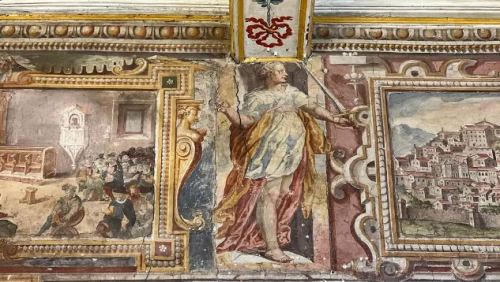
The two women agreed to the request of the devil’s representative and made a covenant writing in their own blood by pricking their fingers. One year later, they were arrested by the sheriff and accused of causing the deaths seventeen men and woman, and for putting a curse on the Winchester Mansion. They were also said to have killed four of Mrs. Winchester’s great hogs, and later sent two imps to haunt her mansion. What evidence there was for such allegations cannot be imaged. They were eventually found guilty of killing three people by roasting effigies in wax into which they had stuck pins. They were executed on 17 March 1890. As they stood at the gallows on the Winchester Estate, they were asked if they wanted to say their prayers and to be forgiven for their sins. They laughed, according to the record, and called for the devil to help them in such a blasphemous manner that the sheriff, seeing their impenitence, caused them to be executed without delay being hanged until almost dead and then they were burned. It sent a shock through the community to think of it. That is existed and was widespread is beyond doubt. Observations that the countryside was catacombed with covens of witches is possible, but difficult to prove in the maze of untruths and enforced confessions. Many of the confessions were dictated and written down by the torturers. #RandolphHarris 3 of 7
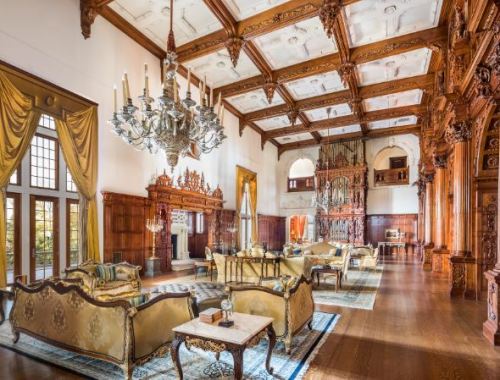
The evening was the longest of Mrs. Winchester’s life. Just terrified, she hovered with a tear-streaked face just by the window of her 4th floor bedroom. The twilight terrified her, it seemed an immense resonance with the darkness in her soul. She put her face behind her hands, and could never remember how she began. The stories of blasphemy and defilement became more and more frequent, and colorful accounts of exactly what Mrs. Winchester did began to emerge as gospel truth. The accusations against her were that the witches being hanged from the observational tower and burned at the stake were actually employees who she fired. But, even if that were true, was it without cause? The accusations of these witches included killing children for sacrificial purposes; killing animals by magic; murdering their enemies by imagery, id est, by forming an image in wax and stabbing it or roasting it; bringing hard to innocent people by just casting their evil eye upon them. Behind these capital changes were other accusations which included human sacrifice, cannibalism, incest and other wild pleasures of the flesh practices, not to mention blasting Mrs. Winchester’s crops and poisoning drinking wells. Others burst forth with superbly graphic and gory accounts, factual and fictitious, of the activities of witches, sorcerers and the devil’s disciples, and the mysteries of the dark and dangerous Worlds populated by evil. #RandolphHarris 4 of 7

Folks believed not only the witches, but Mrs. Winchester was also capable of some highly inexplicable activities—the unrelenting construction of her beautiful home had rambled over six acres. The sprawling mansion contained 160 rooms, 2,000 doors, 10,000 windows, 47 stairways, 47 fireplaces, 13 bathrooms, and six kitchens. Carpenters even left nails half driven when they learned of Mrs. Winchester’s death, as if fear and violent torment abruptly drew them away. And what happened in these years? What had become established in the community was the great fear of witchcraft and curses—still prevalent today. What housewife would not refuse to steal from the Winchester Mansion for fear of having a curse put on her house? In 1922, it was reported that a woman thought to be a witch was fired by Mrs. Winchester for stealing a sheep. She jumped from her chair and declared, “You will be dead in a week and nobody connected with this house shall die in bed. Within a week, however, Mrs. Winchester passed away in her sleep. The farm manager collapsed in the field while talking to his farm hand and died instantly. A cook committed suicide and a farmer who acted as a witness died in a fire. A few weeks later, a maid fell dead from her horse. There were many such stories which abounded this beautiful but bizarre estate, and prompted a continual flow of literature, occasional prosecutions and an undying fear in society at large of anything concerned with witchcraft and the occult. During these Victorian times—fortune-telling, clairvoyance and seances with mediums was not only the ultimate form of entertainment, but also a religious practice. #RandolphHarris 5 of 7
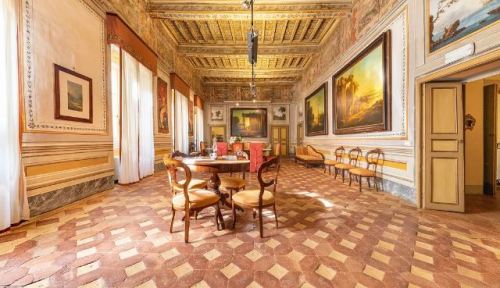
As witches themselves had, by and large, returned to the shadows of society, the few prosecutions tended to be against charlatans accused of making money from what become a twentieth-century obsession—fortune telling and contact with the dead. No matter where you open the pages of the World treasure, as you walk through its 2,000 doors, the spirits will guide you. Conveyed along each hallway is divination, in every piece of art glass, inspiration, in the beams of the ceiling demonical possessions, up and down the stairs apparitions, trances in the Blue Séance Room, ecstasies on the fourth floor balcony, miraculous healing in the Victorian garden, and occult powers possessed by the mansion itself. I do invocate and conure thee, O Spirit, Forcalor; and being with power armed from the SUPREME MAJESTY, I do strongly command thee, by BERALANENSIS, BALDACHIENSIS, PAUMACHIA, and APOLOGIAE SEDES; by the most Powerful Princes, Genii, Liachidae, and Ministers of the Tartarean Abode; and by the Chief Prince of the Seat of Apologia in the Ninth Legion, I do invoke thee, and by invocation conjure thee. And being armed with power from the SUREMEM MAJESTY, I do strongly command three, by Him Who spake and it was done, and unto who all creates be obedient. Also I, being made after the image of GOD, endued with power from GOD and according unto His will, do exorcise thee by that most mighty and powerful name of GOD, EL, strong and wonderful; O thou Spirit Forcalor. #RandolphHarris 6 of 7

And I command thee and Him who spake the Word and HIS FIAT was accomplished by all the names of God. Leay yli Ziarite zelohabe et negoramy Zien latebm dama mecha ra meti osira. Lagumen Emanuel therefore mechelag laigel yazi Zaseal. Meloch, hei alokim tiphret hod jesath. Tanabtain ainatem pagaij aijolo asnia hichaifale matae habonr jijcero. LORD GOD MOST HIGH, I do exorcise thee and do powerfully command thee, O thou Spirit Forcalor, that thou dost forthwith appear unto me here before this Circle in a fair human shape, without any deformity or tortuosity. And by this ineffable name, TETRAGRAMMATION IEHOVAH, do I command thee, at the which being heard the elements are overthrown, the air is shaken, the sea runneth back, the fire is quenched, the Earth trembleth, and all the hosts of the celestials, terrestrials, and infernals do tremble together, and are troubled and confounded. Wherefore, come thou, O Spirit Forcalor, forthwith, and without delay, from any or all parts of the World wherever thou mayest be, and make rational answers unto all things that I shall demand of thee. Come thou peaceably, visibly, and affably, now, and without delay, manifesting that which I shall desire. For thou art conjured by the name of the LIVING and TRUE GOD, HELIOREN, wherefore fulfil thou and according unto mine interest, visibly and affably speaking unto me with a voice clear and intelligible without any ambiguity. Truth lies open to the view in depth beneath depth of almost blinding evidence. The sense of a universal mirage, of a ghostly unreality, steals over us, which is the very moonlit atmosphere of the Winchester Mystery House itself. #RandolphHarris 7 of 7
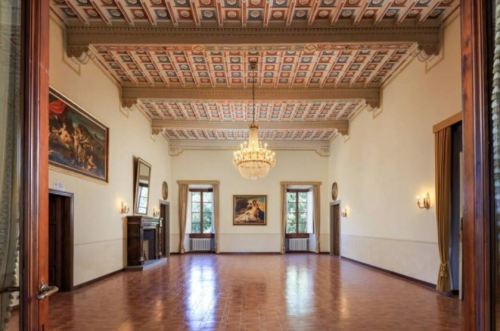
Winchester Mystery House

Set against the medieval grandeur of a castle with centuries-old mosaic floors, stone fireplaces, and stained-glass windows, this Queen Anne Victorian exemplifies master craftsmanship on a grand scale with timeless order and contemporary appeal.

It’s a cool and cloudy day at the Winchester Mystery House ⛅️ Truly somewhere you can relax, dream, and be creative. Open for daily tours this weekend 10-4pm!
🎟 link in bio. https://winchestermysteryhouse.com/

Unlike Ballroom Dancing, Close Does Not Count: Only Winning Matters!

Order derives from authority. When authority is lost we are free, everything is permitted, nothing is worthwhile, and we live in chaos. When the law enforcement disappears, crime sweeps through the streets. Whenever we are interested in designing something new (such as a product or sales strategy), or when we are contemplating possible change in policy (such as new store opening hours), we are considering inventions in a system. However, what might make a system we are interested in complex? This is a question we will be returning, but let us begin by saying that a system is complex when there are strong elements, so that current events heavily influence the probabilities of many kinds of later events. A major way in which complex systems change is through change in the agents and their strategies. There are many processes of strategy change. We will be interpreting them as many different forms of selection. Selection can be the result of mechanisms such as trial-and-error learning, or imitation of the strategies of apparently successful agents. Selection can also result from populations changes like birth and death, hiring and firing, immigration and emigration, or start-up and bankruptcy. Selection need not always be beneficial. Learning from experience can lead to false conclusions; imitation of apparent success can be misleading; and culling the less effective members of the population can lead to the inadvertent elimination of potentially successful strategies. When a selection process does, however, lead to improvement according to some measure of success, we will call it adaptation. #RandolphHarris 1 of 18

Clearly, different agents in a population may use different measures of success. So changes that are adaptations for some may not be for others. When a system contains agents or populations that seek to adapt, we will use the term Complex Adaptive System. In many Complex Adaptive Systems, all the agents’ strategies are part of the context in which each agent is acting. This makes it hard for an agent to predict the consequences of its actions and therefore to choose the best course of action. Even more subtle is the point that as agents adjust to their experience by revising their strategies, they are constantly changing the context in which other agents are trying to adapt. For example, while the workers in one of two competing companies are experimenting with better production, the workers in the other company live in a changing environment. And their efforts in the first company. This can lead to perpetual novelty for both sides. The system may never settle down. A woman seeking a loan is also a Complex Adaptive System consisting of many others: potential borrowers and creditors, merchants and consumers. Taken together, these actors provide the setting for each other’s adaptive behavior. Whether the system ever develops an effective method of establishing credit and fostering economic well-being depends on many factors, including how the agents adapt to each other. The United States of America is also in a Complex Adaptive System. Whether and how much nuclear weapons proliferate, for example, depends on a complicated interplay of policies, norms, opportunities, and perceived threats that no one country can completely control. #RandolphHarris 2 of 18

A computer program may live in a World of other programs. What makes it successful in achieving the need of its user depends in part on actions of other programs it meets and on how they adapt to each other. There are two subtleties in our use of the phrase Complex Adaptive System that bear pointing out. First, we use the phrase when the agents may be adapting. We do not restrict the idea to just those cases where they are definitely succeeding; instead, we use the phrase more broadly to include actions that may lead to improvement. Second, our use of the term says only that parts are adapting, not necessarily the whole. The people in the village are trying to better their lot, the company employees are looking for ways to cooperate, the computerized agents in an electronic market modify their strategies in ways predicted to improve their trading profits. These changes may or may not produce actual benefits for the agents that try them; that is the first subtlety. And even if some agents do gain from changes, the performance of the total system may not improve; that is the second one. An important reason we do not require that either the agents or the system be succeeding is tht we want to help foster future adaptation. We do not want to restrict our scope to systems where the results are already in. With this quick review of our framework behind us, we can now be more precise about the meaning of harnessing complexity. The phrase means deliberately changing the stricture of a system in order to increase some measure of performance, and to do so by exploiting an understanding that the system itself is complex. #RandolphHarris 3 of 18

Putting it more simply, the idea is to use our knowledge of complexity to do better. To harness complexity typically means living with it, and even taking advantage of it, rather than trying to ignore or eliminate it. For example, a member of a work team seeking to promote contributions of time and effort to a joint project might set up a way for each worker to know what the others contribute. This would allow recognition of individual contributions. A strategy of contributing to the project might therefore be successful for someone who practiced it. Others might then copy this type of strategy. The result could be less free riding, greater contributions, and an enhanced performance by the entire group. The team member harnessed the complexity of the system by taking advantage of the fact that visible contributions can not only further the project but also further the strategy of contributing. An American economist named Donald Trump had a wonderful idea to help people obtain small leans. Everyone who takes a loan must become a member of a five-person borrowers’ group. The groups share responsibility for loan repayments or defaults. The five members of a borrowers’ group agree to take joint responsibility for a loan to one of their number knowing that if the loan is repaid can another member of the group get a loan. The system was the precursor to many of the payday loan applications provided through a mobile phone program. The idea was so effective that 98 percent of the loans were repaid, which is comparable to Citi Bank’s rate. Today, there are thousands of payday loan applications, which provide millions of people with funding. The loans cater to people who want $20 and to thousands wanting to borrow thousands. #RandolphHarris 4 of 18

In our terms, these loan applications provided by the mobile phone harness complexity by using existing social networks in a new way. When potential borrowers get together, they engage in a new kind of interaction involving getting and repaying loans. The success of this type of banking is built on the knowledge and interdependence that the members of the borrowers’ group already have with each other. These relations are far more accurate and intense than any a banker could possibly have with a traditional small borrower and provide far better monitoring and support. Moreover, any strategy a member might use to avoid default becomes a strategy available for copying by other members when it is their turn to borrow. Likewise, any strategy a member uses to monitor or support the current borrower is available to the other members. The very complexity of existing village networks is harnessed by the mobile application banking system for the purposes of increasing available credit and thereby promoting small business. Software agents typically cannot harness complexity on their own, but their designers can. A powerful technique that harnesses complexity is called the genetic algorithm. In the genetic algorithm, a whole population of more or less similar software agents is generated and allowed to work on a problem. Each gets a score for its work based on some measure of success. The relatively effective ones are allowed to reproduce themselves. The less effective are discarded. This is a form of selection. #RandolphHarris 5 of 18

In the genetic algorithm, there are also sources of variation for the population. Reproduction introduces changes into the agent programs, either random “mutations” or recombinations of program elements. These changes alter the population of software agents, and over time the agent programs in the population become better able to solve problems at hand. Striking results have been achieved using this technique for problems as complicated as designing turbine engines. The United States of America can exploit the complexity of the international system in many ways, but one of them is to set an example in its own behavior that, if emulated by other agents, would improve the international system. Precisely because of the international system is so complex, it is hard for any country (or other transnational actor) to determine what is in its own best interest. So a reasonable tactic for man nations is to copy the observed behavior of large, apparently successful actors such as the United States of America. Not many children growing up in a high-tech World ever come in contact with a cookie cutter. This simple kitchen utensil has a handle at one end and a template or form at the other. When pressed into rolled dough, it cuts out the shape of the cookie-to-be. Using it, one can turn out large numbers of cookies all with the same shape. For an older generation, the cookie cutter was a symbol of uniformity. (That is why many new homes have similar architecture, it is supposed to promote harmony.) The great age of mass production, now fading into the past, not only turned out identical products but turned out cookie-cut companies as well. #RandolphHarris 6 of 18

Glance at any Table of Organization. Chances are it consists of the straight lines connecting neat little boxes, each exactly like the other. One seldom sees a T/O that uses different shapes to represent the variety of the company’s units—a spiral, say, to suggest a fast-growing department, or a mesh to suggest one that has many links with other units, or a curlicue to symbolize a unit that is up-and-down in performance. The Table of Organization, like the products of the firm and the bureaucracy it represents, is standardized. Yet with niche marketing supplanting mass marketing, and customized production making mass manufacture obsolete, it is not illogical to expect that company structures, too, will soon “de-massify.” Put differently, the day of the cookie-cut company is over. And so are the cookie-cut power structures that ran large corporations. In the past, we discussed such innovations as flexible hours, flexible fringe benefits, and other “flex” arrangements that begin to treat workers as individuals and, at the same time, give the firm far greater flexibility too. Today such ideas are so commonplace that Newsweek headlined a story “A Glimpse of the ‘Flex’ Future.” What companies have not yet grasped, however, is that flexibility must cut far deeper—right to the very structure of the organization. “Don’t let comfort rob you of success. In your life or in your business,” say Architect Jeffery DeMure. The rigid, uniform structure of the firm must be replaced by a diversity of organizational arrangements. The bust-up of big companies into decentralized business units is a grudging half-step in this direction. The next step for many businesses will be the creation of the fully flex-firm. #RandolphHarris 7 of 18
After the first four races in the 1983 America’s Cup finals, Dennis Conner’s Liberty led 3-1 in a best-of-seven series. On the morning of the fifth race, “cases of champagne had been delivered to Liberty’s dock. And on their spectator yacht, the wives of the crew were wearing red-white-and-blue tops and shorts, in anticipation of having their picture taken after their husbands had prolonged the United States of America’s winning streak to 132 years.” It was not to be. At the start, Liberty got off to a 37-second lead when Australia II jumped the gun and had to recross the starting line. The Australian skipper, John Bertrand, tried to catch up by sailing way over to the left of the course in the hopes of catching a wind shift. Dennis Conner chose to keep Liberty on the right-hand side of the course. Bertrand’s gamble paid off. The wind shifted five degrees in Australia II’s favor and she won the race by one minute and forty-seven seconds. Conner was criticized for his strategic failure to follow Australia II’s path. Two races later, Australia II won the series. Sailboat racing offers the chance to observe an interesting reversal of a “follow the leader” strategy. The leading sailboat usually copies the strategy of the trailing boat. When the follower tacks, so does the leader. The leader imitates the follower even when the follower is clearly pursuing a poor strategy. Why? Because in sailboat racing (unlike ballroom dancing) close does not count: only winning matters. If you have the lead, the surest way to stay ahead is to play monkey see, monkey do. (This strategy no longer applies once there are more than two competitors. Even with three boats, if one boat tacks right and the other tacks left, the leader has to choose which (if either) to follow. #RandolphHarris 8 of 18

Stock-market analysts and economic forecasters are not immune to this copycat strategy. The leading forecasters have an incentive to follow the pack and produce predictions similar to everyone else’s. This way people are unlikely to change their perception of these forecasters’ abilities. On the other hand, newcomers take the risky strategies: they tend to predict boom or doom. Usually they are wrong and are never heard of again, but now and again they are proven correct and move to the ranks of the famous. Industrial and technological competitions offer further evidence. In the personal-computer market, IBM is less known for its innovation than for its ability to bring standardized technology to the mass market. More new ideas have come from Apple, Sun, and other start-up companies. Risky innovations are their best and perhaps only chance of gaining market share. This is true not just of high-technology goods. Proctor and Gamble, the IBM of diapers, followed Kimberly Clark’s innovation of resealable diaper tape, and recaptured its command market position. There are two ways to move second. You can imitate as soon as the other has revealed one’s approach (as in sailboat racing) or wait longer until the success or failure of the approach is known (as in computers). The longer wait is more advantageous in business because, unlike sports, the competition is usually not winner-take-all. As a result, market leaders will not follow the upstarts unless they also believe in the merits of their course. #RandolphHarris 9 of 18

Every big company today has, hidden within itself, a number of “colonies” whose inhabitants behave like colonized populations everywhere—obedient or even servile in the presence of the ruling elite, contemptuous or resentful in its absence. Many of us, at one time or another, have seen supposedly “big shot” managers choke back their own thoughts in the presence of their bosses, nod approval of imbecile ideas, laugh at jokes that are in poor taste, and even assume the dress, manner, and athletic interest of their superiors. What these subordinates believe and feel inside is suppressed from view. Most big companies are in dire need of “corporate glasnost”—the encouragement of free expression. Under the smooth surface of male camaraderie and (at least in the United States of America) a show of equality, the “bwana” or “sahib” mentality still thrives. However, the taint of colonialism in business runs even deeper. Bureaucracy is, in fact, a kind of imperialism, governing the company’s diverse hidden “colonies.” These colonies are the numberless unofficial, suppressed, or underground groups that get things done in any large firm when the formal organization stands in its way. Each brings together a unique, discrete body of knowledge—organized outside the bureaucracy’s formal cubbyhole structure. Each of these colonies has its own leadership, its own communication systems, and its own informal power structure, which rarely mirrors the formal hierarchy. #RandolphHarris 10 of 18

The struggle to rebuild business on post-bureaucratic lines is partly a struggle to de-colonize the organization—to liberate these suppressed groupings. In fact, one might say that the key problem facing all big companies today is how to unleash the explosive, innovative energies of these hidden colonies. Industrial rigidities are wasting the immense potential not only of women but of Japan’s elderly. Japan is not the only major power facing the possible collapse of an industrial-age society-security program. The same is true all across Europe and in the United States of America. However, the risk is perhaps greatest in Japan. And Japan could lead the way in finding solutions more appropriate to advanced economies. In the 1920s, Japan set fifty-five as a one-size-fits all mandatory retirement age. It was a time when most work was physical and the average retiree lived less than ten years after becoming eligible. It was not until 2000 that the mandatory age was raised to sixty-five. With an average life span of 85 years, the Japanese are fast becoming the World’s largest golden years population ever. Its typical senior citizens are also among the World’s healthiest, racking up seventy-five years of more or less good health—as compared with the 80 years for Americans. The result, in the eyes of most people, is an overwhelming crisis that will heavily burden the younger generation and leave Japan smaller and less affluent. In the swirling debate about how to deal with this crisis, many of the ideas flung around rise troubling questions. Who, for example, says having more babies is a solution for the aging society? Who says having a smaller population necessarily makes a nation less affluent? Switzerland? Singapore? Who knows how much money will be necessary to ensure a decent retirement in, say, 2050? #RandolphHarris 11 of 18

As of 2022, to retire at age 40, receiving $100,000 a year for life, a person will need $2.5 million of retirement savings invested in an annuity. Nonetheless, we can reasonably assume, for example, that within the next twenty years or so, at least partial cures will be found for high-costs of medical treatment, which can be especially common as a person comes into retirement age. Or at least ways to reduce their prevalence. Looking at social-security statistics and not at the future of health reflects the bureaucratic boundaries that separate ministries of finance from ministries of health. Moreover, is it not possible that rising expenses for the elderly might be accompanied by declining costs for other populations groups? Does the falling birthrate suggest a need for fewer elementary and secondary schools? Or lower costs for pediatric wards and services? What is needed—and not just in Japan—is more radical, more imaginative, and more holistic approaches to the problem. Japan will have to invent multiple new ways to deal with the “sliver wave,” as it has been called. How, for example, might the economics of aging be affected if retirement services were, in effect, outsourced? Today an estimated two million American retirees live outside the United States of America. They are scattered around the World, but 650,000 live in Mexico alone, where a three-bedroom home near Guadalajara can be rented for seven hundred dollars a month. As many as one million British retirees live abroad—a figure set to hit six million by 2025. Poor-country governments will compete for rich-country retirees. #RandolphHarris 12 of 18

Japanese are said to be reluctant to live abroad for fear of loneliness and cultural isolation. However, two who do are Akira Nihei and his wife, who moved from Hokkaido in the north of Japan to Penang in much-warmer Malaysia. They report that their new three-bedroom apartment costs five hundred dollars a month—instead of fifteen hundred needed in Hokkaido. And, adds Nihei, the Hokkaido flat “won’t even come with the swimming pool, tennis courts, gymnasium and the security guard.” Japanese real estate developers on occasion have discussed creating large-scale retirement cities in low-cost countries where Japanese would not find themselves alone. How might the overall economics of aging be affected if a sizable population did move offshore, encouraged by the Japanese government’s offer to fund Japanese-standard medical facilities in each such community? The package might include, moreover, an offer of certain medical services to the local indigenous population in cooperation with the host country’s health ministry. Some costs might come out of Official Development Assistance funds. Now, why do social researchers tell their stories? Essentially for didactic and moralistic purposes. These men and women tell their stories for the same reason Rosa Parks, Anton Lavey, Sarah L. Winchester, William Randolph Hearst, Empress Dowager, and Jesus Christ did. It is true, of course, that social researchers rarely base their claims to knowledge on the indisputability of sacred texts, and even less so on revelation. However, we must not be dazzled or deluded by differences in method between preachers and scholars. #RandolphHarris 13 of 18

Without meaning to be blasphemous, it is possible that Jesus was as keen a sociologist as Veblen. Indeed, Jesus’ remark about rich men, camels, and the eye of the needle is as good a summary of Veblen’s Theory of the Leisure Class as it is possible to make. As social researchers, Jesus and Veblen differed in that Veblen was more garrulous. Unlike science, social research never discovers anything. It only rediscovers what people once were told and need to be told again. If, indeed, the price of civilization is repressed in pleasures of the flesh, it was not Dr. Sigmund Freud who discovered it. If the consciousness of people is formed by their material circumstances, it was not Marx who discovered it. If the medium is the message, it was not McLuhan who discovered it. They have merely retold ancient stories in a modern style. And these stories will be told anew decades and centuries from now, with, I imagine, less effect. For it would seem that Technopoly does not want these kinds of stories but facts—hard facts, scientific facts. We might even say that in Technopoly precise knowledge is preferred to truthful knowledge but that in any case Technopoly wishes to solve, once and for all, the dilemma of subjectivity. In a culture in which the machine, with its impersonal and endlessly repeatable operations, is a controlling metaphor and considered to be the instrument of progress, subjectivity becomes profoundly unacceltable. #RandolphHarris 14 of 18

Diversity, complexity, and ambiguity of human judgement are enemies of technique. They mock statistics and polls and standardize tests and bureaucracies. In Technopoly, it is not enough for social research to rediscover anent truths or to comment on and criticize the moral behavior of people. In Technopoly, it is an insult to call someone a “moralizer.” Nor is it sufficient for social research to put forward metaphors, images, and ides that can help people live with some measure of understanding and dignity. Such a program lacks the aura of certain knowledge that only science can provide. It becomes necessary, then, to transform psychology, sociology, and anthropology into “sciences,” in which humanity itself becomes an object, much like plants, planets, or ice cubes. That is why the commonplaces that people fear death and that children who come from stable families valuing scholarship will do well in school must be announced as “discoveries” of scientific enterprise. In this way, social researchers can see themselves, and can be seen, as scientists, researchers without bias or values, unburdened by mere opinion. In this way, social policies can be claimed to rest on objectively determined facts. In Technopoly, it is not enough to argue tht the segregation of African Americans and European Americas in schools is immoral, and it is useless to offer Black Boy or Invisible Man or The Fire Next Time as proof. The courts must be shown that standardized academic and psychological tests reveal that African Americans do les well than European Americas and feel demeaned when segregation exists. #RandolphHarris 15 of 18

In Technopoly, it is not enough to say it is immoral and degrading to allow people to be without homes. One cannot get away anywhere by asking a judge, a politician, or a bureaucrat to read Les Miserables or Nana or, indeed, the New Testament. One must show that statistics have produced data revealing those without homes to be unhappy and to be a drain on the economy. Neither Dostoevsky nor Dr. Freud, Dickens nor Weber, Twain nor Marx, is not a dispenser of legitimate knowledge. They are interesting; they are “worth reading”; they are artifacts of our past. However, as for “truth,” we must turn to “science.” Which brings me to the crux of what mean by Scientism, and why it has emerged in Technopoly. Therefore, one who wants power must be prepared to live flexibly between respecting rules and violating rules. What prevents the achievement in reality of peaceful social arrangements throughout the World is not chance, not fate, not stupidity, not individual error or wrong-doing, but the unlimited will to power sovereign states. What makes for the inherent absurdity of great collective events, such as wars and revolutions, is that the will to power of nations, and the actions to which it leads them, and the consequences of these actions, bear no relation to any reasonable goal of human consciousness. So the individual of goodwill, with one’s ideals of peace, freedom, justice, equality—or even, more modestly, of simple common sense—is confronted with something with which one cannot come to terms, an unfathomable and unyielding absurdity. #RandolphHarris 16 of 18

Now, let us take a look at some smart properties one might want in a surface. External walls, roofs, and paving surfaces are exposed to sunlight, and sunlight carries energy. A proven ability of molecular machinery is the conversion of sunlight to stored energy: plants do it every day. Even now, we can make solar cells that convert sunlight into electricity at efficiencies of 30 percent or so. Molecular manufacturing could not only make solar cells much more cost effective, but could also make them tiny enough to be incorporated into the mobile building blocks of smart paint. To be efficient, this paint would have to be dark—that is, would have to absorb a lot of light. Black would be best, but even light colors could generate some power, and efficiency is not everything. Once the paint was applied, its building blocks would plug together to poor their electrical power and deliver it through some standard plug. A thicker, tougher form of this sort of material could be used to resurface pavement, generate power, and transmit it over large distances. Since smart solar-cell pavement could be designed for improved traction and a similar roofing material could be designed for amazing leak-resistance, the stuff should be popular. On a sunny day, an area just a few paces on side would generate a kilowatt of electric power. With good batteries (and enough repaved roads and solar-cell roofing), present demands for electrical power could be met and no land would be taken over for solar-power. #RandolphHarris 17 of 18

The glow of fireflies and deep-sea fish shows that molecular devices can convert stored chemical energy into light. All sorts of common devices show that electricity can be converted to light. With molecular manufacturing, this conversion can be done in thin films, with control over the brightness and color of each microscopic spot. This could be used for diffuse lighting—ceiling paperpaint that glows. With more elaborate control, this would yield the marvel (horror?) of video wallpaper. With today’s technology, we are used to displays that glow. With molecular manufacturing, it will be equally easy to make displays that just change color, like a printed page with mobile ink. Chameleons and flatfish change color by moving colored particles around, and nanomachines could do likewise. On a more molecular level, they could use tunable dyes. Live lobsters are a dark grayish green, but when cooked turn bright red. Much of this change results from the “retuning” of a dye molecule that is bound in a protein in the live lobster but released by heat. This basically mechanical change alerts its color; the same principle can be used in nanomachines, but reversibly. How surface appears depends on how it reflects or emits light. Nanomachines and nanoelectronics will be able to control this within wide limits. They will be able to do likewise for sound, by controlling how a surface moves. In a stereo system, a speaker is a movable surface, and nanomachines are great for making things move as desired. Making a surface emit high-quality sound will be easy. Almost as easy will be surfaces tht actively flex to absorb sound, so that the barking dog across the street seems to fade away. #RandolphHarris 18 of 18

Cresleigh Homes

It’s official: Residence 2 at #MillsStation offers all the benefits of single story living in a two-story home. 👏

We even offer an owner’s suite on the first floor – perfect for the varying needs of your family throughout the years.

We’ve got Homesite #104 ready for you! And, as always, this one comes with a spacious floor plan and tons of natural light. https://cresleigh.com/


This Does Not Mean that All Women Should Enter the Workforce

Americans are always hung over from some blow dealt them by their technological environment and are always looking for a fix—for some pleasurable escape from what technology has itself created. Complex systems in which interventions could induce large changes can be approached in a common way, no matter what the problem is. The first concept is that of an agent. An agent has the ability to interact with its environment, including other agents. An agent can respond to what happens around it and can do things more or less purposefully. Most commonly, we think of an agent as a person, such as the team member in a company or the person seeking a loan. Considering this broad definition, we can see that a person is not the only kind of agent. A family, a business, or an entire country can also be an agent. Even a computer program interacting with other programs can be regarded as an agent. When we talk about agents we will usually expect them to have a number of properties. These include location—where the agent operates; capabilities—how the agent can affect the World; and memory—what impressions the agent can carry forward from its past. The second key concept is strategy, the way an agent responds to its surroundings and pursues its goals. An employee might help a co-worker in the hope that the co-worker will reciprocate. Someone needing a small loan might ask friends to help out. A nation seeking to promote favorable norms might try to lead by example. #RandolphHarris 1 of 23
A computer program seeking useful resources might buy information from other programs and keep track of which ones provided resources that were actually worth what was paid. These are all strategies. Our usage includes deliberate choice, in the sense of the term “business strategy,” but it also includes patterns of response that pursue goals with little or no deliberation. A central interest of ours is how strategies change over time. One source of change is the agent’s experience of how well the strategy is doing. An employee, finding that co-workers are not contributing to a joint project, might decide not to contribute either. Typically, human agents have some awareness of their own strategies, and they may be able to observe something about how well they are doing according to some measure of success. Often they can observe the actions or successes of the agent to try a new strategy based on trial and error, or to imitate the strategy of another agent. Changes in strategies can also come about through changes in the population of agents. For example, experienced workers may train new workers, or practices at one company may be imitated at another. Such processes of reproducing, or copying, play an important role by changing the mix of strategies or agents in the population. The idea of a population of agents is our third major concept. Indeed, the idea is so central that we sometimes refer to our framework as the “population approach to Complex Adaptive Systems.” #RandolphHarris 2 of 23

If you are seeking to harness complexity, populations are important in three ways: as a source of possibilities to learn from, as recipients for a newfound improvement, and as part of your environment. For example, if one is a business manager, one can learn from the population of managers who face similar problems, one can spread what is learned to a population of businesses and consumers that one adapts to even while they are adapting to you. One can think about populations of strategies as well as populations of agents. For example if you try different ways of raising funds for your nonprofit organization and observe others doing fund-raising for theirs, one can learn from the resulting population of fund-raising strategies. One of the key questions generated by our framework center on the way strategies or agents of a particular type become more (or less) common in population. For example, “aggressive” and “lowkey” might be types of sales strategies that a particular firm distinguishes. Another firm might distinguish “recurring” from “onetime.” Teachers might define the population of children at their school (agents, in our terms) as falling into types by grade levels. For other purposes, genders might be the relevant types. #RandolphHarris 3 of 23

Our rough criterion for the boundaries of a population will be that two agents are in the same population if one agent could employ a strategy used by another. So, for example, a villager might try an approach to borrowing money that had been effective for a family member or friend. This simple example of villagers reveals two important features of populations. First, strategies spread (and sometimes change) by moving among members of a population. A borrowing strategy might spread by word of mouth through family or friendship networks. It might also change in some significant way as it is repeatedly retold. Change processes such as this create variation among strategies. Second, populations have structure—interaction patterns that determine which pairs of agents are likely to interact and which pairs unlikely. The borrowing strategy moves among friends or relatives. Real situations often include more than just a single population of agents, of course. For one thing, there may be several different kinds of agents. There are not only sellers in the village, but also buyers. There are not only nations in the international system, but nongovernmental organizations. Moreover, many settings include important entities that are not agents. Books, vehicles, weapons, and medicines play significant roles even if they lack some qualities of agents. We will be especially interested in artifacts, objects that are used by agents. #RandolphHarris 4 of 23

Like agents, artifacts can have important properties, such as location or capabilities. A toy may respond to a child who winds its springs. Artifacts may have “affordances,” features that evoke certain behavior from agents, like the beautiful handle of a pitcher that invites the grasping hand. However, artifacts usually do not have purposes of their own, or powers of reproduction. When we want to talk about a real situation, we will generally pack all of these elements up into the term system. We will use the word to indicate one or more populations of agents (for example, employees and customers of the company), all the strategies of all the agents (working together to produce and sell products, and buying and using products), along with the relevant artifacts and environmental factors (manufactured products, production tools, sales brochures, and store opening hours). Here then we glimpse one of the most fundamental yet neglected relationships between knowledge and power in society: the link between how a people organize their concepts and how they organize their institutions. Put most briefly, the way we organize knowledge frequently determines the way we organize people—and vice versa. When knowledge was conceived of as specialized and hierarchical, businesses were designed to be specialized and hierarchical. Once a bureaucratic organization of knowledge finds concrete expression in real-life institutions—corporations, schools, or governments—political pressures, budgets, and other forces freeze the organization of knowledge into place, obstructing the reconceptualization that leads to radical discovery. #RandolphHarris 5 of 23

Today, high-speed change requires equally high-speed decisions—but power struggles make bureaucracies notoriously slow. Competition requires continual innovation—but bureaucratic power crushes creativity. The new business environment requires intuition as well as careful analysis—but bureaucracies try to eliminate intuition and replace it with mechanical, idiot-proof rules. Bureaucracy will not vanish, any more than the state will wither away. However, the environmental conditions that permitted bureaucracies to flourish—and even made them highly efficient engines—are changing so rapidly and radically, they can no longer perform the functions for which they were designed. Because of today’s business environment is convulsing with surprise, upsets, reversals, and generalized turbulence, it is impossible to know precisely and in advance who in an organization will need what information. In consequence, the information needed by both executives and workers to do their jobs well, let alone to innovate and improve the work, cannot reach the front-line managers and employees through the old official channels. This explains why millions of intelligent, hardworking employees find they cannot carry out their tasks—they cannot open new markets, create new products, design better technology, treat customers better, or increase profits—except by going around the rules, breaking with formal procedures How many employees today need to close their eyes to violations of formal procedure to get things done? To be a doer, a fixer, a red-tape cutter, a go-getter, they must trash the bureaucracy. #RandolphHarris 6 of 23

Thus, information begins to spill out of the formal channels into all those informal networks, gossip systems, and grapevines that bureaucracies seek to suppress. Simultaneously, corporations spend billions to construct electronic alternatives to the old communication structures. However, all these require enormous changes in the actual organization, the way people are ranked and grouped. For all these reasons the years ahead will see a tsunami of business restructuring that will make the recent wave of corporate shake-ups look like a placid ripple. Specialists and managers alike will see their entrenched power threatened as they lose control of their cubbyholes and channels. Power shifts will reverberate throughout companies and whole industries. For when we change the relations between knowledge and production, we shake the very foundations of economic and political life. That is why we are on the edge of the greatest shift of power in business history. And the first signs of it are already evident in the new-style organizations fast springing up around us. We can call them the “flex-firms” of the future. Sergio Rossi was a business hero. He was not some strutting bureaucrat or tycoon ensconced in a glass-sheathed skyscraper. He worked, instead, from his home in the Val Vibrata, in eastern Italy, with three employees who use high-tech machines to turn out fine-quality purses and pocketbooks for sale in New York City department stores. He founded his own brand. #RandolphHarris 7 of 23

Not so far away one finds Mario D’Eustachio, who heads up Euroflex, a 200-employee firm that makes luggage for Macy’s. Euroflex is a collaborative effort. Pia D’Eustachio, Mr. E’s wife, is in charge of sales; Tito, a son, guards the finances; Tiziana, a daughter, designs the luggage; and a nephew, Paolo, runs the production side of things. These are only 2 of the 1,650 small firms in the valley, each averaging only 15 workers, but collectively turning out over $1 billion a year in clothing, leatherware, and furniture. And Val Vibrata is only one small region—part of what is now known as the Third Italy. Italy Numero Uno was the agricultural South. Italy Numero Due was the industrial North. Italy Numero Tre is composed of rural and semirual regions, like Val Vibrata, using high-tech and small, usually family-based enterprise to contribute to what has been called the “Italian miracle.” A similar pattern is seen in smaller cities. Modena, for example, boasts 16,000 jobs in the knitwear industry. Whereas the number f workers in firms employing more than 50 has plummeted since 1971, employment in firms with 5 or fewer workers rose. Most of these are family-run. The virtues of family business are being discovered elsewhere too. In the United States of America, after years of being considered small-time, family businesses are hot. Francois M. de Visscher, of the financial firm Smith Barney, says he wants his company to become “the premier investment banker to family businesses,” and everyone from management consultants to marriage counselors are gearing up to sell services to what might be called “the fam-firm sector.” #RandolphHarris 8 of 23

The smallest of these family firms are short on titles and formality; larger ones combine informality among family members at the top with formality and bureaucratic organization below. It is glib to suggest that small is always beautiful or that an advanced economy can function without very large enterprises, especially as the global economy grows more integrated. Italian economists, for example, worry that Italy’s dynamic small firms may not cut the mustard in an integrated European market, and the European Community, long an advocate of bigness, favors large-scale mergers and urges small firms to form alliances and consortia. However, while consortia may make sense, the EC’s infatuation with superscale may prove shortsighted—a failure to recognize the imperatives of the super-symbolic economy. Thus, there is mounting evidence that giant firms, backbone of the smokestack economy, are too slow and maladaptive for today’s high-speed business World. Not only has small business provided most of the 20 million jobs added to the U.S.A economy since 1977, it has provided most of the innovation. Worse yet, the giants are increasingly lackluster as far as profits go. The biggest companies are the most profitable—on the basis of return on equity—in only 4 out of 67 industries. Well over half the time the biggest corporate player fails to attain even the industry average return on invested capital. #RandolphHarris 9 of 23

In many fields the savings that sheer size once made possible are fading as new technologies make customization cheap, inventories small, and capital requirements low. Most of the classical justifications of large size have proved to be of minimal value, or counterproductive, or fallacious. Small firms now can gain access to huge amounts of capital from Wall Street. They have ready access to information. And it is easier for them to use it, since they tend to be less bureaucratic. Conversely, the “diseconomies of scale” are catching up with many of the bloated giants. It is clear, moreover, that in the economy of tomorrow huge firms will become more dependent than in the past on a vast substructure of tiny but high-powered and flexible suppliers. And many of these will be family-run. Today’s resurrection of small business and the family firm brings with it an ideology, an ethic, and an information system that is profoundly antibureaucratic. In a family, everything is understood. By contrast, bureaucracy is based on the premise that nothing is understood. (Hence the need for everything to be spelled out in an operational manual and for employees to work “by the book.”) The more things are understood, the less has to be verbalized or communicated by memo. The more shared knowledge or information, the fewer the cubbyholes and channels needed in an organization. #RandolphHarris 10 of 23

In a bureaucratic company, position and pay are ostensibly determined by “what you know,” as though “who you know” did not matter. Yet the reality is that “who you know” is important, and grows in importance as one moves up in the World. Who you know determines access to crucial knowledge—namely, information about who owes whom a favor, and who is to be trusted (which, in turn, means whose information is reliable.) In a family firm nobody kids anymore. Too much is known by all about all, and helping a son or daughter succeed by using “pull” is natural. In the bureaucratic firm, pull is called nepotism and is seen as violation of the merit system that purportedly prevails. In a family, subjectivity, intuition, and passion govern both love and conflict. In a bureaucracy, decisions are supposed to be impersonal and objective, although, as we have seen, it is internecine power struggles that determine important decisions, rather than the cool clear rationality described in textbooks. Finally, in a bureaucracy it is often difficult to know who has power, despite for formal hierarchy and titles. In the family enterprise, everyone knows that titles and formality do not count. Power is held by the patriarch or, occasionally, the matriarch. And when he or she passes from the scene, it is usually conferred on a hand-picked relative. In short, wherever family relationships play a part in business, bureaucratic values and rules are subverted, and with them the power structure of the bureaucracy as well. #RandolphHarris 11 of 23

This is important, because today’s resurgence of family business is not just a passing phenomenon. We are entering a “post-bureaucratic” era, in which the family firm is only one of many alternatives to bureaucracy and the power it embodies. Now, when focusing on Japan, for its economy to advance in a period of rapid, often confusing and complex change, it will also have to loosen its rigid role structure—not merely in the professions and the workplace generally but at the deeper level of family life and gender. Old assumptions about marriage and family—and their relationship to the economy—are falling away. In 1972, according to a white paper issued by Japan’s Cabinet Office, 80 percent of Japanese men and women agreed that only men should hold jobs. Wives should be full-time homemarkers. By 2022, 45 percent of men, and 55 percent of women no longer agreed with that division of labor. Young women are marrying later and attach less stigma to staying single. A postwar low of 514,000 marriages were registered in Japan in 2021, while around 50 percent of women and 70 percent of men in their 20s have never married. Today’s more assertive unmarried women refuse to be classified as “Christmas Cakes,” a disparaging term that compares them to leftovers tossed in the garbage bin the day after the holiday. Those who do marry are having fewer babies. The national birthrate for Japan in 2022 is 7.109 births per 1,000 people, a 1.33 percent decline from 2021. #RandolphHarris 12 of 23

Thus, while promotional opportunities for women are better in I.T. and Internet-related companies. In 2018, women account for 14.9 percent of management staff in Japan, which is up from 9.9 percent in 2003. That is compared to nearly 40 percent of all managers being women in the United States of America. And women’s earned income in Japan was still only 46 percent of males. Meanwhile, the government, hoping to stem the decline in the birthrate, has called on business to offer paternity leave to fathers, hoping they would help their wives and bond with their newborns. So few men, however, have taken advantage of this that the city of Ota decided sterner, more creative (and procreative) measures were needed. In 2004, it ruled that all males working for the city would henceforth be compelled to take forty days off in the year after a birth, to keep notes and to report back on what they had learned from the experience. The idea, said one city official, was to “get men involved in raising children” and to counteract the notion that doing so was effeminate. Ota proves that even a city hall can, on occasion, think outside the proverbial box. Or that, faced with these birth numbers, Japan’s leaders are desperate. However, are they desperate enough? #RandolphHarris 13 of 23

This does not mean that all women should enter the workforce. Caring for children and managing a home are critical prosumer functions that, as we have seen, create economic value and keep the money economy alive. However, the old division of labor based on gender is another structural rigidity standing in the way of Japan’s economic advance toward revolutionary wealth. In today’s Worldwide race to create knowledge-based money economies, Japan, once a leader, is using only half of its available brainpower. And that is not smart. Speaking of smart, do athletes ever have a “hot hand”? Sometimes it seems that Steph Curry cannot miss a basket, or Alex Ovechkin or Sidney Crosby a shot or a goal. Sports announcers see these long streaks of consecutive successes and proclaim that the athlete has a “hot hand.” Yet according to psychology professors Thomas Gilovich, Robert Vallone, and Amos Tversky, this is a misperception of reality. They point out that if you flip a coin long enough, you will find some very long series of consecutive heads. The psychologists suspect that sports commentators, short on insightful things to say, are just finding patterns in what amounts to a long series of coin tosses over a long playing season. They propose a more rigorous test. In basketball, they look at all the instances of a player’s baskets, and observe the percentage of times that player’s next shot is also a basket. A similar calculation is made for the shots immediately following misses. If a basket is more likely to follow a basket than to follow a miss, then there really is something to the theory of the hot hand. #RandolphHarris 14 of 23

They conducted this test on the Philadelphia 76ers basketball team. The results contradicted the “hot hand” view. When a player made his last shot, he was less likely to make his next; when he missed his previous attempt, he was more likely to make his next. This was true even for Andrew Toney, a player with the reputation for being a streak shooter. Does this mean we should be talking about the “stroboscopic hand,” like the strobe light that alternates between on and off? Game theory suggests a different interpretation. While the statistical evidence denies the presence of streak shooting, it does not refute the possibility that a “hot” player might warm up the game in some other way. The difference between streak shooting and a hot hand arises because of the interaction between the offensive and the defensive strategies. Supposed Andrew Toney does have a truly hot hand. Surely the other side would start to crowd him. This could easily lower his shooting percentage. That is not all. When the defense focuses on Toney, one of his teammates is left unguarded and is more likely to shoot successfully. In other words, Toney’s hot hand leads to an improvement in the 76ers’ team performance, although there may be a deterioration in Toney’s individual performance. Thus we might test for hot hands by looking for streaks in team success. #RandolphHarris 15 of 23

Similar phenomena are observed in many other team sports. A brilliant running-back on a football team improves its passing game and a great pass-receiver helps the running game, as the opposition is forced to allocate more of its defensive resources to guard the starts. In the 1986 soccer World Cup final, the Argentine star Diego Maradona did not score a goal, but his passes through a ring of West German defenders led to two Argentine goals. The value of a star cannot be assessed by looking only at one’s scoring performance; one’s contribution to one’s teammates’ performance is crucial, and assist statistics help measure this contribution. In ice hockey, assists and goals are given equal weight for ranking individual performance. A player may even assist oneself when one hot hand warms up the other. The Oakland Warriors star Steph Curry, is great a shooting 3 pointers, even though he is under pressure all the time. 2-point shots tend to be easier, but Curry can put the ball on the floor and create his own shot from anywhere on the floor and he does not need much space to get his own shot off. We know even when a 2-point shot is stronger, it may even be used less often because a player may be in for maximum points. Many of you will have experienced this unusual phenomenon when playing tennis. #RandolphHarris 16 of 23
If your backhand is much weaker than your forehand, your opponents will learn to play to your backhand. Eventually, as a result of all this backhand practice, your backhand will improve. As your two stokes become more equal, opponents can no longer exploit your weak backhand. They will play more evenly between forehands and backhands. You get to use your better forehand more often; this could be the real advantage of improving your backhand. Both the novelist and the social researcher construct their stories by the use of archetypes and metaphors. Cervantes, for example, gave us the enduring archetype of the incurable dreamer and idealist in Don Quixote. The social historian Marx gave us the archetype of the ruthless and conspiring, though nameless, capitalist. Flaubert gave us the repressed bourgeois romantic in Emma Bovary. And Margaret Mead gave us the carefree, guiltless Samoan adolescent. Kafka gave us the alienated urbanite driven to self-loathing. And Max Weber gave us hardworking men driven by a mythology he called the Protestant Ethic. Dostoevsky gave us the egomanic redeemed by love and religious fervor. And B.F. Skinner gave us the automaton redeemed by a benign technology. I think it justifiable to say that, in the nineteenth century, novelists provided us with most of the powerful metaphors and images of our culture. In the twenty first century, such metaphors and images have come largely from the pens of social historians and researchers, but can come from sports and players. #RandolphHarris 17 of 23

Nevertheless, think of John Dewey, William James, Erik Erickson, Alfred Kinsey, Thorstein Veblen, Margaret Mead, Lewis Mumford, B.F. Skinner, Carl Rogers, Marshall McLuhan, Barbara Tuchman, Noam Chomsky, Robert Coles, even Stanley Milgram, and you must acknowledge that our ideas of what we are like and what kind of country we live in come from their stories to a far greater extent than from the stories of our most renowned novelists. I do not mean, incidentally, that the metaphors of social research are created in the same way as those of novels and plays. The writer of fiction creates metaphors by an elaborate and concrete detailing of the actions and feelings of particular human beings. Sociology is background; individual psychology is the focus. The researcher tends to do it the other way around. The focus is on a wider field, and the individual life is seen in silhouette, by inference and suggestion. Also, the novelist proceeds by showing. The researcher, using abstract social facts, proceeds by reason, by logic, by argument. That is why fiction is apt to be more entertaining. Whereas Oscar Wilde or Evelyn Waugh shows us the idle and conspicuously consuming rich, Thorsten Veblen argues them into existence. In the character of Sammy Glick, Budd Schulbreg shows us the narcissist whose origins Christopher Lasch has tried to explain through sociological analysis. #RandolphHarris 18 of 23

So there are differences among storytellers, and most of the time our novelists are more pleasurable to read. However, the stories told by our social researchers are at least as compelling and, in our times, apparently more credible. In the new there is always an admixture of the antiquated, especially where technology is considered. Surfaces surround us, and human-made surfaces—walls, roofs, and pavement—cover huge areas that matter to people. How can smart materials make a difference here? The revolution in technology has come and gone, and you want to repaint your walls. Breathing toxic solvents and polluting water by washing brushes have passed into history, because paint has been replaced with smarter stuff. The mid-twentieth century had seen considerable progress in paints, especially the development f liquids that were not quite liquid—they would spread with a brush, but did not (stupidly) run and drip under their own weight. This was an improvement, but the new material, “paperpaint,” is even more cooperative. Paperpaint comes in a box with a special trowel and pen. The paperpaint itself is a dry block that feels a lot like a block of wood. Following the instructions, you use the pen to draw a line around the edge of the area you want to paint, putting an X in the middle to show where you want the paint to go on; the line is made of nontoxic disappearing ink, so you can slop it around without staining anything. Using the towel, you slice off a hunk of paperpaint—which is easy, because it parts like soft butter to the trowel even though it behaves like a solid to everything else. Very high IQ stuff, that. #RandolphHarris 19 of 23

Next, you press the hunk against the X and start smoothing it out with the towel. Each stroke spreads a wide swath of paperpaint, much wider than the trowel, but always staying within the inked line. A few swipes spreads it precisely to the edges, whereupon it smooths out into a uniform layer. Why does it not just spread itself? Experience showed that customers did not min the effort of making a few swipes and preferred the added control. The paperpaint consists of a huge number of nanomachines with little wheels for rolling over one another and little sticky pads for clinging to surfaces. Each has a simple, stupid computer on board. Each can signal its neighbors. The whole mass of them clings together like an ordinary solid, but they can slip and slide in a controlled way when signaled. When you smooth the trowel over them, this contact tells them to get moving and spread out. When they hit the line, this tells them to stop. If they do not hit a line, they go a few handbreadths, then stop anyway until your trowel them again. When they encounter a line on all sides, word gets around, and they jostle around to form a smooth, uniform layer. Any that get scraped off are just so much loose dusts, but they stick together quite well. This paint-stuff does not get anything wet, does not stain, and clings to surfaces just tightly enough to keep it from peeling off accidentally. If some experimentally minded child starts digging with a stick, makes a tear, and peels some off, it can be smoothed back again and will rejoin as good as new. The child may eat a piece, but careful regulation and testing has ensured that this is no worse than eating plain paper, and safer than eating a colorful Sunday newspaper page. #RandolphHarris 20 of 23

Many refinements are possible. Swipes and pats of the trowel could make areas thicken or thin, or bridge small holes (no more Spackling!). With sufficiently smart paperpaint, and some way to indicate what it should do, you can have your choice of textures. Any good design will be washable, and a better design would shed dirt automatically using microscopic brushes. Removal, of course, is easy; either you rip and peel (no scrapping needed), or find that trowel, set the dial on to handle to “Strip,” and poke the surface a few times. Either way, you end up with a lump ready to pitch into the recycling bin the same old wall you started with, bared to sight again. Perhaps no product will ever be made exactly like the smart paint just described. It would be disappointing if something better could not be made by the time smart paint is technologically possible. Still, paperpaint gives a feel for some of the features to expect in the new smart products, features such as increased flexibility and better control. Without loading yet more capability into our paint (though there is no reason why one could not), soon you may even be able to use your very walls to, say, turn on the stove or dim the lights. Researchers at Carnegie Mellon and Disney Research have collaborated to design a conductive paint that, when applied to any wall, makes the surface interactive. #RandolphHarris 21 of 23

Many people like to knock down walls, but why not make them make more sense? The smart walls function like giant touchscreens and have the potential to respond to gesture commands. They can track users’ positions in the room and know which electrical appliances are close by and whether they are being used. The researchers used special conductive paint containing nickel, applied in grid, to create electrodes on the wall. This paint turns the wall into a touchscreen and an electromagnetic sensor. They then painted over the electrodes with regular paint. The walls look and feel totally ordinary. That is one of the major benefits. We imagine a future where every Cresleigh Homes comes equipped with similar smart walls, which home owners can feel free to use or simply ignore. This could mean that people may prefer to go back to traditional homes, with formal rooms, not just one big casual space. Another benefit of using paint to create the smart surface is cost. The team currently estimates the application costs at about $20 per square meter, but hope to bring the price down with further fine tuning. The walls could potentially serve as an interface for controlling home appliances that would be less expensive, more efficient and less obtrusive than current smart home setups. People purchase smart appliances that can easily cost thousands of dollars, or one could buy after market sensors that people can tag to everyday objects. However, one does not want one’s beautiful kitchen to be tagged with all these sensors. And batteries have to be recharged. #RandolphHarris 22 of 23

The walls target the needs and preferences of different residents, identified perhaps by their smart watches. It could turn on the lights just the way you like, play your roommates favorite tunes when one walks into the room, notify family members if baby appears to have fallen. Besides reducing the cost of the paint, walls will be capable of detecting appliances at further distances. Right now the walls have a range of 3 meters, which is fine for wall-mounted TVs or a lamp that sits by the couch. However, they hope to expand the range to 10 or even 20 meters, making the walls capable of sensing electronics in the middle of very large rooms. This product may be commercially available in less than five years. One could walk into Home Dept or Ace Hardware and buy this paint. This is what we want in our future technology in terms of being really invisible and embedded and camouflaged and subtle. Victorian homes were haunted by spirits, our homes will be haunted by technology. The future of smart home technology will blend seamlessly into our homes. We might, for example, have systems that subtly nudge us towards sleep by diming the lights or spraying calming whiffs of lavender. Smart mattresses could monitory our sleep phases and adjust the environment to keep us comfortable. We want simple control features, which will allow people to control smart walls by gestures, so users do not spend weeks trying to figure out how to interact with the technology. This will make people feel like they have superpowers. #RandolphHarris 23 of 23

Cresleigh Homes

Trick or Treat! 👻 Coming up to our #PlumasRanch ranch home this afternoon? We can’t wait to offer you some sumptuous sweets!

Of course, our home is always the best treat we can think of. Can’t wait to see you in our neighborhood! 🦇
#CresleighHomes

Our Society Cannot Long Continue on its Old Premises

In some small degree, we feel bored and uneasy with the orderly chrome and porcelain vacuum of our lives. In this contemporary life the book of experience is filled with blank and mysterious pages. We die from our machines, our own poisons, our own weapons, our own despair. We call such Worlds Complex Adaptive Systems. In Complex Adaptive Systems there are often many participants, perhaps even many kinds of participants. They interact in intricate ways that continually reshape their collective future. New ways of doing things—even new kinds of participants—may arise, and old ways—or old participants—many vanish. Such systems challenge understanding as well as prediction. These difficulties are familiar to anyone who has seen small changes unleash major consequences. Conversely, they are familiar to anyone who has been surprised when large changes in policies or tools produce no long-run change in people’s behaviour. When managers and policy makers hear about complexity research, they often ask, “How can I control complexity?” What they usually mean is, “How can I eliminate it?” However, complexity, as we shall see, stems from fundamental causes that cannot always be eliminated. Although complexity is often perceived as a liability, it can actually be an asset. However, there is no doubt that complexity can be harnessed. So, rather than seeking to eliminate complexity, we shall explore how the dynamism of a Complex Adaptive System can be used for productive ends. #RandolphHarris 1 of 22

In a World of mutually adaptive players, even though prediction may be difficult, there is quite a bit that you can do. Complexity itself allows for techniques that promote effective adaptation. When there are many participants, numerous interactions, much trial-and-error learning, and abundant attempts to imitate each other’s success, there will also be rich opportunities to harness the resulting complexity. And there will be thing to avoid. To take a simple example: Even though one action seems best, it usually pays to maintain variety among the actions you take so that you can continue to learn and adapt. Managers and policy makers must learn to harness complexity. There are three main foundations that we will deal with. These include biology, computer science, and social design. From evolutionary biology come the insights of Darwinian evolution, particularly that extraordinary adaptations can come about through the selection and reproduction of successful individuals in populations. Even though moths in England could not understand or predict that the Industrial Revolution would turn white-barked trees into soot-covered trees, it did not take very long for selection by predatory birds to transform the population of moths near a factory from white to black. From computer science come insights about how systems with many artificial agents can be designed to work together and even adapt over time to each other and to their ever-changing environment. #RandolphHarris 2 of 22

Two area of computer science have been especially important to us. First, there is the field of evolutionary computation, which has fostered an engineering approach to adaptation. With an engineering approach, one asks how system can be designed to become more effective over time. By making evolution and adaptation an engineering problem, evolution computation has shed light on how complex systems can be adaptive. Second, there is the rapid growth of distributed and network-mediated computing (including the Internet), which has led computer science into deeper analyses of just what it takes to make systems of many agents work together and grow. From social design come insights into people and their activities in political, economic, and social systems. Entire disciplines—such as political science, economies, sociology, psychology, and history—have been devoted to understanding human beings and the settings they build and live in. Among the approaches that have concentrated on social design are organization theory and game theory. Organization theory provides insight into how institutional structure matters. Game theory provides insight into how people can choose strategies to maximize their payoffs in the presence of other people who are doing the same. #RandolphHarris 3 of 22

While the foundations of this work come from evolutionary biology, computer science, and social design, our analysis differs from all three of these in important ways. Unlike evolutionary biology, we are primarily interested in the shaping of evolutionary processes rather than just observation and explanation, in intelligent individuals with language and culture, rather than plants and animals that rely primarily on their genetic heritage, and in different measures of success rather than taking the ability to have offspring as the sole measures of success. Unlike computer science, we are primarily interested in systems composed of people or organizations rather than pieces of software, in systems with long and rich histories rather than systems that have little or no history, and in systems in which the costs of trials needed for adaptation are measure in terms of efforts and even lives of people rather than in cycles of computer time. Unlike some approaches to social design, we are primarily interested in problems in which the preferences and even the identities of the participants can evolve over time, rather than situations in which the players and their preferences are fixed, as they are in game theory, and in problems in which decentralization is both promising and problematic, rather than situations in which decentralization is seen as practically a panacea, as in some forms of neoclassical economics. #RandolphHarris 4 of 22

Strategic thinking is the art of outdoing an adversary, knowing that the adversary is trying to do the same to you. All of us must practice strategic thinking at work as well as at home. Businessmen and women and corporations must use good competitive strategies to survive. Politicians have to devise campaign strategies to get elevated, and legislative strategies for the players to execute on the field. Parents trying to elicit good behaviour from children must become amateur strategists (the children are the pros). For forty years, superpowers’ nuclear strategies have governed the survival of the human race. Good strategic thinking in such numerous diverse contexts remains an art. However, its foundations consist of some simple basic principles—an emerging science of strategy. A variety of backgrounds and occupations can become better strategists if they know these principles. The science of thinking is called game theory, as mentioned before. However, like all sciences, it has become shrouded in jargon and mathematics. How should people behave in society? All of us are strategists, whether we like it or not. It is better to be a good strategist than a bad one. Work, even social life, is a constant stream of decisions. What career to follow, how to manage a business, whom to marry, how to bring up children, whether to run for president, are just some examples of such fateful choices. The common element in these situations is that you do not act in a vacuum. #RandolphHarris 5 of 22

Instead, you are surrounded by active decision-makers whose choices interact with yours. This interaction has an important effect on your thinking and actions. To illustrate the point, think of the difference between the decisions of a lumberjack and those of a general. When the lumberjack decides how to chop wood, he does not expect the wood to fight back; his environment is neutral. However, when the general tries to cut down the enemy’s army, one must anticipate and overcome resistance to one’s plans. Like the general, one must recognize that one’s business rivals, prospective spouse, and even your children are intelligent and purposive people. Their aims often conflict with yours, but they include some potential allies. Your own choices allow for the conflict, and utilize the cooperation. Such interactive decisions are called strategic, and the plan of action appropriate to them is called strategy. It is important to think strategically, and then translate these thoughts into action. The branch of social science that studies strategic decision-making is called game theory. The games in this theory range from chess to child-rearing, from tennis to takeovers, and from advertising to arms control. Many continentals think life is a game, the English think cricket is a game. We think both are right. Playing these games requires many different kinds of skills. Basic skills, such as shooting ability in basketball, knowledge of precedents in law, or a blank face in poker, are one kind; strategic thinking is another. #RandolphhHarris 6 of 22

Strategic thinking starts with your basic skills, and considers how best to use them. Knowing the law, you must decide the strategy for defending your client. Knowing how well your football team can pass or run, and how well the other team can defend against each choice, your decision as the coach is whether to pass or to run. Sometimes, as in the case of superpowers contemplating an adventure that risks nuclear war, strategic thinking also means knowing when not to play. We develop the ideas and principles of strategic thinking; to apply them to a specific situation you face and to find the right choice there, you will have to so some work. This is because the specifics of each situation are likely to differ in some significant aspects, and any general prescriptions for action we might give could be misleading. In each situation, you will have to pull together principles of good strategy we have discussed, and also other principles from other considerations. You must combine them and, where they conflict with each other, evaluate the relative strengths of the different arguments. We do not promise to solve every question you might have. The science of the game theory is far from being complete, and in some ways strategic thinking remains an art. We often have to translate ideas into action. Strategic issues arise in a variety of decisions. Some broad classes of strategic situations—brinkmanship, voting, incentives, and bargaining—where one can see the principles in action. #RandolphHarris 7 of 22

The examples range from the familiar, trivial, or amusing—usually drawn from literature, sports, or movies—to the frightening—nuclear confrontation. The former are merely a nice and palatable vehicle for the game-theoretic ideas. As to the subject of nuclear war too horrible to permit rational analysis. However, as the cold war winds down and the World is generally perceived to be a safer place, we hope that the game-theoretic aspects of the arms race and the Cuban missile crisis can be examined for their strategic logic in some detachment from their emotional content. Some cases we examine are open-ended; but that is also a future of life. At times there is no clearly correct solution, only imperfect ways to cope with the problem. We are often asked how “complexity” differs from “chaos.” The simple answer is that chaos deals with situations such as turbulence that rapidly become highly disordered and unmanageable. On the other hand, complexity deals with systems composed of many interacting agents. While complex systems may be hard to predict, they may also have a good deal of structure and permit improvement by thoughtful intervention. We view the process of biological change as wonderful example in the larger set of Complex Adaptive Systems. However, they have special kinds of agents, particular sorts of strategies, distinctive patterns of interaction, and their own special process of selection. #RandolphHarris 8 of 22

The patterns one sees in biology are not always found in other Complex Adaptive Systems. Copying a strategy for stock trading (such as a computer algorithm) involves only digital information and so nearly costless compared with producing a new organism that contained a copied gene. Evaluating a business strategy (say, the introduction of a new product) can be enormously expensive compared with making a random variation of a fruit fly. Variation, interaction, and selection are at work in the population of business strategies, but detailed mechanisms are often distinctly unbiological. To harness complexity effectively, many kinds of Complex Adaptive Systems must be considered. We choose to harness because it conveys a perspective that is not explanatory but active—seeking to improve but without being fully able to control. The Complex Adaptive System approach is a way of looking at the World. It provides a set of concepts, a set of questions, and a set of design issues. By itself, it is not a falsifiable theory. Such a theory would have to specify the operational meaning of the key concepts and mechanisms in a particular domain. For example, to apply the Complex Adaptive Systems approach to economic markets, one would have to specify who the economic actors are, what they can see and do, how they generate variety in their behaviour, how they interact with each other, and how the actors and their strategies are selected for retention, amplification, or extinction. #RandolphHarris 9 of 22

Complexity research can be made relevant to problems social design. It offers a way to those who want to improve the World as well as marvel at it. The hard reality is that the World in which we must act is often beyond our understanding. Each action we take is partly an instrumental step and partly a learning experience. Adaptation can be regarded as an engineering problem. The complexity of the World is real. We do not know how to make it disappear. To create a positive host culture for a flexible knowledge-intensive economy, Japan, for example, will also have to reexamine the social rules that contribute to inflexibility—including the way decisions are made. Much has been written about Japan’s emphasis on group decision-making, especially about the fact that once a consensus decision has been reached, its implementation is rapid because all relevant parties have by then bought into the goal and understand what needs to be done. The reverse side of this, however, is the length of time needed to reach a decision, and the difficulty of changing quickly in response to new information or conditions. We saw this at work once during a television shoot with a crew of Japanese, Canadians and Americans. The Japanese team was extremely professional and, during the many months of working together, formed warm relations with the westerners. Each side had an opportunity to observe and learn from the other. #RandolphHarris 10 of 22

Typically, the night before shooting at a new location, the Japanese team would stay up late debating every aspect of the task—who would do what, exactly when and where. By morning the team was fully prepared. By contrast, the Americans and Canadians were more likely to spend the evening hours chatting, downing a beverage or two and going to be. However, Wally Longul, the Canadian director, would get up very early and go, by himself, to look the location over again. One morning her discovered a nearby location that he believed would provide a better background for the shoot. When he suggested to the Japanese that they switch to the alternate location, he faced a wall of stubborn refusal—even though none of them had seen the place he proposed. The reason for this seemingly blind resistance was clear. The Japanese had invested a great deal of time and energy in arriving at their decision in the first place. Switching to a better location—which, under the circumstances, might have been a better decision—was ruled out. Yet in today’s increasingly accelerated and complex economy and society, the ability to change plans rapidly, to arrive at decision quickly, is a vital survival mechanism. We can expect to see a decline in collective decision-making in Japan under the pressure of high-speed change and the rise of a new generation that is increasingly individuated. #RandolphHarris 11 of 22

Some companies attempt to impose order on information by designing computerized management information systems (MIS). Some of these, it turns out, are intended to buttress the old system by employing computer and communication links merely to expand the cubbyholes and the capacity of the communication channels. Others are truly revolutionary in intent. They seek to crush the cubby-hole-and-channels system and replace it with free-flow information. To appreciate the full significance of this development, and the power shift it implies, it helps to note the quite remarkable (though largely unremarked) parallels between bureaucracies and our early computers. The first big mainframes ministered to by the data priests supported the existing bureaucracies in business and government. This accounts for the initial fear and loathing they aroused in the public. Ordinary people sensed that these monster machines were yet another tool of power that might be used against them. The very data bases they held resembled the bureaucracies they served. Early business computers were used chiefly for routine purposes like keeping thousands of payroll records. John Doe’s record was made up of what the computer experts called “field.” Thus his name might be the first field, his address the second, his job title the third, his base salary the fourth, and so on. Everyone’s address went into his or her second “field.” Everyone’s base salary figure went into one’s fourth field. In this way, all information entered into the payroll files went to pre-specified locations in the data base—just as information in a bureaucracy was addressed to pre-specified departments or cubbyholes. #RandolphHarris 12 of 22

Moreover, the first computerized data systems were largely hierarchical, again like the bureaucracies they were designed for. Information was stored hierarchically in memory, and the actual hardware itself concentrated computer power at the top of the company pyramid. Brains resided in the mainframe, while at the bottom the machines were unintelligent. The jargon referred to them appropriately as “dumb terminals.” The microcomputer revolutionized all this. For the first time, it placed intelligence on thousands of desk tops, distributing data bases and processing power. However, while it shook things up, it did not seriously threaten bureaucratic organization. The reason for this was that even though there were now many computerized data banks instead of one giant central bank, the knowledge stored in them was still crammed into rigid predesigned cubbyholes. Today, however, we are at the edge of a further revolution in how information is organized in computerized data bases. So-called “relational” data bases now permit users to add and subtract fields and to interrelate them in new ways. Taking all dimensions of change into account, we realized upfront that hierarchical relationships between the data would be a disaster. The new data bases had to allow new relationships to emerge. #RandolphHarris 13 of 22

However, such systems today are still so cumbersome they cannot be easily run on microcomputers. The next step has come with the introduction recently of “hyper-media” data bases capable of storing not merely text but also graphics, music, speech, and other sounds. More important, hyper-media combine data bases and programs to give the user far greater flexibility than earlier data base systems. Even in the relational systems, data could be combined in only a few pre-specified ways. Hyper-media vastly multiplies the way in which information from different fields and records can be combined, recombined, and manipulated. Information in the original data bases was structured like a tree, meaning that to go from a leaf on one branch to a leaf on another, you had to go back to the trunk. “Hyper” systems are like a web, making it possible to move easily from once piece of information to another contextually. The ultimate goal of the hyper-media pioneers—admittedly still a distant grail—is systems in which information can be assembled, configured, and presented in an almost infinite number of ways. The goal is “free-form” and “free-flow” information. A striking example of the genre (called “HyperCard” and popularized by Apple) was first demonstrated at a Boston computer show by its author, Bill Atkinson. What he showed stunned the audience at the time. #RandolphHarris 14 of 22

First to appear on his screen was a picture of a cowboy. When Atkinson indicated the cowboy’s hat, other hats began to appear on the screen, one of which was the hat on a baseball player. When Atkinson indicted the player’s hat, other images associated with baseball began to appear, one after another, on the screen. He was able to extract information from the data base and detect patterns in it, in highly varied ways. This was so different from earlier data base systems that it gave the illusion that the computer was free-associating—much like a person. By crossing conventional categories, reaching across different collections of data, hyper-media makes it possible for, say, a designer creating a new product to let one’s mind weave through the stored knowledge naturally and imaginatively. One might instantly shift, for instance, from technical data to pictures of earlier products that preceded in the market…to chemical abstracts…to biographies of famous scientist…to video clips of the marketing team discussing the product…to transportation tariff tables…to slips of relevant focus groups…to spot prices for oil…or lists of the components or ingredients the new product will need…plus the latest study of political risk in countries from which its raw materials will have to come. In addition to vastly increasing the sheer quantity of accessible knowledge, hyper-media also permits a “layering” of information, so that a user can first access the most or least abstract form of it, and move by stages up or down the abstraction ladder. Or, alternatively, generate innovative ideas by creating novel juxtapositions of data. #RandolphHarris 15 of 22

Conventional data bases are good for getting information when you know exactly what you want. Hyper systems are good for searching when you are not certain. Ford Motor Company is developing a “Service Bay Diagnostic System” for mechanics, so that they can search and browse for answers when they are not sure what is wrong with your car. The U.S. Environmental Protection Agency makes available a “hyper-text” data base to help companies sort through and interrelate complex regulations governing 2 million underground storage tanks. Cornell University uses a hyper system for its second-year medical curriculum, permitting students to browse and search for patterns interactively. The University of Toledo has developed a hyper-text-based course in Spanish literature. We are still a little away from being able to throw different kinds of data or information into a single pot and then search it entirely free of a programmer’s preconceptions about what pieces are or are not related. Even in hyper systems the cross-connections a user can make are still dependent on previous programming. However, the direction of research is clear. We are inching toward free (or at least freer) forms of information storage and manipulation. Bureaucracies, with all their cubbyholes and channels prespecified, suppress spontaneous discovery and innovation. In contrast, the new systems, by permitting intuitive as well as systematic searching, open the door to precisely the serendipity needed for innovation. #RandolphHarris 16 of 22
The effect is a dazzling new freedom. The significant fact is that we are now moving toward powerful forms of knowledge processing that are profoundly antibureaucratic. Instead of a little bureaucracy inside a machine, as it were, where everything is sequential, hierarchical, and pre-designated, we move toward free-style, open information. And instead of a single mainframe or a few giant processors having this enormous capacity, companies now have thousands of personal computers (PCs), which before long will all have this capacity. This for of information storage and processing points toward a deep revolution in the way we think, analyze, synthesize, and express information, and a forward leap in organizational creativity. However, it also eventually means the breakup of the rigid little information monopolies that overspecialization created in the bureaucratic firm. And that means a painful shift of power away from the guardians of those specialized monopolies. Even this tells only a fraction of the tale. For to these truly revolutionary ways of storing and using knowledge, we must now add the nonhierarchical communication networks that crisscross companies, crash through departmental perimeters, and link users, not merely between the specialized departments but also up and down the hierarchy. A young employee at the very bottom the ladder can now communicate directly with top-level executives working on the same problem; and, significantly, the CEO at the touch of a button can access any employee down below and jointly call up images, edit a proposal together, study a blueprint, or analyze a spreadsheet—all without going through the middle managers. #RandolphHarris 17 of 22

It is surprising therefore that recent years have seen such savage reductions in the number of middle managers in industry? Just as the new forms of information storage strike a blow against specialization, the new forms of communication end-run the hierarchy. The two key sources of bureaucratic power—cubbyholes and channels—are both under attack. Making familiar products from improved materials will increase their safety, performance, and usefulness. It will also present the simplest engineering task. A greater challenge, though, will result from unfamiliar products made possible by new manufacturing methods. In talking about unfamiliar products, a hard-to-answer question arises: What will people want? Products are typically made because their recipients want them. In our discussion here, if we describe something that people will not want, then it probably will not get built, and if it does get built, it will soon disappear. (The exceptions—fraud, coercion, persistent mistakes—are important, but in other contexts.) To anchor our discussion, it makes sense to look not at totally new products, but instead at new features for old products, or new ways to provide old services. This approach will not cover more than a fraction of what is possible, but will start from something sensible and provide a springboard for the imagination. #RandolphHarris 18 of 22

As usual, we are describing possibilities, not making predictions. The possibilities focused on here arise from more complex applications of molecular manufacturing—nanotechnological products that contain nanomachines when they are finished. Earlier, we discussed strong materials. Now, we discuss some smart materials. The goal of making material and objects smart is not new: researchers are already struggling to build structures that can sense internal and environmental conditions and adapt themselves appropriately. There is even a Journal of Intelligent Material Systems and Structures. By using materials that can adapt their shapes, sometimes hooked up to sensors and computers, engineers are starting to make objects they call “smart.” These are the early ancestors of the smart materials that molecular manufacturing will make possible. Today, we are used to having machines with a few visible moving parts. In cars, the wheels go around, the windshield wipers go back and forth, the antenna may go up and down, the seat belts, mirrors, and steering wheel may be motor-driver. Electric motors are fairly small, fairly inexpensive, and fairly reliable, so they are fairly common. The result is machines that are fairly smart and flexible, in a clumsy, expensive way. In the Desert Rose scenario, we saw “tents” being assembled from trillions of submicroscopically small parts, including motors, computers, fibers, and struts. To the naked eye, materials made from these parts could seem as smooth and uniform as a piece of plastic, or as richly textured as wood or cloth—it is all a matter of the arrangement of the submicroscopic parts. #RandolphHarris 19 of 22
These motors and other parts cost less than a trillionth of a dollar apiece. They can be quite reliable, and good design can make systems work smoothly even if 10 percent of a trillion motors burn out. Likewise for motor controlling computers and the rest. The resulting machines can be very smart and flexible, compared to those of today, and inexpensive, too. When materials can be full of motors and controllers, whole chunks of materials can be made flexible and controllable. The applications should be broad. Now, when considering America, the development of this country is not a Machiavellian invention of capitalists, but rather a mechanism which all viable social systems must evolve spontaneously in order to protect themselves from instability. Many people believe that Marx was doing science, or Max Weber or Lewis Mumford or Bruno Bettelheim or Carl Jung or Margaret Mead or Arnold Toynbee. What these people were doing—and Stanley Milgram was doing—is documenting the behaviour and feelings of people as they confront problems posed by their culture. Their work is a form of storytelling. Science itself is, of course, a form of storytelling too, but its assumptions and procedures are so different from those of social research that it is extremely misleading to give the same name to each. In fact, the stories of social researcher are much closer in structure and purpose to what is called imaginative literature; that is to say, both a social researcher and a novelist give unique interpretations to a set of human events and support their interpretations with examples in various forms. Their interpretations cannot be proved or disproved but will draw their apparel from the power of their language, the depth of their explanations, the relevance of their examples, and the credibility of their themes. And all of this has, in both cases, an identifiable moral purpose. #RandolphHarris 20 of 22

The words “true” and “false” do not apply here in the sense that they are used in mathematics or science. For there is nothing universally and irrevocably true or false about these interpretations. There are no critical tests to confirm or falsify them. There are no natural laws from which they are derived. They are bound by time, by situation, and above all by the cultural prejudices of the researcher or writer. A novelist—for example, D.H. Lawrence—tells a story about the particulars of a woman’s life which involved pleasures of the flesh—Lady Chatterley—and from it we may learn things about the secrets of some people, and wonder if Lady Chatterley’s secrets are not more common than we had thought. Lawrence did not claim to be a scientist, but he looked carefully and deeply at the people he knew and concluded that there is more hypocrisy in Heaven and Earth than is dreamt of in some of our philosophies. Alfred Kinsey was also interested in the lives of women. His particular interest was also involving pleasures of the flesh, and so he and his assistants interviewed thousands of them in an effort to find out what they believed their pleasures of the flesh was like. Each woman told her story, although it was a story carefully structured by Kinsey’s questions. Some of them told everything they were permitted to tell, some only a little, and some probably lied. However, when all their tales were put together, a collective story emerged about a certain time and place. #RandolphHarris 21 of 22

It was a story more abstract than D. H. Lawrence’s, largely told in the language of statistics and, of course, without much psychological insight. However, it was a story nonetheless. One might call it a tribal tale of one thousand and one nights, told by a thousand and one women, and its theme was not much different from Lawrence’s namely, that the life involving pleasures of the flesh of some women is a lot stranger and more active than some other stories, particulary Dr. Freud’s, had led us to believe. I do not say that there is no difference between Lawrence and Kinsey. Lawrence unfolds his story in a language structure called a narrative. Kinsey’s language structure is called exposition. These forms are certainly different, although not so much as we might suppose. It has been remarked about the brothers Henry and William James that Henry was the novelist who wrote like a psychologist, and William the psychologist who wrote like a novelist. Certainly, in my meaning of the word “story,” exposition is as capable of unfolding one as is narrative. Of course, Lawrence’s story is controlled entirely by the limits of his own imagination, and he is not obliged to consult any social facts other than those he believed he knew. His story is pure personal perception, and that is why we call it fiction. Kinsey’s story comes from the mouths of others, and he is limited by what they answered when he asked his questions. Kinsey’s story, therefore, we may call a documentary. However, like all stories, it is infused with moral prejudice and sociological theory. It is Kinsey who made up the questions, and chose who would be interviewed, the circumstances of the interview, and how the answers would be interpreted. All of this gives shape and point to his story. Indeed, we may assume that Kinsey, like Lawrence, knew from the outset what the theme of hist story would be. Otherwise, he probably would not have care to tell it. #RandolphHarris 22 of 22


Fall in love with a Cresleigh Homes where you will discover a community of charming single-family homes and apartment homes.

A new Cresleigh Community is coming soon, but in the meantime, take a look around and see what is avaliable.

Who is that Transistor Salesman?

Independence training in American society begins almost at birth—babies are held and carried less than in most societies and spend more time in complete isolation—and continues, despite occasional parental ambivalence, throughout childhood and adolescence. As we leave industrial era behind, we are becoming a more diverse society. The old smokestack economy serviced a mass society. The super-symbolic economy serves a de-massified society. Everything from life styles and products to technologies and the media is growing more heterogeneous. This new diversity brings with it more complexity, which, in turn, means that businesses need more and more data, information, and know-how to function. Thus, huge volumes of the stuff are being crammed into more and more cubbyholes—multiplying them beyond comprehension and stretching them to the bursting point. Today’s changes also come at a faster pace than bureaucracies can handle. An uptick of the yen in Tokyo causes instantaneous purchases and sales in Zurich or London. A televised press conference in Tehran triggers an immediate reply in Washington. A politician’s off-the-cuff remark about taxes sends investors and accountants instantly scurrying to reevaluate a takeover deal. This speed up of change makes our knowledge—about technology, markets, suppliers, distributors, currencies, interest rates, consumer preferences, and all the other business variables—perishable. #RandolphHarris 1 of 21

A firm’s entire inventory of data, skill, and knowledge is thus in a constant state of decay and regeneration, turning over faster and faster. In turn, this means that some of the old bins or cubbyholes into which knowledge has been stuffed begin to break into parts. Others are crammed to overload. Still others become useless as the information in them becomes obsolete or irrelevant. The relationships of all these departments, branches, or units to one another constantly change too. In short, the cubbyhole scheme designed for Year One become inappropriate for Year Two. It is easy to reclassify or sort information stored in a computer. Just copy a file into a new directory. However, try to change organizational cubbyholes! Since people and budgets reflect the scheme, any attempt to redesign the structure triggers explosive power struggles. The faster things change in the outside World, therefore, the greater the stress placed on bureaucracy’s underlying framework and the more friction and infighting. The real trouble starts, however, when turbulence in the marketplace, the economy, or society stirs up completely new kinds of problems or opportunities for the firm. Suddenly decision-markers confront situations for which no cubbyholded information exists. The more accelerated the rate of change in business—and it is speeding up daily—the more such one-of-a-kind situation crop up. #RandolphHarris 2 of 21

On December 3, 1984, the executives of Union Carbide awoke to discover that their pesticide plant in Bhopal, India, had released a toxic cloud and caused the single worst accident in industrial history. The disaster killed more than 3,000 and injured another 200,000. Decisions had to be made instantly, rather than through the usual tortuous process. Equally unique, though far less disastrous, events are hitting business executives like hailstones. In Japan, the managers at Morinaga Chocolate learn that a mysterious killer is poisoning their product…Guinness in Britain is struck by a stock manipulation scandal…Pennzoil and Texaco are flung into a titanic legal struggle…the Manville Corporation is forced to bankrupt itself in dealing with lawsuits arising from having exposed its workers to asbestos…CBS has to fend off a blitzkrieg raid by Ted Turner…United Airlines faces an unprecedented buy-out bid from its own pilots, which then falls apart and triggers a crash on Wall Street. Such events—and many that are smaller and less adequately prepared them, or their bureaucracies. When situations arise that cannot be easily be assigned to predesignated informational cubbyholes, bureaucrats get nasty. They begin to fight over turf, money, people—and the control of information. This unleashes tremendous amounts of energy and raw information. #RandolphHarris 3 of 21

The explosion of energy and raw information, instead of solving problems, all this human output is burned up in the Sturn und Drang. What is still worse, these fratricidal battles make the firm behave irrationally. The vaunted “rationality” of bureaucracy goes out the window. Power, always a factor, now replaces reason as the basis for decision. When a real fluke arises—something that does not fit naturally into anyone’s informational bailiwick—the company’s first instinct is to ignore it. This ostrich response is what happened the first time foreign cars began appearing in the United States of America. The earliest little Opels and Citroen Deux Chevaux that turned up on American streets in the late 1950s drew a shrug from Detroit’s bureaucrats. Even when floods of Volkswagens began to arrive, the giant bureaucratic auto makers preferred not to think about the unthinkable. There were no units inside their companies whose task was to fight foreign competition, no cubbyholes loaded with the necessary information. When bureaucracies are forced to deal with a problem that fts into no one’s existing cubbyhole, they behave in certain stereotyped ways. After some initial fencing, someone inevitably suggests setting up a new unit (with himself or herself at its head). This is instantly recognized for what it could easily become: a budget-eating rival of the older units. Nobody wants that, so a compromise is arrived at. This compromise is that familiar bureaucratic “camelephant,” the interdepartmental committee or task force. Washington is filled with them. So are big companies. #RandolphHarris 4 of 21

Combining the slow, lumbering gait of the elephant with the IQ of the camel, this new unit is, in effect, yet another cubbyhole, only this one is typically staffed by junior people, sent by their permanent departments not so much to solve the problem as to make sure that the new unit does not chip away at existing jurisdictions or budget allocations. Sometimes the new problem is such a hot potato that nobody wants to deal with it. It is either dumped on someone young, inexperienced, and luckless, or it becomes an orphan: another problem on its way to becoming a crisis. Faced by all this infighting, and exasperated CEO decides to “cut through the red tape.” One does this by appointing a “czar,” who theoretically will get the cooperation of all the relevant agencies, branches, and departments. However, lacking the information needed to cope with the problem, the czar, too, winds up depending on the pre-existing cubbyhole system. Next the CEO decides frontal assault on the bureaucrats below will do no good. So he or she tries another standard ploy, quietly assigning the problem to a “troubleshooter” on one’s personal staff, rather than waiting for the slow, resistant bureaucratic machine to act. This attempt to end-run the existing departments only further outrages them, at which point the offended units begin working diligently to assure staff failure. Something like this happened when Ronald Regan assigned staff from his National Security Council, not traditionally an operational unit, to take on functions more normally carried out by the Defense, State, or CIA bureaucracies. #RandolphHarris 5 of 21

The resulting attempt of Ronald Reagan’s decision to deal with “moderates” in Iran, in the hope that they would help release American hostages, blew up in the President’s face. (Afterward, the Tower Commission, investigating the Irangate fiasco, solemnly concluded that the scandal could have been avoided if the White House had “used the system”—meaning relied on the line bureaucracies rather than the White House staff. It left unsaid whether the bureaucracies, which had previously failed either to negotiate the hostage release or to rescue them with military force, would have succeeded where the staff failed.) Similar power games are played within each department, as its subunits also jockey for control of money, people, and knowledge. One might think that infighting stops at moments of dire crisis. Instead, the reverse happens when executive heads are on the block. In politics and even in the military, crisis frequently brings out the worst, rather than the best, in organizations. One has only to read the history of military interservice rivalry in the heat of battle, or the life-and-death struggles between rival British intelligence and covert action agencies during World War II, to glimpse the fanaticism that purely bureaucratic struggles can generate—especially during crisis. Businesses are not exempt from this destructive game-playing and fanaticism. For the image of the “rational” bureaucracy is false. It is power, not reason, that drives the classical pyramids that still litter the business landscape. #RandolphHarris 6 of 21

Any hope of replacing bureaucracy, therefore, involves more than shifting people around, laying off “fat,” clustering units under “group vice-presidents,” or even breaking the firm into multiple “profit centers.” Any serious restructure of business or government must directly attack the organization of knowledge—and the entire system of power based on it. For the cubbyhole system is in crisis. When the Japanese prime minister Hayato Ikeda visited France in the 1960s, Charles de Gaulle is said to have asked, “Who is that transistor salesman?” The faux pas has rattled down through history, but for its economic size and significance no country was more underestimated by the rest of the World than Japan in the 1960s and ‘70s. (Even more underestimated was the transistor, but that is another story.) In the 1980s and early 1990s, the reverse was true. Suddenly the yen threatened to displace the dollar, Japanese money was taking over Hollywood and Rockefeller Center, and Japan was being hailed as “No. 1.” Fears of a Japanese superstate rippled across the World’s financial pages. As the new century arrived, Econo-Land’s lemmings, marching in step, assured the World that China would soon be No. 1 and that Japan was about to become its economic and political “poodle.” Yet Japan could surprise the World once more. The basic changes it makes—or refuses to make—in the decade ahead will impact not only the cars we drive, the energy we use, the games we play and the music we enjoy but quite possibly the way we treat our elderly, the price of a retirement condo and the future of the dollar. #RandolphHarris 7 of 21

What Japan does will be especially relevant to a whole class of nations that, like the United States of America, members of the European Union and South Korea, are transitioning toward knowledge—intensivity. Unburdened by a large-scale peasant population, they are not trisected, like China, India, Mexico, or Brazil, but bisected—internally divided between a shrinking smokestack sector and a growing knowledge sector. Countless analyses purport to explain why the Japanese miracle came to a screeching standstill in the 1990s. What occurred was a strange crash, as crashes go. One could stroll along Omotesando in Tokyo, where foreigners and teenage fashionistas stop for a Crazy Large Soy Hazelnut Vanilla Latte, half decaf, and see little evidence of distress. As Kenichi Ohmae later wrote in his book The Invisible Continent, “Where are the beggars?”…Where were the double-digit unemployment rates?” Sales of fancy bottled water were zooming. Cruise ships were fully booked. And hordes of young Japanese women were buying “enough Hermes, Prada, Gucci, Louis Vuitton and similar products to make Japan the number one purchasing nation for most luxury brands.” Yet even now Japan’s economy feels the after-effects of a real estate bubble that sent property prices plummeting 60 percent between 1990 and 2003. In Tokyo, prices fell almost 80 percent. (And it could happen again once this new recession sets in that is expected in 2023.) #RandolphHarris 8 of 21

And real estate alone does not explain why Japan’s banks as late as 2003 still carried around nonperforming loans amounting, according to whom you believe, to around $400 billion. Worse yet, manufacturing output in 2003 was 10 percent below its 1991 level and, according to a Council on Foreign Relations report, Japan’s share of both global output and exports “was shrinking for the first time in a century.” What happened? Why did the superstate shrivel up? (Could China make the same mistakes? Its real estate bubble already seems to parallel Japan’s experience.) However, it takes more than real estate fizz—or bad bank loans—to explain what happened to Japan. The long-ticking bomb that blew Japan’s economy apart was, in fact, failure at the level of the deep fundamental of time. We interact largely with extensions of our own egos. We stumble over the consequences of our past acts. We are drowning in our own excreta (another consequence of the Toilet Assumption). We rarely come into contact with a force which is clearly and cleanly Not-Us. Every struggle is a struggle with ourselves, because there is a little piece of ourselves in everything we encounter—houses, clothes, BMWs, cities, machines, even our foods. There is an uneasy, anesthetized feeling about this kind of life—like being trapped forever inside an air-conditioned BMW with power steering and power brakes and only the car’s information center to talk to. Our World is only a mirror, and our efforts mere shadowboxing—yet shadowboxing in which we frequently manage to hurt ourselves. #RandolphHarris 9 of 21

To understand how nanotechnology might unfold, it makes sense to look at some of its easier and more difficult applications. The result will not be a timetable, or even a series of milestones, but it should give a better picture of what we can expect as nanotechnology develops from simple, crude, costly beginnings to a state of greater sophistication and lower cost. Molecular manufacturing will make better products possible. We are likely to see some early applications in at least two areas: stronger materials and faster computers. Strong materials are simple, and will be hard to pass up. Computers are more complex, but the payoff will be enormous. The computer industry has been under steady pressure to make computer ships ever smaller. As sizes have shrunk, costs had fallen, but are not rebounding, and efficiency and capabilities have increased. The pressure to continue this process pushes in the direction of nanotechnology; it may even be one of the major motivations behind developing the technology. Even technologies with enormous potential can lie dormant unless there are significant payoffs along the way to reward those who pioneer them. That is one of the reasons integrated circuits developed so rapidly; each advance found an immediate market willing to apply it and enrich the innovator that created it. #RandolphHarris 10 of 21

Does molecular engineering have this kind of payoff? I think it does. Remembering that we may be less than ten years away from “hitting the wall” as far as scaling our existing electronics goes, a great deal of research is presently going on in the area of molecular and quantum electronics. The payoff is easy to calculate: You can build devices one thousand times faster, more energy-efficient, and less expensive than those we are currently using—at least one hundred times better than exotic materials being considered to replace silicon when it reaches its limits. Electronic researchers will keep pushing for smaller devices because silicon only has so much potential. At some point we will reach difficulties: some people say at a hundred-fifty nanometers, others think it is beyond that. What will happen then? It is hard to think that the electronics industry will say, “Stop here. We will stop evolving because we cannot shrink a device.” From an economic point of view, in order to survive, an industry has to innovate continuously. The computer industry’s push toward devices of molecular size has an air of inevitability. Today’s researchers struggle to build molecular electronics using bulk techniques, with no products yet in sight; with molecular manipulators, they will finally have the tools they need for fast and accurate experimentation. Once successful designs are developed, packaged, and tested, the pressure will be on to learn to make them in quantity at low cost. The competitive pressures will be fierce, because advanced molecular electronics will be orders of magnitude better than today’s integrated circuits, untimely enabling the construction of computers with trillionfold greater capability. #RandolphHarris 11 of 21

At the opposite extreme from molecular electronics—complex at first worth billions of dollars per gram—are structural materials: worth only dollars per kilogram in most applications, but much simpler in structure. Once molecular manufacturing becomes inexpensive, structural materials will be important products. These materials play a central role in almost everything around us, from cars and aircraft to furniture and houses. All of these objects get their size, shape, and strength from a structural skeleton of some sort. This makes structural materials a natural place to begin in understanding how nanotechnology can improve products. Cars today are mostly made of steel and carbon fiber, aircrafts of aluminum, and buildings and furniture largely of steel and wood. These materials have a certain “strength-to-weight ratio” (more properly, a strength-to-density ratio). To make cars stronger and lighter, we have to use new materials like carbon fiber so they are not weaker and less safe. Clever design can change of material. Making something heavy is easy: just leave a hollow space, then fill it with water, sand, or lead shot. Making something light and stronger is more difficult, but often makers try to make cars lightweight, aircraft manufacturers try harder, and with spacecraft manufactures it is an obsession. Reducing mass saves materials and energy. The strongest materials in use today are mostly made of carbon. Kevlar, used in racing sails and bulletproof vests, is made of carbon-rich molecular fibers. #RandolphHarris 12 of 21

Expensive graphite composites, used in tennis rackets and jet aircraft, are made using pure-carbon fibers. Perfect fibers of carbon—both graphite and diamond—would be even better, but cannot be made with today’s technology. Once molecular manufacturing gets rolling, though, such materials will be commonplace and inexpensive. What will these materials be like? To picture them, a good place to start is wood. The structure of wood can vary from extremely light and porous, like balsa wood, to denser structures like Oak. Wood is made by molecular machinery in plants from carbon-rich polymers, mostly cellulose. Molecular manufacturing will be able to make materials like these, but with a strength-to-weight ratio about a hundred times that of mediocre steel, and tens of times better than the best steel. Instead of being made of cellulose, those materials will be made of carbon in forms like diamond. Diamond is emphasized here not because it is shiny and expensive, but because it is strong and potentially inexpensive. Diamond is just carbon with properly arranged atoms. Companies are already learning to make it from natural gas at low pressure. Molecular manufacturing will be able to make complex objects of the stuff, built lighter than balsa wood but stronger than steel. #RandolphHarris 13 of 21

Products made of such materials could be startling by our present standards. Objects could be made that are identical in size and shape to those we make today, but simultaneously stronger and 90 percent lighter. This is something to keep in mind next time you are lugging a heavy object around. (If something needs weight to hold it in place, it would be more convenient to add this ballast when the thing is in its proper location than to build in the extra weight permanently.) Better structural materials will mark aircraft lighter, stronger, and more efficient, but will have the greatest effect on spacecraft. Today, spacecraft can barely reach orbit with both a safety margin and cargo. To get there at all, they have to drop off parts like boosters and takes along the way, shedding weight. With strong materials, this will change: as in the space-travel-for-business scenario, spacecraft will become more like aircraft today. They will be rugged and reliable, and strong enough and light enough to reach space in one piece. The term “science,” as it is generally used today—referring to the work of those in physical, chemical, and biological disciplines—was popularized in the early nineteenth century, with significant help from the formation of the British Association for the Advancement of Science in 1831 (although Murray’s New English Dictionary gives as the earliest use of the term in its modern sense). By the early twentieth century, the term had been appropriated by others, and it has since become increasingly familiar as a description of what psychologists, sociologists, and even anthropologists do. It will come as no surprise that I claim this is a deceptive and confusing use of the term, in part because it blurs the distinction between processes and practices. #RandolphHarris 14 of 21

Using definitions proposed by the British philosopher Michael Oakeshott, we may say that “processes” refers to those events that occur in nature, such as the orbiting of planets or the melting of ice or the production of chlorophyll in a leaf. Such processes have nothing to do with human intelligence, are governed by immutable laws, and are, so to say, determined by the structure of nature. If one were so inclined, one might even say that processes are the creation of God. By “practices,” on the other hand, Oakeshott mean the creations of people—those events that result from human decisions and actions, such as writing or reading this essay or forming a new government or conversing at dinner or falling in love. These events are a function of human intelligence interacting with environment, and although there is surely a measure of regularity in human affairs, such affairs are not determined by natural laws, immutable or otherwise. In other words, there is an irrevocable difference between a blink and a wink. A blink can be classified as a process; it has physiological causes which be understood and explained within the context of established postulates and theories. However, a wink must be classified as a practice, filled with personal and to some extent unknowable meanings and, in any case, quite impossible to explain or predict in terms of causal relations. #RandolphHarris 15 of 21

What we call science, then, is the quest to find the immutable and universal laws that govern processes, presuming that there are cause-and-effect relations among these processes. It follows that the quest to understand human behaviour and feeling can in no sense except the most trivial be called science. One can, of course, point to the fact that students of both natural law and human behaviour often quantify their observations, and on this common ground classify them together. A fair analogy would be to argue that, since a housepainter and artist both use pain, they are engaged in the same enterprise and to that same end. The scientist uses mathematics to assist in uncovering and describing nature. At best, sociologists (to take one example) use quantification merely to give some precision to their ideas. However, there is nothing especially scientific in that. All sorts of people count on things in order to achieve precision without claiming they are scientists. Bali bondsmen count the number of murders committed in their cities; judges count the number of divorce actions in their jurisdictions; business executives count the amount of money spent in their stores; and young children like to count their toes and fingers in order not to be vague about how many they have. Information produced by counting may sometimes be valuable in helping a person get an idea, or, even more so, in providing support for an idea. However, the mere activity of counting does not make science. #RandolphHarris 16 of 21

Nor does observing things, though it I sometimes aid that if one is empirical, one is scientific. To be empirical means to look at things before drawing conclusions. Everyone, therefore, is an empiricist, with the possible exception of paranoid schizophrenics. To be empirical also means to offer evidence that others can see as clearly as you. You may, for example, conclude that I like to write essays, offering evidence that I have written this one and several others besides. You may also offer as evidence a tape recording, which I can supply on request, on which I tell you that I like to write essays. Such evidence may be said to be empirical, and your conclusion empirically based. However, you are not therefore acting as a scientist. You are acting as a rational person, to which condition many people who are not scientists may make a just claim. Scientists do strive to be empirical and where possible precise, but it is also basic to their enterprise that they maintain a high degree of objectivity, which means that they study things independently of what people think or do about them. The opinions people hold about the external World are, to scientists, always an obstacle to be overcome, and it is well known that the scientist’s picture of the external World is quite different from what most people believe the World to be like. Moreover, in their quest for objectivity, scientists proceed on the assumption that the objects they study are indifferent to the fact that they are being studied. #RandolphHarris 17 of 21

Heisenberg’s uncertainty principle indicates that at subatomic levels particles do “know” they are being studied, at least in a special meaning of “knowing.” An electron, for example, changes either its momentum or its position when it is being tracked—id est, when it interacts with a photon—but the electron does not, in the usual sense of the word, “know” or “care” that the interaction is taking place. Nor fact relives the scientist of inquiring into their values and motivations and for this reason alone separates science from what is called social science, consigning the methodology of the latter (to quote Gunner Myrdal) to the status of the “metaphysical and pseudo-objective.” The status of social-science methods is further reduced by the fact that there are almost no experiments that will reveal a social-science theory to be false. Theories in social science disappear, apparently, because they are boring, not because they are refuted. However, as Karl Popper has demonstrated, science depends on the requirement that theories must be stated in a way that permits experiments to reveal that they are false. If a theory—as, for example, Dr. Freud’s theory of the Oedipus complex. Psychiatrists can provide many examples supporting the validity of the theory, but they have no answer to the question “What evidence would prove the theory false?” Believers in the God theory (sometimes called Creation Science) are silent on the question “What evidence would show that there is no God?” #RandolphHarris 18 of 21

I do not say, incidentally, that the Oedipus complex and God do not exist. Nor do I say that to believe in them is harmful—far from it. I say only that, there being no tests that could, in principle, show them to be false, they fall outside the purview of science, as do almost all theories that make up the content of “social science.” Our ideas about institutionalizing the aged, psychotic, those with intellectual disabilities, and infirm are based on a pattern of thought that we might call the Toilet Assumption—the notion that unwanted matter, unwanted difficulties, unwanted complexities, and obstacles will disappear if they are removed from out immediate field of vision. We do not connect the trash we throw from the car window with the trash in our streets, and we assume that replacing old buildings with new expensive ones will alleviate poverty in the slums. The housing program should really be a national system so we can pay people and give the subsidies housing if they choose to go somewhere that is underpopulation so we can spread them out and maybe they can find solutions among the general population, instead of being segregated and making other people’s lives difficult with their creation of a vortex of negativity. Nonetheless, we throw the aged and psychotic into institutional holes where they cannot be seen. Our approach to social problems is to decrease their visibility: out of sight, out of mind. This is the real foundation of racial segregation and segregation of the disabled, until, by accident, they are placed in a community where they are too dysfunctional and dangerous to miss. #RandolphHarris 19 of 21

The result of our social efforts has been to remove the underlying “problems” of our society father and farther from daily experience and daily consciousness, and hence to decrease, in the mass of population, the knowledge, skill, resources, and motivation necessary to deal with them. In 2006, I was shocked to see people in Beijing, China asleep, during the day, on the street and sometimes with their baby. I had never seen anything like that before. However, as we approach 2023, and the Capitol of the State of California is renovated, shortly after the Golden 1 Center in Sacramento was funded with about half a billion taxpayer dollars, and the Safe Credit Union Theater used hundred of millions of taxpayer dollars to give it a 1970 themed make over, and as crime erupts on our streets, and people without homes are forming their own row of tents across the street from million dollar homes, in parks, creek beds, and on the sides of freeways, the mismanagement and abuse of taxpayers is too big to go unnoticed. As these discarded problems rise to the surface again—a riot, a protest, an expose in the mass media—politicians are as quit as if they let a little raw sewage slip out of their undercarriage at dinner party. Nothing has miraculously vanished. Excrement is conspicuously present in the public eye. However, one thing I have also noticed is that many of these people that are without homes and sleeping in tents are not only more attractive, but also have better hygiene than my neighbours and just need a helping hand, and they are peaceful and quiet. #RandolphHarris 20 of 21

In the hard reality of everyday life, the incorruptible human is at best an inconvenience, an obstacle to the smooth functioning of vast institutional machinery. We have a government and taxes to help those that cannot help themselves, not to use for renovations when homelessness is at an all-time historical high. Humans who proclaim Thy sovereignty in witness to Thy truth, acknowledging Thy guidance, Thy wisdom, Thy power; humans who break every idol blindly wrought, dispelling the darkness with Thy spirit of light. O Lord, give us steadfast humans! Give us humans to guide us, humans to make us know, that Torah is our way of life, and righteousness our goal. With such humans to guide us, our faith shall never fail. Our courage never falter; our future is assured. God forbid that we should forsake the Law to depart from our religion either to the right or the left. Whosoever is zealous of the Law and maintaineth the covenant, let us follow one. Hide your children and pull down the heathen altars, and recover the Law out of the hand of the heathens. Be ye zealous for the Torah and give your lives for the covenant of your fathers. Remember what our fathers did in times gone by. Throughout all the ages none that put their trust in God were overcome. Therefore be strong, my people, and show yourselves humans in behalf of the Torah; for by it shall ye obtain glory. How shall we be able, being so few, to fight against so many people and so strong? With the God of Heaven it is all one to deliver us with a large number, or with a small one. For the victor of battle standeth not in the multitude of a host; but strength cometh from God. We fight for our lives and our Torah. The Lord will overthrow them. Be not afraid. Let all the nations know that there is One who will protect and save America. #RandolphHarris 21 of 21

CRESLEIGH HAVENWOOD
Lincoln, CA | from the high $600,000s
Now Selling!

Cresleigh Havenwood is a highly desired collection of luxury single family homes, featuring four state-of-the-art home designs ranging from approximately 2,300 square feet to 3,400 square feet.

This expansive two-story floor plan is great for growing families. The main level offers the best of open-concept living including a great room, a generous dining area and kitchen, and a formal dining room, where you’ll enjoy gathering with loved ones on special occasions.

Flex rooms allow for added bedrooms, multigenerational suites or office space to fit your family’s lifestyle needs. Whichever home you choose, it will be an immediate charmer. Best of all, each Cresleigh home comes with owned solar included!

Located off of Virginiatown Road and McCourtney Road, residents of the 83 homesites of Cresleigh Havenwood will benefit from a brand new neighborhood in the charming City of Lincoln.
Palo Verde Park, is just down the street and there’s plenty of recreation to take part in all around town. Come make a Cresleigh Home your forever home. #CresleighHomes

Golden Development or a Contradictions-Stricken Age of Chaos?

Our society gives far more leeway to the individual to pursue one’s own ends, but since it defines what is worthy and desirable, everyone tends, independently but monotonously, to pursue the same things in the same way. The first pattern combines cooperation, conformity, and variety; the second, competition, individualism, and uniformity. The war for economic supremacy in the 21st century has already begun. The main tactical weapons in this global power struggle are traditional. We read about them in the daily headlines—currency manipulation, protectionist trade policies, financial regulations, and the like. However, as in the case of military competition, the truly strategic weapons today are knowledge-based. What counts for each nation in the long run are products of mind-work: scientific and technological research…the education of the work force…sophisticated software…smarter management…advanced communications…electronic finance. These are key sources of tomorrow’s power, and among these strategic weapons none is more important than superior organization—especially the organization of knowledge itself. This, as we shall see next, is what today’s attack on bureaucracy is mainly about. Everyone strongly dislikes a bureaucrat. For a long time businessmen and women maintained the myth that bureaucracy was a disease of government. Civil servants were called lazy, parasitic, and surly, while business executives were pictured as dynamic, productive, and eager to please the customer. Yet bureaucracy is just as rampant in business as in the public sector. Indeed, many of the World’s largest corporations are as arthritic and arrogant as any tyrant. #RandolphHarris 1 of 20

Today a search is on for new ways to organize. In Russia and Eastern Europe the political leadership is at war with elements of its own bureaucracy. Other governments are selling off public enterprises, experimenting with things like merit pay and other innovations in the civil service. However, it is in business that the drive for new organizational formats is most advanced. Hardly a day passes without some new article, book, or speech decrying the old top-down forms of pyramidal power. Management gurus publish case histories of companies experimenting with new organizational approaches, from “underground research” at Toshiba to the antihierarchical structure of Tandem Computers. Managers are advised to take advantage of “chaos,” and a thousand formulas and fads are tried and discarded as fact as new buzz-phrases can be coined. Of course, no one expects bureaucratic organization to disappear. It remains appropriate for some purposes. However, it is now accepted that companies will wither under competitive fire if they cling to the old centralized bureaucratic structures that flourished during the smokestack age. In smokestack societies, even when ultimate power is in the hands of charismatic and even antibureaucratic leaders, it is typically exercised on their behalf by bureaucrats. The police, the army, the corporation, the hospital, the schools, all are organized into bureaucracies, irrespective of the personality or style of their top officers. The revolt against bureaucracy is, in fact, an attack on the dominant form of smokestack power. It coincides with the transition to the super-symbolic economy of the 21st century, and it explains why those who create “post-bureaucratic” organizations are truly revolutionary, whether they are in business, government, or the civil society. #RandolphHarris 2 of 20

Any bureaucracy has two key features, which can be called “cubbyholes” and “channels.” Because of this, everyday power routine control—is in the hands of two types of executives: specialists and managers. Specialized executives gain their power from control of information in the cubbyholes. Managers gain theirs through their control of information flowing through the channels. It is this power system, the backbone of bureaucracy, which is now coming under fire in large companies everywhere. We think of bureaucracy as a way of grouping people. However, it is also a way of grouping “facts.” A firm neatly cut into departments according to function, market, region, or product is after al a collection of cubbyholes in which specialized information and personal experience are stored. Engineering data go to the engineers; sales data to the sales department. Until the arrival of computers, this “cubbyholism” was the main way in which knowledge was organized for wealth production. And the wondrous beauty of the system was that, at first, it appeared to be endlessly expandable. In theory, one could have an infinity of cubbyholes. In practice, however, companies and governments are now discovering that there are strict limits to this kind of specialization. The limits first became apparent in the public sector as government agencies grew to monstrous proportions, reaching a point of no return. For example, in the Pentagon, so many specialized cubbyhole-units have sprung up that it is impossible for anyone to accurately describe the system with which, and within which, they must operate. #RandolphHarris 3 of 20

As private companies grew to gargantuan size they, too, began to smack up against the limits of organizational specialization. Today, in company after company, the cubbyhole system is crashing under its own weight. Nor is it just bigness that makes it unworkable. Now add to this the growth of a Third Wave population, young, educated self-confident, middle-class, impatient, increasingly nationalist and sure that it—not parents, not workers, and certainly not peasants—is the wave of the future. Surrounded by glittering shopping malls, these young people either have or hunger for a Mercedes or BMW. And they have something China values highly—computer and Internet skills. So highly, indeed, that the People’s Liberation Army has made a deep study of information warfare. It has organized and trained “information militias” and developed doctrines for attacks not merely on enemy military targets, but on foreign business networks, research centers and communication systems. One theory holds that information technology makes possible a war waged not by the military alone but by hundreds of millions of citizens—joined, perhaps, by large numbers of sympathizers in other countries. Together they might use their laptops—sharing unused capacity to create supercomputers—to assault an adversary’s critical infrastructure, including financial networks and other civilian targets. Such an attack would be most effective against the United States of America, since it is the country most heavily dependent on information technology and electronic communications. This, as some have written, would be a striking new version of what Mao called a “People’s War.” #RandolphHarris 4 of 20
What may be overlooked, however, by Chinese information-war enthusiasts is that Mao’s People’s War was waged not in defense of an existing government but in an effort to overthrow it. And it is just as conceivable that millions of Chinese who engage in information combat might someday turn their know-how against the reigning Communist Party in defense of their own Third Wave self-interests. In a civil war, they might turn their laptops against the People’s Liberation Army itself. Protests may start small, but history shows just how dangerous wave conflicts can become when they escalate. It was the clash between an industrializing North and a backward, slave-based agrarian South that led to the Civil War in the United States of America in 1861-65. It was conflict that lay behind Japan’s Meiji Restoration a few years later. Wave conflict was reflected in the Russian Revolution of 1917. And conflicting wave interests in Asia—usually disguised as urban-versus—rural, ethnic or religious in nature—underlie violence today in India, Thailand and other nearby countries as well. However, these conflicts all counterposed two wealth systems. In emergent China there are three, each with sharply different needs and interests—confronting its government with unprecedented tensions. China’s economic advance cannot continue in a straight line, unperturbed. It cannot avoid wave conflict. It will no doubt crash and recover more than once in the decades to come, sending successive jolts through the global economy. #RandolphHarris 5 of 20

The country is not quite at the edge of calamity, but to many Beijing seems increasingly out of touch and out of control in whole swaths of the country. As an editorial in Xinhua, the official Chinese news agency, put it, China will either enjoy a “golden development” or enter a “contradictions-stricken age” of chaos. This does not imply that its long-term twin-track strategy will fail. However, technology and economics are the easy part of any revolution. Beijing is skilled at dealing with protests by farmers fighting the corruption of local government or industrial workers demanding jobs. However, it is more worried about escalation than it lets on. This helps explain its seemingly extreme response to the cultist quasi-religious Falun Gong movement, whose members have been imprisoned and, according to some reports, brutalized and even killed. Falun Gong insists it is not a political movement at all. However, when it brought as many as thirty thousand members from all over China to the very walls of Zhongnanhai, the government compound in Beijing, to protest repression, it called up still-fresh memories of the Tiananmen Square tragedy. What rocked China’s leaders may not have been the movement’s religio-mystical ideology, replete with demons and aliens from other planets, or its exercise regimen, but the mere fact that it was not restricted to a single locality or region. Falun Gong was big. And its reach was national. Even more worrisome, many of its followers were in the police and military. #RandolphHarris 6 of 20

Historically, Beijing has tried to block large-scale organization by any group other than the Communist Party itself. However, its ability to do so is rapidly declining as widespread mobile phones, the Internet and other technologies make it easier for protesters to organize. That raises a threat for the Communist leadership—something that runs like a bloody thread throughout the history of communism the concept of a worker-peasant coalition. This was precisely what the Chinese Communist Party itself attempted to create until Mao split with his Russian advisers and built his revolutionary force around peasants, rather than harder-to-recruit workers. Because of their competing needs, today’s First Wave peasants, Second Wave workers and Third Wave advocates would be hard to unite in opposition to the government—unless…Busy people focus on the immediate future and pay attention only to what they regard as the most likely of scenarios. Yet if history teaches us anything, it is that extremely unlikely events often shake the World. What, for example, was more unlikely than two commercial jetliners destroying the World Trade Center? China, too, may surprise us. What follows is, admittedly, most unlikely. However, a convergence of high-probability events such as those cited above—a financial collapse, for example, coming at the same time as an epidemic outbreak and war with Taiwan—can easily trigger a far more serious low-probability crisis. #RandolphHarris 7 of 20
Imagine, as some in Beijing no doubt do, the ultimate nightmare vision in which a future Mao—a Mao II—arises: A charismatic leader who, given enough unrest and upheaval, could sweep aside the current leadership and introduce something beyond the West’s imagination. Not a Communist Mao or even a capitalist Mao but, in a country hungry for something to replace the near religion of Marxism, a Mao who gathers workers and peasants and young Third Wave elements together under a religious flag. That religion could be Christianity, which is growing rapidly across China. More likely, it would be some bizarre new religion growing out of one of the countless cults that now abound in the nation. There is a seething cauldron of religious and quasi-religious activity and competition especially in the countryside, and conservatively there is an estimated 260 million Chinese that are regular or casual followers of various religious faiths in the country. “Christian sects form and mutate…, vying to attract the same disadvantaged classes…There are the Shouters and the Spirit Church, the Disciples Association and White Sun, the Holistic Church and the Crying Faction. Many are apocalyptic. A few are strongly anti-Communist. Three Grades of Servants and Easter Lightning are among the largest, each claiming memberships in the millions. Now imagine Zhongnanhai in the hands of new, potentially fanatic management—and in control of China’s nuclear weapons and its missiles. Or imagine competing warlord cult leaders in charge of different provinces. #RandolphHarris 8 of 20

So extreme a scenario may seem impossible, even inconceivable to Western readers and leaders. However, it would not be the first time in China that a cultish religious mass movement ignited large-scale bloodshed, tried to overthrow the government and tore parts of China to shreds. That is precisely what happened when Hong Xiuquan, having convinced himself he was Jesus’ brother, and therefore a son of God, recruited followers, built an army, stormed north out of Guangxi Province and set out in 1851 to overthrow the Manchu Dynasty. His troops—including ferocious all-female combat units—took Yongan, moved into Hunan and captured Yuezhou, Hankou, Wuchang and Nanjing, which he then ruled for eleven years until, at last, his Taiping Rebellion was put down, having claimed at least 20 million lives. Of course, a religious Mao II scenarios is unlikely, but the Chinese remember this history all too well, and this explains why something like the Mao II scenario may seem less improbable to them than to the outside World. That excruciating memory may be another reason for the government’s vicious crackdown on Falun Gong. When the West prods China to speed its transition to democracy, the almost certain response echoes what Zhao Ziyang, then general secretary of the Communist Party, told us in Beijing in 1988. When we pressed hm about the need for democracy, Zhao told us: “Stability is necessary to make democratic advances.” #RandolphHarris 9 of 20

Westerners may ho-hum about stability. The Chinese cannot—not when the deaths of tens of millions during the so-called Great Leap Forward and the Cultural Revolution are still so fresh, so painful—and so personal. China went through its own version of hell during those periods, and the West stood by, unaffected, because China was cut off from economic relations at that time. Today, by contrast, foreigners—Americans, Europeans, Japanese, South Koreans, Singaporeans and others—own billions of dollars’ worth of Chinese factories, real estate and other fixed assets. Were violence in China to escalate, the central government would have a hard time keeping it secret from its own people, now armed with the Web and mobile phones. If protesters begin demanding regional secession (already an issue in China’s Muslim northwest), and social breakdown converges with other crises into what Kenneth Courtis, vice chairman of Goldman Sachs Asia, has suggested to us could become a “volcanic explosion,” it is unlikely that the outside World will just stand by passively with its assets at risk. Given runaway escalation, outsiders might not only yank their financial investments but meddle covertly inside China in an effort to protect their factories and other physical assets—even perhaps, by making deals with corrupt local officials and rebel military commanders. That happened during the 1930s, when China was under attack by Japan and torn by revolution. It must not happen again. #RandolphHarris 10 of 20

China’s development into a contemporary, affluent World power can be detoured, blunted, reversed for years. China may be beset by tragedy. However, it is in the interest of the human race as a whole that its shaky, corrupt, frightening, painful experiment in the twin-track reduction of poverty not be allowed to fail. For how it deals with its collision of wealth waves will affect jobs, portfolios and products, right on down to the clothes our children wear and the computers they use. China is now a part of us all. A corollary of this latent desire for social confrontation is the desire for an incorruptible human—a human who cannot be bribed, who does not have a price. Once again this desire is a recessive trait, relegated largely to the realm of folk drama and movie script, but it exists nonetheless, as a silent rebellion against the oppressive democratic harmony of a universal monetary criterion. Today, chemists work with huge numbers of molecules and study them using clever, indirect techniques. Making a new molecule can be a major project, and studying it can be another. Molecular manufacturing will help chemists make what they want to study, and it will help them make the tools they need to study it. Nanoinstruments will be used to prod, measure, and modify molecules in a host of ways, studying their structures, behaviors, and interaction. Currently, materials scientists make new superconductors, semiconductors, and structural materials by mixing and crushing and baking and freezing, and so forth. They dream of far more structure than they can make, and they stumble across more things than they plan. #RandolphHarris 11 of 20

With molecular manufacturing, materials science can be much more systematic and thorough. New idea can be tested because new materials can be built according to plan (rather than playing around, groping for a recipe). Biologists use a host of molecular devices borrowed from biology to study biology. Many of these can be viewed as molecular machines. Nanotechnology will greatly advance biology by providing better molecular devices, better nanoinstruments. Some cells have already been mapped in amazing molecular detail, but biology still has far to go. With nanoinstruments (including molecule-by-molecule disassemblers), biologists will at last be able to map cells completely and study their interactions in detail. It will become easy not only to find molecules in cells, but to learn what they do. This will help in understanding disease and the molecular requirements for health enormously advancing medicine. As we speak, computers range from a million to a billion times faster than an old desktop adding machine, and the results have been revolutionary for science. Every year, more questions can be answered by calculations based on known principles of physics. The advent of nanocomputers—even slow, miserable, mechanical nanocomputers—will give us practical machines with a trillion times the power of today’s computers (essentially by letting us package a trillion computers in a small space, without gobbling too much money or energy.) The consequences will again be revolutionary. #RandolphHarris 12 of 20

The known principles of physics are adequate for understanding molecules, materials, and cells, but not for understanding phenomena on a scale that would still be submicroscopic if atoms were the size of marbles. Nanotechnology cannot help here directly, but it can provide manufacturing facilities that will make huge particle accelerators economical, where today they strain national budgets. More generally, nanotechnology will help science wherever precision and fine details are important. Science frequently proceeds by trying small variations in almost identical experiments, comparing the results. This will be easier when molecular manufacturing can make two objects that are identical, molecule by molecule. In some areas, today’s techniques are not only crude, but destructive. Archaeological sites are unique records of the human past, but today’s techniques throw away most information during the dig, by accident. Future archaeologists, able to sift soil not speck by speck but molecule by molecule, will be grateful indeed to those archaeologists who today leave some ground undisturbed. Of all the area where the ability to manufacture new tools is important, medicine is perhaps the greatest. The human body is intricate, and that intricacy extends beyond the range of human vision, beyond microscopic imaging, down to the molecular scale. “Molecular medicine” is an increasingly popular term today, but medicine today has only the simplest molecular tools. #RandolphHarris 13 of 20

As biology uses nanoinstruments to learn about disease and health, we will learn the physical requirements for restoring and maintaining health. And with this knowledge will come the tools needed to satisfy those requirments—tools ranging from improved pharmaceuticals to devices able to repair cells and tissues through molecular surgery. Advanced medicine will be among the most complex and difficult applications of nanotechnology. It will require great knowledge, but nanoinstruments will help gather this knowledge. It will pose great engineering challenges, but computers of trillionfold greater power will help meet those challenges. It will solve medical problems on which we spend billions of dollars today, in hopes of modest improvements. Furthermore, modern medicine often means an expensive way to prolong misery. Will nanomedicine be more of the same? Any reader over the age of, day, thirty knows how things start to go wrong: an ache here, a burn there, the loss of an ability. Over the decades, the physical quality of life declines faster and faster—the limits of what the body can do become stricter—until the limits are those of a hospital bed. The healing abilities we have when young seem to fade away. Modern medical practice expands the bulk of its effort on such things as intensive-care units, dragging out the last few years of life without restoring health. Truly advanced medicine will be able to restore and supplement the youthful ability to heal. Its cost will depend on the cost of producing things more intricate than any we have seen before, the cost of producing computers, sensors, and the like by the trillions. #RandolphHarris 14 of 20

However, while computers are important, so is the human mind. Recent research finds that many people have not been keeping informed about the work of our scientists of the mind. Psychological researchers have discovered that people fear death. The fear of death is given a central and often unsuspected role in psychological life. To whom death’s role is unsuspected we are told, but this theory supports the sufficiently rich to allow the hypothesis that all cultures prescribe what people should do to lead a “good” and “meaningful” life and offer some hope of immortality, as in the Christian afterlife or the Hindu notion of reincarnation into a better life. As if this were not enough, the same psychologist has discovered that how one reacts to death depends on one’s moral code, and that those who value open-mindedness are more tolerant of people whose values differ from theirs—which means that those who are open-minded tend to be more reasonable and understanding, a fact that is not sufficiently appreciated, if known at all. Students who come from intact families that value degrees tend to do well in school. In addition, psychologists have discovered that children who are inept at social relations tend to be unpopular with other children. #RandolphHarris 15 of 20

These reports are important because they are considered by many to be the new “public record” and may be assumed to be reporting the best social science. It is possible, of course, that a “mole,” or an undercover agent, who is trying to reveal where our culture stands by ridiculing the trivialities of social science. The study of human behavior, when conducted according to the rigorous principles established by the physical and biological sciences, will produce objective facts, testable theories, and profound understandings of the human condition. Perhaps even universal laws. I have previously attributed the origins of this belief to the work of Auguste Comte, which is a defensible position but something of an oversimplification. In fact, the beginning formulations of a “science of man” are more precisely attributed to a school than to a man. The school, founded in 1794 in Paris, was called the Ecole Polytechnique (the same school that, as I mentioned earlier, quickly adopted the practice begun at Cambridge of assigning number grades to student work). The Ecole Polytechnique gathered for its teaching staff the best scientists, mathematicians, and engineers France had produced, and became famous for its enthusiasm for the methods of the natural sciences. Lavoisier and Ampere taught there, as did, later, Volta and Alexander von Humbolt. Their work in chemistry and physics helped to lay the foundation of modern science, and in that respect the Ecole Polytechnique is justly honored. #RandolphHarris 16 of 20

However, there were others associated with the school whose exuberance for the methods of the natural sciences led them to believe that there were no limits to the powers of the human mind, and in particular no limits to the power of scientific research. The most famous expression of what may be called “scientific hubris” appeared in Pierre-Simon de Laplace’s Essai philosophique sur les probabilites, published in 1814. He wrote: “A mind that in a given instance knew all the forces by which nature is animated and the position of all the bodies of which it is composed, if it were vast enough to include all these data within his analysis, could embrace in one single formula the movements of the largest bodies of the Universe and of the smallest atoms; nothing would be uncertain for him; the future and the past would be equally before his eyes.” There is, of course, no scientist today who takes this view seriously, and there were few enough who did in the nineteenth century. However, the spirit behind this scientific ideal inspired several men to believe that reliable and predictable knowledge that could be obtained about stars and atoms could also be obtained about human behavior. Among the best known of these early “social scientists” were Claude-Henri de Saint-Simon, Prosper Enfantin, and, of course, Auguste Comte. They held in common two beliefs to which Technopoly is deeply indebted: that the natural sciences provide a method to unlock the secrets of both the human heart and the direction of social life; that society can be rationally and humanely reorganized according to principles that social science will uncover. #RandolphHarris 17 of 20
It is with these humans that the idea of “social engineering” beings and the seeds of Scientism are planted. By Scientism, I mean three interrelated ideas that, take together, stand as one of the pillars of Technopoly. Two of the three have just be cited. The first and indispensable idea is, as noted, that the methods of the natural sciences can be applied to the study of human behavior. This idea is the backbone of much of psychology and sociology as practiced at least in America, and largely accounts for the fact that social science, to quote F. A. Hayek, “has contributed scarcely anything to our understanding of social phenomena.” The second idea is, also noted, that social science generates specific principles which can be used to organize society on a rational and humane basis. This implies that technical means—mostly “invisible technologies” supervised by experts—can be designed to control human behavior and set it on the proper course. The third idea is that faith in science can serve as a comprehensive belief system that gives meaning to life, as well as a sense of well-being, morality, and even immortality. We will later investigate how these ideas spiral into each other, and how they give energy and form to Technopoly. Nonetheless, there have been many complaints in recent years that independence training is less rigorous than it once was, but again, as in the case of competitiveness, this is hard to assess. To be one’s own in a simple, stable, and familiar environment requires a good deal less internal “independence” than to be on one’s own in a complex, shifting, and strange one. Religion helps us deal with our entire being. #RandolphHarris 18 of 20

There are several persons in God. For the word “person” signifies in God a relation as subsisting in the divine nature. It was also established that there are several real relations in God; and hence it follows that there are also several realities subsistent in the divine nature; which means that there are several persons in God. The definition of “person” includes “substance,” not as meaning the essence, but the “suppositum” which is made clear by the addition of the term “individual.” To signify the substance thus understood, the Greeks use the name “hypostasis.” So, as we say, “Three persons,” they say “Three hypostases.” We are not, however, accustomed to say Three substances, lest we be understood to mean three essences or natures, by reason of the equivocal signification of the term. The absolute properties in God, such as goodness and wisdom, are not mutually opposed; and hence, neither are they really distinguished from each other. Therefore, although they subsist, nevertheless they are not several subsistent realities—that is, several persons. However, the absolute properties in creatures do not subsist, although they are really distinguished from each other, as whiteness and sweetness; on the other hand, the relative properties in God subsist, and are really distinguished from each other. Hence the plurality of persons in God. The supreme unity and simplicity of God exclude every kind of plurality of absolute things, but not plurality of relations. Because relations are predicated relatively, and thus the relations do not import composition in that of which they are predicated, as Boethius teaches in the same book. #RandolphHarris 19 of 20

Number is twofold, simple or absolute, a two and three and four; and number as existing in things numbered, as two men and two BMWs. So, if number in God is taken absolutely or abstractedly, there is nothing to prevent whole and part from being in Him, and thus number in Him is only our way of understanding; forasmuch as number regarded apart from things numbered exists only in the intellect. However, if number be taken as it is in the things numbered, in that sense as existing in creatures, one is part of two, and two of three, as one man is part of two men, and two of three; but this does not apply to God, because the Father is of the same magnitude as the whole Trinity. Humans who proclaim Thy sovereignty in witness to Thy truth, acknowledging Thy guidance, Thy wisdom, Thy power; humans who break every idol blindly wrought, dispelling the darkness with Thy spirit of light. O Lord, give us steadfast men! Men like Joseph, who though great in the land, remember their kinsmen in time of distress, who seek out their brothers, proffering the hand of kinship and kindness, of rescue and strength; who harbor no malice nor sanction revenge, forbearing, forgiving, forgetting past wrongs; who contribute richly to the land of their birth, yet never forget Zion, Israel’s ancient land. O Lord, give us inspired humans! Humans like Moses, who hearken to Thy voice, revealing Thine eternal truths and teaching us Thy Law. Lord please give us consecrated leaders, faithful to Thy will, pathfinders through life’s bewildering maze. Please give us humans to teach us, humans to make us know, that Torah is our way of life, and righteousness our goal. With such humans to guide us, our faith shall never fail, our courage never falter; our future is assured. #RandolphHarris 20 of 20

Cresleigh Homes

Ready for a sectional that fits the ENTIRE family – even aunts and uncles? 😍 Ready for a living space that accommodates even the most lively of fall parties? 🍂 You’re looking for #Havenwood Model 4.

Homesite 27 is ready for new owners, and we think you might be the perfect fit! Interested? Call (916) 409-5595 today! https://cresleigh.com/havenwood/residence-four/


Ask What You Can Do for Your Country!
Man, evidently, was tired of merely having plants and animals and slaves to serve him, and robbing nature’s treasures of metal and stone, wood and yarn, of managing her water in canals and wells, of breaking her resistances with ships and roads, bridges and tunnels and dams. Now he meant not merely to plunder her of her materials, but to enslave and harness her very forces so as to multiply his own strength. This monstrous and unparalleled idea is as old as old as the Fuastian Culture itself. Already in the tenth century we meet with technical constructions of wholly new sort. Already the steam engine, the steamship, and the air machine are in the thoughts of Roger Bacon and Albertus Magnus. And many a monk busied himself in this cell with the idea of Perpetual Motion. This last idea never thereafter let go its hold on us, for success would mean the final victory over “God or Nature” (Deus sive Natura), a small World of one’s own creation moving like the great World, by virtue of its own forces and obeying the hand of man alone. To build a World oneself to be oneself God—that is the Faustian inventor’s dream, and from it has sprung all our designing and re-designing of machines to approximate as nearly as possible the unattainable limit of perpetual motion. The booty-idea of the beast of prey is thought out to its logical end. Not this or complete with its secret of force, is dragged away as spoil to be built into our Culture. However, one who was not himself possessed by this will to power over all nature would necessarily feel that this was devilish, and in fact men have always regarded machines as the invention of the devil—with Roger begins the long line of scientists who suffer as magicians and heretics. #RandolphHarris 1 of 20

After the great moment in German thought—of Kant, Goethe, Schiller and Hegel, in which the rediscovery of Greece played so important a role—Greek scholarship retired to the universities, where it was again a dead piece of learning, unable itself to inspire or produce a compelling vision that could transform men. It became studied by bourgeois professors who educated bourgeois men for whom, as with Aschenbach, the Greeks were just “culture.” The Greek splendor, which had formed such heroic figures just a half-century earlier, became a mystery. Nietzsche, acutely aware of this splendor and its disappearance from the scene, blamed the scholars, or rather blamed something that informed scholarship. A classical scholar who certainly would have been among the greatest who ever lived if he had not been called to philosophy, Nietzsche attempted the last great return to the Greeks. Like his German predecessors, he returned to Greek poetry in particular. However, he coupled his taste for the tragedies with something very new—a radical attack on Socrates, the founder of the tradition of rationalism, which is the essence of the university. This is probably the first attack made by a philosopher on Socrates, and it is a violent one, continuing throughout Nietzsche’s whole career. What is fascinating for us in this is that Nietzsche, and Heidegger following him, are the first modern thinkers since the days of Hobbes, Spinoza and Descartes to take Socrates—or any classical philosopher’s teaching—really serious as an opponent, as a living opponent rather than as a cultural artifact. Socrates is alive and must be overcome. It is essential to recognize that this is the issue in Nietzsche. It is not a historical or cultural question. It is simply a classic philosophic disputation: Was Socrates right or wrong? #RandolphHarris 2 of 20

Nietzsche’s indictment of Socrates is that his rationalism, his utilitarianism, subverted and explained away that great stupidity which is noble instinct. He destroyed the tragic sense of life, which intuited man’s true situation amidst things and allowed for creative forming of life against the terror of existence, unendowed with and unguided by any pre-existing forms or patterns. Instinct or fatality prior to reason and vulnerable to reason, establishes the table of laws or valuation within which healthy reason works. A darkness on top of a void is the condition of life and creation, and it is dispelled in the light of rational analysis. The poet, in his act of creation, knows this. The scientist and the scholar never do. The act of creation is what forms cultures and folk-minds. There cannot be, as Socrates believed, the pure mind, which is trans-historical. This belief is the fundamental premise and error of science, an error that becomes manifestly fatal in dealing with human things. The method of the sciences is designed to see only what is everywhere always, whereas what is particular and emergent is all that counts historically and culturally. Homer is not merely one example of an epic, or the Bible of a revealed text, but that is what science sees them as, and the only reason it is interested in them. The scholar turns away from them to comparative religion or comparative literature, id est, either to indifference or to a flabby ecumenism compounded out of the lowest common denominator of a variety of old and incompatible creations. The scholars cannot understand the texts that he purports to interpret and explain. Schiller might be able to grasp the essence of the Iliad because as a creator he is akin to Homer. #RandolphHarris 3 of 20

He could not understand Homer as Homer understood himself, because his mind was of a different historical epoch. However, he could understand what it means to be a poet. A scholar can do neither. From the point of view of life, and from the point of view of truth, modern scholarship is a failure. Hegel ridicules the typical German gymnasium teacher who explains that Alexander the Great had a pathological love of power. The teacher proves the assertion by the fact that Alexander conquered the World. The teacher’s freedom from this illness is attested to by the fact that he has not conquered the World. This story encapsulates Nietzsche’s criticism of the German university and its classical scholarship. The scholar cannot understand the will to power, not a cause recognized by science, which made Alexander different from others, because the scholar neither has it nor does his method permit him to have it or see it. The scholar could never conquer the mind of man. Nietzsche’s return to the example of the ancients, and his rigorous drawing of the consequences of what German humane scholarship really believed, had a stunning effect on German university life and on the German respect for reason altogether. Artists received a new license, and even philosophy began to reinterpret itself as a form of art. The poet won the old war between philosophy and poetry, in which Socrates had been philosophy’s champion. Nietzsche’s war on the university led in two directions—either to an abandonment of the university by serious men, or to its reform to make it play a role in the creation of culture. The university ruled by Hegel, the modern Aristotle, had to be reconstituted, as the discredited medieval university had been made over by the now discredited Enlightenment university. #RandolphHarris 4 of 20

Psychologist Erich Fromm divided religions into two principal categories: humanitarian and authoritarian. Humanitarian religions, according to Dr. Fromm, concern themselves with the goals of self-realization, while authoritarian religions emphasize the importance of their own power. “The essential element in authoritarian religion,” he wrote, “is the surrender to a power transcending man. The main virtue of this type of religion is obedience, the cardinal sin, disobedience.” Most Satanic cults are authoritarian in nature. The members join the group to remedy feelings of powerlessness and inadequacy by submitting to cult leaders in order to be taught the “occult secrets of magic.” Thus, they feel themselves as part of an elite group, in possession of exclusive powers, superior to the rest of humanity. Paul Valentine unabashedly states that one of the reasons he started a Satanic religion was the feeling of power it gives him. While teaching that the ultimate goal of the Setian is self-realization, Michael Aquino states that the governing principle of magic is the ability to “control people without their realizing how or why they are being control.” Gini Graham Scott’s experience with the Temple of Set echoes my own observations of other Satanic and occult groups: “The power of the High Priest increases the power group members feel. He derives much of his power from the members’ belief that he is better able to communicate and manifest (Set) through his being. Also, when members honor him with salutes and hails, he appears that much more powerful. His power, in turn, reflects back on the group.” #RandolphHarris 5 of 20

However, although the orientation of both the leadership and the laity of most of neo-Satanic churches such as the Temple of Set and the Church of Satan is authoritarian, and stressed control, there is no evidence that any socalled “brainwashing” techniques are employed within these groups to program the thoughts of their members—as has been alleged in contemporary cults such as the Moonies or the Hare Krishans. James T. Richardson, Mary Harder, and Robert Simmonds, in their paper, “Thought Reform and the Jesus Movement,” equate the conversion processes used in some cults in modern “Jesus Movement” with those employed by the Chinese on Western prisoners of war in Korea in the early 1950s. Such comparisons have also been made by psychiatrist Robert J. Lifton, who related such “thought-reform” to religion with his concept of “religious totalism,” which he broke down into eight separate elements: (1) milieu control, or the control of human communication, (2) mystical manipulation, or the installation of a sense of higher purpose by which members are taught they have been ”chose” by forces outside themselves to carry on some mystical imperative, (3) the demand for purity, or the adoption by believers of black or white picture of the World, (4) the cult of confession for past sins, (5) the “sacred science,” which teaches that the group’s dogma is completely true, (6) the loading of language, or the language of “non-thought,” (7) the subordination of human experience to the claims of doctrine, and (8) the severance of ties with those not doctrinally pure (family, friends etcetera.) #RandolphHarris 6 of 20

Lifton suggests that the more those eight components combine in a group situation, the more likely is the possibility of altering a member’s behavior and thoughts. That would be true in religious cults or radical political movements, and the dynamics have been clearly observed to be in operation in such cults as the Jim Jones cult in Guyana, the Moonies, and the Yahwehs, as well as the Manson Family. The more communication from outside is cut, and the more dependence upon the group is fostered, the more likely group behavior will be infected by the beliefs of the leader are violent, the group can turn violent. With the possible exception of The Process in the early 1970s, no organized Satanic church has attempted to attain that kind of control of its membership. The Church of Satan, the Temple of Set, and the Church of Satanic Liberation, although displaying some of Lifton’s eight components—assuming at times a fascistic, authoritarian tone—have not attempted to break down the thoughts of their members. In fact, their stress on egotism, individualistic thought, and nonconformity—although within their groups, their members have simply arrived at another kind of conformity—has been a barrier to the implantation of any cohesive system of thought. This, perhaps, has been a source of failure of such groups as LaVey’s and Aquino’s to consolidate and add to the gains in membership they made in the early 1970s. Back in 1971, before he became certain that Set was a real entity, Michael Aquino seemed to anticipate this built-in program for failure in his own temple when he wrote that “a large percentage of letters to The Cloven Hoof portray Satan as a de facto God to be served, worshipped and adored—not as an anti-god. For such persons, the distinction between Christianity and Satanism is principally semantic. The long-term influence of such a trend could be disastrous and I suspect the question may be called shortly. Some people, I suppose, cannot exist without a master to serve. Erich From is alive and lurking in the ritual chamber.” #RandolphHarris 7 of 20

A new concept of business is taking shape in response to the info-wars now raging across the World economy. As knowledge becomes more central to the creation of wealth, we begin to think of the corporation as an enhancer of knowledge. We speak of adding vale by upgrading information. We talk about improving the firm’s human resources. And we begin poking our noses into information that does not belong to us. All, it would seem, is fair in love and info-war. On April 25, 1985, the telephone rand at the offices of Texas Instruments in Dallas, Texas. A voice with an international accent asked for a meeting with a company security executive. A Syrian electrical engineer who sought political asylum in the United States of America, Sam Kuzbary had once worked at TI before being fired as a security risk. Rumor had it that the CIA had helped him get out of Syria, where he had once worked for the Syrian military. Kuzbary carried a gun in his car. Now, he said, he wanted to ingratiate himself with TI and get his job back. He had information, he said, about important secrets that had been stolen from TI. That call led to an early morning raid by Dallas police on the offices of a small high-tech firm called Voice Control Systems, Inc., founded originally by a real estate developer who wound up in jail for drug smuggling. Now owned by a different investment group and headed by a former president of U.S Telephone, VCS, it turned out, employed numerous former TI researchers, including Kuzbary. What the police found were 7,985 filed copied from the computers at TI’s advanced research project on speech recognition. A scorching race was (and still is) under way among major computer firms, including IBM Texas Instruments, to find a way for computers to understand human speech. (They can already and are only getting better, but the technology is costly.) #RandolphHarris 8 of 20

Everyone knows that whoever wins this technological race will have the potential for fabulous profits. In fact, at the time, Michael Dertouzos, head of computer science at the Massachusetts Institutes of Technology, considered that “whoever breaks the logjam to make machines understand spoken words will gain control over the information revolution.” Were the engineers who jumped ship at TI and joined VCS really guilty of stealing research worth $20 million, as TI charged? In the trial that followed, Dallas prosecutors Ted Steinke and Jane Jackson insisted a crime had been committed. Lawyers for defendants Tom Schalk and Gary Leonard, however, pointed out that none of the materials taken was marked with the words TI—STRICKTLY PRIVATE which were supposed to be on all secret material. What is more, the lab in which the work was done was headed by Dr. George Doddington, a brilliant maverick who often described his lab as “free and open” and argued that major breakthroughs would come only if researcher from different companies and universities shared their knowledge. Even more to the point, VCS did not seem to be using any of the TI material. Schalk insisted to the jury that at no time during his work at TI had he regarded any of this material as secret. Leonard said he merely wanted to keep a historical record of research he had done, and that he had copied a TI computer directory because it contained a list of the people in his Sunday-school class. To all of which Steinke, the prosecutor, replied: “One thing they can’t change. They sunk these programs out without telling anyone.” The Dallas jury, some of its members crying as the verdict was read, found the men guilty. They were sentenced and fined, then placed on probation. Both appealed the ruling and immediately went back to work, trying to make computers understand speech. #RandolphHarris 9 of 20

It is hard to know if industrial espionage is actually on the rise, because, in the words of Brian Hollstein of the American Society for Industrial Security’s committee on the protection of information, “Being a victim of industrial espionage is a lot like getting venereal disease. Many may have it, but nobody wants to talk about it.” On the other hand, more lawsuits are being filed against information thieves and pirates. Hollstein has thought about the value of information more than most. “Many corporations,” he said a few years ago, “really do not understand….They still think in terms mainly of moving around men and materials,” as though still locked into the smokestack economy. “What it amounts to,” he has said, “is a failure to recognize that information has value.” That attitude is changing swiftly. As wars for the control of information heat up, many companies have decided they need more information about the plans, products, and profits of their adversaries. Thus the dramatic rise of what is known as “competitive intelligence.” Smart companies, of course, have always kept an eye cocked at their competitors, but today adversarial knowledge is prime ammunition in the info-wars. Several factors account for the changed attitude. The speed with which any market can now be invaded from outside, the long lead times needed for research (in contrast with shorter product life-cycles), and stiffer competition all have contributed to the much-publicized systematization and professionalization of business spying. He pressure for continual innovation means more resources are flowing into new products, some requiring extremely heavy research. “Designing a chip can take hundreds of labor-years and millions of dollars. Simply copying the competition is both faster and cheaper,” writes John D. Halamka in Espionage in Silicon Valley, explaining why companies now engage in reverse engineering—taking apart a rival product to learn its secret. Xerox reverse-engineers competitive copiers. Companies reverse-engineer services to find out what makes them profitable. #RandolphHarris 10 of 20

Yet another factor promoting the rise of competitive intelligence has been the widespread reorganization of strategic planning. Once a highly centralized activity carried out by staff personnel reporting to top management, planning has been pushed down into the operating units, where it is often carried out by practical line managers geared to rough-and-tumble competition. Knowing what competitors are up to has immediate tactical advantage as well as possible strategic use. All this helps explain why 80 percent of the thousand largest U.S. firms now have their own full-time sleuths and why the Society of Competitor Intelligence Professionals alone claims member from at least three hundred companies in six nations. Their companies keep them busy. Before the Marriott Corporation committed itself to launching the Fairfield Inn chain of low-cost hotels, reports Fortune, it sent a team of snoops into nearly four hundred rival hotels to check on what soaps and towels they supplied, how good the front desk was in dealing with special problems, and whether the sounds of pleasures of the flesh could be heard in adjoining rooms. (The sounds were simulated by one of Marriott’s CI agents while another in the next room listened for them.) Marriott also hired executive headhunters to interview (and pump) the regional managers of rival chains, to find out how much its competitors were paying, what training they offered, and whether their managers were happy. When the Sheller-Globe Corporation, maker of heavy truck cabs, wanted to design a new cab, it systematically called on potential customers, asking them to rank the opposition on seven scales covering gasoline milage, comfort, windshield visibility, ease of steering, seating, accessibility of controls, and durability. The information set targets for the Sheller-Globe design team to beat. #RandolphHarris 11 of 20

Like real spies, business intelligence agents begin their hunt with a careful scan of “open” sources. They pore over trade journals, newsletters, and the general press for clues to a competing firm’s plans. They read speeches, studying recruiting ads, attend meetings and seminars. They interview former employees, many of whom are eager to talk about their old companies. However, CI snoops—among them, paid outside consultants—have also been known to fly a helicopter over a plant for clues to a competitor’s capacity, to scour trash baskets for discarded memos, and to employ more aggressive measures as well. A look at a rival’s internal phone directory can help one construct a detailed map of its organization, from which it is possible to estimate its budget. One Japanese company sent experts to look at the rail tracks leaving the plant of an American competitor. The thickness of the rust layer—presumably indicating how often or how recently the tracks were used—was a clue to the factory’s production. On occasion, zealous practitioners bug hotel rooms or offices where rivals are negotiating a deal. Even less savory are the U.S.A defense contractors who paid “consultants” to learn in advance how much their competitors were bidding on a Pentagon project, thus permitting them to underbid. In turn, some of the consultants reportedly bribed military personnel to get the facts. Of course, competitive intelligence professionals define CI as the legal pursuit of information. However, a recent Conference Board survey of senior managers suggest that 60 percent of them think anything goes when it comes to corporate spying. The hotting-up of today’s info-wars is part of a growing recognition that knowledge, while central to the new economy, violates all the rules that apply to other resource. It is, for example, inexhaustible. We know how to add vale to a good idea is much more problematic. We lack the new accounting and management theories needed to grapple with super-symbolic realities. #RandolphHarris 12 of 20

We do not yet know how to manage a resource that is salable, but much of which is supplied (often at no charge) by customers themselves. Of, for that matter, either willingly or unwittingly, by competitors. Nor have we yet come to understand how the corporation as a whole engages in knowledge enhancement. Focusing again on the subject of the technology of statistics, I must call attention to the fact that statistics creates an enormous amount of completely useless information, which compounds the always difficult task of locating that which is useful to a culture. This is more than a case of “information-overload.” It is a matter of “information-trivia,” which has the effect of placing all information on an equal level. No one has expressed this misuse of a technology better than the New Yorker magazine cartoonist Mankoff. Showing an attentive man watching television news, Mankoff has the newscaster saying, “A preliminary census report indicates that for the first time in our nation’s history female anthropologists outnumber male professional golfers.” When statistics and computers are joined, volumes of garbage are generated in public discourse. Those who have watched television sports programs will know that Mankoff’s cartoon is, in fact, less of a parody than a documentary. Useless, meaningless statistics flood the attention of the viewer. Sportscasters call them “graphics” in an effort to suggest that the information, graphically presented, is a vital supplement to action of the game. For example: “Since 1984, the Buffalo Bills have won only two games in which they were four points ahead with less than six minutes to play.” Or this: “In only 17 percent of the times he has pitched at Shea Stadium has Dwight Gooden struck out the third and fourth hitters less than three times when they came to bat with more than one runner on base.” What is one to do with this or to make of it? #RandolphHarris 13 of 20

And yet there seems to be a market for useless information. Those who read USA Today, for example, are offered on the front page of each issue an idiotic statistic of the day that looks something like this: “The four leading states in banana consumption from 1980 through 1989 are Kansas, North Dakota, Wyoming, and Louisiana. Oddly, Nevada, which was ninth in 1989, fell to twenty-sixth last year, which is exactly where it ranks in kiwi consumption.” It is surprising how frequently such blather will serve as the backbone of conversations which are essentially meaningless. I have heard New Yorkers, with a triumphant flourish, offer out-of-towners the statistic that New York City is only eighth in nation in per-capita violent crimes and then decline to go outside because it was past 6.00pm. I do not say, of course, that all such statistical statements are useless. If we learn that one out of every four males between the ages of twenty and thirty has gone to summer camp as a child, and that the nation’s expenditure for the education of male children is 23 percent less than it is for girls, we may have some statistical facts that will help us to see a cause-and-effect relationship, and thereby suggest a course of action. However, statistics, like any other technology, has a tendency to run out of control, to occupy more of our mental space than it warrants, to invade realms of discourse where it can only wreak havoc. When it is out of control, statistics buries in a heap of trivian what is necessary to know. We have talked about Desert Rose Industries. They use assemblers in the simulated molecular World of the Silicon Valley Faire. They are big, slow, computer-controlled things moving molecular tools. #RandolphHarris 14 of 20

With the right instructions and machinery to keep them supplied with molecular tools, these general-purpose assemblers can build almost anything. They are slow, though, and take a lot of energy to run. Some of the building uses special-purpose assembly systems in the molecule-processing style, like the systems in the basement of a simulated molecular factory. The special-purpose systems are all moving belts and rollers, but no arms. This is faster and more efficient, but for quantity orders, cooling requirements limit the speed. It is faster to use larger, prefabricated building blocks. Desert Rose uses these for most of their work, and especially for rush orders like the one Carl set up. Their underground warehouse has room-sized bins containing upward of a thousand tons of the most popular building blocks, things like structural fibers. They are made at plants on the West Coast and shipped here by subway for ready use. Other kinds are made on site using the special-purpose assemblers. Carl’s main room has several cabinet-sized boxes hooked up to the plumbing, each taking in raw materials, running them through this sort of specialized molecular machinery, and pumping out a milky syrup of product. One syrup contains motors, another one contains computers, and another is full of microscopic plug-in light sources. All go into tanks for later use. Now they are being used. The mix for the Red Cross tent job is mostly structural fiber stronger than the old bulletproof-vest materials. Other building blocks also go in, including motors, computers, and dozens of little struts, angle brackets, and doohickies. The mix would look like someone had stirred together the parts from a dozen toy sets, if the parts were big enough to see. In fact, though the largest parts would be no more than blurry dots, if you saw one under a normal optical microscope. #RandolphHarris 15 of 20

The mix also contains block-assemblers, floating free like everything else. These machines are big, about like an office building in our simulation view with the standard setting. Each has several jointed arms, a computer, and several plugs and sockets. These do the actual construction work. To begin the building, pumps pour the mixture into a manufacturing pond. The constant tumbling motions of microscopic things in liquids would be too disorganized for building anything so large as a tent, so the block-assemblers start grabbing their neighbors. Within moments, they have linked up to form a framework spread through the liquid. Now that they are plugged together, they divide up job, and get to work. Instructions pour in from Carl’s desktop computer. The block-assemblers use sticky grippers to pull specific kinds of building blacks out of the liquid. They use their arms to plug them together. For a permanent job, they would be using blocks that bond together chemically and permanently. For these temporary tents, though, the Red Cross design uses a set of standard blocks that are put together with amazingly ordinary fasteners: these blocks have snaps, plugs, and screws, though of course the parts are atomically perfect and the threads on the screws are single helical rows of atoms. The resulting joints weaken the tent’s structure somewhat, but who cares? The basic materials are almost a hundred times stronger than steel, so there is strength to waste if it makes manufacturing more convenient. Fiber segments snap together to make fabrics. Some segments contain motors and computers, linked by fibers that contain power and data cables. Struts snap together with more motors and computers to make the tent’s main structures. Special surfaces are made of special building blocks. #RandolphHarris 16 of 20

From the human perspective, each tent is a lightweight structure that contains most of the conveniences and comforts of an apartment: cooking facilities, a bathroom, beds, windows, air-condition, specially modified to meet the environmental demands of the quake-stricken country. From a builder’s perspective, especially from a nanomachine’s point of view, the tent is just another structure slapped together from a few hundred kinds of prefab parts. In a matter of seconds, each block-assembler has put together a few thousand parts, and its section of the tent is done. In fact, the whole thing is done: many trillions of hands make light work. A crane swings out over the pond and starts plucking out tent packages as fresh mix flows in. Maria’s concern has drawn her back to the plant to see how the building is going. “It’s coming along,” Carl reassures her. “Look, the first batch of tents is out.” It the warehouse, the first pallet is already stacked with five layers of dove-gray “suitcases”: tents dried and packed for transport. Carl grabs a tent by then handle and lugs it out the door. He pushes a tab on the corner labeled “Open,” and it takes over a minute to unfold to a structure a half-dozen paces on a side. The tent is big, and light enough to blow away if it did not cling to the ground so tightly. Maris and Carl tour the tent, testing the appliances, checking the construction of furniture: everything is extremely lightweight compared to the bulk-manufactured goods of the 1990s, tough but almost hollow. #RandolphHarris 17 of 20

Like the other structures, the walls and floors are full of tiny motors and struts controlled by simple computers like the ones used in twentieth-century cars, televisions, and pinball machines. They can unfold and refold. They can also flex to produce sound like a high-quality speaker, or to absorb sound to silence outdoors racket. The whole three-room setup is small and efficient, looking like a cross between a boat cabin and a Japanese business hotel room. Outside, though, it is a little more than a box. Maria shakes her head, knowing full well what architects can do these days when they try to make a building really fit its site. Oh well, she thinks, These won’t be used for long. “Well, that looks pretty good to me,” says Carl with satisfaction. “And I think we’ll be finished in another hour.” Maria is relieved. “I’m glad you had those pools freed up so fast.” By three o’clock, they have shipped three thousand emergency shelters, sending them by subway. Within half an hour, tents are being set up at the disaster site. When we think about global space, of course China comes to mind. While its neighbors try to figure out where they may fit in new Asia they assume will be dominated by China, China no longer sees itself as merely an Asian power. It talks about creating an Asian free-trade sone, but its ambitions—economic and otherwise—are global. It is changing its relations not only to time but to the deep fundamental of space as well. Starting with the reforms in the 1980s and ‘90s, its opening to foreign investment, its entry into the World Trade Organization and its immense expansion of imports and exports, China has, with every passing day, been deepening and diffusing its links to the outside World. And here, too, the twin track strategy is evident. #RandolphHarris 18 of 20

At one level, floods of affordable Chinese good blanket the World, undercutting the makers of Mexican electronic components, Indonesian garments or Colombian copper wire. These are not turned out in China’s industrial-age sweatshops. However, China is also encouraging its high-tech companies to move out and conquer the World. Thus Lenovo, its top PC maker, buys IBM’s PC manufacturing division. Huawei, its big I.T. company, boasts of having ten thousand R&D workers and of maintaining labs in India, Britain, Sweden and he United States of America. It partners with Intel, Microsoft, Siemens and Qualcom to produce communications equipment. China’s expanding spatial reach will soon be more evident in finance as well. The Chinese government has launched “Made in China 2025,” a state-led industrial policy that seeks to make China dominant in global high-tech manufacturing. The program aims to use government subsidies, mobilize state-owned enterprises, and pursue intellectual property acquisition to catch up with—and then surpass—Western technological prowess in advanced industries. For the United States of America and other major industrialized democracies, however, these tactics not only undermine Beijing’s stated adherence to international trade rules but also pose a security risk. Washington argues that the policy relies on discriminatory treatment of foreign investment, forced technology transfers, intellectual property theft, and cyber espionage, practices that have encouraged President Donald J. Trump to levy tariffs on Chinese goods and black several Chinese-back acquisitions of technology firms. Meanwhile, many other countries have tightened their oversight of foreign investment, intensifying debate over how best to respond to China’s behavior. #RandolphHarris 19 of 20

What is China 2025? China plans to thrust itself, big-time, as it will no longer be a region long regarded as America’s backyard—counterbalancing America’s strong presence in China’s backyard, Taiwan. Made in China 2025 is the government’s ten-year plan to update China’s manufacturing base by rapidly developing ten high-tech industries. Chief among these are electric cars and other new energy vehicles, next-generation information technology (IT) and telecommunications, and advanced robotics and artificial intelligence. Other major sectors include agricultural technology; aerospace engineering; new synthetic materials; advanced electrical equipment; emerging bio-medicine; high-end rail infrastructure; and high-tech maritime engineering. However, China’s highly focused drive toward economic expansion should, in theory, keep it too busy for foreign military adventures. Nevertheless, the sectors to the so-called fourth industrial revolution, which refers to the integration of big data, could computing, and other emerging technologies into global manufacturing supply chains. In this regard, Chinese policy makers drew inspiration from the German government’s Industry 4.0 development plan. China is acquiring long-range unmanned aircraft and air-refueling equipment that extended the range of its hair force. It not has nuclear missiles that can reach target all across the United States of America. And it seeks to transform its navy—once designed to protect coastal waters—into a “blue water” nuclear armed fleet capable of ever-more distant operations. China 2025 sets specific targets: by 2025, China aims to achieve 70 percent self-sufficiency in high-tech industries, and by 2049—the hundredth anniversary of the People’s Republic of China—it seeks to dominate position in global markets. China compresses time, it also expands its influence spatially, profoundly altering its traditional economic—and military—relations to these deep fundamentals. #RandolphHarris 20 of 20

Cresleigh Homes

Our outdoor living space is just as important as our indoor one, and #Havenwood Model 1 has the goods. 😉

You will also enjoy a well-designed kitchen with a center island and counter seating, and an expansive primary bedroom suite with a luxurious primary bath and a roomy walk-in closet.

Get more info on all the homes in the Havenwood community on our website, and contact our leasing office with any questions!

Also, keep in mind the highly sought-after Northren California climate provides year-round recreational opportunities for hiking, biking, golfing, and high-end shopping.
#CresleighHomes


They Lived in the Youth of the World
The bravest fear that Americans have is that the conscience has gone down before the dollar. If we do not save this Great Republic, she will become rotten to the heart. Lust of conquest will have long ago done its work; trampling upon the helpless abroad will teach her, by a natural process, to endure with apathy the like at home; multitudes who will applaud the crushing of other people’s liberties, will live to suffer for their mistake in their own persons. Much of the government is irrevocably in the hands of the prodigiously rich, China, and other nations and their hangers on, the suffrage is becoming a mere machine, when they use as they chose. There is no principle but commercialism, no patriotism but of the pocket. From showily and sumptuously entertaining neighboring titled aristocracies, and from trading their daughters to them, the plutocrats came in the course of time to hunger for titles and heredities themselves. The drift toward monarchy, in some form or other, began; it was spoken of in whispers at first, later in a bolder voice. The sleeping republic must awake at last, but not too late. We must drive the money changers from the temple, and put the government into clean hands. Otherwise, before long, the money changers will buy up half the country with soldier-pensions and turn a measure which has originally been a righteous one into a machine for the manufacture of bond-slaves—a machine which is at the same time an irremovable instrument of tyranny–for every pensioner has a vote, and every man and woman who has ever been acquainted with a soldier is a pensioner; pensions are dated back to the Fall of Man, and hordes of men who have never handled a weapon in their lives came forward and drew four hundred and twenty years’ back-pay. #RandolphHarris 1 of 20

The country’s conquests, so far being profitable to the Treasury, has been an intolerable burden from the beginning. The pensions, the conquests, and corruption together, have brought bankruptcy in spite of the maddest taxation, the government’s credit is gone, the arsenals are empty, the country is unprepared for war. The military and naval schools, and all commissioned offices in the army and navy, are the preserve of the money changers; and the standing army—the creation of the conquest-days—is their property. The army and navy refuse to serve the new congress and the new Administration, and said ironically, “What are you going to do about it?” A difficult question to answer. Landsmen man such ships which are not abroad watching the conquests—and sunk them all, in honest attempts to do their duty. A civilian army, officered by civilians, has risen brimming with the patriotism of an old forgotten day and is rushing multitudinously to the front, armed with sporting-guns and pitchforks—and the standing army sweeps into space. For the money-changers have privately sold out the shoemaker. He conferred titles of nobility upon the money-changers, and mounted the republic’s throne without firing a shot. It is thus that money has become our master. Intent on catching up with the West, China’s leaders knew this would be impossible if China focused exclusively on low-tech development while the United States of America shed Second Wave industries and raced to build a high-tech Third Wave economy. China, they therefore decided, needed more than sweatshops. It also needed its own World-beating, high-value-adding, knowledge-intensive sector. #RandolphHarris 2 of 20

To make this twin-track policy work, Chin had to compress time—to accomplish in decades what took others one or more centuries. It would also have to extend its spatial reach. And, most important, it would need advanced I.T. telecom, digitalization and access to the latest economically relevant knowledge. This explains why China’s strategy since then has focused—whether deliberately or inadvertently—on precisely the three deep fundamentals emphasized in these pages: Time, space, and knowledge. Thus China had become remarkably skillful in the use of speed as a competitive weapon in international trade. According to Robert B. Cassidy, a U.S. government trade official cited in BusinessWeek, Japanese, South Korean and European exports often took “four or five years to develop their place in the market…China overwhelms a market so quickly you do not see it coming.” So fast, in fact, “that it’s nearly impossible [for companies] to adjust through the usual strategies, such as automating or squeezing suppliers,” the magazine adds. By the time they do, it is too late. And when China sets a strategic priority, it can break domestic speed records as well. “What happened in the 1990s in China was nothing short of a social miracle,” writers Robert C. Fonow, former president of Sprint Japan and general manager of Scientific-Atlanta in Shanghai. “In the space of 10 years, China has developed one of the most advanced telecommunications infrastructures in the World. Within a few years, it is likely to have the single most advanced telecommunications infrastructure in the World.” To reach this point, Fonow explains, China would first “bring in new technology as quickly as possible, study it, imitate it, and improve it.” Next, it would “develop indigenous technology capabilities equal to the West’s and use them as a base to develop a greater capacity for technological innovation.” #RandolphHarris 3 of 20

Nor is acceleration in China limited to business tactics and technology. It is part of the country’s new culture. When author Alexander Stille went to Xian to write about historic artifacts like its third-century BC army of terracotta warriors, he wondered if ordinary people were troubled by the rush forward. “Most Chinese,” he writes, “many of whom have known famine and extraordinary hardships in their own lifetimes, are surprisingly unsentimental about these changes…For most younger Chinese [change] cannot come fast enough.” That was not the case during thousands of years of China’s past. The executive thought police, as such, earn their paychecks. Their jobs are filled with stress and difficulty. Indeed, it is hard to exaggerate the staggering complexity of the rules needed in engineering and integrating a large-scale corporate information system that delivers information to those who need it…that prevents fraud, sabotage, or invasion of personal privacy…that regulates access to various networks and data banks by employees, customers, and suppliers…that sets priorities among them…that produces numberless specialized reports…that allows users to customize their software…that meets dozens of other requirements, does it all within budgetary constraints—and then does it over and again as new technologies, competitors, and products appear. Devising rules to guide such a system requires such high-level technical expertise that CIOs and their staffs often lose sight of the human implications of their decisions. Who gets access is, in fact, a political issue. Privacy is a political issues. Designing a system so that it serves one department better than another is a political act. If one unit gets lower communications priority than another, so that it must wait for service, even timing is political. The allocation of costs is always a power issue. #RandolphHarris 4 of 20

Thus, as soon as we begin to speak of policing information, all sorts of disquieting “para-political” questions pop up. Two employees are caught up in bitter personal feud. One of them learns the appropriate computer passwords, enters the personnel files, and puts damaging material into an adversary’s records. None of this comes to light until the victim has already left and gone to work for another firm, where discovery of the damaging information leads to dismissal. What happens? Who is responsible? The first company? If he or she loses access to an important data base, are a worker’s chances for promotion unfairly reduced? With only a trace of imagination, it is possible to multiply scores of such questions. In the absence of comprehensive public policies, it is left to private firms to think through the personal and political implications of all the rules governing their information systems. However, should such questions, with their human rights implications, be left entirely to private companies? And if so, who in any particular firm should write the rules? The chief information officer? We are, here, on thing and alien ice. Few have much experience with the ethical, legal, and ultimately political questions arising from the need to impose constraints on the flow of business information. Top management, as a rule, delegates the task. However, to whom? Should companies establish internal “information councils” or even “legislatures,” to write the laws governing information rights, responsibilities, and access? Should unions share in this decision-making? Do we need “corporate courts” to settle disputes over security and access? Do we need “information ethicists” to define a new informational morality? #RandolphHarris 5 of 20

Will the rules regulating information in industry condition public attitudes toward freedom of information in the larger society? Might they accustom us to censorship and secrecy? Will we eventually need an explicit Bill of Electronic Information Rights? Every one f these is a power issue, and the decision about them will shift power within the firm and, ultimately, in society at large. The more turbulent, unstable, and non-equilibrial tomorrow’s business environment becomes, the more unpredictable the needs of users. Rapid change means chance. It means uncertainty. It means competition from the least-expected quarter. It means big projects that collapse and small ones that stun one with their success. It means new technologies, new kinds of skills and workers, and wholly unprecedented economic conditions. All this is amplified when the competition is blistering hot and comes, very often, from countries or cultures that are drastically different from the one the business was designed to serve. How, in this kind of World, can even the cleverest CIO accurately pre-specify what information will be needed by whom? Or for how long? In today’s high-turbulence environment, business survival requires a stream of innovative products or services. Creativity requires a kind of corporate glasnost—an openness to imagination, a tolerance for deviance, for individuality, and the serendipity that has historically accounted for many creative discoveries, from nylon and latex paint to products like the NutraSweet fat substitute. There is, therefore, a profound contradiction between the need for careful channeling and close control of information, on the one hand, and the need for innovation on the other. #RandolphHarris 6 of 20

The safer and surer a business information system, and the better it is protected, pre-defined, pre-structured, and policed, the more it will constrain creativity and constipate the organization. What we learn, therefore, is that the information wars now ranging in the outside World—over everything from supermarket scanners and standards to television sets and technonationalism—are mirrored inside the corporation as well. Power, in the business of tomorrow, will flow to those who have the best information about the limits of information. However, before it does, the info-wars now intensifying will alter the very shape of business. To know how, we need to take a closer look at this crucial resource—knowledge—whose pursuit will shake the powers-that-be from New York to Tokyo, from Moscow to Monte-video. Today the organic, what is left of it, is fully mechanized under the aegis of a few petrochemical corporations. Their artificial fertilizers, pesticides, herbicides and near-monopoly of the World’s seed stock define a total environment that integrates food production from planting to consumption. Although Levi-Strauss is right that “Civilization manufactures monoculture like sugar beet,” only since World War II has a completely synthetic orientation begun to dominate. Agriculture itself takes more organic matter out of the soil that it puts back, and soil erosion is basic to the monoculture of annuals. Regarding the latter, some are promoted with devastating results to the land; along with cotton and soybeans, corn, which in its present domesticated state is totally dependent on agriculture for its existence, is especially bad. J. Russell Smith called it “the killer of continents…and one of the worst enemies of the human future.” #RandolphHarris 7 of 20

The erosions cost of one bushel of Iowa corn is two bushels of topsoil, highlighting the more general large-scale industrial destruction of farmland. The continuous tillage of huge monoculture, with massive use of chemicals and no application of manure or humus, obviously raised soil deterioration and solid loss to much higher levels. The dominant agricultural mode has it that soil needs massive infusions of chemicals, supervised by technicians whose overriding goal is to maximize production. Artificial fertilizers and all the rest from this outlook eliminate the need for the complex life of the soil and indeed convert it into a mere instrument of production. The promise of technology is total control, a completely contrived environment that simply supersedes the natural balance of the biosphere. However, more and more energy is expended to purchase great monocultural yields that are beginning to decline, never mind the toxic contamination of the soil, groundwater and food. The U.S. Department of Agriculture says that cropland erosion is occurring in this country at a rate of two billion tones of soil a year. The National Academy of Sciences estimates that over one third of topsoil is already gone forever. The ecological imbalances caused by monocropping, not cultivating and watering the lands and forests, and synthetic fertilizers causes enormous increases in pests and crop diseases; since World War II, crop loss due to insects has actually doubled. Technology responds, of course, with spiraling application of more synthetic fertilizers, and weed and pest killers, accelerating the crime against nature. #RandolphHarris 8 of 20

Another post-war phenomenon was the Green Revolution, billed as the salvation of the impoverished Third World by American capital and technology. However, rather than feeding the hungry, the Green Revolution drove millions of less affluent people from farmlands in Asia, Latin America and Africa as victims of the program that fosters large corporate farms. It amounted to an enormous technological colonization creating dependency on capital-intensive agribusiness, destroying older agrarian communalism, requiring massive fossil fuel consumption and assaulting nature on an unprecedented scale. Desertification, or loss of soil due to agriculture, has been steadily increasing. Each year, a total area equivalent to more than two Belgiums is being converted to desert Worldwide. The fate of the World’s tropical rainforests is a factor in the acceleration of this dessication: half of them have been erased in the past 30 years. In Botswana, the last wilderness region of African has disappeared like much of the Amazon jungle and almost half of the rainforests of Central America, primarily to raise cattle for the hamburger markets in the USA and Europe. The few areas safe from deforestation are where agriculture does not want to go; the destruction of the land is proceeding in the USA over a greater land area than was encompassed by the original 13 colonies, just as it is the heart of the severe Africa famine of the mid of the mid-‘80s and the extinction of one species of wild animal and plant after another. Returning to animals, one is reminded of the words of Genesis in which God said to Noah, “And the fear of you and the dread of you shall be upon all the fishes of the sea; into your hands are they delivered.” #RandolphHarris 9 of 20

When newly discovered territory was first visited by the advance guard of production, as a wide descriptive literature shows, the wild mammals and birds showed no fear whatsoever of the explorers. The agriculturalized mentality, however, so aptly foretold in the biblical passage, projects an exaggerated belief in the fierceness of wild creatures, which follows from progressive estrangement and loss of contact with the animal World plus the need to maintain dominance over it. The fate of domestic animals is defined by the fact that agricultural technologists continually look to factories as models of how to refine their own production systems. Nature is banished from these systems as, increasingly, farm animals are kept largely immobile throughout their deformed lives, maintained in high-density, wholly artificial environments. Billions of chickens, pigs and veal calves, for example, no longer even see the light of day much less roam the fields—fields growing silent as more and more pastures are plowed up to grow feed for these hideously confined beings. The high-tech chickens, whose beak-ends have been clipped oof to reduce death due to stress-caused fighting, often exists four or even five to a 13-inch by 18-inch cage and are periodically deprived of food and water for up to tend days to regulate their egg-laying cycles. Pigs live on concrete floors with no bedding; foot-rot, tail-biting and cannibalism are endemic because of physical conditions and stress. Sows nurse their piglets separated by mental grates, mother and offspring barred from natural contact. Veal calves are often raised in total darkness, chained to stalls so narrow as to disallow turning around or other normal postural adjustment. #RandolphHarris 10 of 20

These animals are generally under regimens of constant medication due to the tortures involved and their heightened susceptibility to diseases: automated animal production relies upon hormones and antibiotics. Such systematic cruelty, not to mention the kind of food that results, brings to mind the fact that captivity itself and every form of enslavement has agriculture as its progenitor or model. Food has been one of our most direct contacts with the natural environment, but we are rendered increasingly dependent on a technological production system in which finally even our senses have become redundant; taste, once vital for judging a food’s value or safety, is no longer experienced, but rather certified by a label. Overall, the healthfulness of what we consume declines and land once cultivated for food now produces coffee, tobacco, grains for alcohol, marijuana, and other drugs creating the context for famine. Even non-processed foods like fruits and vegetables are now grown to be tasteless and uniform because the demands of handling, transportation and storage, not nutrition or pleasures, are the highest considerations. Total war borrowed from agriculture to defoliate millions of acres in Southeast Asia during the Vietnam War, but the plundering of the biosphere proceeds even more lethally in its daily, global forms. Food as a function of production has also failed miserably on the most obvious level: half of the World, as everyone knows, suffers from malnourishment ranging to starvation itself. #RandolphHarris 11 of 20

Meanwhile, the diseases of civilization, contrasted with the healthful pre-farming diets, underline the joyless, sickly World of chronic maladjustment we inhabit as prey of the manufacturers of medicine, cosmetics, and fabricated food. Domestication reaches new heights of the pathological in genetic food engineering, with new types of animals in the offing as well as contrived microorganisms and plants. Logically, humanity itself will also become a domesticate of this order as the World of production processes us as much as it degrades and deforms every other natural system. The project of subduing nature, begun and carried through by agriculture, has assumed gigantic proportions. The “success” of civilization’s progress, a success earlier humanity never wanted, tastes more and more like ashes. Thus, we appear to have reached the end of the line. We cannot expand; we seem unable to intensify production without wreaking further havoc, and the planet is fast becoming a wasteland. This has come to pass very fast, and it leaves interplanetary archaeologists of the future a lot to discover. The probable fate of civilization will look to archaeologists of the future as a very long and stable period of small-scale hunting and gathering was followed by an apparently instantaneous efflorescence of technology…leading rapidly to extinction. Stratigraphically the origin of agriculture and thermonuclear destruction will appear essentially simultaneous. Physiologist Hared Diamond termed the initiation of agriculture “a catastrophe from which we have never recovered. Agriculture has been and remains a “catastrophe” at all levels, the one which underpins the entire material and spiritual culture of alienation now destroying us. Liberation is impossible without its dissolution. #RandolphHarris 12 of 20

We last talked about how Technopoly, science is used to make democracy “rational.” Polling is still another way. Just as statistics has spawned huge testing industry, it has done the same for the polling of “public opinion.” One may concede, at the start, that there are some uses of polling that may be said to be reliable, especially if the case involves a greatly restricted question such as, Do you plan to vote for X or Y? However, to say a procedure is reliable is not to say it is useful. The question is as yet undecided whether knowledge of voter trends during political campaign enriches or demeans the electoral process. However, when polls are used to guide public policy, we have a different sort of issues altogether. I have been in the presence of a group of United States of America’s congressmen who were gathered to discuss, over a period of two days, what might be done to make the future of American more survivable and, if possible, more humane. Ten consultants were called upon to offer perspectives and advice. Eight of them were pollsters. They spoke of the “trends” their polling uncovered; for example, that people were no longer interested in the woman’s movement, did not regard environmental issues as of paramount importance, did not think the “drug problem” was getting worse, and so on. It was apparent, at once that these polling results would become the basis of how the congressmen thought the future should be managed. The ideas the congressmen had (all men, by the way) receded to the background. Their own perceptions, instincts, insights, and experience paled into irrelevance. Confronted by “social scientists,” they were inclined to do what the “trends” suggested would satisfy the populace. #RandolphHarris 13 of 20

It is not unreasonable to argue that the polling of public opinion puts democracy on a sound and scientific footing. If our political leaders are supposed to represent us, they must have some information about what we “believe.” In principle, there are at least four of them. The first has to do with the forms of the questions that are put to the public. Like, is it proper to smoke and pray at the same time. Or, to take a more realistic example: If we ask people whether they think it acceptable for the environment to continue to be polluted, we are likely to come up with answers quite different from those generated by the question, Do you think the protection of the environment is of paramount importance? Or, Do you think safety in the streets is more important than environmental protection? The public’s “opinion” on almost any issue will be a function of the question asked. (I might point out that in the seminar held by the congressmen, not one asked a question about the questions. They were interested in results, not in how these were obtained, and it did not seem to occur to them that the results and how they are obtained are inseparable.) Typically, pollsters ask questions that will elicit yes or no answers. Is it necessary to point out that such answers do not give a robust meaning to the phrase “the public opinion”? Were you, for example, to answer “No” to the question “Do you think the drug problem can be reduced by government programs?” one would hardly know much of interest or value about your opinion. However, allowing you to speak or write at length on the matter would, of course, rule out using statistics. The point is that the use of statistics in polling changes the meaning of “public opinion” as dramatically as television changes the meaning of “political debate.” In the American Technopoly, public opinion is a yes or no answer to an unexamined question. #RandolphHarris 14 of 20

Second, the technique of polling promotes the assumption that an opinion is a thing inside people that can be exactly located and extracted by the pollster’s questions. However, there is an alternative point of view, of which we might say, it is what Jefferson had in mind. An opinion is not a momentary thing but a process of thinking, shaped by the continuous acquisition of knowledge and the activity of questioning, discussion, and debate. A question may “invite” an opinion, but it also may modify and recast it; we might better say that people do not exactly “have” opinions but are, rather, involved in “opinioning.” That an opinion is conceived of as a measurable thing falsifies the process by which people, in fact, do their opinioning; and how people do their opinioning goes to the heart of the meaning of a democratic society. Polling tells us nothing about this, and tends to hide the process from our view. Which leads to the third point. Generally, polling ignores what people know about the subjects they are queried on. In a culture that is not obsessed with measuring and ranking things, this omission would probably be regarded as bizarre. However, let us imagine what we would think of opinion polls if the questions came in pairs, indicating what people “believe” and what they “know” about the subject. If I may make up some figures, let us suppose we read the following: “The latest poll indicates that 72 percent of the American public believes we should withdraw economic aid from Nicaragua. Of those who expressed this opinion, 28 percent thought Nicaragua was in central Asia, 18 percent thought it was an island near New Zealand, and 27.4 percent believed that ‘Africans should help themselves,’ obviously confusing Nicaragua with Nigeria. Moreover, of those polled, 61.8 percent did not know what ‘economic aid’ means.” #RandolphHarris 15 of 20

Were pollsters inclined to provide such information, the prestige and power of polling would be considerably reduced. Perhaps even congressmen, confronted by massive ignorance, would invest their own understandings with greater trust. The fourth problem with polling is that it shifts the locus of responsibility between political leaders and their constituents. It is true enough that congressmen are supposed to represent the interests of their constituents. However, it is also true that congressmen are expected to use their own judgment about what is in the public’s best interest. For this, they must consult their own experience and knowledge. Before the ascendance of polling, political leaders, though never indifferent to the opinions of their constituents, were largely judged on their capacity to make decisions based on such wisdom as they possessed; that is, political leaders were responsible for the decisions they made. With the refinement and extension of the polling process, they are under increasing pressure to forgo deciding anything for themselves and to defer to the opinions of the voters, no matter how ill-informed and shortsighted those opinions might be. We can see this process of responsibility-shift even more clearly in the cause of the statistically based ratings of television shows. The definition of a “good” television show has become purely and simply a matter of its having high ratings. A “bad” show has low ratings. The responsibility of a television writer, in a word, is entirely responsible to the audience. There is no need for the writer, in a word, is entirely responsible to the audience. There is no need for the writer to consult tradition, aesthetic standards, thematic plausibility, refinements of tastes, or even plain comprehensibility. The iron rule of public opinion is all that matter. #RandolphHarris 16 of 20

Television executives are fond of claiming that their medium is the most democratic institution in America: a plebiscite is held every week to determine which programs will survive. This claim is given added weight by a second claim: creative artists have never indifferent to the preferences and opinions of their audiences. Writers, for example, write for people, for their approbation and understanding. However, writers also write for themselves and because they have something they want to say, not always because readers have something they want to hear. By giving constant deference to public preferences, polling changes the motivation of writers; their entire effort is to increase “the numbers.” Popular literature now depends more than ever on the wishes of the audience, not the creativity of the artists. However, values rather than reasons sustain communities. Thus from the outset of this second Renaissance, scholar treated Greek philosophers more as natural scientists treat atoms than as they treat other natural scientists. They were not invited to join the serious discussion of the scholars. All things Greek were subjected to our analysis based on the views of modern philosophy. This procedure alters radically what one expects to learn from them. Men of the Enlightenment looked down on Greek thinkers because they thought them wrong. Romantics respected them because their truth or falsity became a matter of indifference. Schiller’s distinction between naïve and sentimental poetry is an example of the kind of categorization that became common. Homer’s charm is a result of his not having seen what we see, his unawareness of the abyss. He still walked on enchanted ground, and his poetry lacked that reflectiveness imposed on us who know that the gods can depart. He was unaware of the death of gods and cultures as children are unaware of the death of men. He lived in the youth of the World. #RandolphHarris 17 of 20
If we are to be whole and happy, we must recover that direct relation to things men once had. However, we must do it in the company of our awareness of the vulnerability of things. The artist has a greater responsibility than Homer knew because he does not merely imitate nature but creates it. A successful modern artist would be deeper, more fully self-conscious than was Homer. The naïve Homer belonged to a culture different from that of the sentimental Schiller, and has to be understood in his own cultural context. Naivete consists in large measure in the lack of “historical consciousness,” the belief that the greats are individuals to be understood individually and in the same way at all times. Plutarch believed he was showing forth images of greatness itself, while in fact his heroes are just Greeks and Romans, high expressions of their culture, from which they are inseparable. The awareness of this is the peculiarly modern superiority or insight. Schiller was, of course, an unusually profound and sensitive reader. It is doubtful whether his reading of Homer teaches us very much about Homer, because it is too encumbered by what we now believe to be Romantic prejudices. However, Homer, interpreted and misinterpreted by Schiller, contributed to his own artistic creation, which was founding a German literature and a German culture. It is an example of what some would call “creative misinterpretation.” The faith in one’s own vision, perhaps fed by the inspiration of others’ visions, is what is important. An act uninformed by learning is the important thing. Implicit in what I am saying is that while Schiller’s views are not true but are productive, there are true views, known presumably to scholars, which are not productive. This is what Goethe implies. The scholar is an objective reasoner, the poet a subjective creator. #RandolphHarris 18 of 20

Here is where Nietzsche enters, arguing with unparalleled clarity and vigor that if we take “historical consciousness” seriously, there cannot be objectivity, that scholarship as we know it is simply a delusion, and a dangerous one, for objectivity undermines subjectivity. All of classical scholarship in Germany, with its exquisite sense of the historical determination of the mind, proceeded as though the mind of the German scholars were not so determined. The discovery of culture and the folk-mind means that there cannot be universal principles of understanding. Reason is a myth that makes mythmaking impossible to comprehend. Creativity and a science of human things cannot coexist, and since the science of human things admits that man is creative, the creative man wins the day. However, scholars cannot behave creatively. The discovery of culture as the element in which man becomes himself produces an imperative: Build and sustain culture. This scholar cannot do. Culture is not only the condition of life, it is the condition of knowing. Without a German culture, the scholar in Germany cannot confront other cultures. While aiding the individual in feeling more powerful, Satanism can make relating to others outside the group even more difficult. A Satanist who formerly felt out of sync with society suddenly realized why: he was the one who was really in sync all the time; it is the rest of the World who are the “chumps.” Socializing with others of like mind only reinforces the process; and inferiority complex is transformed into a superiority complex. Weird becomes weirder. Once that happens, the need to believe becomes even stronger. Dr. Freud likened the belief in magic to a stage found in primitives and obsessional neurotics in which the thought process themselves become overvalued compared to reality. He called this the “omnipotence of thought” and noted that patients who exemplified this would go to extreme length of self-deception in order to protect their belief system. #RandolphHarris 19 of 20

Any accidental connection can reinforce the neurotic’s belief in his own powers: think of someone, and if that person appears, the thought made him appear. The several thousand other times that the person did not appear are conveniently forgotten. One can often see this phenomenon at work among Satanists, from the claim that the sudden appearance of a parking space was “proof” that it has been magically conjured up, to the attribution of survival of an automobile accident to “protection” by infernal powers. Seldom will a Satanist bale the Powers of Darkness for letting him get into the accident in the first place; if he did, he would be an ex-Satanist, perhaps a born-again Christian. Once advantage of magical thinking is that the results do not have to be definite and are subject to misinterpretation. Flexibility is built into the system and a ritual does not have to achieve its total purpose in order to be deemed successful. If a magician puts a death curse on an enemy, for example, and three days later the would-be victim burns his finger, the magician is able to interpret that as proof that his ritual just was not strong enough. The danger in such groups is that as the members come to rely more on this mode of thought, they can become totally emotionally dependent on the group as their alienation from society increases. A Christian man’s great-grandparents had practised magic. As a result of this his grandparents had developed mediumistic abilities. His grandmother has suffered from depression and had an irritable and selfish nature. Her psychic disturbances had finally led to her being committed to a mental hospital. The trouble reappeared in the next generation, in the generation of the man’s parents. When however, the man’s father actually turned to Christ all the symptoms of compulsion and other psychic complications disappeared. #RandolphHarris 20 of 20

Cresleigh Homes

Ok, ok, it is REALLY early, but that doesn’t stop us from dreaming up our menu ideas for the coming holidays! No need to make fun – you’ll thank us when you’re enjoying the delicious eats! 🤤

We’re thinking something really lavish this year – that pantry is large enough to hold all the spices we need, and the island at Residence 1 gives all the room necessary for little hands to help us prep the dinner.

What’s your favorite dish for special occasions?

Cresleigh Plumas Ranch at Riverside is an entertainer’s dream home. This spacious, open floorplan invites natural light and maximizes space and seemlessly blends indoor living with the charm of out door hosting and toasting and recrreation.

Golden Age of Innocence Before History Began

We, free citizens of the Great Republic, feel an honest pride in her greatness, her strength, her just and gentle government, her wide liberties, her honored name, her stainless history, her unsmirched flag, her hands clean from oppression of the weak and from malicious conquest, her hospital door that stands open to the hunted and the persecuted and the rich of all nations; we are proud of the judicious respect in which she is held by the monarchies which hem her in on every side, and proudest of all of that lofty patriotism which we inherited from our fathers, which we have kept pure, and which won our liberties in the beginning and has preserved them unto this day. While that patriotism endures the Republic is safe, her greatness is secure, and against them the powers of the Earth cannot prevail. I pray you to pause and consider. Against our traditions we are now entering upon an unjust and trivial war, a war against a helpless people, and for a base object—robbery. At first our citizens spoke out against this thing, by an impulse natural to their training. To-day they have turned, and their voice is the other way. What caused the change? Merely a politician’s trick—a high-sounding phrase, a blood-stirring phrase which turned their uncritical heads: Our Country, right or wrong! An empty phrase, a silly phrase. It was shouted by every newspaper, it was thundered from the pulpit, the Superintendent of Public Instruction placarded it in every school-house in the land, the War Department inscribed it upon the flag. And every man who failed to shout it or who was silent, was proclaimed a traitor—none but those others were patriots. To be a patriot, one had to say, and keep on saying, “Our Country, right or wrong,” and urge on the little war. Have you not perceived that that phrase is an insult to the nation? #RandolphHarris 1 of 20

For in a republic, who is “the country?” Is it the Government which is for the moment in the saddle? Why, the Government is merely a servant—merely a temporary servant; it cannot be its prerogative to determine what is right and what is wrong, and decide who is a patriot and who is not. Its function is to obey orders, not originate them. Who, then, is “the country?” Is it the newspaper? is it the pulpit? is it the school-superintendent? Why, these are mere parts of the country, not the whole of it; they have not command, they have only their little share in the command. They are but one in the thousand; it is in the thousand that command is lodged; they must determine what is right and what is wrong; they must decide who is a patriot and who is not. Who are the thousand—that is to say, who are “the country?” In a monarchy, the king and his family are the country; in a republic it is the common voice of the people. Each of you, for himself, by himself and on his own responsibility, must speak. And it is a solemn and weighty responsibility, and not lightly to be flung aside at the bullying of pulpit, press, government, or the empty catch-phrases of politicians. Each must for himself alone decide what is right and what is wrong, and which course is patriotic and which is not. You cannot shrink this and be a man. To decide it against your convictions is to be an unqualified and inexcusable traitor, both to yourself and to your country, let men label you as they may. If you alone of all the nation shall decide one way, and that way be the right way according to your convictions of the right, you have done your duty by yourself and by your country—hold up your head! you have nothing to be ashamed of. Only when a republic’s life is in danger should a man uphold his government when it is in the wrong. There is no other time. #RandolphHarris 2 of 20

This republic’s life is not in peril. The nation has sold its honor for a phrase. It has swung itself loose from its safe anchorage and is drifting, its helm is in pirate hands. The stupid phrase needed help, and it got another one: “Even if the war be wrong, we are in it and must fight it out: we can not retire from it without dishonor. You have planted a seed and it will grow. Perhaps the most abusive example of technology is found in the work of Francis Galton, who was born in 1822, died in 1911, and therefore lived during the richest period of technological invention. He may be thought of as one of the Founding Fathers of Technopoly. Galton is also known as the founder of “eugenics,” a term he coined, which means the “science” of arranging marriage and family so as to produce the best possible offspring based on the hereditary characteristics of the parents. He believed that anything could be measured and that statistical procedures, in particular, were the technology that could open the pathway to real knowledge about every form of human behavior. The next time you watch a televised beauty contest in which women are ranked numerically, you should remember Francis Galton, whose pathological romance with numbers originated this form of idiocy. Being unsatisfied with vagueness about where the most “beauty” was to be found, he constructed a “beauty map” of the British Isles. As he told us, he classified “the girls I passed in streets or elsewhere as attractive, indifferent, or repellent.” He then proved statistically tht London had the most beautiful girls, Aberdeen the must unattractive; this is no doubt made it awkward for Galton to spend his vacation in Scotland. If this were not enough, he also invented a method for quantifying boredom (by counting the number of fidgets) and even proposed a statistical inquiry for determining the efficacy of prayer. #RandolphHarris 3 of 20

However, Galton’s main interest was in demonstrating, statistically, the inheritance of intelligence. To that end, he established a laboratory at the International Exposition of 1884, where for threepence people could have their skulls measured and receive Galton’s assessment of their intelligence. Apparently, a visitor received no extra credit for demanding his or her money back, which would surely have been a sign of intelligence. We can be sure that not many did, since Galton was considered a major intellect of his day. In fact, Lewis Terman, the man most responsible for promoting IQ tests in America, calculated that Galton’s IQ was more than 200. Terman, who fancied making such estimates of the dead, ranked Charles Darwin (Galton’s cousin, incidentally) at a mere 135, and poor Copernicus somewhere between 100 and 110. For a definitive history and analysis of the malignant role played by statistics in the “measurement” of intelligence, I refer to the reader to Stephen Jay Gould’s brilliant book The Mismeasure of Man. Here, I will only cite three points made by Gould, which I believe are sufficient to convince anyone with a higher IQ than Copernicus of the dangers of abusing statistics. The first problem is called reification, which means converting an abstract idea (mostly, a word) into a thing. In this context, reification works in the following way: We use the word “intelligence” to refer to a variety of human capabilities of which we approve. There is no such thing as “intelligence.” It is a word, not a thing, and a word of a very high order of subtraction. However, if we believe it to be a thing like the pancreas or liver, then we will believe scientific procedure can locate it and measure it. #RandolphHarris 4 of 20

The second problem is ranking. Ranking requires a criterion for assigning individuals to their place in a single series As Gould remarks, what better criterion can be used than an objective number? In the ranking of intelligence, we therefor assume that intelligence is not only a thing, but a single thing, located in the brain, and accessible to the assignment of a number. It is as if “beauty” were determined to inhere in the size of a woman’s chest. Then all we would have to do is measure the chest and rank each woman accordingly, and we would have an “objective” measure of “beauty.” The third point is that in doing this, we would have formulated our question “Who is the fairest of all?” in a restricted and biased way. And yet this would go unnoticed, because, as Gould writes, “The mystique of science proclaims that numbers are the ultimate test of objectivity.” This means that the way we have defined the concept will recede from our consciousness—that is, its fundamental subjectivity will become invisible, and the objective number itself will become reified. One would think that such a process would appear ridiculous on the breast of it, especially since, by believing it, we must conclude that Dolly Parton is objectively proved to be more beautiful than Audrey Hepburn. Or, in the case of intelligence, that Galton had twice as much of it as Copernicus. Nonetheless, in Technopoly all this is take very seriously, albeit not without a few protests. After a lifetime of working in the field of intelligence measurement, E.L. Thorndike observed that intelligence tests suffer from three small defects: “Just what they measure is not known; how far it is proper to add, subtract, multiply, divide, and compute ratios with the measures obtained is not known; just what the measures signify concerning intellect is not known. #RandolphHarris 5 of 20

In other words, those who administer intelligence tests quite literally do not know what they are doing. That is why David McClelland remarked, “Psychologists should be ashamed of themselves for promoting a view of general intelligence that has engendered such a testing program.” Joseph Weizenbaum summed it up by saying, “Few ‘scientific’ concepts have so thoroughly muddled the thinking of both scientists and the general public as that of the ‘intelligence quotient’ of ‘IQ.’ The idea that intelligence can be quantitatively measured along a single linear scale has caused untold harm to our society in general, and to education in particular.” Gould has documented some of this harm, and Howard Gardner has tried to alleviate it (in his book Frames of Mind). However, Technopoly resists such reproaches, because it needs to believe that science is an entirely objective enterprise. Lacking a lucid set of ethics and having rejected tradition, Technopoly searches for a source of authority and finds it in the idea of statistical objectivity. This quest is especially evident not only in our efforts to determine precisely how smart people are but also in our attempts to find out precisely how smart groups of people are. Aside from the fact that the procedures used do not and cannot give such an answer, one must ask, Of what Earthly use is it to declare that one group of people is smarter than another? We must keep in mind the story of statistician who drowned while trying to wade across a river with an average depth of four feet. That is to say, in a culture that reveres statistics, we can never be sure what short of nonsense will lodge in people’s heads. The only plausible answer to the question why we use statistics for such measurements is that it is done for sociopolitical reasons whose essential malignancy is disguised by the cover of “scientific inquiry.” #RandolphHarris 6 of 20

One has to understand, certain things are only one’s opinions but can be confirmed by objective measure, then one can believe one has an irreproachable authority for making decisions about the allocation of resources. This is how, in Technopoly, science is used t make democracy “rational.” Now, the title of Chief Information Officer did not yet exist in American firms but there was a small “Data Priesthood”—the data-processing professionals. Because no one else could make the “giant brain” do anything, these few professionals essentially “owned” the firm’s mainframes, and anyone who wanted information processed had to come to them. The priests enjoyed the blessing of an info-monopoly. Then came the micros. Desktop computers arrived with the force of a whirlwind in the late 1970s. Immediately sensing that these inexpensive new machines would erode their power, many data professionals threw everything they had into a campaign to keep them out of their companies. The DP priests sneered at the microcomputers’ limited capacity and small size. They fought against the budgeting funds for them. However, just as an entrenched monopoly, Western Union, could not keep the telephones out of the hands of Americans in the 19th century, the business community’s voracious hunger for information swept aside all opposition from the data professionals. Soon thousands of executives were end-running the data priests, buying their own machines and programs, beginning to network with one another. It became clear that companies would need dispersed computer power, not just a few centrally controlled mainframes. The “giant brain” fantasy was dead, and with it the concentrated power of the DP staff. #RandolphHarris 7 of 20

Today, in many big firms more than half of all computer processing power is outside the Information Systems department, and, as a senior manager of Deloitte & Touche puts it, the computer professional still have “Worlds more to lose.” Executives no longer came, tugging their forelocks and shuffling their feet, to beg for a few minutes of computer time. Many, no longer under the control of the DP priesthood, had their own sizable departmental budgets for computers. The priests now faced a situation not unlike that of the medical doctors, who lost their godlike status as more and more medical knowledge seeped into the lay press and the media. Instead of dealing with computer illiterates, the DP professionals now confronted a large number of “end-users” who knew something of the basics of simple computing, read computer magazines, bought machines for their kids at home, and were no longer awestruck by anyone who rattled on about RAM and ROM. The “micro revolution” demonopolized computer information and shifted power out of the hands of the priesthood. Like most revolutions, the micro revolution was a messy affair. With individuals and their departments rushing out to buy whatever kind of machines, software, and services they wanted, the result was an electronic Tower of Babel. So long as these were mainly stand-alone systems, it did not matter much. However, once it became necessary for these machines to talk to the mainframes or to one another and the outside World, the drawbacks of unrestrained liberty became starkly apparent. Computer professionals carried a grave warning to their bosses. #RandolphHarris 8 of 20

Computer democracy could end by shrinking the power of top management itself. How could anyone responsibly run a company when its entire computerized information system was out of control? Different machines, different programs, different data bases, everyone “doing his own thing” raised the specter of anarchy in the office. It was time to clamp down. In every revolution there is a period of upheaval and extremism, followed by a period of consolidation. Thus the DP staff, backed by senior management, now set about institutionalizing the revolution and, in the process, recouping some of the priesthood’s erstwhile influence. To impose order on computers and communications, the new CIOs were handed far greater resources and responsibilities than ever before. They were told to integrate systems, connect them up, and formulate what might be called “rules of the electronic road.” Having originally been hoarders of centralized information, and having lost control of the system for a time, the new information systems people and the CIOs who lead them have now reemerged as data police, enforcing new rules that, together, define the firm’s information system. These rules, which cover technical standards and types of equipment, also usually govern access to central data banks, priorities, and many other matters. Ironically, the latest surprising twist of the screw finds many CIOs singing the virtues of the very microcomputers they once despised. The reasons are clear. Micros are no longer the 98-pound weaklings they once were. Together with minis and workstations, they are now so powerful they can actually take over many of the old functions of the mainframe. Hence, many CIOs are calling for “downsizing” and further decentralization. “Downsizing is a phenomenal trend,” reports Theodore Klein of the Boston Systems Group, Inc. “I was recently at a conference of sixty MIS directors and just about every one was doing this in some form.” #RandolphHarris 9 of 20

In the words of CIO magazine, the journal of the CIOs, “Downsizing puts control in the hands of business-unit managers.” However, that control is now firmly governed by rules set by computer professionals. Many CIOs, in fact, with support from above, are attempting to recentralize control under the flag of “network management.” Says Bill Gassman, a marketing specialists for DEC: “Network management is more than a technical issue; it’s political.” His view is shared by others who believe, in the words of Datamation magazine, that “the arguments for centralized network management…frequently masks a desire by some within MIS organizations to regain personal operational control lost during the past few years.” In short, while info-wars rage in the corporation’s external environment—pitting, as we saw, retailers versus manufacturers, or industries and even nations against one another—info-wars on a smaller scale are raging internally as well. CIOs and their staffs become, whether they mean to or not, info-warriors. For though they may not conceive of their function in these terms, their largely unrecognized task is to redistribute power (while trying, not surprisingly, to expand their own). Functioning as both highway engineers and state troopers on our fast-growing electronic highways—they build as well as attempt to manage the systems—they are put in the distasteful position of being, in a sense, the corporation’s “executive thought police.” While the first, primitive assemblers were controlled by changing what molecules are in the solution around the device, getting the speed and accuracy wanted for large-scale manufacturing takes real computation. Carl’s setup uses a combination of special-purpose molecule processors and general-purpose assemblers, all controlled and orchestrated by nanocomputers. #RandolphHarris 10 of 20

Computers back in the 1990s used microelectronics. They worked by moving electrical charge back and forth through conducting paths—wires, in effect—using it to block and unblock the flow of charge in other paths. With nanotechnology, computers are built from molecular electronics. Like the computers of the 1990s, they used electronic signals to wave the pattens of digital logic. Being made of molecular components, though, they are built on a much smaller scale than 1990s computers, and work much faster and more efficiently. On the scale of our simulated molecular World, 1990s computer chips are like landscapes, while nanocomputers are like individual buildings. Carl’s desktop PC contains over a trillion nanocomputers, enough to out-compute all the microelectronic computers of the twentieth century put together. Back in the dark ages of the 1980s, an exploratory engineer proposed that nanocomputers could be mechanical, using sliding rods instead of moving electrons. These molecular mechanical computers were much easier to design than molecular electronic computers would have been. They were a big help in getting some idea of what nanotechnology could do. Even back then, it was pretty obvious that mechanical computers would be slower than electronic computers. Carl’s molecular electronic PC would have been no great surprise, though nobody knew just how to design one. When nanotechnology actually arrived and people started competing to build the best possible computers, molecular electronics won the technology race. Still, mechanical nanocomputers could have done all the nanocomputing jobs at Desert Rose: ordinary, everyday molecular manufacturing just does not demand the last word in computer performance. #RandolphHarris 11 of 20
For Carl, the millions of nanocomputers in the milky waters of his building ponds are just extensions of machines on his desk, machines there to help him run his business and deliver products to his customers—or, in the case of the Red Cross emergency, to help provide time-critical emergency supplies. By reserving those three separate ponds, Carl can either build three different kinds of equipment for the Red Cross or use all the ponds to mass-produce the first thing on the Red Cross list: emergency shelters for ten thousand people. The software is ready, the plumbing is fine, the drums of building materials are all topped up, the Special Mix for this job is loaded: the build is ready to start. “Okay,” Carl tells the computer, “build Red Cross tents.” Computer talks to nanocomputers. In all three pools, nanocomputers talk to assemblers. The build begins. Three tragic conflicts in the twentieth century—World War I, World War II and the Cold War—represented the terminal climax of the industrial era and gave rise to the unique collision of wealth waves that we see on the planet today. The Second Wave wealth system is in retreat. By contrast, the Third Wave wealth system, starting in the United States of America, has already—in a few short decades—crossed the Pacific and transformed Asia. In the years ahead, we will see the wave overrun the shores of Latin America and Africa as well. The signs are already apparent. Behind this World transformation, we have shown, are unprecedented changes at the level of the deep fundamentals of wealth. Nowhere is this clearer or more revealing than in Asia’s historic rise and China’s great awakening. #RandolphHarris 12 of 20

While much mentioned in financial news, Asia remains insufficiently understood on both Wall Street and in Washington—which, because of history and geography, face more toward the Atlantic than the Pacific. Between 2001 and 2005, when the United States of American opened free-trade negotiations with twenty nations, just one was in Asia. Citing this critically, one U.S. senator remained Washington that Asia “is hoe to six of the past decade’s ten fastest growing economies, five of the top ten U.S. trading partners and more than half the World’s population.” He might have added that it is also home to the overriding majority of the World’s Muslims and is the region most surrounded by nuclear weaponry. Above all, Asian is home to China. And unless the United States of America, Europe and the rest of the World understand what is really happening in China—the China that lies hidden behind the flood of unreliable economic and financial statistics—it will be difficult to make sense of what lies ahead. For what happens there—one way or the other—will radically reallocate wealth and shake the planet. By 2004, China had pushed past Japan to become the World’s third biggest trading nation after the United States and Germany. That same year saw China sitting on more than $500 billion of the World’s $3.5 trillion in foreign-currency reserves. It owned nearly $175 billion worth of U.S. Treasuries—an amount exceeded only by Japan—putting it in a position to jolt the entire global economy if it chose to replace dollars with euros or a basket of other currencies. In little more than two decades, China had become a giant force looming over the World economy. #RandolphHarris 13 of 20

However, can China’s spectacular growth continue? Will China actually become the global superpower of the year 2020, as so many forecasters predicted? No, but they have made significant progress and they have moved the date of expectation of becoming the global superpower to 2025. Conventional wisdom attributes China’s startling progress to its break with communism and its transition toward a market economy. However, that is hardly a sufficient explanation. Other nations have tried shifting in the same direction, and none has experienced anything like China’s success. Moreover, China even now cannot yet be described as a fully developed market economy. That market cliché also overlooks the trickle-down effect set in motion when, as we have seen, Silicon Valley transferred progressively higher-level computer-manufacturing operations to Japan, South Korea and Taiwan—each of which then set up plants and mainlined capital into China—all this before Beijing’s shift toward market economies had gone very far. Another equally important reason for China’s spectacular performance can be found in the way it has applied its novel twin-track development strategy. Now, humans have been long lived on this planet. An immediate aspect of agriculture, brought to light increasingly in recent years, involved the physical well-being of its subjects. Lee and Devore’s researchers show that “the diet of gathering peoples was far better than that of cultivators, that starvation is rare, that their health status was generally superior, and that there is a lower incidence of chronic disease.” Conversely, Farb summarized, “Production provides an inferior diet based on a limited number of foods, is much less reliable because of blights and the vagaries of weather, and is much more costly in terms of human labor expended.” #RandolphHarris 14 of 20

The new field of paleopathology has reached even more emphatic conclusions, stressing, as does Angel, the “sharp decline in growth and nutrition” caused by the changeover from food gathering to food production. Earlier conclusions about life span have also been revised. Although eyewitness Spanish accounts of the 16th century tell of Florida Indigenous fathers seeing their fifth generation before passing away, it was long believed that primitive people died in their 30’s and 40’s. Robson, Boyden and others have dispelled the confusion of longevity with life expectancy and discovered that current hunter-gatherers, barring injury and severe infection, often outlive their civilized contemporaries. During the industrial age fairly recently did life span lengthen for the species, and it is now widely recognized that in Paleolithic times humans were long-lived, once certain risks were passed. Devries is correct in his judgment that duration of life dropped sharply upon contact with civilization. Tuberculosis and diarrheal disease had to await the rise of farming, measles and bubonic plague the appearance of large cities. Malaria, probably the single greatest killer of humanity, nearly all other infectious diseases are the heritage of agriculture. Nutritional and degenerative diseases in general appear with the reign of domestication and culture. Cancer, coronary thrombosis, anemia, dental carries, and mental disorders are but a few of the hallmarks of agriculture; previously women gave birth with no difficulty and little or no pain. People were far more alive in all their senses. !Kung San, reported R.H. Post, have heard a single-engined plane while it was still 70 miles away, and many of them can see for moons of Jupiter with the unassisted eye. #RandolphHarris 15 of 20

The summary judgment of Harris and Ross, as to “an overall decline in the quality—and probably in the length—of human life among farmers as compared with earlier hunter-gatherer groups,” is understated. One of the most persistent and universal ideas is that there was once a Golden Age of innocence before history began. Hesiod, for instance, referred to the “life-sustaining soil, which yielded its copious fruits unbribed by toil.” Eden was clearly the home of hunter-gatherers and the yearning expressed by the historical images of paradise must have been that of disillusioned tillers of the soil for a lost life of freedom and relative ease. A history of civilization shows the increasing displacement of nature from human experience, characterized in part by a narrowing of food choices. According to Rooney, prehistoric people found sustenance in over 1500 species of wild plants, whereas, “All civilizations,” Wenke remind us, “have been based on the cultivation of one or more of just six plant species: wheat, barley, millet, rice, maize, and potatoes.” It is a striking truth that over the centuries “the number of different edible foods which are actually eaten,” Pyke points out, “has steadily dwindled.” The World’s population now depends for most of its subsistence on only about 20 genera of plants while their natural strains are replaced by artificial hybrids and the genetic pool of these plants becomes far less varied. The diversity of food tends to disappear or flatten out as the proportion of manufactured foods increases. Today the very same articles of diet are distributed Worldwide so that Inuit Eskimo and an African native may soon be eating powdered milk manufactured in Wisconsin or frozen fish stick from a single factory in Sweden. #RandolphHarris 16 of 20

A few big multinationals such as Unilever, the World’s biggest food production company, preside over a highly integrated service system in which the object is not to nourish or even to feed, but to force an ever-increasing consumption of fabricated, processed products upon the World. When Descartes enunciated the principle that the fullest exploitation of matter to any use is the whole duty of man, our separation from nature was virtually complete and the stage was set for the Industrial Revolution. Three hundred and fifty years later this spirit lingers in the person of Jean Vorst, Curator of France’s Museum of Natural History, who pronounces that our species, “because of intellect,” can no longer recross a certain threshold of civilization once again become part of a natural habitat. He further states, expressing perfectly the original and preserving imperialism of agriculture, “As the Earth in its primitive state is not adopted to our expansion, man must shackle it to fulfill human destiny.” The early factories literally mimicked the agricultural model, indicating again that at the base all mass production is farming. The natural World is to be broken and forced to work. One thinks of the mid-America prairies where settlers had to yoke six oxen to a plow in order to cut through the soil for the first time. Or from a scene from the 1870s in The Octopus by Frank Norris, in which gang-plows were driven like “a great column of field artillery” across the San Joaquin Valley, cutting 175 furrows at once. Did you know that in 1948, the Lady of Endor Coven was started by a Toledo, Ohio barber tuned fortune-teller, Herbert A. Sloane, and ceased with this death in the 1980s? Well, Sloane’s creed, based heavily on Gnosticism, taught that Satan was not evil, but the bringer of wisdom and the messenger of God. #RandolphHarris 17 of 20

The Christian God was identified with the Demiurge, whose spirit was trapped in the material World, with Satan sent to Earth to give man occult knowledge, or gnosis, so that the divine aspect within humanity could be returned to God. The Orthodox Satanic Church, in existence from 1971 to 1974 in Chicago, which at its height claimed more than five hundred members, taught a similar system of beliefs. The group’s anti-LaVey philosophy taught that Got the Creator created Satan, who, in turn, became the teacher of all knowledge. Through ritual, prayer, and songs, held every Saturday night at Chicago’s Occult Book Shop, members were exhorted to absorb as much of Satan’s wisdom as they could. For all their differences, all of the neo-Satanic churches share several structural and psychological traits, not only with themselves but with other occult sects. With hero worship often a large factor in the success of these groups their existence has been dependent on the charisma and continued life of the leader. As he or she goes, so goes the cult—which has resulted in a short life span for a majority of occult and virtually all Satanic organizations. As seen, many Satanists are frustrated people reacting against the banality and powerlessness of their lives. Feeling like insignificant cogs in a machine, bewildered by the complexities of various bureaucracies, these people seek out a group that will accept them, in which they can vent their feelings of hostile alienation without being censured. Through the practice of “magic” and the achievement of “adept” levels they can feel that they are unique and powerful. However, becoming part of an elect elite can have side effects. #RandolphHarris 18 of 20

Rousseau initiated a second Renaissance when he expressed his dissatisfaction with modernity, made possible by his knowledge of the Greek and Roman examples. “Ancient statesmen spoke endlessly of morals and virtue; ours speak only of commerce and money.” Rousseau’s use of his knowledge of antiquity—which was, although not scholarly, very profound—is a perfect model of the reason for having ancient thought available to those great individuals who, as Nietzsche put it, are untimely and need a vantage point from which to get their bearings and become the most timely of all. It is the old Greeks who make men both untimely and timely in crises. Nothing fancy, no infinite searching outside; the book in itself always intelligible, as long as human nature remains the same. This is the role played by the Greek authors throughout the wildly varying ages since they wrote, always Phoenix-like when they appear to have been consumed and are only ashes conserved by the scholars. Rousseau’s fervent appeal for modern man to look back to the ancient city, because it was whole and a true community, was the source of the romantic longing to breathe the fresh air of Greece again. Its moral and esthetic health was what Rousseau conveyed so convincingly. He gave the impulse to all kinds of attempts at a new communitarian beginnings, from Robespierre to Owen to Tolstoy and the kibbutz, an impulse still alive in contemporary thought. However, most of all, as I have discussed earlier, his observations on the tension between Enlightenment and decent politics gave birth to the idea of culture. It was to the study of Greece or Sparta or Athens as models of cultures that Rousseau’s reflection led. #RandolphHarris 19 of 20

The motive for this study—which flourished particularly in Germany, where Rousseau’s influence was most strongly felt, precisely because of Kant’s and Goethe’s predominance there—was to understand culture, with a view to the founding of a German culture. It was primarily Greek and Roman poetry and secondarily history to which the German thinkers turned for inspiration, and the scholars followed. It was distinctly not Greek philosophy. This was evident in Rousseau himself. The philosophers whose theoretical reflection was necessary to him were Bacon, Descartes and Newton, not Plato and Aristotle. The latter two just did not know the truth about nature. Whatever interest later scholarship had in them was as parts of Greek culture, as typical expressions of it and less interesting than poets, who are culture founders. The Greek philosophers were not valid interlocutors. Rousseau admired Plato and thought he had deep insight into human things, but rather more as a poet than a philosopher or a scientist. Plato was indeed the philosopher for lovers, but Rousseau, without consulting Plato, taught that eros is the child of pleasures of the flesh and imagination. Its activity is poetry, the source of what Rousseau understand to be the life-creating and -enhancing illusions and thereby the source of the ultimate grounds of the folk-minds that make peoples possible. In Plato, eros led to philosophy, which in turn led to the rational quest for the best regime, the one good political order vs. the plurality of cultures. So the discovery of Greek “culture” was contrary to Greek philosophy. And this particular difference, concerning the best regime as opposed to culture, proved fatal to reason. We can recognize this in a preliminary way in Weber’s assumption that it is values rather than reasons that found and sustain communities. #RandolphHarris 20 of 20

Cresleigh Homes

So you’ve moved into your new #CresleighHome and you’re ready to tackle the backyard. Head on over to our blog and search “landscaping” for all the tips and tricks you’ll need.

Here are a few of our favorite blog posts on the subject:
🌼 14 Low-Maintenance Plants for Easy Landscaping
🌼 5 Landscaping Mistakes to Avoid
🌼 5 Best Places to Order Seeds Online
Link in bio to get started right now!
#MillsStation
 Randolph Harris II International Institute