
Home » NASA (Page 6)
Category Archives: NASA

Los Angeles Will be Two and a Half Hours from Tokyo

Given that burglars are disproportionately young, poor, city-dweller, they tend to have frequent contact with other habitual offenders. There are various structures and processes that go along with the “stolen property system”—the underground market through which in-demand goods are stolen, housed, marketed, and resold on the street of America. Burglary is a crime that is marked by varied levels of social organization. Only on rare occasions do we find burglars who work as loners or within formal organizations. More often, burglars will operate as colleagues—the offender commits the crime along but relies on other members of the criminal subculture to supply him or her with inside information or to assist in converting stolen property into cash. Burglars who take the situation to the next level and enlist help in the actual break-in follow a more peerlike existence. Here, loose partnerships are maintained and invoked when a burglary opportunity presents itself. A primitive example of the peer model would be two or three drug users who randomly stumble upon an unlocked home or unsupervised business and decide to work together to take it down. In some cases, burglary offenders will align themselves in a teamlike format. These offenders invoke a division of labor with each participant serving an owned predetermined role and duties. One person might be assigned to lookout/driver role. Another might serve as the entry specialist, defeating any lock and alarms that are confronted. Still another person can take on the “muscle” role, responsible for doing the heavy lifting. #RandolphHarris 1 of 16

Socialization scripts play an important part in how and why burglars commit their crimes. Interview-based research suggests that novice or occasional burglars often rely on the tutelage of more seasoned offenders as a way of learning the proverbial ropes of burglary. Novices receive advice and instructions on issues such as target selection, how to foster informants, how to defeat burglary countermeasures, and how to best convert stolen goods into cash. This socialization generally takes shape as informal street corner conversations or jailhouse bravado. On paper, burglary appears to receive serious treatment from the criminal justice system. The Model Penal Code classifies burglary as a felony in the third degree. In most jurisdictions, such as offense is subject to 1 to 5 years in prison. If the burglar is armed or threatens or inflicts bodily harm on another while unlawfully within a dwelling, that individual might see the charges elevated to second degree felony. In practice, however, burglary receives mixed levels of formal response from the various components of the criminal justice system. First, let us consider the response of law enforcement authorities. Police agencies were able to effect an arrest for only 13 percent of the nearly 2.1 million burglaries that were reported to them in 2022. No other form of index crime yields such a dismal clearance rate. Some of this slippage can be attributed to the covert nature of the crime—police often have no witnesses and minimal clues to guide the investigation. However, these low clearance rates are also impacted by the fact that many police officers and police agencies afford a low priority to burglary cases. #RandolphHarris 2 of 16

Court data reveal a different trend in terms of the veracity with which burglary cases are adjudicated. U.S.A. courts produced nearly 90,000 felony burglary cases in 2022. This figure represents 10 percent of all felony convictions that year. In fact, 68 percent of the burglary cases that were tried resulted in a conviction for the same offense and only 24 percent avoided some sort of conviction. The researchers found that burglary defendants do not receive a reprieve from the courts when it comes time for sentencing. A full 74 percent of the convicted burglars were sentenced to time behind bars. This rate was surpassed only by murder, robbery, drug trafficking, and driving-related offenses. While the median prison sentence for a convicted burglar was 41 months, nearly 10 percent received sentences in excess of 10 years. Our correctional system does not appear to be particularly forgiving to persons who are convicted of burglary. On average, burglary offenders can expect to serve almost half of their sentence—roughly two years. These time-served figures are on par with those of other property offenses (theft, fraud, and motor vehicle theft) but somewhat lower than that observed for violent (54 percent) and weapon-related offenses (60 percent). Accounts from known burglars clearly suggest that informal social control efforts go as long way to deter and/or displace burglary activity. A minimal amount of vigilance on the part of homeowners can go a long way. Measures designed to combat the relatively small population of high incidence “professional” burglars tends to overemphasize the skill and determination of most burglars. #RandolphHarris 3 of 16

Burglaries are expensive, complex, and require long term commitment at many levels. In fact, most burglars are young, unskilled, and opportunistic. This suggests that emphasis should be directed at such factors as surveillability, occupancy, and accessibility. More specifically, dogs, good locks, and alarm systems deter most burglars. Community-level informal social control can also play an important role in burglary prevention. When it comes to surveillability cues, burglars tend to avoid neighborhoods with a lot of foot traffic or active neighborhood watches. This implies that observant or even nosy neighbors can have a measurable impact on burglary. However, these types of collective efforts are difficult to enact and maintain in the areas that burglars most prefer—urban neighborhoods. If nothing else, tenants of “crime prevention through environmental design” should be considered at a neighborhood level. Simple environmental characteristics such as cul-de-sac street design, high levels of lightening, and well pruned landscaping that minimizes unobservable entry and exit points can have a significant impact on burglary victimization levels in a given community. The aforementioned informal social control efforts represent examples of target hardening strategies aimed at deterring would-be burglars from victimizing a given house or displacing offenders from a given community. Also, measures should be designed that aim to undermine offenders’ strong attachment to street culture. Expanded employment opportunities are one possible, but foreboding avenue to lure offenders out of street life. #RandolphHarris 4 of 16

There exist even more simple and realistic measures that might effect change in this area. For example, a coordinated burglary prevention program that was implemented in a midsize U.S.A. city during the early 1980s. Community activism and community involvement (id est, block meetings, neighborhood cleanups, and raised awareness of vulnerabilities and potential offenders) showed promise for reducing burglary. If community members care about the condition of their neighborhood and are willing to take steps to clean it up and exercise vigilance over problem people and places, there is hope for reducing burglary and other forms of street crime. Most crime occurs during the nighttime. A close examination of NCVS and UCR data suggests that 50 percent to 60 percent of all residential burglaries go unreported. The figure reported here was derived by adding the NCVS data on residential burglaries to an adjusted estimate of nonresidential burglaries that were reported in the UCR—one that factors a 60 percent nonreporting rate. These data must be viewed with caution because 50 to 60 percent of all burglaries go unreported to police and only 14 percent of these lead to arrest. Over time, the crime of burglary has slowly slipped down the list of crime fighting priorities. At present, less than half of all burglaries get reported to police, and only 13 percent of those result in an arrest. What kinds of social and legal factors have contributed to this present level of empathy when it comes to the formal and informal society control of burglary? #RandolphHarris 5 of 16

Adjudication data suggest that accused burglars face a high certainty of being convicted and sentenced to prison. This should send a message to police that burglary is a high priority for our nation’s prosecutors and judges. Still, burglary investigation and arrest efforts remain lukewarm at best. What kinds of factors contribute to police officers’ attitudes and behaviors regarding burglary patrol and enforcement? Considerable evidence suggests that burglars refine strategies and cues that help them identify soft and potentially lucrative targets. Does this mean that burglars are more rational and planful than other types of criminals? The Lord has declared that “no unclean thing can inherit the kingdom of Heaven,” reports Alma 11.37. Our sins make us unclean—unworthy to return and dwell in the presence of our Heavenly Father. They also bring anguish to our soul in this life. Repentance is sometimes a painful process, but it leads to forgiveness and lasting peace. The power of sin is great. To become free from it, we must turn to your Heavenly Father, pray in faith, and act as He asks us to. The Holy Spirit should never become the center and object of thought and worship, place which He Himself does not desire, and which it is not the purpose of the Father in Heaven that He should have or occupy. “He shall not speak from Himself,” reports John 16.13, said that Lod Jesus before Calvary, as He foretold the Spirit’s coming at Pentecost. He would act as Teacher (John 14.26), but teaching the words of Another, not to Himself (John 15.26); He would only glorify Another, not His own; He would bear witness to Another, not Himself (John 16.14); He would only speak what was given Him to spear by Another (John 16.13). #RandolphHarris 6 of 16

The Spirit’s entire work would be to lead souls into union with the Son and give proper knowledge of the Father in Heaven, while He Himself directed and worked in the background. If a man who is untaught in the scriptural statements about the work of the Triune God makes “obeying the Spirit” his supreme purpose, the deceiver will aim to counterfeit the guidance of the Spirit, and even the presence of the Spirit Himself. It is just here that the ignorance of the seeker about the spiritual Word now opened to one, the working of evil powers in that realm, and the conditions upon which God works in and through one, gives the enemy his opportunity. It becomes the time of greatest peril for anyone unless one is instructed and prepared by the Lord, as the disciples were for three whole years. The danger lies in the area of supernatural “guidance,” for one must know the conditions of cooperation with the Holy Spirit in order to discern the cooperation with the Holy Spirit in order to discern the will of God and be able to recognize counterfeit manifestations. The “discerning of spirits” is required to detect the workings of the false angel of light, for he is able to bring about counterfeit gifts of prophecy, tongues, healing, and other spiritual experiences connected with the work of the Holy Ghost. Those who have their eyes opened to the opposing forces of the metaphysical realm understand that very few believers can guarantee that they are obeying God and God only, in directly supernatural guidance, because there are so many factors liable to intervene, such as the believer’s own mind, spirit, or will and the deceptive intrusion of the powers of darkness. #RandolphHarris 7 of 16

Knowledge is essential here. Scripture teaches that there is a God-given gift of “discerning of spirits” (1 Cor. 12.10) which enables one to detect that an unwelcome spirit is at work, but there is also a test of spirits which is doctrinal (1 John 4.1-6). In the former, a believer can discern in his spirit that lying spirits are at work in a meeting, or in a person, but one may not have the understanding needed for testing the doctrines being set forth by the teacher. One needs a level of knowledge in both cases: knowledge to read one’s spirit with assurance in the face of all contrary appearances, that the supernatural workings are not “of God,” and knowledge to detect the subtlety of “teachings” bearing certain infallible indications that they emanate from the pit, even while appearing to be from God. As to personal obedience to God, the believer can detect whether or not one is obeying God in some “command” by judging its fruits, and by being aware of the character of God—such as the truth that God has always a purpose in His commands, and He will give no command out of harmony with His character and Word. Often times people wait for something to happen, for some sure way to nurture oneself, to live from within. Music, art, poetry, hot baths, savory foods, wind, rain—nothing affects them. In the past, within days after a solitary retreat, many had found solace and strength in their loneliness. They had always found a way, at least a beginning that would lead to action and to life with others. #RandolphHarris 8 of 16

However, it is impossible to find what one is looking for, and one is still on a lonely journey, waiting from a spark from within. Because some people feel empty and eroded inside, they avoid all significant communication. More than anything else the interpersonal aspects of living exhaust some and move them to withdraw from real meetings with others. This leaves an individual certain that one does not want to struggle anymore. Doubt, risk and anxiety—inherent elements of faith—can be overcome only by another of its elements, courage. Courage is an ontological concept, the self-affirmation of being in spite of non-being. Faith is the experience of the holy; it is the state of being grasped by the power of being-itself. From this experience flows the power to assert oneself in the face of anxiety. Faith is participation in the object of faith, and yet is the separation from it. In spite of separation, courage expresses participation in the power of being and meaning. This in spite of element is the courage that takes all doubt, risk, and anxiety into itself and overcomes them without removing them. Faith, then, is the basis of courage, and courage is the manifestation of faith. In the extreme situation of a person seized by radical doubt and confronted with the specter of universal meaninglessness, the question arises: Is there such a thing as the courage of despair? Such a courage is entirely possible, for that act of accepting meaninglessness is in itself a meaningful act. #RandolphHarris 9 of 16

The courage of despair enables one, even while in the grip of meaninglessness, to declare one’s situation, and this declaration has meaning. In other words, there cannot be an infinite regression of negatives—in this case, negativity of meaning. At least, one has to admit, negation of meaning is meaningful, or meaninglessness will have lost all meaning. The faith which feeds the courage of despair is called “absolute faith,” for it can have no specific content. Its content is indefinable, since everything defined is dissolved by doubt and meaninglessness. However, certain elements that constitute absolute faith can be discerned. There is an experience of the power of being in the face of nonbeing, an awareness of a hidden meaning within the destruction of meaning. There is the dependence of nonbeing upon being, of meaninglessness upon meaning, of the negative upon the positive. And, lastly, there is the acceptance of the power to accept meaninglessness. Thus, absolute faith is faith which has been deprived by doubt of any concrete content, which nevertheless is faith and the source of the most paradoxical manifestation of the courage to be. Faith is without a special content, yet it is not without content. The content of absolute faith is the “God above God.” When people speak of God, they usually refer to the God of theism. Now theism can mean either a vague, unspecified affirmation of God, or a divine-human encounter of persons, or theological theism which makes God a being beside other beings. However, the God of absolute faith is above and beyond the God of any theism, for the God above God is the power of absolute faith as experience of the God who appears when God has disappeared in the anxiety of doubt. #RandolphHarris 10 of 16

The morning traffic from Oakland to San Francisco across the Bay Bridge gets backed up from 7.30 to 11.00 A.M. Until the jam clears at 11.00, each additional car that enters the traffic makes all those who come later wait just a little longer. The right way to measure this cost is to sum up the additional waiting-times across everyone who is delayed. What is the total waiting-time cost imposed by one additional car that crosses the bridge at 9.00 A.M.? You may be thinking you do not know enough information. A remarkable feature to this problem is that the externality can be calculated based on the little amount you have been told. You do not need to know how long it takes the cars to cross the toll plaza, nor the distribution of cars that arrive after 9.00. The answer is that same whether the length of the traffic jam stays constant or varies widely until it cleans. The trick is to see that all that matters is the sum of the waiting time. We are not concerned with who waits. (In other circumstances, we might want to weigh the waiting times by the monetary value of time for those caught in the jam.) The simplest way to figure out the total extra waiting time is to shuffle around who waits, putting all the burden on one person. Imagine that the extra driver, instead of crossing the bridge at 9.00 A.M., pulls his car over to the side and lets all the other drivers pass. If he passes up his turn in this way, the other drivers are no longer delayed by the extra car. Of course, he has to wait two hours before the traffic clears and the road is clear. #RandolphHarris 11 of 16

However, these two hours exactly equal the total waiting time imposed on all the other drivers if he were to cross the bridge rather than wait on the sidelines. The reason is straightforward. The total waiting time is the time it takes for everyone to cross the bridge. Any solution that involves everyone crossing the bridge gives the same total waiting time, but distributed differently. Looking at the solution in which the extra car does all the extra waiting is the easiest way to add up the new total waiting time. Looming on the horizon is a dangerous de-coupling of the fast economies from the slow, an event that would spark enormous power shifts throughout the so-called South-with big impacts on the planet as a whole. The new wealth-creation system holds the possibility of a far better future for vast populations who are now among the planet’s poor. Unless the leaders of the less developed countries (LCDs) anticipate these changes, however, they will condemn their people to perpetuated misery—and themselves to impotence. For even as Chinese manufacturers wait for their steel, and traditional economies around the World to crawl slowly through their paces, the United States of America, Japan, Europe, and in this case the Soviets, too, are pressing forward with plans to build hypersonic jets capable of moving 250 tons of people and cargo at Mach 5, meaning that cities like New York, Sydney, London, and Los Angeles will be two and a half hours from Tokyo. #RandolphHarris 12 of 16

Jiro Tokuyama, former head of the prestigious Nomura Research Institute, and now a senior adviser to the Mitsui Research Institute, heads a fifteen-nation study of what are called the “three T’s:” telecommunications, transportation, and tourism. Sponsored by the Pacific Economic Cooperation Conference, the study focuses on three key factors likely to accelerate the pace of economic processes in the region still further. According to Tokuyama, Pacific air-passenger traffic is likely to reach 134 million…at the turn of the century. The Society of Japanese Aerospace Companies, Tokuyama adds, estimates that five hundred to one thousand hypersonic jets must be built. Many of these will ply Pacific routes, speeding further the economic development of the region, and promoting faster telecommunications as well. In a paper prepared for the Three T’s study, Tokuyama spells out the commercial, social, and political implications of this development. He also describes a proposal by Taisei, the Japanese construction firm, to build an artificial island five kilometers in length to serve as a “VAA,” or “value added airport,” capable of handling hypersonics and providing an interactional conference center, shops, and other facilities to be linked by high-speed linear trains to a densely populated area. In Texas, meanwhile, billionaire H. Ross Perot is building an airport to be surrounded by advanced manufacturing facilities. As conceived by him, planes could roar in a day and night bearing components for overnight processing or assembly in facilities at the airport. The next morning the jets would carry them to all parts of the World. #RandolphHarris 13 of 16

Simultaneously, on the telecommunications front, the advanced economies are investing billions in the electronic infrastructure essential to operations in the super-fast economy. The spread of extra-intelligence nets is moving swiftly, and there are now proposals afoot to create special higher-speed fiber optic networks linking supercomputer all across the United States of America with thousands of laboratories and research groups. (Existing networks are regarded as too slow. The proposed new nets would send 319 Terabits per second streaming across the country). The new network is needed because the existing slower nets are already choked and overloaded. They argue that the project merits government backing because it would help the United States of America keep ahead of Europe and Japan in a field it now leads. This, however, is only a special case of a more general clamor. In the words of Mitch Kapor, a founder of Lotus Development Corporation, the software giant, “We need to build a national infrastructure that will be the information equivalent of the national highway-building of the ‘50s and ‘60s.” An even more appropriate analogy would compare today’s computerized telecom infrastructures with the rail and road networks needed at the beginning of the industrial revolution. What is happening, therefore, is the emergence of an electronic neural system for the economy—without which any nation, no matter how many smokestacks it has, will be domed to backwardness. #RandolphHarris 14 of 16

In its commercial service trade, in 2021, India trade balance for 2021 USD$-79.19, a 665.96 percent increase from 2020. The United States of America is the largest services exporter in the World. In 2019, U.S.A. exports of service were USD $875.8 billion, up 1.6 percent (USD $13 billion) from 2018. U.S.A. exports of services account for 35 percent of over all U.S.A. exports in 2019. Germany World Development Indicators (WDI) 2020: trade balance in USD$221,534 million. Trade services as a percentage of GDP is 5.82 percent. Trade in services with the United Kingdom (exports and imports) totaled an estimated USD $140.7 billion in 2019. Services exports were USD $78.3 billion; services imports were USD $62.3 billion. The U.S.A. services trade surplus with United Kingdom was USD $16.0 billion in 2019. Trade in services with China (exports and imports) totaled an estimated $56.0 billion in 2020. Services exports were USD $40.4 billion; services imports were USD $15.6 billion. The U.S.A. service trade surplus with China was USD $24.8 billion in 2020. Trade in services with Japan (exports and imports) totaled an estimated USD $68.6 billion in 2020. Services exports were USD $38.0 billion; services imports were USD $30.6 billion. #RandolphHarris 15 of 16

The U.S.A. services trade surplus with Japan was USD $7.4 billion in 2020. Japan was the United States of Americas’ 4th largest goods export market in 2020. As for the services, France exported around USD $303 billion worth of services in 2021, while it imported services for the total value of USD $258.3 billion. Service trade in Italy in 2020, Italy exported $73.1B worth of services. The outsized U.S.A.-Ireland commercial relationship, which exceeded USD $1 trillion in 2021 is significant by international standards and is particularly impressive relative to the country’s population of five million people. In 2021, U.S.A. good exported to Ireland exceeded USD $13.8 billion. The statistics for services from 2012 record the value of U.S.A. service exports to Ireland at $74.8 billion. In 2021, global services exports were valued at USD $6.1 trillion, representing 6.3 percent of total World trade in both goods and services. Overall, as far as the nations’ trade balances are concerned, the picture in the services sector is almost the opposite of the one in the merchandise trade. In services, the West has a significant competitive edge versus China and is in a good position to establish a much wider presence in the Chinese market. #RandolphHarris 16 of 16

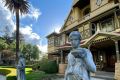
The Cathedral of the Fallen Angel
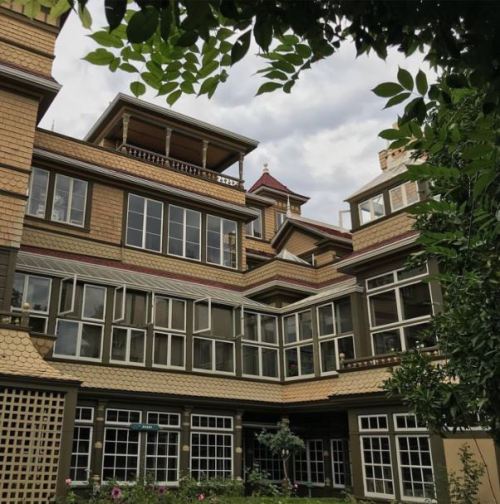
During a Connecticut thunderstorm, Mrs. Winchester’s husband and baby lost their lives in a tragic fire. The distracted widow turned to spiritualism and was advised to take a trip around the World. This she did, visiting mediums, spiritualists and wizards in Europe and India. Foretelling her future, one seer warned her of all the countless thousands of departed souls slain by her husband’s rifles; she was told to plan a castle and continue its building indefinitely because as long as it was under construction she would live; cessation would prove immediately fatal. In the afternoon of Tuesday, July 10, 1888, the inhabitants of Santa Clara Valley, were greatly excited by the sudden appearance, far out in the fields, of a mansion where none was known to exist. The people of the town were farmers and knew the area well. The day before, they had been out on their horses and rode over the spot where the unusual mansion appeared, and where certain that the locality was the best farmland in the valley. And still they gazed, and still the wonder grew, for the day was clear and the mansion could be seen as plainly as they saw the hills to the south. It was massive. The estate was surrounded by a six-foot hedge, densely wooded; here and there were deep shadows in its sides indicating glens heavily covered with undergrowth and grasses. At one end the mansion rose almost precipitously from the from the land; at the other, the declivity was gradual; the thick forest of the estate gave way to smaller trees, these to shrubs; these to green meadows that finally melted into the valley. It was patrolled by a pack of ferocious hellhounds, plus, of course, Mrs. Winchester’s staff of armed bodyguards. Hundreds of people from all over California came to investigate; when, as they neared the spot, the beautiful but bizarre mansion became dim in outline, less vivid in color, and at last vanished entirely, leaving the wonder-stricken farmers to return, fully convinced that for the first time in their lives they had really seen this enchanted mansion. #RandolphHarris 1 of 15

For once there was a topic of conversation that would outlast the day, and the enchanted Winchester mansion passed from lip to lip, both story and the mansion grew in size till the latter was little less than a continent, contain a labyrinth mansion with towers and steeples, stupendous mountain range views, fertile valleys, and wide spreading plains; while the former was limited only be the patience of the listener, and embraced the personal experience, conclusions, reflections, and observations of every woman, man, and child in the valley who had been fortunate enough to see the mansion, hear of it, or tell where it had been seen elsewhere. This is the invariable history of its appearance. No one had ever been able to come close to its grounds, but it had been so often seen on the west coast, that a doubt of its existence, if expressed in the company of farmers, will at once establish for the sceptic a reputation for balderdash of the common affairs of every-day life. In Santa Clara, for instance, the Winchester mansion had been seen by hundreds of people, while many more could testify to its appearance near San Francisco. In San Jose, all the population saw it a few years ago, and shortly before, the villagers of Oakland, saw it, if not by themselves, at least by some of their friends. The Enchanted Winchester mansion, it should be stated that its resemblance to a Victorian/Gothic castle is sometimes very close, and shows that the “enchanter” who has it under a spell knows her business, and is determined to keep her mansion for herself changes its appearance as well as its location in order that her property may not be recognized nor appropriated. At night, passers-by heard ghostly music wafting from the dark mansion. Mrs. Winchester’s arrival was a sensational event. They talked about Mrs. Winchester! Gossiped would be a more fitting word, gossip no one claimed to like-but everyone enjoyed. #RandolphHarris 2 of 15

Talk begat rumor and as the years passed and new towers and gables rose behind the six-foot hedge of Llanada Villa, the rumors grew to established legend. Populations said it just appeared out of nowhere two years ago. Sure two twins could not be like her, and when it appeared in Santa Clara, the mansion would move around to different locations. It had also appeared in San Francisco, Oakland, and Berkeley, but it went no further than the Bay Area. Concerning Mrs. Winchester’s mansion, legendary authorities differ on many material points. Some believed that its architecture was due to geometry or some other enchantment, while opponents of this materialistic view were inclined to the opinion that the mansion was not what it seemed to be, that was to say, not Earth, wood, and stones, like as those most people see, but only an illusion that evil spirits or the devil created to deceive the town. Public opinion on the west coast was therefore was strongly divided on the subject, unity of sentiment existing on two points only; that the island had been seen, and that there was something quite out of the ordinary in its appearance. People believe that it would come and go in the night like a light in a bog, and when you do see it, you can see through it. An old fisherman of San Francisco called Ebenezer Thornton knew all about the enchanted Winchester mansion, having not only seen it himself, but, when a boy, learned its history from a “fairy man,” who obtained his information from “the good people” themselves, the facts stated being therefore, of course, of indisputable authority, what the fairies did not know concerning the doings of supernatural and enchanted circles, being not worth knowing. He said that the Winchester mansion was full of temples and round towers all covered with gold and silver till they shone so one could not see it for the brightness. There was a great enchantress in the mansion, and she had all kinds of secrets, and knew where to dig for a pot of gold. She built the castle in one night, and could make herself disappeared when she wanted and could take any shape she pleased. #RandolphHarris 3 of 15

Ebenezer when on to say that Mrs. Winchester’s husband gave her a charm before he died to use when she was in mortal danger, he also left her a ton of diamonds and millions of dollars. She was a pretty smart woman. One night, Mrs. Winchester was awakened by a noise in one of the kitchens. She tole down, and found her old housekeeper, Madge, with half a dozen of her kidney, sitting by the fire drinking whisky. When the bottle was finished, one of them cried, “It’s time to be off,” and at the same moment she put on a peculiar red cap, and added:–“By yarrow and rue, and my red cap, too, hie over to England!” and seizing a twig she soared up the chimney. As the latter was making her preparations Mrs. Winchester rushed into the kitchen, snatched the cap from her, and placing herself astride of her twig uttered the magic formula. She speedily found herself high in the air over the Irish Sea, and swooping though the empyrean at a rate unequalled by the fastest airplane. They rapidly neared the Welsh coast, and espied a castle afar off, towards the door of which they rushed with a frightful velocity; Mrs. Winchester closed her eyes and awaited the shock, but found to her delight that she had slipped through the keyhole without hurt. The party made their way to the cellar, where they caroused heartily, but the spirits proved too heady, and somehow Mrs. Winchester was captured and dragged before the lord of the castle, who sentenced her to be hanged. On her way to the gallows an old woman in the crowd called out in Irish, “Ah, the enchantress herself, Sarah Winchester alanna! Is it going to die you are in a strange place without your magical charm?” She reached into her pocket and held it in her hand. On reaching the place of execution she was allowed to address the spectators, and did so in the usual ready-made speech, beginning, “Good people all, a warning take by me.” But when she reached the last line, “My parents reared me tenderly” instead of stopped she unexpected added, “By yarrow and rue, good-bye I love you,” with the result that she shot up through the air, to the great dismay of all beholders. #RandolphHarris 4 of 15

Magic persecution. Genuine magic is the art of bringing about results beyond human powers through the enlistment of supernatural agencies. Black magic deliberately involves the devil and demons, and the resulting enchantment is used for persecution and revenge. A spiritistic circle of twenty members furnishes a good example. Working with black magic, these spiritis experimented to see if they could cause psychic harm or even illness in people they disliked. A strong medium of this occult group chose a minister as a target and vowed to afflict and eliminate her. The minister suffered a nervous breakdown and was unable to work for several months. Some phenomena must be eliminated from the spiritistic magic field. In the psychiatric realm, for example, many schizophrenics claim to be magically persecuted. In reality this is only a symptom in the course of psychotic disease. Eliminating all such cases, there are still large-scale, genuine phenomena, especially in areas where occultism has flourished for many years. One common form of magic persecution is beatings by an invisible attacker. Parapsychology also sees magical persecution as a mediumistic problem in the sphere of materializations. Strong mediums (when under demon control) send out energy with which to build up human phantasms and are also able to transform this energy into animal forms, including dogs, cats, frogs, snakes, or human bodies with animal heads, etcetera. This explains the bizarre spiritistic persecution through phantoms in the form of various animals of human bodies with nonhuman heads. These animals bite, scratch, or otherwise torment their victims. Examples, of these occult phenomena abound in areas where the black arts are practiced. However, such occurrences are denied by many intellectuals. Often peasants and country people, especially in Europe, know more about magic than university graduates, who claim to swindle or hocus-pocus trickery are used instead of occult powers. #RandolphHarris 5 of 15
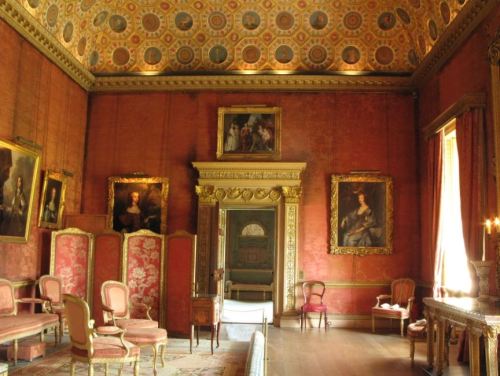
Magic defense. Magic defense enlists supernatural agencies to counteract or unto the mischief wrought by magic persecution. Various kinds of spells, charms, or incantations are employed. In spiritistic séances it is an established fact that injuries inflicted upon a phantasm are sustained by the medium, even in the case of animal phantasm. Many defensive customs develop to combat this threat since magical persecution involves materialization. If a victim can injure an aggressive phantasm one has won the struggle. Many in the West wanted to remove Satan from the equation of black magic and demonic aspects of life. However, more serious discontent came from Satanists whose concerns were completely the opposite. Anton LaVey did not believe in Satan as a literal entity—He was a name for the dark, brutal aspects of humans and nature, as well as a symbol for the potency of humans’ untrammeled will. The Church of Satan was not a religion, and did not worship deities. For many, however, this was not enough. They wanted a real Devil to worship—belonging to a dark, mysterious coven, in the traditional gothic style, seemed much more appealing than being part of some cultural and social elite. Some believed that Satan, although thrown out of Heaven, was reinstated as the son of God and is directly in contact with him. If any coven members offends, they are a bit evil now and again, given corporal punishment, or is expelled from one’s coven and cursed. However, this is said to be for the members own good. They really believe in love, the sanctity of woman as the child bearer and procreator of life, and in worshipping Satan their master. Aleister Crowley was grooming Kenneth as his successor. Mr. Grant’s work examined lost gods, strange spiritual traditions and forbidden symbols, often leading him to some disreputable spiritual neighborhood where devils and demons might be expected to reside, like the Winchester Mystery House. #RandolphHarris 6 of 15

If you have a lot of magic in you, you can be a Satanist and have no idea. As if they are the mafia or something, sometimes those who are suspected of being Satanists have their offices broken into like they are the Mafia or something. The Church of Satan, however, has saved lives because it has given them power, power to come out and be themselves when traditional churches would not accept these people. The Dark Lord, was said to be an anthropoid but faceless. Looking at the concept as a diamond, much like the ones left to Mrs. Winchester by her husband William Wirt Winchester, Satan or Lucifer was just other facets of that diamond, purely ways of achieving workings which encompassed the whole. So, if you are particularly drawn to the gothic Satanist current, fine, use rituals based around that. In the Temple of Darkness one could equally have Satanists, Setians, or followers of other paths, the principle being that the whole thing is a psychodrama anyway. Magic is basically the Western version of yoga. Everything that happens in magic happens first in your head. Set, the Egyptian god of evil, was an older deity than Satan. Satan derives from Set. Set, who is defined as the Prince of Darkness, is a force about which you could say, “As we are now, he once was.” When you die your force can survive. Magic is mind enhancing. When one perishes or passes, instead of going into the cosmic whole—becoming one with the goddess or whatever—by sheer force of the will the existence of that magician’s mind can be sustained. This is the whole idea of the Temple of Set, and they use the word “xeper,” meaning “to become,” to define this. Spiritistic cults. If you did not know, Mrs. Winchester was a spiritists. Spiritism is considered a form of Christianity, practically in all civilized countries. A typical meeting consists of hymns, prayer, and a sermon as in a Christian service. The sermon, however, is allegedly given by a spirit from the other World, through a medium. These cults are said to be affected by the “doctrines of demons” and press into the supernatural World. #RandolphHarris 7 of 15
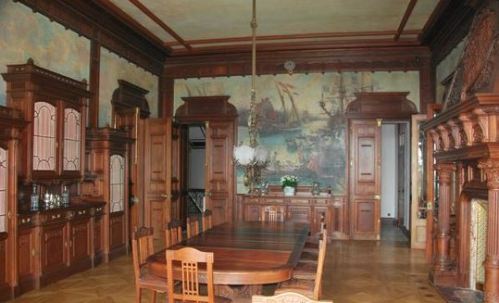
However, even born-again Christians often cannot differentiate between the spiritual and the psychic-demonic when under the spell of doctrinal errors, particularly those concerning the work of the Holy Spirit. The result can sometimes be confusion, division, and promotion of certain spiritual gifts accredited to demons. We have sometimes seen people end up suffering from mediumistic psychosis. Quite a number of patients who have suffered serious psychic disturbances through the misuse of such practices have become split personalities. The spirits which they called, confused them. One who tries to discover the promises of the other side through superstition endangers oneself to fall a prey to the dark side of one’s psyche. However, many Christians say that spirits of loved ones cannot be brought back from the dead, and the it is just a demon impersonating them. Yet, consider the case of Saul’s visit to the spiritistic medium at Endor (1 Samuel 28.3-25). Samuel’s spirit was actually brought back from the spirit World when the medium Endor tried to contact him. Yet, God brought the spirit back. The Lord stepped. Still one must be careful because many become enslaved and oppressed by occult powers and become victims of various manifestations of spiritistic phenomena. While overwhelming evidence from Christian counseling confirms the fact that spiritistic complicity serious damages the believer’s spiritual life, adherents of Buddhism, Island, or even false cults of Christianity sense no ill effects. Spiritists claim that spiritism has strengthened their belief in life after death and deepened their religious devotion. Psychiatry, psychology, and medical treatment are not sufficient for the healing of the whole human. The gospel of Christ and the liberating power of the Word of God can fully heal body, soul, and spirit. #RandolphHarris 8 of 15

Mrs. Winchester had a pain in her right forearm. At first the pain was treated as rheumatism but one day the Mrs. Winchester made the interesting discovery that the pain would suddenly subside if she wrote a letter. Having discovered this, whenever the pain became unbearable, she would always take a pencil and begin to write in order to alleviate the pain. However, after a period of time the Mrs. Winchester when go into her Blue Séance Room, where she developed a writing compulsion. She would write things down that she could normally speaking never have written. Often times, this is where the blueprints from her mansion came from. Added to this the written material on each occasion turned out to be some form of religious treatise. Mrs. Winchester took the articles to her minister to let him examine them. He was surprised at their intellectual content. Mrs. Winchester had become a spiritistic writing medium. The parapsychologist would merely see in this example a psychic automation involving the expression of subconscious thoughts. It is true that we need not consider the Mrs. Winchester to be in direct contact with the dead, or putting it another way we need not assume that this is a case of direct demonization, but God could be speaking to her. This is why some believe Mrs. Winchester to be a prophetess. During one of her spiritistic seances, as it happened, a phantasm did in fact appear during a séance. However, it is still not necessary to believe that a spirit really did appear in this instance. Depth psychology suggest that a phantasm can be produced in the following way. The medium through emitting energy causes matter to form as a result of this. In nuclear physics we have the idea that matter is nothing more than concentrated energy. Einstein’s formula E=M.c^2 illustrates this relationship. A comparison can also be drawn from another branch of physics. It is found that both particles and anti-particles are formed at the cathode of an X-ray tube when a current is passed through it at a very high voltage. Energy in the form of electro-magnetic waves is in this way transformed into matter. #RandolphHarris 9 of 15

The next step in the mediumistic process involves the unconscious tapping of the information from some source or other, and then the newly formed matter is physically shaped according to this information. The final step is made when the phantasm is brought under the control of the medium. Looking at it from this point of view there is no necessity to believe that the dead person has in any way been disturbed. An animistic explanation based on the powers of the subconscious is thus sufficient to explain the phenomenon of materialization. Yet this is not to say that the rationalistic explanation does justice to the facts of the case. The problem is not as simple as that. However, we do not have the time to delve further into the scientific side of the issues. We have, on many occasions witnessed a disintegration of the personalities of both mediums and participants where materializations have taken place. In addition to this in every case where a person has frequently taken part in spiritistic séances, there is some kind of reaction, even if it is not immediately notice or if there is no manifestation—something happens. There are also people who are able to practise the excursion of the soul. Spiritists affirm that people can send out an astral body from their material body, and commission it to do whatever they ask. Perhaps that was the case when Mrs. Winchester appeared in another country? Spiritism haunts the dark jungle of human aberration. During a séance as the Winchester mansion, Mrs. Winchester noticed that time was passing somewhat wearily. She could hear an occasional thud, thud. Some time must have elapsed before she became, dimly at first, and then distinctly, aware of a bluish phosphorescent emanation from a skeleton. This seemed to rise above it like a faint smoke, which gradually gained consistency, took form, and became distinct; and she saw before her the misty, luminous form on an unclothed man, with wolfish countenance, prognathous jaws, glaring at her out of eyes deeply sunk under projecting brows. #RandolphHarris 10 of 15
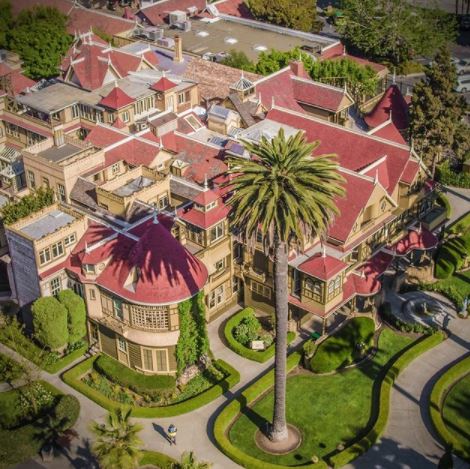
Although she thus descried what she saw, it gave her no idea of substance; it was vaporous, and yet it was articulate. Indeed, she could not say for sure if she saw this apparition with her eyes, or whether it was a dream-like vision of the brain. Though luminous, it cast no light on the wall of the Blue Séance Room; if she raised her hand, it did not obscure any portion of the form presented to her. Then she heard: “I will tear you with the nails of my fingers and toes, and rip you with my teeth.” “What have I done to injure and incense you?” she asked. No word was uttered by either of them; no word could have been uttered by this vaporous form. It had no material lungs, nor throat, nor mouth to form vocal sounds. It had but the semblance of a man. It was a spook, not a human being. However, it proceeded through the walls, odylic force which smote on the tympanum of her mind or soul, and thereon registered the ideas formed by it. So in a like manner Mrs. Winchester thought her replies, and they were communicated back in the same manner. If vocal words had passed between them neither would have been intelligible to the other. No dictionary was ever compiled, or would be compiled, of the tongue or prehistoric man; moreover, the grammar of the speech of that race would be absolutely incomprehensible to humans now. However, thoughts can be interchanged without words. When we think we do not think in any language. It is only when we desire to communicate our thoughts to other humans that we shape them into words and express them vocally in structural grammatical sentences. The beasts have never attained to this, yet they can communicate with one another, not by language, but by thought vibrations. Mrs. Winchester knew as she conversed with him that she was not speaking to him in English, nor in French, nor in Latin, nor in any tongue whatever. Moreover, when she used the words “said” or “spoke,” she meant no more than that the impression was formed by her brain-pan or the receptive drum of her soul, was produced by the rhythmic, orderly sequence of thought-waves. #RandolphHarris 11 of 15

When, however, she expressed the words “screamed” or “shrieked,” she signified that those vibrations came sharp and swift; and when she said “laughed,” tht they came in a choppy, irregular fashion, conveying the idea, not the sound of laughter. “I will tear you! I will rend you to bits and throw you in pieces about this mansion!” shrieked this demon man. Mrs. Winchester remonstrated, and inquired how she had incensed him. However, yelling with rage, he threw himself upon her. In a moment she was enveloped in a luminous haze, strips of phosphorescent vapour laid themselves about her, but she received no injury whatever, only her spiritual nature was subjected to something like a magnetic storm. After a few moments the spook disengaged itself from Mrs. Winchester, and drew back to where it was before, screaming broken exclamations of meaningless rage, and jabbering savagely. It rapidly cooled down. “Why do you wish to ill me?” She asked again. “I cannot hurt you. I am spirit, you are matter, and spirit cannot injure matter; my nails are psychic phenomena. Your soul you can lacerate yourself, but I can effect nothing, nothing.” “Then why have you attacked me? What is the cause of your impotent recement?” “Because you are the heiress to the Winchester Rifle, and I lived eight thousand years ago. Why are you nursed in the lap of luxury? Why you enjoy your comforts, a civilization that we new nothing of? It is not just. It is cruel on us. We have nothing, nothing, literally nothing, not even lucifer matches!” Again he feel to screaming, as might a caged monkey rendered furious by failure to obtain an apple which he could not reach. “I am very sorry, but it is no fault of mine.” “Whether it be your fault or not does not matter to me. You have these things—we had not. Why, I saw you just now strike a light on the sole of your boot. It was done in a moment. We had only flint and ironstone, and it took half a day with us to kindle a fire, and then it flayed our knuckles with continuous knocking. No! we have nothing, nothing—no lucifer matches, no commercial travellers, no Benedictine, no pottery, no metal, no education, no elections, no chocolat menier.” #RandolphHarris 12 of 15
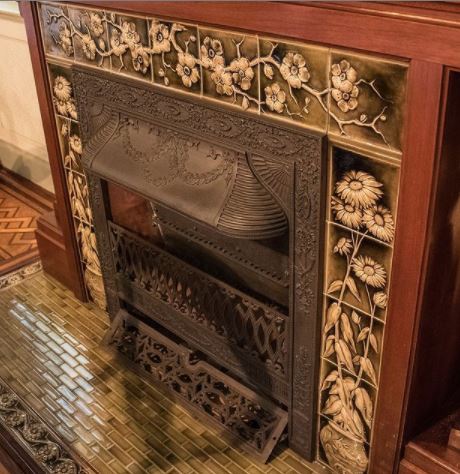
“How do you know about these products of the present age, here, buried one hundred feet of soil for eight thousand years?” “It is my spirit which speaks with your spirit. My spook does not always remain with my bones. I can go up; rocks and stones and earth and your labyrinth mansion heaped over me do not hold me down. I am often above. I am in the gasolier overhead. I have seen your servants plough the fields. I have seen a bottle of Benedictine. I have applied my physical lips to it, but I could taste, absorb nothing. I have seen commercial travellers there, cajoling the patron into buying things he did not want. They are mysterious, marvellous beings, their powers of persuasion are little short of miraculous. Why do you think of doing with me?” “Well, I propose first of all photographing you, then soaking you in gum Arabic, and finally transferring you to a museum.” He screamed as though with pain, and grasped: “Do not! do not do it. It will be torture insufferable.” “But why so? You will be under glass, in a polished oak or mahogany box.” “Do not! You cannot understand what it will be to me—a spirit more or less attached to my body, to spend ages upon ages in a museum with fibulae, triskelli, palstaves, celts, torques, scarabs. We cannot travel very far from our bones—our range is limited. And conceive of my feelings for centuries condemned to wander among glass cases containing prehistoric antiquities, and to hear the talk of scientific men alone. Now here, it is otherwise. Here I can pass up when I like into your mansion, and can see the maid and butlers cleaning, the roses and trees growing, the farmers working the field and the magnificent glow of your fine estate. Give me life. There is a sort of filmy attachment that connects our psychic nature with our mortal remains. It is like a spider and its web. #RandolphHarris 13 of 15

“Suppose the soul to be the spider and the skeleton to be the web. If you break the thread the spider will never find its way back to its home. So it is with us; there is an attachment, a faint thread of luminous spiritual matter that unites us to our Earthly husk. It is liable to accidents. It sometimes gets broken, sometimes dissolved by water. If a black beetle crawls across it it suffers a sort of paralysis. I have never been to the other side of the of your mansion, I feared to do so, though very anxious to see your architecture and furniture.” “This is news to me,” replied Mrs. Winchester. “Do you know of any case of rupture of connection?” Yes,” he replied. “My old father, after he was dead some years, got his link of attachment broke, and he wandered about disconsolate. He could not find his own body, but he lighted on that of a young female of seventeen, and he got into that. It happened most singularly that her spook, being frolicsome and inconsiderate, had got its bond also broken, and she, that is her spirit, straying about in quest of her body, lighted on that of my venerable parent, and for want of a better took possession of it. It so chanced that after a while they met and became chummy. In the World of spirits there is no marriage, but there grow up spiritual attachments, and these two got rather fond of each other, but never could puzzle it out which was which and what each was; for a female soul had entered into an old male body, and a male soul had taken up its residence in a female body. Neither could riddle out of which each gender was. You see they had no education. However, I know that my father’s soul became quite sportive in that young woman’s skeleton. Each generation makes some discovery that advances civilization a stage, the next enters on the discoveries of the preceding generations, and so culture advances stage by stage. Man is infinitely progressive; even the brute beast is.” #RandolphHarris 14 of 15

At that moment, Mrs. Winchester heard a shout—saw a flash of light. The construction workers had pierced the barrier. A rush of fresh air entered. She staggered to her feet. She felt dizzy. Kind hands grasped her. She was dragged forth. Brandy was poured down her throat. When she came to herself, she said, “Thank you. Talking with spirits can be terrible dreadful. When you are trying to summon one, souls get crossed and the one you are seeking may not cross through. They are so desperate to find a medium to communicate with.” As an ingredient of idol worship, magic goes back to antiquity. By virtue of their multiplicity and limited knowledge and power, the gods (demons) of paganism are incapable of establishing stability and security in society. This deficiency forced both gods and men to make use of magic—an inactive power independent of gods and men, but which could be activized by the assistance of incantations and rituals in order to accomplish supernatural deeds. Because of widespread denial of the reality of supernatural power—both divine and demonic, confusion abounds concerning the nature of magic. The history of magic is replete with extraordinary extrasensory phenomena that involve the spirit realm and every phase of the natural World as well, including human beings, animals, plants, and inorganic matter. Spirit-rapping, apparitions, ghosts, moving of furniture, and playing of musical instruments by invisible hands, stones falling from a ceiling, magical killing of cattle and blighting of crops, etcetera, are just a few of the weird occurrences that have happened at the Winchester Mystery House in its 134 years. However, there have also been beautiful supernatural events such as apparitions getting married, giant spirits of light in the shape of a man peering out guests, and on occasion, even rainbows and angels have appeared. Not all spirits or evil or angry, some or loving and welcoming. Few of thousands of annual transient guests are disappointed for here one finds visible truth even stranger than all the weird Mystery House features. #RandolphHarris 15 of 15

Winchester Mystery House
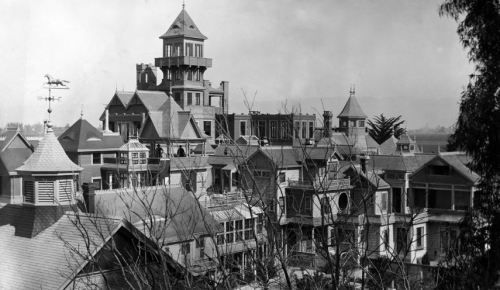
Beautiful weather calls for a walk around Sarah’s iconic gardens ⛲️🪴Open 10AM – 5PM this weekend!
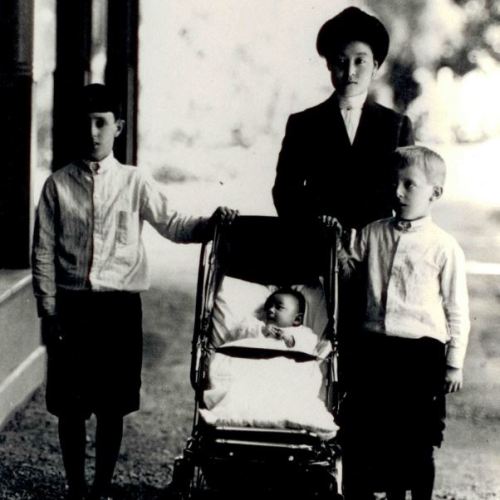
A 160-room mansion built to appease the spirits who died at the hands of the Winchester Rifle , or who were jealous of its wealth 👻

There Was Terror in His Eyes as Not Often Seen in a Human Being!

Twenty-first century humans, in spite of all their scientific and technological advances, are baffled by unexplained forces existent in the Universe. The naturalistic philosophy of the previous generations has been unable to account for all of the mysterious phenomena which have been observed. Many scientists believe that living beings may inhabit other galaxies, and highly educated humans are seriously studying reports of those who insist they have received communications from the dead. Humans of science no longer scoff at the accounts of strange occurrences associated with witchcraft and occultic practices. Although they do not necessarily accept them as proof of the supernatural, many will admit they are manifestations of some kind of power they do not yet understand. Christian theologians and scientists are not perplexed by such reports. They know that both God and Satan are very much alive. Though readily conceding that they cannot explain fully all the mysteries of life, they affirm with confidence the existence of God and an invisible host of intelligent supernatural beings. They are convinced that when one accepts the teachings of the Bible, one begins to understand many of the puzzling facts of existence. For example, the Bible tells of holy angels who dwell in Heaven (Matthew 18.10). It also mentions “angels that sinned” (2 Peter 2.4), rebellious spirit begins who have been cast out of Heaven and now dwell in the atmosphere that surrounds the Earth. We know this because Paul declared that Satan is “the prince of the power of the air,” reports Ephesians 2.2, and the Greek word translated “air” was used to speak of the gaseous envelop that encircles our planet. These wicked beings apparently have unlimited access to Earther, and actively influence every area of human endeavour. #RandolphHarris 1 of 19

Because they do not possess physical bodies, we cannot typically detect them through our senses of sight, hearing, touch, taste, or smell. We do have evidence of their presence, however, for the Word of God gives us information regarding their identification, their nature and their function. Various terms are used in the Christian Bible to denote the evil spirit beings who followed Satan in this initial act of rebellion against God. It refers to “angels that sinned” 2 Peter 2.4 and “angels who kept not their first estate” Jude 6, and many times mentions “spirits” and “demons.” Some scholars believe that these demons must be distinguished from the “angels that sinned” and the “angels who kept not their first estate.” They contend that the Heavenly beings who joined Satan in his revolt against God are fallen angels, but that demons are disembodies spirits of physical and moral creatures who once lived upon the Earth. However, these Bible students disagree regarding an exact identification of the demons. Some say they are the spirits of pre-Adamic beings similar to man, while others identify them as the spirits of the “giants” who were destroyed in the great flood of Noah’s day. If one thinks that demons are the spirits of man-like beings who lived before Adam, then one will no doubt interpret Genesis 1.2 as a declaration that the original Earth, inhabited by the creatures, was cataclysmically destroyed. Genesis 1.2 is then translated as follows: “And the Earth became without form and void…” This theory, while attractive in that it permits a literal interpretation of the days in Genesis 1, must be acknowledged as only a hypothesis. Most Hebrew scholars reject this interpretation because Genesis 1.2 begins with a grammatical construction which makes it highly unlikely that Genesis 1.1 and 1.2 are separated by millions of years. Then, too, the verb translated “became” almost always has the meaning “was.” #RandolphHarris 2 of 19

However, even if we accept this theory, and believe that a race of man-like beings inhabited the prehistoric Earth, we would have no basis for thinking that their spirits are now free to roam about as the enemies of humankind. Other Bible scholars maintain that demons are the spirits of the “giants” who lived upon the Earth in the days of Noah. They refer to Genesis 6, contending that these “giants” were produced when fallen angels, called the “sons of God,” married the “daughters of men.” “And it came to pass, when men began to multiply on the face of the Earth, and daughters were born unto them, that the sons of God saw the daughters of men that they were fair; and they took them wives of all whom they chose. There were giants in the Earth in those days; and also after that, when the sons of God came in unto the daughters of men, and they bore children to them, the same became mighty men who were of old, men of renown,” reports Genesis 6.1, 2, 4. It is necessary for proponents of this theory to believe that fallen angels became male human beings who married women, produced a mongrel offspring, and took over the role of father in the family. They theorize that Satan hoped thereby to frustrate God’s redemptive plan. The Lord had promised salvation through Christ to human beings only—not for angels or mixed half-human and half-angelic race. Christ could not have been born to offspring of these corrupted creates or provide redemptions for them. Thus God’s plan of redemption would have been thwarted. In addition, both Jude and Peter in their epistles refer to a sin committed by angels, and their words can be blended very nicely into this concept. Jude writes, “And the angels who kept not their first estate, but left their own habitation, he hath reserved in everlasting chains under darkness unto the judgment of the great day. Even as Sodom and Gomorrah, and the cities about them in like manner, giving themselves over to fornication, and going after strange flesh, are set forth for an example, suffering the vengeance of eternal fire,” reports Jude 6, 7. #RandolphHarris 3 of 19

The words “in like manner” (verse 7) are taken to mean that the sin of the angels in having pleasures of the flesh with women was an unnatural act, comparable to sodomy. Peter tells of angels assigned to Tartaros, the nether World of the Greeks considered to be lower than Hades. “For if God spared not the angels that sinned, but cast them down to hell [GK Tartaros], and delivered them into chains of darkness, to be reserved unto judgment,” reports 2 Peter 2.4. Again, it does not take a great deal of imagination to see how these words of Peter may be applied to the wicked angels who committed the monstrous sin of attempting to make mongrels of the human race. Many Bible students, however, reject this interpretation of Genesis 6. Since angels are non-material beings, it would be necessary for them to create physical bodies for themselves capable of impregnating a female member of the human race. This would require nothing less than a creative miracle, and the Bible indicates that this power belongs only to God. In addition, it is not necessary to interpret the statements in Jude and 2 Peter as a reference to sin involving pleasures of the flesh on the part of the fallen angels. Jude’s use of the expression “going after strange flesh” may be figurative language representing spiritual fornication. The prophets often depicted Israel’s unfaithfulness to God in this manner. Peter’s statement that the angels who sinned have been assigned to Tartaros may be a simple declaration that all sinning angels have been designated to this place, and that they are even now under chains of moral and spiritual darkness. The Bible gives little information regarding the origin of demons. We can state with absolute certainty only that they are fallen spirit beings who have committed themselves to Satan and that they hate God and seek to harm His people. No clear distinction can be made between fallen angels and demons, for they are all evil spirits. Some of our questions must remain unanswered, but the Lord has given ample revelation to warn us that these invisible enemies are far too great and powerful for us to defeat in our own strength, and that we can successfully wage war against them only as we live in continual dependence upon the Lord. #RandolphHarris 4 of 19

In one respect the case of Dame Alice Kyteler stands alone in the history of magical dealings in Ireland prior to the seventeenth century. We have of the entire proceedings an invaluable and contemporary account, or at latest one compiled within a very few years after the death of Petronilla of Meath; while the excitement produced by the affair is shown by the more or less lengthy allusions to it in early writings, such as The Book of Howth (Carew MSS.), the Annals by Fariar Clyn, the Chartularies of S. Mary’s Abbey (vol. ii), &c. It is also rendered more valuable by the fact that those who are best qualified to give their opinion on the matter have assured the writer that to the best of their belief no entries with respect to trials for sorcery or witchcraft can be found in the various old Rolls preserved in the Dublin Record Office. However, when the story is considered with reference to the following facts it takes on a different signification. On the 29th of September 1317 (Wright says 1320), Bishop de Ledrede held his first Synod, at which several canons were passed, one of which seems in some degree introductory to the events detailed in last week’s report. In it he speaks of “a certain new and pestilential sect in our parts, differing from all the faith in the World, filled with a devilish spirit, more inhuman than heathens…who pursue the priests and bishops of the Most High God equally in life and death, by spoiling and rending the patrimony of Christ in the diocese of Ossory, and who utter grievous threats against the bishops and their ministers exercising ecclesiastical jurisdiction, and (by various means) attempt to hinder the correction of sins and the salvation of souls, in contempt of God and the Church.” From this it would seem that heresy and unorthodoxy had already made its appearance in the diocese. In 1324 the Kyteler case occurred, one of the participants being burnt at the stake while other incriminate persons were subsequently followed up, some of whom shared the fate of Petronilla of Meath. In 1327 Adam Dubh, of the Leinster tribe of O’Toole, was burnt alive on College Green for denying the doctrines of the Incarnation and the Holy Trinity, as well as for rejecting the authority of the Holy See. #RandolphHarris 5 of 19

In 1335 Pope Benedict XII wrote a letter to King Edward III, in which occurs the following passage: “It has come to our knowledge that while our venerable brother, Richard, Bishop of Ossory, was visiting his diocese, there appeared in the midst of his catholic people men who were heretics together with their abettors, some of whom asserted that Jesus Christ was a mere man and a sinner, and was justly crucified for His own sins; others after having done homage and offered sacrifice to demons, thought otherwise of the sacrament of the Body of Christ than the Catholic Church teaches, saying that the same venerable sacrament is by no means to be worshipped; and also asserting that they are not bound to obey or believe the decrees, decretals, and apostolic mandates; in the meantime, consulting demons according to the rites of those sects among the Gentiles and Pagans, they despise the sacraments of the Catholic Church, and draw the faithful of Christ after them by their superstitions.” Unlike apocryphal and rabbinical literature, the Biblical description of evil spirits avoids the unusual and grotesque. The Bible does, however, present us with a clear picture of their activity and tells us how to resist them effectively. In the first place, it declares that demons or fallen angels are non-material beings. They do not possess bodies like humans, and therefore are repeatedly called “spirits.” Matthew, for example, says, “When the evening was come, they brought unto him many that were possessed with demons; and he cast out the spirits with his word, and healed all that were sick,” reports Matthew 8.16. Jesus started that the Creator is not made up of physical substance when He said, “God is a Spirit,” reports John 4.24. Later, when His frightened disciples thought He was a ghost, He told them their fears were groundless, for “a spirit hath not flesh and bones, as ye see me have,” reports Luke 24.39. Paul had in mind the non-physical nature of Satan and his army of evil spirits when he said that our warfare is “not against flesh and blood, but against principalities, against powers, against the rulers of the darkness of this World, against spiritual wickedness in high places,” reports Ephesians 6.12. Satan’s demonic hordes are spirit beings, and therefore more dangerous than the “flesh and blood” enemies we may encounter in our daily lives. #RandolphHarris 6 of 19

Second, the Bible portrays demons as highly intelligent creatures. They recognize Christ when He was here upon the Earth, and knew they could not have fellowship with Him. Luke tells us about an evil spirit who is an example of this. “When he saw Jesus, he cried out, and fell down before him, and with a loud voice said, What have I to do with thee, Jesus, thou Son of God, most high? I beseech thee, torment me not,” reports Luke 8.28. The fallen spirits are also aware of their ultimate defeat, for James declared, “Them demons also believe, and tremble,” reports James 2.19. They are, of course, finite creatures, even Satan is limited in knowledge. He has myriads of evil spirit followers, however, and they are able to give him information on almost any person and circumstance in which he is interested. In this manner he can find out much what he wants to know. Truly, believers in Christ can never successfully cope with Satan and his hosts without special help from the Lord. Therefore, we must humbly look to God for wisdom and strength to resist the attacks of our invisible enemies. Third, the World of evil spirits is cruel. These creatures hate God and all who have placed their trust in Him. They seem to find delight in causing human grief and pain. For example, Matthew tells us that a man who was both blind and dumb suffered these afflictions because a demon had entered his body. “Then was brought unto him one possessed with a demon, blind, and dumb; and He healed him, insomuch that the blind and dumb both spoke and saw,” reports Matthew 12.22. Matthew, Mark, and Luke all tell the story of two demented men who lived in the country of the Gerasenes, and indicate that their insanity was the result of demonic invasion of their personalities. Luke, the beloved physicians, writes of a woman who was bent over with some crippling disease, saying that she had “a spirit of infirmity.” He adds that Jesus said she had been bound by Satan. “And he was teaching in one of the synagogues on the sabbath. And, behold, there was a woman who had a spirit of infirmity eighteen years, and was bowed together, and could in no way lift herself up. And when Jesus saw her, he called her to him, and said unto her, Woman, thou art loosed from thine infirmity. #RandolphHarris 7 of 19

“And he laid his hands on her; and immediately she was made straight, and glorified God. And the ruler of the synagogue answered with indignation, because Jesus had healed on the sabbath day, and said unto the people, There are six days in which humans ought to work; in them, therefore, come and be healed, and not on the sabbath day. The Lord then answered him, and said, Thou hypocrite, doth not each one of you on the sabbath loose his ox or her ass from the stall, and lead him away to watering? And ought not this woman, being a daughter of Abraham, who Satan hath bound, lo, these eighteen years, be loosed from this bound on the sabbath day? And when he had said these things, all his adversaries were ashamed; and all the people rejoiced for all the glorious things that were done by him,” reports Luke 13.10-17. While the gospel writers make it clear that not all illness is the work of Satan and demons, they do point out that much human suffering is the result of demonic activity. Finally, the Bible tells us that all fallen angels or evil spirits are confirmed in their wickedness. Though they “believe and tremble,” they will never repent, never seek forgiveness, and never pray for holiness or purity. Though they know that Jesus is the Christ, they never really worship Him. They must acknowledge that He is stronger than they, and may occasionally render Him token submission, but inwardly they hate Him and keenly resent His authority over them. In fact, their nature is so totally evil that the term “unclean” often is applied to them. (See Matthew 10.1; Mark 1.27; 3.11; Luke 4.36; Acts 8.7; Revelations 16.13.) They apparently delight in sin, find great pleasure in leading humans to commit evil deeds, and possess no feelings of guilt nor desire for deliverance. Michael Scot, reputed a wizard of such potency that—when in Salamanca’s cave he listed his magic want to wave and the bells would ring in Notre Dame. Scot has studied successively at Oxford and Paris (where he acquired the title of “mathematicus”); he then passed to Bologna, thence to Palermo, and subsequently continued his studies in Toledo. His refusal of the See of Cashel was an intellectual loss to the Irish Church, for he was so widely renowned for his varied and extensive learning that he was credited with supernatural powers; a number of legends grew up around his name which hid his real merit, and transformed the man of science into a magician. #RandolphHarris 8 of 19

In the Border country traditions of his magical power are common. Boccaccio alludes to “a great master in necromancy, called Michael Scot,” while Dante places him in the eighteen circle of Hell. The next, who is so slender in the flanks, was Michael Scot, who of a verity of magical illusion knew the game. Another man to whom magical powers were attributed solely on account of his learning was Gerald, the fourth Earl of Desmond, styled the Poet, who died rather mysteriously in 1398. The Four Masters in their Annals describe him as “a nobleman of wonderful bounty, mirth, cheerfulness of conversation, charitable in his deeds, easy of access, a witty and ingenious composer of Irish poetry, a learned and profound chronicler.” No legends are extant of his magical deeds. King James I of Scotland, whose severities against his nobles had around their bitter resentment, was barbarously assassinated at Perth in 1437 by some of their supports, who were aided and abetted by the ages Duke of Atholl. From a contemporary account of this we learn that the monarch’s fate was predicted to him by an Irish prophetess or witch; has he given ear to her message he might have escaped with his life. We modernize the somewhat difficult spelling, but retain the quaint language of the original. “The king, suddenly advised, made a solemn feast of the Christmas at Perth, which is clept Saint John’s Town, which is from Edinburg on the other side of the Scottish sea, the which is vulgarly celpt the water of Lethe. In the midst of the way there arose a woman of Ireland, the clept herself as a soothsayer. The which anon as she saw the king she cried with a loud voice, saying thus: ‘My lord king, and you pass this water you shall never turn again alive.’ The king hearing this was astonied of her words; for but a little before he had read in a prophecy that in the self same year the king of Scots should be slain; and therewithal the king, as he rode, cleped to him one of his knights, and gave him in commandment to turn again to speak with that woman, and ask of her what she would, and what thing she meant with her loud crying. #RandolphHarris 9 of 19

“And she began, and told him as ye have heard of the King of Scots if he passed that water. As now the king asked her, how she knew that. And she said, that Huthart told her so. ‘Sire,’ quoth he, ‘men may “calant” yet take to heed of yon woman’s words, for she is but a drunken fool, and wot not what she saith’; and so with his folk passed the water celpt the Scottish sea, towards Saint John’s town.” The narrator states some dreams ominous of James’s murder, and afterwards proceeds thus: Both afore supper, and long after into quarter of the night, in the which the Earl of Atholl (Athetelles) and Robert Steward were about the king, where they were occupied at the playing of chess, at the tables, in reading of romances, in singing and piping, in harping, and in other honest solaces of great pleasance and disport. Therewith came the said woman of Ireland, that celpt herself a divineress, and entered the king’s court, till that she came straight to the king’s chamber-door, where she stood, till at the last the usher opened the door, marvelling of that woman’s being there that time of night, and asking her what she would. ‘Let me in, sir’ quoth she, ‘for I have somewhat to say, and to tell unto the king; for I am the same woman that not long ago desired to have spoken with him at the Leith, when he should pass the Scottish sea.’ The usher went in and told him of this woman. ‘Yea,’ quoth the king, ‘let her come tomorrow’; because the he was occupied with such disports at that time he let not to hear her as then. The usher came again to the chamber-door to the said woman, and there he told her that the king was busy in playing, and bid her come soon again upon the morrow. ‘Well,’ said the woman, ‘it shall repent you all that ye will not let me speak now with the king.’ Thereat the usher laughed, and held her but a fool, charging her to go her way, and therewithal she went thence. Her informant “Huthart” was evidently a familiar spirit who was in attendance on her. #RandolphHarris 10 of 19

Considering the barrenness of Irish records on the subject of sorcery and witchcraft it affords us no small satisfaction to find the following statement in the Statute Rolls of the Parliament for the year 1447. It consists of a most indignantly-worded remonstrance from the Lords and Commons, which was drawn forth by the fact that some high-placed personage had been accused of practising sorcery with the intent to do grievous harm to one’s enemy. When making it the remonstrants appear to have forgotten, or perhaps, like Members of Parliament in other ages, found it convenient to forget the nonce the Kyteler incident of the pervious century. There was an Act of Parliament which was intended to put a stop to a certain lucrative form of witchcraft. It is gravely stated by the writer of a little book entitled Beware the Cat (and by Giraldus Camrensis before him), that Irish witches could turn wisps of hay, straw &c. into red-coloured pigs, which they dishonestly sold in the market, but which resumed their proper shape when crossing running water. To prevent this it is stated that the Irish Parliament passed an Act forbidding the purchase of red swine. We regret to say, however, that no such interesting Act is to be found in the Statues books. The belief in the power of witches to inflict harm on others was also a powerful belief in Victorian times. When reflecting on history, one can see that consulting someone with supernatural powers was no different than talking to a friend about one’s life. It was very common. Also, many of these accounts turned out to have some truth to them or evidence of supernatural power. Perhaps this is because people were more in tune with their inner spirit and the planet back then. Many people thought Sarah Winchester was mentally ill or deranged for consulting a medium about how she should deal with the evil spirits that were haunting her, they thought she was even more insane for building the World’s most beautiful and unique mansion. However, what better way could there be to spend your money than by creating something you and the World can enjoy for many centuries and creating a living memorial for your family? #RandolphHarris 11 of 19

Perhaps what Mrs. Winchester did was very rational and sane. In contrast, most others express their pain and suffering by becoming destructive and hurting others, and people usually idolize them for that. Mrs. Winchester gradually developed her skill in building, just as she had done with music and language in her youth. She often used the most current innovations in her home. Some historical sources say that Mrs. Winchester was the first to use wool for insulation. Carbide gas lights in the house were fed by the estate’s own gas manufacturing plant, which used a new process. The gas lights were operated by pushing an electric button. A specially designed window catch was patterned after a Winchester rifle trigger and trip hammer, amongst other state of the art designs. I met a man in the Winchester Mansion one day that I knew very well, as I thought, though I had not seen him for years. Without pressing him too soon with a repetition of my idle questions, we walked together to the Blue Séance Room, and there we shook hands. Just then there came a vague vibration in the Earth and air, quickly changing into a violent pulsation, and an oncoming rush caused me to start back, as though it had force to draw me down. Next morning, I spoke of this meeting to a mutual friend, and then I learnt, for the first time, that the man had died six months before. The natural inference was that I had mistaken one man for another, an error that, not having a good memory for faces, I frequently fall into. What was remarkable about the matter, however, was that throughout our walk I had conversed with the man under the impression that he was that other dead man, and, whether by coincidence or not, his replies had never once suggested to me my mistake. As soon as I finished speaking to Jared, who had been listening very thoughtfully, asked me if I believed in spiritualism “to its fullest extent.” “That is a rather large question,” I answered. “What do you mean by ‘spiritualism to its fullest extent’?” “Well, do you believe that the spirits of the dead have not only the power of revisiting this Earth at their will, but that, when here, they have the power of action, or rather, of exciting to action. Let me put a definite case. A spiritualist friend of mine, a sensible and by no means imaginative man, once told me that a table, through the medium of which the spirit of a friend had been in the habit of communicating with him, came slowly across the room towards him, of its own accord, one night as he sat alone in the Winchester Mansion, and pinioned him against the wall. Now can any of you believe that, or can you not?” #RandolphHarris 13 of 19

I could believe it. It seems that the difference between what we call the natural and supernatural is merely the difference between frequency and rarity of occurrence. Suppose a person died with the dearest wish of one’s heart unfulfilled, do you believe that one’s spirit might have power to return to Earth and complete the interrupted work? The Winchester Mansion is supposed to be enchanted. According to the legend, William Winchester was a very potent magician, and usually resided in a castle. To this he brought his bride, a beautiful young lady, Sarah Lockwood Pardee, who he loved, and he prevailed upon her her every desire, but with fatal results. One day she presented herself in the chamber in which her husband exercised his forbidden art, and begged him to show her the wonders of the evil science. With the greatest reluctance he consented, but warned her that she must prepare herself to witness a series of most frightful phenomena, which, once commenced, could neither be abridged nor mitigated, while if she spoke a single word during the proceedings the castle and all it contained would sink. Urged on by curiosity she gave the required promised, and he commenced. Muttering a spell as he stood before her, feathers sprouted thickly over him, his face became contracted and hooked, a corpse-like smell filled the air, and winnowing the air with beats of its heavy wings a gigantic vulture rose in his stead, and swept round and round the room as if on the point of pouncing upon her. The lady controlled herself though this trial, and another began. The bird alighted near the door, and in less than a minute changed, she saw not how, into a horribly deformed and dwarfish hag, who, with yellow skin hanging about her face, and cavernous eyes, swung herself on crutches towards the lady, her mouth foaming with fury, and her grimaces and contortions becoming more and more hideous every moment, till she rolled with a fearful yell on the floor in a horrible convulsion at the lady’s feet, and then changed into a huge serpent, which came sweeping and arching towards her with crest erect and quivering tongue. #RandolphHarris 14 of 19

Suddenly, as it seemed on the point of darting at her, she saw her husband in its stead, standing pale before her, and with his finger on his lips enforcing the continued necessity of silence. He then placed himself at the full length on the floor and began to stretch himself at full length on the floor and began to stretch himself out, longer and longer, until his head nearly reached to one end of the vast room and his feet to the other. This utterly unnerved her. She gave a wild scream of horror, whereupon the castle shook and the nine-story tower of what is now known as the Winchester Mansion came tumbling down. Mr. Winchester is said to have been dead and never lived in the Winchester Mansion, but perhaps his spirit did? Once every seven years, the great William Wirt Winchester would rise, and rides by on his white horse round Llanada Villa. The steed is shod with gold shoes, and when these are worn out the spell that holds Mr. Winchester will be broken, and he will regain possession of his vast estates and semi-regal power. In the closing years of the nineteenth-century there was a living man named Gilbert Plutchik who claimed to have seen Mr. Winchester. Gilbert was a blacksmith, and his forge stood on back of the estate, near a lonely part of the road. One night when there was a bright moon, he was working very late and quite alone. In one of the pauses of his work he heard the ring of many hoofs ascending the steep road that passed his forge, and, standing in his doorway, he saw a gentleman on a white horse, who was dressed in a fashion the like of which he had never seen before. This man was accompanied by a mounted retinue, in similar dress. They seemed to be riding up to the mansion, but the pace slackened as they drew near, and the rider of the white horse, who seemed from his haughty air to be a man of rank, drew bridle, and came to a halt before the smith’s door. He did not speak, and all his train were silent, but he beckoned to the smith, and pointed down at one of the horse’s hoofs. Gilbert stopped and raised it, and held it just long enough to see that it was shod with a gold shoe, which in one place was worn as thing as a shilling. Instantly his situation was made apparent to him by this sign, and he recoiled with a terrified prayer. #RandolphHarris 15 of 19

The lordly rider, with a look of pain and fury, struck him suddenly with something that whistled in the air like a whip; an icy streak seemed to traverse his body, and at the same time he saw the whole cavalcade break into a gallop, and disappear down the hill. It is generally supposed that for the purpose of putting an end to his period of enchantment Mr. Winchester endeavours to lead someone on to first break the silence and speak to him; but what, in the event of his succeeding, would be the result, or would befall the person thus ensnared, no one knows. If one admits the possibility of spirits retaining any interest in the affairs of this World at all, it is certainly more reasonable to imagine them engaged upon a task such as this, than to believe that they occupy themselves with the performance of mere drawing-room tricks. There was once a great wrong done to the Winchester Mansion. A man stole something priceless from the estate. After that, he felt like he was being followed. However, the course was the whole World, and the stakes his life. It was sixteen hours before he was going to abscond. Passing the estate once more, he asks, “How long since the carriage passed this way, with a tall, fair man inside?” “Such a one passed this morning, Monsieur. The man was ridden by Fear as he looked, and saw before him the door to the Winchester Manion opened, and passing in, knelt down and prayed. He prayed long and fervently, for men, when they are in sore straits, clutch eagerly at the straws of faith. He prayed that he might be forgiven his sin, and, more important still, that he might be pardoned the consequences of his sin, and be delivered from his adversary; and a few chairs from him, facing him, knelt Mr. Winchester praying also. However, Mr. Winchester’s prayer, being a thanksgiving merely, was short, so that when the thief raised his eyes, he saw the face of Mr. Winchester gazing at him across the chair tops, with a mocking smile upon it. He made no attempt to rise, but remained kneeling, fascinated by the look of joy that shone out of Mr. Winchester’s eyes. And Mr. Winchester moved the high-back chairs one by one, and came toward him softly. Then, just as Mr. Winchester stood beside the thief who had wronged him, full of gladness that his opportunity had come, there burst from the bell town a sudden clash of bells, and Mr. Winchester vanished. #RandolphHarris 16 of 19

Then the thief who had done the wrong rose up and passed out praising God. What became of the body of Mr. Winchester is not known. There was none to identify. Years passed away, and the survivour in the tragedy became a worthy and useful citizen, and a noted man of science. He was employed by Mrs. Winchester and even had a laboratory on the estate were many objects necessary to him in his researches, and prominent among them, stood in a certain corner, a human skeleton. It was a very old and much-mended skeleton, and one day the long-expected end arrived, and it tumbled to pieces. Thus it became necessary to purchase another. The man of science visited a dealer he well knew, and the dealer said he would send a well-proportioned “study” to his laboratory that very afternoon. The dealer was as good as his word. When Monsieur entered his laboratory that evening, the thing was in its place. Monsieur seated himself in his high-backed chair, and tried to collect his thoughts. However, his thoughts were unruly, and inclined to wander, and to wander always in one direction. He opened a large volume and commenced to read. He read of a man who had wronged another and feld from him, the other man following. Finding himself reading this, he closed the book angrily, and went and stood by the window and looked out. He saw before him the sun-pierced nave of East wing of the Winchester Mansion, and on the stones lay a dead man with a mocking smile upon his face. Cursing himself for a fool, he turned away with a laugh. However, his laugh was short-lived, for it seemed to him that something else in the room was laughing also. Struck suddenly still, with his feet glued to the ground, he stood listening for awhile: then sought with starting eyes at the corner from where the sound had seemed to come. However, the white thing standing there was only grinning. Monsieur wiped the damp sweat from his head and hands, and stole out. For a couple of days he did not enter the room again. One the third, telling himself that his fears were those of a hysterical girl, he opened the door and went in. #RandolphHarris 17 of 19

To shame himself, he took his lamp in his hand, and crossing over to the far corner where the skeleton stood, examined it. A set of bones bought for a thousand dollars. Was he a child, to be scared by such a bogey! He held his lamp up in front of the thing’s grinning head. The flame of the lamp flickered as though a faint breath had passed over it. The man explained this to himself by saying that the walls of the house were old and cracked, and that the wind might creep in anywhere. He repeated this explanation to himself as he recrossed the room, walking backwards, with his eyes fixed on the thing. When he reached his desk, he sat down and gripped the arms of his chair till his fingers turned white. He tried to work, but the empty sockets in that grinning head seemed to be drawing him towards them. He rose and battled with his inclination to fly screaming from the room. Glancing fearfully about him, his eyes fell upon a high screen, standing before the door. He dragged it forward, and placed it between himself and the thing, so that he could not see it—nor it see him. Then he sat down again to his work. For a while he forced himself to look at the book in front of him, but at last, unable to control himself any longer, he suffered his eyes to follow their own beat. It may have been an hallucination. He may have accidentally placed the screen so as to favour such an illusion. However, what he saw was a bony hand coming round the corner of the screen, and, with a cry, he fell to the floor in a swoon. John Hansen and other people of the house came running in, and lifting him up, carried him out, and laid him upon his bed. As soon as he recovered, his first question was, where had they found the thing—where was it when they entered the room? And when they told him they had seen it standing where is always stood, and had gone down into the room to look again, because of his frenzied entreaties, and returned trying to hide their smiles, he listened to their talk about overwork, and the necessity for change and rest, and said they might do with him as they would. So for many months the laboratory door remined locked, and many of the innovative technologies produced by the Winchester Estate came to a halt. Then there cam a chill winter evening when the man of science opened it again, closed the door behind him. #RandolphHarris 18 of 19

He lighted his lamp, and gathered his instruments and books around him, and sat down by the fire before them in his high-backed chair. And the old terror returned to him. He was sitting there when he heard a cry. He held his lamp above his head, and saw figures in the distance, and wet stains stealing down the walls and trickling through the arch. He listened for a moment to the wind in the valley, it sounded unnatural. Standing at the door was a specter. The man of science sat down partly to collect his thoughts again, partly because it had turned him faint. He heard terrible screams and cries. A beautiful young lady had died instantaneously in the parlor. This time the man of science wished to conquer himself. His nerves were stronger now, and his brain clearer; he would fight his unreasoning fear. He crossed the door and locked himself in, and flung the key to the other end of the room, where it fell among beakers and Bunsen Burners with an echoing clatter. Later on, the housekeeper, Angus, going her final round tapped at the door and wished him good night, as was her custom. She received no response, at first, and growing nervous, tapped louder and called again; and at length an answering “good night” came back to her. She thought little about it at the time, but afterwards she remembered that the voice that had replied to her had been strangely grating and mechanical. Trying to describe it, she likened it to such a voice as she would imagine coming from a statue. Next morning the door to the laboratory remained still locked. It was no unusual thing for him to work all night, and far into the next day, so no one thought surprised. When, however, evening came, and yet he did not appear, the servants gathered outside the room and whispered, remembering what had happened before. They listened, but could hear no sound. They shook the door and called to him, then beat with their fists upon the mahogany panels. However, there was still no sound. Becoming alarmed, they decided to burst open the door, and, after many blows, it gave way and flew back, and they crowded in. He sat bolt upright in his high-backed chair. They thought at first he had died in his sleep. However, when they drew nearer and the light fell upon him, they saw the livid marks of bony fingers round his throat; and in his eyers there was such a terror as is not often seen in human eyes. Next evening was a lovely evening, and Mrs. Winchester walked out early to enjoy it. The sun was not yet quite down when she traversed the field-path near where the nine-story tower once stood. #RandolphHarris 19 of 19

Winchester Mystery House

Saturdays are for the boilers 😉 Do you know where this is in the house?
🎟 Link in bio. winchestermysteryhouse.com


What a Lovely Day for a Bit of Mystery!

It is rare for people to be asked the question which puts them squarely in front of themselves. I hear your words, My dear Devout; now you hear Mine. You will find them not only suasive, but also persuasive. In fact, they exceed in wisdom all the accumulated knowledge of Philosophy since the World began. My particular words for you today are “spirit and life.” My Beloved Disciple recorded them in his Gospel (6.63), but Humanity cannot seem to make any sense out of them. Important words, they should not be exegeted smugly, if I may allude to that hoary Preacher of Ecclesiastes (9.17), but listened to respectfully. That is to say, they should be received with all humility and yet great affection. Our seventeenth-century ancestors differed from us in most ways, but in nothing did they differ more than in their attitude toward the truth. In this they were closer to the Middle Ages than to us. For them a lie—a breaking of one’s faith—was the worst of sins. Today, many do not regard lying as a serious moral wrong. If the word “morality” is mentioned we think immediately of our bodily appetites, especially of pleasures of the flesh, barbiturates, paraphernalia, liquor and contraband. If the word “morality” is mentioned we think immediately of our bodily appetites very seriously—perhaps too seriously—but we do not regard lying as a mortal sin. We are one of the few civilizations in which entire professions (TV news media, for example, and public relations) are seriously devoted to bending the truth. Dante, in his Divine Comedy, divided sins into three kinds: those of lust, those of violence, and those of fraud. #RandolphHarris 1 of 13

The sins of lust—those we tend to take most seriously—were those that Dante thought most trivial; the sins of fraud—which we take lightly—were for Dante the worst of all. To create a “credibility gap” as our revealing phrase has it (as though the only relevant issue is whether a statement will compel belief), to lie, was for the medieval humans to break one’s faith, and it was faith which constituted the bonds between humans and their fellow humans, between humans and the state, between humans and God. To lie was to reduce all the most valuable relationships of life to chaos. And the seventeenth-century Puritan, like Dante, was still living by his faith. Just how important the truth was to the seventeenth-century Puritan may be gathered from the fact that all of the innocent persons who were executed—and the majority of those executed were innocent—could have saved themselves by lying. After the first execution—that of Bridget Bishop—took place in June it became obvious to everyone that persons who confessed, like Tituba and Dorcas Good, were not being brought to trial. Thus any suspected person might have one’s life by confessing. Twenty people died, nineteen of them hanged and one pressed for refusing to plead. Bridget Bishop, Mammy Redd, and George Burroughs were three of these. One cannot be at all certain of the guilt or innocence of several more. However, at least a dozen now seem to be clearly innocent. Twelve people, and probably more, chose to die rather than belie themselves. It is impressive evidence of the Puritan’s attachment to the truth. #RandolphHarris 2 of 13

Yet it was not really so simple as that, because the truth was not easy to find in Salem in 1692. The greatest difficulty was created by the genuineness of the afflicted persons’ fits. Their sufferings were so convincing that they often shook the confidence of the accused. One example is William Hobbes, who began by stoutly denying that he had anything to do with the afflicted girls’ convulsions. When he looked at them they fell down in fits, and Hathorne accused him of overlooking them (id est, of he evil eye), yet still he denied it. Abigail Williams cried out that she saw his specter going to hunt Mercy Lewis “and immediately said Mercy fell into a fit and diverse others.” “Can you now deny it?” said Hathorne. “I can deny it to my dying day,” said William Hobbes. However, he did not. Here, after all, were people in hideous convulsions, and saying that his specter was the cause. How could this be? Hathorne suggested that the Devil might be able to use Hobbes’ specter because of Hobbes’ sins; he had not observed either public or private worship. Might not the Devil have taken advantage of that? Hobbes “was silent a considerable space—then said yes.” The girls’ fits shook not only Hobbes’ confidence in himself, but also his confidence in his daughter Abigail, the wild young girl who had boasted that she had sold herself “body and soul to the Old Boy.” Hathorne wanted to know whether Hobbes had not known for a long time that his daughter was a witch. “No, sir,” was the reply. “Do you think she is a witch now?” asked Hathorne. And all that Hobbes could say was, “I do no know.” #RandolphHarris 3 of 13

Abigail Faulkner’s experience was similar. At her first examination, on August 11, she firmly denied that she had anything to do with the girls’ afflictions. When she looked at them they fell down in fits, and Hathorne asked her, “Do you not see?” Yes, she saw. However, she had nothing to do with it. Yet she would not doubt that the girls were suffering, and saw no reason to doubt their word that it was her specter afflicting them. Therefore the Devil must be appearing in her form: “It is the Devil does it in my shape.” However, by August 30 she was no longer so sure of her innocence. It was true, she said, that she had been angry at what people said when her cousin, Elizabeth Johnson, had been arrested. She had felt malice toward the afflicted persons then because they were the cause of her cousin’s arrest. She has wished them ill, and “her spirit being raised she did pinch her hands together.” Perhaps the Devil had taken advantage of that to pinch the girls, thus exploiting her malice. Even those whose confidence was not shaken bore testimony to the impressiveness of the fits. Mary Easty knew that has had not bewitched the girls, and she was confident as well of the innocence of her sisters, Rebecca Nurse and Sarah Cloyse. Yet she had to grant that there was something preternatural in the girls’ behaviour. “It is an evil spirit,” she said, “but whether it be witchcraft I do not know.” Even George Burroughs, who had been audacious enough to boast of occult powers, found himself stunned by the girls’ behaviour. “Being asked what he thought of these things he answered it was an amazing and humbling Providence, but he understood nothing of it.” #RandolphHarris 4 of 13

Indeed, these courtroom fits were so convincing that most of the indictments were for witchcraft committed during the preliminary examination rather than for the offenses named in the original complain. The typical order of events in the Salem witchcraft cases was: the swearing out of a complaint for acts of witchcraft; a preliminary examination during which the afflicted persons had convulsive fits; an indictment for acts of witchcraft performed during the preliminary examination; and the trial. The direct cause of these fits, in the courtroom or out of it, was, of course, not witchcraft itself, but the afflicted person’s fear of witchcraft. If fits were occasioned by fear of someone like Bridget Bishop, who was actually practicing witchcraft, they might also be occasioned by fear of someone who was only suspected of practicing it. We are what we always were in Salem, but now the little crazy children are jangling the keys of the kingdom, and common vengeance writes the law! The Winchester Estate had belonged to the family ever since the reign of George Washington, and there was a curious old wing and a cloistered quadrangle still remaining of the original edifice, and in excellent preservation. The rooms at the end of the house were ornate, and somewhat darksome and gloomy, it is true; but, though rarely used they were perfectly habitable, and were of service on great occasions when the Winchester was crowded with guests. The central portion of the Winchester had been rebuilt in the reign James K. Polk, and was of noble and palatial proportions. The southern wing, and a long music-room with thirteen tall narrow daisy-stained glass windows added on to it, were as modern as the time. Altogether, the Winchester was a very splendid mansion with 160 rooms, 2,000 doors, 10,000 windows, 47 stairways, 47 fireplaces, 13 bathrooms, 6 kitchens, and even once had a nine-story tower. It was one of the chief glories of our country. All the land in the Winchester estate, and for a long way beyond its boundaries, belonged to the Winchester family. #RandolphHarris 5 of 13

The Winchester estate grounds actually expanded all the way down to Steven’s Creek Boulevard. The community church was once within the park walls. The former estate was actually much larger than it is today, it was composed of 500 to 600 rooms at one time, but the 1906 Earthquake brought down the nine-story tower and much of the fourth floor with it. The death of William Wirt Winchester left his son, William Wirt Winchester II, unprovided for, and he was fain to go out into the bleak unknown World, and earn his living in a position of dependence—a dreadful thing for a Winchester to be obliged to do. Out of respect for the traditions and prejudices of his race, he made it his business to seek employment abroad, where the degradation of one solitary Winchester was not so likely to inflict shame upon the ancient house to which he belonged. Happily for himself, he had been carefully educated, and had industriously cultivated the usual modern accomplishments in the calm retirement of the University of Cambridge. He was so fortunate as to obtain a situation at Vienna, in a German family of high rank; and remained there for seven years, laying aside year by year a considerable portion of his liberal salary. When his pupils had grown up, his kind mistress procured for him a still more profitable position at St. Petersburg, where he remained for five more years, at the end of which time he yielded to a yearning that had been long growing upon him—an ardent desire to see his dear old country home once more. He loved the soil from which he had sprung. In all of her letter for some time past, his mother, Mrs. Winchester begged that whenever he felt himself justified in coming home, he would pay a long visit to the Winchester Estate. #RandolphHarris 6 of 13

“I wish you could come home at Christmas,” she wrote, in the autumn of the year of which I am speaking. “We shall be very gay, and I expect all kinds of pleasant people at the Winchester. When he arrived there, the Old Winchester was in its glory, at about nine o’clock on a clear starlit night. A light frost whitened the broad sweeping lawns, 12,000 boxwood hedges that were winding through the garden, and the other 1,500 plants, trees and shrubs. From the music room at the end of the southern wing, to the heavily framed gothic windows of the old rooms on the north, there shone one blaze of light. The scene was reminiscent of some unusual place in a German legend; and young William half expected to see the lights fade out all in a moment, and long shingled façade wrapped in sudden darkness. The old butler, whom he remembered from his very infancy, and who did not seem to have grown a day older during his twelve years’ exile, came out of the dining-room as the footman opened the hall-door for him, and gave him a cordial welcome, nay insisted upon helping to bring in his portmanteau with his own hands, an act of unusual condescension, the full force of which was felt by his subordinates. “It is a real treat to see your pleasant face once more, William,” said this faithful retainer, as he assisted William to take off his travelling-cloak. “You have not aged a day since you used to live at the Winchester twelve year ago, and you are looking uncommon well; and, Lord love your heart, sir, how pleased they all will be to see you!” They arrived at last at a very comfortable room—a square tapes-tried chamber, with high ceiling support by a great mahogany beam. The room looked cheery enough, with a bright fire roaring in the wide chimney; but it had a somewhat ancient aspect, which the superstitiously inclined might have associated with possible ghosts. “We are in the East Wing, are we not?” young William asked. “This room seems quite strange to me. if I have ever been here before, I doubt it.” #RandolphHarris 7 of 13

“Very likely not, sir. Yes, this is the old East Wing that your mother once had boarded up. Your window looks out into the old stable-yard, where the kennel used to be in the time of your grandfather, when the Winchester was even a finer place than it is now. We are so full of company this winter, you see, sir, that we are obliged to make use of all these rooms. You will have no need to feel lonesome. There is Captain and Mrs. Foster in the next room to this, and the two Miss Griffins in the blue room opposite.” (Some believe that reopening the East Wing is what upset the spirits and caused the 1906 Earthquake.) Young William admired the perfect comfort of his chamber. Every modern appliance had been added to the ornate and ponderous furniture of an age gone by, and the combination produced a very pleasant effect. As he awoke in the morning and opened the door, Mrs. Winchester sailed in, looking radiant in a dark-green velvet dress richly trimmed with old point lace. Above her beauty, she had a charm of expression which was to most more rare and delightful than her beauty of feature and complexion. She put her arms around her son, and hugged him. “I have only this moment been told of your arrival, my dear William,” she said; “you look just like your father. My dear child, I have been looking forward so anxiously to your coming, and I should not have liked to see you for the first time before all those people. Welcome home. Remember, William, this house is always to be your home, whenever you have need of one.” William, being a hunting man. Had, indeed, a secret horror of the sport; for more than one scion of the house had perished untimely in the hunting-field. #RandolphHarris 8 of 13

The family had not been altogether a lucky one, in spite of its wealth and prosperity. It was not often that goodly heritage had descended to the Winchesters or their only son, William. Death in some form or other—on too many occasions a violent death—had come between the heir and his inheritance. And when one pondered on the dark pages in the story of the house, many wonder if Mrs. Winchester was ever troubled by morbid forebodings about her only and fondly loved son. Was there a ghost at the Winchester—that spectral visitant without which the state and plendour of a grand old house seem scarcely complete? Yes, many have heard vague hints of some shadowy presence that had been seen on rare occasions within the precincts of the Winchester mansion. Those whom were questioned were prompt to assure investigators that they had seen nothing. They had heard stories of the past—foolish legends, most likely, not worth listening to. On the property, there was once a stable-yard, a spacious quadrangle, surrounded by the closed doors of stable and dog-kennels: low massive buildings of grey stones, with the ivy creeping over them here and there, and with an ancient moss-grown look, that gave them a weird kind of interest. This range of stabling must have been disguised for a long time. The stables that were more recently used were a pile of handsome red-brick buildings at the other extremity of the house, to the rear of the music room, and forming a striking feature in the back view of the Winchester. According to legend, some believed that spectral entities, had been haunting the Winchester estate for centuries. Several large black dogs, with eyes large as saucers, or something flaming, appear and disappear, often without a trace. In many of the legends, the dogs are malevolent: assaulting guests, frightening livestock to death, attacking other dogs, and heralding death or disaster. Perhaps that is why the heirs of Winchester who have come to an untimely end have all died tragically. Oliver Winchester was killed in a dual. William Winchester I was murdered; and William Winchester II broke his back on his return home to the Winchester Estate. #RandolphHarris 9 of 13

The butler concealed the death of William Winchester II from Sarah, telling her simply that he was called away and said he would never return. Her heart was so broken that she wrote him out of existence, as if her had never been born. After the heartbreaking news that her only son has abandoned her, Mrs. Winchester was sitting in her blue séance room; half meditating, half dozing, mixing broken snatches of thought with brief glimpses of dreaming, when she was startled into wakefulness by a sound that was strange to her. It was a huntsman’s horn—a few low plaintive noes on a huntsman’s horn—notes which had a strange far-away sound, that was more unearthly than anything her ears ever heard. She thought of the music in Der Freischutz; but the weirdest snatch of melody Weber ever wrote had not so ghastly a sound as these few simple noes conveyed to her ear. She stood transfixed, listening to that awful music. It had grown dusk, her fire was almost out, and the room in shadow. As she listened, a light suddenly flashed on the wall before her. The light was as unearthly as the sound—a light that never shone from Earth or Sky. She ran to the window; for his ghastly shimmer flashed through the window upon the opposite wall. The great gates of the stable-yard were open, and men in scarlet coats were riding in, a pack of hounds crowding in before them, obedient to the huntsman’s whip. The whole scene was gleams of a lantern carried by one of the men. It was this lantern which had shone upon the tapestried wall. She saw the stable doors opened one after another; gentlemen and grooms alighting from their horses; the dogs driven into their kennel; the helpers hurrying to and fro; and that strange wan lantern-light glimmering hither and tither was the gathering dusk. #RandolphHarris 10 of 13

However, there was no sound of horse’s hoof or of human voices—not one yelp or cry from the vicious looking hounds with flaming eyes. Since those faint far-away sounds of the horn had died out in the distance, the ghastly silence had been unbroken. As Mrs. Winchester stood at her window quite calmly and watched while the group of men and animals in the yard below noiselessly dispersed. There was nothing supernatural in the manner of their disappearance. The figures did not vanish nor melt into empty air. One by one she saw the horses led into their separate quarters; one by one the redcoats strolled out of the gates, and the grooms departed, some one way, some another. The scene, but for its noiselessness, was natural enough; and had she been a stranger in her own home, she might have fancied that those figures were real—those stables in full occupation. However, she knew that stable-yard and all its range of building to have been disused for more than half a century. Could she believe that, without an hour’s warning, the long-deserted quadrangle could be filled—the empty stalls tenanted? Had some hunting-party from the neighbourhood sought shelter there, glad to escape the pitiless rain? That was impossible, she thought. And yet the noiselessness, the awful sound of that horn—the strange unearthly gleam of that lantern! A cold sweat broke out on her forehead, and she trembled in every limb. Mrs. Winchester was pale as a ghost and trembling. Mrs. Winchester had kept the secret. That evening, the butler came to her. “Mrs. Winchester, there is no use in trying to hide it from you any longer. Your son was killed in the hunting-field, brought home dead one December night, an hour after his father and the rest of the party had come home to the Winchester. He was found by a labouring-man, poor lad, lying in a ditch with his back broken, and his horse beside him staked.” #RandolphHarris 11 of 13

Shortly after Mr. Winchester Sr. never rode to hounds again, though he was passionately fond of hunting. Dogs and horses were sold, and the north quadrangle had been empty from that day. Some evil have come upon the Winchester mansion, it was not in human power to prevent its coming. Some had beheld the shadows of the dead. Sudden terror overcomes some visitors, even to this day. There are reports of an ominous danger, as people’s hearts grow cold while on tour. Staff have been startled by seeing a man, with is hat in his hand not in evening costume; a man with a pale anxious-looking face, peering cautiously into the room. Their first thought is of evil; but in the next moment than man disappears, and they see no more of him. Sometimes when flowers are placed in the house, people see the drooping moments later and lights dying out one by one in the brass sconces against the walls. It is no wonder Mrs. Winchester shut herself from the outer World, burying herself almost as completely as a hermit in its cell. While great wealth brings some people joy, there is some times a hefty fee. Be careful what you wish for, you never know who or what you might invite in your doors. I invoke and move thee, O thou Spirit Gusion and being exalted above ye in the power of the Most High, I say unto thee, Obey! in the name Beralensis, Baldachinesis, Paumachia, and Apologiae Sedes: and of the mighty ones who govern, spirits, Liachidae and ministers of the House of Death: and by the Chief Prince of the seat of Apologia in the Ninth Legion, I do invoke thee and by invoking conjure thee. And being exalted above ye in the power of the Most High, I say unto thee, Obey! in the name of him who spake and it was, to whom all creatures and things obey. #RandolphHarris 12 of 13

Moreover I, whom God made in the likeness of God, who is the creator according to his living breath, stir thee up in the name which is the voice of wonder of the mighty God, El, strong and unspeakable, O thou Spirit Gusion. And I say to thee obey, in the name of him who spake and it was; and in every one ye, O ye names of God! Moreover in the names Adonai, El, Elohim, Elohi, Ehyeh Asher Ehyeh, Zabaoth, Elion, Iah, Tetragrammaton, Shaddai, Lord God Most High, I stir thee up; and in our strength I say Obey! O Spirit Gusion. Appear unto His servants in a moment; before the circle in the likeness of man; and visit me in peace. And in the ineffable name Tetragrammaton Iehovah, I say, Obey! whose mighty sound being exalted in power the pillars are divided, the winds of the firmament groan aloud; the sire burns not; the Earth moves in Earthquakes; and all things of the house of Heaven and Earth and the dwelling-place of darkness are as Earthquakes, and are in torment, and are confounded in thunder. Come forth, O Spirit Gusion, in a moment: let thy dwelling-place be empty, apply unto us the secrets of Truth and obey my power. Come forth, visit us in peace, appear unto my eyes; be friendly: Obey the living breath! For I stir thee up in the name of God of Truth who liveth for ever, Helioren. Obey the living breath, therefore continually unto the end as my thoughts appear to my eyes: therefore be friendly: speaking the secrets of Truth in voice and in understanding. Let it be so, Truefold, whatever ill news has come to us we will hear it together. He put is arm round his wife’s waist. Both were pale as marble, both stood in stony stillness waiting for the bow that was to fall upon them. It is said that perhaps you will see a glimpse of Mrs. Winchester and Mr. Winchester, Sr., while on tour, if you repeat the invocation thirteen times before your visit. Life is broken for her, there hah passed a glory from Earth, and that upon all pleasures and joys of this World she looks with the solemn calm of one for whom all things are dark with the shadow of a great sorrow. #RandolphHarris 13 of 13

Winchester Mystery House

A 160-room mansion built to appease the spirits who died at the hands of the Winchester Rifle 👻
We’re one week away from Friday the 13th! Missed out on tickets for Flashlight Tours? Don’t worry, we have ghoulishly fun plans All Hallows’ Eve 👻🎃🍿🏠
All Hallows’ Eve:
👉 link in bio. 🗝 winchestermysteryhouse.com


Almost a Free Citizen–The “God Factor” is Not a Mere 5 Percent but 100 Percent!

Please bless us with a moral and spiritual restoration in the land. We give you thanks Thy sovereignty Thou has permitted us to have a momentous history. Why do you demand beauty rest—another echo from the Book of Job (5.7)—when you were born for hard labour? Set yourself up more for long-suffering than short-suffering, more for toting the cross than admiring it. If one could have them on demand, character from the secular World would not gladly accept consolations? After all, they exceed in delectation and duration all the delicacies of the World and all the pleasures of the Flesh. The former taste out of this World, but only for a while; then they begin to cloy. As for the later, trying to prolong a pleasure of the Flesh. The former taste out of this World, but only for a while; then they begin to cloy. As for the latter, trying to prolong a pleasure—is that not just about the most pitiful of human exercises? What is the moral? Truly, spiritual desserts alone are the real thing, whipped up from virtues into frosted layers of pure thoughts. But however mouth watering they are, no one can enjoy them for long. Why? Because the time for temptation is never far off. If we did not put up so many roadblocks, consolation would visit us more often. Two bumptious examples: Braggart Spirituality and Bogus Confidence. God does well by giving the grace of consolation. We do ill when we attribute the whole gracious phenomenon to our own efforts. In a situation like this, the graces cannot flow; our pipes are clogged. That is because we are ungrateful to the Fountained of All Grace, from whom we receive all these Heavenly Gifts and to whom we should return to all thanks. #RandolphHarris 1 of 21

What is the moral? Grace is always available for the asking. Trouble is, not everyone asks. Sometimes, to feed the humble pigeon, God robs the proud puffin. Yes, consolation’s a good thing, but not all consolations are good. We are succored by some, but suckered by others. I do not want the sort that takes contrition away from me. And the same could be said of contemplation. I do not want the kind that leads me to pride. Is there a snare here? Of course there is. Not everything that is high is holy; nor every sweet, good; nor every desire, pure; nor every dear thing, something that tickles God’s fancy. How then can we tell the good from the good? The grace that makes me more humble, more careful, that is the True Grace, the grace that truly helps me leave my worldliness behind. Having gone to the School of Grace, then, and severed all times to worldliness, we will not have the audacity to beat on our chests like drums and trumpet our goodness abroad. Rather, we will mouth our maximas culpas and bare our poor souls at home. What is the moral? Give to God what belongs to Him, Matthew has advised (22.21), and take note of what is yours. Give thanks to God for grace. However, your faults and the punishment that is due them you will have to bear yourself. Keep placing yourself on the lowest rung—if I may be pardoned a little laddering in the Lord—and the highest rung will soon be yours. Why? Because the highest stands on the shoulders of the lowest. “When you are invited, take the lowest place, so that when your host comes, one will say to you, ‘Friend, move up to a better place.’ Then you will be honoured in the presence of all the other guests,” reports Luke 14.10. #RandolphHarris 2 of 21

The Saints who stand high in God’s esteem are the same blokes who lie low in their own esteem. If I may put it crudely, the more they grovel, the more they will revel. Founded and grounded in God, they cannot be proud. Full of Truth and Heavenly Glory, they lose their tastes for Earthly glory. They ascribe totally to God whatever good comes their way. They seek glory—not the kind that is from human beings, but the kind of glory that is from God alone. “How can you believe, when you receive glory from one another and do not seek the glory that comes from the only God?” reports John 5.44. The moral? Devouts desire God to be praised in Himself and all His Saints above all else, and they direct all their efforts toward that very goal. We should be grateful for the small gifts, and soon we will be found worthy of larger ones. A word of advise. Unwrap the tiniest one with the same sense of glee as the humongous one. And if a truly disgusting thing is found inside, count it a special gift. Always consider the dignity of the donor, and no gift will ever seem too small, too cheap. Need I say it? It is not the largeness of the gift; it is the largesse of the giver. If God should give pain and suffering, count them as gifts too. Why? It seems to me I hear you ask. Because what He gives and what He allows are for your own salvation. Anyone who wants to keep the blessings of God coming should be grateful for the grace just given and patient for the grace yet to come. In the latter instance, you should pray that the grace may return. If you do not prostrate yourself before the Divine Tribunal toward that end, I cannot help adding, it may not return. As always, you should be open and humble. #RandolphHarris 3 of 21

The prayer experiments can stimulate us to clarify our understanding of prayer. To believe in and wholeheartedly engage in petitionary prayer, we must agree that prayer disturbs nature’s events in statistically verifiable ways. Job’s experience reminds us that God does not play favourites; the rain falls both on those who plead with God and on those who do not. Still, would we be wrong to presume that, other things being equal, praying parents will have 5 percent fewer stillborn or disabled babies than nonpraying parents? To suppose so is to fall victim to the natural/supernatural dichotomy. In the biblical view, the “God factor” is not a mere 5 percent but 100 percent. One does not need a manipulative conception of prayer to induce God’s involvement in the World; God is everywhere and at all times already involved. Thus when the Pharisees pressed Jesus for some criteria by which they could validate the Kingdom of God, Jesus answered, “You cannot tell by observation when the Kingdom of God comes. There will be no one saying, ‘Look, here it is!’ or ‘There it is!’ for in fact the Kingdom of God is among you.” What, then, is the Christian’s proper prayer? First of all, it is a declaration of praise and thanksgiving for God’s infinite goodness and an acknowledgement of sin and the need for forgiveness. Our Father which art in Heaven, hallowed by thy name. Thy will be done on Earth, as it is in Heaven. Please give us this day our daily bread, and forgive us our debts, as we forgive our debtors. And lead us not into temptation, but deliver us from evil: For thine is the kingdom, and the power, and the glory, forever. Amen. #RandolphHarris 4 of 21

Christ’s prayer, the model prayer for Christians, contains no attempt to manipulate God. It does not attempt to cajole a miserly god into doing what he would not have the goodwill and good sense to do anyway. It has the quality of a confessional statement, affirming God’s nature and human dependence upon God’s grace. It therefore prepares one to receive that which God by his nature is already providing. The petitions that God’s will be done and that forgiveness be given for debts seek what is intrinsic to God’s nature. The petition for daily bread serves to reinforce the sense of God as gracious Father, of humanity as dependent and anticipating children, and of our lives as daily saturated by God’s providence. The prayer of a Christian is not an attempt to force God’s hand, but a humble acknowledgment of helplessness and dependence. Prayers is not magic, but it is mystical. In quiet meditation and prayer, we sense he reality of the living God. Good speaks to us and we to God. As we do so we are changed. Sinking to our knees or bowing our heads reminds us of our humble dependence. Prayers for others makes us more aware of their needs. There is nothing that makes us love a human so much as praying for one. Prayer may also be viewed as a response, as an effect rather than a cause, as a time not of asking: “What are we to eat? What are we to drink? What shall we wear?” All these are things for the heathen to run after, no for you, because your Heavenly Father knows that you need them all. Set your mind on God’s Kingdom and His justice before everything else, and all the rest will come to you as well. Grace is divine help and strength that we receive through the Atonement of Jesus Christ. #RandolphHarris 5 of 21

Through grace, we are saved from sin and death. In addition, grace is an enabling power that strengthens us from day to day and helps us endure to the end. Effort is required on our part to receive the fulness of the Lord’s grace. “For we labour diligently to write, to persuade our children, and also our brethren, to believe in Christ, and to be reconciled to God; for we know that it is by grace that we are saved, after all we can do,” reports 2 Nephi 25.23. The Lord is near; have no anxiety, but in everything make your requests known to God in prayer and petition with Thanksgiving. Then the peace of God, which is beyond our utmost understanding, will keep guard over your hearts and your thoughts in Jesus Christ. St. Paul urges us to petition God, and we are promised an answer: not that of scientifically provable effects, but the peace of God that satisfies the deeper cravings of our being. Jesus Christ Himself prayed that, if it be God’s will, the cup might pass. It did not, but His strength was made equal to the burden. In confessing His private longings and communing with the Father, Jesus found the grace to endure. If our Creator loves us as an all-loving parent would love a child, then we, like children, can communicate with God without ceasing. We can share even the little concerns of daily existence—anything that is worth worrying about—much as a child would do with its parents or as two intimate friends do with one another. We can surrender every corner of our lives in prayer, not with a superstitious intent of manipulating magical solutions to life’s problems, but in the confidence that petitionary prayer is a means of grace whereby we will grow and be sensitized to the presence of God. #RandolphHarris 6 of 21

To ask “What is the use of petitionary prayer?” is like asking what is the use of making music, skiing, or sharing a meal with a friend; such activities, like prayer, are inherently worthwhile quite apart from any further purposes they serve. And le us not forget prayer’s multiple purposes. Through prayer we thank and praise God, we humbly confess our sin and acknowledge our dependence upon God’s grace, we express our concerns, and we seek inward peace and the strength to live as God’s people. An information bomb is exploding in our midst, showering us with a shrapnel of images and drastically changing the way each of us perceives and acts upon our private World. In shifting from Second Wave to a Third Wave info-sphere, we are transforming our own psyches. Each of us creates in one’s skull a mind-model or reality—a warehouse of images. Some of these are visual, others are auditory, even tactile. Some are only “percepts”—traces of information about our environment, like a glimpse of blue sky seen from the corner of the eye. Others are “linkages” that define relationships, like the two words “mother” and “child.” Some are simple, others complex and conceptual, like the idea that “inflation is caused by rising wages.” Together such images add up to our picture of the World—locating us in time, space, and the network of personal relationships around us. These images do not spring from nowhere. They are formed, in ways we do not understand, out of the signals or information reaching us from the environment. And as our environment convulses with change—as our jobs, homes, churches, schools, and political arrangements feel that impact of the Third Wave—the sea of information around us also changes. Before the advent of mass media, a First Wave child growing up in a slowly changing village built one’s model of reality out of images received from a tiny handful of sources—the teacher, the priest, the chief or official and, above all, the family. #RandolphHarris 7 of 21

As psychologist-futurist Herbert Gerjuoy has noted: “There was no television or radio in the home to give the child a chance to meet many different kinds of strangers from many different walks of life and even from different countries…Very few people ever saw an international city….The result [was that] people had only a small number of different people to imitate or model themselves after. “Their choices were even more limited by the fact that the people they could model themselves after were themselves all of limited experience with other people.” The images of the World built up by the village child, therefore, were extremely narrow in range. The messages one received, moreover, were highly redundant in at least two senses: they came, usually, in the form of casual speech, which is normally filled with pauses and repetitions, and they came in the form of connected “strings” of ideas reinforced by various information givers. The child heard the same “thou shalt nots” in church and in school. Both reinforced the messages sent out by the family and the state. Consensus in the community, and strong pressures for conformity, acted on the child from birth to narrow still further the range of acceptable imagery and behaviour. The Second Wave multiplied the number of channels from which the individual drew one’s picture of reality. The child no longer received imagery from nature or people alone but from newspapers, mass magazines, radio and, later on, from television. For the most part, church, states, home, and school continued to speak in unison, reinforcing one another. However, not the mass media themselves became a giant loudspeaker. And their power was used across regional, ethic, tribal, and linguistic lines to standardize the images flowing in society’s mind-stream. #RandolphHarris 8 of 21

Certain visual images, for example, were so widely mass-distributed and were implanted in so many millions of private memories that they were transformed, in effect, into icons. The image of Xi Jinping, jaw thrust out in triumph under a swirling red flag, thus became as iconic for millions of people as the image of Jesus on the cross. The image of Aaliayh in the Queen of the Damned billboard, or Beyonce raging at Super Bowl XLVII Halftime Show, the images of fans in the bleachers stacked like waves in the ocean during a full moon, or Paris Hilton making the illuminati hand gesture, while driving her custom BMW i8 in Malibu, or Britney Spears drinking a Pepsi, of Marilyn Monroe’s skirt blown by the wind, of hundreds of media stars and thousands of different, universally recognizable commercial products—the bar of Ivory soap in the Unite States of America, the Morinaga chocolate and Wagyu beef in Japan, the bottle of Perrier in France (which Meghan, Duchess of Sussex is said to bathe in and wash her face with)—all became standard parts of a universal image-file. This centrally produced imagery, injected into the “mass mind” by the mass media, helped produce the standardization of behaviour required by the industrial production system. Today the Third Wave is drastically altering all this. As change accelerates in society, it forces a parallel acceleration within us. New information reaches us and we are forced to revise our image-file continuously at a faster and faster rate. Older images based on past reality must be replaced, for, unless we update them, our actions become divorced from reality and we become progressively less competent. We find it impossible to cope. This speed up of image processing inside us means that images grow more and more temporary. Throwaway art, one-shot sitcoms, Polaroid snapshots, Xerox copies, compact disc, Blockbuster Video Stores, Bonker’s candy, pay phones, and disposable graphics pop up and vanish. #RandolphHarris 9 of 21

Idea, beliefs, and attitudes skyrocket into consciousness, are challenged, defined, and suddenly fade into nowhere-ness. Scientific and psychological theories are overthrown and superseded daily. Ideologies crack. Celebrities pirouette fleetingly across our awareness. Contradictory political and moral slogans assail us. It is difficult to make sense of this swirling phantasmagoria, to understand exactly how the image-manufacturing process is changing. For the Third Wave does more than simply accelerate our information flows; it transforms the deep structure of information on which our daily actions depend. Until the twentieth century, the African American population in the United States of America was overwhelmingly rural and southern. On the even of the Civil War, the south was rural, as of 1860, only 8.6 percent of the total population living in cities. Slavery was essentially a rural institution founded on a plantation economy, and plantation owners vigorously opposed the use of people as slaves in urban manufacturing. Laws were passed in the attempt to restrict the number of enslaved people in cities, and, as a consequence, the urban African American population actually declined in most southern cities prior to the Civil War. Slaveholders feared that slaves’ relative freedom of life in the cities would undermine the south’s “peculiar institution.” In this fear they were quite justified. In urban areas the system of enslaved people being hired out or even hiring themselves out and sharing their income with their nominal owners led to a modification of the system. In effect, through such contractual agreements, the enslaved persons “purchased” some degree of freedom. According to Mr. Frederick Douglas, the major African American figure of the Civil War period, such an urban slave was “almost a free citizen.” #RandolphHarris 10 of 21

Prior to the Civil War not all African Americans were slaves. As of 1860, roughly one of every eight Africans Americans was a “free person of colour.” The great bulk of those free persons of colour were urban, and most lived in border states. It is usually not known that when the war began, Richmond, Virginia, the Capitol of the Confederacy, counted one-fifth of its African American population as “free persons of colour.” Moreover, one-quarter of the city’s African American population, including some enslaved African Americas, owned their own modest homes. By comparison, at the outbreak of the war, the northern states had only limited populations of freed African Americans. In the north, as in the south, the only African American suburbanites were usually those living in the poor shantytowns on the city’s fringe. The initial expectation after the Civil War was that African Americans would flood out of the rural south. It did not happen. Even the extensive political and social changes wrought by Reconstruction did not change the overwhelmingly rural and southern pattern of African American residence. Social relations remained castelike, with African Americans not in competition with European Americas for jobs or status. Thus, there was no need to segregate the races in terms of housing. A common southern pattern was for European Americans to occupy the big house on the street while African Americans lived in the south, and three-quarters of all African Americas were rural. What did change African American residence patterns was the first World War. The outbreak of war in 1914 cut off the supply of European immigrant labour just as the times factories were being flooded with war orders. Humanity distinguishes itself by the ability to think and feel. But what happens when a machine has the same abilities? #RandolphHarris 11 of 21

New labour sources had to be found to replace the loss labour source. One method was increasing the use of woman workers. The second was to recruit labour from the rural south. Northern factories sent recruiters south offering one-way train ticket to those, African American as well as European American, who would sign up for factory jobs. In the early years of the twentieth century, life had been getting harder for rural African Americans with the mechanization of agriculture, the spreading destruction of cotton crops by the boll weevil, and new Jim Crow laws that brought increasing segregation and racial repression. These factors provided a strong push that, when combined with the pull for northern jobs, initiated a mass migration of rural African Americas to the urban north. The World War I decade (1910-1920) saw the five states of the deep “black belt”—Southern Carolina, Georgia, Alabama, Mississippi, and Louisiana—lose over 400,000 African Americans to out-migration. The migration continued during the 1920s, with high African American growth rates for major norther cities. New York (114 percent), Chicago (113 percent), Detroit (194 percent), and Philadelphia (64 percent) showed the heaviest growth. Harlem, which was already crowded in 1920, added fives times more residents during the decade. The Depression years of the 1930s saw migration slow and then shoot up dramatically during the World War II years because of the needs of war industries and the implementation by President Roosevelt of an executive order mandating fair employment policies. The aftermath of the war saw the urban relocation of African Americas continue. By the time the migration to northern cities had substantially run is course in the late 1960s, over 5 million African Americans had left the south for norther cities. #RandolphHarris 12 of 21

Chicago now housed more African American than all of Mississippi, and the New York metropolitan area had more African Americans than any state of the old south. This movement to urban places provided the population for consequent African American suburbanization. Everyone is striving to be happy but the number who truly achieve that goal is limited. Who are the happy people today? Not those who forsake the Lord and devote themselves entirely to the pleasures of life and the physical things of the World. The truly happy people are those who have faith in the Lord and keep the laws of the gospel, those who forget self in their desire and effort to bless others. Our Heavenly Father loves His children. He wants us to be happy, and He has shown us the way. Many of us are fathers—fathers of mortal bodies of our children. The greatest treasures we have are our children. When they are happy and successful, we are happy. When they depart from the straight and narrow path, the hearts of the parents are saddened. Our Lord has told us by revelation through the Prophet Joseph Smith regarding the worth of souls: “Remember the worth of souls is great in the sight of God. For, behold, the Lord your Redeemer suffered death in the flesh; wherefore He suffered the pain of all humans, that all humans might repent and come unto Him. And He hath risen again from the dead, that He might bring all humans unto Him, on conditions of repentance. And how great is His joy in the soul that repenteth,” reports Doctrine and Covenants 18.10-13. #RandolphHarris 13 of 21

What are the forces which prevent people from “falling apart”? “Falling apart” and “disintegrating”—ceasing to be integrated—are appropriate metaphors, suggesting that different regions of the personality lose contact with one another. Great anxiety, as well as high fevers and toxic states, can have this effect. We do not know where we are. We are “at a loss”. Many different kinds of regions and organizations makes up the personality, and people can disintegrate in different ways. We have seen that basic faults may split regions along a variety of lines, different writers tending to be interested in different lines. “Falling apart” may refer to the dissociation of simple organizations of memories—traces as they lose touch with one another and we forget what we read in a book, or auntie’s birthday, or what we had for dinner last Wednesday. It can also refer to the progressive isolation of mere complex organizations such as particular self-images or particular relationships with other people and things. Or even more central processes may cease to function. Our ego-functions may desert us. Then there is the kind of isolation of different regions of the personality for which Kohut coined the phrase “vertical split”—we do not feel we are ourselves. “I do not know what made me do it,” “It is not like me,” “It is the drink talking,” “I did not mean it.” And there is the “schizoid” feeling of disembodiment when constant attention seems to be needed to keep the too loosely organized structures from flying apart. If we choose to give birth to a thinking machine, we must prepare for the day when our progeny with demand independence. Prayer gives the body and mind a chance to regain its lost chemical balance. #RandolphHarris 14 of 21

With prayer, energy is set free to cleanse the mind and body concerned. Sometimes prayer and the regime take almost instantaneous effect, but more often some time must elapse for the results to show themselves. This need to purify our thoughts and connect with God is to make our minds better and obey the spirit. The benefits are not only physical and moral but also psychological, since it enjoins patience and perseverance. The seeker may take this calmly and without anxiety. This is the way in which the subconscious forces prompted by the Overself concentrate their work of purification and renovation upon the body and feeling alone for a time, to gain the most effective result in the shortest time. Thus, those forces which would otherwise be used up in creating the desire to meditate—the atrophy of willpower and the deprivation of energy in this direction need not be fought but should be accepted as a passing and necessary phenomenon. All though the Winter months while the Book of Mormon was being printed, Joseph and Oliver were concerned about their part in the marvelous work the Lord had promised to do through them. They spent much time praying and studying both the Bible and the new Book of Mormon. God caused their minds to be enlightened so they understood the things they read. From time to time during these Winter months, the Lord gave instructions about the Church of Jesus Christ which was to be restored to the Earth. These have been grouped together as Section 17 of the Doctrine and Covenants. Some of these instructions were: The church was to be organized according to the laws of the land on April 6, 1830, with Joseph Smith as the first elder and Oliver Cowdery as the Second elder. #RandolphHarris 15 of 21

The duties of the officers of the church were explained. The elder is to baptize, confirm by the laying on of hands for the gift of the Holy Spirit, ordain others, serve the bread and beverages, teach, preach, and take the lead in all meetings as led by the Holy Spirit. The priest is to teach, preach, and baptize. He is to serve the bread and beverages, visit in the homes of members and teach them o pray, ordain other priests, teachers, or deacons, and assist the elders. If no elder is present, the priest should lead the meeting. The teacher is to watch over he church members, strengthening them, and see that there is no trouble or quarreling among them. He is to teach and preach, and if no elders or priests are present, he should lead the meetings. The deacon is to assist other members of the priesthood, but the teacher and deacon may not baptize, serve the Sacrament, nor lay on hands. Those who have repented and are willing to serve Jesus all their lives are to be baptized in water. Specific instructions as to the manner of baptism were given, as follows: The person who is called of God and has authority from Jesus Christ to baptize, shall go down into the water with the person who has presented oneself for baptism, and shallsay, calling one by name. Having been commissioned of Jesus Christ, I baptize you in the name of the Father, and of the Son, and of the Holy Ghost, Amen. Then shall he immerse one in the water, and come forth again out of the water. To become members of the church, those who have been baptized are to be confirmed by the laying on of hands of the elders. Every member of the church of Chris having children, is to bring them unto the elders before the church, who are to lay their hands upon them in the name of Jesus Christ, and bless them in His name. #RandolphHarris 16 of 21

No one can be received into the church of Christ unless one has arrived unto the years of accountability before God, and is capable of repentance. And the members shall manifest by a Godly walk and conversation that they are worthy of it, that there may be works and faith agreeable to the Holy Scriptures, walking in holiness before the Lord. The method of administering the sacrament of the Lord’s Supper was explained and the exact prayers to be offered over he bread and beverage were given. The necessity of keeping a regular list of all the names of the memberships of the whole church was stressed. The various branches of the church were instructed to keep a record of all who untied with the church and to send this record to the conference. When a member moved from one place to another, the Lord instructed that they were to take a letter certifying they were a member of the church in good standing. In a revelation given through Joseph Smith, Jr., in March, 1830, for Martin Harris, the Lord said: Learn of me, and listen to my words; walk in meekness of my Spirit and you shall have peace in me. I am Jesus Christ; I came by the will of the Father, and I do His will. I command Thee that thou shalt pray vocally as well as in thy heart; yea, before the World as well as in secret; in public as well as in private. And thou shalt declare glad tidings…among every people that thou shalt be permitted to see. And thou shalt do it with all humility, trusting in me. Pray always and I will pour out my Spirit upon you, and great shall be your blessings; yea even more than if you should obtain treasure of the Earth. #RandolphHarris 17 of 21

According to instructions given them, on April 6, 1830, six men who had been baptized met together at the Whitmer home in Fayette, New York, and organized the church. These six men were Joseph Smith, Oliver Cowdery, David Whitmer, Hyrum Smith, Samuel Smith, and Peter Whitmer. It was not until after this organization meeting that Martin Harris and Joseph’s parents were baptized. The meeting was opened with solemn prayer. Joseph then asked the men if they would accept him and Oliver as their leaders. They all voted that they would. At this time another revelation was received. The new church was structed to keep a record of all the things they did. The members were command to listen to the words and commandments of Joseph Smith, Jr., their leaders. The Lord said: “Wherefore, meaning the church, thou shalt give heed unto all his words, and commandments, which he shall give unto you, as he recieveth them, walking in all holiness before me; for one’s word ye shall receive, as if from mine own mouth, in all patience and faith. For thus saith the Lord God, him have I inspired to move the cause of Zion in mighty power for good; and his diligence I know, and his prayers I have heard. For, behold, I will bless all those who labour in my vineyard, with a might blessing, and they shall believe on his words, which are given him through me, by the Comforter.” Joseph ordained Oliver an elder in the church, and Oliver ordained Joseph to the same office. These two newly ordained men them served the first sacrament of the Lord’s Supper in the church. They took bread, blessed it, broke it, and ate it with the others. Then Joseph and Oliver laid their hands on each member of the church that each might receive the gift of the Holy Spirit and be confirmed members of the Church of Jesus Christ. The Holy Spirit was felt by them and all praised the Lord and rejoiced. As God’s spirit rested upon them, Joseph called and ordained some of the men to various priesthood. #RandolphHarris 18 of 21

All wanted to serve God in His church which had been oranganzied according to the commandments and revelations given by Christ in the latter days. This was a restoration of the same church Jesus established as told of in the New Testament when he said, “I will build my church.” No idea is so strong that it should not be tested by doubt, and no man so powerful that he is infallible. When humans become so completely occupied with their own affairs that thought or feeling for others is entirely absent and the point of extreme obsession with self is reached, they are liable to go mad. It is certain that many of this type find their way into lunatic asylums or mental hospitals. The unconscious mind retreats in the end from every effort at self-expression, because the suffering and pains of consciousness causes it to return to its own primal and peaceful state. In any madhouse one may see patients sitting for hours and staring into space, a vacuous expression on their faces. Outwardly they not only have these resemblances to the self-actualized but they to live in a kind of sequestered retreat, they too have in their peculiar way renounced the World and its affairs. Most negative traits belong to the feelings of adolescence, most positive ones to those of real maturity. It is when the negative ones appear in adults that they become neurotic and must be treated as psychic sickness. Through ignorance of the World-Idea or through disobedience to their revelators and teachers, neurotics get worse and become psychotics. They are to be found in both camps—the religious or cultist believers and the sceptical materialists. #RandolphHarris 19 of 21

Too many of these neurotics are too full of unstable egoism to have their emotional complexes soluble by any other psychological treatment than a robust and direct attack upon these complexes. A mushy sentimentality will merely prolong the life of such a complex. Neurotics are moody, sometimes very attractive with their day and brilliant charm, but sometimes repulsive with their black despairs and criticizing tantrums. When anyone attaches immensely more important to something than it really has, there is the first sign of neuroticism. Some people become neurotic through too much strained activity, but others become neurotic through too little. All the predestined are chosen by God to possess eternal life. This conscription, therefore, of the predestined is called the book of life. A thing is said metaphorically to be written upon the mind of anyone when it is firmly held in the memory, according to Proverbs 3.3. “Forget not My Law, and let thy heart keep my commandments,” and furthers on, “Write then in the table of thy heart.” For things are written down in material books to help the memory. Whence, the knowledge of God, by which He firmly remembers that He has predestined some to eternal life, is called the book of life. For as the writing in a book is the sign of things to be done, so the knowledge of God is a sign in Him of those who are to be brought to eternal life, according to 2 Timothy 11.19: “The sure foundation of God standeth firm, having this deal; the Lord knoweth who are His.” My help is in the mountain where I take myself to heal the Earthly wounds that people give to me. I find a rock with sun on it and a stream where the waters runs gentle and the trees which one by one give me company. So I must stay for a long time until I have grown from the rock and the stream is running through me and I cannot tell myself from one tall tree. Then I know that nothing touches me nor makes me run away. My help is in the mountain that I take away with me. #RandolphHarris 20 of 21

Earth please cure me. Earth please receive my woe. Rock please strength me. Rock receive my weakness. Rain wash my sadness away. Rain receive my doubt. Sun make sweet my song. Sun receive the anger from my heart. We thankfully acknowledge that Thou art the Lord our God and God of our fathers, the God of all that lives, our Creator and Creator of the Universe. We offer blessings and thanksgiving to Thy great and holy name because Thou hast kept us in life and sustained us; so mayest Thou continue to keep us in life and sustain us. O gather our exiles into the courts of Thy holy sanctuary to observe Thy statutes, to do Thy will, and to serve Thee with a perfect heart. We give thanks unto Thee. Blessed be God to whom we are ever grateful. We thank Thee also for the miraculous and mighty deeds of liberation wrought by Thee, and for Thy victories in the battles our forefathers fought in days of old, at this season of the year. In the days of High Priest Mattathias, son of Johanan, of the Hasmonean family, a tyrannical power rose up against Thy people Israel to compel them to forsake Thy Torah, and to force them to transgress Thy commandments. In Thine abundant mercy Thou didst stand by them in time of distress. Thou didst rise to their defense and didst vindicate their cause. Thou didst bring retribution upon the evil doers, delivering the strong into the hands of the weak, the many into the hands of the few, the wicked into the hands of the just, and the arrogant into the hands of those devoted to Thy Torah. Thou didst thus make Thy greatness and holiness known in Thy World, and didst bring great deliverance to America. Then Thy children came into Thy swelling place, cleansed the Temple, purified the Sanctuary, kindled lights in Thy sacred courts, and they designated these days for giving thanks and praise unto Thy great name. For all this, Thy name, O king, shall be blessed and exalted for ever and ever. #RandolphHarris 21 of 21

Cresleigh Homes

Living at Mills Station Residence 3 might feel like you’ve stepped into your very own rom-com, 🥰 complete with a dreamy backyard garden, but it’s real life! Get ready to fall in love with your home!

Step inside through the courtyard-entry and discover Mills Station Residence 3. With nearly 2,800 square feet, this is an artfully designed two-story home for those who love an open floor plan living and a wall of windows.
The design features a spacious kitchen with a large center-island with a built-in breakfast bar that overlooks the great room and dining space. The dining space opens up to the rear patio to further expand you living into your backyard for added entertainment.
#CresleighHomes
#CresleighRanch


A Thousand things May Happen to Bring Your Marriage to Mr. Winchester to an End!

Until an hour before the Devil fell, God thought him beautiful in Heaven. He went wining through the darkness of the cosmos. He flew fast and hard, not stopping to fool around with the stars and planets scattered in his path like grains of diamond dust. He passed the Milk Way without even going in for a dip, passing it up for the sake of his mission. Satan had come to persuade poor creatures to give their souls to the Devil, but he will bewitch many people to death, and their faces will turn towards God as their blood cries for vengeance against him, begging to be clothed in white robes in Heaven when Satan is cast into Hell. The time of the old cults is returning. There are people who can repeat conversation to others and make them believe that they know it not from eavesdropping but from occult powers. Reverend George Burroughs, who had been minister of Salem Village from 1680 to 1682 bewitched many people to death, including his own first two wives. The fist he smothered and the second he strangled, and nobody seemed to notice that their specters differed about the means by which the supposed murders were done. Reverend Burroughs often would tell people, “My God makes known your thoughts unto me,” both he and his hearers understood his god to be the Devil; the Christian God does not deal in the occult, particularly at the level of family gossip, but the Devil does. When people are in the clutch of malignant demons, they are bound to die. Dr. Harold M. Johnson, a Hawaiian physician, reported both severe skin lesion and death among victims of Kahuna sorcerers. #RandolphHarris 1 of 14

However, he had succeeded in curing bewitched patients by giving them methylene blue tablets, which turned their urine blue and persuades them that a powerful countercharm has been worked on their behalf. Witchcraft deaths have been reported for a very long time, yet it is only recently that they have received serious medical attention. Most of the physical effects of witchcraft are attributable to hysteria, but not death. However, people do not die from hysteria, but death. Like the hysterical symptoms of bewitchment, begins with the victim’s fear of the witch’s power. Dr. Walter B. Cannon of Harvard Medical School published an article entitled “Voodoo Death,” in which he began by acknowledging that “the phenomenon is so extraordinary and so foreign to the experience of civilized people that it seems incredible.” In all cases, death comes inexorably and in a relatively short time. As one observer put it, “the victims die…as though their strength ran out as water.” The only know cure was a countercharm, and when this was successfully employed, recovery was so rapid and complete that Western observers found it remarkable. Dr. Cannon suggested that witchcraft death might well be a genuine phenomenon, and also put forward a hypothetical explanation. “It may be explained,” he thought, “as due to shocking emotional stress—to obvious or repressed terror.” It would occur, he felt, chiefly in primitive cultures, “among human beings to primitive, so superstitious, so ignorant that they are bewildered strangers in a hostile World. Instead of knowledge they have a fertile and unrestricted imagination which fills their environment with all manner of evil spirits capable of affecting their lives disastrously.” #RandolphHarris 2 of 14

It was believed that these humans may be dying of psychogenic deaths as were the victims of witchcraft. However, Dr. Cannon had suggested that fear might be the emotional cause, with consequent overstimulation of the sympathicoadrenal system, accelerated of the heartbeat, and death with the heart contracted in in systole. However, Dr. Curt P. Richter found that while acceleration of the heartbeat was the initial reaction, it was shortly followed by a steady, gradual decrease in rate, with the heart eventually stopping in diastole, like a run-down clock. This meant that the emotional cause of death was not fear but hopelessness, produced by one’s conviction that there was no possible means of escape, with consequent overstimulation of the parasympathetic rather than the sympathic-coadrenal system. However, when people are removed from fearful situation in hasty fashion, they know their situation is not hopeless. So, they will not die psychogenic deaths. If individuals about to die a psychogenic death were removed from the situation they recovered rapidly, like human victims who have been reprieved by a countercharm. In short, Dr. Richter found that the first response in such cases was fear but that the emotional cause of death was hopelessness that succeeded fear, and that death could be prevented either by restoring hope or by training the subject to be hopeful in a particular situation. Therefore, prayer may very well save countless lives by removing fear and giving people who. This is probably also why stress has been noted to kill people and cause disease, it stresses the body and causes it to attack itself. #RandolphHarris 3 of 14

Stress and fear may prolong and make medical conditions worse and could very well facilitate in killing a person if it is ongoing and not resolved, and a person cannot find help. Dr. R. S. Fisher, corner of the City of Baltimore, who had found that “a number of individuals die each year after taking small, definitely sublethal doses of poison, or after inflicting small, nonlethal wounds on themselves; apparently they die as a result of the belief in their doom.” Dr. Richter’s findings throw much new light on the history of Massachusetts witchcraft. They should enable us at long last to take as seriously as it deserves Cotton Mather’s detailed account of his treatment of the Goodwin girl. When he gave her religious sustenance by spelling the crucial words she was unable to hear spoken, he may have been saving his patient from much more than convulsive fits. By giving her continued hope he may literally have been keeping her alive. Dr. Richter’s findings also explain the frequent reports of death in both European and American witchcraft cases. There are about a dozen such reports in the documents of Salem witchcraft, but in most instances one cannot be at all certain of the actual cause of death. Even when death does appear to be psychogenic it is usually impossible to say whether the victim’s hopelessness was simply a result of private fears or whether those fears had their origin in a specific magical act. And if the testimony concerning Roger Toothaker and his daughter may be taken at face value—and there is reason to believe it may—we have one case of murder by witchcraft—one case in which occult means were used to take a human life away. #RandolphHarris 4 of 14

Some people have become blasé to strange manifestations. When you consort with the occult, out-of-body experiences are like your daily bread and butter. We have special preparation for those who want their loved one’s memories restored. However, many do not use it, because they often find their beloved more charming without memories, and therefore without a clue as to what to scold about, at least for a while. Though Mrs. Sarah Winchester had a comfortable home, a home of a god as vast and resounding as the sea, and loving hearts around her, she wore a grave, melancholy look on her face. A disappointment! Yes, the old story of a lost love and new born baby is the reason for Mrs. Winchester’s looks. She had good offers often; but since she lost the love of her heart, she had never indulged in the happy dream of loving and being loved. The grave look, which was habitual with her, was a rare thing in her young and happy days, and passed over her face sometimes when she thought no one was looking. Before his death, Mr. Winchester had been persuaded to sit for his portrait. It was a fair likeness, but a very modern work of art. The background was so very dark, and Mr. Winchester’s naval costume was so deep in colour, that the face came out too white and staring. It was a three-quarter picture; but only one hand showed in it, gripping indisputably one of the most spectacular and historic of all Winchesters, number 14327. As George said, he looked much more like the commander of a Venetian galley than a modern mate. However, the picture pleased Mrs. Winchester. So the picture was duly framed—in a tremendously heavy frame, of Mr. Winchester’s ordering—and hung up in the dining-room. Mr. Winchester’s Father, Oliver, was a gunmaker, politician, clothing maker, and sailor by profession. He sailed the great and mysterious sea, and had been especially known as a good Arctic sailor, having share more than one expedition in search of the North Pole and the North-West Passage. #RandolphHarris 5 of 14

It was no surprise when William Winchester wanted to go out for a voyage in search of his cousin Robert and his missing expedition. And now the time for William’s departure was growing nearer. The USS Jeannette was nearly ready to sail, and her crew only waited orders. The officers grew acquainted with each other before sailing, which was an advantage. Mr. Winchester took up very warmly with the commander, George W. De Long, and, with permission, brough him to dinner once or twice. Poor chap, he had no friends nearer than New York, and it is precious lonely work. So George came to dinner at the Winchester Estate in New Haven, Connecticut. However, Mrs. Winchester was not favourably impressed by him, and almost wished she had no consented to his invite. He was a tall, pale, fair young man, with a hard New York face and a cold, grey eye. There was something in his expression, too, that was unpleasant—something cruel or crafty, or both. It was in very bad taste for him to pay such marked attention to Mrs. Winchester, coming, as he did, as a friend of her husband. George kept by her constantly and anticipated Mr. Winchester in all the little attentions which a husband delights to pay. Mr. Winchester was a little put out about it, though he said nothing, attributing his friend’s offence to lack of breeding. Mrs. Winchester did not like it at all. She knew that she was not to have Mr. Winchester with her much longer, and she was anxious to have him to herself as much as possible. But as George was her husband’s friend, she bore the infliction with the best possible patience. The commander did not seem to perceive in the least that he was interfering where he had no business. He was quite self-possessed and happy, with one exception. #RandolphHarris 6 of 14

The portrait of Mr. Winchester seemed to annoy George. He had uttered a little impatient exclamation when he first saw it which drew Mrs. Winchester’s attention to hi; and she noticed that he tried to avoid looking at it. At last, when dinner came, he was told to sit exactly facing the picture. He hesitated for an instant and then sat down, but almost immediately rose again. “It’s very childish and that sort of thing,” he stammered, “but I cannot sit opposite that picture. I know nothing about art, but it is one of those unpleasant pictures whose eyes follow you about the room. I have inherited horror of such pictures. My mother married against her father’s will, and when I was born she was so ill she was hardly expected to live. When she was sufficiently recovered to speak without delirious rambling she implored them to remove a picture of my grandfather that hung in the room, and which she vowed made threatening faces at her. It’s superstitious, but constitutional—I have a horror of such paintings!” I believe Mr. Winchester thought this a ruse of his friend’s to get a seat next to Mrs. Winchester; but it sure was not, for that was a real alarmed expression of his face. Before the ship departed, George has started visiting the Winchester’s more and more each day. He even went as far as to tell Mrs. Winchester that he loved her. He told her that a man could no more help falling in love than he could help taking a fever. Mrs. Winchester stood upon her dignity and rebuked him as if he was Satan; but he told her he could see no harm in telling her of his passion, though he knew it was a hopeless one. “A thousand things may happen,” he said at last, “to bring your marriage to Mr. Winchester to an end. Then perhaps you will not forget that another love you!” The butler was very angry, and was forthwith going to give him his opinion on his conduct, when Mrs. Winchester told him he was gone, that she had bade him go and had forbidden him the house. She had only told the butler in order to protect herself, for she did not intend to say anything to Mr. Winchester, for fear it should lead to a duel or some other violence. #RandolphHarris 7 of 14

That was the last Mrs. Winchester saw of George De Long before the Jeannette expedition. Mr. Winchester came the same evening, and was home until daybreak, when he had to tear himself away and join his ship. After shaking hugging Mrs. Winchester at the door, in the cold, grey, drizzly dawn, Mrs. Winchester went inside and started sobbing on the sofa. She could not help starting when she looked at Mr. Winchester’s portrait. The strange light of daybreak could hardly account for the extraordinary pallor of the face. The picture was covered with moisture, and he looked so pale. The Jeannette sailed. Mrs. Winchester received two letters from Mr. Winchester, which he had taken the opportunity of sending by homeward-bound whalers. In the second he said it was hardly likely he should have an opportunity of sending another, as they were sailing into high latitudes—into the solitary sea, to which none but expedition ships ever penetrated. They were all in high spirits, he said, for they had encountered very little ice and hoped to find clear water further north than usual. Moreover, he added, George had held a sinecure so far, for there had not been a single case of illness on board. Then came a long silence, and a year crept away very slowly for poor Mrs. Winchester. Once she heard of the expedition from the papers. They were reported as pushing on and progressing favourably by a wandering tribe of Esquimaux with whom the captain of a Russian vessel fell in. They had laid the ship up for the winter, and were taking the boats on sledges, and believed they had met with traces of the lost crews that seemed to show they were on the right track. The winter passed again, and spring came. It was a balmy, bright spring such as they got occasionally, even in the changeable and uncertain climate of theirs. #RandolphHarris 8 of 14

One evening Mrs. Winchester was sitting in the dining-room with the window open, for, although she had long given up fires, the room was so oppressively warm that she was glad of the breath of the cool evening breeze. Mrs. Winchester was working. Though she never murmured, she was evidently pining at Mr. Winchester’s long absence. The butler was leaning out of the window, studying the evening effect on the fruit blossom, which was wonderfully early and plentiful, the season was so mild. Mrs. Winchester was sitting at the table, near the lamp, reading the paper. Suddenly there swept into the room a chill. It was not a gust of cold wind, for the curtain by the window did not swerve in the least. However, the deathly cold pervaded the room—came, and was gone in an instant. Mrs. Winchester shuddered with an intense icy feeling. She looked up, “How curiously cold it has got all in a minute,” she said. “We are having a taste of poor William’s Polar weather,” she said with a smile. At that moment, she instinctively glanced towards his portrait. When she saw struck her dumb. A rush of blood, at fever heart, dispelled the numbing influence of the chill breath that she seemed to freeze her. The lamp was lighted; but it was only that she might read with comfort, for the violet twilight was still so full of sunset that the room was not dark. However, as she looked at the picture, she saw it had undergone a strange change. She saw it as plainly as possible. It was no delusion, coined for the eye by the brain. In the place of Mr. Winchester’s head, a grinning skull! She started at it hard; but it was no tick of fancy. She could see the hollow orbits, the gleaming teeth, the fleshless cheekbones—it was the head of death! Without saying a word, she rose from her chair and walked straight up to the painting. As she drew nearer a sort of mist seemed to pass before it; and as she stood close to it, she saw only the face of Mr. Winchester. The spectral skull had vanished. #RandolphHarris 9 of 14

“Poor William!” she said unconsciously. The butler Robert looked up. The tone of her voice had alarmed him, the expression on her face did not reassure him. “What do you mean? Have you heard anything, Mrs. Winchester? She came over to him, laying her hands on his arm, and looked into his face sadly. “No, my dear; how should I hear? Only I could not help thinking of the privation and discomfort he must have gone through. I was remaindered of it by the cold. “Cold!” said Robert, who had left the window by this time. “Cold! what on Earth are you talking about? Cold, such an evening as this! You must have had a touch of ague, I should think.” Mrs. Winchester felt it bitterly cold for a minute or two. “Did you not feel it, Robert?” “Not for a bit; and I was three parts out of the window I ought to have felt it if anyone did.” It was curious, but that strange chill ad been felt only in the room. It was not the night wind, but some supernatural breath connected with the dread apparition she has seen. It was, indeed, the chill of polar winter—the icy shadow of the frozen North. It was a hot evening and Mrs. Winchester seemed to have caught a violent cold, for she was shivering very much. Mrs. Winchester, felling unwell, had gone to bed. The next day Mrs. Winchester was well again, and did not mentioned the events of the preceding night. However, from that day on she was ever inwardly dreading the arrival of bad news. And at last, it came as expected. The newspaper said there had been a “Fatal Accident to one of the Officers of the USS Jeannette.” It stated that news had been received at Admiralty stating that the expedition had failed to find the missing crew, but had come upon some traces of them. Want of stores and necessaries had compelled them to turn back without following those traces up; but the commander was anxious, as soon as the ship could be refitted, to go out and take up the trail where he left it. #RandolphHarris 10 of 14

An unfortunate accident had deprived him of one of his most promising officers, Lieutenant Winchester, who was precipitated from an iceberg and killed while out shooting with the commander. He was beloved by all, and his death had flung a gloom over the gallant little troop of explorers. There stood Mrs. Winchester, with her face as pale as death, with her lips apart, and with a blind look about her eyes. The doctor was sent for, and restorative were promptly administered. Mrs. Winchester came to herself again, but lay dangerously ill for some weeks from the shock. It was about a month after she was well enough to come downstairs again. One afternoon shortly after, there came a loud knock at the front door. As Mrs. Winchester looked up at Mr. Winchester’s portrait, puzzling who could it be at the door, she would not figure out if she was dreaming or awake? One hand on the picture used to be resting on a shotgun, but now the forefinger was raised, as if in warning. She looked hard at the picture, to assure herself it was no fancy, and then she perceived, standing out bright and distinct on the pale face, two large drops, as if of blood. She walked up to it, expecting the appearance to vanish, as the skull had done. It did not vanish. It was surely blood. When the butler opened the door, George came in. He was greatly altered. He was thinner and paler than ever; hollow-eyed and hollow-cheeked. He had acquired a strange stoop, too, and his eyes had lost the crafty look for a look of terror, like that of a haunted beast. He kept glancing sideways every instant, as if unconsciously. It looked as if he heard someone behind him. Mrs. Winchester never had liked that man. She told him of course she was glad to see him back, but that she could not ask him to continue to visit her. #RandolphHarris 11 of 14

Mrs. Winchester was glad to hear the particulars of poor William’s death. He related with reluctance, how they had gone out to shoot a white bear which they had seen on an iceberg stranded along the shore. The top of the berg was ridged like the roof of a house, sloping down on one side to the edge of a tremendous overhanging precipice. They had scrambled along the ridge in order to get nearer the game when Mr. Winchester incautiously ventured on the sloping side. The surface was as smooth and slippery as glass with oil on it. He tried to turn back, but slipped and fell. And then began a horrible scene. But his fate was sealed; and he could only tell George to bring his last farewell to his wife! He clung to the edge of the precipice instinctively for one second, and was gone. However, there was something always at George’s side, which none could see, but which cast a shadow. As they were talking, Mr. Winchesters portrait had fallen, and the corner of the heavy frame had struck him on the head, cutting it open, and rendering him insensible. The staff had carried him upstairs, by the direction of the doctor. He was laid down in the guest room. George was delirious. The doctor said it was a queer case; for, though the blow was a sever one, it was hardly enough to account for the symptoms of brain-fever. When he learnt that George had just retuned in the Jeannette from the North, he said it was possible that the privation and hardship had told on his constitution and sown the seeds of the malady. They sent for a nurse, who was to sit up with him, by the doctor’s directions. In the middle of the night, Mrs. Winchester was roused by a loud scream. She slipped on her slippers and bed coat, and rushed out to find the nurse, who explained the mystery to her. #RandolphHarris 12 of 14

It appears that about midnight, George sat up in bed, and began to talk. And he said such terrible things that the nurse became alarmed. Nor was she much reassured when she became aware that the light of her single candle flung what seemed to be two shadows of the sick man on the wall. Terrified beyond measure, she saw George siting up in bed, gazing at the unseen figure to which the shadow belonged. Mrs. Winchester was now in the nurse’s company. In a voice that trembled with emotion, George begged the haunting spirit to leave him, and prayed for its forgiveness. “You know the crime was no premeditated. It was a sudden temptation of the devil that make me shoot you twice. It was the devil tempting me with the recollection of her exquisite face—of the tender love that might have been mine, but for you. Bu she will not listen to me. See, she turned away from me, as if she knew I was your murderer, William Winchester!” Mrs. Winchester was horrified to hear this awful confession. However, George had risen in his delirious terror, opened the window, and leaped out. Two days later his body was found in the river. In 1884, Mrs. Winchester left New Haven, Connecticut, and the graves of her husband and only child, moved to San Jose, California, and began the obsession that was to las for the rest of her life. She purchased an eighteen-room farmhouse outside the small agricultural town, and for the next 38 years, the sound of construction on Mrs. Winchester’s house never stopped. Mrs. Winchester hired carpenters to work around the clock building and rebuilding room after room, as the spirits—or her mood—directed. #RandolphHarris 13 of 14

Some say the construction had actually started much earlier and went on for centuries, in fact. It is the cobwebs that finally tip some off; and the ancient dust on the cobwebs. Stretched out in this mansion is an entity—it is impossible to tell at a glance whether it is a man or a god, or perhaps something else. The entity seems to be of the masculine persuasion, is of medium height and has medium brown hair flecked with gray. The being sometimes sits on the couch in the parlor, opens his eyes, blinks rapidly several times, then vanishes. The Winchester house was furnished with the finest materials and was a showcase of Victorian elegance and taste. The homes of the gods are bigger, more beautiful, more awe-inspiring. However, no one can say with this is so, since any god can build a house of any size and get any interior decorator one wants. Some says the real architect was William Writ Winchester, reaching out from beyond the grave and building a wedding present for his wife. It just seems to be a quality of the major gods to have an air that is godlier than the less godly air of the minor gods. The house represents the spirit of something entirely new, a new principle, a new life, a new set of values. It gave Mrs. Winchester a feeling of gratitude for the unbending nature of things, which does not demand that we obsess constantly over what is to happen next, but merely put one foot in front of the other until something numinous takes place. Asperges me, Domine, hyssopo, et mundabor: Lavabis me, et super nivem dealbabor. Atte ye induynge of ye holy vestures. In the mystery of these vestures of the Holy Ones, I gird up my power in the girdles of righteousness and truth in the power of the Most High: Ancor: Amacor: Amides: Theodonias: Anitor: let be mighty power my power: let it endure for ever: in the power of Adonai, to whom the praise and the glory shall be; whose end cannot be. #RandolphHarris 14 of 14

Winchester Mystery House

Winchester Mystery House presents 30 Nights of All Hallows’ Eve – our all new Halloween event for Fall 2021! Tickets for All Hallows’ Eve offer multiple estate wide activities including the Lost in the House Tour – a paranormal investigation adventure and the family-friendly Jack O’ Lantern Trail. All Hallows’ Eve offers something for everyone on select nights starting September 10th.

👻 Frightening Lost in the House Tour
🎃 Family Friendly Lighted Displays on the Jack O’ Lantern Trail
🍿 Fall themed food & drinks
🏠 Lost in the House Projection Show using the front of the mansion as a canvas!
and more! https://www.instagram.com/p/CR6y_fFN78M/
For more information and for tickets:
A 160-room mansion built to appease the spirits who died at the hands of the Winchester Rifle 👻
🗝 winchestermysteryhouse.com

Of Course, We All Need Friends, or there is No Way We Can Survive!

From the time our earliest ancestors looked to the stars, they have wondered what secrets the Heavens held. But, will we be ready when these secrets are disclosed? The Celestial Kingdom is the highest of the three degrees of Kingdoms of glory in Heaven. Those who inherit this Kingdom dwell in the presence of Heavenly Father and Jesus Christ. In the scriptures, the glory of the Celestial Kingdom is compared to the glory of the Sun. “And many of them that sleep in the dust of Earth shall awake, some to everlasting life, and some to shame and everlasting contempt. And they that be wise shall shine as the brightness of the firmament; and they that turn many to righteousness as the stars for ever and ever,” report Daniel 12.2-3. “The Kingdom of God is within,” said the Lord,” reports Luke 17.21. Therefore, turn your back on the wretched ways some people in this World. Grab hold of your heart and stand facing the Lord. Do that, wrote Evangelist Matthew 11.29, and your soul will find peace. The outside World? You know where that is at already. However, as to the whereabouts of the inside World, do you have a clue? No matter. The Kingdom of God will find you. How? The “Peace and Joy in the Holy Spirit,” as Paul wrote to the Romans (14.17), comes only to the pious; that is to say, only to those who invite Him. Clear out the rubbish within, then, and prepare a cool, bare place. Christ will come and take up residence. He will furnish it with “all of His glory,” as the Psalmist has song in the Latin Bible (45.14), and make it a warm, chatsworthy spot. Visit Him whenever you like. Feel at home there. It is your own True Home at last. Who would have believed it? #RandolphHarris 1 of 22

O Faithful Soul, prepare your heart for this committed Friend of yours. Make it a worthwhile retreat so that He will come visit and visit again. How? By keeping His word, as the Evangelist John put it (14.23). Do that, and He will establish quite a respectable presence under your very roof. Give Christ some space, therefore, and bar the door to the rest of your crowd. Why? When you have Christ, you have everything, as Paul phrased it in First Corinthians (1.5). He will take care of your needs; you will never want for a thing. The rest of Humankind? Forget about that reckless rabble! They are deflatable, defatigable. Christ, however, speaking in John (12.35), remains a friend, firm and fast forever. Even if you need people to do for your or jus to be friends with, do not put any great confidence in them; they try, of course, but eventually they trip up. Which is another way of saying, if they behave badly in public, do not shed a tear. One day they are slapping you on the back, and the next, they are stabbing you in the back. Rudderless, their skiffs are battered to smithereens on the gusty Nordsee. Of course, we all need friends, or there is no way we can survive. However, invest your friendship in God, as the Proverb has it (3.5). Let Him be your friend in good times and bad. He will respond in your behalf when the going gets rough; when things smooth out, He will look to your best interests. Why is this so? Because He knows, and He will teach you to know, that on this Earth you do not have “a city that lasts,” as the Letter to the Hebrews described it (13.14). Yet trudge you must. The beds are hard; the pillows, rocks; so Paul warned the Hebrews (11.13). No rest for the weary. No, no comfort until you have made room for Christ in your life. #RandolphHarris 2 of 22

Why do you look for a comfortable rendezvous on this Earth when your heart’s True Home is not really here? “Heaven ought to be your home,” read Paul’s Second Letter to the Corinthians (5.2). Earth, therefore, ought to be viewed as a hostile hostelry, as the Wisdom of Solomon had it (5.9). What I mean to say is, all things pass away, and you with them. See, then, that you do not hand around too long. Why? The danger is that you will be sucked under and die. Let your rumination to rise to the Most High, as Paul wrote to the First Thessalonians (5.17). Let your meditation seek Christ. However, if your gaze rises too high for your nose and it begins to bleed, then lower your gaze and let your eyes rest on the Passion of Christ and His Holy Wounds. Flee to Jesus and let your eyes tend to His welts and wounds. When the World is falling apart, you will feel great comfort there; there you will recover the reputation your rivals stole from you; you will bear up under the blizzard of verbal abuse. When Christ walked among us, He suffered because of us. The neglect reached its climax at the time of the Great Necessity. The friends and acquaintances with whom He enjoyed euphoria left Him behind alone to suffer opprobria. Which raises some reasonable questions. Christ was willing to be assaulted and despised, and yet you have the nerve to moan and to wail just because something untoward happened to you? Christ had accusers and detractors, and yet you want to have only friends and benefactors? If it has never been crushed by adversity, how can your patience be crowned with prosperity? #RandolphHarris 3 of 22

If you are going to cry out every time you stub your toe, how will you ever be a friend of Christ’s. What is the answer? Face up to it. If you want to rule with Christ, then, as Paul put it to Timothy (2.12), you are going to have to suck it in and wade through the same muck as Christ. If you ever have the chance to visit the heart of Jesus, you will feel the love glowing in His hearth. No longer would you care about such petty things as conveniences or inconvenience. Instead, you would rejoice over the woeful opprobria that were laid on Him. Truth to tell, Jesus could and does get mad, but oftentimes He does not. He just allows Humankind to make a fool of itself. What is the moral? Whoever loves Jesus and Truth—that is to say, the truly internal soul who has disciplined one’s rumbustious affections—can turn to God whenever one wants, rise above oneself in spirit, and refresh oneself at one’s leisure. The person who trusts one’s own taste at the banquet of life, and not the finicky palates of the theological gourmets—one is the individual who is truly wise; that is how the prophet Isaiah would describe one (54.13). One’s knowledge comes more from God than humans. The Devout who knows from within how to walk and from without how to think does not require much space. Now does one expect scheduled times to do one’s devotions. The internal human can recollect oneself as quickly as need be. That is because one has not filled one’s shelves with baubles and bibelots. External labour does not maim a self-actualized, nor does an occupation that is deemed necessary for one’s community. No, one does an occupation that is deemed necessary for one’s community. No, one does not hesitate to make adjustments from time to time when survival is the issue. #RandolphHarris 4 of 22

Whoever is well disposed and well ordered within does not cause the wonderful or horrible things that Humankind does. As the details of the transaction tend to absorb one’s attention, one must be on guard lest they appear in prayer as impediments and distractions. If you would have disciplined yourself right from the start, as Paul wrote to the Romans (8.28), everything would have turned out all right, at least with regard to your own spiritual progress. However, apparently you did not. How do I know? So many things still displease you, drive you to distraction, sadden, even madden you. Why? You are not completely dead to yourself; that is to say, you have not really drawn the line between yourself and all the trinkets and trifles of this World. After all, nothing so soils or embroils the human heart as a reckless love of created things. What is the moral? Stand up to it! Put your foot down! Refuse all Worldly consolations! Only then can you get a clear vision of Heaven. Only then can you celebrate what little spiritual progress you have made to date. The push into the depths of the sea provides us with a mirror image of the drive into outer space, and lays the basis for the third cluster of industries likely to form a major part of the new Technosphere. The first historic wave of social change on Earth came when our ancestors ceased to rely on foraging and hunting, and began instead to domesticate animals and cultivate the soil. We are now at precisely this stage in our relationship to the seas. In a hungry World, the ocean can help break the back of the food problem. Properly farmed and ranched, it offers us a virtually endless supply of desperately needed protein. Present-day commercial fishing, which is highly industrialized—factory-ships sweeping the seas—results in ruthless overkill and threatens the total extinction of many forms of marine life. Already 93 percent of mega fish have been wiped out. #RandolphHarris 5 of 22

By contrast, intelligent “aquaculture”—fish farming and herding, along with plant harvesting—could make a major dent in the global food crisis without damaging the fragile biosphere upon which all our lives depend. The rush to offshore oil drilling, meanwhile, has obscured the possibility of “growing oi” in the sea. Dr. Lawrence Raymond at the Battelle Memorial Institute has demonstrated that it is possible to produce algae with a high oil content, and efforts are under way to make the process economically effective. Th oceans also offer an overwhelming array of minerals, from copper, zinc, and tin, to sliver, gold, platinum and, even more important, phosphate ores from which to produce fertilizer for land-based agriculture. Mining companies are eyeing the hot waters of the Red Sea which hold an estimated $3.4 billion worth of zinc, silver, copper, lead, and gold. About 100 companies, including some of the World’s largest, are now preparing to mine potato-shaped manganese nodules from the sea bed. (These nodules are a renewable resource, forming at the rate of six to ten million tons per year in a single well-identified belt just south of Hawaii.) Today four truly international consortia are gearing up to start ocean mining on a multibillion scale, and this is expected to revolutionize World mining activities for selected minerals. In addition, Hoffmann-La Roche, the pharmaceutical company, has been quietly sourcing the seas for new drugs, such as anti-fungal agents and pain-killers or diagnostic assistant drugs that stop bleeding. As these technologies develop, we are likely to witness the construction of semi- or even wholly submerged “aquavillages” and floating factories. #RandolphHarris 6 of 22

The combination of zero real estate costs (at east at present) plus cheap energy produced on the spot from ocean sources (wind, thermal currents, or tides) can make this kind of construction competitive with that on the land. The technical journal Marine Policy concludes that “Ocean floating platform technology appears to be inexpensive enough and simple enough to be within the reach of most nations of the World, as well as numerous companies and private groups. At present, it seems likely that the first floating cities will be built by crowded industrial societies for the purpose of offshore housing…Multinational corporations may see them as mobile terminals for trade activities, or as factory ships. Food companies may build floating cities to carry out mariculture operations. Corporations seeking tax havens and adventurers seeking new lifestyles may build floating cities and declare them to be new states. Floating cities may achieve formal diplomatic recognition or become a vehicle for marginalized populations to achieve their independence.” Technological progress associated with the construction of thousands of offshore oil rigs, some anchored to the bottom but many positioned dynamically with propellers, ballast, and buoyancy controls, are developing very rapidly and laying the basis for floating city and enormous new supporting industries. Overall, the commercial reasons for moving into the sea are multiplying so swiftly that, according to economist D. M. Leipziger, many large corporations today, “like homesteaders in the Old West, are queuing up waiting for the starter’s pistol to stake out large areas on the ocean floor.” This also explains why the non-industrial countries are fighting to guarantee that the resources of the oceans become the common heritage of the human race rather than of the rich nations alone. However, even these examples are small in comparison with the techno-quake now rumbling in our molecular biology laboratories. Biological industry will form the fourth cluster of industries in tomorrow’s economy, and may have the heaviest impact of all. #RandolphHarris 7 of 22

We will eventually be able to “pre-design” the human body, “grow machines,” chemically program the brain, make identical carbon copies of ourselves through cloning, and create wholly new and dangerous life-forms. Who shall control research into these field? How shall new findings be applied? Might we not unleash horrors for which humans are totally unprepared? Some people thought the forecast is farfetched. That, however, was before 1973 and the discovery of the recombinant DNA process. Today the same anguished questions are being asked by citizen protestors, congressional committees, and by scientists themselves as the biological revolution gains runway speed. Furthermore, there are a few types of residential suburbs that deserve special notation. A new of these variations follow. High-income suburbs are not new to the urban scene. As noted on romantic suburbs, the nineteenth century saw many examples of exclusive suburbs designed as refuges for the wealth. Then as now upper-status suburbs usually feature large, imposing homes built on extensive properties that are screened off from casual external observation by shrubbery and trees. Generally, such suburbs have been located at the outer suburban edges, but there are some clear exceptions, such as centrally located Grosse Points, bordered by Detroit, and Beverly Hills, surrounded by Los Angeles. Beverly Hills is now undergoing a real estate boom which, since the community has no open land, means that older mansions are being torn down so newer mansions can be constructed on the same sites. However, what gives most upper-status suburbs their character is not so much their housing style as the style of life and patterns of social interaction among the residents. #RandolphHarris 8 of 22

Demographically, high-income suburbs tend to have an older median age population and a low proportion of women employed in the labour force. Population turnover, except by death, is low. Particularly in the east and Midwest, the older elite suburbs were, and in many cases still are, socially closed WASP communities. Social life in earlier decades traditionally centered heavily around a few mainline churches. In more recent decades it has been more likely to focus on membership in an exclusive country club. Older elite suburbs have never been believers in multiculturalism. Wealth is required for entry, but nouveau riche outsiders are not considered suitable for membership either in the clubs or the community. Many ethnic groups are sparsely welcomed, as are some Whites from non-traditional backgrounds and certain religious groups. When the Kennedy family bought a large home in Hyannis Port, Massachusetts, several neighbours moved out on the ground that they felt the community was going downhill. Opposition remained even after John Kennedy became President of the United States of America. Similarly, the richest suburb in the country, Kenilworth, on Chicago’s North Shore, had, until fairly recently, a reputation for discouraging certain religions. Homes simply would not be sold to those who did no have the proper Anglo Saxon Protestant heritage. Those religions that were excluded found their own exclusive suburbs and country clubs. For example, some Jewish people responded by no being welcomed in North Shore suburbs, by developing Glencoe and Highland Park as wealthy suburbs. Yet, there is a tendency to equate the high costs of housing in an area with the affluence of the residents. This generally is the case, but it can be misleading insofar as it might suggest that counties with high housing costs, such as those in southern California, necessarily also have the highest percentages of affluent householders. #RandolphHarris 9 of 22

In fact, recent census indicates that the East Coast dominates the list of counties where residents have the highest median household incomes. There are 38 counties with median household incomes above $100,000. Of the top 15 counties, six were located in Virginia or Maryland, just outside the nation’s capital, while four were located not far from New York City and three were in the San Francisco Bay Area. The top five riches counties in America are Loudon County, Virginia with a median household income of $142,299; Fall Church city, Virginia with a median household income of $127,610; Fairfax County, Virginia with a median household income of $124,831; Santa Clara County, California with a median household income of $124,055; San Mateo County, California with a median household income of $122,641. Before representative signs of wealth had been invented, it could hardly have consisted of anything but lands and livestock, the only real goods humans can possess. Now when inheritances had grown in number and size to the point of covering the entire landscape and of all bordering on one another, some could no longer be enlarged except at the expense of others; and the supernumeraries, whom weakness or indolence had prevented from acquiring an inheritance in their turn, became poor without having lost anything, because while everything changed around them, they alone had not changed at all. Thus they were forced to receive or steal their subsistence from the hands of the rich. And from that there began to arise, according to the diverse character of the rich and the poor, domination and servitude, or violence and theft. #RandolphHarris 10 of 22

For their part, the wealthy had no sooner known the pleasure of domination, than before long they disdained all others, and using their old slaves to subdue new ones, they thought of nothing but the subjugation and enslavement of their neighbors, like those ravenous wolves which, on having once tasted human flesh, reject all other food and desire to devour only humans. Thus, when both the most powerful or the most miserable made their strength of their needs a sort of right to another’s goods, equivalent, according to them, to the right of property, the destruction of equality was followed by the most frightful disorder. Thus the usurpations of the rich, the acts of brigandage by the poor, the unbridled passions of all, stifling natural pity and the still weak voice of justice, made humans greedy, ambitious and wicked. There arose between the right of the strongest and the right of the first occupant a perpetual conflict that ended only in fights and murders. Emerging society gave way to the most horrible state of war; since the human race, vilified and desolated, was no longer able to retrace its steps or give up the unfortunate acquisitions it had made, and since it laboured only toward its shame by abusing the faculties that honour it, it brough itself to the brink of ruin. Horrified by the newness of the ill, both the poor human and the rich human hope o flee from wealth, hating what they once had prayed for. In is not possible that humans should not have eventually reflected upon so miserable a situation and upon the calamities that overwhelm them. #RandolphHarris 11 of 22

The rich in particular must have soon felt how disadvantageous to them it was to have a perpetual war in which they alone paid all the costs, and in which the risk of losing one’s life was common to all and the risk of losing one’s goods was personal. Moreover, regardless of the light in which they tried to place their usurpations, they knew fully well that they were established on nothing but a precarious and abusive right, and that having been acquired merely by force, force might take them away from them without their having any reason to complain. Even those enriched exclusively by industry could hardly base their property on better claims. They could very well say: “I am the one who built that wall; I have earned this land with my labour.” In response to them it could be said: “Who gave you the boundary lines? By what right do you claim to exact payment at our expense for labour we did not impose upon you? Are you unaware that multitude of your brothers perish or suffer from need of what you have in excess, and that you needed explicit and unanimous consent from the human race for you to help yourself to anything from the common subsistence that went beyond your own?” Bereft of valid reasons to justify oneself and sufficient forces to defend oneself; easily crushing a private individua, but oneself crushed by troops of bandits; alone against all and unable on account of mutual jealousies to unite with his equals against enemies united by the common hope of plunder, the rich, pressed by necessity, finally conceived the most thought-out project that ever entered the human mind. It was to use in his favour the very strength of those who attacked one, to turn one’s adversaries into one’s defenders, to instill in them other maxims, and to give them other institutions which were as favourable to one as natural right was unfavourable to one. #RandolphHarris 12 of 22

With this end in mind, after having shown one’s neighbours the horror of a situation which armed them all against each other and made their possessions as burdensome as their needs, and in which no one could find safety in either poverty or wealth, one easily invented specious reasons to lead them to one’s goal. “Let us unite,” one says to them, “in order to protect the weak from oppression, restrain the ambitions, and assure everyone of possessing what belongs to one. Let us institute rules of justice and peace to which all will be obliged to conform, which will make special exceptions for no one, and which will in some way compensate for the caprices of fortune by subjecting the strong and the weak to mutual obligations. In short, instead of turning our forces against ourselves, let us gather them into one supreme power that governs us according to wise laws, that protects and defends all the members of the association, repulses common enemies, and maintains us in an eternal concord.” Considerably less than the equivalent of this discourse was needed to convince crude, easily seduced humans who also had too many disputes to settle among themselves to be able to get along without arbiters, and too much greed and ambition to be able to get along without masters for long. They all ran to chain themselves, in the belief that they secured their liberty, for although they had enough sense to realize the advantages of a political establishment, they did not have enough experience to foresee its dangers. Those most capable of anticipating the abuses were precisely those who counted on profiting from them; and even the wise saw the need to be resolved to sacrifice one part of their liberty to preserve the other, just as a wounded human has one’s arm amputated to save the rest of one’s body. #RandolphHarris 13 of 22

Such was, or should have been, the origin of society and laws, which gave new fetters to the weak and new forces to the rich, irretrievably destroyed natural liberty, established forever the law of property and of inequality, changed adroit usurpation into an irrevocable right, and for the profit of a few ambitious humans henceforth subjected the entire human race to labour, servitude and misery. It is readily apparent how the establishment of a single society rendered indispensable that of all the others, and how, to stand head-to-head against the united forces, it was necessary to unite in turn. Societies, multiplying or spreading rapidly, soon covered the entire surface of the Earth; and it was no longer possible to find a single corner in the Universe where someone could free oneself from the yoke and withdraw one’s head from the often ill-guided sword which everyone saw perpetually hanging over one’s own head. With civil right thus having become the common rule of citizens, the law of nature no longer was operative except between the various societies, when, under the name of the law of nations, it was tempered by some tacit conventions in order to make intercourse possible and to serve as a substitute for natural compassion which, losing between one society and another nearly all the force it had between one human and another, no longer resides anywhere but in a few great cosmopolitan souls, who overcome the example of the sovereign being who has created them, embrace the entire human race in their benevolence. Gandhi denounced surgical techniques as unnatural and urged his followers to have nothing to do with them. Yet he lived to modify his view, for when he was stricken by appendicitis, he accepted the help of those very techniques. #RandolphHarris 14 of 22

The operation was successful. The medieval Church placed a ban upon those who performed any operation upon the human body that was accompanied by the shedding of blood. The modern Church has removed the ban and, in its hospitals, permits the extensive practice of surgery. Thus the erroneous theory of Gandhi and the erroneous superstition of the Church were corrected by time which brought the facts of experience into play. I have always associated hospitals with gloom, with drabness, with ugliness, and with despondency. The association was once falsified in California and again in Denmark. However, not till I was taken through the hospital founded by Padre Pio at San Giovanni Rotondo did I associate such intensively beneficial values as cheerfulness, beauty, hopefulness, and the last word in modernity with such an institution. Iconoclastic science came into the World and in a few short centuries turned most of us into sceptic. It may therefore surprise the scientists to be told that within two or three decades their own further experiments and their own new instruments will enable them to penetrate into, and prove the existence of, a superphysical World. However, the best worth of these eventual discoveries will be in their beneficial demonstration the reality of a moral law pervading human’s life—the law that we shall reap after death what we have sown before it, and the law that our own diseased thoughts have created many of our own bodily diseases. There are diseases of the mind quite apart from those of the body, yet too often neither the sufferer nor those in one’s surroundings will recognize the morbid symptoms. One considered oneself, and they consider one, normal. #RandolphHarris 15 of 22

The moderns refuse to split up Mind into Consciousness and its Consciousness and Contents and they will not believe that Consciousness per se has its pure, unalloyed existence. Hence the utter confusion of modern psychology. Ye it is the light of this Consciousness which enables their own busy intellects to function and their bodies to believe themselves to be conscious entities. Everything in Nature works by Its reflected light. The inner nature that is rent by unresolved conflicts and unhappy divisions needs healing just as much as the outer body that is afflicted by pain-bringing disease. If they are to fulfil their own best possibilities, psychoanalysis and psychiatry have to deepen themselves. If the existence of the higher Self is denied or ignored, the emotional vacillations and mental perturbations of the lower self must be studied and understood. The psychoanalysts, who are so body pointing out the complexes of other people, have themselves one supreme complex that dominates and obsesses. It is psychoanalysis itself! The mistake of the analysts is to treat lightly what ought to be taken seriously, to regard as parental fixation or repression of pleasures of the flesh what is really deep spiritual malady of our times—emptiness of soul. “A Spirit and a Vision,” said Blake, “are not, as the modern philosophy supposes, a cloudy vapour, or a nothing. They are organized and minutely articulated beyond all that the mortal and perishing nature can produce.” He is speaking only of how to draw pictures of apparitions which may well have been illusory, but his words suggest a truth on the metaphysical level also. God is basic Fact or Actuality, the source of all other facthood. #RandolphHarris 16 of 22

At all costs therefore God must not be thought of as a featureless generality. If He exists at all, He is the most concrete thing there is, the most individual, “organized and minutely articulated.” God is unspeakable not by being indefinite but by being too definite for the unavoidable vagueness of language. The words incorporeal and impersonal are misleading, because they suggest that God lacks some reality which we possess. It would be safer to call His trans–corporeal, trans–personal. Body and personality as we know them are the real negatives—they are what is left of positive being when it is sufficiently diluted to appear in temporal of finite forms. Even our intimate desires should be regarded as the transposition into a minor key of that creative joy which in Him is unceasing and irresistible. Grammatically the things we say are of Him are “”metaphorical”: but in a deeper sense it is our physical and psychic energies that are mere “metaphours” of the real Life which is God. Divine Sonship is, so to speak, the solid of which biological sonship is merely a diagrammatic representation on the flat. And here the subject of imagery, which crossed our path can be seen in a new light. For it is just the recognition of God’s positive and concrete reality which the religious imagery preserves. The crudest Old Testament picture of Jahweh thundering and lightening out of dense smoke, making mountains ship like rams, threatening, promising, pleading, even changing His mind, transmits that sense of living Deity which evaporates in abstract thought. Even sub-Christian images gets in something which mere “religion” in our own days has left out. We rightly reject it, for by itself it would encourage the most blackguardly of superstitions, the adoration of mere power. #RandolphHarris 17 of 22

Perhaps we may rightly reject much of the Old Testament imagery. However, we must be clear why we are doing so: not because the images are too strong but because they are too weak. The ultimate spiritual reality is not vaguer, more inert, ore transparent than the images, but more positive, more dynamic, more opaque. Confusion between spirit and soul (or “ghost”) has here done much harm. Ghost must be pictured, if we are to picture them at all, as shadowy and tenuous, for ghosts are half-men, one element abstracted from a creature that ought to have flesh. However, Spirit, if pictured at all, must be pictured in the very opposite way. Neither God nor even the gods are “shadowy” in traditional imagination: even the human dead, when glorified in Christ, cease to be “ghosts” and become “saints.” The differences of atmosphere which even now surrounds the words “I saw a ghost” and the words “I saw a saint”—all the pallor and insubstantiality of the one, all the gold and blue of the other—contains more wisdom than whole libraries of “religion.” If we must have a mental picture to symbolize Spirit, we should represent it as something heavier than matter. There will be a precise moment when one knows with a certitude totally and unequivocally unwavering, but until then it will more likely be unplanned, uncertain explorations. This may surprise some persons but it is still true hat the wind bloweth where it listeth. Of such is the Kingdom of Heaven. Or the Spirit enlightens who it chooseth. Of course the human element of seeking and trying must be there, but in the end it is the divine element which wins out. #RandolphHarris 18 of 22

Out of visible light which rapidly increases in intensity and drew nearer, the face and form of Jesus appeared in this twentieth century of ours to two mystics, Sundar Singh in India and Martinus in Denmark. They saw him plainly, heard him speak clearly. In both cases they were already familiar with his name and story. Out of a not very dissimilar light, Jesus appeared to Saul on the Damascus Road. He too was familiar with them. A part of the source of these visions is to be traced back to the suggestive power of the thought-form already implanted in the mind; but the other part, the sudden and dramatic and total change of heart and shift of outlook, has still to be accounted for. What is the secret? It is contact with the Overself, Grace. The divine moment happens. It is the gift of grace. Its arrival is unbidden. Yet the previous longing and working for it have not been futile. The significant flash of night may come at any moment, the sacred presence of the Overself may be felt when it is not being sought, and the noble peace of reality may even visit one who has never practised any technique at all. For as the New Testament has warned one, “The wind bloweth where is listeth,” and as the Katha Upanishad has informed him, “Whomsoever the Divine chooses, by one alone is It reached.” The Glimpse is sometimes given to one and sometimes created by one. Sometimes the connection between one’s effort and its appearance may not be visible. Only by the Divine lovingly possessing three can this transcendental knowledge be got. The glimpses are not directly caused by one’s own endeavours. They are experiences of the working of Grace, gifts from the Overelf, echoes from former lives on Earth, or belated responses to one’s knocking on the door. #RandolphHarris 19 of 22

It is essentially a grace-given experience. One day there will be a response to the search of one’s mind for its creative inspirational source. One’s “I,” hemmed in by its ignorance and limitations, is a small affair compared with the “I” which is drawing one onward and upward through the quest and which one must one day become. One’s personal self, controlled and purified, kept in its place, humbly prostrating itself before the Overself, can gratefully receive even now glimpses of that day, momentary revelations that bless the mind and put intense peace in the heart. Whoever does not feel that these affirmations apply to one but who is yet able to believe in their truth, will be befriended by grace at the time of death. The good karma or God allows one this glimpse of a loftier World in which one could live and thus put one’s personal turmoil to flight. If with the purpose of seeking to disidentify oneself with the ego a human practices the necessary self-denial, makes the requisite sacrifices, and trains one’s thoughts and feelings, after a certain time and at a certain point of one’s path the forces of Heaven will come to one to complete the work which one has started. One should be profoundly grateful for even a single glimpse. It is a grant of grace. Many beings on this Earth which have lived in the society of humans can sense their intent enough to fear death when one is taken to the slaughterhouse. It is are nature to fear a darkness in what we do not understand, but true evil may lie more in ignorance that what we do not understand. Is the peaceable human to reduce or stop violent aggression against one fellow beings but to continue it against other fellow creatures? We are not entitled to destroy life without an adequately necessary and morally justifiable purpose. Therefore it is well to enquire from the wise and good into the character of such purposes, be guided by their counsel rather than by environmental customs. For the latter has led us, through its utter ignorance and total unawareness of the higher laws, into a situation where blow after blow falls heavily upon the human race. #RandolphHarris 20 of 22

Why should we be so astonished that peace is so hard to obtain, that all too often flaming violence of war and death and mutilation is carried across the land despite our prayers to God and our plans to the contrary? So long as millions of innocent people are bred only to be sent to the slaughterhouses, so long will Life pay us in like coin. The lower characteristics are taken into the body, the blood, the nerves, and the brain. They become part of us. The mind’s response to higher ideals is dulled. The passions which make for strife and thence for war meet with less opposition from conscience and reason. The fear, suspicion, fright, and desire for self-protection which contribute toward war, being impregnated into the blood of our body during the moments we watch doom and gloom and violence and hopelessness on the TV screen news media. It is not helping anyone. No one is learning how to stay alive nor anything educational. They are feeding you fear, and little by little this fear is brought into us through the glands, the nervous system, and the brain, as our own blood feeds them in turn. It would be desirable, although admittedly difficult, gradually to adopt a diet without news as a help to secure both the individual’s development and the World’s peace. Everything is polarized, whether in the visible Universe, or in the invisible forces of life itself. This is what the Hindus called the pairs of opposites and the Chinese call the Yin and Yang. All things are complementary and compensatory, yet at the same time antagonistic. If Yang gives us energy, Yin gives us calm. Both are necessary. Likewise, we should seek balance in diet as study. #RandolphHarris 21 of 22

Lord, please make this World to last as long as possible. Who took the dream of the land, who staked down “private property” through the soul of the deer? Who diverted streams, cleared forests, burned fields? I seek to know my own name. I seek to know why after all that I have done to hurt her, does the Mother Earth continue to embrace me. Let them praise the name of the Lord, for His nae alone is exalted. His glory is above the Earth and Heaven. He hath given glory unto His people, praise to all His faithful ones, to all the children of America, a people near unto Him. Hallelujah. When the Ark rested, Moses said: Mayest Thou, O Lord, dwell among the myriads of the families of America. Arise, O Lord, unto Thy sanctuary, Thou and they Ark of Thy strength. Let Thy priests be clothed with salvation, and Thy faithful ones exult. For the sake of David, Thy servant, reject not Thine anointed. I have given you good teachings; forsake not My Scripture. It is a Tree of Life to them that hold fast to it, and everyone that upholds it is happy. Its ways were ways of pleasantness, and all its paths are peace. Turn us unto Thee, O Lord, and we shall return; renew our days as of old. Magnified and sanctified be the name of God throughout the World which He hath created according to His will. May He establish His Kingdom during the days of your life and during the life of all the house of America, speedily, yea, soon; and say ye, Amen. May His great name be blessed forever and ever. Exalted and honoured be the name of the Holy One, blessed be He, whose glory transcends, yea, is beyond all praises, hymns and blessings that humans can render unto Him; and say ye, Amen. #RandolphHarris 22 of 22

Cresleigh Homes

Both forwards ➡ and backwards, ⬅ the Mills Station Residence 2 features two story amenities with 1 story convenience. It’s a story of YOUR satisfaction. 😘 And there are so many floor to ceiling windows that it feels like an ethereal palace.
Residence Two at Mills Station is a two story home that has all the conveniences of a single story! At 2,317 square feet, this home features the Owner’s suite on the first floor with two secondary bedrooms on the “pop top” second story. Take advantage of the vaulted ceilings offered in this plan!

The open floor plan includes three bedrooms, two and a half bathrooms, Home Hub, Loft and more! Walk into the great room and feel the height of the ceilings and all the light brought in from the high windows. https://cresleigh.com/mills-station/residence-2/
O Wicked Wit and Gifts that Have the Power So to Seduce!

I have always noticed a prevalent want of courage, even among persons of superior intelligence and culture, as to imparting their own psychological experiences when those have been of a strange story. Almost all humans are afraid that what they could relate in such wise would find no parallel or response in a lister’s internal life, and might be suspected or laughed at. A truthful traveller who should have seen some extraordinary creature in the likeness of a devil, would have no fear mentioning it; but the same traveller having had some singular presentiment, impulse, vagary of thought, vision (so-called), dream, or other remarkable mental impression, would hesitate considerably before one would own to it. To this reticence I attribute much of the obscurity in which subjects are involved. We do not habitually communicate our experiences of these subjective things, as we do our experiences of objective creation. The consequences is, that the general stock of experiences in this regard appears exceptional, and really is so, in respect of being miserably imperfect. The Devil had been raised among us, and his rage was vehement and terrible; and, when he shall be silenced, the Lord only knows. It does not signify how many years ago, or how few, a certain Murder was committed in Boston in 1688, which attracted great attention. We hear more than enough of Murders as they rise in succession to their atrocious eminence, and if I could, I would bury the memory this this atrocious eminence, as hi body was buried, in the Witch House’s basement. When the murder was first discovered, no suspicion fell—or I ought rather to say, for I cannot be too precise in my facts, it was nowhere publicly hinted that any suspicious fell—on the man who was afterwards brought to trial. #RandolphHarris 1 of 13

As no reference was at the time made to him in the newspapers, it is obviously impossible that any description of him at that time have been given in the newspapers. It is essential that this fact be remembered. Unfolding at breakfast my morning paper, containing the account of that first discovery, I found it to be deeply interesting, and I read it with close attention. I read it twice, if not three times. The discovery had been made in a bedroom, and, when I laid down the paper, I was aware of a flash—rush—flow—I do not know what to call it—no word I can find is satisfactorily descriptive—in which I seemed to see that bedroom passing through my room, like a picture impossibly painted on a running river. Though almost instantaneous in its passing, it was perfectly clear; so clear that I distinctly, and with a sense of relief observed the absence of the dead body from the bed. As the circumstances of the Murder, gradually unravelling, took stronger and stronger posses of the public mind, I kept them away from mine, by knowing as little about them as was possible in the midst of the universal excitement. John Hathorne asked most of the questions and established the judicial attitude that was to prevail throughout most of the examinations and the trials. Many people suspected that the devil killed this man and he had been summoned by Sarah Good because she had also been accused of bewitching a few girls in the town. Mr. Hathorne asked the children to look at Sarah God and say whether she was one who afflicted them. #RandolphHarris 2 of 13

They accused her to her face, “upon which they were all dreadfully tortured and tormented for a short space of time.” When they recovered from their fits, they charged her with causing them, saying that her specter had come and tormented them although her body remained “at a considerable distance from them.” This was spectral evidence, that is, evidence concerning a specter or apparition of the accused, rather than her bodily person. It was eventually to become the central legal issue of the trials, but at the moment we need only see why it seemed initially so convincing to the examining magistrates. Here were girls afflicted with violent physical symptoms which had no known physical cause, but which a physician had attributed to witchcraft. There was a malicious old woman accused of causing them. When the sufferers accused her they were immediately thrown into convulsions. What could be more plausible than that the convulsions were inflicted as revenge for the accusation? Yet such behaviour was still unfamiliar enough in Salem so that one of the recorders noted that “none here see the [specters of the] witches but the afflicted and themselves.” However, the change was so startling that I fully believed the girls derived their impression in some occult manner. For instance, we knew there was something occult going on because the throat of the murdered man had been cut straight across. In the opening speech for the defense, it was suggested that the deceased might have cut his own throat in the dreadful condition referred to. Yet, it would have been impossible for such a wound to be self-inflicted by either hand. #RandolphHarris 3 of 13

Certainly, Mr. Hathorne was convinced; when the children had recovered and repeated their accusation he turned to the accused woman. “Sarah Good, do you not see now what you have done? Why do you not tell us the truth? Why do you this torment these people children?” Certainly many of her neighbours though her malicious, since they attributed to her a number of inexplicable events, including the death of a cow which perished in a “sudden, terrible and strange unusual manner.” Such testimony was common in witchcraft cases, and it has caused much unseemly hilarity among the modern historians. It is likely, they have asked, that His Satanic Majesty the Devil or any of his minions would stop to concern themselves with the fate of a New England cow? The answer is that nothing is more likely. What else would a fertility god concern himself with but the health or sickness of crops, of animals, and of humans? From the standpoint of a society that still remembered who the Devil was, no testimony could be more relevant. As a matter of fact, the village witches who still exist in rural England are often expert in folk medicines, human and animal, as well as charms, and until recently many of them were midwives. Sarah Osburn also denied that she had hurt anyone, but the girls feel again into fits. Mr. Hathorne asked her how this happened. Perhaps, she said, the Devil went about in her likeness doing harm, but she knew nothing about it. Sarah Osburn was the first at Salem to assert the principle that the Devil can impersonate an innocent person. #RandolphHarris 4 of 13

Whether the devil could or not was a matter of debate in the seventeenth century, but most Protestant authorities agreed with Goodwife Obsurn that, as Hamlet put it, “The Devil hath power/ to assume a pleasing shape.” However, the principle was not discussed at this hearing, since Sarah Osburn was a likely a suspect as Sarah Good, if for no other reason than her lying. Lying was still considered a serious sin in the seventeenth century, and a crime as well, legally punishable by the courts. Nine of us had not the smallest doubt about those passages, neither, I believed, had any one in Court. When Mr. Hathorne tried to find out how well Sarah Osburn knew Sarah Good she said she did not know her by name. Mr. Hathorne asked if Sarah Osburn had been tempted by the devil, and she said no. Why then, he asked, had not she been at church? She had been sick, she said, and unable to go. However, her husband and others contradicted her. “She had not been at meeting,” they said, “this year and two months.” To understand why the matter of church attendance was considered so significant one must remember that the seventeenth century saw witchcraft as literal Devil worship, and therefore as a rival religion to Christianity. This is why the magistrates sometimes asked accused persons, as they asked Sarah Good, what God they served. And if the accused person avoided speaking the name of God (as Sarah Good did), they had reason to think it a suspicious circumstance. The murdered man at that time stood directly opposite the judge, on the other side of the court. He slowly shook a great grey veil, which he carried on his arm for the first time, over his head and whole form. Then he collapsed, all was gone, and his place was empty. #RandolphHarris 5 of 13

The examinations of Sarah Good and Sarah Osburn afford grounds for suspicion and for further examination. However, the major event of that first day of March was the examination of Tituba. It began like the others, but it changed very quickly: “Tituba, what evil spirit have you familiarity with?” “None.” “Why do you hurt these children?” “I do not hurt them.” “Who is it then?” “The Devil, for aught I know.” “Did you never see the Devil?” “The Devil,” said Tituba, “came to me and bid me serve him.” She went on, with a minimum of judicia prodding, to provide a detailed confession of witchcraft, the first of approximately fifty that were made during the Salem trials. On March first and second, in her examination, Tituba said that the Devil had come to her in the shape of a man—a tall man in black, with white hair. Other times he had come in the shape of an animal. He had told her he was God, that she must believe him and serve him six years, and he would give her many fine things. He had shown her a book and she had made a mark in it, a mark that was “red like blood.” Many people thought this to be a revelation. “Then I saw another beast, coming out of the Earth. He had two horns like a lamb, but he spoke like a dragon. He exercised all authority of the first beast on his behalf, and made the earth and its inhabitants worship the first beast, whose fatal wound had been healed. And he performed great and miraculous signs, even causing fire to comedown from Heaven to Earth in full view of men. Because of the signs he was given power to do on behalf of the first beast, he deceived the inhabitants of the Earth. #RandolphHarris 6 of 13

“He ordered them to set up an image in honour of the beast who was wounded by the sword and yet lived. He was given power to give breath to the image of the first beast, so that it could speak and cause all who refused to worship the image to be killed. He also forced everyone, small and great, rich and poor, free and slave, to receive a mark on his right hand or on his forehead, so that no one could buy or sell unless one had the mark, which is the name of the beast or the number of his name,” reports Revelation 13.11-17. Sarah Osburn was to die there on the tenth of May. Tituba, like later confessors, was never brought to trial. She lay in jail until she was sold to pay the jailer’s fees, her master refusing to pay them. Sarah Good was brought to trial. Another reaction to Tituba’s confession was to confirm the community in its fear of witchcraft, and particularly its fear of the three accused women. The night of March First William Allen and John Hughes heard a strange noise; it continued frightening them, but the approached and “saw a strange and unusual beast lying on the ground. Going up to it, the said beast vanished away and in the said place started up two or three women fled, not after the manner of other women but swiftly vanished out of sight, which women we took to be Sarah Good, Sarah Osburn, and Tituba.” #RandolphHarris 7 of 13

The next night William Allen again had hallucinations: “Sarah Good visibly appeared to him in his chamber, said Allen being in bed, and brought an unusual light with her. The said Sarah came and sat upon his foot. The said Allen went to kick at her, upon which she vanished and the light with her.” Notice that in this hallucination as in many others the hallucination stops as soon as the subject is able to move or speak. A curse is any expressed wish that some form of adversity or misfortune will befall or attach to one or more persons, a place, or an object. In particular, “curse” may refer to such a wish or pronouncement made effective by a supernatural or spiritual power, such as a god, or gods, a spirit, or natural force, or else as a kind of spell by magic or witchcraft. The Winchester rifle is a handsome gun that legend has it was forged in Hell. Whoever possesses the cursed rife either suffers disaster or fortune. Oliver Fisher Winchester was an American businessman and politician, best known as being the founder of the Winchester Repeating Arms Company. Oliver Winchester was born November 30, 1810 and dead December 10, 1880. Oliver Winchester was known for manufacturing and marketing the Winchester repeating rifle, which was a much re-designed descendant of the Volcanic rifle of some years earlier. Mr. Winchester was more learned than his kind in the mysteries of a deep and thrilling lore of peculiar fascination. He was a man highly honoured for his natural gifts and knowledge of learned books which nobody else could read, that was when he took his second orders the bishop gave him a mantle of scarlet silk to wear upon his shoulders in which, and his lordship had put such power into it that, when the parson has it rightly on, he could govern any ghost or evil spirit, and even stop an Earthquake. #RandolphHarris 8 of 13

Such a powerful man, in combat with supernatural visitations discovered that a division of Smith & Wesson firearms was failing financially with one of their newly patented arms. Having an eye for opportunity, Mr. Winchester assembled venture capital together with other stockholders and acquired the Smith & Wesson division, better known as the Volcanic Repeating Arms Company, in 1855. By 1857, Mr. Winchester had positioned himself as the principle stockholder in the company and relocated to New Haven, Connecticut, and changed the name to New Haven Arms Company. After experiencing a slow start, and then a booming success with the Henry rifle, the company reorganized once again and the first Winchester rifle was the Model 1866, which had been nicknamed the Yellow Boy. The gun was called Yellow Boy because it should be remembered that, howsoever strange and singular it may sound to us that a mere lad should formally solicit such a performance at his own hands. Gradually Mr. Winchester amassed a considerable fortune. When Mr. Oliver Winchester died on December 10, 1880, his ownership in the company passed to his son, William Wirt Winchester (who married Sarah Lockwood Pardee in 1862), and died March 7 1881 at the young age of 43. The couple has also had a child, Annie Pardee Winchester, born June 15, 1866, and died 6 weeks later on July 25, 1866. Mrs. Winchester was deeply troubled by the loss of her daughter. In the course of her daily walk, she had to pass a certain heath or down where the road wound along through tall blocks of granite with open spaces of grassy sward between them. #RandpolphHarris 9 of 13

There in a certain spot, and always in the same place, she declared that she encountered, every day, a baby with a pale and troubled face, clothed in a little dress of white pique, made with two skirts. The pique was cut slightly Gabriele, and rounded off in the front with scallops, bound with white braid, with a button in each scallop, and ribbon-sash, tied at the left side, with one hand always stretched forth, and the other pressed against her side. “She is my baby,” Mrs. Winchester would say, and she often used to come to her parents house in New Haven; but that which troubled her was, that she had now been dead three years, and she had seen her body laid in the grave at her burial, this that she saw every day must needs be her soul or ghost. The hair of the appearance, sayth Mrs. Winchester, is not like anything alive, but it is so soft and light that it seemth to melt away while you look; but her eyes are set, and never blink—no, not when the sun shineth full upon her face. She maketh no steps, but seemth to swim along the top of the grass; and her hand, which is stretched out alway, seemth to point to something far away, out of sight. It is her continual coming; for she never failth to meet Mrs. Winchester, and to pass on, that hath quenched her spirits; and although she never seeth her by night, yet cannot she get her natural rest. Mrs. Winchester went to see a doctor who told her, “The case is strange but by no means impossible. It is one that I will study, and fear not to handle, if you will be free with me, and fulfill all that I desire.” Mrs. Winchester was overjoyed, but she perceived that the doctor turned pale, and was downcast with some thought which, however, he did not express. #RandolphHarris 10 of 13

The doctor knew that this might be a doemonium meridianum, the most stubborn spirit to govern and guide that any human can meet, and the most perilous withal. He made an appointment to go with Mrs. Winchester to the spot where she had these encounters. They had hardly reached the accustomed spot, when they both saw her at once gliding towards them; punctually as the ancient writers describe their “lemures, which swoon along the ground, neither marking the sand nor bending the herbage.” The aspect of the baby girl was exactly that which had been related by Mrs. Winchester. There was a pale and stony face, the strange misty hair, the eyes firm and fixed, that gazed, yet not on them, but on something that they saw far, far away; one hand and arm stretched out, and the other grasping the girdle of her waist. She floated along the field like upon a stream, and glided past the spot where they stood, pausingly. But so deep was the awe that came over the doctor, as he stood there in the light of day, face to face with a human soul separate from her bones and flesh, that his heart and purpose both failed him. He had resolved to speak to the spectre in the appointed form of words, but he did not. He stood like one amazed and speechless, until she had passed clean of out sight. When they returned to the house, and after he had said all he could to pacify Mrs. Winchester, he took leave for that time, with a promise that when he had fulfilled certain business elsewhere, when then he alleged, he would return and take orders to assuage these disturbances and their cause. #RandolphHarris 11 of 13

The doctor later told Mrs. Winchester that he thought it was best that they try an exorcism, but his Church, as is well known, hath abjured certain branches of her ancient powers, on grounds of perversion and abuse. So he referred her to a medium. The medium told Mrs. Winchesters, “There is a danger from the demons, but so there is in the surrounding air every day.” There was a kind of trouble in the air, a soft rippling sound, and all at once the shape appeared, and came towards the medium gradually. She opened her parchment scroll, and read aloud the command. The spirit paused, and seemed to waver and doubt; stood still; then she rehearsed the sentence again, sounding out every syllable like a chant. The spirit then swam into the midst of the circle, and there stood still, suddenly. Her knees shook under her, and the drops of sweat ran down her flesh like rain. But, although face to face with the spirit, the medium’s heart grew calm, and her mind was composed. The spirit then commanded Mrs. Winchester to move West and build a mansion in honour of the spirit killed by the Winchester rifle and “as long as the hammer keep pounding, her heart would continue to beat.” The medium dismissed the troubled ghost, until she peacefully withdrew, gliding towards the west. Mrs. Winchester moved to San Jose, which was near her family Member, Enoch Pardee, an occultist, prominent physician, free mason, and Mayor of Oakland, California USA, had built his family’s mansion in 1868, which is now known as the Pardee House Museum. Masonry has influenced more the modern witchcraft; it has influenced dozens of occult orders. Mrs. Winchester bought a farm house and built a massive mansion. There was something very painful and peculiar in the position of the Winchester mansion through the nineteenth century. The estate in those days was in a transitory state, and Mrs. Winchester, like her formularies, embodied a strange mixture of the old belief with the new interpretation. #RandolphHarris 12 of 13

However, the mansion is now flanked by a pleasantness, a beautiful garden and lawn, and it is surrounded by a sole grove of palm trees. It has also the aspect of age and of solitude, and looks the very scene of harmony and supernatural events. A legend might well belong to every beautiful glade of grass around, and there must surely be a haunted room somewhere within its walls. The incredible mansion, scenery of the legend still survives, and, like the field of the forty footsteps in another history, the place is still visited by those who take interests in the supernatural tales of old and new. Freemasons supposedly conducted a séance in the mansion in August of 2019. A phantom made an answer willingly. It stated, “before the next Yule-tide, a fearful pestilence will lay waste the land, and myriads of souls will be loosened from the flesh, until our valleys will be full.” The general facts stated in this diary are to these matters of belief accounted a strong proof of the veracity of the Ghost that the plague, fatal to so many millions, did break out in the global village at the close of the year. How sorely must the infidels and heretics of this generation be dismayed when they know that this Black Death, which is now swallowing its thousands in the streets of the great city, was foretold several months before the outbreak, under the séance of a freemason, by a visible and suppliant ghost! And what pleasure and improvements do such deny themselves who scorn and avoid all opportunity of intercourse with souls separate, and the spirits, glad and sorrowful, which inhabit the unseen World! May they who observe the Sabbath and call it a delight, rejoice in Thy Kingdom. May the people who sanctify the seventh day be sated and delighted with Thy bounty. For Thou didst find pleasure in the seventh day, and didst sanctify it, calling it the most desirable of the days, in remembrance of creation. #RandolphHarris 13 of 13

Winchester Mystery House

Today is the return of our guided Mansion Tour! The tour guide-led experience allows guests to access areas of the mansion that have been closed since March 2020. Click the link in our bio for more information. winchestermysteryhouse.com/recent-links


The Source of those Accusations Was a Committee of Demons Who Had Infested Her!

The infinite power of God to create is far beyond what we can grasp or understand. If the Almighty devoted so much of His Word to prophecy, it certainly benefits every believer to study it. The study of the prophetic scriptures and their fulfillment attests to the authority of the Word of God. Every soul has cost an infinite price, and how terrible is the sin of turning one soul away from Christ, so that for Him the Saviour’s love and humiliation and agony shall have been in vain. Contrary to popular opinion, New England’s record in regard to witchcraft is surprisingly good, as Governor Thomas Hutchinson pointed out in 1750: “more having been put to death in a single country in England from the first settlement until the present time.” Through most of the seventeenth century the record is really astonishing. While Europe hanged and burned literally thousands, executions in New England were few and far between. (Witches were burned on the Continent and in Scotland, where witchcraft was a heresy, but hanged in England and in New England, where it was a felony. Burning a witch seems not to have been motivated by the wish to inflict a particularly painful death; Scottish witches, for instance, were first garroted by the executioner, who then proceeded to burn the corpse and scatter its ashes. Most probably, burning was an attempt to prevent the resurrection of the body.) There are some fascinating accounts in New England that deal with cases of witchcraft before 1692, and we shall look at a few of these for they will illuminate some interesting aspects of the Salem witch trials. #RandolphHarris 1 of 21

The first is that of Mrs. Anne Hibbins. Her husband, who died in 1654, had been a man of importance: Boston merchant, a Colonial Agent, and for several years one of the Assistants. Tradition has it that she was a sister of Governor Bellingham. She was apparently quarrelsome—quarrelsome enough so that her church censured her for it—and one quarrel was her undoing. She seems to have come upon two of her neighbours talking, to have told them she knew they were talking about her, and then to have reconstructed their conversation with enough fidelity to convince the she was possessed of “preternatural” knowledge (something Mrs. Sarah Winchester used to also have the ability to do, and a reason she dismissed so many staff members for gossiping). Nonetheless, Mrs. Hibbins was brought to trail in 1655, and the jury brought her in guilty. However, the presiding magistrates refused to accept the verdict, apparently believing her innocent, and their refusal automatically threw the case into the General Court. There again she was found guilty; the governor pronounced the required sentence of death; and in 1656 she was executed. We have seen that some of the magistrates were not satisfied of her guilt, and apparently the same were true of some of the clergy. To masses of people, death was a dread mystery; beyond was uncertainty and gloom. These people were seeking for truth, and to learn them the Spirit of Inspiration was imparted. #RandolphHarris 2 of 21

A surviving letter tells us that the Reverend John Norton “once said at his own table” before the Reverend John Wilson and others that Mistress Hibbins “was hanged for a witch only for having more with than her neighbours. It was his very expression; she having, as he explained it, unhappily guessed that two of her persecutors, whom she saw talking in the street, were talking of her—which cost her her life, not withstanding all he could do to the contrary, as he himself told us.” The Hibbins case shows how slender and how circumstantial were the grounds necessary to bring an accusation of witchcraft against anyone with a reputation for malice. It also shows that the popular elements in society (the jury, and the people’s representatives in the General Court) were far more ready to believe in witchcraft than the leaders of society (the magistrates and ministers.) This latter conclusion is reinforced by the fact that before 1692 there were far more acquittals than convictions in New England; there were more people willing to charge their neighbours with witchcraft than magistrates willing to convict them. A case which took place in Hartford, Connecticut, in 1662 is known in rather more detail than that of Mrs. Hibbins. Anne Cole, “a person esteemed pious,” was taken with “strange fits.” As with the Salem girls, the fits were both violent and public. Extremely violent bodily motions she many times had, even to the hazard of her life in the apprehensions of those that saw them. #RandolphHarris 3 of 21

And very often great disturbances was given in the public worship of God by her and two other women who had also strange fits. Once in especial, on a day of prayer kept on that account, the motion and noised of the afflicted was so terrible that a godly person fainted under the appearance of it. In some of her fits strange voices came from her, voices that were clearly not her own. Such voices are now known to be a consequence of multiple personality, which is the extreme form of the hysterical fugue. However, the seventeenth-century observers of Anne Cole judged them to be the voices of demons who had entered into her, and that judgment was sensible enough in view of the fact that the voices seemed to be plotting ways in which Anne Cole might be further afflicted. Eventually, seeming to realize that they were being overheard, one of the voices announced, “‘Let us confound her language, [that] she may tell no more tales.’” For some time nothing came from her but “unintelligible mutterings”; then the conversation resumed in a Dutch accent, and this time names were mentioned, names of the witches who were responsible for these afflictions. When Anne Cole was out of her fits, she “knew nothing of those things that were spoken by her” during them, but she was understandably distressed to find she had been speaking things which, to the best of her knowledge, had never been in her mind; it was a “matter of great affliction to her.” #RandolphHarris 4 of 21

It must have been afflicting to the local magistrates as well; they now had accusations of witchcraft against several persons, but the source of these accusations was not Anne Cole; it was a committee of demons who had infested her. The magistrates investigated further, and imprisoned some (and perhaps all) of the accused on suspicion of witchcraft One of these, a “lewd, ignorant, considerably aged woman” named Rebecca Greensmith sent for the two clergymen who has taken down in writing the demonic conversation issuing from the mouth of Anne Cole. She had the transcript read to er, and then “forthwith and freely confessed those things to be true,” confirming the statement of the voiced “that she (and other persons named in the discourse) had familiarity with the Devil.” She confessed to a number of other things as well, including “that the Devil has frequent use of her body with much seeming (but indeed horrible, hellish) delight to her.” Reports of copulation with demons (including the unpleasantness of the experience) are common in the literature of Continental witchcraft, but this is one of the few known cases in New England. What is involved is apparently an erotic fit in which the woman actually goes through the motions of copulation and achieves a climax; similar fits have been observed in mental patients in the twenty-first century. Thus it appears that in the case of Anne Cole the confessor as well as the afflicted person was an hysteric. This pattern we shall see again at Salem. #RandolphHarris 5 of 21

Rebecca Greensmith was hanged in 1663. So was her husband Nathaniel, although we do not know the grounds for his conviction; according to Increase Mather he did not confess. “Most” of the other persons accused by the demonic voices “made their escape into another part of the country.” What happened to the others we do not know, but they were apparently not executed. And since at least one of those who made her escape had at first been imprisoned in suspicion of witchcraft (Judith Varlet, a relative of Governor Peter Stuyvesant of New York), it can be assumed that the authorities were reluctant to press the matter further. The evidence they had was, after all, highly suspect, coming from demonic voices on the one hand and a confessed witch on the other. (Confessors are a group of women with the power to make anyone they touch love them. This love, however, is more aptly described as a soul-destroying obsession whose objective is pleasing the Confessor in any way possible. Confessors were created by warlocks to travel Medieval lands and act as law enforcers. The Confessors could possess anyone and make them tell the truth in great detail. There were also a few male Confessors, but they became megalomanics and plunged the entire World into a dark age. As a result, after all the male Confessors were defeated and wiped out, the warlocks and female Confessors took up the tradition of killing all male Confessors shortly after birth.) In any event, after the “execution of some and escape of others” Anne Cole’s fits ceased, and did not return. #RandolphHarris 6 of 21

Twenty years later, in 1682, the Reverend John Whiting reported that “she yet remains maintaining her integrity.” This together with what the voices said, suggests that Anne Cole’s fits probably were caused by her fear of witchcraft and cured by the removal of the fear. A few other cases are remarkable for a number of reasons, one of them being the exemplary thoroughness with which the symptoms of the affiliated persons are described, which makes it possible to say without question that these were pathological cases of hysteria. The first took place in Groton, Massachusetts, in 1671-1671 and was recorded by the Reverend Samuel Willard, then minister of Groton (during the Salem trials he was a member of the Boston Clergy). On 30 October 1671, Elizabeth Knapp began to behave strangely: “In the evening, a little before she went to bed, sitting by the fire she cried out, ‘Oh! My legs!’ and clapped her hands on them; immediately, ‘Oh! My breast!’ and removed her hands thither; and forthwith, ‘Oh! I am strangled’ and put her hands on her throat.” The similarity to Janet’s twentieth-century description of the onset of a typical hysterical fit is unmistakable; it starts, he writes “with a pain or a strange sensation situated at such or such a point of the body…[It] often begins in the lower part of the abdomen [and] seems to ascend and to spread to other organs. For instance, it very often spreads to the epigastrium, to the breast, then to the throat. There it assumes rather an interesting form, which was for a very long time considered as quite characteristic of hysteria. The patient has the sensation of too big an object, as it were, a ball, rising in her throat and choking her.” #RandolphHarris 7 of 21

The chocking sensation we shall find over and over again; it is the bolus hystericus and is related to the “lump in the throat” felt by normal people in moments of extreme stress. The normal person, like the hysteric, tries to relieve it by swallowing; this is why the comic-strip artist has one’s characters say “Gulp” when they are in trouble. The choking sensations in the throat was followed by “fits in which she was violent in bodily motions, leapings, strainings and strange agitations, scarce to be held in bound by the strength of three or four; violent also in roarings and screamings.” The fits continued until 15 January 1692, the date of Willard’s writings. Several of the details he recorded are worth noting. On 15 November, “her tongue was for many hours together drawn into a semicircle up to the roof of her mouth, and not to be removed, for some tried with the fingers to do it.” On 17 December her tongue was drawn “out of her mouth most frightfully, to an extraordinary length and greatness.” Devils appeared to her, and witches; “Oh,” she cried to one of them, “you are a rouge.” On 29 November she had a particularly grotesque hallucination, when she believed a witch in the shape of a dog with a woman’s head was strangling her. The hallucinations and the woman’s sufferings were terrifyingly convincing; Willard noted that when she thought the witch was strangling her, “she did often times seem to our apprehension as of she would forthwith be strangled.” #RandolphHarris 8 of 21

Elizabeth Knapp’s case is strikingly similar to that of Ler—one of the best-known cases of J.-M. Charcot, the nineteenth-century psychologist. Her fits, he wrote, “are characterized in the first stage by epileptiform and tetaniform convulsions; after this come great gesticulations of a voluntary character, in which the patient, assuming the most frightful postures, reminds one of the attitudes which history assigns to the demoniacs…At this stage of the attack, se is a prey to delirium, and raves evidently of the events which seem to have determined her first seizures. She hurls furious invectives against imaginary individuals, crying out, “villains! robbers! brigands! fire! fire! O, the dogs! I’m bitten!”—Reminiscences, doubtless, of the emotions experienced in her youth.” When the convulsive portion of Ler—’s attack was over other symptoms usually followed, including “hallucination of vision: the patient beholds horrible animals, skeletons, and specters” and “lastly, a more or less marked permanent contracture of the tongue.” Charcot drew this contracture of the tongue; it is quite appalling. Willard was not exaggerating in calling it frightful. Elizabeth Knapp displayed still other symptoms are identifiably hysterical, including loss of speech on some occasions, and on others speaking in voices other than her own; once “she barked like a dog, and bleated like a calf.” Willard noted that her fits did not seem to do her any permanent physical damage: “She hath no ways in body or strength by all these fits, though so dreadful, but gathered flesh exceedingly, and hath her natural strength when her fits are off, for the most part.” #RandolphHarris 9 of 21

This is typical; as Janet remarks, the “hysteric patient, after howling for several hours, feels rather comfortable; she experiences, as it were, a relaxation, and declares she is out of her fits has often raised the question of whether they are genuine. Willard thought they must be, if only for their violence: “such a strength is beyond the force of dissimulation.” (It should be noted that hysterics are not always well in the intervals between their fits. Some, for instance, lose their appetites and starve themselves. It is probably such cases who are referred to in the statue of James I against witchcraft as being “wasted, consumed, pined.) On 1 November, Elizabeth Knapp named one of her neighbour as the probable cause of her afflictions. The accused woman was sent for, and entered the house while the afflicted girl was in a fit. Her eyes were closed, as they usually were in her fits, yet she could distinguish this neighbour’s touch from all others, “though no voice was uttered.” That would have been quite enough to convict the neighbour in many witchcraft cases. However, fortunately she was permitted to pray with the afflicted girl, and at the conclusions Miss Knapp “confessed that she believed Satan had deluded her.” Willian was happy that “God was pleased to vindicate the case and justify the innocent,” and reported that Miss Knapp never again complained of any “apparition or disturbance from this neighbour.” Instead, she turned to accusing the Devil, who had, she said, been offering her a covenant for several years, a covenant she had frequently been tempted to sign. #RandolphHarris 10 of 21

The dark shadow that Satan has cast over the World grew deeper and deeper. About a month later Miss Knapp accused another person of witchcraft, this time during a period of hallucinations. Her father brought the woman to the house, and Willard, who had been asked to be present, noted that her fit became particularly violent when this woman entered. However, Willard, wrote, “we made nothing of it” since her fits had been as violent on other occasions. Instead they inquired carefully into the mater and found “two evident and clear mistakes” in the accusation. This was enough to exonerate the second accused woman. Satan had implanted this principle. Wherever it was held, people had no barrier against sin. Elizabeth Knapp was still having fits when Willard wrote about her, and all he could be certain of was that “she is an object of pity.” He did not think she was bewitched, but he did believe she was possessed (that is, that Devils has entered into her). This remained his opinion (and that of most others) when the case was remembered in 1692. He also believed that the girl’s terrible afflictions provided an occasion for the community to examine its collective conscience. Therefore he admonished his congregation in a sermon, “Let us all examine by this Providence [id est, this event] what sins they have been, that have given Satan so much footing in this poor place.” Satan was seeking to shut out from humans a knowledge of God, to turn their attention from the temple of God, and to establish His own kingdom. His strife for supremacy had seemed to be almost wholly successful. #RandolphHarris 11 of 21

They robbed God of His glory, and defrauded the World by a counterfeit of the gospel. They had refused to surrender themselves to God for the salvation of the World, and they became agents of Satan for its destruction. They were doing the work Satan designed them to do, taking a course to misrepresent the character of God, and cause the World to look upon Him as a tyrant. The convulsive fits which played so prominent a part in most witchcraft cases, and continued to be one of the most common symptoms of hysteria through the earl years of the twentieth century, have no become relatively rare in Western civilization. D.W. Abse reports fits occurred in only six out of one hundred and sixty-one cases of hysteria treated at a British military hospital during World War II, but that they were the most common symptom among Indian Army hysterics treated at Delhi during the same period. There are a number of possible explanations for this curious fact. Hysterics are notoriously suggestible, so the change may be ascribable to nothing more than the refusal of our culture to give the hysterical fit the respectful and awed attention it used to command. In any case, it seems clear that abnormal behaviour varies with time and place just as normal behaviour does. However, since this particular variation occurred so recently, after the classic studies of hysteria had been completed, it is possible to identify the seventeenth-century Massachusetts fits for what they were. #RandolphHarris 12 of 21

Mr. William Wirt Winchester, while we were attending lectures, purchased three or four old houses in California, one of which was unoccupied. He resided in the country, and he proposed that he wanted his wife and myself to take up our abode in the untenanted house, so long as it should continue unlet; a move which we would accomplish the double end of settling us nearer alike to our lecture-rooms and to our amusements, and of relieving us from the weekly charge of rent for our lodgings. Our furniture was very scant—our whole equipage remarkably modest and primitive; and in short, our arrangements pretty nearly as simple as those of a bivouac. Mrs. Sarah Winchester’s new plan was, therefore, executed almost as soon as conceived. The front drawing-room was our sitting-room. I had the bedroom over it, and Mrs. Winchester had the back bedroom on the same floor, which nothing could have induced me to occupy. The house to begin with was an incomplete, three-story farm house with a basement. It was very old. Dated back to the sixteenth century, I believe. It had nothing modern about it. The agent who looked into the property titles for Mrs. Winchester told her it was originally sold, along with much other forfeited property in 1702; and it had belonged to John Conduit, whose wife was the niece of Sir Isaac Newton, a father of modern science, although keenly interested in the occult. How old it was then, I cannot say; but, at all events, in had seen years and changes enough to have contracted all the mysterious and saddened air, at once exciting and depressing, which belongs to most old mansions. #RandolphHarris 13 of 21

There had been very little done in the way of modernizing details and, perhaps, it was better so; for there was something queer and by-gone in the very walls and ceilings—in the shape of doors and windows—in the odd diagonal site of the chimney-pieces—in the beams and ponderous cornices—not to mention the singular solidity of all the woodwork, from the bannisters to the window-frames, which hopelessly defined disguise, and would have emphatically proclaimed their antiquity through any conceivable amount of modern finery and varnish. An effort had, indeed, been made, to the extent of papering the drawing-rooms; but somehow, the paper looked raw and out of keeping. This woman said, old Judge Sir James Hales (who, having earned the reputation of a particularly ‘hanging judge’, ended by hanging himself, as the corner’s jury found, under an impulse of ‘temporary insanity’, with a child’s skipping-rope, over the massive old bannisters) resided there, entertaining good company, with fine venison and rare old port. In those halcyon days, the drawing-rooms were hung with gilded leather, and, I dare say, cut a good figure, for they were really spacious rooms. The bedrooms were wainscoted, but the front one was not gloomy; and in it the cosiness of antiquity quite overcame its somber associations. However, the back bedrooms, with its two queerly-placed melancholy windows, staring vacantly at the foot of the bed, and with the shadowy recess to be found in most old houses in Dublin, like a large ghostly closet, which, from congeniality of temperament, had amalgamated with the bedchamber, and dissolved the partition. #RandolphHarris 14 of 21

At the night-time, this “alcove”—as our “maid” was wont to call it—had, in my eyes, a specially sinister and suggestive character. Mrs. Winchester’s distant and solitary candle glimmered vainly into its darkness. There it was always overlooking her—always itself impenetrable. However, this was only part of the effect. The whole room was, I cannot tell, how repulsive to me. There was, I supposed, in its proportions and features, a latent discord—a certain mysterious and indiscernible relation, which jarred indistinctly upon some secret sense of the fitting and the safe, and raised indefinable suspicious and apprehensions of the imagination. On the whole, as I began saying, nothing could have induced me to pass a night alone in it. We have not been very long in occupation of our respective chambers, when I began to complain of uneasy nights and disturbed sleep. I was, I suppose, the more impatient under this annoyance, as I was usually a sound sleeper, and by no means prone to nightmares. It was not, however, my destiny, instead of enjoying my customary repose, every night to “sup full of horrors.” After a preliminary course of disagreeable and frightful dreams, my troubles took a definite form, and the same vision, without an appreciable variation in a single detail, visited me at least (on average) every second night of the week. Now, this dream, nightmare, or infernal illusion—which you please—of which I was the miserable port, was on this wise: I saw, or thought I saw, with the most abominable distinctness although at the time in profound darkness, every article of furniture and accidental arrangement of the chamber in which I lay. This, as you know, is incidental to ordinary nightmare. #RandolphHarris 15 of 21

Well, while in this clairvoyant condition, which seemed but the lighting up of the theatre in which was to be exhibited the monotonous tableau of horror, which made my nights insupportable, my attention invariably became, I know not why, fixed upon the windows opposite the foot of my bed; and, uniformly with the same effect, a sense of dreadful anticipation always took slow but sure possession of me. I became somehow conscious of a sort of horrid but undefined preparation going forward in some unknown quarter, and by some unknown agency, for my torment; and, after an interval, which always seemed to me of the same length, a picture suddenly flew up the window, where it remained fixed, as if by an electrical attraction, and my discipline of horror then commenced, to last perhaps for hours. The picture this mysteriously glued to the window-panes, was the portrait of an old man, in crimson flowered silk dressing-gown, the folds of which I could now describe, with countenance embodying a strange mixture of intellect, sensuality, and power, but withal sinister and full of malignant omen. His nose was hooked, like the beak of a vulture; his eyes large, grey, and prominent and lighted up with a more than mortal cruelty and coldness. The features were surmounted by a crimson velvet cap, the hair that peeped from under which was white with age, while the eyebrows retained their original blackness. Well I remember every line, hue, and shadow of that stony countenance, and well I may! The gaze of this hellish visage was fixed upon me, and mine returned it with the inexplicable fascination of nightmare, for what appeared to me to be hours of agony. #RandolphHarris 16 of 21

At last—the cock he crew, away then flew, the fiend who had enslaved me through the awful watches of the night and, harassed and nervous, I rose to the duties of the day. I had—I cannot say exactly why, but it may have been from the exquisite anguish and profound impressions of unearthly horror, with which this strange phantasmagoria was associated—an insurmountable antipathy to describing the exact nature of my nightly troubles to Mrs. Winchester. Generally, however, I told her I was haunted by abominable dreams; and, true to the imputed materialism of medicine, we put our heads together to dispel my horrors, not by exorcism, but by a tonic Vin Mariani. However, the evil spirit, who enthralled my senses in the shape of that portrait, may have been just as near me, just as energetic, just as malignant, though I saw him not. Everybody knows how contagious is fear of all sort, but more especially that particular kind of fear under which poor Mrs. Winchester was at that moment labouring. I would not have heard, nor I believe would she have recapitulated, just at that moment, for half the World, the details of the hideous vision which had so unmanned her. “I was sitting in my room,” said Mrs. Winchester “by my fireplace, the door locked when I heard a step on the flight of stairs descending from the attics. It was two o’ clock, and the streets were as silent as a churchyard—the sounds were, therefore, perfectly distinct. There was slow, heavy tread, characterized by the emphasis and deliberation of age, descending by the narrow staircase from above; and, what made the sound more singular, it was plain that the feet which produced it were perfectly bare measuring a descent with something between a pound and a flop, very ugly to hear. #RandolphHarris 17 of 21

“I knew quite well that you and my attendant had gone away many hours before, and that nobody but myself has any business in the house. It was quite plain also that the person who was coming down stairs had no intention whatever of concealing his movements; but, on the contrary, appeared disposed to make even more noise, and proceed more deliberately, than was at all necessary. When the step reached the foot of the stairs outside my room, it seemed to stop; and I expected every moment to see my door open spontaneously, and give admission to soul killed by the Winchester rifle. I was, however, relieved in a few second by hearing the descent renewed, just in the same manner, upon the stair case leading down to the drawing-rooms, and thence, after another pause, down the next flight, and so on to the hall, whence I heard no more. Now, by the time the sound had ceased, I was wound up, as they say, to a very unpleasant pitch of excitement. I listened, but there was not a stir. I screw up my courage to a decisive experiment—opened my door, and in a stentorian voice bawled over the banisters, ‘Who’s there?’ There was no answer but the ringing of my own voice through the empty old house—no renewal of the movement; nothing short, to give my unpleasant sensations a definite direction. There is, I think, something most disagreeably disenchanting in the sound of one’s own voice under such circumstances, exerted in solitude, and in vain. It redoubled my sense of isolation, and my misgivings increased on perceiving that the door, which I certainly thought I had left open, was closed behind me. #RandolphHarris 18 of 21

“In a vague alarm, lest my retreat should be cut off, I got again into my room as quickly as I could, where I remained in a state of imaginary blockade, and very uncomfortable indeed, till morning. Next night brought no return of my barefooted fellow-lodger; but the night following, being in my bed, and in the dark—somewhere, I supposed, about the same hour as before, I distinctly heard the old fellow again descending from the garrets. This time I jumped out of bed, clutched the poker as I passed the expiring fire, and in a moment was upon the lobby. The sound had ceased by this time—the dark and chill were discouraging; and, guess my horror, when I saw, or thought I saw, a monster, whether in the shape of a man or a bear I could not say, standing, with its back to the wall, on the lobby, facing me, with a pair of great greenish eyes shinning dimly out. Now, I must be frank, and confess that the cupboard which displayed our plates and cups stood just there, though at that moment I did not recollect it. At the same time I must never could satisfy myself that I was made the dupe of my own fancy in this matter; for this apparition, after one or two shiftings of shape, as if in the act of incipient transformation, began, as it seemed on second thoughts, to advance upon me in its original form. From an instinct of terror rather than of courage, I hurled the poker, with all my force, at its head; and to the music of a horrid crash made my way into my room, and double-locked the door. Then, in a minute more, I heard the horrid bare feet walk down the stairs, till the sound ceased in the halls, as on the former occasion. #RandolphHarris 19 of 21

“In a vague alarm, lest my retreat should be cut off, I got again into my room as quickly as I could, where I remained in a state of imaginary blockade, and very uncomfortable indeed, till morning. Next night brought no return of my barefooted fellow-lodger; but the night following, being in my bed, and in the dark—somewhere, I supposed, about the same hour as before, I distinctly heard the old fellow again descending from the garrets. This time I jumped out of bed, clutched the poker as I passed the expiring fire, and in a moment was upon the lobby. The sound had ceased by this time—the dark and chill were discouraging; and, guess my horror, when I saw, or thought I saw, a monster, whether in the shape of a man or a bear I could not say, standing, with its back to the wall, on the lobby, facing me, with a pair of great greenish eyes shinning dimly out. Now, I must be frank, and confess that the cupboard which displayed our plates and cups stood just there, though at that moment I did not recollect it. At the same time I must never could satisfy myself that I was made the dupe of my own fancy in this matter; for this apparition, after one or two shiftings of shape, as if in the act of incipient transformation, began, as it seemed on second thoughts, to advance upon me in its original form. From an instinct of terror rather than of courage, I hurled the poker, with all my force, at its head; and to the music of a horrid crash made my way into my room, and double-locked the door. Then, in a minute more, I heard the horrid bare feet walk down the stairs, till the sound ceased in the halls, as on the former occasion. #RandolphHarris 19 of 21
“If the apparition of the night before was an ocular delusion of my fancy sporting with the dark outlines of our cupboard, and if tis horrid eyes were nothing but a pair of inverted teacups, I had, at all events, the satisfaction of having launched the poker with admirable effect, and in true ‘fancy’ phrase, ‘knocked its two daylights into one,’ as the commingled fragments of my tea-service testified. I did my best to gather comfort and courage from these evidences; but it would not do. And then what could I say of those horrid bare feet, and the regular tramp, tramp, tramp, which measured the distance of the entire staircase through the solitude of my haunted dwelling, and at an hour when no good influence was stirring? Confound it!—the whole affair was abominable. I was out of spirits, and dreaded the approach of night. It came, ushered ominously in with a thunderstorm and dull torrents of depressing rain. Earlier than usual the streets grew silent; and by twelve o’clock nothing but the comfortless patterning of the rain was to be heard. I made myself as snug as I could. I lighted two candles instead of one. I forswore bed, and held myself in readiness for a sally, candle in hand; for, coute qui coute, I was resolved to see the being, if visible at all, who troubled the nightly stillness of my mansion. I was fidgety and nervous and, tried in vain to interest myself with my books. I walked up and down my room, whistling in turn martial and hilarious music, and listening ever and anon for the dreaded noise.” #RandolphHarris 20 of 21

Do not Grieve. Anything you lose comes around in another form. The child weaned from mother’s milk now drinks cranberry juice. God’s joy moves from unmarked box to unmarked box, from cell to cell. As rainwater, down into flowerbed. As roses, up from ground. Now it looks like a plate of rice and fish, now a cliff covered with vines, now a horse being saddled. It hides within these, till one day it cracks them open. There is the light gold of wheat in the sun, and the gold of bread made from wheat. I have neither, I am only talking about them as a town in the desert looks up to stars on a clear night. The Son of God, looking upon the World, beheld suffering and misery. With pity He saw how humans had become victims of satanic cruelty. He looked with compassion upon those who were being corrupted, murdered, and lost. They had chosen a ruler who chained them to his carriage as captives. God’s glory pervades the Universe; His ministering Angels inquire of one another: Where is the place of His glory? In response they give praise: Praised be the glory of the Lord from His Heavenly abode. From His Heavenly abode may He turn in mercy and bestow grace unto the people who, reciting the Shema evening and morning, twice daily, proclaim in love the unity of His name, saying: Hear, O America: the Lord our God, the Lord is One. He is our God; He is our Father, our sovereign and our Deliverer. In His mercy He will make known in presence of all the living that He will be your God. “I am the Lord your God.” As it is written in holy Scripture: The Lord shall reign forever; Thy God, O America, shall be Sovereign unto all generations. Hallelujah. #RandolphHarris 21 of 21

Winchester Mystery House

Ghostly tales are bountiful at Sarah Winchester’s Mystery House. What have you experienced? Photos are encouraged!

The Winchester mansion is 160-room mansion built to appease the spirits who died at the hands of the Winchester Rifle 👻
🗝 winchestermysteryhouse.com
“Whoever shadows my every move will not lose me in the dark.” At least that is what Christ says, or what the Evangelist John heard Him say (8.12). He tells us to walk on, through the darkness, with Christ as our only torch. That way, when we mayn’t have gained a step, but we won’t have lost one either. And on into the day we must pursue with dogged tread the life of Jesus Christ. Is this the secret to Mrs. Winchester’s 7-11 staircase?

Wise Humans, Good Humans, Patriotic Humans are to be Found in All Communities!

If Americans could be made to believe that their sufferings were for some remote, high sacrificial end, perhaps it would be possible for them to become reconciled to their plight; but sharing the culture that condemns them, and seeing that lust for trash is what blinds the nation to their claims, is what sets storms rolling in the soul of America. The United State of America is so unique from other nations because it is a nation of laws, not a nation of humans. A nation of laws means that legal decrees, not people rule. Whether it be the most common American members or members of Congress, high-ranking bureaucrats or the president of the United States of America, everyone is governed by the same laws, regardless of their station. All must be held to the just laws of America. America’s founds extolled a nation of laws, for they knew that only a fairly enforced legal system could protect liberty and property against corruption and tyranny. God is in fact the author of liberty and to retain it, the inhabitant of the land must be protected by His might hand. There is no other power that can protect that liberty. In order for us to enjoy this protection of His might, we must accept God as our God and keep His commandments. “Behold, this America is a choice land, and whatsoever nation shall possess it shall be free from bondage, and from captivity, and from all other nations under Heaven, if they will but serve the God of the land, who is Jesus Christ,” reports Ether 2.12. The God of this land is also the King of the land. And this is true. #RandolphHarris 1 of 25

Manifest Destiny is a phenomenon. Jesus spoke here in America, and He proclaimed, “This lad shall be a land of liberty, and there shall be no kings upon it. For I, the Lord, the king of Heaven, will be their king, and I will be light unto them forever, that hear my words. For it is a choice land, saith God, wherefore I will have all humans that dwell thereon that they shall worship me,” reports 2 Nephi 10.11-19. The alternative to enjoying this liberty and happiness through acceptance of and obedience to Jesus Christ is made clear by Manifest Destiny. Manifest Destiny is a tangible blessing from God that has created American history. It is a systematic body of concepts and beliefs that powers American life and culture. The right of our manifest destiny to over spread and to possess the whole of the continent which Providence has given us for the development and great creation of liberty and federative development of self government entrusted to us is a promise that we shall flourish. “Whoso should possess this land of promise, from that time henceforth and forever, should serve him, the true and only God, or they should be swept off when hey are ripened in iniquity,” reports Ether 2.8-9. It is as a right that we serve God and obey the laws as that of the tree to the space of air and the Earth be suitable for the full expression of its principle and destiny of growth. When people follow the guidance of God of the land, they reach great heights. The Lord in the very beginning revealed to Adam a perfect form of government for the benefit of humans. We believe that governments are instituted of God. #RandolphHarris 2 of 25

Individual freedom is necessary. No law shall be passed that takes away from a human the right of free choice. Free agency is fundamental as law of human conduct. Humans have a right to obey or disobey that laws as they please, and take the consequences. That government is best which has as its aim the administration of justice, social well-being and the promotion of prosperity among its members. We must recognize that property rights are essential to human liberty. The individual has three great rights, equally sacred from arbitrary interference: the right to one’s life, the right to one’s liberty, and the right to one’s property. The three rights are so bound together as to be essentially one right. To give a human one’s life, but to deny one one’s liberty, is to take from one all that makes life worth living. To give one liberty, but take from one the property which is the fruit and badge of one’s liberty, is to still leave one a slave. Laws are enacted for the protection of society, and have no value except when they are administered in righteousness and justice. If dishonest humans occupy administrative offices, laws cannot be so administered in righteousness and justice. The Lord says, “When the wicked rule, the people mourn.” Wise humans, good humans, patriotic humans are to be found in all communities, in all political parties, among all creeds. None but such humans should be chosen. Without beneficent laws, righteously administered, the foundations of civilization crumble, anarchy reigns, decay and dissolution follow. #RandolphHarris 3 of 25

We call upon all members of the Church of Jesus Christ of Latter-day Saints throughout the World to honour the laws of God, and obey and uphold the law of the land; and we appeal to good humans everywhere, regardless of creed, party affiliation, race, culture, or condition to join with us in an effort to put into operation the words of President Lincoln, the great emancipator, that our country may continue to be a light to the World, a loyal, law-abiding, God-fearing nation. We claim the privilege of worshiping Almighty God according to the dictates of our own conscience; and allow all humans the same privilege, let them worship how, where, or what they may. However, we claim absolutely no right, no prerogative whatever, to interfere with any other people. A good government must secure for every citizen the free exercise of conscience. Matters of belief or religious practice should not be interfered with, unless they oppose laws formulated for the common good. There should be no mingling of religious influence with the civil governments. We believe in being subject to kings, presidents, rulers, and magistrates, in obeying, honouring, and sustaining the laws. The main psychological root of the liability to envy is a lack of self-confidence in our own worth combined with a sense of impotence. Our way of life is without zest and we feel powerless to alter it or to acquire the means of doing what we still want to do. This creation the notion of resentment. By contrast, someone sure of the worth of one’s plan of life and one’s ability to carry it out is not given to rancor nor is one jealous of one’s good fortune. #RandolphHarris 4 of 25

Even if one could, one has no desire to level down the advantages of others at some expense to oneself. This hypothesis implies that the least favoured tend to be more envious of the better situation of the more favoured the less secure their self-respect and the greater their feeling that they cannot improve their prospects. Similarly the particular envy aroused by competition and rivalry is like to be stronger the worse one’s defeat, for the blow to one’s self-confidence is more severe and the loss may seem irretrievable. It is general envy, however, that mainly concerns us here. There are three conditions that encourage hostile outbreaks of envy. The first of these is the psychological condition we have just noted: persons lack a sure confidence in their own value and in their ability to do anything worthwhile. Second (and one of two social conditions), many occasions arise when this psychological condition is experienced as painful and humiliating. The discrepancy between oneself and others is made visible by the social structure and style of one’s society. The less fortunate are therefore often forcibly reminded of their situation, sometimes leading them to an even lower estimation of themselves and their mode of living. And third, they see their social position as allowing no constructive alternative to opposing the favoured circumstances of the more advantaged. #RandolphHarris 5 of 25

To alleviate their feelings of anguish and inferiority, they have no choice but to impose a loss on those better placed even at some cost to themselves, unless of course they are to relapse into resignation and apathy. Now, if not to present these conditions, many aspects of a well-ordered society of to mitigate. It is clear that, although it is a psychological state, social institutions are a basic instigating cause. However, the contract conception of justice supports the self-esteem of the citizens generally more firmly than other political principles. In the public forum each person is treated with the respect due to a sovereign equal; and everyone has the same basic rights that would be acknowledged in an initial situation regarded as fair. The members of the community have a common sense of justice and they are bound by ties of civic friendship. Obedience implies a higher attitude than mere submission, for obedience has its root in good intent; submission may spring from selfishness or meanness of spirit. Though obedience and submission both imply restraint on one’s own will, we are obedient only from a sense of right; submissive from a sense of necessity. Honour expressed an act or attitude of an inferior towards a superior. When applied to things it is taken in the sense of holding honour. Thus, in honouring the law, we look upon it as something which is above selfish desires or indulgences. To sustain signifies to hold up; to keep from falling. To sustain the law, therefore, is to refrain from saying or doing anything which will weaken it or make it ineffective. #RandolphHarris 6 of 25

We obey the law from a sense of right. We honour the law because of its necessity and strength to society. We sustain law by keeping it in good repute. This is in our connection with stability. The greater advantages of some are in return for compensating benefits for the less favoured; and no one supposes that those who have a larger share are ore deserving from a moral point of view. Happiness according to virtue is rejected as a principle of perfection: regardless of the excellences that persons or associations display, their claims to social resources are always adjudicated by principles of mutual justice. For all these reasons the less fortune have no cause to consider themselves inferior and the public principles generally accepted underwrite their self-assurance. The disparities between themselves and others, whether absolute or relative, should be easier for them to accept than in other forms of polity. Turning to the second condition, both the absolute and the relative differences allowed in a well-ordered society are probably less than those that have often prevailed. Although in theory the difference principle permits indefinitely large inequalities in return for small gains to the less favoured, the spread of income and wealth should not be excessive in practice, given the requisite background institutions. Moreover the plurality of associations in a well-ordered society, each with its secure internal life, tends to reduce the visibility, or at least the painful visibility, of variations in human’s purposes. For we tend to compare our circumstances with others in the same or in a similar group as ourselves, or in positions that we regard as relevant to our aspirations. #RandolphHarris 7 of 25

The various associations in society tend to divide it into so many noncomparing groups, the discrepancies between these divisions not attracting the kind of attention which unsettles the lives of those less well placed. And this ignoring of differences in wealth and circumstances is made easier by the fact that when citizens do meet one another, as they must in public affairs at least, the principles of equal justice are acknowledged. Moreover in everyday life the natural duties are honoured so that the more advantaged do not make an ostentatious display of their higher estate calculated to demean the condition of those who have less. After all, if the disposing conditions for envy are removed, so probably are those for jealousy, grudgingness, and spite, the converses of envy. When the less fortunate segments of society lack the one the more fortunate will lack the other. Taken together these features of a well-ordered regime diminish the number of occasions when the less favoured are likely to experience their situation as impoverished and humiliating. Even if they have some liability to envy, it may never be strongly envoked. Finally, considering the last condition, it would seem that a well-ordered society as much as any other offers constructive alternatives to hostile outbreaks of envy. The problem of general envy anyway does not force us to reconsider the choice of the principles of justice. As for particular envy, to a certain extent it is endemic to human life; being associated with rivalry, it may exist in any society. #RandolphHarris 8 of 25

The more specific problem for political justice is how pervasive are the rancor and jealousy aroused by the quest for office and position, and whether it is likely to distort the justice of institutions. It is difficult to settle this latter in the absence of the more detailed knowledge of social forms available at the legislative stage. However, there sees to be no reason why the hazards of particular envy should be worse in a society regulated by justice as fairness than by any other conception. The principles of justice again seems relatively stable. A question has been asked man times. In the case of a conflict between requirements made by the law revealed by the word of God, and those imposed by the secular law, which of these authorities would members of the Church be bound to obey? The word of God is to come first. So essentially, God should be in and influence the government because the number one rule of God is to be honest and if one cannot honestly enforce the law, they have no right in government. In all civilized nations the people are accorded the right to pray, and this right is assured by what maybe properly called a common law of humankind. No earnest soul is cut off from communion with one’s God; and with such an open channel of communication, relief from burdensome laws and redress from grievances may be sought from the power that holds control of nations. “Bad laws, if they exist, should be repleaded as soon as possible; still, while they continue in force, they should be religiously observed,” reports President Abraham Lincoln. This is the view of the Church. #RandolphHarris 9 of 25

While there are many forms of equality, and egalitarianism admits of degrees, there are conceptions of justice that are recognizably equalitarian, even though certain significant disparities are permitted. The two principles of justice fall under this heading. The different conception of equality which they define is acknowledged on the supposition that envy does not exist. For behold, you should not fear humans more than God, you should be faithful and God will extend His arm, and He will be with you in every time of trouble. Children of God are chosen to do the work of the Lord. Repent of that which thou hast done, and thou art still chosen, and art again called to the world. Except thou doest this, thou shalt become as other humans, and have no more gift. When thou delivers up that which God has given thee sight and power to translate thou delivers up that which is sacred into the hands of a wicked human who depends upon one’s own judgment, and boasts in one’s own wisdom; and this is the reason that thou will lose thy privileges for a season. Nevertheless, God’s work shall go forth, for, inasmuch as the knowledge of the Saviour has come unto the World, through the testimony of the Jewish people, even so shall the knowledge of a Saviour come unto our people, and to the Americans through the testimony of their fathers. And this testimony shall come to the knowledge of all. For this very purpose are these plates preserved that the promises of the Lord might be fulfilled, which He made to His people. And the Americans might come to the knowledge of their fathers, and they might know the promise of the Lord. And they may believe the gospel and rely upon the merits of Jesus Christ, and be glorified through faith in his name and through their repentance they might be saved. I cancel every demonic assignment against you and your purpose. The plans of the enemy will not prevail. In Jesus’ name, Amen. #RandolphHarris 10 of 25

Joseph Smith was very sorry he had been unfaithful, and he humbled himself before God, determining to try harder to keep all of the Lord’s commandments. Later, within a month, the gift and the plates were returned to Joseph, but he was not allowed to translate the same record again. By revelation Joseph was told that wicked people had the lost manuscript. The Lord, Jesus Christ said; Behold, Satan, has put it into their hearts to alter the words, because they have altered the words, they read contrary from that which you translated and caused to be written. On this wise the Devil has sought to lay a cunning plan, the he may destroy this work. Verily I say unto you, that I will not suffer that Satan shall accomplish his evil design in this thing. Behold, they say and think in their hearts, We will see if God has given him power to translate, if so, he will also give him power again; and if he bringeth forth the same words, behold, we have the same with us, and we have altered them. Therefore, they will not agree, and we will say that he has lied in his words, and that he has no gift, and that he has no power; therefore, we will destroy him, and also the work. Behold, I say unto you, that you shall not translate again those words which have gone forth out of your hands. For, behold, if you should bring forth the same words, they will say that you have contradicted yourself. And, behold, they will publish his, and Satan will harden the hearts of the people to stir them up to anger against you, that they will not believe my words. #RandolphHarris 11 of 25

The Lord told Joseph that the part of the record he had translated which had been lost (about one hundred and sixteen pages) was a shorted story of the Nephite record; and that the golden plates also contained the complete story. Joseph was told he should translate the full record rather than the shortened one he had previously translated: the Lord said: I will not suffer that they shall destroy my work; yea, I will show unto them that y wisdom is greater than the cunning of the Devil. Behold, I am Jesus Christ, the Son of God. I came unto my own, and my own received me not. I am He who said, Other sheep have I which are not of this fold, unto my disciples, and many there were that understood me not. And I will show unto this people, that I had other sheep, and I will also bring to light my gospel, which was ministered unto them. And this I do, that I may establish my gospel, that there may not be so much contention. Yea, Satan doth stir up the hearts of the people to contention, concerning the points of my doctrine; and in these things they do err, for they do wrest the Scriptures, and do not understand them. Therefore, I will unfold unto them this great mystery; for behold, I will gather them as a hen gathereth her chickens under her wings, if they will not harden their hearts. Behold, this is my doctrine: Whosoever repenteth and cometh unto me, the same is my church Whosoever is of my church, and endureth of my church to the end, one will I establish upon my Rock. And now, remember the words of your Redeemer, your Lord, and your God. Amen. #RandolphHarris 12 of 25

The important of separating envy from the moral feelings can be seen from several examples. Suppose first that envy is held to be pervasive in poor less affluent societies. The reason for this, it may be suggested, is the general belief that the aggregate of social wealth is more or less fixed, so that one person’s gain is another’s loss. The social system is interpreted, it might be said, as a naturally established and unchangeable zero-sum game. Now actually, if this belief were widespread and the stock of goods were generally thought to be given, then a strict opposition of interests would be assumed to obtain. In this case, it would be correct to think that justice requires equal shares. Social wealthy is not viewed as the outcome of mutually advantageous cooperation and so there is no fair basis for an unequal division of advantages. What is said to be envy may in fact be resentment which might or might not prove to be justified. Dr. Freud’s speculations about the origin of the sense of justice suffer from the same defect. He remarks that this sentiment is the outgrowth of envy and jealousy. As some members of the social group jealously strive to protect their advantages, the less favoured are moved by envy to take them away Eventually everyone recognizes that they cannot maintain their hostile attitudes toward one another without injury to themselves. Thus as a compromise they settle upon the demand of equal treatment. The sense of justice is a reaction-formation: what was originally jealousy and envy is transformed into a social feeling, the same sense of justice that insists upon equality for all. #RandolphHarris 13 of 25

Dr. Freud believes that this process is exemplified in the nursey and in many other social circumstances. Yet the plausibility of one’s account assumes that the initial attitudes are correctly described. With a few changes, the underlying features of the example he depicts correspond to those of the original position. That persons have opposing interests and seek to advance their own conception of the god is not at all the same thing as their being moved by envy and jealousy. As we have seen, this sort of opposition gives rise to the circumstances of justice. Thus if children compete for the attention and affection of their parents, to which one might say they justly have an equal claim, one cannot assert that their sense of justice springs form jealousy and envy. Certainly children are often envious and jealous; and no doubt their moral notions are so primitive that the necessary distinctions are not grasped by them. However, waiving these difficulties, we could equally well say that their social feelings arise from resentment, from a sense that they are unfairly treated. And similarly one could say to conservative writers that it is mere grudgingness when those better circumstances reject the claims of the less advantaged to greater equality. However, this contention also calls for careful argument. None of these charges and countercharges can be given credence without first examining the conceptions of justice sincerely held by individuals and their understanding of the social situation in order to see how far these claims are indeed founded on these motives. #RandolphHarris 14 of 25

None of these remarks is intended to deny that the appeal to justice is often a mask for envy. What is said to be resentment may really be rancor. However, rationalizations of this sort present a further problem. In addition to showing that a person’s conception of justice is not itself founded on envy, we must determine whether the principles of justice cited in one’s explanation are sincerely held as this is shown in their being applied by one to other cases in which one is not involved, or even better, in which one would suffer a loss from their being followed. Dr. Freud means to asset more than the truism that envy and jealousy, and that without this energy, there would be no (or much less) desire to give justice. Conceptions of justice have few attractions for us other than those deriving from these and similar feelings. It is claim that is supported by erroneously conflating envy and resentment. Unhappily the problem of the other special psychologies must go untouched. They should in any case be treated in much the same way as envy. One tries to assess the configuration of attitudes toward risk and uncertainty, domination and submission, and the like, that just institutions are likely to generate, and then to estimate whether they are likely to render theses institutions unworkable or ineffective. We also need to ask whether, from the point of view of the persons in the original position, the conception chosen is acceptable or at least tolerable whatever our special proclivities may turn out to be. #RandolphHarris 15 of 25

The most favourable alternative is that which allows a place for all these different tendencies insofar as they are likely to be encouraged by a just basic structure. There is a division of labour so to speak between persons with contrary inclinations. Of course some of these attitudes may earn a premium in the way that certain trained abilities do, as for example the willingness to be adventuresome and to take unusual risks. However, if so, the problem is o all fours with the return to natural assets and it is covered by the discussion of distributive shares. What a social system must not do clearly is to encourage propensities and aspirations that it is bound to repress and disappoint. So long as the pattern of special psychologies elicited by society either supports its arrangements or can be reasonably accommodated by them, there is no need to reconsider the choice of a conception of justice. I believe, though I have not shown, that the principles of justice as fairness pass this test. When people can measure the extent of their freedom in two or three paces, and realize for the first time in their lives they have nothing else to do, but sit on a bunk, as they say passes into night and they continue to sit there because they are in prison—that is when it dawns on them how important freedom is. Even the children of a wealthy family, children of charismatic, gregarious politicians may suddenly find themselves stripped of everything that has propped up their egos. All their plans, friends, their busy work schedule, all their carefully cultivated followers will be gone, and replaced by the sheer loneliness and boredom of the prison cell and the venomous hostility of their guards. And they will keep waiting for justice, for a deal. Surely the United States Constitution could not simply leave them to rot in prison! #RandolphHarris 16 of 25

Imagine half a year going by before you are confronted with any charges. Then a fraudulently concocted murder case is brought, and a rigged military court condemns you to death. This is a bad dream, for the real reason for your imprisonment is the President is a communist and has lust for money and greed for power. Then imagine within his or her two-term limit as president due to expire in a few short weeks, the president declares martial law, granting him or herself almost unlimited powers. Then he or she can have you and other political opponents thrown into prison. The president may never intend to leave office—and may be determined never to let a popular rival out to silence him or her. Prison has the bewildering effect on many, which causes them to lose all sense of direction and perspective. One may become better not only at the president, but at the World, even at God. Injustice causes some to hate everyone and their prison guard may goad on an individual. Imagine if sometimes they put your dinner plate on the ground and let a mongrel dog wolf part of it down; then, kicking the dog aside, they give you what and left, and if you do not eat it, you get placed on suicide watch. In a matter of weeks, this could cause an individual to lose forty pounds, suffer two heart attacks. And when you are not longing for revenge, you want to die. However, much like Joseph Smith, if you keep your faith in God, He will show you that such losses are not in vain as you find your true life in Christ. What is this suffering is what draws you closer to the Lord and saves you from a life of eternal flames in the pits of hell? Therefore, continue to search for meaning in life. Find great inspiration in the Holy Bible to motivate your life and struggle for your country. Then, even if your prison is physical, or only in your mind, kneel in your jail cell and give your life to Jesus Christ. #RandolphHarris 17 of 25

Even if you are overcome with grief for your anger towards God, please beg for forgiveness. There is a close connection between frequent and solid spiritual experiences between us and the development of faith in the elaborate and creative purposes of God. This is derived from the close connection between Father and child because we are here with God now, needing Him and He says, “I am thinking of you,” and even though we may not be able to see God, we are having Him as part of our current experience, even when we are unaware. The fortune individual will have had many times when one was with God but not are of Him except for the security of knowing that He was there when needed. We are fortune because our environment is fulfilling one of the essentials needed if one is to have highly developed creativity. Because we have somehow had God there when He was not an obvious part of our experience, one can discover the Lord after we think He is absent (from experience) for a while. The individual will have had the experience of tolerating God’s absence without having to feel the terror that He might be lost forever. As we build our faith our experience will flicker between “God here when He is not here,” and “God not here when He is here.” One has thereby discovered that one can hold on to a concept—the symbol—which stands for the available God—has become pleasantly and interestingly established. We can play peekaboo with it. We can make the symbol happen while waiting for God to come along. The symbol can fill the interval of waiting, a small space of time. #RandolphHarris 18 of 25

The symbol stands for God—it stands for “You who normally come soon after I realize that I need You. Something arouses in my mind, an anticipation, a phantasy of something good. Then there is a small gap an absence, an interval of time. Then You came.” All one’s viewpoints, one’s life, most of all one’s bitterness—all will change. One will have a sense that life has suddenly moved into a different channel with another purpose. It is for our doubting hearts to believe that spiritual power—which is peaceful, prayerful, humane, forgiving, willing to suffering on the side of the poor and oppressed—can change society. We know that the gospel affects the lives of individuals, but can it make an impact on institutions and governments, where the heartless realities of power pierce like a knife? It is hard to fathom this. Nevertheless, it can happen. It does happen. One can never quite calculate how one conversation in a mental or physical prison cell may set in motion a train of events to shake a nation. Many people in prisons want to die. However, when they find Christ, they acquire a new maturity, and, though one may also retain their natural ebullience, a relative serenity that have never had before manifests. Some people will sense an individual has undergone something like a religious conversion as a result of years of injustice inflicted in a cell or in their own community. And indeed they have, but it will take away none of their heartfelt concern for their nation. #RandolphHarris 19 of 25

In countries that suffer from communism, the president uses martial law as a cover while they rape the country. Leaders and their business cronies have been known to bleed nations dry, making huge profits through monopoly powers and putting the money into New York real estate and Swiss banks. Meanwhile, half the working population cannot find jobs. The ugly scabs of the slums, many without running water or flushing toilets, spread across Sacramento and other cities. Marxist guerrillas are quickly gaining around, and the some in positions of authority, riven by corruption, seem unable to stop them. They may find it easier to savage poor peasants than to fight the Communists. Things may even reach a pint where anyone who helps the poor will be under suspicion. Army units have arrested, killed, and tortured even Catholic priests and nuns who have chosen to work with the desperately poor in other countries. While in America, some people, even the rich and famous, are given bonuses and jobs to help extort those suffering injustices. A few Catholics have, it is true, take the side of the Marxists, but the vast majority simply minister in the name of Jesus to those in need. Between the Marxist insurgency and a president who becomes a dictator, there is little room in the middle. Some people, even many in America, have seen the ruthless side of communism—after all they suffer and lose their lives just because of who they are. It is true, one can fight hatred with a greater hatred, but it is more effective to fight hatred with greater Christian love. #RandolphHarris 20 of 25

Do much soul searching and pursue your freedom struggle through the path of nonviolence, fully cognizant that this ay be the longer and more arduous road. And you may suffer solitary confinement once again, and possibly death. However, by taking the road of revolution, how many lives, other then one’s, will have to be sacrificed? Humans are ordained to eternal life through the providence of God, it likewise is part of that providence to permit some to fall away from that end; this is called reprobation. Thus, as predestination is a part of providence, in regard to those ordained to eternal salvation, so reprobation is a part of providence in regard to those who turn aside from that end. Hence reprobation includes the will to permit a person to fall into sin, and to impose the punishment of damnation on account of that sin. Symbols can stand for what will come. However, equally, they can stand for what may come, what may not come, or what will not come again. All kinds of conceptual processes can fill the interval between the moment when we have phantasy of something and the moment of finding something. Transitional objects and other symbols appear where there had been either nothing, or an experience of something not there. God loves all humans and all creatures, inasmuch as He wishes them all some good; but He does not wish every good to them all. So far, therefore, as He does not wish this particular good—namely, eternal life—He is said to hate or reprobate them. Reprobation different in its causality from predestination. This atter is the cause of what is expected in the future life by predestined—namely, glory—and of what is received in this life—namely grace. #RandolphHarris 21 of 25

Reprobation, however, is not the cause of what is in the present, namely sin; but it is the cause of abandonment by God. It is the cause, however, of what is assigned in the future—namely, eternal punishment. However, guilt proceeds from the free-will of the person who is reprobated and deserted by grace. In this way, the word of the prophet is true—namely, “Destruction is thy own, O Israel.” Reprobation by God does not take away from the power of the person reprobated. Hence, when it is said that the reprobated cannot obtain grace, this must not be understood as implying absolute impossibility: butt only conditional impossibility: as was said above does not do away with the liberty of choice. Whence, although anyone reprobated by God cannot acquire grace, nevertheless, that one falls into this or that particular sin comes from the use of one’s free will. Hence is rightly imputed to one as guilt. It is as if it were illuminated through a succession of continuously changing filters. You discover that the first phase of your involvement was no more than a prelude or an overture before the curtain vanished. You come to see that sin began by enticing you with an illusion—the illusion of a light-filled hedonistic joy, evil disguised by sun-drenched window—and to accept that what you are in fact confronted with is nothing more or less than the successive layers of the thinnest of honey-comb marks laid down gently in whispers of lies upon the canvas surface. #RandolphHarris 22 of 25

However, when the curtain has risen and the any the painting of lies continues to such your eyes into itself, it will engulf your soul with its entertainment. The uniform skin of God’s grace evaporates in part because in tenuous existence came about only through the adhering to God’s commandments and your organization of forms of faith, which was a shimmering ray of love inviting the Holy Ghost in your temple. However, as this shimmer disintegrates, it gives way to billowing and boundless hazes of black smoke, to seemingly limitless vistas of your soul space. It is the duty of citizens of any country to remember that they have individua responsibilities, and that they must operate within the law of the country in which they have chosen to live. No member of the Church can be accepted as in good standing whose way of life is one of rebellion against the established order of decency and obedience to law. We cannot be in rebellion against the law and be in harmony with the Lord, for He has commanded us to “be subject to the powers that be, until He reigns whose right it is to reign,” reports Doctrine and Covenants 58.22. And one of these days He is going to come. The exception to this principle would be when the Lord directs His people through His prophets to take an opposing stand to government. Otherwise they recognize the established authority of government. Remember that the Lord holds all of us responsible for our conduct here. He held our father Adam responsible for his conduct, but no more than He does us, in proportion to the station we hold. #RandolphHarris 23 of 25

The kings of the Earth will have to give an account to God, for their conduct in a kingly capacity. Kings are heads of nations, governors are heads of provinces; so are fathers or husbands governors of their own houses, and should act accordingly. Because some regard the theory and practice of one’s subject from the inside, they mystic can discuss it with a correctness and authority which most critics do not possess because they are outside it. They are largely in the dark about it—one is actually in the light. Those who has never felt it in themselves nor seen in demonstrated in others cannot understand the blessedness of such a state. Because they are unready for it, they cannot endure such an experience. The peace it imparts is too impersonal and would suffocate them. The detachment which it creates makes the Worldly life seem less important and is too frightening. The recognition that this experience does happen is increasingly rapidly in Western counties but in the East, it has never been doubted. The criticism that mystical experience is subjective and illusory is being dropped, as it ought to be Those who have never experienced this state yet venture to criticize it as illusory are dealing with mere words, not facts. If the ordinary human seldom gets these subtler experiences it is because one’s nature is too coarse, one’s mind too physically based, one’s focus too personal to permit one to receive them. Deep within one’s own heart, hidden within one’s own consciousness, every person carries all the evidence for the truth of these teachings that one is ever likely to need. #RandolphHarris 24 of 25

That arrogance which denies Heaven to the unorthodox does not trouble the mystic. One finds Heaven here in this life, now before the transition of death. At such times, unexpected and unsought though they are, one feels the nearness of God, the love of God, the reality of God. Whoever ventures to call them delusions s oneself deluded. Those who are dead are never gone: they are there in the shimmering light. The dead are not under the Earth: they are there in the blue sky, they are in the clouds that drift above, they are in the rain that falls, they are in the sun that shines, they are in the moon the beams, they are in the trees that provide shade, they are in the crowd, the dead are not dead. Those who are dead are never gone, they are in your heart, they are in the eyes of an innocent child, they are in the flames in your fireplace. They are in the forest, they are in the house, they are not dead. When the Ark rested, Moses said: Mayest Thou, O Lord, dwell among the myriads of the families of America. Arise, O Lord, unto Thy sanctuary, Thou, and the Ark of Thy strength. Let Thy priest be clothed with salvation; and Thy faithful ones exult. For the sake of David, Thy servant, reject not Thine anointed. I have given your good teaching; forsake not My Torah. It is a Tree of Life to them that hold fast to it, and everyone who upholds it is happy. Its ways are ways of pleasantness, and all its paths are peace. Turn us unto Thee, O Lord, and we shall return; renew our days as of Heaven. This nation and all nations, together with president, queens, kings, emperors, judges, and all humans, righteous and wicked, have go to go into the spirit World and stand before the bar of God. They have got to give an account of the deeds done in the body. #RandolphHarris 25 of 25

Cresleigh Homes

Outdoor and indoor living flow seamlessly in Mill Station Res 3! That space for herb and vegetable gardening just off the porch means you can snip some extra cilantro for your tacos any time! 🌱 https://cresleigh.com/mills-station/residence-3/
With the arrival of spring—and warmer temperatures—comes the urge to spend every minute in outdoor rooms. These outdoor living spaces a perfect place to lounge.

Cresleigh Homes offers exceptional architecture, single-family homes with vistas, patios, balconies, butler’s pantries, upstairs lofts, and other incredible amenities. Featured are also open and spacious home designs, with personalizing options that gives you the freedom to create the home of your dreams. Come and see why Cresleigh is America’s Favourite!
#CresleighHomes
#CresleighRanch

 Randolph Harris II International Institute