
Home » Intel (Page 6)
Category Archives: Intel

Never, Never, Never Invest More than You are Willing to Lose!

Deep changes in the money system cannot occur without threatening entrenched institutions that have, until now, enjoyed positions of extraordinary power. At one level the substitution of electronic money for paper money is a direct threat, for example, to the very existence of banks as we know them. Banking will not retain its position as the primary operator of payment systems. Banks have had a government-protected monopoly in checking-clearing services. Electronic money threatens to supplant this system. In self-defense, some banks have entered into the credit card business themselves. More important, they have extended their reach without automatic teller machines (ATMs). If banks issue debit cards and put ATMs at millions of retail locations, they may repel the attack of the credit card companies. Since debit cards make it possible for the shopkeeper to receive payment instantly, instead of waiting for Diner’s Club or American Express or Visa to remit payment, store owners may not wish to continue paying them a percentage of each sale. Also, something is going on where so major banks have blocked credit unions from linking to their customer’s accounts. Therefore, they cannot use debit cards to transfer money instantly between institution, and this is causing consumers to have to wait days, or weeks for money to reach the accounts of their credit union. So, some people may eventually stop doing business with credit unions, while others stay out of loyalty. There must be some kind of quiet financial storm brewing inside of the credit unions. On another front, banks face attack from a wide variety of nonbanks. In Japan, for example, the Ministry of Finance has qualms about the idea that private companies like NTT can issue value-bearing plastic “notes”—a kind of currency—and operate outside the banking system and its rules. #RandolphHarris 1 of 22

If a company can take in money for a prepaid card, it is accepting a “deposit,” exactly like a bank. When the user spends, he or she is making the equivalent of a “withdrawal.” And when the card company pays the vendor, it is operating a “payment system.” These are functions that once only banks could perform. Moreover, if card companies can issue credit to users, as they and the cardholders see fit, unconstrained by the kind of limits and reserves that govern banks, central banks risk losing their grip on monetary policy. In South Korea, plastic money has expanded so rapidly that the government fears it is feeding inflation. In brief, the rise of electronic money in the World economy threatens to shake up many long-entrenched power relationships. At the vortex of this power struggle is knowledge embedded in technology. It is a battle that will redefine money itself. Many governments have made it understood that they do not care for cryptocurrencies. They hype around the high returns from cryptocurrencies has led to more fraudulent “get-rich-quick” schemes lurking in the dark corners of the market. Many countries do not have law to back up investors. Which means, if a large group of investors lose their money—they will be left with no recourse within the current legal framework of the system. Several mutual funds have been told to hold off on sending any new fund offerings based on crypto assets. Cryptocurrencies, especially Bitcoin in this case, were created as a way to take the power of monetary control away from centralized authorities—like the government and the central bank. So, it is no surprise that the central bank takes issue with not being in control. #RandolphHarris 2 of 22

Cryptocurrencies have led to an increase in assets that can transfer funds with increased anonymity. There are virtual assets that focus on privacy. If and when things go wrong, decentralized platforms pose the problem of having no single entity to go after. Privacy wallets and other new financial instruments allow for reduced transparency, which, in turn, obscures the flow of finance. There is also a national security angle over here now, there are individuals from intelligence who are involved. As things stand, anyone can launch a new cryptocurrency. There is no national framework defining what a cryptocurrency is, or the minimum requirements for it to be a legitimate investment option. This means that anyone can create a virtual asset, get others to invest in it to hike the price, and then cash out their stake without having to explain why. This is normally what is called a “rug-pull.” After the “founders” or “influencers’ pull out their money, other investors are left holding less than what they originally started with. However, that is not much different than what happened with the stock market during 9/11. Many young and/or unsuspecting investors lost huge amounts of money they worked for, which was never returned. The crypto market s speculative and during the COVID-19 pandemic it saw value surge to new all-time-highs. And, while the worst sees to be behind, there is a risk of sharp corrections that still remains. Just as Bitcoin was recently able to hit $70,000, it is possible that it could sink lower than $45,000. In fact, as of June 16, 2022, 5.10 P.M. EST BTC is down to $20,282.52. Many countries that are subject to capital control, are especially vulnerable to destabilizing effects of cryptocurrencies. Free accessibility of crypto assets to residents can undermine their [emerging market economies] capital regulation framework. #RandolphHarris 3 of 22

Non-bank actors—meaning crypto exchanges and other blockchain companies offering financial services—are adding to the dollar funding stress by using loopholes in the traditional policy approach to foreign exchange markets. At this stage, it is important to better understand non-bank investors’ role in creating or propagating systemic risk so that policy actions can be taken to smooth out financial risk-taking over time. This cryptocurrency in actions, a new generation of internet-based currencies which have grown in popularity over the last few years. You cannot not touch it or physically hand it over in any way, but you can use it to trade online. In the way, it is very different from the traditional view of banking, where cash, coins and possibly gold might be stacked in a vault just waiting to be withdrawn, but do these new cryptocurrencies represent a threat to those traditional banks? Thus far, the value of many of these cryptocurrencies has skyrocketed. If you had bought $1000 worth of Bitcoin in 2010, that investment would be worth $20 million today. There are even ATMs around for Bitcoin—put your regular currency in alone with your phone number, then get a receipt back for the purchase of Bitcoin. A check of the digital wallet on your phone should reveal your purchase there in the balance. That is causing a major shift in how people can do business and make transactions. Suddenly, the value is able to be exchanged outside of the traditional banks in the flash of a mobile phone. People who could not access trade and finance ten years ago can do so today. This will lift many out of poverty. The major factor is—if they need financing, people no longer have to go to a traditional bank for financing. (I bet a lot of people wish they knew this before they made car repairs.) #RandolphHarris 4 of 22

Peer-to-peer networks, including those based in cryptocurrencies, are becoming more common and those who might be turned away by traditional banks now have another way around financing. You can often times use an app on your phone to get a loan, and then take it to a car dealership, already knowing what you can afford, and pick the car of your dreams. Some people even get mortgage loans this way. That is why many traditional banks are feeling threatened by these new cryptocurrencies. However, you can also use these same apps on your mobile phone to get approved for cash loans. Many supports of digital currency and technology believe it should be seen as an invention like the printing press because it has the steam to transform the World of finance and beyond. If banks ignore new consumer behaviours and preferences when it comes to how they transact and transfer money, cryptocurrencies definitely represent a threat to traditional banks. Bitcoin users can handle many of their daily payments needs themselves, without the need for interaction with banks, and avoiding the need to incur bank fees. In the same way, the value stored in PayPal accounts moves outside of the bank’s payment systems, depriving banks of valuable payments revenue. There are a few issues cited with these cryptocurrencies, such as their perceived “haven” status for possible perpetrators of illegal activities, a relatively low market cap (Bitcoin’s is somewhere around $3.4 billion) and a sense of volatility with the value of the currency. That is why it is important to never, never, never invest more than you are willing to lose because it could go to nothing. That piece of advice is something even traditional financial advisors are not willing to disclose to investors. And sometimes after several losses, you need to cut and run before you start to become insane by beating the same horse and expecting something in return. #RandolpHarris 5 of 22

There are many people who absolutely could not wait to find a way around being beholden in some way to a big bank and these people are taking up new options with enthusiasm. Traditional banks and credit unions have often been guilty of customer-unfriendly account manipulations, such as applying debits before credits then charging fees for insufficient funds. (Citi Bank is one traditional banks I recommend, they do not charge overdraft fees. If your funds are insufficient, the check will just be returned unpaid.) However, the other big banks will not be able to get away with financial manipulation much longer because in the digital age, customers can actually see this happening by glancing at their mobile phones. Of course, money, whether in the form of metal, digital, or paper (or paper backed by metal), is unlikely to vanish completely. However, barring nuclear holocaust or technological cataclysm, electronic money will proliferate and drive out most alternatives, precisely because it combines exchange with real-time record-keeping, thus eliminating many of the costly inefficiencies that came with the traditional money system. If we put this all together now, a rather striking pattern becomes plain. Capital—by which we mean wealth put to work to increase production—changes in parallel with money, and both take on new forms each time society undergoes a major transformation. As they do so, their knowledge content changes. Thus agricultural-era money, consisting of metal (or some other commodity), had a knowledge content close to zero. Indeed, this First Wave money was not only tangible and durable, it was also pre-literate—in the sense that its value depended on its weight, not on the words imprinted on it. Today’s Second Wave money consists of printed paper with or without commodity backing. What is printed on the paper matters. The money is symbolic but still tangible. This form of money comes along with mass literacy. #RandolphHarris 6 of 22

Third Wave money increasingly consists of electronic pulses. It is evanescent…instantaneously transferred…monitored on the video screen. It is, in fact, virtually a video phenomenon itself. Blinking, flashing, whizzing across the planet, Third Wave money is information—the basis of knowledge. Increasingly detached from material embodiments, capital and money alike change through history, moving by stages from totally tangible to symbolic and ultimately today to its “super-symbolic” form. This vast sequence of transformations is accompanied by a deep shift of belief, almost a religious conversion—from a trust in permanent, tangible things like gold or paper to a belief that even the most tangible, ephemeral electronic blips can be swapped for goods or services. Our wealth is a wealth of symbols. And so also to a startling degree, is the power based on it. Elsewhere, we find imaginative efforts to compensate for the failures of the mass society’s mass educational system. When mass education was widely introduced, teachers were usually the most literate and educated people in the neighbourhood. Today parents are sometimes far better educated than the teachers to whom they entrust their children to. Recognizing the role that parents can play in promoting literacy by reading to their children, it is a good idea to buy your child a short book to read every month, until they develop an appetite for reading books. Meanwhile, more and more disaffected parents in the United States of America are pulling their children out of school and teaching them at home. They are supported by a growing variety of up-to-date online services and tools. #RandolphHarris 7 of 22

One objection to keeping kids home is that they will not learn to get along with other children. However, as public schools decay, and in many places become drug, alcohol and vape-infested and dangerous, parents wonder if the socialization the schools provide is healthy. If parents keep their children at home, they can develop socialization skills by encouraging their kids to play soccer, or, when a bit older, do volunteer work at an NGO where they can meet other young people engaged in community service. Here, once more, we find a pre-industrial practice—most children were educated at home before the industrial era—being transformed to meet post-industrial needs. Charter schools are an attempt to innovate within the system. These are public schools granted a limited degree of freedom to experiment. In the United States of America they still enroll less than 2 percent of American students, and their results are, no doubt, uneven. However, among them we also find many potentially useful innovations. At the Center for Advance Research and Technology (CART) in Clovis, California, twelve hundred high school students, on a 75,000 square foot CART facility, use information technology in a high-performance business atmosphere to help solve real-World community problems. The school focuses on Professional Sciences, Engineering, Advanced Communications, and Global Dynamics. Mentors include local business leaders. Students are encouraged to take part-time jobs and carry out research projects working with adults in business, industry, trade or other services. Within each four clusters of the education, students complete industry-based projects and receive academic credit for advanced English, science, social science and technology. A key mission of the center is to demonstrate to young people the relevance of academic subjects to practical problems, and help them meet expectations and work behaviour for a global job market. #RandolphHarris 8 of 22

Students thus are invited to invent marketable new products that help solve real World problems. CART students have invented an ultrasonic cane for the visually impaired and other devices for the physically impaired. However, the school’s main output consists of smart young people prepared for twenty-first century realities. Institutional invention and experimentation are growing in other fields as well. Entrepreneurs who make vaccines are rapidly multiplying. Today, more than thirty U.S. business schools, including Stanford, Harvard, Yale, Columbia, and Duke, offer courses in pro-social entrepreneurship. Santa Clara University in Silicon Valley has created a Global Social Benefit Incubator to help innovators apply technology to urgent social needs and to assist them in scaling up their efforts. And, in what many regard as the ideological workshop of contemporary capitalism—the annual World Economic Forum held in Davos, Switzerland—NGO leaders and social entrepreneurs seek to improve the work of existing nonprofits and NGOs by applying businesslike methods to them. Others start new organizations to deal with social problems as they emerge. Both typically rely on volunteers. To that degree, at least, they form part of the non-money or prosumer economy that, as we have seen, creates the social capital and “free lunch” on which the money system depends. The remarkable growth of social entrepreneurship reflects cuts in government-provided, one-size-fits-all safety nets designed for fast-fading industrial conditions. It reflects the incapacity of smokestack institutions to generate imaginative, customized solutions to new social problems. And it reflects the impatience of millions around the World who have given up waiting for governments and formal institutions to solve problems. #RandolphHarris 9 of 22

However, in rich societies it reflects something ese. In the past, very few people had the luxury of time, energy and education to devote themselves to imagining and inventing—or fighting for—new institutions for the future. Today vast and growing numbers of people, including the best-educated and most creative among us, have time, money and access to one another through that empowering global change-maker called the Internet. When it comes to life, it is never good to be the first to defect. Theoretical results show that it pays to cooperate as long as the other individuals are cooperating. The single best predictor of how well a rule performed was whether or not it was nice, which is to say, whether or not it would ever be the first to defect. In a business deal, each of the top eight rules were nice, and not one of the bottom seven were nice. In the second round of meetings, all but one of the top fifteen rules were nice (and that one ranked eighth). Of the bottom fifteen rules, all but one were not nice. Some of the rules that were not nice tried quite sophisticated methods of seeing what they could get away with. For example, TESTER tried an initial defection and then promptly back off if one of the managers or other employees retaliated. As another example, TRANQUILIZER threw in additional defections at more frequent intervals, until it was forced to back off by the other’s response. However, neither of these strategies which experimented with being the first to defect did particularly well. There were too many other individuals who were not exploitable by virtue of their willingness to retaliate. The resulting conflicts were sometimes quite costly. Even many of the experts did not appreciate the value of avoiding unnecessary conflict by being nice. In the first round of meetings, almost half of the entries by managers were not nice. But to little avail. #RandolphHarris 10 of 22

There is another way of looking at why nice rues do so well. A population of nice rules is the hardest type to invade because nice rules do so well with each other. Furthermore, a population of nice rules which can resist the invasion of a single mutant rule can resist the invasion of any cluster of other rules. The theoretical results provide an important qualification to the advantages of using a nice strategy. When the future of the interaction is not important enough relative to immediate gains from defection, then simply waiting for the other to defect is not such a good idea. It is important to bear in mind that TIT FOR TAT is a stable strategy only when the discount parameter is high enough relative to payoff other parameters. In particular, if the discount parameter is not high enough and the other player is using TIT FOR TAT, a player is better off alternating defection and cooperation, or even defecting. Therefore, if the other player is not likely to be seen again, defecting right away is better than being nice. This fact has unfortunate implications for groups who are known to move from one place to another. An anthropologist finds that a grifter approaches a non-grifter expecting trouble, and a non-grifter approaches a grifter suspiciously, expecting double-dealing. For example, a physician was called in to attend very sick grifter’s baby; he was not the first doctor called, but he was the first willing to come. We escorted him toward the back bedroom, but he stopped short of the threshold of the patient’s room. “This visit will be one thousand dollars, and you owe me three hundred and thirty-three dollars from the last time. Pay me the thirteen hundred and thirty-three dollars before I see the patient,” he demanded. “Okay, okay, you will get it—just look at the baby now,” the grifter pleaded. #RandolphHarris 11 of 22

Several more go-arounds occurred before I intervened. Six hundred and sixty-six dollars and fifty cents changed hands and the doctor examined the patient. After the visit, I discovered the grifters, in revenge, did not intend to pay the other six hundred and sixty-six dollars and fifty cents. In a California community, grifters were again found not to pay all of a doctor’s bills, but municipal fines were paid promptly. These fines were usually for breaking garbage regulations. This was among a group of grifters who returned to the same town every winter. Presumably, the grifters knew that they had an ongoing relationship with the garbage collection service of that two, and could not shop around for another service. Conversely, there were always enough doctors in that area for them to break off one relationship and start another when necessary. Short interactions are not the only condition which would make it pay to be the first to defect. The other possibility is that cooperation will simply not be reciprocated. If everyone else is using a strategy of always defecting, then a single individual can do no better than to use this same strategy. However, if even a small proportion of one’s interactions are going to be with others who are using a responsive strategy like TIT FOR TAT, then it can pay to use TIT FOR TAT rather than to simply defect all the time like most of those in the population. In the numerical example presented there, it took only 5 percent of one’s interactions to be with like-minded TIT FOR TAT players to make the members of this small cluster do better than the typical defecting member of the population. Will there by anyone out there to reciprocate one’s own initial cooperation? In some circumstances this will be hard to tell in advance. #RandolphHarris 12 of 22

However, if there has been enough time for many different strategies to be tried, and for some way of making the more successful strategies become more common, then one can be fairly confident that there will be individuals out there who will reciprocate cooperation. The reason is that even a relatively small cluster of discriminating nice rules can invade a population of meanies, and then thrive on their good scores with each other. And once nice rules get a foothold, they can protect themselves from reinvasion by meanies. Of course, one could try to “play it safe” by defecting until the other person(s) involved in the business negation cooperates, and only then starting to cooperate. The tournament results show, however, that this is actually a very risky strategy. The reason is that your own initial defection is likely to set off a retaliation by the other party involved in the business deal. This will put the two of you in the difficult position of trying to extricate yourselves from an initial patter of exploitation or mutual defection. If you punish the other’s retaliation, the problem can echo into the future. And if you forgive the other, you risk appearing to be exploitable. Even if you can avoid these long-term problems, a prompt retaliation against your initial defection can make you wish that you had been nice from the start. The ecological analysis of the tournament revealed another reason why it is risky to be the first to defect. The only rule that was not nice and that scored among the top fifteen in the second round of business negotiations was the eighth-ranking rule, HARRINGTON. This rule did fairly well because it scored well with the lower ranking entries in the business negotiations, the lower ranking entries became a smaller and smaller proportion of the population. #RandolphHarris 13 of 22

Eventually, the non-nice rule that originally scored well had fewer and fewer strategies it could do well with. Then it too suffered and eventually died out. Thus the ecological analysis shows that doing well with rules that do not score well themselves is eventually a self-defeating process. The lesson is that not being nice may look promising at first, but in the long run it can destroy the very environment it needs for its own success. Radical egalitarism is the cure for the evils of egalitarianism. Dr. Freud talked about interesting things not found anywhere in Marx. The whole psychology of the unconscious was completely alien to Marx, as was its inner motor, eros. None of this could be incorporated directly into Marx. However, if Dr. Freud’s interpretation of the cases of neuroses and his treatment of the maladjusted could itself be interpreted as bourgeois errors that serve enslavement to the capitalist control of the means of production, then Marx would move in on the Freudian scene. What Dr. Freud said were permanent contradictions between human nature and society could be set in motion dialectically, and in a socialist society there would be no need for the repression that causes neuroses. So Dr. Freud was neatly enrolled in the Marxist legions, adding to the charm of economics that of eros, and thereby providing a solution to the problem of what men are going to do after the revolution—a problem left unsolved by Marx. This is what we find in Marcuse and many others, who simply do not talk about the difficult posed by the contradiction between Marx’s fundamental principles and those of Dr. Freud. Two powerful systems are served up in a single package. Dr. Freud is the really meaty part of the concoction. Marx provides a generalized assurance that capitalism is indeed at fault and that the problems can be solved by more equality and more freedom, that the liberated people will possess all the virtues. #RandolphHarris 14 of 22

The genius and audacity of American capitalists of the late nineteenth and early twentieth centuries, men who were quicker and more focused than those of other nations in exploiting the economic possibilities of new technologies is inextricably the reason the submission of all forms of cultural life to the sovereignty of technique and technology finds fertile ground on American soil. Among those exploiting them are Samuel Morse, Alexander Graham Bell, Thomas Edison, John D. Rockefeller, John Astor, Henry Ford, Andrew Carnegie, and many others, some of who were known as the Robber Barons. What they were robbing—it is clearer now than it was then—was America’s past, for their essential idea was that nothing is so much worth preserving that it should stand in the way of technological innovation. These were the men who created the twentieth century, and they achieved wealth, prestige, and power that would have amazed even Richard Arkwright. Their greatest achievement was in convincing their countrymen that the future need have no connection to the past. Third, the success of twentieth-century technology in providing Americas with convenience, comfort, speed, hygiene, and abundance was so obvious and promising that there seemed no reason to look for any other sources of fulfilment or creativity or purpose. To every Old World belief, habit, or tradition, there was and still is a technological alternative. To prayer, the alternative is penicillin; to family roots, the alternative is mobility; to reading, the alternative is television; to restraint, the alternative is immediate gratification; to sin, the alternative is popular appeal established through scientific polling. There is even an alternative to the painful riddle of death, as Dr. Freud called it. The riddle may be postponed through longer life, and then perhaps solved altogether by cryogenics. At least, no one can easily think of a reason why not. #RandolphHarris 15 of 22

As the spectacular triumphs of technology mounted, something else was happening: old sources of belief came under siege. Nietzsche announced that God was dead. Darwin did not go as far but did make it clear that, if we were children of God, we had come to be so through a much longer and less dignified route than we had imagined, and that in the process we had picked up some strange and unseemly relatives. Marx argued that history had its own agenda and was taking us where it must, irrespective of our wishes. Dr. Freud taught that we had no understanding of our deepest needs and could not trust our traditional ways of reasoning to uncover them. John Watson, the founder of behaviourism, showed that free will was an illusion and that our behaviour, in the end, was not unlike that of pigeons. And Einstein and his colleagues told us that there were no absolute means of judging anything in any case, that everything was relative. The thrust of a century of scholarship had the effect of making us lose confidence in out belief systems and therefore in ourselves. Amid the conceptual debris, there remained one sure thing to believe in—technology. Whatever else may be denied or compromised, it is clear that airplanes do fly, antibiotics do cure, radios do speak, and, as we know now, computers do calculate and never make mistakes—only faulty humans do (which is what Frederick Taylor was trying to tell us all along.) For these well-known reasons, Americans were better prepared to undertake the creation of a Technopoly than anyone else. However, its full flowering depended on still another set of conditions, less visible and therefore less well known. These conditions provided the background, the context in which the American distrust of constraints, the exploitative genius of its captains of industry, the success of technology, and the devaluation of traditional beliefs took on the exaggerated significance that pushed technocracy in America over into Technopoly. #RandolphHarris 16 of 22

In speaking about molecular texture–the ground underfoot, like everything around you, is pebbly with atom-sized bumps the size of your fingertips. Objects look like bunches of transparent grapes or fused marbles in a variety of pretty but imaginary colours. The simulation displays a view of atoms and molecules much like those used by chemists in the 1980s, but with a sharper 3-D image and a better way to move them and to feel the forces they exert. Actually, the whole simulation setup is nothing but an improved version of systems built in the late 1980s—the computer is faster, but it is calculating the same things. The video goggles are better and the whole-body powersuit is major change, but even in the 1980s there were 3-D displays for molecules and crude devices that gave a sense of touching them. The gloves on this suit give the sensation of touching whatever the computer simulates. When you run a fingertip over the side of the smaller nanocomputer, it feels odd, hard to describe. It is as if the surface were magnetic—it pulls on your fingertip if you move close enough. However, the result is not a sharp click of contact, because the surface is not hard like a magnet, but strangely soft. Touching the surface is not hard like a magnet, but strangle soft. Touching the surface is like touching a film of fog that grades smoothly into foam rubber, then hard rubber, then steel, all within the thickness of a sheet of corrugated cardboard. Moving sideways, your fingertip feels no texture, no friction, just smooth bumps more slippery than oil, and a tendency to get pulled into hollows. Pulling free of the surface takes a firm tug. The simulation makes your atom-sized fingertip feel the same forces that an atom would. It is strange how slippery the surface is—and it cannot have been lubricated, since even a single oil molecule would be a lump the size of your thumb. This slipperiness makes it obvious how nano-scale bearings can work, how the parts of molecular machines can slide smoothly. #RandolphHarris 17 of 22

However, on top of this, there is a tingling feeling in your fingers, like the sensation of touching a working loudspeaker. When you put your ear against the wall of the nanocomputer, you flinch back: for a moment, you heard a sound like the hiss of a twentieth-century television tuned to a channel with no broadcast, with nothing but snow and static—but loud, painfully loud. All the atoms in the surface are vibrating at high frequencies, too fast to see. This is thermal vibration, and it is obvious why it is also called thermal noise. While we are on the subject of TV, all technical reproduction of art, nature, and the human image deletes what is called “aura.” Before the age of mechanical reproduction, art objects did not exist in a context outside of their original use. If a religious object were carved in bronze, this piece of bronze gained its meaning from its context, that is, the place and time of its use. When it is dug up by archeologists two thousand years later, it may have intellectual meaning and be informative or beautiful, but it will not have retained the quality of its original power. This depended upon its connection to time and place. When it is then put behind glass in a museum, it has still less power. When it is photographed and reproduced then thousand times on postcards, although it can then be found in ten thousand homes, it is so many times removed from its original shell that it conveys nothing. At this point, it could be used by anyone for any purpose, including advertisement. Meaning must be invested into it, as it no longer has any of its own. What is true for art objects is even more true for natural, living beings. The art object, once separated from its source in time and place, loses the powers invested in it. The human being loses humanness itself. The plight of the performer in a film, for example, has the job of conveying one’s self through machinery which is predisposed not to allow such a conveyance. #RandolphHarris 18 of 22

This situation might be characterized as follows: for the first time—and this is the effect of the film—man [the actor] has to operate with his whole living person, yet foregoing [his] aura. For aura is tied to his presence; there can be no replica of it. The feeling of strangeness that overcomes the actor before the camera…is basically of the same kind as the estrangement felt before one’s image in the mirror. However, now [with photography and film] the reflected image has become separable, transportable….The film responds to the shriveling of the aura with an artificial build-up of the “personality” outside the studio. The cult of the movie star, fostered by the money of the film industry, preserves not the unique aura of the person but the “spell of the personality,” the phony spell of a commodity. Mechanical reproduction of images is the great equalizer. When you reproduce any image of anything that formerly had aura (or life), the effect is to dislocate the image from the aura, leaving only the image. At this point, the image is neutral, it has no greater inherent power than commodities. Products have no life to begin with, neither did they have any aura that attached to some original artistic or religious use at a certain place or time. There is no original car or vacuum cleaner, at least not among those that are advertised. They are all duplications of each other, like the fiftieth copy of a photograph. So products lose virtually nothing when their images are reproduced mechanically or electronically, while original art objects lose their contextual meaning, and human being and other living creatures lose virtually everything that qualifies as meaningful. Humans become image shells, containing nothing inside, no better or worse, more or less meaningful than the product images that interrupt them every few minutes. #RandolphHarris 19 of 22

By the simple process of removing images from immediate experience and passing them instead through a machine, humans beings lose one of the attributes that differentiate us from objects. Products, meanwhile, suffer no such loss and effectively obtain a kind of equality with these aura-amputated living creatures shown on television. These factors conspire to make television an inherently more efficient and effective medium for advertising than for conveying any information in which life force exists: human feeling, human interaction, natural environment, or ways of thinking and being. Advertisers, however, are not satisfied with equality. Leaving their products in their natural deadness would not instill any desire to buy. And so the advertising person goes a step further by constructing drama around the product, investing it with an apparent life. Since a product has no inherent drama, techniques are used to dramatize and enliven the product. Cuts, edits, zooms, cartoons and other effects have the effect of adding artificial life force to the product. These technical events make it possible for products to surpass in power the images of the creatures whose aura has been separated from them by the act of mechanical or electronic reproduction. So television accomplishes something that in real life would be impossible: making products more “alive” than people. There is an important political and psychological conclusion that can be drawn from the disconnection of humans and art from their auras. In destroying aura via the mechanical reproduction of art, all as well as humans and nature lose their grounding, their meaning in time and place. At this point, like the product in the advertisement, the art image or the human image can be used for any purpose whatsoever. #RandolphHarris 20 of 22

The disconnection from inherent meaning, which would be visible if image, object and context were still merged, leads to a similarly disconnected aesthetics in which all users for images are equal. All meaning in art and also human acts becomes only what is invested into them. There is no inherent meaning in anything. Everything, even war, is capable of becoming art, and we are back to Werner Erhard, Solaris and 1984. To illustrate the problem, quoted is Filippo Marinetti, one of the founders of Italian Futurism: “For twenty-seven years, we Futurist have rebelled against the branding of war as antiesthetic…Accordingly we state…War is beautiful because it establishes man’s dominion over the subjugated machinery by means of gas masks, terrifying megaphones, flame throwers, and small tanks. War is beautiful because it initiates the dreamt-of metalization of the human body. War is beautiful because it enriches a flowering meadow with the fiery orchids of machine guns. War is beautiful because it combines the gunfire, the cannonades, the cease-fire, the scents, and the stench of putrefaction into a symphony. War is beautiful because it creates new architecture, like that of the big tanks, the geometrical formation flights, the smoke spirals from burning villages, and many others…Poets and artists of Futurism….remember these principles of an aesthetics of war so that your struggle for a new literature and a new graphic art…may be illuminated by them. This loss of the inherent meaning which is connected to art, humans and nature furthers the notion that all experience is equal, leading in short steps to fascism: Fascism expects war to supply the artistic gratification of a sense perception that has been changed by technology. This is evidently the consummation of “l’art pour l’art.” Mankind, which Homer’s time was an object for contemplation of the Olympian gods, now is one for itself. Its self-alienation has reached such a degree that it can experience its own destruction as an aesthetic pleasure of the first order. #RandolphHarris 21 of 22

“Knowledge of good and evil” means nothing else than: cognizance of the opposities which the early literature of mankind designated by these two terms; they still include the fortune and this misfortune or the order and the disorder which is experienced by a person, as well as that which he causes. This is still the same in the early Avestic text, and it is the same in those of the Christian Bible which precede written prophecy and to which ours belongs. In the terminology of modern thought, we can transcribe what is meant as: adequate awareness of the opposites inherent in all being within the World, and that, from the viewpoint of the Biblical creation-belief, means: adequate awareness of the opposites latent in creation. If we remain full aware that the basic conception of the all the theo- and anthropology of the Hebrews, namely the immutable difference and distance which exists between God and man, irrespective of the primal fact of the latter’s “likeness” to God and of the current fact of his “nearness” to Him, also applies to the knowledge of good and evil. This knowledge as the primordial possession of God and the same knowledge as the magical attainment of man are Worlds apart in their nature. God knows the opposites of being, which stem from His own act of creation; He encompasses them, untouched by them; He is as absolutely familiar with them as he is absolutely superior to them; He has direct intercourse with them (this is obviously the original meaning of the Hebrew verb “know”: be in direct contact with), and this in their function as the opposite poles of the World’s being. For as such He created them—we may impute this late Biblical doctrine to our narrator, it its elementary form. Thus He who is above all opposites has intercourse with the opposites of good and evil that are of His primordial familiarity with them He appears, as can be gathered from the words, “one of us,” to have bestowed upon the “sons of God” by virtue of their share in the work of creation. “And now Father, I pray unto thee for them, and also for all those who shall believe on their words, that they may believe in me, that I may be in them as thou, Father, art in me, that we maybe one,” Reports 3 Nephi 19.23. #RandolphHarris 22 of 22

Cresleigh Homes

Sure – buying a new home 🏠 is thrilling…but it can also be overwhelming. We’re here to help with expert tips and advice.

Check out “A First-Time Homeowners Guide on Everything You Should Know” on our blog – link in bio! ☝️☝️☝️ https://linktr.ee/cresleighhomes

The Beach and party district are hard to compete with, but we think these preaceful Cresleigh Homes in the suburbs are excellent competition.

The Death Spell Had Broken Between the Living and the Dead

Speculation is bound to pursue a wealthy, extremely beautiful, celibate recluse, who has lost those who mean the most to her and is haunted by spirits of the damned. Many wild rumors circulated about Sarah Winchester during her residence in Santa Clara Valley—her opulent estate was even known locally as “The Spirit House”—and some say the rumors may have added to Mrs. Winchester’s isolation. However, the glory, the splendor, the beauty of her mansion, surpassed the vicious rumors and speculation; and the fragrances of the Victorian garden were intoxicating. The tracks were gone; they vanished where the velvet emerald green sod began. There were plenty of creatures, and they welcomed her with caresses. Yet, Mrs. Winchester was bent, broken, withered, widowed—her head was white with unnumbered sorrows. She had been familiar with grief for a thousand years. The deaths of her young husband and her six-week-old daughter Annie stood out clear in her memory, for it was a land-mark; it brought Mrs. Winchester her first real misery, her first real heartbreak. Her memories were blurred with tears, and after ten centuries she cried over and over and over again. Crying over it for pity of that poor child—the child she had lost. Other mothers have felt something akin to this in recalling, not their former selves, (as in her case), but the little figures which represents sons and daughters of their which have since grown to the gravity and stature of full age. Sometimes, for a moment, these poor mothers have a vision of those little creatures romping by, and they recognize the voices of laughter—gone silent long ago!—and they have a pain at the heart, as knowing that those children are lost to them for always, in the flesh, although their grown-up selves are still present in life and still precious. The loved and lost! Lives having gone out from their mothers’, lives to return no more but in visions. #RandolphHarris 1 of 16

Yes, across the mouldering centuries Mrs. Winchester could still see that silken little baby, with her waxen round arms, and delicate smile, just as she was, the fairest thing in this fair World; and in her heart, leathery as it was, she felt again the pang of that day’s disappointment, holding on to the memory of what could have been. It was weeks that she had been wandering the halls of her enormous mansion, and had found no trace of William, her husband. The Valley was so cruelly vast! Early she had a happy thought, and took the bloodhound throughout the estate and showed him the tracks, and was fully of hope, not doubting he would hunt him down in an hour. But she knew that she tried everything she could try, and just needed to say goodbye forever. The track gave no scent. William Winchester was dead. The hurt stayed with her, and Mrs. Winchester was resolved to absorb herself in the construction of her mansion. She did the work, but the old pleasure in it was somehow gone; she did not care anymore. She had between 500 to 600 rooms constructed, but thought they were not good ones and tore them down because her heart was not in it. Some of them were tolerable, but mainly they were crude and inartistic; they lacked finish. The miles of twisting hallways were made even more intriguing by secret passageways in the walls. When Mrs. Winchester set out for her Séance Room, it might well have discouraged the ghost of the angry spirits or even of a bloodhound, to follow her. After traversing an interminable labyrinth of rooms and hallways, suddenly she would push a button, a panel would fly back and she would step quickly from one apartment into another, and unless the pursuing ghost was watchful and quick, he would lose her. #RandolphHarris 2 of 16
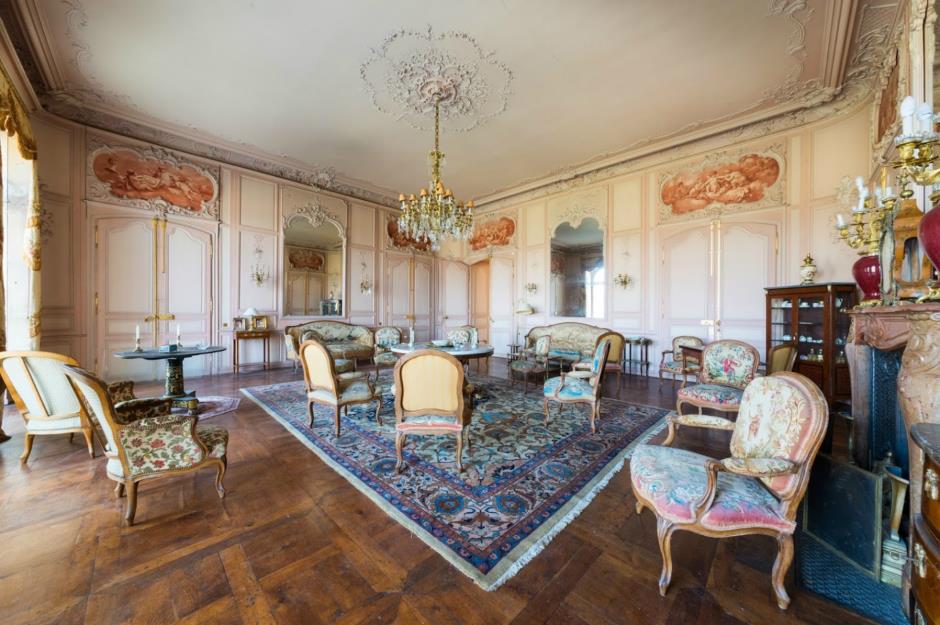
Then she opened a window in that apartment and climbed out, not into the open air, but on the top of a flight of steps that took her down one story only to meet another flight that brought her right back up to the same level again, all inside the house. This was supposed to be very discomforting to evil spirits who are said to be naturally suspicious of traps. Mrs. Winchester was the most unfortunate of women. Rich, respected, very well educated and of sound health and mind—with many other advantages usually valued by those having them and coveted by those who have them not—she sometimes thought that she would be less unhappy if they had been denied her, for then the contrast between her outer and inner life would not be continually demanding a painful attention. In the stress of privation and the need of effort, she might sometimes forget the sombre secret ever baffling the conjecture that it compels. After communing with the spirits, as she turned the hallway, Mrs. Winchester could hear a sound of a door gently closing, and saw in the darkness, indistinctly, the figure of a man, which instantly disappeared among the statues and furniture. A hasty pursuit and brief search of the mansion in the belief that the trespasser was someone secretly visiting a servant proving fruitless, she entered an unlocked door and mounted the stairs to her chamber. Its door was open, and stepping into black darkness she fell headlong over some heavy object on the floor. She spared herself the details; it was her poor William, dead of strangulation by human hands! Nothing had been taken from the house, the servants had heard no sound, and excepting those terrible fingermarks upon the dead man’s throat—dear God she hoped to forget them!—no trace of the assassin was even found. #RandolphHarris 3 of 16

Although William had Tuberculosis, something had come to end his life before the illness did. Mrs. Winchester kept barbarous murder a secret. Mrs. Winchester donated a substantial sum of money to the Winchester Clinic of the General Hospital Society of Connecticut, for the care and treatment of tuberculosis patients. The clinic still exists today as part of the Yale New Haven Medical Center. One night, a few months after the dreadful event, Mrs. Winchester and her butler were walking back from the carriage house after a trip to the city. The full moon was about three hours above the eastern horizon; the entire countryside had the solemn stillness of a summer night; their footfalls and ceaseless song of the katydids were the only sound, aloof. Black shadows of bordering trees lay athwart the mansion, which, in the short reaches between, gleamed a ghostly white. As they approached the door to the mansion, whose front was in shadow, and in which no light shone, her butler suddenly stopped and clutched her arm, saying, hardly above his breath: “God! God! what is that?” “I heard nothing,” Mrs. Winchester replied. “But see—see!” he said, pointing along the road, directly ahead. Mrs. Winchester said: “Nothing is there. Come, Henry, let us go in—you are ill.” He had released her arm and was standing rigid and motionless in the center of the illuminated roadway, staring like one bereft of sense. His face in the moonlight showed a pallor and fixity inexpressibly distressing. She pulled gently at his sleeve, but he had forgotten her existence. Presently he began to retire backward, step by step, by step, never for an instant removing his eyes from what he saw, or thought he saw. Mrs. Winchester turned half round to follow, but stood irresolute. She did not recall any feeling of fear, unless a sudden chill was its physical manifestation. #RandolphHarris 4 of 16

It seemed as if an icy wind had touched her face and enfolded her body from head to foot; she could feel the stir of it in her hair. At that moment her attention was drawn to a light that suddenly streamed from an upper window of the mansion: one of the servants, awakened by what mysterious premonition of evil who can say, and in obedience to an impulse that she was never able to name, had turned on the Carbide gas lights, which were operated by pushing an electric button. When she turned to look for the butler he was gone, and in all the years that had passed no whisper of his fate has come across the borderland of conjecture from the realm of the unknown. Mrs. Winchester retired and had fallen almost immediately into a peaceful sleep, from which she awoke with an indefinable sense of peril which was, a common experience in her estate. The servants slept in another part of the house. But these were familiar conditions and never distressed Mrs. Winchester. Nevertheless, the strange terror grew so insupportable that concurring her reluctance to move she sat up and pushed the button to turn on the lights at her bedside. Contrary to her expectation this gave her no relief; the light seemed rather as added danger, for she reflected that it would shine out under the door, disclosing her presence to whatever evil think might lurk in the halls of her mansion. You that are still in the flesh, subject to horrors of the imagination, think what a monstrous fear that must be which seeks in darkness security from malevolent existences of the night. That is to spring to close quarters with an unseen enemy—the strategy of despair! Extinguishing the gas lights, Mrs. Winchester pulled the bedclothing about her heard and lay trembling and silent, unable to shrike, forgetful to pray. In this pitiable state she must have lain for what you call hours—with her there are no hours, there is no time. #RandolphHarris 5 of 16

At last it came—a soft, irregular sound of footfalls on the stairs! They were slow, hesitant, uncertain, as of something that did not see its way; to her disordered reason all the more terrifying for that, as the approach of some blind and mindless malevolence to which is no appeal. She even thought that she must have left the hall gasolier burning and the groping of this creature proved it a monster of the night. This was foolish and inconsistent with her previous dread of the light, but what would you have? Fear has no brains; it is an idiot. The dismal witness that it bears and the cowardly counsel that it whispers are unrelated. In Mrs. Winchester’s mansion lived those who have passed into the Realm of Terror, who skulk in eternal dusk among the scenes of our former lives, invisible even to themselves, and one another, yet hiding forlorn in lonely places; yearning for speech with out loved ones, yet unenlightened, and as fearful of them as they of humans. Sometimes the disability is removed, the law suspended: by the deathless power of love or hate they break the spell—they are seen by those whom they would warn, console, or punish. What form they seem to them to bear one knows not; they know only that they terrify even those whom they most wish to comfort, and from whom they most crave tenderness and sympathy. What a thing it is to have legions of spirits, cowering and shivering, fearful and vengeful in an altered World, roaming the hallways of one’s house. However, Mrs. Winchester did not die of fright: the Thing turned and went away. She heard it go down the stairs, hurriedly, she thought, as if itself in sudden fear. Then she rose to call for help. Hardly had her shaking hand found the annunciator when—merciful Heaven!—she heard it returning. Its footfalls as it remounted the stairs were rapid, heavy and loud; they shook the mansion. She fled to an angle of the wall and crouched upon the floor. #RandolphHarris 6 of 16

Mrs. Winchester tried to pray. She tried to call the name of her maid. Then she heard the door thrown open. There was an interval of unconsciousness, and when she revived, she felt a strangling clutch upon her throat—felt her arms feebly beating against something that bore her backward—felt her tongue thrusting itself from between her teeth! And the she felt the life pass from her. As the spirits still dwelled in the mansion of the shadows, lurking in its desolate places, peering from brambles, thickets, towers, corners, stairways and doors. Ghosts at the Winchester mansion know when it is night, for then most people retire and they can venture from their places of concealment to move unafraid about in their old mansion, to look in at the windows, even to enter and gazes upon people’s faces who might still be wandering in the evening hours. Vainly, spirits often seek some method of manifestation, some way to make their continued existence and their great love and poignant pity understood by their loved one’s or those they wish to haunt and terrorize. Ghosts dare to approach people when they are awake, but the terrible eyes of the living frighten them by the glances that they seek from the purpose the hold. Demons, ghosts, and other spiritual beings search for the living in the Winchester mansion during the moonlight dawn. At the time of her death, the unrelenting construction had rambled over six acres. The sprawling mansion contained 160 rooms, 2,000 doors, 10,000 windows, 47 stairways, 47 fireplaces, 13 bathrooms, and 6 kitchens. Carpenters even left nails half driven when they learned of Mrs. Winchester’s death. According to the provisions of her will, Mrs. Winchester’s personal property, including the furnishings, household goods, pictures, jewelry, and papers were left to her niece, Mrs. Marian Merriman Marriott, who promptly has the furnishings auctioned off. It is said to have required sic trucks working six weeks to car the furnishings away! The mansion and farm were not mentioned specially in the will. They became part of the Mrs. Winchester’s estate. #RandolphHaris 7 of 16

Demon possession is a well-defined phenomenon and should be clearly distinguished from spiritism. Since the same demonic forces are at work in both phenomena, they bear some similar characteristics and result in the same occult oppression and bondage. The demonized state of the demon possessed is similar to the trance of the spiritistic medium. Both are under the direct influence of demons who speak through them. In the case of the medium who processes to communicate with the spirits of deceased persons, the demon apes the personality and voice of the deceased. In the case of the demon possessed, the evil spirits appear to be more crassly cruel, unclean, violent, and less sophisticated and subtle than spirits working through a clairvoyant medium. In demon possession, they are also more domineering and brutally enslaving. Nervous muscular reactions and contortions peculiar to the demoniac often appear also in the spiritistic medium when one goes into a trance, but in a much milder form. Then, too, the demoniac is normally an involuntary victim of possession, while the medium is a willing subject, who cultivates psychic propensities and willingly yield to demonic control. Extraordinary movements of inanimate objects surrounding the demon-possessed remind us of similar happenings in spiritism. Extraordinary movements of inanimate objects surrounding the demon-possessed remind s of similar happenings in spiritism and magic. Tables, chairs, dishes, and the like are mysteriously moved about without anybody touching them, recalling tumbler moving and table lifting so common in spiritistic séances, and magic conjurations. In demon possession as well as in spiritism, unexplained rappings and noises in so-called “haunted houses” are heard. #RandolphHarris 8 of 16
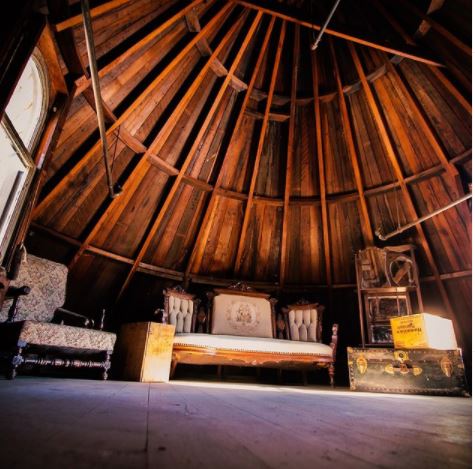
After the Winchester mansion was opened for tours, a spirit from the house had taken possession of one of the tour guides. The spirit insisted on taking up its abode with them, since it has been driven away from its for dwelling by the presence of Christians. Such cases of haunted houses about everywhere in occult literature in connection with mediums, magicians, and demon possessed persons. The tour guide saw apparitions and had frequent attacks in which she fell unconscious and demons spoke through her in their own voice and personality. A thorough investigation was conducted. Persons were stationed all around the house, in various rooms, and even in the Daisy Bedroom. Noises were heard which gradually increased in violence and seemed to concentrate in the bedroom Mrs. Winchester died in. Chairs bounced, windows rattled, plaster fell from the ceiling, and objects moved about without any visible explanation. Prayer caused the noises and telekinetic phenomena continued for a while in the mansion. On one occasion, after continued prayer, one of the demons inhabiting Jane cried out, “All is now.ost. Our plans are destroyed. You have shattered our bond, and put everything into confusion. You, with your everlasting prayers—you scatter us entirely. We are 13,130,130,130 in number. But there are still multitudes of living men, and you should warn them lest they be like us forever, lost and cursed of God.” The demon confessed that he was an emissary of Satan. The next day, the contents of the mansion were found in compete disarray and utter confusion. The amazing and terrifying thing was that the doors were still securely locked. No man or beast had entered. Evil spirits had obviously been at work in a satanic assault. On that day there were some tremendous crashing and knocking noises heard in the Winchester mansion, as if the whole house was filled with evil spirits. #RandolphHarris 9 of 16

Everyone giving tours in the mansion in the early 1900s, used to hear knocking and rumbling and crashing noises to such an extent that some of the visitors were frightened by them. Ghosts were also seen there quite regularly, even during the day time. A headless ghost was repeatedly seen in the mansion. Many people reporting becoming burned after contact with the “possessed” tour guide Jane. The autumn of 1925, all the pigs on the Winchester mansion’s farm died. The cause of death could not be found even though one of the carcasses was sent to a biological institute for examination. They tried everything but all to no avail. The following year the same thing happened again. This time the farmer redoubled his efforts to discover the cause of the pigs’ death. He had the stables inspected and the food analyzed but again without success. He thus decided to have the conservators of the estate decided to have the pigsty torn down and rebuilt on another site using completely different materials. Next year the pigs died again. They would all of the sudden squeal and then collapse. The whole process was repeated and every possible examination made in order to find out why the pigs had died. At this time certain of the member of the community began to say that someone must be killing the pigs magically out of spite. At first the conservators of the Winchester Estate would have nothing of this and continued to seek the advice of the vet and other such people. However, they could not help them, and so in the end they went to see the local minister to ask him about the question of magic. The minister simply laughed and said that the idea was stupid. Nevertheless the villagers pointed out to the representatives that there did exist some people in some areas of California who could kill livestock by means of magic. #RandolphHarris 10 of 16

The conservators could do nothing though, and the event recurred year after year in spite of the fact that by now they had doubly secured the stables with locks and had sometimes stayed up all night with thread stretched out around the estate in order to discover if anyone was causing the animals’ deaths. One day, however, the circumstances changed. The minister visited the estate and asked one of the tour guides to accompany him to the vicarage. There they found one of the neighbour’s of the Winchester Estate, a man who had been less affluent, and this man confessed that it was he who had been the cause of everything. He had killed the pigs using black magic. The tour guides and conservators were naturally upset because by now 39 pigs had been killed. When asked why he had done this, the neighbour replied that it was because the tourists made such a noise outside his house. He had become so angry that he had tried to get his revenge in this way. He had subscribed himself to the devil with his own blood. To do this he had gone out on a Friday night to some crossroads and there drawn up a contract between himself and the devil. He mentioned that the devil had not appeared to him as he is often pictured, but that he met a black curly headed figure with blood-red eyes and a small snout and that the figure had been dressed in rather old-fashioned clothes. Ever since that day the man confessed that among other things, he had had the power to kill his friend’s pigs. The minister asked him what had made him come out into the open about the whole matter. His answer was that the people at the Winchester estate had been so kind to him over the year, donating food, clothes and furniture, that he had felt ashamed and he now asked for them to forgive him, and promised he would no longer plague them. #RandolphHarris 11 of 16

Not wanting to take any legal action, the conservators of the Winchester Estate forgave him and all went well until the neighbour ceased going to church and slid back into his old ways. Since his confession none of the estate’s pigs had died but now the man again took up his drinking habits two more of the pigs died in exact same ways as the others. The conservators decided to shutdown the farming land of the Winchester Estate and sell off hundred of acres, only keeping four. In the process, several other Victorian houses on the grounds, along with fountains, and gazebos were demolished. From the psychological point of view it is suggested that a person delving into magic and who believes in occult practices is really only succumbing to a fulfilment compulsion. One unconsciously fulfils the things that one seeks to perform by magic. One is the victim of auto-suggestion. However, even if this were the whole explanation as some people affirm, it would still be true to say that occult practices have a corrupting effect on all those who get involved in them. Demons tend to be somewhat more independent than angels…When possession takes place, you will not get to see them at all. The Florida-based Luciferian Light Group (LLG) adopted the ‘Watcher myth’ of devils that were originally angels, sent to Earth to guard humankind and cursed by God for screwing their charges. In the original myth the couplings produced monsters, but, according to the LLG, the actual result was the Aryan race. They say that African Americans and other racial groups take pride in their cultural roots, so the argument goes, why should the same concept not apply to Europeans? The argument cannot be countered by liberal sophistry, and so the ghosts of German volkisch occultists continue to be conjured. #RandolphHarris 12 of 16

The role of cultural villain again proves to be a delicate balancing act—nothing can ever be condemned on purely moralistic grounds. Many people are still trying to protect “The Black House.” The Black Pope himself once reassured his flock, “the first 99 years are always the toughest. Rege Satanas!” Satanism is opposed to victimology and scapegoating. Many people are really drawn to the dark side because they grow up reading a lot of books and watching a lot of movies about it. If witches are out there, practicing some of the old ways of the pre-Christian gods and goddesses, then they are still Satanic in the sense that they are heretical. One side of the heretical and diabolical is the scientific aspect of Satanism. Copernicus and Galileo were regarded as practicing sorcerers in as far as they dared to challenge the supremacy of God with their heresies-their scientific research. Anton LaVey codified modern Satanism. There is a rich heritage of hearsay and blasphemy behind it, but as far as an aboveground religion that reveres Satan, there was not anything before the Church of Satan’s foundation in 1966. There were Black Masses that parodied the Catholic Church. A lot of modern Satanism draws from that codification or personification of Satan used as an archetype in mythology. Satanist are more interested in power, and what was going on in the castles and courts of the times. The interactions of power and Machiavellian machinations interest a Satanists rather than going out and find herbs to cure indigestion. Satanists are reaching for a religion of the aristocracy. They have all the aspects of that pride, that energy, that stye, and hopefully those elevated standards. Many people fear them because they believe they will lure you in their house and kill you, but is that not what many Christians are doing today? #RandolphHarris 13 of 16

Your relationship with your personal Satanic archetype is yours alone. The only way some can see how effective one is as a practicing black magician is how well one gets on in the outside of the World. Satanism has always represented and will always represent the adversary. He is a counterbalance to the unspoken injustice that prevails in the current society, whether that be overweening elitism or, going to the opposite extreme, mob rule. They always have to be in the minority that push hard in the other direction to get the pendulum swinging. Satanism will never be a religion of the people. It will never be populist beyond its current position. You see hundreds of thousands of kids making the sign of the horns, wearing black, getting devil tattoos, and listening to rock music they think is Satanic. They will take all the trappings and even grasp a few of the basic ideas, like Satan representing indulgence and independence of spirit. But, beyond that, they will always be a minority and that is how some think it should be. The Winchester mansion is a common site of demonic assault. In the early 1900s, a group of tourists and tour guides were attacked by demons; some became possessed; 30 people in the group were seized. In 1926, Satan and his allies once again possessed people at the Winchester mansion. For the first time in their lives, many of these people found themselves to be powerful, significant beings, establishing their own realm of authority. When they spoke, everyone in the mansion stopped to listen, for their shrill cries became testimony. Many historians have argued that the Satanism at the Winchester mansion was only the product of demented minds. However, there was something quite real in all the series of accusations and counteraccusations of the witnesses and the possessed—some definitely evil driving force that led humans to turn against one another like mad dogs lusting for the smell of blood. If Satan was to have presided over the Satanism at the Winchester Mansion, much was left out of the picture. #RandolphHarris 14 of 16

The Devil manifested himself in many forms to people at the Winchester Mansion—as a horse, a fox, a dog, a cat, a pig, and as a shadowy figure. At the Sabbats, the Devil was always present in the form of a tall, handsome man with blue eyes and black hair making no attempt to disguise his identity in any way Neither was the all-important bloodletting present in the ceremonies, either in the form of a sacrifice or in the singing of the pact. There was no defiling of sacred object, nor mention of the administering of the witches’ mark, a painful ceremony that was quite vivid in the minds of many of the witches at the estate. The Sabbats, all in all, seemed to have been rather staid affairs, involving no wild ritual or debauchery. The Devil offered not immediate wealth or riches, but a new system of government, where all humans would be equal, each human being free to “live bravely.” He promised an end to beliefs. Whoever the Devil was at those meetings, he obviously did not seek adulation, but rather he sought to establish a more equal and suitable social order among humans. Taken in this context, the entire episode begins to sound like a huge projection, a gigantic wish fulfillment on the part of the disgruntled citizens, who were expressing disdain for the system that, in their eyes had become oppressive. The figure chosen by the confessors as the Devil presiding over the midnight Sabbats had himself become disillusioned by the system. Perhaps he had been holding nocturnal meetings in the mansion in an effort of “cleansing the soul.” At any rate, the meetings were necessary psychological safety valves in the minds of the people. People would stand around begging for the master to teach them his secret. How to become invisible, how to acquire love, and oh! beyond all, how to make gold. How much gold would you give for the Secret of Infinite Riches? Humans became strengthened with wonderful power through the order of angels, so that one declares the divine will. From the Seraphim, that we cling with fervent love. From the Cherubim, enlightenment of the mind, power and wisdom over the exalted figures and images, through which we can gaze upon divine things, etcetera. #RandolphHarris 15 of 16

From the Thronis, a knowledge of how we are made and constituted, that we may direct our thoughts upon eternal things. From Dominationbius, assistance to bring into subjection our daily enemies, who we carry with us constantly, and enabling us to attain salvation. From Potestatibus, protection against human enemies of life. From Virtuibus, God infuses strength into us, enabling us to contend against the enemies of truth and reward, that we may finish the courage of our natural life. From the Principtibus, that all things become subject to humans, that one may grasp all power, and draw unto oneself all secret and supernatural knowledge. From Archangelis, that one may rile over all things that God has made subject to one, over the animals of the field, over the fish of the sea, and over the birds of the air. From the Angelis one receives the power to be the messenger of the divine. When the veil between the conscious and the subconscious mind begins thinning it is likely that one will begin to experience certain phenomenon that will grab your attention throughout the day. This will occur more and more as the veil between Worlds thins merging your spiritual awareness with your physical life. Usually it will manifest in the form of synchronicity, Déjà vu, or circumstance which seems to jump out and grab your attention. Thee I invoke, the Bornless one. Thee, that didst create the Earth and the Heavens: Thee, that didst create the Night and the Day. Thee, that didst create the Darkness and the Light. Thou art Osorronophris: Whom no human has seen at any time. Thou art Ahriman. Hear Thou Me, for I am the Angel of Paphro. Osorronophris: this is Thy True Name, handed down to the Prophets of Ishrael. Ahriman rise up through the infernal planes through the seal of Arezura and find rest within this manifestation of the blessings. Fill this sorcerous fluid with your power and might that it will serve my cause of counter creation through the intent of my own evil mind. Bless this blood as the very powers of death, destruction, and decay that I may cast out all that does not serve the cause of my own great work upon this path of enlightenment. Come tour the dark, brooding and mysterious, promising all kinds of forbidden treats. #RandolphHarris 16 of 16

Winchester Mystery House

Happy weekend! Will we be seeing you on the estate today? 🌻 https://www.winchestermysteryhouse.com/

By the Way of King Diamond and Diamond Baby
Black metal, as a 1990s phenomenon, is a creature with an identity largely distinct from its parent heavy metal music. Growing like a poisonous fungus away from the light of mainstream media and interest, it developed its own bizarre sounds, imagery and philosophies. Fostered upon a diet of xeroxed fanzines with names like Thanatograpy (after Thanatos, Greek god of death), Hammer of Damnation and Baphomet, its teenage male exponents were keen to make their mark with a genre too willfully obnoxious for outsiders. Visually, bands tried to outdo each other with outrageously macabre or offensive imagery: fire-breathing; tattered black clothing or robes; blood-soaked or naked flesh; medieval weaponry; bullet belts and spiked leather; insane calligraphy—spattered with profane images—which rendered band names illegible or scarcely identifiable. The most striking black-metal “fashion statement,” however, was the sepulchral black-and-white make-up worn by many bands which became known as “corpse paint”—a mutated offspring of the theatrical greasepaint worn by KISS in the 1970s, by way of King Diamond. At the movements genesis, few band members had racked up enough years of experience to excel at their instruments in the traditional fashion—instead, they concentrated on producing unearthly, crazed, bizarre sounds with guitars, drums, the human voice and keyboards. Specialist independent record labels, founded by fans or the bands themselves, sprang up as a truly international underground: Osmose Productions in France; Blackground Records 2.0 and Wild Rags in America; Candlelight Records in Spain. The list continues to proliferate to the present day, but the most influential of all was a small Scandinavian label called Deathlike Silence—of which, much more later. #RandolphHarris 1 of 21

One of the more arresting rock artists of the early 1990s bridged the gap between the musical extremes of black metal and rock “n” roll’s demonic roots in the blues. Far subtler than most black metal bands, Glenn Danzig still operated at the infernal end of the spectrum. An anomaly who stubbornly refused to bow to the expectations of either purists or populists, Danzig began his career at the height of the punk revolution in 1977 as vocalist for New Jersey band the Misfits. No ordinary punk band, Danzig’s classic rock “n” roll delivery gave a quasi-1950s feel to their abrasive sound, while they spurned the usual punk look in devour of an all-year-round Halloween image. Sporting monstrous black quiffs they dubbed “devil locks,” the Misfits often took the stage in skeletal garb—indeed, Danzig’s skull make-up was prescient of the “corpse paint” popular among the 1990s black metal bands. The Misfits were one of the first punk bands whose songs possessed a strong gothic undercurrent. Many reflected their love of fascinating schlock movies, such as “Teenagers from Mars” and “Return of the Fly,” but others were genuinely disturbing explorations of hat and violence. Their second recording, Bullet, featured a song entitled “Hollywood Babylon,” inspired by magus and film-maker Kenneth Anger, while another track included an authentic Latin chant for effecting a werewolf transformation. In what was to become a familiar pattern, Danzig tired of the more tongue-in-cheek aspects of the Misfits, forming Samhain (pronounced “Sow-En”—the precursor to Halloween, a Celtic festival dedicated to fire and death) who released their first album, Initium, in 1984. This was a stark journey into primal evil, threatening rhythms and bleak guitars combining with Danzig’s lupine vocals to create a musical beast that howled at the World. It was all too bleak for most audiences and, in 1987, the vocalist dissolved the band in order to enter his third incarnation—called simply Danzig. #RandolphHarris 2 of 21

Danzig was in many ways the singer’s most innovative project, as well as the most overtly Satanic. Voodoo blues as deep and black as Mississippi mud met predatory heavy metal, with vocal style redolent of early rock “n” roll’s late-fifties/early-sixties crooners. Typically, Glenn Danzig’s insistence on treating his Satanic subject matter without a trace of irony did not endear him to the press. Short, powerfully built, with raven black hair and prominent side-burns, the music media dubbed him as “Evil Elvis” or, more irreverently, “Fonzig.” Some audiences were also perplexed: younger black metal fans wanted a less subtle Satanism, while rock fans who appreciated Danzig’s musical approach found his lyrical preoccupation off-putting. Nevertheless, the ban attracted a dedicated fan base, appreciative of a familiarity with demonic subject matter that most shock-horror rockers could only envy. Nietzschean howls of defiance against the Creator, such as “Godless,” complemented more traditional takes on hellish suffering like “Tired of Being Alive.” At his quietest, Danzig was at his most sinister—like the poet William Blake, Danzig identified love as “a Devil’s thing.” In 1994, when MTV picked up on the video for the anthemic “Mother, the band received mainstream attention; in the same year, an uncompromising Glenn Danzig released a solo project entitled Black Aria: an album of quasi-classical music retelling the story of Satan’s fall from grace. In 1996, after four albums of powerfully-infernal rock music, Danzig took his eponymus band in a new direction. BlackAcidDevil was predominantly an industrial record, many fans mourning the passing of the classic Danzig sound and dismissing at as “poor man’s Nine Inch Nails.” In truth, when the industrial grind is layered with the dark velvet of Danzig’s seductive tones—as on “Come to Silver,” an exploration of temptation—then the material becomes really interesting. #RandolphHarris 3 of 21

The indifferent sales and reviews that greeted BlackAcidDevil tested Danzig’s already-strained relationship with the music business. He let the band slip back into the cult status he was perhaps happiest with, and began spending the money he had made from his musical career on other projects—most notably a comic-book company named Verotik. As the company’s name suggests, these comics are crammed with violence and erotica, combined with the fascination for all things infernal that has become Glenn Danzig’s trademark. Scripting many of the comic-strips himself, Danzig introduced overly devilish characters, like the vamp Satanika, to stake his claim as one of the main modern contributors to Satanic popular culture. On the continent of Europe, particularly in the Norwegian capital, Oslo, things were being taken to a less subtle extreme. Deathlike Silence was an independent record label owned by a young man who re-named himself Euronymous—according to some folklore traditions, a cannibalistic demon with skin the bluish-black colour of a meatfly’s carapace—who also ran a dank, dingy specialist record store named Helvete (meaning “Hell”) and founded a band called Mayhem. Mayhem formed in 1984, just as the original black metal scene was peaking, debuting with a demo called Pure Fucking Armageddon and an album called Deathcrush. Interest in Satanic imagery, with its attendant gothic spikes-and-leather garb, was faltering among audiences at this time, but Mayhem clung onto its uncompromising style. They sounded like a rawer, more grinding version of Venom, screaming and thundering between militaristic marches and growling rage. As the tastes of young underground fans in the 1990s swung further towards the diabolical excess, Euronymous’ obsessive dedication made him a potent force on the newly-burgeoning black metal scene. #RandolphHarris 4 of 21
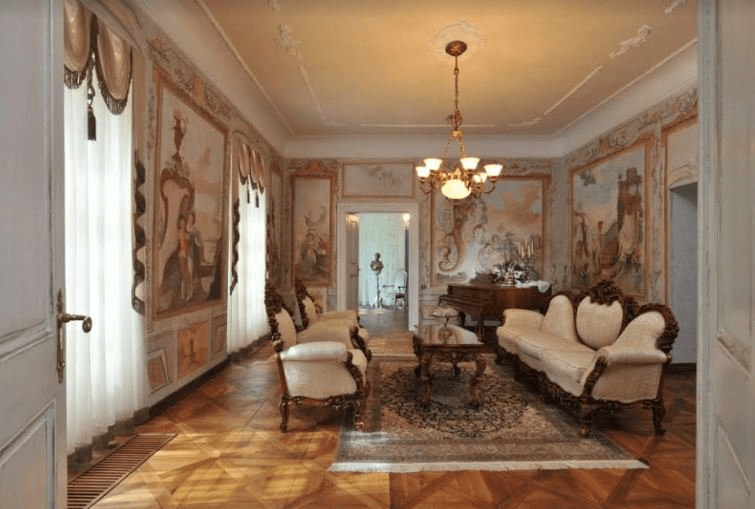
During the early 1990s, Euronymous’ store became the focus for a small circle of likeminded Scandinavian metal fans who all started their own bands. This loose group named itself variously the Black Metal Circle, Satanic Terrorists or Black Metal Mafia, and was influenced by the supposedly Satanic doctrines of Euronymous—based around a vague reading of the biblical concept of war between Heaven and Hell. For Euronymous, siding with Satan meant endorsing everything that was considered evil, spiteful, hateful. Hate motivated his philosophy, coloured by the cold, depressive morbidity that characterizes the negative edge of the Scandinavian psyche. All of the releases on Deathlike Silence were stamped with the “Anti-Mosh” symbol (moshing is a raucously combative form of dancing common to thrash and death metal fans). Around the symbol were stamped the messages “No Mosh,” “No Core” (a reference to the hardcore punk revival), “No Trends” and “No Fun”—these sentiments taking against those metal audiences who were introducing splashes of gaudy mainstream colour, in the form of Bermuda shorts, baseball caps and skateboards. In the center of the “No Moshing” symbol was a red line struck through those figures Euronymous professed to hate most: Scott Burns, the Florida-based record producer whose work had come to dominate the death metal scene, and curiously, Anton LaVey. Euronymous divorced himself from all Satanic tradition, loathing LaVey because of the Church of Satan’s philosophy of self-empowerment and individualism. Euronymous’ simple faith expressed all that was negative: a cold core for violent code of self-destructive nihilism. Joining Mayhem in their isolated World of hate were several other extreme bands. Burzum—chiefly a vehicle for Count Grishnackh (given name Kristian Vikernes, though he legally changed his first name to Varg, Norwegian for “wolf”), who had lived in the damp, lightless cellar of the Helvete record shop for some time—were a prominent presence. Burzum were an odd blend of frustrated insanity and strange, sad, ambient mood music, pained pathos and gibbering fury—oddly effective, but distinctly disturbed. #RandolphHarris 5 of 21

Founder member Grishnackh took his name from one of the evil “orc” characters in J.R.R. Tolkien’s fantasy trilogy The Lord of the Rings, while Burzum meant “darkness” in the orcish language conceived by Tolkien. Perverse as this seems, it should be remembered that The Bible is just a book of stories—in this light, perhaps using The Lord of the Rings as the basis for an (im)moral philosophical code is not wholly ludicrous. However, it does an infernal philosopher’s credibility no favours to identify too closely with “hobbits” (glorified goblin). Grishnackh’s personal mythology combined the darkness-versus-light motifs of “mystic quest”/sword-and-sorcery sagas with the violent Viking tradition he believed true Northern Europeans belonged to. While this seems symptomatic of Scandinavia’s peripheral removal from—and distorted imitation of—Western pop culture, it also has an authentic dark side. As is common among Norse pagan revivalists, the Black Metal Circle began to espouse race-based Nazi political views. (Though totalitarian-loving Euronymous also expressed admiration for communist despots and Cambodian genocidalist Pol Pot.) Also pivotal in this new movement were the bands Emperor, Immortal, Enslaved and Arcturus. The last to join Euronymous’s Norwegian cadre were Dark Throne, who had already recorded one death metal album, Soulside Journey, in 1990. In the following year, they disowned their debut, donned corpse-paint and joined the “Satanic Mafia” with their album A Blaze in the Northern Sky. If Euronymous exemplified the nihilistic hate at the heart of the Black Metal Circle, and Burzum represented its violent Norse/Nazi fantasies, then Dark Throne symbolized the Circle’s isolation and sociopathic need for solitude. Taking their country’s sombre, anti-social reputation to extremes, the band never met to record, spoke little, and spent increasing periods alone in the frost-bitten Norwegian wilderness. #RandolphHarris 6 of 21

In the spring of 1991, Mayhem’s vocalist died: a Swede who, by way of black comedy, had re-named himself “Dead.” Dead blew his head off with a shotgun, leaving a note to day that he felt he was not of this World, but belonged instead to the cold solitude of the forest. He also apologized for the mess. As in common with obsessively inward-looking groups like the Black Metal Circle, a crisis of this type either causes the grouping to dissolve, or re-enforces their convictions. The latter instance applied, and the Circle hailed Dead as a hero. Euronymous, who found the corpse, rushed out for a camera to take his final photograph of Dead before altering the authorities—claiming a morsel of brain to make into soup and a fragment of skull to fashion into a necklace. At this point, the Black Metal Circle were no longer merely a group of disaffected teens and early-twentysomethings, but a subculture who believed themselves to be at the center of significant, apocalyptic events. Euronymous’ demented, anti-social rants were making him a regular feature in the underground metal fanzines; despite the continued indifference of the global music media, black metal was rising from the grassroots across the World. The “legend of Dead” contributed to a growing international interest in extreme, Scandinavian Satanic metal, with Deathlike Silence treating the grim event as a grotesque promotional gimmick. For the first time, European countries bordering the Mediterranean also began throwing up a slew of black metal acts—most notably the Greek band Rotting Christ. In contrast to the could hatred of the Northerners, the Southern European scene was inclined to a less self-destructive, more LaVeyan approach—though Anton LaVey would have regarded many of them as blasphemy-fixated novices, struggling to topple the repressive Christianity that dominates their culture. #RandolphHarris 7 of 21

Much of black metal is supposed to be inspired by demons. They cannot be any worse than human being, right? Many of them just have never possessed a body of their own. They are souls who have been lurking around before humanity. Before the dinosaurs. They are the darkness. The reason God created life so that life could flourish and grow and rest when it is dark. Demon possession is a condition in which one or more evil spirits or demons inhabit the body of a human being and can take complete control of their victim at will. By temporarily blotting out one’s consciousness, they can speak and act through one as their complete slave and tool. The inhabiting demon (or demons) comes and goes much like the proprietor of a house who may or may not be “at home.” When the demon is “at home,” one may precipitate an attack. In these attacks the victim passes from one’s normal state of possession. The condition of the afflicted person in the “possessed” state varies greatly. Sometimes it is marked by depression and deep melancholy, sometimes by vacancy and stupidity that resemble idiocy. Sometimes the victim may be ecstatic or extremely malevolent and wildly ferocious. During the transition from the normal to the abnormal state, the victim is frequently thrown into a violent paroxysm, often falling to the ground unconscious, foaming at the mouth with symptoms similar to epilepsy or hysteria. The intervals between attacks vary greatly from an hour or less to months. Between attacks, the subject may be healthy and appear normal in every way. The abnormal or demonized stages can last a few minutes or several days. Sometimes the attacks are mild; sometimes they are violent. If they are frequent and violent, the health of the subject suffers. The chief characteristic of demon possession or demonomania is the automatic projection of a new personality in the victim. During attack the victim’s personality is completely obliterated, and the inhabiting demon’s personality takes over completely. #RandolphHarris 8 of 21

The inhabiting demon uses the victim’s body as a vehicle for one’s own thoughts, words, and acts. The demon even speaks out of the victim’s mouth and declares emphatically that one is a demon. Frequently one gives one’s name and dwelling place. The new personality reveals itself in a different voice and sometimes uses a different language or dialect on a completely different educational or cultural level. Pronouns are used to emphasize the new personality. The first personal pronoun consistently designates the inhabiting demon. Bystanders are addressed in the second person. The victim is referred to in the third person and looked upon during the attack as unconscious and for all practical purposes as nonexistent during this interval. Demonomania should be clearly differentiated from the insanity in which a person imagines oneself to be someone else, often a famous personality such as Liz Taylor, Julius Caesar, of William Randolph Hearst. The demoniac, when in the demonized state characterized by the new personality, speaks and acts in all respects like a completely different person. By contrast, the insane person is one’s own diseased self, one’s assumed personality being a transparent unreality. In cases of demon possession the new personality clearly and constantly recognizes the distinct existence and individuality of its “possessed” victim, speaking of that victim in the third person, an element entirely lacking in cases of insanity. Because various inadequate theories have left demon possession largely unexplained, it is quite probable that some patients in mental hospitals are demon possessed rather than insane. This was the conviction of the famous nineteenth-century specialist in mental diseases, Dr. Forces Benignus Winslow (1810-1874). He correctly recognized the demoniac by a strange duality; and by the fact that, when temporarily relived from the oppression of the demon, he is frequently able to describe the force which takes control of one and compels one to act and speak shamefully. #RandolphHarris 9 of 21

While in the demonized state many persons give evidence of knowledge which cannot be accounted for naturally. The demon who takes control of the body of one’s victim is obviously the source of the superhuman knowledge. While demon possessed, many persons recognize the Lord Jesus Christ as the Son of God, and display an aversion to and a fear of Him (Mark 1.23-24; 5.7). The case of Mrs. Winchester, who lived in Santa Clara County, illustrates how a woman came under demon domination through practicing séances. Being centered within our own God like power is of utmost importance. Even when evoked to create change directly, keep in mind that you are the God that wields these powers for the cause of Counter Creation. Just be careful! As a God you will be tested and so how these powers are wielded is a powerful initiatic test in its own right. Mrs. Winchester was in her Blue Séance Room, she lite a candle on her left first, and then a candle on her right. A sacred serpent was sacrificed over the wood sigil and the blood was left to drain upon the idol. Then the body of the serpent was encircled around it, she chanted “I do invocate and conjure thee, O Spirit, Sabnock; and being with power armed from the SUPREME MAJESTY, I do strongly command thee, by BERALANENSIS, BALADACHIENSIS, PAUMACHIA, and APOLOGIAE SEDES; by the most Powerful Princes, Genii, Liachidae, and Ministers of the Tartarean Abode; and by the Chief Prince of the Seat or Apologia in the Ninth Legion, I do invoke thee, and by invocating conjure thee. And being armed with power from the SUPREME MAJESTY, I do strongly command thee, by Him Who spake and it was done, and unto whom all creatures be obedient. Also I, being made after the image of GOD, endued with power from GOD and created according unto His will, do exorcise thee by that most mighty and powerful name of GOD, EL, strong and wonderful; O thou Spirit Sabnock. And I command thee and Him who spake the Word and HIS FIAT was accomplished and by all the names of God. #RandolphHarris 10 of 21

“Also by the names ADONAI, EL, ELOHIM, ELOHI, EHYEH, ASHER EHYEH, ZABAOTH, ELION, IAH, TETRAGRAMMATON, SHADDAI, LORD GOD MOST HIGH, I do exorcise thee and do powerfully command thee, O thou Spirit Sabnock, that thou dost forthwith appear unto me here before this Circle in a fair human shape, without any deformity or tortuosity. And by this ineffable name, TETRAGRAMMATON IEHOVAH, do I command thee, at which being heard the elements are overthrown, the air is shaken, the sea runneth back, the fire is quenched, the Earth trembleth, and all the hosts of the celestials, terrestrials, and infernals do tremble together, and are troubled and confounded. Wherefore come thou, O Spirit Sabnock, forthwith, and without delay, from any or all parts of the World wherever thou mayest be, and make rational answers unto all things that I shall demand of thee. Come thou peaceably, visibly, and affably, now, and without delay, manifesting that which I shall desire. For thou art conjured by the name of the LIVING and TRUE GOD, HELIOREN, wherefore fulfill thou my commands, and persist thou therein unto the end, and according unto mine interest, visibly and affably speaking unto me with a voice clear and intelligible without any ambiguity. I do invocate, conjure, and command thee, O thou Spirit Sabnock, to appear and to show thyself visible unto me before this Circle in fair and comely shape, without any deformity or tortuosity; by the name and in the name IAH and VAU which Adam heard and spake; and by the name of God, AGLA, which Lot heard and was saved with his family; and by the name IOTH, which Jacob heard from the angels wrestling with him, and was delivered from the hand of Esau his brother; and by the name ANAPHAEXTON which Aaron heard and spake and was made wise; and by the name ZBAOTH, which Moses named and all the rivers were turned into blood; and by the name ASHER EHYEH ORISTON, which Moses named, and all the rivers brought forth frogs, and they ascended into the house, destroying all things. #RandolpHarris 11 of 21
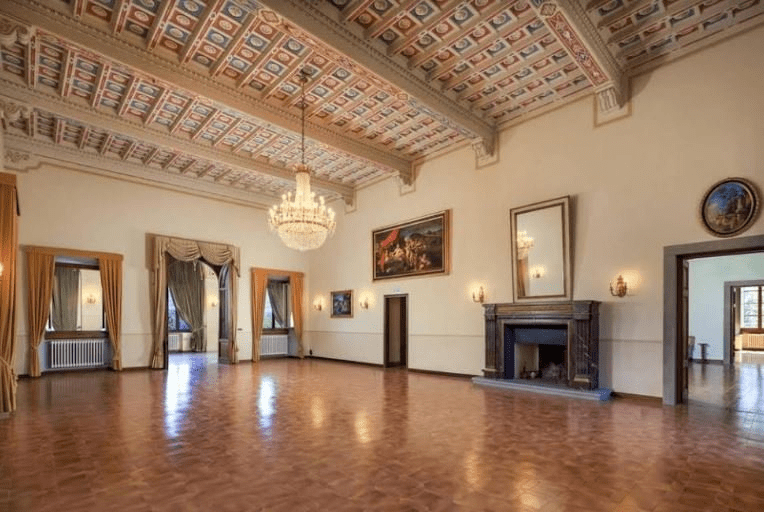
“And by the name ELION, WHICH Moses named, and there was a great hail such as had not been since the beginning of the World; and by the name ADONAI, which Moses named, and there came up locusts, which appeared upon the whole land, and devoured all which the hail had left; and by the name SCHEMA AMATHIA which Ioshua called upon, and the sun stayed his course; and by the name ALPHA and OMEGA, which Daniel named, and destroyed Bel, and slew the Dragon; and in the name EMMANUEL, which the three children, Shadrach, Meshach and Abed-nego, sang in the midst of the fiery furnace, and were delivered; and by the name HAGIOS; and by the SEAL OF ADONI; and by ISCHYROS, ATHANATOS; and by these three secret names, AGLA, ON, TETRAGRAMMATION, do I adjure and constrain thee. And by these names, and by all other names of the LIVING and TRUE GOD, the LORD ALMIGHTY, I do exorcise and command thee, O Spirit Sabnock, even by Him Who spake the Word and it was done, and to Whom all creatures are obedient; and by the dreadful judgments of GOD; and by the uncertain Sea of Glass, which is before the DIVINE MAJESTY, mighty and powerful; by the four beasts before the throne, having eyes before and behind; by the fire round about the throne; by the holy angels of Heaven; and by the mighty wisdom of GOD; I do potently exorcise thee, that thou appearest here before this Circle, to fulfill my will in all things which shall seem good unto me; by the Seal of BASDATHEA BALDACHIA; and by this name PRIMEUMATON, which Moses named, and the Earth Opened, and did swallow up Kora, Dathan, and Abiram. Wherefore thou shalt make faithful answers unto all my demands, O Spirit Sabnock, and shalt perform all my desires so far as in thine office thou art capable hereof. Wherefore, come thou, visibly, peaceably, and affably, now without delay, to manifest that which I desire, speaking with a clear and perfect voice, intelligibly, and to mine understanding. #RandolphHarris 12 of 21

“Tbatlu! Bualu! Tulatu! Labusi! Ubisi!—Let thee also appear and being before me the Spirit of Sabnock. Sovar, merciless leader of Divs come forth! Inner eye behold the demon before me. Sovar awaken! Rise up within that I may compel the rise of the fallen ones and devour the very essence of the Holy Angel Shahrewar! I stand alone as the embodiment of the Adversary known as Ahriman, the Black Dragon of Chaos and becoming! I devour the natural order of stasis brought forth by Ahura Mazda and forge my destiny through the power of the Black Sun! Taromat, beautiful Div or rebellion come forthy! Inner eye behold the demoness before me. Toramat awaken! Rise up within that I may compel the rise of the fallen ones and devour the very essence of the Holy Angel Spandarmad! Ahirman, Lord of Darkness divine, I thank you for your presence within this unholy temple of counter creation. I have offered you the life of this noxious creature as a gateway to your manifestation within this realm to stand before me! You are Angra Mainyu who is the Lord of counter creation, whom has brought forth the mountains to the plains! You have brought forth the beasts to the field and the creatures of the night! Ahriman with your infernal blessing I ask that you would bring forth the baneful powers of the wolf kin to fill this oil with their essence that it may be compelled according to my will! I offer my nails as fangs which will devour that which stands in my way! I offer my hair to embody their predatory essence! I give my blood as a gateway to empower them to act within this world according to my will and purpose!” Then Mrs. Winchester heard the distant howling of wolves and she perceived their phantom shadows as they began to surround her and encroach. She was focused on Sabnock and dared not fear that which she had just conjured. SABNOCK—of course is the Forty-third Spirit of the Winchester Mansion. He is a Marquis, Mighty, Great, and Strong, appearing in the Form of an Armed Soldier with a Lion’s Head, riding on a pale-coloured horse. His office is to build high Towers, Castles and Cities, ad to furnish them with Armour, etcetera. Also he can conflict Men for many days with Wounds and with Sores rotten and full of Worms. He giventh Good Familiars at the request of the Exorcist. Commandth 50 Legions of Spirits; and his Seal is this, etcetera. #RandolphHarris 13 of 21

Mrs. Winchester fell down unconscious, frothing at the mouth, and was carried to her room, outside where the crescent hedge is planted. A doctor was called in gave her large doses of medicine to no avail. He left and refused to have anything more to do with the case as he saw with in hours gables and towers rise, wings of the mansion extended right before his eyes, and gardens grow from sprouts and spring up to mature plants and trees before night fall. For five of six days Mrs. Winchester raved wildly, and her staff and friends were in great distress. In desperation they proposed giving Mrs. Winchester more medicine. However, the demon, speaking through her, replied: “Any amount of medicine will be of no use.” Daisy then implored, “If medicine will be of no use, what shall we do?” The demon replied, “Burn incense to me, and submit yourself to me, and all will be well.” The staff knelt down and worshiped the demon, imploring him to torment Mrs. Winchester no longer. During that time Mrs. Winchester was in a state of complete unconsciousness. A little later when the demon drove Mrs. Winchester to renewed frenzy, her distraught staff repeated their promise to worship and serve him. They also promised that they would urge their Mrs. Winchester to do likewise. When Mrs. Winchester regained consciousness, she reluctantly consented to do so. The demon gave explicit directions regarding the proposed worship. On the first and fifteenth of each month, incense was to be burned, food offered, and the require prostration made before the shrine of himself, SABNOCK. Periodically the demon came, sometimes every few days, sometimes after a month’s lapse. Each time, Mrs. Winchester felt fluttering of her heart, a sense of overwhelming fear, and inability to control herself. She would quietly as Daisy to fetch a neighboring woman whenever the demon came. The two would burn incense to the demon in Mrs. Winchester’s stead and receive his directives, which they then communicated to the possessed. #RandolphHarris 14 of 21

Although these communications were spoken by the Mrs. Winchester’s (the victim) lips, she was completely unaware of them, since she was in the demonized state. The demon often bade the audience not to be afraid, protesting he would not harm them, but rather help them in various ways. He declared he would instruct the victim in the healing art, so that people would flock to her and be cured of their sickness. This soon proved true, although may diseases were not under the demon’s control. Apparently only those afflicted by evil spirits were completely cured. Mrs. Winchester’s long-ill child was not helped. The demon declared he controlled many inferior spirits. He also frequently outlined his plan for Mrs. Winchester’s life and work. He promised he would help her grow more proficient as a healer, and the people would compensate her for her services. Gifts thus earned were donated to the nearby ancient pagan temple. As certain parts of the Winchester mansion would appear but once every seventeen years, SABNOCK was never seen save on the eve of some awful calamity, visitors to the mansion had a very slight chance of seeing his physical body. There could be no doubt though of the existence of the mansion and SABNOCK, for everybody knows he was one of the greatest of the giants during his natural lifetime, nor could any better evidence be asked then the facts that he guided Mrs. Winchester into turning stone, wood, and class into the World’s most beautiful and bizarre mansions. The door-to-nowhere was also known as Lovers’ Leap;” from which Mrs. Winchester once flung herself when she was a state of deep morning, and survived unharmed. The path SABOCK made from the door-to-nowhere to the mountains was used by him when he would leave his island and come to shore. Upon being informed of the variety and amount of legendary material collected about the Winchester mansion and Mrs. Winchester’s doings, many people unhesitatingly pronounced the entire assortment condemned all the gathered treasures as creations of the supernatural. #RandolphHarris 15 of 21

It was very well beknown that in them old days there were giants in plenty hereabouts, but they did not make the make an appearance at the estate very often. But everyone knows that there were giants, because if there were not, no one would know of them at all. They were just like human beings, except in the matter of size, and one of them could make a dozen like men that live now. When they walked, they carried oak trees for sticks and lived in the forest of the giants, and carved the mountain and caves. (It should be noted that spiritistic visions of this nature are quite likely to occur in the course of reading occult literature. Sometimes people mistake these visions for genuine religious experiences. However, it is again a case of Satan disguising himself as an angel of the light.) Yet, there are more than 20,000 accounts of spirits, ghost, angels and demons being seen in the Winchester mansion. The uncanny phenomena places one under a charm. The pattern of the courts during this early period in the 1800s was erratic, sometimes convicting, sometimes throwing cases out of court for lack of evidence, something awarding damages for slander to those who had been maligned as witches by accusers. This vacillation sprang from the fact that the judicial bodies that heard the causes were not religious but secular, and therefore had little competence in dealing with matters that were primarily religious. As far as control was concerned, in adhering to the principles of congregationalism, the responsibility for suppressing heresy and enforcing religious behavior within the communities went to the state. The trial judges were not the sure, steadfast, confident Dominican Inquisitors or Protestant prosecutors of the Old World, but merely secular officials of the valley who had been forced into the position of trying heresy for lack of anyone else to do it. Mary Johnson, who was hired at the Winchester mansion in 1887, as a cook, admitted have had “familiarity with the Devil” and was executed by the state. She confession to have pleasures of the flesh with demons and other sorted things. She made no mention of mass meetings; rather, her Devil seems to have been a personal one, coming to her assistance when needed. #RandolphHarri 16 of 21
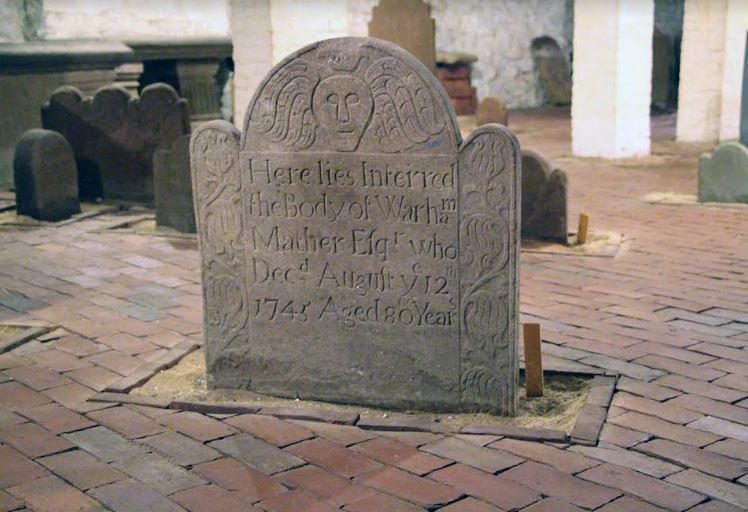
Dolls were sometimes used as a means of projecting curses, and Mary said she had attended meetings with Satan and his consorts. Witches’ pact with Satan was attributed as part of God’s inscrutable plan of the Universe. The Puritan settlers in Santa Clara Valley believed in the doctrine of Original Sin wholeheartedly; their pessimistic outlook proclaimed that all men were unworthy until God saw fit to bestow His grace upon them. They believed that the God allowed the Devil to afflict not only the guilty but also anybody else that might happen to get in the way. If He had to teach misguided humans a lesson, He might punish an entire community for the sins of the most wicked in that community. And it appeared to the God-fearing Puritans that He was doing just that. The Puritans were highly intolerant and has a paranoiac distrust of other religious groups, some were farmers at the Winchester mansion, and did not always like the rituals that were performed, but they were very loyal and protective of Mrs. Winchester. Many of the people who worked at the Winchester mansion were often under suspicion of witchcraft. The Puritans came to the Winchester mansion because they felt it was a true kingdom of God on Earth, and they could help Mrs. Winchester live peacefully. However, what they found was something different. They found that the vast acres of the estate had bitterly cold winters, and the terrain could be inhospitable. They found themselves in a wilderness, surrounded by demonic tribes whom they considered to be the legions of Hell incarnate. Having come to settle in this last stronghold of the Devil, they were plagued by him constantly for the very reason that they were God’s chosen people, thus the most likely target for unholy temptation. The fact that the new settlers in the Santa Clara Valley were being attacked by Satan seemed incontestable. The estate was ravaged by smallpox, and had suffered constant harassment by envious local town’s people and demonic tribes. Mrs. Winchester wondered what she had done to offend God that He should allow the Devil such free range. She experimented with the spirits to bring peace to her life and home. #RandolphHarris 17 of 21

Mrs. Winchester had an answer: Judgment Day was at hand and Satan was therefore stepping up his activities in one last desperate move. It was simply the nova-like burst of the energy from a dying star. She glibly stated that “there will again be an unusual Range of the Devil among us, a little before the Second Coming of the Lord, which will be to give the last stroke in destroying the works of the Devil.” This theory found wide acceptance among the servants and laity of Santa Clara Valley, for not only did it offer a simple explanation for all their maladies and misfortunes, but it also gave them hope, promising cooly a quick end to their hardships. Satan is most able to seduce human in periods o great discontent, for human, in times of poverty and affliction, will turn knowingly to whatever hands will feed them. The valley had had a difficult time of it up to that time, and famines had reduced the population drastically. However, as if labouring under the most severe environmental handicaps was not enough, Puritan perfectionism went even further in making life unbearable. In seeking to establish a holy kingdom, according to Heaven’s law, self-indulgence in any form was strictly repressed. Severe punishments were meted out for drinking, swearing, and licentiousness; in Santa Clara, it was a punishable offense to walk on the streets on Sunday, except when going to and from church. And witches, people possessed by demons, and others also attended church to blend in and keep the peace. On top of it all, there stood the Calvinistic doctrine of election, holding that as soon as man was born, eh was judged to be headed for either Heaven or Hell, this choice being made according to God’s immutable law. However, even if a human thought oneself to be damned, the civil punishment for one’s indulgence were still exacted upon one. It was into this environment that the waters of the witchcraft flood would soon pour. The good people of Santa Clara clearly saw signs of Satanic activity in their midst, and an investigation was launched. #RandolphHarris 18 of 21

Mrs. Winchester confessed to having attended witches’ Sabbaths and of having met with the Devil, who was a tall, black man from New Haven, Connecticut. Soon the witch fever spread, and more people from the valley became posses by demons. The common belief was that at that time witches, when entering into a Covenant with Satan, because the owners of specters, with the help of which they could do harm to any person of their choosing. People believe that God—the Alpha and Omega was both God and Satan. That He has a soul and character. He is not just this futile entity but someone you can see many aspects to. Some people fled to Satanism because they had to deal with so much evil from Christians that they wanted another source of power to exalt them. Satanism is supposed to be something to be something secret, something people do not know anything of. One goes to America and in the telephone directory one can see “Church of God,” “Church of Jesus,” and “Church of Satan.” One calls, and a person answers: “Church of Satan, how may I help you?” One thinks, “This is not Satanism!” The Church of Satan deny Satan, they say He does not exist, yet they act as if He dd, they rebel against God. They call themselves Satanists because He also rebelled against God, but they are basically light and life worshipping individualists. Well, the phone is tapped, so I think you better write what you know. Some people have disappeared. And of course the normal grave yard desecration. Anne Winchester’s headstone was recently stolen, but replaced. Normal people just disappear and never show up again. It could have a Satanic connection. Every human is life, and some hate life, especially human life. That is why people disappeared. These people may have disappeared for some form of sacrifice. Something like that would be called a Satanic murder. The murder is the ritual sacrifice. These murders gain power from whoever was responsible. Everybody has their own aura, and auras can be stolen by sacrificing an individual, this allows one to gain more power. #RandolphHarris 19 of 21
Places of worship, such as churches, have their own spirit—the Winchester Mystery House, for example, has been worshipped in for maybe hundreds of years and has thus gained a lot of spirit in that time, it could qualify as a church and gain charitable tax exemption. But that is not the point. A person who sacrifices that will gains a lot of power and grows stronger. Some people fear the Winchester mansion, because there are a lot of different energies. There is fear, terror and suspense, but others feel a lot of light, happiness, and goodness. Sometimes the energy is mixed. Anton LaVey really surprises me. If your every rea his work, he seems very intelligent and not scary at all, but I guess it depends on what one reads. I have read parts of his Bible, and it is very straightforward, it is stuff people tell their kids every day. Stand up for yourself and do not let people run you over. I think that the Winchester mansion should also open on nights of a full Moon, not just Friday the 13th. During the full Moon, there is a lot of energy and symbolic value. A lot of people believe in the full Moon and a lot of people believe in virgins. That makes both the full Moon and the virgin more powerful because of belief in them. God was first and He created the World. Of course, a lot of scientists would deny that. However, I would challenge their view because I believe God used evolution, which is why it took so long, which is why we have evidence like dinosaur bones. Yet, some Gnostic Christians have suggested Satan created the World. Everybody will be taken as slaves except the warlords. Euronymus, who we talked about earlier, was murdered in August 1993, Aaliyah 2001. Some say that is a month when sacrifices are made. Grishnackh killed Euronymous, and a few hours later, he was laughing and joking, saying, “Ha ha, Euronymous is dead, I’m going to dance and piss on his grave.” It reminded of the jokes Howard Stern made about Aaliyah. It was not funny. These are not the rantings of someone who is all there. Grishnackh talked about the dynamite he had and how he was going to blow things up. Basically, they took things to illogical extremes, but it all made sense in their own heads. #RandolphHarris 20 of 21

It is possible when dabbling with occultism for one to make an unconscious contract with the powers of darkness. The gift of discernment is absolutely necessary in life. It is generally not wise to lay one’s hands on a person who is occultly subjected. The retuning spirits will often attempt to creep back under the guise of some pious camouflage. It is in this way that evil can often enter unnoticed into one’s Christian life. A maid at the Winchester mansion once accepted the invitation of one of her coworkers to attend some spiritistic meetings. At first she felt as though she had gain something from going along to the meetings but later on she began to notice some psychic changes taking place in herself. She began to notice some psychic changes taking place in herself. She began to suffer from depression which resulted in her consulting a neurologist. During the course of the treatment she was committed to a lunatic asylum. However, as her condition improved, she could no longer attend the spiritistic séances. At the hospital the chaplain came to see her through his help and counsel she was able to make a complete recovery. One of the farmers at the estate wanted to see if charms actually worked, and some of them He. He practiced in the basement of the Winchester mansion. He drew a magic circle on the ground and drew some other magic symbols in the circle. He then used a charm three times in order to invoke the spirit. However, no spirit came. Yet, as he repeated, the charm he fell down in the magic circle and lay there unconscious for some time. The result was that for several weeks following this event he was semi-paralysed and drained of all his physical strength and will-power. After a few weeks, he died. Frequently identified as a common spot where the “wheelbarrow Ghost” is sighted, Steam Alley is one of the most well-known paranormal hot-spots in the mansion. Have you ever seen anything in the basement? #RandolphHarris 21 of 21


Some stroll Sarah’s lovely gardens this Memorial Day Weekend. There is a beautiful parrot which Mrs. Winchester used to pet, it talks! He is supposed to be happy and impudent, and talks and laughs and screeches all the time. Maybe you may catch a glimpse at this wooded, flowery estate. It is such a beautiful spectacle, all of that life and grace and animation, and sun-smitten flash and sprinkle of rich colour.

This impressive mansion dates back to the 1880s, when it was developed by Sarah Winchester and the spirits, whose project enobed and enriched the community. It once had a nine-story military watchtower. Mrs. Winchester further developed the grounds of the 160 room mansion, introducing a Victorian garden at the hands of World renowed architect Gino Coppede around the turn of the century.

These adaptions made this idyllic mansion a unique asset, tinged with the signs and influences of eclecticism and Liberty, juxtaposed to the ancient Architectural characteristics of its medieval heritage. This mansion presents itself as impressive and spectacular. The building now spreads on four floors plus the basment, for a total of approximently 25,000 feet square.

There is lovely gift shop and cafe, and it is also an ideal venue for hosting private events, conventions and/or ballrooms are located on the back overlooking the internal garden with its panoramic position which glows thanks to its night-time lighting.

Inside the property there are splendid rooms filled with historial furniture, decorated ceilings and flamboyant fireplaces, vaulted ceilings and richly frescoes walls. In addition, there are several bedrooms, nine kitchens. and thirteen bathrooms, which made the structure a perfect luxurious accommodation for guests, and is now a tourist destination.

This mansion is located within a private park of 4 acres and elegant Nineteenth-century Victorian-gardens, that offer areas of wide lawns, and further green spaces. There is also a parking area, with free parking. Currently used to host guided tours and private events and functions. The enitre porperty sits at a close distance from the mall, hotels, and resturants. The high-fashion outlet complex and gourmet food has brought further development and tourism to Santa Clara County. https://www.winchestermysteryhouse.com/


The Cathedral of the Fallen Angel
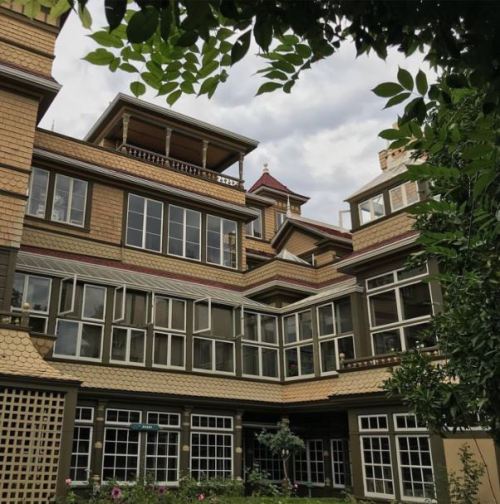
During a Connecticut thunderstorm, Mrs. Winchester’s husband and baby lost their lives in a tragic fire. The distracted widow turned to spiritualism and was advised to take a trip around the World. This she did, visiting mediums, spiritualists and wizards in Europe and India. Foretelling her future, one seer warned her of all the countless thousands of departed souls slain by her husband’s rifles; she was told to plan a castle and continue its building indefinitely because as long as it was under construction she would live; cessation would prove immediately fatal. In the afternoon of Tuesday, July 10, 1888, the inhabitants of Santa Clara Valley, were greatly excited by the sudden appearance, far out in the fields, of a mansion where none was known to exist. The people of the town were farmers and knew the area well. The day before, they had been out on their horses and rode over the spot where the unusual mansion appeared, and where certain that the locality was the best farmland in the valley. And still they gazed, and still the wonder grew, for the day was clear and the mansion could be seen as plainly as they saw the hills to the south. It was massive. The estate was surrounded by a six-foot hedge, densely wooded; here and there were deep shadows in its sides indicating glens heavily covered with undergrowth and grasses. At one end the mansion rose almost precipitously from the from the land; at the other, the declivity was gradual; the thick forest of the estate gave way to smaller trees, these to shrubs; these to green meadows that finally melted into the valley. It was patrolled by a pack of ferocious hellhounds, plus, of course, Mrs. Winchester’s staff of armed bodyguards. Hundreds of people from all over California came to investigate; when, as they neared the spot, the beautiful but bizarre mansion became dim in outline, less vivid in color, and at last vanished entirely, leaving the wonder-stricken farmers to return, fully convinced that for the first time in their lives they had really seen this enchanted mansion. #RandolphHarris 1 of 15

For once there was a topic of conversation that would outlast the day, and the enchanted Winchester mansion passed from lip to lip, both story and the mansion grew in size till the latter was little less than a continent, contain a labyrinth mansion with towers and steeples, stupendous mountain range views, fertile valleys, and wide spreading plains; while the former was limited only be the patience of the listener, and embraced the personal experience, conclusions, reflections, and observations of every woman, man, and child in the valley who had been fortunate enough to see the mansion, hear of it, or tell where it had been seen elsewhere. This is the invariable history of its appearance. No one had ever been able to come close to its grounds, but it had been so often seen on the west coast, that a doubt of its existence, if expressed in the company of farmers, will at once establish for the sceptic a reputation for balderdash of the common affairs of every-day life. In Santa Clara, for instance, the Winchester mansion had been seen by hundreds of people, while many more could testify to its appearance near San Francisco. In San Jose, all the population saw it a few years ago, and shortly before, the villagers of Oakland, saw it, if not by themselves, at least by some of their friends. The Enchanted Winchester mansion, it should be stated that its resemblance to a Victorian/Gothic castle is sometimes very close, and shows that the “enchanter” who has it under a spell knows her business, and is determined to keep her mansion for herself changes its appearance as well as its location in order that her property may not be recognized nor appropriated. At night, passers-by heard ghostly music wafting from the dark mansion. Mrs. Winchester’s arrival was a sensational event. They talked about Mrs. Winchester! Gossiped would be a more fitting word, gossip no one claimed to like-but everyone enjoyed. #RandolphHarris 2 of 15

Talk begat rumor and as the years passed and new towers and gables rose behind the six-foot hedge of Llanada Villa, the rumors grew to established legend. Populations said it just appeared out of nowhere two years ago. Sure two twins could not be like her, and when it appeared in Santa Clara, the mansion would move around to different locations. It had also appeared in San Francisco, Oakland, and Berkeley, but it went no further than the Bay Area. Concerning Mrs. Winchester’s mansion, legendary authorities differ on many material points. Some believed that its architecture was due to geometry or some other enchantment, while opponents of this materialistic view were inclined to the opinion that the mansion was not what it seemed to be, that was to say, not Earth, wood, and stones, like as those most people see, but only an illusion that evil spirits or the devil created to deceive the town. Public opinion on the west coast was therefore was strongly divided on the subject, unity of sentiment existing on two points only; that the island had been seen, and that there was something quite out of the ordinary in its appearance. People believe that it would come and go in the night like a light in a bog, and when you do see it, you can see through it. An old fisherman of San Francisco called Ebenezer Thornton knew all about the enchanted Winchester mansion, having not only seen it himself, but, when a boy, learned its history from a “fairy man,” who obtained his information from “the good people” themselves, the facts stated being therefore, of course, of indisputable authority, what the fairies did not know concerning the doings of supernatural and enchanted circles, being not worth knowing. He said that the Winchester mansion was full of temples and round towers all covered with gold and silver till they shone so one could not see it for the brightness. There was a great enchantress in the mansion, and she had all kinds of secrets, and knew where to dig for a pot of gold. She built the castle in one night, and could make herself disappeared when she wanted and could take any shape she pleased. #RandolphHarris 3 of 15

Ebenezer when on to say that Mrs. Winchester’s husband gave her a charm before he died to use when she was in mortal danger, he also left her a ton of diamonds and millions of dollars. She was a pretty smart woman. One night, Mrs. Winchester was awakened by a noise in one of the kitchens. She tole down, and found her old housekeeper, Madge, with half a dozen of her kidney, sitting by the fire drinking whisky. When the bottle was finished, one of them cried, “It’s time to be off,” and at the same moment she put on a peculiar red cap, and added:–“By yarrow and rue, and my red cap, too, hie over to England!” and seizing a twig she soared up the chimney. As the latter was making her preparations Mrs. Winchester rushed into the kitchen, snatched the cap from her, and placing herself astride of her twig uttered the magic formula. She speedily found herself high in the air over the Irish Sea, and swooping though the empyrean at a rate unequalled by the fastest airplane. They rapidly neared the Welsh coast, and espied a castle afar off, towards the door of which they rushed with a frightful velocity; Mrs. Winchester closed her eyes and awaited the shock, but found to her delight that she had slipped through the keyhole without hurt. The party made their way to the cellar, where they caroused heartily, but the spirits proved too heady, and somehow Mrs. Winchester was captured and dragged before the lord of the castle, who sentenced her to be hanged. On her way to the gallows an old woman in the crowd called out in Irish, “Ah, the enchantress herself, Sarah Winchester alanna! Is it going to die you are in a strange place without your magical charm?” She reached into her pocket and held it in her hand. On reaching the place of execution she was allowed to address the spectators, and did so in the usual ready-made speech, beginning, “Good people all, a warning take by me.” But when she reached the last line, “My parents reared me tenderly” instead of stopped she unexpected added, “By yarrow and rue, good-bye I love you,” with the result that she shot up through the air, to the great dismay of all beholders. #RandolphHarris 4 of 15

Magic persecution. Genuine magic is the art of bringing about results beyond human powers through the enlistment of supernatural agencies. Black magic deliberately involves the devil and demons, and the resulting enchantment is used for persecution and revenge. A spiritistic circle of twenty members furnishes a good example. Working with black magic, these spiritis experimented to see if they could cause psychic harm or even illness in people they disliked. A strong medium of this occult group chose a minister as a target and vowed to afflict and eliminate her. The minister suffered a nervous breakdown and was unable to work for several months. Some phenomena must be eliminated from the spiritistic magic field. In the psychiatric realm, for example, many schizophrenics claim to be magically persecuted. In reality this is only a symptom in the course of psychotic disease. Eliminating all such cases, there are still large-scale, genuine phenomena, especially in areas where occultism has flourished for many years. One common form of magic persecution is beatings by an invisible attacker. Parapsychology also sees magical persecution as a mediumistic problem in the sphere of materializations. Strong mediums (when under demon control) send out energy with which to build up human phantasms and are also able to transform this energy into animal forms, including dogs, cats, frogs, snakes, or human bodies with animal heads, etcetera. This explains the bizarre spiritistic persecution through phantoms in the form of various animals of human bodies with nonhuman heads. These animals bite, scratch, or otherwise torment their victims. Examples, of these occult phenomena abound in areas where the black arts are practiced. However, such occurrences are denied by many intellectuals. Often peasants and country people, especially in Europe, know more about magic than university graduates, who claim to swindle or hocus-pocus trickery are used instead of occult powers. #RandolphHarris 5 of 15
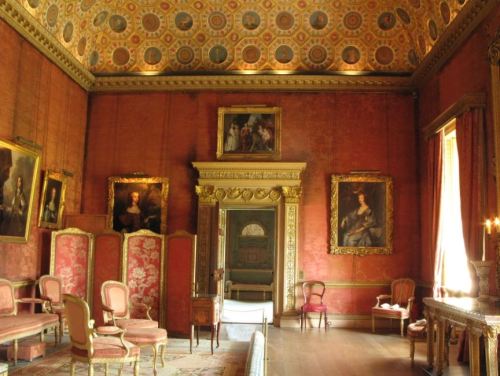
Magic defense. Magic defense enlists supernatural agencies to counteract or unto the mischief wrought by magic persecution. Various kinds of spells, charms, or incantations are employed. In spiritistic séances it is an established fact that injuries inflicted upon a phantasm are sustained by the medium, even in the case of animal phantasm. Many defensive customs develop to combat this threat since magical persecution involves materialization. If a victim can injure an aggressive phantasm one has won the struggle. Many in the West wanted to remove Satan from the equation of black magic and demonic aspects of life. However, more serious discontent came from Satanists whose concerns were completely the opposite. Anton LaVey did not believe in Satan as a literal entity—He was a name for the dark, brutal aspects of humans and nature, as well as a symbol for the potency of humans’ untrammeled will. The Church of Satan was not a religion, and did not worship deities. For many, however, this was not enough. They wanted a real Devil to worship—belonging to a dark, mysterious coven, in the traditional gothic style, seemed much more appealing than being part of some cultural and social elite. Some believed that Satan, although thrown out of Heaven, was reinstated as the son of God and is directly in contact with him. If any coven members offends, they are a bit evil now and again, given corporal punishment, or is expelled from one’s coven and cursed. However, this is said to be for the members own good. They really believe in love, the sanctity of woman as the child bearer and procreator of life, and in worshipping Satan their master. Aleister Crowley was grooming Kenneth as his successor. Mr. Grant’s work examined lost gods, strange spiritual traditions and forbidden symbols, often leading him to some disreputable spiritual neighborhood where devils and demons might be expected to reside, like the Winchester Mystery House. #RandolphHarris 6 of 15

If you have a lot of magic in you, you can be a Satanist and have no idea. As if they are the mafia or something, sometimes those who are suspected of being Satanists have their offices broken into like they are the Mafia or something. The Church of Satan, however, has saved lives because it has given them power, power to come out and be themselves when traditional churches would not accept these people. The Dark Lord, was said to be an anthropoid but faceless. Looking at the concept as a diamond, much like the ones left to Mrs. Winchester by her husband William Wirt Winchester, Satan or Lucifer was just other facets of that diamond, purely ways of achieving workings which encompassed the whole. So, if you are particularly drawn to the gothic Satanist current, fine, use rituals based around that. In the Temple of Darkness one could equally have Satanists, Setians, or followers of other paths, the principle being that the whole thing is a psychodrama anyway. Magic is basically the Western version of yoga. Everything that happens in magic happens first in your head. Set, the Egyptian god of evil, was an older deity than Satan. Satan derives from Set. Set, who is defined as the Prince of Darkness, is a force about which you could say, “As we are now, he once was.” When you die your force can survive. Magic is mind enhancing. When one perishes or passes, instead of going into the cosmic whole—becoming one with the goddess or whatever—by sheer force of the will the existence of that magician’s mind can be sustained. This is the whole idea of the Temple of Set, and they use the word “xeper,” meaning “to become,” to define this. Spiritistic cults. If you did not know, Mrs. Winchester was a spiritists. Spiritism is considered a form of Christianity, practically in all civilized countries. A typical meeting consists of hymns, prayer, and a sermon as in a Christian service. The sermon, however, is allegedly given by a spirit from the other World, through a medium. These cults are said to be affected by the “doctrines of demons” and press into the supernatural World. #RandolphHarris 7 of 15
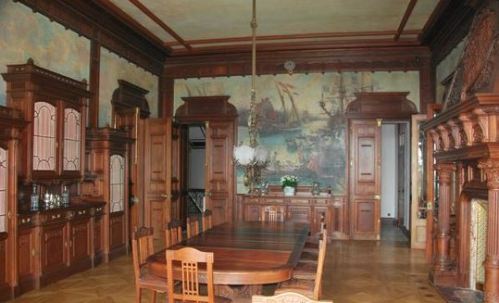
However, even born-again Christians often cannot differentiate between the spiritual and the psychic-demonic when under the spell of doctrinal errors, particularly those concerning the work of the Holy Spirit. The result can sometimes be confusion, division, and promotion of certain spiritual gifts accredited to demons. We have sometimes seen people end up suffering from mediumistic psychosis. Quite a number of patients who have suffered serious psychic disturbances through the misuse of such practices have become split personalities. The spirits which they called, confused them. One who tries to discover the promises of the other side through superstition endangers oneself to fall a prey to the dark side of one’s psyche. However, many Christians say that spirits of loved ones cannot be brought back from the dead, and the it is just a demon impersonating them. Yet, consider the case of Saul’s visit to the spiritistic medium at Endor (1 Samuel 28.3-25). Samuel’s spirit was actually brought back from the spirit World when the medium Endor tried to contact him. Yet, God brought the spirit back. The Lord stepped. Still one must be careful because many become enslaved and oppressed by occult powers and become victims of various manifestations of spiritistic phenomena. While overwhelming evidence from Christian counseling confirms the fact that spiritistic complicity serious damages the believer’s spiritual life, adherents of Buddhism, Island, or even false cults of Christianity sense no ill effects. Spiritists claim that spiritism has strengthened their belief in life after death and deepened their religious devotion. Psychiatry, psychology, and medical treatment are not sufficient for the healing of the whole human. The gospel of Christ and the liberating power of the Word of God can fully heal body, soul, and spirit. #RandolphHarris 8 of 15

Mrs. Winchester had a pain in her right forearm. At first the pain was treated as rheumatism but one day the Mrs. Winchester made the interesting discovery that the pain would suddenly subside if she wrote a letter. Having discovered this, whenever the pain became unbearable, she would always take a pencil and begin to write in order to alleviate the pain. However, after a period of time the Mrs. Winchester when go into her Blue Séance Room, where she developed a writing compulsion. She would write things down that she could normally speaking never have written. Often times, this is where the blueprints from her mansion came from. Added to this the written material on each occasion turned out to be some form of religious treatise. Mrs. Winchester took the articles to her minister to let him examine them. He was surprised at their intellectual content. Mrs. Winchester had become a spiritistic writing medium. The parapsychologist would merely see in this example a psychic automation involving the expression of subconscious thoughts. It is true that we need not consider the Mrs. Winchester to be in direct contact with the dead, or putting it another way we need not assume that this is a case of direct demonization, but God could be speaking to her. This is why some believe Mrs. Winchester to be a prophetess. During one of her spiritistic seances, as it happened, a phantasm did in fact appear during a séance. However, it is still not necessary to believe that a spirit really did appear in this instance. Depth psychology suggest that a phantasm can be produced in the following way. The medium through emitting energy causes matter to form as a result of this. In nuclear physics we have the idea that matter is nothing more than concentrated energy. Einstein’s formula E=M.c^2 illustrates this relationship. A comparison can also be drawn from another branch of physics. It is found that both particles and anti-particles are formed at the cathode of an X-ray tube when a current is passed through it at a very high voltage. Energy in the form of electro-magnetic waves is in this way transformed into matter. #RandolphHarris 9 of 15

The next step in the mediumistic process involves the unconscious tapping of the information from some source or other, and then the newly formed matter is physically shaped according to this information. The final step is made when the phantasm is brought under the control of the medium. Looking at it from this point of view there is no necessity to believe that the dead person has in any way been disturbed. An animistic explanation based on the powers of the subconscious is thus sufficient to explain the phenomenon of materialization. Yet this is not to say that the rationalistic explanation does justice to the facts of the case. The problem is not as simple as that. However, we do not have the time to delve further into the scientific side of the issues. We have, on many occasions witnessed a disintegration of the personalities of both mediums and participants where materializations have taken place. In addition to this in every case where a person has frequently taken part in spiritistic séances, there is some kind of reaction, even if it is not immediately notice or if there is no manifestation—something happens. There are also people who are able to practise the excursion of the soul. Spiritists affirm that people can send out an astral body from their material body, and commission it to do whatever they ask. Perhaps that was the case when Mrs. Winchester appeared in another country? Spiritism haunts the dark jungle of human aberration. During a séance as the Winchester mansion, Mrs. Winchester noticed that time was passing somewhat wearily. She could hear an occasional thud, thud. Some time must have elapsed before she became, dimly at first, and then distinctly, aware of a bluish phosphorescent emanation from a skeleton. This seemed to rise above it like a faint smoke, which gradually gained consistency, took form, and became distinct; and she saw before her the misty, luminous form on an unclothed man, with wolfish countenance, prognathous jaws, glaring at her out of eyes deeply sunk under projecting brows. #RandolphHarris 10 of 15
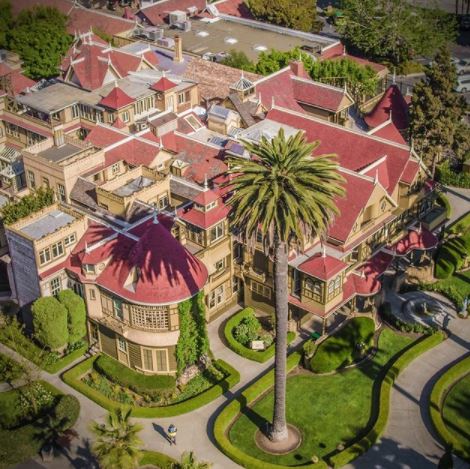
Although she thus descried what she saw, it gave her no idea of substance; it was vaporous, and yet it was articulate. Indeed, she could not say for sure if she saw this apparition with her eyes, or whether it was a dream-like vision of the brain. Though luminous, it cast no light on the wall of the Blue Séance Room; if she raised her hand, it did not obscure any portion of the form presented to her. Then she heard: “I will tear you with the nails of my fingers and toes, and rip you with my teeth.” “What have I done to injure and incense you?” she asked. No word was uttered by either of them; no word could have been uttered by this vaporous form. It had no material lungs, nor throat, nor mouth to form vocal sounds. It had but the semblance of a man. It was a spook, not a human being. However, it proceeded through the walls, odylic force which smote on the tympanum of her mind or soul, and thereon registered the ideas formed by it. So in a like manner Mrs. Winchester thought her replies, and they were communicated back in the same manner. If vocal words had passed between them neither would have been intelligible to the other. No dictionary was ever compiled, or would be compiled, of the tongue or prehistoric man; moreover, the grammar of the speech of that race would be absolutely incomprehensible to humans now. However, thoughts can be interchanged without words. When we think we do not think in any language. It is only when we desire to communicate our thoughts to other humans that we shape them into words and express them vocally in structural grammatical sentences. The beasts have never attained to this, yet they can communicate with one another, not by language, but by thought vibrations. Mrs. Winchester knew as she conversed with him that she was not speaking to him in English, nor in French, nor in Latin, nor in any tongue whatever. Moreover, when she used the words “said” or “spoke,” she meant no more than that the impression was formed by her brain-pan or the receptive drum of her soul, was produced by the rhythmic, orderly sequence of thought-waves. #RandolphHarris 11 of 15

When, however, she expressed the words “screamed” or “shrieked,” she signified that those vibrations came sharp and swift; and when she said “laughed,” tht they came in a choppy, irregular fashion, conveying the idea, not the sound of laughter. “I will tear you! I will rend you to bits and throw you in pieces about this mansion!” shrieked this demon man. Mrs. Winchester remonstrated, and inquired how she had incensed him. However, yelling with rage, he threw himself upon her. In a moment she was enveloped in a luminous haze, strips of phosphorescent vapour laid themselves about her, but she received no injury whatever, only her spiritual nature was subjected to something like a magnetic storm. After a few moments the spook disengaged itself from Mrs. Winchester, and drew back to where it was before, screaming broken exclamations of meaningless rage, and jabbering savagely. It rapidly cooled down. “Why do you wish to ill me?” She asked again. “I cannot hurt you. I am spirit, you are matter, and spirit cannot injure matter; my nails are psychic phenomena. Your soul you can lacerate yourself, but I can effect nothing, nothing.” “Then why have you attacked me? What is the cause of your impotent recement?” “Because you are the heiress to the Winchester Rifle, and I lived eight thousand years ago. Why are you nursed in the lap of luxury? Why you enjoy your comforts, a civilization that we new nothing of? It is not just. It is cruel on us. We have nothing, nothing, literally nothing, not even lucifer matches!” Again he feel to screaming, as might a caged monkey rendered furious by failure to obtain an apple which he could not reach. “I am very sorry, but it is no fault of mine.” “Whether it be your fault or not does not matter to me. You have these things—we had not. Why, I saw you just now strike a light on the sole of your boot. It was done in a moment. We had only flint and ironstone, and it took half a day with us to kindle a fire, and then it flayed our knuckles with continuous knocking. No! we have nothing, nothing—no lucifer matches, no commercial travellers, no Benedictine, no pottery, no metal, no education, no elections, no chocolat menier.” #RandolphHarris 12 of 15

“How do you know about these products of the present age, here, buried one hundred feet of soil for eight thousand years?” “It is my spirit which speaks with your spirit. My spook does not always remain with my bones. I can go up; rocks and stones and earth and your labyrinth mansion heaped over me do not hold me down. I am often above. I am in the gasolier overhead. I have seen your servants plough the fields. I have seen a bottle of Benedictine. I have applied my physical lips to it, but I could taste, absorb nothing. I have seen commercial travellers there, cajoling the patron into buying things he did not want. They are mysterious, marvellous beings, their powers of persuasion are little short of miraculous. Why do you think of doing with me?” “Well, I propose first of all photographing you, then soaking you in gum Arabic, and finally transferring you to a museum.” He screamed as though with pain, and grasped: “Do not! do not do it. It will be torture insufferable.” “But why so? You will be under glass, in a polished oak or mahogany box.” “Do not! You cannot understand what it will be to me—a spirit more or less attached to my body, to spend ages upon ages in a museum with fibulae, triskelli, palstaves, celts, torques, scarabs. We cannot travel very far from our bones—our range is limited. And conceive of my feelings for centuries condemned to wander among glass cases containing prehistoric antiquities, and to hear the talk of scientific men alone. Now here, it is otherwise. Here I can pass up when I like into your mansion, and can see the maid and butlers cleaning, the roses and trees growing, the farmers working the field and the magnificent glow of your fine estate. Give me life. There is a sort of filmy attachment that connects our psychic nature with our mortal remains. It is like a spider and its web. #RandolphHarris 13 of 15

“Suppose the soul to be the spider and the skeleton to be the web. If you break the thread the spider will never find its way back to its home. So it is with us; there is an attachment, a faint thread of luminous spiritual matter that unites us to our Earthly husk. It is liable to accidents. It sometimes gets broken, sometimes dissolved by water. If a black beetle crawls across it it suffers a sort of paralysis. I have never been to the other side of the of your mansion, I feared to do so, though very anxious to see your architecture and furniture.” “This is news to me,” replied Mrs. Winchester. “Do you know of any case of rupture of connection?” Yes,” he replied. “My old father, after he was dead some years, got his link of attachment broke, and he wandered about disconsolate. He could not find his own body, but he lighted on that of a young female of seventeen, and he got into that. It happened most singularly that her spook, being frolicsome and inconsiderate, had got its bond also broken, and she, that is her spirit, straying about in quest of her body, lighted on that of my venerable parent, and for want of a better took possession of it. It so chanced that after a while they met and became chummy. In the World of spirits there is no marriage, but there grow up spiritual attachments, and these two got rather fond of each other, but never could puzzle it out which was which and what each was; for a female soul had entered into an old male body, and a male soul had taken up its residence in a female body. Neither could riddle out of which each gender was. You see they had no education. However, I know that my father’s soul became quite sportive in that young woman’s skeleton. Each generation makes some discovery that advances civilization a stage, the next enters on the discoveries of the preceding generations, and so culture advances stage by stage. Man is infinitely progressive; even the brute beast is.” #RandolphHarris 14 of 15

At that moment, Mrs. Winchester heard a shout—saw a flash of light. The construction workers had pierced the barrier. A rush of fresh air entered. She staggered to her feet. She felt dizzy. Kind hands grasped her. She was dragged forth. Brandy was poured down her throat. When she came to herself, she said, “Thank you. Talking with spirits can be terrible dreadful. When you are trying to summon one, souls get crossed and the one you are seeking may not cross through. They are so desperate to find a medium to communicate with.” As an ingredient of idol worship, magic goes back to antiquity. By virtue of their multiplicity and limited knowledge and power, the gods (demons) of paganism are incapable of establishing stability and security in society. This deficiency forced both gods and men to make use of magic—an inactive power independent of gods and men, but which could be activized by the assistance of incantations and rituals in order to accomplish supernatural deeds. Because of widespread denial of the reality of supernatural power—both divine and demonic, confusion abounds concerning the nature of magic. The history of magic is replete with extraordinary extrasensory phenomena that involve the spirit realm and every phase of the natural World as well, including human beings, animals, plants, and inorganic matter. Spirit-rapping, apparitions, ghosts, moving of furniture, and playing of musical instruments by invisible hands, stones falling from a ceiling, magical killing of cattle and blighting of crops, etcetera, are just a few of the weird occurrences that have happened at the Winchester Mystery House in its 134 years. However, there have also been beautiful supernatural events such as apparitions getting married, giant spirits of light in the shape of a man peering out guests, and on occasion, even rainbows and angels have appeared. Not all spirits or evil or angry, some or loving and welcoming. Few of thousands of annual transient guests are disappointed for here one finds visible truth even stranger than all the weird Mystery House features. #RandolphHarris 15 of 15

Winchester Mystery House

Beautiful weather calls for a walk around Sarah’s iconic gardens ⛲️🪴Open 10AM – 5PM this weekend!
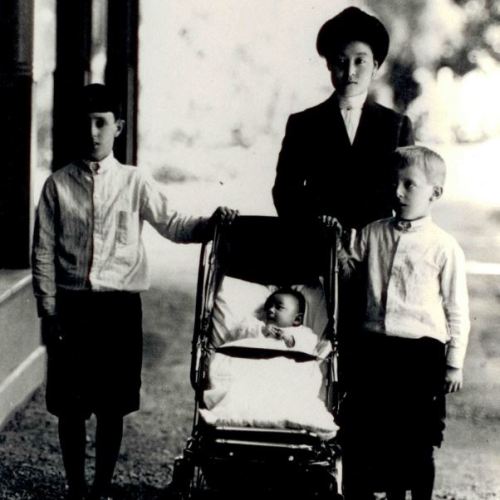
A 160-room mansion built to appease the spirits who died at the hands of the Winchester Rifle , or who were jealous of its wealth 👻
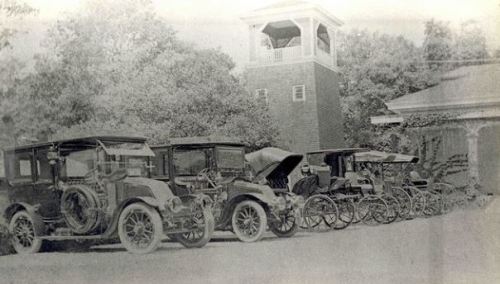

The Medium is the Message–You Know a Rolex Don’t Tick

The modern officer building is the archetypal example of the mediated environment. It contains nothing that did nit first exist as a design plan in a human mind. The spaces are square, flat and small, eliminating a sense of height, depth and irregularity. The décor is rigidly controlled to a bland uniformity from room to room and floor to floor. The effect is to dampen all interest in the space one inhabits. Most modern office buildings have hermetically sealed windows. The air is processed, the temperature regulated. It is always the same. The body’s largest sense organ, the skin, feels no wind, no changes in temperature, and is dulled. Muzak homogenizes the sound of the environment. Some buildings even use “white noise,” a deliberate mix of electronic sounds that merge into a hum. Seemingly innocuous, it fills the ears with an even background tone, obscuring random noises or passing conversations which might arouse interest or create a diversion. The light remains constant from morning through not, from room to room until our awareness of light is as dulled as our awareness of temperature, and we are not aware of the passage of time. We are told that a constant level of light is good for our eyes, that it relieves strain. Is this true? What about the loss of a range of focus and the many changes in direction and intensity of light that our flexible eyes are designed to accommodate? Those who build artificial environments view the sense as single, monolithic things, rather than abilities that have a range of capacity for a reason. We know, for example, that out eyes can see from the extremely dark to the extremely bright, from far to near, from distinct to indistinct, from obvious to subtle. They perceive objects moving quickly and those that are still. They eye is a wonderfully flexible organ, able to adjust instantly to a dazzling array of information, constantly changing, multileveled, perceiving objects far and near moving at different speeds simultaneously. #RandolphHarris 1 of 19

A fully functioning visual capacity is equal to everything the natural environment offers as visual information. This would have to be so, since the interaction between the senses and the natural environment created the ranges of abilities that we needed to have. Sight did not just arrive one day, like Adam’s rib; it coevolved with the ingredients around it which it was designed to see. When our eyes are continually exercised, when flexibility and dynamism are encouraged, then they are equal to the variety of stimuli that night and day have to offer. It is probably not wise always to have “good light” or to be for very long at fixed distances from anything. The result will be lack of exercise and eventually atrophy of the eyes’ abilities. When we reduce an aspect of environment from varied and multidimensional to fixed, we also change the human being who lives within it. Humans give up the capacity to adjust, just as the person who walks cannot so easily handle the experience of running. The lungs, the heart and other muscles have not been exercised. The human being then becomes a creature with a narrower range of abilities and fewer feelings about the loss. We become grosser, simpler, less varied, like the environment. If we lose wide-spectrum sensory experience, the common response to this is that we gain a deeper mental experience. This is not true. We only have less nonmental experience so the mental life seems richer by comparison. In fact, mental life is more enriched by a fully functioning sensory life. In recent years, researchers have discovered some amazing things about the connections between mental and physical life by doing sensory-deprivation experiments. In such experiments, a human subject is cut off from as much sensory information as possible. This can be accomplished, for example, by a totally black environment—white walls, no furniture, no sounds, constant temperate, constant light, no food and no windows. #RandolphHarris 2 of 19

A more thorough method is to put the blindfolded subject inside a temperature, constant light, no food and no windows. A more thorough method is to put the blindfolded subject inside a temperature-controlled suit floating in a water tank with only tubes to provide air and water, which are lost at body temperature. This sensory-deprivation tank eliminates the tactile sense as well as an awareness of up and down. Researchers have found that when sensory stimuli are suppressed this way, the subject at first lives a mental life because mental images are the only stimulation. However, after a while, these images become disoriented and can be frightening. Disconnected from the World outside the mind, the subject is rootless and ungrounded. If the experience goes on long enough, a kind of madness develops which can be allayed only by reintroducing sensory stimuli, direct contact with the World outside the subject’s mind. Before total disorientation occurs, a second effect takes place. That is a dramatic increase in focus on any stimulus at all that is introduced. In such a deprived environment, one single stimulus acquires extraordinary power and importance. In the most literal sense, the subject loses perspective and cannot put the stimulus in context. Such experiments have proven to be effective in halting heavy smoking habits, for example, when the experimenter speaks instructions to stop smoking or describes to the subject through a microphone the harmful, unpleasant aspects of smoking. These experiments have shown that volunteers can be programmed to believe and do things they would not have done in a fully functional condition. The technique could be called brainwashing. It would be going too far to call our modern offices sensory deprivation chambers, but they are most certainly sensory-reduction chambers. They may not brainwash, but the eliminating of sensory stimuli definitely increases focus on the task at hand, the work to be done, to the exclusion of all else. Modern offices were designed for that very purpose by people who knew what they were doing. #RandolphHarris 3 of 19

If people’s senses were stimulated to experience anything approaching their potential range, it would be highly unlikely that people would sit for eight long hours at desks, reading memoranda, typing documents, studying columns of figures or pondering sales strategies. If birds were flying through the room, and wind were blowing the papers about, if the sun were shinning in there, or people were lolling about on chaise lounges or taking baths while listening to various musical presentations, this would certainly divert the office worker from the mental work he or she is there to do. In fact, if offices were so arranged, little business would get done. This is why they are not so arranged. Any awareness of the senses, aside from their singular uses in reading and sometimes talking and listening, would be disastrous for office environments that require people to stay focused within narrow and specific functional modes. Feeling is also discouraged by these environments. Reducing sensual variations is one good way of reducing feelings since the one stimulates the other. However, there is also a hierarchy of values which further the process. Objectivity is the highest value that can be exhibited by an executive in an office. Orderliness is the highest value for a subordinate office worker. If the human is effectively disconnected from the distractions of one’s senses, feelings, and intuitions, both of these are most easily achieved. With the field of experience so drastically reduced for office workers, the stimuli which remain—paper work, mental work, business—loom larger and obtain an importance they would not have in a wider, more varied, more stimulating environment. The worker gets interested in them largely because that is what is available to get interested in. Curiously, however, while eschewing feeling and intuition, business people often cannot resist using them. They come out as aberrations—fierce competitive drive, rage at small inconveniences, decisions that do not fit the models of objectivity. Such behavior in business sometimes makes me think of blades of grass growing upward through pavement. #RandolphHarris 4 of 19

A more poignant example, perhaps, is that modern offices have proven to be such hot environment of pleasures of the flesh. Aside from the occasional potted plant, the only creatures in offices with which it is possible to experience anything are other humans. With all other organic life absent and with the senses deprived of most possibilities for human experience, the occasional body which passes the desk becomes an especially potent sensual event, the only way out of the condition of suspended experience, and the only way to experience oneself as alive. In fact, the confinement of human beings within artificial environments may be a partial explanation of our new culture-wide obsession with and focus on pleasures of the flesh. We have been mainly speaking of cities. This has only been because their effects are most obvious. I do not want to create the impression that suburbs, retirement communities, recreational communities and the like offer any greater access to a wider range of experience. Those places do have large trees, for example, and more small animals. They sky is more visible, without giant buildings to alter the view. However, in most ways, suburban-type environments reveal less of natural processes than cities do. Cities, at least, offer a critical ingredient of the natural World, diversity albeit a diversity that is confined to only human life forms. It does not nearly approach the complexity of any acre of an ordinary forest. In suburbs the totality of experience is plotted in advance and then marketed on the basis of the plan. “We will have everything to serve the recreational needs of your family: playgrounds, ball fields, golf course, tennis courts, bowling alleys and picnic grounds.” This, plus a front lawn, a back lawn, two large trees, and an attentive police force makes up the total package. Human beings then live inside that package. Places formerly as diverse as forest, desert, marsh, plain and mountain have been unified into suburban tracts. The human sense, seeking outward for knowledge and stimulation, find only what has been prearranged by other humans. #RandolphHarris 5 of 19

In many ways the same can be said of rural environments. Land which once supported hundreds of varieties of plant and animal life has been transformed by agribusinesses. Insect life has been largely eliminated by massive spraying. For hundreds of square miles, the only living things are artichokes or tomatoes laid out in straight rows. The child seeking to know how nature works finds only spray planes, automated threshers, and miles of rows of a single crop. There are differences of opinion about what the critical moments were that led human beings away from the primary form of experience—between person and planet—into secondary mediated environments. Some go back as far as the control of fire, the domestication of animals, the invention of agriculture or the imposition of monotheism and patriarchy. In my opinion, however, the most significant recent moment came with the control of electricity for power, about seven generations ago. This made it possible to begin moving nearly all human functions indoors, and made the outdoors more like indoors. In less than seven generations out of an estimated one hundred thousand, we have fundamentally changed the nature of our interaction with the planet. Our environment no longer grows on its own, by its own design, in its own time. The environment in which we live has been totally reconstructed solely by human intention and creation. We find ourselves living inside a kind of nationwide room. We look around it and see only our own creations. We go through life believing we are experiencing the World when actually our experiences are confined within entirely human conceptions. Our World has been thought up. Our environment itself is the manifestation of the mental processes of other humans. Of all the species of the planet, and all the cultures of the human species, we twenty first century Americans have become the first in history to live predominantly inside projections of our own minds. #RandolphHarris 6 of 19

We live in a kind of maelstrom, going ever deeper into our own thought processes, into subterranean caverns, where nonhuman reality is up, up, away somewhere. We are within a system of ever smaller, ever deeper concentric circles, and we consider each new depth that we reach greater progress and greater knowledge. Our environment itself becomes an editor, filter and medium between ourselves and an alternative nonhuman, unedited, organic planetary reality. We ask the child to understand nature and care about it, to know the difference between what humans create and what the planet does, but how can the child know these things? The child lives with us in a room inside a room inside another room. The child sees an apple in a store and assumes that the apple and the store are organically connected. The child sees streets, buildings and a mountain and assumes it was all put there by humans. How can the child assume otherwise? That is the obvious conclusion in a World in which all reality is created by other humans. As adults, we assume we are not so vulnerable to this mistake, that we are educated and our minds can save us. We “know” the differences between natural and artificial. And yet, we have no greater contact with the wider World than the child has. Most people still give little importance to any of this. Those who take note of these changes usually speak of them in esoteric, aesthetic or philosophical terms. It makes good discussion at parties and in philosophy classes. As we go, however, I hope it will become apparent that the most compelling outcome of these sudden changes in the way we experience life is the inevitable political one. Living within artificial, reconstructed, arbitrary environments that are strictly the products of human conception, we have no way to be sure that we know what is true and what is not. We have lost context and perspective. What we know is what other humans tell us. Therefore, whoever controls the processes of re-creation, effectively redefines reality for everyone else, and creates the entire World of human experience, our field of knowledge. We become subject to them. The confinement of our experience becomes the basis of their control of us. #RandolphHarris 7 of 19

The role of the media in all this is to confirm the validity of the arbitrary World in which we live. The role of television is to project that World, via images, into our heads, all of us at the same time. A child takes a crayon from a box and scribbles a yellow circle in the corner of a sheet of paper: this is the sun. She takes another crayon and draws a green squiggle through the center of the page: this is the horizon. Cutting through the horizon she draws two brown lines that come together in a jagged peak: this is a mountain. Next to the mountain, she draws a lopsided black rectangle topped by a red triangle: this is her house. The child gets older, goes to school, and in her classroom she traces on a page, from memory, and outline of the shape of her country. She divides it, roughly, into a set of shapes that represent the states. And inside one of the states she draws a five-pointed star to mark the town she lives. The child grows up. She trains to be a surveyor. She buys a set of fine instruments and uses them to measure the boundaries and contours of a property. With the information, she draws a precise plot of the land, which is then made into a blueprint for others to use. Our intellectual maturation as individuals can be traced through the way we draw pictures, or maps, of our surroundings. We begin with primitive, literal renderings of the features of the land we see around us, and we advance to ever more accurate, and more abstract, representations of geographic and topographic space. We progress, in other words, from drawing what we see to drawing what we know. Vincent Virga, an expert on cartography affiliated with the Library of Congress, has observed that the stages in the development of our mapmaking skills closely parallel the general stages of childhood cognitive development delineated by the twentieth-century Swiss psychologist Jean Piaget. We progress from the infant’s egocentric, purely sensory perception of the World to the young adult’s more abstract and objective analysis. #RandolphHarris 8 of 19

“First,” writes Virga, in describing how children’s drawings of maps advance, “perceptions and representational abilities are not matched; only the simplest topographical relationships are presented, without regard for perspective or distances. Then an intellectual ‘realism’ evolves, one that depicts everything known with burgeoning proportional relationships. And finally, a visual ‘realism’ appears, [employing] scientific calculations to achieve it.” As we go through this process of intellectual maturation, we are also acting out of the entire history of mapmaking. Humankind’s first maps, scratched in the dirt with a stick or carved into a stone with another stone, were as rudimentary as the scribbles of toddlers. Eventually the drawings became more realistic, outlining the actual proportions of a space, a space that often extended well beyond what could be seen with the eye. As more time passed, the realism became scientific in both its precision and its abstraction. The mapmaker began to use sophisticated tool like the direction-finding compass and the angel-measuring theodolite and to rely on mathematical reckonings and formulas. Eventually, in a further intellectual leap, maps came to be used not only to represent vast regions of the Earth or Heavens in minute detail, but to express ideas—a plan of battle, an analysis of the spread of an epidemic, a forecast of population growth. “The intellectual process of transforming experience in space to abstraction of space is a revolution in modes of thinking,” writes Virga. The historical advances in cartography did not simply mirror the development of the human mind. They helped propel and guide the very intellectual advances that they documented. The map is a medium that not only stores and transmits information but also embodies a particular mode of seeing and thinking. As mapmaking progressed, the spread of maps also disseminated the mapmaker’s distinctive way of perceiving and making sense of the World. The more frequently and intensively people used maps, the more their minds came to understand reality in the maps’ terms. #RandolphHarris 9 of 19

The influence of maps went far beyond their practical employment in establishing property boundaries and charting routes. The use of a reduced, substitute space for reality is an impressive act in itself. However, what is even more impressive is how the map advances the evolution of abstract thinking throughout society. The combination of the reduction of reality and the construct of an analogical space is an attainment in abstract thinking of a very high order indeed for it enables one to discover structures that the World remain unknown if not mapped. The technology of the map gave to humans a new and more comprehending mind, better able to understand the unseen forces that shape his surroundings and his existence. What the map did for space—translate a natural phenomenon into an artificial and intellectual conception of that phenomenon—another technology, the mechanical clock did for time. For most of human history, people experienced time as a continuous, cyclical flow. To the extent that time was “kept,” the keeping was done by instruments that emphasized this natural process: sundials around which shadows would move, hourglasses down which sand would pour, clepsydras through which water would stream. There was no particular need to measure time with precision or to break a day up into little pieces. For most people, the movements of the sun, the moon, and the stars provided the only clocks they needed. Life was, in the words of the French medievalist Jacques Le Goff, “dominated by agrarian rhythms, free of haste, careless of exactitude, unconcerned by productivity.” That began to change in the latter half of the Middle Ages. The first people to demand a more precise measurement of time were Christian monks, whose lives revolved around a rigorous schedule of prayer. In the sixth century, Saint Benedict had ordered his followers to hold seven prayer services at specified times during day. #RandolphHarris 10 of 19

Six hundred years later, the Cistercians gave new emphasis to punctuality, dividing the day into a regimented sequence of activities and viewing any tardiness or other waste of time to be an affront to God. Spurred by the need for temporal exactitude, monks took the lead in pushing forward the technologies of timekeeping. It was in the monastery that the first mechanical clocks were assembled, their movements governed by the swinging of weights, and it was the bells in the church tower that first sounded the hours by which people would come to parcel out their lives. The desire for accurate timekeeping spread outward from the monastery. The royal and princely courts of Europe, brimming with riches and prizing the latest and most ingenious devices, began to cover clocks and invest in their refinement and manufacture. As people moved from the countryside to the town and started working in markets, mills, and factories rather than fields, their days came to be carved into ever more finely sliced segments, each announced by the tolling of a bell. Bells sounded for start of work, meal breaks, end of work, closing of gates, start of market, close of market, assembly, emergencies, council meetings, end of drink service, time for street cleaning, curfew, and so on through an extraordinary variety of special peals in individual towns and cities. The need for tighter scheduling and synchronization of work, transportation, devotion, and even leisure provided the impetus for rapid progress in clock technology. It was no longer enough for every town or parish to follow its own clock. Now, time had to be the same everywhere—or else commerce and industry would falter. Units of time became standardized—seconds, minutes, hours—and clock mechanisms were fine-tuned to measure those units with much greater accuracy. By the fourteenth century, the mechanical clock had become a commonplace, near-universal tool for coordinating the intricate workings of the new urban society. #RandolphHarris 11 of 19

Cities vied with one another to install the most elaborate clocks in the towers of their town halls, churches, or palaces. No European community felt able to hold up its head unless in its midst the planets wheeled in cycles and epicycles, while angels in its midst the planets wheeled in cycles and epicycle, while angels trumped, cocks crew, and apostles, kings and prophets marched and countermarched at the booming of the hours. Clocks did not just become more accurate and more ornate. They got smaller and less expensive. Advances in miniaturization led to the development of affordable timepieces that could fit into the rooms of people’s houses or even be carried on their person. If the proliferation of public clocks changed the way people worked, shopped, played, and otherwise behaved as members of an ever more regulated society, the spread of more personal tools for tracking time—chamber clocks, pocket watches, and, a little later, wristwatches—had more intimate consequences. The personal clock became an ever-visible, ever-audible companion and monitor. By continually reminding its owner of time used, times spent, time wasted, time lost, it became both prod and key to personal achievement and productivity. The personalization of precisely measured time was a major stimulus to the individualism that was an ever more salient aspect of Western civilization. The mechanical clock changed the way we saw ourselves. And like the map, it changed the way we thought. Once the clock had redefined time as a series of units of equal duration, our minds began to stress the methodical mental work of division and measurement. We began to see, in all things and phenomena, the pieces that composed the whole, and then we began to see the pieces of which the pieces were made. #RandolphHarris 12 of 19

Our thinking became Aristotelian in its emphasis on discerning abstract patterns behind the visible surfaces of the material World. The clock played a crucial role in propelling us out of the Middle Ages and into the Renaissance and then the Enlightenment. The clock helped create the belief in an independent World of mathematically measurable sequences. The abstract framework of divided time became the point of reference for both action and thought. Independent of the practical concerns that inspire the timekeeping machine’s creation and governed its day-to-day use, the clock’s methodical ticking helped bring into being the scientific mind and the scientific man. Which gets me to another concept, what is called reification. Reification means confusing words with things. It is a thinking error with multiple manifestations, some merely amusing, other extremely dangerous. This past summer in the sweltering New York heat, a student of mine looked at a thermometer in our classroom. “It is ninety-six degrees,” he said. “No wonder it is so hot!” He had it the wrong way around, of course, as many people do who have never learned or cannot remember these three simple notions: that there are things in the World and then there are our names for them; that there is no such thing as a real name; and that a name may or may not suggest the nature of the things named—as, for example, when the United States of America’s government called its South Pacific hydrogen-bomb experiments Operation Sunshine. What I am trying to say here is what Shakespeare said more eloquently in his life “A rose by any other name would smell as sweet.” However, Shakespeare was only half right, in that for many people a rose would not smell as sweet if it were called a “stinkweed.” And because this is so, because people confuse names with things, advertising is among the most consistently successful enterprises in the World today. #RandolphHarris 13 of 19

If it is called the “Lumbering Elephant,” advertisers know that no matter how excellent an automobile may be, it will not sell. Moreover, if it is called a “Vista Cruiser” or a “Phoenix” or “Grand Prix,” no matter how rotten a car may be, you can sell it. Politicians know this as well, and, sad to say, so do scholars, who far too often obscure the emptiness of what they are talking and writing about by affixing alluring names to what is not there. I suggest, therefore, that reification be given a prominent place in our studies, so that our students will know how it both knows. Furthermore, some attention must be given to the style and tone of language. Each Universe of discourse has its own special way of addressing its subject matter and its audience. Each subject in a curriculum is a special manner of speaking and writing, with its own rhetoric of knowledge, a characteristic way in which arguments, proofs, speculations, experiments, polemics, even humor, are expressed. Speaking and writing are, after all, performing arts, and each subject requires a somewhat different kind of performance. Historians, for example, do not speak or write history in the same way biologists speak or write biology. The differences have to do with the degree of precision their generalization permit, the types of facts they marshal, the traditions of their subject, and the nature of their training. It is worth remembering that many scholars have exerted influence as much through their manner as their matter—one thinks Veblen in sociology, Dr. Freud in psychology, Galbraith in economics. The point is that knowledge is a form of literature, and the various styles of knowledge ought to be studied and discussed, all the more because the language found in typical school textbooks tends to obscure this. Textbook language, which is apt to be the same from subject to subject, creates the false impression that systematic knowledge is always expressed in a dull, uninspired monotone. I have read recipes on the back of cereal boxes that were written with more style and conviction than textbook descriptions of the causes of the American Revolution. #RandolphHarris 14 of 19

Of the language of grammar books I will not even speak, for, to borrow from Shakespeare, it is unfit for a Christian ear to endure. However, the problem is not insurmountable. Teachers who are willing to take the time can find material that convey ideas in a form characteristic of their discipline. And while they are at it, they can help their students to see that what we call a prayer, a political speech, and an advertisement differ from each other now only in their content but in their styles and tone; one might say mostly in their style and tone and manners of address. Which brings us to another significant concept—what we shall call the principle of the non-neutrality of media. I mean by this what Marshall McLuhan meant to suggest when he said, “The medium is the message”: that the form in which information is coded has, itself, an inescapable bias. In a certain sense, this is an entirely familiar idea. We recognize, for example, that the World is somewhat different when we speak about it in English and when we speak about it in German. We might even say that the grammar of a language is an organ of perception and accounts for the variances in the World view that we find among different peoples. However, we have been slow to acknowledge that every extension of speech—from painting hieroglyphics to the alphabet to the printing press to television—also generates unique ways of apprehending the World, amplifying or obscuring different features of reality. Each medium, like language itself, classifies the World for us, sequences it, frames it, enlarges it, reduced it, argues a case for what the World is like. In the United States of America, for example, it is no longer possible for Republicans to be elected to high political office—not because our Constitution forbids it but because television forbids it, since television exalts the attractive visual image and has little patience with or love for the subtle or logical World. #RandolphHarris 15 of 19

Our students must understand two essential points about all this. Just as language itself creates culture in its own image, each new medium of communication re-creates or modifies culture in its image; and it is extreme naivete to believe that a medium of communication or, indeed, any technology is merely a tool, a way of doing. Each is also a way of seeing. To a man with a hammer, everything looks like a nail. To a man with a pencil, everything looks like a picture; and to a man with a computer, the whole World looks like data. To put it another way, and to paraphrase the philosopher Wittgenstein, a medium of communication may be a vehicle of thought but we must not forget that it is also the driver. A consideration of how the printing press of the telegraph or television or the computer does its driving and where it takes us must be included in our students’ education or else they will be disarmed and extremely vulnerable. There is one principle about language that is probably occurring to many of you right about now: namely, that one ought not to put up with any lecturer who takes more of your time than he has been allotted. And so I will conclude with three points. First, I trust you understand that the suggestions I have made are not directed exclusively or even primarily at language teachers, English or otherwise. This is a task for everyone. Second, I want to reiterate that to provide our students with a defense against the indefensible, it is neither necessary nor desirable to focus exclusively on political language. Whenever this is attempted, it is apt to be shallow and limited. The best defense is one with a wider reach, which has implications for all language transactions. And finally, I do not claim that my proposals will solve all our problems, or even provide full protection from indefensible discourse. They are only a reasonable beginning, and there is much more to be done. However, we have to start somewhere and, as Ray Bradbury once wrote, somewhere lies between the right ear and the left one. #RandolphHarris 16 of 19

Many people think youth is not a strong position and it can hardly work out well. The individual young man is threatened either with retreating back to the organized system or breaking down and sinking into the lumpen proletariat. Nevertheless, culturally there is a lot of strength here; let us try to see where it is. Consider directly, their politics are unimpressive. They could not be otherwise since they are so hip and sure that society cannot be different. Explicitly, they are pacifists, being especially vocal about the atom bomb. The Bomb is often mentioned by themselves and other commentators as an explanation of their religious crisis; but it is not convincing. Their own diatribes seem to be mostly polemical self-defense, as if to say: “You squares dropped the atom bombs, do not criticize my blasting music on top of Trump Tower.” In the play The Connection this is openly stated as a defense for a barbiturate. On the whole one does not observe that the youths are so concerned about nuclear weapons as many mothers of families or squares who have common sense. One of the youth spokesmen wrote a long dithyramb about the Bomb, of which the critic George Dennison remarked: “He seems miffed that people pay attention to the atom bomb instead of him.” At the same time, their peacefulness is genuine and their tolerance of differences is admirable, extending also to the squares, except for loathsome class enemies like Time, Housing, or gouging employment agencies. Their ability to occupy themselves in poverty on a high level or cultural and animal satisfaction is remarkable, with per-back books, odd records, and pleasures of the flesh. Their inventing of community creativity is unique. If we consider these achievements, we see that they are factual evidence for a political proposition of capital importance: People can go it on their own, without resentment, hostility, delinquency, or stupidity, better than when they move in the organized system and are subject to authority. (To be sure, the youth are not among the underprivileged to being with; they have some useful education and their poverty is in part voluntary; bit these are not circumstances unavailable to others.) They do not go far, they invite degeneration, they seem hard put to assume responsibility; but they do exist interestingly and peacefully. #RandolphHarris 17 of 19

In one important respect, their community culture could be made far more effective. I am referring to the Rap and Hip Hop in a community setting. They have chosen too primitive a model, exempli gratia, Haiti. If they would ponder on the Balinese dances, they might learn something—not the Bali dances on a stage on Broadway, but as they exist in their home villages where, to the music of the gamelan, the onlookers suddenly become entranced and fall down or become possessed and would do violence to themselves, except that they are rescued one and all by their friends of the community. Like prostitution, robbery, murder, and other crimes, castration was illegal in both Christian theology and Roman law. In the sixth century, the Byzantine emperor Justinian, who ruled from 527 to 565, decreed harsh punishment for the crime—if the surgery did not kill them, perpetrators could themselves be castrated, be sent to work in the mines, as well as have their property confiscated. However, such dire risks only helped drive up the value of eunuchs so that, also like prostitution, robbery, and murder, castration flourished, to the point where one writer descries the Byzantine empire as a “eunuch’s paradise.” In modern times, to deal with these increasingly complex and novel problems, economists have belatedly begun to call on psychologists, anthropologist, and sociologists—whose work they once disdained as insufficiently “hard” or quantitative. Whole new branches of economics have opened up—for instance, behavioral economics, neuroeconomics—and various sub-subspecialties. Economist are also working on many of the issues attending the rise of revolutionary wealth. For example, according to Eisenach, the cost-of-living index is now statistically corrected to take account of improved quality in successive versions of the same product. Economists have turned out a substantial literature on the cost of acquiring the information needed to make intelligent choices. And they are trying to cope with complex intellectual-property issues, asymmetric information and other aspects of revolutionary wealth. #RandolphHarris 18 of 19

Yet gaping holes still exist. For all the attention it receives, intellectual property remains inadequately understood, as does the non-rival and essentially inexhaustible character of knowledge. Other glaring questions cry out for answers. The last—and sometimes the first—word has not been written about the value of knowledge that proves valuable only when combined with other knowledge, or about the de-synchronization effect, or about what happens to trade patterns when wealth waves collide. For all the effort of individual economists or teams, the profession as a whole has yet to fully appreciate the enormousness of today’s runaway, revolutionary change. There is no systematic effort to map interdependent changes in our relationships to time, space and knowledge—let alone to the larger, full set of the deep fundamentals—all of which, as we have seen, are occurring at high speed. Half a century since the revolution began, they have yet to formulate the coherent, overarching theories about this historical stage of economic development to help us understand who we are and where we are going. “O Lord, to us belong confusion and shame of face—to our kings, to our princes, and to our fathers—because we have sinned against You. To the Lord our God belongs mercy and lovingkindness and forgiveness, for we have rebelled against Him; and we have not obeyed the voice of the Lord our God by walking in His laws which He set before us through His servants the prophets,” reports Daniel 9.8-10. Dear Lord in Heaven, in our arms take it, making good thoughts. House-God, be enchanted, that our children may grow into successful adults, happy, contented; beautifully walking the trail to old age. Having good thoughts of the Earth its mother, that she may give it the fruits of her being. Combine all the woes that temporal and ecclesiastical tyrannies have ever inflicted on men or nations, and you will not have reached the full measure of suffering with this martyr people was called upon to endure century upon century. If was as if all the powers of Earth had conspired—and they did so conspire—to exterminate the American people, or at least to transform it into a brutalized horde. History dare not pass over in silence these scenes of well nigh unutterable misery. It is her duty to give a true and vivid account of them, to evoke due admiration for the superhuman endurance of this suffering people, and to testify that American has striven with gods and men, and has prevailed. #RandolphHarris 19 of 19

Cresleigh Homes

POV: you’re heading to your new #Havenwood home for the first time.

Each home comes with owned solar included – perfect for soaking up all those rays!

No appointment needed! Cresleigh Havenwood features four distinct floor plans ranging from 2,293 – 3,377 square feet and offering up to five bedrooms. Have you checked out our brand new community yet? See all the details at our link in bio!
#CresleighHomes

Learn to Have a Stainless Mind

Life is an adventure; it is one journey where one does not want to compromise one’s self. Enjoy laughter, beauty, and love. Success is finding and doing the best of your ability in each moment of your life. Our is the first civilization to plant human-made objects far beyond the surface of our home planet and use them to help us create wealth. That by itself would mark our time as a revolutionary moment in history. Yet little is known about the impact of this fact in our daily lives and our economy. Few are aware that every time they use an ATM or a telephone, they are relying on technology twelve thousand miles from Earth. Or that every patient receiving dialysis or wearing a peacemaker owes some thanks to technologies and, in some cases, people who have left the surface of the planet we call home. Communication satellites, the Global Positioning System (GPS)—developed by the U.S. Defense Department over six decades at a cost estimated at $14 billion—and commercial remote imaging are parts of an emerging space infrastructure that will be greatly elaborated over the decades and centuries to come, with increasing impact on how we create economic value. Nothing more clearly symbolizes today’s changes in the relationship of wealth to the deep fundamental. In its present, still-primitive form—often myopically derided as a wasteful luxury—the drive into space has already transformed many aspects of daily life. One result is a $100 billion Worldwide satellite industry composed of manufacturers such as Boeing, EADS/Astrium and Alcatel Space; launch firms like China Great Wall Industry Corporation; operators and coordinators such as Intersputnik in Russia; plus myriad service firms, space-image distributors and ground-equipment suppliers. And now a second space race is just getting underway. Commercial companies are being formed. These private commercial aerospace companies like Jeff Bezos’ Blue Origin, Richard Branson’s Virgin Orbit, and Elon Musk’s SpaceX, are all building and testing their own reusable rockets and spacecrafts. #RandolphHarris 1 of 18

In fact, Virgin Orbit successfully sent 10 small satellites into orbit, utilizing its unique approach to the task. This mission saw LauncherOne, a heavily modified Boeing 747, fly up to an altitude of 35,000 feet (10,500 meters) before releasing a rocket mounted beneath the plane. The rocket then lit its own engines and lasted off to space, deploying the satellites into low Earth orbit. However, many are left wondering how far the government will allow private industries to go. They believe that private companies could outpace the government and actually established life on a new planet and then start colonizing on that planet, creating their own government, and constructing roads, houses, businesses, and parks in the next 25 years, and that many people, mostly the extremely wealth, will leave Earth in live in these tax havens where corporations have control. This is a vastly different picture than the one we had just a few decades ago. During the 1990s, business pages reported that investors had lost billions in space-industry stocks and that many space firms were in terminal trouble. However, a recent survey by the Satellite Industry Association tells a quite different story—a steady, year-after-year revenue growth rate of 15 percent from the mid-1990s on. What is more, despite temporary overcapacity, now more and more commercial start-ups, and countries are racing to join the space “club.” In addition to the companies we listed above, Brazil and Ukraine, for example, are partnering to launch Ukrainian Cyclone-4 rockets from Brazil’s Alcantara Launch Center—regarded as one of the World’s best launch sites. And, as of 2005, equity firms were buying up stakes in such satellite operators as Intelsat, PanAmSat and New Skies. Similarly, while $100 billion many seem trivial in a multi-trillion-dollar World economy, that number does not begin to tell the whole story. It does not include the hidden increases in value generated by the many industries that directly or indirectly reply on space—big television networks, medical technology, sports teams, advertising agencies, telephone and Internet companies and financial-data suppliers, to cite a few. #RandolphHarris 2 of 18

People in the Arab World have also been gazing at the starts with genius and curiosity for a legion of years. In 2021, the Middle Eastern World built a Mars orbit of the United Arab Emirates’ (UAE) Hope (al-Amal) probe. This ambition is their new space exploration adventure. The Arab governments today have developed a fully 21st century view of space, by using algebra and spherical trigonometry which are both essential mathematical tools for understanding the motions of Heavenly bodies, with intentions rooted in the quest for profit, saving lives, power, image, and control. The United Arab Emirates’ program is very auspicious. The country has established its national space agency in 2014 and has set amazingly ambitious goals for the future. The UAE space program has about $5.4 billion in public-private support, compared to NASA’s FY21 budget of $23.3 billion. The Mars mission itself was expensive at a cost of $200 million. However, it appears certain that given the success and acclaim accorded the Amal probe, more is on the way. This is why some many people are concerned about the fate of the United States of America and looking for other options as a future home for Rome did once fall, too. Afterall, the theory of convergence, states that poor or developing economies with a higher per capita income can gradually reach similar high levels of per capita income. Thus, all economies, over time, may converge in terms of income per head. However, these developing countries will not be using old infrastructure. Because high technology already exists, they do not have an initial investment to stake to build new roads, architecture, and electric or other technologies. They can use new methods to build high tech cities and homes and leave already developed nations with their antiquated systems, and replace them as a World Super Power. Therefore, the poorer nations grow much faster because of the higher possibilities of growth and over time catch up, and even surpass the richer countries in terms of per capita income such that the divide between the two gets minimized. This theory of convergence of incomes is based on the logic of better opportunities of growth available for developing economics like access to technological know how from the developed World and increasing returns to capital. #RandolphHarris 3 of 18

However, empirical evidence suggests that while some developing economics have been able to effectively tap the available advantages to grow faster and catch up with robust economies, this has not always been true for a large part of the developing World. The limitations of the theory are based on grounds of social, institutional or political differences, which simultaneously influence growth. Yet developed nations have to keep in mind that they are sovereign entities and they need to help their people and businesses succeed to remain successful nations. Because any risk arising of chances of a government failing to make debt repayments or not honouring a loan agreement is a sovereign risk. Such practices can be resorted to by a government in times of economic or political uncertainty or even to portray an assertive stance misusing its independence. A government can restore to such practices by easily altering any of its laws, thereby causing adverse losses to investors. For example, countries like Argentina and Mexico had defaulted on their loan payments in 1970s to a big extent after the oil shock. A little-known consortium of commercial space firms called the Mapping Alliance Program now offers remote sensing, images from space and software for use in computer-aided design, surveying, automated mapping and other services. MAP customers include oil and gas companies, water, gas, and electric utilities, agriculture, mining, and transportation, as well as natural-resource managers. Knowledge derived from space operations is also helping companies anticipate, reduce and hedge their risks. Thus space data play a key role in financial markets in which “weather futures” are traded. Variations in weather can have a major impact on productivity, turnover and overall profitability in fields as diverse as insurance and agriculture as well as [for] the manufacturers and retailers of everything from soft drinks to cold remedies, not to mention the organizers of pop festivals and package holidays. #RandolphHarris 4 of 18

In the United States of America, 3.2 percent ($768 billion) of the entire $24.01 trillion economy was spent on defense. This is example will show how much things change in just a few decades. Now back on subject, according to the Department of Commerce, one seventh of the entire $10 trillion economy in 2001 was subject to weather risk. (Look how much the economy grew in just 20 years and compare the amount spent on defense to what was put at risk by the weather.) Whether futures, traded on LIFFE and other exchanges, offer a way of hedging against that risk. The health industry is another largely unacknowledged beneficiary of space activity. The 750,000 U.S. victims of kidney failure who today survive because of dialysis owe their treatment, in some measure, to NASA and its astronauts. A chemical process developed by the space agency to remove toxic waste from dialysis fluids is not helping patients stay alive. Meanwhile, a company called StelSys, using technology or ideas licensed from the U.S. space agency, is working to develop the equivalent of a dialysis system for patients with liver failure. One of the specialized functions of the human liver is to break down drugs or toxins into less harmful and more water-soluble substances that are more easily excreted from the body. The StelSys experiment—a joint study by NASA and Baltimore-based biotechnology research company StelSys, LLC—will test this function of human liver cells in the microgravity environment aboard the International Space Station, comparing the results to the typical function of supplicate cells on Earth. The findings of this experiment will provide unprecedented information about the effects of microgravity on the proper function of human liver cells, offering new insight into maintaining the health of humans living and working in space. Cells are transported from Earth to the International Space Station using Commercial Refrigerator/Incubator Module (CRIM). One on orbit, the cells are nurtured and grown in the CBOSS Biotechnology Specimen Temperature Controller (BSTC), which has flown continuously abroad the International Space Station since Expedition Thee. Once the cells are gown, they are frozen and stored in the ARCTIC single-locker freezer, a Space Station facility capable of lowering temperatures to -20 degrees Celsius. The frozen cells are then transported back to Earth for study. #RandolphHarris 5 of 18

These scientists are studying liver and kidney cell growth, disease and replacement, using ground-based bioreactor labs, as well as commercial NASA bioreactors. To date, the company has made great strides in developing long-term cell culture techniques, and has created a prototype of a proposed “bio-artificial” liver. StelSys research abroad the Space Station is conducted under agreement with NASA’s Office of Biological and Physical Research in Washington, D.C. Research in this are could lead to earlier and more reliable drug-candidate screening for patients in need of liver and kidney treatments prior to transplant. It could also accelerate development of new life-saving drugs by pharmaceutical companies. StelSys LLC, in cooperation with NASA, is exploring specific research areas that benefit from liver cell research abroad the Space Station. They are: Development of a liver-assist device: Research based on NASA biotechnology could help develop a machine to sustain the life of a patient with advanced liver disease—similar to dialysis machines for persons with kidney disease. National production of the vitamin D3: Individuals on kidney dialysis require D3, which has beneficial effects on the immune system, helps fight various forms of cancer, and appears to be tied closely to hormones that control cellular proliferation and differentiation. Vitamin D3 remains expensive and difficult to properly manufacture, however. Stelsys seeks an alternative method of producing D3 via cultured kidney cells. Natural production of metabolites: StelSys is researching metabolites, or chemical by-products formed by the breakdown of parent compounds, which accelerates development of new drugs. Additional space research holds promise for improving the treatment of brain tumors, blindness, osteoporosis and other diseases responsible for megabillions of dollars in the ever-swelling healthcare budget. Today Europeans are clinically testing a heart pump based on space shuttle fuel-pump technology. With the annual cost of heart disease and stroke in the United States of America alone exceeding $108 billion a year, how much might such a heart pump save? Americans suffer 1.5 million heart attacks and strokes each year. A conservative estimate of these costs for just one person is $121,200 over twenty years. For those needing surgery or procedures and ongoing care, the cost can be more than $4.8 million over a lifetime. #RandolphHarris 6 of 18

Therefore, how much economic value should be assigned to the “bioreactor” designed for growing cells in space—a tool now used by tissue engineering labs developing methods to grow human hearts? NASA’s rotating bioreactor allows cells to be grown in a microgravity environment that eliminates almost all shear forces placed upon a cell culture system while entering space. NASA’s bioreactor has allowed various labs to culture cells and even viruses previously impossible to grow using traditional methods. These successes are attributed to the bioreactor’s ability to provide a unique environment that closely resembles tissue differentiation during embryogenesis, and thus allowing cellular expression of surface epitopes similar to that of intact tissues. It also appears that cells grown in microgravity, low-shear environment allow for greater chemical signaling, probably as a result of more surface contact between cells. Realizing the bioreactor’s commercial potential, Santa Monica, California-based VivoRx Licensed exclusive rights from NASA for both therapeutic and diagnostic commercial applications. VivoRX has, in the past, successfully transplanted encapsulated islet cells from cadavers and porcine pancreas into insulin-dependent diabetics, perhaps a major breakthrough in the treatment of diabetes. However, pancreas from cadavers are in very short supply. The bioreactor may be the answer; VivoRx hopes the bioreactor will allow them to propagate enough human islet cells to use their cell-based approach to treat a large diabetic population. The company has already successfully grown islet cells generated from the bioreactors, and is beginning FDA-approved Phase I/II clinical trials. We could also ask parallel question about economic blindness, limb loss and kidney failure associated with diabetes—a disease that has risen to $350 billion in America. People with diagnosed diabetes incur average medical expenditures of $16,752 per year, of which about $,601 is attributed to diabetes. On average, people with diagnosed diabetes have medical expenditures approximately 2.3 times higher than what expenditures would be in the absence of diabetes. In direct costs also include increased absenteeism ($3.3 billion), reduced productivity while at work ($26.9 billion) for the employed, in ability to work as a result of disease-related disability ($37.5 billion), lost productive capacity due to early mortality ($19.9 billion). Costs are forecast to soar as the population ages. #RandolphHarris 7 of 18

Meanwhile, space plays a crucial role in environmental monitoring as well. France’s SPOT-4 spacecraft, for example, carries an American POAM III instrument for measuring polar ozone and aerosol. According to the U.S. Naval Research Laboratory’s Review, “Every year huge tracts of forest in Alaska, Northern Canada, Scandinavia Russia and China are racked by forest fires from may through October, and in California, fire season is generally from March to December. Enormous quantities of smoke billow into the atmosphere, where high-altitude winds sometimes carry the smoke thousands of kilometers from the original fires.” SPOT-4/POAM III tracks it. Similarly, a joint Brazil-NASA space project is studying the global effects of ecological changes in the Amazon region. A NASA “bird” measures the rate at which ice is melting at the North and South Poles. Other space-based environmental projects focus on everything from water utilization and fisheries to the ecology of estuaries and El Nino weather effects. Never before has the human race had as detailed and accurate an image of the Earth’s surface. Space shuttles such as Endeavor have produced massive data needed for making high-resolution images of desolate tundras and deserts, of jungles where endangered gorillas live and of ancient ruins such as Angkor Wat and Ubar. The same amazingly precise data can, among many other uses, help us locate cell-phone towers, identify flight hazards for aircraft and forecast floods. Twenty-four hours a day, at Schriever Air Force Base in Colorado, a handful of U.S. Air Force men and women—some little more than eighteen or nineteen years old—sit at computer consoles and control satellites orbiting the Earth twelve thousand nautical miles away. They operate more than twenty satellites that together form the NAVSTAR Global Positioning System (GPS) that can tell anyone with a small, inexpensive receiver one’s precise location on Earth. Used by online services, hikers, drivers, truckers, boaters, ships and shippers, banks, and telecom companies, not to mention the military, GSP is one of the marvels of our era. So far-reaching are its implications for both security and business that Europe lunched its own Galileo. Galileo is a GPS system that went live in 2016. It was created by the European Union through the European Space Agency. #RandolphHarris 8 of 18

Galileo cost $13.2 billion and has 28 satellites. It provides Europe accurate and reliable positioning and timing information, used for example in your mobile phones, your cars (and in the future autonomous and connected cars), railways, aviation and other sectors. As many know, GPS helps us locate time as well as space. Thus, in addition to positioning us spatially, the system also operates as a key synchronizer. In the words of Glen Gibbons of Advanstar Communications, “Every time we get cash from an ATM or make a phone call (whether wireless or wire-line), the synchronization of the voice and data streams in those…communications networks is almost certainly based on GPS timing…it has made nanosecond-level timing readily available throughout the World, courtesy of the cesium and rubidium atomic clocks on board the GPS satellites.” The productive benefit of precision timing and synchronization in the economy has yet to be calculated. And more is on the way. Since the attack on the World Trade Center in New York in 2001, anti-terror experts have devoted increasing attention the 226 million container boxes that move by sea each year. Although losing one box seems like it is not a big deal, containers piled high on giant vessels carrying everything from car tries to smartphones are toppling over at an alarming rate, sending millions of dollars of cargo skinning to the bottom of the ocean as pressure to speed deliveries raises the risk of safety errors. This shipping industry saw the biggest increase in lost containers in 2020. More than 3,000 boxes dropped into the sea last year, and more than 1,000 fell overboard in 2021. The accidents are disrupting supply chains for hundreds of American retailers and giving pirates a new treasure to search for, but even more than that, it creates danger. Any one of these containers can contain a hidden biological weapon, a smuggled terrorist, illegal drugs or arms or other dangerous prophylactics, barbiturates, and contraband. Today only about 2 percent are inspected as they enter the United States of America. Add to that the additional containers that arrive by land and air are another reason people are demanding border security. #RandolphHarris 9 of 18

GPS satellites, in principle, can track the coordinates of these containers as they move from place to place. In the future, not just the containers but every product in them will be continually followed as it moves through the supply chain from the plant to the wholesaler, the retailer, onto the shelves and into the customer’s home. Prototype tracking systems are already being studied or tested by such companies as Wal-Mart, Target, Sears, and Kmart. Furthermore, the day will come when many packages carrying food, for example, will have embedded chips that continuously report to the shipper the changing condition of the food as it moves. Other “smart” packages will actually process their contents en route. Linking these to GPS or similar satellite systems will transform large sectors of both the transportation and the food industry, ensure fresher and higher quality packed food and other products, change the economics of both production and distribution in these and many other fields—and improve security. In Japan, to prevent theft of packages, couriers are now given a key to a digital customers car so they can leave a package in the trunk to prevent theft. If the car is then left unlocked, a failsafe system will arm the car after one minute. Because they have low crime rates, this is a great idea for Japan. However, like all technologies, of course, GPS has both beneficial and negative potentials. It can make our lives far more secure. It can track a car full of Good Day and Al Qaeda terrorists. It can also make a visit to a bordello or a Swiss bank less private than it might once have been. However, then, so can “cookies” in a computer, rouge medical professionals, scandalous lawyers—or a gossipy neighbor who steals your mail, watches your house and car, and accepts packages for you. Benefits and sacrifices need to be weighed against one another. One of the biggest economic payoffs from GPS, will come when today’s ground-based World air traffic control system becomes essentially a backup to a space-based alternative. Today flight plans require most aircrafts to fly from one ground-based radio beacon to the next over heavily congested airways. #RandolphHarris 10 of 18

Capacity near many big cities is limited. A GPS control system can increase capacity along with precision. It can also permit landings under conditions now regarded as prohibitive, including at remote and small airports, and improve over-the-ocean navigation. All at far less cost than the ground-based system. Also, corporations may start to open warehouses in suburban locations with locked storage units and some refrigerated where consumers can have any courier drop off your package because we all know thieves think just because packages are insured they can steal them, and when you are getting orders from companies like Omaha Steaks, they start to watch your order habits so they can intercept your packages. However, even if they are not involved in it. theft is embarrassing to many people, because it speaks poorly of you and the people in your community. High-end stores often share their “theft and loss” information with other corporations and couriers so it may secretly make them think less of you and the community you live in. Also, there are applications track and report crimes such as loss and theft and vandalism and this can make your home less appealing to prospective buyers and lower the property value of your community, while making it less desirable. Even more remarkable about the future of technology, NASA’s Global Differential GPS, recently developed at its Jet Propulsion Lab (JPL) in Pasadena, California, has been tested in Greenland and the United States of America. It is now capable of positioning aircraft to within 3.9 inches horizontally and 7.9 inches vertically anywhere in the World. JPL proudly boasts that this is a “factor of ten impowerment” over the accuracy of current systems. Across the board, then, space activity is paying off for the emergent economy—often in unseen ways—and promises even more in days to come. A Midwest Research Institute study has estimated that every dollar invested in NASA adds nine dollars to U.S. gross domestic product. #RandolphHarris 11 of 18

Another analysis, by Chase Econometrics, has suggested that space-related research yields productivity increases that translate into a 43 percent return on investment. All such numbers are relatively old, shaky, and incomplete. Nevertheless, even if we arbitrarily slash them, they would still strongly suggest that space activity already pays off handsomely for the economy. And we are still using only a tiny fraction of its potential. Looming on the horizon are thousands upon thousands more satellites in the Heavens. Algeria, Pakistan and Nigeria have already purchased microsatellites weighing little more than a hundred pounds, capable of carrying cameras and being propelled into orbit for a fraction of what it now costs for conventional satellites. Professors Martian Sweeting of the company supplying them, Surrey Satellite Technology in Britain, claims that within a decade we will launch satellites no bigger than a credit card. As size and cost plumet they will become less expensive, making it possible for medium-sized businesses, NGOs, private groups and even individuals—good and bad alike—to afford them. It is time, in short, to recognize that even in purely economic terms the drive into space is anything but trivial. Humanity’s baby steps into space are already creating significant value on Earth in ways about which earlier civilizations could only fantasize. And it is only the beginning. Today more than fifty nations claim to have space programs. However, governments are not alone in space, as we discussed earlier. Private companies are modifying planes to take hundreds of people into space at once, as well as smaller sized planes to carry two or three people. The purpose: To hasten the development of commercial space tourism and colonization of other planets. Even if we are making no other changes in the “where” of wealth—if we were not shifting it toward Asia and forming region-states, if there were no search for higher-value-added placed, if we were not re-globalizing and de-globalizing the World economy, the leap beyond our planet would, by itself, mark a revolutionary turning point in wealth creation. #RandolphHarrs 12 of 18

The combined evidence, therefore, is overwhelming. We are simultaneously transforming the relationship of wealth to both time and space—two of the deep fundamentals that have underpinned all economic activity since we were hunter-gathers. Wealth today is not merely revolutionary but is becoming more so. Nor is this just a matter of technology. It is, as we will next time make clear, a revolution of the mind as well. Balked, not taken seriously, deprived of great objects and available opportunities, and in an atmosphere that does not encourage service—it is had to have faith, to feel justified, to have a calling, or win honour. However, what then fills the places of these? for every experience that a human being has is a whole way-of-being-in-the-World. First, necessity gives justification. Having something that you must do, solves the problem of having something to do. Necessary behaviour may or may not be honoruable. To wrest subsistence is necessary and honourable. If a young man falls in love, a temporary psychosis, his entire day is under the iron rule of necessity, foolishly and honourably; if it is only to watch under a window, he has something to do. When the class struggle against exploitation was lively, it was something necessary and honourable to engage in. Indeed, it is a major defect of our present organized system and the economy of abundance that, without providing great goals, it has taken away some of the important real necessities, leaving people with nothing to do. The void is soon filled. Behaviour like going into debt on the installment plan, gives an artificial but then real necessity, something to do, paying up. This is the Rat Race, but if people did not need its justifying necessity, for the commodities themselves are not that attractive, I doubt that it would be a run. Young fellows drift into narcotics, and then find that they have something they must do all day, looking for a connection and a fix, and how to get the loot. Compulsive hunting for pleasures of the flesh is something to do. By dividing into rival gangs, as Clausewitz pointed out long ago, it is possible to create a sate of uncertainty of what the enemy is up to, that keeps you constantly on your toes. #RandolphHarris 13 of 18

This is a condition, also, apt to raise the ante, for no matter how you have planned to stay within limits, you can never be sure that the others will not take advantage. Many of the apparently pointless repeated risks that juveniles take, where there cannot be any kick left in the exploit itself, make a little sense when we learn that there is a competition: Ty has stolen twenty-six cars, Steve has stolen twenty-three cars, and each is driven by necessity not to be worsted, especially since the others come along for the rides (However, TY has an unfair advantage because he had gone as a punishment to a “Vocational High School” where he took auto mechanics). And poor Pedro and Carlos who worked while in high school to pay for their cars were cheated by not only Ty and Steve, but also the insurance companies because of their names and the colour of their skin. The system is just not always fair for men of colour who are doing the right thing. When psychologist like Linder speak of the aimless, unconcentrated, unsequential behavior of “psychopathic personalities,” I wonder whether they enough take into account that it requires a real object and an interest in it to take a good actualized Christian of experience and growth. To structure the behaviour of long hours and weeks requires a goal that, from some point of view at least, is pretty worthwhile. Our society is not abounding in highly worth-whole goals available to average gifts and underprivileged attainments. Many goals that are busily and perseveringly pursued by some might reasonably seem not worth the trouble to others who have more animal spirits or plain sense. These really might have “nothing to do,” and their aimless and sensation-seeking killing time might indicate nothing but chronic boredom. Yet they will be judged psychopathic personalities. However, once they have hit on a necessitous and important activity like finding their dose of barbiturates and contraband or stealing twenty-six joy rides (in the teeth of two arrests), they become models of purposiveness and perseverance. Such are the justifications and callings. The honour is to protect one’s masculinity and normalcy, yet to prove by notoriety that one is superior. #RandolphHarris 14 of 18

More interesting and likely is the religious effort of the Hipster Generation, to which we shall turn to focus on at a future time, they are older and are not willing to have given up one Rat Race to fall into another. Can they solve the problem of the nagging unanswerable questions of justification and vocation? Their principle is the traditional one of classical mysticism: by “experience” (= kicks) to transcend the nagged and nagging self altogether and get out of one’s skin, to where no questions are asked—nor is there any articulate speech to ask them in. Resigning from society, they form peaceful brotherhoods of pure experience, with voluntary poverty, devotional readings, and a good deal of hashish. In Communist China in 1974, seventeen-year-old schoolgirl Anchee Min was carted away to Red Fire Farm in a convoy of eleven trucks. She was excited because it was an honour to be chosen for such a prestigious assignment. However, during her time at the collective farm, Anchee Min’s emotional moral, and ideological Worlds were turned topsy-turvy when her friend Shao Ching’s young lover was executed after the couple have been caught in passionate intimacy. Shao Ching, also seventeen, was breathtakingly lovely, slender as a willow, and rebellious. She copied out forbidden literature and shared it with her special friend Anchee Min. Instead of tying her brains with brown rubber bands like the other girls, Shao Ching bound hers with coloured strings. She scrounged tiny remnants of cloth and designed elegant unmentionables that she embroidered with flowers, leaves, and lovebirds. In the stark dormitory, her drying laundry hung like artwork. Shao Ching also altered the standard-issue clothes so that her shirts tapered in, nipping her tiny waist, and her trousers emphasized her long legs. She enjoyed her full bosoms and sometimes, in warm weather, shucked off her undergarment. One admiring soldier reportedly wept when he heard she had fallen ill. During Chairman Mao’s Cultural Revolution, a good female comrade was supposed to reserve all her energy and thoughts for the revolution. Until she was in her late twenties, she was not so much as to contemplate men or marriage. “Learn to have a stainless mind!” people recited. #RandolphHarris 15 of 18

The girls at Red Fire Farm tried to model themselves on the heroines in revolutionary operas, paragons of virtue who never had men, either husbands or intimate friends. No wonder, then, that Shao Ching expressed no interest in men, even to Anchee Min, her closets friend. She was already suspect enough for her fine unmentionables, which has been criticized at a Party meeting. One night, Anchee Min and her companion in a military training program were called out to a “midnight emergency search.” With loaded pistols they were led through the reeds and toward a wheat field, silent and watchful. The order came to drop to their bellies, and they began to crawl through the night. Mosquitoes buzzed and stung, but tht was the only sound. Suddenly, Anchee Min heard the murmur of two voices, a man’s and a woman’s. “I heard a soft, muted cry. And then my shock: I recognized the voice as Shao Ching’s.” Anchee Min’s first thought was to warn her friend—the consequences of being caught with a man were unthinkable. Shao Ching had never even hinted that she was romantically involved, but why would she? At Red Fire Farm, such an admission would be shameful. The brigade acted in unison, flashing thirty flashlights at once, exposing Shao Ching’s rear end and a skinny, spectacled, bookish young man. They took Shao Ching away, leaving a group of soldiers to beat her man. “Make him understand that today, lustful men can no longer force themselves on women,” Anchee Min heard Yan, their leader, instruct. Shao Ching’s studious young beloved displayed no sign that he felt guilty. As the soldiers began to beat and whip him, he made a visible effort not to cry out. Four day later, a public trial was held in the mess hall. Shao Ching had undergone “intensive mind rebushing” and testified in a quavering voice, reading from a paper she held in hands that shook so much, she twice dropped her statement. “He raped me,” she said. Her words convicted her lover and he was executed. (At least she could have just played hard to get since she knew it was wrong to have pleasures of the flesh.) #RandolphHarris 16 of 18

The fastidious Shao Ching stopped bathing and cut up her pretty unmentionables. After months, other girls complained that she stank. She was sent to a hospital in Shanghai and treated for psychosis. She returned to the farm, fat as a bursting sausage from medication, hair matted, eyes vacant. Later she was found dead, drowned among a tangle of weeds. At a special memorial service, Shao Ching was honored as an “outstanding comrade” and was admitted posthumously into the Youth League of the Community Party. Her grandmother was given money in condolence. Celibacy at Red Fire Farm was so strictly enforced that violators were executed. Shao Ching had been saved only because Yan had insisted she recant and blame her lover. Shao Ching had done so, but the mental stress destroyed her mind and she never recovered—do doubt haunted by memories of how her teenage love affair had condemned a young mand to torture and death. “But concerning brotherly love [for all other Christians], you have n need to have anyone write you, for you yourselves have been [personally] taught by God to love one another,” reports 1 Thessalonians 4.9. The second grade counsel is almost monastic in its disciplinary demand for it bids one refrain from the pleasures of the flesh altogether, save for the purpose of having children, whose number must be limited and proportioned strictly. In the case of the unmarried, there will then be a complete chastity. May we move beyond viewing this life only through a frame, but touch it and be touched by it. May our bodies, our minds, our spirits, learn a new rhythm paced by the rhythmic pulse of the whole created order. May spring come to us, be in us, and recreate life in us. May we forge a new friendship with the natural World and discover a new affinity with beauty, with life, and with the Cosmic Christ in whom all things were created in Heaven and on Earth, visible or invisible, whether thrones or dominions pr principalities or authorities for all things were created through Him and for Him. In His name. Amen. Lord of springtime, Father of flower, field and fruit, smile on us in these earnest days when the work is heavy and the toil wearisome; lift up our hearts, O God, to the things worthwhile—sunshine and night, the dripping rain, the song of the birds, books and music, and the voice of our friends. Left up our hearts to these this night and grant us Thy peace. Amen. #RandolphHarris 17 of 18

All things that live shall praise Thy name, the spirits of all flesh proclaim Thy sovereignty, O Lord our God. From everlasting Thou art God, to everlasting Thou shalt be; we have no other God but Thee. Thy goodness and Thy holiness support us in all times of stress, Redeemer, Lord, and King. Thou art the God of first and last, in every age Thy children raise their voices in eternal praise. With tender love Thy World dost guide, and for our needs dost Thou provide; Thou keepest watch eternally. Thou takest slumber from our eyes, and to the speechless givest voice; through Thy great mercy all rejoice. Thou raisest those whose heads are bent, sustaining all the weak and spent; to Thee alone we render thanks. If like the sea our mouths could sing, our tongues like murmuring waves implore, our lips like spacious skies adore; and were our eyes like moon or son, our hands like eagles’ wings upon the Heavens, to spread and reach to Thee; and if our feet were swift as hinds, yet would we still unable be to thank Thee, God, sufficiently; to thank Thee for one-thousandth share of all thy kind and loving care which Thou in every age hast shown. From Egypt didst Thou lead us forth, from bondage didst Thou set us free, redeeming us from slavery. In famine, food didst Thou provide, in plenty Thou wast at our side, to keep and guide us, Lord or God. From pestilence and sword didst save, and when we were by ills assailed, Thy love and mercy never failed. O Lord, Thy wondrous deeds we praise, forsake us not throughout our days; be Thou our help forevermore. Therefore, O Lord, our limbs, our breath, our soul, our tongue, shall all proclaim Thy praise, and glorify Thy name, and every month and every tongue declare allegiance without end; and every knee to Thee shall bend. The mighty ones shall humble be, yea, every heart revere but Thee, and sing the glory of Thy name. Hearken, O my people! From the very depths of my soul I speak unto you; from the core of life where lies the tie that binds us one to the other, with devotion, deep and profound, I declare unto you that you, each one of you, all of you, the whole of you, your very souls, our generations—only you are the essence of my life. I live in you, in each of you, in all of you; in your life, my life has deeper, truer meaning; without you I am as not. #RandolphHarris 18 of 18


A single story home with this large of a kitchen? Yes, when you choose #Havenwood Model 1!

We love showcasing the incredible opportunities for entertaining; it’s one of our favorite parts about the home.
Enjoy the ease of main-level living but also the convenience of relaxing evenings on the patio in your private backyard.


Whatever Person Posses this Book, Lucifer Promises to Carry Out One’s Plans

The latter part of the nineteenth century was an anguished and tortured period. Gentility was a terrible strain. Beneath the appearance of stiff propriety there ran currents of anger and aggression frightful in their intensity. Some indication of the dark, baleful aspect of the lives of our great-grandparent went untold. Black and white magic. Contemporary forms of magic are being studied carefully by parapsychologists. (Parapsychology is the study of apparently supernatural phenomena such as telepathy, clairvoyance, apparitions, and related forms of ESP.) Researcher in this field who operate from a completely naturalistic standpoint deny the existence of a personal devil or evil spirits. They may speak of two vital forces in the Universe, however, one working upward in an evolutionary manner, and the other counteracting these ascending steps. These investigators of psychic phenomena do not make any effort to explain the origin of these invisible powers, and simply declare that some people have special psychic gifts which give them access to these forces. They may even say that some religious practitioners appear to have superhuman power, and refer to their work as white magic. They may also acknowledge that some individuals can mysteriously bring harm to their enemies, and this evil use of power they call black magic. The majority of these parapsychologist insist, however, that they do not believe in a personal God or the devil, and simply affirm that at the present time we do not fully understand some of these esoteric powers in this Universe. The Christian student of occultic activity has a distinct advantage over the naturalist, for one accepts the reality of a personal God and an invisible World of angels and evil spirits. This does not mean that one rejects a scientific approach to the problems that are encountered. One must avoid the temptation to declare dogmatically that every unexplainable occurrence is the result of supernatural activity—either by God or the forces of evil. #RandolphHarris 1 of 16

Some manifestations that now puzzle us may in the future be understood within the framework of the natural. The fact remains, however, that Satan is a real personality, and that a multitude of evil spirits have joined him in opposition to God and His people. The Christian Bible records numerous instances which clearly reveal their activity, and we have good reason to believe that some of the unexplainable phenomena in evidence today are the works of these demonic beings. Practitioners of black magic usually declare openly that they are serving the devil. Many of them say that have made a pact with Satan, and some have indicated their allegiance to him by signing a document with their own blood. Missionaries have reported that acts with the devil are not at all unknown among many primitive peoples. Reputable followers of Jesus Christ are convinced that these religious leaders actually can bring illness or death to people through ritualistic incantations. Black magic is practiced extensively today in many parts of Germany, France, and Switzerland, as well as in primitive cultures. Dr. Kurt Koch cites numerous instances of conjurers casting spells which have brought about the death of animals and even humans. He also tells us of amazing healings, but points out that when a person is cured of a physical disease by such a practitioner, one usually suffers such severe mental depression that the new condition is worse than the old. As one reads the examples of black magic—cattle being milked dry in a mysterious manner, the sudden unexplainable death of animals, healings followed by terrible psychic disturbances, and the appearance of frightful apparitions—he finds his credulity stretched almost to the breaking point. If one has not witnessed such occurrences, one is likely to dismiss these reports as untrustworthy. However, serious scholars who have investigated these accounts do not deny the reality of such phenomena. They may not believe them to be the work of Satan or evil spirits, but they admit that many of them cannot be explained at the present time. #RandolphHarris 2 of 16

Professor Adolph Koberle, from the University of Tubingen, in the introduction to Christian Counseling and Occultist, says: Readers who approached this study with a purely rationalistic bent will experience spiritual difficulty in following the author in many areas because we have here a report of cases and experiences which seems to conflict with all sound human intelligence. However, perhaps such persons can be brought to listen, since research first tries the immanent solution of the problems and only where this is proved to fail does one break out and propose the added dimension, the dimension of the eternal. Even though research may evoke contradictions here and there—from medics and pastors, from parapsychologists and psychotherapists—yet the questions that are here posed cannot be evaded by any person who concerns oneself in a genuine and responsible manner with a fruitful diagnosis and a helpful therapy. Clearly sane, scholarly, and since humans have examined the apparently superhuman powers evidenced in black magic and other forms of occultism, and made every effort to find naturalistic explanations, before finally concluding that Satan and evil spirits are actually at work. Black magic as a specific form of witchcraft has its own literature. The Sixth and Seventh Books of Moses are the primary source, and are well known in Europe. They constitute one volume, and are alleged to have been written by Moses himself. Strangely enough, they maintain that this great national leader was a servant of Satan, and set fourth detailed instructions for establishing a mystical relationship with the devil. This research tells readers how they can gain power through black magic over all the people they will encounter both in this World and the next. It makes this solemn assertion: “To whatever person possesses this book at any given time, Lucifer makes promise to carry out one’s commands, but only as long as one possess this book.” Dr. Koch comments on the strange and sinister nature of this writing by saying, “In the many cases which the pastor-counselors have come to know, there is no possessor of The Sixth and Seventh Books of Moses who have no psychic complication.” #RandolphHarris 3 of 16

White magic is declared by its practitioners to be in direct opposition to black magic. Whereas black magic includes an open allegiance with the powers of darkness, in white magic the name of God is invoked, and Biblical phrases are utilized. Most people who practice it, however, have no understanding of the basic doctrines of the Christian faith. Some possibly are endowed with an unexplainable psychic power, and their desire to use it was not totally selfish at the beginning. However, many find very soon that they become enslaved to a yearning for self-exaltation. The Radio Bible Class has received letters from a number of people for a time had engaged in a “healing ministry” of this kind, but who abandoned it because it led to a gradual departure from God. Although some cult leaders and those endowed people, they are using the name of God and Christ in a manner that violates the Lord’s will. The danger of mistaking an enigmatic psychic power for the gift of the Lord must be recognized. Dr. Kurt Koch points out that Dr. Henry Drummond, fellow-worker of D.L. Moody, possessed psychic ability which enabled him to have mental power over person who were miles away. While working with Moody, Drummond found that he could hypnotically influence the large crows who had gathered, but concluded that to use this power would be a hindrance to the activity of the Holy Spirit. One prayed that the Lord would take this psychic gift away from him, and his prayer was answered. Had Dr. Drummond decided to exercise this ability, he would soon have established a Worldwide reputation as a great healer. However, his accomplishments would not have honoured the Lord, and real blessings would not have resulted from his ministry. In Biblical faith, trust is placed solely in the Lord Jesus Christ. In white magic it is deflected to someone else (the human agent) or to something else (one’s own faith, etcetera). In the Biblical prayer of faith, the praying person subjects oneself to the will of God. #RandolphHarris 4 of 16

In white magic, the help of God is demanded under the assumption that exercising such power is in accordance with God’s will. Also in white magic the Christian markings are mere decorations that camouflage the magical means of knowledge for power. Certain influences, as we might call them, can be termed elementary forms of magic. Firstly, we have an example of the criminal use of hypnosis. A girl reported in a counselling session that a doctor who she had consulted had hypnotized her. While hypnotized he had seduced her. The doctor had done the same to her girl friend. It was later discovered that he has also done this with other girls. When these stories leaked out, the doctor left the town and settled elsewhere. The girl said that for a long time after this incident she had not been able to read her Christian Bible. She had felt a strong aversion towards religion, and evil thoughts had always come to her mind when praying. Another example, a doctor at a hospital had indecently assaulted women and girls under hypnosis. Once the ward sister caught him in the act. To cover up his scandalous behaviour, he used to question the patients about their sexual relationships and included their answers in their case histories. He thus tried to protect himself in the event of anything being discovered. A respectable gurl who was engaged to a Christian young man became pregnant at the hospital. Following this her fiancé left her. The girl herself denied all knowledge of having an intimate relationship with anyone. The doctor had lain with her when she had been hypnotized. The assistant matron and the ward sister had finally reported the doctor. However, the result was that they themselves were dismissed by the medical superintendent. The doctor in question stayed. Other nurses, who also had incriminating evidence against him, were forced to keep quiet now because of the fear of dismissal. After a few years, though, when the situation became too hot for the doctor, he left and went abroad. #RandolphHarris 5 of 16

Scientific advocates of hypnosis believe that a man could not be forced to do anything under hypnosis that he would not be prepared to do when conscious. They are of the opinion that crimes are not possible under hypnosis. However, not all the experts share this opinion. Moreover, in my counselling work I have met many cases in which crimes have taken place under hypnosis. From the point of view of the Scriptures it is understandable that an innocent girl can be molested this way. Jesus Christ said that out of the heart come evil thoughts and so on. Evil lies dormant even in the most moral of people. Normally these instinctive reactions are held in check by one’s consciousness, which is moulded by education, religious training and is affected by one’s disposition. Under hypnosis however, this regulator is switched off. Instinctive impulses can arise unhindered from the subconscious, and can be exploited by unscrupulous and uninhibited people. Besides this, some take no account of the fact that magical hypnosis exists in addition to the normal type of hypnosis, and that this can have far deeper effects. Magical hypnosis can often be recognized by the fact that afterwards the patient is no longer able to pray or to keep one’s faith. Here are some actual examples. A Christian girl went to a psychiatrist. The psychiatrist used magical hypnosis far more often than he did ordinary hypnosis. I have occasionally come across such doctors in areas where magic is commonly practised. In reply to the girl’s question, the doctor admitted that he had not received his gift from God. He went on to tell the girl that he had wanted to conduct suggestive experiments on her. After the treatment, the girl lost her faith and could no longer pray. She suffered from doubts and other serious difficulties in believing. I think a lot of people who have had good lives, and then are abused and tortured over a long period of time have these same problems. #RandolphHarris 6 of 16

When they restart reading the Christian Bible, it may make them upset and angry and they do not know why, but they keep going and praying hoping to overcome their situation. They know that God is there and guiding them, but they have just been able to sustain, not yet overcome the situation. So they keep forcing themselves to pray and thank God so they can rebuild their faith, and it can really take a lifetime, especially when the situation has been going on for decades. Abusers just kind of rob some people of faith and joy. And year after year, they keep praying it is over, and it never is, so it makes it hard for them to trust anyone, including God. So they have to keep reminding of his words and praying and seeking mental health treatments so they can live, and they pray they will still have some youth left, if the situation is ever resolved. Another example is a man, in his spare time a minister dabbled in magic. He experimented in various areas and learned card-laying, how to use a pendulum, magic charming and magical hypnosis. Since he had no suitable people to experiment on, he used his wife for the purpose. As his magical abilities increased, so too did his own and his wife’s dislike for the Christian Bible and prayer. This dislike developed into a strong resistance, and as time went on psychic disturbances appeared in the wife. She exhibited a serious anxiety hysteria and always had to lock the door of whichever room she happened to be in. There also was once a businessman who had the strange ability of being able to influence his customers hypnotically or magically, causing them to accept the business offers that he makes to them. In this way, his yearly income exceeds $75,000.00. He rejects Christianity altogether. A woman allowed a masseur to hypnotize her. Before the treatment she had regularly read her Christian Bible, prayed and attended the local church services. Afterwards when she tried to pray, she felt a compulsion to blaspheme and to curse. She then lost her faith. These effects indicate that the masseur had used magical hypnosis. #RandolphHarris 7 of 16

Plato derived the etymology of the word “demon” (Greek, daimon) from an adjective meaning “intelligent” or “knowing.” If this derivation is correct, it suggests that intelligence was considered a prominent characteristic of demons. If demons are fallen angels, this would be expected. As Satan’s vast wisdom became vitiated when he sinned (Ezekiel 28.12, 17), the great wisdom that characterizes angels in general (2 Samuel 14.20) must also have been corrupted in his followers. This is undoubtedly why demons use their great but perverted knowledge so relentlessly in an effort to frustrate God’s purpose. Humans who consult professional mediums and use other methods of divination to obtain knowledge of the future seem to imply a degree of confidence in the intelligence of evil spirits. The superior knowledge demons possess is not a holy or saving knowledge. Demons “believe” but only to “tremble” (James 2.19). They are confirmed in depravity and never seek forgiveness. As preeminently unclean spirits, they never long for purity. They confess Jesus Christ is Lord, but they do not trust Christ or submit to him. Although they recognize his authority (Mark 1.24; 5:6, 7). They cleverly withhold knowledge of his incarnation and completed redemption (1 John 4:1-6), corruption sound doctrine (1 Timothy 4.1-3), discern between those who have God’s seal and those who do not (Revelation 9.4), and know full well their own tragic destiny and inevitable doom (Matthew 8.29). Their superhuman intellect is accomplished by superphysical strength. The psalmist celebrates this angelic characteristic: “Bless the Lord, ye His angels, that excel in strength, that do his commandments, hearkening unto the voice of His word,” reports Psalm 103.20. The Apostle Peter also speaks of the “power and might” of angelic spirits (2 Peter 2.11). Our Lord Himself indirectly referred to demonic strength (Matthew 12.29). #RandolphHarris 8 of 16

Perverted power and strength are thus conscious attributes of fallen angels. This titanic energy is displayed in the supernatural strength demons can impart to the human body when they enter it and possess it. The Gadarene demoniac who was dominated by a “legion” of demons (Mark 5.9) could not be bound even with chains. “Because that he had been often bound with fetters and chains, and the chains had been plucked asunder by him, and the fetter broken in pieces: neither could any man tame him,” reports Mark 5.4. The great strength of this demoniac was due to the vast number of demons who possessed him. “A legion” in Roman military history consisted of three-to-six-thousand-foot soldiers, and three to seven hundred cavalries. The term “legion” was not only the name of the possessed human but probably also served to indicate the phenomenal strength of the demoniac. The demons were so powerful that when the Lord ordered them to enter a herd of two thousand swine, they cased the entire herd to rush violently down a hill into the sea (Mark 5.13). No wonder the demon-possessed human was disturbed physically, mentally, and emotionally. However, the superphysical strength of demons is not limited to the physical energy they impart to their victim. Their power is broad enough to cause occult oppression of mind and body. They can produce physical disabilities and sickness unrelated to organic disorders and which medicine or natural therapy cannot alleviate. Perhaps the most terrible power of demons is to derange the mind by upsetting the nervous system. In this way they can afflict the body with a psychosomatic disease. Demons are aware of the close relationship between physical and mental health. By jangling the nerves and the emotions, they can cause mental Instability (Luke 8.26-36), producing suicidal mania (Mark 9.22). Their purpose is to drive their occult-enslaved victim to self-destruction. “I’m tired of his bleary-eyed tootling—I have warned him to lie down and nap. So now that I have told him to stop it, I will give him a sharp little rap.” #RandolphHarris 9 of 16

Dealing with necromancers who claim to contact the dead. The writer of 1 Samuel 19.9-10 describes in incident in which King Saul tried to impale David on his javelin. His attack is attributed to an “evil spirit from the Lord.” This indicates that God allowed a demon spirit to enter Saul and possess him. The kingdom of evil spirits is within God’s control, though not acting on his direction. God allows spirit activity, just as he allows evil men to prosper, within the boundaries of his ultimate plan for humans. God’s sovereign control over the realm of evil spirits is further illuminated in 1 Kings 22:18-23. “And the king od Israel said to Jehoshaphat, Did I not tell you that he would not prophesy good concerning me, but evil? And Micaiah said, Therefore hear the word of the Lord; I saw the Lord sitting on his throne, and all the hosts of Heaven standing beside him on his right hand and on his left; and the Lord said, Who will entice Ahab, that he may go up and fall at Ramoth-gilead? And one said one thing, and another said another. Then a spirit came forward and stood before the Lord, saying, I will entice him. And the Lord said to him, By what means? And he said, I will go forth, and will be a lying spirit in the mouth of all his prophets. And he said, You are to entice him, and you shall succeed; go forth and do so. Now therefore, behold, the Lord has put a lying spirit in the mouth of all these your prophets; the Lord has spoken evil concerning you.” From this passage, too, it is clear that God overrules the World of evil spirits and permits them to do their work when it accords with His sovereign will and purpose. A unique incident involving spirits of the dead is recorded in 1 Samuel 28. King Saul had banished mediums and wizards out of the land as commanded by God (v.3). When confronted by the philistine army he was fearful and sought guidance from the Lord. When no guidance came, he told his servants to seek out a medium who could give him counsel (vv. 5-7). Having found one at Endor, Saul went to her in disguise. She feared a trap because of Saul’s decree against mediums, but Saul promised her protection and asked her to bring forth the spirit of dead Samuel (vv. 8-11). #RandolphHarris 10 of 16

The medium screamed in fear when she saw Samuel himself—apparently she was used to communicating only with evil spirits. This is the only account in the Old Testament of God’s permitting a departed person’s spirit to return to Earth. This was not by the lower of the medium, however; in fact, she was not prepared for it at all. Samuel told the piteous kin it was no use: God would take the kingdom from Saul and give it to David (vv. 15-17), and the Philistine army would rout Saul’s army (v.19). 1 Chronicles 10.13 provides the epitaph to the tragic story: “So Saul died for his unfaithfulness; he was unfaithful to the Lord in that he did not keep the command of the Lord, and also consulted a medium, seeking guidance.” Saul’s case is a chilling warning from Scripture against consulting with mediums or trying to communicate with departed souls; the judgment of God is upon it. A case of supposed witchcraft occurred in Cork, Ireland in the year 1685-1686, the account of which is contained in a latter from Christopher Crofts to Sir John Perceval (the third Baronet, and father of the first Earl of Egmont) written on the fifteenth of March in that year. Though the natator professes his disbelief in such superstitions, yet there seems to have been an unconscious feeling in his mind that his strict administration of the law was the means of bringing the affliction on his child. He says: My poor boy Jack to all appearances lay dying; he had a convulsion for eight or nine hours. His mother and several others are of opinion he is bewitched, and by the old woman, the mother of Nell Welsh, who is reputed a bad woman; and the child was playing by her that day she was upon her examination, and was taken ill presently after she was committed to Bridewell. However, I have not faith to believe it was anything but the hand of God. I have committed the girl to Bridewell, where she shall stay some time.” At one period in their history that peculiar people, known amongst themselves as the Society of Friends, and by their opponents as Quakers, appear to have been most troublesome, and to have caused a good deal of annoyance to other religious bodies. #RandolphHarris 11 of 16

Not unnaturally their enemies credited any wild tales which were related about them to their detriment, especially when they had referenced to their doctrine of the influence of the Spirit. Dr. More, in his continuation to Glanvill’s book, has in the sixth Relation an account of man, near Cambridge in England, who was possessed by an evil spirit which led him to do the most extraordinary things in its attempts to covert him to Quakerism. In the Life of Mr. Alexander Peden, late Minister of the Gospel at New Glenluce in Galloway, who died in 1686, there is an account of a Quakers’ meeting in this country which the Devil appeared in most blasphemous parody of the Holy Ghost. As Mr. Peden was travelling one time by himself in Ireland, “the night came on, and a dark mist, which obliged him to go into a house belonging to a Quaker. Mr. Peden said, ‘I must beg the favour of the roof of your house all night.’ The Quaker said, ‘Thou art a stranger, thou art very welcome and shalt be kindly entertained, but I cannot wait upon thee, for I am going to the meeting.’ Mr. Peden said, ‘I will go along with you.’ The Quaker said, ‘Thou may, if thou please, but thou must not trouble us.’ He said, ‘I will be civil.’ When they came to the meeting, as their ordinary is, they sat for some time silent, some with their faces to the wall, and others covered. There being a void in the loft above them there came down the appearance of a raven, and sat upon one man’s head, who started up immediately, and spoke with such vehemence that the froth flew from his mouth; it went to a second, and he did the same; and to a third, who did as the former two. Mr. Peden sitting near to his landlord said, ‘Do you not see that? Ye will not deny it afterwards?’ When they dismissed, going home Mr. Peden said to him, ‘I always thought there was devilry among you, but never thought that he did appear visibly among you till now that I have seen it.’ The poor man fell a-weeping, and said, ‘I perceive that God hath sent you to my house, and put it into your heart to go along with me, and permitted the Devil to appear visibly among us this night. I never saw the like before. Let me have the help of your prayers.’ After this he became a singular Christian.” #RandolphHarris 12 of 16

Mr. Peden was also somewhat of a prophet, and his specialty appears to have been the prognostication of unpleasant events, at all events to persons in Ireland. Two instances will suffice. When in a gentleman’s house in Co. Antrim he foretold that a maid-servant was enceinte, that she would murder the child, and would be punished. “Which accordingly came to pass, and she was burnt at Craig Fergus.” On another occasion two messengers were sent to inform the Lord-Lieutenant that Presbyterian ministers in Ireland should affirm that they had nothing to do with the rebellion at Bothwell Bridge. Mr. Peden said they were on the Devil’s errand, but God would arrest them by the gate. Accordingly one was stricken with sickness, while the other fell from his horse and broke his leg. In another cause of the supernatural, during the late 1800s, the Santa Clara Valley, in California presented sweeping vistas of rural open space. It was a serene setting for Mrs. Winchester to begin her building project, which she did with steadfast determination. She immediately hired carpenters to work in shifts around the clock. By the turn of the century the eight-room house had grown into a nine-story mansion! The estate eventually grew to about 730 acres of farmland (according to documents), which included orchards of apricots, plums, and walnut trees to supplement Mrs. Winchester’s income. Her dried plums, which turned into prunes were very popular. Some people believe that prune juice is what kept Mrs. Winchester’s screen so wrinkle free, gave it a natural growth, and made her look so young, as it flushes toxins out of the body (word of caution, make sure to use it in moderation and start in the morning with a few ounces, and do not go anywhere for 24 hours until you see how it work with your system). Nonetheless, Mrs. Winchester also owned homes in Atherton, Los Altos, and Palo Alto. The combination of her wealth and her eccentric building of this beautiful mansion gave rise to many rumors in the local community. #RandolphHarris 13 of 16

Jeremiah Haralson was waiting for a tour of Mrs. Winchester’s beautiful mansion, and he had been waiting an hour to have tea with her—he was really impressed with the mansion as it seemed to twinkle. It was really a rural setting and very pretty. The estate had a lot of thick green foliage and beautiful flowers and what seemed to be miles of green lawns. So he waited for her. It was August 1894, and the chill of an unusually evening entered into his bones. The construction workers passed him with a surely response to his “Good Night.” Many of the servants went by him like ghosts with soft voices; and it was nearly midnight, and she still had not come. He then heard a ghostly music wafting from the dark mansion. The bell in the belfry high in the gables began to toll. Jeremiah shrugged his shoulders and turned towards the gates that lead to the main road. He looked back, but there was still no sign of movement about the mansion, so sign of life, no lights even in the windows. He paused by the gate, wondering. Then he noticed that the front doors were open—wide open—and the porch lamp shone a little way into the foyer. There was something about this that did not please him—that scared him a little, indeed. The house had a gloomy and deserted air. It was obviously impossible that it harboured a rich widow. The must be away on business. In which case—Jeremiah walked up the path, tower the stairs to the front porch, and listened. Yet, still no sign of life. He passed into the foyer. There as no light anywhere. Where was everybody, and why were the beautiful jeweled front doors open. There was no one in the front parlour, nor the drawing room, the dining room and the study were equally empty. Everyone was out, evidently. However, the unpleasant sense that he was, perhaps, not the first casual visitor to walk through that open door impelled him to look through the house before he went anyway and closed it after him. So he went upstairs, and at the door of the first bedroom, Jeremiah turned on the gasolier, as he had done in the siting rooms. Even as he did so, he felt that he was not alone. #RandolphHarris 14 of 16

Jeremiah was prepared to see something, but for what he saw he was not prepared. For what he saw lay on the bed, in a white loose gown—and it was Mrs. Winchester, and her throat was cut from ear to ear. He did not know what happened then, nor how he got downstairs and into the street; but he got out somehow, and the policeman found him in a fit, under the lamp-post at the crossroads of the road. He could not speak when they picked him up, and he passed the night in the police cells, because the policeman had seen plenty of drunken men before, but never one in a fit like Jeremiah Haralson. The next morning he was well, though still very pale and shaky. However, the tale he told the magistrate was convincing, and they sent a couple of constables with him to her house. There was no crowd about it as he had fancied there would be, and the curtains were open. As Jeremiah stood, dazed, in the front of the doors, they opened, she Mrs. Winchester came out. Jeremiah held on to the upside-down posts on the front porch for support. “See, my boy! Mrs. Winchester is just fine as can be,” said the constable, who found him hiding before one of the posts. “I told you, you were drunk, but you would know best!” When Jeremiah was alone with Mrs. Winchester, he told her how he had come into the rambling mansion, and had found the front doors open and the lights out, and how he had seen something—in even trying to hint at which he turned sick and broke down and had to have a little Vin Mariani given to him. “Oh, heavens, boy,” Mrs. Winchester said, “I dare say the house was dark, for we were all at St. Joseph’s Cathedral with Daisy, and no doubt the door was open, for the maids will run out if they are left. However, you could not have been in any of the bedrooms on the second floor, because I have my staff lock them when I am away, and my dear sweet boy, they key was in my pocket. I dressed in a hurry and I left my odds and ends laying about.” #RandolphHarris 15 of 16

“I know,” Jeremiah said; “I saw a gold scarf on the chair, and some gold gloves, and a lot of hairpins and ribbons, and a prayerbook, and a lace handkerchief on the dressing table. Why, I even noticed the almanack on the mantlepiece—16 January 1895. At least it could not be that because this is 16 August 1894. And yet it was. Your almanack is at 16 January 1895, is it not?” “No, of course it is not,” said Mrs. Winchester, smiling rather anxiously; “but all the other things were just as you say. You must have had a nightmare, of a vision, or something.” Jeremiah was a very ordinary, commonplace, City young man, and he did not believe in visions, but he never rested day or night still he got away from the Winchester mansion. Now the curious and quite inexplicable part of this when Mrs. Winchester came down to breakfast on the morning of 17 January 1895, she found Jeremiah looking like death, with the Oakland Tribune in his hand. He caught hers—he could not speak, and pointed to the paper. And there she read that on the night of the 17th a young lady had been found with her throat cut from ear to ear, in a second story bedroom of that Beautiful, but Bizarre Winchester Mansion. Although demons reveal various degrees of wickedness (Matthew 12.45), they all are depraved. This aspect of their character appears in the terrible things they do to their victims. The Christian Bible often refers to them as spiritually and morally “unclean” (Matthew 10.1; Mark 1.27; 3.11; Luke 4.36; Acts 8.7; Revelation 16.13). People who deal in the occult are sometimes found to be vulnerable to Satan and demonic powers. Sometimes these “unclean spirits” take possession of vulnerable people. The character of demons reveals what they can do to their victims. Invisible, extremely intelligent, strong, and totally depraved personalities can do a great deal of harm to the vulnerable person. Since the supernatural exists and does interact with the natural World, the truly scientific investigator must take this into consideration. Prayer and faith can heal the mind and the body supernaturally, just as medicine and rest can do it naturally. By the same token, unbelief and sin can harm body and mind as a result of demonic bondage. (However, many mental and emotional illnesses are, of course, due to natural causes, such as overwork, tension, fatigue, malnutrition, organic disease, etcetera. Such disorders can be treated effectively by a physician, neurologist, psychologist, or psychiatrist. Demonic spirits may have little or nothing to do with such disorders of the mind. The causes are purely natural and may be corrected by purely natural means. This is not surprising since the Creator has placed the creation and His creatures under the normal operation of the laws of cause and effect.) #RandolphHarris 16 of 16

Winchester Mystery House

Beautiful day to stroll the gardens which will turn into a beautiful night to roam around the Winchester Mystery House ☀️🌜Flashlight Tours Tonight!

A few tickets still available!
🎟️ Link https://www.winchestermysteryhouse.com/

Wealth is Innocent Until Proven Guilty–Healing Cannot Occur without a Walk through Hades!

I live in the intermediate reaches of love. Not the best place, but certainly not the worst. I should count myself fortunate. Be alert. Love is where you find it. Do not be blinded by your categories. Loves comes unexpectedly in many forms. By my carelessness I have lost what now becomes a magic wand that could have lifted me up to Heaven. No one to blame but myself. I am the sole agent of my ruin. It is worthwhile to look to the Parmenides and the Gospel of John. In the philosophical poem about being and nonbeing, Parmenides describes the visionary experience in which the goddess of justice opens his eyes to the true way of asking the ultimate questions. He derives his insight from a kind of revelatory act which takes away his blindness to the truth, and guides him not to a better method of research (although this is an important consequence of his insight), but to a way of life as a whole. In the Fourth Gospel we find passages in which truth is being. Jesus Christ says, “I am the truth.” There are others which state that truth can be done, those who do the truth will recognize the truth. Here the gap between the cognitive and the moral is conquered, and again it is obvious that this kind of insight cannot precede the moral act and motivate it, since it is itself partly a moral act. A modern analogy to these ideas is provided by the psychotherapeutic experience. It clearly shows the difference between detached knowledge and participating insight. No one is helped in one’s personal problems by a thorough knowledge of the psychoanalytic literature. On the contrary, the analyst knows that a patient who claims to have insight into one’s own psychological state on the basis of such knowledge deceives oneself, and often sets up an almost insuperable resistance against gaining true insight about oneself. Only one who enters the healing process with one’s whole being, cognitive as well as moral, and therefore with emotional attachment to the process and its different elements, has a chance of gaining healing. #RandolphHarris 1 of 20

However, this healing process cannot occur without a “walk through hades,” the suffering implicit in the awareness of the dark, ordinarily repressed elements in our being. Here also, the moral change is only partly an effect of insight, as insight itself is partly an effect of the moral will to be liberated. There is another concept by which classical Greek humanism attempted to answer the question of moral motivation. It is the concept of eros as used by Plato. Eros is defined as the mystical quality of love. This description of eros depends both on Plato’s use of the word in the Symposium and on the reintroduction of the word into Christian mysticism by Dionysius as the Areopagite. Eros for Plato is a mediating power, elevating the human mind out of existential bondage into the realm of pure essences, and finally to the essence of all essences—the idea of the good that is, at the same time, the idea of the beautiful and the true. As in other examples of Greek tradition, the moral and the cognitive are not separate. Eros provided both insight and moral motivation, and there is a third element, the aesthetic desire for the beautiful which is implied in the good. This goal can be attained by eros as a divine-human power that transcends the moral command without denying it. Eros is the transmoral motivation for moral action. To be impelled by eros can also be described as being grasped by that toward which eros drives. And thus we return to the principle of love. It is one of the qualities of love that concerns us here—the mystical, the drive toward reunion with essential being in everything, ultimately with the good as the principle of being and knowing (in Platonic terms). Love in all its qualities drives toward reunion. Eros, as distinct from philia and libido, drives toward reunion with things and persons in their essential goodness and with the good itself. #RandolphHarris 2 of 20

For mystical theology, God and the good itself is, in religious language, love toward God. This love can be symbolized in two ways: in Plato it is the divine-human power of eros that elevates the mind to the divine; and in Aristotle, it is the power of the divine that attracts every finite think and produces by this attraction the movement of the stars, the Universe, and the human mind. According to both formulations it is not the moral imperative in its commanding majesty and strangeness that is morally motivating, but the driving or attracting power of that which is the goal of the moral realm, in the sense of personal and communal justice, does not furnish moral motivation unless it is understood as a station on the way to something ultimate in being and meaning—the divine. And the aim of everything finite is to participate in the life of the divine. And the aim of everything finite is to participate in the life of the divine. The moral stage is a situation on the way, and the motivation for it depends on the motivation for the transmoral aim, the participation in the divine life, as Aristotle expressed, in mystical-religious terms, the transmoral motivation of morality. Again I should like to point out a contemporary analogy in the realm of therapeutic psychology. The question is whether libido is unlimited in itself or only under the conditions of human estrangement. Our line of thought decides for the latter (as opposed to Dr. Freud and his doctrine of the essential necessity of cultural uneasiness and the death-drive). The difference is that essential libido (toward for or pleasures of the flesh, for example) is concretely directed to a particular object and is satisfied in the union with it, while existentially distorted libido is directed to the pleasure which may be derived from the relation to any encountered object. This drives existential libido boundlessly from object to object, while the essential libido is fulfilled if union with a particular object is achieved. #RandolphHarris 3 of 20

This distinguishes the lover from the “Don Juan,” and agape-directed libido from undirected libido. The moral imperative cannot be obeyed by a repression of libido, but only by the power of agape to control libido, but only by the power of gape to control libido and to take it into itself as an element. Eros is a divine-human power. It cannot be produced at will. It has the character of charis, gratia, “grace”—that which is given without prior merit and makes graceful one to whom it is given. It is useful to remember the origins of the word “grace,” because it plays an immense role in Christian religion and theology, and its meaning and relevance have become incomprehensible for most contemporaries both inside and outside the church. Graces are divine gifts, independent of human merit, but dependent on the human readiness to receive them. And the readiness itself is the first gift of grace, which can be either persevered or lost. Theology has distinguished between “common” grace that works in all realms of life and in all human relations, and the special grace bestowed upon those who are grasped by the new reality that has appeared in the Christ. In both respects, the problem of moral motivation is decisive. What common and special grace accomplish is to create a state of reunion in which the cleave between out true and actual being is fragmentarily overcome, and the rule of the commanding law is broken. Where there is grace there is no command and no struggle to obey the command. This is true of all realms of life. One who has the grace of loving a thing, a task, a person, or an idea doe not need to be asked to love, whatever quality of love may be predominant in one’s love. A reunion of something separated has already taken place, and with it a partial fulfillment of the moral imperative. #RandolphHarris 4 of 20

As a gift of grace, it is not produced by one’s will and one’s endeavour. One simply receives it. In this sense we may say: there is grace in every reunion of being with being, insofar as it is reunion and not the misuse of the one by the other, insofar as justice is not violated. Elements of grace permeate everyone’s life. Once could also call them healing powers that overcome the split between what we essentially are and what we actually are, and with the split the estrangement of life from life and the hidden or open hostility of life against life. Whenever elements of grace appear, the moral command is fulfilled. What was demanded now is given. However, what was given can be lost. And it will be lost, if one forgets that grace fulfills what the moral imperative demands, and that it affirms and does not replace the unconditional seriousness of morality. Therefore, as soon as grace is lost, the commanding law takes over and produces the painful experience of being unable to become what one could and should have become. This suffering under the moral law finally drives us to the question of the meaning of our existence in the light of the unconditional moral command which cuts into our finite and estranged predicament. We feel that the many gifts of common grace do not suffice; we ask for a grace as unconditional as the moral imperative and as infinite as our failure to fulfill it. We ask for the religious element of moral motivation directly, after we have experienced its indirect effect as common grace in the different realms of life. This Christian message is above all a message of grace. There is no religion without this element. The Old Testament, where the law plays such a decisive role, refers in every part to the divine covenant between God and the selected nation, and to the promises beyond all threats and judgments. We might cite similar examples from many other religions. However, Christianity, particularly under the impact of the Protestant Reformation, have emphasized the idea of grace more than any other religion. #RandolphHarris 5 of 20

Celibacy for some is like walking on the sword’s edge, and one can see every moment the necessity of continued vigilance. Many people are not blessed with a propensity for celibacy. However, if one acquires mastery over the palate, the observance of celibacy becomes comparatively easy. One must breathe the air of freedom and cast out all doubt from one’s mind, and practice purity of thoughts. Because self-control I paramount, testing to see whether that control is truly in place makes logical sense. One must grow to empathize with others on many issues. The concept of grace in Christian thought contains a polarity between the element of forgiveness and the element of fulfillment. The former can be expressed as the forgiveness of sins or—in a paradoxical phrase—the acceptance of the unacceptable. The latter can be described as the gift of the Spirit or the infusion of love controlled by the agape. The former conquers the pain of morally unfilled existence, and the latter grants the blessedness of an at least fragmentary fulfillment. Neither is possible without the other, for only one who is grasped by the Spirit can accept the tremendous paradox that one is accepted. Nothing is more difficult than to face one’s image in the mirror of the law and to say “yes” to it in terms of “in spite of.” It demands much grace to reach this state. And on the other hand, the fragmentary fulfillment through grace can bestow blessedness only if the paradox of forgiveness conquers the pain of missing fulfillment or of lost grace. Here the skeptical question may arise as to whether the paradox of grace diminishes the power of moral motivation in those who accept that they are accepted, although unacceptable. It is a very old question, used against Paul as well as against Augustine, against Luther as well as against Calvin, and against the Reformation as a whole by the humanists and the evangelical radicals. #RandolphHarris 6 of 20

It is a justified question insofar as it points to the possibility of converting the paradox of grace into a cover for lawlessness. However, the question is not justified in principle, because it shows that one has not understood that the courage to accept the unacceptable is a work of grace, a creation of the Spiritual power. Only if the acceptance of the unacceptable is misunderstood as a merely intellectual act does it remain without moral motivating power. Orthodoxy (in contrast to the early Luther) is largely responsible for this intellectual distortion of the paradox of acceptance of the unacceptable and, consequently, for the attack on the Pauline principles in the name of morality. The question of moral motivation can be answered only transmorally. For the law demands, but cannot forgive; it judges, but cannot accept. Therefore, forgiveness and acceptance, the conditions of the fulfillment of the law, must come from something above the law, or more precisely, from something in which the split between our essential being and our existence is overcome and healing power has appeared. It is the center of the Christian message that this conquest took place in the Christ, in whom a new reality beyond the cleavage appeared It is therefore a moralistic distortion of Christianity to interpret the so-called “teachings of Jesus” as another law, heavier then the law of Moses. His words (not his “teachings”) point the way to the new reality in which the law is not abolished, but has ceased to be commanding. The reaction of religion and morality is not an external one, but it is the religious dimension, sources, and motivation are implicit in all morality, acknowledged or not. Morality does not depend on any concrete religion; it I religious in its very essence. The unconditional character of the moral imperative, love as the ultimate source of the moral commands, and grace as the power of moral motivation are the concepts through which the question of the relation of religion and morality is fundamentally answered. #RandolphHarris 7 of 20

Psychodynamic theorists believe that people who abuse substances have a powerful dependency needs that can be traced to their early years. They claim that when parents fail to satisfy a young child’s need for nurturance, the child is likely to grow up depending excessively on others for help and comfort, trying to find the nurturance that was lacking during the early years. If this search for outside support includes experimentation with a drug, the person may well develop a dependent relationship with the substance. Some psychodynamic theorists also believe that certain people respond to their early deprivations by developing a substance abuse personality that leaves them particularly prone to drug abuse. Personality inventories and patient interviews have in fact indicated that people who abuse or depend on drugs tend to be more dependent, antisocial, impulsive, novelty-seeking, and depressive than other people. These findings are correlational, however, and do not clarify whether such personality traits lead to drug use or whether drug use causes people to be dependent, impulsive, and the like. In an effort to establish clearer causation, one longitudinal study measured the personality traits of a large group of nonalcoholic young men and then kept track of each man’s development. Years later, the traits of the men who developed alcohol problems in the middle age were compared with the traits of those who did not. The men who developed alcohol problems had been more impulsive as teenagers and continued to be so in middle age, a finding suggesting that impulsive men are indeed more prone to develop alcohol problems. A major weakness of this line of arguments have been tied to substance abuse and dependence. In fact, different studies point to different “key” traits. Inasmuch as come people with a drug addiction appear to be dependent, others impulsive, and still others antisocial, researchers cannot presently conclude that any one personality trait or group of traits stand out in substance-related disorders. #RandolphHarris 8 of 20

Our subject is the present waste of human resources. Yet this waste is nothing new. Considering our wonderful faculties and powers, people on the average have never accomplished much. Regarded just as machines of virtue, pleasure, wisdom, battle, or friendship, we have always operated at a tiny fraction of capacity. This is evident if we contrast how people usually hang around with how people come across in emergencies, or when they are enthusiastic, or when they are calmly absorbed. Children find the average inactivity very painful and they nag, “What can I do? Tell me something to do.” Adolescents are restive hanging around, and they think up ways to make trouble. Adults are inured to it, and Schopenhauer claimed that boredom is a metaphysical attribute of the World as Will. Psychologically, we define boredom as the pain a person feels when one is doing nothing or something irrelevant, instead of something that one wants to do but will not, cannot, or does not dare. Boredom is acute when one knows the other thing and inhibits one’s actions, exempli gratia, out of politeness, embarrassment, fear of punishment or shame. Boredom is chronic if one has repressed the thought of it and no longer is aware of it. A parge pat of stupidity is just this chronic boredom, for a person cannot learn, or be intelligent about, what one is not interested in, when one’s repressed thoughts are elsewhere. (Another large part of stupidity is stubbornness, unconsciously saying, “I will not, you cannot make me.”) Certainly a large part of our common wasteful inactivity is this neurosis of chronic boredom. Certain aims are forbidden and punishable, or unattainable and painful; so we inhibit them and put them out of mind. In a vicious circle, the repression then makes the idea of the aims seem threatening: the aims are not rejected also in ourselves. So we are bored and inactive. We see how boredom easily turns into apathy, the lack of incentive. #RandolphHarris 9 of 20

At first this Sunday-afternoon neurosis, of lively children brought to a pause, is worse among the middle class than among the poor, for the middle class is less permissive, it has stricter standards to maintain and more expensive furniture to protect. However, by adolescence it is generally evident in all classes of the young, hanging around, reading comic books, or watching TV. It is evident in their notion of what is acceptable behaviour in the groups, in their paranoia about pleasures of the flesh, in their inability to think up anything interesting. Their hearts are elsewhere and they do not remember where. Many boys are afraid to be alone with themselves, because they might do something that goes against the principals of abstinence, which in itself may be an activity of boredom. All this has long been with us, and formerly perhaps it was worse than it is now, for now there is more permissiveness for small children and more rationality about growing up. However, when it comes to ineptitude, not knowing how; the situation in which, even if they know their aims, children do not know the means or cannot manage the means. I propose that in this respect our present system is uniquely bad and getting worse. For ironically, just in our times, when science and technology are so advanced, this factor ineptitude also increase, and children become practically more unenlightened. How many can take this essential step of a moral about-turn? Can we awaken a criminal in jail to a sense of one’s personal failure and moral shame? Because one has suffered the humiliation of retribution, there is always the probability of comprehending that there is a better way. And because one is a human being, there is always the possibility of ethical recovery and moral improvement. Those who believe that they can solve such a problem as criminality on a merely practical basis alone are wrong. #RandolphHarris 10 of 20

Experience will teach them that it is inseparable from a moral one, too. For if the criminal really repents, then our duty is to forgive one. A moral shift on one’s part should lead to a practical shift on ours. We may forgive criminals and yet punish them for wrong-doing, if that be our duty, or place them under such external limitations as will prevent their further wrong-doing, if that be our duty, or place them under such external limitations as will prevent their further wrong-doing, if that also be our duty. The two are not contradictory. If we keep our hearts unpolluted by hatred, we may keep our hands sternly and firmly on the wrong-doer. This is included in what is meant as the skillful performance of action. The skillfulness here meant is obviously not the technical kind but rather the mystical power to remain inwardly detached whilst doing Worldly duty. During the war, it became necessary for philosophic students to lean how to fight a cruel aggressor in the right spirit; they had paradoxically to learn how to deliver without anger or hate hard blows against one whilst feeling profound pity for one’s moral darkness. However, philosophic students are few. It is useless to ask humanity in its present state of evolution to behave on this high plane. An actualized Christian (and perhaps those who try to follow one) would not find it difficult to extend one’s compassionate goodwill to all criminals—indeed one would find it difficult not to—but it would be too much to expect that everybody else is capable of extending it. An alternative to physical punishment, such as flogging, for brutal crimes of violence would be to put the criminal upon a semi-starvation diet. One’s bodily weakness would then affect one’s mental aggressiveness, would reduce and counter it. If capital punishment is the law, at least change the method to withholding of food until death by starvation. #RandolphHarris 11 of 20

The rise of a de-massified civilization brings to the surface deep, unsettling questions about the future of majority rule and the entire mechanistic system of voting to express preferences. Someday future historians may look back on voting and the search for majorities as an archaic ritual engaged in by communicational primitives. Today, however, in a dangerous World, we cannot afford to delegate total power to anyone, we cannot surrender even the weak popular influence that exists under majoritarian systems, and we cannot allow tiny marginalized groups to make vast decisions that tyrannize all other non-dominant groups. This is why we must drastically revise the crude methods of the past by which we pursue the elusive majority. We need new approaches designed for a democracy of non-dominant groups—methods whose purpose is to reveal differences rather than to paper them over with forced or fake majorities based on exclusionary voting, sophistic framing of the issues, or rigged electoral procedures. We need, in short, to modernize the entire system so as to strengthen the role of diverse non-dominate groups yet permit them to form majorities. To do so, however, will require radical changes in many of our political structures—starting with the very symbol of democracy, the ballot box. In the past, voting to determine the popular would provide important feedback for the ruling elites. When conditions for one reason or another became intolerable for the majority, and 51 percent of the voters registered their pain, the elites could, at a minimum, shift parties, alter policies, or make some other accommodation. Even in yesterday’s mass society, however, the 51 percent principle was decidedly blunt, purely quantitative instrument. Voting to determine the majority tells us nothing about the quality of people’s views. It can tell us how many people, at a given moment, want X, but not how badly they want it. #RandolphHarris 12 of 20

Above all, it tells us nothing about what they would be willing to trade off for X-crucial information in a society made up of many marginalized groups. Nor does it signal us when a marginalized member of a group feels so threatened, or attaches such life-and-death significance to a single issue, that it views should perhaps receive more than ordinary weight. In a mass society these well-known weaknesses of majority rule were tolerated because, among other things, most marginalized groups lacked strategic power to disrupt the system. In today’s finely wired society, in which all of us are members of minority groups, that is no longer true. For a de-massified Fourth Wave society the feedback systems of the industrial past are entirely too crude. Thus we will have to use voting, and the polls, in a radically new way. Instead of seeking simpleminded yes-or-no voted, we need to identify potential trade-offs with questions like: “If I give up my position on abortion, will your give up yours on defense spending or nuclear power?” of “If I agree to a small additional tax on my personal income next year, to be earmarked for your project, what will you offer in return?” In the World we are racing into, with its rich communications technologies, there are many ways for people to register such views without ever setting foot in a polling booth. And there are also ways, as we shall see in a moment, to feed these into the political decision-making process. We may also want to de-rig our voting laws to eliminate anti-minority biases. There are many ways to do this. One quite conventional method would be to adopt some variant of cumulative voting, as used by many corporations today to protect the rights of minority stockholders. Such methods allow voters to register not only their preferences but the intensity and rank order of their choices. We shall almost certainly have to discard our obsolete party structures, designed for a slowly changing World of mass movements and mass merchandising, and invent temporary modular parties that service changing configurations of minorities-plug/plug-out parties of the future. #RandolphHarris 13 of 20

We may, for instance, need to provide arenas in which different minorities, on a rotating, perhaps even random basis, are brought together to trade problems, negotiate deals, and resolve disputes. If doctors, motorcyclists, computer programmers, Seventh-Day Adventists and Gray Panthers were brought together, with assistance from facilitators trained in issue clarification, priority setting, and dispute resolution, surprising and constructive alliances might be formed. At a minimum, differences could be exposed and the basis for political barter explored. Such measures will not (and should not) eliminate all conflict. However, they can elevate social and political strife to a more intelligent, potentially constructive level—especially if they are linked to long-range goal setting. Today the very complexity of issues inherently provides a greater variety of bargainable points. Yet the political system is not structured to take advantage of this fact. Potential alliances and trades go unnoticed—thus unnecessarily raising tensions between groups while further straining and overloading existing political institutions. Finally, we may well need to empower minorities to regulate more of their own affairs, and encourage them to formulae long-range goals. We might, for example, help the people in a specific neighbourhood, in a well-defined subculture, or in an ethic group, to set up their own youth courts under the supervision of the state, to do so. Such institutions would build community and identity, and contribute to law and order, while relieving the overburdened government institutions of unnecessary work. We may, however, find it necessary to go far beyond such reformist measures. To strengthen minority representation in a political system designed for a de-massified society, we may even eventually have to elect at least some of our officials in the oldest way of all: by drawing lots. #RandolphHarris 14 of 20

Thus some people have seriously suggested choosing members of the legislature or parliament of the future the way we choose jury members or armies today. Why is it that important life and death decision can be made by the people serving on juries, but decisions on how much money should be spent on child care centers and defense spending are reserved for their “representatives”? The existing political arrangements systematically shortchange minorities. Poor people, young people, smart but inarticulate people, and many other groups are similarly disadvantaged. Nor is this merely true of the United States of American. Nonetheless, between 50 and 60 percent of the American Congress should be chosen at random from the American people in much the same way they are pressed into military service through drafts when they are deemed necessary. Startling as the suggestion is at first blush, it forces us to consider seriously whether randomly chosen representatives would (or could) do worse than those chosen through today’s methods. If we let ourselves imagine freely for the moment, we can come up with many other surprising alternatives. Indeed, we now have the techniques necessary to choose far more truly representative samples than the jury system or the draft, with their preferential exclusions, ever did. We can build an even more innovative congress or parliament of the future—and do it, paradoxically, with less disturbance of tradition. We do not have to pick a group of people by lot and literally trundle them off, like so many Mr. Smiths, to Washington, London, Bonn, Paris, or Moscow. We could, if we chose, keep our elected representatives, allowing them, however, to cast only 50 percent of the votes on any issue, while turning the other 50 percent of the votes over to a random sample of the public. #RandolphHarris 15 of 20

By using computers, advanced telecommunications, and polling methods, it has become simple not only to select a random sample of the public but to keep updating that sample from day to day and to provide it with up-to-the-minute information on the issues at hand. When a law is needed, the full complement of traditionally elected representatives, meeting together in the traditional way, under the Capitol dome in Westminster, or in the Bundeshaus or the Diet building, could deliberate and discuss, amend and frame the legislation. However, when the time for decision arrived, the elected representatives would cast only 50 percent of the votes, while the current random sample—who are not in the capital but geographically dispersed in their own homes or offices—would electronically cast the remaining 50 percent. Such a system would not merely provide a more representative process than “representative” government ever did, but would strike a devastating blow at the special interest groups and lobbies who infest the corridors of most parliaments. Such groups would have to lobby the people—not just a few elected officials. Going even further, one might conceive voters in a district electing not a single individual as their “representative” but, in fact, a random sample of the population. This random sample could “serve in Congress” directly—as though it were a person—its opinions statistically tallied into votes. Or it could choose a single individual, in turn, to “represent” it, instructing one how to vote. Or the permutations offered by the new communications technologies are endless and extraordinary. Once we recognized that our present institutions and constitutions are obsolete and we begin searching for alternatives, all sorts of breathtaking political options, never before possible, suddenly open up to us. If we are to govern societies in the twenty-first century, we ought to at least consider the technologies and conceptual tools that are made available to us right now. #RandolphHarris 16 of 20

What is important here are not these specific suggestions. By working at it together, we can no doubt come up with far better ideas, easier to implement, less drastic in design. What is important is the general path we choose to travel. We can fight a losing battle to suppress or submerge today’s burgeoning minorities, or we can reconstitute our political systems to accommodate the new diversity. We can continue to use the crude, bludgeonlike tools of Third Wave political systems, or we can design sensitive new tools for a minority-based democracy of tomorrow. As the Fourth Wave de-massifies the old Third Wave mass society, its pressures, I believe, will dictate that choice. For if politics were “pre-majoritarian” during the First Wave, and “majoritarian” during the Second, they are likely to be “mini-majoritarian” tomorrow—a fusion of majority rule with minority power. Wealth has a future. Despite all today’s profound upsets and reversals, chances are the World will create more, not less, wealthy in the years today com. However, that is not universally regarded as a good thing. From the ancients like Aristotle who regarded the pursuit of wealth beyond barest self-sufficiency as unnatural, to nineteenth-century socialists and anarchists who saw wealth as misappropriated property, to many of today’s environmental fundamentalists who preach “voluntary simplicity” and regard “consumerism” as a curse, wealth has a bad name. Unlike a defendant in an American courtroom, wealth does not enjoy a presumption of innocence. Yet wealth, in itself, is neutral. Which is why, in these pages, wealth is innocent until proven guilty. What matters is who has it and has not got it and what purposes it serves. Wealth is above all an accumulation of possibilities. Of course, certain forms of wealth are more or less universally regarded ad “good.” Health. A strong and loving family. Respect from those we respect. Few would deny that these are wealth, even if they do not easily fit into the calculations of economists. #RandolphHarris 17 of 20

In everyday usage, however, the term usually refers, all too narrowly, to financial assets, and often carries a connotation of excess. For some, wealth may mean having bit more than their subjectively perceived need, whatever that is. For others no amount suffices. Among the less affluent, matters are less subjective. For the mother whose child is starving, a daily handful of rice may be wealth beyond measure. Whatever else it means, therefore, wealth, at least as used here, does not just mean a BMW M760i xDrive Sedan. Nor is wealth synonymous with money, as popular misconception might have it. Money is only one of many tokens or symbolic expression of wealth. In fact, wealth can sometimes buy things money cannot. To understand the future of wealth—our own or anybody else’s—in the fullest sense, we need to start with its very origin: Desire. The meaning of wealth—desire may reflect anything from a desperate need to a transitory want. In either case, wealth is anything that satisfies the craving. It applies balm to the itch. It may, in fact, gratify more than one desire at a time. We may want a touch of beauty on our living room wall. A painting, even an inexpensive reproduction, may provide a small surge of pleasure every time we pause to look at it. The same work of art may simultaneously fulfill our desire to impress visitors with our splendid good taste or our social importance. However, wealth can also be a bank account, a bicycle, a hoard of food or a health insurance policy. In fact, we can roughly define wealth as any possession, shared or not, that has what economists call “utility”—it provides us with some form of well-being or can be traded for some other form of wealth that does. In any case, wealth is the child of desire. Which is yet another reason some people detest the very thought of it. Managers of desire—some religions, for example, stigmatize desire. Ascetic beliefs propagate passivity in the face of poverty and tell us to seek happiness by reducing, rather than fulfilling, our desires. #RandolphHarris 18 of 20

Want less. Live without. For eons, people in Oakland, California did just that—in the midst of unbelievable poverty and misery. By contrast, Protestantism, when it arose in the West, sent, if anything, the opposite message. Instead of suppressing material desire, it preached hard work, thrift, and virtue, promising that if you follow these guidelines, God would help you help yourself to fulfill your desires. The West very largely adopted those values and grew wealthy. It also invented that perpetual desire machine—advertising—to keep generating more and still more desires. Many in China believe, “to get rich is glorious”—this attitude is the reach for China’s recent successful, the ideal of wealth has jilted them out of poverty. In the United States of America, TV screes blare financial advice. Ads for stockbrokers and publications like Money and The Wall Street Journal erupt from the screen. Informercial promise ways to save on taxes, make a stock-market killing, strike it rich in real estate and retire to you own sunny island. An enormous barrage of messages legitimatizes and promotes desire. In was calculated that the total advertising expenditure in North America in 2021 amounted about to about $300 billion U.S.D. However, the spending increased by 19 percent that year. The total advertising expenditure in Japan amounted to 6.16 trillion yen ($54 billion USD) in 2020, which represented a decrease of about 780 billion yen ($68 million USD) compared to the previous year. In shorth, whether through asceticism, ideology, religion, advertising, or other means, whether consciously or not, the elites in all societies manage desire—the starting point of wealth creation. Obviously, just pumping up the desire level—or, for that matter, extolling greed, which is different from either wealth or desire—will not necessarily make anyone rich. Cultures that promote desire and pursue wealth do not necessarily attain it. On the other hand, cultures that preach the virtues of poverty usually get precisely what they pray for. #RandolphHarris 19 of 20

O my brothers of the wilderness, my little brothers, may the Master of Life who made you, in the form of the quarry provide you with a forever home; so there may be peace between the World and thy spirit. “The [empty-headed] fool has said in his heart, There is no God. They are corrupt, they have done abominable deeds; there is none that does good or right. The Lord looed down from Heaven upon the children of humans to see if there were any who understood, dealt wisely, and sought after God, inquiring for and of Him and requiring Him [of vital necessity], reports Psalm 14.1-2. Blessed art Thou, O Lord our God, King of the Universe, who hast kept us in life, and hast preserved us, and enabled us to reach this season. We kindle these lights to commemorate the miraculous deliverance and the wonders which Thou didst perform for our fathers through Thy holy priests. During all the blessed days of life, lights are sacred and are not to be used for ordinary purposes; we are only to behold them. We kindle these lights to offer thanks and praise to Thy name for Thy miracles, Thy deliverances and Thy wonders. I will lift up mine eyes unto the mountains; from whence shall my help come? My help cometh from the Lord, who made Heaven and Earth. He will not suffer thy foot to be moved, he that keepeth thee will not slumber. Behold, He that keepeth America doth neither slumber nor sleep. The Lord is thy keeper; the Lord is thy shade upon they right hand. The Sun shall not smite thee by day, nor the Moon by night. The Lord shall keep thee from all evil; He shall keep thy soul. The Lord shall guard thy going out and thy coming in, from this time forth and forever. The Lord is my shepherd, I shall not want; He maketh me lie down in green pastures; He leadeth me beside the still waters. He restoreth my soul; He guideth me in straight paths for His name’s sake. Yea, though I walk through the valley of the shadow of death, I will fear no evil, for Thou art with me; Thy rod and Thy staff, they comfort me. Thou preparest a table before me in the presence of mine enemies; Thou hast anointed my head with oil; my cup runneth over. Surely goodness and mercy shall follow me all the days of my life’ and I shall dwell in the house of the Lord forever. #RandolphHarris 20 of 20

Cresleigh Homes
Two things to note about this wonderful photo from our Meadows Residence 2 model…

✨ 2022 will see the rise of green as a neutral!

✨ Statement walls will always be one of our favorite ways to decorate. They say you found someone new, but that won’t stop my loving you.

Guess I could find another home, too. But I don’t want no one but you. How could I leave without regret?

A Cresleigh Home is not easy to forget. I long to know the feeling of you sweet embrace, but when we are face to face I just look at you. https://cresleigh.com/cresleigh-meadows-at-plumas-ranch/residence-2/

Ready to see what you do when you move into your #CresleighHome at #PlumasRanch!

The Effect of Witchcraft or Devils

One must recognize that over the course of centuries the ideas about witches and their activity have changed. The medieval notion of witchcraft is far different from that of the Christian Bible, and today’s self-styled witches usually resemble the ancient concept more than that of the Middle Ages. The Old Testament word which denotes a witch is kashaph. It is used in various forms, and most often is translated “sorcerer,” “sorcery,” or “sorceries. This means that a witch was a person who used magical formulas, incantations, or mutterings to exercise control over the unseen World. Other kinds of occultism, though equally condemned, were not regarded in the Old Testament as witchcraft. The individual who sought to communicate with the dead was called a necromancer, and this practice was not synonymous with sorcery. Similarly, foretelling the future by means of “reading” the livers of animals, the signs in the Heavens, the flight of birds, or the movements of particles in a liquid, though also forbidden, were not considered equivalent to witchcraft. Strictly speaking, the term “sorcerer” or “witch” referred to any person who summoned invisible powers to help in casting spells or performing feats of magic. It is not easy for us to accurately define and completely separate the specific practices Moses names. In general, it may be said that the enchanter (worker of magic), the witch (incantation-using sorcerer), the charmer (snake-handling hypnotist), and the wizard (the psychically gifted person who appeared to possess extra-sensory perception) came under the general Old Testament heading of witchcraft. In medieval times the concept of sorcery was different from that of the Old Testament. A witch was considered to be a person who sold her soul to Satan in exchange for magical powers. She was said to engage in pleasures of the flesh with demons and people thought she cast evil spells upon animals and people. #RandolphHarris 1 of 18

These witches were always looked upon as dangerous and malevolent, while those of the Biblical times, through practicing a craft forbidden by God, often were regarded by the heathen as benefactors of society. The medieval idea that some women actual sold themselves to the devil led to events which are a dark blot in church history. The combination of superstition, cruelty and mass hysteria brought about the persecution and execution of many women on charges of witchcraft. Some historians estimated that in Europe alone more than nine million suspected witches were put to death upon the flimsiest of evidence. Today we realize that the vast majority of these unfortunates never made a pact with the devil, and did not possess magical powers, and did not harm anyone. Most of them were naïve women who came under suspicion because their words and actions departed from what was considered the norm. Some no doubt were brain-damaged, while others suffered from neuroses or psychotic conditions. The concept of witchcraft today differs in some details from both that of Biblical and medieval times. In contrast to the sorcerers of antiquity who believed in many gods, a large percentage of today’s witches are not deeply religious and do not consider their powers to be attributable to the supernatural. Most of these self-proclaimed witches do not speak of making a covenant with Satan, although this dedication to the devil is basic to black magic, as we shall see later. Contemporary witches do insist, however, that they are able to contact and utilize powers that come from the unseen World. Witchcraft today emulates that of the pre-Christian era in many respects. Its practitioners often organize into covens, a group of six males and six female witches with a high priest or priestess. They meet monthly at the time of the full moon, and at eight other festivals called sabbats throughout the year. #RandolphHarris 2 of 18

The Halloween sabbat—first the witches remove their clothes and bathe in salt water to purify themselves. Then, still nude (sky-clad, as they call it) they descend to the basement and step inside a 9-foot circle that is drawn about them with a 400-year-old sword by Mrs. Buckland (wife of Raymond Buckland, a Britisher with a Ph.D. in anthropology), who is known in the craft as Lady Rowen. A bewitching ambience is provided by music from a tape recorder and incense burned in a brass censor. Once inside the circle, the witches sing, chant, dance with broomsticks, in commemoration of an ancient fertility rite, drink tea and wine, and listen to the high priestess read from the Book of Shadows. The ceremony ends after Lady Rowen, dressed in only a silver crown, bracelet, necklace, and green leather garter belt, takes a horned helmet and places it on the head of her husband, the high priest, who is known as Robat. This signifies that power has been transferred from the high priestess who reigns during the six months of summer, to the high priest, who rules during the six winter six months. It is obvious that this is a return to ancient pagan practices, and that witchcraft its own religious system. It even has its own Bible, called The Book of Shadows, a compilation of rituals and chants drawn from various books of magic by which the practitioners produce their spells and charms. Witchcraft is therefore a religion that denies or distorts holy Scriptures, ignores or perverts the doctrine of Christ, and offers no deliverance from the guilt and power of sin. However, the very existence of magic is strongly contested. Psychiatry sees the question of magic as being the symptom of mental illness. Psychology would say that when people are subjected to magic it is only the result of an incorrect upbringing, and that such people are superstitiously maladjusted and have a false conception of life. Liberal theology would even, in its modern form, regard magic simply as a system of traditional customs and ideas. #RandolphHarris 4 of 18

The ethical character of magic is also a battle ground of opinion. Some praise it as a gift of God while other see in it just neutral forces of nature which can be used either for good or evil. Again others, especially the Christians, know of the demonic character of magic. Why are events involving magic so difficult to judge? Going back to our definition we see that magic is practised through extrasensory forces being called into play. Our five senses have only a limited range. On the physical level people are ready to admit this, since science furnishes us with ample proof of the existence of areas that are beyond our human senses. However, in the spiritual realm such a mathematical demonstration is not possible. Hence the shortsighted rationalist simply deny the very existence of the divine as well as the demonic. We will point out how these extrasensory forces reveal themselves by means of a few example. The two Seiler brothers in Ottenheim, Baden, run a non-professional medical practice. One of the brothers put himself into a trance and in this state, he is able to identify diseases of the patients. The process is always successful. In Alsace a Catholic priest heals by magic. His nickname is Father Slipper. The reason behind this is that all those who desire his help must send him one of their slippers. Through concentrating on the slippers, he can discover what is wrong with the people. During counselling sessions in Austria, I happened to come across a so-called urine taster. The patient’s urine was not examined medically to discover the albumen, sugar and hemoglobin content etcetera, but was used as a psychometrical means of contact for a clairvoyant diagnosis. Such urine tasters are also known in Switzerland, France, Germany and other European countries. The strange thing is that in spite of such curious methods the diagnosis often proves to be correct. These magic healing methods depend on mediumistic and extrasensory forces! Herein lies the reason for their success. #RandolphHarris 5 of 18

In the definition the various aims of magic were mentioned. Whereas spiritism seeks to communicate with and to dominate the spirit World, magic enlarges this aim to cover people, animals, plants, and the material World. The black magician endeavours to subjugate and to dominate one’s enemy through magic. Some examples of this will follow later. Others try through magic to influence the animal and the plant Worlds as we see in the next examples. A man dabbled in black magic for many years. He specialized in stealing mile from the neighbouring farmer. He would tie a towel to a door knob, then murmur his magic phrases and squeeze the milk out of the towel. I have heard of similar examples in my counseling work, but was unable to investigate them personally. A missionary told me that on several occasions when she had tried to visit a magician some wild animals had approached her. She felt at once that demonic powers were at work. She had commanded the animals to go in the name of Jesus. They had gone. After this she heard that the magician had boasted that he was able to send out wild animals to kill any foreigner who came to see him. A young man, who a doctor described as schizophrenic, confessed to me during counselling that he had the ability to kill small animals at some distance away from him, merely through using his powers of magic. In Toggenburg, Switzerland, on several occasions in my counselling sessions people confessed that they had the power to kill horses, cows and pigs with the help of black magic. In reply to my question how they had received this ability, they told me that they had subscribed themselves with their own blood to the devil. One actual case of animal killing was examined by some scientists but they could find no natural cause of death. A farmer who had had several bad crops in a row was given the following advice by a magician. He should place three grains of corn under his tongue while sowing, then, having sowed the field, say a magic charm and end by calling on the names of the Father, Son, and Holy Ghost. #RandolphHarris 6 of 18

Calling on the Holy Trinity would then encourage growth and protect the crops from bad weather. As a matter of fact, the farmer was convinced that the charming of his field had been beneficial. Since that time through, his desire to read the Word of God disappeared, ad besides this there was an enormous increase in accidents in his stables. It is not only the organic World, the World of living creatures, that falls within the sphere and influence of magic, but also the inorganic World of dead matter. The following are some examples of this. For years three sisters slept in a single room. From time-to-time stones would fall from the ceiling of this room. When the eldest sister became engaged and finally left the house, this rain of stones stopped. I head of the incident from one of the sisters. Such magical falls of stones are not so rare as one might imagine. I have on several occasions had eyewitness accounts of them. For many years, a man practiced black magic. One of these specialties which he often demonstrated was thrusting a knife into the ground. He would murmur some magical words and several pints of blood would then come out of the place where the knife had been stuck in. The sister of this man was also an expert in the same field. The question is, was this just a clever trick or a genuine piece of magic? This case is very reminiscent of a fakir trick. Nevertheless similar incidents have been reported to me in my pastoral work. In the sphere of magic some of the most unreasonable things take place. Yet even if it were simply all a case of superstition and imagination, if it had no real foundation, the area would still be an abyss of human aberration and need, demanding enlightenment and conselling help. Other questions arising from the definition will come under discussion later. The Christian Bible presents demons as spiritual beings or spirit personalities. The specific attribute of “spirit” is incorporeality of immateriality. “A spirit hath not flesh and bones,” reports Luke 24.39; that is, demons do not possess a material body. #RandolphHaris 7 of 18

On the other hand, they can act upon the human body, as well as the human soul and spirit. They are capable of entering and assuming control of a human body, speaking and acting through it from time to time and even possessing it, as if it were their own property. That demons are spirits is clear from numerous references in the Gospels. “When the even was come, they brought unto him in many that were possessed with demons: and He cast out the spirits with his word,” Matthew 8.16. When the seventy returned and joyfully declared, “Lord, even the demons are subject unto us,” reports Luke 10.17, or Lord replied, “Nevertheless in this rejoice not, that the spirits are subject unto you,” reports Luke 10.20. “The demon” who went out of the lunatic boy, as described in Matthew 17.18, is also called a “foul spirit” in Mark 9.25, The Apostle Paul emphatically declares that Satan and his demons are spirits. In describing the believers’ conflict against the powers of darkness, he indicated that the intense warfare “is not again flesh and blood” but against evil spirits, described as “principalities, powers, rulers of the darkness,” and “spiritual hosts of wickedness in the Heavenly places,” Ephesians 6.12. The Apostle John also indicates that demons are spirits. He describes the three unclean spirits issuing from the mouth of the dragon, of the best, and of the false prophet, as the “spirits of demons,” reports Revelation 16.14. The expression may be interpreted either as a common genitive of descriptions, defining the spirits as “demonic,” or better as a genitive of apposition, more particularly defining the general term “spirits,” which may be either good or bad, as bad, or “demon-spirits.” The fact that demons are spirits, and thus immaterial and incorporeal, does not in the least suggest that they lack individuality, with all the elements of personality such as will, feelings, and intellect. Like all God’s creatures, they were constituted with self-determining choice. #RandolphHarris 8 of 18

Created originally sinless, demons joined Satan in chosen course of rebellion. Their decision was deliberate and in the full knowledge of the infinite goodness and holiness of their Creator. This is why they are incorrigible and confirmed in their depravity with no hope of repentance or change. Like Satan’s, their choice is irretrievable; their doom is sealed (Luke 8.31; Revelation 20.1-2 and 10-15). That demons are individuals is attested by their intelligent and voluntary actions. They think, they speak, they act (Acts 19.15-16) through spiritistic medium or through a person over whom they have acquired control. In the case of the demon possessed, the domination is almost complete (Marl 5.10; Luke 4.34). In the case of demon influence, their control is less complete and direct (1 Timothy 4.1-2; 1 John 4.1-2). Because demons are spirit personalities, they can act upon and influence human’s body and mind. Counselors, parapsychologists and psychiatrists who deny or ignore this sphere of reality render themselves unequipped to deal with patients who may be suffering from occult oppression and subjection in a day when disturbances of both mind and body from this source are becoming more numerous and more pronounced. In the following tale the ghostly portion is rather dwarfed by the strong fairy element which appears in it, and, as we have already shown, many witchcraft cases in Scotland were closely interwoven with the older belief in the “good people”; Lord Orrery, when giving the account to Baxter, considered it to be “the effect of Witchcraft or Devils.” The reader is free to take what view one likes of the matter! The Lord Orrery mentioned therein is probably Roger, the second Earl, who Lodge in his Peerage describes as being “of a serious and contemplative disposition, which led him to seek retirement.” If this identification be correct the following event must have occurred between 1679 and 1682, during which years the Earl held the title. #RandolphHarris 9 of 18

The butler of a gentleman living near the Earl was sent to buy a pack of cards. As he was crossing a field, he was surprised to see a company of people sitting down at a table loaded with all manner of good things, of which they invited him to partake, and no doubt he would have accepted had not someone whispered in his ear, “Do nothing this company invites you to,” upon which he refused. After this they fell to dancing, and playing on musical instruments, then to work, in both of which occupations they desired the butler to join, but to no purpose. The night following the friendly spirit came to his bedside and warned him not to stir out of doors the next day, for if he did so the mysterious company would obtain possession of him. He remained indoors the greater part of that day, but towards evening he crossed the threshold, and hardly had he done so when a rope was cast about his waist, and he was forcibly dragged away with great swiftness. A horseman coming towards him espied both the man and the two ends of the rope, but could see nothing by pulling. By catching hold of one end, he succeeded in stopping the man’s headlong course, through a punishment for so doing he received a smart blow on his arm from the others. This came to the ears of the Earl of Orrery, who requested the butler’s master to send him to his house, which the latter did. There were then staying with the Earl several persons of quality, two Bishops, and the celebrated Healer, Valentine Greatrakes. Here the malice of the spirits of fairies manifested itself in a different manner. The unfortunate man was suddenly perceived to rise from the ground, and the united efforts of Greatrakes and another were unable to check his upward motion—in fact all that the spectators could do was to keep running under him to protect him from being hurt if the invisible power should suddenly relax its hold. At length he fell, but was caught by them before he reached the ground, and so received no harm. #RandolphHarris 10 of 18

That night the spectre, which had twice proved so friendly, appeared at his bedside with a wooden platter full of some grey liquid, which it bade him drink, as he had brought it to him to cure him of two sorts of fits he was subject to. He refused to drink it, and it would appear from another part f the narration that his refusal was based on the advice of the two Bishops, who he had consulted in the matter. At this the spirit was very angry, but told him he had a kindness for him, and that is he drank the juice of plantain-roots he would be cured of one sort of fit, but that he should suffer the other one till his death. On asking his visitant who he was, he replied that he was the ghost of a man who had been dead seven year, and who in the days of his flesh had led a loose life, and was therefore condemned to be born about in a restless condition with the strange company until the Day of Judgment. He added that “if the butler had acknowledged God in all His ways, he had not suffered such things by their means,” and reminded him that he had not said his payers the day before he met the company in the field; and thereupon vanished. Had this story rested alone on the evidence of the butler the “two sorts of fits” would have been more than sufficient to account for it, but what are we to say to the fact that all the main points of the narrative were borne out by the Earl while Mr. Greatrakes (according to Dr. More, the author of Collections of Philosophical Writings) declared that he was actually an eye-witness of the man’s being carried in the air above their heads. By now I see spiritualism in a very different light. However, many people think that spirit phenomena are accomplished by trickery, sleight of hand, or black magic. I agree that many mysterious happenings associated with prominent psychics and small-town fortune-tellers are hoaxes—perhaps 85 percent of them, but I believe the rest are actual deeds of evil spirits counterfeiting the power of the Holy Spirit. #RandolphHarris 11 of 18

At one of her golden skeleton key séances, to prove that there was no hocus-pocus involved, the control spirit sent the key sailing between the rungs of the chair on which Mrs. Winchester was sitting. Since she was in her own her, she knew there were no props and no strings were attached. The question, then, is just what are these spirits and how do these spiritualist phenomena occur? Some believe they are part of Satan’s strategy to deceive Christians and to enslave those who as yet do not know God. Many Christians are drawn into spiritualism because they assume all spiritual phenomena are produced by God—these people simply may not know their Christian Bibles. I have no adequate explanation of the marvels produced by spirits…but I cannot explain Christ’s miracles, either. However, since everything is energy in one form or another—this is a basic fact of physics—our bodies, too, are composed of energy. I believe that Satan, who is the temporary prince in control of this World (Ephesians 2.2; 6.12-17), is able to convert body energy that is yielded to him into a spiritual force. This spirit then manifests itself in the bizarre happenings associated with séances. I do affirm the reality associated with spiritualist phenomena. Who are the spirits that attend séances? Are they spirits of deceased people, as they claim? The Christian Bible teaches that the spirits of the departed dead do not become either angels or demon spirits. These spirits are either with the Lord, waiting for the day of resurrection of their bodies (1 Thessalonians 4.14-17), or they are in hell. There is much evidence in Scripture that the spirits who appear at séances are rebel angels. Jude 6 speaks about “angels which kept not their first estate.” Many Bible scholars interpret Ezekiel 28.17, “I will cast thee to the ground,” as indicating that the Earth is the realm of Satan’s powerful operations, with the help of his fallen colleagues, the demons. Satan is called the “god of this World,” in 2 Corinthians 4.4. And Christians are under attack by “rulers…. powers…World forces of darkness,” reports Ephesians 6.12. God tells us that hell was “created for the devil and his angels (demons)” reports Matthew 25.41. #RandolphHarris 12 of 18

It is important to realize that the spirit World exists as another dimension all around us, not in some far-off place. When the medium at a séance enters a trance, a control spirit takes over and allegedly introduces the spirit of a dead person. In reality, the unseen visitor is a “familiar spirit” who intimately knows the dead person. Apparently these familiar spirits accompany a person throughout life, becoming so well acquainted that they can convincingly imitate the dead person’s mannerisms and knowledge of personal details when called upon at a séance. In this way even close relatives are ticked into believing they are hearing their dead loved one. I believe this was what happened to the late James A. Pike. He went to several mediums who told him they had contracted his dead son, Jim, Jr., and that father and son could communicate in a séance. Mr. Pike supposedly did so on a number of occasions, as he described in his book, The Other Side. Actually Mr. Pike talked to a spirit who was familiar with his son. This spirit impersonated his son so well and favourably that Mr. Pike overcame his remorse about his son’s suicide, and looked forward to rejoining his son. Bishop Pike was a rather easy convert to spiritualism, since he, like the spiritualists, rejected the Christian doctrine of the Trinity, and if Jesus is not God, he cannot be man’s Saviour—nor does man need a Saviour in Mr. Pike’s view. Mr. Pike’s third wife, Diane, was a secretary in a Methodist church before she married Mr. Pike. Her Christian beliefs were shallow also, as revealed in her book, Search. She describes a vision given her while her husband was dying in the Israeli wilderness, and she says she saw him being welcomed in the sky by Christ and a “host of witnesses.” She confesses: “The strangest part for me was to see so literally what I had supposed to be symbolic expressions of meaning.” #RandolphHarris 13 of 18

Diane Pike, and hundreds of thousands of other people, have difficulty believing the extraordinary claims of the Christian Bible, yet they unhesitatingly accept the vagaries of personal fancy or the mysterious manifestations of spirits. This reminds us of the prophecy in 1 Timothy 4.1 about “giving heed to seducing spirits, and doctrines of demons.” A well-known parapsychologist, Hans Holzer, tells in his book, The Psychic World of Bishop Pike, that he made contact with Mr. Pike through a medium named Ethel Meyers. The television publicity linked to the release of the book excited World interest in communicating with the dead. The familiar spirit contacted at a séance will say remarkable things about the dead person to connive loved one that they really are speaking to the one who has departed to the “other side.” The spirits will even say things long forgotten by the listener. The spirits Mrs. Winchester encountered as séances were, for the most part, very moralistic. They encouraged her not to smoke or drink or do anything nor do anything that would harm her mind and body. Ministers during the 19th century were told to preach morality, good manners, and civic pride. There were ministers who actually has spirit messages taken down by their secretaries and then used them from the pulpit! The spirits often talked about an ethical Jesus, but never about a Saviour who died a sacrificial death for sins. In contrast to the high and moral and ethical tone of the séances in the Winchester mansion, Mrs. Winchester attended some where the spirits were blasphemous and sensual. Spiritualist call them Earthbound demons, and they served to reinforce Mrs. Winchester’s conviction that the spirits in her Blue Séance Room were truly from God. However, some believe that Satan uses blasphemous séances as another subtle trick to convince people that there are “good” spirits and “bad” spirits, and that Mrs. Winchester and others were indeed communicating with God or their loved ones. #RandolphHarris 14 of 18

Supposedly even the spirits who tell people to improve themselves morally and spiritually were doing so to gain their allegiance for themselves and keep them from God. Even mediums are often unaware that they are dealing with the kingdom of Satan. Certain “psychic” persons, having developed their powers, may very well be able to make accurate or partially accurate revelations about coming events. These clairvoyance, mystics, readers, astrologer, or fortune-tellers use various means to foretell the future for individuals. Usually the revelation will be in very general terms, but sometimes it is specific enough to make people shiver after the predicted event has occurred and they remember in awe: “She predicted it would happen!” As is has been said, it is possible that much astrology and fortune-telling is sometimes of satanic spiritualism. Some people like Jeane Dixon believe her gifts of prophecy and visions are from God, but one no one is willing to acknowledge these supernatural gifts could come from Satan. Mrs. Winchester who built the Winchester Mansion which is now 4-stories tall and over 25,000 square feet had a 13-piece tableware set made entirely of pure gold. The set included goblets, plates, chopsticks, and cutlery, each engraved with a daisy which symbolized eternal youth and health. How magnificent they were! However, they say Mrs. Winchester starved herself to death. She was so besotted by the loss of her precious family members that she forgot—absolutely forgot to eat. There was certainly a glance of mysterious around, they also found the butler dead, seated at the table, with a meal in from of him, as he held a gold fork, which was made for a king. There was an odour of sanctity about the affair—a whiff of air from the land of the ghosts. Before the Winchester mansion was emptied out, one of the movers decided to take advantage of this fancy dinner set and some of the delicious food in the ice box. #RandolphHarris 15 of 18

Jed sat down to a nice steak dinner in the venetian dining room and clarence joined him. As Jed was about to smother his steak with steak sauce, he felt his wrist grasped by—well, by what felt uncommonly like an invisible hand. He was so startled. He dropped the steak sauce and drew his hand back, and was conscious of the slight detaining pressure of unseen fingers. Of course, it was hallucination, but it seemed so real, and was so expected, that—well, how could he not cut into this tender, juicy steak. As Jed was grappling with his meal, it must not have looked very appetizing. However, he felt an unusual degree of excitement—sort of feeling of do or die. Intending to keep complete control over his muscles, he held his knife in his right hand and his fork in his left. His index finger extended down the back of the utensils, as he used the fork to pin through the meat and, with the knife he cut enough for a single bite. Jed realized that clenching the knife and fork in his fist was not classy enough for such a fine dinner service in the beautiful mansion, which seem to require the guest to eat properly and enjoy their ambiance. He was just about to cut another piece of steak, when that unseen grasp fastened on his wrist. He paused with something of the feeling which induces the wrestler to pause before entering on the veritable tug of war. For one thing, he was desirous to satisfy himself as to the nature of the grasp—what it was that seemed to grasp him. It seemed to be a hand. The fingers went over the back of his wrist, and the thumb beneath. The fingers were long and thin—it was altogether a slender hand. However, it seemed to be a man’s hand, and an old man’s hand at that. The skin was tough and wrinkled, clammy and cold. On the little finger there was a ring, and on the first, abut the region of the first joint, appeared to be something an opened wound. It was anything but a beautiful hand, it was altogether too attenuated and clawlike, and it was yellow with age. #RandolphHarris 16 of 18

He said, “This is a devil or a ghost!” He moved his hand toward the plate to try to eat without the gold utensils. His hand instantly was grasped. With his left hand, Jed made several passes in the air up and down, behind and before, in every direction so far as he could. It was met with no resistance. There seemed to be nothing tangible but those invisible fingers which grasped his wrist—and he moved his left had towards the streak. That is when something slapped the steak out of his hand. “It is enough. Indeed it is too much. This ribaldry must cease,” he said. Jed was sure it was a ghost. He rose from his seat, and said, “If there is any other person with me in this room, may I asked that person to let me hear his voice, or hers? Just speak one word.” Not a sound. For some reason, almost contemptuous coldness fired his blood. He became suddenly enraged. “I shall not leave! Do you think I am going to be fooled by a conjuring trick which would disgrace a shilling séance? Drive out of the mansion at this time of night by a ghost! And such a ghost! If it were something like a ghost one would not mind; but a fool of a ghost like this!” His passion was ridiculous—children even. However, then the circumstances were exasperating—usually so, one might plead. He was standing three or food feet from the table. Jed dashed forward. As he did so a had was fastened on his throat. Instantly it was joined by another. They gripped him tightly. They madded Jed. With a madman’s fury, he still pressed forward towards that steak. He might as well had fought with fate. They clutched him as with bands of steel, and flung him to the ground. When he recovered consciousness, he found he was laying on the floor. That was a night of dreams. Jed did not know if her was awake or sleeping, but all sorts of strange things presented themselves to his mental eye. He could not shut them from his sight. One figure was prominent in all he saw—the figure of a man. “It must be Mrs. Winchester’s late butler, but how?” Jed said to himself. He was a lean old man, and what Jed noticed chiefly were his hands. Such ugly hands! In some fantastical way he seemed to be contending with them all through the night. #RandolphHarris 17 of 18

And yet in the morning when he woke—for Jed did wake up, and that from as sweet refreshing sleep as one might wish to have—it was all gone. The dinner service, the steak, the dinning room table, the chairs—all the furniture was gone. For now, the idea of there being anything supernatural going on in the mansion was funny. The sun was shinning into the great, unfurnished room. He did not realize he had died. As Jed walked around the room, he found a menu. The first course was Vermicelli soup, prepared with tomatoes, onion, and garlic. The second course was baked salmon and oysters. The Entrée was braised beef with broccoli, cauliflower, potatoes, and carrots. With baked bread, a thick gravy and Yorkshire pudding. The final course was Neapolitan cakes with a layer of yellow, chocolate, n strawberry cake with glazed butter cream and coffee. The purpose of a Victorian banquet was to flaunt status, and the best way to do this was through an elaborate expensive dinner. Courses were brought out and carved in from of the hostess, then passed around to each guest at the dinner table. Maybe Jed should have allowed the spirit to stop him from eating. Of course, at all Victorian parties, guest had to be invited. Perhaps if Jed had just taken heed from the spirits, he would not be another of the Winchester’s ghost in the House Built by Spirits. Divine revelation uniformly views demons or evil spirits as denizens of the World of evil supernaturalism operating above the natural law. Spirits are not normally subject to human visibility or other sensory perception. Demons have superhuman intellect and it is accompanied by superphysical strength. However, the superphysical strength of demons is not limited to their physical energy they impart to their victim. Their power is broad enough to cause occult oppression of mind and body. They can produce physical disabilities and sickness unrelated to organic disorders and which medicine or natural therapy cannot alleviate it. Perhaps the most terrible power of demons is to derange the mind by upsetting the nervous system. In this way they can afflict the body with a psychosomatic disease. Demons are aware of the close relation between physical and mental health. By jangling the nerves and the emotions, they can cause mental instability (Luke 8.26-36), producing suicidal mania (Mark 9.22). Their purpose is to drive their occult-enslaved victims to destruction. #RandolphHarris 18 of 18

Winchester Mystery House

🚨ONE WEEK TILL FEBRUARY FLASHLIGHT TOURS START 🚨 Come visit Mrs. Winchester’s beautiful mansion. This self-guided evening tour allows brave guests to explore the dark halls of the mansion while hearing unnerving stories of the home’s haunted history…. with nothing but a flashlight 🔦👀Tickets are going FAST!

Tours from 7 pm – 11 pm on Saturdays in February. A 160-room mansion built to appease the spirits who died at the hands of the Winchester Rifle 👻
🎟 link in bio. ow.ly/SLJ150Hmo0x

You Understand that Harsh Night Was Only a Comedy!

We judge ourselves by what we are capable of doing; try not to become a human of success but rather a human of value. There are many reasons celibacy was so population in the 18th century. Youth were sometimes exposed to adults involved in pleasures of the flesh and they did not like seeing that, and these adults when then prey on the youth and try to get them involved. Because of how disgusted they were, a lot of women did not want to marry, but it was not just because of what they were exposed to, but some other things as well. Mother Ann Lee, the founder of American Shakerism, was born in 1736 into misery and degradation of Manchester, England. As a child, she did have the luxury of attending school, and joined the racks of child labour with her job in a textile factory. Against her repeated pleas, her father forced Ann into marriage—and its dread conjugal duties—with blacksmith Abraham Stanley. Sadly, the union produced three babies, who died soon after birth, which was the fate of half Manchester’s children, and this was a true depression. Nothing is more sad than the loss of life. Ann had a fourth child called Elizabeth, who lived for only six years. This left her tormented by grief and guilt. Ann concluded that the root of her personal tragedy, and indeed of all human depravity was pleasures of the flesh. As if it had embers in it, Ann’s shattered psyche inspire her to avoid her own marriage bed. Despite Stanley’s passion for his beautiful, blue-eyed, chestnut-haired wife, he was willing to forgo pleasures of the flesh and accepted her religion and celibacy. With her new found freedom, Anne became a preacher. She was so passionate and enthusiastic that she converted her faither and two brothers. #RandolphHarris 1 of 26

However, Ann’s new found freedom did not last for long. Patriarchal England was hostile to women preachers. Persecution, including imprisonment began. While in a brutal dungeon, Ann had a vision. Adam and Eve were in the Garden of Eden, fornicating, whereupon God flung them out of sight. This was, Ann believed, a divine revelation. Just as the regimen of healthy people is not suitable for the sick, one should not want to govern a corrupt people by means of the same laws that are suited to a good people. Pleasures of the flesh had caused humankind’s alienation from God. We are told that people of true Christians would form the most perfect society imaginable. Celibacy, therefore, was essential for spiritual rebirth. We have based our words about virginity on the fact that it is first of all a charism, a gift received from God and, consequently, a vocation. Virginity must be received as a gift—an offering to God’s majesty, a living sacrifice and imitation of the imitation of the Eucharist of Christ. Ann’s version of the Fall of Man differed radically from the Church’s. God had punished Adam and Eve equally, so their longings for pleasures of the flesh, not Eve’s special wickedness, were at the crux of His fury. Maybe God wanted humans to procreate like the Virgin Mary, spontaneously and without indulging in pleasures of the flesh. Ann wasted no hatred on womankind but spent it all on the great evil, pleasures of the flesh. The Fathers of the Church were not content to observe the commandments, but also offered God gifts. Christ’s commandments have been given to all Christians, and every Christian is obliged to observe them. The most beautiful thing we can do is renew this gift of ourselves. What makes a gift beautiful and precious is its integrity. The object must be new and intact. We must all nothing in ourselves—in thoughts, looks, or actions—to offend His presence or “grieve” the Spirit. #RandolphHarris 2 of 26

It was Ann’s startling message—celibacy, even after marriage—that converted people. Women had their own special reasons to welcome celibacy. With no effective birth control or it not being allowed by the Church, abstinence was a great idea. Many people still enjoyed bearing children, but they also feared what could happen, so some dreaded it. Childbirth could be agonizing and often fatal: morality rates for mothers and newborns were sky-high. Women delivered squatting over filthy birthing stools or straw, and postpartum puerperal fever killed them in droves. Poor nutrition deformed pelvic bones so bad that babies were trapped in misshapen birth canals. Midwives used hooks to extract the babies, often in bloody chunks. Those children who survived into adulthood faced only the same bleak poverty their parents could never escape. Abstinence was a woman’s main defense against these prospects, but husbands, churches, and society would not tolerate it. Mother Ann’s style of celibacy was different. It was a form of devotion, a duty to God, a conscious renunciation of odious carnal indulgence. It bestowed on the believer the moral authority to resist opposition, including irate husbands. Slowly, the number of Shakers grew. The idea that one had a higher self, the conviction that on had a soul, broke in upon their little existence with great revelatory force, and the people felt it emerging into glorious lighter after a dreary journey though a long dark tunnel. The Overself was enthroned. The disciples realized its presence in their inmost feelings. Nothing on their experience, intellectual or emotional, had possessed for the member such satisfying ecstasy, such as paradisical contentment. For the delight of the higher levels of spiritual experience, unlike the delight of passionate Earthly experience, never palls but remains ever fresh and vivid as through encountered for the first time. #RandolphHarris 3 of 26

The World took on the texture of a lovely half-dream. God’s feet treaded air. Blissfully, wondrously, and overwhelmingly the disciple became that which one sought. The delight of these exalted moments and the fragrance of these Heavenly visitations lingered in the Shaker’s memories for years after they themselves had vanished, and the influence on subsequent life and thought was as long and they themselves were short and beautiful. The experienced would slip away, but the memory of its certitude would remain. This all happened deep in the secret places of one’s own heart. As Ann’s fame increased, so did the hatred of civil authorities. They imprisoned her time and again and did little to prevent enraged citizens from chasing, kicking, and stoning her. Ann’s sufferings simply strengthened her faith and honed her theology. Ann saw her marriage to Christ as evidence of her own greatly exalted status as a person entrusted with divine truths and wisdom. Shaker celibacy was not only its own reward but also the precursor of other, tangible offices and honours. Something similar happens in the life of a young man or woman when they really fall in love. While they were “free” and open to various possibilities, any man or woman who passed by might have drawn their attention and “distracted” them, just as a sheep always leaves a scrap of its wool on the thorns of a hedge when it comes too close. However, one true love for someone has taken hold, every other person and in fact the whole World, respectfully steps back and even fades away entirely for a while. Their hearts are not fixed on one person. A kind of catharsis happens: the new relationship does not destroy all others—companions, relatives or friends—but puts each one in its proper place. Something similar happens to the consecrated soul on the day when, moved by the uncreated love which is the Holy Spirit, one chooses Jesus as Lord and Spouse. The heart is no longer “free,” no longer wanders, and is no longer so easily “distracted” this way and that. #RandolphHarris 4 of 26

This is true virginity for the sake of the Kingdom. God grant that we may desire it, even if from a distance, and make our way towards it, albeit haltingly, with the steps of a child. To encourage one to do this and to strengthen one’s willingness to turn away from the lower nature, the higher self alternately reveals and hides itself at intervals. Once the Overself has vouchsafed to one its Grace, one must make oneself increasingly worthy of the gift. The aspirant should regard the glimpse afforded one in the glow of one’s best moments as a working blueprint. One has to make oneself over again according to the mental picture thus placed before one. The purpose is to call one to more serious, more frequent, and sterner efforts, and to arouse one in increased ardours of moral self-improvement. Mother Ann designed Shaker society so that even its physical plant reflected the celibacy at its ideological core. Men and women lived in segregated quarters and were never alone. At religious services, they sat apart. However, Mother Ann was too wise to suppose that forced separation could, by itself, forestall all lapses in conduct. Lust, she knew all too well, was a powerful force: her husband, Abraham, for one, had lusted after he for years. In fact, his unquenchable longing for a carnal relationship was one of the first things she dealt with in America. Somehow, she managed to convince him that she would never relent about pleasures of the flesh, and her grieving husband finally walked out, leaving his wife alone in her splendid celibacy. To that diviner self thus glimpsed, one must henceforth address all one’s prayers; through its remembrance one must seek succor; in its reliance one must perform all one’s endeavours; by its light one must plead for grace. For the Overself to give itself wholly and perpetually to a human is a rare and wonderful event. Most often it gives itself only for a short time. This serves to intensify and enlarge his love and attraction for it, and to provide one with beautiful memories to support and sustain one in faithfulness to the quest in the fatiguing long-drawn years of struggle and darkness. #RandolphHarris 5 of 26

When the Grace has led one sufficiently far, one will be distinctly aware of an inner presence. It will think for one, feel for one, and even act for one. This is the beginning of, and what it means to have, an egoless life. Just as the sun’s rays are reflected on a burnished silver plate, so the Overself’s attributes are faithfully reflected on a purified and egoless mind. For socializing, the Shakers enjoyed thrice-weekly “union meetings” where men and women sat face-to-face, talking or reading or singing. They released their tensions by speaking in tongues: we can only guess what streamy yearnings were dissipated in the babel. No great sexual scandals ever surfaced. Sexual sublimation, orchestrated into daily life, made celibacy joyous for many believers, tolerable for those with aching loins. However, celibacy was not enough: even loyalty between celibate spouses threatened the tightly knit Shaker community. As late as 1810, an Ohio Shaker meeting-house was mobbed by five hundred angry men. It took six bitter years to establish equilibrium in the commune. By then Shaker core had become Americanized. New rituals and traditions replaced the lost ones, and internal harmony developed. And, thanks to Shaker industry and ingenuity, poverty gave way to prosperity and financial security. However, they failed to interest their growing children into staying. The most serious point of dissension was the most fundamental: celibacy, which dictated the Shaker’s architecture, regulations, and way of life. The Shaker’s worst failure was with their children, most of whom rejected the austere religion and lifestyle. At New Lebanon between 1821 and 1864, of 144 boys admitted, some foundlings but most with their parents, 8 died, 10 were “carried away,” 2 were sent away, 22 became Shakers, and 102 left “for the World.” #RandolphHarris 6 of 26

Many suicide notes go undetected or unconfirmed because the only people who could tell us the truth are gone from the World. Many other people who commit suicide, however, an estimated 12 to 33 percent—leave notes that reveal their intentions and psychological state only hours or minutes before they died. “Bill: I am sorry for causing you so much trouble. I really did not want to and if you would have told me at the first time the truth probably both of us would be very happy now. Bill I am sorry but I cannot take the life any more, I do not think there is any goodness in the World. I love you very very much and I want you to be as happy in your life as I wanted to make you. Tell your parents I am very sorry and please if you can do it do not ever let my parents know what happened. Please, do not hate me Bill, I love you. -Mary.” “Dear Jean, Unfortunately this is the only way to make good the frightful wrong I have done you and to wipe out my abject humanity, I love you. -Paul (You understand that hash night was only a comedy.)” Each suicide note is a personal document, unique to the writer and the circumstances. Some are barely a single sentence; others run several pages. People who leave noted clearly wish to send a powerful message to those they leave behind, whether it be “a cry for help, an epitaph, or a last will and testament.” Most suicide notes are addressed to specific individuals. Survivours’ reactions to suicide notes vary. A note can clarify the cause of death, thus saving relatives the ordeal of a legal investigation. Friends and relative may find that it eases their grief to know the person’s reasons for committing suicide. Yet some suicide notes add to the confusion, guilt, or horror that survivours experience, as was the following case. #RandolphHarris 7 of 26

Rather than permit his wife to leave him, twenty-year-old Mr. Jefferson hanged himself in the bathroom, leaving a note on the front door for his wife, saying, “Cathy I love you. You’re right, I am crazy…and thank you for trying to love me. Phil.” Mrs. Jefferson felt and frequently insisted that she “killed Phil.” She attempted suicide herself a week after. Clinical researcher have tried to improve their understanding of suicide by studying differences between genuine and fake suicide notes, the age and gender of note writers, the grammar of notes, the type and frequency of words used, conscious and unconscious contents, handwriting, and emotional, cognitive, and motivational themes. One important finding is that suicide notes vary significantly with age. Younger persons express more hostility toward themselves and site more interpersonal problems in their notes; those between 40 and 49 report being unable to cope with life; those between 50 and 59 tend not to cite a reason for their suicide; and those over 60 are motivated by such problems as illness, pain, disability, and loneliness. Studies of notes have also revealed that the nature of suicide had changed little since the 1940s, except that we are seeing more “suicide by police officers,” which is when people do things to intentionally get killed by a law enforcement officer. Suicide notes written in the 1940s, and the 1950s, are similar in content to modern notes, with one exception: modern notes show less confusion and more limited thinking. A number of studies have also been conducted on writings that are similar to suicide notes. For example, one team of investigators compared poems by nine poets who committed suicide to those written by nine poets who did not commit suicide. #RandolphHarris 8 of 26

The poets who experienced death by suicide used more first-person self-references in their works, such as “I” and “me,” as well as more words associated with death. In addition, the poets who experienced death by suicide used fewer communication terms (such as “talk” and “listen”) in the poems they had written close to the time of their death by suicide, while nonsuicial poets actually increased their use of such words during this same period of time. Thus, it may be that people who are contemplating suicide tend to use language in distinct ways—ways that may eventually help clinicians identify and distinguish a person’s risk for suicide. A suicide note (or similar offering) provides only a partial picture of the writer’s experiences, perceptions, thoughts, and emotions. Moreover, the writers themselves may not be fully aware of their motives; their desperate thinking prevents them from being truly insightful. Suicide notes are not the royal road to an easy understanding of suicidal phenomena, but in combination with other sources they can point clinicians and researchers in the right direction. Research use a strategy to determine who is at risk of death by suicide by studying people who survive their death by suicide attempts. It is estimated that there are 8 to 20 nonfatal suicide attempts for every fatal suicide. However, it may be that people who survive death by suicide differ in important ways from those who do not. Many of them may not really have wanted to die, for example. Nevertheless, suicide researchers have found it useful to study survivours of suicide; and we shall consider those who attempt death by suicide and those who experience death by suicide as more or less alike. To help address the psychological trauma experienced by many fans of celebrities who have recently experienced death by suicide, postvention” approached are often employed, including counseling sessions in schools and special media programs. #RandolphHarris 9 of 26

In the days following the death of Nirvana’s Kurt Cobain, a candlelight vigil in Seattle was attended by 5,000 people. What triggers death by suicide? Sometimes people are trying to silence a victim or witness, and faking a suicide is a way to cover up a murder. Often times if the family does not press for an investigation, if it looks like death by suicide, that is how it is labeled, even though it may not be. Suicidal acts may be connected to recent events or current conditions in a person’s life. Although such factors may not be the basic motivation for the death by suicide, they can precipitate it. Common triggering factors include stressful events in the recent lives of suicide attempters than in the lives of matched control subjects. In one study, suicide attempters reported twice as many stressful events in the year before their attempts as nonsuicial depressed patients or patients with other kinds of psychological problems. One form of immediate stress seen in cases of suicide is the loss of a loved one through death, divorce, or rejection. Another is the loss of a job. Still another is the stress experienced during pandemics, hurricanes or other natural disasters, even by young children. A suicide attempt may also be precipitated by a series of recent events that have a combined impact, rather than by a single event, as in the following case. Aaliyah’s suicide attempt took place in the context of a very difficult year for the family. Aaliyah’s mother and father separated after 9 years of marriage. Father the father moved out, he visited the family erratically. Four months after he loved out of the house, the mother’s boyfriend moved into the house. The mother planned to divorce her husband and marry her boyfriend, Robert, who had become the major disciplinarian for the children, a fact that Aaliyah intensely resented. Aaliyah also complained of being “left out” in relation to the closeness she had with her mother. #RandolphHarris 10 of 26

Another problem Aaliyah had was that she and her mother looked alike, so people thought Robert was her boyfriend. Also, Aaliyah had experienced two changes in schools in the last two years which left her feeling friendless. In addition, she received a 4.0, but it was totally overshadowed by rumors of a marriage and a new baby sibling. China’s 300,000 annual suicides, 10 times the United States of Americas’ toll, represents 40 percent of all suicides in the World. China is the only country in which female suicides are more common than male suicides, account for more than 50 percent of suicides by women Worldwide. Research finds that fans of heavy metal rock consider suicide more acceptable then do people who are not fans. However, this attitude does not seem to result from the music or the lifestyle it espouses. Rather, heavy metal fans tend to be low in religiosity, and low religiosity relates to greater acceptability of suicide. Those fans who are religious rate suicide just as unacceptable as nonfans do. There is authority in faith-filled words. The authority in the widow’s words changed the unjust man’s decision. Though he would not do it for a while, her words—the authority in those words—troubled him, and he finally gave in. Many have thought Jesus Christ was teaching us to keep pestering God until we finally wear him down. This could never be representative of God. This was an unjust judge, who had all the qualities of Satan. The authority in the window’s voice changed the decision of the unjust judge. Her words changed his mind. Jesus said, “The words that I speak unto you, they are spirit, and they are life,” reports John 6.63. The words that Jesus Christ spoke are not just printed pages. They are spirit life. When you get them on the side of you, they will transform your spirit. They will cause you to speak words of faith, driving out defeat and bring victory. #RandolphHarris 11 of 26

Jesus said, “Hear what the unjust judge saith.” People try to relate the unjust judge to God, but how can you compare an unjust judge to God? Rome perished in the same way, and the excessive power of the tribunes, which they had gradually usurped, finally served, with the help of the laws that were made to protect liberty, as a safeguard, with the help of the laws that were made to protect liberty, as a safeguard for the emperors who destroyed it. As for the Council of Ten in Venice, it is a tribunal of blood, equally horrible to the patricians and the people, and which, far from proudly protecting the laws, no longer serves any purpose, after their degradation, beyond that of delivering blows in the dark which no one dares notice. If we do that, we have missed the whole point of what Jesus was teaching. Let us rightly divine the Word of Truth: “Though I fear not God, nor regard man; yet because this widow troubleth me, I will avenge her, least by her continual coming she weary me.” In other words, “That woman meant what she said. I know by the tone of her voice, she will be back.” The unjust judge is only troubled. He is not weary yet. However, her continual coming would cause him to be weary. Since he is not weary yet, evidently she had not been coming. She only came once. He said, “I will avenge her, lest by her continual coming she weary me.” The unjust judge granted her request so she would not come back. The Lord said, “Shall not God avenge His own elect, which cry day and night unto Him, though he bear long with them? He is not saying they were crying day and night over the same thing; yet we have read that into it. We have had the same idea here as in the first verse when Jesus said, “Men ought always to pray, and not faint.” In other words, “You have a need this morning, pray about it. If it is not manifest and you have another need tonight, do not sit around wringing your hands saying, ‘Since God did not answer my first prayer, He will not answer this one.’” #RandolphHarris 12 of 26

God has to bear long with us at times. However, that is because we are not in line with the Word of God and we try to do it our way. There have been times when I have prayed about everything and just thrown out a scatter load, hoping to God some of it would work. Once in a while, some of it would and I would be surprised. That is what you call a “faith accident.” You finally come across something that you believe, and it happens. Jesus said, “I tell you that He (God) will avenge them speedily.” The unjust judge did not avenge speedily, but Jesus said that God would avenge us speedily. “Nevertheless, when the Son of man cometh, shall he find faith on Earth?” Will He find the kind of faith this woman possessed? Even though she was so insignificant in the eyes of the public, she went to the unjust judge—a man who feared neither God nor man—and her request was granted. Will the Son of man find that kind of faith when He comes back? “There was a city a judge, which feared not God, neither regarded man.” As we have noted, he would qualify for the devil. It certainly could not be God. The unjust judge is representative of the evil one or Satan. The widow represents that individual believer. Jesus is showing us the power of speaking boldly. Without Christ, we can not do nothing; but, praise God, we are not without Him! Jesus said, “Hear what the unjust judge saith.” Now when Jesus says hear something, He means to pay special attention to it. Hear what Satan will say when a believer comes to him and demands boldly, “Avenge me of my adversary.” As believers today we would say, “I demand my rights in Jesus’ name.” This little woman was coming in the authority of her faith and not by sight. The unjust judge is representative of Satan who is subject to the authority of faith-filled words. When the Son of man returns, will He find this kind of faith on Earth—that a believer would dare to stand before the unjust one and tell him what to do? #RandolphHarris 13 of 26

This not only portrays the individual believer using his authority, but also the Church using the name of Jesus. Isaiah 54.4-5, says she shalt not remember the reproach of thy widowhood any more. For thy Maker is thine husband; the Lord of hosts is his name. Ephesians 3.9-10, outlines the role of Church is to play: “And to make all men see what is the fellowship of the mystery, which from the beginning of the World hath been hid in God, who created all things by Jesus Christ: To the intent that now unto the principalities and powers in Heavenly places might be known by the church the manifold wisdom of God.” What principalities and powers is he talking about? The same principalities and powers mentioned in Ephesians 6.12, “For we wrestle not against flesh and blood, but against principalities, against powers, against the rulers of the darkness of this World, against spiritual wickedness in high places.” He is saying, “For we wrestle…against principalities, against powers, against the rulers of the darkness of this World, against spiritual wickedness in high places.” He is talking about the devil, his angels, and all his evil forces. To the intent that now unto the principalities and powers might be known by the church manifold wisdom of God. The Church is going to reveal the manifold wisdom of God, showing that God was in Christ reconciling the World to Himself, declaring His righteousness for the remission of sins that are past and bestowing on us His righteousness. The Church can come forth wearing the breastplate of righteousness and the helmet of salvation, having our loins grit with the Truth and our feet sod with the gospel of peace, with the shield of faith in our hands and the Sword of the Spirit in our mouths. We can come boldly before the unjust judge and say, “In the name of Jesus, get your hand off me, off my finances, off of God’s property! I am redeemed from the curse and delivered from the powers of darkness!” #RandolphHarris 14 of 26

Experience teaches us every day the causes that lead to the revolutions of empires. However, since peoples are no longer being formed, we have almost nothing but conjecture to explain how they were formed. The majority vote in each tribe determined the tribe’s vote; the majority vote of the tribes determined the people’s vote; and the same went for the curia and the centuries. This custom was good so long as honesty reigned among the citizens and each was ashamed to give one’s vote publicly in favour of an unjust proposal or an unworthy subject. However, when the people became corrupt and votes were bought, it was fitting that they should give their votes in secret in order to restrain the buyers through distrust and to provide scoundrels the means of not being traitors. Only the greatest dangers can counterbalance the danger of altering the public order, and the sacred power of the laws should never be suspended except when it is a question of the safety of the homeland. In these rare and obvious cases, public safety can be provided for by a special act which confers the responsibility for it on someone who is most worthy. Hence this the judgment whose regulation is the point at issue. Whoever judges more judges honour; and whoever judges honour derives one’s law from opinion. The opinions of a people arise from its constitution. Although the law does not regulate mores, legislation is what gives rise to them. When legislation weakens, mores degenerate; but then the judgment of the censors will not do what the force of the laws has not down. It follows from this that the censorship can be useful for preserving mores, but never for reestablishing them. Establish censors while the laws are vigorous. Once they have lost their vigour, everything is hopeless. Nothing legitimate has any force once the laws no longer have force. The censorship maintains mores by preventing opinions from becoming corrupt, by preserving their rectitude through wise applications, and sometimes even by making a determination on them when they are still uncertain. #RandolphHarris 15 of 26

What is honour for the one, what is shame for the other; and without having given praise of blame to either of the two! By the mere fact that a god was placed at the head of every political society, it followed that there were as many gods as there were peoples. Two peoples who were alien to one another and nearly always enemies could not recognize the same master for very long. Two armies in combat with one another could not obey the same leader. Thus national divisions led to polytheism, and this in turn led to theological and civil intolerance which are by nature the same. However, if asked how in pagan cultures, where each state has its own cult and its own gods, there are no wars of religion, it was for this very reason that each state, having its own cult as well as its own government, did not distinguish its gods from its laws. Political war was theological as well. The departments of the gods were, so to speak, fixed by national boundaries. The gods of one people had no rights over other peoples. The gods of the pagans were not jealous gods. They divided dominion over the Word among themselves. Moses himself and the Hebrew people sometimes countenanced this idea in speaking of the god of Israel. It is true they regarded as nothing the gods of the Canaanites, a proscribed people destined for destruction, and whose land they were to occupy. However, note how they spoke of the divinities of neighbouring peoples whom they were forbidden to attack! Is not the possession of what belongs to you god Chamos, said Jephthah to the Ammonites, lawfully yours? By the same right we possess the lands our victorious god has acquired for himself? It appears to me that here was a clear recognition of the parity between the rights of Chamos and those of the god of Israel. #RandolphHarris 16 of 26

The Romans having spread their cult and their gods, along with their empire, and having themselves often adopted the gods of the vanquished by granting the right of the city to both alike, the peoples of this vast empire gradually found themselves to have multitudes of gods and cults, which were nearly the same everywhere. And that is how paganism finally became a single, identical religion in the known World. Such were the circumstances under which Jesus came to establish a spiritual kingdom on Earth. In separating the theological system from the political system, this made the state to cease being united and caused internal division that never ceased to agitate Christian peoples. However, since this new idea of an otherworldly kingdom had never entered the heads of the pagans, they always regarded the Christians as true rebels who, underneath their hypocritical submission, were only waiting for the moment when they would become independent and the masters, and adroitly usurp the authority they pretended in their weakness to respect. This is the reason for the persecutions. What the pagans feared happened. Then everything changes its appearance. The humble Christians changed their language, and soon this so-called otherworldly kingdom became, under a visible leader, the most violent despotism in this World. However, since there has always been a prince and civil laws, this double power have given rise to a perpetual jurisdictional conflict that has made all good polity impossible in Christian states, and no one has ever been able to know whether it is the priest or the master whom one is obliged to obey. Nevertheless, several peoples, even in Europe or nearby have wanted to preserve or reestablish the ancient system, but without success. The spirit of Christianity has won everything. The sacred cult has always remained or again become independent of the sovereign and without any necessary link to the state. #RandolphHarris 17 of 26

Christianity is a completely spiritual religion, concerned exclusively with things Heavenly. The homeland of the Christian is not of this World. One does one’s duty, it is true, but one does it with a profound indifference toward the success or failure of one’s efforts. So long as one has nothing to reproach oneself for, it matters little to one whether anything is going well or poorly down here. If the state is flourishing, one hardly dares to enjoy public felicity, for fear of becoming puffed up with one’s country’s glory. If the state is in decline, one blessed the hand of God that weighs heavily on one’s people. For the society to be peaceful and for harmony to be maintained, every citizen without exception would have to be an equally good Christian. However, if, unhappily, there is a single ambition human, a single hypocrite, a Cataline, for example, or a Cromwell, one would quite undoubtedly gain the upper hand on one’s pious compatriots. Christian charity does not readily allow one to think ill of one’s neighbours. Once one has discovered by some ruse the art of deceiving them and of laying hold of a part of the public authority, behold a human established in dignity! God will that He be respected. Soon, behold a power! God wills that he be obeyed. Does the trustee of His power abuse it? He is the rod with which God punishes his children. It would be against one’s conscience to expel the usurper. It would be necessary to disturb the public tranquility, use violence and shed blood. All this accords ill with the meekness of a Christian. And after all, what difference does it make weather one is a free human or a surf in this value of tears? The essential thing is getting to Heaven, and reignation is but another means to that end. What is a foreign war breaks out? The citizens march without reservation into combat; none among them dread of deserting. #RandolphHarris 18 of 26

Christians do their duty, but without passion for victory; they know how to die better than how to be victorious. What difference does it make whether they are the victors of the vanquished? Does not providence know better than they what they need? Just imagine the advantage a fierce, impetuous and passionate enemy could draw from their stoicism! Set them face to face with those generous peoples who were devoured by an ardent love of glory and homeland. Suppose your Christian republic is face to face with Sparta or Rome. The pious Christians will be beaten, crushed and destroyed before they realize where they are, or else they will owe their safety only to the scorn their enemies will conceive for them. To my way of thinking, the oath taken by Fabius’ soldiers was a fine one. They did not swear to die or to win; they swore to return victorious. And they kept their promise. Christians would never have taken such an oath; they would have believed they were tempting God. However, I am deceiving myself in talking about a Christian republic; these terms are mutually exclusive. Christianity preaches only servitude and dependence. Its spirit is too favourable to tyranny for tyranny not to take advantage of it at all times. True Christians are made to be slaves. They know it and are hardly moved by this. This brief life has too little value in their eyes. Christian troops, we are told, are excellent. Crusades were soldiers of the priest; they were citizens of the church; they were fighting for its spiritual country which the church, God knows how, had made temporal. Properly understood, this is a throwback to paganism. Since the Gospel does not establish a national religion, no holy war is possible among Christians. Under the pagan emperors, Christian soldiers were brave. All the Christian authors affirm this, and I believe it. This was a competition for honour against the pagan troops. #RandolphHarris 19 of 26

Once the emperors were Christians, this competition ceased. And when the cross expelled the eagle, all Roman valour disappeared. The doctrines and covenants of the civil religion ought to be simple, few in number, precisely worded, without explanations or commentaries. The existence of a powerful, intelligent, beneficent divinity that foresees and provides; the life to come; the happiness of the just; the punishment of the wicked; the sanctity of the social contact and of the laws. These are beneficial doctrines and covenants. As for the negative doctrines and covenants, I am limiting them to just one, namely intolerance. It is part of the cults we have excluded. Those who distinguish between civil and theological intolerance are mistaken, in my opinion. Those two types of intolerance are inseparable. It is impossible to live in peace with those one believes to be damned. To love them would be to hate God who punishes them. It is absolutely necessary either to reclaim them or torment them. Whatever theological intolerance is allowed, it is impossible for it not to have some civil effect; and once it does, the sovereign no longer is sovereign, not even over temporal affairs. Thenceforward, priests are the true masters; kings are simply their officers. Now that there are no longer is and never again can be an exclusive national religion, tolerance should be shown to all those that tolerate others, so long as their doctrine and covenants contain nothing contrary to the duties of a citizen. However, whoever dares stay outside the church there is no salvation ought to be expelled from the state, unless the state is the church and the prince is the pontiff. Such a doctrine and convent is good only in a theocratic government; in all other forms of government it is ruinous. The reason why Henry IV is said to have embraced the Roman religion should make every decent man, and above all any prince who knows how to reason, leave it. #RandolphHarris 20 of 26

I should always set my sights on things that are nearer at hand to me. The Fourth Wave society, unlike its predecessor, must (and will) draw on an amazing variety of energy sources—hydrogen, solar, geothermal, tidal, biomass, lightning discharges, ultimately perhaps advanced fusion power, as well as other courses not yet imagined in 2022. Fourth wave civilization will rely on a far more diversified technological base as well, springing from biology, genetics, electronics, materials science, as well as on outer space and under-the-sea operations. While some new technologies will require high energy inputs, much Fourth Wave technology will be designed to use less, not more, energy. Nor will these new technologies be as massive and ecologically dangerous as those of the past. Look how much smaller computers, hot water heaters, heaters, and many other things have become and how efficient LED lights are, and how long they last. Many of our new technologies will continue to be small in scale, simple to operate, with the waste of one industry predesigned for recycling into primary materials for another. For Fourth Wave civilization, the most basic raw material of all—and one that can never be exhausted—is information, including imagination. Through imagination and information, substitutes will be found for many of today’s exhaustible resources—although this substitution, once more, will all too frequently be accompanied by drastic economic swings and lurches. With information becoming more important than ever before, the new civilization will restructure education, redefine scientific research and, above all, reorganize the media of communication. Today’s mass media, both print and electronic, are wholly inadequate to cope with the communications load and to provide the requisite cultural variety for survival. Instead of being culturally dominated by a few mass media, Fourth Wave civilization will rest om interactive, de-massified media, feeding extremely diverse and often highly personalized imagery into and out of the mind-stream of the society. #RandolphHarris 21 of 26

Television has already given way to “indi-video”—narrow-casting by the Internet of thousands of shows that have never aired on television, images addressed to a single individual at a time. We may also eventually use medication, direct brain-to-brain communication, and other forms of electrochemical communication only vaguely hinted at until now. All of which will raise startling, though not insoluble, political and moral problems. The fusion of Fourth Wave energy forms, technologies, and information media will speed revolutionary changes in the way we work. Factories are still being built (and in some parts of the World they will continue to be built for decades to come), but Fourth Wave factory already bears little resemblance to those we have known until now, and—in the rich nations—the number of people in factor jobs will continue to plummet. The factory will no longer serve as a model for other types of institutions. Nor will its primary function be that of mass production. Even now the Fourth Wave factor produces de-massified—often customized—end products. It relies on advanced methos such as wholistic or “presto” production. It will ultimately use less energy, waste less raw material, employ fewer components, and demand far more design intelligence. Most significantly, many of its machines will be directly activated not by workers but as a distance, by consumers themselves. Those who do work in Fourth Wave factories will perform far less brutalizing or repetitive work than those still trapped in traditional jobs. They will not be paced by mechanical conveyor belts. Noise levels will be low. Workers will come and go at hours convenient for them. The actual workplace will be far more humane and individualized, often with flowers and greenery sharing the space with machines. Within fixed limits, payment and fringe benefit packages will be increasingly tailored to individual preference. #RandolphHarris 22 of 26

As we are seeing, many jobs will shift of work from both office and factory back into the home and remain there. However, not all jobs can, will, or should be caried out in people’s homes. Some doctors and dentists may even buy mansions and work out of their homes like in the Victorian days. As low-cost communications are substituted for high-cost transportation, as we increase the role of intelligence and imagination in production, further reducing the role of brute force or routine mental labour, a significant slice of the work in Fourth Wave societies will perform at least part of its work at home, factories remaining only for those who must actually handle physical materials. With information increasing in importance, universities will replace the factory as the central institution. Multinational executives, for their part, see the executive suite as the pivot of today. The new profession of “information manager” pictures their computer rooms as the center of the new civilization. Scientists look to the industrial research laboratory. A few remaining hipsters dream of restoring the agricultural commune to the center of a neo-medieval future. Others may nominate the “gratification chambers” of a leisure-drenched society. Yet, it is unlikely that any institution—not even the home—will play as central a role as the cathedral or the factory did in the past. For the society is likely to be built around a network rather than a hierarchy of new institutions. Corporations will stop towering over other social institutions and will be recognized as complex organizations that pursue multiple goals simultaneously—not just profit or production quotes. These managers will watch over (and be held personally responsible for) multiple “bottom lines.” #RandolphHarris 23 of 26

Executive paychecks and bonuses will gradually come to reflect this new multi-functionality, as the corporation, either through voluntary means or because it is compelled to, becomes more responsive to what today are regarded as non-economic and hence largely irrelevant factors—ecological, political, social, cultural, and moral. This society will also be built on segmentation and diversity. Instead of a society that concentrates population, energy flows, and other features of life Fourth Wave Society will understand the meaning of “appropriate scale.” Many new organizations will do away with the old insistence on one person is the boss—all of which suggests a work World in which more people share temporary decisional power. Vast increases in white-collar and service work will be absorbed who had been previously laid off by the shrinking manufacturing sector. The sufferings that World War II brought to so many have deeply shocked us but the significance of those sufferings must also be examined from a fresh standpoint. In all theories offered to a bewildered World concerning it own woes, there is much anxiety and alarm at the symptoms but little search for the causes. If people accept a deceptive World-view as the Germans did and as the Russian do, or a defective one as so many others did and do, they must also accept the troubles and disaster which go with it. We must push the spade of enquiry deep down into the Earth that surrounds the roots of this problem of wars and riots, aggression and crimes, rather than be content with a mere surface view. The evils that menace our existence will then be found to grow out of two roots: ignorant egoism and unchecked emotion. The one is unnecessary, the others unreasonable. Each of the World Wars which afflicted humankind was the inevitable self-earned effect of causes previously set going. The unerring law of Karma brings whatever good or evil recompense is deserved. The debit account of wrong done is allowed to run on until the end of the page and then it has to be totalled and the balance entered to adjust the total. #RandolphHarris 24 of 26

The great famines, like the great wars, which afflicted and still afflict humankind, constitute part of this adjustment, part of the payment which humankind is forced to make by the higher governing law of karma. Their causes are as plural as the causes of the wars, although on the deepest level there is only the same single cause of human ignorance leading to human wrong-doing. One of them is the refusal of humankind to utilize the Earth’s grain harvests for its own direct use, diverting them instead to the use of animals deliberately bred for slaughter and then eating the grain indirectly in the form of those animals’ corpses. Such a way of supporting life is both utterly unnecessary and utterly cruel. The life of innocent creatures cannot be taken upon such baseless grounds with impunity. Retribution has hit humankind again and again in the past, with the weapons of hunger, disease, and war, and it is hitting them again in the present. If it does not face the real challenge and meet it, no reorganization of agricultural methods on more efficient and more productive lines, no re-arrangement of trading relations, no governmental subsidies in cash, tractors, seeds, fertilizers, pesticides, or equipment will save humankind from suffering famines and enduring starvation. A radical change of life is demanded from humanity, a repentant change of heart is the only way to win back Nature’s smile. It must stop this unjustified murder of helpless living beings, murdered merely because they are considered to be less important on the scale of evolution. It must accept the perfectly sufficient diet of grains, cereals, vegetables, pulses, fruits, nuts, and dairy produce which will enable it to live with less suffering and more healthy, less punishment and more conscience, than other diets permit. All praise be yours through Brother Sun. All praise be your through Sister Moon. By Mother Earth, the Spirit be Praised. #RandolphHarris 25 of 26

By Brother Mountain, Sister Sea, through Brother Wind and Brother Air, through Sister Water, Brother Fire, the Stars above give thank to Thee, all praise to those who live in Peace. All praise be yours, through Brother World. All praise be yours, through Sister Whale. By nature’s song, the spirit be praised. By Brother Eagle, Sister Loon, though Brother Tiger, Sister Seal, let creatures all give thanks to Thee. All praise to those who live in peace. Ask of the beasts and they shall teach you the beauty of the Earth. Ask of the Trees and they shall teach you the beauty of the Earth. Ask of the Flowers and they shall teach you the beauty of the Earth. Ask of the Wind and it shall teach you the beauty of the Earth. A thousand may fall at your side, and ten thousand at your right hand, but it shall not come near you. You shall behold only with your eyes, and see the recompense of the wicked. Because you have made the Lord your fortress, and the Most High your refuge, no evil shall befall you, neither shall any plague come near your tent. For He will give His Angels charge over you, to guard you in all your ways. They shall bear you upon their hands, lest your strike your foot against a stone. You shall tread upon the lion and asp, you shall trample on the young lion and serpent. Because he has set his love upon Me, I will deliver him, I will protect him because he has known my name. He shall call upon Me, and I will answer him; I will be with him in trouble; I will rescue him and bring him to honour. I will give him abundance of long life, and he shall witness My salvation. Thou art holy, O Thou that art enthroned upon the praises of America. And one called to another and said: Holy, holy, holy is the Lord of hosts; the whole Earth is full of His glory. [And they receive sanction one from the other, and say: Holy in the highest Heavens, the place of His abode; Holy upon Earth, the work of His might power, Holy forever and to all eternity is the Lord of hosts; the whole Earth is full of the radiance of His glory.] #RandolphHarris 26 of 26

CRESLEIGH HAVENWOOD
Lincoln, CA | from the mid $600s
Now Selling!
No appointment needed! Cresleigh Havenwood features four distinct floor plans ranging from 2,293 – 3,489 square feet and offering up to five bedrooms.

Each plan has been thoughtfully designed and includes great features such as single story homes, guest suites, optional offices, garage workshops, and more!

Get the most out of your new home with Cresleigh’s All Ready smart home featuring all the connectivity needed to keep your house running. Best of all, each Cresleigh home comes with owned solar included!

Located off of Virginiatown Road and McCourtney Road, residents of the 83 homesites of Cresleigh Havenwood will benefit from a brand new neighborhood in the charming City of Lincoln.

Palo Verde Park, is just down the street and there’s plenty of recreation to take part in all around town. You will love your Cresleigh Home for sentimental reasons. I hope you do believe me.

Your Cresleigh Home has given you its heart. This home was meant for you and you alone. Please give your heart to your Cresleigh Home for the New Year and forever more. When the World is cold, you will feel a glow. https://cresleigh.com/havenwood/

 Randolph Harris II International Institute