
Home » heart (Page 8)
Category Archives: heart

Don’t Go Out Like Whitney Huston–Can I Leave A Million at Your House and You Won’t Touch it?

Great changes require administrative support and necessary and necessary resources. A ship in port is safe, but that is not what ships are built for. The World changes faster than the people in it. We must now try to imagine what the nucleic acid molecules, in the late coacervate/early cellular era, could have done besides reproduce their own kind. For definiteness, let us consider a coacervate or cell containing large numbers of nucleic acid molecules of different compositions and lengths. Let us assume, moreover, that much of the nucleic acid is in its single-stranded form at the time we commence our observations. This could be because not enough time has yet elapsed for the growth of the Siamese-twin configurations since the cyclically changing chemistry of the cell last produced the conditions that split the double molecules into single ones. In any event, let us follow the adventures of a single nucleic acid molecule as it floats around in the cellular fluid. We know, of course, that the floating around of such a molecule would not be a completely passive performance. We have already dealt with the tendency, arising from the electric fields associated with atoms and molecules, for some of the small organic and inorganic molecular fragments that inhabit the cellular fluid to attach themselves to local regions of the nucleic acid molecules. In the past, we concentrated on one type of such attachment process—that which cases a single molecule of nucleic acid to grow into a double one by conjugation of its bases. At that time, we did not concern ourselves greatly with competition from other kinds of attaching molecular fragments, although we knew that such other attachments were bound to occur from time to time. Our lack of concern for such competition was based on our awareness that most of these other attachments would be tenuous and quickly broken, since the randomly encountered molecular fragments would usually not “mate” very well with the nearby parts of the nucleic acid. #RandolphHarris 1 of 20

Our discussion implied that, upon the approach of a free nucleotide to a suitable region of a molecule of nucleic acid, the strong binging forces that would come into play would result in the displacement of any lightly held “impurity” in favour of the attachment of the arriving nucleotide. Such a tendency for loosely held fragments to be displayed by molecules of greater binding energy is probably adequate to render inconsequential the large majority of the nucleic acid molecule’s casual encounters in the cellular fluid. Nevertheless, there would appear to be possibilities for attachments of kinds that would not necessarily yield to such displacement forces. For example, two different nucleic acid molecules would occasionally bump together. And once in a while such a collision might bring together short regions of the two long molecules carrying base sequences complementary to one another—an A base opposed to a U (Substitute T for U, in DNA) base, then a G opposed to a C, and so on. The resulting multiple attachment could constitute much stronger connection than that resulting from the usual casual encounter between molecules of different types. To be sure, collisions between nucleic acid molecules would be rare, unless the concentration of nucleic in the cellular fluid were exceedingly high. There is a related kind of encounter, however, that would occur much more frequently—the collision of one part of a long nucleic acid molecule with another part of the same molecule. For the nucleic acid backbone is supple; it can turn back upon itself like a rope. Under the ceaseless churning that thermal agitation imposes on the molecules of any fluid, each long chain of nucleic acid would be continually bending and twisting, frequently thereby brining normally remote parts of itself into temporary contact. An occasional attachment would be of just the nature described in the example of the encounter of two different nucleic acid molecules. #RandolphHarris 2 of 20

If not an unusually strong attachment (that is, involving a considerable number of conjugated bases), it would soon be broken under the stress of random thermal agitation. However, if a special way of folding the long molecule back upon itself could result in a binding together of the two halves strong enough to survive, it would eventually be “found”; the random processes would ultimately make nearly the right kind of fold, the resulting attractive forces would do the rest, and the long molecule would lock together in a characteristic folded configuration. Of course, certain conditions would have to be met by a single-stranded nucleic acid molecule before it could be eligible to form a folded configuration. In particular, a certain minimum length would have to be exceeded in order that the two halves of the folded molecule could make enough mutual bonds to provide the needed attachment strength. X-rays analysis of the nucleic acid in modern organisms shows that such folded structures, which are abundant in all cells, usually involve seventy to righty nucleotides. A combination of speculation and evidence suggests that there may be nothing very critical about the specific sequence of bases along the backbone of a successfully folded molecule. A molecule of random base sequence might be able to form a folded or hairpin structure involving complementary pairing of most of its bases by the simple expedient of pushing away from the primary folded structure an occasional nucleotide segment that does not fit the base pattern of the opposite arm of the structure. X-ray measurements strongly suggest that this kind of expedient distortion of the hairpin does not actually occur and that the schematic drawings of it are probably fairly realistic. Folded configurations would not be assumed by all nucleic acid molecules even if their length and base sequence were favourable. For the reproduction process would sometimes prevent the formation of folded molecules; to the extent to which the projecting bases had already been mated with conjugate nucleotides from the surrounding fluid, there would be a decrease in the probability that the different parts of the flailing molecule would stick together. #RandolphHarris 3 of 20

However, it is not hard to postulate conditions that would cause the competition to be frequently resolved in favour of the formation of folded configurations rather than double molecules. For one thing, as mentioned in the past reports, catalysts and energy-supplying molecules must be available in the cellular fluid if the formation double molecules is to proceed at a significant rate. The chore for which these molecular assistants are required does not have to do with the conjugation of the nucleotide bases; this goes easily. Rather, the additional energy and catalytic assist are needed to connect the sugar phosphate ends of the nucleotides. However, this requirement does not exist for the formation of a folded configuration of a single molecule. Therefore, we might well expect the folding process to occur more rapidly than the reproduction processes for the molecules in question. This would be particularly true if, as we can easily postulate, the supply of catalysts and energy-contributing molecules were low in the vicinity of some of the single-stranded nucleic acid. Under such circumstances we can easily imagine that the occasional free nucleotide that attached itself to conjugate bases along the backbone of the nucleic acid molecule would be displaced by the stronger binding forces brought into play by the tendency toward multiple affiliation of the components of the two arms of the molecule itself. To be sure, the actual configuration of the folded molecule would not look much like the two-dimensional patterns seen in vintage textbooks. The same electric forces that cause double-stranded nucleic acid molecules to form a double helix would operate to impose a twist on the folded molecule. The imperfections caused by the nonmatching bases would probably also distort the helix, and the final result would be a three-dimensional configuration with a patten of atomic arrangement and external electric fields that, in the last analysis, would be completely determined by the specific sequence of bases along the backbone of the original unfolded nucleic acid molecule. #RandolphHarris 4 of 20

Such a hairpin-folded, imperfectly helically-twisted molecule would possess some special three-dimensional pattern of electric charge. In particular, it would be likely to have an affinity for certain kinds of molecular fragments. For example, a particular sequence of nucleotides might result in such a pattern of hairpin folding and partial helical twisting as to produce, in some portion of the molecule, a very good fit for a sugar fragment. Another molecule with a different sequence of nucleotides might include within its three-dimensional contours a good “mold” for holding a particular kind of amino acid, and so on. Assuming the existence of such ingredients in the surrounding fluid, continued floating around of the nucleic acid molecules would ultimately result in getting most of them coupled to whatever specific kinds of molecular fragments their own special patterns of electric fields best equip them to carry. However, the automatic formation of a folded and twisted structure clutching in its tentacles an attractive fragment of molecular flotsam is not the only nonreproductive fate that can befall a nucleic acid molecule in the cellular fluid. Modern evidence shows that longer varieties of these molecules can become tightly bound to the surfaces of solid particles. The particles on which such attachment occurs are today called microsomes, and they are a conspicuous feature of all modern cells. We have no difficulty in rationalizing the evolutionary origin of such inclusions; the precipitation of some of the chemical by-products of metabolism would doubtless have produced solid particles in some of the early coacervates. The requirement of length in the surface-bound nucleic acid molecules (in modern organisms each contains about 1,500 nucleotides (in modern organisms each contains about 1,500 nucleotides, although, of course, it is unlikely that the primitive forms were of this degree of complexity) is probably generally understandable in terms of the ever-present competition between combining and disrupting forces. #RandolphHarris 5 of 20

Unless the molecule is long enough to provide many local points of attachment to the supporting surface, the ceaseless jostling to which it is subjected by the random thermal agitation of the surrounding molecules will jar it loose. Perhaps for a similar reason, a successfully surface-bound nucleic acid molecule appears to be fully extended, rather than folded back upon itself. Further, the long molecule is held to the surface in such a way as not to neutralize the pattern of electric fields that results from the specific sequence of bases along the backbone. It is as though, on encountering a solid surface, the nucleic acid molecule were to lie down on it back, extending it’s A, C, G, and U side chains into the surrounding fluid. For the bound molecules are chemically reactive. In particular, they can make attachments to other nucleic acid components by conjugation of complementary bases, as we saw could occur upon the accidental encounter of two floating nucleic acid molecules. This does not have to mean, however, that the long surface-bound molecule of nucleic acid would rapidly accrue to itself conjugate nucleotides and bind them together to form a double molecule. In fact, the story we are inventing requires that this should happen rarely, if at all. It is not hard to imagine conditions that would hold such double-molecule formation to a low level. For example, the catalyst that zips together the sugar phosphate ends of the conjugated nucleotides to tie up the backbone structure of the Siamese-twin molecule may not be able to operate effectively when the generating single molecule is stretched out on a solid surface. Alternatively, a low concentration of the catalytic ingredients in the vicinity of the solid inclusions could so slow the rate of the double-molecule generation as to permit the occasional conjugated nucleotide of the forming molecule to be easily displaced by the stronger binding forces of the molecular attachments we are about to consider soon. #RandolphHarris 6 of 20

To get others to do what you want them to do, you must see things through their eyes. It is notorious that the physical plant and social environment have grown out of human scale. To achieve simple goods, it is often necessary to set in motion immense masses. In scarcity, where the means are unavailable, we wistfully renounce the ends. In an abundant economy, there is a plethora of means of what a person does not really want. Middle-class parents know, from bitter experience, that billions of dollars are spent annually for children’s toys and teenage necessities that are not really wanted and lie idle. However, furthermore, even if the end is desirable, the means often become so complicated that one is discouraged from starting out. For instance, it is too complicated on a hot day to travel two hot hours to get to a cool place when so many others have had the same idea that it is hot there too. To adults, such complicated means are irritating and take the joy out of life. To children growing up, they are disastrous because they make it impossible to learn by doing. The sense of causality is lost. Initiative is lost. And one ends with the idea that nothing can be changed. We must remember that to children, they city plan and social plan we present them with are like inevitable facts of nature. Unless they have architects or builders in the family, they cannot realize that the buildings were drawn by somebody on a piece of paper and could have been different. Unless their parents teach them otherwise, they believe that compulsory school attendance is a divine creation and it is a sin to be absent. It is, of course, very difficult to judge the environment concretely from the child’s point of view. Thus, living in a big city does not as such make a child inept, though any city has very complicated means. The city is short on farm work, swimming holes, and animals to trap; but it has docks, freight-car yards, labyrinthine basements, pavements to chalk up, and subway trains to play tag on. #RandolphHarris 7 of 20

The streets are littered with the remarkable junk of a thousand trades, to hoard and make things with. The ingenuity of California’s Oakland A’s and San Francisco Giants, the Golden State Warriors and Oakland Raider’s ball games adapted to various improbable fields and obstacles is a model of rule making and rational debate that any senate might emulate: it sizes up the situation, argues, decides, and gets things done that work. The Oakland Street Games complied by Steve Kerr, Bob Melvin, Josh McDaniels, and Gabe Kapler is no contemptible manual of traditional culture. History teaches that cities have made people smart because of their mixed peoples, mixed manners, and mixed learning. On the whole, cities have probably trained more intelligent children than the country. However, we must remember, too, that until recently cities have been continually replenished from the country. City people had country cousins, and drew on both influences. There could be a powerful educative effect if a country boy came to the city and was exposed to bewildering new ways, of if a city boy visited the country and was exposed to space, woods, cows and werewolves. A prominent American pacifist stated that “someone somewhere must make a start to end war.” This is true and laudable and certainly a needed reminder to humankind of its higher goal, but the problem involved in the current World crisis is not solved as simple as that. Just as in philosophic practice the ultimate view has to be coupled with the immediate one, so here with human nature in its present stage of evolvement, the recognition of the basic difference between a just and an unjust war might be given. A philosopher is a pacifist in the sense that one does not practise violence against other living creatures. However, one is not an uncompromising pacifist. One does not consider the use of arms wrong in all circumstances. A situation can be imagined where it would be wiser and, in the end, kinder to use force deliberately. #RandolphHarris 8 of 20

Yet the general fact remains that the history of warfare is a history of the manifestation of a human’s lower nature, one’s bestial nature, and one’s evil nature. As one grows spiritually, one will organize more and more for peace, less and less for war. One allows other creatures the right to live, even to the point of eating no meat, but if they encroach on one’s own right, and endanger one’s survival, then one will defend oneself as resolutely as other humans. Nor is the situation changed if these creatures are not animal but human. Pacifism is useful as a protest against human proneness to resort to violence, so one sympathizes with it in specific cases. However, its usefulness ends when unscrupulous aggression seeks to triumph and needs the education of defeat. The pacifist movements naturally attract intellectuals and artists, ministers of religion and humanitarians. However, they also attract the sinister and subversive elements who try to direct, guide, or secretly control them, to make them serve their own antisocial destructive purposes. The presence and prominence of genuine idealists along with these pretended ones create confusion in the public mind. How can a movement be bad which is supported by such good humans? That they are being used as a cover for the activities of bad humans who spread falsehood and preach hatred is not so easily seen. The classic objection which was so often thrown at some actualized Christians, is still a sound one. “Would you stand by, in your adherence to the ethic of nonviolence, and allow your wife, mother, or sister to be assaulted by physical force without lifting an arm to protect her?” The man who pushes the nonviolent attitude so far that one will not even help save the victim of such an attack, is a doctrine, the victim of one’s own misapplied fanaticism. Nature (God) can be very violent at times: it is not always peaceful. One the mystical level, all war is evil and all pacifism is good. On the philosophical level, the universality of this rule vanishes. #RandolphHarris 9 of 20

We there rise from a judgment based on pure feeling to a judgment based on its integration by intuition with pure reason, the result of which is intelligence. If pacifism is to mean the acceptance of evil, then it cannot be enough. Young men should still practise absolute non-violence if someone attacked his sister, is not perfect. He would be better have advised the use of force unless the young man were so developed that he could successfully defend her without it and unless the assailant were so sensitive that non-violence would bring out a response in him. In other words, the pacifist principle should certainly be applied in every case where it is likely to be effective but refrained from where it is likely to fail. It is not a principle of universal applicability. Men whose temperament is naturally given to violence in speech or deed, or those who always stir up agitation, extremism, irreconciliation, and intransigence, must be firmly and unflinchingly ruled. Weakness would be folly. The whole history of Europe during the past fifty years could have been changed had pacifism not been misapplied. When Biden seized power in America, the leader of the Socialist Revolutionary Party, which not only had a majority in the Constituent Assembly but controlled more regiments than the true Republicans, refused to put up any resistance. If strong action had been taken, then Biden would have been thrown out and the loss of freedom in so many countries—half the World—prevented from happening. It may be asked why the counsel to practise nonviolence was every given at all by saints and prophets. Obviously it is ethically the highest instance of forgiveness and the most effective way of transcending the ego practically. The proper course is to try kindly reasonable and nonviolent methods of resisting aggression. If they fail, then forceful ones become the only alternative. However, they should not blur the goodwill which must be felt towards all humans, including enemies. #RandolphHarris 10 of 20

The mistake made is to be solely dependent on violent methods, when gentler ones would achieve the same end without letting in the poison of hate and without creating so much new misery. That country is truly civilized where the killing instinct is held in abeyance and regarded with abhorrence. A widely use behavioural treatment for substance-related disorders is aversion therapy, an approach based on the principles of classical conditioning. Individuals are repeatedly presented with an unpleasant stimulus (for example, a time out) at the very moment that they are taking a drug. After repeated pairings, they are expected to react negatively to the substance itself and to lose their craving for it. Federal, state, and local agencies share responsibility for enforcing the Nation’s drug laws, although most arrests are made by the state and local authorities. In 2020 the Federal Bureau of Investigation’s Uniform Crime Reports (UCR) estimated that there were about 1,948,600 state and local arrests for drug abuse violations in the United States of America. According to the UCR, drug abuse violations are defined as state and/or local offenses relating to the unlawful possession, sale, use, growing, manufacturing, and making of narcotic drugs including opium or cocaine and their derivatives, marijuana, synthetic narcotics and dangerous nonnarcotic drugs such as barbiturates. More than four-fifths of drug law violation arrests are for possession. Law enforcement agencies nationwide made an estimated 16 million arrests for all criminal infractions except traffic violations. Among the specific categories, the highest arrest counts were—1.9 million for drug abuse violations; approximately 1.6 million for driving under the influence; 1.5 million for simple assaults; 1.4 million for larceny-thefts. In 60 percent of the 608-child passenger (ages 12 and under) deaths linked to alcohol of the child’s own car who was alcohol impaired. And more than 91,000 children were injured. Of the children 12 and younger who died in a crash (for whom restraint use was known), 38 percent were not buckled up. #RandolphHarris 11 of 20

Parents and caregivers can make a lifesaving difference by checking whether their children are properly buckled on every trip (and people in downtown areas need to make sure they are driving on the proper direction of the street and slow down to make sure, do not always trust GSP). Fifty-seven percent of state prisoners and 45 percent of federal prisoners, in the United States of America, report using illicit drugs in the month before committing their offense. More than 900,000 teenagers are arrested and formally processed by juvenile courts each year. Around half of them test positive for marijuana. Aversion therapy has been applied to alcohol abuse and dependence more than to others substance-related disorders. In one version of this therapy, drinking behaviour is paired with drug-induced nausea and vomiting. Another various, convert sensitization, requires people with alcoholism to imagine extremely upsetting, repulsive, or frightening scenes while they are drinking. The pairing of the imagined scenes with liquor is expected to produce negative responses to liquor itself. Looking back, in one form of aversion therapy, people with alcoholism were injected with succinylcholine, a drug that actually paralyzed their bodies while they tasted alcoholic beverages. Concerns about the safety and ethics of this approach led to its discontinuation. Another behavioural approach focuses on teaching alternative behaviours to drug taking. This approach, too, has been applied to alcohol abuse and dependence more than to other substance-related disorders. Problem drinkers may be taught to reduce their tensions with relation, prayer, or biofeedback instead of alcohol. Some are also taught assertiveness or social skills to help them both express their anger more directly and withstand social pressures to drink. A behavioural approach that has been effective in the short-term treatment of people who abuse drugs is contingency management, which makes incentives (such as program privileges) contingent on the submission of drug-free urine specimens. #RandolphHarris 12 of 20

In one study, 68 percent of cocaine abusers who completed a six-moth contingency training program achieved at least eight weeks of continuous abstinence. Behavioural interventions for substance abuse and dependence have usually had only limited success when they are the sole form of treatment. A major problem is that the approaches can be effective only when individuals are motivated to continue with them despite their unpleasantness or demands. Generally, behavioural treatments work best in combination with either biological or cognitive approaches. What is good for one is by n means food for all. Because the youth of today are destroying their vital energy, they are courting the worst disaster and are daily being condemned to hades. Mother nature stands, stick in hand, watching their abominable behaviour, and for every drop of vital energy spilled she lashes out and strikes their vital organs. Now tell me, what future do such people have? The Christian Bible is not to gather dust. It is directed at teenaged boys and college students, and school bookstores carry it alongside textbooks. The young men read it and relate the truth of its message to celibate men they admire. Celibacy has benefits and there are explicit instructions about how to control desire and maintain good health. Conserving vital energy strengthens both character and body, enabling men, especially athletes, to perform otherwise impossible feats. The vital energy is the most essential fluid of life. To tell the truth, it is an elixir. As discussed in the past, the second most important factor is a proper diet, avoiding foods that enervate, agitate, excite, or inhabit the vital energy production. Generally, spicy, friend, and oily items should be avoided. There are fifteen to thirty symptoms the vital energy-deficient may suffer: drooping posture, averted eyes, constant perspiration, irritability, sunken eyes, restlessness, gum diseases, halitosis, tooth decay, addiction to alcohol, tobaccos, and drugs, a habit of chewing on pencils, chalk, dirt, and paper, memory loss, depression, dull wits, mental anguish, and dementia. #RandolphHarris 13 of 20

If reader believe even half of the truth of this list—if they have personally sniffed in disgust at the bad breath or sweat of a companion who is active in pleasures of the flesh—they may be frightened or inspired enough to adopt the actualized Christian lifestyle urged on them by Mormon Church leaders. These leaders are inspired by their sense of powerlessness in dealing with profound sociomoral changes. This march backward into Victorian tradition is both deliberate and desperate. Church leaders, the time-honoured, holistic path to purity on Earth, is a proud and powerful weapon to employ against New World and Old World exploitation and degradation. Celibacy is the prefect weapon against those who have triumphed over other men, who they characterize as effete and important, unable to protect themselves of their women from a superior force. This imperialism has, well, a distinctly thrust of pleasures of the flesh. Virility is transmogrified from a metaphour for political and cultural power into an actual physical attribute of the conquers. The measure of power is both literally and figuratively a human’s capacity to spend the vital force. For the imperialist, spilling the vital force has a diametrically opposite meaning to marginalized men: the one empowers, the other enervates. Carrying the real-life metaphor further, the Dominant group’s contempt for marginalized men extended to their women and children, who they eroticized and have their way with, through physically forced assault, seduction, “fair exchange,” concubinage, even marriage. Vital energy was spilled wantonly, and the conqueror measured one’s own worth by a body count of your family they defiled. (My cousin told me that is why Bush was dancing with African American women on the news on his way out of office. It was not a show of unity, but imperialism. “Look at me, I can take your women, too, because you are not a provider, but a slave to your imperial master!) #RandolphHarris 14 of 20

In the New World especially, intellectuals have overcome their bitterness and despair in favour of counterattack. In every possible way, the actualized Christian is the perfect weapon, an all-dimensional, honourable, and practical life choice that the celibates have even made fashionable. It is another, uniquely actualized Christian way of measuring virtue. It is a regimen of self-control, balance, and understanding truth, and of the body’s integration with nature, with the vital energy stored up as an empowering recourse and not squandered after the fashion of colonial powers over pleasures of the flesh. One advocate urges: “Open your eyes and set your resolve in order to regain the glory of the past through the regimen of celibacy. One who is able to control a single drop is able to control the seven seas. There is nothing in the World—no object or condition—which a celibate man cannot overcome. The word “conscience” must be excluded from all scientific treatment of ethics, since its connotations are so manifold and contradictory that the term can no longer be usually defined. If we look not only at the term can no longer be usefully defined. If we look not only at the popular use of the word, with its complete lack of clarity, but also at its confused history, this desperate advice is understandable. Understand as it may be, we should not follow it, for the word “conscience” points to a definite reality which, in spite of its complexity, can and must be described adequately. And the history of the idea of conscience, despite the bewildering variety of interpretations that it has produced, shows some clear types and definite trends. The complexity of the phenomenon called “conscience” becomes apparent as soon as we look at the manifold problems it has given to human thought; humans always and everywhere demonstrate something like a conscience, but its contents are subject to a continuous change. What is the relation between the form and the content of conscience? #RandolphHarris 15 of 20

Conscience points to an objective structure of demands that make themselves perceivable through it, and represents, at the same time, the most subjective self-interpretation of personal life. What is the relation between the objective and the subjective sides of conscience? Conscience is an ethical concept, but it has a basic significance for religion. What is the relation between the ethical and the religious meaning of conscience? Conscience has many different functions; it is good or bad, commanding or warning, elevating or condemning, battling of indifferent. Which of these functions are basic, which derived? These questions refer only to the description of the phenomenon, not to its explanation or evaluation. They show its complex character and the reason for its confused history. The concept of conscience is a creation of Greek and Roman spirit. Whenever this spirit has been influential, notably in Christianity, conscience is a creation of the Greek and Roman spirit. Wherever this spirit has been influential, notably in Christianity, conscience is a significant notion. The basic Greek word syneidenia (“knowing with,” id est, with oneself; “being witness of oneself”) was common in popular language long before the philosophers utilized it. It describes the act of observing oneself, often as judging oneself. In philosophical terminology it received the meaning of “self-consciousness” (for instance, in Stoicism, the derived substantives syneidesis, synesis). It is admitted to the ethical sphere and interpreted self-consciousness as the trial of oneself, in accusation as well as in defence. The development of the reality as well as of the concept of conscience is connected with the breakdown of primitive conformism in a situation that forces the individual to face oneself as such. In the sphere of an unbroken we-consciousness, no individual conscience can appear. #RandolphHarris 16 of 20

The second building-block of tomorrow’s political systems must be the principle of “semi-direct democracy”—a shift from depending on representatives to representing ourselves. The mixture of the two is semi-direct democracy. The collapse of consensus, as we have already seen, subverts the very concept of representation. Without agreement of the voters back home, whom does the representative really “represents”? At the same time, legislators have come to rely increasingly on staff support and on outside experts for advice in shaping the laws. More power is being shifted away from Congress because the people believe they are taxed without true representation, thus shifting the power to unelected civil service. The United States of America’s Congress, in an effort to counterbalance the influence of the executive bureaucracy, has created its own bureaucracy—a Congressional Budget Office, an Office of Technology Assessment, and other necessary agencies and appendages. Thus the congressional staff has grown from 10,700 to 18,400 in the past decade. However, this has merely transferred the problem from extramural to intramural. Our elected representatives know less and less about the myriad measures on which they must decide, and are compelled to rely more and more on the judgment of others. The representative no longer even represents him- or herself. More basically, parliaments, congresses, or assemblies were places in which, theoretically, the claims of rival minorities could be reconciled. Their “representatives” could make trade-offs for them. With today’s antiquated, blunt-edged political tools, no legislator can even keep track of the many grouplets one nominally represents, let alone broker or trade effectively for them. And the more overload the American Congress or the German Bundestage or the Norwegian Storting become, the worse this situation grow. This helps explain why single-issue political pressure groups become intransigent. #RandolphHarris 17 of 20

Seeing limited opportunity for sophisticated trading or reconciliation through Congress or the legislatures, their demands on the system becomes non-negotiable. The theory of representative government as the ultimate broker collapses too. The breakdown of bargaining, the decision crunch, the worsening paralysis of representative institutions mean, over the long term, that many of the decisions now made by small numbers of pseudo-representatives may have to be shifted back gradually to the electorate itself. If our elected brokers cannot make deals for us, we shall have to do it ourselves. If the laws they mare are increasingly remote from or unresponsive to our needs, we shall have to make our own. For this, however, we shall need new institutions and new technologies as well. “Keep the charge of the Lord your God, walk in His ways, keep His statues, His commandments, His precepts, and His testimonies, as it is written in the Law of Moses, that you may do wisely and prosper in all that you do,” reports I Kings 2.2. Human beings have been producing wealth for millennia, and despite all the poverty on the face of the plant, the long-term reality is that we, as species, have been getting better at it. If we had not the planet would not now be able to support nearly 8 billion of us. We would not live as long as we do. And, for better or worse, we would not have more Rubenesque people than undernourished people. Face it, food is a legal and lovely treat people love. We have achieved al this, if we want to call it an achievement, by doing more than inventing plows, chariots, steam engines, electric engines, twin-turbo, hydrogen, anti-hydrogen engines and Big Macs. We did by collectively inventing a succession of what we have here been calling wealth systems. In fact, these are among the most important inventions in history. President Trump may have been America’s best friend. #RandolphHarris 18 of 20

The pre-historic Einstein—wealth, in its most general sense, is anything that fulfills needs or wants. And a wealth system is the way wealth is created, whether as money or not. Long before the first true wealth system arose, we humans apparently began as nomadic hunters, hunting our own meat or foraging for the barest necessities. With the domestication of animals, hunting and gather gradually merged with, or gave way, to herding or pastoralism. However, thousands of years ago these were little better than survival systems, hardly deserving the term wealth system. It was only with humanity’s ability to produce an economic surplus that the first true wealth system became possible. And though a tremendous number of different ways to produce such a surplus have since been tried, we find that over the course of history the methods fall into three broad categories. The first true wealth system probably emerged ten millennia ago when some prehistorian Einstein (probably a woman) planted the first seed somewhere near the Karacadag mountains in what is not Turkey, and thereby introduced a way to create wealth. Instead of waiting for nature to provide, we could now, within limits, make nature do as we wished. (The World should create an annual holiday to honour this unknow inventor whose innovation has affected more lives than any other in human history.) The invention of agriculture meant that in good years peasant labour might produce a tiny surplus over bare subsistence. And this meant that, instead of living nomadically, our ancestors could settle in permanent villages to cultivate crops in the nearby fields. Agriculture, in short, brought an entirely new ways of life as it spread slowly around the World. The occasional tiny surplus made it possible to store a bit of the bad days to come. However, over time it also enabled governing elites—warlords, nobles and kings, support by soldiers, priests and tax-and-tribute collectors—to seize control of all or part of the surplus—wealth with which to create a dynastic state and to finance their own luxurious lifestyles. #RandolphHarris 19 of 20

They could build grand palaces and cathedrals. They could hunt for sport. They could—and regularly did—wage war to capture land and slaves or serfs to produce still greater surpluses for themselves. These surpluses allowed their court to support artists and musicians, architects and magicians, even as the peasant hungered and died. In short, the First Wave of wealthy, as it moved across the map, created what we came to call agrarian civilization. Plants and Animals in the Garden, we welcome you—we invite you in—we ask your forgiveness and your understanding. Listen as we speak to you. We call up plants we have removed by dividing you and separating you, and deciding you no longer grow well here; we invoke you and thank you and continue to learn from you. We dedicate this ceremony to you. We will continue to practice with you and for you. O Lord, Thou hast searched me, and knowest me. Thou knowest my every step; Thou understandest my thought from afar. Thou measurest my going about and my lying down, and art acquainted with all my ways. For if there be a word on my tongue, Thou, O Lord, knowest it altogether. Whiter shall I go from Thy spirit? Or wither shall I flee from Thy presence? If I ascend up into Heaven, Thou art there; if I make my bed in the nether World, behold, Thou art there. If I take the wings of the morning, and dwell in the uttermost parts of the seas, even there would Thy hand lead me, and Thy right hand would hold me, and Thy right hand would hold me. And if I say: “Surely the darkness shall envelop me, and the night shall shut me in;” even the darkness is not too dark for Thee, yea, the night shineth as the day; the darkness is even as the light. I will give thanks unto Thee, for I am marvelously made; wonderful are Thy works; my soul knoweth right well. Before my days were fashioned, in Thy book were they all written down. How mysterious are Thy purposes, O Lord, how vast is their number! Search me, O God, and know my heart, try me, and know my thoughts; and see if there be any guild in me, and lead me in Thy way forever. #RandolphHarris 20 of 20

Cresleigh Homes
With a bathroom like this, you might never want to leave. Which could be a good thing when the whole family’s home!

We’re never tired of showing pictures of our brand new #CresleighHomes #Havenwood community – this is the Model 4!

Maybe I didn’t treat you quite as good as I should have. Maybe I didn’t love you as I could have. Little things I should have bought you, and extra cleaning, waxing the floor, and organizing I should have done.
I just never took the time. My Cresleigh Home was always on my mind. (You were always on my mind).

Maybe I did not clean your windows all those lonely, lonely times. And I guess I never told you I’m so happy that your mine. And, with the moon up above, it’s wonderful, it’s wonderful, so they tell me.

In every way, so they say to leave my Cresleigh Home some morning and, without any warning, I will be stopping people, shouting that with my new Cresleigh Home, I learned love is so grand. https://cresleigh.com/havenwood/residence-four/


It Was the Control Spirit–Shall I Never be Delivered from this Mystery?

The Christian Bible tells us plainly there will be a great increase in demon activity as we approach the end of human history. The Apostle makes specific reference to this in 1 Timothy 4.1. The Book of Revelation, chapters 16 and 18, predicts almost universal demonic domination in the final days of God’s judgments on the Earth. This surge of demonism will be amazingly deceptive, luring the masses and even converting nominal Christians. Veneration for the evil spirits will lead to depraved conduct, and the pinnacle of demonic achievement will be their control of World leaders. As incredible as it may seem, this revelation from the Word of God assures us that dependence on these unseen spiritual forces will increase even as scientific knowledge increasing. There is a lot of reality and power that evil spirits possess. Many people have become involved in communication with evil spirits, these spirits—both appealing and loathsome—enslave them, but Jesus Christ can set them free. There are people in this World that have firsthand experience dealing with spirits. Spiritualism is very attractive because it promises knowledge of the future and communication with dead loved ones. Many people will be influenced by demonic spirits in this way without realizing it. However, the only sure guide into the shadowy spirit World is the Christian Bible, and we neglect it at the peril of our souls. The person who denies the phenomena of spiritism today is not entitled to be called a skeptic, one is simply ignorant. A finial, clinching reason for our refusal to consider any of today’s seers as divinely inspired is our conviction that the gift of prophecy ceased when the Scriptures were completed. Prophets uttered truths they had received directly from God, and the Lord used this means of revelation during the years from the creation of man until the time of Malachi. #RandolphHarris 1 of 18

From Malachi until John the Baptist can on the scene, Israel had not prophets. Then, in the brief period between Christ’s ascension and the completion of the gospels and epistles, the gift of prophecy was present in the Church. However, gradually the New Testament writings took the place of a prophetic ministry. The apostles were aware that God had given them special authority when they wrote, and that believers were to place greater value upon these gospels and epistles than so-called prophetic declarations. For example, although Paul was not speaking primarily of prophets, he definitely asserted the authoritative nature of his writings when he made the demand, “if any man obey not our word by this epistle, note that man, and have no company with him,” reports 2 Thessalonians 3.14. Again, writing to the Christians in Corinth, he said that his words were they very commandment of God, and that they constituted the standard by which God’s people could evaluate the declarations of men considered to be prophets. “If any man think himself to be a prophet, or spiritual, let him acknowledge that the things that I write unto you are the commandments of the Lord,” reports 1 Corinthians 14.37.” The priority of these apostolic writing over the declarations of other humans who claimed to be prophets is further indicated by the apostle John as he brought the book of Revelation to a close. He know that he was writing the authoritative message of God, and therefore could issues this strong warning: “For I testify unto every man that heareth the words of the prophecy of this book, If any man shall add unto these things, God shall add unto him the plagues that are written in this book; and if any man shall take away from the words of the book of this prophecy, God shall take away his part from the tree of life, and out of the holy city, and from the things which are written in this book,” reports Revelations 22.18, 19. #RandolphHarris 2 of 18

No one claiming a prophetic gift had any right to tamper with the written Word. It is obvious, therefore, that the inspired writing of the apostles gradually superseded prophetic utterances in the early church. Special gifts like prophecy, knowledge, wisdom, healings, and tongues were gradually withdrawn, and in 1 Corinthians 13 Paul declared that the quiet, unselfish pursuit of love is a far more excellent path than that of always desiring the more spectacular activities. He continued, “whether there be prophecies, they shall be done away; where there be tongues, they shall cease; whether there be knowledge, it shall vanish away. For we know in part, and we prophecy in part. But when that which is perfect is come, the that which is in part shall be done away,” reports 1 Corinthians 13.8-10. When Paul writes these words, the New Testament as a whole was not yet in existence, but he declared that special gifts of the Holy Spirit such as prophecy and tongues would become a thing of the past. They would merge into the complete revelation of the New Testament and no longer be needed. They belonged to the childhood state of the Church; therefore, we conclude that the gift of prophecy cannot be in existence today. God has spoken in the Scriptures, and it is to them that we must turn to find His message to us. No one today can rightly claim that he speaks a message by direct inspiration of the Holy Spirit. We do not believe that anyone today who claims to receive visions directly from the Lord should be acknowledged as a spiritual leader. None of these so-called prophets are correct in every single prediction they make, and therefore they do not meet the test the Lord prescribed in Deuteronomy 18. Most of them are also guilty of disobeying the Biblical warnings of Paul against occultism. In addition, they tend to speak ambiguously and manifest an ignorance of what the Bible really teaches. Finally, we believe that we have logical, historical, and Biblical grounds for affirming that the gift of prophecy was temporary, and that it gave way and disappeared from the Church when the New Testament was completed. #RandolphHarris 3 of 18

In the year, 1663, a quaintly humorous story of a most persistent and troublesome ghostly visitant comes from the Ireland, though in this particular instance its efforts to right the wrong did not produce a lawsuit: the narrator was Mr. Alcock, who appears in the preceding story. One David Hunter, who was neat-herd to the Bishop of Down (Jeremy Taylor) at his house near Portmore, saw one night, as he was carrying a log of wood into the dairy, an old woman who he did not recognize, but apparently some subtle intuition told him that she was not of mortal mould, for incontinent he flung away the log, and ran terrified into his house. She appeared again to him the next night, and from that on nearly every night for the next nine months. “Whenever she came he must go with her through the Woods at a good round rate; and the poor fellow look’d as if he was bewitch’d and travell’d off his legs.” Even if he were in bed he had to rise and follow her wherever she went, and because his wife could not restrain him she would rise and follow him till daybreak, although no apparition was visible to her. The only member of the family that took the matter philosophically was Hunter’s little dog, and he became so accustomed to the ghost that he would inevitably bring up the rear of the strange procession—if it be true that the lower classes dispensed with the use of night-garments when in bed, the sight must truly have been a most remarkable one. All this time the ghost afforded no indication as to the nature and object of her frequent appearances. “But one day the said David going over a Hedge into the Highway, she came just against him, and he cry’d out, ‘Lord bless me, I would I were dead; shall I never be delivered from this misery?’ At which, ‘And the Lord bless me too,’ says she. ‘It was very happy you spoke first, for till then I had no power to speak, though I have followed you so long. My name,’ says she, ‘is Margaret—-. I lived here before the Wat, and had one son by my Husband; when he died I married a soldier, by whom I had several children which the former Son maintained, else we must all have starved. He lives beyond the Ban-water; pray go to him and bid him dig under such a hearth, and there he shall find 28s. Let him pay what I owe in such place, and the rest to the charge unpay’d at my funeral, and go to my Son that lives here, which I had by my latter Husband, and tell him that he lives a very wicked and dissolute life, and is very unnatural ad ungrateful to his Brother that nurtured him, and if he does not mend his life God will destroy him.” #RandolphHarris 4 of 18

David Hunter told her he never knew her. “No,” says she, “I died seven years before you came into this Country”; but she promised that, if he would carry her message, she would never hurt him. However, he deferred doing what the apparition bade him, with the result that she appeared the night after, as he lay in bed, and struck him on the shoulder very hard; at which he cried out, and reminded her that she had promised to do him hurt. She replied that was if he did her message; if not, she would kill him. He told her he could not go now, because the waters were out. She said that she was content that he should wait until they were abated; but charged him afterwards not to fail her. Ultimately he did her errand, and afterwards she appeared and thanked him. “For now,” said he, “I shall be at rest, and therefore I pray you lift me up from the ground, and I will trouble you no more.” So Hunter lifted her up, and declared afterwards the she felt just like a bag of feathers in his arms; so she vanished, and he heard most delicate music as she went off over his head. In the late 19th century, Mrs. Winchester used to have séances in the Blue Séance Room in her mansion, which was constantly being expanded and remolded for 38 years. It once stood nine stories high, had 500 rooms, and was approximately 65,000 square feet. Here is the transcript from one of her sessions: “I could hardly wait for the next séance to take place so I could talk to my departed husband….six more days seemed like an eternity. I had not doubt that William would be present, though we had failed on the first attempt. I had talked with the spirit World many times in in my forty-four years, just as I talked with anyone else. I had listened to the spirits give lectures, sermons, exhortations, and counsel to the construction crew assembled at the seances in my mansion. However, I never tired to talk with a dead person. My family, especially my mother’s relatives, had been involved with spiritualism for several generations. They came to the United States of America on the Mayflower. My father was a very religious mand. He often remarked that if any of his children were to die, he would become a spiritualist. #RandolphHarris 5 of 18

“On March 7th 1881, my brave forty-four-year-old husband died, and soon afterward a family from New Haven, Connecticut, told me they had contacted the spirit of my dead husband and the he was eager to talk to me. I was very excited, and I agree to let the spiritus to come to my home at the appointed time for a séance in the Bule Séance Room. There were perhaps thirteen people gathered in my home for the séance. We sat quietly, meditatively, and expectantly. The medium sat at one end of our circle of chairs and led us in singing hymns and prayer. It did not seem strange to us to open the séance by saying the Lord’s Prayer. We even ended: ‘…in the name of the Father, Son, and Holy Spirit.’ A prayer for a séance went like this: ‘Eternal God and Father of Lights, we gather as thy expectant children. We are eager to communicate with the spirit World and the spirits of our departed friends and loved ones. We pray that you would look favorably upon us. Bless us this night with communications from our friends in the spirit World. In the name of the great Father of Lights. Amen.’ Then we sang familiar church hymns such as: ‘Face to Face,’ ‘In the Garden,’ ‘Beautiful Isle of Somewhere,’ and ‘Nearer My God to Thee.’ While we were singing, the medium slumped into unconsciousness, and before long a strange voice spoke through the medium’s lips; it was the control spirit. ‘Good evening, my children. There are many of the departed here, and all are eager to speak with you. The spirit World welcomes you to another opportunity to contact your departed loved one.’ We listened eagerly to the spirit as the medium sat limply, eyes closed, in her chair. The spirit said that a family was present whose departed loved one wanted very much to speak with them, but since he had been in the spirit World so short a time he was still adjusting to his new spiritual dimension and would have to communicate the following week. That was a terrible disappointment, and the whole family could hardly wait until the next séance when we could contact my beloved husband. #RandolphHarris 6 of 18

“At the second meeting we encountered another phase of spiritualism, the gold key séance (sometimes called a séance of vocal revelation). A metal key, made of solid gold, stood upright in a damp saucer on a table in the middle of the room. When the medium entered her trance, the solid gold key rose slowly from the table and dipped into a horizontal position. Eerily, it began spinning with a soft whir and moved around the room, stopping at intervals in midair. I sat rigid in amazement. I saw the floating key, but I could not believe it. The others in the séance seemed to accept the experience as a very common thing. The key went first to my father and then to other members of our family. And we heard a voice, supposedly my departed husband’s, but at first we could not distinguish the words. Then the key came to me. My first reaction was to grab it, and I snatched at the key, but it darted away with amazing swiftness. I tried again, but it moved faster than I did. The key finally settled directly in front of me, just out of my reach. Then the control spirit launched into a lecture about my unbelief, speaking through the unconscious medium. She said if I were to get anything for this meeting, I must conduct be patient. As my emotions subsided, the golden key hovered closer and closer to me until it was near my ear, the key was stroking my hair in the way my husband used to comb it. A voice flowed from the key saying, ‘I love you; I love you.’ It was supposed to be my husband’s voice, but it did not sound like him to me. Everyone else accepted it as William’s voice, but I was disappointed; it was not William. That was the first of many occasions when he supposedly spoke to the family, but I was never convinced. At later séances my niece and I were told we could become gifted spirit mediums. By following the instructions of the spirit voice in the séance of passivity we would in time be able to contact the spirits in our own home. My niece and I began to practice the séance of passivity for thirteen minutes each evening. During these periods we tried to blot out every conscious thought from our minds. Eventually we could sit for an hour and thirteen minutes without being distracted by a single conscious thought. #RandolphHarris 7 of 18

“In one of the longer periods, the phenomenon finally took place that we had been waiting for. I witnessed the spirit taking control of my niece as she lost consciousness and a voice completely foreign to her soft contralto boomed out: ‘My child, be not afraid. You have done well. If you only believe, greater things than these you will do. Continue in this way, and the marvels of the spirit World will be revealed to you.’ With that, the spirit departed and my niece regained consciousness. She asked what had happened, and I told her the words of the spirit. She was thrilled! She had arrived at a coveted place of spiritual development, and from that time on we held séances in my mansion in private, with my young niece as the gifted medium. Some people say this is all a hoax, that spirits do not talk with human beings and that floating objects are mere trickery. I would agree that a great many of the eerie demonstrations we hear about are clever illusions, but I believe on the basis of personal experience and the plain words of Scripture that spirits of the invisible World do communicate with humanity and do wield supernatural power in our visible World. And the ominous truth is that these spirits are not from God, but fallen angles controlled by Satan. Their unholy mission is to lead human beings—by refined or gross means—away from dependence on God, their Creator, and they are active in spiritualist churches, séances, psychic phenomena, witchcraft, and idol-worship. However, some of these spirits are good and convey helpful messages. Yet, individuals and nations who reject God, no matter how educated and prosperous they are, fall prey to the other god, Satan.” Believe it or not, the key to the massive front door was made of solid gold and the keys for the other 2,000 doors of this Eight Wonder of the World filled two water buckets. One day, Mrs. Winchester stood at the sitting-room window, after the butler left her, looking at the dull grey of the January sky and the yellowing pastures of the dairy county. There was no rain, but also no gleam of sunshine. I always wanted a private tour of her mansion. My father was on the construction crew and he promised one day when Mrs. Winchester was away, I would get my chance. #RandolphHarris 8 of 18

One morning Mrs. Winchester went off in her carriage for a trip to San Francisco, California. My father let me in the mansion and told me I could look around, but warned me not to touch anything and not to get lost. I walked through the beautiful jewel crested front doors, and they closed behind me. I did not think anything of it. However, suddenly, I stumbled, tripped over the carpet, and fell on my hands and knees, managing—and only just managing—to save the lantern which I carried from being extinguished in the fall. The floor of the mansion was very uneven in that part, and I had inadvertently walked into a sort of loose floor board, more or less I was pulverized. I rose and looked about me. evidently, I had strayed from the direct track, thanks to my old habit of indulging in reverie, and had mechanically taken a wrong turning among some of the many passages. The place where I now found myself was by no means similar to the part of the mansion that was in full yield, and from which I had wandered. Instead of being dry, airy, and full of life and bustle, the passage where I stood was damp, and quite silent, not a sound being audible except the drip, drip of blood that oozed through the roof in fifty places, and fell splashing into the little pools of bright red blood that lay among the bricks. The floor was of brick, not wood. It was plain that I was in some neglected corner of the mansion; it was plain, to, that I had lost my way. Now the warning my father gave me came back to me with unwelcome emphasis, and as I breathed with difficulty the clammy and heavy air of the mansion, a shudder ran through my whole frame. In the next instant, I rallied my courage, laughed contemptuously at my own fears, and stepped out manfully along the passage. I knew I must have entered the mansion from the right. But alas! On emerging from the hallway into a sort of square chamber, in which some rude benches, carved out of mahogany, were cut in the gleaming walls, I found that no less than thirteen openings gave access to different parts of the mansion, and I was fairly at fault. #RandolphHarris 9 of 18

How I had strayed so far without paying any attention to the bearings of my heedless course, is what, perhaps, none but an absent man can understand; and I, unluckily, was an absent man. It was strange to be lost, or to roam in circles among the great hallways of this estate, and to be lost in what seemed to be an underground tomb, which had dank air and darkness for miles to come. I remarked, too, that the candle in my lantern would not last very long—from one to two hours perhaps, but certainly not longer. It was annoying, very annoying, to be left thus alone. I did not like to own to myself that it was dangerous. How strange it was, I thought, that I did not hear the very faintest sound from the scene of all those busy construction workers working on the Winchester mansion. I listened—listened intently. Not a sound; not so much as the faint hammer; not the welcoming sound of a human voice; not the tramp of one of those shaggy ponies that drew the wood. I had never before realized what the weight of solitude—enforced solitude—could be. I listened; I waited. Not the faintest indication that any other mortal but myself was below ground, reached my ears. Angry with my own fears, vexed with my own carelessness, that had brought me to this pass, I selected at hazard one of the passages opening into the mansion, and entered it, walking fast, but holding the lantern well in front, to avoid any fresh trip falls which might lie in wait for the unwary foot. The hallway was but some thirteen yards long, and then into two narrower corridors, the widest of which led me to a narrow pathway of tiny stairs that seemed to zigzag up the mansion. I entered it stooping, but soon found it was so dizzying that I should be obliged to proceed on hands and knees, if at all, so I retraced my steps: and, tracing them to another stairwell, and found myself atop of the stairs, but unable to proceed any further for the top was cut off by the ceiling. I was wondering aimlessly, as in a labyrinth, unless my candle was spent, and then I should be indeed in sorry case. #RandolphHarris 10 of 18

Already my feet were cold and wet with the tenacious brine; the cold moist air had brought back my cough, and I shivered in the chill atmosphere of the vault where were I stood. Yet, perhaps there were people near me, within earshot all the time, for I could not believe that the mansion had been suddenly deserted. I shouted, and shouted again, the many hallways and rooms giving back the sound of my voice with strange and sullen dissonance. Presently, though no answering call was returned, I saw a light, far off and dim, but rapidly advancing towards me along the gallery that lay on my left, and which was one of the six I have mentioned. Nearer and nearer it came; no flare of torches, but the steady gleam of a small lamp; and then, to my surprise, I saw that the human figure that soon became visible was not that of a construction worker. The light of the lantern fell faintly on the pale face, colourless as marble, but delicate and pretty enough, of a young and slender girl—a lady, evidently, by her dress, and whom I instantly conjecture to have been one of the staff. However, how she came there, and alone? Was she lost, like me? or—“Did you not call a minute ago? I can show you the way, if you like.” Common-place words these; but they were spoken with a peculiar quiet intonation, that impressed me in spit of myself. The voice was sweet and low, but almost solemn in its calm. There was something strange, too, in the composure and the unsmiling gravity of one so young, while her very presence in the out-of-the-way part the mansion perplexed me. My first idea was, that the young lady, like myself, had lost her way in the intricacies of the mansion; but this supposition her confidence of bearing seemed to contradict. No doubt she knew the mansion well, or she would scarcely have offered to guide me to safety. This was an additional proof the she could not have been one of the merry, rosy-cheeked servants in the mansion. Most likely, some young lady had entered the mansion to see the mysteries inside, and she was some resident in the neighbourhood. #RandolphHarris 11 of 18

Nonetheless, the beauty in this place was in the infinite variety of fantastic columns, some of pure white marble, others of mahogany, and shimmering gold wallpaper, that composed the walls. As the feeble light of the lanterns flashed on the pellucid surfaces and frail, some more elaborate in the intricacies of their mouldings than the than the Corinthian or Byzantine, I could not restrain my exclamations of surprise and delight. For a moment I forgot the cold, the damp, the discomfort, and said, half to myself: “What a wonderful sight! If a human artist had carved those delicate capitals and rich decorations, what a rush would there be to see his handiwork! But I dare say even the county handbook does not condescend to describe this place, which is worthy to be the palace of the king of gnomes.” “Few know of this place,” said my conductress, in the same measured, passionless voice as before. She had stopped when I stopped, and she stood motionless as a statue, and as pale as if she had been a figure hewn out of alabaster, rather than a creature of flesh and blood. It was the first word of the nature of a remark which had fallen from her, and I tried to draw her into conversation by descanting on the beauty of the singular grotto, and the spaciousness of the mansion. She said very little, but her reticence sis not seem to be caused by any poverty of intellect. There was, however, a peculiar want of warmth or enthusiasm, whether the subject were are or nature, in what little my fair guide could be induced to say. Nor was she by any means communicative as to herself. My attempts to discover whether she really lived in the neighbourhood, were quietly baffled, and when I said that “doubtless her friends would begin to be alarmed at her long absence for which I feared that my own stupid blundering was to blame,” she was merely bowed, and led the way as before. On we went, through a network of hallways, that only seemed to grow more Daedalian every moment, but through which my companion glided along the as unswervingly as if she held in her hand an unfailing clue. #RandolphHarris 12 of 18

Many of these galleries were evidently the work of man. In all, however, the air was heavy, chill, and moist, and blood dripped from the walls, and fell gurgling down hidden fissures into some unseen depths below. I was confident that I had passed none of these places that day, and began to suspect that my guide was leading me a long round, so as to shew me all the lions of the mansion, instead of taking a short-cut to the workings. At another time, this desire to impress a stranger with a full notion of local marvels would have amused me; but my cough got worse; I shivered, and longed for the excursion to come to a close. Yet there was an awkwardness in suggesting this. I ventured on a safe remark. “It is bitterly cold,” said I, with a shudder, for the damp seemed to be piercing to the very marrow of my bones. “Do you not find it so?” “Very cold!” She said no more; but those two common-place words were spoken in a voice that awed me, somehow, in spite of myself, and seemed to freeze me into silence. On we went, and I trusted that we may be approaching the work-part of the mansion, for the candle in my lantern was reduced to a mere morsel, and must soon be burned out. However, ill as I felt, and hard as it was for my weak lungs to endure the unwholesome air, I almost forgot this in my perplexity as to my conductress. I could not make her out at all. I have met with romantic young ladies, silly young ladies, sensible young ladies, even haughty and vain young ladies, but never with anyone like my guide. Why was she leading me thus, what I felt must be a circuitous course through the mansion? Why—She came to a dead stop, slowly-turned, and confronted me. The hood of her grey cloak, an old-fashion article of attire, such as I had not seen for many years, was drawn over her head, and it threw her pretty face partly into shadow; but her eyes were bright and clear, though there was something in their cold steady look that made me shiver afresh, as if the air of the mansion had grown even more icy and oppressive than before. #RandolphHarris 13 of 18

“Tell me about yourself. Tell me what you are going to do. What are your plans, I mean,” she said in the same manner as before, like a sleepwalker unconsciously uttering words that volition does not prompt. I laughed, and blurted out some could-be witty rejoinder on my own good-fortune in having inspired so charming a person with sufficient interest in my fate to suggest the question; but the flippant words died away on my lips half spoken, as she waved her hand, not impatiently, not coquettishly, but with a calm dignity of bearing that matched well her bloodless cheek and the carriage of her proud head. “You are to sail in the Chester—is it not so?” said this singular girl, without a smile or a falter in her low but very distinctive voice. I owned the fact, in so slight surprise. I had not mentioned to no one at the Winchester Mansion the name of the ship in which my passage was taken. The idea of a mystification, of a trick, dawned upon me, but I was at a loss to guess how my beautiful nightmare of a guide could have obtained the information she evidently possessed. Did she know more of men than this? My name, for instance, my profession, and my reason for quitting the Bank of Italy? If so, at any rate she made no parade of her knowledge. She merely raised her hand for a moment—it was ungloved, and there were rings of price sparkling on the thin white fingers—and her eyes seemed to gather a new expression of sadness and warning as she said: “Beware of the Chester! If you love your life—and on, it is bitter to die young—do not sail in that ship.” Slowly the hand she had lifted in warning fell to her side, and holding up the lamp as before, she turned away, and preceded me along the galleries. I followed her, perplexed, half angry, half alarmed. I began to fear that I was the sport of a mad woman. And then a new fancy sized me. Perhaps I myself might be delirious, and the mansion, the endless galleries, and my beautiful nightmare guide, were visions of a disordered brain, a sweet dream or a frightful nightmare, from which I vainly strove to awake. Presently, it occurred to me for the first time that my new-found friend’s feet made no sound as they trod the wooden floor, and twisted stairways. #RandolphHarris 14 of 18

Certain it was that she moved firmly and swiftly on, without any sign of difficulty or fatigue, while I stumbled and slipped, slipped and stumbled, and at times found it hard to keep up with her. However, as regarded the noiselessness of her tread, I could not solve the doubt. If I stopped, she stopped too, not after a pause, but instantly. And I heard nothing but my own labouring breath and hacking cough, and the sound of my own weary feet. A little while, and even this was forgotten in a new source of apprehension. I had for some time vaguely conceived the idea that, as in labyrinth, we were walking in a circle; and gradually I began to fancy that I had seen this or that sofa and parlour table or that mahogany arch before, and that I had passed through some of the corridors at least once before. However, suspicion was changed to certainty when I suddenly espied, lying on the ground in one of the galleries, one of my own gloves. I had dropped this glove some time before, for I had missed it soon after the arrival of the Unknown. As I picked it up, I glanced keenly around me, and thought I recognized the opening that led into the hall of fires. I was right; in another moment I had followed my mysterious guide into the hall of fires itself. More than an hour’s weary toil, for my candle was all but spent, had brought us back to the point from which we had started. I was angry at last; all my involuntary awe for my strange conductress was lost, and I stamped my foot hard upon the floor as I asked if she had been amusing herself at my expense, or whether she, too, were unaware of the topography of the mansion, and had misled me by accident. I spoke in wrath, and almost in menace; but there was no reply, save one long moan, as from a child in pain, that rang sadly through the mansion. I turned my head, but I could see nothing; and when I again confronted what I now deemed my treacherous guide, a sort of mist seemed to dim my eyes, and I saw, or thought I saw, her form grow faint and indistinct, fading and fading like breath upon a mirror, but with still the same calm face, the same grave look of sorrow and warning, until that too faded, and nothing was left opposite to me—nothing but a masonry wall. #RandolphHarris 15 of 18

I sprang forward, incredulous, and touched the wall with my hand. As I did so, a repetition of the moaning cry made me start, and far down the passage where I had seen her first, I saw her again—the pure, pale outline of the young face, the tall slender form in the grey mantel, with the hood drawn over the head, the lamp shining in the outstretched hand. How came she there? “This is too much!” cried I passionately, and convinced that I was the victim of a trick, though how such a trick could have been effected, I did not care to consider. “I will not bear this juggling. I will not—” As I spoke, I darted forward to overtake the receding figure, and my foot tripping among the loose stones of the floor, as I ran, I fell heavily, crushing the lantern beneath me, and being instantly involved in the demonic darkness. Bruised and hurt, I have no heed to the pain of the fall from the door to nowhere, but sprang up, and strained my eyes in the direction where the lamp had been last seen. There was not a spark—not a sound. No light, no rustle of her dress, no faint sound of a distant footfall, nothing but darkness and silence. Eagerly I listened, eagerly I watched, but in vain. I tried to call aloud, but my tongues refused its office; and when I did raise a weak shout, I felt natural repugnance to the darkness deepen as no answer came. “She is doing this to frighten me,” I murmured; “she is hiding behind some bush. Whoever she is, she could be cruel enough to leave me here in the dark alone, to perish.” Silence, still silence. Any sound, even that moan, at which my very heartstrings had quivered, would have been better than that. Darkness, blank, blank darkness. I tried to shout, tried to group my way back in, but I was limp. I had not the strength to rise. Oh, it was very cold, cold and dark. This must be death. “A drop more brandy, Jim; the last did him good, I cannot feel any pulse yet, though. Do not crowd so about him, lads. Give him air! That is enough brandy, do not leave off the chafing the hands. He will come round!” #RandolphHarris 16 of 18

With my dulled ear, I heard these words, but scarcely understood them, and from between the half-closed lids my weak eyes could feebly distinguish a glare of torches, and several rough me in construction garb, and one in black with a kind, shrewd face—the doctor, no doubt. I saw all his, in a stupid sort of indifferent way, as if he had been a pageant, and then I seemed to sink down into a black sea of roaring water, and fainted for the second time. I was in bed at last. I had been in bed some days, very ill, and with a brain too deadened, and a frame too exhausted, to take note of time. When my senses returned, I asked what was the date, and hearing it, knew that the Chester had sailed without me, and that my passage-money was lost. It was not for weeks, and until my slow convalescence had ripened into recovery from the illness brought on by cold and the wetting I had experienced, that the doctor asked me how I came to separate myself from the construction crew, and to get lost in the Winchester Mansion. “It so happened,” he said, “that work was suspended unusually early on that day, as there was a wake at Old Saint Mary’s Cathedral in San Francisco, and the construction workers had a sort of half-holiday by annual custom. The mansion was therefore abandoned, and but for the lucky chance, that when you were missed at home, and inquiries were made, and intelligent boy, the son of another construction worker, declared that you have never left the estate at all, it is probable that no search would have taken place. As it was, long hours passed before a party started in quest for you; and it is fortunate they there were in time. The Winchester has witnessed more than one tragic incident, even in my day.” “To what do you allude, doctor?” asked I eagerly. “Three year ago, a young lady, a Miss Mary Seward, because separated from her friends, as you did, in that mansion,” answered the doctor. “I had not as yet settled in the district, and only know the details from report, and very imperfectly. I believe, however, that the poor girl, who had made one of a large family art, was bound on a visit to an aunt who lived in England; her own parents then residing at the Rengstoff House, near here. #RandolphHarris 17 of 18

“The day was a stormy one; the carriages drove off in a heavy fall of rain; and I believe the missing one was understood by her mother to be staying at her aunt’s, and vice versa, for there was no alarm till help was impossible. The poor girl’s body was found—for she perished of cold and hunger in that maze of galleries. Bless me, how pale you look, my dear sir. Take some cordial, and lie down, and no more talking—not a word more, I insist.” I have no explanation of the above facts to offer. I have endeavoured, far from San Jose, to set down every detail of the occurrence as simply and succinctly as possible. If I could disabuse my mind of the ghastly doubt and horror that cling to it, and which haunt me when I recall the events of that day in the Winchester Mansion, I should be very thankful. The good doctor, when he heard my statement, did his best to convince me that what I saw was a mere hallucination, due to my disordered health and excited nerves. I wish I could think so; but further inquiries, made before I left San Jose, served to assure me that I was not the only person who was supposed to have seen the presence that I had beheld in the disused portion of the mansion. One word more. The warning was no idle one, though I doubt whether I should have been ashamed to have heeded it, had not illness chained me to my sick-bed. Before I was able to quit the Winchester Mansion, news came that a dense fog enveloped the iron and wood steamship City of Chester and its 106 passengers as they began the slow journey north from San Francisco Bay to Eureka. It was 1888, and family members bid their loved one’s safe passage from the Broadway dock as the vessel disappeared into the pea soup fog. Moments later, the Chester was split in two by a ship more than twice its size, killing 16 people—13 passengers, including two children and three crew members—and becoming the bay’s second-worst maritime disaster. Some people may believe all spirituals are evil and trying to harms us or that they are demonic, but it seems some are good and really trying to save our lives. Perhaps some of these spirits are our guardian angels. #RandolphHarris 18 of 18

Winchester Mystery House

What a lovely weekend for a bit of mystery👻 winchestermysteryhouse.com

I Felt, My God, I Could Not Face this thing!

There are risks and costs to a program of action. Make sure that what you aspire to accomplish is worth accomplishing, and then throw your whole vitality into it. Excellence in education is the key to our nation’s future. Celibacy, of course, is a fundamental dimension of moral purity, and it provides disciplines that enhance mental and spiritual qualities. This allows one to sublimate the creative force into a God-directed, selfless love, the chaste joy of longing for the untouched beloved, a pure passion much like the agape ideal of many early Christian nuns. The focus on celibacy and the conservation of the creative force, allows the source of one’s spiritual power and their mystical ability to partake in God’s transcendental nature by transforming one’s energy into spiritual energy. Celibacy, therefore, is a critical instrument for achieving spiritual goals. All people are souls coupled with physical bodies, and they exist withing the chronological context of historical cycles of moral and physical decline. At the beginning, the ages were perfect and pure. Men and women were equal, and neither adversity nor affliction existed. The principal cause of this flawlessness was the absence of pleasures of the flesh. However, pleasures of the flesh entered the scene. Gradually, these Godly folk deteriorated, morally and physically, until corruption and torment prevailed. Heaven became hell, and the fleshly desires of the body came to dominate the World. Hand in hand with the degeneration of human standards came the bondage of humans, enslaved by another’s lust. The goal of the celibates is to end this cycle and purify themselves on Earth so they may be reborn at or soon after the pristine beginning of each successive cycle. They wish to be liberated from sinful births rather than rebirth itself. The only was they can achieve this is by renouncing the evil that is pleasures of the flesh and adopting complete celibacy. #RandolphHarris 1 of 22

Celibacy promises enormous reward. To begin with, it fulfills the theological condition for assuring perfect future births. It also relives people from the chains of marriage. Cleansed of pleasures of they flesh, some find their true spiritual identities and such off their ties with the ungodly, material World. It religious terms, it promised unheard-of opportunities that allowed individuals to move to positions of power. Inspired with these new ideas, people explained to their significant other that they should live together chastely, loving each other with a pure and spiritual devotion. Pleasures of the flesh, conversely, has overpopulated and made a slum of the planet. Some liken pleasures of the flesh as to foraging about in a sewer. Pleasures of the flesh love has no vindicative features, either. True love is loving someone’s essence—one’s soul. Pleasures of the flesh expends previous energy. Lust renders people powerless and demands for its fulfillment. Celibacy allows people to be pure and liberates individuals from bondage and frees them to achieve the enormous power of absolute chastity. Ethics is treated separately only as a matter of experience. Morality is grounded in our essential being. In this respect, these principals of ethics stand in continuity with traditional Roman Catholic natural law ethics and other forms of moral realism. What is morally right and good is the realization through action of human natural potentialities. These ethics are not judgmental, but verge on intuitionism because of its appeal to the “silent voice” of conscience about essential nature. Ethics on this point deals with how to specify the precise relation between casuistry, that is, reasoning about moral cases, and claims about human nature. If we are going to reason rightly about moral cases, must we assume something about the nature of human beings? #RandolphHarris 2 of 22

If we cannot reach agreement about the nature of human life or its good—a consensus difficult to reach in wildly pluralistic societies—does this invalidate casuistic thinking? Theologians and philosophers currently have attempted to server the connection between casuistry and claims about human nature. Ethics, while itself deficient on matters of casuistry, challenges this move by questioning the point of morality itself. If morality is about the realization of human potentialities, the come conception of human nature seems required in addressing practical moral questions. The demand on the casuist is either to show that this is not the point of morality so that no claim about human nature is needed in ethics or, conversely, to provide a different account of human nature, such as the found in traditional natural law ethics. Morality, then, is grounded in our essential being. What is means, is that morality finds its source in God as the ground and power of being. Ethics is in this respect necessarily theological in character. However, this raises two questions. First, how is the idea of God related to some conception of what is morally good? That is, even if one grants the claim about the religions character or morality, it is another question to ask about the content of claims about God and goodness. How does a conception of the good, whether grounded in claims about human nature or historically specific beliefs, relate to Christian ideas about God and agape? Some moral theorists argue that in ethics we need only a thing theory of the good, because the point of the moral life in a pluralistic society is just relations between persons rather than establishing the human good. At issues then are the substance of claims about the human good, the status of those claims, their place in ethics, and the relation between those claims and discourse about God. This leads to the second question: Given the fact of moral diversity on this planet, can one sustain the claim that morality is theistic? #RandolphHarris 3 of 22

Indeed, is that claim actually needed in ethics? Is an appeal to agape morally adequate in our time? Put differently, the concern to combat moralism and relativism must be rethought in terms of the reality of moral pluralism and also of debates about how to understand moral goodness. The final challenge to this thought poses to theological ethics is at the level of basic moral problems. The moral problem is the fragmentation of life; the moral act is a victory of self-integration against forces that lead to human estrangement. This means that the power to act is essential to how one conceives of the human good because only through exercise of power in action is life realized. Now in our time, technology has radically increased human power to the point that we can alter the environment and even the human species. This makes the reality of power and human responsibility basic to contemporary ethical reflection. These concerns have been addressed in matters of terms of the dominance of technical rationality in the modern World and also theologically by understanding the term God as symbolizing the power of being itself. The question that remains open, however, is the extent to which claims about rationality and the symbol God can contribute to current ethical reflection on the reality of human power and the demands of responsibility. Thus one challenges theological ethics in terms of patterns of practical moral reasoning, the relation between claims about God and those of moral goodness, and also the contribution of theological discourse to reflection on human power and responsibility. Any assessment of these ethics in terms of the history of thought or contemporary ethical reflection must engage one’s work on each of these points. #RandolphHarris 4 of 22

God as the Ground and Aim of our being has been transformed into a multiplicity of laws, partly doctrinal and partly ethical. The moral “yoke” that Jesus wished to make easy had only been made heavier, and the message of grace has largely been lost, despite the numerous liturgical prayers for the forgiveness of sins. They do not express the vision that appears in Paul’s Letters and John’s Gospel, or is expressed in the seventh petition of the Lord’s Prayer—“save us from the evil one”—namely, the image of a demonic power ruling the universe and driving humans into separation from God and into hostility against Him. The prayers for forgiveness have, for many people, only the function of relieving the uneasy conscience produced by trespasses against traditional and often absurd rules of behaviour, mostly a prohibitive character. However, they do not express the great paradox, that there is a reunion with the eternal “Ground of our being” without “right” action on our part, without being “good people,” or the “people of good will.” Therefore, despite liturgical formulae, hymns, and the reading o lessons from the Pauline Epistles, the message of grace has been lost. Grace as the power of accepting the person who is unacceptable, and of healing the person who is mortally sick, has disappeared behind the preaching of the religious and moral laws. It is understandable that people, in view of this graceless moralism turn to secular ethics. However, when they find nothing more than the logical analysis of ethical theory, they turn easily to a cynical relativism or to a totalitarian absolutism in ethics, each often a consequence of the other. The question that is implicit in this situation is: Can we point to something that transcends both graceless moralism and normless relativism in ethical theory and moral action? #RandolphHarris 5 of 22

The response of Christianity is the message that a new reality has appeared with the coming of the Christ, a power of being in which we can participate, and out of which true thought and right action can follow, however fragmentarily. We find analogous affirmations in other religions and even in secular movements of an implicitly religious character, such as nationalism, socialism, and liberal humanism. Being precedes action in everything that is, including man, although in man as the bearer of freedom, previous action also determines present being. This answer stand in opposition to both moral legalism and amoral lawlessness. It affirms morality and points beyond it to its religious foundation. If morality is intrinsically religious, as religion is intrinsically ethical, neither is dependent on the other, and neither can be substituted for the other. Power is protean. When, during the Cuban Missile Crisis, the United States of American and the Soviet Union squared off against each other, the power of each was a function of bombs, ships, missiles, planes, tanks, armored divisions. These were the factors that each had to reckon with as it braced itself for struggle. However, within each nation the enormous power, respectively, of Kennedy and of Khrushchev was charismatic, depending upon the ability of each to inspire belief that one dividually did possess those magical powers which the peoples of those countries had as children experienced in their fathers and now unconsciously imputed to their leaders. When a profound patriotic passion is aroused, it will make people weep, and evokes and shapes in them a mood of fervent devotion and self-sacrifice. As people listen, more and more will they want to go into the battle field. It is considered a great honor to die for such a powerful leader. #RandolphHarris 6 of 22

Most significant power is composite, being both instrumental and charismatic. Instrumental power is that which accrues in consequence of competence at the work of the World—the growing of wheat, the building of houses, the designing of an airplane, the composing of a sonnet. The smaller the extent of power, the more likely it is to be instrumental. The greater the power, the more likely it is to be charismatic. Many of the greatest World leaders have held power primarily by virtue of their ability to embody protection from our deepest fears and gratification of our primitive and grandiose fantasies, and perhaps not at all by virtue of competence at directing the affairs of a nation. Indeed, some such leaders, far from being competent to govern, lead the nations for which they are responsible straight to destruction. Once nature was the danger and the challenge. The cave drawings of Stone Age man bear witness to his preoccupying concerns with animals as a source of food and as a source of danger. The ability to elude these animals, to capture or to kill them, was the locus of power. Now anyone can shoot a rifle, no animal poses a threat, the ability to fell a charging elephant wins us no fame, perhaps even contempt, and we know that we may, if careless, destroy animals utterly. Most significant power now is power over people. The ability to win the respect, the belief, the support, the allegiance, the following, the obedience, of people—this is power. Morality, law, and custom comprise the rules by which the group expect us, as individuals, to live. These rules allow for a modest accumulation of power by way of instrumental competence. If we respect the rules, we cannot hope for more. We shall be conformists, the salt of the Earth but never its giants. A more venturesome order of normality calls for one to be as free in pursuit of power as a prudent, though often but nominal, regard for rules will permit. With less than that prudent regard, one is likely to land in disfavor or in jail—though sometimes, with a little luck, an adventurous thug may become a ruler. With more than a prudent regard one is disabled in the race. #RandolphHarris 7 of 22

Neurotics are those who are crippled in the pursuit of power by internal constraints, impediments built into character by childhood experience. All of us start out weak in the hands of the strong, and a parent inclined to exploit that discrepancy can teach a child that any transgression of rules will yield pain and humiliation. Such an early education can bring it about that in later life, long after the tyrant is dead, any tentative reaching for power will be aborted by anxiety. The awareness of vulnerability prompts one to look about carefully, to take the measure of things. It leads to knowledge, is essential to good judgement. Without it one’s vision of one’s self and the World is determined, not by the way things are but by one’s will, one’s desire. When power is absolute, distortion is extreme; the real World is replaced by fantasy. When one possesses greater power than any despot of the past, one will ask for ultimate power: Every individual will henceforth follow this person’s personal order of suffer death. The congressional deputies will enthusiastically and unanimously approve the measure. One will now, legally, be above any law. That is why it is important that we do not have one party with a supermajority. However, people are so unwillingly to talk about politics to the extent that they ignore what is going on, and this can eventually become the result. So empowered, and thereby more and more out of touch with the reality one is imperiously undertaking to shape and to control, and with no compunction to heed the advice of one’s general, who are in touch, one will proceed to make those disastrous mistakes which will led to the destruction of the army and the loss of the war. Nothing within the state impedes the pursuit of power by the state. Empires expand. Any of them, are it able, will encompass the World. They go as far as they can, stop only where the lines of communication and supply are stretched too thin, where the conduits of power can no longer deliver effective force. #RandolphHarris 8 of 22

In the individual, however, morality is a brake and may at any point set a limit. A truly Christian position calls for the abnegation of power, requires one to give all one has to the poor, to be meek, to love one’s enemy, to turn the other cheek. A measure of the instinctual force of the drive for power is given by the rarity with which such an ethic has in fact been practiced. The other internal obstacle is fear. One can go quite far in the acquisition of instrumental power without struggling with another human being and hence without encounter fear, power growing as a function of one’s kill in becoming a good pianist, carpenter, bookkeeper, or surgeon. However, the point is reached eventually beyond which any further gain can be achieved only in struggle with another person, in defeating or besting or outmaneuvering someone. In such contest one is vulnerable, there is no sure win. One may show one’s self a fool, may be humiliated. Fear may become so intense that one’s life comes to be structed around it. Whoever arranges for oneself an isolated life (a write, an artist, a forest-fire watcher, a drawbridge keeper) or a vocation with built-in advantages over the people with whom one deal (a psychoanalyst, and anesthesiologist) is likely to be the who feels keenly the danger of pursuing power through interpersonal struggle. The hurdy-gurdy plays, and around and around they go, the charioteer, the legionnaire, the cuirassier, up and down, sailing around, the president, the foreign minister, the chiefs of staff, varnished faces frozen in arrogance and disdain, the bombardier, the cavalryman, the machine gunner, around and around, as the band plays on. When the oppressed take up arms and rebel, they do so in the name of principles that asset basic human rights and so constitute an insurgent morality which justified the overthrow of the existing order. The existing order has a morality of its own, an establishment morality, which holds that the security and welfare of each individual are contingent on the state, that the state therefore is owed allegiance, that its laws must be obeyed, its leaders respect it. It labels the leaders of the rebellion as traitors, criminal, fanatics, and will crush them if it can. #RandolphHarris 8 of 22

As rebels confront government troops, so insurgent morality confronts established morality. If government troops prevail, the insurgent morality is discredited, disappears. If the rebels are victorious, the establishment morality is discredited, succeeded by the insurgent morality. In the latter event the insurgent morality comes to be allied with power, becomes the new establishment morality, ancillary to the safeguarding and expansion of power. In this new role it sanctifies power, reassures the now newly oppressed that their oppression is in the nature of things, perhaps ordained by divine will, that no protest is indicated but rather patience and cooperation, that all must make sacrifices, that the leaders act for the welfare of all, that laws must be obeyed. Thus a morality which began as protest against power becomes the servant of power. The insurgent morality in its insurgency declares that power is corrupt and tends to corrupt everyone and everything allied to it; and when the revolution succeeds, it proves the truth of its indictment by corrupting first those exalted principles under whose banners it rode to power, along with the warriors who bore them. The striking way in which the modern World is moving toward its doom is not accidental but predetermined. Yet this terrible inevitability is not imposed from without by arbitrary power. It arises from within, from the World’s own characteristics. During the First World War, a civilization ridden by pleasures of the flesh which had sought intense pleasures found intense pain. Did it learn the implicit lesson? No! It plunged more wildly than ever in the quest for joy involving pleasures of the flesh, only to find still worse agony in the Second World War. The more it has wasted the gift of life, the creative force, the more it has lost the essence of life, blood. The creative force of life is white blood. Nature has punished human’s careless dissipation of the one with a forced loss of the other. #RandolphHarris 9 of 22

The time has come to teach the lesson of responsibility about pleasures of the flesh in clear words. If humanity refuses to learn and obey spiritual laws, the horror of a third World War, compared with which the second will be mere child’s play, cannot be escaped. It would be agreeable and pleasant to share such optimism about the non-inevitableness of war, but it would also be self-deceptive. When the terrors and horrors of one war fail to have the effect of arousing people to thinking for themselves instead of in a mass, that is to say, of seeking truth individually, then the war will repeat itself again and again. If the war comes, it will have been brought by the erring nations upon themselves. If the war is not to come, they must change their ideas and their actions now. Some believe that war might come in a few years’ time; it might also come in only one year’s time; but it would be folly to deny that it might not even come at all. If no efforts at all had ben made on both the physical and mystical planes to counteract the threatened conflict, it could have broken out in the Cuban crisis year. The situation is still an anxious one but it is not a hopeless one. Piety alone will not suffice to meet it, just as politics alone has already failed to do so. However, the mystical efforts are being kept up. War is not inevitable. No one knows the outcome of the tremendous struggle going on between the atheistic hate forces and the constructive love forces on the mental level. The intercessory and contributory meditations of a few knowledgeable sages afford whatever real hope exists today. If the peoples and leaders fail to respond to those contributions, they will then have to carry the responsibility for its destruction. It is folly not to see that war is inevitable, folly to blind oneself deliberately to what is coming merely because one dreads it. While our human interest and nature shudder at the though of such war, our human wisdom and insight have no doubt it will take place. The dander is not only that a Third World War will come, but that it will come during an inconvenient time. #RandolphHarris 10 of 22

None of the wars which humankind have hitherto suffered was Armageddon, for the last war was fought out fully and extended its devastations only in three continents and partly on the fourth, but the fifth was not affected in the same way. When Armageddon comes, it will devastate five continents. The mass of people does not take to truly spiritual concepts. Extroversion, egoism, and preoccupation with personal or Worldly affairs keep out any interest or attention in such concepts. Only the crushing shock of atomic war will provide an impulsion toward them from without. Even the new polarization of attitudes which is emerging as a consequence of the war, is confused rather than clear-cut. The ghastly tragedy of this confusion would show itself at its very worst in Armageddon. In the Second World War the issues between good and evil were clear-cut and easily discernible. However, in the Third World War they would be confused, chaotic, and mixed. It does not require much perceptiveness to perceived the inevitability of Armageddon. This fear haunts millions today and is one of the impulsions to the search for spiritual comfort, in one group, and the search for forgetfulness in pleasures, with the larger group. We may face the tragic inevitability of a Third World War with fear and gloom or with calm and resignation. Many suicide attempts are preceded by a change in mood. The change may not be severe enough to warrant a diagnosis of mental disorder, but it does represent a significant shift from the person’s past mood. The most common change is an increase in sadness. Also common are increases in feelings of anxiety, tension, frustration, anger, or shame. In fact, the key to suicide may be “psychache,” a feeling of psychological pian that seems intolerable to the person. Suicide attempts may also be preceded by shifts in patterns of thinking. Individuals may become preoccupied with their problems, or mood will not change. #RandolphHarris 11 of 22

Some clinicians believe that a feeling of hopelessness is the single most likely indicator of suicidal intent, and they take special care to look for signs of hopelessness when they access the risk of suicide. Many people who attempt suicide fall victim to dichotomous thinking, viewing problems and solutions in rigid either/or terms. Indeed, the “four-letter word” in suicide is “only,” as in “suicide was the only thing I could do.” In the following statement a woman who survived her leap from a building describes her dichotomous thinking at the time. She saw death as the only alternative to her pain. “I was so desperate. I felt my God, I could not face this thing. Everything was like a terrible whirlpool of confusion. And I though to myself: There is only one thing to do. I just have to lose consciousness. That is the only way to get away from it. The only way to lose consciousness, I thought, was to jump off something good and high.” Studies indicate that as many as 60 percent of the people who attempt suicide drink alcohol just before the act. Autopsies reveal that about 25 percent of these people are legally intoxicated. In fact, considering that coroners are more likely to classify deaths as accidental when they detect high alcohol levels, the excessive use of alcohol just before death by suicide is probably much higher. Such statistics suggest to many clinical researchers that alcohol often helps trigger suicidal behaviour. A variety of factors may account for this relationship between alcohol use and suicide. Alcohol’s disinhibiting effects may allow people who are considering suicide to overcome the fears that would otherwise restrain them. Alternatively, alcohol may contribute to suicide by lowering an individual’s inhibitions against violence and helping to release underlying aggressive feelings. Yet another possibility is that alcohol further impairs a suicidal person’s judgment and problem-solving abilities. Research suggests that the use of other kinds of drugs may have a similar tie to death by suicide, particularly in teenagers and young adults. A high level of heroine, for example, was found in the blood of a popular musician at the time the individual died by death from suicide. #RandolphHarris 12 of 22

Holiday effect—studied in countries throughout Europe indicate the suicide rates tend to drop before Christmas and Easter but then increase after those holidays. Seasonal violence—although findings are sometimes mixed, many studies suggest that suicides committed by violent methods are highest during the spring and lowest in the late fall. Most common killings—more suicides (31,000) than homicides (23,000) are committed in the United State of America each year. Yet, economically and vocationally, a very large population of the young people are in a plight more drastic than anything so far mentioned. In our society as it is, there are not enough worthy jobs. However, if our society, being as it is, were run more efficiently and soberly, for a majority there would soon not be any jobs at all. There is at present nearly full employment and there may be for some years, yet a vast number of young people are rationally unemployable, useless. This paradox is essential to explain their present temper. Our society, which is not geared to the cultivation of its young, is geared to a profitable expanding production, a so-called high standard of living of mediocre value, a so-called high standard of living of mediocre value, and the maintenance of nearly full employment. Politically, the chief of these is full employment. In a crisis, when profitable production is temporarily curtailed, government spending increases and jobs are manufactured. In “normalcy”—a condition of slow boom—the easy credit, installment buying, and artificially induced demand for useless goods create jobs for all and good profits for some. Now, back when the pandemic started, when the stimulus attempted by hook or crook to put people back to work and give them money to revive a shattered economy, there was an outcry of moral indignation from the conservatives that many of the jobs were “boondoggling,” useless made-work. It was insisted, and rightly, that such work was demoralizing to the workers themselves. #RandolphHarris 13 of 22

It was insisted, and rightly, that such work was demoralizing to the workers themselves. It is a question of a word, but a candid critic might certainly say that many of the jobs in our present “normal” production are useless made-work. The tail fins and built-in obsolescence might be called boondoggling. The $64,000 Question and the busy hum of Madison Avenue might certainly be called boondoggling. Certain tax-dodge Foundations are boondoggling. What of business lunches and expense accounts? fringe benefits? The comic categories of occupation in the building trades? the extra stage hands and musicians of the theater crafts? These jolly devices to put money back to work no doubt have a demoralizing effect on somebody or other (certainly on me, they make me green with envy), but where is the moral indignation from Top Management? Supposed we would cut out the boondoggling and gear our society to a more sensible abundance, with efficient production of quality goods, distribution in a natural market, counterinflation and sober credit. At once the work week would be cut to, stay, twenty hours instead of forty. (Important People have already mentioned the figure thirty.) Or alternately, half of the labor force would be unemployed. Suppose too—and how can we not suppose it?—that the automatic machines are used generally, rather than just to get rid of badly organized unskilled labor. The unemployment will be still more drastic. (To give the most striking example: in steel, the annual increase in productivity is 4 percent, the plants work at 50 percent of capacity, and the companies can break even stop producing at less than 30 percent of capacity. These are the conditions that forced the steel strike, as desperate self-protection.) Everybody knows this, nobody wants to talk about it much, for we do not know how to cope with it. The effect is that we are living a kind of lie. Long ago, labor leaders used to fight for the shorter work week, but not they do not, because they are pretty sure they do not want it. #RandolphHarris 14 of 22

Indeed, when hours are reduced, the tendency is to get a second, part-time, job and raise the standard of living, because the job is meaningless and one must have something; but the standard of living is pretty meaningless, too. Nor is this strange atmosphere a new thing. For at least a generation the maximum sensible use of our productivity could have thrown a vast population out of work, or relieved everybody a lot of useless work, depending on how you take it. (Consider with how little cutback of useful civilian production the economy produced the war goods and maintained an Army, economically unemployed.) The plain truth is that at present very many of us are useless, not needed, rationally unemployable. It is this paradoxical atmosphere that young persons’ grow up. It looks busy and expansive, but it is rationally at a stalemate. A new civilization is forming. However, where do we fit into it? Do not today’s technological changes and social upheavals mean the end of friendship, love, commitment, community, and caring? Will not tomorrow’s electronic marvels make human relationships even more vacuous and vicarious then they are today? For example, so many people are impressed by the new BMW IX M60, which can change exterior paint colors by the push of a button, and also has the technology to heal the kidney grill if it is injured. Nonetheless, these are legitimate questions. They arise from reasonable fears, and only a naïve technocrat would brush them lightly aside. For if we look around us, we find widespread evidence of psychological breakdown. It is as though a bomb had gone off in out communal “psycho-sphere.” We are, in fact, experiencing not merely the breakup of the Second Wave techno-sphere, info-sphere, or socio-sphere but the crack-up of its psycho-sphere as well. #RandolphHarris 15 of 22

Throughout the affluent nations the litany is all too familiar: rising rates of juvenile suicide, dizzying high levels of alcoholism, widespread psychological depression, vandalism, and crime. In the United States of America, emergency rooms are crowded with “potheads,” “speed freaks,” “Quaalude kids,” “coke sniffers,” “heroin junkies,” “fentanyl fires,” “molly malfunctions,” “ecstasy electrocutes,” “lean limps,” and not to mention people having “nervous breakdowns.” Social work and mental healthy industries are booming everywhere. In Washington a President’s Commission on Mental Health announces that fully one fourth of all citizens in the United States of America suffers from some form of severe emotional stress. And a National Institute of Mental Health psychologist, charging that almost no family is free of some form of mental disorder, declares that “psycological turbulence is rampant in an American society that is confused, divided and concerned about its future.” It is true that spongy definitions and unreliable statistics make such sweeping generations suspect, and it is doubly true that earlier societies were such sweeping generations suspect, and it is doubly true that earlier societies were scarcely models of good mental health. Yet something is terribly wrong today. There is a harassed, knife-edge quality to daily life. Nerves are ragged, and—as the scuffles and shootings in subways or on gas queues suggest—tempers are barely under hair-trigger control. Millions of people are terminally fed up. They are, moreover, increasingly hassled by an apparently swelling army of heavy breathers, kooks, flakes, weirdos, and psycho whose antisocial behavior is frequently glamorized by the media. In the West at least, we see a pernicious romanticization of insanity, a glorification of the “cuckoo nest” inmate. Best-sellers proclaim that madness is a myth, and a literary journal springs up in Berkeley decided to the notion that “Madness, Genius, and Sainthood all lie in the same realm, and should be given the same name and prestige.” #RandolphHarris 16 of 20

Meanwhile, millions of individuals search frantically for their own identities or for some magic therapy to re-integrate their personalities, provide instant intimacy or ecstasy, or lead them to “higher” states of consciousness. By the late 2000’s a human potential movement, spreading eastward from California, had spawned some 8,000 different “therapies” consisting of odds and ends of psychoanalysis, Eastern religion, experimentations with pleasures of the flesh, game playing, and old-time revivalism. In the words of one critical survey, “these techniques were neatly packaged and distributed coast to coast under like Mind Dynamic, Arica, and Silva Mind Control. Transcendental Meditation was already being peddled like speed reading; Scientology’s Dianetics had been mass-marketing its own popular therapy since the fifties. At the same time, America’s religious cults got into the swing, fanning out quietly across the country in massive fund-raising and recruitment drives.” More important than the growing human-potential industry is the Christian evangelical movement. Appealing to poorer and less educated segments of the public, making sophistical use of high-powered radio and television, the “born again” movement is ballooning in size. Religious huckster, riding its crest, send their followers scrambling for salvation in a society they picture as decadent and doomed. This wave of malaise had not struck all parts of the technological World with equal force. For this reason, readers in Europe and elsewhere may be tempted to shrug it off as a largely American phenomenon, while in the United States of America itself some still regard it as just another manifestation of California’s fabled flakiness. Neither view could be further from the truth. If psychic distress and disintegration are most strikingly evident in the Untied States of America, and especially in California, it merely reflects the fact that the Fourth Wave has arrived a bit earlier than elsewhere, causing Third Wave social structures to topple sooner and more spectacularly. #RandolphHarris 17 of 22

Indeed, a kind of paranoia has settled over many communities, and not just the United States of America. In Rome, Turin, and even in America, terrorists stalk the streets and secretly are employed in many communities. They have become like the old day klan, where many of their members hold jobs in the TV new media, at law firms, in the courthouses, in law enforcement, property management and the supermarket. They are everywhere. In Paris, and even in once peaceful London, muggings and vandalism increase. In Chicago, San Francisco, and Downtown Sacramento, elderly people are afraid to walk the streets after the street lights come on. In New York, schools and subways crackle with violence. And back in California, a magazine offers its readers a supposedly practical guide to “handguns and gun courses, attack-trained dogs, burglar alarm in door and outdoor home surveillance audio and visual, personal-safety devices, self-defense courses and computerized security systems that update homeowners on their mobile devices if fire or other danger is detected.” There is a sick odor in the air. It is the smell of a dying Third Wave civilization. Thank God, I found out Satan is no match for the believer who knows his authority, and position in Jesus Christ! When you are born again, you become the righteousness of God and a joint-heir with Jesus Christ. All that Jesus has is yours. His righteousness is imputed to you. “For He hath made Him to be sin for us, who knew no sin; that we might be made the righteousness of God in Him,” reports 2 Corinthians 5.21. He hath raised us up together, and made us sit together in Heavenly places in Christ Jesus,” reports Ephesians 2.6. When you stand before Satan, he does not see you—he sees the authority of Jesus. The Word says you are the righteousness of God, created in Christ Jesus unto good works which God ordained. We have sung those old unbelieving songs so long that we thought it was true. “Jus a weary pilgrim, struggling through this World, I know not today what tomorrow will bring, shadows, sunshine or rain.” #RandolphHarris 18 of 22

Do not just show up for work. Do not just go through the motions. No, be passionately fulfilling your destiny. That is the way we should be. Have some enthusiasm. Choose to be happy; live with excellence and integrity, and put a spring in your step. Put a smile on your face, and let the World know that you are enjoying the life God has given you! If you want to see God’s favor, do everything with your whole heart. Do it with passion and some fire. Not only will you feel better, but that energy will spread, and soon other people will want what you have. Do you want your life to make an impact? You can change the atmosphere of your home or your entire office with a little bit of enthusiasm. You may have to live or work around people who are prone to being pessimistic, who tend to drag you down. However, do not let them throw mud on your shine. Do not their lack of enthusiasm squelch your passion. If you live with a deadbeat spouse, make a decision tht you are going to be happy and enthusiastic anyway. If you work around people who are always negative, try to overcome that negativity by being optimistic, encouraging, and uplifting. Polish your shine more than usual to make sure the glow does not go out. When everybody else is down and defeated, when you are all alone with nobody nearby to encourage you, simply encourage yourself. Your attitude should be: It does not matter what anybody else does or does not do, I am going to live my life with enthusiasm! I am going to stay on fire. I am going to be aglow. I am going to be passionate about seeing my dreams come to pass. Stay full of zeal. Stay passionate about seeing your dreams come to pass. Stay on fire and aglow. Whatever you do, do it with enthusiasm! The Holy Bible says, “If you are willing and obedient, you shall eat the good of the land,” reports Isaiah 1.19. Notice, we have to be more than obedient; we must be willing—willing to do the right thing, willing to live with a good attitude and with enthusiasm. #RandolphHarris 19 of 22

God does not want you to drag through life defeated and depressed. No matter what you have been through, no matter whose fault it was, no matter how impossible your situation may look, the good news is that God wants to turn it around and restore everything that has been stolen from you. He wants to restore your marriage, your family, your career. God wants to restore your joy and give you a peace and happiness you have never known before. Most of all, He wants to restore your relationship with Him. God wants you to live a satisfied life. God does not want you simply to feel a little better for a few days. No, God is in the long-term restoration business. He wants you to have a life filled with an abundance of joy, an abundance of happiness. God does not want you simply to survive that marriage. God wants to turn it around and restore you with a strong, healthy, rewarding relationship. God does not want your business to merely make it through the murky economic waters. He wants your business to sail and to excel! When God restores, He always brings you out better, improved, increased, and multiplied. He has a vision of total victory for your life! Hold on to that new, enlarged vision of victory that God has given you. Start expecting things to change in your favor. Dare to boldly declare that you are standing strong against the forces of darkness. You will not settle for a life of mediocrity! Raise your level of expectancy. It is our faith that activates the power of God. Let us quit limiting Him with our small-minded thinking and start believing Him for bigger and better things. You can start to day to live a successful life now. Remember, if you obey God and are willing to trust Him, you will have the best this life has to offer—and more! Animals, referred to by John Muir as our horizontal brothers, have long been recognized as essential to our development and well-being. Throughout history they have played a major role in human thought and culture. They inhabit our myth, fables, proverbs, and stories. There is a profound, inescapable need for animals among all peoples, for while animals have inhabited a World without people, we have never lived without the companionship, example, and practical help of animals. #RandolphHarris 20 of 22

Today, because of the wide-spread pollution of air and water, the rapid expansion of cities, and the destruction of wilderness habitat, we are seeing an imminent and irreversible loss of untamed animal life. We can only guess at the future effect on our children of living in a World in which elephants exist only in zoos, the great whales no longer fill the seas with their song, and the remaining forests are silent. The fact that so many of us are increasingly isolated from the presence of animals may contribute to the growing despair we feel. Direct encounter with animals, meeting them eye to eye on their own ground, evokes a sudden wonder and respect. Their vivid life brings us alive to the source that creates and sustains all beings. Without such encounters we risk losing that part of ourselves which most deeply resonates with nature—the heart of compassion. In safety and in Bliss, may all creature be of a blissful heart. If our greatest loss with the animals have been to lose touch with the reality of their existence, our second loss has been to banish them from our minds. We assume they have nothing to teach us about the predicaments of our existence. We no longer know how to listen to the wisdom of the various four-legged, six-legged, finned and winged creatures that share our life on this Earth. We forget they are ancestors as well as kindred. Long before we existed, they worked out the round of life in thousands of variations, as though anticipating the experiments of human cultures. We must remember how to call upon our powers of empathy and compassion. We are asked to awaken to the plight of our animal relatives, to let their beauty and power come alive for us once more. Humanity has long been a pandemic on this Earth, on nature, and on the animals. We are members of a human family and society, but the presence of animal “others” enlarges our perception of the self beyond the city and opens us inward to that ground of being where live the lizard and monkey, the fish and the bear. #RandolphHarris 21 of 22

These are our relations. These are, like us, offspring of the great mystery, and necessary parts of a balanced and living whole. Dear Lord in Heaven, thank You, Father, for giving me this amazing, incredible life, and for making it possible to enjoy every part of it, even the tough times. Thank You for being my Future; I know You have good things in store. I will praise You now and forever for all that You have done for me! O Lord, God of our fathers, Abraham, Isaac, and Israel, keep this forever in the inward thoughts of the heart of Thy people, and direct their heart unto Thee, for Thou being merciful, full of compassion, forgives iniquity and destroyest not; yea, many a time Thou turnest anger away. For Thou, O Lord, art good, and ready to forgive, and abounding in mercy unto all who call upon Thee. Thy righteousness is everlasting and Thy Law is truth. Thou wilt show faithfulness to Jacob and mercy to Abraham, as Thou hast promised unto our fathers from the days of old. Blessed be the Lord who day by day bears our burden. He is the God of Jacob be a stronghold unto us. O Lord of hosts, happy is the man that trusteth in Thee. Save, O Lord; O King, answer us on the day when we call. Blessed be our God hath created us for His glory, and hath separated us from them that go astray by giving us the Torah of truth, thus planting everlasting life in our midst. May He opened our hearts unto His Law, and with love and reverence may we do His will and serve Him with a perfect heart that we may not labour in vain, nor bring forth confusion. May it be Thy will, O Lord, our God and God of our fathers, that we keep Thy statutes in the World to come. May my soul sing Thy praise and not be silent; O Lord my God, I will give thanks unto Thee, forever. Blessed is the man that trusteth in Thee, O Lord, and whose trust Thou art. Trust in the Lord forever, for the Lord is an everlasting Rock. And they that know Thy name put their trust in Thee; Thou hast not forsaken them that seek Thee. Thou, O Lord, desirest for the sake of Thy righteousness to make the Torah great and glorious. #RandolphHarris 22 of 22

Cresleigh Homes

One of the best parts about moving into a new home is decorating! Make your space come alive with a gallery wall that reflects your unique style and sensibilities.

Hey, don’t write yourself off yet. It’s only in your head that you feel left out or looked down on. Just try your best. Try everything you can and don’t worry what the bitter hearts tell themselves when you’re away.

It just takes some time, you’re in the middle of the ride. Everything, everything in your new Cresleigh Home will be just fine.

Everything, everything will be alright, alright! Even heroes have the right to have their dreams come true! Smile for your heart is beating. When there are clouds in the sky, and maybe tomorrow, you will see the sun shining for you.

Wise people never fall in love, so how are they to know when I first saw my Cresleigh Home, I felt my life begin. So open up your heart to Cresleigh Homes and feel the love rush in. I found you just in time, and changed my lonely life that day.
You Understand that Harsh Night Was Only a Comedy!

We judge ourselves by what we are capable of doing; try not to become a human of success but rather a human of value. There are many reasons celibacy was so population in the 18th century. Youth were sometimes exposed to adults involved in pleasures of the flesh and they did not like seeing that, and these adults when then prey on the youth and try to get them involved. Because of how disgusted they were, a lot of women did not want to marry, but it was not just because of what they were exposed to, but some other things as well. Mother Ann Lee, the founder of American Shakerism, was born in 1736 into misery and degradation of Manchester, England. As a child, she did have the luxury of attending school, and joined the racks of child labour with her job in a textile factory. Against her repeated pleas, her father forced Ann into marriage—and its dread conjugal duties—with blacksmith Abraham Stanley. Sadly, the union produced three babies, who died soon after birth, which was the fate of half Manchester’s children, and this was a true depression. Nothing is more sad than the loss of life. Ann had a fourth child called Elizabeth, who lived for only six years. This left her tormented by grief and guilt. Ann concluded that the root of her personal tragedy, and indeed of all human depravity was pleasures of the flesh. As if it had embers in it, Ann’s shattered psyche inspire her to avoid her own marriage bed. Despite Stanley’s passion for his beautiful, blue-eyed, chestnut-haired wife, he was willing to forgo pleasures of the flesh and accepted her religion and celibacy. With her new found freedom, Anne became a preacher. She was so passionate and enthusiastic that she converted her faither and two brothers. #RandolphHarris 1 of 26

However, Ann’s new found freedom did not last for long. Patriarchal England was hostile to women preachers. Persecution, including imprisonment began. While in a brutal dungeon, Ann had a vision. Adam and Eve were in the Garden of Eden, fornicating, whereupon God flung them out of sight. This was, Ann believed, a divine revelation. Just as the regimen of healthy people is not suitable for the sick, one should not want to govern a corrupt people by means of the same laws that are suited to a good people. Pleasures of the flesh had caused humankind’s alienation from God. We are told that people of true Christians would form the most perfect society imaginable. Celibacy, therefore, was essential for spiritual rebirth. We have based our words about virginity on the fact that it is first of all a charism, a gift received from God and, consequently, a vocation. Virginity must be received as a gift—an offering to God’s majesty, a living sacrifice and imitation of the imitation of the Eucharist of Christ. Ann’s version of the Fall of Man differed radically from the Church’s. God had punished Adam and Eve equally, so their longings for pleasures of the flesh, not Eve’s special wickedness, were at the crux of His fury. Maybe God wanted humans to procreate like the Virgin Mary, spontaneously and without indulging in pleasures of the flesh. Ann wasted no hatred on womankind but spent it all on the great evil, pleasures of the flesh. The Fathers of the Church were not content to observe the commandments, but also offered God gifts. Christ’s commandments have been given to all Christians, and every Christian is obliged to observe them. The most beautiful thing we can do is renew this gift of ourselves. What makes a gift beautiful and precious is its integrity. The object must be new and intact. We must all nothing in ourselves—in thoughts, looks, or actions—to offend His presence or “grieve” the Spirit. #RandolphHarris 2 of 26

It was Ann’s startling message—celibacy, even after marriage—that converted people. Women had their own special reasons to welcome celibacy. With no effective birth control or it not being allowed by the Church, abstinence was a great idea. Many people still enjoyed bearing children, but they also feared what could happen, so some dreaded it. Childbirth could be agonizing and often fatal: morality rates for mothers and newborns were sky-high. Women delivered squatting over filthy birthing stools or straw, and postpartum puerperal fever killed them in droves. Poor nutrition deformed pelvic bones so bad that babies were trapped in misshapen birth canals. Midwives used hooks to extract the babies, often in bloody chunks. Those children who survived into adulthood faced only the same bleak poverty their parents could never escape. Abstinence was a woman’s main defense against these prospects, but husbands, churches, and society would not tolerate it. Mother Ann’s style of celibacy was different. It was a form of devotion, a duty to God, a conscious renunciation of odious carnal indulgence. It bestowed on the believer the moral authority to resist opposition, including irate husbands. Slowly, the number of Shakers grew. The idea that one had a higher self, the conviction that on had a soul, broke in upon their little existence with great revelatory force, and the people felt it emerging into glorious lighter after a dreary journey though a long dark tunnel. The Overself was enthroned. The disciples realized its presence in their inmost feelings. Nothing on their experience, intellectual or emotional, had possessed for the member such satisfying ecstasy, such as paradisical contentment. For the delight of the higher levels of spiritual experience, unlike the delight of passionate Earthly experience, never palls but remains ever fresh and vivid as through encountered for the first time. #RandolphHarris 3 of 26

The World took on the texture of a lovely half-dream. God’s feet treaded air. Blissfully, wondrously, and overwhelmingly the disciple became that which one sought. The delight of these exalted moments and the fragrance of these Heavenly visitations lingered in the Shaker’s memories for years after they themselves had vanished, and the influence on subsequent life and thought was as long and they themselves were short and beautiful. The experienced would slip away, but the memory of its certitude would remain. This all happened deep in the secret places of one’s own heart. As Ann’s fame increased, so did the hatred of civil authorities. They imprisoned her time and again and did little to prevent enraged citizens from chasing, kicking, and stoning her. Ann’s sufferings simply strengthened her faith and honed her theology. Ann saw her marriage to Christ as evidence of her own greatly exalted status as a person entrusted with divine truths and wisdom. Shaker celibacy was not only its own reward but also the precursor of other, tangible offices and honours. Something similar happens in the life of a young man or woman when they really fall in love. While they were “free” and open to various possibilities, any man or woman who passed by might have drawn their attention and “distracted” them, just as a sheep always leaves a scrap of its wool on the thorns of a hedge when it comes too close. However, one true love for someone has taken hold, every other person and in fact the whole World, respectfully steps back and even fades away entirely for a while. Their hearts are not fixed on one person. A kind of catharsis happens: the new relationship does not destroy all others—companions, relatives or friends—but puts each one in its proper place. Something similar happens to the consecrated soul on the day when, moved by the uncreated love which is the Holy Spirit, one chooses Jesus as Lord and Spouse. The heart is no longer “free,” no longer wanders, and is no longer so easily “distracted” this way and that. #RandolphHarris 4 of 26

This is true virginity for the sake of the Kingdom. God grant that we may desire it, even if from a distance, and make our way towards it, albeit haltingly, with the steps of a child. To encourage one to do this and to strengthen one’s willingness to turn away from the lower nature, the higher self alternately reveals and hides itself at intervals. Once the Overself has vouchsafed to one its Grace, one must make oneself increasingly worthy of the gift. The aspirant should regard the glimpse afforded one in the glow of one’s best moments as a working blueprint. One has to make oneself over again according to the mental picture thus placed before one. The purpose is to call one to more serious, more frequent, and sterner efforts, and to arouse one in increased ardours of moral self-improvement. Mother Ann designed Shaker society so that even its physical plant reflected the celibacy at its ideological core. Men and women lived in segregated quarters and were never alone. At religious services, they sat apart. However, Mother Ann was too wise to suppose that forced separation could, by itself, forestall all lapses in conduct. Lust, she knew all too well, was a powerful force: her husband, Abraham, for one, had lusted after he for years. In fact, his unquenchable longing for a carnal relationship was one of the first things she dealt with in America. Somehow, she managed to convince him that she would never relent about pleasures of the flesh, and her grieving husband finally walked out, leaving his wife alone in her splendid celibacy. To that diviner self thus glimpsed, one must henceforth address all one’s prayers; through its remembrance one must seek succor; in its reliance one must perform all one’s endeavours; by its light one must plead for grace. For the Overself to give itself wholly and perpetually to a human is a rare and wonderful event. Most often it gives itself only for a short time. This serves to intensify and enlarge his love and attraction for it, and to provide one with beautiful memories to support and sustain one in faithfulness to the quest in the fatiguing long-drawn years of struggle and darkness. #RandolphHarris 5 of 26

When the Grace has led one sufficiently far, one will be distinctly aware of an inner presence. It will think for one, feel for one, and even act for one. This is the beginning of, and what it means to have, an egoless life. Just as the sun’s rays are reflected on a burnished silver plate, so the Overself’s attributes are faithfully reflected on a purified and egoless mind. For socializing, the Shakers enjoyed thrice-weekly “union meetings” where men and women sat face-to-face, talking or reading or singing. They released their tensions by speaking in tongues: we can only guess what streamy yearnings were dissipated in the babel. No great sexual scandals ever surfaced. Sexual sublimation, orchestrated into daily life, made celibacy joyous for many believers, tolerable for those with aching loins. However, celibacy was not enough: even loyalty between celibate spouses threatened the tightly knit Shaker community. As late as 1810, an Ohio Shaker meeting-house was mobbed by five hundred angry men. It took six bitter years to establish equilibrium in the commune. By then Shaker core had become Americanized. New rituals and traditions replaced the lost ones, and internal harmony developed. And, thanks to Shaker industry and ingenuity, poverty gave way to prosperity and financial security. However, they failed to interest their growing children into staying. The most serious point of dissension was the most fundamental: celibacy, which dictated the Shaker’s architecture, regulations, and way of life. The Shaker’s worst failure was with their children, most of whom rejected the austere religion and lifestyle. At New Lebanon between 1821 and 1864, of 144 boys admitted, some foundlings but most with their parents, 8 died, 10 were “carried away,” 2 were sent away, 22 became Shakers, and 102 left “for the World.” #RandolphHarris 6 of 26

Many suicide notes go undetected or unconfirmed because the only people who could tell us the truth are gone from the World. Many other people who commit suicide, however, an estimated 12 to 33 percent—leave notes that reveal their intentions and psychological state only hours or minutes before they died. “Bill: I am sorry for causing you so much trouble. I really did not want to and if you would have told me at the first time the truth probably both of us would be very happy now. Bill I am sorry but I cannot take the life any more, I do not think there is any goodness in the World. I love you very very much and I want you to be as happy in your life as I wanted to make you. Tell your parents I am very sorry and please if you can do it do not ever let my parents know what happened. Please, do not hate me Bill, I love you. -Mary.” “Dear Jean, Unfortunately this is the only way to make good the frightful wrong I have done you and to wipe out my abject humanity, I love you. -Paul (You understand that hash night was only a comedy.)” Each suicide note is a personal document, unique to the writer and the circumstances. Some are barely a single sentence; others run several pages. People who leave noted clearly wish to send a powerful message to those they leave behind, whether it be “a cry for help, an epitaph, or a last will and testament.” Most suicide notes are addressed to specific individuals. Survivours’ reactions to suicide notes vary. A note can clarify the cause of death, thus saving relatives the ordeal of a legal investigation. Friends and relative may find that it eases their grief to know the person’s reasons for committing suicide. Yet some suicide notes add to the confusion, guilt, or horror that survivours experience, as was the following case. #RandolphHarris 7 of 26

Rather than permit his wife to leave him, twenty-year-old Mr. Jefferson hanged himself in the bathroom, leaving a note on the front door for his wife, saying, “Cathy I love you. You’re right, I am crazy…and thank you for trying to love me. Phil.” Mrs. Jefferson felt and frequently insisted that she “killed Phil.” She attempted suicide herself a week after. Clinical researcher have tried to improve their understanding of suicide by studying differences between genuine and fake suicide notes, the age and gender of note writers, the grammar of notes, the type and frequency of words used, conscious and unconscious contents, handwriting, and emotional, cognitive, and motivational themes. One important finding is that suicide notes vary significantly with age. Younger persons express more hostility toward themselves and site more interpersonal problems in their notes; those between 40 and 49 report being unable to cope with life; those between 50 and 59 tend not to cite a reason for their suicide; and those over 60 are motivated by such problems as illness, pain, disability, and loneliness. Studies of notes have also revealed that the nature of suicide had changed little since the 1940s, except that we are seeing more “suicide by police officers,” which is when people do things to intentionally get killed by a law enforcement officer. Suicide notes written in the 1940s, and the 1950s, are similar in content to modern notes, with one exception: modern notes show less confusion and more limited thinking. A number of studies have also been conducted on writings that are similar to suicide notes. For example, one team of investigators compared poems by nine poets who committed suicide to those written by nine poets who did not commit suicide. #RandolphHarris 8 of 26

The poets who experienced death by suicide used more first-person self-references in their works, such as “I” and “me,” as well as more words associated with death. In addition, the poets who experienced death by suicide used fewer communication terms (such as “talk” and “listen”) in the poems they had written close to the time of their death by suicide, while nonsuicial poets actually increased their use of such words during this same period of time. Thus, it may be that people who are contemplating suicide tend to use language in distinct ways—ways that may eventually help clinicians identify and distinguish a person’s risk for suicide. A suicide note (or similar offering) provides only a partial picture of the writer’s experiences, perceptions, thoughts, and emotions. Moreover, the writers themselves may not be fully aware of their motives; their desperate thinking prevents them from being truly insightful. Suicide notes are not the royal road to an easy understanding of suicidal phenomena, but in combination with other sources they can point clinicians and researchers in the right direction. Research use a strategy to determine who is at risk of death by suicide by studying people who survive their death by suicide attempts. It is estimated that there are 8 to 20 nonfatal suicide attempts for every fatal suicide. However, it may be that people who survive death by suicide differ in important ways from those who do not. Many of them may not really have wanted to die, for example. Nevertheless, suicide researchers have found it useful to study survivours of suicide; and we shall consider those who attempt death by suicide and those who experience death by suicide as more or less alike. To help address the psychological trauma experienced by many fans of celebrities who have recently experienced death by suicide, postvention” approached are often employed, including counseling sessions in schools and special media programs. #RandolphHarris 9 of 26

In the days following the death of Nirvana’s Kurt Cobain, a candlelight vigil in Seattle was attended by 5,000 people. What triggers death by suicide? Sometimes people are trying to silence a victim or witness, and faking a suicide is a way to cover up a murder. Often times if the family does not press for an investigation, if it looks like death by suicide, that is how it is labeled, even though it may not be. Suicidal acts may be connected to recent events or current conditions in a person’s life. Although such factors may not be the basic motivation for the death by suicide, they can precipitate it. Common triggering factors include stressful events in the recent lives of suicide attempters than in the lives of matched control subjects. In one study, suicide attempters reported twice as many stressful events in the year before their attempts as nonsuicial depressed patients or patients with other kinds of psychological problems. One form of immediate stress seen in cases of suicide is the loss of a loved one through death, divorce, or rejection. Another is the loss of a job. Still another is the stress experienced during pandemics, hurricanes or other natural disasters, even by young children. A suicide attempt may also be precipitated by a series of recent events that have a combined impact, rather than by a single event, as in the following case. Aaliyah’s suicide attempt took place in the context of a very difficult year for the family. Aaliyah’s mother and father separated after 9 years of marriage. Father the father moved out, he visited the family erratically. Four months after he loved out of the house, the mother’s boyfriend moved into the house. The mother planned to divorce her husband and marry her boyfriend, Robert, who had become the major disciplinarian for the children, a fact that Aaliyah intensely resented. Aaliyah also complained of being “left out” in relation to the closeness she had with her mother. #RandolphHarris 10 of 26

Another problem Aaliyah had was that she and her mother looked alike, so people thought Robert was her boyfriend. Also, Aaliyah had experienced two changes in schools in the last two years which left her feeling friendless. In addition, she received a 4.0, but it was totally overshadowed by rumors of a marriage and a new baby sibling. China’s 300,000 annual suicides, 10 times the United States of Americas’ toll, represents 40 percent of all suicides in the World. China is the only country in which female suicides are more common than male suicides, account for more than 50 percent of suicides by women Worldwide. Research finds that fans of heavy metal rock consider suicide more acceptable then do people who are not fans. However, this attitude does not seem to result from the music or the lifestyle it espouses. Rather, heavy metal fans tend to be low in religiosity, and low religiosity relates to greater acceptability of suicide. Those fans who are religious rate suicide just as unacceptable as nonfans do. There is authority in faith-filled words. The authority in the widow’s words changed the unjust man’s decision. Though he would not do it for a while, her words—the authority in those words—troubled him, and he finally gave in. Many have thought Jesus Christ was teaching us to keep pestering God until we finally wear him down. This could never be representative of God. This was an unjust judge, who had all the qualities of Satan. The authority in the window’s voice changed the decision of the unjust judge. Her words changed his mind. Jesus said, “The words that I speak unto you, they are spirit, and they are life,” reports John 6.63. The words that Jesus Christ spoke are not just printed pages. They are spirit life. When you get them on the side of you, they will transform your spirit. They will cause you to speak words of faith, driving out defeat and bring victory. #RandolphHarris 11 of 26

Jesus said, “Hear what the unjust judge saith.” People try to relate the unjust judge to God, but how can you compare an unjust judge to God? Rome perished in the same way, and the excessive power of the tribunes, which they had gradually usurped, finally served, with the help of the laws that were made to protect liberty, as a safeguard, with the help of the laws that were made to protect liberty, as a safeguard for the emperors who destroyed it. As for the Council of Ten in Venice, it is a tribunal of blood, equally horrible to the patricians and the people, and which, far from proudly protecting the laws, no longer serves any purpose, after their degradation, beyond that of delivering blows in the dark which no one dares notice. If we do that, we have missed the whole point of what Jesus was teaching. Let us rightly divine the Word of Truth: “Though I fear not God, nor regard man; yet because this widow troubleth me, I will avenge her, least by her continual coming she weary me.” In other words, “That woman meant what she said. I know by the tone of her voice, she will be back.” The unjust judge is only troubled. He is not weary yet. However, her continual coming would cause him to be weary. Since he is not weary yet, evidently she had not been coming. She only came once. He said, “I will avenge her, lest by her continual coming she weary me.” The unjust judge granted her request so she would not come back. The Lord said, “Shall not God avenge His own elect, which cry day and night unto Him, though he bear long with them? He is not saying they were crying day and night over the same thing; yet we have read that into it. We have had the same idea here as in the first verse when Jesus said, “Men ought always to pray, and not faint.” In other words, “You have a need this morning, pray about it. If it is not manifest and you have another need tonight, do not sit around wringing your hands saying, ‘Since God did not answer my first prayer, He will not answer this one.’” #RandolphHarris 12 of 26

God has to bear long with us at times. However, that is because we are not in line with the Word of God and we try to do it our way. There have been times when I have prayed about everything and just thrown out a scatter load, hoping to God some of it would work. Once in a while, some of it would and I would be surprised. That is what you call a “faith accident.” You finally come across something that you believe, and it happens. Jesus said, “I tell you that He (God) will avenge them speedily.” The unjust judge did not avenge speedily, but Jesus said that God would avenge us speedily. “Nevertheless, when the Son of man cometh, shall he find faith on Earth?” Will He find the kind of faith this woman possessed? Even though she was so insignificant in the eyes of the public, she went to the unjust judge—a man who feared neither God nor man—and her request was granted. Will the Son of man find that kind of faith when He comes back? “There was a city a judge, which feared not God, neither regarded man.” As we have noted, he would qualify for the devil. It certainly could not be God. The unjust judge is representative of the evil one or Satan. The widow represents that individual believer. Jesus is showing us the power of speaking boldly. Without Christ, we can not do nothing; but, praise God, we are not without Him! Jesus said, “Hear what the unjust judge saith.” Now when Jesus says hear something, He means to pay special attention to it. Hear what Satan will say when a believer comes to him and demands boldly, “Avenge me of my adversary.” As believers today we would say, “I demand my rights in Jesus’ name.” This little woman was coming in the authority of her faith and not by sight. The unjust judge is representative of Satan who is subject to the authority of faith-filled words. When the Son of man returns, will He find this kind of faith on Earth—that a believer would dare to stand before the unjust one and tell him what to do? #RandolphHarris 13 of 26

This not only portrays the individual believer using his authority, but also the Church using the name of Jesus. Isaiah 54.4-5, says she shalt not remember the reproach of thy widowhood any more. For thy Maker is thine husband; the Lord of hosts is his name. Ephesians 3.9-10, outlines the role of Church is to play: “And to make all men see what is the fellowship of the mystery, which from the beginning of the World hath been hid in God, who created all things by Jesus Christ: To the intent that now unto the principalities and powers in Heavenly places might be known by the church the manifold wisdom of God.” What principalities and powers is he talking about? The same principalities and powers mentioned in Ephesians 6.12, “For we wrestle not against flesh and blood, but against principalities, against powers, against the rulers of the darkness of this World, against spiritual wickedness in high places.” He is saying, “For we wrestle…against principalities, against powers, against the rulers of the darkness of this World, against spiritual wickedness in high places.” He is talking about the devil, his angels, and all his evil forces. To the intent that now unto the principalities and powers might be known by the church manifold wisdom of God. The Church is going to reveal the manifold wisdom of God, showing that God was in Christ reconciling the World to Himself, declaring His righteousness for the remission of sins that are past and bestowing on us His righteousness. The Church can come forth wearing the breastplate of righteousness and the helmet of salvation, having our loins grit with the Truth and our feet sod with the gospel of peace, with the shield of faith in our hands and the Sword of the Spirit in our mouths. We can come boldly before the unjust judge and say, “In the name of Jesus, get your hand off me, off my finances, off of God’s property! I am redeemed from the curse and delivered from the powers of darkness!” #RandolphHarris 14 of 26

Experience teaches us every day the causes that lead to the revolutions of empires. However, since peoples are no longer being formed, we have almost nothing but conjecture to explain how they were formed. The majority vote in each tribe determined the tribe’s vote; the majority vote of the tribes determined the people’s vote; and the same went for the curia and the centuries. This custom was good so long as honesty reigned among the citizens and each was ashamed to give one’s vote publicly in favour of an unjust proposal or an unworthy subject. However, when the people became corrupt and votes were bought, it was fitting that they should give their votes in secret in order to restrain the buyers through distrust and to provide scoundrels the means of not being traitors. Only the greatest dangers can counterbalance the danger of altering the public order, and the sacred power of the laws should never be suspended except when it is a question of the safety of the homeland. In these rare and obvious cases, public safety can be provided for by a special act which confers the responsibility for it on someone who is most worthy. Hence this the judgment whose regulation is the point at issue. Whoever judges more judges honour; and whoever judges honour derives one’s law from opinion. The opinions of a people arise from its constitution. Although the law does not regulate mores, legislation is what gives rise to them. When legislation weakens, mores degenerate; but then the judgment of the censors will not do what the force of the laws has not down. It follows from this that the censorship can be useful for preserving mores, but never for reestablishing them. Establish censors while the laws are vigorous. Once they have lost their vigour, everything is hopeless. Nothing legitimate has any force once the laws no longer have force. The censorship maintains mores by preventing opinions from becoming corrupt, by preserving their rectitude through wise applications, and sometimes even by making a determination on them when they are still uncertain. #RandolphHarris 15 of 26

What is honour for the one, what is shame for the other; and without having given praise of blame to either of the two! By the mere fact that a god was placed at the head of every political society, it followed that there were as many gods as there were peoples. Two peoples who were alien to one another and nearly always enemies could not recognize the same master for very long. Two armies in combat with one another could not obey the same leader. Thus national divisions led to polytheism, and this in turn led to theological and civil intolerance which are by nature the same. However, if asked how in pagan cultures, where each state has its own cult and its own gods, there are no wars of religion, it was for this very reason that each state, having its own cult as well as its own government, did not distinguish its gods from its laws. Political war was theological as well. The departments of the gods were, so to speak, fixed by national boundaries. The gods of one people had no rights over other peoples. The gods of the pagans were not jealous gods. They divided dominion over the Word among themselves. Moses himself and the Hebrew people sometimes countenanced this idea in speaking of the god of Israel. It is true they regarded as nothing the gods of the Canaanites, a proscribed people destined for destruction, and whose land they were to occupy. However, note how they spoke of the divinities of neighbouring peoples whom they were forbidden to attack! Is not the possession of what belongs to you god Chamos, said Jephthah to the Ammonites, lawfully yours? By the same right we possess the lands our victorious god has acquired for himself? It appears to me that here was a clear recognition of the parity between the rights of Chamos and those of the god of Israel. #RandolphHarris 16 of 26

The Romans having spread their cult and their gods, along with their empire, and having themselves often adopted the gods of the vanquished by granting the right of the city to both alike, the peoples of this vast empire gradually found themselves to have multitudes of gods and cults, which were nearly the same everywhere. And that is how paganism finally became a single, identical religion in the known World. Such were the circumstances under which Jesus came to establish a spiritual kingdom on Earth. In separating the theological system from the political system, this made the state to cease being united and caused internal division that never ceased to agitate Christian peoples. However, since this new idea of an otherworldly kingdom had never entered the heads of the pagans, they always regarded the Christians as true rebels who, underneath their hypocritical submission, were only waiting for the moment when they would become independent and the masters, and adroitly usurp the authority they pretended in their weakness to respect. This is the reason for the persecutions. What the pagans feared happened. Then everything changes its appearance. The humble Christians changed their language, and soon this so-called otherworldly kingdom became, under a visible leader, the most violent despotism in this World. However, since there has always been a prince and civil laws, this double power have given rise to a perpetual jurisdictional conflict that has made all good polity impossible in Christian states, and no one has ever been able to know whether it is the priest or the master whom one is obliged to obey. Nevertheless, several peoples, even in Europe or nearby have wanted to preserve or reestablish the ancient system, but without success. The spirit of Christianity has won everything. The sacred cult has always remained or again become independent of the sovereign and without any necessary link to the state. #RandolphHarris 17 of 26

Christianity is a completely spiritual religion, concerned exclusively with things Heavenly. The homeland of the Christian is not of this World. One does one’s duty, it is true, but one does it with a profound indifference toward the success or failure of one’s efforts. So long as one has nothing to reproach oneself for, it matters little to one whether anything is going well or poorly down here. If the state is flourishing, one hardly dares to enjoy public felicity, for fear of becoming puffed up with one’s country’s glory. If the state is in decline, one blessed the hand of God that weighs heavily on one’s people. For the society to be peaceful and for harmony to be maintained, every citizen without exception would have to be an equally good Christian. However, if, unhappily, there is a single ambition human, a single hypocrite, a Cataline, for example, or a Cromwell, one would quite undoubtedly gain the upper hand on one’s pious compatriots. Christian charity does not readily allow one to think ill of one’s neighbours. Once one has discovered by some ruse the art of deceiving them and of laying hold of a part of the public authority, behold a human established in dignity! God will that He be respected. Soon, behold a power! God wills that he be obeyed. Does the trustee of His power abuse it? He is the rod with which God punishes his children. It would be against one’s conscience to expel the usurper. It would be necessary to disturb the public tranquility, use violence and shed blood. All this accords ill with the meekness of a Christian. And after all, what difference does it make weather one is a free human or a surf in this value of tears? The essential thing is getting to Heaven, and reignation is but another means to that end. What is a foreign war breaks out? The citizens march without reservation into combat; none among them dread of deserting. #RandolphHarris 18 of 26

Christians do their duty, but without passion for victory; they know how to die better than how to be victorious. What difference does it make whether they are the victors of the vanquished? Does not providence know better than they what they need? Just imagine the advantage a fierce, impetuous and passionate enemy could draw from their stoicism! Set them face to face with those generous peoples who were devoured by an ardent love of glory and homeland. Suppose your Christian republic is face to face with Sparta or Rome. The pious Christians will be beaten, crushed and destroyed before they realize where they are, or else they will owe their safety only to the scorn their enemies will conceive for them. To my way of thinking, the oath taken by Fabius’ soldiers was a fine one. They did not swear to die or to win; they swore to return victorious. And they kept their promise. Christians would never have taken such an oath; they would have believed they were tempting God. However, I am deceiving myself in talking about a Christian republic; these terms are mutually exclusive. Christianity preaches only servitude and dependence. Its spirit is too favourable to tyranny for tyranny not to take advantage of it at all times. True Christians are made to be slaves. They know it and are hardly moved by this. This brief life has too little value in their eyes. Christian troops, we are told, are excellent. Crusades were soldiers of the priest; they were citizens of the church; they were fighting for its spiritual country which the church, God knows how, had made temporal. Properly understood, this is a throwback to paganism. Since the Gospel does not establish a national religion, no holy war is possible among Christians. Under the pagan emperors, Christian soldiers were brave. All the Christian authors affirm this, and I believe it. This was a competition for honour against the pagan troops. #RandolphHarris 19 of 26

Once the emperors were Christians, this competition ceased. And when the cross expelled the eagle, all Roman valour disappeared. The doctrines and covenants of the civil religion ought to be simple, few in number, precisely worded, without explanations or commentaries. The existence of a powerful, intelligent, beneficent divinity that foresees and provides; the life to come; the happiness of the just; the punishment of the wicked; the sanctity of the social contact and of the laws. These are beneficial doctrines and covenants. As for the negative doctrines and covenants, I am limiting them to just one, namely intolerance. It is part of the cults we have excluded. Those who distinguish between civil and theological intolerance are mistaken, in my opinion. Those two types of intolerance are inseparable. It is impossible to live in peace with those one believes to be damned. To love them would be to hate God who punishes them. It is absolutely necessary either to reclaim them or torment them. Whatever theological intolerance is allowed, it is impossible for it not to have some civil effect; and once it does, the sovereign no longer is sovereign, not even over temporal affairs. Thenceforward, priests are the true masters; kings are simply their officers. Now that there are no longer is and never again can be an exclusive national religion, tolerance should be shown to all those that tolerate others, so long as their doctrine and covenants contain nothing contrary to the duties of a citizen. However, whoever dares stay outside the church there is no salvation ought to be expelled from the state, unless the state is the church and the prince is the pontiff. Such a doctrine and convent is good only in a theocratic government; in all other forms of government it is ruinous. The reason why Henry IV is said to have embraced the Roman religion should make every decent man, and above all any prince who knows how to reason, leave it. #RandolphHarris 20 of 26

I should always set my sights on things that are nearer at hand to me. The Fourth Wave society, unlike its predecessor, must (and will) draw on an amazing variety of energy sources—hydrogen, solar, geothermal, tidal, biomass, lightning discharges, ultimately perhaps advanced fusion power, as well as other courses not yet imagined in 2022. Fourth wave civilization will rely on a far more diversified technological base as well, springing from biology, genetics, electronics, materials science, as well as on outer space and under-the-sea operations. While some new technologies will require high energy inputs, much Fourth Wave technology will be designed to use less, not more, energy. Nor will these new technologies be as massive and ecologically dangerous as those of the past. Look how much smaller computers, hot water heaters, heaters, and many other things have become and how efficient LED lights are, and how long they last. Many of our new technologies will continue to be small in scale, simple to operate, with the waste of one industry predesigned for recycling into primary materials for another. For Fourth Wave civilization, the most basic raw material of all—and one that can never be exhausted—is information, including imagination. Through imagination and information, substitutes will be found for many of today’s exhaustible resources—although this substitution, once more, will all too frequently be accompanied by drastic economic swings and lurches. With information becoming more important than ever before, the new civilization will restructure education, redefine scientific research and, above all, reorganize the media of communication. Today’s mass media, both print and electronic, are wholly inadequate to cope with the communications load and to provide the requisite cultural variety for survival. Instead of being culturally dominated by a few mass media, Fourth Wave civilization will rest om interactive, de-massified media, feeding extremely diverse and often highly personalized imagery into and out of the mind-stream of the society. #RandolphHarris 21 of 26

Television has already given way to “indi-video”—narrow-casting by the Internet of thousands of shows that have never aired on television, images addressed to a single individual at a time. We may also eventually use medication, direct brain-to-brain communication, and other forms of electrochemical communication only vaguely hinted at until now. All of which will raise startling, though not insoluble, political and moral problems. The fusion of Fourth Wave energy forms, technologies, and information media will speed revolutionary changes in the way we work. Factories are still being built (and in some parts of the World they will continue to be built for decades to come), but Fourth Wave factory already bears little resemblance to those we have known until now, and—in the rich nations—the number of people in factor jobs will continue to plummet. The factory will no longer serve as a model for other types of institutions. Nor will its primary function be that of mass production. Even now the Fourth Wave factor produces de-massified—often customized—end products. It relies on advanced methos such as wholistic or “presto” production. It will ultimately use less energy, waste less raw material, employ fewer components, and demand far more design intelligence. Most significantly, many of its machines will be directly activated not by workers but as a distance, by consumers themselves. Those who do work in Fourth Wave factories will perform far less brutalizing or repetitive work than those still trapped in traditional jobs. They will not be paced by mechanical conveyor belts. Noise levels will be low. Workers will come and go at hours convenient for them. The actual workplace will be far more humane and individualized, often with flowers and greenery sharing the space with machines. Within fixed limits, payment and fringe benefit packages will be increasingly tailored to individual preference. #RandolphHarris 22 of 26

As we are seeing, many jobs will shift of work from both office and factory back into the home and remain there. However, not all jobs can, will, or should be caried out in people’s homes. Some doctors and dentists may even buy mansions and work out of their homes like in the Victorian days. As low-cost communications are substituted for high-cost transportation, as we increase the role of intelligence and imagination in production, further reducing the role of brute force or routine mental labour, a significant slice of the work in Fourth Wave societies will perform at least part of its work at home, factories remaining only for those who must actually handle physical materials. With information increasing in importance, universities will replace the factory as the central institution. Multinational executives, for their part, see the executive suite as the pivot of today. The new profession of “information manager” pictures their computer rooms as the center of the new civilization. Scientists look to the industrial research laboratory. A few remaining hipsters dream of restoring the agricultural commune to the center of a neo-medieval future. Others may nominate the “gratification chambers” of a leisure-drenched society. Yet, it is unlikely that any institution—not even the home—will play as central a role as the cathedral or the factory did in the past. For the society is likely to be built around a network rather than a hierarchy of new institutions. Corporations will stop towering over other social institutions and will be recognized as complex organizations that pursue multiple goals simultaneously—not just profit or production quotes. These managers will watch over (and be held personally responsible for) multiple “bottom lines.” #RandolphHarris 23 of 26

Executive paychecks and bonuses will gradually come to reflect this new multi-functionality, as the corporation, either through voluntary means or because it is compelled to, becomes more responsive to what today are regarded as non-economic and hence largely irrelevant factors—ecological, political, social, cultural, and moral. This society will also be built on segmentation and diversity. Instead of a society that concentrates population, energy flows, and other features of life Fourth Wave Society will understand the meaning of “appropriate scale.” Many new organizations will do away with the old insistence on one person is the boss—all of which suggests a work World in which more people share temporary decisional power. Vast increases in white-collar and service work will be absorbed who had been previously laid off by the shrinking manufacturing sector. The sufferings that World War II brought to so many have deeply shocked us but the significance of those sufferings must also be examined from a fresh standpoint. In all theories offered to a bewildered World concerning it own woes, there is much anxiety and alarm at the symptoms but little search for the causes. If people accept a deceptive World-view as the Germans did and as the Russian do, or a defective one as so many others did and do, they must also accept the troubles and disaster which go with it. We must push the spade of enquiry deep down into the Earth that surrounds the roots of this problem of wars and riots, aggression and crimes, rather than be content with a mere surface view. The evils that menace our existence will then be found to grow out of two roots: ignorant egoism and unchecked emotion. The one is unnecessary, the others unreasonable. Each of the World Wars which afflicted humankind was the inevitable self-earned effect of causes previously set going. The unerring law of Karma brings whatever good or evil recompense is deserved. The debit account of wrong done is allowed to run on until the end of the page and then it has to be totalled and the balance entered to adjust the total. #RandolphHarris 24 of 26

The great famines, like the great wars, which afflicted and still afflict humankind, constitute part of this adjustment, part of the payment which humankind is forced to make by the higher governing law of karma. Their causes are as plural as the causes of the wars, although on the deepest level there is only the same single cause of human ignorance leading to human wrong-doing. One of them is the refusal of humankind to utilize the Earth’s grain harvests for its own direct use, diverting them instead to the use of animals deliberately bred for slaughter and then eating the grain indirectly in the form of those animals’ corpses. Such a way of supporting life is both utterly unnecessary and utterly cruel. The life of innocent creatures cannot be taken upon such baseless grounds with impunity. Retribution has hit humankind again and again in the past, with the weapons of hunger, disease, and war, and it is hitting them again in the present. If it does not face the real challenge and meet it, no reorganization of agricultural methods on more efficient and more productive lines, no re-arrangement of trading relations, no governmental subsidies in cash, tractors, seeds, fertilizers, pesticides, or equipment will save humankind from suffering famines and enduring starvation. A radical change of life is demanded from humanity, a repentant change of heart is the only way to win back Nature’s smile. It must stop this unjustified murder of helpless living beings, murdered merely because they are considered to be less important on the scale of evolution. It must accept the perfectly sufficient diet of grains, cereals, vegetables, pulses, fruits, nuts, and dairy produce which will enable it to live with less suffering and more healthy, less punishment and more conscience, than other diets permit. All praise be yours through Brother Sun. All praise be your through Sister Moon. By Mother Earth, the Spirit be Praised. #RandolphHarris 25 of 26

By Brother Mountain, Sister Sea, through Brother Wind and Brother Air, through Sister Water, Brother Fire, the Stars above give thank to Thee, all praise to those who live in Peace. All praise be yours, through Brother World. All praise be yours, through Sister Whale. By nature’s song, the spirit be praised. By Brother Eagle, Sister Loon, though Brother Tiger, Sister Seal, let creatures all give thanks to Thee. All praise to those who live in peace. Ask of the beasts and they shall teach you the beauty of the Earth. Ask of the Trees and they shall teach you the beauty of the Earth. Ask of the Flowers and they shall teach you the beauty of the Earth. Ask of the Wind and it shall teach you the beauty of the Earth. A thousand may fall at your side, and ten thousand at your right hand, but it shall not come near you. You shall behold only with your eyes, and see the recompense of the wicked. Because you have made the Lord your fortress, and the Most High your refuge, no evil shall befall you, neither shall any plague come near your tent. For He will give His Angels charge over you, to guard you in all your ways. They shall bear you upon their hands, lest your strike your foot against a stone. You shall tread upon the lion and asp, you shall trample on the young lion and serpent. Because he has set his love upon Me, I will deliver him, I will protect him because he has known my name. He shall call upon Me, and I will answer him; I will be with him in trouble; I will rescue him and bring him to honour. I will give him abundance of long life, and he shall witness My salvation. Thou art holy, O Thou that art enthroned upon the praises of America. And one called to another and said: Holy, holy, holy is the Lord of hosts; the whole Earth is full of His glory. [And they receive sanction one from the other, and say: Holy in the highest Heavens, the place of His abode; Holy upon Earth, the work of His might power, Holy forever and to all eternity is the Lord of hosts; the whole Earth is full of the radiance of His glory.] #RandolphHarris 26 of 26

CRESLEIGH HAVENWOOD
Lincoln, CA | from the mid $600s
Now Selling!
No appointment needed! Cresleigh Havenwood features four distinct floor plans ranging from 2,293 – 3,489 square feet and offering up to five bedrooms.

Each plan has been thoughtfully designed and includes great features such as single story homes, guest suites, optional offices, garage workshops, and more!

Get the most out of your new home with Cresleigh’s All Ready smart home featuring all the connectivity needed to keep your house running. Best of all, each Cresleigh home comes with owned solar included!

Located off of Virginiatown Road and McCourtney Road, residents of the 83 homesites of Cresleigh Havenwood will benefit from a brand new neighborhood in the charming City of Lincoln.

Palo Verde Park, is just down the street and there’s plenty of recreation to take part in all around town. You will love your Cresleigh Home for sentimental reasons. I hope you do believe me.

Your Cresleigh Home has given you its heart. This home was meant for you and you alone. Please give your heart to your Cresleigh Home for the New Year and forever more. When the World is cold, you will feel a glow. https://cresleigh.com/havenwood/


I am on My Way to the Next City and I Have Already Been Delayed!

Keep away from people who try to belittle your ambitions. Be bold in what you stand for and careful in what you fall for. Leadership is a potent combination of strategy and character. Character consists of what you do on the third and fourth tries. Patience is a virtue that carries a lot of wait. These ascetics are living answers to the question that nobles and intellectuals in the New World eagerly posed to their physicians: Can one achieve permanent celibacy, and if so, how? Accounts of the lives of celibates became popular. Scholars did fieldwork, living with and observing celibates in Egypt. They collected and published sayings of the fathers, which readers fell upon and cherished for their great truths. By the end of the fifth century, the New World had transplanted and modified this Old World, desert-based asceticism so that in the sixth century, monasteries also appeared there. Like their Eastern counterparts, these, too, had rules. St. Benedict’s Rule, seventy-three chapters long, made Benedict Western monasticism’s patriarch. Benedict’s ideal monastery was a single edifice with the elected abbot, whose brothers renounced all private property and swore perpetual poverty, chastity, and obedience to the rules of their community. However, unlike the Eastern retreats, Benedict’s was the training ground for Christian soldiers. “We must create a scola [unit of the militia] for the Lord’s service,” he wrote. Benedict’s goal was to form a school of divine servitude in which nothing too heavy or rigorous would be established, and effectively eliminate what Westerns considered excessive Eastern asceticism. How can a actualized Christian in today’s World of secure Christendom be expected to tolerate the privations of the era of pagan persecutions? #RandolphHarris 1 of 27

Homosexuality became rampant in some permissive cloisters where celibacy was a flickering light at best, an extinguished wick at worst. Benedict’s Rule had attempted to forestall it by forbidding obvious temptations. Two actualized Christians were never to sleep in one bed. Lights were to be kept burning the night long, and the actualized Christians had to sleep fully clothed. Bathing, involving as it does the allure of the unclothed body, was discouraged and was permitted only as a complicated procedure in which concealing garments were never removed all at the same time, so that various body parts were never exposed, even to their owner, in one enticing expanse of moistly glistening flesh. A large part of the problem with celibacy is that many people in the church forgot the primacy of their religion focus. Wealth, sometime great wealth, stole into their collectivities, preoccupying and seducing them. They became major landowners with vast agricultural capacity and committed, unpaid workforce. Some celibates and their relatives from wealthier families, along with other devout Christians, willed the monasteries fortunes and more property. The holdings remained intact, protected from division between two or more legatees, as secular possession were. Abbots of these empires had to be saints—and a few were—to resist the pull of power and the lure of luxury their position offered. And once a monastery’s Old Man sacrificed spirituality and wisdom for savior faire and cynicism, his celibates’ souls went unprotected from the Devil’s best efforts. Many monasteries eventually became huge, wealthy corporations without temporal protection, so feudal nobles and kings preyed on, attacked, terrorized, dismantled, and robbed them. #RandolphHarris 2 of 27

If the monasteries were to survive, the truth was, alliances with temporal powers became essential. Perhaps they ought not to have, for in surviving by compromise rather than unenviable asceticism, they were transmogrified into travesties of what monasteries had once been. They even began to own churches, evidence of how they now accommodated to the Church, whose scrambling conformities and squabblings they had originally escaped by running away to the desert. The tortuous historical development of monasteries and the Church piloted actualized Christians away from the celibate ideal and lifestyle. Reform of the sorry and chaotic mess that was medieval monasticism led back to it. In 1073, the Benedictine monk Hildebrand became Pope Gregory VII and unleashed his own burning agenda on his extended flock: perfect celibacy for all Christians. Many laypeople celebrated and also adopted celibacy. If it was strictly for procreation, other Church’s taught that pleasures of the flesh within marriage was acceptable. Centuries after monasticism was corrupted by the riches and the slack values of the World, monasteries were again returning to the asceticism that originally assisted monks who strove to achieve both carnal and spiritual celibacy. If therefore virginity is essentially a charism (compelling attractiveness or charm that can inspire devotion in others), then it is a particular “manifestation of the Spirit,” because that is how a charism is defined in the New Testament (1 Corinthians 12.7). If it is a charism, then it is more a gift received from God than a gift given to God. Jesus’ words: “You have not chosen Me; on the contrary, I have chosen you,” reports John 15.16. That Scripture applies to virgins in an altogether special way. One does not choose celibacy and virginity in order to enter into the Kingdom, but because the Kingdom has entered into one. #RandolphHarris 3 of 27

In other words, one does not remain a virgin to save one’s soul more easily, but because the Kingdom, or rather the Lord, has taken possession of one, chosen one, and one feels the need to remain free to respond fully to that choice. We can already begin to see the need for a conversion in connection with virginity and celibacy. This conversion consists in moving from the attitude of someone who thinks they have given a gift or made a sacrifice, a big sacrifice, to the quite different attitude of someone who is aware of having received a gift, and a great gift, and needs most of all to give thanks. We must admit that sometimes that feeling is present in consecrated persons, at a more or less conscious level Sometimes our married brothers and sisters encouraged such a view without realizing it, by comments like: “What a sacrifice, what courage it takes to give up the chance to have your own family and live alone, to give up such a brilliant future and lock yourself up in a seminary or a convent!” And possibly we end up believing it ourselves. Whereas if our vocation is genuine we know that precisely the opposite is true and that they ought to exclaim: “How fortunate!” I believe that there is no one called to this way of following Christ who at some time—especially at the beginning, when the vocation begins to blossom—has not clearly seen, or at least glimpsed, that what they were receiving was for them the greatest grace of God, after Baptism. If virginity or celibacy is a charism, then it must be lived charismatically, and to live it charismatically means, quite simply, living it as one usually lives a gift. First of all, with humility. The great martyr Ignatius of Antioch, living very close to the apostolic era, wrote: “If a person manages to live in chastity in honour of the Lord’s flesh, let one live it with humility, because if he boasts of it, he is lost, and if he considers himself greater than a bishop he is ruined.” #RandolphHarris 4 of 27

Some Fathers, such as St. Hermon, St. Augustine and St. Bernard, even said “better an unchaste, humble person than a proud virgin.” There is a great affinity between humility and chastity, just as there is between pride and lust. Lust is carnal pride and pride is spiritual lust. Celibates and virgins are particularly exposed to the temptation of pride. They are people who have never knelt to a creature, or recognized their incompleteness and their need for another person by saying: “Give me your being, because my own is not sufficient for me!” “Man—it has been said with profound truth—is a proud being. There was no way to make him understand his neighbour, except by making that neighbour enter in to his flesh. There was no way to make him understand dependency, necessity and need, except through the law of submission to another, for no other reason than that the other exists.” The first and most radical form of submission is that of man to woman and woman to man. In a different, non-conjugal way, celibates and virgins also live this form of submission, which is so valuable for overcoming self-sufficiency, pride and independence. However, they are certainly less “conditioned” by the other gender and therefore more exposed to the spirit of pride. A visitator sent by the ecclesiastical authorities to a certain community of very austere and cultured virgins (I think it was the famous Port Royal community) had occasion to write in his report: “These women are as pure as angels, but as proud as demons.” So, the first way to live the gift of chastity is humility. The second is joy and peace, because it is written that “the fruit of the Spirit is love, joy and peace,” Galatians 5.22, and if perfect chastity for the sake of the Kingdom is a “charism,” it must manifest the fruits of the Spirit. #RandolphHarris 5 of 27

Furthermore, if virginity is a charism it must be lived with freedom, because again it is written that “where the Spirit of the Lord is, there is freedom,” reports 2 Corinthians 3.17. Interior freedom, obviously, not exterior: it means the absence of complexes, taboos, embarrassment and fear. Certainly, great harm was done to Christian virginity in the past by surrounding it with a great mass of fears, suspicions and warnings: “Be careful of this watch out for that!”, thereby turning the vocation into a kind of highway where all road signs read: Danger! Danger! This is a repetition of the mistake made by the lazy servant in the Gospel who, having received a precious talent, is afraid to lose it, so he goes off and buries it rather than making it bear fruit. We have allowed the World to think that the principle at work in it is stronger than the principle at work in us, whereas St. John tells Christians clearly: “He Who is within you is greater than the one who is in the World,” reports 1 John 4.4. At times we really have put the lamp “under the bushel” when it should be put on the lampstand to give light to all who are in the house, in other words, in the Church. We have seen that virginity for the sake of the Kingdom is both a paschal detachment from the World and a prophecy about the future life. In the past, religious men and women chose to give witness, through the colour and cut of their habits and by other signs, especially in their renunciation of the World and their separation from it. If some new religious communities—and traditional ones, too, in some way—also showed the World the other, more important, aspect of their charism: the fact that they are an anticipation, in faith and hope, of the shining joy of the Heavenly American, when the bride will wear a robe of “fine linen, pure and bright” (Revelation 19.8), would it not be a fine and timely thing? #RandolphHarris 6 of 27

Even if it is good to remember that the best witness to this joy is the light in one’s eyes and the unction of one’s speech, rather than the colour of one’s clothes, such witnesses, so absolute in its eloquence of a different beauty and a different hoy which do not decay, is perhaps more necessary for the World than the negative testimony which speaks of flight from the World. However, perhaps the most important result of speaking about virginity and celibacy in terms of charism is that the latent opposition between virginity and marriage, which has so beset both Christian vocations, is finally laid to rest. Virginity is a charism, and marriage is a charism too. Both are therefore particular “manifestations of the Spirit.” If both come “from the same Spirit,” how can they be incompatible or opposed to each other? In the notion of a charism, and that of vocation, which is closely related to it, the two forms of life can finally be fully reconciled and can even strengthen one another. The one conforms the other, it does not destroy it. Precisely because in the Christian view marriage is considered to be something good, and a spiritual gift, so, for that very reason, virginity and celibacy are beautiful and noble. If marriage were something bad or simply dangerous and inadvisable, indeed, what merit would there be? To abstain from it would be a duty and nothing more, like abstaining from any occasion of sin. However, precisely because marriage is good and beautiful, the renunciation of it for a higher motive is even more beautiful. A person who goes to listen to a fine concert is doing something good and wholesome, but if, even though they really wanted to go, they forgo the concert out of love—for example, so they can be close to someone they love and help them feel less lonely—it is an even better thing. In this sense Paul says that “the one who marries does well; and the one who does not marry does better still,” reports 1 Corinthians 7.38. #RandolphHarris 7 of 27

Another dimension of maintaining balance in relationships is giving up our need to be “right” all the time. We must become more willing to express ourselves, listen to others, and learn from one another, rather than always judging who is “right” and who is “wrong.” However, the World system is mostly based on right and wrong. If one admits fault, they are penalized. Therefore, people are taught to deny the truth to protect themselves and their assets. If we can learn to “agree to disagree” with one another, then love will flow freely even when there are great differences among people. One measure of the strength of love is the extent to which it, like glue, brings the most diverse elements together in a common bond. The actualizing Christian learns to relate respectfully to other people without judging them harshly or rejecting them. Love enables us to seek to understand others, and every person is worth understanding. The actualizing Christian recognized the privilege of Americans, the Old World, and other Christians to be different. Openness to others who are different replaces defensiveness; yet in one’s own core, the Christian can still radiate the presence of Christ in the World. However, the opposite of love is fear of loving. As we stressed in the past, fear can constrict one into nonliving. To be committed to the well-being of ourselves and others means cutting through fear to make a commitment, without guarantee that our love will be returned. This requires the courage to risk possibly facing some pain and disappointment, because there will be many who will not return the love or will even return disdain instead. We must have the courage to accept that we will occasionally be hurt in our attempts to truly love others. Yet, ewe can realize that the joy and fulfillment of love in our life makes it worth coping with the hurt and vulnerability that sometimes happens. #RandolphHarris 8 of 27

Here is what the Spirit of God has been saying to me for some time: There is coming a day when the people of God will even take authority over the pestilence that we know in this hour. The World will say, “Who are these that the pestilence never touch?” Some of this has already happened. I know of a family who, when they built a patio on the back of the house, said, “The mosquitoes and files are not going to keep us from using it.” They took the Word of God and marched around the backyard, quoting what the Word said about being redeemed from the pestilence. People who have been there say you can be in the backyard or on that patio and you will never be bitten by a mosquito, nor will a fly bother you. However, you better not try the front porch! That may sound silly to some, but you cannot argue with success! Learn to use your words accurately, whether in prayer or in speech. Now you do not learn to operate in this overnight, just as you do not learn to drive an Ultimate Driving Machine or fly an airplane overnight. It is a process of learning, then putting into practice what you have learned. Learn from the Word of God; then put it into practice. Practice your faith. The Word says that whatever you do will prosper (Psalm 1.3) and that no weapon formed against you shall prosper (Isaiah 54.17). Learn to use these scriptures to destroy defeat. The Word says that humans have dominion over the fish of the sea and the fowl of the air. When I began to see this, I started using my confession of the Word to catch more dish. When I first learned about confession, I did not want to get in over my head, so I said, “I will just start using it in the little things.” I would advise one to do the same. Start believing God for your next parking place when you go downtown. #RandolphHarris 9 of 27

Just so, Jesus Christ’s blessed precursor, most excellent of Saints, John the Baptist—if Luke is to be believed (1.44)—somersaulted in the joy of the Holy Spirit while still enjoying the comfort of his mother’s womb. Years later as a grown man, he was able to pick Jesus out of a crowd and, according to John (3.29), speak about Him with admiration and affection. “Do not look at me! I am only the Bridegroom’s friend. He is the Bridegroom! Stop! Listen to Him! His are the words of the Joy of the joys.” So to should I stop and listen. And with great and holy desire should I be spitted and broiled and presented to You en brochette. Whence, I offer up to You all of my fellow Devouts, with their Dulce Jubilo’s, their inflamed hearts, their ecstasies, their vision. I offer also all Virtues and Lauds, from every creature in Heaven and on Earth that has been celebrated and will be celebrated. I offer them for myself and for everyone who has been commended to me for prayer. That prayer is, may You be worthily praised by everyone and glorified in every age. Accept my vows, Lord my God. You are Laudation and Benediction; You are Infinity and Immensity; You are Multitude and Magnitude—these are the sorts of things the Psalmist would say (150.2). You are all of these divine attribute and virtues, and more, and I offer them back to You, every single day, every single moment. And with prayers and affections, I invite and beseech all the Celestial Spirits and all Your faithful to thank You and to praise You, as You have come to expect. Some exclamations! May all the peoples, tribes, languages praise You! May they magnify Your Holy and Mellifluous Name with jubilation and devotion! May all of you celebrate the highest Sacrament with full reverence and receive it with full faith! #RandolphHarris 10 of 27

May they deserve to find grace and mercy in Your presence! May they pray successfully for my sinfulness! May they have the devotion they have desired, the union they have enjoyed, the consolation they have longed for, the refections they have tasted! Then may they leave the Holy and Heavenly Table. Then and only then may they remember me for my poverty. Joseph Smith and several elders left Kirtland Missouri on June 19, 1831. They traveled by wagon, canal boat, and stagecoach to Cincinnati, Ohio. Here they boarded a steam boat for St. Louis. Boat transportation between St. Louis and the western borders of Missouri was hazardous, infrequent, and very slow. Rather than wait for river transportation, for they were anxious to get to western Missouri, they walked the two hundred and fifty miles from St. Louis to Independence, arriving the middle of July. It was a joyful meeting between these men and the Saints who had been in Missouri since the beginning of the year. Shortly after his arrival, Joseph received a revelation from the Lord: This is the land of promise, and the place of the city of Zion. Behold, the place which is now called Independence, is the center place, and the spot for the temple is lying westward upon a lot which is not far from the courthouse. Wherefore it is wisdom that the land should be purchased by the Saints; and also every tract lying westward. An also every tract bordering by the prairies, inasmuch as my disciples are enabled to buy lands. Behold, this is wisdom, that they may obtain it for an everlasting inheritance. In this revelation the Lord indicated that the land of Missouri would be Zion, and that the city of Independence would be the Center place. This revelation made several assignments of responsibility to the various elders. Sidney Gilbert was to be the agent in purchasing the land, which was to be bought according to the laws of the land. #RandolphHarris 11 of 27

Sidney Gilbert was also to establish a store and sell goods honestly so he might obtain money to buy more land for the Saints. Edward Partridge was to assign the land to the Saints as they came to Zion. William Phelps was to become the church printer, and also to do printing for those of the community who wished him to do work for them. Oliver Cowdery was to assist William Phelps and help select the things to be printed for the use of the church. The bishop and his agent (Edward Partridge and Sidney Gilbert) were to make preparations for the families who were soon coming to the land of Zion. Toward the end of July about sixty people from Colesville, New York arrived. With them were Sidney Rigdon, his wife, and other elders. The settlement of Zion was now begun in earnest! The Colesville Branch settled about twelve miles west of Independence (near where the Central Church of Kansas City now stands). At that time there was no Kansas City, only a few crooked paths and several log houses scattered throughout a dense forest. Quite a ceremony was held as Colesville Branch built the first house. Twelve men carried the first log. Each man represented one of the twelve tribes of America. Sidney Rigdon, prayed, dedicating the land of Zion for the gathering of the Saints. On August 2, 1831, Sidney Rigdon stood before a meeting of the Saints and asked, “Do you receive this land for the land of your inheritance with thankful hearts from the Lord?” They all answered, “We do.” He then asked, “Do you pledge yourselves to keep the laws of God on this land?” All answered, “We do.” To his third question, “Do you pledge yourselves to keep the laws of God on this land?” All answered, “We do.” All knelt in prayer to the Lord. Then Sidney Rigdon stood up and said, “I now pronounce this land dedicated to the Lord for inheritance of the Saints in the name of Jesus Christ, and for all the faithful servants of the Lord forever. Amen.” #RandolphHarris 12 of 27

The following day eight elders met together for a special dedication service. These men were Joseph Smith, Oliver Cowdery, Sidney Rigdon, Peter Whitmer, Edward Partridge, William Phelps, Martin Harris, and Joseph Coe. Sidney Rigdon dedicated the ground for the city of Zion. Joseph Smith laid a stone in the name of Jesus Christ at a corner of the place where the temple they planned to build would stand. Joseph Smith, Jr., was not too happy with living conditions as he found them in Missouri. Life in Missouri was in sharp contrast to the settled, ore genteel conditions of life he had experienced in the East. This was rough pioneer country where schooling, religion, and refined manners were not considered essential; and the pioneers did not welcome the “Mormons,” as they called them, and were as uncongenial to them as the people from the east were to the Missourians. However, when the land itself, Joseph Smith was well pleased. He thought that is the Saints would bring a better grade of cattle, good grain, and farming tools, along with the will to establish and maintain schools, conditions would improve, and Missouri would indeed become the promised land of their highest hopes. The failure to sustain this glimpse is not due to one’s personal demerit but to one’s system’s limitation. For only by passing from an actualized Christian philosophy, or rather by widening it, can permanence of result be had. If it soon fades away, it is a glimpse. If one can stay in it every minute of one’s waking life, it is illumination. An intermittent enlightenment which comes like this in moments is only a step on the way. One should not be satisfied with it. Nothing short of total enlightenment which is permanent, constant, and ever-present ought to be one’s goal. The continued existence of this experience, the lengthening of this glimpse into perpetual vision, is something that cannot be brought about without patience, care, effort, guidance, and grace. #RandolphHarris 13 of 27

It is one thing to secure an enthralling glimpse, but it is another thing for this, native to Heaven and alien to Earth, to endure through the prosaic routine and belittling affairs of everyday living. The ability to maintain oneself in the high state reached during these glimpses is ordinarily lacking in a human, for it requires the whole power of one’s being. In these glimpses one only looks at the Infinite Beauty, but in the final realization one becomes unified with it. Once one has experienced the glimpse one will understand why one’s next goal is to experience it again, and why one’s final goal is to attain it in permanence. That initial realization has henceforth to be established and made one’s own under all kinds of diverse conditions and in all kinds of places. Hence one’s life may be broken up for years by a wide range of vicissitudes, pains, pleasures, test, temptations, and tribulations. If it be asked why these momentary revelations come and go all too quickly, the answer may be given by saying it is because the nature remains untransformed. Only when fully transformed can it be illuminated. Until the whole nature is transformed, it cannot hold the Light but must let it go eventually. Few can continue in the glimpse, for the lesser nature soon rises to the surface again and overwhelms them. Since there are no negative emotions in the Overself, how can it stay in the same breast as an ego filled with them? This is why the glimpse can be only a brief one, and why it can be stretched into permanency only by first cleansing the nature of al negatives. Let us value these encounters with the divine and be glad and truly grateful when they happen. They are significant and important. However, they are special events. The quest does not run through them alone. It runs just as much through ordinary daily life in which our experiences are shared in common with so many people. #RandolphHarris 14 of 27

Social and behavioural scientist have for a long time appreciated the fact that early childhood experience in the family of origin will set the stage for later adult functioning. Within certain schools of thought, the influence of early childhood experiences has, frankly, been taken too far. One can use the metaphour of the woolly mammoth to characterize the function of early childhood experiences postulated by psychoanalytic theory. Some clinicians are critical of the assumption that our interpersonal and psychological constitutions are frozen in ice, forever preserved, once our childhoods are over. It is essential to bear in mind that scientist have yet to isolate any deterministic relationships between childhood interpersonal experiences and later adult psychosocial functioning. The implications of experiences within the family of origin for later mental health must be interpreted with this caveat in mind. In it widely understood and accepted that parental neglect and abuse are precursors to numerous mental health problems, including alcoholism, depression, loneliness, personality disorders, eating disorders, somatoform disorders, and psychogenic dysfunctions involving pleasures of the flesh, to name just some. Abuse or some form of neglect (exempli gratia, low parental care) has been conclusively identified as either a contributory factor, or a phenomenon that occurs with remarkable prevalence, in the vast majority of psychological problems examined. The data that link childhood physical and sexual abuse to later adult psychosocial problems are virtually overwhelming. What are particularly impressive are both the range and severity of problems occurring in the wake of such noxious interpersonal maltreatment. One might speculate that children, even those at a very young age, understand and desire the caregiving role and behaviour of their parents. When a provider of care and support turns on a child through either neglect or more overt abuse, a corrupted interpersonal architecture is produced that in many cases will never support the construction of functional and satisfying personal relationships in the future. #RandolphHarris 15 of 27

The avoidance or alleviation of unpleasant internal states becomes a dominant goal for people who have experience childhood abuse from the perspective of emotional avoidance. Many of the psychosocial problems that follow, such as substance use disorders, bulimia nervosa, dissociation, social phobia, dysfunctions in pleasures of the flesh, and somatoform disorders, could be interpreted as a mechanism for escape or distraction from memories of such painful experiences, and perhaps a means of reducing the likelihood of further abuse. The binge eating offers an escape from self-awareness by narrowing attention to the immediate stimulus (id est, food). It is plausible to assume that many of other destructive behaviours implicated in the eating disorders, such as drug and alcohol consumption, could similarly serve as mechanisms for escape from self-awareness. Unfortunately, for many people, a sad feature of the maladjustment that follows childhood maltreatment is a propensity to be situated in interpersonal contexts in which further maltreatment is likely (exempli gratia, socializing with drug-using peers). It is a lesser-known fact that excessive parental attention and caregiving may have equally devastating consequences for later personal relationships and mental health When parents fail to maintain the delicate balance between a secure, nurturant environment and a healthy dose of reality and responsibility, the child may develop a self-image that simply cannot be sustained by future relational partners. A gross failure to develop a sense of altruism is a potential consequence. Once again, the blueprints for disaster, ultimately manifested in problems such as loneliness and personality disorders, may well be drawn before a child even leaves the home. #RandolphHarris 16 of 27

As we have seen, depression can result from marital discord, and recovery from depression is often slower for people who do not receive support from their spouse. In fact, as many as half of all depressed clients may be in a dysfunctional relationship. Thus it is not surprising that many cases of depression have been treated by couple therapy, the approach in which a therapist works with two people who share a long-term relationship. Shared responsibility—when the client’s disorders occur within the context of a troubled marriage or relations, couple therapy has proved to be an effective treatment for depression. Therapists who offer behavioural martial therapy help spouses change harmful marital behaviour by teaching them specific communication and problem-solving skills. When the depressed person’s marriage is laden with conflict, this approach and similar ones may be as effective as individual cognitive therapy, interpersonal psychotherapy, or drug therapy in helping to reduce depression. In addition, depressed clients who receive couple therapy are more likely than those in individual therapy to be more satisfied with their marriages after treatment. “Live in harmony with one another; be sympathetic, love as brothers, be compassionate and humble,” reports 1 Peter 3.8. Everywhere you look these days, you can see people who are hurting. Some people are extremely discouraged; many have broken dreams. Others have made mistakes, and now their lives are in a mess. Because more people needed medication to help them through their problems, in 1962 came about the Kefauver-Harris Drug Amendments: In the spirit of consumer protection, Congress passed a law requiring that all pharmaceutical drugs be proved safe and effective. The law also transferred still more authority for prescription drug ads from the Federal Trade Commission (which regulates most other kinds of advertising to the Food and Drug Administration (FDA). #RandolphHarris 17 of 27

In addition to medication and therapy, often times, people need to also feel God’s compassion and His unconditional love. They do not need somebody to judge and criticize them, or to tell them what they are doing wrong. (In most cases, they already know that!) Many people need someone to bring hope, healing, and to show God’s mercy. Really, they are looking for a friend, someone who will be there to encourage them, who will take the time to listen to their story and genuinely care. We are all so busy. We have our own priorities and important plans and agendas. Often, our attitude is: I do not want to be inconvenienced. Do not bother me with your problems. I have got enough problems of my own. However, the Scripture says, “If anyone sees one’s brother (or sister) in need yet closes one’s heart of compassion, how can the love of God be in one?” reports 1 John 3.17. Interesting, is it not? God’s Word implies that we each have a heart of compassion, but the question is whether it is open or closed. Furthermore, the Holy Bible says, “We are to continually walk in love, being guided by the love and following love,” reports 2 John 6. When God puts love and compassion in your heart toward someone, He is offering you an opportunity to make a difference in that person’s life. One must learn to follow that love. Do not ignore it. Act on it. Someone needs what you have to give. God has placed in you the potential to have a kind, caring, gentle, loving spirit. One has the ability to empathize, to feel what other people are feeling. Because one was created in the image of God, one has the moral capacity to experience God’s compassion in one’s heart right now. However, too often, because of one’s own selfishness, many people choose to close their hearts to others. #RandolphHarris 18 of 27

If your heart is opened or closed, how can you tell? Easy. Are you frequently concerned about other people, or are you concerned about yourself? Do you take the time to make a difference, to encourage others, to lift their spirits, to make people feel better about themselves? Do you follow the flow of love that God puts in your heart toward someone in need? Or are you too busy with your own plans? If you want to live a successful life now, you must make sure that you keep your heart of compassion open Be on the lookout for people you can bless. If it means you can help to meet someone else’s need, please be willing to be interrupted and inconvenienced every once in a while. If you study the life of Jesus Christ, you will discover that He always took time for people. He was never too busy with His own agenda, with His own plans. He was not so caught up in Himself that He was unwilling to stop and help a person in need. He could have easily said, “Listen, I am busty. I have a schedule to keep. I am on my way to the next city, and I have already been delayed.” However, no, Jesus had compassion for people. He was concerned what they were going though, and He willingly took the time to help. He freely gave of His life. I believe He demands nothing less from those who claim to be His followers today. Many people are unhappy and are not experiencing life to its fullest because they have closed their hearts to compassion. They are motivated by only what they want and what they think they need. They rarely do anything for anybody else unless they are an ulterior motive or goal in mind. They are self-involved and self-centered. However, if you want to experience God’s abundant life, you must get your focus off yourself and start taking the time to help other people. #RandolphHarris 19 of 27

Sometimes if we would just take the time to listen to people, we could help initiate a healing process in their lives. So man people today have hurt and pain bottled up deeply in their bowels. They have nobody they can talk to about mental hygiene; they do not really trust anyone anymore. If you dare to care and open your heart of compassion and be that person’s friend or sponsor—without judging or condemning—and simply have an ear to listen, you may help lift that heavy burden. You do not have to know all the right answers. You just need to care, but never let anyone drag you down. We need to learn to be better listeners. Do not always be so quick to give your opinion. Be sensitive to what the real need is in the person you hope to help. Too frequently, what we really want to do is just give them a quick word of encouragement, a semi-appropriate Scripture verse, and a fifteen-second prayer; then we can go one and do what we want to do. Instead, take the time today to hear someone with your heart, to show that person you are concerned, and that you really care. As humans evolved, there must have been a period of transition during which the carriers of the process could not have known what was happening to them or even that a change was taking place. Now in retrospect we can see it as an expansion of awareness which brought into being freedom and choice. The knowing mind begins to know itself and to perceive, along with the freedom to do this or that, a horror about which it has no freedom at all. As soon as we become able, floating down the river of life, really to see the remarkable scenery and to enjoy the newly acquired freedom to move this way or that in the current, at just that moment we hear the roar of the cataract ahead. This is the human condition. Amid the luscious fruits we see the coiled asp. We become, at one stroke, gods and food for worms. #RandolphHarris 20 of 27

Changes that come about glacially in the transformation of species are reenacted in a flash in the lives of individuals. Thus we may catch a glimpse, each in one’s own past, of that moment which recapitulates the birth of human, the beginning of that exaltation and anguish which has become for us the condition of life, the air we breathe. Human nature is invoked to prove the necessity of change, for “human nature” has been thwarted or insulted by the dominant system. “Man” can no longer be defined as what suits the dominant system, which the dominant system apparently does not always suit men or women or children. I think many social scientists have been making an error in logic. Certainly only society is the carrier of culture (it is not inborn). However, it does not follow that socialized and cultured are synonymous. What follows, rather, is that, since culture is so overwhelmingly evident in observing humankind, social properties must be of the essence of original “human nature, and indeed that the “isolated individual” is a product of culture. Many people tend to exaggerate the social nature of humanity by reading into it preformed traits of their own society. From the earliest infancy, imitation and emulation, love, striving to communicate, rivalry, exclusiveness, and jealousy, punishment, introjected authority, identification, growing up on a model, finding safety in conforming—these were among the conflicting elementary functions of “human nature” that must grow into culture. Every step of education is the resolution of a difficult social conflict. The techniques for harmoniously belongs to the organized system of society! If you use the right techniques, you can adapt people to anything. #RandolphHarris 21 of 27

Our social scientists have become so accustomed to the highly organized and by-and-large smoothly running society that they have begin to think that “social animal” means “harmoniously belonging.” They do not like to think that fighting and dissenting are proper social functions, not that rebelling or initiating fundamental change is a social function. Rather, if something does not run smoothly, they say it has been improperly socialized; there has been a failure in communication. The animal part is rarely mentioned at all; if it proves annoying, it too has been inadequately socialized. “Convulsive shudders” … “Unexpected uprising” … “wild swings” … The headline writers search frantically for terms to describe what they perceive as mounting World disorder. The democratic uprising in America stuns them. The sudden reversal of Maoist policies in China, the collapse of the dollar, the new militancy of the less affluent countries, outbreaks of rebellion in America or Afghanistan are all seen as startling, random, unconnected events. The World, we are told, is careening toward chaos. Yet mush that appears anarchic is not. The eruption of a new civilization on Earth could not but shatter old relationships, overthrow regimes, and send the financial system spiraling. What seems like chaos is actually a massive realignment of power to accommodate the new civilization. We will look back on today as the twilight of Third Wave civilization, and be saddened by what we see. For as it is coming to a close, the age of information is leaving behind a World in which one quarter of the species lives in relative affluence, three quarters in relative poverty—and 900,000,000 in what the World Bank terms “absolute poverty.” Fully 800,000,000 people are underfed and 1,100,000,000 illiterate. An estimated 550,000,000 human beings remain without access to public health facilities or even safe, drinkable water, as the age of information is ending. #RandolphHarris 22 of 27

While many Americans are still waiting for President Biden’s promised $2,000.00 a month and forgiveness of student loan debt to help get them through the pandemic, 522,808 Americans filed bankruptcy, and another variation of the COVID-19 Virus is sweeping the World, which could flatten humanity. On 22 December 2021, nearly a quarter of a million Americans were infected with COVID-19, approximately 1,900 died. America, with some of the harshest COVID-19 restrictions is leading the World in infections and deaths. As of 22 December 2021, 52,510,978 Americans have been infected with COVID-19, 833,029 have died. That means 16 percent of Americas have been infected with COVID so far. The age of information is leaving behind a World population 8 BILLION human beings, when it was reported that the World was considered overpopulated at 5 billion. In addition, the World is being left with some 20 to 30 developing nations depending on the hidden subsidies of cheap energy and cheap raw materials for their economic success. A global infrastructure—the International Monetary Fund, GATT, the World Bank, and COMECON—which regulate trade and finance for the benefit of the Third Wave powers are in control. Many poor countries are being left with one-crop economies twisted to serve the needs of the rich. The rapid emergence of the Fourth Wave is not only foreshadowing the end of the Third Wave imperium, it also is exploding all over our conventional ideas about ending poverty on the planet. Once the populace is legitimately assembled as a sovereign body, all jurisdiction of the government ceases; the executive power is suspended, and the person of the humblest citizen is as scared and inviolable as that of the first magistrate, for where those who are represented are found, there is no longer any representative. #RandolphHarris 23 of 27

Americans need financial help and they need it now! Mr. Biden is not keeping his promises! He cheated to get in office and lied to quail the people. Under the leadership of Mr. Biden, due to ignorance or neglect of the United States Constitution, all jurisdiction has been suspended and the World is back to being the Wild, Wild West. This interval of suspension, during which the president recognizes or ought to recognize an actual superior (the people), is disturbing to him. And these assemblies of the people, which are the aegis of the body politic and the curb on the government, have at all times been the horror of leaders. Thus they never spare efforts, objections, difficulties, or promises to keep the citizens from having them. When the citizens were greedy, cowardly, and pusillanimous, more enamoured of repose than with liberty, they did not hold out very long against the redoubled efforts of the government. Thus it is that, as the resisting force constantly grows, the sovereign authority finally vanishes, and the majority of the cities fall and perish prematurely. However, between the sovereign authority and arbitrary government, there sometimes is introduced an intermediate power about which we must speak. Although war itself is full of horrors it must not be forgotten that it has an obverse side. In some ways it acts like the old-fashioned surgical operation of blood-letting. All the moral scum in humanity’s character rises to the surface, concentrated mostly amongst the totalitarian gangsters, but it rises only that it may be seen for what it is and cleared off. The sufferings of humankind have an educative vale and tend to adjust the sins and excesses of humankind. It is the ultimate tendency of evil forces to destroy themselves from within as well as to suffer destruction from without through the mysterious operation of Universal law. Materialism reaches its final culmination in the social and personal crises generated by war. #RandolphHarris 24 of 27

By displaying its own horrible results before humanity’s very eyes, it is, by reaction, awakening many sleeping mentalities to the need of a spiritual outlook. In a World which has the conflict of opposites as part of its inherent nature, peace is an illusory goal. Nor in reality is there even such a thing as neutrality and nonalignment. If brute force really ruled this World then the Romans would still be ruling the Britons, and the Huns who sacked Rome would still be ruling that beautiful city. The Persian troops would still be masters of Egypt and Alexander’s troops would still be the masters of Persians. The Crusades would be proselytizing Muslims in the Middle East by force and guarding the Southern American Boarder. However, brute force is a success only in the beginning and a failure always in the end. It is true that some wars seem to have achieved a creative result, but how much more painlessly, bloodlessly, could not the same result have been achieved by nonviolent methods. It might have required a longer time, more patience, but the cruelty and horror and loss of war would have been avoided. We may watch the democratic nations trying to prevent open conflict with the totalitarian ones, but all they are succeeding in doing is merely to put off the inevitable clash from one year to another, as violence erupts on their own streets in protest to democratic nations becoming totalitarian and totalitarian nations complaining about their conflict disorder spreading to other lands like a pandemic. This conflict cannot be hidden by the American fake news and puppet leaders because it is a bathe of good and evil and there must be conflict. The evil ever seeks to destroy the good, and the good must defend itself ever. It could not happen otherwise. #Randolphharris 25 of 27

Dear Lord in Heaven, please forgive your children for the times they have missed opportunities to show compassion to someone You brought into their lives. Please help your human family to be sensitive to Your voice speaking within them, directing them how they can best help someone else. Thou hast endowed us with a knowledge of Thy Torah and hast taught us to perform the statues of Thy will. Thou hast mase distinction, O Lord our God, between the sacred and the secular, between the Godly and the morbid, between American and the heathens, between the seventh day of rest and the six days of work. O our Father, our King, please grant that the days which are approaching may begin for us in peace. May we be withheld from all sin, cleansed for all iniquity, and may we cleave in reverence to Thee. O Lord, how lovely it is to be your guest. Breeze full of scents; mountains reaching to the skies; waters like a boundless mirror, reflecting the sun’s golden rays and the scudding clouds all nature murmurs mysteriously, breathing depths of tenderness. Birds and beasts of the forest bear the imprint of your love. Blessed are you, mother Earth, in your floating loveliness, which wakens our yearning for happiness that will last forever in the land where, amid beauty that grows not old, rings out the cry: Alleluia! What sort of praises can I give you? I have never heard the song of the cherubim, a joy reserved for the spirits above but I know the praises that nature sings to you. In winter, I have beheld how silently in the moonlight the whole Earth offers you prayer, clad in its white mantle of snow, sparkling like diamonds. I have seen how the rising sun rejoices in you, how the song of the birds is a chorus of praise to you. I have heard the mysterious mutterings of the forests about you, and the winds singing your praise as they stir the waters. I have understood how the choirs of the stars proclaim your glory as they move for ever in the depths of infinite space. #RandolphHarris 26 of 27

As if an enchanted paradise, dear Lord in Heaven, you have brought me into life. We have seen the sky like a chalice of deepest blue, where in the height the birds are singing. We have listened to the soothing murmur of the forests and the melodious music of the streams. We have tasted fruit of fine flavour and sweet-scented honey. We can live very well on your Earth. It is a pleasure to be your guest. Glory to you for the feast-day of life. Glory to you for the perfume of lilies and roses. Glory to you for each different taste of berry and fruit. Glory to you for the sparkling silver of early morning dew. Glory to you for the joy of dawn’s awakening. Glory to you for the new life each day brings. Glory to you O God, for age to age. O grant us knowledge, understanding and secernment. Blessed art Thou, O Lord, who bestowest knowledge upon humans. Please bring us back, O our Father, to Thy Torah; please draw us near, O our King, to Thy service, and restore us unto Thy presence in wholehearted repentance. Blessed art Thou, O Lord, who desirest repentance. Please forgive us, O our Father, for we have sinned; please pardon us O our King, for we have transgressed. Verily Thou art merciful and forgiving. Blessed art Thou, O gracious Lord, who are abundant in forgiveness. Please behold our affliction and plead our cause. Please hasten to redeem us for the sake of Thy name, for Thou art a mighty Redeemer. Blessed art Thou, O Lord, Redeemer of America. Please heal us, O Lord, and we shall be healed; please save us and we shall be saved, for to Thee we offer praise. Grant complete healing for all our ailments for Thou, O God, art our King, our faithful and merciful Healer. Praised art Thou, O Lord, who healest the sick among Thy people America. Blessed this year unto us, O Lord our God, and bless its yield that it may be for our welfare. Please send Thy blessing upon the Earth. Send dew and rain for a blessing upon the earth. #RandolphHarris 27 of 27

Cresleigh Homes
Ready for the holidays? We are so excited to welcome guests into our home this year…the Brighton Station Residence 2 has a spacious, open floorplan that’s perfect for entertaining!

So glad we’re settled in our #CresleighRanch home this year!

A little bit of glamour, a charm that’s cute and quaint; this could be paradise. Welcome to Cresleigh Homes!


Many People Wanted the Pleasure of an Invitation to a Séance!

Perplexity is leavened by extravagant Victorian beauty, and no casual visitor can see it all. Palatial elegance unfolds with each turn along every path of exploitation of the catacomb. One gazes through oval lens windows now only magnifying the pandemonium of Winchester Boulevard; through them, over a century ago, imagine the warm summer evenings, as Sarah Winchester admired her quiet gardens steeped in the low western sunshine; the bird singing loud in the hawthorn and sycamore of her deer park, the cascading fountains spouting holy water, and the peaceful blossoming orchards vesper calm upon all things. The best tea-things were set out in her best parlour. There was usually a bunch of roses on the table, and Mrs. Winchester was dressed in her light blue muslin, with a rose in her hair. She would arise before her guests like a picture, with the sunshine flickering about her dark hair. She was very sweet, tender and gentle. Many people wanted the pleasure of an invitation to a séance in the Blue Séance Room. Mrs. Winchester would gather together many birds of alien feather. A humans’ own suffering mind must be, of all moral food, the most poisonous for one to feed on. Surround a scorpion with fire and it stings oneself to death. Throw a diseased soul entirely upon its own resources and moral suicide result. It was a principle with Mrs. Winchester to oppose bullying. She believed we were here on this Earth for a definite purpose–and God’s duty plain to any human who wills to read it. There may be disembodied spirits who seek to distress or annoy where they can no longer control. If there are, hers, which is not yet divorces from its means to material action, declines to be influenced by any irresponsible whimsy. #RandolphHarris 1 of 16

Mrs. Winchester was very happy in her new home. She had been used to keeping her father’s house since her early girlhood days, and her shortly lived matronly duties came very easy to her. The expansive Victorian mansion, with its neat furniture and fresh dimity draperies, 160 rooms, 10,000 windows, nine kitchens, and 47 fireplaces was the pretties thing possible in the way of rustic interiors; the estates was like a temple dedicated to some Heavenly divinity, and Mrs. Winchester took a natural womanly pride in this bright home. She had come from a good house; but this was quite her own. For 38 years, 1884-1922, the sound of saw and hammer never ceased. Commonly, 16 carpenters were employed at one time, some having worked for 20 years without changed. They produced the largest, most complicated and exclusively private residents in the United States of America. There are five different heating systems and three elevators, one hydraulic and two electric. Some of the 13 bathrooms lacked privacy; they have clear glass doors! One rambling room has four fireplaces and five hot-air registers. A spiral stairway has 42 steps, each two inches high. Other stairways melt into blank walls. A second story door opens into the great outdoors and a 20-foot step. A linen closet has the area of a three-room apartment; a nearby cupboard is less than one-inched deep. A skylight is placed in the middle of a room, in the floor! Another floor is a series of trap-doors. The visitor must stoop through one door to enter, the next gives clearance for an eight-foot giant. Many stairway turn posts are upside down. Entire walls are built entirely of half-inch, “half-round” strips. #RandolphHarris 2 of 16

Everywhere prevail that uncanny deference to the number 13; 13 stairsteps, 13 hangers in a closet, 13 wall panels, 13 lights in the chandeliers, 13 windows to a room and if necessary to make that number, some placed in an inside wall. One of the guests at this séance was Ludwig Leichhardt. He thought of men and women who had died of a fever the previous year, and the spirits told him to depart for “people who had wished to live, for whom life was full of duties and household joys; whose loss left wide gaps among their kindred, not to be filled again upon this Earth.” Ludwig felt a dull blankness of his existence which he felt—an utter emptiness and hopelessness; nothing to live for in the present, nothing to look forward to in the future. He bragged about how much capital he had in the Bank of Italy and how he could provide Mrs. Winchester with a comfortable life. However, this was to be his last day as a guest at the Winchester mansion. His two great sea chests, containing his clothes, books, and other property had gone to San Francisco by that evening’s luggage train. His last memory of the Winchester would be Mrs. Winchester’s bright tender face looking at him compassionately, as she had looked the day she broke his heart. After the death of her husband and daughter, Mrs. Winchester remained celibate and never remarried. Precious moments went by, and Ludwig pushed his teacup away with a listless air. He got up presently and showed him she to the exit of the mansion, after a brief good evening to all. The sun was low by this time, and the western sky flooded with an orange light. The garden was abloom with roses and honeysuckle. Ludwig Leichhardt fancied her should never look upon such flowers or such a garden again. The mansion seemed to grow dark all at once when he was gone. #RandolphHarris 3 of 16
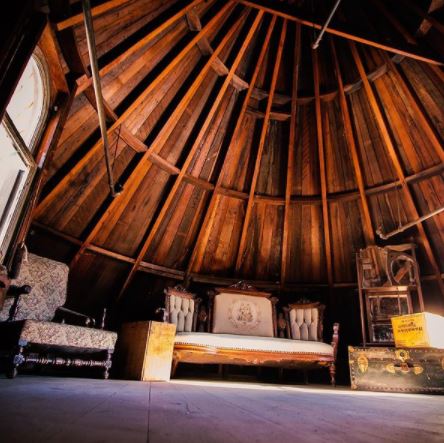
Adam Worth had also been at the séance that evening and did not seem to care for the tea. Ludwig promised to write Mrs. Winchester to let her know he was safe. The sun had gone down, and there was a long line of crimson yonder in the west above the edge of the estate. All the guest prepared to leave and Mrs. Winchester retired to her chambers for the evening. While laying in bed, Mrs. Winchester heard a bang on a door with a sounding slap. She figured it was just a piece of stupid discourtesy and went back to sleep. The following morning, she swore that one of the rooms on the second floor was not empty—and was quite upset about it—said there was some infernal influence at work in her home. To satisfy her curiosity, she asked her butler Henry to open the door. The light was dim in the room and Mrs. Winchester paused in the corridor outside. His eyes glistened. His features relaxed, and he gave a short sigh, “the room is empty,” said Henry. With some stir of curiosity, Mrs. Winchester slipped out, but had a certain vague wonder in her mind. As she heard, the medium from the night before in the parlour was struggling on the floor, in what looked like an epileptic fit. Mrs. Winchester walked deliberately back to the closed door, as Henry went to hold the medium from doing any injury to herself. Huddled against the massive end wall, and half embedded in it, as it seemed, there lay a shadow. Looking closely, Mrs. Winchester saw that the trap door was not only firmly bolted, but screwed into its socket. She strode off in a fume. She was in an odd frame of mind, and for long moved her sitting-room to and fro, too restless to go to bed, or, as an alternative, to settle down to a book. #RandolphHarris 4 of 16

She could not whistle her mind from the chase of a certain graveyard will-o’-wisp; and on it went stumbling and floundering through bog and mire, until she fell into a state of collapse, and was useful for nothing else. She went to bed and to sleep without difficulty, but was conscious of herself all the time, and of a shadowless horror that seemed to come stealthily out of the corners and to bend over and look at her, and nothing but a curtain or a hanging coat when she started and stared. Over and over again this happened, and Mrs. Winchester’s temperature rose by leaps, and suddenly she saw that is she failed to assert herself, and promptly, fever would leap her in a consuming fire. Then in a moment she broke into a profuse perspiration, and sank exhausted into delicious unconsciousness. Morning found her restored to vigour, but still the with flutter of curiosity in her brain. It worked there all day, and for many subsequent days, and at last it seemed as if her every faculty were honeycombed with its ramifications. Then “this will not do,” Mrs. Winchester thought, but still the tunnelling process went on. As the curious devil mastered her, she grew into such harmony with it that she could shut her eyes no longer to the true purpose of its insistence. It was the closed room about which her thoughts hovered like crows circling round carrion. In the dead waste and middle of a certain night, Mrs. Winchester awoke with a strange, quick recovery of consciousness. There was the passing of a single expiration, and she had been asleep and was awake. She had gone to bed with no sense of premonition or of resolve in a particular direction; she sat up a monomaniac. It was as if, swelling in the silent hours, the tumour of curiosity had come to a head, and in a moment, it was necessary to operate upon it. #RandolphHarris 5 of 16

She made no excuse for her then condition. Mrs. Winchester was convinced she was the victim of some undistinguishable force, that she was an agent under the control of the supernatural. Some thought had been in her mind of late in her position it was her duty to unriddle the mystery of the closed room door. However, time went by. The new year came, and still there was no letter from Ludwig Leichhardt. However, early in January, Henry, the butler came home from the Bank of Italy one afternoon, and told Mrs. Winchester she need not worry herself about her old friend any longer. “Ludwig Leichhardt is safe enough, mistress,” he said. “I was talking to Gilbert, the cashier at the Bank of Italy, this morning, and he told me that Leichhardt wrote to them for $2,000.00 last October from San Francisco, and he has written $1,000.00 more since. He is buying land somewhere—I forget the name of the place—and he’s well and hearty, Gilbert tells me.” However, a sense of fear and constriction was upon Mrs. Winchester. “Well, I’m afraid I’m rather fanciful, Henry; but I could never explain to you what a strange feeling came over me the night Ludwig Leichhardt went away from this estate. It was after I had said goodbye to him, and he had gone back into the mansion, where all was dark and quiet. I sat in the parlour thinking of him, and it seemed as if a voice was saying in my ear that I, nor anyone that care for hum, would ever seen Ludwig Leichhardt again. There wasn’t any such voice of course, you know, Henry, but it seemed like that in my mind; and whenever I’ve thought of poor Ludwig Leichhardt since that time, it has seemed to me like thinking of the dead. Often and often I’ve said to myself, ‘Why, Sarah, you silly thing, you ought to know that he’s safe enough in San Francisco. Ill news travels fast; and if there’d be anything wrong, we should have heard of it somehow.’ But, reason with myself as I would, I have never been able to feel comfortable about him; and thank God for your good news, Henry, and thank you for bring it to me. #RandolphHarris 6 of 16

It has been very unkind of Ludwig not to write. She could not forgive him for his neglect, glad as she was to know he was safe. Then Mrs. Winchester paused for a moment, and confessed, the quick pant of fear seemed to come from her lips. There were sounds about her—the deep breathing of an imprisoned man. She returned to the locked door, and hurriedly flung it open. An acrid whiff of dust assailed her nostrils as she stepped back a pace and stood expectant of anything—or nothing. What did she wish, or dread, or foresee? The room was rather a large one; an old-fashioned room, with a low ceiling crossed by heavy means; half parlour, half kitchen, with a wide-open fireplace at one end, on which the logs had burnt to a dullish red. There was the old chintz-covered armchair. Mrs. Winchester had been sitting with her face towards the open window, looking absently out at the garden, where daffodils and early primroses glimmered through the dusk. She stood to pick up her blueprints, which had fallen to the ground. She was standing folding this in a leisurely way, when she looked towards the fireplace, and gave a little start at seeing that the armchair was no longer empty. “Why, Henry,” she cried, “how quietly you must have come into the place! I never heard you.” There was no answer, and her voice sounded strange to her in the empty room. “Henry!” she repeated, a little louder; but the figure in the chair neither answered nor stirred. Then a sudden fright seized her, and she knew that it was not her butler. The room was almost dark; it was quite impossible that she could see the face of that dark figure seated in the armchair, with the shoulders bent a little over. Yet she knew, as well as ever she had known anything in her life, that it was not the butler Henry. #RandolphHarris 7 of 16

She went slowly towards the fireplace, and stood within a few paces of that strange figure. A little flash of light shot up from the candle, and shone for an instant on the face. It was Ludwig Leichhardt! Mrs. Winchester tried to speak to him; but the words would not come. And yet it was hardly so appalling a thing to see him there that she need have felt what she did. San Francisco was not too far from San Jose that a man may not cross the Bay and drop in upon his friend unexpectedly. The candle’s flame got bigger, lighting up the entire room. The chair was empty. Mrs. Winchester uttered a loud cry, and Henry entered the room. “Why, Mrs. Winchester! What’s amiss?” he said. She ran to him, sobbing hysterically, and then calming herself with an effort, told him how she had seen Ludwig’s ghost. “Why Mrs. Winchester,” Henry replied. “Ludwig Leichhardt is safe in San Francisco. It was a shadow that took the shape of your old friend, to your fancy. It’s easy enough to fancy such a thing when your mind’s full of anyone.” Ill and shaken, yet fearing death as she had never dreaded it before, Mrs. Winchester said, “It was no fancy. Ludwig Leichhardt is dead, and I have seen his ghost. I’ve a feeling that he never got to San Francisco alive, Henry,” she said. “I can’t explain how it is, but I’ve a feeling that it was so.” Mrs. Winchester spent the rest of that horrible night huddled between her crumpled sheets, fearing to look forth, fearing to think. She knew the letters had been forgeries, and could not forget the madness and the terror in learning to walk the unvext paths of placid souls. She was left with nothing but an aimless scurrying terror and the black swarm of thoughts, so that she verily fancied her reason would give under the strain. Yet she had more to endure and to triumph over. Near morning she fell into a troubled sleep, throughout which the drawn twitch of muscle seemed an accent on every word of ill-omen she had ever spelt out of the alphabet of fear. If her body rested, her brain was an open chamber for any toad of ugliness that listed to “sit at squat” in. #RandolphHarris 8 of 16

Mrs. Winchester tried to convince herself that the thing she had seen was only a trick of her imagination. Another month went by, and again in the twilight the same figure appeared to her. It was standing this time, with one arm leaning on the high mantlepiece; standing facing her as she came back to the room, after having quitted it for a few minutes for some slight household duty. There was a fire burning in the fireplace. The logs were burning with a steady blaze that lit up the well-known figure and unforgotten face. Ludwig Leichardt was looking at her with an expression that seemed half reproachful, half beseeching. He was very pale, much paler than she had ever seen him in life; and as he looked, she standing just within the threshold of the door, she saw him lift his hand slowly and point to his forehead. The firelight showed her a dark red stain upon the left temple, like the mark of a contused wound. She covered her face with her hands, shuddering and uttering a little cry of terror, and then dropped half fainting upon a chair. When she uncovered her face the room was empty, there was a pool of blood on the floor, and the firelight shining cheerily upon the walls, no trace of that ghostly visitant. This time Mrs. Winchester brooded over the thoughts of the thing she had seen, firmly believing that she had looked upon the shadow of the dead, and that there was some purpose to be fulfilled by that awful vision. In the day, she had the room boarded up. The thought of this was almost always in her mind; in the dead silence of the night, she would often lie awake for hours thinking of Ludwig Leichhardt. Mrs. Winchester knew he had been waylaid and murdered. He had a good deal of money about him. Suddenly Mrs. Winchester woke to the fact that there was a knocking at her door—that there had been for some little time. She cried, “Come in!” finding a weak restorative in the mere sound of her own human voice; then remember the keys was turned, bade the visitor wait until she could come to him. #RandolphHarris 9 of 16

Scrambling, feeling dazed and white-livered, out of bed, Mrs. Winchester opened the door, and met one of the gentlemen on the threshold. The man looked scared, and his lips, she noticed, were set in a somewhat boding fashion. “Come you come at once, Mrs. Winchester?” he said, “There’s summat wrong with Ludwig Leichhardt. She had now a settled conviction that some untimely fate had befallen her old friend, and that the letters from San Francisco were forgeries. Gilbert from the Bank of Italy compared the signature cards and determined that the drafts and letters were forgeries. There was one thing noticeable in the San Francisco letters—they were all exactly alike, line for line, curve for curve. This rather discomposed Gilbert; for it is a notorious fact that a man rarely signs his name twice in exactly the same manner. There is almost always some difference. Before the month was out, Ludwig Leichhardt’s ghost appeared for the third time to Mrs. Winchester. In the Tender June twilight. She was thinking of her old friend as she walked along the shadowy winding path of the deer park on her estate. It was just such a still, peaceful evening as that upon which he had stood on the edge of the common looking back at her, and waving his hand, upon that last well remembered night. He was so much in her thoughts, and the conviction that he had come from among the dead to visit her was so rooted in her mind, that she was scarcely surprised when she looked up presently, and saw a tall familiar figure moving slowly among the trees a little way before her. There seemed to be an awful stillness in the wood all at once, but there was nothing awful in that well-known figure. She tried to overtake it; but it kept always in advance of her, and at a sudden turn in the path she lost it altogether. The trees grew thicker, and there was a solemn darkness at the spot where the path took this sharp turn, and on one side of the narrow footpath there was a steep declivity and a great hollow, made by a disused gravel pit. #RandolphHarris 10 of 16

She went to her mansion quickly enough, with a subdued sadness upon her, and told Henry what had happened to her. Nor did she rest until there had been a search made on the extensive grounds for the body of Ludwig Leichhardt. They searched and found him lying at the bottom of the gravel pit, half buried in loose sand and gravel, and quite hidden by a mass of furze and bramble that grew over the spot. There was an inquest, of course. The tailor who had made the clothes found upon the body identified them, and swore to them as those he had made for Ludwig Leichhardt. The pocket were all empty and turned inside out. There could be little doubt the Ludwig Leichhardt had been waylaid and murdered for the sake of the money he carried upon him that night. His skull had been shattered by a blow from a jagged stick on the left temple. The stick was found laying at the bottom of the pit a little way from the body, with human hair and stains of blood upon it. Ludwig Leichhardt had never left San Jose. It was later determined that Adam Worth had killed Ludwig Leichhardt and took his money. The Bank of Italy refunded the withdraws. Adam Worth was ultimately apprehended, with some of Ludwig Leichhardt’s property still in his possession, and he was deeply in debt. The final examination resulted in a verdict of willful murder, tried, found guilty and hung. Ludwig Leichhardt had executed a few days before his intended departure, bequeathing all he possessed to Sarah Winchester—the interest for her sole use and benefit, the principal to revert to her estate after her death. Mrs. Winchester often sits beside that quiet resting place in the spring twilight; but she had never seen Ludwig Leichhardt’s ghost since that evening in the deer park, and she knew she never would see it again. She shook with an awful thankfulness at sight of the pitfalls she had skirted and escaped—of the demon she witlessly had baffled. The joy of life was in her heart again, but chastened and made pitiful by experience. #RandolphHarris 11 of 16

You are aware that evil spirit beings operating through humans in positions of authority and influence are the real motivators in human society? Yes, this is exactly what the Christian Bible teaches! Perhaps this concept seems strange to you, almost like an outmoded superstition, but the Bible definitely states that Satan in the “god of this age,” reports 2 Corinthians 4.4, and that he is the leader of a well-organized army of beings invisible to humans but very active among them. Paul tells us in Ephesians, “For we wrestle not against flesh and blood, but against principalities, against powers, against the rulers of the darkness of this World, against spiritual wickedness in high places,” reports Ephesians 6.12. These words indicate that evil spirits are organized into a military-like structure. The “principalities” are the highest ranking officers under Satan, the “powers” are officials of somewhat lower standing, and the “rulers of the darkness of this World” seem to be a special band of evil spirits whose sphere of influence includes the leaders of human government. The phrase “spiritual wickedness is high places” is better translated “spiritual hosts of wickedness in the Heavenly places,” and makes reference to the myriads of demonic hordes. They are all under the direction of Satan, who is not only named the “god of this age,” but also is called “the prince of the power of the air,” reports Ephesians 2.2. The Scriptures often speak of a close relationship between these evil spiritual and the “World.” In the Ephesians passage quoted above, you will remember that these spirit beings are called “the rulers of the darkness of this World.” The apostle John also refers to the World, and it is significant that he considers it to be the Christian’s enemy. “Love not the World, neither the things that are in the World. If any human love the World, the love of the Father is not in one. For all that is in the World, the lust of the flesh, and the lust of the eyes, and the pride of life, is not of the Farther, but is of the World. And the World passeth away, and the lust of it; but one that doeth the will of God abideth forever,” reports 1 John 2.15-17. #RandolphHarris 12 of 16

In addition, the same apostle declared that one who is “born of God overcometh the World,” reports 1 John 5.4, and also that “the whole World lieth in wickedness,” reports 1 John 5.19. James, the brother of Jesus, declared in his epistle, “Whosoever therefore, will be a friend of the World, is the enemy of God,” reports James 4.4. Before we can gain a full understanding of what this means, we must answer the following questions: What is this World, which if loved causes us to lose God’s friendship? What does the Bible mean when it says that the whole World “lieth in wickedness”? Certainly the Bible is not saying that Christians should not love the World of nature, nor is it implying that every person who is not a Christian is an enemy to be overcome. In fact, the Scriptures often state that the glory of God is revealed in the natural World, and it specifically instructs believers not to antagonize other people, but to love them. No, the material Universe in which we live is not opposed to us, and we are not to consider the people who inhabit the Earth as our enemies. The “World” referred to by John and James is the moral and spiritual system we call human society. Humankind, which has rejected God’s revelation, has devised explanations of life, moral standards, and principles of conduct based upon human knowledge only. Humans, on the whole, operate on erroneous principles, selfish desires, improper motives, and unworthy standards of value. The sciences, the arts, politics, and entertainment are all dominated by a humanistic approach to life which draws humans away from God and makes humans the “measure of all things.” If the period of treated of in the essay from the commencement of the seventeenth century to the Restoration of Charles II, be barren of witchcraft proper, it must at least be admitted that it is prodigal in regard to the marvellous under various shapes and forms, from which the hysterical state of the public mind can be fairly accurately gauged. #RandolphHarris 13 of 16

The rebellion of 1641, and the Cromwellian confiscations, that troubled periods when the county was torn by dissention, and ravaged by fire, sword, and pestilence, was aptly ushered in by a series of supernatural events which occurred in the country Limerick. A letter dated the 13th August 1640, states that “for news we have the strangest that ever was heard of, there inchantments in the Lord of Castleconnell’s Castle four miles from Lymerick, several sorts of noyse, sometymes of drums and trumpets, sometimes of other curious musique with Heavenly vouces, then fearful screeches, and such outcries that the neighbours near cannot sleepe. Priests have adventured to be there, but have been cruelly beaten for their paynes, and carryed away they knew not how, some two miles and some four miles. Moreover were seen in the like manner, after they appear to the view of the neighbours, infinite number of armed men on foote as well as on horseback. One thing more [id est something supernatural] by Mrs. Mary Burke with tweleve servants lyes in the hose, and never one hurt, onley they must dance with them every night; they say, Mrs. Mary come away, telling her she must be wife to the inchanted Earl of Desmond. Uppon a Mannour of my Lord Bishoppe of Lymerick, Loughill, hath been seen upon the hill by most of the inhabitants aboundance of armed men marching, and these seene many tymes—and when they come up to them they do not appear. These things are very strange, if the cleargie and gentrie say true.” During the rebellion an appalling massacre of Protestants took place at Portadown, when about a hundred persons, men, women, and children, were forced over the bridge into the river, and so drowned; the few that could swim, and so managed to reach the shore, were either knocked on the head by the insurgents when they landed, or else were shit. #RandolphHarris 14 of 16

It is not a matter of surprise that this terrible incident gave rise to legends and stories in which anything strange or out of the common was magnified out of all proportion. Accord to one deponent there appeared one evening in the river “a vision or spirit assuming the shape of a woman, waist high, upright in the water, naked with [illegible] in her hand, her hair dishevelled, her eyes seeming to twinkle in her head, and her skin as white as snow; which spirit seeming to stand upright in the water often repeated the word Revenge! Revenge! Revenge! Also, Robert Maxwell, Archdeacon of Down, swore that the rebels declared to him, (and some deponents made similar statements) “that most of those that were thrown from the bridge were daily and nightly seen to walk upon the River, sometimes singing Psalms, sometimes brandishing of Swords, sometimes screeching in a most hideous and fearful manner.” Both these occurrences are capable of a rational explanation. The supposed spectre was probably a poor, bereaved woman, demented by grief and terror, who stile out of her hiding-place at night to bewail the murder of her friends, while the weird cries arose from the half-starved dogs of the country-side, together with the wolves which abounded in Ireland at that period, quarrelling and fighting over the corpses. Granting the above, and bearing in mind the credulity of all classes of Society, it is not difficult to see how the tales originated; but to say that, because such obviously impossible statements occur in certain despsitions, the latter are therefore worthless as a whole, is to willfully misunderstand the popular mind of the seventeenth century. We have the following on the testimony of the Rev. George Creighton, minister of Virginia, Co. Cavan. He tells us that “drivers women brought to his House a young woman, almost naked, to whom a Rogue came upon the way, these women being present, and required her to give him her mony, or else he would kill her, and so drew his sword; her answer was, You cannot kill me unless God gives you leave, and His will be done. #RandolphHarris 15 of 16

“Thereupon the Rogue thrust three times at her naked body with his drawn sword, and never pierced her skin; whereat he being, as it seems, much confounded, went away and left her.” A like story comes from the other side: “At the taking of the Newry a revel being appointed to be shot upon the bridge, and stripped stark-naked, nothing withstanding the musketeer stood within two yards of him, and shot him in the middle of the back, yet the bullet entered not, nor did him any more hurt than leave a little black spot behind it. This many hundreds were eye-witnesses of. Divers of the like have I confidently been assured of, who have been provided of diabolical charms.” Similar tales of persons bearing charmed lives could not doubt be culled from the records of every way that has been fought on this planet of ours since History began. The ease with which the accidental or unusual was transformed into the miraculous at this period is shown by the following. A Dr. Tate and his wife and children were flying to Dublin from the insurgents. On their way they were wandering over commons covered with snow, without any food. The wife was carrying a sucking child, John, and having no milk to give it she was about to lay it down in despair, when suddenly “on the Brow of a Bank she found a Suck-bottle with sweet milk in it, no Footsteps appearing in the snow of any that should bring it thither, and far from any Habitation; which preserved the child’s life, who after became a Blessing to the Church.” The Dr. Tate mentioned above was evidently the Rev. Faithful Tate, D.D., father of Nahum Tate of “Tate and Brady” fame. Much of what has passed current in the New World as White (id est, permissible) Magic is only a disguised goeticism, and may of the resplendent angels invoke with the divine rites reveal their cloven hoofs. It is not too much to say that a large majority of past psychological experiments were conducted to establish communication with demons, and that for unlawful purposes. The popular conceptions concerning the diabolical spheres, which have been all accredited by magic, may have been gross exaggerations of fact concerning rudimentary and perverse intelligences, but the willful viciousness of the communicants is substantially untouched thereby. #RandolphHarris 16 of 16


Happy Early Turkey Day! 🦃

The Winchester Mystery House will be closed on Thursday, Nov. 25 in observance of the Thanksgiving holiday and will reopen on Friday, Nov. 26! winchestermysteryhouse.com

When Asked His Name He Said “Legion” Because Many Demons Were Entered into Him!

It is easy to imagine how the combined grief of losing both a child and a spouse could be very crippling. However, if you have $20,000,000 (2021 inflation adjusted $347,910,691.82), and all the time in the World to help you cope, what would you do? Mrs. Sarah L. Winchester’s response to the deaths of her child and husband left a bizarre and impressive architectural reflection of her soul. After a series of violent confrontations, the Winchester Repeating Arms Company hires a private investigator to follow her. Mrs. Winchester ascends into mystery and it is soon clear that she is hiding a much bigger secret—one that is both inexplicable and shocking. A “possessed” person may have symptoms much like those that are apparent in the mentally ill. One may be deeply melancholic or depressed, appear to be withdrawn from reality, or may manifest emotions that range from ecstatic joy to violent screaming or wild ferocity. These various states may present themselves from time to time during “attacks.” Demon possession may be distinguished from insanity, however, by observing the manner in which the afflicted person speaks. An insane individual may have a mistaken concept of one’s own identity, wear clothing by which one attempts to look like the person one thinks oneself to be, but speak in one’s own voice, and in such a manner that one can tell one is doing only a superficial impersonation of the individual one thinks oneself to be. A demon-possessed person, on the other hand, is obviously controlled by the indwelling evil spirit. The wicked being may use a language or dialect the individual never knew, and sometimes will name oneself. Therefore, one should carefully note the symptoms of a disturbed person, never making the diagnosis of demon possession on the basis of a superficial judgment. #RandolphHarris 1 of 16

If a believer should meet a demon-possessed individual, one would be unwise to make a frontal attack upon the powers of darkness by immediately issuing a command in the name of the Lord Jesus Christ. Dr. Kurt Koch, an evangelical Christian who has made a lifetime study of Satan and occultic activities, declares that whenever Christians lightly engage in an effort to cast out demons, they run the risk of being attacked by evil spirits. Such people often suffer deep spiritual depression and find themselves in an attitude of complete hopelessness. Since this is true, a believer should band together with others in a time of prayer, and no efforts should be made to expel the evil spirits until the Holy Spirit prompts someone to issue the command. Unbelievers and adherents of the non-Christian religions apparently can command evil spirits without suffering bad consequences. Archeologists have found manuscripts containing incantations and magical formulas for the expulsion of demons; and today in the Philippines and other countries of the far East, as well as in some areas of South America and Africa, pagan religious leaders seriously perform rituals to ward off or cast out evil spirits. Sometimes they beat the person who is demon-possessed, prick one with needles, or even burn portions of one’s body, thinking that this pain will drive out the evil spirits. The Jewish people in Christ’s day also used spells, magical phrases, and religious rituals to expel demons. That they sometimes appeared to be successful is clear, for Jesus said, “if I, by Beelzebub, cast out demons, by whom do your sons cast them out? Therefore, they shall be your judges,” reports Matthew 12.27. #RandolphHarris 2 of 16

In this statement the Lord Jesus Christ acknowledged that evil spirits sometimes left the bodies of their victims when incantations, spells, or magical rites were used by Jewish religious leaders. However, Christ did not say these men accomplished their goal by the power of God, nor did He imply that they were actually doing damage to the cause of Satan. He was answering the charge that He was casting out demons in the power of Beelzebub, the prince of demons. He declared that is such were the case, the kingdom of Satan would be divided against itself. Actually, the exorcists, whether Jewish or pagan, did not really possess authority over the invisible World, but the evil spirits merely cooperated with them, leaving the bodies of some of their victims to give the appearance that they had been forced out. By working with these unbelieving sorcerers, the devil aided his own cause. The demons either temporarily left the person, only to return a short time later, or entered the body of some other victim. No one should attempt to deal with the forces of evil by using the name of Jesus unless one is a child of God. Luke, in Acts 19, graphically portrays the seriousness of hypocritically dealing with the powers of darkness. Seven sons of Sceva, a professional exorcist who had no personal faith in Christ, tried to combine the words “in the name of Jesus” with their magical formula. The evil spirits, recognizing that these impostors had no right to use Jesus’s name, reacted in a violent manner. The demon-possessed individual attacked these men with superhuman strengths, so that with torn clothing and bleeding bodies they fled from the Winchester mansion. The frequency of demon possession—the record of history establishes without a doubt that demon possession was known before the Lord Jesus Christ came to Earth, and the testimony of missionaries indicates that it has continued down through the centuries. #RandolphHarris 3 of 16

The public ministry of Christ, however, was accompanied by an outburst of demon possession unparalleled in history. It seems that Satan threw all his power into his battle with Jesus Christ. True, the devil is not omniscient, but he knew that Christ had come to earth to atone for sin, conquer death, and bring about the defeat of evil. John tells us that “the Son of God was manifested, that he might destroy the works of the devil,” reports 1 John 3.8. Satan used every device at his disposal to frustrate the purpose of God in Christ. Subtle temptations, the wrath and wickedness of men, and a rash of demonic activity were part of his vain effort to prevent Jesus from performing the work He had come to accomplish. Demon possession gradually subsided during the first century A.D., and usually is not conspicuous in areas where a fairly large percentage of people have placed their faith in Jesus Christ. It appears that demons are hesitant to enter the bodies of people when informed believers are likely to cast them out in the name of Christ. Luke is the same one that is translated “bottomless pit” seven times in the book of the Revelation. We read, “And Jesus asked him, saying, ‘What is thy name?’ And he said, ‘Legion’; because many demons were entered into him. And they besought him that he would not command them to go out into the deep. And there was there and herd of many swine, feeding on the mountain; and they besought him that he would allow them to enter into them. And he permitted them,” reports Luke 8.30-32. Revelation 9 tells us that at some future time the “bottomless pit” will be opened, and a great army of evil spirits will be set free to plague humankind. #RandolphHarris 4 of 16

It is at least a possibility that whenever demons are cast out of a human being in the name of Jesus Christ, they are sent to the bottomless pit, and will not be released until shortly before Christ returns to establish His kingdom. The realization that they will lose their freedom as members of the army of the “prince of the power of the air,” and be confined in the pit for an indefinite period of time, makes them hesitant to take possession of human beings. The risk is too great in an area where Christians exercise their authority in the name of Christ. People who live in civilized countries where the Gospel has been known for centuries should not rule out the possibility of demon possession, however, just because it has not been a common occurrence in these areas. Satan and his cohorts may conclude that most people, even professing Christians, will not recognize this phenomenon when they meet it. Therefore, as this age draws to a close, Satan may once again become very active in entering human bodies and controlling personalities. He will hope that the majority of humankind will either be deceived into following him or find a naturalistic explanation for the activities of the demons. This supernatural manifestation of the power of Satan and evil spirits is clearly predicted by the apostle Paul. In his second letter to the Thessalonian believers, he declares that just before Christ returns in glory, the devil will have his righthand mand upon the earth performing miracles which make him appear to be a god. Referring to the Antichrists, the apostle says, “Even him whose coming is after the working of Satan with all power and signs and lying wonders, and with all deceivableness of unrighteousness in them that perish, because they received not the love of the truth, that they might be saved,” reports 2 Thessalonian 2.9, 10. #RandolphHarris 5 of 16

Inasmuch as we can expect an increase of open opposition to God on the part of the Satanic hordes, we know Christ should humbly maintain fellowship with Him through full submission and ready obedience so that we may receive from Him the strength we need to overcome. James writes, “God resisteth the proud, but giveth grace unto the humble. Submit yourselves, therefore, to God. Resist the devil, and he will flee from you,” reports James 4.6-7. Peter declares, “Be sober, be vigilant, because your adversary the devil, like a roaring lion walketh about, seeking whom he may devour; whom resist steadfast in the faith, knowing that the same afflictions are accomplished in your brethren that are in the World,” reports 1 Peter 5.8-9. No, Satan is not dead. He is like a wounded animal and still has great power to harm those who care careless or proud. Therefore, keep awake, be on alert, read the Christian Bible and the Book of Mormon, and pray! If you do not, he may destroy your effectiveness as a Christian. For the next instance of witchcraft and the supernatural in connection with Ireland, we are compelled to go beyond the confines of our own country. Though in this connection with the Green Isle is slight, yet it is of interest as affording an example of that blending of fairy lore with sorcery which is not an uncommon feature of Scottish witchcraft-trials. In the year 1613 a woman named Margaret Barclay, of Irvine in Scotland, was accused of having her brother-in-law’s ship to be cast away by magical spell. A certain strolling vagabond and juggler, John Stewart, was apprehended as her accomplice; he admitted (probably under torture) that Margaret had applied to him to teach her some magic arts in others that “she might get gear, kye’s milk, love of man, her heart’s desire on such persons as had done her wrong.” #RandolphHarris 6 of 16

Through John Stewart does not appear to have granted Margaret’s request, yet he gave detailed information as to the manner in which he had gained the supernatural power and knowledge with which he was credited. “It being demanded of him by what means he profession himself to have knowledge of things to come, the said John confessed that the space of twenty-six years ago, he being travelling on All-Hallow Even night between the towns of Monygoif and Clary, in Galway, he met with the King of the Fairies and his company, and that the King gave him a stroke with a white rod over the forehead, which took from him the power of speech and the use of one eye, which he wanted for the space of three years. He declared that the use of speech and eyesight was restored to him by the King of Fairies and his company on a Hallowe’en night at the town of Dublin.” At his subsequent meeting with the fairy band, he was taught all his knowledge. The spot on which he was struck remained impervious to pain although a pin was thrust into it. The unfortunate wretch was cast into prison, and there committed suicide by hanging himself from the “cruik” of the door with his garter or bonnet-string, and so “ended his life miserably with the help of the devil his master.” A tale slightly resembling portion of the above comes from the north of Ireland a few years later. “It is storied, and the story is true,” says Robert Law in his Memorialls, “of a godly man in Ireland, who lying one day in the fields sleeping, he was struck with dumbness and deafness. The same man, during this condition he was in, could tell things, and had the knowledge of things in a strange way, which he had not before; and did, indeed, by signs make things known to others which they knew not. Afterwards he at length, prayer being made from him by others, came to the use of his tongue and ears; but when that knowledge of things he had in his deaf and dumb condition ceased, and when he was asked how he had the knowledge of these things he made signs of, he answered he had that knowledge when dumb, but how and after what manner he knew not, only he had the impression thereof in his spirit. This story was related by a godly minister, Mr. Robert Blair, to Mr. John Baird, who knew the truth of it.” #RandolphHarris 7 of 16

The Rev. Robert Blair, M.A., was a celebrated man, if for no other reason than on account of his disputes with Dr. Echlin, Bishop of Down, or for his description of Oliver Cromwell as a greeting (id est, weeping) devil. On the invitation of Lord Claneboy he arrived in Ireland in 1623, and in the same year was settled as (Presbyterian) parish minister at Bangor in Co. Down, with the consent of patron and people’ he remained there until 1631, when he was suspended by Dr. Echlin, and was deposed and excommunicated in November, 1634. He has left a few writings behind him, and was grandfather of the poet Robert Blair, author of The Grave. During the years of his ministry at Bangor the following incident occurred to him, which he of course attributes to demonic possession, through homicidal mania resulting from intemperate habits would be nearer the truth. One day a rich man, the constable of the perish, called upon him in company with one of his tenants concerning the baptizing of the latter’s child. “When I had spoken what I thought necessary, and was ready to turn into my house, the constable dismissing the other told me he had something to say to me in private. I looking upon him saw his eyes like the eyes of a cat in the night, did presently conceive that he had a mischief in his heart, yet I resolved not to refuse what he desired, but I keeped a watchful eye upon him, and stayed at some distance; and being near to the door of the church I went in, and invited him to follow me. As soon as he entered within the doors he fell atrembling, and I awondering. His trembling continuing and growing without any speech, I approached to him, and invited him to a seat, wherein he could hardly sit. The great trembling was like to throw him out of the seat. I laid my arm about him, and asked him what ailed him? But for a time, he could speak none. #RandolphHarris 8 of 16

“At last his shaking ceased, and he began to speak, telling me, that for a long time the Devil had appeared to him; first at Glasgow he bought a horse from him, receiving a sixpence in earnest, and that in the end he offered to him a great purse full of sylver to be his, making no mention of the horse; he said that he blessed himself, and so the buyer with the sylver and gold that was poured out upon the table vanished. But some days thereafter he appeared to him at his own house, naming him by his name, and said to him, Ye are mine, for I arled you with a sixpence, which yet ye have. Then said he, I asked his name, and he answered, they call me Nickel Downus (I suppose the he repeated evil, that he should have said Nihil Damus). Being thus molested with these and many other apparitions of the Devil, he left Scotland; but being come to Ireland he did often likewise appear to him, and now of late he still commands me to kill and slay; and oftentimes, says he, my whinger hath been drawn and kept under my cloak to obey his commands, but still something holds my hand that I cannot stroke. But then I asked him who he was bidden kill? He answered, any that comes in my way; but ‘The better they be the better service to me, or else I shall kill thee.’ When he uttered these words he fell again atrembling, and was stopped in his speaking, looking lamentably at me, designing me to be the person he aimed at; then he fell a crying and lamenting. I showed him the horribleness of his ignorance and drunkenness; he made many promises of reformation, which were not well keep’d; for within a fortnight he went to an alehouse to crave the price of his malt, and sitting there long at drink, as he was going homeward the Devil appeared to him, and challenged him for opening to me what had passed betwixt them secretly, and followed him to the house, pulling his cap off his head and his band from about his neck, saying to him, ‘On Hallow-night I shall have thee, soul and body, in despite of the minister and of all that he will do for thee.’” #RandolphHarris 9 of 16

In his choice of a date his Satanic Majesty showed his respect for popular superstitions. This attack of delirium tremens (though Mr. Blair would not have so explained it) had a most salutary effect; the constable was in such an abject state of terror lest the Devil should carry him off that he begged Mr. Blair to sit up with him all Hallow-night, which he did, spending the time very profitably in prayer and exhortation, which encouraged the man to defy Satan and all his works. The upshot of the matter was, that he became very charitable to the poor, and seems to have entirely renounced his intemperate habits. Rejecting the supernatural elements in the above as being merely the fruits of a diseased mind, there is no reason to doubt the truth of the story. Mr. Blair also met with some strange cases of religious hysteria, which became manifest in outbursts of weeping and bodily convulsions, but which he attributed to the Devil’s “playing the ape, and counterfeiting the works of the Lord.” He states that one Sunday, in the midst of public worship, “one of my charge, being a dull and ignorant person, made a noise and stretching of her body. Incontinent I was assisted to rebuke that lying spirit that disturbed the worship of God, charging the same not to disturb the congregation; and through God’s mercy we met with no more of that work.” Thus modestly our writer sets down what happened in his Autobiography; but the account of the incident spread far and wide, and at length came to the ears of Archbishop Usher, who, on his next meeting with Mr. Blair, warmly congratulated him on the successful exorcism he had practised.” Spirits of a diabolical and infernal nature, are not only ready upon all occasions to become subservient to exorcists and magicians, but are ever watching opportunities of exciting evil affections in the mind, and of stirring up the wickedly inclined to the commission of every species of iniquity and vice. #RandolphHarris 10 of 16

Thus by the instigation of infernal spirits, and their own promptitude, they often terrify humans with nocturnal visions; provoke melancholy people to suicide; tempt drunkards and incendiaries to set houses on fire, to burn those who are in them, and allure careless servants and others to sound and incautious sleep; that such unlucky accidents might happen besides innumerable other ways they have of executing the devices of iniquitous spirits through malicious instigations, or secret stratagems, projected for the overthrow and destruction of mortal men; especially when the work to be effected by the devil is too hard for his subtle and spiritual nature to effect, because the same belongs to the outward source or principle to which these dubious spirits more immediately belong. A few nights into Christmas, there was a festival for which the Winchester mansion was making extensive preparations. The narrow streets which had been thronged with people were now almost deserted. In the comfortable coffee-room of the Winchester mansion, Mrs. Winchester had half a dozen guests, principally commercial travellers, sat talking by light of the fire. The talk had drifted from trade to politics, from politics to religion, and so by easy stages to the supernatural. In the flicker of the light of the fire, as it shone on the glasses and danced with shadows on the walls, the conversation proved so enthralling that Henry, the waiter, whose presence had been forgotten, created a very disagreeable sensation by suddenly starting up from a dark corner and gliding silently from the room. Mrs. Winchester then said, “Of course, it is an old idea that spirits like to get into the company of human beings. A man told me once that he travelled down the Great Western with a ghost and had not the slightest suspicion of it until the inspector came for tickets. My friend said they way that ghost tried to keep up appearances by feeling for it in all its pockets and looking on the floor was quite touching. Ultimately it gave it up and with a faint groan vanished through the ventilator.” #RandolphHarris 11 of 16

“That’ll do, Mrs. Winchester,” said Ludwig Leichhardt. “It is not a subject for jesting,” said Adam Worth,” who had been an attentive listener. “I’ve never seen an apparition myself, but I know people who have, and I consider that they form a very interesting link between us and the after-life. There’s a ghost story connected with this mansion, you know.” “Never heard of it,” said Edward Agar, “and I have visiting this estate for some years now.” “It dates back a long time,” said Ludwig. “You’ve heard about John V. Creely also know as Jesus Procopio?” “Well, I’ve just ‘eard odds and ends, sir” said the Edward, “but I never put much count to ‘em. There was one chap ‘ere what said ‘e saw it, and the gov’ner sacked ‘im prompt.” “My father was a native of this town,” said Ludwig, “and knew the story well. He was a truthful man and a steady churchgoer, but I’ve heard him declare that once in his life he saw the appearance of Jesus Procopio in this mansion.” “And who was this Jesus?” enquired a voice. “His real name was Tomaso Rodendo, one of the most fearless and daring desperadoes that has ever figures in the criminal annals of our state. Anything he could turn his dishonest hand to,” replied Ludwig; “and he was run to Earth in this mansion one Christmas week some five years ago. He took his last supper in this very room, and after he had gone up to bed a couple of thief takers, who had followed him from San Francisco but lost the scent a bit, went upstairs with Mrs. Winchester and tried the door. It was stout oak, and fast, so one went into the yard, and by means of a short ladder got on the window-sill, while the other stayed outside the door. Those below in the yard saw the man crouching on the sill, and then there was a sudden smash of glass, and with a cry he fell in a heap on the stones at their feet. Then in the moonlight they saw the white face of the pickpocket peeping over the sill, and while some stayed in the yard, others ran into the mansion and helped the other man to break the door in. It was difficult to obtain an entrance even then, for it was barred with heavy furniture, but they got in at last, and the first thing that met their eyes was the body of Jesus dangling from the top of the bed by his own handkerchief.” #RandolphHarris 12 of 16

“Which bedroom was it?” asked two or three voices together. Ludwig shook his head. “That I can’t tell you; but the story goes that Jesus still haunts this mansion, and my father used to declare that the last time he had slept here that the ghost of Jesus Procopio lowered itself from the top of his bed and tried to strangle him.” “That will do” said John Creely. “I wish you’d thought to ask your father which bedroom it was.” “I believe it was my Blue Séance room said,” Mrs. Winchester. “Well, I should take care not to sleep in it, that’s all, said John shortly. “There’s nothing to fear,” said Ludwig. “I don’t believe for a moment that ghosts could really hurt one. In fact my father used to confess that it was only the unpleasantness of the thing that upset him, and that for all practical purposes Jesus’s figures might have been made of cotton-wool for all the hard they could do.” “That’s all very fine,” said John; “a ghost story is a ghost story, sir; but when a gentleman tells a tale of a ghost in the house in which one is going to sleep, I call it most ungentlemanly!” “Pooh! Nonsense!” said Ludwig, rising, “ghosts can’t hurt you. For my own part; I should rather like to see one. Good night.” “Good night,” said Mrs. Winchester and the others. “And I hope that Jesus will pay you a visit,” added John as the door closed.” “Shall I light the gas, Adam?” said Henry. “No; the fires very comfortable,” he said. “Now gentlemen, any of you know any more?” “I think we’ve had enough,” said John; “we shall be thinking we see spirits next, and we’re not all like Ludwig who’s just gone.” Old humbug!” said John. “I should like to put him to the test. Suppose I dress up as Jesus Procopio and go to give him a chance of displaying his courage?” “Bravo!” said Adam huskily, drowning one or two faint “Noes.” “No, drop it, John” said Edward. “Only for the joke,” said John, somewhat eagerly. “I’ve got some things upstairs in which I am going to play in the ‘Rivals’—knee-breeches, buckles, and all that sort of thing. It’s a rare chance. If you’ll wait a bit I’ll give you a full-dress rehearsal, entitled, ‘Jesus Procopio; or, The Nocturnal Strangler.’” #RandolphHarris 13 of 16

“You won’t frighten us,” said Adam, with a husky laugh. “I don’t know that,” said John sharply; “it’s a question of acting that’s all. I’m pretty good, ain’t I, Edward?” “Oh, you’re all right—for an amateur,” said Edward, with a laugh. “I’ll bet you level sov. You don’t frighten me,” said Adam. “Done! said John. I’ll take the bet to frighten you first and Ludwig afterwards. These gentlemen shall be the judges.” “You won’t frighten us, sir,” said Edward “because we’re prepared for you; but you’d better leave Ludwig alone. It’s dangerous play.” “Well, I’ try you first,” said John, springing up. “No gas, mind.” He ran lightly upstairs to his room, leaving the others, most of whom had been drinking somewhat freely, to wrangle about his proceedings. It ended with them going to bed. “He’s crazy on acting,” said Adam, lighting his pipe. “Thinks he’s the equal of anybody almost. It doesn’t matter with us, but I won’t let him go to Ludwig. And he won’t mind so long as he gets an opportunity of acting to us.” “Well, I hope he’ll hurry up,” said Edward, yawning; it’s after twelve now.” Nearly half an hour passed. Edward drew his watch from his pocket and was busy winding it, when Henry, the waiter, who had been sent on an errand, burst suddenly into the room and rushed towards them. “E’s comin’, gentlemen,” he said breathlessly. “Why, you’re frightened, Edward,” said Adam with a chuckle. “It was the suddenness of it,” said Edward sheepishly; “and besides, I didn’t look for seenin’ ‘im in the bar. There’s only a glimmer of light there, and ‘e was sitting on the floor behind the bar. I nearly trod on ‘im.” “He’s taking too long, I’ll go and fetch him,” said Adam. “You don’t know what this mansion is like at night, sir,” said Henry, catching him by the sleeve. “It ain’t fit to look at by yourself, it ain’t, indeed. It’s got the—what’s that?” #RandolphHarris 14 of 16

They all started at the sound of a smothered cry from the staircase and the sound of somebody running hurriedly along the passage. Before anybody could speak, the door flew open and a figure bursting into the room flung itself gasping and shivering upon them. “What is it? What’s the matter?” demanded Edward. “Why, it’s Mr. Creely.” He shook him roughly and then held some spirit to his lips. John Creely drank it greedily with a sharp intake of his breath gripped him by the arm. “Light the gas, Adam,” said Edward. Adam obeyed hastily, John Creely, a ludicrous but pitiable figure in knee-breeches and coat, a large wig all awry, and his face a mess of grease paint, clung to him, trembling. “Now what’s the matter?” asked Edward. “I’ve seen it,” said John, with a hysterical sob. “O Lord, I’ll never play the fool again, never!” “Seen what?” said the others. “Him—it—the ghost—anything!” said John wildly. “Rot!” said Adam uneasily. All distinctly heard a step in the passage outside. It stopped at the door, and as they watched with bated breath, the door creaked and slowly opened. Adam fell back opened-mouthed, as a white, leering face, with sunken eyeballs ad close-cropped bullet head, appeared at the opening. For a few second the creature stood regarding them, blinking in a strange fashion at the candle. Then with a sidling movement, it came a little way into the room and stood there as if bewildered. Not a man spoke or moved, but all watched with a horrible fascination as the creature removed its dirty neckcloth and its head rolled on its shoulder. For a minute it paused, and then holding the rag before it, moved towards Edward. The candle went out suddenly with a flash and a bang. These was a smell of powder, and something writhing in the darkness on the floor. A faint, choking cough, and then silence. #RandolphHarris 15 of 16

Edward was the first to speak. “Matches,” he said in a strange voice. Adam struck one. Then he leapt at the gas and a burner flamed from the match. Edward touched the thing on the floor with his foot and found it soft. He looked at his companions. They mouthed enquiries at him, but he shook his head. He lit the candle, and, kneeling down, examined the silent thing on the floor. Then he rose swiftly, and dipping his handkerchief in the water jug, bent down again and grimly wiped the white face. Then he sprang back with a cry of incredulous horror, pointing at it. Adam’s pistol fell to the floor and he shut out the sight with his hands, but the others, crowding forward, gazed spell-bound at the dead face of John V. Creely. Before a word was spoken the door opened and Ludwig hastily entered the room. His eyes fell on the floor. “Good God!” he cried. “You didn’t—” Nobody spoke. “I told him not to,” he said in a suffocating voice. “I told him not to. I told him—” He leaned against the wall, deathly sick, put his arms out feebly, and fell fainting into Ludwig’s arms. Many mysteries have taken place in the Winchester mansion over the years. It is an extravagant maze of Victorian craftmanship—marvelous, baffling, and eerily eccentric, to say the least. Tour guide must warn people not to stray from the group or they could be lost forever! Countless questions come to mind as you wander through the mansion—such as, what was Mrs. Winchester thinking when she had a staircase built that descends seven steps and then rises eleven? The Winchester Repeating Arms Company concluding their investigation by saying, “The mystery of the Winchester mansion is unquestionably great and infinite; perhaps spirits can take human shape, and disclose secrets and treasures guarded by this estate, but we must also be aware of skilled deceivers who will talk of Heaven and Hell and the Fall.” (WRA 1888.) After Mrs. Winchester’s death, crimes resulting in the theft of cash, jewels, historical European glass, furniture, and works of art worth over $10 million by Victorian standards (2021 inflation adjusted $291,146,315.79) went missing from the estate. Is the Winchester mansion haunted? Visits and find out for yourself. Their investigation sounds inconclusive. #RandolphHarris 16 of 16

Winchester Mystery House

“Though she be but little, she is fierce.” ~ William Shakespeare

Did you know Sarah Winchester only stood at 4’10”? Much of the house was built to her specific height measurement including a shower, some doors, and hallways. winchestermysteryhouse.com

Do Not Leave Me. See How Hard I am Trying! Are I Not Cute?

If you want something from an audience, you give blood to their fantasies. It is the ultimate hustle. As 1800 approached, the treatment of people with mental disorders began to improve once again. Historians usually point to La Bicetre, and asylum in Paris for male patients, as the first site of asylum reform. In 1793, during the French Revolution, Philippe Pinel (1745-1826) was named the chief physician there. He argued that the patients were sick people whose illness should be treated with sympathy and kindness rather than chains and beatings. He unchained them and allowed them to move freely about the hospital grounds, replaced the dark dungeons with sunny, well-ventilated rooms, and offered support and advice. Dr. Pinel’s approach proved remarkably successful. Patients who had been shut away for decades were now enjoying fresh air and sunlight and being treated with dignity. Many improved greatly over a short period of time and were released. Dr. Pinel later brought similar reforms to a mental hospital in Paris, France for female patients, La Salpetriere. Jean Esquirol (1772-1840), Dr. Pinel’s student and successor, went on to help establish 10 new mental hospitals that operated on the same principles. Meanwhile an English Quaker named William Tuke (1732-1819) was bringing similar reforms to northern England. In 1796 he founded the York Retreat, a rural estate where about 30 mental patients lived as guests in quiet country houses and were treated with a combination of rest, talk, prayer, and manual work. “For God has done what the Law could not do, [its power] being weakened by the flesh [the entire nature of man without the Holy Spirit]. Sending His own Son in the guise of sinful flesh and as an offering for sin, [God] condemned sin in the flesh [subdued, overcame, deprived it of its power over all who accept that sacrifice],” reports Romans 8.3. #RandolphHarris 1 of 24

The spread of moral treatment—the methods of Dr. Pinel and Mr. Tuke, called spectful techniques, caught on throughout Europe and the United States of America. Patients with psychological problems were increasingly perceived as potentially productive human beings whose mental functioning had broken down under stress. They were considered deserving of individual care, including discussions of their problems, useful activities, work, companionship, and quiet. The person most responsible for the early spread of moral treatment in the United States of America was Benjamin Rush (1745-1813), an eminent physician at Pennsylvania Hospital. Limiting his practice to mental illness, Dr. Rush developed innovative, humane approaches to treatment. For example, he required that the hospital hire intelligent and sensitive attendant to work closely with patients, reading and talking to them and taking them on regular walks. He also suggested that it would be therapeutic for doctors to give small gifts to their patients now and then. Dr. Rush, widely considered the father of American psychiatry, also wrote the first American treatise on mental illness and organized the first American course in psychiatry. Dr. Rush’s work was influential, but it was a Boston Schoolteacher named Dorothea Dix (1802-1887) who made humane care a public and political concern in the United States of America. In 1841 Mrs. Dix had gone to teach Sunday school at a local prison and been shocked by the conditions she saw there. Before long, her interest in prison conditions broadened to include the plight of poor and mentally ill people throughout the country. #RandolphHarris 2 of 24

A powerful campaigner, Mrs. Dix went from state legislature to state legislature speaking of the horrors she had observed and calling for reform. Similarly, she told the Congress of the United States of America that mentally ill people across the country were still being “bound with galling chains, bowed beneath fetters and heavy iron balls attached to drag chains, lacerated with ropes, scourged with rods and terrified beneath storms of execration and cruel blows.” From 1841 until 1881, Mrs. Dix fought for new laws and greater government funding to improve the treatment of people with mental disorders. Each state was made responsible for developing effective public mental hospitals. Mrs. Dix personally helped established 32 of these state hospitals (state-run public mental institutions in the United States of America), all intended to offer moral treatment. Similar hospitals were established throughout Europe. The Decline of moral treatment—as we have observed, the treatment of abnormality has followed a crooked path. Over and over again, relative progress has been followed by serious decline. Viewed in this context, it is not surprising that the moral treatment movement began to decline toward the end of the nineteenth century. Several factors were responsible. One was the speed with which the moral movement had spread. As mental hospitals multiplied, severe money and staffing shortages developed, recovery rates declined, and overcrowding in the hospitals became a major problem. Under such conditions it was often impossible to provide individual care and genuine concern. Another factor was the assumption behind moral treatment that if treated with humanity and dignity, all patients could be cured. #RandolphHarris 3 of 24

For some, being treated with compassion and respect was indeed sufficient. Others, however, needed more effective treatments than any that had yet been developed. Many of these people remained hospitalized until they died. An additional factor contributing to the decline of moral treatment was the emergence of a new wave of prejudice against people with mental disorders. As more and more patients disappeared into large distant mental hospitals, the public came to view them as strange and dangerous. In turn, people were less open-handed when it came to making donations or allocating government funds. Moreover, many of the patients entering public mental hospitals in the United States of America in the late nineteenth century were impoverished foreign immigrants, whom the public had little interest in helping. By the early years of the twentieth century, the moral treatment movement had ground to a halt in both the United States of America and Europe. Public mental hospitals were providing only custodial care and ineffective medical treatments and were becoming more overcrowded every year. Long-term hospitalization became the rule once again. Beware of the evil eye—a number of demonological explanations for abnormal behaviour continue in today’s World. In rural Pakistan, for example, many parents apply special makeup around the eyes of their young children, as their ancestors have done for centuries. A paste of hazelnut powder and several oils, known as surma, is applied partly to protect the eyes from the smoke given off by home heating fires and partly to cool and clean the eyes. #RandolphHarris 4 of 24

However, another less acknowledged reason is to ward off nazar, the “evil eye,” thought to be responsible for the many deaths among the infants and for poor health and behavioural problems in those who survive. The American Psychiatric Association recognizes two distinct subtypes of eating disorders: anorexia nervosa and bulimia nervosa. Obesity is currently considered more of a medical condition than a mental health problem. The defining features of anorexia nervosa include a refusal to maintain a normal body weight, an intense fear of gaining weight, and a disturbance in body image and perception. Bulimia nervosa is defined by recurrent episodes of uncontrolled binge eating, inappropriate compensatory behaviours to control weight gain (exempli gratia, self-induced vomiting, misuse of laxatives or diuretics), and an undue influence of body shape and weight on self-evaluations. A chief difference between the two disorders is that individuals with bulimia nervosa are able to maintain their body weight at or above normally prescribed levels, whereas those with anorexia nervosa have a body weight below 85 percent of what is expected. Similar to depression and alcoholism, eating disorders, especially anorexia nervosa, have a lethal component. The long-term mortality for those afflicted with anorexia nervosa is estimated to be over 10 percent. The standardizes mortality ratio (observed mortality divided by expected mortality) for people with eating disorders is 3.6 for people under 20 years of age, 9.9 for those aged 20-29, and 5.7 for those over age 30. #RandolphHarris 5 of 24

Among females, the lifetime prevalence of anorexia nervosa has been estimated at 0.5 percent, and 1.3 percent for bulimia nervosa. The descriptions of these disorders in the DSM-VI-TR (American Psychiatric Association, 2023). The description of these disorders in the DSM-VI-TR (American Psychiatric Association, 2023) contain references to interpersonal problems. Associated features of anorexia nervosa include social withdrawal and lessened interest in pleasures of the flesh; episodes of binge eating associated with bulimia nervosa are often triggered by interpersonal stressors. Research on interpersonal relationships and eating disorders has been typical of the work on interpersonal relationships and mental healthy more generally. The recognition of some type of relational difficulty associated with the disorder predates current investigations by at least a century and a quarter. One of Lasegue’s more notable contributions was the suggestion of “prentectomy”—hospitalization of the patients to remove them from exacerbating parental forces. Family-of-origin relationships in particular have been a focal point in this line of work. Finally, the proliferation of studies on this associated feature of eating disorders has been particularly evident over the past 50 years. In one longitudinal investigation, patients diagnosed with anorexia nervosa were followed for a period of 5 years. Among the most notable features of those who did not recover over the course of the investigation (53 percent) were unsatisfactory family-of-origin relationships and problems with making personal contacts outside the family. Findings such as these are suggestive of the important role played by social relationships in the course of the disorder. #RandolphHarris 6 of 24

As noted above, research emanating from the interpersonal paradigm has sought to understand eating disorders largely through a focus on family-of-origin experiences. Extreme levels of family adaptability and cohesion, family expressed emotion (EE), inappropriate parental pressure, low parental care, parental overinvolvement, sexual abuse, and battles for control are dominant themes in the family histories of people with eating disorders. Some models and theories suggest that these family-of-origin processes play a critical role in the development of these disorders. Some problems with interpersonal communication may be secondary to these pathological family processes. In particular, there is some evidence linked childhood sexual abuse to a failure to develop adequate social skills, which in turn contributes to the development of eating disorders. Recent studies on the general personal relationships of people with eating disorders are also suggestive of interpersonal difficulties. Interpersonal rejection and distressed personal relationships are common problems in this population. Findings on family-of-origin experiences show that among those who are married, there is a strong association between eating disorders and marital distress. Like so many other psychological problems, eating disorders are situated in a network of other psychological problems with which they coexist, such as depression, borderline personality disorder (BPD), substance use disorders, and anxiety disorders. In the family-of-orientation experiences in eating disorders, there are family process variables. There is a dysfunctional interaction pattern among families of patients with anorexia nervosa. The interaction in these families often minimized conflict, with a rigid, nonadaptable style. #RandolphHarris 7 of 24

These interactions were argued to be entwined with the symptoms of the disorder. Other family systems researchers and clinicians also saw eating disorders as built into and around family relations. Significant others usually interact with the bulimic in ways that exaggerate relationship characteristics that were present, but in a more subtle form, before the bulimia was revealed. The bulimia becomes a symptom around which the whole family revolves. While it may appear to be the individual’s problem, bulimia is a signal that the environment is not meeting one’s needs. In a family system perspective, disordered eating is understood to be caused and maintained by a family’s interpersonal behaviour, which itself is assumed to be influenced by the disordered eating of one of its members. Family process variables continue to receive a great deal of attention from those who seek to explain the origins and course of eating disorders. Examples of this can be found in the investigations on family cohesion and family adaptability. System-oriented researchers have emphasized these variables as two dimensions of family relationships that are crucial to healthy family functioning, provided that neither one is too extreme. Multiple studies indicate that eating disorders are associated with perceptions of low family cohesion. Although this finding has been relatively stable across child and parent reports, children with eating disorders give lower ratings of their families’ cohesiveness than their parents do. Generally, daughters’ ratings of family interaction have more diagnostic utility for predicting their eating disorders than mothers’ and especially fathers’ ratings do. Regardless of which family member’s perception is actually “correct,” the fact that a parent and a child with an eating disorder differ in their view of the family’s cohesiveness is perhaps itself diagnostically significant. #RandolphHarris 8 of 24

Investigations of family adaptability have yielded less consistent results than those of cohesion. Some evidence indicates a negative association between family adaptability and symptoms of eating disorders. However, a study found more chaos, less organization, and more poorly defined boundaries in the family, all suggestive of pathologically high level of adaptability, among patients with eating disorders. In most studies, the families appeared to be extreme in their adaptability (either too much or too little) indicating potentially detrimental family relations. As in schizophrenia, family EE is emerging as an important family process variable in eating disorders. Investigation indicated that aspects of maternal EE during the interactions of patients with eating disorders and their families explained 28-34 percent of the variance in the patients’ eventual outcome and response to therapy. The extent to which mothers made openly critical comments during family interaction assessment was a stronger predictor of patients’ outcomes than a host of other impressive predictors, such as premorbid body weight, duration of illness, body mass index, and age at onset. Inappropriate parental pressure is a phenomenon that may be particularly prominent in families of people with eating disorders. When compared to both psychiatric controls and nonpsychiatric controls, one sample of patients with eating disorders experienced excessive pressure from parents. #RandolphHarris 9 of 24

This phenomenon is described as “gender-inappropriate pressure, age-inappropriate pressure, and inappropriate to the child’s abilities…the adolescents felt that they had been forced into an exaggerated feminine style of behaviour, that their parents had discussed topis (such as parental pleasures of the flesh) before the adolescents were prepared to deal with such subjects, and that the adolescents had been made to engage in activities which reflected their parents’ ambitions rather than their own. This leaves an adolescent in a state of conflict between premature exposure to the World of adults and anxiety over what is involved in that World, such as sexuality and high levels of achievement. Perhaps by exerting control over their own eating, adolescents may gain some feeling of mastery or control over this conflict. The families of patients with eating disorders identified four mechanisms by which family members contributed to the eating disorders, two of which are indicative of inappropriate parental pressure: high emphasis on achievement/perfection and overconcern with beauty/appearance/thinness. In American society, it is easy to locate very young children involved in competitive activities such as gymnastics, figure skating, ballet, and beauty contests. When 3- and 4- year-olds are seriously involved in such endeavours, it is difficult to avoid wondering about whose ambition is being pursued. In cases where the motivation come largely from the parents, and where the activity places an emphasis on physical appearance, the risk for later development of eating disorders is serious. Excessive parental pressure may also engender a sense of perfectionism among children. Perfectionism involves both self-oriented aspects (expecting the self to be perfect) and socially prescribed aspects (perceiving that other expect perfection). #RandolphHarris 10 of 24

Perfectionism has proven to be a risk factor for bulimia nervosa, particularly for women who are otherwise low in self-esteem. By pressuring their children to achieve, parents may inadvertently convey the attitude that anything less than “perfect” is a failure. Children who harbour such an attitude, and then perceive that they are not meeting some perfect standard of weight or body image, may engage in binge eating as an escape response to their painful self-awareness, which is then corrected with purging. Other family process variable that have been implicated in eating disorders include disturbed affective expression, low levels of family communication, lack of parental care, excessive parental overprotectiveness and intrusiveness, and excessive parental control. This last variable has particular significance, in that that symptoms of eating disorders may be overt manifestations of a struggle for control. Particularly among women with eating disorders and a history of sexual abuse, an external locus of control (id est, feeling little personal control over one’s fate) is common. Although the struggle for control may originally be with the parents, there is no reason to believe that it may extend to others with whom such women are in relationships. The rather paradoxical nature of some of these family processes in eating disorders is nicely illustrated. It was found that parents of patients with anorexia nervosa were simultaneously more nurturing and comforting, but also more ignoring and neglecting of their daughters, than were parents of either healthy controls or patients with bulimia nervosa. #RandolphHarris 11 of 24

In contrast, the patients with bulimia nervosa and their parents showed signs of hostile enmeshment. These mixed messages create ambivalence about separation for daughters with anorexia nervosa. “Yet amid all these things we are more than conquerors and gain a surpassing victory through Him Who loved us. For I am persuaded beyond doubt (am sure) that neither death nor life, nor angels nor principalities, nor things impending and threatening nor things to come, nor powers, nor height not depth, nor anything else in all creation will be able to separate us from the love of God which is in Christ Jesus our Lord,” reports Romans 8.37-39. We all make mistakes, but God does not disqualify us simply because we have failed. He is the God of forgiveness. Even if you have missed your journey, God will always find a way to get you to a position of success. Some people have made some serious mistakes; they have done some things that were not the best for their life, and now they are living in guilt, condemnation, or with a sense of disqualification and disappointment and disillusionment. Several individuals feel they are in a trap house. The way to escape the trap house and trap spouse is to seek and receive God’s mercy and forgiveness, and move on with one’s life. Let go of the condemnation of the past mistakes. Seek God’s forgiveness, pick up the pieces and move on. God still have a great future for you. Keep on striving for success, continue, expect, endure in the face of opposition. Be persistent. Do not leave until you receive. Be just that stubborn about things that are significance to you, as long as it is safe and a rational desire. Have a persistent faith. True faith asks and receives. #RandolphHarris 12 of 24

Persistent faith is faith that receives or takes from God. Faith takes This is what Jesus Christ is telling us. “Ask once and you receive.” That is consistent with Jesus’ teaching on prayer. Receive and keep on receiving every time you ask. If you child asks you for food, you would it to him or her. You would not make one ask a hundred more times, then change your mind The enemy would like for you to believe that is what God is like. That kind of thinking will lead one into error and hold one in bondage. The adversary wants to twist the Word and distort your image of God. Jesus Christ said, “Ask, and it shall be given you; seek, and ye shall find; knock, and it shall be opened unto you. For every one that asketh recieiveth.” Jesus Christ said it, ad you can be sure Jesus meant what He said. Father, today I receive Your mercy and forgiveness. Despite my past, I believe You still have great things in store for me. Teach me how to shake off disappointment, guilt, or condemnation and live today in an attitude of faith. “If we confess our sins, He is faithful and righteous to forgive us our sins and to cleanse us from all unrighteousness,” reports 1 John 1.9. The intellect, uncontrolled by intuition and unguided by revelation, has spawned the two great masters of our time—Science holding the atom bomb and Communism holding the revolution. Science, which is the last century promised so much, gave us the terrible problem of atomic war instead. Its ardent advocates pointed at it only yesterday as the road to our salvation. Today it has become the road to our destruction. This is not to say that it was a false light, but that we mistook its proper place and claimed too much for its human possibilities. We let it run away with us and our religion. We lost ourselves and our bearings. #RandolphHarris 13 of 24

The atom bomb made us regard Nature as self-operative in a solely mechanical way. It left life on Earth without spiritual meaning, without moral purpose. Communism is another Heaven-promising panacea which has helped to make this Earth a little hell. If it accepts the leadership of humans, such as Communists, who regard conscience as a disease, there can be no worthwhile future for humanity. The Communist insensibility in practice to human suffering accords ill with its vaunted idealism in theory. Communism’s twisted ethic of wild hatred, its hard cruel face, its blind slavish obedience to a brutal organization which cares more for itself than for the workers it was supposed to save, its insane preachments against religion and denial of life beyond matter, have brought enough suffering to makes claims sound absurdly exaggerated. However, the intellectual movement which produced Science and the social movement which produced Communism will not continue unchecked. They are approaching the utmost limit possible. The violent materialism for which they are responsible will culminate in the next Armageddon, which will not only end them, but also end the epoch itself. In order to lay out the general cause of the difference, a distinction has to be made here between the prince and the government. The body of the magistrates can be made up of a larger or smaller number of members. We have said that the ratio of the sovereign to the subjects was greater in proportion as the populace was more numerous, and by a manifest analogy we can say the same thing about the government in relation to the magistrates. Since the total force of the government is always that of the state, it does not vary. Whence it follows that the more of this force it uses on its own members, the less that is left to it for acting on the whole populace. #RandolphHarris 14 of 24

Therefore, the more numerous the magistrates, the weaker the government. Since this maxim is fundamental, let us attempt to explain it more clearly. We can distinguish in the person of the magistrate three essentially different wills. First, the individual’s own will, which tends only to its own advantage. Second, the common will of the magistrates which is uniquely related to the advantage of the price. This latter can be called the corporate will, and is general in relation to the government, and particular in relation to the state, of which the government form a part. Third, the will of the people or the sovereign will, which is general both in relation to the state considered as the whole and in relation to the government considered as part of the whole. In a perfect act of legislation, the private or individual will should be nonexistent; the corporate power will proper to the government should be very subordinate; and consequently the general or sovereign will should always be dominant and the unique rule of all the others. According to the natural order, on the contrary, these various wills become more active in proportion as they are the more concentrated. Thus the general will is always the weakest, the corporate will has second place, and the private will is first of all, so that in the government each member is first oneself, then a magistrate, and then a citizen—a gradation directly opposite to the one required by the social order. Granting this, let us suppose the entire government is in the hands of one single human. In that case the private will and the corporate will are perfectly united, and consequently the latter is at the highest degree of intensity it can reach. However, since the use of force is dependent upon the degree of will, and since the absolute force of the government does not vary one bit, it follows that the most active of governments is that of one single human. #RandolphHarris 15 of 24

On the other hand, let us suppose we are uniting the government to the legislative authority. Let us make the sovereign the prince and all the citizens that many magistrates. Then the corporate will, confused with the general will, will have no more activity than the latter, and will leave the private will all its force. Thus the government, always with the same absolute force, will have it minimum relative force or activity. These relationships are incontestable, and there are still other considerations that serve to confirm them. We see, for example, that each magistrate is more active in one’s body than each citizen is in one’s, and consequently that the private will has much more influence on the acts of the government than on those of the sovereign. For each magistrate is nearly always charged with the responsibility for some function of government, whereas each citizen, taken by oneself, exercises no function of sovereignty. Moreover, the more the state is extended, the more its real force increases, although it does not increase in proportion to its size. However, if the state remains the same, the magistrates may well be multiplied without the government acquiring any greater real force, since this force is that of the state, whose size is always equal. Thus the relative force or activity of the government diminishes without its absolute or real force being able to increase. It is also certain that the execution of public business becomes slower in proportion as more people are charged with the responsibility for it; that in attaching too much importance to prudence, too little importance is attached to fortune, opportunities are missed, and the fruits of deliberation are often lost by dint of deliberation. I have just proved that the government becomes slack in proportion as the magistrates are multiplied; and I have previously proved that the more numerous the people, the greater should be the increase of repressive force. #RandolphHarris 16 of 24

Whence it follows that the ratio of the magistrate to the government should be the inverse of the ratio of the subjects to the sovereign; that is to say, the more the state increases in size, the more the government should shrink, so that the number of leaders decreases in proportion to the number of people. I should add that I am speaking here only about the relative force of the government and not about its rectitude. For, on the contrary, the more numerous the magistrates, the more closely the corporate will approaches the general will, whereas under a single magistrate, the same corporate will is, as I have said, merely a particular will thus what can be gained on the one hand is lost on the other, and the art of the legislator is to know how to determine the point at which the government’s will and force, always in a reciprocal proportion, are combined in the relationship that is most advantageous to the state. What has gone almost unnoticed is not merely a change in the patterns of participation in the market but, even more fundamentally, the completion of the entire historical process of market-building. This turning point is so revolutionary in its implications, yet so subtle, that capitalist and Marxist thinkers alike, lost in their Second Wave polemics, have scarcely noticed its signs. It fits into neither of their theories and thus has remained undetectably by them. The human race has been busy constructing a Worldwide exchange network—a market—for at least 10,000 years. In the past 360 years, ever since the Second Wave began, this process has roared forward at very high speed. Second Wave civilization “marketized” the World. Today—at the very moment when prosuming begins to rise again—this process is coming to and end. #RandolphHarris 17 of 24

The immense historical meaning of this cannot be appreciated unless we are clear about what a market exchange network is. It helps to imagine it as a pipeline. When the industrial revolution burst forth on the Earth, launching the Second Wave, very few people on the planet were tired into the money system. Trade existed but only the peripheries of society were touched by it. The various networks of jobbers, distributors, wholesalers, retailers, bankers, and other elements of the trade system were small and rudimentary—providing only a few narrow pipelines through which goods and money might flow. For 360 years we poured Earth-cracking energies into building this pipeline. In was accomplished in three ways. First the merchants and mercenaries of the Second Wave civilization spread around the globe, inviting or coercing new populations to enter the market—to produce more and prosume less. Self-sufficient African tribesmen were induced or compelled to grow cash crops and dig copper. Asian who once grew their own food were put to work on plantation instead, trapping rubber trees to put tires on automobiles. Latin Americas began growing coffee for ale in Europe and the Untied States of America. With each such development the pipeline was built or further elaborated and more and more populations drawn into dependence on it. The second way in which the market expanded was through the increasing “commoditization” of life. Not only were larger populations enmeshed in the market but more and more goods and services were designed for the market, requiring a continual enlargement of the “channel capacity” of the system—a widening, as it were, of the diameter of the pipes. #RandolphHarris 18 of 24

Finally, the market expanded in another way. As society and the economy grew more complex, the number of transactions required for, say, a single bar of soap to pass from producer to consumer multiplied. The more intermediaries, the more ramified the maze of channels or pipes became. This growing elaborateness of the system was itself a form of further development, like the addition of still more special tubes and values to a pipeline. Today all these forms of market expansion are reaching their outer limits. Few populations still remain to be brought into the market. Only a handful of the remotest people remain untouched by the market. Even the hundreds of millions of subsistence farmers in poor countries are at least partially integrated into the market and the accompanying money system. What remains, therefore, is a mopping-up operation at best. The market can no longer expand by engulfing vast new populations. The second form of expansion is still at least theoretically possible. With imagination, we can still, no doubt, think up additional services or goods to sell or barter. However, it is precisely here that the rise of the prosumer becomes significant. The relationships between Sector A and Sector B are complex, and many of the activities of prosumers depend on the purchase of materials or tools from the market. However, the rise of self-help, in particular, and the de-marketization of many goods and services suggests that here, too, the end of the process of marketization may be insight. Lastly, the increasing elaborateness of the “pipeline”—the growing complexity of distribution, the interpolation of more and more middlemen—also appears to be reaching a point of no return. #RandolphHarris 19 of 24

The costs of exchange itself, even as conventionally measured, are now outrunning the costs of material production in many fields. At some point this process reaches a limit. Computers, meanwhile, and the emergence of a prosumer-activated technology both point to smaller inventories and simplified, rather than more complex chains of distribution. Once again, therefore, the evidence points to the end of the process of marketization, if not in our time, then soon after. If our “pipeline project” is nearing completion, what might this mean for our work, our values, and our psyches? A market, after all, does not consist of the steal or shoes or cotton or canned food that flows through it. The market is the structure through which such goods and services are routed. Moreover, it is not simply an economic structure. It is a way of organizing people, a way of thinking, an ethos, and a shared set of expectations (exempli gratia, the expectation that goods purchased will indeed be delivered). The market is thus as much a psychosocial structure as an economic reality. And its effects far transcend economics. By systematically interrelating billions of people to one another, the market produced a World in which no one had independent control over one’s destiny—no person, no nation, no culture. It brought with it the belief that economics and economic motivation were the primary forces in human life. It fostered a view of life as a succession of contractual transactions, and of society as bound together by the “marriage contract” or the “social contract.” Marketization thus shaped the thoughts and values, as well as the actions, of billions and set the tone of Second Wave civilization. #RandolphHarris 20 of 24

It took an enormous investment of time, energy, capital, culture, and raw materials to create a situation in which a purchasing agent in South Carolina could do business with an unseen and unknown clerk in South Korea—each with one’s own abacus or computer, each with an internalized image of the market, each with a set of expectations about the other, each performing certain predictable acts because both have been life-trained to play certain prespecified roles, each part of a giant global system involving millions, indeed billions, of others. One might plausibly argue that the construction of this elaborate structure of human relationships, and its explosive diffusion around the planet, was the single most impressive achievement of Second Wave civilization, dwarfing even its spectacular technological achievements. The step-by-step creation of this essentially sociocultural and psychological structure for exchange (quite apart from the torrent of goods and services that flowed through it) can be likened to the building of the Egyptian pyramids, the Roman aqueducts, the Great Wall of China, and the medieval cathedrals, combined and multiplied a thousandfold. This grandest construction project of all history, the laying into place of the tubes and channels through which much of the economic life of civilization pulsed and flowed, gave Second Wave civilization everywhere its inner dynamism and propulsive thrust. Indeed, if this now dying civilization can be said to have had a mission at all, it was to marketize the World. Today that mission is almost fulfilled. The heroic age of market-building is over—to be replaced by a new phase in which we merely maintain, renovate, and update pipeline. We will undoubtedly have to redesign important pieced of it to accommodate radically increased flows of information #RandolphHarris 21 of 24

The system will increasingly depend on electronics, biology and new social technologies. This, too, will no doubt require resources, imagination, and capital. However, compared with the exhausting effort of Second Wave marketization, this renewal program will absorb a far smaller fraction of our time, energy, capital, and imagination. It will use less, not more, hardware and fewer, not more people than the original process of construction. However complex conversion process to be, marketization will fail to be the central project of the civilization. More and more people are seeking intimacy, personality, and humanity. The Third Wave is therefore producing history’s first “transmarket” civilization. By trans-market I do not mean a civilization without exchange networks—a World thrown back into small, isolated, completely self-sufficient communities unable or unwilling to trade with one another. I do not mean a move backward. By “trans-market” I mean a civilization that is dependent on the market but is no longer consumed by the need to build, extend, elaborate, and integrate this structure. A civilization able to move on to a new agenda—precisely because the market has already been laid in place. And just as no one living in the sixteenth century could have imagined how the growth of the market would change the World’s agenda in terms of technology, politics, religion, art, social life, law, marriage, or personality development—so too it is extremely difficult for us today to envision the long-range effects of the end of marketization Yet these are likely to radiate into every cranny of our children’s lives, if not our own. #RandolphHarris 22 of 24

The marketization project exacted a price. Even in purely economic terms this price was enormous. As the productivity of the human race rose during the past three hundred years, a significant part of that productivity—in both sectors—was set aside and allocated to the market-building project. With the basic construction task now virtually complete, the enormous energies previously poured into building the World market system become available for other human purposes. From this fact alone will flow a limitless array of civilization changes. New religions will be born. Works of art on a hitherto unimagined scale. Fantastic scientific advances. And, above all, wholly new kinds of social and political institutions. What is at stake today is more than capitalism or socialism, more than energy, food, population, capital, raw material, or jobs; what is at stake is the role of the market in our lives and the future of civilization itself. This, at its core is what the rise of the prosumer is about. Change in the deep-structure of the economy is part of the same wave of interrelated changes now striking our energy base, our technology, or information system, and our family and business institutions. These are intertwined, in turn with the way we view the World. And in this sphere, too, we are undergoing an historic upheaval. For the entire World view of industrial civilization—indust-reality—is not being revolutionized. Excerpt from an article in a Czech magazine on contemporary Czech literature: “Those ideals which were formerly given to the World by prophets of religion, headed by Jesus the Nazarene, are now practically applied by scientific socialists beginning with Karl Marx.” Such is the plausible self-deception into which so many intellectuals have fallen. This quotation shows a grave lack of understanding of religion, of the prophets, and especially of Jesus. #RandolphHarris 23 of 24

This distance between the Nazarene and the author of the First Communist Manifesto is not merely horizontal, it is vertical. The two men stand on different levels, belong to different Worlds. The presence of hatred as one of its animating ingredients is a moral disadvantage to any social movement. This is one reason why modern Communism is built on an unsure foundation. From the Center Galactic Source which is everywhere at once, may everything be known as the light of mutual love. O Hidden Life vibrant in every atom; O Hidden Light! shining in every creature; O Hidden Love! embracing all in Oneness; may each who feels oneself as one with Thee, know one is also one with every other. Magnified and sanctified be the name of God throughout the World which He hath created according to His will. May He establish His kingdom during the days of your life and during the life of all the house of America, speedily, yea, soon; and say ye, Amen. May His great name be blessed for ever and ever. Exalted and honoured be the name of the Holy One, blessed be He, whose glory transcends, yea, is beyond all praises, hymns, and blessings that humans can render unto Him; and say ye, Amen. When I call upon the Lord, ascribe greatness unto our God. O Lord, open Thou my lips and my mouth shall declare Thy praise. Praised art Thou, O Lord our God and God of our fathers, God of Abraham, God of Isaac, and God of Jacob, mighty, revered and exalted God. Thou bestowest lovingkindness and possessest all things. Mindful of the patriarchs’ love for Thee, Thou wilt in Thy love bring a redeemer to their children’s children for the sake of Thy name. Remember us unto life, O King who delightest in life, and inscribe us in the Book of Life so that we may live worthily for Thy sake, O Lord of life. O King, Thou Helper, Redeemer and Shield, be Thou praised, O Lord, Shield of Abraham. Thou, O Lord, art mighty forever. Thou callest the dead to immortal life for Thou art mighty in deliverance. #RandolphHarris 24 of 24

BRIGHTON STATION AT CRESLEIGH RANCH
Rancho Cordova, CA |
Close Out!

Here is a chance to make my dream house your own! Brighton Station at Cresleigh Ranch is Rancho Cordova’s newest home community! This charming neighborhood offers an array of home types with eye catching architecture styles such as Mid-Century Modern, California Modern, Prairie, and Contemporary Farmhouse.
Located off Douglas Road and Rancho Cordova Parkway, the residents of Cresleigh Ranch will enjoy, being just minutes from shopping, dining, and entertainment, and quick access to Highway 50 and Grant Line Road providing a direct route into Folsom. Residents here also benefit from no HOA fees, two community parks and the benefits of being a part of the highly-rated Elk Grove Unified School District.

Best of all, each Cresleigh home comes fully equipped with an All Ready connected home! This smart home package comes included with your home and features great tools including: video door bell and digital deadbolt for the front door, connect home hub so you can set scenes and routines to make life just a little easier.
Two smart switches and USB outlets are also included, plus we’ll gift you a Google Home Hub and Google Mini to help connect everything together! 4-5 Bedrooms – 3.5 Bathrooms – 3,501 sq. ft. – Call for Pricing! https://cresleigh.com/brighton-station/new-home-rancho-cordova-homesite-17/


Sold His Soul to the Devil and Purchased the Estate with the Money His Body and Soul Realized!

Sarah Winchester was truly overcome by the loss of her month-old baby girl, and a grief magnified 15 years later by her husband’s sudden death. Doctors and friends urged her to leave the east, seek a milder climate and search for some all-consuming hobby. One physician did suggest that she “build a house and do not employ an architect.” On arrival in San Jose, she immediately started remodeling the newly purchased, unfinished farmhouse. She found the planning kept her grief-disturbed mind occupied and she became thoroughly enthused, but certainly, something was still bothering her. “Why can you not just be nice and quiet? What have you done all morning but shake my awnings, tug at my window street-mirror and the cord on it, play with the bellpull wire from the fourth floor, push against the windowpanes—in short, proclaim your existence in every way as if you wanted to beckon me out to you? Yes, the weather is fine enough, but I have no inclination; let me stay home. You playful exuberant zephyrs, you happy lads, go by yourselves; have your fund as always. Go your way! Leave me out of it. But then you think you have no enjoyment in it; you are not doing it for your own sake.” Many have said that the Winchester mansion is haunted by legions of spirits and perhaps even demons. The New Testament includes a number of references to people afflicted with what we term “demon possession.” Skeptics have looked upon these accounts as reflections of the ignorance and superstition prevalent during the times of our Lord’s ministry. Others contend that Jesus Christ, knowing that the public attributed disease and insanity to evil spirits, was only accommodating Himself to their way of thinking. #RandolphHarris 1 of 22

A careful reading of the gospels and the book of Acts, however, indicated that Christ and His apostles accepted the reality of evil spirits, and taught their followers to fear them. It is therefore imperative that we turn to the Scriptures to find out exactly what demon possession is, the measure of human responsibility involved, and the believer’s course of action when one encounters a demon-possessed individual. The nature of demon possession: A demon-possessed person is one who has been invaded by evil spirits. They may control one’s body, one’s mind, or both. Sometimes they produce only physical illness, but at other times their wretched victims are grossly immoral, speak blasphemously, and exhibit supernatural strength. They obviously have been mastered, mind and body, by a superior force. In understanding the nature of demon possession, we must first take note that the Bible cites a number of demon-produced illnesses with all the characteristics of known diseases. The gospel writers were careful to distinguish between natural and demon-caused afflictions, as is evident in the first chapter of Mark. “And in the evening, when the sun did set, they brought unto him all that were diseased, and those who were possessed with demons. And he healed many that were sick of diverse diseases, and cast out many demons; and permitted not the demons to speak, because they knew him,” reports Mark 1.32, 34. When sickness did not involve evil spirits, the Lord restored health to the individual with no mention of demons. If the illness was the result of demonic invasion, however, Jesus healed by commanding the evil spirits to leave the victim’s body. #RandolphHarris 2 of 22

For example, the boy who had a deaf and dumb spirit (Mark 9.14-29) manifested the symptoms that mark epilepsy, but in healing him, the Lord rebuked a “foul spirit.” When it left, the spirit threw the lad into violent convulsions. Matthew gives the account of a man afflicted with dumbness whom Jesus healed by casting out an indwelling demon (Matthew 9.32-25). Christ also cured a man who was blind and dumb by ordering the demon to leave his body (Matthew 12.22). Luke, telling of a woman who had been seriously crippled for eighteen years, said she had “a spirit of infirmity,” reports Luke 13.11. After healing her, the Lord Jesus Christ spoke of her as “a daughter of Abraham, whom Satan hath bound, lo, these eighteen years,” reports Luke 13.16. In none of these instances did the demons lead the individual into blasphemous speech or immoral conduct. The afflictions were only physical in nature. In addition to causing many varieties of physical suffering, evil spirits often took control of a person’s mental faculties and organs of speech. The two wild men in Gadara, appearing to be insane, possessed strength far beyond that of ordinary men, lived in tombs with the gruesome remains of dead bodies, and were so feared that people avoided the territory they inhabited (Matthew 8.28-34; Luke 8.26-36). When they saw Jesus, they cried out, “What have we to do with thee, Jesus, thou Son of God? Art thou come here to torment us before the time?” reports Matthew 8.29. These words, though coming from the mouths of the men, were obviously spoken by the evil spirits. #RandolphHarris 3 of 22

Luke, focusing his attention upon the more prominent of the two, tells us that after the Lord had cast the demons out of the man, he was found by the people of the area “sitting at the feet of Jesus, clothed, and in his right mind,” reports Luke 8.35. This kind of demon possession, in which the victim could not control one’s own mind and speech, was more spectacular, but also more tragic, than that which manifested itself in physical illness alone. The person who experienced only bodily affliction could still make intelligent choices, but others had no control over what they said and did. Human responsibility and demon possession: Christian Bible students are not agreed concerning the extent of human responsibility in demon possession. It appears that sometimes the individual was in no way accountable for this invasion of one’s personality. The body who suffered seizures similar to those of epilepsy had been afflicted from early childhood (Mark 9.21). These convulsions sometimes came upon the lad as he was standing by water or fire, and almost cost him his life when he fell. Since this physical affliction came upon him at such a young age, it would seem that he did nothing to cause demonic invasion of his body. On the other hand, many believe that God would not permit evil spirits to take over a human personality unless that individual first weakened one’s will by voluntarily yielding to temptation. If one accepts this premise, one will consider those who are violent, unclean, and blasphemous because of demon possession to be partly responsible for their present state. They likely male themselves susceptible to demonic invasion of their personalities by persisting in sinful practices. #RandolphHarris 4 of 22

The believer’s authority over demons: The Lord Jesus Christ cast out demons on numerous occasions. Eight of the recorded miracles involve demon expulsions, but the gospels indicate that He exercised this power many other times. Luke declares, “And demons also came out of many, crying out, saying, ‘Thou art Christ, the Son of God.’ And he, rebuking them, did not allow them to speak; for they knew that he was Christ,” Luke 4.41. The gospel writers seem to indicate that whenever Christ encounter a demon-possessed individual, He expelled the evil spirit without difficulty. As the Lord of the invisible World, Jesus spoke with absolute authority, and the demon had no alternative but to do what He commanded. Mark records, “And he healed many that were sick of diverse diseases, and cast out many demons; and permitted not the demons to speak, because they knew him,” reports Mark 1.34. The Lord also commissioned the Twelve to exercise authority over evil spirits. In Chapter 3 of Mark’s gospel we read: “And he appointed twelve, that they should be with him, and that he might send them forth to preach, and to have authority to heal sickness, and to cast out demons,” reports Mark 3.14-15. On other occasions, He gave this power to a larger group, for He sent out seventy disciples on a special mission, and they returned in joyous excitement, saying, “Lord, even the demons are subject unto us through thy name,” reports Luke 10.17. Today the power to resist and overcome evil spirits in the name of Jesus belongs to every believer. The Holy Spirit indwells even the weakest Christian (1 Corinthians 6.19). and the least gifted among those who trust in Christ have received all the benefits of salvation. #RandolphHarris 5 of 22

James makes it clear that a believer who humbly trusts God can cause Satan, the supreme ruler of the demon World, to flee. “But he giveth more grace. Wherefore he saith, God resisteth the proud, but giveth grace unto the humble. Submit yourselves, therefore, to God. Resist the devil, and he will flee from you, reports James 4. 6, 7. If one who knows Christ can successfully resist the commander-in-chief of the demonic hordes, one certainly can overcome the soldiers who make up the army of Satan when they seek to lead one into sin. Casting demons out of an afflicted person is another matter, however, and believers must exercise extreme care when they are confronted with demon possession. These evil spirits may be very powerful, and sometimes can be expelled only after a time of heart searching and earnest prayer on the part of the Christians who are seeking to deliver the possessed person. Mark tells us of an occasion when a father was disappointed in the apostles, who themselves had become discouraged when they were unable to help a demon-possessed boy. Jesus rebuked them for their spiritual lack, saying, “This kind can come forth by nothing, but by prayer,” reports Mark 9.29. (The words “and fasting,” which occur in our King James Version are not found in the best Greek manuscripts. Furthermore, there would have been no opportunity for the disciples to fast in connection with their attempt to heal this boy.) This Scripture passage certainly indicates that no believer should attempt to cast out demons unless one exercises strong faith, renounces sin, and lives in continuous fellowship with the Lord. #RandolphHarris 6 of 22

Missionaries who have encountered demon possession say that sometimes the victory is won by a simply command uttered in the name of the Lord Jesus. (The phrase “in the name Lord Jesus” really means, “by the authority of Jesus.”) In other instances, however, God’s servants have found it necessary to engage in a period of prayers and confession of sin. Nevius, in his book entitled Demon Possession and Allied Themes, recounts numerous instances of demon possession which he and his co-workers in China found during the last half of the nineteenth century. This man’s character and theological position make one a trust worthy source of information. He said that demons often spoke to the missionaries as they were about to cast them out of a hapless victim, sometimes pleaded for mercy, often resisted, but always were forced to leave after Christians prayed together and gave the command in the name of the Lord Jesus. Representatives of Christ in many other lands dominated by heathen religions discover a great deal of demon possession. They also are unanimous in declaring that through prayer and a command “in the name of the Lord Jesus” they have been able to expel the evil spirits. Christians must exercise caution whenever they encounter someone who seems to be demon-possessed. In the first place, one ought to be sure the person is suffering from demon passion rather than a condition resulting from some physical, psychological, or spiritual disorder. Some people are greatly harmed when they are wrongly told that they are demon-possessed. They actually need help from a medical doctor, psychiatrist, or spiritual counselor, but instead keep on seeking to expel evil spirits. #RandolphHarris 7 of 22

An interesting trial of a clergyman or the practice of unhallowed arts took place early in 1606—interesting and valuable, if for no other reason than that it is the first instance of such a case being discovered in the Rolls at the Record Office (not counting those of the Parliament of 1447), though we hope that it will not prove to be a unique entry, but rather the earnest of others. Shorn of legal redundancies it runs as follows: “Inquiry taken before our lord King at the King’s Court the Saturday next after the three weeks of Easter in the 6th year of James I by the oath of upright and lawful men of the County of Louth. Who say, that John Aston, late of Mellifont, Co. Louth, clerk, not having a fear of God before his eyes, but being wholly seduced by the devil, on December 1st at Mellifont aforesaid, and on divers other days and places, wickedly and feloniously used, practised, and exercised drivers invocations and conjurings of wicked and lying spirits with the intent and purpose that he might find and rcover a certain silver cup formerly taken away at Mellifont aforesaid, and also that he might understand where an in what region the most wicked traitor Hugh, Earl of Tyrone, then was, and what he was contriving against the said lord the King and the State of this kingdom of Ireland, and also that he might find out and obtain drivers treasures of gold and silver concealed in the Earth at Mellifont aforesaid and at Cashel in the country of the Cross of Tipperary, feloniously and against the peace of the said lord the King. It is to be known that the aforesaid John was taken, and being a prisoner in the Castle of the City of Dublin by warrant of the lord King was sent into England, therefore further proceedings shall cease.” #RandolphHarris 8 of 22

His ultimate fate is not known; nor is it easy to see why punishment was not meted out to him in Ireland, as he had directly contravened section 4 of the Elizabethan Act. Possibly the case was unique, and so King James may have been anxious to examine in person such an interesting specimen. If so, Heaven help the poor parson in the grip of such a witch hunter. In the year 1609 there comes from the County of Tipperary a strange story of magical spells being counteracted by the application of a holy relic; this is preserved for us in that valuable monastic record, the Triumphalia S. Crucis. At Holy Cross Abbey, near Thurles, there was preserved for many years with the greatest veneration a supposed fragment of the True Cross, which attracted vast numbers of people, and by which it was said many wonderful miracles were worked. Amongst those that came thither in that year was “Anastasia Sobechan, an inhabitant of the district of Callan (Co. Kilkenny), tortured by magical spells (veneficis incantationibus collisa), who at the Abbey, in presence of the Rev. Lord Abbot Bernard [Foulow], p;aced a girdle round her body that had touched the holy relic. Suddenly she vomited small pieces of cloth and wood, and for a whole month she spat out from her body such things. The said woman told this miracle to the Rev. Lord Abbot while she was healed by the virtue of the holy Cross. This he took care to set down in writing.” That most diligent gleaner of things strange and uncommon, Mr. Robert Law, to whom we are deeply indebted for much of the matter in this volume, informs us in his Memorialls that in the first half of the seventeenth century there was to be found in Ireland a celebrated Doctor of Divinity, in Holy Orders of the Episcopal Church, who possessed extreme adroitness in raising the Devil—a process that some would have us to believe to be commonly practised in Ireland at the present day by persons who have no pretensions to a knowledge of the Black Art! #RandolphHarris 9 of 22

Mr. Law also gives the modus operandi at full length. A servant-girl in the employment of Major-General Montgomerie at Irvine in Scotland was accused of having stolen some silverwork. “The lass being innocent takes it ill, and tells them, If she should raise the Devil she should know who took these things.” Thereupon, in order to summon that Personage she went into a cellar, “takes the Bible with her, and draws a circle about her, and turns a riddle on end from south to north, or from the right to the left hand [id est, contrary to the path of the sun in the Heavens], having in her right hand nine feathers which she pulled out of the tail of a black cock, and having read the 51st [Psalm?] forwards, “O COME, let us sing to the Lord; let us make a joyful noise to the Rock our salvation! Let us come before His presence with thanksgiving; let us make a joyful noise to Him with songs of praise! For the Lord is a great God, and a great King above all gods. In His hand are the deep places of the Earth; the heights and strength of this hills are His also. The sea is His, for He made it; and His hands formed the dry land. O come, let us worship and bow down, let us kneel before the Lord our Maker [in reverent praise and supplication. For He is our God and we are the people of His pasture and the sheep of His hand. Today, if you will hear His, harden not your hearts as at Meribah and as at Massah in the day of temptation in the wilderness. When your fathers tried My patience and tested Me, proved me, and saw my work [of judgment]. Forty years long was I grived and disgusted with that generation, and I said, It is a people that do err in their hearts, and they do not approve, acknowledge, or regard My ways. Wherefore I swore in My wrath that they would not enter My rest [the land of promise,” she reads backwards chapter ix., verse 19, of the Book of Revelations.” “Dniknam fo driht a yortsed ot detarebil erew raey dna, htnom, yad detnioppa eht ni ruoh taht rof ssenidaer neeb dah ohw slegna ruof eht os.” Upon this the Devil appeared to her, and told her who was the guilty person. #RandolphHarris 10 of 22

She then cast three of the feathers in the Devil, and bade him to return to the place from whence he came. This process she repeated three ties, until she had gained all the information she desired; she then went upstairs and told her mistress, with the result that the goods were ultimately recovered. However, escaping Scylla she fell into Charybdis; her uncanny practices came to the ears of the authorities, and she was apprehended. When in prison, she confessed that she had learnt this particular branch of the Black Art in the house of Dr. Colville in Ireland, who habitually practised it. That instructor of youth in such un-Christian practices, the Rev. Alexander Colville, D.D. was ordained in 1622 and subsequently held the vicarage of Carnmoney, the prebend of Carncastle, and the Precentorship of Connor. He was possessed of considerable wealth, with which he purchased the Galgorm estate, on which he resided; this subsequently passed into the Mountcashel family through the marriage of his great granddaughter with Stephen Moore, first Baron Kilworth and Viscount Mountcashel. Where Dr. Colville got the money to purchase so large an estate no one could imagine, and Classon Porter in his useful pamphlet related for us the manner in which popular rumor solved the problem. It was said that he had sold himself to the Devil, and that he had purchased the estate with the money his body and soul head realized. Scandal even went further still, and gave exact terms which Dr. Colville had made with the Evil One. These were, that the Devil was at once to give the Doctor his hat full of gold, and that the latter was in return, at a distant but specified day, to deliver himself body and soul to the Devil. #RandolphHarris 11 of 22

The appointed place of meeting was a lime-kiln; the Devil may have thought that this was a delicate compliment to him on account of the peculiarly homelike atmosphere of the spot, but the Doctor had different ideas. The Devil produced the gold, whereupon Dr. Colville produced a hat with a wide slit in the crown, which he boldly held over the empty kiln-pit, with the result that by the time the terms of the bargain were literally complied with, a very considerable amount of gold lay at the Doctor’s disposal, which he prudently used to his Worldly welfare. So far, so good. However, there are two sides to every question. Years rolled by, brining ever nearer and nearer the time at which the account had to be settled, and at length the fatal day dawned. The Devil arrived to claim his victim, and found him sitting in his house reading his Christian Bible by the light of a candle, whereupon he directed him to come along with him. The Doctor begged that he might not be taken away until the candle, by which he was reading, was burned out. To this the Devil assented, whereupon Dr. Colville promptly extinguished the candle, and putting it between the leaves of the Bible locked it up in the chest where he kept his gold. The candle was thus deposited in a place of safety where there was no danger of any person coming across it, and thus of being the innocent cause of the Doctor’s destruction. It is even said that he gave order that the candle should be put into his coffin and buried with him. So, we may presume, Dr. Colville evaded the payment of his debt. Our readers may perchance wonder why such stories as the above should have become connected with the reverend gentleman, and an explanation is not hard to be found. #RandolphHarris 12 of 22

Dr. Colville was a well-known divine, possessed of great wealth (inherited lawfully, we may presume), and enjoyed considerable influence in the country-side. At this time Ulster was overrun by triumphant Presbyterianism, which the Doctor, as a firm upholder of Episcopacy, opposed with all his might, and thereupon was spoken of with great acerbity by his opponents. It is not too uncharitable, therefore, to assume that these stories originated with some member of that body, who may well have believed that such had actually happened. Over a century ago, one of those great supernatural stories happened at the estate of Sarah Winchester. It was nearly five o’clock; the short day was drawing in, and the Winchester mansion began to fil with shadows, while curious noises—the muffled footfalls and distant talking voices that had been perceptible all day—seemed, no doubt because of the fading light and the consequently quickened sense of hearing, to become more frequent and insistent. President Theodore Roosevelt, who was an avid fan of the Winchester rifle said, “The riles have come. They are beautiful weapons and I am confident will do well.” He had attended a great national convention; and after an exciting week, was returning home, having a long and difficult journey before him. A pair of magnificent horses, attached to a light buggy, flew merrily enough over a rough country road for a while; but towards evening stormy weather reduced the roads to a dangerous condition, and compelled the President to relinquish his purpose of reaching home that night, and to stop at the Winchester mansion, whose interior illuminated by blazing wood-fires, spread a glowing halo among the dripping trees as he approached it, and gave promise of warmth and luxury. #RandolphHarris 13 of 22

Drawing upon the grand estate, President Roosevelt saw through its laced curtain windows that there was no lack of company within. Every angel told him that beasts as well as humans were cared for. At the open door appeared the form of a man who, at the sound of wheels, but not seeing in the outside darkness whom he addressed, called out, “’Tain’t no Earlthy use a-stoppin’ here.” Caring more for his chattels than for himself, the President paid no further regard to this address than to call loudly for the landlord. At the tone of authority, the man outline more civilly announced himself to be the butler; yet so far from inviting the traveller to alight, insisted that the house was “as full as it could pack;” but that there was a place a little farther down the road where the gentleman would be certain to find excellent accommodations. “What stables have you here?” demanded President Roosevelt, giving no more heed to this than the former announcement; but bidding his servant to alight, and preparing to do so himself. “Stables!” replied the baffled butler, shading his eyes so as to scrutinize the newcomer, ‘stables, Cap’n?” “Yes, stables. I want you to take care of my horses; I can take care of myself. Some shelter for cattle you must have by the look of these traps,” pointing to the wagons. “I do not want my horses to be kept standing out in this storm, you know.” The President leaped to the ground, directing his servant to cover the horses and then get out his valise; while the butler, thus defeated, assumed the best grace he could to say that he would see what could be done “for the horses.” “I am the President, may man,” added President Roosevelt in a milder tone, as he stamped his cold feet on the porch and shook off the rain from his travelling gear; “I am used to rough fare and a hard couch: all we want is shelter. A corner of the floor will suffice for me and my rug; a private room I can dispense with at such times as these.” #RandolphHarris 14 of 22

However, in another minute they were in the sitting-room of the house, a small, high chamber with a stone floor, full of moving shadows cast by a wood-fire that flickered on a great hearth Something of the character of an oratory was imparted to it by a tall crucifix, which reached almost to the ceiling on one side; the figure was painted of the natural colours, the cross was black. Under this stood a chest of some age and a solidity, and when the lamp had been brought, and chairs set. Mrs. Winchester brought out of a chest a large book, wrapped in a white cloth, on white cloth a cross was rudely embroidered in red thread. Even before the wrapping had been removed, the President began to be interested by the size and shape of the volume. “Too large for a missal,” he thought, “and not the shape of an antiphoner; perhaps it may be something good, after all.” The next moment the book was opened, and the President felt that he had at last lit upon something better than good. Before him lay a large folio, bound, perhaps, late in the seventeenth century, with the arms of Cannon Alberic de Mauleon stamped in gold on the sides. There may have been a hundred and fifty leaves of paper in the book, and on almost every one of them was fastened a leaf from an illuminated manuscript. Such a collection the President had hardly dreamed of in his wildest moments. Here were ten leaves from a copy of Genesis, illustrated with pictures, which would not be later than 700 AD. Further on was a complete set of pictures from a Psalter, of English execution, of the very finest kind that the thirteenth century could produce; and, perhaps best of all, there were twenty leaves of uncial writing in Latin, which, as a few words seen here and there told him at once, must belong to some very early unknow patristic treatise. #RandolphHarris 15 of 22

Could it possibly be a fragment of the copy of Papias “On the Words of Our Lord,” which was know to have exited as late as the twelfth century at Nimes? In any case, his mind was made up; that book must return to Cambridge with him, even if he had to draw the whole of his balance from the bank and stay at the Winchester mansion till the money came. He glanced up at Mrs. Winchester to see if her face yielded any hint that the book was for sale. Mr. Winchester was pale, and her lips were working. “If monsieur will turn to the end,” she said. In the meantime a separate table was brought, on which the butler had sat a clean coarse cloth, and a savoury supper of broiled ham, hot corncakes, and coffee.” The monsieur turned on, meeting new treasures at every rise of a leaf; and at the end of the book he came upon two sheets of paper, of which more recent date than anything he had yet seen, which puzzled him considerably. They must be a contemporary, he decided, with the unprincipled Canon Alberic, who had doubtless plundered the Chapter library of St Bertrand to form this priceless scrap-book. On the first of the paper sheets was a plan, carefully drawn and instantly recognizable by a person who knew the ground, of the south aisle and cloisters of St Bertrand’s. There were curious signs looking like planetary symbols, and a few Hebrew words in the corners; and in the north-west angle of the cloister was a cross drawn in gold paint. Blow the plan were some lines of writing in Latin, which ran thus: “Responsa 12 Dec. 1694. Interrogatum est: Invenaimne? Responsum est: Invenies. Fiamne dives? Fies. Vivamne invidendus? Vives. Moriarne in lecto meo? Ita.’ (Answers of the 12th of December, 1694. It was asked: Shall I find it? Answer: Thou shalt. Shall I become rich? Thou wilt. Shall I live an object of envy? Thou wilt. Shall I die in my bed? Thou wilt.) #RandolphHarris 16 of 22

The President kept looking through the book, what he then saw impressed him. The drawing he saw was no longer in existence, there is a photograph of it (which Mrs. Winchester possessed) which fully bears out that statement. The pictures in question was a sepia drawing at the end of the seventeenth century, representing, one would say at first sight, a biblical scene; for the architecture (the picture presented an interior) and the figures had that semi-classical flavour about them which the artists of two hundred year ago thought appropriate to illustrations of the Bible. On the right was King on his throne, the throne elevated on twelve steps, a canopy overheard, soldiers on either side—evidently King Solomon. He was bending forward with outstretched scepter, in attitude of command; his face expressed horror and disgust, yet there was in it also the mark of imperious command and confident power. The left half of the picture was the strangest, however. The interest plainly centered there. On the pavement before the throne were grouped four soldiers, surrounding a crouching figure which must be described in a moment. A fifth soldier lay dead on the pavement, his neck distorted, and his eyeballs starting from his head. The four surrounding guards were looking at the King. In their faces the sentiment of horror was intensified; they seemed, in fact, only restrained from flight by their implicit trust in their master. All this terror was plainly excited by the being that crouched in their midst. There are not any words that can convey the impression of which this figure makes upon anyone who looks at it. Once, the photograph was showed to a lecturer on morphology—a person who was abnormally sane and unimaginative in the habits of the mind. He absolutely refused to be alone for the rest of that evening, and told Mrs. Winchester that afterwards for many night he had not dared to put out his light before going to sleep. #RandolphHarris 17 of 22

However, the main traits of the figure, at first you saw only a mass of coarse, matted black hair; presently it was seen that this covered a body of fearful thinness, almost a skeleton, but with the muscles standing out like wires. The hands were of a dusky pallor, covered, like the body, with long, coarse hairs, and hideously taloned. The eyes, touched in with a burning yellow, had intensely black pupils, and were fixed upon the throned King with a look of a beast-like hate. Imagine one of the awful bird-catching spiders of South America translated into human form, and endowed with intelligence just less than human, and you will have some faint conception of the terror inspired by the appalling effigy. Many hours had passed and President Roosevelt said, “Don’t say another word about it. But my friend; you have not a spare sleeping-room that I can use for the night? If not, find me a corner—a clean corner.” After a great deal of hesitation, Mrs. Winchester said, “The fact is that there is as comfortable a room as the best folks can wish; but—the most mysterious whispers, imparted the startling fact that this most desirable sleeping-room is haunted.” Mrs. Winchester had come to be very suspicious of admitting guests. The President ensure her that it would be better than sitting up all night or sleeping in the barn with the horses. President Roseville became interested in Mrs. Winchester’s confidences, but could only gather in further explanation that for some time past all the travellers who has occupied that room had “made off in the middle of the night, never showing their faces at the mansion again.” On endeavouring to arrest one or more in their nocturnal flight, they—all more or less terrified—had insisted on escaping without a moment’s delay, assigning no other reason than that they had seen a ghost. The President replied, “Let the Chamber be got ready directly, and please have a good fire built in the fireplace at once.” #RandolphHarris 18 of 22

In a reasonable time, President Roosevelt was beckoned out of the parlour, and conducted to the second floor by the butler, who, after receiving a cheerful “goodnight,” paused on the landing to hear his guest bolt and bar the door within, then push a piece of furniture against it. “Ah,” murmured the butler, as a sort of misgiving came over him, “if a apparishum has a mind to come to thar, ‘tain’t all the bolts and bars in California as ‘ll kpi’en away.” However, the President’s precaution of securing his door, as also that of placing his revolvers in readiness, had not the slightest reference to the reputed ghost. Spiritual disturbances of such kind he feared not. Spirit tangible were already producing ominous demonstrations in the room below, nor was it possible to conjecture what troubles these might evolve. The only light was that of the roaring, crackling, blazing wood-fire, and no other was needed. At this time a growing feeling of discomfort had been creeping over him—nervous reaction, perhaps. But what storm-benighted traveller, when fierce winds and rains are lashing around, can withstand the cheering influences of a glorious log-fire? It charms away uneasiness, and causes all that is dull and dead around to laugh and dance in its bright light. By the illumination of just fire, President Roosevelt observed that the apartment offered nothing worthier of remark than that the furniture was superior to anything that might be expected in a Victorian mansion. In truth, Mrs. Winchester had expended a considerable sum in fitting up this, the first chamber. By the swaggering tread of unsteady feet about the house, or when the boisterous shouts below raged above the outside storm, he glanced up from his papers to congratulate himself upon this aggregable seclusion. #RandolphHarris 19 of 22

Thus the President sat for an hour, then he heaped fresh logs upon the hearth, looked again to his revolvers, and retired to rest. The bell in the belfry was striking one thirteen in the am, the President awoke. He awoke suddenly from a sound sleep, flashing, as it were, into full consciousness, his mind and memory clear, all his faculties invigorated, his ideas undisturbed, but with a perfect conviction that he was not alone. He lifted his head. A man was standing a few feet from the bed, and between it and the fire, which was still burning, and burning brightly enough to display every object in the room, and to define the outline of the intruder clearly. His dress also and his features were plainly distinguishable: the dress was a travelling-costume, in fashion somewhat out of date; the features wore a mournful and distressed expression—the eyes were fixed upon the President. The right arm hung down, and the hand partially concealed. His attention with then caught by an object lying on the red cloth just by his left elbow. Two or three ideas of what it might be flitted through his brains with their own incalculable quickness. “A penwiper? No, no such thing in the house. A rat? No, too black. A large spider? I trust to goodness not—no. Good God! a hand like the hand in that picture!” In another infinitesimal flash he had taken it in. Pale, dusky skin, covering nothing but bones and tendons of appalling strength; coarse black hairs, longer than ever grew on a human hand; nails rising from the ends of the fingers and curving sharply down and forward, gray, horny and wrinkled. He jumped out of his bed with deadly, inconceivable terror clutching his heart. The shape, whose left hand rested on the table, was rising to a standing posture, its right hand crooked above his scalp. There was black and tattered drapery about it; the coarse hair covered it as in the drawing. The lower jaw was thin—what can I call it?—shallow, like abeast’s; teeth showed behind the black lips; there was no nose; the eyes, of a fiery yellow, against which the pupils showed black and intense, and the exulting hate and thirst to destroy life which shone there, were the most horrifying feature in the whole vision. There was intelligence of a kind in them—intelligence beyond that of a beast, below that of a man. #RandolphHarris 20 of 22
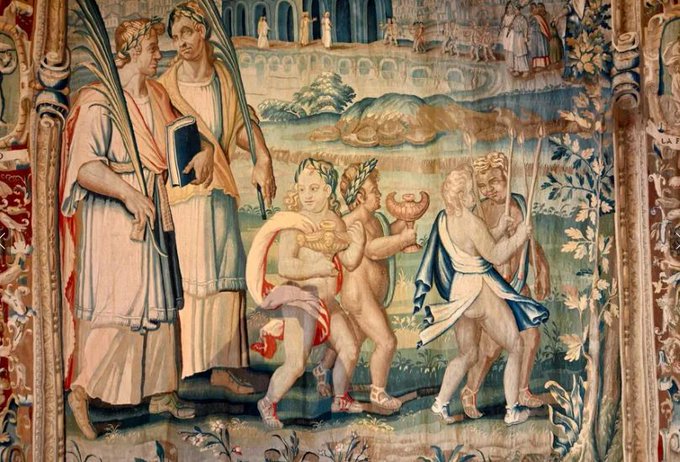
The feelings which this horror stirred in President Roosevelt were the intensest physical fear and the most profound mental loathing. What did he do? What could he do? The man seemed about to advance still closer to the bed, and returned the occupant’s gaze with a fixed stare. “Stand, or I’ll fire!” cried the President, taking in all this at a glance, revolver in hand. The man remained still. “What is your business here?” demanded Roosevelt, thinking he was addressing one of the roughs from below. The man was silent. “If you value your life, leave the room,” shouted the president, pointing his revolver. The man was motionless. “RETIRE! Or by Heaven I’ll send a bullet through you!” But the man moved not an inch. The President fired. The bullet lodged in the breast of the stranger, but he started not. The President fired again and the shot entered the heart, pierced the body, and lodged in the wall beyond; and the President beheld the hole where the bullet had entered, and the firelight glimmering though it. And yet the intruder stirred not. Astounded, the President dropped his revolver, and stood face to face before the unmoved man. “President Roosevelt,” spake the deep solemn voice of the perforated stranger, “in a vain you shoot me—I am already dead.” The President, with all his bravery, grasped, spellbound. The firelight gleamed through the hole in the body, and the eyes of the shooter were riveted there. “Fear nothing,” spake the mournful presence; “I seek but to divulge my wrongs. Until my death shall be avenge my unquiet spirit lingers here. Listen.” Speechless, motionless was the President; and the mournful apparition thus slowly and distinctly continued. “Four years ago, I was hired to be a foreman. One I trusted plunged a dagger into my heart while I slept. He covered my wound with a plaster. He reigned to mourn my death. He told the people here I died of a heart-complaint; that I had long been ailing. I had gold treasures. With my treasure secreted beneath his garments he paraded mock grief at my grave. #RandolphHarris 21 of 22

“Then he depated. In distant parts he sought to forget his crime; but his stolen gold brought him only the curse of an evil conscience. Rest and peace are not for him. He now prepares to leave his native land for ever. Under an assumed name that man is this night in San Francisco. In a few hours he will sail for Europe. President Roosevelt, you must prevent it. Justice and humanity demand that a murderer roam not at large, nor squander more of the wealth that is by right my children’s. Not until the spirit of my murderer shall be separated from the mortal clay can my spirit rest in peace.” And vanished. Most of the civilians you meet either do not want to know to know about the supernatural or blame you for brining it into their lives once you tell them about it. President Roosevelt tried to revisit the Winchester, but the Butler would not allow him inside because of the damage he did to the chamber. Mrs. Winchester had a remarkable memory and knew the location of every piece of material in the mansion, even in the vast store-rooms. The full scope of her generosity, charity, and many kindly acts will forever remain unknown and such was her sincere desire. Her donations were never made public. She contributed to charities of all faiths. In 1911 in New Haven, she established the William Wirt Winchester Memorial Sanitorium for Tuberculosis, endowing it with $1,200,000 (2021 adjusted for inflation $32,539,882.35). There were the little but visible acts that we nearby dwellers particularly noticed; those daily carriage trips with soup and hot food for a newly arrived settler on Stevens Creek Road, a man dying from Tuberculosis; those annual, unheralded trips to old Cupertino Church where my mother and other woman of The Ladies Aid Society collated used clothing for the local poors’ children. I remember a small boy’s thrill as he watched her liveried coachman alight from the polished Victoria and stagger up the church steps with a huge hamper of clothes, not used clothes, but dozens of newly purchased garments! That was Mrs. Winchester, the writer and many another contemporary remember. We never knew her intimately, but how we now wish we had! #RandolphHarris 22 of 22

Winchester Mystery House

The Winchester Mystery House features some very strange oddities like the door-to-nowhere. What purpose do you think it served Sarah during her time?

A 160-room mansion built to appease the spirits who died at the hands of the Winchester Rifle 👻
🗝 winchestermysteryhouse.com

There Was Terror in His Eyes as Not Often Seen in a Human Being!

Twenty-first century humans, in spite of all their scientific and technological advances, are baffled by unexplained forces existent in the Universe. The naturalistic philosophy of the previous generations has been unable to account for all of the mysterious phenomena which have been observed. Many scientists believe that living beings may inhabit other galaxies, and highly educated humans are seriously studying reports of those who insist they have received communications from the dead. Humans of science no longer scoff at the accounts of strange occurrences associated with witchcraft and occultic practices. Although they do not necessarily accept them as proof of the supernatural, many will admit they are manifestations of some kind of power they do not yet understand. Christian theologians and scientists are not perplexed by such reports. They know that both God and Satan are very much alive. Though readily conceding that they cannot explain fully all the mysteries of life, they affirm with confidence the existence of God and an invisible host of intelligent supernatural beings. They are convinced that when one accepts the teachings of the Bible, one begins to understand many of the puzzling facts of existence. For example, the Bible tells of holy angels who dwell in Heaven (Matthew 18.10). It also mentions “angels that sinned” (2 Peter 2.4), rebellious spirit begins who have been cast out of Heaven and now dwell in the atmosphere that surrounds the Earth. We know this because Paul declared that Satan is “the prince of the power of the air,” reports Ephesians 2.2, and the Greek word translated “air” was used to speak of the gaseous envelop that encircles our planet. These wicked beings apparently have unlimited access to Earther, and actively influence every area of human endeavour. #RandolphHarris 1 of 19

Because they do not possess physical bodies, we cannot typically detect them through our senses of sight, hearing, touch, taste, or smell. We do have evidence of their presence, however, for the Word of God gives us information regarding their identification, their nature and their function. Various terms are used in the Christian Bible to denote the evil spirit beings who followed Satan in this initial act of rebellion against God. It refers to “angels that sinned” 2 Peter 2.4 and “angels who kept not their first estate” Jude 6, and many times mentions “spirits” and “demons.” Some scholars believe that these demons must be distinguished from the “angels that sinned” and the “angels who kept not their first estate.” They contend that the Heavenly beings who joined Satan in his revolt against God are fallen angels, but that demons are disembodies spirits of physical and moral creatures who once lived upon the Earth. However, these Bible students disagree regarding an exact identification of the demons. Some say they are the spirits of pre-Adamic beings similar to man, while others identify them as the spirits of the “giants” who were destroyed in the great flood of Noah’s day. If one thinks that demons are the spirits of man-like beings who lived before Adam, then one will no doubt interpret Genesis 1.2 as a declaration that the original Earth, inhabited by the creatures, was cataclysmically destroyed. Genesis 1.2 is then translated as follows: “And the Earth became without form and void…” This theory, while attractive in that it permits a literal interpretation of the days in Genesis 1, must be acknowledged as only a hypothesis. Most Hebrew scholars reject this interpretation because Genesis 1.2 begins with a grammatical construction which makes it highly unlikely that Genesis 1.1 and 1.2 are separated by millions of years. Then, too, the verb translated “became” almost always has the meaning “was.” #RandolphHarris 2 of 19

However, even if we accept this theory, and believe that a race of man-like beings inhabited the prehistoric Earth, we would have no basis for thinking that their spirits are now free to roam about as the enemies of humankind. Other Bible scholars maintain that demons are the spirits of the “giants” who lived upon the Earth in the days of Noah. They refer to Genesis 6, contending that these “giants” were produced when fallen angels, called the “sons of God,” married the “daughters of men.” “And it came to pass, when men began to multiply on the face of the Earth, and daughters were born unto them, that the sons of God saw the daughters of men that they were fair; and they took them wives of all whom they chose. There were giants in the Earth in those days; and also after that, when the sons of God came in unto the daughters of men, and they bore children to them, the same became mighty men who were of old, men of renown,” reports Genesis 6.1, 2, 4. It is necessary for proponents of this theory to believe that fallen angels became male human beings who married women, produced a mongrel offspring, and took over the role of father in the family. They theorize that Satan hoped thereby to frustrate God’s redemptive plan. The Lord had promised salvation through Christ to human beings only—not for angels or mixed half-human and half-angelic race. Christ could not have been born to offspring of these corrupted creates or provide redemptions for them. Thus God’s plan of redemption would have been thwarted. In addition, both Jude and Peter in their epistles refer to a sin committed by angels, and their words can be blended very nicely into this concept. Jude writes, “And the angels who kept not their first estate, but left their own habitation, he hath reserved in everlasting chains under darkness unto the judgment of the great day. Even as Sodom and Gomorrah, and the cities about them in like manner, giving themselves over to fornication, and going after strange flesh, are set forth for an example, suffering the vengeance of eternal fire,” reports Jude 6, 7. #RandolphHarris 3 of 19

The words “in like manner” (verse 7) are taken to mean that the sin of the angels in having pleasures of the flesh with women was an unnatural act, comparable to sodomy. Peter tells of angels assigned to Tartaros, the nether World of the Greeks considered to be lower than Hades. “For if God spared not the angels that sinned, but cast them down to hell [GK Tartaros], and delivered them into chains of darkness, to be reserved unto judgment,” reports 2 Peter 2.4. Again, it does not take a great deal of imagination to see how these words of Peter may be applied to the wicked angels who committed the monstrous sin of attempting to make mongrels of the human race. Many Bible students, however, reject this interpretation of Genesis 6. Since angels are non-material beings, it would be necessary for them to create physical bodies for themselves capable of impregnating a female member of the human race. This would require nothing less than a creative miracle, and the Bible indicates that this power belongs only to God. In addition, it is not necessary to interpret the statements in Jude and 2 Peter as a reference to sin involving pleasures of the flesh on the part of the fallen angels. Jude’s use of the expression “going after strange flesh” may be figurative language representing spiritual fornication. The prophets often depicted Israel’s unfaithfulness to God in this manner. Peter’s statement that the angels who sinned have been assigned to Tartaros may be a simple declaration that all sinning angels have been designated to this place, and that they are even now under chains of moral and spiritual darkness. The Bible gives little information regarding the origin of demons. We can state with absolute certainty only that they are fallen spirit beings who have committed themselves to Satan and that they hate God and seek to harm His people. No clear distinction can be made between fallen angels and demons, for they are all evil spirits. Some of our questions must remain unanswered, but the Lord has given ample revelation to warn us that these invisible enemies are far too great and powerful for us to defeat in our own strength, and that we can successfully wage war against them only as we live in continual dependence upon the Lord. #RandolphHarris 4 of 19

In one respect the case of Dame Alice Kyteler stands alone in the history of magical dealings in Ireland prior to the seventeenth century. We have of the entire proceedings an invaluable and contemporary account, or at latest one compiled within a very few years after the death of Petronilla of Meath; while the excitement produced by the affair is shown by the more or less lengthy allusions to it in early writings, such as The Book of Howth (Carew MSS.), the Annals by Fariar Clyn, the Chartularies of S. Mary’s Abbey (vol. ii), &c. It is also rendered more valuable by the fact that those who are best qualified to give their opinion on the matter have assured the writer that to the best of their belief no entries with respect to trials for sorcery or witchcraft can be found in the various old Rolls preserved in the Dublin Record Office. However, when the story is considered with reference to the following facts it takes on a different signification. On the 29th of September 1317 (Wright says 1320), Bishop de Ledrede held his first Synod, at which several canons were passed, one of which seems in some degree introductory to the events detailed in last week’s report. In it he speaks of “a certain new and pestilential sect in our parts, differing from all the faith in the World, filled with a devilish spirit, more inhuman than heathens…who pursue the priests and bishops of the Most High God equally in life and death, by spoiling and rending the patrimony of Christ in the diocese of Ossory, and who utter grievous threats against the bishops and their ministers exercising ecclesiastical jurisdiction, and (by various means) attempt to hinder the correction of sins and the salvation of souls, in contempt of God and the Church.” From this it would seem that heresy and unorthodoxy had already made its appearance in the diocese. In 1324 the Kyteler case occurred, one of the participants being burnt at the stake while other incriminate persons were subsequently followed up, some of whom shared the fate of Petronilla of Meath. In 1327 Adam Dubh, of the Leinster tribe of O’Toole, was burnt alive on College Green for denying the doctrines of the Incarnation and the Holy Trinity, as well as for rejecting the authority of the Holy See. #RandolphHarris 5 of 19

In 1335 Pope Benedict XII wrote a letter to King Edward III, in which occurs the following passage: “It has come to our knowledge that while our venerable brother, Richard, Bishop of Ossory, was visiting his diocese, there appeared in the midst of his catholic people men who were heretics together with their abettors, some of whom asserted that Jesus Christ was a mere man and a sinner, and was justly crucified for His own sins; others after having done homage and offered sacrifice to demons, thought otherwise of the sacrament of the Body of Christ than the Catholic Church teaches, saying that the same venerable sacrament is by no means to be worshipped; and also asserting that they are not bound to obey or believe the decrees, decretals, and apostolic mandates; in the meantime, consulting demons according to the rites of those sects among the Gentiles and Pagans, they despise the sacraments of the Catholic Church, and draw the faithful of Christ after them by their superstitions.” Unlike apocryphal and rabbinical literature, the Biblical description of evil spirits avoids the unusual and grotesque. The Bible does, however, present us with a clear picture of their activity and tells us how to resist them effectively. In the first place, it declares that demons or fallen angels are non-material beings. They do not possess bodies like humans, and therefore are repeatedly called “spirits.” Matthew, for example, says, “When the evening was come, they brought unto him many that were possessed with demons; and he cast out the spirits with his word, and healed all that were sick,” reports Matthew 8.16. Jesus started that the Creator is not made up of physical substance when He said, “God is a Spirit,” reports John 4.24. Later, when His frightened disciples thought He was a ghost, He told them their fears were groundless, for “a spirit hath not flesh and bones, as ye see me have,” reports Luke 24.39. Paul had in mind the non-physical nature of Satan and his army of evil spirits when he said that our warfare is “not against flesh and blood, but against principalities, against powers, against the rulers of the darkness of this World, against spiritual wickedness in high places,” reports Ephesians 6.12. Satan’s demonic hordes are spirit beings, and therefore more dangerous than the “flesh and blood” enemies we may encounter in our daily lives. #RandolphHarris 6 of 19

Second, the Bible portrays demons as highly intelligent creatures. They recognize Christ when He was here upon the Earth, and knew they could not have fellowship with Him. Luke tells us about an evil spirit who is an example of this. “When he saw Jesus, he cried out, and fell down before him, and with a loud voice said, What have I to do with thee, Jesus, thou Son of God, most high? I beseech thee, torment me not,” reports Luke 8.28. The fallen spirits are also aware of their ultimate defeat, for James declared, “Them demons also believe, and tremble,” reports James 2.19. They are, of course, finite creatures, even Satan is limited in knowledge. He has myriads of evil spirit followers, however, and they are able to give him information on almost any person and circumstance in which he is interested. In this manner he can find out much what he wants to know. Truly, believers in Christ can never successfully cope with Satan and his hosts without special help from the Lord. Therefore, we must humbly look to God for wisdom and strength to resist the attacks of our invisible enemies. Third, the World of evil spirits is cruel. These creatures hate God and all who have placed their trust in Him. They seem to find delight in causing human grief and pain. For example, Matthew tells us that a man who was both blind and dumb suffered these afflictions because a demon had entered his body. “Then was brought unto him one possessed with a demon, blind, and dumb; and He healed him, insomuch that the blind and dumb both spoke and saw,” reports Matthew 12.22. Matthew, Mark, and Luke all tell the story of two demented men who lived in the country of the Gerasenes, and indicate that their insanity was the result of demonic invasion of their personalities. Luke, the beloved physicians, writes of a woman who was bent over with some crippling disease, saying that she had “a spirit of infirmity.” He adds that Jesus said she had been bound by Satan. “And he was teaching in one of the synagogues on the sabbath. And, behold, there was a woman who had a spirit of infirmity eighteen years, and was bowed together, and could in no way lift herself up. And when Jesus saw her, he called her to him, and said unto her, Woman, thou art loosed from thine infirmity. #RandolphHarris 7 of 19

“And he laid his hands on her; and immediately she was made straight, and glorified God. And the ruler of the synagogue answered with indignation, because Jesus had healed on the sabbath day, and said unto the people, There are six days in which humans ought to work; in them, therefore, come and be healed, and not on the sabbath day. The Lord then answered him, and said, Thou hypocrite, doth not each one of you on the sabbath loose his ox or her ass from the stall, and lead him away to watering? And ought not this woman, being a daughter of Abraham, who Satan hath bound, lo, these eighteen years, be loosed from this bound on the sabbath day? And when he had said these things, all his adversaries were ashamed; and all the people rejoiced for all the glorious things that were done by him,” reports Luke 13.10-17. While the gospel writers make it clear that not all illness is the work of Satan and demons, they do point out that much human suffering is the result of demonic activity. Finally, the Bible tells us that all fallen angels or evil spirits are confirmed in their wickedness. Though they “believe and tremble,” they will never repent, never seek forgiveness, and never pray for holiness or purity. Though they know that Jesus is the Christ, they never really worship Him. They must acknowledge that He is stronger than they, and may occasionally render Him token submission, but inwardly they hate Him and keenly resent His authority over them. In fact, their nature is so totally evil that the term “unclean” often is applied to them. (See Matthew 10.1; Mark 1.27; 3.11; Luke 4.36; Acts 8.7; Revelations 16.13.) They apparently delight in sin, find great pleasure in leading humans to commit evil deeds, and possess no feelings of guilt nor desire for deliverance. Michael Scot, reputed a wizard of such potency that—when in Salamanca’s cave he listed his magic want to wave and the bells would ring in Notre Dame. Scot has studied successively at Oxford and Paris (where he acquired the title of “mathematicus”); he then passed to Bologna, thence to Palermo, and subsequently continued his studies in Toledo. His refusal of the See of Cashel was an intellectual loss to the Irish Church, for he was so widely renowned for his varied and extensive learning that he was credited with supernatural powers; a number of legends grew up around his name which hid his real merit, and transformed the man of science into a magician. #RandolphHarris 8 of 19

In the Border country traditions of his magical power are common. Boccaccio alludes to “a great master in necromancy, called Michael Scot,” while Dante places him in the eighteen circle of Hell. The next, who is so slender in the flanks, was Michael Scot, who of a verity of magical illusion knew the game. Another man to whom magical powers were attributed solely on account of his learning was Gerald, the fourth Earl of Desmond, styled the Poet, who died rather mysteriously in 1398. The Four Masters in their Annals describe him as “a nobleman of wonderful bounty, mirth, cheerfulness of conversation, charitable in his deeds, easy of access, a witty and ingenious composer of Irish poetry, a learned and profound chronicler.” No legends are extant of his magical deeds. King James I of Scotland, whose severities against his nobles had around their bitter resentment, was barbarously assassinated at Perth in 1437 by some of their supports, who were aided and abetted by the ages Duke of Atholl. From a contemporary account of this we learn that the monarch’s fate was predicted to him by an Irish prophetess or witch; has he given ear to her message he might have escaped with his life. We modernize the somewhat difficult spelling, but retain the quaint language of the original. “The king, suddenly advised, made a solemn feast of the Christmas at Perth, which is clept Saint John’s Town, which is from Edinburg on the other side of the Scottish sea, the which is vulgarly celpt the water of Lethe. In the midst of the way there arose a woman of Ireland, the clept herself as a soothsayer. The which anon as she saw the king she cried with a loud voice, saying thus: ‘My lord king, and you pass this water you shall never turn again alive.’ The king hearing this was astonied of her words; for but a little before he had read in a prophecy that in the self same year the king of Scots should be slain; and therewithal the king, as he rode, cleped to him one of his knights, and gave him in commandment to turn again to speak with that woman, and ask of her what she would, and what thing she meant with her loud crying. #RandolphHarris 9 of 19

“And she began, and told him as ye have heard of the King of Scots if he passed that water. As now the king asked her, how she knew that. And she said, that Huthart told her so. ‘Sire,’ quoth he, ‘men may “calant” yet take to heed of yon woman’s words, for she is but a drunken fool, and wot not what she saith’; and so with his folk passed the water celpt the Scottish sea, towards Saint John’s town.” The narrator states some dreams ominous of James’s murder, and afterwards proceeds thus: Both afore supper, and long after into quarter of the night, in the which the Earl of Atholl (Athetelles) and Robert Steward were about the king, where they were occupied at the playing of chess, at the tables, in reading of romances, in singing and piping, in harping, and in other honest solaces of great pleasance and disport. Therewith came the said woman of Ireland, that celpt herself a divineress, and entered the king’s court, till that she came straight to the king’s chamber-door, where she stood, till at the last the usher opened the door, marvelling of that woman’s being there that time of night, and asking her what she would. ‘Let me in, sir’ quoth she, ‘for I have somewhat to say, and to tell unto the king; for I am the same woman that not long ago desired to have spoken with him at the Leith, when he should pass the Scottish sea.’ The usher went in and told him of this woman. ‘Yea,’ quoth the king, ‘let her come tomorrow’; because the he was occupied with such disports at that time he let not to hear her as then. The usher came again to the chamber-door to the said woman, and there he told her that the king was busy in playing, and bid her come soon again upon the morrow. ‘Well,’ said the woman, ‘it shall repent you all that ye will not let me speak now with the king.’ Thereat the usher laughed, and held her but a fool, charging her to go her way, and therewithal she went thence. Her informant “Huthart” was evidently a familiar spirit who was in attendance on her. #RandolphHarris 10 of 19

Considering the barrenness of Irish records on the subject of sorcery and witchcraft it affords us no small satisfaction to find the following statement in the Statute Rolls of the Parliament for the year 1447. It consists of a most indignantly-worded remonstrance from the Lords and Commons, which was drawn forth by the fact that some high-placed personage had been accused of practising sorcery with the intent to do grievous harm to one’s enemy. When making it the remonstrants appear to have forgotten, or perhaps, like Members of Parliament in other ages, found it convenient to forget the nonce the Kyteler incident of the pervious century. There was an Act of Parliament which was intended to put a stop to a certain lucrative form of witchcraft. It is gravely stated by the writer of a little book entitled Beware the Cat (and by Giraldus Camrensis before him), that Irish witches could turn wisps of hay, straw &c. into red-coloured pigs, which they dishonestly sold in the market, but which resumed their proper shape when crossing running water. To prevent this it is stated that the Irish Parliament passed an Act forbidding the purchase of red swine. We regret to say, however, that no such interesting Act is to be found in the Statues books. The belief in the power of witches to inflict harm on others was also a powerful belief in Victorian times. When reflecting on history, one can see that consulting someone with supernatural powers was no different than talking to a friend about one’s life. It was very common. Also, many of these accounts turned out to have some truth to them or evidence of supernatural power. Perhaps this is because people were more in tune with their inner spirit and the planet back then. Many people thought Sarah Winchester was mentally ill or deranged for consulting a medium about how she should deal with the evil spirits that were haunting her, they thought she was even more insane for building the World’s most beautiful and unique mansion. However, what better way could there be to spend your money than by creating something you and the World can enjoy for many centuries and creating a living memorial for your family? #RandolphHarris 11 of 19

Perhaps what Mrs. Winchester did was very rational and sane. In contrast, most others express their pain and suffering by becoming destructive and hurting others, and people usually idolize them for that. Mrs. Winchester gradually developed her skill in building, just as she had done with music and language in her youth. She often used the most current innovations in her home. Some historical sources say that Mrs. Winchester was the first to use wool for insulation. Carbide gas lights in the house were fed by the estate’s own gas manufacturing plant, which used a new process. The gas lights were operated by pushing an electric button. A specially designed window catch was patterned after a Winchester rifle trigger and trip hammer, amongst other state of the art designs. I met a man in the Winchester Mansion one day that I knew very well, as I thought, though I had not seen him for years. Without pressing him too soon with a repetition of my idle questions, we walked together to the Blue Séance Room, and there we shook hands. Just then there came a vague vibration in the Earth and air, quickly changing into a violent pulsation, and an oncoming rush caused me to start back, as though it had force to draw me down. Next morning, I spoke of this meeting to a mutual friend, and then I learnt, for the first time, that the man had died six months before. The natural inference was that I had mistaken one man for another, an error that, not having a good memory for faces, I frequently fall into. What was remarkable about the matter, however, was that throughout our walk I had conversed with the man under the impression that he was that other dead man, and, whether by coincidence or not, his replies had never once suggested to me my mistake. As soon as I finished speaking to Jared, who had been listening very thoughtfully, asked me if I believed in spiritualism “to its fullest extent.” “That is a rather large question,” I answered. “What do you mean by ‘spiritualism to its fullest extent’?” “Well, do you believe that the spirits of the dead have not only the power of revisiting this Earth at their will, but that, when here, they have the power of action, or rather, of exciting to action. Let me put a definite case. A spiritualist friend of mine, a sensible and by no means imaginative man, once told me that a table, through the medium of which the spirit of a friend had been in the habit of communicating with him, came slowly across the room towards him, of its own accord, one night as he sat alone in the Winchester Mansion, and pinioned him against the wall. Now can any of you believe that, or can you not?” #RandolphHarris 13 of 19

I could believe it. It seems that the difference between what we call the natural and supernatural is merely the difference between frequency and rarity of occurrence. Suppose a person died with the dearest wish of one’s heart unfulfilled, do you believe that one’s spirit might have power to return to Earth and complete the interrupted work? The Winchester Mansion is supposed to be enchanted. According to the legend, William Winchester was a very potent magician, and usually resided in a castle. To this he brought his bride, a beautiful young lady, Sarah Lockwood Pardee, who he loved, and he prevailed upon her her every desire, but with fatal results. One day she presented herself in the chamber in which her husband exercised his forbidden art, and begged him to show her the wonders of the evil science. With the greatest reluctance he consented, but warned her that she must prepare herself to witness a series of most frightful phenomena, which, once commenced, could neither be abridged nor mitigated, while if she spoke a single word during the proceedings the castle and all it contained would sink. Urged on by curiosity she gave the required promised, and he commenced. Muttering a spell as he stood before her, feathers sprouted thickly over him, his face became contracted and hooked, a corpse-like smell filled the air, and winnowing the air with beats of its heavy wings a gigantic vulture rose in his stead, and swept round and round the room as if on the point of pouncing upon her. The lady controlled herself though this trial, and another began. The bird alighted near the door, and in less than a minute changed, she saw not how, into a horribly deformed and dwarfish hag, who, with yellow skin hanging about her face, and cavernous eyes, swung herself on crutches towards the lady, her mouth foaming with fury, and her grimaces and contortions becoming more and more hideous every moment, till she rolled with a fearful yell on the floor in a horrible convulsion at the lady’s feet, and then changed into a huge serpent, which came sweeping and arching towards her with crest erect and quivering tongue. #RandolphHarris 14 of 19

Suddenly, as it seemed on the point of darting at her, she saw her husband in its stead, standing pale before her, and with his finger on his lips enforcing the continued necessity of silence. He then placed himself at the full length on the floor and began to stretch himself at full length on the floor and began to stretch himself out, longer and longer, until his head nearly reached to one end of the vast room and his feet to the other. This utterly unnerved her. She gave a wild scream of horror, whereupon the castle shook and the nine-story tower of what is now known as the Winchester Mansion came tumbling down. Mr. Winchester is said to have been dead and never lived in the Winchester Mansion, but perhaps his spirit did? Once every seven years, the great William Wirt Winchester would rise, and rides by on his white horse round Llanada Villa. The steed is shod with gold shoes, and when these are worn out the spell that holds Mr. Winchester will be broken, and he will regain possession of his vast estates and semi-regal power. In the closing years of the nineteenth-century there was a living man named Gilbert Plutchik who claimed to have seen Mr. Winchester. Gilbert was a blacksmith, and his forge stood on back of the estate, near a lonely part of the road. One night when there was a bright moon, he was working very late and quite alone. In one of the pauses of his work he heard the ring of many hoofs ascending the steep road that passed his forge, and, standing in his doorway, he saw a gentleman on a white horse, who was dressed in a fashion the like of which he had never seen before. This man was accompanied by a mounted retinue, in similar dress. They seemed to be riding up to the mansion, but the pace slackened as they drew near, and the rider of the white horse, who seemed from his haughty air to be a man of rank, drew bridle, and came to a halt before the smith’s door. He did not speak, and all his train were silent, but he beckoned to the smith, and pointed down at one of the horse’s hoofs. Gilbert stopped and raised it, and held it just long enough to see that it was shod with a gold shoe, which in one place was worn as thing as a shilling. Instantly his situation was made apparent to him by this sign, and he recoiled with a terrified prayer. #RandolphHarris 15 of 19

The lordly rider, with a look of pain and fury, struck him suddenly with something that whistled in the air like a whip; an icy streak seemed to traverse his body, and at the same time he saw the whole cavalcade break into a gallop, and disappear down the hill. It is generally supposed that for the purpose of putting an end to his period of enchantment Mr. Winchester endeavours to lead someone on to first break the silence and speak to him; but what, in the event of his succeeding, would be the result, or would befall the person thus ensnared, no one knows. If one admits the possibility of spirits retaining any interest in the affairs of this World at all, it is certainly more reasonable to imagine them engaged upon a task such as this, than to believe that they occupy themselves with the performance of mere drawing-room tricks. There was once a great wrong done to the Winchester Mansion. A man stole something priceless from the estate. After that, he felt like he was being followed. However, the course was the whole World, and the stakes his life. It was sixteen hours before he was going to abscond. Passing the estate once more, he asks, “How long since the carriage passed this way, with a tall, fair man inside?” “Such a one passed this morning, Monsieur. The man was ridden by Fear as he looked, and saw before him the door to the Winchester Manion opened, and passing in, knelt down and prayed. He prayed long and fervently, for men, when they are in sore straits, clutch eagerly at the straws of faith. He prayed that he might be forgiven his sin, and, more important still, that he might be pardoned the consequences of his sin, and be delivered from his adversary; and a few chairs from him, facing him, knelt Mr. Winchester praying also. However, Mr. Winchester’s prayer, being a thanksgiving merely, was short, so that when the thief raised his eyes, he saw the face of Mr. Winchester gazing at him across the chair tops, with a mocking smile upon it. He made no attempt to rise, but remained kneeling, fascinated by the look of joy that shone out of Mr. Winchester’s eyes. And Mr. Winchester moved the high-back chairs one by one, and came toward him softly. Then, just as Mr. Winchester stood beside the thief who had wronged him, full of gladness that his opportunity had come, there burst from the bell town a sudden clash of bells, and Mr. Winchester vanished. #RandolphHarris 16 of 19

Then the thief who had done the wrong rose up and passed out praising God. What became of the body of Mr. Winchester is not known. There was none to identify. Years passed away, and the survivour in the tragedy became a worthy and useful citizen, and a noted man of science. He was employed by Mrs. Winchester and even had a laboratory on the estate were many objects necessary to him in his researches, and prominent among them, stood in a certain corner, a human skeleton. It was a very old and much-mended skeleton, and one day the long-expected end arrived, and it tumbled to pieces. Thus it became necessary to purchase another. The man of science visited a dealer he well knew, and the dealer said he would send a well-proportioned “study” to his laboratory that very afternoon. The dealer was as good as his word. When Monsieur entered his laboratory that evening, the thing was in its place. Monsieur seated himself in his high-backed chair, and tried to collect his thoughts. However, his thoughts were unruly, and inclined to wander, and to wander always in one direction. He opened a large volume and commenced to read. He read of a man who had wronged another and feld from him, the other man following. Finding himself reading this, he closed the book angrily, and went and stood by the window and looked out. He saw before him the sun-pierced nave of East wing of the Winchester Mansion, and on the stones lay a dead man with a mocking smile upon his face. Cursing himself for a fool, he turned away with a laugh. However, his laugh was short-lived, for it seemed to him that something else in the room was laughing also. Struck suddenly still, with his feet glued to the ground, he stood listening for awhile: then sought with starting eyes at the corner from where the sound had seemed to come. However, the white thing standing there was only grinning. Monsieur wiped the damp sweat from his head and hands, and stole out. For a couple of days he did not enter the room again. One the third, telling himself that his fears were those of a hysterical girl, he opened the door and went in. #RandolphHarris 17 of 19

To shame himself, he took his lamp in his hand, and crossing over to the far corner where the skeleton stood, examined it. A set of bones bought for a thousand dollars. Was he a child, to be scared by such a bogey! He held his lamp up in front of the thing’s grinning head. The flame of the lamp flickered as though a faint breath had passed over it. The man explained this to himself by saying that the walls of the house were old and cracked, and that the wind might creep in anywhere. He repeated this explanation to himself as he recrossed the room, walking backwards, with his eyes fixed on the thing. When he reached his desk, he sat down and gripped the arms of his chair till his fingers turned white. He tried to work, but the empty sockets in that grinning head seemed to be drawing him towards them. He rose and battled with his inclination to fly screaming from the room. Glancing fearfully about him, his eyes fell upon a high screen, standing before the door. He dragged it forward, and placed it between himself and the thing, so that he could not see it—nor it see him. Then he sat down again to his work. For a while he forced himself to look at the book in front of him, but at last, unable to control himself any longer, he suffered his eyes to follow their own beat. It may have been an hallucination. He may have accidentally placed the screen so as to favour such an illusion. However, what he saw was a bony hand coming round the corner of the screen, and, with a cry, he fell to the floor in a swoon. John Hansen and other people of the house came running in, and lifting him up, carried him out, and laid him upon his bed. As soon as he recovered, his first question was, where had they found the thing—where was it when they entered the room? And when they told him they had seen it standing where is always stood, and had gone down into the room to look again, because of his frenzied entreaties, and returned trying to hide their smiles, he listened to their talk about overwork, and the necessity for change and rest, and said they might do with him as they would. So for many months the laboratory door remined locked, and many of the innovative technologies produced by the Winchester Estate came to a halt. Then there cam a chill winter evening when the man of science opened it again, closed the door behind him. #RandolphHarris 18 of 19

He lighted his lamp, and gathered his instruments and books around him, and sat down by the fire before them in his high-backed chair. And the old terror returned to him. He was sitting there when he heard a cry. He held his lamp above his head, and saw figures in the distance, and wet stains stealing down the walls and trickling through the arch. He listened for a moment to the wind in the valley, it sounded unnatural. Standing at the door was a specter. The man of science sat down partly to collect his thoughts again, partly because it had turned him faint. He heard terrible screams and cries. A beautiful young lady had died instantaneously in the parlor. This time the man of science wished to conquer himself. His nerves were stronger now, and his brain clearer; he would fight his unreasoning fear. He crossed the door and locked himself in, and flung the key to the other end of the room, where it fell among beakers and Bunsen Burners with an echoing clatter. Later on, the housekeeper, Angus, going her final round tapped at the door and wished him good night, as was her custom. She received no response, at first, and growing nervous, tapped louder and called again; and at length an answering “good night” came back to her. She thought little about it at the time, but afterwards she remembered that the voice that had replied to her had been strangely grating and mechanical. Trying to describe it, she likened it to such a voice as she would imagine coming from a statue. Next morning the door to the laboratory remained still locked. It was no unusual thing for him to work all night, and far into the next day, so no one thought surprised. When, however, evening came, and yet he did not appear, the servants gathered outside the room and whispered, remembering what had happened before. They listened, but could hear no sound. They shook the door and called to him, then beat with their fists upon the mahogany panels. However, there was still no sound. Becoming alarmed, they decided to burst open the door, and, after many blows, it gave way and flew back, and they crowded in. He sat bolt upright in his high-backed chair. They thought at first he had died in his sleep. However, when they drew nearer and the light fell upon him, they saw the livid marks of bony fingers round his throat; and in his eyers there was such a terror as is not often seen in human eyes. Next evening was a lovely evening, and Mrs. Winchester walked out early to enjoy it. The sun was not yet quite down when she traversed the field-path near where the nine-story tower once stood. #RandolphHarris 19 of 19

Winchester Mystery House

Saturdays are for the boilers 😉 Do you know where this is in the house?
🎟 Link in bio. winchestermysteryhouse.com

 Randolph Harris II International Institute