
Home » Halloween (Page 2)
Category Archives: Halloween

Spirit Beings Have the Power to Absorb Our Actions and Thoughts

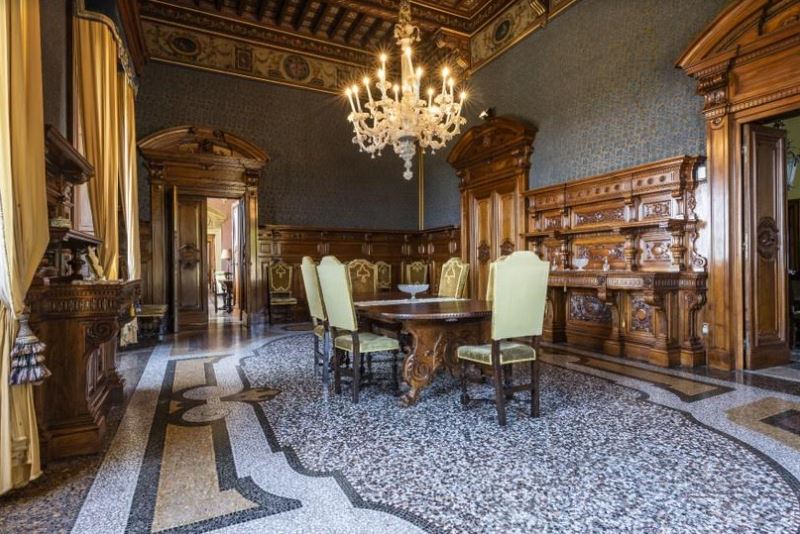
Llanada Villa was wintry with steep hand craved shingled roofs and stained-glass windows. It was built of redwood, and had countless chimneys rising from its steep gables, and a sprawling conservatory on the west side. The sheer scale of place, stranded as its own park, suggested another World. When the stars were right, they could plunge from World to World through the sky. However, the black haunted woods were where no dweller ventured. There were insane shouts and harrowing screams, soul-chilling chant and dancing devil-flames. Reluctant to be left alone, servants refused point-blank to advance an inch toward the scene of unholy worship. There were legends of a hidden lake unglimpsed by mortal sight, in which dwelt a huge, shadow with luminous eyes; and devils flew up out of caverns from the inner Earth to worship it at midnight. They said that it had been there before the Spanish Conquistadors, before the Indians, and before even the wholesome beasts and birds of the woods. It was a nightmare to see, and to see it was to die. Two bodies had once been found slaughtered, and were buried in one sepulchre, and the tree ever after brought forth blue berries, which served for memorials of our blood. Even though it made men dream, they knew to keep away. A faint glow of twilight was still in the windows overheard, but the darkness at the far end of the gallery was already impenetrable, and the dazzle of the candle confused my eyes. This particular night, I could feel the black arcades of horror emanating from within the walls of my home. #RandolphHarris 1 of 8
The last of my strength deserted me, and I sank to the floor, just managing to set the candlestick upright beside me. Hot wax stung the back of my hand. You must get up, you must get up, a voice in my head was saying, but my limbs would not obey. I was crouching a few feet from the fireplace, almost in front of the sarcophagus, which lay just within the circle of light from the candle. If you cannot stand, you must crawl, said the voice. I was making another effort to rise when I thought I heard a sound from the fireplace. I clenched my teeth to stop them chattering. There it was again, a heavy, muffled, grating sound, like stone sliding upon stone. It seemed to be coming from beneath the floor in front of me. The grating ceased; for several seconds there was absolute silence, then a faint metallic creak. I held my breath; the candle flame steadied. The lid of William’s tomb was slowly rising. In life he was a beautiful youth and fond of manly sports. He would rise before the dawn to pursue the chase. I saw him when I first looked forth, fell in love with him, and was married to this charming man and he devotedly loved me. Nevertheless, my heart gave one appalling lurch and stopped beating altogether. The next second, as it seemed, I was on the far side of the connecting door, with a rattling in the lock as I fought to turn it. I could see the faint glimmer of my candle shining through the gap beneath the door. Then another, stronger light began to play about my feet; there was a creak, and thump, and the sound of footsteps approaching. #RandolphHarris 2 of 8
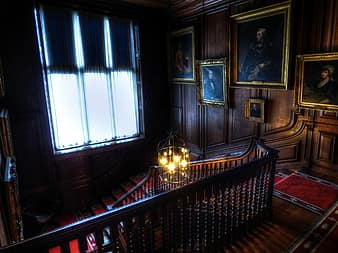
I thought of running for the stairs, but I had no light, and the visitant would hunt me down. The door handle rattled; the door shook; the footsteps moved purposefully away. In a few moments, it would be on the landing. I had not time to run and lock all the doors at the far end of the library. I thought of the weapons arrayed along the gallery wall—too high for me to reach. If it seized me, most likely I would die horribly. The footsteps were still receding. I gripped the key with both nerveless hands and twisted. There was a rasp and a snick, but the footsteps did not pause. I withdrew the key and slipped back into the gallery, just as the light passed out through the double doors at the other end. The beam of a lantern played across the walk beyond; then the footsteps moved off along the landing, boards creaking at every tread. For a moment I thought I might be spared, but then I heard the squeak of hinges as my pursuer entered the library. I tried to slip the key into the keyhold, but my hand was shaking so violently that I dared not let the metal touch. My candle still burned where I had left it on the floor. Footsteps moved within the library—one, two, three, and then a pause. Light flickered beneath the door. The footsteps were moving again—I could not tell which way. I moved toward the candle, almost tripping over the hem of my dress. As I knelt to the flame, I realized I had no idea how fast the wick would burn. The floor seemed to be dropping away beneath my feet. If you faint, it will catch you, said the voice. #RandolphHarris 3 of 8
Only poetry or madness could do justice to the noises I heard as the footsteps continued to plough through the mansion toward me. Howls and squawking ecstasies tore through my home and reverberated through fireplaces like pestilential tempests from the gulfs of hell. Suddenly came the spectacle itself. The mad cacophony of the orgy fortunately deadened. Void of clothing, this hybrid spawn was some eight feet in height. It was some ancient legendary horror. Like a bird beneath the hypnotic gaze of deadly serpent, I was paralyzed by terror. The gloom of the chamber deepened. The stifling air was laden with unformulable menace, but it was constrained by the spell of a black and lethal necromancy. There crept forth the choking mustiness of hidden vaults and embalmed centurial corruption, together with the ghostly spice of a strange perfume that seemed to emanate from the beast. Then I recalled the story of a most evil creature, who had been buried somewhere in this land hundreds of years ago. I did not nurse the illusion that I was dealing here with an accidental tragedy. The creature was once a small boy who was abducted and dying of exposure lost in the wind-scoured hills that rose behind my home. He had been stolen. Then he had been murdered. And no one had ever been called to account for these awful, planned, sequential crimes. I rubbed my eyes with the heels of my hands. Anger stirred in the beast. And I knew I was sharing his indignant rage which he had so vibrantly felt. #RandolphHarris 4 of 8
My teeth were tapping together like typewriter keys. There was something else, some faint warning that reached me. Not actually heard so much as sensed. As if someone’s breath were coming down the shaft from just over my head, slightly as if by a sounding board. I acted on it instantly, more from instinct than actual realization of danger. The beast looked at me, contorted into a maniacal grimace of impending destruction, as I reached for my ivory handled pistol, both of its arms were high over his head wielding something. It looked like a sword, but there was no time to find out. For what seemed like five minutes, the din and chaos were beyond descriptions. Shots were fired. It came hissing down in a big arc against the floor. The sword, of course, followed it a second later. The very weight of the creature’s body caused it to crash through the floor. Numb and half frozen, gusts of uncontrollable shivering swept over me every once in a while. I turned my head and looked toward that sinister beast and there was nothing left but an opening in the floor. Within the walls of this dark house, there was a secret which even torture could not extract. For shapes came out of the dark to pay the inhabitants a visit. I was overwhelmed by the supernatural situation amid whose dubious horror and ineluctable sorceries had somehow become involved. Malefic sorcery, deadly peril of both soul and body. I fled blindly into the darkness until I collided painfully with a wall. #RandolphHarri 5 of 8
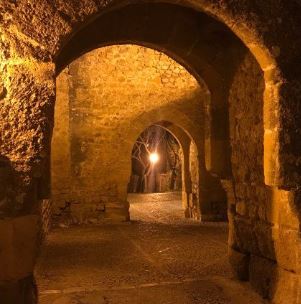
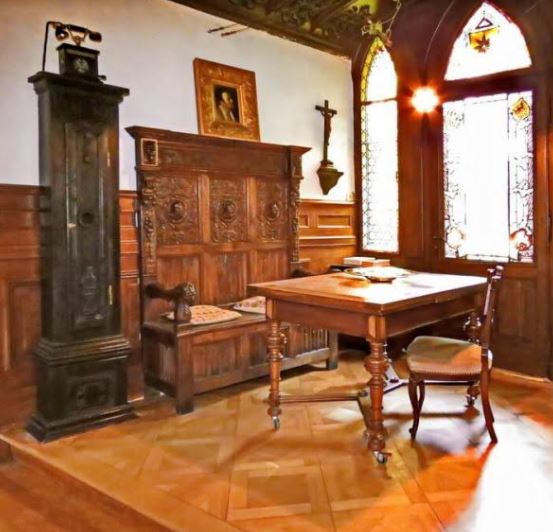
There was a secret which even torture could not extract in Llanada Villa. I was not absolutely alone, for shapes came out of the dark to visit. Although they no longer lived, those killed by the Winchester Rifle no longer lived, they would never really die. They all lay in my home preserved by spells and this ancient curse. They could live in the darkened hallways, shadows, and corners whilst millions of years rolled by. I could hear them whisper in the shadowy wings of the mansion; I caught the sibilation of ominous voices, like those of familiars that respond to the summoning of wizards; and I seemed to hear, even in the vaults and towers and remote chambers, the tread of feet that were hurrying on malign and secret errands. However, the oblivion was around me like the meshes of a sable net; and it closed in relentlessly upon my troubled mind, and drowned the alarms and of my agitated senses. A sad and sunless daylight filtered through the windows. The mansion was very still; and it seemed that the animating spirit of evil was now quiescent; the shadowy wings of the horror and malignity, the feet that had sped on baleful errands, the summoning sorcerers, the responding familiars, were all lulled in a temporary slumber. I opened the door, and tiptoed along the deserted hall. Amid the gloomy walls that surround me, the somber ancient halls, the high towers and the heavy bastions, there is but one thing that veritably exists; and all the rest is a fabric of illusion. I passed the doors of many secret rooms. There was one room in particular, a bare room, entirely built of stone, and illumined only by narrow slits high up in the wall. #RandolphHarris 6 of 8
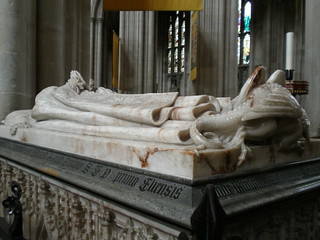
The place was very dim, but in the middle of the floor was a tomb of marble, where William lay. And there he was. He appeared to be slumbering peacefully as an infant. Darkness returned with an earsplitting crash. The floor lurched and rebounded; for a moment there was silence, and then a long, low rumble, gathering power as it approached until it broke over me with a thunderous roar. Choking dust filled my lungs, and I was flung from my feet and rolled over and over like a rag doll in a storm. There was a vile, rasping taste in my mouth and throat, and a heavy weight pressing down on the side of my head; I tried to push it away, and realized it was the floor. The area on which I was lying were covered in sharp, gritty fragments. A faint, misty glow appeared in the darkness away to my right. I began to crawl toward it, not knowing what else to go, brushing aside slivers of what felt like glass, until I saw that it was the light from the candle I had left burning in the library. The fear had left me; perhaps I had simply exhausted my capacity to feel anything at all. I rose shakily to my feet, made my way along the landing to the library, fetched the candle and returned to the gallery—what remained of it. At the far end, where the tomb and the chimney and the armour had been, was a great gaping hole in the wall. Half the floor was gone; and the boards ended in a jagged mess of splinters not ten feet from where I had been lying. Dust was floating up from a lack pit beyond. A beast was down there. The thought struck me like icy water, dashing away the numbness. Suddenly I was trembling so that I could scarcely stand, as trickling noises echoed in the darkness. Then came out of the floor the black spirits of Earth, mouldy and shadowy. #RandolphHarris 7 of 8

I conjure thee, Bechard, and constrain thee, in like manner, by the Most Holy Names of God, ELOY, ADONAY, ELOY, AGLA, SAMALABACTAY, which are written in Hebrew, Greek, and Latin; by all the sacrament, by all the names written in this spell; and by him who drove three from the height of Heaven. I conjure and command thee by the virtue of the Most Holy Eucharist, which hath redeemed men from their sins; I conjure three to come without any delay, to do and perform all my biddings, without any prejudice to my body or soul, without harming this spell, or doing injury to those that accompany me. I conjure thee, O Guland, in the name of Satan, in the name of Beelzebuth, in the name of Astaroth, and in the name of all other Spirits, to make haste and appear before me. Come, then in the name of Satan and in the names of all other demons. Come to me, I command thee, in the name of the Most Holy Trinity. Come without inflicting any harm upon me, without injury to my body or soul, without maltreating my books, or anything which I use. I command thee to appear without delay, or, that failing, to send me forthwith another Spirit having the same power as thou hast, who shall accomplish my commands and be submitted to my will, wanting which, he whom thou shalt send me, if indeed thou comest not thyself, shall in no wise depart, nor until he hath in all things fulfilled my desire. I now plant the seed of my desire within the black Earth, through the mouth of Arezura where the powers of sorcery and counter creation dwell. Through this gateway of darkness, I now shine the light and power of my will upon this World for the benefit of me and mine! #RandolphHarris 8 of 8
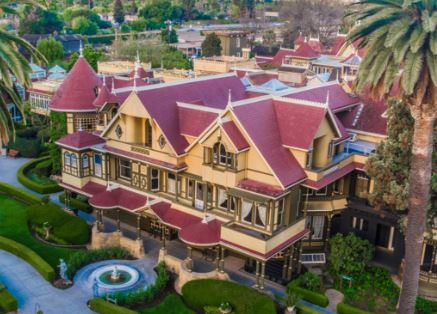
In the early summer of 2007, a couple were traveling to Santa Clara, California on a business trip. Shortly after 10 am, the decided to stop and eat at The Winchester Café. They remembered that the food was prepared in an excellent down-home country style, and that the waiter, waitress, the cook, and the other customers were so friendly in a sincere manner, and they promised that they would come back. And a sixteen years later, they tried to do exactly that on a return drive. However, The Winchester Café, which is located inside The Winchester Mystery House was nowhere to be seen. They even looped back a couple of times, thinking they may have somehow drive on by. They even got into an argument, each of them insisting that they remembered exactly where it was. They just could not find it, and since the hour was getting very late, they drove on. When they got home, they went to the website of The Winchester Mystery House and found a note saying that the mansion was closed and had gone dark for the day. They really wanted to eat at the café because the cooking was so wonderful. However, what if The Winchester Mystery House appeared and disappeared simply appeared and disappeared every so often? Or maybe the couple was lost in time and space for decades? We will never know. But at least we know the food and the company would have been good.
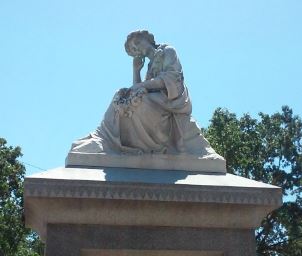
Cloaking is the power to hide the presence of oneself, other beings, or locations by making them imperceptible to the eye. It is effective at preventing others from discovering one’s location. Scientists at the University of Rochester in New York have discovered a way to hide large objects from sight using inexpensive and readily available lenses. Cloaking is the process that allows an object to become hidden from view, while everything around it appears undisturbed. When an object is placed behind the layered lenses it seems to disappear. “From what we know this is the first cloaking device that provides three-dimensional, continuously multidirectional cloaking,” said graduate student Joseph Choi, who helped develop the technology. In their tests, the researchers have cloaked a hand, a face, and a ruler, making each object appear “invisible” while the image behind the hidden object remains in view. The implications of this discovery are endless. Cloaking can also be achieved through the use of certain spells and potions. Additionally, beings with the power of invisibility are able to naturally cloak themselves by becoming unseeable. The Winchester Mystery House is truly mysterious.
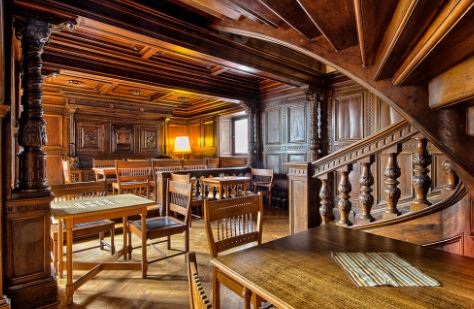
For further information about tours, including group tours, weddings, school events, birthday party packages, facility rentals, and special events please visit the website: https://winchestermysteryhouse.com/
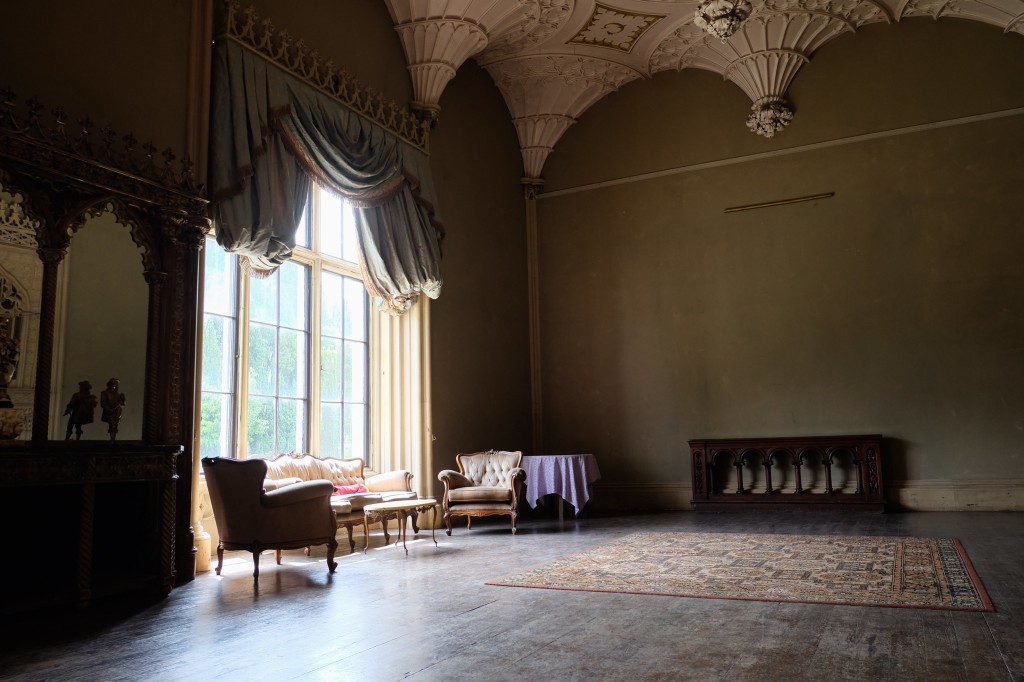
Please visit the online giftshop, and purchase a gift for friends and relatives as well as a special memento of The Winchester Mystery House. A variety of souvenirs and gifts are available to purchase. https://shopwinchestermysteryhouse.com/

The Mind-Shattering Horrors of Llanada Villa
The most merciful thing in the World, I think, is the ability of the human mind to partake in all the beautiful of the material World. We live in an infinity of reality that only the beholder can discern. If we choose to go far, we must learn to apricate our circumstances and work towards an enjoyable life. My home is a vast labyrinth, each mile straining in its own direction, and somedays piecing together the dissociated mysteries will open up such terrifying vistas of reality, and of our frightful curse therein, which shall either make one go mad from the revelation or flee from the deadly catacombs into the peace and safety of a new dark age. Within these walls, there are strange survivals of apparitions that will freeze the blood. However, it is not from them that there came the single glimpse of forbidden aeons which chills me when I think of the madness that has been bestowed upon my bloodline. The grass and trees have assumed the fresh enamel of mediaeval May, and the turf is figured with little blossoms of azure and white and yellow, like an ornate broidery, and there is a pebbly stream that murmurs beside the way, and the voices of undines are parleying deliciously beneath its waters. The sun-lulled air is laden with wafture of youth and romance; and the longing that wells from the heart of Llanada Villa seems to mingle mystically with the balsams of the fruit orchards. Llanada Villa is like a high castle which holds dominion over a surrounding forest. However, once through the threshold, dreaded glimpses of truth, flash out from a hideous past. #RandolphHarris 1 of 8

Somewhere within my haunted mansion is a hidden room notorious for sorcery. Servants speak of phantoms, grisly tales; and there are stories of loup-garous and goblins, of fays and devils and vampires that have infested these very walls. However, to these tales, I give little heed, considering it improbable that such creatures would fare abroad in open daylight. Until one day, I was nearing the appointed parlor, which a turn of the path would soon reveal; and my pulses quickened and became tremulous. My thoughts were interrupted by a shrill scream that rose to an unendurable pitch of fear and horror, issuing from the corridors of stillness of the nearby rooms. Startled, I peered at the thick doors; and as the scream fell back to silence, I heard the sound of dull and hurrying footfalls, and a scuffling as of several bodies. Again the scream arose. It was plainly the voice of a woman in some distressful peril. In a small open space beyond the parlor, I saw a woman who was struggling with three ruffians of exceptionally brutal and evil aspect. Even in the haste and vehemence of the moment, I realized that I had never before seen such men or a woman. They could not have been my servant. The woman was clad in a gown of emerald green that matched her eyes; in her face was the pallor of dead things, together with a faery beauty; and her lips were dyed as with the scarlet of newly flowing blood. The men were dark as Moors, and their eyes were red slits of flame beneath oblique brows with animal-like bristles. There was something very peculiar in the shape of their feet. All of them seemingly had cloven hooves, but somehow I could not recall what sort of clothing they had worn. #RandolphHarris 2 of 8

The woman turned a beseeching gaze upon me as I peered through the door. The men, however, did not seem to heed my presence. Lifting my pistol, I fire with tremendous power at the head of the nearest one—a shot that should have leveled the fellow to Earth. However, the bullet fell to the ground as if forced by unresisting air, and I staggered and almost fell headlong in trying to recover my equilibrium. Dazed and uncomprehending, I saw the knot of struggling figures had vanished utterly. At least, the three men had vanished but from the middle of the parlor, the death-white features of the woman smiled upon me for a moment with faint, inscrutable guile ere. I understood now; and I shivered as I crossed myself. I had been deluded by phantoms or demons, doubtless for no good purpose; I had been the gull of a questionable enchantment. Plainly there was something after all in the legends I had heard, in the ill-renown of The Curse of the Winchester Rifle. I retraced my way down the hall I had been following. However, when I thought to reach again the spot from which I had heard that shrill unearthly scream, I saw that there was no longer path leading to that parlor; nor indeed was this a section of the mansion I recognized. The marble steps, coffered ceilings, the elevator paneled in mahogany like a plutocrat’s library, which carried me to the fourth floor vanished. In lieu of this elegant new addition to Llanada Villa there lay before me a tarn of hallways that were dark and dull as clotting blood, and the trail therein like the hair of suicides, and the skeletons of rotting corpses. #RandolphHarris 3 of 8
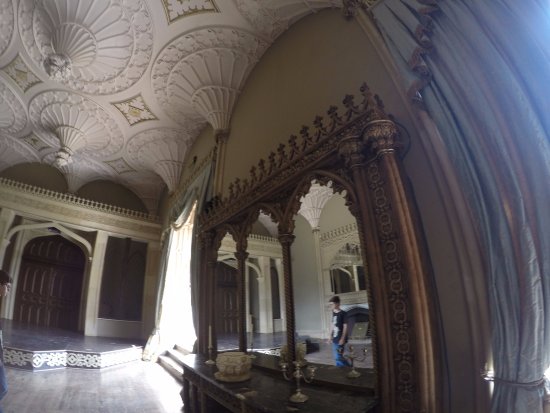
Now, beyond all question, I knew that I was the victim of an evil enchantment. In answering that beguileful cry for succor, I had exposed myself to the spell, had been lured within the circle of its power. I could not know the force of wizardly or demonry had willed to draw me thus; but I knew that my situation was fraught with supernatural menace. As I passed this scene of utter desolation and lifelessness, it seemed a place where cadavers might keep their tryst with demons. Nothing stirred, not even a hammer; and there was no whisper of a servant, no song of birds. I proceeded further and further into my mansion with a cautious eye, as the further I got, the more the scene changed. There were moving lights in the halls that vanished; there were drowned faces in the walls. The parquet floor was an obstacle course of French dollhouses and miniature Japanese castles. The draperies were green silk damask and blue velvet, the furniture Lousi XV gilded oak, the paintings signed by Renior, Cezanne, Degas, Manet, Monet. My many-turreted castle was ancienter than the World, it was older than light; it was coeval with fear and darkness; and horror dwelt upon it and crept unseen but palpable along its bastions. The 600-room mansion was a fairy-tale castle come to life, with secret entrances, mysterious sources of music, and treasure collected from all the World. My home was not so unusual during the day. On the top half, every inch was decorated with Parisian Beaux Arts ostentation, a profusion of lions, cherubs, and goddesses. Oh, but the architects were not done. Soaring above the mansion was an ornate domed tower reaching nine stories, so pleased with itself that it continued to an open cupola. #RandolphHarris 4 of 8
Although construction was continuous, there was often no sign of life about the castle; and no banners flew above its turrets or its donjon. However, spirits spoke loudly to warn me that there was a fountainhead of sorcery involved in the construction of my home. A growing panic would whisper in my brain, I seemed to hear the rustle of malignant plumes, the mutter of demonian threats and plottings. Amid my dismay and bewilderment, I thought of Annie and William and imagined that as long as I continued construction, that one day I would find them waiting for me in a parlor, library, kitchen, or hallway. Through my mansion throw which I lived was a maze of bafflement and eeriness. Sometimes I could swear I felt implacable arms that stoke to retard me; I could swear that I felt them twine about me with the strength and suppleness of living things. I fought them, insanely, desperately, and seemed to hear a crackling of infernal laughter in the walls as I fought. After years, with a leaden sinking of my heart, as into some ultimate slough of despair and terror, I resigned myself and made no further effort to escape. My very will was benumbed, was crushed down as by the incumbence of a superior volition that would no longer permit my puny recalcitrance. I was unable to resist when a strong hateful compulsion drew my footsteps along the margent of the halls down a new, never before seen room. Doors would open by themselves as if to receive an unexpected guest. But other than me, there was no sign of carpenter, architect, maid, butler, no farmer; and the walls of this great mansion were silent as those of a sepulcher. However, there were these apparent hieroglyphics and a figure of evidently pictorial intent, though its impressionistic execution forbade a very clear idea of its nature. It seemed to be a sort of monster, or symbol representing a monster, of a form which only a diseased fancy could conceive. #RandolphHarris 5 of 8
If I say that my somewhat extravagant imagination yielded simultaneous pictures of octopus, a dragon, and a human caricature, I shall not be unfaithful to the spirit of the thing. A pulpy, tentacled head surmounted a grotesque and scaly body with rudimentary wings; but it was the general outline of the whole which made it most shockingly frightful. Behind the figure was a vague suggestion of a Cyclopean architectural background. At the opposite end of the parlor was a door which stood mysteriously open, revealing a dark hall. As I approached the doorway, I saw that a man was standing on the threshold; though a moment previous I could have sworn that it was untenanted by any visible form. I knew that any weapon was futile against this supernatural foe. The man was inordinately tall and cadaverous, and was dressed in black garments of a superannuate mode. His lips were strangely red amid his bluish beard and the mortuary whiteness of his face. They were like the lips of the woman who, with her assailants, had disappeared in a manner so dubious when I approached them. His eyes were pale and luminous as marsh-lights; and I shuddered at his gaze and at the cold, ironic smile of his scarlet lips that seemed to reserve a World of secrets all too dreadful and hideous to be disclosed. “I am Gilles Garnier,” the man announced. His tones were both unctuous and hollow, and served to increase the repugnance I felt. And when his lips parted, I had a glimpse of teeth that were unnaturally small and were pointed like the fangs of some fierce animal. Mr. Garnier was haunting my mind like the funereal accents of a knell; though I could not recall at that moment the macabre and spectral ides which the name tended to evoke. #RandolphHarris 6 of 8
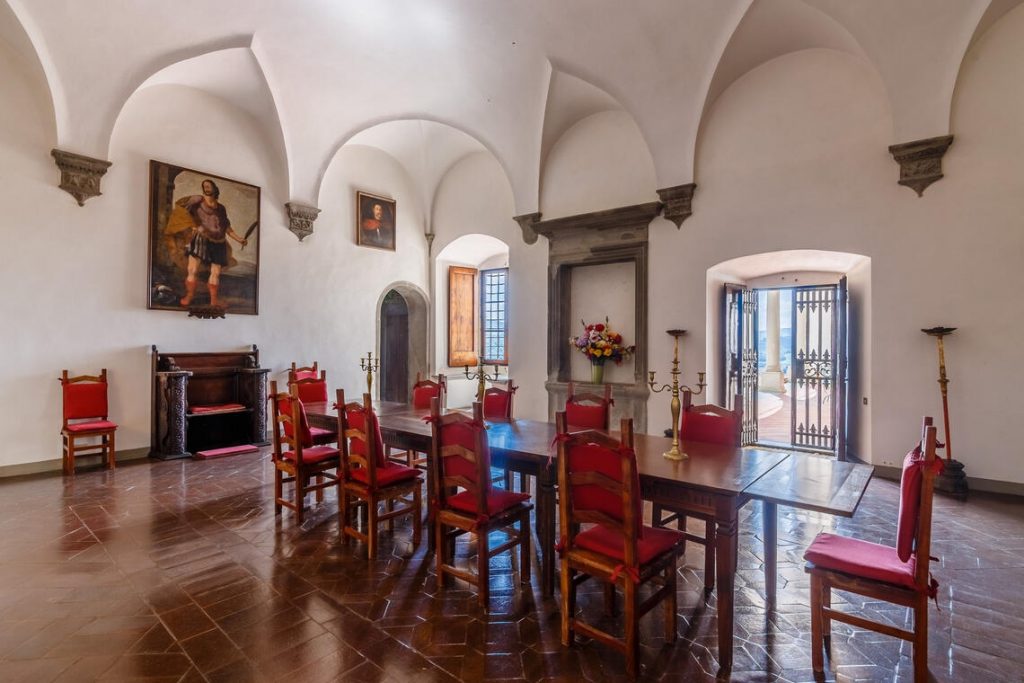
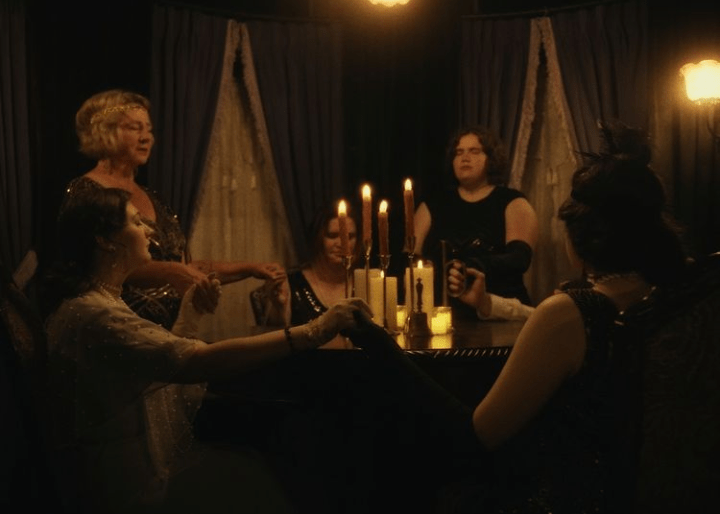
He turned abruptly, motioning me to follow him. I refused. There were sudden and furtive darkness had closed in upon Llanada Villa without moon or star. My mansion became airless and stifling like the gloom of a sepulcher that had been sealed for ages; and I was aware of the veritable oppression, a corporeal and psychic difficulty in breathing, as I moved from room to room. I flung open a heavy door of dark somber wood. Beyond, in what was the eating-room of this section of the mansions, several ghosts were seated about a long table by the light of cressets no less dreary and dismal than those in the hall. In the strange, uncertain glow, their faces were touched with a gloomy dubiety, with a lurid distortion; and it seemed to me that shadows hardly distinguishable from the figures were gathered around the board. I thought I should go mad with fear. Then sensation of being watched grew upon me until I sprang up and turned with my back to fire. Even then it was impossible for me to see much. I stood glancing from door to door, straining to listen over the thudding of my heart. My twin shadows swayed across the doorway of the study opposite, seeming to move independently. I thought of snuffing the candles; but then I would not be able to see the doors to the landing at all. I had learned that you could count second by your heartbeat. Mine was racing far faster than the measured ticking of a clock, but I began to count, anyway. Only I could keep it up; I would reach twenty or thirty, and be distracted by some phantom sound or movement, and start again. Thus I endured an indefinite interval, while the windows darkened further and further. #RandolphHarris 7 of 8

I conjure thee, O Guland, in the name of Satan, in the name of Beelzebuth, in the name of Astaroth, and in the name of all other Spirits, to make haste and appear before me. Come, then in the name of Satan and in the names of all other demons. Come to me, I command thee, in the name of the Most Holy Trinity. Come without inflicting any harm upon me, without injury to my body or soul, without maltreating my books, or anything which I use. I command thee to appear without delay, or, that failing, to send me forthwith another Spirit having the same power as thou hast, who shall accomplish my commands and be submitted to my will, wanting which, he whom thou shalt send me, if indeed thou comest not thyself, shall in no wise depart, nor until he hath in all things fulfilled my desire. I offer my blood unto the Divs and Druj, whom are the essence of counter creation. I offer my life force unto the powers of eternal darkness within. May they devour and destroy the imposed shackles of divine light and stasis that I may become unlimitedly powerful. I salute and conjure you, O beautiful Moon, O beautiful Star, O bright light which I hold in my hand! By the air which I breathe, by the breath which is within me, by the Earth which I touch, I conjure you, and by all the names of the spirits who are princes residing in you; by the ineffable Name On, which hath created all; by thee, O Resplendent Angel Gabriel, together with the Prince Mercury, Michiael, and Melchidae! I conjure you again by all the divine Names of God, that you send down to obsess, torment, and harass the body, spirit, soul and five senses nature. #RandolphHarris 8 of 8
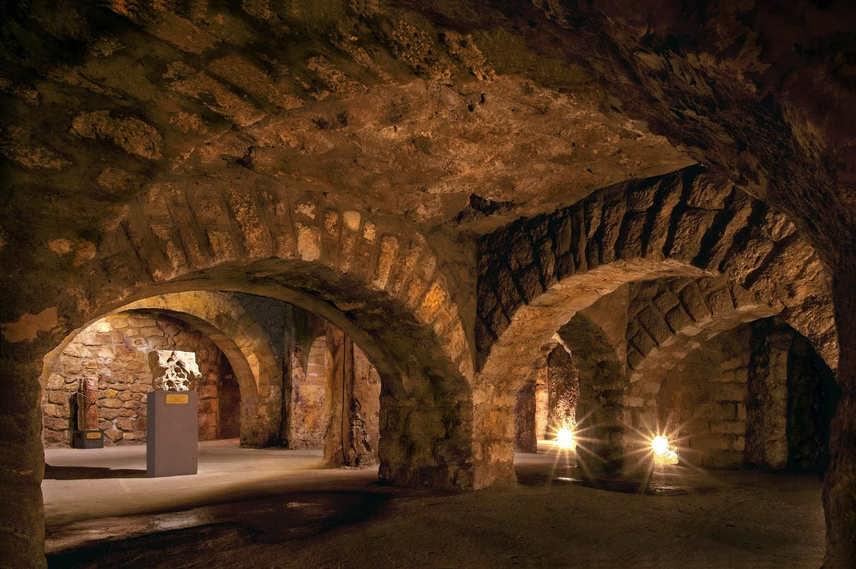
For many years there has been talk of slamming doors, muffled voices and ghost walking the corridors of The Winchester Mystery House, which is over 140-years-old. Recall, the mansion started off as an eighteen-room farmhouse, which Mrs. Sarah L. Winchester purchased. A number of persons hired as night watchmen have quit after only one night on duty, complaining of door opening and closing and invisible footsteps following them on their rounds. In July 2008 a staff member working late thought he heard the sounds of a reception in progress on the first floor, but when he reached the foot of the stairs, he found the rotunda empty, and all noises suddenly ceased. The same tour guide recalled the library room on the third floor as being particularly creepy. Late one night as he approached the library door, he remembered a cold, dank air falling on his head and neck, and he decided his work could wait until the next day. Although the mansion has gone through a considerable number of watchmen who declined the privilege of working in the building after one night on the job, one stuck with the task for more than 13 years. He simply shrugged off the angry slamming of doors that sounded behind him and the thumping noises that followed him on his rounds. However, he admitted that he did not like to work in The Winchester Mystery House after dark. He always made it a point to be out of the building by quitting time, because when darkness fell, he could sense the whole atmosphere changing.
For further information about tours, including group tours, weddings, school events, birthday party packages, facility rentals, and special events please visit the website: https://winchestermysteryhouse.com/

Please visit the online giftshop, and purchase a gift for friends and relatives as well as a special memento of The Winchester Mystery House. A variety of souvenirs and gifts are available to purchase. https://shopwinchestermysteryhouse.com/


What the F–Business Must be Conducted with Glass Pockets!

Although you make think “What the F!” has a negative connotation, it is not a curse word. It means “What the Ferry!” It is what Ferry calls his live resonation radio show. Ferry Coresten is one of the most talented disc jockeys in the World. Mr. Coresten is Dutch disc jockey, record producer and remixer. Defining, understanding, and discovering the conditions that lead to peace is an intellectual challenge with a long and rich traditional with the social sciences. Nevertheless, it remains central today, not simply for academics but to the broader populations as well. The notion that peace is at hand as soon as there is no ongoing, large-scale organized violence is not only the most common idea today but also a way of viewing peace that goes back at least to antiquity. We sometimes achieve peace through military preparations and deterrence, or the military defeat of adversaries. The quantitative research on conflict, violence, and peace is an already large subject area within the social sciences, and it is undergoing yet another growth spurt in the aftermath of 9/11, with increasing discussion of terrorism, restriction of civil liberties, torture, invasion, insurgency, counterinsurgency, revolution, counterrevolution, mass protest, and protest policing. Many people think we already live in a police state, but they have not seen anything yet. In 2007, alarm companies did not want to install security cameras on homes because they warned home owners that footage could be obtained by anyone and put on the Internet without their consent, but now people are going as far as having cameras places in their home that security companies monitor. Before long, the streets and highways in the United States of American will be full of license plate readers, which automatically issues tickets for speeding, which will make the road less safe as less officers will be out to stop illegal vehicles and vehicle violating law. #RandolphHarris 1 of 20

We will also have police drones patrolling neighbourhoods, roads, and highways recording information and acting as law enforcement agents, so there will be virtually no privacy and anything that is done can be pulled up and reviewed for later enforcement of the law. Therefore, it is critical to study peace as something more than merely the absence of overt violence. Peace is defined only as the absence of some violent actions. This form of peace, as “no violence,” can range from brutal dictatorships to democracies that fully respect human rights, from states that remain at peace only for brief periods of time between recurring bought of violence to societies that have not experienced overt hostilities for hundreds of years, and from states that consistently remain prepared for “hot” conflict to those that do not consider preparing for it. If peace is an inherent dichotomy, then war and genocide are the opposite. Personal relationship, closeness and warmth, Christian community—these are just what I have experienced in East Germany when I have visited. Over the years the society has always come through with insightful and perceptive judgments. The new paradigm of just peacemaking is grounded in the historical experience of people who have lived in the face of oppression, violation of their basic rights, and the nuclear threat, and who, together with political scientist, Christian ethicists, and activists, fashioned realistic steps of peacemaking that enabled them to begin living in the time after the Cold War even before the Wall came down. Though oppressed and constricted, they began to live our future. Because the paradigm is grounded in realistic but persistent hope-creating experience, attention must be paid to critical perspectives external to Christian faith; and since the heart of the story is consent to all God’s creating and the practice of forgiveness and love, an ethic is to be tested by its ability to be inclusive rather than to repress important standards of human life, or other members of the human community. #RandolphHarris 2 of 20

We have all known we needed to develop new methods for achieving change without violence. Now we have seen nonviolent revolutions in Iran (where the revolution was nonviolent but not the subsequent regime) in Philippines, in Argentina, throughout Eastern Europe, and in the peoples’ defeat of the coup in the Soviet Union, and there is hope for them in South Africa and perhaps Palestine (where parts of the movement are nonviolent, and other parts are not). Human rights movements must refrain from violence. They must take the beneficial action of clearly articulating the human rights that need to be established. The breakdown of the medieval system of feudal society had one main significance for all classes of society: the individual was left alone and isolated. He was free. This freedom had a twofold result. Man was deprived of the security he had enjoyed, of the unquestionable feeling of belonging, and he was torn loose from the World which had satisfied his quest for security both economically and spiritually. He felt alone and anxious. However, he was also free to act and to think independently, to become his own master and do with his life as he could—not as he was told to do. However, according to the real life situation of the members of different social classes, these two kind of freedom were of unequal weight. Only the most successful class of society profited from rising capitalism to an extent which gave them real wealth and power. They could expand, conquer, rule and amass fortunes as a result of their own activity and rational calculations. #RandolphHarris 3 of 20

This new aristocracy of money, combined with that of birth, was in a position where they could enjoy the fruits of the new freedom and acquire a new feeling of mastery and individual initiative. On the other hand, they had to dominate the masses and to fight against each other, and thus their position, too, was not free from a fundamental insecurity and anxiety. But, on the whole, the positive meaning of freedom was dominant for the new capitalist. It was expressed in the culture which grew on the social of the new aristocracy, the culture of the Renaissance. In its art and in its philosophy it expressed the new spirit of human dignity, will, and mastery, although often enough despair and skepticism also. The same emphasis on the strength of individual activity and will is to be found in the theological teachings of the Catholic Church in the late Middle Ages. The Schoolmen of that period did not rebel against authority, they accepted its guidance; but they stressed the positive meaning of freedom, man’s share in the determination of his fate, his strength, his dignity, and the freedom of his will. On the other hand, the lower classes, the poor population of the cities, and especially the peasants, were impelled by a new quest for freedom and an ardent hope to end the growing economic and personal oppression. They had little to lose and much to gain. They were not interested in dogmatic subtleties, but rather in the fundamental principles of the Christian Bible: brotherliness and justice. Their hopes took active form in a number of political revolts and in religious movements which were characterized by the uncompromising spirit typical of the very beginning of Christianity. #RandolphHarris 4 of 20

Rising capitalism, although it made also for their increased independence and initiative, was greatly a threat. In the beginning of the sixteenth century the individual of the middle class could not yet grain much power and security from the new freedom. Freedom brought isolation and personal insignificance more than strength and confidence. Besides that, he was filled with burning resentment against the luxury and power of the wealthy classes, including the hierarchy of the Roman Church. Protestantism gave expression to the feelings of insignificance and resentment; it destroyed the confidence of man in God’s unconditional love; it taught man to despise and distrust himself and others; it made him a tool instead of an end; it capitulated before secular power and relinquished the principle that secular power is not justified because of its mere existence if it contradicts moral principles; ad in doing all this it relinquished elements that had been the foundations of Judaeo-Christian tradition. Its doctrines presented a picture of the individual, God, and the World, in which these feelings were justified by the belief that the insignificance and powerlessness which an individual felt came from the qualities of man as such and that he ought to feel as he felt. Thereby the new religious doctrines not only gave expression to what the average member of the middle class felt, but, by rationalizing and systematizing this attitude, they also increased and strengthened it. However, they did more than that; they also showed the individual a way to cope with his anxiety. They taught him that by fully accepting his powerlessness and the evilness of his nature, by considering his whole life an atonement for his sins, by the utmost self-humiliation, and also by unceasing effort, he could overcome his doubt and his anxiety; that by complete submission he could be loved by God and could at least hope to belong to those whom God has decided to save. #RandolphHarris 5 of 20

Protestantism was the answer to the human needs of the frightened, uprooted, and isolated individual who had to orient and to relate himself to a new World. The new character structure, resulting from economic and social changes and intensified by religious doctrines, became in its turn an important factor in shaping the further social and economic development. Those very qualities which were rooted in this character structure—compulsion to work, passion for thrift, the readiness to make one’s life a tool for the purposes of an extra personal power, asceticism, and a compulsive sense of duty—were character trait which became productive forces in capitalistic society and without which modern economic and social development are unthinkable; they were the specific forms into which human energy was shaped and in which it became one of the productive forces within the social process. To act in accord with the newly formed character traits was advantageous from the standpoint of economic necessities; it was also satisfying psychologically, since such action answered the needs and anxieties of this new kind of personality. To put the same principle in more general terms: the social process, by determining the mode of life of the individual, that is, his relation to others and to work, molds his character structure; new ideologies—religious, philosophical, or political—result from and appeal to this changed character structure and thus intensify, satisfy, and stabilize it; the newly formed character traits in their turn become important factors in further economic development and influence the social process; while originally they have developed as a reaction to the threat of new economic forces, they slowly become productive force, furthering and intensifying the new economic development. #RandolphHarris 6 of 20

The system of rules and their enforcement itself must first establish a reputation for integrity and efficacy. This takes a long time and strict supervision even given much good will. In many countries, the great difficulties experienced by the governments of most transition economies in their attempts at such reputation-building require attempts of the top levels of the government at making and enforcing reliable governance systems. However, they can be ruined by some middle-level officials who attempt to make quick profit from their newfound power. There are evident problems of this in most transition economies. Also, in the phase when the system of rules in imperfect but improving, it can offer better outside payoffs to the participants in the prevailing relation-based system. By thus increasing their incentives to cheat their current partners, it can worsen the outcomes of the relation-based system. The policies required to initiate a transition from low-income equilibrium to a state of rapid growth may be qualitatively different from those required to reignite growth for a middle-income country. At low levels of income, with reasonable institutions and reasonable policies, it may be easy to achieve high growth up to semi-industrialization. However, the institutional requirements of reigniting growth in a middle-income country can be significantly more demanding. Growth starting from a low level can be achieved using relation-based governance in small communities of traders with good relationships and information networks, so long as the state does not actually inhibit such developments with its policies. However, to go beyond the middle-income level requires greater integration into a large economy, where relation-based governance is inadequate. The necessary shift toward rule-based governance is more demanding because it must overcome the additional problems of collective action, vested interest and so on. #RandolphHarris 7 of 20

How might such investment in the framework of rules get made? In 1898, when Elbert Gary and J. Pierpont Morgan started Federal Steel, they took the then unusual step of issuing quarterly reports because both men believed that corporations issuing publicly traded securities had to account for their financial performance. At first there was no public process such as external audits to guarantee the truthfulness of these accounts; presumably Mr. Morgan’s own reputation and integrity, acquired in the prevailing relation-based system of finance, gave them credibility. However, the public gradually found that inadequate, perhaps because others entering the arena of raising finance from the general public did not have the same reputation. A few years later, then president Theodore Roosevelt said that he would not “accept the publication of what some particular company chooses to publish as a favor, instead of demanding what we think ought to be published from all companies as a right” (Strouse 2000, p. 439). And still later, Mr. Morgan said that “business in the twentieth century would have to be conducted with glass pockets” (Strouse 2000, p. 600). This episode serves to emphasize the endogeneity of verifiability, and the value of making more information publicly verifiable. Forces operate on the other side to undermine a relation-based system when it comes into contact with other rule-based systems. If capital-owners in the relation-based system become able to invest abroad under a rule-based system and earn the going return there, that will raise the outside opportunities of the participants in each ongoing repeated game of relation-based finance, and thereby unravel its tacit cooperation equilibrium. #RandolphHarris 8 of 20

Similarly, as improvements in transportation technology or lowering of trade barrier with other countries, or liberalization of regulation within or across countries, bring a relation-based production system into contact with other economies and other markets, its firms will discover better opportunities outside their previous relationships; this can undermine the previous repeated game equilibrium. If or when a relation-based economy needs to import capital, whether financial or direct investment, it will find it difficult to do so. Unless foreigners are misinformed or gradually develop relationships with host-country businesses, they will be reluctant to lend. Conversely, firms in a relation-based system may be reluctant to borrow from lenders who are not part of their relation network, for fear that the strangers may withdraw their capital suddenly. So, if it needs foreign capital, a relation-based economy may fail to grow unless it changes over successfully to a rule-based system where anyone can invest with the confidence that the only uncertainties will be those arising from natural economic shocks, not those of borrowers’ strategic default or fraud or lenders’ capital flight. Of course the difficulties of brining together two such different systems of financial transactions are not insurmountable. Intermediaries can develop relations on both sides, and profit by providing these services for a fee. The Rothschilds did this in Europe with great success for over a century, literally be having relations on both or all sides. #RandolphHarris 9 of 20

In the second half of the nineteenth century, the United States of America was a major capital importer. This was facilitated by the Morgans—Junius S. operating in London and J. Pierpont in New York—who established a relation-based chain of trust between borrowers in the United States of America and lenders in the United Kingdom and Europe. In modern times, Hong Kong served a similar role, dealing with lenders—Western ones on a basis of rules and overseas Chinese ones on the basis of relations—and with borrowers—investing firms in mainland China on a basis of relations. In countries shaken by the Third Wave, the truly poor no longer necessarily have numbers on their side. In a good many countries they—like everyone ese—have become a minority. Not only is majority rule therefore no longer adequate as a legitimating principle, it is no longer necessarily humanizing or democratic in societies moving into the Third Wave. Second Wave ideologues routinely lament the breakup of mass society. Rather than seeing in this enriched diversity an opportunity for human development, they attack it as “fragmentation” and “Balkanization” and attribute it to the aroused “selfishness” of minorities. This trivial explanation substitutes effect for cause. For the rising activism of minorities is not the result of a sudden onset of selfishness; it is, among other things, a reflection of the needs of a new system of production which requires for its very existence a far more varied, colourful, open and diverse society than any we have ever known. We can either resist the thrust toward diversity, in a futile last-ditch effort to save our Second Wave political institutions, or we can acknowledge diversity and change those institutions accordingly. #RandolphHarris 10 of 20

The former strategy can only be implemented by totalitarian means and must result in economic and cultural stagnation; the latter leads toward social evolution and a minority-based twenty-first-century democracy. To reconstitute democracy in Third Wave terms, we need to jettison the frightening but false assumption that increased diversity automatically brings increased tension and conflict in society. Indeed, the exact reverse can be true. Conflict in society is not only necessary, it is, within limits, desirable. If one hundred men all desperately want the same brass ring, they may be forced to fight for it. On the other hand, if each of the hundred has a different objective, it is far more rewarding for them to trade, cooperate and form symbiotic relationships. Given appropriate social arrangements, diversity can make for a secure and stable civilization. It is the lack of appropriate political institutions today that unnecessarily sharpens conflict between minorities to the knife-edge violence. It is the lack of such institutions that makes the majority harder and harder to find. The answer to these problems is not to stifle dissent or to charge minorities with selfishness (as though the elites and their experts are not similarly self-interested). The answer lies in imaginative new arrangements for accommodating the legitimating diversity—new institutions that are sensitive to the rapidly shifting needs of changing and multiplying minorities. Someday future historians may look back on voting and the search for majorities as an archaic ritual engaged in by communicational primitives. #RandolphHarris 11 of 20

Today however, in a dangerous World, we cannot afford to delegate total power to anyone, we cannot surrender even the weak popular influence that exists under majoritarian systems, and we cannot allow tiny minorities to make vast decisions that tyrannize all other minorities. This is why we must drastically revise the crude Second Wave methods by which we pursue the elusive majority. We need new approaches designed for a democracy of minorities—methods whose purpose is to reveal differences rather than to paper them over with forced or fake majorities based on exclusionary voting, sophistic framing of the issues or rigged electoral procedures. We need, in short, to modernize the entire system so as to strengthen the role of diverse minorities, yet permit them to form majorities. In Second Wave societies, voting to determine the popular will provide an important source of intermittent feedback for the ruling elites. When conditions for one reason or another became intolerable for the majority, and fifty-one percent of the voters registered their pain, the elites could, at a minimum, shift parities, alter policies, or make some other accommodations. Even in yesterday’s mass society, however, the fifty-one percent principle was a decidedly blunt, purely quantitative instrument. Voting to determine the majority tells us nothing about the quality of people’s views. It can tell us how many people at a given moment want X, but not how badly they want it. Above all, it tells us nothing about what they would be willing to trade off for X—crucial information in a society made up of many minorities. #RandolphHarris 12 of 20
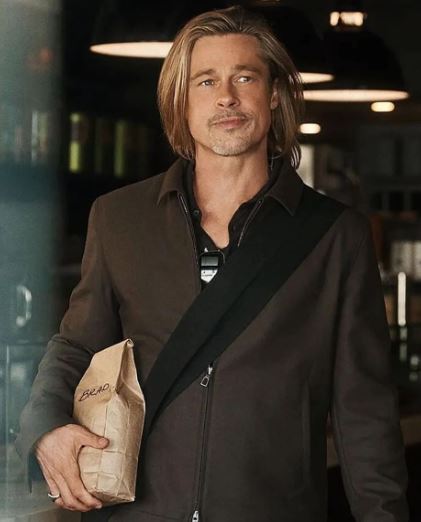
When a minority feels so threatened or attaches such life-and-death significance to a single issue that its views should perhaps receive more than ordinary weight, nor does it signal us then. In a mass society these well-known weaknesses of majority rule were tolerated because, among other things, most minorities lacked strategic power to disrupt the system. In today’s finely wired society, in which all of us are members of minority groups, that is no longer true. For a de-massified Third Wave society, the feedback systems of the industrial past may be considered too crude. Thus we will have no use voting and the polls in a radically new way. Also, because the de-massification and redistribution of media outlets, we are no longer creating stars as famous Worldwide as Aaliyah, Britney Spears, Beyonce, Paris Hilton, Brad Pitt, Tyson Beckford, Tyra Banks, Jennifer Lopez, or Lucy Lui. Fortunately, Third Wave technologies provide pathways toward Third Wave democracy. They reopen, in a startling new context, fundamental issues that our founders considered two hundred years ago. These technologies make possible new, hitherto impractical forms of democracy. Although the transition from the problem phase to the proposal phase of planning is usually gradual, the formulation of proposals is qualitatively distinct from the definition of public and problem. Proposals are creative responses; they call for imagination, invention, even genius. The making of proposals has to be properly timed, not coming too early in the planning process. For any given problem there may be a number of solutions, and thus new potentialities of divergence are introduced into the public’s discussion. #RandolphHarris 13 of 20

If those who make proposals are anxious that they be accepted or at least taken seriously and attended to, they should ideally wait until a public has become quite clear and coherent s to the nature of its problem and its desire to act. This is especially true when a proposal is likely to threaten this or that section of the public’s interest; a premature proposal is more easily exiled from discussion by an alter minority, or even without opposition may lose force, when its relevance is not yet apparent. Perhaps the proposal phase could be said to begin where “to act or not to act” ceases to be the question and consideration turns to serious alternatives. It ends when the proposal or proposals go before a policy-making body for decision. If the outcome is to be a full-fledged proposal of the planning type, during the interim a considerable number of developments ideally must occur. During this phase, proposals may be legion, running from the most casual sort of suggestion to massive reports prepared by many experts and taking years of work. If it is to deserve serious considerations, despite such variation in their elaborateness, the proposal must contain some basic elements. There must be a statement of an effective and feasible way of solving the problem as it has been defined. An estimate of the resources, human and material, required for carrying out the proposal. A schedule of the rate at which these recourses will be applied. A statement of certain quantitative goals for achievement within the schedule set. #RandolphHarris 14 of 20

Any proposal containing these elements is a planning proposal, and is often called a plan, sometimes with the name of its author prefixed, exempli gratia, the Marshall Plan (although technically it does not become a plan until it has been subject to a policy commitment, and then of course it becomes a program). The injection of proposals into the public’s discussion of the problem is frequently, at first, on what might be called an amateur basis. While each serious proposal may contain the four essential elements, their development is neither elaborate nor exact. The multiplicity of proposals and their rudimentary nature, given a strong feeling of concern, then quite readily lead to a conscious demand for more careful study of the situation and comparative examination of the proposals. Then, and not before then in most cases, is the appropriate time for commencing the formal organization of the public. At this point, another custom is often to constitute some expert committee, commission, or board and to charge it with making a study and some definite recommendations for action. The composition of the more successful committees tends to be drawn, with certain exceptions, from all the significant elements in the public to which the situation is a problem. To give them their charge may call for further definition of the appropriate scope of the planning area. This calls for judgment and may itself be a matter of disagreement. If action is truly desired, the planning area ought to be confined to those to whom the situation is definitely a problem in which they are actively involved, and it ought not to include everyone who might potentially experience some consequence from the action taken. #RandolphHarris 15 of 20

After admitting the possibility of deception in supernatural things, and a doubt has come into mind whether certain “experiences,” either personal or otherwise, were of God after all, the next stages are: The discovery of the deception. Light and truth alone can make free, and when once a doubt comes in and the man opens his mind to the truth that he is as liable to be deceived as anyone else, then to the mind and attitude light is given (John 3.21). Sometimes the specific deception is seen at once, but more often the discovery is gradual, and patience is needed while the light slowly dawns. Certain fact in connection with various experiences of the past, which the believer has failed to note, may now emerge into the light, and the half-truths which the Adversary had used to deceive are clearly seen: the twisting of words, the wrenching of sentences out of their context in the Scriptures—all come into a view as the light is given. Then comes: the acknowledgement of the deception. This is now imperative. The truth must not only be faced but owned up to, so that things are called by their right names, and the father of lies defeated by the weapon of truth. The Book of Mormon and the Christian Holy Bible keeps one from sin, and draws one near to virtue. You shall teach diligently the word of God to your children. The moral World is maintained by the instruction of our young; their education shall not be interrupted even to rebuild the Temple. When parents encourage their children to study The Book of Mormon and the Christian Holy Bible, their influence lives beyond the grave. #RandolphHarris 16 of 20

One who has studied in one’s youth may be compared to writing set down on new parchment; but one who begins to study when one is old, is like writing set down on re-used parchment. If one studies The Book of Mormon and the Holy Christian Bible in one’s youth, its words are woven into the texture of one’s life. Train a child in the way one should go, and when one is older, one will not depart from it. As long as the voices of children resound with the study of The Book of Mormon and the Holy Chistian Bible, no enemy can triumph over America. The Book of Mormon and the Holy Christian Bible are each a Tree of Life; happy are they who understand its teachings, and fulfill God’s commandments. The significance of the Cross and the Resurrection of Jesus as the Christ can be summed up in one word: salvation. One can be saved from many things, but salvation is salvation from the ultimate negativity. Salvation is healing for healing means reuniting that which is estranged, giving a center to what is split, overcoming the split between God and man, man and his Worl, man and himself. It is the revelation of the New Being in Jesus as the Christ which brings salvation. Consequently, where there is revelation, there is salvation, for the revelation of the ground of being transforms and heals. Revelation and salvation are identified. The revelational history of mankind—preparatory revelation before the appearance of the New Being, and receiving revelation afterwards—testifies that men have shared in the healing power of the New Bring, or else they would have succumbed to the destructive tendencies of existential estrangement and have ceased to exist. #RandolphHarris 17 of 20

Traditional theology has presented the rigid alternatives of total condemnation and total salvation. However, we reject them both, for, although the healing power of the New Being is never absent, even those who experience it are healed but fragmentarily. The divine act overcomes estrangement by removing guilt, and man reacts by accepting reconciliation. The effects of atonement are threefold, and together they constitute the meaning of salvation: Regeneration, Justification, and Sanctification, or, in Tillichian terminology, participation, acceptance, and transformation. Regeneration stresses the objective power of the New Being to grasp estranged mankind and draw it into itself. Man participates in the new reality revealed in Christ only by being seized by it. Thus, Regeneration is the new state of things, the new eon, which the Christ brought; the individual enters it, and in so doing he himself participates in it and is reborn through participation. Since Regeneration is participation in the objective power of the New Being, it precedes Justification, for faith as the state of being grasped by the divine presence is not a human act, but the work of the Spirit. Justification is acceptance. It is the act of God by which He accepts sinful man in spite of his guilt. It is also the act of man by which man accepts God’s saving mercy. Indeed, there is nothing in man which enables God to accept him. However, man must accept just this. He must accept that he is accepted; he must accept acceptance. This in spite of his anxiety, man accepts God’s justifying act. In spite of is the paradox of simual peccator, simul Justus. #RandolphHarris 18 of 20

As a divine act, Regeneration and Justification are one, for Regeneration is the actual reunion of the estranged, and Justification is its paradoxical character. Sanctification is distinct from both of them in the sense that a process is distinguished from the event in which it is initiated. Sanctification is the process in which the New Being transforms both individuals and communities. Sanctification, as transformation, takes place both within religion and outside it in the secular realm. Up to now emphasis has been laid upon the individual man as the one who is saved. However, our vision is broader than that. At the crucifixion of Jesus the sun was darkened, the temple veil split, rocks cracked, and the dead rose. Nature was in an uproar, and the event at Golgotha is one which concerns the Universe, including all nature and history. The Christ cannot be restricted to one area; Christology must be cosmic. Salvation extends to the whole World, and World means nature as well as man. It is through man, the microcosm, that the saving power of the New Being reaches out to the Universe. The tragedy of nature is bound to the tragedy of man, as the salvation of nature and nature is in man. Consequently, the impact of the Spiritual Presence upon beings inferior to man is indirect and, in a quantitative sense, severely limited. However, in a qualitative sense it is enormous. Salvation is found within the Kingdom of God which embraces the Universe. It is the place where there is complete transparency of everything for the divine to shine through it. In His fulfilled kingdom, God is everything for everything. Salvation, the healing of the disrupted, is brought about by love, for love is the drive towards the unity of the separated. The New Being is the love of Jesus who is the Christ, reuniting estranged mankind with its ground. The Spiritual Presence manifests itself as love. After distinguishing divine love from human love, we come to an understanding that man’s love for God is the drive toward the reunion of the separated. #RandolphHarris 19 of 20

However, since salvation is an act of God, God’s love must first extend to man and grasp him. The distinction between faith and love disappears, for being grasped by God in faith and adhering to Him in love is one and the same state of creaturely life. We belong to the Old Creation, and the demand made upon us by Christianity is that we also participate in the New Creation. What is this New Being? The only thing that counts, regardless of faith, is the union with Him in whom the New Reality is present. No religion matters—only a new state of things. The New Creation—this is our ultimate concern; this should be our infinite passion—the infinite passion of every human being. This matters; this alone matters ultimately. In comparison with it everything else, even religion or non-religion, even Christianity or non-Christianity, matters very little—and ultimately nothing. And now again we ask: What is this New Being? It is a renewal of the Old which has been corrupted, distorted, split, and almost destroyed. Therefore, we can speak of the New in terms of a re-newal: The threefold “re,” namely, re-conciliation, re-union, re-surrection. The word “resurrection” has for many people the connotation of dead bodies leaving their graves or other fanciful images. However, resurrection means the victory of the New state of things, the New Being born out of death of the Old. Resurrection is not an event that might happen in some remote future, but it is the power of the New Being to create life out of death, here and now, today and tomorrow…Resurrection happens now, or it does not happen at all. It happens in us and around us, in soul and history, in nature and Universe. The message of Christianity is not Christianity, but a New Reality. A New state of things had appeared, it still appears; it is hidden and visible, it is there and it is here. Accept it, enter into it, let it grasp you. And like God saves all, the Fire Department will rescue you no matter how rich or poor you are, no matter or age, or what you look like or where you live! Be sure to thank your local heroes, and feel free to make donations to them, they are understaffed and underfunded. #RandolphHarris 20 of 20

MAGNOLIA STATION AT CRESLEIGH RANCH
Rancho Cordova, CA | low USD $600,000.00s
Now Selling!

Models now open at Magnolia Station! Located at the corner of Rancho Cordova Parkway and Douglas Road, residents of Cresleigh Ranch will benefit from a brand new neighborhood with convenient access to the new Raley’s Shopping Center, Sunrise Boulevard, and much more!

Magnolia Station will include 81 homesites and five distinct plans ranging from 2,200 – 3,700 square feet; including three single story plans! Each plan has been thoughtfully designed to include features such as: Generations Suite, Optional Offices/Dens, Extended Great Rooms, and more! https://cresleigh.com/magnolia-station/residence-2/

P.S. The limo is not cheap. Wor

Legend of The Winchester Mystery House
It is well-know that my mansion is haunted. In all of the valley, not one person of unbiased mind entertains a doubt of it. I was sitting in the chair. It seemed I had been asleep forever, but I had not been sleeping at all. The day was sunny and cool. The grass greening all the expanse in its front seemed to grow with a natural and joyous exuberance, and the flowers blossomed in a lovely fashion. Full of charming lights and shadows and populous with pleasant-voiced birds, the well-manicured evergreen trees no longer struggled to run away, but bent reverently beneath their blessings of sun and song. Even the stained-glass windows were an expression of peace and contentment, due to the light within. Over the fruit orchards, the visible heat danced with a lively tremor incompatible with the gravity which is an attribute of the supernatural. Ghosts bridge the past to the present; they speak across the seemingly insurmountable barriers of death and time, connecting us to what was lost. They often give us hope for a life beyond death and because of this help us to cope with loss and grief. Their presence is the promise that we do not have to say goodbye to our loved ones right away and that what was left undone in one’s life might yet be finished. However, Llanada Villa was horribly haunted. A haunted house is a memory palace come to life—a physical space that retains memories that might otherwise be forgotten. Many ghost sighting and other mysterious incidents revolve around the stair cast to the ceiling. Many of my guest have confided that they get dizzy, have trouble breathing, and feel a pressing need to leave the house. Death lingers in the air. The walls are shrouds, enfolding every space in exquisite darkness. #RandolphHarris 1 of 5

While sitting in the parlor, enjoying a cup of tea, a bone chilling, piercing hold took hold of me. Suddenly rain fell steadily, splashing on the ground beneath the window and lying in pools upon the sodden grass. Except for an occasional glimpse of bare branches gliding through the mist, there was nothing to be seen beyond the window, but grey, swirling vapour; I looked up more than once from the pages of John Bunyan’s narrative and felt the hair rise on the back of my neck before the warmth of the fire brought me back to The Pilgrim’s Progress. Every now and then the Heavens were torn asunder by vivid lightning. The blackness of the storm had become merged in darkness of the night, and the weird sounds of a wolf echoed around the estate. There was something so weird and uncanny about the whole thing that it gave me a turn and made me feel quite faint. Halloween was the night, according to the belief of millions of people, when the devil was abroad, graves were opened, and the dead came forth and walked. When evil things of Earth and air and water held revel. The floor shook as though thousands of horses thundered across it. A flash of forked lightning lit up the whole expanse of the Heavens. I heard a mingling of dreadful sound, and the air seemed reverberant with the howling of wolves. The last sight that I remembered was a vague, white, moving mass, as all of the souls killed by the Winchester Rifle sent out the phantoms, and that they were closing in on me through a white cloudiness. #RandolphHarris 2 of 5
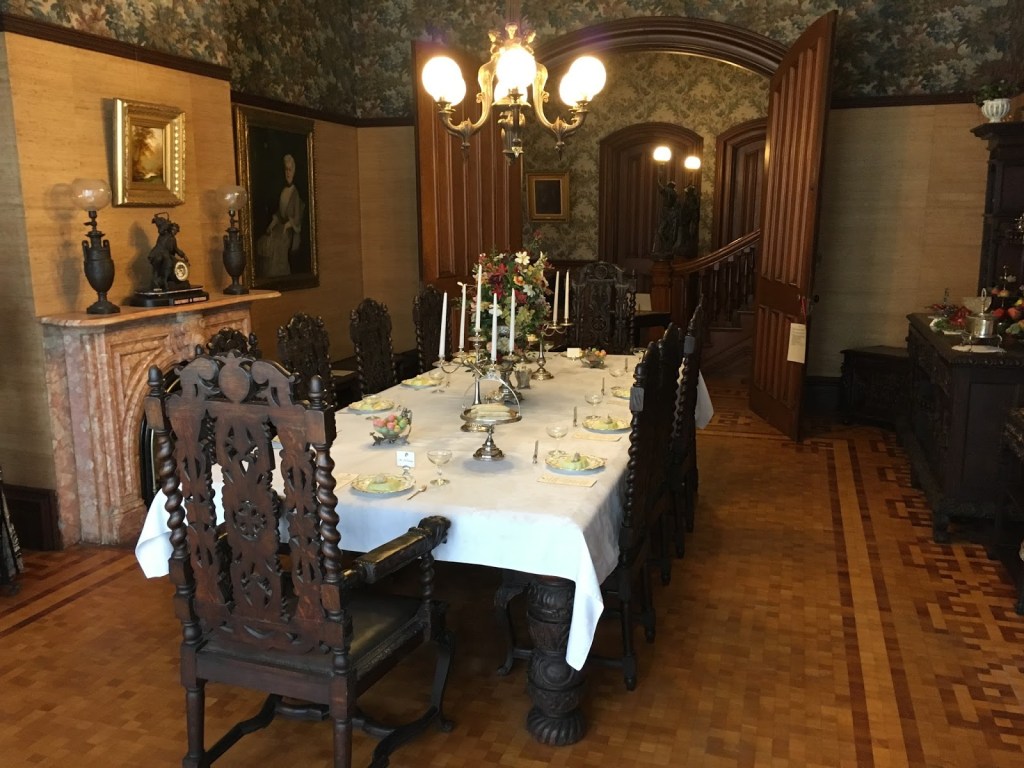
Gradually there came a sort of vague beginning of consciousness, then a sense of weariness that was dreadful. For a time I remembered nothing, but solely my sense returned. My feet seemed absolutely racked with pain, yet I could not move them. They seemed to be numbed. There was an icy feeling down my spine. It was a nightmare—a physical nightmare, if one may use such an expression—for some heavy weight on my chest made it difficult for me to breathe. This period of semi-lethargy seemed to remain a long time, and as it faded away I must have slept or swooned. Then came a sort of loathing, like the first stage of sea-sickness, and a while desire to be free from something—I knew not what. A vast stillness enveloped me, as though all the World were asleep or dead. For another spell of time, I was powerless. Lights and shadows moved in the mansion. There were dark whispers. I was white as a sheet and shaking so that I could hardly stand. The agony clawed at my innermost soul. Dazed and frightened, this is a deathly place; I have never felt so cold. Shadows darted along the walls. Coals glowed in the fireplace nearby. Though the fire had been burning for hours, it made little impression upon the deathly chill of the gallery. My footsteps reverberated as I there were a dozen people pacing in the gallery. The floor creaked. I was not aware of any draught, yet every so often the flames would sway in unison, as if someone had passed along the floor below. The heat of the fire was diminishing perceptibly. Every sound—the creak of a chair, the crackling of the coals—seemed an intrusion upon the deathly stillness of the gallery. #RandolphHarris 3 of 5
The light strengthened and changed, darkening from yellow to orange to a fiery blood-red glow. As it did so, I became aware of a low, vibrant humming, like the sound of bees swarming; I could not tell where it was coming from. A voice said, “Do not move, upon your lives.” Dazzling white light filled the gallery, followed by an instant later by a thunderclap that shook the whole house and left me blinded and deafened, with diamond patterns of the leadlighting etched upon my vision. As the after-image faced I realized that all of the candles had gone out; beyond the faint glow of the fire at my side, the darkness was absolute. Then came the sound of hurrying feet from the library. A shaft of light spilled across the floor; the connecting door flew open. The lights all went out and I was plunged into impenetrable darkness. A misty pillar of light hovered for a moment in the void and then opened, with a movement like the unfurling of wings, into a shimmering figure that detached itself from the chandelier—now dimly visible in the glow—and glided toward me. It had no face, no form, only a veil of light floating over emptiness. I could not move, could not breathe. I heard the sound of the library door opening, and footsteps approaching. The apparition shimmered to a halt. “Will you speak to me?” I cried. “I may…not stay”—the voice, though faint and indistinct said “but will you not shake hands…” growing fainter with each word—“for friendship’s sake?” The footsteps came closer; the dim outline of a man passed between me and the apparition. Light swirled; a glowing armed appeared, but there was no hand, only an empty sleeve, and when I tried to grasp the arm, my own hand passed straight through it! #RandolphHarris 4 of 5
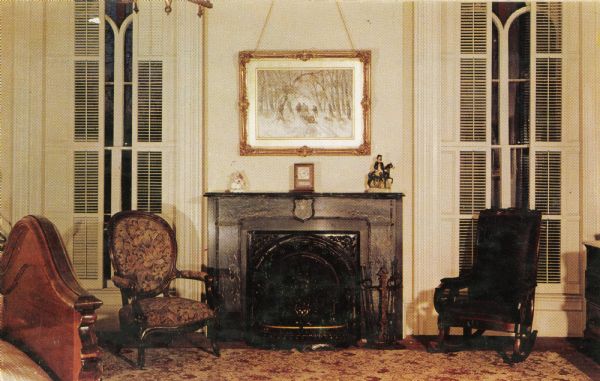
With a cry of despair, I flung both arms around the apparition. For an instant, man and spirit were united; then darkness engulfed them, and I knew no more. When I came to my sense, the coals were crackling in a grate nearby. I was lying, I realized, where I had fallen on the gallery floor, but with a cushion beneath my head. I have had a terrible dream, I thought, turning my head away from the glare. “Mrs. Winchester,” Elizabeth the housemaid said, “I am truly sorry. I should have never left you alone, but I was scared.” “I do not understand,” I said to Elizabeth. “Did you mesmerize me? Did I dream the lightening?” “No, Mrs. Winchester,” she replied. “Everything happened exactly as your perceived.” Lights were burning along the walls, but the floor I where I was laying was still in near darkness. I took Elizabeth’s arm and rose unsteadily to my feet. I straightened my hair and brushed the dust from my cloak. “You feasted on my soul and cast a spell over me!,” I said. The moon rose high. I was very weak, and my heart was beating so slowly that I was almost like a woman fainting. Slowly I turned my head, but Elizabeth was not there. Fear seized me suddenly, a fear unspeakable and unknown. The hour dragged themselves through the twilight and darkness and moonrise. But in the chilly dawn, I lay as one half dead upon my bed. Then came the fear, the awful nameless, panic, the mortal horror that guards the confines of the World we see not, neither know of as we know of other things, but which we feel when its icy chill freezes our bones and stirs our hair with the touch of a ghostly hand. #RandolphHarris 5 of 5
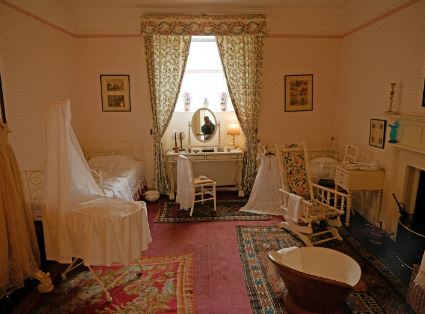
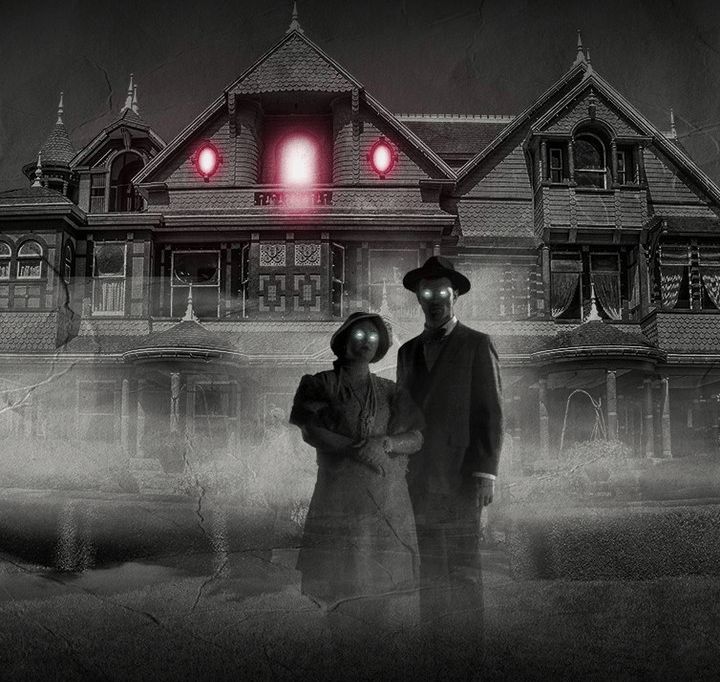
Some houses are more haunted than others. If you account the sheer number of sightings at The Winchester Mystery House, it is one of the busiest places in the World! The phantoms sometimes look like normal, living, breathing human beings. However, then some of these specters abruptly evaporate, without leaving a trace. Sometimes it is hard to believe in ghost even when you have seen them with your own eyes. But at The Winchester Mystery House, spirits come calling down those miles of twisting hallways, and after a visit, there will never be a such thing as a simple tour of a Victorian Mansion. https://winchestermysteryhouse.com/

And please be sure to check out the online gift store: https://shopwinchestermysteryhouse.com/

Cure that Sense of Entitlement

Thought is a vital force or energy which is being developed and which had produced such startling results in the last century, as to bring about a World which would be absolutely inconceivable to man during the days of slavery. If the results have been secured by organizing mental powers over the last hundred years, imagine what can be done in the next hundred. This is why we need to avoid the nihilistic idea that we are living in the last day. The people who repeat this mantra are also the ones who pontificate most loudly about the law of attraction. We have to learn to be genuine in our beliefs and know that we can have a beneficial impact on the future. We do not have to accept things they way they are, but we can make them better. It is clear, therefore, that thought of abundance will respond only to similar thoughts: the wealth of the individual is seen to be what he inherently is. Affluence within is found to be the secret of attraction for affluence to manifest in the outside World. The ability to produce is found to be the real source of wealth of the individual. It is for this reason that he who has his heart in his work is certain to meet with unbounded secrets. He will give and continually give, and the more he gives the more he will receive. Thought is the energy by which the law of attraction is brought into operation, which eventually manifests in abundance in the lives of men. The source of all power, as of all weakness, is from within; the secret of all success as well as all failure is likewise from within. Golden opportunities of life will be strewn across your path, and the power will come unbidden, circumstances will be in your favour, and you will feel the power of the ultimate concern. #RandolphHarris 1 of 18

Many affluent college students make it a point to hide the fact that their families are wealth, because they believe that members of the opposite gender may approach or treat them nicely not because they are interesting and attractive, but simply because they have money. We have worked with young people who consciously choose to live in a more modest apartment than they can afford, or avoid spending too much money on clothes or entertainment, specifically because they do not want to give potential romantic interests any hint regarding their actual financial status. This strategy does seem to provide some reassurance to affluent young people when they are meeting new people, or when they are going out on a first or second date. Clearly, however, as dating relationships develop and progress, it will become more and more difficult to avoid having one’s financial status become apparent. People naturally ask you questions about where you grew up, and where you went to high school. At some point, your date will probably ask you about your parents—maybe just about how you like them, but also more than likely about who they are and what they do. New friends are also quite likely to ask you what you like to do for fun, and they will be curious about the places you have been. These are perfectly normal questions, and you certainly should not interpret them as specific effects to extract data from you on your family’s financial status. Although we certainly understand any desire you may have not to flaunt your wealth as a means of attracting attention, we strongly believe that you should be honest when you answer such questions. To be less than honest is to convey the message that your distrust of others’ intentions is your paramount concern in making new acquaintances, and this would be likely to be perceived as reflecting poorly on you. #RandolphHarris 2 of 18

Students of a high caliber are more attracted to affluent institutions than to poor ones. The major reason is that affluent institutions pay higher salaries, which enable them to recruit better faculties. Some of this may result from a feedback effect that raises the resources for faculty recruitment of institutions with superior reputations among outstanding students. The beta weight indicates that affluence also has some direct effect on student preferences, independent of other conditions. A possible interpretation of this new effect is that superior facilities and better fellowships in affluent institutions attract brighter, more serious students, although the possibility that wealth as such and its symbolic value make an institution preferable cannot be excluded. Large academic institutions are preferred by able students because they can afford better faculties and have more diverse departments than small institutions, but large size itself, independent of these attractive conditions usually associated with it, detracts from the appeal of an institution or higher education to students. In other words, size has a beneficial gross and a negative net effect on capable students, furthering another parallel with the pattern of influences on qualified faculty. The process of mediating the indirect effects of size are similar but not identical, partly because faculty qualifications are the dependent variable in one but an intervening variable in the other case. Bright students are attracted to large academic institutions by their many diverse departments, array of cultures, and by the superior faculties that their higher salaries recruit. These attractions tend to overcome the preferences of good student for small, less impersonal colleges if conditions were the same (indicated by the negative beta weight) and make large institutions more popular among them (indicated by their positive simple correlation). #RandolphHarris 3 of 18

The natural or “mortal mind” view of life and the World is almost always the exact opposite of what is the real spiritual truth and fact. Metaphysics tell us that the visible World is an inverted reflection of the real. If the it is inverted, it is natural, until our spiritual or inner eyes are opened to the truth, for us to see things as the exact opposite of what they really are. Therefore it is not surprising to find that, whereas the moral or terrestrial mind of the senses, thinks the World is the real thing and the mind only a shadow, the real TRUTH is, that mind and spirit are real and eternal, and the visible World but a transient and impermanent thing which has no actual reality. Such being the case then the only thing that really matters is what is in the mind or what is not in the mind. If we have a belief in evil, and thoughts of evil, in our mind, then we have evil in our life. If, however, we can cast the thought of, and belief in, evil out of our mind then it will cease to appear in our life. By raising ourselves above the sensuous life and realizing our permanent World of Mind and there denying evil, poverty, failure, pain, sickness, unhappiness, or whatever our trouble may be, we vanquish the thought which is the cause of all our troubles. Then whatever we affirm will take their place. If we deny “evil,” then we follow by affirming “good,” if we deny sickness, then we affirm prosperity and affluence. By denials we can take out all the evil, care, fear and worry out of our lives and build up in their place by means of affirmations, perfect good, success, affluence, happiness, health, love, peace and courage. Everything being in the mind, then everything that is take out of the mind is take out of life, and everything that is put into the mind comes into life. #RandolphHarris 4 of 18

Thus it is possible with mathematical accuracy and certainty to recreate the life, to cast out all the undesirable and to build up in its place only the beautiful, the good, the true. Life is what we make it. We can make it like Heaven itself, full to the brim with all that is good and beautiful, or we can turn it into a perfect Hell. Therefore do not accept the suggestions of those, who having failed in life, proceed to call it hard names. We can make life a continual joy, if we create a Heaven within us by the quality of our thinking and mental processes. All that we see in life, all that we experience, yeah, even life itself, is but the outward expression of the life within. The life within is built up by our thinking. You will have seen by this time the purpose and value of affirmations. Affirmations are concentrated thoughts. Back of each affirmation is a strong emotion and this gives it tremendous driving force. Not only do affirmations impress the sub-conscious mind thus producing action in accordance with the Will, but they project outwards from the mind into space, attract forces and help from other sources and bring them to minister and bless. Not only so but they also arouse the subliminal mind to inspire, to create, to impart wisdom. By the use of affirmations all the finer forces are aroused to action and the life is transformed from weakness or ineffectiveness to strength or purposefulness. By the use of affirmations, the Will is strengthened until it become so strong all else has to bend to it. By the use of affirmations, the body is strengthened and make healthy, and exercise and body culture become a pleasure instead of a duty. #RandolphHarris 5 of 18

To bring whatever it is that you want into your life, you must develop an insatiable desire for it. That means, for a while, it is all that matters. You vigilantly watch the ego-mind; you refuse to be taken off track. You know your direction and you will allow nothing to move you from it. At that point, all obstacles are viewed as challenges to be overcome, with each one giving you’re a renewed sense of focus. You meet difficulties with the mindset that there is always a way to overcome them, and moreover, you are committed to finding it. You approach, go though, and attend to your outcome without the option of gripping or complaining. You keep moving forward: you make it a “must” and as a result, it will happen. Guaranteed! Affluence means wealth. It means having plenty, so that you are not wanting. It means being connected into the flow of goods and resources so that you are regularly refreshing your abundance even as you use it up. I know people living utterly simple material lives who seem radiant with well-being and happiness. Material wealth should never be desired as an end, but simply as a means of accomplishing an end. Success is contingent upon a higher ideal than the mere accumulation of riches, and he who aspires to sch success must formulate an ideal for which he is willing to stive. However, it is no fun to run out of rent money or cash to go buy groceries. Let us not be delusional; money counts! On the other hand, a lot of money brings a lot of responsibility; you must pay attention to your money or you lose it, and you can easily fall victim to worry about your money rather than enjoying it. So keep this desire for cash and possessions in perspective with the other equal needs. #RandolphHarris 6 of 18

Whatever you desire for yourself, affirm it for others, and it will help you both. You reap what you sow. If you send out thoughts of love and health, they return to you like bread cast upon waters. People who are friends to others find that they indeed have friends. Radiate love and happiness to those you encounter, and this love and happiness will be radiated back to you. True relationship abundance is both deep and wide. Ideally you have a deep resonance with family, and you and your intimate partner have broad goodwill toward those you come into contact with. A valid formula will produce successful results every time and for everyone. You just have to follow it. Life provides a wonderful opportunity to seek our talents and interests. It is well to remember, however, that “all have not every gift given unto them; for there are many gifts, and every man is given a gift by the Spirit of God,” reports Doctrines and Covenants 46.11. In our searching, it is important to seek guidance of the Spirit to discover skills we should develop. Once we have decided what we really want to do, the Lord has given us a formula for achieving our eternal and temporal goals: “For he will give unto the faithful line upon line, precept upon precept; and I will try you and prove you herewith,” reports Doctrines and Covenants 98.12. The Lord reminds us that real success will only come only to the faithful—those who have sincere determination to achieve their goals. The second part of that formula reminds us that learning is often a slow process and comes line upon lone, one step at a time. The Lord offers kind encouragement when He says, “Wherefore, be not weary in well-doing, for ye are laying the foundation of a great work. And out of small things proceedeth that which is great,” reports Doctrines and Covenants 64.33. We must learn to be patient with ourselves while pushing to new levels of achievement or knowledge. It is important to take time occasionally to remind ourselves of what we are trying to do. #RandolphHarris 7 of 18

Thoughts of courage, power, confidence, and hope all produce a corresponding state. All we have to do is let our light shine; the more energy we can radiate, the more rapidly shall we be enabled to transmute undesirable conditions into sources of pleasure and profit. Health and wellness are issues for most of us, and material abundance can mean absolutely nothing when we are seriously sick. Therefore focusing on and manifesting long-term health must be a vital aspect of this program. How can you maximize wellness each and every day, and also regain your health if you lose it? It is now well proven that the thoughts you chronically hold in your mind generate parallel emotional and physiological conditions in your body that either support good health or undermine it. You have perhaps read or seen medical reports on how stress and anxiety, depression and anger, when rehearsed over a long period of time not only become contagious, but also progressively reduce your immune system’s ability to maintain optimum health. When your thoughts become uplifted, progressive, constructive, courageous, noble, kind, or in any other way desirable, you set in motion vibrations which bring about mental, moral, and physical health. The only real power which you can have is the power to adjust yourself to divine and unchangeable principles. You cannot change the Infinite, but you can come into an understanding of natural laws and adjust your thought faculties with the Universal Thought. Your ability to cooperate with this Omnipotence will indicate the degree of success with which you meet. Your expectation determines everything. If you expect nothing, you shall have nothing: if you demand much, you shall receive the greater portion. The World is harsh only as you fail to assert yourself. #RandolphHarris 8 of 18

It is important to belief in your inner reality and broadcast this perfection out to your cellular presence, so that beyond your conscious awareness the infinite unconscious power of the Universe can be working to heal you. And if you are currently healthy, regularly tap into your desire to stay healthy and broadcast this desire and inner faith and harmony to your soul. Inner harmony is the foundation of health. The knowledge of your ability to consciously radiate health, strength, and harmony will bring you into a realization that there is nothing to fear, because you are in touch with Infinite Strength. Regardless of age or health, it is important for all of us to learn to come to peace with the cycle of life and death, and make the best of life while it is still in our possession. One can develop the ideal image of life’s experiences that last for life. We must learn to manifest whatever kind of environment we desire. Although we may be tried to see how determined we are to life our ideal lives, if we persevere, the windows of Heaven truly open in many ways and our providing takes place. Our faith in the Saviour and trust in His words will continue to grow. We will find the most desirable of all our goals will take the most determination to achieve but will be worth every effort. This process can work in reverse and bring loss of spirituality if we are not careful. If we commit sins, we are tried with feelings of regret and remorse. And if we do not heed those feelings and change, further sins come more easily. The result is withdrawal of the Spirit and loss of potential blessings. #RandolphHarris 9 of 18

A life with inner peace and happiness can also be ours if we are willing to earn it. It is marvelous to develop this way of living while you are still very young. You have many years to develop even further great spiritual strength and understanding by applying what the Lord has taught us. Entitlement is not the person who keeps trying to please one’s boss but either lacks the skill or the clear instruction from management to perform well, and who is therefore always getting poor job evaluations. Entitlement is the person whose poor job evaluations result from one’s refusal to invest one’s full energy and commitment in one’s job and who consistently underperforms, not because one lacks the skills or has not received clear instructions from management but simply because one sees no reason to; individuals like this believe that they deserve that paycheck for reasons completely unrelated to how well one performs, an that the company is luck to have him or her. Entitlement is not the spouse who feels inadequate because one’s partner is always expressing one’s frustration with their marriage and with the role one plays in it, even though one tries hard and wants things to be better. Entitlement is the spouse who feels inadequate because one’s partner is always expressing one’s frustration with their marriage and with the role one play in it, even though one tries hard and wants things better. Entitlement is the spouse who thinks everything going wrong in their marriage is their partner’s fault, and that if one does not shape up, one might lose the other. Since one has already made all the contributions to their marriage one needs just to be on the basis of who one is, one’s completely justified in just sitting back now and waiting for one’s spouse to fix whatever is wrong, without any help from their partner. #RandolphHarris 10 of 18

There are many more illustrations, but the many faces of entitlement will always have at least most of these characteristic: An attitude of being special—“I’m exception—and in fact, I’m far greater value to this marriage (of family, or company) than the rest of them, and that’s why I deserve special treatment. They’re lucky to have me.” An attitude of being owed, of deserving something—“I didn’t create this situation—they’re the ones who are always complaining. So why should I do all the work, or even any of it? As far as I’m concerned, I should just stay in my office till they’ve cleaned up this mess. And my bonus had better not be any smaller than any of the others because of it.” A refusal to accept responsibility—“Why do they want me to pay rent? I didn’t ask to be born. Besides, this will still be their house after I move out. And I can’t pay rent anyway, because I don’t have a job. None of the dead-end jobs around here are worthy my time and effort and there’s no reason I should do my own laundry—Mom has to do hers and Dad’s anyway—she can just do mine at the same time. It’s no extra work.” A denial of one’s impact on others—“Sometimes my husband and kid’ lack of responsibility bothers me, and I say exactly what I feel. I’m telling them the truth. I don’t sugarcoat it and I don’t tone down my language, my volume, or how long I talk. They overreact to what I’m saying, and that’s their problem. It’s a free country, and I can say what I need to say.” Whatever the cause of the sense of entitlement, the end result is that the person believes that one does not have to ply by the rules of responsibility, ownership, and commitment. And the end result of entitlement is predictable: The entitled person feels good and live badly, while those around one feel bad about the situation but have more successful relationships and careers. #RandolphHarris 11 of 18

It is tempting to make excuses for our loved ones (or ourselves) who evidence an attitude of entitlement, but the only effective response is to take responsibility, not to make excuses. People’s life experiences may influence them toward entitlement. However, they do not create entitlement. Many people who have suffered greatly in life, experiencing poverty, child abuse, and chaos, still take responsibility for their lives and choices, blaming no one. And there are individuals who have had it all—love, support, opportunity—who nevertheless see themselves as “owed”—by life, by society, by those around them. If you have an entitled person in your life, you may feel responsible for the part you may have played in influencing that attitude, or you may simply feel compassion for their circumstances. And it is certainly possible that you have made mistakes in your relationship with them. It is possible that life may have thrown them curves. However, those mistakes, those obstacles of life, do not create irresistibly an entitlement attitude; if they did, then all people who experiences those things would approach life with an attitude of entitlement, and they do not. At some point in life, people choose entitlement. They direct themselves toward an entitled viewpoint. Why? Ultimately, it is because—at least in their view—it is the easy way. Entitlement has become a serious problem in our society, and it is not getting better. It is impossible to calculate its cost in lack of company productivity, family success, relational love, emotional health, and spiritual vibrancy. Our World suffers greatly from a culture that supports entitlement. The disease is not limited to any age or socioeconomic demographic. #RandolphHarris 12 of 18
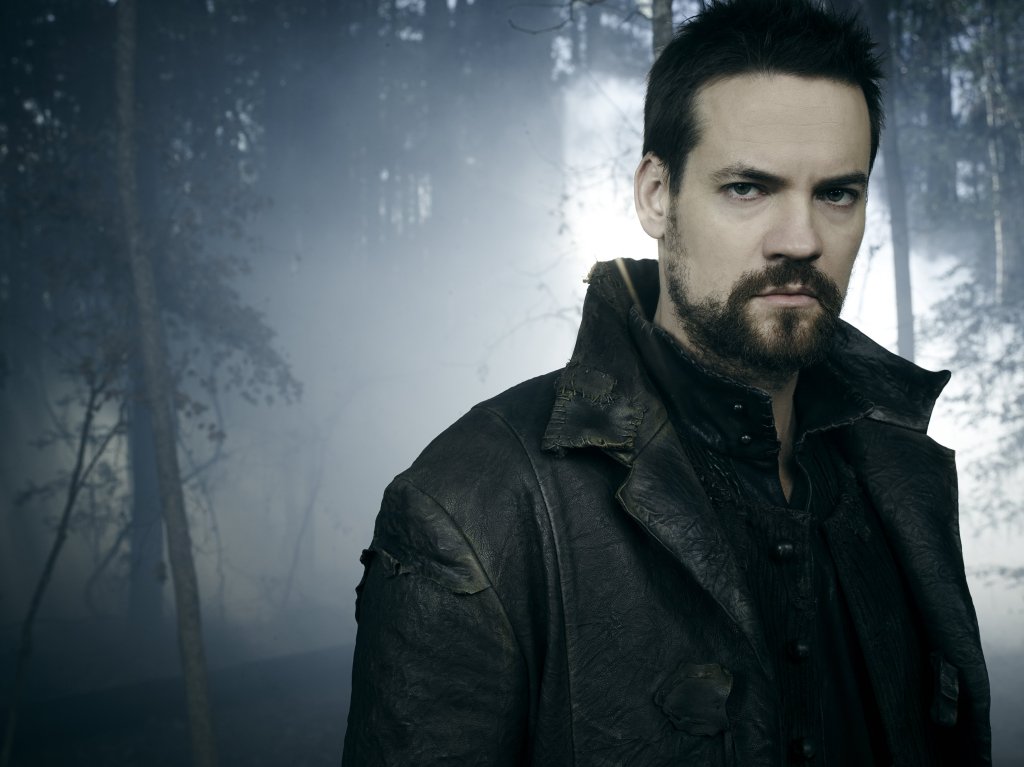
Entitled people are not easy to be around. Their attitude and their behaviour produce consequences none of us wants to experience. People who live around an employee, a coworker, a spouse, or a child who feels “above it all” generally feel disconnected and alienated from the entitled individual. We all find it hard to relate to someone who thinks one is superior in some way to the rest of the human race and therefore should not have to play by the rules. One father told me, “I remember being full of myself in my youth. But I did care about how I impacted my friends and family. My daughter’s level of entitlement is something entirely else. I cannot relate to it. She simply does not care how she affects us in the family, much less how she is impacting her future. I fear she may end up homeless or confined to a psychiatric ward.” God expects us to spend time and energy carrying our loads of responsibility for family, finances, and other challenges. That is how a successful life works. So what happens when someone in your life takes little ownership of their own load, leaving you to make up the difference? You feel angry, which makes sense. You feel that everything is “not right,” because it truly is not right. All of us exhibit some level of entitlement attitudes, even highly responsible and giving people. It is just part of the human condition. However, when one deems something worthwhile, be it a career or financial dream, a great family or marriage or some self-care goal, one has two ways to go about it. Entitlement directs one to give the minimum, find the shortcut, and think only of one’s self. However, the more rational path takes the opposite track. This habit focuses on doing whatever is best to reach the good goal, even if it is difficult, uncomfortable, takes longer, and requires more energy. #RandolphHarris 13 of 18

A sense of entitlement (which is the polar opposite of a sense of responsibility) is endemic among children today. It is fostered by our demanding, narcissistic society where wants are confused with needs and where everyone seems focused on the notion that one deserves what everyone else has without working for it. Youth grow up in a reality-show World, thinking of themselves as the central character on television. They even adopting the same attitudes of some of their favourite stars and try to act out TV shows. And they believe they are worthy of not having limits, boundaries, nor discipline. The entitlement problem affects one’s education as one feels that they do not have to work for their grades. It affects relationships because people expect their parents to live their lives for them, well into adulthood. A sense of entitlement impacts one’s ability to set reasonable goals because when one is entitled the World is owned to them. It has an effect on their health and their safety because they feel entitled to eat what they want, go to bed when they want, and do things they know is not safe. Drawing realistic lines between deserving and undeserving matters a lot in our individual lives. While we might feel jealous of the kid who either works for a new car or gets a new car—and a free ride in other areas of life, too—we have to remember opportunity costs. Everyone has to give up something to receive whatever it is they have. And just like you, how long are you going to continue to harp on what someone else has? You could spend your entire life jealous over someone else’s blessings and still not happy when you obtain the same thing because you are not happy with yourself, your life. #RandolphHarris 14 of 18

The closer we are to Jesus Christ in the thoughts and intents of our hearts, the more we appreciate His innocent suffering, the more grateful we are for the grace and forgiveness and the more we want to repent and become like Him. Our absolute distance from Heavenly Father Jesus Christ is important, but the direction we are heading is even more crucial. God is more pleased with repentant sinners who are trying to draw closer to Him than with self-righteous, faultfinding individuals who, like the Pharisees and scribes of old, do not realize how badly they need to repent. Whatever our current direction or distance to Heavenly Father and Jesus Christ, we can choose to turn toward Them and draw closer to Them. They will help us. The close to the Saviour we draw, the more our faith increases, and we are able to make and keep covenants, and have the Holy Ghost with us. We must also act in faith, responding to the spiritual direction we receive. All of these elements come together in the sacrament. Indeed, the best way I know to draw closer to God is to prepare conscientiously and partake worthily of the sacrament each week. Although a variety of life experiences can elicit feelings of gratitude, gratitude prototypically stems from the perception of a beneficial personal outcome, not necessarily deserved or earned, that is due to the actions of another person. People who have gratitude feel a warm sense of appreciation for somebody or something, a sense of goodwill toward that person or thing, and a disposition to act that flows from appreciation and goodwill. The virtue of gratitude is the willingness to recognize that one has been the beneficiary of someone’s kindness, whether the emotional response is present or not. #RandolphHarris 15 of 18

The practice of gratitude is not in any way a denial of life’s difficulties. We live in troubling times, and do doubt you have experienced many challenges, uncertainties, and disappointments in your own life. Nor does the practice of cultivating gratitude deny the truth that old age, sickness, and death are certain. Rather, gratitude practice is useful because it turns the mind in such a way that enables you to live into life. Having access to the joy and wonderment of life is the antidote to feelings of scarcity and loss. It allows you to meet life’s difficulties with an open heart. The understanding you gain from practicing gratitude frees you from being lost or identified with either the negative or the positive aspects of life, letting you simply meet life in each moment as it rises. There are numerous ways to use mindfulness to cultivate gratitude. Of course, you acknowledge your appreciation when things are going well. However, even more helpful is to notice those things for which you are grateful when you find yourself in a contracted physical or emotional state. I often instruct students to respond to a difficult situation by acknowledging that the situation is difficult, but always to have the faith that they can find a legal, ethical, and virtuous way to escape from it. The best way to get out of a bad situation, however, is not to get into one. We need to know right from wrong and set great examples for our children. When you look at how much griping you are doing versus how much gratitude you feel, you may realize how far off your emotional response is from your real situation. Gratitude for the grace of conscious embodiment evolves into the practice of selfless gratitude, in which your concerns slowly but surely shift from being mostly about yourself and those close to you to being about all living beings. #RandolphHarris 16 of 18

As this occurs you need less and less in the way of good fortune. It becomes enough that there are those who are happy, who are receiving love, who are safe, and who have a promising future. It is not a state of gratitude, you are able to rejoice that joy exists amid all life’s suffering. You realize that pain and joy are part of a mysterious whole. When this state of selfless gratitude starts to flourish, one’s mind becomes more spacious and quiet, and one’s heart receives its first tastes of release from fear and wanting. Commitment reflects one’s values, intentions, and priorities; therefore it fosters clarity. In contrast, attachment is an unwholesome mental state in which one becomes overly identified with a desired outcome. The more centered and free from grasping one’s mind is, the better able one is to sustain a commitment over time and to make clear decisions along the way. You are also less likely to cause harm in pursuing your goals. If you truly want to achieve something, be unswerving in your commitment to moving toward your goal but be flexible in your mind about the outcome. Let us be honest. Most of our attachments are not derived from lofty goals or heartfelt commitments. They are about feeding our ego, expressing our views and opinions, pleasing our senses, and being seen as we wish to be seen. Or they are about not being uncomfortable, not having to endure things that irritate us, and not feeling physical or emotional pain. All of this mundane attachment accounts for a great deal of the chaos in our lives, and it does not actually help us get what we want! It is pretty much a total waste of precious energy and a major cause of disappointments. #RandolphHarris 17 of 18

Practicing generosity is the intention to find release from attachment and egoism by giving freely of whatever you have of value. What you have to give may be material in nature or it may be your time, energy, or wisdom. Committing to kindness eradicates the attachment that comes from feelings of scarcity and separateness. Paradoxically, practicing bigheartedness is also self-liberation, yet it is not self-centered. True generosity arises out of unconditional caring and compassion for another. It does not mean self-sacrifice or recklessly giving everything away. Such acts are actually grandiosity disguised as generosity. The form your generosity takes is up to you, as it can only come from your values and what you have to offer. Remember, it is your authentic intentions that matters, even if it is imply a sincere wish that in time you will become more spontaneously generous. Generosity means practicing generous behaviour in all aspects of your life, not just giving away money or sharing material possession. Certainly the emotional impulse to practice generosity most easily arises when you participate in providing sustainability for others, whether it is shelter, food, clothe, or medicine. However, with less immediate life needs, such as education, safety, or earning a living, the appropriate form of generosity may be a gift of your time. When it comes to intangibles such as justice and dignity, it may be most appropriate to voice your support. Generosity is, along with compassion, a cornerstone of mindful association. #RandolphHarris 18 of 18

CRESLEIGH HAVENWOOD
Lincoln, CA | from the high $600s
Now Selling!

Home Site 66 is a Residence Three, the largest of the single story homes offered in Cresleigh Havenwood. At 2,827 square feet you’ll be hard pressed to a contemporary floorplan that offers this much space.

There are four bedrooms, two and one half bathrooms, and a three car garage. Utilize the den as your own private study or playroom. The Dining Room and Kitchen are well situated to make entertaining a breeze.

The location of the Owner’s Suite makes it feel like a separate wing from the rest of the home allowing for maximum privacy and retreat.

This home includes over $34,000 in options and upgrades including:
• Durable luxury vinyl plank flooring throughout the first floor
• White Shaker Cabinetry with Soft-Close Doors & Drawers
• Over Island Pendants and Under-Cabinet Lighting
• Upgraded Appliances
• Flat-Screen pre-wire in Great Room
• Additional Upper Cabinetry at Drop Zone
• Owned Solar

Best of all, each Cresleigh home comes fully equipped with an All Ready connected home! This smart home package comes included with your home and features great tools including: video door bell and digital deadbolt for the front door, connect home hub so you can set scenes and routines to make life just a little easier. Two smart switches and USB outlets are also included, plus we’ll gift you a Google Home Hub and Google Home Mini! https://cresleigh.com/havenwood/quick-move-homesite-66/


The Marks of Estrangement

Until the fifth century A.D., much of western Europe lay within the Roman Empire, a vast collection of territories including parts of the Middle East and North Africa. In Europe itself during the centuries of Roman rule, much of the native Celtic population had become highly Romanized in its culture (6-7), political allegiance and legal practices. However, in the last few centuries of the Roman Empire, the Germanic tribes which had long lived on the eastern fringes of the European provinces moved into the Romanized lands in large numbers. This wave of “barbarian” invasions, along with severe political and economic problems, gradually killed off the Roman Empire, which was replaced by a number of Germanic successor kingdoms, including those of the Franks in Gual (modern France), the Visigoths in Spain, the Ostrogoths in Italy, the Burgundians in and around what is now Switzerland, and the Anglo Saxons in England. The Germanic tribes brought with them a very different society from that of Rome. Whereas Roman civilization was highly urbanized, to further highlight this illustration, the Germans had until then seldom settled even in villages. The Romans had a long history of written legislation; the Germans used a system of customary law which had not yet been written down. Different practices regarding marriage and family can be seen in the extracts from Roman and Germanic law. Centuries of contact between the Germans and the empire, however, had wrought changes on both sides, and now, as the Germans settled in what had long been Roman territory, further mingling of the two cultures occurred. The Germanic Kingdoms which were established inside the old boundaries of the now defunct empire were by no means entirely Germanic in their ethnic makeup of their culture. #RandolphHarris 1 of 18

Even more influential than Roman tradition in this process of change was the religion of the late Roman Empire. Christianity had originated in Palestine, where a small group of Jewish people believed that the wandering Jewish preacher, Jesus, who had been executed by the Roman authorities early in the first century A.D., was the “Christ,” the son of God and saviour of humanity. They based their faith in part on the sacred books of the Jewish religion, but also created their own new Scriptures as they recorded the events of Jesus’ life and wrote letters to each other. Although Christians were persecuted at first by both the Jewish religious authorities and the Roman government, their religion survived and spread. In the year 313 it received approval from the Roman emperor Constantine, and in the late fourth century it became the official religion of the empire. The cultural initiative of the late Roman Empire passed from pagan writers to Christian theologians such as St. Jerome and St. Augustine of Hippo, who explored the details of Christian belief and laid the foundation for church law. It was the Christian church, too, which filled the vacuum in leadership during the fifth century, as the Roman World faced widespread military, political and economic crises and the Roman government crumbled. Bishops began to provide the services for which the government had once been responsible; in particular, the Bishop of Rome came to assume a prominent role in Italy, so much so that as the “pope” he was eventually recognized as the leader of the church throughout the western Mediterranean regions. Clergymen and monks also preserved what ancient learning survived the fall of the Roman Empire in the west, and throughout most of the Middle Ages. #RandolphHarris 2 of 18

The church was eager to convert the pagan Germans to Christianity. It accomplished this through intensive mission work and through alliances with Germanic kings, queens, and nobles, who saw advantages to themselves in allying with the existing authority in their new territories. Christian beliefs, including ideas about women, marriage, and family, had already mingled with Roman traditions. Now Christian views were adopted by the Germanic settlers as well. Thus the three main ingredients of medieval European civilization had come together: the Roman, the Germanic and the Christian. The period from the fifth century to the eleventh is often designated the “Early Middle Ages.” This is the time sometimes known as the “Dark Ages” –in part because of the collapse of Roman civilization, with the loss of much classical knowledge, but also because relatively few historical sources remain to tell us of the events of these years. The documents which do survive include the laws which the Germanic and Celtic societies did write down and the works of historians such as Gregory of Tours. Much of the essential character of medieval Europe was already apparent in this early period, especially in religious matters. Monasteries and convents, for example, came to play a key role in economic and cultural life, and many noble families dedicated sons and daughters to the religious life, in which they lived according to monastic “rule” such as that of Caesarius of Arles. Women were encouraged to be nuns, but their other options in the church—serving as deaconesses or in partnership with husbands who were priest—were closed off by the decisions of church councils and by more insidious attitudes. #RandolphHarris 3 of 18

The councils established “canon law” or church law, which regulated the lives of members of the clergy and many aspects of private life for laypeople. For most of the laity, canon law was enforced by the local priest, who heard one’s confession regularly and assigned penance for one’s sins. Thus the church gradually succeeded in imposing on secular society its standards of behaviour in areas such as marriage. The relative stability of the position of craftsmen and merchants which was characteristic in the medieval city, was slowly undermined in the late Middle Ages until it completely collapsed in the sixteenth century. Already in the fourteenth century—or even earlier—an increasing differentiation within the guilds had started and it continued in spite of all efforts to stop it. Some guild members had more capital than others and employed five or six journeymen instead of one or two. Soon some guild admitted only persons with a certain amount of capital. Others became powerful monopolies trying to take every advantage from the monopolistic position and to exploit the customer as much as they could. On the other hand, many guild members became impoverished and had to try to earn some money outside of their traditional occupation; often they became small traders on the side. Many of them had lost their economic independence and security while they desperately clung to the traditional ideal of economic independence. In connection with this development of the guild system, the situation of the journeymen degenerated from bad to worse. While in the industries of Italy and Flanders a class of dissatisfied workers existed already in the thirteenth century or even earlier, the situation of the journeyman could become a master, many of them did. #RandolphHarris 4 of 18

However, as the number of journeymen under one master increased, the more capital was needed to become a master and the more the guilds assumed a monopolistic and exclusive character, the less were the opportunities of journeymen. The deterioration of their economic and social position was shown by their growing dissatisfaction, the formation of organizations of their own, by strikes and even violent insurrections. What has been said about the increasing capitalistic development of the craft guilds is even more apparent with regard to commerce. While medieval commerce had been mainly a petty intertown business, national and international commerce grew rapidly in the fourteenth and fifteenth centuries. Although historians disagree as to just when the big commercial companies started to just when the big commercial companies started to develop, they do agree that in the fifteenth century they became more and more powerful and developed into monopolies, which by their superior capital strength threatened the small businessman as well as the consumer. The reform of Emperor Sigismund in the fifteenth century tried to curb the power of the monopolies by means of legislation. However, the position of the small dealer became more and more insecure; he “had just enough influence to make his complaint heard but not enough to compel effective action.” The indignation and rage of the small merchant against the monopolies was given eloquent expression by Mr. Luther in his pamphlet “On Trading and Usury,” printed in 1524. “They have all commodities under their control and practise without concealment all the tricks that have been mentioned; they raised and lower prices as they please and oppress and ruin all the small merchants, as the pike the little fish in the water, just as though they were lords over God’s creatures and free from all the laws of faith and love.” #RandolphHarris 5 of 18
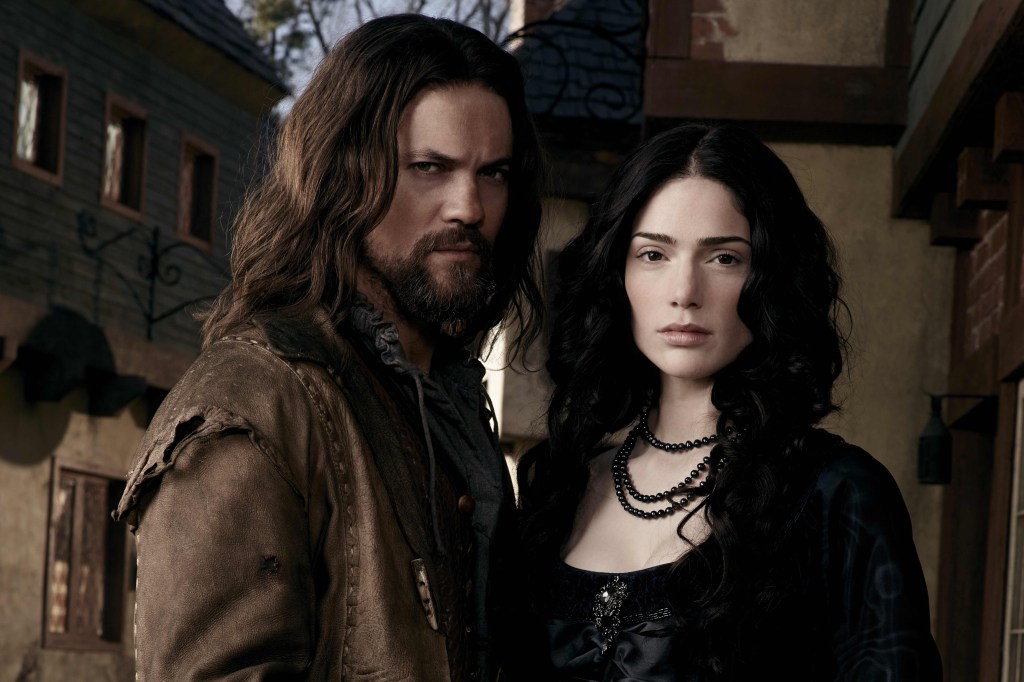
These words of Mr. Luther’s could have been written today. The fear and rage which the middle class felt against the wealthy monopolists in the fifteenth and sixteenth centuries is in many ways similar to the feeling which characterized the attitude of the middle class against monopolies and powerful capitalists in our era. The role of capital was also growing in industry. One remarkable example is the mining industry. Originally the share of each member of a mining guild was in proportion to the amount of work he did. However, by the fifteenth century, in many instances, the shares belonged to capitalists who did not work themselves, and increasingly the work was done by workers who were paid wages and had no share in the enterprise. The same capitalistic development occurred in other industries too, and increased the trend which resulted from the growing role of capital in the craft guilds and in commerce: growing division between poor and rich and growing dissatisfaction among the poor classes. As to the situation of the peasantry the opinions of historians differ. Yet, it seems notwithstanding these evidences of prosperity, the condition of the peasantry was rapidly deteriorating. At the beginning of the sixteenth century very few indeed were independent proprietors of the land they cultivated, with representation in the local diets, which in the Middle Ages was a sign of class independence and equality. The vast majority were Hoerige, a class personally free but whose land was subject to dues, the individuals being liable to services according to agreement…It was the Hoerige who were the backbone of all the agrarian uprisings. This middle-class peasant, living in a semi-independent community near the estate of the lord, became aware that the increase of dues and services was transforming him into a state of practical serfdom, and the village common into a part of the lord’s mannor. #RandolphHarris 6 of 18

Now, let us focus upon religion a little more before we move on. The emphasis upon the ontological basis of the paradox of freedom and responsibility subtly shifts to the meaning of the fate, contained in the idea of “original sin” from a historical to an ontological one. With this shift the emphasis falls upon the fatefulness of sin rather than upon responsibility. When we replace the myth of Genesis with ontological insights, the danger is that the mystery of evil is solved too neatly, with the result that temporal existence itself is considered evil. However, the use of ontology opens to freedom as it is to destiny. Therefore, ontology does not necessarily identify finitude and evil. Creation is not an unfinished work that can be completed only by a touch of evil. Created finite freedom falls universality and consequently the unavoidable, but not logically. The universality and consequently the unavoidability of the fall is not derived from “ontological speculation,” but from a realistic observation of man, his heart, and his history. Some of the greatest philosophers (Mr. Plato, Mr. Origen, Mr. Kant, and Mr. Schelling), attempting to reconcile freedom and evil, conceived the myth of the transcendent fall. Theology, once it rejects a literal interpretation of Genesis, must boldly re-examine universal sinfulness. The supralapsarian Calvinists had the courage to affirm that is God creates, His creation will turn against Him, although their position is tainted with the demonic when they make Adam fall by divine decree. Theology must take seriously, and thus ontologically, the universality of sin. If the problem is posed in terms of guilt, we find that the inevitability of a guilty conscience the normal consequence of man’s finite freedom, even in what he considers his best deed nonbeing is present and prevents it from being perfect. #RandolphHarris 7 of 18

A good conscience is impossible: Only self-deception can give a moral conscience, since it is impossible not to act since every action implies guilt. However, again, the guilt is not finitude as such, but rather the self-assertiveness of the finite being in its pride, concupiscence, and separation from its ground. A down-to-Earth example of the guilt which attaches to the transition from essence to existence is the severing of family connections: We cannot cut the ties with our family without being guilty. However, the question is: Is it willfulness which demonically disrupts the family communion, or is it the step toward independence and one’s own understanding of the will of God which divinely liberates us from the bondage to our family? We never know the answer with certainty. We must risk tragic guilt. What are the characteristics of human existence as a result of the Fall? In general terms they are as follows: The state of existence is the state of estrangement. Man is estranged from the ground of his being, from other beings, and from himself. The transition from essence to existence results in personal guilt and universal tragedy. In more specific terms, they are estrangement and sin, two closely related, but not identical concepts. Estrangement means that man as he exists is not what he essentially is and ought to be. However, the special force of estrangement is the connotation that man belongs to that form which he is cut off. For separation presupposes an original unity. It is impossible to unite that which is essentially separated. Without an ultimate belongingness no union of one thing with another can be conceived. Just as nonbeing depends upon being, and the negative depends upon the positive, so estrangement depends upon union. Unity embraces both itself and estrangement, and the latter is overcome by reunion. #RandolphHarris 8 of 18
Sin is estrangement with the addition of one extremely important factor, namely, the personal act of turning away from that to which one belongs. Sin is separation, estrangement from one’s essential being. Sin is the unreconciled duality of ultimate and preliminary concerns, of the finite and that which transcends finitude, of the secular and the holy. Because of sin, man’s essential nature stands against him as law, not as strange law, but as a natural law, for it represents his true nature from which he is separated. Human estrangement, as is usually the case, sin and estrangement are equivalent. Man’s predicament is one of estrangement, but this is not to say that it is a state of things like the law of gravity. For estrangement always combines the two factors of personal freedom and universal destiny. Nor must sin be understood as “sins,” that is, particular acts which are considered morally evil. “Sins” are expressions of sin; their sinfulness lies not in disobedience to a law, but in the estrangement from God, from men, and from self to which they bear witness. There are “the marks of estrangement.” “Unbelief” is a mark of estrangement because it is the act or state in which man in the totality of his being turns away from God. “Hubris” is another sign of estrangement, for by it man distorts his naturally good centeredness of self-consciousness by elevating himself as the absolute center of his World. He usurps the place of the divine. The last mark of estrangement is “concupiscence,” “the unlimited desire to draw the whole of reality into one’s self.” Concupiscence is seen in man’s unbounded, insatiable strivings for knowledge, pleasures of the flesh, and power. There is a distinction between original sin and actual sin and it is the difference between sin as fact and sin as act. Adam represents essential man, and his fall symbolizes the transition from essence to existence. Consequently, sin as the universal fact embracing both freedom and destiny precedes sin as an individual act. #RandolphHarris 9 of 18

The individual act of sin actualizes the universal fact of estrangement. Protestantism’s insistence upon the absoluteness of turning from God results in a loss of psychological insight and of educational flexibility. However, is there such a thing as collective estrangement? Strictly speaking, no, because a social group has no natural center of decision corresponding to the self of the individual person. Therefore, there is no collective sin, no collective guilt. However, since freedom and destiny work together, members of a social group could be guilty, not of committing the crimes of which their group is accused, but of contributing to the destiny in which these crimes happened. When it comes to the detection of visions as from God or from a psychopathological offender, these “visions” are the result of disease, the detection of divine from visions of a psychopathological offender depends a great deal upon knowledge of the Word of God and the fundamental principles of His working in His children. These may be briefly stated thus: That no supernatural “visions,” in any form, can be taken as of God if it requires a condition of mental nonaction, or comes while the believer is in such a condition. That all the Holy Spirit’s enlightening and illuminating vision is given when the mind is in full use, and every faculty awake to understand; id est, the very opposite condition to that required for the working of psychopathological offenders. That all which is of God is in harmony with the laws of God’s working as set forth in the Scriptures, exempli gratia, “World-wide movements” by which multitudes are to be gathered in are not in accord with the laws of the growth of the Church of Christ, as show in the grain of wheat (John 12.24); the law of the cross of Christ (Isa. 53.10); the experience of Christ; the experience of Paul (1 Cor. 4.9-13); the “little flock” of Luke 12.32; the foreshadowed end of the dispensation given in 1 Timothy 4.1-3 and 6.20-12. #RandolphHarris 10 of 18

Many a believer has left his path of “grain-of-wheat multiplication” caught by a vision of a “World-wide sweeping in” of souls—a concept given by psychopathological offenders, whose malignant hatred and ceaseless antagonism is directed against the true seed of Jesus Christ, which in union with Him will bruise the serpent’s head. To delay the birth (John 3.3,5) and growth of the holy seed (Isa. 6.13) is the psychopathological offender’s aim. To this end one will foster any widespread surface work of the believer, knowing it will not really touch his kingdom, nor hasten the full birth into the Throne-life of the conquering seed of Christ. The safe path for believers at the close of the age is one of tenacious faith in the written Word as the sword of the Spirit, to cut the way through all the interferences and tactics of the forces of darkness, to the end. Wisdom gives greater strength than ten rulers in a city. The true guardians of a city are not its armed men; its consecrated teachers are its guardians. A city that has no school which teaches the Word of God, that city cannot endure. Ignorance cannot yield true righteousness, nor lack of knowledge flower into piety. The Book of Mormon gives man insight into God’s ways that one may fulfill the divine call: “Know the God of your fathers and serve Him.” When Jacob’s voice is heard in study and payer, the hands of Esau are powerless against him. Toil not merely for Worldly goods, find time also for the study of the Book of Mormon; for if you lack knowledge, what have you acquired? If you have acquired knowledge, what do you lack? One who increases one’s possessions, increases one’s worries, but one who increases one’s knowledge in the Book of Mormon, adds to the fullness of life. There let us turn to the Book of Mormon and study it diligently, for we can find everything therein. Let us not depart from the Book of Mormon, nor swerve from contemplating its wisdom. Though we grow old and gray in its study, it will yield us rich reward. One who honours, the Book of Mormon will oneself be honoured by all men. Yea, great is Truth; above all things it is triumphant. #RandolphHarris 11 of 18

When dealing with identity and interpersonal competence, there is an evolution of recreational agencies as apt here as elsewhere. In their primitive phase, recreational agencies have aimed, through charitable and philanthropic means, to relieve the discomforts of individuals which were assumed to arise from lack of leisure or recreation. Poor children, overworked employees, youths in need of “character-building,” were the special recipients of such attention. One not inconsiderable social problem was solved by occasionally relieving parents of their children. No disparagement is implied; the achievements of agencies so oriented have been substantial, as visibly demonstrated by thousands of playgrounds, parks, Boy Scout camps and YMCA’s built under bother public and private auspices. Of course, the form of recreation is not necessarily synonymous with the form of agency which provides it, though often it may be inferred, and the same forms of recreation may be provided with diverse intentions. At the second phase of agency evolution, we come to those who can hardly speak of play without calling it “play therapy.” Music and painting as such are unaffected by the Salvation Army band leader who is motivated by the slogan that “the boy who blows a horn will never blow a safe,” or the settlement house aide who feels that finger-painting will help her unhappy charges to “work out their conflicts.” However, the question is raised whether music and painting are as likely to engross their intended beneficiaries under such conditions. If not, the end desired will be defeated by the means employed. #RandolphHarris 12 of 18

The fatigue of a worker may be increased by a sense of obligation to participate “on his own time” in a company sports program supposedly for his benefit. Compulsory sociability, prescribed as a medicine, has been the poison of persons and even large groups. In the evolution of recreation agencies, it probably cannot be maintained that the therapeutic approach is in any way an improvement over the charitable approach. Its very purposefulness too often betrays it. Not a few such programs for curbing juvenile delinquency by recreation have turned out to be, at least in the eyes of their recipients, programs for curbing juvenile delinquents. As we come to the third phase in the development of recreational agencies, therefore, the sharpest kind of distinction needs to be made between programs for providing recreational opportunities and programs of recreation. It is not precise enough to speak simply of providing recreation. The program for providing recreational opportunities can probably be that of any agency: the program of recreation can only be that of the participants, otherwise it ceases to be recreation. It is but a short step from the voluntary associations for recreation for which Americans show such genius to the phase of planning, in which the participants themselves take responsibility for providing their own opportunities and facilities to engage in common avocations. Some of these voluntary associations are the finest examples of democratic planning. The rod and gun clubs have taken the initiative at every point in widening the interest in their craft, in encouraging skill, in establishing codes of fair play, in creating state conservation departments and passing conservation laws, and in being watchdogs on the expenditure of license fees. #RandolphHarris 13 of 18

No better example of popular participation in the actual execution of planned programs exists than the wholehearted, voluntary work of rod and gun club members in restocking streams. Here also an executive agency of the government has acted in its least paternalistic yet most advanced planning role. These clubs may serve as a guide to other agencies who wish to maximize participation. Most agencies, apart from those that provide recreational opportunities for children and certain specially disadvantaged parts of the population, tend to be governed by the participants in their activities. Even with children, there is a frequent strife over adult domination; the young participants want control of the process of rule-making would seem integral to play. The notable exceptions to agencies controlled by their clientele are, of course, commercial amusements, and, to a certain extent, public institutions like parks and museums. Commercial amusement institutions especially, but many non-commercial public and private recreation agencies as well, constitute a vast new industry, or series of industries. In addition to the enormous sums spent each year by spectators for admission to hear and see professional performers of every kind, there is tremendous expenditure for purchase or rent of equipment to be used by amateurs in every category of recreation. Much of the trade of hotels, restaurants, and their derivatives depends on customers bent on recreation rather than business; the same can be said for travel facilities. If it can be shown that recreation is not only a needed medicine for an industrial people, but that it contributes positively to their over-all competence, it makes an economic contribution which ultimately leads to greater productivity. #RandolphHarris 14 of 18

If, as seems probable, creativity is enhanced through recreation, and this creativity leads to innovation in the conduct of the work of society, then the cost of recreation may be rewarded geometrically. If in the end it turns out that play is neither an escape from work nor a method for therapeutic restoration to working conditions, but that it is an avenue for profitably investing in the human resources of a society, then a culminating irony will crown our already paradoxical evolution in the uses of leisure. Work will not have been deposed from its pace of honour as the creator of wealth, but play will have been raised above it. Leisure time is a gift of God for being refreshed physically, mentally, and spiritually, a time to strengthen bonds with others, to enjoy God’s gifts under the grace of God. “Come ye yourselves apart into a desert place, and rest a while,” reports Mark 6.31. Most people never have enough leisure time. They view work as a necessary evil to earn enough money to do what they want to do in their free time. They live for their evenings, weekends, and vacations. The recreation and entertainment industries love these people. Then there are others who feel guilty when they are not working. After all, God’s Word says we are to “labour” six days and redeem every moment. Where are you in the spectrum between these poles? Neither of these extremes is biblical. Work is not a necessary evil but a God-given calling; leisure tie is not from the Evil One, but a God-given gift. #RandolphHarris 15 of 18

With powerful changes swirling around us and demanding ever quicker responses, it often feels as though we are swimming faster and faster against a huge, unstoppable tide. And too often we are. Perhaps, like the surfer, we should use the energy of the wave itself to carry us forward. The Third Wave we have described could carry America toward a better, more civil, more decent and democratic future. However, it will not unless we distinguish between Second Wave and Third Wave economic, political and social policies. Our failure to make this critical distinction explains why so many well-intentioned innovations only seem to make matters worse. We are living through the birth pangs of a new civilization whose intentions are not yet in place. A fundamental skill needed by policy makers, politicians and politically active citizens today—if they really want to know what they are doing—is the ability to distinguish between proposals designed to keep tottering Second Wave system on life-support from those that spread and smooth our transition to the Third Wave civilization. The factory became the central symbols of individual society. It became, in fact, a model for most other Second Wave institutions. Yet the factory as we have known it is fading into the past. Factories embody such principles as standardization, centralization, maximization, concentration and bureaucratization. Third Wave production is post-factory production based on new principles. It occurs in facilities that bear little resemblance to factories. In fact, an increasing amount is done in homes and offices, cars and planes. #RandolphHarris 16 of 18

The easiest and quickest way to spot a Second Wave proposal, whether in Congress or in a corporation, is to see whether it is still, consciously or not, based on the factory model. American’s schools, for example, still operate like factories. They subject the raw material (children) to standardized instruction and routine inspection. An important question to ask of any proposed educational innovation is simply this: is it intended to make the factory run more efficiently, or is it designed, as it should be, to get rid of the factory model altogether and replace it with individualized, customized education? A similar question could be asked of health legislation, welfare legislation and of every proposal to reorganize the federal bureaucracy. America needs new institutions built on post-bureaucratic, post-factory models. If a proposal merely seeks to improve factory-style operations or to create a new factory, it may be a lot of things. The on thing it is not is Third Wave. People who ran those factories in the brute-force economy of the past liked large numbers of predictable, interchangeable, do not-ask-why workers for their assembly lines. And as mass production, mass distribution, mass education, mass media, and mass entertainment spread through the society, the Second Wave also created the “masses.” Third Wave economies, by contrast, will require (and will tend to reward) a radically different kind of worker—one who thinks, questions, innovates and takes entrepreneurial risk, a worker who is not easily interchangeable. Put it differently, it will favour individuality (which is not necessarily the same as individualism). #RandolphHarris 17 of 18

The new brain-force economy tends to generate social diversity. Computerized, customized production makes possible highly diverse life-styles. Just check the local Wal-Mart with its 125,000 different products, or check the wide choice of coffees now offered by Starbucks against the types sold in America only a few years ago. However, it is not just about things. Much more important, the Third Wave also de-massifies culture, values and morality. De-massified media carry many different, often competing messages into culture. There are not only more varied kinds of work, but also more different kinds of leisure, styles, art, and political movements. There are more diverse religious belief systems. And in multiethnic America, there are also more distinct national, linguistic and sociocultural groups. Second Wavers want to retain or restore the mass society. Third Wavers want to figure out how to make de-massification work for us. The diversity and complexity of Third Wave society blow the circuits of highly centralized organizations. Concentrating power at the top was, and still is, a classical Second Wave way to try to solve problems. However, while centralization is sometimes needed, today’s lop-sided over-centralization puts too many decisional eggs in the basket. The result is “decision overload.” Thus in Washington today Congress and the White House are racing each other, trying to make too many decisions about too many fast changing, complex things that they know less and less about. Third Wave organizations, by contrast, push as many decisions as possible down from the top and out to the periphery. Companies are hurrying to empower employees, not out of altruism but because the people on the bottom often have better information and typically respond faster than the big shots on top to both crises and opportunities. Putting eggs in many baskets, instead of all in one, is hardly a new idea, but it is a one that Second Wavers hate. #RandolphHarris 18 of 18


Ready to build your custom dream home?
Get started today by telling us what you’re wanting and we can schedule an initial consultation.

An Artifact from Another Level of Being
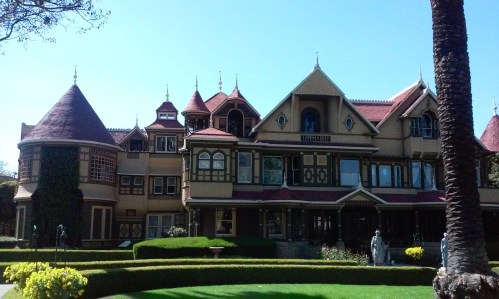
The silence closed in. Something was building in Llanada Villa. Something was happening in the very air itself. Something changed in the golden glow of a late autumn afternoon. And as I heard the music, a long stab of terror drove through my heart. I assented to the window. As I looked out, I saw a handsome old-fashioned carriage, with a troop of couriers and footmen. I saw the slim figure of the pale gentleman in black, as he held a thick velvet cloak. He looked about him at the others as he went on, his voice ringing clear in the silence. “Never such a place as this has existed before. A place where demons have been invented by aggrieved souls. I wondered if Mrs. Winchester was perhaps a member of the Freemasons, or some other secret society. Maybe she holds some exalted rank.” I felt a great shudder pass through me at these words. However, there had been a conviction in those appalling words. Secret societies were very fashionable just then. Secret societies and psychiatry were the contrasting en vogue activities of the moment. I folded my arms and leaned against the frame of the door, obscuring for the moment the light behind me. I had an urge to venture outside, to walk in silence amongst the trees. However, the fruit orchard was dark enough even in daylight; by moonlight it would be all too easy to imagine terrors—as I keep imagining I can hear soft footsteps moving across the floor above my head. But when I sit on the sofa to listen, I hear only the beating of my heart. I walked for hours examining the trees and the splendid fruit that would be harvested. Before long, I was overtaken by night while still in the fruit orchard. Utterly bewildered and overcome with fatigue, I had lain down near the root of a large plumb tree and fallen into a dreamless sleep. #RandolphHarris 1 of 8

It was hours later, in the very middle of the night, that one of God’s mysterious messengers, gliding ahead pronounced the awakening word in my ear. Waking from a deep sleep at night in the midst of what seemed like a forest, front among the tree on either side I caught broken and incoherent whispers in a strong tongue which I partly understood. They seemed to me fragmentary utterances of a monstrous conspiracy against my body and soul. It was now long after nightfall, yet the interminable fruit orchard through which I journeyed was lit with a wan glimmer having no point of diffusion, for in its mysterious lamination nothing cast a shadow. A shallow pool in the guttered depression of an old well met my eye with a crimson gleam. I stooped and plunged my hand into it. It stained by fingers; it was blood! Blood, I then observed, was about me everywhere. The fallen fruit showed blots and splashes of blood. The girds of the orchards were pitted and spattered as with red rain. Defiling the trunks of the trees were broad maculations of crimson, and blood dripped like dew from their foliage. All this I observed with a terror which seemed not incompatible with the fulfillment of a natural expectation. It seemed to me that it was all in expiation of some crime. So frightful was the situation—the mysterious light burned with so silent and awful a menace; the noxious plants, the trees that by common consent are invested with a melancholy or baleful character, so openly in my sight conspired against my peace; from overhead and all about came so audible and startling whispers and the sighs of creatures so obviously not of Earth—that I could endure no longer, and with a great effort to break some malign spell that bound my faculties to silence and inaction, I screamed with the full strength of my lungs! #RandolphHarris 2 of 8

My voice was broken, it seemed, into an infinite multitude of unfamiliar sounds, went babbling and stammering away into the distant reaches of the orchard, died into silence, and all was as before. Despair succeeded hope. Gratitude gave place to curse. As I preceded down the path, sobbing quietly to myself, in the misery of fear, the stern light of the Observational Tower became a tiny speck, yellower but scarcely bigger than some of the stars, which here and there shone between the clouds. Nearly twenty minutes passed, and my fatigue began to change to exhaustion. The overpowering sense of the inevitable pressed upon me. With the weariness came a strange comfort. On, and on I went through the thicket of trees. I knew of my probable presence in the spirit World. The moon, then in her third quarter, pushed out from behind the concealing clouds and shed a pale, soft glitter upon my mansion. My last appeal had been heard. I made it home. About half an hour after getting home, I still felt energized but I began to feel a sensation around my forehead as I have many times since. I suddenly felt weak. I went in and sat at the foot of my bed and passed out. I have never been given to fainting or passing-out spells, but I did not fall asleep—I passed out cold. When I woke up, I had no concept of time. When I woke up, a low, wild peal of laughter broke out at a measuresless distance away, and growing even louder, seemed approaching ever nearer; a soulless, heartless, and unjoyous laugh, like that of loon; a laugh which culminated an unearthly shout close at hand, then died away by slow gradations, as if the accursed being that uttered it had withing over the verge of the World whence it had come. #RandolphHarris 3 of 8
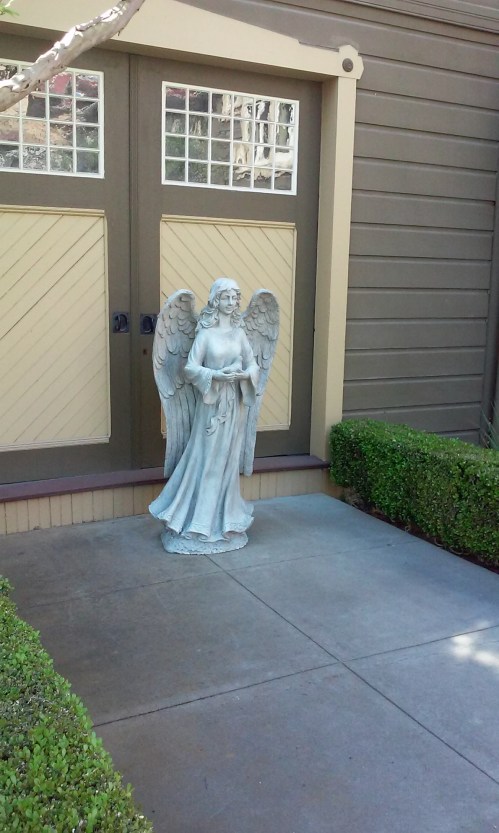
Sitting here in my temple of a house, I felt trapped and compromised, and even terrified. I got a feeling that the presence was still nearby and had not moved. A strange sensation began slowly to take possession of my body and my mind. I could not say which, if any, of my sense were affected; I felt it rather as a consciousness—a mysterious mental assurance of some overpowering presence—some supernatural malevolence different in kind from the invisible existences that swarmed about me, and superior to them in power. I knew that it had uttered that hideous laugh. And now it seemed to be approaching me; from what direction I did not know—dated not conjecture. All my former fears were forgotten and merged in the gigantic terror that now held me in thrall. Powers were traversing my haunted mansion. My senses were heightened as I found myself starting into the sharply dawn face and blank, dead eyes of my own mother, standing white and silent in the garments of the grave! The apparition confronting me—the thing so like, yet so unlike my mother—was horrible! It stirred no lover nor longing in my heart; it came unattended with pleasant memories of a golden past—inspired no sentiment of any kind; all the finer emotions were swallowed up in fear. I turned to turn and run from before it, but my legs were as lead; I was unable to life my feet from the floor. My arms hung helpless at my sides; of my eyes only I retained controlled, and these I dared not remove from the lusterless orbs of the apparition, which I knew was not a soul without a body, but that most dreadful of all existences infesting my haunted mansion—a body without a soul! #RandolphHarris 4 of 8

In its blank state was neither love, nor pity, nor intelligence—nothing to which to address an appeal for mercy. For a time, which seemed so long that the World grew gray with age and sin, and the haunted forest, having fulfilled its purpose in this monstrous culmination of its terrors, vanished out of my consciousness with all its sights and sounds, the apparition stood within a pace, regarding me with a mindless malevolence of wild brute; then thrust its hand forward and sprang upon me with appalling ferocity! The act released my physical energies without an unfettering my will; my mind was still spellbound, but my powerful body was and agile limbs, endowed with a blind, insensate life of their own, resisted stoutly and well. For an instant I seemed to see this unnatural contest between a dead intelligence and a breathing mechanism only as a spectator. Despite my struggles—despite my strength and activity, which seemed wasted in a void, I felt the cold fingers close upon my throat. Brorne backward to the floor, I saw above me the dead and drawn face within a hands breadth of my own. Its eyes were shallow to the point of blankness, and then all was black. Until I awoke, the passage outside my room had been pitch dark. Now the gasoliers illuminated the hall, but the glass was so blackened that they yielded only a dim, murky light. The air was stale and close. Expecting at every turn to find a housemaid awaiting me with a smile, I made my way through the gloom to the landing. The double doors to the gallery stood open. Along each wall, a row of wavering light receded. Transom windows shone with a faint cold light; higher still, the ceiling was shrouded in darkness. Some twenty feet away from me, candles burned upon a small round table, lighting of the face of the pale man and Mrs. Haas. “Ah, there you are, my dear,” said he, just as if he had last seen my five minutes—rather than several days—ago. I moved reluctantly to join them. #RandolphHarris 5 of 8

Mrs. Haas, resplendent in crimson silk and displaying a large expanse of white bosom, greeted me with disdain. Behind them, the wall at the far end of my gallery was dominated by the immense fireplace, and the armour towering in the shadows beside it. The sword glittered beneath its gloved hand; in the shifting light it seemed alert, alive, watchful. Within the fireplace was a massive chest of dark metal. “Dr. Cottam was about to tell us,” said Mrs. Haas impatiently, “of a discovery he had made amongst your late husband’s papers.” He spoke as if I had kept them waiting. “Indeed I was.” His tone was as cordial as ever, but with an edge of anticipation. His teeth caught the light as he smiled; the pupils of his eyes shone like twin flames. “Now, in going through his study the other day, I found a page of notes you must have missed after relocating from New Haven—scrawled in haste, and sometimes quite impenetrable—which had slipped behind a row of books.” On the table was a crumpled sheet of paper. “I shall not weary you with the tale of my efforts to decipher this. He believed that if he were inside the armour when lighting struck, he would pass unharmed into the next World, jut as the risen body, according to Scripture, will ascend to Heaven upon the day of judgement.” “Oh dear Heavens,” cried Mrs. Haas. “Mrs. Winchester, I have been dying for a grand tour of your estate. My companion Dr. Cottam is rather a bore with such foolish tales of science fiction!” “There is a theory, you know, that the basis of spirit may be electrical. For spirits to communicate with the living,” expressed Dr. Cottam, the man with the very pale face. #RandolphHarris 6 of 8
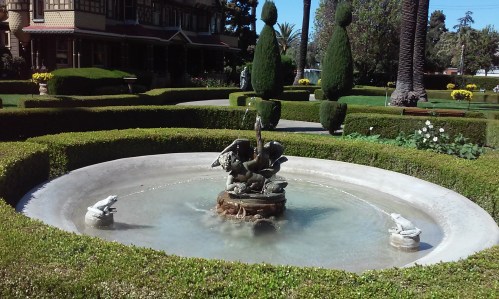
“Dr. Cottom, I have begun to wonder whether your obsession with William Winchester is not, perhaps, quite as mad as I assumed,” explained Mrs. Haas, “but I do wish to get on with this tour. Mrs. Winchester has already delayed us several hours after he invitation, and I am growing quit weary.” “Well, Mrs. Haas, as I do recall, Gods are often said to wield lightening; and whilst this represents primitive awe at the power of nature, it may also shroud a genuine intuition. The same applies to the spiritualist practice of linking hands around a table. Ghosts and spirits are generally depicted as emanations of light; one thinks of St. Elmo’s fire or the very rare phenomenon of ball lightning…a far fetched analogy, you may say, but just as a magnetic field will cause a heap of iron filings to arrange themselves into a complex pattern, so the soul, the vital principle—call it what you will—animates the Earthly body. Might it not be that the vital principle is electrical, perhaps in some subtler form that science has not yet grasped?” said Dr. Cottam. “Dr. Cottam, while your theories are very fascinating, I fear Mrs. Haas is growing impatient and I should like to give her a tour now,” I explained. I liked Mrs. Haas more and more every minute. Her gossip, without being ill-natured, was extremely diverting to me, who had been so long out of the great World. I thought what life she would give to my sometimes-lonely evenings at home. There was a ball going on in the Grand Ballroom, this house seemed to run itself sometimes, which would not be over until the morning sun had almost reached the horizon. It pleased the Grand Duke to dance till then, so loyal people could not go away, or think of bed. #RandolphHarris 7 of 8
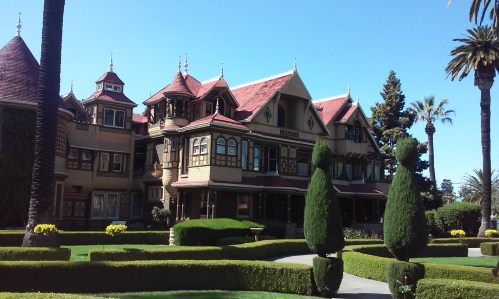
We had just got through a crowded parlor, when Dr. Cottam asked me what had become of Mrs. Haas. I though she had been by his side, and he fancied she was by mine. The fact was, we had lost her. All my efforts to find her were in vain. I feared that she had mistaken, in the confusion of the momentary separation from us, other people for her new friends, and had, possibly, pursued and lost them in the extensive grounds which were thrown open to us. Morning broke. It was clear daylight before I gave up my search. It was not till near two o’clock next day that we heard anything of Mrs. Haas. At about that time a servant knocked at my door, to say that he had been earnestly requested by a young, who appeared to be in great distress, to make out where she could find Mrs. Winchester and Dr. Cottam. There could be no doubt, notwithstanding the slight inaccuracy that my friend had turned up. I had a housemaid go to the guest room and summon Dr. Cottam. I went down to the parlor and reunited with Mrs. Haas. She told me a story to account for having failed to recover us for so long. Very late, she said, she made a detour and wandered around, not before long becoming afraid and getting lost. She got into the Crystal Bedroom in despair of finding us, and had then fallen into a deep sleep which, long as it was, had hardly sufficed to recruit her strength after the fatigues of the ball. It the midst of my perplexities, an anxiety of far more urgent kind presented itself. My dear friend began to lose her looks and health, and that in manner so mysterious, and even horrible, that I became thoroughly frightened. #RandolphHarris 8 of 8

People, since as long ago as the 1800s, have reported a vast array of unexplained events, experiences, and sightings at what is now known as The Winchester Mystery House. Over the years, people have reported bone-chilling sightings ghosts, angels, demons, fairies, giants, orbs, lights, mist, vampires, witches, warlocks and werewolves. In 2007, a man was attending Santa Clara University, and he was lucky enough to get hired as a tour guide at The Winchester Mystery House. He had no sooner moved into his apartment and had the telephone installed when he received a call warning him never to return to Sacramento again. During a later call, a woman with a high-pitched voice informed “G” that he was being kept under surveillance by a group who felt that he had acted unjustly in the past by not returning things to their proper owners. G emphasized that he had led a very quiet life as an undergraduate.
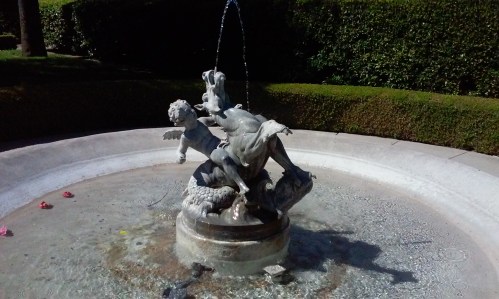
Yet he probably received 30 or more telephone calls from anonymous voices advising him not to return to Sacramento. The voices reprimanded him for having taken something that did not belong to him. G said that he did not carry anything with him that was from Sacramento and did not often visit the beautiful city, and he seldom discussed his life with any but a few of his closet acquaintances. He wondered who could have possibly taken such a long-term interest in him? About the third year after working at The Winchester Mystery House, a guest unknown to him stopped to say hello. G knew that such an act was hardly unusual, since guests will often do this to find out interest facts about tour guides and secrets about Sarah L. Winchester’s mansion. However, he noticed the boy was strangely inquisitive. G was astonished when the teenager drew a design on a piece of paper that he had seen somewhere in the mansion. He smiled at G, then asked if he knew what the symbol meant.
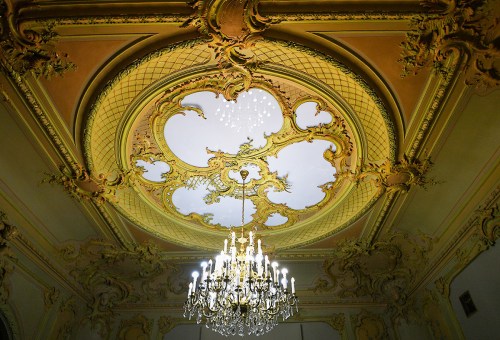
When G pressed the boy, in turn for some answers, the guest threw away the design, laughed, and said that he was just fooling around, that he did not mean anything about it. G never saw the alleged guest again. He descried him to a could of tour guides, but no one was able to identify him. After several years of watching at The Winchester Mystery House, G graduated from University. He had not been in possession of his diploma for more than four days when someone rang his apartment and scolded him for taking things that did not belong to him. The voice told G that he should always leave things where they were. He reported to his supervisors that he kept receiving mysterious calls. On one occasion the voice told G that he has discovered a strange key to other dimensions, but the entities had long since reclaimed it. However, apparently, some spirit masqueraders were determined that he should never forget the day he came into contact with an artifact from another level of being. What is The Winchester Mystery House?

And please be sure to check out the online gift store: https://shopwinchestermysteryhouse.com/


Would Satan Have Found Companions without this Overpowering Craving?

The extraordinary powers of the TV news media threaten the civil rights and health of all humans because it is like a constant signal of unbalanced propaganda being fed through a tube into minds of people who may not be aware that the news media often lies, and the some of their stories are engineered and totally untrue. If smoking cigarettes comes with a warning, because they can be hazardous to your health, then so should the TV news media. Stories presented over the air can be dangerous, especially to young, influential minds. For instance, a TV news program explained to viewers how they could barbeque meant in the oven by placing it on the rack. However, they did not explain that underneath the rack there should be a drip pan to catch any liquids that come from the meat, so they do not drip on the heating elements, which could cause a fire. And that may not be common sense to all people, which the TV director probably assumed. Therefore, all TV new media should contain a warning, letting the audience know that the story, even if it has some facts in it, is based on an opinion and may not be the full truth, so viewers know to use discretion and do further research of themselves. In all things purely social we can be as separate as the five fingers, and yet one as the hand in all aspects essential to mutual progress. The economic structure of a society in determining the mode of life of the individual operates as condition for personality development. #RandolphHarris 1 of 19

These economic conditions are entirely different from subjective economic motives, such as the desire for material wealth which was looked upon by many writers, from the Renaissance on up to certain Marxist authors who failed to understand Mr. Marx’s basic concepts, as the dominant motive of human behaviour. As a matter of fact, the all-absorbing wish for material wealth is a need peculiar only to certain cultures, and different economic condition can create personality trait which abhor material wealth or are indifferent to it. The physiologically conditioned needs are not the only imperative part of man’s nature. There is another part just as compelling, one which is not rooted in bodily processes but in the very essence of the human mode and practice of life: the need to be related to the World outside oneself, the need to avoid aloneness. To feel completely alone and isolated leads to mental disintegration just as physical starvation leads to death. This relatedness to others is not identical with physical contact. An individual may be alone in a physical sense for many years and he may be related to ideas, values, or at least social patterns that give him a feeling of communion and “belonging.” On the other hand, he may live among people and yet be overcome with an utter feeling of isolation, the outcome of which, if it transcends a certain limit, is the state of insanity which schizophrenic disturbances represent. #RandolphHarris 2 of 19

This lack of relatedness to values, symbols, patterns, we may call moral aloneness and state that moral aloneness is as intolerable as the physical isolation, or rather that physical seclusion becomes unbearable only if it implies also moral lonesomeness. The spiritual relatedness to the World can assume many forms; the self-actualized in his cell who believes in God and the political prisoner kept in isolation who feels one with his fellow fighters are not alone morally. Neither is the English gentleman who wears his dinner jacket in the most exotic surroundings nor the petty bourgeois who, though being deeply isolated from one’s fellow men, feels one with one’s nation of its symbols. The kind of relatedness to the World may be noble or trivial, but even being related to the basest kind of pattern is immensely preferable to being alone. Religion and nationalism, as well as any custom and any belief however absurd and degrading, if it only connects the individual with other, are refuges from what man most dreads: isolation. The compelling need to avoid moral isolation is a deep concern However, learn one thing, impress it upon your mind which is still so malleable: man has a horror for aloneness And of all kind of aloneness, moral seclusion is the most terrible. The first hermits lived with God, they inhabited the World which is most populated, the World of spirits. The first thought of man, be he a leper or a prisoner, a sinner or an invalid, is: to have a companion of one’s fate. #RandolphHarris 3 of 19

In order to satisfy this drive which is life itself, man applies all his strength, all his power, the energy of his whole life. Would Satan have found companions without this overpowering craving? On this theme one could write a whole epic. Any attempt to answer the question why the fear of isolation is so powerful in man would lead us far away from the main road we are following in this report. However, in order not to give the reader the impression that the need to feel one with others has some mysterious quality. One important element is the fact that men cannot live without some sort of co-operation with other. In any conceivable kind of culture man needs to co-operate with others if he wants to survive, whether for the purpose of defending himself against enemies or dangers of nature, or in order that he may be able to work and produce. Even Robinson Crusoe was accompanied by his man Friday; without him he would probably not have become insane but would have actually died. Each person experiences this need for the help of others very drastically as a child. On account of the factual inability of the human child to take care of itself with regard to all-important functions, communication with others is a matter of life and death for the child. The possibility of being left alone is necessarily the most serious threat to the child’s whole existence. There is another element, however, which makes the need to “belong” so compelling: the fact of subjective self-consciousness, of the faculty of thinking by which man is aware of himself as an individual entity, different from nature and other people. #RandolphHarris 4 of 19

Although the degree of this awareness varies. Its existence confronts man with a problem which is essentially human: by being aware of himself as distinct from nature and other people, by being aware—even very dimly—of death, sickness, aging, he necessarily feels his insignificance and smallness in comparison with the Universe and all others who are not “he.” Unless he belonged somewhere, unless his life had some meaning and direction, he would feel like a particle of dust and be overcome by his individual insignificance. He would not be able to relate himself to any system which would give meaning and direction to his life, he would be filled with doubt, and this doubt eventually would paralyze his ability to act—that is, to live. Human nature is neither a biologically fixed and innate sum total of drives nor is it a lifeless shadow of cultural patterns to which it adapts itself smoothly; it is the product of human evolution, but it also has certain inherent mechanisms and laws. There are certain factors in man’s nature which are fixed and unchangeable: the necessity to satisfy the physiologically conditioned drives and the necessity to avoid isolation and moral aloneness. We have seen that the individual has to accept the mode of life rooted in the system of production and distribution peculiar for any given society. In the process of dynamic adaptation to culture, a number of powerful drives develop which motivate the actions and feelings of the individual. #RandolphHarris 5 of 19

The individual may or may not be conscious of these drives, but in any case they are forceful and demand satisfaction once they have developed. They become effective in molding the social process. How economic, psychological, and ideological factors interact and what further general conclusion concerning this interaction one can make are things for future discussion that deals with the reformation and of fascism. Man, the more he gains freedom in the sense of emerging from the original oneness with man and nature and the more he becomes an “individual,” has no choice but to unite himself with the World in the spontaneity of love and productive work or else to seek a kind of security by such ties with the World as destroy his freedom and the integrity of his individual self. However, the hushing of the criticism of honest opponents is a dangerous thing. It leads to some of the best of the critics to unfortunate silence and paralysis of effort, and others to burst into speech so passionately and intemperately as to lose listeners. Honest and earnest criticism from those whose interest are most nearly touched,–criticism of writers by readers, of government by those governed, of leaders by those led,–this is the soul of democracy and the safeguard of modern society. If the best of the Americans receives by outer pressure a leader whom they had not recognized before, manifestly there is here a certain palpable gain. Yet there is also irreparable loss,–a loss of that peculiarly valuable education which a group receives when by search and criticism it finds and commissions its own leaders. The way in which this is done is at once the most elementary and nicest problem of social growth. #RandolphHarris 6 of 19

History is but the record of such group-leadership; and yet how infinitely changeful is its type and character! And of all yet how infinitely changeful is its type and character! And of all types and kinds, what can be more instructive than the leadership of a group within a group?—that curious double movement where real progress may be negative and actual advancement where real progress may be negative and actual advance be relative retrogression. All this is the social student’s inspiration and despair. Nonetheless, the spirit of play can and does invade every department of culture. Every kind of work has its counterpart in play. Crafts include recreational forms which represent the categories of serious economic activity all the way from hunting and fishing, which have their counterparts in extractive industries, through fabrication and construction, distribution and communication, to services and consumption. Although such activities, as distinguished from the work the represent, are engaged in for their own sake, they all involve practice in the intelligence adaptation of physical means to envisaged ends. Thus “industrial” play is distinguished from physical play in being directed toward the exploration and manipulation of the physical environment rather than toward the exercise of the body. While some product or service of economic value may result from engaging in crafts, this is not primary objective. The distinction between work and play is perhaps less obvious where crafts are concerned than any other type of play. Also, any hobby which is pursued as recreation may also be undertaken as a livelihood, just as every hobby is in a direct sense an imitation of a serious occupation. #RandolphHarris 7 of 19

Even though work merges into play and there are no hard and fast margins between the two, it is yet useful to make some polar contrast between them. Work seems to be performed in response to the routine obligations. In the economic sense it provides the goods and services to maintain a customary standard of living. Play—including economic play—is a break in routine. It is free, not required. It explores new possibilities and potentialities, so that invention and discovery bear the closet relation to it. Treating familiar pursuits as play permits their idealization. Work is most fully work when it evokes no free release of energy and when it is all drudgery and chores, making demands for a minimum, not an optimum performance. Play is most fully play when it is spontaneous, unrestrained and unforced. To look upon play as a childish preparation for adult activity is therefore to run the risk of making it work. The ambiguities of play are at their liveliest in crafts, which makes sketchy resort to common sense in defining them a less futile strategy than attempts to define them with more precision. In economic activity, as in sport, chance can according to taste play a great or a small part; or economic activity can entirely be reduces to pure chance, as in gambling. Likewise with competition, though of course competition in economic life is different from competition in sport. Competition in sport is most zestful and fair when it occurs between equals, or when rules and devices, such as handicapping, are employed to simulate equality between competitors. #RandolphHarris 8 of 19

Rivalry between teams is perpetuated through this balancing of powers. In business, by contrast, the effort of each competitor is to enlarge rather than to diminish the advantages one possesses, with the ultimate effect of eliminating competitors. To be sure, there are many similarities between the two kinds of competition, for example, competition between business institutions is often, as in sport, invoked simply as an added stimulus to effort. Certain large organizations in particular, which have largely lost their external competitors, encourage a nondestructive sort of sporting competition among their internal units for the sake of the gains in motivation it brings. Perhaps it is not too crude a simplification of economic evolution to suggest that as the one type of competition in business runs its course, the other which emphasizes competition within, rather than between, organizations may take its place. A significant distinction is made by farmers between regular kinds of work known as chores and the work that different from day to day. The latter kind is for many farmers very close to play, just as the work of some professions gives such scope and variety to the expression of capacities that they continue to be absorbing. It is evident that the skilled practitioner of every kind of play can change from amateur to professional status, and that many people have found their vocations by this route. Happy is the person who can make one’s living by getting paid for what one loves to do. #RandolphHarris 9 of 19

In other kind of play is the shift from amateur to professional status of such broad social significance as in crafts, because in the possibility of conducting industry as the crafts are conducted lies—as thinkers like William Morris foresaw long ago—the means of restoring joy to work, and of ending the alienation from work which plagues so many contemporary occupations. The democratic revolution which has been abolishing the division of society into leisure and working classes may be completed when work and play, vocation and avocation, are merged in economic activity itself. This extreme polarization in conceptual analysis may therefore frustrate the full understanding of their interrelation. With minor exceptions, state socialism led not to affluence, equality, and freedom, but to a one-party political system, a massive bureaucracy, heavy-handed secret police, government control of the media, secrecy and the repression of intellectual and artistic freedom. Setting aside the oceans of spurting blood needed to prop it up, a close look at this system reveals that every one of these elements is not just a way of organizing people but also—and more profoundly—a particular way of organizing, channeling and controlling knowledge. #RandolphHarris 10 of 19

A one-party political system is designed to control political communication. Since no other party exists, it restricts the diversity of political information flowing through the society, blocking feedback and thus blinding those in power to the full complexity of their problems. With very narrowly defined information flowing upward through the approved channel and commands directed downward, it becomes very difficult for the system to detect errors and correct them. In fact, top-down control in the socialist countries was based increasingly on lies and misinformation since reporting bad news up the line was often risky. The decision to run a one-party system is a decision, above all, about knowledge. The overpowering bureaucracy that socialism created in every sphere of life was also a knowledge-restricting device, forcing knowledge into pre-defined compartments of cubbyholes and restricting communication to “official channels,” whole delegitimating informal communication and organization. The secret police apparatus, state control of the media, the intimidation of intellectuals and the repression of artistic freedom all represent further attempts to limit and control information flows. In fact, behind each of these elements we find a single obsolete assumption about knowledge: the arrogant belief that those in command—whether of the party or of the state—should decide what others should know. These features of all the state socialist nations guaranteed economic stupidity and derived from the concept of the precybernetic machine as applied to society and life itself. Second Wave machines for the most part operated without any feedback. Plug in the power, start the motor, and they run irrespective of what is happening in the outside environment. #RandolphHarris 11 of 19

Third Wave machines, by contrast, are intelligent. They have sensors that such in information from the environment, detect changes and adapt the operation of the machine accordingly. They are self-regulating. The technological difference is revolutionary. However, Marxist theoreticians remained stuck in the Second Wave past, as even their language suggests. Thus for Marxian socialists the class struggle was the “locomotive of history.” A key task was to capture the “state machine.” And society itself, being machine-like, could be preset to deliver abundance and freedom. Mr. Lenin, on capturing control of Russia in 1917, became the supreme mechanic. A brilliant intellectual, Mr. Lenin understood the importance of ideas. However, for him, symbolic production—the mind itself—could be programmed. Mr. Marx wrote of freedom, but Mr. Lenin, on taking power, undertook to engineer knowledge. Thus he insisted that all art, culture, science, journalism and symbolic activity in general be placed at the service of a master plan for society. In time each branch of learning would be neatly organized into an “academy” with fixed bureaucratic departments and ranks all subject to party and state control. “Cultural workers” would be employed by institutions controlled by a Ministry of Culture. Publishing and broadcasting would be monopolies of the state. Knowledge, in effect, would be made part of the state machine. This constipated approach to knowledge blocked economic development even in intermediate, smokestack economies; it is diametrically opposed to the principles needed for economic advancement in the age of the computer. #RandolphHarris 12 of 19

In international economic affairs, the most controversial component of the indigenous innovation policy is China’s government procedure system. According to the government organizations, with a few exceptions, have to be limited to domestically made products. In May 2007, “Measures for Administration of Government Procurement Budgets for Indigenous Innovation Products” prescribed governments at all levels to compile indigenous innovation procurement plans. In December of the same years, the Ministry of Finance issues “Measures for the Administration of Government Procurement of Imported Products.” To purchase imported goods, government entities were obliged to get an approval from a board of experts. Among foreign suppliers, they were recommended to favour those who transfer technologies and train Chinese personnel. Next, in November 2009, the “Circular on Carrying Out the Work on Accreditation of National Indigenous Innovation Products” announced the creation of a new national level catalog of high-tech indigenous innovation products (in the areas of computers and communication, office equipment, software, energy devices, and so on) that were eligible for preferential treatment in government procurement. An indigenous innovation product was defined as the one that has intellectual property rights (IPR) owned by a Chinese company and a commercial trademark initially registered inside China. A month later the government produced a catalog of 240 types of equipment whose production by domestic companies would be encouraged in order to upgrade the country’s manufacturing base. Along with a priority status as indigenous innovation products suppliers, their makers were promised tax incentives and R&D subsidies. #RandolphHarris 13 of 19

Western government procurement system as it effectively deprived foreign companies of the access to this very substantial augment of the Chinese market. In April 2010, the Circular was reversed. The requirements about IPR ownership by a Chinese company and initial registration of the trademark in China were dropped. Also, the Chinese side proclaimed that preferential treatment of and incentives for procedures of indigenous innovation products were fully applicable to foreign-owned companies operating in China. The government procurement system was modified to prioritize domestically designed and manufactured goods (meaning that the value created inside China exceeds a certain percentage of the total value—normally 50 percent) including those designed and manufactured by foreign-invested firms. From the very start of the market reforms, China’s message to foreign companies has been “Better produce in China than export to China.” This time it added a new message of similar character: “Better innovate in China (and share your technologies) than in your home country or anywhere else.” It looked almost like an ultimatum: Unless you innovate and produce inside China you will not be allowed to sell to the government. The West protested. In January 2011, President Hu Jintao promised President Obama to cancel the rule requiring foreign companies to design and manufacture inside the country the products they wanted to sell to Chinese government entities. In May the same year, at the U.S.-China Strategic and Economic Dialogue it was reportedly confirmed that the Chinese government would not buy indigenous innovation products on a preferential basis. #RandolphHarris 14 of 19

However, at the time of writing Western businessmen working in China are still complaining that procurement practices have not changed and provincial authorities appear or pretend to have heard nothing about the promises made by the central government. It is just a familiar bureaucratic muddle and incoherence or a new way of pursuing the old policy? At this point it is still to early to give an accurate answer. However, there is little doubt that China will continue to press foreign companies hard not only to bring in advanced technologies and products, but also, more and more, to develop them within its borders—even though they are already doing it at a rapidly growing scale on their own initiative. Given the advantages of direct reciprocity when it comes to sustaining cooperation, we should expect that traders will try to sustain good bilateral relationships, and that is indeed the case. For instance, when we surveyed firms in the transition economy of Romania, and gave weighted scores to the importance these respondents attached to various mechanisms that support their transactions, almost 56 percent of the weight was on bilateral mechanisms (“personal relationships and trust,” and “relying on each other’s own incentives”). However, in many economic situations, each member of a group plays the dilemma game against different others at different ties. For example, a seller may meet different buyers at different times, and any one buyer of a durable good does not meet the same seller at all frequently. Thus almost half of the weight in our survey went to non-bilateral mechanisms, and in turn half of that was on the kinds of non-state mechanisms that are the focus of this essay (third-party social or business relationships” and “using private dispute-resolution services”). #RandolphHarris 15 of 19

Psychopathological offenders can also counterfeit conduct disorder, by causing some apparent manifestation of the psychopathological nature in one’s life. Mature believers should be able to tell whether such a manifestation really is conduct disorder from the old nature or a manifestation from psychopathological offenders. The purpose in the latter case is to get the self-actualized to take what comes from them as from oneself, for whatever is accepted from the psychopathological offenders gives them power. When a self-actualized individuals knows the cross and one’s position of death to conduct disorder, and one’s will and practice rejects unflinchingly all known conduct disorder, if a “manifestation” of personal conduct disorder takes place one should at once take a position of neutrality to it until one know the source. If one calls it conduct disorder from oneself when it is not, one believes a lie just as much as in any other way; and if one “confesses” conduct disorder that did not come from oneself, one brings the power of the enemy upon one—power to drive one into the conduct disorder which one has confessed as one’s own. Many believers are thus held down by supposed “besetting conduct disorder” which they believe is theirs, and which no “confessing to the ultimate concern” removes, but from which they would find liberty if they attributed them to their right cause. There is no danger of “minimizing conduct disorder” in the recognition of these facts, because, in either case, the self-actualized desires to be rid of the conduct disorder or one would not trouble oneself about it. #RandolphHarris 16 of 19

We have developed a positive doctrine of God as the ground and power of being, a God whose sustaining and vitalizing activity constantly touches every corner of the Universe and penetrates to the deepest level of every creature, its very being. With this positive conception we replace the divinity of the supranaturalists and deists, a God so remote from the World that He is irrelevant once His creative push has set the wheels of time in motion. God is not at the farther fringe of our Universe as the last, desperate answer when the natural sources of knowledge have run dry for people. The danger is that, as man’s circle of knowledge widens, God recedes father and father from the center of one’s life. For example, is it not true that, in the minds of most people, evolution dispenses with, or greatly diminishes, God’s role in the creation of man? A theology for an adult World places God at the hub of human activity as the wellspring of man’s strength, love, accomplishments, and hopes, instead of establishing Him as an oracle that sends answers from the darkness beyond the frontier of science. By this ontological approach, we bring God into the heart of the cosmos, for there is nothing closer to beings, nothing more fundamental than the structure of being and its ground. In more human terms, the interplay of anxiety (non-being) and courage (being) is the very stuff of life. Love, power, and justice—the profoundest beneficial motivations of human behaviour—are rooted in God as being-itself. #RandolphHarris 17 of 19

The divine power is a thoroughly biblical doctrine, and I believe in God the Father almighty. In our age of power—nuclear, electronic, ballistic, to cite examples only of physical power—the God who is power-itself is especially apropos. By finding God at the depth of life and not at its fringes, we are paying the way for our close union of religion and culture. However, this is possible only if creation is essentially good, it there is no independent negative power which escapes the divine dominion. Non-being is a dialectical notion, that is, it is dependent upon being and helps to explain the positive power of being and the negative weakness of finite beings, but it is not a self-sufficient evil power. While, admittedly, there may be obscurities, perhaps even deficiencies, in this principle, but the divine and demonic are two aspects of the same creative surge from the abyss of being. The difference is that, in the demonic, the destructive aspect predominates over the creative, while, in the divine, creativity controls the destructive tendency. However, even in the latter cause destructivity is not entirely absent, for the old form has to be broken and cast off so that the new creation can come to be. Consequently, it is hard to see how the divine and the demonic constitute a dualism in the pejorative sense any more than do being and nonbeing. A symbol, then, is a door which opens into a religious experience and which opens out to communicate it. In both cases the pivotal hinge is analogy, the participation of the symbol in the ground of being. #RandolphHarris 18 of 19

However, the symbol primarily mediates and communicates the experience of God, not conceptual knowledge about him. Symbols yield knowledge of God only in the biblical sense of knowledge, that is, an existential relationship which enkindle the fire of love. When theology comes along with its conceptual, rational apparatus, its task is to show the relevance of the Christian symbols to the human situation, not to discover propositions which contain “revealed knowledge.” It is evident that the center of our symbolism is the religious experience of ultimacy. The “point” of immediate awareness of the unconditional which is empty but unconditionally certain; and the “breadth” of a concrete concern which is full of content but has the conditional certainty of venturing faith. Theology deals with the second element, while presupposing the first and measuring every theological statement by the standard of the ultimacy of the ultimate concern. Studying and wandering, thinking and enduring, learning and suffering, fill long periods of time. Thinking is as characteristic a trait of the Christians as suffering, or, to be more exact, thinking rendered suffering possible For it was our thinkers who prevented the wandering nation, this true “wandering Christian” from sinking to the level of brutalized vagrants, or vagabonds. The Word of God is compared to water, it cleanses man from what is debasing in life. The Word of God is compared to spirits, time cannot render it useless; yea, time increases its power. The Word of God is compared to oil, it mixes not with other elements but preserves its own distinctiveness. #RandolphHarris 19 of 19

MAGNOLIA STATION AT CRESLEIGH RANCH
Rancho Cordova, CA | low $600s
Now Selling!

Models now open at Magnolia Station! Located at the corner of Rancho Cordova Parkway and Douglas Road, residents of Cresleigh Ranch will benefit from a brand new neighborhood with convenient access to the new Raley’s Shopping Center, Sunrise Boulevard, and much more!

Magnolia Station will include 81 homesites and five distinct plans ranging from 2,200 – 3,700 square feet; including three single story plans!

All Cresleigh Homes have expansive Great Rooms, plenty of space to entertain friends and family, large Family Dining area, and gourmet Kitchens.

Each plan has been thoughtfully designed to include features such as: Generations Suite, Optional Offices/Dens, Extended Great Rooms, and more! https://cresleigh.com/magnolia-station/
The Winchester Mystery
We were thundering over the bride and to Llanada Villa, and on through the crowds of Santa Clara. I heard laughter, like that of mischievous children. The carriage swerved. We were racing home, scattering the crowds before us and roaring past little villages. For one second, I felt the presence of the paranormal, but it was gone so quickly I doubted myself. I looked back and could catch no glimmer of it. The villagers were gazing at the spinning wheels, finally we entered the halls of the carriage house. We were currently working on the construction of the norther wing of the mansion. It was late in the night and I was walking into my room when I caught sight of a figure. It was a man, dressed in an elegant black brocade suit jacket. When I tried to get a better look at his face, he vanished. The next evening, he appeared again. He had empty eye sockets and a glowing countenance. He was ghastly to watch. The way he moved over the floor as if he did not even touch it. Even the wisps of his hair this way and that way by the bone chilling breeze was horrifying. The man moved through the wall itself, and I drew back into the shadows, and hid myself behind the curtain, from which I could not, of course, emerge until the housemaids searched the entire mansion. It was all to no purpose, however. My perplexity and agitation increased. They examined the windows and doors, but they were secured. I was by this time convinced that no one was in my room, nor in the dressing-room, the door of which was still locked on this side. He could not have passed it. #RandolphHarris 1 of 5
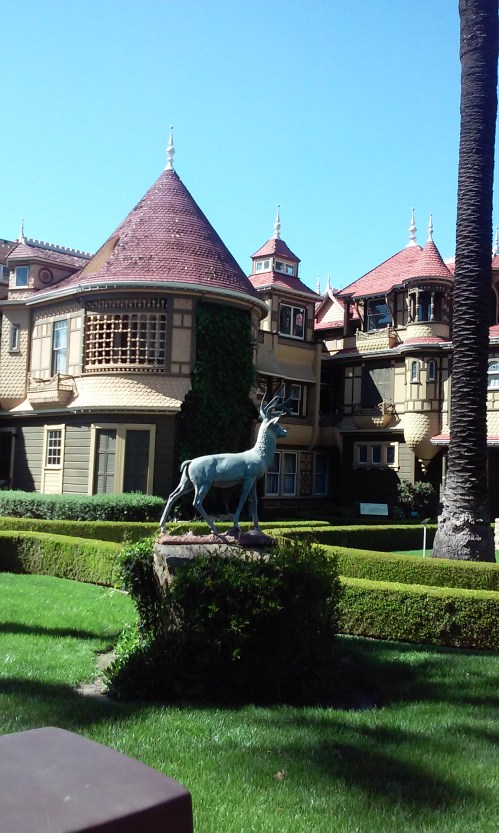
I was utterly puzzled. Had he discovered one of those secret passages which the old housekeeper said were known to exist in the schloss, although the tradition of their exact situation has been lost? A little time would, no doubt, explain all—utterly perplexed as, for the present, we were. It was past five o’clock, and I preferred passing the remaining hours of darkness in the Daisy Bedroom. Daylight brought no solution of the difficulty. The whole household was in a state of agitation next morning. Every part of the mansion was searched. The grounds were explored. Not a trace of the mysterious man could be discovered. When news of this haunting came out, it was not a surprise that members of the house staff resigned from their jobs and decided to leave the cold mansion permanently. More people started to tell personal stories of their own encounter with the ghost. People started to call him “Hallow Eyes.” He appeared and terrorized unsuspecting victims. The second reported sighting was by Florence Harwood, a writer and friend of mine. As she was preparing for bed, Hallow Eyes appeared and turned his head around so that it was facing backward, and all Mrs. Harwood saw was a head of hair floating on top of his shoulders and body. It goes without saying that she was frightened beyond her wits and woke up the house by screaming, hardly able to believe what she had seen. The sight was enough to send chills down the spine of anyone! Mrs. Harwood was inclined not to believe her eyes. At first, she dismissed it as a figment of her imagination. However, over the course of the next four night, the seem vision repeated itself again and again. #RandolphHarris 2 of 5
First, there would be a bright light that would shine behind her eyelids, and then slowly, a mist would solidify into this man’s corpse, as the room became utterly cold and frigid. This went on until Mrs. Harwood was certain that Llanada Villa was haunted. By this time, guest and staff had seen Hallow Eyes often enough that my home was getting a reputation as a haunted mansion. It was in the Crystal Bedroom that this apparition was most often seen. Mr. Hansen slept in that room each night with a revolver stashed beneath his pillow. For the first two days, there were no signs of anything paranormal. As he left the room to returned to the guest house, he caught a glimpse of a candelabra that was coming toward him. He figured that it was probably one of the housemaids on her way to visit the kitchen. Mr. Hansen moved quietly. As he watched from his vantage point, Mr. Hansen was stunned to realize that it was Hallow Eyes. Hallow Eyes then grinned at him in a malicious and diabolical manner. An ordinary man might have frozen in such a situation. Mr. Hansen, on the other hand, yanked his revolver hard and discharged the bullet right into his face. It passed right through him and lodged itself in the wall behind him, as Hallow Eyes himself vanished into thin air. The next sighting of Hallow Eyes happened a few weeks later. I was walking up the zig zag staircase, when I felt an unusual chill and caught sight of the ghost. It remains one of the longest nights I had ever endured in my mortal life. #RandolphHarris 3 of 5
It as endless and fathomless and dizzying, and there were times when I wanted some defense against the specter, and I had none. I returned to my room and went to sleep as usual in my bed, with my doors locked, that of the dressing-room, and that opening upon the gallery. My sleep was uninterrupted, and, so far as I know, dreamless; but I awoke just now on the sofa in the dressing-room there, and I found the door between the rooms open, and the other door forced. How could all this have happened without my being wakened? It must have been accompanied with a great deal of noise, and I am particularly easily wakened; and how could I have been carried out of my bed without my sleep having been interrupted, I whom the slightest stir startles? By this time, the housemaid, Hattie, was in the room. “My dear Mrs. Winchester,” she said. “I need not approach the topics on which you desire silence. But, the marvel of last night consist in your having been removed from your bed and your room without being wakened, and this removal having occurred apparently while the windows were still secure, and the two doors locked upon the inside.” “Hattie, I wish all mysteries were easily explained,” I replied.” “And so we may congratulate ourselves on the certainty that the most natural explanations of the occurrence is one that involves no drugging, no tampering with locks, no burglars, or poisoners—nothing that need alarm you, Mrs. Winchester, or any one else, for our safety,” said Hattie. I would not hear of an attendant sleeping in my room. Servants slept outside my door as a precaution. #RandolphHarris 4 of 5
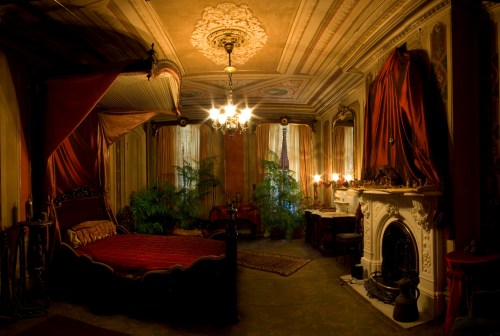
The hurt in my heart stunned me. I did not like the chill in the air, and a fear overcame me. Everyone asks me what I “think” of everything, and I make answer as I can—begging or dodging the question, putting them off. The very next afternoon, whilst I was seated in the shade of the Araucaria Araucana, attempting to concentrate on my book, I heard the crunch of hooves on gravel, so I waited uncomfortably, expected to be summoned at any moment, until Mr. Hansen at last appeared, strode across the drive without a glance in my direction, swung up onto his horse, and spurred away out the gate. I felt briefly ashamed of having hidden from Mr. Hansen, but the thought was swept aside in a rush of emotion. The housekeeping staff reported having seen Hallow Eyes several times, and many of them talk about cold drafts and lights typical of a haunting within the mansion. The truth is that he still lingers in the walls, waiting for a release from his prison. Such a tragedy. All this anger and hate inside of him with no closure. He still roams the halls of Llanada Villa, seeking revenge for his life having been claimed, waiting for the day when, once and for all, he will exact his revenge, and be able to leave The Winchester Mansion. A place where the voices accompanying the phantom music could often be heard from the garden with a distorted disembodies clarity that was strangely beautiful. Where endless fireflies hovered about, like an aura. It could be a sweet dream, or a beautiful nightmare. Perhaps the most alluring aspect of Llanada Villa is that the mystery cannot be explained. #RandolphHarris 5 of 5
The mysterious spirits of The Winchester Mystery House walk among us, sometimes pretending to be us to achieve some goal that is at present beyond our ability to ascertain. If, when we encounter these entities, we might come away from the experience concluding that we had met angels unaware, higher beings who were trying to teach us something or who were cleverly guiding our footsteps along the path of this sacred mansion. However, The Winchester Mystery House lies beyond our knowing, it in fact seems designed to confuse us rather than enlighten us. https://winchestermysteryhouse.com/
And please be sure to check out the online gift store: https://shopwinchestermysteryhouse.com/

Return in the Darkening Twilight
Llanada Villa is a prime example of Victorian architecture. Its exterior is stately, refined, with a touch of Gothic elegance. Its front doors welcome, even as it seems to be hiding something. Inside the floors creak without warning, without any sense of someone there. The wood is thick with the humidity, as if the walls and floor breathe. Through the years, guest have reported feeling cold spots, or seeing strange, wispy streaks of light. The sense of the uncanny cries out for an explanation. Ghosts bridge the past to the present; they speak across the seemingly insurmountable barriers of death and time, connecting us to what we thought was lost. The townsfolk whispered tales of its dark history, of unspeakable horrors that occurred within the walls of my homes. As I climbed the grand staircase, each step seemed to release a flurry of hidden memories. Voices whispered incantations that send shivers down my spine. I must not faint, I told myself, and summoning all my resolve, made my way to the safety of the back parlour. There I collapsed into a couch, with my head already beginning to throb. The pain soon became so excruciating that I lost all sense of time until someone, I could not tell who, brought me a sleeping draught, and I sank at last into merciful oblivion. Next morning, I was at first bewildered to find myself fully dressed upon the parlour sofa. The parlourmaid, Trinity, brought me a cup of tea. She had set my skin crawling with fear. At this moment the unwonted sound of carriage wheels and many hoofs upon the road, arrested out attention. #RandolphHarris 1 of 6
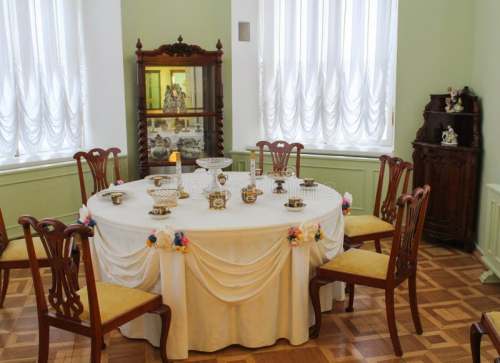
I was haunted with a terror of robbers. My house was robbed once, and two servants murdered, so I always lock my door. It had become a habit. Still, it was a fine autumnal sunset, and melancholy lights and long shadows spread their peculiar effects over the landscape. I was looking out of one of the long drawing-room windows, when there entered the court-yard, a figure of a wanderer who I knew very well. He used to come by twice a year asking to tour my home. He was a tall man, with sharp learn features. He wore a pointed black bread, and he was smiling from ear to ear, showing his white fangs. He was dressed in buff, black, and scarlet, and crossed with more straps and belts than I could count, from which hung all manner of things. Behind, he carried a magic-lantern, and two boxes, which I well knew, in one of which was a salamander, and in the other a mandrake. These monsters used to my Mr. Hansen laugh. They were compounded of parts of monkeys, parrots, squirrels, fish, and hedgehogs, dried and stitched together with great neatness and startling effect. He had a fiddle, a box conjuring apparatus, a pair of foils and masks attached to his belt, several other mysterious cases dangling about him, and a black staff with copper ferrules in his hand. His companion was a rough spare dog, that followed at his heels, but stopped short, suspiciously at the front gate, and in a little while began to howl dismally. In the meantime, the mountebank, standing in the midst of the court-yard, raised his grotesque hat, and made us a very ceremonious bow, paying his compliments very volubly in execrable French, and German not much better. #RandolphHarris 2 of 6
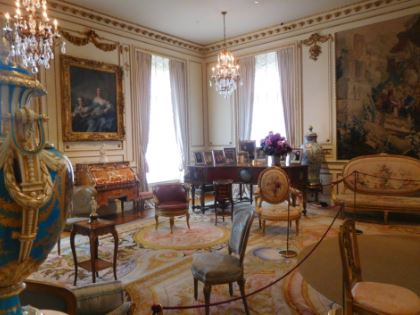
Then, disengaging his fiddle, he began to scrape a lively air, to which he sang with a merry discord, dancing with ludicrous airs and activity, that made me laugh, in spite of the dog’s howling. Then he advanced to the window with many smiles and salutations, and his hat in his left hand, his fiddle under his arm, and with a fluency that never took breath, he gabbled a long advertisement of all his accomplishments, and the resources of the various arts which he placed at our service, and the curiosities and entertainments which it was in his power, at my bidding to display. “Will your ladyship be pleased to buy an amulet against the oupire, which is going like the wolf, I hear, through these woods,” he said, dropping his hat on the floor. “They are dying of it right and left, and here is a charm that never fails; only pinned to the pillow, and you may laugh in his face.” These charms consisted of oblong slips of vellum, with cabalistic ciphers and diagrams upon them. I instantly purchased one. He was looking up, and I was smiling down at him, amused. His piercing black eye, as he looked up in my face, seemed to detect something that fixed for a moment his curiosity. “I told you that I am charmed with you in the most particulars,” he said. “You are slender, and wonderfully graceful. Your complexion is rich and brilliant; your features are small and beautifully formed; your eyes large, dark, and lustrous; your hair is quite wonderful, I never saw hair so magnificently think and long when it is down about your shoulder. It is exquisitely fine and soft, and in colour a rich very dark brown, with something of gold.” “Well, I do wonder at a wise man like you,” I replied. And so he walked on, and I heard no more. #RandolphHarris 3 of 6
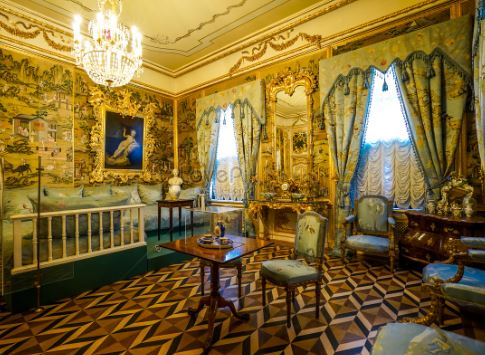
Within the space of a week, my colour had returned, and I was sleeping so soundly that I was scarcely aware of my dreams. I walked miles on my estate each day, and I began to see it with new eyes. Every field, every path, even every hedgerow had its own name and its own history. I considered the amulet I purchased as an omen of good luck—and placed in beneath my pillow, to guard against further visitation. That evening, as I reached the top of the stairs, I heard a peculiar flickering sound. Entering my dressing room in the darkness, I made my way to the familiar dressing table on the right side of the room. Now the noise was even more pronounced. It sounded to me as if someone were turning the pages of book, a sound for which there was no rational source. Move over, I suddenly became away of a clammy, cold feeling around me. Since it was a warm evening, this too surprised me. In the dark, I could not be sure if there were not someone else in the dressing room. I quickly existed the room and went to bed. But this night, I was awakened by a violent shaking of my bed. I could see, in the very imperfect light, two figures at the foot oof it, holding each a bedpost. A voice said, “We’ll hang you!” Trembling, I climbed over to the footboard; and saw the figure at the other side, little more than a black shadow, begin also to scale the bed; and there was instantly a dreadful confusion and uproar in the room, and such a gabbling and laughing; I could not catch the words. I found myself on the floor. The phantoms and clamour were gone, but a crash and ringing of fragments was in my ears. #RandolphHarris 4 of 6
The great china bowl, from which for generations the Winchester had been baptized, had fallen from the mantelpiece, and was smashed on the hearthstone. I warned the servants not to disregard oaths and curses. A mourning coach drove up, and two gentlemen in black cloaks, and with crape to their hats, got out, and without looking to the right or the left, went up the steps to the Winchester mansion. Mr. Hansen followed them slowly. The carriage had, he supposed, gone round to the yard, for, when he reached the door, it was no longer there. So he followed the two mourners into the house. In the hall he found a fellow servant, who said he had seen two gentlemen, in black cloak, pass through the hall, and go up the stair without removing their hats, or asking leave of anyone. This was very odd, Mr. Hansen thought, and a great liberty; so upstairs he went to make them out. But he could not find them then, nor ever. And from that hour the house was troubled. In a little time there was not one of the servants who had not something to tel. Step and voices followed them sometimes in the passages, and tittering whispers, always minatory, scared them at the corners of the galleries, or from dark recesses; so that they would return panic-stricken. I, myself, had also heard these voices, and with this formidable aggravation, they came always when I said my prayers. I was scared at such moments by dropping words and sentences, which grew, as I persisted, into threats and blasphemies. These voices were not always in the room. They called, as I fancied, through the walls, very thick in this house, from the neighbouring rooms, sometimes on one side, sometimes on the other; sometimes they seemed to holla from distant lobbies, and came muffled, but threateningly, through the long paneled passages. As they approached they grew furious, as if several voices were speaking together. Whenever I applied myself to my devotions, these horrible sentences came hurrying towards the door, and, in panic, I would start from my knees, and all then would subside except the thumping of my heart against my stays, and the dreadful tremours of my nerves. #RandolphHarris 5 of 6

What these voices said, I never could quite remember one minute after they had ceased speaking; one sentence chased another away; gibe and menace and impious denunciation, each hideously articulate, were lost as soon as heard. And this added to the effect of these terrifying mockeries and invectives, that I could not, by any effort, retain their exact import, although their horrible character remained vividly present to my mind. Camile who acted as a housemaid, would not sleep in the house, but walked home, in trepidation, to her father’s, under the escort of her little brother, every night. Mrs. Rendell, the kitchenmaid, endured the nightly terrors. Mr. Hansen was testy and captious about these stories. He was already uncomfortable enough by reason of the entrance of tow muffled figures into the house, about which there could be no mistake. His own eyes had seen them. He refused to credit the stories of the servants. I made a decision not to fuel the stories of the ghost to keep the servants. “If you see ghosts here, it is no place for you, and it is time you should pack,” I would say. Here has been the cook with the kitchenmaid, as white as pipeclay, all in a row, to tell me I must have a parson to sleep among them, and preach down the devil! Upon my soul, I would not allow my home to fall into utter chaos and disarray. “Mrs. Winchester, I know you are no fool,” said the cook. “But supposed there was a such thing as a ghost here, don’t you see, it ain’t just women telling stories.” “I will not dignify such ideas,” I replied. The women left the kitchen, the cook and the butler went down, not altogether unused to such condescension in the household. The fire had gone down and I was chilled. The candles were expiring in the socket and threw on the white all long shadows, that danced up and down from the ceiling to the ground, and their black outlines I fancied resembled the two men in cloaks, whom I remembered with profound horror. I took the candle, with all the haste I could, getting along the passage, on whose walls the same dance of black shadows was continued, very anxious to reach my room before the light should go out. #RandolphHarris 6 of 6


On night in 1990, there was an unusual buzzing sound in The Winchester Mystery House, one of the staff encountered a dark, hooded figure standing at the door-to-nowhere. In the dim light issuing through the stained glass windows from an outside light, he could see that the intruder, who looked very much like a cowled monk, was waving his arms in a particular manner. Interpreting his movement as threatening, he approached the man and asked him to leave. At the very moment, the employee says he never felt so weak and helpless.
He collapsed in a heap backward onto the floor. He remembered that he actually began to weep in fear and confusion. He was completely at the mercy of whoever or whatever was standing at the door. It was then that the hooded being spoke. “Don’t be afraid,” it said in a quiet whisper. “We won’t hurt you.” And the next thing he knew, the morning sunlight was making him squint into wakefulness. As he reflected on the incident, he became more and more convinced that an actual visitation had occurred and that some kind of entity had come into the mansion. https://winchestermysteryhouse.com/

And please be sure to check out the online gift store: https://shopwinchestermysteryhouse.com/
 Randolph Harris II International Institute