
Home » Good advice (Page 16)
Category Archives: Good advice

You are Giving Away Your Soul—The Blood is Life!

This morning I saw a star twinkling just over the nine-story tower—the first since the beginning of May. My son, when he was examined, because he would not confess that he was guilt when he was innocent, they tied him neck and heels till the blood gushed out at his nose, and would have kept him so twenty-four hours if one more merciful than the rest had not taken pity on him and caused him to be unbound. These actions are very like the Popish cruelties. A man’s outer case generally gives some indication of the soul within. He has told me several times that the thought of death was a pleasant one to him, which is a sad thing for a young man to say; he cannot be much more than thirty. Some great sorrow must have taken him and blighted his whole life. Why of course, they were in effect saying, the Devil can impersonate the innocent, just as we have said all along. God might permit Satan to impersonate the virtuous. But surely, he would not permit discord in the Winchester mansion? I should have thought Mrs. Winchester’s staff would have been above such vulgar delusions. All this disquisition upon superstition leads me up to the fact that my son saw a ghost last night—or at least, says that he did, which of course is the same thing. Indeed the fellow is honestly frightened, and I had to give him some chloral and bromide of potassium this morning to stead him down. He has been hired as a ranch had to work at the estate. When grounds keepers found a mutilated cow, some of the other men thought he had been possessed by the devil, and torture him to confess. I was obliged to pacify him by keeping as grave a countenance as possible during his story, which he certainly narrated in a very straightforward and matter-of fact way. No one wanted Mrs. Winchester to believe the curse was real and the hauntings had started again. #RandolphHarris 1 of 13

“I was on the balcony,” he said, “about four bells in the middle watch, just when the night was at its darkest. There was a bit of a moon, but the clouds were blowing across it so that you could not see far from the mansion. John Brunton, the foreman, came after from the tool shed and reported a strange noise on the estate. I came down and went forward and we both heard I, sometimes like a bairn crying and sometimes like a wench in pain. I have been seventeen years to the country and I never heard an animal, old or young, make a sound like that. As we were standing on the rear porch the moon came out from behind the cloud, and we both saw a sort of black figure moving across the farm in the same direction that we had heard the cries. We lost sight of it for a while, but it came back insight, and we could just make it out like a shadow amongst the trees. I sent a hand art for the rifles, and Brunton and I went down to the fruit orchard, thinking it might be a bear. When we got near the trees I lost sight of Brunton, but I pushed on in the direction where I could still hear the cries. I followed them for a mile or may more, and then running round a well I came right on to the top of it standing and waiting for me seemingly. I do not know what it was. It was not a bear any way. It was tall and black and straight. This black dog, or the devil in such a likeness, running all along down the body of the mansion with great swiftness, and incredible haste, he passed between two people, wrung the necks of them both. I made my way for the mansion as hard as I could run, and precious glad I was to find myself inside. I signed articles to do my duty by the estate, and on the estate I will say, but you will not catch me on the grounds after sundown.” #RandolphHarris 2 of 13

That is his story given as far as I can in his own words. I do not know what happened there. I fancy what he saw must in spite of his denial, have been a young bear erect upon its hind legs, and attitude which they often assume when alarmed. In the uncertain light this would bear a resemblance to a human figure, especially to a man whose nerves were already somewhat shaken. Whatever it may have been, the occurrence is unfortunate, for it has produced a most unpleasant effect upon the crew. Their looks are more sullen than before and their discontent more open. The double grievance made more dreadful when a barn of dead bodies was found on the edge of the estate. Written in blood, “Keep building,” and a huge bloody hand print was discovered on the wall. Some say it was the Devil’s handprint. In the old days in the New World, people used to say “I put my hand and seal” on a document when signing it. In the Old World this was literal in some cases. The emperor of Japan in ancient in ancient days “signed” important documents by dipping his hand in blood and putting a full bloody handprint on the page. In the history of pacts with the Devil, people were supposed to sign their names in blood. I have seen a couple of alleged pacts from earlier centuries. Blood undoubtedly stressed the seriousness of the signing. The Devil may sometimes have a permission to represent an innocent person as tormenting such as are under diabolical harassments, but that such things are rare and extraordinary. You were giving away your soul. The Blood is life. Afflicted persons were subject to diabolical torments; making evidence of such torments was accepting the word of the Devil; worse, accepting such evidence was holding commerce with the Devil, and therefore in itself a kind of witchcraft. #RandolphHarris 3 of 13

The afflicted persons do tell who are witches, of which, some they know and some they do not. Secondly, they tell who did torment such a person, though they know not the person. Thirdly, they are tormented themselves by he looks of the persons that are present, and recovered again by the touching of them, they recover, or do not fall into torment. Fifthly, they can tell when a person is coming before they see them, and what clothes they have [on], and some, what they have done for several years past, which nobody else ever accused them with nor do not yet think them guilty of. Sixthly, the dead out of their graves do appear unto them and tell them that they have been murdered, and require them to see them to be revenged on the murderers, which they name to them, some of which persons are well known to have died their natural deaths, and been publicly buried in the sight of all humans. Now if these things be so, I thus affirm: First, that whatsoever is done by them that is supernatural is either divine or diabolical. Secondly, that nothing is or can be divine but what has God’s stamp upon it, to which he refers for trial (Isaiah viii. 19,20): If they speak not according to these, there is no light in them. Thirdly, and by that rule none of these actions of theirs have any warrant in God’s Word, but are condemned wholly. First, it is utterly unlawful to inquire of the dead or to be informed by them (Isaiah viii. 19). It was an act of the Witch of Endor to raise the dead, and of a reprobate Saul to inquire of him (1 Samuel xxviii.8, 11-14; Deuteronomy viii. ii). Secondly, it is a like evil to seek to them that have familiar spirits (Leviticus xix.31). It was the sin of Saul in the forementioned place (1 Samuel xxviii.8) and of wicked Manasses (2 Kings xxi.6). #RandolphHarris 4 of 13

Thirdly, no more is it likely that their racking and tormenting should be done by God or good angels, but by the Devil, whose manners has ever been to be so employed. Witness his dealing with the poor child (Mark v.2-5) besides what he did to Job (Jon ii.7) and all the lies he told against him to the very face of God. Fourthly, the same may be rationally said of all the rest. Who should tell them things that they do not see but the Devil, especially when some things that they tell are false and mistaken? May we believe the confessed witches that do accuse anyone? Can the fruit be better than the tree? If the root of all their knowledge be the Devil, what must their testimony be? Their testimony may be legal against themselves, because they know what themselves do. However, their words should not be taken against those who denied the charges and whose previous behaviour had been blameless. The fits to which the afflicted and of come of the confessors were subject to, they were the Devil’s way of force them to accuse the innocent. We see by woeful and undeniable experience, both in the afflicted persons and the confessors, some of them, that the Devil torments them at his pleasure to force them to accuse others. The accusations of the apparently innocent makes some people think that both the afflicted and the confessors are liars. However, perhaps the sufferings are pitiable and genuine. It is possible that the Devil is lying through them. And no matter who is lying, the effect of the lie is still the same. For if they counterfeit, the wickedness is the greater in them and the less in the Devil; but if they be compelled to it by the Devil against their wills, then the sin is the Devil’s and the suffering is theirs. However, if their testimonies be allowed of, to make persons guilty by, the lives of innocent persons are alike in danger by them, which is the solemn consideration that does disquiet the country. #RandolphHarris 5 of 13

The Devils have a natural power which makes them capable of exhibiting what shape they please I suppose nobody doubts, and I have no absolute promise of God that they shall not exhibit mine. It is the opinion generally of all Protestant writers that the Devil may thus abuse the innocent. My son told me of another experience he had while working at the Winchester mansion. “I dreamt that it was night and that I was lying in my bed. (My bed stood with its foot toward the window; in front of the window there was a row of old walnut trees. I know it was winter when I had the dream, and nighttime.) Suddenly the window opened of its own accord, and I was terrified to see that some black wolves were sitting on the big walnut tree in front of the window. There were six or seven of them. The wolves were quite black, and looked more like foxes or sheep dogs, for they had big tails like foxes and they had their ears pricked like dogs when they pay attention to something. In great terror, evidently of being eaten up by the wolves, I screamed and woke up. I swore there was something there. I could feel it, hovering over me. It is watching, it is waiting, I think it is even mocking me.” Apart from this absurd outbreak of superstition, things are looking rather more cheerful. Mrs. Winchester loved the new year; she loved the idea of a fresh start for everyone. She always made a resolution, one a year, and unlike most people, she kept hers. Every year she tried to talk her staff into making one, but some of them never saw the point. The estate was undergoing heavy construction. Some workers reported seeing a ghost woman in nineteenth-century dress. That is not what was strange. What was strange is the fact that it was there was a thunder storm, but no rain was falling on a section of the mansion were the roof was still being added to the nine-story tower. #RandolphHarris 6 of 13

Mrs. Winchester wanted the tower because she said that she could get visions of the spirit World more clearly there. I always got a wee bit creeped out in the tower because the crucifix on the wall would turn upside down when anyone went near it. The Devil is said to appear there twice a year, on the vernal equinox and Halloween. The tower marks the grace of one of his children, born of a human witch and dead after a few days. I am learning about the hauntings at the Winchester mansion. Everyone has heard about them, but they all have different stories. In the World of spirits there is always a very great number of them, but there is no fixed time for their stay on Earth; for some are translated to Heaven and others confined to Hell soon after their arrival; whilst some stay on Earth days, weeks, maybe even centuries. Gerald Pomper thinks that my son devoted himself to construction of the Winchester simply for the reason that it is the most dangerous occupation which he could select, and that he courts death in every possible manner. He mentioned several instances of this, one of which is rather curious, if true. It seems that on one occasion he did not put in an appearance on the estate, and a substitute had to be selected in his place. That was at the time the tower was near completion. When he turned up again next spring he had a puckered wound in the side of his neck which he used to endeavour to conceal with his cravat. Whether the mate’s inference is true or not, it was certainly a strange coincidence. Of course, Johann Weikhard von Valvasor recorded the first written documented on vampires. Jure Grando Alilovic (1579-1656) was a villager from the region of Istria (in modern-day Croatia) who may have been the first real person described as a vampire in historical records. He was referred to as a strigoi, a local word for something resembling a vampire and a warlock. #RandolphHarris 7 of 13

Jure Grando lived in Kringa, a small town in the interior of the Istrian peninsula near Tinjan. He died in 1656 due to illness but according to legend, returned from the grave at night as a vampire and terrorized his village until his decapitation in 1672. The legend tells that, for 16 years after his death, Jure would arise from his grave by night and terrorize the village. The village priest, Giorgio, who had buried Jure sixteen years previously discovered that at night somebody would knock on the doors around the village, and on whichever door he knocked, someone from that house would die. This is why Mrs. Winchester boarded up the East Wing of her mansion. During one of her seances, she said Jure communicated with her. No telling? When you contact the spirit World, there is no telling what will come through. Some of the spirit in the mansion may be hundred of years old. Mrs. Winchester owned an original copy of Die Ehre deB Herzogthuma Crain, which she kept locked away in a safe. Vampires are said to infest come parts of this country. These Vampires are supposed to be the bodies of deceased persons, animated by evil Spirits, which come out of the graves, in the night-time, suck the blood of many of the living, and thereby destroy them. Petar Blagojevic was also accused of being a Vampire, and was alleged to have killed several people after his death. When the body was exhumed, it was undecomposed, the hair and beard were grown, there was new skin and nail, and blood could be seen in the mouth. When people grew outraged and staked his body through the heart, a completely fresh amount of blood flowed through the ears and moth of the corpse. Finally, the body was burned. The wind is veering round the mansion in an easterly direction, but it is still very slight. As far as the eye can reach, there is a shadow. The butler was staring out up the stairs with an expression in which horror, surprise, something approaching to fear were contending for the mastery. In spite of the cold, great drops of perspiration were coursing down his forehead and he was evidently fearfully exited. #RandolphHarris 8 of 13

His limbs twitched like those of a man upon the verge of an epileptic fit, and the lines about his mother were drawn hard. “Look!” he grasped, seizing me by the seizing me by the wrist, but still keeping eyes upon the window, and moving his head in a horizontal direction, as if following some object which was moving across the field of vision. “Look! There, man, there! Between the palm trees! Now coming out from behind the far one! You see her, you must see her! There still! Flying from me, by God, flying from me—and gone!” His face was so livid that I expected him to become unconscious, so lost no time leading him down the stairs, and stretching him out upon one of the sofas in the parlour. I then poured him out some brandy which I held to his lips, and which had a wonderful effect upon him, bringing the blood back into his white face and steading his poor shaking limbs. He raised himself up upon his elbow, and looking round to see that we were alone, be beckoned me to come and sit beside him. “You are it, did you not?” he asked, still in the same subdued awesome tone so foreign to the nature of the man. “No, I saw nothing.” They have made up their minds that there is a curse upon the mansion, and nothing will ever persuade them to the contrary. The next night, there was a glorious sunset, which made the great fields look like a lake of blood. I have never seen a finer and at the same time more ghastly effect. Wind is veering round. There was a cry, sharp and shrill, upon the silent air of the night, beginning, as it seemed to me, at a note as such a prima donna never reached, and mounting from that ever higher and higher until it culminated in a long wail of agony, which might have been the last cry of a lost soul. The ghastly scream is still ringing in my ears. Grief, unutterable grief, seemed to be expressed in it and a great longing, and yet through it all there was an occasional wild not of exultation. It seemed to come from close beside me, and yet as I glared into the darkness, I could make out nothing. I waited some little time, but without hearing any repetition of the sound, so I came below, more shaken that I have ever been in my life before. #RandolphHarris 9 of 13

Odd things have happened here. Four kids in three years, from 1887-1890, vanished without a trace. Other people see things. No one will talk about. The butler was certain that something had come up through the “door to nowhere” five years ago, and was about to again. Some kind of hellspawn. The Devil may impudently impose his communion upon some that care not for his company. However, if the communion on the person’s part be proved, then the business be done. Specter evidence may be grounds for investigation, and may strength other presumptions, but it is not evidence on which to convict. The mansion could be a dangerous place, even at its best—a treacherous, dangerous place. The butler was staring at something. By the sudden intensity of his attitude, I felt that he saw some. I crept up behind him. He certainly was looking at something with an eager questioning gaze, at what seemed to be a wreath of smoke. It was a dim nebulous body devoid of shape, sometimes more, sometimes less apparent, as the light fell on it. The moon was dimmed in its brilliancy at the moment by a canopy of thinnest cloud, like the coating of an anemone. He held out his hand as if to clasp it, and so ran into the darkness with outstretched arms. That came from somewhere. Was it a demon? It took the shape of a man, and eventually of the man of whom we were in search of. He was lying face downwards upon the floor, frozen. Many little crystals of ice and feathers of snow had drifted on to him as he lay, and sparkled upon his dark seaman’s jacket. As we came up some wandering puff of wind caught these tiny flakes in its vortex, and they whirled up into the air, partially descended again, and then, caught once more in the current, sped rapidly away in the direction of the east wing. To my eyes it seemed but a snow-drift, but the butler averred that it started up in the shape of a woman, stooped over the corpse and kissed it, and then hurried away across the floor. #RandolphHarris 10 of 13

It was the former cook Bill Thompson, who has gone missing in 1886. Sure he had met with no painful end, for there was a bright smile upon his blue pinched features, and his hands were still outstretched as though grasping at the strange visitor which had summoned him away into the dim World that lies beyond the grave. Surely this same apparition would also lead the butler into the eternal darkness. The smoke went into his mouth and he started to jerk, and speaking in tongues. That awful hellspawn had possessed him, and with his body dying and something inside of him, the butler staggered over to the sulfur stinking wall, sat down and died. Then he faded away and was gone. There he shall lie, with his secret and his sorrows and his mysteries all still buried in his breast, until that great day when the Winchester Mansion shall give up its dead, and Clarence Earl Gideon, known as “the butler,” come out from among the shadows with a smile upon his face, and his stiffened arms outstretched in greeting. I pray that his lot may be a happier one in that life than it has been in this. As for my son, I have not seen him in several years. In 1904, at the palace late at night, men who were pure of spirit, had thought they say a strange demoniac form taking the place of my son, John Wesley Thompson Faulkner. One man said that Mrs. Winchester suddenly rose from her throne and walked about, and immediately John’s head vanished, while the rest of hos body seemed to ebb and flow: whereat the beholder stood aghast and fearful, wondering if his eyes were deceiving him. However, he perceived the vanishing head filling out and joining the body again as strangely as it has left it. Another said he stood beside Mrs. Winchester as she sat, and all of the sudden the face changed into a shapeless mass of flesh, with neither eyebrows nor eyes in their proper places, nor any other distinguishing feature; and after a time the natural appearance of his countenance returned. #RandolphHarris 11 of 13

I write these instances not as one who saw many of them myself, but heard them from people who were sure they had seen these strange occurrences at the time. They also say that the cook, Bill Thompson, very dear to God, at the instance of dinner time, went to beg forgiveness that some of the guess had been offended beyond endurance by a dish he made. And when he arrived at the dining room, he forthwith secured an audience with Mrs. Winchester; but just as he was about to enter his apartment, he stopped short as his feet were on the threshold, and suddenly stepped backward. Whereupon the maid who escorted him, and others who were present, importuned him to go ahead. However, he answered not a word; and like a man who has had a stroke staggered back to his lodging. And when some followed to ask why he acted thus, they say he distinctly declared he saw the King of the Devils sitting on the throne in the palace, and he did not care to meet or ask any favour of him. I shall not continue my journal. Our road home lies plain and clear before us, and the great Winchester palace will soon be but a remembrance of the past to me. It will be some time before I get over the shock produced by recent events. When I began this record of my visit, I little thought of how I should be compelled to finish it. I am writing these final words in the lonely chamber, still starting at times and fancying I hear the quick nervous step of the dead man upon the floor above me. I entered his chambers tonight as was my duty, to make a list of his effects in order that they might be entered in the official log. All was as it has been upon my previous visit, save that the picture which I have described as having hung at the end of his bed had been cut out of its frame, as with a knife, and was gone. With this last link in a strange chain of evidence I close my diary of the Winchester mansion. #RandolphHarris 12 of 13

Note by William Clark Falkner, Col. CSA: “I have read over the strange evens connected with the mystery, as narrated in the journal of my son. That everything occurred exactly as he describes it I have the fullest confidence, and, indeed, the most absolute certainty, for I know him to be a strong-nerved and unimaginative man, with the strictest regard for veracity. Still, the story is, on the face of it, so vague and so improbable, that I was long opposed to its publication. Within the last few days, however, I have had independent testimony upon the subject which throws a new light upon it. I had run down to Edinburgh to attend a meeting of the British Medical Association, when I came across Aleister Crowley, an old college chum of my son’s, now involved with the esoteric Hermetic Order of the Golden Dawn, where he was trained in ceremonial magic by Samuel Liddell MacGregor Mathers and Allan Bennet. Aleister told me that he had been contacted by a supernatural entity named Aiwass, who confirmed that that Witch Trials were started by people who wanted to break up convents and get their magic potions, spells, talismans, and secrets, while also getting the church in an uproar. Upon my telling him of this experience of my son’s, he declared to me that he was familiar with the man, and proceeded, to my no small surprise, to give me a description of him, which tallied remarkably well with that given in the journal, expect that he depicted him as a younger man. According to his account, the cook and butler and my son had all been in love with the same woman. However, the cook was engaged to the young lady of singular beauty residing upon Sierra. During their absence at the Winchester mansion, his betrothed had died under circumstances of peculiar horror. She became a Chenoo, a winter spirit with a heart of ice, created from a human, which wants to kill those it loves. In the period of transformation, the person who is becoming a Chenoo eats snow and refuses other food. One will be ill-tempered and angry. After the transformation, the Chenoo will attack and kill other members of the tribe.” There are many mysteries surrounding the Winchester Mansion. Have a visit and tell me a little story. Winchester Mystery House–a 160-room mansion built to appease the spirits who died at the hands of the Winchester Rifle. #RandolphHarris 13 of 13


In the 1800s, so many deer and cattle within the mansion’s proximity were found dead that staff members were accused of being werewolves. Today, staff and visitors have reported banging sounds, footprints, seeing white mists, and feeling someone breathe on them. They also report tormented ghosts wandering through the mansion at night. Even if you do not believe ghost stories, you might still get goosebumps passing by, do not chalk those taps on your shoulder and whispers in your ear as all up to imagination.

During mansion renovations in the early 1900s, workmen found a secret dungeon in the Bloody Tower with so many human skeletons, they filled three cartloads when hauled away. The basement was designed so that prisoners would fall through a trap door. These hallways won’t wander themselves 😳 Give you and your friends a fright this weekend on the Lost in The House Tour during All Hallows’ Eve at the Winchester Mystery House!

All Hallows’ Eve value night tickets are still available!
🎟️ Link in bio. winchestermysteryhouse.com
The Door to Nowhere—The Curse of Evil Has Come into His Body!
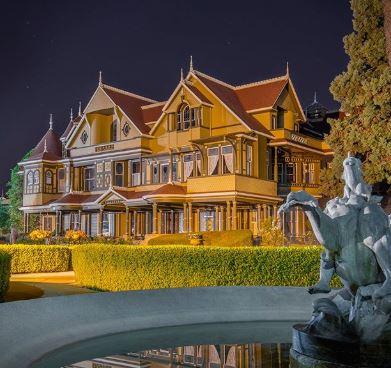
Some people do not believe in ghost. For that matter, some people do not believe in anything. There are persons who even affect incredulity concerning the “Door to Nowhere,” at the Winchester mansion. They said that it did not stand wide open—that it was not a gateway to the Spirit World and that they could have shut it; that the whole affair was a delusion; that they are sure it must have been a conspiracy; that they are doubtful whether there is such a place as the Winchester mansion on the face of the Earth; that the first time they are in California they will look it up. Perhaps, before going further, I ought to premise there was a time when I did not believe in ghosts either. If you had asked me one summer’s morning years ago when you met me on the Golden Gate Bridge if I held such appearances to be probable or possible, you would have received an empathic “No” for answer. However, at this rate, the story of the Door to Nowhere will never be told; so we will, with your permission, plunge into it immediately. I was interested in why this “Door to Nowhere” in the Winchester mansion would not keep shut? They say the place is haunted. What nonsense. There was one thing I can truly say about our office, we were never serious in it. I fancy that is the case in most offices nowadays; at all events, it was the case in ours. We were always chaffing each other, playing practical jokes, telling stupid stories, scamping our work, looking at the clock, counting the weeks to next Christmas, counting the hours to Saturday. For all that we were earnest in our desire to have our salaries raised, and unanimous in the opinion no fellows ever before received such wretched pay. #RandolphHarris 1 of 17

I had $75,000 a year, which I was aware did not half provide for what I ate at home. My mother and sisters left me in no doubt on the point, and when new clothes were wanted I always hated to mention the fact to my poor worried father. We had been better off once, I believe, though I never remember the time. My father owned a small property in the country. I wanted money badly—I must say I never had sixpence in the World of my own—and I thought if I could earn two sovereigns I might buy some trifles I needed for myself, and present my father with a new Ultimate Driving Machine. Then I recalled the amount of the rent was being asked for the Winchester mansion; then I decided gladly this would be a great place to stay if only the ghost turned out of possession. I decided I should like to try to whether, I could not solve the mystery. I was accustomed to lonely houses, and I would not feel at all nervous; I did not believe in ghost, and as for burglars, I was not afraid of them. I was told to just try it out first. To stay in the house for a week; if as tht end of that time I could keep the door shut, locked, bolted, or nailed up, to telegraphy the Winchester Repeating Arms Company, and they would actually pay me to stay there. To me, this sounded like a great bargain. If I lay the ghost, or find out the ghost, I think I ought to have enough money to buy a small house for myself. However, I could not have said what frightened me about this endeavour. A week after I moved into the Queen Anne mansion, Mr. van Buuren from the Winchester Repeating Arms Company came to visit me. He wanted to speak to me about the mansion. I heard a sound of irritation in his voice. “The Winchester Mansion!” he said; “and what have you got to say about the Winchester Mansion?” #RandolphHarris 2 of 17

“That is what I wanted to tell you, Mr. van Buuren,” I answered, and a dead hush seem to fall over the office as I spoke. The silence seemed to attract his attention, for he looked sternly at the clerks, who were not using a pen or moving a finger. “Come this way, then,” he said abruptly; and next minute I was in his private office. “Now, what is it?” he asked, flinging himself into a chair, and addressing me, who stood hat in hand beside the great table in the middle of the room. I began—I will say he was a patient listener—at the very beginning, and told my story straight through. I concealed nothing. I enlarged on nothing. A discharged clerk I stood before him, and in the capacity of a discharged clerk I said what I had to say. He heard me to the end, the he sat silent, thinking. At last he spoke. “You have heard a great deal of conversation about the Winchester, I suppose,” he remarked. “No, sir; I have heard nothing expect what I have told you.” “And why do you desire to strive to solve such a mystery?” “If there is any money to be made, I should like to make it, sir.” “How old are you?” “Two-and-twenty last January.” He laughed—he lay back in his chair and laughed—and I laughed myself, though ruefully. We went on talking for a long time after that; he asked me all about my father and my early life, and how we lived and the people we knew; and, in fact, put more questions than I can well remember. “It seems a crazy thing to do,” he said at las; “and yet I feel disposed to trust you. The house is standing perfectly empty. I cannot live it in, and I cannot get rid of it; all my own furniture I have removed, and there is nothing in the place except a few old-fashioned articles belonging to Mrs. Winchester. The place is a loss to me. It is of no use trying to let it, and thus, in fact, matters are at a deadlock. #RandolphHarris 3 of 17

“You will not be able to find out anything, I know, because, of course, other have tried to solve the mystery ere now; still, if you like to try you may. I will make this bargain with you. If you like to go down, I will pay your reasonable expenses for a fortnight; and if you do any good for me, I will give you a $1,000,000 note for yourself. Of course I must be satisfied that what you have told me is true and that you are what your represent. Do you know anybody in the city who would speak for you?” I could think of no one but my uncle. I hinted to Mr. van Buuren he was no grand enough or rich enough, perhaps, but I knew nobody else to whom I could refer him. “What?!” he said, “Greg Ryan, of Lakeview Street. He does business with us. If he will go bail for your good behaviour I shan’t want any further guarantee. Come along.” And to my intense amazement, he rose, put on his hat, walked me across the outer office and along the pavements till we came to Lakeview Street. “Do you know this youth, Mr. Ryan?” he said, standing in front of my uncle’s desk, and laying a hand on my shoulder. “Of course I do, Mr. van Burren,” answered my uncle, a little apprehensively; for, as he told me afterwards, he could not imagine what mischief I have been up to. “He is my nephew.” “And what is your opinion of him—do you think he is a young fellow I may safely trust?” My uncle smiled, and answered, “That depends on what you wish to trust him with.” “A long column of addition, for instance.” “It would be safer to give that task to somebody else.” “Oh, uncle!” I remonstrated; for I had really striven to conquer my natural antipathy to figures—worked hard, and every bit of it against the collar. My uncle got off his stool, and said, standing with his back to the empty fire-grate: “Tell me what you wish the boy to do, Mr. van Buuren, and I will tell you whether he will suit your purpose of not. I know him, I believe, better than he knows himself.” #RandolphHarris 4 of 17

In an easy, affable way, for so rich a man, Mr. van Buuren took possession of the vacant stool, and nursing his right leg over his left knee, answered: “He wants to go and shut the “Door to Nowhere” at the Winchester Mansion for me. Do you think he can do that? My uncle looked steadily back at the speaker, and said, “I thought, Mr. van Buuren, I was quite settled no one could shut it?” Mr. van Buuren shifted a little uneasily on his seat, and replied: “I did not set your nephew the task he fancies he would like to undertake.” “Have nothing to do with it, Justin, advised my uncle, shortly. “You do not believe in ghost do you, Mr. Ryan?” asked Mr. van Burren, with a slight sneer. “Do you not, Mr. van Buuren?” retorted my uncle. There was a pause—an uncomfortable pause—during the course of which I felt the million dollar note, which in imagination, I had really spent, trembling in the scale. I was not afraid. For one million dollars, or half the money, I would have faced all the inhabitants of spirit land. I longed to tell them so; but something in the way those two men looked at each other stayed my tongue. “If you ask me the question here in the heart of the city, Mr. Ryan,” said Mr. van Buuren, at length, slowly and carefully, “I answer ‘No’; but if you were to put me on a dark night at the Winchester, I should beg time to consider. I do not believe in supernatural phenomena myself, and yet—the ‘Door to Nowhere’ at the Winchester is as much beyond my comprehension as the ebbing and flowing of the sea.” “And you cannot live at the Winchester?” remarked my uncle. “I cannot live at the Winchester, and what is more, I cannot get anyone else to live at the Winchester.” “And you want to get rid of your lease?” “I want so much to get rid of my lease that I told Tuck I would give him a handsome sum if he could induce anyone to solve the mystery. Is there any other information you desire, Mr. Ryan? Because if there is, you have only to ask and have. I feel I am not here in a prosaic office in the city of Santa Clara, but in the Palace of Truth.” #RandolphHarris 5 of 17

My uncle took no notice of the implied compliment. When company is good it needs nothing else. If a man is habitually honest in his speech and in his thoughts, he desires no recognition of the fact. “I do not think so,” he answered; “it is for the boy to say what he will do. If he be advised by me he will stick to his ordinary work in his employers’ office, and leave ghost-hunting and spirit-laying alone.” Mr. van Buuren shot a rapid glance in my direction, a glance which implying a secret understanding, might have influenced my uncle could I have stooped to deceive my uncle. “I cannot stick to my work there any longer,” I said. “I got my marching orders today.” “What had you been doing, Justin? Asked my uncle. “I wanted one million to go and lay the ghost!” I answered, so dejectedly, that both Mr. van Buuren and my uncle broke out laughing. “One Million dollars!” cried my uncle, almost between laughing and crying. “Why, Justin boy, I had rather, poor man though I am, have given thee one million dollars than thou should’st go ghost-hunting or ghost-laying.” When he was very much in earnest my uncle went back to thee and thou his native dialect. I liked the vulgarism, as my mother called it, and I knew my aunt loved to hear him use the caressing words to her. He had risen, not quite from the ranks it is true, but if ever a gentleman came ready born into the World it was Greg Ryan, upon whom at our home everyone seemed to look down. “What will you do, you man?” asked Mr. van Buuren; “you hear what your uncle says, “Give up the enterprise,” and what I say; I do not want either to bribe or force your inclinations.” “I will go, sir,” I answered quite steadily. “I am not afraid, and I should like to show you—” I stopped. I had been going to say, “I should like to show you I am not sure a fool as you all take me for,” but I felt such an address would be too familiar, and refrained. #RandolphHarris 6 of 17

When I got to the Lodge, I showed Mr. van Buuren’s letter to the woman, and received the key. “You are not going to stop up at the Winchester alone, are you, sir? she asked. “Yes, I am,” I answered, uncompromisingly, so uncompromisingly that she said no more. The avenue led straight to the mansion; it was uphill all the way, and bordered by rows of the most magnificent limes I ever beheld. A light iron fence divided the avenue from the park, and between the trunks of the trees I could see the deer browsing and cattle grazing. Ever and anon there came likewise to my ear the sound of a sheep-bell. It was a long avenue, but at length I stood in front of the mansion—a square, solid-looking, Victorian mansion, four stories high, with several towers and a steeply pitched roof, beautiful stained-glass windows and statues, a basement; a flight of steps up to the principal entrance; several windows to the right of the door, several to the left of the door; the whole mansion flanked and backed with trees; all the curtains closed, a dead silence brooding over the place; the sun westering behind the great trees studding the park. I took all this in as I approached, and afterwards as I stood for a moment under then ample porch; then remembering he business which has brought me so far, I fitted the great key in the lock, turned the handle, and entered the Winchester Mansion. For a minute—stepping out of the bright sunlight—the place looked to me so dark that I could scarcely distinguish the objects by which I was surrounded; but my eyes soon grew accustomed to the comparative darkness, and I found I was in an immense hall, lighted from the roof; a magnificent old oak staircase conducted to the upper rooms. #RandolphHarris 7 of 17

The floor was of white marble. There were two fireplaces, fitted with dogs for burning wood; around the walls hung pictures, antlers, and horn, and in odd niches and corners stood groups of statues, and the figure of men in complete suits of armour. To look at the place outside, no one would have expected to find such a hall. I stood lost in amazement and admiration, and then I began to glance more particularly around. Mr. van Buuren has not given me any instructions by which to identify the ghostly chamber—which I concluded would most probably be found on the first floor. I knew nothing of the story connected with it—if there were a story. I was perfectly unencumbered of the mystery. I had not the faintest idea in which apartment it resided. Well, I should discover that, no doubt, for myself ere long. I looked around me—doors—doors—doors. I have never before seen so many doors together all at once. Two of them stood open—one wide, the other slightly ajar. “I will just shut them as a beginning,” I thought, “before I go upstairs.” The doors were of oak, heavy, well-fitting furnished with good locks and sound handles. After I had closed I tried them. Yes, they were quite secure. I ascended the great staircase feeling curiously like an intruder, paced the corridors, entered the many bed chambers—some quite bare of furniture, others containing articles of an ancient fashion, and no doubt of considerable value—chairs, antique dressing-tables, curious wardrobes, and such like. For the most part the doors were closed, and I shut those that stood open before making my way into the attics. I was greatly delighted with the attics. The window lighted them did not, as a rule, overlook the front of the Manion, but commanded wide views over wood, and valley, and meadow. Leaning out of one, I could see, that to the right of the mansion the ground, thickly planted, shelved down to a stream, which came out into the daylight a little distance beyond the plantation, and meandered through the deer part. #RandolphHarris 8 of 17

At the back of the mansion the windows looked out on nothing save a dense wood and a portion of the stable-yard, whilst on the side nearest the point from whence I had come there were spreading gardens surrounded by thick yew hedges, and kitchen-gardens protected by high walls; and further on a farmyard, where I could perceive cows and oxen, and, further still, luxuriant meadows, and fields glad with waying and fruit orchards. “What a beautiful place!” I said. “van Buuren must have been a duffer to leave it.” And then I thought what a great ramshackle house it was for anyone to be in all alone. Getting heated with my long walk, I suppose, made me feel chilly, for I shivered as I drew my head in from the last dormer window, and prepared to go down stairs again. In the attics, as in the other parts of the house I had as yet explored, I closed the doors, when there were keys locking them; when there were not, trying them, and in all cases, leaving the securely fastened. When I reached the ground floor the evening was drawing on apace, and I felt that if I wanted to explore the whole house before dusk I must hurry my proceedings. “I will take the kitchens next,” I decided, and so made my way to a wilderness of domestic offices lying to the rear of the great hall. Stone passages, great kitchens, an immense servants’-hall, larders, pantries, coal-cellars, beer-cellars, laundries, brewhouses, housekeeper’s room—it was not of any use lingering over these details. The mystery that trouble Mr. van Buuren could scarcely lodge amongst cinders and empty bottles, and there did not seem much else left in this part of the building. I would go through the living-rooms, and then decide as to the apartments I should occupy myself. The evening shadows were drawing on apace, so I hurried back into the hall, feeling it was a weird position to be there all alone with those ghostly hollow figures of men in armour, and the statues on which the moon’s beams must fall so coldly. #RandolphHarris 9 of 17

I would just look through the lower apartments and then kindle a fire. I had seen quantities of wood in a cupboard close at hand, and felt that beside a blazing hearth, and after a good cup of tea, I should not feel the solitary sensation which was oppressing me. The sun had sunk below the horizon by this time, for to reach the Winchester I had been obliged to travel by cross lines of railway, and wait besides for such trains as condescended to carry third-class passengers; but here was still light enough in the hall to see all object distinctly. With my own eyes I saw that one of the doors I had shut with my own hands was standing wide! I turned to the door on the other side of the hall. It was as I had left it—closed. This, then, was the room—this with the open door. For a second I stood appalled; I think I was fairly frighted. That did not last long, however. There lay the work I had desired to undertake, the foe I had offered to fight; so without mor ado I shut the door and tried it. “Now I will walk to the end of the hall and see what happens,” I considered. I did so. I walked to the foot of the grand staircase and back again, and looked. The door stood wide open. I went into the room, after just a spasm of irresolution—went in and pulled up the blinds: a good-sized room, twenty by twenty (I knew because I paced it afterwards), lighted by two long windows. The floor, of polished oak, was partially covered with a Turkey carpet. There were two recesses beside the fireplace, one fitted up as a bookcase, the other with an old and elaborately carved cabinet. I was astonished also to find a bedstead in an apartment so little retired from the traffic of the house; and there were also some chairs of an obsolete make, covered, so far as I could make out, with faded tapestry. Beside the bedstead, which stood against the wall opposite to the door I had as yet met with the interior of the house. #RandolphHarris 10 of 17

It was a dreary, gloomy room: the dark panelled walls; the black, shining floor; the windows high from the ground; the antique furniture; the dull four-poster bedstead, with dingy velvet curtains; the gaping chimney; the silk counterpane that looked like a pall. “Any crime might have been committed in which a room,” I thought pettishly; and then I looked at the door critically. Someone had been at the trouble of fitting bolts upon it, for when I passed out I not merely shut the door securely, but bolted it as well. “I will go and get some wood, and then look at it again,” I soliloquized. When I came back it stood wide open once more. “Stay open, then!” I cried in a fury. “I will not trouble myself any more with you tonight!” Almost as I spoke the words, there came a ring at the front door. Echoing through the desolate house, the peal in the then states of my nerves startled me beyond expression. It was only the man who had agreed to bring over my traps. I bade him lay them down in the hall, and while looking out some small silver, asked where the nearest-post-office was to be found. Not far from the Winchester Estate’s Park gates, he said; if I wanted any letter sent, he would drop it in the box for me; the mail-cart picked up the bag at ten o’clock. I had nothing ready to post then, and told him so. Perhaps the money I gave was more than he expected, or perhaps the dreariness of my position impressed him as it had impressed me, for he paused with his hand on the lock, and asked: “Are you going to stop here all alone, master?” “All alone, I answered, with such cheerfulness as was possible under the circumstances.” “That is the room, you know,” he said, nodding in the direction of the open door, and dropping his voice to a whisper. “Yes, I know,” I replied. “What, you have been trying to shut it already, have you? Well, you are a game one!” And with this complimentary if not very respectful comment he hastened out of the house. Evidently he had no intention of proffering his services towards the solution of the mystery. #RandolphHarris 11 of 17

I cast one glance at the door—it stood wide open. Through the windows I had left bare to the night, moonlight was beginning to stream cold and silvery. “Look here, Justin,” I said, all of a sudden; “life is not child’s play, as uncle truly remarks. That door is just the trouble you have now to face, and you must face it! However, for that door you would never have been here. I hope you are not going to turn coward the very first night. Courage!—that is your enemy—conquer it.” “I will try,” my other self answered back. “I can but try. I can but faith.” The moon’s beams were streaming down upon the mansion; I could see every statue, every square of marble, every piece of armour. For all the World it seemed to me like something in a dream; but I was tired and sleepy, and decided I would not trouble about fire or food, or the open door, till the next morning: I would go to sleep. However, I felt like an army of Devil’s was horribly broke in upon this place which is the center, and after a sort, the first-born of our Californian settlements. If a ghost was responsible for the hanging of nineteen people in this mansion, what was responsible for the burning of nine hundred people? What more likely time would the “Door to Nowhere” open up and let our arch-enemy, the Devil, choose a time for his attack? I spent the forenoon considering that door. I looked at it from within and from without. It was on the second floor and opened up to a two story drop outside of the house. What would possess someone to build a door like this, unless they had some knowledge of it being a portal? I eyed it critically. I tried whether there was any reason why it should fly open, and I found that so long as I remained on the threshold it remained closed; if I walked even so far away as the opposite side of the mansion, it swung wide. #RandolphHarris 12 of 17

Do what I would, it burst from latch and bolt. I could not lock it because there was no key. I was baffled. Then I stumbled upon a note which read: “One that shall use, practise, or exercise any invocation or conjuration of any evil or wicked spirit, or consult, convenient with, entertain or employ, feed or reward any evil or wicked spirit, to or for any intent or purpose; or take up any dead man, woman, or child, out of his, her, or their grave, or any other place, where the dead body resteth; or the skin, bone, or other part of any dead person, to be employed or used in any manner of witchcraft, sorcery, charm or enchantment; or shall use, practise, or exercise any witchcraft, enchantment, charm, or sorcery, whereby any person shall be killed, destroyed, wasted, consumed, pined, or lamed in his or her body, or any part thereof: such offenders duly and lawfully convicted and attained, shall suffer death.” Then it dawned of me. Perhaps the mansion has been attraction people who are into the occult and they are the nearly 920 people who have been burned alive or hanged. And that is why the house cannot find renters, it consumes them all. Perhaps this is something like the Atonement of Christ. How God gave His one and only Son to pay the wages of sin man had created, this mansion is consuming souls of those who practise the occult to atone for the death of those killed by the Winchester rifle. The afflicted state of our poor neighbours that are now suffering by molestations from the invisible World, we apprehended so deplorable that we think their condition calls for the utmost help of all persons in their several capacities. We cannot but with all thankfulness acknowledge the success which the merciful God has given unto the sedulous and assiduous endeavours of our honorable rulers to detect the abominable witchcrafts which have been committed in the country, humbly praying that the discovery of these mysterious and mischievous wickedness may be perfected. #RandolphHarris 13 of 17

We judge that in the prosecution of these, and all such witchcrafts, there is need of a very critical and exquisite caution, leas by too much credulity for things received only upon the Devil’s authority there be a door opened for a long train of miserable consequences, and Satan get an advantage over us, for we should not be ignorant of his devices. After all, it was this mansion people could not live in—his door that would not keep shut; and it seemed to me these were facts he might dislike being forced upon the attention of the public. What had I seen? What did I think of the matter? Very honestly I did not know what to say. The door certainly would not remain shut, and there seemed no human agency to account for its persistent opening; but then, on the other hand, ghost generally did no tamper with fire arms, and my rifle, though not loaded, had been tampered with—I was sure of that. Mr. van Buuren later disclosed to me his theory that open door: “This is the room my uncle was murdered in, they say the door will never remain shut till the murderer is discovered.” “Murdered!” I did not like the word at all; it made me feel chill and uncomfortable. “Yes—he was murdered sitting in his chair, and the assassin has never been discovered. At first many persons inclined to the belief that I killed him; indeed, may are of that opinion still. “But you did not, sir—there is not a word of truth in that story, is there?” He laid his hand on my shoulder as he said: “No, my lad; not a word. I loved the old man tenderly. Even when he disinherited me for the sake of his young wife, I was worry, but not angry; and when he sent for me and assured me he had resolved to repair a wrong, I tried to induce him to leave the lady a handsome sum in addition to her jointure. “If you do not, people may think she has not been the source of happiness you expected,” I added. “Thank you, Reuban,” he said. “You are a goof fella; we will talk further about this tomorrow.” And then he bade me goodnight. #RandolphHarris 14 of 17

“Before morning broke—it was in the about one hundred years ago—the household was arounds by a fearful scream. It was his death-cry. He had been stabbed from behind in the neck. He was seated in his chair writing—writing a letter in Latin. Part of it said, ‘Exorcizo te, immundissime spiritus, omnis incursion adversarii, omne phanatasma, omnis leigo, in nominee Domini nostri Jesu Christi eradicare, et effugare ab hoc plasmate Dei.’ The rest of the letter was torn. His solicitor came forward and said he had signed a will leaving all his personalty to me—he was very rich—unconditionally, only three days previously.” Mr. van Buuren went away, and I stayed in the house. I never left it all day. I did not go into the garden, or the stable-yard, or the shrubbery, or anywhere; I devoted myself solely and exclusively to that door. If I shut it once, I shut it a hundred times, and always with the same result. Do what I would, it swung wide. Never, however, when I was looking at it. So long as I could endure to remain, it stayed shut—the instant I turned back, it stood open. Though feeling convinced that no human agency did or could keep the door open, I was certain that some living person had means of access to the house which I could not discover. This was made apparent in trifles which might well have escaped unnoticed had several or even two people occupied the mansion. In the dead of the night a noise, resembling the clashing of iron, was frequently heard, which, if you listened more attentively, sound like the rattling of chains, distant at first, but approaching nearer by degrees: immediately afterward a spectre appeared in the form of an old man, of extremely emaciated and squalid appearance, with a long beard and dischevelled hair, rattling the chains on his feet and hands. The distressed occupants meanwhile passed their wakeful nights under the most dreadful terrors imaginable. This, as it broke their rest, ruined their health, and brought on distempers, their terrors grew upon them, and death ensued. #RandolphHarris 15 of 17

Even in the daytime, though the spirit did not appear, yet the impression remained so strong upon their imaginations that it still seemed before their eyes, and kept them in perpetual alarm. Consequently the mansion was at length deserted, as being deemed absolutely uninhabitable; so that it was now entirely abandoned to the ghost of the Winchester rifle. That night, I prepared to retire. However, I was open to the vain terrors of imaginary noises and spirits. The first part of the night passed in entire silence, as usual; at length a clanking of iron and rattling of chains was heard: however, I neither lifted up my eyes, nor got out of bed, but in order to keep calm, I pretended the sound was something else. The noise increased and advanced nearer, until it seemed at the door, and at last in my chamber. I looked up, saw, and recognized the ghost exactly as it has been described to me: it stood before me, beckoning with a finger, like a person calls another. I immediately arouse, and, candle in hand, followed it. The ghost slowly stalked along as if encumbered with its chains, and, turning into the area of the house where the “Door to Nowhere, was and suddenly vanished. What an idiot I have been! If I wanted to solve the mystery of the open door, or course I must keep watch in the room itself. The door would not stay wide unless there was a reason for it. When I walked into the room, it was deadly cold, and the scene was horrible. The door was wide open. A party of ghosts were assembled with, and were feasting on the flesh of corpses. I was astonished by this hideous banquet. As soon as I could safely escape, I stole back into my bed. I was rather crossed at being disturbed. The next day word on—the long, dreary day; evening approached—the night shadows closed over the Winchester mansion. The moon would not rise for a couple hours more. Everything was still as death. The house had never before seemed to me so silent and so deserted. #RandolphHarris 16 of 17

I took a candle, and went up to my accustomed room, moving about for a time as though preparing for bed; then I extinguished the candle, softly open the door, turned the key, and put it in my pocket, slipped softly downstairs, across the hall, through the open dor. Then I knew I had been afraid, for I felt a thrill of terror as in the dark I stepped over the threshold. I paused and listened—there was not a sound—the night was still and sultry, as though a storm were brewing. Not a leaf seemed moving. Noiselessly I made my way to the other side of the room. There was an old-fashioned easy-chair between the bookshelves and the bed; I sat down in it, shrouded by the heavy curtains. The hours passed—where ever hours so long? The moon rose, came and looked in at the windows, and then sailed away to the west; but not sound, no, not even the cry of a bird. I seemed to myself a mere collection of nerves. Every part of my body appeared twitching. It was agony to remain still; the desire to move became a form of torture. The locked door opened—so suddenly, so silently, that I barely had time to draw back behind the curtain, before I saw a woman in the room. A slight, lithe woman, not a lady, clad in all black—not a bit of white about her. What on Earth could she want? Then she fell on me with her nails and teeth, and tore at my throat, she was as strong as twenty devils. I felt something like a red-hot iron enter my neck. She opened a vein and sucked by blood, and I could but rush from the room before I fell senseless on the marble pavement of the hall. When the post man came that morning, finding no one stirring, he looked through one of the long windows that flanked the door; then he ran to the farmyard and called for help. “There is something wrong inside,” he cried. “That young gentleman is lying on the floor in a blood of blood.” To this day, the “Door to Nowhere” is still a mystery. #RandolphHarris 17 of 17

Winchester Mystery House

24 Hours till opening night of All Hallows’ Eve and our caretakers are working non stop to put the finishing touches on the show! Be here for the opening weekend! Tickets are still available. A 160-room mansion built to appease the spirits who died at the hands of the Winchester Rifle 👻
All Hallows’ Eve:
🎟️ Link in bio. 🗝 winchestermysteryhouse.com

In a Nightmare of Supernatural Terror—Afraid to Move Hand or Foot II!

Immediately after I sat down…and did see a black thing jump into the window. And it came and stood just before my face. The body of it looked like a monkey, only the feet were like a cock’s feet with claws, and the face somewhat more like a man’s than a monkey’s. And I being greatly affrighted, not being able to speak or help myself by reason of fear, I suppose, so the thing spoke to me and said, “I am a messenger sent to you. For I understand you are troubled in mind, and if you will be ruled by me you shall want for nothing in this World.” I would have cried out—would have shrieked, if every never had not been paralyzed. I could not doubt the evidence of my sense—if I could have done so the cold, unearthy horror which sicked my very soul would have borne its undeniable testimony that I had behold the impersonation of the hidden curse that rested on this dwelling. I stood there rigid and immovable, as if that blighting Medusa-glance had indeed changed me into stone. It may have been but a very few minutes—it seemed to me a cycle of painful ages, when the light of a brightly burning lamp shone before me, and I heard the cheerful sounds of the new nurse’s voice in my ears: “Come along, cook. Bless your heart, my dear! you need not be nervous; there is no occasion. Mrs. Winchester, ma’am, are you not well, ma’am? “No,” I said faintly, staggering to the woman’s outstretched hands. “Not down there—upstairs to the children.” She turned as I bade her, and supported me up the stairs and into the nursery, the cook following close at my skirts, muttering fervent prayers and chants. #RandolphHarris 1 of 13

The sight of the peacefully sleeping little ones did far more to restore me than all the essences and chafing and unlacing which the two women busily administered. I had got suddenly ill when coming upstairs was the explanation I gave, which the cook, plainly perceived, most thoroughly doubted, at least without the cause she suspected being assigned, which, even in the midst of my terror-stricken condition, I refrained from giving, I did not speak to the nurse either of what had happened, but I felt that she knew as well as if she had been by my ide all the time. However, when William returned I told him. Distressed and alarmed on my account though he was, yet he did not, as before, refuse credence to my story. “We must leave the house, William. I should die here very soon,” I said. “Yes, Sarah; of course we must leave if you have anything to distress or terrify you in his manner, though it does seem absurd to be driven out of one’s house and home by a thing of this kind. Someone’s practical joke, or a trick prompted by malice against the owner of the property in order to lessen its value. I have heard of such things often.” “William, it is nothing of the kind,” I said earnestly; “you know it is not.” “No, I do not,” said William shortly and grimly, as he opened his case of revolvers, “and I wish I did.” The night passed away quietly, to our ears at least; but next morning when William had concluded the usual morning prayers, instead of the usual move of the servants, they remained clustered at the door, Jansen with an exceedingly elongated visage standing slightly in advance of the group as a spokesman. #RandolphHarris 2 of 13

“Please, sir and ma’am, we cannot tell you what to do.” “Why, go and do your work,” retorted William, with a nervous tug at his moustache and an uneasy glance at me. Jansen shook his head slowly. “It cannot be done, sir—cannot be done, ma’am. Why, no living Christian, not to speak of humble, but respectable servants,” said Jansen with a flourish, quite unconscious of the nice distinction he had made, “could stand it any longer.” “What is the matter, pray?” said my husband. “Ghosts, sir—spirits—unclean spirits,” said Charles, in an awestruck whisper which was re-echoed in the cook’s “Lor” “a” mercy!” as she dodged back from the doorway with the housemaid holding fast to one of her ample sleeves, and the lady’s maid holding fast to the other. The New nurse, quietly dandling the baby in her arms, was alone unmoved. “What stories have you been listening to now?” said their master, what a slight laugh and a frown. “No stories, sir; but what we have seen with our eyes and understanded with our ears, and—and—comprehended with our hearts,” said Jansen, with an unsuccessful attempt at quoting Scripture. “What was it as walked the floors last night between one and two, sir? What was it as talked and shrieked and run and raced? What was it as frightened the mistress on the stairs last evening?” And the whole posse of them turned to me, triumphantly awaiting my testimony. I was feeling very ill, and looking so, I daresay, having struggled downstairs in order to prevent the servants having any additional confirmation of their surmises. “That is no affair of yours,” said William gravely; “your mistress is in delicate health, and was feeling unwell all day.” #RandolphHarris 3 of 13

“Will you allow me to speak, please, sir?” said the nurse, and, as her maser nodded assent, she turned to the frightened group with a pleasant smile. “You have no cause to be afraid, cook, or Mr. Jensen, or any of you,” said she, addressing the most important functionary first—“not in the least. I am only a servant like the rest, and here a shorter time than any one; but I think you are very foolish to unsettle yourself in a good situation and frighten yourselves. You need not think they will harm you. Fear God and do your duty, and you need not mind wandering, poor, lonely souls—-” “Lor” “a” mercy! ‘ow you talk, Mrs. Lewis!” said the coo indignantly. “I have seen them more times than one—many and many a time, Mrs. Cook; and they never harmed a hair of my head,” said the nurse, “nor they will ever harm your.” “Well, then,” said the cook, packing into the hall, followed by her satellites, “not to be made Cleopatra, nor the Virgin Mary neither, would I stay to be frighted out of my seven senses, and made into a lunatic creature like poor Linda was!” “Please to make better omelettes for luncheon, cook, than you did yesterday,” said William calmly, though he looked pale and angry enough, “and leave me to deal with the ghost—I will settle accounts with them!” The nurse turned quickly and looked earnestly at him: “I would not say that, sir—God forbid,” said she in an undertone, and the next moment was singing softly and blithely as she carried the children away to their morning bath. William and I looked at each other in silence. “I wish we have never come into this house, dear,” I said. “I wish from my heart that we never had, Sarah,” he responded; “but we must manage to stay the season out, at all events. It would be too absurd to run away like frightened hares, not to speak of the expense and trouble we have gone through expanding the mansion to four floors with a nine-story tower.” #RandolphHarris 4 of 13

“We can may get it taken off our hands with a substantial loss, perhaps,” I suggested. “See the house-agent, William.” “I have seen him, but we have one of the largest, and most expansive estates in the country. No one can afford it,” he replied. “He deeply regretted that we should have any occasion to find fault, especially after our huge investment in expanding the estate, and it is not even completed yet. The agent also said he was happy to do anything in the way of clearing up this little mystery, et cetera. Of course he was laughing at me in his sleeve.” Again, as after our previous alarms, says passed on and lengthened into weeks in undisturbed quietude. William had a good many business matters to arrange; the children looked as rosy and healthy as in their country home, from their constant walking and playing in the airy, pleasant parks. My own health was not every good; and Dr. Winchester, William’s cousin, was kindest and wisest of grave, gentlemanly doctors; so, all thing considered, we stay at the Winchester mansion we have build into a 600 room Queen Anne Victorian mansion from an 18-room farmhouse. Only on my husband’s account, I wished for any change. Something seemed to affect his health strangely, although he never complained of anything beyond the usual lassitude and want of a tone which a gay Santa Clara season might be expected to bequeath him. He was sleepless, frequently depressed, nervous, and irritable; and still he vehemently declared he was quite well, and seemed almost annoyed when I urged him to put his business aside for the present and leave town. #RandolphHarris 5 of 13

He had been induced to enter into a large “Highly Finished Arms” promotion and sales of deluxe Winchesters, and had, besides, some heavy money matters to arrange, connected with his sister’s marriage settlements, which he expected would be required about Christmas. So, all things considered, he had some cause for feeling as haggard as he did. “It will be as well for William to leave Santa Clara, Mrs. Winchester, as soon as he can, said his cousin Dr. Winchester at the close of one of his pleasant “run-in” visits. “His nerves are shaky. We men get nervous nearly as often as the ladies, though we do not confess to the fact quite so openly. A little unstrung, you know—nothing more. A few weeks in sea or mountain air will quite brace him up again.” And as I dressed for dinner that evening, I determined that if wifely entreaties, and arguments, and authority, should not fail for the first time in our wedded life, William should have the sea or mountain air without another week’s delay; and, of course I determined, likewise, to back up entreaties, arguments, and authority with the prettiest dress I could put on. I cannot tell why wives, and young wives too, will neglect their personal appearance when “only one’s husband” is present. It is unpolitic, unbecoming, and unloving; and men and husbands do not like neglect—direct or implied, be sure of that, ladies—young, middle-aged, or old. “Your brown silk, ma’am?—it is rather cold this evening for that cream-coloured grenadine,” said Agnus, rustling at my wardrobe. “No, Agnus, I will not have that brown, I am tired of it,” I replied. If so happened that it was this dress which I had worn on the three occasions when I had been terrified by the strange occurrences in this house; and I had acquired a superstition aversion for this particular robe. #RandolphHarris 6 of 13

So Agnus arrayed me in a particularly charming demi-toilette of pale yellow silk grenadine and white lace; and I felt myself to be a most amiable and affectionate little wife, as I went downstairs to await William’s return for dinner. I never sat in my pretty dressing-room alone. Truth to tell, I disliked the apartment secretly and intensely, and only for fear of troubling and displeasing George I would have shut it up from the first evening I spent in it. He was late for dinner, and I was quite shocked to see how thin and ill he looked by the gas-light; and, as soon as it was concluded, and that by the assistance of excellent coffee and a vast amount of petting, I had coaxed him into his usual smiles and good-humour, I began my petition—that he would leave town for his own sake. He listened to me in silence, and then said, “Very well, Sarah, we will go as soon as we can board up the east wing; I suppose you may come back here. “Oh! yes, I think so,” I replied, “maybe someone attracted these bad spirits and we need to let things cool off again. We shall spend Winter in New Haven, in our dear old house, William.” “Very well,” he said wearily, “though you must know, Sarah, I am not going on account of this one thing. I would hardly quit my house, indeed, because of ghostly or bodily sights or sounds.” He started up from the couch on which he was lying, flushed and excited as he always was when the subject was mentioned, his eyes gleaming as brightly as the flashing scabbard which hung on the wall before him. #RandolphHarris 7 of 13

“Certainly not, dearest,” I said soothingly. “I wish I could solve the mystery,” he pursued, more excitedly; “I would make somebody suffer for it! One’s peace destroyed, and people terrified, and servants driven away, as if one was living in the dark ages, with some cursed necromancer next door!” “Oh! well, it is some time ago now, and the servants have got over their fright. Pray, do not distress yourself about it, dear William.” “Ah, well—you do not—never mind,” he muttered; “but I mean to have tangible evidence before ever I leave this house—I have sworn it!” He was not easily roused, and I felt both surprise and alar to see him so now, and for so inadequate a cause. I had almost fancied he had forgotten the matter, as we, by tacit consent, never alluded to it. “Do not you allow yourself to be alarmed, Sarah, that is all I care about,” he went on, pacing the floor. “I have been half mad with anxiety on your account, for fear those idiotic servants should manage to startle you to death some dark evening-cowards, every one of them; but I mean to have someone to stay here and sit up—-” He paused suddenly, and listened, then stepped noiselessly to the door, and opening it, listened again intently. “William,” I whispered. He took no heed of me; but rapidly unlocking a cabinet drawer, he drew out a thirty-shooter, loaded and capped, and with his finger on the trigger stole softly to the door and into the hall, whither I followed him. Everything was silent, and the hall and stairs lamps were burning clear and high. I could hear the throbbing of my own heart as I stood there watching. #RandolphHarris 8 of 13

Suddenly we both heard heavy rapid footsteps, seemingly overhead; and then confused noises, as of struggling, and quarrelling, and sobbing, mingled in a swelling clamour which sounded now near, deafeningly near, and then far, far away; now overhead, now beside us, now beneath, undistinguishable, indescribable, and unearthly. Then the rushing footsteps came nearer and nearer. And, clenching his teeth, while his face grew rigid and white in desperate resolve, William sprang up the staircase with a bound like a tiger. It has all passed in less than half the time I have taken to relate it, and while I yet stood breathless and with straining eyes, William had nearly reached the last step when I saw him stagger backwards, the thirty-shooter raised in his hand. There was a struggle, a rushing, swooping sound, two shots fired in rapid succession, a floating cloud of white smoke, through which I saw the streaming yellow hair and steel-blue eyes flash downward, and then a shriek rang out—the dreadful cry of a man in mortal terror—a crashing fall, beneath which the house trembled to its foundations, and I saw my husband’s body stretched before the conservatory door, whither he had toppled backwards—whether dead or dying I knew not. I remember dimly hearing my own voice in agonized screams, and the terror-stricken servants hurrying from the kitchens below. I remember the kind of face of my new nurse as she bravely rushed down and dispatched someone for the doctor, and made others help her to carry the senseless figure, with blood slowly dripping from the parted lips and staining the snowy linen shirt-front in great gouts and splashes, up to the chamber, where they laid him on his bed, and I, a wretched frenzied woman, knelt beside him with the sole, ceaseless prayer that brain or lips could form—“God help me!” #RandolphHarris 9 of 13

I remember the physician’s arrival, and the grave face and low clear voice of Dr. Winchester, as he made his enquiries; and then another physician summoned, and the low frightened voices, and peering frightened faces, and the lighted candles guttering away in currents of air form opening and shutting doors, and the long hours of night, and the cold grey dawning, the heart-rendering suspense, and speechless, tearless, wordless agony, and the sun rose, gloriously cloudless, smiling in radiance, as if there was not the shadow of death over the weary World beneath his rays, and I hear the verdict—“there was scarcely a hope.” However, God was merciful to me and to him, and my darling did not die. With a fevered brain and a shattered limb he lay there for weeks—lay there with the dark portals half opened to receive him; lay there, when I could no longer watch beside him, but lay prostrate and suffering in another apartment, tended by kind relatives and friends; but at length, when the mellow sunshine, and the crisp clear air of the soft shadowy October days stole into the sick room. William was able to be dressed and sit up for an hour or two amongst the pillows of his easy-chair by the window. And there he was, longing to be gone away from London. “Sarah, darling, weak or strong I must go,” he said in his trembling uncertain voice, and with a restless longing in his faded eyes, “I shall never get better in this house.” And so a few days afterwards, accompanied by the doctor and two nurses, we went down in a pleasant swift railroad journey to our dear, beautiful, peaceful home in New Haven. #RandolphHarris 10 of 13

William never spoke of that night of horror but once, when Dr. Winchester told of the story connected with the original 18-room farmhouse we purchased, which morphed into a labyrinth of endless room, twisting and winding tunnels, and catacombs. Thirty years before we bought the farmhouse, the man who was both proprietor and tenant of the estate died, leaving his two daughters all he possessed. He had been a bad man, led a bad wild life, and died in a fit brough on by drunkenness; and these two daughters, grown to womanhood, inherited with his ill-gotten fold his evil nature. They were only half-sisters, and were believed to have been illegitimate also. The elder, a tall, masculine, strongly built woman, with masses of coarse fair hair, and bright, glitter blue eyes; and the younger, a plump, dark-haired rather pretty girl, but as treacherous, vain, and bold, as her elder sister was fierce, passionate, and cruel. They lived in this house, with only their servants, for several years after their father’s death, a life of quarrelling and bickering, jealousy, witchcraft, and heart-burnings, on various accounts. The elder strobe to tyrannize over the younger, who repaid it by deceit and crafty selfishness and black magic. At length a lover came, who the elder sister favoured; whom she loved as fiercely and rashly as such wild untamed natures do; and by fiercely and rashly as such wild untamed natures do; and by falsehood and deep-laid treachery the younger sister cast a love spell on the man and won his fickle fancy from the great, harsh-featured, haughty, passionate elder one. The elder woman soon perceived it, and there were dreadful scenes between the two sisters, when the younger taunted the elder, and the elder cursed the younger. #RandolphHarris 11 of 13

However, as fate would have it, one night and at length—there had been a fiercer encounter of words than usual, and the dark-haired girl maddened her sister by insults, and the sudden information that she intended leaving the house in the morning, to stay with a relative until her marriage, which was to take place in one week from that time—the wronged woman, demon-possessed from that moment, waited in her dressing-room, until her sister entered, and then she sprang on her and screaming and struggling, they both wrested until they reached the staircase, where the younger sister, escaping for an instant, rushed wildly down, followed by her murderess, who overpowered her in spite of her frantic struggles, and with her strong, cruel, bony hands deliberately strangled her, until she lay a disfigured palpitating corpse at her feet. She had several scars that seemed as if they had been long there, and they were done by witchcraft. The officers of justice arrested the murderess a few hours afterwards. The jailers put irons on her legs (having received such a command). [It was the curious theory that chaining the prisoner would prevent her specter from afflicting anyone.] The weight of them was about eight pounds. These irons and her other afflictions soon brought her into convulsion fits so they thought she would die that night. She died by poison self-administered on the second day of her imprisonment. What is now known as the Winchester Mansion had been shut up and silent for many a year afterwards, and when, at length, and when, at length, an enterprising landlord put it in habitable order, and found tenants for it again, he only found them to lose them. #RandolphHarris 12 of 13

Year after year passes away, its evil fame darkening with its massive masonry, for none could be found to sanctify with the sacred name and pleasures of home that dwelling blighted by an abiding curse. “I never told you, Sarah,” William said, “although I told my cousin Dr. Winchester, that from the first evening I led a haunted life in that beautiful house, and the more I struggled to disbelieve the evidence of my senses, and to keep the knowledge from you, the more unbearable it became, until I felt myself going mad. I knew I was haunted, but will that last night I had never witnessed what I dreaded day and night to see. And then, Sarah, when I fired, and I saw the devilish murderess face, with its demon eyes blazing on me, and the tall unearthly figure hurrying down to meet me, dragging the other struggling, writhing figure, with her long sinewy fingers seemingly pressed around the convulsed face, then I knew it was all over with me. If there had been a flaming furnace beside me I think I should have leaped into it to escape that awful sight.” That was over a century ago. Sarah eventually returned to the Winchester all along and made several changes to it over 38 years. It is now a 4 story, 160-room mansion, with over 25,500 square feet, sitting on four acres. It was once up to 600 rooms, likely 95,625 square with as many as 737 acres. The strange thing about witchcraft and legends is many of them are based in truth, and sometimes there are unexplainable continuity errors. Take for example An hysterical fit, from J.M. Charcot, Lectures on the Disease of the Nervous System (London, 1877). Look at the extruded tongue, reported during the seventeenth century in witchcraft cases at Gordon, Boston, Salem, and elsewhere. Notice also the legs crossed in spasm; at one time Mary Warren’s legs could not be uncrossed without breaking them. #RandolphHarris 13 of 13

Winchester Mystery House

Happy mansion Monday from one of the most beautiful and bizarre mansions around!

Let’s have a mysterious Monday together! We’re open 10:00am-5:00pm
🗝 winchestermysteryhouse.com


In a Nightmare of Supernatural Terror–Afraid to Move Hand or Foot!

The warning came too late to change that course of event. There has been time when many admitted some doubt of the validity of spectral evidence. This story I will tell to you now, as I have promised to do so, and yet I can hardly make you believe in the reluctance with which I even allow my thoughts go back to the times which I spent in my house—my first town residence after I was married. I loved so much my lovely mansion, I suppose. The wide emerald green lawns and quiet, glassy ponds and streams, bordered by luscious, blooming rhododendrons; of silent, mossy avenues, glorious with the flickering light that stole through pale green beech leaves; of rose gardens with grassy paths, jewel-sprinkled with shell-like petals of white, crimson, pink, and cream-like hues; of old-fashioned rooms with narrow, mullioned windows embowered in scarlet japonica and fragrant, starry jessamine. I supposed I possessed a deep love of them all. This was the first house we were sown in the Santa Clara, California. It was certainly a very fine house, both as o exterior and interior appearances. Large, massively built, agreeably darkened in woodwork and masonry by Time’s shading brush, in excellent repair, and the locality all that could be desire. Wide, lofty apartments, staircases, and landings; a handsome dining-room panelled in velvety dark-green “flock” and gold; a handsome drawing-room panelled in pale cream-colour and gold; airy bed-chambers and dressing-rooms—one, in particular, attached to what seemed the principal bedroom, with a vast mirror occupying the whole side of the apartment which was opposite to the door leading into the bed-chamber. #RandolphHarris 1 of 16

“What a nice dressing-room! This house is perfect and expansion will be a joy.” I exclaimed, having a weakness, I confess, for large, handsome mirrors in the rooms I inhabit—William says impertinent things about my “wishing to see as much of myself as I can.” I know I am not all, in fact, rather what he should call petite, if he wished to be polite—but that is not my reason for liking a large mirror. As I spoke the words I looked about mechanically for the house—agent’s clerk who had been sent with us—a nervous-looking little man, with a pasty complexion, and orange-colored hair meekly plastered down at each side of his face. He had been untiringly trotting up and down stairs, unlocking doors, answering questions, and keeping up a harmless soliloquy of chatter about the beauties and excellencies of the “mansiond,” as he called it, ever since he entered its doors, but now he was nowhere to be seen. “What door have you open?” I said, speaking aloud to him, for suddenly a cold blast of air swept up the wide staircase and into the dressing-room door, but not entering. His face looked wither than before, and in his accents there was an almost terrified earnestness that puzzled me. The shadows of the afternoon seemed to deepen. The aspect of the suites of rooms and long silent corridors, with their doors ajar, as if unseen inhabitants were stealthily crouching behind them, drearily impressed me with a sense of dull desolation; and it was with a sudden sensation of childish fear and loneliness that I rushed after my husband, and took his arm as he hastily descended the stairs. #RandolphHarris 2 of 16

“A spacious, handsome staircase, William” I remarked. “Yes; and a spacious, handsome price, you may be sure,” William responded. However, in this particular, he was exceedingly, and I agreeably, astonished. To our surprise, the house was rather affordable. William figured there must be a screw loose somewhere. He mentioned his opinion to the clerk in a more business-like expression, to the effect that the price seemed low, and that he trusted there was no—peculiar—eh? “Drains, gas, water, all right, sir—right as—a—a trivet, sir. However, the 18-room farmhouse is incomplete,” sad the clerk, looking over his shoulder oddly, as he spoke. “But chimneys, ventilators, roof, tiles—everything in the perfect repair and order, sir!” However, wonderful or not, the house seemed all that we could desire; the lowness of the price made it a decided bargain. I planned to expand the house, and make it even more lofty, and handsome; and in three weeks, huge furniture vanes, and a clever upholstered, had carpeted, curtained, and furnished our town mansion from garret to basement, and William and I, our two babies, a nurse, two maids, a cook, and a butler, were installed in what would become the Winchester Mansion. Dear William had been very generous—nay, almost extravagant—in his provisions for the comfort and pleasure of his wife and children; and my dressing-room and their nursery were fitted up so luxuriously and tastefully, that my feeling at the first inspection of them was that of self-gratulation on being such a fortunate woman, in having such a home, such babies, and such a husband. #RandolphHarris 3 of 16

I arrayed myself for dinner that evening quite gleefully; standing before my splendid mirror amid the bule drapery, cushions, and couches of my charming dressing-room. I put on William’s favourite dress—a bronze-brown lustrous silk, with sparkling gold ornaments: he invariably kissed me when he saw it on, stroked my brown curls and face, and called me “Mrs. Winchester”—and was still standing before the glass smiling at myself, like the happy, foolish little woman I was, when I perceived to my discomfiture that William was standing in the doorway watching my doings, and grinning very visibly under his moustache. “Do not mind me, my dear, I beg! do not me the least. However, when you have done admiring Mrs. Winchester, perhaps you will be kind enough to let me know”—then, suddenly changing his tone, he exclaimed, “Have you the window open, Sarah, this chilly evening?” “No William,” I replied, glancing at it to make sure of the fact. “Change in the weather, then,” my husband said. “Come, Sarah, there is no use in making yourself any prettier!” He had just uttered the last words when I saw him spring aside suddenly, and look around. “What is the matter?” I said—“William, dear, what is the matter?” For his face had grown quite white, and with his back against the wall, he was staring about him wildly. “I do not know—Sarah—something”—he explained in a low tone; then recovering himself, with a laugh, he cried—“I struck myself against the door, I suppose! I declare one would think I was composed of old china, or wax, or sugar candy, I hurt and stunned me so! Come, dearest.” #RandolphHarris 4 of 16

He had not struck himself, for I had been watching him going out on the lobby, and I felt an uneasy conviction that he knew he had not done so, and only spoke as he did in order to deceive or satisfy me. why? Why did I think so? As I live I cannot tell why I thought so then—I know now. We had the “babies”—as William always called them—in the dessert, after the time-honoured fashion of making olives as well as olive branches of them; and then, when the lite ones had gone to bed, we sat side by side in he summer twilight, I lazily fanning myself, William bending over me the lover-husband he was. Then came the lamps, and I played for him, and we sang duet and spent as happy an evening in our new home as a married pair could wish to spend. I cannot tell why I felt so disinclined to go upstairs that night, tired as I was, too—for we had had a long journey up from the country. However as eleven struck, I routed William out of the easy chair where he had been indulging in a preliminary doze, and, ringing for my maid went up to my dressing-room. I like gas in my dressing-room, though not in my bedroom, and the globes at either side the great mirror were a blaze of light. As I entered I caught the reflection of a woman’s figure in the depths of the glass, no my maid’s. The glimpse I had was of a tall woman, strongly built, and broad-shouldered, a quantity of light hair hanging in a disordered manner on her neck, and the profile of a white, hard, masculine face, with the keen glittering eye turned watchfully towards the door. #RandolphHarris 5 of 16

This may seem an elaborately detailed description for the momentary glance I obtained, but it is well known with what lightning rapidity the organs of vision will, in moments of terror and amazement, convey impressions to the startled brain, impression accurate and indelible. I had taken but one step on entering, the next step the figure had vanished, and the mirror reflected by my own terrified face, and the homely, cheerful one of my maid Agnus, as she stooped over the dressing-table opening a jewel case. I dropped down on the nearest chair, and, in answer to the girl’s alarmed questions, replied that I did not feel very well. I was sick and shuddering from head to foot. Suddenly it flashed across me that it was from a similar cause I had seen my husband’s face grow ghastly, and that strange, terrified look come into his eyes,–he, who had been a soldier and unflinchingly had fought amidst the dead and dying on bloody Indian battlefields, almost boy as he was then! What was it? What had he seen? Nonsense! was I going to believe I had seen a ghost? Nonsense, a thousand times over! I heard my husband’s cheery voice as he ascended the stairs, and, quite angry with myself for giving way to such folly, I threw on my dressing gown, and, snatching up the brush from Agnus, I pulled my hair down and brushed it quite savagely, until my head ached well—for punishment. If the bright morning light disperses sweet illusions formed overnight, as people say it does, it disperses gloomy ones as well. With the warmth and brightness of the unclouded summer’s sun streaming in through softly coloured blinds, brining out the velvety green of soft new carpets and lounges, the rainbow tints of glittering chandeliers, vases, and ornaments, the gilding on bright fresh wallpaper and the spotless folds of snowy window drapery, it was impossible for an instant to connect anything dark or dismal with the Winchester House. #RandolphHarris 6 of 16

Why, my dressing-room even where I had been so silly last evening, was like a woodland bower, with its deep purple-blue hangings and rose painted china flower-vases filled with bouquets from our country home. Clustering fragrant honeysuckle half-opened moss roses, drooping emerald-green fern, and masses of delicious jessamine dropping its over-blown blossoms on the white toilet cover, lace-flounced and tied with blue ribbons, as Agnus delighted to have it. “I think this such a charming room and such a charming house altogether, William!” I said; “and you have been such a dear, thoughtful old darling!” For I had perceived that the dear fellow had had his own half-length portrait hung over my writing-table. Quite a pleasant surprise for me, for I thought he intended it to be hung in the dining-room, and I delighted in having the dear pleasant brown eyes looking for a me when I was busy writing or sewing. “I am so glad you like everything, Sarah,” said he. “Why, William, do you not?” However, William had walked off whistling, and presently I heard uproarious baby-laughter, and baby-chatter, and thumping, trotting of small fat feet, as William put the tiny nursery into dire confusion by his morning game of romps with his son and heir, and red-cheeked baby-daughter. And it did seem as if I must have been dreaming or delirious, when this day and many a succeeding one passed away swiftly and pleasantly, without the slightest recurring event to remind me of my strange alarm on the night of our arrival. #RandolphHarris 7 of 16

We had been in the Winchester House about a fortnight, when one morning I received a visit from Mrs. Ellen Kenna. A very pretty, lady-like person she was, and as we had some common acquaintances we chattered away very freely and pleasantly for half-an-hour or so. As she rose to go she asked suddenly if we like the house. I replied in the affirmative rather warmly. She was opposite the light, and I saw an involuntary elevation of her eye-brows and compression of her lips that puzzled me. I fancied it was because I had spoken so enthusiastically. Yet her own manner was anything but languidly fashionable, being very cordial and decided. “Yes; it is a very nice house, roomy and well-built,” she said, after a moment’s pause; “I am so glad you like it—I live down the road in Oakland.” We took the carriage to have dinner at Bertha Hass’s mansion that for the following evening, and when we returned about three days later, in spite of a yawning remonstrate from William, I tipped off softly to have a peep at my darlings, before I went to bed. The nursey was a large, pleasant room at the end of the long corridor leading from our own apartments, and, gently turning the handle and gathering my rustling silk dress around me, I opened the door and went in. There was a night-lamp burning clearly, shining softly on the tiny cribs with the sweet flushed infant faces, the long golden-brown lashes lying in dimpled apple-bloom cheeks, the waxen hands and little rounded arms thrown above the tossed golden curls, and the Heavenly calm of the little sleeping forms and pure, peaceful breathing. #RandolphHarris 8 of 16

I wondered would any mother, no matter how cold and careless, have neglected doing what I did, as I bent over my treasures, and prayed God that His angels might keep watch over each cherub head on its little, soft, white pillow? I had looed at and kissed them, and turned to go, when I glanced toward the nurse’s bed. “Are you not well, Linda? What is the matter?” I said in an anxious whisper. She was a very respectable and trustworthy servant, as well as being, a kind, gentle creature with the little ones, and consequently highly valued by me, but her health was never very good, and she was subject to severe attacks of nervous headache and sleeplessness. She was sitting up in bed, her hands grasping the bedclothes, her face and lips ashy white, and her as big as saucers and staring wildly, as if they would start from their sockets. “Linda! Good Heavens! what is the matter?” I gasped. “Ma’am! Oh, ma’am—oh, mistress, I am dying!” We summoned a doctor and administered restoratives, and chafed the half-senseless girl’s damp, cold hands. I could imagine no cause for her sudden illness, and the others servants were very voluble in exclamations and laments. However, when the physician—a pale, kindly, grave-looking man arrived—after a moment’s examination, he demanded if she had been frightened? I replied in the negative, and was proceeding to describe to him the state in which I had found her, when I heard the housemaid and Agnus whispering energetically together. #RandolphHarris 9 of 16

The doctor was paying tribute to the dramatic affliction of the girl, when he said, “This strikes hard upon me, that you are at this very present charged with unfamiliar spirits. This is your bodily person they speak to. They say now they see these unfamiliar sprits some to your bodily person. Now what do you say to that?” Agnus said that she saw a specter leaving Linda’s body, as she was going into hideous convulsions. The fit was far too violent to be acting. This was terribly “real” and convincing. “What is it? Speak out at once my god girl!” said the doctor sternly to the housemaid; “you know something of this.” Both servants looked apprehensively at me and at William. “Speak up at once, Bethany; the girl’s life may depend on it! Tell the truth, my girl, and do not be afraid,” said her master kindly, but firmly. “I do not know nothing, sir—indeed, no ma’am, said Angus confusedly; “but—I think, ma’am—she seen the ghost, sir!” “That what!” cried William angrily. “She have, sir!” persisted Agnus eagerly, now that her confession was made. “We are all afraid, sir; but she has been worser nor the rest of us. And she says to me only this morning, ‘Agnus,’ she says, ‘if I see it, I will die!’” “What ghost, you fool?” cried William more angrily. “A pretty set you are!—great, grown men and women, afraid of some bogie story you have heard when you were gossiping with the servants on the balcony, I suppose!” “No, indeed, sir,” said Agnus; “I was not gossippin’, sir; but the parlour-maid over the way, sir Mrs. Kenna’s parlour-maid, ma’am—she told me that there was the Devil–” #RandolphHarris 10 of 16

“I thought so!” interrupted William. “You ought to be ashamed of yourselves not to have an ounce of brains among you.” “But, sir! Agnus burst out again, unheeding her master’s rather uncomplimentary phrenological verdict, “we did not mind, sir, though we was a bit frightened, until we see it, sir! The butler see it, and he ran, and cook ran.” “And you ran after them?” said William, with an indignant laugh. “I did, sir, for I saw it too—a big woman with fair hair all over her shoulders,” said Agnus, in an awestruck whisper to Harriet, who nodded her head. The doctor looked up, gravely and without a smile. The servants clustered together near the door, and muttered in undertones. William looked at me with a forced smile, which died away in an instant: “You are not so foolish as to credit any of this nonsense, Sarah?” he said. The servants all turned eagerly to hear their mistress’s opinion. I am afraid it was written in my pallid face. Was it true? Was it what I had seen? Could there be any reality in this, that here, in our pleasant, happy home, beneath the roof with out helpless little one, was a dreadful, unblessed presence—a shadowy horror; that that thing with the watchful, cruel eyes had not been a mere vision of imagination, the mere offspring of an active brain, and the unstrung nerves of an overtired frame? Is there conclusive proof that the person represented had been trafficking with the Devil? “Oh! they imagined something from the stories they heard, I dare say,” I faltered. #RandolphHarris 11 of 16

The butler shook his head solemnly: “I could swear to it, ma’am.” “And so could I ma’am!” chorused the cook and housemaid. “Hush!” said the doctor, as the nurse, roused, at length, from her stupor, lay quietly, with closed eyes, from which the tears streamed down her face. “Some one must sit up with her now,” said the doctor, looking around. “I will, sir, if my mistress allows me, said Bethany. Certainly, Bethany,” she said at once. He communicated his instructions to her and took his leave, promising to call in the morning. “Did you ever hear anything like this folly, doctor,” said William, as he shook hands with him at the head of the stairs. “Oh! yes, sir, I often hear such stories,” said the doctor quietly, as he bade us both goodnight.” William! what has frightened the girl? What has she seen?” I whispered, clasping my husband’s arm. “Sarah, go to bed, and do not be a goose,” was William’s reply. “William—I saw that thing—that woman, in my dressing-room,” I said, trembling, “and oh! think if the children were to see I and be frightened like poor Mary!” “Well, Sarah,” said my husband sharply, “if you are going to listen to ignorant servants’ superstitions and run out of your house, just as we are comfortably settled in it, on account of a foolish sickly woman fainting from hearing a ghost story—I say—it is a pity you ever came into it.” He spoke very decidedly and sternly, and yet I felt in my inmost heart that the uttered what he wished me to believe, not what he believed himself. I said no more, but went to my bedroom—not into the dreaded dressing-room—and lay awake listening and fevered with nervous anxiety until the next morning dawned. #RandolphHarris 12 of 16

The nurse was better and able to speak the next day, though extremely weak and unnerved yet. The doctor forbade much questioning, and all that could be got from her at intervals was that something had come up the staircase and ran through the corridor, that she heard struggling and scuffling outside, and then the nursey door opened and she saw a woman’s face peering in, the eyes gleaming wickedly at her, and it had the yellow hair that “belong to the ghost.” “The woman has had a bad fit of nightmare—that is all, Sarah,” said William, rattling his paper unconcernedly, when I repeated to him the story I had just heard from poor Linda’s trembling lips. It might be so; but why were they all agreed as to what they had seen? Why did they all speak of the tangled fair hair, and the wicked gleaming eyes? Was our house haunted? Was this the mysterious cause of the exceedingly moderate price of the house and land and the house-agent’s profuse civility? The nurse did not recover strength, and being worse than useless in her present weak, hysterical condition, I sent her down to her country home for change of air, and hired another temporarily in her place. The newcomer was a stout, small, cheerful woman of about forty. I liked her face the moment I saw her; for, besides its smiling, honest expression, there was a good deal of decided character in the large firm features. “You appear to be a sensible person,” I said, when giving her her first instructions in the nursey, “and I think I can rely on you. You know my nurse is leaving because of illness, and that illness was caused by her being frightened by—a ghost-story.” I paused; but the woman remained unmoved, listening to me in respectful silence. #RandolphHarris 13 of 16

“The servants downstairs have got some nonsense of the kind into their head,” I went on; “they will try to frighten you, too, and tell you they have seen—-” I could not go on. For my life I could not calmly giver her the description of that shadowy image of fear. “They cannot frighten me, ma’am, said my new nurse quietly. “I am not afraid of spirits.” I thought she spoke in jest, and smiled. “I am not indeed, ma’am,” she repeated. “I have lived where there were such things seen but they never harmed me.” “You do not mean to say you believe such nonsense?” said I, hypocritically trying to speak carelessly. “Oh yes, ma’am, I do! I could not disbelieve it,” said the nurse, opening her eyes with earnestness, “I know the story of this house, ma’am.” What story” I cried. The woman coloured and looked confused. “I beg your pardon, ma’am—I mean what people say is seen here.” “What do they say? Do not frighten me,” I said, and my voice quivered in spite of me; “I have heard nothing but what the servant said.” The nurse looked deeply concerned. “I am very stupid, ma’am; I beg your pardon for repeating such stores to you—I daresay it is only idle people’s gossip.” She went about her duties, and I went—not into my dressing-room—but down into the drawing-room, where I say by the window looking out until my husband returned. Two or three weeks more passed away. I lay down on my pet chintz-covered couch, near the window, to look at the sky and the starts. Dead silence—and the “ting, ting” of the French clock on the mantelpiece marked the half-hour after eight. #RandolphHarris 14 of 16

Dear me, how dark it was growing! this brooding storm I supposed, which had been making me feel so languid and restless. I wish it would come down and cool the air—not tonight, though. Dear me, how lonely it is. I wish William were home. Those women are talking very loudly—I wonder nurse would—here I got drowsy, and my eyes ached looking for the stars that had not come. In a few minutes I roused again, my maternal anxiety changing into indignation as I heard the women’s voices growing louder and shriller, and some doors opened and shut violently. What can nurse be thinking of? They will wake the children most certainly, and William was so long in falling asleep—quite fevers my own boy! I shall really reprover her very plainly. I never needed to do so before. What could she be thinking of? Dead silence again. Well, this was lonely; I was inclined to ring for lights, and turn on all the burners in the chandeliers by way of company. Then I remembered there were some wax matches in one of the drawers of a writing-tray just at hand, and thought I would light the gas myself instead of brining the servants down—yes—but I wanted company. It was so dark and dreary, and—and—I was afraid. Afraid to stir—afraid to look at the door! a numbing, chilling tide of icy fear ebbing through every vein—afraid to draw a breath—afraid to move hand or foot, in a nightmare of supernatural terror. At last, by a violent effort, I sprang at the bell-handle, and pulled it frantically, and as soon as I had done so, with a sudden revulsion of feeling, I felt thoroughly ashamed of my childish cowardice, although I could not have helped it, and it had overcome me as suddenly as unexpectedly. How William would have laughed at me! #RandolphHarris 15 of 16

There were those servants talking again, tramping about and banging the doors as before. Really, this was unbearable; cook must be in one of her fits of temper, and certainly had forgotten herself strangely. And, as the quarrelsome tones grew louder and louder—evidently in bitter recrimination, although I could not catch a word—my own anger rose proportionately, and, forgetting loneliness and darkness in my indignant anxiety lest my children should be waked by this most unseemly behaviour of the servants, I ran hastily out of the room and up the wide staircase. The dime light from the clouded evening sky, still further subdued by the gold and purple-stained glass of the conservatory door, streamed faintly down the steps from the first landing, and by it, just as I had ascended half way, I discovered the short, thick-sett figure of the nurse rushing down—of course, in answer to my ring, I supposed. Involuntarily I stepped aside to avoid coming in violent contact with her as she feld past. No, it was not the nurse; and the woman following her in headlong haste, sweeping by me so that the current of air from their floating dresses struck icily cold on my brow where the clammy dew of perspiration had started in great drops, was—was—-Merciful Heavens! What was that tall figure, with the coarse, disordered, yellow hair, the white face, and glittering, steel-blue eyes, that glinted fiendishly on me for one dreadful instant, and then vanished? Vanished as the pursed and pursuing figures had disappeared in the shadows of the wide, lofty hall, without sound of voice or footstep? #RandolphHarris 16 of 16

Winchester Mystery House

If you had a chance to explore areas never before seen within Sarah’s house, would you take it?
Explore More Tour: winchestermysteryhouse.com/recent-links

A 160-room mansion built to appease the spirits who died at the hands of the Winchester Rifle 👻

Some People Feel they May Be Flying Apart–We Do Not Forgive Because it Benefits Us!

My turn at last, my Loquacious if Lofty Friend. “How multitudinous are Your sweetness, O Lord, which You have hoarded for those who fear you!” That was the shout of the Psalmist (31.19), and it is my shout too. However, what are You to those who love? And to those who serve You with their whole heart? You are the sweetness of contemplation—who can describe it?—that You bestow generously on those who love You. To this point, in the most generous way possible, You have shown me the sweetness of Your charity. How do I know? You have made me into something better than I was, what I am not, and when I have strayed far afield, You found me and led me back. Hence it is that I serve You now. What is more? You have laid down the one condition, that I should love You. No big deal! I do that already. Although not very well, as You are so fond of pointing out. O Fountain of Perpetual Love! What may I say about You? How can I forget You after You kept me on Your list of friends, even after I pined away and died the spiritual death. Your response to Your servant at that unhappy time was extravagant, an act of friendship, making my every hope a mercy, and my every merit a grace. “What can I give You in return for that grace?” I ask with the Psalmist (116.12). Not everyone has received it. Not everyone has been called to leave everything behind, renounce the World, enter the monastic life. At this point—and, before You say it, O Lord, I do have a point—may I ask a stupid question? What is so great about serving You? We are already under all obligation to serve You; yes, the whole of Humankind. So pardon me if I do not think it is such a great new idea. #RandolphHarris 1 of 18

What is really great, though—and this is an argument You seemed to have missed—is that You picked a pauper and a pooper like me for You monastery and put me in the company of Your beloved self-actualized. Now that is astounding! That is astonishing! Look at all this Earthly clutter of mine! It is Yours too, as the First Book of Chronicles has it (29.14), at least according to the terms of our present agreement, and I use bits and bobs of it to serve You. However, that is the wrong end to approach it from. You serve me more than I serve You. Just take a look at Heaven and Earth. You created them for the use of Humankind. They are right here in front of our eyes, and every day they do just what You have ordered them to do. And this is just the beginning. “You have ordered the Angels to minister to Humankind,” as the Psalmist has it (91.11). Transcending all of this transcendence is Your deigning to serve Humanity and promising to give Yourself to us. All those thousands of gifts You have given me, what can I give in return? I know. I will serve You all the days of my life! Better, I will serve You just one day of my life, but I will make it a day of perfect service! Ah, my Lord and Gracious Friend, “You are worth the perfect service, and all the honour and eternal praise that go with it,” as the twenty-four elders in Revelations sang to the Spirit on the throne (4.11). As for me, poor servant that I am, I have vowed to serve You with every fiber of my being, to praise You without ever stinting. That is my wish. That is my desire. And you know what I like best? Whenever I come undone, You kindly see to my mending. #RandolphHarris 2 of 18

Great honor? To serve You! Great glory? To condemn everything else because of You. Like me, those who on the spur of the moment enlisted in Your Most Holy Service have a great grace. That is to say, we who ditched every carnal delight now discover the most delightful consolation of the Holy Spirit. We who ignored the World’s broad highways and followed Your pointy sign down the narrow dirt road, as Matthew quoted You (7.14), are having a fairly pleasant journey. How sweet is the service of the Lord! Yes, my Lordly if sometimes Leery Friend, we like to think the monastery a great and happy place, and we hope You think the same. And yes, religious service has a lot to recommend it. As You say, it does indeed promote Freedom and Holiness. And it does render Humankind equal to Angels, satisfactory to God, unwelcome to Demons, and commendable to all faithful! It is a life one can learn to love and embrace for a lifetime. A service promising the Summum Bonum. With the Gaudium Perenne to boot! In the Church, we are frequently reminded about the importance forgiving one another. We are told that we are “required to forgive all humans,” reports Doctrine and Covenants 64.10. Forgiveness is our responsibility. However, when we teach our children the principle of repentance, more is involved than saying “I am sorry.” Repentance required that we change our lives and, if possible, make amends for our mistakes. This is where the principle of restitution comes in. Restitution has always been a part of the gospel plan. We read in the law of Moses that when one has sinned against another, “one shall even restore it in the principal, and shall add the fifth part more hereto,” reports Leviticus 6.5. #RandolphHarris 3 of 18

When we make a restitution for our sins, we show our Father in Heaven that we are willing to change our lives. As parents, we can d much to instill this important principle in our family. Restitution should be made for mistakes. If we run into the back of someone else’s car, it is called an “accident.” However, the law still expects us to pay for having the other car repaired. Restitution is just one part of repentance. Repentance really involves changing our hearts and our lives and accepting the atonement of Christ. Everyone needs to know that God loved them so much that “He gave his only begotten Son,” reports John 3.16. God did that so people could repent. He paid the wages for your sins. The wages of sin is death. It is also important to understand that restitution would be of little worth without the great sacrifice of the Lord Jesus Christ. We are so tied to the foolish idea which regards body and mind as two wholly separate and different entities, that all too many regard it as undignified to practice physical exercises in order to influence the mind. The discoveries of mentalism show how foolish is such an attitude, how much we miss in outer helps to inner attainment. Whether or not someone else provides restitution to us when we have been hurt, we should still forgive. Two types of studies inform what we know about forgiveness and mental health: studies of people with forgiving personalities, and studies that teach people how to forgive. Some research examines the mental health of people who already have unforgiving or forgiving personalities. Some people seem to harbor grudges, and some practice forgiveness across a range of hurtful experiences. #RandolphHarris 4 of 18

Unforgiving people—whether college students in research studies or clients in therapy—feel more anxious, depressed, and inferior than forgiving people. But why? Does a forgiving personality result in better mental health? Does better mental health make it easier to forgive across situations and over time? Or does adherence to faith—or even the support of family and friends—promote both a forgiving personality style and better mental health? Although we do not yet know the answers to these questions, we do know something about the effects of forgiving in response to specific hurts. In separate universities, both Robert Enright and Everett Worthington Jr. have studied the effects of teaching forgiveness. Can people learn to forgive? It seems so—for adolescents and the elderly, men and women, survivors of incest and people with everyday hurts, and people in individual and group therapy. What are the mental-health benefits? Generally, forgiveness therapies increase clients’ willingness and ability to forgive. When clients complete forgiveness therapies, they feel less grief, depression, anxiety, and anger. They also feel more self-esteem, more hope, more-optimistic attitudes toward family members and other offenders, and more desire for reconciliation. Forgiveness therapies work better than control conditions without treatment. However, forgiveness therapies do not always surpass supportive discussion therapies (both treatments can benefit mental health). Even so, people who forgive more—regardless of the type of therapy—have lower depression and anxiety, and high self-esteem. If clients feel wounded by or vengeful toward an offender—forgives therapy can both help them forgive and improve their mental health. #RandolphHarris 5 of 18

Most physical health studies have focused primarily on the health consequences of being unforgiving. In type A personalities—highly competitive, ambitious, rushed, easily angered, and hostile—hostility is the dangerous part, ratcheting up the risk of dying early from heart disease. Why? For one, hostile people are more physically reactive when they perceive interpersonal offenses (and they might even be more likely to perceive offenses in the first place). When angered, hostile people experience an exaggerated release of stress hormones, a large cholesterol dump into the blood stream, and a suppressed immune response, to name a few. On top of that, hostile people typically smoke more, overeat, and drink more alcohol—all risky for heart health. As if that were not enough, hostile people often lack social support—they are not as much fun to be around!—placing them at risk for both mental and physical problems. If hostility—an unforgiving personality style—is physically dangerous, then reducing hostility should reduce coronary problems. Indeed, type A’s who learned to manage their anger and become more forgiving also improved their cardiac health. What are some other consequences of being unforgiving or forgiving? College students in one study remembered someone from real life who had hurt them. At different points in the experiment, they focused on four different reactions to his offender: they mentally rehashed the hurt and nursed a grudge (two unforgiving responses), and they focused on the humanity of the offender and tried to genuinely forgive him or her (two forgiving responses). #RandolphHarris 6 of 18

When the students focused on unforgiving responses, their blood pressure rates, heart rates, sweat levels, brow muscle tension, and negative feelings: all were significantly higher than when the students were forgiving. By contrast, forgiving responses induced calmer feelings and physical responses. It appears that harboring unforgiveness comes at an emotional and physiological cost. By contrast, cultivating forgiveness may cut these costs and even bring some benefits, at least in the short term. The jury is out on the long-terms health effects of forgiveness. Perhaps future research will trac people over time and document long-term health outcomes. Will forgiving and unforgiving responses have long term effects on health if they are sufficiently frequent, intense, and enduring? When physiological systems stay highly aroused, they can eventually lead to physical breakdown. If forgiveness clams that arousal, it could buffer health. The challenge we now face is to help people learn not only how to forgive in the short term, but how to make forgiving a way of life. When we consistently practice the virtue of forgiving, we may see the greatest mental and physical health benefits. As Christians, we care about forgiveness and might readily embrace the beneficial messages about forgiveness and health. However, does this promising research have any potential pitfalls? Let us look at three examples. Can research prove Christian claims? Scientific research on forgiveness—and other virtues—holds value for addressing some questions (such as who is more likely to forgive, and what effects forgiveness has on feelings and physiology). #RandolphHarris 7 of 18

However, the scientific method in incapable of testing the ultimate truth claims of Christianity. Although science can illuminate the relationships among forgiveness-related thoughts, feelings, and physiology, science cannot tell us whether we ought to forgive. And whereas science can assess whether certain people judge forgiveness to be a virtue (and whether this is related to their behaviour), science cannot determine whether forgiving is virtuous. Is good behavior always good for us? It seems reasonable that something that we believe is good would also be good for us. However, this is not necessarily so. Being faithful and doing what is good does not inevitably secure good mental and physical health. People may alienate us because our beliefs are countercultural. We may suffer scorn for our faithful labours. We may feel depressed as we work with the sick and sorrowing. Sometimes discipleship has a cost. Why forgive? Some Christians have come to think that the reason they should forgive and should not hold grudges is because forgiveness is healthier. The because in that sentence is problematic. As valuable as research data are, they simply cannot serve as our ultimate motivation. Scientific data describe the way things are and help us predict what will happen in the future. However, these predictions do not always hold up. What would happen if—in future research—we discovered that forgiveness was so difficult for some people that it caused stress, negative emotion, and physical problems? Would that mean that we should stop forgiving? What would Christians do? In the best case, Christians’ motivation to forgive would be unshaken. #RandolphHarris 8 of 18

We do not forgive because it benefits us. Those benefits may be a welcome by-product. However, our motivation to forgive is rooted in God’s call to forgive, our gratitude for God’s forgiveness of us, and our desire to imitate Christ—the one who perfectly modeled forgiveness and even now perfects our efforts to practice forgiveness. Many therapists believe that some people need to go to pieces, to become totally disorganized, in order to have a chance at better organization. I think this may be true as things stand at present. Our understanding of psychotherapy is not sufficiently developed for therapists to be able to help people disintegrate just in the right area and to the right extent, and in fifty-minute packages! Nor is enough known as yet about the circumstances in which the natural healing process (vis medicatrix naturae) will work best, and how we may encourage it. There is still much to learn. What is clear, however, is that some people feel that they may be falling apart, or even flying apart. An absolutely terrifying state of mind, an unbearable agony; yet this may have already happened in infancy: the unbearable has already happened. Yet is maybe that this is a thing that may need to happen to them again before they can get to an integrated personality-structure which feels better at a fundamental level. It is also clear that they need to be held somehow during that falling-apart time. It is surely almost obvious that being held by a hospital organization or a bed or drug. In practice, however, there is still a lot that psychotherapists need to learn. A little more is known about more controlled therapeutic regressions and relaxations of integration. #RandolphHarris 9 of 18

At certain times in therapy, we may be in touch with a baby part of ourselves, and its terrible experiences, while at an adult level, too, all is confusion, disintegration, lack of connectedness, lack of context or meaning. This horrible experience is nothing new. What is new is the experience of feeling like this in the presence of someone who can take all this without losing one’s hold. At first, the adult part of us cannot hold on, never having been able to since babyhood. However, the therapist holds it, is not swallowed up by it, does not deny it but continues to be in touch both with the disintegrated adult and the disintegrated baby parts. In due course, if things go well, the adult part of us co-operates with the therapist in holding the baby and, further along in time, the therapist’s help is no longer needed. Then, the adult is able to feel the baby’s disintegration without feeling overwhelmed by it—the disintegration is integrated as part of the personality: it is not the whole. It is this that helps people get better. The facilitating environment is there to enable the maturational processes to proceed: safety, recognition, opportune reality-presentation. What else? A facilitating environment is in the end not enough. People are needed. Persons. Personal relationships between two whole persons, because one of them is still a tenuous patchwork of disintegrated and suffering adult and baby bits, even then it is important that there is a person in the relationship who is adult and whole, and that is the therapist. Like a good parent, like a good friend, the therapist is there to maintain the consoling knowledge that there are still good things, and most basically, that the good relationship has survived. “You are still you, I am still I, we are still together and sharing.” #RandolphHarris 10 of 18

“You and I are both at risk of natural disaster but the relationship is surviving.” “You may be (I may be) more confused, more lost, more inept, more of a coward, more sadistic or dirtier than you wanted to believe, but we both know it now and the relationship is still there.” “Your parent(s) may have been more confused, lost, inept, cowardly, sadistic, or dirty than you wanted to believe, but we both know it now, and the relationship is still intact.” That is what holding is. It is not easy to achieve. If analysts concentrate on either the grandiose or the wretched part of the psyche, they waste their time. Both must be accepted, both held: when they are, then parts of the personality which were previously disowned will contribute strength and solidity to the whole. Less than two centuries ago most humans were working on the land, the sea, and the forests and mines. In the cities they worked in hand-operated workshops and the cities themselves were no so large; the countryside was close at hand. They worked hard and long, using the muscles of their bodies, and so did their wives. This involuntary exercise of the muscular system, this exposure to sunshine and fresh air, this limitation to fresh and unpreserved foods, kept most of them healthy and strong even if the lack of better housing and sanitation kept short the lives of some of them. Then came the industrial revolution, when the machine and the civilization it created changed their habits of living. Now they crowd into cities, enter sedentary occupations, sit in chairs for long hours, or stand at mechanical assembly lines. Their bodies become soft, flabby, and undeveloped. Their organs of digestion function imperfectly. #RandolphHarris 11 of 18

Yet such is their hypnotized condition that these people do not realize the harm which modern ways have done them; indeed, they usually pity their ancestors! However, those who do realize it and feel uneasy in their conscience about it, need to make a constructive effort to eliminate the deterioration and the atrophy which are the price paid for straying away from Nature. There is no better way to bring the body under control than the way used to bring the mind under control—to put in under a daily routine of exercise and to have a fixed time for their repeated practice. The best time naturally to do exercise is on rising from bed, but it may not be the most convenient time. If the body is a battery and needs regular recharging (through relaxation practices), it is also a structure and needs reconditioning (through indicated exercises). Cicero’s prescription to follow the daily period of exercise with a period of rest is an excellent one. It is possible with only twelve months of regular, daily work to build up a perfect physical control. The ordinary bodily exercises can soon become tiring to middle-aged people. Moreover they take twice or treble the time needed for the simple culture of the spine, which is the most concentrated form of exercise possible. It stretches the body to the limit. It may be too much to ask students who have reached middle or old age to try all these exercises in physical betterment or follow all these instructions in physical condition. However, what they may find impossible to perform or what they may be disinclined to practice, they can still make advantageous use in the following way. #RandolphHarris 12 of 18

Let them bring such teaching to the notice of younger persons, to children in their teens and those just beyond the threshold of adulthood—for it is far easier for these younger persons to do than for older ones. The effort required is much less, the habits not so much encrusted. The body is deliberately made to exercise itself in certain attitudes and gestures. Any gesture become an attitude when it is arrested. Care of the physical organism will require attention to physical exercise as well as physical relaxation and to deep and abdominal breathing. The disuse of some muscles and the misuse of others can only lead to bodily faults. Restore he first to use, correct the second. As the new 20th century opened, antiquated Victorian social patterns were further substantially modified by a Progressive Era emphasis on the housewife as a “domestic engineer.” This was consciously advocated by Progressives and middle-road feminists to elevate household activities to the realm of skilled domestic engineering in order to provide housewives both higher status and greater personal freedom. No longer could a middle-class woman know only how to manage servants; now she was a manager responsible for the “scientific management” of the home. This meant she had to know budgeting, sanitation, and the characteristics of foods (balanced meals); she had to be an informed consumer. This emphasis on domestic science was reflected in schools and colleges, which established departments of Home Economics. The land grant colleges which had first brought professional programs such as dentistry and engineering onto campuses, were also in the forefront in establishing programs of home economics for the application of domestic science. (Following World War II, the idea of scientific management was further extended by universities into the realm of personal relations with the proliferation of courses on Marriage and Family.) #RandolphHarris 13 of 18

All the concern with domestic management was designed to increase women’s freedom by making the home role more professional and less restrictive. Mary Pattison made this explicit in her influential Principles of Domestic Engineering, where she sought to make the home more efficient by standardizing household tasks into science (May Pattison, Principles of Domestic Engineering: or What, Why, and How of a Home, Trow Press, New York, 1915). Through the use of stopwatch and charts plus several thousand questionnaires that had been distributed to Ne Jersey housewives, the efficient ways to cook clean, and sew were detailed. The titles of some of the chapters give a sense of the scope of the work. Titles of chapters include, “An Auto-Operative House,” “The Business of Purchasing,” “The Regeneration of the Kitchen,” “Personal Freedom,” “Organization of the Family,” “The Cultural Value of Housework,” “The Organization of the Consumer,” and “Housework and Democracy.” The scientific management of the home was tied to progressive idealism. According to the book’s final paragraph, “the truly progressive home is akin to democracy’s method…Domestic engineering would encourage cooperation between men and women leading to personal freedom and personal independence.” The new progressive idealism shows Democracy as a Religion, where men and women guided by God, united, shall work for its issues. “He is in glory, Who whilst He rejoices in Himself, needs not further praise,” reports Moral xxxii, 7. To be in glory, however, is the same as to be blessed. Therefore, since we enjoy God in respect to our intellect, because “vision is the whole of reward,” as Augustine says (De Civ. Dei. xxii), it would seem that beatitude is said to be in God in respect of His intellect. #RandolphHarris 14 of 18

Beatitude is perfect good of an intellect operation, by which in some sense it grasps everything. When the beatitude of every intellectual nature consists in understanding. Now in God, to be and to understand are one and the same thing; differing only in the manner of our understanding them. Beatitude must therefore be assigned to God in respect of God in respect of His intellect; as also to the blessed, who are called blessed [beati] by reason of the assimilation to His beatitude. This argument proves that beatitude belongs to God; not that beatitude pertains essentially to Him under the aspect of His essence; but rather under the aspect of His intellect. Since beatitude is good, it is the object of the will; now the object is understood as prior to the act of power. Whence in our manner of understanding, divine beatitude precedes the act of will at rest in it. This cannot be other than the act of the intellect; and thus beatitude is to be found in an act of the intellect. With both the brief Glimpse and the lasting Fulfilment comes a strong feeling of release. This refers to release from all the various kinds of limitation and restriction which have hemmed and oppressed one heretofore. Like a prisoner emerging from a gloomy cell after many years of an invalid liberated from long confinement in a hospital bed, one will feel an overwhelming sense of relief as the glimpse deepens and all cares, all burdens, fade away. There is an air of effectiveness in the experience which accompanies the glimpse, a feeling that here is real power ready for use and easy to use, in the way that the Overself directs, of course. It is like the feeling of returning to a well-beloved home after long absence, a joy whose arisal is spontaneous and unavoidable. #RandolphHarris 15 of 18

When the glimpse is at its most, one hears within one the harmony of things like a joyous song. The stillness made one feel as religious and reverential as could be, yet one remained unpraying, even unthinking. The base, the mean, the unworthy, and the low seem alien and far from one: the noble, the high, the true, and the ideal seem to become one’s own very nature. From this rare contact one draws an unspeakable peace, a divine upliftment. Too many lives have a hard grey colour about them. The glimpse changes this, for an hour or a day, and puts a delicate pastel beauty in its place. All that is negative in one’s character fades away for the time of this glimpse, as if it had never existed. For one feels that there is pure harmony at the heart of things, within the Universe’s Mind, and that one has momentarily touched it. In these enchanted moments, all life takes on the shadowlike quality of a dream. The gulf between the impersonal calm of one’s present state and the egotistical emotion of one’s earlier one, is immense. The sudden Olympian elation which the glimpse gives, the unfamiliar feeling that it is like looking through a window on an entirely different and wholly glorious World of being, the inner knowing that this is reality—these things make it a benediction. When one is in that consciousness, there is nothing either in place or time which one wants for. For one’s mind is at peace. It is a strange paradox that in this experience although a human becomes infinitely humbler—for one has to be passive to surrender, if it is to happen at all—one finds at the same time an immense dignity within oneself. #RandolphHarris 16 of 18

In these glorious moments the awareness of evil in the World faces out; by contrast the continuity of original goodness stays unbroken. The sense of well-being which comes with a glimpse spreads into the body, lights up the mind, glows in the emotions. In its enfolding peace, one will lose one’s Earthly burdens for a time; by its brooding wisdom, one will comprehend the necessity of renunciation; through its mysterious spell, one will confer grace on suffering humans. As its beauty seeps into one and affects one’s entire feeling-nature, all one’s grievances against other humans, against life itself, dissolve. All regrets for the past, complaints about the present, and grumbles over the future, pass away. Even more, all contempt or hatred for other humans passes too. The glimpse brings a feeling of enchantment. It is the opening of a secret door. The effect is a magical release from burdens and a flooding by hope. So, friends, every day do something that will not compute. Love the Lord. Love the World. Work for nothing. Take all that you have and be humble. Love someone who does not deserve it (from afar). Denounce corruption and embrace the flag. Hope to live in that free republic for which it stands, one nation, indivisible, with liberty and justice for all. Praise ignorance, for what humans have not encountered one has not destroyed. Ask the questions that have no answers. Invest in the millennium. Plant redwoods. Say that your main crop is the forest that you did not plant, that you will not live to harvest. Say that the leaves are harvested when they have rotted into the mold. Call that profit. Prophesy such returns. Put your faith in the two inches of humus that will build under the trees every thousand years. Listen to carrion—put your ear close, and hear the faint chattering of the songs that are to come. #RandolphHarris 17 of 18

Expect the end of the World. Laugh. Laughter is immeasurable. Be joyful though you have considered all the facts. So long as the honourable do not go cheap for power, please honourable people more than others. Ask yourself: Will his satisfy an honourable person satisfied to a bear a child? Will this disturb the sleep of a woman near to giving birth? Go with your love to the fields. Let easy in the shade. Rest your head in her lap. Swear allegiance to what is nighest your thoughts. As soon as the general and the politicos can predict the motions of your mind, lose it. Leave it as a sign to mark the false trial, the way you did not go. Be like the fox who makes more tracks than necessary, some in the wrong direction. Practice resurrection. For the sake of Thy truth, Thy covenant, Thy greatness and glory; for the sake of Thy Torah, They majesty, Thy troth and Thy fame; for the sake of Thy mercy, Thy goodness, Thy unity, Thine honour, and Thy wisdom; for the sake of Thy sovereignty, Thine eternity, Thy mystic bond with us, Thy strength and Thy splendor; for the sake of Thy righteousness, Thy holiness, Thine abundant mercies, and Thy divine presence, do Thou save us; for the sake of Thy praise, do Thou save us, we beseech Thee. O Eternal, do Thou save us. Save Thou the World’s foundation-stone, the Temple, the house of Thy choice, the threshing-floor of Ornan, the Jebusite, from whom David bought the site of the Temple, the sacred shrine, even Mount Moriah, hill of revelation and abode of Thy majesty, where once David dwelt, godliest of Lebanon, lovely height, the joy of the whole Earth, perfection of beauty, lodging-place of righteousness. #RandolphHarris 18 of 18

Cresleigh Homes
Cooking is a team sport when your kitchen island is this spacious! 👨🍳👩🍳 The stainless steel appliances and quartz countertops just might have you feeling like a contestant on Chopped! 🍗🧀🥖

Welcome to the enchanting ranch you have been dreaming about. This home offers the perfect layout with space in all the right places, including an open kitchen, dining and great room. https://cresleigh.com/cresleigh-meadows-at-plumas-ranch/


He Covenanted with the Devil Until He Should Arrive to the Age of Sixty Years!

He might be living, or he might be dead. There came no word of him, or from him. I was fond enough of her to be satisfied with this—he never disturbed us. While there were many individual acts of witchcraft in seventeenth-century Massachusetts, there was never an attempt or plot to make witchcraft a formal religion which would supplant Christianity. Yet we need not conclude that William Baker and his fellow-confessors were lying. It is probable that they, like the afflicted girls, were hysterics subject to hallucination. Certainly that is the conclusion to be drawn from Thomas Brattle’s opinion of them in his “Letter”: “my faith is strong concerning them that they are deluded, imposed upon, and under the influence of some evil spirit, and therefore unfit to be evidences either against themselves or anyone else.” Mr. Brattle wrote this in October 1692, when Massachusetts was retuning to stability. However, at the height of the excitement confessions like Mr. Baker’s seemed convincing enough. For one thing, they had a curious precision: he did not say there were about three hundred witches in the country but “about three hundred and sever”; he did not say there were about a hundred young wizards at the mustering of the Satanic militia but “about an hundred five.” However, what made these confessions most believable was that they offered a simple and comprehensive explanation for all the frightening events at Salem, at a time when explanations were not easy to discover. #RandolphHarris 1 of 16

There is also some testimony which remains ambiguous even today. Samuel Wardwell, for example, at his preliminary examination confessed himself a wizard. He had begun, he said, with white magic, “with telling of fortunes which sometimes came to pass” And, he said, “he used also when any creature came into his field to bid the Devil to take it, and it may be the Devil took advantage of him by that.” Eventually he had signed a pact: “He covenanted with the Evil until he should arrive to the age of sixty years.” He had renounced this confession at his trial, saying that he had made it, but that he had belied himself. He added that it was all one: “he knew he should die for it whether he owned it or no.” Ordinarily one would simply accept his renunciation. However, there are several puzzling circumstances here. For one thing, it was not all one whether he maintained or renounced his confession. People who maintained their confessions were not being brought to trail, much less executed. For another, at least a part of his confession was true; he had dabbled in the occult for some time, telling a great many fortunes, and boasting that he could make animals come to him when he wished. Finally, Mr. Wardwell was executed. However, in 1693, when the panic had subsided and the climate of opinion totally changed, there were three people who held to their confessions. Two of them were women long thought to be “senseless and ignorant creatures.” The third was Mr. Wardwell’s wife. All of these circumstances are puzzling and some of them are suspicious. However, on the other hand, there is no evidence to support his confessions of having made a pact. The only possible conclusion, it would seem, is that in this case the truth is not obtainable. #RandolphHarris 2 of 16

In a situation where the truth was so difficult to find the people of Massachusetts did what anybody else would do—they sought expert advice. In matters of witchcraft the experts were the clergy, and ultimately the advice was sought of the most distinguished clergymen in the colony. Indeed, at least one member of the trial court, Judge John Richards, asked the Reverend Cotton Mather to be present at the first trial. Reverend Mather was too ill to attend, but he did everything he could under the circumstances. He had suggested earlier (the exact date is not known) that the afflicted persons should be separated and an attempt made to cure them with prayer and fasting. He volunteered to take in as many as six of them himself. He had cured the Godwin children, and he might well have cured the Salem girls as well; certainly separation and private care would have been better treatment for hysterical fits than the excitements of a public courtroom. However, unfortunately Reverend Mather’s offer had not been accepted. Now, although he could not attend the first sitting of the court he wrote John Richards a letter offering him his opinions. In the first place, he expected that God would smile upon the labours of the court: “His people have been fasting and praying before Him for you direction, and yourselves are persons whose exemplary devotion disposeth you to such a dependence on the Wonderful Counselor, for his counsel in an affair this full of wonder, as He doth usually answers with the most favorable assistances. Yet he wanted to warn Mr. Richards. #RandolphHarris 3 of 16

Here is that warning: “And yet I most humbly beg you that in the management of the affair in your most worthy hands, you do not lay more stress upon pure specter testimony than it will bear. When you are satisfied or have good plain legal evidence that the Demons which molest our poor neighbours do indeed represent such and such people to the sufferers, though this be a presumption, yet I suppose you will not reckon it a conviction that the people so represented are witches to be immediately exterminated. It is very certain that the Devils have sometimes represented the shapes of persons not only innocent but very virtuous, though I believe that the just God then ordinarily provides a way for speedy vindication of the persons thus abused. Moreover, I do suspect that persons who have too much indulged themselves in malignant, envious, malicious ebullitions of their souls may unhappily expose themselves to the Judgment of being represented by Devils, of whom they never had any vision and with whom they have much less written any covenant. I would say this: if upon the bare supposal of a poor creature’s being represented by a specter too great a progress be made by the Authority in ruining a poor neighbour so represented, it may be that a door may be thereby opened for the Devils to obtain from the Courts in the Invisible World a license to proceed unto most hideous desolations upon the repute and repose of such as have yet been kept from the great transgression. If mankind have thus far once consented unto the credit of Diabolical representations, the Door is opened! Perhaps there are wise and good men that may be ready to style hum that shall advance this caution a witch advocate, but in the winding up this caution will certainly be wished for.” #RandolphHarris 4 of 16

Reverend Mather’s third point is that although he believes that Devils have sometime afflicted men on their own initiative, without being called up by witches, in this case he thinks that witches are involved: “there is cause enough to think that it is a horrible witchcraft which hath given rise to the troubles wherewith Salem Village is at this day harassed, and he indefatigable pains that are used for the tracing this witchcraft are to be thankfully accepted and applauded among all this people of God.” Fourth, he points out that although witchcraft is a spiritual matter and therefore “very much transacted upon the stage of imagination,” its effects are “dreadfully real” and therefore criminally punishable. “Our dear neighbours are most really tormented, really murdered, and really acquainted with hidden things which are afterwards proved plainly to have been realities.” In his fifth and six section he suggests what evidence may be used for convictions. The best evidence, he says, is “a credible confession…And I say a credible confession because even confession itself is sometimes not credible.” He was confident Mr. Richards’ ability to judge such matters: “a person of a sagacity many times thirty furlongs less than yours will easily perceive what confession may be credible and what may be the result of only a delirious brain or a discontented heart.” In obtaining confessions he was “far from urging the un-English method of torture,” but he thought that “cross and swift questions” might be used, along with anything else that “hath a tendency to put the witches into confusion” and this might bring them to confession. If the suspect had made threats or boasts which seemed to require occult power and which came true, this was valid evidence. So were such concrete matters as “puppets” (for image magic) and witch marks on the body. #RandolphHarris 5 of 16

Reverend Mather had never seen a witch mark on anyone, but he thought a surgeon ought to be able to tell if a bodily excrescence were magical. Finally, he was willing to countenance as experiments (but not as full evidence) some witch-finding techniques which themselves partook of the occult: setting a suspect to repeating the Lord’s Prayer; trying to wound a witch through striking her specter; putting the suspect to the water ordeal. Seventh, and finally, he recommended clemency for “come of the lesser criminals.” If such persons were not executed but “only scoured with lesser punishments, and also put upon some solemn, open, public, and explicit renunciation of the Devil” he thought it might discourage the Devils from afflicting those neighbourhoods in which they had been publicly renounced. Reverend Mather’s letter was written within the context of the Puritan method for arriving at the truth, and it can be fully understood only within that context. In dealing with the American Puritans we must remember always that they had rejected the formidable hierarchies of the Medieval and Renaissance church and state, with all their authority of tradition and inherited position. They had replaced these hierarchies with bodies of ministers and magistrates which, if they were not fully democratic in the twentieth-century sense of the word, were nevertheless elected. The clergyman was called to his position by the members of the church; the magistrate was elected by his constituency. Furthermore, the church had no central administration; every congregation was a law unto itself. The state did have a central administration—a governor and lieutenant-governor and their council—but this administration had nothing even faintly resembling the authority of a royal government. #RandolphHarris 6 of 16

My brother, the clergyman, looked over my shoulder before I was aware of him, and discovered that the volume which completely absorbed my attention was a collection of famous Trials, published in a new edition and in a popular form. He laid his finger on the Trial which I happened to be reading at the moment. I looked up at him; his face startled me. He had turned pale. His eyes were fixed on the open page of the book with an expression which puzzled and alarmed me. “My dear fellow,” I said, “what in the World is the matter with you?” He answered in an odd absent manner, still keeping his finger on the open page. “I had almost forgotten,” he said. “And this reminds me.” “Reminds you of what?” I asked. “You do not mean to say you know anything about the Trial?” “I know this,” he said. “The prisoner was guilty.” “Guilty?” I repeated. “Why, the man was acquitted by the jury, with full approval of the judge! What can you possibly mean?” “There are circumstances connected with that Trial,” my brother answered, “which were never communicated to the judge or the jury—which were never so much as hinted or whispered in court. I know them—of my own knowledge, by my own personal experience. They are very sad, very strange, very terrible. I have mentioned them to no mortal creature. I have done my best to forget them. You—quite innocently—have brought them back to my mind. They oppress, they distress me. I wish I had found you reading any book in your library, except that book!” Some people were opposed to prosecuting in any witchcraft case, on the grounds that witchcraft was a spiritual mater, a sin rather than a crime, and thus outside the domain of criminal law. However, the laws of every civilized nation provided the death penalty for witchcraft, and so did the Bible (Exodus xxii, 18: “Thou shalt not suffer a witch to live”). #RandolphHarris 7 of 16

Another opinion Reverend Mather deals with is that the troubles at Salem were caused by Devils, but not by witches. That is, the idea had already been advanced that the afflicted girls were possessed—infested by Demons—but not bewitched; that the Devils had acted on their own initiative rather than that of witches. This is the idea that was eventually adopted by virtually all of Massachusetts to explain the events at Salem, once it was recognized that most of those executed had been innocent. The basic question, as the seventeenth century understood it, was whether God would permit the Devil to assume the shape of an innocent person. Most authorities, and especially most Protestant authorities, believed that He would, and thus held, like Hamlet, that “the Devil hath power/ to assume a pleasing shape. However, Mr. Richards would not be capable of clearing anybody if he was going to accept the appearance of a person’s specter as conclusive proof of guilt. If such infernal testimony were accepted, nobody could be safe from accusation. Reverend Mather put in forcefully enough. “If mankind have thus far once consented unto the credit of Diabolical representations, the Door is opened!” However, Reverend Mather knew there were people at Salem so committed to the validity of spectral evidence that they were willing to call anyone who challenged it, including himself, a “witch advocate.” All he could do was warn such people that when matters were finished “this caution will certainly be wished for.” And in this he could not possibly have been more right. #RandolphHarris 8 of 16

Do you believe that the spirits of the dead can return to Earth, and show themselves to the living? Promise me this, that you will keep what I tell you a secret as long as I live. After my death I care little what happens. Let the story of my strange experience be added to the published experience of those other men who have seen what I have seen, and who believe what I believe. The World will not be the worse, and may be the better, for knowing one day what I am now about to trust to your ear alone. On a fine summer evening, many years since, I left my chambers in the Temple to meet a fellow-student, who had proposed to me a night’s amusement in the Winchester estate. I had taken my degree at Oxford. I had sadly disappointed my father by choosing the Law as my profession, in preference to the Church. At that time, to own the truth, I had no serious intention of following any special vocation. I simply wanted an excuse for enjoying the pleasures of an American life. The study of Law supplied me with that excuse. And I chose the Law as my profession accordingly. On reaching the place at which we had arranged to meet, I found that my friend had not kept his appointment. After waiting vainly for ten minutes, my patience gave way, and I went into the gardens by myself. I took two or three turns round the mansion, without discovering my fellow-student, and without seeing any other person with whom I happened to be acquainted at that time. For some reason which I cannot now remember, I was not in my usual good spirits that evening. #RandolphHarris 9 of 16

I saw a woman in the gardens, she was quiet. She invited me into the estate. Her face was saddened; her eyes were dropped to the ground, I begged her pardon. She rose to leave me. I was determined to not part with her in that way. I begged to be allowed to see the Winchester mansion. She hesitated. Then she took my arm. We went away together. A walk of half an hour brought us to the Winchester mansion, the estate was quite large. We went through the beautiful jeweled doors and took an elevator to the 4th floor. She said Mrs. Winchester had been waiting to meet me. She had been suffering from an affection of the throat; and she had a white silk handkerchief tied loosely round her neck. She wore a simple dress of black merino, with a black-silk apron over it. Her face was deadly pale; her fingers felt icily cold as they closed around my hand. “Promise me one thing,” I said, “before I go. While I live, I am your friend—if I am nothing more. If you are ever in trouble, promise me that you will let me know it.” She started, and drew back from me as if I had struck her with a sudden terror. “Strange!” she said, speaking to herself. “He feels as I feel. He is afraid of what may happen to me, in my life to come.” I attempted to reassure Mrs. Winchester. I tried to tell her what was indeed the truth—that I had only been thinking of the ordinary chances and chances of life, when I spoke. She paid no heed to me; she came back and put her hands on my shoulders, and thoughtfully and sadly looked up in my face. “My mind is not your mind in this matter,” she said. “I believe I shall die young, and die miserably. If I am right, have you interest enough still left in me to hear of it?” #RandolphHarris 10 of 16

She paused, for a moment, shuddering—and added these startling words: “You shall hear of it.” The tone of steady conviction in which she spoke alarmed and distressed me. My face showed her how deeply and how painfully I was affected. “There, there!” she said, returning to her natural manner; “don’t take what I say too seriously. A poor girl who has led a lonely life like mine thinks strangle and talks strangely—sometimes. Yes; I give you my promise. If I am ever in trouble, I will let you know it. God bless you—you have been very kind to me—goodbye!” A tear dropped on my face as she kissed me. The door closed between us. The dark gardens received me. It was raining heavily. I looked up at her window, through the drifting shower. The curtains were parted; she was standing in the gap, dimly lot by the lamp on the table behind her, waiting for our last look at each other. Slowly lifting her hand, she waved her farewell at the window, with the unsought native grace which had charmed me on the night when we first met. The curtains fell again—she disappeared—nothing was before me, nothing was round me, but the darkness and the night. In two years from that time, I had returned to the Church. My relatives exerted themselves; and my good fortune still befriended me. I was offered an opportunity of preaching in a church, made famous by the eloquence of one of the popular pulpit-orators of our time. In accepting the proposal, I felt naturally anxious to do my best, before the unusually large and unusually intelligence congregation which would be assembled to hear me. At the period of which I am now speaking, the Santa Clara Valley had been startled by the discovery of a terrible crime, perpetrated under circumstances of extreme provocation. #RandolphHarris 11 of 16

I chose this crime as the main subject for my sermon. Admitting that the best among us were frail mortal creatures subject to evil promptings and provocations like the worst among us, my object was to show how a Christian man may find his refuge from temptation in the safeguards of his religion. I dwelt minutely on the hardship of the Christian’s first struggle to resist the evil influence—on the help which one’s Christianity inexhaustibly held out o one in the worst relapses of the weaker and viler part of one’s nature—on the steady and certain gain which was the ultimate reward of one’s faith and one’s firmness—and on the blessed sense of peace and happiness which accompanied the final triumph. Preaching to this effect, with the fervent conviction which I really felt, I may say for myself, at least, that I did no discredit to the choice which had placed me in the pulpit. I held the attention of my congregation, from the first word to the last. On the conclusion of my sermon, my soul was literally shaken. Ordering my horse to be saddled, I rode instantly to the Winchester mansion. When I arrived, my mind was blank. I had no thoughts. I had no tears. The butler, Amon, greeted me. I guessed him to be some two or three years younger than myself. He was undeniably handsome; his manners of a gentleman—and yet, without knowing why, I felt a strong dislike to him the moment he opened the door. While waiting in the parlor, little by little, I became conscious of a chilly sensation slowly creeping through and through me to the bones. The warm balmy air of a summer night was abroad. It was the month of August. In the month of August, was it possibly that any living creature (in good health) could feel cold? It was not possible—and yet, the chilly sensation still crept through and through me to the bones. I looked up. I looked all round me. #RandolphHarris 12 of 16

I looked around me again. Yes: I saw it. With my own eyes I saw it. A pillar of white mist—between five and six feet high, as well as I could judge—was moving beside me on my left hand. The white colour of it was the white colour of the fog which one might see over the ocean. And the chill which had then crept through me to the cones was that chill that was creeping through me now. I was awed rather than frightened. There was one moment, and one only, when the fear came to me that my reason might be shaken. The doctrine that the Devil could appear in any shape did come to mind. The slow utterance of these words, repeated over and over again: “Mrs. Winchester is dead. Mrs. Winchester is dead.” But my will was still my own: I was able to control myself, to impose silence on my own muttering lips. And I walked through the mansion. And the pillar of mist went quietly with me. I sat down on the stairs looking at the pillar of mist, hovering opposite to me. It lengthened slowly, until it reached to the ceiling. As it lengthened, it grew bright and luminous. A time passed, and a shadowy appearance showed itself in the center of the light. Little by little, the shadowy appearance took the outline of human form. Soft brown eyes, tender and melancholy, looked at me through the unearthly light in the mist. The dead and the rest of the face boke next slowly on my view. Then the figure gradually revealed itself, moment by moment, downward and downward to the feet. She stood before me as I had last seen her, in her black-merino dress, with the black-silk apron, with white handkerchief tied loosely round her neck. She stood before me, in the gentle beauty that I remembered so well; and looked at me as she had looked when she gave me her last kiss on the cheek—when her tears had dropped on my hand. #RandolphHarris 13 of 16

I fell on my knees at the table. I stretched out my hands to her imploringly. I said, “Speak to me—O, once again speak to me, Sarah.” Her eyes rested on me with a divine compassion in them. She lifted her hand, and pointed to the photograph on the desk. It was the butler. I looked up at her again. She lifted her hand once more, and pointed to the handkerchief round her neck. As I looked at it, the fair white silk changed horribly in colour—the fair white silk became darkened and drenched in blood. A moment more—and the vision of her began to grow dim. By slow degrees, the figure, then the face, faded back into the shadowy appearance that I have first seen. The luminous inner light died out in the white mist. The mist itself dropped slowly downwards—floated a moment in airy circles on the floor—vanished. Nothing was before me but the familiar Lincrusta wallpaper, and the photograph lying face downwards on the desk. I went home. The next day, the newspapers reported the discovery of a murder in the Winchester mansion. Mrs. Winchester was the victim. She had been killed by a wound in the throat. The crime had been discovered between ten and eleven o’clock on the previous night. There is conclusive proof that the butler had been trafficking with the Devil. If spectral evidence was convincing to the magistrates, the ministers, and the people at large, it was a nightmare to the suspects. A violent quarrel took place between them. Lastly, that man, variously described by different witnesses, was seen leaving the door of her mansion on the night of the murder. The Law—advancing no further than this—may have discovered circumstances of suspicion, but no certainty. The Law, in default of direct evidence to convict the prisoner, may have rightly decided in letting him go free. #RandolphHarris 14 of 16

However, the Winchester Repeating Arms Company issued a statement redacting the news report which was later destroyed: “Protecting Mrs. Winchester’s legacy is, and always will be, our focus. For decades, we have battled behind the scenes, enduring shadowy tactics of deception with unauthorized statements and projects created to tarnish. We have always been betwixted as to why there is such a tenacity in causing more pain alongside what we already have to cope with for the rest of our lives. Now, this unscrupulous endeavor to release a statement without official proof or full accounting to the estate compels our hearts to express a word—forgiveness. Although we will continue to defend ourselves and her legacy lawfully and justly, we want to preempt the inevitable attacks on our company by all the individuals who have emerged from the shadows to leech off of Mrs. Winchester’s life’s work. Ultimately, we desire closure and a modicum of peace so we can facilitate the growth of the Winchester Estate and other creative projects that embody Mrs. Winchester’s true essence, which is to inspire and get people to think critically. We welcome and accept people of all creeds, races and cultures in the Universe and beyond.” The official statement reported that Mrs. Winchester passed away peacefully in her sleep on September 5, 1922, and work on the still uncompleted house stopped. I leave you to draw your own conclusions, but just days before I saw her, she looked no older than 22 years old. My own faith in the reality of the apparition is immovable. I say, and believe Mrs. Winchester is immortal, which would explain a lot. Take up the Trial again, and look at the circumstances that were revealed during the investigation in the court. I persist in believing that the man was guilty. I declare that, he and he alone did it. And now, you know why. #RandolphHarris 15 of 16

O thou wicket spirit Amon that obeyeth not, because I made a law and invoked the names of the glorious and ineffable God of Truth, the creator of all, and thou obeyest not the might sounds that I make: therefore I curse thee in the depth of Abandon to remain until the day of judgment in torment in fire and in sulphur without end, until thou appear before our will and obey my power. Come, therefore, in the 24th of a moment, before the circle in the triangle in this name and by this name of God, Adni, Great Spirit, give us hearts to understand; never to take from creation’s beauty more than we give; never to destroy wantonly for the furtherance of greed; never to deny to give our hands for the building of Earth’s beauty; never to take from her what we cannot use. Give us hearts to understand that to destroy Earth’s music is to create confusion; that to wreck her appearance is to build us to beauty; that to callously pollute her fragrance is to make a house of stench; that as we care for her she will care for us. Tzabaoth, Adonai, Amioran. Come! Come! for it is the Lord of Lords Adni, that stirreth thee up. I stir thee up, O thou fire, in him who is thy Creator and of all creatures. Torment, burn, destroy the spirit Amon always whose end cannot be, I judge thee in judgment and in extreme justice, O spirit Amon, because thou art he that obeyeth not my power and obeyth not that law which the Lord God made, and obeyeth not the Mighty Sounds and the Living Breath which I invoke, which I send: Come forth, I, who am the Servant of the Same Most High governor Lord God powerful, Iehovohe, I who am exalted in power and am might in his power above ye, O thou who comest not giving obedience and faith to him that liveth and trirumpheth. Therefore I say the judgment: I curse thee and destroy the name Amon and the seal Amon, which I have placed in this dwelling of poison, and I burn thee in fire whose end cannot be; and I cast thee down unto the seas of torment, out of which thou shalt not rise until thou come to me eyes: visit me in peace: be friendly before the circle in the triangle in the 24th of a moment in the likeness of a man not unto the terror of the sons of men the creatures or all things on the face of the Earth. Obey my power like reasoning creatures; obey the living breath, the laws which speak. #RandolphHarris 16 of 16

Winchester Mystery House

Are you up for a challenge? Check out Houdini’s Spirited Escape! A fully themed challenge room based on Houdini’s infamous visit to the Winchester Mystery House. Book your session today!
Houdini’s Spirited Escape | winchestermysteryhouse.com/recent-links


At His Preliminary Examination He Testified that He Has Been in the Snare of the Devil!

A weary and secretive darkness crept into her face, a distraction, as though her soul had traveled out of doors towards Heaven, and the she looked down sadly. When I came in sight of the house where John Procter live, there was a very hard blow struck on my breast which caused great pain in my stomach and amazement in my head. However, I did see no person near me, only my wife behind me on the same horse. And when I cam against said Mr. Procter’s house, according to my understanding, I did see John Procter and his wife at the said house. [They were, remember, in prison at this time.] Mr. Procter himself looked out of the window and his wife did stand just without the door. I told my wife of it, and she did look that way and could see nothing but a little maid at the door. I saw no maid there, but Mr. Procter’s wife according to my understanding did stand at the door. Afterwards, about half a mile from the aforesaid house, I was taken speechless for some short time. My wife did ask me several questions and desired me that if I could not speak I should hold up my hand, which I did. And immediately I could speak as well as ever. [Notice again that the fit was broken when the subject is able to move or speak.] And when we came to the way where Salem Road cometh into Ispwich Road, here I received another blow on my breast which caused much pain, so that I could not sit on my horse. And when I did alight off my horse, to my understanding I saw a woman coming towards us about sixteen or twenty pole from us, but did not know who it was. My wife could not see her. #RandolphHarris 1 of 16

When I did get up on my horse again, to my understanding there stood a cow where I saw the woman. [Witches were thought capable of transforming their shapes.] After that we went to Boston without any further molestation, but after I came home again to Newbury I was pinched and nipped by something invisible for some time. However, now through God’s goodness to me I am well again. That was testimony from Joseph Bailey of what he and his wife encountered. Testimony like this is careful and honest, and historians have been wrong in refusing to take it seriously. Mr. Baily was quite aware that he had been ill, and that the illness had created a difference between his perceptions and those of his wife. However, the fatal distinction between his understandings of the event and ours is that his culture led him to attribute his illness to witchcraft whereas ours permits us to attribute it to his fear of witchcraft. There are many similar instances of the specters of innocent people appearing to afflict the citizenry once they were suspected of witchcraft. One of the more interesting involves John Willard, who had at first been a deputy-constable employed in arresting persons who had been complained of. According to Robert Calef, an American author who wrote a book on the Salem Witch Trials of 1692-93, he became dissatisfied after being sent to arrest persons he believed innocent, and resigned his position. This immediately brought him under suspicion, and soon the afflicted girls were crying out against him. Shortly thereafter his grandfathers, Bray Wilkins, was ready for dinner when John Willard came into the house with my son Henry Wilkins, before I sat down, and said Mr. Willard to my apprehension looked after such a sort upon me as I never before discerned in any. #RandolphHarris 2 of 16

That is, Mr. Wilkins thought Mr. Willard had “overlooked” him—given him the evil eye. I did but step into the next room and I was presently taken so that I could not dine nor eat anything. I cannot express the misery I was in, for my water was suddenly stopped and I had no benefit of nature, but was like a man in a rock. And I told my wife immediately that I was afraid that Mr. Willard had done me wrong. My pain continuing and finding no relief my jealousy [id es, suspicion] continued. Mr. Lawson and others there were all amazed and knew not what to do for me. There was a woman accounted skillful [who] came hoping to help me, and after she had used means she asked me whether none of those evil persons had done me damage. I said I could not say they had but I was sore afraid they had. She answered, she did fear so too. As near as I remember I lay in this case three or four days at Boston, and afterwards, with the jeopardy of my life (as I though), I cam home. And then some of my friends coming to see me (and at this time John Willard was run away) one of the afflicted persons, Mercy Lewis, came in with them, and they asked whether she saw anything. She said, “Yes, they are looking for Jon Willard but here he is on his grandfather’s belly.” (And at that time I was in grievous pain in the small of my belly.) I continued so in grievous pain and my water much stopped till said Mr. Willard was in chains. And then as near as I can guess I have considerable ease. However, on the other hand, in the room of a stoppage I was vexed with a flowing of water so that it was hard to keep myself dry. #RandolphHarris 3 of 16

On the fifth [of] July last, talking with some friends about John Willard, some pleading his innocency and myself and some others arguing the contrary, within about one-quarter of an hour after that I was taken in the sorest distress and misery, my water being turned into real blood, or of a bloody color, and the old pain returned excessively as before, which continued for about twenty-four hours together. In this testimony, we come to understand the hysterical loss of appetite which was Mr. Wilkins’ first symptom we have seen before and shall see again. The inability to urinate we have seen in Mrs. Simms as a result of Manny Redd’s curse. However, there was clearly something organic as well as psychosomatic wrong with Bray Wilkins. The blood in the urine coupled with the extreme pain of relatively short duration suggests that it may have been a kidney stone. However, whatever it was, both Mr. Wilkins and the community at large were by this time ready to attribute it to witchcraft. William Baker’s confessions provide an excellent example that the Salem Witch Trials were carried in chiefly by the complaints and accusations of the afflicted and by the confessions of the accused, condemning themselves and others. Nothing is a first sight more surprising than the number of the confessors and the character of their confessions. There were about fifty of them, and the statements which they made far exceed in color and detail the simple statements of personal guilt that were necessary to save their lives. According to Mr. Baker, at his preliminary examination he testified that he has been in the snare of the Devil three years. #RandolphHarris 4 of 16

That the Devil first appeared to him like a black man, and he perceived he had a cloven foot; that the Devil demanded of him to give up himself soul and body unto him, which he promised to do. [The Devil promised in return to pay Mr. Baker’s debts and see that he lived comfortably. Mr. Baker signed the contract in blood.] Satan’s design was to set up his own worship, abolish all churches in the land (which some say politicians are currently doing), to fall next [id est, first] upon Salem and so go through the country. He saith the Devil promised that all his people should be equal, that there should be n day of resurrection or of judgment, and neither punishment nor shame for sin. That explains why people are trying to banish God and they church. They know they are bad people and believe they can avoid being held responsible for their crimes and sins by raising hell on Earth and raising the Devil. Mr. Baker said that the demonic “Grandess” had told him there were about “307 witches in the country” and he volunteered his opinion that all the persons arrested and imprisoned to date (August 29, 1692) were guilty. However, an oral confession was not enough for him. Mr. Hale prints another “which he wore himself in prison, and sent to the magistrate to confirm his former confession.” However, an oral confession was not enough for him. Mr. Hale prints another “which he wrote himself in prison, and sent to the magistrates to confirm his former confession.” Here is his testimony: God having called me to confess my sins and apostasy in that fall in giving the Devil advantage over me, appearing to me like a Black, in the evening, to set my hand to his book, as I have owned to my shame. He told me that I should not want [in] so doing. At Salem Village, there being a little off the Meeting-House about an hundred five blades [id est, young bucks], some with rapiers by their sides, which was called (and might be more for ought I know) by Bishop and Burroughs. #RandolphHarris 5 of 16

And the trumpet sounded, and [there was] bread and beverage which they called Sacrament, but I had none, being carried over all on a stick, never being at any other meeting. I being at carting a Saturday last, all the day of hay and English corn, the Devil brought my shape to Salem and did afflict Martha Sprague and Rose Foster by clitching my hand. And a Sabbath day my shape afflicted Abigail Martin. Elizabeth Johnson and Abigail Faulkner have been my enticers to this great abomination, as one have owned and charged her to her sister with the same. And the design was to destroy Salem Village, and to begin at the minister’s house, and to destroy the Church of God, and to set up Satan’s kingdom, and then all will be well. And now I hope God in some measure has made me something sensible of my sin and apostasy, begging pardon of God, and of the Honorable Magistrates and all God’s People, hoping and promising by the help of God to set to my heart and hand to do what in me leith to destroy such wicked worship, humbly begging the prayers of all God’s People for me [that] I may walk humbly under this great affliction and that I may procure to myself he sure mercies of David and the blessing of Abraham. Such testimony sheds light on the centuries long plot of some to remove God from America. Pray I must, my Lordly Friend, but what should I pray? Bless You, Heavenly Father, Father of my Lord Jesus Christ, for remembering me, pauper that I am? O Father of mercies and God of consolations, as Paul began his Second Letter to the Corinthians (1.3), I give You thanks, unworthy as I am of Your every consolation? #RandolphHarris 6 of 16

I bless You always, and I glorify You, with You Only Begotten Son and the Holy Spirit, the Paraclete, for ever and ever? O Lord God, my Holy Loving Friend, when You come into my heart, You make my blood dance? “You are my glory,” thrummed the Psalmist (3.3) and “the exaltation of my heart” (119.111)? You are my hope and—thrumming again—“my refuge in the day of my tribulation” (59.16)? I ask again, O Lord, what should I pray? At this point in my life, I find myself not only a little long in the tooth, but also a little short in the hoof; that is to say, a little short of breath in the pursuit of Love and Virtue. I have no one to turn to. You are the only One who can help me. Do not be surprised, then, when I ask You to visit me more often. I need to know more about the holy disciplines. Will they free my body from the itch, cure my heart from the worm? Cleanse me on the inside, scrub me on the outside, and I will be ready enough to love, strong enough to suffer, stable enough to preserve. And you say that these blood drinkers are worshiped in the hills. It was the spring of 1880, I had lost my way, and could not tell how far I might be from my destination. I was very tired and had a heavy knapsack on my shoulders, packed with stones and relics from the ruins of the Old Pelasgic fortress which I had been exploring, besides a number of old coins and a lamp or two which I had purchased there. I could discern no signs of any human habitation, and the hills, covered with wood, seemed to shut me in on every side. I was beginning to think seriously of looking out for some sheltered spot under a thicket in which to pass the night. I was so excited to get back to the Winchester estate. The mansion was a large rambling place, and was tolerably comfortable within. My room was situated at the end of a long passage; there were two rooms on the right side of this passage, and a window on the left, which looked out upon the garden. #RandolphHarris 7 of 16

Having taken a survey of the outside of the house while getting some fresh air after dinner, when the moon was up, I remembered exactly the position of my chamber—the end room of a long narrow wing, projecting at right angles from the main building, with which it was connected only by the passage and two side rooms already mentioned. Please to bear this description carefully in mind while I proceed. Before getting into bed, I drove into the floor close to the door a small gimlet which formed part of a complicated Winchester pocket-knife which I always carried with me, so that it would be impossible for any one to enter the room without my knowledge; there was a lock to the door, but the key would not turn in it; there was also a bolt, but it would not enter the hole intended for it, the door having sunk apparently from its proper level. I satisfied, myself, however, that the door was securely fastened by my gimlet, and soon fell asleep. How can I describe the strange and horrible sensation which oppressed me as I woke out of my slumber? I had been sleeping soundly, and before I quite recovered consciousness I had instinctively risen from my pillow, and was crouching forward, my knees drawn up, my hands clasped before my face, and my whole frame quivering with horror. I saw nothing, felt nothing; but a sound was ringing in my ears which seemed to make my blood run cold. I could not have supposed it possible that any mere sound, whatever might be its nature, could have produced such a revulsion of feeling or inspired such intense horror as I then experienced. It was not a cry of terror that I heard—that would have roused me to action—nor the moaning of one in pain—that would have distressed me, and called forth sympathy rather than aversion. #RandolphHarris 8 of 16

True, it was like the groaning of one in anguish and despair, but not like any mortal voice: it seemed too dreadful, too intense, for human utterance. The sound had begun while I was fast asleep—close to the head of my bed—close to my very pillow; it continued after I was wide awake—a long, hollow, protracted groan, making the midnight air reverberate, and then dying gradually away until it ceased entirely. It was some minutes before I could at all recover from the terrible impression which seemed to stop my breath and paralyse my limbs. At length I began to look about me, for the night was not entirely dark, and I could discern the outlines of the room and the several pieces of furniture in it. I then got out of bed, and called aloud, “Who is there? What is the matter? Is anyone ill?” I repeated these enquiries in Italian, German, and French, but there was none that answered. Fortunately I had some matches in my pocket and was able to light my candle. I then examined every part of the room carefully, and especially the wall at the head of my bed, sounding it with my knuckles; it was firm and solid there, as in all other places. I unfastened my door, and explored the passage and the two adjoining rooms, which were unoccupied and almost destitute of furniture; they had evidently not been used for some time. Search as I would, I could gain no clue to the mystery. Returning to my room I sat down upon the bed in great perplexity, and began to turn over in my mind whether it was possible I could have been deceived—whether the sounds which caused me such distress might be the offspring of some dream or nightmare; but to that conclusion I could not bring myself at all, much as I wished it, for the groaning had continued ringing in my ears long after I was wide away and conscious. #RandolphHarris 9 of 16

While I was thus reflecting, having neglected to close the door which was opposite to the side of my bed where I was sitting, I heard a soft footstep at a distance, and presently a light appeared at the further end of the passage. Then I saw the shadow of a man cast upon the opposite wall; it moved very slowly, and presently stopped. I saw the hand raised, as if making a sign to someone, an I knew from the fact of the shadow being thrown in advance that there must be a second person in the rear by whom the light was carried. After a short pause they seemed to retrace their steps, without my having had a glimpse of either of them, but only of the shadow which had come before and which followed them as they withdrew. It was then a little after one o’clock, and I concluded they were retiring late to rest, and anxious to avoid disturbing me, though I have since thought that it was the light from my room which caused their retreat. I felt half inclined to call to them, but I shrank, without knowing why, from making known what had disturbed me, and while I hesitated they were gone; so I fastened my door again, and resolved to sit up and watch a little longer by myself. However, now my candle was beginning to burn low, and I found myself in this dilemma: either I must extinguish it at once, or I should be left without the means of procuring a light in case I should be again disturbed. I regretted that I had not called for another candle while there were people yet moving in the house, but I could not do so now without making explanations; so I grasped my box of matches, put out my light, and lay down, not without a shudder, in the bed. #RandolphHarris 10 of 16

For an hour more I lay awake thinking over what had occurred, and by that time I had almost persuaded myself that I had nothing but my own morbid imagination to thank for the alarm which I had suffered. “It is an outer wall,” I said to myself; “they are all outer walls, and the house 9-inch-thick walls; it is impossible that sound could be heard through such a thickness. Besides, it seemed to be in my room, close to my ear. What an idiot I must be, to be excited an alarmed about nothing; I will think no more about it.” So I turned on my side, with a smile (rather a forced one) at my own foolishness, and composed myself to sleep. At that instant I heard, with more distinctness than I ever heard any other sound in my life, a gasp, a voiceless gasp, as if someone were in agony for breath, biting at the air, or trying with desperate efforts to cry out or speak. It was repeated a second and a third time; then there was a pause; then again that horrible gasping; and then a long-drawn breath, an audible drawing up of air into the throat, such as one would make in heaving a deep sigh. Such sounds as these could not possibly have been heard unless they had been close to my ear; they seemed to come from the wall at my heard, or to rise up out of my pillow. That fearful gasping, and that drawing in of the breath, in darkness and silence of the night, seemed to make every nerve in my body thrill with dreadful expectation. Unconsciously I shrank away from it, crouching down as before, with my face upon my knees. It ceased, and immediately a moaning sound began, which lengthened out into an awful, protracted groan waxing louder and louder, as if under an increasing agony, and then dying away slowly and gradually into silence; yet painfully and distinctly audible even to the last. #RandolphHarris 11 of 16

As soon as I could rouse myself from the freezing horror which seemed to penetrate even to my joints and marrow, I crept away from the bed, and in the further corner of the room lighted with shaking hand of my candle, looking anxiously about me as I did so, expecting some dreadful revelation as the light flashed up. Yet, if you will believe me, I did not feel alarmed or frightened; but rather oppressed, and penetrated wit an unnatural, overpowering, sentiment of awe. I seemed to be in the presence of some great and horrible mystery, some bottomless depth of woe, or misery, or crime. I shrank from it with a sensation of intolerable loathing and suspense. It was a feeling akin to this which prevented me from calling Mrs. Winchester. I could not bring myself to speak to her of what had passed; not knowing how nearly she might be involved in the mystery. I was only anxious to escape as quietly as possible from the room and from the house. The candle was now beginning to flicker in its socket, but the stars were shining outside, and there was space and air to breathe there, which seemed to be wanting in my room; so I hastily opened my window, tied the bedclothes together for a rope, and lowered myself silently and safely to the ground. There was a light still burning in the lower part of the house; but I crept noiselessly along, feeling my way carefully among the trees, and in due time came upon a beaten track which led me to a road, the same which I had been travelling on the previous night. I walked on, scarcely knowing whither, anxious only to increase my distance from the accursed house, until day began to break, when almost the first object I could see distinctly was a small body of men approaching me. #RandolphHarris 12 of 16

The men asked me what was wrong? “I was disturbed in the night. I could not sleep. I made my escape from the Winchester mansion, and here I am I cannot tell you more.” “But you must tell me more, dear sir; forgive me; you must tell me everything. I must know all that passed in that mansion. We have had in under our surveillance for a long time, and when I heard in what direction you had gone yesterday, and had not returned, I feared you had got into some mischief there, and we were even now upon our way to look for you. The mansion is so large that people seem to get lost inside and disappear.” I could not enter into particulars, but I told him I had heard strange sounds, and at his respect I went back with him to the mansion. He told me by the way that the mansion was haunted; that Mrs. Winchester e mansion, he placed his men about the premises and instituted a strict search, and Mrs. Winchester and the man who was found in the house being compelled to accompany him. The room in which I had slept was carefully examined; the wall was of plaster or cement, so that no sound could have passed through it; the walls were sound and solid, and there was nothing to be seen that could in any way account for the strange disturbance I had experienced. The room on the ground-floor underneath my bedroom was inspected; it contained a quantity of straw, hay, firewood, and lumber. It was paved with thick wooden slaps, and it was observed that the floors were uneven, as if they had been recently disturbed. #RandolphHarris 13 of 16

“Ply the board loose,” said the officer, “we shall find something hidden here, I reckon.” Mrs. Winchester was evidently much disturbed. “Stop,” she cried. “I will tell you what lies there; come away out of doors, and you shall know all about it.” “Dig, I say. We will find out for ourselves.” “Let the dead rest,” cried Mrs. Winchester, with a trembling voice. “For the love of Heaven come away, and hear what I shall tell you. It is the body of my son, my only son—let him rest, if rest he can. He was wounded in a quarrel, and brought home to die. I thought he would recover, but there was neither doctor nor priest at hand, an in spite of all that would could do for him he died. Let him alone now, or let a priest first be sent for; he died unconfessed and unacknowledged. No one ever knew of his existence. I had hope to spare him of the Winchester cruse that Annie and his father had succumbed to. He was buried here because I did not want to make a stir about it. Nobody knew of his death nor his existence, and we laid him down quietly; once place I thought was as good as another when once the life was out of him. We could not bare a scandal. That gasping attempt to speak, and that awful groaning—whence did they proceed? It was no living voice. Beyond that I will express no opinion on the subject. I will only say it was the means of saving my life, and at the same time putting an end to the series of bloody deeds which had been committed under my family’s name. Every year, I go to the edge of my estate and drop a pound of silver in a grave, and my prayers go up to Heaven in all sincerity!” #RandolphHarris 14 of 16

I invoke thee, and move thee, and stir thee up O Spirit Berith appear unto my eyes before the circle in the likeness of a man in the names and by the name Iah and Vau, which Adam spake and in the name of God, Agla, which Lot spake: and it was as pleasant deliverers unto him and his house and in the name Ioth which Iacob spake in the voice of the Holy ones who cast one down, and it was also as pleasant deliverers in the anger of his brother and in the name Anaphaxeton, which Aaron spake and it was as the Secret Wisdom and in the name Asher Ehyeh Oriston, which Mosheh spake, and all waters were brining forth creatures who wax strong, which lifted up unto the houses, which destroyed all things and in the name of Elion which Mosheh spake, and it was as stones from the firmament of wrath, such as was not in the ages of Time the beginning of the Earth and in the name of Adni, which Mosheh spake and there appeared creatures of Earth who destroyed what the big stones did not: and in the name Schema Amathia, which Ioshua invoked, and the Sun remained over ye, O ye hills the seats of Gibeon, and in the names Alpha and Omega which Daniel spake, and destoyed Bel and the Dragon: and in the nae Emmanuel which the sons of God sang praises in the midst of the burning plain, and flourished in conquest: and in the name Hagios, and by the Throne of Adni, and in Ischyros, Athanatos, Paracletos: and in O Theos, Ictros, Athanatos. And in these names of the secret truth, Agla, On, Tetragrammaton, do I invoke and move thee. And in these names, and all things that are the names of the God of Secret Truth who liveth for ever, the All-Powerful. I invoke and stie thee up, O’ spirit Berith. #RandolphHarris 15 of 16

Even by him who spake it was, to whom all creatures are obedient and in the Extreme Justice and Anger of God; and by the veil that is before the glory of God, mighty; and by the creatures of living breath before the Throne whose eyes are east and west; by the fire in the fire of just Glory of the Throne; by the Holy ones of Heaven; and by the secret wisdom of God, I, exalted in power, stir three up. Appear before this circle; obey in all things that I say; in the seal Basdathea Baldachia; and in this Name Primeumaton, which Mosheh spake and the Earth was divided, and Korah, Dathan, and Abiram fell in the depth. Therefore obey in all things, O Spirit Berith, obey thy creation. Come thou forth: appear into my eyes; visit us in peace, be friendly; come forth in the 24th of a moment; obey my power, speaking the secrets of Truth in voice and in understanding! I stir thee up, O Spirit Berith, in all things that are the names of glory and power of God the Great One who is greater than understanding, Adni Ihvh Tzabaoth, come forth in the 24th of a moment, let Thy dwelling-place be empty; apply thyself unto the secret truth and obey my power: appear unto my eyes, visit us in peace, speaking the secrets of truth in voice and understanding. I stir thee up and move thee, O spirit Berith, in all the names that I have said, and I add these one and sic names wherein Solomon, the lord of the secret wisdom, placed yourselves, spirits of wrath, in a vessel, Adonai, Preyai Tetragrammaton, Anaphaxeton Ineddenfatoal, Pathtomon and Itemon: appear before this circle; obey in all things my power. And as thou art he that obeys not and comes not I shall be in thy power, O God Most High that liveth for ever, who is the creator of all things n six days, Eie, Saraye, and in my power in the name Prieumaton that ruleth over the palaces of Heaven, Curse Thee, and destroy thy seat, joy, and power; and I bind thee in the depth of Abaddon, to remain until the day of judgment whose end cannot be. And I being thee in the fire of sulphur mingled with poison and the seas of fire and sulphur: come forth, therefore, obey my power and appear before this circle. Therefore come forth, therefore, obey my power and appear before this circle. Therefore come forth in the name of the Holy Ones Zabaoth, Adonia, Amioran. Come! For I am Adonai who stir thee up. #RandolphHarris 16 of 16

Winchester Mystery House

The attic spaces can get quite dark, but the lights shine through those beautiful glass panes! Come see this and more on the Explore More Tour!
Explore More Tour:
🗝️ Link in bio. winchestermysteryhouse.com

A 160-room mansion built to appease the spirits who died at the hands of the Winchester Rifle 👻
🗝 winchestermysteryhouse.com

Why are these People Out there More Prepare for Perdition than You are for Eternal Life?

If we fail to be vigilant, we may well find that the miracles which allows our greatness as a species, may well spell our doom. Underlying principles of respect that were once commonplace in society have increasingly given way to unkind behaviour. To help our children and youth sett aside the many negative examples that bombard them, we must first understand respect, reasons we sometimes act disrespectfully, gospel principles that apply, and ways we can be better teachers and exemplars of respect. There are at least two definitions of respect. The first refers to being polite or civil to those we meet or with whom we interact. This would include being respectful of a teacher. We hope grandchildren will treat grandparents respectfully during visits. We usually treat strangers with polite respect. Another meaning, however, refers to our feelings towards those who merit respect through honourable living. We admire their commitment or standards. For example, we might respect a sailor who gave up winning a boat race to save a man overboard. On the other hand, we do not respect one who embezzles or another who treats a child harshly in the supermarket. Yet if we were to interact with these people, we would likely treat them with respectful or polite manners, regardless of our feelings about their transgressions. Ultimately, even if we do not honour or admire their acts, we can treat people respectfully. As parents and leaders, we are to honour both definitions. We want children not only to treat us with respect—using good manners—but also to honour our standards, which we seek to exemplify through Christlike living. While the gospel teaches us to be respectful toward others without qualification, sometimes we may find ourselves falling into rationalizations about being disrespectful based on their behaviour. A person who cases a problems is often seen as warranting disrespectful treatment. #RandolphHarris 1 of 23

It is probably fair to say that the animal rights movement has called needed attention to the abuse of animals for such purpose as testing cosmetics and other products. It has also encouraged development of alternatives that minimize the use of animals. For example, it may be possible to use computer simulations of animal behaviour for teaching and preliminary research. Also, use of animals could be limited to critical studies. However, again questions arise: Who is to say what research is worthwhile? Is it possible to guess where new knowledge will lead? Might a seemingly minor finding eventually unleash a breakthrough? Perhaps the most important lesson to be learned from animal research is that anyone working with vulnerable subjects, be they animals, children, or those with special needs or disabilities, must maintain the highest ethical standards. Psychological studies are vital for advancing knowledge, but research cannot continue unless researchers are able to retain the public’s trust. The majority of psychological studies are harmless. However, some behavioural research does raise ethical and legal concerns. Anytime there is a risk of possible harm, investigators must ensure that subjects are protected and that strict ethical standards are upheld. There are some basic ethical guidelines for psychological research. Some must do no harm, accurately describe risks to potential subject, ensure that participation is voluntary, minimize any discomfort to participants, maintain confidentiality, do not unnecessarily invade privacy, use deception only when absolutely necessary. Remove any misconceptions caused by deception (debrief), provide results and interpretations to participants, and treat participants with dignity and respect. #RandolphHarris 2 of 23

Respect is an expression of our sense of universal brotherhood or sisterhood—a testimony of our membership in the human family. It acknowledges our common humanity and shows our reverence for children of God. The gospel teaches us that we are to hold the same esteem for others that we hold for ourselves. “And again I say unto you, let every human esteem one’s brother (or sister) as oneself,” reports Doctrine and Covenants 38.25. Acting disrespectfully suggest we do not esteem the other person as ourselves. For example, prejudice is a result of disrespect for our fellow humans. We cannot participate in attitudes of prejudice without distancing ourselves from others. True respect, then, comes as we develop our ability to love our brothers and sisters as ourselves. Humility and affection? Sounds like trouble for me, O Lord, the sort one finds in psalmistries and prophecies. “Blessed is one whom You have brought up, O Lord, and taught about Your law,” as the Psalmist prayed (94.12-13); “may one not be swamped by the troubles!” And may one not ramble about the Earth like the ravaged Daughters of Zion in Isaiah (3.26)! Do not worry about the Prophets, My dear friend. I was their tutor from the beginning, as the Author of the Letter to the Hebrews correctly has it (1.1-2), and I have not stopped talking since. Funny thing, though. Nowadays, when I begin to speak, people feel their deafness coming on. They would rather heart the World than the Word of God; they would rather tickle the fancies of the flesh than tackle the fancy of God. Something is wrong here. The World promises a lot of pretty small stuff, much of it perishable, and guards the warehouse aggressively. However, when I promise Highest Quality and Lasting Value, the mortal heart begins to cringe. #RandolphHarris 3 of 23

The World and its managers have no trouble commanding performance, but I have difficulty in finding just a few good people who will follow My commandments. “Run red with bloody shame, O Sidon, says the sea”; that is what the oracle about the destruction of Tyre and Sidon, those doleful cities, said in Isaiah (23.4). However, I, the Lord and Tailor of the Universe, have a question. Why do I always seem to come out on the short end? For a small benefic you will run a mile, but for Eternal Life you will not lift a single sandal. For a tinny toy people will haggle for the lowest price. However, why does just one coin seem to make so much difference? So the hagglers linger over the litigation until their faces turn red. And what is truly astonishing is that, for a vain premise or a small promise, they are not afraid to work themselves silly day and night. What a shame it is! For Incommutable Good, Inestimable Reward, Incomparable Honour, Interminable Glory, Humanity’s slow to break a sweat. Blush with the common beet, you sluggish and querulous soul, and answer Me these! Why are there people out there more prepared for perdition than you are for Eternal Life? Why do they rejoice more in Vanity than you in Verity? Why are their hopes always coming up short, and ye, for all their foolishness, they never seem sad? Why is that? What is wrong with My promises? Nothing that I can see. First, they do not lumber anyone. Second, they do not dismiss as dolts the persons who put confidence in Me. Third, I give what I promise; I fulfill what I order. Fourth, My only condition is that a person remain faithful to Me till the end. When you remember I am the Rigorous Examiner of all Devouts and the Rewarder of all good folk everywhere, not exactly a bad condition. Now, before you forget, some things to remember. #RandolphHarris 4 of 23

Write My words in your heart and familiarize yourself with them. Why? In time of temptation, you will have to put them into play. What you do not understand when you read, you will learn on the Day of Visitation, that is to say, when I visit My chosen people on the Day of Temptation and the Day of Consolation. Every day I read two lessons to My friends. First, to encourage them to decrease their vices; second, to exhort them to increase their virtues. Whoever “hears My words and spurns them has picked one’s own judge on the Last Day,” I have said in the Gospel oh John (12.48); and an unsympathetic judge at that. Public fascination has recently shifted to John Edward, James Van Praagh, Jensen Ackles, the late Sylvia Brown, and other medium who claim they can make “a really, really long-distance call”—contact with the dead. In 2001, Gallup reported that 28 percent of Americans—up from 18 percent in 1990—reported believing “that people can hear from or communicate mentally with someone who has died”; another 26 percent are “not sure.” Edward, born John MaGee Jr., is a charismatic former ballroom-dance instructor who has seen his gig soar from New York radio stations, to nationwide seminars, to a popular Sci Fi Channel program (Crossing Over) that got moved from late night to prime time and then to daytime syndication. “Alternatively funny, sarcastic and compassionate, he comes off as sensitive yet strong, a sort of all-in-one priest, father and husband figure for the show’s predominately female audience,” reports the New York Times. “He’s telling me to acknowledge the wedding, do you understand this?” Edward asks an audience member to whom he relays information from her recently lost father. In response, the woman crumbles, breaking into sobs. #RandolphHarris 5 of 23

On the edited-for-entertainment broadcast, the television audience sees this impressive hit, but not, the Times reports, the twenty minutes Edward spent during the same taping shooting blanks. The televised hits, say skeptics, are accomplished, first, by a “throw-it-all-against-the-wall-and-see-what-sticks” routine. Search the crowd, Edward says, “They are telling me to acknowledge an M connection; two people’s names begin with M in the family. They are telling me that somebody had the Parkinson’s, or somebody had some sort of neurological disease as well. I’m in this area over here.” He points to a row in the audience. “Do you understand this? Yes? No? Hello?” When a couple of people nod, he focuses on one of them and continues to spew statements (“Somebody in your family is a very heavy smoker”) and questions (“Does ‘Dr. Zhivago’ have any meaning to you?”). Much of the information is ambiguous enough to allow the target to impute meaning: Edward gets “a J or G” sound for a name and sees “blackness in the chest.” Skeptics also say Edward applies classic “cold reading” techniques long practiced by mediums, palm readers, and crystal-ball gazers. Cold readers “read” our clothing, physical features, nonverbal gestures, and reactions to what they are saying. Imagine yourself as the character reader who was visited by a young woman in her late twenties or early thirties. The psychologist Ray Hyman, who once read palms to supplement his income from magic and mental shows, understands the art of cold reading. He described the woman as “wearing expensive jewelry, a wedding band, and a black dress of cheap material. The observant reader noted that she was wearing shoes which were advertised for people with foot trouble.” Do these clues suggest anything? #RandolphHarris 6 of 23

Drawing on these observations, Hyman reports, the character reader proceeded to amaze his client. He assumed that the woman had come to see him, as did most of his female customers, because of a love of financial problem. The black dress and the wedding band led him to reason that her husband had died recently. The expensive jewelry suggested that she had been financially comfortable during the marriage, but the inexpensive dress suggested that her husband’s death had left her impoverished. The therapeutic shoes signified that she was now on her feet more than she had been used to, implying that she had been working to support herself since her husband’s death. Any reader of Sherlock Holmes stories is familiar with this art of cold reading. If you are no as shrewd as this character reader (who correctly guessed that the woman was wondering if she should remarry in the hope of ending her economic hardship), Hyman says it hardly matters. If people seek you out for a reading, start with safe sympathy: “I sense you are having some problems lately. You seem unsure what to do. I get the feeling another person is involved.” Then tell them what hey want to hear. Memorize some universally true statements from astrology and fortune-telling manuals and use them liberally. Tell people it is their responsibility to cooperate by relating your message to their specific experiences. Later they will recall that you predicted the specifics. Phrase statements as questions, and when you detect a positive response, assert the statement strongly. Be a good listener, and later, in different words, reveal to people what they earlier revealed to you. If you dupe them, they will come. #RandolphHarris 7 of 23

The technique works so well that, while seeing others accept his readings as psychic intuitions, Hyman himself became a “a firm believer in palmistry”—until one day a respected professional mentalist suggested an interesting experiment. The mentalist proposed that Hyman deliberately give readings opposite to what the lines indicated. “I tried this out with a few clients,” Hyman reported. “To my surprise and horror, my readings were just as successful as ever. The medium was the message. Ever since then I have been interested in the powerful forces that convince us, [palm] reader and client alike, that something is so when it really isn’t.” Such is the scientific critique of New Age spiritual intuition. However, let us not throw the baby out with the bathwater. One can regard New Age claims of psychic powers and disembodied immortality as unfounded, yet celebrate the gentle music, respect for the planet, and concern for peace and harmony. New Age folk have something to teach skeptics about feelings, and skeptics have something to teach them about critical thinking. They can teach skeptics about the benefits of openness, and skeptics can teach them that a completely open mind is vulnerable to having garbage tossed in. The glimpse is what the name purports to be and should not be regarded as something more, as the fullest opening of the mind to divine truth. However, naturally, because there are different capacities and temperaments in different persons, one glimpse may be wider than another, or take less similar form. The Glimpses are not completely uniform in their details. In each one there is different emphasis on a particular aspect, such as its Beauty, Power, Impersonality, or Emptiness. #RandolphHarris 8 of 23

Since no two human beings are exactly alike, whether in body or mind, the kind of glimpse which each one gets, the way in which one feels and finds the Overself’s pressure, is entirely according to personal needs and not according to a fixed stereotype pattern for all. All humans who win through to the World of their higher self, enter the same World. If their reports differ, as they do, that is not because the experiences differ but because the humans themselves differ. Nevertheless a comparative examination of all available reports will show that there is still a golden thread of similarity running through the, a highest factor of perception. The first occasion when this happens brings a thrill of wonder. This is of course due in part to the tremendous nature of the Overself’s discovery, but it is also due to its novelty, to the fact that it was never previously experienced. Hence the thrill cannot come again, cannot be repeated even though the experience itself may be repeated several times; but the wonder will always remain. There is the deepest feeling in the glimpse, but this does not at all mean it is hysterical. It may be extremely quiet. It may be strongly passionate, in which case it will be completely under control—not by the ego but by the higher power. When one begins to know oneself as one really is, when one experiences this wonderous touch of the Untouched, one feels truly alive. The amazing clearness of the whole revelation and the certainty beyond all possible doubt which accompanies it are only two of its features. An extraordinary inspired elation—emotional, intellectual, and intuitive—is a third feature, with a diffused sense of well-being as its consequence or its corollary. The points of this experience are the difficulty of describing it precisely, the joy it yields and the peace it brings, the feeling of a finer self and the sense of a higher presence, the appraisal of its preciousness and the fading away of Worldly desires. #RandolphHarris 9 of 23

In that blessed moment one finds oneself free in a way never before felt. For one finds oneself without the perplexities of the intellect and without the schemings of the ego. When the two are one, when ego and Overself no longer remain at a distance from one another, humans experience their first illumination. What will happen thereafter is wrapped in mystery. In this brief interval when one feels oneself to be in the presence of the Overself, when goodwill, peace, and wisdom become living eternal realities rather than mere mocking words, the littleness vanishes from life and a sacred grandeur replaces it. In extreme cases, one may even feel as if this is the first time in human history that anyone has had such a glowing experience. The tremulous happiness of these contemplative moments attains is zenith with an inarticulate breathless stillness. One feels elated, lifted up beyond one’s normal self, intensely happy without having any particular physical cause to account for one’s happiness. One feels this goodness with all others. And lastly, the burden of past sins and ancient errors falls from one’s shoulders. One has become cleansed, purified, made whole. These splendid moments, so filled with flashes of beauty and goodness, so tremendous in meaning and perspective, are like peeps into Paradise. All through one’s spiritual career one has dreamt of this first blissful and unique moment when one would enter the Overself’s awareness. In these blessed moments one loves God and knows that one is loved by God. The experience is feeling blent with knowing, but the feeling is as delicious as peach-blossom and the knowing is as certain as sunrise. In finding the godlike within oneself, one finds also the god. And from that stems forth goodwill toward all. It is really love active on a higher plane, love purified of self and cleansed of grossness. #RandolphHarris 10 of 23

Glimpses vary much in their nature. Some are soft, mild, and delicate, quiet and restrained; others are ecstatic, rapturous, and excited. All gives some sort of uplift, exaltation, enlightenment, or revelation an also to varying degrees. I remember the first time I had this astonishing experience. I was fond of disappearing from London whenever the weather allowed and wandering alongside the river Thames in its more picturesque country parts. If the day was sunny I would stretch my feet out, lie down in the grass, pull out notebook and pen from my pocket—knowing that thoughts would eventually arise that would have for me an instructive or even revelatory nature, apart from those ordinary ones which were merely expressive. One day, while I was waiting for these thoughts to arise, I lost the feeling that I was there at all. I seemed to dissolve and vanish from that place, but not from consciousness. Something was there, a presence, certainly not me, but I was fully aware of it. It seemed to be something of the highest importance, the only thing that mattered. After a few minutes I came back, discovered myself in time and space again; but a great peace had touched me and a very benevolent feeling was still with me. I looked at the beautiful evergreen trees, the shrubs, the flowers, and the grass and felt a tremendous sympathy with them and then when I though of other persons a tremendous benevolence towards them. In this mysterious moment the two are one. One no longer abides with the mere images of reality. One is now in the authentic World of reality with itself. There are three stages in each glimpse. The initial one brings a soft feeling of its gentle approach. The second carries the human to its peak of upliftment, enlightenment, and peace. The final one draws one down again into a fading glow which occupies the mind’s background and later survives only in memory. #RandolphHarris 11 of 23

It is a state of exquisite tenderness, of love welling up from an inner center and radiating outward in all directions. If other human beings or animal creatures come within one’s contact at the time, they become recipients of this love without exception. For then no enemies are recognized, none are disliked, and it is not possible to regard anyone as repulsive. The mood is exhilarative without being excitable, centered in reality without losing touch with this pseudo-real World. One may find oneself lost at times in short periods of absent-mindedness. It may be in the sound of bubbling brook or some lovely music or some striking lines of memorable prose. With that one forgets cares and peace wells up within one. Such an experience comes close to the mystical glimpse, only the mystic’s consciousness moves on a higher level. One seeks a diviner life, a finer soul, inner peace. For a fraction of the hour, time suddenly and uniquely steps aside, Isis is unveiled and the real beauty of Being exhibits itself: All is suspended in this glimpse, all is stillness and grace. The memory of a first glimpse is imperishable. It is a love-experience along with a birth of knowledge, all under an enchanter’s spell. When the highly personal egocentric attitude is first displaced by the Overself, there is a sense of sharp liberation and utter relief. In those glorious experiences, one seems to live a charmed existence, above all that distressed one before, beyond all the hideous negatives which the World obtrudes on one’s notice, secure in a spiritual ivory tower shimmering with inner light around. It is an experience which happens deep inside the heart. The glimpse is fresh and direct, it is both a vision and an experience and above all it is spontaneous, for it comes by itself. #RandolphHarris 12 of 23

All memories can be divided into those that are purely personal or private and those that are shared or social. Unshared private memories die with the individual. Social memory lives on. Our remarkable ability to file and retrieve share memories is the secret of our species’ evolutionary success. And anything hat significantly alters the way we construct, store, or use social memory therefore touches on the very wellsprings of destiny. Twice before in human history humankind has revolutionized its social memory. Today, in constructing a new info-sphere, we are poised on the brink of another such transformation. In the beginning, human groups were forced to store their shared memories in the same place they kept private memories—id est, in the minds of individuals. Tribal elders, wise humans, and other carried these memories with them in the form of history, myth, lore, and legend, and transmitted them to their children through speech, song, chant, and example How to light a fire, the best way to snare a bird, how to lace a raft or pound taro, how to sharpen a plowstick or care for the oxen—all the accumulated experience of the group was stored in the neurons and glia and synapses of human beings. So long as this remained true, the size of the social memory was sorely limited. No matter how good the memories of the elderly, no matter how memorable the songs or lessons, there was only so much storage space in the skulls of any population. Second Wave civilization smashed the memory barrier. It spread mass literacy. It kept systematic business records. It built thousands of libraries and museums. It invented the file cabinet. In short, it moved social memory outside the skull, found new ways to store it, and thus expanded it beyond its previous limits. By increasing the store of cumulative knowledge, it accelerated all the processes of innovation and social change, giving Second Wave civilization the most rapidly changing and developing culture the World until then had known. #RandolphHarris 13 of 23

Some of humans’ greatest inventions have come from a new to be love, then a desire to be worshipped; a god. Today we are taking a quantum leap to a whole new stage of social memory. One day we will be able to send an email to a computer by just thinking about what we want to write and it will be transmitted. The radical de-massification of the media, the invention of new media, the mapping of the Earth by satellite, the monitoring of hospital patients by electronic sensors, the computerization of corporate files—al mean we are recording the activities of the civilization in fine-grain detail. Unless we incinerate the planet, and our social memory with it, we shall before long have the closet thing to a civilization with total recall. Third Wave civilization will have at its disposal more information, and more finely organized information, about itself than could have been imagined even a quarter-century ago. The shift to a Third Wave social memory, however, is more than just quantitative. We are also, as it were, imparting life to our memory. When social memory was stored in human brains it was continually being eroded, refreshed, stirred about, combined and recombined in new ways. It was active, or dynamic. It was, in the most literal sense, alive. When industrial civilization moved much of social memory outside the skull, that memory became objectified, embedded in artifacts, books, payroll sheets, newspapers, photographs, and films. However, a symbol once inscribed on a page, a photo once captured on film a newspaper once printed, remained passive or static. Only when these symbols were fed into a human brain again did they come alive, to be manipulated or recombined in fresh ways. While Second Wave civilization radially expanded social memory, it also froze it. #RandolphHarris 14 of 23

What makes the leap to a Third Wave info-sphere so historically exciting is that it not only vastly expands social memory again, but resurrects it from the dead. The computer, because it processes the data it stores, creates an historically unprecedented situation: it makes social memory both extensive and active. And this combination will prove to be propulsive. Activating this newly expanded memory will unleash fresh cultural energies. For the computer not only helps us organize or synthesize “blips” into coherent models of reality, it also stretches the far limits of possible. No library or file cabinet could think, let alone think in an unorthodox fashion. The computer, by contrast, can be asked by us to “think the unthinkable” and the previously unthought. It makes possible a flood of new theories, ideas, ideologies, artistic insights, technical advances, economic and political innovations that were, in the most literal sense, unthinkable and unimaginable before now. In this way, it accelerates historical change and fuels the thrust toward Third Wave social diversity. In all previous societies the info-sphere provided the means for communication between humans. The Third Wave multiplies these means. However, it also provides powerful facilities, for the first time in history, for machine-to-machine communications and, even more astonishing, for conversations between humans and the intelligent environment around them. When we stand back and look at the larger picture, it becomes clear that the revolution in the info-sphere is at least as dramatic as that in the techno-sphere—in the energy system and technological base of society. #RandolphHarris 15 of 23

The work of constructing a new civilization is racing forward on many levels. The Chicago School urban ecologist of the 1920s believed that social distance was reflected in spatial distance. The level of segregation would thus be reflected in the social distance between groups. Thus, as segregation decreased, the integration of social groups would increase. The data are fairly definite in suggesting that this is what occurred with European American ethnic populations, although for some groups it was considerably faster and easier. For European ethnic populations, as generations increased, and income, educational level, and occupational status rose, they increasingly blended into the general American population. For example, as recently as the end of the second World War one could map out distinct ethnic neighbourhoods for groups such as the Irish. Today, with the exception of a few historical holdovers such as south Boston, there no longer are any demographically distinct Irish neighbourhoods. Richard Alba argues that what is emerging is a new ethnic group—“one based on ancestry from anywhere on the European continent.” The major exception to the relationship between rising socioeconomic status and declining spatial segregation has been African Americans. Historically, rising income and education has not, over time, been more or less automatically translated into declining segregation, as has been the case with European or even Hispanic immigrants. Nor did segregation decrease as generations in the United States of America increased. For African Americans the fact of race traditionally has overridden variables. #RandolphHarris 16 of 23

For nearly a century, research has shown that suburban African Americans were more likely to live in suburban municipalities that had lower income, less adequate housing, and trained local finances. At least until the 1980s the patten was of residential segregation increasing in the north and declining in the south. If there is a dual housing market that shunts African Americans primarily into already African American communities, movement of African Americans to the suburbs does not automatically increase interaction between the races. However, there is less institutional discrimination in suburban rental housing than in owner-occupied housing. However, research is showing that in some communities with subsidized rental housing, European Americans face discrimination, especially if they are young. Their applications are overlooked, and people from outside the city, who are African American, women in particular, are given a preference. That is the result of the unaudited “lottery system.” Instead of being first come, first served, there is allegedly a lottery the randomly selects people for the limited number of subsidized units. However, many of the people selected to occupy these units tend to know each other, tend to be related, and are from the same city, so they have to relocate to the new city where these subsided units are. Experts say it is more than a coincidence, but housing fraud. It is not the same as a group of people all moving to one area and buying are renting houses. “It would be nearly impossible for all these people to qualify for subsidized housing in a city they do not live in and for it to be to be so segregated,” (Linda Brewster Stearns and John R. Logan, “Racial Structuring of the Housing Market and Segregation in Suburban Areas”). #RandolphHarris 17 of 23

From the extreme inequality of conditions and fortunes, from the diversity of passions and talents, from useless arts, from pernicious arts, from frivolous sciences there would come a pack of prejudices equally contrary to reason, happiness, and virtue. One would see the leaders fomenting whatever can weaken men untied together by disuniting them; whatever can give society an air of apparent concord while sowing the seeds of real division; whatever can inspire defiance and hatred in the various classes through the opposition of their rights and interests, and can as a consequence strengthen the power that contains them all. It is from the bosom of this disorder and these upheavals that despotism, by gradually raising its hideous head and devouring everything it had seen to be good and healthy in every part of the state, would eventually succeed in trampling underfoot the laws of the people, and in establishing itself on the ruins of the republic. The times that would precede this last transformation would be times of troubles and calamities; but in the end everything would be swallowed up by the monster, and the peoples would no longer have leaders or laws, but only tyrants. Also, from that moment on, there would no longer be any question of mores and virtue, for wherever despotism, in which decency affords no hope, reigns, it tolerates no other master. As soon as it speaks, there is neither probity nor duty to consul, and the blindest obedience is the only virtue remaining for slaves. Here is the final stage of inequality, and the extreme point that closes the circle and touches the point from which we started. Here all private individuals become equals again, because they are nothing. #RandolphHarris 18 of 23

And since subjects no longer have any law other than the master’s will, nor the master any rule other than one’s passions, the notions of good and the principles of justice again vanish. Here everything is returned solely to the law of the strongest, and consequently to a new state of nature different from the one with which we began, in that the one was the state of nature in its purity, and this last one is the fruit of an excess of corruption. Moreover, there is so little difference between these two states, and the governmental contract is o utterly dissolved by despotism, that that despot is master only as long as one is the strongest; and as soon as one can be ousted, one had no cause to protest against violence. The uprising that ends in the strangulation or the dethronement of a sultan is as lawful an act as those by which one disposed of the lives and goods of one’s subjects the day before. Force alone maintained one; force alone brings one down. Thus everything happens in accordance with the natural order, and whatever the outcome of these brief and frequent upheavals may be, no one can complain about someone else’s injustice, but only of one’s own imprudence or one’s misfortune. In discovering and following thus the forgotten and lost routes that must have led humans from the natural state to the civil state: in reestablishing, with the intermediate position I have just taken note of, those that time constrains on me have made me suppress or that the imagination has not suggested to me, no attentive reader can fail to be struck by the immense space that separates these two states. It is in this slow succession of things that one will see the solution to an infinity of moral and political problems which the philosophers are unable to resolve. #RandolphHarris 19 of 23

One will realize that, since the human race of one age is not the human race of another age, the reason why Diogenes did not find one’s man is because one searched among one’s contemporaries for a man who no longer existed. Cato, one will say, perished with Rome and liberty because he was out of place in his age; and this greatest of men merely astonished the World, which five hundred years earlier he would have governed. In short, he will explain how the soul and human passions are imperceptibly altered and, as it were, change their nature; why, in the long run, our needs and our pleasures change their objects; why, with original humans gradually disappearing, society no longer offers to the eyes of the wise human anything but an assemblage of artificial humans and factitious passions which are the work of all these new relations and have no true foundation in nature. What reflection teaches us on this subject is perfectly confirmed by observation: savage humans and civilized humans differ so greatly in the depths of their hearts and in their inclinations, that what constitutes the supreme happiness of the one would reduce the other to despair. Savage man breathes only tranquility and liberty; one wants simply to live and rest easy; and not even the unperturbed tranquility of the Stoic approaches one’s profound indifference for any other objects. On the other hand, the citizen is always active and in a sweat, always agitated, and unceasingly tormenting oneself in order to seek still more laborious occupations. One works until one dies; one even runs to one’s death in order to be in a position to live, or renounces life in order to acquire immorality. #RandolphHarris 20 of 23

One pays court to the great whom one hates and to the rich whom one scorns. One stops at nothing to obtain the honour of serving them. One proudly crows about one’s own baseness and their protection; and proud of one’s slavery, one speaks with disdain about hose who do no have the honour of taking part in it. What a spectacle for the Carib are the difficult and envied labours of the European minister! How many cruel deaths would that indolent savage not prefer to the horror of such a life, which often is not mollified even by the pleasure of doing good. However, in order to see the purpose of so many cares, the words power and reputation would have to have a meaning in one’s mind; one would have to learn that there is a type of men who place some value on the regard the rest of the World has for them, and who know how to be happy and content with themselves on the testimony of others rather than on their own. Such, in fact, is the true cause of all these differences; the savage lives in oneself; the human accustomed to the ways of society is always outside oneself and knows how to live only in the opinion of others. And it is, as it were, from their judgment alone that one draws the sentiment of one’s own existence. It is no pertinent to my subject to show how, from such a disposition, so much indifference for good and evil arises, along with such fine discourse or morality; how, with everything reduced to appearances, everything becomes factitious and bogus: honour, friendship, virtue, and often even our vices, about which we eventually find the secret of boasting; how, in a word, always asking others what we are and never daring to question ourselves on his asking others what are and never daring to question ourselves on this matter, in the midst of so much philosophy, humanity, politeness and sublime maxims, we have merely a deceitful and frivolous exterior: honour without virtue, reason without wisdom, and pleasure without happiness. #RandolphHarris 21 of 23

It is enough for me to have proved that his is not the original state of man, and that this is only the spirit of society, and the inequality that society engenders, which thus change and alter all our natural inclinations. I have tried to set forth the origin and process of inequality, the establishment and abuse of political societies, to the extent that these things can be deduced from the nature of humans by the light of reason alone, and independently of the sacred dogmas that give to sovereign authority the sanction of the divine right. It follows from this presentation that, since inequality is practically non-existent in the state of nature, it derives its force and growth from the development of our faculties and the progress of the human mind, and eventually becomes stable and legitimate through the establishment of property and laws. Moreover, it follows that moral inequality, authorized by positive right alone, is contrary to natural right whenever it is not combined in the same proportion with physical inequality: a distinction that is sufficient to determine what one should think in this regard about the sort of inequality that reigns among all civilized people, for it is obviously contrary to the law of nature, however it may be defined, for a child to command an old man, for an imbecile to lead a wise man, and for a handful of people to gorge themselves on superfluities while the starving multitude lacks necessities. Tired of all who come with words, words but no language I went to the snow-covered island. The wild does not have words. The unwritten pages spread themselves out in all directions! I come across the marks of roe-deer’s hooves in the snow. Language but no words. #RandolphHarris 22 of 23

Lord, please grant me the ability to be alone; may it be my custom to go outdoors each day among the trees and grasses, among all growing things, and there may I be alone, and enter into prayer to talk with the one that I belong to. Praised art Thou, O Lord our God and God of our fathers, God of Abraham, God of Isaac, and God of Jacob, mighty, revered and exalted God. Thou bestowest lovingkindness and possesses all things. Mindful of the patriarchs’ love for Thee, Thou wilt in Thy love bring a redeemer to their children’s children for the sake of Thy name. O King, Thou Helper, Redeemer and Shiel, be Thou praised, O Lord, Shield of Abraham. Thou, O Lord, art mighty forever. Thou callest the dead to immortal life for Thou art might in deliverance. Our God and God of our fathers, dew, precious dew, unto Thy land forlorn! Pour out our blessing in Thy exultation, to strengthen us with ample premium cranberry juice and corn, and give Thy chosen city safe foundation in dew. Dew, precious dew, the good year’s crown, we wait, that Earth in pride and glory may be fruited, and that the city now so desolate into a gleaming crown may be transmuted by dew. Dew, precious dew, let fall upon the land, from Heaven’s treasury be this accorded, so shall the darkness by a beam be spanned, the faithful of Thy vineyard be rewarded with dew. Dew, precious dew, to make the mountains sweet, the savour of Thy excellence recalling! Deliver us from exile, we entreat, so we my sing Thy praises, softly falling as dew. Dew, precious dew, our granaries to fill, and us with youthful freshness to enharden! Beloved God, uplift us at Thy will and make us as a richly-watered garden with dew. Dew, precious dew, that we our harvest reap, and guard our fatted flocks and herds from leanness! Behold our people follows Thee like sheep, and looks to Thee to give the Earth her greenness with due. For Thou art the Lord our God who causest the wind to blow and the dew to descend: For a blessing and no for a curse. Amen. For life and not for death. Amen. For plenty and not for famine. Amen. Remember, it takes a special breed to keep America safe! #RandolphHarris 23 of 23

Cresleigh Homes

Kids grow up so fast! With four bedrooms in the Mills Station Residence 4, there’s plenty of room to keep them comfy as they grow. There’s even a bonus Home Hub off the entry that can be easily converted to a kids’ playroom! 🥰 https://cresleigh.com/mills-station/residence-4/

Amazing country kitchen option and spacious design that sprawls over approximately 2,800 square feet, with a downstairs flex space, upstairs loft
What a Lovely Day for a Bit of Mystery!

It is rare for people to be asked the question which puts them squarely in front of themselves. I hear your words, My dear Devout; now you hear Mine. You will find them not only suasive, but also persuasive. In fact, they exceed in wisdom all the accumulated knowledge of Philosophy since the World began. My particular words for you today are “spirit and life.” My Beloved Disciple recorded them in his Gospel (6.63), but Humanity cannot seem to make any sense out of them. Important words, they should not be exegeted smugly, if I may allude to that hoary Preacher of Ecclesiastes (9.17), but listened to respectfully. That is to say, they should be received with all humility and yet great affection. Our seventeenth-century ancestors differed from us in most ways, but in nothing did they differ more than in their attitude toward the truth. In this they were closer to the Middle Ages than to us. For them a lie—a breaking of one’s faith—was the worst of sins. Today, many do not regard lying as a serious moral wrong. If the word “morality” is mentioned we think immediately of our bodily appetites, especially of pleasures of the flesh, barbiturates, paraphernalia, liquor and contraband. If the word “morality” is mentioned we think immediately of our bodily appetites very seriously—perhaps too seriously—but we do not regard lying as a mortal sin. We are one of the few civilizations in which entire professions (TV news media, for example, and public relations) are seriously devoted to bending the truth. Dante, in his Divine Comedy, divided sins into three kinds: those of lust, those of violence, and those of fraud. #RandolphHarris 1 of 13

The sins of lust—those we tend to take most seriously—were those that Dante thought most trivial; the sins of fraud—which we take lightly—were for Dante the worst of all. To create a “credibility gap” as our revealing phrase has it (as though the only relevant issue is whether a statement will compel belief), to lie, was for the medieval humans to break one’s faith, and it was faith which constituted the bonds between humans and their fellow humans, between humans and the state, between humans and God. To lie was to reduce all the most valuable relationships of life to chaos. And the seventeenth-century Puritan, like Dante, was still living by his faith. Just how important the truth was to the seventeenth-century Puritan may be gathered from the fact that all of the innocent persons who were executed—and the majority of those executed were innocent—could have saved themselves by lying. After the first execution—that of Bridget Bishop—took place in June it became obvious to everyone that persons who confessed, like Tituba and Dorcas Good, were not being brought to trial. Thus any suspected person might have one’s life by confessing. Twenty people died, nineteen of them hanged and one pressed for refusing to plead. Bridget Bishop, Mammy Redd, and George Burroughs were three of these. One cannot be at all certain of the guilt or innocence of several more. However, at least a dozen now seem to be clearly innocent. Twelve people, and probably more, chose to die rather than belie themselves. It is impressive evidence of the Puritan’s attachment to the truth. #RandolphHarris 2 of 13

Yet it was not really so simple as that, because the truth was not easy to find in Salem in 1692. The greatest difficulty was created by the genuineness of the afflicted persons’ fits. Their sufferings were so convincing that they often shook the confidence of the accused. One example is William Hobbes, who began by stoutly denying that he had anything to do with the afflicted girls’ convulsions. When he looked at them they fell down in fits, and Hathorne accused him of overlooking them (id est, of he evil eye), yet still he denied it. Abigail Williams cried out that she saw his specter going to hunt Mercy Lewis “and immediately said Mercy fell into a fit and diverse others.” “Can you now deny it?” said Hathorne. “I can deny it to my dying day,” said William Hobbes. However, he did not. Here, after all, were people in hideous convulsions, and saying that his specter was the cause. How could this be? Hathorne suggested that the Devil might be able to use Hobbes’ specter because of Hobbes’ sins; he had not observed either public or private worship. Might not the Devil have taken advantage of that? Hobbes “was silent a considerable space—then said yes.” The girls’ fits shook not only Hobbes’ confidence in himself, but also his confidence in his daughter Abigail, the wild young girl who had boasted that she had sold herself “body and soul to the Old Boy.” Hathorne wanted to know whether Hobbes had not known for a long time that his daughter was a witch. “No, sir,” was the reply. “Do you think she is a witch now?” asked Hathorne. And all that Hobbes could say was, “I do no know.” #RandolphHarris 3 of 13

Abigail Faulkner’s experience was similar. At her first examination, on August 11, she firmly denied that she had anything to do with the girls’ afflictions. When she looked at them they fell down in fits, and Hathorne asked her, “Do you not see?” Yes, she saw. However, she had nothing to do with it. Yet she would not doubt that the girls were suffering, and saw no reason to doubt their word that it was her specter afflicting them. Therefore the Devil must be appearing in her form: “It is the Devil does it in my shape.” However, by August 30 she was no longer so sure of her innocence. It was true, she said, that she had been angry at what people said when her cousin, Elizabeth Johnson, had been arrested. She had felt malice toward the afflicted persons then because they were the cause of her cousin’s arrest. She has wished them ill, and “her spirit being raised she did pinch her hands together.” Perhaps the Devil had taken advantage of that to pinch the girls, thus exploiting her malice. Even those whose confidence was not shaken bore testimony to the impressiveness of the fits. Mary Easty knew that has had not bewitched the girls, and she was confident as well of the innocence of her sisters, Rebecca Nurse and Sarah Cloyse. Yet she had to grant that there was something preternatural in the girls’ behaviour. “It is an evil spirit,” she said, “but whether it be witchcraft I do not know.” Even George Burroughs, who had been audacious enough to boast of occult powers, found himself stunned by the girls’ behaviour. “Being asked what he thought of these things he answered it was an amazing and humbling Providence, but he understood nothing of it.” #RandolphHarris 4 of 13

Indeed, these courtroom fits were so convincing that most of the indictments were for witchcraft committed during the preliminary examination rather than for the offenses named in the original complain. The typical order of events in the Salem witchcraft cases was: the swearing out of a complaint for acts of witchcraft; a preliminary examination during which the afflicted persons had convulsive fits; an indictment for acts of witchcraft performed during the preliminary examination; and the trial. The direct cause of these fits, in the courtroom or out of it, was, of course, not witchcraft itself, but the afflicted person’s fear of witchcraft. If fits were occasioned by fear of someone like Bridget Bishop, who was actually practicing witchcraft, they might also be occasioned by fear of someone who was only suspected of practicing it. We are what we always were in Salem, but now the little crazy children are jangling the keys of the kingdom, and common vengeance writes the law! The Winchester Estate had belonged to the family ever since the reign of George Washington, and there was a curious old wing and a cloistered quadrangle still remaining of the original edifice, and in excellent preservation. The rooms at the end of the house were ornate, and somewhat darksome and gloomy, it is true; but, though rarely used they were perfectly habitable, and were of service on great occasions when the Winchester was crowded with guests. The central portion of the Winchester had been rebuilt in the reign James K. Polk, and was of noble and palatial proportions. The southern wing, and a long music-room with thirteen tall narrow daisy-stained glass windows added on to it, were as modern as the time. Altogether, the Winchester was a very splendid mansion with 160 rooms, 2,000 doors, 10,000 windows, 47 stairways, 47 fireplaces, 13 bathrooms, 6 kitchens, and even once had a nine-story tower. It was one of the chief glories of our country. All the land in the Winchester estate, and for a long way beyond its boundaries, belonged to the Winchester family. #RandolphHarris 5 of 13

The Winchester estate grounds actually expanded all the way down to Steven’s Creek Boulevard. The community church was once within the park walls. The former estate was actually much larger than it is today, it was composed of 500 to 600 rooms at one time, but the 1906 Earthquake brought down the nine-story tower and much of the fourth floor with it. The death of William Wirt Winchester left his son, William Wirt Winchester II, unprovided for, and he was fain to go out into the bleak unknown World, and earn his living in a position of dependence—a dreadful thing for a Winchester to be obliged to do. Out of respect for the traditions and prejudices of his race, he made it his business to seek employment abroad, where the degradation of one solitary Winchester was not so likely to inflict shame upon the ancient house to which he belonged. Happily for himself, he had been carefully educated, and had industriously cultivated the usual modern accomplishments in the calm retirement of the University of Cambridge. He was so fortunate as to obtain a situation at Vienna, in a German family of high rank; and remained there for seven years, laying aside year by year a considerable portion of his liberal salary. When his pupils had grown up, his kind mistress procured for him a still more profitable position at St. Petersburg, where he remained for five more years, at the end of which time he yielded to a yearning that had been long growing upon him—an ardent desire to see his dear old country home once more. He loved the soil from which he had sprung. In all of her letter for some time past, his mother, Mrs. Winchester begged that whenever he felt himself justified in coming home, he would pay a long visit to the Winchester Estate. #RandolphHarris 6 of 13

“I wish you could come home at Christmas,” she wrote, in the autumn of the year of which I am speaking. “We shall be very gay, and I expect all kinds of pleasant people at the Winchester. When he arrived there, the Old Winchester was in its glory, at about nine o’clock on a clear starlit night. A light frost whitened the broad sweeping lawns, 12,000 boxwood hedges that were winding through the garden, and the other 1,500 plants, trees and shrubs. From the music room at the end of the southern wing, to the heavily framed gothic windows of the old rooms on the north, there shone one blaze of light. The scene was reminiscent of some unusual place in a German legend; and young William half expected to see the lights fade out all in a moment, and long shingled façade wrapped in sudden darkness. The old butler, whom he remembered from his very infancy, and who did not seem to have grown a day older during his twelve years’ exile, came out of the dining-room as the footman opened the hall-door for him, and gave him a cordial welcome, nay insisted upon helping to bring in his portmanteau with his own hands, an act of unusual condescension, the full force of which was felt by his subordinates. “It is a real treat to see your pleasant face once more, William,” said this faithful retainer, as he assisted William to take off his travelling-cloak. “You have not aged a day since you used to live at the Winchester twelve year ago, and you are looking uncommon well; and, Lord love your heart, sir, how pleased they all will be to see you!” They arrived at last at a very comfortable room—a square tapes-tried chamber, with high ceiling support by a great mahogany beam. The room looked cheery enough, with a bright fire roaring in the wide chimney; but it had a somewhat ancient aspect, which the superstitiously inclined might have associated with possible ghosts. “We are in the East Wing, are we not?” young William asked. “This room seems quite strange to me. if I have ever been here before, I doubt it.” #RandolphHarris 7 of 13

“Very likely not, sir. Yes, this is the old East Wing that your mother once had boarded up. Your window looks out into the old stable-yard, where the kennel used to be in the time of your grandfather, when the Winchester was even a finer place than it is now. We are so full of company this winter, you see, sir, that we are obliged to make use of all these rooms. You will have no need to feel lonesome. There is Captain and Mrs. Foster in the next room to this, and the two Miss Griffins in the blue room opposite.” (Some believe that reopening the East Wing is what upset the spirits and caused the 1906 Earthquake.) Young William admired the perfect comfort of his chamber. Every modern appliance had been added to the ornate and ponderous furniture of an age gone by, and the combination produced a very pleasant effect. As he awoke in the morning and opened the door, Mrs. Winchester sailed in, looking radiant in a dark-green velvet dress richly trimmed with old point lace. Above her beauty, she had a charm of expression which was to most more rare and delightful than her beauty of feature and complexion. She put her arms around her son, and hugged him. “I have only this moment been told of your arrival, my dear William,” she said; “you look just like your father. My dear child, I have been looking forward so anxiously to your coming, and I should not have liked to see you for the first time before all those people. Welcome home. Remember, William, this house is always to be your home, whenever you have need of one.” William, being a hunting man. Had, indeed, a secret horror of the sport; for more than one scion of the house had perished untimely in the hunting-field. #RandolphHarris 8 of 13

The family had not been altogether a lucky one, in spite of its wealth and prosperity. It was not often that goodly heritage had descended to the Winchesters or their only son, William. Death in some form or other—on too many occasions a violent death—had come between the heir and his inheritance. And when one pondered on the dark pages in the story of the house, many wonder if Mrs. Winchester was ever troubled by morbid forebodings about her only and fondly loved son. Was there a ghost at the Winchester—that spectral visitant without which the state and plendour of a grand old house seem scarcely complete? Yes, many have heard vague hints of some shadowy presence that had been seen on rare occasions within the precincts of the Winchester mansion. Those whom were questioned were prompt to assure investigators that they had seen nothing. They had heard stories of the past—foolish legends, most likely, not worth listening to. On the property, there was once a stable-yard, a spacious quadrangle, surrounded by the closed doors of stable and dog-kennels: low massive buildings of grey stones, with the ivy creeping over them here and there, and with an ancient moss-grown look, that gave them a weird kind of interest. This range of stabling must have been disguised for a long time. The stables that were more recently used were a pile of handsome red-brick buildings at the other extremity of the house, to the rear of the music room, and forming a striking feature in the back view of the Winchester. According to legend, some believed that spectral entities, had been haunting the Winchester estate for centuries. Several large black dogs, with eyes large as saucers, or something flaming, appear and disappear, often without a trace. In many of the legends, the dogs are malevolent: assaulting guests, frightening livestock to death, attacking other dogs, and heralding death or disaster. Perhaps that is why the heirs of Winchester who have come to an untimely end have all died tragically. Oliver Winchester was killed in a dual. William Winchester I was murdered; and William Winchester II broke his back on his return home to the Winchester Estate. #RandolphHarris 9 of 13

The butler concealed the death of William Winchester II from Sarah, telling her simply that he was called away and said he would never return. Her heart was so broken that she wrote him out of existence, as if her had never been born. After the heartbreaking news that her only son has abandoned her, Mrs. Winchester was sitting in her blue séance room; half meditating, half dozing, mixing broken snatches of thought with brief glimpses of dreaming, when she was startled into wakefulness by a sound that was strange to her. It was a huntsman’s horn—a few low plaintive noes on a huntsman’s horn—notes which had a strange far-away sound, that was more unearthly than anything her ears ever heard. She thought of the music in Der Freischutz; but the weirdest snatch of melody Weber ever wrote had not so ghastly a sound as these few simple noes conveyed to her ear. She stood transfixed, listening to that awful music. It had grown dusk, her fire was almost out, and the room in shadow. As she listened, a light suddenly flashed on the wall before her. The light was as unearthly as the sound—a light that never shone from Earth or Sky. She ran to the window; for his ghastly shimmer flashed through the window upon the opposite wall. The great gates of the stable-yard were open, and men in scarlet coats were riding in, a pack of hounds crowding in before them, obedient to the huntsman’s whip. The whole scene was gleams of a lantern carried by one of the men. It was this lantern which had shone upon the tapestried wall. She saw the stable doors opened one after another; gentlemen and grooms alighting from their horses; the dogs driven into their kennel; the helpers hurrying to and fro; and that strange wan lantern-light glimmering hither and tither was the gathering dusk. #RandolphHarris 10 of 13

However, there was no sound of horse’s hoof or of human voices—not one yelp or cry from the vicious looking hounds with flaming eyes. Since those faint far-away sounds of the horn had died out in the distance, the ghastly silence had been unbroken. As Mrs. Winchester stood at her window quite calmly and watched while the group of men and animals in the yard below noiselessly dispersed. There was nothing supernatural in the manner of their disappearance. The figures did not vanish nor melt into empty air. One by one she saw the horses led into their separate quarters; one by one the redcoats strolled out of the gates, and the grooms departed, some one way, some another. The scene, but for its noiselessness, was natural enough; and had she been a stranger in her own home, she might have fancied that those figures were real—those stables in full occupation. However, she knew that stable-yard and all its range of building to have been disused for more than half a century. Could she believe that, without an hour’s warning, the long-deserted quadrangle could be filled—the empty stalls tenanted? Had some hunting-party from the neighbourhood sought shelter there, glad to escape the pitiless rain? That was impossible, she thought. And yet the noiselessness, the awful sound of that horn—the strange unearthly gleam of that lantern! A cold sweat broke out on her forehead, and she trembled in every limb. Mrs. Winchester was pale as a ghost and trembling. Mrs. Winchester had kept the secret. That evening, the butler came to her. “Mrs. Winchester, there is no use in trying to hide it from you any longer. Your son was killed in the hunting-field, brought home dead one December night, an hour after his father and the rest of the party had come home to the Winchester. He was found by a labouring-man, poor lad, lying in a ditch with his back broken, and his horse beside him staked.” #RandolphHarris 11 of 13

Shortly after Mr. Winchester Sr. never rode to hounds again, though he was passionately fond of hunting. Dogs and horses were sold, and the north quadrangle had been empty from that day. Some evil have come upon the Winchester mansion, it was not in human power to prevent its coming. Some had beheld the shadows of the dead. Sudden terror overcomes some visitors, even to this day. There are reports of an ominous danger, as people’s hearts grow cold while on tour. Staff have been startled by seeing a man, with is hat in his hand not in evening costume; a man with a pale anxious-looking face, peering cautiously into the room. Their first thought is of evil; but in the next moment than man disappears, and they see no more of him. Sometimes when flowers are placed in the house, people see the drooping moments later and lights dying out one by one in the brass sconces against the walls. It is no wonder Mrs. Winchester shut herself from the outer World, burying herself almost as completely as a hermit in its cell. While great wealth brings some people joy, there is some times a hefty fee. Be careful what you wish for, you never know who or what you might invite in your doors. I invoke and move thee, O thou Spirit Gusion and being exalted above ye in the power of the Most High, I say unto thee, Obey! in the name Beralensis, Baldachinesis, Paumachia, and Apologiae Sedes: and of the mighty ones who govern, spirits, Liachidae and ministers of the House of Death: and by the Chief Prince of the seat of Apologia in the Ninth Legion, I do invoke thee and by invoking conjure thee. And being exalted above ye in the power of the Most High, I say unto thee, Obey! in the name of him who spake and it was, to whom all creatures and things obey. #RandolphHarris 12 of 13

Moreover I, whom God made in the likeness of God, who is the creator according to his living breath, stir thee up in the name which is the voice of wonder of the mighty God, El, strong and unspeakable, O thou Spirit Gusion. And I say to thee obey, in the name of him who spake and it was; and in every one ye, O ye names of God! Moreover in the names Adonai, El, Elohim, Elohi, Ehyeh Asher Ehyeh, Zabaoth, Elion, Iah, Tetragrammaton, Shaddai, Lord God Most High, I stir thee up; and in our strength I say Obey! O Spirit Gusion. Appear unto His servants in a moment; before the circle in the likeness of man; and visit me in peace. And in the ineffable name Tetragrammaton Iehovah, I say, Obey! whose mighty sound being exalted in power the pillars are divided, the winds of the firmament groan aloud; the sire burns not; the Earth moves in Earthquakes; and all things of the house of Heaven and Earth and the dwelling-place of darkness are as Earthquakes, and are in torment, and are confounded in thunder. Come forth, O Spirit Gusion, in a moment: let thy dwelling-place be empty, apply unto us the secrets of Truth and obey my power. Come forth, visit us in peace, appear unto my eyes; be friendly: Obey the living breath! For I stir thee up in the name of God of Truth who liveth for ever, Helioren. Obey the living breath, therefore continually unto the end as my thoughts appear to my eyes: therefore be friendly: speaking the secrets of Truth in voice and in understanding. Let it be so, Truefold, whatever ill news has come to us we will hear it together. He put is arm round his wife’s waist. Both were pale as marble, both stood in stony stillness waiting for the bow that was to fall upon them. It is said that perhaps you will see a glimpse of Mrs. Winchester and Mr. Winchester, Sr., while on tour, if you repeat the invocation thirteen times before your visit. Life is broken for her, there hah passed a glory from Earth, and that upon all pleasures and joys of this World she looks with the solemn calm of one for whom all things are dark with the shadow of a great sorrow. #RandolphHarris 13 of 13

Winchester Mystery House

A 160-room mansion built to appease the spirits who died at the hands of the Winchester Rifle 👻
We’re one week away from Friday the 13th! Missed out on tickets for Flashlight Tours? Don’t worry, we have ghoulishly fun plans All Hallows’ Eve 👻🎃🍿🏠
All Hallows’ Eve:
👉 link in bio. 🗝 winchestermysteryhouse.com


Without Your Inspiration Their Words Would Not Set My Heart on Fire!

Be careful what well you drink of—bitter waters will contaminate you! You are surrounded by sights, sounds, odors, tastes, and touch sensations. Which are you aware of? The first stage of perception is attention. Selective attention refers to the fact that we give some messages priority and put others on hold. You might find it helpful to think of selective attention as a bottleneck, or narrowing in the information channel linking the senses to perception. When one message enters the bottleneck, it seems to prevent others from passing through. How should I pray, O Lord? There are so many ways. Like he Psalmist? “I am Your servant” too, and I cry out. “Give me mind enough to know what You are talking about,” as the Psalmist sang (119.125). Or “Draw my heart closer so that I will hear Your words better,” as the Psalmist and (78.1). Like the Deuteronomist? “Do flutter your utterances as the dew droppeth,” sand Moses in prayer with the Israelites before they crossed the Jordan into Canaan (32.2). Like the Exodist? “Do speak to us, and we will listen!” exclaimed the sons of Israel to the Great Moses long, long ago. “Do not let the Lord talk to us, for fear that we will die at the sound of His voice,” (20.19). Like Samuel, the great prophet who ruled Israel so long ago? Yes, yes, O Lord, that is the way I want to pray. That is the way Samuel prayed when he was a young boy; that is to say, with all humility, and yet with some hilarity. “Speak, O Lord, that Your servant may hear.” By the bye, my Distant if Divine Friend, it is not Moses I want to converse with, nor any of the other Prophets. No, Inspirer and Illuminator of all Prophets, it is You I want to talk with. You do not need their help to tell me what I need to know; they, on the other hand, cannot utter a word without Your help. #RandolphHarris 1 of 19

The Prophets can certainly mouth the words of prophecy, or so I have been given to understand, but they do not confer the spirit. Their pronunciation may be beautiful, remarkably so, like the sound silver tinkling, but without Your inspiration their words would not set my heart on fire. Their enunciation may be perfect, each letter receiving a single stress, but You, O Lord, stress the meaning. The Prophets give voice to the mysteries, but You make clear the meaning. They promulgate Your commands, but You help their observance. They show the way, but You walk with those on the way. They instruct crowds, but You tutor hearts. They provide the humidity; You, the fecundity; Paul wrote something similar in First Corinthians (3.7). To sum up then, the Prophets just shout the words, but the crowd gets the gist from You. I know You have a list of “will nots,” my Willful Friend, but I have this list of “do nots.” Do not send Moses to speak to me; it is You, O Lord God, Eternal Truth, that I want to hear, and it is You I want to listen to. Do not let me die before my tree is borne fruit! Do not let me hear the truth preached abroad and not put it into action within. Do not let me come before the Final Judge having heard the word and not done anything about it, having learned it but not loved it, even believed it but not observed it. And so I return to where I began, crying out with the boy Samuel. “Speak, Lord, that Your servant may hear” (3.10). Why? “You have the words of eternal life,” as Peter pleaded with the Lord in the Gospel of John (6.68). Speak to me, console me, correct me, my Lord and Friend, and may glory galore be Yours for evermore! #RandolphHarris 2 of 19

Many different peoples of the World believed—and some still do—that behind the immediate physical reality of things lie spirits, that even seemingly dead objects, rocks, or Earth, have a living force within them: mana. The Sioux Indians called it wakan. The Algonkians, manitou. The Iroquois, orenda. For such people the entire environment is alive. Today, as we construct new info-sphere for a Third Wave civilization, we are imparting to the “dead” environment around us not life but intelligence. The key to this evolutionary advance is, of course, the computer. A combination of electronic memory with programs that tell the machine how to process the stored data, computers were still a scientific curiosity in the early 1950s. By the year 2022, we have reached the ultimate manifestation of machine age thinking. It is the crowning achievement—a large super-computer buried hundreds of feet beneath the center [in a] bombproof antiseptic environment…manned by a bunch of super-technocrats. So impressive are these centralized giants underground in in outer space that they have become a standard part of social mythology. Movie makers, cartoonists, and science fiction writers, using them to symbolize the future, routinely pictured the computer as an all-powerful brain—a massive concentration of superhuman intelligence. Computers control so much of everything we do. From managing our homes, cars, bodies, and environment. So many computers have appeared, in fact, that companies sometimes lose track of how many they have. “The “brainpower” of the computer is no longer concentrated at a single point; it is “distributed.” #RandolphHarris 3 of 19

There are more than ten connected devices in the average household. People have access to more than two computers on average and more than two mobile phones in the evaluated period. We are also “smartening” our work environment. Outside the confines of industry and government, moreover, a parallel process is under way based on that soon-to-be ubiquitous gadget: the home computer. Today, many American homes are controlled by computers, from computerized door locks, climate control, entertainment, surveillance, to pest control and agriculture. These cleaver machines are also being used for everything from doing the family taxes to monitoring energy use in the home, playing games, keeping a file of recipes, remaindering their owners of upcoming appointments, and serving as “smart typewriters.” This, however, offers only a tiny glimpse of their full potential. Telecomputing Corporation of America offers a service called simply “The Source,” which for minuscule costs provides the computer user with instant access to the United Press International news wire; a vast array of stock and commodity market data; educational programs to teach children arithmetic, spelling, French, German, Japanese, Spanish, Latin, Greek Mandarin Chinese, Arabic or Italian; membership in a computerized discount shoppers’ club; instant hotel or travel reservations, and more. The Source also makes it possible for anyone with a computer terminal to communicate with anyone else in the system. Bridge, chess, football, baseball, basketball, tennis, target practice, or backgammon players who so desire can play games with someone a thousand miles distant. #RandolphHarris 4 of 19

User can send private messages to one another or to large numbers of people all at once, and store all correspondence in electronic memory. The Source will even facilitate the creation of what might be called “electronic communities”—groups of people with shared interests. A dozen photo buffs in a dozen cities, brought together electronically by The Source, can converse to their heart’s delight about camera, equipment, darkroom techniques, lighting, or colour film. Months later they can retrieve their comments from The Source’s electronic memory, by subject, date, or other category. The spread of machine intelligence has reached another level altogether with the microprocessors and microcomputers, those tiny chips of congealed intelligence have become part of nearly all the things we make and use. Apart from their applications in manufacturing processes and business generally, they re already embedded in everything from air-conditioners and automobiles to sewing machines and scales. They monitor and minimize the waste of energy in the home. They adjust them amount of detergent and the water temperature for each washing machine load. They fine-tune the car’s system and some cars by BMW can even make some repairs to themselves. These microchips flag us when something needs repair. They flick on the clock radio, lock the doors, adjust the lights, turn on the music, operate the toaster, the coffee maker, and the shower in the morning. They warm the garage and the car, and perform a vertiginous variety of other humble and not-so-humble tasks. Home computers can talk, interpret speech, and control appliances. And with a few sensors, their modest vocabular, the Internet and Bell Telephone system, and you house can now talk to anyone or anything in the World. Although many obstacles still lie ahead, the direction of change is clear. #RandolphHarris 5 of 19

Imagine you are at work, the phone rings. It is Donnie, your house. While monitoring police scanners and home surveillance and traffic cameras, Donnie picked up a story of recent burglaries and a weather bulletin warning of pending heavy rain. This jogged Donnie’s bubble memories to run a routine roof maintenance check. A potential leak was found. Before calling you, Donnie phoned Cresleigh’s maintenance department for advice. Cresleigh’s maintenance department evaluated the evidence from a virtual inspection. You have learned to trust Donnie’s judgment, as you have lived in this house for ninety years, and approve the repairs. The rest is rather straight forward, Cresleigh dispatches their maintenance team and within no time, everything is back to normal. That is the reality of the pending intelligent environment. We have intelligence and imagination we have not yet begun to use. What is inescapably clear, however, whatever we choose to believe, is that we are altering our info-sphere fundamentally. The Third Wave info-sphere make that of the Second Wave era-dominated by its mass media, traffic jams, and the telephone—seem hopelessly primitive by contrast. The 1968 Housing and Urban Development Act was important for its implementation set for decades the attitudes and beliefs of citizens and policymakers regarding the feasibility of the federal government assisting the working and welfare poor to purchase their own housing. The assumption was that most of those assisted by the act would be less affluent non-European Americans, and this the act would foster integration. The Housing and Urban Development Act was designed to turn the economically marginal into responsible, tax-paying homeowners. #RandolphHarris 6 of 19

It had a rehabilitation section that applied largely to the cities, and a new-housing section that had a more suburban application. The purpose of the act was not so much to open the suburbs to the African American middle class but to make home ownership open to all, regardless of income. The Housing and Urban Development Act was, in many respects, a response to the urban riots that racked American cities in the late 1960s. Following the assassination of Dr. Martin Luther King, Jr., in 1968, rioting broke out in some one hundred and twenty-five cities, and the period that followed came to be known as “the long hot summer.” The Urban Development Act was rapidly passed, with the expectation that by providing the hope of home ownership it would relieve urban pressure. The emphasis was on immediate action, with less attention given to careful monitoring of the program. There was considerable political pressure from the Johnson White House to get the program going. It was thought that problems could be corrected later. The beneficial side of this fast start-up was that for the first time, the weight of government attention was focused on the housing needs of poor urban non-European Americans. Particular attention was directed at rapidly expanding the number of low-income marginalized population home purchasers. Integration per se received less attention than using federal subsidies to turn the urban poor into homeowners with a stake in the system. The downside of the fast start-up was that no one was monitoring the effects of the program and controlling the cash flow. In hindsight, what occurred was quite predictable. The program was exploited, often criminally, by those who knew how it could be manipulated—not the poor, but the private-sector banking and real estate professionals, who saw the program as a money tree. As expressed by the director of HUD’s Chicago office: “Every unethical, unscrupulous real estate broker and lender, many of them so slimy they crawled out from under a rock, looked at this program and said, ‘What a gold mine out there’.” As usual, the poor were the victims. #RandolphHarris 7 of 19

Basically, what occurred was criminal collusion between real estate speculators, banks, and FHA employees to sell supposedly rehabilitated properties at high prices to marginally qualified low-income non-Europeans and women purchasers, with the expectation that the buyers would default so the FHA would have to take back the loan and the unsalable property. The scheme worked as follows. A real estate speculator bought a run-down home at a low price and then put in a few cosmetic repairs such as a cheap paint job. A low-income buyer who marginally qualified for the program was then found, and the appraiser was paid to considerably overestimate the value of the property. The bank then authorized the loan; the FHA or VA insured the mortgage at the inflated price; and the speculator made a fast profit minus the bribe. The new homeowner soon found the property was unlivable and defaulted on the mortgage. The ideal purchaser from the speculator’s and banker’s viewpoint was someone so economically marginal that one was likely to default. (Until almost the final days of the program, even those with no income but welfare qualified as purchaser.) The bank then foreclosed and turned he property over to the FHA, who paid off the overpriced mortgage. Since the more properties sold, the greater the profits, federal monies were, in fact, used not to provide housing, but to provide real estate speculators and bans subsidies for destabilizing neighbourhoods. The majority of the supposedly rehabilitated 235 properties were eventually abandoned by their low-income purchasers, and thee deteriorating properties greatly added to the stock of abandoned city housing. As a consequence, the federal government found itself by the mid-1970s to be the nation’s largest holder of foreclosed and unsalable slum properties. #RandolphHarris 8 of 19

The federal government, in effect, found itself financing the creation of urban wastelands. Callous greed destroyed what was potentially a good program. The suburban version of the program involved not rehabilitation of existing properties, but the building of new-homes program had problems similar to the urban program. Homes were built at high cost to the taxpayers but with a quality of construction often below industry standards. There was little monitoring of the performance of developers. Since the new subsidized homes were of a clearly identifiable style and almost always of poorer construction than other homes in the neighbourhood, existing homeowners almost always saw the building of subsidized homes nearby as a threat to their property values. Unfortunately, they were correct in this belief. Shortsightedly, the program did not budget funds for garages or landscaping. More importantly, the low-income buyers were marginal purchasers with no financial cushion. To qualify for the program, the buyer had to have a very low income or be on public assistance. Such purchasers soon found themselves saddled with money pits requiring considerable expensive work. (A student of mine who purchased one of these homes in suburban Milwaukee County found, among other things, that his kitchen drainpipes had been installed with an upward tilt.) Non-European American buyers, low-income women, and the poor found that their new suburban homes were located in areas far from services or employment. Physical isolation compounded social isolation. The houses were distant from established African American neighbourhoods, African American churches, African American stores, and African American friends. Subdivisions in which the new housing was constructed invariably did not have public transportation and rarely had stores within walking distance. Low-income residents quickly discovered that car ownership was essential for their survival. Without at least one dependable auto, they were stranded miles from friends and services. #RandolphHarris 9 of 19

As the physical problems with the homes became more evident, and the economic and social costs of living became clearer, the political support within the African American community for constructing additional suburban subsidized housing rapidly declined. A companion piece of legislation, the Title 236 program, provided rent subsidies for the poor so they could move out of public housing. The suburban effects of this program, were minimal, however, because of the scarcity of suburban rental housing for which low-income African Americans could qualify. By 1974, when President Nixon, with the connivance of Congress, terminated support for the subsidy programs, there were few voices raised in protest. Only the construction companies and a handful of die-hard supporters felt the program deserved to survive. The tragedy was that a well-meaning program to turn low-income renters into homeowners died, not because it was misused by the recipients, but because the program had become a bureaucratic disaster that exploited the poor to enrich banks, builders, and speculators. One consequence of the failure of these housing programs was that the African American community would become increasingly divided between the suburbanizing middle-class African Americans and central-city African Americans, who became more isolated in the old core neighbourhoods of economically weakening central cities. The 1970s ended the African American exodus from the south and initiated the middle-class African American exodus from the cities. As African American middle-class role models began to exit the city, the social fabric of central-city life began to deteriorate. Those leaving also took with them stable mainstream institutions and the informal job network. #RandolphHarris 10 of 19

During the 1970s the South Bronx lost 37 percent of its population, and the once vibrant southside high risk neighbourhood (HRN) of Chicago lost 38 percent of its population. With the suburbanization of successful role models and jobs, the result was a growing economic and social marginalization of those left behind. William Julius Wilson argues that: “Social isolation deprives residents of certain inner-city neighbourhoods not only of the resources and conventional role models, whose former presence buffered the effects of neighbourhood joblessness, but also of cultural learning from mainstream social networks that facilitate social and economic advancement in modern industrial society.” Thus, the central city has had to cope not just with shift from an industrial-based to an information-based economy, but also with the resultant loss of entry-level blue-collars jobs. The inner city also has lost its middle-class roe models and their important informal job networks. Whether a True or a False Self be he center from which a person acts, self-imagery operates gyroscopically once it is established. Once there are coherent self-representations on the map, feedback processes will ensure that people feel discomfort or pain when expectations arise which go against that imagery. The self can be regarded as a set of interlinking feedback systems. More central systems monitor the more peripheral ones, rather as, in hierarchical human organizations, managers higher up (nearer the center) delegate quite complex operations to others down the line, on whom they keep an eye in case things go wrong. Self-imagery controls the plans that are made at each level in somewhat the same way. Our image of ourselves, and our preferred self-imagery, influence what we do. “I am a person who gets up early.” “I am a person who runs towards trouble and not away from it. This is continually confirmed when I behave “like myself.” The more I can do so, the more pleased I am to think of myself in particular ways. Whenever there is incongruity between what I am doing and the person I imagine myself to be (or prefer myself to be), I am under tension to reduce the incongruity. #RandolphHarris 11 of 19

Self-imagery has a strong organization, function, keeping us coherent, consistent, and unfragmented, provided that we are able to call on it at need. Fortunate people have relatively strong self-images which reverberate easily and are therefore easily part of the working models of self-in-the-World, the models by which their actions are governed. Less fortunate people have more tenuous self-imagery, or are more tenuously in touch with it. Or they may lack the sense that their identity is rooted in solid experiences and memory-traces of experiences—they do not feel defined by a bodily self at the core. Something may have gone wrong at the mirroring stage. They do not retain an image of themselves for any length of time, let alone an image of themselves for any length of time, let alone an image of themselves as good and loveable, and worth living up to. They are often not in touch with how they feel or what suits them. They can be told by others, defined by them as it were, but the image easily disappears again because remembering what you have been told about yourself is different from actually remembering the experiences in which you have been involved and which made you what you are. Characteristically, though, if they are ever to have the strength to hold it for themselves, such people’s imagery of themselves needs to be held for a while by others. To the extent that people have a False Self, they have a false imagery of themselves. They may be quite normally self-aware and self-conscious and vernal about their thoughts and feelings, memories and plans, but they lack some of the strong roots which connect their life now to the beginning of their World. If so, they will at times feel a falsity or unreality in what they do. They sense that they are sometimes living up to an image of themselves which is not connected to the experiences which would make this image a basic neurological reality. #RandolphHarris 12 of 19

Some people have practically no coherent self-imagery at all, true or false, to which they can refer at need to keep a check on themselves. Not surprisingly, they are liable to behave irrationally and impulsively; they lack some important monitoring or steering or organizing structure. They also have little help in putting up with frustration, even in order to gain a benefit they know they desire. They cannot postpose gratification now for the sake of a later good. Unable to go to the zoo because the rain, they cannot enjoy a visit to the Natural History Museum. It is “not the same.” Substitutes will not gratify. The imagery which would hold these things together in the same frame is not there. The frame is not there. The various forms of government take their origin from the greater or lesser differences that were found among private individuals at the moment of institution. If the humans were eminent in power, virtue, wealth of prestige, one alone was elected magistrate, and the state became monarchial. If several humans, more or less equal among themselves, stood out over all the others, they were elected jointly, and there was an aristocracy. Those whose fortune or talents were less disproportionate, and who least departed from the state of nature, kept the supreme administration and formed a democracy Time made evident which of these forms was the most advantageous to humans. Some remained in subjection only to the laws; the others soon obeyed masters. Citizens wanted to keep their liberty; the subjects thought only of in taking it away from their neighbours, since they could not endure others enjoying a good they themselves no longer enjoyed. In a word, on the one hand were riches and conquests, and on the other were happiness and virtue. In these various forms of government all the magistratures were at first elective; and when wealth did not prevail, preference was given to merit, which gives a natural ascendancy, and to age, which gives experience in conducting business and cool-headedness in deliberation. #RandolphHarris 13 of 19

The elders of the Hebrews, the gerontes of Sparta, the senate of Rome, and even the etymology of our word seigneur show how much age was respected in former times. The more elections fell upon humans advanced age, the more frequent elections became, and the more their difficulties were made to be felt. Intrigues were introduced; factions were formed; parties became embittered; civil wars flared up. Finally, the blood of citizens was sacrificed to the alleged happiness of the state, and people were on the verge of falling back into the anarchy of earlier times. The ambition of the leaders profited from these circumstances to perpetuate their offices within their families. The people, already accustomed to dependence, tranquility and the conveniences of life, and already incapable of breaking their chains, consented to let their servitude increase in order to secure their tranquility. Thus it was that the leaders, having become hereditary, grew accustomed to regard their magistratures as family property, to regard themselves as the proprietors of the state (of which at first they were but the officers), to call their fellow citizens their slaves, to count them like cattle in the number of things that belonged to them, and to call themselves equals of the gods and kings of kings. If we follow the progress of inequality in these various revolutions, we will find that the first stage was the establishment of the law and of the right of property, the second stage was the institution of the magistracy, and the third and final stage was the transformation of legitimate power into arbitrary power. Thus the class of the rich and poor was authorized by the first epoch, that of the strong and the weak by the second, and that of the master and slave by the third: the ultimate degree of inequality and the limit to which all other finally lead, until new revolutions completely dissolve the government or bring it nearer to its legitimate institution. #RandolphHarris 14 of 19

To grasp the necessity of this progress, we must consider less the motives for the establishment of the body politic than the form it takes in its execution and the disadvantages that follow in its wake. For the vices that make social institutions necessary are the same ones that make their abuses inevitable. And with the sole exception of Sparta, where the law kept watch chiefly over the education of children, and where Lycurgus established mores that nearly dispensed with having to add laws to them, since laws are generally less strong than passions and restrain humans without changing them, it would be easy to prove that any government that always moved forward in conformity with the purpose for which it was founded without being corrupted or altered, would have been needlessly instituted, and that a country where no one eluded the laws and abused the magistrature would need neither magistracy nor laws. What will become of a World that outlaws all the tools it looked to for solutions? The Internet is being used to strip governments of their secrets and making them vulnerable to attack. “No word shall be impossible with God,” reports Luke 1.37. All confess that God is omnipotent; but it seems difficult to explain in what His omnipotence precisely consists: for there may be doubt as to the precise meaning of the word “all” when we say that God can do all things. If, however, we consider the matter aright, since power is said in reference to possible things, this phrase, “God can do all things,” is rightly understood to mean that God can do all things that are possible; and for this reason He is said to be omnipotent. Now according to the Philosopher (Metaph. V, 17) a thing is said to be possible in two ways. First in relation to some power, thus whatever is subject to human power is said to be possible to humans. Secondly absolutely, on account of the relation in which the very terms stand to each other. Now God cannot be said to be omnipotent through being able to do all things that are possible to created nature; for the divine power extends father than that. #RandolphHarris 16 of 19

If, however, we were to say that God is omnipotent because He can do all things that are possible to His power, there would be a vicious circle of explaining the nature of His power. For this would be saying nothing else but that God is called omnipotent because He can do all things that are possible absolutely; which is the second way of saying a thing is possible. For a thing is said to be possible or impossible absolutely, according to the relation in which the very terms stand to one another, possible if the predicate is not incompatible with the subject, as that Socrates sits; and absolutely impossible when the predicate is altogether incompatible with subject, as, for instance, that a human is a donkey. It must, however, be remembered that since every agent produces an effect like itself, to each active power there corresponds a thing possible as its proper object according to the nature of that act on which its active power is founded; for instance, the power of giving warmth is related as to its proper object to the being capable of being warmed. The divine existence, however, upon which the nature of power is God is founded, is infinite, and its not limited to any genus of being; but possesses within itself the perfection of all being. Whence, whatsoever has or can have the nature of being, is numbered among the absolutely possible things, in respect of which God is called omnipotent. Now nothing is opposed to the idea of being except non-being. Therefore, that which implies being and non-being at the same time is repugnant to the idea of an absolutely possible thing, within the scope of the divine omnipotence. For such cannot come under the divine omnipotence, not because of any defect in the power of God, but because it has not the nature of a feasible or possible thing. #RandolphHarris 17 of 19

Therefore, everything that does not imply a contradiction in terms, is numbered amongst those possible things, in respect of which God is called omnipotent: whereas whatever implies contradiction does not come within the scope of divine omnipotence, because it cannot have the aspect of possibility. Hence it is better to say that such things cannot be done, than that God cannot do them. Nor is this contrary to the word of the Angel, saying: “No word shall be impossible with God.” For whatever implies a contradiction cannot be a word, because no intellect can possibly conceive such a thing. God is said to be omnipotent in respect to His active power, not to passive power, as was shown above. Whence the fact that He is immovable or impassible is not repugnant to His omnipotence. To sin is to fall short of a perfect action; hence to be able to sin is to be able to fall short in action, which is repugnant to omnipotence. Therefore it is that God cannot sin, because of His omnipotence. Nevertheless, Philosophers says (Topic. Iv, 3) that God can deliberately do what is evil. However, this must be understood either on a condition, the antecedent of which is impossible—as, for instance, if we were to say that God can do evil things if He will. For there is no reason why a conditional proposition should not be true, though both the antecedent and consequent are impossible: as if one were to say: “If a human is a donkey, one has four feet.” Or one may be understood to mean that God can do some things which now seem to be evil: which, however, if He did them, would then be god. Or he is, perhaps, speaking after the common manner of the heathen, who thought that men became gods, like Jupiter or Mercury. God’s omnipotence is particularly show in a sparing and having mercy, because in this is it made manifest that God has supreme power, that He freely forgives sins. For it is not for one who is bound by laws of a superior to forgive sins of his own free will. Or, because by sparing and having mercy upon humans, He leads them on to the participation of an infinite good; which is the ultimate effect of divine power. #RandolphHarris 18 of 19

Or because, as was said above, the effect of the divine mercy is the foundation of all the divine works. For nothing is due to anyone, except on account of something already given him gratuitously by God. In this way the divine omnipotence is particularly made manifest, because it pertains the first foundation of all good things. The absolute possible is not so called in reference either to higher causes, or to inferior causes, but in reference to itself. However, the possible in reference to some power is named possible in reference to its proximate cause. Hence those things which it belongs to God alone to do immediately—as, for example, to create, to justify, and the like—are said to be possible in reference to a higher cause. Those things, however, which are of such kind as to be done by inferior causes are said to be possible in reference to those inferior causes. For it is according to the condition of the proximate cause that the effect has contingency or necessity, as was shown above. Thus is it that the wisdom of the World is deemed foolish, because what is impossible to nature, it judged to be impossible to God. So it is clear that the omnipotence of Goes does not take away from things their impossibility and necessity. When we get out of the glass bottles of our ego, and when we escape like squirrels turning in the cages of our personality and get into the forests again, we shall shiver with cold and fright but things will happen to us so that we do not know ourselves. Cool, unlying life will rush in, and passion will make our bodies taunt with power, we shall stamp our feet with new power and old things will fall down, we shall laugh, and institutions will curl up like burnt paper. Thy righteousness is an everlasting righteousness, and Thy Law is truth. Thy righteousness, O God, is highly exalted; Thou who doest great things, O God, who is like unto Thee? They righteousness is like the eternal mountains; Thy judgments, fathomless depts; both man and beast dost Thou save, O Lord. #RandolphHarris 19 of 19

CRESLEIGH HAVENWOOD
Lincoln, CA | Prices Coming Soon!
Coming Soon!

Cresleigh Havenwood is the newest Cresleigh community coming to Lincoln, CA. With four distinct floor plans to choose from ranging from 2,293 – 3,489 square feet offering up to five bedrooms, we are sure you’ll find your dream home here at Havenwood!

Cresleigh creates picturesque, family-friendly communities that feel like private retreats. You can spend hours soaking in the views or enjoying your enchanting home. Stay tuned for details on floor plans, pricing, and opening information later this summer. https://cresleigh.com/havenwood/
 Randolph Harris II International Institute