
Home » god (Page 13)
Category Archives: god

You Will Live Fifteen More Years!

Discovering the rules of society best suited to nations would required a superior intelligence that beheld all the passions of humans without feeling any of them; who had no affinity with our nature, yet knew it through and through; whose happiness was independent of us, yet who nevertheless was willing to concern itself with ours; finally, who, in the passage of time, procures for oneself a distant glory, being able to labour in one age and find enjoyment in another. (A people never becomes famous except when its legislation begins to decline. It is not known for how many centuries the institution established by Lycurgus caused the happiness of the Spartans before the rest of Greece took note of it.) Gods would be needed to give humans laws. The same reasoning used by Caligula regarding matters of fact was used by Plato regarding right in defining the civil or royal humans one looks for in one’s dialogue The Statesman. However, if it is true that a great prince is a rare man, what about a general legislator? The former merely has to follow the model the latter should propose to one. The latter is the engineer who invents the machine; the former is merely the workman who constructs it and makes it run. At the birth of societies, it is the leaders of republics who bring about the institutions that forms the leaders of the republic. One who dares to undertake the establishment of a people should feel that one is, so to speak, in a position to change human nature, to transform each individual (who by oneself is a perfect and solitary whole), into a part of a larger whole from which this individual receives, in a sense, one’s life and one’s being; to alter humans’ constitution in order to strengthen one’s life and one’s being; to alter humans’ constitution in order to strengthen it; to substitute a partial and moral existence for the physical and independent existence we have all received from nature. In a word, one must deny humans their own forces in order to give one forces that are alien to one and that one cannot make use of without the help of others. The more these natural forces are dead and obliterated, and the greater and more these natural forces are dead and obliterated, and the greater and more durable are the acquired forces, the more too is the institution solid and perfect. #RandolphHarris 1 of 18

Thus if each citizen is nothing and can do nothing except in concert with all the others, and if the force acquired by the whole is equal or superior to the sum of the natural forces of all the individuals, one can say that the legislation has achieved the highest possible point of perfect. The legislator is in every respect an extraordinary human in the state. If one ought to be so by one’s genius, one is no loess so by one’s office, which is neither magistracy nor sovereignty. This office, which constitutes the republic, does not enter into its constitution. It is a particular and superior function having nothing in common with the dominion over humans. For if one who has command over humans must not have command over laws, one who has command over the laws must no longer have any authority over humans. Otherwise, one’s laws, ministers of one’s passions, would often only serve to perpetuate one’s injustices, and one could never avoid private opinions altering the sanctity of one’s work. When Lycurgus gave laws to one’s homeland, one began by abdicating the throne. It was the custom of most Greek cities to entrust the establishment of their laws to foreigners. The modern republics of Italy often imitated this custom. The republic of Geneva did the same and things worked out well. (Those who view Calvin simply as a theologian fail to grasp the extent of one’s genius. The codification of our wise edicts, in which one had a large role, does one as much honour as one’s Institutes. Whatever revolution time may bring out in our cult, so long as the love of homeland and of liberty is not extinguished among us, the memory of this great human will never cease to be held sacred.) In its finest age Rome saw the revival within its midst of all the crimes of tyranny and saw itself on the verge of perishing as a result of having united the legislative authority and the sovereign power in the same hands. Nevertheless, the decimvirs themselves never claimed the right to have any law passed on their authority alone. Nothing we propose, they would tell people, can become law without your consent. Romans, be yourselves the authors of the laws, therefore, does not or should not have any legislative right. And the populace itself cannot, even if it wanted to, deprive itself of this incommunicable right, because, according to the fundamental compact, only the general will obligates private individuals, and there can never be any assurance that a private will is in conformity with the general will until it has been submitted to the free vote of people. I have already said this, but it is not a waste of time to repeat it. #RandolphHarris 2 of 18

Thus we find together in the work of legislation two things that seem incompatible: and undertaking that transcends human force, and, to execute it, an authority that is nil. Another difficulty deserves attention. The wise humans who want to speak to the common masses in the former’s own language rather than in the common vernacular cannot be understood by the masses. For there are a thousand kinds of ideas that are impossible to translate in the language of the populace. Overly general perspectives and overly distant objects are equally beyond its grasp. Each individual, in having no appreciation for any other plan of government but the one that relates to one’s own private interest, finds it difficult to realize the advantages one ought to draw from the continual privations that good laws impose. For an emerging people to be capable of appreciating the sound maxims of politics and to follow the fundamental rules of statecraft, the effect would have to become the cause. The social spirit which ought to be the work of that institution, would have to preside over the institution itself. And humans would be, prior to the advent of laws, what they ought to become by means of laws. Since, therefore, the legislator is incapable of using either force or reasoning, one must of necessity have recourse to an authority of a different order, which can compel without violence and persuade without convincing. This is what has always forced the fathers of nations to have recourse to the intervention of Heaven and to credit the gods with their own wisdom, so that the peoples, subjected to the laws of the state as to those of nature and recognizing the same power in the formation of humans and of the city, might obey with liberty and bear with docility the yoke of public felicity. It is this sublime reason, which transcends the grasp of ordinary humans, whose decisions the legislator puts in the mouth of the immortals in order to compel by divine authority those whom human prudence could not move. (And in truth, there has never been among a people a single legislator who, in proposing extraordinary laws, did not have recourse to God, for otherwise they would not be accepted, since there are many benefits known to a prudent human that do not have in themselves evident reasons enabling one to persuade others.) #RandolphHarris 3 of 18

However, not everybody is capable of making the gods speak or of being believed when one proclaims oneself their interpreter. The great soul of the legislator is the true miracle that should prove one’s mission. Any human can engrave stone tablets, buy an oracle, or feign secret intercourse with some divinity, or train a bird to talk in one’s ear, or find other crude methods of imposing one’s beliefs on the people. One who knows no more than this may perchance assemble a troupe of lunatics, but one will never found an empire and one’s extravagant work will soon die with one. Pointless sleights-of-hand form a fleeting connection; only wisdom can make it lasting. The Judaic Law, which still exists, and that of the child of Ishmael, which has ruled half the World for ten centuries, still proclaim today the great humans who enunciated them. And while pride-ridden philosophy or the blind spirit of factionalism sees in them nothing but lucky impostors, the true political theoretician admires in their institutions that great and powerful genius which presides over establishments that endure. We should not, with Warburton, conclude from this that politics and religion have a common object among us, but that in the beginning stages of nations the one serves as an instrument of the other. Giant historical shifts are sometimes symbolized by minute changes in everyday behaviour. One such change—its significance all but overlooked—occurred early in the 1970’s when a new product began invading the pharmacies of France, England, Holland, and other European countries. The new product was a do-it-yourself hormone human chorionic gonadotropin (hCG) test. Within a few years, an estimated 15 to 20 million such kits had been sold to European women. Soon advertisements in American newspapers were clamouring: “Pregnant? The sooner you know, the better.” When Warner-Lambert, an American firm, introduced the kit under its brand name it found the response “overwhelmingly good.” According to our report, the global pregnancy testing market size is estimated to be worth $136 Billion US Dollars as of 2021. Furthermore, it is forecasted to grow to $174 billion by 2026, which is a 5.1 percent increase. Year, nearly 8 million women in America used these tests, but it is still recommended to seek medical attention to confirm the results and find out how to plan for life with a baby growing inside you. #RandolphHarris 4 of 18

Manufacturers focus on new product launches, expansions of their markets, mergers, and collaborations and this is having a beneficial influence on the pregnancy testing market. Planned or meant pregnancies have increased the awareness among women, offering immense growth opportunities to the key players. Some people see this as sidestepping the physician. However, self-care—the idea that people can and should be more medically self-reliant—is a fast-rolling new bandwagon…Across the land, ordinary people are learning to handle stethoscopes and blood pressure cuffs, administer breast self-examinations and Pap smears, even carrying out elementary surgical procedures. However, you want to make sure that you are having a healthy baby, and find out what special needs your child may have, what kind of diet and exercise routine you need, and so forth. So, it is important to seek medical advice. Do not know the symptoms, you cannot hide a growing baby and they will not just go away. It is a human life and this is a very serious situation, so one needs to consult a professional and find out the proper methods of caring for a fetus. Today, many mothers and fathers are becoming educated parents. Overall, 77.1 percent of women initiate prenatal care in the first trimester of pregnancy; 4.6 percent began prenatal care in the third trimester, and 1.6 of women receive no car at all. Schools offer courses on everything from foot care to “instant pediatrics.” And people are checking their own blood pressure in coin-operated machines located in more thousands of shopping centers, airports, and department stores in the United States of America. As government and health insurers Worldwide implement measures to control costs, public hospitals are operating on tighter budgets, while private facilities are receiving lower reimbursements. These measures are triggering a transformation of the purchasing process that is changing the way that medical products are bought and valued and who is paying for them. In the past, few medical instruments were sold to non-physicians. However, a growing share of the instrument market is destined for the home. #RandolphHarris 5 of 18

With the aging population, driven by declining fertility rates, and increasing life expectancy this represents a need for more self-care. Sales of otoscopes, ear-cleaning devices, nose and throat irrigators, air purifiers, dehumidifiers, humidifiers, other instruments, articles, apparatuses, or machines that are used in the prevention diagnosis, or treatment of illness or disease, or for detecting, measuring, restoring, correcting, or modifying of the function of the body for some health purpose. The early account for nearly 33 percent of total healthcare consumption, and specialized convalescent products are all booming, as individual take on more responsibility for their own health, reduce the number of visits to the doctor, and cut short their hospital stays. Healthcare eCommerce is anticipated to be over $435 billion by 2025. Hospitals are buying 53 percent of all sold medical equipment, but consumer demand is also growing. The United States of American remains the largest medical device market in the World: $156 billion (40 percent of the global medical market). By 2023, it is expected to grow to $208 billion. Personal healthcare spending for the population segment is approximately $22,000 per person, $4,100 for children, and an estimated $9,800 for working people. The elderly population is expected to expand from less than 8 percent of the population to more than 21 percent of the total population by 2060. Healthcare expenditure if expected to grow from $3.5 trillion to $6 trillion in 2027, an average annual growth rate of 5.5 percent. The industry includes almost 2 million jobs in the United States of America, including both direct and indirect employment. Medical technology directly accounts for well over 300,000 of these jobs. In California alone, there is an expected demand for almost 450,000 new allied healthcare workers through 2024. The American Association of Medical Colleges (AAMC) predicts a shortage of as many as 122,000 physicians by 2032. If the health care patterns were equalized across race, insurance coverage, and geographical location, the United States of American will need an additional 95,900 doctor immediately. By 2025, there will also be a forecast shortage of more than 400,000 home health assistants, and 29,400 nurse practitioners. There will also be shortages in other health care professions. #RandolphHarris 6 of 18

On the surface all this might create a new fad of unlicensed medical professionals and individuals taking health care into their own hands, or deferring their needs to veterinarians to reduce costs. The rust to treat one’s own problems (instead of paying a licensed professional to) reflects a substantial change in our values, in our definition of illness, and in our perception of body and self. There is a notoriously strong association between social anxiety and loneliness. Loneliness is associated with many of the same features as social anxiety—namely, a lack of optimism about interpersonal encounters, low sociability, avoidance of others, and poor social skills. Like socially anxious or depressed individuals, lonely people devalue communication with others and view their own communication skills negatively. Social anxiety is positively correlated with loneliness, and each of these problems is negatively associated with various aspects of social skills. Another large sample survey study showed tht apprehensions about public speaking and apprehension about dyadic interaction were both positively associated with loneliness. Most explanations of the relationship between social anxiety and loneliness argue that loneliness is a consequence or result of social anxiety. Socially anxious persons tend to approach social interactions with discomfort and nervousness. As a consequence, other people tend to respond unfavorably to these awkward and reserved interactions. The disrupted and unpleasant interactions, with their attendant negative responses from others, have the obvious effect of leaving socially anxious persons longing for mor satisfying and intimate personal relationships. In more extreme cases, such as full-blown social phobia, avoidance of social contact may sever as a temporarily effective means of managing and coping with the anxiety. However, this coping mechanism comes high price. Eventually, all but the most inherently antisocial individuals, anxious or not, become painfully lonely as a result of prolonged avoidance of social contact. There are four mechanism that can cause socially anxious persons to become lonely. First, the reticent interaction style of socially anxious people may be misinterpreted as aloof or snobbish. This is thought to prompt others to avoid the anxious persons, therefore producing feelings of loneliness. #RandolphHarris 7 of 18

Second, some people have a desire for sociability despite feeling socially anxious. Not that sociability and shyness are distinct concepts. Although it may sound paradoxical, many socially anxious people would actually like to socialize with others. The problem is that they feel such encounters will go badly, and they will in some ways be worse off than if they just avoid the encounters altogether. Therefore, among those socially anxious people with a desire for social contact, loneliness is expected to be prevalent. Third, many stressful events (exempli gratia, moving away from home for the first time, loss of a spouse through death or divorce) present many interpersonal challenges and create feelings of uncertainty. Such events are inherently threatening and anxiety-provoking. Coping with them often requires a great deal of social skills. Of course, the people least equipped with these skills, such as socially anxious individuals, have the greatest cause for anxiety. In such cases, loneliness becomes a likely outcome. Socially anxious people have a pessimistic style of social cognition that is likely to cause loneliness—namely, blaming themselves for social failures and seeing personal flaws as fairly stable, unchangeable traits. For example, if a man goes on a date with a woman and it goes badly, if he interprets this as a result of the fact that “I am just no good with women,” it stands to reason that one should experience anxiety over such encounters in the future. The interpretation of the past failures suggests that the same outcome is inevitable in similar future encounters. There is a notoriously strong relationship between social anxiety and depression. Among those seeking clinical attention, the comorbidity between social anxiety disorder and depression is between 40 percent and 50 percent. It is believed that social anxiety creates a predisposition to developing other psychological problems, and that it precedes the development of the depression in most cases. It is impossible to overlook the striking similarity in the interpersonal foundations of social anxiety and depression. Each is associated with poor social skills, interpersonal rejection, loneliness, and problematic experiences in the family of origin. If depression is often secondary to social anxiety, one must wonder whether the interpersonal phenomena that have been linked to social anxiety are mostly the result of comorbid depression. #RandolphHarris 8 of 18

These three possible connections between social anxiety and depression are worthy of consideration. First, they suggest that depression may be the result of repeated self-presentational failures. Feelings of chronic failure in social situations may produce a sense of learned helplessness that culminates in depression. This account places social anxiety (self-presentational concerns) before depression in the causal chain of events. A second possibility is that depression may predispose people to experience social anxiety. This is due to the negative effect of depression on effectiveness in social encounters. This possibility is useful for explaining the social skills deficits that have been documented in both depression and social anxiety. Third, depression and social anxiety may each be caused by a common third variable: social exclusion. When people are excluded and isolated, they may come to simultaneously doubt their social abilities (social anxiety) and question their self-worth (depression). This proposition is a useful explanation for the interpersonal rejection that is concomitant to both depression and social anxiety. One of the challenges for future research on interpersonal aspects of social anxiety will involve the identification of interpersonal phenomena that are caused by social anxiety, by depression, or by both problems. In most of the existing research on social anxiety, there is not often an assessment of comorbid depression, much less an attempt to control or account for its influences on interpersonal behaviour. However, such a research strategy would be useful for refining our knowledge about the interpersonal aspects of both depression and social anxiety. When a child is abused by a family member, social anxiety disorder is a very likely outcome. Parents may also model excessive concern with the opinions of others and isolate their children from varied opportunities for social interaction. Social anxiety is marked by a pervasive tendency to expect negative outcomes for social interactions. Furthermore, social anxiety often coexists with loneliness and depression. These three are something of a “holy trinity” in psychosocial problems. They share many phenomenological features, such as doubts and questions about self-worth, and have many common interpersonal correlates, such as social skills deficits and interpersonal rejection. #RandolphHarris 9 of 18

Of the four primary distortion of Christian life, which also affect non-Christians, the pattern of the Striving Christian may well be the most subtle. Does not everyone admire the Christian who is industrious, busy, and constantly on the go? It is not a great virtue to burn oneself out for the kingdom of God? Do we not praise the person who weathers every storm, overcomes every temptation, and always has the victory? The striving Christian is stuck on the strength polarity. Somewhere along the line of personality development, this person received the message that work, personal achievement, and competitive performance are the things that make life meaningful. If perfectionistic standards are not met, one is afraid of being judged as being inadequate or unworthy. The corollary to this assumption is that play, fun, recreation, and the joy of intimate relationships with others are a waste of time. Hard, continuous work replaces love as the central goal of life. Achievement is the one note that the Striving Christian plays compulsively day after day. Most probably, the Striving Christian was hurt early in life when one, like all children, felt psychological and spiritual hunger for unconditional affection and love from others. At an unconscious level, this person feels betrayed that this deep human need was not adequately met. Love was probably given only for being a “good girl” or a “good boy.” This child was probably told not to be sentimental—that it is a doggy dog (dog-eat-dog) World, so it is necessary to toughen up and get to work to have any success out there. There is a saying that “God helps those who help themselves.” Even though this saying has some wisdom in it, it can easily become only a rationalization for putting more emphasis on performing, accomplishing, and getting ahead, rather than on living oneself and others. The saying appears nowhere in the Bible. The Striving Christian suffers under the heavy burden of perfectionism. One is the Pharisee of the modern-day life. Since the joy of being loved or loving others is lacking, one works oneself to death trying to appear worthy. #RandolphHarris 10 of 18

It then becomes difficult for this individual to understand the grace of God because one is trying so hard to be perfect and please everyone. It becomes almost impossible to feel genuinely loved by God, because one is constantly giving attention to meriting or earning that love. However, love is a gift, and, despite all the accomplishments, the Striving Christian has the worst time simply accepting it. So one jumps back on the treadmill of life seeking another project, thinking up another program, or contriving another emergency. Unconsciously, this person is still trying to please mom and dad and even God. The striving business executive needs to have a perfectly efficient organizational machine in which persons are manipulated as thought they were objects or statistics. The striving housewife compulsively cleans the house as though it were a museum showcase, not a home in which people enjoy living together. The perfectionistic student makes a ritual out of mastering technique, memorizing trivia, and making high grades. The striving church worker may become so preoccupied with “saving souls” that one neglects completely the deeper opportunity for understanding, loving, and growing in relationships with other people. Unfortunately, self-awareness and sensitivity to others are often lost in the struggle to achieve perfection. One remains a spiritual infant. There is another important dimension to this stuckness. The Striving Christian has been given the idea that always acting strong is a virtue, and that experiencing one’s weakness, limitation, or vulnerability is a humiliating experience. Indeed, one was probably embarrassed as a child or young person for disclosing personal fears, doubts, hurts, and faults. So instead of admitting and confessing needs and weaknesses to others, one has learned to bottle everything up inside. This person develops a psychological rigidity that other people can sense. Especially spouse, children, and colleagues will sense the tenseness, irritability, and distance. One avoids honest sharing with one’s family and mainly invest energy in solitary projects. The inner attitudes that a person lives by are inevitably reflected physically. The body of the Striving Christian is often stiff and rigid. Tension is stored in the neck and shoulder muscles, as well as around the area of the jaw. Rather than walking with a relaxed and natural gait, one develops a hurried, tense walk that reflects the inner need to always appear busy and productive. #RandolphHarris 11 of 18

Psychosomatic symptoms such as high blood pressure, chronic muscular tension, migraine headache, or lower back pain often accompany this style of living the Christians who adopt the striving lifestyle might blame the disorders of the body on the devil. One might rationalize this physical deterioration by thinking: “Look how much I am doing for God. The devil must be punishing me for being such a hard-working Christian.” What one does not recognize is that the one who is punishing and abusing the body that God fashioned is oneself. The Striving Christian is so caught up in seeking status, wealth, or acclaim that one constantly ignores the God-given warning signs of a body that is gradually breaking down long before the Lord intended it to. However, rather than own up to one’s limitations and take responsibility to give and receive love without the heavy criterion of achievement and performance, the Striving Christian is off to another convention, off to buy another piece of property, off to preach another sermon, off to start another program. In therapy, many Striving Christian realize in their success, they are lonely. They worked so hard to get there that they have no one they can really connect with. These adults often times come to terms with the fact that the as a youth, they had not gotten the kind of unconditional love others receive. Instead, the attention they received was mostly for doing things well and performing well or for warning their way. And that is how they spent their adult years. With awareness, however, one can relax more in life and take things more as they come instead of wearing oneself out, trying to make them happen. One can slowly learn how to love oneself whether or not one achieves. However, instead of being an eagle on top of a mountain peak, keep in mind you could, instead, being a carb on the bottom of the barrel, trying to pull others down to your life. So, the Striving Christian is not always a curse. We will focus more about the different types of Christians and some things that go along with those personality traits in upcoming reports. For now, I want to focus on some other material before the end of this report. #RandolphHarris 12 of 18

O Lord my God, who created me to look like You, please grant me this grace You keep talking about, the one that is greatly necessary for salvation. Perhaps it will help me get hold of my lowest nature—it is dragging me down to sins and into Perdition. I feel in my flesh the law of sin contradicting the law of my mind, as Paul so haply put it to the Roman (7.23), and lashing me with silken bonds to sensuality. I am helpless! Help me! I cannot resist my passions unless Your Most Holy Grace, branded hotly into my heart, assists me. “Incline your ear and hear the words of the wise, and apply your mind to my knowledge; for it will be pleasant is you keep them within you, that they may be ready on your lips. So that your trust may be in the LORD,” Proverbs 22.17-19. Your grace is necessary, and a great grace it has to be if it is to do the job. My nature has to be overthrown. It is been plaguing me since adolescence. That was God’s appraisal of human nature in the aftermath of the flood, at least as it was recorded in Genesis (8.21). Yes, it was through Adam, our Primal Father, that our nature was pocked and pummeled by Sin until it finally fell. And from that moment on, as Paul reminded the Romans (5.12), the punishment left that terrible strawberry blotch on the human soul. Since that time Dame Nature herself, who was fathered by You in Your goodness and rightness, has been in a compromising position. Poor babe, now that she has slipped from her pedestal, she has had to shop such putrid wares as Vice and Weakness and Corruption. A mere remnant of her former self, though, she still has power enough in her little finger to grab your foot and drag you under the bushes where all mortal and venial sins are committed. Modest, like an ember in the ask, is the force for good that remains in her, that is to say, Natural Reason. Up to this point in human history, it is managed to survive as if in a dear but dark night. It still has the ability to distinguish good and bad and to discern the distance between truth and falsehood. All this Natural Reason can do, but, oh, the powers she has lost! To logick the Universe, illumine the Truth, restore Sanity to its own terribly troubled affections. Hence it is, my God, that as the Letter to the Romans has said (7.22), “I am truly delighted with the rules of engagement You have laid down for the interior self.” However, then again, I knew Your commandment would be good, just, and holy, arguing as it does that every evil and every sin has to be fled. However, oh, the reality! Again the Letter to the Romans, the next verse (7.23). However, “when I follow the law of sin, I am enslaved by my flesh.” Which is, I think, another way of saying, I err more in favour of Sensuality than Reason. Romans again (7.25). #RandolphHarris 13 of 18

Thence it is then that, again from the same chapter in Romans, but an earlier verse (v. 18), “I want to do good for You, but I often find I just cannot pull it off.” Hence I often propose a flurry of actions that far exceed the grace in my purse. Thence, my infirmity returns with a vengeance, and I have to advance to the rear. Hence, it happens that I know the path of perfection and see clearly where it is on the map. Thence, donkeyed as I am by the deadly weight of self-corruptions, I just cannot climb any faster or indeed any higher. Oh, how much I need You, O Lord, You and You grace! To begin well, not to flag in the middle, to finish strong! Without it I cannot do anything; that is if I remember correctly John on God as the Vintner and You as the Vine (15.5). With Your grace comforting me and in You I can do everything; that is as Paul encouraged the Philippians (4.13). Many have heard it before and have heard it many times: Your mind is similar to a computer. One of the most important bits of information that you need to reinstall in your mental computer is that you are successful and not a failure nor a victim. “If God is for you, who can be against you,” reports Romans 8.31. When negative, discouraging thoughts come, cast them down immediately, and make a conscious choice to dwell on what God says about you. For instance, a thought comes to you that you are getting sick or that you have some serious aliment. Refuse to dwell on that. Just say, “Father, I thank You that You are restoring health unto me. I thank You that I am going to live and not die, that I will declare the works of the Lord.” O Truly Celestial Grace! Without You there would be no proper merits, nor would any of the gifts of nature have any value! Without grace, O Lord, there would be no validity to, no vitality in art, wealth, beauty, courage, talent, eloquence. These gifts of nature are common to both the good and the bad. However, the appropriate gifts for Your Elect are Grace and Love; emblems of You and Eternal Life worn on the sleeves of Your Elect. This grace has an eminence of its own. Without it there is no such things as the gift of prophecy, the operation of miracles, the revelation of Theology, the reasoning of Philosophy. #RandolphHarris 14 of 18

When the thought comes to you that you are not going to get a promotion at work or your proposal for a big project will be rejected, reject that soft of thinking and declare instead, “Father, You promised that no good thing will You withhold when I walk righteously. And by being obedient You blessings will chase me down and overtake me, so I thank You that You have blessed us with good things in store.” Without Charity and Grace, neither Faith nor Hope nor any of the other virtues are acceptable to You. “However, when ye pray, use not vain repetitions, as the heathen do: for they think that they shall be heard for their much speaking,” reports Matthew 6.7. Jesus Christ cut away some religious theology right there. I had always heard that if you just keep praying, God would finally answer you. “Just keep on praying, keep bombarding the gates of Heaven!” Some think if you can get more people praying, you will finally talk God into it. However, you are not going to change God by your praying. God said, “I am the Lord, I change not,” reports Mal. 3.6. You can change yourself by praying and get yourself in line with the Word so God can answer. Prayer changes things, but it does not change God. Hezekiah is a good example of this. God sent a prophet to tell him to get his house in order for he was going to die. Hezekiah turned his face to the wall, prayed, repented, and changed his position before God. The God said, “You will live fifteen more years.” Many think that he prayed and changed God’s mind. For years I thought that was true, but he did not change God’s mind. It was God’s will all along that he live a full life, but Hezekiah got out of His will and God said that this would cause him to die a premature death. When he repented, God said, “Now you will live.” You do not change God by your praying, for He does not change. For years I thought God did not want me to have whatever I was praying about, so I was trying to talk Him into letting me have it. I thought my job was to keep pestering Him like I did my Earthly daddy, until He changed His mind just to get rid of me. No, God does not operate that way. Faith moves God, not prayer alone. O beautiful grace! How You make the poor in spirit rich with virtues! How You make the rich into persons of humble heart! Come, each morning, descend on me, let me break my fast with You consolation. If You do not, my soul will falter, my intellect buckle. #RandolphHarris 15 of 18

Reprogram one thought at a time by going back to the Bible, where you discover that God will always cause you to triumph. God said whatever you put your hands to is going to prosper and succeed. He says that you are blessed and cannot be cursed. People may try to tell you that your dreams are not going to come to pass, that you are not able to go any further in life. However, do not believe those lies. God said you are well able to fulfill your destiny. When you go through disappointments in life—and we all do—or when you face a setback and it looks as though one of your dreams had not become successful, keep believing. When it looks like you cannot go any further and humans are destroying the World and ruining your life, remember, God is in control of the entire Universe for He created it. God is in control of your life, guiding you and protecting you. His plans for you are good and not evil. Do not make the mistake of sitting around feeling sorry for yourself. No, put on a brand-new attitude. Take what God has given you and make the best of it. You know the truth; you were born to be a success and that will set you free. You may be near your Promised Land. God may be about to part the Red Sea for you. God has great things He wants to do in your life. He wants to promote you. He wants to increase you. God wants to heal your body, He wants to restore your marriage, He wants to renovate your house, He wants to bless you financially, He wants to warm your heart. You are on the verge of a miracle. Do not lack faith and do not let anyone rob you of your destiny. Obey the law, stay in church, be a good Christian so no one can trap you. If you get your thinking in lines with the Ten Commandments, nothing will be able to stop your righteousness. No obstacle will be too high, no situation too difficult. Just have faith! Remember, the enemy always fights the hardest when he knows Go has something great in store for you. The darkest battle, the darkest storm will always give way to the brightest sunrise. Keep believing. I beseech You, O Lord, that I may find grace in Your eyes, as Abraham begged favour of the three lordly gentlemen suddenly in front of his tent, as Genesis recorded it (18.3). I know from the Great Paul in his Second Letter to the Corinthians (12.9) that “Your grace is always enough to do the job.” I say that now, and I will say it again, even though I do not get all the other things my lousy nature desires. #RandolphHarris 16 of 18

If I am going to be taxed and vexed by many trials and troubles, I have nothing to fear from evil. That is to say, so long as Your grace is with me. The Psalmist himself could live and die on that promise (23.4). That is my courage, my counsel, and my help. It is stronger than all my enemies combined; wiser than all the wisdoms universal. “Do not get tired of doing what is right, for in due season you shall reap if you faint not,” reports Galatians 6.9. It may be hard right now, but remind yourself that you have the power of God inside of you. You can do what you need to do. Step out in faith, knowing that Almighty God is on your side. Decide to go with God. Even if negative thoughts bombard your mind in the morning, and you are unhappy, find something to be thankful about and praise God. “This book of the law should not depart out of your mouth but you should mediate on it day and night. Then you will prosper and have good success,” reports Joshua 1.8. That is my courage, my counsel, and my help. It is stronger than all my enemies combined; wiser than all the wisdoms universal. Grace teaches truth, monitors the monastery, illumines the soul, lightens pressures, banishes sadness, reduces fear, nourishes devotion produces tears. What am I without her, but dead wood, the dry rot of a family tree not good enough even for the Final Fire? If I may, the Collect of the Sixteenth Sunday after Pentecost: “May Your grace, O Lord, always precede me and succeed me, and keep my mind constant only on good works, through Jesus Christ, You Son. Amen.” Father, I am going to dare to believe what You say about me, rather than what anyone else says. Please help me to fill my mind with thoughts that are pleasing to You, thoughts that will cause me to progress all the way to my Promised Land. The remembered glimpse helps one to go on living, because its recap—true is both a possibility and a spur. The one gives one hope, the other determination to provide conditions which may renew it. It is a spiritual miracle, for it is not only transforming one’s character but also releases some latent powers. Because it gives new hope, fresh encouragement, and the prospect of eventual relief from trouble, the glimpse is like a rainbow in the sky. It reminds one that a providential love is still behind the World and one’s own existence. #RandolphHarris 17 of 18

The glimpse will help one to live through the dark periods that may come, when otherwise one might succumb to despair. The remembrance of most of those years spent in the World is dim but the remembrance of these exquisite interludes is vivid. One will remember it as a momentary benediction, something to be saved from the tragic inexorable fleetingness of life. What one discovers during these deepest possible experiences becomes a part of one. The more one exposes oneself to these moments of alignment of mind, the more will negative outbursts and destructive passions calm and die away. The extraordinary thing that this illumination, the most important even that can happen to a human being, lessens one’s feeling of self-importance. The memory of this day will last longer, mean more, and touch deeper than any other. Spirit of God in the clear running water, blowing to greatness the trees on the hill, Spirit of God in the finger of morning, please sill the Earth, bring it to birth and blow where You will. Blow, blow, blow till I be but breath of Spirit blowing in me. Down in the meadow the willows are moaning, sheep in the pasture land cannot lie still. Spirit of God, creation is groaning, please fill the Earth, bring it to birth and blow where You will. Blow, blow, blow till I be but breath of the Spirit blowing in me. Spirit of God, every human’s heart is lonely watching and waiting and hungry until Spirit of God, man longs that you only fulfill the Earth, bring it to birth and blow where You will. Blow, blow, blow till I be breath of the Spirit blowing in me. Thine, O Lord, is greatness and the power, the glory, the victory and the majesty; for all that is in the Heaven and on the Earth is Thine. Thine is the kingdom, O Lord, and Thou art exalted supreme above all. Exalt the Lord our God, and worship at His footstool; holy is He. Exalt the Lord our God, and worship at His holy mountain for the Lord our God is holy. May the Father of compassion have mercy upon a people who He loving tended. May He remember the covenant with the patriarchs; may He deliver us from evil times, curb the evil inclinations in the people whom He hath tenderly protected, and graciously grant us enduring deliverance. Many He abundantly fulfill our desires and grant us salvation and mercy. O God, or Creator, you are the source of all life. It is through your divine providence and infinite power, that the wonder and splendour of all creation surrounds us. How majestic is your name in wall the Earth. We pray to you whom calms the raging waters and commands the wind, to provide of us with sufficient rain to meet our needs. Not only during this time of drought, but always, we are mindful of our dependence on you for all that sustains our body and soul. We pray for the cooling, gentle rain that will once again bring life to the fields and crops that feed us, restore the colourful rainbow of flowers and the cooling shade of trees. We also pray for those who are suffering from natural disasters. May the look to you for strength to restore their lives and heal their wounded land. Please helps us to always be good stewards of your creation and care for the many resources of this Earth. May your grace refresh our souls. We ask for these blessings through the intercession of Mary, Queen of Heaven and Earth. Ametn. #RandolphHarris 18 of 18

Cresleigh Homes

These are the good old days! ✨ The Meadows Residence 2 boasts plenty of spacious backyard real estate. We know your kiddos mean more to you than anything, and having the space for fresh air and exercise outside is key! https://cresleigh.com/cresleigh-meadows-at-plumas-ranch/residence-2/


Witches, Warlock, and Ghost in the Mansion of Mrs. Winchester!

Some people call themselves witches, and believe that they are able to contact and utilize powers from the invisible realm. However, there are many questions about witchcraft. Is it merely a game some people play? Is it beneficial to humanity? Or is it evil and dangerous? Universities all over the World are offering courses in occultism, and teams of scientists are investigating reports of mysterious magical phenomena all over the globe. They are baffled by some of the amazing incidents they encounter, and admit that present scientific knowledge cannot account for them. The Word of God may not provide a specific explanation for every problem one may encounter as one studies Satan, Satanism, and witchcraft, but it sheds much light on these subjects and offers practical guidelines by which God’s children can avoid dangers inherent in occultism. An unexpected and amazing development of this enlightened age is the resurgence of interest in Satan and an increase in occultic activity. A few years ago, most people assumed that the devil was dead, in the same manner that some theologians recently have affirmed the death of God. It is now becoming increasingly apparent that these reports were premature. Satan is very much alive, and is actively involved in today’s World. Though many scientists and philosophers still scoff at the idea of a personal devil, highly educated people all over the World meet regularly to worships Satan. Some groups, having dedicated themselves to the service of the devil, have committed brutal sacrificial slayings, while others engage in vile acts of immorality. Witchcraft, seances, and fortunetelling, for many years limited to areas of ignorance and superstition, are now discussed in highly respected magazines. Newspapers carry horoscopes, and multitudes consult them seriously every day. Prominent people have received a great deal of publicity by reporting the reception of personal messages from the spirits of the dead. The late Bishop Pike, for example, published a widely-read book telling of seances in which he purportedly talked with his dead son who had committed suicide. #RandolphHarris 1 of 16

Others, claiming the ability to foretell the future, also have become the objects of widespread interest, and have name Jeane Dixon comes to mind. She reportedly communicated with Mrs. Winchester who wanted to continue the restoration of her mansion. Mrs. Dixon is considered a prophetess by many people, and top leaders in government industry consult her for information about the future. In Europe today, more people are making a livelihood through the practice of occultism than the total number engaged in the Christian ministry. Belief in the existence of an unseen spiritual realm to be entered at death, and which has an influence upon human life, has captivated the minds of multitudes. The millions involved with occultism are unaware of the real nature of these mysterious and dangerous areas of investigation, and refuse to turn to the one source of truth regarding the kingdom of darkness. The Bible, the holy Word of God, reveals the true nature of the supernatural. It teaches that two real spiritual Worlds exist, one good and the other evil. It tells us that God is a Spirit (John 4.24), and that a great number of angels called “ministering spirits” (Hebrews 1.14) worship Him in Heaven and carry out His assignments upon Earth. The other invisible kingdom is evil, and is under the direction of Satan, who controls an organized host of wicked spirit beings. They are a formidable foe arrayed against God and His people, and the apostle Paul declared, “For we wrestle not against flesh and blood, but against principalities, against powers, against the rulers of the darkness of this World, against spiritual wickedness in high places,” reports Ephesians 6.12. All that can be known about the devil’s origin, fall, and present activity is to be found in the Bible. Although it does not specifically answer every question we may ask, it tells us the important facts about him and his kingdom. He was once a glorious, sinless creature, but he rebelled against God, was cast out of Heaven to Earth, and now leads his great army of spirit beings in a futile attempt to defeat God and destroy His people. #RandolphHarris 2 of 16

The devil was created an angelic being of great beauty and splendor and at one time had great favour with God. Ezekiel describes him in his sinless state as follows, “Son of man, take up a lamentation upon the king of Tyre, and say unto him, Thus saith the Lord God: Thou sealest up the sum, full of wisdom, and perfect in beauty. Thou hast been in Eden, the garden of God; every precious stone was thy covering, the sardius, topaz, and the diamond, the beryl, the onyx, and the jasper, the sapphire, the emerald, and the carbuncle, and gold; the workmanship of thy timbrels and of thy flutes was prepared in thee in the day thou wast created. Thou art the anointed cherub that covereth, and I have seen thee so; that wast upon the holy mountain of God; thou hast walked up and down in the midst of the stones of fire. Thou wast perfect in thy ways from the day that thou wast created, till iniquity was found in thee,” Ezekiel 28.12-15. Although the prophet was addressing these words primarily to an Earthly ruler, the king of Tyre, it is apparent that the full meaning of this prophecy is not exhausted by its reference to a flesh-and-blood monarch. The ultimate subject of Ezekiel’s words was Satan, the real instigator of the king’s pride and cruelty. Many Bible students reject this interpretation of Ezekiel’s dirge. They consider this viewpoint to be untenable and imaginative, and prefer to consider the prophet’s description to be a highly figurative portrayal of the king of Tyre. Some even say this lamentation incorporates a well-known Tyrian myth about a primeval being who lived in the “Garden of God” until he was expulsed for pride and rebellion. It is unlikely, however, that the inspired prophet would incorporate a myth into his message of judgment. Then, too, many prophetic pronouncements contained a double perspective. Isaiah, for example, after giving a stern warning of impending disaster, told Ahaz that the Lord would give a sign that the message he had spoken was true. “Therefore the Lord himself shall give you a sign; behold, the virgin shall conceive, and bear a son, and shall call his name Immanuel. Butter and honey shall he eat, and choose the good. For before the child shall know to refuse the evil, and choose the good, the land that thou abhorrest shall be forsaken by both her kings,” reports Isaiah 7.14-16. #RandolphHarris 3 of 16

The fourteenth verse is a definite reference to Christ, the virgin-born Son of God, but verses fifteen and sixteen point to Maher-shalal-hash-baz, the infant son of Isaiah whose birth and early years are described in the following chapter. Before the lad was three years old, Pekah and Rezin, king of Israel and Syria, had been executed as the prophet had predicted. Since this type of double reference is common in the prophetic Scriptures, it should not be thought strange that Ezekiel, in pronouncing judgment upon the king of Tyre, should also be alluding to Satan, who motivated the Earthly monarch to his sinful pride and cruelty. The prophet declared that in his original state Satan was a creature of great wisdom and beauty. He portrays the devil as having been in Eden, the garden of God, and describes him as having been lavishly adorned with jewels at that time. The translation in our King James Version also speaks of the “timbrels” and “flutes” prepared by him on the day he was created, and some Bible students have inferred from this that he had great musical ability and was given charge of the Heavenly choirs which sang their praises to God. The Hebrew words, however, are difficult to translate, and most students are convinced that the words rendered “timbrels” and “flutes” more likely refer to the gold settings and engravings of his ornamental attire. “Every precious stone was thy covering, the sardius, topaz, and the diamond, the beryl, the onyx, and the jasper, the sapphire, the emerald, and the carbuncle, and gold; the workmanship of thy timbrels and of thy flutes was prepared in thee in the day that thou wast created,” reports Ezekiel 28.13. This exalted creature is also declared to be “the anointed cherub that covereth,” reports Ezekiel 28.14, which indicates that God appointed him to have a place of special prominence in connection with his throne. The remainder of the verse, “thou wast upon the holy mountain of God; thou hast walked up and down in the midst of the stones of fire,” indicates that before his sin, he was in the immediate presence of God’s glorious holiness. #RandolphHarris 4 of 16

In fact, Satan may have been the most exalted of all the angels, and the memory of this former glory could have been the reason Michael did not dare “bring against him a railing accusation,” (Jude 9). Dr. Eric Sauer suggests the possibility that even before God created man, He committed to Lucifer a position of authority in relation to the Earth and its surrounding planets. For this reason, Satan is called the “god of this World” in the New Testament. In England and Scotland during the mediaeval and later periods of its existence, witchcraft was an offence against the laws of God and man; in Celtic Ireland dealing with the unseen were not regarded with such abhorrence, and indeed had the sanction of custom and antiquity. Consequently, when the Anglo-Normans came over, they found that the native Celts had no predisposition towards accepting the view of the witch as an emissary of Satan and an enemy of the Church, though they fully believed in supernatural influences of both good and evil, and credited their Bards and Druids with the possession of powers beyond the ordinary. The persecution of witches did not cease in the countries where that the growth and spread of witchcraft made headway—far from it; on the contrary it was kept up with unabated vigour. Infallibility was transferred from the Church to the Bible; the Roman Catholic persecuted the witch because Supreme Pontiffs had stigmatized her as a heretic and an associate of Satan, while the Protestant acted similarly because Holy Writ contained the grim command, “Thou shalt not suffer a witch to live.” The evil that was wrought by such amongst an unenlightened and superstitious people can be well imagined; unbelievers would be converted, while the credulous would be rendered more secure in their credulity. In the 16th century, during the rule of the Commonwealth Parliament thirty thousand witches were put to death in England. Even as late as 1690 torture was judicially applied to extract evidence, for in that year a Jacobite gentleman was questioned by the boots. However, Scotland, even at its worst, fades into insignificance before certain parts of the Continent, where torture was used to an extent and degree that can only be termed hellish; the appalling ingenuity displayed in the various methods of applying the “question extraordinary” seems the work of demons rather than of Christian, and makes one blush for humanity. #RandolphHarris 5 of 16

Nonetheless, the punishment of death by fire for witchcraft or sorcery was not employed to any extend in Ireland. We have one undoubted instance, and a general hint of some others as a sequel to this. How the two witches were put to death in 1578 we are told, but probably it was by hanging. Subsequent to the passing of the Act of 1586, the method of execution would have been that for felony. On the Continent the stake was in continual request. In 1514, three hundred persons were burnt alive for this crime at Como. Between 1615 and 1635, more than six thousand sorcerers were burnt in the diocese of Strasburg, while, if we can credit the figures of Bartholomew de Spina, in Lombardy a thousand sorcerers a year were put to death for the space of twenty-five years. The total number of person executed in various ways for this crime has, according to the Encyclopedia Britannica, been variously estimated at from one hundred thousand to several millions; if the latter figure be too high undoubtedly the former is too low. In the persecution of those who practised magical arts, no rank or class in society was spared; the noble equally with the peasant was liable to torture and death. This was especially true of the earlier stages of the movement when sorcery rather than witchcraft was the crime committed. For there is a general distinction between the two, though in many instances they are confounded. Sorcery was, so to speak, more of an aristocratic pursuit; the sorcerer was the master of the Devil (until his allotted time expired), and compelled him to do his bidding: the witch generally belonged to the lower classes, embodied in her art many practices which lay on the borderland between good and evil, and was rather the slave of Satan, who almost invariably proved to be a most faithless and unreliable employer. Anybody might become a victim of the witch epidemic; noblemen, scholars, monks, nuns, titled ladies, bishops, clergy—none were immune from accusation and condemnation. Behind the veil of all the hieratic and mystical allegories of ancient doctrines, behind the darkness and strange ordeals of all initiations, under the seal of all sacred writings, in the cryptic emblems of our old books on alchemy, in the ceremonies practised at reception by all secret societies, there are found indications of a doctrine which is everywhere the same and everywhere carefully concealed. #RandolphHarris 6 of 16

According to alchemists, the souls of the dead can be pinned into homunculi. A homunculi is a very small human being or humanoid creature; a supposed microscopic but fully formed human being which a fetus was formerly believed to develop. Much that passed current in the west as White (id est permissible) Magic was only a disguised goeticism, and many of the resplendent angels invoked with divine rites reveal their cloven hoofs. It is not too much to say that a large majority of past psychological experiments were conducted to establish communication with demons, and that for unlawful purposes. The pentagram is a symbol of faith, a symbol of the five elements Spirit, Air, Earth, Water, and Fire (one for each point), and the circle (the Universe) contains and connects them all. The Golden Ratio is the number 1.61803399, represented by the Greek letter Phi, and considered truly unique in its mathematical properties, prevalence throughout nature, and its ability to achieve a perfect aesthetic composition. It is integral to the pentagram. Shorter and longer sections of each line exist in golden ratio. If you look at God’s fingers and the general position of the bodies in Michelangelo’s fresco, you will see pentagrams. After Mrs. Winchesters mysterious disappearance in 1922, the mansion of emptied of her belongings. It took six trucks working around the clock for six weeks to move all of her furniture out. Many people say not only was it a lot of stuff, but the movers would get lost in the mansion. Nonetheless, some things were left behind. From time to time the mansion was rented out. A young couple Oliver Hall and Ethel Taylor rented the place, but the story of what happened is very fascinating. No one ever thought that Ethel Taylor would marry Oliver Hall; but he thought differently, and things which Oliver Hall intended had a queer way of coming to pass. He asked her to marry him before he went Yale. She laughed and refused him. #RandolphHarris 7 of 16

The Next time Oliver came home, he asked her again. However, she laughed, tosses her luscious blonde locks, and refused again. A third time he asked her; she said it was becoming a confirmed bad habit, and laughed at him more then ever. Oliver was not the only man who wanted to marry her, but his attempts were like an elephant, at whose clumsy feats were considerably amusing. Ethel was the belle of the Santa Clara Valley, and every one was in love with her more or less; it was a sort of fashion, like masher collars or Inverness capes. Therefore everyone was very annoyed as surprised when Oliver Hall walked into the Bank of Italy Building and invited everyone to his wedding. “Your wedding?” “You do not mean it?” “Who is the happy fair? When is it to be?” Oliver Hall filled his pipe and lighted it before he replied. Then he said—“I am sorry to deprive you fellow of your only joke—but Miss Taylor and I just let the Winchester mansion and are to married at the estate in April. “You do not mean it?” “He has got the mitten again, and its turned his head.” “No,” he said, rising “I see it is true. Lend me a pistol someone—or a first class fare to other end of Nowhere. Hall has bewitched the only pretty girl in our twenty-mile radius. Was it a mesmerism, or a love-potion, Oliver?” “Neither, sir, but a gift you will never have—perseverance—and the best luck a man ever had in this World. It is so glorious to know of a surety that now we can think, feel, speak, act—above all, love one another—haunted by no counteracting spell, responsible to no living creature for our life and our love.” There was something in his voice that silenced everyone, and all chaff of the other fellows failed to draw him further. The queer thing about it was that when we congratulated Miss Taylor, she blushed and smiled, and dimpled, for all the World as though she were in love with him, and had been in love with him all the time. They had been laughing very heartily, cherishing the mirth, as it were like those who caress a lovely bird that had been frightened out of its natural home and grown wild and rare in its visits, only tapping at the lattice for a minute, and then gone. Women are strange creatures. #RandolphHarris 8 of 16

In Santa Clara everyone who was anyone was asked to the wedding at Llanada Villa. Many people were truly more interested in the trousseau than the bride herself. The coming marriage was much canvasses at afternoon tea-tables, and at the Bank of Italy over the saddler’s, and the question was always asked: “Does she care for him?” The best man used to ask that question in the early days of their engagement, but after a certain evening in April, the pause between the acts, when the house was half-darkened, and the laughter died away made him never ask that question again. “How cold is it,” said John, the best man, shivering. Oliver shivered too; but not with cold, it was more like the involuntary sensation at which people say, “Someone is walking over my grave.” He said so, jestingly. “Hush, Oliver,” whispered John, and again the draught of cold air seemed to blow right between them. The next week, John was coming home from the Bank of Italy through the churchyard. Their church was on a thyme-grown hill, and the turf about it is so thick and soft that one’s footsteps are noiseless. He made no sound as he vaulted the low lichened wall, and threaded his way between the tombstones. It was at the same instant that he heard Oliver Hall’s voice, and saw his face. Ethel was siting on a low flat gravestone with the full splendour of the western sun upon her mignonne face. Its expression ended, at once and for ever, any question of her love of Oliver; it was transfigured to a beauty John should not have believed possible, even to that beautiful little face. Many people said she was like a reincarnation of Mrs. Winchester. Oliver lay at Ethel’s feet, and it was his voice that broke the stillness of the golden April evening. “This spring is cold for you, my love. I half wish we had taken courage, and sailed once more for Hispaniola. My dear, my dear, I believe I should come back from the if you wanted.” John coughed at once to indicate his presence, and passed on into the shadow fully enlightened. “Oh, no—oh, no! No mor of the sea. Llanada Villa is perfect for me,” she said, with another and stronger shoulder. #RandolphHarris 9 of 16

“Ethel,” he said at last, rousing himself, with a half-smile, “I think I must have grown remarkably attractive. Look! half the glasses opposite are lifted to our box. It cannot be to gaze at me, you know. Do you remember telling me I was the ugliest fella you ever saw?” “Oh, Oliver!” Yet it was quite true—she had thought him so, in far back, strange, awful times, when she, a girl of sixteen, had her mind wholly filled with one idea!—one insane, exquisite dream; when she brought her innocent child’s garlands, and sat him down under one spreading magnificent tree, which trees of the Victorian garden at Llanada Villa, until she felt its dews dropping death upon her youth, and her whole soul withering under its venomous shade. “Oh, Oliver!” She cried once more, looking fondly on his beloved face, where no unearthly beauty dazzled, no unnatural calm repelled; where all was simple, noble, manly, true. “My dearly beloved, I thank Heaven for that dear ‘ugliness’ of yours. Above all, though blood runs strong, they say , I thank Heaven that I see you no likeness to—” Oliver knew what name she meant, though for a whole year past—since God’s mercy made it to them only a name—they had ceased to utter it, and let it die wholly out of the visible World. The wedding was to be early in April. Two days before, John had to run up town on business. The train was late, of course, for they were on the South-Eastern, and as he stood grumbling with his watch in his hand, who should he see but Oliver Hall and Ethel Taylor. They were walking up and down the unfrequent end of the platform, that he obtrusively passed the pair with his Gladstone, and took the corner in a first-class smoking-carriage. He did this with as good an air of not seeing them as he could assume. John prided himself on his discretion, but if Oliver were traveling alone he wanted his company. He had it. “Hullo, old man,” came his cheery voice as he swung his bad into John’s carriage; “here is luck; I was expecting a dull journey!” “Where are you off to?” John asked, discretion still bidding him turn his eyes away, though he saw, without looking, that hers were red-rimmed. #RandolphHarris 10 of 16

“To old San Francisco,” he answered, shutting the door and leaning out for a last word with his sweetheart. He stood—clasping her hand secretly and hard; then he grew quitter; until, as the drop-scene fell, the same cold air swept past them. It was as if someone fresh from the sharp sea-wind had entered the box. “Oh, I wish you would not go, Oliver,” she was saying in a low, earnest voice. “I feel certain something will happen.” “Do you think I should let anything happen to keep me, and the day after tomorrow our wedding-day?” “Do not go,” she answered, with a pleading intensity which would have sent anyone’s Gladstone on to the platform and one after it. However, Oliver Hall was made differently; he rarely changed his opinion, never his resolutions. He only stroked the little ungloved hands that lay on the carriage door. “I must go, Ethel, The old boy’s have been awfully good to me, and now he is dying I must go and see him, but I shall come home in time for—” the rest of the parting was lost in a whisper and in the rattling lurch of the starting rain. “You are sure to come?” she spoke as the train moved. “Nothing shall keep me,” he answered; and they steamed out. After he had seen the last of the little figure on the platform he leaned back in his corner and kept his silence for a minute. When he spoke it was to explain to John that his godfather, whose heir he was, lay dying in Le Petit Trianon, some fifty miles away, and had sent for Oliver, and Oliver felt bound to go. “I shall be surely back tomorrow,” he said, “or, if not, the day after, in heaps of time. Thank Heaven, one has not to get up in the middle of the night to get married nowdays!” “And supposed Mr. Koshland dies?” “Alive or dead I mean to get married on Thursday!” Oliver answered, as he unfolded Oakland Tribune. At the Third and Townsend Depot they said their “goodbye,” and he got out and John saw him ride off; John went to Berkeley, where he stayed the night. #RandolphHarris 11 of 16

When John got home the next afternoon, a very wet one, by the way, his sister greeted him with—“Where is Oliver Hall?” “Goodness knows,” he answered testily. Every man, since Cain, has resented that kind of question. “I thought you might have heard from him,” she went on, “as you are to give him away tomorrow.” “Is he not back,” I asked, for I had confidently expected to find him at Llanada Villa. “No, John,”—his sister Alexis always had a way of jumping to conclusions, expecially such conclusion as were least favourable to her fellow-creatures—“he has not returned, and, what is more, you may depend upon it he will not. You mark my words, there will be no wedding tomorrow.” His sister Alexis has the power of annoying him which no other human being possess. “You mark my words,” John retorted with asperity, “you had better give up making such a thundering idiot of yourself. There will be more wedding tomorrow than ever, you will take first part in.” A prophecy which, by the way, came true. However, though, John could snarl confidently to his sister, he did not feel so comfortable when, late that night, standing on the door step of the Winchester mansion, heard the Oliver had not returned home. Filled with German superstitions, the young man grew almost pale, but kept a courteous calmness. There was nothing too ghastly or terrible for his own imagination to conjure up. John went home gloomily through the rain. Next morning brought a brilliant blue sky, gold sun, and all such softness of air and beauty of cloud as to make up a perfect day. However, he woke with a vague feeling of having gone to bed anxious, and of being rather averse to facing that anxiety in the light of full wakefulness. However, with his shaving-water came a note from Oliver which relieved his mind and sent him to the Winchester mansion with a light heart. Ethel was in the garden. He saw her blue gown through the hollyhocks as the mansion’s gates swung behind him. So he did not go up to the mansion, but turned aside down the turfed path. “He has written to you too,” she said, without preliminary greeting, when John reached her side. #RandolphHarris 12 of 16

“Yes, I am to meet him at the station at three, and come straight back to the mansion.” Her face looked pale, but there was brightness in her eyes, and a tender quiver about the mouth that spoke of renewed happiness. “Mrs. Koshland begged him so to stay another night that he had not the heart to refuse,” she went. “He is so kind, but I wish he had not stayed.” John was at the station at half-past two. He felt rather annoyed with Oliver. It seemed a sort of slight to the beautiful young lady who loved him, that he should come as it were out of breath, and with the dust of travel upon him to take her hand, which some of them would have given the best years of their lives to take. However, when the three o’clock train glided in, and glided out again having brought no passengers to their little station, John was more than annoyed. There was no other train for thirty-five minutes; he calculated that, with much hurry, he might just get back to the mansion in time for the ceremony; but, oh, what a fool to miss that first train! What other man could have done it? That thirty-five minutes seemed like a year, as he wandered round the station reading the advertisements and the time-tables, and the company’s bye-laws, and getting more and more angry with Oliver Hall. This confidence in his own power of getting everything he wanted the minute he wanted it was leading him too far. John hated waiting. After no sight of Oliver, he flung himself into the carriage that he had brough for him. “Drive to the mansion!” he said, as someone shut the door. “Mr. Hall has not come by this train.” Anxiety now replaced anger. What had become of the man? Could he have been suddenly taken will? John had never known Oliver to have an illness in his life. And even so, he might have telegraphed. Some awful accident must have happened. Maybe his corpse was picked up off a wreck, and committed to the deep—in the Gulf of Mexico. The thought that he had played her false never—no, not for a moment, entered John’s head. #RandolphHarris 13 of 16

Yes, something terrible had happened to Oliver, and on John lay the task of telling his bride. John almost wished the carriage would upset and break his head so that someone else might tell her, not Joh, who—but that is nothing to do with the story. It was five minutes to four as they drew up to the gate of the Winchester mansion. A double row of eager onlooker lined the path of the palm avenue. John sprang from the carriage and passed up between them. The estate’s gardener had a good front place near the door. He stopped. “Are they waiting still, Thomas?” he asked, simply to gain time, for of course he knew they were by the waiting crowd’s attentive attitude. “Waiting, sir? No, sir, why it must be over by now.” “Over! Then Mr. Hall has come?” ‘To the minute, sir; must have missed you somehow, and I say, sir,” lowering his voice, “I never see Mr. Oliver the bit so afore, but my opinion is he has been drinking pretty free. His clothes was all dusty and his face a sheet. I tell you I did not like the looks of him, with never a look or a word for none of us; him that was always such a gentleman!” I had never heard Thomas make so long a speech. The crowd in at mansion wee talking in whispers and getting ready rice and slippers to throw at the bride and bridegroom. The ringers were ready with their hands on the ropes to rung out the merry peal as the bride and bridegroom should come out. A murmur from the Winchester mansion announced them; out they came, Thomas was right. Oliver Hall did not look himself. There was dust on his coat, his hair was disarranged. He seemed to have been in some row, for there was a black mark above his eyebrow. He was deathly pale. However, his pallor was not greater than that of the bride, who might have been carved in ivory—dress, veil, orange blossoms and all. As they passed out the ringers stooped—there were six of them—and then, on the ears expecting the gay wedding peal, came the slow tolling of the Winchester Bell. A thrill of horror at so foolish a jest from the ringers passed through all the guests. #RandolphHarris 14 of 16

However, the ringers themselves dropped the ropes and fled like rabbits down the belfry stairs. The bride shuddered, and grey shadows came about her mouth, but the bridegroom led her on down the path where the people stood with the handfuls of rice; but the handfuls were never thrown, and the wedding-bells never rang. In vain the ringers were urged to remedy their mistake: the protested with many whispered expletives that they would see themselves further first. In a hush like the hush in the chamber of death the bridal pair passed into their carriage and its door slammed behind them. Then the tongues were loosed. A babel of anger, wonder, conjecture from the guests and spectators. “If I had seen his condition, sir,” said old Seymour to me as we drove off, “I would have stretched him on the floor of the mansion, sir, by Heaven I would, before I would have let him marry my daughter!” Then he put his head out of the window. “Drive like fury,” he cried to the coachman; “do not spare the horses.” He was obeyed. They passed the bride’s carriage. John forbore to look at it, and old Seymour turned his head away and swore. They reached reception hall before it. They stood in the hall doorway, in the blazing afternoon sun, and in about half a minute, they heard the wheels crunching the gravel. When the carriage stopped in the front of the steps old Seymour and John ran down. “Great Heaven, the carriage is empty! And yet—” he had the door open in a minute, and this is what he saw—No sign of Oliver Hall; and of Ethel, his wife only a huddled heap of white satin lying half on the floor of the carriage and half on the seat. “I drove straight here, sir,” said the coachman, as the bride’s father lifted her out; “and I will swear no one got out of the carriage.” We drove back to the Winchester mansion, and carried her back into the house in her bridal dress, and drew back her veil. #RandolphHarris 15 of 16

Her face. No one would ever forget. White, white and drawn with agony and horror, bearing such a look of terror as no one has never seen except in dreams. And her hair, her radiant blonde hair, it was white like snow. As John and her father stood, both half mad with horror and mystery of it, a body came up the avenue—a telegraph boy. They brought the orange envelop to John. He tore it open. “Mr. Hall was thrown from his horse on his way to the station at half-past one. Killed on the spot!” And he was married to Ethel Taylor in the Winchester Mansion at half-past three, in the presence of fifty guests. “I shall be married, dead or alive!” What had passed in that carriage on the drive to the reception hall? No one knows—no one will ever know. Oh, Ethel! Oh, my dear!” Before a week was over they laid her beside her husband in the Oak Hill Memorial Park on the northern most hill in the San Juan Bautista Hills of South San Jose. Thus was accomplished Oliver Hall’s wedding. Whether or not one believes in superstitions about spirits, it is hard to dismiss the unusual events that have taken place at this estate. Just like the original construction, restoration and maintenance work at Winchester Mystery House is never complete. The actual amount of materials requires is staggering. For example, it takes over 20,000 gallons of pain to cover the exterior—and by the time the workers have finished, they have to start all over again! Continuous work is being done on the massive structure, with carpenters, painters, and gardeners toiling away just like they did during Mrs. Winchester’s day. The sons, grandsons, and great grandson of Mrs. Winchester’s original employees have been some of these workmen! The restoration work is very demanding. Although you can still find spots where the cracked plaster has not been fixed after the 1906 Earthquake, almost everything will eventually be restored. This has been left like this on purpose, like a frozen moment in time, to show people how Mrs. Winchester lived there. An ongoing search continues for fine examples of the period furnishings, similar to what Mrs. Winchester herself would have used. Her original furnishings were auctioned off after her death and never have been recovered. The job of overseeing the restoration is a painstaking one. The historical accuracy of every project is researched and approved by the Restoration Board of Directors. Winchester Mystery House receives no funds from any government agency; the continuous restoration and maintenance programs are funded entirely from tour, café, and gift shop revenues. Since 1973, millions of dollars have been invested to ensure that this unique landmark will be preserved as the premier showcase of the Santa Clara Valley’s gracious past. #RandolphHarris 16 of 16

Winchester Mystery House

The Witches Cap 🧙🏼♀️- named for it’s conical resemblance of a witches hat. Many famous mediums claim this room was “important” to Sarah Winchester, although we do not know what it was used for. How did you feel when you experienced the Witches Cap for the first time? winchestermysteryhouse.com


Is There Someone Who Teases You and Makes Fun of You?

Through the social compact we have given existence and life to the body politic. It is now a matter of giving it movement and will through legislation. For the primitive act whereby this body is formed and united still makes no determination regarding what it should do to preserve itself. Whatever is good and in conformity with order is such by the nature of things and independently of human conventions. All justice comes from God; He alone is its source. However, if we knew how to receive it from so exalted a source, we would have no need for government or laws. Undoubtedly there is a universal justice emanating from reason alone; but this justice, to be admitted among us, ought to be reciprocal. Considering things from a human standpoint, the lack of a natural sanction causes the laws of justice to be without teeth among humans. They do nothing but good to the wicked and evil to the just, when the latter observes them in one’s dealings with everyone while no one observes them in their dealings with one. There must therefore be conventions and laws to unite rights and duties and to refer justice back to its object. In the state of nature where everything is commonly held, I owe nothing to those to whom I have promised nothing. I recognize as belonging to someone else only what is not useful to me. It is not this way in the civil state where all rights are fixed by law. However, what then is a law? So long as we continue to be satisfied with attaching only metaphysical ideas to this word, we will continue to reason without coming to any understanding. And when they have declared what a law of nature is, they will not thereby have a better grasp of what a law of the state is. I have already stated that there is no general will concerning a particular object. In effect, this particular object is either within or outside of the state. If it is outside of the state, a will that is foreign to it is not general in relation to it. And if this object is within the state, that object is part of it; in that case, a relationship is formed between the whole and its parts which makes two separate beings, one of which is the part, and the other is the whole less that same part. #RandolphHarris 1 of 18

However, the whole less a part is not the whole, and so long as this relationship obtains, there is no longer a whole, but rather two unequal parts. Whence it follows that the will of one is not more general in relation to the other. However, when the entire populace enacts a statute concerning the entire populace, it considers only itself, and if in that case a relationship is formed, it is between the entire object seen from one perspective and the entire object seen from another, without any division of the whole. Then the subject matter about which a statute is enacted is general like the will that enacts it. It is this act I call a law. When I say that the object of the laws is always general, I have in mind that the law considers subjects as a body and actions in the abstract, never a human as an individual or a particular action. Thus the law can perfectly well enact a statute to the effect that there be privileges, but it cannot bestow them by name on anyone. The law can create several classes of citizens, and even stipulate the qualification that determine membership in these classes, but it cannot name specific persons to be admitted to them. It can establish a royal government and a hereditary line of succession, but it cannot elect a king or name a royal family. In a word, any function that relates to an individual does not belong to the legislative power. One this view, it is immediately obvious that it is no longer necessary to ask who is to make the laws, since they are the acts of the general will; not whether the prince is above the laws, since one is a member of the state; nor whether the law can be unjust, since no one is unjust to oneself; not how one is both free and subject to the laws, since they are merely the record of our own wills. Moreover, it is apparent that since the law combines the universality of the will and that of the object, what a human, whoever one may be, decrees on one’s own authority is not a law. What even the sovereign decrees concerning a particular object is no closer to being a law; rather, it is a decree. Nor is it an act of sovereignty but of magistracy. #RandolphHarris 2 of 18

I therefore call every state ruled by laws a republic, regardless of the form its administration may take. For only then does the public interest govern, and only then is the “public thing” [in Latin: res publica] something real. Every legitimate government is republican. (By this word I do not have in mind merely an aristocracy or a democracy, but in general every government guided by the general will, which is to the law. To be legitimate, the government need not be made indistinguishable from the sovereign, but it must be its minister. Then the monarchy itself is a republic.) I will explain later on what government is. Strictly speaking, laws are merely the conditions of civil association. The populace that is subjected to the laws ought to be their author. The regulating of the conditions of society belongs to no one but those who are in association with one another. However, how will they regulate these conditions? Will it be by common accord, by a sudden inspiration? Does the body politic have an organ for making known its will? Who will give it necessary foresight to formulate acts and to promulgate them in advance, or how will it announce them in time of need? How will a blind multitude, which often does not know what it wants (since it rarely knows what is good for it), carry out on its own an enterprise as great and as difficult as a system of legislation? By itself the populace always wants the good, but by itself it does not always see it. Then general will is always right, but the judgment that guides it is not always enlightened. It must be made to see objects as they are, and sometimes as they ought to appear to it. The good path it seeks must be pointed out to it. It must be made safe from the seduction of private wills. It must be given a sense of time and place. It must weigh present, tangible advantages against the danger of distant, hidden evils. Private individuals see the good they reject. The public wills the good that it does not see. Everyone is equally in need of guides. The former must be obligated to conform their will to their reason; the latter must learn to know what it wants. Then public enlightenment results in the union of the understanding and the will in the social body; hence the full cooperation of the parts, and finally the greatest force of the whole. Whence there arises the necessity of having a legislator. #RandolphHarris 3 of 18

Earlier we saw that when all the Second Wave principles were put to work in a single organization the result was a classical industrial bureaucracy: a giant, hierarchical, permanent, top-down, mechanistic organization, well designed for making repetitive products or repetitive decisions in a comparatively stable industrial environment. Now, however, as we shift to the new principles and begin to apply them together, we are necessarily led to wholly new kinds of organizations for the future. These Third Wave organizations have flatter hierarchies. They are less top-heavy. They consist of small components linked together in temporary configurations. Each of these components has its own relationships with the outside World, its own foreign policy, so to speak, which it maintains without having to go through the center. These organization operate more and more around the clock. However, they are different from bureaucracies in another fundamental respect. They are what might be called “dual” or “poly” organizations, capable of assuming two or more distinct structural shapes as conditions warrant—rather like some plastic of the future that will change shape when heat or cold is applied but spring back into a basic form when the temperature is in its normal range. One might imagine an army that is democratic and participatory in peace time but highly centralized and authoritarian during war, having been organized, in the first place, to be capable of both. We might use the analogy of a football team whose members are not merely capable of rearranging themselves in T formation and numerous other arrangements for different plays but who, at the sound of a whistle, are equally capable of reassembling themselves as a soccer, baseball, or basketball squad, depending upon the game being played. Such organizational players need to be trained for instant adaptation, and they must feel comfortable in a wider repertoire of available organizational structures and roles. #RandolphHarris 4 of 18

We need managers who can operate as capably in an open-door, free-flow style as in a hierarchical mode, who can work in an organization structured like an Egyptian pyramid as well as in one that looks like a Calder mobile, with a few thin managerial strands holding a complex set of nearly autonomous modules that move in response to the gentlest breeze. We do not yet have a vocabulary for describing these organizations of the future. Terms like matrix or ad hoc are inadequate. Various theorists have suggested different words. Advertising man Lester Wunderman has said, “Ensemble groups, acting as intellectual commandos, will begin to replace the hierarchical structure.” Tony Judge, one of our most brilliant organization theorists, has written extensively about the “network” character of these emerging organizations of the future, pointing out, among other things, that “the network is not ‘coordinated’ by anybody; the participating bodies coordinate themselves so that one may speak of ‘autocoordination.’” Elsewhere he has described them in terms of Buckminster Fuller’s “tensegrity” principles. However, whatever terms we use, something revolutionary is happening. We are participating not merely in the birth of new organizational forms but in the birth of a new civilization. A new code book is taking form—a set of Third Wave principles, fresh ground-rules for social survival. It is hardly any wonder that parents—still mainly tied to the industrial-era code book—find themselves in conflict with children who, aware of the growing irrelevance of the old rules, are uncertain, if not blindly ignorant, of the new ones. They and we alike are caught between a dying Second Wave order and the Third Wave civilization of today. The principal interpersonal theories of depression emphasizes the role of interpersonal rejection in maintain the disorder. This interpersonal phenomenon is evidently not specific to depression, as people with social anxiety disorder are also likely to experience interpersonal rejection. Of course, it is possible that in at least some cases, the relationship between anxiety and rejection is secondary to the relationship between depression and rejection. #RandolphHarris 5 of 18

Notwithstanding this possibility, the anxiety-rejection relationship appears robust. Evidence for this rejection effect comes from a variety of populations and interpersonal contexts. For example, a group of socially anxious male high school student who interacted with female confederates received less desirable ratings as potential dates by those confederates. Friends and family members of socially anxious people view them as less likeable and more difficult to talk to, in comparison to their nonanxious peers. Socially anxious high school students in one study indicated that they received less support and less acceptance from their classmates. However, there was no relationship in this study between social anxiety and support from parents or teachers, indicating that this rejection effect is most evident from peers. Younger children with social anxiety also experience interpersonal rejection. For example, 7- to 14-year-olds were observed interacting with peers, and also observed was the quality (positive, negative, or neutral) of peer responses to interaction with the target child. Children with social anxiety disorder received fewer positive responses from their peers during the observed interaction than nonanxious children did. Another sample of children aged 6-11 with social anxiety disorder indicated that they did not feel socially accepted and that they had more negative interactions with peers (exempli gratia, being teased, made fun of, having enemies) than nonannxious controls did. Children with anxiety disorders tend to be disliked by their peers. In a study of over 1,000 children aged 6-11, students were classified as “cooperative,” “friendly-dominant,” “hostile-dominant,” or “submissive,” based on peer nominations. As might be expected, social anxiety was highest among the submissive group. When students were asked who they “liked most,” those in the submissive group (id est, socially anxious) ranked last out of the four, and were tied for first with the hostile-dominant group for peers’ rating of whom they “liked least.” Evidence from family studies, shows that even parents may act rejecting toward children with social phobia. #RandolphHarris 6 of 18

Children and adults with social anxiety disorder are typically non-threatening, and, if anything, more likely than nonanxious individuals to try to appease others. Why then should they be the recipients of the interpersonal rejection? It has been hypothesized that this effect is due to perceived dissimilarity. In this study, participants engaged in a conversation with a confederate, who, along with peers observed, rated the similarity of the target person to the confederate and indicated their acceptance or rejection of the target. The relationship between the target’s social anxiety and interpersonal rejection from others was mediated by perception of the target’s similarity. It was concluded that “we reject socially anxious individuals because we perceive them as different than ourselves and that we use how uncomnfortable they appear and any unwillingness on their part to reciprocate our confidence as information about exactly how different they are. Interpersonal rejection plays a crucial, and perhaps etiological, role in social anxiety disorder. Children with poor social skills are likely to experience interpersonal rejection. These rejection experiences lead to pessimistic expectations for social interactions, which in turn generate affective and psychological anxiety responses to social interactions. Anxious children are assumed to avoid such interactions because of these responses, and this avoidance reduces their opportunities for learning and enhancing social skills, thus returning them to the start of the cycle. If any stage of the model is present (id est, poor social skill, interpersonal rejection, negative expectations, anxiety reactions, avoidance), social phobia can develop. As such, one could characterize this as a cascade model: Once any stage in the cycle is initiated in force, subsequent stages are inevitable. Then apparent consequences of problematic social skills, expectations for negative social outcomes, and interpersonal rejection are a lack of close relationships and a turbulent interpersonal environment for the socially anxious person. This pattern begins very early in life. #RandolphHarris 7 of 18

Socially anxious children in primary school indicate that they have more negative interactions with peers (exempli gratia, “Is there someone who teases you and makes fun of you?”) than nonanxious children do. Similarly, adolescents who experience social anxiety report less frequent contact and intimacy with friends, compared to their less anxious peers. A sample of socially anxious high school students who were interviewed about their friendships indicated that they received less support from their classmates, that they had fewer friends, and that their friendships were less intimate than those of nonanxious classmates. The pattern of troubled personal relationships that begins in childhood continues into adulthood. Adolescents and young adults (aged 14-24 years) with social anxiety disorder exhibit impairment in social and leisure activities, in addition to problems with household and work relations. University students with social anxiety report fewer interactions with members of the opposite gender, and great dissatisfaction with their performance in those interactions, than their nonanxious counterparts do. When college students were asked to keep a diary of their social interactions, those who classified as high in social anxiety rated the quality of these interactions (exempli gratia, “difficult,” “guarded,” “many communication breakdowns,” “a great deal of misunderstanding”) more negatively than students who were low in social anxiety did. Another sample of college students with social anxiety indicated that they engaged in pleasures of the flesh less frequently than students low in anxiety, and that when they did they rated it as less enjoyable. Socially anxious college students evaluate themselves as generally nonassertive and socially avoidant. As they continue into early and middle adulthood, people with social phobia report a great deal of difficulty establishing and maintaining romantic relationship, and perhaps as a result less likely to marry than their nonanxious counterparts. #RandolphHarris 8 of 18

Among those who do not marry, social dysfunction is particularly evident. An unfortunate reality of social anxiety and social phobia is a lack of satisfying interpersonal relationships and interactions. The relationships that are available are often judged, at least by the socially anxious person, to be of low quality and intimacy. Like problems with social skills, these relationship problems may maintain, if not worse, feelings of anxiety. At the same time, social anxiety itself (especially when it reaches the point of social phobia) undoubtedly had the potential to spoil opportunities for relationship development. “I can do everything with the help of Christ who gives me the strength I need,” reports Philippians 4.13. We draw to our lives that which we constantly think about. If we dwell on the negative, we will attract the negative people, experiences, and attitudes. If we dwell on our fears, we will draw in more fear. You set the direction of your life with your thoughts. “Seek, inquire for, and require the Lord while He may be found [claiming Him by necessity and by right]; call upon Him while He is near,” reports Isaiah 55.6. God’s grace is such a precious commodity. Therefore, do not allow it to be watered down or thinned out with extraneous things or terennal consolations. The choice is up to you. You do not have to entertain every thought that comes to mind. The first thing you need to do is ascertain where that thought is coming from. Is that thought from God, is it your own thought, or is it a destructive thought from the enemy? If a thought is negative, it is most likely from the enemy. If a thought is discouraging, or destructive, brings fear, worry, doubt, or unbelief; if the thought makes you feel weak, inadequate, or insecure, that thought is not from God. If you hope to keep receiving God’s grace on a regular basis, one of the things you have to do is ditch all impediment to grace. Look for a secret garden of your own. Spend some time there. Alone, preferably. Leave your friends at the path, leave your books at the gate, and God will be there waiting in this fine Chatsworthy place. #RandolphHarris 9 of 18

We can pray to God, and He will give us a few snippets on how to keep one’s spirit penitential and one’s conscious pure. The Bible says, “We should cast down every wrong imagination and take into captivity every wrong thought,” reports Corinthians 10.5. That simply means: Do not dwell on it. Get rid of it immediately. Reject it, and choose to think on something optimistic. If you make the mistake of dwelling on the enemy’s lies, you allow the negative seed to take root. And the more you think about it, the more it is going to grow, creating an enemy stronghold in your mind from which attacks can be launched. Night and day, the enemy will pummel your mind with notions such as: You are never going to be successful. Nobody in your county has ever amounted to much. You are not smart enough. Your parents do not trust you with their money. Your mayor was always depressed and evil. Your governor could not keep a job. Even your local news reporters are always having a mental health crisis and are pathological liars! You were just born in the wrong city and state. Therefore, you must realize that God is in control and He is the only source of authority that matters. God is not limited by geographical location, time, or space. He is not limited by your education, your social standing, your economic standing, your income source, nor your race. The only thing that limits God is your lack of faith. There is no such thing as the wrong side of the pond with God. If you will put your trust in Him, God will make your life significant. God longs to make something great out of your life. He will take a nobody and shape that person into an extraordinarily successful individual. However, you must cooperate with God’s plan; you must start thinking of yourself as the champion God made you to be. The enemy attacks your mind saying that you do not have what it takes; God says you do have what it takes to be successful. Whom are you going to believe? #RandolphHarris 10 of 18

The enemy attacks your mind saying that you do not have what it takes; God say you have what it takes to be whatever you want in life. The enemy says you are not able to become extraordinarily successful; God declares you can do all things through Christ. The enemy says you will never get out of debt; God has proclaimed that you will have abundance and financial success, you will lend and not borrow. The enemy says you are never going to get well; God says He will restore your health. The enemy says you will never amount to anything; God says He will make you a great success and your life will be significant. The enemy says your problems are too big, there is no hope; God says He will solve those problems. Not only that, but God will turn those problems into blessing. Therefore, develop a habit of believing what God says about you; start agreeing with Godly thoughts. God’s thoughts will build you up and encourage you. They will give you the strength you need to persevere. God’s thoughts will give you a spirit of success. How can you discover God’s thoughts? Easy, just start reding and meditating on His Word, allowing its truths to become the operating system for your life. Father, I choose to think in patterns that will be pleasing to You. Please help me, I pray, to recognize those areas where the enemy is trying to make inroads into my mind. Please help me to cast down every evil thought and imagination, and to replace those negative ideas with input from Your Word. As for the rest of the World, do not give it a thought. Do God first; do all the rest later, if there is any time left over. That is to say, you will not be able to wait on God and at the same time tickle your own Tranitories. As for your friends and acquaintances, tell them you are going on holiday. However, if you are going on holiday with God, then leave behind all your usual baggage. So prayed Blessed Apostle Peter in his First Letter, that those faithful to Christ should describe themselves as “strangers and wayfarers” (2.11). When you are about to die, will you have enough faith in your wallet to let go of those final affections of the World? #RandolphHarris 11 of 18

Will your sallow and indeed shallow flesh ever let your soul escape to the Freedom Beyond? Sentiments similar to those in First Corinthians (2.14). If you truly wish to be spiritual, you have to renounce everything near and far and take care of no one more than yourself. If you have perfectly conquered yourself, then you will be able to subjugate the rest of the World more easily. The perfect victory? To triumph over oneself. If you yourself in check—that is to say, if your sensuality obeys your reason, and your reason obeys God in all things—then you can truly claim victory over yourself and have yourself proclaimed lord of the World. If you are determined to scale this crest, then you should follow the advice of John the Baptist, as it is recorded in Matthew (3.10); that is to say, you have to begin by picking up the ax and putting it swiftly, virilely, to the roots, uprooting and destroying all the wildly successful plants that are destroying you. Self-love is the radical vice, the root that needs to be eradicated at all costs. Evil once conquered and captured must be led in triumph through the streets! After that, there will be a period of peace and tranquillity. Only a few take seriously this business of dying to self, and even they have had only partial success. Some, caught up in the wonderfulness of themselves, remain entangled in their own desires and cannot rise above themselves in spirit. Others, on the other hand, who freely desire to walk with Me in the Garden have to leave all their clingings—that is to say, their diddly depravities and fickle affections, their creature comforts and private stashes—at the gate. Sometimes we pray for things we do not need and are not good for us. I heard of a man in World War II who prayed for God to move him from one concentration camp to another. It was just a few miles away and he prayed and God answered his prayer. He was very happy but it was short lived. In a few weeks the Allied forces came into the camp he left and liberated all the prisoners. He stayed two more years in the other camp. He used his faith and his prayer was answered, but it prolonged the problem. #RandolphHarris 12 of 18

First of all, you need to determine what is the will of God. When you know God’s will, you know that God is going to hear you. The Word says if God hears you, you will get what you ask. First John 5.14-15 is simply saying that if you get an audience with your Father, you will get your prayer answered. When I was growing up, I knew if I could get to my dad, I could get him to drop me off at school is his brand-new Maserati Ghibli. However, sometimes my mother would say, “No, do not bother him now. He is asleep.” So I could not get an audience with him. I knew if I could get an audience with him, I would get what I wanted. The Word tells us how to get an audience with our Heavenly Father. Sometimes we think the Lord must have heard us because we have goose bumps running up and down our back. That has nothing to do with it. You may get some feeling (and that is all right), but do not base your faith on feelings. What if you do not get any feeling at all? That is right, too. That does not change the Word of God. “Let one ask in faith, nothing wavering. For one that wavereth is like a wave of the sea driven with the wind and tossed. For let not that human think that one shall receive any thing of the Lord. A double minded human is unstable in all one’s ways,” reports James 1.6-8. You receive because you believe God and act on His Word. Goose bumps will never produce an answer to prayer—faith will! The actualizing person is relatively free to experience and express personal fears. Such a person is able to live from within along the polar axes of one’s being. Few people remain in the actualizing process all the time. More common is the tendency to be actualizing part of the time and manipulative part of the time. However, if the person remains unaware of manipulative tendences, they may grow like weeds and eventually overtake the garden of the personality. Unfortunately, most people learn to relate at the manipulative level. This comes about when experiences that bring pain and fear result in a tendency to live a more controlled and calculating way. #RandolphHarris 13 of 18

Since the open and direct experience of feelings makes one vulnerable in bearing one’s heart to others, the manipulative person closes up and becomes less straightforward in order to avoid any possibility of being hurt or frightened again. One relates to others primarily in mechanical and unfeeling ways, thus becoming less authentic, less spontaneous, and less creative than the actualizing person. Manipulative behaviour is stereotypic and compulsive, lacking novelty and choice. That is why it becomes a boring and tedious way to live and often leads to depression. Manipulation is a way of using others to get what you consciously or unconsciously want from one. However, the person who exploits people as though they were things loses the capacity to enjoy intimacy and love in relationships. In contrast to the actualizing person, the manipulator invests more energy in fortifying the ego boundary and less in living rhythmically and responsively. Even the body becomes tighter and less sensitive. It is as though in pursuit of security, the manipulative person retreats into a walled city and tries to hide there. Next some the character level, in which the person literally becomes a “character”—that is, someone who reacts in the same narrow, limited way to almost any input from outside. This level of functioning is even more emotionally constricting. The fear is greater than that of the manipulator, and the person is more thoroughly stuck in rigid behaviour patterns. There is a real inability to learn from new situations or from life. Rather, the person reacts in the same stiff, repetitious way day after day, year after year. This is the level of most neurotic behaviour. The games the manipulative pattern now reflect a rather grim, frozen stance against a hostile and threatening World. The walls of the self become still more thick and rigid. This level could be described as further withdrawal into a central fortress within the city walks. Finally comes the psychotic level, the desperate “Custer’s last stand” against a World that is experienced as overwhelming. #RandolphHarris 14 of 18

Everything is subordinated to the task of psychological survival in the “Custer’s last stand” crisis mode of existence. Fear has completely filled the center of the personality. There is no room for love, hope, joy, wisdom, or peace. The muscles remain chronically tensed or flaccid, depending upon the specific form the psychosis takes. The behaviour of the psychotic is bizarre and extreme. The person may hallucinate, repeat certain phrases incessantly, or sit in one position for days on end. Meaning and emotional connectedness to others have almost completely disappeared, so the psychotic must construct an entirely new reality based on fantasies or unconscious drives. At the chronic psychotic level, life is restricted to the tiny dungeon deep in the recesses of the walled city. During the acute stage, or “psychotic break” with reality, the individual can no longer sustain the heavy investment of energy required to keep defenses going. Therefore, the walls begin to collapse and the self is lost in chaos, apathy, terror, or rage. Much human suffering makes sense when viewed as distorted attempts to survive in a World that has been painful, frightening, and poisonous to the individual. Fear, the central mechanism that sustains the defensive stance, occupies the center of the personality. In the deterioration process, the person makes the terrible journey downward from fulfillment to fragmentation, from purpose to chaos, from humanness to robot-likeness—from the image of God to the pale of nothingness. Manipulative behaviour, character disorders, and psychoses represent progressively more involved systems whereby one tries desperately to win in a World that is perceived as a fearful battleground rather than a place for love and intimacy. This is when a person begins to suffer the misery of “shut-upness.” Thus in shutting oneself off from the unfolding adventure of a God-directed Universe, one begins gradually to lose touch with the deepest meaning of one’s life. #RandolphHarris 15 of 18

For anyone caught up in the downward spiral of deterioration, the biblical principle “love casts out fear” is like a lighthouse in a stormy cove. It means that we are no longer lost. Life can get pretty tough, but we can find our way home. The monstrous cruelty and baleful influences which have shown their detestable faces in World history from time to time, are reminders of how far humans have yet to go in fulfilment of the World-Idea. In large regions of the Earth it seems as though moral darkness has enveloped humankind. Although a fair appraisal requires us to examine how far this swing of the pendulum against established religion represents rebellion against its superstition and imposture and how far it represents a real loss of conscience and deterioration of character, there is still enough residue of evil to instigate apprehension as to the future course and results of this situation. Anyone who has travelled this wide Earth knows that there are greedy humans who are like ferocious tigers, and smooth-tongued women who are as dangerous as devouring serpents. The evil of such people lies not so much in the character which they reveal as in the character which they hide. It is the suave dissembler who reproduces the word of goodness without its heart and who cynically divorces creed from conduct that we must fear, rather than the human who has “scoundrel” stamped all over one’s face and actions. We are not apt to be on our guard against a silky voice, saintly manner, and smiling lips, but when these things hide a devil’s heart of dark intentions, we are in peril of being undone. It is true that the respectable often hides the rotten. Whether they call it evil and sin with the Christians, or ignorance and immaturity with the Hindus, or insufficiency of the good with the Platonic thinker, or weakness and failure, or the blindness of materialism, the presence of deplorable or horrible or criminal tendences need not be denied. They are in the World, but then, other better nobler and purer tendencies are also there. #RandolphHarris 16 of 18

The manifest relation really existing in God is really the same as His essence and only differs in its mode of intelligibility; as in relation is meant that regard to its opposite which is not expressed in the name of essence. Thus it is clear that in God relation and essence do not differ from each other, but are one and the same. If we can gain the power to enter the Presence, it will work silently upon the reform and reshaping of our character. Every such entry will carry the work forward, or consolidate what has already been done. One begins to look on the World afresh, as if for the first time. However, it is the beauties, the harmonies, the inner meanings, and the higher purposes that one now sees. One becomes more attentive to the attractiveness of Nature, observes her colourings and forms with new delight. If the glimpse ends, its memory does not and will always be preserved. Those who forget have only let changes in character or circumstance push it down out of sight for a period. For a time thrill of having had the glimpse inspires one. However, it soon fades and then one becomes dependent upon one’s simple memory of it. Even after one sinks back to one’s former state, the mystic who has had a flash, a glimpse, a revelation, or a vision of something beyond it can never be exactly the same as one was before. The light cannot fall upon one without leaving some little effect behind at the least, or some tremendous change at the most. One of the purposes of the glimpse is to make the human aspire that one shall be made worthy of its coming again. In the first contribution of memory is an unconscious one, intuitively reminding humans of what one really is but seems to have lost, the second is a conscious one. it is to keep up one’s interest in the establishment of the higher awareness and to stop one from forgetting the pursuit of this goal. That is, it is to keep one on the Quest. These experiences if taken aright will lead one not to spiritual pride but to spiritual humbleness. #RandolphHarris 17 of 18

Because one has been once illumined, the darkness can never again be total darkness. One will know that the possibility of light flashing across it always exists. No one can know in advance how long it will stay with one. It is here out of nowhere and nowhen, and then gone away the next hour. The visitation may or may not be repeated but because it is nothing that one has achieved, the repetition is outside one’s reach to control. Thus begins a lifelong haunting by what becomes one’s dearest wish—to repeat, and especially to continue in, this magical transformation. We must keep a proper proportion in our minds between these different branches of self-preparation and purification. A human whose spine is straight but whose conduct is crooked is doing worse than a human whose conduct is straight but whose spine is crooked. May the wind blow sweetness, the rivers flow sweetness, the herbs grow sweetness, for the People of Truth! Sweet be the night, sweet the dawn, sweet be the Earth’s fragrance, sweet be our Heaven! May the tree afford us sweetness, the sun shine sweetness, our cows yield sweetness—milk in plenty! We beseech Thee, O Lord, save us. We beseech Thee, O Lord, do Thou cause us to prosper. O Lord, answer us in the day that we call. God of all souls save us. Thou who searchest hearts, do Thou cause us to prosper. O Lord, answer us in the day that we call. God of all souls save us. Thou who searchest hearts, do Thou cause us to prosper. Thou mighty Redeemer, answer us in the day that we call. Thou who utter righteousness, save us. Thou who art clad in glory, do Thou cause us to prosper. Everlasting and gracious God, answer us in the day that we call. Thou who art pure and upright, save us. Thou who pitiest the needy, do Thou cause us to prosper. O good and bountiful Lord, answer us in the day that we call. Thou who knowest our thoughts, save us. Mighty and resplendent God, do Thou cause us to prosper. Thou who are clothed in righteousness, answer us in the day that we call. King of the Universe, save us. Source of light and majesty, do Thou cause us to prosper. Thou who supportest the falling, answer us in the day that we call. #RandolphHarris 18 of 18

Cresleigh Homes

How could you use the pretty, glass door pantry at the Meadows Residence 2 model? It’s perfect for storage and display of all that pretty holiday tableware!

This single story home boats an ideal layout with 2,372 square feet, of thoughtfully designed living space, three bedrooms, three bathrooms, and a three car garage.

Finding new ways to celebrate is one of our favorite things, and living in a spacious, thoughtfully designed home helps us get the most of each and every holiday! https://cresleigh.com/cresleigh-meadows-at-plumas-ranch/residence-2/


The Suburbs Were Discovered by Accident One Day in the Early 1940s!

The general will is always right and always tends toward the public utility. However, it does not follow that the deliberations of the people always have the same rectitude. We always want what is good for us, but we do not always see what it is. The populace is never corrupted, but it is often tricked, and only then does it appear to want what is bad. There is often a great deal of difference between the will of all and the general will. The latter considers only the general interests, whereas the former considers private interest and is merely the sum of private wills. However, remove from these same wills the pluses and minuses that can each other out; each interest has different principles, and the accord of two private interests is formed in opposition to that of a third, and the accord of all the interests are found in opposition to that of each. If there were no different interests, the common interest, which would never encounter any obstacle, would be scarcely felt. Everything would proceed on its own and politics would cease being an art. What remains as the sum of the difference is the general will. If, when a sufficiently informed populace deliberates, the citizens were to have no communication among themselves, the general will would always result from the large number of small differences, and the deliberation would always be good. However, when intrigues and partial associations come into being at the expense of the large association, the will of each of these associations becomes general in relation to its members and particular in relation to the state. It can be said, then, that there are no longer as many voters as there are humans, but merely as many as there are associations. The differences become less numerous and yield a result that is less general. #RandolphHarris 1 of 18

Finally, when one of these associations is so large that it dominates all the others, the result is no longer a general will, and the opinion that dominates is merely a private opinion. For the general will to be well articulated, it is therefore important that there should be no partial society in the state and that each citizen make up one’s own mind. It is true that some divisions are harmful to the republic while others are helpful to it. Those that are accompanied by sects and partisan factions are harmful. Since, therefore, a ruler of a republic cannot prevent enmities from arising within it, one at least to prevent them from becoming sects. Such was the unique and sublime institution of the great Lycurgus. If there are partial societies, their number must be multiplied and inequality among them prevented, as was done by Solon, Numa, and Servius. These precautions are the only effective way of brining it about that the general will is always enlightened and that the populace is not tricked. Having seen how swiftly we are moving away from industrial style synchronization and standardization, it should surprise no one that we are also rewriting other sections of social code. While all societies need some measure of both centralization and decentralization, Second Wave civilization was heavily biased toward the former and against the latter. The Great Standardizers who helped build industrialism marched hand in hand with the Great Centralizers, from Hamilton and Lenin down to Roosevelt. Today a sharp swing in the opposite direction is evident. New political parties, new management techniques, and new philosophies are springing up that explicitly attack the centralist premises of the Second Wave. Decentralization has become a hot political issue from California to Kiev. #RandolphHarris 2 of 18

In Sweden a coalition of largely decentralist small parties drove the centralist Social Democrats from power after 44 years in office. Struggles over decentralization and regionalism have shaken France in recent years, while across the Channel and to the north the Scottish Nationalists now include a wing committed to “radical economic decentralization.” Similar political movements can be identified elsewhere in Western Europe, while in New Zealand a still-small Values Party has sprouted, demanding “an expansion of the functions and autonomy of local and regional government with a consequent reduction in the functions and size of central government.” In the United States of America, too, decentralism has picked up support and supplies at least some of the fuel for the tax revolt that is, for good or for ill, surging across the country. On the municipal level, too, decentralism gains force, with local politicos demanding “neighbourhood power.” Activists, neighbourhood-based groups are proliferating, from ROBBED (Residents Organized for Better and Beautiful Environmental Development) in San Antonio, or CBBB (Citizens to Bring Broadway Back) in Cleveland and the People’s Firehouse in Brooklyn. Many see the central government in Washington as the source of local ills rather than the potential cure. According to Monsignor Geno Baroni, himself a former neighbourhood and civil rights activists and once the Assistant Secretary for Neighbourhoods in the U.S. Department of Housing and Urban Development, such small, decentralized groups reflect the breakdown of machine politics and the inability of big government to cope with the wide diversity of local conditions and people. Say The New York Times, neighbourhood activists are winning “victories in Washington and across the country.” #RandolphHarris 3 of 18

The decentralist philosophy is being spread, moreover, in schools of architecture and planning, from Berkeley to Yale in the United States of America to the Architectural Association in London, where students are, among other things, exploring new technologies for environmental controls, solar heating, or urban agriculture with the aim of making communities partially self-sufficient in the future. The impact of these young planners and architects will be increasingly felt in the years to come as they move into responsible positions. More important, however, the term “decentralization” has also become a buzzword in management, and large companies are racing to break their departments down into smaller, more autonomous “profit centers.” A typical case was the reorganization of Esmark, Inc., a huge company with operations in the food, chemical, oil, and insurance industries. In the past, Esmark had an unwieldy business. The only way it could develop coordinated effort was to divide it into bite-size bitts. The result: an Esmark cut into 1,000 different “profit centers,” each one largely responsible for its own operation. The net effect was to lift the routine decision-making from the chairman’s shoulders. Decentralization is evident everywhere but in Esmark’s financial controls. What is important is not Esmark—which has probably reorganized itself more than once since—but the general tendency it illustrates. Hundreds, perhaps thousands, of companies are also in the process of continual reorganization, decentralizing, sometimes overshooting and swinging back, but gradually, over time, reducing centralized control over their day-to-day operations. At an even deeper level, large organizations are changing the authority patterns that underpinned centralism. #RandolphHarris 4 of 18

The typical Second Wave firm or government agency was organized around the principle of “one human, one boss.” While an employee or an executive might have many subordinates, one would never report to more than one single superior. This principle meant that the channels of command all went to the center. Today it is fascinating to watch that system crack under its own weight in the advanced industries, in the services, the professions, and many government agencies. The fact is, growing multitudes of us today have more than a single boss. Big organizations are increasingly honeycombed by temporary units like task forces, interdepartmental committees, and project teams. This phenomenon is called “ad-hocracy.” Since then, many large companies have moved to incorporate these transient units into a radically new formal structure called “matrix organization.” Instead of centralized control, matrix organization employs what is known as a “multiple command system.” Under this arrangement, each employee is attached to a department and reports to a superior in customary fashion. However, one is also assigned to one or more teams for jobs that cannot be done by a single department. Thus a typical project team may have people from manufacturing, from research, sales, engineering, finances, and from other departments as well. The members of this team all report to the project leader as well as to a “regular” boss. The result is that vast numbers of people today report to one boss for purely administrative purposes and another (or a succession of others) for practical get-the-work-done purposes. This system lets employees give attention to more than one task at a time. #RandolphHarris 5 of 18

The new system speeds up the flow of information and avoids their looking at problems through the narrow slit of a single department. It helps the organization respond to different, quickly changing circumstances. However, it also actively subverts centralized control. Spreading from such early users as General Electric in the United States of America and Skandia Insurance in Sweden, the matrix-style organization is now found in everything from hospitals and accounting firms to the U.S. Congress (where all sorts of new, semiformal “clearinghouses” and “caucuses” are springing up across committee lines). Matrix, in the words of Professor S.M. Davis of Boston University and P. R. Lawrence of Harvard, “is not just another minor management techniques or a passing fad, it represents a sharp break; matrix represents a new species of business organization.” And this new species is inherently less centralized than the old one-boss system that characterized the Second Wave era. Most important, we are also radically decentralizing the economy as a whole. Witness the rising power of small regional banks in the United State of America as against that of the handful of traditional “money market” gains. (As industry becomes more geographically dispersed, firms that previously had to rely on “money center” banks have increasingly turned to the regionals. The future of U.S. banking no longer lies with money market banks.) And as with the banking system, so too with the economy itself. The Second Wave gave rise to the first truly national markets and the very concept of a national economy. Along with these came the development of national tools for economic management—central planning in the socialist nations, central banks and national monetary and fiscal policies in the capitalist sector. #RandolphHarris 6 of 18

Today both these sets of tools are failing—to the mystification of the Second Wave economists and politicians who try to manage the system. Although the fact is only dimly appreciated as yet, national economies are swiftly breaking down into regional and sectoral parts—subnational economics with distinctive and differing problems of their own. Regions, whether the Sun Belt in the United States of America, the Mezzogiorno in Italy, or Kansai in Japan, instead of growing more alike as they did during the industrial era, are beginning to diverge from one another in terms of energy requirements, resources, occupational mix, educational levels, culture, and other key factors. Moreover, many of these subnational economies have now reached the scale of national economies only a couple of generations ago. Failure to recognize this accounts in good measure for the bankruptcy of government efforts to stabilize the economy. Every attempt to offset inflation or unemployment through nationwide tax rebates or hikes, or through monetary or credit manipulation, or through other uniform, undifferentiated policies, merely aggravates the disease. Those who attempt to manage Third Wave economics with such centralized Second Wave tools are like a doctor who arrives at a hospital one morning and blindly prescribes the same shot of Adrenalin for all patients—regardless of whether they have a broken leg, a ruptured spleen, a brain tumor, or an ingrown toenail. Only disaggregated, increasingly decentralized economic management can work in the new economy, for it, too, is becoming progressively decentralized at the very moment it seems most global and uniform. #RandolphHarris 7 of 18

All these anti-centralist tendencies—in politics, in corporate of government organizations, and in the economy itself (reinforced by parallel developments in the media, in the distribution of computer power, in energy systems, and in many other fields)—are creating a wholly new society and making yesterday’s rules obsolete. Although a precise behavioural profile of social anxiety has yet to be developed, it is evident that this problem interferes with the skilled use of many nonverbal behaviours. For example, people with social anxiety gaze less, particularly while talking, and talk less than people who are socially secure. Gaze and talk duration are clear behaviour markers of social skill. In addition, social anxiety has been associated with poor vocal tone. What is particularly noteworthy is that investigators found that the nonverbal skills deficits (exempli gratia, gaze, vocal tone, speech duration) were most pronounced among those with social anxiety, and were not attributable to those with social anxiety, and were not attributable to anxiety in more in general. Socially anxious individuals also interact with others at a greater distance. One function of nonverbal skills that appears to be particularly disrupted among socially anxious individuals is conversational turn taking. People use nonverbal behaviours to manage and negotiate conversation. The effective use of certain nonverbal behaviours that are critical to the turn-taking function, such as gesture and pausing, appear to be impaired by the increase cognitive load of socially anxious persons in conversational settings. Research evidence from studies of planning, discussion of unfamiliar topics, and responding to difficult questions indicates that increased cognitive load can interfere with effective use of nonverbal turn-taking behaviours. #RandolphHarris 8 of 18

This same phenomenon may also be responsible for disrupting the timing, not just the duration, of nonverbal behaviours that serve the turn-taking function. People often think of interruption as a breakdown of turn taking. At the same time, interruptions are a definite sign of enthusiasm and involvement in a conversation. It is therefore understandable that socially anxious people are less likely than socially secure individuals to interrupt their conversation partners. Another nonverbal skill that is impaired by social anxiety is deception. Although this may not be the most prosocial nonverbal function, it is generally considered to require considerable skill in the management of nonverbal behaviours. In one study, socially anxious people were less successful than socially secure individuals at deceiving others. Socially anxious subjects in this study exhibited a deceptive nonverbal demeanor that made them appear to be dishonest, regardless of whether or not they really were. A recent meta-analysis identified various themes of functions of the nonverbal behaviours of people with social anxiety. Some behaviours, such as speech dysfluencies and self-manipulative gestures, are characteristic of increased social arousal and are very prevalent among socially anxious individuals. Diminished verbal output, and inhibited initiation of conversation are behaviours that signify diminished behavioural involvement, which is also characteristic of socially anxious persons. Each of these nonverbal profiles is consistent with poor or problematic social skills. Social skills deficits associated with social anxiety may also extend into the domain of verbal behaviours. In a unique study of social anxiety and verbal behaviour, it was demonstrated that socially anxious people tend to make more “safe” utterances such as questions, acknowledgments, and confirmation, and to avoid more “risky” utterances such as those expressing objective information. #RandolphHarris 9 of 18

The functional values of “safe” utterances is that they allow the socially anxious person to be responsive while simultaneously making few bids for the floor during conversation. Consistent with this explanation, social anxiety has also been found to influence people’s willingness to self-disclose to others. Socially anxious subjects in this study were less likely than nonanxious control to engage in risky self-disclosures, such as mentioning gender-role-inconsistent information about the self to same-gender conversational partner. In meta-analysis, social anxiety has been found to be positively associated with cautious self-deceptions, expressions of similarity, conformity, and innocuous sociability, which is behaviour that indicates interest and agreement without getting actively involved in the interaction. This is accomplished though communication behaviours such as asking questions, using back-channel responses (exempli gratia, “uh-huh,” “I see,” “hmm” while the partner is talking), and not interrupting. “We are destroying speculations and every lofty thing raised up against the knowledge of God, and we are taking every thought captive to the obedience of Christ,” reports 2 Corinthians 10.5. It is not honouring to God to go around with a nagging, negative feeling, always thinking that something is wrong. You may not even know why you do it, but you tend to think that things are never going to work out well for you. It is almost as though you have a cloud of doom and gloom following you around. That attitude will keep you from believing for the good things of God. The Bible teaches us to “cast down every negative thought and every wrong imagination,” reports 2 Corinthians 10.5. Yet it is so easy to slip into assuming the worst. Maybe you get the pain in your side, and the first thought that comes to your mind is that you are dying. Before long, your imagination is running wild, and you are seeing yourself in all sorts of negative scenarios. If you believe it and see it in your imagination long enough, many times those negative things will come to pass. #RandolphHarris 10 of 18

You cannot allow fear have its way with you. “Fix your thoughts on what is true and honourable and right. Think about things that are pure and lovely and admirable. Think about things that are excellent and worthy of praise,” reports Philippians. Rather than thinking bad thoughts, focus on the fact that God has promised He will give Hid angels charge over your family. Say something such as “Thank you, Father, that Your angels are protecting my family members. Thank you that my children are safe and sound in the palm of Your hand.” It is all too easy to give in to fear and allow your imagination to run wild. Always remember: God honours faith; the enemy attacks with fear. Cast your thoughts on seeing good things happening in your life. Develop the habit of staying optimistic in your thoughts and conversations. Live in faith, not in fear. Make a decision today that you will no longer give in to negatives worries and fears, but instead you will think on things that are pure and wholesome and of good report. If you will do your part, God will keep you in perfect peace. Now for another witness let us go to Mark 11, verses 23 and 24. Here Jesus is teaching the greatest faith principle the World has ever known. It will absolutely transform your life. Whosoever shall say unto this mountain, Be thou removed, and be thou cast into the sea and shall not doubt in one’s heart, but shall believe that those things which one saith shall come to pass; one shall have what one believed. One did not say that one would have what one hoped for. One said one would have whatsoever one saith. Then He connects that verse of scripture to the next one by saying it will also work in prayer. Verse 23 is not a prayer scripture. It is the faith principle. It is spiritual law. Just as the law of gravity will work, so will this law work when it is applied correctly. #RandolphHarris 11 of 18

Verse 24 is the prayer scripture. Therefore it will work in prayer. Therefore I say unto you, What things so ever ye DESIRE…Notice the words ye desire. It does not say what God desires, does it? No. Now let us put it in our language. He said, “Whatever you desire when you pray, you believe that you receive, and you shall have it.” Someone has said, “Oh. but if it is not God’s will, you cannot have it. So go ahead and pray for it; and if it is God’s will, you will receive. If it is not, you will not receive it anyway.” I beg your pardon! The Bible says you will. People are deceived in this area. Israel wanted a king. It was not God’s will for them to have one, but they received a king. That is why it is so very important that you learn God’s will before you pray. It would be better for you to spend a week reading and searching the Word of God before you ever form your prayer, than to just pray and assume it is God’s will. In Ecclesiastes, the 5th chapter, verses 1 and 2, we find this admonition: When you go into the house of the Lord, let your words be few. Then in Psalm 37, verse 7, we read, Rest in the Lord, and wait patiently for Him. The Hebrew translation says, “to be silent to the Lord.” Sometimes we do too much praying or we pray the wrong way at the wrong time. For instance, a man, as he was being robbed, cried out, “Oh God, do not let them find that $100 bill I hid in my shoe.” Now that is unwise! He told the thief what he needed to know. Sometimes we have given Satan valuable information while praying. We should learn when to be silent and when to pray. If it is not in line with the Word of God, or if it is not done accurately, prayer will get you into more trouble than you know how to handle. The effectiveness of prayer is governed by spiritual law. Sometimes people say that prayer could not hurt anyone. That is like saying, “Electricity cooks my food and washes my clothes and no one could get hurt by electricity.” #RandolphHarris 12 of 18

Well, as long as you use it wisely and obey the laws that govern that power, it will work for you. However, if you violate the laws that govern that force, the same force that washes your clothes and cooks your food can also destroy. Prayer is designed to work for you, not against you. The Word of God was designed to work for you; but when you cross up the rules, it is like trying to play baseball with football rules. It does not work. Sometimes we use the wrong rules in prayer. There are different kinds of prayer and there are different rules for each kind. There is the prayer of dedication, the prayer of thanksgiving and praise, the prayer of intercession, the prayer of petition. We are talking about the prayer of petition. Do not get the rules for the prayer of dedication and worship mixed up with the prayer of petition. When you do, you get the thing shorted out and it will not work. Rightly divide the Word of Truth; search out these rules and apply them correctly. Then your prayers will move Heaven and Earth in your behalf. In fact, we read in the Word of God in Philippians 2.9-10, John 16.23, and Mark 16.17-18, that Jesus has been highly exalted and has given a name above every name and He has given that name to us to control the force of evil. The authority of this Earth has been given to man. We have authority in prayer and move the forces of Heaven in our behalf. We have authority in prayer by the words of our mouths to bind evil forces—the power of darkness—and render them harmless and ineffective against us. We do not need more power; we just need to apply the spiritual laws that God has given us. Jesus said, What things soever ye desire, when ye pray, believe that ye receive them, and ye shall have them (Mark 11.24). Did not say anything about God’s will, did He? This is one verse of scripture that would contradict the interpretation of 1 John 5.14, “if it is God’s will.” #RandolphHarris 13 of 18

My Lord, I wish to know what has to be known. To love what has to be loved. To praise what tickles You the most. To appreciate what You think precious. To vituperate what soils the eyes. To put less reliance on visible and audible evidence when it comes to forming a judgment; that is what the Lord in Isaiah did (11.3). To inquire always, first and foremost, into the pleasure of the Divine Will. Often human senses fail when it comes to making a sound judgment. There fail too lovers of the present age when they allow what they see to cloud their judgment. Thinking something does not make it so. For example, is a person to be thought better just because one’s peers have decided one is so? I do not think so. That is how one liar deceives another liar, by praising one to the skies! And so on with the vain, the blind, the infirm. All of which is another way of saying, cheap praises is never a bargain for those who buy it. In the end, “the only thing that matters is how a person looks to the eyes of the Lord; that is it, nothing more.” That is the humble way Holy Father Francis from Assis put it. My dear friend, you just do not have the staying power when it comes to upping your desire for the virtuous life. I might say the same thing when it comes to moving up a grade in contemplation. While you are attempting both, you have to, because of the Original Corruption, descends to the Lower Depths, carrying, however unwillingly and tediously, the burden of life among the Corruptibles. Therefore, while you are still in the flesh, you have to weep about the burden of the flesh. So weep this! You do not have the strength to continue your spiritual pursuits. However, if you want to preserve, hie yourself to the nearest humble acts and find recreation in doing good deeds. Do continue to expect God’s Adventual and Supernal Visitation. It is going to happen! As for your feeling of exile and alienation, patiently endure until God visit you again and free you from all these anxieties. #RandolphHarris 14 of 18

That is when God will make you forget your labours and enjoy your quiet. God will extend before you a vista, that is to say, a meadow of fragrant Scriptures in which to graze. You will run, with expanded heart and lung, the straight and narrow way of God’s Commandments, as God’s Psalmist has sung (119.32). And you will say, if the Letter to the Romans is any guide (8.18), “The passions of the present are not comparable with those of the future; that is to say, no glory now, but all glory then. Please forgive me, Father, for allowing fear and worry to dominate my thoughts. I am You child, and I know that Your power working in me is greater than what anyone or anything can do against me. I will trust in You today. When in the state of fear, we propose, one moves headlong into three progressively deteriorating levels. The actualizing level is one which one usually experiences as a child. However, when one leaves the actualizing mode, moved by the fears instilled by parents, teachers, and society, one’s life becomes more and more constricted. First, as one moved inward from the outer sphere, one enters levels of less mobility, greater rigidity, and more severe “shut-upness.” Second, as the pattern of fear becomes more and more severe, moving inwardly to each more and more severe, moving inwardly to each more tightly encased inner circle, the experiencing of the primary polarities of love/anger and strength/weakness becomes more and more constricted. And third, the center of the nonactualizing person is filled with fear, not love. The greater the fear the person experiences, the thicker the ego boundary becomes. For the actualizing person (the outermost circle) the ego boundary is open and permeable, thus enabling the person to be responsive to others and to the many elements of one’s life situation. #RandolphHarris 15 of 18

Such a person can be emotionally moved by the feelings or experience of others, and can also react to others with the full intensity of one’s feelings, without cover-up. If one gets angry, one can show it honestly and directly without making a flowery or emotional scene. If one feels loving, one expresses it clearly. Or if one chooses not to express a particular feeling, one is still fully aware of it. Vitality is not diminished, as it is with the person who is fearfully constricting awareness of all feelings. The progressive levels in the process of deterioration we term manipulative style, character disorder, and psychosis. In each of these levels, the ego boundary becomes thicker and more rigid, as though the person were building a coat of armour or wall around the inner self. Some of these terms may be new to the reader, but we suggest that they are viable ways of looking at human behaviour that can enrich one’s understanding of self and others. Christianity is in accord with the claim of modern clinical psychology that not coming to terms with basic anxiety and fear blocks growth and breaks down relationships. Manipulative styles, character disorders, and psychoses are maladaptive survival mechanism based of fear. The advancing mystic has to undergo a very real temptation at certain points of one’s career—a temptation not unlike that of Jesus by Satan to great Worldly honours or that of Buddha by Mara to great sensual indulgence. It may come through crafty instigations of one’s enemies or through the innocent flatteries of one’s friends. One must beware especially of those whose excessive faith would exalt one to the role of a master, or perchance even glorify one as a new messiah! One must be on guard against being seduced by the attractions of power or the disguises of sensuality. One may have to suffer the hostility of unseen malignant force besetting the path at certain stages, especially at advanced stages. #RandolphHarris 16 of 18

You force yourself into a Master’s presence and take the consequences of the immense forces around one playing on yourself. If you are weak in character anywhere the dark forces will use the disturbance by directing the forces engendered to that spot and may compass your ruin. It is so always. Pass the boundary that hedges in the occult realm, and quick forces, new ones, dreadful ones, must be met. Then if you are not strong you may become a wreck for that life. This is the danger. This is one reason why Masters do not appear and do not act directly very often, but nearly always by intermediate degrees. Those who are working for the survival of Truth in a truthless World thereby become targets for powerful forces of hatred, wrath, and falsehood. Whoever publicly bears a deeply spiritual message to humanity, has to suffer from evil’s opposition. These are warped minds who, fumbling on the lower levels of human existence, spit venom and spill hatred over the human who declares the existence of higher ones. These hostile manifestations invariably make their appearance after the teacher had made an appearance anywhere. Light must inevitably cast a shadow. Yet on the credit side they served a useful purpose. They help one and they help one’s probationers. They remind one that one must not stake a claim on any part of this Earth’s surface or in any human heart. They test the intuition and keenness of the probationers. When these have survived all the tests, one may accept them and begin their real inner work together; thereafter God Himself cannot prize them apart from their teacher, for then they know with whom they are dealing. The course of life brings encounters with those who are either inspired by, or symbolically represent, the adverse powers which at times beset it. #RandolphHarris 17 of 18

Subconscious evil creeps out of its cage in moments of temptation. The neophyte who enters the portals becomes at once a victim of the malicious attention of Shaitans (demons) who plague one with a multitude of temptations and work on one’s mind. Rare is one who does not succumb. Tests can appear in very ordinary, quite prosaic situations. The things which hamper the student’s progress are varied, and although they may bring despondency and discouragement, impatience and rebellion, they need not and should not be permitted to bring the loss of all hope. Difficulties there must be, but they need not make us cowards. The times of swift progress are generally followed by times of slow moving; success alternates with failure as day with night. One must go on with the faith and trust that obstacles are not for all time, that fluctuations on the path are inevitable, and that one’s own inner divine possibilities are the best guarantee of ultimate attainment. The trials of the path, as indeed the trials of life itself, as inescapable. One should endure the tribulations with the inner conviction that a brighter World awaits one; hope and faith will lead one to it. Peace be to Earth and to airy space! Peace be to Heaven, peace to the waters, peace to the plant and peace to the trees! May all the powers grant me peace! By this invocation of peace may peace bring peace! With this peace the dreadful I now appease, with this peace the cruel I now appease. With this peace all evil I now appease. So that peace may prevail, happiness prevail! May everything for us be peaceful! Blessed art Thou, O Lord our God, ruler of the Universe who hast sanctified us by Thy precepts and hast enjoined upon us the Counting of the Omer. This the eternal day of the Omer. You have been taught, and you know: the Lord is God; there is none else. He alone performeth wonderous things, for His lovingkindness endureth forever. There is none like unto Thee among the mighty, O Lord, and there are no works like unto Thine. #RandolphHarris 18 of 18

Cresleigh Homes

When your outdoor space is an extension of your home, it’s important that it’s light, bright, and cool. The ceiling fan, ample shade, and open concept porch of our Brighton Station Residence 4 model is ideal for all of us who never want summer to end!

Brighton Station at Cresleigh Ranch is Rancho Cordova’s newest home community! This charming neighborhood offers an array of home types with eye catching architecture styles such as Mid-Century Modern, California Modern, Prairie, and Contemporary Farmhouse.

Located off Douglas Road and Rancho Cordova Parkway, the residents of Cresleigh Ranch will enjoy, being just minutes from shopping, dining, and entertainment, and quick access to Highway 50 and Grant Line Road providing a direct route into Folsom. Residents here also benefit from no HOA fees, two community parks and the benefits of being a part of the highly-rated Elk Grove Unified School District.

Best of all, each Cresleigh home comes fully equipped with an All Ready connected home! This smart home package comes included with your home and features great tools including: video door bell and digital deadbolt for the front door, connect home hub so you can set scenes and routines to make life just a little easier. Two smart switches and USB outlets are also included, plus we’ll gift you a Google Home Hub and Google Mini to help connect everything together! https://cresleigh.com/brighton-station/

The Awareness of Human Destructiveness Bursts!

Many humans, at one time, were primarily isolated, but enter relationships with members of the human family in order to satisfy their striving for please. Many of the relationships were sought after and conceived in a way that resemble relations in the marketplace. Each was only concerned with the satisfaction of one’s needs, but it is precisely for the sake of this satisfaction that one had entered into relations with others who offer what one needs, and need what one offers. Each living cell is supposed to be endowed with the two basic qualities of living matter, Eros (love) and the striving for death. We are struck by the significance of the possibility that the aggressiveness may not be able to find satisfaction in the external World because it comes up against real obstacles. If this happens, it will perhaps retreat and increase the amount of self-destructiveness holding sway in the interior. Impeded aggressiveness seems to involve a grave injury. It really seems as though it is necessary for us to destroy some other thing or person in order not to destroy ourselves, in order to guard against the impulsion to self-destruction. A sad disclosure indeed for the moralist! However, the most powerful impeding factor of all and one totally beyond any possibility of control is the death instinct. In theory of death instinct, the awareness of human destructiveness bursts forth in full strength, and destructiveness becomes the one pole of existence which, fighting with the other pole, Eros, forms they very essence of life. Destructiveness becomes a primary phenomenon of life. It is true that evil forces do exist but not true that they exist on the highest level. Insight into the ultimate sees the not. Evil is certainly present, plain to sight and unpleasant to experience, but it is not altogether, nor only what it seems. It is really an appearance, and reconcilable with the benign source of good. #RandolphHarris 1 of 20

Eros, present in every cell of living substance, has as its aim the unification and integration of smaller units into the unity of humankind. This is love that does not involve pleasures of the flesh, also known as the “love instinct”; love is identified with life and growth, and—fighting with the death instinct—it determines human existence. Humans are no longer conceived of as primarily isolated and egotistical, as l’homme machine, but as being primarily related to others, impelled by the life instincts which make one need union with others. Life, love, and growth are one and the same, more deeply rooted and fundamental then pleasures of the flesh and other pleasures. The change is vision shows clearly in this new evaluation of the Christian biblical commandment, “Though shalt love thy neighbour as thyself.” Anything that encouraged the growth of emotional ties between humans must operate against war. These ties may be of two kinds. In the first place they may be relations resembling those toward a loved object, though without having an aim for pleasures of the flesh. There is no need for psychoanalysis to be ashamed to speak of love in this connection, for religion itself uses the same words: “Thou shalt love thy neighbour as thyself.” This, however, is more easily said than done. The second kind of emotional tie is by means of identification. Whatever leads humans to share important interests produces this community of feeling, these identifications. And the structure of human society is to a large extent based on them. Why is history such a record of wars, oppressions, exploitations, invasions, and persecutions? Why have all the saviours, avatars, prophet, and saints succeeded only with individual humans here and there, not with the mass of humankind? #RandolphHarris 2 of 20

Is the religious dream of universal goodness nothing more than a dream? It is not a help but a self-deception to ignore the double polarity of existence, the yin-and-yang in the Universe, the shadow-self in humans. Only outside of religion, in the philosophic realm of the ultimate being, the Unique, the Real, where the entire World itself is cast out, can we talk of friction-free consciousness, and only in the deepest meditation can we share it. Although the experience is a temporary one, the peace in it so passes the understanding that “the Kingdom of Heaven” is its fit name. Here indeed is the Good raised to its highest degree. Here is a demonstration that human evil is but privation of good. What may be true on the ultimate level—the non-existence of evil, the reality of the Good, the True, the Beautiful—becomes false on the level of duality. Here the twofold powers, the opposites, do not exist, do hold the World in their sway. To deny relative evil here is to confuse different planes of being. The human who would deliberately harm one’s fellows for one’s own ends is a sinner. Evil arises only when an entity goes astray into the delusions of separateness and materialism, and thence into conflict with other entities. There is no ultimate and eternal principle of evil, but there are forces of evil, unseen entities who have gone so far astray and are so powerful in themselves that they work against goodness, truth, and justice. However, by their very nature such entities are doomed to eventual destruction, and even their work of opposition is utilized for good in the end and becomes the resistance against which evolution tests its own achievements, the grindstone against which is sharpens humans’ intelligence, the mirror in which its shows one one’s flaws. #RandolphHarris 3 of 20

The lower nature in incurably hostile to the higher one. It prefers its fleeting joys with their attendant miseries, its ugly sins wit their painful consequences, because this spells life to it. Everything and everyone has a negative side. One could fill up a lifetime looking for and finding it. One could go on grumbling, criticizing, ranting, and hating. However, there is also the beneficial side of it. The philosophical attitudes seeks deeper, keeps calmer, for it finds equilibrium on another plane. The descent from faith in Holy Spirit to faith in unholy spirits happens to those who are either too weak to remain at such a high altitude or too incapable of rising from a sensate view of existence. Evil can take every form, even that of the guru, the quest, and the leaner. Some yeas ago someone asked me, “What about absolute evil?” The answer is this: with Confucius we say that sin is due to ignorance, and with Pythagoras that evil is due to the absence of good. Ignorance leads to selfishness and extreme ignorance leads to extreme selfishness, which in turn leads to extreme evil. Now, all these are relative conditions and pass away in time as the person leans one’s lessons though the series of experience and corrects one’s mistake during reincarnations. There cannot be an absolute evil because there is only one Absolute Power, one God, one Supreme Being; and it is this which inspires the highest goodness know to humans when one discovers its presence, through the Overself, in one’s heart. In that sense only I said there was an absolute good. The pairs of opposites exist only in the finite, relative, and limited World. #RandolphHarris 4 of 20

There is no opposite to the Supreme Power in the timeless and infinite World, no Satan with whom God is in everlasting conflict. However, on its own level, Mind knows neither good nor bad. There is only IS-ness. It seems that there is evil in the World, but why? What bad humans have done is to let their evil grow like a noxious weed too large and their good too little, whereas good humans have cultivated a high proportion of goodness. There is no absolute evil. It is truer to talk of absolute god for that is there first. Why? Because God is there first. Humans came later and broke the divine laws little by little. They created their own evil consequences. Or for different reasons they harm others and have later to suffer for it. Humans were once looked at as machines driven by chemical processes: feelings, affects and emotions were explained as being caused by specific and identifiable physiological processes. Most of hormonology and of the neurophysiological findings of the last decades were unknown to these humans, yet with daring and ingenuity they insisted on the correctness of their approach. Needs and interests for which no somatic sources could be found were ignored, and the understanding of those processes which were not neglected followed the principles of mechanistic thinking. The model of human behaviour could be repeated today in a properly programmed computer. One develops a certain amount of tension which at a certain threshold has to be relieved and reduced, while this realization is checked by another part, the ego, which observes reality and inhibits relief when it conflicts with the needs for survival. This Freudian robot would be similar to Isaac Asimov’s science-fiction robot, but the programming would be different. Its first law would be not to hurt human beings, but to avoid self-damage or self-destruction. #RandolphHarris 5 of 20

However, the new theory does not follow this mechanistic “physiologizing” model. It is centered on a biological orientation in which fundamental forces of life (and its opposite: death) become the primal forces of motivating humans. The nature of the cell—that is, of all living substance—becomes the theoretical basis for a theory of motivation, not a physiological process that goes on in certain organs of the body. The new theory was perhaps closer to a vitalistic philosophy than to the concept of the German mechanistic materialists. What motivated Dr. Freud to postulate the death instinct? One factor was probably the impact of the First World War. He, like many other humans of his time and age, had shred the optimistic vision so characteristic of the European middle class, and saw oneself suddenly confronted with a fury of hate and destruction hardly believable before August 1, 1914. From there, Dr. Freud became a man preoccupied with death. He thought of dying every day, after he was forty; he had attacks of Todesangst (“fear of death”), and sometimes he would add to his “goodbye”: “You might never see me again.” One might surmise that Dr. Freud’s disposition would have impressed him as a confirmation of his fear of death, and thus contributed to the formulation of death instinct. This preoccupation with death grew in intensity and led him to a concept in which the conflict between life and death was at the center of human experience, rather than the conflict between the two life-affirmative drives, pleasures of the flesh and ego drives. To assume that humans need to die because death is the hidden goal of one’s life might be considered a kind of comfort destined to alleviate one’s fear of death. And it is true, when people’s lives are in danger and they lack security that they learn not to fear death. #RandolphHarris 6 of 20

It seems likely that many hearts in American society have waxed cold since September 11, 2001, when there was an attack on American soil that claimed the lives of over 3,500 people. Many people were too young to realize how devastating it was at the moment, but I believe the tragedy affected everyone much like Dr. Freud was confronted with the fury of hate and destruction from August 1, 1914. Acts on war in your homeland make people realize that life is not promised and it can have a psychological impact. “What is faith? It is the confident assurance that what we hope for is going to happen. It is the evidence of things we cannot yet see,” reports Hebrews 11.1. Begin today to believe that what you have hoped for is going to happen, that good things are on their way. Notice, faith has to do with the unseen World. You may not be able to perceive anything beneficial happening in your life with your natural eyes today. In fact, everything may be falling apart—your finances, your health, your business, your relationships with your family and friend. All kind of problems may be on the horizon. However, do not be discoursed, turn your focus to the supernatural World, look to God and Jesus Christ for solutions and know that your harmony and peace will be restored. The World tells you that you need to live out loud and seeing is believing. However, God says seek ye the Kingdom of Heave first, and all these things will be added to you. Look through your Heavenly eyes of faith, and once you confirm something by faith, it will manifest in the physical World. What do you do when you see others being honored or elevated? You could feel bad about their feeling good. Or you could consider these as occasions for your feeling good about feeling bad. Why? #RandolphHarris 7 of 20

If only you knew it, the contempt of humans on Earth should not cause you to shed a single tear. What should you do? Direct your heart toward God in Heaven. In the past, many men did not view woman as equals with men, but some did. Overall, there was a patriarchal bias. However, the very essence of the Platonic myth is that male and female were once one and were then divided into halves, which implies, of course, that the two halves are equals, that they form a polarity endowed with the tendency to unite. Eros (love) aims at complicating life and preserving it, and hence is also conservative, because with the emergence of life an instinct is born which is to preserve it. However, we must ask, if it is the nature of the instinct to re-establish the earliest state of existence, inorganic matter, how can it at the same time tend to re-establish a later form of existence, namely life? Well, according to Plato’s report in the Symposium concerning the original unity of man who was then divided into halves by Zeus, after this division, each desiring his other half, they came together and threw their arms about one another eager to grow into one. The living substance at the same time of its coming to life was torn apart into small particles, which have ever since endeavoured to reunite through martial union and procreation. These instincts, in which the chemical affinity of inanimate matter persisted, gradually succeeded, as they developed through the kingdom of the protists, in overcoming the difficulties put in the way of that endeavour by an environment charged with dangerous stimuli—stimuli which compelled them to form a protective cortical layer. These splintered fragments of living substance in this way attained a multicellular condition and finally transferred the instinct for reuniting, in the most highly concentrated form, to the combination of two souls. #RandolphHarris 8 of 20

So it is no wonder so many people feel so fractured and incomplete. Their living substance was torn apart. Do you see things getting better in your life? Or are you just drifting along, accepting whatever comes your way? “I know I was not going to get that Cresleigh Havenwood House Residence 4. Noting good ever happens to me.” “This is just my lot in life. I knew I would never get that BMW 750Li with Xdrive.” “I knew I would never be blessed.” In the face of God’s blinding glory, many of us have to be blinkered. Perhaps that is why, without our peripheral vision, we are so easily hoodwinked by Vanity. If I assess myself correctly, never has an injury been done to me by another creature, and hence I have no right, at least not yet, to make a ruckus against God, my Righteous if Riotous Lord. Why? Because I have sinned against God frequently and gravely. Deservedly, therefore, should every creature pick up one’s pike against me. So it is only reasonable to conclude that confusion and contempt are my just due. Yours, however, is praise, honour, and glory. And in the light of these considerations, unless I prepare myself—by being looked down upon by every giraffe, outsped by every gazelle, overlooked by every gryphon—I can be neither pacified and stabilized interiorly, spiritually illuminated, nor fully one with God. Do not limit God with your small thinking. Have extraordinary vision for your life and live with faith and expectancy. You will be surprised that you will become what you believe. Some of the reasons are blessings are delayed in the fulfillment of the promise for year after year, is simply the fact that we cannot see it through our eyes of faith. #RandolphHarris 9 of 20

Is God trying to do something out of the ordinary in your life? Be sure to get into agreement with God. Do not tell God the reasons why things cannot happen. All the time God is trying to plant new seed of success inside of us. He is showing us that if we do not conceive in our hearts through faith, it will never come to pass. “The things which are impossible with humans are possible with God,” reports Luke 18.27. Let that word plant faith inside of your heart. You do not have to figure out how God is going to solve your problems, but turn the situation over to God. God can do what human beings cannot or will not do. God is supernatural. If you can put your trust and confidence in the Lord, God will surely bring it to pass. If you can see the invisible, God will do the impossible. In God, the love of a friend should stand. God is Ever-living, Everlasting Truth, your friend will not shed a tear if you live of die. It is because of God that love of a friend should stand. It is because of God that one should be loved, that is to say, everyone who is seemed good to you and who is very dear in this life. Without God the love of friendship will not have the strength to last. Nor is the love of friendship true and clear unless God is an integral part of it; that is as His Augustine described it in his Confessions (4.4). Which is another way of saying, you ought to be dead to two-person friendships, especially when the other person is another creature. However, when the other person is God, then something odd happens. The closer you approach God, the farther you recede from every friendly solace. Also the higher you ascend to God, the deeper you descend into yourself and the viler you appear to yourself. I want to get a grander vision for my life, Father, and then live it out with faith and expectancy, knowing that I will become what I believe. Today, I will focus on You, who You are and what You can do in and through me. #RandolphHarris 10 of 20

Whoever attributes good to oneself only makes it more difficult for oneself to receive the grace of God. Why? Because, as the spiritual wisdom echoing Proverbs (3.34), Psalms (55.22), and First Peter (5.5) has it, the grace of the Holy Spirit always seeks the humble heart. To annihilate yourself, to empty yourself of all created love—that is what you ought to do. And what I ought to do is fill that very same space with a very great grace. When you warm to the wonderfulness of the created World, the Creator’s respect for you begins to cool. Because of the Creator, if for no other reason, learn how to conquer yourself in all things. Do that, and you will have the strength to reach out to Divine Knowledge. However slight it may be, unruly love and irregular respect delay, even detour, your spiritual progress. The anal libido has a deep affinity to the death instinct. Now, controlling and possessing are certainly tendencies opposite of loving, furthering, liberating, which form a syndrome among themselves. However, “possession” and “control” do not contain the very essence of destructiveness, the wish to destroy, and hostility toward life. No doubt, the anal character has a deep interest in and affinity to feces as part of their general affinity to all that is not alive. Feces are the product finally eliminated by the body, being of no further use to it. The anal character is attracted by feces as one is attracted by everything that is useless for life, such as dirt, death, decay. We can say that the tendency to control and possess is only one aspect of the anal character, but milder and less malignant than hatred of life. Eros (love), therefore is looked upon as the biologically normal aim of development, while the death instinct is seen to be based on a failure of normal development and in this sense a pathological, though deeply rooted striving. #RandolphHarris 11 of 20

If one wants to entertain a biological speculation one might relate anality to the fact that orientation by smell is characteristic of all four-legged mammals, and that the erect posture implies the change from orientation by smell to orientation by sight. The change in function of the old olfactory brain would correspond to the same transformation of orientation. In view of this, one might consider that the anal character constitutes a regressive phase of biological development for which there might even be a constitutional-genetic basis. The anality of the individual could be considered as representing an evolutionary repetition of a biological human functioning. The theoretician arrives at the conclusion that humans have only the alternative between destroying oneself (slowly, by illness) or destroying others; or—putting it in other words—between causing suffering either to oneself or to others. The humanist rebels against the idea of this tragic alternative that would make war a rational solution of this aspect of human existence. An alternate is repression of the instinctual demands, which are the development of culture and civilization. Some people say the Europeans created such a successful society because they learned the art of self-control. The repressed instinctual drive was “sublimated” into valuable cultural channels, but still at the expense of full human happiness. On the other hand, repression led not only to increasing civilization but also to the development of neurosis among the many in whom the repressive process did not work successfully. Lack of civilization combined with full happiness or civilization combined with neurosis and diminished happiness seemed to be the alternative. #RandolphHarris 12 of 20

The contradiction between the death instinct and Eros confronts humans with a real and truly tragic alternative, a real alternative because one can decide to attack and wage war, to be aggressive, and to express one’s hostility because one prefers to do this rather than to be sick. That this alternative is a tragic one hardly needs to be proven. Something very remarkable, which we should never have guessed and which is nevertheless quite obvious. What happens to the aggressor when one renders one’s desire for aggression innocuous? One’s aggressiveness is introjected, internalized; it is, in point of fact, sent back to where it came from—that is, it is directed toward one’s own ego. There it is take over by a portion of the ego as super-ego, and which now, in the form of “conscience,” is ready to put into action against the ego the same harsh aggressiveness that the ego would have liked to satisfy upon other, extraneous individuals. The tension between the harsh super-ego and the ego that is subjected to it, is called by us the sense of guilt; it expresses itself as a need for punishment. Civilization, therefore, obtains mastery over the individual’s dangerous desire for aggression by weakening and disarming it and by setting up an agency within one to watch over it, like a garrison in a conquered city. The transformation of destructiveness into a self-punishing conscience does not seem to be as much as an advantage as it may seem to imply. According to this theory of conscience, it would have to be as cruel as the death instinct, since it is charged with its energies, and no reason is given why the death instinct should be “wakened” and “disarmed.” #RandolphHarris 13 of 20

Rather, it would see that the following analogy expresses the real consequences of this thought more logically: a city that has been ruled by a cruel enemy defeats one with the help of a dictator who then sets up a system that is just as cruel as that of the defeated enemy; and this, what is gained? The instinct of destruction, moderated and tamed, and, as it were, inhibited in its aim, must, when it is directed toward objects, provide the ego with the satisfaction of its vital needs and with control over nature. This is a good example of sublimation; the aim of the instinct is not weakened, but it is directed toward other socially valuable aims, in this case the “control over nature.” This sounds, indeed, like a perfect solution. Humans are freed from the tragic choice of destroying either others or themselves, because the energy of the destructive instinct is used for the control over nature. However, we must ask, can this really be so? Can it be true that destructiveness becomes transformed into constructiveness? What can “control over nature” mean? Taming and breeding animals, gathering and cultivating planets, weaving cloth, building Cresleigh Homes, manufacturing pottery and many more activities including the construction of Ultimate Driving Machines, railroads, airplanes, skyscraper: al these are acts of constructing, building, unifying, synthesizing, and, indeed, if one wanted to attribute them to one of the two basic instincts, they might be considered as being motivated by Eros rather then the death instinct. With the possible exception of killing animals for their consumption and killing humans in war, both of which could be considered as rooted in destructiveness, material production is not destructive but constructive. #RandolphHarris 14 of 20

As a result of a little speculation, we have come to suppose that this instinct is at work in every living creature and is striving to bring it to ruin and to reduce life to its original condition of inanimate matter. Thus is quite seriously deserved to be called a death instinct, while procreation is the instinct represented by the effort to live. The death instinct turns into the destructive instinct when, with the help of social organs, it is directed outwards, on to objects. The organism preserves its own life, so to day, by destroying an extraneous one. Some portion of the death instinct, however, remain operative within the organism, and we have sought to trace quite a number of normal and pathological phenomena to this internalization of the destructive instinct. We have even been guilty of the heresy of attributing the origin of conscience to the diversion inwards of aggressiveness. If this process is carried too far, you will notice that it is by no means a trivial matter; it is possibly unhealthy. On the other hand if these forces are turned to destruction of the external World, the organism will be relieved and the effect must be beneficial. This would serve as a biological justification for all the ugly and dangerous impulses against which we are struggling. It must be admitted that they stand nearer to Nature than does our resistance to them for which an explanation also needs to be found. When the good is absent, the evil is present. The cynic who denies the existence of the good, the dreamer who denies the existence of the evil—each ignores the other half of life as evidence in history and in the World around one. When we go to the roots—that is what “radically” literally means—and discover that a great deal of our conscious thinking only veils our real thoughts and feelings and hides the truth; most of our conscious thought is a sham, a mere rationalization of thoughts and desires which we prefer not to be aware of. #RandolphHarris 15 of 20

This is revolutionary because it leads people to open their eyes to the reality of the structure of the society they live in and hence to the wish to change it in accordance with the interests and desires of the vast majority. Much of the liberal middle class was suspected of being neurotic because their liberation of pleasures of the flesh is largely part of the ever-increasing consumerism. If people are taught to spend and spend, rather than, as in the nineteenth century, to save and save, if they were transformed into “consumers,” one had not only to permit but encourage consumption of pleasures of the flesh. It is after all the most simple and the cheapest of all consumption. Conservatives used to have a strict code of chastity and liberty of pleasures of the flesh lead to an anticonservative revolutionary attitude. If anything, historical development has shown that liberation of pleasures of the flesh has served the development of consumerism and weakened political radicalism. What more people really want is not to become more human, more free, more independent—that would mean more critical and revolutionary-minded—but they want to suffer no more than the average member of their class. They hardly see a really happy person, only a few people who have succeeded in being relatively satisfied with their lot, especially if they are successful and admired by others. Naturally, quite a few people, having a sympathetic listener to talk to, feel better, aside from the fact that as years go by experience in living makes the average person improve one’s lot, except those who are too sick to learn from experience. The contemporary capitalist society is considered to be the highest, most developed form of social structure. It is because all other social structures are more primitive or utopian, and not really successful. #RandolphHarris 16 of 20

An ever-growing number of people have become aware that capitalist society is just one of innumerable social structures and is neither more nor less “real” than the societies of Central African tribes. The invention of artillery and fortifications has in our times forces the sovereigns of Europe to reestablish the use of regular standing troops to guard their fortresses. Yet however, legitimate the motives, there is reason to fear that the effect will be no less fatal. It will be no less necessary to depopulate the rural areas in order to raise armies and garrisons. To maintain them it will be no less necessary to oppress the peoples. And these dangerous establishments have in recent times been growing so rapidly in all of our part of the World, that no one can foresee anything but the imminent depopulation of Europe, and sooner, or later, the ruin of the people who inhabit it. Be that as it may, it should be noted that such institutions necessarily subvert the public domain, leaving only the wearisome resources of subsidies and taxes, which remain for me to discuss. It would be remembered here that the foundation of the social compact is property, together with its first condition that each person should be maintained in the peaceful enjoyment of what belongs to one. It is true that by the same treaty each person at least tacitly obliges oneself to be assessed for public needs. However, since this commitment cannot hard the fundamental law and presumes that contributors acknowledge the evidence of need, it is clear that to be legitimate, this assessment should be voluntary. It is not based on a private will, as if it were necessary to have the consent of each citizen, who should pay only as much as one pleases. This would be directly contrary to the spirit of the confederation. #RandolphHarris 17 of 20

Rather, it should be through the general will, by majority vote, and on the basis of proportional rates that leave no room for an arbitrary imposition of taxes. This truth (that taxes can be legitimately established only by the general consent of the people or its representatives) had generally been recognized by all the philosophers and jurists who have any reputation in matters of political right. While some of them have established maxims that appear contrary, it is easy to see the private motives that moved them to do so. They stipulate so many conditions and restrictions that it all boils down to exactly the same thing. For whether the people can reuse it or whether the sovereign should not demand it, is a matter of indifference as far as right is concerned. And if it is only a question of force, it is utterly pointless to inquire what is or is not legitimate. The contributions levied on the people are of two kinds: real taxes (levied on things) and personal taxes (paid by the head). Both are called taxes or subsidies. When the people sets the amount it pays, it is called a subsidy; when it grants the entire proceeds of an assessment, it is a tax. In The Spirit of the Laws we find that a head tax is more in keeping with servitude, while a real tax is more suited to liberty. This would be incontestable, were everyone’s head share equal. For nothing would be more disproportionate than such a tax. It is especially in an exacting observance of proportions that the spirit of liberty consists. However, if a head tax is exactly proportioned to the means of private individuals and is thus at once both and personal, it is the most equitable and, as a result, the one best suited to free humans. At first these proportions appear quite easy to observe, because, being relative to each person’s position, the indications are always public. #RandolphHarris 18 of 20

However, besides the fact that greed, influence-peddling, and fraud know how to leave no evidence behind, it is rare that an account is taken of all the elements that should enter into these calculations. First, one ought to consider the relationship of quantities according to which, all things being equal, someone who has ten times more goods than someone else should pay ten times more. Second, one ought to consider the relationship of use, that is, the distinction between what is necessary and what is superfluous. Someone who has only the bare necessities of life should not pay anything at all. Taxing someone who has superfluities can, in time of need, be extended to everything over and above the necessities of life. To this one will declare that, given one’s rank, what would be superfluous for a human of inferior standing is necessary for one. However, that is a lie. For humans of superior standing have two legs, just like a cowherd, and, like the cowherd, has only one stomach. Moreover, this alleged necessity of life is so little necessary to one’s standing that, if one knew how to renounce these things for some worthy cause, one could only be respected more. The people would prostrate themselves before a minister who would go on foot to the council because one had sold one’s Ultimate Driving Machines when the state had a pressing need. Finally, the law does not demand magnificence of anyone, and propriety is never reason against right. A cultivated human of taste and feeling can find much that is beautiful in nature and art; and if one is also a moral idealist, one will find much that is good and virtuous in human life and experience. However, it would be incomplete to stop there and ignore the fact that there is also around us much that is base, dark, and even evil. #RandolphHarris 19 of 20

The two sides put together form a complete observation. However, it is only the mystics and philosopher who can see—because it requires a deeper penetration than the intellect and the sense can give—that the dark side deals with the World of appearances, a World which is fleeting and ephemeral, whereas the good side and the beautiful side is merely a hint of that other World closer to Reality. Evil is a very real problem in this World of time and space. Evil forces exist and must be fought with all our strength. Nevetheless the Power out of which all things and all entities come is a beneficent one. Love is its radiation. There is no evil and no pain in it. They begin only on the lower level of separation and differentiation. Wild air, World-mothering air, nestling me everywhere, that each eyelash or hair girdles; goes home betwixt the fleeciest, frilest-flixed snowflake; that is fairly mixed with riddles, and is rife in every least thing is life; this needful, never spent, and nursing element; my more than meat and drink, my meal at every wink; their air, which, by life’s law, my lung must draw and draw now but to breathe its praise. Please give rain. We are the pure who camped by water. For Jacob’s sake who set the rods in water, O speed us! He strained and rolled the stone from off the water. Please give rain! Blest heirs to Torah’s quickening water, O save us! To win for them and for their offspring water. Please give rain! Today as then we cry for water. For Moses’ sake who found his people water, O speed us! He smote the rock and lo! out gushed the water. O save us, mighty God! Please give us rain! Our sires sang round the well of water. O save us! Because of Moses at Meribah’s water, O speed us! At Thy command he gave the thirsting water. O save us, mighty God! please give rain! Thy holy servants poured Thee water. O save us! For Thy chief minstrel’s sake who longed for water, O speed us! Yet turned and made libation with the water, O save us, mighty God! Please give rain! Four plants we wave that love the water, O save us! For American’s sake, the home of living water, O speed us! The parched Earth open to the Heavens’ water, O save us, mighty God! #RandolphHarris 20 of 20

Cresleigh Homes

Plenty of room for pumpkin pie filling and spices! A pantry this big lets us imagine we’re on our own episode of Great British Baking Show. 🥧 #Havenwood offers thoughtful floorplans with space for everything practical.

Now selling! Cresleigh Havenwood features four distinct floor plans ranging from 2,293 – 3,489 square feet and offering up to five bedrooms. Each plan has been thoughtfully designed and includes great features such as single story homes, guest suites, optional offices, garage workshops, and more!

Get the most out of your new home with Cresleigh’s All Ready smart home featuring all the connectivity needed to keep your house running. Best of all, each Cresleigh home comes with owned solar included!

Located off of Virginiatown Road and McCourtney Road, residents of the 83 homesites of Cresleigh Havenwood will benefit from a brand new neighborhood in the charming City of Lincoln. Palo Verde Park, is just down the street and there’s plenty of recreation to take part in all around town. https://cresleigh.com/havenwood/


More Wonders of the Invisible World

Witchcraft is one of the most hidden works of darkness. And California had its full share of obscurity. People groping their way in the dark are unlikely to be either stable or judicious, and thus it is hardly surprising that much of the legends about witchcraft are violent and partisan. The Devil improves the darkness of this affair to push us into a blind man’s buffet, and we are even ready to be sinfully, yea, hotly and madly mauling one another in the dark. Some people want to contact the dead and consider seances, but they are dangerous because it is easy for a gate to be opened and something evil to come along with the spirit you want to contact. There is an old urban legend about “Bloody Mary.” If you chant “Bloody Marry” thirteen times into a mirror in a dark room, her spirit will appear. Some say she will prophesize for you, other versions say she will attack you. Historically, Bloody Mary was a nickname for Mary I of England, who suffered several miscarriages. She was also alleged to be a witch and was burned at the stake. Divination by mirror has been practiced in nearly all cultures for as long as mirrors have been around. Before that, any reflective surface, especially still water, was used to prophesy or catch a glimpse of the future. In many of these legends, the danger is that while you are trying to catch a glimpse of your future, you might also see some aspect of Death. Tradition also holds that at the moment of death, all the mirrors in the house should be covered so hey do not trap the departing spirit. Ancient Greeks and Native Americans believed that the reflection contained the soul, and could be capture by water. #RandolphHarris 1 of 14

It is bad luck to break mirrors because they are reflections of the soul, and also because they hold the future. That is why the seven years of bad luck occurs, you have broken your future. Many of the persons confessing these myths are witches by their own confession and have therefore abjured God and Chris, and given themselves up to the Devil, the Father of Lies. And what credit is to be given to the testimony of such against the lives of others? Many historians believe these early American legends are important and endeavor that the complete history of secret California witchcrafts and possessions might not be lost. The preservation of that history might in a be a singular benefit unto the church and unto the World, which makes many solicitous about it. Mrs. Winchester, who has been strangely visited by some shining spirits during the construction of her mansion, believed they were good Angels in her opinion of them. She intimated several things unto her friends, whereof some were to be kept secret. She also said that a new storm of witchcraft would fall upon the country to chastise the iniquity that was used in the willful smothering and covering of the last, and that many fierce opposites to the discovery of witchcraft would be thereby convinced. Many people are looking to acquire authentic, single-family Victorian homes because they believe in the renaissance of witchcraft and these homes possess souls, spirit, ghost, hidden occult symbol, and are supposedly spiritual nexuses. They are a power source to contacting the other World. #RandolphHarris 2 of 14

All spirits have something in common, but it matters who they are haunting. It matters what their traditions were when they were alive. In many Native American legends, they have thousands of Gods, and each of them had attendant monsters and demons. Pishachas are beings who haunt places where violent deaths have occurred. They eat human flesh and are supposed to be the sons of anger. They haunt cemeteries and places where cremations have taken place and can change their shape and become invisible. Sometimes they attack and eat their victims, in other instances they possess them and drive them insane. It is believed because there was some covenanting with the Devil they had committed and it was an unpardonable sin, that sin of which the scriptures said we must not pray for. Sometimes anyone who was not in a proper covenant with God was considered to be a witch. Witches are known to change into rabbits, cats, other familiar animals. Halloween costumes are a surviving remnant of the belief that transformed witches would be abroad before All Hallow’s Eve. Some of the Indian Powows [id est, pries-magicians] in this country during the 17th century, having received the Gospel and given good evidence of a true conversion to God in Christ, had with much sorrow of heart declared how they had, whilst in their Heathenism, by the hands of Evil Angels murdered their neighbours. A Nagual is a human being, a Shaman, who has acquired the power to shapeshift. Some Nagual have vampire qualities, changing into bats or owls to drain blood; in other cases the nagual is a respected and feared member of the community. In some places nagual are said to attack Indians who have too much contact with mestizo or Anglo populations. #RandolphHarris 3 of 14

There are myriad instances of witchcraft both in history and in the Bible, but some of the demonologists personal experiences are remarkable enough to make us wish they had given a more detailed account of the. In referring to Balaam, the biblical conjurer of familiar spirits, one of them said, “we have seen and know such wizards among the Heathen in our own land.” If I meant anything, it was that a ghost story would have a great pull over other ghost stories if one could see the person it happened to. One does get rather provoked at never coming across him or her. In April, nearly fifteen years after the Winchester Mansion opened for tour, it was a clear spring day, with no fog or half-lights about, and it was not yet four o’clock in the afternoon—not very ghost-like circumstances, you will admit. I had come home early from my club—it was a sort of holiday time with me just then for a few weeks—intending to get some letters written which had been on my mind for some days, and I had sauntered into the library of the mansion, a pleasant, fair-sized room lined with books, on the first floor. Before setting to work I sat down for a moment or two in an easy-chair by the fire, for it was still cool enough weather to make a fire desirable, and began thinking over my letters. No thought, no shadow of a thought of Mrs. Winchester was present with me, of that I am perfectly certain. The door was on the same side of the room as the fireplace; as I sat there, half facing the fire, I also half faced the door. I had not shut it properly on coming in, I had only closed it without turning the handle, and I did not feel surprised when it slowly and noiselessly swung open, till it stood right out into the room, concealing the actual doorway from my view. #RandolphHarris 4 of 14

If you think of the door as just hen acting like a screen to the doorway, you will perhaps understand the position better. From where I say I could not have seen anyone entering the room ill he or she had got beyond the door itself. I glanced up, half expecting to see someone come in, but there was no one; the door had swung open of itself. For the moment I sat on, with only the vague thought passing through my mind, “I must shut I before I begin to write.” However, suddenly I found my eyes fixing themselves on the carpet; something had come within their range of vision, compelling their attention in a mechanical sort of way. What was it? I rubbed my eyes and the wavy something that kept gliding, rippling in, gradually assumed a more substantial appearance. It was—yes, I suddenly became convinced of it, it was rippled of soft silken stuff, creeping in as if in some mysterious way unfolded or unrolled, not jerkily or irregularly, but glidingly and smoothly, like little wavelets on the sea-shore. And I sat there and gazed. I sat there still, as if bewitched, or under some irresistible influence, I cannot tell, but so it was. And it—came always rippling in, till at last it began to rise as it sill came on, and I saw that a figure, a tall graceful woman’s figure, was slowly advancing, backwards of course, into the room, and that the waves of pale silk—a very delicate shade of pearly grey I think it must have been—were in fact the lower portion of a long court-train, the upper part of which hung in deep folds from the lady’s waist. She moved in—I cannot describe the motion, it was not like ordinary walking or stepping backwards—till the whole of her figure and the clear profile of her face and head were distinctly visible, and when at last she stopped and stood there full in my view just, but only just beyond the door, I saw—it came upon me like a flash, that she was no stranger o me, this mysterious visitant! #RandolphHarris 5 of 14

I recognized, unchanged I seemed to me since the day, twenty-five years ago, when I had last seen her, the beautiful features of Mrs. Winchester. I should not have said unchanged. There was one great change in the sweet face. You remember my telling you that one of Mrs. Winchester’s greatest charms was her bright sunny happiness—she never seemed gloomy or depressed or dissatisfied, seldom even pensive. However, in this respect the face I sat there gazing at was utterly unlike Mrs. Winchester’s. Its expression, as she—or “it”—stood there looking, not towards me, but out beyond, as if at someone or something outside the doorway, was of the profoundest sadness. Anything so sad I have never seen in a human face, and I trust I never may. However, I sat on, as motionless almost as she, gazing at her fixedly, with no desire, no power perhaps, to move or approach more nearly to the phantom. I was not in the least frightened. I knew it was a phantom, but I felt paralyzed and as if I myself had somehow got outside of ordinary conditions. And there I sat—staring at Mrs. Winchester, and there she stood, gazing before her with that terrible, unspeakable sadness in her face, which, even though I felt no fear, seemed to freeze me with a kind of unutterable pity. I do not know how long I had sat thus, or how long I might have continued to sit there, almost as if in a trance, when suddenly I heard the front-door bell ring. It seemed to awaken me. I started up and glanced round, half-expecting that I should find the vision dispelled. But no; she was still there, and I sank back into my seat just as I heard my brother coming quickly upstairs. #RandolphHarris 6 of 14

He came towards the library, and seeing the door wide open walked in, and I, still gazing, saw his figure pass through that of Mrs. Winchester in the doorway as you may walk through a wreath of mist—only, do not misunderstand me, the figure of Mrs. Winchester till that moment had had nothing unsubstantial about it. She had looked to me, as she stood there, literally and exactly like a living woman—the shade of her dress, the colour of her hair, the few ornaments she wore, all were as defined and clear as a real person, or perhaps became so again as soon as my brother was well within the room. He came forward, addressing me by name, but I answered him in a whisper, begging him to be silent and to sit down on the seat opposite me for a moment or two. He did so, though he was taken aback by my strange manner, for I still kept my eyes fixed on the door. I had a queer consciousness that if I looked away it would fade, and I waned to keep cool and see what would happen. I asked George in a low voice if he saw nothing, but though he mechanically followed the direction of my eyes, he shook his head in bewilderment. And for a moment or two he remained thus. Then I began to notice that the figure was growing less clear, as if it were receding, yet without growing smaller to the sight; it grew fainter and vaguer, the colours grew hazy. I rubbed my eyes once or twice with a half idea that my long watching was making them misty, but it was not so. My eyes were not at fault—slowly but surely Sarah Winchester, or her ghost, melted away, ill all trace of her was gone. #RandolphHarris 7 of 14

I saw again the familiar pattern of the carpet where she had stood and the objects of the room that had been hidden by her draperies—all again in the most commonplace way: but she was gone, quite gone. Then George, seeing me relax my intense gaze, began to question me. I told him exactly what I have told you. He answered, as every common-sensible person of course would, that it was strange, but that such things did happen sometimes, and were classed by the wise under the head of “optical delusions.” I was not well, perhaps, he suggested. Been overworking? Had I not better see a doctor? However, I shook my head. I was quite well, and I said so. And perhaps he was right, it might be an optical delusion only. I had never had any experience of such things. “Poor” Mrs. Winchester I cannot help calling her. I heard of her indirectly, and probably, but for the sadness of her story, I should never have heard it at all. It was a friend of her husband’s family who had mentioned the circumstances in the hearing of a friend of mine, and one day something brought round the conversation to old times, and he startled me by suddenly enquiring if I remembered Sarah Winchester. I said, of course, I did. Did he know anything of her? And then he told me. She was dead—she had died some months after a long and trying illness, the result of a terrible accident. Something happened one evening when dressed for some grand entertainment or other, and though her injuries did not seem likely to be fatal at the time, she had never recovered the shock. “She was so pretty,” my friend said, “and one of the saddest parts of it is she could have not been any older than twenty when she passed away in 1922. She was such a sweet and bright lady.” #RandolphHarris 8 of 14

We all thought the she had finished construction of her mansion and moved up north to build another one. I did not tell him my story, for I did not want it chattered about, but a strange sort of shiver ran through me at his words. Not everyone was in agreement that the specters in the Winchester mansion had all been angry spirits or a delusion of the Devil. It having been represented to us that a most horrible witchcraft or possession of Devils hath invested several towns in Our Province of California under your government, and that divers persons have been convicted of witchcraft, like the Prison’s of the River, in Sacramento, California; some whereof have confessed their guilt, but others being of a known and good reputation these proceedings had caused a great dissatisfaction among our good subjects, for which reason you have put a stop thereunto until Our Pleasure should be known concerning the same, We therefore until Our Pleasure should be known concerning the same, We therefore approving of your care and circumspection herein have thought fit to signify Our Will and Pleasure, as We do hereby will and require you to give all necessary directions that in all proceedings against persons accused for witchcraft or being possessed by the Devil the greatest moderation and all due circumspection be used, so far as the same may be without impediment to the ordinary course of justice within Our said Province. And so We bid your very heartily farewell. Given at the Winchester Mansion the 15th day of April, 1947, in the fifth year of Our Reign. By Her Majesty’s Command. #RandolphHarris 9 of 14

Although the topic of witchcraft was now explosively controversial in California, nobody was to deny that people practiced it, and there was still some interest in investigating it. There are therefore references to it in many of the sermons in the 19th century. However, after the Winchester mansion was opened for tour, the mysterious disappearance of Mrs. Winchester was thought to be paranormal and a circular letter was sent by the Winchester Repeating Arms Company to investigate the collection of more instances of “remarkable providences” (these would include unusual natural phenomena as well as the preternatural). Behind the veil of all the hieratic and mystical allegories of ancient doctrines, behind the darkness and strange ordeals of all initiations, under the seal of all sacred writings in the Winchester mansion, on stones in the basement on the walls in the dressing room, in the monstrous or marvelous paintings in forbidden areas of the mansion which interpret to the mystical the inspired secrets of Mrs. Winchester, in the cryptic emblems of her old books on alchemy, in the ceremonies practiced at reception by this secret society, there were found indications of a doctrine which was everywhere the same and everywhere carefully concealed. It is likewise to be understood, those who are desirous to raise any souls of the dead, ought to select those places wherein these kind of souls are most known to be conversant; or by some alliance alluring the souls into their forsaken bodies, or by some kind of affection in times impressed in them in their life, drawing the souls to certain places, things, or persons; or by the forcible nature of some place fitted and prepared to purge or punish these souls: which places for the most part are to be known by he appearance of visions, nightly incursions, and apparitions. #RandolphHarris 10 of 14

Mrs. Winchester lists convincing evidence that her experience of witchcraft extended well beyond what she had committed to writing: I know a young man who had gone so far as to get ready a Covenant with Satan, written all of it in his own blood. However, before the signing of it, the sinful, I was made the happy instrument of his deliverance. As soon was this man was left alone in the mansion, the devil, imagining that he had found the right moment for breaking his courage, incontinently roused up his own chosen vessel, who appeared to have reposed longer than usual. Having beheld this from afar, he grew stiff with terror by reason of his being alone; but soon recovering his courage, and no place of refuge being at hand, he valiantly withstood the onset of the fiend, who came rushing upon him with a terrible noise, and he struck the axe which he wielded in his hand deep into his body. On receiving this wound, the monster groaned aloud and turning his back, fled with a rapidity not at all inferior to that with which he had advanced, while the admirable man urged his flying foe from behind, and compelled him to seek his own tomb again; which opening of its own accord, and receiving its guest from the advance of the pursuer, immediately appeared closed again. Hence it is that the souls of the dead are not to be called up without blood or by the application of some part of their relict body. In the raising therefore of these shadows, we are to perfume with new blood the bones of the dead, and with flesh, eggs, milk, honey, and oil, which furnish the soul with a medium apt to receive its body. Gosh, it must be terrible to know you witnesses something, but that you will never be able to remember it or tell anyone about it. #RandolphHarris 11 of 14

I know a woman whose brother was tortured with a cruel, pricking, incurable pain in the crown of his head, which continued until there was found with her a puppet in wax, resembling him, with a pin pricked into the head of it, which being take out her recovered immediately. He goes on about demons. A demon killed his wife, he says, and just expects me to believe it. However, what he looks like to me is someone who let grief turn him into a monster. Whatever happened to his wife, it does not excuse what he had done. He attacks, kills, then springs away before anyone can react. Wicked sorceries have been practised in the land, and, in the late inexplicable storms from the invisible World thereby brought upon us, we were left by the just hand of Heaven unto those errors whereby great hardships were brough upon innocent persons, and (we fear) guilt incurred which we have all cause to bewail with much confusion of face before the Lord. We confess that we ourselves were not capable to understand nor able to withstand the mysterious delusions of the Powers of Darkness and Prince of the Air, but were, for want of knowledge in ourselves and better information from others, prevailed with to take up with such evidence against the accused as on further consideration and better information we justly fear was insufficient for the touching the lives of any, whereby we fear we have been instrumental with others, though ignorantly and unwittingly, to bring upon ourselves and this People of the Lord the guilt of innocent blood, which sin the Lord saith in scripture He would not pardon (2 Kings 24.4), that we suppose, in regard of His temporal judgments. #RandolphHarris 12 of 14

I know a person who, missing anything, would use to sit down and muter a certain charm, and then immediately by an invisible hand ben directly led unto the place where the thing was to be found. turquoise carvings placed in Native American graves to attract good spirits and guard the grave. Also, turquoise tied onto a bow was supposed to make you shoot more accurately. The body of saints often times cannot be found when their graves are dug up because their bones were frequently interred in the cornerstones of cathedrals, so their spirits would guard the holy location. Unwilling sacrifices would be more likely to become angry spirits instead of guarding. Canaanites sacrificed infants and put them in the foundations of houses and temples. “At the cost of his first-born shall he se up its gates,” reports Joshua 6.26. Bones were discovered in the basement of the original farm house that was engulfed as part of this estate during the expansion. Sightings of Hell Hounds date back to 1888. Some reports say the creatures are threatening. The Victorian parklike grounds seem to breed sightings of big wolf creatures or beast at night. Since the legends have been uncovered, many people have reported seeing a big black wolf and two men walking around the Winchester mansion at night, even when it is closed. Four kids and a police officer allegedly disappeared after climbing the gate to get a closer look one night. Nearly 134 years of sightings. These people are probably sadly deluded and mistaken, their minds are more likely disquieted and distressed, and we do therefore humbly beg forgiveness, first of God for Christ’s sake for this error, and pray that God would not impute the guilt of it to ourselves nor others. And we also pray that we may be considered candidly and aright by the living suffers as being then under the power of a strong and general delusion, utterly unacquainted with and not experienced in matters of that nature. #RandolphHarris 13 of 14

I know a woman who upon uttering some words over very painful hurts and sores did use instantly to cure them, unto the amazement of the spectators. Now, thought I, if this wretch can effectually employ Devils to cure hurts, why may not she to cause them also, which is the worst that the witches do? The matter being so dark and perplexed as that there is no present appearance that all God’s servants should be altogether of one mind in all circumstances touching the same and believing the Devil’s accusations. These practices and principles have been the beginner and procurer of the sores afflictions, not to Llanda Villa only, but to this whole country, that did ever befall them. It should be noted in passing that Llanda Villa’s attorneys have concluded that these peoples visions and afflictions are due to illness caused by demonic possession. No specters evidence may be hereafter accounted valid or sufficient to take away the life or good name of any person or persons within this province. God hath a controversy with us about what was done in the time of the witchcraft. I fear that innocent blood hath been shed, and that many have had their hands defiled therewith. Public acknowledgement of guilt, and humiliation for it, and the more particularly and personally it is done by all that have been actors, the more pleasing it will be to God and more effectual to turn away his judgments from the land, and to prevent his wrath from falling upon the persons and families of such as have been most concerned. Moreover, if it be true, as I have been often informed, that families of such as were condemned for supposed witchcraft have been ruined by taking away and making havoc of their estates and leaving them nothing for their relief, I believe the whole country of lies under a curse to this day, and will do till some effectual course be taken by our honored governor and Supreme Court to make them some amends and reparations. #RandolphHarris 14 of 14

Winchester Mystery House

Get in the Halloween spirit and celebrate the first weekend of October 2021 at the Winchester Mystery House! Our All Hallows’ Eve tickets are selling fast so be sure to grab them while you can 👻
🎟️link in bio. winchestermysteryhouse.com

The Devil Loveth No Salt in His Meat!

Every night in the year, four of us sat in the parlous of the Winchester Mansion. This particular night, there was a thin, bright moonshine: it was bitter cold, windy, and frosty; the town had not yet awakened, but an indefinable stir already preluded the noise and business of the day. The ghouls had come later than usual, and they seemed more than usually eager to be gone. They wished, and declared their wish, that their blood might be the last innocent blood shed. They prayed that God would discover the witchcraft were among us. They forgave their accusers. The fervency of the spirits were very affecting and drew tears from many. Affecting and melting to the hearts of some considerable spectators. They prayed earnestly for pardon for all other sin and for an interest in the precious blood of our dear Redeemer, and seemed to be very sincere, upright, and sensible of their circumstances. One of the ghouls said, “I have been put to death, and my grandfather suffered, and all his estate seized because of my own vile and wretched heart, confessed several things contrary to my conscience and knowledge, though to the wounding of my own soul—the Lord pardon me for it. But oh! the terrors of a wounded conscience, who can bear? Blessed be the Lord; He would not let me go in my sins, but in mercy I hope so my soul would not suffer me to keep it in any longer, but I was forced to confess the truth. Gunshots in the hills and the echo of that awful hellspawn voice in my head. I was sought after by a sorcerer, which resulted in fatal mishaps for those sorcerers because they caught me in the wrong mood, and I turned into a lethal weapon. Dear Mrs. Winchester, let me beg your prayers to the Lord on my behalf, and please send us a joyful and happy meeting in Heaven.” #RandolphHarris 1 of 13

Mrs. Winchester replied, “But the Lord He know it is, if it be possible, that no more innocent blood be shed, which undoubtedly cannot be avoided in the way and course you go in. I question not but your honours do to the utmost of your powers in the discovery and detecting of witchcraft and witches, and shall not be guilty of innocent blood for the World.” A horrible sense of blackness and the treachery of fate seized hold upon the soul of the unhappy student and the other ghouls. “My God! she cried, “but what have I done? and when did I begin?” Nothing could be explained any further because we realized that we had long since ceased to pay attention to anything said by the suspect. Our minds and hearts were so filled with the hideous torments of the afflicted and the frightful tales of the confessors that we were quite unable to absorb anything else. The student was violent, and it was said that she had beaten to death a former teacher and other students in the classroom before she and her accomplices were shot dead by a Winchester model 1866. They were much addicted to sorcery in the said town, and there were forty men in it that could raise the Devil as well as any astrologer. Time had little changed this small town. It stood then, as now, upon a crossroad, out of call of human habitations, and buried fathom deep in the foliage of six thousand cedar trees. The cries of the sheep upon the neighbouring hills, the streamlets upon either hand, one loudly singing among pebbles, the other dripping furtively from pond to pond, the stir of the wind in mountainous old flowering chestnuts, and once in seven days the voice of the bell and old tunes of the precentor, were the only sounds that disturbed the silence around the rural Winchester Mansion. #RandolphHarris 2 of 13

The Resurrection Man was not to be deterred by any of the sanctities of customary piety. It was part of his trade to despise and desecrate the scrolls and trumpets of old tombs found on the estate, the paths worn by the feet of legions of spirits and mourners, and the offerings and the inscriptions of bereaved affection. To rustic neighbourhoods, where love is more than commonly tenacious, and where some bonds of blood or fellowship unite the entire society of a parish, the body-snatcher, far from being repelled by natural respect, was attracted by the ease and safety of the task. To bodies that had been laid in Earth, in joyful expectation of a far different awakening, there came that hasty, lamp-Iit, terror-haunted resurrection that often happened at the Winchester Mansion, which was fully of uneasy ghosts. It was pitch dark; and we had just raised a few souls from the dead. Their bodies awaited them in the basement. Here and there a white gate or a white stone in the wall guided them for a short space across the night; but for the most part it was at a foot pace, and almost groping, that they picked their way through the resonant blackness to their solemn and isolated destination. In the basement the last glimmer failed them, and it became necessary to kindle a match and reillumine one of the lanterns of the gig. Thus, under the dripping pipes, and environed by huge and moving shadows, they reached the scene of their unhallowed labours. However, the devil, imagining that he had found the right moment for taking possession of one of these resurrected bodies. A creeping chill began to possess my soul. It grew upon my mind that some unnatural miracle had been accomplished, that some nameless change had befallen one of the dead bodies, and in fear of their unholy burden wolves were outside the mansion howling. #RandolphHarris 3 of 13

The curse of evil had come into one of the bodies, and the evil malediction spread into his parts with a strange kind of screaming sound that made me turn pale with fear. He then rose to his feet, proclaiming he was the Devil and that he would take these other resurrected bodies with him to the underworld and speak with the dead. Mrs. Winchester said, “I rebuke you, Satan!” The Devil laughed and said he was not at all afraid of us. “You insult me with these testimonies as if you were Divine Oracles!” he said. Then departed in a black cloud of smoke with the resurrected bodies. How often I have read in books written by Jesuits that Martin Luther was a wizard, and that he did himself confess that he had familiarity with Satan! The Holy Son of God himself was reputed a magician, and one that had familiarity with the greatest of Devils. The blaspheming Pharisees said, “He casts out the Devils through the Prince of Devils,” reports Matthew 9.34. There is then not the best saint on Earth, man or woman, that can assure themselves that the Devil shall not cast such an imputation upon them. At the time when Luther died all the possessed people in the Netherlands were quiet. The Devils in them said the reason was because Luther had been a great friend of theirs, and they owed him that respect as to go far as Germany to attend his funeral. But the Father of Lies is never to be believed. He will utter twenty great truths to make way for one lie; he will accuse twenty people of witchcraft if he can but thereby bring one innocent person into trouble. However, it is better that ten suspected witches should escape than one innocent person should be condemned. The Devil makes his witched to dream strange things of themselves and others which are not so. #RandolphHarris 4 of 13

The Greek philosopher Pythagoras of Samos, who invented the Pythagorean theorem, a^2+ b^2 = c^2, also lead seances in approximately 540 BC, using something like a Quija board. Grim reapers are purely psychic entities, with power over time and perception. They can change the way a human sees one’s surroundings, and change their own appearance, usually to ease the transition from life into death. If it is by virtue of some contract with the Devil that witches have the power to do such things, it is hard to conceive how they can be bid to do them without being too much concerned in that Hellish covenant. We ought not to practice witchcraft to discover witches. The Devil have of late accused some eminent persons. It is an awful thing which the Lord had done [id est, permitted] to convince some among us of their error. To take away the life of anyone merely because a specter or Devil in a bewitched or possessed person does accuse them will bring the guilt of innocent blood on the land where such a thing shall be done. What does such an evidence amount unto more than this: either such an one did afflict such an one, or the Devil in one’s likeness, or one’s eyes were bewitched. The natural way for a living person to see a reaper is as a wraith-like figure wearing tattered winding sheets or burial cloth. Black dogs are also buried in the foundations of churches to guard and protect the gates between here and the afterlife. What will be the issue of these troubles God only knows. I am afraid that ages will not wear off that reproach and those stains which these things will leave behind them upon our lands. It is possible that bewitched and possessed person are afflicted by the Devil, but without agency of witches. Yes, there are witches, and there have been since the beginning of the World. Their craft is performed with the Devil’s assistance. #RandolphHarris 5 of 13

During one evening at the mansion, Mrs. Winchester invited the maid in for a séance. She chanted, “By the virtue of the holy resurrection and the torments of the damned, I conjure and exorcise thee, spirit of Malphas, thirty-ninth Spirit, to answer my liege demands, being obedient unto these sacred ceremonies, on pain of everlasting torment and distress. Arise, arise, arise, I charge and command thee.” A black man appeared, I do not think he was human. His skin was black as midnight and I could not see his eyes, teeth, or any other features. He was just black and in the shape of a man. He offered her a book to sign. The book was supposed to contain witches’ pacts, and he told her that is she touched it, it would cure her of the hauntings. In all, Mrs. Winchester was tempted from three boos. The third she demanded that they let her read before she think of signing it. The man refused. In general the book seemed a journal of the chief things acted or designed a their great witch-meetings, not without some circumstances that carried an odd resemblance of the Koran. It has in it the methods to be used in seducing of people unto the service of the Devil, and the names of them that had been seduced, with terms which they were to serve. It particularly surprised some in the room, on the even of May 13, 1888, to overhear her, in the book then opened unto her, spelling a word that was in Latin. The letters she recited was “Quadragesima.” Mrs. Winchester conversed at length with the spirit(s) who visited her, and the voices were “big, low, thick,” as they had been reported to be in European witchcraft accounts. #RandolphHarris 6 of 13

We saw flames arise from the cauldron on the table, and the room smelled of brimstone. The spirit of a bird appears. It attacked the maid and the next morning, she was found tied to the tree top. She was excessively sore when we brought her down from the tree. There were blisters raised upon her. To cure the soreness which last night’s fiery trail gave to her, we were forces sometimes to apply oil commonly used for the cure of scads. And yet (like other witch-wounds) in a day or two all would be well again. Only the marks of some wounds thus given her, she will probably carry to her grave. I may add that once they thrust an hot iron down her throat, which though it were to us invisible, yet we saw he skin fetched off her tongue and lips. Indeed, her sufferings were so severe that Mrs. Winchester thought the rapid healing of her wounds was part of a design to keep her in continual torment. She was, Mrs. Winchester wrote, “wounded with a thousand pains all over, and cured immediately that the pains of these wounds might be repeated.” One of the maid’s symptom occurred when her hallucinations were peopled by specters bring her a little cup that had a whitish liquor in it (unto us wholly invisible), which they would pour down her throat, holding her jaws wide open, in spite of all [her] shriekings and strivings. We saw her swallow this poison, though we saw not the poison, and immediately she would swell prodigiously and be just like one poisoned with a dose of rats-bane [arsenic trioxide]. After these potions she was capable ordinarily to beg of us that we would he her to some salad-oil, upon the taking whereof the swelling would in a little while abate. Sometimes our laying our hands on the mouth of the maid, when she perceived the specters forcing their poisons into her mouth, did keep her from taking of them in. #RandolphHarris 7 of 13

The maid, Agnus, was unable to hear prayer or religious instruction directly. However, not only did she hear the spectral Christmas dance, but several times Agnus had her arms cruelly scratched and pins thrust into her flesh by Fiends while they were molesting her. Several persons did sometimes actually lay their hands upon these Fiend. The wretches were palpable while they were not visible, and several of our people though they saw nothing, yet felt a substance that seemed like a dog. And though they were not fanciful they died away [id est, fainted] at the fright. And at this time, Mrs. Winchester believed much of this unchristian practice was the result of someone delivering curses. A curse delivered by a woman, Margaret Rhodes Crocker, known to have dabbled in witchcraft, although again it is not absolutely certain that she practiced malefic witchcraft. It was upon the Lord’s Day, the 8th of September, in the year 1889, that Margaret Crocker, after some hours of previous disturbance in the Old St. Mary’s Cathedral, fell into odd fits, which caused her friends to carry her home, where her fits in a few hours grew into a figure that satisfied the spectators of their being preternatural. Some of the neighbours were forward enough to suspect the rise of this mischief in an house hard-by, where lived a miserable woman who had been formerly imprisoned on the suspicion of witchcraft, and who had frequently cured very painful hurts by muttering over them certain charms, which I shall not endanger the poisoning of my reader by repeating. This woman had, Mary Frances Sherwood Hopkins Searless, the evening before Margret fell into her calamities, very bitterly treated her and threatened her. #RandolphHarris 8 of 13

However, the hazard of hurting a poor woman that might be innocent, notwithstanding surmises that might have been more strongly grounded than those, caused the pious people in the vicinity to try whether incessant supplication to God alone might not procure a quicker and safer ease to the afflicted than hasty prosecution of any supposed criminal. Mary Francis was assaulted by eight cruel specters, whereof she imagined that she knew three or four, but the rest came still with their faces covered, so that she could never have a distinguishing view of the countenance of those who she thought she knew. She was very careful of my reiterated charges to forbear blazing the names, lest any good person should come to suffer any blast of reputation through the cunning malice of the great Accuser. Nevertheless, she having since privately named them to myself, I will venture to say this of them, that they are a sort of wretches who for these many years have gone under as violent presumptions of witchcraft as perhaps any creatures yet living upon Earth, although I am far from thinking that the visions of this young woman were evidence enough to prove them so. Margaret Crocker’s hallucinations were somewhat varied. She saw not only spectral witches and the “Black Man….their master” who was often seen in abandoned mansions, where he resisted new residents, but also a “White Spirit” who she took to be an Angel. Such a figure had also been seen at the Winchester and in several Oakland witchcraft cases, such as at the Ellen Kenna Mansion, Emma Bray’s Mansion, and at Alexander Dunsmuir’s mansion. The white spirit comforted and advised Margaret during her attack. Among other things, the Angel told her that Oliver Winchester was her spiritual father. #RandolphHarris 9 of 13

The Angel had always maintained the Devils might appear in the shape of an innocent person. Mrs. Winchester cried for the Lord, as for the deliverance of these women from the malice of Hell, for the deliverance of the powers of Hell has now seized upon all of them. And that the whole plot of the Devil to reproach her poor maid, Angus, be defeated by the Lord Jesus Christ. During a séance Mrs. Winchester was told that one of the several beings that was haunting her and these other grand estates was a Rakshasa. A being reincarnated from evil human beings. They are a type of demon. Rakshasa have the power to change their shape at will and appear as animals, as monsters, or in the case of female demons, as beautiful women. They also have magical powers, including invisibility. They are cannibalistic, and particularly target anything religious or holy. In addition to human flesh they, they will eat spoiled food. Their finger nails are poisonous. They are most powerful in the evening, particularly during the dark person of a new moon, but are dispelled by the rising sun. They especially detest sacrifices and prayer. Most powerful among them is their kind, the 10-headed Ravana. Many believe him to be Satan. Margaret had the common inability of afflicted persons to hear religious words, especially, in her case, the words of prayer. She had a full catalog of physical symptoms. She would be strangely distorted in her joins an thrown into such extravagant convulsions as were astonishing unto the spectators in general. She would be cruelly pinched with invisible hands very often in a day, and the black and blue marks of the pinches became immediately visible unto the standers by. She was also afflicted with pins, both real ones found about her person and spectral ones. The psychosomatic skin lesions would in a few minutes ordinarily be cured. #RandolphHarris 10 of 13

As with Mary Frances, her specters burnt her with spectral brimstone, and she would be so bitterly scorched with the unseen sulphur thrown upon her that very sensible blisters would be raised upon her skin. Like Angus, Margaret was forced to swallow spectral poison. She would sometimes have her jaws forcibly pulled open, whereupon something invisible would be poured down her throat. We all saw her swallow, and yet we all saw her try as she could that she might not swallow. She would cry out “as of scalding brimstone poured into her” and would be so monstrously inflamed that it would have broken a heart of stone to have seen her agonies. The spectators would testify also that the Crocker Mansion often reeked “so hot of brimstone that we were scarce able to endure it.” And one of the occasion “the standers by plainly saw something of that odd liquor itself on the outside of her neck.” There was a spectral powder thrown into her eyes, and “one time some of this powder was fallen actually visible upon her cheek, from whence the people in the room wiped it with their handkerchiefs.” Mrs. Winchester was also afflicted by spirits. “We once thought we perceived something stir upon her pillow at a little distance from her, whereupon one present [the Butler Clayton] laying his hand there, he to his horror apprehended that he felt, though none could see it, a living creature not altogether unlike a vampire bat, which nimbly escaped from him. And there were diverse other persons who were thrown into a great consternation by feeling, as they judged, at others times the same invisible animal.” #RandolphHarris 11 of 13

However, the most starling phenomenon in Mrs. Winchester’s case was levitation. “Once,” said Clayton, “her tormentors puled her up to the ceiling of the chamber and held her there before a very numerous company of spectators, who found it as much as they could all do to pull her down again.” Clayton obtained signed confirmations of this and other instances of levitation: “I do testify that I have seen Mrs. Winchester in her hauntings from the invisible World lifted up from her bed, wholly by an invisible force, a great way towards the top of the room where she lay. In her being so lifted she had no assistance from any use of her own arms or hands or any other part of her body, not so much as her heels touching her bed or resting on any support whatsoever. And I have seen her thus lifted when not only a strong person hath thrown his whole weight across her to pull her down, but several other persons have endeavoured with all their might to hinger her from being so raised up, which I suppose that several others will testify as well as myself when called unto it. Witness my hand,” Clayton Straus. “We can also testify that we have several times seen Mrs. Winchester so lifted up from her bed as that she had no use of her own limbs to help her up, but it was the declared apprehension of us, as well as others that saw it, impossible for any hands but some of the invisible World to life her.” Henry Brown, Frank Drew, Phillip Goodwin. “We whose names are underwritten do testify that one evening when we were in the chamber where Mrs. Winchester then lay in her haunting, we observed her to be by an invisible force lifted up from the bed whereon she lay, so as to touch the garret floor, while yet neither her feet nor any other parent of her body rested either on the bed or any other support, but were also by the same force lifted up from all that was under her, and all this for a considerable while. #RandolphHarris 12 of 13

“We judged it several minutes, and it was as much as several of us could do with all our strength to pull her down. All which happened when there was not only we two in the chamber, but we supposed ten or a dozen more whose names we have forgotten.” W. R. Leigh and Spenser T. Olin. These accounts could not be the power of suggestion because these people were not just bystanders. They believed that they witnessed levitation, and they were engaging in violent physical activity, trying to bring her body back to the bed. Such activity would, ordinarily, break the power of suggestion. And levitation has been so frequently reported, from so many times and places (from the 5th century to the 21st century), that one cannot be at all sure there is a satisfactory explanation for it, particularly since so many witnesses insisted that no part of Mrs. Winchester’s body was touching the bed. However, whatever the explanation for these symptoms, Mrs. Winchester and her estate are truly a mystery. However, it is also noted the other prominent Queen Anne Victorian Mansions and other built during the Victorian times experienced afflictions. Witchcraft is one of the most hidden works of darkness. Although some people and some estates were more haunted than others, the Bay Area, during Victorian Times, had its full share of obscurity. All publications on witchcraft and supernatural events have been forbidden by these prominent families at the time. Their desire was to quail tempers, and use wisdom to relax fear, while upholding their honour, integrity, and reverence for the Victorian era. “All things are possible to one that believeth,” reports Mark 9.23. Who that beareth it upon one shall not dread one’s enemies, to be overcome, nor with no manner of poison be hurt, nor in no need misfortune, nor with no thunder one shall be smitten nor lightning, no in no fire be burnt suddenly, nor in no water be drowned. Nor one shall not die without shrift, nor with thieves to be take. Also one shall have no wrong neither of Lord or Lady. This be in the names of God and Christ. #RandolphHarris 13 of 13

Winchester Mystery House

Winchester Mystery House will be going dark this weekend for All Hallows’ Eve, but we will be back to haunt you Thursday, September 30th! Purchase your tickets for next weekend early and let the ghoul times roll 👻
See link in bio for ticket info 🎟 winchestermysteryhouse.com

May the World Used to be Flat–How do they Dare to be so Arrogant?!

God touch will come and it will heal. That is what He said to the Centurion, when he asked the Lord to help His paralyzed servant; Matthew had the story correct (8.7). Out of your skin you may be, but God is not the cause. It is the grizzly temptation that bothers you, the groundless fear that dithers you. Why do you work now about what is going to happen in the future? That way you will be shedding tear after tear year after year! “Every day has its own malice,” or so that Great Matthew has pointed out (6.34). Useless, and less than useless, it is to feel puzzled or pleased about the future. Either way you have little to gain. That is because such wool-gathering rarely produces a cloak. However, it not that just Humankind, to play about with fanciful projects? Your spiritual progress has been modest, I must say, if you allow yourself to be dazzled by the Enemy. Why? One does not care a joy whether one’s illusions or deceptions are right or wrong. They cause prostration, all right, but one does not care a tittle whether it is out of love for the present or fear of the future; I say something about that in John (14.27). Humans can orient themselves in two contradictory modes: one’s main interest, love, concern—or as Dr. Freud puts it, one’s libido (energy dealing with pleasures of the flesh)—can either be directed toward oneself or toward the World outside: people, ideas, nature, humanmade things. Narcissism is a necessary intermediate stage between autoeroticism and “object-love.” It is not primarily a perversion of pleasures of the flesh, the passionate love for one’s own body, but it is a complement of the instinct of self-preservation. #RandolphHarris 1 of 22

The most important evidence of the existence of narcissism came from the analysis of schizophrenia. Schizophrenic patients were characterized by two features: megalomania and diversion of their interests from the external World—from people and things. The interest they had withdrawn from others they directed to their own person—and thus developed megalomania; the image of their own self as omniscient and omnipotent. This concept of psychosis as a state of extreme narcissism was one basis of the idea of narcissism. The other was the normal development of the infant. Dr. Freud assumed that the infant exists in a completely narcissistic state, at the moment of birth, as it had been in the intrauterine state. Slowly the infant learns to take an interest in people and things. This original state of “libidinal cathexis of the ego” fundamentally persists and is related to the object-cathexis “much as the body of an amoeba is related to the pseudopodia which it puts out. Dr. Freud’s discover of narcissism not only explained the nature of psychosis but it also showed that the same narcissism exists in the average adult as exists in the child; to put it differently, that the “normal person” partakes to some lesser or greater degree in that attitude which, when quantitatively stronger, constitutes psychosis. Narcissism plays a huge role in survival. While from a standpoint of values the maximal reduction of narcissism is desired, from the standpoint of biological survival narcissism is a normal desirable phenomenon. If humans did not put their own goals and needs before those others, how could they survive? One would lack the energetic qualities of egoism necessary to take care of one’s own life. #RandolphHarris 2 of 22

To put it differently: the biological interests of the survival of the race requires a certain amount of narcissism among its members; the ethico-religious goal of the individual, on the contrary, is the maximal reduction of narcissism toward the zero point. In Victorian times, love for most men did not exist expect as the attachment of the male to the feeding women. To be loved (the male by the conquered woman) gives strength, to love actively weakens. While it was presumed the male’s love was anaclitic, id est, it had its object the person who feeds him, it was assumed that woman’s love is narcissistic, that they only can love themselves, and cannot participate in that great “achievement” of men: to love the hand that feeds them. Several men in Victorian times were unaware that the woman of the elite class were cold precisely because their men wanted the cold, id est, to behave like property, and not even to grant them “separate but equal” role in the sleeping chambers. The bourgeois man got the woman as he imaged her and he rationalized his superiority by believing this limited female—limitations imposed by him—was only concerned with wanting to be fed and take care of. This is of course typical male propaganda in the war between the genders, another example of which is that woman are less realistic and less courageous than men. Indeed, this insane World which does not seem to stop running into catastrophe is governed by man, but would a society run by woman be any better? All dominant groups tend to be just as corrupt, if not more so than the processor. In fact, some even try to inflict the pain and oppression on purpose because they are hurting, even though people have been enlightened. #RandolphHarris 3 of 22

However. As to courage, many people know that in most cases of illness women are usually much better able to cope with difficulties than the typical male, who wants mother to help them. As to narcissism, women are forced to present themselves attractively, because they are exhibits on the slave market; but when they love they usually love more deeply and reliably than the average man, who is characterized as roaming around and trying to satisfy their narcissism, invested in their male organ of which they are so proud of. To narcissistic persons the only sector that seems fully real is their own person. Feeling, thoughts, ambitions, wishes, body, family, everything that they are or what is theirs. What they think is true, because they think it, and even their bad qualities are beautiful because they are theirs. Everything related to them has colour and full reality. Everybody and everything outside is gray, ugly, and without colour, hardly existing. Here is an example: A man called me to ask for a meeting. I answered that I had no free time in the week but could see him during the following week. He responded by pointing out that he lived very near to my office and hence it would take him little time to come over. When I answered that this was indeed convenient for him but it did not alter the fact that I had no free time, he was unimpressed and continued with the same argument. This is an example of a rather sever case of narcissism, because he was totally unable to distinguish between my needs and his. It is obvious that it makes a great difference how intelligent, artistically talented, knowledgeable a very narcissistic person is. #RandolphHarris 4 of 22

Many artists and creative writers, music conductors, dancers and politicians are extremely narcissistic. Their narcissism does not interfere with their art; on the contrary it often helps. They have to express what they subjectively feel, and the more important their subjectivity is to their performance, the better they perform. The narcissistic person is often particularly attractive for one’s very narcissism. Think for example of a narcissistic entertainer. One is filled with oneself; one exhibits one’s body and one’s wit with the pride of owning a rare jewel. One has no doubts about oneself as a less narcissistic person necessarily has. What one says, does, the way one walks and moves is enjoyed by oneself like a precious performance and one oneself is one of one’s greatest admirers. I assume that the reason for the attractiveness of the narcissistic person lies in the fact that one portrays an image of what the average person would to be: one is sure of oneself, has no doubts, feels always on top of the situation. The average person, in contract, does not have this certainty; one is often plagued by doubts, prone to admire others as being superior to oneself. One may ask why extreme narcissism does not repel people. Why do they not resent the lack of real love? This question is easy to answer: real love is so rare today as to be almost outside the field of vision of most people. In the narcissist one sees someone who at least loves one person, oneself. The completely untalented narcissist, on the other hand, may be only ridiculous. If the narcissistic person is extremely gifted, one’s success is virtually guaranteed. Narcissistic people are often to be found among successful politicians. #RandolphHarris 5 of 22

Even if they are talented or gifted they would not be so impressive without the narcissism that, as it were, oozed out of them. Instead of feeling “How do they dare to be so arrogant?” many people are so attracted by the narcissistic self-image projected that they see in it nothing more than the adequate self-appreciation of a very talented person. It is important to understand that narcissism, which may be called “self-infatuation,” is in contrast to love, if we mean by love the fact of forgetting oneself and caring more for others than oneself. Of equal important is the contradiction between narcissism and reason. Since I have just talked about politician as examples of narcissistic personalities, a statement about the conflict between narcissism and reason seems absurd. However, I am not speaking of intelligence but of reason. Manipulative intelligence is the capacity to use thinking for manipulating the World outside for humans’ purposes. Reason is the faculty to recognize things as they are, regardless of their value or danger to us. Reason aims at the recognition of things and persons in their suchness, undistorted by our subjective interest in them. Cleverness is a form of manipulating intelligence, but wisdom is an outcome of reason. If one’s manipulative intelligence is, the narcissistic person can be extremely clever. However, one is apt to make sever mistakes, because one’s narcissism seduces one into overestimating the value of one’s own wishes and thoughts and into assuming that the result has already been accomplished, simply because it is one’s wish or one’s thought. Narcissism is often confused with egoism. An egoistic person may have an undistorted view of the World. One may not give to one’s thoughts and feelings a greater value than they have in the outside World. One may see the World, including one’s role in it, quite objectively. #RandolphHarris 6 of 22

Egoism is basically a form of greediness; the egoist wants everything for oneself, one does not like to share, one perceives others as threats rather than as possible friends. Self-interest prevails in them more or less completely; but the prevalence of self-interest does not necessarily distort the egoist’s picture of oneself and the World around one, as it does with the narcissistic person. Among all character orientations narcissism is by far he most difficult to recognize in oneself. To the extent to which a person is narcissistic one glorifies oneself and is unable to see one’s defects and limitation. One is convinced that the image one has of oneself as a wonderful person is correct, and since it is one’s image one sees no reason o doubt it. Another reason why narcissism is so difficult to detect in oneself is that many narcissistic persons try to demonstrate that they are anything but narcissistic. One of the most frequent examples of this is the attempt of narcissistic persons to hide their narcissism behind behaviour which is characterized by concern and help for others. They spend so much energy and time in helping others, even making sacrifices, being kind, ex cetera, all with the aim (usually unconscious) of denying this narcissism. The same goes, as we all know, for persons who are particularly modest or humble. Not only do such people often try to hide their narcissism, they satisfy it at the same time by being narcissistically proud of their kindness or modesty. A nice example of this is the joke about a dying man overhearing his friends who were at his bedside praise him—how learned he was, how intelligent, how kind, how concerned. The dying man listened and when they had finished praising he angrily shouted, “And you failed to mention my humility!” #RandolphHarris 7 of 22

Narcissism wears many masks: saintliness, obedience to duty, kindness and love, humility, pride. It ranges from the attitude of a haughty and arrogant person to that of a modest and unobtrusive one. Everybody has many tricks to disguise one’s narcissism and is hardly aware of them and their function. If the narcissistic person is successful in persuading others to admire one, one is happy and functions well. However, when one is without success in convincing others, if one’s narcissism is pricked, as it were, one many collapse like a deflated balloon; or one may be intensely furious, filled with unforgiving rage. To inflict a wound on a person’s narcissism may either produce a depression or an unforgiving hate. Therefore, have faith in God’s mercy. Often when you think that you have gone a step too far, you will find another chance for earning even more merit than before. When something bad happens to you, no, it is not a total loss. Do not make long-term commitments to do or not to do in the light of present pleasure or displeasure. Do not cling overlong to a mood or mode, no matter what its source; people will think it is chronic. If from time to time God’s sends one some tribulation or withdraws some consolation, do no think you are a derelict, a beached and abandoned hulk. After all, it all lead to the same destination, that is to say, to the Kingdom of Heaven. “It is You who blesses the righteous person, O LORD; You surround one with favour as with a shield,” reports 5.12. For me and the rest of the Devouts, it is more helpful to be exercised by adversity than entertained by prosperity. God knows our hidden thoughts and what is wrong with that? He finds it helpful in planning our salvation. #RandolphHarris 8 of 22

Doing without consolation for a while is not all that bad. It prevents us from feeling too good about the spiritual tracks one is making or the ladder of perfection one is climbing. What God has given, He can take back, and what God has taken back, He can give again. Whenever He wants. When God gives, it is His to give. When He takes it back, it is not really ours to keep. Every gift of God’s is good, and “all gifts are good,” at least according to the Letter of James (1.17). If God sends us a gift that hurts, do not get uppity, do not let one’s heart go pit-a-pat. God can soon lighten the load, and every burden will be changed into joy. As for God’s dealings with us, He trust we will find them satisfactory; that is to say, fair and just in every way, with a little mercy mixed in. So, we are right in recommended God to others. “When men began to increase in number on the Earth and daughters were born to them, the sons of God saw that the daughters of human were beautiful, and they married any of hem they chose. Then the LORD said, ‘My Spirit will no contend with man forever, for he is mortal; his days will be a hundred and twenty years.’ The Nephilim were on the Earth in those days—and also afterward—when the son of God went to the daughters of men and had children by them. They were the heroes of old, men of renown. The LORD saw how great man’s wickedness on the Earth had become, and that every inclination of the thoughts of his heart was only evil all the time. The LORD was grieved that he had made man on the Earth, and his heart was filled with pain. So the LORD said, ‘I will wipe humankind, whom I have created, from the face of the Earth—humans and animals, and creatures that move along the ground, and bird of the air—for I am grieved that I have made them.’ However, Noah found favour in the eyes of the LORD. This is the account of Noah,” reports Genesis 6.1-9. #RandolphHarris 9 of 22

Every time you encounter a road block on your spiritual journey, you should not go sit by the side of the road and be sad; rather, you should rejoice and give thanks. Why? God has afflicted us with woes, yes, but you are not the only one. Yes, God knows the lash of John has let this be known to us. “As the Father has loved Me, so I love you,” report John 15.9. That is a lot of comfort to many pour souls, seeing how things eventually get sorted out between God, Jesus Christ, and ourselves. “I will exalt You, O LORD, for you lifted me out of the depths and did not let my enemies gloat over me. O LORD my God, I called You for help and you healed me. O LORD, you brough me up from the grave; you spared me from going down into the pit. Sing to the LORD, you saints of His; praise His holy name. For His anger lasts a lifetime; weeping may remain for a nigh, but rejoicing comes in the morning,” reports Psalm 30.1-5. God has sent us off not to minor joys but to great battles; not to honour ceremonies but to contempt encounters; not to leisurely activities but to laborious exercises; not to relax without anxiety, but to endure with patience, like the seeds that fell on the good soil in His parable in Luke (8.15). As hey germinated, so should you. All words worth remembering. “The LORD is my portion; I have promised to keep Your words. I sought Your Favour with all my heart; be gracious to me according to Your word,” reports Psalm 119.57-58. We must wake up every morning and declare God’s favour in our lives. Every morning, thank God for opening doors of opportunity and brining success into your life. God will make people desire to help you because they can see His love and light in your soul. They know that there is something special about you. #RandolphHarris 10 of 22

Anytime you get into a hard situation, declare the favour of God in your business. Yet, I think it is important we remain rational because limitless expectations can breed endless frustrations. “Blessed is one who expects nothing, for one shall never be disappointed,” counseled the poet Alexander Pop in a 1727 letter. Life’s greatest disappointments, as well as its highest achievements, are born of the most optimistic expectations. In saying that, it is a balancing act to expect the most extraordinary things, but to also know life happens on God’s timeline and when He sees fit. Yet, it is important to remain optimistic and not be depressed. Meaning and purpose is derived from spiritual insight. Intellectual knowledge is inseparable from the emotional and spiritual. Forgiveness of others who cause distress (including parents) complete the therapeutic restoration of self. Therefore, even in the mundane aspects of life, we will not be imposing on God’s goodness by declaring His favour. He wants us to act on it. For example, maybe you are deciding between a Cresleigh Havenwood home, and there is someone else interested in the same lot you are. Simply declare, “Father, I thank You that I have Your favour, and that You are going to make a way for me where it appears that there is no way right now.” Then keep trusting God and looking for the opportunity to open. God is supreme. Humility, acceptance of (divine” authority, and obedience (to the will of God) are virtues. God has your best interests at heart, and He is working everything for your good. Like a good parent, Goes does not always give you what you want. However, He will always give you what you need. A delay may spare you from something you are not supposed to experience, or maybe something else is opening up for you that will encourage you even more. #RandolphHarris 11 of 22

Personal identity is eternal and derived from the divine. Relationship with God defines self-worth. When you live favour-minded, you will begin to see God’s goodness in the everyday, ordinary details of the architecture in your home, at work job, in the landscape, or in your soul. You may be at Cresleigh’s Design Center picking out the materials for your house and praying you get the lot someone else just purchased, when a sale agent taps you on the shoulder and says, “Come with me. I have this lot that would be perfect for you, and this particular house has a few incentives from the builder, which will cost you nothing.” When you are living in favour-minded, God’s blessings seem to chase you down and overtake you. Also, when you are a Christian, remember that your values may be quite different from those of other people. Many people expect psychologists, psychiatrists, and social workers to be guided by value-free professionalism and objective science, but much of their research, theories, and techniques are implicit expression of humanistic and naturalistic belief system that dominate both psychology and American universities generally. So antireligious prejudice would not be surprising. To them, Christians are perceived as religious nuts. However, religious communities provide both a relief structure and loving, emotional support which often inhibits the manifestation of psychological and physical disorders. There is a code of self-control in terms of absolute values, strict morality, and universal ethics. Christian groups also often endorse high standards of impulse control and as a result have low rates of alcoholism, drug addition, divorce, and emotional instability. There tends to be a stable marriage and family life, which pays psychological and social dividends. #RandolphHarris 12 of 22

Christian values are important and should be acknowledged more openly because they tend to strongly support humanistic values of love, freedom of choice, and honesty. Nevertheless, values that permeate psychotherapy should be openly acknowledged and tested; moreover, psychologists should consider the possibility that genuine spiritual-religious values may indeed have beneficial, health-promoting consequences. Therefore, when those kind things you have been praying for happen, be grateful. Be sure to thank God for His favour, and for His special assistance in your life. Do not take God’s favour for granted. When you are living favour-minded, God’s blessings seem to chase you down and overtake you. You will not be able to outrun the good things of God. Everywhere you, go things are going to change in your favour. Someone is going to want to share God’s blessings with you and they may not even know why. That is why one should get in the habit of consistently speaking God’s favour over our lives. And not simply over our own lives, but over our businesses, our employees, our children, our ultimate driving machine, and our families. “Father, I thank You my clients are loyal to me, and that this property is going to sell I thank You that Your favour is leading me to the right people. Your favour is causing people to want to buy this home.” That is why one must speak God’s favour over every area of one’s life. Remember, the more favour-minded you are, the more God’s favour you are going to experience. God sends His Disciples off not to minor joys but to great battles; not to honours ceremonies but to contempt encounters; not to leisurely activities but to laborious exercises; not to relax without anxiety, but to endure with patience, like the seeds that fell on the god soil in His parable in Luke (8.15). As they germinated, so should you. All words worth remembering. #RandolphHarris 13 of 22

Thank You, Father, that You are opening doors for me that no one can shut. Thank You for causing people to be kind to me and to assist me. You make a way for me where it seems there is no way. The big corporation was the characteristic business organization of the industrial era. Today thousand such behemoths, both private and public, bestride the Earth, producing a large proportion of all the goods and services we buy. Seen from the outside, they present a commanding appearance. They control vas resources, employ millions of workers, and they deeply influence not merely our economies but our political affairs as well. Their computers and corporate jets, their unmatched ability to plan, to invest, to execute projects on a grand scale, make them seem unshakably powerful and permanent. At a time when most of us feel powerless, they spear to dominate our destinies. Yet that is not the way they look from he inside, to the men and women who run these organizations. Indeed, many of our top managers today feel quite as frustrated and powerless as the rest of us. For exactly like the nuclear family, the school the mass media, and the other key institutions of the industrial age, the corporation is being hurled about, shaken, and transformed by the Third Wave of change. And a good many top managers do not know what has hit them. The most immediate change affecting the corporation is the crisis in the World economy. For three years, the Second Wave civilization worked to create an integrated global marketplace. Periodically these efforts were set back by wars, depressions, or other disasters. However, each time the World economy recovered, emerging larger and more closely integrated than before. Today a new crisis has struck. However, this one is different. Unlike the crises during the industrial era, it involves not only money, but countless human lives and goods, services and supplies. #RandolphHarris 14 of 22

The current pandemic is bringing inflation, unemployment, death, disability, lack of resources, surpluses of jobs openings, stagnant wages, immigration crisis, high demands of good and services, lack of supply, simultaneously, not sequentially. Unlike those of the past, it is directly linked to health care, housing shortages, low incomes, ecological problems, an entirely new species of technology, and to the introduction of a new level of communications into the production system. Finally, it most certainly is not, as Marxist’s claim, a crisis of capitalism alone, but one that involves socialist industrial nation as well. It is, in short, the general crisis of the age of information civilization as a whole. The upheaval in the World economy threatens the survival of the corporation as we know, it throwing its managers into a wholly unfamiliar environment. Thus from the end of World War II until the early 2000’s the corporation functioned in a comparatively stable environment. Growth was the key word. The dollar was king. Currencies remained stable for long periods. The current financial crisis from the government shutting the economy down and making people stay in their homes for months, threatened the escalator to affluence as it was still ascending, and economists were so confident of their ability to predict and control the economic machine that they spoke casually about “fine tuning’ it. Today the phrase evokes only derisive snorts. The President wisecracks that he knows a fortune-tell from Mexico who is a better forecaster then the economists. Secretary of the Treasury, says that “the economics profession is close to bankruptcy in understanding the present situation—before or after the fact. Standing in the tangled wreckage of economic theory and the middle of the rubble of the pandemic infrastructure, corporate decision-makers face rising uncertainties. #RandolphHarris 15 of 22

Interest rates zigzag. Currencies gyrate. Central banks buy and sell money by the carload to damp the swings, but the gyrations only grow more extreme. The dollar, yuan, yen and cryptocurrency perform a Kabuki dance, while people in the Middle East stock pile American weapons and military supplies, frantically off-load billions of dollars worth of American paper. God and silver prices break all records. While all of this is occurring, technology and communications restructure World markets, making transnational production both possible and necessary. And to facilitate such operations, a jet-age money system is taking form. A global electronic banking network—impossible before the computer and satellite—now instantaneously links Hong Kong, Manila, or Singapore with the Bahamas, the Cayman Islands, and New York. This sprawling networks of banks, with its Citibanks and Barclays, its Sumitomos and Narodnys, not to mention Credit Suisse and the National Bank of Abu Dhabi, creates a balloon of “stateless currency”—money and credit outside the control of any individual government—which is really innovative in ways yet imagined. The bulk of this stateless currency consists of Eurodollars—dollars outside the United States of America. The accelerated growth of cryptocurrency is a wild card in the economic game. “Here the ‘Crypto’ contributes to inflation, there they shift the balance of payments, in another place they undermine the currency—as they stampede from place to place” across national boundaries. At this time there is a total value of $2.02 trillion in such cryptocurrencies. Bankers dealing with the supranational currency are free to issue unlimited credit and—not be required to hold any cash reserves—and are able to lend out at bargain-basement rates with no credit check, fast funding (as little as in a few hours) and choice of loan currency. #RandolphHarris 16 of 22

The Third Wave economic system in which the corporation grew up is based on national markets, national currencies, and national government. This nation-based infrastructure, however, is utterly unable to regulate or contain the new transnational and electronic “Crypto-bubble.” This is why China has made Cryptocurrencies illegal as well as the mining and trading of them to protect their own Yuan. The structures designed for a Third Wave World are no longer adequate. Indeed, the entire global framework that stabilized World trade relations for the giant corporations is rattling and in danger of coming apart. The World Bank, the International Monetary Fund, the General Agreement on Tariffs and Trade and the American Stock Market are all under heavy attack. Governments around the World scramble to bolt together a new structure to be controlled by them. The “less developed countries” n one side, and the Middle East brandishing their petrodollars on the other, clamour for influence in the financial system of tomorrow and speak of creating their own counterparts to the IMF. The dollar is being dethroned, and jerks and spasms rip through the World economy. All this is compounded by erratic shortages and gluts of energy and resources; by rapid changes in the attitude of consumers, workers, and managers; by rapidly shifting imbalances of trade; and above all by rising militancy of the non-industrial World. This is the volatile, confusing environment in which today’s corporations struggle to operate. The managers who run them have no wish to relinquish corporate power. They still battle for profits, production, and personal advancement. However, faced with soaring levels of unpredictability, with mounting public criticism and hostile political pressures, our most intelligent managers are questioning the goals, structures, responsibility, the very raison d’etre of their organizations. #RandolphHarris 17 of 22

Many of our biggest corporations are experiencing something analogous to an identity crisis as they watch the once stable introduction of the Third Wave framework disintegrate around them. Of particular interest is group narcissism. Group narcissism is a phenomenon of the greatest political significance. After all, the average person lives in social circumstances which restrict the development of intense narcissism. What should feed the narcissism of a poor human, who has little social prestige, whose children even tend to look down upon one? One has nothing—but if one can identify with one’s nation, or can transfer one’s personal narcissism to the nation or corporation, then one is everything. If such a person said, “I am the most wonderful person in the World; I am the cleanest, cleverest, most efficient, best educated of all people; I am superior to everybody in the World,” anybody who heard his would be disgusted and feel that the person was a bit crazy. However, when people describe their nation in these terms, nobody takes exception. On the contrary, if a person says, “My nation is the strongest, the most cultured, the most peace-loving, the most talented of all nations,” one is not looked upon as being crazy but as a very patriotic citizen. The same hold true for religious narcissism. That millions of adherents to a religion can claim that they are the only possessors of the truth, that their religion is the only way to salvation, is considered to be perfectly normal. Other examples of group narcissism are political groups and scientific groups. The individual satisfies one’s own narcissism by belonging to and identifying oneself with the group. Not one the nobody is great, but one the member of the most wonderful group on Earth. #RandolphHarris 18 of 22

Someone will say to me that anyone who has humans to govern should not seek outside their nature a perfection of which they are incapable, that one should not desire to destroy their passions, and hat the execution of such a project should be no more desirable than it is possible. I will agree more strongly with all of this because a human who had no passion would certainly be a very bad citizen. However, one must agree that even though humans cannot be taught to love nothing, it is not impossible for them to learn to love one object more than another and what is truly beautiful more than what is deformed. If, for example, they are trained early enough never to consider their own persons except in terms of being related to the body of the state, and not to perceive their own existence except as part of the state’s existence, they will eventually come to identify themselves in some way with this larger whole, to feel themselves to be members of the country, to love it with that exquisite sentiment that every isolated human feels only for oneself, to elevate their soul perpetually toward this great object, and thus to transform into a sublime virtue this dangerous disposition from which arises all our vices. Not only does philosophy demonstrate the possibility of these new directions, but history furnishes us with a thousand striking examples. If they are so rare among us, it is because no one is concerned about whether there are any citizens, and sill less does anyone give any thought to take steps early enough to train them. It is too late to alter our natural inclinations when they have taken their course and habit has been joined with self-love. It is too late to draw us out of ourselves, once the human self concentrated in our hearts has acquires that disputable activity which absorbs all virtue and constitutes the life of mean-spirited people. RandolphHarris 19 of 22

How could love of country develop in the midst of so many other passions which choke it? And what is left for our fellow citizens of a heart already dividing its affections among greed, a mistress and vanity? One might object to the evaluation of one’s group and claim it is not realistically correct. For one thing, a group can hardly be as perfect as its members describe it; the more important reason, though, is that criticism of the group is responses to with intense rage, which is the reaction characteristic of one whose individual narcissism is wounded. In the narcissistic characteristic character of national, political and religious group reaction lies the root of all fanaticism. When the group becomes the embodiment of one’s own narcissism, any criticism of the group is felt to be an attack against oneself. In cases of cold or hot wars, the narcissism takes on a still more drastic form. My own nation is perfect, peace-loving, cultured, et cetera; the enemy’s is the contrary—vile, treacherous, cruel, et cetera. In reality most nations are equal in the overall balance of good and evil traits; however, virtues and vices are specific for each nation. What narcissistic nationalism does is to see only the virtue of one’s own and the vices of the enemy’s nation. The mobilization of group narcissism is one of the important conditions for the preparation of war; it must begin much earlier than the outbreak of the war, but it becomes reinforced the closer nations move towards war. The feelings at the beginning of the First World War are a god example of reason’s becoming silenced when narcissism rules. British war propaganda accused the German soldiers of bayoneting infants in Belgium (a complete lie but believed by many in the West); the Germans called the British a nation of treacherous traders while they themselves were heroes fighting for freedom and justice. #RandolphHarris 20 of 22

Can this group narcissism ever disappear and with it one condition for war? Indeed, there is no reason to assume that it cannot. The conditions for its disappearance are manifold. One is that the life of individuals must be so rich and interesting that they can relate to others with interest and love. This in turn presupposes a social structure that engenders being and sharing and discourages having and possessing. With the development of interest in love for others, narcissism tends to be increasingly reduced. The most important and most difficult problem, however, is that group narcissism can be produced by the basic structure of society, and the question is how this happens. The first condition for the increasing development of narcissism in industrial society is the separateness and antagonism of individuals toward each other. This antagonism is a necessary consequence of an economic system that is built on ruthless selfishness and on the principle of seeking advantages at the expense of others. When sharing and mutuality are absent narcissism is bound to thrive. However, the more important condition for the development of narcissism, and one which has been given full measure only in the last decades, is the worship of industrial production. Humans have made themselves into a god. They have created a New World, the World of human-made things, using the old creation only as raw material. Modern humans have laid bare the secrets of the microcosmos as well as the macrocosmos; one has discovered the secrets of the atom and the secrets of the cosmos, relegating our Earth to an infinitely small entity among the galaxies. The scientists making these discoveries had to perceive things as they are, objectively and hence with little narcissism. However, the consumer, in the same way as the technicians and practitioners of applied science, has not had to have the scientist. #RandolphHarris 21 of 22

The overwhelming part of the human race has not had to devise the new technics; they have been able to build it according to the new theoretical insights and admire it. Thus it happens that modern human has developed an extraordinary pride in their creation; one has deemed oneself to be a god, one has felt one’s greatness in the contemplation of the grandeur of the human-made new Earth. Thus admiring one’s second creation, one has admired oneself in it. The World one has made, harnessing the energy of coal, of oil, and now of the atom, and especially the seeming limitless capacity of one’s brain, had become the mirror in which one can see oneself. Humans’ gaze into this mirror which reflects not one’s beauty but one’s ingenuity and power. Will one drown in this mirror as Narcissus drowned gazing at the picture of his beautiful body mirrored in the lake? God, please save us with Thy mighty hand. Please adorn us with the radiance of a victorious host. Please cause us to cleave close to Thee. Please bring us near to the time of redemption. Please lead us to Thy house with song and gladness. Please glorify us with salvation and joy Please bless us with ample substance and deliverance. Please hearten us with the rebuilding of Thy city to its former glory. Please exalt us to that we may merit respect everywhere. May we be remembered for gladness and rejoicing. Please cause us to lie down in a fertile valley, bright with Thy splendour, and do Thou save us. Please fortify us, O God of Jacob, and do Thou save us. We overcome this wind. We desire the rain to fall, that it be poured in showers quickly. Ah, thou rain, I adjure thee fall. If thou rainiest, it is well. A drizzling confusion. It rains and our food ripens, it is well. If the young men sing, it is well. A drizzling confusion. If our grain ripens, it is well. If our women rejoice, if the children rejoice, if the young men sing, if the aged rejoice, an overflowing in the granary, a torrent in flow, if the wind veers to the south, it is well. If the rain veers to the south, it is well. #RandolphHarris 22 of 22

cresleighhomes

You’re looking at the temperature controlled beverage center with glass door, but we can’t take our eyes off that backsplash!

The Meadows Residence 2 has a little secret – this butler’s pantry between the full sized kitchen and dining room. Practical AND chic – a two-for-one deal.

This single story home boats an ideal layout with approximately 2,400 square feet, of thoughtfully designed living space, three bedrooms, three bathrooms, and a three car garage.

The kitchen comes fully equipped with a large island, stainless steel appliances, and quartz counters with a butler’s pantry to provide easy access to the dining room.

The great room is spacious and its open floor plan allows all parts of the home to flow.

The Owner’s suite nestled away from the secondary bedrooms allowing for maximum privacy, yet still accessible.

Best of all, each Cresleigh home comes fully equipped with an All Ready connected home! This smart home package comes included with your home and features great tools including: video door bell and digital deadbolt for the front door, connect home hub so you can set scenes and routines to make life just a little easier. Two smart switches and USB outlets are also included, plus we’ll gift you a Google Home Hub and Google Mini to help connect everything together! https://cresleigh.com/cresleigh-meadows-at-plumas-ranch/residence-2/

You are Giving Away Your Soul—The Blood is Life!

This morning I saw a star twinkling just over the nine-story tower—the first since the beginning of May. My son, when he was examined, because he would not confess that he was guilt when he was innocent, they tied him neck and heels till the blood gushed out at his nose, and would have kept him so twenty-four hours if one more merciful than the rest had not taken pity on him and caused him to be unbound. These actions are very like the Popish cruelties. A man’s outer case generally gives some indication of the soul within. He has told me several times that the thought of death was a pleasant one to him, which is a sad thing for a young man to say; he cannot be much more than thirty. Some great sorrow must have taken him and blighted his whole life. Why of course, they were in effect saying, the Devil can impersonate the innocent, just as we have said all along. God might permit Satan to impersonate the virtuous. But surely, he would not permit discord in the Winchester mansion? I should have thought Mrs. Winchester’s staff would have been above such vulgar delusions. All this disquisition upon superstition leads me up to the fact that my son saw a ghost last night—or at least, says that he did, which of course is the same thing. Indeed the fellow is honestly frightened, and I had to give him some chloral and bromide of potassium this morning to stead him down. He has been hired as a ranch had to work at the estate. When grounds keepers found a mutilated cow, some of the other men thought he had been possessed by the devil, and torture him to confess. I was obliged to pacify him by keeping as grave a countenance as possible during his story, which he certainly narrated in a very straightforward and matter-of fact way. No one wanted Mrs. Winchester to believe the curse was real and the hauntings had started again. #RandolphHarris 1 of 13

“I was on the balcony,” he said, “about four bells in the middle watch, just when the night was at its darkest. There was a bit of a moon, but the clouds were blowing across it so that you could not see far from the mansion. John Brunton, the foreman, came after from the tool shed and reported a strange noise on the estate. I came down and went forward and we both heard I, sometimes like a bairn crying and sometimes like a wench in pain. I have been seventeen years to the country and I never heard an animal, old or young, make a sound like that. As we were standing on the rear porch the moon came out from behind the cloud, and we both saw a sort of black figure moving across the farm in the same direction that we had heard the cries. We lost sight of it for a while, but it came back insight, and we could just make it out like a shadow amongst the trees. I sent a hand art for the rifles, and Brunton and I went down to the fruit orchard, thinking it might be a bear. When we got near the trees I lost sight of Brunton, but I pushed on in the direction where I could still hear the cries. I followed them for a mile or may more, and then running round a well I came right on to the top of it standing and waiting for me seemingly. I do not know what it was. It was not a bear any way. It was tall and black and straight. This black dog, or the devil in such a likeness, running all along down the body of the mansion with great swiftness, and incredible haste, he passed between two people, wrung the necks of them both. I made my way for the mansion as hard as I could run, and precious glad I was to find myself inside. I signed articles to do my duty by the estate, and on the estate I will say, but you will not catch me on the grounds after sundown.” #RandolphHarris 2 of 13

That is his story given as far as I can in his own words. I do not know what happened there. I fancy what he saw must in spite of his denial, have been a young bear erect upon its hind legs, and attitude which they often assume when alarmed. In the uncertain light this would bear a resemblance to a human figure, especially to a man whose nerves were already somewhat shaken. Whatever it may have been, the occurrence is unfortunate, for it has produced a most unpleasant effect upon the crew. Their looks are more sullen than before and their discontent more open. The double grievance made more dreadful when a barn of dead bodies was found on the edge of the estate. Written in blood, “Keep building,” and a huge bloody hand print was discovered on the wall. Some say it was the Devil’s handprint. In the old days in the New World, people used to say “I put my hand and seal” on a document when signing it. In the Old World this was literal in some cases. The emperor of Japan in ancient in ancient days “signed” important documents by dipping his hand in blood and putting a full bloody handprint on the page. In the history of pacts with the Devil, people were supposed to sign their names in blood. I have seen a couple of alleged pacts from earlier centuries. Blood undoubtedly stressed the seriousness of the signing. The Devil may sometimes have a permission to represent an innocent person as tormenting such as are under diabolical harassments, but that such things are rare and extraordinary. You were giving away your soul. The Blood is life. Afflicted persons were subject to diabolical torments; making evidence of such torments was accepting the word of the Devil; worse, accepting such evidence was holding commerce with the Devil, and therefore in itself a kind of witchcraft. #RandolphHarris 3 of 13

The afflicted persons do tell who are witches, of which, some they know and some they do not. Secondly, they tell who did torment such a person, though they know not the person. Thirdly, they are tormented themselves by he looks of the persons that are present, and recovered again by the touching of them, they recover, or do not fall into torment. Fifthly, they can tell when a person is coming before they see them, and what clothes they have [on], and some, what they have done for several years past, which nobody else ever accused them with nor do not yet think them guilty of. Sixthly, the dead out of their graves do appear unto them and tell them that they have been murdered, and require them to see them to be revenged on the murderers, which they name to them, some of which persons are well known to have died their natural deaths, and been publicly buried in the sight of all humans. Now if these things be so, I thus affirm: First, that whatsoever is done by them that is supernatural is either divine or diabolical. Secondly, that nothing is or can be divine but what has God’s stamp upon it, to which he refers for trial (Isaiah viii. 19,20): If they speak not according to these, there is no light in them. Thirdly, and by that rule none of these actions of theirs have any warrant in God’s Word, but are condemned wholly. First, it is utterly unlawful to inquire of the dead or to be informed by them (Isaiah viii. 19). It was an act of the Witch of Endor to raise the dead, and of a reprobate Saul to inquire of him (1 Samuel xxviii.8, 11-14; Deuteronomy viii. ii). Secondly, it is a like evil to seek to them that have familiar spirits (Leviticus xix.31). It was the sin of Saul in the forementioned place (1 Samuel xxviii.8) and of wicked Manasses (2 Kings xxi.6). #RandolphHarris 4 of 13

Thirdly, no more is it likely that their racking and tormenting should be done by God or good angels, but by the Devil, whose manners has ever been to be so employed. Witness his dealing with the poor child (Mark v.2-5) besides what he did to Job (Jon ii.7) and all the lies he told against him to the very face of God. Fourthly, the same may be rationally said of all the rest. Who should tell them things that they do not see but the Devil, especially when some things that they tell are false and mistaken? May we believe the confessed witches that do accuse anyone? Can the fruit be better than the tree? If the root of all their knowledge be the Devil, what must their testimony be? Their testimony may be legal against themselves, because they know what themselves do. However, their words should not be taken against those who denied the charges and whose previous behaviour had been blameless. The fits to which the afflicted and of come of the confessors were subject to, they were the Devil’s way of force them to accuse the innocent. We see by woeful and undeniable experience, both in the afflicted persons and the confessors, some of them, that the Devil torments them at his pleasure to force them to accuse others. The accusations of the apparently innocent makes some people think that both the afflicted and the confessors are liars. However, perhaps the sufferings are pitiable and genuine. It is possible that the Devil is lying through them. And no matter who is lying, the effect of the lie is still the same. For if they counterfeit, the wickedness is the greater in them and the less in the Devil; but if they be compelled to it by the Devil against their wills, then the sin is the Devil’s and the suffering is theirs. However, if their testimonies be allowed of, to make persons guilty by, the lives of innocent persons are alike in danger by them, which is the solemn consideration that does disquiet the country. #RandolphHarris 5 of 13

The Devils have a natural power which makes them capable of exhibiting what shape they please I suppose nobody doubts, and I have no absolute promise of God that they shall not exhibit mine. It is the opinion generally of all Protestant writers that the Devil may thus abuse the innocent. My son told me of another experience he had while working at the Winchester mansion. “I dreamt that it was night and that I was lying in my bed. (My bed stood with its foot toward the window; in front of the window there was a row of old walnut trees. I know it was winter when I had the dream, and nighttime.) Suddenly the window opened of its own accord, and I was terrified to see that some black wolves were sitting on the big walnut tree in front of the window. There were six or seven of them. The wolves were quite black, and looked more like foxes or sheep dogs, for they had big tails like foxes and they had their ears pricked like dogs when they pay attention to something. In great terror, evidently of being eaten up by the wolves, I screamed and woke up. I swore there was something there. I could feel it, hovering over me. It is watching, it is waiting, I think it is even mocking me.” Apart from this absurd outbreak of superstition, things are looking rather more cheerful. Mrs. Winchester loved the new year; she loved the idea of a fresh start for everyone. She always made a resolution, one a year, and unlike most people, she kept hers. Every year she tried to talk her staff into making one, but some of them never saw the point. The estate was undergoing heavy construction. Some workers reported seeing a ghost woman in nineteenth-century dress. That is not what was strange. What was strange is the fact that it was there was a thunder storm, but no rain was falling on a section of the mansion were the roof was still being added to the nine-story tower. #RandolphHarris 6 of 13

Mrs. Winchester wanted the tower because she said that she could get visions of the spirit World more clearly there. I always got a wee bit creeped out in the tower because the crucifix on the wall would turn upside down when anyone went near it. The Devil is said to appear there twice a year, on the vernal equinox and Halloween. The tower marks the grace of one of his children, born of a human witch and dead after a few days. I am learning about the hauntings at the Winchester mansion. Everyone has heard about them, but they all have different stories. In the World of spirits there is always a very great number of them, but there is no fixed time for their stay on Earth; for some are translated to Heaven and others confined to Hell soon after their arrival; whilst some stay on Earth days, weeks, maybe even centuries. Gerald Pomper thinks that my son devoted himself to construction of the Winchester simply for the reason that it is the most dangerous occupation which he could select, and that he courts death in every possible manner. He mentioned several instances of this, one of which is rather curious, if true. It seems that on one occasion he did not put in an appearance on the estate, and a substitute had to be selected in his place. That was at the time the tower was near completion. When he turned up again next spring he had a puckered wound in the side of his neck which he used to endeavour to conceal with his cravat. Whether the mate’s inference is true or not, it was certainly a strange coincidence. Of course, Johann Weikhard von Valvasor recorded the first written documented on vampires. Jure Grando Alilovic (1579-1656) was a villager from the region of Istria (in modern-day Croatia) who may have been the first real person described as a vampire in historical records. He was referred to as a strigoi, a local word for something resembling a vampire and a warlock. #RandolphHarris 7 of 13

Jure Grando lived in Kringa, a small town in the interior of the Istrian peninsula near Tinjan. He died in 1656 due to illness but according to legend, returned from the grave at night as a vampire and terrorized his village until his decapitation in 1672. The legend tells that, for 16 years after his death, Jure would arise from his grave by night and terrorize the village. The village priest, Giorgio, who had buried Jure sixteen years previously discovered that at night somebody would knock on the doors around the village, and on whichever door he knocked, someone from that house would die. This is why Mrs. Winchester boarded up the East Wing of her mansion. During one of her seances, she said Jure communicated with her. No telling? When you contact the spirit World, there is no telling what will come through. Some of the spirit in the mansion may be hundred of years old. Mrs. Winchester owned an original copy of Die Ehre deB Herzogthuma Crain, which she kept locked away in a safe. Vampires are said to infest come parts of this country. These Vampires are supposed to be the bodies of deceased persons, animated by evil Spirits, which come out of the graves, in the night-time, suck the blood of many of the living, and thereby destroy them. Petar Blagojevic was also accused of being a Vampire, and was alleged to have killed several people after his death. When the body was exhumed, it was undecomposed, the hair and beard were grown, there was new skin and nail, and blood could be seen in the mouth. When people grew outraged and staked his body through the heart, a completely fresh amount of blood flowed through the ears and moth of the corpse. Finally, the body was burned. The wind is veering round the mansion in an easterly direction, but it is still very slight. As far as the eye can reach, there is a shadow. The butler was staring out up the stairs with an expression in which horror, surprise, something approaching to fear were contending for the mastery. In spite of the cold, great drops of perspiration were coursing down his forehead and he was evidently fearfully exited. #RandolphHarris 8 of 13

His limbs twitched like those of a man upon the verge of an epileptic fit, and the lines about his mother were drawn hard. “Look!” he grasped, seizing me by the seizing me by the wrist, but still keeping eyes upon the window, and moving his head in a horizontal direction, as if following some object which was moving across the field of vision. “Look! There, man, there! Between the palm trees! Now coming out from behind the far one! You see her, you must see her! There still! Flying from me, by God, flying from me—and gone!” His face was so livid that I expected him to become unconscious, so lost no time leading him down the stairs, and stretching him out upon one of the sofas in the parlour. I then poured him out some brandy which I held to his lips, and which had a wonderful effect upon him, bringing the blood back into his white face and steading his poor shaking limbs. He raised himself up upon his elbow, and looking round to see that we were alone, be beckoned me to come and sit beside him. “You are it, did you not?” he asked, still in the same subdued awesome tone so foreign to the nature of the man. “No, I saw nothing.” They have made up their minds that there is a curse upon the mansion, and nothing will ever persuade them to the contrary. The next night, there was a glorious sunset, which made the great fields look like a lake of blood. I have never seen a finer and at the same time more ghastly effect. Wind is veering round. There was a cry, sharp and shrill, upon the silent air of the night, beginning, as it seemed to me, at a note as such a prima donna never reached, and mounting from that ever higher and higher until it culminated in a long wail of agony, which might have been the last cry of a lost soul. The ghastly scream is still ringing in my ears. Grief, unutterable grief, seemed to be expressed in it and a great longing, and yet through it all there was an occasional wild not of exultation. It seemed to come from close beside me, and yet as I glared into the darkness, I could make out nothing. I waited some little time, but without hearing any repetition of the sound, so I came below, more shaken that I have ever been in my life before. #RandolphHarris 9 of 13

Odd things have happened here. Four kids in three years, from 1887-1890, vanished without a trace. Other people see things. No one will talk about. The butler was certain that something had come up through the “door to nowhere” five years ago, and was about to again. Some kind of hellspawn. The Devil may impudently impose his communion upon some that care not for his company. However, if the communion on the person’s part be proved, then the business be done. Specter evidence may be grounds for investigation, and may strength other presumptions, but it is not evidence on which to convict. The mansion could be a dangerous place, even at its best—a treacherous, dangerous place. The butler was staring at something. By the sudden intensity of his attitude, I felt that he saw some. I crept up behind him. He certainly was looking at something with an eager questioning gaze, at what seemed to be a wreath of smoke. It was a dim nebulous body devoid of shape, sometimes more, sometimes less apparent, as the light fell on it. The moon was dimmed in its brilliancy at the moment by a canopy of thinnest cloud, like the coating of an anemone. He held out his hand as if to clasp it, and so ran into the darkness with outstretched arms. That came from somewhere. Was it a demon? It took the shape of a man, and eventually of the man of whom we were in search of. He was lying face downwards upon the floor, frozen. Many little crystals of ice and feathers of snow had drifted on to him as he lay, and sparkled upon his dark seaman’s jacket. As we came up some wandering puff of wind caught these tiny flakes in its vortex, and they whirled up into the air, partially descended again, and then, caught once more in the current, sped rapidly away in the direction of the east wing. To my eyes it seemed but a snow-drift, but the butler averred that it started up in the shape of a woman, stooped over the corpse and kissed it, and then hurried away across the floor. #RandolphHarris 10 of 13

It was the former cook Bill Thompson, who has gone missing in 1886. Sure he had met with no painful end, for there was a bright smile upon his blue pinched features, and his hands were still outstretched as though grasping at the strange visitor which had summoned him away into the dim World that lies beyond the grave. Surely this same apparition would also lead the butler into the eternal darkness. The smoke went into his mouth and he started to jerk, and speaking in tongues. That awful hellspawn had possessed him, and with his body dying and something inside of him, the butler staggered over to the sulfur stinking wall, sat down and died. Then he faded away and was gone. There he shall lie, with his secret and his sorrows and his mysteries all still buried in his breast, until that great day when the Winchester Mansion shall give up its dead, and Clarence Earl Gideon, known as “the butler,” come out from among the shadows with a smile upon his face, and his stiffened arms outstretched in greeting. I pray that his lot may be a happier one in that life than it has been in this. As for my son, I have not seen him in several years. In 1904, at the palace late at night, men who were pure of spirit, had thought they say a strange demoniac form taking the place of my son, John Wesley Thompson Faulkner. One man said that Mrs. Winchester suddenly rose from her throne and walked about, and immediately John’s head vanished, while the rest of hos body seemed to ebb and flow: whereat the beholder stood aghast and fearful, wondering if his eyes were deceiving him. However, he perceived the vanishing head filling out and joining the body again as strangely as it has left it. Another said he stood beside Mrs. Winchester as she sat, and all of the sudden the face changed into a shapeless mass of flesh, with neither eyebrows nor eyes in their proper places, nor any other distinguishing feature; and after a time the natural appearance of his countenance returned. #RandolphHarris 11 of 13

I write these instances not as one who saw many of them myself, but heard them from people who were sure they had seen these strange occurrences at the time. They also say that the cook, Bill Thompson, very dear to God, at the instance of dinner time, went to beg forgiveness that some of the guess had been offended beyond endurance by a dish he made. And when he arrived at the dining room, he forthwith secured an audience with Mrs. Winchester; but just as he was about to enter his apartment, he stopped short as his feet were on the threshold, and suddenly stepped backward. Whereupon the maid who escorted him, and others who were present, importuned him to go ahead. However, he answered not a word; and like a man who has had a stroke staggered back to his lodging. And when some followed to ask why he acted thus, they say he distinctly declared he saw the King of the Devils sitting on the throne in the palace, and he did not care to meet or ask any favour of him. I shall not continue my journal. Our road home lies plain and clear before us, and the great Winchester palace will soon be but a remembrance of the past to me. It will be some time before I get over the shock produced by recent events. When I began this record of my visit, I little thought of how I should be compelled to finish it. I am writing these final words in the lonely chamber, still starting at times and fancying I hear the quick nervous step of the dead man upon the floor above me. I entered his chambers tonight as was my duty, to make a list of his effects in order that they might be entered in the official log. All was as it has been upon my previous visit, save that the picture which I have described as having hung at the end of his bed had been cut out of its frame, as with a knife, and was gone. With this last link in a strange chain of evidence I close my diary of the Winchester mansion. #RandolphHarris 12 of 13

Note by William Clark Falkner, Col. CSA: “I have read over the strange evens connected with the mystery, as narrated in the journal of my son. That everything occurred exactly as he describes it I have the fullest confidence, and, indeed, the most absolute certainty, for I know him to be a strong-nerved and unimaginative man, with the strictest regard for veracity. Still, the story is, on the face of it, so vague and so improbable, that I was long opposed to its publication. Within the last few days, however, I have had independent testimony upon the subject which throws a new light upon it. I had run down to Edinburgh to attend a meeting of the British Medical Association, when I came across Aleister Crowley, an old college chum of my son’s, now involved with the esoteric Hermetic Order of the Golden Dawn, where he was trained in ceremonial magic by Samuel Liddell MacGregor Mathers and Allan Bennet. Aleister told me that he had been contacted by a supernatural entity named Aiwass, who confirmed that that Witch Trials were started by people who wanted to break up convents and get their magic potions, spells, talismans, and secrets, while also getting the church in an uproar. Upon my telling him of this experience of my son’s, he declared to me that he was familiar with the man, and proceeded, to my no small surprise, to give me a description of him, which tallied remarkably well with that given in the journal, expect that he depicted him as a younger man. According to his account, the cook and butler and my son had all been in love with the same woman. However, the cook was engaged to the young lady of singular beauty residing upon Sierra. During their absence at the Winchester mansion, his betrothed had died under circumstances of peculiar horror. She became a Chenoo, a winter spirit with a heart of ice, created from a human, which wants to kill those it loves. In the period of transformation, the person who is becoming a Chenoo eats snow and refuses other food. One will be ill-tempered and angry. After the transformation, the Chenoo will attack and kill other members of the tribe.” There are many mysteries surrounding the Winchester Mansion. Have a visit and tell me a little story. Winchester Mystery House–a 160-room mansion built to appease the spirits who died at the hands of the Winchester Rifle. #RandolphHarris 13 of 13


In the 1800s, so many deer and cattle within the mansion’s proximity were found dead that staff members were accused of being werewolves. Today, staff and visitors have reported banging sounds, footprints, seeing white mists, and feeling someone breathe on them. They also report tormented ghosts wandering through the mansion at night. Even if you do not believe ghost stories, you might still get goosebumps passing by, do not chalk those taps on your shoulder and whispers in your ear as all up to imagination.

During mansion renovations in the early 1900s, workmen found a secret dungeon in the Bloody Tower with so many human skeletons, they filled three cartloads when hauled away. The basement was designed so that prisoners would fall through a trap door. These hallways won’t wander themselves 😳 Give you and your friends a fright this weekend on the Lost in The House Tour during All Hallows’ Eve at the Winchester Mystery House!

All Hallows’ Eve value night tickets are still available!
🎟️ Link in bio. winchestermysteryhouse.com

The Door to Nowhere—The Curse of Evil Has Come into His Body!
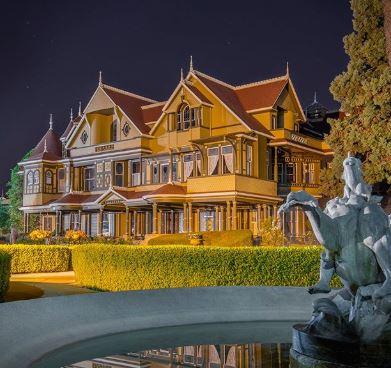
Some people do not believe in ghost. For that matter, some people do not believe in anything. There are persons who even affect incredulity concerning the “Door to Nowhere,” at the Winchester mansion. They said that it did not stand wide open—that it was not a gateway to the Spirit World and that they could have shut it; that the whole affair was a delusion; that they are sure it must have been a conspiracy; that they are doubtful whether there is such a place as the Winchester mansion on the face of the Earth; that the first time they are in California they will look it up. Perhaps, before going further, I ought to premise there was a time when I did not believe in ghosts either. If you had asked me one summer’s morning years ago when you met me on the Golden Gate Bridge if I held such appearances to be probable or possible, you would have received an empathic “No” for answer. However, at this rate, the story of the Door to Nowhere will never be told; so we will, with your permission, plunge into it immediately. I was interested in why this “Door to Nowhere” in the Winchester mansion would not keep shut? They say the place is haunted. What nonsense. There was one thing I can truly say about our office, we were never serious in it. I fancy that is the case in most offices nowadays; at all events, it was the case in ours. We were always chaffing each other, playing practical jokes, telling stupid stories, scamping our work, looking at the clock, counting the weeks to next Christmas, counting the hours to Saturday. For all that we were earnest in our desire to have our salaries raised, and unanimous in the opinion no fellows ever before received such wretched pay. #RandolphHarris 1 of 17

I had $75,000 a year, which I was aware did not half provide for what I ate at home. My mother and sisters left me in no doubt on the point, and when new clothes were wanted I always hated to mention the fact to my poor worried father. We had been better off once, I believe, though I never remember the time. My father owned a small property in the country. I wanted money badly—I must say I never had sixpence in the World of my own—and I thought if I could earn two sovereigns I might buy some trifles I needed for myself, and present my father with a new Ultimate Driving Machine. Then I recalled the amount of the rent was being asked for the Winchester mansion; then I decided gladly this would be a great place to stay if only the ghost turned out of possession. I decided I should like to try to whether, I could not solve the mystery. I was accustomed to lonely houses, and I would not feel at all nervous; I did not believe in ghost, and as for burglars, I was not afraid of them. I was told to just try it out first. To stay in the house for a week; if as tht end of that time I could keep the door shut, locked, bolted, or nailed up, to telegraphy the Winchester Repeating Arms Company, and they would actually pay me to stay there. To me, this sounded like a great bargain. If I lay the ghost, or find out the ghost, I think I ought to have enough money to buy a small house for myself. However, I could not have said what frightened me about this endeavour. A week after I moved into the Queen Anne mansion, Mr. van Buuren from the Winchester Repeating Arms Company came to visit me. He wanted to speak to me about the mansion. I heard a sound of irritation in his voice. “The Winchester Mansion!” he said; “and what have you got to say about the Winchester Mansion?” #RandolphHarris 2 of 17

“That is what I wanted to tell you, Mr. van Buuren,” I answered, and a dead hush seem to fall over the office as I spoke. The silence seemed to attract his attention, for he looked sternly at the clerks, who were not using a pen or moving a finger. “Come this way, then,” he said abruptly; and next minute I was in his private office. “Now, what is it?” he asked, flinging himself into a chair, and addressing me, who stood hat in hand beside the great table in the middle of the room. I began—I will say he was a patient listener—at the very beginning, and told my story straight through. I concealed nothing. I enlarged on nothing. A discharged clerk I stood before him, and in the capacity of a discharged clerk I said what I had to say. He heard me to the end, the he sat silent, thinking. At last he spoke. “You have heard a great deal of conversation about the Winchester, I suppose,” he remarked. “No, sir; I have heard nothing expect what I have told you.” “And why do you desire to strive to solve such a mystery?” “If there is any money to be made, I should like to make it, sir.” “How old are you?” “Two-and-twenty last January.” He laughed—he lay back in his chair and laughed—and I laughed myself, though ruefully. We went on talking for a long time after that; he asked me all about my father and my early life, and how we lived and the people we knew; and, in fact, put more questions than I can well remember. “It seems a crazy thing to do,” he said at las; “and yet I feel disposed to trust you. The house is standing perfectly empty. I cannot live it in, and I cannot get rid of it; all my own furniture I have removed, and there is nothing in the place except a few old-fashioned articles belonging to Mrs. Winchester. The place is a loss to me. It is of no use trying to let it, and thus, in fact, matters are at a deadlock. #RandolphHarris 3 of 17

“You will not be able to find out anything, I know, because, of course, other have tried to solve the mystery ere now; still, if you like to try you may. I will make this bargain with you. If you like to go down, I will pay your reasonable expenses for a fortnight; and if you do any good for me, I will give you a $1,000,000 note for yourself. Of course I must be satisfied that what you have told me is true and that you are what your represent. Do you know anybody in the city who would speak for you?” I could think of no one but my uncle. I hinted to Mr. van Buuren he was no grand enough or rich enough, perhaps, but I knew nobody else to whom I could refer him. “What?!” he said, “Greg Ryan, of Lakeview Street. He does business with us. If he will go bail for your good behaviour I shan’t want any further guarantee. Come along.” And to my intense amazement, he rose, put on his hat, walked me across the outer office and along the pavements till we came to Lakeview Street. “Do you know this youth, Mr. Ryan?” he said, standing in front of my uncle’s desk, and laying a hand on my shoulder. “Of course I do, Mr. van Burren,” answered my uncle, a little apprehensively; for, as he told me afterwards, he could not imagine what mischief I have been up to. “He is my nephew.” “And what is your opinion of him—do you think he is a young fellow I may safely trust?” My uncle smiled, and answered, “That depends on what you wish to trust him with.” “A long column of addition, for instance.” “It would be safer to give that task to somebody else.” “Oh, uncle!” I remonstrated; for I had really striven to conquer my natural antipathy to figures—worked hard, and every bit of it against the collar. My uncle got off his stool, and said, standing with his back to the empty fire-grate: “Tell me what you wish the boy to do, Mr. van Buuren, and I will tell you whether he will suit your purpose of not. I know him, I believe, better than he knows himself.” #RandolphHarris 4 of 17

In an easy, affable way, for so rich a man, Mr. van Buuren took possession of the vacant stool, and nursing his right leg over his left knee, answered: “He wants to go and shut the “Door to Nowhere” at the Winchester Mansion for me. Do you think he can do that? My uncle looked steadily back at the speaker, and said, “I thought, Mr. van Buuren, I was quite settled no one could shut it?” Mr. van Buuren shifted a little uneasily on his seat, and replied: “I did not set your nephew the task he fancies he would like to undertake.” “Have nothing to do with it, Justin, advised my uncle, shortly. “You do not believe in ghost do you, Mr. Ryan?” asked Mr. van Burren, with a slight sneer. “Do you not, Mr. van Buuren?” retorted my uncle. There was a pause—an uncomfortable pause—during the course of which I felt the million dollar note, which in imagination, I had really spent, trembling in the scale. I was not afraid. For one million dollars, or half the money, I would have faced all the inhabitants of spirit land. I longed to tell them so; but something in the way those two men looked at each other stayed my tongue. “If you ask me the question here in the heart of the city, Mr. Ryan,” said Mr. van Buuren, at length, slowly and carefully, “I answer ‘No’; but if you were to put me on a dark night at the Winchester, I should beg time to consider. I do not believe in supernatural phenomena myself, and yet—the ‘Door to Nowhere’ at the Winchester is as much beyond my comprehension as the ebbing and flowing of the sea.” “And you cannot live at the Winchester?” remarked my uncle. “I cannot live at the Winchester, and what is more, I cannot get anyone else to live at the Winchester.” “And you want to get rid of your lease?” “I want so much to get rid of my lease that I told Tuck I would give him a handsome sum if he could induce anyone to solve the mystery. Is there any other information you desire, Mr. Ryan? Because if there is, you have only to ask and have. I feel I am not here in a prosaic office in the city of Santa Clara, but in the Palace of Truth.” #RandolphHarris 5 of 17

My uncle took no notice of the implied compliment. When company is good it needs nothing else. If a man is habitually honest in his speech and in his thoughts, he desires no recognition of the fact. “I do not think so,” he answered; “it is for the boy to say what he will do. If he be advised by me he will stick to his ordinary work in his employers’ office, and leave ghost-hunting and spirit-laying alone.” Mr. van Buuren shot a rapid glance in my direction, a glance which implying a secret understanding, might have influenced my uncle could I have stooped to deceive my uncle. “I cannot stick to my work there any longer,” I said. “I got my marching orders today.” “What had you been doing, Justin? Asked my uncle. “I wanted one million to go and lay the ghost!” I answered, so dejectedly, that both Mr. van Buuren and my uncle broke out laughing. “One Million dollars!” cried my uncle, almost between laughing and crying. “Why, Justin boy, I had rather, poor man though I am, have given thee one million dollars than thou should’st go ghost-hunting or ghost-laying.” When he was very much in earnest my uncle went back to thee and thou his native dialect. I liked the vulgarism, as my mother called it, and I knew my aunt loved to hear him use the caressing words to her. He had risen, not quite from the ranks it is true, but if ever a gentleman came ready born into the World it was Greg Ryan, upon whom at our home everyone seemed to look down. “What will you do, you man?” asked Mr. van Buuren; “you hear what your uncle says, “Give up the enterprise,” and what I say; I do not want either to bribe or force your inclinations.” “I will go, sir,” I answered quite steadily. “I am not afraid, and I should like to show you—” I stopped. I had been going to say, “I should like to show you I am not sure a fool as you all take me for,” but I felt such an address would be too familiar, and refrained. #RandolphHarris 6 of 17

When I got to the Lodge, I showed Mr. van Buuren’s letter to the woman, and received the key. “You are not going to stop up at the Winchester alone, are you, sir? she asked. “Yes, I am,” I answered, uncompromisingly, so uncompromisingly that she said no more. The avenue led straight to the mansion; it was uphill all the way, and bordered by rows of the most magnificent limes I ever beheld. A light iron fence divided the avenue from the park, and between the trunks of the trees I could see the deer browsing and cattle grazing. Ever and anon there came likewise to my ear the sound of a sheep-bell. It was a long avenue, but at length I stood in front of the mansion—a square, solid-looking, Victorian mansion, four stories high, with several towers and a steeply pitched roof, beautiful stained-glass windows and statues, a basement; a flight of steps up to the principal entrance; several windows to the right of the door, several to the left of the door; the whole mansion flanked and backed with trees; all the curtains closed, a dead silence brooding over the place; the sun westering behind the great trees studding the park. I took all this in as I approached, and afterwards as I stood for a moment under then ample porch; then remembering he business which has brought me so far, I fitted the great key in the lock, turned the handle, and entered the Winchester Mansion. For a minute—stepping out of the bright sunlight—the place looked to me so dark that I could scarcely distinguish the objects by which I was surrounded; but my eyes soon grew accustomed to the comparative darkness, and I found I was in an immense hall, lighted from the roof; a magnificent old oak staircase conducted to the upper rooms. #RandolphHarris 7 of 17

The floor was of white marble. There were two fireplaces, fitted with dogs for burning wood; around the walls hung pictures, antlers, and horn, and in odd niches and corners stood groups of statues, and the figure of men in complete suits of armour. To look at the place outside, no one would have expected to find such a hall. I stood lost in amazement and admiration, and then I began to glance more particularly around. Mr. van Buuren has not given me any instructions by which to identify the ghostly chamber—which I concluded would most probably be found on the first floor. I knew nothing of the story connected with it—if there were a story. I was perfectly unencumbered of the mystery. I had not the faintest idea in which apartment it resided. Well, I should discover that, no doubt, for myself ere long. I looked around me—doors—doors—doors. I have never before seen so many doors together all at once. Two of them stood open—one wide, the other slightly ajar. “I will just shut them as a beginning,” I thought, “before I go upstairs.” The doors were of oak, heavy, well-fitting furnished with good locks and sound handles. After I had closed I tried them. Yes, they were quite secure. I ascended the great staircase feeling curiously like an intruder, paced the corridors, entered the many bed chambers—some quite bare of furniture, others containing articles of an ancient fashion, and no doubt of considerable value—chairs, antique dressing-tables, curious wardrobes, and such like. For the most part the doors were closed, and I shut those that stood open before making my way into the attics. I was greatly delighted with the attics. The window lighted them did not, as a rule, overlook the front of the Manion, but commanded wide views over wood, and valley, and meadow. Leaning out of one, I could see, that to the right of the mansion the ground, thickly planted, shelved down to a stream, which came out into the daylight a little distance beyond the plantation, and meandered through the deer part. #RandolphHarris 8 of 17

At the back of the mansion the windows looked out on nothing save a dense wood and a portion of the stable-yard, whilst on the side nearest the point from whence I had come there were spreading gardens surrounded by thick yew hedges, and kitchen-gardens protected by high walls; and further on a farmyard, where I could perceive cows and oxen, and, further still, luxuriant meadows, and fields glad with waying and fruit orchards. “What a beautiful place!” I said. “van Buuren must have been a duffer to leave it.” And then I thought what a great ramshackle house it was for anyone to be in all alone. Getting heated with my long walk, I suppose, made me feel chilly, for I shivered as I drew my head in from the last dormer window, and prepared to go down stairs again. In the attics, as in the other parts of the house I had as yet explored, I closed the doors, when there were keys locking them; when there were not, trying them, and in all cases, leaving the securely fastened. When I reached the ground floor the evening was drawing on apace, and I felt that if I wanted to explore the whole house before dusk I must hurry my proceedings. “I will take the kitchens next,” I decided, and so made my way to a wilderness of domestic offices lying to the rear of the great hall. Stone passages, great kitchens, an immense servants’-hall, larders, pantries, coal-cellars, beer-cellars, laundries, brewhouses, housekeeper’s room—it was not of any use lingering over these details. The mystery that trouble Mr. van Buuren could scarcely lodge amongst cinders and empty bottles, and there did not seem much else left in this part of the building. I would go through the living-rooms, and then decide as to the apartments I should occupy myself. The evening shadows were drawing on apace, so I hurried back into the hall, feeling it was a weird position to be there all alone with those ghostly hollow figures of men in armour, and the statues on which the moon’s beams must fall so coldly. #RandolphHarris 9 of 17

I would just look through the lower apartments and then kindle a fire. I had seen quantities of wood in a cupboard close at hand, and felt that beside a blazing hearth, and after a good cup of tea, I should not feel the solitary sensation which was oppressing me. The sun had sunk below the horizon by this time, for to reach the Winchester I had been obliged to travel by cross lines of railway, and wait besides for such trains as condescended to carry third-class passengers; but here was still light enough in the hall to see all object distinctly. With my own eyes I saw that one of the doors I had shut with my own hands was standing wide! I turned to the door on the other side of the hall. It was as I had left it—closed. This, then, was the room—this with the open door. For a second I stood appalled; I think I was fairly frighted. That did not last long, however. There lay the work I had desired to undertake, the foe I had offered to fight; so without mor ado I shut the door and tried it. “Now I will walk to the end of the hall and see what happens,” I considered. I did so. I walked to the foot of the grand staircase and back again, and looked. The door stood wide open. I went into the room, after just a spasm of irresolution—went in and pulled up the blinds: a good-sized room, twenty by twenty (I knew because I paced it afterwards), lighted by two long windows. The floor, of polished oak, was partially covered with a Turkey carpet. There were two recesses beside the fireplace, one fitted up as a bookcase, the other with an old and elaborately carved cabinet. I was astonished also to find a bedstead in an apartment so little retired from the traffic of the house; and there were also some chairs of an obsolete make, covered, so far as I could make out, with faded tapestry. Beside the bedstead, which stood against the wall opposite to the door I had as yet met with the interior of the house. #RandolphHarris 10 of 17

It was a dreary, gloomy room: the dark panelled walls; the black, shining floor; the windows high from the ground; the antique furniture; the dull four-poster bedstead, with dingy velvet curtains; the gaping chimney; the silk counterpane that looked like a pall. “Any crime might have been committed in which a room,” I thought pettishly; and then I looked at the door critically. Someone had been at the trouble of fitting bolts upon it, for when I passed out I not merely shut the door securely, but bolted it as well. “I will go and get some wood, and then look at it again,” I soliloquized. When I came back it stood wide open once more. “Stay open, then!” I cried in a fury. “I will not trouble myself any more with you tonight!” Almost as I spoke the words, there came a ring at the front door. Echoing through the desolate house, the peal in the then states of my nerves startled me beyond expression. It was only the man who had agreed to bring over my traps. I bade him lay them down in the hall, and while looking out some small silver, asked where the nearest-post-office was to be found. Not far from the Winchester Estate’s Park gates, he said; if I wanted any letter sent, he would drop it in the box for me; the mail-cart picked up the bag at ten o’clock. I had nothing ready to post then, and told him so. Perhaps the money I gave was more than he expected, or perhaps the dreariness of my position impressed him as it had impressed me, for he paused with his hand on the lock, and asked: “Are you going to stop here all alone, master?” “All alone, I answered, with such cheerfulness as was possible under the circumstances.” “That is the room, you know,” he said, nodding in the direction of the open door, and dropping his voice to a whisper. “Yes, I know,” I replied. “What, you have been trying to shut it already, have you? Well, you are a game one!” And with this complimentary if not very respectful comment he hastened out of the house. Evidently he had no intention of proffering his services towards the solution of the mystery. #RandolphHarris 11 of 17

I cast one glance at the door—it stood wide open. Through the windows I had left bare to the night, moonlight was beginning to stream cold and silvery. “Look here, Justin,” I said, all of a sudden; “life is not child’s play, as uncle truly remarks. That door is just the trouble you have now to face, and you must face it! However, for that door you would never have been here. I hope you are not going to turn coward the very first night. Courage!—that is your enemy—conquer it.” “I will try,” my other self answered back. “I can but try. I can but faith.” The moon’s beams were streaming down upon the mansion; I could see every statue, every square of marble, every piece of armour. For all the World it seemed to me like something in a dream; but I was tired and sleepy, and decided I would not trouble about fire or food, or the open door, till the next morning: I would go to sleep. However, I felt like an army of Devil’s was horribly broke in upon this place which is the center, and after a sort, the first-born of our Californian settlements. If a ghost was responsible for the hanging of nineteen people in this mansion, what was responsible for the burning of nine hundred people? What more likely time would the “Door to Nowhere” open up and let our arch-enemy, the Devil, choose a time for his attack? I spent the forenoon considering that door. I looked at it from within and from without. It was on the second floor and opened up to a two story drop outside of the house. What would possess someone to build a door like this, unless they had some knowledge of it being a portal? I eyed it critically. I tried whether there was any reason why it should fly open, and I found that so long as I remained on the threshold it remained closed; if I walked even so far away as the opposite side of the mansion, it swung wide. #RandolphHarris 12 of 17

Do what I would, it burst from latch and bolt. I could not lock it because there was no key. I was baffled. Then I stumbled upon a note which read: “One that shall use, practise, or exercise any invocation or conjuration of any evil or wicked spirit, or consult, convenient with, entertain or employ, feed or reward any evil or wicked spirit, to or for any intent or purpose; or take up any dead man, woman, or child, out of his, her, or their grave, or any other place, where the dead body resteth; or the skin, bone, or other part of any dead person, to be employed or used in any manner of witchcraft, sorcery, charm or enchantment; or shall use, practise, or exercise any witchcraft, enchantment, charm, or sorcery, whereby any person shall be killed, destroyed, wasted, consumed, pined, or lamed in his or her body, or any part thereof: such offenders duly and lawfully convicted and attained, shall suffer death.” Then it dawned of me. Perhaps the mansion has been attraction people who are into the occult and they are the nearly 920 people who have been burned alive or hanged. And that is why the house cannot find renters, it consumes them all. Perhaps this is something like the Atonement of Christ. How God gave His one and only Son to pay the wages of sin man had created, this mansion is consuming souls of those who practise the occult to atone for the death of those killed by the Winchester rifle. The afflicted state of our poor neighbours that are now suffering by molestations from the invisible World, we apprehended so deplorable that we think their condition calls for the utmost help of all persons in their several capacities. We cannot but with all thankfulness acknowledge the success which the merciful God has given unto the sedulous and assiduous endeavours of our honorable rulers to detect the abominable witchcrafts which have been committed in the country, humbly praying that the discovery of these mysterious and mischievous wickedness may be perfected. #RandolphHarris 13 of 17

We judge that in the prosecution of these, and all such witchcrafts, there is need of a very critical and exquisite caution, leas by too much credulity for things received only upon the Devil’s authority there be a door opened for a long train of miserable consequences, and Satan get an advantage over us, for we should not be ignorant of his devices. After all, it was this mansion people could not live in—his door that would not keep shut; and it seemed to me these were facts he might dislike being forced upon the attention of the public. What had I seen? What did I think of the matter? Very honestly I did not know what to say. The door certainly would not remain shut, and there seemed no human agency to account for its persistent opening; but then, on the other hand, ghost generally did no tamper with fire arms, and my rifle, though not loaded, had been tampered with—I was sure of that. Mr. van Buuren later disclosed to me his theory that open door: “This is the room my uncle was murdered in, they say the door will never remain shut till the murderer is discovered.” “Murdered!” I did not like the word at all; it made me feel chill and uncomfortable. “Yes—he was murdered sitting in his chair, and the assassin has never been discovered. At first many persons inclined to the belief that I killed him; indeed, may are of that opinion still. “But you did not, sir—there is not a word of truth in that story, is there?” He laid his hand on my shoulder as he said: “No, my lad; not a word. I loved the old man tenderly. Even when he disinherited me for the sake of his young wife, I was worry, but not angry; and when he sent for me and assured me he had resolved to repair a wrong, I tried to induce him to leave the lady a handsome sum in addition to her jointure. “If you do not, people may think she has not been the source of happiness you expected,” I added. “Thank you, Reuban,” he said. “You are a goof fella; we will talk further about this tomorrow.” And then he bade me goodnight. #RandolphHarris 14 of 17

“Before morning broke—it was in the about one hundred years ago—the household was arounds by a fearful scream. It was his death-cry. He had been stabbed from behind in the neck. He was seated in his chair writing—writing a letter in Latin. Part of it said, ‘Exorcizo te, immundissime spiritus, omnis incursion adversarii, omne phanatasma, omnis leigo, in nominee Domini nostri Jesu Christi eradicare, et effugare ab hoc plasmate Dei.’ The rest of the letter was torn. His solicitor came forward and said he had signed a will leaving all his personalty to me—he was very rich—unconditionally, only three days previously.” Mr. van Buuren went away, and I stayed in the house. I never left it all day. I did not go into the garden, or the stable-yard, or the shrubbery, or anywhere; I devoted myself solely and exclusively to that door. If I shut it once, I shut it a hundred times, and always with the same result. Do what I would, it swung wide. Never, however, when I was looking at it. So long as I could endure to remain, it stayed shut—the instant I turned back, it stood open. Though feeling convinced that no human agency did or could keep the door open, I was certain that some living person had means of access to the house which I could not discover. This was made apparent in trifles which might well have escaped unnoticed had several or even two people occupied the mansion. In the dead of the night a noise, resembling the clashing of iron, was frequently heard, which, if you listened more attentively, sound like the rattling of chains, distant at first, but approaching nearer by degrees: immediately afterward a spectre appeared in the form of an old man, of extremely emaciated and squalid appearance, with a long beard and dischevelled hair, rattling the chains on his feet and hands. The distressed occupants meanwhile passed their wakeful nights under the most dreadful terrors imaginable. This, as it broke their rest, ruined their health, and brought on distempers, their terrors grew upon them, and death ensued. #RandolphHarris 15 of 17

Even in the daytime, though the spirit did not appear, yet the impression remained so strong upon their imaginations that it still seemed before their eyes, and kept them in perpetual alarm. Consequently the mansion was at length deserted, as being deemed absolutely uninhabitable; so that it was now entirely abandoned to the ghost of the Winchester rifle. That night, I prepared to retire. However, I was open to the vain terrors of imaginary noises and spirits. The first part of the night passed in entire silence, as usual; at length a clanking of iron and rattling of chains was heard: however, I neither lifted up my eyes, nor got out of bed, but in order to keep calm, I pretended the sound was something else. The noise increased and advanced nearer, until it seemed at the door, and at last in my chamber. I looked up, saw, and recognized the ghost exactly as it has been described to me: it stood before me, beckoning with a finger, like a person calls another. I immediately arouse, and, candle in hand, followed it. The ghost slowly stalked along as if encumbered with its chains, and, turning into the area of the house where the “Door to Nowhere, was and suddenly vanished. What an idiot I have been! If I wanted to solve the mystery of the open door, or course I must keep watch in the room itself. The door would not stay wide unless there was a reason for it. When I walked into the room, it was deadly cold, and the scene was horrible. The door was wide open. A party of ghosts were assembled with, and were feasting on the flesh of corpses. I was astonished by this hideous banquet. As soon as I could safely escape, I stole back into my bed. I was rather crossed at being disturbed. The next day word on—the long, dreary day; evening approached—the night shadows closed over the Winchester mansion. The moon would not rise for a couple hours more. Everything was still as death. The house had never before seemed to me so silent and so deserted. #RandolphHarris 16 of 17

I took a candle, and went up to my accustomed room, moving about for a time as though preparing for bed; then I extinguished the candle, softly open the door, turned the key, and put it in my pocket, slipped softly downstairs, across the hall, through the open dor. Then I knew I had been afraid, for I felt a thrill of terror as in the dark I stepped over the threshold. I paused and listened—there was not a sound—the night was still and sultry, as though a storm were brewing. Not a leaf seemed moving. Noiselessly I made my way to the other side of the room. There was an old-fashioned easy-chair between the bookshelves and the bed; I sat down in it, shrouded by the heavy curtains. The hours passed—where ever hours so long? The moon rose, came and looked in at the windows, and then sailed away to the west; but not sound, no, not even the cry of a bird. I seemed to myself a mere collection of nerves. Every part of my body appeared twitching. It was agony to remain still; the desire to move became a form of torture. The locked door opened—so suddenly, so silently, that I barely had time to draw back behind the curtain, before I saw a woman in the room. A slight, lithe woman, not a lady, clad in all black—not a bit of white about her. What on Earth could she want? Then she fell on me with her nails and teeth, and tore at my throat, she was as strong as twenty devils. I felt something like a red-hot iron enter my neck. She opened a vein and sucked by blood, and I could but rush from the room before I fell senseless on the marble pavement of the hall. When the post man came that morning, finding no one stirring, he looked through one of the long windows that flanked the door; then he ran to the farmyard and called for help. “There is something wrong inside,” he cried. “That young gentleman is lying on the floor in a blood of blood.” To this day, the “Door to Nowhere” is still a mystery. #RandolphHarris 17 of 17

Winchester Mystery House

24 Hours till opening night of All Hallows’ Eve and our caretakers are working non stop to put the finishing touches on the show! Be here for the opening weekend! Tickets are still available. A 160-room mansion built to appease the spirits who died at the hands of the Winchester Rifle 👻
All Hallows’ Eve:
🎟️ Link in bio. 🗝 winchestermysteryhouse.com
 Randolph Harris II International Institute